
Drunk Driving in the United States: A Roadmap for Progress
|
|
|
- Jonathan Simpson
- 10 years ago
- Views:
Transcription
1 Drunk Driving in the United States: A Roadmap for Progress J. H. Hedlund and A. T. McCartt Preusser Research Group, Trumbull, Connecticut, USA Abstract The study investigated why drunk driving in the United States has not decreased recently and offers recommendations on what can be done to make further gains. Analyses of traffic crash and roadside survey data, a review of drunk driving research, and interviews with experts from many disciplines all revealed that drunk drivers are not consistently arrested, regularly convicted, or appropriately punished. The study identified problems at each stage of the drunk driving control system. It recommends both specific actions to address these problems and overall strategies to provide the information, management, and resources needed to implement these actions. Introduction Drunk driving progress in the United States has stalled. After dropping 37 percent from 1982 to 1994, the number of drunk drivers in fatal crashes with a blood alcohol level (BAC) of 0.10 or above remained virtually unchanged through The six percent increase in 2000, to 10,408, was the largest annual increase since Total traffic fatalities involving alcohol show a similar pattern, increasing four percent from 1999 to Source: FARS Methods The study analyzed traffic crash and roadside survey data to describe the current drunk driving

2 problem and how it has changed over the past 20 years. A review of drunk driving research confirmed what's known about effective and ineffective strategies. Interviews with over 90 knowledgeable persons at national, state, and local levels revealed what's wrong with the drunk driving control system, what's needed to improve it, and how the improvements might be accomplished. The study s findings, conclusions, and recommendations draw on all these sources. Citations to the original sources are given in the full study report (1). Results Public attention to drunk driving in the 1980s led to new laws, increased enforcement, and substantial decreases in drunk driving casualties. Progress on all fronts slowed in the 1990s. By 2000, every state had an elaborate system of drunk driving laws, enforcement, courts, and punishment, but these systems do not work as well as they should. Drunk drivers have little fear of being stopped, arrested, convicted, and punished -- so they continue to drink and drive. Drunk Driving Changes since 1982 Drunk driving became a national issue in the 1980s, stimulated by the rise of the citizen activist groups RID and MADD. States enacted per se, administrative license revocation, mandatory driver's license suspension, and other laws. In 1982, Congress established Section 408 grants that provided funds to states that implemented or already had in place certain drunk driving control laws or programs. In 1984, Congress required all states to raise their minimum legal drinking age to 21. Drunk driving enforcement improved with the use of accurate breath test equipment and standard field sobriety tests. Many states established drunk driving task forces to develop legislation and coordinate drunk driving control activities. Perhaps most important, the understanding grew that drunk driving control requires a coordinated system, with all parts working together. Source: FARS From 1982 to 1997, alcohol-related traffic fatalities nationwide dropped by 36%, but this
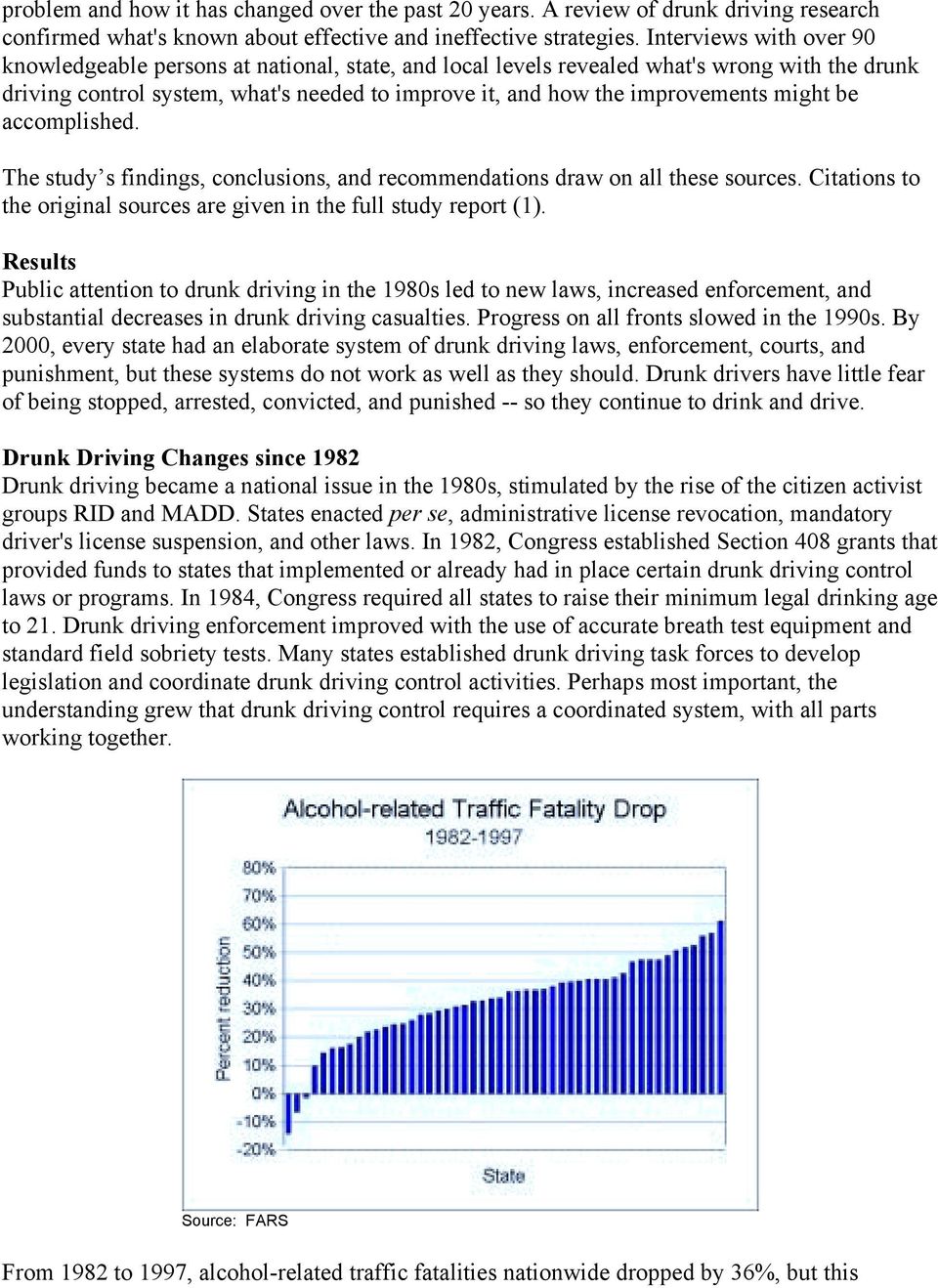
3 reduction varied substantially by state. Six states reduced their alcohol-related traffic fatalities by more than 50%, while alcohol-related traffic fatalities increased in three states. A recent study that investigated the causes of these substantial differences found that the key reasons for success were effective leadership, secure funding, and fortunate circumstances (2). Drinking and driving decreased more for youth under 21 than for older drivers. The number of drinking drivers in fatal crashes under the age of 21 dropped 61 percent from 1982 to 1998, compared to 33 percent for drivers aged 21 and above. Young drinking driver fatal crash involvements decreased substantially in all regions of the country and in most states, in contrast to the substantial state-to-state differences observed for older drinking drivers. In part because of minimum drinking age laws, youth drinking decreased during this time period, but not as much as youth drinking and driving: youth have separated their drinking from their driving more than older persons. Minimum drinking age laws and zero tolerance (BAC 0.02 or less) laws for youth played an important role but by themselves do not explain the entire drop. Other factors -- youth drinking and driving prevention programs, other drunk driving measures not directed specifically at youth, and factors completely apart from drinking or driving -- must also have been important even though their effects have not been measured (3). Drunk Driving Today Drinking and driving is common. About 21 percent of driving-age Americans reported they had driven after drinking in the past year, making about 950 million drinking-driver trips. In about nine percent of these trips, or about 80 million, the driver's blood alcohol level (BAC) was 0.08 or above (4). Drunk driving arrests are rare. With 1.55 million arrests for drunk driving (DWI) in 1999, the chances of arrest on any drunk driving trip were less than one in 50 (5). Repeat offenders and drivers with high blood alcohol levels contribute prominently to the problem. About one-third of all drivers arrested or convicted of DWI are repeat offenders (1). Over half of all drivers arrested for DWI and almost two-thirds of fatally injured drinking drivers had a BAC over 0.15 (6). About 23 percent of all drinking drivers are problem drinkers, but they contribute over 40 percent of all drinking-driver trips (4). States differ substantially. In some states, only about 10 percent of all drivers involved in fatal crashes had BAC levels over In other states, over 25 percent did. States that have reduced drunk driving the most over the past 20 years have effective laws, highvisibility enforcement, and substantial public education built on a foundation of strong leadership, secure funding, and firm commitment (2). Attention to drunk driving has dropped. The public is more concerned with drugs and crime. Even within traffic safety, the spotlight is on aggressive driving, cell phone use, and tire defects rather than drunk driving (1). Many drunk drivers are not deterred. While most of the public supports DWI laws and enforcement, a substantial minority of drivers believes it is unlikely that they would be stopped, arrested, or convicted if they drove after drinking too much (4). What is needed? An improved drunk driving control system will ensure that drunk drivers are consistently arrested, regularly convicted, and appropriately punished. When everyone understands that driving drunk brings frequent and uncomfortable
4 consequences, then fewer people will drive drunk. Research over 40 years has shown conclusively that good laws that are strongly supported and enforced with meaningful penalties reduce drunk driving. Three other strategies support this system. Public education informs drivers, especially young drivers, about alcohol and drunk driving issues. Alcohol treatment is essential for problem drinkers. Alcohol control measures such as minimum legal drinking ages and alcohol server training help reduce drinking in situations that may lead to drunk driving. With strong laws, enforcement, and punishment at the center, these strategies reinforce and promote a community standard that drunk driving is not acceptable. A strong system affects everyone. A strong drunk driving control system increases both the public perception and the reality that drunk drivers will be frequently detected, arrested, convicted, and punished. A weak system sends the opposite message: drunk driving is not a serious problem, drunk drivers usually will not be caught, and those caught will not be punished. Problems and Solutions Research studies and interviews identified common problems in drunk driving control systems. They do not occur everywhere but are frequent enough that all states and communities should consider them. Research and interviews also identified solutions to these problems. Problem State laws are complex and contain inconsistencies and loopholes Many drivers refuse to take BAC tests DWI enforcement levels and arrest rates are low Many arrested drunk drivers are not convicted Many repeat offenders are not identified Problem drinkers are not identified or treated effectively Even convicted drunk drivers escape meaningful punishment Solution Review and simplify laws; use the Uniform Vehicle Code 2000 as a starting point Establish penalties for refusing to take the BAC test that are more severe than the penalties for failing the BAC test Simplify arrest procedures and paperwork Provide necessary equipment and training Enforce a drinking age of 21 and zero tolerance laws for drivers under 21 Eliminate plea bargains to non-alcohol offenses Eliminate diversion programs that allow offenders to escape punishment Ensure that administrative hearings do not interfere with criminal proceedings Improve record systems to identify prior drunk driving offenses Screen all drunk driving offenders for drinking problems Require treatment if needed Apply administrative and criminal sanctions consistently Include actions against the offender's car

5 Offenders frequently are not monitored to assure they complete their sentences Offenders frequently drive in violation of their license suspension or fail to become re-licensed when eligible Law enforcement, courts, and probation lack resources States need strong leadership for all drunk driving control activities Control offenders closely during probation Use home detention, electronic monitoring, or jail as appropriate Consider dedicated facilities if needed Monitor offenders closely Establish and enforce stiff penalties for unlicensed driving Provide steady, dedicated funding Assure that state transportation, health, law enforcement, motor vehicle, and justice departments work together Considering and addressing these issues will improve a state's drunk driving control system, show the public that drunk driving will not be tolerated, and convince more drunk drivers to change their behavior. Discussion Three strategies can link community, state, and national organizations and resources in a renewed effort to reduce drunk driving. 1. Establish a drunk driving system monitoring program in each state. Few states have good data to track DWI arrests, court actions, and offender followup. A drunk driving system monitoring program in each state could combine data from official records with data collected directly in communities, in a fashion similar to the court monitoring programs that operated so effectively in the 1980s. MADD, AAA, and other citizen organizations can operate system monitoring programs. The National Highway Traffic Safety Administration (NHTSA) and other federal agencies can work with organizations representing motor vehicle departments, prosecutors, judges, probation officers, and state officials to design and help communities implement a monitoring program. 2. Reinvigorate state drunk driving task forces. State task forces include all constituencies involved with drunk driving control. They can identify problems, suggest solutions, and produce action. State task forces should examine the state's drunk driving laws and procedures, driver and offender record systems, enforcement and adjudication activities, resource needs, and how authority, responsibility, and coordination are assigned among state agencies. NHTSA should help state task forces by defining a model state drunk driving control program, establishing performance measures for drunk driving enforcement and adjudication, and supporting states as they improve their drunk driving control systems. 3. Revise state drunk driving grants. Federal grants are critical to state drunk driving control activities. They provide funds and also encourage states to adopt effective strategies. The current grant programs are unnecessarily bureaucratic and rigid. The 2003 Surface Transportation

6 Reauthorization should revise the grant programs to: Reward successful states and encourage weaker states to improve; Provide both flexibility and accountability for results; Assure steady funding as long as performance goals are met; Use performance-based criteria instead of requiring specific laws or programs; Provide substantial funding for state record systems; Require states to establish or continue broad-based drunk driving task forces; and Require federal Departments of Transportation, Justice, and Health and Human Services to work together in designing and operating these grant programs. Conclusion The most effective ways to improve state drunk driving control systems will invest authority and responsibility in people and organizations at all levels, local to national. They will operate in the public eye, using the media to report on problems and solutions. They won't promise instant solutions based on a single action but will take steady steps to long-term improvement. And they will establish mechanisms for identifying and solving problems rather than attempting to apply one-size-fits-all methods. The goal is an open, effective, consistent, and accountable drunk driving control system, extending from detection to rehabilitation. When everyone understands that driving drunk brings frequent and uncomfortable consequences, then fewer persons will drive drunk. All that's needed is leadership and commitment. References 1. Hedlund JH and McCartt AT. Drunk driving: Seeking additional solutions. AAA Foundation for Traffic Safety, Washington (DC) Ulmer RG, Hedlund JH, and Preusser DF. Determine why alcohol-related fatalities decreased in five states. National Highway Traffic Safety Administration, Washington (DC) forthcoming, final report, contract DTHN22-97-D Hedlund JH, Ulmer RG, and Preusser DF. Determine why there are fewer young alcohol impaired drivers. National Highway Traffic Safety Administration, Washington (DC) 2001, DOT HS Royal D. National survey of drinking and driving attitudes and behavior: National Highway Traffic Safety Administration, Washington (DC) 2000, DOT HS USDOJ. DWI offenders under correctional supervision. Bureau of Justice Statistics Washington (DC) 1999, Special Report NCJ NHTSA. Traffic safety facts 1999: State alcohol estimates. National Highway Traffic Safety Administration, Washington (DC), 2000, DOT HS

How To Control Drunk Driving
 DRUNK DRIVING: SEEKING ADDITIONAL SOLUTIONS Prepared by James H. Hedlund Anne T. McCartt Preusser Research Group, Inc. 7100 Main Street Trumbull, CT 06611 Tel: 203-459-8700 Fax: 203-459-8312 email: [email protected]
Enforcement of Zero Tolerance Laws in the United States
 Enforcement of Zero Tolerance Laws in the United States 1 S.A. Ferguson, 1 M. Fields, and 2 R.B. Voas 1 Insurance Institute for Highway Safety, Arlington, Virginia, USA 2 Pacific Institute for Research
You and the Drinking Driving Laws
 Page 1 of 7 You and the Drinking Driving Laws WHY ARE PENALTIES FOR DRINKING AND DRIVING SO STRICT? Drinking and driving is a hazardous combination. CONSIDER THESE FACTS: One third of the fatalities in
NEW JERSEY STATE PROFILE
 The National Hardcore Drunk Driver Project NEW JERSEY STATE PROFILE KEY HARDCORE DRUNK DRIVING LEGISLATION: Administrative License Revocation Yes High BAC Law (0.15 BAC or greater) Yes Enhanced Penalties
To: Commission From: Christopher Cavaiola and Laura C. Tharney Re: Title 39 Driving while intoxicated Date: July 11, 2011 M E M O R A N D U M
 To: Commission From: Christopher Cavaiola and Laura C. Tharney Re: Title 39 Driving while intoxicated Date: July 11, 2011 M E M O R A N D U M Various officials have asked the Commission to consider revising
ILLINOIS STATE PROFILE
 The National Hardcore Drunk Driver Project ILLINOIS STATE PROFILE KEY HARDCORE DRUNK DRIVING LEGISLATION: Administrative License Revocation Yes High BAC Law (0.15 BAC or greater) Yes Enhanced Penalties
A GUIDE TO SUSPENSION & REVOCATION OF DRIVING PRIVILEGES IN NEW YORK STATE
 DEFINITIONS sus.pen.sion n 1: Your license, permit, or privilege to drive is taken away for a period of time before it is returned. You may be required to pay a suspension termination fee. re.vo.ca.tion
PENALTIES AND FINES FOR ALCOHOL AND DRUG RELATED DRIVING OFFENSES IN NEW YORK STATE
 PENALTIES AND FINES FOR ALCOHOL AND DRUG RELATED DRIVING OFFENSES IN NEW YORK STATE Offense Mandatory Fine Maximum Jail Term Mandatory Action Against Your License DRIVING WHILE INTOXICATED OR WHILE ABILITY
You And The Drinking Driving Laws
 You nd The Drinking Driving Laws WHY RE PENLTIES FOR DRINKING ND DRIVING SO STRICT? Drinking and driving is a hazardous combination. One third of the fatalities in New York State involve impaired or intoxicated
An Analysis of Idaho s Kootenai County DUI Court
 An Analysis of Idaho s Kootenai County DUI Court AN ALCOHOL TREATMENT PROGRAM FOR PERSONS ARRESTED FOR THEIR SECOND DUI OFFENSE OR BAC OF 0.20% OR HIGHER Prepared for National Highway Traffic Safety Administration
Drinking and Driving
 244 East 58 th Street, 4th Floor New York, NY 10022 212-269-7797 212-269-7510 Fax www.ncadd.org NCADD POLICY STATEMENT Drinking and Driving Preamble A significant percentage of drinking drivers are suffering
Program Descriptions:
 Program Descriptions: Alcohol Education Alcohol education programs include underage drinking prevention and diverse community outreach. Underage drinking is America s number one youth drug problem, killing
The High Cost of DWI. Ignition interlock license available 66-5-503 7
 The High Cost of DWI In New Mexico 2007-2008 The New Mexico Department of Transportation, Traffic Safety Bureau Offense Jail 1 Fines and Fees 2 License Revocation 1 st 90 days 48 hours if offender fails
Evaluating the Effectiveness Of California s Ignition Interlock Program
 Evaluating the Effectiveness Of California s Ignition Interlock Program Interlocks Prevent 1,9 Drunk Driving Incidents Per Month in California December 21, 215 Since the California pilot program began,
A System Dynamics Perspective of the New York State Aggravated DWI Law
 A System Dynamics Perspective of the New York State Aggravated DWI Law Rod MacDonald Initiative for System Dynamics in the Public Sector 300 G Milne Hall Rockefeller College of Public Affairs and Policy
T2007 Seattle, Washington
 T2007 Seattle, Washington Search Warrants for BAC Test Refusals James Hedlund* 1, Douglas Beirness 2, and Amy Berning 3 1 Highway Safety North, Ithaca, NY, U.S.A.; 2 Beirness & Associates, Ottawa, ON,
 June 2006 Dear Traffic Safety Partners: The Wisconsin Department of Transportation, Bureau of Transportation Safety is pleased to provide you with a copy of the 2003 Wisconsin Alcohol Traffic Facts book.
Breath Test Refusals in DWI Enforcement An Interim Report
 National Highway Traffic Safet y Administration DOT HS 809 876 July 2005 Breath Test Refusals in DWI Enforcement An Interim Report This publication is distributed by the U.S. Department of Transportation,
dad had 0.26 alcohol level Police: Blood test revealed Fifth DUI Results in Injuries to Children drunken-driving convictions
 Man charged in fatal accident had suspended license, 3 prior drunken-driving convictions - Journal Inquirer Man faces his 12th DUI - Cincinnati Enquirer Fifth DUI Results in Injuries to Children - The
Conference Summary Report
 Conference Summary Report 2013 SOUTHERN C ONNECTICUT C ONFERENCE ON THE P REVENTION OF A LCOHOL-I MPAIRED D RIVING: THE CROSSROADS OF TECHNOLOGY AND PRACTICE 1 The 2013 Southern Connecticut Conference
RECOMMENDATIONS FOR GUIDELINE AREA 5A DIAGNOSIS AND SCREENING (** Priority Recommendations)
 RECOMMENDATIONS FOR GUIDELINE AREA 5A DIAGNOSIS AND SCREENING (** Priority Recommendations) 1. DEVELOP/PROVIDE SCREENING MECHANISM FOR DUI OFFENDERS - ** Connecticut should implement pre-sentence screening
DWI Conviction Penalties. Penalty Overview
 Penalty Overview As your Attorney, I will work to have your DWI charge dismissed or have you found not guilty. If DWI conviction penalties, such as a fine or jail time, are incurred, we will work together
House Bill 128, Amendments to
 Utah Commission on Criminal and Juvenile Justice Utah Justice Research Brief October 2004 Child Endangerment and Driving Under the Influence Mike Haddon, Julie Christenson & Jace Garfield House Bill 128,
BEING IN SHAPE TO RIDE
 Riding a motorcycle is a demanding and complex task. Skilled riders pay attention to the riding environment and to operating the motorcycle, identifying potential hazards, making good judgments and executing
NEBRASKA DRIVING UNDER THE INFLUENCE (DUI) LAW
 NEBRASKA DRIVING UNDER THE INFLUENCE (DUI) LAW (If convicted of DUI in Nebraska the following penalties will apply.) Revised February 2012 Class W Misdemeanor First Offense - 28-106 & 60-6,197.03 (1) 60
COLORADO DUI AND DUID LAW WHAT YOU NEED TO KNOW WHEN CHARGED. A White Paper Presented By
 COLORADO DUI AND DUID LAW WHAT YOU NEED TO KNOW WHEN CHARGED A White Paper Presented By COLORADO DUI AND DUID LAW WHAT YOU NEED TO KNOW WHEN CHARGED A Guide To Understanding The Penalties And Legal Processes
MONROE COUNTY PUBLIC DEFENDER MONROE COUNTY COURTHOUSE 610 MONROE STREET, SUITE 21 STROUDSBURG, PENNSYLVANIA 18360
 CHECKLIST FOR ALL FIRST OFFENSE DRIVING UNDER THE INFLUENCE CASES IMPORTANT: HIRE A LAWYER OR, IF YOU CANNOT AFFORD ONE, APPLY FOR A PUBLIC DEFENDER IMMEDIATELY. YOU MUST MEET INCOME GUIDELINES TO QUALIFY
The South Dakota 24/7 Sobriety Project: A Summary Report 1
 The South Dakota 24/7 Sobriety Project: A Summary Report 1 Judge General Larry Long a Stephen K. Talpins b Robert L. DuPont, M.D. c a Second Judicial Circuit of South Dakota; Former Attorney General of
DWI Penalties 1st Offense 2nd Offense 3rd Offense
 DWI Penalties Driving While Intoxicated (DWI) in Texas is a serious offense. Blood Alcohol Content (BAC) over.08% or being under the influence of a controlled substance are grounds for arrest under Texas
Mr. Chairman and Members of the Committee.
 ?JI LLIAM SCOTT DIRECTOR, OFFICE OF ALCOHOL AND STATE PROGRAMS NATIONAL HIGHWAY TRAFFIC SAFETY ADMINISTRATION BEFORE THE GOVERNMENTAL AFFAIRS COMMITTEE UNITED STATES SENATE REGARDING THE SURGEON GENERAL'S
I just got arrested for a State of South Carolina DUI charge. What happens now?
 I just got arrested for a State of South Carolina DUI charge. What happens now? ISSUE ONE: The South Carolina Implied Consent Proceeding: Under South Carolina's implied consent law, a person who drives
CHAPTER 7 - YOUR DRIVING PRIVILEGES
 CHAPTER 7 - YOUR DRIVING PRIVILEGES Driving in Minnesota is a privilege. You can lose your driving privileges if you break certain laws or fail to meet certain requirements. The Minnesota Department of
CHAPTER 4: DRIVING RECORD INFORMATION
 CHAPTER 4: DRIVING RECORD INFORMATION This chapter provides important information about your driving record. PennDOT maintains a driving record for every licensed driver in Pennsylvania. The Bureau of
Evaluation of the Use and Benefit of Passive Alcohol Sensors During Routine Traffic Stops
 T2007 Seattle, Washington Evaluation of the Use and Benefit of Passive Alcohol Sensors During Routine Traffic Stops James C. Fell and Christine Compton Pacific Institute for Research and Evaluation, Calverton,
Driving Under the Influence of Drugs
 Driving Under the Influence of Drugs Robert L. DuPont, M.D., President, Institute for behavior and Health Testimony on DUID legislation before the Judiciary Committee, Maryland House of Delegates, February
ALABAMA s FELONY DUI STATUTE- A HISTORY. [This document was originally prepared by AOC and was later revised and updated by Patrick Mahaney.
 ALABAMA s FELONY DUI STATUTE- A HISTORY [This document was originally prepared by AOC and was later revised and updated by Patrick Mahaney.] Felony DUI, as a statutory offense under the Alabama Code, was
Vermont Legislative Council
 Vermont Legislative Council 115 State Street Montpelier, VT 05633-5301 (802) 828-2231 Fax: (802) 828-2424 MEMORANDUM To: From: House Judiciary Committee Erik FitzPatrick Date: February 19, 2015 Subject:
DUI Penalties: The Effectiveness of Pennsylvania s Drinking and Driving Laws. Keri Ritter CJCR 300. In 2003, a study surveyed 6,002 United
 DUI Penalties: The Effectiveness of Pennsylvania s Drinking and Driving Laws Keri Ritter CJCR 300 In 2003, a study surveyed 6,002 United States citizens in which 97% of people expressed that they feel
Ignition Interlocks: Every State, For Every Convicted Drunk Driver
 Ignition Interlocks: Every State, For Every Convicted Drunk Driver In 2013, 10,076 people were killed in crashes caused by a drunk driver with a blood alcohol concentration (BAC) of.08 or greater. General
A Review of Research on Vehicle Sanctions in the U.S.A.
 A Review of Research on Vehicle Sanctions in the U.S.A. Levy, MM 1 ; Frank, JF 1 1 National Highway Traffic Safety Administration, Washington, DC, USA National Highway Traffic Safety Administration (NHTSA)
The Price You ll Pay...
 The Price You ll Pay... DUI in North Dakota December 2012 DL1212 Ten Tips to Save Your Life Always plan ahead. If you wait until you start drinking to figure out how you ll get home, it s too late. Designate
Who Should Read This? Your Driving Record. The cost of DUI. Bottom line: It s not worth the risk.
 Who Should Read This? Your Driving Record Anyone who thinks a DUI is no big deal All Montana drivers Parents of young drivers Employers Educators Health professionals On average, each year on Montana s
Impaired Motorcycle Riding: Law Enforcement Officers Focus Group Results. Joey W. Syner and Maria E. Vegega
 Impaired Motorcycle Riding: Law Enforcement Officers Focus Group Results Joey W. Syner and Maria E. Vegega U. S. Department of Transportation National Highway Traffic Safety Administration Washington,
DUI HANDBOOK. Driving Under the Influence in Pennsylvania. The Martin Law Firm, P.C. www.jbmartinlaw.com
 DUI HANDBOOK Driving Under the Influence in Pennsylvania Find us on Facebook Follow us on Twitter Connect with us on LinkedIn THE MARTIN LAW FIRM, P.C. Pennsylvania DUI Handbook Introduction Drunk driving,
VOIR DIRE 2/11/2015 STATE OF TEXAS VS JANE DOE 1. CONVERSATION - ONLY TIME YOU CAN ASK THE LAWYERS QUESTIONS 2. NO RIGHT OR WRONG ANSWER
 STATE OF TEXAS VS JANE DOE VOIR DIRE 1. CONVERSATION - ONLY TIME YOU CAN ASK THE LAWYERS QUESTIONS 2. NO RIGHT OR WRONG ANSWER 3. DESELECTION (TO MAKE THE JURY = SIT THERE & BE QUIET) 4. SOME QUESTIONS
The Basics of Missouri DWI Law. DWI Criminal Statute. Prior Offenses & Penalties 10/22/2015. Presenter: Jason Korner 577.010. Misdemeanor DWI Offenses
 The Basics of Missouri DWI Law Presenter: Jason Korner DWI Criminal Statute 577.010 A person commits the crime of driving while intoxicated if he operates a motor vehicle while in an intoxicated or drugg
TRAFFIC SAFETY. Alcohol Ignition Interlocks Are Effective While Installed; Less Is Known about How to Increase Installation Rates
 United States Government Accountability Office Report to the Chairman, Committee on Commerce, Science, and Transportation, U.S. Senate June 2014 TRAFFIC SAFETY Alcohol Ignition Interlocks Are Effective
DUI FAQ Guide. FAQs to Help Guide You Through The Florida DUI Process
 DUI FAQ Guide FAQs to Help Guide You Through The Florida DUI Process Randy Berman, Esq. Law Offices of Randy Berman (561) 537-3877 RandyBermanLaw.com A Simple guide for someone recently arrested for a
DOT HS 811 859 November 2013. Model Guideline for State Ignition Interlock Programs
 DOT HS 811 859 November 2013 Model Guideline for State Ignition Interlock Programs DISCLAIMER This publication is distributed by the U.S. Department of Transportation, National Highway Traffic Safety Administration,
Impaired and Distracted Drivers: A continuing dilemma. Sgt. Thomas Neve Ofc. Alan Haywood
 Impaired and Distracted Drivers: A continuing dilemma Sgt. Thomas Neve Ofc. Alan Haywood Impaired and Distracted Drivers National and state statistics Proposed legislation and initiatives on the federal,
Deterrence Effect of Sting Operations on Driving with a Suspended/Revoked License in Maryland
 Deterrence Effect of Sting Operations on Driving with a Suspended/Revoked License in Maryland W.J. Rauch 1, H. Rohrback, Jr. 2, E.M. Ahlin 1, P.L. Zador 1, and H.M. Baum 1 1 Center for Studies on Alcohol,
Should Interlocks Be Required for All DUI Offenders?
 Should Interlocks Be Required for All DUI Offenders? Lifesavers Annual Conference Lake Buena Vista, FL June 15, 2012 Anne T. McCartt Insurance Institute for Highway Safety (IIHS) Nonprofit, independent
ALCOHOL IMPAIRED DRIVING POLICY IMPACT. National Center for Injury Prevention and Control Division of Unintentional Injury Prevention
 POLICY { ALCOHOL IMPAIRED IMPACT DRIVING National Center for Injury Prevention and Control Division of Unintentional Injury Prevention What s the Issue? each year, millions of people choose to drive while
Frequently Asked Questions
 Frequently Asked Questions 1. What do the changes include? These changes will introduce progressive administrative penalties for drivers with blood alcohol levels of.05 or greater, tougher penalties for
York County DUI Prevention Initiative
 York County DUI Prevention Initiative The Case That Got It Started Gender: Male Age: 50 Prior DUI in 1999 Two previous incarcerations for Public Drunkenness Per previous policy: Transported for a blood
Pennsylvania's new DUI law, the bulk of which went into effect February 1, "goes too far" according to local defense attorneys.
 Search Archives Search Wednesday, March 10, 2004 Local Sections Front Page News Reporter-Argus Sports Obituaries Features Outdoors Opinion Community Calendar Links Classifieds Online Sections National
Jim Hedlund, Highway Safety North Erin Holmes, Responsibility.org. GHSA Webinar October 7th, 2015 2:00 3:00 pm EDT
 Jim Hedlund, Highway Safety North Erin Holmes, Responsibility.org GHSA Webinar October 7th, 2015 2:00 3:00 pm EDT GHSA report released Sept. 30 Written by Jim Hedlund, Highway Safety North Advised by
What you don t know can hurt you.
 What you don t know can hurt you. Why you need a defense lawyer if you are charged with a misdemeanor. A misdemeanor conviction is SERIOUS A misdemeanor is not a minor crime. If you are convicted of a
DUI (Driving Under the Influence)
 DUI (Driving Under the Influence) Driving Under the Influence (DUI) In Illinois, a person is considered to be driving under the influence when: The driver has an alcohol concentration on the breath of.08
Chapter 813. Driving Under the Influence of Intoxicants 2013 EDITION. Title 59 Page 307 (2013 Edition)
 Chapter 813 2013 EDITION Driving Under the Influence of Intoxicants GENERAL PROVISIONS 813.010 Driving under the influence of intoxicants; penalty 813.011 Felony driving under the influence of intoxicants;
Type of law: CRIMINAL LAW. A 2011 Alberta Guide to the Law IMPAIRED DRIVING. Student Legal Services of Edmonton
 Type of law: CRIMINAL LAW A 2011 Alberta Guide to the Law IMPAIRED DRIVING Student Legal Services of Edmonton COPYRIGHT & DISCLAIMER GENERAL All information is provided for general knowledge purposes only
DUI... INSTANT CRIMINAL RECORD
 DUI... INSTANT CRIMINAL RECORD TABLE OF CONTENTS Implied Consent How DUIs Are Handled p. 2 p. 2 I. DUI ADMINISTRATIVE PROCEDURES II. DUI COURT PROCEDURES A. Penalties B. First Offense Election C. IID License
Field Evaluation of a Behavioral Test Battery for DWI
 September 1983 NHTSA Technical Note DOT HS-806-475 U.S. Department of Transportation National Highway Traffic Safety Administration Field Evaluation of a Behavioral Test Battery for DWI Research and Development
Pennsylvania DUI Handbook
 Pennsylvania DUI Handbook Published by: The Martin Law Firm, P.C. The Martin Law Firm, P.C. 725 Skippack Pike, Suite 337 Blue Bell, PA 19422 215.646.3980 www.jbmartinlaw.com Although DUI drunk driving
DRIVING UNDER THE INFLUENCE PENALTIES AND PROCESS INFORMATION
 DRIVING UNDER THE INFLUENCE PENALTIES AND PROCESS INFORMATION prepared by: LAW OFFICES OF MARK L. HORWITZ A Professional Association 17 East Pine Street Orlando, Florida 32801 (407) 843-7733 CRIMINAL CHARGE
NATIONAL HIGHWAY TRAFFIC SAFETY ADMINISTRATION. NATIONAL SURVEY OF DRINKING AND DRIVING Attitudes and Behavior: 1997
 NATIONAL HIGHWAY TRAFFIC SAFETY ADMINISTRATION NATIONAL SURVEY OF DRINKING AND DRIVING Attitudes and Behavior: 1997 1. Report No. DOT HS 808 844 4. Title and Subtitle 2. Government Accession No. 3. Recipient's
Annual Report On Drunk Driving In Springdale, Arkansas For the year 2012
 Annual Report On Drunk Driving In Springdale, Arkansas For the year 2012 Prepared by: Springdale City Attorney s Office January 28, 2014 Table Of Contents TABLE OF CONTENTS I. General Summary of Arrests
Significant Laws in Oregon Traffic Safety
 Significant Laws in Oregon Traffic Safety 1931 As part of National Model Driver License law, driver licenses could be suspended upon conviction for DUII. 1937 Law passed making driving under the influence
Wisconsin Operating While Intoxicated Law A Client's Guide to the Language and Procedure
 Wisconsin Operating While Intoxicated Law A Client's Guide to the Language and Procedure BAKKE NORMAN L A W O F F I C E S Welcome Thank you for considering Bakke Norman, S.C. to represent your interests.
Source: Minnesota Student Survey, Key Trends Through 2007, Minnesota Departments of Corrections, Education, Health, Human Services and Public Safety.
 Underage Drinking in Minnesota The Consequences of Drinking Outweigh the Experience. What s the Big Deal? Underage alcohol use is a big deal and directly related to criminal behavior and serious social
What Parents Should Know: Common Criminal Charges & Consequences for Minors
 ATTORNEYS AT LAW What Parents Should Know: Common Criminal Charges & Consequences for Minors WWW.FB-FIRM.COM About the Author: Mark J. Mandell Attorney Mark Mandell has extensive experience in representing
conservative study showed drunk drivers getting on the road an average of 87 times before the first arrest. iii
 Frank Harris State Legislative Affairs Manager Mothers Against Drunk Driving Before the Senate Public Safety Committee Testimony in Support of the Erin Swezey Act or Senate Bill 529 24 February 2011 Thank
Chapter 30: Correcting a Drafting Error in California s Latest DUI Law
 Chapter 30: Correcting a Drafting Error in California s Latest DUI Law Vehicle Michael Malone Code Sections Affected Vehicle Code 13352.5, 13353.3, 23247 (amended). SB 895 (Huff); 2010 STAT. Ch. 30 (Effective
What should I do if the police ask me to take Field Sobriety Tests?
 DWI A DWI is not like a traffic ticket. It is a much more serious offense that carries a penalty of up to 180 days in jail and up to a $2,000 fine for a first offense. Repeat DWI offenders increase their
Driving under the influence of alcohol, drugs, or other intoxicating substances;
 OCGA 40-6-391 Brief Description Driving under the influence of alcohol, drugs, or other intoxicating substances; Statutory Language (a) A person shall not drive or be in actual physical control of any
Intensive Probation Supervision Options for the DWI/DUI Offender: DWI Courts & Police / Probation Partnerships
 Intensive Probation Supervision Options for the DWI/DUI Offender: DWI Courts & Police / Probation Partnerships Paul Hofmann NHTSA Probation Fellow C/O American Probation and Parole Association [email protected]