
1. Purpose. To publish revised guidance for performance evaluation and to publish the revised Navy Performance Evaluation Manual (EVALMAN).
|
|
|
- Thomasina West
- 10 years ago
- Views:
Transcription
1 PERS-32 BUPERS INSTRUCTION D From: Chief of Naval Personnel Subj: NAVY PERFORMANCE EVALUATION SYSTEM Ref: (a) OPNAVINST J (b) NAVPERS 15560D, Naval Military Personnel Manual (MILPERSMAN) (c) BUPERSINST F (d) SECNAVINST H (e) OPNAVINST (f) OPNAVINST F (g) BUPERSINST F Encl: (1) Navy Performance Evaluation System Overview for Commanding Officers, Delegated Reporting Seniors, and Raters (2) Navy Performance Evaluation System Manual (EVALMAN) 1. Purpose. To publish revised guidance for performance evaluation and to publish the revised Navy Performance Evaluation Manual (EVALMAN). 2. Cancellation. BUPERSINST C. 3. Information. This revision provides updated administrative and policy changes affecting Navy's performance evaluation system. Enclosure (1) provides an overview of the system for commanding officers (COs), reporting seniors, and raters. The EVALMAN provides requirements for completion and submission of the report forms. Organization of the EVALMAN and a brief summary of the chapters are provided in the introduction section of enclosure (2). 4. Significant Changes. Wherever possible, existing fitness report and counseling record (FITREP) and evaluation report and counseling record (CHIEFEVAL and EVAL) policies have been kept in effect. The most important changes to this instruction include:

2 a. Incorporating NAVADMIN 183/11 that realigns the strategic sealift officer (SSO) designators within the 16xx series. The new designator is now special duty - strategic sealift (166X). b. Incorporating NAVADMIN 219/11 that establishes a 60 percent Early and Must Promote combined promotion recommendation limit for lieutenants. c. Incorporating NAVADMIN 028/13 that requires using combined officer summary groups for Information Dominance Corps (IDC) officers, regardless of designator. d. Incorporating NAVADMIN 243/14 which directs that Transition Assistance Program Military Life Cycle counseling requirements are met. e. Incorporating BUPERSINST C change 1 that reinforces the importance of evaluating commanders, officers, and Sailors on their contributions to command or organizational climate/equal opportunity and military bearing/character. f. Requiring reporting seniors to document whether commanders, commanding officers, and officers-in-charge conduct required command climate assessments. g. Incorporating BUPERSINST C change 2 that updates guidance for evaluating performance in the area of Military Bearing for flag officers. h. Prohibiting comments in block 41/43 (Comments on Performance) regarding a member s potential for civilian employment. i. Incorporating Reserve-specific language where applicable throughout the instruction to clarify procedures and enhancing Active Duty reports on Reservists providing operational support. j. Incorporates comments on evaluating unit commanders and commanding officers on a command s personnel security program and comments on officers and senior enlisted. 2
3 k. Incorporates comments on evaluating senior enlisted and officers on their contributions to building an innovative culture. 5. Change Recommendations. FITREP, chief petty officer evaluations (CHIEFEVAL), and EVAL policies, procedures, and requirements may be modified only by change to this instruction. Submit recommendations to Navy Personnel Command (NAVPERSCOM), Performance Evaluations Division (PERS-32). 6. Records Management. Records created as a result of this instruction, regardless of media and format, shall be managed per Secretary of the Navy Manual M of January Forms a. OPNAV 5239/14 System Authorization Access Request-Navy is available at 4_7631.pdf. b. The following forms may be obtained at (1) NAVPERS 1610/5 Fitness Report and Counseling Record (O7-O8). (2) NAVPERS 1610/2 Fitness Report and Counseling Record (W2-O6). (3) NAVPERS 1616/27 Evaluation and Counseling Record (E7 E9). (4) NAVPERS 1616/26 Evaluation Report and Counseling Record (E1-E6). c. NAVPERS 1616/23 MEMORANDUM Signature Authentication to Accept Non CAC user FITREPS is available through the Office of the Chief of Naval Operations (OPNAV), Flag Matters (N00F) at (703) /DSN

4 8. Reports. Report Control Symbol BUPERS has been assigned to the reports required by paragraph 3 and is approved per Secretary of the Navy Manual of December W. F. MORAN Vice Admiral, U.S. Navy Distribution: Electronic only via BUPERS Web site NPC/REFERENCE/INSTRUCTIONS/BUPERSINSTRUCTIONS/Pages/default.aspx 4

5 NAVY PERFORMANCE EVALUATION SYSTEM OVERVIEW FOR COMMANDING OFFICERS, DELEGATED REPORTING SENIORS, AND RATERS

6

7 1. Purpose. This enclosure provides an overview of the Navy Performance Evaluation System. This is a Total Force instruction and is applicable to all Active Duty (ACDU), Full Time Support (FTS), and Inactive (INACT) duty Reserve personnel. While each of the statements in this enclosure constitutes policy, specific actions may require the detailed instructions found in the EVALMAN, enclosure (2). 2. How Does the Report Work? The system utilizes a FITREP for officers (W2-O6), CHIEFEVAL for chief petty officers (CPO) (E7-E9) and an EVAL for other enlisted personnel (E1-E6). Performance traits are graded on a 5-point scale, from 1.0 (lowest) to 5.0 (highest), using performance standards printed on the forms. The performance trait grade of 3.0 represents performance to full Navy standards. Higher grades are reserved for performance which significantly exceeds standards. All 1.0 grades must be substantiated in the comments, as well as general comments on the remainder of the evaluative blocks. If there is a promotion recommendation of "Significant Problems," or any recommendation against retention, the report shall be treated as adverse. All forms provide a 5-step promotion recommendation scale: "Significant Problems," "Progressing," "Promotable," "Must Promote," and "Early Promote." "Early Promote" recommendations are based solely on performance, and do not require eligibility for early promotion. There are, however, mandatory limits on the number of "Early Promote" recommendations. For pay grades O1 and O2 (with the exception of limited duty officers (LDOs)), no promotion recommendation higher than Promotable is allowed. For the more senior officer and enlisted pay grades, there are also limits on "Must Promote" recommendations. These limits ensure a sufficient range of recommendations that make the reports useful to the promotion system. For enlisted personnel, the promotion recommendation is also the performance mark average for the report period. The recommendations are translated into marks of 2.0, 3.4, 3.6, 3.8, and 4.0, respectively, on the traditional 4.0 grading scale. Refer to Chapter 16 section 16-3 for guidance. 3. Who Can Be a Reporting Senior? a. COs and officers in charge (OICs) are reporting seniors by virtue of their command authority. They may submit properly authorized FITREPs, CHIEFEVALs, and EVALs on any member who has reported to them for duty, whether junior or senior to them in grade. The term "commanding officer" is inclusive of all 1 Enclosure (1)

8 Services and their civilian equivalents within the U.S. Federal Government. OICs are reporting seniors if they are in charge of commissioned or established activities listed in the Standard Navy Distribution List. When a member is assigned to a non-u.s. Government activity, the reporting senior is the member's U.S. administrative commander unless another reporting senior is assigned by order or directive. A member in this category may receive a letter-type report from the non-u.s. Government activity for attachment to a FITREP, CHIEFEVAL, or EVAL. b. Delegation of reporting senior authority is an actual transfer of that authority, and not merely an authorization to sign "By direction." For this reason, delegation is held to the highest level consistent with effective observation of performance, and the CO s oversight responsibilities are carefully defined. For specific direction concerning delegated reporting seniors, refer to enclosure (2), chapter 2. c. An immediate superior in command (ISIC) is a reporting senior for assigned COs and is authorized to assume the reporting senior authority of a subordinate CO whose capacity to act as a reporting senior becomes impaired. Specific guidance is contained in enclosure (2), chapter 2. d. An enlisted OIC in the grade of E9 and civilians in command positions who hold the grade of GS-9 through GS-12 may sign reports on E5 and below. A chief petty officer (CPO) or senior chief petty officer (SCPO) may sign reports on personnel E4 and below only. GS-13 or equivalent may sign reports for E1 to E9. Reporting senior authority for enlisted OICs in the grade of E7 and E8 may be delegated to sign E5 reports with the prior written approval of NAVPERSCOM (PERS-32). All other reports will be signed by a senior in the chain of command having authority to report on the member concerned. 4. Who are the Raters and Senior Raters? What Do They Do? EVALs on personnel E6 and below should contain the signatures of a rater and senior rater. The signature of the reporting senior is required. This ensures that Navy's senior enlisted and junior officer supervisors are properly included in the enlisted EVAL process. a. The rater for personnel E1-E4 can be an E6 or civilian equivalent (GS-5). For personnel E5-E6, the rater should be a 2 Enclosure (1)
9 Navy CPO whenever possible, but if none is available within the command, the rater may be a military or civilian supervisor who is an E7 equivalent (GS-6) or higher. Typically, the senior rater will be the member's division officer or department head. The senior rater may be omitted where the reporting senior is the rater's immediate supervisor. Table 2-1 in chapter 2 provides guidance on evaluation raters, senior raters, and reporting seniors for various sized commands. b. The development of EVALs must be a team effort. The objective is to develop a better evaluation than could be achieved by any single member of the team. The rater, senior rater, and reporting senior must work together to ensure consistent interpretation and application of Navy standards. In some cases, reports can be developed in a single cooperative effort. Where a division of effort is required, the rater should first collect input from the member, the primary and collateral duty supervisors, the duty section leader, etc. The rater will then review the member's performance, assign trait grades using the performance standards, propose career recommendations, and as a minimum, draft a justifying comment for each 1.0 grade and any other comments on performance. The senior rater will review the rater's trait grades and career recommendations, expand the comments if necessary, and propose a promotion recommendation. The reporting senior shall ensure the EVAL standards have been respected, and will determine the final distribution of promotion recommendations within the member's summary group using command-directed procedures where applicable. The smooth report will then be prepared and signed by all members of the team. 5. How Do We Perform the Counseling? Counseling methods are up to the CO or OIC. Performance counseling shall be provided at the mid-point of the periodic report cycle, and when the report is signed. The mid-term performance counseling schedule is listed in chapter 18. The counselor will be a supervisor who participates in the member s EVAL, CHIEFEVAL, or FITREP preparation. COs will guide the counseling program and monitor counselor performance and results. The objectives are to provide feedback to the member and to motivate and assist improvement. Performance counseling starts with a fair assessment of the member s performance and capabilities, to which the member contributes. It identifies the members strengths and motivates their further improvement. It also 3 Enclosure (1)
10 addresses important weaknesses, but should not dwell on unimportant ones. It should avoid personality and concentrate on performance. The FITREP, CHIEFEVAL, and EVAL forms are used as counseling worksheets and must be signed by the counselor and member. Counselors may use the tick marks next to each performance standard and assign tentative trait grades and may write comments. Under no circumstances should a future promotion recommendation be promised during counseling. 6. How Do We Administer the System? The FITREP, CHIEFEVAL, and EVAL program is the responsibility of the Chief of Naval Personnel. As such, only that office can modify personnel evaluation policies and procedures. COs and OICs are encouraged to establish local procedures for such matters as member input forms, delegation plan, guidance for delegated reporting seniors and raters, maintaining uniform grading and promotion recommendation standards, and review of adverse or other delegated reports that require command review. 7. Report Types. There are three types of reports. a. Regular reports are the foundation of the performance record and must be submitted periodically per the schedule in table 1, and on other occasions specified in the EVALMAN. They must cover, day-for-day, all naval service on active duty or inactive drilling Reserve duty, except for enlisted initial entry training and other limited circumstances. Prior to submitting regular reports, efforts should be made to determine the ending date of the previous report, if any, to ensure regular report continuity is maintained. b. Concurrent reports provide a record of significant performance for active duty (ACDU) and Full Time Support (FTS) members fulfilling additional duty (ADDU) or temporary additional duty (TEMADD) orders; and for Reservists supporting the ACDU and/or their designated cross-assigned billet assignment. They are optional unless directed by higher authority, and may not be submitted by anyone in the regular reporting senior's direct chain of command. A Concurrent report must be countersigned by the regular reporting senior, who may also make it the Regular report for the period concerned if continuity is maintained with the previous regular or regular/concurrent report. Refer to EVALMAN, chapter 4 for detailed requirements. 4 Enclosure (1)

11 c. Operational Commander reports are optional, and may only be submitted on COs or OICs as observed by their operational commanders who are not also their regular reporting seniors. Refer to EVALMAN, chapter 5 for detailed requirements. 8. What are the Administrative Blocks? The administrative blocks, blocks 1, 3-19, blocks 22-26, block 44 (FITREP/ CHIEFEVAL) or 48 (EVAL), identify the report, define the context in which it was received, and make it more informative to detailers and selection boards. They also permit computerized compliance audits by NAVPERSCOM to assure fairness to all members and reporting seniors. Each command should have a quality review procedure for FITREPs, CHIEFEVALs, and EVALs, paying very close attention to ensure the correct member and reporting senior s social security number (SSN) are accurate. NAVPERSCOM s automated data file will not accept incorrect name and SSN entries for the member, and reports may then have to be returned to the reporting senior for correction. However, after acceptance to the Official Military Personnel File (OMPF), the correction of an incorrect reporting senior s SSN requires the submission of supplemental material to correct the discrepancy, and the automated data files are not adjusted. For specific directions concerning supplementary material, refer to chapter 15. NAVFIT 98A, the FITREP and EVAL form-filler computer application program, will prevent many incorrect entries. 9. Guidance on Trait Grades. The meanings of the trait grades are printed on the form, along with representative performance standards. The 5.0 trait grade is reserved for performance that is far above standards and is notable for its exemplary or leadership quality. The 1.0 trait grade means generally poor performance that is not improving, or unsatisfactory performance with respect to a single standard. For the majority of Sailors, most of the trait grades should be in the 2.0 to 4.0 range. Arbitrarily "two-blocking" the trait grades will be detrimental for two reasons. First, the reporting senior's summary group and cumulative trait grade averages will be available to detailers and selection boards for comparison purposes. Second, it will be difficult for the reporting senior to allocate promotion recommendations if everyone's trait grades are the same. Definitions are stated relative to both performance in that trait and promotability with respect to that trait. 5 Enclosure (1)
12 a. Superstar Performance 5.0. Could be promoted two pay grades, and still be a standout in this trait. b. Advanced Performance 4.0. Far more than promotionready in this trait right now. c. Dependable, "Fully-Qualified," Journeyman Performance 3.0. Can handle this aspect of the next higher pay grade. d. Useful, Promising Performance 2.0. Needs development in this trait, but is promotable if overall performance warrants it (i.e., sufficient progress in this trait and no more than one other 2.0 trait). Exception: 2.0 trait grade cannot be assigned in Command or Organizational Climate/Equal Opportunity on reports in pay grades E1-E6 and W2-O6 and maintain a promotion recommendation of Promotable or higher. For pay grades E7-E9, a 2.0 trait grade cannot be assigned in Character and maintain a promotion recommendation of Promotable or higher. e. Disappointing Performance 1.0. Until deficiencies are remedied in this trait, should not be promoted, regardless of performance in other traits. 10. What Should Go in the Comments Block? Comments should be based on verifiable facts. Numerical ranking among peers is authorized. Explanation of the reporting senior s forced distribution is also useful. Use input from the member and the member's immediate supervisor(s), as well as the raters' and reporting senior's personal observations. a. Basic Do's and Don'ts. Continuation sheets and enclosures are not allowed, except an endorsed statement submitted by the member, a flag officer endorsement where required, a civilian or foreign letter report, a letterextension of a Concurrent/Regular report, or a classified letter-supplement. Specifically, substantiate all 1.0 grades, three 2.0 grades, and any grade below 3.0 in Character, or Command or Organizational Climate/Equal Opportunity in the comments. Also, make general comments on the remainder of the evaluative blocks. If there is a promotion recommendation of "Significant Problems," or any recommendation against retention, treat the report as adverse. Any comment suggesting persistent weaknesses, continuing incapacity, or unsuitability for a 6 Enclosure (1)
13 specific assignment or promotion must also be treated as adverse matter, regardless of grades assigned. Do not include classified matter in the report, and do not submit classified supplements unless absolutely necessary. Include required comments and address special interest items as appropriate. Do not include any of the prohibited comments. (The list of required and prohibited comments and special interest items are available in chapter 13 of the EVALMAN.) b. Style and Content. Space is limited. Avoid preambles and get directly to performance. Do not use puffed-up adjectives. Use direct, factual writing that allows the performance to speak for itself. Bullet style is preferred. Give examples of performance and results. Quantify wherever possible, but do not stress quantity at the expense of quality. Avoid stock comments that make everyone sound alike. Be consistent with the trait marks. Comment on poor performance or misconduct where necessary, but be judicious. Define seldomused acronyms. Use the sections of the report that have been set-aside for them. Remember the report will be made a part of the member s OMPF and that the report is a permanent part of the official record. 11. How Do We Fill Out the Promotion Recommendation Block? Promotion recommendations should be consistent with the performance trait grades, and with the Individual or Member Trait Average displayed on the form. Do not make "Early Promote" and "Must Promote" recommendations merely because quotas are available, and do not recommend any member as "Promotable" who could not, if called on, currently perform the basic duties of the next higher grade. Do not automatically place individuals in the "Early Promote" category when they are evaluated singly. Use the same standards for trait grades and recommendations as are used for other members of the command. For enlisted personnel, a recommendation of "Promotable" or above is the CO s official recommendation for advancement, even if made by a delegated reporting senior. A mark of Progressing cannot be assigned on an EVAL or CHIEFEVAL when a Promotable or higher promotion recommendation for advancement has been given in a previous report in the same pay grade. A member s promotion recommendation can go from Significant Problems on one report to Early Promote on the next report based on the member s performance and the reporting senior s recommendation. 7 Enclosure (1)

14 12. What are Promotion Recommendation Summary Groups? Summary groups were formerly known as comparison groups. Enlisted summary groups generally consist of all members in the same pay grade (regardless of rating) and same promotion status, who receive the same type of report from the same reporting senior on the same ending date. The unit identification code (UIC) is also a breakout for enlisted summary groups. Officer summary groups are similar, but are further subdivided by competitive category (unrestricted line officers, limited duty officers, each designator within the restricted line, and each designator within the Staff Corps). Certain other criteria also apply, as detailed in the EVALMAN, chapter 1, instructions for the summary group block. Each group of reports must be mailed to NAVPERSCOM (PERS-32) with a summary letter marked For Official Use Only, which includes the names, SSNs, member trait averages, summary group average, and distribution of promotion recommendations for that group. It is mandatory to verify or handwrite the reporting senior s address and telephone number on the bottom of the summary letter in the blocks provided. If there is an error on a report in a batch, it will help NAVPERSCOM (PERS-32) to expedite notifying commands when reports need to be returned for correction. 13. What About Misconduct Reporting? Adverse or downgraded FITREPs, CHIEFEVALs, and EVALs may not be directed as punishment or used as an alternative to the proper disposition of misconduct under the Uniform Code of Military Justice (UCMJ). Reports may not mention non-punitive censure, or investigatory, judicial, or other proceedings which have not been concluded or which have exonerated the member. Subject to these limitations, FITREPs, CHIEFEVALs, and EVALs should take into account misconduct that has been established through reliable evidence to the reporting senior's satisfaction. 14. Can We Change or Supplement a Report after Submission? The reporting senior can, for good cause, submit an administrative change or evaluative supplement within 2 years from the ending date of a report. A supplemental report does not replace original reports; they only supplement the report. See chapter 15 for further guidance. 15. What are the Responsibilities and Rights of a Member Reported On? Members shall sign all of their Regular reports, unless impossible to do so, and shall sign other reports where 8 Enclosure (1)
15 possible. Members shall receive a copy of every report from the reporting senior at the time it is signed. Members have the right to submit a statement to the record concerning their reports, either at the time of the report or within 2 years thereafter. Such a statement shall be endorsed by the original reporting senior and forwarded to NAVPERSCOM (PERS-32). If the reporting senior feels that the member s statement does not meet the requirements as prescribed in chapter 17, then the reporting senior should counsel the member. If members refuse to change their statements, then the reporting senior should submit the members statement along with the endorsement to NAVPERSCOM (PERS-32) for review. Members have the right to review their records, and have the responsibility to ensure that their records are complete. Members have the right to communicate directly with selection boards, and have various avenues by which to appeal for change or removal of their reports. 16. How Long Must I Retain Reports? The reporting senior must retain copies of FITREPs on all officers and CHIEFEVALs on all CPOs for at least 5 years. The command must retain copies of enlisted EVALs and CHIEFEVALS for 2 years. 17. Numerical Error Codes for Rejected Reports. The original reporting senior must correct performance evaluation reports that are rejected by NAVPERSCOM (PERS-32). The numerical error code is annotated on the member s Bureau of Naval Personnel (BUPERS) Online (BOL) Continuity page and definitions for each numerical error code can be located on the NAVPERSCOM Web site at click on Career Info, scroll down to Performance Evaluations, and then to Error Codes/Reasons. 18. What Happens if a Reporting Senior Does Not Correct a Rejected Report? NAVPERSCOM (PERS-32) will include a rejected performance evaluation in the official record as is when a reporting senior or command fails to respond to reject notification after 180 days. Exception: unsigned or improperly annotated adverse reports will not be accepted. Should an ensign or lieutenant (junior grade) (non-ldo) receive an Early or Must Promote promotion recommendation, NAVPERSCOM (PERS-32) will change the recommendation to Promotable. A memorandum will be placed alongside the performance evaluation in the OMPF, documenting the reject reason and the non-response from the reporting senior or command. Performance Summary Reports (PSRs) 9 Enclosure (1)

16 will be updated to reflect the memorandum action as supplemental data. Corrected evaluations received after disposition (submitted after 180 days) will be stamped Corrected Report Received DDMMYYYY and placed in the OMPF alongside any previously accepted documents associated with the rejected evaluation. 10 Enclosure (1)
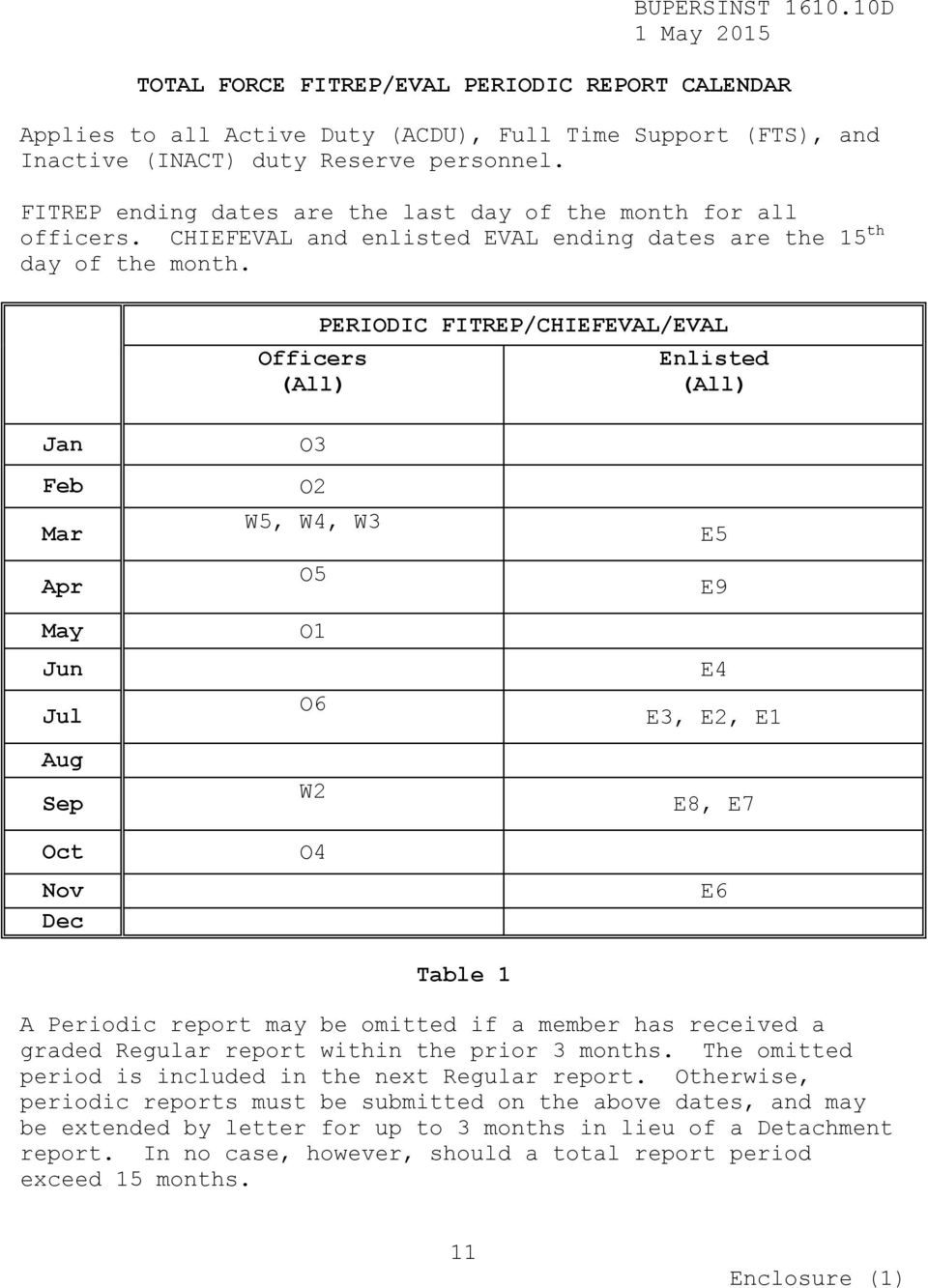
17 TOTAL FORCE FITREP/EVAL PERIODIC REPORT CALENDAR Applies to all Active Duty (ACDU), Full Time Support (FTS), and Inactive (INACT) duty Reserve personnel. FITREP ending dates are the last day of the month for all officers. CHIEFEVAL and enlisted EVAL ending dates are the 15 th day of the month. Officers (All) PERIODIC FITREP/CHIEFEVAL/EVAL Enlisted (All) Jan Feb Mar Apr May Jun Jul Aug Sep Oct Nov Dec O3 O2 W5, W4, W3 O5 O1 O6 W2 O4 E5 E9 E4 E3, E2, E1 E8, E7 E6 Table 1 A Periodic report may be omitted if a member has received a graded Regular report within the prior 3 months. The omitted period is included in the next Regular report. Otherwise, periodic reports must be submitted on the above dates, and may be extended by letter for up to 3 months in lieu of a Detachment report. In no case, however, should a total report period exceed 15 months. 11 Enclosure (1)
18

19 NAVY PERFORMANCE EVALUATION SYSTEM MANUAL (EVALMAN)

20

21 TABLE OF CONTENTS INTRODUCTION...I-1 1. Requirement for FITREP, CHIEFEVAL, and EVAL Reports...I-1 2. Privacy Act Statement...I-1 3. Organization of this Manual...I-1 4. Adverse Matter...I-2 5. Performance of Military Justice Duties...I-3 6. Review, Change, or Endorsement of Reports...I-3 7. Copies, Logs, and Records...I-3 CHAPTER 1 - BASIC GUIDE FOR COMPLETING, PROCESSING, AND MAILING REPORTS Purpose Preparing with Electronic Forms Software Instructions for Specific Blocks Preparing Paper Copies of the Report Preparing the Summary Letter Mailing Procedures EXHIBIT FITREP FRONT EXHIBIT FITREP REVERSE EXHIBIT 1-3 CHIEFEVAL FRONT EXHIBIT 1-4 CHIEFEVAL REVERSE EXHIBIT EVAL FRONT EXHIBIT EVAL REVERSE EXHIBIT SUMMARY LETTER CHAPTER 2 - QUALIFICATIONS OF REPORTING SENIORS AND RATERS Purpose Reporting Senior Reporting Senior Authority of COs Authority of OICs Authority of Enlisted OICs and Federal Civilian Employees in Command Positions Raters Delegated Reporting Seniors Assigned Reporting Senior Non-Government and Foreign Reporting Officials Assumption of Reporting Senior Authority by the Immediate Superior in Command (ISIC) i
22 2-11. Assumption of Reporting Senior Authority by a General Courts Martial Convening Authority Navy Evaluation Adviser in Non-Navy Commands Joint Duty CHAPTER 3 - REGULAR REPORTS Purpose Continuity and Frequency of Regular Reports Letter-Extension of Reports Periodic Reports Omission of Periodic Report Detachment of Individual Reports Detachment of Reporting Senior Reports Promotion/Frocking Reports Special Reports Reporting on TEMDU EXHIBIT 3-1 LETTER EXTENSION CHAPTER 4 - CONCURRENT AND CONCURRENT/REGULAR REPORTS Purpose Concurrent Reporting Senior Criteria for Submitting Concurrent Reports Occasions for Concurrent Reports Concurrent Special Reports Promotion Recommendation Summary Groups Procedures for Submitting Concurrent Reports Endorsement as Concurrent/Regular Report Extension of Concurrent and Concurrent/Regular Reports Adverse Concurrent Reports Flag Officer Endorsement of Reports on Captains Instructions for Specific Blocks of Concurrent and Concurrent/Regular Reports EXHIBIT CONCURRENT REPORT EXHIBIT CONCURRENT/REGULAR REPORT ii
23 CHAPTER 5 - OPERATIONAL COMMANDER REPORTS Purpose Operational Commander Reporting Senior Occasion for an Operational Commander Report Promotion Recommendation Summary Groups Forwarding of Operational Commander Reports Instructions for Specific Blocks of Operational Commander Reports CHAPTER 6 - NOT OBSERVED (NOB) REPORTS Purpose Uses of Not Observed Reports Observed Report With Not Observed Traits or Promotion Recommendation Summary Letters Instructions for Specific Blocks of Not Observed Reports EXHIBIT NOT OBSERVED (NOB) REPORT CHAPTER 7 - REPORTS ON MEMBERS ASSIGNED TO CIVILIAN (NON-U.S. FEDERAL GOVERNMENT) OR FOREIGN ACTIVITIES Purpose Responsibility for Reports Letter Reports from Civilian and Foreign Officials Report Submission by Assigned U.S. Reporting Senior Instructions for Specific Blocks of Reports on Members Assigned to Civilian (Non-U.S. Federal Government) or Foreign Activities EXHIBIT MEMBER SERVING AT CIVILIAN OR FOREIGN ACTIVITY CHAPTER 8 - REPORTS ON DUTY UNDER INSTRUCTION (DUINS) Purpose Enlisted Initial Entry Training (IET) Duty Under Instruction (DUINS) or Temporary Duty Under Instruction (TEMDUINS) iii
24 8-4. Temporary Additional Duty Under Instruction (TEMADDINS) Annual Training (AT) or Active Duty for Training (ADT) Under Instruction Not Observed (NOB) Reports on Students Instructions for Specific Blocks of Student Reports CHAPTER 9 INACTIVE (INACT) DUTY REPORTS ON NAVY RESERVISTS Purpose Definitions Requirement for INACT Reports INACT Duty Reporting Seniors and Raters Regular Reports Concurrent Reports Detachment Reports Additional Detachment Guidance INACT Duty Report Due Dates Monitoring of Report Submission Instructions for Specific Blocks of INACT Duty Reports.9-6 EXHIBIT INACTIVE (INACT) DUTY REPORTS ON DRILLING RESERVISTS CHAPTER 10 - REPORTS ON INACTIVE DUTY NAVY RESERVISTS SERVING ON TEMPORARY ACTIVE DUTY Purpose General Reporting Requirement Reporting Senior Multiple Training Periods Reports on AT and ADT Reports on ADSW (Operational Support), OYR, CANREC, Mobilization Recall, etc Billet Subcategories Forwarding of Reports Instructions for Specific Blocks of Reports on Inactive Reservists Serving on Active Duty EXHIBIT REPORTS ON INACTIVE DUTY NAVY RESERVISTS SERVING ON TEMPORARY ACTIVE DUTY iv
25 v BUPERSINST D CHAPTER 11 - FLAG OFFICER ENDORSEMENTS ON REPORTS ON CAPTAINS Purpose Requirement for Flag Officer Endorsement Action by Reporting Senior Action by Endorsing Flag Officer Adverse Flag Officer Endorsement EXHIBIT 11-1 FLAG OFFICER ENDORSEMENT CHAPTER 12 - PERFORMANCE INFORMATION MEMORANDUM (PIM) Purpose Uses Format Forwarding the Performance Information Memorandum Action Required by a Command Receiving a Performance Information Memorandum EXHIBIT PERFORMANCE INFORMATION MEMORANDUM CHAPTER 13 - GUIDANCE FOR COMMENTS Purpose Technical Aspects General Comments Required Comments Prohibited Comments Comments on Misconduct, Judicial or NJP Proceedings and Corrective Measures CHAPTER 14 - GUIDANCE FOR SIGNATURES Purpose Rater and Senior Rater Signatures Reporting Senior Signature Member Signature EXHIBIT LETTER REFERRING ADVERSE REPORT TO MEMBER FOR STATEMENT EXHIBIT LETTER FORWARDING REPORT TO ANOTHER COMMAND FOR TRANSFERRED ENLISTED MEMBER'S SIGNATURE
26 EXHIBIT LETTER FORWARDING ADVERSE REPORT TO SEPARATED MEMBER FOR SIGNATURE CHAPTER 15 - CHANGES AND SUPPLEMENTS TO REPORTS Purpose General Policy Administrative Changes Supplementary Material Submission of Corrections by Member Reported On Restriction on the Use of Supplementary Material to Compute a Performance Mark Average Entry of Changes and Supplements in the NAVPERSCOM S Files EXHIBIT ADMINISTRATIVE CHANGE REQUEST EXHIBIT LETTER-SUPPLEMENT EXHIBIT COVER LETTER FOR SUPPLEMENTAL REPORT CHAPTER 16 - ENLISTED ADVANCEMENT RECOMMENDATIONS, PERFORMANCE MARKS, PERFORMANCE MARK AVERAGES, AND ELECTRONIC SERVICE RECORD ENTRIES Purpose Enlisted Advancement Recommendation Computing Performance Marks and Electronic Service Record Entries ESR Computing Performance Mark Average Filing Administrative Changes, Supplementary Materials, and Statements Filing a Performance Information Memorandum Electronic Service Record Review CHAPTER 17 - MEMBER INPUT, REVIEW OF RECORD, STATEMENT, AND APPEALS Purpose Member Responsibilities Report Input Review of the NAVPERSCOM Record Administrative Corrections Replacement of Missing Reports Statement to the Record Statement Concerning Adverse Report vi
27 17-9. Communications with Selection Boards Appeals Appeals Based on Acquittal, Finding of Not Guilty, Set-Aside or Reversal Review of Reports on Acquisition Workforce Members EXHIBIT 17-1 OFFICER FITNESS REPORT INPUT EXHIBIT 17-2 CHIEFEVAL/ENLISTED EVALUATION REPORT INPUT EXHIBIT 17-3 PERFORMANCE SUMMARY RECORD EXHIBIT 17-4 STATEMENT IN LIEU OF MISSING REPORT CHAPTER 18 PERFORMANCE COUNSELING Purpose Counseling Policies Counseling Worksheet Selection of the Counselor Counseling Schedule Counseling Objectives Preparing for the Counseling Session Suggestions for Conducting the Counseling Session Follow-up/Monitoring of the Member s Performance CHAPTER 19 - FLAG OFFICER FITNESS REPORTS AND COUNSELING REPORT Purpose Preparation Instructions for Specific Blocks Web Enabled Flag Fitness Report System EXHIBIT 19-1 FLAG FITREP FRONT EXHIBIT 19-2 FLAG FITREP REVERSE vii
28
29 INTRODUCTION 1. Requirement for FITREP, CHIEFEVAL, and EVAL Reports. U.S. Navy Regulations, 1990, article 1129, requires that records be maintained on naval personnel "which reflect their fitness for the Service and performance of duties." FITREPs on officers, CHIEFEVALs on CPOs, and EVALs on other enlisted personnel are used for many career actions, including selection for promotion, advanced training, specialization or sub-specialization, and responsible duty assignments. Timely, realistic, and accurate reports are essential for each of these tasks. 2. Privacy Act Statement a. Authority. The authority for the Privacy Act for evaluations are section 301, title 5, United States Code (USC) (5 USC 301), and 10 USC b. Purpose. Evaluations will serve as the primary source of information for officer and enlisted personnel management decisions and will serve as a guide for the member s performance and development, enhance the accomplishment of the organization mission, and provide additional information to the chain of command. c. Routine use. Evaluations shall be maintained in the member s Official Military Personnel File (OMPF). A copy will be either given directly to the member or sent to a forwarding address. Other routine uses are contained in the Electronic Military Personnel Records System (System of Records Notice) (SORN) published at: ew/tabid/6797/article/570310/n aspx d. Disclosure. Disclosure of the member s or reporting senior s social security number (SSN) is mandatory. Failure to verify the SSN may result in a delayed or erroneous processing of the evaluation report. 3. Organization of this Manual. This manual consists of a brief introduction and a series of chapters. Chapter 1 is the basic user's guide for O6 and below performance reports, and includes block-by-block instructions, entry tables, and examples. Much of chapter 1 is available as "help screens" and I-1
30 "pick lists" in the FITREP and EVAL form-filler computer application program (NAVFIT 98A) distributed by Navy Personnel Command (NAVPERSCOM). Chapter 19 is the basic user s guide for flag fitness reports and includes block-by-block instructions, entry tables, and examples. The other chapters are to be used for dealing with particular aspects of the evaluation system. The chapters are as follows: Chapter 1 - Basic Guide for Completing, Processing, and Mailing Reports Chapter 2 - Qualifications of Reporting Seniors and Raters Chapter 3 - Regular Reports Chapter 4 - Concurrent and Concurrent/Regular Reports Chapter 5 - Operational Commander Reports Chapter 6 - Not Observed (NOB) Reports Chapter 7 - Reports on Members Assigned to Civilian (Non-U.S. Federal Government) or Foreign Activities Chapter 8 - Reports on Duty under Instruction Chapter 9 - Inactive (INACT) Duty Reports On Navy Reservists Chapter 10 - Reports On INACT Duty Navy Reservists Serving On Temporary Active Duty Chapter 11 - Flag Officer Endorsements on Reports on Captains Chapter 12 - Performance Information Memorandum Chapter 13 - Guidance for Comments Chapter 14 - Guidance for Signatures Chapter 15 - Changes and Supplements to Reports Chapter 16 - Enlisted Advancement Recommendations, Performance Marks, Performance Mark Averages, and Electronic Service Record Entries ESR) Chapter 17 - Member Input, Review of Record, Statements, and Appeals Chapter 18 Performance Counseling Chapter 19 - Flag Officer Fitness Reports and Counseling See also enclosure (1), Overview for Commanding Officers (COs), Delegated Reporting Seniors, and Raters, which contains important guidance for managing the performance evaluation system and standards at the command level. 4. Adverse Matter. U.S. Navy Regulations, 1990, article 1122, and reference (b), the Naval Military Personnel Manual (MILPERSMAN), article , require that a FITREP, CHIEFEVAL, or EVAL containing adverse matter be referred to the member for a statement before it is placed in the official I-2
31 record. A member who does not wish to make a statement must so state in writing. This referral is normally accomplished when the report is presented to the member for signature. While not an all-inclusive definition, NAVPERSCOM will consider a report adverse if it contains a trait grade of 1.0, a promotion recommendation mark of "Significant Problems," Command or Organizational Climate/Equal Opportunity trait graded below 3.0 for E1-E6 and W2-O6 reports, or a trait grade less than 3.0 in Character on E7-E9 reports; has more than two traits graded as 2.0; or contains comments indicating serious weakness, incapacity, or lack of qualifications for promotion or assignment. A report shall not be considered adverse solely because it may make the member less competitive than another for promotion or assignment. 5. Performance of Military Justice Duties. FITREPs, CHIEFEVALs, and EVALs shall respect the principles of judicial independence, as stated in the Manual for Courts-Martial, part II, rule 104. Performance as a courts-martial member or a summary courts-martial officer may not be evaluated, in either grades or comments. The fact of having served may be noted without identifying or characterizing particular cases. Performance as counsel may be evaluated, but a defense counsel may not be given a less favorable grade, comment, or recommendation because of the zeal with which that officer has represented an accused. FITREPs on military judges and appellate judges may properly evaluate their professional and military performance, but may not include marks, comments, or recommendations based on their judicial opinions or rulings, or the results thereof. The convening authority may not act as reporting senior for a military judge detailed to a general courts-martial. The Judge Advocate General or designee shall be the reporting senior for members of the United States Navy-Marine Corps Court of Criminal Appeals. 6. Review, Change, or Endorsement of Reports. The contents of a FITREP, CHIEFEVAL, or EVAL are the responsibility of the reporting senior who signs it, and are not subject to review, change, comment, or endorsement by other persons within or outside the chain of command except as provided in this manual. 7. Copies, Logs, and Records. FITREPs, CHIEFEVALs, and EVALs are subject to the Privacy Act of The personal data on members and reporting seniors are sensitive and strict control of access must be maintained at all times. Submission of I-3
32 performance evaluation reports and related documents are considered to be Chief of Naval Operations special interest items and are included in all command inspections. The following rules apply: a. Notes and drafts. Raters and reporting seniors may keep notes for their personal use as memory aids provided these materials are safeguarded to prevent unauthorized disclosure and are not circulated to anyone else. Report drafts shall be destroyed when the finished report is signed. b. Reports on Officers and CPOs. Reporting seniors shall retain copies of FITREPs on officers and CHIEFEVALs on CPOs for at least 5 years, and shall provide additional copies to the individual reported on if requested. The reporting senior shall not give or show officer reports to their successors or any other unauthorized person. Officer reports shall not be retained in command records, but the command shall maintain a log of fitness reports submitted and periods covered. c. Reports on Enlisted Personnel. Commands shall retain copies of EVALs on all enlisted personnel (E1-E9) for at least 2 years following the end date of the report. d. Permissible use of previous reports. Reporting Seniors should not use a member s previous evaluation solely to form his or her own evaluation of the member s performance. e. Requests for Copies of Missing Reports. The reporting senior or the member may request a copy of a missing report per reference (b), MILPERSMAN I-4
33 CHAPTER 1 BASIC GUIDE FOR COMPLETING, PROCESSING, AND MAILING REPORTS 1-1. Purpose. This chapter provides the basic information needed to complete performance reports and summary letters. It assumes that reporting seniors are submitting authorized reports on proper occasions, and that they understand all relevant policies contained elsewhere in this manual Preparing with Electronic Forms Software. NAVPERSCOM (PERS-32) supplies application programs to support automated preparation and submission of FITREPs, CHIEFEVALs, and EVALs. These applications print complete, filled-in reports and summary letters on plain paper. The software provides help screens, spell check, calculates the individual trait averages, and has validation features that will prevent many common errors. The program is available for downloading at: NPC/CAREER/PERFORMANCEEVALUATION/Pages/SoftwareForms.aspx The same Web site also contains interactive Adobe forms for all pay grades that are authorized for use instead of the NAVFIT98A application. These interactive Adobe forms permit spell check, print and limited validation checks on completed reports Instructions for Specific Blocks. See specific chapters and report examples for exceptions to the below instructions. NAME BLOCK 1 Enter the member's last name, first name, middle initial, and suffix, if any, separated by spaces. Place a comma after the last name. Omit spaces and punctuation within a name. The full middle name is acceptable, but not required. Examples: DENNEY, JOHN A; STJOHN, MELVIN J II; WALTERS, J ARTHUR; OBRIEN, MARY S; MARTIN, PAUL T JR; SMITHJONES, ANN 1-1
34 GRADE/RATE BLOCK 2 Enter the grade or rate that the member is actually wearing on the ending date of the report. Enlisted: Use standard rate abbreviations. Examples: SA, ADAN, CS2, BM1, LNC, EMCS, PSCM, etc. Officers: Use standard grade abbreviations. Examples: CAPT, CDR, LCDR, LT, LTJG, ENS, CWO5, CWO4, CWO3, CWO2. Note: This field is used for Summary Group Comparison. BLOCK 3 DESIG Enter the officer or enlisted designator. Enlisted: Enter up to two enlisted warfare/qualification designators. If two designators are entered, separate with a slash. Do not leave spaces. Examples: AW, AW/PJ, SS/DV. If none, leave blank. Officers: Enter the four-digit officer designator as of the ending date of report. Do not use an alpha character for a numerical character, (i.e., I or lower case l for 1 or O for 0.) Examples: 6210, Note: This field is used for Summary Group Comparison. BLOCK 4 SSN Enter the member's full social security number with hyphens after the third and fifth digits. Verify that the social security number is correct with a source document. Example: BLOCK 5 DUTY/COMPETITIVE STATUS This field is used for Summary Group Comparison. Do NOT mix Summary Groups. Place an X in only one box to indicate the member s status as follows: ACT All ACDU Navy and Navy Reservists on extended ACDU who compete together for the same active duty promotion quotas. FTS All Navy Reserve personnel designated Full Time Support who compete for FTS promotion quotas. INACT All Navy Reservists on inactive duty (drill status) who compete for INACT promotion quotas. Refer to chapter 9. AT/ADSW All Navy Reservists on temporary ACDU but who still compete for INACT promotion quotas. Includes all Annual Training (AT), Active Duty for Training (ADT), Active Duty for Special Work (ADSW), 1-Year Recall (OYR), canvasser recruiter (CANREC), mobilization, recall, etc. Refer to chapter
35 UIC BLOCK 6 Enter the UIC of the member's ship/station. Normally a UIC is a breakout for enlisted personnel; however, if reporting seniors have more than one UIC with enlisted personnel attached but desires to group all enlisted personnel together, they may do so. Block 6 should match the primary UIC of the reporting senior in block 26. For activities to which no UIC is assigned, enter five zeros. The first four characters of a UIC must be numbers. (Note: UICs are listed in NAVSO-P1000, Navy Comptroller (NAVCOMPT) Manual, volume II, chapter 5.) Reserve Members: For Regular reports on INACT Duty Reservists, enter the member s assigned Training UIC (TRUIC), and not the member s Navy Reserve Activity (NRA) UIC. Refer to chapter 9. Note: This field is used for Summary Group Comparison. BLOCK 7 SHIP/STATION Enter the abbreviated name of the activity to which the member is assigned for the duty reported on. Do not spell out letters and numbers (e.g., use A instead of ALFA, 1 instead of ONE). Enlisted: Use the command name even if a component UIC is entered in block 6. Officers: Enter the activity where the officer is assigned, not the reporting senior s command. For members assigned to civilian/foreign activities, enter the civilian or foreign activity, not the administrative commander's activity. The entry may fill the space allowed, but must be unique and recognizable within the first 18 characters and spaces (the number stored in the NAVPERSCOM data file). Format the entry as follows: Ship: Enter hull number followed by name. Omit USS. Example: DDG-90 CHAFEE. Aviation wing or squadron: Enter short-form wing or squadron designation. Examples: CVW-9, VR-58. Staff or shore activity: Use the plain language address (PLA) or commonly accepted short title. Further condense the PLA if necessary to make it recognizable within the first 18 positions. Examples: COMSUBDEVRON 12, COMLANTFLT NORFOLK VA, RLSO MIDLANT 1-3
36 PROMOTION STATUS BLOCK 8 Enter the member's promotion status on the ending date of the report period as follows: Block 8 - Promotion Status Table Block 8 Entry REGULAR FROCKED SELECTED SPOT Meaning Regularly promoted to the grade or rate entered in block 2, not currently frocked, spot-promoted, or selected to higher grade. Frocked to the grade or rate entered in block 2, but not yet regularly promoted. Selected to a grade or rate higher than shown in block 2, but not yet frocked or regularly promoted or advanced. Enlisted personnel selected for commissioning programs that would make them ineligible for the E7-E9 selection boards (i.e., LDO/CWO in-service program) may use. However, personnel selected to other commissioning programs (Seaman to Admiral, Medical Enlisted Commissioning Program, and Medical Service Corps In-Service Procurement Program) remain eligible for the E7-E9 selection board and may not use this promotion status. Spot-promoted to the grade entered in block 2. (Currently applies only to certain O3s spot promoted to O4. Use SPOT rather than SELECTED for a spot promoted member who has been selected for the next higher grade.) Note: This field is used for Summary Group Comparison 1-4
37 DATE REPORTED BLOCK 9 In YYMMMDD format, enter the date the member reported to the command named in block 7. Example: 96OCT17 (The following formats are incorrect: 17OCT96, , ) BLOCKS OCCASION FOR REPORT Place an X in each block that applies. See chapter 3 for reporting occasions. Note: More than one occasion may apply, except that Special cannot be combined with another occasion. Do not submit a Special report if another occasion applies. BLOCKS PERIOD OF REPORT In YYMMMDD format, enter the beginning (FROM) and ending (TO) dates of the report period. Example: 96OCT17 (The following are incorrect: 17OCT96, , ) Regular reports: The FROM date must be the day following the TO date of the last Regular report. It can be earlier than block 9 if en route leave, travel, or TEMDU are included. First EVAL on enlisted member: The FROM date is the date detached from initial entry training (Refer to paragraph 8-2 for the definition of initial entry training). First FITREP on newly commissioned officer: The FROM date is the commissioning date. If the commissioning date has been back dated, enter details in block 29, i.e., commissioning backdated to YYMMDD. First FITREP on enlisted member commissioned from Officer Candidate School, etc. The from date will start the day after the ending date of the last enlisted report. First active duty report on recalled member: The FROM date is the recall date. BLOCK 16 NOT OBSERVED REPORT If this is a wholly Not Observed (NOB) report, enter an X in block 16. The trait grades must be left blank, no career recommendation is permitted, the promotion recommendation must be NOB, and the promotion recommendation summary must be left blank. In addition, the Member Trait Average and Summary Group Average blocks on the FITREP and CHIEFEVAL, and the Individual Trait Average and Summary Group Average blocks on the EVAL must be left blank. Comments are limited primarily to administrative and training information. 1-5
38 Refer to chapter 6 for detailed instructions, exceptions, and an example. Also refer to chapter 10 for instructions on Navy Reserve Annual Training NOB reports. BLOCKS TYPE OF REPORT Place an X in the block that applies. If this is a Concurrent/Regular report, place an X in blocks 17 and 18. See chapter 4 for Instructions and examples of all types of Concurrent reports. Note: This field is used for Summary Group Comparison. BLOCK 20 PHYSICAL READINESS NOTE: Ensure data entered here matches data entered into the official Navy Physical Readiness Information Management System (PRIMS) for the cycles being referenced. Enter the one-letter code for the result of each official physical fitness assessment (PFA) conducted in the reporting period. Document all official PFAs in block 20 using the following format: PPP. This indicates the individual passed three official PFAs during the reporting period. Do not enter spaces or slashes between the characters. Enter specific PFA cycle identification information in block 29. Do not use physical readiness tests (PRTs) and body composition assessments (BCAs) that are not part of an official PFA. Performance trait grades and recommendations shall conform to the following: a. No mandated or prohibited trait mark required in "Military Bearing"/ Professionalism for promotability and/or retention for reporting period in which member's first or second PFA failure in a 4-year period occurs. b. For reporting period in which a member has failed three or more PFAs in the most recent 4-year period, (1) Enlisted members shall receive: (a) A grade no greater than 1.0 in "Military Bearing" or Professionalism (CHIEFEVAL block 35 or EVAL block 36). 1-6
39 (b) Marks of "Significant Problems" and "Retention Not Recommended (Eval block 45 and block 47), respectively. (2) Officers shall receive: (a) A grade no greater than 1.0 in "Military Bearing" (FITREP block 35). Problems. (b) Mark for promotability shall be Significant (3) For members with three PFA failures in most recent 4-year period that have an approved waiver, reporting seniors shall use their discretion when determining "Military Bearing" or "Professionalism" marks for a reporting period in which the member passes two consecutive PFAs. However, the member must still receive a not recommended for reenlistment or retention for that evaluation period and the member remains ineligible for advancement and ineligible for participation in the advancement exam. In those situations, insert a bullet in the evaluation stating why the member is not recommended due to having three or more PFA failures in the most recent 4-year period. Overall score of "outstanding" or "excellent" are not required for assigning 5.0 in Military Bearing or Professionalism. 1-7
40 Block 20 Physical Fitness Assessment Codes P B F M W N Passed both PRT and BCA Passed the BCA but was authorized non-participation in the PRT for other than medical waiver reasons (see code N for non-participation reasons). Use of this code requires a comment in the comments on performance block (block 43 E1- E6 evaluations, block 41 fitness reports, block 41 E7-E9 chief evaluations) with reason for non-participation in PRT. Overall PFA failure (failed BCA or PRT). Medically waived from entire PFA (BCA and PRT). Passed BCA but medically waived from 1 or more PRT event(s). No PFA conducted during reporting period. Non-participation in entire PFA (BCA and PRT) due to deployment/operational assignment (Dep/Op), IAMM, GSA, OSA, pregnancy, temporary additional duty (TEMADD), or excused. (Note: BCAs shall be accomplished on all members even if onboard less than 10 weeks or unable to participate in PRT due to Dep/Op. Dep/Op for BCA must be approved by the immediate superior in command (ISIC). Use of this code does not require justification for PRT non-participation in the comments on performance block. Note: Format for block 20 shall be from oldest to most recent PFA performed during the reporting period. For example, PBF in block 20 and PFA: 10-1/10-2/11-1 in block 29 indicates that the member passed 2010 cycle 1, did not participate in the PRT portion of 2010 cycle 2, and failed 2011 cycle 1. BLOCK 21 BILLET SUBCATEGORY (IF ANY) Enter the billet subcategory code, if authorized, or enter NA. Do not leave blank. Qualifying commands may subcategorize certain members by billet type when determining summary groups. See instructions within the table to determine which commands qualify. Do not use any code that does not appear in table 1-1. All SPECIAL codes must be specifically authorized in advance by a NAVPERSCOM (PERS-32) letter as provided for in the chart below. 1-8
41 Block 21 - Billet Subcategory Entry BUPERSINST D NA BASIC APPROVED INDIV AUG Subcategories not used. (Should appear on most reports.) Member of the basic group if subcategories are used. Example: Training activities that subcategorize instructors and students will enter BASIC for administrative staff. Mandatory requirement to use Approved in block 21 for anyone who has separation (release from active duty), resignation, retirement or Fleet Reserve date approved. The Message of Intent will serve as approval for this purpose. The following is the exception: E6/7/8 personnel eligible for the next advancement selection board who have an approved Fleet Reserve date matching their mandated high year tenure (HYT) date. ** See below Mandatory requirement to use INDIV AUG in block 21 for active duty (including FTS) members under NAVPERSCOM, Augmentation Management Division (PERS-4G) orders who have been at their parent command for less than 240 days or for periods of performance less than 240 days. If the member was at the parent command for greater than or equal to 240 days of the reporting period, this billet subcategory cannot be used. Regular reporting seniors must also use this billet subcategory for any Regular performance evaluations required (e.g., periodic, detachment of individual, detachment of reporting senior) with a reporting period end date less than or equal to 180 days after a member has returned to his or her parent command from an IA assignment. The 180-day period does not apply if a Sailor transfers to a new parent command. IA supported commands shall enter INDIV AUG code on all concurrent performance evaluation reports. 1-9
42 Block 21 Billet Subcategory Entry - Continued Standard Billet Subcategories use is optional. Approval is not required. All members in each subcategory must be summarized together. If annotated with an * below, Block 21 should match entry in Block 29. CO AFLOAT COs of ships, squadrons, or other tactical units. CO ASHORE COs of shore activities. OIC* OIC of remote or deploying detachments. Members of sea component (activities with sea and shore components). Group together all sea SEA COMP component members who have the same reporting senior. Members of the career recruiter force in a CRF* recruiting command. Canvassers and canvasser recruiters in a CANVASSER* recruiting command. Residents in teaching hospitals or dental RESIDENT* centers. Interns in teaching hospitals, dental centers, INTERN* training commands or other government approved internship programs. Primary duty instructors in training commands and INSTRUCTOR* training squadrons. Primary duty students in training commands and STUDENT* training squadrons. Inactive reservists temporarily on active duty RESAC1 for 1 month or more, but less than 6 months. Inactive reservists temporarily on active duty RESAC6 SPECIAL01 THROUGH SPECIAL20 for 6 months or more. Use the number authorized by NAVPERSCOM (PERS-32) in the approval letter. Do not include a space between the word SPECIAL and the number. Be sure that the reporting senior's UIC is also the UIC specified in the approval letter. Ensure a copy of approval letter is attached with each batch of reports submitted. Table 1-1 (CONTINUED) 1-10
43 Special Billet Subcategories must be approved before use. Forward a request via the chain of command to NAVPERSCOM (PERS-32), including the types and numbers of billets involved, how they are to be subcategorized, approximate total in each resulting summary group, and justification. Example: Geographic dispersal of the group being reported on or unusual specialization, e.g., Sea, Air, and Land (SEAL)/Divers versus support personnel in SEAL Teams. Normally, each resulting summary group should have at least five officers or eight enlisted members. Excessive numbers of subcategories will not be approved. ** E6/7/8 personnel eligible for the next advancement selection board who have approved Fleet Reserve dates on their mandated high year tenure date are not authorized to use the APPROVED billet subcategory. Note: This field is used for Summary Group Comparison. BLOCK 22 REPORTING SENIOR Enter the last name, initials, and suffix, if any, of the reporting senior. Place a comma after the last name. Omit spaces and punctuation within a name. Block 22 must be the same on all reports in the batch. Be sure the name and signature match. Example: STJOHN, O F Note: This field is used for Summary Group Comparison. BLOCK 23 GRADE Enter the reporting senior's grade. Navy and other Sea Service officers: Use ADM, VADM, RADM, RDML, CAPT, CDR, LCDR, LT, LTJG, ENS, CWO5, CWO4, CWO3, or CWO2. Army (USA), Air Force (USAF), or Marine Corps (USMC) officers: Use GEN, LGEN, MGEN, BGEN, COL, LTC, MAJ, CPT, 1LT, 2LT, CWO5, CWO4, CWO3, CWO2, or CWO1. Enlisted reporting seniors: Use the same rules as block 2. Civilian reporting seniors: Use U.S. Federal Government civilian grade (e.g., GS15, SES4). If the reporting senior does not have a grade designation, enter CIV. Entry must be five characters or less. Do not use hyphens. Do not leave blank. Note: Reservists who submit reports as civilians must use their civilian, not military grade. 1-11
44 BLOCK 24 DESIG Enter reporting senior's four-digit officer designator. Exceptions: If an assigned reporting senior is enclosing a letter report, enter LTR (see chapter 7). If the reporting senior is a member of another Service, enter abbreviation for branch of Service (e.g., USAF, USA, USMC, USCG, USPH, NOAA). If the reporting senior is Navy enlisted or civilian, leave blank. BLOCK 25 TITLE Enter the reporting senior s title (abbreviated if necessary). The entry may be up to 14 characters and spaces. Always use CO for commanding officer and OIC for officer in charge. For other titles, use the complete title or a common abbreviation. Examples: COMMANDER, XO, DEPT HEAD, DCNO. Delegated Reporting Senior: Indicate the level of delegation rather than function (e.g., XO vice ACTING CO, DEPT HEAD rather than SUPPLY OFFICER). DIRECTOR, standing alone, may be used only as a command title. Delegated reporting seniors use DEPT DIRECTOR, DIV DIRECTOR, etc., to indicate the level of delegation.) Refer to chapter 2 for delegated reporting senior authority. Exception for Assigned Reporting Seniors, Immediate Superiors in Command or Their Designee, or General Courts-Martial Convening Authorities (GCMCA): Enter ASSIGNED, ISIC, ISIC DESIGNEE, or GCMCA. (Provide the command s title in EVAL block 48 or FITREP block 44.) BLOCK 26 UIC Enter the UIC of the reporting senior's command. All reports from the same command must use the same reporting senior UIC, i.e., a delegated reporting senior must enter the same UIC used on reports submitted by the CO. Note: The reporting senior UIC may be different from the member's UIC in block 6. BLOCK 27 SSN Enter the reporting senior s full social security number. Use hyphens after the third and fifth digits. Example: Verify with a source document. It is optional for reporting seniors to provide a copy of a report without their social security number to the member, and on the command files. 1-12
45 The copy for filing to the member s Official Military Personnel File (OMPF) shall have the reporting senior s full social security number in order to track the reporting senior s cumulative average. Note: After a report has been accepted to the OMPF, the correction of an incorrect reporting senior s SSN requires the submission of supplemental material from the reporting senior whose name appears in block 22. For specific directions concerning supplementary material, refer to chapter 15. BLOCK 28 COMMAND EMPLOYMENT AND COMMAND ACHIEVEMENTS Enter a brief statement of command employment and significant command awards or achievements during the period of the report. Provide information that will help report users understand the context in which the member's duties were performed. Use the following guidelines for command employment: Operating Forces: Operational, training, and maintenance periods including general areas and months (unclassified only). Example: Upkeep/Training-8; Deployed WESTPAC-3. Shore Activities: In smaller commands, briefly state the command mission. In larger commands, identify the member's department/division and summarize its function. Example of command mission: Manage Navy personnel policies and functions. Example of department/division function: NAVPERSCOM (PERS-32), Administer Navy Performance Evaluation System; processes 700,000 FITREPs/CHIEFEVALs/EVALs per year and supports all selection boards. Reserve Units: Indicate the unit's active duty gaining command (i.e. AUIC) and contributory support functions (as applicable). BLOCK 29 PRIMARY/COLLATERAL/WATCHSTANDING DUTIES/PFA In the small box to the right of the caption, enter an abbreviation of 14 or fewer characters and spaces for the most significant primary duty for the period reported on. Refer to block 21. Block 29 should match block 21 in some circumstances. The remainder of block 29 consists of one to four elements, as follows: Duty Titles: Beginning to the right of the abbreviation box, enter duty titles and number of months each duty was assigned during this report period. Enter duty titles in the following 1-13
46 order: most significant primary duty (corresponds to the abbreviation), other primary duties, collateral duties, and then watchstanding duties. Example: COMMUNICATIONS OFFICER-7; ASST COMM-3; MESS TREASURER-8; OOD UNDERWAY-3. Job Scope Statement: Briefly state the scope of primary duty responsibilities. Include such items as technical or professional duties, personnel supervised, and budget administered. Job scope statements are optional for operational billets. Example: Responsible for base maintenance, supervising 15 military/65 civilians, and managing $5 million. (Continue in the comments block, if necessary.) Periods Not Available for Duty: Identify any periods no duties were assigned. Such periods may include en route time prior to reporting, TEMADD, unusually long leave, etc. (If necessary to include maternity leave, identify only as "Leave.") Example: TEMADD 13OCT18-13NOV30; LEAVE/TRANSIT: 13JUN18-13JUL30. PFA: Document specific PFA cycle(s) reported in block 20 utilizing the following format: PFA: 14-1/14-2/15-1. This indicates the PFA results listed in block 20 were attained during the 2014 cycle 1, 2014 cycle 2, and the 2015 cycle 1 official PFAs. No entry is required if no official PFA was conducted during the period. BLOCK 30 DATE COUNSELED If mid-term counseling was received during the report period, enter the date counseled from the counseling worksheet. Use YYMMMDD format. Example: 14FEB20. Counseling Not Performed During Report Period: A mid-term counseling session should be documented only once on the report for the period in which it occurred. If counseling was not performed because the counseling date did not fall within the report period, enter NOT REQ in block 30. If counseling was not performed for any other reason, enter NOT PERF, and provide a brief explanation in block 31. BLOCK 31 COUNSELOR This block is signed on the counseling worksheet only. On the fitness or evaluation report, type the name of the counselor from the counseling worksheet. If the entry in block 30 is NOT PERF, enter a brief explanation in block 31 (e.g., TEMADD or ILLNESS). If a longer explanation is needed, enter SEE COMMENT and provide an explanation in the Comments block. 1-14
47 BLOCK 32 SIGNATURE OF INDIVIDUAL COUNSELED The member will sign this block on both the counseling worksheet and the fitness or evaluation report. Use black or blue-black ink. The signature verifies that blocks 30 and 31 are accurate, but does not necessarily mean that the counseling was considered adequate. An individual who believes that the counseling was inadequate may submit a statement to the record. BLOCKS PERFORMANCE TRAITS Every Sailor is accountable on each evaluation or fitness report for contributions to Command or Organizational Climate/Equal Opportunity and Military Bearing/Character. To achieve high marks in these areas, Sailors must demonstrate how they have cultivated or maintained command climates where improper discrimination of any kind, sexual harassment, sexual assault, hazing, and other inappropriate conduct is not tolerated; where all hands are treated with dignity and respect; and where professionalism is the norm. For each trait, place an X in one and only one box. The meanings of the trait grades are printed on the form along with representative performance standards. Grade NOB if there has not been enough observation to grade with confidence. Grade block 39 NOB if it is not applicable to the member. Do not leave block 39 blank unless the report is totally NOB. Command or Organizational Climate/Equal Opportunity (pay grades E1-E6 and W2-O6) and Character (pay grades E7-E9): For commanding officers indicate the extent to which they have or have not established a command climate where allegations of sexual assault are properly managed and fairly evaluated; and a victim of criminal activity, including sexual assault, can report the criminal activity without fear of retaliation, including ostracism and group pressure from other members of the command. In reports on commanding officers, executive officers, command master chiefs, department heads, division officers, chief petty officers, and leading petty officers who are responsible for officer and enlisted personnel, comment on efforts by the member and the quality of results in fostering a command and workplace environment conducive to the growth and development of personnel. Efforts include establishing, training to, and enforcing standards of professionalism. Results are evident in a command where all hands are treated 1-15
48 with dignity and respect. Commanding officers, executive officers, command master chiefs, department heads, division officers, CPOs, and leading petty officers are expected to fully address input provided in command climate surveys and other tools used in evaluating the environments in their commands. Survey results may help raters perceive measurable progress or regression over time. No survey, however, can capture the whole picture. Survey results should not be relied upon exclusively to assess a command s climate. Transparency, sensitivity, and responsiveness to concerns are also the hallmarks of superior performance in this area. Consider the member's contribution to personnel advancement, increased educational opportunities, overall career development, and results of retention excellence award programs. Where appropriate, comment specifically on the successful retention of quality Sailors. It is the intent to assess the contribution of the individual being evaluated toward the personal and professional development and fair treatment of assigned personnel as well as the overall command climate. Marks in this block will now include an evaluation of contributions to the Chief of Naval Operations retention and attrition goals. A mark of 4.0 will document an above average contribution toward achieving these goals in addition to equal opportunity and command/community involvement. A mark of 5.0 will recognize exceptional performance in improving achievement of the Chief of Naval Operations goals, leadership in equal opportunity, and community involvement in activities benefiting Navy personnel and their families. Military Bearing/Character (FITREP/EVAL) and Professionalism (CHIEFEVAL): Do not grade 5.0 unless the member meets all 5.0 standards for this trait. Strict adherence of every Sailor to the highest personal and professional standards of conduct is paramount in assessing military bearing and character. This performance trait also encompasses standards of physical appearance, fitness, and readiness. To merit high marks, a Sailor must meet and model the highest standards of professionalism in demeanor, deportment, and interaction with, and treatment of, superiors, peers, and subordinates. INDIVIDUAL TRAIT AVERAGE EVAL BLOCK 40 Enter the average of the trait grades for this report. 1-16
49 CAREER RECOMMENDATIONS EVAL BLOCK 41 Enter one or two career recommendations. The FITREP/CHIEFEVAL second recommendation is not required. Each BLOCK 40 entry can have a maximum of 20 characters and spaces. If necessary, use two lines for the entry. Do not leave blank. If no recommendation is appropriate, enter NA or NONE in the first block. These are the reporting senior's recommendations, based on performance. They are not binding on detailers, do not preclude consideration for other opportunities, and do not replace duty preference cards. Be realistic. Do not recommend for programs or assignments that the member is not or cannot become qualified for. Be specific. The instructions on the form give examples of areas to be considered, not necessarily the specific entries desired. For officers, the first recommendation should be for their next significant career milestone, and should be useful to detailers and screening boards. Do not enter very long-range goals, regardless of the member's promise (e.g., do not recommend a LTJG for command screening). EVAL BLOCK 42 SIGNATURE OF RATER Type the last name, initials, and grade or rate of the rater, and obtain the signature. Use black or blueblack ink. If the signature is unobtainable, see chapter 14. EVAL BLOCK 43 FITREP/CHIEFEVAL BLOCK 41 COMMENTS ON PERFORMANCE See chapter 13 for specific guidance on preparation, organization, style, reporting on misconduct, prohibited comments, and special interest items that must be mentioned when they apply. Enter reason for non-participation in the official PRT if the code letter in block 20 is B. Do not enter the results of an unofficial PFA or BCA. EVAL BLOCK 44 QUALIFICATIONS/ACHIEVEMENTS Enter courses/credit hours completed, degrees or certificates awarded, special Navy or other qualifications attained or renewed, personal awards or letters of commendation received, other special honors or recognition received, and/or community involvement. This block is reserved for completed, not anticipated achievements. Do not enter award recommendations, courses in progress, etc. Do not repeat information from earlier reports. For E7-O6 members, use FITREP or CHIEFEVAL block 41 for qualifications and achievements. 1-17
50 INDIVIDUAL (PROMOTION RECOMMENDATION) EVAL BLOCK 45 Place an X in the box for the promotion FITREP/CHIEFEVAL recommendation. The recommendation may be NOB BLOCK 42 if appropriate (e.g., short period and no more than three trait grades are entered.) Ensure justification is provided in the comments section if a partially graded NOB report is issued. Promotable, Must Promote, and Early Promote are all recommendations for promotion. The recommendation should be consistent with the performance trait grades, and may also take into account the difficulty of the assignment and the reporting senior's judgment of the member's likely value to the Navy in the next higher grades. A promotion recommendation should not be withheld until completion of time-in-grade or other administrative requirements. For an enlisted performance mark average, Promotable = 3.6, Must Promote = 3.8, and Early Promote = 4.0 on the advancement system 4.0 scale. All are advancement recommendations. See chapter 16 for details. A Promotable promotion recommendation allows up to two traits, excluding Character or Equal Opportunity to be assessed as Progressing (2.0), and still maintain an overall evaluation and promotion recommendation of Promotable. This means a member who receives one or two 2.0 trait grades cannot receive a promotion recommendation higher than Promotable. Command or Organizational Climate/Equal Opportunity (FITREP/EVAL), and Character (CHIEFEVAL) must be evaluated as 3.0 or higher to maintain eligibility for advancement and receive a recommendation of Promotable. A recommendation of Must Promote or Early Promote may not be assigned with any trait assessed as 2.0. A Promotable or higher recommendation may not be assigned with any trait graded 1.0. A member must be currently capable, if called upon, of performing the basic functions of the higher grade. Notes: 1. Per reference (d), enlisted members who receive any 1.0 trait grade loses eligibility for the Navy Good Conduct Medal and must reestablish a new 3-year period following the end date of the report. 1-18
51 2. Ensign and lieutenant junior grade FITREPs for designators other than LDO (6XXX) are prohibited from receiving a promotion recommendation higher than Promotable. Progressing means the member is making progress but is not ready to be recommended for promotion. (For enlisted performance mark, Progressing = 3.4 on the 4.0 scale. For enlisted personnel, do not mark Progressing if an individual has received Promotable, Must Promote, or Early Promote on the most recent CHIEFEVAL or EVAL in the current grade). Once recommended for promotion, a reporting senior must first withdraw the promotion recommendation for enlisted personnel by submitting a Significant Problems EVAL/CHIEFEVAL. When the individual s performance has improved sufficiently, the reporting senior can then mark the EVAL/CHIEFEVAL recommendation as Progressing or assign a promotion recommendation of Promotable, Must Promote, or Early Promote. Significant Problems is a recommendation against promotion and must be justified in the comments. For enlisted performance mark, Significant Problems = 2.0 on the 4.0 scale. This withdraws an advancement recommendation previously in effect. For E7 and above, a mark of Significant Problems is also a recommendation against retention, unless specifically recommended for retention in the comments. For E6 and below, use EVAL block 47 for the retention recommendation. Refer to chapter 2 for information concerning who is authorized to sign a report that withdraws a member s advancement recommendation after notification of selection has been made. 1-19
52 Upper Limits on Early Promote and Must Promote Recommendations - Early Promote (all pay grades except non- LDO O1 and O2) 20 percent of each summary group (rounded up to nearest whole number). - Early Promote and Must Promote combined (percent of summary group, rounded up to nearest whole number): E1-E4 - No limit LDO O1 O2 - No limit 03 60% E5-E6-60% W2 No limit 04 50% E7-E9-50% W3-W5 50% % - For summary groups of 30 or less, use table 1-2 on the following page. - For summary groups of more than 30 members, calculate the maximums using the following example: Assume 42 E6s in a summary group, 60 percent maximum Early Promote and Must Promote combined: Early Promote + Must Promote Maximum = 42 x 0.6 = 25.2, which = 26 (rounded up). Early Promote Maximum = 42 x 0.2 = 8.4 = 9 (rounded up). Must Promote Maximum = 26 9 = 17. Note: The Must Promote maximum is the difference between the rounded numbers. Must Promote recommendations may be increased by one for each Early Promote quota not used. All summary groups of two can receive one Early Promote and one Must Promote. 1-20
53 Maximum Limits on "Early Promote" and "Must Promote" Recommendations Summary Group Size Early Promote E1-E9 LDO O1-O2 W2-W5 O3 O Must Promote (May be increased by one for each Early Promote recommendation not used) E1-E4 W2 LDO O1-O2 No Limit E5-E E7-E9 W3-W O5-O Promotable O1-O2 (ALL EXCEPT LDO) No Limit Table
54 Notes: 1. All summary groups of two can receive one Early Promote and Must Promote. 2. For E7-E9, W3/W4/W5, and O4, the Must Promote maximum declines by 1 for groups of 6, 16, 26, etc., due to arithmetical transfer of a quota to the Early Promote column. Total Early Promote/Must Promote quotas remain at 50 percent. EVAL BLOCK 46 FITREP/CHIEFEVAL BLOCK 43 SUMMARY Enter the number in this member's summary group who has received each promotion recommendation. A summary group consists of all reports that share all of the characteristics in the following tables. Summary Group Officers (W2 to O6) Block Block Label Remarks (Group officer reports that share ALL the following characteristics.) 2 Grade/Rate Group by grade worn on report ending date. 3 Designator Group by competitive designator category. (See below) 5 Duty/Competitive Group by box marked in Block 5. Status 8 Promotion status Group by promotion status. 15 To Group by ending date of report Type of Report Group by type of report. 21 Billet Subcategory Group by entry in this block. 22 Reporting Senior Group by reporting senior. ("Dualhatted" commanders may group by command, if Block 26 displays a separate UIC for each command.) (Dual-hatted is defined as a flag officer specifically identified on the SNDL with two or more separate organizations as opposed to having one command with multiple UICs). 42 Promotion Recommendation Must have Observed promotion recommendation. Do not include NOB promotion recommendations in a summary group. TABLE
55 Officer Competitive Categories. Convert block 3 entry into competitive designator categories as detailed below. Each category consists of all designators within the parentheses. Where a category consists of more than one designator, that block on the summary letter is left blank. Do not use this code on the report itself. (Note: active, FTS, and inactive officers are separated in different summary groups by the entry in block 5.) Unrestricted Line Unrestricted Line (URL) (11xx/13xx/19xx) Restricted Line Special Duty (Human Resources) (12xx) Special Duty (Permanent Military Professor) (123X) Engineering Duty (14xx) Aerospace Engineering Duty (150x) Aerospace Engineering Duty (Engineering) (151x) Aerospace Engineering Duty (Maintenance) (152x) Aviation Duty (154x) Special Duty (Public Affairs) (165x) Special Duty (Strategic Sealift) (166x) Special Duty (Recruiter) (168x) Special Duty (Foreign Area) (17xx) Special Duty (Information Dominance Corps) (180x, 181x, 182x, 183x, 184x) Staff Medical Corps (210x) Dental Corps (220x) Medical Service Corps (230x) Judge Advocate General's Corps (250x) Senior Health Care Executive (270x) Nurse Corps (290x) Supply Corps (310x) Chaplain Corps (410x) Civil Engineer Corps (510x) Limited Duty Officer/Chief Warrant Officer Limited Duty Officer (Line) (61xx/62xx/63xx/64xx) Limited Duty Officer (Staff) (65xx) Chief Warrant Officer (all 7xxx except 756x) Technical Nurse Warrant/Chief Warrant Officer (756x) 1-23
56 Summary Group Enlisted (E1 to E9) Block Block Label Remarks (Group enlisted reports that share all the following characteristics.) 2 Rate Group by current pay grade, regardless of rating. 5 Duty/Competitive Status For enlisted, group ACT and FTS together, group INACT, AT/ADSW separately. 6 UIC If reporting seniors have more than one UIC but desires to group all enlisted personnel together, they may do so. Block 6 should match the primary UIC of the reporting senior in block Promotion Status Group by promotion status. 15 To Group by ending date of report Type of report Group by type of report. 21 Billet Group by entry in this block. Subcategory 22 Reporting Senior Group by reporting senior. 45EV 42CE Promotion Recommendation Must have Observed promotion recommendation. Do not include NOB promotion recommendations in a summary group. Table 1-4 EVAL BLOCK 47 RETENTION Place an X in Not Recommended or Recommended. Recommended means that the reporting senior recommends reenlistment or extension based on performance, but does not certify that all reenlistment requirements have been met. If the report contains any adverse mark or comment briefly explain the retention recommendation in block 43 in the context of the adverse matter. Note: For officers and chief petty officers, a retention recommendation will be assumed unless the report is adverse. 1-24
57 REPORTING SENIOR ADDRESS EVAL BLOCK 48 Enter the reporting senior's address for FITREP/CHIEFEVAL receiving NAVPERSCOM inquiries concerning the BLOCK 44 report. For active duty reporting seniors with transfer or retirement orders, enter the address of the next command or home address, as appropriate. Navy Reserve reporting seniors: For all INACT Duty reports, use either the reporting senior's civilian mailing address or the reporting senior s NRA mailing address. Note: It is now optional for reporting seniors to provide a copy of a report without their home address to the member, and on the command files. Reporting seniors must still provide their address for the report copy that is submitted to the member s Official Military Personnel File (OMPF). EVAL BLOCK 49 SIGNATURE OF SENIOR RATER Type the last name, initials, and grade or rate of the senior rater, and obtain the signature. Use black or blue-black ink. If no senior rater (e.g., when the reporting senior is the rater's immediate superior), enter NONE AVAILABLE. If the signature is unobtainable, see chapter 14. EVAL BLOCK 50 FITREP/CHIEFEVAL BLOCK 45 SIGNATURE OF REPORTING SENIOR The reporting senior whose name appears in block 22 must sign all reports. By direction, For, Acting, ghosted, stamped, or facsimile signatures are not allowed. Use black or blue-black ink. Do not type in this space. If reporting senior is a rear admiral (O7) selectee, and the report is on a captain in the same competitive category, add RDML(S) following the signature. This verifies that a flag officer endorsement is not required. If the signature is unobtainable, see chapter 14. EVAL BLOCK 51 FITREP/CHIEFEVAL BLOCK 46 SIGNATURE OF INDIVIDUAL EVALUATED Review. Give the members an opportunity to review their reports. Have the members verify their name, social security number, and other administrative entries. Discuss with members their performance during the period of the report. Explain any adverse matter. Verbal explanation is sufficient, but the form in exhibit 14-1 may be used to notify the member in writing if desired. 1-25
58 Signature. After reviewing the report the members will check the box indicating their intention to submit or not to submit a statement, and sign and date all copies. Use black or blueblack ink. The member's signature does not imply agreement with the report, but merely certifies the member has seen the report and understands their right to submit a statement. In general, the member's signature is required on all Regular reports for all pay grades. Exceptions for certain types of reports and reporting situations are found in the chapters devoted to those reports. If the members cannot or do not sign a report that requires their signature, see chapter 14. Statement. The member may submit a statement on any report, whether or not the reporting senior considers it adverse. If the member desires to submit a statement, refer to chapter 17. Member not available to sign a non-adverse report. If the member is not expected to return to or visit the command within 15 days (active duty) or 30 days (inactive duty) and the report is not adverse, the reporting senior shall enter in the signature block of the member certified, copy provided. That signifies the member will be provided a copy of the report by some means. Unsigned Advance Copy is not authorized. Member not available or refuses to sign adverse report. Refer to chapter 14. EVAL BLOCK 52 FITREP/CHIEFEVAL BLOCK 47 REGULAR REPORTING SENIOR SIGNATURE ON CONCURRENT REPORT Concurrent and Concurrent/Regular reports must be forwarded to member's regular reporting senior for signature. Type the name, rank, title, and command of the regular reporting senior. The regular reporting senior will sign and date the report in black or blue-black ink. To convert the report to Concurrent/Regular, also place an X in block 17. A report may not be endorsed as Concurrent/Regular unless it maintains regular report continuity. See chapter 4 for additional instructions. 1-26
59 ** Processing the Completed Report ** BUPERSINST D 1-4. Preparing Paper Copies of the Report. The number of required paper copies is as follows: Grade of Member Number of Copies NAVPERSCOM Report Copies Member Reporting Senior Command O1-O6, 3 X X X W2-W5 E7-E9 4 X X X X E5-E6 3 X X X E1-E4 3 X X X Table 1-5 NAVPERSCOM copy is the official record copy for E1 to O6. Although original reports and signatures are preferred, photocopied signatures are acceptable. When laser-printing or copying the report it is preferred that the back of the form be printed or copied head-to-toe on the reverse of the front Preparing the Summary Letter. Each summary group shall be mailed with a summary letter, even if the summary group consists of only one report. See exhibit 1-7 for the summary letter format. Summary letters for Not Observed reports will be identified by NOB in the Trait Average column and the promotion recommendation breakout will be blank. The NAVPERSCOM-supplied software will produce the summary letter. If the reports are prepared manually (e.g., CHIEFEVAL), the summary letter must also be prepared manually on a preprinted form NAVPERS 1610/1 FITREP/EVAL Summary Letter) Mailing Procedures. Mail reports within 15 days of the ending date for active duty members and within 30 days for inactive duty members. The package shall include the signed summary letter and all original reports. a. Mailing to NAVPERSCOM (1) Mail the reports and summary letters flat in a standard 9" x 12" envelope. Do not separate the summary group. Mail all reports in a summary group in one package. Do not use 1-27
60 security wrappings unless a classified supplement is enclosed (see below). Double envelopes are not required. More than one summary group may be enclosed in each envelope. Special mailing, i.e., certified or registered mail is not required nor desired as it is an unnecessary added expense to the command and does not necessarily mean the report or batch of reports will be processed any faster. (2) If a member is not available for signature, do not delay the entire summary group. The reporting senior should clearly enter in the member s signature block certified, copy provided (excluding adverse reports) and forward the entire summary group to NAVPERSCOM (PERS-32). Ensure the member is provided a copy by some means. Information concerning adverse reports and signature requirements is found in chapter 14. (3) Address all reports to: COMMANDER NAVY PERSONNEL COMMAND PERS INTEGRITY DRIVE MILLINGTON TN b. Mailing to a via addressee (regular reporting senior on a Concurrent report). If all reports in the same summary group have the same via addressee, forward advance copies of entire summary group(s) directly to NAVPERSCOM (PERS-32) in conjunction with mailing the reports for the required countersignature and/or endorsement. Retain a reproduced copy in case the originals are lost or misplaced. The via addressee, after completing their action, will forward the entire summary group to NAVPERSCOM (PERS-32) and forward a reproduced copy of the countersigned reports back to the originator. If the reports do not have the same via addressee, then the concurrent reporting senior will forward advance copies of entire summary group(s) directly to NAVPERSCOM (PERS-32) in conjunction with forwarding the original report(s) to the regular reporting seniors for countersignature. The regular reporting senior shall sign and return the original report to NAVPERSCOM (PERS-32) for action and provide a copy to the concurrent reporting senior. c. Mailing to a Member. Double envelopes are not required, provided the mailing envelope is opaque. The copy may be folded. Mark the envelope PERSONAL. 1-28
61 d. Classified Supplements. The supplement must have all required security markings. Do not classify the report form. Mail the report and classified supplement with its summary group, regardless of whether classified supplements are submitted with the other reports in the group. Refer to SECNAV M of 1 June 2006 for instructions on mailing classified material. Address all classified supplements and reports to: COMMANDER NAVY PERSONNEL COMMAND PERS 534 SECURITY MANAGER 5720 INTEGRITY DRIVE MILLINGTON TN
62 EXHIBIT 1-1 FITREP - FRONT (BLOCKS 1-32) BUPERSINST D Block 5. Duty Status. Block 1. Must have a comma after the last name. Blocks 6/7. Member's activity Blocks 9, 14, and 15. YYMMMDD format. Block 8. Regular, Frocked, Selected, or Spot. Block 21. Usually NA but MUST have an entry. Block 26. Delegated Reporting Seniors use CO's UIC. Block 29 (inside box). Up to 14 characters or spaces. Block 29. Shore commands include job scope statement. Job scope statement is optional for operational billets. Block 28. Large shore commands enter employment of member's DEPT/DIV, etc. Blocks Copy date and name from counseling worksheet. If not counseled during period, enter NOT REQ or NOT PERF in block
63 EXHIBIT 1-2 FITREP REVERSE Blocks 1-4. Repeat from front. Block 39. Must be NOB if not a warfare qualified officer and must have an entry in NOB if trait not graded). Member Trait Average. NAVFIT will auto populate or handwrite average of Blocks Block 43. Observe distribution rules. Block 41. -Include required admin comments (e.g., Comment from Block 34 )), reason for Special Report, etc.). -Specifically justify 1.0 comments. -Comment on all performance in general. -Consider special interest items. -Ranking is authorized. Block 47. Use for concurrent reports ONLY. Summary Group Average: NAVFIT98 will auto-populate this field. To do a manual calculation of the Summary Group, sum all graded Individual Trait Grades (Blks 33-39) and then divide by the number of graded Individual Traits. Note: a trait with an NOB grade is not considered a graded trait. 1-31
64 Block 1. Must have a comma after the last name. EXHIBIT 1-3 CHIEFEVAL FRONT (BLOCKS 1 36) Blocks 9, 14, and 15. YYMMMDD format. Block 21. Usually NA but MUST have an entry. Block 5. Duty Status. Blocks 6/7. Member's activity (see note below). Blocks 2/3. See note below for CPO entries. Block 28. Large shore commands enter employment of member's DEPT/DIV, etc. Block 8. Regular, Frocked, or Selected. Block 26. Delegated Reporting Seniors use CO's UIC. Block 29 (inside box). Up to 14 characters or spaces. Block 29. Shore commands include job scope statement. Job scope statement is optional for operational billets. Blocks Copy date and name from counseling worksheet. If not counseled during period, enter NOT REQ or NOT PERF in block Notes: Block 3 (for CPOs): 1 or 2 qualifications or blank. Blocks 6/7 (for CPOs): If the reporting senior has more than one UIC but desires to group all enlisted personnel together, block 6 and block 26 should match. Block 7 shall be the member s actual command. 1-32
65 EXHIBIT 1-4 CHIEFEVAL REVERSE Blocks 1-4. Repeat from front. Block 41. -Include required admin comments (e.g. Comment from Block 34, reason for Special Report, etc.). -Specifically justify 1.0 comments. -Comment on all performance in general. -Consider special interest items. -Ranking is authorized. Block 43. Observe distribution rules. Member Trait Average. average of Blocks Block 47. Use for concurrent reports ONLY. 1-33
66 EXHIBIT 1-5 EVAL FRONT (BLOCKS 1 32) BUPERSINST D Block 1. Must have a comma after the last name. Blocks 6/7. Member's activity (see note below). Block 3. 1 or 2 quals or blank. Block 8. Regular, Frocked, or Selected. Block 5. Duty Status. Blocks 9, 14, and 15. YYMMMDD format. Block 21. Usually NA but MUST have an entry. Block 29 (inside box). Up to 14 characters or spaces. Block 28. Large shore commands enter employment of member's DEPT/DIV, etc. Blocks Copy date and name from counseling worksheet. If not counseled during period, enter NOT REQ or NOT PERF in block 30.. Block 26. Delegated Reporting Seniors use CO's UIC. Block 29. Shore commands include job scope statement. Job scope statement is optional for operational billets. Note: Blocks 6/7: If the reporting senior has more than one UIC but desires to group all enlisted personnel together, block 6 and block 26 should match. Block 7 shall be the member s actual command. 1-34
67 EXHIBIT 1-6 EVAL - REVERSE Blocks 1-4. Repeat from front. Block 40. Average of Blocks Block 41. Make specific, useful recommendations. Block 43. -Include required admin comments (e.g. Comment from Block 34, reason for Special Report, etc.). -Specifically justify 1.0 comments. -Comment on all performance in general. -Consider special interest items. -Ranking is authorized. Block 44. Completed, NOT "expected" achievements. Summary Group Average: NAVFIT98 will auto-populate this field. To do a manual calculation of the Summary Group sum all graded Individual Trait Grades (Blks 33-39) and then divide by the number of graded Individual Traits. Note: a trait with an NOB grade is not considered a graded trait. Block 45. Observe distribution rules. Block 52. Use for concurrent reports ONLY. Block 46. Must have an entry in each box, even if
68 EXHIBIT 1-7 SUMMARY LETTER Administrative data must apply to every report listed. Filename block no longer used. Breakout must be identical to Block 43 (FITREP) or 46 (EVAL) of every report listed. -Alphabetical order -SSN -Member's Trait Average -If an advance copy is included, mark ADV next to name and explain (only when mbr is not available to sign rpt and rpt is adverse) Use correct postal addresses and format. No punctuation is allowed except in the zip code. Summary Group Average: NAVFIT98 will auto-populate this field. To do a manual calculation of the Summary Group sum all graded Individual Trait Grades (Blks 33-39) and then divide by the number of graded Individual Traits. Note: a trait with an NOB grade is not considered a graded trait. address and phone number are required. 1-36
69 CHAPTER 2 QUALIFICATIONS OF REPORTING SENIORS AND RATERS 2-1. Purpose. This chapter provides information needed to determine the qualifications of reporting seniors and raters, and the extent and limits of their reporting authority Reporting Senior. U.S. Armed Forces or civilian official of the U.S. Federal government who are authorized under this instruction to submit FITREPs/CHIEFEVALs/EVALs on authorized occasions may evaluate performance only for the period during which the member is subject to the reporting senior s authority, unless otherwise provided in this instruction Reporting Senior Authority of COs. A CO may submit properly authorized FITREPs, CHIEFEVALs, and EVALs on any individual, regardless of rank, who has reported to that CO for permanent, temporary, or ADDU under competent written orders. For purposes of this manual, a CO is any person, military or civilian, who exercises command or direction of a commissioned or established Navy or Marine Corps unit or activity; an administrative or task organization of such units or activities, which has been established by competent authority; or an equivalent unit, activity, or organization in another department or agency of the U.S. Federal government. Normally, a Navy or Marine Corps unit/activity has been commissioned or established if it is listed in the Standard Navy Distribution List. A Navy Reserve unit has been commissioned or established if it has a Chief of Naval Operations approved Reserve Unit Activity Document (RUAD) Authority of OICs. OICs and persons with equivalent titles are reporting seniors in their own right only if in charge of commissioned units or established activities as defined above. Otherwise, they may submit reports only if appointed as a delegated reporting senior. COs having subordinate OICs shall ensure that their reporting authority is clearly and correctly defined Authority of Enlisted OICs and Federal Civilian Employees in Command Positions. An enlisted OIC in the grade of E9 and civilians in command positions who hold the grade of GS-9 through GS-12 may sign reports on E5 and below. A CPO or SCPO 2-1
70 may sign reports on personnel E4 and below only. GS-13 or equivalent may sign reports for E1 to E9. Reporting senior authority for enlisted OICs in the grade of E7 and E8 may be delegated to sign E5 reports with the prior written approval of NAVPERSCOM (PERS-32). All other reports will be signed by a senior in the chain of command having authority to report on the member concerned Raters. EVALs on enlisted personnel E6 and below should contain the signatures of a rater and senior rater. The signature of the reporting senior is required. This ensures Navy's senior enlisted and junior officer supervisors are properly included in the enlisted evaluation process. Raters and senior raters are designated by the command using the guidelines in table 2-1. The rater should be a Navy CPO for E5 and E6 personnel whenever possible. If none is available within the command, the rater will be a military or civilian supervisor who is an E7 equivalent or higher. The senior rater may be omitted where the reporting senior is the rater's immediate supervisor. Typically, the senior rater is the division officer or department head. Raters do not sign FITREPs or CHIEFEVALs on officers and CPOs, but a similar system may be used for drafting FITREPs and CHIEFEVALs. For E4 and below personnel, the rater can be an E Delegated Reporting Seniors. A delegated reporting senior is a person designated in writing by a CO to submit FITREPs, CHIEFEVALs, or EVALs for which that CO would otherwise be responsible. This delegation of authority must not be solely for the purpose of reducing the summary group size or increasing the promotion quotas. Delegation of reporting senior authority constitutes a transfer of that authority with the CO retaining certain oversight responsibilities as set forth below: a. Delegation of Reports on Officers. Generally, FITREPs on officers are held to the CO level with delegation permitted. Delegated reporting seniors for officer reports must be in the grade of commander (O5), GS-14, or equivalent. Delegation of officer reports is normally limited to the following commands: (1) Shore Commands headed by Flag Officers or equivalent. In shore commands (or non-navy equivalents) having a flag officer-level command billet, reporting senior authority for officers may be delegated to the chief of staff-level or 2-2
71 equivalent without prior NAVPERSCOM (PERS-32) approval. This authority continues if the flag officer billet is temporarily occupied by an O6, but ends if the billet grade is permanently downgraded. (2) Shore Commands with Remote Components. In shore commands having components that are permanently located more than 50 miles from the headquarters, reporting senior authority for officers may be delegated to heads of those components without prior NAVPERSCOM (PERS-32) approval. (3) Training Commands. In training commands and replacement training squadrons, reporting senior authority for student officers may be delegated to the department head level without prior NAVPERSCOM (PERS-32) approval. In these commands, reporting seniors may be in the grade of lieutenant commander (O4). Only the CO may submit adverse reports on student officers. Adverse reports submitted by the CO must be in a separate summary group. (4) Other Commands. In all other commands, reporting senior authority for officers may be delegated only with the prior written approval of NAVPERSCOM (PERS-32). Request this approval by letter explaining the details of the proposed delegation plan, the number of officers to be reported on by each delegated reporting senior, and the benefits to be derived from the delegation. b. Delegation of Reports on Enlisted Personnel (E1 to E9). Reports on enlisted personnel may be delegated to that level of the command that can best observe and report on performance subject to the following limitations: (1) Reports on E5 through E9. Reports on members in the grades of E5 through E9, including members frocked to E5, may not be delegated below the grade of O4, GS-12, or equivalent. Training commands and replacement training squadrons may delegate to the O3 level. Other exceptions require prior NAVPERSCOM (PERS-32) approval. (2) Reports on E4 and below. Reports on members in the grade of E4 and below may not be delegated below the grade of E7, GS-11, or equivalent. Exceptions are not permitted. 2-3
72 (3) Reports on individuals assigned to a command in a transient status. The officer exercising control over the transient account may be delegated reporting senior authority. c. Method of Delegation. Delegation should not be ad hoc, but should instead be accomplished by a command instruction that designates delegated reporting seniors by billet and defines the scope of their authority. Delegation shall follow the normal chain of command. If the incumbent of a designated billet is not senior enough in pay grade or is unable to sign reports, or the CO withdraws an incumbent's reporting authority, the reports shall be signed by the next senior in the chain of command or by the CO. d. Scope of Delegated Reporting Senior Authority. COs shall define the scope of delegated authority within their commands subject to the following requirements: (1) Delegated reporting seniors may report only on members who are junior to them in grade or seniority. Members must also be directly subordinate to the delegated reporting senior except as designated by the CO. (2) Delegated reporting senior authority shall include the CO s authority to recommend for or against promotion and advancement. (3) A delegated reporting senior's authority may be limited to certain pay grades but must include all subordinate members in those pay grades. Except for special situations defined in the following paragraph, the CO may not sign selected reports in a delegated group. e. Responsibilities of the CO for Delegated Reports. A delegated reporting senior is solely responsible for the content of reports submitted over their signature. The CO may not change or add comments to a delegated report or submit a report that covers any part of the same period. COs retain the following responsibilities: (1) COs shall ensure that all reports are promptly and properly submitted and that equitable standards are used throughout the command. 2-4
73 (2) The CO must sign any report that withdraws an enlisted member s advancement recommendation after notification of selection has been made. A flag officer may delegate this authority to an O6 or above. (3) The CO shall review the following reports and may sign any or all of these reports, delegate that authority separately, or return the reports to the original delegated reporting senior for signature: (a) Adverse reports (trait mark of 1.0, promotion recommendation of Significant Problems, etc.). (b) Reports on enlisted personnel marked Progressing (i.e., do not recommend for advancement) that are submitted after all other prerequisites to compete for advancement have been met. (c) Special reports on enlisted personnel submitted for meritorious performance or that contain a recommendation for an officer commissioning program. (d) Reports or supplements that have been directed as redress under U.S. Navy Regulations, 1990, article 1150, or UCMJ, article 138. f. Promotion Recommendation Summary in Delegated Reports. Summarize members in the Promotion Recommendation Summary block only with other members reported on by the same reporting senior. g. Suspension or Withdrawal of Delegated Reporting Senior Authority. A CO may, for good cause, suspend or withdraw a delegated reporting senior's authority either entirely or with respect to individual members. If suspended for an individual member, authority to report on that member may not be restored to the same delegated reporting senior. COs may not otherwise endorse, change, add to, or replace a report signed by a delegated reporting senior except to afford redress under U.S. Navy Regulations, 1990, article 1150, or UCMJ, article Assigned Reporting Senior. A reporting senior other than the official to whom a member reports for duty may be assigned in the member s orders or by other NAVPERSCOM correspondence. 2-5
74 When a member reports for duty to a non-u.s. government activity with a foreign reporting senior (in the case of a joint U.S./Foreign command), the member s U.S. administrative commander is the assigned reporting senior unless otherwise stated in the orders Non-Government and Foreign Reporting Officials. Nongovernment and foreign reporting seniors may submit letter reports only. The U.S. assigned reporting senior shall submit reports per this instruction with the foreign reporting senior s letter report. When a member receives a letter report from a civilian (non-u.s. Federal government) or foreign activity, the official submitting the report will be selected by the activity concerned; however, that official should be the person who would normally be the reporting senior in a comparable Navy command Assumption of Reporting Senior Authority by the Immediate Superior in Command (ISIC). The ISIC shall assume the reporting senior responsibility and authority of a subordinate commanding officer that dies, becomes incapacitated, is summarily relieved or detached for cause, or becomes seriously delinquent in submitting reports. The ISIC shall also assume reporting authority in circumstances (such as decommissioning) where FITREPs, CHIEFEVALs, and EVALs performance reporting responsibility may be unclear. In addition, the ISIC may assume the reporting senior authority of a CO that is involved in an investigation, inquiry, or disciplinary proceedings if the CO's capacity to submit impartial reports may be in question. This may be done either at the ISIC's initiative or at the request of the CO concerned. An ISIC may not assume reporting senior authority after a FITREP/CHIEFEVAL/EVALs performance report has been filed in the official record, unless directed to do so by the Secretary of the Navy or a general courts-martial convening authority that has directed the removal of the original report from the record. a. Designation of Reporting Senior by the ISIC. The ISIC may personally submit the affected reports or designate another officer to do so. The ISIC may not designate the original reporting senior, but may take the original reporting senior's judgment into account in preparing the reports. The ISIC or designee may submit reports without having continuously observed the member reported on throughout the period, but the basis for observation must be clearly explained in the report. 2-6
75 b. Notification. When assuming reporting senior authority, the ISIC shall give written notice to the reporting senior and seniors in the chain of command with a copy to the members concerned and NAVPERSCOM (PERS-32). Include the name and title of the ISIC s designated reporting senior, if any. A reporting senior shall not submit FITREPs, CHIEFEVALs, or EVALs after verbal or written notification that the ISIC has assumed authority. c. Reports to be Submitted. The ISIC or designee shall submit all reports not yet submitted and all reports that subsequently become due, including Detachment of Reporting Senior reports. (Exceptions: In cases of delinquency in submitting reports, the ISIC will assume authority only for the overdue reports. In cases of inquiry or investigation, the assumption of authority may be limited to reports on the member or members involved.) Once filed in the official record, a report properly submitted by the ISIC or designee may not be withdrawn and may not be supplemented by anyone other than the officer who submitted it, except as the result of an appeal procedure. d. Status of Delegated Reporting Seniors. Upon assuming reporting senior authority, the ISIC shall review delegations of authority currently in effect and may continue or suspend such authority as circumstances require. e. Missing Reports. NAVPERSCOM (PERS-32) may direct an ISIC to submit a missing report when the original reporting senior is unable to do so Assumption of Reporting Senior Authority by a General Courts-Martial Convening Authority. If a general courts-martial convening authority grants FITREP, CHIEFEVAL, or EVAL relief under UCMJ, article 138, or U. S. Navy Regulations, 1990, article 1150, the convening authority granting the relief may assume authority for the affected report including administrative changes and supplements to the report Navy Evaluation Adviser in Non-Navy Commands. U.S. commands and agencies other than Navy are encouraged to appoint a Navy personnel evaluation adviser who will monitor evaluation practices with regard to Navy personnel and provide assistance and advice. If necessary, the nearest Navy command shall 2-7
76 provide this service. Informal review of rough reports by the Navy personnel evaluation adviser is encouraged to ensure conformity to this instruction and to accepted Navy practices. Reviewer endorsements, comments, and signatures on the completed report are not authorized. Problems that cannot be resolved informally should be reported to NAVPERSCOM (PERS-32) Joint Duty. Joint commands present unique challenges in determining reporting responsibilities because Services use different terminology to describe roles and responsibilities. Definitions, roles and responsibilities of rater, senior rater, or reporting senior are applicable to officers of other branches of the armed Services and civilians in positions of authority under whom the member serves. Normally the supervisory chain will serve in these roles and evaluate the member. Joint commands need to clearly define reporting responsibility in command guidance. Grade restrictions specified in this chapter for reporting responsibility will still apply for Navy personnel assigned to a joint command. 2-8
77 E5-E6 E1-E4 Rater Senior Rater Reporting Senior Rater Senior Rater Reporting Senior REPORTING SENIORS AND RATERS REPORTS ON E1-E6 Division or department E6 or E7 Division officer, department head, or executive BUPERSINST D Command Size (Number of Enlisted) Small (<250) Medium ( ) Large (>650) Division or Work center E6 department E6 or division E7 or E7 officer Executive officer Division E7 or department E7 Division officer, department head, or executive officer Commanding officer Division officer or department head Department head or executive officer Division E7 or department E7 Division officer or department head Executive officer or Commanding officer Table 2-1 Branch head or division officer Division officer or department head Work center E7 or division E7 Branch head or division officer Department head, executive officer, or Commanding officer The rater should be a Navy E7 for E5 and E6 personnel whenever possible. If none is available within the command, the rater will be a military or civilian supervisor who is an E7 equivalent or higher. The senior rater may be omitted where the reporting senior is the rater's immediate supervisor. Typically, the senior rater is the division officer or department head. Raters do not sign FITREPs on officers and CHIEFEVALs on CPOs, but a similar system may be used for the drafting of FITREPs and CHIEFEVALs. For E4 and below personnel, the rater can be an E6. 2-9
78
79 CHAPTER 3 REGULAR REPORTS 3-1. Purpose. This chapter provides the information needed to determine when to submit Regular FITREPs, CHIEFEVALs, and EVALs. Specific block instructions are in the Basic Guide (chapter 1). (Note: Special reports are normally considered Regular reports for both officers and enlisted (exception: Concurrent reports). Special regular reports must maintain regular report continuity) Continuity and Frequency of Regular Reports. The Regular report is the only report that provides continuity. The Regular report must be continuous for all active and drilling Reserve service, except for initial entry training (see chapter 8), and other contingencies stated in this chapter. Retired personnel (retired/retained) serving on active duty will not receive performance evaluation reports. Begin each Regular report on the day following the ending date of the previous report. Regular reports, including letter-extensions, may not cover more than 15 months without NAVPERSCOM (PERS-32) approval Letter-Extension of Reports. Commands may extend previously submitted reports by letter for up to 3 months in place of another report occasion (e.g. Periodic, Detachment of Individual, Detachment of Reporting Senior, or a Promotion/Frocking report). Exception: Commands may not extend a previously submitted Promotion/Frocking or Detachment of Individual report in place of another report occasion. Letter- Extensions may not change or add to the performance traits or grade/rate, comments, or promotion recommendation on the original report, but may add to the duties performed and qualifications attained (block 29). More than one extension may be submitted, but a report may not be extended for a cumulative period of more than 3 months (including terminal leave), or if it will result in a total report period exceeding 15 months. Submit letter-extensions to NAVPERSCOM (PERS-32) and provide a copy of the letter extension to the member. PERS-32 will reject and return for correction any letter-extension that does not meet the criteria as discussed in this chapter. See exhibit 3-1 for a sample letter-extension. 3-1
80 3-4. Periodic Reports. A Periodic report may not be delayed and combined with another report in your current paygrade. Periodic reports are scheduled to allow necessary processing time prior to statutory selection boards. It is incumbent upon the reporting senior to submit Periodic reports on time so they may be processed in time to reach the selection board. Submit Periodic reports per table 1 of enclosure (1). A Periodic report may be extended in place of a Detachment of Individual, Detachment of Reporting Senior, or a Frocking report. Letter- Extensions for Periodic reports on officers may only be signed by the original reporting senior, or the new reporting senior from the originating command. Letter-Extensions for Periodic reports on enlisted personnel may be signed by the original reporting senior, new reporting senior, or by direction from an authorized representative from the originating command Omission of Periodic Report. If the member received an Observed Regular report ending no more than 3 months prior to the Periodic report date, the Periodic report may be omitted. If omitted, include the period in the next Regular report. The frequency between regular reports shall not exceed 15 months without NAVPERSCOM (PERS-32) approval Detachment of Individual Reports. a. Transfer. Submit a report when a member is permanently detached with orders to report to another command. Do not submit a report if the member transfers from one UIC or command to another and does not change reporting seniors. Also, do not submit a report if an activity is merely reconstituted with a different name/uic and the member has the same reporting senior. Note the change of name/uic in the next Regular report. b. Reassignment of an Officer to another Reporting Senior. Submit a Detachment of Individual report if an officer is reassigned to another reporting senior within the command. This report is optional for enlisted personnel. c. Separation. Submit a report when a member is discharged, released to inactive duty, or resigns. If transferred for separation processing (i.e., from overseas to a Continental U.S. shore activity) and the exact date of separation is unknown, the transferring command shall submit the 3-2
81 report with an ending date of the member s expected expiration of active obligated service. d. Retirement or Death. Only submit a report upon retirement, transfer to the Fleet Reserve, or transfer to the Temporary Disability Retired List if the reporting senior wishes to make the performance a matter of record. Do not submit reports upon a member's death or for personnel in a retired/ retained status. e. Missing or Prisoner of War Status. Submit a report when a member is declared to be in a missing or prisoner of war status. Additional reports are not desired for members in either of these statuses. f. Incarceration, Unauthorized Absence, and Deserter Status. Maintain Regular report continuity while the member remains on board the command or until the member is moved from the command s UIC and transferred to the deserter UIC. Submit a Detachment of Individual report on transfer to a place of confinement or when a member who is declared a deserter has been transferred from the command to the deserter UIC. Reports are not required while at a place of confinement, on release, or during appellate leave following confinement. (Note: Block 15, report end date, on deserter reports should be the date the member is moved from the command s UIC to Navy Absentee Collection and Information Center. If an officer is returned to duty following confinement, contact NAVPERSCOM (PERS-32) for guidance). g. Relief from Command without Detachment. When a CO is permanently relieved of command, but is not detached, submit a Detachment of Individual report as of the date relieved. Note circumstances in the comments. h. Detachment for Cause. Detachment for cause is a formal action that must be approved by NAVPERSCOM, Conduct and Separations Division (PERS-83). Detachment for cause is described in reference (b), MILPERSMAN (officers) and MILPERSMAN (enlisted). Use the following FITREP and EVAL procedures while NAVPERSCOM (PERS-83) is adjudicating the detachment for cause request: 3-3
82 (1) Do not submit a Special report solely to support a detachment for cause request. (2) If the individual is assigned TEMADD to another command, do not submit a Detachment of Individual Regular report. Maintain Regular report continuity until the member receives permanent change of station (PCS) or temporary duty (TEMDU) orders. The member may receive Concurrent or Concurrent/Regular reports from the TEMADD command. (3) If the individual is ordered PCS or TEMDU to another command, submit a Detachment of Individual Regular report. (4) Do not mention the detachment for cause request in a FITREP, CHIEFEVAL, or EVAL unless NAVPERSCOM (PERS-83) has approved it. The underlying performance may be reflected and discussed in the report, and the detachment for cause may be mentioned in a supplement to the report after it has been approved. i. Reorganization and Submission of Reports. Contact NAVPERSCOM (PERS-32) for assistance when it is not clear whether to submit a Detachment of Individual or Detachment of Reporting Senior report when a command has been decommissioned or reorganized Detachment of Reporting Senior Reports. a. Officers. Submit Detachment of Reporting Senior reports upon detachment of a regular reporting senior, or in the case of a delegated reporting senior, reassignment of the reporting senior within the command. (Note: Detachment of Reporting Senior reports are not required from an interim reporting senior who has been on board for 3 months or less if the reporting senior's permanent relief agrees to cover the period in the next Regular report. The interim reporting senior must submit Periodic and Detachment of Individual reports when due.) Detachment of Reporting Senior reports may be extended. b. Enlisted. Detachment of Reporting Senior reports are optional for E1-E9. If Detachment of Reporting Senior reports are submitted, the reporting senior must submit reports on all personnel in the same pay grade who are normally evaluated by 3-4
83 that reporting senior. Detachment of Reporting Senior reports for E1-E6 are discussed in this chapter under paragraph 3-9. c. Officers and Enlisted. If Detachment of Reporting Senior reports were submitted for a particular pay grade, and, if the next report is the Periodic report but is less than 90 days from the previous Detachment of Reporting Senior report, the Periodic report may be omitted and added to the next period. However, if the new reporting senior submits a Periodic report, he or she must do so for all personnel in the same pay grade who are normally evaluated by that reporting senior. Detachment of Reporting Senior reports may be extended in place of a Periodic or Detachment of Individual report. Letter-Extensions for Detachment of Reporting Senior reports on officers may only be signed by the new reporting senior from the originating command. Letter-Extensions for Detachment of Reporting Senior reports on enlisted personnel may be signed by the new reporting senior or by direction from an authorized representative from the originating command Promotion/Frocking Reports. a. Enlisted (E6 only). Normally, a promotion frocking report is not required except as noted in this paragraph. Always submit a Promotion/Frocking EVAL upon promotion or frocking to E7. The Promotion/Frocking report closes out the EVAL record in the lower pay grade. Enter the old rate in block 2, enter SELECTED in block 8, and show the ending date as the date prior to frocking (or promotion if not previously frocked). Do not submit a report when a frocked member is permanently promoted. The report may be Not Observed if it covers only a relatively short period. b. Officers and Enlisted. Do not submit a promotion/frocking report for an officer or enlisted member who has been promoted unless the change will result in more than 15 months between Regular reports (e.g. Periodic, Detachment of Individual, or Detachment of Reporting Senior). Example of needing a Promotion/Advancement report: A LCDR is promoted to CDR on 01 September The LCDR received a periodic report on 31 October 2011 and would not receive another Periodic report until 30 April 2013 (periodic CDR report). This situation would cause a period of performance from 11NOV01-3-5
84 13APR30 that would exceed the 15-month limit. Instead, submit a Promotion/Frocking report with an ending date of 31 August Enter the grade as "LCDR," enter "SELECTED" in block 8, mark the report SPECIAL, and enter "PROMOTION REPORT" at the top of block 41. Example of needing a Promotion/Advancement report: An active duty E8 is frocked to E9 on 01 June The E8 received a periodic report on 15 September 2011 and would not receive another Periodic report until 15 April 2013 (periodic E9 report). This situation would cause a period of performance from 11SEP16-13APR15 that would exceed the 15-month limit. Instead, submit a Promotion/Frocking report with an ending date of 31 May Enter the old rate in block 2, enter "SELECTED" in block 8, and show the ending date as the date prior to frocking. Mark the report SPECIAL, and enter "FROCKING REPORT" at the top of block 41. Example of not needing a Promotion/Advancement report: A LT receives a Periodic report on 31 January The LT is promoted to a new pay grade (LCDR) on 01 July The officer will receive a Periodic LCDR fitrep on 31 October This situation does not require a Promotion/Frocking report because the period of report would be 13FEB01-13OCT31. This report would not exceed 15 months between Regular reports. Example of not needing a Promotion/Advancement report: An E5 is promoted to E6 on 15 June The E5 received a periodic E5 report on 15 March The member will receive a Periodic report in the new paygrade of E6 on 15 November This situation does not require a Promotion/Frocking report because the period would be 13MAR16-13NOV15. This report would not exceed 15 months between Regular reports. Exception: For ensigns promoting to LTJG enter REGULAR in block 8, mark the report SPECIAL, and enter PROMOTING TO LTJG at the top of block 41. Note: Promotion/Frocking reports may not be extended Special Reports. Special reports are considered to be special occasions for submission of Regular and Concurrent reports. Regular reports must maintain Regular report continuity. State the justification for the Special report as 3-6
85 the opening sentence of the comments. A report without this statement will be returned for correction. Circumstances under which Special reports may be submitted are: a. Member Eligible for Promotion Selection Board. (1) Officers and CPOs. A new reporting senior who has not written an Observed report on a member may submit a Special report on an officer or CPO who is eligible before a promotion selection board if the individual has performed significant duties under that reporting senior for at least 3 months. A CO may not assign the member to a new reporting senior for this purpose. Do not submit a Special report for any other board (e.g., command screening, transfer/redesignation, continuation, etc.). In the case of a Navy Reserve member who is beginning or resuming drill participation, the 3-month minimum report period may be waived, but grades should be limited to those traits the reporting senior could realistically observe. Not Observed reports are permitted if the purpose is merely to inform the board of the renewed participation status. (2) Enlisted (E6 only). An E6 who has performed duty at a new command for at least 3 months and has not yet received an Observed report at that command, may receive a Special report for a promotion selection board. This report may not be used to recompute a Performance Mark Average score or to establish board eligibility. b. Elimination of Physical Readiness Deficiency. A Special report may be submitted once satisfactory physical readiness is achieved on the most recent official PFA. See reference (a) for the requirements to achieve satisfactory physical readiness. c. Appointment to Officer Status (enlisted only). Submit a Special report ending the day prior to appointment to officer status. This report closes out the member s enlisted status. Additionally, an officer FITREP is required to be submitted when the member transfers from the command where commissioned. d. Submission or Withdrawal of an Enlisted Promotion (Advancement) Recommendation or Establishment of a Performance Mark Average (enlisted only). Submit a Special report if needed for an enlisted advancement cycle to recommend a member for advancement who is not already in a recommended status, withdraw 3-7
86 an advancement recommendation, or to establish a Performance Mark Average when no report that can be used for this purpose has been submitted in the member s current rate. A Special report may not be submitted for the sole purpose of raising a Performance Mark Average (see chapter 16 for enlisted advancement system issues). e. Misconduct. Misconduct should normally be reported when the next FITREP, CHIEFEVAL, or EVAL comes due; however, a Special report may be submitted if the reporting senior believes that facts should be placed on the record before the next occasion for a report. Do not submit an adverse Special report for any of the following reasons: (1) Solely to support a detachment for cause request or other administrative or judicial action. Document the deficiencies in correspondence specific to that action; (2) As punishment, as an alternative to corrective action, or in lieu UCMJ proceedings; or (3) To document a civil conviction or non-judicial punishment (NJP) unless necessary to place facts on the record in a timely manner. Note: If it is desired to limit an adverse report to a specific period that began after the ending date of the last Regular report, submit two Special reports, one maintaining continuity to the beginning of the period of concern and the second covering the period itself. f. Fleet-up Certification. A member who does not receive a fleet-up certification for command as required by reference (e). Do not submit the Special report until the type command has made the final determination on the officer's fleet-up status. g. Reduction in Rate (enlisted only). Submit a Special report in the old rate, ending on the date of conviction or award of punishment. If the reduction resulted from a courtsmartial or NJP, the signature date (as opposed to ending date) must be on or after the date the proceedings were concluded (see paragraph 13-12). Reduction in Rate reports may NOT be extended. 3-8
87 h. Detachment of Reporting Senior (E1-E6). Detachment of Reporting Senior reports are optional for E1-E6 and are submitted as Special reports. Reports must be submitted on all personnel in the same pay grade who are normally evaluated by that reporting senior. Ensure the first sentence states the reason for the Special report. Detachment of Reporting Senior reports for E7-E9 are discussed in paragraph 3-7. i. Special FITREPs on Officers (Superior Performance). Special fitness reports for superior performance or recommendations are specifically prohibited for officers. j. Superior Performance or Recommendation for Special Program (enlisted only). A Special report may be submitted on an enlisted member to document particularly superior performance or to recommend the enlisted member for a commissioning program or other special program. k. NAVPERSCOM (PERS-32) Request. NAVPERSCOM (PERS-32) may request a Special FITREP, CHIEFEVAL, or EVAL. l. Completion of Medical Postgraduate Internship Program or Medical Resident/Fellow Graduate Program. A Special report may be submitted for those officers who are assigned PCS orders to the same medical facility upon graduation. m. Extension of Special Report. A Special report may be extended for up to 3 months unless it was submitted for the reduction-in-rate of an enlisted member or upon the promotion of an officer or CPO Reporting on TEMDU. Regular report continuity must be maintained during all periods of TEMDU, which are short periods of duty between permanent duty assignments. The following rules apply to TEMDU other than for training. See chapter 8 for TEMDU under instruction. a. TEMDU Lasting 3 Months or Less. Submit a Detachment of Individual Regular report if the TEMDU involved significant performance and was not for administrative or orientation purposes only. Ensure continuity with the previous Regular report. A Not Observed report (see chapter 6) may be appropriate if the purpose is merely to describe the TEMDU, but not evaluate it. Periodic and Detachment of Reporting Senior 3-9
88 reports are not required during TEMDU. If a FITREP, CHIEFEVAL, or EVAL is not submitted, prepare a Performance Information Memorandum (PIM) (see chapter 12) for transmittal to the member's next command. Commands receiving a member from TEMDU must determine whether the TEMDU period was covered by a FITREP, CHIEFEVAL, or EVAL. If not, include the period in the next Regular report. b. TEMDU Exceeding 3 Months. Submit all Regular reports that would be due if the member was permanently assigned, except that Detachment of Reporting Senior reports are optional for both officers and enlisted. 3-10
89 EXHIBIT 3-1 LETTER-EXTENSION FOR OFFICIAL USE ONLY PRIVACY SENSITIVE From: CAPT Reginald R. Senior, USN, Destroyer Squadron 82 To: Commander, Navy Personnel Command (PERS-32) Subj: FITNESS (or EVALUATION) REPORT EXTENSION 1. Identification of original report a. Blocks 1-4: SAMPLE, HARVEY J, LT, 1110, b. Blocks 10-13: Periodic c. Blocks 14-15: 12APR06-13JAN31 d. Blocks 17-19: REGULAR e. Block 22: SENIOR, R R 2. Extension data a. Blocks 10-13: Add 11. Detachment of Individual b. Blocks 14-15: Change to 12APR06-13MAR (Member's SSN) (Date) c. Block 29: (Optional: add duties/change months assigned.) d. Block 41/43: ULTDUSTA: PERSUPPDET, NORVA (DO NOT CHANGE ANY OTHER BLOCKS IN A LETTER EXTENSION) 3. If there are any questions, I can be reached at commercial (901) /DSN 882. (Signature) Copy to: (Member Reported On) FOR OFFICIAL USE ONLY PRIVACY SENSITIVE 3-11
90
91 CHAPTER 4 CONCURRENT AND CONCURRENT/REGULAR REPORTS 4-1. Purpose. This chapter provides the information needed to complete Concurrent FITREPs, CHIEFEVALs, and EVALs. Concurrent reports provide a record of significant achievement that was not directly observable by the regular reporting senior for Active Duty (ACDU) and FTS members who serve on Additional Duty (ADDU) or Temporary Additional Duty (TEMADD) orders; and for INACT Duty Reservists with Cross-assignment billets, no billet, or who are serving on Temporary Active Duty (ACDU). See paragraph 9-2 for definitions of Reserve assignments and categories. Concurrent reports assist the regular reporting senior to evaluate a member s performance during the assignment period Concurrent Reporting Senior. Concurrent reporting senior is defined as the CO or OIC of a UIC or command to which a member has been assigned via competent orders or directives. a. For ACDU and FTS members, the concurrent reporting senior is the CO or OIC of the Active UIC (AUIC) where the member has been legally assigned for ADDU or TEMADD. b. For INACT Duty Reservists serving on temporary ACDU orders, the concurrent reporting senior is the CO or OIC of the AUIC where they are assigned for the duration of the orders. c. For INACT Duty Reservists not on temporary ACDU, the concurrent reporting senior can be the CO or OIC of the member s Unit Mobilization UIC (UMUIC) per paragraph 9-6 if their billet is a cross-assignment and significant support is provided. A cross-assignment describes a Reservist who drills with a local Training Unit Identification Code (TRUIC) but is assigned to their mobilization billet with another unit (UMUIC) at a different location. In other words, the TRUIC and UMUIC do not match on the unit s RUAD. d. For INACT Duty Reservists with no assigned billet, such as In-Assignment Processing (IAP), or who are members of the Volunteer Training Unit (VTU) or USNR-S1, but who are assigned to a local NRA TRUIC, the concurrent reporting senior is the CO or OIC of the UIC where they may be assigned for temporary duty. 4-1
92 e. Individuals in the same command or UIC as the regular reporting senior may not act as a Concurrent reporting senior, even if ADDU, TEMADD, or Cross-assignment orders have been issued. Neither may anyone who is senior or subordinate to the regular CO or OIC in the same immediate chain of command act as a Concurrent reporting senior (e.g., if member is sent from a squadron to a wing for TEMADD, the wing cannot submit the concurrent report because the wing commander is the reporting senior for the member s CO) Criteria for Submitting Concurrent Reports. Concurrent reports should be submitted for members on assignments wherein their performance is significant but cannot be sufficiently evaluated by their regular reporting senior. A trait graded Concurrent report should be submitted when an assignment exceeds 90 days, except for duty under instruction (DUINS). Periods from 10 to 90 days may be Not Observed (NOB) reports per chapter 6. Periods fewer than 10 days should be covered by a Performance Information Memorandum (PIM) per chapter 12. Concurrent reports are highly encouraged but remain optional except as follows: a. Mandatory Concurrent Reports for Designated Billets. Concurrent reports may be required on individuals occupying designated billets. These requirements may be established only by NAVPERSCOM orders or by directives of the Secretary of the Navy; the Chief of Naval Operations; Commander, Navy Personnel Command; or a common superior to the permanent duty and supported commanders. b. Detachment for Cause. This is an exception to the rule that allows a Concurrent report to be submitted by a reporting senior in the same chain of command as the original reporting senior. Refer to chapter 3, paragraph 6h Occasions for Concurrent Reports. Concurrent reporting seniors may submit FITREPs, CHIEFEVALs, and EVALs as follows: a. Periodic Reports. The concurrent reporting senior may submit when Periodic reports are due, particularly if the report will be endorsed as a Concurrent/Regular per paragraph 4-8. b. ACDU Detachments. The Concurrent reporting senior will submit when ACDU and FTS members detach from ADDU or TEMADD 4-2
93 status; and when Reservists detach from ACDU orders per paragraph c. INACT Reservist. AUIC or UMUIC Concurrent reporting seniors may submit reports on INACT Duty Reservists for Annual Training (AT) or Active Duty for Training (ADT) per paragraph This may also include Reservists who support an AUIC or UMUIC via INACT duty training (IDT) if performance warrants. Refer also to guidance in paragraph 9-6 for INACT Duty reports. d. Detaching Reporting Senior. Concurrent reports may be submitted upon detachment of a concurrent reporting senior for officers; and as Special reports for enlisted per paragraph Concurrent Special Reports. Concurrent reporting seniors may submit Special reports on the circumstances noted below. Concurrent Special reports will not account for continuity purposes unless endorsed by the regular reporting senior as Concurrent/Regular and maintain regular report continuity. a. Submit/Withdraw Enlisted Advancement Recommendations or Establish Performance Mark Averages. Special reports may be submitted on enlisted members to: recommend them for advancement if not already in a recommended status; withdraw advancement recommendations; or establish Performance Mark Averages (PMA) when they have no report submitted in their current rate. Reports may not be submitted for the sole purpose of raising a PMA. See chapter 16 for enlisted advancement issues. b. Misconduct. Special reports may be submitted when the concurrent reporting senior believes certain facts should be placed on the record before the next required periodic report. Refer to paragraph regarding misconduct reporting. c. Reduction in Rate (enlisted only). Submit a Special report in the old rate, ending on the date of conviction or award of punishment. If the reduction resulted from a courtsmartial or NJP, the signature date (vice ending date) must be on or after the date the proceedings concluded per paragraph d. Detachment of Reporting Senior (E1-E6). Detachment of Reporting Senior reports are optional for E1-E6 but can be submitted as Special reports. If submitted, the reports must include all personnel in the same pay grade normally evaluated 4-3
94 by the reporting senior. Detachment of Reporting Senior reports for E7-E9 are discussed in paragraph Promotion Recommendation Summary Groups. Concurrent reports are normally grouped together, but separately from Regular reports. Concurrent/Regular reports are considered Concurrent reports for summary group purposes. As an option, the concurrent reporting senior may group Regular and Concurrent reports together if they are submitted on the same date and distinctly assess the same duties for the same period. If this is done, indicate the exception on the summary letter Policies and Procedures for Submitting Concurrent Reports. The below steps must be followed to ensure proper submission: a. Preliminary Summary Group(s). Concurrent reporting seniors must submit preliminary copies for their entire summary group(s) directly to PERS-32. Upon receipt, a memorandum will be placed in the member s OMPF stating the report was accepted without the regular reporting senior s endorsement. When the final countersigned report(s) is received, both the unsigned report and memorandum will be removed. b. Countersignature(s). Concurrent reporting seniors must transmit ALL completed FITREPs, CHIEFEVALs, and EVALs to the appropriate Regular reporting senior(s) as noted in paragraph 4-2 to be countersigned in either box 47 or 52. This may include Concurrent reports in same summary group but with different Regular reporting seniors. c. Official Submission. Upon receipt of Concurrent reports, Regular reporting seniors must endorse and submit countersigned original reports to PERS-32 and provide signed copies to the originator and member. A countersignature only verifies that the report has been submitted, but does not necessarily imply agreement with its content. Furthermore, a regular reporting senior s cumulative average is not affected by Concurrent reports or Concurrent/Regular reports. d. Records Management. Concurrent reporting seniors must coordinate with Regular reporting seniors to ensure that all reports in their summary group(s) are submitted to PERS-32. Both parties are required to maintain copies in their respective command files. However, it is the responsibility of the Regular 4-4
95 reporting senior to provide copies of the final countersigned report to both the member and the Concurrent reporting senior Endorsement as Concurrent/Regular Report. A Concurrent report may be endorsed as Concurrent/Regular at the discretion of the Regular reporting senior to fulfill a member s annual periodic report requirement per the following criteria: a. Endorsement. The Regular reporting senior must ensure that boxes 17 and 18 are both marked with an X. If block 17 is unmarked, the report will remain Concurrent. Block 20 must be marked if a PFA was not performed at the concurrent command. However, no further comments can be entered in blocks 41 or 43. When reports are endorsed as Concurrent/Regular, the reporting senior s cumulative average is still based on the Concurrent reporting senior. b. Maximum Period and Gaps. There must be no gap or break between the beginning date of the Concurrent report and the ending date of the previous Regular report (i.e., the Regular report ends on 13SEP15 and the Concurrent report begins on 13SEP16). Additionally, when combined, a Concurrent/Regular report may not exceed a total period of 15 months. c. Period Overlaps. Concurrent reports with dates that overlap with a member s prior Regular report may be endorsed as Concurrent/Regular Extension of Concurrent and Concurrent/Regular Reports. A Concurrent report may be extended by letter per paragraph 3-3. Use the format of exhibit 3-1, and forward a copy of the extension to the regular reporting senior for file. A regular reporting senior may extend a Concurrent/Regular report, with a copy to the concurrent reporting senior, provided the resulting total report period does not exceed 15 months Adverse Concurrent Reports. If there is any adverse matter in either a Concurrent or Concurrent/Regular report, the regular reporting senior must ensure that appropriate page 13 entries have been made (for enlisted), and that the member has signed and been afforded the right to submit a statement. Both of the reporting seniors shall endorse the member s statement. 4-5
96 4-11. Flag Officer Endorsements of Reports on Captains. When the officer reported on is a Navy Captain, and the concurrent reporting senior is also a Navy Captain in the same competitive category, the report must be endorsed, and can be commented on, by either the first flag/general officer or selectee in the chain of command; or another flag Officer designated for this purpose. The endorsement is not required for Not Observed reports or if the concurrent reporting senior is a flag officer selectee. See chapter 11 for endorsement procedures Instructions for Specific Blocks of Concurrent and Concurrent/Regular Reports. Complete reports using the instructions outlined in chapter 1, except as follows: BLOCKS 6 AND 7 UIC/SHIP/STATION Enter the Concurrent UIC and command name. Exception: For CO reports, if the report covers ADDU or TEMADD in a command role, enter the activity the officer commands. BLOCKS TYPE OF REPORT Concurrent Report: Place an X in block 18. Concurrent/Regular Report: To endorse as Concurrent/Regular, the Regular reporting senior must mark block 17 (Regular). BLOCK 20 PHYSICAL READINESS Make an entry only if the Concurrent reporting senior conducted an official PFA during the reporting period. Otherwise, leave blank. If there is no block 20 entry, the regular reporting senior will make entries for any official PFAs conducted and then initial on all official copies. REPORTING SENIOR BLOCKS Enter the Concurrent reporting senior data. BLOCKS COUNSELING Concurrent Report: Leave blank, unless midterm counseling was performed at the Concurrent command. Concurrent/Regular Report: The Regular reporting senior shall make appropriate entries on all printed copies of the report. EVAL BLOCK 43 FITREP/CHIEFEVAL BLOCK 41 COMMENTS ON PERFORMANCE State the justification for a Concurrent report in the opening statement. Only the Concurrent reporting senior will assess the 4-6
97 member. The Regular reporting senior may NOT add further comments, even if endorsing as Concurrent/Regular. If additional comments are desired, submit a separate report. EVAL BLOCK 50 FITREP/CHIEFEVAL BLOCK 45 SIGNATURE OF REPORTING SENIOR The Concurrent reporting senior named in block 22 must sign all reports. Use black or blueblack ink. If reporting senior is a rear admiral (O7) selectee, and the report is on a Captain in the same competitive category, add RDML(S) after the signature. This verifies that flag officer endorsement is not required. If the signature is unobtainable, see chapter 14. EVAL BLOCK 51 FITREP/CHIEFEVAL BLOCK 44 SIGNATURE OF INDIVIDUAL EVALUATED Concurrent Report: Provide counsel and obtain signature if member is still on board. Concurrent/Regular Report: If endorsed as Concurrent/Regular, the Regular reporting senior should obtain the signature and provide the member copy. Member s signature is not required unless the report is adverse. SIGNATURE OF REGULAR REPORTING SENIOR EVAL BLOCK 52 FITREP/CHIEFEVAL BLOCK 47 Type the Regular reporting senior's last name and initials, grade, command, and UIC. The Regular reporting senior must sign all copies. 4-7
98 EXHIBIT 4-1 CONCURRENT REPORT Block 20. Blank if not performed at Concurrent command. Block 18. Mark Concurrent. State reason for a Special, Concurrent, or Ops Cdr report, either in Block 29 or at beginning of comments. Block 40. Enter average of Blocks Blocks Blank if not counseled at Concurrent command. Block 40 (FITREP/CHIEFEVAL) or Block 41 (Eval). Make recommendations or enter NONE. Summary Group Average: NAVFIT98 will auto-populate this field. To do a manual calculation of the Summary Group sum all graded Individual Trait Grades (Blks 33-39) and then divide by the number of graded Individual Traits. Note: a trait with an NOB grade is not considered a graded trait. Block 46 (FITREP/CHIEFEVAL) or Block 51 (Eval). Member signature desired but not required unless adverse Block 47 (FITREP/CHIEFEVAL) or Block 52 (Eval). Regular Reporting Senior identification and signature. 4-8
99 EXHIBIT 4-2 CONCURRENT/REGULAR REPORT BUPERSINST D Block 21. Usually NA but MUST have an entry. Block 18. The Regular Reporting Senior will mark X here is desired Block 20. If left blank, the Regular R/S must make appropriate entry as applicable must pen & ink the entry and initial. Blocks Leave blank if not counseled at the Concurrent command. Member Trait Average. Average of Blocks Block 43 (Eval) (FITREP/CHIEFEVAL) or Block 41. This block is completed by the Concurrent reporting senior. The Regular Reporting Senior may NOT make comments here even if endorsing as Concurrent/Regular. If comments desired, a separate report must be submitted as the Regular report. Block 46 (FITREP/CHIEFEVAL) or Block 51 (Eval). Member signature desired but not required unless adverse Block 47 (FITREP/CHIEFEVAL) or Block 52 (Eval). Regular Reporting Senior identification and signature. 4-9
100
101 CHAPTER 5 OPERATIONAL COMMANDER REPORTS 5-1. Purpose. This chapter provides the information needed to complete Operational Commander FITREPs. Operational Commander reports provide a supplemental record of performance for active duty COs or OICs as observed by their operational commanders. Submission of an Operational Commander report is optional. Eligibility includes OICs of deployed detachments, whether or not Chief of Naval Operations established. Reports on others who are temporarily assigned during operational periods must be submitted as Concurrent reports, i.e., chaplains or medical personnel TEMADD to the operational commander, enlisted officers in charge, etc Operational Commander Reporting Senior. An Operational Commander reporting senior must be a commander, other than the regular reporting senior, to whom a CO or OIC has reported for operational command and control, pursuant to competent written orders Occasion for an Operational Commander Report. An Operational Commander report is normally submitted on detachment of the reporting senior or individual, but may also be submitted when a Periodic Regular report is due Promotion Recommendation Summary Groups. Operational Commander reports are summarized among themselves. Summary group criteria are the same as for Regular reports (see chapter 3) Forwarding of Operational Commander Reports. Forward Operational Commander reports directly to NAVPERSCOM (PERS-32) and provide a copy to the individual reported on and the regular reporting senior. The regular reporting senior does not countersign an Operational Commander report and may not endorse it as a Regular report, but may comment on it in a subsequent Regular report and may cite it as justification for a Not Observed Regular report for the same period. If a flag officer endorsement is required (a captain reporting on a captain in the same competitive category), forward the report via the Operational Commander's endorsing flag officer. 5-1
102 5-6. Instructions for Specific Blocks of Operational Commander Reports. Follow instructions in chapter 1, except as follows: EVAL, CHIEFEVALS & FITREP BLOCKS 6 & 7 UIC AND SHIP/STATION Enter the UIC and unit the individual reported on commands. For an OIC of a deployed detachment, enter DET ahead of the abbreviated name of the parent unit. If the report covers performance in command of a task organization with subordinate elements, enter the task organization. Examples: DDG-51 ARLEIGH BURKE, DET HSL-87, TASK GROUP 40.7 FITREP/CHIEFEVAL BLOCKS TYPE OF REPORT Enter an X in block 19 (OPS CDR). FITREP/CHIEFEVAL PHYSICAL READINESS BLOCK 20 Enter N unless the operational commander conducted PFAs/ BCAs in the reporting period. FITREP/CHIEFEVAL BLOCKS REPORTING SENIOR Enter data for the operational commander reporting senior. If applicable, use the task commander designation in block 29. FITREP/CHIEFEVAL BLOCKS COUNSELING Leave blank. FITREP/CHIEFEVAL COMMENTS ON PERFORMANCE BLOCK 41 State the justification for the Operational Commander report at the beginning of block 41. EVAL BLOCK 50 FITREP/CHIEFEVAL BLOCK 45 SIGNATURE OF REPORTING SENIOR The operational commander reporting senior whose name appears in block 22 must sign all reports. By direction, For, Acting, ghosted, stamped, or facsimile signatures are not allowed. Use black or blue-black ink. Do not type in this space. If reporting senior is a rear admiral (O7) selectee, and the report is on a captain in the same competitive category, add 5-2
103 RDML(S) following the signature. This verifies that a flag officer endorsement is not required. If the signature is unobtainable, see chapter 14. SIGNATURE OF INDIVIDUAL EVALUATED FITREP/CHIEFEVAL The signature is desirable but not required BLOCK 46 unless the report is adverse. 5-3
104
105 CHAPTER 6 NOT OBSERVED (NOB) REPORTS 6-1. Purpose. This chapter provides the information needed to complete NOB reports using FITREPS, CHIEFEVALS and EVALS. An X in block 16 identifies a NOB report and comments in blocks 41 or 43 are limited to administrative and training information. Do not grade member traits except as noted in paragraph Uses of NOB Reports. NOB reports are intended to fulfill reporting requirements during periods of brief service when a detailed assessment cannot be provided. They can be used to document temporary administrative or training duty, verify academic DUINS, and/or supplement reporting periods that will be evaluated in a Regular, Concurrent or Operational Commander report. NOB reports are suitable on INACT Duty Reservists to document Annual Training with ACDU commands per paragraph State the reason for the NOB report in block 41 or 43. a. NOB Periods. NOB reports may be submitted for short periods of duty or TEMDU (no more than 3 months) that are purely for administrative or training purposes, during which the member s performance is completely independent of their permanent command s influence. NOB reports are suitable for periods over 10 days whereas periods under 10 days may be assessed by a Performance Information Memorandum (PIM) per chapter 12. b. Exception. Under unique circumstances, a reporting senior can submit a NOB report for any period if the reporting senior does not feel that there has been enough observation to grade with confidence, i.e., member has been onboard for 6 months but member was TEMADD for a majority of the reporting period, etc. Justification and explanation must be provided in the Comments field. Observed reports are desired if any fair and meaningful evaluation or recommendation can be made Observed Report With Not Observed Traits or Promotion Recommendation. When circumstances warrant, it is allowable to evaluate a maximum of three traits without making a promotion recommendation. In such cases, leave block 16 blank, and submit an Observed report. Grade up to three traits and mark all other traits and the promotion recommendation as NOB. Leave the 6-1
106 promotion recommendation summary blank and make any career recommendations deemed appropriate. State the reason for not making a promotion recommendation and make comments on the three graded traits in blocks 41 or 43. All traits graded will be added to the reporting senior s cumulative average. An Observed report with a NOB promotion recommendation cannot be submitted if the member receives a 1.0 in any trait, a single 2.0 or below in Command or Organizational Climate/Equal Opportunity or Character, three 2.0 trait grades, or adverse information in the comments Summary Letters. The application software will produce a summary letter for all NOB reports with the same reporting senior and ending date. Include this letter with all reports Instructions for Specific Blocks of Not Observed Reports. The below table provides guidance for the blocks of a completely NOB report that must, may, or may not have entries. Notes on specific requirements for the selected blocks follow. NOB EVAL NOB FITREP/ CHIEFEVAL Must have: May have: May not have: 1, 2, 4-16, 3, 17-19, 30-32, 33-39, 41, 20-29, (blank or 46, 47 (must be NOB), 0.00), 42-44, 49, 48, 50 51, 52 1, 2, 4-16, 20-29, 42 (must be NOB), 44, 45 3, 17-19, 30-32, 41, 46, , 43 PROMOTION STATUS BLOCK 8 Enter the member s promotion status on the ending date of the reporting period. NOT OBSERVED REPORT BLOCK 16 Enter an X. (except as noted in paragraph 6-3) BLOCK 20 PHYSICAL READINESS If a Regular NOB report, an entry is required. Enter the PFA results if obtained at the command. Otherwise, enter N. See reference (a) for PFA requirements on temporary duty. BLOCK 21 BILLET SUBCATEGORY (IF ANY) For NOB reports: Always enter NA for the member. 6-2
107 COMMAND EMPLOYMENT AND COMMAND ACHIEVEMENTS BLOCK 28 Enter a brief statement of command employment. PRIMARY/COLLATERAL/WATCHSTANDING DUTIES BLOCK 29 Enter the same primary duty abbreviation and duty statements that would be required on an Observed report. The number of months assigned may be omitted. For INACT Duty Reservists on AT, see paragraph 10-9 for block 29 guidance. PFA: If conducted, document the PFA cycle(s) reported in block 20 per this example: PFA: If none, no entry required. BLOCKS COUNSELING Mid-term counseling is always recorded on the next Regular report, even if the report is NOB. If Regular report, and counseling was performed, enter the date, the counselor s name, and obtain member s signature. Otherwise, enter NOT REQ or NOT PERF, as appropriate, in block 30. BLOCKS PERFORMANCE TRAITS Leave all blank if block 16 is marked. If any trait is graded, the Report must be Observed. See paragraph 6-3. INDIVIDUAL TRAIT AVERAGE EVAL BLOCK 40 Leave blank. (Note: software may print 0.00) EVAL BLOCK 41 FITREP/CHIEFEVAL BLOCK 40 CAREER RECOMMENDATIONS Leave blank. (Submit an Observed report if career recommendation is desired.) EVAL BLOCKS 42 & 49 RATER AND SENIOR RATER Can be left blank as no rating is needed. COMMENTS EVAL BLOCK 43 State the NOB report reason (TEMADD, school, etc.) and provide administrative information. FITREP/CHIEFEVAL BLOCK 41 Limit comments to items as academic grades, training or duties performed. Do not make a promotion recommendation or include adverse comments. To make evaluative or adverse remarks, submit an Observed report and mark at least 3 traits to justify the remarks per paragraph
108 SIGNATURE OF REPORTING SENIOR EVAL BLOCK 50 The reporting senior named in block 22 must FITREP/CHIEFEVAL sign all reports. Use black or blue-black BLOCK 45 ink. If reporting senior is a rear admiral (O7) selectee, and the report is on a Captain in the same competitive category, add RDML(S) after the signature. This verifies that flag officer endorsement is not required. If the signature is unobtainable, see chapter 14. EVAL BLOCK 51 SIGNATURE OF INDIVIDUAL EVALUATED Desired but not required for NOB. FITREP/CHIEFEVAL BLOCK
109 EXHIBIT 6-1 NOT OBSERVED (NOB) REPORT BUPERSINST D Block 21. NA. Block 16. Always marked X. Blocks Provide enough information to make report understandable. If applicable, duty abbreviations can be NONE. Blocks (Not Shown) Leave Blank. Blocks Copy date and name from counseling work-sheet. If not counseled, enter NOT REQ or NOT PERF in block 30. Block 40 (FITREP/CHIEFEVAL) and Blocks (Eval). Leave blank Blocks 41 (FITREP/CHIEFEVAL) or Block 43 (Eval). Explain purpose of NOB report. Describe academic school performance, TEMDU, Reservist AT, etc. Limit evaluative comments to duties performed and/or training received. Member Trait Average/Summary Group Average. Leave blank on all NOB reports. Block 46 (FITREP/CHIEFEVAL) or Block 51 (Eval). Member signature desired but not required. 6-5
110
111 CHAPTER 7 REPORTS ON MEMBERS ASSIGNED TO CIVILIAN (NON-U.S. FEDERAL GOVERNMENT) OR FOREIGN ACTIVITIES 7-1. Purpose. This chapter provides the information needed to complete a report on a member assigned to civilian (other than U.S. Federal Government) or foreign activities. These activities are not authorized to submit U.S. Navy FITREPs, CHIEFEVALs, or EVALs, but should submit letter reports to the member's assigned reporting senior Responsibility for Reports. When a member is ordered for duty to a civilian (other than U.S. Federal Government) or foreign activity, the orders will normally designate an assigned reporting senior. If none is designated, the member's U.S. administrative commander is the assigned reporting senior. Note: The administrative commander is the ultimate gaining activity, not the personnel support activity detachment, unless the two are identical Letter Reports from Civilian and Foreign Officials. When a member performs regular duties (e.g., Personnel Exchange Program (PEP), Federal Executive Fellow, etc.); the assigned reporting senior will obtain a letter report from the member's civilian or foreign activity. The assigned reporting senior will attach any letter reports to the regular FITREP, CHIEFEVAL, and EVAL. A letter report is optional for students under instruction. a. Reporting Official. The reporting official for letter reports will be selected by the activity with which the member is serving, but should normally be the official who would be the reporting senior in a comparable U.S. Navy command. b. Occasions for Letter Reports. Letter reports are desired 1 month before a Periodic report is due and on detachment of the member. The assigned reporting senior should notify the civilian or foreign reporting official of letter report due dates and reporting requirements, and provide other assistance as needed. If a letter report is not submitted, the 7-1
112 assigned reporting senior should attempt to obtain verbal comments for inclusion in the Regular FITREP, CHIEFEVAL, or EVAL. c. Format for Letter Reports. Letter reports shall be in narrative format. Use of the Navy report form or civilian or foreign reporting forms, is not desired. The guidelines for FITREP, CHIEFEVAL, and EVAL comments should generally be observed. Ensure the period of the report is included in the narrative Report Submission by Assigned U.S. Reporting Senior. Assigned reporting seniors use special entries in blocks 24 and 25. Reporting requirements are as follows: a. Regular Reports. The assigned reporting senior shall submit Periodic and Detachment of Individual Regular reports. Attach letter reports to Regular FITREPs, CHIEFEVALs, and EVALs, with an English translation if necessary. A letter report received on detachment of a civilian or foreign reporting official may be held and attached to the next Regular report. Detachment of Reporting Senior reports on both officers and enlisted are optional on detachment of the assigned reporting senior. b. Concurrent Reports. Concurrent reports may be submitted, if appropriate. If a Concurrent letter report is received and is considered appropriate, it should be attached to the next Regular FITREP, CHIEFEVAL, or EVAL. c. Observed and Not Observed Reports. The assigned reporting senior may submit either an Observed or NOB report, as deemed appropriate, regardless of whether a letter report is attached. Marks and comments in Observed reports may be based upon the assigned reporting senior's own observation or comments in attached letter reports, or both. Any trait that cannot be evaluated with confidence from either direct observation or letter reports should be graded NOB. d. Letter Report Not Received. Do not delay Regular FITREPs, CHIEFEVALs, and EVALs unduly to await arrival of a letter report. Submit the Regular report on time and submit the letter report, when received, as an enclosure to a lettersupplement or as an attachment to the next Regular report. 7-2
113 7-5. Instructions for Specific Blocks of Reports on Members Assigned to Civilian (Non-U.S. Federal Government) or Foreign Activities. Instructions are the same as found in chapter 1, except as follows: BLOCK 6 UIC Enter the UIC of the civilian or foreign activity named in block 7 or the UIC of the program to which a member is assigned. UICs are listed in the NAVCOMPT Manual, volume II, chapter 5, and are assigned to most PEPs and civilian academic institutions. These UICs normally appear as the "ultimate activity" UIC on the member's orders. If no UIC is assigned, enter 00000, not the assigned reporting senior's UIC. BLOCK 7 SHIP/STATION Enter the name of the activity to which the member reports for duty, not the assigned reporting senior's activity. If the name is too long for the space, truncate it to fit in block 7, and repeat the entire name in block 28. Use the following formats: Personnel Exchange Program (PEP): Enter PEP followed by country and name of command. Example: PEP CANADA/410 SQN. Out-Service Training (OST): Enter OST followed by name of college or university. Example: OST UNIV OF PITTSBURGH Medical Enlisted Commissioning Program (MECP): Enter MECP, followed by the name of activity to which assigned, and State or country. Example: MECP JONESVILLE COMMUNITY COLLEGE, TX Others: Enter the program abbreviation (if any), followed by the name of the civilian or foreign activity to which assigned, including country if not U.S. BLOCK 20 PHYSICAL READINESS Either conduct the PFA at the administrative command or arrange for it to be conducted at the member's duty station and reported to the assigned reporting senior. 7-3
114 REPORTING SENIOR BLOCK 22 Enter the name of the assigned U.S. reporting senior, whether or not a letter report is attached. BLOCK 24 DESIGNATOR Enter LTR if a letter report is attached; otherwise make the normal entry for this block. BLOCK 25 TITLE Enter ASSIGNED in place of the reporting senior's title. EVAL BLOCKS 42 & 49 RATER AND SENIOR RATER If none, enter NONE AVAILABLE. (If this is an Observed EVAL, it is highly desirable that at least a rater be employed.) EVAL BLOCK 43 FITREP/CHIEFEVAL BLOCK 41 COMMENTS ON PERFORMANCE At the beginning of the comments, clarify the member's assignment. If necessary, provide an English translation of the name of the activity to which assigned. If no letter report is attached, give the reason. Comments may be based upon the assigned reporting senior's personal observation, or an attached letter report, or both, but do not merely repeat material in a letter report. Comments should not take issue with a letter report, but may note differences in evaluation practices between the U.S. Navy and the activity submitting the letter report. If a letter report contains inappropriate comments and it is not feasible to obtain a revision, forward the letter report and the FITREP, CHIEFEVAL, or EVAL to NAVPERSCOM (PERS-32) with a cover letter recommending deletion of the material in question. EVAL BLOCK 46 FITREP/CHIEFEVAL BLOCK 43 PROMOTION RECOMMENDATION SUMMARY GROUP Summarize only with other members who are assigned to the same civilian or foreign activity. Other summary group criteria are the same as for Regular reports. 7-4
115 SIGNATURE OF REPORTING SENIOR EVAL BLOCK 50 All reports must be signed by the reporting FITREP/CHIEFEVAL senior whose name appears in block 22. By BLOCK 45 direction, For, Acting, ghosted, stamped, or facsimile signatures are not allowed. Use black or blue-black ink. Do not type in this space. If the reporting senior is a rear admiral (O7) selectee, and the report is on a captain in the same competitive category, add RDML(S) following the signature. This verifies that a flag officer endorsement was not required. If the signature is unobtainable, see chapter 14. EVAL BLOCK 51 FITREP/CHIEFEVAL BLOCK 46 SIGNATURE OF INDIVIDUAL EVALUATED Obtain the signature by mail if necessary. If a signature is not feasible due to remoteness of member from the administrative command, see chapter 14. A signature is mandatory if the report is adverse. In all cases, provide the member with a copy of the FITREP, CHIEFEVAL, or EVAL and the letter report. 7-5
116 EXHIBIT 7-1 MEMBER SERVING AT CIVILIAN OR FOREIGN ACTIVITY Blocks 6-7. UIC and name of civilian or foreign activity. Begin with program abbreviation if applicable. Blocks Enter data for assigned Reporting Senior. For Block 24, enter LTR if letter report is attached; otherwise enter designator. For Block 25, enter ASSIGNED. Block 20. Assigned Reporting Senior must conduct or arrange for tests. Note: Also use these guidelines when submitting an NOB report for members serving on civilian or foreign duty. Blocks Copy date and name from counseling worksheet. If not counseled during report period, enter NOT PERF or NOT REQ in block 30. Blocks 44/45 (FITREP/CHIEFEVAL) or Blocks 48/50 (Eval). Assigned Reporting Senior's signature and address. Member Trait Average. Average of Blocks Summary Group Average: NAVFIT98 will auto-populate this field. To do a manual calculation of the Summary Group, sum all graded Individual Trait Grades (Blks 33-39) and then divide by the number of graded Individual Traits. Note: a trait with an NOB grade is not considered a graded trait. Block 46 (FITREP/CHIEFEVAL) or Block 51 (Eval). See chapter 14 if member's signature is hard to obtain. 7-6
117 CHAPTER 8 REPORTS ON DUTY UNDER INSTRUCTION (DUINS) 8-1. Purpose. This chapter provides the information needed to prepare FITREPs, CHIEFEVALs, and EVALs on students. It applies to all types of duty or TEMDUINS at education and training activities. Also refer to this chapter for DUINS at civilian institutions Enlisted Initial Entry Training (IET). IET is defined as recruit training; veteran, New Accession Training Program (formerly called Non-Prior Service Basic) indoctrination; and schools following in direct sequence prior to reporting to first permanent duty station. Do not submit EVALs during or on completion of IET, except as follows: a. Report Required for Special Purpose. Reporting seniors shall submit a Special report when needed for a purpose such as the establishment of an advancement recommendation, document superior or substandard performance, a recommendation for a special program, reduction in rate, etc. The type of report will be Regular, but the requirement for Regular report continuity will not apply. b. Report on Separation of Member. Submit a Detachment of Individual report if required to characterize a discharge, establish reenlistment eligibility, or for other purposes. c. Beginning Regular Report Continuity. Begin Regular EVAL continuity as of the date of detachment from the final phase of IET or at the end of the second regular reporting period during IET if the training is expected to exceed 1 year. d. Fleet Students. Fleet students attending the same courses as IET students require evaluation reports or PIMs as specified below. The continuity of these students' Regular EVALs must be maintained Duty Under Instruction (DUINS) or Temporary Duty Under Instruction (TEMDUINS). Regular report continuity must be maintained through DUINS or TEMDUINS periods, other than IET. Use the following rules: 8-1
118 a. DUINS or TEMDUINS Lasting 3 Months or Less. Either submit a Detachment of Individual Regular report, or provide a PIM for submission to the next reporting senior. PIMs are now authorized for active duty officers, as well as enlisted. A Detachment report should be submitted if significant nonacademic duties were performed. If the training activity does not submit a FITREP, CHIEFEVAL, or EVAL, the next Regular report must include the DUINS or TEMDUINS period in block 29 and must provide Regular report continuity. b. DUINS or TEMDUINS Lasting More than 3 Months but Less than 1 Year. Submit a Detachment of Individual Regular report, even if the member is detaching to enter another phase of the same training at a different command. Submit Promotion/Frocking reports on enlisted members (E6 only) when due. Periodic and Detachment of Reporting Senior reports are not required, except in the case of medical department officers, but may be submitted if the member will be considered by any selection board before a Detachment of Individual report will be due. c. DUINS for 1 Year or More. Submit Periodic and Detachment of Individual reports. Detachment of Reporting Senior reports are optional. The normal extension rules apply to Periodic reports. For DUINS only, a report may be delayed up to 3 months to the end of an academic period, provided it is submitted in time for any selection board for which the member may be eligible. This is an exception to the general rule against delay of Periodic reports. If a report is delayed, make the report a Detachment report not Periodic Temporary Additional Duty Under Instruction (TEMADDINS). For TEMADDINS of any length, either submit a Detachment of Individual Concurrent report, or furnish a PIM to the regular reporting senior in preparing the next Regular report Annual Training (AT) or Active Duty for Training (ADT) Under Instruction. Reporting requirements for Navy Reservists are the same as for regular AT or ADT. Reports for periods of less than 10 days are not required, but provide a PIM per chapter 12 or certificate of course completion to the member for delivery to the Reserve reporting senior. Refer to chapter 10 for additional criteria on Reserve AT and ADT reports. 8-2
119 8-6. Not Observed (NOB) Reports on Students. Subject to the reservations in the preceding paragraphs, NOB reports (see chapter 6) may be submitted for all periods that involve satisfactory academic performance. The comments may include such matters as a passing grade, class standing, military performance, and physical readiness so long as these comments are not adverse. If performance was such as to merit a 1.0 trait grade or unfavorable comments, prepare an Observed report Instructions for Specific Blocks of Student Reports. Follow instructions found in chapter 1, except as noted below: BLOCK 29 PRIMARY/COLLATERAL/WATCHSTANDING DUTIES For Primary Duty Abbreviation, enter STUDENT. For each course taken during the report period, provide the course short title, course identification number, and number of weeks. Example: MARLINESPIKE SEAMANSHIP (X-0A-0000) (10WKS). Also list non-academic duties, if any. PFA: 10-1/10-2/11-1. This indicates the PFA results listed in block 20, were attained during the 2010 Cycle 1, 2010 Cycle 2, and the 2011 Cycle 1 official PFAs. No entry is required if no official PFA was conducted during the period. EVAL BLOCK 43 FITREP/CHIEFEVAL BLOCK 41 COMMENTS ON PERFORMANCE For each course completed during the period, provide academic performance information in whatever form the school considers appropriate (grade average, class standing, pass/fail, etc.). Also, briefly describe the course content, if it would not be evident to knowledgeable detailers or selection boards from the course title alone. If submitting an Observed report, also comment on any performance traits that could be meaningfully observed. EVAL BLOCK 50 FITREP/CHIEFEVAL BLOCK 45 SIGNATURE OF REPORTING SENIOR The reporting senior whose name appears in block 22 must sign all reports. By direction, For, Acting, ghosted, stamped, or facsimile signatures are not allowed. Use black or blue-black ink. Do not type in this space. If reporting senior is a rear admiral (O7) selectee, and the report is on a captain in the same competitive category, add RDML(S) following the signature. This verifies that a flag officer endorsement is not required. If the signature is unobtainable, see chapter
120
121 CHAPTER 9 INACTIVE (INACT) DUTY REPORTS ON NAVY RESERVISTS 9-1. Purpose. This chapter provides information needed to prepare FITREPS, CHIEFEVALs and EVALs on INACT Duty Navy Reservists who are: Selected Reservist (SELRES), VTU, or USNR-S1 members as defined by reference (g); eligible for promotion or advancement; and serving on paid or unpaid Inactive Duty for Training (IDT) orders (also known as drill orders). See chapter 10 for reports on Reservists by Active Duty (ACDU) commands Definitions. The below terms are provided to ensure proper application of this chapter. For details on Reserve status, refer to figure 1-1 in reference (g). a. In Assignment Processing (IAP): A holding status for drilling Reservists awaiting assignment to an authorized billet. b. Training Unit Identification Code (TRUIC): The TRUIC is the local reserve unit wherein a Reservist trains but is not necessarily billeted, i.e., member can be IAP or hold a billet via a Cross-Assignment. c. Mobilization Unit Identification Code (UMUIC): The UMUIC is the unit wherein a Reservist is billeted and to which the Reservist would mobilize. If member drills with their billeted unit, they hold a local assignment; if member drills in a TRUIC, but their billet is in a separate UMUIC, they hold a cross-assignment. d. Cross-Assignment: This describes a Reservist who drills with a local TRUIC but is assigned to their mobilization billet with another unit (UMUIC) at a different location. e. Active Unit Identification Code (AUIC): The AUIC is the active duty unit that is supported by the UMUIC and owns the Reserve billet to which the member is actually assigned, regardless if local or cross-assignment. The AUIC is normally where the Reservist should perform their Annual Training. f. Volunteer Training Unit (VTU): A VTU is a TRUIC for non-billeted Reservists who earn retirement points for non-paid drills and may occasionally perform paid ADT or ADSW. 9-1
122 g. Standby Reserve-Active (USNR-S1): USNR-S1 Reservists may participate in non-paid training per SECNAVINST C. Any drills and/or ADT must be performed in a non-pay status Requirement for INACT Reports. FITREPS, CHIEFEVALS and EVALS must be done for all periods in which a Reservist is assigned by IDT orders to a drilling Reserve billet and/or unit. This includes members in an IAP status (i.e. no billet orders) and drilling VTU or USNR-S1 members. Submit periodic reports as specified in table 1 of enclosure (1). Block 5 must be marked INACT and the report must be submitted by the appropriate reporting senior as defined in paragraph 9-4 below INACT Duty Reporting Seniors and Raters. a. Regular Reporting Senior for Navy Reserve Unit COs (1) COs of commissioned/operational Navy Reserve units will be reported on by the delegated reporting senior in the chain of command. Such officers may be assigned in an ADDU status to the supporting Navy Reserve Activity or respective Navy Reserve Echelon 4 Commander. (2) COs of non-commissioned/augment Navy Reserve Units will be reported on by the commander or CO of the unit's active duty supported command. Such officers will also be assigned in an ADDU status to their respective Navy Reserve Echelon 4 Commander. b. Regular Reporting Senior for Navy Reserve Unit Personnel. (1) Members of commissioned/operational Navy Reserve Units, which includes OICs and members of subordinate detachments will be reported on by the CO of the commissioned/operational unit or the delegated reporting senior in the chain of command. The CO is the IDT regular reporting senior for all subordinate personnel in a local or crossassigned in status. Personnel will be reported on by that officer, that officer s successor, or delegated reporting senior, or other person assigned as reporting senior in the IDT orders. The Reporting Senior for members who are IAP in a commissioned/operational unit detachment will be the Detachment OIC or other person as assigned in the member s IDT orders. 9-2
123 TRUIC COs for members who are cross-assigned out to commissioned/operational Navy Reserve Units should submit PIMs to the operational unit CO for Sailors who provide support to the TRUIC and/or NRA when not performing duties at the operational unit. (2) Members of non-commissioned/augment Navy Reserve Units will be reported on by the Navy Reserve augment unit CO. The regular reporting senior for cross-assigned SELRES is the CO of the member s training unit. All locally assigned or crossassigned out, as well as IAP, personnel will be reported on by that officer, that officer s successor or delegated reporting senior, or other person assigned as reporting senior in the IDT orders. If the Chief of Naval Operations has established a Navy Reserve Detachment with its own RUAD and reserve UIC, the OIC is the Reporting Senior unless a different reporting senior is assigned in a member s orders. An OIC of a locally established detachment may submit FITREPs, CHIEFEVALS, and EVALs only under a proper delegation of authority. See paragraph 9-6 for Concurrent Report requirements Regular Reports. Regular INACT Duty periodic reports should include all IDT (drill) and Inactive Duty for Training and Travel (IDTT) activities performed in the reporting period. INACT Duty periodic reports may also mention AT/ADT performed during the reporting period. When AT/ADT is included on Regular Reports, blocks 41 or 43 should clearly differentiate duties performed with the assigned UIC in block 6 from those performed on the AT/ADT. If the AT/ADT is described on a separate NOB or Concurrent report filed in the member s Official Military Personnel File (OMPF), the Regular report may mention the assignment and reference the other report(s) to avoid any redundancy. NOTE: ADT exceeding 90 days should be submitted on a separate graded report (and corroborated with a DD-214) by the supported ACDU command with box 5 marked AT/ADSW vice INACT. See chapter 10 for help with ACDU reports on Reservists Concurrent Reports. TRUIC and UMUIC reporting seniors should follow procedures in chapter 4 to submit INACT Duty Concurrent reports on their shared cross-assigned members to recognize those who significantly support their TRUIC or UMUIC billets via AT/ADT and/or IDT/IDTT. Cross-assigned members in non-commissioned/augment units who perform the majority of their 9-3
124 IDT drills with their UMUIC may receive a Concurrent/Regular report per paragraph Detachment Reports. a. Periodic Reports. Submit annual Periodic Regular reports on the dates specified for inactive Navy Reservists in table 1 of enclosure (1). b. Detachment of Individual Reports. Submit Detachment of Individual reports as follows: (1) Transfer Between Navy Reserve Units. Submit a report when a member is transferred to another Navy Reserve Unit or IMA assignment. Identify the new assignment, if known, in the comments. Do not submit reports if the unit is merely reconstituted with a different name/uic. Note the change of name/uic in the next Regular report. (2) Transfer to Non-Drilling Navy Reserve, Discharge, or Resignation. Submit a report on transfer to non-drilling status (including Medical Retention Review), even if the member is not expected to resume drilling prior to retirement or discharge. Submit a report when a member is discharged or when an officer resigns. (3) Retirement, Death, Missing in Action or Prisoner of War Status. Refer to paragraphs 3-6d and 3-6e for guidance. Submit reports upon removal from the TRUIC or RUAD. (4) Missing or Prisoner of War Status. Submit reports as provided for in chapter 3. (5) Individual Recall to Active Duty. Submit a Detachment of Individual report if the member's IDT orders are terminated due to recall to active duty. If the IDT orders are suspended but not terminated, the IDT reporting senior will maintain IDT Regular report continuity, using NOB reports as appropriate, until the member returns or is detached from the Navy Reserve Unit. (6) Unit Mobilization. Detachment of Individual reports are not required on members who will continue to be an integral part of the Navy Reserve Unit after mobilization under the same 9-4
125 CO. If Detachment reports are not submitted, include the period in the first Regular report during active duty. Similarly, the first IDT report after demobilization may include the final period of active duty performance if the member remains in the same unit. Be sure to maintain Regular report continuity. IDT Detachment of Individual reports are required on all members who are detached from the unit as a result of mobilization. c. Detachment of Reporting Senior Reports. Submit IDT Detachment of Reporting Senior reports on the same basis as active duty reports. Exception: If the detachment is due to the mobilization of the CO, submit Detachment of Reporting Senior reports only on those officers and chief petty officers the reporting senior will no longer command after mobilization. To simplify the reporting process on mobilization, submit combined Detachment of Reporting Senior/Detachment of Individual reports even though the two detachment dates may not be exactly the same. Use the detachment date of the individual reported on as the ending date. d. Promotion/Frocking and Special Reports. Requirements are the same as for active duty personnel. Refer to chapter Additional Detachment Guidance. Naval Reserve Activity (NRA) COs should monitor their assigned drilling UICs (including respective COs and OICs) to ensure separating Reservists receive detachment reports as part of the NRA check-out process. If rapid mobilization or transfer renders preparation of individual detachment reports impractical by the TRUIC CO/OIC, the appropriate Reserve ISIC may assume reporting senior authority for detaching members. This includes submitting reports on departing TRUIC reporting seniors, and in their behalf for subordinate members who remain in the TRUIC. The circumstances of such assumed authority should be noted in the comments block on the report INACT Duty Report Due Dates. INACT duty reports should be submitted to PERS-32 no later than 30 days after the ending date of the report. Allow extra lead-time for concurrent reports and reports requiring flag officer endorsement Monitoring of Report Submission. Commander, Navy Reserve Forces Command may establish a tracking system to ensure timely 9-5
126 submission of INACT Duty reports, provided this system does not include review or approval of such reports Instructions for Specific Blocks of INACT Duty Reports. Complete FITREPS, CHIEFEVALs and EVALs on INACT Duty Reservists per the instructions outlined in chapter 1, except as follows: BLOCK 5 DUTY/COMPETITIVE STATUS Mark INACT (Inactive Duty Training). Note: Comments regarding AT of 29 days or less, and ADT of 89 days or less, may be included on reports as member is still INACT on drill status. BLOCK 6 UIC Enter UIC of command (TRUIC/UMUIC/AUIC) to be named in block 7. Use NRA UICs only if needed for Concurrent Reports. BLOCK 7 SHIP/STATION Regular Report: Enter the short title of the training unit (TRUIC) from the RUAD in all CAPS. Concurrent Report: Enter the UMUIC/AUIC s short title. Include the prefix NR when applicable. Examples: NR RLSO SOUTHEAST or NR NIOC Hawaii. For activities with plain language addresses (PLA) (ships, wings, squadrons, etc.), use the command s PLA or commonly accepted short title, such as COMLANTFLT NORFOLK. BLOCKS TYPE OF REPORT Place an X in the block that applies. If this is a Concurrent/Regular report, place an X in blocks 17 and 18. If IDT is combined with AT or ADT to support a member s UMUIC and/or AUIC, consider Concurrent report to recognize the member s effort. See chapter 4 for Concurrent reports applicable to Cross-assigned Reservists. BLOCK 20 PHYSICAL READINESS Enter the one-letter code for the result of each official physical fitness assessment (PFA) conducted in the reporting period. Ensure this result matches what is reported in PRIMS for the period. Enter specific PFA cycle in block 29. NOTE: See page 1-6 if member has failed third PFA in the most recent 4-year period. 9-6
127 BLOCK 22 REPORTING SENIOR NAME Regular Report: Enter member s TRUIC CO name in block 22. Concurrent Report: Enter UMUIC/AUIC CO s name in block 22 and enter the TRUIC CO name in either block 52 or 47. BLOCK 28 COMMAND EMPLOYMENT AND COMMAND ACHIEVEMENTS Concurrent Report: Enter UMUIC/AUIC mission here. Regular Report: Briefly describe the NR UIC s mission and clarify the context in which the member's duties were performed. Mission should reflect supported UMUIC/AUIC as applicable. At minimum, provide the TRUIC s type or program; principal gaining command(s); and unit s contributory support tasking. Example: NR PROGRAM 36 REGION LEGAL SUPPORT OFFICE (RLSO); GAINING COMMAND: ACDU RLSO SOUTHEAST; CONTRIBUTORY SUPPORT: COMMAND SERVICES AND LEGAL ASSISTANCE WITHIN ASSIGNED AOR. BLOCK 29 PRIMARY/COLLATERAL/WATCHSTANDING DUTIES Concurrent Report: In the box below the caption enter member s primary role to UMUIC/AUIC. Regular Report: Enter member s primary TRUIC role in the box. Then: (1) list primary (PRI) duties and collateral (COLL) duties and a BRIEF job scope that augments block 28. (2) If TRUIC report, note member s MOB billet status as IAP, local, or cross-assigned. If cross-assigned, give UMUIC and notate billet support with period and location performed. If none, state so. This does not mean AT/IDTT was not performed, only that no UMUIC support was provided during the period. Indicate non-umuic support in block 41/43 as noted. Example: (1) PRI: LPO(or DH)-12. COLL: CFL-12 and CCC-12. JOB SCOPE: Responsible for (duty), supervise #members (if relevant), and/or train/support (personnel/projects). (2) UMUIC: IAP w/o billet; (or) UMUIC: Local TRUIC Billet; (or) UMUIC: Cross-assigned to (UIC#); performed (AT/IDT/IDTT) 14OCT18-14NOV30 at (station); (or) UMUIC: Cross-assigned to (UIC#) but no support this period. On last line, document the PFA result(s) reported in block 20 and the cycle performed as follows: PFA: 14-1/14-2. This means the PFA was conducted for 2014 Cycle 1 and 2014 Cycle 2. If N entered in block 20, record PFA: None on last line. 9-7
128 EVAL BLOCK 43 FITREP/CHIEFEVAL BLOCK 41 COMMENTS ON PERFORMANCE In general, comments should address how member supported reserve component (RC) and active component (AC) needs and how such support enhanced the member s growth. Specifically include statements on the below activities: Mobilization Readiness: Report and assess the member s effort to maintain or improve readiness of both self and unit. This includes efforts to fulfill the UIC mission entered in block 28. Comments may note if GMT or other training was (not) completed. Explain if member s rating/designator was utilized or advanced. Civilian and Civic Activities: For CPOs and officers, block 41 may be used for brief comments on civilian activities or qualifications that enhance the member s value to the Navy. For E6 and below, such comments can be made in either block 43 or 44. AT/ADT/IDTT (Operational Support) During Period: If support of member s assigned billet via AT/ADT/IDTT is entered in block 29, do not repeat dates/locations in block 41/43, but do distinguish UMUIC/AUIC duties and TRUIC duties if member is cross-assigned. Unless a Concurrent Report, comments on AT/ADT/IDTT should not dominate or diminish work performed in the TRUIC command. If no UMUIC support is noted in block 29, and member s only AT/ADT/IDTT (or a second AT) was for a non-billeted UIC, list the duty type, dates supported, command name/uic/location and summarize duty performed. Note if PIM provided and how duty was assessed. Also indicate if command provided member a NOB report. Example: AT: 14AUG10-14AUG23, FLTFORCOM, UIC 69292, Norfolk, VA. Served as Security Officer for joint forces Exercise Swordfish. Member s work exceeded expectations per commandissued PIM. (or) See UIC-provided NOB Report in OMPF for details on performance. If no AT/ADT performed, enter this remark and denote if waiver was granted: AT/ADT: NONE THIS PERIOD; WAIVER (NOT) GRANTED. EVAL BLOCK 48 FITREP/CHIEFEVAL BLOCK 44 REPORTING SENIOR ADDRESS For all INACT Duty reports, use either the Reporting senior s civilian mailing address or the reporting senior s NRA mailing address 9-8
129 Note: It is optional for reporting seniors to provide a copy of a report without their home address to the member, and on the command files. However, Reporting seniors must still provide their address for the report copy that is submitted to the member s Official Military Personnel File (OMPF). EVAL BLOCK 50 FITREP/CHIEFEVAL BLOCK 45 SIGNATURE OF REPORTING SENIOR The reporting senior whose name appears in block 22 will sign here. By direction, For, Acting, ghosted, stamped, or facsimile signatures are not allowed. Use black or blue-black ink. Do not type in this space. If reporting senior is a rear admiral (O7) selectee, and the report is on a captain in the same competitive category, add RDML(S) following the signature. This verifies that a flag officer endorsement is not required. If the signature is unobtainable, see chapter 14. EVAL BLOCK 51 FITREP/CHIEFEVAL BLOCK 46 SIGNATURE OF INDIVIDUAL EVALUATED Concurrent Report: have member sign if available BUT signature is NOT required unless report is adverse. For all others: Give the member an opportunity to review the report and verify their name, social security number, and other administrative entries. Discuss the member s performance during the reporting period and explain any adverse matter indicated. While a verbal explanation will suffice, exhibit 14-1 may be used to notify the member in writing if documentation desired. Signature. After reviewing the report, the member will check the box indicating his or her intention to submit or not to submit a statement, and sign and date all copies. Use black or blue-black ink. The member's signature does not imply agreement with the report, but merely certifies that the member has seen the report and understands the right to submit a statement. Statement. The member may submit a statement on any report, whether or not the reporting senior considers it adverse. If the member desires to submit a statement, refer to chapter
130 Member not available to sign a non-adverse report. If a member is not available to sign a non-adverse report within 30 days, the reporting senior shall enter Certified, Copy Provided in the member s signature block to signify a copy of the report will be provided by some means. Unsigned Advance Copy is not authorized. (See chapter 14 for other signature problems.) Member not available or refuses to sign adverse report. Refer to chapter 14. EVAL BLOCK 52 FITREP/CHIEFEVAL BLOCK 47 Concurrent Report: RESERVE MEMBER S REGULAR REPORTING SENIOR WILL SIGN IN BLOCK 52 OR 47. Report MUST be forwarded to member s regular (TRUIC) reporting senior for signature. To convert report to Concurrent/Regular, mark X in both Blocks 17 and 18. (See chapter 4). 9-10
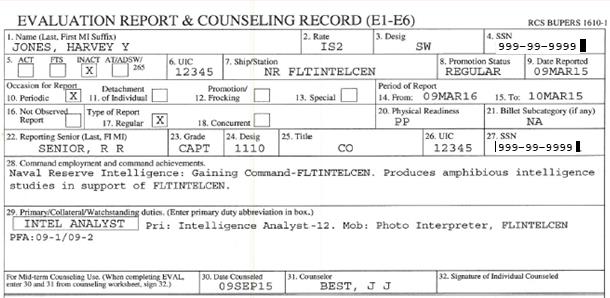
131 EXHIBIT 9-1 INACTIVE (INACT) DUTY TRAINING REPORTS ON DRILLING RESERVISTS Block 5. Always INACT. Block 21. Usually NA but MUST have an entry. Blocks 6-7. Enter TRUIC and short title name. Include "NR" if applicable. Block 29: Provide PRI/COLL duties, job scope and UMUIC MOB billet status. Block 28. Enter TRUIC or UMUIC as needed. Note Reserve program, gaining command, and contributory support tasking, if any. Blocks Copy date and name from counseling w/s. If not counseled during period, enter NOT REQ or NOT PERF in block 30.. Block 41 (FITREP/CHIEFEVAL) or Block 43 (EVAL). Similar to ACDU report criteria but differentiate duty performed within own unit (TRUIC) from duty performed with UMUIC or AUIC during AT/ADT/ADSW periods. See Instructions for this block under paragraphs 9-5 and 9-11 for details. Block 44. Completed, NOT "expected" achievements. Block 46. Must have entry in each box, even if zero. Block 44 (FITREP/CHIEFEVAL) or Block 48 (Eval). Reserve Reporting Seniors must enter their civilian or NRA address. Summary Group Average: NAVFIT98 will autopopulate this field. To do a manual calculation of the Summary Group sum all graded Individual Trait Grades (Blks 33-39) and then divide by the number of graded Individual Traits. Note: a trait with an NOB grade is not considered a graded trait. Block 47 (FITREP/CHIEFEVAL or Block 52 (Eval). Use for concurrent reports ONLY. 9-11
132
133 CHAPTER 10 REPORTS ON INACTIVE DUTY NAVY RESERVISTS SERVING ON TEMPORARY ACTIVE DUTY Purpose. This chapter provides the information needed for ACDU commands to complete FITREPs, CHIEFEVALs and EVALs on Inactive (INACT) Duty Navy Reservists serving on temporary ACDU orders and who will continue to compete as INACT Reservists for promotion. Reports for Navy Reservists on INACT Duty (drill status) are covered in chapter 9. Use ACDU reporting criteria for Navy Reserve members on extended ACDU, and who compete as USN or FTS for promotion General Reporting Requirement. Detachment of Individual Reports (FITREPs, CHIEFEVALs and EVALs) must be done by the ACDU command for all periods greater than 10 days that a Reservist serves on temporary ACDU orders. Report periods greater than 90 days should be graded reports. Periods less than 90 days, but more than 10 days, require an NOB report per chapter 6. Reports on Navy Reservists for less than 10 days are not permitted but can be assessed via a PIM per chapter 12. This requirement applies to all of the below listed Reservist ACDU order types: a. Annual training (AT); b. Active duty for training (ADT); c. Active duty for special work (ADSW); d. 1-Year Recall (OYR); e. Canvasser/Recruiter (CANREC) duty; f. Policy board service under 10 U.S.C. 175 or 5251; g. Selective Service System under 50 U.S.C. App. 460(b)(2); h. Presidential recall under 10 U.S.C. 673b; i. Other mobilization recall, when officers are exempted from the active-duty list under 10 U.S.C. 673c; 10-1
134 and j. Uniformed Services University of the Health Sciences; k. Individual Augmentee (IA) Reporting Senior. The reporting senior for Reservists on temporary ACDU should be the same person who would be their reporting senior if they were permanently assigned to the AUIC. This should normally be the person who actually supervises and can most accurately assess the member. Reporting seniors will rank and summarize Reservists separate from ACDU/FTS since they compete as INACT Reservists for promotion Multiple Training Periods. Consecutive periods of ACDU support (i.e. back-to-back orders) for the same reporting senior and AUIC may be covered in a single FITREP, CHIEFEVAL, EVAL, or PIM. In addition to ACDU order types listed in paragraph 10-2, any IDT or IDTT support that is performed successively, and in combination with AT or ADT, may be included in a single report. Non-consecutive support periods may also be combined for single reports provided they are separated by gaps of no more than 10 days. Identify any gapped periods in block 29 or in the PIM as a period not available for duty. The Detachment of Individual report should be submitted upon conclusion of the final training period. Per paragraph 10-2, submit a PIM for shorter periods Reports on AT and ADT. In addition to the report time periods noted in paragraph 10-2, the following rules apply: a. Training with Own Navy Reserve Unit (Commissioned Unit). Submission of a report on training performed with a member s own commissioned Navy Reserve Unit is not required. Such duty will be included in the member's next required report by their regular reporting senior. b. Training with Navy Reserve Unit s Active Duty Supported Command. A report on training performed with the supported command of the member's Navy Reserve Unit is optional. If the supported command does not write a performance report then the regular reporting senior (unit CO for unit personnel and supported command commander/co for unit CO) will cover the duty in the next required report. 10-2
135 c. Other Training. Training performed with other than a member's own commissioned unit or active duty supported command, which is for 10 days or more will be reported on by the command to which the member is ordered for training. Submit a Detachment of Individual report at the conclusion of the training period. If the training period lasts more than 3 months and crosses periodic reporting dates, submit a report on the date specified for inactive Reservists. Per paragraph 10-2, submit a PIM for shorter periods Reports on ADSW (Operational Support), OYR, CANREC, Mobilization Recall, IA, etc. Except for AT and ADT discussed in paragraph 10-2 above, all other types of temporary ACDU orders listed in paragraph 10-2 are subject to the below additional rules. The command where the member is assigned for ACDU must submit reports as stipulated below: a. Periodic Reports. Submit required Periodic annual reports per the schedule specified in enclosure (1), table 1. Submit as NOB if member is onboard less than 90 days. b. Detachment of Individual Reports. Submit upon transfer or release from active duty. If a periodic report was done less than 3 months prior to detachment and was no more than 12 months in length, provide member a Letter Extension per paragraph 3-3. c. Detachment of Reporting Senior Reports. Detachment of Reporting Senior reports are required on officers who have been on ACDU for more than 3 months. Enlisted reports are optional. d. ACDU Orders with Member s billeted Commissioned AUIC. (1) Reservists who mobilize or otherwise serve on ACDU orders with their billeted commissioned Navy Reserve AUIC under its own Navy Reserve CO do not require reports to fill gaps since their last periodic report. No detachment report should have been made per paragraph 9-7b(6). The member s first ACDU periodic report as specified in enclosure (1), table 1, will combine all ACDU and INACT duty service since the last regular report. (2) Upon release from ACDU or mobilization, and member remains in the same unit with the same CO, the ACDU Detachment of Individual report may be omitted. In this case, the first 10-3
136 INACT Duty periodic report after release must include the final period of ACDU to maintain continuity of Regular reports. (3) In both cases, the periodic report covering combined duty must identify the respective ACDU and INACT duty service periods in block 29 and assess performance in blocks 41 or Billet Subcategories. In order to base the distribution of promotion recommendations on equal lengths of observation, all Navy Reservists on temporary ACDU, regardless of type of orders, may be placed in standard billet subcategories keyed to their time on ACDU. Subcategories are listed below in the instructions for block Forwarding of Reports. Reports should be submitted to PERS-32 no later than 30 days after the ending date of the report. Provide member a copy. Refer to chapter 4 for instructions on forwarding Concurrent reports Instructions for Specific Blocks of Reports on INACT Duty Navy Reservists Serving on Temporary Active Duty. Complete FITREPS, CHIEFEVALs and EVALs on INACT Duty Reservists per the instructions outlined in chapter 1, except as follows: BLOCK 5 DUTY STATUS Mark the AT/ADSW box on all reports covered by this chapter. This box identifies all INACT Duty Navy Reservists regardless of ACDU order type. BLOCKS TYPE OF REPORT Concurrent Report: Place an X in block 18. Concurrent/Regular Report: To endorse as Concurrent/Regular, the Regular reporting senior must mark block 17 (Regular). BLOCK 20 PHYSICAL READINESS Enter the appropriate physical readiness codes and ensure the result matches what is reported in PRIMS. 10-4
137 BLOCK 21 BILLET SUBCATEGORY If not subcategorizing, enter NA. If subcategorizing by length of ACDU service, enter one of the following codes: RESAC1 - On ACDU more than 1 month but less than 6 months as of ending date of report. RESAC6 - On ACDU 6 months or more as of report ending date. BLOCK 29 PRIMARY/COLLATERAL/WATCHSTANDING DUTIES Enter duties based upon order types as follows: a. For AT/ADT with member s billeted command: Enter either AT-Billet or ADT-Billet. (Must hold billet via AUIC s assigned UMUIC or billet listed on AUIC Activity Manning Document (AMD). In rest of block 29, indicate duties of the member s billet. b. For AT/ADT NOT with member s billeted command: Enter AT- or ADT-, followed by the below word that best applies: -BOARD (Board service) -EXERCISE (Exercise support) -OJT (On-the-job skill or mobilization training) -STUDENT (Student in formal course of instruction with CIN) -INSTRUCT (If member served as Instructor for a formal course) -SPECPROJ (Special assignment utilizing Reservist's skills) Examples: AT-STUDENT ADT-EXERCISE In the rest of block 29, describe actual duties performed or give name and CIN of formal course attended. Examples: WATCH OFFICER, EXERCISE TEAM SPIRIT (or) STUDENT, DAMAGE CONTROL COURSE (Y-0Z-9999) (2WKS) c. For all other types of duty: Enter only the duty type such as ADSW, OYR, CANREC, MOB, IA, Recall, etc. In the rest of block 29, list primary (PRI) duties and collateral (COLL) duties and a BRIEF job scope as normal. 10-5
138 PFA: On last line, document the PFA result(s) reported in block 20 and the cycle performed as follows: PFA: 14-1/14-2. This means the PFA was conducted for 2014 Cycle 1 and 2014 Cycle 2. If N entered in block 20, record PFA: None on last line. BLOCKS COUNSELING Copy date and name from counseling worksheet. If not counseled during period, enter NOT REQ or NOT PERF. EVAL BLOCK 43 FITREP/CHIEFEVAL BLOCK 41 COMMENTS ON PERFORMANCE For periods of ACDU greater than 90 days, all ACDU general comment requirements apply. For ACDU less than 90 days, such as AT or ADT, comments should be proportionate to the scope and duration of the assignment. Emphasize tasks accomplished, professional skill and knowledge displayed, qualifications attained, military bearing, and assess RC to AC integration. Especially note if member holds a billet in the command and/or would be qualified to fill a billet with these duties. EVAL BLOCK 50 FITREP/CHIEFEVAL BLOCK 45 SIGNATURE OF REPORTING SENIOR The reporting senior whose name appears in block 22 will sign here. By direction, For, Acting, ghosted, stamped, or facsimile signatures are not allowed. Use black or blue-black ink. Do not type in this space. If reporting senior is a rear admiral (O7) selectee, and the report is on a captain in the same competitive category, add RDML(S) following the signature. This verifies that a flag officer endorsement is not required. If the signature is unobtainable, see chapter 14. EVAL BLOCK 51 FITREP/CHIEFEVAL BLOCK 46 SIGNATURE OF INDIVIDUAL EVALUATED Concurrent Report: have member sign if available BUT signature is NOT required unless report is adverse. For all others: Give the member an opportunity to review the report and verify their name, social security number, and other administrative entries. Discuss the member s performance during the reporting period and explain any adverse matter indicated. While a verbal explanation will suffice, exhibit 14-1 may be used to notify the member in writing if documentation desired. 10-6
139 Signature. After reviewing the report, the member will check the box indicating his or her intention to submit or not to submit a statement, and sign and date all copies. Use black or blue-black ink. The member's signature does not imply agreement with the report, but merely certifies that the member has seen the report and understands the right to submit a statement. Statement. The member may submit a statement on any report, whether or not the reporting senior considers it adverse. If the member desires to submit a statement, refer to chapter 17. Member not available to sign a non-adverse report. If a member is not available to sign a non-adverse report within 30 days, the reporting senior shall enter Certified, Copy Provided in the member s signature block to signify a copy of the report will be provided by some means. Unsigned Advance Copy is not authorized. (See chapter 14 for other signature problems.) Member not available or refuses to sign adverse report. Refer to chapter 14. EVAL BLOCK 52 FITREP/CHIEFEVAL BLOCK 47 Concurrent Report: RESERVE MEMBER S REGULAR REPORTING SENIOR WILL SIGN IN BLOCK 52 OR 47. Report MUST be forwarded to member s regular (TRUIC) reporting senior for signature. Or if TEMADD or ADDU while during the period, send to the appropriate ACDU reporting senior. To convert to Concurrent/Regular, mark X in both Blocks 17 and

140 EXHIBIT 10-1 REPORTS ON INACTIVE DUTY NAVY RESERVISTS SERVING ON TEMPORARY ACTIVE DUTY BUPERSINST D Block 5. Mark AT/ADSW for any INACT Reservists on temporary ACDU service orders. Block 21. Usually NA but MUST have an entry. Block 16. Provide NOB for all periods of AT/ADT/ADSW of at least 10 days and less than 89 days. Block 21. Enter NA unless necessary to subcategorize by length of ACDU service. Block 29. Abbreviation begins with type of duty if AT or ADT Blocks Copy date and name from counseling w/s. If not counseled during period, enter NOT REQ or NOT PERF in Block 30. Block 41 (FITREP/CHIEFEVAL) or Block 43 (EVAL). Similar to ACDU reports but see Instructions for this block under paragraph 10-9 for details. Comments should address specific Reserve contributions to the ACDU and differentiate duty performed within member s own unit (TRUIC) from duty performed with the AUIC during the AT/ADT/ADSW period. Block 46 (FITREP/CHIEFEVAL)/Block 50 (EVAL). Member signature desired but not required if report covers less than 3 months and is not adverse. Member Trait Average. Average of Blocks Can leave blank for NOB reports. Block 47 (FITREP/CHIEFEVAL or Block 52 (Eval). Use for concurrent reports ONLY. 10-8
141 CHAPTER 11 FLAG OFFICER ENDORSEMENTS ON REPORTS ON CAPTAINS Purpose. This chapter provides the information needed to complete the flag officer endorsement that is required when a captain (or below) reports on another captain in the same competitive category Requirement for Flag Officer Endorsement. When the officer reported on is a captain, and the reporting senior is a captain (or below) in the same competitive category, the report must be endorsed, and may be commented on, by the first flag/general officer or selectee in the chain of command or other flag officer designated for this purpose. The endorsement is not required if the report is Not Observed or if the reporting senior is a flag officer selectee. Refer to chapter 1, FITREP block 45 instructions Action by Reporting Senior. The flag officer endorsement shall be in letter format. The reporting senior will forward the report(s) and summary letter for endorsement, using the format in exhibit There must be a separate forwarding letter for each report to be endorsed. a. Regular Reports. Forward to the first flag or general officer or selectee in the chain of command, or other flag officer designated to endorse captain-on-captain FITREPs submitted from the reporting senior's command. b. Concurrent and Concurrent/Regular Reports. If the regular reporting senior is a flag/general officer or selectee, they will complete the flag officer endorsement, in addition to countersigning the report. In other cases, the regular reporting seniors will countersign the report and then forward it via the appropriate flag officer or selectee in the concurrent reporting senior's chain of command. (This order of routing may be reversed at the direction of the endorsing flag officer.) c. Operational Commander Reports. Forward the report, via the appropriate flag officer or selectee in the operational commander's chain of command, with a copy to the regular reporting senior. 11-1
142 11-4. Action by Endorsing Flag Officer. Execute the first endorsement to the forwarding letter. This may be a one-page or same-page endorsement (see exhibit 11-1 for the basic format). Indicate concurrence or non-concurrence with the promotion recommendation, and comment if desired. Provide a copy of the endorsement to the reporting senior and officer reported on Adverse Flag Officer Endorsement. If the flag officer endorsement contains comments that the endorsing officer considers to be adverse, the entire report and endorsement must be referred to the officer reported on. The officer reported on must respond by letter to NAVPERSCOM (PERS-32) via the endorsing officer. The letter must either include a statement from the officer or an acknowledgement that the officer has seen the report and endorsement and does not desire to make a statement. A simple non-concurrence on an "Early Promote" or "Must Promote" recommendation need not be treated as adverse. 11-2
143 EXHIBIT 11-1 FLAG OFFICER ENDORSEMENT FOR OFFICIAL USE ONLY - PRIVACY SENSITIVE From: CAPT Reginald R. Senior, USN, 1110 To: Commander, Navy Personnel Command (PERS-32) Via: RADM James F. Officer, USN BUPERSINST D Date Subj: FITNESS REPORT ICO CAPTAIN JOSEPH J. JOHNSON, USN, /1110 FOR THE PERIOD 99FEB02 TO 99JUL31 Encl: (1) Subject FITNESS Report 1. Enclosure (1) is forwarded for flag officer endorsement. R. R. SENIOR Copy to: CAPT Johnson FIRST ENDORSEMENT Date From: RADM James F. Officer, USN To: Commander, Navy Personnel Command (PERS-32) 1. Forwarded, concurring (or non-concurring) with the promotion recommendation. 2. (Optional comments) J. F. OFFICER Copy to: CAPT Senior CAPT Johnson FOR OFFICIAL USE ONLY -PRIVACY SENSITIVE 11-3
144
145 CHAPTER 12 PERFORMANCE INFORMATION MEMORANDUM (PIM) Purpose. This chapter provides the information needed to prepare a Performance Information Memorandum (PIM). A PIM is a narrative-style report that provides an assessment of brief periods of training and/or duties performed outside the purview of the Regular reporting senior. PIMS are most suitable for periods of 10 days or less when significant accomplishments on duty or in training warrant. For periods over 10 days, but less than 90, consider submitting a Not Observed (NOB) report per chapter 6. For periods over 90 days, consider an observed Concurrent report per chapter Uses. A PIM provides performance information to another command for consideration in a Regular FITREP, CHIEFEVAL or EVAL. It is not added to an Official Military Personnel File (OMPF) as the information provided is intended for inclusion on the member s next Regular report. A PIM is suitable for: a. Any personnel performing Duty Under Instructions (DUINS) or Temporary DUINS (TEMDUINS) for periods less than 90 days. b. ACDU and FTS personnel serving on short-term Additional Duty (ADDU) or Temporary Additional Duty (TEMADD) orders. c. INACT Duty Reservists on Inactive Duty Training (IDT) or IDT for Travel (IDTT) performing temporary duty away from their assigned Training UIC (TRUIC). For other temporary active duty work performed, refer to chapter 10. d. Any personnel to provide the information needed for a NAVPERS 1070/604 Enlisted Qualifications History entry Format. Exhibit 12-1 is a suggested format but commands may prepare other formats tailored to their own requirements. However, all PIMS must include similar data comparable to an actual report such as duty period (similar to block 14); duty type (similar to block 28), duties assigned (similar to block 29, and comments on performance (similar to block 41 or 43). A PIM that contains only administrative or academic information may be signed "By direction". When evaluative comments are 12-1
146 included, the PIM must be signed by a person eligible to act as reporting senior for the member Forwarding the PIM. Forward the original PIM to the member s regular reporting senior within 15 days of assignment completion. Do not send a copy to PERS-32 as it will not be placed in the OMPF. Provide a copy to the member if possible. Any adverse information must be discussed with the member by the command receiving the PIM, but a written statement by the member is not required. A PIM should be retained by the reporting senior as long as it may be needed (e.g., retain an adverse PIM used to justify FITREP, CHIEFEVAL, or EVAL marks or comments). A PIM may be discarded or returned to the member after its purpose has been served Action Required by a Command Receiving a PIM. a. Take the performance reported by the PIM into account in the next report. b. Ensure the period of duty covered by the PIM is included in Regular report continuity. Note: A PIM does not replace a report. The next Regular report must include the period covered by the PIM. 12-2
147 EXHIBIT 12-1 PERFORMANCE INFORMATION MEMORANDUM FOR OFFICIAL USE ONLY PRIVACY SENSITIVE PERFORMANCE INFORMATION MEMORANDUM From: (Originating Command) To: (Member's Permanent Duty Command) BUPERSINST D 1610 (Orig. Code) Date Subj: PERFORMANCE INFORMATION MEMORANDUM ICO (Rank/Rate, Name) Ref: (a) BUPERSINST D 1. Per reference (a), the following information is provided: a. Period of duty: Similar to block 14. YYMMMDD to YYMMMDD. If the period is a course, provide start/end dates of course. b. Type of duty: Similar to block 28. Note if TEMDU, TEMADD, IDT/IDTT, etc. Add "Under Instruction," if applicable. c. Duties assigned (or courses attended): Similar to block 29. Provide a statement regarding Primary/Collateral duties. If the PIM is for a course attended, indicate student status. d. Comments: Similar to block 41 or 43. Provide a summary of performance and assess quality of support provided. If the PIM is for course attendance, provide the data needed for a NAVPERS 1070/604 Enlisted Qualifications History entry (e.g., course title and identification number, school location, NEC earned (if any), course length, final mark, and class standing). If the course was not completed, state the reason. I. M. OFFICER FOR OFFICIAL USE ONLY PRIVACY SENSITIVE 12-3
148
149 CHAPTER 13 GUIDANCE FOR COMMENTS Purpose. This chapter provides expanded guidance for the comments and to supplement the block instructions in chapter 1. Included are suggestions on preparation, style, and special interest items that must be considered by law or directives Technical Aspects. a. Typography and style. (1) Use only 10 or 12 pitch (10 or 12 point). (2) Be concise. Comment space is very limited. Bullet style is preferred. (3) Use everyday language. Do not use flowery adjectives or other extremes of style. Let the member s performance speak louder than words. (4) Give examples of performance and results. Be specific. Concentrate on verifiable accomplishments. (5) Quantify wherever possible in order to give credibility to the statements, but do not stress quantity at the expense of quality. (6) Do not make everyone sound alike. Selection boards may discount narratives assembled from a list of stock comments used for everyone in the command. (7) Do not combine outstanding comments with average or below average marks (or the reverse). This makes the entire report unconvincing. (8) Ranking. Ranking in the comments field is authorized. (9) Clarity. The report must be understandable by all readers, both now and in the future. Limit the use of acronyms or command specific terms. 13-1
150 b. Continuations, attachments, and enclosures. BUPERSINST D (1) Continuation sheets will not be accepted. Limit comments to the space on the form. (2) Do not attach or enclose documents, except an endorsed statement submitted by the member, a flag officer endorsement where required, a civilian or foreign letter report, a letter-extension of a Concurrent/Regular report, or a classified letter-supplement, as described below. (3) Do not enclose citations or commendations. c. Classification. (1) Under no circumstances may the report form be classified. (2) If classified comments are unavoidable, prepare a 1- page letter-supplement classified no higher than SECRET. Do not include special access material. (3) The combined length of classified and unclassified comments should not exceed the space normally available on the form. (4) Do not submit classified comments merely to explain the command s mission. Comments must deal directly with performance. (5) Mail the report and classified supplement together as classified matter, per SECNAV M of 1 June (6) The mailing address for classified comments is provided in chapter 1, paragraph 1-7d. Note at the end of the comments block that a classified supplement has been submitted General Comments. Specific comment is desired on the following items when they are a significant part of the member s duties or the member displays particularly strong or weak performance. 13-2
151 a. Give the authorized reason for a Concurrent, Special, or Operational Commander report. This must be the first sentence of the comments in anything other than a Regular report. b. On a detachment of individual report, identify the next assignment, if known, to assist users in following the continuity of the record. c. Operational and combat performance. d. Leadership and development of subordinates. e. Material condition of platforms and equipment. f. Acts of courage. g. Handling of all sexual assault/harassment cases and fostering a workplace environment free of reprisal. h. Inspection/certification performance and follow-up. i. Quality improvements achieved. j. Waste eliminated and cost savings achieved. k. Outstanding PFA score or noteworthy improvement. l. Notes on future potential aid in administrative board proceedings and are appropriate. m. Periods of AT, ADT, and/or ADSW apply to reports on drilling Navy Reservists only. Refer to chapters 9 and 10. n. If the report is submitted under an assumption of authority by the ISIC or by a general courts-martial convening authority, note the circumstances at the beginning of EVAL block 43 or FITREP/CHIEFEVAL block 41. o. Note any change in designator since the previous Regular report. p. If a code letter in block 20 is B, note reason for PRT non-participation. 13-3
152 13-4. Required Comments. a. Substantiation of 1.0 grades or three 2.0 grades. (1) Specifically substantiate all 1.0 grades and when three or more traits are evaluated 2.0. Correlate the comments by block number to the performance trait being discussed. (2) General comments on the remainder of the evaluative blocks are required. You may substantiate more than one trait with a single bullet or paragraph, particularly when discussing a deficiency that has impacted several performance traits. b. Substantiation of grades below 3.0 in Command or Organizational Climate/Equal Opportunity or Character. (1) Grades below 3.0 in these two categories are contrary to the Navy ethos and therefore require addressing in the comments block. (2) Grades below 3.0 may be used to substantiate adverse retention recommendations. c. Adverse Recommendations and Comments. (1) Substantiate any promotion recommendation of Significant Problems and any recommendation against retention. (2) If an officer or chief petty officer has a recommendation of Significant Problems, it will be assumed to be a recommendation against retention unless the reporting senior specifically recommends retention in the comments. (3) Confirmed Illegal Drug Use or Possession. Document confirmed illegal drug use or possession in a Special report or in the next Regular report. (4) Alcohol Abuse. Comment on alcohol abuse that is proving detrimental to a member s performance or personal behavior. Comments are required on conviction for, or finding of, driving under the influence of alcohol. 13-4
153 (5) Judicial or Non-Judicial Punishment (NJP). Document concluded judicial or NJP cases where there has been a finding of guilty or awarding of punishment. (a) Give the date of the conviction or award of punishment, and the concluding date of the proceeding. (b) The reporting senior s signature date must not be earlier than the concluding date. (6) Any comment concerning adverse actions against the member or suggesting persistent weaknesses, continuing incapacity, or unsuitability for specific assignment or promotion must also be treated as adverse matter, regardless of grades assigned. (7) A reporting senior has a duty to report significant and persistent weaknesses, but do not use comments merely to get the member s attention. (8) Declining Performance. A decline in performance is defined as receiving lower grades on two or more performance traits in the same paygrade by the same reporting senior on subsequent reports. (a) A change in promotion recommendation caused by forced distribution is not considered a decline in performance or an adverse report. (b) If the decline was due to forced distribution limits, explain as such. (c) If the decline in performance is based on performance, comments should justify the decline. (d) Removal from leadership positions should be noted and explained. d. Command Triad Specific Guidance. (1) Command Climate Assessments. Document whether commanders, commanding officers, and officers-in-charge conducted required command climate assessments per reference 13-5
154 (f). Reporting seniors must clearly document the failure to conduct the required command climate assessment. (a) The failure to conduct required command assessments is considered a leadership deficiency for grading purposes. (b) If a command climate assessment is not required during the period of performance then use the following statement, No command climate assessment required for this period of performance. (c) Survey results may help raters perceive measurable progress or regression over time. (d) No survey, however, can capture the whole picture. Survey results should not be relied upon exclusively to assess a command s climate. (2) Personnel Security Program. When evaluating unit commanders and commanding officers, reporting seniors shall take into account the performance of a command s personnel security program (e.g. procedural and substantive compliance with SECNAV M and its parent instructions). (3) Training and Utilization of Navy Reservists. Strongly desired in reports on Cos/OICs or other officers whose duties include utilizing Navy Reserve units and/or their individual Reservists. (a) Active unit officers with assigned Reserve units or Reserve billets on their Activity Manning Document (AMD) should assess how the assigned Reservists are integrated within their command. (b) Active officers without Reserve billets on their AMD may assess how Reserve support is harnessed by other means. (c) Reserve Unit officers with assigned gaining commands should assess how all billeted members (both local and cross-assigned, officer and enlisted) are included in their annual active duty operational support plans. 13-6
155 (d) In all cases, specifically address overall Reserve readiness (unit and individual) and capability to support assigned missions. (4) Management of Civilian Employees. Desired in reports on COs and department heads with responsibility for civilian employees. e. Officer and Senior Enlisted Specific Guidance. (1) Command Climate. All officers and senior enlisted personnel shall be assessed on their efforts and quality of results in fostering a command and workplace environment conducive to the growth and development of personnel. (a) Efforts include establishing, training to, and enforcing standards of professionalism. (b) Results are evident in a command where all hands are treated with dignity and respect. (c) Transparency, sensitivity, and responsiveness to concerns are the hallmarks of superior performance in this area. (2) Innovation. All officers and senior enlisted personnel shall be assessed on their contributions to building an innovative culture with the DON. The following criteria should be considered as part of the assessment. (a) Creating an environment that fosters innovation. (b) Identifying and removing unnecessary bureaucratic barriers. (c) Developing innovative ideas to improve their organization. (d) Championing innovative ideas of the workforce. (3) Talent Management. Consider the member s contribution to personnel advancement, increased educational opportunities, overall career development, and results of retention excellence award programs. Where appropriate, comment 13-7
156 specifically on successful retention of quality Sailors in support of the Chief of Naval Operations goals and initiatives. (4) Energy Conservation. Comment on leadership efforts that treat the judicious use of energy (fuel, shore power, etc.) as a strategic resource for achieving greater combat capability. f. Billet Specific Guidance. (1) Joint/Combined Performance. Comment on joint effort with other Services, agencies, or foreign nations, if applicable, regardless of whether assigned to a joint billet. (2) Performance of Security Responsibilities. Where responsibilities involve the use, custody, or management of classified information, comment on performance in discharging those responsibilities. Also, comment on an officially determined ineligibility for a security clearance if this impacts the member s performance or assignability. (3) Implementation of Navy/Department of Defense Management Improvement Programs. Comment on initiative and effectiveness in implementing these management improvement programs. Programs to be considered include, but are not limited to, the Defense Acquisition Workforce Improvement Act (DAWIA), the Chief of Naval Operations Management Control Program, and the Department of Defense/Department of the Navy Outsourcing and Privatization programs. (4) Energy Conservation. Comment on efforts by a member and the quality of results in fostering a command culture/workplace environment conducive to the judicious use of energy (fuel, shore power, etc.) as a strategic resource for achieving greater combat readiness. (5) Equal Opportunity. Comment on initiative in supporting the Command Managed Equal Opportunity (CMEO) Program and maintaining an environment free of racial or sexual bias or harassment. Consider performance with respect to civilian employees as well as military members. (6) Subspecialty Performance. Where an officer has a subspecialty code and is performing in that subspecialty, comment, as appropriate, and consider in the performance trait 13-8
157 grades. For other officers, provide comments, if appropriate, which might assist subspecialty selection boards. (7) Audit Resolution and Follow-up. Desired in reports on officers responsible for audited functions. Comment on performance in resolving and following-up on audit recommendations. g. Comments Specific to E1-E6 Evaluations. (1) Qualifications attained during the reporting period. (2) Courses completed during the reporting period. (3) Civic activities beneficial to the Navy. (4) Awards and Commendations. Note personal awards received during the period and significant letters of commendation or appreciation. Citations and letters may be quoted, but not attached to the report Prohibited Comments. Do not comment on the following, except as noted. a. Previous Failure of Selection (FOS). b. Submission or Withdrawal of Resignation Under Honorable circumstances. c. Judicial or NJP proceedings not concluded. d. Non-punitive Letters of Caution (NPLOC) are leadership tools and should not be mentioned in an official record. e. Investigations and Investigative Reports. (1) Do not refer to investigations until they are concluded and do not quote directly from investigative reports. (2) Do not use information from investigative reports if such use is prohibited by the regulations for that type (3) This does not preclude the use of facts determined independently to the satisfaction of the reporting senior. 13-9
158 f. Marital Status, Spouse, or Family Members. (1) Do not comment on the member s marital status or the activities of the member s spouse or family members. (2) Exceptions may be made only where unavoidably necessary to clarify other information in the report. g. Medical Reports and Summaries. (1) Do not quote from medical reports or summaries, and do not mention medical conditions (including pregnancy) unless necessary to explain other matters in the report, i.e., use of PFA code. (2) Members shall not be given a less favorable report solely because of medical issues. h. Service on Courts-Martial, a Board of Inquiry, or an Administrative Discharge Board. (1) Do not comment on performance as a courts-martial member, a summary courts-martial officer, or a member of a board of inquiry or an administrative discharge board except to note having served without identifying the particular case. (2) Comments on performance as a military judge or an appellate judge may not be based upon judicial opinions, rulings, or the results thereof. (3) A defense counsel may not be given less favorable comments because of the zeal with which that officer represented any accused. See Performance of Military Justice Duties in the introduction. i. Recommended Awards or Decorations. Do not refer to award recommendations. Awards and decorations should be mentioned only when received. j. Civilian Employment. Do not make comments regarding a member s potential for civilian employment or the civilian employment of Reservists
159 13-6. Comments on Misconduct, Judicial or NJP Proceedings, and Corrective Measures. a. General Commenting on Misconduct. Comments may be included on misconduct whenever the facts are clearly established to the reporting senior s satisfaction. (1) Do not use FITREP, CHIEFEVAL, or EVAL comments a substitute for appropriate corrective action or UCMJ proceedings. (2) Take reasonable care to avoid comments that may later be invalidated by official findings. b. Commenting on Judicial or NJP Proceedings. Do no refer to civil, courts-martial, or NJP proceedings unless there has been a finding of guilty or award of punishment, and the reporting senior s signature date is on or after the concluding date of the proceedings as defined above. (1) When commenting on a conviction or NJP, give both the date of conviction or award of punishment and the concluding date. (2) A civil prosecution is concluded when the trial court makes a determination. (3) A courts-martial is concluded when the convening authority approves the findings and sentence. (4) NJP proceedings are concluded when they are final on appeal, or when it has been determined that the member has waived the right of appeal (normally 5 days after imposition of punishment). (5) For additional guidance, refer to the Manual of the Judge Advocate General, chapter I. (6) Do not delay a report in order to comment on proceedings that are pending or in progress. The report may be supplemented after the proceedings are concluded. In the latter case, the reporting senior need not have been the member s reporting senior at the time the offense occurred
160 c. Commenting on Non-punitive Administrative Corrective Measures. The comments may refer to non-punitive administrative corrective measures, other than a non-punitive letter of caution, but first take into account the non-punitive intent of these measures and whether the member has subsequently improved
161 CHAPTER 14 GUIDANCE FOR SIGNATURES Purpose. This chapter provides procedures to follow when required signatures are difficult or impossible to obtain Rater and Senior Rater Signatures. a. Rater or Senior Rater Unavailable to Sign. Type the reason (e.g., DETACHED, DEPLOYED, LEAVE, or a similar phrase in the signature block). The report will be accepted without the signature. b. No Rater or Senior Rater Available. If no one is available to serve as rater or senior rater, type NONE AVAILABLE in place of a signature. When only one person is available, that person should sign as the rater rather than senior rater. The same person may not sign two or more blocks. c. Rater or Senior Rater Fails to Sign. The rater, senior rater, and reporting senior are expected to reach overall agreement. In the unusual situation where a reporting senior does not agree with the trait grades or related comments assigned by either the rater or senior rater and consensus cannot be reached, the evaluation shall reflect the reporting senior's decision. On the finished report, type "REFUSED TO SIGN" in the signature blocks for either the rater, senior rater, or both, whichever may be the case. Neither the rater nor senior rater may submit a report separate from the reporting senior. The rater and senior rater may not endorse a statement submitted by the member Reporting Senior Signature. Reporting seniors must personally sign each report on which their name appears. In addition, the reporting senior will include the Member Trait Average (FITREP/CHIEFEVAL only) and Summary Group Average next to the line identifier in block 50 (EVAL) and block 45 (FITREP/CHIEFEVAL). This information is provided to the members so they are aware of their standing within the group being evaluated at that time. The reporting senior whose name appears in block 22 must sign all reports. By direction, For, Acting, ghosted, stamped, or facsimile signatures are not allowed. If a 14-1
162 reporting senior becomes incapacitated, the CO or ISIC, as appropriate, will designate a new reporting senior. Guidelines are in chapter Member Signature. A member s signature is desired on all reports and is required on most Regular reports. For exceptions, see the chapters devoted to specific reporting situations. Use the following guidance when a signature is required, but is difficult or impossible to obtain. a. Member on Leave, Assigned TEMADD, or Remotely Assigned. If the member is not expected to return to or visit the command within 15 days (active duty) or 30 days (inactive duty) and the report is not adverse, the reporting senior should enter Certified Copy Provided in the member's signature block and submit the report to NAVPERSCOM (PERS-32). Forward a copy to the member's current address. This copy becomes the official copy filed in the member s OMPF. A signed copy from the member is not required and NAVPERSCOM (PERS-32) will not remove the certified copy from the member s OMPF and replace it with a signed copy. b. Member Transferred Before Report is Signed. A reporting senior should complete the report and obtain the signature before the member leaves the command. This is a courtesy due to the member and saves time for all concerned. If the member has left the command, use the following procedures: (1) E1 to E4. The reporting senior shall sign and date all copies. Retain the command copy and send all other copies to the member's new command under a cover letter (see exhibit 14-2). If the member submits a statement, the receiving command will forward the statement to the reporting senior to be endorsed and returned. The option to use Certified Copy Provided in the signature block is authorized by the detaching command as long as the report is not adverse. (2) E5 to E9. (a) Report Not Adverse. The reporting senior shall sign and date all copies and write Certified Copy Provided in the member's signature block and submit the report to NAVPERSCOM (PERS-32). Send the member s copy to the member's new command under a cover letter (see exhibit 14-2). 14-2
163 (b) Report Adverse. The reporting senior shall sign and date all copies. Mail an advance copy to NAVPERSCOM (PERS-32) with its summary group (see chapter 1). Retain the command copy and send all other copies to the member's new command under a cover letter (see exhibit 14-2). The receiving command will obtain the signature and return the reporting senior and NAVPERSCOM copies to the originating command. If the member submits a statement, also return the statement to the reporting senior for endorsement and forwarding to NAVPERSCOM (PERS-32). (3) Officers. (a) Report Not Adverse. The reporting senior shall sign and date all copies and enter Certified Copy Provided in the member's signature block and submit the report to NAVPERSCOM (PERS-32). Send the member s copy to the member s new address. (b) Report Adverse. The reporting senior shall sign and date the member's copy only. Make three extra copies, retain two, and mail the other as an advance copy to NAVPERSCOM (PERS-32) with its summary group (see chapter 1). Mail the NAVPERSCOM s copy, the member s copy, and reporting senior s copy to the officer with a stamped return envelope. Direct the officer to sign and return NAVPERSCOM s copy and the reporting senior s copy within 10 calendar days. Explain the procedures for preparing a statement, and enclose a copy of the instructions concerning statements in chapter 17. Upon return of NAVPERSCOM s copy and the reporting senior s copy, the reporting senior will sign and date the NAVPERSCOM copy (using the original signature date), and forward the report to NAVPERSCOM (PERS-32). c. Member Separated. (1) Report Not Adverse. Do not attempt to obtain the signature of a separated member who has already departed the area. Enter "SEPARATED" and the date separated. Send a copy to the member's home address. (2) Report Adverse. Attempt to obtain the signature by mail. The reporting senior will sign the member's copy and a reproduced record copy. Mail these copies to the member's home 14-3
164 address. Explain the adverse matter, the right to make a statement, and direct the member to sign and return the reproduced record copy with a statement, if desired. (See exhibit 14-3 for the cover letter.) When the member returns the report, mail the original copy to NAVPERSCOM (PERS-32). d. Procedures when Member Signature Not Obtained. If actions to obtain the member's signature have been unsuccessful, close out the report as follows: (1) Report was Forwarded for Signature and Not Returned. Initiate tracer action after 15 days. If no response has been received after an additional 15 days, forward a copy of the report to NAVPERSCOM (PERS-32) noting that no reply was received. Enter in the signature block "TRANSFERRED - NO RESPONSE TO TRACER." (2) Member Fails or Refuses to Sign. If member is missing, deployed on a strategic deterrent patrol, unauthorized absence, in deserter status, etc., and cannot sign or refuses to sign, enter an explanatory phrase in the signature block. Forward the report to NAVPERSCOM (PERS-32). Provide a copy of the letter to the member. If an enlisted member has refused to sign, complete a NAVPERS 1070/613 Administrative Remarks (using electronic service record) entry witnessed by the reporting senior and submit to the member s OMPF. 14-4
165 EXHIBIT 14-1 LETTER REFERRING ADVERSE REPORT TO MEMBER FOR STATEMENT FOR OFFICIAL USE ONLY - PRIVACY SENSITIVE 1610 [Orig. Code] [Date] From: (command) To: (Service Member) Subj: ADVERSE PERFORMANCE EVALUATION REPORT Ref: (a) BUPERSINST D (b) U.S. Navy Regulations 1990, Article 1108 Encl: (1) EVAL/CHIEFEVAL/FITREP/Form 1. Enclosure (1) is your performance evaluation report for the period (date) to (date). This report contains adverse matter as follows: [specify blocks] 2. Reference (a) requires that you sign this report and indicate whether you intend to submit a statement at this time. Your signature does not mean that you agree with the report, only that you have had an opportunity to see the report and submit a statement if desired. 3. If you wish to submit a statement before the report is filed, you must do so within 10 days after you receive the report. You may request assistance in preparing your statement. Your statement may not exceed two pages and may not have enclosures. Per reference (b), your statement must be phrased in temperate language and confined to pertinent facts. You may not make accusations, counter-charges, or impugn the motives of any other person. The statement may not include requests. Address the statement as follows: (Insert addressees. Letters are addressed to NAVPERSCOM (PERS-32) via the reporting senior. 4. If you do not submit a statement at this time, you may still submit a statement, via the reporting senior who signed the original report, within 2 years of the ending date of the report. Additional information can be found in reference (a). I. M. SIGNER By direction FOR OFFICIAL USE ONLY - PRIVACY SENSITIVE 14-5
166 EXHIBIT 14-2 LETTER FORWARDING ADVERSE REPORT TO ANOTHER COMMAND FOR TRANSFERRED ENLISTED MEMBER'S SIGNATURE FOR OFFICIAL USE ONLY PRIVACY SENSITIVE From: (transferring command) To: (gaining command) 1610 [Orig. Code] [Date] Subj: ADVERSE PERFORMANCE EVALUATION REPORT ICO YN2 JOHN D. DOE, , FOR THE PERIOD 96MAR16-96AUG25 Ref: (a) BUPERSINST D Encl: (1) NAVPERS 1616/26 (2) Referral Letter for Adverse Report [see Exhibit 14-1] 1. Enclosure (1) is an adverse performance evaluation report on the subject named member who has been transferred with orders to your command. The member's signature is required. 2. Request you comply with reference (a), chapter 14, concerning the signatures of a transferred member. If the member is not onboard and cannot be located, please return the report to this command. 3. Please provide enclosure (2) and explain the member s rights concerning this adverse report. If the member submits a statement, please return the signed report and statement to this command. I. M. SIGNER By direction FOR OFFICIAL USE ONLY PRIVACY SENSITIVE 14-6
167 EXHIBIT 14-3 LETTER FORWARDING ADVERSE REPORT TO SEPARATED MEMBER FOR SIGNATURE FOR OFFICIAL USE ONLY PRIVACY SENSITIVE 1610 [Orig. Code] [Date] From: (transferring command) To: (member s last known address) Subj: PERFORMANCE EVALUATION REPORT Ref: (a) BUPERSINST D Encl: (1) Subject report (two copies) 1. Enclosure (1) is your Navy performance evaluation (or fitness) report for period (date) to (date). This report contains adverse matter as follows: (specify) 2. Reference (a) requires that you sign this report and indicate whether you intend to submit a statement. Your signature does not mean that you agree with the report, only that you have had an opportunity to review the report and submit a statement if desired. 3. Please sign one copy of the report and return it to this command within 10 days in the envelope provided. Indicate your intention concerning a statement by marking the appropriate box in the signature block. If you wish to submit a statement, address it to this command, sign it, and enclose it with the signed report. Your statement may not exceed two pages and may not have enclosures. The statement must be factual and phrased in temperate language. You may not make accusations, countercharges, or impugn the motives of any other person. The statement may not include requests. If the statement meets these criteria, it will be filed in your official record. 4. If you need additional information you may telephone (contact person) at (commercial area code and number). I. M. SIGNER By direction FOR OFFICIAL USE ONLY PRIVACY SENSITIVE 14-7
168
169 CHAPTER 15 CHANGES AND SUPPLEMENTS TO REPORTS Purpose. This chapter provides information needed to submit administrative changes and supplements to FITREPs, CHIEFEVALs, and EVALs General Policy. After a FITREP, CHIEFEVAL, or EVAL has been filed in the OMPF, it may be modified only through an administrative change or the addition of supplementary material, discussed in this chapter, or through an appeal process (discussed in chapter 17). a. These letters should not be utilized if a report is in a rejected status. If the report is rejected, it is preferred that the original reporting senior have the report retyped and re-signed by all parties. Other options to correct reports are to tape over, white out, or line out the incorrect information and enter the correct information. The original reporting senior must initial these changes. Whichever method is used, ensure corrected reports are provided to the members for their files, and command files are replaced accordingly. b. Administrative changes correct the administrative blocks of the FITREP, CHIEFEVAL, or EVAL. Supplementary material clarifies, amends, or corrects the evaluative blocks. Supplemental material does not change original information on the member s Performance Summary Record (PSR) or replace the original report on the member s OMPF; it only supplements the original report. Selection boards are briefed that any supplemental changes are the report of record and should disregard the evaluative information on the original report Administrative Changes. The command or reporting senior originating the report or the member s current command may request administrative changes to block 1, blocks 3-19, blocks 22-26, block 44 (FITREP/CHIEFEVAL) or 48 (EVAL). Also see paragraph 15-5 below, which allows the member to make changes to obvious administrative errors. A change to any other block is supplemental material (see paragraph 15-4). Submit all administrative change requests to NAVPERSCOM (PERS-32) in the format of exhibit NAVPERSCOM (PERS-32) cannot accept changes or corrections by telephone. An administrative change 15-1
170 will not be made solely to reflect a backdated promotion. If the change will place the member in a different Promotion Recommendation Summary Group, submit it as supplementary material. Any administrative change letter that does not meet the criteria as discussed in this chapter will be rejected and returned for correction and resubmission Supplementary Material. The original reporting senior may submit supplementary material within 2 years after the ending date of the report. If supplementary material changes the member's Promotion Recommendation Summary Group, supplements must be submitted in the same package for all other members affected. Supplementary material may be submitted as either a letter-supplement or a supplemental report. The lettersupplement is preferred. Supplemental material does not replace the original report on the member s OMPF nor does it change the information on the member s PSR; it only supplements the original report. Refer to paragraph a. Letter-Supplement. A letter-supplement must be limited to two pages. It may not have enclosures unless submitted to forward a letter report (see chapter 7). A letter-supplement may include changes to both the administrative and evaluative blocks of the report. It may not include any recommendations for action or suggestions concerning appeals. See exhibit 15-2 for the required format. b. Supplemental Report. A supplemental report is a revised version of the original report, and should only be used when there is so much supplementary information that a lettersupplement is not practical. Complete the supplemental report as if it were the original report, except the reporting senior signature block must contain the date the supplemental report was signed, rather than the date on the original report. The supplemental report must not be marked or referred to as a revised report. Submit with a cover letter containing the same elements as a letter-supplement (see exhibit 15-3). Do not include any recommendations for action or suggestions concerning appeals in either the cover letter or the revised report. c. Late Submission of Supplementary Material. Supplementary material submitted more than 2 years after the report ending date (block 15) will be accepted only if the 15-2
171 reporting senior demonstrates in a cover letter, to NAVPERSCOM (PERS-32), why the material could not have been submitted in a timelier manner. Reconsideration by the reporting senior or a member's failure of selection will not justify late submission of supplementary material. There must have been circumstances beyond the reporting senior's control. (Example: Judicial action that took more than 2 years to complete.) Note: The 2-year limitation applies to all reports, even if originally submitted before this limit was adopted. d. Submission by General Courts-Martial Convening Authority. If an investigation is conducted by a general courts-martial convening authority under UCMJ, article 138, or U.S. Navy Regulations 1990, article 1150, and FITREP, CHIEFEVAL, or EVAL relief is specified in the decision, the convening authority granting relief may submit supplementary material, or direct the original reporting senior to do so. The decision may also direct the removal of all or part of the original report. See chapter 17 concerning article 138 and article 1150 appeals Submission of Corrections by Member Reported On. A member who discovers an obvious technical error in a FITREP, CHIEFEVAL, or EVAL and is unable to contact the original reporting senior, may submit an administrative change request directly to NAVPERSCOM (PERS-32). Changes may not affect the Promotion Recommendation Summary Group. If NAVPERSCOM (PERS-32) declines to make the change, the member may submit a statement to the record Restriction on the Use of Supplementary Material to Compute a Performance Mark Average. Supplementary material that is submitted after the first day of the month in which an advancement examination is scheduled may not be used to compute or re-compute the performance mark average for that advancement cycle Entry of Changes and Supplements in the NAVPERSCOM s Files. a. Record File (Image File). NAVPERSCOM stores the signed record copy of each report in an image file. The image file is maintained in optical disk format. Administrative change requests and supplementary materials, when accepted, are also 15-3
172 stored in the image file, but the original report remains unchanged in the file unless altered or removed as the result of a member's appeal (see chapter 17). b. Automated Data File and PSR. Most report data, except for the narrative blocks, are also stored electronically in the NAVPERSCOM s automated data file. Selected information from this file is printed on the PSR. Most changes to the administrative blocks of a report replace the original data in the automated file; however, the administrative blocks and cannot be corrected on a member s PSR. In this case, the administrative change letter is filed to the member s image file alongside the original report. Amendments or additions to the evaluative blocks (i.e., grades, recommendations, reporting senior s SSN, and reporting senior s cumulative averages) are regarded as supplements to the original report, rather than changes. They are not entered in the automated file and PSR, but instead, a notation will appear to indicate that supplementary material has been placed in the image file. 15-4
173 EXHIBIT 15-1 ADMINISTRATIVE CHANGE REQUEST FOR OFFICIAL USE ONLY - PRIVACY SENSITIVE From: (original reporting senior (or) member) To: Commander, Navy Personnel Command (PERS-32) Subj: FITNESS REPORT ADMINISTRATIVE CHANGE 1. Identification of original report a. Blocks 1-4: SAMPLE, HARVEY J, LTJG, 1110, b. Blocks 10-13: DETACHMENT OF INDIVIDUAL c. Blocks 14-15: 96JUL01-96NOV18 d. Blocks 17-19: REGULAR e. Block 22: SENIOR, R R 2. Changes a. Block 3: Change from 1110 to 1115 b. Block 14: Change to 96JUN01 BUPERSINST D 1610 [Member's SSN] [Date] 3. Reason. Correct administrative errors in original report. 4. If there are any questions, I can be reached at DSN or commercial (901) Copy to: LTJG Sample (Signature) FOR OFFICIAL USE ONLY PRIVACY SENSITIVE 15-5
174 EXHIBIT 15-2 LETTER-SUPPLEMENT FOR OFFICIAL USE ONLY PRIVACY SENSITIVE From: (original reporting senior) To: Commander, Navy Personnel Command (PERS-32) BUPERSINST D Subj: EVALUATION (CHIEFEVAL OR FITNESS) REPORT LETTER- SUPPLEMENT 1. Identification of original report a. Blocks 1-4: SAMPLE, HARVEY J, BM1, SW, b. Blocks 10-13: PERIODIC c. Blocks 14-15: 96JUN01-96NOV15 d. Blocks 17-19: REGULAR e. Block 22: SENIOR, R R 2. Changes and supplements (with justification) 1610 [Member's SSN] [Date] a. Block 33: Change the grade from 3.0 to 4.0. Information received after report was written justifies a higher grade, specifically: b. Block 43: Add new bullet: "Accomplished..." 3. Promotion Recommendation Summary Group Information. I certify that no modifications to reports on other members are required. (or) Necessary modifications to reports on other members have been submitted (or are enclosed). FOR OFFICIAL USE ONLY PRIVACY SENSITIVE 15-6
175 FOR OFFICIAL USE ONLY PRIVACY SENSITIVE BUPERSINST D Subj: EVALUATION (CHIEFEVAL OR FITNESS) REPORT LETTER- SUPPLEMENT 4. If there are any questions, I can be reached at DSN or commercial (901) Copy to: BM1 Sample (Signature) FOR OFFICIAL USE ONLY PRIVACY SENSITIVE 15-7
176 EXHIBIT 15-3 COVER LETTER FOR SUPPLEMENTAL REPORT FOR OFFICIAL USE ONLY PRIVACY SENSITIVE BUPERSINST D 1610 [Member's SSN] [Date] From: (original reporting senior) To: Commander, Navy Personnel Command (PERS-32) Subj: SUPPLEMENTAL FITNESS (CHIEFEVAL OR EVALUATION) REPORT Encl: (1) Revised FITREP (CHIEFEVAL or EVAL) 1. Identification of original report a. Blocks 1-4: SAMPLE, HARVEY J, LTJG, 1110, b. Blocks 10-13: DETACHMENT OF INDIVIDUAL c. Blocks 14-15: 96JUL01-96NOV18 d. Blocks 17-19: REGULAR e. Block 22: SENIOR, R R 2. Reason for submitting revised report (Justify the modifications to the original report.) 3. Promotion Recommendation Summary Group Information. I certify that no modifications to reports on other members are required. (or) Necessary modifications to reports on other members have been submitted (or are enclosed). 4. If there are any questions, I can be reached at DSN or commercial (901) Copy to: LTJG Sample (Signature) FOR OFFICIAL USE ONLY - PRIVACY SENSITIVE 15-8
177 CHAPTER 16 ENLISTED ADVANCEMENT RECOMMENDATIONS, PERFORMANCE MARKS, PERFORMANCE MARK AVERAGES, AND ELECTRONIC SERVICE RECORD ENTRIES Purpose. This chapter provides the information needed to determine enlisted advancement recommendations, compute performance marks and performance mark averages. This information supplements reference (b), articles and reference (c). The term "advancement", as used in the enlisted advancement system, is synonymous with "promotion", as used in the FITREP and EVAL system Enlisted Advancement Recommendation. The enlisted CHIEFEVAL and EVAL promotion recommendations are the CO's official recommendation for or against advancement. This is true even if the report is signed by a delegated reporting senior. Be sure to check the CHIEFEVAL and EVAL before signing the Advancement Worksheet. The promotion recommendations have the following meanings as advancement recommendations: a. "Promotable," "Must Promote," and "Early Promote" are recommendations for advancement. "Must Promote" and "Early Promote" recommendations do not guarantee immediate advancement, but may make it more likely that an eligible person will be advanced by influencing the final multiple score or the decision of a selection board. b. "Progressing" is not a recommendation either for or against advancement. "Progressing" may not be marked if a Promotable or higher advancement recommendation is already in effect in the current grade, even if the recommendation came from a previous command. If a mark of "Progressing" is made in violation of this rule, the advancement recommendation will continue in effect, but the report must be returned to the reporting senior for correction. c. "Significant Problems" is a recommendation against advancement, and withdraws any previous advancement recommendation in the current grade. This mark is adverse and must be explained in the comments and referred to the member for a statement. If a "Significant Problems" mark withdraws a 16-1
178 previous advancement recommendation after notification of selection has been made, refer to reference (c) for a NAVPERS 1070/613 entry and other requirements Computing Performance Marks and Electronic Service Record Entries (ESR). File each enlisted CHIEFEVAL or EVAL in the command evaluation file and make Electronic Service Record (ESR) NAVPERS 1070/881 Training Education and Qualifications History, NAVPERS 1070/880 Awards Record and Administrative Remarks, and NAVPERS 1070/613 Administrative Remarks entries as follow: a. Review blocks 43 and 44 of the EVAL or block 41 of the CHIEFEVAL for significant qualifications and awards, and make any necessary NAVPERS 1070/881 and/or NAVPERS 1070/880 entries. Also, make any ESR Administrative Remarks (NAVPERS 1070/613) entries required by an adverse or other report. b. When preparing the NETPDTC 1430/3 Advancement in Rate or Change in Rating (Worksheet), use only the promotion recommendation to determine the performance mark average, as follows: "Early Promote" = 4.0 "Must Promote" = 3.8 "Promotable" = 3.6 "Progressing" = 3.4 "Significant Problems" = 2.0 Note: The performance mark average uses the advancement system 4.0 scale, not the EVAL 5.0 trait scale. The performance mark average does not appear on the EVAL. The trait grades and individual trait average influence the promotion recommendation, but they are not used directly in computing the performance mark average Computing Performance Mark Average. The performance mark average is the average of all promotion recommendations (EVAL block 45) for the EVALs being used in the advancement cycle utilizing the scale in 16-3b above. Example: Three EVALs were received within the minimum time-inrate period. The performance marks were 3.8, 3.8, and 4.0. Add the performance grades together ( = 11.6). 16-2
179 Divide the total by the number of performance marks (11.6/3 = 3.87). Enter 3.87 as the performance mark average in block 8 of the NETPDTC 1430/3 Worksheet and in block 8 of the NETPDTC 1430/2 Answer Sheet Filing Administrative Changes, Supplementary Materials, and Statements. Retain a copy of an administrative change, letter-supplement, supplemental report, or member statement in the command evaluation file with the original report. Do not alter or remove the original report Filing a PIM. The PIM for a departing member should be part of the member s transfer package for use by the next command. The gaining command should examine it for pertinent service record information and route it to the reporting senior. A PIM may include information that should be recorded on the NAVPERS 1070/881 and/or NAVPERS 1070/880. They may be retained in the new command s evaluation file or discarded when they have served their purpose Electronic Service Record Review. When a member reports to a new activity, the command s administrative office must provide the member's new reporting senior with the ending date and advancement recommendation from the previous Detachment of Individual report and a copy of any PIM document received en route to the new command. For a member reporting from initial entry training, verify the period of training from the NAVPERS 1070/881 and the NAVPERS 1070/605. Initiate tracers on any missing reports. If a missing report is not obtainable, refer to chapter 17 for guidance on submitting a member s statement in lieu of a missing report. 16-3
180
181 CHAPTER 17 MEMBER INPUT, REVIEW OF RECORD, STATEMENT, AND APPEAL Purpose. This chapter provides information needed by Service Members to understand their rights and responsibilities and to submit input to reports, review and correct their records, and submit statements and appeals Member Responsibilities. Members are responsible to ensure the continuity of their FITREP, CHIEFEVAL, or EVAL record. Upon reporting to a new duty station, provide the new reporting senior with any PIM or other letter, course certificate, etc., received en route. Officers must also provide the ending date of their last Regular report. If required to report by letter to an assigned reporting senior, promptly submit the letter. If reporting to a civilian or a foreign activity, ensure the responsible official is aware of the requirement to submit letter reports. Service Members should also review their records periodically and take action to correct oversights Report Input. A Service Member WILL NOT be required to write their performance evaluation report. The Service member s input aids a rater or reporting senior in preparing a timely and complete report. A Service Member has the right to submit FITREP, CHIEFEVAL, or EVAL inputs and has the duty to do so if requested by the rater or reporting senior. Suggested outlines are provided in exhibits 17-1 and Review of the NAVPERSCOM Record. All members should periodically review their NAVPERSCOM records. Complete this review at least 6 months prior to any board convening date to allow time to correct discrepancies. Processing time for EVALS, CHIEFEVALS, and FITREPS vary based upon selection board priority. Members should review their Continuity of Reports on BOL approximately 60 days after the reports are signed and mailed to NAVPERSCOM. If the reports are rejected, a numerical error code should appear in the status block on the member s BOL Continuity. Definitions for the numerical error codes are located at the following Web site: click on Career Info, scroll to Performance Evaluation, and then to Error Codes/Reasons. Members should report the reject status to their administrative office and have the command correct the report or 17-1
182 have a command representative call NAVPERSCOM (PERS-32) at commercial (901) /4882/3313/DSN 882 for additional assistance. a. OMPF. (1) The OMPF contains a copy of each FITREP, CHIEFEVAL, or EVAL and other selected documents. Members may view their OMPF using OMPF-My Record. A valid DoD level-3 public key infrastructure certificate and a BUPERS On-Line account access are required. For access, log on to and select the Official Military Personnel File (OMPF)-My Record link. (2) Members can also request a copy of their OMPF on CD ROM by fax at (901) /DSN 882. To request a copy of the record, a member can logon to BUPERS Online, select Application List and then to Request Record on CD or can logon directly to BUPERS Access at The record may also be reviewed in person at the NAVPERSCOM Document Review Room, Wood Hall (Building 769), Millington, TN. Service Members who wish to have their CD ROM delivered to another person must provide a written authorization marked For Official Use Only, bearing the member's name, SSN, and signature, and the name of the authorized person. This authorization may be carried or mailed to NAVPERSCOM by the person named. The Service Member can also request a copy of the CD ROM by fax to (901) /DSN 882. Include name, rank or rate, SSN, return mailing address, and signature. b. PSR. The PSR summarizes a member s professional and performance history. Exhibit 17-3 contains an example of the PSR. Selection boards use the PSR with (not instead of) the official digital record. To print a copy of the PSR, members can logon to BUPERS Online and click on ODC, OSR, PSR, ESR or they can logon directly to Administrative Corrections. The member may request correction to obvious administrative errors in a FITREP, CHIEFEVAL, or EVAL, if the reporting senior is not available to submit the request. See chapter 15 for method of requesting corrections. A member may not request NAVPERSCOM to change any evaluative mark or comment or any administrative or evaluative data that would modify summary group averages, the reporting 17-2
183 senior s cumulative average, or place the member in another promotion recommendation summary group. If there is a discrepancy between a FITREP, CHIEFEVAL, or EVAL and the PSR, notify NAVPERSCOM (PERS-32) by letter, giving the period of the report (FROM and TO dates) and the name of the reporting senior. Enclose a copy of the PSR with corrections marked and a copy of the report if available. (Note: NAVPERSCOM (PERS-32) can correct only the FITREP, CHIEFEVAL, or EVAL administrative data. For corrections to the career data on the top sheet of the PSR, see the furnished directions.) Replacement of Missing Reports. Missing FITREPs, CHIEFEVALs, or EVALs do not disqualify a member before a selection board, but can make the work of the board more difficult. As a minimum, a member should attempt to obtain any missing report covering significant duty in the grades of E5 or above within the past 5 years. a. Submission of Missing Report. Send a copy of the original report, if available, to NAVPERSCOM (PERS-32). The copy must display all required signatures, initials, and dates, and must be submitted with a signed cover letter requesting that the duplicate report be filed in the official record. If a signed and dated copy of the report is not available, try to obtain submission or resubmission of the report by the original reporting senior. b. Member Statement in Lieu of Missing Report. If unable to obtain a Regular report after reasonable effort, submit a one-page letter to NAVPERSCOM (PERS-32) explaining why the report could not be obtained, and providing the information that should have appeared in blocks 1-19 and of the missing report. The letter may mention qualifications attained during the period, but may not evaluate or grade the member's own performance or include any self-recommendation for assignment or promotion. If the letter is acceptable, it will be filed in the digitized record. Letters in lieu of Regular reports will be accepted only if they fill a gap in Regular report continuity. A letter in lieu of a Concurrent or Operational Commander report will not be accepted. Exhibit 17-4 is a sample copy of a Statement in Lieu of Missing report Statement to the Record. A member may submit a statement to the record about any FITREP, CHIEFEVAL, or EVAL. The 17-3
184 statement must be submitted within 2 years after the report ending date or provide acceptable justification for the delay. The statement and the reporting senior's one-page endorsement will, upon acceptance, be filed in the NAVPERSCOM digital file. a. Content of Statement. Statements may be no more than two pages and may not have enclosures. Statements must be temperate in tone and confined to pertinent facts. They may not include accusations or countercharges, and may not question or impugn the motives of the reporting senior or other individuals. Statements may not contain a request to modify, remove, replace, or investigate a report. Such requests may be made only as part of one of the appeal processes discussed in this chapter. Include justification if the statement is submitted more than 2 years after the ending date of the report. b. Submission of Statement. Address the statement to NAVPERSCOM (PERS-32) via the reporting senior who submitted the original report, or in the case of a Concurrent report, via the concurrent and regular reporting seniors. If unable to obtain the original reporting senior's endorsement after reasonable effort, submit the statement directly to NAVPERSCOM (PERS-32) with a cover letter explaining why the endorsement could not be obtained. All statements from personnel E1 to O6 are sent to NAVPERSCOM (PERS-32). c. Endorsement of Statement. The reporting senior must endorse and forward any statement within 10 days, with a copy back to the member. The endorsement must be limited to one page. A rater and/or senior rater may not endorse a member s statement. The reporting senior shall ensure the statement meets the requirements of this instruction prior to submission to NAVPERSCOM (PERS-32) Statement Concerning Adverse Report. A FITREP, CHIEFEVAL, or EVAL containing adverse matter must be referred to the member for a statement. All requirements for a statement to the record apply to a statement on an adverse report. a. Submission of Statement with the Report. A member who desires to make a statement for submission with the report shall mark the box labeled "I intend to submit a statement" in FITREP or CHIEFEVAL block 46 or EVAL block 51. The CO will provide the member with reasonable clerical support and access to records. 17-4
185 The member shall provide the statement to the reporting senior within 10 days after seeing the report. The reporting senior may allow a short extension, but the report must be submitted in time for any selection board for which the member may be eligible. Do not delay an entire summary group while the member's statement is being prepared and endorsed. A member may submit an additional statement concerning the reporting senior's endorsement, but submission of the original report, statement, and endorsement will not be further delayed for this purpose. b. Declination to Submit Statement. A member who does not wish to make a statement concerning adverse matter must decline in writing. This is normally accomplished by marking the box labeled "I do not intend to submit a statement" in EVAL block 51 or FITREP/CHIEFEVAL block 46. The signature does not imply agreement with the report, but merely acknowledges that the member has seen the report and is aware of the right to submit a statement. A statement may still be submitted within 2 years after the report ending date. A member who fails to sign an adverse report after being given an opportunity to do so, or fails to submit a statement within a reasonable time after indicating an intent to do so, will be presumed to have declined to submit a statement. Enclose a letter of explanation with the report. c. NAVPERSCOM (PERS-32) Request for Statement. NAVPERSCOM (PERS-32) may send a report to the member with a request for a statement. The member must respond to this request, and submit either a statement or decline to do so in writing. Failure to respond within the specified time will be considered a declination to submit a statement, and the report will be filed in the official record Communications with Selection Boards. A member eligible for consideration by a selection board may communicate in writing with the board. If a FITREP, CHIEFEVAL, or EVAL is enclosed, it will be reviewed for validity before being presented to the board. Procedures for communicating with officer boards are contained in reference (b), MILPERSMAN and MILPERSMAN Procedures for communicating with enlisted boards are contained in the NAVADMIN announcing the E7/8/9 selection boards for each fiscal year. These procedures must be carefully observed. Any documents submitted to a selection board will be shredded upon completion of their 17-5
186 respective board and will not become part of their official record Appeals. If members believe that a FITREP, CHIEFEVAL, or EVAL is inaccurate, unjust, or wrongly submitted, they should first discuss the matter with the reporting senior. The reporting senior may, if justified, submit an administrative change or supplementary material (see chapter 15). U.S. Navy Regulations, 1990, article 1151, also provides authority for the request mast, at which questions concerning FITREPs, CHIEFEVALs, and EVALs may be raised with the CO. If these remedies have been exhausted, and the matter cannot be explained in a statement to the record or communication to a selection board, the member may request that a report be investigated, modified, removed, or replaced through one of the following appeal procedures: a. U.S. Navy Regulations, 1990, Article Correction of Naval Records. Under provisions of this article, a member may petition the Board for Correction of Naval Records (BCNR) for correction of error or removal of injustice in a FITREP, CHIEFEVAL, or EVAL. Petitions must be submitted on DD 149 Application for Correction of Military Record under the Provisions of 10 U.S.C This form is available at or from the Board for Correction of Naval Records, Washington, DC Upon presentation of satisfactory evidence by the member concerned, the BCNR may recommend to the Secretary of the Navy that the record be changed. If the petition is to be considered and resolved prior to the convening of a selection board, the petition should be received by the BCNR at least 4 months before the board convenes. The BCNR normally will not act on a petition if any other type of appeal is pending or in progress. b. U.S. Navy Regulations, 1990, Article Redress of Wrong Committed by a Superior, and UCMJ, Article Complaints of Wrongs. Under provisions of these articles, a member may submit a complaint against a superior officer. The complaint may include a request to revise, remove, or replace a FITREP, CHIEFEVAL, or EVAL. Submit complaints in the manner prescribed by U.S. Navy Regulations, 1990, article 1150, and the Manual of the Judge Advocate General, chapter III. Complaints involving FITREPs, CHIEFEVALs, or EVALs must be submitted within 17-6
187 90 days from the time the member knows of the report's submission, or within 1 year after it is submitted, whichever is earlier. If relief is granted, the general courts-martial convening authority granting relief may submit supplementary material or direct the original reporting senior to do so, and may direct the removal of all or part of the original report. In this case, forward the entire decision package, including the supplementary material, via NAVPERSCOM, Office of Legal Counsel (PERS-00J), who will effect the relief per the Manual of the Judge Advocate General, paragraph 0308f. c. Privacy Act. Under the provisions of the Privacy Act, a member may request that a FITREP, CHIEFEVAL, or EVAL be amended if the report is inaccurate. Amendments are limited to correction of factual matters only. Matters of opinion, such as grades and comments by the reporting senior, are not subject to amendment under these provisions. Prepare Privacy Act amendment requests as specified in SECNAVINST E, and submit to NAVPERSCOM (PERS-00J) via the reporting senior. The reporting senior should forward the request along with a recommendation regarding granting or denying the request within 20 days of its receipt Appeals Based on Acquittal, Finding of Not Guilty, Set- Aside, or Reversal. If a member believes that any portion of a FITREP, CHIEFEVAL, or EVAL is invalid due to an acquittal, finding of not guilty, set-aside of NJP, or reversal on appeal, the member should initiate a petition to the BCNR. Even though the reporting senior may have supplemented the report, the original report will remain in the record unless removed as a result of appeal by the member concerned Review of Reports on Acquisition Workforce Members. Under Public Law , a member of the Defense Acquisition Workforce whose reporting senior is not in the same Defense Acquisition Workforce career field may request a review of their reports by a person in the same Defense Acquisition Workforce career field as themselves. The request may be combined with a statement to the record. Submit the request to NAVPERSCOM (PERS-32) via the regular reporting senior (or via concurrent and regular reporting seniors for a Concurrent report). All rules and procedures for submitting and endorsing statements to the record (see above) also apply to Defense Acquisition Workforce review requests. The subject line of the letter must 17-7
188 read "FITNESS REPORT ACQUISITION WORKFORCE REVIEW REQUEST." Add "AND STATEMENT" if the letter is also a statement to the record. The endorsement must indicate whether the reporting senior is a member of the Defense Acquisition Workforce, and if so, in what career field. Upon receiving the request, NAVPERSCOM will designate the reviewing officer, and will provide a copy of the reviewing officer's comments to the member, via the reporting senior. 17-8
189 EXHIBIT 17-1 OFFICER FITNESS REPORT INPUT FOR OFFICIAL USE ONLY PRIVACY SENSITIVE BUPERSINST D (This outline may be used as written, or adapted into a command input form. Attach copies of certificates, citations, etc. The reporting senior is the sole judge of which items to use in the report). 1. Administrative Data. a. Full Name. b. Grade (indicate if frocked, spot-promoted, or a selectee to higher grade). c. Designator (indicate if changed during period). d. Social Security Number. e. Date reported to command. f. Ending date of last Regular FITREP. g. If a Detachment of Individual report, next permanent duty assignment. 2. Duties. (List by title. Include months assigned during this report period.) a. Primary duties (most significant first). b. Collateral duties. c. Watch standing duties. d. ADDU/TEMADD/TEMADDINS, if any. List commands, inclusive dates, and duties or courses. e. Periods not available for duty, if any. (Account for en route time prior to report, and lengthy leave, etc., since reporting.) 17-9
190 3. Job Scope a. One sentence description of primary duties. b. Personnel directly supervised (subdivide by officers, enlisted, civilians, and Reservists). c. Personnel supervised through subordinates (subdivide as above). Reserve Officers may mention cross-assigned personnel supervised as applicable to their operational support plan. d. Major equipment and material for which responsible. e. Size of budget managed. f. Subspecialty codes awarded and used, extent of utilization, and whether officially required by billet. g. Responsibilities for classified material. 4. Specific Contributions. (Indicate whether as individual, team member, or leader.) a. Operational readiness and performance. b. Management and administrative performance. c. Growth and development of subordinates. d. Training. e. Inspection results. f. Quality improvements and cost savings. g. Environmental quality and safety. h. Equal respect and opportunity. i. Betterment of civilian work force. j. Utilization of Reserves. k. Morale and welfare
191 l. Retention. m. Specific contributions in support of DoD and Department of the Navy management improvement programs (DMR, DAWIA, Management Control, etc.) n. Other. 5. Personal Achievements a. Qualifications attained. b. Educational courses completed. c. Awards/commendations during period (attach copies). 6. Other. (including but not limited to "Items for Special Consideration" in chapter 13.) a. Contributions to Command or Organizational Climate/Equal Opportunity and Military Bearing/Character. b. Comment on command culture/workplace environment conducive to the judicious use of energy (fuel, shore power, etc). c. Comment on contribution to building an innovative culture within the DON. 7. Future duties and schools desired
192 EXHIBIT 17-2 CHIEFEVAL/ENLISTED EVALUATION REPORT INPUT FOR OFFICIAL USE ONLY PRIVACY SENSITIVE (This outline may be used as written, or adapted into a command input form. Attach copies of certificates, citations, etc. The reporting senior is the sole judge of which items to use in the report). 1. Administrative data. a. Full Name (indicate if changed during period). b. Rate and warfare/qualification designator(s). (Indicate if frocked or selectee.) c. Social Security Number. d. USN or USNR. If USNR on active duty, indicate status (i.e., extended ACDU, FTS, ADSW, OYR, CANREC, AT, ADT, etc.). e. Date reported to present command. f. Ending date of last Regular report. g. Date of rate. 2. Duties assigned and number of months assigned during this report period. (List by duty title.) a. Division, aircrew, etc. to which assigned. b. Primary duties. c. Collateral duties. d. Watch standing duties. e. TEMADD/TEMDU/AT/ADT etc. (Where, when, and why.) f. Significant periods not available for duty, if any. (If first report at this command, include any delay or TEMDU prior to reporting.) Do not include brief illness or normal leave
193 3. Job information. a. Principal activities and responsibilities. Include equipment operated or qualified to operate and "customers" served, if applicable. b. Individual accomplishments, including experience gained and contributions to team achievements. c. Responsibilities for classified material. 4. Supervision and Leadership. a. Growth and development of subordinates. b. Personnel directly supervised (subdivide by military, civilians, and Reservists). c. Personnel supervised through subordinates (subdivide as above). Reserve LCPOs/LPOs may mention cross-assigned personnel supervised as applicable to their operational support plan. d. Equipment and material for which responsible. e. Size of budget managed. f. Leadership activities and accomplishments. Include team and subordinate accomplishments that reflect your leadership. g. Performance as instructor (classroom or on-the-job). h. Counseling given (formal or informal). i. Retention efforts and results. 5. Special achievements. a. Qualifications achieved during period (or during prior period if not mentioned in previous report). b. Educational courses completed and diplomas or certificates awarded
194 c. Personal awards and letters of commendation or appreciation received. 6. Off-duty activities. a. Educational courses attended. b. Civic activities. c. Voluntary public relations on behalf of the Navy. d. Reservist's civilian employment. Note promotions or special accomplishments during period. 7. Future duties/schools desired. 8. Other items for consideration. a. Contributions to Command or Organizational Climate/Equal Opportunity and Military Bearing/Character. b. Comment on command culture/workplace environment conducive to the judicious use of energy (fuel, shore power, etc). c. Comment on contribution to building an innovative culture within the DON
195 FOR OFFICIAL USE ONLY PRIVACY SENSITIVE EXHIBIT 17-3 PERFORMANCE SUMMARY RECORD 17-15
196 EXHIBIT 17-4 STATEMENT IN LIEU OF MISSING REPORT FOR OFFICIAL USE ONLY PRIVACY SENSITIVE From: AW1(AW) John L. Doe, USN, To: Commander, Navy Personnel Command (PERS-32) BUPERSINST D 1610 [SSN] [Date] Subj: STATEMENT IN LIEU OF A MISSING REPORT FOR THE PERIOD 99MAY31 99NOV15 Ref: (a) BUPERSINST D 1. Per reference (a), the following information is submitted concerning a missing report for period ending 99NOV15. I have contacted my previous command and they do not have a copy of that report. I do not recall ever having signed a copy. As authorized by reference (a), I am submitting this statement in lieu of my missing report. Block 1 Doe, John L Block 16 N/A Block 2 AW1 Block 17 X Block 3 AW Block 18 N/A Block Block 19 N/A Block 5 Active Block 21 N/A Block Block 22 Senior, R R Block 7 VP 1024 Block 23 CDR Block 8 Regular Block 24 USN Block 9 99JUL15 Block 25 CO Block Periodic Block 26 Unknown Block MAY31 99NOV15 Block 27 N/A (leave blank) Qualifications attained: EAWS 2. If there are any questions, I can be reached at (901) /DSN 882. J. L. DOE FOR OFFICIAL USE ONLY PRIVACY SENSITIVE 17-16
197 CHAPTER 18 PERFORMANCE COUNSELING Purpose. This chapter provides the information needed to conduct performance counseling. It includes counseling schedules, requirements, record keeping, and suggestions for conducting the counseling sessions. The counseling suggestions were developed through research into Navy leadership texts, counseling handbooks of other Services, and civilian texts on performance counseling. The suggestions are offered not as a cookbook or a replacement for experience, but in the belief that Navy leaders can also profit from the experiences of others Counseling Policies. Planned and scheduled counseling is a major focus of Navy s performance evaluation system. Counseling shall be performed at the midpoint of each evaluation cycle (mid-term counseling), and when the fitness or evaluation report is signed. The purpose of performance counseling is to enhance professional growth, encourage personal development, and improve communication among all members within the command. It should be a frank, open discussion of individual performance, with reference to the seven performance traits on the FITREP or EVAL form. Feedback from the member is an important element of the counseling process. Feedback increases the member s and supervisor s understanding of the member s performance, allows the member to be involved in decision making, and assists in planning the actions required to implement the decisions Counseling Worksheet. The standard FITREP, CHIEFEVAL, and EVAL report form shall be used as the counseling worksheet. Blank forms are available through the Navy Supply System, and can be also be generated using the NAVFIT 98A program. a. Using the Worksheets as Mid-Term Counseling Aids. Counseling worksheets need not be typed. As a minimum, complete block 1 and blocks Supervisors should discuss performance elements as they relate to the seven performance traits and subcategories on the form. The performance standards may be marked for discussion purposes using the tick marks on the form. Comments and recommendations for improvement can also be entered in the comments block. Do not enter a Promotion Recommendation at this time. If you mark trait averages while 18-1
198 conducting a counseling session, be careful not to make promises or guarantees to the member regarding what the marks or recommendations will be at the end of the evaluation period. b. Using the Worksheet as a Counseling Record. At the completion of the counseling session, the supervisor will enter the date in block 30, sign block 31, and have the member sign block 32. Give the member a copy of the worksheet and retain the signed original in a command file that complies with provisions of the Privacy Act (see SECNAVINST E). Supervisors should ensure files are safeguarded and are only accessible to members of the command who have a demonstrated need to know. When completing the next required FITREP, CHIEFEVAL, or EVAL following counseling, type the date and counselor name from the worksheet into blocks 30 and 31 of the report and have the member sign block 32. Upon detachment of the member, the original counseling worksheet should be given to the member or destroyed Selection of the Counselor. For E1-E4 personnel, the counselor will normally be the rater (E6 or above), who is usually the division, department, or work center leading petty officer. For E5 and E6 personnel, the counselor will normally be the division, department, or work center chief petty officer. If the rater is not the immediate supervisor, the advice/ presence of the supervisor may be helpful. The senior rater and reporting senior should also be consulted when identifying the member s strengths and weaknesses. For E7-O6, the counselor will normally be the reporting senior, or the immediate supervisor who will draft the FITREP or CHIEFEVAL. Because the identity of the performance counselor can vary, the term rater/counselor is used in this chapter Counseling Schedule. Members will be counseled at the mid-term point of the evaluation period and at the time of receiving the FITREP, CHIEFEVAL, or EVAL report. The following table shows mid-term counseling months. Counseling may actually be provided in an earlier or later month if that is more appropriate, but may not be omitted or unduly delayed. (Note: Training commands should integrate performance counseling for students within their established academic counseling programs.) 18-2
199 Mid-term Counseling Schedule BUPERSINST D Officers Enlisted Rank Active 1 FTS 2 Inactive 3 Rank Active 1 FTS 2 Inactive 3 CAPT January E9 October CDR October E8/E7 March LCDR April E6 May LT July E5 September LTJG August E4 December ENS November E3/2/1 January CWO5/4/3 CWO2 September March Notes: 1. Active includes all USN and USNR (except Full-Time Support (FTS)) on extended active duty that compete together for active duty advancement/promotion quotas. 2. FTS includes USNR officers with xxx7 designators and USNR enlisted who compete for FTS promotion/advancement quotas. 3. Inactive includes Reservists on inactive duty, annual training, active duty for training, active duty for special work, 1-year recall, canvasser recruiter, or temporary active duty, that compete for Inactive promotion/advancement quotas Counseling Objectives. Counseling should motivate performance improvement. There are six major objectives to accomplish during the counseling session: a. Identify the member s important strengths and shortcomings. A fair, accurate, and realistic assessment of the member s performance is crucial to the counseling process. 18-3
200 b. Address specific performance problems, concentrating on ways to develop growth in these areas. Also address the member s strengths and encourage their further development. Point out ways to improve, but do not dwell on unimportant faults in the belief that criticism is essential to counseling. c. Present a performance growth plan, if appropriate. Be sure that goals are challenging but realistic and attainable for the member. d. Ensure members have a clear understanding and acknowledge their performance during the review period. e. Review what is expected of the member before the next counseling session or evaluation report. Ensure the member understands the supervisor s expectations. f. Ensure Transition Assistance Program Military Life Cycle counseling for members is conducted. A Military Life Cycle fact sheet can be found at: Preparing for the Counseling Session. Performance counseling can be stressful for both the counselor and the member. This stress can be reduced and counseling made more useful if both the counselor and the member prepare for a productive session. a. Counselor. (1) Determine the best time and place for the counseling session. Adjust work schedules and reduce distractions. Devote full attention to the member. Give advance notice so the member will have time to prepare for the session. (2) Gather information and relevant materials. (3) Plan the opening. Review the purpose and objectives of the session. (4) Plan the approach. The objective should be to achieve growth in performance. 18-4
201 b. Member. (1) Complete a personal self-appraisal, if you wish to do so or if the counselor requests one. (2) Gather information related to your performance for the period, including specific data on military activities and accomplishments Suggestions for Conducting the Counseling Session. The task of the counselor is to direct and focus the performance of subordinates and to develop their professional and military expertise. Before members can improve, they must know how well they are currently performing. The counseling process is a dynamic relationship between the counselor and the member, one in which the member is free to discuss issues for the purpose of obtaining direction and assistance. a. Techniques. The counselor can use one of several methods to give feedback during the session. (1) Ask the members for their performance appraisal before giving your own. (2) Alternate between yourself and the member as to who gives the performance appraisal first. (3) Discuss strengths and performance accomplishments and as appropriate address job elements requiring further development. (4) Discuss the member s complete performance evaluation and counseling record. b. Guidelines. The counselor needs to remember the following guidelines: (1) Establish and maintain rapport with the member. A fundamental rule is to be yourself. (2) Convey acceptance of the member as a person and what he or she has to say. Acceptance does not imply agreement, but rather accepting the member s right to have opinions and perceptions. 18-5
202 (3) Clearly explain the purpose and objectives of the session and what you intend to accomplish. (4) Encourage members to participate in two-way communication. Establishing their importance to the team and developing a positive interactive discussion between two knowledgeable and committed individuals will enhance the acceptance of the performance counseling session. (5) Listen and do not interrupt the member. Really listen. Listening is a technique that is useful in reducing or eliminating the problem of false assumptions. (6) Avoid confrontation and argument. (7) Focus on performance, not personality. Characteristics like attitude, adaptability, integrity, dependability, appearance, initiative, etc., should be addressed as they relate to job performance. (8) Focus on future expectations as well as past performance. (9) Emphasize strengths as well as areas requiring development. (10) In general, the performance counseling session should focus on reinforcing Navy s expectations, providing observations about how the conduct of the member matches the standards measured against, and motivating the member toward high standards of professionalism. The session is not a substitute for official disciplinary counseling related to significant misconduct, but is an excellent opportunity to share impressions and reinforce expectations. (11) Know when to terminate the counseling session. Conclude the session on a positive note, ensuring the member leaves the session in a positive frame of mind Follow-up/Monitoring of the Member s Performance. a. Evaluate the counseling session. Review and summarize key issues discussed during the session and review the goals with the member for the next appraisal period. A method for 18-6
203 summarizing is to ask the members for comments on the discussion to make sure they understand the results of the session. b. If specific follow-up actions were discussed, then the supervisor should make sure they occur. c. Conduct informal counseling sessions on a regular basis to help keep the member on track in the areas of job performance and career development. Never hesitate to give or accept feedback. 18-7
204
205 CHAPTER 19 FLAG OFFICER FITNESS REPORTS AND COUNSELING REPORT Purpose. This chapter provides the basic information needed to complete and submit flag FITREP s. It assumes that reporting seniors are submitting authorized reports on proper occasions and that they understand all relevant policies contained elsewhere in this manual Preparation. A user will need a common access card (CAC) enabled BUPERS ON LINE (BOL) account login. NOTE: If not a DoD CAC user, the user must have a OPNAV 5239/14 System Authorization Access Request-Navy on file. An editable form is available at the following link: 9_14_7631.pdf. Reporting seniors without CACs may also print out a hardcopy of the FITREP and complete. Hardcopy reports require wet signatures and then sent to the following address: COMMANDER NAVY PERSONNEL COMMAND PERS INTEGRITY DRIVE MILLINGTON TN Instructions For Specific Blocks. BLOCKS 1, 3-5, 8 AUTOMATICALLY ENTERED BY USER ID INFORMATION (Note: All blocks can be edited by member or reporting senior if found in error). BLOCK 2 GRADE: From the drop down menu located in this block, select the appropriate grade. Example RDML (sel), RDML, RADM (sel), RADM. BLOCK 6 UIC: Enter the UIC that is assigned to you based on the orders you have received from OPNAV (N00F). BLOCK 7 COMMAND: Enter the abbreviated command you are assigned to per your orders received from OPNAV (N00F). BLOCK 9 - DATE REPORTED: Enter the date the member reported to the command named in block 7 in YYMMMDD format. Example 08JAN
206 BLOCKS OCCASION FOR REPORT: Periodic Block will be checked for annual reports. For all others check applicable report block. Special Reports will be one for a Concurrent or Operational Commander report. BLOCK PERIOD OF REPORT: In YYMMMDD format, enter the beginning (FROM) and ending (TO) dates of the report period. Example: 08APR17 (The following are incorrect: 17APR08, , ) Regular reports: The FROM date must be the day following the TO date of the last Regular report. It can be earlier than block 9 if en route leave, travel, or TEMDU is included. First FITREP on newly selected flag officer: The FROM date is the first day after their last O6 FITREP. Newly selected flag officers will not receive a flag FITREP until they either report to their first flag billet or put on the rank of O7, whichever occurs first. SUBMISSION TIMELINE FOR REGULAR REPORTS (O7-O8) SIGNED BY ASSESSMENT REPORTING SIGNED BY N00F SIGN PERIOD (REGULAR SENIOR NLT MEMBER NLT REPORTS) ARRIVAL AT NAVPERSCOM FOR RECORD ENTRY NLT 1 JUN - 31 MAY 30 JUN 31 JUL 15 AUG 1 SEP Table 19-1 BLOCK 16 - NOT OBSERVED REPORT: If this is a wholly NOB report, enter an X in block 16. An X will automatically be placed in all blocks that apply. The trait grades will be left blank, no career recommendation is permitted, and the promotion potential recommendation must be left blank. Comments are limited primarily to administrative and training information. Refer to chapter 6 for detailed instructions and examples. Refer also to chapters 9 and 10 for Navy Reserve reports. BLOCKS TYPE OF REPORT: Place an X in the block that applies. If this is a Concurrent/Regular report, place an X in blocks 17 and 18. BLOCK 20 - PHYSICAL READINESS: Enter the one-letter code for the result of each official PFA conducted in the reporting 19-2
207 period. Document all official PFAs in block 20 using the following format: PPP. This indicates the individual passed three official PFAs during the reporting period. Do not enter spaces or slashes between the characters. P B F M W N Block 20 Physical Fitness Assessment Codes Passed both PRT and BCA Passed the BCA but was authorized non-participation in the PRT for other than medical waiver reasons (see code N for non-participation reasons). Use of this code requires a comment in the comments on performance block (block 43 E1- E6 evaluations, block 41 fitness reports, block 41 E7-E9 Chief evaluations) with reason for non-participation in PRT. Overall PFA failure (failed BCA or PRT). Medically waived from entire PFA (BCA and PRT). Passed BCA but medically waived from 1 or more PRT event(s). No PFA conducted during reporting period. Non-participation in entire PFA (BCA and PRT) due to deployment/operational (Dep/Op, pregnancy, temporary additional duty (TEMADD) or excused. (Note: BCAS shall be accomplished on all members even if onboard less than 10 weeks or unable to participate in PRT due to Dep/Op. Dep/Op for BCA must be approved by the immediate superior in command (ISIC). Use of this code does not require justification for PRT non-participation in the comments on performance block. Note: Format for block 20 shall be from oldest to most recent PFA performed during the reporting period. Format for block 20 shall be from oldest to most recent PFA performed during the reporting period. For example, PBF in block 20 and PFA: 10-1/10-2/11-1 in block 27 indicates that the member passed 2010 Cycle 1, did not participate in the PRT portion of 2010 Cycle 2, and failed 2011 Cycle 1. BLOCKS AUTOMATICALLY FILLED IN (Note: All blocks can be edited by member or reporting senior if found in error). BLOCK 25 UIC: Enter the UIC that is assigned to the reporting senior. 19-3
208 BLOCK 26 - COMMAND EMPLOYMENT AND COMMAND ACHIEVEMENTS: Enter a brief statement of command employment and significant command awards or achievements during the period of the report. Provide information that will help report users understand the context in which the member's duties were performed. Use the following guidelines for command employment: Navy/Joint Operating Forces: Operational, training, and maintenance periods including general areas and months (unclassified only). Example: Upkeep/Training-8; Deployed WESTPAC-3. Shore Activities: In smaller commands, briefly state the command mission. In larger commands, identify the member's department/division and summarize its function. Example of command mission: Leads Navy personnel policies and functions. BLOCK 27 - PRIMARY/ADDITIONAL DUTIES ASSIGNED: In the box on the first line, enter an abbreviation of 90 or fewer characters and spaces for the most significant primary duty for the period reported on. Duty Titles: Enter duty titles and number of months each duty was assigned during this reporting period. Enter duty titles in the following order: most significant primary duty, other additional duties: Commander, Navy Personnel Command-7; ADDU Deputy Chief of Naval Personnel-7. Periods Not Available for Duty: Identify any periods no duties were assigned. Such periods may include en route time prior to reporting, TEMADD, unusually long leave, etc. (If necessary to include maternity leave, identify only as "Leave.") Example: TEMADD 07OCT18-07NOV30; LEAVE/TRANSIT: 07OCT18-07NOV30. Job Scope Statement: Briefly state the scope of primary duty responsibilities. Include such items as technical or professional duties, personnel supervised, and budget administered. Job scope statements are optional for operational billets. Example: Responsible for regional installations, managing 1,500 military/650 civilians, and $155 million. PFA: Document specific PFA cycle(s) reported in block 20 utilizing the following format: PFA: 13-1/13-2/14-1. This indicates the PFA results listed in block 20, were attained during 2013 Cycle 1, 2013 Cycle 2, and the 2014 Cycle 1 official PFAs. No entry is required if no official PFA was conducted during the period. 19-4
209 BLOCK 28 - DATE COUNSELED: If mid-term counseling was received during the reporting period, enter the date counseled from the counseling worksheet. Use YYMMMDD format. Example: 14NOV28. If Counseling was not performed then enter NOT PERF in the drop down menu. Flag officer counseling should occur in November of each year. See chapter 18 for more information on counseling. BLOCK 29 COUNSELOR: Type the name of the counselor. BLOCK 30 - SIGNATURE OF INDIVIDUAL COUNSELED: The member will sign this block using the CAC enabled electronic signature button. (NOTE: If a non DoD CAC user, the user must have an OPNAV 5239/14 System Authorization Access Request-Navy on file). The signature verifies that blocks 30 and 31 are accurate, but does not necessarily mean that the counseling was considered adequate. BLOCK PROFESSIONAL PERFORMANCE TRAITS: For each trait, place an X in one and only one box. The meanings of the trait grades are outlined below. NOB will be automatically checked if block 16 was checked. BLOCK 31 - MISSION ACCOMPLISHMENT: Accomplishing the mission even under difficult conditions or when obstacles present serious difficulties; conceptualizing and then communicating a vision that reflects the Navy s strategic goals and ensures an implementation plan is developed that aligns organizational activities to the mission; inspiring subordinates and peers to drive toward mission execution; identifying means and methods to improve processes and fostering an atmosphere that facilitates positive change; holding self and subordinates accountable, commensurate to their level of responsibility; ensuring the development and implementation of measures of program and policy evaluation and emphasizing accomplishment of results. BLOCK 32 - OPERATIONAL PROFESSIONAL COMPETENCE: Displaying a full and comprehensive understanding of the concept of operations in areas of responsibility; employing force in a decisive and timely fashion with maximum effectiveness; integrating all aspects of strategic command and control across multilateral forces through highly efficient planning and execution; applying broad knowledge and excellent judgment, and 19-5
210 taking decisive action even under very difficult, high-stakes conditions; maintaining the upper edge by ensuring the highest operational readiness in all areas. BLOCK 33 - VISION/STRATEGIC THINKING: Displaying a complete and accurate understanding of the global concept of operations of naval forces; developing forward thinking visions and strategies that remain linked to Navy s vision and long-term strategy; improving the ability to meet mission requirements through innovative breakthrough ideas and strategies. BLOCK 34 - COMMUNICATION SKILLS: Practicing effective two-way communication (i.e., speaking clearly, listening attentively, and clarifying information); providing timely and relevant information up and down the chain of command; tailoring presentations to the level of the audience; expressing oneself in a manner that produces a productive and harmonious environment; effectively representing and speaking for the Navy; ensuring that reports, memoranda, and other documents reflect the position of the Navy in a clear, convincing, and organized manner. BLOCK 35 - FISCAL PLANNING/ORGANIZATIONAL SKILLS: Assessing current and future staffing needs based on the Navy s goals and budget realities/constraints; applying merit principles to develop, select, and manage a diverse workforce; overseeing the allocation of financial resources and the budgetary process; identifying cost-effective approaches to mission accomplishment; establishing and assuring the use of internal controls for financial systems; ensuring the development and utilization of management information systems and other technological resources that meet the Navy s needs; and understanding the impact of technological changes on the Navy s ability to achieve its objectives. BLOCK 36 - GEOPOLITICAL FLUENCY: Understanding the intricacies of the Navy, DoD, and joint organization structures, rules, regulations, policies, and initiatives to further the Navy s global reach and objectives; enhancing the Navy s strategic position by establishing a network of key individuals across all cultures and inter-agency organizations; displaying the social awareness, interpersonal skills, and appropriate courtesies to 19-6
211 global leaders, organizations, and peers developing policies and actions that aligns with the overall joint global maritime strategy. BLOCK 37 - MILITARY BEARING: Accepting responsibility for own and subordinates actions; maintaining ethical principles and telling the truth, regardless of consequences; setting and displaying uncompromising values (e.g., honor, courage, commitment, and integrity); treating others fairly and consistently; undertaking necessary action, even when physically risky, and inspiring others to do the same; maintaining sharp military appearance and physical health/fitness; supporting the Navy s mission and goals regardless of personal feelings; protecting the interests of those who are not present and those who have less power or authority. Flag officers must demonstrate how they have cultivated or maintained command climates where improper discrimination of any kind, sexual harassment, sexual assault, hazing, and other inappropriate conduct are not tolerated; where all hands are treated with dignity and respect; and where professionalism is the norm. For flag officers in command indicate the extent to which they have or have not established a command climate where allegations of sexual assault are properly managed and fairly evaluated; and a victim of criminal activity, including sexual assault, can report the criminal activity without fear of retaliation, including ostracism and group pressure from other members of the command. BLOCK 38 - LEADERSHIP JUDGMENT: Making decisions that balance mental acuity, common sense, analytical skill, and decisiveness; grasping the specifics of a situation and relating to the larger Navy context; defining issues despite incomplete or ambiguous information; identifying and readily adapting to the most critical, high impact issues; recognizing key patterns and relationships that facilitate effective problem-solving and decision-making; anticipating and recognizing the implications of decisions on other parts of the Navy. Building and leading individual and team activities; motivating and inspiring others by taking a personal interest in their welfare and contributions to the team; creating a sense of enthusiasm and purpose in own team and always projecting a positive attitude; effectively adopting different leadership styles as appropriate to individuals and settings; empowering others by sharing power and authority; frequently inspiring others by demonstrating through own actions the behaviors expected of the team; fostering 19-7
212 commitment, team spirit, pride, trust, and group identity; resolving conflicts in a positive and constructive manner and taking disciplinary action only when other means have not been successful. BLOCK 39 - LEADING CHANGE: Exercising leadership and motivating others to incorporate vision, strategic planning, and elements of quality management into the full range of Navy activities; being open to new ideas and new methods for accomplishing goals; tolerating ambiguity, and being flexible; adapting behavior and work methods in response to new information, changing conditions, emerging requirements, or unexpected obstacles; adjusting rapidly to new situations warranting attention and resolution; embracing change, and looking for better methods and techniques to accomplish tasks. TOP THREE TRAITS - RESULTS BASED LEADERSHIP: Each trait of a flag officer s performance is based on individual dimensions and strategic planning and execution. Of the given nine performance traits list the top three traits that create the most results for organization success and overall alignment to mission. Place a numeral 1, 2, or 3 next to the top three result traits in block provided. You can only list three and cannot duplicate numbers. NOTE: These highlighted traits are useful tools that help define succession planning and nomination competency criteria for follow on jobs. BLOCK POTENTIAL TRAITS: For each trait, place an X in one and only one box. The meanings of the trait grades are outlined below but are biased toward POTENTIAL instead of measured performance. These traits and scores must be further outlined in the comments section. NOB will be automatically checked if block 16 was checked. BLOCK 40 - FISCAL PLANNING/ORGANIZATIONAL SKILLS: Assessing current and future staffing needs based on Navy s goals and budget realities/constraints; applying merit principles to develop, select, and manage a diverse workforce; overseeing the allocation of financial resources and the budgetary process; identifying cost-effective approaches to mission accomplishment; establishing and assuring the use of internal controls for financial systems; ensuring the development and utilization of 19-8
213 management information systems and other technological resources that meet the Navy s needs; and understanding the impact of technological changes on the Navy s ability to achieve its objectives. BLOCK 41 - PERSONAL GROWTH: Improving professional capabilities through formal and informal training (e.g., off-duty education, on-the-job experiences); finding purpose, personal benefit, and growth by seeking out all available educational sources and then applying knowledge gained to improve managerial performance; balancing self-development and training with managerial and strategic responsibilities; actively charting career development plans for both short-term and long-term progression in ways that benefit self and the Navy. BLOCK 42 - PROFESSIONAL GROWTH: Giving highly useful guidance to enhance subordinates professional development; creating an environment where coaching and mentoring are fostered at all levels; defining expectations for subordinates and other personnel, and then providing timely, constructive and supportive feedback on performance; providing the resources for developmental opportunities to encourage subordinates to continuously learn and improve their performance; taking a highly active interest in the professional growth and career progression for all personnel within their area of responsibility. BLOCK 43 - POTENTIAL LEADING CHANGE: Exercising leadership and motivating others to incorporate vision, strategic planning, and elements of quality management into the full range of Navy activities; being open to new ideas and new methods for accomplishing goals; tolerating ambiguity, and being flexible; adapting behavior and work methods in response to new information, changing conditions, emerging requirements, or unexpected obstacles; adjusting rapidly to new situations warranting attention and resolution; embracing change, and looking for better methods and techniques to accomplish tasks. BLOCK 44 - STRATEGIC THINKING: Displaying a complete and accurate understanding of the global concept of operations of the naval forces; developing forward thinking visions and strategies that remain linked to the Navy s vision and long-term strategy; improving the ability to meet mission requirements through innovative breakthrough ideas and strategies. 19-9
214 BLOCK 45 PERFORMANCE TRAIT AVERAGE: Individual: Automatic tabulation of the average of the performance and potential traits (14 total). Summary Group: Automatic tabulation of all fitness report trait averages for that report grade category. (i.e., O7 sel, O7 sel (R)) (Note (R) is for Reserve flag officers). The application will automatically create the summary groups based on information contained in blocks 2, 5, and 8. BLOCK 46 - FUTURE ASSIGNMENTS: Based on potential, assign a maximum of three future assignments for the officer. BLOCK 47 COMMENTS SECTION: Comments must contain specific potential comments that can be used to frame future assignments and succession planning. For Reserve duty (ADSW/AT/ADT/IDT) type and duration of duty must be annotated at the top of the comments section and specifically account for all joint experience duty days per DoD Instruction for consideration in the Joint Qualification System. See chapter 13 for specific guidance on preparation, organization, style, reporting on misconduct, prohibited comments, results of all PFAs (except most recent) conducted during the reporting period, and special interest items that must be mentioned when they apply. BLOCK 48 - SIGNATURE OF REPORTING SENIOR: After completing the report, the reporting senior shall verify the auto-populated information is correct and electronically sign. BLOCK 49 - SIGNATURE OF INDIVIDUAL EVALUATED: After reviewing the report the member will check the box indicating their intention to submit or not to submit a statement, and electronically sign. The member's signature does not imply agreement with the report, but merely certifies the member has seen the report and understands his or her right to submit a statement. The member may submit a statement on any report, whether or not the reporting senior considers it adverse. If the member desires to submit a statement, refer to chapter 17. BLOCK 50 - REGULAR REPORTING SENIOR SIGNATURE ON CONCURRENT REPORT: Concurrent and Concurrent/Regular reports must be forwarded to member's regular reporting senior for signature. Type the name, rank, title, and command of the regular reporting 19-10
215 senior. To convert the report to Concurrent/Regular, also place an X in block 18. A report may not be endorsed as Concurrent/ Regular unless it maintains regular report continuity. See chapter 4 for additional instructions Web-Enabled Flag Fitness Report System. a. Purpose. The Web-enabled Flag Fitness Report System has online standard operating procedures and instructions. b. Instructions. Users will logon to the BUPERS Online (BOL) Web site using their CAC. At the BOL homepage, users will select FLAG FITREPS from the list of options. That link will take them into the Flag FITREP program. The users will then see their homepage and a list of FITREPs in their queue and the status of those FITREPs. Members will select their respective reporting seniors from a drop down menu found in block 21. At the discretion of the reporting senior, members will then complete, or submit a blank report to their reporting senior. Once the report is submitted, the reporting seniors will see the report populate in their queue. Reporting seniors must wait until all reports of their members of each rank including active duty and Reserve are graded before signing a report. Should an error occur after a signature is accepted please contact OPNAV (N00F) for further assistance
216 EXHIBIT 19-1 FLAG FITREP - FRONT 19-12
217 EXHIBIT 19-2 FLAG FITREP-REVERSE 19-13