Programme Type: Certificate in Education, Post Compulsory Education and Training. (Cert. Ed - PCET) Programme Specification
|
|
|
- Cassandra Fitzgerald
- 10 years ago
- Views:
Transcription
1 Programme Title: Certificate in Education, Post Compulsory Education and Training (Cert. Ed - PCET) Programme Specification This document provides a summary of the features and facts relating to the above qualification. It sets out the learning outcomes a student can expect to achieve through the completion of the programme along with a summary of teaching, learning and assessment methods. Further information can be found in the Programme and Unit Handbooks. Programme Title: UCAS Code: Programme Type: Awarding body: Certificate in Education, Post Compulsory Education and Training (Cert. Ed - PCET) N/A Part-time Staffordshire University Date: 17 th September 2014 Date for revision: 17 th September 2015
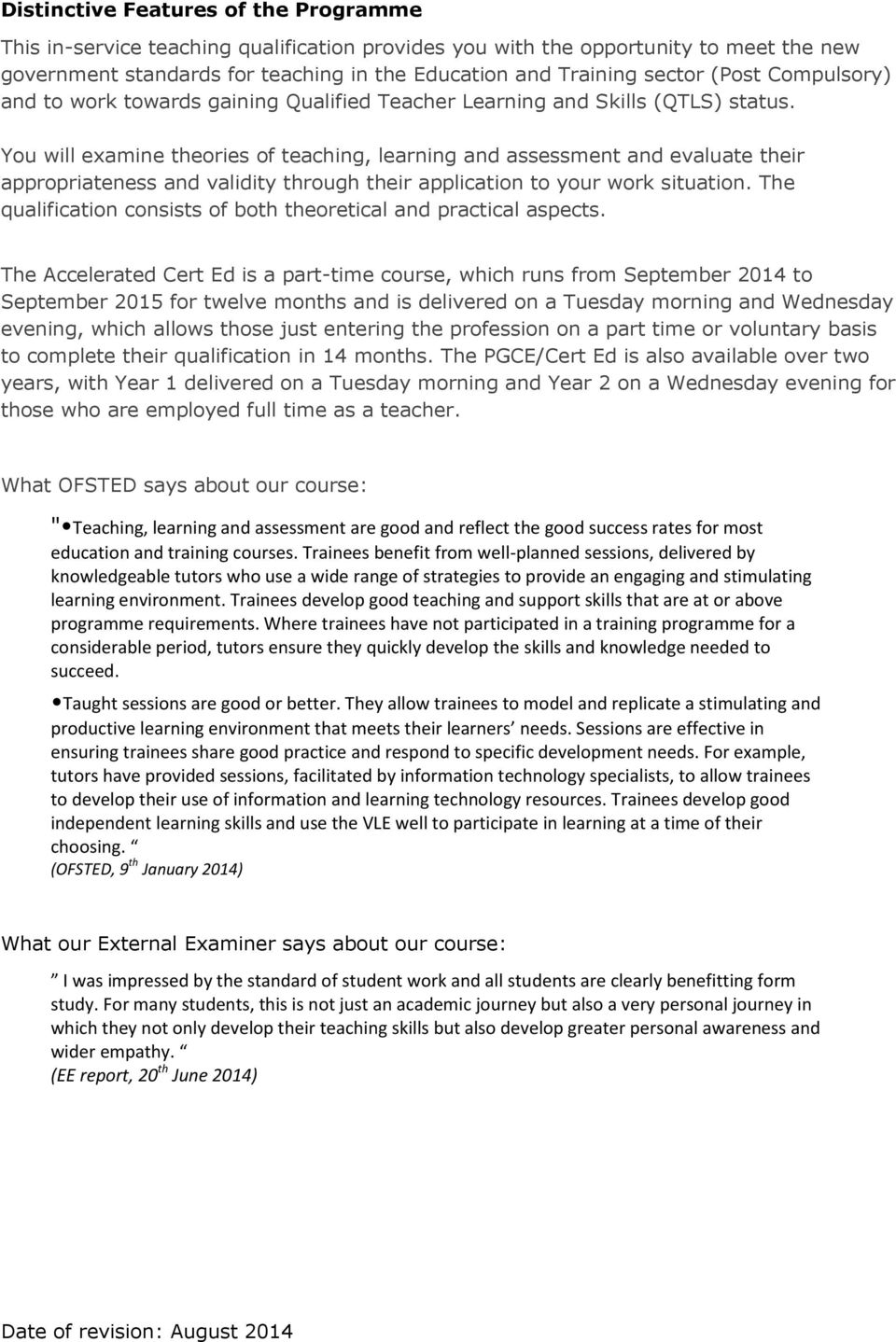
2 Distinctive Features of the Programme This in-service teaching qualification provides you with the opportunity to meet the new government standards for teaching in the Education and Training sector (Post Compulsory) and to work towards gaining Qualified Teacher Learning and Skills (QTLS) status. You will examine theories of teaching, learning and assessment and evaluate their appropriateness and validity through their application to your work situation. The qualification consists of both theoretical and practical aspects. The Accelerated Cert Ed is a part-time course, which runs from September 2014 to September 2015 for twelve months and is delivered on a Tuesday morning and Wednesday evening, which allows those just entering the profession on a part time or voluntary basis to complete their qualification in 14 months. The PGCE/Cert Ed is also available over two years, with Year 1 delivered on a Tuesday morning and Year 2 on a Wednesday evening for those who are employed full time as a teacher. What OFSTED says about our course: " Teaching, learning and assessment are good and reflect the good success rates for most education and training courses. Trainees benefit from well-planned sessions, delivered by knowledgeable tutors who use a wide range of strategies to provide an engaging and stimulating learning environment. Trainees develop good teaching and support skills that are at or above programme requirements. Where trainees have not participated in a training programme for a considerable period, tutors ensure they quickly develop the skills and knowledge needed to succeed. Taught sessions are good or better. They allow trainees to model and replicate a stimulating and productive learning environment that meets their learners needs. Sessions are effective in ensuring trainees share good practice and respond to specific development needs. For example, tutors have provided sessions, facilitated by information technology specialists, to allow trainees to develop their use of information and learning technology resources. Trainees develop good independent learning skills and use the VLE well to participate in learning at a time of their choosing. (OFSTED, 9 th January 2014) What our External Examiner says about our course: I was impressed by the standard of student work and all students are clearly benefitting form study. For many students, this is not just an academic journey but also a very personal journey in which they not only develop their teaching skills but also develop greater personal awareness and wider empathy. (EE report, 20 th June 2014)
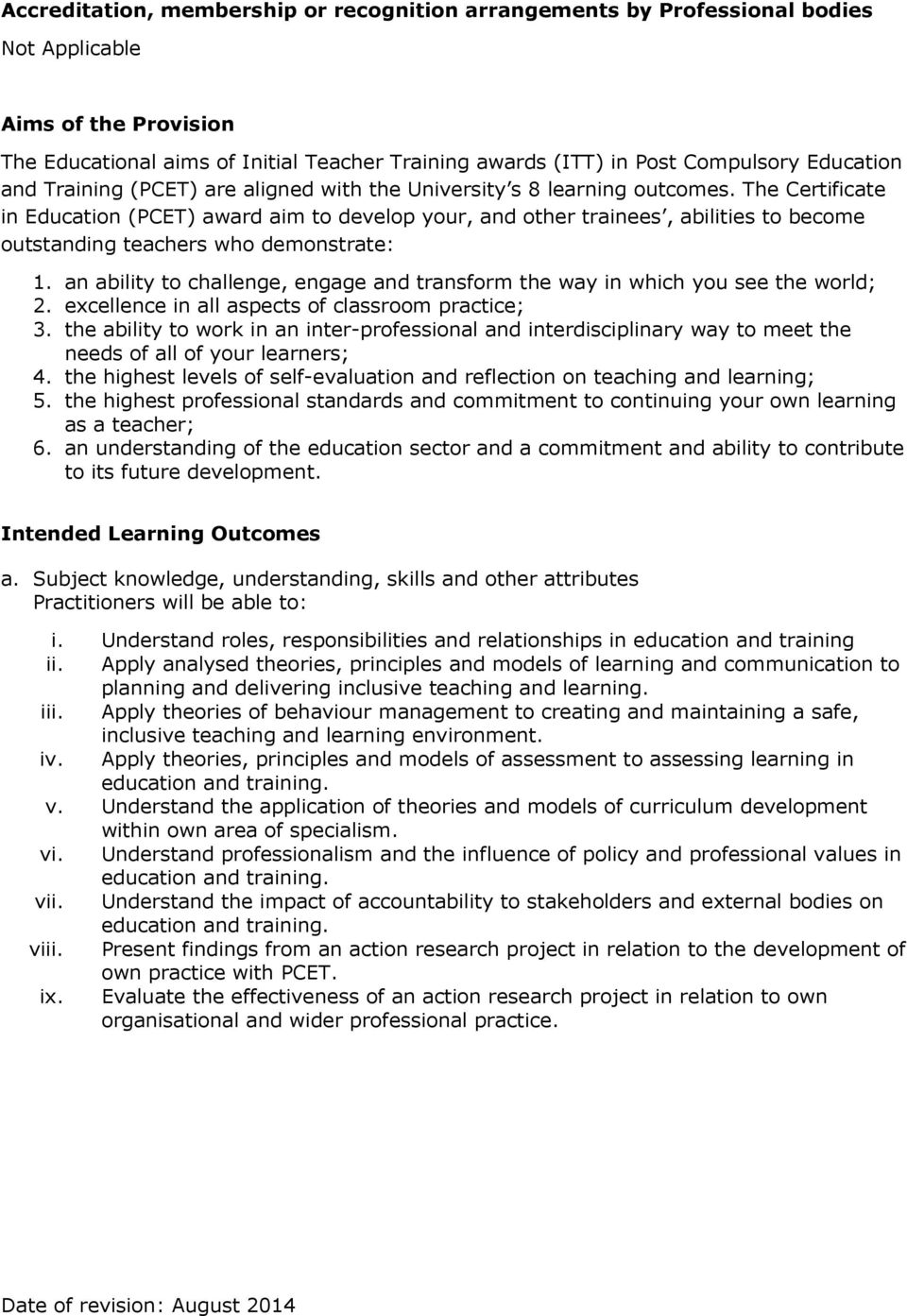
3 Accreditation, membership or recognition arrangements by Professional bodies Not Applicable Aims of the Provision The Educational aims of Initial Teacher Training awards (ITT) in Post Compulsory Education and Training (PCET) are aligned with the University s 8 learning outcomes. The Certificate in Education (PCET) award aim to develop your, and other trainees, abilities to become outstanding teachers who demonstrate: 1. an ability to challenge, engage and transform the way in which you see the world; 2. excellence in all aspects of classroom practice; 3. the ability to work in an inter-professional and interdisciplinary way to meet the needs of all of your learners; 4. the highest levels of self-evaluation and reflection on teaching and learning; 5. the highest professional standards and commitment to continuing your own learning as a teacher; 6. an understanding of the education sector and a commitment and ability to contribute to its future development. Intended Learning Outcomes a. Subject knowledge, understanding, skills and other attributes Practitioners will be able to: i. Understand roles, responsibilities and relationships in education and training ii. Apply analysed theories, principles and models of learning and communication to planning and delivering inclusive teaching and learning. iii. Apply theories of behaviour management to creating and maintaining a safe, inclusive teaching and learning environment. iv. Apply theories, principles and models of assessment to assessing learning in education and training. v. Understand the application of theories and models of curriculum development within own area of specialism. vi. Understand professionalism and the influence of policy and professional values in education and training. vii. Understand the impact of accountability to stakeholders and external bodies on education and training. viii. Present findings from an action research project in relation to the development of own practice with PCET. ix. Evaluate the effectiveness of an action research project in relation to own organisational and wider professional practice.
4 b. Subject-specific skills Practitioners will be able to: i. Demonstrate an ability to deliver reflective and evaluated teaching and learning sessions in relation to own subject specific area. ii. create, maintain and deliver inclusive teaching and learning within a safe environment iii. Use initial and diagnostic assessment to agree and plan individual learning goals within an inclusive teaching and learning environment iv. Assess learning in education and training v. implement expectations of the minimum core in planning, delivering and assessing inclusive teaching and learning vi. Apply action learning and minimum core activities in planning, delivering and assessing inclusive teaching and learning vii. Contribute to the quality improvement and quality assurance arrangements of own organisation c. Generic skills: The Staffordshire Graduate represents a set of qualities that the University passionately believes is necessary for success in the 21st century. The Staffordshire Graduate is a reflective and critical learner with a global perspective, prepared to contribute in the world of work. The Staffordshire Graduate will: Discipline Expertise: Have an understanding of the forefront of knowledge in their chosen field Professionalism: Be prepared to be work-ready and employable and understand the importance of being enterprising and entrepreneurial Global Citizenship: Have an understanding of global issues and of their place in a globalised economy Communication and Teamwork: Be an effective communicator and presenter and able to interact appropriately with a range of colleagues Have developed the skills of independence of thought and (when appropriate) social interaction through teamwork Reflective and Critical Learner: Have the ability to carry out inquiry-based learning and critical analysis Be a problem solver and creator of opportunities Lifelong Learning: Be technologically, digitally and information literate Be able to apply Staffordshire Graduate attributes to a range of life experiences to facilitate life-long learning and life-long success. You, along with other trainees, will have many opportunities to develop and achieve these attributes. These will include learning opportunities within chosen awards and co-curricular activities such as work experience, volunteering and the development of employability, enterprise and entrepreneurial skills.

5 Teaching, Learning and Assessment Strategies The learning, teaching and assessment strategy has been carefully developed for the Certificate in Education (PCET) award and to take account of the LSIS (2013) guidance documentation. The award recognises that you, along with other trainees bring to the teaching and learning sessions a breadth of on-going practical experience and detailed knowledge of specific contexts to share with others. These experiences are drawn upon to provide you with practical contexts for the analysis of contemporary issues and problems of a practical nature. You will be encouraged to link theory to your practice, reflect on values, practices, assumptions and policies and demonstrate ability in the full range of transferable skills. The following strategy will be adopted to ensure that you have a supportive learning and teaching environment. Teaching and Learning: In general, all modules will include traditional learning material, such as hand-outs and PowerPoint presentations. Much of the time will be spent discussing and reflecting upon how what you have learnt in University applies in PCET situations. In addition to the above, at appropriate points in the year, you will be briefed on assignments, which include clearly defined assessment criteria. Knowledge and Understanding is acquired through lectures and presentations by the tutor; seminars and workshops to generate discussion, reflection and exchange of ideas; guided reading, supported self-study and independent study to enable you to engage with relevant and appropriate debates; individual tutorials to support development of understanding; ICT to facilitate exchange of ideas and access to specific resources and activities. Application and Reflection are developed through practical workshops for the analysis and discussion of issues, documents and materials; seminars to generate discussion, reflection and exchange of ideas; case-study activities to support these approaches as a means of establishing connections between the workplace and issues raised by the programme; critical feedback from peers and tutors on presentations, workplace experiences and standpoints taken on issues raised in taught sessions; guided reading, supported self-study and independent study to enable you to engage with critical debate; ICT to facilitate exchange of ideas and access to specific resources and activities. Transferable skills are developed through practical workshops for the analysis and discussion of issues, documents and materials; work-based activities to establish connections between the workplace and issues raised by the programme; work with others, as a result of the development of interpersonal skills, to demonstrate the capacity to plan, to share goals, and work as a member of a team; communicate and present oral and written arguments; critical feedback from peers and tutors on work-based activities; guided reading, supported self-study and independent study to enable you to engage with critical debate; use Information and Communication Technology, including word processing, data bases, internet communication, information retrieval and on-line searches.

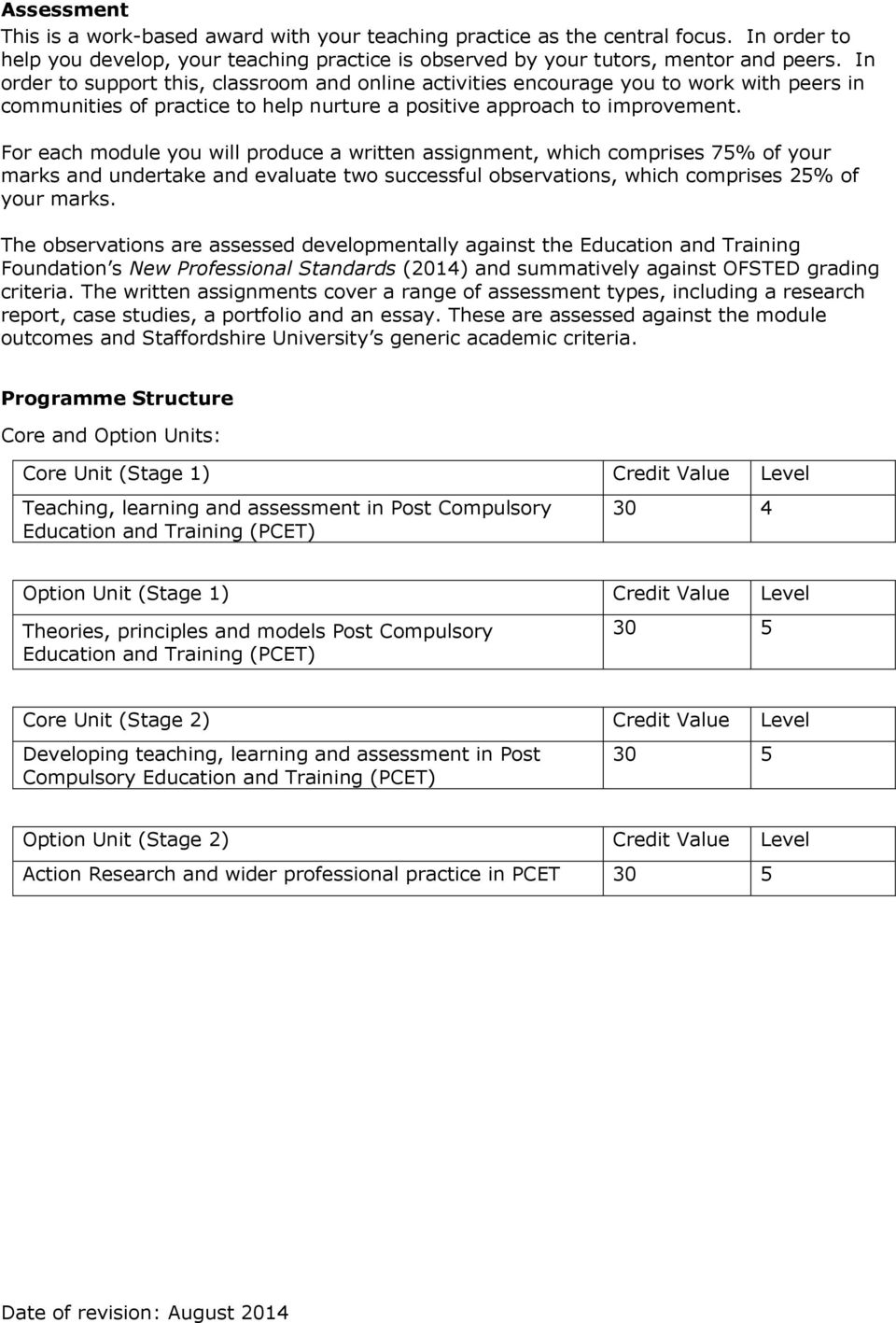
6 Assessment This is a work-based award with your teaching practice as the central focus. In order to help you develop, your teaching practice is observed by your tutors, mentor and peers. In order to support this, classroom and online activities encourage you to work with peers in communities of practice to help nurture a positive approach to improvement. For each module you will produce a written assignment, which comprises 75% of your marks and undertake and evaluate two successful observations, which comprises 25% of your marks. The observations are assessed developmentally against the Education and Training Foundation s New Professional Standards (2014) and summatively against OFSTED grading criteria. The written assignments cover a range of assessment types, including a research report, case studies, a portfolio and an essay. These are assessed against the module outcomes and Staffordshire University s generic academic criteria. Programme Structure Core and Option Units: Core Unit (Stage 1) Credit Value Level Teaching, learning and assessment in Post Compulsory Education and Training (PCET) 30 4 Option Unit (Stage 1) Credit Value Level Theories, principles and models Post Compulsory Education and Training (PCET) 30 5 Core Unit (Stage 2) Credit Value Level Developing teaching, learning and assessment in Post Compulsory Education and Training (PCET) 30 5 Option Unit (Stage 2) Credit Value Level Action Research and wider professional practice in PCET 30 5
7 Study Support At the start of the course all students engage in an induction where they are introduced to: the units progression routes professional body recognition teaching and learning methods assessment methods, student support including student finance additional study support and learning centre resources Much of the support information is included in the College s Accelerate leaflet. You will also be allocated a personal tutor to support you. Their role is also to support the development of your professional and academic skills through tutorials. They will provide formative feedback on your work in sessions. They also provide guidance on assignment preparation. Criteria for Admission We require you to be in paid employment or working as a volunteer teacher for a minimum of 100 hours at a recognised training or educational establishment. A Level 3 minimum qualification in the subject that you are teaching for Cert Ed. GCSE Grade C in English Language (or equivalent), and evidence that you are currently working at literacy level 2. Evidence that you have achieved or are working towards GCSE Grade C (or equivalent) in Maths DBS (CRB) enhanced disclosure clearance (usually arranged by your employing organisation) Access to subject specific mentor support (again, usually arranged by your employing organisation) Indicators of the course s quality There are a number of different indicators of the quality of the course which include: Results of student surveys, unit feedback at completion of each unit, external examiner reports, the College s internal programme review, the success rates.