
GAO ENTREPRENEURIAL ASSISTANCE. Opportunities Exist to Improve Programs Collaboration, Data- Tracking, and Performance Management
|
|
|
- Felix Bryan
- 10 years ago
- Views:
Transcription
1 GAO United States Government Accountability Office Report to Congressional Committees August 2012 ENTREPRENEURIAL ASSISTANCE Opportunities Exist to Improve Programs Collaboration, Data- Tracking, and Performance Management GAO

2 Highlights of GAO , a report to congressional committees August 2012 ENTREPRENEURIAL ASSISTANCE Opportunities Exist to Improve Programs Collaboration, Data-Tracking, and Performance Management Why GAO Did This Study Economic development programs that effectively provide assistance to entrepreneurs may help businesses develop and expand. GAO focused on 52 economic development programs, with an estimated $2.0 billion in funding, at Commerce, HUD, SBA, and USDA that support entrepreneurs. In response to a statutory requirement, this report discusses (1) the extent of overlap and fragmentation, the effects on entrepreneurs, and agencies actions to address them; and (2) the extent of tracked program information and whether these programs have met their performance goals and been evaluated. To address these objectives, GAO analyzed program information and interviewed agency officials in headquarters and selected field offices, entrepreneurs, and thirdparty entities, such as nonprofits, that use federal grants to provide assistance directly to entrepreneurs. What GAO Recommends GAO recommends that the agencies and the Office of Management and Budget explore opportunities to enhance collaboration among programs, both within and across agencies; track program information; and conduct more program evaluations. Commerce, HUD, and USDA provided written comments and each neither agreed nor disagreed with the recommendations. However, USDA commented that the recommendations were not explicit. In the report, GAO provides specific actions that agencies can take to address each recommendation. View GAO For more information, contact William B. Shear at (202) or [email protected]. What GAO Found Federal efforts to support entrepreneurs are fragmented including among 52 programs at the Agriculture (USDA), Commerce, and Housing and Urban Development (HUD) and the Small Business Administration (SBA). All overlap with at least one other program in terms of the type of assistance they are authorized to offer, such as financial (grants and loans) and technical (training and counseling), and the type of entrepreneur they are authorized to serve. Some entrepreneurs struggle to navigate the fragmented programs that provide technical assistance. For example, some entrepreneurs and technical assistance providers GAO spoke with said the system can be confusing and that some entrepreneurs do not know where to go for assistance. Collaboration could reduce some negative effects of overlap and fragmentation, but field staff GAO spoke with did not consistently collaborate to provide training and counseling services to entrepreneurs. The agencies have taken initial steps to improve how they collaborate by entering into formal agreements, but they have not pursued a number of other good collaborative practices GAO has previously identified. For example, USDA and SBA entered into a formal agreement in 2010 to coordinate their efforts to support businesses in rural areas; however, the agencies programs that can support start-up businesses such as USDA s Rural Business Enterprise Grant program and SBA s Small Business Development Centers have yet to determine roles and responsibilities, find ways to leverage each other s resources, or establish compatible policies and procedures. Without enhanced collaboration and coordination agencies may not be able to make the best use of limited federal resources in the most effective and efficient manner. Agencies do not track program information on entrepreneurial assistance activities for many programs, a number of programs have not met their performance goals, and most programs lack evaluations. In particular, the agencies do not generally track information on the specific type of assistance they provide or the entrepreneurs they serve, in part because they do not rely on this information to administer the programs. Rather, agencies may rely, for example, on data summaries in narrative format, which cannot be easily aggregated or analyzed. According to government standards for internal control, this information should be available to help inform management in making decisions and identifying risks and problem areas. GAO also found that 19 programs failed to meet their annual performance goals related to entrepreneurial assistance, including USDA s Rural Business Opportunity Grants, Commerce s Economic Development/Support for Planning Organizations, HUD s Indian Community Development Block Grants, and SBA s 504 loans to finance commercial real estate. Programs could potentially rely on results from program evaluations to determine the reasons why they have not met their goals, as well as to gauge overall effectiveness. However, the agencies lack program evaluations for 32 of the 52 programs. Therefore, information on program efficiency and effectiveness is limited, and scarce resources may be going toward programs that are less effective. In addition, without more robust program information, agencies may not be able to administer programs in the most effective and efficient manner. United States Government Accountability Office
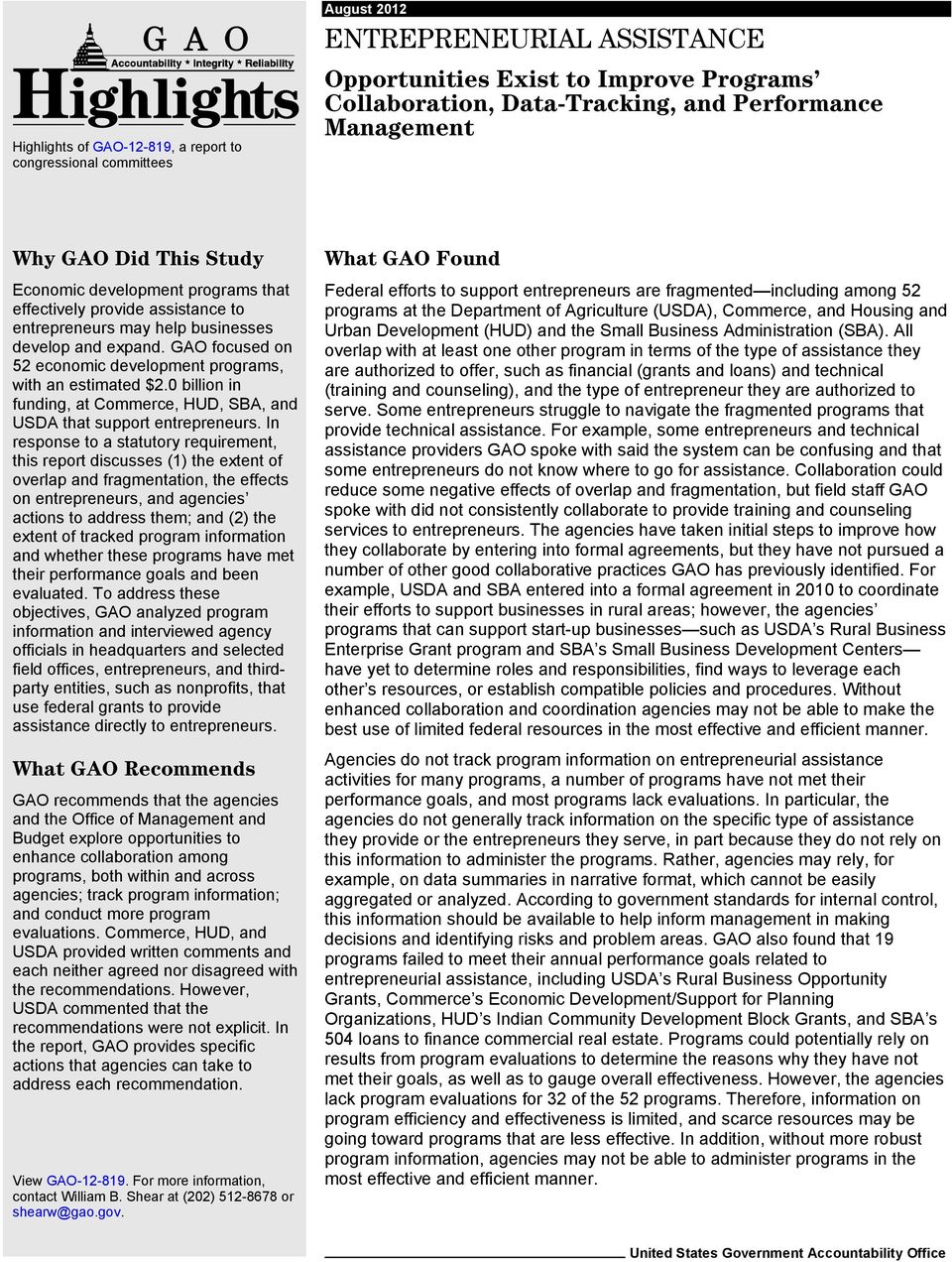
3 Contents Letter 1 Background 3 Fragmented Programs Overlap, and Agencies Efforts to Collaborate Have Been Limited 5 Agencies Lack Information to Track Program Activities and Measure Performance 19 Conclusions 28 Recommendations 29 Agency Comments and Our Evaluation 29 Appendix I Objectives, Scope and Methodology 37 Appendix II Illustrative Examples of Economic Activities 41 Appendix III Performance Goals and Accomplishments for 52 Programs that Can Support Entrepreneurs, Fiscal Year Appendix IV Additional Federal Programs that Can Fund Economic Activities 73 Appendix V Evaluations of Programs that Can Support Entrepreneurs, Appendix VI Comments from the Agriculture 90 Appendix VII Comments from the Commerce 93 Appendix VIII Comments from the Housing and Urban Development 97 Page i
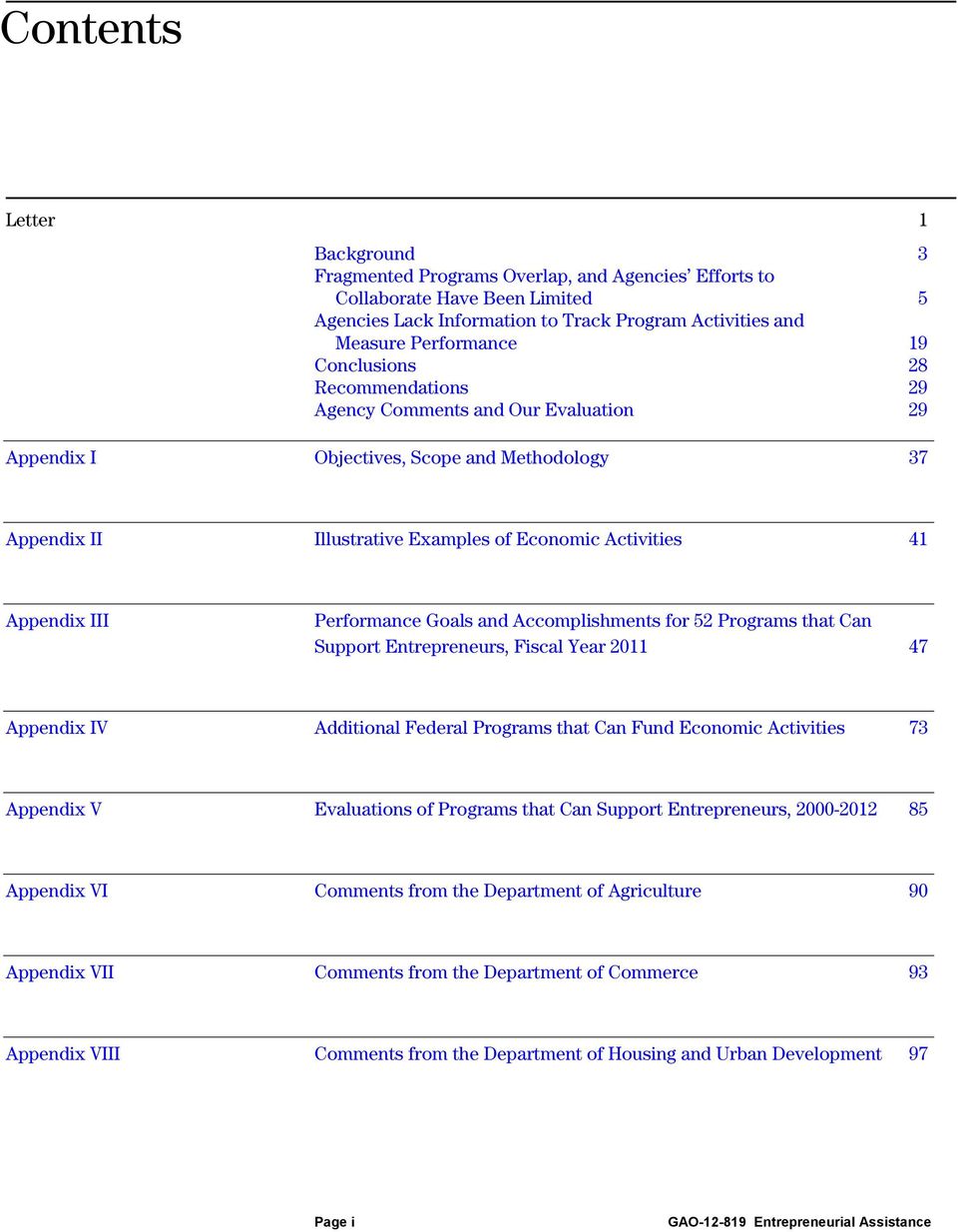
4 Appendix I GAO Contact and Staff Acknowledgments 99 Tables Table 1: Programs that Can Support Entrepreneurs and Maintain Readily Available Information, by Agency 22 Table 2: Accomplishment Data for 33 Programs that Support Entrepreneurs and Set Goals, Fiscal Year Table 3: Additional Federal Programs That Can Fund Economic Activities, as Listed in the 2011 Catalog of Federal Domestic Assistance 74 Figures Figure 1: Fragmented Delivery System of Federally Funded Technical Assistance to Entrepreneurs 14 Figure 2: Evaluations of Programs that Support Entrepreneurs, Page ii
5 Abbreviations BEDI Brownfields Economic Development Initiative CDBG Community Development Block Grant CDC Community Development Corporation CFDA Catalog of Federal Domestic Assistance Commerce Commerce EDA Economic Development Administration FAST Federal and State Technology Partnership GPRA Government Performance and Results Act GPRAMA GPRA Modernization Act of 2010 HUBZone Historically Underutilized Business Zone HUD Housing and Urban Development MBC Minority Business Center MBDA Minority Business Development Agency NABEC Native American Business Enterprise Centers NMVC New Markets Venture Capital OMB Office of Management and Budget PRIME Program for Investment in Micro-Entrepreneurs SBA Small Business Administration SBDC Small Business Development Center SBIC Small Business Investment Company SBIR Small Business Innovation Research STTR Small Business Technology Transfer TAA Trade Adjustment Assistance USDA U.S. Agriculture VAPG Value Added Producer Grants WBC Women's Business Center This is a work of the U.S. government and is not subject to copyright protection in the United States. The published product may be reproduced and distributed in its entirety without further permission from GAO. However, because this work may contain copyrighted images or other material, permission from the copyright holder may be necessary if you wish to reproduce this material separately. Page iii

6 United States Government Accountability Office Washington, DC August 23, 2012 Congressional Committees Entrepreneurs play a vital role in the U.S. economy. The federal government provides a variety of support and assistance to them, and dozens of programs exist to support entrepreneurs across numerous federal agencies. Economic development programs that effectively provide assistance to entrepreneurs, in conjunction with state and local government and private sector economic development initiatives, may help businesses develop and expand. However, we have previously raised questions about the potential negative effects of fragmentation and overlap among federal programs that can support entrepreneurs. Specifically, we have questioned how efficiently federal agencies are administering these programs and how effective the programs are at achieving their mission. This report focuses on 52 programs administered by the U.S. Departments of Agriculture (USDA), Commerce (Commerce), and Housing and Urban Development (HUD) and the U.S. Small Business Administration (SBA) that provide assistance to entrepreneurs. 1 In 2011, we examined these programs and found that each program overlapped with at least one other program in terms of the economic development activities that they are authorized to fund. 2 According to agency officials, these programs, which typically fund a variety of activities in addition to supporting entrepreneurs, spent an estimated $2.0 billion on economic development efforts in fiscal year Section 21 of Public Law , enacted in February 2010, requires GAO to conduct routine investigations to identify federal programs, agencies, offices, and initiatives with duplicative goals and activities within 1 The number of programs administered by Commerce, HUD, SBA, and USDA that we identified in February 2012 as supporting entrepreneurial efforts decreased from 53 to 52 because USDA s Empowerment Zones program was ended by Congress during fiscal year 2010 and has been excluded from this review. See GAO, 2012 Annual Report: Opportunities to Reduce Duplication, Overlap and Fragmentation, Achieve Savings, and Enhance Revenue, GAO SP (Washington, D.C.: Feb. 28, 2012). 2 GAO, Opportunities to Reduce Potential Duplication in Government Programs, Save Tax Dollars, and Enhance Revenue, GAO SP (Washington D.C.: Mar. 1, 2011) and Efficiency and Effectiveness of Fragmented Economic Development Programs Are Unclear, GAO R (Washington, D.C.: May 19, 2011). Page 1

7 departments and governmentwide, and report annually to Congress. 3 This report discusses (1) the extent of overlap, fragmentation, and duplication and their effects on entrepreneurs, and agencies actions to address them; and (2) the extent to which agencies collect information necessary to track program activities and whether these programs have met their performance goals and have been evaluated. While we identified a more comprehensive list of federal programs that can fund economic activities more generally, we focused our analyses on these 52 economic development programs that are authorized to support entrepreneurs because these are the programs that appeared to overlap the most within the four agencies whose missions focus on economic development. We reviewed statutory and regulatory authority for each program on the activities and services the agencies can conduct to administer each of the programs. Because there was significant overlap and fragmentation among programs that provide technical assistance (for example, business training and counseling and support for research and development) to entrepreneurs (35 of the 52 programs), we focused on how the agencies provide this assistance. We reviewed agency documents and conducted interviews in both headquarters and the field to determine how technical assistance is provided to entrepreneurs and the extent of agency collaboration at the local level. We interviewed 14 officials from four federal agencies, 9 officials from two regional commissions, four entrepreneurs who have received federal support, and five state and local partners in select geographic areas where there was evidence of ongoing collaboration between the federal agencies. These geographic areas included both urban and rural areas. We assessed this technical assistance information against promising collaborative practices 4 that we have previously identified. For all 52 programs, we also evaluated the agencies methods for tracking the activities conducted and assistance provided against standards for internal controls that we have previously identified. 5 For each program, we reviewed information on 3 In a letter dated August 31, 2011, to the Comptroller General, the Chairwoman of the Senate Committee on Agriculture, Nutrition and Forestry asked, among other things, that we address a number of issues involving the potential for overlap, duplication, and fragmentation in economic development programs administered by the four agencies. 4 GAO, Results-Oriented Government: Practices That Can Help Enhance and Sustain Collaboration among Federal Agencies, GAO (Washington, D.C.: Oct. 21, 2005). 5 GAO, Standards for Internal Control in the Federal Government, GAO/AIMD (Washington, D.C.: Nov. 1, 1999). Page 2
8 program mission and goals, performance goals and accomplishments, and program evaluations conducted during the last decade. We evaluated this information against promising practices of leading organizations and the requirements of the GPRA Modernization Act of Appendix I provides more information on our scope and methodology. We conducted this performance audit from June 2011 to July 2012 in accordance with generally accepted government auditing standards. Those standards require that we plan and perform the audit to obtain sufficient, appropriate evidence to provide a reasonable basis for our findings and conclusions based on our audit objectives. We believe that the evidence obtained provides a reasonable basis for our findings and conclusions based on our audit objectives. Background Fragmentation, Overlap, and Duplication Fragmentation refers to circumstances in which more than one federal agency (or more than one organization within an agency) is involved in the same broad area of national interest. Overlap involves programs that have similar goals, devise similar strategies and activities to achieve those goals, or target similar users. Duplication occurs when two or more agencies or programs are engaged in the same activities or provide the same assistance to the same beneficiaries. In some instances, it may be appropriate for multiple agencies or entities to be involved in the same programmatic or policy area due to the nature or magnitude of the federal effort. However, we have previously identified instances where multiple government programs or activities have led to inefficiencies, and we determined that greater efficiencies or effectiveness might be achievable. 6 6 See GAO SP. Page 3
9 Defining Federal Economic Development Programs In September 2000, we reported that there is no commonly accepted definition for economic development. 7 Absent a common definition, we subsequently developed a list of nine activities most often associated with economic development. 8 In general, we focused on economic activities that directly affected the overall development of an area, such as job creation, rather than on activities that improved individuals quality of life, such as housing and education. The nine economic activities are supporting entrepreneurial efforts, supporting business incubators and accelerators, constructing and renovating commercial buildings, constructing and renovating industrial parks and buildings, strategic planning and research, marketing and access to new markets for products and industries, supporting telecommunications and broadband infrastructure, supporting physical infrastructure, and supporting tourism. Appendix II provides illustrative examples of each of these economic activities. Appendix III provides more information on the 52 economic development programs we focused on for this report. Appendix IV includes a list of additional programs that are administered by federal agencies we identified that can fund at least one of these activities. 7 See GAO, Economic Development: Multiple Federal Programs Fund Similar Economic Development Activities, GAO/RCED/GGD (Washington, D.C.: Sept. 29, 2000). 8 See GAO, Rural Economic Development: More Assurance Is Needed That Grant Funding Information Is Accurately Reported, GAO (Washington, D.C.: Feb. 24, 2006). Page 4

10 GPRA Modernization Act of 2010 In January 2011, Congress updated the Government Performance and Results Act of 1993 (GPRA) with the GPRA Modernization Act of 2010 (GPRAMA). GPRAMA establishes a new framework aimed at taking a more crosscutting and integrated approach to focusing on results and improving government performance. Effective implementation of GPRAMA could play an important role in clarifying desired outcomes; addressing program performance spanning multiple organizations; and facilitating future actions to reduce unnecessary duplication, overlap, and fragmentation. Among other things, GPRAMA requires the Office of Management and Budget (OMB) to coordinate with agencies to establish outcome-oriented federal government priority goals covering a limited number of policy areas, as well as goals to improve management across the federal government. It also requires OMB in conjunction with the agencies to develop a federal government performance plan that outlines how they will make progress toward achieving goals, including federal government priority goals. The President s 2013 budget submission includes the first interim federal government priority goals, including one to increase federal services to entrepreneurs and small businesses with an emphasis on start-ups and growing firms and underserved markets. 9 Fragmented Programs Overlap, and Agencies Efforts to Collaborate Have Been Limited The identified economic development programs that support entrepreneurs overlap based on both the type of assistance they provide and the characteristics of the beneficiaries they target. This overlap among fragmented programs can make it difficult for entrepreneurs to navigate the services available to them. In addition, while agencies have taken steps to collaborate more in administering these programs, they have not implemented a number of good collaborative practices we have previously identified, and some entrepreneurs struggle to find the support they need. 9 GAO, Managing for Results: GAO s Work Related to the Interim Crosscutting Priority Goals under the GPRA Modernization Act, GAO R (Washington, D.C.: May 12, 2012). We identified additional programs at Commerce, HUD, SBA, and USDA that can assist entrepreneurs with access to financing, mentorship and counseling services, and government contracts and research grants, and we recommended that the Director of OMB review the additional departments, agencies, and programs that we identified, and consider including them in the federal government s performance plan, as appropriate. OMB staff agreed with our recommendation that OMB review the additional departments, agencies, and programs that we have identified and determine if they are relevant to achieving the crosscutting goals. Page 5

11 Many Programs Are Authorized to Provide Similar Types of Assistance and Target Similar Beneficiaries Federal efforts to support entrepreneurs are fragmented, which occurs when more than one agency or program is involved in the same broad area of national interest. Commerce (8), HUD (12), SBA (19), and USDA (13) administered 52 programs that could support entrepreneurial efforts in fiscal year Several types of overlap which occurs when programs have similar goals, engage in similar activities or strategies to achieve them, or target similar beneficiaries exist among these programs, based on the type of assistance the programs offer and characteristics of the programs targeted beneficiaries. Many of the programs provide entrepreneurs with similar types of assistance. The programs generally can be grouped according to at least one of three types of assistance that address different entrepreneurial needs: help obtaining (1) technical assistance, (2) financial assistance, and (3) government contracts. Many of the programs can provide more than one type of assistance, and most focus on technical assistance, financial assistance, or both: 10 Technical assistance: Thirty-five programs distributed across the four agencies can provide technical assistance, including business training, counseling and research, and development support. 11 Financial assistance: Thirty programs distributed across the four agencies can support entrepreneurs through financial assistance in the form of grants and loans SBA administers two programs that solely provide entrepreneurs with assistance in obtaining government contracts: the Historically Underutilized Business Zone (HUBZone) program, which supports small businesses located in economically distressed areas, and the Procurement Assistance to Small Businesses program, which serves small businesses located in any area. 11 The number of programs administered by Commerce, HUD, SBA, and USDA that were identified in GAO SP as supporting technical assistance decreased from 36 to 35 because USDA s Empowerment Zones program is no longer active. 12 The number of programs administered by Commerce, HUD, SBA, and USDA that were identified in GAO SP as supporting financial assistance decreased from 33 to 30 because USDA s Empowerment Zones program is no longer active and because subsequent to that report, Commerce told us that its Minority Business Centers and Native American Business Enterprise Centers programs only support technical assistance. Page 6

12 Government contracting assistance: Five programs, all of which are administered by SBA, can support entrepreneurs by helping them qualify for federal procurement opportunities. 13 We reviewed the statutes and regulations for each program and found that overlap tends to be concentrated among programs that provide a broad range of technical and financial assistance. Within the technical assistance category, 24 of the 35 programs are authorized to provide or fund a broad range of technical assistance both to entrepreneurs with existing businesses and to nascent entrepreneurs that is, entrepreneurs attempting to start a business in any industry. This broad range of support can include any form of training or counseling, including start-up assistance, access to capital, and accounting. Examples of programs in this category include Commerce s Minority Business Centers, five of HUD s Community Development Block Grant (CDBG) programs, SBA s Small Business Development Centers, and USDA s Rural Business Opportunity Grants. 14 Eight additional programs can support limited types of technical assistance or industries. 15 For example, Commerce s Trade Adjustment Assistance for Firms only supports existing businesses negatively affected by imports, and USDA s Small Socially- Disadvantaged Producer Grants only serves agricultural businesses. Similarly, 16 of the 30 financial assistance programs can provide or guarantee loans that can be used for a broad range of purposes to existing businesses and nascent entrepreneurs in any industry. Examples of programs in this category include Commerce s Economic Adjustment Assistance programs, six of HUD s CDBG programs, SBA s 7(a) Loan Program, and USDA s Business and Industry Loans. Five other programs 13 The number of programs administered by Commerce, HUD, SBA, and USDA that were identified in GAO SP as supporting government contracting assistance decreased from seven to five because subsequent to that report, Commerce told us that its Minority Business Centers and Native American Business Enterprise Centers programs only support technical assistance. 14 Of the eight HUD CDBG programs, five operate in different areas of the United States that do not geographically overlap, one can only provide support to areas recovering from presidentially declared disasters, and two can operate in any area of the United States. 15 The other three technical assistance programs are Commerce s Economic Development Support for Planning Organizations, Economic Development Technical Assistance, and Grants for Public Works and Economic Development Facilities, which support assistance to economic development organizations and local governments, which in turn support businesses. Page 7

13 can support loans for a more narrow range of purposes or industries, while the other nine programs can only support other types of financial assistance, such as grants, equity investments, and surety guarantees. 16 In addition, a number of programs overlap based on the characteristics of the targeted beneficiary. Most programs either target or exclusively serve one of four types of businesses: businesses in rural areas, businesses in economically distressed areas, disadvantaged businesses, and small businesses. 17 For example, all of HUD s 12 programs that can provide support to entrepreneurs are focused on serving beneficiaries in economically distressed areas or target benefits at low- to moderateincome individuals. SBA s 19 programs are all limited to serving small businesses, with several programs that either target or exclusively serve disadvantaged businesses and microenterprises. 18 Eight of USDA s 13 programs are limited to rural service areas, and four of these programs are limited to small businesses or microenterprises. Among Commerce s eight programs, six are limited to serving beneficiaries in economically distressed areas, while two exclusively serve disadvantaged businesses. 16 Equity investments are capital provided to a business to purchase common or preferred stock, or a similar instrument. SBA can guarantee surety bonds (that is, an agreement between a surety company and the owner of a project that a contract will be completed) for contracts up to $2 million. These contracts can cover bonds for small and emerging contractors who cannot obtain surety bonds through regular commercial channels. SBA s guarantee gives sureties an incentive to provide bonding for eligible contractors and thereby strengthens a contractor s ability to obtain bonding and greater access to contracting opportunities. 17 The definition of rural varies among these programs, but according to USDA the agency that administers many of the economic development programs that serve rural areas the term rural typically covers areas with population limits ranging from less than 2,500 to 50,000. Based on statutory language, we characterize economically distressed areas as communities with high concentrations of low- and moderate-income families or high rates of unemployment and/or underemployment. See, e.g., 42 U.S.C. 3141; 42 U.S.C Likewise, based on statutory language, we characterize disadvantaged businesses as those owned by women, minority groups, and veterans, among other factors. See, e.g., 15 U.S.C. 637(a); 15 U.S.C The definition of small business varies among these programs, but according to SBA the agency that administers many of the economic development programs that serve small businesses the term small business refers to businesses that have annual receipts or total employee numbers under an agency-defined value for their specific industry. 18 Microenterprises are generally defined as commercial enterprises that have ten or fewer employees. Page 8
14 Entrepreneurs may fall into more than one beneficiary category for example, an entrepreneur may be in an area that is both rural and economically distressed. Therefore, these entrepreneurs would be eligible, based on program authority, for more than one subset of program. For example, a small business in a rural, economically distressed area, such as Susquehanna County, Pennsylvania, could, in terms of program authority, receive a broad range of technical assistance through at least nine programs at all four of the agencies, including: Commerce s Economic Adjustment Assistance; HUD s CDBG/States, Rural Innovation Fund, and Section 4 Capacity Building; SBA s SCORE and Small Business Development Centers; 19 and USDA s1890 Land Grant Institutions, Rural Business Enterprise 20 Grants, and Rural Business Opportunity Grants. Similarly, a small business that is both minority- and women-owned in an urban, noneconomically distressed area, such as Seattle, Washington, could in terms of program authority, receive a broad range of technical assistance through at least seven programs at three of the four agencies, including: Commerce s Minority Business Centers; HUD s CDBG/Entitlement and Section 4 Capacity Building; and SBA s Program for Investment in Micro-entrepreneurs (PRIME), SCORE, Small Business Development Centers, and Women s Business Centers. 19 SCORE, formerly Service Corps of Retired Executives, provides technical assistance support for small business, start-ups and entrepreneurs. 20 HUD s Rural Innovation Fund program did not receive funding in fiscal year 2011 but is still active. USDA s1890 Land Grant Institutions received an unspecified amount of funding through USDA s Salaries and Expense account rather than program appropriations. Page 9

15 Entrepreneurs may also be eligible for multiple subsets of financial assistance programs based on their specific characteristics. For example, a small business in a rural, economically distressed area, such as Bourbon County, Kansas, could in terms of authority, receive financial assistance in the form of guaranteed or direct loans for a broad range of uses through at least eight programs at the four agencies, including: Commerce s Economic Adjustment Assistance; HUD s CDBG/States, Rural Innovation Fund and Section 4 Capacity Building; SBA s 7(a) Loan Program and Small Business Investment Companies; and USDA s Business and Industry Loans and Rural Business Enterprise Grants. A small business that is both minority and women-owned in an urban, noneconomically distressed area, such as Raleigh, North Carolina, could receive financial assistance in the form of guaranteed or direct loans for a broad range of uses through at least four programs at two of the four agencies, including: HUD s CDBG/Entitlement and Section 4 Capacity Building; and SBA s 7(a) Loan Program and Small Business Investment Companies. Five programs provide government contracting assistance to entrepreneurs, but our analysis did not identify significant overlap in the types of assistance these programs provide or the types of entrepreneurs they serve. While these five programs are all administered by SBA and can serve businesses in any industry, they tend to target specific types of entrepreneurs and provide unique types of assistance. For example, the Procurement Assistance to Small Businesses program coordinates access to government contracts for small and disadvantaged businesses with other federal agencies, while the 8(a) Business Development Program coordinates certification of eligible disadvantaged businesses for Page 10
16 the contracts made available at these other agencies, in addition to providing business development assistance during their 9-year term. 21 While many programs overlap in terms of statutory authority, entrepreneurs may in reality have fewer options to access assistance from multiple programs. Agencies often rely on intermediaries (that is, third-party entities such as nonprofit organizations, higher education institutions, or local governments that use federal grants to provide eligible assistance directly to entrepreneurs) to provide specific support to entrepreneurs, and these intermediaries vary in terms of their location and the types of assistance they provide. For example, while entrepreneurs seeking technical assistance in Susquehanna County, Pennsylvania, are eligible to receive this support through USDA s1890 Land Grant Institutions program, the closest funded intermediary is in Delaware, making it unlikely that such an entrepreneur would utilize services through this program. Additionally, intermediaries we spoke to in several areas said they typically provide a more limited range of services to entrepreneurs than are allowed under their statutory authority. For example, two intermediaries that we interviewed in Texas that were authorized to provide a broad range of technical support to entrepreneurs through SBA s Small Business Development Center and Commerce s Minority Business Center noted that they each specialized in a narrower subset of services and referred beneficiaries to each other and other resources for some services outside of their niches. Specifically, the intermediary at the Small Business Development Center noted that they provide a range of long-term services to small businesses over different phases of development, while the intermediary at the Minority Business Center noted that they focused specifically on larger minority-owned firms as well as start-up companies. Overlapping programs may also employ different mechanisms to provide similar types of support to entrepreneurs. For example, programs may support technical assistance through different types of intermediaries that provide services to entrepreneurs. USDA s Rural Business Opportunity Grants program can provide technical assistance through local governments, nonprofit corporations, Indian tribes, and cooperatives that are located in rural areas, while SBA s SCORE program utilizes retired 21 SBA s 8(a) program, named for a section of the Small Business Act, is a development program created to help small, disadvantaged businesses compete in the American economy and access the federal procurement market. Page 11

17 business professionals and others that volunteer their time to provide assistance. Additionally, programs may support financial assistance in the form of loans through loan guarantees, direct loans, or support for revolving loan funds. SBA s 7(a) Loan program provides guarantees on loans made by private sector lenders, while USDA s Intermediary Relending program provides financing to intermediaries to operate revolving loan funds. Additionally, some programs distribute funding through multiple layers of intermediaries before it reaches entrepreneurs. For example, HUD s Section 4 Capacity Building program is only authorized to provide grants to five national organizations, which pass funding on to a number of local grantees, including community development corporations that may use the funding to provide technical or financial assistance to entrepreneurs. HUD officials also noted that most of their programs allow local grantees discretion on whether to use funds to support entrepreneurs or for other authorized purposes. Other programs may competitively award grants to multiple intermediaries working jointly in the same community to serve entrepreneurs. For example, Commerce s Economic Adjustment Assistance program can provide grants to intermediaries, such as consortiums of local governments and nonprofits, which in turn provide technical or financial assistance to entrepreneurs. Although we identified a number of examples of statutory overlap, we did not find evidence of duplication among these programs (that is, instances when two or more agencies or programs are engaged in the same activities to provide the same services to the same beneficiaries) based on available data. However, most agencies were not able to provide the programmatic information, such as data on users of the program that is necessary to determine whether or not duplication actually exists among the programs. The agencies data-collecting practices will be discussed at greater length later in this report. Page 12
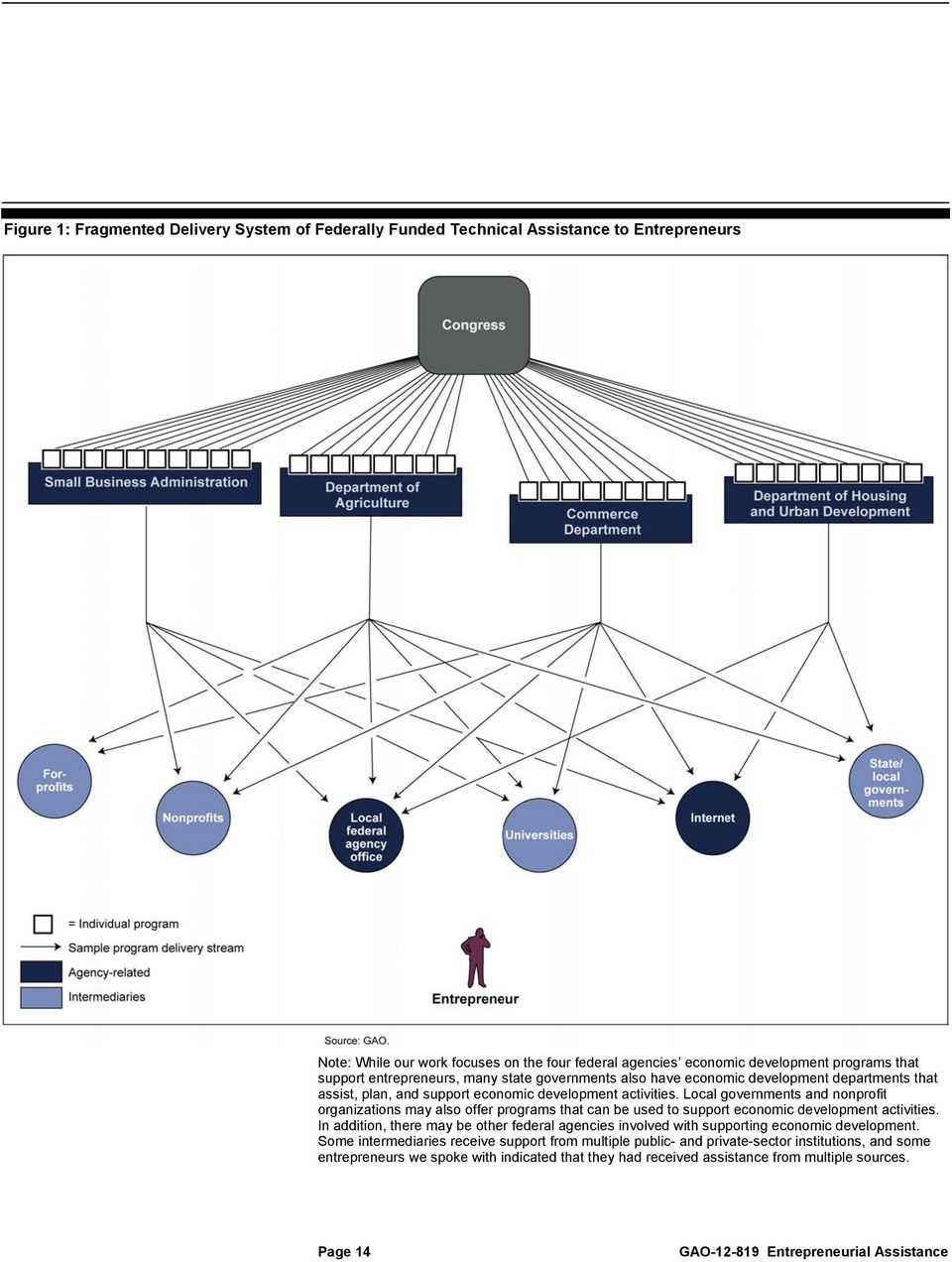
18 Some Entrepreneurs Struggle to Navigate Technical Assistance Programs As previously discussed, 35 programs distributed across the four agencies provide technical assistance, including business training and counseling. While the existence of multiple programs in and of itself is not a problem, the delivery system of these fragmented and overlapping technical assistance programs contains many components (see fig. 1). Several entrepreneurs and various technical assistance providers with whom we spoke including agency field offices, intermediaries, and other local service providers told us that the system can be confusing and that some entrepreneurs do not know what services are available or where to go for assistance. As discussed earlier, federal funds typically flow from the federal agencies to different eligible intermediaries, which are thirdparty entities that receive federal funds, such as nonprofits or universities. These intermediaries in turn may provide technical assistance to entrepreneurs by, for example, helping them to develop a business plan or put together a loan package to obtain financing. For instance, SBA s Women s Business Center and Commerce s Minority Business Center programs can provide technical assistance through different intermediaries, such as the Arkansas Women s Business Center and the University of Hawaii. Although intermediaries are the primary providers of technical assistance, agency field offices may also provide some technical assistance. For example, USDA s Rural Development state offices may provide advice on how to complete their respective grant applications. SBA s district offices may also discuss the different business structures available. Page 13

19 Figure 1: Fragmented Delivery System of Federally Funded Technical Assistance to Entrepreneurs Note: While our work focuses on the four federal agencies economic development programs that support entrepreneurs, many state governments also have economic development departments that assist, plan, and support economic development activities. Local governments and nonprofit organizations may also offer programs that can be used to support economic development activities. In addition, there may be other federal agencies involved with supporting economic development. Some intermediaries receive support from multiple public- and private-sector institutions, and some entrepreneurs we spoke with indicated that they had received assistance from multiple sources. Page 14
20 Technical assistance providers sometimes attempt to help entrepreneurs navigate the system by referring them to other programs, but these efforts are not consistently successful. Some of these providers told us that they assess the entrepreneur s needs to determine whether to assist them or refer them to another entity that could provide the assistance more effectively. For example, if an 1890 Land Grant intermediary were not able to assist an entrepreneur, it might refer the entrepreneur to SBA, USDA, or a local provider. However, such referrals are not always successful. For example, an entrepreneur we spoke with described a case in which he needed assistance with developing a business plan but was unable to receive this assistance, even after several referrals. Some technical assistance providers that we spoke with either did not appear to fully understand other technical assistance programs or thought that others did not fully understand their programs. For example, one technical assistance provider told us that some technical assistance providers were focused on more established businesses, but when we reached out to some of these providers, they said they served all entrepreneurs. This lack of understanding could prevent providers from making helpful referrals and leveraging other programs and limit the effectiveness of the programs. In addition, programs Internet resources can also be difficult to navigate. Each agency has its own separate website that provides information to entrepreneurs, but they often direct entrepreneurs to other websites for additional information. For example, the SBA website directs users to another website that lists the Small Business Development Centers, which then directs users to another website that provides some information on the centers available services. SBA, Commerce, USDA, and other agencies have recently collaborated to develop a joint website called BusinessUSA with the goal of making it easier for businesses to access services. However, the site was not fully operational as of June 2012, and none of the entrepreneurs and almost all the technical assistance providers we spoke with were not yet aware of it. As of June 2012, this website listed a number of potential technical assistance programs across different federal agencies with links to the programs websites. Some technical assistance providers and entrepreneurs suggested that a single source to help entrepreneurs quickly find information instead of sorting through different websites would be helpful. Page 15
21 Agencies Collaboration Has Been Limited Enhanced collaboration between agencies could potentially address some of the difficulties entrepreneurs experience and improve program efficiency. In prior work we identified practices that can help to enhance and sustain collaboration among federal agencies, which can help to maximize performance and results, and have recommended that the agencies follow them. 22 These collaborative practices include identifying common outcomes, establishing joint strategies, leveraging resources, determining roles and responsibilities, and developing compatible policies and procedures. In addition, GPRAMA requires agencies to describe in annual performance plans how they are working with other agencies to achieve their performance goals and relevant federal government performance goals. 23 The agencies have taken initial steps to improve how they collaborate to provide technical assistance to entrepreneurs by, for example, entering into formal agreements with each other, but they have not pursued a number of other good collaborative practices we have previously identified, as the following examples illustrate: USDA and SBA entered into a formal agreement in April 2010 to coordinate their efforts aimed at supporting businesses in rural areas. In April 2011, USDA began to survey its state offices to help the agency gauge the level of collaboration between its field staff and SBA, as well as to identify additional opportunities to enhance collaboration. However, the agencies business development programs that can support start-up businesses USDA s Rural Business Enterprise Grant and SBA s Small Business Development Centers have yet to determine roles and responsibilities, find ways to leverage each other s resources, or establish compatible policies and procedures to collaboratively support rural businesses. The Appalachian Regional Development Initiative is a formal agreement, which began in November 2010, among the Appalachian Regional Commission (which coordinates economic development activities in the Appalachian region), the four agencies, and other 22 GAO Pub. L. No , 124 Stat (2011). Page 16
22 agencies. 24 This agreement is intended to strengthen and diversify the Appalachian economy through better deployment and coordination of federal resources. According to officials at the Appalachian Regional Commission, the agencies did participate in a joint workshop to present the locally available resources from business development to infrastructure in the fall 2011, and USDA is one of its stronger partners. However, the agencies have not established joint strategies, determined roles and responsibilities, or developed compatible policies and procedures for carrying out the common outcomes outlined in their agreements at the local level where technical assistance is provided. In August 2011 SBA and the Delta Regional Authority (which coordinates economic development activities in the Delta region) entered into a formal agreement to better deploy and coordinate 25 resources for small businesses located in the Delta region. As part of this agreement, in April 2012 the two entities announced a joint effort to launch an program to support entrepreneurs called Operation JumpStart. Operation JumpStart is designed as a hands-on, microenterprise development program that is intended to help entrepreneurs test the feasibility of their business ideas and plan to launch new ventures. However, their effort thus far has been limited. While they entered into a formal agreement to launch the program, this agreement did not include any determinations of specific roles and responsibilities or establish compatible policies and procedures to collaboratively support these small businesses. In June 2011, the President created the White House Rural Council to promote economic prosperity in rural areas. It is chaired by the Secretary of Agriculture and includes HUD, Commerce, SBA, and other agencies. The council is working to better coordinate federal programs in order to maximize the impact of federal investment in rural areas. Even though the council has announced a number of initiatives, such as helping rural small businesses access capital, the 24 The Appalachian region is made up of 420 counties in parts of 12 states Alabama, Georgia, Kentucky, Maryland, Mississippi, New York, North Carolina, Ohio, Pennsylvania, South Carolina, Tennessee, and Virginia as well as all of West Virginia. 25 The Delta region is made up of 252 counties and parishes in parts of eight states Alabama, Arkansas, Illinois, Kentucky, Louisiana, Mississippi, Missouri, and Tennessee. Page 17
23 agencies have yet to implement many of our other good collaborative practices. In addition, while most of these agencies at the headquarters level have agreed to work together by signing formal agreements to administer some of their similar programs, the agencies generally have yet to develop compatible guidance to implement these agreements in the field. As noted previously, some intermediaries we spoke with that provide technical assistance through agency programs collaborate by referring entrepreneurs to other federal programs and agencies that they believe may better meet their needs. However these efforts are inconsistent and do not always result in entrepreneurs obtaining the services they are seeking. OMB and the four agencies also have recently taken steps to implement GPRAMA, which requires them to coordinate better; however, implementation was still in the early phases as of May 2012 and had not yet affected how they administer their programs. Implementing additional good collaborative practices could improve how the federal government supports entrepreneurs by, for example, helping agencies make more useful referrals, meet more diverse needs of entrepreneurs, and present a more consistent delivery system to entrepreneurs: Collaborating agencies that agree upon roles and responsibilities can clarify who will do what, organize their joint and individual efforts, and facilitate coordinated decision making. This effort could help agencies not only initiate and sustain collaboration but also determine who is in the best position to support an entrepreneur based on the client s need, which could lead to more effective referrals. Because collaborating agencies bring different resources and capacities to their efforts, they can look for opportunities to leverage each other s resources, thus obtaining additional benefits that would not be available if they were working separately. Being able to leverage each other s resources could help agencies more effectively and efficiently support entrepreneurs because they may be able to meet more diverse needs by drawing on one another s strengths. Page 18
24 Compatible standards, policies, procedures, and data systems could help to sustain collaborative efforts. As agencies standardize, for example, procedures for supporting entrepreneurs, they can more efficiently support entrepreneurs through more consistent servicedelivery methods across agencies and programs. This could be particularly helpful for entrepreneurs who are not familiar with the federal programs. In addition, GPRAMA s crosscutting framework requires that agencies collaborate in order to address issues such as economic development that transcend more than one agency, and GPRAMA directs agencies to describe how they are working with each other to achieve their program goals. As discussed previously, without more substantial collaboration, the delivery of service to entrepreneurs, particularly those who are unfamiliar with federal economic development programs, may not be as effective and efficient as possible. Agencies Lack Information to Track Program Activities and Measure Performance Agencies do not maintain information in a way that would enable them to track activities for most of their programs. Further, the agencies lack information on why some programs have failed to meet some or all of their goals. While information from program evaluations can help measure program effectiveness, agencies have conducted evaluations of only 20 of the 52 active programs since Agencies Do Not Maintain Information to Enable Tracking of Activities for Most Programs While the four agencies collected at least some information on program activities in either an electronic records system or through paper files, most were unable to summarize the information in a way that could be used to help administer the programs. Promising practices of program administration that we have identified include a strong capacity to collect and analyze accurate, useful, and timely data. 26 According to OMB, being able to track and measure specific program data can help agencies diagnose problems, identify drivers of future performance, evaluate risk, support collaboration, and inform follow-up actions. Analyses of patterns 26 Harold I. Steinberg, Using Performance Information to Drive Performance Improvement, Association of Government Accountants CPAG Research Series: Report No. 29 (Alexandria, VA: Dec. 2011). Page 19
25 and anomalies can also help agencies discover ways to achieve more value for the taxpayer s money. In addition, agencies can use this information to assess whether their specific program activities are contributing as planned to the agency goals. In addition, government internal control standards state that agencies should promptly and accurately record transactions to maintain their relevance and value for management decision making. Furthermore, this information should be readily available for use by management and others so that they can carry out their duties with the goal of achieving all of their objectives, including making operating decisions and allocating resources. 27 This guidance calls for agencies to go beyond merely collecting information, stating that they should systematically analyze, or track, it over time to inform decision making. For example, the agencies could track this information to identify trends on how the programs are being used in different areas of the country. This information could help the agencies strategically target program resources to support the unique needs in each geographic area. All four agencies collect program information but do not track detailed, readily available information for most programs, such as the type of technical assistance that their programs provide or fund, which is necessary to effectively administer their programs. For example, Commerce s Economic Adjustment Assistance, HUD s Section 4 Capacity Building, SBA s PRIME, and USDA s Rural Business Opportunity Grant Program can all support a broad range of technical assistance to various types of entrepreneurs, but agencies are unable to provide information on the types of services provided that would be necessary to compare activities across programs. Similarly, the agencies typically do not track detailed information on the characteristics of entrepreneurs that they serve, such as whether they are located in rural or economically distressed areas or the entrepreneurs type of industry. Most of the agencies collect detailed information on several of their programs in a way that could potentially help them more efficiently administer their programs, as the following examples illustrate: 27 GAO/AIMD Page 20
26 SBA collects detailed information on the type of technical assistance provided and type of entrepreneur served for 5 of its 10 technical assistance programs. SBA categorizes the types of technical assistance it provides by 17 categories of training and counseling, such as helping a business develop its business plan. All of this information is maintained in an electronic database that is accessible by agency staff. For all of its programs, USDA collects detailed information on the industry of each of the entrepreneurs it supports. In addition, USDA collects detailed information (19 categories) on how entrepreneurs use proceeds, such as for working capital, provided through five of its financial assistance programs. USDA maintains this information in an electronic database, and officials stated that they can provide this type of detailed information upon request. For all eight of its technical assistance programs, Commerce collects information on the type of entrepreneur served and the entrepreneurs industry. While HUD tracked limited program information on the type of support it provides to entrepreneurs, the agency collects information on other program activities and uses it to monitor program compliance. HUD staff meet quarterly with the Secretary of HUD to discuss these program data and determine changes that should be made to improve how they carry out program activities. Table 1 summarizes the type of information that agencies maintain in a readily available format that could be tracked to help administer the programs. Page 21
27 Table 1: Programs that Can Support Entrepreneurs and Maintain Readily Available Information, by Agency Type of technical assistance provided? Industry entrepreneur is working in? 35 technical assistance programs Commerce (8) HUD (9) SBA (10) USDA (8) Total (35) yes no yes no Type of entrepreneur by targeted categories? a yes Type of financial assistance provided? no financial assistance programs Commerce (2) HUD (10) SBA (10) USDA (8) Total (30) yes no Use of proceeds? yes no Industry entrepreneur is yes working in? no Type of entrepreneur by yes targeted categories? no Source: GAO analysis of information provided by Commerce, HUD, USDA, and SBA. Note: This table is based on 50 of the 52 programs that can support entrepreneurs because we excluded the 2 SBA programs that only support government contracting assistance. Some of the 50 programs can provide both financial and technical assistance. a Targeted categories can include businesses in rural or economically distressed areas, disadvantaged businesses, or small businesses. Officials who administer these programs provided a number of reasons why they do not track detailed program information for all programs in a way that could be used for program administration purposes. For example, some officials stated they do not rely on program information with this level of detail to make decisions about their programs. As previously discussed, many of these programs are administered by intermediaries, and these intermediaries may maintain detailed information on the services they provide. Agencies do not always require the intermediaries to forward all of this detailed information to headquarters. Rather, an intermediary may, for example, submit data Page 22
28 summaries of the support they have provided during the reporting period in a narrative format a format that cannot be easily aggregated or analyzed. Other agency officials noted that this type of summary-level information they collect and maintain at headquarters is sufficient for their purposes and complies with OMB reporting guidelines. However, without tracking more detailed program information, such as the specific type of support provided and the entrepreneurs served, agencies may not be able to make informed decisions or identify risks and problem areas within their programs based on factors such as how entrepreneurs make use of program services or funding. Furthermore, agencies may not be able to understand the extent that their programs are serving their intended purposes. Some Programs Failed to Meet Their Goals Our review found that for fiscal year 2011, a number of programs that support entrepreneurs failed to meet some or all of their performance goals. Measuring performance allows organizations to track the progress they are making toward their goals and gives managers crucial information on which to base their organizational and management decisions. Leading organizations recognize that performance measures can create powerful incentives to influence organizational and individual behavior. Some of their good practices include setting and measuring performance goals. GPRAMA requires agencies to develop annual performance plans that include performance goals for an agency s program activities and accompanying performance measures. According to GPRAMA, these performance goals should be in a quantifiable and measurable form to define the level of performance to be achieved for program activities each year. The agencies should also be able to identify which external factors might affect goal accomplishment and explain why a goal was not met. Such plans can help to reinforce the connection between the long-term strategic goals outlined in their strategic plans and the day-to-day activities of their managers and staff. We found that of the 33 programs that support entrepreneurs and set goals, 19 did not meet any of their goals or only met some of their goals Page 23
29 (see table 2). 28 These programs include Commerce s Economic Development/Support for Planning Organizations, HUD s Indian Community Development Block Grant, SBA s 504 loan, and USDA s Rural Business Opportunity Grant programs. Appendix III provides more information on fiscal year 2011 goals and accomplishments for each program that has goals and accomplishment data available. Table 2: Accomplishment Data for 33 Programs that Support Entrepreneurs and Set Goals, Fiscal Year 2011 Programs that did not meet goals Programs that met some goals Programs that met all goals Commerce HUD SBA USDA Total Source: GAO analysis of data from Commerce, HUD, SBA, and USDA. Note: Two programs have goals but did not have goal accomplishment information. Goal accomplishment information for HUD s Section 4 Capacity Building for Affordable Housing and Community Development program is unknown because HUD did not provide goal accomplishment information. Goal accomplishment information for USDA s Small Business Innovation Research program is not available because the program goals are based on 2-year time periods and the current period has not yet ended. Agency officials provided a number of reasons why they thought these programs did not meet their goals, including that the goals were estimates and program funding was lower than anticipated. In addition, some agency officials could not identify any causes for the failure to meet goals nor had they attempted to determine the specific reasons for the failures. 28 Nineteen programs did not have fiscal year 2011 performance goals: HUD s CDBG Insular Areas, CDBG Entitlement, CDBG States, CDBG Non-entitlement Grants in Hawaii, Section 108, CDBG Disaster Recovery, Rural Innovation Fund, Hispanic Serving Institutions Assisting Communities, and Alaska Native/Native Hawaiian Institutions Assisting Communities; SBA s PRIME, Small Business Innovation Research, Small Business Technology Transfer, New Markets Venture Capital, and Federal and State Technology Partnership programs; and USDA s Small Socially-Disadvantaged Producer Grants, 1890 s Land Grants Institutions, Agriculture Innovation Center, Biomass Research and Development Initiative, and Woody Biomass Utilization Grants. While the agencies are not required to have goals for each program, agency officials said that 6 of the 19 programs did not have goals because they were either temporary, were not funded, or were marked for elimination by agencies. One of the 19 programs that did not meet its goals was not funded in fiscal year Page 24
30 Programs that are failing to meet performance goals without a clear understanding of the reasons could result in agencies not being able to identify and address specific parts of programs that may not be working well. Additionally, without more detailed data on the activities of individual intermediaries, determining which of these third-parties are effectively administering these programs and helping meet program goals is difficult. Making decisions without this information could result in scarce resources being directed away from programs, or intermediaries, that are effective and towards those that are not meeting their objectives or struggling to meet their objectives. Agencies Have Not Evaluated the Majority of Programs That Support Entrepreneurs Over the past 12 years, agencies have conducted program evaluations of 20 of the 52 programs that support entrepreneurs. 29 Most of these 20 programs were evaluated once in the past decade. The studies that were conducted focus on a variety of areas, including customer satisfaction and the programs economic impacts, and report an array of findings related to the effectiveness of the programs. For example, some evaluations reported the actual number of jobs produced as a result of program investments, while one evaluation reported that programs were more useful for larger firms than smaller firms. Some of the differences among the findings are tied to the varying questions the studies sought to answer and the methods that were used to answer them. The questions and methods employed are typically informed by the organization s purpose for pursuing these studies. These purposes could include, for example, assessing program impact, identifying areas for improvement, or guiding resource allocation. Figure 2 describes the scope of each program evaluation and the findings related to program effectiveness. Appendix V provides more information on each program evaluation. 29 We reviewed the methodologies of these studies to ensure they were sound and determined they were sufficiently reliable to report high-level findings related to the programs overall effectiveness. Page 25
31 Figure 2: Evaluations of Programs that Support Entrepreneurs, Page 26
32 Although GPRAMA does not require agencies to conduct formal program evaluations, it does require agencies to describe program evaluations that were used to establish or revise strategic goals as well as program evaluations they plan to conduct in the future. Additionally, while not required, agencies can use periodic program evaluations to complement ongoing performance measurement. Program evaluations that systematically study the benefits of programs may help identify the extent to which overlapping and fragmented programs are achieving their objectives. In addition, program evaluations can help agencies determine reasons why a performance goal was not met and give an agency direction on how to improve program performance. For instance, 8 of the 33 programs that were not evaluated by the administering agency failed to meet all of their performance goals. Performance evaluations could have helped agencies understand why these programs goals were not met. Further, program evaluations, which examine a broader range of information than is feasible on an ongoing basis through performance measures, can help assess the impact and effectiveness of a program. 30 While many of the agencies agree that performance evaluations can add value, some stated that they have limited funds and cannot afford performance evaluation studies. Other agency officials stated that they are not allowed to use program funds for evaluation. For example, USDA officials stated that they are not allowed to use program funds to study the effectiveness of the Small Business Innovation Research program. While program evaluations can be expensive, there are various methods that agencies can employ to make them more cost-effective. For example, agencies could conduct a program evaluation that relies on their own data to prevent them from purchasing data from a vendor. 31 Without periodic program evaluations, the agencies ability to manage programs effectively and efficiently may be limited. Program evaluations can also potentially help agencies understand why some programs have failed to meet some or all of their goals, as previously discussed. Moreover, without this type 30 GAO, Program Evaluation: Studies Helped Agencies Measure or Explain Program Performance, GAO/GGD (Washington, D.C.: Sept. 29, 2000). 31 In July 2007, we recommended that SBA further utilize the loan performance information it already collects to better report how small businesses fare after they participate in the 7(a) program. While SBA agreed with the recommendation, the agency has not implemented it. See GAO, Small Business Administration: Additional Measures Needed to Assess 7(a) Loan Program s Performance, GAO (Washington, D.C.: Jul. 13, 2007). Page 27
33 of information, Congress and the agencies may not be able to better ensure that scarce resources are being directed to the most effective programs and activities. Conclusions In order to support entrepreneurs, federal economic development programs must be efficient and accessible to the people they are intended to serve. However, navigating these overlapping and fragmented programs can be an ongoing challenge for some entrepreneurs. While the agencies have a number of interagency agreements in place, our review found that agency field staff do not consistently collaborate and may not be able to help entrepreneurs navigate the large number of programs available to them. We have identified practices that can help to support collaboration among federal agencies and programs. In addition, greater collaboration is one way agencies can help overcome overlap and fragmentation among programs within and across agencies. Moreover, without enhanced collaboration and coordination, agencies may not be able to make the best use of limited federal resources and may not reach their intended beneficiaries in the most effective and efficient manner. In addition, given the number of federal programs focused on supporting entrepreneurs, agencies need specific information about these programs to best allocate limited federal resources and make decisions about better administering and structuring the programs. In our February 2012 report on duplication, overlap, and fragmentation, we expected to recommend that Congress tie funding to program performance and that OMB and the agencies explore opportunities to restructure programs through such means as consolidation or elimination. However, decisions about funding and restructuring would be difficult without better performance and evaluation information. Thus, making these recommendations would be premature until the agencies address a number of deficiencies. Specifically, agencies typically do not collect information that would enable them to track the services they provide and to whom they provide those services. This practice is not consistent with government standards for internal controls. Without such information, the agencies may not be able to administer the programs in a way that will result in the most efficient and effective federal support to entrepreneurs. Moreover, most of the programs that set goals did not meet them or only met some of them, and agency officials could not always identify reasons why program goals were not met. Additionally, many of these programs have not been evaluated in 10 years or more. GPRAMA requires Page 28
34 agencies to set and measure annual performance goals, and recognizes the value of program evaluations because they can help agencies assess programs effectiveness and improve program performance. Agencies lack of understanding of why programs have failed to meet goals may limit decision makers ability to understand which programs are most effective and allocate federal resources accordingly. Recommendations To help improve the efficiency and effectiveness of federal efforts to support entrepreneurs, we make the following recommendations: The Director of the Office and Management and Budget, the Secretaries of the Departments of Agriculture, Commerce, and Housing and Urban Development, and the Administrator of the Small Business Administration should work together to identify opportunities to enhance collaboration among programs, both within and across agencies. The Secretaries of the Departments of Agriculture, Commerce, and Housing and Urban Development, and the Administrator of the Small Business Administration should consistently collect information that would enable them to track the specific type of assistance programs provide and the entrepreneurs they serve and use this information to help administer their programs. The Secretaries of the Departments of Agriculture, Commerce, and Housing and Urban Development, and the Administrator of the Small Business Administration should conduct more program evaluations to better understand why programs have not met performance goals and their overall effectiveness. Agency Comments and Our Evaluation GAO provided a draft of this report to OMB, Commerce, HUD, SBA, and USDA for review and comment. We also provided excerpts of appendix IV to all of the agencies with programs listed for their review. Commerce, HUD, and USDA provided written comments. Commerce, HUD, and SBA also provided technical comments, which were incorporated where appropriate. OMB did not provide comments on the draft report. All written comments are reprinted in appendixes VI, VII and VIII. The Acting Secretary of Commerce stated that we may wish to consider the complementary role many agencies play in the field of economic development and the need for varied but complementary activities to Page 29
35 address the complexities of entrepreneurs. She commented that what may appear as duplication at a higher level is in reality a portfolio of distinct services meeting unique needs. Our report notes that in some instances it may be appropriate for multiple agencies or entities to be involved in the same programmatic or policy area due to the nature or magnitude of the federal effort. We found that many of the 52 programs we examined overlap in terms of statutory authority; our report does not state that duplication exists among these programs. However, we found that most of these agencies were not able to provide programmatic information, such as data on users of the programs that is necessary to determine whether or not duplication actually exists. The Acting Secretary also stated that federal agencies do successfully collaborate and forge policy partnerships, and noted that EDA plays a key role in leading and shaping federal policy for fostering collaborative regional economic development. As noted in our report, Commerce, HUD, SBA, and USDA have taken initial steps to improve how they collaborate to provide technical assistance to entrepreneurs and cites specific examples of these collaborative efforts. However, GAO found that the four agencies, including Commerce, have not pursued a number of other good collaborative practices we have previously identified. For example, our report states that the White House Rural Council, comprised of Commerce and other federal agencies, is working to better coordinate federal programs in order to maximize the impact of federal investment in rural areas. Although the council has announced a number of initiatives, such as helping rural small businesses access capital, we found that the agencies have yet to implement many of our other good collaborative practices such as developing compatible guidance to implement interagency agreements. For example, we found that while most of these agencies at the headquarters level have agreed to work together by signing formal agreements to administer some of their similar programs, the agencies generally have yet to develop compatible guidance to implement these agreements in the field. Finally, the Acting Secretary stated that EDA agrees with our report s focus on the need for more specific information tracking and more frequent performance evaluation. She noted that EDA has established performance measures for each of its programs, and that these performance measures were subject to thorough review and validation procedures. She also noted that EDA routinely conducts evaluations of its programs (often limited only by lack of resources). However, the Acting Secretary stated that efforts to monitor and track project progress seem to have been outside of the scope of our report, based on many of the Page 30
36 general statements made in the report about the need for additional work in this area. As previously stated, we found that most of the agencies were not able to provide programmatic information for programs that can support entrepreneurs. Our report also states that Commerce does collect information on the type of entrepreneur served and the entrepreneur s industry for all eight of its programs that can provide technical assistance; however, the report notes that Commerce does not collect information on the specific type of technical assistance provided to entrepreneurs for six of these eight programs information necessary to compare activities across programs. We provided summary information on evaluations conducted by the agencies in the report, including Commerce. We also found that Commerce, HUD, SBA, and USDA had not evaluated the majority of the 52 programs that can support entrepreneurs, including four of the eight programs Commerce administers. We concluded that program evaluations, when combined with efforts to collect information, can be a positive step toward greater understanding of programs effectiveness. HUD s Assistant Secretary for Public and Indian Housing expressed concern regarding our reference on the highlights page of the report to the Indian CDBG program as one of 19 economic development programs that failed to meet their entrepreneurial performance goals. She stated that the entire program may be unfairly perceived as ineffective as a result of this statement. Our report states that 33 of 52 programs we examined set goals related to entrepreneurial assistance and that 19 of these 33 programs did not meet any of their goals or only met some of their goals. Our report does not state that these 19 programs were ineffective. We added language on the highlights page of the report to clarify that our findings were only based on each program s goals related to entrepreneurial assistance. The Assistant Secretary also stated that our report misrepresents the Indian CDBG program as an economic development program. She noted that while economic development is an eligible program activity, only 3 percent of the dollars awarded under the program since 2005 funded economic development activities. She further noted that most of the program s grants were used for community development activities, such as building community buildings, developing infrastructure of various types, and rehabilitating housing units on Indian lands. As noted in our report, the 52 programs we examined for this report typically fund a variety of activities in addition to supporting entrepreneurs. In addition, the report notes that most of these programs either target or exclusively serve particular types of businesses. Page 31
37 The Assistant Secretary noted that an independent evaluation of the Indian CDBG program was conducted in HUD had not previously provided us with this evaluation. We revised our report to state that the Indian CDBG program had been evaluated within the past 12 years. Finally, the Assistant Secretary stated that HUD supports efforts to accurately measure the performance of its programs. She noted that HUD s Office of Native American Programs had recognized limitations in its method of projecting and measuring performance in the Indian CDBG program. She also stated that the office had begun drafting a revised form to be used at grant application and grant closeout to better collect performance measurement data, and that the office was examining its data collection procedures as well as the methodology used to establish program targets. These actions are consistent with our recommendation that the agencies collect program information and use it to help administer their programs. USDA s Under Secretary for Rural Development stated that he agreed with our report s statements that entrepreneurs play a vital role in the U.S. economy and that no duplication exists among federal programs that assist entrepreneurs. However, he disagreed with some of the other observations in our report. First, he stated that our report broadly portrays federal programs that assist entrepreneurs and does not highlight the unique characteristics of each agency, such as USDA s Rural Development s specialization in rural economic development and its network of state and local area offices. Our report notes that most of USDA s 13 programs that can support entrepreneurs are limited to areas with a rural statutory definition. We also include discussion based on our outreach to participants in rural economic development, including regional commissions and authorities, on their experiences with the four federal agencies in rural economic development efforts. More importantly, however, when considering the unique characteristics of the various programs, we emphasize the need for agencies to conduct program evaluations to assess effectiveness. While the Under Secretary suggests that the rural focus and the network of state and local area offices enhance program effectiveness, USDA has not conducted evaluations to support this conclusion. Second, USDA s Under Secretary stated that our report highlights examples where entrepreneurs may be eligible for multiple federal programs based on an entrepreneur s specific characteristics, but that the report does not mention whether this was a pervasive or problematic issue. He stated that rural entrepreneurs may be eligible for multiple programs, and that a business s unique situation dictates which programs Page 32
38 best meets its needs. Again, our report emphasizes the need for evaluations to determine the relative effectiveness of different programs serving similar purposes. Third, regarding our findings related to the information agencies collect on program activities, the Under Secretary cited a number of tools that the Rural Business-Cooperative Service (RBS) uses to identify and improve the effectiveness of its programs. As noted in this report, we determined that USDA collected detailed information on the industry of each of the entrepreneurs it supports for all of its programs. In addition, we determined that USDA collected detailed information (19 categories) on how entrepreneurs use proceeds provided through 5 of its financial programs. However, we found that over the past 12 years USDA had conducted a program evaluation for only 1 of its 13 programs that can support entrepreneurs, including USDA programs that RBS does not administer. Finally, the Under Secretary stated that the recommendations in our report are not explicit, which makes it unclear how RBS would effectively address them. Our report does provide information on how agencies could address our recommendations. First, we recommended that OMB, Commerce, HUD, SBA, and USDA work together to identify opportunities to enhance collaboration among programs, both within and across agencies. Our report identifies several practices that can help agencies and their offices enhance and sustain collaboration, which include indentifying common outcomes, establishing joint strategies, leveraging resources, determining roles and responsibilities, and developing compatible policies and procedures, among others. Second, we recommended that Commerce, HUD, USDA and SBA consistently collect information that would enable them to track the specific type of assistance provided and the entrepreneurs they serve and use this information to help administer their programs. Our report identifies programs that Commerce, HUD, SBA, and USDA administer for which the agencies did and did not maintain information in a readily available format that could be tracked to help administer the programs. Finally, we recommended that Commerce, HUD, SBA, and USDA conduct more evaluations to better understand why programs have not met performance goals and their overall effectiveness. Our report acknowledges that program evaluations can be costly; however, the report also notes that there are various methods agencies can employ to make the evaluations more costeffective, such as relying on their own data instead of purchasing data from a vendor. Page 33
39 We are sending copies of this report to the appropriate congressional committees and other interested parties. In addition, this report will be available at no charge on the GAO website at Should you or your staff have any questions concerning this report, please contact William B. Shear, at (202) , or Contact points for our Offices of Congressional Relations and Public Affairs may be found on the last page of this report. Key contributors to this report are listed in appendix I. William B. Shear Director Financial Markets and Community Investments Page 34
40 List of Congressional Committees The Honorable Debbie Stabenow Chair The Honorable Pat Roberts Ranking Member Committee on Agriculture, Nutrition, and Forestry United States Senate The Honorable Kent Conrad Chairman The Honorable Jeff Sessions Ranking Member Committee on the Budget United States Senate The Honorable Barbara Boxer Chair The Honorable James M. Inhofe Ranking Member Committee on Environment and Public Works United States Senate The Honorable Mary Landrieu Chair The Honorable Olympia J. Snowe Ranking Member Committee on Small Business and Entrepreneurship United States Senate The Honorable Mark Warner Chairman Task Force on Government Performance Committee on the Budget United States Senate The Honorable Paul Ryan Chairman The Honorable Chris Van Hollen Ranking Member Committee on the Budget House of Representatives Page 35
41 The Honorable Spencer Bachus Chair The Honorable Barney Frank Ranking Member Committee on Financial Services House of Representatives The Honorable Darrell E. Issa Chair The Honorable Elijah Cummings Ranking Member Committee on Oversight and Government Reform House of Representatives The Honorable Sam Graves Chair The Honorable Nydia Velazquez Ranking Member Committee on Small Business House of Representatives The Honorable Timothy V. Johnson Chairman Subcommittee on Rural Development, Research, Biotechnology, and Foreign Agriculture Committee on Agriculture House of Representatives Page 36
42 Appendix I: Scope and Appendix I: Objectives, Scope and Methodology Methodology This report discusses (1) the extent of overlap, fragmentation, and duplication and their effects on entrepreneurs, and agencies actions to address them; and (2) the extent to which agencies collect information necessary to track program activities and whether these programs have met their performance goals and been evaluated. To determine the extent of overlap and fragmentation among federal programs that fund economic development activities, we focused our analyses on 52 programs administered by the Departments of Agriculture (USDA), Commerce, and Housing and Urban Development (HUD) and the Small Business Administration (SBA) that are authorized to support entrepreneurs. Based on past work, these programs appeared to overlap the most within the four agencies with missions focused on economic development. We reviewed the statutes and regulations that authorize the activities that can be conducted under each program. We categorized the types of activities into three categories: (1) technical assistance, (2) financial assistance, and (3) government contracting assistance. Many of the programs can provide more than one type of assistance, and most focus on technical assistance, financial assistance, or both. To identify the effects of overlap and fragmentation on entrepreneurs and agencies actions to address them, we focused on 35 of the 52 programs that provide technical assistance because there was significant overlap and fragmentation among these programs. We reviewed agency documents, such as inter-agency agreements, and conducted interviews to determine how technical assistance is provided to entrepreneurs, including the extent of agency collaboration at the local level. More specifically, we interviewed technical assistance providers, including 14 federal agency officials from four federal agencies located in the field, nine officials from two regional commissions, and 14 representatives of intermediaries (that is, third-party technical assistance providers); four entrepreneurs who have received assistance federal support; and five state and local partners in three geographic areas. These geographic areas included both urban and rural areas. We selected geographic areas based on, the presence of an active regional commission and evidence of collaboration among at least two of the four federal agencies being located within the same region. We assessed this technical assistance information against promising collaborative practices that we have previously identified. 1 1 GAO, Results-Oriented Government: Practices That Can Help Enhance and Sustain Collaboration among Federal Agencies, GAO (Washington, D.C.: Oct. 21, 2005). Page 37
43 Appendix I: Objectives, Scope and Methodology To determine the extent to which agencies collect information necessary to track program activities, we reviewed agency manuals and data collection forms that describe information collected on program activities and methods for analyzing and using the information. Specifically, we assessed each agency s capacity to track specific types of entrepreneurial assistance they provided to specific types of beneficiaries, as well as their ability to report this information in a readily available format at the program level. We compared these processes against standards for internal controls we have previously identified to determine how well agencies track the support they provide to entrepreneurs. 2 To determine the extent to which these 52 economic development programs have met their performance goals, we reviewed agency documents on their fiscal year 2011 program goals and accomplishments. We also interviewed agency officials to determine reasons why goals were not met (see app. III). To describe results from program evaluations related to the effectiveness of the 52 economic development programs that we reviewed, we requested all studies that have been conducted on these programs from the four agencies that administer the programs. Our document request resulted in 19 studies. We refined the list of 19 studies by choosing to focus on studies that were published in or after The resulting list of program evaluations totaled 16. Because some evaluations studied more than one program, these 16 evaluations covered 20 of the 52 programs in our review. We reviewed the methodologies of these studies to ensure that they were sound and determined that they were sufficiently reliable for our purpose, which was to report high-level findings related to the program s overall effectiveness (see app. V). Other evaluations of these programs may exist. To provide illustrative examples of each of the nine economic activities related to economic development that we previously identified (see app. II), we conducted a review of the literature that has been published in the past 2 GAO, Standards for Internal Control in the Federal Government, GAO/AIMD (Washington, D.C.: Nov. 1999). Page 38
44 Appendix I: Objectives, Scope and Methodology 5 years. 3 This review included publications from a variety of sources, including academic journals and trade publications. These sources contained examples of how these economic activities were being conducted at the national, state, and local levels in the United States. The list of examples we developed is not meant to be comprehensive but is intended to provide a range of economic activities that could be funded by federal programs. We also used these nine economic activities to identify additional federal programs that may be able to fund at least one of the activities (these programs are listed in app. IV). During previous reviews, we focused on federal programs at Commerce, HUD, SBA, and USDA because these agencies have missions focused on economic development. For this report, we identified additional federal programs that could fund the nine economic activities. While many of the agencies that administer these additional programs do not have missions that focus on economic development, their programs may be able to fund at least one of the nine economic activities. We reviewed information on all programs contained in the 2011 Catalog of Federal Domestic Assistance (CFDA) and 4 provided the list of programs to all of the administering agencies. This list of additional federal programs may not be comprehensive because not all agencies provide data to CFDA (see app. IV). 3 The nine economic activities are supporting entrepreneurial efforts, supporting business incubators and accelerators, constructing and renovating commercial buildings, constructing and renovating industrial parks and buildings, strategic planning and research, marketing and access to new markets for products and industries, supporting telecommunications and broadband infrastructure, supporting physical infrastructure, and supporting tourism. 4 We have previously identified incomplete or inaccurate data in the CFDA, but we chose to rely on it for our purposes in this report because it is the only source that contains information on programs from many different federal agencies. We did not assess the data reliability of the CFDA. OMB has compiled initial lists of agencies and programs that contribute to crosscutting goals, as required by GPRAMA, on performance.gov, including those related to the entrepreneurship and small business goal. However, OMB noted that this was not meant to be comprehensive of all programs with any contribution to the crosscutting goals, and that they are continuing to update these lists. Page 39
45 Appendix I: Objectives, Scope and Methodology We conducted this performance audit from June 2011 to July 2012 in accordance with generally accepted government auditing standards. Those standards require that we plan and perform the audit to obtain sufficient, appropriate evidence to provide a reasonable basis for our findings and conclusions based on our audit objectives. We believe that the evidence obtained provides a reasonable basis for our findings and conclusions based on our audit objectives. Page 40
46 Appendix II: Examples of Economic Appendix II: Illustrative Examples of Activities Economic Activities In September 2000, we reported that there is no commonly accepted definition for economic development. 1 Absent a common definition for economic development, we subsequently developed a list of nine activities most often associated with economic development. 2 In general, we focused on economic activities that directly affected the overall development of an area, such as job creation and economic growth, rather than on activities that improved individuals quality of life, such as housing and education. We previously relied on these economic activities to identify 80 economic development programs administered by the U.S. Departments of Agriculture (USDA), Commerce, and Housing and Urban Development (HUD) and the Small Business Administration (SBA) because these agencies have missions that focus on economic development. 3 In this report, we identified illustrative examples of each of the nine economic activities. Illustrative Examples of Economic Activities The following examples, which resulted from a review we conducted of academic journals and trade publications, illustrate a range of activities that could be supported by programs that can fund at least one of the economic activities. Examples include projects that are both publicly and privately funded, with many receiving funding from multiple sources in both sectors. They also had an explicit or implicit economic development goal, such as job creation or economic growth. 1. Supporting entrepreneurial efforts. This activity is the focus of this report, with programs grouped according to at least one of three types of assistance that address different entrepreneurial needs: help obtaining (1) technical assistance, which includes business training and counseling and research and development support; (2) financial assistance, which includes grants, loans, and venture capital; and (3) government contracts, which involves helping entrepreneurs qualify for federal procurement opportunities. Illustrative examples of this activity include the following initiatives: 1 GAO, Economic Development: Multiple Federal Programs Fund Similar Economic Development Activities, GAO/RCED/GGD (Washington, D.C.: Sept. 29, 2000). 2 GAO, Rural Economic Development: More Assurance Is Needed That Grant Funding Information Is Accurately Reported, GAO (Washington, D.C.: Feb. 24, 2006). 3 GAO SP, GAO R and GAO SP. Page 41
47 Appendix II: Illustrative Examples of Economic Activities Individuals in an Iowa community formed an association of entrepreneurs to provide a broad range of services to entrepreneurs, including technical assistance in the form of mentor counseling, training sessions on various topics, and hosting conferences. A California community provided both financial and technical support to local small businesses in order to redevelop a business district. Businesses received micro-grants small grants of $5,000 each and were also required to participate in free workshops designed to give them additional tools and resources to succeed in a challenging marketplace. These workshops were produced by an SBA-funded Small Business Development Center. Iowa provided financial assistance to entrepreneurs through loan guarantees and a publicly funded limited liability corporation that could coordinate venture capital investments. The initiative was designed to increase capital levels and stimulate the creation of more local seed funds. 2. Supporting business incubators and accelerators. This activity can include all of the elements of entrepreneurial efforts, but combines these types of assistance with a facility that supports multiple businesses and may provide shared access to office space, technology, and other support services. Illustrative examples of this activity include the following initiatives: A technology business incubator was established at a Florida university so its faculty and service partners can provide business opportunities to client companies. The facility has grown to support a number of services to assist start-up businesses, including office and laboratory space, educational programs, and networking and mentoring opportunities with other experienced entrepreneurs. An Ohio community created a business accelerator that is designed to assist small, established companies, rather than businesses in their infancy, in becoming financially viable and creating jobs in the region. This facility includes office space, access to technology, and a variety of support services. The accelerator also collaborates with a center funded by SBA s Small Business Development Centers program and a local community college, which provide coaching and mentoring sessions, Page 42
48 Appendix II: Illustrative Examples of Economic Activities business plan reviews, workshops, training, referrals, and assistance in obtaining capital. An economic development organization in Pennsylvania created a network of business incubators and accelerators focused on developing and commercializing technology to create high-paying, sustainable jobs. The initiative supports early-stage and established companies with funding, support services, and a network of experts in related industries and academia. 3. Constructing and renovating commercial buildings. This activity can include support for the construction and renovation of buildings established for commercial purposes, such as for retail and office space. Illustrative examples of this activity include the following initiatives: A community in Iowa renovated a historic building that used to be a store to attract a large technology firm s service center. The renovations were designed to meet the firm s sustainability vision and were financed by public and private sources. A community in Arizona renovated a high school to create a new research laboratory. Further buildings were constructed in the area around this project to create a biomedical campus for both commercial and academic purposes. A community in Iowa renovated buildings in a historic millwork district to create urban mixed-use developments, which are designed to attract both commercial and residential activity. 4. Constructing and renovating industrial parks and buildings. This activity can include support for the construction and renovation of buildings and campuses established for industrial purposes, such as for manufacturing. Illustrative examples of this activity include the following initiatives: A public-private partnership in Nevada constructed an industrial park with new access to a freeway and energy infrastructure. The facility was zoned for heavy industry and designed to be away from population centers. A community in Massachusetts administered the transition of a former military base into a light industrial area focused on Page 43
49 Appendix II: Illustrative Examples of Economic Activities sustainable development and attracted both small and large firms to the redeveloped area. A public-private partnership in a North Carolina created several multi-jurisdictional business parks intended to improve local economies. These parks serve a number of industrial purposes, including technology, manufacturing, distribution, and logistics. Local governments obtained funding to conduct site evaluations and certification through Commerce s Economic Development Administration and HUD s Community Development Block Grant program. 5. Strategic planning and research. This activity includes plans for recruiting new businesses or industry clusters, economic research and analyses, and regional coordination and planning across jurisdictions and sectors. Illustrative examples of this activity include the following initiatives: Local officials in a southeastern state formed a regional economic development organization to better coordinate economic and workforce development. The organization engages in marketing and recruitment of businesses and fosters partnerships between various public- and private-sector entities in the region. A California community developed a plan for a business district to create jobs and produce savings for businesses. The plan defined resources, timeframes, and types of assistance needed to execute this strategy. A regional consortium operating in areas of two southern states conducted research on their area s economic strengths and developed an action plan to leverage these strengths. Research included the identification of industry clusters that could be well suited to the area. 6. Marketing and access to new markets for products and industries. This activity may include marketing of both new and existing products and industries, facilitating access to new markets, and supporting new uses for existing products. Illustrative examples of this activity include the following initiatives: A publicly funded regional technology center in New York provides a range of resources for local manufacturing and technology Page 44
50 Appendix II: Illustrative Examples of Economic Activities companies, including assistance with developing sales and growth strategies, conducting marketing activities for increased market share and revenue in existing or new markets, and identifying new customers and market niches. A regional economic development organization in North Carolina formed an energy industry cluster that included a bio-energy facility where businesses are colocated with a landfill. These businesses are able to sell what were formerly waste products in new markets, such as alternative fuels and wood pallets. Several southern and Midwestern states have leveraged federal and state funds to assist rural businesses with e-commerce strategies, including assistance reaching global markets and strengthening competitive market advantages. Both USDA and Commerce provided some funding for this initiative. 7. Supporting telecommunications and broadband infrastructure. This activity may include building, refurbishing, and enhancing infrastructure used to expand access and improve the speed and reliability of Internet access, wireless phone services, and other electronic communication methods. Illustrative examples of this activity include the following initiatives: A public-private partnership in a city in Ohio provides businesses and residents with an underground conduit network that supports multiple fiber-based systems for voice, data, and video communications, intended to provide high-speed access to the global marketplace. A multi-state rural regional development organization in the southwestern United States coordinated the construction of a broadband Internet network that was intended to generate new opportunities for economic development. The initiative was funded by both private and public investments and covered a large geographic area. Regional leaders collaborated with a state commission to expand broadband infrastructure to businesses, schools, and industrial parks in a Virginia city. The high-speed network is noted to be comparable to or faster than that of any other metropolitan area of the country, is available at a relatively low cost, and is intended to attract businesses to the area. Page 45
51 Appendix II: Illustrative Examples of Economic Activities 8. Supporting physical infrastructure. This activity includes constructing and repairing infrastructure related to (1) transportation, such as roads, airports and rail; (2) water and sewer; (3) energy; and (4) other amenities, such as pedestrian areas, parking, and beautification projects. Illustrative examples of this activity include the following initiatives: A community in New York is planning to renovate a business district by creating new rail service, a pedestrian mall, and green space. A community in Ohio renovated their underdeveloped downtown area by constructing better roads and pedestrian space, improving green space, and moving power lines underground. The project was part of a plan to reduce blight and make the area more accessible for visitors. A community in North Carolina renovated a vacant textile manufacturing space and downtown area to create a scientific research campus, facilitating this work through water line replacements, the addition of a pedestrian tunnel, and road improvements. 9. Supporting tourism. This activity includes marketing, infrastructure improvement, planning, and research specifically related to developing and improving tourism, as well as supporting special events and festivals to attract visitors. Illustrative examples of this activity include the following initiatives: A community in Kentucky improved trails in natural areas to attract tourists for horseback riding and other recreational uses. In addition to trail improvements, the community utilized survey research, marketing, and special events to draw visitors to the area. A community in North Carolina entered into public-private partnerships to construct a cluster of tourist venues that included sports and arts museums, an arena, convention center, and performing arts venues. The community utilized a strategic plan for development and a branded name to market the area. A county in Mississippi partnered with other regional entities to market their gaming industry and other amenities as part of a broader regional campaign. This new partnership promoted region-wide tourism and focused on key markets that the area may draw visitors from. Page 46
52 III: Performance Goals and Accomplishments 52 Programs that Can Support Entrepreneurs, Fiscal Year 2011 Appendix III: Performance Goals and Accomplishments for 52 Programs that Can Support Entrepreneurs, Fiscal Year 2011 Agency Commerce (Commerce) Economic Development Administration (EDA) c Commerce EDA Program Name and Mission Grants for Public Works and Economic Development Facilities Supports the construction or rehabilitation of essential public infrastructure and facilities necessary to support job creation, attract private-sector capital, and promote regional competitiveness, innovation, and entrepreneurship, including investments that expand and upgrade infrastructure to attract new industry, support technology-led development, accelerate new business development, and enhance the ability of regions to capitalize on opportunities presented by free trade. Grants for Public Works and Economic Development Facilities Obligations a Performance Measures $114,529,000 Private investment leveraged (3, 6, and 9 years after award) Total jobs created/retained (3, 6, and 9 years after award) Performance Goal Private investment leveraged 9 year totals (in millions): $1,940 Private investment leveraged 6 year totals (in millions): $674 Private investment leveraged 3 year totals (in millions): $244.6 Jobs created/retained 9 year totals: 57,800 Jobs created/retained 6 year totals: 18,193 Jobs created/retained 3 year totals: 6,256 Actual Performance b Private investment leveraged 9 year totals (in millions): $3,960 Private investment leveraged 6 year totals (in millions): $1,617 Private investment leveraged 3 year totals (in millions): $1,475 Jobs created/retained 9 year totals: 56,058 Jobs created/retained 6 year totals: 26,416 Jobs created/retained 3 year totals: 14,842 Met Individual Goals Yes Partial Met All Goals Partial Page 47
53 Appendix III: Performance Goals and Accomplishments for 52 Programs that Can Support Entrepreneurs, Fiscal Year 2011 Agency Commerce EDA Commerce EDA Commerce EDA Commerce EDA Program Name and Mission Economic Adjustment Assistance Supports economically distressed communities in their ability to compete economically by stimulating private investment and promoting job creation in targeted areas. Current investment priorities include proposals that foster innovation and enhance regions global economic competitiveness by supporting existing industry clusters, developing emerging new clusters, or attracting new regional economic drivers. Economic Adjustment Assistance Global Climate Change Mitigation Incentive Fund Supports economic development projects that create jobs through, and increase private capital investment in, efforts to limit the nation s dependence on fossil fuels, enhance energy efficiency, curb greenhouse gas emissions, and protect natural systems. The program helps to cultivate innovations that can fuel green growth in communities suffering from economic distress. Global Climate Change Mitigation Incentive Fund Obligations a Performance Measures $78,720,000 Private investment leveraged (3, 6, and 9 years after award) Total jobs created/retained (3, 6, and 9 years after award) $17,466,000 Private investment leveraged (3, 6, and 9 years after award) Total jobs created/retained (3, 6, and 9 years after award) Performance Goal Private investment leveraged 9 year totals (in millions): $1,940 Private investment leveraged 6 year totals (in millions): $674 Private investment leveraged 3 year totals (in millions): $244.6 Jobs created/retained 9 year totals: 57,800 Jobs created/retained 6 year totals: 18,193 Jobs created/retained 3 year totals: 6,256 Private investment leveraged 9 year totals (in millions): $1,940 Private investment leveraged 6 year totals (in millions): $674 Private investment leveraged 3 year totals (in millions): $244.6 Jobs created/retained 9 year totals: 57,800 Jobs created/retained 6 year totals: 18,193 Jobs created/retained 3 year totals: 6,256 Actual Performance b Private investment leveraged 9 year totals (in millions): $3,960 Private investment leveraged 6 year totals (in millions): $1,617 Private investment leveraged 3 year totals (in millions): $1,475 Jobs created/retained 9 year totals: 56,058 Jobs created/retained 6 year totals: 26,416 Jobs created/retained 3 year totals: 14,842 Private investment leveraged 9 year totals (in millions): $3,960 Private investment leveraged 6 year totals (in millions): $1,617 Private investment leveraged 3 year totals (in millions): $1,475 Jobs created/ retained 9 year totals: 56,058 Jobs created/ retained 6 year totals: 26,416 Jobs created/ retained 3 year totals: 14,842 Met Individual Goals Yes Partial Yes Partial Met All Goals Partial Partial Page 48
54 Appendix III: Performance Goals and Accomplishments for 52 Programs that Can Support Entrepreneurs, Fiscal Year 2011 Agency Commerce EDA Commerce EDA Commerce EDA Commerce EDA Commerce EDA Program Name and Mission Economic Development/Technical Assistance Provides focused assistance to public and nonprofit leaders to help in economic development decision making (e.g., project planning, impact analyses, feasibility studies). The program also supports the University Center Economic Development Program, which makes the resources of universities available to the economic development community. Economic Development/Technical Assistance Economic Development/Support for Planning Organizations Provides planning assistance to provide support to Planning Organizations (as defined in 13 CFR 303.2) for the development, implementation, revision, or replacement of a Comprehensive Economic Development Strategy, shortterm planning efforts, and state plans designed to create and retain higherskill, higher-wage jobs, particularly for the unemployed and underemployed in the nation s most economically distressed regions. Economic Development/Support for Planning Organizations Trade Adjustment Assistance (TAA) for Firms The program helps economically distressed U.S. businesses in building competitiveness strategies to increase Obligations a Performance Measures $13,373,000 Percentage of University Center clients taking action as a result of the assistance facilitated Percentage of those actions taken by University Center clients that achieved expected results $31,352,000 Percentage of economic development districts and Indian tribes implementing economic development projects from the comprehensive economic development strategy that lead to private investment and jobs Percentage of substate jurisdiction members actively participating in the economic development district program $15,418,000 Percentage of TAA Center clients taking action as a result of the assistance facilitated Performance Goal Actual Performance b Met Individual Goals Met All Goals 75% 68% No Partial 80% 83% Yes 95% 86% No No 89% 85% No 90% 73% No Partial Page 49
55 Appendix III: Performance Goals and Accomplishments for 52 Programs that Can Support Entrepreneurs, Fiscal Year 2011 Agency Commerce EDA Commerce Minority Business Development Agency (MDBA) Commerce MBDA Commerce MBDA Commerce MBDA Program Name and Mission exports and thereby create jobs. The program provides technical assistance to U.S. businesses that have lost sales and employment due to increased imports of similar or competitive goods and services. Technical assistance is provided through a nationwide network of eleven Economic Development Administration-funded Trade Adjustment Assistance Centers. Trade Adjustment Assistance for Firms Native American Business Enterprise Centers (NABEC) d The program promotes the growth and competitiveness of businesses owned by Native Americans and eligible minorities. NABEC operators leverage project staff and professional consultants to provide a wide range of direct business assistance services to Native American tribal entities and eligible minority-owned firms. NABEC services include, but are not limited to, initial consultations and assessments, business technical assistance, and access to federal and nonfederal procurement and financing opportunities. Native American Business Enterprise Centers Native American Business Enterprise Centers Minority Business Center (MBC) The program promotes the growth and competitiveness of eligible minorityowned businesses. MBC operators leverage project staff and professional Obligations a Performance Measures Percentage of actions taken by TAA Center clients that achieved expected results $0 Dollar value of contract awards obtained Performance Goal Actual Performance b 95% 100% Yes Met Individual Goals Met All Goals $1.1 billion $2.1 billion Yes Yes Dollar value of financial $0.9 billion $1.8 billion Yes awards obtained Number of jobs created 5,000 5,787 Yes $17,948,122 Dollar value of contract awards obtained $1.1 billion $2.1 billion Yes Yes Page 50
56 Appendix III: Performance Goals and Accomplishments for 52 Programs that Can Support Entrepreneurs, Fiscal Year 2011 Agency Commerce MBDA Commerce MBDA Housing and Urban Development (HUD) Program Name and Mission consultants to provide a wide range of direct business assistance services to eligible minority-owned firms. Services include initial consultations and assessments, business technical assistance, and access to federal and nonfederal procurement and financing opportunities. MBDA currently funds a network of 30 MBC projects located throughout the United States. Minority Business Center Obligations a Performance Measures Dollar value of financial awards obtained Performance Goal Actual Performance b $0.9 billion $1.8 billion Yes Minority Business Center Number of jobs created 5,000 5,787 Yes Community Development Block Grant (CDBG)/Insular Areas HUD annually allocates $7 million of CDBG funds to the Insular Areas program in proportion to the populations of the eligible territories. The program is administered by HUD s field offices in Puerto Rico and Hawaii. The CDBG programs allocate annual grants to develop viable communities by providing decent housing, a suitable living environment, and opportunities to expand economic opportunities, principally for low- and moderate-income persons. Met Individual Goals $ 214,396 e Jobs created and retained None 15,549 N/A N/A HUD CDBG/Insular Areas Businesses assisted None 24,331 N/A HUD CDBG/Entitlement Grants The CDBG program works to ensure decent affordable housing, to provide services to the most vulnerable in our communities, and to create jobs through the expansion and retention of businesses. The CDBG entitlement program allocates annual grants to larger cities and urban counties to $325,549,306 f Jobs created and retained None 15,549 N/A N/A Met All Goals Page 51
57 Appendix III: Performance Goals and Accomplishments for 52 Programs that Can Support Entrepreneurs, Fiscal Year 2011 Met Individual Goals Agency Program Name and Mission Obligations a Performance Measures Performance Goal Actual Performance b develop viable communities by providing decent housing, a suitable living environment, and opportunities to expand economic opportunities, principally for low- and moderate-income persons. HUD CDBG/Entitlement Grants Businesses assisted None 24,331 N/A HUD $559,961,961 g Jobs created and retained None 15,549 N/A N/A CDBG/States The primary statutory objective of the CDBG States program is to develop viable communities by providing decent housing, a suitable living environment, and opportunities to expand economic opportunities, principally for low- and moderate-income persons. The state must ensure that at least 70 percent of its CDBG grant funds are used for activities that benefit low- and moderateincome persons over a 1-, 2-, or 3-year time period selected by the state. HUD CDBG/States Businesses assisted None 24,331 N/A HUD CDBG/Non-entitlement CDBG Grants in $338,257 h Jobs created and retained None 15,549 N/A N/A Hawaii HUD continues to administer the program for the non-entitlement counties in the state of Hawaii because the state has permanently elected not to participate in the State CDBG program. The CDBG programs allocate annual grants to develop viable communities by providing decent housing, a suitable living environment, and opportunities to expand economic opportunities, principally for low- and moderate-income persons. HUD CDBG/Non-entitlement CDBG Grants in Hawaii Businesses assisted None 24,331 N/A Met All Goals Page 52
58 Appendix III: Performance Goals and Accomplishments for 52 Programs that Can Support Entrepreneurs, Fiscal Year 2011 Agency HUD HUD HUD Program Name and Mission CDBG/Section 108 Loan Guarantees Section 108 is the loan guarantee provision of the CDBG program. Section 108 provides communities with a source of financing for economic development, housing rehabilitation, public facilities, and large-scale physical development projects. It allows them to transform a small portion of their CDBG funds into federally guaranteed loans large enough to pursue physical and economic revitalization projects that can renew entire neighborhoods. CDBG/Brownfields Economic Development Initiative (BEDI) The purpose of the BEDI program is to spur the return of brownfields to productive economic use through financial assistance to public entities in the redevelopment of brownfields and enhance the security or improve the viability of a project financed with Section 108-guaranteed loan authority. CDBG Disaster Recovery Grants i Grantees may use CDBG Disaster Recovery funds for recovery efforts involving housing, economic development, infrastructure, and prevention of further damage to affected areas, if such use does not duplicate funding available from the Federal Emergency Management Agency, the Small Business Administration, and the U.S. Army Corps of Engineers. The mission and goals of the CDBG Disaster Recovery Grants program may be expanded or limited per the individual appropriation that it receives each year. Obligations a Performance Measures $6,000,000 Jobs proposed to be created or retained $0 Jobs proposed to be created or retained Met Individual Goals Met All Goals Performance Goal Actual Performance b None 7,306 N/A N/A 3,157 2,409 No No $0 Businesses assisted None N/A N/A N/A Page 53
59 Appendix III: Performance Goals and Accomplishments for 52 Programs that Can Support Entrepreneurs, Fiscal Year 2011 Agency Program Name and Mission Obligations a Performance Measures HUD CDBG Disaster Recovery Grants Permanent jobs created (tracked by low income, moderate income and total) HUD CDBG Disaster Recovery Grants Permanent jobs retained (tracked by low income, moderate income and total) HUD CDBG Disaster Recovery Grants Number of buildings (nonresidential) assisted HUD HUD HUD HUD HUD Section 4 Capacity Building for Affordable Housing and Community Development Through funding of national intermediaries, the Section 4 Capacity Building program enhances the capacity and ability of community development corporations and community housing development organizations to carry out community development and affordable housing activities and to attract private investment for housing, economic development, and other community revitalization activities that benefit low-income families. Section 4 Capacity Building for Affordable Housing and Community Development Section 4 Capacity Building for Affordable Housing and Community Development Section 4 Capacity Building for Affordable Housing and Community Development Rural Innovation Fund j The Rural Innovation Fund program was established to improve the quality of life for residents of distressed rural areas by supporting innovative and catalytic economic development and housing $50,000,000 Number of trainings created and provided to Community Development Corporations (CDC) Development cost estimates of community development projects funded by CDCs Number of homes renovated, preserved or newly constructed Efficiency measure of perunit cost of capacity building for housing units developed or renovated $0 k Number of full-time and part-time jobs created Performance Goal Actual Performance b None N/A N/A None N/A N/A None N/A N/A Met Individual Goals Met All Goals 794 Not reported Unknown Unknown $988 million Not reported Unknown 6,060 Not reported Unknown None N/A N/A None N/A N/A N/A Page 54
60 Appendix III: Performance Goals and Accomplishments for 52 Programs that Can Support Entrepreneurs, Fiscal Year 2011 Agency Program Name and Mission programs. The program is designed to support (1) job creation through business development and expansion, (2) investment in human capital through job training and education; and (3) expanding the supply of affordable housing with access to job centers or transportation. Rural Innovation Fund grantees are selected through a competitive process. Obligations a Performance Measures Performance Goal Actual Performance b Met Individual Goals HUD Rural Innovation Fund Number of persons None N/A N/A receiving job training HUD Rural Innovation Fund Number of new businesses None N/A N/A opened HUD Rural Innovation Fund Number of affordable None N/A N/A housing units constructed HUD Rural Innovation Fund Number of residents None N/A N/A receiving homeownership counseling HUD Hispanic-Serving Institutions Assisting Communities The Hispanic-Serving Institutions Assisting Communities program helps Hispanic-Serving Institutions expand their role and effectiveness in addressing community development needs in their localities, including revitalization, housing, and economic development, principally for persons of low and moderate income. Accredited Hispanic-Serving Institutions of higher education that provide 2- and 4-year degrees are eligible to participate in this program. For an institution to qualify as a Hispanic-Serving Institution, at least 25 percent of the undergraduate enrollment must be Hispanic students. $0 None N/A N/A N/A N/A Met All Goals Page 55
61 Appendix III: Performance Goals and Accomplishments for 52 Programs that Can Support Entrepreneurs, Fiscal Year 2011 Met Individual Goals Agency Program Name and Mission Obligations a Performance Measures Performance Goal Actual Performance b HUD Alaska Native/Native Hawaiian $0 None N/A N/A N/A N/A Institutions Assisting Communities The Alaska Native/Native Hawaiian Institutions program helps these institutions expand their role and effectiveness in addressing community development needs in their localities, including revitalization, housing, and economic development, principally for persons of low and moderate income. The program encourages colleges and universities to integrate community engagement themes into their curriculum, academic studies, and student activities. HUD Indian CDBG $64,000,000 Jobs created 24 0 No No The purpose of the Indian CDBG program is the development of viable Indian and Alaska Native communities, including the creation of decent housing, suitable living environments, and economic opportunities primarily for persons with low and moderate incomes as defined in 24 CFR Funds may be used to improve housing stock, provide community facilities, improve infrastructure, and expand job opportunities by supporting the economic development of the communities in some instances. HUD Indian CDBG Rehabilitated housing units No No HUD Indian CDBG Constructed community buildings HUD Indian CDBG Average cost per None N/A N/A community building HUD Indian CDBG Average amount of Indian None N/A N/A CDBG dollars spent per housing unit rehabilitated Small 7(a) Loan Program $88,000,000 Loan dollars approved $12.8 billion $19.7 billion Yes Yes Met All Goals Page 56
62 Appendix III: Performance Goals and Accomplishments for 52 Programs that Can Support Entrepreneurs, Fiscal Year 2011 Agency Business Administration (SBA) Program Name and Mission The 7(a) Loan Program is SBA s primary program for helping start-up and existing small businesses, with financing guaranteed for a variety of general business purposes. 7(a) loans are the most basic and most commonly used type of loans. They are also the most flexible, since financing can be guaranteed for a variety of general business purposes, including working capital, machinery and equipment, furniture and fixtures, land and building (including purchase, renovation and new construction), leasehold improvements, and debt refinancing (under special conditions). Obligations a Performance Measures Performance Goal Actual Performance b Met Individual Goals SBA 7(a) Loan Program Small businesses assisted 40,700 46,749 Yes SBA 7(a) Loan Program Jobs supported 474, ,707 Yes SBA 7(a) Loan Program Active lending partners l 3,000 3,537 Yes SBA 7(a) Loan Program Underserved markets 24,800 28,389 Yes small businesses assisted SBA 7(a) Loan Program Cost per small business None $1,882 N/A assisted SBA 504 Loan Program $38,888,000 Loan dollars approved $4.8 billion $4.8 billion Yes Partial The 504 Loan Program provides growing businesses with long-term, fixed-rate financing for major fixed assets, such as land and buildings. A typical 504 project includes a loan secured from a privatesector lender with a senior lien covering up to 50 percent of the project cost, a loan secured from a Certified Development Company (backed by a 100 percent SBA-guaranteed debenture) with a junior lien covering up to 40 percent of the total cost, and a contribution from the borrower of at least 10 percent equity. SBA 504 Loan Program Small businesses assisted 8,100 7,752 No Met All Goals Page 57
63 Appendix III: Performance Goals and Accomplishments for 52 Programs that Can Support Entrepreneurs, Fiscal Year 2011 Agency Program Name and Mission Obligations a Performance Measures Performance Goal Actual Performance b SBA 504 Loan Program Jobs supported 88,800 87,337 No 4,800 4,548 No SBA 504 Loan Program Underserved market small businesses assisted Met Individual Goals SBA 504 Loan Program Active lending partners No SBA 504 Loan Program Cost per small business None $5,017 N/A assisted SBA Microloan Program $38,729,000 Small businesses assisted 4,600 3,999 No Partial SBA s Microloan Program provides small businesses with small, short-term loans for working capital or the purchase of inventory, supplies, furniture, fixtures, machinery or equipment. SBA makes funds available to specially designated intermediary lenders, which are nonprofit organizations with experience in lending and technical assistance. These intermediaries then make loans to eligible borrowers in amounts up to a maximum of $50,000. SBA Microloan Program Jobs supported 14,500 13,271 No SBA Microloan Program Loans approved by $65 million $47 million No microlenders SBA Microloan Program Businesses Counseled 6,500 15,900 Yes SBA Microloan Program Underserved markets 4,600 3,999 No small businesses assisted SBA Microloan Program Active lending partners No SBA Microloan Program Cost per small business None $9,685 N/A assisted SBA Surety Bond Guarantee Program SBA provides and manages surety bond guarantees for qualified small and emerging businesses through the Surety Bond Guarantee Program. Participating sureties receive guarantees that SBA will assume a predetermined percentage of loss in the event the contractor should breach the terms of the contract. $4,865,000 Contract value of bid and final bonds $3.3 billion $3.7 billion Yes Yes Met All Goals Page 58
64 Appendix III: Performance Goals and Accomplishments for 52 Programs that Can Support Entrepreneurs, Fiscal Year 2011 Agency Program Name and Mission Obligations a Performance Measures SBA Surety Bond Guarantee Program Bid and final bonds guaranteed Performance Goal Actual Performance b 7,600 8,638 Yes Met Individual Goals SBA Surety Bond Guarantee Program Jobs supported 6,400 17,421 Yes SBA Surety Bond Guarantee Program Cost per job supported None $279 N/A SBA Program for Investment in Micro- $8,863,000 None None N/A N/A N/A Entrepreneurs (PRIME) PRIME provides assistance to various organizations. These organizations help low-income entrepreneurs who lack sufficient training and education to gain access to capital to establish and expand their small businesses. SBA Small Business Development Centers $130,323,000 Long-term counseling 61,000 62, 117 Yes Partial (SBDC) SBDCs assist clients in gaining access to SBA loan programs and private capital to start up and expand their businesses. SBDC services are available to all small business populations. There are specialized programs for minorities, women, international trade, technology, energy efficiency, veterans, people with disabilities, and 8(a) firms in all stages, as well as individuals in low- and moderateincome urban and rural areas. The ultimate objective of the SBDC program is to support, strengthen, sustain, and grow local economies and business entities clients SBA Small Business Development Centers Small businesses created 12,500 13,664 Yes SBA Small Business Development Centers Jobs supported None N/A N/A SBA Small Business Development Centers Capital infusions $3.7 billion $3.6 billion No SBA Small Business Development Centers Cost per job supported None N/A N/A SBA Small Business Development Centers Cost per small business created None $9,538 N/A Met All Goals Page 59
65 Appendix III: Performance Goals and Accomplishments for 52 Programs that Can Support Entrepreneurs, Fiscal Year 2011 Met Individual Goals Agency Program Name and Mission Obligations a Performance Measures Performance Goal Actual Performance b SBA Women s Business Centers (WBC) $19,446,000 Small businesses assisted 135, ,923 Yes Yes WBCs provide long-term training as well as counseling and mentoring services. By statute, WBCs fill a gap by focusing on women who are socially and economically disadvantaged. WBCs offer classes during regular working hours as well as during the evenings and weekends to serve clients who work during the day. The WBCs often provide counseling in multiple languages. SBA Women s Business Centers Small businesses created Yes None $140 N/A SBA Women s Business Centers Cost per small business assisted SBA SCORE $12,980,000 Small businesses assisted 349, ,837 Yes Partial SCORE is a nonprofit association comprised of more than 13,000 volunteer business professionals in more than 350 chapters and on-line nationwide, dedicated to educating and assisting entrepreneurs and small business owners in the formation, growth, and expansion of their small businesses through mentoring, business advising and training. SBA SCORE Small businesses created 1, No SBA SCORE Cost per small business None $36.38 N/A assisted SBA Veterans Business Outreach Centers $8,995,000 Veterans assisted 100, ,011 Yes Yes The Veterans Business Outreach program is designed to provide entrepreneurial development services such as business training, counseling and mentoring, and referrals for eligible veterans owning or considering starting a small business. SBA Veteran s Business Outreach Centers Customer satisfaction 91% 91% Yes Met All Goals Page 60
66 Appendix III: Performance Goals and Accomplishments for 52 Programs that Can Support Entrepreneurs, Fiscal Year 2011 Met Individual Goals Agency Program Name and Mission Obligations a Performance Measures Performance Goal Actual Performance b SBA Veteran s Business Outreach Centers Cost per veteran assisted None $65.65 N/A SBA $6,502,000 Small businesses assisted 3,550 3,550 Yes Yes 7(j) Technical Assistance The 7(j) program provides qualifying businesses with counseling and training in the areas of financing, business development, management, accounting, bookkeeping, marketing, and other small business operating concerns. SBA 7(j) Technical Assistance Cost per small business None $1,832 N/A assisted SBA 8(a) Business Development Program $58,274,000 Small businesses assisted 9,457 7,814 No No The 8(a) Business Development program provides various forms of assistance (management and technical assistance, government contracting assistance, and advocacy support) to foster the growth and development of businesses owned and controlled by socially and economically disadvantaged individuals. SBA assists these businesses, during their nine year tenure in the 8(a) Business Development program, in gaining equal access to the resources necessary to develop their businesses and improve their ability to compete. SBA 8(a) Business Development Program Cost per small business None $7,458 N/A assisted SBA 8(a) Business Development Program Contracts to small 5% Not reported Unknown disadvantaged businesses, which includes 8(a) program participants (%) SBA Historically Underutilized Business Zones (HUBZone) The HUBZone program helps small businesses located in both urban and rural communities gain preferential access to federal procurement opportunities. These preferences go to $15,569,000 Small businesses assisted 4,000 5,801 Yes Partial Met All Goals Page 61
67 Appendix III: Performance Goals and Accomplishments for 52 Programs that Can Support Entrepreneurs, Fiscal Year 2011 Agency Program Name and Mission small businesses that obtain HUBZone certification in part by employing staff who live in a HUBZone. The company must also maintain a principal office in one of these specially designated areas. Obligations a Performance Measures SBA HUBZone Annual value of federal contracts SBA HUBZone Cost per small businesses assisted SBA HUBZone Cost per federal contract dollar SBA HUBZone Contracts to HUBZone firms SBA SBA Procurement Assistance to Small Businesses The program assists small businesses in obtaining federal government contracts and subcontracts. Small Business Innovation Research Program (SBIR) The SBIR program encourages small businesses to explore their technological potential and provides the incentive to profit from its commercialization. Each year, 11 federal departments and agencies are required by SBIR to reserve a portion of their research and development funds for awards to small businesses. SBA is the coordinating agency for the SBIR program. It directs the agencies implementation of SBIR, reviews their progress, and reports annually to Congress on the program s operation. $21,171,000 Percent of federal prime and subcontracting dollars awarded to small businesses $781,000 Commercialization / Innovation Number of companies Number of Phase II awards Aggregate amount of SBIR award monies awarded to cohort Aggregate sales/ revenue from cohort Aggregate additional investment in cohort Number of exits Initial Public Offerings or Merger and Acquisition activity Value of exits, in dollars Performance Goal Actual Performance b $12 billion $9.9 billion No None $2,684 N/A None $.0015 N/A 3% 2.3% No Met Individual Goals Met All Goals For prime contracting, statutory goal is 23%; for subcontracting, there is no statutory goal, but SBA has set a goal of 35.9% % No No None N/A N/A N/A Page 62
68 Appendix III: Performance Goals and Accomplishments for 52 Programs that Can Support Entrepreneurs, Fiscal Year 2011 Agency Program Name and Mission Obligations a SBA SBIR Women and Minorities Percentage of awardees that are minority owned Percentage of awardees that are women owned Percentage of awardees that are HUBZone Percentage of applicants that are minority owned that received an award Percentage of applicants that are women owned that received an award SBA SBIR Efficiency and Effectiveness Time between close of solicitation and selection Time between selection and cash awarded Total sum of time between close of solicitation and cash awarded Performance Goal Actual Performance b Performance Measures Number of employees employed by awardees Percent of awards that brought products to market (Note: Multiple awards may lead to only one product, but all awards should be given credit) None N/A N/A None N/A N/A Met Individual Goals Met All Goals Page 63
69 Appendix III: Performance Goals and Accomplishments for 52 Programs that Can Support Entrepreneurs, Fiscal Year 2011 Agency Program Name and Mission Obligations a Performance Measures SBA SBIR Repeat-award winners Percentage of firsttime Phase II awardees per year per agency Percent age of firsttime Phase I awardees per year per agency SBA Small Business Technology Transfer Program (STTR) The STTR program encourages small businesses to explore their technological potential and provides the incentive to profit from its commercialization. Each year, five federal agencies are required to reserve a portion of their research and development funds for awards to small businesses. SBA is the coordinating agency for the STTR program. It directs the agencies implementation of STTR, reviews their progress, and reports annually to Congress on its operation. STTR requires cooperation with a university or approved research institution. $352,000 Commercialization / Innovation Number of companies Number of Phase II awards Aggregate amount of SBIR award monies awarded to cohort Aggregate sales/revenue from cohort Aggregate additional investment in cohort Number of exits Initial Public Offerings or Merger and Acquisition activity Value of exits, in dollars Number of employees employed by awardees Percent of awards that brought products to market (Note: Multiple awards may lead to only one product, but all awards should be given credit) Performance Goal Actual Performance b None N/A N/A Met Individual Goals Met All Goals None N/A N/A N/A Page 64
70 Appendix III: Performance Goals and Accomplishments for 52 Programs that Can Support Entrepreneurs, Fiscal Year 2011 Agency Program Name and Mission Obligations a Performance Measures SBA STTR Women and Minorities Percentage of awardees that are minority owned Percentage of awardees that are women owned Percentage of awardees that are HUBZone Percentage of applicants that are minority owned that received an award Percentage of applicants that are women owned that received an award SBA STTR Efficiency and Effectiveness Time between close of solicitation and selection Time between selection and cash awarded Total sum of time between close of solicitation and cash awarded SBA STTR Repeat-award winners Percentage of firsttime Phase II awardees per year per agency Percentage of firsttime Phase I awardees per year per agency Performance Goal Actual Performance b None N/A N/A None N/A N/A None N/A N/A Met Individual Goals Met All Goals Page 65
71 Appendix III: Performance Goals and Accomplishments for 52 Programs that Can Support Entrepreneurs, Fiscal Year 2011 Agency SBA Program Name and Mission Small Business Investment Company (SBIC) Program The SBIC program aims to increase the availability of venture capital to small businesses. SBICs are privately owned and managed investment funds, licensed and regulated by SBA, that use their own capital plus funds borrowed with an SBA guarantee to make equity and debt investments in qualifying small businesses. Obligations a SBA SBIC Underserved markets small businesses assisted SBA SBIC Amount of debenture leveraged committed to SBIC SBA SBIC Cost per small business assisted SBA New Markets Venture Capital (NMVC) Program The purpose of the NMVC program is to promote economic development and the creation of wealth and job opportunities in low-income geographic areas and among individuals living in such areas through developmental venture capital investments in smaller enterprises located in such areas. Through publicprivate partnerships between SBA and businesses, the program is designed to serve the unmet equity needs of local entrepreneurs through developmental venture capital investments, provide technical assistance to small businesses, create quality employment opportunities for low-income area residents, and build wealth within low-income areas. Met Individual Goals Performance Measures Performance Goal Actual Performance b $26,305,000 Small business assisted 1,150 1,339 Yes Yes $0 m Eligible small businesses assisted Yes $2.6 million $2.8 million Yes None $19,645 N/A Met All Goals None N/A N/A N/A Page 66
72 Appendix III: Performance Goals and Accomplishments for 52 Programs that Can Support Entrepreneurs, Fiscal Year 2011 Met Individual Goals Agency Program Name and Mission Obligations a Performance Measures Performance Goal Actual Performance b SBA Federal and State Technology $1,885,096 Eligible small businesses None N/A N/A N/A Partnership (FAST) Program assisted The purpose of the FAST program is to strengthen the technological competitiveness of small business concerns in the U.S. by improving the participation of small technology firms in the innovation and commercialization of new technology. SBA FAST Outreach events held None N/A N/A SBA $7,681,000 Loans approved $400 million $924 million Yes Yes International Trade The International Trade program helps small business exporters by providing loans for a number of activities specifically designed to help them develop or expand their export activities. SBA International Trade Small and medium sized 990 1,346 Yes exporters assisted SBA International Trade Lenders counseled/trained 4,000 6,790 Yes SBA International Trade Cost per small and medium sized exporter assisted None $5,707 N/A U.S. Agriculture (USDA) USDA Intermediary Relending Program The purpose of the program is to alleviate poverty and increase economic activity and employment in rural communities. Under the program, loans are provided to local organizations (intermediaries) for the establishment of revolving loan funds. These revolving loan funds are used to assist with financing business and economic development activity to create or retain jobs in disadvantaged and remote communities. Rural Business Enterprise Grants Program The program provides grants for rural projects that finance and facilitate development of small and emerging rural $7,364,000 Jobs created and saved 14,600 14,601 Yes Yes $ 38,586,000 Jobs created or saved 14,330 13,265 No No Met All Goals Page 67
73 Appendix III: Performance Goals and Accomplishments for 52 Programs that Can Support Entrepreneurs, Fiscal Year 2011 Agency USDA USDA USDA Program Name and Mission businesses, help fund business incubators, and help fund employmentrelated adult education programs. To assist with business development, the program may fund a broad array of activities. Rural Business Opportunity Grant Program The program promotes sustainable economic development in rural communities with exceptional needs through provision of training and technical assistance for business development, entrepreneurs, and economic development officials and to assist with economic development planning. Rural Microentrepreneur Assistance Program The purpose of the program is to support the development and ongoing success of rural microentrepreneurs and microenterprises. Direct loans and grants are made to selected microenterprise development organizations. Rural Cooperative Development Grants The primary objective of this grant program is to improve the economic condition of rural areas through the creation or retention of jobs and development of new rural cooperatives, value-added processing, and other rural businesses. Grant funds are provided for the establishment and operation of centers that have the expertise or that can contract out for the expertise to assist individuals or entities in the startup, expansion, or operational improvement of rural businesses, especially cooperative or mutually owned businesses. Obligations a Performance Measures Performance Goal Actual Performance b Met Individual Goals $2,581,000 Businesses assisted No No $6,668,000 Jobs created or saved Yes Yes $8,424,000 Businesses assisted No No Met All Goals Page 68
74 Appendix III: Performance Goals and Accomplishments for 52 Programs that Can Support Entrepreneurs, Fiscal Year 2011 Agency USDA USDA USDA USDA Program Name and Mission Business and Industry Guaranteed Loans The purpose of the program is to improve, develop, or finance business, industry, and employment and improve the economic and environmental climate in rural communities. This purpose is achieved by bolstering the existing private credit structure through the guarantee of quality loans. Value Added Producer Grants The purpose of this program is to assist eligible independent agricultural commodity producers, agriculture producer groups, farmer and rancher cooperatives, and majority-controlled producer-based businesses in developing strategies and business plans to further refine or enhance their products, thereby increasing their value to end users and increasing returns to producers. Small Socially-Disadvantaged Producer Grants The primary objective of the program is to provide technical assistance to small, socially disadvantaged agricultural producers through eligible cooperatives and associations of cooperatives. Grants are awarded on a competitive basis Land Grant Institutions Rural Entrepreneurial Outreach Program/Rural Business Entrepreneur Development Initiative n The purposes of this program are to encourage 1890 Institutions to provide technical assistance for business creation in economically challenged rural communities, to conduct educational programs that develop and improve Obligations a Met Individual Goals Performance Measures Performance Goal Actual Performance b $70,202,000 Jobs created or saved 11,705 27,806 Yes Yes $1,318,000 Businesses assisted No No $2,940,000 None None N/A N/A N/A $0 None None N/A N/A N/A Met All Goals Page 69
75 Appendix III: Performance Goals and Accomplishments for 52 Programs that Can Support Entrepreneurs, Fiscal Year 2011 Agency USDA USDA USDA Program Name and Mission upon the professional skills of rural entrepreneurs, and to provide outreach and promote USDA Rural Development programs in small rural communities with the greatest economic need. Agriculture Innovation Center Award grants to centers around the country to provide technical and business development assistance to agricultural producers seeking to enter into ventures that add value to commodities or products they produce. Small Business Innovation Research This program aims to stimulate technological innovation in the private sector; strengthen the role of small businesses in meeting federal research and development needs; increase private-sector commercialization of innovations derived from USDAsupported research and development efforts; and foster and encourage participation by women-owned and socially disadvantaged small business firms in technological innovation. Biomass Research and Development Initiative Competitive Grants Program This program awards grants to support the research and development and demonstration of biofuels and biobased products. It is a joint effort between USDA and the U.S. Energy. Obligations a Performance Measures Performance Goal Actual Performance b Met Individual Goals $0 None N/A N/A N/A N/A $22,635,200 Percentage of Phase 2 businesses that have achieved commercial success, as a result of increased sales $2,075,000 Number of technologies successfully deployed 50% Data collection ongoing because performance data are collected over a 2-year time period. Not available Met All Goals None N/A N/A N/A Not available Page 70
76 Appendix III: Performance Goals and Accomplishments for 52 Programs that Can Support Entrepreneurs, Fiscal Year 2011 Agency USDA Program Name and Mission Woody Biomass Utilization Grant Program This program provides financial grants to businesses and communities that use woody biomass removed from National Forest System hazardous fuel reduction projects. Grants are awarded on a competitive basis. Obligations a Performance Measures $3,000,000 Green tons of woody biomass removed and used Met Individual Goals Met All Goals Performance Goal Actual Performance b None N/A N/A N/A Source: GAO analysis of information provided by Commerce, HUD, SBA, and USDA. Notes: a obligations were provided by agency officials for each program. HUD s figures represent fiscal year 2011 actual budget authority rather than obligations. SBA figures represent fiscal year 2011 fully allocated costs rather than obligations. b While some programs listed in the table did not set fiscal year 2011 performance goals, most of the programs that had goals reported actual performance that could be compared with these goals. c EDA does not collect performance information (i.e., jobs created and private investment) by program, rather this information is aggregated for all EDA programs. d Commerce s Native American Business Enterprise Centers program incurred obligations in fiscal year 2011, but Commerce officials could not provide funding data at the program level. Funding for this program is included in the fiscal year 2011 obligations for Commerce s Minority Business Center program. Similarly, Commerce could not provide performance measure data at the program level because it tracks its activity as part of the Minority Business Center program. e This figure is an estimate of actual budget authority used for activities that GAO categorizes as economic development, rather than total program expenditures, and does not include other costs for activities such as housing or public services. f This figure is an estimate of actual budget authority used for activities that GAO categorizes as economic development, rather than total program expenditures, and does not include other costs for activities such as housing or public services. g This figure is an estimate of actual budget authority used for activities that GAO categorizes as economic development, rather than total program expenditures, and does not include other costs for activities such as housing or public services. h This figure is an estimate of actual budget authority used for activities that GAO categorizes as economic development, rather than total program expenditures, and does not include other costs for activities such as housing or public services. i According to HUD officials, the performance measures for the CDBG Disaster Recovery Grant program can vary and they did not provide us any set fiscal year 2011 goals. j HUD officials stated that the Rural Innovation Fund program is new and they are in the process of establishing goals. Page 71
77 Appendix III: Performance Goals and Accomplishments for 52 Programs that Can Support Entrepreneurs, Fiscal Year 2011 k HUD officials noted that $31,355,236 in 5-year grants was awarded in September, 2011 through this program, but they will not be obligated until after FY These funds include $25,000,000 that was appropriated in FY 2010 for the program and additional funds recaptured through HUD s Rural Housing and Economic Development program. l The performance goal and actual figures for this performance measure are for the two-year period consisting of FY 2010 and FY SBA officials indicated that a goal was not set for FY 2011 alone. m According to SBA officials, the New Markets Venture Capital program is a one-time pilot program that received one-time funding in fiscal year n USDA s 1890 program does not have a congressional appropriation but is instead funded through USDA s Salaries and Expenses account. Funding is not reported separately for this program and is listed as $0 here, but this is an active and funded program. Page 72
78 Appendix IV: Federal Programs that Appendix IV: Additional Federal Programs Can Fund Economic Activities that Can Fund Economic Activities We reviewed the 2011 Catalog of Federal Domestic Assistance (CFDA) and identified 95 additional federal programs that can support at least one of the nine economic activities identified in appendix II (see table 3). These programs, while not comprehensive, are in addition to the 80 economic development programs administered by Commerce, HUD, SBA, and USDA that we included in previous reports. We identified these 94 programs based on our comparison of CFDA program descriptions with the nine economic activities as illustrated in appendix II. However, others conducting similar analyses may come to different conclusions on which federal programs support economic development. Additionally, 32 of the 64 federal agencies and departments listed in the CFDA did not provide descriptions for their programs within the 2011 CFDA, which prevented us from assessing whether those programs are related to economic development. Many of the agencies that administer these additional programs have missions that do not directly focus on economic development. For example, a number of the programs listed for the Health and Human Services focus on health-related research, but also participate in at least one of the economic development activities we have identified. Page 73
79 Appendix IV: Additional Federal Programs that Can Fund Economic Activities Table 3: Additional Federal Programs That Can Fund Economic Activities, as Listed in the 2011 Catalog of Federal Domestic Assistance Agency Appalachian Regional Commission Appalachian Regional Commission Appalachian Regional Commission Appalachian Regional Commission Appalachian Regional Commission Denali Commission Defense Energy Energy Energy Name Appalachian Regional Development Appalachian Area Development Appalachian Development Highway System Appalachian Local Development District Assistance Appalachian Research, Technical Assistance, and Demonstration Projects Denali Commission Program Community Economic Adjustment Nuclear Energy Research, Development and Demonstration Granting Of Patent Licenses Inventions and Innovations Program number Strategic planning & research Commercial buildings Business incubators & accelerators Industrial parks & buildings Economic activities Physical infrastructure Entrepreneurial efforts Marketing & new markets Telecommunications & broadband infrastructure Tourism Page 74
80 Appendix IV: Additional Federal Programs that Can Fund Economic Activities Economic activities Agency Energy Energy Health and Human Services Health and Human Services Health and Human Services Health and Human Services Health and Human Services Health and Human Services Program Name number State Energy Program Federal Loan Guarantees for Innovative Energy Technologies Indian Health Service Sanitation Facilities Construction Program Cancer Control Consumer Operated and Oriented Plan [CO-OP] Program Community Services Block Grant Discretionary Awards Refugee and Entrant Assistance Discretionary Grants Job Opportunities for Low-Income Individuals Strategic planning & research Commercial buildings Business incubators & accelerators Industrial parks & buildings Physical infrastructure Entrepreneurial efforts Marketing & new markets Telecommunications & broadband infrastructure Tourism Page 75
81 Appendix IV: Additional Federal Programs that Can Fund Economic Activities Agency Health and Human Services Health and Human Services Health and Human Services Health and Human Services Health and Human Services Health and Human Services Health and Human Services Health and Human Services Name Assets for Independence Demonstration Program Native American Programs Cardiovascular Diseases Research Lung Diseases Research Blood Diseases and Resources Research Arthritis, Musculoskeletal and Skin Diseases Research Diabetes, Digestive, and Kidney Diseases Extramural Research Extramural Research Programs in the Neurosciences and Neurological Disorders Program number Strategic planning & research Commercial buildings Business incubators & accelerators Industrial parks & buildings Economic activities Physical infrastructure Entrepreneurial efforts Marketing & new markets Telecommunications & broadband infrastructure a a a Tourism Page 76
82 Appendix IV: Additional Federal Programs that Can Fund Economic Activities Agency Health and Human Services Health and Human Services Health and Human Services Health and Human Services Health and Human Services Homeland Security Labor Labor the Interior Program Name number Allergy, Immunology and Transplantation Research Child Health and Human Development Extramural Research Aging Research Vision Research Medical Library Assistance Operation Safe Commerce Cooperative Agreement Program Workforce Investment Act Adult Program Workforce Investment Act Dislocated Workers National Heritage Area Federal Financial Assistance Strategic planning & research Commercial buildings Business incubators & accelerators Industrial parks & buildings Economic activities Physical infrastructure Entrepreneurial efforts Marketing & new markets Telecommunications & broadband infrastructure Tourism Page 77
83 Appendix IV: Additional Federal Programs that Can Fund Economic Activities Economic activities Agency the Interior the Interior the Interior the Interior the Interior the Interior the Interior the Interior the Interior the Interior Name Tribal Self- Governance Road Maintenance Indian Roads Minerals and Mining on Indian Lands Indian Loans Economic Development National Fire Plan - Wildland Urban Interface Community Fire Assistance Water Reclamation and Reuse Program WaterSMART (Sustain and Manage America s Resources for Tomorrow) Colorado River Basin Salinity Control Program Colorado Ute Indian Water Rights Settlement Act Fort Peck Reservation Rural Water System Program number Strategic planning & research Commercial buildings Business incubators & accelerators Industrial parks & buildings Physical infrastructure Entrepreneurial efforts Marketing & new markets Telecommunications & broadband infrastructure Tourism Page 78
84 Appendix IV: Additional Federal Programs that Can Fund Economic Activities Economic activities Agency the Interior the Interior the Interior the Interior the Interior the Interior the Interior the Interior the Interior the Interior Name Garrison Diversion Unit Indian Tribal Water Resources Development, Management, and Protection Lewis and Clark Rural Water System Mni Wiconi Rural Water Supply Project Perkins County Rural Water System Rocky Boy s/north Central Montana Regional Water System San Gabriel Basin Restoration Project Yakima River Basin Water Enhancement Project Colorado River Basin Projects Act of 1968 Lower Colorado River Multispecies Conservation Project Program number Strategic planning & research Commercial buildings Business incubators & accelerators Industrial parks & buildings Physical infrastructure Entrepreneurial efforts Marketing & new markets Telecommunications & broadband infrastructure Tourism Page 79
85 Appendix IV: Additional Federal Programs that Can Fund Economic Activities Agency the Interior the Interior the Interior the Interior the Interior the Treasury the Treasury the Treasury Transportation Program Name number Navajo-Gallup Water Supply Project Economic, Social, and Political Development of the Territories Historic Preservation Fund Grants-In- Aid Preservation of Historic Structures on the Campuses of Historically Black Colleges and Universities Preservation of Japanese American Confinement Sites Native Initiatives Community Development Financial Institutions Program Bank Enterprise Award Program Airport Improvement Program Strategic planning & research Commercial buildings Business incubators & accelerators Industrial parks & buildings Economic activities Physical infrastructure Entrepreneurial efforts Marketing & new markets Telecommunications & broadband infrastructure Tourism Page 80
86 Appendix IV: Additional Federal Programs that Can Fund Economic Activities Economic activities Agency Transportation Transportation Transportation Transportation Transportation Transportation Transportation Transportation Name Highway Planning and Construction Transportation Infrastructure Finance and Innovation Act Program Railroad Development National Railroad Passenger Corporation Grants Railroad Rehabilitation and Improvement Financing Program Capital Assistance to States-Intercity Passenger Rail Service Maglev Project Selection Program-Safetea- Lu High-Speed Rail Corridors and Intercity Passenger Rail Service Capital Assistance Grants Program number Strategic planning & research Commercial buildings Business incubators & accelerators Industrial parks & buildings Physical infrastructure Entrepreneurial efforts Marketing & new markets Telecommunications & broadband infrastructure Tourism Page 81
87 Appendix IV: Additional Federal Programs that Can Fund Economic Activities Economic activities Agency Transportation Transportation Transportation Transportation Transportation Transportation Transportation Transportation Transportation Transportation Transportation Name Rail Line Relocation and Improvement Federal Transit Capital Investment Grants Paul S. Sarbanes Transit in the Parks Federal Ship Financing Guarantees Assistance to Small Shipyards America s Marine Highway Grants Bonding Assistance Program Disadvantaged Business Enterprises Short Term Lending Program Assistance to Small and Disadvantaged Businesses Payments for Small Community Air Service Development National Infrastructure Investments Program number Strategic planning & research Commercial buildings Business incubators & accelerators Industrial parks & buildings Physical infrastructure Entrepreneurial efforts Marketing & new markets Telecommunications & broadband infrastructure Tourism Page 82
88 Appendix IV: Additional Federal Programs that Can Fund Economic Activities Economic activities Agency Environmental Protection Agency Environmental Protection Agency Environmental Protection Agency Environmental Protection Agency Environmental Protection Agency Environmental Protection Agency Environmental Protection Agency National Endowment for the Humanities National Endowment for the Humanities National Endowment for the Humanities Program Name number Healthy Communities Grant Program Environmental Finance Center Grants Construction Grants for Wastewater Treatment Works Capitalization Grants for Clean Water State Revolving Funds Capitalization Grants for Drinking Water State Revolving Funds Environmental Justice Small Grant Program Pollution Prevention Grants Program Challenge Grants Promotion of the Humanities Public Programs Digital Humanities Startup Grants Strategic planning & research Commercial buildings Business incubators & accelerators Industrial parks & buildings Physical infrastructure Entrepreneurial efforts Marketing & new markets Telecommunications & broadband infrastructure Tourism Page 83
89 Appendix IV: Additional Federal Programs that Can Fund Economic Activities Economic activities Agency Name Program number Strategic planning & research Commercial buildings Business incubators & accelerators Industrial parks & buildings Physical infrastructure Entrepreneurial efforts Marketing & new markets Telecommunications & broadband infrastructure Tourism National Science Foundation Engineering Grants Source: GAO analysis of the Catalog of Federal Domestic Assistance (2011 edition). a The authority of Health and Human Service s Native American program is limited regarding construction. Its authority is limited to minor construction activities and does not allow for the building of structures from the ground up or other major construction activities. Page 84
90 Appendix V: of Programs Appendix V: Evaluations of Programs that that Can Support Entrepreneurs, Can Support Entrepreneurs, Author(s), title of evaluation Grant Thornton, Construction Grants Program Impact Assessment Report, September 2008 Beth Walter Honadle and Michael C. Carroll, Center for Policy Analysis & Public Service, Bowling Green State University, Local Technical Assistance Program Evaluation, 2003 Agency reviewed Commerce (Commerce) Economic Development Administration (EDA) Commerce EDA Program(s) reviewed Purpose of the study Data and methods used Grants for Public Works and Economic Development Facilities Economic Adjustment Assistance Economic Development Technical Assistance To assess the economic impacts and federal costs of EDA s construction program, and to improve upon EDA s prior study in 1997 in terms of using a more robust regression model. To evaluate the local Technical Assistance program for fiscal years 1997 and 1998 to determine the extent to which the program has achieved its mission of helping communities solve specific problems, respond to economic development opportunities, and build and expand organizational capacity in distressed areas. Data for this study were taken from EDA s Operations and Planning and Control System for construction projects status and funding between fiscal years and Bureau of Labor Statistics county employment data. Study used ordinary and two-stage least squares regression. The evaluation is based on data collected from project files and data obtained from EDA headquarters and six regional offices, surveys of 121 grant recipients, and two on-site case studies in each EDA region. Mt. Auburn Associates, Inc., An Evaluation of EDA s University Center Program, December 2001 Wayne State University, Evaluation of EDA s Planning Program: Economic Development Districts, May 2002 Commerce EDA Commerce EDA Economic Development Technical Assistance Economic Development Support for Planning Organizations To evaluate the University Center Program in five areas: effectiveness in meeting economic development needs, effectiveness in targeting distressed areas, distribution of centers being optimal under EDA budget constraints, duplication or overlap with other federal programs, and leveraging resources. To evaluate the overall impact of EDA s Economic Development District (EDD) Planning program, which funds the EDDs; highlight commonalities and differences among the various EDDs; as well as to assess if the program promotes regional cooperation towards making an impact on the economic development goals of the community. Study collected data from numerous sources: interviews with EDA national and regional staff, compilation of a database on University Center characteristics and activities from documents such as grant applications, interviews with Center directors, Center client survey, and site visits. Data were gathered in several progressive stages: site visits, general survey, additional site visits, and a second survey to respondents of first survey. Analysis of these data was done using statistical techniques such as principlecomponent analysis. Page 85
91 Appendix V: Evaluations of Programs that Can Support Entrepreneurs, Author(s), title of evaluation The Urban Institute, The Impact of CDBG Spending on Urban Neighborhoods, October 2002 The Urban Institute, Public-Sector Loans to Private-Sector Businesses: An Assessment of HUD-Supported Local Economic Development Lending Activities, December 2002 Econometrica, Inc, Evaluation of the Indian Community Block Grant Program, May 2006 Agency reviewed Housing and Urban Development (HUD) HUD Program(s) reviewed Purpose of the study Data and methods used Community Development Block Grant (CDBG)/Entitlement Grants CDBG/Entitlement Grants CDBG/States CDBG/Section 108 Loan Guarantees CDBG/Brownfields Economic Development Initiative (BEDI) To find indicators for the effect of CDBG spending and track changes in these indicators. To report on neighborhoods that had received a large amount of CDBG funding. To determine the results of local third-party lending programs in terms of business development and job creation benefits. To determine whether some kinds of borrowers in certain types of neighborhoods create jobs or leverage private funds at lower cost than others. HUD CDBG/Indian To measure the outcomes of Indian CDBG expenditures. The outcomes included amount of leveraged funding obtained by grantees, enhancements of partnering relationships, and level of economic activity in the communities. Classified cities into two categories: those that had available data that were more detailed and those that had less-detailed available data Identify CDBG investment levels that must be complemented with additional investment to produce significant improvements in neighborhood outcomes. Study was based on telephone interviews with Economic Development directors in 460 of the 972 entitlement communities that used CDBG funds, and interviews with 234 of the 750 business borrowers. sample of business loans to those areas, matched with Dun and Bradstreet information. Study examines various indicators of program performance, including business survival rates, rates of total and lowincome job creation, retention relative to jobs planned at the time of loan origination, public costs of each job created, amount of private funding induced (or leveraged) by program loans, and rates at which public loan dollars substitute for private funds that would have otherwise been invested. Study had three main data sources: (1) grant file reviews of program data, (2) telephone survey of grant participants, and (3) case study observations. Page 86
92 Appendix V: Evaluations of Programs that Can Support Entrepreneurs, Author(s), title of evaluation Social Compact and Weinheimer & Associates, Assessing Section 4: Helping CDC s to Grow and Serve, February 2011 Agency reviewed HUD Program(s) reviewed Purpose of the study Data and methods used Section 4 Capacity Building for Affordable Housing and Community Development To evaluate the effect of the Section 4 program on improving organization capacity. The section 4 program was set up to support training for Community Development Corporations (CDC) and to help CDCs grow and serve. From 2001 through 2009, data were collected from (1) interviews of key staff at intermediaries, (2) online survey of 360 CDCs that received Section 4 grants, and (3) interviews with leaders of 34 Section 4-asssisted CDCs. Concentrance Consulting Group, Impact Study of Entrepreneurial Development Resources, a Gwen Richtermeyer and Karen Fife- Samyn, Quality Research Associates, Analyzing the Impact of the Women s Business Center Program, July Mary Godwyn, Nan Langowitz, and Norean Sharpe, Center for Women s Leadership at Babson College, The Impact and Influence of Women s Business Centers in the United States, April 2005 The Urban Institute, A Performance Analysis of SBA s Loan and Investment Programs, January 2008 Small Business Administration (SBA) SBA SBA SBA Small Business Development Centers Women s Business Centers SCORE Women s Business Centers Women s Business Centers 7(a) Loan Program 504 Loan Program Small Business Investment Company (SBIC) Program To assess the impact of SBA s entrepreneurial development programs on small businesses, including businesses perceptions of the programs and their economic growth as a result of the services provided. To analyze the economic impact of the SBA s Women s Business Center program. Specifically the study addressed the following between 2001 and 2003: impact on growth of firms factors that account for success specific program model that predicts success predictors of positive economic outcomes, and effect of client demographics on outcomes. To examine the economic impact and effectiveness of Women s Business Centers. In order to test whether SBA loan guarantees are associated with positive firm outcomes, this study addressed the following questions: What happens to sales, employment and survival before and after firms receive the guarantee? What explains the changes observed? Study included survey of clients served by SBA s entrepreneurial businesses. Sample size approximately 6,500 observations across all years 2007, 2008 and 2010 with a smaller sample in Study includes a set of descriptive statistics on the rate of growth in the number of Women s Business Center clients and also the rate of jobs and profits at those centers. Study used a regression to test the association between clients and other outcomes. Survey and focus group of 100 Women s Business Centers. SBA administrative data were obtained on firms participating in 7(a), 504 or SBIC programs. For these firms, data were obtained from Dun and Bradstreet on firm outcomes. The study used a multivariate statistical technique to estimate whether (a) the change in outcome was significant, and (b) whether Page 87
93 Appendix V: Evaluations of Programs that Can Support Entrepreneurs, Author(s), title of evaluation The Urban Institute, An Assessment of Small Business Administration Loan and Investment Performance: Survey of Assisted Businesses, January 2008 Henry Beale and Nicola Deas, Microeconomic Applications, Inc., The HUBZone Program Report, May 2008 b Charles W. Wessner, Editor, Committee on Capitalizing on Science, Technology, and Innovation, An Assessment of the Small Business Innovation Research Program at the National Science Foundation, Agency reviewed SBA SBA SBA Program(s) reviewed Purpose of the study Data and methods used other factors (such as business type) affect the change in outcome. 7(a) Loan Program 504 Loan Program Microloan Program SBIC HUBZone (Historically Underutilized Business Zone) Small Business Innovation Research Program (SBIR) To produce a survey that is intended provide customer satisfaction indicators for the 7(a), 504, SBIC, and MicroLoan programs. To examine the effectiveness of the HUBZone program. The study attempts to determine the effectiveness of the SBIR program in stimulating technological innovation; using small businesses to meet federal needs; increasing private sector commercialization; and encouraging participation of minority and other disadvantaged groups. Beginning from a sample of assisted firms from Dunn and Bradstreet, a survey was sent to approximately 3,000 firms. The surveyed firms had received the loans 6 or 7 years prior to the questionnaire. Data are from three databases: applications for HUBZone certification, Central Contractor Registration on small businesses, and the Federal Procurement Data System for information on HUBZone businesses that have won HUBZone contracts. The report primarily used an input-output approach to estimate the impact on the HUBZone areas. In this approach, direct and indirect impacts are measured using the above three databases and multipliers from Bureau of Economic Analysis. Study is based on National Research Council surveys and reviews of agency materials. Study includes surveys and also case studies. Page 88
94 Appendix V: Evaluations of Programs that Can Support Entrepreneurs, Author(s), title of evaluation M.A. Boland, J.C. Crespi, and D. Oswald, How Successful Was the 2002 Farm Bill s Value-Added Producer Grant Program?, December 2007 Agency reviewed Agriculture (USDA) Program(s) reviewed Purpose of the study Data and methods used Value Added Producer Grants (VAPG) To identify the determinants for success among USDA s VAPG. Survey of 739 VAPG recipients, out of which 621 responded. A statistical analysis was conducted using binary logistical regression (logit) and cumulative logit models. Source: GAO analysis of information provided by Commerce, HUD, SBA and USDA. a While SBA conducts annual impact surveys of the SBDC, WBC, and SCORE programs, for purposes of this report we focused on the most recent impact study conducted of these programs. b In a previous GAO report, Small Business Administration: Additional Actions Are Needed to Certify and Monitor HUBZone Businesses and Assess Program Results, GAO (Washington, D.C.: Jun. 17, 2008), we recommended that SBA further develop measures and implement plans to assess the effectiveness of the HUBZone program. SBA took steps to conduct such an assessment. However, SBA has since decided to rely on the 2008 study conducted by SBA s Office of Advocacy listed in this appendix. Page 89
95 Appendix VI: from the Department Appendix VI: Comments from the of Agriculture Agriculture Page 90
96 Appendix VI: Comments from the Department of Agriculture Page 91
97 Appendix VI: Comments from the Department of Agriculture Page 92
98 Appendix VII: from the Department Appendix VII: Comments from the of Commerce Commerce Page 93
99 Appendix VII: Comments from the Department of Commerce Page 94
100 Appendix VII: Comments from the Department of Commerce Page 95
101 Appendix VII: Comments from the Department of Commerce Page 96
102 Appendix VIII: from the Department Appendix VIII: Comments from the of Housing and Urban Development Housing and Urban Development Page 97
103 Appendix VIII: Comments from the Department of Housing and Urban Development Page 98
104 Appendix I: GAO and Staff Appendix I: GAO Contact and Staff Acknowledgments Acknowledgments GAO Contact Staff Acknowledgments William B. Shear, (202) or In addition to the contact named above, Marshall Hamlett and Triana McNeil (Assistant Directors), Matthew Alemu, Ben Bolitzer, Julianne Dieterich, Cindy Gilbert, Geoffrey King, Terence Lam, Alma Laris, Marc Molino, Alise Nacson, Jennifer Schwartz, and Karen Villafana made key contributions to this report. (250610) Page 99
105 GAO s Mission Obtaining Copies of GAO Reports and Testimony Order by Phone Connect with GAO To Report Fraud, Waste, and Abuse in Federal Programs Congressional Relations Public Affairs The Government Accountability Office, the audit, evaluation, and investigative arm of Congress, exists to support Congress in meeting its constitutional responsibilities and to help improve the performance and accountability of the federal government for the American people. GAO examines the use of public funds; evaluates federal programs and policies; and provides analyses, recommendations, and other assistance to help Congress make informed oversight, policy, and funding decisions. GAO s commitment to good government is reflected in its core values of accountability, integrity, and reliability. The fastest and easiest way to obtain copies of GAO documents at no cost is through GAO s website ( Each weekday afternoon, GAO posts on its website newly released reports, testimony, and correspondence. To have GAO you a list of newly posted products, go to and select Updates. The price of each GAO publication reflects GAO s actual cost of production and distribution and depends on the number of pages in the publication and whether the publication is printed in color or black and white. Pricing and ordering information is posted on GAO s website, Place orders by calling (202) , toll free (866) , or TDD (202) Orders may be paid for using American Express, Discover Card, MasterCard, Visa, check, or money order. Call for additional information. Connect with GAO on Facebook, Flickr, Twitter, and YouTube. Subscribe to our RSS Feeds or Updates. Listen to our Podcasts. Visit GAO on the web at Contact: Website: [email protected] Automated answering system: (800) or (202) Katherine Siggerud, Managing Director, [email protected], (202) , U.S. Government Accountability Office, 441 G Street NW, Room 7125, Washington, DC Chuck Young, Managing Director, [email protected], (202) U.S. Government Accountability Office, 441 G Street NW, Room 7149 Washington, DC Please Print on Recycled Paper.
GAO. ENTREPRENEURIAL ASSISTANCE Opportunities Exist to Improve Programs Collaboration, Data-Tracking, and Performance Management
 GAO United States Government Accountability Office Testimony Before the Committee on Small Business, House of Representatives For Release on Delivery Expected at 1:00 p.m. EDT Wednesday, March 20, 2013
U.S. SMALL BUSINESS ADMINISTRATION
 U.S SMALL BUSINESS ADMINISTRATION WASHINGTON, D.C. 20416 TESTIMONY OF MICHAEL A. CHODOS ASSOCIATE ADMINISTRATOR FOR ENTREPRENEURIAL DEVELOPMENT U.S. SMALL BUSINESS ADMINISTRATION BEFORE THE U.S. HOUSE
STRATEGIC SOURCING. Selected Agencies Should Develop Performance Measures on Inclusion of Small Businesses and OMB Should Improve Monitoring
 United States Government Accountability Office Report to Congressional Requesters January 2014 STRATEGIC SOURCING Selected Agencies Should Develop Performance Measures on Inclusion of Small Businesses
SMALL BUSINESS RESEARCH PROGRAMS. Challenges Remain in Meeting Spending and Reporting Requirements
 United States Government Accountability Office Report to Congressional Committees April 2015 SMALL BUSINESS RESEARCH PROGRAMS Challenges Remain in Meeting Spending and Reporting Requirements GAO-15-358
MANAGING FOR RESULTS. OMB Should Strengthen Reviews of Cross-Agency Goals
 United States Government Accountability Office Report to Congressional Addressees June 2014 MANAGING FOR RESULTS OMB Should Strengthen Reviews of Cross-Agency Goals GAO-14-526 June 2014 MANAGING FOR RESULTS
GAO FEDERAL STUDENT LOAN PROGRAMS. Opportunities Exist to Improve Audit Requirements and Oversight Procedures. Report to Congressional Committees
 GAO United States Government Accountability Office Report to Congressional Committees July 2010 FEDERAL STUDENT LOAN PROGRAMS Opportunities Exist to Improve Audit Requirements and Oversight Procedures
a GAO-05-174 GAO ELDERLY HOUSING Federal Housing Programs That Offer Assistance for the Elderly Report to Congressional Requesters
 GAO United States Government Accountability Office Report to Congressional Requesters February 2005 ELDERLY HOUSING Federal Housing Programs That Offer Assistance for the Elderly a GAO-05-174 Accountability
An Overview of SBA Programs for Entrepreneurs
 An Overview of SBA Programs for Entrepreneurs Julie C. Verratti [email protected] 202-351-8163 SBA Organization National Headquarters located in DC 10 Regions 68 Field offices 100 plus locations when
MANAGING FOR RESULTS. Agencies Report Positive Effects of Data-Driven Reviews on Performance but Some Should Strengthen Practices
 United States Government Accountability Office Report to Congressional Addressees July 2015 MANAGING FOR RESULTS Agencies Report Positive Effects of Data-Driven Reviews on Performance but Some Should Strengthen
TRANSPORTATION DISADVANTAGED POPULATIONS. Nonemergency Medical Transportation Not Well Coordinated, and Additional Federal Leadership Needed
 United States Government Accountability Office Report to Congressional Committees December 2014 TRANSPORTATION DISADVANTAGED POPULATIONS Nonemergency Medical Transportation Not Well Coordinated, and Additional
New Markets Tax Credit: An Introduction
 Donald J. Marples Section Research Manager December 20, 2012 CRS Report for Congress Prepared for Members and Committees of Congress Congressional Research Service 7-5700 www.crs.gov RL34402 Summary The
GAO U.S. INFRASTRUCTURE. Funding Trends and Federal Agencies Investment Estimates. Testimony
 GAO For Release on Delivery Expected at 3:00 p.m. EST Monday July 23, 2001 United States General Accounting Office Testimony Before the Subcommittee on Transportation and Infrastructure, Committee on Environment
GAO ELECTRONIC GOVERNMENT ACT. Agencies Have Implemented Most Provisions, but Key Areas of Attention Remain
 GAO United States Government Accountability Office Report to the Committee on Homeland Security and Governmental Affairs, U.S. Senate September 2012 ELECTRONIC GOVERNMENT ACT Agencies Have Implemented
Small Business Management and Technical Assistance Training Programs
 Small Business Management and Technical Assistance Training Programs Robert Jay Dilger Senior Specialist in American National Government January 24, 2014 Congressional Research Service 7-5700 www.crs.gov
A Guide to Starting and Running a Woman-Owned Business
 A Guide to Starting and Running a Woman-Owned Business Women-owned enterprises have a ready market for their products and services, as governments and private entities seek to increase outreach. Networking
GAO CONTRACT MANAGEMENT. Small Businesses Continue to Win Construction Contracts. Report to Congressional Committees
 GAO United States General Accounting Office Report to Congressional Committees June 2001 CONTRACT MANAGEMENT Small Businesses Continue to Win Construction Contracts GAO-01-746 Contents Letter 1 Results
VA HEALTH CARE. Actions Needed to Improve Administration of the Provider Performance Pay and Award Systems. Report to Congressional Requesters
 United States Government Accountability Office Report to Congressional Requesters July 2013 VA HEALTH CARE Actions Needed to Improve Administration of the Provider Performance Pay and Award Systems GAO-13-536
U.S. Small Business Administration New York District Office
 U.S. Small Business Administration New York District Office Products and Services 25 million businesses 99.8% - small businesses 75% - no employees Most are sole-proprietorships 53% - home-based More than
GAO FEDERAL EMERGENCY MANAGEMENT AGENCY. Workforce Planning and Training Could Be Enhanced by Incorporating Strategic Management Principles
 GAO United States Government Accountability Office Report to Congressional Requesters April 2012 FEDERAL EMERGENCY MANAGEMENT AGENCY Workforce Planning and Training Could Be Enhanced by Incorporating Strategic
GAO CMS INNOVATION CENTER. Early Implementation Efforts Suggest Need for Additional Actions to Help Ensure Coordination with Other CMS Offices
 GAO United States Government Accountability Office Report to Congressional Requesters November 2012 CMS INNOVATION CENTER Early Implementation Efforts Suggest Need for Additional Actions to Help Ensure
ALTERNATIVE FINANCING SOURCES FOR YOUR SMALL BUSINESS
 7605B/7601 ALTERNATIVE FINANCING SOURCES FOR YOUR SMALL BUSINESS Revised October 1999 University of Wisconsin System This publication has been developed by the Wisconsin SBDC in partnership with the U.
Venture Capital Tax Credits By State
 Venture Capital Tax Credits By State Alabama States Credit Amount Eligibility Notes Alaska Arizona Angel Investment Bill (Direct Tax Credit available for investments made after June 30, 2006, for tax years
GAO DATA CENTER CONSOLIDATION. Strengthened Oversight Needed to Achieve Cost Savings Goal. Report to Congressional Requesters
 GAO United States Government Accountability Office Report to Congressional Requesters April 2013 DATA CENTER CONSOLIDATION Strengthened Oversight Needed to Achieve Cost Savings Goal GAO-13-378 April 2013
a GAO-04-683 GAO SUBSTANCE ABUSE AND MENTAL HEALTH SERVICES ADMINISTRATION Planning for Program Changes and Future Workforce Needs Is Incomplete
 GAO United States General Accounting Office Report to the Chairman, Committee on Health, Education, Labor, and Pensions, U.S. Senate June 2004 SUBSTANCE ABUSE AND MENTAL HEALTH SERVICES ADMINISTRATION
INFORMATION MANAGEMENT
 United States Government Accountability Office Report to the Committee on Homeland Security and Governmental Affairs, U.S. Senate May 2015 INFORMATION MANAGEMENT Additional Actions Are Needed to Meet Requirements
GAO VA STUDENT FINANCIAL AID
 GAO United States Government Accountability Office Report to the Ranking Minority Member, Committee on Veterans Affairs, U.S. Senate March 2007 VA STUDENT FINANCIAL AID Management Actions Needed to Reduce
WOMEN-OWNED SMALL BUSINESS PROGRAM. Certifier Oversight and Additional Eligibility Controls Are Needed
 United States Government Accountability Office Report to Congressional Requesters October 2014 WOMEN-OWNED SMALL BUSINESS PROGRAM Certifier Oversight and Additional Eligibility Controls Are Needed GAO-15-54
National Surety Leader
 National Surety Leader Email: [email protected] Facsimile: 919-834-7039 Mail: P.O. Box 37284, Raleigh, NC 27627 MORTGAGE BROKER BONDS MORTGAGE LOAN ORIGINATOR BONDS MORTGAGE LENDER BONDS STATE-BY-STATE
BUSINESS DEVELOPMENT OUTCOMES
 BUSINESS DEVELOPMENT OUTCOMES Small Business Ownership Description Total number of employer firms and self-employment in the state per 100 people in the labor force, 2003. Explanation Business ownership
A Guide For Business Operation, Start-Up, Relocation, and Expansion in Downtown Naples
 A Guide For Business Operation, Start-Up, Relocation, and Expansion in Downtown Naples This Section provides information on Financial Resources & Assistance. D owntown Naples, Florida is the ideal place
Rural Development: Building communities in Colorado from the ground up
 Rural Development: Building communities in Colorado from the ground up Building Communities Rural Development Programs Housing programs funding for rural citizens to buy, build or renovate decent housing,
HOMELAND SECURITY ACQUISITIONS
 United States Government Accountability Office Report to Congressional Requesters March 2015 HOMELAND SECURITY ACQUISITIONS DHS Should Better Define Oversight Roles and Improve Program Reporting to Congress
How To Help Your Business
 AVAILABLE ASSISTANCE TO BUSINESSES The Arlington EDA is pleased to offer local businesses access to the following incentives and information resources. TAX INCREMENT FINANCING Tax increment financing is
APPENDIX 13-1 ECONOMIC DEVELOPMENT PROGRAMS AND GRANTS AVAILABLE
 APPENDIX 13-1 ECONOMIC DEVELOPMENT PROGRAMS AND GRANTS AVAILABLE (See Part 2 in Chapter 13 for Additional Programs) Wisconsin Department of Commerce Programs Industrial Revenue Bond (IRB) Program Overview
GAO NEW MARKETS TAX CREDIT. The Credit Helps Fund a Variety of Projects in Low-Income Communities, but Could Be Simplified
 GAO United States Government Accountability Office Report to Congressional Committees January 2010 NEW MARKETS TAX CREDIT The Credit Helps Fund a Variety of Projects in Low-Income Communities, but Could
,2 2 2009 MAY. oß.vi.. Daniel R. Levinson ~ ~ .~~.vi...
 (?.,,,-l'''4,,"vicø -r..'..ll'..410 DEPARTMENT OF HEALTH &. HUMAN SERVICES Office of Inspector General Washington, D.C. 20201 MAY,2 2 2009 TO: James Scanlon Acting Assistant Secretary for Planning Planing
PUBLIC HOUSING AUTHORITY COMPENSATION
 PUBLIC HOUSING AUTHORITY COMPENSATION Background After concerns were raised about the level of compensation being paid to some public housing authority (PHA) leaders, in August 2011 HUD reached out to
Getting Certified as a Small Business. Self-certify or certify your business to successfully compete for government contracts
 Getting Certified as a Small Business Self-certify or certify your business to successfully compete for government contracts Learning Objectives At the end of this module, you will be able to: Identify
Lisa Claassen Business Opportunity Specialist. South Dakota District Office. www.sba.gov
 Lisa Claassen Business Opportunity Specialist South Dakota District Office www.sba.gov 1 Overview of SBA s Offices Office of Capital Access Lending and Bonding Office of Government Contracting and Business
INFORMATION TECHNOLOGY REFORM
 United States Government Accountability Office Report to Congressional Requesters September 2015 INFORMATION TECHNOLOGY REFORM Billions of Dollars in Savings Have Been Realized, but Agencies Need to Complete
WORKFORCE INVESTMENT ACT. DOL Should Do More to Improve the Quality of Participant Data. Report to Congressional Requesters
 United States Government Accountability Office Report to Congressional Requesters December 2013 WORKFORCE INVESTMENT ACT DOL Should Do More to Improve the Quality of Participant Data GAO-14-4 December
DATA CENTER CONSOLIDATION. Reporting Can Be Improved to Reflect Substantial Planned Savings
 United States Government Accountability Office Report to Congressional Requesters September 2014 DATA CENTER CONSOLIDATION Reporting Can Be Improved to Reflect Substantial Planned Savings GAO-14-713 September
2. Ensure that small and minority and women s businesses are solicited whenever they are potential sources of products or services to be bid;
 MBE/WBE: Six (6) Affirmative Steps The Code of Federal Regulations Title 40 Part 31.36(e), Procurement, requires the Recipient and Prime Contractor to take all necessary affirmative steps to assure that
CROP INSURANCE. Reducing Subsidies for Highest Income Participants Could Save Federal Dollars with Minimal Effect on the Program
 United States Government Accountability Office Report to Congressional Requesters March 2015 CROP INSURANCE Reducing Subsidies for Highest Income Participants Could Save Federal Dollars with Minimal Effect
October 15, 2008. United States Government Accountability Office Washington, DC 20548. P.L. No. 106-50 101(3), (5) (1999), 15 U.S.C. 657b note.
 United States Government Accountability Office Washington, DC 20548 October 15, 2008 The Honorable John F. Kerry Chairman The Honorable Olympia J. Snowe Ranking Member Committee on Small Business and Entrepreneurship
AUDIT REPORT. Follow-up on the Department of Energy's Acquisition and Maintenance of Software Licenses
 U.S. Department of Energy Office of Inspector General Office of Audits and Inspections AUDIT REPORT Follow-up on the Department of Energy's Acquisition and Maintenance of Software Licenses DOE/IG-0920