
Infant and Young Child Feeding. Malawi National Counselling Cards
|
|
|
- Janice Stafford
- 10 years ago
- Views:
Transcription
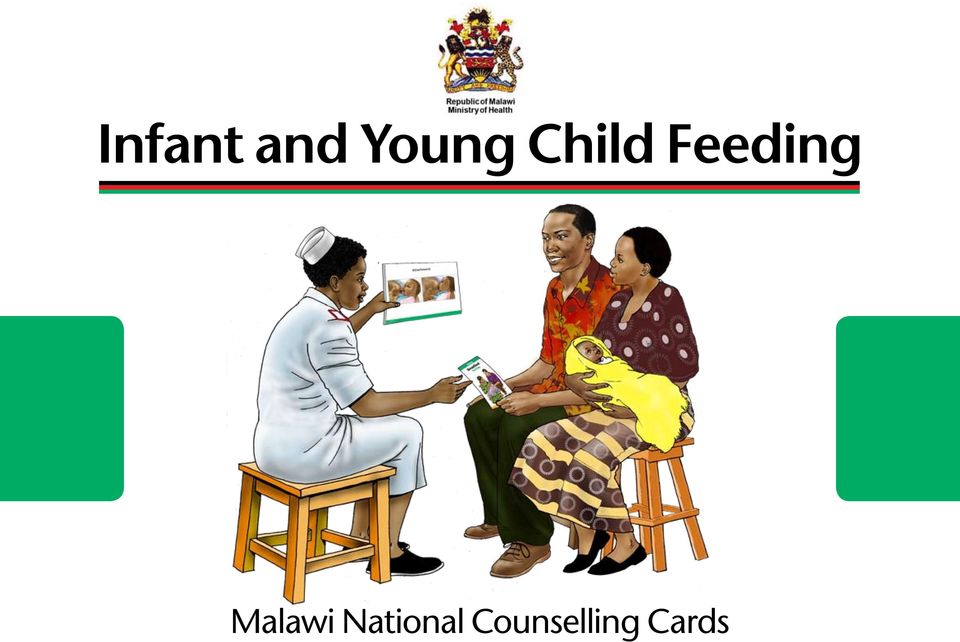
1 Infant and Young Child Feeding Malawi National Counselling Cards
2 Acknowledgements The Ministry of Health would like to very sincerely thank the University Research Co., LLC (URC) with support from the United Nations Children s Fund (UNICEF), for the technical and financial support which was so essential for the development, printing and dissemination of the Malawi Infant and Young Child Feeding National Counselling Cards. Sincere gratitude is extended to all development partners and community members who participated in the multiple technical working groups, review committees and field testing of these materials, for their contributions from the time of their inception through the final stages. Mary Shawa (PS Nutrition, HIV and AIDS), George Chothope-Mwale (Director Clinical Services), Catherine Mkangama (Director Nutrition and HIV, OPC), Dalitso Kang ombe (Chief Nutritionist Ministry of Health), Janet Guta (Principal Nutritionist, Ministry of Health), Getrude Mphwanthe (Nutritionist, OPC), Susan Kambale (WHO), Stanley Chitekwe (UNICEF), Rosemary Wellington (UNICEF), Chikondi Khangamwa (UNICEF), Tara Finglas (UNICEF), Benson Kazembe (UNICEF), Violet Orchardson (USAID), Maria Kim (Baylor Children s Hospital), Aida Girma Yemaneberhan (EGPAF), Mpumulo Jawati and Mwate Chintu (BASICS), Mphatso Mapemba (CAS) and many others invested substantial time and resources in developing this product. The process has been very labour intensive and the development of this tool would not have been possible if it were not for the untiring efforts and commitment of these individuals, and the support of their organizations. Special recognition is made to the Nutrition Unit in the Ministry of Health, the Department of Nutrition and HIV in the Office of President and Cabinet and also to members of the Infant and Young Child Feeding Technical Working Group for their technical input in finalizing the current Policy Guidelines on Infant and Young Child Feeding and in reviewing and refining this integrated set of counselling materials. This integrated set of Malawi Infant and Young Child Feeding - National Counselling Cards was designed for use by facility-based service providers. They were adapted from materials originally developed with support by University Research Co, LLC (URC), including job aids produced in Tanzania (under USAID/PEPFAR funding to the Quality Assurance Project, now known as the Health Care Improvement Project); in Kenya (with UNICEF funding); and in Uganda (under the USAID-funded URC/NuLife Project). The IYCF graphic team includes Peggy Koniz-Booher, Kurt Mulholland, Victor Nolasco, Marjolein Moreaux, Martha A. Oringo and Arnold Birungi.
3 Infant and Young Child Feeding National Counselling Cards In Malawi, malnutrition rates among infants and young children, pregnant and lactating mothers have consistently remained high. The government of Malawi recognizes the immediate and long term social and economic repercussions of malnutrition among infants and young children and in response developed the Infant and Young Child Feeding Policy, which was revised in This set of National Counselling Cards is divided into two sections Part 1: Infant and Young Child Feeding for Normal Circumstances, Part 2: Infant and Young Child Feeding for All Children and Part 3: Infant and Young Child Feeding in Exceptionally Difficult Circumstances. These materials are part of an integrated package of job aids aimed to support health workers in counselling mothers and other caregivers of children from birth to 24 months of age. The content of these materials is guided by the Infant and Young Child Feeding Policy and Guidelines (Revised 2009). This material and the other elements of the integrated package are intended for use by facility based health workers who have attended either the 5 day Integrated Infant and Young Child Feeding Training Course (2009) or the Essential Nutrition Actions (ENA) Course. If a health worker encounters a situation that he or she cannot manage, the health worker is advised to refer the mother to a specialized infant feeding counsellor or to a health facility designated by the Ministry of Health as Baby Friendly. Facilities designated as Baby Friendly are assessed annually and the latest list can be found in the DHO s office and Nutrition Unit of the Ministry of Health. The Infant and Young Child Feeding Policy and Guidelines have been developed as an integral part of Essential Health Care Package (EHP), Safety Nets and Nutrition sub components. Their aim is: to provide guidance to programme coordinators, policy makers, other service providers and caregivers involved with the feeding of infants and young children; to ensure the survival and enhance the nutrition, health, growth and development of infants and young children; and to strengthen the care and support provided to their parents and caretakers that is needed to achieve optimal infant and young child feeding. The overall policy objectives include: to increase the rate of exclusive breastfeeding during the first 6 months of life to 85% by 2013 (current level is 53%); to reduce mother to child transmission of HIV; to provide caregivers with knowledge and skills on optimal feeding; and to detect cases of malnutrition at all levels for timely intervention. Other objectives include: to improve case outcomes through improved management; and to increase Vitamin A supplementation in children 6-59 months (from 80-90%) and among lactating women. There are three main focus areas; feeding infants 0-6 months, feeding infants and young children 6-24 months and Infant and young child feeding in the context of HIV and AIDS. This integrated set of Infant and Young Child Feeding National Counselling Cards was designed for use by facility level health workers, both Government and stakeholders, for counselling mothers and caregivers. The Ministry therefore invites all players in the area of Infant and Young Child Feeding to embrace and utilise these counselling materials. They are an important quality improvement tool for reducing child malnutrition, and their use will contribute to the achievement of the Malawi Growth and Development Strategy and the Millennium Development Goals. MINISTRY OF HEALTH
4

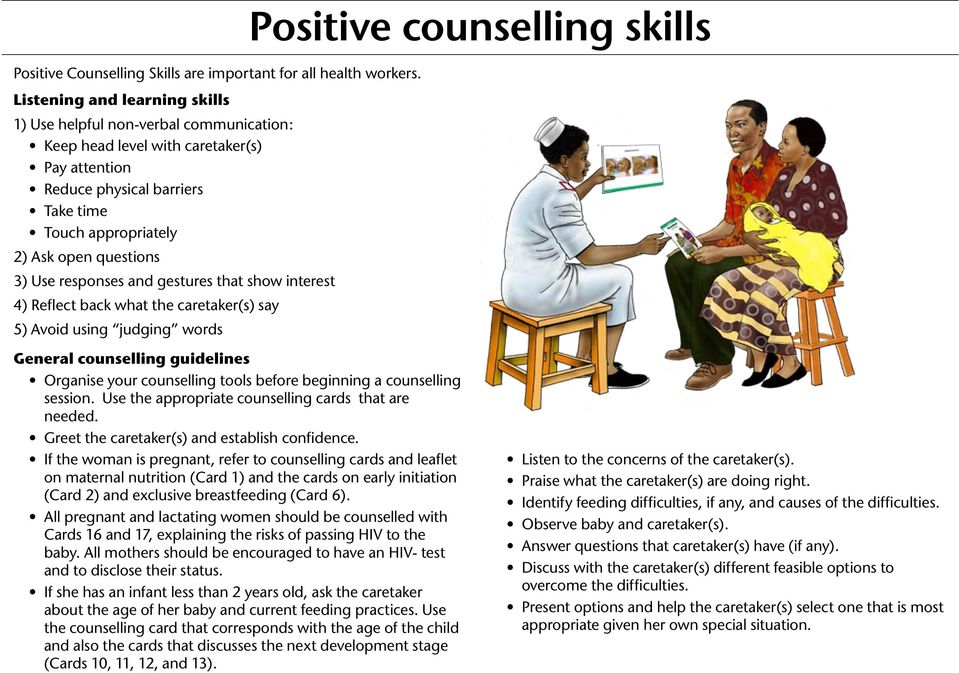
5 Positive Counselling Skills are important for all health workers. Listening and learning skills 1) Use helpful non-verbal communication: Keep head level with caretaker(s) Pay attention Reduce physical barriers Take time Touch appropriately 2) Ask open questions 3) Use responses and gestures that show interest 4) Reflect back what the caretaker(s) say 5) Avoid using judging words Positive counselling skills General counselling guidelines Organise your counselling tools before beginning a counselling session. Use the appropriate counselling cards that are needed. Greet the caretaker(s) and establish confidence. If the woman is pregnant, refer to counselling cards and leaflet on maternal nutrition (Card 1) and the cards on early initiation (Card 2) and exclusive breastfeeding (Card 6). All pregnant and lactating women should be counselled with Cards 16 and 17, explaining the risks of passing HIV to the baby. All mothers should be encouraged to have an HIV- test and to disclose their status. If she has an infant less than 2 years old, ask the caretaker about the age of her baby and current feeding practices. Use the counselling card that corresponds with the age of the child and also the cards that discusses the next development stage (Cards 10, 11, 12, and 13). Listen to the concerns of the caretaker(s). Praise what the caretaker(s) are doing right. Identify feeding difficulties, if any, and causes of the difficulties. Observe baby and caretaker(s). Answer questions that caretaker(s) have (if any). Discuss with the caretaker(s) different feasible options to overcome the difficulties. Present options and help the caretaker(s) select one that is most appropriate given her own special situation.
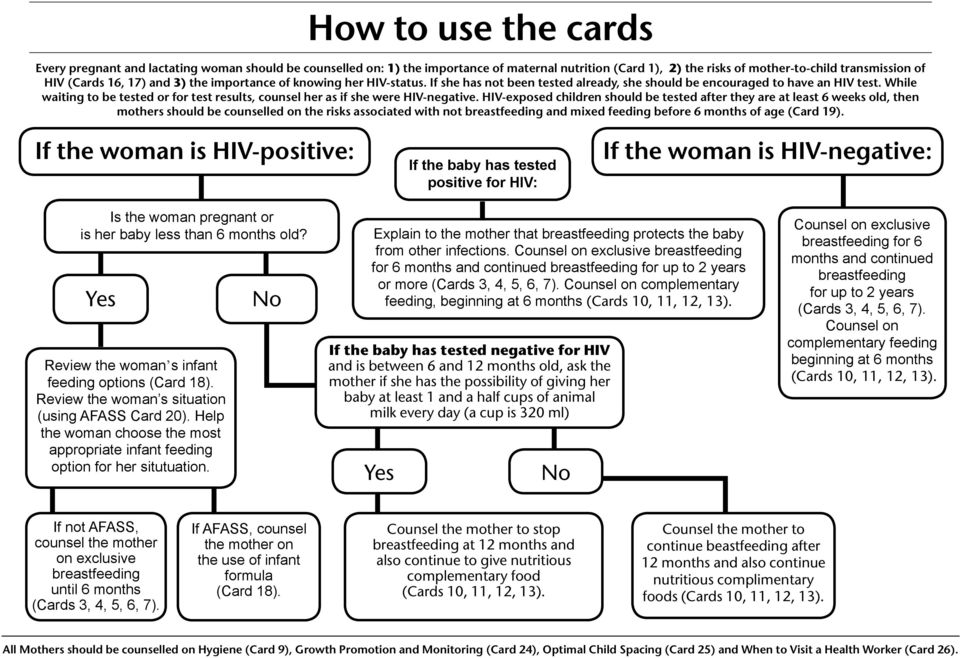
6 How to use the cards Every pregnant and lactating woman should be counselled on: 1) the importance of maternal nutrition (Card 1), 2) the risks of mother-to-child transmission of HIV (Cards 16, 17) and 3) the importance of knowing her HIV-status. If she has not been tested already, she should be encouraged to have an HIV test. While waiting to be tested or for test results, counsel her as if she were HIV-negative. HIV-exposed children should be tested after they are at least 6 weeks old, then mothers should be counselled on the risks associated with not breastfeeding and mixed feeding before 6 months of age (Card 19). If the woman is HIV-positive: If the baby has tested positive for HIV: If the woman is HIV-negative: Is the woman pregnant or is her baby less than 6 months old? Yes Review the woman s infant feeding options (Card 18). Review the woman s situation (using AFASS Card 20). Help the woman choose the most appropriate infant feeding option for her situtuation. No Explain to the mother that breastfeeding protects the baby from other infections. Counsel on exclusive breastfeeding for 6 months and continued breastfeeding for up to 2 years or more (Cards 3, 4, 5, 6, 7). Counsel on complementary feeding, beginning at 6 months (Cards 10, 11, 12, 13). If the baby has tested negative for HIV and is between 6 and 12 months old, ask the mother if she has the possibility of giving her baby at least 1 and a half cups of animal milk every day (a cup is 320 ml) Yes No Counsel on exclusive breastfeeding for 6 months and continued breastfeeding for up to 2 years (Cards 3, 4, 5, 6, 7). Counsel on complementary feeding beginning at 6 months (Cards 10, 11, 12, 13). If not AFASS, counsel the mother on exclusive breastfeeding until 6 months (Cards 3, 4, 5, 6, 7). If AFASS, counsel the mother on the use of infant formula (Card 18). Counsel the mother to stop breastfeeding at 12 months and also continue to give nutritious complementary food (Cards 10, 11, 12, 13). Counsel the mother to continue beastfeeding after 12 months and also continue nutritious complimentary foods (Cards 10, 11, 12, 13). All Mothers should be counselled on Hygiene (Card 9), Growth Promotion and Monitoring (Card 24), Optimal Child Spacing (Card 25) and When to Visit a Health Worker (Card 26).
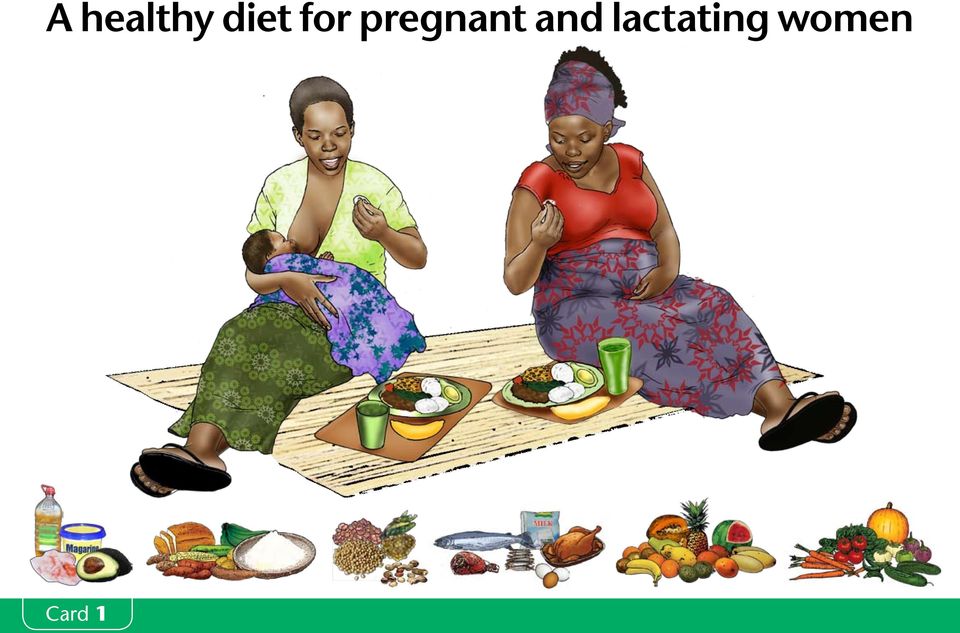
7 A healthy diet for pregnant and lactating women Card 1
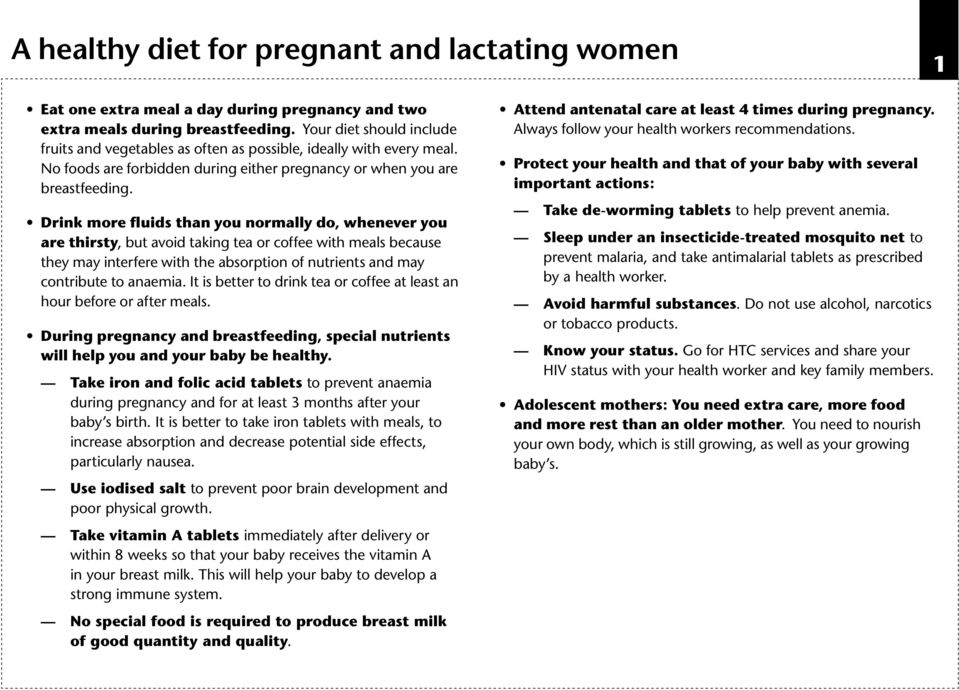
8 A healthy diet for pregnant and lactating women 1 Eat one extra meal a day during pregnancy and two extra meals during breastfeeding. Your diet should include fruits and vegetables as often as possible, ideally with every meal. No foods are forbidden during either pregnancy or when you are breastfeeding. Drink more fluids than you normally do, whenever you are thirsty, but avoid taking tea or coffee with meals because they may interfere with the absorption of nutrients and may contribute to anaemia. It is better to drink tea or coffee at least an hour before or after meals. During pregnancy and breastfeeding, special nutrients will help you and your baby be healthy. Take iron and folic acid tablets to prevent anaemia during pregnancy and for at least 3 months after your baby s birth. It is better to take iron tablets with meals, to increase absorption and decrease potential side effects, particularly nausea. Use iodised salt to prevent poor brain development and poor physical growth. Take vitamin A tablets immediately after delivery or within 8 weeks so that your baby receives the vitamin A in your breast milk. This will help your baby to develop a strong immune system. No special food is required to produce breast milk of good quantity and quality. Attend antenatal care at least 4 times during pregnancy. Always follow your health workers recommendations. Protect your health and that of your baby with several important actions: Take de-worming tablets to help prevent anemia. Sleep under an insecticide-treated mosquito net to prevent malaria, and take antimalarial tablets as prescribed by a health worker. Avoid harmful substances. Do not use alcohol, narcotics or tobacco products. Know your status. Go for HTC services and share your HIV status with your health worker and key family members. Adolescent mothers: You need extra care, more food and more rest than an older mother. You need to nourish your own body, which is still growing, as well as your growing baby s.
9 Card 2 Early initiation of breastfeeding

10 Early initiation of breastfeeding Put the newborn skin-to-skin immediately after birth. This provides warmth, helps breathing and promotes bonding. Have the midwife put the naked baby between your breasts, cover him or her and keep the baby there for at least an hour. The baby can reach the breast easily and begin suckling as soon as she or he is ready. Begin breastfeeding within the first hour of birth. Early breastfeeding helps the baby learn feed while the breast is still soft. It also helps to expel the placenta and reduce bleeding. Breastfeed frequently, especially during the first few days. This will help your breast milk start flowing or come in and also helps to ensure plenty of breast milk. Even though your baby may feed often, and for only short periods of time, this small amount of milk is enough. Do not give water or any other liquids or fluids during the first days after birth. They are not necessary and are dangerous for the newborn. 2 Colostrum, the thick yellowish milk, is good for your baby. It helps protect your baby from illness. The small amounts will fill the baby s stomach and help expel the first dark stool.

11 Card 3 Good attachment
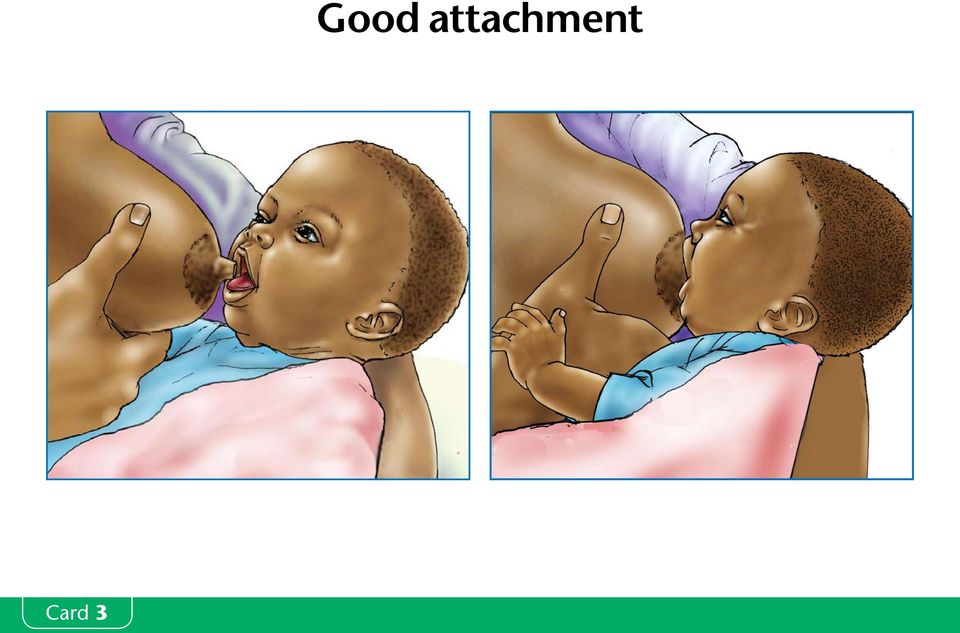
12 Good attachment 3 Good attachment helps both you and your baby. Good attachment helps to ensure that your baby suckles well and helps you to produce a good supply of breast milk. Good attachment helps to prevent sore nipples and other breast problems. Breastfeeding should not hurt! Good attachment is important from the very beginning. When you first begin to breastfeed, you may need help to make sure that the baby is attaching well. There are 4 signs of good attachment: 1. Baby s mouth is wide open 2. You can see more of the darker skin (areola) above the baby s mouth than below 3. Baby s lower lip is turned outwards 4. Baby s chin is touching mother s breast Your baby should take slow deep sucks, sometimes pausing. Let your baby empty one breast at a time. Your baby will come off the breast on his or her own when he or she finishes the milk in that breast. Offer your baby the other breast after finishing the first. This will ensure that your baby stimulates your milk production in both breasts, and also gets the most nutritious and satisfying milk.
13 Card 4 Good positioning

14 Good positioning Good positioning helps both you and your baby. Good positioning helps to ensure that your baby suckles well and helps you to produce a good supply of breast milk. Good positioning helps to prevent sore nipples and other breast problems. Breastfeeding should not hurt! It is important that you are comfortable. Bring your baby to the breast (not your breast to the baby). Your baby is well positioned when: The baby s head, back, and buttocks are in a straight line not twisted. The baby s whole body is supported, not just the head and shoulders. The baby s body is close to yours. The baby s nose is facing your nipple. The.baby is able to look at your face, and is not facing into your chest or abdomen. Fingers shold not be in a scissor hold because this method tends to put pressure on the milk ducts and can take the nipple out of the infant s mouth. There are different ways to position your baby: Cradle position (most commonly used) Cross cradle position (good for small infants) Side-lying position (can be used to rest while breastfeeding and at night) Under-arm position (good to use after caesaren section, if your nipples are painful; or if you are breastfeeding twins or a small infant) 4 You chould hold your breast with your fingers in a C shape, the thumb being above the dark part of the breast (areola) and the other fingers below.

15 Card 5 There are many advantages to exclusive breastfeeding during the first 6 months
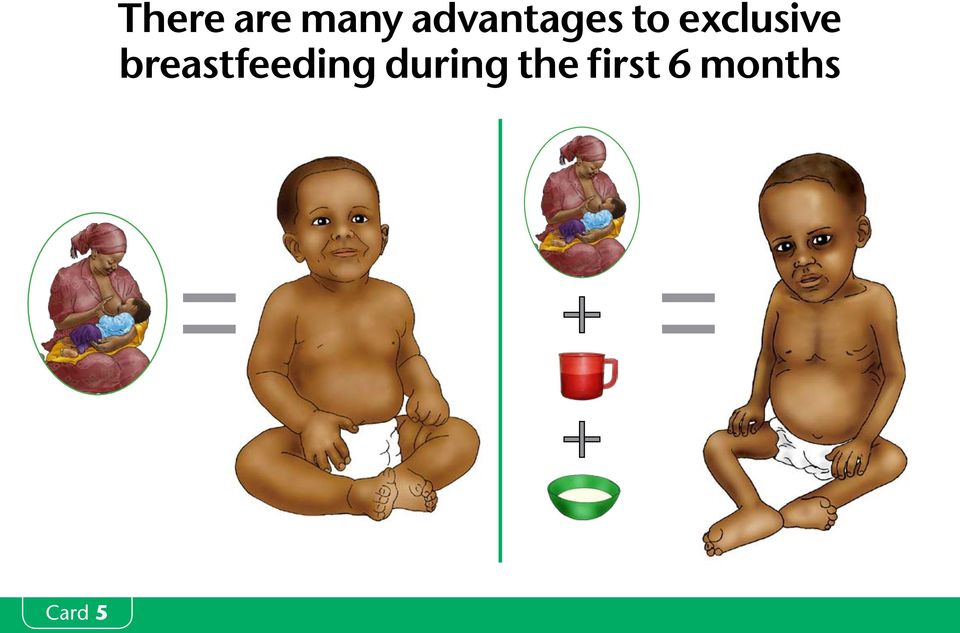
16 There are many advantages to exclusive breastfeeding during the first 6 months 5 Exclusive breastfeeding Exclusive breastfeeding means feeding your baby ONLY breast milk for the first 6 months. Breast milk provides all the food and water that a baby needs during the first 6 months of life. Do not give anything else, NOT even water, sobo, phala or gripe water. Breastfeeding protects your baby from diarrhoea and respiratory infections. It also greatly reduces the chance of passing HIV to your baby compared to mixed feeding. Mixed feeding Mixed feeding means feeding your baby both breast milk and any other milks or foods including water, sobo, phala or gripe water. Mixed feeding is very dangerous. Mixed feeding increases the chance of your baby suffering from illnesses such as diarrhoea and pneumonia because he or she is not protected through breast milk. A baby less than 6 months has immature intestines. Other food or drinks than breast milk can cause damage to the baby s intestines (causing small holes ), which makes it easier for diseases, including HIV, to pass to your baby. If you mixed feed before your baby is six months old, you are denying your baby all the benefits he or she can get from breast milk.

17 Exclusive breastfeeding for the first 6 months Card 6
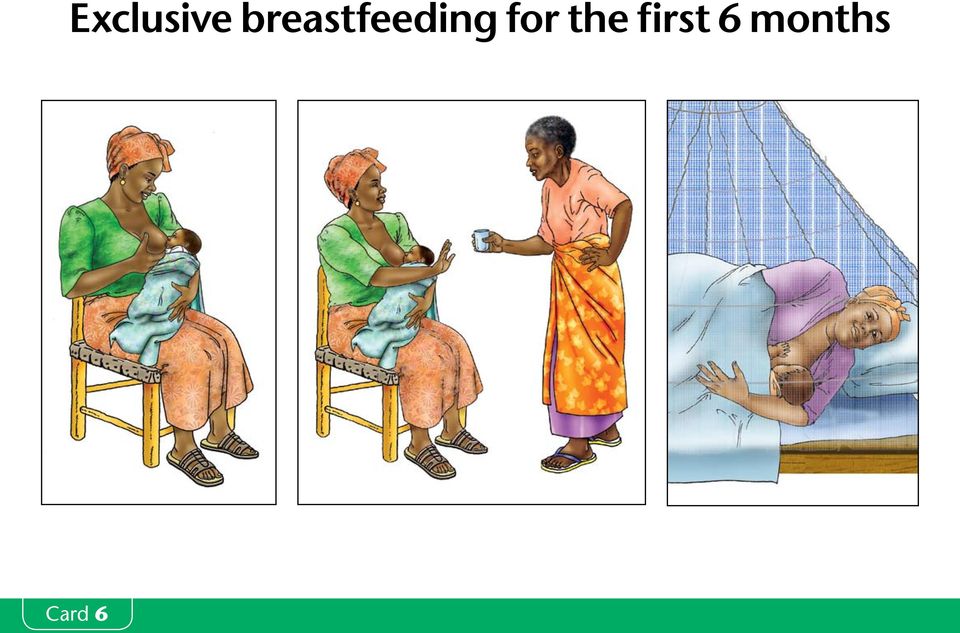
18 Exclusive breastfeeding for the first 6 months 6 Breast milk provides all the food and water that a baby needs during the first 6 months of life. Do not give anything else, NOT even water, sobo, phala or gripe water. Resist pressure from others. The thick yellowish milk known as colostrum that is produced during the first few days after delivery is very important because it protects your baby from many diseases. Do not give any food or drink to your newborn baby, the yellowish milk is enough. If the baby takes water or other liquids, she or he suckles the breast less and the mother produces less milk. This leads to poor growth. Even during very hot weather, breast milk will satisfy the baby s thirst during the first 6 months. The mother may need additional water to satisfy her own thirst. Let your baby empty one breast first and come off the breast on his or her own. This will ensure that your baby gets the most nutritious and satisfying milk. Then give your baby the other breast. Breastfeeding the baby on demand, not less than 8 times, day and night, helps to produce lots of breast milk to ensure that the baby grows healthy. Breastfeeding protects the baby from diarrhoea and respiratory infections. Breast milk is inexpensive, always available and does not need any preparation. Feeding the baby ONLY breast milk up to 6 months helps you to recover from childbirth and protects you from getting pregnant too soon. Even if you work outside home, you can maintain breastfeeding (See Card 23). Note for the health worker: If the mother is complaining about lack of breast milk, go to Card 7. Note for the health worker on heat treatment: For HIV positive women, continuing to breastfeed on an infected breast can increase the chance of passing HIV to her baby. Using expressed and heat treated breast milk is an option for an HIV- positive breastfeeding woman while she has a breast problem on both breasts. If a woman is unable to heat treat her breast milk during this time, she should continue to express milk but should NOT give this milk to the infant. Expression and heat treatment is also recommended during the transition period between exclusive breastfeeding and replacement feeding. All the expressed breast milk should be put in a jar or glass that will not break when you heat it (do not use a plastic container), be immersed in a pot containing water and be heated ONLY for a few minutes until the water in the pot has large bubbles. Heat treated breast milk should be fed using a clean open cup within 6 hours. Exclusive breastfeeding can be continued after the breast problem has been resolved.

19 Card 7 How to increase your breast milk supply

20 How to increase your breast milk supply 7 Breastfeed the baby on demand, both day and night. A newborn should feed at least 8-12 times each day to help establish the breast milk supply. After breastfeeding is well established, breastfeed 8 or more times a day. More suckling (with good attachment) makes more breast milk. Crying is a late sign of hunger. Do not wait until your baby cries to offer the breast. Early signs that baby wants to breastfeed include: Restlessness Opening mouth and turning head from side-to-side Putting tongue in and out Suckling on fingers and fists Let your baby empty one breast first and come off the breast on his or her own. This will ensure that your baby gets the most nutritious and satisfying milk. Then give your baby the other breast. If the baby is ill or sleepy, wake him or her to offer the breast often. Encourage support from your family. Ask others for help with household chores. Do NOT use bottles, teats or spouted cups. They are difficult to clean and can cause your baby to become sick. Note for the health worker: If there is concern about the lack of breast milk, ask the mother questions to find out the following: Is the baby gaining sufficient weight? Is the baby having fewer than 6 wets a day? Is the baby acting like he or she is dissatisfied (frustrated and crying all the time)? Is the baby receiving anything else to eat or drink other than breast milk? Observe the mother breastfeeding, if possible, and see if she needs advice about positioning or attachment. (Refer to Counselling Cards 3 and 4.)
21 Card 8 How to express breast milk and cup feed
22 How to express breast milk and cup feed 8 Wash your hands with soap and running water. Make sure the container you will use to express your breast milk is clean and boiled. Sit or stand in a comfortable position, in a quiet place. Use any hand for either breast. Put your thumb on the breast above the dark area around the nipple (areola). Place your first finger below the nipple and the dark area. Support your breast with your remaining fingers. Compress the breast with your thumb and first finger while the other fingers support your breast, while moving your hand away from the chest wall towards the dark area. This should not hurt. If it does, then you are not doing it right. Press the same way on each side of the dark area around the nipple in order to empty all parts of the breast. Do not squeeze the nipple itself or rub your fingers over the skin. Express one breast for 3 to 5 minutes until the flow slows down and then switch to the other breast. Then do each breast again. Change your hands when the one hand gets tired. It usually takes 20 to 30 minutes to express all of the milk. If your milk does not come easily, massage your breasts. A warm cloth, a back massage or thinking about your baby might also help. Storage and cup feeding Store your expressed breast milk in a clean covered container until you are ready to feed your baby. Expressed milk can be stored for up to 8 hours in a cool place. Always feed the baby using a clean open cup. Even a newborn baby learns quickly how to drink from a cup. DO NOT use bottles, teats or spouted cups. They are difficult to clean and can cause your baby to become sick. The person feeding the baby should pour just enough breast milk from the clean covered container into the feeding cup. He or she can always add more from the container if the baby is not satisfied. Do not give the baby leftover breast milk from the feeding cup. This can cause the baby to become sick. Note for the health worker on heat treatment: For HIV positive women, continuing to breastfeed on an infected breast can increase the chance of passing HIV to her baby. Using expressed and heat treated breast milk is an option for an HIV- positive breastfeeding woman while she has a breast problem on both breasts. If a woman is unable to heat treat her breast milk during this time, she should continue to express milk but should NOT give this milk to the infant. Expression and heat treatment is also recommended during the transition period between exclusive breastfeeding and replacement feeding. All the expressed breast milk should be put in a jar or glass that will not break when you heat it (do not use a plastic container), be immersed in a pot containing water and be heated ONLY for a few minutes until the water in the pot has large bubbles. Heat treated breast milk should be fed using a clean open cup within 6 hours. Exclusive breastfeeding can be continued after the breast problem has been resolved.
23 Card 9 Good hygiene practices prevent disease
24 Good hygiene practices prevent disease 9 Wash your hands with soap and running water before preparing food, before eating, and before feeding young children. Wash your hands with soap and water after using the latrine or cleaning the baby s bottom. Wash your children s hands with soap and running water after having passed stool and before feeding him or her. Feed your baby using clean hands, clean utensils and clean cups. DO NOT use bottles, teats or spouted cups. They are difficult to clean and can cause your baby to become sick. Keep foods in a covered container in a clean, cool and dry place.
25 Card 10 Start complementary feeding at 6 months
26 Start complementary feeding at 6 months 10 Starting at about 6 months, your baby is developmentally ready and needs other foods in additional to breast milk. Continue breastfeeding you baby, however, on demand both day and night. This will maintain his or her health and strength as breast milk continues to be the most important part of your baby s diet. Always give your baby breast milk first before giving other foods. FADDUAH: Think of these characteristics when giving complementary foods to your baby. F = Frequency, A = Amount, D = Density (consistency), D = Diversity (different kinds of foods), U = Utilisation, A = Active/responsive feeding, and H = Hygiene Frequency: At around 6 months, start by feeding your baby 2 times a day. Amount: Give 2-to-3 tablespoonfuls at each feed. At 6 months these foods are more like tastes than actual servings. Density (consistency): The food should be soft, but thick enough to be fed by hand. Be careful not to make the baby s food too thin. Diversity: Begin with the staple foods like porridge; mashed banana or mashed potato. Utilisation: Add a few spoons of mashed pieces of fruit or fresh fruit juice to the baby s food. Active/responsive feeding: At first baby may need time to get used to eating foods other than breast milk. Be patient and actively encourage your baby to eat. Use a separate plate to feed the baby to make sure he or she eats all the food given. Hygiene: Good hygiene is important to avoid diarrhoea and other illnesses. Always use a clean open cup to give water or any liquid foods to your baby. DO NOT use bottles, teats or spouted cups. They are difficult to clean and can cause your baby to become sick. Always use a clean hand, spoon, bowl or plate to give foods to your baby. Always store the foods given to your baby in a safe, hygienic place. Always wash your hands with soap and water before preparing foods and before feeding your baby. Wash your hands after using the toilet and after washing baby s bottom. Note for the health worker about HIV positive babies: HIV positive mothers who have decided to stop breastfeeding should feed their babies at least one and a half cups (500 ml) of animal milk every day. HIV positive babies need more food than HIV negative babies: An HIV positive baby who is not sick should receive one extra feed each day. An HIV positive baby who is sick and/or losing weight should be fed twice as much compared to what a health baby should eat. Note for the health worker about the size of cups: All cups shown and referred to in the Counselling Cards are mugs which have a volume of 320 ml. If other types or sizes of cups are used to feed a baby, they should be tested to see what volume they hold and the recommended quantities of food or liquid should be adjusted accordingly.
27 Complementary feeding from 7 up to 9 months Card 11
28 Complementary feeding from 7 up to 9 months 11 Continue breastfeeding your baby on demand both day and night. This will maintain his or her health and strength as breast milk continues to be the most important part of your baby s diet. When feeding a baby who is between 7 and 9 months old, always give your baby breast milk first before giving other foods. FADDUAH: Think of these characteristics when giving complementary foods to your baby. F = Frequency, A = Amount, D = Density (consistency), D = Diversity (different kinds of foods), U = Utilisation, A = Active/responsive feeding, and H = Hygiene Frequency: Feed your baby 3 times a day. Amount: Gradually increase the amount of food to ½ a cup (a cup is 320 ml). Babies have small stomachs and can only eat small amounts at each meal. Density (consistency): Mash and soften the foods so that the baby can easily chew and swallow. Breast milk, animal milk or fresh fruit juice can be used to prepare the soft food. Do not add water. Be careful not to make the baby s food too thin. Thicken the baby s food as the baby grows older, making sure that he/she is still able to easily swallow without choking. Diversity: Every day, or as often as possible, your baby needs at least a small bit of food from each of the following groups: a. Millet flour, sorghum flour, maize flour, potatoes, banana, etc. b. Fresh or dry beans, peas or groundnuts c. Meat, chicken, fish or eggs d. Vegetables like dark green vegetables (chisoso, nkhwani, bonongwe, kholowa), tomato, eggplant, carrot, cabbage, etc. e. Fruits like passion fruit, mango, pawpaw, orange, banana, watermelon, pineapple, avocado, etc. f. Oil, margarine, meat fat or avocado Utilisation: Add a few spoons of lmashed pieces of fruit or fresh fruit juice to the baby s food. Active/responsive feeding: Be patient and actively encourage your baby to eat. Use a separate plate to feed the baby to make sure he or she eats all the food given. Hygiene: Good hygiene is important to avoid diarrhoea and other illnesses. Always use a clean open cup to give water or any liquid foods to your baby. DO NOT use bottles, teats or spouted cups. They are difficult to clean and can cause your baby to become sick. Always use a clean hand, spoon, bowl or plate to give foods to your baby. Always store the foods given to your baby in a safe, hygienic place. Always wash your hands with soap and water before preparing foods and before feeding your baby. Wash your hands after using the toilet and after washing baby s bottom. Example of balanced baby foods: A thick porridge can be made out of a flour of either maize, cassava, millet or soya. Milk, sugar, oil, groundnuts, eggs, vegetables and fruits can be mixed into the porridge. A mashed food mixture can combine foods like banana, potato, cassava, maize, millet with a food like fish, meat, beans or groundnut paste. Vegetables like greens, pumpkin, carrot, eggplant, avocado or tomato should also be mixed into the baby food. Note for the health worker about HIV positive babies: HIV positive mothers who have decided to stop breastfeeding should feed their babies at least one and a half cups (500 ml) of animal milk every day. HIV positive babies need more food than HIV negative babies: An HIV positive baby who is not sick should receive one extra feed each day. An HIV positive baby who is sick and/or losing weight should be fed twice as much compared to what a health baby should eat. Note for the health worker about the size of cups: All cups shown and referred to in the Counselling Cards are mugs which have a volume of 320 ml. If other types or sizes of cups are used to feed a baby, they should be tested to see what volume they hold and the recommended quantities of food or liquid should be adjusted accordingly.
29 Complementary feeding from 9 up to 12 months Card 12
30 Complementary feeding from 9 up to 12 months 12 Continue breastfeeding your baby on demand both day and night. This will maintain his or her health and strength as breast milk continues to be the most important part of your baby s diet. When feeding a baby who is between 9 and 12 months old, always give your baby breast milk first before giving other foods. FADDUAH: Think of these characteristics when giving complementary foods to your baby. F = Frequency, A = Amount, D = Density (consistency), D = Diversity (different kinds of foods), U = Utilisation, A = Active/responsive feeding, and H = Hygiene Frequency: From 9 months onwards, feed your young child 4 times a day (3 meals and 1 snack). Note about snacks: Snacks are extra foods given between meals, that are easy to prepare, are clean, safe and locally available. These foods are in addition to other meals, and do not replace meals. Good snacks provide energy and nutrients. They should not be confused with sweats. Most snacks can be eaten as finger foods such as pieces of fruit or vegetables. Amount: Give your baby between one half (½) and two thirds (2/3) of a cup at each feed. (A cup is 320 ml.) Babies have small stomachs and can only eat small amounts at each meal. Density (consistency): Mash and soften the foods so that the baby can easily chew and swallow. Breast milk, animal milk or fresh fruit juice can be used to prepare the soft food. Do not add water. Be careful not to make the baby s food too thin. Thicken the baby s food as the baby grows older, making sure that he/she is still able to easily swallow without choking. Diversity: Every day, or as often as possible, your baby needs at least a small bit of food from each of the following groups: a. Millet flour, sorghum flour, maize flour, potatoes, banana, etc. b. Fresh or dry beans, peas or groundnuts c. Meat, chicken, fish or eggs d. Vegetables like dark green vegetables (chisoso, nkhwani, bonongwe, kholowa), tomato, eggplant, carrot, cabbage, etc. e. Fruits like passion fruit, mango, pawpaw, orange, banana, watermelon, pineapple, avocado, etc. f. Oil, margarine, meat fat or avocado Utilisation: Add a few spoons of lmashed pieces of fruit or fresh fruit juice to the baby s food. Active/responsive feeding: Be patient and actively encourage your baby to eat. Use a separate plate to feed the baby to make sure he or she eats all the food given. Hygiene: Good hygiene is important to avoid diarrhoea and other illnesses. Always use a clean open cup to give water or any liquid foods to your baby. DO NOT use bottles, teats or spouted cups. They are difficult to clean and can cause your baby to become sick. Always use a clean hand, spoon, bowl or plate to give foods to your baby. Always store the foods given to your baby in a safe, hygienic place. Always wash your hands with soap and water before preparing foods and before feeding your baby. Wash your hands after using the toilet and after washing baby s bottom. Note for the health worker about HIV positive babies: HIV positive mothers who have decided to stop breastfeeding should feed their babies at least one and a half cups (500 ml) of animal milk every day. HIV positive babies need more food than HIV negative babies: An HIV positive baby who is not sick should receive one extra feed each day. An HIV positive baby who is sick and/or losing weight should be fed twice as much compared to what a health baby should eat. Note for the health worker about the size of cups: All cups shown and referred to in the Counselling Cards are mugs which have a volume of 320 ml. If other types or sizes of cups are used to feed a baby, they should be tested to see what volume they hold and the recommended quantities of food or liquid should be adjusted accordingly.
31 Complementary feeding from 12 up to 24 months Card 13
32 Complementary feeding from 12 up to 24 months 13 Continue breastfeeding your baby on demand both day and night. This will maintain his or her health and strength. In your young child s second year, breast milk continues to make up about one third (1/3) of his or her diet. FADDUAH: Think of these characteristics when giving complementary foods to your baby. F = Frequency, A = Amount, D = Density (consistency), D = Diversity (different kinds of foods), U = Utilisation, A = Active/responsive feeding, and H = Hygiene Frequency: From 12 up to 24 months, feed your young child 5 times a day (3 meals and 2 snack). Note about snacks: Snacks are extra foods given between meals, that are easy to prepare, are clean, safe and locally available. These foods are in addition to other meals, and do not replace meals. Good snacks provide energy and nutrients. They should not be confused with sweats. Most snacks can be eaten as finger foods such as pieces of fruit or vegetables. Amount: Give your baby three quarters (3/4) of a cup at each feed. (A cup is 320 ml.) Density (consistency): The child can eat family foods, but make sure to cut the food into small pieces so that the young child can easily chew and swallow without choking. Diversity: Every day, or as often as possible, your baby needs at least a small bit of food from each of the following groups: a. Millet flour, sorghum flour, maize flour, potatoes, banana, etc. b. Fresh or dry beans, peas or groundnuts c. Meat, chicken, fish or eggs d. Vegetables like dark green vegetables (chisoso, nkhwani, bonongwe, kholowa), tomato, eggplant, carrot, cabbage, etc. e. Fruits like passion fruit, mango, pawpaw, orange, banana, watermelon, pineapple, avocado, etc. f. Oil, margarine, meat fat or avocado Utilisation: Add a few spoons of lmashed pieces of fruit or fresh fruit juice to the baby s food. Active/responsive feeding: Be patient and actively encourage your baby to eat. Use a separate plate to feed the baby to make sure he or she eats all the food given. Hygiene: Good hygiene is important to avoid diarrhoea and other illnesses. Always use a clean open cup to give water or any liquid foods to your baby. DO NOT use bottles, teats or spouted cups. They are difficult to clean and can cause your baby to become sick. Always use a clean hand, spoon, bowl or plate to give foods to your baby. Always store the foods given to your baby in a safe, hygienic place. Always wash your hands with soap and water before preparing foods and before feeding your baby. Wash your hands after using the toilet and after washing baby s bottom. Note for the health worker about HIV positive babies: HIV positive mothers who have decided to stop breastfeeding should feed their babies at least one and a half cups (500 ml) of animal milk every day. HIV positive babies need more food than HIV negative babies: An HIV positive baby who is not sick should receive one extra feed each day. An HIV positive baby who is sick and/or losing weight should be fed twice as much compared to what a health baby should eat.
33 Card 14 Feeding the sick child less than 6 months
34 Feeding the sick child less than 6 months 14 Feeding during illness Breastfeed more frequently during illness. This will help the baby to fight sickness, recover more quickly and not lose weight. Breastfeeding also provides comfort to your sick baby. Give only breast milk and prescribed medicines to your baby. If the baby it too weak to suckle, express breast milk to give your baby, either by cup or by hand expressing directly into your baby s mouth. This will help you to keep up your milk supply and prevent breast swelling. Practice exclusive breastfeeding from birth to 6 months. Feeding during recovery If your baby had been very ill, you may need to re-establish exclusive breastfeeding. If your baby refuses to breastfeed, encourage your baby until he or she takes the breast again. When a baby is recovering from an illness, he or she will breastfeed more than usual. The baby is replacing what he or she lost during illness. This can be tiresome for the mother. After replacing what he or she lost the baby will breastfeed as before. Take enough time to actively encourage your child to breastfeed more frequently when his or her appetite has returned. Note for the health worker: The mother may need support to re-establish exclusive breastfeeding.
35 Card 15 Feeding the sick child more than 6 months
36 Feeding the sick child more than 6 months 15 Feeding during illness Breastfeed more frequently and offer additional food during illness. This will help the baby to fight sickness, recover more quickly and not lose weight. Encourage your child to breastfeed, eat and drink more. A child needs more food and drinks during illness. DO NOT use bottles, teats or spouted cups. They are difficult to clean and can cause your baby to become sick. Take time to patiently encourage your sick child to eat as his or her appetite may be decreased because of the illness. Assist your child by putting the food within his or her reach or by helping his or her to hold the cup or spoon. Offer verbal encouragement when the child eats something. Feeding during recovery When a baby is recovering from an illness, he or she will breastfeed and eat more than usual. The baby is replacing what he or she lost during illness. This can be tiresome for the mother. After replacing what he or she lost the baby will feed as before. Give your baby one additional meal of solid food each day during the next two weeks after he or she has recovered. This will help him or her regain weight lost during the illness. Take enough time to actively encourage your baby to eat this extra food and to breastfeed more frequently when his or her appetite has returned. Feed your child foods he or she likes, not too thick and not too dry, in small quantities throughout the day. Offer the baby simple foods like porridge and fruits, even if he or she does not express interest in eating. Avoid spicy or fatty foods.
37 If a mother is HIV positive If a mother is HIV-positive... What is the risk of HIV passing to her baby when NO preventive actions are taken? Out of 100 babies born to HIV-positive mothers: The majority of babies (60) are not infected with HIV, but should be protected. Most babies (25) become infected with HIV during pregnancy, labour and birth. Other babies (15) are infected with HIV through breastfeeding. Protect your baby Protect get tested your and babyknow your HIV status! get tested and know your HIV status! Card 16
38 Risk of HIV transmission You can pass HIV to your baby during pregnancy, labour, delivery or through breastfeeding. Not all babies born to women with HIV become infected with HIV. Certain factors can increase the chance of passing HIV through breastfeeding for example if you have been recently infected with HIV or if you have an infection in your breast while you are breastfeeding. You should seek treatment from a health worker if you have any infections and prevent HIV re-infection by making choices for safer sex (e.g. use condoms during pregnancy and during breastfeeding). If a mother is HIV positive what is the chance of HIV passing to her baby when NO preventive actions are taken? Think of 100 babies born to women with HIV Did you know that about 40 of these babies will get infected if no actions are taken to prevent the spread of HIV from the mother to her child? However the other 60 will not become infected with HIV. Of the 40 HIV infected babies, 25 will be infected during pregnancy, labour and delivery and 15 during breastfeeding. 16 Mixed feeding (feeding your baby both breast milk and any other milks or foods including water, sobo, phala or gripe water) almost doubles the chance of passing HIV to your baby, compared to exclusive breast feeding.
39 If a If a mother is is HIV-positive... positive... but mother and baby take ARV S and practise exclusive breastfeeding, the risk of passing HIV to her baby decreases. Out of 100 babies born to HIV-positive mothers who take ARVs: The majority of babies (85) are not infected with HIV. Most of these babies (10) become infected with HIV during pregnancy, labor and birth. Breastfed babies (5) can become infected. Exclusive and safer breastfeeding reduces the risk. Protect your baby get tested and know your HIV status! Protect your babyget tested and know your HIV status! Card 17
40 Risk of transmission decreases with ARVs 17 An HIV positive pregnant woman can protect herself and her baby by: Going to the health centre on a regular basis Taking prescribed ARVs Giving her baby the prescribed ARVs Exclusively breastfeeding for 6 months and continuing to breastfeed up to at least 12 months About 40 out of 100 babies born to HIV positive mothers who did not take actions to prevent the spread of HIV to their child, are born with HIV. If the mother and baby both take ARVs during the breastfeeding period, the risk of infection decreases to only 2 to 15 out of 100 babies (depending on the type of ARVs they are taking).
41 If a mother is HIV positive, what are her infant feeding options if her baby is less than 6 months of age? Only Breast Milk Exclusive Breastfeeding Only Replacement Milk Infant Formula Use expressed breast milk when away from baby Card 18 Do not give replacement milk or foods to breastfeeding babies before 6 months!
42 If a mother is HIV positive, what are her infant feeding options? 18 Exclusive breastfeeding for the first 6 months Exclusive breastfeeding means that a baby receives ONLY breast milk during the first 6 months of life no other foods, drinks or even water is required. Breast milk is the perfect food for your baby and helps him or her to grow and develop fully. Breast milk is inexpensive, always available and does not need any preparation. Feeding the baby breast milk only up to six months helps you to recover from childbirth and protects you from getting pregnant too soon. Early and frequent feeding will help you to produce enough milk for your baby. There is a slight chance of passing HIV to your baby through your breast milk. But giving ONLY breast milk reduces the chances of other illnesses for your baby (diarrhoea, pneumonia etc.) and for you (reduces bleeding, ovarian and breast cancers). If you get breast problems on both breasts, or become seriously ill, you can express and heat treat your breast milk or change to infant formula. If you decide to feed your baby infant formula you cannot breastfeed again after your breast problem has resolved. Exclusive replacement feeding using infant formula for the first 6 months Though use of infant formula can reduce the chances of passing HIV to your baby, your baby can become sick, malnourished or die if he or she does not drink enough infant formula or if you do not prepare it correctly (preparing with safe water, cleaning and boiling the feeding cup). Infant formula that is prepared and given correctly has almost everything that the baby needs to grow but will not protect your baby against illnesses like breast milk does. Infant formula is expensive and if you decide to use it you must always have enough money to buy it. During the first 6 months, the baby will require at least 50 tins of infant formula (400g) which will cost about 50,000 Malawi Kwacha. You also need money for fuel, cups, safe water, and transport to go and buy formula. Infant formula takes time to prepare and must be made fresh for each feed. This may be difficult, especially at night. The person preparing must be able to follow the instructions on the tin to prepare the infant formula. People may wonder why you are not breastfeeding, and this could cause them to suspect you are living with HIV.
43 Benefits and risks of different infant feeding methods for infants less than 6 months of age Only Breast Milk Only Replacement Milk (Infant Formula) Practicing Mixed Feeding (Breast milk plus other milk, liquids or foods) Healthy babies without HIV infection Babies who die from diarrhoea pneumonia and other infections Babies with HIV-infection Card 19 Protect your baby get tested and know your HIV status!
44 Benefits and risks of different infant feeding methods for infants less than 6 months of age 19 It is important for you to know that there are several infant feeding options for your baby. Each method has benefits and risks. The reason for discussing these is to help you decide how to feed your baby. Exclusive breastfeeding (giving ONLY breast milk for the first 6 months): greatly reduces the chance of passing HIV to your baby compared with mixed feeding (feeding your baby both breast milk and any other milks or foods including water, sobo, phala or gripe water). In addition, your baby also receives all the benefits of breast feeding including protection from diarrhoea and other illnesses. Exclusive replacement feeding (giving ONLY infant formula): there is no chance of passing HIV through breastfeeding, but there are more chances of the baby dying from diarrhoea, pneumonia and other infections because he or she does not have the protection from breastfeeding. Mixed feeding (feeding your baby both breast milk and any other milks or foods including water, sobo, phala or gripe water) greatly increases the chances of passing HIV to your baby. It also increases the chance of your baby suffering from other illnesses such as diarrhoea and pneumonia because he or she is not protected through breast milk. You should NEVER mixed feed. A baby less than 6 months has immature intestines. Other food or drinks than breast milk can cause damage to the baby s intestines (causing small holes ), which makes it easier for HIV and other diseases to pass into the baby.
45 Are you ready to gradually wean your child? Access to safe water Clean home environment Good sanitation Sufficient income Safe storage for milk Enough cooking fuel Able to prepare night feeds Good family support Access to healthcare Card 20 Always continue to breastfeed your HIV positive child
46 Are you ready to gradually wean your child? 20 Guidelines for assessing the AFASS criteria: Explain to the mother that you would like to ask her some questions that are important in order to have a better understanding of what her personal situation is and how it might affect the timing of weaning. Ask the following questions, rephrasing and probing as needed in order to get the information that you need to determine the AFASS situation of the mother. Keep your questions open-ended and do not suggest answers to the mother. Acceptable Do your partner and your in-laws know you are HIV positive? How would you feel about replacement feeding in front of your friends, neighbours, and family members? Feasible Will you have the time to make the formula many times a day? Do you have people who can help you? How would you arrange night feeds? Do you have a light to prepare the feeds? Do you have a place to feed the baby during the night? Where do you get your drinking water? How far away is the source and how much time does it take you and your family to collect the water? Affordable What do you and your partner do to earn a living? Are you able to afford formula? (1000 Malawi Kwacha per 400 g tin) Can you afford transport to get to the store to buy formula when you run out? Can you afford enough fuel to boil water for preparing formula for both day and night feeds? Sustainable Will you be able to afford formula until the baby is at least 6 months? (at least 50,000 kwacha for the first 6 months) Will you continue to have the time to make formula until the baby is at least 6 months? After 6 months, will you be able to afford enough milk (formula or animal milk) and other food for the baby? Safe Do you have a clean and safe place to prepare and store the infant formula? Note for the health worker: Do not recommend that all HIV positive mothers wean their infants at 6 months. Only mothers who meet the AFASS criteria should be advised to wean. The AFASS situation should be reassessed regularly. Once a mother meets AFASS, she should be advised to wean gradually. HIV infected babies should be advised to continue breastfeeding.
47 How to feed your baby infant formula Number of tins of formula needed each month Baby s Age in Months 400 g tins needed per month 500g tins needed per month Card 21
48 How to feed your baby infant formula 21 There are different kinds of powdered infant formula on the market. Always make sure that you are using infant formula that is made specifically for your baby s age. Always read and follow the instructions that are printed on the tin very carefully. Ask your health worker for guidance. Make sure that you have clean water to mix with the infant formula. If you can, prepare the water that you will need for the whole day. Bring the water to a rolling boil for at least 2 minutes and then pour into a flask or clean covered container specially reserved for boiled water. The utensils should be washed with clean water and soap. Boil the utensils to kill the remaining germs and to avoid your baby to become sick. Wash your hands with clean running water and soap. Organize all of the utensils you will need. Always use a special cup or container to measure the boiled water. Always use the special scoop that comes with the tin of infant formula to measure the infant formula powder. Only prepare enough infant formula for one feed at the time, and use the formula within one hour of preparation. Do not give the baby left-over infant formula. Prepared infant formula that is kept for a long time spoils and causes your baby to become sick. Always use a clean open cup to feed your baby. Even a newborn baby learns quickly how to drink from a cup. DO NOT use bottles, teats or spouted cups. They are difficult to clean and can cause your baby to become sick. If you are working away from home or for night feeds, you can keep or carry boiled water and infant formula powder separately to mix for the next feeds. If you run out of infant formula, you should not breastfeed and you should not add more water to make the formula last longer. Instead, consult your health worker. Animal milk can be modified and given to the baby in an emergency situation. Bring back your baby for monthly check-up and review of feeding requirements.
49 Feeding a low birth weight baby Cross Cradle Position Under Arm Position Kangaroo Care Card 22
50 Feeding a low birth weight baby Note for the health workers: Explain the problem of low birth weight: a low birth weight baby needs special care and feeding If very small (less than 30 weeks gestation or less than 1.5kg) refer for further management If medium size (30 to 34 weeks gestation or more than 1.5kg) the mother should breastfeed as much as possible. The mother needs support for correct attachment. The cross cradle and underarm positions are good positions for feeding low birth weight babies because they allow the mother to better control the positioning of the baby s mouth on the nipple. Direct breastfeeding may not be possible for several weeks, but the mother should be encouraged to express breast milk and feed the breast milk to the infant using a clean open cup. The baby should be put on the breast frequently to get him or her used to the breast and to keep the milk flowing. (Use Card 8 for expression by hand.) Crying is the last sign of hunger. The caretaker should recognize earlier signs of hunger (including rooting, licking movements, flexing arms, clenching fists, tensing body and kicking legs) and feed the baby. Kangaroo mother care Different caretakers can care for the baby using the Kangaroo method. Position: place the naked baby on the caretaker s naked chest with his or her legs flexed and secure the baby in a cloth that passes just under the infant s ears and is tied around the caretaker s chest. Warmth is needed: keep skin-to-skin contact, both naked. cover the baby s head with a hat 22 If the baby sleeps for too long, the caretaker should unwrap and hold him or her to awaken before feeding. The caretaker should watch your baby s sleep and wake cycle and feed during quiet-alert states.
51 Working mother Sick mother Card 23
52 Working mother and sick mother 23 Working Mother Note for a working mother with formal employment: According to the Malawian law, a mother has the right to paid maternity leave of 90 days. Get your employer s consent for: breast feeding breaks and flexible working hours safe storage provision of expressed breast milk Note for all working mothers: If work causes you to be separated from your baby, these are some things you can do to continue to provide breast milk to your baby: Express breast milk to be fed to the baby from a clean open cup while you are away Express breast milk at work to keep the milk flowing and prevent breast swelling If possible, carry the baby to the place of work or have someone bring the baby when you have a break Take extra time for the feeds before leaving for work and when you come back from work Increase the number of feeds while you are around; e.g. increase night and weekend feedings Get extra support Sick Mother It is very important for the baby to continue to breastfeed for the baby s health and to prevent breast problems. It is important that you continue to eat, even when you do not have appetite. During illness you have an increased need for nutrients. You also need extra food to produce breast milk. Therefore take extra care in what you eat and how it is prepared. The following nutrition advice can be given to a sick mother: Eat a variety of favourite foods Eat small frequent meals Make sure you take plenty of liquids (e.g. water, juice, porridge, soup) Avoid fatty, fried or strong smelling foods Prepare foods in other ways than usual (e.g. mashed foods, more soups) Avoid foods that cause stomach discomfort Continue eating, even when you have diarrhoea Get extra support Make sure that the person preparing the food washes his or her hands before food preparation
53 Card 24 Regular growth promotion and monitoring prevents malnutrition
54 Regular growth promotion and monitoring prevents malnutrition 24 Note for the health worker on GMP: Encourage the mother or caretaker to take the child for regular growth monitoring and promotion (GMP). A child should be weighed once every month from birth until he or she is 5 years old. A healthy child grows well. Give feed-back to every caregiver after weighing. Mothers should be praised for bringing their children for growth promotion and monitoring. Infants and young children should gain a certain amount of weight every month. Any static or reduced weight shows that something is wrong. It is much easier to take corrective action in an early stage of reduced growth than when the child has already become malnourished. Encourage continuing frequent breastfeeding or relactation where appropriate (Cards 3, 4, 5, 6 and 7). Note for the health worker on malnutrition: If assessment shows that the child suffers from moderate or severe malnutrition do the following: With the help of the health passport and this counselling card, explain the risks and signs of malnutrition. Discuss the possibility of continuing frequent breastfeeding or re-lactation where appropriate (Cards 3, 4, 5, 6 and 7). If the baby is older than six months, discuss the appropriate complementary foods/ nutrition education using the appropriate age. (Cards 10, 11, 12 and 13). Encourage the mother or caretaker to take the child for regular growth monitoring and promotion (GMP). Encourage the mother or caretaker and the child to go for an HIV test. Refer if necessary. Ask the mother or caretaker to report back to you when she returns from the referral facility. If the baby is older than six months, discuss the appropriate complementary foods and give nutrition education using the appropriate age corresponding card (Cards 10, 11, 12 and 13). If the child has been or is sick, treat the child and discuss the feeding recommendations (Cards 14 and 15). If the child does not gain enough weight, try to find out the cause.
55 is before each sexual ip. It prevents the sperm ering the uterus. Using Optimal family planning promotes child survival relationship. It prevents the prevent spermpregnancy. It covers the before sexual intercourse to also helps to reduce ransmitted infections HIV/AIDS). es Injectables (Depro-Provera ) Norplant Oral Contraceptives Injectables (Depro-Provera ) Norp ill or tablet that a woman ryday to avoidlam y. They also help to enstrual disorders. Oral ptives usually come in f 28 pills. Some pills are women who are ding. (Exclusive breastfeeding) This is a thin but resistant latex bag that is place over the inserted man s by a woman herself erect penis before each before sexual sexual intercourse to from entering the uterus. cervix Usingso that sperm cannot enter condoms also helps to reduce the uterus. It should be used sexually transmitted infections together with a special gel. (STIs and HIV/AIDS). This is a medicine that a nurse or This is a pill or tablet that a doctor woman Male & Female Condom Abstinence injects with a needle into takes everyday to avoid the (Avoiding arm or intercourse) buttocks of the woman pregnancy. They also help to to avoid pregnancy. Each infection regulate menstrual disorders. Oral lasts 3 months. Injectables can contraceptives usually come in cartons of 28 pills. Some be pills used are by women who are made for women who are breastfeeding. breastfeeding. INJECTION INJECTION This is a flexible hat shaped device, made of rubber that can isplace within her inserted by a woman herself one hour before hav relationships in order prevent pregnancy. It covers pregnancy. the They als cervix so that sperm cannot protective enter effect aga the uterus. It should be used together with a special gel. This method consist This is a medicine that a nurse tubes or of medicine th doctor injects with a needle into pregnancy. They are the arm or buttocks of the woman a woman s upper arm to avoid pregnancy. Each infection health care provider lasts 3 months. Injectables can be used by women who are lasts up to 5 years, b breastfeeding. can be taken out at Injectables Oral Contraceptives Norplant on (Depro-Provera ) Male Sterilization IUCD (Copper T) Female Sterilization Male Sterilization IUCD imple and very secure for women who don t ave any more children. ss than 20 minutes. The oes home within 2 to 6 xual relations do not nd the woman continues er period. Tubal Ligation Card 25 This is a simple and very This secure is a simple and very secure operation for women who operation don t for men who don t want want to have any more to children. have any more children. It takes It takes less than 20 minutes. less than The 15 minutes. The man woman goes home within goes 2 to home 6 within 2 to 4 hours. hours. Sexual relations do Sexual not relations do not change. change and the woman continues to have her period. Vasectomy IUD This is a simple and very secure This method is a sm operation for men who don t inserted want into the wo to have any more children. by It takes a trained service less than 15 minutes. The made man of plastic and c goes home within 2 to 4 hours. form of a T. It can Sexual relations do not change. woman for up to 10 more, but can be rem time.
56 Optimal child spacing promotes child survival 25 Optimal family planning promotes child survival through having: more time to breastfeed and care for your child more money for child care because you will have less school fees to pay, less clothes to buy, less food to buy etc. more time for your body to recover for the next pregnancy Feeding your baby only breast milk for the first 6 months helps to space births in a way that is healthy for you and your baby. Optimal child spacing means: having your children 3 to 5 years apart wait at least 6 months after stopping to breastfeed before getting pregnant again By exclusively breastfeeding your baby for the first six months you can prevent pregnancy ONLY if: you feed the baby only breast milk your baby is less than 6 months old your menstrual period has not returned Note for the health worker on methods: Any time after delivery, use male or female condoms in addition to the methods below, to prevent sexually transmitted infections, including HIV and AIDS. Family planning options for the breastfeeding mother: Any time after delivery for maximum of 6 months: LAM Any time after delivery: Abstinence Within 48 hours or after 4 weeks after delivery: IUD Within 7 days or after 6 weeks after delivery: tubal ligation Any time during pregnancy or after delivery: vasectomy After 6 weeks after delivery: progestin only pills After 6 months after delivery : Combined oral contraceptives, implants, injectables After 3 regular menstrual cycles: Moon Beads This family planning method is called LAM. If any of these three conditions change, you are no longer protected against pregnancy. Note for the health worker dealing with an HIV-positive mother: She should consider taking care of this child and avoid getting pregnant again. Relying on any of the family planning methods only is not enough. She should use condoms to prevent re-infection and to prevent infecting her partner.
57 When to bring your child to the health facility Vomiting Refusal to feed Convulsions Difficulty breathing Diarrhoea Fever Malnutrition Card 26
58 When to bring your child to the health facility 26 Young children can become suddenly ill and may need to be seen urgently by a health worker. Take your child to a health worker if they show any of the following signs: Refusal to feed and being very weak Vomiting (cannot keep anything down) Convulsions (rapid and repeated contractions of the body, shaking) Chest infection (cough, fast and difficult breathing) Diarrhoea (more than 3 loose stools a day for two days or more and/or blood in the stool, sunken eyes) Fever (possible risk of malaria) Malnutrition (loss of weight or swelling of the body) Lethargy (weak, not alert) You should also take your child for routine immunizations, deworming, Vitamin A supplementation twice yearly and continued growth monitoring until they are 5 years of age. If you are HIV positive, your children can be tested at 6 to 10 weeks of age so that you can know if they are infected with HIV and they can begin to receive treatment and care.