
a good practice guide HEALTH AND SAFETY OF PUPILS ON EDUCATIONAL VISITS
|
|
|
- Eleanor Parker
- 10 years ago
- Views:
Transcription
1 a good practice guide HEALTH AND SAFETY OF PUPILS ON EDUCATIONAL VISITS

2 CONTENTS Paragraphs INTRODUCTION 1-10 CHAPTER 1 - RESPONSIBILITIES FOR VISITS Legal framework Approval for visits LEAs 18 Governing Body Head teacher Group leader 24 Teachers Adult volunteers 27 Responsibilities of pupils Parents CHAPTER 2 - PLANNING VISITS Planning Risk assessment Exploratory visit Other considerations Financial planning Charging for visits First aid Planning the visit (flow chart) Page 12 CHAPTER 3 - SUPERVISION Ratios Parents/Volunteers Vetting suitability Supervisors responsibilities 79 Competences if leading an adventure activity 80 Head counts 81 Remote supervision CHAPTER 4 - PREPARING PUPILS General Participation Equal opportunities 89 Information to pupils Preparing pupils for remote supervision Transport and pupils Pupils with special educational and medical needs 99 Pupils with medical needs Pupils with special educational needs

3 CHAPTER 5 - COMMUNICATING WITH PARENTS Information to parents Parental consent Medical consent Other consent 118 Early return 119 Contact with parents during the visit Pupils contact with parents 122 CHAPTER 6 - PLANNING TRANSPORT General 123 Legislation Supervision on transport Hiring coaches and buses Licences and permits Private cars Transport in the school minibus 139 School minibus driver Maintenance and checks of the school minibus 142 CHAPTER 7 - INSURANCE General 143 Insurance in LEAs 144 Other schools 145 Insurance and parents 146 Insurance cover for visits Cancellations 151 Transport CHAPTER 8 - TYPES OF VISIT Adventure activities using licensed providers Adventure activities using non-licensable providers Other issues to consider with all adventure activity providers School-led adventure activities Employment of providers 175 Remote supervision during adventurous activities Coastal visits Swimming in the sea or other natural waters Swimming pools Farm visits Field studies 194 Residential visits CHAPTER 9 - VISITS ABROAD General 197 Organising your own visit 198 Organising your own transport Using a tour operator Operators based abroad 204 Sources of further advice for school travel abroad 205 Planning and preparation 206 Staffing the visit 207 Preparing pupils for visits abroad 208 Briefing meeting for parents 209

4 Vaccinations 210 Insurance 211 Foreign legislation 212 Language abilities 213 Visas/passports Nationality Care orders and wards of court 219 Emergency medical facilities Paperwork Information retained at the school During the visit Emergencies Contacts at home 233 Travel by air 234 Exchange visits Vetting host families CHAPTER 10 - EMERGENCY PROCEDURES General Who will take charge in an emergency? Emergency procedures framework 245 Emergency procedures framework during the visit 246 Emergency procedures framework for school base Media contact 249 After a serious incident 250 CHAPTER 11 - MODEL FORMS Page 44 Model form 1 Application for the approval of educational visits by head teacher, governing body or LEA Page 45 Model form 2 Confirmation from head teacher for the visit to go ahead Page 48 Model form 3 Steps to follow when assessing risks Page 49 Model form 4 Risk assessment action plan Page 50 Model form 5 Evaluation of the visit to be completed by the group leader for future reference Page 51 Model form 6 Checklist for pupils going on a visit Page 53 Model form 7 Parental consent form for a school visit Page 54 Model form 8 Summary of information about pupils and adults participating in a visit Page 56 Model form 9 Emergency contact information Page 57 Model form 10 Off-site swimming pool checklist Page 58 Model form 11 Consent form for swimming activities or activities where being able to swim is essential Page 59 ANNEX A - OTHER GUIDANCE Page 60 ANNEX B - USEFUL CONTACTS Page 64

5 INTRODUCTION 1. Pupils can derive a good deal of educational benefit from taking part in visits with their school. In particular, they have the opportunity to undergo experiences not available in the classroom. Visits help to develop a pupil s investigative skills and longer visits in particular encourage greater independence. This booklet is designed to help head teachers, teachers, governors and others to ensure that pupils stay safe and healthy on school visits. 2. The booklet does not seek to replace local or other professional guidance or regulations. Where appropriate, LEAs should be the first source of advice. The booklet offers national guidance where guidance from elsewhere may be unavailable, incomplete or not up to date. It is based on a wide consultation of schools, LEAs, teacher unions and other professional bodies and reflects and collates existing good practice. The Department is grateful to all those colleagues who responded to the consultation. 3. Most school visits take place without incident and it is clear that teachers are already demonstrating a high level of safety awareness. But, following a number of tragic incidents involving schoolchildren in the last few years, there is a growing concern amongst school staff and parents about further ensuring the safety of pupils on school visits. This booklet has been produced in response to that concern. The potential hazards which the booklet refers to should not discourage teachers. No amount of planning can guarantee that a visit will be totally incident free, but good planning and attention to safety measures can reduce the number of accidents and lessen the seriousness of those that do happen nonetheless. The management of health and safety on visits is part of a school s overall policy on health and safety. The booklet sets out principles, rather than trying to cover every eventuality, leaving it to teachers professional and local judgement how to apply those principles. 4. The account of the relevant law updates the legal framework set out in the Department s previous booklet, Safety in Outdoor Education (1989), and Circular 22/94 Safety in Outdoor Activity Centres: Guidance, though much of the technical advice in those documents still stands. 5. Although the booklet is primarily for staff in schools and LEAs in England, much of it is equally valid for staff in nurseries, FE colleges, youth and other organisations. The advice to teachers should also be useful to lecturers, youth workers and other group leaders. Similarly, references to pupils can be taken to apply to students or any young person involved in a visit or an exchange. The booklet does not cover work experience, which is treated in separate guidance (see Annex A for details). References to parents cover anyone who has parental responsibility. 6. The booklet uses the terminology for schools current at the time of production (November 1998). From 1 September 1999 the existing categories of LEA and grant maintained schools will be replaced with the following new categories: Community, Foundation, Voluntary Controlled, Voluntary Aided, Community Special and Foundation Special. The LEA will be the employer of staff at Community, Voluntary Controlled and Community Special schools. The governing body will be the employer of staff at Foundation, Voluntary Aided and Foundation Special schools. 7. This booklet is guidance. It should not be taken as an authoritative interpretation of the law. That is for the courts. 8. Crown copyright This booklet is produced by the Department for Education and Employment. Extracts, including the model forms in Chapter 11, may be reproduced for non-commercial education or training purposes on condition that the source is acknowledged. 1

6 9. Enquiries about the contents of this booklet should be directed to: Michael Collins Pupil Health and Safety Team Department for Education and Employment Sanctuary Buildings Great Smith Street Westminster London SW1P 3BT 10. Further copies of this guidance are available free on request from DfEE Publications Centre, Tel See end of Annex A and back cover for address details. Tel E mail [email protected] 2

7 1 RESPONSIBILITIES FOR VISITS Legal framework 11. Under the Health and Safety at Work etc Act 1974 employers are responsible for the health, safety and welfare at work of their employees. Employers are also under a duty to ensure, so far as is reasonably practicable, the health and safety of anyone else on the premises or anyone who may be affected by their activities. This includes participants in off-site visits. 12. Employers are the LEA in county, controlled and special agreement schools. The governing body is the employer in city technology colleges, voluntary-aided, non-maintained and grant-maintained schools. The owner, governors or trustees are the employers in independent schools. 13. The Management of Health and Safety at Work Regulations 1992, made under the 1974 Act, require employers to: 14. These duties apply to all school visits. Teachers and other staff in charge of pupils also have a common law duty to act as any reasonably prudent parent would do in the same circumstances. Approval for visits 15. Employers should have a written procedure for arranging visits which teachers should follow. This will normally include procedures for the approval of certain types of visit. 16. Although the employer is responsible for health and safety, decisions about visits are usually delegated to the head teacher. The head teacher s agreement must be obtained before a visit takes place. 17. See Chapter 11 Model Form 1 for an approval application. assess the risks of activities (see Risk assessment in Chapter 2 paragraphs 37-46); LEAs introduce measures to control those risks; 18. LEAs have the following main roles: tell their employees about these measures. Also under the Health and Safety legislation employees must: take reasonable care of their own and others health and safety; co-operate with their employers over safety matters; provide written guidelines for governors, head teachers and teachers including advice on risk assessment; assess proposals for certain types of visit; provide emergency telephone contact for the duration of the visit where necessary; ensure training needs have been addressed; carry out activities in accordance with training provide access to named staff for advice; and instructions; maintain appropriate insurance cover; inform the employer of any serious risks. 3

8 have in place procedures to monitor and review safety during off-site visits and activities. Governing body 19. Where the governing body is the employer the governors role will be the same as that suggested for an LEA above. They should satisfy themselves that the risk assessment has been carried out, that appropriate safety measures are in place and that training needs have been addressed. 20. Governing bodies of all types of school should: 23. Head teachers should ensure that: adequate child protection procedures are in place; all necessary actions have been completed before the visit begins; the risk assessment has been completed and appropriate safety measures are in place; training needs have been assessed by a competent person and the needs of the staff and pupils have been considered; ensure that the visit has a specific and stated the group leader has experience in supervising objective; the age groups going on the visit and will organise the group effectively; ensure that the head teacher/group leader shows how their plans comply with regulations and the group leader or another teacher is suitably guidelines, including the school s health and competent to instruct the activity and is familiar safety policy document and, where applicable, with the location/centre where the activity will the LEA's; and that the head teacher/group take place. See School-led adventure leader reports back after the visit; activities in Chapter 8 paragraphs ; ensure that they are informed about less routine group leaders are allowed sufficient time to visits well in advance; organise visits properly; assess proposals for certain types of visit, which non-teacher supervisors on the visit are should include visits involving an overnight stay appropriate people to supervise children. See or travel outside the UK, and submit these Vetting suitability in Chapter 3 paragraphs proposals to the LEA if appropriate ; Head teacher ratio of supervisors to pupils is appropriate. See Ratios in Chapter 3 paragraphs 69-72; 21. Head teachers should ensure that visits comply with regulations and guidelines provided by the LEA or governing body and the school s own health and safety policy. Head teachers should ensure that the group leader is competent to monitor the risks throughout the visit. 22. Head teachers should be clear about their role if taking part in the visit as a group member/supervisor. They should follow the instructions of the group leader who will have sole charge of the visit. the LEA or governing body has approved the visit, if appropriate; parents have signed consent forms; arrangements have been made for the medical needs and special educational needs of all the pupils; adequate first-aid provision will be available; 4

9 the mode of travel is appropriate; be able to control and lead pupils of the relevant age range; travel times out and back are known including pick-up and drop-off points; be suitably competent to instruct pupils in an activity and be familiar with the location/ there is adequate and relevant insurance cover. centre where the activity will take place. See See Chapter 7 Insurance; School-led adventure activities in Chapter 8 paragraphs ; they have the address and phone number of the visit s venue and have a contact name; be aware of child protection issues; a school contact has been nominated (this may ensure that adequate first-aid provision will be the head teacher) and the group leader has be available; details; undertake and complete the planning and the group leader, group supervisors and preparation of the visit including the briefing of nominated school contact have a copy of the group members and parents; agreed emergency procedures; undertake and complete a comprehensive risk the group leader, group supervisors and assessment. See Risk assessment in Chapter nominated school contact have the names of all 2 paragraphs 37-46; the adults and pupils travelling in the group, and the contact details of parents and the teachers review regularly undertaken visits/activities and and other supervisors next of kin; advise head teacher where adjustments may be necessary; there is a contingency plan for any delays including a late return home. ensure that teachers and other supervisors are fully aware of what the proposed visit involves; Group leader 24. One teacher, the group leader, should have overall responsibility for the supervision and conduct of the visit and should have regard to the health and safety of the group. The group leader should have been appointed or approved by the head teacher or the governing body. The group leader should: have enough information on the pupils proposed for the visit to assess their suitability or be satisfied that their suitability has been assessed and confirmed; ensure the ratio of supervisors to pupils is appropriate for the needs of the group. See Ratios in Chapter 3 paragraphs obtain the head teacher s prior agreement before consider stopping the visit if the risk to the health any off-site visit takes place; or safety of the pupils is unacceptable and have in place procedures for such an eventuality; follow LEA and/or governing body regulations, guidelines and policies; ensure that group supervisors have details of the school contact; appoint a deputy; ensure that group supervisors and the school clearly define each group supervisor s role and contact have a copy of the emergency ensure all tasks have been assigned; procedures; 5

10 ensure that the group s teachers and other supervisors have the details of pupils special educational or medical needs which will be necessary for them to carry out their tasks effectively; observe the guidance set out for teachers and other adults below. speak to the group leader or teacher supervisors if concerned about the health or safety of pupils at any time during the visit. Responsibilities of pupils 28. The group leader should make it clear to pupils that they must: Teachers not take unnecessary risks; 25. Teachers on school-led visits act as employees of the LEA or of the governing body, whether the visit takes place within normal hours or outside those hours, by agreement with the head teacher and governors. 26. Teachers must do their best to ensure the health and safety of everyone in the group and act as any reasonable parent would do in the same circumstances. They should: follow the instructions of the group leader and help with control and discipline; follow the instructions of the leader and other supervisors including those at the venue of the visit; dress and behave sensibly and responsibly; if abroad be sensitive to local codes and customs; look out for anything that might hurt or threaten themselves or anyone in the group and tell the group leader or supervisor about it. consider stopping the visit or the activity, notifying the group leader, if they think the risk to the health or safety of the pupils in their charge is unacceptable. 29. Any pupils whose behaviour may be considered to be a danger to themselves or to the group may be stopped from going on the visit. The curricular aims of the visit for these pupils should be fulfilled in other ways wherever possible. Adult volunteers 27. Non-teacher adults on the visit should be clear about their roles and responsibilities during the visit. Non-teacher adults acting as supervisors must: do their best to ensure the health and safety of everyone in the group; Parents 30. Parents should be able to make an informed decision on whether their child should go on the visit. The group leader should ensure that parents are given sufficient information in writing and are invited to any briefing sessions. not be left in sole charge of pupils except where it has been previously agreed as part of the risk assessment; follow the instructions of the group leader and teacher supervisors and help with control and discipline; 31. The group leader should also tell parents how they can help prepare their child for the visit by, for example, reinforcing the visit s code of conduct. Parents should also be asked to agree the arrangements for sending a pupil home early and who will meet the cost. 6

11 32. Special arrangements may be necessary for parents for whom English is a second language. 33. Parents will need to: provide the group leader with emergency contact number(s); sign the consent form (see Model Form 7 in Chapter 11); give the group leader information about their child s emotional, psychological and physical health which might be relevant to the visit (usually by means of the consent form). 34. See Chapter 5 Communicating with Parents. For Tour operators see Chapter 9 paragraphs

12 2 PLANNING VISITS Planning 35. Whether the visit is to a local park, museum or swimming pool, or includes a residential stay in the UK or abroad, it is essential that formal planning takes place before setting off. This involves considering the dangers and difficulties which may arise and making plans to reduce them. In practice, the head teacher - who is responsible for planning visits - will often delegate the detailed planning to the organiser of the visit or the group leader. Head teachers must satisfy themselves that the person planning the visit is competent to do so and has the necessary relevant experience. 39. A formal assessment of the risks that might be met on a visit should have the aim of preventing the risks or reducing them. Pupils must not be placed in situations which expose them to an unacceptable level of risk. Safety must always be the prime consideration. If the risks cannot be contained then the visit must not take place. 40. The risk assessment should be based on the following considerations: what are the hazards? who might be affected by them? 36. Many LEAs have detailed guidance on visits, including risk assessment, which county and controlled schools must follow. For residential visits at home or abroad, or for potentially hazardous activities, some LEAs require schools to obtain the LEA s approval before the visit takes place. In other schools, the governing body should satisfy itself that the visit has been planned effectively and that risks are minimised. Risk assessment 37. In practice, risk assessments, which employers are legally required to do (see Legal framework in Chapter 1 paragraphs 11-14), are usually carried out by the group leader. An assessment should be completed well before the visit, and should be approved by the head teacher. 38. A risk assessment for a visit need not be complex but it should be comprehensive. It does not generally require technical formulae or professional health and safety expertise. But specialised information for some visits may be necessary and head teachers should ensure that the person assessing the risks is competent to do so. what safety measures need to be in place to reduce risks to an acceptable level? can the group leader put the safety measures in place? what steps will be taken in an emergency? 41. The person carrying out the risk assessment should record it and give copies to all teachers/supervisors on the visit, with details of the measures they should take to avoid or reduce the risks. LEAs, head teachers and governing bodies should also be given a copy so that approval, as necessary, can be given with a clear understanding that effective planning has taken place. 42. Frequent visits to local venues such as swimming pools may not need a risk assessment every time. Nevertheless, it is essential not to become complacent. A generic assessment of the risks of such visits should be made at regular intervals, and careful monitoring should take place. 43. The group leader and other supervisors should monitor the risks throughout the visit and take appropriate action as necessary. 8

13 44. Before booking a visit the group leader should obtain a written or documentary assurance that providers such as tour operators have themselves assessed the risks and have appropriate safety measures in place. 45. Detailed advice on risk assessment can be obtained from the LEA s health and safety officer, and from the Health and Safety Executive, which has issued a revision of its booklet, Five Steps to Risk Assessment. At the time of writing another version of the booklet is in preparation to include references to outdoor education. See Annexes A & B for details and Model Forms 3 and 4 in Chapter 11 for a basic risk assessment format. 46. The group leader should take the following factors into consideration when assessing the risks: Exploratory visit 47. An exploratory visit should be made by any teacher who is to lead a group abroad or on a residential visit or who is to instruct or lead the group in an outdoor activity such as trekking in a location that is not familiar to them. 48. In other cases the group leader should undertake an exploratory visit, wherever that is possible, to: ensure at first hand that the venue is suitable to meet the aims and objectives of the school visit; obtain names and addresses of other schools who have used the venue; obtain advice from the manager; the type of visit/activity and the level at which it is being undertaken; assess potential areas and levels of risk; the location, routes and modes of transport; ensure that the venue can cater for the needs of the staff and pupils in the group; the competence, experience and qualifications of supervisory staff; become familiar with the area before taking a group of young people there. the ratios of teachers and supervisory staff to pupils; the group members age, competence, fitness and temperament and the suitability of the activity; the special educational or medical needs of pupils; the quality and suitability of available equipment; seasonal conditions, weather and timing; emergency procedures; how to cope when a pupil becomes unable or unwilling to continue; the need to monitor the risks throughout the visit. 49. If in the last resort an exploratory visit is not feasible then the group leader will need to consider how to complete an adequate assessment of the risks. A minimum measure would be to obtain specific information by letter from the venue, from other schools who have recently visited it, and from local organisations such as tourist boards. 50. Detailed advice on particular categories of visits which carry specific risks is provided in Chapters 8 Types of Visit and 9 Visits Abroad. Advice may also be sought from the LEA and from specialist bodies listed at Annex B. 51. Many schools will take new groups of pupils to the same location each year. As some factors will change from year to year, it is prudent to re-assess the risks each time - even when the group leader stays the same. It may be useful to evaluate each completed visit and keep a record. Model Form 5 in Chapter 11 provides a suggested format. 9

14 Other considerations 52. Other factors which should form part of the planning stage include: the facilities/equipment the group will need to take on the visit; prepare financially for the visit. It may be useful to break the costs down into subheads such as travel, hostel, meals etc. 55. The head teacher should ensure that banking arrangements are in place to separate the visit s receipts from other school funds and from private accounts. the facilities/equipment to be provided at the venue; staff training needs; 56. The head teacher/group leader should reach a pre-agreement with parents on whether any funds left surplus after the visit will be returned to parents or retained for another visit. the designation of someone to record the details of the visit and to carry accident forms etc; Charging for visits transport arrangements; insurance arrangements; information to the provider; communication arrangements; supervision ratios; contingency measures for enforced change of plan or late return; information to parents; preparing pupils; 57. In schools other than independent schools the education provided wholly or mainly during school hours is free. This means that head teachers may not impose a charge on parents for any visit that occurs during school hours. The head teacher may, however, ask for a voluntary contribution. 58. Parents should be made aware that the contribution is not compulsory, and the children of parents who do not contribute may not be discriminated against. It is permissible to ask parents to contribute more than the minimum amount in order to subsidise those pupils whose parents have not contributed. In the last resort, the visit may have to be cancelled if there are not enough voluntary contributions and the shortfall cannot be made up. emergency arrangements; arrangements for sending pupils home early. 53. Further information on these issues is provided in subsequent chapters. 59. The head teacher may, however, charge parents for board and lodging on residential visits as well as the full costs when a visit is deemed to be an optional extra. An optional extra: falls wholly or mainly outside school hours; Financial planning does not form part of the National Curriculum; 54. The group leader should ensure that parents have early written information about the costs of the visit, how much will come from school funds, and how much each parent will be charged or asked to contribute. Parents should be given enough time to is not part of a syllabus towards a Prescribed Public Examination; and is not in scope of the statutory requirements relating to religious education. 10

15 60. So, a skiing holiday during the school holidays would be an optional extra. Other considerations when considering first-aid needs should include: 61. The head teacher should obtain the parents agreement to meet the costs of an optional extra visit before the visit is planned in detail. Charging parents for an optional extra visit may not include an element of subsidy in respect of other pupils whose families do not meet the full charge. 62. On residential visits which are not optional extras, or which take place during school hours, some parents may have board and lodging costs remitted. These are parents in receipt of Income Support, Income-Based Jobseekers Allowance, Family Credit or Disability Working Allowance. 63. LEAs will have a charging policy which their head teachers should follow. For further information on charging see the DES Circular 2/89 Education Reform Act 1988: Charges for School Activities. Available from DfEE Publications Centre, see end of Annex A for address details. the numbers in the group and the nature of the activity; the likely injuries and how effective first aid would be; the distance of the nearest hospital. 66. First aid should be available and accessible at all times. The Health and Safety Executive recommends the following minimum contents for a travelling first-aid box where no special risk has been identified: a leaflet giving general advice on first aid; six individually wrapped sterile adhesive dressings; one large sterile unmedicated wound dressing approximately 18 cm x 18 cm; First aid 64. First aid should form part of the risk assessment. Before undertaking any off-site activities the head teacher or the group leader should assess what level of first aid might be needed. On any kind of visit the group leader should have a good working knowledge of first aid and ensure that an adequate first-aid box is taken. For adventurous activities, visits abroad or residential visits it is sensible for at least one of the group s teachers to be a fully-trained first-aider. All adults in the group should know how to contact the emergency services. 65. The minimum first-aid provision for a visit is: a suitably stocked first-aid box; a person appointed to be in charge of first-aid arrangements. two triangular bandages; two safety pins; individually wrapped moist cleansing wipes; one pair of disposable gloves; a resusciade (for hygienic mouth to mouth resuscitation) would also be useful. 67. All minibuses are required by law to carry a firstaid kit. See Chapter 6 Planning Transport. 68. For further advice on first aid see Guidance on First Aid in Schools available from DfEE Publications Centre, see end of Annex A for address details. This also lists a range of publications by the Health and Safety Commission/Executive on first aid, including training and qualifications. 11

16 PLANNING THE VISIT This page charts the likely stages of planning a visit Outline proposal to head teacher or governing body, or LEA, seeking approval in principle. Proposals might include: Visit s objectives. Likely date, duration, venue. Pupil group, staffing. Resources, estimate of costs. [Proposals for longer visits may need making well before the start of the relevant academic year.] See Ch 1 Planning Contact venue. Is it suitable for the group? What are the transport options? Who would lead the group and who would help to supervise it? Who would pay for the visit? Risk assessment. Exploratory visit. See Ch 2, 3 Substantive proposal to head teacher, or governing body, or LEA. Details of dates, risk assessment, emergency procedures, transport, insurance, costs, group membership, staffing. See Ch 2, 3, 6, 7, 10 Shorter visits Obtain approval and parental consent See Ch 4, 5 See Ch 8, 9 Residential and abroad Obtain approval to prepare the visit for visits involving years 1-3, or for day subject to satisfactory preparation. visits. Inform parents as necessary of shorter routine visits. Brief pupils. Go on visit monitoring the risks at all times. See Ch 4, 5, 7, 8, 9, 10 Final preparation Information to and from parents. Briefing evening (meet the supervisors). Brief pupils. Deposits/full payments by parents. See Ch 1, 5 Obtain final approval from LEA or governors, and parental consents. Go on visit monitoring the risks at all times. Evaluate 12
![[Proposals for longer visits may need making well before the start of the relevant academic year.] See Ch 1 Planning Contact venue. Is it suitable for the group? What are the transport options?](/docs-images/53/11832407/images/page_16.jpg "Who would lead the group and who would help to supervise it? Who would pay for the visit? Risk assessment. Exploratory visit.")
17 3 SUPERVISION Ratios 69. It is important to have a high enough ratio of adult supervisors to pupils for any visit. The factors to take into consideration include: 1 adult for every pupils in school years 4 to 6; 1 adult for every pupils in school year 7 onwards. sex, age and ability of group; pupils with special educational or medical needs; nature of activities; experience of adults in off-site supervision; duration and nature of the journey; type of any accommodation; competence of staff, both general and on specific activities; requirements of the organisation/location to be visited; 71. The above are examples only. Group leaders should assess the risks and consider an appropriate safe supervision level for their particular group. There should be a minimum of one teacher in charge. For advice on ratios for swimming see Chapter 8, paragraphs 185 and In addition to the teacher in charge there should be enough supervisors to cope effectively with an emergency. When visits are to remote areas or involve hazardous activities, the risks may be greater and supervision levels should be set accordingly. The same consideration should be given to visits abroad (see Chapter 9 paragraph 207 ) or residential visits (see Chapter 8 paragraph 195). Some non-residential visits with mixed groups will need a teacher from each sex. competence and behaviour of pupils; Parents/Volunteers first aid cover. 70. Some LEAs set their own levels of supervision for off-site visits, which county and controlled schools must adhere to. In other schools decisions must be made, taking the above factors into consideration as part of the risk assessment. Staffing ratios for visits are difficult to prescribe as they will vary according to the activity, age, group, location and the efficient use of resources. However, a general guide for visits to local historical sites and museums or for local walks, in normal circumstances, might be: 1 adult for every 6 pupils in school years 1 to 3 (under 5s reception classes should have a higher ratio); 73. Where there is more than one teacher/supervisor a group leader should be appointed who has authority over the whole group. If more than one school is involved an overall group leader should be identified, usually the person with the most experience in leading such visits. 74. Where a high adult:pupil ratio is required, it is not always feasible to use school staff alone. Parents/volunteers may be used to supplement the supervision ratio. They should be carefully selected and ideally they should be well known to the school and the pupil group. Anyone who has not had a criminal conviction check should never be left in sole charge of pupils. 13

18 Vetting suitability Supervisors responsibilities 75. The group leader needs to be clear about procedures for vetting volunteers who wish to be supervisors or drivers, in particular for residential visits. The suitability of potential supervisors should be assessed by the group leader and the head teacher at an early stage of the planning process. Where there is any doubt about suitability further investigations should be made and if any doubt remains the adult should not be allowed to help supervise the visit. Similar considerations should be made for adults who have no supervisory role but who wish to take part in the visit. 79. All adult supervisors, including teachers and parent/volunteer helpers, must understand their roles and responsibilities at all times. It may be helpful to put this in writing. In particular, all supervisors should be aware of any pupils who may require closer supervision, such as those with special needs or those likely to cause trouble. Teachers retain responsibility for the group at all times. Competences if leading an adventure activity 76. The Education (Teachers) (Amendment) Regulations 1998, which came into force on 1 August 1998, made changes to the law with the aim of preventing people who are barred by the Secretary of State from being directly employed by an LEA, school or further education college from getting round the ban by either: working as a volunteer; or working in a business that is contracted to provide services to schools, further education institutions, or pupils attending them. 77. The amendment means that List 99 checks should be carried out on volunteers and staff employed by contractors who will have regular contact with children and young people attending the school or college either on or off the premises. Voluntary Aided and LEA maintained schools can ask LEAs to check a copy of List 99, which they hold. Independent schools and further education institutions can ask the DfEE to carry out the List 99 check. The DfEE are also willing to consider making direct arrangements with those contracted by schools. See Annex B for address details. 78. For the protection of both adults and pupils, all adult supervisors should ensure that they are not alone with a pupil wherever possible. 80. If the school is leading an adventure activity, such as canoeing, the LEA or governing body must ensure that the group leader and other supervisors are suitably competent to lead or instruct pupils in the activity, bearing in mind that some pupils may be novices. Competences should be demonstrated by holding the relevant National Governing Body (NGB) award where it exists. Some LEAs have their own procedures for approving the competences/ experience of instructors. Where this is not the case the relevant NGB can normally advise. Names and addresses of NGBs are at Annex B. Head counts 81. Whatever the length and nature of the visit, regular head counting of pupils should take place, particularly before leaving any venue. All supervisors should carry a list of all pupils and adults involved in the visit at all times. Pupils, particularly in school years 1 to 3, should be easily identifiable, especially if the visit is to a densely populated area. Brightly coloured caps, T shirts or a school uniform can help identify group members more easily. Pupils should not wear name badges. But some schools find it useful to provide pupils with badges displaying the name of the school and its emergency contact number. The group leader should establish rendezvous points and tell pupils what to do if they become separated from the group. 14

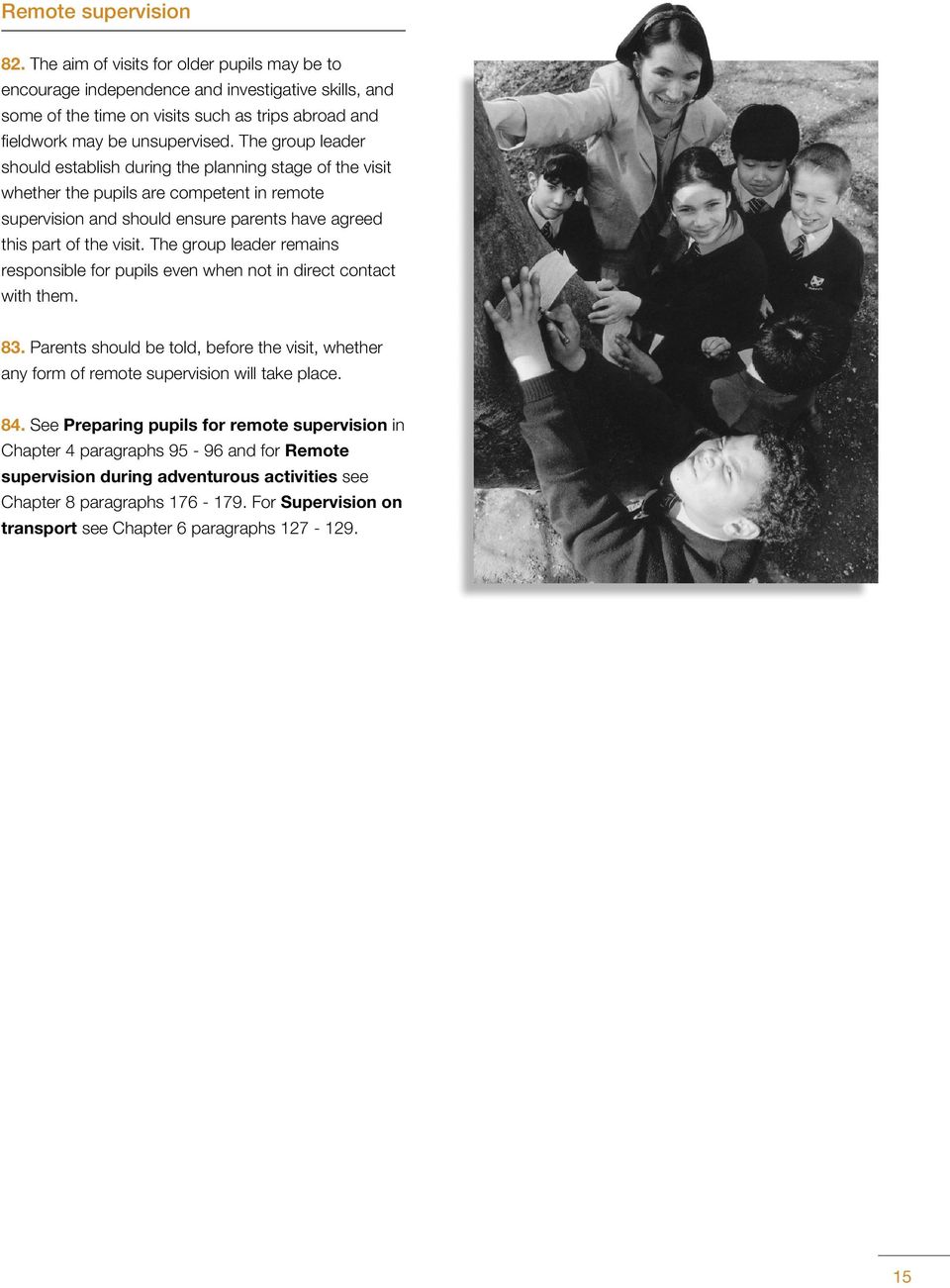
19 Remote supervision 82. The aim of visits for older pupils may be to encourage independence and investigative skills, and some of the time on visits such as trips abroad and fieldwork may be unsupervised. The group leader should establish during the planning stage of the visit whether the pupils are competent in remote supervision and should ensure parents have agreed this part of the visit. The group leader remains responsible for pupils even when not in direct contact with them. 83. Parents should be told, before the visit, whether any form of remote supervision will take place. 84. See Preparing pupils for remote supervision in Chapter 4 paragraphs and for Remote supervision during adventurous activities see Chapter 8 paragraphs For Supervision on transport see Chapter 6 paragraphs
20 4 PREPARING PUPILS General Equal opportunities 85. Pupils who are involved in a visit s planning and organisation, and who are well prepared, will make more informed decisions and will be less at risk. Providing information and guidance to pupils is an important part of preparing for a school visit. Pupils should clearly understand what is expected of them and what the visit will entail. Pupils must understand what standard of behaviour is expected of them and why rules must be followed. The lack of control and discipline can be a major cause of accidents. Pupils should also be told about any potential dangers and how they should act to ensure their own safety and that of others. 86. Pupils should also be involved in planning, implementing and evaluating their own curricular work and have opportunities to take different roles within an activity. This should include considering any health and safety issues. 89. Every effort should be made to ensure that school journeys and activities are available and accessible to all who wish to participate, irrespective of special educational or medical needs, ethnic origin, sex, religion etc. All young people should be encouraged to participate in as wide a range of activities as possible. If a visit is to cater for pupils with special needs, a suitable venue should be selected. Information to pupils 90. The group leader should decide how information is provided, but must ensure that the pupils understand key safety information. For some pupils on overnight visits it will be their first experience away from home on their own and in the close company of other pupils. Pupils should understand: the aims and objectives of the visit/activity; Participation 87. The group leader should ensure that the pupils are capable of undertaking the proposed activity. Pupils should be encouraged to take on challenges during adventurous activities but should not be coerced into activities of which they have a genuine fear. the background information about the place to be visited; basic foreign words where appropriate; relevant foreign culture and customs (see Chapter 9 Visits Abroad); 88. Pupils whose behaviour is such that the group leader is concerned for their safety, or for that of others, should be withdrawn from the activity. On residential visits the group leader should consider whether such pupils should be sent home early. Parents and pupils should be told in advance of the visit about the procedures for dealing with misbehaviour, how a pupil will be returned home safely and who will meet the cost. how to avoid specific dangers and why they should follow rules; why safety precautions are in place; why special safety precautions are in place for anyone with disabilities; what standard of behaviour is expected from pupils; 16

21 appropriate and inappropriate personal and telephone numbers and emergency contacts social conduct including sexual activity; if lost; who is responsible for the group; money; what not to bring back either within the UK or maps and plans and any other information for from abroad such as drugs, knives etc; them to act effectively; what to do if approached by anyone from outside location of local telephones and the appropriate the group; coins; rendezvous procedures; a knowledge of how to summon help; what to do if separated from the group; a knowledge of out of bounds areas or activities; emergency procedures. identity cards and a rendezvous point. 91. A checklist to give to pupils is at Model Form 6 in Chapter For residential visits all group members should carry the address and telephone number of the accommodation in case an individual becomes separated. This applies to exchange visits when pupils will also need to know about any ground rules agreed between the group leader and host family. 93. Where visits involve multiple activities with differing requirements each activity will need to be assessed and separate information provided. Pupils should be aware of who is responsible in any instances where the group leader has delegated responsibility to another member of staff or instructor. 96. It is important that pupils are told not to go off on their own, are given clear instructions about permitted remote supervised activities and understand and accept the ground rules. See Remote supervision in Chapter 3 paragraphs and for Remote supervision during adventurous activities see Chapter 8 paragraphs Transport and pupils 97. Pupils using transport on a visit should be made aware of basic safety rules including: arrive on time and wait for the transport in a safe place; 94. If at any time there is a change in the planned schedule new activities should be assessed and pupils provided with the appropriate information. do not rush towards the transport when it arrives; wear your seatbelt and stay seated whilst travelling on transport; Preparing pupils for remote supervision 95. During any time that remote supervision takes place the group leader must ensure that pupils are aware of the ground rules and are adequately equipped to be on their own in a group. The size of each group should also be considered. As a minimum pupils should have the following: never tamper with any of the vehicle s equipment or driving controls; bags must not block aisles or cause obstructions; never attempt to get on or off the moving transport; 17
22 never lean out of or throw things from the window of the transport; never get off a vehicle held up by traffic lights or in traffic; never run about or pass someone on steps or stairs while transport is moving; never kneel or stand on seats; never distract or disturb the driver or impede the driver s vision; stay clear of doors after boarding or leaving the transport; after leaving the vehicle, always wait for it to move off before crossing the road; 101. All teachers supervising visits should be aware of a pupil s medical needs and any medical emergency procedures. Summary sheets held by all teachers, containing details of each pupil s needs and any other relevant information provided by parents, is one way of achieving this. If appropriate, a volunteer teacher should be trained in administering medication, if they have not already been so trained, and should take responsibility in a medical emergency. If the pupil s safety cannot be guaranteed, it may be appropriate to ask the parent or a care assistant to accompany a particular pupil The group leader should discuss the pupil s individual needs with the parents. Parents should be asked to supply: details of medical conditions; emergency contact numbers; if you have to cross roads to get to the transport the child s GP s name, address and phone in the UK always use the Green Cross Code; number; if you feel unwell tell a teacher or supervisor. 98. The group leader should ensure that pupils know what to do if they miss the scheduled departure time. Pupils with special educational and medical needs 99. Head teachers should make every effort to include pupils with special educational or medical needs in school visits, whilst maintaining the safety of everyone in the group. Special attention should be given to appropriate supervision ratios and additional safety measures may need to be addressed at the planning stage. Pupils with medical needs 100. Additional safety measures to those already in place in the school may be necessary to support pupils with medical needs during visits. Arrangements for taking medication and ensuring sufficient supplies for residential visits may be required. information on whether the pupil has spent a night away from home before and their ability to cope effectively; written details of any medication required (including instructions on dosage/times) and parental permission to administer; parental permission if the pupil needs to administer their own medication or agreement for a volunteer teacher to administer; information on any allergies/phobias; information on any special dietary requirements; information on any toileting difficulties, special equipment or aids to daily living; special transport needs for pupils who require help with mobility Enquiries should be made at an early stage about access and facilities for securing wheelchairs on transport and at residential centres etc, if appropriate. 18
23 If ramps are not going to be available in certain places, the organiser may wish to arrange to take portable ramps with them. The group leader should at an early stage assess whether manual handling skills will be needed and, if so, whether training should be sought All teachers supervising the visit should be given the opportunity to talk through any concerns they may have about their ability to support the child. Extra help should be requested if necessary, eg a care assistant If teachers are concerned about whether they can provide for a pupil s safety or the safety of other pupils on a trip because of a medical condition, they should seek general medical advice from the School Health Service or further information from the pupil s parents. For further DfEE guidance see Supporting Pupils with Medical Needs: A Good Practice Guide (see Annex A on how to obtain a copy). is the pupil able to understand and follow instructions? will additional supervision be necessary? 108. It may be helpful to the pupil if one of the supervisors already knows them well and appreciates their needs fully. The group leader should discuss the visit with the parents of pupils with SEN to ensure that suitable arrangements have been put in place to ensure their safety The group leader should check that the insurance policy covers staff and pupils with preexisting medical needs. Pupils with special educational needs 107. Schools will already be familiar with the nature of a pupil s special educational needs. Any limitations or problems the pupil may have should be taken into account at the planning stage and when carrying out the risk assessment. Off-site visits may pose additional difficulties for a pupil with SEN and the behaviour of some pupils may prove challenging. The following factors should be taken into consideration: is the pupil capable of taking part in and benefiting from the activity? can the activity be adapted to enable the pupil to participate at a suitable level? will additional/different resources be necessary? 19
24 5 COMMUNICATING WITH PARENTS 109. Parents should be informed in writing of any offsite activity or visit unless it is a regular part of the school curriculum which parents have already been informed about through the school prospectus or a letter. Seeking annual consent for such routine visits may be appropriate. details of accommodation with security and supervisory arrangements on site; details of provision for special educational or medical needs; procedures for pupils who become ill; Information to Parents 110. Before residential visits, or when the pupils are to travel abroad or engage in adventure activities, parents should be encouraged to attend a briefing meeting where written details of the proposed visit should also be provided. There should be alternative arrangements for parents who cannot attend or who have difficulty with communication in English Parents need to be aware that the teachers and other adult supervisors on the visit will be exercising the same care that a prudent parent would. The following information on matters that might affect pupil health and safety should be given to parents: dates of the visit; visit s objectives; times of departure and return - parents must have agreed to meet their child on return; names of leader, of other staff and of other accompanying adults; details of the activities planned and of how the assessed risks will be managed; standards of behaviour expected in respect of, for example, alcohol, sexual behaviour, smoking and general group discipline including prohibited items. This information may take the form of a code of conduct which parents should sign; what pupils should not take on the visit or bring back; details of insurance taken out for the group as a whole in respect of luggage, accident, cancellation, medical cover, any exceptions in the policy and whether parents need to arrange additional cover; clothing and equipment to be taken; the location where the pupils will be collected money to be taken; and returned; the information to be given by parents and what mode(s) of travel including the name of any travel they will be asked to consent to; company; on exchange visits, the details of the host the size of the group and the level of supervision families. For example, whether they have hosted including any times when remote supervision any of the school s pupils before; may take place; 20
25 details on the cost of the visit. See Financial the name, address and phone number of the planning paragraphs and Charging for pupil s GP; visits paragraphs in Chapter 2. any special/medical dietary requirements; Parental consent whether the pupil suffers from travel sickness; 112. Head teachers or group leaders should seek consent for: non-routine visits involving pupils in school years 1 to 3 (no matter how short the visit); adventure activities; information on any toileting difficulties; whether the pupil has any night time tendencies such as sleepwalking (for residential visits); the pupil s ability to swim in the pool or sea and their level of safety awareness; visits abroad; any other information which the parent thinks should be known; other residential visits; the parental home and daytime phone numbers remote supervision. and addresses; 113. If parents withhold consent absolutely the pupil should not be taken on the visit but the curricular aims of the visit should be delivered to the pupil in some other way wherever possible. If the parents give a conditional consent the head teacher will need to consider whether the pupil may be taken on the visit or not A parental consent form should be completed for each pupil in the group. Besides conveying the parents consent it could also form the basis for obtaining details required. If a tour operator is used it may be sensible to ask them what information to obtain. General issues to consider include: any allergies/phobias the pupil may have; any medication the pupil is taking (if so what the dosage is and who is to administer it); whether the pupil administers their own medication; any contagious or infectious diseases suffered within the family during the preceding 4 weeks, and any other recent illnesses suffered by the pupil; an alternative contact, with their phone number and address The contents of a consent form for a parent to sign will vary according to the type of visit. See Model Form 7 Parental consent for a school visit and Model Form 11 Consent for swimming activities in Chapter 11. Medical consent 116. This should form part of the parental consent form. Parents should be asked to agree to the pupil s receiving emergency treatment, including anaesthetic or blood transfusion, as considered necessary by the medical authorities. If parents do not agree to this, head teachers may decide to withdraw the child from the visit - given the additional responsibility this would entail for the group leader Doctors can be expected to carry out necessary emergency treatment without parental consent but it is possible that a surgeon in another country might be reluctant to operate on a pupil unless assured that the group leader had parental authorisation to agree to such treatment. It is sensible to include a translation of 21
26 the medical consent, as signed by the parent, in the relevant foreign language. provide contact numbers for day and night use in an emergency. Other consent 118. Parental consent should be obtained specifically for the transporting of pupils in the private vehicle of a non-teacher adult or another pupil on the visit. Head teachers should consider whether consent should be obtained before pupils can be carried in a teacher s private vehicle. Early return 119. The group leader should tell parents if they will be expected to fund the early return of a pupil whose conduct gives cause for concern on a visit. A written agreement may be necessary This is best done by means of the consent form. Pupils contact with parents 122. Group leaders should arrange for parents to be told by the school of the group s safe arrival. One way of doing this is by a telephone tree whereby one parent contacts an agreed group of parents who then contact a further group. But pupils may wish to speak to their parents individually. Such arrangements should be agreed with parents and pupils before the visit takes place. Parents concerned after a phone call should contact the school contact. Contact with parents during the visit 120. Head teachers should ensure that parents can contact their child via the school contact and the group leader in the event of a home emergency, and that they have a number to ring for information in the event of an incident during the visit or a late arrival home. Parents should therefore: know the destination details; be aware of the emergency contact arrangements at home (particularly important during holiday periods when the school may be closed) and at all the venues the group will visit; 22
27 6 PLANNING TRANSPORT General Legislation 123. The group leader must give careful thought to planning transport. County and controlled schools should follow LEA transport policies. The main factors to consider include: passenger safety; the competence and training of the driver to drive the proposed vehicle and whether the driver holds the appropriate valid licence; number of driving hours required for the journey and length of the driver s day (including nondriving hours); capacity and experience of driver to maintain concentration - whether more than one driver is needed to avoid driver fatigue; 124. The employer, usually the LEA or governing body in schools, should satisfy themselves that all travel arrangements, including the hire of private coaches or buses, are suitable for the nature of the visit. In practice head teachers will normally carry out these checks The driver is responsible for the vehicle during the visit Seat belts: All minibuses and coaches which carry groups of three or more children aged between 3 and 15 years inclusive must be fitted with a seat belt for each child. The seats must face forward and seat restraints must comply with legal requirements. For further information contact the Department of the Environment, Transport and the Regions (DETR). See Annex B for address details. type of journey - will the visit take place locally or will it include long distance driving ie motorways? traffic conditions; contingency funds and arrangements in case of breakdown/emergency; appropriate insurance cover; weather; journey time and distance; stopping points on long journeys for toilet and refreshments; supervision. Supervision on transport 127. The level of supervision necessary should be considered as part of the risk assessment for the journey. The group leader is responsible for the party at all times including maintaining good discipline The driver should not normally be responsible for supervision. Driver supervision may be sufficient if a small number of older children are being taken on a short journey. All group members should be made aware of the position of the emergency door and firstaid and anti-fire equipment on transport. The group leader should also be aware of alternative routes or means of travel in the event of delay or cancellation Factors that the group leader should consider when planning supervision on transport include: level of supervision that will be necessary on 23
28 double decker buses/coaches - one supervisor on each deck should be appropriate in normal circumstances; safety when crossing roads as part of the journey - the group leader should ensure that pupils know how to observe the safety rules set out in the Highway Code and the Green Cross Code. Pedestrian crossings and traffic lights or footbridges should be used to cross roads, whenever possible; head counts, by the group leader or another delegated teacher or supervisor, should always be carried out when the group is getting off or onto transport; responsibility for checking that seat belts are fastened; consider whether a visible and easily recognisable article of clothing should be worn in common by pupils; safety on buses, trains, ferries and boats - the group leader should make clear to pupils how much or little freedom they have to roam. Misbehaviour is a main cause of accidents to children on such means of transport. Appropriate supervision and discipline should be maintained at all times. Pupils should also be made aware of what to do in an emergency and where emergency procedures are displayed; booking transport - the group leader should arrange for seats to be reserved well in advance to ensure that the party can travel together; pupils should be made aware that they are not allowed access to the driving area at any time; group members should be made aware that travel sickness tablets should only be administered to a pupil with previous authorisation from the parents; Vetting non-teacher drivers. See Vetting suitability in Chapter 3 paragraphs Hiring coaches and buses safety of pupils whilst waiting at pick-up and drop-off points and when getting on or off transport, particularly when using UK vehicles abroad. Pupils should be made aware of safety rules and expected standards of behaviour. See Transport and pupils in Chapter 4 paragraphs 97-98; safety while on stops or rests during the journey - group leaders should plan with the driver sufficient stops at suitable areas to ensure the safety of all group members including the driver. Drivers of buses and coaches must comply with legislation covering maximum periods of driving and minimum rest periods; safety of the group in the event of an accident or breakdown - the group should remain under the direct supervision of the group leader or other teachers wherever possible; 130. The group leader is responsible for ensuring that coaches and buses are hired from a reputable company. Professional operators of buses and coaches are legally required to be licensed. Schools using operators to transport pupils should ensure that the operators have the appropriate public service vehicle (PSV) operators licence. When booking transport, the group leader should ensure that seat belts are available for pupils. Whilst seat belts must be fitted on coaches which carry groups of children, they are not legally required on buses. Buses where seat belts are not fitted are not normally appropriate for visits involving long journeys If any of the group use a wheelchair, the group leader should ensure that transport used has appropriate access and securing facilities. It may be appropriate to use portable ramps. DETR can provide advice. See Annex B for address details. 24
29 Licences and Permits 132. A public service vehicle (PSV) licence is required by schools running or hiring their own vehicles where any payment is made towards the cost of pupils being carried. There are two types of licence - restricted (for up to two vehicles) and standard national (more than two vehicles). Local Traffic Commissioners can provide advice and application forms for PSV operator licences Schools can apply to their local council (for maintained schools) or the local Traffic Commissioner (for non-profit making schools - usually registered charities) for a permit issued under Section 19 of the Transport Act Permit holders are exempt from the need to hold a PSV operators licence and, in certain circumstances, from meeting all the driver licensing requirements. Section 19 Permits cannot be used outside the UK and separate rules exist for all those wishing to take minibuses abroad. DETR can provide advice - see Annex B for contact details The law on driver licensing no longer permits car drivers who pass their test after 1 January 1997 to drive minibuses without passing a Passenger Carrying Vehicle (PCV) driving test or unless they are driving under a Section 19 Permit. This does not apply to existing licence holders who are over 21 years of age Drivers of any vehicle must ensure that they have the correct entitlement on their licence. Private cars 136. Teachers and others who drive pupils in their own car must ensure their passengers safety, that the vehicle is roadworthy, and that they have appropriate licence and insurance cover for carrying the pupils. Volunteers should be carefully vetted by the school before they are permitted to drive pupils in their car. If necessary, assurances should be requested by the head teacher. See Vetting suitability in Chapter 3 paragraphs The driver is responsible for making sure that pupils have a seat belt and use it at all times. Vehicles without seat belts should not be used Head teachers or group leaders who wish to use parents, volunteers or other pupils to help transport pupils in their own cars, must ensure that they are aware of their legal responsibility for the safety of the pupils in their cars. Parents agreement should be sought (on the consent form) for their children to be carried in other parents cars. It is advisable that parents driving pupils are not put in a position where they are alone with a pupil. The group leader should arrange a central dropping point for all pupils rather than individual home drops. Transport in the school minibus 139. Many schools use their own minibuses for short frequent journeys and sometimes for longer trips. Minibuses have a maximum capacity of 16 seated passengers plus the driver. They must comply with the various regulations about construction and fittings. A forward facing seat with seat belt must be provided for each child. Some important regulations are the Minibus (Conditions of Fitness, Equipment and Use) Regulations 1977 and the Road Vehicle (Construction and Use) Regulations DETR can provide further advice. See Annex A for publication details and Annex B for contact details. School minibus driver 140. Although the chair of governors or head teacher is ultimately responsible for the school minibus, the driver is responsible for the vehicle during the visit. The minibus driver must be qualified to drive a minibus and have a valid and clean driving licence - see Licences and permits above. It is advisable for all those who may drive the school minibus to receive training in minibus driving and the management of passengers. The head teacher should ensure that teachers driving school minibuses have a rest period before driving. Minibus drivers must always adhere to transport Regulations. DETR can provide advice on relevant transport legislation. The Royal Society for the Prevention of Accidents have issued Minibus Safety: a 25
30 Code of Practice See Annexes A and B for contact addresses and publication details The minibus driver must: observe LEA and/or governing body guidance, where appropriate; member of staff responsibility for carrying out regular checks and ensuring that the minibus is maintained. This member of staff should report to the head teacher, who is responsible, along with the governing body and/or LEA and other teachers, for ensuring the safety of pupils on school-organised journeys. The person responsible for maintaining the minibus should: not drive when taking medication or undergoing check the vehicle s condition on a weekly basis; treatment that might affect their ability or judgement; ensure proper servicing by a reputable garage; know what to do in an emergency; maintain the record-of-use book with the service history, insurance and other relevant documents; know how to use fire fighting and first-aid equipment; check with the head teacher or governing body before allowing anyone not so authorised to drive avoid driving for long periods and ensure that the vehicle; rests are taken when needed; ensure that any teachers driving the minibus are clarify and comply with transport regulations and competent and have undertaken suitable training the requirements of the vehicle s insurance to do so; cover; always be informed before other teachers use take into consideration the effects of teaching the school minibus; and the working day; ensure that drivers of the school minibus are have regular medical checks eg eyesight. aware that the vehicle should always be logged in and out. Maintenance and checks of the school minibus For organising your own transport for visits abroad see paragraphs in Chapter The chair of governors or head teacher will usually be responsible for the school minibus. However, a head teacher may delegate to a willing 26
31 7 INSURANCE General Insurance cover for visits 143. The group leader must ensure, well before the group departs, that adequate insurance arrangements are in place. Insurance may be provided by, for example, the LEA, a travel firm, a bank or the organisation to be visited as well as by an insurance company Insurance policies are legal documents. They will impose conditions, limit the cover, and exclude certain people or activities. Insurance companies/travel firms can advise on particular types of insurance. However, the following are examples of cover which may be appropriate to many types of school visit: Insurance in LEAs employers liability; 144. Head teachers or group leaders in county and controlled schools should clarify with their LEA what insurance provision already exists and what additional cover may need to be arranged. LEAs, under Section 3(1)(a) of the Employers Liability (Compulsory Insurance) Act 1969, are exempted from the requirement to have employers liability insurance against the risk of injury to their employees. Some LEAs may nevertheless choose to have such insurance in place. Public liability insurance, against the risk of injury to others, is optional in both public and private sectors. Other schools 145. Head teachers or group leaders in other schools, such as grant-maintained schools, will need to investigate and make satisfactory arrangements of their own. Voluntary aided schools may be able to obtain advice from the LEA. public liability; personal accident cover for teachers, other adults, and pupils; costs of medical treatment; specialised risk activities (often excluded from standard policies) and the costs of evacuation for medical reasons when abroad; damage to or loss of hired equipment (check the wording of the hire agreement); programmed and non-programmed activities; transport and accommodation expenses in case of emergency; compensation against cancellation or delay; Insurance and parents compensation for loss of baggage and personal effects including money; 146. The group leader should write to the parents to tell them which responsibilities the LEA/school accepts and the scope of any insurance cover the school is to arrange. It is advisable to make copies of the insurance schedule available to parents as early as possible in the booking process. legal assistance in the recovery of claims; and failure or bankruptcy of the centre or travel company Additional arrangements may be necessary to 27
32 obtain insurance cover for activities abroad and activities of a potentially hazardous nature. The group leader should scrutinise carefully the list of exclusions in the policy. If there is any doubt about the cover the insurer should be asked for clarification The group leader should ascertain the details of the insurance held by the tour operator Additional cover may be necessary for participants with medical conditions. The group leader should check this with the insurance company before departure Use of school/private vehicles: the group leader should check that the insurance policy for the school minibus is appropriate to the journey. Taking the school minibus abroad may require extra insurance The group leader should check that the teacher driving the school minibus abroad is appropriately insured and that their driving licence is valid for the countries to be visited or passed through en route Teachers, other adults or pupils using their own cars to carry pupils on school visits should ensure that their vehicle is properly licensed and that the insurance covers its use on school business. Cancellations 151. Some parents may cancel their child s place in the visit. The group leader should forward any cancellations to the insurer/operator as soon as possible, in writing, if a replacement is not available. Delay in notification may incur cancellation charges Some schools and LEAs take out their own policies to cover any claim which may be made against them as a result of transport provided in a private car. But this does not exempt the driver from taking out appropriate insurance. Transport 152. When hiring coaches etc the group leader should check that the company used has appropriate insurance. The LEA may have a list of such companies. 28
33 8 TYPES OF VISIT Adventure activities using licensed providers 157. When planning to use adventure activity facilities offered by a commercial company or by a local authority the group leader should follow the policy of the LEA or school and check: whether the provider is legally required to hold a licence for the activities it offers and, if so, that the provider actually holds a licence Over 900 providers currently hold a licence. The relevant legislation is the Activity Centres (Young Persons Safety) Act 1995 and the associated Adventure Activities Licensing Regulations A licensed provider does not necessarily have to hold a licence for all its activities. Other activities offered may be accredited under non-statutory schemes. The provider can give information on what activities are licensed It is illegal for a provider of licensable status to offer a licensable activity without a valid licence. The Adventure Activities Licensing Authority can check on the licence status of a provider. Their address is: Adventure Activities Licensing Authority, 17 Lambourne Crescent, Llanishen, Cardiff CF4 5GG. Tel Fax: Their Internet site is at: A licensed provider does not necessarily have to hold a licence for all its activities. Many of the activities that pupils take part in will be covered by health and safety legislation alone. However the following activities - where undertaken by young people under 18 years unaccompanied by a parent - need a licence when commercial companies sell them, or when local authorities provide them with or without a charge: caving: the exploration of underground passages, disused mines, or natural caves which requires the use of special equipment or expertise; climbing: climbing, sea-level traversing, abseiling or scrambling over natural terrain or certain man-made structures which requires the use of special rock-climbing or ice-climbing equipment or expertise; trekking: going on foot, horse (pony), pedal cycle, skis, skates or sledges over moorland, or on ground over 600 metres above sea level when it would take 30 minutes to reach an accessible road or refuge. Off-piste skiing requires a licence; watersports: this comprises sailing, canoeing, kayaking, rafting and windsurfing, on the sea, tidal waters, inland waters at a location where any part of those waters is more than 50 metres from the nearest land, and turbulent inland waters. Rowing is exempt Holding a licence means that a provider has been inspected and the Licensing Authority are satisfied that appropriate safety measures are in place for the provision of the specified licensed adventure activities. Other elements of the provision - such as catering and accommodation - are not covered by the licensing scheme. These should be checked separately by the group leader. See Other issues to consider with all adventure activity providers paragraphs and Residential visits paragraphs Adventure activities using non-licensable providers 163. Not all providers are required to hold a licence. Voluntary bodies and schools providing for their own members and pupils respectively are exempt. 29
34 Commercial bodies and local authorities are also exempt if their activities fall outside the scope of the regulations. Not holding a licence does not imply a lack of safety. It might simply mean the provider or the activity is not licensable Many providers are accredited under nonstatutory schemes run by, for example, the Wales Tourist Board, and certain National Governing Bodies (NGBs). Schools/LEAs can contact these accreditors to ascertain a provider s management of safety. The British Activity Holiday Association can provide advice on accreditations. A list of contacts is at Annex B Some LEAs have introduced rules along with specimen questionnaires which schools can use to carry out appropriate safety checks at the planning stage The group leader may wish to ask the provider for names of other schools who have recently used its facilities See also Residential visits paragraphs Other issues to consider with all adventure activity providers 169. The group leader should check and agree the provider s arrangements for supervision and recreation during the evenings and between adventure activities. The group leader should also provide any relevant information to the provider such as the group s agerange, competence etc If proposing to use a non-licensable provider, the group leader should obtain assurances in writing from the provider that: risks have been assessed and that the provider s staff are competent to instruct and lead pupils of the group s age range on the activity. Competence could be demonstrated by holding the relevant NGB award where it exists or through successful participation in an NGB approved in-house scheme; the equipment is appropriate and that its safe condition is checked before each use; operating procedures conform to the guidelines of the National Governing Body for the activity where this is appropriate; clear management of safety systems is in place; there is appropriate provision for first aid; there are emergency procedures (including arrangements for informing next of kin and for alerting the group leader); that the provider s staff are competent in the procedures and will hold emergency phone numbers and addresses of the group members; and that the group will have a fire drill as soon as possible on arrival at the provider s base The group leader and teachers retain ultimate responsibility for pupils at all times during adventure activities, even when the group is under instruction by a member of the provider s staff. The provider is responsible for the safe running of an activity. Clear handover and handback procedures should be in place. Everyone, including the pupils, must have an understanding of the roles and responsibilities of the school staff and the provider s staff The group leader and teachers should have sufficient information on what the activity involves before it takes place. They should approach the instructor at an appropriate safe interval if they are concerned that the pupils may be at unnecessary risk. Assurances may be sought that the provider has: checked the suitability of the staff, including temporary workers, to work with young people. See Vetting suitability in Chapter 3 paragraphs 75-78; clearly defined the roles and responsibilities of its staff; the appropriate security arrangements; appropriate public liability insurance. 30
35 School-led adventure activities 172. If a member of the school staff is to organise, lead and instruct pupils on adventure activities they should complete the checks set out in this booklet under Risk assessment in Chapter 2 paragraphs The LEA or governing body should satisfy themselves that: activities - who would otherwise need a licence to trade - take full legal responsibility for all aspects of the activity. If the provider, in the employment of the school, provides licensable facilities to the pupils of another school, the employing school will need a licence. Remote supervision during adventurous activities the group leader and other supervisors are competent to act as leaders and/or instructors of pupils in the activity - bearing in mind that some of these pupils may be novices. Competences should be demonstrated by holding the relevant NGB award where it exists. The relevant NGB can advise on this. See Annex B for contact details; the group leader is competent in safety procedures and the planning of adventurous visits; an appropriate risk assessment has been completed; the supervision will be appropriate; there is adequate first aid provision, expertise and equipment within the group; the emergency procedures include activityspecific measures and that supervisors are competent to carry them out; the equipment is appropriate, safe and in good condition; 176. Some adventurous activities - such as those under the Duke of Edinburgh Awards - require pupils to work in small groups without direct supervision. Particular attention needs to be given to the information provided to pupils before supervision can be withdrawn The training given to pupils must be sound and thorough and should be assessed separately. The instructor should have the appropriate qualifications or experience to provide training in the activity. The group leader should be satisfied that the pupils have acquired the necessary skills and have the necessary experience, confidence, physical ability and judgement to be left without direct supervision The withdrawal of direct supervision should be a gradual four stage process: accompanying the group; shadowing the group; checking regularly at agreed locations; checking occasionally at agreed locations. every pupil is suited to the activity and is properly prepared and equipped See Model Form 1 in Chapter 11 which sets out a format for seeking approval of a visit. Employment of providers 175. Schools choosing to employ, rather than contract with, an unlicensed freelance provider of adventure 179. Pupils should be familiar with all equipment used or taken without direct supervision and, in addition to training, an initial element of adult supervision in the use of equipment may be required. The condition and suitability of any equipment, particularly safety equipment, taken or used during these activities should be assessed separately See Chapter 3 Supervision and Preparing pupils for remote supervision in Chapter 4 paragraphs
36 Coastal visits 181. Group leaders and other teachers should be aware that many of the incidents affecting pupils have occurred by or in the sea. There are dangers on the coast quite apart from those incurred in swimming (for which see separate section below). The group leader should bear the following points in mind when assessing the risks of a coastal activity: always be in sight of their supervisors. One supervisor should always stay out of the water for better surveillance The group leader, or another designated teacher in the group, should hold a relevant life saving award, especially where lifeguard cover may not be available. For further advice contact the Royal Life Saving Society. See Annex B for address details. tides, rip tides and sandbanks are potential hazards; timings and exit routes should be checked; ensure group members are aware of warning signs and flags; establish a base on the beach to which members of the group may return if separated; look out for hazards such as glass, barbed wire and sewage outflows etc; some of a group s time on a beach may be recreational. Group leaders should consider which areas of the terrain and sea are out of bounds; cliff tops can be highly dangerous for school groups even during daylight. The group should keep to the path at all times. Group leaders should consider whether it is safe or legal for pupils to ride mountain bikes on coastal paths The local coastguard, harbour master, lifeguard or tourist information office can provide information and advice on the nature and location of hazards Some LEAs advise their schools that a ratio of 1 adult to 10 pupils is a minimum. The group leader should assess the risks and consider an appropriate safe supervision level for their particular group before the activity takes place The group leader should: be aware that many children who drown are strong swimmers; ascertain for themselves the level of the pupil s swimming ability; be aware of the local conditions - such as currents, weeds, a shelving, uneven or unstable bottom - using local information from the lifeguard, coastguard, harbourmaster, police or tourist information office; designate a safe area of water for use by the group; be aware of the dangerous effects of sudden immersion in cold water; be aware of the dangers of paddling especially for young pupils; Swimming in the sea or other natural waters ensure that pupils have not eaten (at least half an hour) before swimming; 183. Swimming and paddling in the sea or other natural waters are potentially dangerous activities for a school group. They should only be allowed as formal and supervised activities, preferably in recognised bathing areas which have official surveillance i.e. qualified lifeguard cover. Nonetheless, pupils should ensure the activity is suitable for the pupils, especially any with disabilities; adopt and explain the signals of distress and recall. 32
37 Swimming pools 187. Head teachers and LEA officers will be aware of their local swimming pool facilities for curricular activities. Group leaders should follow the recommended safe supervision levels at the pool for their pupils. A minimum ratio should be 1 adult to 12 pupils in school years 4 to 6, and 1 adult to 20 for school years 7 onwards. For pupils in school year 3 and below the ratio should be higher. Teachers should monitor the risks of regular swimming activities and adjust supervision levels for their individual groups as necessary If considering the use of a swimming pool not used before or monitoring the hazards of a regularly used pool it is advisable to observe and check the following: does the pool cater for any particular religious or cultural factors? are the changing and showering facilities safe and hygienic? can clothes be stored securely? have the pupils been instructed how to behave in and around the water? 189. See Model Form 11 for parental consent for swimming activities and Model Form 10 for a checklist on swimming safety, in Chapter 11. Parental consent does not mean that group leaders should not check for themselves the level of a pupil s swimming ability. is there constant pool supervision by a sufficient number of qualified lifeguards? Farm visits where there is no lifeguard the group leader should stay at the poolside at a raised location. In such circumstances, the group leader, or a designated teacher, should have a relevant life saving award and be accompanied by an appropriate number of supervisors; 190. Farms can be dangerous even for the people who work on them. Taking children to a farm should be carefully planned. The risks to be assessed should include those arising from the misuse of farm machinery and the hazards associated with E coli 0157 food poisoning and other infections. is the water temperature appropriate? is the water clear? are there signs clearly indicating the depth - is there a shallow end and is the water there shallow enough? 191. Check that the farm is well-managed; that it has a good reputation for safety standards and animal welfare; and that it maintains good washing facilities and clean grounds and public areas. Consider the merits of an exploratory visit There are some basic safety rules. Never let pupils: does the pool cater for pupils with disabilities? place their faces against the animals or put their hands in their own mouths after feeding the animals; does the deep end allow for safe diving? eat until they have washed their hands; is there a poolside telephone? sample any animal foodstuffs; are there a resuscitator and other pieces of firstaid and rescue equipment, and is there someone trained to use them? drink from farm taps (other than in designated public facilities); is there a changing room for each sex? ride on tractors or other machines; does the pool cater for pupils with disabilities? play in the farm area. 33
38 193. Further advice is contained in the DfEE s letter dated 9 June 1997: Pupil Visits to Farms: Health Precautions and HSE s Avoiding ill health at open farms: Advice to teachers. See Annex A for further details. security arrangements - where the reception is not staffed 24 hours a day, security arrangements should be in force to stop unauthorised visitors; Field studies 194. Field studies associated with a range of subjects including geography, biology, geology and history might take pupils to industrial sites and other urban areas as well as into the countryside and to the coast (see above, Coastal visits). The scope of field studies means that the group leaders, who will usually be subject specialists, should also be competent to lead and instruct their pupils within urban and non-urban environments at minimal risk. See Annex A and B for sources of advice and guidance. Residential visits 195. A good rule of thumb ratio is 1 teacher for every 10 pupils. Issues for the group leader to consider include the following: the manager of the accommodation should be asked for assurances that the staff, including temporary workers, have been checked as suitable for work with young people. See also Vetting suitability in Chapter 3 paragraphs 75-78; locks on doors should work in the group s rooms but appropriate access should be available to teachers at all times; there should be drying facilities; there should be adequate space for storing clothes, luggage, equipment etc, and for the safe keeping of valuables; adequate lighting - it is advisable to bring a torch; there should be provision for pupils with special needs and those who fall sick; the group should ideally have adjoining rooms with teachers quarters next to the pupils - the balconies should be stable, windows secure, and electrical connections safe; leader should obtain a floor plan of the rooms reserved for the group s use in advance; where possible pupils should not be lodged in ground floor rooms; there must be at least one teacher from each sex for mixed groups; the fire alarm must be audible throughout the accommodation; there must be separate male and female there should be recreational accommodation/ sleeping/bathroom facilities for pupils and adults; facilities for the group; the immediate accommodation area should be the hotel/hostel should be able to meet any exclusively for the group s use; particular cultural or religious needs of the group; ensure there is appropriate and safe heating and ventilation; there should be an appropriate number of group supervisors on standby duty during the night. ensure that the whole group are aware of the lay-out of the accommodation, its fire precautions/exits (are instructions in English or otherwise clear?), its regulations and routine, and that everyone can identify key personnel; 196. Before booking a hostel/hotel abroad, the group leader should confirm it has fire exits and lifts with inner doors and that it meets local regulations. After arrival at any accommodation it is advisable to carry out a fire drill as soon as possible. 34
39 9 VISITS ABROAD General 197. Travelling abroad can be hugely rewarding for pupils and adults alike, but it is important that careful preparation takes place. Much of the earlier advice in this booklet applies to visits abroad, but there are some additional factors that need to be considered, not least because the legislation may be different from that of the UK. Group leaders should always comply with the school/lea policy on visits abroad. School visits abroad can be made in a number of ways. minibus in the countries being visited and those en route. EC regulations require the fitment and use of a tachograph and prescribe maximum limits on driving time and minimum requirements for breaks and rest periods. These regulations apply for most drivers of school passenger vehicles when undertaking an international journey. Different licence requirements would normally apply for driving abroad. DETR can provide advice on the relevant transport legislation Factors to consider when travelling abroad include: Organising your own visit 198. A head teacher or group leader may decide to organise a package abroad without the help of an outside body. Package organisers have responsibilities under Directive 90/314/EEC. This is implemented in the UK by the Package Travel, Package Holidays and Package Tours Regulations 1992 (The Package Travel Regulations). These regulations apply to packages sold or offered for sale in the UK. They define a package as a combination of any two of: accommodation, transport, or other tourist services not ancillary to transport. Most package arrangements come within scope of the regulations unless they are occasional or part of an educational course programme as compared with a leisure activity such as skiing. At the time of this booklet s production, the legal position of packages arranged as part of an educational course is subject to the effects of a future judgement in the European Court of Justice. Head teachers should be aware of these regulations in case they are in scope. Organising your own transport the need to be aware that different legislation and regulations may apply for drivers hours and recordkeeping purposes, particularly in non-eu countries; EU drivers hours and tachograph regulations normally apply to any vehicle with 9 or more passenger seats on journeys through EU countries and some countries outside the EU. In other countries, drivers must observe the domestic rules of the countries being visited, Advice on domestic rules may be obtained from the relevant embassies of the countries concerned. See also Taking a Minibus Abroad (DETR); special documentation is required for minibuses taken abroad; all group members should be aware of unfamiliar right-hand drive traffic. The passenger doors on UK minibuses and coaches may not open on the kerb side in countries where travel is on the right hand side of the road. Extra care will be necessary when the group is climbing in and out of the vehicle. Detours may be necessary to ensure safety; 199. Group leaders should ensure that drivers taking groups abroad are familiar with driving the coach or carrying capacity and loading requirements; 35
40 DETR can provide information on legal requirements for travel abroad. See Annex A for publication details and Annex B for address details. Using a Tour Operator 201. Before using a tour operator group leaders should ensure it is reputable. Ascertaining this should form part of the risk assessment. The Civil Aviation Authority licenses travel organisers and tour operators selling air seats or packages with an air transport element (Air Travel Organisers Licence or ATOL). The licence is a legal requirement and provides security against a licence holder going out of business A travel agent does not need to be an ATOL holder if acting only as an agent of an ATOL holder. But if so the group leader must check whether or not the whole package being supplied is covered by the ATOL. If it is not, the organiser must show evidence of other forms of security to provide for the refund of advance payments and the costs of repatriation in the event of insolvency There are seven bonding bodies approved by the Department of Trade and Industry: Association of British Travel Agents (ABTA) Federation of Tour Operators Trust (FTOT) Association of Independent Tour Operators Trust (AITOT) applies to all states of the European Economic Area (EEA). Group leaders may wish to use a package organiser based abroad in an EEA state. If so, they should check that it satisfies the requirements of the national legislation implementing the Directive. Details may be available from national tourist offices or embassies/consulates. Sources of further advice for school travel abroad The Department of Trade and Industry - for the regulations governing tour operators; The Schools and Group Travel Association (SAGTA) is an independent association with a members code of good conduct and safety rules. All its members are in ABTA; Alternatively, there are voluntary bodies established to promote school journeys, such as the School Journey Association; Head teachers or group leaders who decide to arrange travel independently may also seek the advice and help of the Foreign and Commonwealth Office s (FCO) Travel Advice Unit. The Unit s purpose is to help intending travellers to avoid trouble abroad. It can provide information on threats to personal safety arising from political unrest, lawlessness, violence etc Address details are provided in Annex B. Passenger Shipping Association (PSA) The Confederation of Passenger Transport (CPT) Yacht Charter Association (YCA) The Association of Bonded Travel Organisers Trust (ABTOT) Planning and preparation 206. It is good practice that an exploratory visit to the location should always be made. If this is not possible, the group leader should gather as much information as possible on the area to be visited/facilities from: the provider; Operators based abroad 204. Directive 90/314/EEC (as referred to above) the Foreign & Commonwealth Office s Travel Advice Unit; 36
41 other schools who have used the facilities/been food and drink - group members should be to the area; warned of the dangers of drinking tap water in certain countries. In some countries it is safer to the local authority/schools in the area to be drink bottled water, and care needs to be taken visited; with raw vegetables, salads and unpeeled fruit, raw shellfish, underdone meat or fish; national travel offices in the UK; money - how to carry money and valuables embassies/consulates; discreetly eg money belts, zip armlets. If larger amounts of money will be needed, it is advisable travel agents/tour operators; to take travellers cheques; The Suzy Lamplugh Trust, a national charity for personal safety, who have produced guidance, including a book called World Wise: Your Passport to Safer Travel, a video of the same title, and information on the Internet. See Annexes A and B for publication details and contact addresses; how to use phones abroad, money required (a BT contact card allows calls to be charged to the home number) and the code for phoning home; what to do in an emergency. See Emergencies in this chapter, paragraphs , and Chapter 10 Emergency Procedures. the Internet, books and magazines. Briefing meeting for parents Staffing the visit 207. Staffing ratios for visits abroad are difficult to prescribe as they will vary according to the activity, the pupils age and sex, the location, and the efficient use of resources. A minimum ratio of 1 adult to 10 pupils is a general rule of thumb but at least two of the adults should be teachers. There should be enough adults in the group to cover an emergency. Mixed gender groups should have at least one male teacher and one female teacher. Preparing pupils for visits abroad 208. Factors to consider for visits abroad include: 209. It is particularly important that parents are given the opportunity to meet the teachers and others who will be taking the pupils overseas. See Chapter 5 Communicating with Parents. Vaccinations 210. The group leader should find out whether vaccination is necessary and ensure that all members of the group have received it in good time. Check whether the country to be visited requires proof of vaccination. The Department of Health gives advice on vaccination requirements in their publication, Health Advice to Travellers Anywhere in the World (see Annex A). language - particularly common phrases; culture eg body language, rules and regulations of behaviour, dress codes, local customs, attitudes to gender etc; drugs, alcohol-usage; Insurance 211. The group leader must ensure that the group has comprehensive travel insurance. See also Chapter 7 Insurance. 37
42 Foreign legislation 212. The group leader needs to check relevant legislation, particularly on health and safety eg fire regulations. Language abilities 213. One of the adults with the group should be able to speak and read the language of the visited country. If not, it is strongly recommended that the leader or another adult learns enough of the language to hold a basic conversation and knows what to say in an emergency. It is also advisable that pupils have a basic knowledge of the local language before the visit. Visas/passports 214. The group leader should ensure that all members of the group have valid passports and visas (if appropriate) in the early stages of planning the trip. A group passport may suffice in certain circumstances Pupils other than EU nationals may require a separate passport and may need to use separate passport control channels from the rest of the group. Care orders and wards of court 219. If a child is subject to a care order, foster parents will need to ensure that the Social Services Department consents to any proposed trip. If a pupil is a ward of court, the head teacher should seek advice from the court in relation to school journeys and activities abroad well in advance. Emergency Medical Facilities 220. Some of these are available through reciprocal health care arrangements in European Community (EC) countries to EU Nationals. Form E111 from DSS is the certificate of entitlement to free or reduced cost treatment and must be completed by the child s parent. It is available from Post Offices or Free Phone Photocopies of the group s passports should be taken for emergency use. Otherwise there can be problems if someone other than the designated leader has to accompany an injured pupil back to the UK. Nationality 216. If the group includes pupils whose national or immigration status or entitlement to a British passport is in doubt, it is advisable to make early enquiries of the Home Office s Immigration and Nationality Directorate (see Annex B for address details) concerning the requirements of the immigration rules and the right of re-entry It is advisable to take a contingency fund as sometimes treatment must be paid for in advance and money has to be claimed back later. Paperwork 222. The group leader should ensure that they obtain and take with them: travel tickets, passports and visas. It is also advisable to carry a separate list of the numbers of any travel documents/passports, and photocopies of all the group s documents in a sealed waterproof bag; 217. Pupils who are not nationals of any EU member state may need a visa to travel from the UK to another member state. However, they may receive visa exemption if they are members of a school group. Details and forms are available from the Central Bureau for Educational Visits and Exchanges. (See Annex B for contact details.) a copy of the contract with the centre/hotel etc, if appropriate; medical papers eg form E111s and significant medical histories; parental consent forms and permission for group 38
43 leader to authorise emergency treatment on parental behalf; the phone numbers and addresses, at home and in school, of the head teacher and of the school contact; the names of parents and the addresses and telephone numbers at which they can be contacted (home and workplace); LEA emergency contact numbers It is the head teacher s responsibility to ensure this information is available at all times. This is particularly important if the visit takes place when the school is closed. Independent school bursars should also hold the information. During the visit copies of a list of group members and their details; details of insurance arrangements and the company s telephone number; the name, address and telephone number of the group s accommodation; location of local hospital/medical services The group leader may wish to ask parents for passport size photographs of the pupils. It might be useful to have photographs of the adults in the group as well. Information retained at the school 226. It is advisable for pupils to carry a note in the relevant foreign language for use if they get lost, asking the reader to re-unite them with the group at the accommodation/meeting point, or to take them to the police station. They should also carry the group leader s name and the duty contact s phone number All group members should carry an appropriate amount of foreign currency at all times eg money for telephone (or a phone card) It is important to be able to identify group members readily eg uniform, brightly coloured backpack, cap or item of clothing, badges. However, no student should display their name clearly on their clothing - this could result in their being isolated from the group by an apparently friendly, personal call Full details of the visit should be retained at school while the visit is in progress. This should include: Emergencies the itinerary and contact telephone number/address of the group; 229. The group leader must ensure that all members of the group know what action to take if there is a problem. a list of group members and their details; contact names, addresses, telephone numbers of the parents and next of kin; copies of parental consent forms; copies of travel documents, insurance documents, medical papers; a copy of the contract with the centre/hotel etc, if appropriate; and 230. The group leader and supervisors should know where the nearest British Embassy or Consulate is located and the telephone number. Depending on the age of the pupils, it may be appropriate to ensure that they have this information to hand Group leaders need to be aware that some diseases are more prevalent in some countries than in others and should know what action to take should a member of the group become infected Many of the health problems of pupils on longer visits are caused by lack of food, of liquid or of sleep. 39
44 The group leader should take this into account at the planning stage and take measures to prevent these risks. If appropriate, parents should be asked to provide suitably factored sun protection creams and sun hats/glasses. Group members should be advised about the dangers of over-exertion in the heat and of dehydration, which can cause headache, dizziness and nausea. In warm climates it is important to keep fluid levels high, take extra salt and wear loose, lightweight clothing - preferably made of cotton or other natural fibres. trips also apply here. In addition, the following should be ensured by the group leader: a good personal knowledge of the host school and counterpart; satisfactory pairing arrangements. The partner school should tell the host families of any special, medical or dietary needs of their guests, age and gender; matches should be appropriate; Contacts at home 233. It is advisable to have a teacher/contact at home with a valid passport, who could go to the area being visited to provide support to the group in the event of an emergency. Travel by air 234. Taking a school group on an aircraft requires careful planning and preparation. The airline/travel agent will be able to advise on particular requirements. If the group includes any members with disabilities, it is advisable to check that the airline has a wheelchair service and lifting facility etc, if appropriate. The group leader should resist any attempt by the airline to split the group between different aircraft. parents, pupils and the host school should be clear about the arrangements for collecting and distributing pupils to families, and for transporting pupils throughout the visit; the head teacher should retain a list of all the children involved and their family names and addresses; pupils living with host families should have easy access to their teachers, usually by telephone; parents should be made aware that their children living with host families will not always be under direct teacher-supervision. Vetting host families Exchange visits 235. The success of an exchange visit largely depends on good relationships and communications with the partner school Individual school exchanges differ from other visits abroad in that pupils will spend most of their time with host families and are, therefore, not always under the direct supervision of school staff. Host families will not be subject to English law Pupils must be aware of the ground rules agreed between the group leader and the host family. Many of the considerations which apply to residential and day 238. Exchange or home stay visits can be arranged through agencies, in which case the agency should have some responsibility for vetting the host families. Group leaders making their own arrangements need to be clear about procedures in the relevant country for vetting the suitability of host families including criminal background checks insofar as these are available If the host school or placing agency does not have appropriate measures in place for carrying out checks to ensure the health, safety and welfare of exchange or home stay pupils, the group leader should seek further assurances and/or reconsider whether the visit should take place. 40
45 10 EMERGENCY PROCEDURES General Emergency procedures framework 240. Teachers in charge of pupils during a visit have a duty of care to make sure that the pupils are safe and healthy. They also have a common law duty to act as a reasonably prudent parent would. Teachers should not hesitate to act in an emergency and to take lifesaving action in an extreme situation Emergency procedures are an essential part of planning a school visit. County and controlled schools should follow LEA guidance on emergency planning procedures If an accident happens, the priorities are to: assess the situation; 245. All those involved in the school trip, including supervisors, pupils and their parents, should be informed of who will take charge in an emergency, the named back up cover and what they are expected to do in an emergency. Emergency procedures framework during the visit 246. If an emergency occurs on a school visit the main factors to consider include: establish the nature and extent of the emergency as quickly as possible; safeguard the uninjured members of the group; ensure that all the group are safe and looked after; attend to the casualty; inform the emergency services and everyone who needs to know of the incident. Who will take charge in an emergency? establish the names of any casualties and get immediate medical attention for them; ensure that all group members who need to know are aware of the incident and that all group members are following the emergency procedures; 243. The group leader would usually take charge in an emergency and would need to ensure that emergency procedures are in place and that back up cover is arranged. The group leader should liaise with the representative of the tour operator if one is being used Pre-arranged school home contact. The school contact s main responsibility is to link the group with the school, the parents and the LEA (where appropriate), and to provide assistance as necessary. The named person should have all the necessary information about the visit. See Form 9 in Chapter 11 for a suggested checklist for the named person. ensure that a teacher accompanies casualties to hospital and that the rest of the group are adequately supervised at all times and kept together; notify the police if necessary; notify the British Embassy/Consulate if an emergency occurs abroad; inform the school contact. The school contact number should be accessible at all times during the visit; 41
46 details of the incident to pass on to the school should include: nature, date and time of incident; location of incident; names of casualties and details of their injuries; names of others involved so that parents can be reassured; action taken so far; action yet to be taken (and by whom); contact as a reserve. County and controlled schools will normally have an LEA named person as well. Head teachers and group leader should bear in mind that the contact lines may become busy in the event of an incident and that alternative numbers to ring would be useful. notify insurers, especially if medical assistance is required (this may be done by the school contact); notify the provider/tour operator (this may be done by the school contact); 248. The main factors for the school contact to consider include: ensuring that the group leader is in control of the emergency and establishing if any assistance is required from the school base; ascertain telephone numbers for future calls. Mobile phones, though useful, are subject to technical difficulties, and should not replace usual communication procedures; write down accurately and as soon as possible all relevant facts and witness details and preserve any vital evidence; keep a written account of all events, times and contacts after the incident; complete an accident report form as soon as possible. Contact HSE or local authority inspector, if appropriate; no-one in the group should speak to the media. Names of those involved in the incident should not be given to the media as this could cause distress to their families. Media enquiries should be referred to a designated media contact in the home area; no-one in the group should discuss legal liability with other parties. contacting parents. Details of parents contact numbers need to be available at all times while the group is on the visit. The school contact should act as a link between the group and parents. Parents should be kept as well informed as possible at all stages of the emergency; liaison with LEA and/or governing body. The school contact should act as a link between the group and LEA and/or chair of governors and arrange for the group to receive assistance, if necessary; liaison with media contact. If a serious incident occurs, the school contact should liaise with the designated media contact as soon as possible; the reporting of the incident using appropriate forms, if necessary. Some incidents are reportable under the Reporting of Injuries, Diseases and Dangerous Occurrences Regulations 1995 (RIDDOR). For further information see Annex A. Media contact Emergency procedures framework for school base 247. Prior to the visit, the name and school and home telephone numbers of a school contact should be identified. It is advisable to arrange a second school 249. LEAs usually have a designated person to deal with media enquiries for county and controlled schools. GM schools normally make their own media arrangements - this is often through a school governor. The media contact should liaise with the school contact, the group leader and, where 42
47 appropriate, the emergency services. In the event of an emergency all media enquiries should be referred to the media contact. The name of any casualty should not be given to the media. After a serious incident 250. It is not always possible to assess whether group members not injured or directly involved in the incident have been traumatised or whether other pupils or staff in the school have been affected. In some cases reactions do not surface immediately. Schools in this situation have sometimes found it helpful to contact local community support services and to seek professional advice on how to help individuals and the school as a whole cope with the effects of a tragedy. 43
48 11 MODEL FORMS Most if not all LEAs will have their own forms, which reflect their own visits policy. Head teachers should use these. The forms included in this chapter are based on existing forms from a variety of sources. Head teachers and others who do not have access to LEA documents may find the forms useful as they stand - in which case they are free to photocopy them - or as a model to be worked on. 44
49 MODEL FORM 1 APPLICATION FOR THE APPROVAL OF EDUCATIONAL VISITS BY HEAD TEACHER, GOVERNING BODY OR LEA (First check whether your LEA has its own standard form) Not all sections will be relevant to every proposed visit: School/Group: Group leader: The group leader should complete this form as soon as possible once the preparations are complete. The group leader should have already received approval of the proposed visit in principle and should have regularly updated the head teacher on the progress of the preparations. The group leader should obtain parental consent (see Model Form 7). When approval is given, one copy should be retained by the head teacher and another by the group leader. The head teacher should be informed of any subsequent changes in planning, organisation, staffing. If required, the head should seek approval from the school governors or LEA. 1. Purpose of visit and specific educational objectives: 2. Places to be visited: 3. Dates and times: Date of Departure: Date of Return: Time: Time: 4. Transport arrangements: Include the name of the transport company and vehicle registration number(s). 45
50 5. Organising company/agency (if any): Include licence reference number if the body is registered with the Adventure Activities Licensing Authority. Name: Address: Tel: Licence No if registered: 6. Proposed cost and financial arrangements: 7. Insurance arrangements for all members of the proposed party, including voluntary helpers: Include the name of the insurance company. Insurance Cover: Policy No: Address: 8. Accommodation to be used: Name: Address: Telephone Number: Name of head of centre (if available): 9. Details of the programme of activities: 10. Details of any hazardous activity and the associated planning, organisation and staffing: 11. Names, relevant experience, qualifications and specific responsibilities of staff accompanying the party: 46
51 12. Names, relevant qualifications and specific responsibilities of other adults accompanying the party: 13. Name, address and telephone number of the contact person in the home area who holds all information about the visit or journey in case of an emergency: 14. Existing knowledge of places to be visited and whether an exploratory visit is intended: 15. Size and composition of the group: Age range: Number of boys: Number of girls: Adult to pupil ratio: Leader/participant ratio: 16. Information on parental consent: Information on whether the group leader has received all consent forms duly completed and signed (parental consent may precede or follow approval): Please attach copy of information sheet sent to parents, the parental consent form, and the risk assessment form. 17. Names of pupils with special educational or medical needs: Signed: Date: Group leader full name: 47
52 MODEL FORM 2 CONFIRMATION FROM HEAD TEACHER FOR VISIT TO GO AHEAD To be completed by the head teacher To the group leader: 1. I have studied this application and am satisfied with all aspects including the planning, organisation and staffing of this visit. Approval is given. a. Please ensure that I have all relevant information including a final list of group members, details on parental consent and a detailed itinerary at least seven days before the party is due to leave. b. Your report and evaluation of the visit including details of any incidents should be with me as soon as possible but no later than 14 days after the party returns. Signed: Date: Head teacher full name: A copy of the completed application form and details of any subsequent changes should be retained by the head teacher. A copy should also be available for the responsible authority (LEA and/or governing body). The form may be modified where approval is sought from the governing body or the LEA. 48
53 MODEL FORM 3 STEPS TO FOLLOW WHEN ASSESSING RISKS 1. Place to be visited e.g Paris: Potential hazards: eg: walking in city streets travelling by ferry loss of passport unsuitable hotel 2. List groups of people who are especially at risk from the significant hazards you have identified: eg: pupils non-teaching staff students group leader teachers 3. List existing controls or note where the information may be found: eg: ensure sufficient supervision know details of consulate clear guidance to pupils exploratory visit 4. How will you cope with the hazards which are not currently or fully controlled under (3)? List the hazards and the measures taken to control them. 5. Continual monitoring of hazards throughout visit: Adapt plans and then assess risks as necessary. 49
54 MODEL FORM 4 RISK ASSESSMENT ACTION PLAN To be completed after completion of Form 3 Activity/Situation/Hazard Action Required Target Date Assessment and Action plan prepared by: Date: Next Assessment due: 50
55 MODEL FORM 5 EVALUATION OF THE VISIT TO BE COMPLETED BY THE GROUP LEADER FOR FUTURE REFERENCE School/Youth Group: Group Leader: Number in Group: Boys: Girls: Supervisors: Date(s) of Visit: Purpose(s) of Visit: Venue: Commercial Organisation: Please comment on the following features: Rating out of 10 Comment 1. The Centre s pre-visit organisation: 2. Travel arrangements: 3. Content of education programme provided: 4. Instruction: 5. Equipment: 6. Suitability of environment: 51
56 Rating out of 10 Comment 7. Accommodation: 8. Food: 9. Evening activities: 10 Courier/Representative: 11. Other comments and evaluation including close calls not involving injury or damage: Signed: Date: Group leader s full name: To be detached and completed after all ventures and logged in the school s central records. 52
57 MODEL FORM 6 CHECKLIST FOR PUPILS GOING ON A VISIT ANSWER who is the group leader? where am I going to visit? how can I contact my group leader? how do I use the phone if help is required? what will be done to keep me safe and secure on the visit? what should I do if I get lost or into difficulties when not with the group leader? what is written in the code of conduct for my visit? what do I do to keep my money and valuables safe? FOR RESIDENTIAL VISITS AND EXCHANGES: DO I KNOW: the address(es) and telephone number(s) of the place(s) where I shall be staying? how should I behave (house rules) where I am staying? where am I to sleep and where am I to dress? what do I do if I am worried/unhappy about anything when staying with a host family? 53
58 MODEL FORM 7 PARENTAL CONSENT FOR A SCHOOL VISIT (to be distributed with an information sheet giving full details of the visit) School/Group: 1. Details of visit to: From: Date/Time: To: Date/Time: I agree to taking part in this visit and have read the information sheet. I agree (name) to s participation in the activities described. I acknowledge the need for to behave responsibly. 2. Medical information about your child a. Any conditions requiring medical treatment, including medication? YES/NO If YES, please give brief details: b. Please outline any special dietary requirements of your child and the type of pain/flu relief medication your child may be given if necessary: For residential visits and exchanges only c. To the best of your knowledge, has your son/daughter been in contact with any contagious or infectious diseases or suffered from anything in the last four weeks that may be contagious or infectious? YES/NO If YES, please give brief details: 54
59 d. Is your son/daughter allergic to any medication? If YES, please specify: YES/NO e. When did your son/daughter last have a tetanus injection? I will inform the Group Leader/Head Teacher as soon as possible of any changes in the medical or other circumstances between now and the commencement of the journey. 3. Declaration I agree to my son/daughter receiving medication as instructed and any emergency dental, medical or surgical treatment, including anaesthetic or blood transfusion, as considered necessary by the medical authorities present. I understand the extent and limitations of the insurance cover provided. Contact telephone numbers: Work: Home: Home address: Alternative emergency contact: Name: Telephone number: Address: Name of family doctor: Telephone number: Address: Signed: Date: Full name (capitals): THIS FORM OR A COPY MUST BE TAKEN BY THE GROUP LEADER ON THE VISIT. A COPY SHOULD BE RETAINED BY THE SCHOOL CONTACT 55
60 MODEL FORM 8 SUMMARY OF INFORMATION ABOUT PUPILS AND ADULTS PARTICIPATING IN A VISIT SURNAME FORENAME DATE OF ADDRESS NEXT OF KIN CONTACT RELEVANT BIRTH PHONE MEDICAL NUMBER INFORMATION 56
61 MODEL FORM 9 EMERGENCY CONTACT INFORMATION To be completed before the visit. Copies to be held by the group leader and school home contact. 1. School/group: 2. Name of group leader: Home Phone No: 3. Visit departure date: 4. Return information: Date: Time: Location: 5. Group: Total Number: Adults: Group Members: 6. Do you have an emergency contact list for everyone in the Group? YES/NO (If no, obtain one. If yes, attach it to this sheet.) 7. Emergency contact information: a. During school hours: Head Teacher: Deputy/other: Tel: Tel: b. Out of school hours: Head Teacher: Deputy/other: Tel: Tel: c. Travel Company: Name/Address: Tel: Fax: Company Travel Rep: Name: Tel: Fax: Insurance/Emergency Assistance: Tel: Fax: Hotel: Address: Tel: Fax: Hotel contact (eg Rep/Manager): d. Other emergency numbers: (eg telephone tree) 57
62 MODEL FORM 10 OFF-SITE SWIMMING POOL CHECKLIST YES NO Is there regular testing of water quality? Are accurate signs displayed indicating the depth? Is the depth of the water less than 1.5 metres? (If so diving should not be permitted) Is there a resuscitator? Are the lifeguards trained in its use? Is there poolside rescue equipment? Are there a poolside telephone and an alarm? Is an emergency action plan displayed? Are normal operating procedures available? Is there constant pool supervision? Is the swimming pool room, in the case of an indoor pool, locked when not in use? Do the supervisors have current National Pool Lifeguard Qualifications? Is the number of pupils/students supervised by one qualified adult fewer than 20? Are the changing facilities in keeping with basic hygiene and personal safety? Do the pupils/students know not to leave any group member alone at any time in the pool? 58
63 MODEL FORM 11 CONSENT FORM FOR SWIMMING ACTIVITIES OR ACTIVITIES WHERE BEING ABLE TO SWIM IS ESSENTIAL Consent does not remove the need for group leaders to ascertain for themselves the level of the pupil s swimming ability SWIMMING ABILITY Is your child able to swim 50 metres? Is your child water confident in a pool? Is your child confident in the sea or in open inland water? Is your child safety conscious in water? YES/NO YES/NO YES/NO YES/NO 1. I would like (name) to take part in the specified visit and having read the information provided agree to him/her taking part in the activities described. 2. I consent to any emergency medical treatment required by my child during the course of the visit. 3. I confirm that my child is in good health and I consider him/her fit to participate. Signed: Date: Full name of parent/guardian: Telephone numbers: Home: Work: My home address is: Name, address and telephone number of family doctor: THIS FORM OR A COPY SHOULD BE TAKEN BY THE GROUP LEADER ON THE VISIT. A COPY SHOULD BE RETAINED BY THE SCHOOL CONTACT 59
64 ANNEX A OTHER GUIDANCE Planning Visits Education Reform Act 1998: Charges for School Activities, Circular 2/89. Available from DfEE Publications Centre, see end of Annex A for address details. Educational Visits and Journeys - National Association of School Masters/Union of Women Teachers (NASUWT) Available from NASUWT, see Annex B for address details. The following publications are produced by the Health and Safety Commission (HSC)/Health and Safety Executive (HSE): 5 steps to risk assessment: A step by step guide to a safer and healthier workplace IND(G)163 Rev free booklet or available in priced packs ISBN Managing Health and Safety: Five Steps to Success IND(G) free leaflet A guide to risk assessment requirements: common provisions in health and safety law (1996) IND(G)218 - free leaflet or available in priced packs ISBN HSE priced and free publications are available from HSE Books, see end of Annex A for address details. Safe Practice in Physical Education - The British Association of Advisers and Lecturers in Physical Education plus 5.50 p&p ISBN Available from Dudley LEA Publications (BAALPE), EDC Saltwells, Bowling Green Road, Netherton, Dudley, DY2 9LY Tel: Fax: Safety on School Journeys - National Union of Teachers (NUT) and supported by The Royal Society for the Prevention of Accidents (RoSPA). Available free from the NUT Headquarters Health and Safety Unit, see Annex B for address details. A Streetwise Guide to: Going Places and A Streetwise Guide to Having a Good time in your Free time - Metropolitan Police. Available from Directorate of Public Affairs, New Scotland Yard Tel: Guide to Health and Safety at School No5: Out and About - Schools Trips Part 1 - The Royal Society for the Prevention of Accidents (RoSPA). Available from RoSPA, see Annex B for address details. School Travel Organisers Guide 1997/98 - Hobsons Publishing in association with the National Tourist Board of England, Northern Ireland, Scotland and Wales 7.95 ISBN Available from Hobsons Publishing, Bateman Street, Cambridge CB2 1LZ Tel: Health and Safety Guidance for School Governors and Members of School Boards - Education Service Advisory Committee 1998 (revised edition) 5.95 ISBN Available from HSE Books, see end of Annex A. Safety on School Trips: A Teachers and the Law Booklet - The Professional Association of Teachers (PAT) 3.50 plus p&p to non-members. Available from PAT, see Annex B for address details. Taking Students Off-Site - Association of Teachers and Lecturers (ATL) Available from ATL, see Annex B for address details. Together Safely: Developing a Whole School Approach to Health and Safety - The Royal Society for the Prevention of Accidents (RoSPA). Available from RoSPA, see Annex B for address details. 60
65 Wise Before the Event - Calouste Gulbenkian Foundation 5.00 ISBN Available from Turn-a-round, Unit 3 Olympia Trading Estate, Cobury Road, London N22 6TZ Tel: Drivers Hours and Tachographs: Rules for Road Passenger Vehicles in the UK and Europe: PSV375 rev 8/97 - DETR Available free from DETR, Tel: or 2756, see Annex B for address details. Guidance on First Aid for Schools - A Good Practice Guide - DfEE. Available from DfEE Publications Centre, see end of Annex A for address details. Public Service Vehicles Conditions of Fitness, Equipment, Use and Certification - DETR 3.00 ISBN Available from The Stationery Office, see end of Annex A for address details. Preparing Pupils *Circular 14/96 - Supporting Pupils with Medical Needs in School *Supporting Pupils with Medical Needs - A Good Practice Guide Available from DfEE publications centre, see end of Annex A for address details. *DfEE joint publication with the Department for Health. Planning Transport Advice to Users and Operators of Minibuses and Coaches Carrying Children VSE 1/96 and VSE 2/96 - Department of the Environment, Transport and the Regions (DETR). Available free from DETR, the Vehicle Standards and Engineering Team, Zone 2/04, see Annex B for address details. Taking a Minibus Abroad - DETR. Available from DETR, Road Haulage Division, Zone 2/11, see Annex B for full address details or Tel: The Use of Minibuses - National Association of School Masters/Union of Women Teachers (NASUWT) Available from NASUWT, see Annex B for address details. School Minibuses: A Safety Guide - National Union of Teachers (NUT). Available free from the NUT Information Unit, see Annex B for address details. Minibus Safety: A Code of Practice - The Royal Society for the Prevention of Accidents (RoSPA) 7.12 including VAT RSGEN 146. Available from RoSPA, see Annex B for address details. Guide to Health and Safety at School No7: Out and About - Schools Trips Part 3 Transport and Travel - The Royal Society for the Prevention of Accidents (RoSPA). Available from RoSPA, see Annex B for address details. Guide to Health and Safety at School No 3: Out and About - School Minibus Part 1 and Guide to Health and Safety at School No 4: Out and About - School Minibus Part 2 - The Royal Society for the Prevention of Accidents (RoSPA). Available from RoSPA, see Annex B for address details. Health and Safety Fact Sheet on Off-Site Activities - Fred Sherwood/Further Education Development Agency (FEDA) ISBN Available free from the Publications Department, FEDA, Citadel Place, Tinworth Street, London SE11 5EH Tel: Types of Visit The School Minibus and the Law - Association of Teachers and Lecturers (ATL). Available from ATL, see Annex B for address details. 999 Coastguard Teacher s Guide: Safety and Fun at the Seaside - Maritime and Coastguard Agency (1 free pack per school). Available from the Maritime and Coastguard Agency, see Annex B for address details. 61
66 The Award Handbook and Expedition Guide - The Duke of Edinburgh s Award. Available from The Award Scheme Ltd, Unit 18/19 Stewart Field, off Newhaven Road, Edinburgh EH6 5RQ Tel: Guide to Health and Safety at School No6: Out and About - Schools Trips Part 2 Adventures at Home and Away - The Royal Society for the Prevention of Accidents (RoSPA). Available from RoSPA, see Annex B for address details. Guidance to the Licensing Authority on The Adventure Activities Licensing Regulations 1996 Health and Safety Commission 9.00 ISBN L77. Available from HSE Books, see end of Annex A for address details. Avoiding ill health at open farms: Advice to teachers AIS23 Supplement - Health and Safety Executive1998. Available from HSE Books, see end of Annex A for address details. Pupil Visits to Farms: Health Precautions - DfEE circular letter of 9 June Available from: Pupil Health and Safety Team, DfEE, Sanctuary Buildings, Great Smith Street, London, SW1P 3BT Tel: Quality, Safety and Sustainability - Field Study Centres: A Code of Practice - National Association of Field Studies Officers (NAFSO). Available from NAFSO, see Annex B for address details. Safe Supervision for Teaching and Coaching Swimming - Joint publication by the Amateur Swimming Association and other bodies Available from The Institute of Sport and Recreation Management, Giffard House, Sherrard Street, Melton Mowbray LE13 1XJ Tel: Safety in Outdoor Activity Centres: Guidance, Circular 22/94. Available from DfEE Publications Centre, see end of Annex A for address details. Safety in Swimming Pools - Joint publication by the Health and Safety Commission and English Sports Council (ESC) Available from ESC Publications, PO Box 255, Wetherby, LS23 7LZ Tel: Fax: Self Assessment and Guidance - Adventure Activities Licensing Authority (AALA) 25. Available from the AALA, see Annex B for address details. Work Experience: A Guide for Schools - DfEE. Available from the DfEE Publications Centre, see end of Annex A for address details. Managing Health and Safety on Work Experience: A Guide for Organisers. Available shortly. For further details contact the DfEE Work Experience Team Tel: or Visits Abroad Making the Most of Your Partner School Abroad - Central Bureau for Educational Visits and Exchanges ISBN Available from the Central Bureau, see Annex B for address details or Tel: / Home from Home - Central Bureau for Educational Visits and Exchanges ISBN Details as above. Health Advice to Travellers Anywhere in the World - The Department of Health 1998 T6. Available free from most Post Offices, travel agents and local libraries. Safety on British Beaches - Joint publication by The Royal Life Saving Society and The Royal Society for the Prevention of Accidents (RoSPA) Available from RoSPA, see Annex B for address details. World Wise: Your Passport to Safer Travel - Mark Hodson and The Suzy Lamplugh Trust. Thomas Cook Publishing ISBN Available from The Suzy Lamplugh Trust, see Annex B for address details. 62
67 Emergency Procedures The following publications are produced by the Health and Safety Commission (HSC)/Executive (HSE): Everyone s guide to RIDDOR 95 (1996) - HSE31 - free leaflet or available in priced packs. ISBN Reporting school accidents (1997) EDIS 1 - free information sheet HSE priced and free publications are available from HSE Books, see end of Annex A for full address details. Safety and Disaster Management in Schools and Colleges: A Training Manual - David G Kibble ISBN Available from David Fulton Publishers Ltd, Ormond House, Boswell Street, London WC1N 3JD. Address details for listed Government publications Department for Education and Employment Publications Centre PO Box 5050 Sudbury Suffolk CO10 6ZQ Tel: Fax: (See back cover for further details). The Stationery Office PO Box 276 London SW8 5DT Tel: Fax: HSE Books PO Box 1999 Sudbury Suffolk CO10 6FS Tel: Fax: HSE priced publications are also available from good booksellers. 63
68 ANNEX B USEFUL CONTACTS Government Departments Department for Education and Employment Sanctuary Buildings Great Smith Street Westminster London SW1P 3BT Tel: TQMP (List 99 Vetting) Rm 105 (OH) Department for Education and Employment Mowden Hall Darlington DL3 9BG Tel: Fax: Department of the Environment, Transport and the Regions Great Minster House 76 Marsham Street London SW1P 4DR Tel: Health and Safety Executive Health and Safety Enquiries and contact numbers for Local HSE Offices available from: HSE Infoline Tel: or write to: HSE Information Centre Broad Lane Sheffield S3 7HQ Home Office Immigration and Nationality Directorate IPD Room 1101 Apollo House 36 Wellesley Road Croydon CR9 3RR Tel: Fax: Department of Trade and Industry 1 Victoria Street London SW1H 0ET Tel: The Foreign & Commonwealth Office s Travel Advice Unit Consular Division 1 Palace Street London SW1E 5HE Tel: /4504 (Mon-Fri 9:30-16:00 hours) Fax: Travel advice notices and leaflets are available on BBC2 Ceefax pages 470 onwards and on the Internet at National Governing Bodies Association of British Riding Schools Queens Chambers Queen Street Penzance Cornwall TR18 4BH Tel: British Canoe Union Adbolton Lane West Bridgford Nottinghamshire NG2 5AS Tel:
69 British Cycling Federation National Cycling Centre Stuart Street Manchester M11 4DQ Tel: The British Horse Society Stoneleigh Deer Park Kenilworth Warwickshire CV8 2XZ Tel: British Mountaineering Council Burton Road Manchester M20 2BB Tel: English Ski Council Area Library Buildings Queensway Mall The Corn Bow Halesowen West Midlands B63 4AJ Tel: Mountain Leader Training Board Burton Road Manchester M20 2BB Tel: National Caving Association Ffrancon Annexe Thornton in Lonsdale Ingleton Carnforth Lancashire LA6 3PB Tel: National Association for Outdoor Education (From December Association for Outdoor Learning) 12 St Andrew s Churchyard Penrith Cumbria CA11 7YE Tel: Royal Yachting Association RYA House Romsey Road Eastleigh Hampshire SO50 9YA Tel: Trekking and Riding Society of Scotland Boreland Aberfeldy Perthshire PH15 2PG Tel: Wales Trekking and Riding Association Standby House 9 Nevill Street Abergavenny Mon NP7 5AA Tel: Unions and Associations Association of Colleges 5th Floor, Centre Point 103 New Oxford Street London WC1A 1DD Tel: Association of Teachers and Lecturers 7 Northumberland Street London WC2N 5DA Tel: National Association of Head Teachers 1 Heath Square Boltro Road Haywards Heath West Sussex RH16 1BL Tel: National Association of School Masters/Union of Women Teachers Hillscourt Education Centre Rose Hill Rednal Birmingham B45 8RS Tel:
70 National Union of Teachers Headquarters Health and Safety Unit Hamilton House Mabledon Place London WC1H 9BD Tel: British Association of Advisers and Lecturers in Physical Education (BAALPE) Nelson House 6 Beacon Exmouth Devon EX8 2AG Tel: Professional Association of Teachers 2 St James Court Friar Gate Derby DE1 1BT Tel: Secondary Heads Association 130 Regent Road Leicester Leicestershire LE1 7PG Tel: British Safety Council National Safety Centre 70 Chancellors Road Hammersmith London W6 9RS Tel: British Schools Exploring Society 1 Kensington Gore London SW7 2AR Tel: UNISON 1 Mabledon Place London WC1H 9AJ Tel: Others British Tourist Authority and English Tourist Board Thames Tower Black s Road Hammersmith London W6 9EL Tel: Adventure Activities Licensing Authority 17 Lambourne Crescent Llanishen Cardiff CF4 5GG Tel: Internet site Association of British Travel Agents (ABTA) Newman Street London W1P 4AH Tel: Central Bureau for Educational Visits and Exchanges 10 Spring Gardens London SW1A 2BN Tel: Central Council of Physical Recreation and The British Sports Trust Francis House Francis Street London SW1P 1DE Tel: British Activity Holiday Association 22 Green Lane Hersham Walton on Thames Surrey KT12 5HD Tel: Child Accident Prevention Trust Farringdon Lane London EC1R 3HA Tel:
71 CLEAPSS School Science Service (Field Studies Advice) Brunel University Uxbridge UB8 3PH Tel: Confederation of Passenger Transport UK Imperial House Kingsway London WC2B 6UN Tel: National Association of Farms for Schools Agriculture House 164 Shaftesbury Avenue London WC2H 8HL Tel: National Association of Field Studies Officers Stibbington Centre for Environmental Education Great North Road Stibbington Peterborough PE8 6LP Tel: Disability Sport England Solecast House Brunswick Place London N1 6DX Tel: The Duke of Edinburgh s Award Gulliver House Madeira Walk Windsor Berkshire SL4 1EU Tel: English Sports Council 16 Upper Woburn Place London WC1H 0QP Tel: The Maritime & Coastguard Agency Spring Place 105 Commercial Road Southampton SO15 1EG Tel: Medical Advisory Service for Travellers Abroad (MASTA) London School of Hygiene & Tropical Medicine Moorfield Road Leeds LS19 7BN Tel: Travellers Health Line: Calls charged at 50p per minute The Outdoor Education Advisers Panel Education Department Gazeley House Princes Street Huntingdon Cambrigeshire PE18 6NS Tel: Outward Bound Trust Water Millock Penrith Cumbria CA11 0JL Tel: Royal Association for Disability & Rehabilitation (RADAR) 12 City Forum 250 City Road London EC1V 8AF Tel: Royal Life Saving Society UK River House High Street Broom Warwickshire B50 4HN Tel: The Royal Society for the Prevention of Accidents Edgbaston Park 353 Bristol Road Birmingham B5 7ST Tel:
72 School and Group Travel Association Katepwa House Ashfield Park Avenue Ross-on-Wye Herefordshire HR9 5AX Tel: School Journey Association 48 Cavendish Road London SW12 0DG Tel: Scottish Sports Council Caledonia House South Gyle Edinburgh EH12 9DQ Tel: Youth Exchange Centre 10 Spring Gardens London SW1A 2BN Tel: Youth Hostel Association 8 St Stephen s Hill St Albans Hertfordshire AL1 2DY Tel: Wales Tourist Board Brunel House 2 Fitzalan Road Cardiff CF2 1UY Tel: Scottish Tourist Board 23 Ravelston Terrace Edinburgh EH4 3EU Tel: Snowdonia National Park Authority Youth and School Liaison Officer Education Service Penrhyndeudraeth Gwynedd LL48 6LF Tel: Sports Council for Wales Sophia Gardens Cardiff CF1 9SW Tel: The Suzy Lamplugh Trust 14 East Sheen Avenue London SW14 8AS Tel:
Signed by Ann Slater, Chair of Governors of: Harris Primary Academy Chafford Hundred and Harris Primary Academy Mayflower
 Educational Visits Policy Harris Primary Academy Chafford Hundred and Harris Primary Academy Mayflower Signed by Ann Slater, Chair of Governors of: Harris Primary Academy Chafford Hundred and Harris Primary
Guidelines for School Trips/Educational Visits Policy (There is a separate Policy for the School s Early Years Foundation Stage)
 Guidelines for School Trips/Educational Visits Policy (There is a separate Policy for the School s Early Years Foundation Stage) Off-site trips are an extremely valuable aspect of the education we offer.
KEEPING SAFE WHEN OUT AND ABOUT
 SECTION 8 KEEPING SAFE WHEN OUT AND ABOUT Planning an Event Staffing Forms Safety Equipment Transport a. Responsibility of Organisers b. Consent c. The Driver d. Seat Belts in Cars e. Vehicle and Insurance
THE BRITISH INTERNATIONAL SCHOOL OF STAVANGER EDUCATIONAL VISITS POLICY & PROCEDURES. References
 THE BRITISH INTERNATIONAL SCHOOL OF STAVANGER EDUCATIONAL VISITS POLICY & PROCEDURES References This policy draws on the guidance set out in DfES Guidance Health and Safety of Pupils on Educational Visits
School minibuses a safety guide GUIDANCE FROM THE NATIONAL UNION OF TEACHERS
 VISIT THE NUT HEALTH AND SAFETY POST www.teachers.org.uk School minibuses a safety guide GUIDANCE FROM THE NATIONAL UNION OF TEACHERS This leaflet outlines the key legal requirements on drivers and operators
Guidelines for schools using Adults Other Than Teachers (AOTTs) in Physical Education and School Sport
 Belfast Education Towards a and City Library Board Learning Guidelines for schools using Adults Other Than Teachers (AOTTs) in Physical Education and School Sport INDEX Context 4 Background 4 Definition
TRANSPORTATION POLICY
 TRANSPORTATION POLICY Contents 1 NQS... 2 2 National Regulations... 2 3 Aim... 2 4 Related Policies... 2 5 Implementation... 2 6 General Transport Guidelines... 4 7 Guidelines for Seatbelts and Restraints...
ISLAMIC COLLEGE OF BRISBANE. Primary School. Excursion Policy
 ISLAMIC COLLEGE OF BRISBANE Primary School Excursion Policy RATIONALE AND PURPOSE All school excursions must be educational, curriculum based and school directed. Excursions that are not curriculum based
BRITISH SCHOOL OF GENEVA HEALTH AND SAFETY POLICY
 BRITISH SCHOOL OF GENEVA HEALTH AND SAFETY POLICY The Health and Safety Policy of the British School of Geneva aims to safeguard the health and safety of all its pupils and employees as well as visitors
First Aid Policy. A. Introduction. B. Purpose. A copy of this policy is published in the following areas: The school s intranet The school s website
 First Aid Policy A copy of this policy is published in the following areas: The school s intranet The school s website Date created: September 2015 Date for review: September 2016 Created by: Matthew Lovett,
Headlands Primary School Adults Other Than Teachers Policy (AOTT)
 Headlands Primary School Adults Other Than Teachers Policy (AOTT) Principles/Rationale There is considerable involvement by parents and others in helping in the daily life and work of the school. The use
Charging for school activities. Departmental advice for governing bodies, school leaders, school staff and local authorities
 Charging for school activities Departmental advice for governing bodies, school leaders, school staff and local authorities October 2014 Contents Summary 3 About this departmental advice 3 Expiry or review
Notts County Football Club Transport Policy Season 2014-2015
 Notts County Football Club Transport Policy Season 2014-2015 Aims and Objectives: Notts County Football Club is committed to safeguarding and promoting the welfare of children and young people and expects
Disciplinary and dismissal procedures for school staff
 Revised guidance for governing bodies Guidance Welsh Assembly Government Circular Date of issue: procedures for school staff Audience Overview Action required Further information Additional copies Governing
EXCURSION Policy & Procedures Next review date: Currently under review
 Last reviewed: August 2013 EXCURSION Policy & Procedures Next review date: Currently under review By: Dean of Curriculum Acknowledgement: The following policy and procedures are derived from and follow
Disclosure of Criminal Convictions Code of Practice
 Disclosure of Criminal Convictions Code of Practice 1. Scope This code of practice is recommended for adoption by the governing bodies of community, voluntary controlled voluntary aided and foundation
Macmillan Cancer Support Volunteering Policy
 Macmillan Cancer Support Volunteering Policy Introduction Thousands of volunteers dedicate time and energy to improve the lives of people affected by cancer. Macmillan was started by a volunteer and volunteers
Educational Visits Policy
 Educational Visits Policy 1 Introduction 1.1 Off-site visits are activities arranged by or on behalf of the school, and which take place outside the school grounds. The governors and teaching staff believe
MODEL CHILD PROTECTION POLICY
 Fact Series Child Protection Policy (Model) version 2.2 July 2009 MODEL CHILD PROTECTION POLICY NODA Headquarters regularly receives requests from affiliated societies for advice about implementing a Child
School uniform. Guidance for governing bodies, school leaders, school staff and local authorities
 School uniform Guidance for governing bodies, school leaders, school staff and local authorities September 2013 Contents Summary 3 About this departmental guidance 3 Expiry or review date 3 Who is this
Event Planning Guidance Notes EVENT PLANNING GUIDANCE NOTES
 EVENT PLANNING GUIDANCE NOTES 1 Event Planning Guidance Notes Important issues This documentation is not a full and authoritative statement of the law, statutory guidance or best practice in planning,
First aid guidance note
 Document control information First aid guidance note Published document name: First-aid-gn.pdf Date issued: July 2012 Version: 2.0 Previous review dates: Next review date: Related documents: Governing
RISK PROFILING AND RISK REDUCING ACTIONS FOR WORK PLACEMENT
 RISK PROFILING AND RISK REDUCING ACTIONS FOR WORK PLACEMENT Factors Risk Profile Indications Possible specific actions to reduce risk Work Work with hazards that have potential to cause permanent injury
Holiday and Day Trip Guidelines Guidance for organisations supporting adults with learning disabilities to go on holidays and day trips
 Holiday and Day Trip Guidelines Guidance for organisations supporting adults with learning disabilities to go on holidays and day trips Compiled on behalf of Sheffield Learning Disabilities Partnership
HEALTH AND SAFETY IN SCHOOLS A GUIDE FOR TEACHERS. Ulster Teachers Union 94 Malone Road Belfast BT9 5HP. www.utu.edu. office@utu.
 HEALTH AND SAFETY IN SCHOOLS A GUIDE FOR TEACHERS Ulster Teachers Union 94 Malone Road Belfast BT9 5HP www.utu.edu [email protected] 02890 662216 HEALTH AND SAFETY A BRIEF INTRODUCTION Health and Safety legislation
Health and safety guidance for research undertaken in the community
 Health and safety guidance for research undertaken in the community Document control information Published document name: research-comm-gn.pdf Date issued: September 2012 Version: 3.0 Previous review dates:
Staff undertaking trips must also be aware of the relevant sections of the following policies and procedural documents:
 Trips Policy A copy of this policy is published in the following areas: The school s intranet The school s website Reviewed: October 2015 Date for next review: October 2017 Reviewed by: Phil Brewer, Deputy
Health and Safety Policy
 Health and Safety Policy 1. GENERAL STATEMENT OF INTENT The Headteacher and Governors of Castle Hill St. Philip s C.E. Primary School recognise they have overall responsibility for the organisation and
OAKPARK SECURITY SYSTEMS LIMITED. Health & Safety Policy. Requests or suggestions for amendment to this procedure
 OAKPARK SECURITY SYSTEMS LIMITED Requests or suggestions for amendment to this procedure should be submitted to the owner of the process PROCESS OWNER: MANAGEMENT TEAM Current version: PREVIOUS VERSION
Contents. Company Name: XTP Recruitment Ltd ( the Company ) Policy No. XTP002. Policy Name: Model Health and Safety Policy. Date: January 2014
 Company Name: Policy No. Policy Name: XTP Recruitment Ltd ( the Company ) XTP002 Model Health and Safety Policy Date: January 2014 Version: 1 Contents Contents Section 1 - General statement of policy Section
CHILD PROTECTION. Approved by the Board of Governors by the written procedure initiated on 21 April 2008 and ending on 13 May 2008.
 European Schools Office of the Secretary-General Ref.: 2007-D-441-en-5 Orig.: EN CHILD PROTECTION Approved by the Board of Governors by the written procedure initiated on 21 April 2008 and ending on 13
School attendance. Departmental advice for maintained schools, academies, independent schools and local authorities
 School attendance Departmental advice for maintained schools, academies, independent schools and local authorities October 2014 Contents Summary 3 About this departmental advice 3 Expiry or review date
Educational Excursions Directive
 Educational Excursions Directive Directive for Policy 7.2 Educational Excursions Projected Review Date: Feb. 2019 RATIONALE: Hamilton-Wentworth District School Board is committed to ensuring a quality
Planning and Developing Special Educational Provision
 Planning and Developing Special Educational Provision A Guide for Local Authorities and Other Proposers For further information: SEN and Disability Division Department for Education Caxton House 6-12 Tothill
South Somerset 14-19 Partnership Work Experience. Employers Handbook. Thank you for considering taking a learner on a Work Experience Placement.
 South Somerset 14-19 Partnership Work Experience Employers Handbook Introduction: Thank you for considering taking a learner on a Work Experience Placement. The contribution of employers to the school
Using your Minibus legally and safely Church of Scotland Law Department
 Circular August 2012 Minibus Guidance CoS Law Department Using your Minibus legally and safely Church of Scotland Law Department Why is this guide important? The use of minibuses and other large vehicles
YORK REGION DISTRICT SCHOOL BOARD
 YORK REGION DISTRICT SCHOOL BOARD Policy #642.0, Field Trips Procedure #642.1, One-Day Trips Procedure #642.2, Short-Term Overnight Field Trips Procedure #642.3, Extended Field Trips Procedure #642.4,
This document has been withdrawn. School teachers pay and conditions document 2014 and guidance on school teachers pay and conditions
 School teachers pay and conditions document 2014 and guidance on school teachers pay and conditions September 2014 Contents Section 1 Introductory 5 Introduction 5 Summary of changes to pay and conditions
School teachers pay and conditions document 2015 and guidance on school teachers pay and conditions
 School teachers pay and conditions document 2015 and guidance on school teachers pay and conditions September 2015 Contents Contents 2 Section 1 Introductory 5 Introduction 5 Summary of changes to pay
Student Centred Appraisal of Need
 Student Centred Appraisal of Need Booklet for parents, carers and staff January 2010 INTRODUCTION The Student Centred Appraisal of Need provides a consistent approach in determining educational needs of
Health and Safety Policy
 Health and Safety Policy October 2014 1 October 2014 Contents: Introduction 1. STATEMENT OF INTENT AND POLICY OBJECTIVES 2. RESPONSIBILITIES AND ACCOUNTABILITIES FOR HEALTH AND SAFETY 2.1 The Director
Highland Council Education, Culture and Sport Service Procedures and Guidance for Conducting
 Highland Council Education, Culture and Sport Service Procedures and Guidance for Conducting All off-site excursions Slàinte & Sàbhailteachd airson Cuairtean Làraich Uile 1 Version EV 1 Dec 2010 Foreword
TRANSPORTING CHILDREN / YOUNG PEOPLE IN CARS
 Hady Primary School TRANSPORTING CHILDREN / YOUNG PEOPLE IN CARS Guidance on Transporting Children/Young People in Cars 1. Introduction The issue of transporting children/young people in cars, particularly
LSU RISK ASSESSMENT FORM AU FORM D
 Club Date of Risk Assessment Updated 21.11.11 Author Ann Wilson/Dave Crawford Proposed Review Date Location/Event/Activity TRIPS/TOURS/TRAINING WEEKENDS Driving to and from venues (minibuses/van) Please
Work Health & Safety Policy Document Number: WH&S 023 003 Ver 1
 Work Health & Safety Policy Document Number: WH&S 023 003 Ver 1 Approved by: Senior Leadership Team Page 1 of 7 POLICY OWNER: Human Resources PURPOSE: To ensure, so far as is reasonably practicable, that
Health and Safety Office
 Health and Safety Office Topic: Driving at Work Policy Date: January 2010 Version: 3.0 Revision Date; Revision Date 2012 Scope: The following policy and guidance outlines health and safety precautions
Health and Safety Policy
 Health & Safety Policy 1.Introduction Health and safety is the concern of everyone within Escape Community Arts (Escape). This policy is intended to provide a practical framework for the implementation
Qualifications for those on the Early Years and Childcare Registers
 Qualifications for those on the Early Years and Childcare Registers Guidance for inspectors on assessing the qualifications of those providing childcare on the Early Years and Childcare Registers. Published:
Visitors in Schools Framework
 Visitors in Schools Framework Visitors providing services directly to and in support of students Policy and Procedures Policy: Contact: Visitors in Schools Framework: Visitors providing services directly
nationalcarestandards
 nationalcarestandards dignity privacy choice safety realising potential equality and diversity SCOTTISH EXECUTIVE Making it work together nationalcarestandards dignity privacy choice safety realising potential
In England and Wales, two types of law may come into play following an accident or incident on an activity or visit criminal and/or civil.
 Underpinning Legal Framework This document sets out to provide an overview of what the law requires and how to comply with it. It also explains what may happen following an accident or incident. Criminal
Generic Risk Assessment for use of Residential Accommodation. Visual inspection of fire escapes, alarms, equipment, meeting point and procedures.
 Generic Risk Assessment for use of Residential Accommodation Fire All participants Check that accommodation meets national standards or has a fire certificate. Visual inspection of fire escapes, alarms,
Risk Assessment Guidance for Schools
 Risk Assessment Guidance for Schools RISK ASSESSMENTS FOR SCHOOLS (revised June 2013) 1. Introduction It is a legal requirement for all employers to carry out risk assessments. Risk assessments are simply
Employment Policies, Procedures & Guidelines for Schools
 DEALING WITH ALLEGATIONS OF ABUSE AGAINST TEACHERS, OTHER STAFF AND VOLUNTEERS GUIDANCE FOR LOCAL AUTHORITIES, HEAD TEACHERS, SCHOOL STAFF AND GOVERNING BODIES March 2012 1 ABOUT THIS GUIDANCE This is
Disciplinary and dismissal procedures for school staff
 Revised guidance for governing bodies Guidance Welsh Government circular Date of issue: procedures for school staff Audience Overview Action required Further information Additional copies Status of documents
KING CHARLES PRIMARY SCHOOL CHILD PROTECTION & SAFEGUARDING POLICY. For Schools and Education Establishments in Cornwall
 KING CHARLES PRIMARY SCHOOL CHILD PROTECTION & SAFEGUARDING POLICY For Schools and Education Establishments in Cornwall May 2014 1 Child Protection and Safeguarding Policy This policy was developed and
National Objectives for Social Work Services in the Criminal Justice System: Standards - Throughcare
 National Objectives for Social Work Services in the Criminal Justice System: Standards - Throughcare CHAPTER 3: SOCIAL SERVICES IN PRISONS INTRODUCTION 34.Social work in prisons is part of the provision
HEALTH & SAFETY POLICY
 HEALTH & SAFETY POLICY 1. STATEMENT OF INTENT & POLICY OBJECTIVES The Council, as the governing body of the School, recognises and accepts the responsibilities placed on it as 'Employer' by the Health
DISCIPLINARY POLICY AND PROCEDURES DISCIPLINARY POLICY AND PROCEDURE
 DISCIPLINARY POLICY AND PROCEDURE Date: 5 May 2015 Approved: 3 June 2015 Review date: 22 April 2018 1 CONTENTS 1. INTRODUCTION 2. NOTES OF GUIDANCE Counselling General Principles Investigation Minor Matters
Dealing with Allegations of Abuse Against Staff in Schools. Practice Guidance
 Dealing with Allegations of Abuse Against Staff in Schools Practice Guidance About this guidance This is statutory guidance from the Department for Education. Schools and colleges must have regard to it
Statutory framework for the early years foundation stage Setting the standards for learning, development and care for children from birth to five
 Statutory framework for the early years foundation stage Setting the standards for learning, development and care for children from birth to five Published March 2014 Effective September 2014 Contents
BABCP. Standards of Conduct, Performance and Ethics. www.babcp.com. British Association for Behavioural & Cognitive Psychotherapies
 BABCP www.babcp.com Standards of Conduct, Performance and Ethics British Association for Behavioural & Cognitive Psychotherapies 2 YOUR DUTIES AS A MEMBER OF BABCP The standards of conduct, performance
We are the regulator: Our job is to check whether hospitals, care homes and care services are meeting essential standards.
 Inspection Report We are the regulator: Our job is to check whether hospitals, care homes and care services are meeting essential standards. Sunrise Operations of Westbourne 16-18 Poole Road, Westbourne,
YOUR CHILD AND THE SCHOOL BUS
 PUPIL TRANSPORTATION SERVICES YOUR CHILD AND THE SCHOOL BUS A Parent Guide for Transportation Services TO: FROM: Parent/Guardians of MPS Yellow Bus Riders Pupil Transportation Services Dear Parents/Guardians:
How To Get A Job In A Police Station
 Queensland Working with Children (Risk Management and Screening) Act 2000 Current as at 2 January 2015 Information about this reprint This reprint shows the legislation current as at the date on the cover
Employment Policies, Procedures & Guidelines for Schools
 DEALING WITH ALLEGATIONS OF ABUSE AGAINST TEACHERS, OTHER STAFF AND VOLUNTEERS GUIDANCE FOR LOCAL AUTHORITIES, HEAD TEACHERS, SCHOOL STAFF AND GOVERNING BODIES July 2014 1 ABOUT THIS GUIDANCE This is statutory
school transport: survey of good practice
 school transport: survey of good practice IMPROVING SERVICES SAFE WORKING TOGETHER SUSTAINABLE SCHOOL TRANSPORT: SURVEY OF GOOD PRACTICE 1 MVA Consultancy was commissioned to undertake a survey of good
Response to Questions from I & S People Committee regarding security checks on volunteers within schools
 Response to Questions from I & S People Committee regarding security checks on volunteers within schools Derbyshire County Council has a Criminal Background Checks Policy in place which Derbyshire schools
Guidance on Lone Working in the Healthcare Sector
 Guidance on Lone Working in the Healthcare Sector Our vision: A national culture where all commit to safe and healthy workplaces and the safe and sustainable management of chemicals Contents 1. Introduction
RECORDS MANAGEMENT SOCIETY OF GREAT BRITAIN LOCAL GOVERNMENT GROUP RETENTION GUIDELINES FOR SCHOOLS. Version 3.1
 RECORDS MANAGEMENT SOCIETY OF GREAT BRITAIN LOCAL GOVERNMENT GROUP RETENTION GUIDELINES FOR SCHOOLS Version 3.1 This retention schedule contains recommended retention periods for the different record series
DEVONSHIRE HOUSE SCHOOL
 DEVONSHIRE HOUSE SCHOOL Risk Assessment POLICY This policy is for the whole school including EYFS What is a risk assessment? A risk assessment is a tool for conducting a formal examination of the harm
The rules you have to follow when you are on Licence
 The rules you have to follow when you are on Licence Information taken from: PI 20/2012 & PSI 40/2012 Licences and Licence Conditions Annex A Developed and illustrated by www.changepeople.co.uk 1 Anyone
Information for parents and carers of children applying for a Reception Year place
 Starting School 2016 Information for parents and carers of children applying for a Reception Year place As your child was born between 01/09/11 and 31/08/12 they are due to start school in September 2016.
We are the regulator: Our job is to check whether hospitals, care homes and care services are meeting essential standards.
 Inspection Report We are the regulator: Our job is to check whether hospitals, care homes and care services are meeting essential standards. Eastham Walk In Centre Eastham Clinic, Eastham Rake, Eastham,
Understanding insurance and risk management A guide for community groups who organise events
 Understanding insurance and risk management A guide for community groups who organise events Introduction 1 This booklet aims to give general advice, assistance and provide further information on insurance
Guidance on Looked After Children with Special Educational Needs placed out-of-authority
 Guidance on Looked After Children with Special Educational Needs placed out-of-authority Introduction As a group, looked after children are nine times more likely to have a statement of special educational
All photographers and staff at Success Photography must ensure that:
 Child Protection Policy All photographers and staff at Success Photography must ensure that: The welfare of the child is paramount. All children, whatever their age, culture, disability, gender, language,
Your duties as a registrant. Standards of conduct, performance and ethics
 Your duties as a registrant Standards of conduct, performance and ethics Contents Foreword 1 Introduction 3 The standards of conduct, performance and ethics 8 Fitness to practise 15 Glossary 16 Foreword
6. Risk management plans for high risk activities and special events
 6. Risk management plans for high risk activities and special events What is a high risk activity or special event? The answer to this question will be different for every organisation. A high risk activity
Frequently Asked Questions For Schools, Colleges & Universities Operating Minibuses
 Frequently Asked Questions For Schools, Colleges & Universities Operating Minibuses These FAQs have been provided for schools, colleges and universities who hire, own, or operate minibuses (9 to 16 passenger
Using existing Criminal Records Bureau (CRB) checks and whether to employ a person before a check
 Using existing Criminal Records Bureau (CRB) checks and whether to employ a person before a check This factsheet sets out Ofsted s position on using existing Criminal Records Bureau (CRB) checks, including
HEALTH AND SAFETY POLICY AND PROCEDURES
 HEALTH AND SAFETY POLICY AND PROCEDURES 1 Introduction 1. The Health and Safety at Work etc. Act 1974 places a legal duty on the University to prepare and revise as often as may be appropriate, a written
Guide to registration on the Childcare Register
 Guide to registration on the Childcare Register This guidance provides you with information about registration on the Childcare Register. It will help you decide whether to apply and explains what processes
Empty Dwelling Management Orders Guidance for residential property owners. housing
 Empty Dwelling Management Orders Guidance for residential property owners housing Contents Introduction 2 Summary 3 Key facts for property owners 4 Making of Empty Dwelling Management Orders 5 Money Matters