
The Social Protection Committee
|
|
|
- Ralph Weaver
- 10 years ago
- Views:
Transcription
1 The Social Protection Committee PRIVATELY MANAGED FUNDED PENSION PROVISION AND THEIR CONTRIBUTION TO ADEQUATE AND SUSTAINABLE PENSIONS ADOPTED Introduction Definitions and scope Classification used Funded tiers of statutory schemes Occupational schemes Individual schemes Current situation: coverage, contributions and contribution to pensioners' incomes Coverage and contribution levels Variations in coverage and contributions Contribution to pensioners' income Ongoing reforms to ensure adequate coverage and contributions Compulsion vs. soft compulsion Tax incentives Importance of charges and costs Organisation of risk sharing Employment and career break risks Longevity risk, different payout products and their possible impact on adequacy Financial risks - rates of return, guarantee mechanisms and public regulation Information to individuals - organisation and effectiveness A need for improved data collection to allow effective monitoring Conclusions
2 1 INTRODUCTION Focus of this study and former work within the OMC This SPC study reviews the development of privately managed funded pension provision (it covers mainly funded pensions both statutory and otherwise, see scope in section 2). It is based on former work in this field within the OMC and in particular the 2005 SPC study 1 on the growing importance of privately managed pensions, the 2006 Synthesis report on pensions 2 and a workshop organised in September 2007 in Tallinn. The Financial Services Committee (FSC) adopted in March 2007 a report 3 on the implications of ageing populations for financial markets that stressed the importance of developing or strengthening adequate statistical tools to better monitor the composition of household's portfolios and changes in household's risks profiles, the importance of proper information and education, various measures to increase coverage of private pensions (notably for low income households) and the importance of consolidating a competitive environment with adequate prudential supervision. Furthermore, the Committee of European Insurance and Occupational Pension Supervisors (CEIOPS) has recently prepared a report 4 reviewing the various regulatory frameworks for Institutions for Occupational Retirement Provision (IORPs). Besides, the ongoing preparation of the next round of expenditures projections by the Ageing Working Group of the Economic Policy Committee (EPC) also touches upon the development of private pensions - notably in link with the question of the taking into account of occupational pensions in the analysis and of the possible impact on government budgets of the taxation of benefits and of tax exemptions. This SPC study reviews developments in order to facilitate the exchange of best practice and develop mutual learning. It discusses the contribution of privately managed funded schemes to future adequacy and sustainability. For this it refers to various available sources, including national reports from Member States and various data sources, in particular ongoing work within the OMC (2005 SPC study, ISG work on indicators, recent workshop in Tallinn) and various studies and publications. 5 There are very substantial gaps in the availability of comparable data and the figures provided in this study are thus often incomplete. Ongoing pension reforms and developments in the Member States A dominant proportion of total pension provision in almost all Member States is organised within the general government sector and, thus, affects the public finances to a great extent. While recognising the achievements of pension systems, notably in ensuring adequate pension outcomes, the challenges of the ageing populations and the financial strains on pension systems have already long been high on the agenda of the European policy making. Most Member States engaged reforms of their pension system and these reforms often translate to a decline in replacement rates at a given age delivered by statutory schemes. The latest SPC studies 6 have underlined the importance for future adequacy and sustainability of pensions of more people "Privately Managed Pension Provision", Report by the Social Protection Committee, February SEC(2006)304, 27/02/ "Initial review of key aspects of the implementation of the IORP directive", CEIOPS, March In particular the OECD work on theoretical replacement rates and on coverage of supplementary pensions, and studies commissioned by DG Employment, Social Affairs and equal opportunities: transition costs and their impact on adequacy (from PRAXIS) and the organisation of the pay-out phase (from MERCER). "Promoting longer working lives through pension reforms Flexibility in retirement age provision", Report by the Social Protection Committee, April f 2
3 working more and longer and to a certain extent on additional pension savings. For funded pensions working more and longer is essential as well since it means more opportunity to save and less time spent claiming. The role and development of private funded pension provision is very diverse in the Member States. In a number of Member States the development of private pensions is not yet complete and some important decisions remain to be made, notably regarding the organisation of the pay-out phase. It seems that four categories of pension systems of Member States can be distinguished: o o o o First, those which use little private funding and do not intend to change this in spite of some marginal increase (like ES or FR). Second, Member States which always based part of their pension promises on private funded schemes (like DK, NL or UK), which also need to adjust. Unfunded schemes and minimum schemes could provide effective protection against pensioner poverty, but they will not necessarily provide full pension adequacy in the sense of replacement income, since they are often combined with private funded to provide appropriate replacement incomes. Third, some Member States which reshape their statutory scheme towards a mandatory funded private pension scheme, providing a funded tier as complement to the unfunded one (in BG, EE, LT, LV, HU, PL, RO, SK, SE). Clearly part of future adequacy of pensions is based on these schemes (sometimes a very significant one) and these schemes are also expected (to various degrees) to make a contribution to preventing pensioners' poverty and providing adequate pensions. Fourth, Member States with traditional unfunded social insurance pension schemes (often complemented by some type of minimum provision) that shift now parts of their adequacy promise to an expansion of existing or newly created private pension schemes (like DE, AT or IT). Member States which have pension systems that already include a significant proportion of private funding or who are moving to greater reliance on private funding do so for a range of reasons such as to:- o o o o Have diversity in their systems Increase choice Improve transparency Foster individual responsibility As such schemes are now used in a number of Member States to achieve OMC objectives of adequacy and sustainability of pensions, their analysis is of great relevance in the OMC context. Indeed, the first common objective of the OMC of pensions relates to adequate retirement incomes for all and access to pensions which allow people to maintain, to a reasonable degree, their living standard after retirement, in the spirit of solidarity and fairness between and within generations" Adjustments to these private funded schemes are thus relevant in the OMC context and this includes shifts from DB to DC, out-phasing of schemes, changes in contribution rates, de facto trends in participation through labour market or enterprise restructuring or changing risk patterns. Further analysis appears necessary, on the basis of indicators, to assess the impact of the development of these schemes on future pension levels. In particular in the later two types of schemes private provision (be it mandatory or not) need to be analysed in terms of coverage and amount of contribution to better understand the impact on adequacy and indirectly on sustainability. Moreover financial risks and security might also impact on future benefits. Coverage might be less of an issue in mandatory schemes but this also need to be analysed in a context of evolving labour markets and changing societal risks leading to longer periods of non-contribution to pension schemes. This is of course also an issue in statutory unfunded schemes where however coverage of non contributory periods seems to be more developed. 3
4 Comprehensive reforms are needed to adapt to demographic and labour market trends and ensure future adequacy and sustainability As highlighted in the 2006 Synthesis report on Adequate and Sustainable pensions, the pension challenge crucial in an ageing society is to continue the increase of effective retirement ages. Reforms of pension systems are needed to ameliorate past reductions in the effective retirement age and increases in the dependency ratio and to cope with the retiring of the baby-boom generation and future increases in life expectancy. Such reforms need to develop a comprehensive approach covering all types of pension schemes, since the ageing challenge is common to all pension systems: all pension systems need to compensate for the decline in employment of older workers and the continuous increase in life expectancy. Pay as you go systems are directly affected by population ageing as their future contribution base is shrinking while the number of beneficiaries is increasing. In funded systems, the increase in life expectancy also implies some imbalance: if contributions are not increased and/or people do not retire later, benefits would also be lower. Obviously there are links between statutory unfunded and funded provision and their reforms are being instituted in parallel: reforms of privately managed pension provision are part of the general reform process of pension systems. In some Member States greater funded private provision provides an important contribution to meeting the demographic challenge to the sustainability of the pension system by making the pension funding costs and choices more overt and bringing forward some expenditure to smooth later impacts. These reforms also will have an impact on the future adequacy and sustainability of pensions, and it is essential to both monitor closely their future contribution and prepare for next reform steps. In particular, the risk sharing regarding future levels of pension benefits is different in funded DC schemes, in comparison to DB or unfunded schemes, since, the final outcome of DC funded schemes is generally unknown, depending in particular on future levels of rates of return, and not only on pension accruals. Statutory unfunded schemes also need to adjust through explicit policy action which allows in principle to make specific distributional choices. And in some Member States, the design of funded pension provision does not provide any guarantee on the future level of related benefits. The development of privately managed funded pension provision also reflects other trends in societies, like for instance richer societies which might favour more responsibility and choice for individuals, or the expectation that diversifying risks through funded pension might achieve higher returns than GDP growth, while it also means inevitably higher risks. With the development of privately managed funded pensions in some Member States, the question of the sharing and regulation of risks becomes relevant due to the fact that such schemes may also be expected to provide pension adequacy for lower income groups. Elements raised in this SPC study The OMC is neutral to considerations of choices between different types of pension systems but, in view of agreed objectives whatever options and combinations have been chosen need to be analysed. Hence in depth information and assessments can realistically only be expected through national efforts, although EU wide efforts as explained in this Study can help. There are huge information gaps remaining as the information embedded in this study shows and there is room for improving the situation by providing more extensive information in the 2008 National Strategy Reports. This SPC study is structured as follows: o o Section 2 reviews definitions and describes the scope covered, (all funded pension provision, including fully funded tiers of statutory schemes). Section 3 reviews the current situation of coverage and contributions and recent trends, examining in particular areas of variation of contributions and coverage since these have a strong impact on future benefits. It also provides elements on the contribution of these schemes to pensioners' incomes. 4

5 o o o o Section 4 reviews how ongoing reforms are aiming at ensuring sufficient coverage and contribution levels, notably by introducing compulsion or soft compulsion, using tax incentives and regulating the levels of charges. Section 5 reviews how the sharing of various risks is organised (career break, longevity, and financial risks) and how information to individuals is developing. Section 6 reviews the vital role of provision of harmonised information to ensure the monitoring of ongoing reforms. Section 7 concludes. 2 DEFINITIONS AND SCOPE The field of this study is the same as the one of the 2005 SPC Study. It includes all privately managed funded pension schemes: it includes both all statutory fully funded schemes (such as second tiers of statutory schemes, where social security contributions are diverted in individual accounts, which are privately managed) and supplementary funded schemes (including book reserve schemes and individual savings dedicated to a pension purpose, notably pension savings linked to annuities, but excluding other long term savings products). It does not cover surpluses that have been accumulated within the pay-as-you-go statutory schemes (or from other sources) and placed in reserve funds. Indeed, these reserves do not affect directly the design of pension provision which remain essentially based on an unfunded basis in these schemes, though they can have issues in common with funded schemes, notably regarding potential rates of returns, levels of administrative charges and organisation of the regulation. These funds are indeed planned or are already contributing to the financing of benefits under the pay-as-you-go tier of these schemes and thus back up the global obligations of the statutory scheme and are not attributable to individual members. In 2005, such reserves amounted to around 9.6% 7 of GDP in IE (2005), 22% in LU and 29% in SE and were much higher in FI (66%, the largest permanent reserve fund of this type, where these reserves allow currently to finance about one fourth of pension expenditures 8 ). These reserves are less significant in other Member States, like for instance in BE with 4.2%, ES with 3%, FR 1.5% and PT 4.2% of GDP. 2.1 Classification used The classification used refers to the legislative nature of the arrangements of pension provision: statutory, occupational or individual. This also reflects different types of public responsibility and intervention as regards pension provision. Three categories are distinguished (see Table 1 below): o The first category includes collective provision through funded tiers of statutory schemes ; o The second category includes collective (and to some extent individual) provision through occupational schemes ; o The third category refers to individual pension provision (providing annuities) which is not related to employment and can take the form of contributions to pension funds, life insurance or other forms of long-term savings (provision providing only lump sums, such as life insurance are excluded from the scope). As such, this study covers basically all schemes apart from pay-as-you-go schemes, which are actually the main source of income of pensioners (see section 3.3). The provision of income in retirement is 7 8 Estimates used in this paragraph are taken from the study from OXERA, "The effect of cross-border investment restrictions on certain pension schemes in the EU", prepared for the European Commission, DG Internal Market and Services. This order of magnitude is taken from the 2005 Finnish National Strategy Report on Pensions. 5

6 very diverse among Member States (see table 1): all Member States have an unfunded pay-as-you-go (PAYG) pension system to which all people in employment contribute (which can also include a reserve fund). In some Member States, it is complemented by statutory funded schemes. In most Member States this is also supplemented through funded occupational private pensions which may be voluntary or mandatory and also individual provision (depending also on what employers offer or are required to offer). One reason for a more extensive development of private pensions in some countries is the limited scope of income replacement of the public scheme. In some Member States statutory schemes are flat rate while in others, they may be earnings-related but subject to a fairly low ceiling or offer only a low replacement rate for covered earnings. In these cases, private schemes have to contribute to an important extent to ensuring adequate replacement rates for pensioners (also see section 3.3). Central and Mediterranean Europe Member States traditionally rely more on PAYG pensions, while North Western Europe Member States (UK, IE, NL, DK) rely more heavily on occupational pension provision, and in the last decade, a number of Northern or Eastern Europe Member States have introduced statutory funded schemes (BG, EE, LT, LV, HU, PL, RO, SK, SE). Table 1 - Schemes covered Statutory schemes Occupatio nal schemes Individual schemes Covered in this study No Yes Yes Yes No Type of scheme Minimum income provision all Member States (*) Universal flat rate linked to residency (DK, NL) or to social insurance contributions (IE, UK) Earnings related PAYG (with or without reserve fund) - All Member States except DK, NL, IE, UK (a). Earnings related, totally funded (by social contributions) funded tier of general statutory schemes in BG, EE, LT, LV, HU, PL, RO (b), SK, SE. Partly funded scheme in FI. Separate schemes in AT (c) and DK (d) (compulsory) in IT (e) and PT (m) (voluntary). Mandatory for employer (sectoral or cross-sectoral) or resulting from collective agreement (which makes membership mandatory) - in BE, DK, CY, PT, NL, SE, DE (f). Resulting from collective agreement (membership not mandatory) in BE, BG, CY, DE, ES, FR, IT (g) Contractual or unilateral by employer (including book reserve or group plans) in AT, DE, EL, FR, IE, CY, FI, UK (i) Possibility to subscribe to pension scheme through one s employer in IE and UK. (j) Voluntary individual schemes (no employment link is necessary to become member), that can be adhered collectively (for instance through associations or Unions) in particular in CZ, ES, SK, UK (k). Individual contracts with pension funds, life insurance companies or pension savings institutions that deliver annuities - This type of individual provision is generally available throughout the EU, in particular in DE and FR (l). Long term savings not specifically for pension purpose - This type of individual provision is generally available throughout the EU. Note: (*) See SPC special study on minimum income provision for older people. 9 (a) The UK State Second Pension scheme is mandatory, but people can contract out into an occupational or personal pension scheme, from 2012 under ongoing reforms personal accounts will be introduced (b) from 2008 (c) Bebriebliches Mitarbeitervorsorgegesetz / BMVG, the severance pay scheme(d) ATP, SP and SAP (e) TFR (f) DK (labour market schemes), PT (occupational schemes can be mandatory under certain conditions, in particular in some sectors), NL (occupational schemes can be mandatory, under certain conditions), SE. DE there are generally binding agreements for instance in the construction sector (g) BE (occupational schemes), DE (occupational schemes), ES (occupational schemes), FR (PERCO), IT (occupational schemes), CY (occupational schemes). (i) AT (BBG), DE (deferred compensation), EL (occupational pension funds), IE (voluntary occupational plans), CY (provident funds), FI (occupational schemes), UK (occupational schemes). (j) IE (RACs and PRSAs), UK (Stakeholder and occupational pensions). (k) CZ (Supplementary Pension Insurance), ES (Personal Plans), SK (Supplementary voluntary plans), UK (Stakeholder and Personal pensions). (l) DE (Riester pensions), FR (PERP). (m) Regime Público de Capitalização, introduced 1st March PL has occupational schemes, but due to limited coverage, these are not included in the table above. The classification of pension schemes used seems more appropriate than the standard three pillar terminology and is in line with the classification established by the OECD. Indeed, the boundaries 9 6
7 between the traditional three pillars categories are not always very clear and there can be different views as to which pillar a particular scheme belongs (see box). It should also be noted that this classification does not seem relevant in the European context: it is not embedded in EU legislation as the notion of pillars is absent from the defined scope of the EU instruments (see box). Box - shortcomings of the traditional three pillar typology Many different aspects should in principle be taken in to account in a classification of pension schemes, as for instance the way they are financed (PAYG - pay-as-you-go, funded or book reserves), their legal base and the way they are established (by law, by collective agreement, by individual contracts), the way they are adhered to (mandatory or voluntary) or the type of benefit they provide (defined contribution or defined benefit). This results into a variety of possible classifications and one also has to take into account that many hybrid schemes exist (like partially funded ones, or with a mix of defined benefit and defined contribution provisions). While the three pillar terminology is often used, it should be noted that the reference to pillars can have very different meanings and sometimes also a normative content. Moreover, some classifications with more than three categories have also been proposed. The traditional three pillars classification broadly identifies a 1 st pillar (statutory pension schemes), a 2 nd pillar (occupational schemes) and a 3 rd pillar (individual provision, without any link to the employment status). From the point of view of European legislation, statutory schemes are covered by regulation 1408/71 (which applies to statutory schemes, whether they include a funded part or not), but non-statutory schemes (established by collective agreements) can also be included in the scope of this regulation. Directive 79/7 on equal treatment of men and women also applies to statutory schemes, and recent jurisprudence by the European Court of Justice has ruled that its derogation concerning the retirement age and survivors benefits do not apply to occupational public sector schemes. Directive 86/378 (amended by directive 96/97/CE) implements the principle of equal treatment for men and women in occupational social security schemes; as does directive 98/49, which safeguards the supplementary pension rights of employed and self-employed persons moving within the Community (this protection concerns any voluntary and compulsory occupational pension scheme 10 ). Directive 2000/78 establishing a general framework for equal treatment in employment and occupation also applies to occupational pensions. Directive 2003/41 on institutions for occupational retirement provision (pension funds) applies to schemes operated on a funded basis and based on agreement between employers and employees (excluding i.e. book reserve schemes and life insurance as well as, on an optional basis, schemes with a small number of members). The proposal for a directive on portability of supplementary pension rights covers all supplementary pension schemes where there is a link with employment including book reserve schemes and p-a-y-g schemes. The OECD has been developing its own classification for pensions, which has to be consistent across the largest possible number of countries and to be based on descriptive terminology as opposed to some prescriptive model. This classification provides a number of distinctions between pension schemes (pension plans in OECD terminology): notably between public (social security and similar statutory schemes) and private (administered by an institution other than general government), between occupational (linked to employment) and personal (not linked to employment), between mandatory and voluntary membership, between defined benefit and defined contribution, between funded, unfunded and book reserves. Following the classification of the OECD, the classification used in this report covers funded public schemes and occupational and personal ones. EUROSTAT's National accounts classification of pensions is based on the type of economic activity (i.e. which sector is principally responsible for which schemes) and makes a distinction between social security schemes and other pension schemes. In particular, EUROSTAT indicated in April 2004 that defined contribution schemes shall not be considered as social security schemes. The World Bank uses a normative classification into three pillars where the first pillar is a relatively modest, publicly managed, PAYG defined benefit pillar, the second pillar is a privately managed mandatory definedcontribution pillar and the third pillar consists of voluntary, privately managed schemes based on individual accounts. The ILO has a different classification into three broad categories: the first one consists of minimum pension guarantees that are universally available, means tested and financed directly from the general budget; the second one is a mandatory public PAYG social insurance scheme subject to a ceiling and the third one consists 10 Article 3 of the directive defines as 'supplementary pension scheme' any occupational pension scheme established in conformity with national legislation and practice such as a group insurance contract or pay-asyou-go scheme agreed by one or more branches or sectors, funded scheme or pension promise backed by book reserves, or any collective or other comparable arrangement intended to provide a supplementary pension for employed or self-employed persons. 7

8 of fully funded defined-contribution schemes which may be privately managed and includes occupational schemes as well as individual ones. These last two classifications in three categories are mainly presented as models for pension system design and thus are of a more normative rather than descriptive nature. Indeed, they do not well integrate some important aspects of pensions systems, as for instance the financing aspects (which may rely on PAYG social security contributions, on general taxation or on contributions to a pre-funded scheme), or the type of benefits provided (universal, means-tested, earnings related, defined benefit or defined contribution), or the type of initiator of the scheme (statutory schemes, occupational schemes, individual schemes). Other classifications could also be proposed, implying different boundaries between the three main categories (pillars or tiers), or allowing more categories for the analysis. For instance the French Council for pensions (COR) presented a classification in five categories: a first category comprises means-tested schemes, a second one universal ones, a third one mandatory earnings-related PAYG schemes, a fourth one includes defined benefit occupational schemes, and the fifth consists of occupational funded defined-contribution schemes and voluntary individual schemes. 2.2 Funded tiers of statutory schemes In some Member States the statutory scheme is divided into a first tier consisting of a classical pay-asyou-go scheme (in some cases with a reserve fund) and a second separate tier consisting of a purely funded scheme, where accounts are managed mainly by private institutions. 11 The State plays a key role in the design of these schemes and the logistics of the system (contributions collection etc). In BG, EE, LV, LT, HU, PL, RO, SK, SE and also DK with the ATP scheme, the statutory scheme includes such a separate mandatory funded tier (it is voluntary in LT, where people can choose whether to pay the full amount of statutory contributions into the PAYG scheme or to divert part of it into privately managed funds (the second tier of the first pillar) which provide individual pension rights separate from those of the first (pay-as-you-go) tier of the statutory scheme. As the aim of this study is to describe the role of privately managed pension provision, funded tiers of statutory schemes are included in its scope. A special case is the Austrian supplementary scheme (BMVG) which replaces the previous severance pay system. It is statutory (based on legislation) and defined-contribution. However, when the employment contract is terminated, the employee usually has the choice (irrespective of his or her age) between receiving the capital or investing it in special pension funds or some other form of supplementary pension provision which is favoured by tax rules. Whether this scheme is a pension scheme (occupational or personal) or a simple savings instrument thus depends on individual choices. In Italy, the 2004 reform modified the TFR (Trattamento di Fine Rapporto) workers severance pay (a portion of the worker s pay set aside by the employer formerly paid as a lump sum at the end of employment period) is automatically transferred to occupational pension schemes, except in the case the employee refuses it, according to the so called silent-assent mechanism (employees can also decide to keep the TFR with their employer, a decision that can be subsequently revoked). It is statutory and defined contribution. If workers do not express their desire not to be members within a six month deadline, the TFR is transferred to the schemes already set by collective agreements between employers and trade unions at sector or local level. 12 In Portugal a Public funded scheme was introduced in 2008, based on individual accounts to which individuals pay supplementary contributions (from 2% to 6%) on a voluntary basis. The fund assets are invested and managed as in the Portuguese Reserve fund, with a prudential profile and with very low administrative charges. Every year, individuals have the option to suspend, increase or decrease contributions. When retirement conditions are met, the balance of the individual account can either be transformed in an annuity or liquidated as a lump sum payment In some countries there can be state-managed funds, like in LV where first contributions went into a state managed fund (as from November 2007 only private managers are involved). If more than one of such funds is already in force, TFR flows are transferred to that with the greatest number of members (unless there is a different agreement at firm level). If no pension scheme has been agreed yet, the TFR is transferred to a special supplementary pension scheme set up by the National Pension and Insurance Institute (INPS). 8

9 2.3 Occupational schemes Access to occupational schemes is necessarily linked to employment or occupation. Several main subcategories can be distinguished, depending on the way in which the scheme is established. - The scheme can be established by collective agreement, which can make membership mandatory for a sector or across several sectors; or it is a substitute for the 1 st pillar (e.g. Portugal for the banking and telecommunication sectors). 13 This group includes for instance the quasi-mandatory occupational schemes in NL, DK and SE. - The scheme can also be established by a collective agreement without making participation compulsory for employers and their employees. This group includes for instance occupational schemes in BE, DE, ES and IT. - The scheme can be established by a company-level collective agreement. - Membership in a scheme can be the result of individual contracts or of a unilateral initiative of the employer who can promise pension entitlements recorded in the company s balance sheet (book reserves) or offer coverage under group insurance contracts, or other contracts with pension providers (open pension funds). - Finally, the employment status may give an employee access to certain types of pension provision that are not available to people outside the labour market (e.g. group schemes for trade union members). 2.4 Individual schemes The category of "individual schemes" includes pension schemes for which membership is not required by law and independent of any employment link (even if members are mostly employed people). However, employers (as in SK, LV and CZ) or the state (CZ, DE Riester pensions) may in some cases contribute to the plan. Such schemes may also be adhered to through membership in an association (as is common in ES). The main difficulty in analysing individual provision stems from the fact that it is difficult to distinguish among different types of savings those that are clearly for retirement purposes. Part of the savings that are not specifically labelled as pension savings may be used for retirement purposes, whereas part of the savings collected by retirement schemes may depending on national rules in fact be used for other purposes than providing periodic retirement income (lump sums benefits, early withdrawal options). This study does not cover long term savings which are exclusively taken as lump sums (such as life insurance products). 3 CURRENT SITUATION: COVERAGE, CONTRIBUTIONS AND CONTRIBUTION TO PENSIONERS' INCOMES 3.1 Coverage and contribution levels A lack of agreed measures, combined with contrasting systems and the possibility of double counting means that there are not currently readily comparable international data sets in this field. In particular, a significant cause for potential bias is the occurrence of double counting, when coverage from various sources are added. The use of individual (and possibly administrative) data allows detecting such double counting, which can be significant. 14 A further issue is what population is used as the base reference when determining take up, for instance the DE measure below looks at percentage of workers subject to social insurance contribution who are in statutory funded schemes. In the absence of other data, figures used below are based on national data and provide orders of magnitude that are not necessarily comparable When Member States chose to include these schemes in the scope of regulation 1408, mandatory occupational schemes functioning on a pay-as-you-go basis are not included in the scope of this report, but are considered as a part of the unfunded first pillar (this is the case for France). See for instance results from AVID in Germany. Altervorsorge in Deutschland, Alterseinkommen und Biographie. Deutsche RentenVersicherung DRV- Bundesministerium für Arbeit und Soziales BMAS. 9
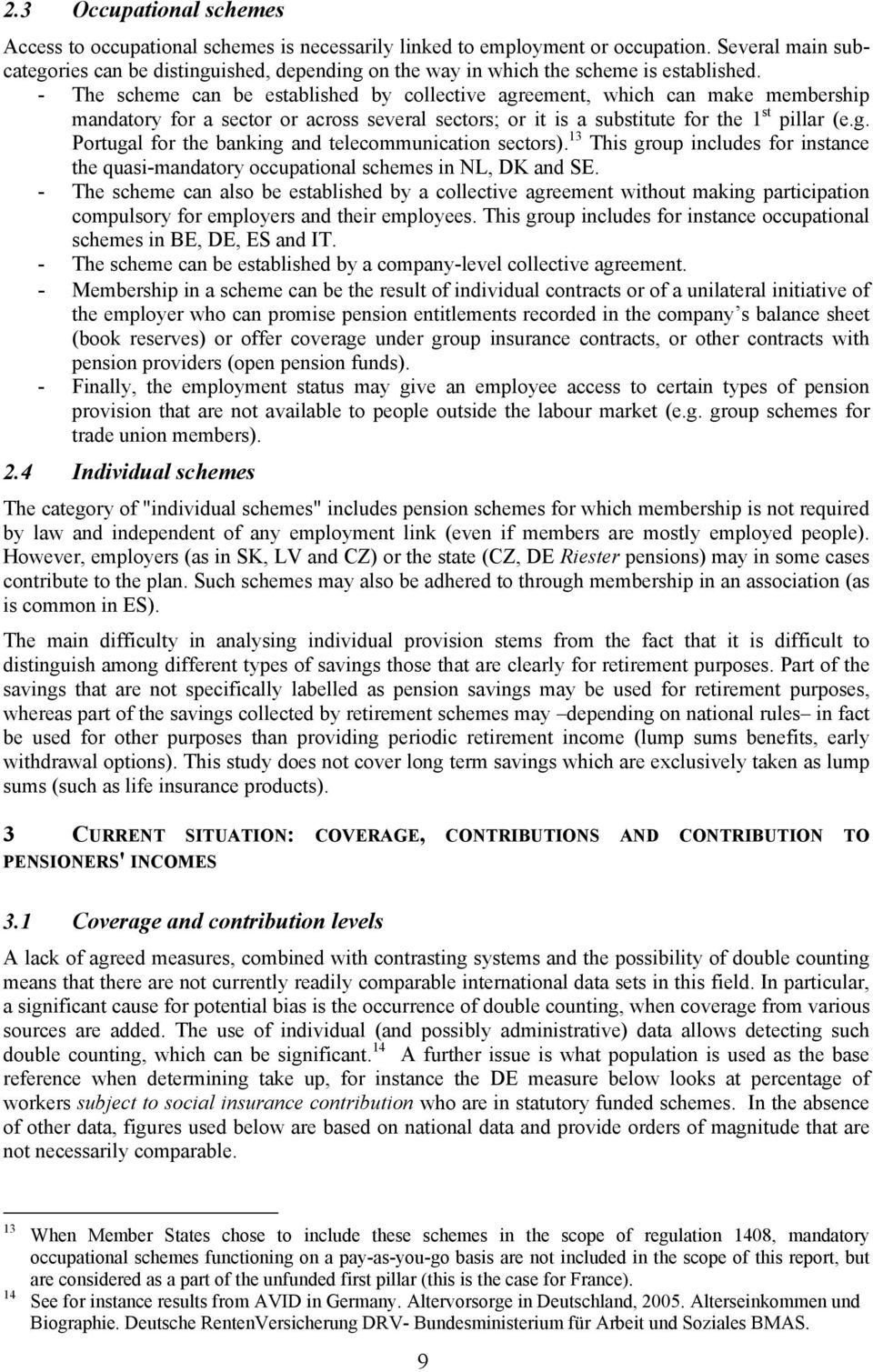
10 Coverage levels vary greatly depending on the type of scheme: statutory funded, occupational or voluntary pension provision. The current coverage of statutory funded schemes is currently estimated to range from 25% (in IT) to 90% (DK) or 100% (SE). In most Member States, where such schemes have been introduced, this ranges around between 50% and 70%: AT (more than 50%, severance pay), BG (50%), EE (50%), LT (54%), LV (80%), HU (70%), PL (70%), SK (65%). Such differences reflect the timing of introduction and different regulations around membership and the transition arrangements (see section 4.1). Coverage should approach 100% as schemes mature since in most schemes, only younger workers/new market entrants are required to join (so it will require a generation to reach full membership). Coverage of occupational pension schemes is more heterogeneous between Member States (see Table 2). Member States can be roughly divided into 3 groups: - High coverage (over 75%): DK (around 75%), NL and SE (over 90%). - Medium coverage (between 40 and 70%): BE (around 50%), DE (around 60-65%, which includes a significant share of Entgeltunwandlung), IE (around 40%), CY (around 45%, including both occupational schemes and provident funds) and UK (around 47%); - Low coverage (under 20%): IT (17%), AT (13%), FR (around 15%), ES and FI (8%), LU (5%), PT (4%), or very low (around 2.2% in PL). However, these coverage levels are also not static reflecting the development of schemes over time. Some of these developments are negative, such as the closure of existing voluntary schemes to new members as employers seek to control costs. However there are also positive initiatives such as the UK's Personal Accounts scheme due to come in from Personal Accounts are designed for those employers who do not currently run a pension scheme and it is hoped that it will increase occupational pension scheme coverage in the UK by approximately 7 million employees. Some Member States also rely on voluntary, individual provision but coverage is even more heterogeneous. The industry is well developed in some Member States and still developing in others so there are two discernible trends: mature private pension systems responding demographic change by reducing generosity; and new Member States introducing new private pension to supplement State provision. It is high in the Czech Republic, where the Supplementary Pension Insurance introduced in 1994 covers 45% 15 of the working age population (contributions tend to be low and 70.5% of benefits are paid out as a lump sum and so do not guarantee a regular income in retirement) thanks to structured tax incentives - see section 4.2 on tax incentives). The German Riester pensions (non occupational voluntary private pension) coverage of around 28% of the population end is quickly increasing (it doubled since 2005). The UK (18.9% of the employed population 17 ) and Ireland IE (14.8% 18 ) have significant coverage because of a traditional reliance on private saving. The French PERP (non occupational voluntary private pension) coverage of only around 2.8% 19 of the population (note difference) is more indicative of the level of coverage in EU. Table 2 - Coverage (2006) Statutory funded scheme Occupational schemes BE / 51.0% of the labour force (a) BG UPF: 50.7% of the active population ; PPF: 4.0% n/d of the active population (b) (entirely DC) CZ / n/d From Czech Government (2008). Coverage in the age group is 43.4% for men and 47.6% for women. People 65 years old or older can also participate (12.5% of all participants in 2006 belonged to such age group) million on 31/12/2007, BMAS. The British Household Panel, 2004 Irish Quarterly National Household Survey From Drees, Etudes et Résultats n and Europe in figures, Eurostat booklet
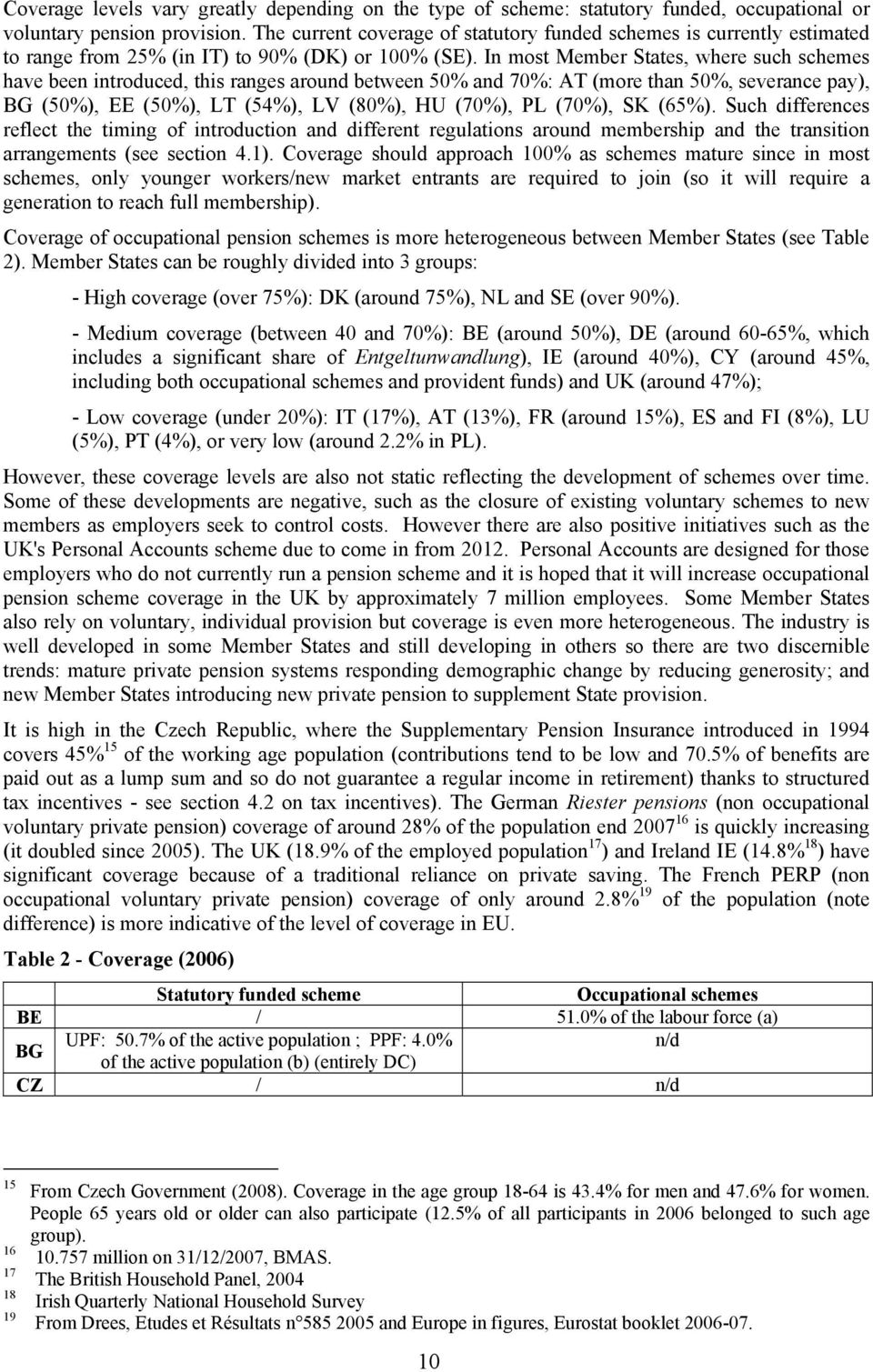
11 Statutory funded scheme Occupational schemes DK 87.0% of the active population (c) ; 85.0% of the 73.0% of the active population (f) (entirely DC) active population (d) (entirely DC) DE / 60-65% of employees (e) EE 50.5% of the employed population (f) (entirely n/d DC) EL / n/d ES / 8.0% of the active population (g) (almost entirely DC) FR / About 15% of the of the active population (h) IE / 40.1 % of the employed population (i) IT Around 25% of private sector employees (TFR, 31% of potential subscribers (j) entirely DC) CY / 43% of the employed population (q) LV 78.0% of the active population (h) (entirely DC) n/d LT 43.5% of the labour force (r) (entirely DC) n/d LU / 5.4% f the active population (h) (evenly DC and DB) HU 59.7% of the active population (h) (entirely DC) n/d MT / n/d NL / Over 90.0% of the employed population (k) (mainly DB) AT 51% of the labour force (l) (BMVG, entirely DC) 13.2% of the labour force (a) (mainly DC) PL 71.7% of the employed population (h) (entirely < 1.0% % of the active population (entirely DC) DC) PT / 3.7% of the labour force (a) (mainly DB) RO 44% of employed population (DC) n/d SI / 51.5% of the active population (h) (entirely DC) SK 65.8% of the employed population (m) (entirely n/d DC) FI / 8.0% of the labour force (n) (entirely DB) SE Around 100% of the employed population (o) Over 90.0% of the employed population (a) (entirely DC) UK / 47.1% of the employed population (p) Note (/) not applicable (there are not such schemes in the country). Data on coverage across countries is calculated using different approaches: coverage based on the labour force (number of people aged 15 and over who are employed or unemployed), using the active population (number of people over 16) or the employed population (number of people employed and self-employed), or the total number of employees <These will be need to be transformed in participation as a percentage of labour force>. Source: (a) OECD Global Pension Statistics (GPS) (b) Financial Supervision Commission (c) ATP, Report 2006 (d) SP, Report 2006 (1) (e) Ministry of Labour of Social Affairs (f) Ministry of Finance (g) Ministerio de Hacienda (h) as of September Ministry of Labour, Family and Social Affairs (i) Central Statistic Office (j) COVIP (Regulation and Management of Italian Pension Funds) (k) The Netherlands Bank (l) Financial Market Authority (m) National Bank of Slovakia (n) Insurance Supervisory Authority (o) Premium Pension Authority (p) The British Household Panel (r) Ministry of Social Security and Labour. DB to DC Occupational pension schemes were traditionally structured as defined benefit provision. Demographic changes have had a significant impact on the make up of private pension provision over the past few years, not least the strong trend within private pensions (notably statutory and occupational) moving from DB to DC schemes, though there is some evidence that the trend is now less strong than it was it seems unlikely to reverse. This change moves risks (notably of longevity and return) away from the provider (employer or State) onto the individual or the insurance company from whom the individual buys an annuity (see section 5). This trend has been exacerbated by recent changes to legal and regulatory frameworks across Member States designed to enhance private pension provision. For example Italy has introduced a law replacing DB or hybrid schemes with DC schemes while new types of DC scheme (TFR) have been introduced in FR (PERCO), UK (Stakeholder pensions). But the need to adapt pension schemes to increases in life expectancy remains in both DB and DC schemes: to ensure stable retirement incomes, additional contributions are needed, in the form of longer working lives or higher contributions (savings). This is a trend that is notable in Swedish occupational schemes where there has been a trend of renegotiating PAYG DB schemes into 11
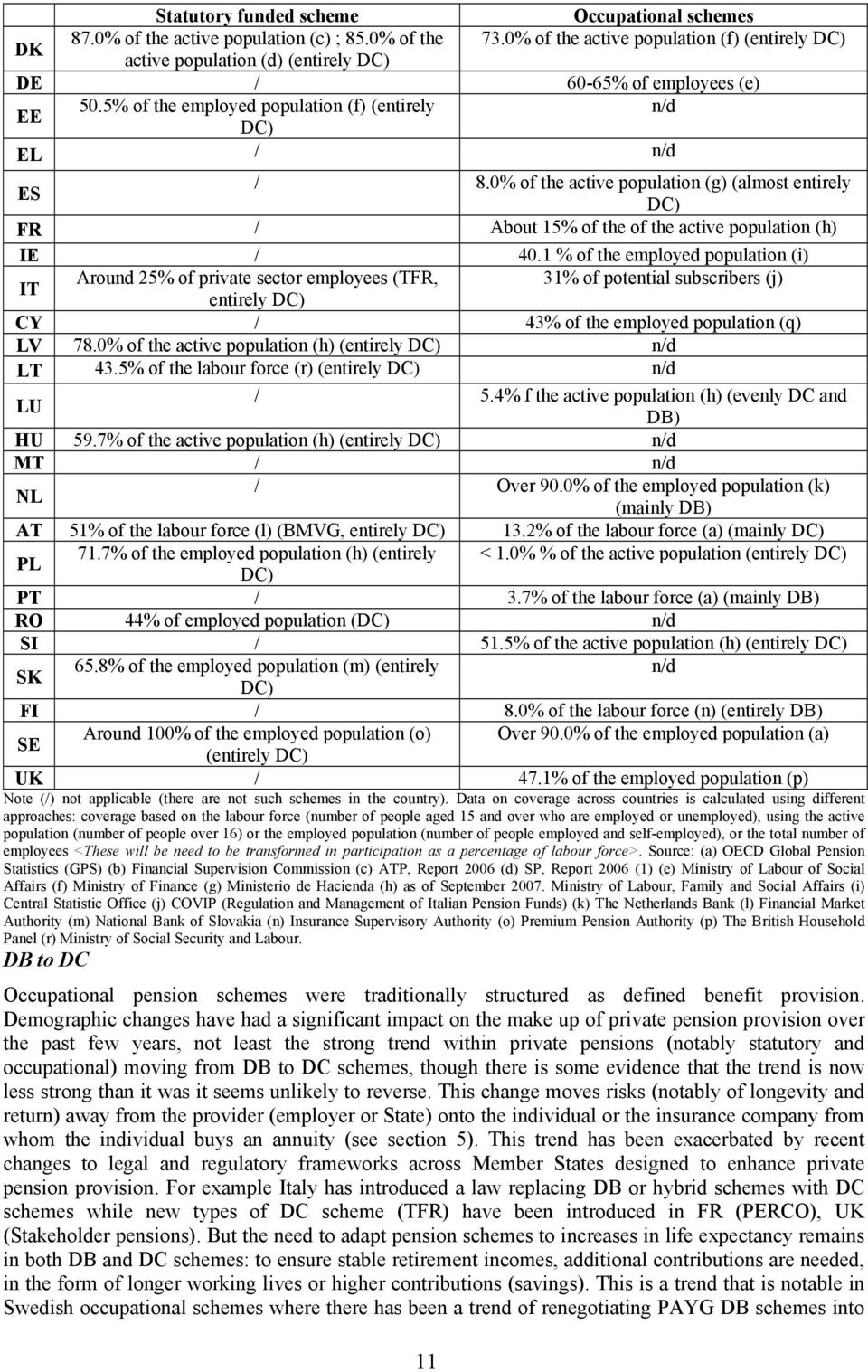
12 DC funded schemes for younger workers. These renegotiated schemes are calculated so as to provide a similar adequacy as the old schemes given the rate of return on funds is as anticipated. The general idea has been to keep contributions at a moderate level. Box defined benefits and defined contributions According to the OECD, a defined benefit (DB) plan is any pension plan other than a defined contribution (DC) plan, including all plans in which the financial or longevity risks are borne by the plan sponsor. Benefits to members are typically based on a formula linked to members' wages or salaries and length of employment. Alternatively, a defined contribution plan is a pension plan by which benefits to members are based solely on the amount contributed to the plan by the sponsor or member and any return on that investment. All Member States statutory funded schemes are DC (including in AT BMVG and IT TFR). This reflects the fact that the majority are fairly newly established and so have already been subject to the increasing trend toward DC. The majority of people in occupational pension schemes are in DB occupational pension schemes. This is because the trend towards DC is fairly recent and the effects will take longer to work through: many schemes close to new members but retain old members on previous terms. In the UK, IE and DK there has been a very clear shift over the past decade from DB to DC schemes (until now DB are mainly prevalent in the public sector). For instance, UK figures (GAD survey) suggest that in 1995 there were 5.2 million active members of private sector DB schemes (of these 5 million were in open schemes, 0.2 million in closed) and that by 2000, there were 4.6 million active members (of which 0.5 million in closed schemes, 4.1 million of open schemes), implying a closure rate of 16% between 1995 and In contrast, occupational pension plans in Finland, the Netherlands and Sweden have mainly preserved their DB character. In Finland, for instance, both compulsory occupational pension plans (TEL) and the voluntary occupational plans are entirely DB. Similarly, in the Netherlands DB pension plans cover over 90% of members of the quasi-mandatory occupational pension plans. In Sweden, however, there has been a shift in DB occupational pensions to DC systems in almost all of the four large agreements. In the NL significant increases in pension contributions occurred between 1997 and 2004 (8.2% to 14%) in link with the downturn in financial markets. A different approach to risk sharing has been to some extent introduced since, following the agreement of some social partners, through the introduction of Collective Defined Contribution schemes (CDC) in certain cases, mostly company pension funds (also see section 5.3 Financial risk sharing). These arrangements occur in many different ways. In the NL, the pension agreements should be either a DB one, an agreement for the payment of a capital sum or a DC agreement and the CDC schemes will have to qualify as one of these agreements. Employer's contributions While the employer contribution is clearly an important aspect in ensuring adequacy of pensions in retirement, there is no clear link to coverage. In Statutory funded schemes employer/employee contribution is generally determined by law, with the employer taking the larger share in the majority of cases (except LV and PL). In occupational schemes (where there is no mandatory minimum or a low minimum) employer contribution is more variable (see Table 3). Table 3 - Contribution rates to privately managed funded schemes Statutory funded schemes BG Statutory (Universal funds) Total contribution to funded scheme as % of gross wage 12 Share paid by employer Share paid by employee Total pension social security contribution as % of gross wage (a) 5% 60% 40% 26.5%
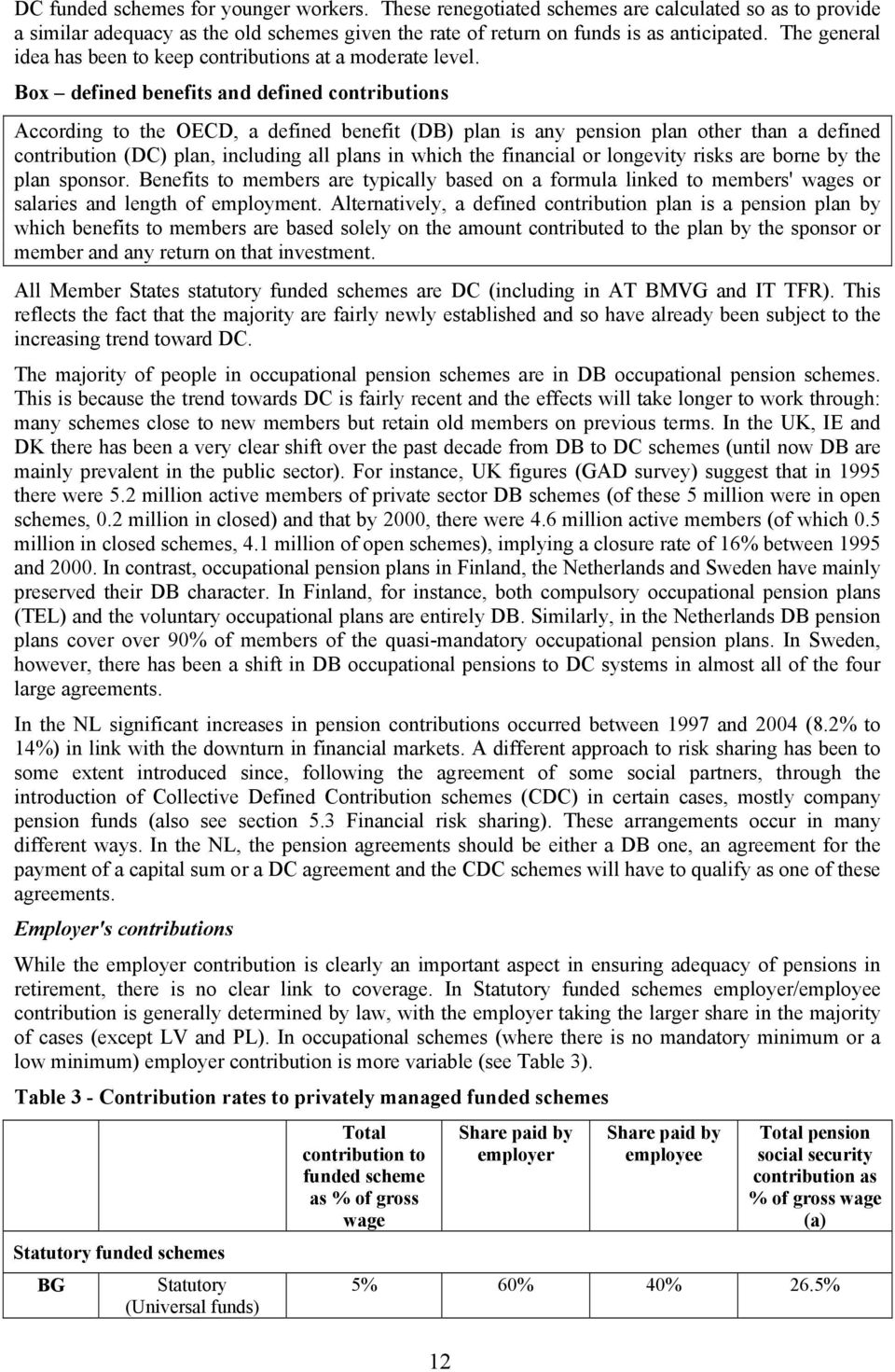
13 Statutory 12% - 7% 100% 0% (Professional funds) DK ATP (c) c. 1% (c) 67% 33% 13.6% SP 1% 0% 100% EE Statutory funded tier 6% 67% 33% 22% IT TFR 6.9% 100% 0% 39.6% LV Statutory funded tier (d) 4% 2007 rising to 10% % 73% 27% LT Statutory funded tier 5.5% c. 90% c. 10% 26% AT Severance pay 1.53% 100% 0% 22.8% HU Statutory funded tier 8% (for 0% - (20%) 100% - (80%) 33.5% participants of the so called hybrid system: additional 2% can be given by the employer) PL Statutory funded tier 7.3% 0% 100% 29.77% RO Statutory funded tier 2% in 2008, 0% 100% increasing gradually to 6% by 2016 SK Statutory funded tier 9% 100% 0% 28.75% SE Statutory funded tier Premium pensions 2.5% 100% 0% 30.9% (ITP plan) Occupational schemes Typical total contribution to funded scheme as % of gross wage Share paid by employer Share paid by employee Total pension/ social security contribution as % of gross wage (a) NA BE Occupational 1 to 5 % DB: c. 90% DC: c. 35% DB: c. 10% DC: c. 65% DK Occupational 9% private sector 50 to 67% 33 to 50% 13.6% blue collar 12% public sector 15% private sector white collar DE Occupational Up to 4% 0-100% 0-100% 23.5% IE Occupational DB: varies DB: varies DB: varies 30% DC: c. 10% DC: c. 50% DC: c. 50% CY Occupational DB: varies DB: c. 90% DB: c. 10% 35% DC: c. 11% DC: c. 45% DC: c. 55% FR Occupational DB: varies DC: varies DB: generally 100% DB: generally 0% 26,15% DC: varies DC: varies LV Occupational Voluntary DC varies DC varies NL Occupational (e) 16.1% 67% 33% 21-22% AT Occupational DC: c. 1 to 5% DC: generally DC: generally 22.8% under social 100% 0% security ceiling, DC: varies DB: varies c. 5 to 15 % above ceiling DB: varies 13
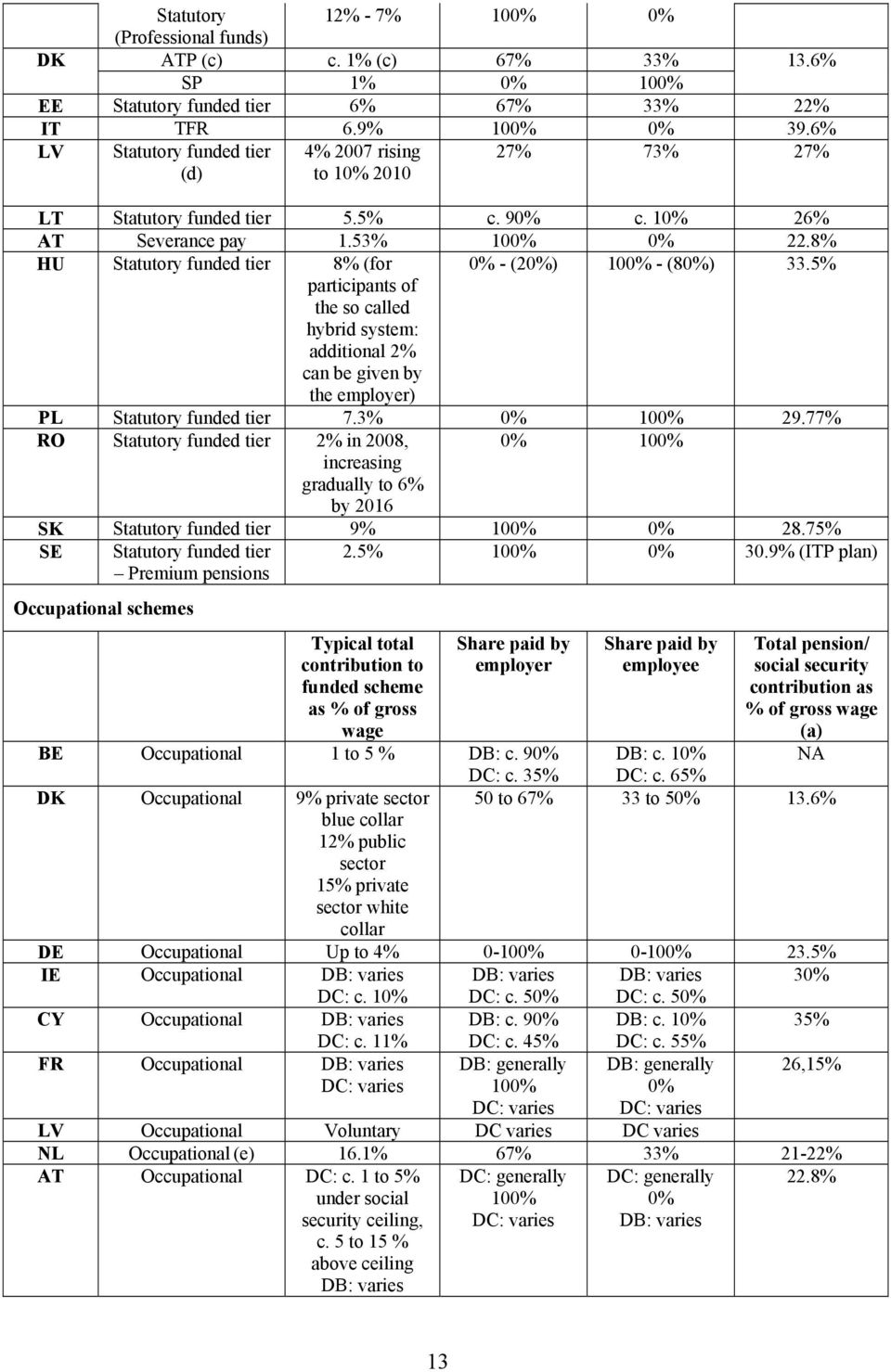
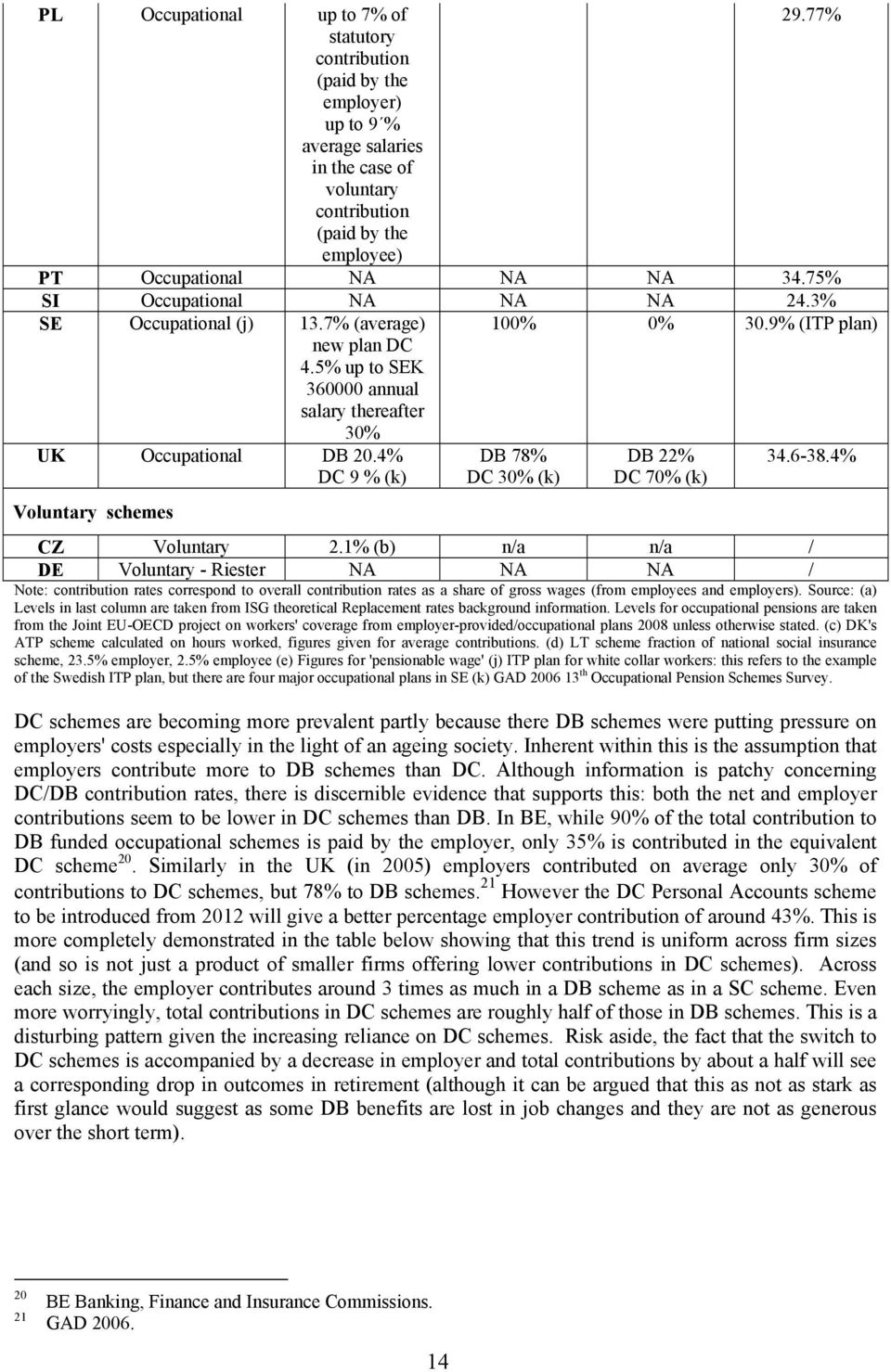
14 PL Occupational up to 7% of 29.77% statutory contribution (paid by the employer) up to 9 % average salaries in the case of voluntary contribution (paid by the employee) PT Occupational NA NA NA 34.75% SI Occupational NA NA NA 24.3% SE Occupational (j) 13.7% (average) new plan DC 4.5% up to SEK annual salary thereafter 30% 100% 0% 30.9% (ITP plan) UK Occupational DB 20.4% DC 9 % (k) Voluntary schemes DB 78% DC 30% (k) DB 22% DC 70% (k) % CZ Voluntary 2.1% (b) n/a n/a / DE Voluntary - Riester NA NA NA / Note: contribution rates correspond to overall contribution rates as a share of gross wages (from employees and employers). Source: (a) Levels in last column are taken from ISG theoretical Replacement rates background information. Levels for occupational pensions are taken from the Joint EU-OECD project on workers' coverage from employer-provided/occupational plans 2008 unless otherwise stated. (c) DK's ATP scheme calculated on hours worked, figures given for average contributions. (d) LT scheme fraction of national social insurance scheme, 23.5% employer, 2.5% employee (e) Figures for 'pensionable wage' (j) ITP plan for white collar workers: this refers to the example of the Swedish ITP plan, but there are four major occupational plans in SE (k) GAD th Occupational Pension Schemes Survey. DC schemes are becoming more prevalent partly because there DB schemes were putting pressure on employers' costs especially in the light of an ageing society. Inherent within this is the assumption that employers contribute more to DB schemes than DC. Although information is patchy concerning DC/DB contribution rates, there is discernible evidence that supports this: both the net and employer contributions seem to be lower in DC schemes than DB. In BE, while 90% of the total contribution to DB funded occupational schemes is paid by the employer, only 35% is contributed in the equivalent DC scheme 20. Similarly in the UK (in 2005) employers contributed on average only 30% of contributions to DC schemes, but 78% to DB schemes. 21 However the DC Personal Accounts scheme to be introduced from 2012 will give a better percentage employer contribution of around 43%. This is more completely demonstrated in the table below showing that this trend is uniform across firm sizes (and so is not just a product of smaller firms offering lower contributions in DC schemes). Across each size, the employer contributes around 3 times as much in a DB scheme as in a SC scheme. Even more worryingly, total contributions in DC schemes are roughly half of those in DB schemes. This is a disturbing pattern given the increasing reliance on DC schemes. Risk aside, the fact that the switch to DC schemes is accompanied by a decrease in employer and total contributions by about a half will see a corresponding drop in outcomes in retirement (although it can be argued that this as not as stark as first glance would suggest as some DB benefits are lost in job changes and they are not as generous over the short term) BE Banking, Finance and Insurance Commissions. GAD

15 Table 4 - Contribution rates to UK pension schemes by size (as % of wages) 3.2 Variations in coverage and contributions Variations in coverage and contributions can result in disparate outcomes in retirement. For instance, breaks in contributions can have a significant impact on outcomes in retirement, as well as their timing: for an individual having a 40 years career 22, if he/she fails to contribute for the first 10 years (25% of contribution time) the pension pot will fall by about 30% while if the break is for the final 10 years instead, it will fall by only around 20% (because of the compound loss of investment returns). These ratios remain even with changes in contribution, but changes significantly with the rate of return: the higher the rate of return, the greater the fall in pension pot from a broken history of contributions. Lower coverage and a broken contribution history tend to result from being in a section of the labour market that is not catered for by existing provision (part time/low wage employment), periods out of the labour market (for example due to illness, children, caring etc, see section 5.1) or a lack of awareness/knowledge. As such the young women, and the less well off are least likely to be covered by a non-state pension and most likely to have varied contributions. For instance, in IE and UK coverage is relatively low amongst the young (20-24, table 5) and increases to a peak around and then trails off slightly after 55, while in DE and SK, it is more prevalent amongst the young. This might be explained by the fact that schemes are maturing in DE and SK, meaning that coverage will progressively increase for higher age brackets. On the reverse, the lower coverage among the young in IE and UK appears more structural. Table 5- Coverage rate by age in some MSs (statutory, occupational and individual schemes) Statutory schemes Occupational and individual schemes SK EE LT DE (a) IE (b) UK (c) CZ <29 24% % 27,5% 26% 20% % 53% 46% 37% % % 65,1% 54% 48% % % 64% 54% 60% >50 1% % 53,3% 43% 58% Source: For Slovakia, National Bank of Slovakia, coverage is calculated as percentage of the employed population. Scheme is mandatory for younger cohorts, see section 4.1. For LT, Ministry of Social Security and Labour, coverage is calculated as percentage of the employed population, For EE and LT PRAXIS Other three columns: CZ: national. Others OECD Coverage of funded pension plans [DAF/AS/WD/PEN(2007)] (a) Results for Germany were calculated using the German Socio-Economic Panel Data (GSOEP). Data includes people with life insurance and private pension, Coverage is calculated as percentage of the employed population. (b) Results for Ireland include occupational and personal pensions. Quarterly National Household Survey, 2005Q4, Irish Central Statistics Office.. Coverage is calculated as percentage of the employed population. (c) Results for Great Britain (England, Wales and Scotland) for occupational schemes were calculated using data from the British Household Panel Survey, Coverage is calculated as percentage of the 22 This example corresponds to an earner contributing for 40 years on real wages of 100, with wage growth of 2% and real returns of 3% with regular contributions of 5%: at retirement the pension pot is of 527 in real terms 15

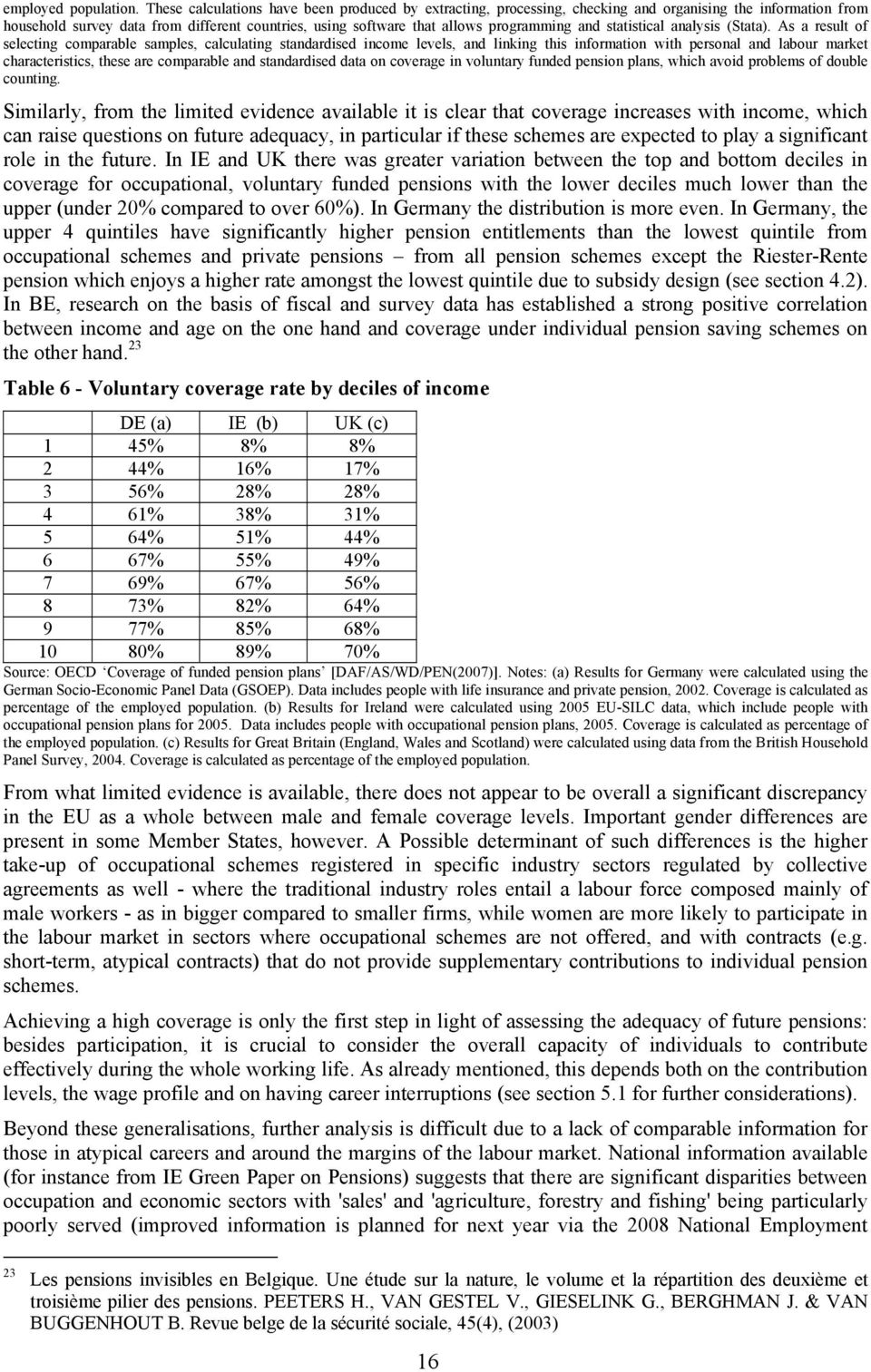
16 employed population. These calculations have been produced by extracting, processing, checking and organising the information from household survey data from different countries, using software that allows programming and statistical analysis (Stata). As a result of selecting comparable samples, calculating standardised income levels, and linking this information with personal and labour market characteristics, these are comparable and standardised data on coverage in voluntary funded pension plans, which avoid problems of double counting. Similarly, from the limited evidence available it is clear that coverage increases with income, which can raise questions on future adequacy, in particular if these schemes are expected to play a significant role in the future. In IE and UK there was greater variation between the top and bottom deciles in coverage for occupational, voluntary funded pensions with the lower deciles much lower than the upper (under 20% compared to over 60%). In Germany the distribution is more even. In Germany, the upper 4 quintiles have significantly higher pension entitlements than the lowest quintile from occupational schemes and private pensions from all pension schemes except the Riester-Rente pension which enjoys a higher rate amongst the lowest quintile due to subsidy design (see section 4.2). In BE, research on the basis of fiscal and survey data has established a strong positive correlation between income and age on the one hand and coverage under individual pension saving schemes on the other hand. 23 Table 6 - Voluntary coverage rate by deciles of income DE (a) IE (b) UK (c) 1 45% 8% 8% 2 44% 16% 17% 3 56% 28% 28% 4 61% 38% 31% 5 64% 51% 44% 6 67% 55% 49% 7 69% 67% 56% 8 73% 82% 64% 9 77% 85% 68% 10 80% 89% 70% Source: OECD Coverage of funded pension plans [DAF/AS/WD/PEN(2007)]. Notes: (a) Results for Germany were calculated using the German Socio-Economic Panel Data (GSOEP). Data includes people with life insurance and private pension, Coverage is calculated as percentage of the employed population. (b) Results for Ireland were calculated using 2005 EU-SILC data, which include people with occupational pension plans for Data includes people with occupational pension plans, Coverage is calculated as percentage of the employed population. (c) Results for Great Britain (England, Wales and Scotland) were calculated using data from the British Household Panel Survey, Coverage is calculated as percentage of the employed population. From what limited evidence is available, there does not appear to be overall a significant discrepancy in the EU as a whole between male and female coverage levels. Important gender differences are present in some Member States, however. A Possible determinant of such differences is the higher take-up of occupational schemes registered in specific industry sectors regulated by collective agreements as well - where the traditional industry roles entail a labour force composed mainly of male workers - as in bigger compared to smaller firms, while women are more likely to participate in the labour market in sectors where occupational schemes are not offered, and with contracts (e.g. short-term, atypical contracts) that do not provide supplementary contributions to individual pension schemes. Achieving a high coverage is only the first step in light of assessing the adequacy of future pensions: besides participation, it is crucial to consider the overall capacity of individuals to contribute effectively during the whole working life. As already mentioned, this depends both on the contribution levels, the wage profile and on having career interruptions (see section 5.1 for further considerations). Beyond these generalisations, further analysis is difficult due to a lack of comparable information for those in atypical careers and around the margins of the labour market. National information available (for instance from IE Green Paper on Pensions) suggests that there are significant disparities between occupation and economic sectors with 'sales' and 'agriculture, forestry and fishing' being particularly poorly served (improved information is planned for next year via the 2008 National Employment 23 Les pensions invisibles en Belgique. Une étude sur la nature, le volume et la répartition des deuxième et troisième pilier des pensions. PEETERS H., VAN GESTEL V., GIESELINK G., BERGHMAN J. & VAN BUGGENHOUT B. Revue belge de la sécurité sociale, 45(4), (2003) 16
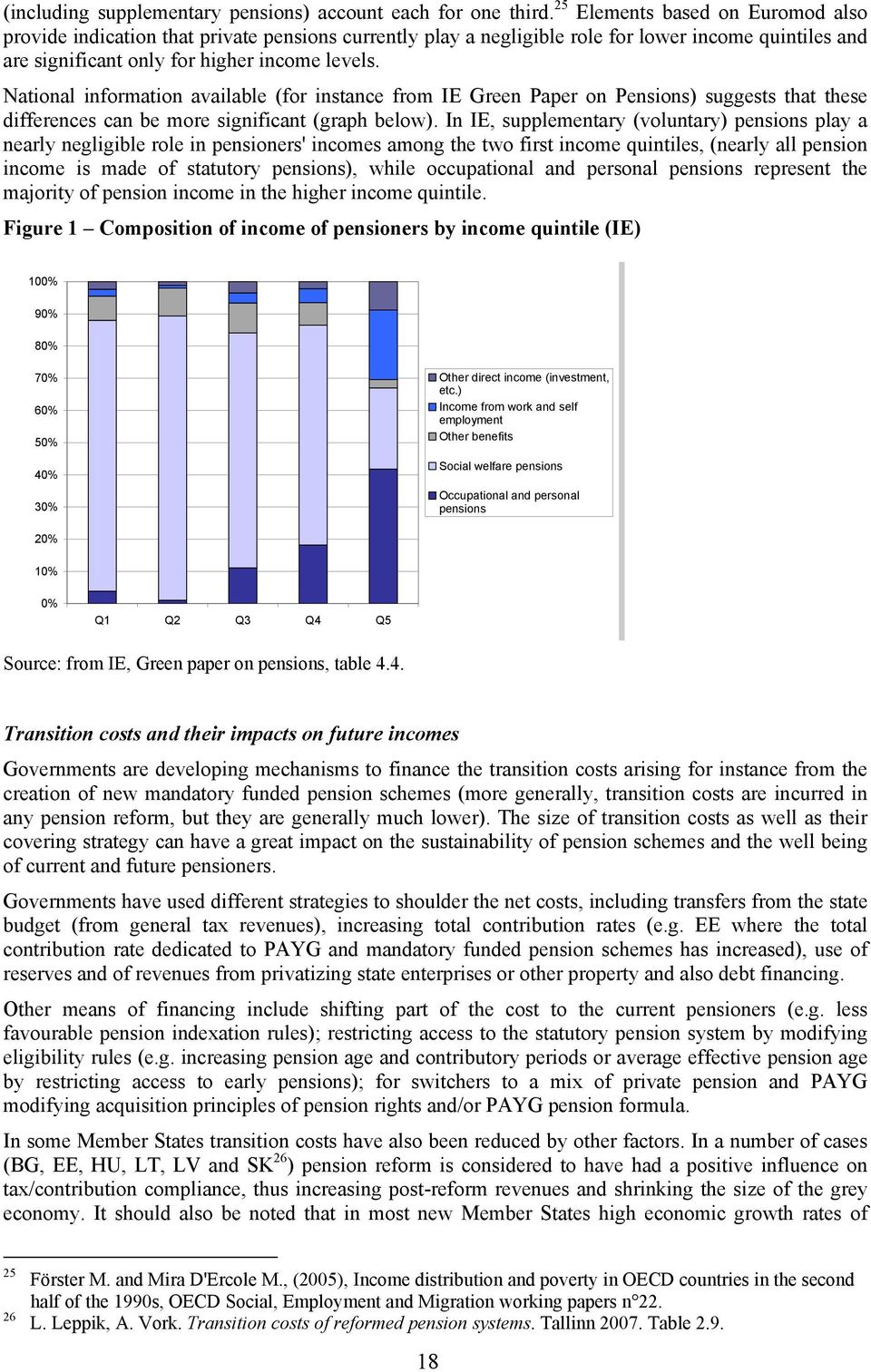
17 Survey). However, again, without improved information, it is hard to draw useful conclusions. In addition to variations in coverage by age, occupation or economic sectors, evidence based on the ECHP (for DK, IE, NL, ES and the UK) also suggests that supplementary pension coverage tends to be lower for lower educated individuals and those with short job tenures and was lower in some Member States (IE, UK) for part time jobs Contribution to pensioners' income Private pension coverage alone cannot provide a clear indication as to pension adequacy in retirement without elements regarding the make up of other pension benefits and income in retirement. The overall contribution of privately managed schemes to the income of retired people actually reflects the level of contributions, the coverage of such schemes, their maturity (i.e. the proportion of pensioners with a full career covered by the scheme) and their weighting within the pension system. Current contribution of private pensions to pensioners' incomes is diverse between Member States and generally uneven within Member States The current overall contribution to the income of retired people varies greatly among Member States. In the vast majority of Member States, unfunded statutory pension schemes provide the dominant proportion of pensioners incomes. As privately managed schemes provide complements of income to pensioners (in addition to pay-as-you-go financed benefits), their importance is to a large extent a reflection of the size of public unfunded statutory schemes which represent by far the main source of income for retired people. The contribution of privately managed schemes remains modest in most Member States and represents up to a third of the total income of retired people (see SPC study 2005) in certain Member States: o In most Member States, the contribution of private funded schemes is modest or almost negligible. This includes countries where such schemes are not developing significantly (EL, ES, FR, MT and LU) and also Member States where such schemes have only recently been introduced (BG, CZ, EE, HU, IT, LV, LT, PL, AT, SI, SK, SE and RO). o In some Member States, the share of income coming from private pensions ranges from 5 % to 20 %: BE (around a quarter of net pensions, but only for the 20 % of pensioners are currently covered), DE (in 2003 about 7 % of pensioners' income from occupational schemes and 7 % from individual ones), CY (around 15% share of pensionable income coming from occupational pensions and provident funds), FI (about 6-7 % of all pensions perceived), PT (about 8 % of pensions paid, but unevenly distributed across sectors) and SE (between 15 % and 20 % of total income of people aged 66 and more). o In some Member States private pensions provide an important part of the income of retired people (between 20 % and 30% of income): DK, IE, NL and UK. Furthermore, national information available indicates that supplementary pensions play a nearly negligible role in pensioners' incomes among the lower income quintiles (nearly all pension income is made of statutory pensions), while occupational and personal pensions represent a significant share of income in the higher income quintiles. Here again international comparison is difficult due to a lack of comparable information. When for better comparability, one gathers capital income, private and individual pensions, there is clear evidence that resources are highly differentiated among older people across the income ladder. On average, across OECD countries, old age pensions and public transfers account for almost all the income of the bottom income among older people quintile and close to 80% for the middle quintiles. For individual in the top quintile, old age pensions and public transfers, earnings and capital income 24 Andrietti V. (2000). Occupational Pension Coverage in The European Union. An Empirical Analysis. ISER working papers
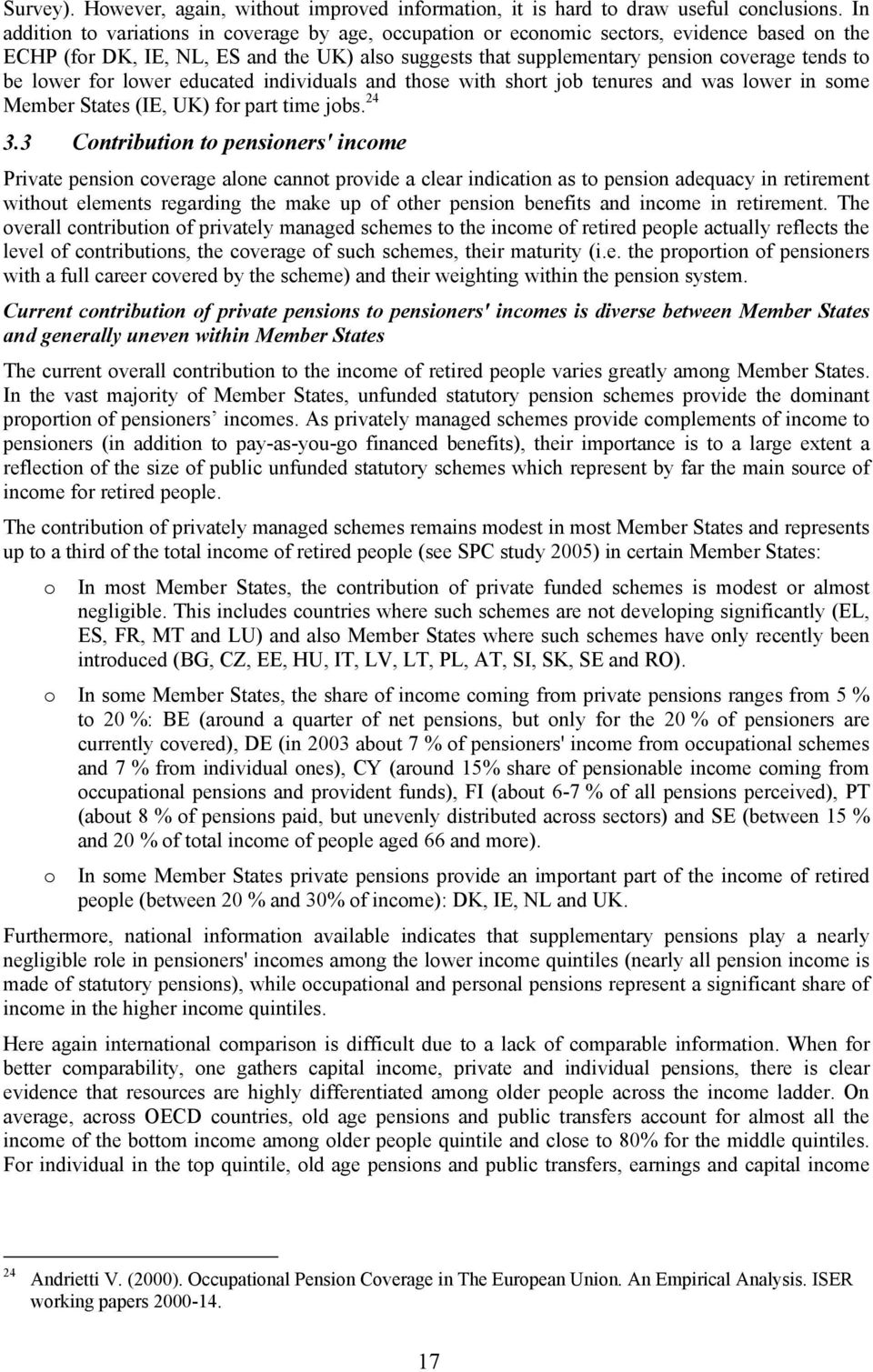
18 (including supplementary pensions) account each for one third. 25 Elements based on Euromod also provide indication that private pensions currently play a negligible role for lower income quintiles and are significant only for higher income levels. National information available (for instance from IE Green Paper on Pensions) suggests that these differences can be more significant (graph below). In IE, supplementary (voluntary) pensions play a nearly negligible role in pensioners' incomes among the two first income quintiles, (nearly all pension income is made of statutory pensions), while occupational and personal pensions represent the majority of pension income in the higher income quintile. Figure 1 Composition of income of pensioners by income quintile (IE) 100% 90% 80% 70% 60% 50% 40% 30% Other direct income (investment, etc.) Income from work and self employment Other benefits Social welfare pensions Occupational and personal pensions 20% 10% 0% Q1 Q2 Q3 Q4 Q5 Source: from IE, Green paper on pensions, table 4.4. Transition costs and their impacts on future incomes Governments are developing mechanisms to finance the transition costs arising for instance from the creation of new mandatory funded pension schemes (more generally, transition costs are incurred in any pension reform, but they are generally much lower). The size of transition costs as well as their covering strategy can have a great impact on the sustainability of pension schemes and the well being of current and future pensioners. Governments have used different strategies to shoulder the net costs, including transfers from the state budget (from general tax revenues), increasing total contribution rates (e.g. EE where the total contribution rate dedicated to PAYG and mandatory funded pension schemes has increased), use of reserves and of revenues from privatizing state enterprises or other property and also debt financing. Other means of financing include shifting part of the cost to the current pensioners (e.g. less favourable pension indexation rules); restricting access to the statutory pension system by modifying eligibility rules (e.g. increasing pension age and contributory periods or average effective pension age by restricting access to early pensions); for switchers to a mix of private pension and PAYG modifying acquisition principles of pension rights and/or PAYG pension formula. In some Member States transition costs have also been reduced by other factors. In a number of cases (BG, EE, HU, LT, LV and SK 26 ) pension reform is considered to have had a positive influence on tax/contribution compliance, thus increasing post-reform revenues and shrinking the size of the grey economy. It should also be noted that in most new Member States high economic growth rates of Förster M. and Mira D'Ercole M., (2005), Income distribution and poverty in OECD countries in the second half of the 1990s, OECD Social, Employment and Migration working papers n 22. L. Leppik, A. Vork. Transition costs of reformed pension systems. Tallinn Table
19 recent years have boosted employment and wage levels, positively influencing PAYG revenues, easing the transition. In addition, the transition costs in some of the countries are sometimes perceived as opportunity costs, i.e. as costs which potentially could have been used for other purposes, e.g. for increasing PAYG pensions at a higher rate to improve benefit adequacy. Different methods of shouldering transition costs shift the burden on different groups and cohorts. These can translate into significant deficits of the pension schemes, like for instance in SK or PL where over the transition period, a large deficit in the financing of the public PAYG scheme will occur. Some governments have also transferred a part of the transition costs to current and/or future beneficiaries of the PAYG pension scheme, with implications on benefit adequacy. While the relative income of pensioners seems to be generally stable, poverty rates seem to be increasing in some Member States acknowledging quick growth and with low indexation of pension benefits. Without further measures to monitor and adjust pension benefits this trend could further develop in the future. Box BB. Definitions of transition costs Transition costs generally occur on two levels: macro and micro level. On the macro level, transition costs occur due to the re-allocation of some contributions from PAYG schemes to individual accounts. Pensions of current beneficiaries must then be financed from lower contribution revenues, resulting in additional costs borne by the State - a situation that is generally exacerbated by demographic ageing. Micro costs, on the other hand, are the ones directly shifted onto individuals to share the burden of transition. Transition costs can also be divided into: gross transition costs, expressed as the amount of pension contributions transferred to the funded tier at given contribution levels to the PAYG scheme ; and net transition costs, expressed as the difference between post-reform PAYG contribution revenues and expenditures on benefits of the remaining PAYG pension scheme. The size of the gross transition costs is mainly influenced by the share of contributions diverted to the new funded scheme, the level of coverage of the funded scheme and the ratio of average earnings of switchers to the average earnings of all insured persons in the system. The size of net transition costs is often lower than the gross costs because governments use various means to reduce the burden. Current and projected estimated pension levels of retirees from different types of schemes (from theoretical replacement rates calculations) Another indication can be provided by the share of pension replacement income that is provided by funded schemes at retirement, as reported in theoretical replacement rates calculations (these calculations refer to hypothetical cases of a worker retiring at 65 after 40 year on average wage, with an assumptions of a real rate of return of 2.5% net of changes corresponding to 3% real rate of return, 0.5% charges). In most Member States such levels are currently negligible and the major share of pension income is derived from unfunded statutory schemes. 27 They are important in NL and IE (between half and two thirds of pension replacement rates come from funded schemes) and to a lesser extent in the UK and SE (about one fifth) and DK, BE and DE (one tenth). Table 7 - Contributions of various schemes to theoretical replacement rates (base case) New pensioners (retiring in 2006) Future pensioners (retiring in 2046) Statutory Other - Statutory Statutory funded Occupational PAYG funded scheme or individual scheme scheme Statutory PAYG scheme Other - Occupational or individual scheme scheme BE 91% / 9% 80% / 20% BG* * * * * * * 27 This is consistent with national information provided in 2005 for the SPC study. 19

20 New pensioners (retiring in 2006) Future pensioners (retiring in 2046) CZ 100% / / 100% / / DK 84% 6% 10% 55% 6% 45% DE 90% / 10% 75% / 25% EE * * * * * * EL 100% / / 100% / / ES 100% / / 100% / / FR 100% / / 100% / / IE 46% / 54% 57% / 43% IT 100% / / 80% 20% (TFR) / CY 90% / 10% 85% / 15% LV 100% / / 51% 49% / LT 100% / / 62% 38% / LU 100% / / 100% / / HU 100% / / 75% 25% / MT 100% / / 100% / / NL 40% / 60% 40% / 60% AT 100% / / 100% / / PL 100% / / 56% 44% / PT 100% / / 100% / / RO* * * * * * * SI 100% / / 100% / / SK 100% / / 56% 44% / FI 100% / / 100% / / SE 78% / 22% 65% 12% 23% UK 78% / 22% 68% / 32% Note (*) not available. (/) not applicable: there are no such schemes modelled in theoretical replacement rates calculations as either such schemes do not exist in the country or they are not representative. Estimates provided in this table refer to base cases and are not to average situations. They indicate the proportion of total replacement rate from each type of scheme. Source: ISG, calculations for the base case, 2006 updates. National averages as a percentage of income can be affected by other factors such as changes in coverage of private pensions. ( ) For the UK, a variant has been used in the table, assuming that a median earner contributes 8% of their salary into a DC private pension. The base date is 2007, with a standard DC pension scheme with the same cost and rate of return assumptions as set by the ISG, and the pension paid in 2046 relates to a personal accounts type DC pension. The other difference between 2007 and 2046 is that the latter figure takes into account the fact that the SPA will have risen to 68 by 2046, lowering the potential payout period by the same amount. By contrast the ISG figures assume that the average earner contributes 8% into a standard DC private pension scheme with the same cost, contribution period and rate of return assumptions as set by the ISG both in 2006 and The UK figures based on the ISG assumptions would be 80%-20% in 2006 and 78% -22% in ( ) The statutory TyEL-scheme includes an individually funded part. In the TyEL-scheme the rate of old-age funding is 1/3 While coverage of funded schemes is projected to increase in coming decades the share of pension replacement rates provided by those schemes is generally expected to remain constant in most Member States and notably those where their role is currently particularly significant (NL, UK and even decline in IE). The share of occupational and voluntary pensions is expected to increase significantly in DE (Riester pensions), and to a lesser extent in BE. The main change is projected to arise within statutory schemes, through the increase of the contribution of funded tiers, which is expected to grow significantly over the next decades: reaching one tenth of replacement rates in SE, around one fifth in IT and one fourth in HU and between two fifth and a half of total replacement rates in LV, LT, PL and SK. These elements confirm the trend towards an increased role of private pension provision in the pension systems of EU Member States, as already documented in the 2005 SPC study, which also underlined that, in all but a few Member States, the public pay-as-you-go pension schemes are expected to remain the principal source of income of pensioners. 20

21 4. ONGOING REFORMS TO ENSURE ADEQUATE COVERAGE AND CONTRIBUTIONS This section reviews policies aiming at ensuring adequate coverage and contributions. It should be noted that actual levels of coverage and contributions needed to ensure adequate and sustainable pensions clearly also depend on the coverage and size of other types of provision (see section 3.3). 4.1 Compulsion vs. soft compulsion Member States have instituted a range of pension reforms in order to increase private saving, chief among which has been some form of compulsion. This section reviews examples, relative success and drawbacks of the various forms of compulsion. One of the most popular methods of enabling the long term sustainability of pension systems is to ensure private saving through some form of compulsion. There are two principal types of compulsion: o o o Mandatory (compulsory for all) or quasi-mandatory (compulsory for only some): funded tiers of statutory pension scheme accounts (AT, DK, BG, EE, HU, LV, PL, SK, SI, SE) will be mandatory eventually but, due to transition arrangements, the majority are only mandatory for the younger population (except in DK and SE). Other arrangements (in BE, AT, DK, NL, SE) make an occupational pension necessary under labour contracts, although often covering most but not all the workforce (see table 8). Soft compulsion (strongly encouraging while offering an element of choice): these can include automatic enrolment with the option to opt out (as in IT and proposed by UK) or opt in without the possibility of opting out (like partially for the funded tier in LT). Membership can also be purely voluntary, resulting from a sole individual choice: this is of course the case for individual schemes. Box 1 - Means of mandating private pension saving Hard compulsion: mandatory or quasi mandatory ensures that workers between particular age brackets are contributing to a pension scheme. Generally these ages are set around 'working age' ages but vary during the transition. They can also be targeted aiming at a particular section of the population (for instance, SI and BG target those in particularly harmful and demanding jobs who might retire earlier). Soft compulsion: opt in and opt out - Opt in gives workers easy access to a pension scheme, in LT once a worker has opted in, they may not then opt out. This has been also the case for most funded tiers of statutory schemes, where opting in was mandatory for younger cohorts, optional for middle aged ones and not possible for older workers (see below). Opt out automatically enrols workers into a pension scheme as a condition of employment, harnessing inertia to maximise membership while still offering choice. Table 8 - Member States with funded mandatory and quasi mandatory pension schemes Austria (BMVG) Belgium Bulgaria UPF (M) Type of workers covered (salary employed/self employed) Participation is mandatory for all employees with private sector contracts (including part of civil service personnel). Participation is quasi mandatory for all employees in the sectors in which a sectoral pension scheme has already been concluded. Participation is mandatory for all public and private-sector employees and self-employed workers. Type of employment contract covered (full time/part time/temporary) n/d Sectoral pension schemes cover all employees or part of the employees of the sector concerned. Membership is obligatory for both full-time and part-time (with a minimum work period of one month). PPF (M) Participation is mandatory for all employees who work in occupations classified in labour categories I and II (employees working under harmful conditions). 21 Membership is obligatory for both full-time and part-time.
22 Denmark ATP (M) SP (M) Estonia (M) Hungary (M) Latvia (M) Poland, OFE (M) Slovakia (M) Sweden, Premium Pensions (M) Denmark (QM) Netherlands (QM) Romania Slovenia (M) Sweden (QM) Participation is mandatory for all employees Participation is mandatory for all employees (including persons on parental leave, recipients of cash sickness or unemployment benefits) and self-employed workers. Participation is mandatory for all public and private-sector employees and self-employed workers. Self-employed persons not required to participate. Participation is mandatory for all employees and selfemployed workers. Participation is mandatory for all employees and selfemployed workers Participation is mandatory for all employees and selfemployed workers Participation is mandatory for all employees and selfemployed workers who enter in the labour force after January Coverage is voluntary for self-employed. Participation is mandatory for all employees and selfemployed workers earning more than 16,800 kronor a year. Occupational plans cover private and public-sector employees except civil servants. Occupational plans cover private and public-sector employees including civil servants. Compulsory industrywide pension plans cover all employees in the respective industry, including private and public-sector employees. In the case of all other plans, coverage is regulated in the plan rules. Employees whose salary does not exceed a certain limit may be excluded. Members of a profession may establish profession-wide pension plans that are implemented through profession-wide pension funds. The Minister of Social Affairs and Employment may make participation in a profession-wide pension plan compulsory for the profession as a whole upon request of an organization or organizations representing the majority of the profession concerned. Participation is mandatory for the employed and selfemployed insured in the public pension system aged until 35. It is voluntary for those aged Mandatory occupational supplementary pension insurance covers only employees with hazardous occupations in difficult conditions, such as cool mining. For all other workers, occupational schemes are voluntary ITP and ITPK: Occupational plans cover private-sector salaried employees. SAF-LO: Private-sector wage earners. Membership is obligatory for employees, who work more than nine hours week. Membership is obligatory for employees, who work more than nine hours week. Membership is obligatory for both full-time and part-time. Membership is obligatory for both full-time and part-time. Membership is obligatory for both full-time and part-time. Membership is obligatory for both full-time and part-time. Membership is obligatory for both full-time and part-time. Industry-wide pension plans cover all employees to which the collective agreement creating the pension plan applies. Admission requirements may differ from plan to plan. Plan rules must not discriminate between employees of the same category, but variations between different categories of employees are allowed. Part-time employees must not be excluded from membership of a plan. n/d Membership is obligatory for both full-time and part-time. It is not compulsory to cover part-time employees working less than 40% (16 hours per week) of full time. Premium pension Scheme: mandatory scheme in the public pension system Notes: M: Mandatory, V: Voluntary, QM: Quasi-mandatory. Sources: OECD. Compulsory 22
23 Under provision of voluntary private pension saving Fundamentally the reason for mandating private saving through any form of compulsion is to ensure both adequacy (individuals' are covered by some type of sufficient pension provision providing for their standard of living in retirement) and sustainability (ensuring that the costs are not passed on to the State, since the more people who save, the less means tested benefits are claimed and the lower the pressure will be for increases in State Pensions. Voluntary privately funded pensions, where they exist, are of two types, either offered in conjunction with employment (occupational pensions) or privately (individual pensions). Occupational pensions, unless mandated, are offered by employers as an incentive to workers, or as part of a labour agreement. However, their availability and the contribution offered by the employer actually varies greatly between employers and Member States (see section 3). Private pensions from independent financial institutions can be a large and confusing market which does not necessarily cater for lower earners (those least likely to be saving) as sales costs mean they are not always profitable. Charges can be significant on smaller savings and can remove much of the investment return (see 4.3). What is more, people are not always rational when it comes to saving, they can be myopic about their needs in retirement and pessimistic regarding their life expectancy. Combined with a natural hesitancy when confronted with too much choice this has resulted in significant variation in private pension saving (as discussed in section 3) and sometimes significant under saving. Mandatory saving Mandating private saving is an effective means of achieving both high coverage and a uniform distribution of private saving across age and income levels. Furthermore the economies of scale provided by certain Member States' funded pension systems enable lower costs than smaller provision and so greater saving (see section 4.3). Mandating saving prevents indecision and irrationality around choosing private saving and ensures access to some form of provision (often with lower charges than standard voluntary schemes see section 4.3). It enables more time for accumulation and returns. Most compulsory saving also mandates an employer contribution (BG, DK, EE, IT, LT, AT, SK, FI, SE) which makes saving better value for the individual and helps to provide a better income in retirement. In countries such as DK, SE and the NL, coverage of private pensions exceeds 85% of employees using a quasi mandatory system through industrial-relations agreements in different sectors. Not all countries enjoy similar labour relations so this model is difficult to export. However, there can be draw backs to mandatory saving, since a level must essentially set which is appropriate for all savers and so will invariably result in some over and under saving. People's circumstances differ and it is not in the best interests of everyone to save in a particular manner. For instance, if someone has a high level of personal debt at high interest rates, it might be more advisable to make repayments rather than save for retirement. And a mandatory contribution, while very beneficial to employees, effectively makes employees more expensive and, it may be claimed, the Member State less competitive. Compulsory saving can also raise fears of a negative interaction with means tested benefits. If an individual's low saving levels mean that their income in retirement will be below the means tested boundary, then mandating saving has effectively just made that individual worse off during the course of their life time. Some means tested benefits attempt to reward saving to some degree but it can be costly. This has led to arguments for a minimum earnings threshold (as in SE, some NL schemes and proposed in the UK's personal accounts scheme), with a level of earnings above which it will be beneficial to save in the vast majority of cases. Some Member States (notably IE, NL and UK) have significant financial service industries, which already provide significant coverage with private or occupational pension plans. While the current situation can show some gaps, some groups are well served by existing voluntary financial services, and it can make up a significant section of a country's economy (voluntary funds under management in the UK are equivalent to 79%, and in IE, 50% of GDP). There can be fears that mandatory funded pension scheme will 'crowd out' existing providers, offering a similar service and competing for the same market. The UK has proposed caps on annual contributions and banned transfers into and out of 23
24 personal accounts to ensure that it is a complement rather than a replacement for existing provision. While further questions have been raised regarding how much mandatory saving is offset by reducing existing savings, what little evidence suggests that it is successful in increasing private saving. Australian research estimates that for every Au1$ of compulsory savings there has only been a 38 cent offset from reductions in other forms of savings. 28 Soft compulsion In an effort to avoid the problem of mandating a single level of saving to all, some Member States have proposed alternative through soft compulsion, allowing individuals to either opt-in or opt-out, thus introducing elements of choice on the part of the individual (or in some cases of the employer). Yet this avoids only one of the problem aspects of compulsion and runs into several more, not least, depending on the design of the scheme, significantly lower coverage. In introducing mandatory schemes, the majority of Member States made the schemes mandatory for younger cohorts, with an option to opt in for middle age cohorts (see table T). LT and SE are notable exceptions at either extreme. In SE the scheme was made mandatory for all and in LT for no one people could opt in but not opt out. Table 9 - Membership policies in funded tiers of statutory schemes Country (reform year) BG (2002) EE (2002) HU (1998) LV (2001) LT (2004) PL (1999) RO (2004) Mandatory Opt-in Time window for opting in Not allowed Aged under 42 at the time of the reform (born or later) Aged under 19 at the time of the reform (born or later) Entering labour market or later Aged under 30 at the time of the reform (born or later) None Aged under 30 at the time of the reform (born or later) Individuals with up to 35 years of age at the time of the reform None Aged at the time of the reform (born ) All employed at the time of the reform Aged at the time of the reform (born ) All persons insured for full social insurance pension Aged at the time of the reform (born ) Individuals between 35 and 45 years of age at the time of Different cohorts have had a different time window to make the decision, varying from 7 months to 8.5 years: born : born : until born : until born : until born : until born : until born : until born : until born : until months (1 January August 1999) no time limit no time limit 12 months (1 January December 1999) 4 months (17 September January 2008) Aged 42 or over at the time of the reform (born 1959 or earlier) Aged over 60 (born 1941 or earlier) Retired persons Aged 50 or over at the time of the reform (born or earlier) Persons above pension age Aged over 50 at the time of the reform (born 1948 or earlier) Persons insured under the public system with 28 The impact of superannuation on household saving, Ellis Connolly and Marion Kohler, Economic Research Department Reserve Bank of Australia, March
25 SK (2005) SE (1999) UK (2012) Entering social insurance scheme 2005 and later Aged under 62 at the time of the reform (born 1938 or later) All employees will be automatically enrolled, unless already participating in an appropriate scheme provided by their employer, but can opt out. Persons changing employer or having been opted out for three years will be automatically reenrolled. reform more than 45 years of age Persons who had 18 months (1 January June None entered social 2006) insurance scheme before 2005 None Aged 62 or over at the time of the reform (born The self-employed as well as those not in paid work can voluntarily opt in. Source: Praxis. Notes: Bulgaria certain hazardous categories of workers (classified as I and II labour category) are subject to mandatory insurance in a professional pension fund regardless of their age. Lithuania farmers and self-employed who are not insured for the full social insurance pensions cannot switch. Slovakia with effect from 2008, the obligation to switch has been cancelled. New entrants to the labour market now have a 6-month period to decide whether to switch to the multi-pillar system or pay only to the PAYG. The entry and transition arrangements clearly have an enormous impact on membership. LT's voluntary opt-in scheme has an element of compulsion in that once in, a member cannot leave. However, in comparison with fully mandatory schemes, take up has been low (see table x below). EE's scheme was mandatory for those under 19 at the time of the reform (with the possibility for others to opt in) and so had a corresponding low coverage initially. In contrast, SE's mandatory scheme was mandatory for all employees under 62 from inception and so has 100% coverage. Interestingly, PL and LV had almost identical entry conditions (see table T) but PL has much greater coverage possibly due to greater marketing of the scheme for opt in. For the middle age cohorts, HU, LT, EE and SK actually allowed the broadest choice, permitting all employed persons to join the funded scheme. BG adopted the most restrictive policy, setting the cutoff age at 40. PL and LV opted for a middle way, allowing choice for persons aged and imposing mandatory participation on persons under 30 at the time of the reform and restricting access to all over 50. Most countries either restricted or discouraged switching for older workers because the shorter time period of pension accumulation implies a smaller benefit from switching, if any. Instead of restricting access to the funded scheme, older people in SK were discouraged to switch through a policy that sets a threshold of at least 10 years of saving before a pension can be taken from the funded scheme. Similarly, in Estonia, were the cut-off age was close to the pension age, older workers were discouraged from switching since benefits from the funded scheme are available only from 2009 (i.e. required at least 6.5 years of affiliation). In SE experience with the reform showed it was easier to enforce a compulsory private funded scheme if the contribution rates to this scheme were lower. This was especially the case as there was already a mature PAYG system in the country. Table 10 - Share of switchers as a proportion of contributors to the PAYG scheme (%) Country Reform T+1 T+2 T+3 T+4 T+5 T+6 T+7 (reform year) year Bulgaria (2002) or earlier) None proposed as yet 25
26 Estonia (2002) Hungary (1998) Latvia (2001) Lithuania (2004) Poland (1999) Slovakia (2005) Sweden (1999) Source: Centre for Policy Studies PRAXIS, Tallinn 2008, Transition costs of reformed pension systems. Notes: Bulgaria NSSI estimates that the actual share of switchers to contributors is about 66%. Estonia switchers to employed Lithuania switchers to contributors for full social insurance pension. PL per cent of open pension fund members (including inactive accounts) in relation to active contributors, which means that the figure is slightly higher compared to only active pension fund members. Automatic enrolment into workplace pension saving, supported by an employer contribution and tax relief from the State aims to transform the levels of engagement with pension saving in the UK. Automatic enrolment, but with the option to 'opt out' has been proposed for the UK's personal accounts scheme to establish the presumption-to-save as the new default to overcome decision-making inertia. It relies on harnessing the same inertia that prevented people from saving to keep them saving, except when they make an active decision not to. This approach, by allowing opt-outs, avoids the issue of undesired pension saving that comes with hard compulsion, which is not necessarily in the best interests of everyone. However, it can also mean individuals who would have benefited from pension saving are able to opt-out and thus have poorer outcomes at retirement. Some targeting of this automatic enrolment together with good information will be important to ensure opt-outs are well informed and inappropriate saving minimised.. It is hard for individuals who might be better off not saving to self identify and, in providing them with the opportunity to do so, others who would have benefited from saving can also opt out. In IT, the change to the Trattamento Fine Rapporto (TFR, private sector 29 workers severance indemnity payments) works on a similar system of silent assent. This should favour the development of supplementary benefits, as in 2001, the participation rate in supplementary schemes was around 10% of the employed population (the introduction of the silent-consent mechanism was delayed until 2007). Although this has been introduced as the default option, take up remains fairly low and it will take more time to engender a significant culture change. Nevertheless, recent data 30 indicate some acceleration of new pension membership: during 2007, the number of participants among private sector employees reached 3 millions (around 24.9% instead of 15% of 2006). Nevertheless, nearly all potential participants have had the opportunity to choose the destination of their TFR and at this stage a clear majority chose to keep them within the enterprise. Both of these examples also illustrate the need for extensive provision of accurate and possibly personalised information. Opt out schemes also necessitate an extensive compliance regime to ensure that individuals make the decision to opt out independent of any employer pressure. As a result, soft compulsion, while offering individuals greater choice, could be more costly to implement and will take extensive marketing to be effective. 4.2 Tax incentives This section reviews tax incentives (breaks and credits) given to pension savings (often aiming to ensure that saving is used for annuity purchase by attaching conditions). Depending on their design, these fiscal tools can have very different effects on both adequacy and sustainability. Indeed, Besides autonomous and atypical workers (which do not have a severance indemnity payment), public sector employees have been temporarily left out from the reform, due to some difficulties inherent in the conversion of the Trattamento di Fine Servizio (TFS, public sector severance payment scheme) in defined contributions. Any worker can, however, freely contribute to private pension schemes: total subscriptions amount thus to 4.6 millions in COVIP (2008): La previdenza complementare nel 2007, dati provvisori (27 febbraio 2008) 26
27 beneficiaries from these fiscal tools differ widely, as do the levels of costs of fiscal expenditures (notably due to deadweight costs). A lack of clear evidence of the impact of tax relieves to increase savings In rewarding private saving, tax relief aims to ensure a higher standard of living in retirement in two ways: by encouraging more private saving and by contributing to the final sum. The efficiency and cost of these tools clearly depend on whether additional savings are made, which can be hard to calculate. There are many differing factors that can influence peoples' pension saving such as advice from financial advisers and encouragement from employers. Within this framework, a number of Member States consider that tax relieves play an important role as a material incentive for individuals to join and participate in pension schemes. Providing tax relief can be very expensive, costing between over 1.7 % GDP in IE and UK to less than 0.2 % GDP in SK (in 2000, estimates from 2005 SPC study). OECD projections suggest that, while demographic changes will mean an increase in revenues from taxed withdrawal from pension schemes, the costs of tax relief will continue to out weigh revenues collected. 31 Perhaps surprisingly given these costs, there is a lack of clear evidence for the efficacy of using tax relief to improve overall retirement savings outcomes. For instance, it is not clear that tax relieves actually create additional saving rather than simply divert existing saving. If saving is merely diverted then tax relief will be both expensive and inefficient as it rewards saving that would have taken place without it. It can also be argued that savings are offset, as individuals will save less to get the same outcome as a result of tax relief. Yet this would contradict previous evidence - few savers are that rational. It might also be argued that simply diverting general savings into specific pension savings may still be beneficial as the typically more stringent conditions for accessing pension savings reduces the prospect of short term thinking resulting in such savings being used up on other things prior to retirement.. Another issue is who benefits from tax relief both in terms of greater incentives and greater savings. Evidence from the US 401(k) plans shows that middle and lower earners are more likely to respond to saving incentives with saving creation, and higher earners with saving displacement. However, while this might suggest that tax relief is better targeted at those with lower to middle incomes, evidence from US, UK and Canada also suggests that the take-up is higher among higher earners (in terms of participation and contribution levels). 32 The design of certain tax relief systems seems thus to favour higher earners, while the complicated nature of tax relief can result in confusion and it is often only higher earners who have access to independent financial advice to take full advantage. In assessing the effectiveness of tax relieves the costs borne by the State and the contributions these make to the final sums saved by individuals can be readily considered. But the other key part of the picture what extra savings may have been made as a result of the tax relieves remains hazy. In attempting to answer the question "Does tax relief work?", many factors need to be taken into account, not least the motivation of the saver and whether saving would have taken place without tax incentives. While significant resources can be directed here, it remains difficult to answer without further evidence. Design of tax relief Tax relief, easing the level of taxation on certain aspects of saving to encourage and reward pension private saving, is widespread among Member States. In a standard income tax system, regular savings (e.g. in a bank account) are made from taxed earnings. Any returns on the savings are also taxed but withdrawal is tax free (earnings are Taxed, returns are Taxed, withdrawal is Exempt TTE) In the long run only schemes also taxing at least partly accruals would experience anything approaching a net profit. Long-term budgetary implications of tax-favoured retirement plans Economics Department Working Papers No. 393, Pablo Antolin, Alain de Serres and Christine de la Maisonneuve (2004), OECD. Long-term budgetary implications of tax-favoured retirement plans Economics Department Working Papers No. 393, Pablo Antolin, Alain de Serres and Christine de la Maisonneuve, OECD, June
28 For pension saving, the typical tax relief format is to exempt contributions to pension savings products from standard taxation and instead claim the tax back when the product pays out (often with some caveats). This prevents the double taxation of pension saving (on earnings and on paying out from product) which would effectively decrease the value of pension saving compared to standard savings products. In some Member States there are additional advantages for individual pension saving, such as exempting income used for pension savings, from social insurance contributions or direct state support. A further incentive commonly used is to exempt from tax the returns from the investment of the saving, rather than tax them as is the case with regular savings. The most common example of tax relief in Member States is EET taxation, a form of deferred taxation. It allows people to spread their income over their whole life. Under progressive income tax regimes this will typically have the net effect of lowering average taxation over the lifetime, as people will usually pay a lower marginal rate of taxation in retirement than in work (retirement income being lower than previous earnings). Younger savers are particular benefactors because of the non taxation of accrued interests. This may be considered a positive attribute given that starting saving early allows more time for savings to grow making retirement funding cheaper and in addition there may be positive behavioural effects from getting into the savings habit early. Yet EET tax relief has its critics. In earnings forgone by the State, EET tax relief is one of the most expensive forms. Some have questioned the value for money that this investment provides, not least because of who benefits most from EET relief. Higher earners pay the most tax in the majority of progressive taxation systems and so benefit significantly more than those in lower tax brackets. This can only serve to exaggerate wealth inequalities. One possible solution is a single rate of tax relief on pension contributions set in between the lowest and highest rates. Depending on the level the tax relief was set at, it could cost the same, give everyone the same incentive and be more progressive, possibly offering the least well off additional savings if set above the basic rate of tax. However, administration would be more difficult and given that the level of relief would likely be lower than taxation for highest earners, they would effectively be taxed twice on some proportion of their income, which might discourage them from pension saving though they would still benefit from the relief on investment growth. However it seems unlikely that those with high incomes in work would be content to have a much lower standard of living in retirement, suggesting they would still save, though perhaps with less emphasis on specific pension savings. Box 2 - Different methods of tax relieves and tax credits The two most common methods of tax relief in Member States are EET and, to a lesser extent, ETT (a few Member States rely on other forms) and some Member States rely on more direct tax credits. EET - The most common approach in the EU 27 Member States (AT, FI, HU, NL, PL, BE, FR, DE, IE, ES, UK): contributions Exempt, investment returns Exempt, pension income Taxed. This tax deferral is, in theory, an incentive to save as the interest earned on the savings is not taxed and so provides a higher income in retirement. In addition, for some, marginal tax rates will be lower in retirement than employment offering further benefits. EET leaves greater investment for the private sector which, some argue, produces a net gain for the economy. However it is costly, disproportionately benefits higher tax payers and lacks clear evidence of efficiency in terms of encouraging new saving. ETT - While not as generous as EET tax relief, in taxing accruals Member States such as DK, SE, NL and IT are able to control costs better. However as with EET it also disproportionately benefits higher tax payers. TET - Czech Republic and Luxembourg operate TET which could prove costly to the saver as it effectively taxes savings twice, though clearly as a result costs will be lower, and in the case of CZ contributions are deductible. TEE - Used by Hungary, provides tax income up front and, if the tax system is redistributive, would likely provide more tax revenues than EET but would still disproportionately reward those with most savings. It would also be difficult to implement initially because of the need to run two simultaneous tax regimes on existing pensions. However, in the long run, in terms of clarity and public perception it might prove easier to understand. EEE - Estonia and Bulgaria are currently the only Member States with EEE (under certain conditions) which, while generous, could prove expensive. EEE tax relief is also granted in Austria in certain cases, e.g. under the severance pay scheme (BMVG) if the capital is invested in a special pension fund or another supplementary 28
29 pension provision and received as an annuity. Again those with the highest incomes who pay the most tax benefit the most. The OECD attempted to compare four bench mark regimes using a simplified example. A tax payer contributes $100 to the private pension regime and withdraws three periods later. On the assumption that the saver is subject to 25% of the marginal income tax rate and that investment earns a 10 % pre-tax nominal return it can be seen that, theoretically, it makes no difference in real tax revenues whether tax is taken before or after saving, provided that the same aspects are taxed. However, this ignores those who have different marginal tax rates in employment and work. Another point which may be important at a macro level is that EET defers tax take whilst in comparison TEE does the opposite. These different effects could be useful in smoothing impacts from demographic shifts. Matching contributions and credits - Matching contributions on set amounts have been suggested, progressively decreasing on higher bands (e.g. 1:1 until x, 1:2 between x and y). It could be designed to cost the same as the tax relief systems (depending on the levels of x and y) and would be more progressive. Arguably it may also be more efficient as there could be less deadweight cost from giving incentives to those with higher incomes to save, when they would in all probability save anyway. The Czech Republic has instituted a similar scheme since 1994, offering initially generous diminishing State contributions and coverage rate is around 45% of the working age population. Having a minimum set level of participants' contributions of 100 CZK, the State contribution ranges from 50 CZK (for minimum contributions) to 150 CZK (for participants' contributions exceeding 500 CZK), with marginal matching rates decreasing from 50% (for minimum contributions) down to 10% (for the bracket CZK). Furthermore over 70% of benefits paid out so far have been in the form of a lump sum and so are unable to guarantee a steady income in retirement. In some Member States, direct flat credits can also be provided depending for instance on household composition (e.g. Riester Pension in DE). However, some proportion of saving from the better off would be taxed twice, once on earning and once on withdrawal and so it would be a disincentive to save in a pension product. Tax credits In some Member States there are additional advantages for individual pension saving, through direct state support (AT, DE). Matching contributions or significant pension contribution subsidies allow the targeting of lower earners who need to save more, rather than rewarding higher earners and would offer much better value for money for smaller savers. It is also much easier to understand and so would better target those without financial advice. In Austria, taxpayers not jet in receipt of statutory old-age pensions can claim a bonus for their contributions to premium-aided provident schemes. The German Riester pension which is made up of an individual's own savings, plus a basic subsidy of Euro 154 and, where appropriate, a child subsidy of Euro 185 per child (increased to 300 Euros for children born from 2008). Additionally, the personal contributions and the subsidies can be deducted from tax to a maximum of Euro 2,100 per year. Depending on income and the number of children, promotion is between 24 % and more than 90 % of the amount saved. A recent study (TNS Infratest Sozialforschung, 2007: Altersvorsorge in Deutschland 2005, table 6 18) provided some evidence that for Riester-pension, as a consequence of its design, coverage of first quintile income groups is higher than that of higher quintiles, which contrasts with coverage of traditional occupational pension schemes. Given the lack of clear evidence regarding the fiscal incentives of tax relief, the significant costs to public budgets and the often regressive nature of the relief, there is significant scope for Member States to look at the tax relief they offer, particularly regarding the effects on adequacy and sustainability. No tax relief design is flawless but what does emerge is that EET tax relief, which is currently so prevalent, is not especially cost effective, while there are serious concerns over the redistributive effects. In more direct tax credits or matching, the redistributive effects can be better balanced, although the net effect on savings remains unclear. 4.3 Importance of charges and costs Costs can have a significant impact on the size of benefits. Various sources of costs should be considered and this section reviews levels of costs, notably in link with economies of scale associated with different types of organisation (collective saving benefits from economies of scale and thus lower 29
30 costs, while individual private savings costs can often be higher, raising also the question of information). It also highlights that there may be some cost-return trade-off, notably that guarantees can also increase costs (and thus excessive guarantee scheme may lower potential pension levels). There seems to be difficulties in comparisons of the cost of funded pensions sometimes within and surely between countries, as each country has different cost structure, different accounting frameworks and institutional structures. This raises the question of both better information and possible paths of harmonisation in this field. Different types of fees and charges The general fee structure in all private schemes is rather similar. Fees and costs can in large be divided into two groups: first the ones applying to a pension institution and second the ones charged from the scheme members by the institution. Normally the latter is in strong correlation to the first one the more and higher the fees for the provider, the higher the cost for the consumer, but it also depends on the market situation and available competition. The first group of fees may include such a supervision fee from the Financial Supervisory Authority for inspecting the market, contributions for the guarantee fund if one existing, depository fees, transaction fees, fees for other system maintenance organisations (central depository for securities) etc. Thus every additional service (existence of guarantees as an example) would raise the cost for the user and thus reduce levels of pensions in the future. The second group of fees and costs generally includes issue fees (expressed as a percentage of the contribution or unit stock value), remittance fees (percentage of the unit stock value) and fund management fees (percentage of the annual average value of owned units) and possibly administrative charges. In addition there may be other costs charged from the scheme member such as account maintenance etc. The complexity of the fee structure and temptation to hide some fees by providers calls for government action both to ensure transparency as well as sufficient levels of financial literacy and regulate cost levels. Importance of costs and charges and their impact on personal behaviour The role costs and charges play in a particular pension scheme and whether it has any behavioural impacts, depends first on whether it is a defined benefit or defined contribution scheme. In a DC context, costs are usually borne by plan members and have a direct, significant impact on benefits. Moreover, opposite to returns, that may and do fluctuate, costs are "hard facts", as they are in general quite stable and predictable over long time horizon. In DB schemes though, although present, they play a less transparent role as they are already included in the final outcomes of the benefit stream and thus not that much visible and constituting an element for comparisons. Costs are important both for occupational and personal pension plans. In the UK, the Pensions Regulator regards costs a key issue that trustees should consider, and ensure that members receive value for money from their occupational scheme. In this case, transparency of costs puts pressure on trustees, making them accountable to members and stimulating to search for efficiency gains. Size of fees and charges and fee structure The nature of the scheme normally tells a lot about the general level of costs to the scheme participant. Namely the fee levels in collective schemes tend to be lower due to economies of scale as well as lower need for marketing. The level of administrative costs tends to range between 0.5% and 2.5% of assets per year. The most representative value in the range appears to be 1% per year 33. The fee structure is also an instrument that influences the choices and behaviour of fund participants. For example, unit remittance and change of fund fees place negative incentives to switch between funds. For statutory funded pension schemes, size of the fees as well as the structure can vary a lot 33 Privately Managed Pension Provision. Report by the Social Protection Committee,
31 between countries (see table 11). Sometimes fee levels can also become lower for larger markets or in case of mature schemes with high coverage due to the positive effect of economies of scale. The highest fees are charged at purchasing units of the fund and can reach the maximum of 10% in case of LT (however, this maximum limit has never been applied in practice and most common fees range between 2 and 3 percent). Fund management fee structure is more similar, averaging 1% annual from the fund value. The maximum management fee charged is below 1% in a number of countries: BG, HU, LT, PL and SK. In all, but one of these cases though unit issue fee is substantial, compared to other countries charging slightly higher management fees. Exception is SK, that neither charges unit issue nor redemption fees, but account maintenance fees instead. Account maintenance fees in two countries HU and SE are flat rate meaning they will have stronger impact on the low income earners and putting further constrains on their adequacy of pensions. It is difficult to compare the cost of funded pensions between countries, as each country and even each private pension scheme in that particular country has a different cost structure, different accounting frameworks and institutional structures. Still some research made an attempt to one can group countries according to the strategy used. Contribution-based charges are front-loaded, placing a burden in early years. Asset-based charges are back-loaded as the accumulated fund is larger closer to retirement (Whitehouse 2000) 34. Clearly, different fee structures can be observed (see also Chłon- Dominczak 2003 and Fultz 2006) 35. In PL, HU, BG and LT, the fee structure is more front-loaded. These states allow rather high up-front fees, but asset-based fund management fees are more restricted. In EE, LV, SK and SE, the fee structure is more back-loaded with relatively small or no up-front (unit issue) fees, but more heavy reliance on fund management fees 36 and in several cases account maintenance fees (SE, SK, LV and HU). It is true though, that categorisation into front- or backloaded strategies depends on the time horizon in which a certain scheme is viewed (for instance, in PL there is a mandatory reduction of contribution fees up to 3.5%). Table 11 - Fees in mandatory funded scheme (basis, legal limits, range) Unit Unit remittance Fund management Account Other purchasing fee fee fee maintenance fee BG Fee base % of contribution none % of fund value none (annual average) Limits max 5% max 1% Fee range.... EE Fee base % of unit stock % of unit stock % of net fund value none value value (annual) average) Limits none max 1% fixed income funds: max 1.5% equity funds: max 2% Fee range % 1.0% % (all funds) HU Fee base annual revenue % of stock % of fund value flat rate without yield value (annual average) Small fees for changing funds, No other fees permitted Whitehouse, E. Administrative Charges for Funded Pensions: An International Comparison and Assessment. World Bank Social Protection Discussion Paper No , Washington DC. Chlon-Dominczak, A. Costs and charges of pension funds in transition economies. Paper presented at a conference "Pension Reform in Russia: from Legislation to Implementation". Moscow, 25/09/2003. Fultz, E. Pension Reform in the Baltics: Expectations and Early Experience. ILO series, Budapest PRAXIS,
32 LV LT PL RO SK SE Limits in 2007: max 6%, from 2008 max 5.5%, from 2009 max 4% none max 0.9 % in 2007 max 0.8 % from 2008 Fee range 4-5% 0.5-1% HUF Fee base none % of annual average net assets % of annual average net assets % of annual payments Limits max is set by pension fund manager max is set by pension fund manager max 2.5% Fee range % % 1.25% Fee base % of contribution % of fund value (annual average) Limits max 10% max 1% Fee range 1.19%-5.5% % Fee base % of contribution % of net fund value (monthly volume) Limits max 7% 0.054% or less depending on volume of assets plus Success management fee: up to 0.005% a month Fee range 4-7% % Fee base % of contribution None % of fund value (annual average) Limits Max 2.5% of Max 0.6% of net contributions paid total account of the monthly privately administered fund Fee range Fee base None None % of net fund value (monthly average) Limits 0.065% (max 0.075% for first three years after the pension company gets the licence) Fee range Fee base None None % of fund value (annual average) Limits None % of contribution 1% (monthly) flat rate Change of fund fee. Change of fund fee: 80 or 160 PLN depending on the length of membership in the fund. Switchover becomes free if a member has stayed within a fund for more than 2 years. Transfer fee applied to the participant's personal net account of max. 5% for change of fund earlier than 2 years Transfer fee of payment through Social Insurance Agency to pension fund: 0.5% of contribution monthly. Change of fund fee: lump-sum 500 SKK max 100 SEK Fee range % 0.16% from each account Source: PRAXIS, Notes: Estonia until there was a maximum limit on unit purchasing fee 3%. Hungary until 2007 there was no limit on the unit purchasing fee. Lithuania, Hungary, Poland and Slovakia for a change of fund fee, Poland the maximum limit of unit purchasing fee will decrease to 3.5% from United Kingdom the Pension Commission had proposed to limit fees to an annual management charge and avoid any other fees as this would help keep administrative cost down. However, at this point the government has not declared a clear preference and it is likely that the new Personal Accounts scheme will have the competence to develop appropriate charging structures. Fees and charges for pension annuitisation are also part of the reduced benefit payment. They may be also either charged heavily upfront or distributed more evenly over the duration of the contract. It is suggested that the reasonable assumption for the administrative costs of annuitising retirement capital 32
33 in DC pension plans is 5-10 percentage points of the accumulated balance. It would be equivalent to percentage point reduction in annual returns in the accumulation phase 37. Role for the governments to keep costs low It can be noted that since larger schemes such as collective saving benefit from economies of scale and thus lower costs, while individual private savings costs can often be higher, raising also the question of information. For private funded pension plans, both mandatory and voluntary, costs are a key variable to consider. Any differences in costs add up to huge differences in pension benefits in the long run: for instance a yearly 1% of assets represents a much higher share of about 20% of total contributions 38 (this level is not linear with the level of charges: for a 0.5% yearly charge, the result is 10% of contributions, for 2% yearly charge, the result is 32% of contributions, for a 3% yearly charge the result is 43% of contributions). Thus governments have a clear role here in order to keep costs low facilitating accumulations of adequate levels of future pension benefits. The challenge for the government is how to regulate the fee structure so as to maintain a proper incentive structure for fund participants as well as for fund managers. Policies used by Member States have taken soft or stricter form in regulating cost levels. First, institutions may only be obliged to make information transparent and inform current and potential members about all fees. That may potentially lead to voting with feet, thus putting pressure on lowering fees by providers. In almost all countries all costs are analytically disclosed. This is also requested by the IORP Directive (2003/41/EC), at least with regard to investment related costs where the investment risk is borne by the scheme member. However, even in this case cost comparison may not be easy (for instance when pension plans invest in mutual funds that apply management and other fees, and therefore duplication in management fees potentially occurs): the cost structure can be very complicated and opaque. Hidden costs and difficulties in comparison are aspects for consideration and further analysis. Synthetic cost indicators calculated for a representative member with a standard methodology are used or required in a few countries to facilitate comparisons. However, they do not seem to gain general consensus as they may be misleading for individuals that do not fit the assumption made in the calculations. In such cases, e-calculators allowing the individual to adjust assumptions may be better. In several countries the cost indicators or the single cost components of all the products or plans available in the market are shown in comparative tables, published in the web site of the national supervisory authority. This is a proof of the emerging consensus on the fact that cost comparison is crucial in the DC context, and can be considered good practice. Efforts should be developed at national and European level to strengthen this development. A first goal would be to collect data on how such information is presented in different countries and study both the transparency and comparability of the data through a national and international basis, in the aim of developing a common methodology. Secondly, governments have gone further in some countries, setting cost caps on management fees, or in terms of the synthetic cost indicators, for instance in the UK. In other countries, limits are put on the cost structure. In Italy for example the duplication of management fees is not allowed: this discourages pension plan asset managers from investing in mutual funds managed by other fund management companies. In some countries, stricter techniques to control the costs are used: in quite a number of countries they have set cost caps on management fees, some examples of which are presented in the table TT for statutory funded pensions. Regarding occupational pensions, in ES commissions may not be higher than 2% of the yearly balance of an account. In AT charges on contributions may not exceed 3.5% in the new severance pay scheme. In IE, PRSA has a legislative cap on charges for the standard Pensions and uncertain investment returns: effects on individual retirement incomes and government budgets. 26 th meeting of the Working Party on Social Policy. Paris, Nov If a person saves 100 currency units per year for 40 years, it would make 4000 currency units by the end of his career (for simplification inflation and the real rate of return equal zero). If administrative charges amount to 1% of assets per year the accumulated charges after 40 years amount to about 720 currency units. This means that the level of charges as a percentage of total contributions made would amount to around 18%. 33
34 product. And in SI, there is a maximum amount of administrative charges determined for occupational schemes. Costs can also be controlled in terms of the synthetic cost indicators. In other countries, limits can be put on the cost structure. Structural regulation on costs often supplements disclosure in order to achieve the policy objective of mitigating costs of DC pension plans. Cost caps may have ambiguous information content: they do prevent products with excessive costs to be offered in the market, but on the other hand they may signal as "acceptable" a particular level of costs that is not necessarily optimal, and might therefore limit competition. Therefore, both channels of regulation and disclosure seem complementary. Another consideration for governments is to avoid placing heavy burden on low-income earners. That can require setting some cost-free levels on investments, though product providers could object to this being mandatory. This question can also be dealt with in the taxation of pension investments (discussed in former section). Furthermore, in some Member States in case of occupational schemes there is an obligation for pension providers to redirect part of the earned profits to its members (DK, HU). Also social partners may influence the level of costs and charges in occupational schemes (DK, NL, SI, and SE) ORGANISATION OF RISK SHARING Future pension levels are subject to a number of uncertainties and risks: career break risks (risk of career interruption), longevity risk (risk of outliving one's capital), inflation risk (risk of inflation eroding future pensions) and financial risks (risk of lower returns). Furthermore, the combined effect of these risks is greater than the sum of each one. This combined effect (or "super-additivity" effect) is higher over longer periods: it is highest when people begin to save for their retirement. 40 This section reviews various types of risks and the importance of providing individuals with appropriate information. Shifting the risk from the State to private institutions and individuals may look financially sound, but problems can arise with the future adequacy, guaranteeing of which may once again be on the shoulders of the State. Taking into account uncovered risks, it seems that there is not a clear perception of the future development of the adequacy of the whole private funded pension provision and that the current design of different funded schemes can be insufficient for ensuring future adequacy. Further steps seem thus to be needed. This move has been deliberate and systematic in some Member States, reflecting a wish to refer to responsibility of the individual for higher income levels. This risk transfer should in principle have less impact on lower earners who are less likely to have significant pension saving (and will rely largely on State provision in retirement, all Member States also providing some form of minimum income provision see SPC related special report). 5.1 Employment and career break risks This section reviews how funded schemes can embed redistributive elements through the mutualisation of employment risks, by taking into account of non-contributory periods (notably for child or dependant care periods). Furthermore funded schemes are increasingly of a DC type and career breaks generally have stronger effects on DC pension benefits than in DB schemes (which tend to imbed a higher degree of mutualisation of career breaks, since the whole life time is not necessarily taken into account for the calculation of benefits, though non contributory periods are not necessarily covered either). The development of funded DC schemes reduces the size of mutualisation and redistribution of (un)employment and career breaks risks. DC schemes provide higher benefits for those that have longer working careers and smoother wages over the working life. However, those who find Privately Managed Pension Provision. Report by the Social Protection Committee, See for instance DC Pensions, Annuities and Related Risks. 26 th Meeting of the Working Party on Social Policy, OECD, Dec
35 themselves unemployed for large proportions of their working lives or have broken work records will be less well off in retirement: such a development potentially affects more vulnerable groups, such as inactive, women, migrants, low paid, atypical workers etc. In Member States where funded pensions are expected to play a significantly higher role in the future, this could result in a greater incidence of pensioner poverty or reliance on minimum income provision for older people. Elements from ISG report on theoretical replacement rates 41 indicate that people with career breaks will in on fourth of Member States be more adversely affected by ongoing pension reforms that people on employment at average wages over their professional lives (in other Member States they are generally as affected, this is exceptional that they are more favourably affected). In this context, it is important to stress how certain characteristics of the labour market can translate in gender differences in pension levels: it is not the pension system per se that could determine a higher employment and career break risk for women, but the existence of differences between males and females regarding participation rates, job characteristics, wages and career profiles. A pension system can either mitigate or replicate such differences, depending on the particular institutional design, with potentially important consequences on the adequacy and sustainability of pensions in those countries in which the above-mentioned labour market characteristics are robust. Compensation of non contributory periods within funded schemes Some countries have introduced solidarity elements into their statutory funded schemes, while some others have also done so in occupational schemes, for example, by compensating for certain periods outside active employment, e.g. with the state paying contributions during periods of childcare or unemployment. In LV, HU, PL and SE, the same periods are credited in both tiers of statutory schemes (in SE all non contributory periods are provided with crediting, whatever the tier of the statutory scheme). In BG, EE, LT, SK and the UK only some risks covered under the unfunded tier are also covered by the funded tier (in BG, LT and UK none, in EE parental leave, in SK child care). Table 12 Coverage of non contributory periods in statutory funded schemes (unfunded and funded DC tiers of the statutory scheme) Unemployment benefit period Maternity leave Child care Parental leave Sickness/ Disability Other cases BG First tier, unfunded Yes Yes / Yes / Yes Second tier, funded DC / / / / / / EE First tier, unfunded / / Yes Yes / Yes Second tier, funded DC / / / Yes / / HU First tier, unfunded Yes Yes / Yes / / Second tier, funded DC Yes Yes / Yes / / LV First tier, unfunded Yes Yes Yes / Yes Yes Second tier, funded DC Yes Yes Yes / Yes Yes LT First tier, unfunded Yes Yes Yes Yes Yes Yes Second tier, funded DC / / / / / / PL First tier, unfunded Yes Yes / Yes / / Second tier, funded DC Yes Yes / Yes / / RO First tier, unfunded Yes Yes Yes Yes Yes / Second tier, funded DC / / / / / / SK First tier, unfunded / Yes Yes / Yes Yes Second tier, funded DC / Yes Yes / / Yes SE First tier, unfunded Yes Yes Yes Yes Yes Yes Second tier, funded DC Yes Yes Yes Yes Yes Yes UK First tier, unfunded Yes Yes Yes / Yes / Second tier, funded DC / / / / / / Source: PRAXIS. 41 See Current and Prospective theoretical pension replacement rates. Report by the Indicators Sub-Group (ISG) of the Social Protection Committee (SPC) 35
36 Furthermore, when the same risks are covered under the two tiers, there can be differences in the treatments, for instance for child-raising and unemployment periods. In LV, PL, SK and SE, these periods are treated in the same way in both tiers, both in terms of the duration of payment of contributions and the applicable contribution base. On the other hand, BG, EE, HU and LT treat individuals differently in both tiers, either by not covering them or with a less extensive coverage. Table 13 Coverage of periods of raising children and unemployment in statutory schemes (unfunded and funded DC tiers) Maternity, parental leave and child-raising Unemployment BG EE HU First tier, unfunded Second tier, funded DC First tier, unfunded Second tier, funded DC First tier, unfunded Second tier, funded DC Approximate duration (months) 25.5 ( ) Contribution base (or fixed amount) Approximate duration (months) Contribution base (or fixed amount) Minimum wage 12 Minimum wage None None None None (4 different options according to number of children, employment status before maternity etc) Flat rate contribution base (about 20% of average wage, less than minimum wage) 1% on parental benefit Fixed amount, or based on previous wage None 9 None The eligibility depends on the number of working days before unemployment. The amount depends on the former wage in the first three months, than fixed amount. LV LT PL RO SK First tier, unfunded Second tier, funded DC First tier, unfunded Second tier, funded DC First tier, unfunded Second tier, funded DC First tier, unfunded Second tier, funded DC First tier, unfunded Second tier, funded DC 22.5 (4.5+18) 36 ( ) Maternity benefit (about 108% of average wage), followed by flat rate (about 18% of average wage) Maternity benefit (85% of former wage) followed by pension insurance by the means of the State None None None None 28.5 (4.5+24) 28 (4+24) Maternity benefit (initially), followed by flat rate (about 17% of average wage) Maternal leave: minimum wage Child raising: assimilated contribution period without compulsion of paying contributions Unemployment benefit (initially), followed by flat rate (about 29% of average wage) Average unemployment benefit (about 24.5% of average wage) Flat rate (about 20% of average wage) 12 Unemployment benefit. None None None None 72 Flat rate (about 60% of average wage) None None 36
37 Maternity, parental leave and child-raising Approximate Contribution base duration (or fixed amount) (months) Unemployment Approximate Contribution base duration (or fixed amount) (months) SE First tier, Initially 80% of former unfunded 4 years from wage. Later flat-rate 12 80% of former wage Second tier, child birth supplement to earnings. funded DC Source: PRAXIS. Note: The table describes the situation as of 1 January In SE, if the parent who makes the claim works during these 4 years then the benefit for these periods is smaller. Links with minimum income provision In those Member States which rely more heavily on private provision, the link with minimum or means tested universal income in retirement needs to be carefully designed. Indeed, the provision of a means tested retirement income may induce adverse effects, in the sense that it may reduce the benefits of saving for some, since additional income from savings could lead to a reduction in meanstested benefit entitlement. The UK has attempted to combat this using Savings Credit, a decreasing supplementary benefit which rewards saving for those who are eligible for means tested benefits. However tapering off assistance in this way is more expensive due to increased coverage and whilst encouraging take up, the UK is also reforming pension credit as part of its wider pensions reform package to ensure it remain appropriately targeted and cost effective. 5.2 Longevity risk, different payout products and their possible impact on adequacy This section deals with the payout phase of private funded pensions and the impact choices in payout instruments can have on pension adequacy. Decumulation design can protect beneficiaries against fluctuations on financial markets (by predetermining payments), against inflation (through index linking) and against various biometric risks (longevity, invalidity and income protection for survivors). Longevity risk (for individuals) only occurs where annuities are not prevalent, where people build up savings during their working lives and spend them during retirement. As it is uncertain how long people would live, there is a strong risk of outliving one's retirement capital. Life-expectancy risk on the other hand relates to the increase in projected length of life of a whole cohort. The risks of unexpected changes in life expectancy during retirement are borne by the financers of the pension scheme (either the pension fund management company or the sponsoring undertaking or taxpayers in general where the government plays a major role in guaranteeing private pensions). 42 History has shown though how complicated the task of projecting life expectancy is in the light of ever increasing life expectancy. 43 Yet a number of countries lack the demographic data that are necessary to construct accurate mortality projections and in practice use the life tables of other countries 44. Different payout products The payout phase of private funded pensions requires very careful design to ensure both the adequacy and sustainability of pension systems. There are three broad groups of payout products: annuities, phased withdrawals and lump sums. Annuities are most commonly used as payout products in mandatory or semi-mandatory DC pension schemes. They provide periodical payments to beneficiaries with insurance against biometric risks Whitehouse, E. Life-Expectancy Risk and Pensions: Who Bears the Burden? OECD Social, Employment and Migration Working Papers. Oct The Government's Actuary Department in UK is responsible for population projections, providing among other things the basis for forecasts of future public spending on pensions. Comparing the results of future number of people 65+ it appears that the scale of these changes is huge. For 2036 for example the difference of forecast made in 1981 to the one made in 2004 is 36% (from 12 million to 16.5 million) and for 2051 it is even greater: 65%. Based on information from: Whitehouse, E. Life-Expectancy Risk and Pensions: Who Bears the Burden? OECD Social, Employment and Migration Working Papers. Oct Stewart, F. Policy Issues for Developing Annuities markets. OECD Working Papers on Insurance and Private Pensions, No 2, OECD Publishing
38 such as longevity and there is the possibility of survivors' protection in the event of death, based on the use of life expectancy tables. The longevity risk is pooled among the annuitants in the insurance company. There are different kinds of annuity available in European markets, but there is a lot of space for further market development (in some EU countries annuity markets are still almost nonexistent, although this should change with the take up of funded pensions as well as due to smoothing of the cross-boarder service provision), and improvements in product design. It has also been suggested that governments could provide the market with some longevity hedging products. The problem with market solutions is that longevity risk does not manifest itself only as an idiosyncratic risk (unique to each individual) but also as an aggregate risk (uncertainty about mortality improvement of the whole population), thus a private sector driven market is unlikely to develop in the near future. Moreover, without these instruments annuity providers would charge a higher fee to compensate for this un-hedged aggregate risk. Governments could improve the situation by issuing longevity indexed bonds and by producing a longevity index. They could produce forecasts for the entire population and for different subgroups, so that annuity issuers could use the corresponding subpopulation that matches with their current membership structure more closely. 45 Lump-sums provide a single payment to beneficiaries, leaving it to them to ensure that this provides sufficient income during retirement. In a significant proportion of countries (see below) there is the option to take the whole or substantial proportion of retirement savings as lump sums. This flexibility, whilst potentially encouraging individuals to save, increases the risk of State support being required further in retirement. The take-up of lump sums may be justified in the case of low accumulations since paying out an annuity in this instance would not be financially justified. It is normally also regulated by taxation even where such an option is open for the public on voluntary basis. Phased withdrawals provide periodic payments, but without any insurance against the longevity risk, progressively diminishing the capital available. The choice between them can depend on the size of the statutory pension scheme (large PAYG schemes leave more room for manoeuvre in funded schemes), the general level of financial education, and the present and future financial and demographic situation in the country. The extent to which schemes are used for retirement savings depends notably on the conditions attached to them, e.g. tax incentives linked to the condition that the bulk of such savings must be used for a regular income (annuity) rather than for paying out a lump sum or the minimum age at which a person can access such retirement savings. In some cases pension instruments are rather used as investment vehicles with noticeable tax advantages, for instance when a number of years is requested for the plan participation in order to benefit from the lower tax rate. Box 3 - Typology of annuities The (life) annuity (also known as a single-payment annuity) is a financial instrument that allows for a seller (issuer) - typically a financial institution such as a life insurance company - to make a series of payments in the future to the buyer (annuitant) in exchange for an immediate payment of a known sum. The payment stream from the issuer to the annuitant has an unknown duration based principally upon the life expectancy of the annuitant. There are various annuities available in EU27 and several methods to categorize them. According to the number of annuitants covered. Generally, annuity stops payment at the death of the annuitant. However, it is possible to structure a life annuity so that the payments instead only stop upon the death of a second of two annuitants (i.e., a joint and survivor annuity); sometimes the instrument reduces the payments to the second annuitant. According to the type of guarantees. There can be a clause added to the contract under which the annuity issuer is required to make annuity payments for at least a certain number of years (the "period certain" or "guarantee period"). If the annuitant outlives the specified period certain, annuity payments then continue until the annuitant's death, and if the annuitant dies before the expiration of the period certain, the annuitant's beneficiary is entitled to collect the remaining payments certain. The tradeoff between the pure life annuity and the life-with- 45 DC Pensions, Annuities and Related Risks. 26 th Meeting of the Working Party on Social Policy, OECD. Dec
39 period-certain annuity is in exchange for the reduced risk of loss, the annuity payments for the latter will be smaller. According to how they are financed. There may be single premium annuities or flexible premium ones, where contributions are paid in during a certain period prior to receiving benefits. Contributions themselves may be either variable or fixed the same specified amount paid. According to primary purpose. There may be immediate pay-out or a deferred one. In the latter case the annuity can accumulate extra value before being paid out. According to the underlying investment. This is determined by how annuity products create future value. There can be fixed annuities that guarantee a return and specific payout at retirement. Variable annuities on the other hand do not guarantee a certain rate, but returns and payment depend on how the portfolio performs, thus they vary from one payment to another. Variable annuities can either be with-profits or unit-linked. With-profits annuities mean that the pension fund is invested in a with-profits fund of an insurance company, so that annual bonuses are generated, which will allow the annuity payments to grow. The unit-linked annuity is directly related to the value of the underlying fund of investments. Annuities can also be quoted as equity-indexed or indexlinked, in which case the payments depend on how equity market or a certain index are performing. According to the nature of the payout commitment. Annuities normally last for the lifetime of the annuitant (life annuities), but they can also be fixed-term or certain, where payments are made only during a course of a certain number of years. According to the way annuities are purchased. They may either be individual or group annuities. The latter is normally used in the case of occupational pension schemes. According to other minor features. Impaired life annuities will pay an increased annuity payment if the annuitant has health problems certified by a doctor such as cancer, heart attack or other. Enhanced annuities will pay a higher annuity payment if the annuitant is overweight or smokes regularly and these are self-certified. There are also inflation-indexed annuities available on the market that increase the annual payments by the rate of increase in the Retail Price Index to give a pensioner protection against inflation. Escalating annuities will increase the monthly payments by a certain percentage to give the retiree some protection against inflation and to allow for possible increased income needs as the person ages. As a consequence the initial payments of these two products are lower, than with level annuities. Sources: E. Cannon, I. Tonks. Survey of Annuity Pricing. DWP Research report no London, 2006.;P. Antolin. Different Types of Annuities. Presentation at the seminar on private pension provision, Tallinn 6-7/09/07. Annuities as the only means of guaranteeing lifetime benefit stream Annuities guarantee an income for life regardless of its eventual length and, as such, are the most secure means of providing an income in retirement. While they are common in many countries (and are the only option in some), they are not as prevalent as might be hoped due to individuals' myopia regarding their financial future. People tend to underestimate their life expectancy and often opt for phased withdrawals as this enables them to bequeath any remaining money. With annuities, the remaining stream of payments can only be inherited during a guaranteed period (if that option is chosen) and so can seem to be less attractive. Another widespread perception is the general notion that annuities have limited value for the buyer or that the buyer cannot expect a fair payout from the investment. In addition, from the annuitant's viewpoint, factors related to the instrument can be fairly complicated. Some studies have stressed that rational decisions may be difficult for the buyer in this case 46. But, with other income streams, including phased withdrawals, there is a risk that the beneficiary will outlive the money available (particularly likely with the ongoing trend of increase in life expectancy) and so greatly increases the risk of poverty in retirement. Although phased withdrawals or lump sums can sometimes be converted into annuities, this is left up to the individual beneficiary and is rarely undertaken without compulsion. Payout options vary greatly and sometimes are not decided 46 A. Creighton et al. Longevity Insurance: A Missing Market. University of New South Wales AU. Sept %20A%20Missing%20Market_28Aug_JP_Final.pdf 39
40 The ability to choose between annuities, phased withdrawals and lump sum payments currently varies greatly among the Member States. In most Member States where these schemes are made mandatory, annuities are compulsory (DK, EE, HU, LV, RO, SK, SE) though this is still to be decided in PL and in BG, beneficiaries can take up lump sums. There are also requirements to take up an annuity in some occupational pensions (NL, DK), though those can be taken as lump sums under certain conditions (IE, UK). Some Member States have introduced restrictions either by direct legislation or by tax rules on the amount of retirement savings that may be taken as a lump-sum payment (as in DE, IE, IT, LT statutory scheme, LU, EE, PT or UK). Lump sum payments represent the largest share of pay-outs in BE, ES and CZ. Conversely, they are not common in NL, PT, SI and FI. In some countries all three options are available, but access is subject to different requirements and conditions (EE, LT). Table 14 - Overview of typical products offered in the payout phase of statutory funded or occupational pension schemes. Typical Practice (within constraints of Legislative requirements) Life Annuity AT (PK), BG (statutory UPF), CZ (SVP), DK, EE, FI, FR, HU, (PPF), IT (Compulsory), LV (Compulsory), NL, PL (compulsory, to be decided ), SK (compulsory), SI (compulsory), SE, DE Annuity plus lumps sum DE (Riester and Ruerup), IE, CY (Pension Funds), LT (subject to minimum pension), MT, PT, RO (lump-sum or 5-years withdrawal if annuity is lower than minimum private pension) and UK Lump sum AT Insurance, BE, BG, CY, CZ (Individual Pension Plans), FR (PERCO: choice between annuity or lump sum), EL, HU (not PPF), IT (TFR), CY (Provident Funds), LV (voluntary), LU, PL (supplementary), SK (voluntary), SI (supplementary), ES, DE (though with full taxation) Source: Mercer, The Payout Phase of Funded Pensions (Annuities and Other Products) The option of taking pension benefits as lump sums can represent a potential serious threat to adequacy of pensions. As people tend to underestimate their own life expectancy, they rather opt for cashing out their pension benefits and consuming in the present instead of the future. The effect is even more drastic in the situations where the future adequacy of pensions is heavily dependent on such pension provision (for instance in the case of BG, benefits from the statutory funded pillar can be taken in full as lump sum, which can threaten the future adequacy of pensions). As the use of annuities for payouts spreads, so does the definition of annuities. Annuities must be purchased by those with a DC scheme from their individual account but are provided directly by providers of DB pensions (the ultimate level depending on time in work, salary etc). However, changes to former DB schemes increasingly require the purchase of annuities. Need for guarantees in the pay-out phase The greater prevalence of funded pensions calls for an equivalent take up of annuities rather than other payout products of definite streams because of their guarantee of a life time income. Furthermore, in order to ensure adequate pensions in the pay-out phase (that is once the pension pot has been accumulated), key elements are protection of beneficiaries against fluctuations on financial markets and inflation. Without this protection, the value of an annuity can indeed fall drastically in a matter of years. The concrete design of annuities is essential in determining the extent of risk sharing, for instance as regards longevity, inflation, developments on financial markets and other factors. The range of different products may be large in some countries with joint annuities and flat-rate or indexed annuities with different guaranteed periods and risks covered (the UK holds the largest annuity market in EU27), whereas in some others Member States only a basic single annuity is allowed (EE). As such there is currently low survivor protection or guarantees against inflation risk in the pay-out phase (table 15). With only a few exceptions there is no indexation requirement of the benefits and the whole investment risk is borne by the scheme participants: only very few countries impose obligations on members of funded schemes regarding survivors and protection against inflation. Indexation 40
41 requirement only exists in DE, HU, and RO. And dependent pensions only exists in AT, FI, RO, IT, LV, LT, SK and UK (under some conditions). There can also be some requirements for the guarantee period like in DK, EE and IE (in Estonia though people are free to choose the guarantee period or opt out from it). Another aspect of intra-generational redistribution in the statutory funded schemes relates to the use of unisex life tables for calculating the pension (life annuities). This principle has been legislated in some countries such as EE, HU, LV, SK and SE. On the other hand, other Member States such as BG, LT, PL and the UK have not adopted unisex life tables. Table Application of unisex tables in the funded statutory scheme Unisex tables Bulgaria No Estonia Yes Hungary Yes Latvia Yes Lithuania No Poland Yes Slovakia Yes Sweden Yes United Kingdom No Source: National reports Notes: Latvia There are two options for payment of pension from the funded scheme. Firstly, the accumulated pension capital may be transferred to a life annuity paid by a life insurance company. Secondly, the accumulated pension capital may be transferred to the NDC scheme, sums added to the notional capital and pension paid only from the NDC scheme. Unisex life tables are used only in the latter case, i.e., when the whole pension is paid from the NDC scheme. Poland it is planned to use unisex life tables, however, there is still no legislation on the calculation and payment of pensions from the funded scheme. The main rationale behind the adoption of unisex life tables lies in the fact that allowing for lower (annual) pension benefits based on a higher life expectancy at retirement according to gender would constitute a form of statistical discrimination 47 : gender is just one of the many variables that can influence remaining lifetime, being the simplest one to observe but certainly not the most relevant (much more important variables would include income, type of job, dietary, drinking and smoking habits, previous personal and family heath records, geographical region, etc.) It is also to be considered that the difference in life expectancy between men and women not only differs from country to country, but in many cases it has also slightly decreased over the last decades. Furthermore, statutory pension ages for men and women still differ in a number of Member States, implying greater differences in life expectancy of men and women at retirement age than differences at a given age, (e.g., 60). Unisex life tables would thus have an overall balancing effect, narrowing the gender pension gap in a situation of existing differences in life expectancy (average remaining lifetime) of men and women at retirement. 48 The absence of unisex life tables combined with the existing gender employment and wage gaps (the latter being at a range of 15-25%) may lead to a significant gender pension gap in the fully funded In a context of asymmetric information, statistical discrimination arises when individuals are judged according to average characteristics prevailing in the population sub-group they belong to. A typical example is that of an employer offering a lower wage to a worker from a particular socio-demographic group because individuals from that group have on average a lower productivity: the latter fact (or prejudice) does not imply that the worker in question is indeed less productive. These are in the range of 6-8 years in HU, SK, LV, LT, BG, EE and PL (Table MMM). In SE, the difference in life expectancy between men and women at pension age is about 3 years. 41
42 scheme 49. However, there can be issues and difficulties around unisex annuities e.g. adverse selection if annuities are not compulsory for all then insurance companies using unisex tables could expect a lower take-up from men given the lower value they represent for men, whilst women would select them as they would get a higher return on average, which could lead to price inefficiencies in the market. 50 Table 15 - Different schemes and characteristics of their payout products Scheme Type of payment (annuities or Lump sum options) AT Former severance pay - BMWG Paid as a lump sum or as a annuity Occupational plans: Up to 100% lump sum Insurance Occupational plans: Capital over 10,200 (2008 limit) Pensionskasse (PK) must be taken as a annuity BE Occupational plans: Mostly lump sum (unless Group insurance and pension otherwise in the plan rules) funds BG CY CZ Individual products: Retirement savings and individual insurance contracts Statutory DC plans: Universal pension funds (UPF) Professional pension funds (PPF) Occupational plans: Voluntary occupational schemes Individual products: Voluntary private pension funds (VPF) Occupational plans: - DC Provident Funds - DB Individual products: Supplementary Pension Insurance and individual life insurance Up to 100% lump sum (unless otherwise in the plan rules) Benefits are taken as an annuity or as a lump sum / phased withdrawal when the amount is relatively small (less than 20% of the social old age pension). Benefits are taken as a fixed-term pension (up to 8 years) until the pensioner becomes eligible to standard old-age pension from PAYG system. Fixed term, lump sum, or phased withdrawals; up to 100% lump sum Annuity, lump sum, joint annuity or phased withdrawals; up to 100% lump sum - Up to 100% lump sum (typical) - Combination of lump sum and annuity Alternatively as a annuity or lump sum Dependent Pension and/or Guarantee Periods 51, indexation of Pensions in Payment and age Requirement Can be paid after three years Must have at least 30% survivor pension Benefit must be taken between ages 50 and Fultz, E., Ruck, M., Steinhilber, S. (Eds.). The Gender Dimensions of Social Security Reform in Central and Eastern Europe: Case Studies of the Czech Republic, Hungary and Poland. Budapest: ILO, See for instance UK EOC commissioned research: A guarantee period is where the pension guarantees to pay out for a pre-determined period irrespective of whether the individual dies. The outstanding pension payments may be paid as a lump sum or continued for the outstanding term. 42
43 DK EE Scheme State benefits: State mandatory plans: ATP and Special Savings Plans (SP) Occupational plans: Ratepension, Livrente and Kapitalpension Statutory DC plans: Mandatory individual accounts Individual products: Savings vehicles, insurance contracts Type of payment (annuities or Lump sum options) None, annuity only (SP paid as 10-year annuity) Ratepension: None, regular payments for fixed period over min. of 10 years, max. of 25 Livrente: None, annuity with guarantee period of min. 10 years Kapitalpension: designed to pay a lump sum Annuity normally; - if accumulated amount of pension is less than 10 times the National flat rate pension, it can only be taken as a lump sum; - if accumulated amount of pension is between 10 and 70 times the National flat rate pension, it can only be paid as a phased withdrawal; - if accumulated amount of pension is more than 70 times the National flat rate pension, it can only be paid as a phased withdrawal in addition to annuity; - Annuity, draw down or lump sum; up to 100% lump sum Dependent Pension and/or Guarantee Periods 51, indexation of Pensions in Payment and age Requirement SP: Paid as a 10-year annuity (guarantee period) Ratepension: Minimum guarantee period of 10 years, maximum 25 Livrente: Minimum guarantee period of 10 years Indexation: investment returns in excess of guaranteed minimum (2% (1.5% net) from July 1999) are returned to participant in form of an addition to pension in payment Kapitalpension: maximum annual payment into lump sum is DKK 43,100 Possibility to take a guarantee period or a joint annuity ES FI FR Voluntary occupational plans and voluntary collective plans Occupational plans: Individual pension plans Occupational plans: - PERE, Art 39, Art 82, 83 - PERCO Choice of lump sum, annuities, or combination of the two Occupational plans normally life annuities; Individual plans : optional (annuity for life; for a fixed period or lump-sum) and can be changed ; - annuity only, generally survivor benefits - annuity or lump sum Survivor pension in some Indexation depends on contract; no legal requirements Individual plans: Pay-out period and retirement age restrictions for entitlement to tax benefits 43
44 Scheme Individual products: PERP Type of payment (annuities or Lump sum options) Combination of annuity/lump sum not uncommon (however, annuity predominant) DE Occupational plans Pre-2005 entrants no restrictions (lump sum and/or annuity) Individual products: Riesterrente, Rueruprente, Rentenversicherung Riesterrente / Rueruprente: pay a maximum of 30% of accrued benefit as lump sum Rentenversicherung: upon beneficiary's request, can be converted to lump sum Dependent Pension and/or Guarantee Periods 51, indexation of Pensions in Payment and age Requirement DB based on contributions (beitragsorientierte). Pure DB (Leistungszusage). Some schemes - DC+guaranteed minimum benefits (Beitragszusage mit Mindestleistung): Guaranteed minimum benefit of at least total contributions paid Indexation: through profit share or to reflect inflation (Pensionsfonds: benefits need not be indexed while in payment) Yes, through profit share or to reflect inflation Not available prior to age 60 EL Occupational plans Up to 100% lump sum Must be taken within 10 years of Normal Retirement age. Individual products: Savings contracts Guaranteed or joint annuity; can be taken as a lump sum if member has contributed less than 15 years HU IE Statutory DC plans: Mandatory Pension Fund (MPF) Individual products: Voluntary Pension Funds (VPF) Occupational plans (Including PRSA)Combination of annuity plus tax free lump sum (up to 25% of fund value) The accumulation can be taken out as a lump sum in the case of the member's death before reaching retirement and inherited according to the deceased will. Lump sum payment is only possible if the duration of membership does not exceed 15 years. Otherwise, annuities can be provided. Can be paid out as a lump sum or an annuity PRSA: Up to 25% of fund value as a tax free lump sum Guarantee period may not exceed 10 years 44 Annuities indexed by 50% CPI, 50% change in average earnings Can be paid after 10 years but then taxed, or paid from state Pension age If the member gets disabled within this 10 years period, with at least 50 percent reduction in the work capacity, he can transfer his money to a voluntary mutual assistance fund. Individual products ( AVC: can be paid as taxable Guarantee period may not exceed
45 Scheme Type of payment (annuities or Lump sum options) RAC and Additional voluntary lump sums on retirement contributions, AVC) IT TFR Can be paid as annuity or lump sum; lump sum must not exceed 50% of accrued amount Occupational plans None, annuity only (through social security or insurance company) LV Statutory DC plans: Up to 100% lump sum Annuity should be purchased LT LU MT NL PL Occupational and individual pension plans offered by pension funds Statutory DC plans: Part of social contribution passed to external providers (voluntary participation) Individual products: Individual policies Occupational plans: SEPCAV's, ASSEP's, group insurance or pension funds Individual products: individual retirement savings contracts Individual voluntary products: Individual Market Retirement Plans Occupational plans: Insurance contracts, industry wide or company plans Individual products: Savings contracts Statutory DC plans: Open Pension Funds (OFE) Lump sum or phased withdrawals or annuities Annuity normally; if accrued benefit per month less than 50% basic state social insurance pension or 3 times larger (then only the top-up), it can be paid as phased withdrawal or lump sum Up to 100% lump sum Up to 50% can be taken as a lump sum Up to 100% lump sum Annuity Annuity (benefits paid from endowment cash out option subject to severe tax penalties) None, annuity or joint annuity (to be finalised before payments begin in 2009) No payments at the moment. The draft of law foresees that OFEs will be paying out programmed withdrawals for pensioners until they reach 65 yrs. At age 65, individual annuities paid out by special annuity providers (ZEM) Dependent Pension and/or Guarantee Periods 51, indexation of Pensions in Payment and age Requirement 10 years Survivor pension According to pension plan rules, most common lump sum Survivor pension (under certain conditions) The draft assumes that there will be a 3 year guarantee period for annuity payments with reimbursement to dependants a lump sum equal to the portion of annuity premium equal to (36- t)/36 where t time of death in months after the retirement age. Occupational plans: Employee Pension Programs Various types allowed: annuities, lump-sums, programmed 45 The draft assumes that the pensioners will be given 90% of investment gains (and no participation in case of investment losses).
46 PT RO SK SI ES SE UK Scheme (EPP) Individual products: Planos Poupanca Reforma (PPR) Statutory DC plans: Privately administered pensions Individual products: Private Pension Funds (Pensii Administrate Privat) Statutory DC plans: Mandatory individual accounts Occupational plans: Supplementary voluntary plans Occupational plans (voluntary or mandatory for workers in hazardous occupations or in difficult conditions) Individual products: Additional voluntary pension plans Occupational plans: Qualified and Non-qualified Pension Plans Statutory DC plans: Mandatory individual accounts Premium Pensions Occupational plans: ITP and SAF-LO Occupational Plans (including stakeholders) Individual products: Individual plans and stakeholder schemes Type of payment (annuities or Lump sum options) withdrawals. None (In practice, only Statutory benefits apply) Typically annuity. Lump-sum of phased withdrawal when the amount is not sufficient to guarantee a benefit at least equal to the minimum pension Typically annuity; can be taken as a lump sum (at least 50% paid as annuity) Choice of annuity or lump sum Up to 100% lump sum Up to 100% lump sum (in collective insurance, lump sum is possible up to 100 percent after certain requirements have been fulfilled). The main type of payment is annuity. annuity or lump sum None, guarantee period required (from 5 years to annuity) Choice of annuity or partial lump sum; restrictions apply of normally 25% of the retirement capital. Annuities New ITP plan can be paid for fixed duration, exceeding 5 years guaranteed Annuity with an option to take up to 25% as a tax free cash sum 46 Dependent Pension and/or Guarantee Periods 51, indexation of Pensions in Payment and age Requirement Pension funds: guaranteed minimum benefit of at least total contributions paid minus administrative and transfer fees (the legal framework for the payout phase of Pillar II is still to be designed) Survivor pension's are possible but only indexed in PAYG schemes. Indexation: indexed to changes in avg. gross earnings, CPI and national avg. wage Survivor s pensions are possible, provided the pension plan provides for this option. Choice between keeping the pension capital in the chosen funds (which gives a pension that is recalculated every year taking into account the development of the value of the funds) or to place the capital in a traditional annuity insurance that guarantees annuities-long disbursement of a fixed monthly amount. Minimum guarantee period of 5 years Benefits need to provide dependant pension only when there is a spouse or civil partner of the member Latest age for purchase of pensions is 75 Source: Mercer report The Payout Phase of Funded Pensions (Annuities and Other Products) 2008.
47 5.3 Financial risks - rates of return, guarantee mechanisms and public regulation Greater reliance on private or funded pension provision generally means a shift in the burden of risk between governments, beneficiaries and private institutions as pension providers. This shift needs to be well evaluated and accompanied by the appropriate design of public regulation of pension entities, investment structure as well as guarantees. Lower rates of return indicate a need to stay in the labour market longer, contributing for more years in order to ensure the same level of benefits. Thus, in order to provide people with adequate information on their expected pension level upon retirement, to take decisions regarding further labour market participation, assumptions about projected long term rates of return need to be made with a reasonable level of accuracy. Future benefits depend, on the one hand, on net returns during the accumulation phase and, on the other hand, on actuarial calculations based on which benefits will be determined in the payout phase. Both of these phases are equally important and thus require careful design and supervision. In order to ensure future adequacy, some forms of guarantees are set up in several Member States, notably as regards real rates of returns. Investment portfolio and its diversification can also play a role, through risk-adjusted portfolios adjusted for various age groups with different risk preference. Real rates of return and financial risks Real rates of return have a great impact on pension levels (especially the net rates of return, see box below) and there is a trade-off between risks and returns. A higher return normally goes together with a higher risk and vice versa. An examination of the evolution of rates of return shows that mean real rates generally range between 2 % and 5 %, and yearly rates of return are subject to large fluctuations. The historic data on equities and bonds in major OECD economies though over the past 25 years shows a median real rate of return of 8.4% a year on a portfolio equally weighted between equities and bonds averaging across the countries 52. Calculations of the Social Protection Committee (ISG) and Economic Policy Committee (AWG) assume 53 a common long run rate of return for the whole EU (of 2.5% corresponding to 3% of gross real rates of return minus 0.5% of administrative charges) 54. Conservative projections on the level of rates of return reflect a prudent approach without excessive risk taking in investment strategies and also imply higher safety margins in the pension scheme reserves. However, it is clear that there can be significant time and geographical variations as to the actual long term gross and net rates of return on pension accumulations. Looking at the evolution of rates of return over the past three to four decades one finds that average rates are highly sensitive to the precise periods for which they are calculated and, in particular, to years of negative returns at the end of the period under review. The negative rates of return then apply to the entire stock of accumulated assets. For instance, recent developments have shown serious negative evolutions on the rates of return worldwide. This can have significant impact on replacement rates. Assuming 40 years of contributions of 10% of earnings a year using OECD average mortality rates projected for 2040 with 3.5% annual investment returns the replacement rate would be 34.4%. Actually past evidence shows that real rates of return over a 40 year period would range between 1.5% (10% worst cases) and 5.3% (10% best cases). Respective replacement rates would range from 22.8% to 52.2% How Does the Investment Risk Affect Pension Policy? 26th meeting of the Working Party on Social Policy. Nov The Ageing Working Groups is currently reviewing this assumption for the next round of projections. The OECD uses a similar 3.5% assumption for a median future return. How Does the Investment Risk Affect Pension Policy? 26 th meeting of the Working Party on Social Policy. Nov How Does the Investment Risk Affect Pension Policy? 26 th meeting of the Working Party on Social Policy. Nov
48 Box Rates of return Rate of return abbreviation (ROR), also called return on investment (ROI), or sometimes just return, is the ratio of money gained or lost on an investment relative to the amount of money invested. Since rates of return are percentages, negative rates cannot be averaged with positive rates for purposes of calculating monetary returns. However, it is common practice in finance to estimate monetary returns by averaging periodic rates of return. These estimations are most useful when the averaged periodic returns are all positive, all negative, or have low variances. Gross rate of return - rate of return together with administrative fees and charges. Net rate of return - rate of return from which administrative fees and charges have been deducted. Nominal rate of return rate of return together with inflation rate (consumer price index). Real rate of return - rate of return from which inflation rate (consumer price index) has been deducted. The provision of adequate pensions raises the issue of ensuring protection against inflation risk, thus one should be concerned not about nominal return rates, but rather about the level of real net rates of return. High risks related to inflation also leads back to the question of the need for annuity products in the decumulation phase that would be inflation-indexed. Portfolio composition and age determinants Rates of return for pensions depend on the general economic cycle but also on the investment strategy and the allocation of shares and bonds in the portfolio. There should be a good balance of risk and return in the portfolio, aiming at a rather conservative strategy. More shares normally mean greater risk but also chances for higher return and there are choices to be made between funds with different investment strategies. Furthermore, the composition of the portfolio can be made safer when people get closer to retirement age. In systems with mandatory saving provisions, it is up to state regulation to find a balance between risks and returns in order to ensure a sufficient level of adequacy without incurring unjustified levels of risk (higher risk may be left to the supplementary pension schemes). Normally individuals retain a certain degree of freedom in the actual choice of fund and in switching from one fund to another. EE, BG, HU, LV, LT, SK and SE provide mandatory pension funds with a choice of investment strategies (fund management companies are required by law to provide pension funds with different investment strategies) and thus various risk levels (fixing the maximum share of a portfolio that can be invested in stocks). It is thus advised to develop a life-cycle approach towards investments : for the young to opt for riskier products with higher chance of earning more over one's life span and for people close to retirement to choose products with a more cautious investment strategy to avoid large drops in asset values before turning pension accumulations into annuities. In the Slovak Republic the state has gone as far as mandating switching funds into less riskier ones a certain number of years before the statutory retirement age. Yet, young people who actively choose the aggressive investment strategy in Estonia with equity exposure of 50% in fact follow the same investment strategy as members of medium age in Slovakia, who choose the balanced option, with the same equity exposure. 56 The time at which assets are annuitised is also a key aspect in determining the outcome of participating in a funded pension scheme. At times of financial market turbulence the exact month in which assets are annuitised may make a serious difference to the amounts of benefits received. Here the state has a lot to do in order to increase individual flexibility and reduce the impact of negative exterior influences. Normally starting the stream of payouts depends on the annuitant himself. A number of options may be available such as continuing to contribute to the system while still working or splitting one annuity into several different ones in order to reduce financial risks. However, in some countries the upper age limit is set by law for turning accumulations into a stream of payouts. For instance, SE and UK have an upper limit of 75 years is set. The aim of the upper age limits is to ensure the accumulations are used for pension purposes and not for saving in order to bequeath it to your descendants. 56 Tapia W., Yermo J. Implications of Behavioural Economics for Mandatory Individual Account Pension Systems. OECD Working Papers on insurance and Private Pensions No. 11, OECD Publishing
49 Assumptions of rates of return in the payout phase In pure DC schemes, future rates of returns are per nature unknown and are in principle not quantified in order to provide estimates on future levels benefits. In DB schemes, the technical interest rates used for actuarial purposes should be prudent and rather based on conservative expectations on future rates of return. The level of minimum technical interest rates for technical reserves varies from country to country. In general the interest rate will be driven by insurers views on the development of financial markets. However, in a number of countries there are minimum rates prescribed which act as a floor for the insurance companies. In Germany insurance supervision requires a discount rate of 2.25% for contracts of guaranteed benefits concluded after December Another issue is the guaranteed interest rate provided by the market players. In Estonia there is a cap of 3% placed on the maximum annual rate of return for annuity calculations. The rule is set in place due to the tendency of insurance companies to promise too high guaranteed rates of return that caused bankruptcies of several insurance companies who could not measure the risks adequately (insurance companies are free to make additional payments in the case of additional profits, but cannot promise more). Similarly in Germany, annuity purchasers participate in a profit-share arrangement whereby a portion of any investment returns above the minimum technical rate are attributed to annuitants. This makes a decision on the most beneficial provider extremely difficult. Therefore higher guaranteed amounts are normally granted in countries with non-profit rates. Mechanisms of guarantee in funded schemes While legislators in most of the countries have introduced various measures to mitigate investment risks, nearly none have introduced direct mechanism of guarantees against investment risks in the accumulation phase. Table 16 below gives an overview of the main categories of measures taken in selected countries to reduce the risks within statutory funded schemes. Some other Member States have included some types of guarantees also for occupational schemes (like in BE for some schemes). In particular, to protect members from high investment risks, most Member States have imposed restrictions on the schemes (types of instruments, portfolio structure, geographical and currency restrictions see table below). Table 16 - Measures in mandatory funded schemes in the accumulation phase Limits to the Limits to the Mechanisms Geographical Guarantee in Responsibility types of portfolio of guarantee restrictions case of fund of the fund investment structure of rate of mismanagement company management instruments return BG Yes Yes Yes Yes No Yes EE Yes Yes No Yes Yes Yes HU Yes Yes No Yes Yes.. LV Yes Yes No Yes No.. LT Yes Yes No Yes Yes Yes PL Yes Yes Yes Yes Yes Yes RO Yes Yes Yes Yes Yes Yes SK Yes Yes Yes Yes Yes.. SE No.. No No No.. UK No.. No No No.. Source: Transition costs of reformed pension systems. Praxis, SK, PL and BG have introduced some type of regulation mechanism regarding the rate of return, through a relative rate of return mechanism, regulating the rate of return in relation to a market benchmark. However, the other side of the coin is that such mechanism may lead fund managers to direct funds towards similar types of portfolio, in order to be closer to the benchmark. In RO the suggestion seems to be that mandatory private pension funds should cover the rate of return guarantee for instance being equal to annual inflation, meaning a minimal real rate of return of zero, where the 57 The Payout Phase of Funded Pensions (Annuities and other Products). Mercer Ltd. London
50 state should be a last resort option in the guarantee scheme. In practice such practice can lead lower rates of return due to a more cautious approach and may lead to higher fees (to cover the guarantee). A number of other countries, including EE, HU, LT, PL and SK have set in place a guarantee in the case of mismanagement of funds. There are regular payments made into the guarantee fund that interferes only in case of the need to cover losses to the customers of pension funds. Regarding guarantees in the payout phase, there are increasing calls for financial service providers to build up guarantee funds of pooled resources, as a last resort. Currently guarantees in the decumulation phase either fall under guarantee schemes of pension funds (in case of payouts made from the fund) or in case of annuitisation, there are reinsurance schemes in place. Re-insurance companies though have a very limited underwriting capacity. As a rule, they do not take on longevity risk, unless it is for an existing client and part of an overall package of risks, while capped at a relatively small level. 58 As funded provision forms an ever increasing share of total pension benefits, there is a role for the governments to ensure the long term pension adequacy to build guarantee schemes for the decumulation phase similarly to the accumulation phase, especially for life annuities. Regulation and financial supervision The development of privately managed schemes also calls for appropriate prudential requirements for which there is an existing framework in European legislation. Several European directives are particularly relevant in this regard: the insolvency directive of 1980, the life insurance directives and the directive on institutions for occupational retirement provision (IORP) (see box), though funds derived from the funded tier of statutory schemes are not covered by IORP or life insurance directive, but by national regulations. Within this framework there are a range of detailed approaches to pension scheme regulation, reflecting the various different systems in the Member States and the different types of pension arrangements available within Member States. All of these involve striking a balance between costs/adequacy and security/risk. In most Member States the financial protection of members is based on several tools: the presence of supervision and control authorities and a legal basis, including requirements of prudential and administrative rules of management, the presence of stakeholders' representatives in the funds' boards of directors and rules concerning insolvency and fraud. Member States have generally created one or several independent supervision and control agencies which can be independent or integrated in the administration, financed through the general budget or via fees and contributions from the supervised institutions (as it is the case for BaFin in DE). A distinction common to some Member States (for example, in SI and LT) is the one between an authority supervising pension funds and another body charged with the supervision of insurance companies. In other cases (like the Danish FSA), a single authority is responsible for supervision of the entire financial sector (including banks, insurance companies, pension funds, investment companies investment funds, etc.). Supervision agencies are in charge of the monitoring of the financial situation of both occupational and individual schemes through periodical reporting, including actuarial assessment of the coverage of liabilities. More specifically, they are in charge of the monitoring that schemes are adequately funded: schemes have to assess periodically the extent to which their assets effectively cover their liabilities. In the eventuality that schemes are under-funded, supervision agencies generally can ask for the introduction of a recovery plan to restore financial sustainability. In some cases, minimum funding requirements apply only to Defined Benefit schemes, as in MT, where in case of shortfalls the Retirement Schemes Administrator is obliged by law to levy additional contributions. Furthermore, a wide range of transparency and disclosure requirements exist in most Member States (see section 5.4). 58 Antolin P., Blommestein H. Governments and the Market for Longevity-Indexed Bonds. OECD Working Papers on Insurance and Private Pensions No. 4, OECD Publishing
51 In many Member States, requirements concerning some aspects of statutory pension schemes differ from the ones stipulated for voluntary pension schemes: for example, charges, investment objectives, reporting to the supervisory authorities, etc. In addition, specific provisions can apply to occupational schemes: for instance, in the UK and IE most occupational pension schemes are set up as trusts so the pension schemes assets are kept legally separate from the employer and a board of trustees (at least a third of the board in the UK must be nominated by pension scheme members) is charged with looking after the interests of the scheme members pensions. In the UK, the DB schemes also require an 'employer covenant' which is an agreement by the employer to contribute to and underwrite the pension scheme as necessary to meet to pension promise. Where a solvent employer leaves a scheme, any shortfall in the pension scheme becomes a legally enforceable debt on the employer. When the sponsoring employer becomes insolvent at a time when the pension fund has a shortfall, a further level of protection is provided by the Pension Protection Fund (PPF), an insurance type scheme where pension funds that could be eligible for help pay a risk based levy in return for assistance in case of need. For occupational pensions in SE, the employer must secure the pension commitment by paying premiums to occupational pension insurance or to an occupational pension account. Insurance of the pension commitment may also be affected by the account provision combined with a financial guarantee, such as credit insurance, or by allocating funds to a pension trust. In SK, The National Bank of Slovakia is the supervision body which supervises the old-age pension saving companies and the functioning of the scheme. The same goes for the supplementary pension saving companies and the supplementary pension scheme. Finally, voluntary schemes such as personal pensions that are contract based (rather than trust based) are generally regulated by the authority responsible for supervision of the entire financial sector, while occupational pension schemes via book reserves can remain beyond the scope of State supervision. Prudential requirements are generally defined in each Member State for the entire sector of privately managed schemes, but their strength varies significantly among Member States. Some Member States have chosen not to impose quantitative rules on the investment of assets, but to rely mainly on qualitative rules ("prudent person principle" as used in UK, IE, NL, MT). However, a majority of Member States also apply certain quantitative limits or qualitative restrictions on the use of different types of investments, for instance on liquidity, debt and equity securities, issuer's country of residence, currency denomination, share of investments guaranteed by the same entity or use of derivative instruments. Moreover, Member States generally define rules of management, requiring the independence of pension funds from the sponsor or the re-insurance of pension commitments. Finally, Member States also define special rules to deal with cases of insolvency and fraud in order to protect pension rights. In FR there are two more elements besides prudential regulation, i.e. compliance with social legislation and the involvement of social partners: social legislation falls under the responsibility of the Minister of Labour, while the social partners concerned in the professional arrangements can influence the pension arrangements via the company, or within the framework of collective negotiations through the choice of the form of provision. Equally, in SE collective agreements are the principal method for defining employee participation, while in other Member States (such as DK, ES) the presence of stakeholders' representatives (namely employers and workers) in the board of directors of occupational pension schemes is prescribed. Lithuania stands out in this respect, as the participation of stakeholders in the governance of the pension funds in the case of statutory pension schemes is not provided. Security has also some costs. In particular, tight regulations aimed at short-term financial stability can eventually become counterproductive if for instance large and rapid increases in the levels of contributions are required to restore financial reserves after a financial market downturn. This may have a pro-cyclical effect on the economy by increasing the cost of labour and reducing consumption during an economic downturn, as was for instance the case in the beginning of the decade in the NL. Achieving a right balance between short-term security of pension schemes and the overall long-term robustness of the pension system remains then a challenging task for policy makers and regulators. Box 4 - European directives and prudential requirements 51
52 The insolvency directive (80/897EEC) guarantees the payment of outstanding claims to employees in the event of insolvency of their employer. This Directive applies to employees' claims arising from contracts of employment or work relations and existing against employers who are in a state of insolvency within the meaning of the Directive. Article 8 of this directive requires Member States to "ensure that the necessary measures are taken to protect the interests of employees and of persons having already left the employer's undertaking or business at the date of the onset of the employer's insolvency in respect of rights conferring on them immediate or prospective entitlement to old-age benefits, including survivors' benefits under supplementary company or inter-company pension schemes outside the national statutory social security schemes." Several insurance directives cover the field of life insurance (directive 2002/83). They include the principle of a single passport allowing them to operate in all Member States. This implies notably the mutual recognition of prudential rules between Member States. The Member State in which the company has its registered office is responsible for providing the operating license and ensuring the surveillance of its financial soundness (solvency, provisions, and investments). Concerning provisions, it stipulates that Member States shall make sure that sufficient technical and mathematical provisions are constituted and that their calculation is sufficiently prudent. The directives also include some rules on the diversification of investments. Moreover, some special rules are issued on solvency margins and on a guarantee fund in the event of insolvency of an insurance business. The directive on institutions for occupational retirement provision (IORP, directive 2003/41) applies to institutions operating on a funded basis and based on agreement between employers and employees. 59 Concerning provisions, it stipulates that Member States shall ensure that institutions establish an adequate amount of technical provisions corresponding to their financial commitments and that the calculation of provisions shall be executed and certified by an actuary, with sufficiently prudent rules (for instance for the discount rates used). Concerning investments, it includes rules on currency matching (no more than 30 % of the assets shall be invested in currencies others than those in which liabilities are expressed), on investments in sponsoring undertakings (no more than 5 %, or 10 % when the sponsoring undertaking belongs to a group), and on the allocation of assets. 5.4 Information to individuals - organisation and effectiveness There is a greater element of choice and therefore complication, in private pensions than in unfunded schemes, which requires better understanding of financial issues in order to make informed choices. Improving levels of public financial literacy and information provision for people covered by funded schemes is integral to the success of private pensions. There is a well established positive correlation between knowledge and financial behaviour 60. The least financially literate are the least likely to benefit from more complicated financial arrangements and least likely to save independently for their retirement. Without some form of financial education, those confronted with significant choice or complexity in retirement saving will tend towards inactivity. Given the increasing reliance on private pensions in retirement, those who have a lower level of financial education and so save less in retirement will suffer worse outcomes in retirement. As a result financial education has been growing in importance. Furthermore, there is clear evidence that people have difficulties in finding and understanding financial information: there is a low level of financial understanding among consumers (though financial understanding is correlated with education, highly educated people can be just as ignorant about financial issues as less educated ones) and people often believe they know more about financial matters than is actually the case, beliefs that can lead to financial troubles. 61 Financial education and information are two different things. Education combines information with skill building and motivation to full change behaviour. Clearly education is far more expensive than information, but both have been found to be successful. A recent awareness campaign in Ireland to understand the workings of the pension system saw a simultaneous increase in take up of personal For example institutions managing social security schemes covered by Regulation 1408/71 and 574/72, but also life insurance institutions covered by directive n 2002/83 (under certain circumstances), and companies using book reserve schemes are excluded from the scope of this directive. Numerous sources including Marianne Hilgert, Jeanne Hogarth and Sondra Beverley, Household financial management: The connection between knowledge and behaviour, Federal Reserve Bulletin, 2003 OECD, 2005, Improving Financial Literacy. 52
53 retirement accounts, particularly among its target age bracket of While a UK workplace financial education programme has shown that 82% of attendees intended to take action to pay off debt or contribute to a voluntary pension plan as a result of attending the seminar and, when contacted 3 months later, 60% of attendees had already done so 62. Financial literacy not only improves financial situation of the specific customer, but improves the financial market by making it more competitive. The Commission supports financial education with a recent communication outlining the basic principles for the provision of high quality financial education schemes. The Commission has already established the website (named Dolceta 63 ) offering consumer education on each national market to adults in community languages. The Commission recently funded two studies 64 on Member State initiatives to provide financial education which found that financial information is provided by a range of sources from financial supervisory authorities, adult literacy agencies, debt advice clinics, social workers, financial industry federations, microfinance organisations, consumer representatives, education authorities, individual financial firms, housing authorities and others but national authorities are the main drivers of such initiatives. Voluntary pension schemes, both occupational and individual, require numerous decisions: whether to save for a supplementary pension; how much to contribute; (in some cases) whether to stay in the occupational pension scheme or opt out into a personal one; the risk profile of investments; and the kind of benefits. Each of these decisions will have an impact on retirement income and the risks of the ill informed making a wrong decision can prevent them from taking any decision at all. Research in the US found that participation in 401(k) plans is higher in plans offering only a few funds compared to plans offering ten or more options 65. However, financial information can only increase coverage up to a point. A study of psychological attitudes and money 66 concluded that the only way that certain 'non-planers' can be reached is through automatic enrolment (or a mandatory scheme). Fully mandatory schemes decrease the requirement for financial awareness to some degree: inactivity will only result in enrolment into a secure default fund and choices such as fund type less important than the decision to save itself (if there is no default fund, a choice will be needed on investment portfolio). Soft compulsion schemes offer a greater degree of choice, including whether or not to be involved in the scheme, and so require far more financial education because the variation in outcomes would be much greater. While the increased need for financial information has been widely recognised, the type and standard of information varies greatly between Member States. Information is regulated in a number of Member States (AT, BE, IE, IT, HU, MT, NL, UK, BG), by the supervisory authority or self regulation through partnership bodies. While guidance and regulation can differ greatly between Member States, there are certain discernible trends. Not least that towards greater simplicity. Greater emphasis is being placed on the simplicity of language (ES, IE, UK), often just stating principles, so as not to confuse customers. Article 153 of the Treaty provides that the Community shall contribute to promoting the right to information and education of consumers in order to safeguard their interests and adopt measures which support, supplement and monitor the policy pursued by the Member States in this field Dredge, Presentation on Financial capability in the workplace, Financial Capability Conference, Brussels, 28 March Observatoire du Credit et de l'endettement et al, FES Better access to financial services and financial education (2007), Report of the survey on Financial Education, April 2007 and Evers & Jung, Survey on Financial Literacy Schemes in the EU27, November 2007 How Much Choice is Too Much?: Contributions to 401(k) Retirement Plans Sheena S. Iyengar, Wei Jiang, and Gur Huberman. MacFarland, D., C. Marconi and S. Utkus (2003), "Money Attitudes and Retirement Plan Design: One Size Does Not Fit All", Working Paper, No , Pension Research Council, The Wharton School, University of Pennsylvania, Philadelphia, accessed 25 March
54 This has been reinforced by the need to provide information to many people in vastly different circumstances. One set of information is not appropriate for all individuals and, in attempting to offer clear and simple information, Governments run the risk of making it so generic that it is essentially meaningless. This has led to greater calls for personalised information which is both expensive and difficult to implement. Any sort of information, particularly personalised information, also raises the issue of liability. Whoever supplies the information may also be seen as liable for its quality of it and what it is used for. As such, suppliers of information can be reluctant to provide any form of information that might be construed as advice beyond the generic through fear of being held responsible for any unforeseen results. This has resulted in what can be a difficult situation for providers of information. The OECD recent analysis 67 found that few countries have undertaken financial literacy surveys to find which issues are of most concern and need for customers, while few financial education programmes have been thoroughly evaluated. The OECD will in 2008 release its Good Practices for financial education relating to pensions from stakeholders with expertise in pensions and/or education issues which is expected to further contribute to develop this area. 6 A NEED FOR IMPROVED DATA COLLECTION TO ALLOW EFFECTIVE MONITORING As noted in the 2005 SPC report on privately managed pension provision, the growing importance of private pensions requires the improvement of the tools to monitor them. Whereas in some Member States there is a very impressive break down of data over different criteria (notably IE which has an established reliance on private pension provision), in others it is far more limited particularly those where it is newly introduced. Not only is existing information itself insufficient in many Member States, but it is also often incomparable between Member States. The Indicator Sub Group (ISG) has began work regarding indicators for private pensions and has agreed on three main dimensions of coverage, contributions and expenditures in April More in depth work is nonetheless needed in the view of elaborating a list of indicators in this area that would complement the available general list of indicators for pensions within the OMC. However, much of the information needed, including in this report, is gathered from national sources and therefore not directly comparable. Even where similar categories are measured, the actual aspect that is measured is not always the same. For example, in looking at national data on coverage of statutory funded and occupational pension plans by country for 2006, the joint OECD-EU report found figures for labour force, active population, employed population and employees. These cannot be reasonably compared with each other and so can give only a vague idea of the relative situation in Member States. Fortunately independent information sources are slowly developing, particularly from EUROSTAT and OECD (see box below). More extensive information is required to understand the full impact of a greater reliance on private pension saving. Particularly to gauge future incomes in retirement and identify those groups who are not saving and so may experience lower incomes in retirement. Currently the relative impacts of different policies in Member States cannot accurately be compared so their relative merits remain somewhat obscured. Member States would benefit from more extensive and more comparable information to better understand the impacts of their policies, and to better evaluate them once implemented. Box Sources of harmonised data remain in development EUROSTAT - European System of integrated Social Protection Statistics (ESSPROS). ESSPROS collects data for EU27 on institutions (both public and private) that provide social protection benefits (excluding individual pensions) and provides comparable information on expenditure and receipts in the EU Member States together with developments over time for the years 1990 to As of 2008, all data should now be fully comparable between Member States. Data available - Pension expenditures is broken down on the basis of types 67 OECD, Improving financial literacy: Analysis of Issues and Policies,
55 of benefits paid out, contributions depending on the type of contribution (employer, government, employees). Ongoing work should allow the introduction of two more breakdowns: funded /unfunded (or hybrid) and DB/DC (or hybrid). EUROSTAT - Structural Business Statistics on pension (SBS). SBS data collection started on a voluntary basis but has become compulsory since 2001 (certain countries benefit from exemptions, all Member States will be included from 2009, along with Norway, Iceland and Switzerland). Statistics are available for years 1997 to Data available Occupational schemes (with the exception of Spain and Portugal where the statistical data include both occupational schemes and individual schemes) broken down by variables on the number of members, pension fund demographic and variables on accounting, internationalisation and employment. Some data are also broken down by size classes of total investments and number of members. EUROSTAT - EU SILC (European Union Statistics on Income and Living Conditions). EU-SILC was launched in 2004 and also covers some countries which are not involved in European Union (NO, IS). It provides cross sectional and longitudinal multidimensional data on incomes. Data available breakdowns of disposable income (including all types of pension and survivor benefits) and variables on individual private pensions. OECD - Global Pension Statistics (GPS). GPS is developing a system of international pension statistics, collected from primary sources. It covers EU countries except CY, LV, LT and MT for Data available for funded pension plans, including funded and book reserved pension plans, as well as pension insurance contracts that are workplace-based or accessed directly in retail markets (personal pension plans). Mandatory and voluntary arrangements are included. The data includes plans where benefits are paid by a private sector entity (classified as private pension plans by the OECD) as well as those paid by a public sector entity. OECD-EU 2007 Survey. A joint EU-OECD statistical project on worker's coverage and benefits is in process, covering all 27 EU Member States, reviewing existing sources and developing estimates for some Member States. It will provide elements on the distribution of membership by status (active, deferred members and retirees); by earnings brackets (e.g. less than average wage, from average wage to two average wage, more than two average wage), age brackets and gender for some Member States. 55
56 7 CONCLUSIONS This SPC study reviews developments related to privately managed funded pension provision and their contribution to adequacy and sustainability of pensions. It covers funded pensions (statutory and otherwise). A number of Member States have recently taken measures (or are in the process of doing so) while a number of important decisions in some cases remain to be made, notably regarding the organisation of the pay-out phase. Due to substantial information gaps, this SPC study does not provide a comprehensive review of the field. It relies on available evidence, and there are remaining gaps in information notably due to a lack of agreed measures and harmonised national or international data, which means that there are no comparable data sets in this field. The SPC asks the ISG to pursue its efforts to identify and subsequently elaborate a set of agreed indicators in this field, with a special attention to the contribution to adequacy. Current and expected development of privately managed funded pension provision This SPC study provides a review of the current and expected coverage levels and contributions to pensioners' income which vary greatly depending on the type of scheme: - In several Member States statutory funded schemes are projected to increase in coming decades, in terms of coverage and contribution to pensioners' incomes. The maturation of these funded tiers, is expected to provide an increasing share in pensioners incomes over the next decades, reaching one tenth of replacement rates in SE, around one fifth in IT and one fourth in HU and between two fifth and a half of total replacement rates in EE, LV, LT, PL and SK. - There is no general trend as regards occupational or voluntary pension provision, and there seems to be an overall stabilisation or maturation except in a few Member States. The share of pension replacement rates provided by occupational or voluntary schemes is generally expected to remain constant (notably those where their role is currently particularly significant like NL, UK and even decline in IE, while it is expected to increase significantly in DE with Riester and Entgeltumwandlung pensions and to a lesser extent in BE). Nevertheless, the trend among occupational pension schemes from DB to DC schemes moves risks (mainly of longevity and return) away from the provider (employer or State) onto the individual or the insurance company from whom the individual buys an annuity. Furthermore, the trend from DB to DC provision is accompanied by a decline in contribution levels, which could weaken future pensioner incomes. These elements confirm the trend towards an increased role of private pension provision in the pension systems of EU Member States, while, as already documented in the 2005 SPC study, in all but a few Member States, the public pay-as-you-go pension schemes are expected to remain the principal source of income of pensioners, especially for more modest pensioners. Main conclusions It remains too early to draw conclusions as to the overall impact of these changes which of course need to be seen in the context of the totality of pension reforms. In some Member States, such changes are an important part of overall reforms for addressing future sustainability of pensions given the challenge presented by demographic changes. There are also indications that there could be impacts on future pension benefit levels. Indeed, future adequacy and future sustainability are linked and need to be seen together. A number of Member States have taken measures to ensure adequate funded pensions, dealing with sufficient coverage and contributions, levels of charges, consistency of contributions, develop regulatory framework for annuities (longevity risk) and investment (financial risk). Nevertheless, further research appears to be needed on the adequacy of privately managed funded pensions, with a focus in particular on lower and middle income groups, on women and on people with incomplete careers. This should allow developing the analysis of key dimensions of access, coverage, contributions and their consistency. 56
57 o Coverage and contributions The appropriate coverage and contribution levels of private schemes depend on their role in the overall pension system. If they are a top-up to other universal retirement provision to ensure similar replacement rates for all, then coverage may only need to be targeted at certain segments of the population. However, if their role is as an essential component of retirement income for the whole population then coverage clearly needs to be very high and contribution levels need to be sufficient. There is clear evidence of variations in coverage within voluntary schemes with the young and the less well off being least likely to be covered by non mandatory pensions and most likely to have breaks in contributions. How important this is to overall pension income adequacy in any particular case will depend on the design of the wider pension system. Available estimates of coverage are to be taken with caution, due to their low international comparability (notably due to double counting issues). Voluntary schemes, encouraged by favourable tax treatment are generally not likely to be effective in increasing savings levels for the whole population. Focused tax credits might help (and have had some success in DE) but whether they are sufficient to reach full coverage where that is an appropriate aim remains an open question. Costs of tax treatments can be very significant and concerns have been raised about their redistributive effects. On the reverse, mandatory and soft compulsion schemes make a clear difference in coverage levels and appear as the only effective way to achieve full coverage, though soft compulsion is probably less effective but introduces more flexibility. Furthermore, the trend from DB to DC provision seems to be accompanied by lower levels of contributions, which can question the future level of pension benefits. o Charges Charges can represent significant costs and as such significantly reduce pension levels, acting particularly negatively on lower incomes in case of flat rate charges. In a context of low transparency of charge levels, voluntary choice and information disclosure alone is unlikely to deliver low costs and regulation in particular through caps on charges is likely to be needed. Given the low transparency and degree of comparability of charge levels, there could be benefits from comparing and discussing how the presentation of charges differs among them. o Consistency and career breaks In a context of the typically stronger link between contributions and benefits that come with funded supplementary pensions, the impact of career breaks can be more significant. Depending on the exact role supplementary pensions are playing in any particular Member States' overall pension system it may be important to cover career breaks (in particular unemployment, sickness/disability, maternity and parental breaks) in order to ensure adequacy of total pension income, in particular for more vulnerable groups such as women or atypical workers. However, the costs of such cover may be very significant and also impact on work incentives and so require careful thought as part of the wider pension system, including the interaction with minimum income provision. o Pay-out phase The current design of the payout phase of different funded schemes is insufficient for ensuring future adequacy and further steps have to be taken, to protect against longevity, inflation and survivorship risks. Annuities protect against longevity risk by guaranteeing an income for life and, as such, are the most secure means of providing an income in retirement. The option of taking a large share of pension benefits as lump sums can represent a serious threat to the adequacy of pensions. Furthermore, there seems to be very low survivorship protection or protection against inflation. o Financial risk The growing importance of privately managed funded pension provision reflects the recognition of the importance of opening to opportunities of financial returns by being able to take appropriate investment risk. Rates of returns, however, may fluctuate significantly over time and such fluctuations pose a significant risk on future individual pension levels. In order to provide safe pensions, wellfunctioning financial supervision institutions and an effective (financial) regulatory framework are 57
58 needed, including measures to avoid bankruptcy of providers. Furthermore, safer benefits can be protected on an individual level by appropriate shifts in the portfolio structure when getting closer to retirement (life styling) and by some flexibility in the time of pension take up. Minimum returns may help to support adequacy, but such guarantees imply some costs, both direct (in terms, for example, of insurance premium in case of a capital guarantee) and indirect (in terms of lower overall returns due to a conservative investment strategy induced by a change in objectives on the side of the provider, from achieving best performance to just meeting the target set by the minimum return). o Information As individuals get more responsibility in making choices upon their pensions, there is a need for better quality information to ease the ability to make choices and also some improvement in financial literacy, in order to make informed choices. Furthermore, the general availability of harmonised information needs to be enhanced to allow efficient monitoring. Mutual learning, however, is made difficult by the fact that statistical information available for analysing the current and future role of privately managed pension provision remains not optimal in many countries and at EU-level. In spite of ongoing projects (at EUROSTAT and the OECD), improvements are slow and more needs to be done. o Monitoring Shifting risks from the State to private institutions and individuals may look financially sound, but problems can arise with the future adequacy, guaranteeing of which may once again be on the shoulders of the State. It seems that there is not yet a clear perception of the adequacy of the whole private funded pension provision: there is a clear need to enhance the monitoring of the development of funded pensions and their potential effects on adequacy and further efforts seem needed to enhance the framework of funded pensions (in particular statutory ones). Like for other areas of the development of pensions, future developments in the role of privately managed pensions are difficult to evaluate as in coming decades contradicting trends will be at play (such as ongoing maturation of pension schemes and increase in female workforce participation, in conjunction with unemployment trends and increase in partial employment, or the effect of recent reforms that reduce the coverage of non contributory periods). This strengthens the need already underlined by the SPC to develop tools to monitor future developments (such as administrative data sets, panel surveys or -dynamic- micro-simulation models). Such tools can also better inform on the current development of private pensions, for instance by assessing double counting in coverage. Next steps The SPC should thus pursue its efforts to assess the impact of the development of private pensions on future adequacy and sustainability, notably as regards potential effects on future poverty rates, on the distribution of income among older people and on the relative situation of women. The open method of coordination and the process of preparing of national strategy reports presenting pension systems and policies provide an opportunity to better understand the role of privately managed pension schemes and to facilitate mutual learning. The preparation of the 2008 national strategy reports on pensions is an opportunity to report on the role of privately managed pension schemes in the overall pension system design and to examine whether current policies are appropriate. This report has highlighted a number of key issues such as the development of coverage, the links with taxation and the design of risk sharing. They are also referred to in the recently adopted 'Guidance Note' by the SPC and the Economic Policy Committee for the next round of national strategy reports. The SPC hopes that the issues identified in this report will inform the drafting of national strategy reports and national policy debates on the role of privately managed pension provision in the overall pension system. 58
The coverage rate of social benefits. Research note 9/2013
 Research note 9/2013 SOCIAL SITUATION OBSERVATORY INCOME DISTRIBUTION AND LIVING CONDITIONS APPLICA (BE), EUROPEAN CENTRE FOR THE EUROPEAN CENTRE FOR SOCIAL WELFARE POLICY AND RESEARCH (AT), ISER UNIVERSITY
Comparison of annuity markets (OECD National Annuity Markets: Features and Implications, Rusconi 2008) Mercer
 May 2009 Retirement Income/Annuities Around the World What US Policy Makers Might Learn Barbara Marder, Baltimore Global Defined Contribution Consulting Leader www.mercer.com 1 Comparison of annuity markets
Monitoring the social impact of the crisis: public perceptions in the European Union (wave 6) REPORT
 Eurobarometer Monitoring the social impact of the crisis: public perceptions in the European Union (wave 6) REPORT Fieldwork: December 2011 Publication: April 2012 This survey has been requested by Directorate-General
Live Long and Prosper? Demographic Change and Europe s Pensions Crisis
 10 November 2015, Brussels Live Long and Prosper? Demographic Change and Europe s Pensions Crisis Key Note Speech Dr. Jochen Pimpertz Head of Research Unit Public Finance, Social Security, Income and Wealth
User language preferences online. Analytical report
 Flash Eurobarometer 313 The Gallup Organization Flash Eurobarometer European Commission User language preferences online Analytical report Fieldwork: January 2011 Publication: May 2011 This survey was
DEMOGRAPHICS AND MACROECONOMICS
 1 IRELAND DEMOGRAPHICS AND MACROECONOMICS Nominal GDP (EUR bn) 181 815 GDP per capita (USD) 59 944 Population (000s) 4 422 Labour force (000s) 2 224 Employment rate 94.82 Population over 65 (%) 10.9 Dependency
INNOBAROMETER 2015 - THE INNOVATION TRENDS AT EU ENTERPRISES
 Eurobarometer INNOBAROMETER 2015 - THE INNOVATION TRENDS AT EU ENTERPRISES REPORT Fieldwork: February 2015 Publication: September 2015 This survey has been requested by the European Commission, Directorate-General
HOW COMPANIES INFLUENCE OUR SOCIETY: CITIZENS VIEW
 Flash Eurobarometer HOW COMPANIES INFLUENCE OUR SOCIETY: CITIZENS VIEW REPORT Fieldwork: October-November 2012 Publication: April 2013 This survey has been requested by the European Commission, Directorate-General
EUROPEAN AREA OF SKILLS AND QUALIFICATIONS
 EUROPEAN AREA OF SKILLS AND QUALIFICATIONS REPORT Fieldwork: April - May 2014 Publication: June 2014 This survey has been requested by the European Commission, Directorate-General for Education and Culture
The Cypriot Pension System: Adequacy and Sustainability
 Cyprus Economic Policy Review, Vol. 6, No. 2, pp. 49-58 (2012) 1450-4561 49 The Cypriot Pension System: Adequacy and Sustainability Philippos Mannaris Aon Hewitt Abstract The fundamental objective of pension
RETAIL FINANCIAL SERVICES
 Special Eurobarometer 373 RETAIL FINANCIAL SERVICES REPORT Fieldwork: September 211 Publication: April 212 This survey has been requested by the European Commission, Directorate-General Internal Market
EUROPE 2020 TARGET: EARLY LEAVERS FROM EDUCATION AND TRAINING
 EUROPE 2020 TARGET: EARLY LEAVERS FROM EDUCATION AND TRAINING By 2020, the share of early leavers from education and training (aged 18-24) should be less than 10% Early school leaving 1 is an obstacle
RETAIL FINANCIAL SERVICES
 Special Eurobarometer 373 RETAIL FINANCIAL SERVICES REPORT Fieldwork: September 211 Publication: March 212 This survey has been requested by Directorate-General Internal Market and Services and co-ordinated
Report on the Possibility for Insurance Companies to Use Hedge Funds 1
 CEIOPS-DOC-06/05 Rev.1 Report on the Possibility for Insurance Companies to Use Hedge Funds 1 December 2005 1. Introduction The purpose of this survey is to gather information at Community level on the
INVESTING IN INTANGIBLES: ECONOMIC ASSETS AND INNOVATION DRIVERS FOR GROWTH
 Flash Eurobarometer INVESTING IN INTANGIBLES: ECONOMIC ASSETS AND INNOVATION DRIVERS FOR GROWTH REPORT Fieldwork: January February 213 Publication: May 213 This survey has been requested by the European
Family Law. Analytical Report
 Flash Eurobarometer European Commission Family Law Analytical Report Fieldwork: June 2006 Report: October 2006 Flash Eurobarometer 188 The Gallup Organization This survey was requested by Directorate-General
SURVEY ON THE TRAINING OF GENERAL CARE NURSES IN THE EUROPEAN UNION. The current minimum training requirements for general care nurses
 SURVEY ON THE TRAINING OF GENERAL CARE NURSES IN THE EUROPEAN UNION This survey serves as a background document for the discussion of the Commission's legislative proposal to modernize the minimum requirements
Public Debt and Contingent Liabilities: A Cross-Country Comparison
 Public Debt and Contingent Liabilities: A Cross-Country Comparison Melchior Vella and Gevit Duca * 1. Contingent Liabilities 1.1 What are contingent liabilities? Contingent liabilities are obligations
DEMOGRAPHICS AND MACROECONOMICS
 1 UNITED KINGDOM DEMOGRAPHICS AND MACROECONOMICS Data from 2008 or latest available year. 1. Ratio of over 65-year-olds the labour force. Source: OECD, various sources. COUNTRY PENSION DESIGN STRUCTURE
Social dumping and free movement: Overview of current issues from an economic point of view
 Social dumping and free movement: Overview of current issues from an economic point of view Prof. dr. Jozef Pacolet & Frederic De Wispelaere Design Charles & Ray Eames - Hang it all Vitra Statistics on
Your first EURES job. Progress Summary 2014Q4. March 2015
 Progress Summary 04Q4 March 05 This summary presents an overview of the implementation of Your first Eures job since the start date of activities in June 0 until the end of 04. It highlights in particular
EN 106 EN 4. THE MOBILE USE OF THE INTERNET BY INDIVIDUALS AND ENTERPRISES. 4.1. Introduction
 4. THE MOBILE USE OF THE INTERNET BY INDIVIDUALS AND ENTERPRISES 4.1. Introduction This chapter looks at mobile use of the internet by individuals and enterprises, benefiting from new data collected in
THE PENSION SYSTEM IN ROMANIA
 THE PENSION SYSTEM IN ROMANIA 1. THE PENSION SYSTEM MAIN FEATURES The pension system in Romania has undergone numerous reforms over the recent years, aimed at improving the sustainability of the system
THE ROLE OF PUBLIC SUPPORT IN THE COMMERCIALISATION OF INNOVATIONS
 Flash Eurobarometer THE ROLE OF PUBLIC SUPPORT IN THE COMMERCIALISATION OF INNOVATIONS REPORT Fieldwork: January February 2014 Publication: May 2014 This survey has been requested by the European Commission,
Digital Agenda Targets Progress report. Digital Agenda Scoreboard 2014
 Digital Agenda Targets Progress report Digital Agenda Scoreboard 2014 1 NGA coverage: Fast broadband technologies capable of providing at least 30 Mbps are available to 64%, up from 54% a year ago Among
Retirement Readiness. OECD/IOPS GLOBAL FORUM ON PRIVATE PENSIONS - Sydney Nov 2-3
 Retirement Readiness OECD/IOPS GLOBAL FORUM ON PRIVATE PENSIONS - Sydney Nov 2-3 Brigitte Miksa, Head of International Pensions, Allianz Global Investors AG November 2010 New funded pension schemes shape
BUSINESS-TO-BUSINESS ALTERNATIVE DISPUTE RESOLUTION IN THE EU
 Flash Eurobarometer BUSINESS-TO-BUSINESS ALTERNATIVE DISPUTE RESOLUTION IN THE EU REPORT Fieldwork: March-April 22 Publication: November 22 This survey has been requested by Directorate-General for Justice
EUROPEAN YOUTH: PARTICIPATION IN DEMOCRATIC LIFE
 Flash Eurobarometer EUROPEAN YOUTH: PARTICIPATION IN DEMOCRATIC LIFE REPORT Fieldwork: April 2013 Publication: May 2013 This survey has been requested by the European Commission, Directorate-General for
ANALYSIS OF THE STAKEHOLDER CONSULTATION ON
 ANALYSIS OF THE STAKEHOLDER CONSULTATION ON Science and Technology, the key to Europe s future: guidelines for future European policy to support research COM(353)2004 DG Research, European Commission,
LITHUANIAN PENSION SCHEMES
 LITHUANIAN PENSION SCHEMES Audrius Bitinas Vice-minister Ministry of Social protection and labour I. STATUTORY MANDATORY SOCIAL INSURANCE P-A-Y-G PENSION SCHEME (DB) About 96 % of the employed population
Minimum Wage Protection Current German and European Debates
 Årskonferanse i Fafo Østforum Fire år etter EU-utvidelsen: Status og framtidsperspektiver Oslo, 3 June 2008 Minimum Wage Protection Current German and European Debates Thorsten Schulten Wirtschafts- und
European judicial training 2014. Justice
 European judicial training 2014 Justice Europe Direct is a service to help you find answers to your questions about the European Union. Freephone number (*): 00 800 6 7 8 9 10 11 (*) Certain mobile telephone
The Dutch Pension System. an overview of the key aspects
 The Dutch Pension System an overview of the key aspects The Dutch Pension System an overview of the key aspects Dutch Association of Industry-wide Pension Funds (VB) Contents 1 Introduction 6 2 The Three
Responsible Research and Innovation (RRI), Science and Technology
 Special Eurobarometer 401 Responsible Research and Innovation (RRI), Science and Technology REPORT Fieldwork: April - May 2013 Publication: November 2013 This survey has been requested by the European
PensionsEurope position paper on personal pension products
 March 2014 PensionsEurope position paper on personal pension products About PensionsEurope PensionsEurope represents national associations of pension funds and similar institutions for workplace pensions.
Demographics issues and Pension systems. Najat El Mekkaoui de Freitas [email protected]. Université Paris Dauphine.
 Demographics issues and Pension systems Najat El Mekkaoui de Freitas [email protected] Université Paris Dauphine May, 2009 The demographic and economic challenges Over the next decades many
Family Law. Fieldwork: June 2006 Report: October 2006
 The Gallup Organization Flash EB N o 188 Consular Protection and Family Law Flash Eurobarometer European Commission Family Law Summary Fieldwork: June 06 Report: October 06 Flash Eurobarometer 188 The
INNOVATION IN THE PUBLIC SECTOR: ITS PERCEPTION IN AND IMPACT ON BUSINESS
 Flash Eurobarometer INNOVATION IN THE PUBLIC SECTOR: ITS PERCEPTION IN AND IMPACT ON BUSINESS REPORT Fieldwork: February-March 22 Publication: June 22 This survey has been requested by the European Commission,
UNEMPLOYMENT BENEFITS WITH A FOCUS ON MAKING WORK PAY
 EUROPEAN SEMESTER THEMATIC FICHE UNEMPLOYMENT BENEFITS WITH A FOCUS ON MAKING WORK PAY Thematic fiches are supporting background documents prepared by the services of the Commission in the context of the
Broadband Coverage in Europe Final Report 2009 Survey Data as of 31 December 2008. DG INFSO 80106 December 2009 IDATE 1
 Broadband Coverage in Europe Final Report 2009 Survey Data as of 31 December 2008 DG INFSO 80106 December 2009 IDATE 1 Table of contents 1. Methodological notes...5 2. Executive summary...7 3. European
Principles and key features of required reform
 3 Principles and key features of required reform Given the realities outlined in Chapters 1 and 2 the Pensions Commission believes that minor changes in policy, tinkering with the present system, will
YOUNG PEOPLE AND DRUGS
 Eurobarometer YOUNG PEOPLE AND DRUGS REPORT Fieldwork: June 2014 Publication: August 2014 This survey has been requested by the European Commission, Directorate-General for Justice and co-ordinated by
Feasibility Study for a EU Pension Fund for Researchers. European Commission Research Directorate-General
 Feasibility Study for a EU Pension Fund for Researchers European Commission Research Directorate-General Executive Summary n RTD/DirC/C4/2009/026879 1 Executive Summary This report covers the main results
72/2015-21 April 2015
 72/2015-21 April 2015 Provision of deficit and debt data for 2014 - first notification Euro area and EU28 government deficit at 2.4% and 2.9% of GDP respectively Government debt at 91.9% and 86.8% In 2014,
EUROPEAN CITIZENS DIGITAL HEALTH LITERACY
 Flash Eurobarometer EUROPEAN CITIZENS DIGITAL HEALTH LITERACY REPORT Fieldwork: September 2014 Publication: November 2014 This survey has been requested by the European Commission, Directorate-General
IOPS Member country or territory pension system profile: TRINIDAD AND TOBAGO. Update as of 15 February 2013
 IOPS Member country or territory pension system profile: TRINIDAD AND TOBAGO Report 1 issued on September 2011, validated by the Central Bank of Trinidad and Tobago Update as of 15 February 2013 1 This
KNOWLEDGE ECONOMY CHALLENGES FOR LIFEONG LEARNING
 KNOWLEDGE ECONOMY CHALLENGES FOR LIFEONG LEARNING Anna Kaderabkova, Centre for Economic Studies, Prague www.cesvsem.cz 10. 11. 2006, Prague 1 Structure: 1. Innovation-driven demand for skills in enterprises
Katy Taylor, European Coalition to End Animal Experiments (ECEAE), London, UK
 COMMENT EU member state contribution to alternative methods 1 Katy Taylor, European Coalition to End Animal Experiments (ECEAE), London, UK Summary Article 47 of the new EU Directive 2010/63/EU on the
WOMEN IN DECISION-MAKING POSITIONS
 Special Eurobarometer 376 WOMEN IN DECISION-MAKING POSITIONS REPORT Fieldwork: September 2011 Publication: March 2012 This survey has been requested by Directorate-General Justice and co-ordinated by Directorate-
EUROPEAN SEMESTER THEMATIC FICHE ACCESS TO FINANCE
 EUROPEAN SEMESTER THEMATIC FICHE ACCESS TO FINANCE Access to finance is key to business development. Investment and innovation are not possible without adequate financing. A difficulty in getting finance
Special Eurobarometer 431 DATA PROTECTION REPORT
 Special Eurobarometer 431 DATA PROTECTION REPORT Fieldwork: March 2015 Publication: June 2015 This survey has been requested by the European Commission, Directorate-General for Justice and Consumers and
NERI Quarterly Economic Facts Summer 2012. 4 Distribution of Income and Wealth
 4 Distribution of Income and Wealth 53 54 Indicator 4.1 Income per capita in the EU Indicator defined National income (GDP) in per capita (per head of population) terms expressed in Euro and adjusted for
How To Make A Pension Age Lower
 EUROPEAN COMMISSION Brussels, 16.2.2012 COM(2012) 55 final WHITE PAPER An Agenda for Adequate, Safe and Sustainable s (Text with EEA relevance) {SWD(2012) 7 final} {SWD(2012) 8 final} WHITE PAPER An Agenda
OECD PROJECT ON FINANCIAL INCENTIVES AND RETIREMENT SAVINGS Project Outline 2014-2016
 OECD PROJECT ON FINANCIAL INCENTIVES AND RETIREMENT SAVINGS Project Outline 2014-2016 The OECD argues in favour of complementary private pension savings to boost overall saving for retirement. Financial
FISCAL INCENTIVES AND RETIREMENT SAVINGS Project Outline 2014-2015
 FISCAL INCENTIVES AND RETIREMENT SAVINGS Project Outline 2014-2015 The OECD argues in favour of complementary private pension savings to boost overall saving for retirement. Financial incentives may be
Voluntary health insurance and health care reforms
 Voluntary health insurance and health care reforms Sarah Thomson Senior Research Fellow, European Observatory Deputy Director, LSE Health IMF conference, Paris, 21 st June 2011 Health financing policy
The energy industry and energy price issues in Slovakia during recent years 1
 The energy industry and energy price issues in Slovakia during recent years 1 Ing. Mikulá Cár, PhD. National Bank of Slovakia The energy industry and energy prices are becoming a subject of political decisions
Study on comparison tools and third-party verification schemes
 Justice and Consumers Study on comparison tools and third-party verification schemes ECCG 25/03/2015 Julien Brugerolle JUST E6 Introduction Study objectives Explore consumer behavioural patterns in the
OVERVIEW OF PURCHASE AND TAX INCENTIVES FOR ELECTRIC VEHICLES IN THE EU
 01.04.2014 OVERVIEW OF PURCHASE AND TAX INCENTIVES FOR ELECTRIC VEHICLES IN THE EU This table provides an overview of the incentives that are granted in the Member States of the European Union for the
Towards a safer use of the Internet for children in the EU a parents perspective. Analytical report
 Flash Eurobarometer 248 The Gallup Organisation Analytical Report Flash EB N o 251 Public attitudes and perceptions in the euro area Flash Eurobarometer European Commission Towards a safer use of the Internet
ATTITUDES OF EUROPEANS TOWARDS TOBACCO AND ELECTRONIC CIGARETTES
 Special Eurobarometer 429 ATTITUDES OF EUROPEANS TOWARDS TOBACCO AND ELECTRONIC CIGARETTES REPORT Fieldwork: November-December 2014 Publication: May 2015 This survey has been requested by the European
The Legal Protection Insurance Market in Europe. October 2013
 The Legal Protection Insurance Market in Europe October 2013 The Legal Protection Insurance Market in Europe October 2013 In its latest publication RIAD, the International Association of Legal Protection
Household Finance and Consumption Survey
 An Phríomh-Oifig Staidrimh Central Statistics Office Household Finance and Consumption Survey 2013 Published by the Stationery Office, Dublin, Ireland. Available from: Central Statistics Office, Information
PENSIONS AT A GLANCE 2011: RETIREMENT-INCOME SYSTEMS IN OECD COUNTRIES GERMANY
 PENSIONS AT A GLANCE 2011: RETIREMENT-INCOME SYSTEMS IN OECD COUNTRIES Online Country Profiles, including personal income tax and social security contributions GERMANY Germany: pension system in 2008 The
Poverty and Social Exclusion in Central, Eastern and South-Eastern European Member States. Michael Knogler
 Department of Economics Policy Issues No. May 1 Institut für Ost- und Südosteuropaforschung Landshuter Straße, D-937 Regensburg Telefon: ++9 (9 1) 93 5-1 E-Mail: [email protected] Internet: www.ios-regensburg.de
PENSIONS AT A GLANCE 2011: RETIREMENT-INCOME SYSTEMS IN OECD COUNTRIES SWEDEN
 PENSIONS AT A GLANCE 2011: RETIREMENT-INCOME SYSTEMS IN OECD COUNTRIES Online Country Profiles, including personal income tax and social security contributions SWEDEN Sweden: pension system in 2008 The
E-Communications Household Survey. Report. Fieldwork: November - December 2009 Publication: October 2010. Special Eurobarometer 335
 Special Eurobarometer 335 European Commission E-Communications Household Survey Report Fieldwork: November - December 2009 Publication: October 2010 Special Eurobarometer 335 / Wave TNS Opinion & Social
Pension Reform in China: Its Progress and Challenges
 Pension Reform in China: Its Progress and Challenges Athar Hussain Asia Research Centre London School of Economics To be presented at the Conference on Financial Sector Reform in China September 11-13,
2014 Report on Cross Border IORP Market Developments
 2014 Report on Cross Border IORP Market Developments This is the eighth report in a series on Market Developments 1 with regard to crossborder activities, following the implementation by Member States
E-COMMUNICATIONS AND TELECOM SINGLE MARKET HOUSEHOLD SURVEY
 Special Eurobarometer 414 E-COMMUNICATIONS AND TELECOM SINGLE MARKET HOUSEHOLD SURVEY REPORT Fieldwork: January 2014 Publication: March 2014 This survey has been requested by the European Commission, Directorate-General
Broadband markets Digital Agenda Scoreboard 1 2014
 Broadband markets Digital Agenda Scoreboard 2014 1 Broadband coverage: Basic broadband is available to everyone in the EU, while fixed technologies cover 97% leaving 6 million homes unconnected. Next Generation
Summary of Social Security and Private Employee Benefits HUNGARY
 Private Employee Benefits HUNGARY 2014 Your Local Link to IGP in Hungary: AEGON Hungary Composite Insurance Company AEGON Hungary Composite Insurance Company was Hungary s sole insurance company until
Implementing the cooperation mechanisms of the RES directive current status and open questions
 Implementing the cooperation mechanisms of the RES directive current status and open questions Corinna Klessmann, Ecofys Germany RE-SHAPING Workshop, Vilnius, 16.05.2011 Supported by Intelligent Energy
European Engineering Report
 In cooperation with Institut der deutschen Wirtschaft Köln Bildungspolitik und Arbeitsmarktpolitik Dr. Vera Erdmann Tel.: +49 (0) 221 49 81-7 49 [email protected] Verein Deutscher Ingenieure e.v. Beruf
ATTITUDES OF EUROPEANS TOWARDS BUILDING THE SINGLE MARKET FOR GREEN PRODUCTS
 Eurobarometer ATTITUDES OF EUROPEANS TOWARDS BUILDING THE SINGLE MARKET FOR GREEN PRODUCTS REPORT Fieldwork: December 2012 Publication: July 2013 This survey has been requested by the European Commission,
MEN AND WOMEN WITH DISABILITIES IN THE EU: STATISTICAL ANALYSIS OF THE LFS AD HOC MODULE AND THE EU-SILC
 MEN AND WOMEN WITH DISABILITIES IN THE EU: STATISTICAL ANALYSIS OF THE LFS AD HOC MODULE AND THE EU-SILC STUDY FINANCED BY DG EMPLOYMENT, SOCIAL AFFAIRS AND EQUAL OPPORTUNITIES (CONTRACT NO. VC/2005/0320
Annuities in Denmark: Risk-Sharing in Accumulation and Payout Phases
 Annuities in Denmark: Risk-Sharing in Accumulation and Payout Phases Peter Skjødt Executive Director, Msc Econ. Agenda The Danish pension system background information Risk Sharing active workers and pensioners,
TAX & SUPERANNUATION:
 SECURING RETIREMENT INCOMES TAX & SUPERANNUATION: BENCHMARKING AUSTRALIA AGAINST THE WORLD S BEST RETIREMENT SAVINGS SYSTEMS FEBRUARY 2013 CONTENTS 1 Executive Summary 2 Introduction 3 The variety of retirement
PUBLIC ATTITUDES TOWARDS ROBOTS
 Special Eurobarometer 382 PUBLIC ATTITUDES TOWARDS ROBOTS REPORT Fieldwork: February - March 2012 Publication: September 2012 This survey has been requested by Directorate-General for Information Society
Health and long-term care in the European Union
 Special Eurobarometer European Commission Health and long-term care in the European Union Fieldwork: May June 2007 Publication: December 2007 Report Special Eurobarometer 283/ Wave 67.3 TNS Opinion & Social
The Future European Constitution
 Flash Eurobarometer European Commission The Future European Constitution Fieldwork : January 2004 Publication : February 2004 Flash Eurobarometer 159 - TNS Sofres / EOS Gallup Europe This survey was requested
How To Understand The Economic And Social Costs Of Living In Australia
 Australia s retirement provision: the decumulation challenge John Piggott Director CEPAR Outline of talk Introduction to Australian retirement policy Issues in Longevity Current retirement products in
DOCTORAL (Ph.D) THESIS
 DOCTORAL (Ph.D) THESIS UNIVERSITY OF KAPOSVÁR FACULTY OF ECONOMIC SCIENCE Department of Finance and Economics Head of Doctors School: DR. GÁBOR UDOVECZ Doctor of the Hungarian Academy of Sciences Supervisor:
The right to retirement pension information (Madrid, 02-03 July 2013)
 The right to retirement pension information (Madrid, 02-03 July 2013) Comments from AGE Platform Europe 1 Summary Maciej Kucharczyk AGE Platform Europe Representing pensioners associations across Europe,
Information and Communications Technologies (ICTs) in Schools
 H u n g a r y : k e y f i n d i n g s Almost all Hungarian schools now use computers for teaching and have internet access. 77% use the internet via a broadband connection. With this figure Hungary ranks
COHESION POLICY: STRATEGIC REPORT 2013
 COHESION POLICY: STRATEGIC REPORT 2013 Factsheet: Social inclusion and social infrastructure Cohesion Policy EN Strategic Report 2013 Programme implementation 2007-2013 Factsheet: Social Inclusion and
Attitudes of Europeans towards Tobacco. Report. Special Eurobarometer. Fieldwork October - November 2006 Publication May 2007
 Special Eurobarometer European Commission Attitudes of Europeans towards Tobacco Fieldwork October - November 2006 Publication May 2007 Report Special Eurobarometer 272c / Wave 66.2 TNS Opinion & Social