
Major Changes & Key Items 3 E-Z Travel Steps 5 Comprehensive Guide 11
|
|
|
- Gervase Norman
- 10 years ago
- Views:
Transcription
1

2

3 Table of Contents Major Changes & Key Items 3 E-Z Travel Steps 5 Comprehensive Guide 11 Travel Authorizations 13 Travel Agency, Airlines, Lodging & Rental Car 14 Transportation Allowance 15 Personal Car 15 Rental Cars 18 Common Carriers 20 Aircraft Fleet Services, Parking, Taxi Fares 21 Receipts/Weekend Away From Headquarters 22 Per Diem Allowance 23 In-State Lodging & Meals 23 Out-of-State Lodging & Meals 24 Non-Allowable Per Diem/Multiple Employee Travel, Actual Expenses 25 Other Expenses 26 Off Site Meetings & Hotel Direct Billings 29 Hotel Direct Billings 30 Payment for Travel 31 Corporate Travel Card 31 Travel Advance Fund 32 Reimbursement 33 Direct Deposit 34 Lost/Stolen Warrants 35 Miscellaneous Provisions 37 Moving Expenses 38 Travel for Individuals Other than TWC Employees 39 Preparation of Travel Forms 41 Form F-5, State of Texas Travel Voucher 41 Form F-70, Travel Authorization and Transportation Request 47 Form F-103, Travel Advance Request 49 Appendix 51 Index 53 Texas Workforce Commission Travel Guide 1

4 This page intentionally left blank 2 Texas Workforce Commission Travel Guide

5 Major Changes & Key Items Title of Section Page Description of Major Differences State Travel Management program Transportation Allowance 5 Effective September 1, 2007, the State Travel Management Program has been moved from the Texas Building and Procurement Commission to the Office of the State Comptroller. Contract information can be found on their website at 15 Travel reimbursement rates for mileage increased with the following corresponding effective dates: 58.5 cents per mile, effective July 1, cents per mile from January 1, 2008 through June 30, cents per mile from September 1, 2007 through December 31, 2007 Travel Forms 53 Travel forms have been revised to reflect the new rate for mileage and the new accounting chartfield string. Download forms from the Internet periodically to ensure you are using the most current form. Texas Workforce Commission Travel Guide 3

6 This page intentionally left blank 4 Texas Workforce Commission Travel Guide

7 E Z Travel Steps Frequently Asked Questions When Do You Need To Use Travel E-Z Steps? As soon as it has been determined that you will travel to conduct Commission business. What Is Important? The General Appropriations Act requires that we minimize the cost and maximize efficiency for travel of Commission employees. In addition, all travelers on official state business are required to use travel contracts established by the Texas State Comptroller, State Travel Management Program. Contract information may be found at Who Is Available To Facilitate This Function? To help facilitate your travel and at the same time help the Commission to comply with state government regulations, the Travel Unit is available to assist you. Please send completed forms F-70 and F-103 to: [email protected] Send completed form F-5 to Texas Workforce Commission Financial Operations ATTN: Travel 101 E. 15 th Street, Rm. 446 Austin, TX Travel Contacts: General Information: (512) Fax Number: (512) Airline Tickets: (512) questions or correspondence to [email protected]. Texas Workforce Commission Travel Guide 5

8 Let s Get Started What forms will I need? Travel Authorization (F-70) Travel Voucher (F-5) Travel Advance Request (F-103) These forms are available on the Internet at For information related to Travel (contract airlines, hotels, rental car companies) please go to the Texas State Comptroller web site: The Travel Unit can also assist at (512) What are the Steps? Travel Authorization Remember to: All out-of-town travel requires a Travel Authorization (F-70). Obtain approval from person with signature authority Obtain the Division Director s approval if travel is estimated to be over $1, Obtain the Executive Director s approval if you travel out-of-state Submit the form electronically to [email protected] 6 Texas Workforce Commission Travel Guide

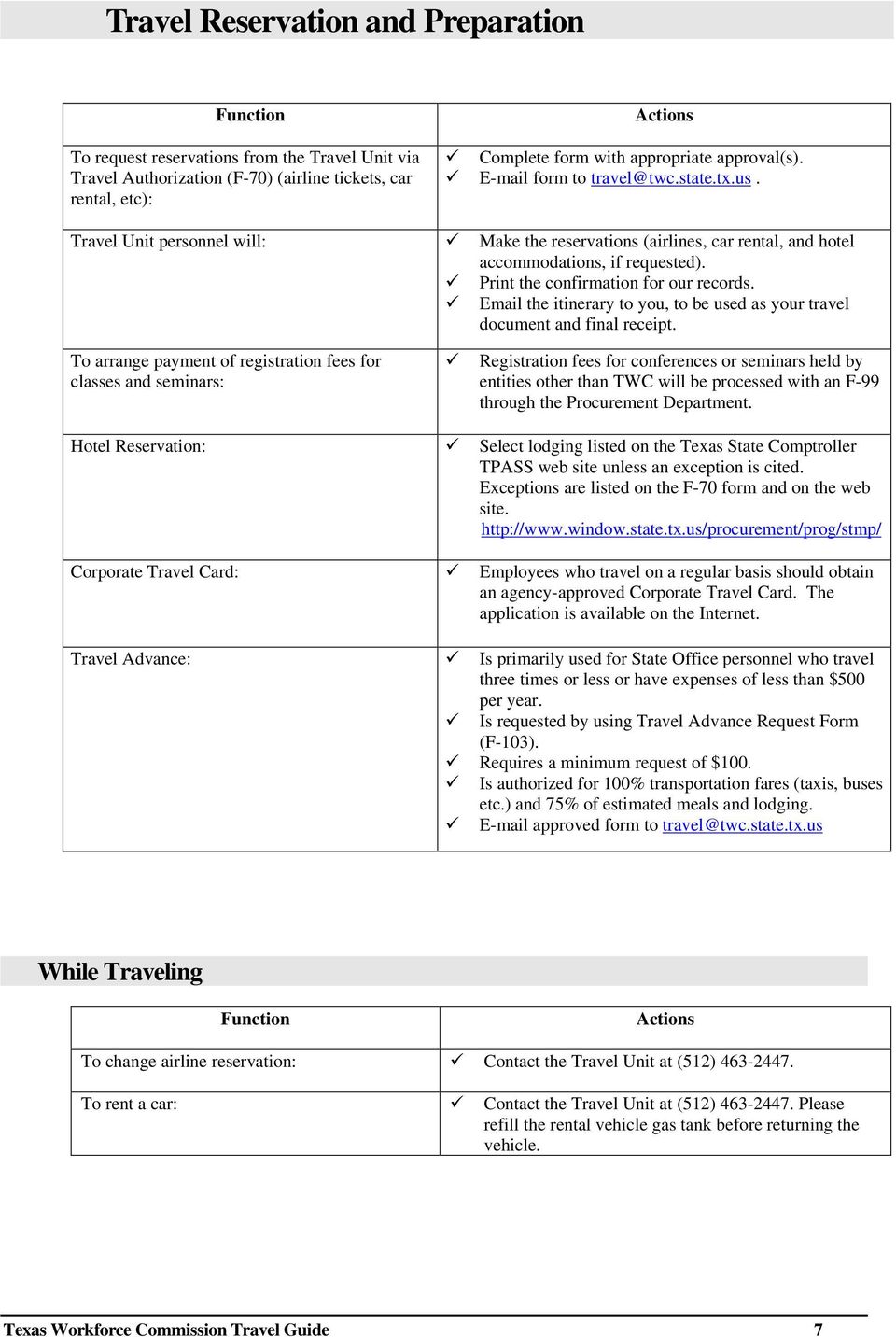
9 Travel Reservation and Preparation Function To request reservations from the Travel Unit via Travel Authorization (F-70) (airline tickets, car rental, etc): Actions Complete form with appropriate approval(s). form to Travel Unit personnel will: Make the reservations (airlines, car rental, and hotel accommodations, if requested). Print the confirmation for our records. the itinerary to you, to be used as your travel document and final receipt. To arrange payment of registration fees for classes and seminars: Registration fees for conferences or seminars held by entities other than TWC will be processed with an F-99 through the Procurement Department. Hotel Reservation: Select lodging listed on the Texas State Comptroller TPASS web site unless an exception is cited. Exceptions are listed on the F-70 form and on the web site. Corporate Travel Card: Employees who travel on a regular basis should obtain an agency-approved Corporate Travel Card. The application is available on the Internet. Travel Advance: Is primarily used for State Office personnel who travel three times or less or have expenses of less than $500 per year. Is requested by using Travel Advance Request Form (F-103). Requires a minimum request of $100. Is authorized for 100% transportation fares (taxis, buses etc.) and 75% of estimated meals and lodging. approved form to [email protected] While Traveling Function Actions To change airline reservation: Contact the Travel Unit at (512) To rent a car: Contact the Travel Unit at (512) Please refill the rental vehicle gas tank before returning the vehicle. Texas Workforce Commission Travel Guide 7
10 To Complete Your Travel Voucher (Travel expenses must have been incurred.) Function Actions Upon Return From Travel: Send completed Travel Voucher (F-5) with appropriate receipts to: Texas Workforce Commission Financial Operations Travel 101 E. 15 th St., Rm. 446 Austin, TX If you received a travel advance or had your airline or rental car expenses charged directly to TWC, the corresponding voucher must be received in the Travel Unit within ten (10) days of completing the travel. Claiming Travel Time: Travel time starts when you leave the city of your headquarters. Travel time ends when you return to headquarters. Receipts: Attach only original receipts to the voucher: Airline Itineraries (schedule changes noted) Rental car Itemized hotel receipt Miscellaneous: taxi, parking, money orders, postage, gasoline for rental car Other Allowable Travel Expenses: Itemized local and long-distance business calls Money orders or cashiers checks Gasoline for rentals and state vehicles Toll road fees Excess baggage charges for agency owned equipment Photocopies, notary fees, faxes Mileage: (Includes travel within headquarters location.) Travel reimbursement rates for mileage are as follows: $.585 per mile, effective 7/1/2008 $.505 per mile from 1/1/2008 through 6/30/2008 $.485 per mile, from 9/1/2007 through 12/31/2007 Mile calculation is based on the shortest route. For information on mileage and routes see: Rental Car: State contracts with rental car companies include insurance for the rental car. Personal Accident Insurance and Personal Effects Coverage is not reimbursable. If the rental car is used for personal reasons, traveler must pay the entire rental fee and complete Travel Voucher (F-5) to be reimbursed for the business portion. 8 Texas Workforce Commission Travel Guide

11 Per Diem (In-State): Is not to exceed $121. Lodging is actual cost not to exceed $85 per night. Meal allowance is actual cost not to exceed $36 per day Is not exempt from city, county or state lodging taxes. These are paid as incidental expense. Per Diem (Out-of-State): Allowance is determined by locally based Federal Travel Regulation. If local destination is not listed, use county. When both are not listed, use state median rate. Information can be accessed at: lrates.htm Partial Per Diem: Payment of partial per diem for meals is not allowable if travel does not require an overnight stay. Parking Fees: Are paid only if trip mileage is reimbursable. Valet parking is not reimbursable unless it is the only parking available. Receipts are required for reimbursable fees. Short Term airport parking is paid at the Long-Term rate. Taxi Fares: During working hours The fare from residence to airport cannot exceed the fare from duty station to airport. During non-working hours The fare from residence to airport is reimbursable. Supplemental Claims: Travel expense omitted from a previous voucher can be claimed on a subsequent voucher, (fill in Space 14, Agency Use with Supplemental Claim ). Just Keep In Mind Common Carrier (bus, train, or airline): Traveler may claim actual cost, but air transportation may not exceed the contract fare. Mileage & Taxi to Obtain a Meal: Maximum mileage is 8 miles (per trip). Maximum taxi fare paid is $10.00 round trip. Contract Fares: Contract fares are available only when the agencyapproved Corporate Travel Card is used. Weekend Stays: If there is no business-related reason for the employee to remain in travel status over the weekend, only the return transportation expense is reimbursable. If there is a business related reason for the employee to remain in travel status over the weekend, all allowable travel expenses, i.e., meals lodging, etc. are reimbursable. The amount of the reimbursement may not exceed the amount that would have been paid had the employee returned to headquarters for the weekend, then traveled back to the duty point. Texas Workforce Commission Travel Guide 9

12 Function Action Four in a Car Rule-Multiple Travelers: When two, three or four employees have the same itinerary, only one can claim mileage. When more than one employee travels on the same trip, the number of travelers must be justified on the Travel Authorization (F-70) or Travel Voucher (F-5). Sharing Lodging: When sharing lodging with another state employee, the cost of the lodging must be split equally between employees. Both employees are required to submit a travel voucher. When sharing lodging with a non-state employee, the State employee is entitled to reimbursement at the single room rate. Minimum Voucher Amount: $25.00 if traveler is claiming intra-city mileage only. Traveler may combine several trips to reach the minimum voucher amount. 10 Texas Workforce Commission Travel Guide

13 Comprehensive Guide Personal Accountability A Few Words about Responsibility This Travel Guide reflects not only the Comptroller of Public Accounts (Comptroller's) rules and regulations, but also the Texas Workforce Commission's internal travel policies. Primary responsibility for compliance rests with the traveler. The supervisor or manager accepts secondary responsibility and must review for compliance and accuracy. It is the responsibility of the Travel Unit to conduct a final review of travel vouchers to assure that legitimate claims comply with rules and regulations, are accurate, and are paid promptly. Division Directors are responsible for ensuring that the travel expenses of his/her Division are the lowest possible, considering all relevant circumstances. A Division Director or Department Head may, in the interest of economy, adopt travel policies that are stricter than those set forth in this guide, provided that employees are notified. However, TWC employees will be reimbursed for all legitimate travel costs required to perform his/her job. Each employee seeking reimbursement for travel is responsible for determining that the expenses are reasonable and necessary and that the claim adheres to federal, state and TWC rules and regulations. Failure to comply with these policies and procedures will delay payment and may lead to rejection or non-payment of the claim. Employees can be reimbursed for actual travel expenses (up to presented maximums) only as provided in this guide. All travel expenses for Texas Workforce Commission employees must be submitted on an approved travel voucher. Questions concerning these travel regulations should be addressed to the Travel Unit of Financial Operations at ANY PERSON WHO KNOWINGLY MAKES A FALSE STATEMENT ON ANY CLAIM AGAINST THE STATE MAY BE SUBJECT TO PROSECUTION UNDER TEXAS CIVIL STATUTES. Texas Workforce Commission Travel Guide 11

14 This page intentionally left blank 12 Texas Workforce Commission Travel Guide

15 Travel Authorizations Conservation of Funds A state agency shall minimize the amount of travel expenses incurred. Each travel arrangement should be the most cost-effective considering all relevant circumstances. The agency shall use teleconferencing and other telecommunication technologies to the maximum extent possible to reduce agency travel expenditures. Travel must be planned to achieve maximum economy and efficiency (i.e., the most economical form of transportation over the shortest practical route). Insurance Coverage Requirements Before performing travel for TWC, employees must determine if they have adequate insurance coverage. Neither TWC nor the State of Texas assumes any liability if an employee is involved in a collision, or if an employee's personal property or vehicle is damaged while in travel status. All out-of-town travel for which there is airfare, rental car, or per diem expense requires that a Travel Authorization (Form F-70) be completed. An F-70 will be required regardless of whether the airfare or rental car expense is paid by the traveler or billed directly to the Agency. If travel is over $1,000.00, Division Director approval is required. Submit the Travel Authorization electronically to [email protected] with the required approvals. A copy of the travel authorization must be attached to the travel voucher, Form F-70, which can be located on the Internet web page at Out-of-State and Foreign Travel TWC may pay or reimburse out-of-state travel and/or foreign travel if the travel is approved in advance and in accordance with the policy of the agency. As such, the Commission adopted a new policy effective May 31, 2005, requiring prior approval for out-of-state and foreign travel as follows: The Commissioners will approve their own out-of-state travel, including foreign travel, as well as their own staff s out-of-state travel before departure. The Commissioners will discuss, consider, and take action in an open meeting all foreign travel by the Executive Director before departure. The Executive Director has the authority to approve TWC staff s out-of-state travel, including foreign travel, before departure. The Executive Director is responsible for notifying the Commissioners in writing of all foreign travel. The Executive Director will be responsible for monitoring the Commission-imposed out-of-state travel cap and notifying the Commissioners if expenditures are approaching such cap. Coding of Travel The Cost Center, Appropriation number, Budget Reference, Grant, Strategy, Function codes and speedchart (if applicable) are required and must be indicated on the voucher. These correlate to the program(s) that received the benefit of the travel activity. If you have any questions on the proper coding, please consult your Division Budget Analyst. Texas Workforce Commission Travel Guide 13

16 Travel Agency Texas Procurement and Support Services has contracted with National Travel Systems to perform travel agency services for all state agencies. Airlines All airline tickets purchased for TWC official state business must be booked by the Travel Unit. The only exceptions to this rule are if the traveler is already in travel status or combining business and personal travel, which renders the use of a contract travel agency impractical or unnecessary. Employees required to travel for TWC business should complete a form F-70 Travel Authorization. This form includes all information pertinent to the trip. Employee information, dates, purpose of travel and request for airline or rental car arrangements is completed on the form. The form is ed to the person with approval authority, and the approver will forward the form to the Travel Unit. The Travel Unit will research and make the most cost effective travel arrangements possible. Airfares are direct billed to the agency. Texas Procurement and Support Services (TPASS) has contracted with airlines for State of Texas government fares in several markets (city-pairs). The contract airline fares are designed for last minute and/or fully-refundable travel requirements. Travelers are encouraged to utilize 14-day advance or other lower cost airline fares for planned travel requirements to obtain lowest possible cost to the state. Contract airfares can be found on the TPASS web site at Lodging When time constraints prevent ordering airline tickets through the Travel Unit, the traveler may purchase the airline ticket and be reimbursed on a travel voucher. Reimbursement is limited to the contract fare. In order to obtain the contract fare, the employee must charge the airline tickets to his/her agencyapproved Corporate Travel Card. Rental Cars Lodging establishments (in and out-of-state) listed on the Texas Procurement and Support Services (TPASS) web site have contracted rates with the State, and must be used unless a contract exception is listed. The contract exceptions may be found on the Travel Authorization form F70 and on the TPASS web site. If a traveler is charged more than the contract rate for a room, it must be explained on the voucher. When selecting a hotel from the TPASS web site, the traveler should consider personal safety. If the traveler arrives and finds the hotel unsafe, the traveler should make another selection. If necessary, choose a non-contract hotel and include an explanation on the travel voucher. Please refer to the TPASS web site at for a complete list of approved exceptions. Lodging arrangements for travelers in groups of ten (10) or more must be made through the TWC Conference Planning and Media Services Department. The rental car companies under contract with the State are Avis, Enterprise, and Advantage. The Travel Unit will book all rental cars through one of these three agencies when a Travel Authorization form is received. When time constraints prevent ordering a rental car through the Travel Unit, the traveler may rent the car and request reimbursement on a travel voucher. Employees may be reimbursed for the actual cost of rental car expenses not to exceed the contracted rates. The itemized rental car receipt is required for reimbursement. 14 Texas Workforce Commission Travel Guide

17 Personal Car Transportation Allowance Travel reimbursement rates for mileage are as follows: 58.5 cents per mile effective July 1, cents per mile from January 1, 2008, through June 30, cents per mile from September 1, 2007, through December 31, The traveler must bear all maintenance expenses for the auto including gasoline, oil, tires, repairs, etc. Mileage should be rounded up (.5 and above) or down (.4 and below) on a point-to-point basis. DO NOT USE DECIMALS. Parking fees for personal auto may be claimed if fees are itemized showing date and amount of each charge. Receipts must be submitted for parking expenses. Only one traveler may claim mileage reimbursement for use of personal car when two, three or four employees with the same itinerary on the same dates are required to travel on Commission business. Any exemptions must be justified on the voucher. The names of all travelers should be listed on the travel voucher. Reimbursement for the number of miles traveled may not exceed the number of miles of the most costeffective route between the origin of the employee s travel and the employee's final duty point. The shortest route between the points is presumed to be the most cost-effective route. A longer route may be considered the most cost-effective route only if the supporting documentation for a mileage claim includes a justification statement. Mileage & Parking (or taxi) incurred to obtain a meal or lodging: An employee may be reimbursed for the mileage and parking incurred to obtain a meal if the meal itself is reimbursable, and the meal is obtained within the city limits of the duty point. Maximum claim for mileage to obtain a meal is eight miles round trip. Maximum claim for taxi to obtain a meal is $10.00 round trip. An employee may be reimbursed for the mileage incurred to obtain lodging if the lodging itself is reimbursable or payable. Lodging obtained in a duty point (within the city limits of city in which business is conducted). Lodging obtained outside a duty point (outside the city limits of city in which business is conducted). If an employee obtains lodging outside the city limits of a duty point, even though reasonable lodging IS available within the city limits of a duty point, the traveler may be reimbursed for mileage not to exceed 50 miles one way or 100 miles round trip. Example: An employee s duty point is Waxahachie and reasonable lodging is available in Waxahachie. The traveler accepts a friend s offer to stay free at the friend s home in Denton, 64 miles away. Reimbursement is limited to 100 miles round trip ($58.50). If an employee obtains lodging outside the city limits of a duty point because reasonable lodging IS NOT available within the city limits of a duty point, the traveler may be reimbursed for the actual mileage incurred to obtain lodging if the lodging itself is reimbursable. Using the example above with no reasonable lodging available in Waxahachie, all of the mileage to Denton would be reimbursable. Texas Workforce Commission Travel Guide 15

18 Travel Within Headquarters An employee required to travel within the city limits of designated headquarters may be reimbursed at the established rate per mile or local bus fare. Employees may be reimbursed for transporting other state employees in official travel status to and from airports or lodging. Transportation costs for employees of other states, federal employees, or private citizens will not be reimbursed. Travel To/From Residence Mileage between an employee s residence and a duty point may only be claimed if it is less than or equal to the mileage between the office and the duty point. This rule applies when travel occurs during or before working hours on a workday. Exceptions: Actual mileage from the employee s residence to the duty point may be paid, if the travel is necessitated by extraordinary circumstances. Such as an event that threatens public health or safety or that has caused, or threatens to cause, damage to public property (i.e., a tornado or severe thunderstorm or office burglary). An employee may claim actual mileage from/to a residence during non-working hours to pick up another employee in route to a common destination. The travel voucher must state that the reason for the mileage to/from the residence was to offer a courtesy ride to fellow employee. Travel from residence to the nearest airport in order to catch a flight, during non-working hours, may be reimbursed for actual mileage or taxi fare. The latest time that an individual may check in for the flight determines whether travel to the airport occurs during working or non-working hours. For this purpose, travelers will be allowed one/two hour(s) before the flight departure time to claim mileage or taxi from residence. Actual mileage from the airport to the residence on the return may be claimed if the flight lands during non-working hours. Actual arrival time of a flight determines whether travel from the airport occurs during working or non-working hours. NOTE: A work schedule of 8:00am to 5:00pm will be assumed unless stated otherwise on the voucher. If a family member transports an employee to the airport in order to catch a flight, the employee may be reimbursed for the mileage if it can be shown that the additional mileage claim is less than the cost of parking the traveler s car at the airport. Example: An employee will be flying from Austin to Dallas on TWC business. Residence is 25 miles from the airport. On the day of departure, a family member transports the traveler to the airport. The employee will be gone three days, and parking at the airport is $8.00 a day. After completing business the traveler s son returns to pick him up. Mileage consists of two round 25 miles one way = 100 miles for a total of $ The parking would have been $24.00, so costs are limited to $ The cost comparison must appear on the voucher. NOTE: When an employee travels between his residence and a duty point, and the mileage is less than from official station, mileage should be claimed from the residence. Mileage between a residence and duty point must be explained on voucher. The following examples show the proper language for several different situations. 16 Texas Workforce Commission Travel Guide

19 Examples: Austin to residence 567 Main St., Kountze, 231 miles (less than mileage to official station in Beaumont, 238 miles), arriving 5:30 p.m. Residence, 567 Main St., to airport, 10 miles, to catch flight departing during non-working hours. Residence, 567 Main St., to airport 10 miles, and return home by family member, 10 miles. Round trip mileage is less than parking car at airport for two days at $6.00 per day. Residence, 567 Main St., to new location of Target Store to provide on-site services, 12 miles. Less than mileage from office. At Randall s Grocery providing on-site services. To residence, 567 Main St., at end of day, claiming mileage to office since it is closer, 6 miles. Texas Mileage Guide The Official State Mileage Guide must be used when determining distance for out-of-town travel. An electronic version of the Mileage Guide is available on the Internet at To obtain mileage for locations that are not listed, use the MapQuest web site. Be sure to choose Shortest Distance, under Advanced Options. Use of Personal Car in Lieu of Airfare Federal regulations, state guidelines, and agency policies require that the most cost-effective method of transportation be used. Cost center managers must plan the travel of all employees under their authority so as to achieve maximum savings and efficiency. To determine the most cost-effective method of transportation, several factors must be considered: Flying Driving Airfare Additional Per Diem Parking Mileage Mileage or taxi to and from airport Increased time in travel status Automobile rental or taxi In-State: When traveling to distant points within the State of Texas, there is no requirement that an employee fly commercial airline rather than drive a personal vehicle. Either method of transportation is acceptable, but the final decision rests with the person authorizing the travel. The most cost-effective method of travel should be utilized, unless justification to the contrary is provided. Out-of-State: General Provisions - TWC may reimburse an employee for mileage for use of a personally owned or leased motor vehicle to travel to and from a duty point outside the State of Texas. The mileage reimbursement must be equal to the actual miles traveled between the employee s designated headquarters and the duty point multiplied by the standard mileage rate, subject to the limitations in this section. Duty Points Served by Commercial Airlines - A mileage reimbursement for travel to and from a duty point that is served by commercial airlines must not exceed the lesser of the following: Texas Workforce Commission Travel Guide 17

20 The reimbursement that the employee would have received had he flown, which is equal to the contract airfare (or average coach fare if no contract) plus the expenses necessary to complete the flight; or The actual miles to and from the duty point multiplied by the standard mileage rate. Mileage to points outside Texas can be obtained from the Travel Unit. Example: An employee in Edinburg must travel to Denver, Colorado, to attend training for 5 days. The closest airport is in Harlingen, 33 miles away. There is no contract airfare from Harlingen to Denver. It has been determined that the average round trip coach fare is $ Employee has requested to drive a personal vehicle rather than fly. It is 1,386 miles from Edinburg to Denver. The traveler may be allowed one day driving time each way. If the request is approved, a cost comparison of the two methods of transportation must appear on the voucher: Flying Driving Airfare: $ Additional Per Diem* $ Parking: $20.00 Rental Car: $ Fuel: $50.00 Mileage :** $38.61 (Edinburg to Harlingen) Mileage:** $1, (Edinburg to Denver) $ $1, * Used FY 2008 locality rate for Denver to compute per diem. ** Mileage rate used is 58.5 cents per mile (Effective 7/1/08). In this case, it is less expensive to fly than to drive and the employee would be limited to claim the airfare in lieu of mileage. This comparison pertains only to the costs associated with the travel itself. The person authorizing the travel must decide if office workload and other factors might require flying rather than driving. Exception for Group Travel - When two or more state employees travel out-of-state together in one personally owned vehicle; the cost comparison must include the total cost had each employee flown to the duty point. If more than one TWC employee is required to travel to the same place at the same time, either the travel voucher or the travel authorization must include an explanation of why it was necessary for more than one person to make the trip. Duty Points not served by Commercial Airlines - A mileage reimbursement for travel to and from a duty point that is not served by commercial airlines may not exceed the sum of the following: The contract airfare (or average coach airfare if no contract) to the locale served by a commercial airline that is closest to the duty point; The actual miles traveled between the locale and the duty point multiplied by the standard mileage rate; and The expenses necessary to complete the flight. Rental Cars Rental cars must be requested on Form F-70, Travel Authorization and Transportation Request. The person authorizing the travel should determine whether car rental is the most practical and cost effective method of transportation, considering all relevant factors, such as timeframes, distance to be traveled, availability of personal vehicle and cost of taxi, bus, shuttle or courtesy ride, etc. 18 Texas Workforce Commission Travel Guide

21 The traveler should reserve a rental car by electronically submitting a Form F-70 to [email protected] in sufficient time to allow for processing before the trip is commenced. The Travel Unit will make the reservations. All rental car reservations will be charged directly to TWC. Travel Voucher Submission Requirement Travel vouchers with rental car expenses charged directly to TWC must be received in the Travel Unit within ten (10) business days of completion of the trip. Completion of the trip is considered to be the ending date indicated on the Travel Authorization Form (F-70). The travel voucher (F-5) must be submitted with the following receipts and documentation: Original (final) rental car receipt; If the rental car is returned after closing hours, the traveler must obtain a payment receipt from the rental car company. Traveler can also go to the agency s web site and print a duplicate. Original and itemized hotel receipt (if applicable); Airline e-ticket which indicates any change in schedule, any unused portion and the traveler s signature (if applicable); and, Approved Travel Authorization Form (F-70) If a traveler is in travel status for two consecutive weeks for two separate trips/purposes (2 F-70s), a travel voucher for each trip (week) must be received in the Travel Unit within ten (10) business days from the completion of each trip. A traveler may combine both trips on one travel voucher. If so, the travel voucher must be received in the Travel Unit within five (5) business days from the completion of travel for the second trip/week. Travelers who are habitually late submitting travel vouchers become ineligible for direct billing. Habitually is defined as two times. The traveler must refill the rental vehicle gas tank before returning it to the rental car agency. If a rental car receipt includes a fuel charge, the traveler must explain why it was not possible to refill the gas tank before returning the vehicle. Receipts for gas purchases are required and must be attached to the travel voucher in order to be reimbursed. Some rental agencies charge a weekly rate that is the same as the rate for six days. In effect, one day is free. Motor vehicle rental charges are reimbursable only on a daily charge basis. The daily charge equals the total charge for the rental period divided by the number of days in the rental period. To comply with Comptroller policy, it will be assumed that the free days come at the end of the rental period. Examples: An employee rents a car for seven days. The weekly rental rate is for six days, for a total of $ No charge is made for the remaining day. The employee uses the rental car for TWC business during the first six days and for personal business the last day. TWC will reimburse the employee or direct pay the rental agency for the entire charge. An employee rents a car for seven days. The weekly rental rate is for six days, for a total of $ No charge is made for the remaining day. The employee uses the rental car for personal business during the first day and for TWC business the last six days. Since the last day is the free day and belongs to the agency, TWC will only pay for five days. Since one of the days for which there is a charge was personal, the employee should only request reimbursement for the 5 days of the business-related portion on a travel voucher. TWC employees are responsible for paying any rental car charges or expenses incurred for personal travel. Texas Workforce Commission Travel Guide 19
22 Rental Car Insurance Coverage Loss Damage Waiver (LDW) premium on NON-CONTRACT rental cars is reimbursable. Travelers should purchase LDW insurance to cover the deductible amount, which is not covered under the vendor s insurance. Cost for this coverage is reimbursable to the traveler, only if there is not a contract rental car available. Some rental car companies offer free LDW coverage. This should be taken into account when selecting a rental car company. Personal Accident Insurance (PAI) or Personal Effects Coverage (PEC) premiums are not reimbursable. If either is included on the rental agreement, the cost must be deducted from the claim for reimbursement. If rental car is directly billed to TWC, the traveler will attach payment for the amount of PAI or PEC premiums and forward it with the rental car receipt when submitted to the Travel Unit. Common Carriers Airline tickets must be requested on Form F-70, Travel Authorization and Transportation Request and electronically submitted to [email protected]. Airline tickets will be direct-billed to TWC s Corporate Travel Card account and the cost of the ticket will be charged to the traveler s cost center, and indicated account codes. An approved Travel Authorization must be received in the Travel Unit before tickets are ordered. It is important that the correct address and/or fax phone number for the traveler is included on the airline ticket request. The traveler will electronically submit the form to the cost center manager for approval. The cost center manager will forward the form to the Division Director if further authorization is needed. Trips over $1, require Division Director approval. However, please note that approval requirements are subject to change by the Division Director. Out-of-state travel requires the Executive Director s approval. The Travel Unit personnel will make the airline reservation and forward the e-ticket to the traveler. Travel Voucher Submission Requirement Travel vouchers that require airline expenses charged directly to TWC must be received in the Travel Unit within ten (10) business days of completion of the trip. Completion of the trip is considered to be the ending date indicated on the Travel Authorization Form (F-70). The travel voucher (F-5) must be submitted with the following receipts and documentation: Airline itinerary which indicates any change in schedule, any unused portion and the traveler s signature; Original (final) rental car receipt; Original and itemized hotel receipt (if applicable); and, Approved Travel Authorization Form (F-70). If a traveler is in travel status for two consecutive weeks for two separate trips/purposes (2 F-70s), a travel voucher for each trip (week) must be received in the Travel Unit within ten (10) business days from the completion of each trip. A traveler may combine both trips on one travel voucher. If so, the travel voucher must be received in the Travel Unit within five (5) business days from the completion of travel for the second trip/week. 20 Texas Workforce Commission Travel Guide
23 Travelers who are habitually late submitting travel vouchers become ineligible for direct billing. Habitually is defined as two times. If there are actual airline tickets, the traveler must return the unused coupons and the passenger receipt part of the used tickets. Employees in travel status, who need to change flights or purchase additional tickets, may be responsible for the expense at time of purchase. This additional expense must be justified on the travel voucher and must be business-related to be reimbursed. If personal travel is combined with state business, all airfare charges must be borne by the traveler. The employee will be reimbursed only for the portion of the airfare that is business-related. Reimbursement will be limited to State rates. Aircraft Fleet Services State aircraft is available for use by Commission staff. Use of state aircraft requires approval of the Executive Director and prior written authorization from the appropriate Division Director. Requests to use state aircraft must be forwarded to the Conference Planning and Media Services Department, which include the following: an itinerary with dates destination purpose of travel passenger names and job titles cost accounting information Conference Planning prepares a cost analysis comparing commercial flight costs to Aircraft Fleet Services costs and private charters. The cost analysis is sent to the Executive Director for approval. Once approved, Conference Planning and Media Services Department will make the necessary arrangements. All inquiries should be directed to the Conference Planning Media Services Department at Parking TWC will reimburse a traveler for parking expenses when the employee travels in a personally owned, leased, or rented motor vehicle. A traveler will not be reimbursed for a parking expense if all the mileage traveled to reach the location is not reimbursable. Most lodging establishments have either a reduced rate or free parking when you park your own car. Valet parking will not be reimbursed unless that is the only parking available. A statement must be included on the voucher that no other parking was available. When parking at the airport, the cost of only the least expensive, safe and secure parking will be reimbursed. Reimbursement for parking at the short-term lot will not exceed the rate for long-term parking. Parking expenses must be itemized on a daily basis. Receipts are required. Taxi Fares All necessary transportation via taxi or shuttle on out-of-town trips will be reimbursed. During working hours, fares from residence to airport are payable in an amount equal to or less than fares from an official duty station. A statement to this effect must appear on the travel voucher. Texas Workforce Commission Travel Guide 21
24 During non-working hours, the entire taxi fare between residence and airport is payable. The latest check-in time for the flight determines whether travel to the airport occurs during working or nonworking hours. For this purpose, travelers will be allowed one hour before flight departure. On return trip, the scheduled arrival time of a flight determines whether travel from the airport occurs during working or non-working hours. Itemize taxi fares on travel voucher showing date of each charge, amount, and point of origin and destination of each trip. Taxi fare receipts are required. Other Charges Reasonable transportation charges such as local bus fares, subways, metro, etc., are also reimbursable when necessary to transact business. Receipts should be submitted. Receipts The Comptroller requires that original receipts be attached to travel vouchers for the following expenses: Airline, train or bus (between cities) Rental Car Hotel - The night s lodging and tax must be itemized on a hotel receipt regardless of type of payment (cash, check or credit card). TWC requires that original receipts be attached to the voucher for the following expenses: Miscellaneous receipts (taxi, parking, money orders, cashier s checks, postage, etc.) Gasoline for rental car If original receipts (money orders or cashier s checks) are part of an office file, such as an employer s tax records, the receipts may be retained by the office and the expense claimed simply by itemizing the money order or cashier s check on the voucher on the day purchased. Weekend Away from Headquarters General Provisions: TWC may determine whether an employee should remain at the employee s duty point during the weekend or return to designated headquarters. Returning to a designated headquarters during the weekend: If TWC determines that an employee should return to designated headquarters, the agency may reimburse the employee for transportation expenses incurred while returning to the headquarters and going back to the duty point after the weekend. Remaining at a Duty Point During the Weekend: If TWC determines that an employee should remain at the duty point during the weekend, the agency may reimburse the employee for weekend travel expenses at the duty point. Reimbursable weekend travel expenses are limited to the type of expenses that the employee incurred on other days while conducting official state business. The amount of the reimbursement may not exceed the amount that would have been reimbursed had the employee returned to the employee s headquarters. 22 Texas Workforce Commission Travel Guide
25 Per Diem Allowance Time to Claim In or Out-of-State The per diem allowance will start at the time the employee leaves the city limits of his designated headquarters and will stop upon return to the city limits of headquarters. When an employee leaves designated headquarters (city limits) after intra-city travel, the actual time of departure from and return to city limits must be shown for each trip. When air travel is used, times of flight departure from headquarters and return flight landing are to be used in computing per diem allowance unless it is necessary to travel to another city for air transportation. In-State Lodging Employees may be reimbursed for the actual cost of lodging not to exceed $85.00 (single rate) per day. An itemized lodging receipt is required. Express checkout receipts will not be accepted as these are not considered a final receipt. When staying at a contract hotel, lodging reimbursement cannot exceed the contract rate for that hotel, unless there is a business-related reason. The exception must be included on the travel voucher. The contracted rates are available at Employees are not exempt from city, county or state hotel occupancy taxes. These taxes are reimbursed in addition to the lodging costs. Taxes are charged as an incidental expense and should not be included in the per diem section of the travel voucher. Note: If an employee stays at a hotel that charges a rate greater than $85.00 per day, the employee is personally responsible for the amount exceeding the $85 maximum and the taxes relating to that portion of the rate that exceeds $ When utilizing air transportation, a copy of the receipt must be attached to the voucher to determine correct per diem claim. Employees may consider sharing lodging on business trips as a means of reducing travel expenses. If a lodging receipt indicates more than one person in the room, an explanation must be included on the voucher: When the room is shared with a family member or other non-state employee, the employee is limited to the single rate and a statement must be included on the voucher that employee is claiming single room rate. When two or more state employees share a room, the cost of the room must be divided equally between them. Each employee must submit a travel voucher with a copy of the lodging receipt attached. The voucher must include a statement that the traveler shared a room with another state employee, and that person s name and social security number. Reimbursement to each employee will not exceed the maximum room rate. Meals If the hotel has made an error concerning the number of people in the room, it must be so stated on the voucher. Employees may be reimbursed for the actual cost of meals not to exceed $36.00 per day. State funds appropriated for travel expenses may not be used to purchase or reimburse a state employee for the purchase of alcoholic beverages. Texas Workforce Commission Travel Guide 23
26 Payment of partial per diem for meals is not allowable when travel does not require an overnight stay. A state employee is not required to attach meal receipts to the travel voucher. However, a state employee may be reimbursed only for the meal expenses actually incurred. Gratuities are not reimbursable. Out-of-State Employees traveling out-of-state, within the continental United States, receive a locality-based allowance for meals and lodging (single rate). The web address for the out-of-state rates is listed in the Appendix, page 51. The Federal Travel Regulations contain maximum meal and lodging reimbursement rates for selected municipalities and counties in each state. If the regulations do not specifically list a duty point, the maximum rates for the county in which the duty point is located applies. If the regulations do not list a duty point or the county in which the duty point is located, the median rate for the state applies when traveling to the duty point. Contact the Travel Unit for assistance with median rates. DOCUMENTATION REQUIREMENTS: Travelers must print and attach a copy of the federal rate schedule to their travel voucher. The schedule must be the one used to calculate the meal and lodging rates for the dates traveled. The allowance rate equals actual lodging plus the actual cost of meals not to exceed the maximum amount set for each locality. Receipts for lodging are required. The amount for meals depends on the locality. The total amount set for meals and lodging must not be exceeded. However, a greater amount may be claimed for lodging but the meals claim must be reduced by the additional amount claimed for lodging. Lodging When staying at a contract hotel, lodging reimbursement cannot exceed the contract rate for that hotel, unless there is a business-related reason. The exemption must be included on the travel voucher. An itemized lodging receipt is required. Express checkout receipts will not be accepted as these are not considered a final receipt. When conditions warrant, the Executive Director, or his designee can change the established lodging rate for a specific trip. An increase in the lodging rate should be requested only if: The employee can show that approval would result in a decreased total cost of travel, or The Agency has confirmed with a travel agent that no safe lodging is available for less than or equal to the established rate. The form, Request to Increase Maximum Out-of-State Lodging Rate is available on the Internet, see page 51. This form must be completed by the traveler, submitted to the Travel Unit for review, and approved by the Executive Director, or his designee, prior to the travel being performed. If assistance is needed in obtaining accommodations within the bounds of locality based rates, contact the Travel Unit. TWC may reimburse an employee traveling outside the state of Texas for payment of hotel occupancy taxes. The reimbursement is classified as an incidental expense. The taxes are not classified as a lodging expense for the purpose of the maximum reimbursement rate for those expenses. Do not include hotel occupancy taxes in the per diem section of the form. Note: If an employee stays at a hotel that charges more than the locality based rate, the employee is personally responsible for the amount exceeding the locality maximum and the taxes resulting from that portion of the rate that exceeds the locality based rate. 24 Texas Workforce Commission Travel Guide
27 Meals Partial Per Diem - Out-of-State: Payment of partial per diem for meals is not allowable when travel does not require an overnight stay. Meal expense cannot be claimed if the meal was provided gratuitously, such as when a hotel offers a free meal with the room, an airline flight includes meal service, or a registration fee includes the cost of a meal. Travel Outside the Continental United States The Executive Director s written approval is required, in advance, for any travel outside the Continental United States. See page 13 for Out-of-State and Foreign Travel Policy. Employees traveling to Alaska, Hawaii, U.S. Possessions, Canada, Mexico, etc. are entitled to reimbursement of meals and lodging for actual expenses. Non-Allowable Per Diem A per diem allowance will not be paid for any period of time when: A traveler is at official designated headquarters. A traveler is away from designated headquarters for travel that does not require an overnight stay. The cost of meals and lodging are sometimes paid by the Department of Labor, another agency or training facility, or included in a registration fee. When partial payment is made for meals or lodging on behalf of the employee, the remaining portion of meal or lodging expense may be claimed by the employee on a travel voucher. Multiple Employee Travel If a TWC employee is required to travel to the same place at the same time as another TWC employee, each employee s travel voucher or travel authorization must include an explanation of why it was necessary for more than one person to make the trip. If the travel expenses of more than one individual are being paid or reimbursed and if the expenses were incurred for the same, or similar, official state business, the supporting documentation must provide sufficient detail or justification to demonstrate that the number of individuals conducting that business was necessary. The Comptroller is authorized to reduce an agency s appropriation if the State Auditor determines that the agency reimbursed a travel expense, including, but not limited to, seminar tuition and fees, that did not satisfy the following criteria: The travel expenses must have been incurred in the conduct of necessary official state business. The travel itself must have been necessary to execute the state business conducted. Actual Expenses Executive Director & Commissioners The Executive Director or a Commissioner may be reimbursed for actual meals and lodging expenses when travel involves an overnight stay outside the person s designated headquarters. The claim for actual expenses is limited to twice the maximum rates for meal and lodging expenses that state employees are entitled to receive (in or out-of-state). Texas Workforce Commission Travel Guide 25
28 An appointed officer may not be reimbursed with appropriated funds for travel expenses related to travel outside the State of Texas unless the Texas Ethics Commission has already received a copy of the appointed officer s travel voucher and supporting documentation. The Travel Unit will mail a copy of the appointed officer s travel voucher and supporting documentation to the Texas Ethics Commission prior to submitting the travel voucher to the Comptroller s Office. Travel With Executive Director or Commissioner When the Executive Director or a Commissioner plans overnight travel to a meeting at which other TWC employee(s) will be present, the Executive Director or appropriate Commissioner will determine if actual expenses for meals and lodging are to be authorized; and if so, will approve the authorization on the Travel Authorization Form (F-70). A copy of the authorization must be attached to each employee s travel voucher. The authorization must be approved prior to the trip. The claim for actual expenses is limited to twice the maximum rate for meals and lodging expenses which state employees are entitled to receive (in or out-of-state). Lodging receipts are required. An employee accompanying the Executive Director or Commissioner may be entitled to reimbursement for actual meals and lodging even though the itineraries are not identical (within reasonable limits). Designated Agency Representative When the Executive Director or a Commissioner has been invited by an organization to attend a meeting, and his or her schedule prevents attendance, one or more employees may be designated as a representative. Designated representatives may claim actual expenses for meals and lodging if overnight travel is involved. Such designation must be authorized by the Executive Director or Commissioner on the Travel Authorization Form (F-70). A copy of the authorization must be attached to each employee s travel voucher. The authorization must be approved prior to the trip. The claim for actual expenses is limited to twice the maximum rates for meal and lodging expenses which state employees are entitled to receive (in or out-of-state). Lodging receipts are required. Other Expenses Allowable Expenses Local and long distance telephone calls for official business. Calls must be itemized under Record of Transportation and Duties Performed, listing the date, cost, person called, and the reason. Money orders or cashier s checks used for official business. Gasoline for rental or state owned vehicles. Toll road fees. Parking (itemized) for personal vehicles, including airport parking. Charges for excess baggage if used exclusively for official business with proper justification on voucher. Registration fees for conferences or seminars held by entities other than TWC. If a mandatory meal expense is included in the registration fee, a traveler may not claim per diem for the meal. Photocopies. State what was copied and reason. Notary fees. State what was notarized and reason. 26 Texas Workforce Commission Travel Guide
29 Faxes. State what was faxed and reason. Non-Allowable Expenses Gasoline or repair costs for personally owned vehicles. Tips or gratuities of any kind. Excess baggage for personal belongings. Personal telephone calls. Registration fees to attend a TWC meeting, conference, or seminar. TWC policy does not allow charging or reimbursing TWC employees for attending TWC-sponsored meetings, conferences or seminars. Any personal expense items such as cleaning or laundry. Cancellation charges TWC may pay a cancellation charge related to a transportation expense or reimburse an employee for the charge if the charge is: Imposed in accordance with the contract with the private entity that is imposing the charge; and Incurred for a business-related reason; or Incurred because of an illness or a personal emergency. Texas Workforce Commission Travel Guide 27
30 This page intentionally left blank 28 Texas Workforce Commission Travel Guide
31 Off Site Meetings & Hotel Direct Billings A centralized meeting and conference planning function has been established within TWC to ensure that the Commission is securing the best and most economical facilities and that proper statutory rules are followed. This function should be used when travel plans are being made for ten or more employees. Contact the Conference Planning and Media Services Department at A travel expense incurred while attending an agency-sponsored seminar may not be reimbursed unless the Executive Director certifies that the agency does not: Possess interactive TV or video conference facilities at the designated headquarters of the employee who incurred the expense; Have available, at a cost less than the total travel cost associated with the seminar, interactive TV or video conference facilities; and Have access to another agency s interactive TV or videoconference facilities. Off Site Meetings All off-site meetings arranged by TWC, whether for employees or non-employees, must be coordinated through The Conference Planning and Media Services Department at (512) Assistance will be provided in securing economical lodging, meeting room space, audio-visual equipment, etc. Off-site meeting expenses that can be paid with state funds consist of the following: Meeting room rental Sleeping rooms Audio-visual equipment/supplies Meeting room set-up fees State law prohibits agencies from expending state funds for food and/or beverages except in limited circumstances. The State Appropriations Act requires that all agencies use state owned facilities for meetings and conferences unless such space is not available on the needed dates or is not adequate to accommodate the meeting or conference. Registration Fees Registration fees for conferences or seminars held by entities other than TWC will be processed with an F-99 by the Procurement Department. If the conference sponsor will not accept payment in arrears, the traveler may complete form F-99 and submit to Procurement to process an advance payment. If time constraints require the traveler to pay the registration fee, the traveler may request reimbursement on a travel voucher after attending the conference. The original receipt for payment of the registration fee is required. The receipt must clearly indicate that the employee paid the registration fee. If a mandatory meal expense is included in the registration fee, per diem for the meal cannot be claimed. Registration fees shall not be charged or paid to TWC employees attending TWC-sponsored meetings, conferences, or seminars. Texas Workforce Commission Travel Guide 29
32 Hotel Direct Billings The purpose of hotel direct billing is to obtain the best possible lodging rate for a group of state employees for meetings, conferences, etc. Hotel direct billing can occur when ten or more employees require overnight lodging at the same establishment. If lodging is to be directly billed to TWC, the hotel must be under state contract or one of the exemptions must apply. To arrange for direct billing of hotel charges, contact the Conference Planning and Media Services Department at (512) , at least 30 days in advance. Payment for personal charges, such as phone calls, movies, parking, or room service is the responsibility of the traveler and should be paid at checkout time. 30 Texas Workforce Commission Travel Guide
33 Payment for Travel Corporate Travel Card Employees who travel on TWC business on a regular basis should obtain an agency-approved Corporate Travel Card. The employee is solely responsible for all charges incurred by use of the card and is required to pay the account timely. TWC assumes no liability for any of the charges. If a card is suspended or cancelled for misuse or non-payment, the employee will not be eligible for travel advances the duration of his/her employment at TWC. Cancellation of the card, for any reason does not relieve the employee of the responsibility for payment of the charges and delinquency assessments. If an employee wishes to re-open a closed account, the employee must wait a minimum of six months from the date the card was cancelled before submitting a new card application. The employee s Division Director must approve the new application before it is submitted to the Travel Unit. Use of the card for any items that are not legitimate business travel expenses is prohibited. Misuse of the card (including delinquency or retail spending) may result in cancellation of the card and the employee will be subject to corrective or disciplinary action, up to and including termination from employment. The Executive Director, Division Director, and direct supervisor of the employee will be notified in writing of any apparent misuse or delinquency of the individual corporate card account. Any proven misuse of the card may be reflected in the employee s next scheduled performance review and documented in their TWC personnel file. Benefits of the Card Employees may charge hotels, rental cars, meals, airfare, and gasoline to the card. Requires no annual fee. Requires no monthly service charge unless payment-in-full is not made within 30 days. $500,000 in Automatic Common Carrier Travel, Accidental Death and Dismemberment Insurance and up to $3,000 in Baggage Insurance are automatically provided when airline tickets are purchased with the corporate charge card. Employees do not tie up personal cash or credit on TWC travel expenses. Reimbursement check should be received before payment is due if the travel voucher is submitted promptly and accurately. Provides uniform, IRS acceptable receipts. Card Issuance Criteria Individual accounts may be established for eligible employees traveling on behalf of the state when travel expenses are paid by the state in accordance with Comptroller guidelines. Employees must anticipate taking three (3) or more trips per fiscal year, or expending at least $ per fiscal year in business-related travel expenses. Employees must submit an authorized application and a signed corporate card agreement to the Travel Unit in order to receive an agency-approved Corporate Travel Card. Texas Workforce Commission Travel Guide 31
34 Travel Advance Fund The Travel Advance Fund is primarily for the use of employees who travel fewer than three times a year, have expenses less than $ a year or who do not qualify for the Corporate Travel Card. Employees who travel regularly or whose duties require travel with no prior notice should obtain an agency-issued Corporate Travel Card. Requests for Travel Advance Complete the certification form F103A and mail to the Travel Unit, Rm The original form will be required only with the first request and will be retained in Travel. You do not need to submit a copy with each subsequent travel advance request. Travel advances are requested on a Form F-103. This form is electronically submitted by the traveler to the Department Head for approval. The Department Head will forward the form to [email protected]. The form is available on the Internet. An approved Travel Authorization Form (F-70) must be attached to the Travel Advance Request. Minimum request is $ Employees should be conservative in estimating expenses in order to prevent owing a reimbursement for a travel advance. Travel advances will be approved for 100% of public fares (such as shuttle or taxi fares) and 75% of estimated meal and lodging expenses. Travel advances do not cover mileage, parking or hotel taxes. Travel advance checks will be prepared and mailed in sufficient time prior to travel. If immediate delivery is needed, please clearly state the reason and the date needed on the travel advance request. Eligibility An employee may have no more than one advance outstanding at a time. Before obtaining a second advance, an approved travel voucher must be received in the Travel Unit for any previous advance. If, at month s end, an employee owes the Travel Advance Fund, that amount will be deducted from any subsequent Advance Request. If the difference between the balance owed and the subsequent Advance Request is less than $100.00, no check will be issued. Employees in Hold status at the State Comptroller s Office are not eligible for advances. The Travel Unit will verify an employee s Hold status before issuing an advance. Employees who are habitually late submitting travel vouchers or repayments become ineligible for advances. Habitually is defined as two times. Employees in Temporary, Emergency, or Probationary status are not eligible for advances. According to the Family Support Act of 1988, Public Law , advance amounts in excess of expenditures, not repaid within 120 days from the date the expense was incurred, are considered to be income by the IRS and will appear on the employee s W-2 statement. Multiple Advances A state employee may not accept a reimbursement or advance for a travel expense from more than one source for the same expenses. A state employee who receives an advance for a travel expense from a person other than a state agency may seek an advance from the agency only for the amount not covered by the first advance. 32 Texas Workforce Commission Travel Guide
35 Voucher & Payment The employee will submit a Travel Voucher, F-5, within ten (10) days of completion of the trip for which the advance for hotel, rental car or airline ticket expenses was obtained. The voucher must be made out for the entire amount of allowable travel expenses, just as if the traveler had been using personal resources for the expenditures. Type TRAVEL ADVANCE in SPACE 14, Agency Use. Employees who are habitually late submitting travel vouchers or repayments become ineligible for advances. Habitually is defined as two times. If an employee is unable to submit a travel voucher within the allotted time, arrangements must be made to repay the entire amount of the advance immediately. When the Comptroller has paid the voucher, the Travel Unit will notify the employee of the account settlement: An employee who received an advance greater than actual travel reimbursement will submit a check or money order to reimburse the Fund within 5 days of Travel Unit s notification of overpayment. An employee who received an advance equal to the actual travel reimbursement will have the account in the Travel Advance Fund reduced to zero (0). An employee who received multiple advances in the same month will receive one reconciliation check, if actual expenses exceed the travel advance amount/s. The Travel Unit issues the check when all corresponding travel vouchers are processed. Reimbursement Minimum Voucher Amount The minimum travel claim for travel vouchers claiming only intra-city mileage is $ Employees may combine several trips in order to meet the minimum. Vouchers for less than $25.00 will not be processed, except in the following situations: An employee is claiming incidental expenses for an out-of-town trip amounting to less than $ Special contract expiration At the end of a contract year, travel must be submitted before the books are closed. Employment with TWC is terminated and the employee has performed travel amounting to less than $ An employee has performed travel amounting to less than $25.00, and does not expect to travel again for at least six months. Fiscal year-end closeout. Reimbursement Contingent on Expense TWC may not reimburse an employee for a travel expense unless the employee Has incurred the expense; and Is not being reimbursed for the expense by another agency, a private entity or another source. TWC may not reimburse an employee for travel expenses incurred by or on behalf of a private person or another state employee unless: Texas Workforce Commission Travel Guide 33
36 The private person is in the custody or care of the state; or The private person or state employee serves in the nature of attendant to a state employee with a disability. Reimbursement for Persons Being Audited, Examined, or Investigated Unless authorized by law, a state employee may not accept a travel expense reimbursement from a person that the employee s agency intends to audit, examine, or investigate or is auditing, examining, or investigating. Any reimbursement received in violation of this prohibition shall be forfeited. Duplicate Vouchers, Overpayments, and Payments in Error It is the responsibility of the traveler to ensure that duplicate travel vouchers are not submitted and that travel dates on the claims do not overlap. If a TWC employee receives an overpayment for travel expenses, the employee will reimburse the state for the overpayment. Paying a travel voucher in error does not obligate the subsequent payment of all similar vouchers. Each voucher must stand on its own because an improper payment or reimbursement is not made proper by the fact that it was made one or more times. Supplemental Claims If a travel expense is inadvertently omitted from a travel voucher it may be claimed on any subsequent voucher as follows: In Space Y, Record of Transportation and Duties Performed, type in the date, a brief description of the travel performed, and a statement that the expense was omitted from previous claim. In Space 14, Agency Use, type in SUPPLEMENTAL CLAIM. Direct Deposit Employees set up on direct deposit for salary payments automatically receive travel reimbursement by direct deposit. Those not on direct deposit will receive a paper warrant. No action on the part of the traveler is necessary for either outcome. Employees on direct deposit will receive a computer-generated notification. The payment date noted on the is the date the voucher was processed by the Comptroller. The funds are actually deposited in the traveler s account two business days later, which is the settlement date. Banks have until midnight on the settlement date to post the funds to the account of the payee. However, the funds must be made available on the settlement date. Employees who have problems accessing the funds on or after the settlement date should contact the Travel Unit. Even though the travel reimbursement is made by direct deposit, the Travel Voucher must contain the employee s office address in Section U, Pay to. Vouchers without this information will be returned for correction. If a payee enrolled in direct deposit is indebted to the state (student loans, etc.), the Comptroller will issue a warrant and retain the proceeds of the reimbursement until payment arrangements are made. If an error is detected on a direct deposit, the payee must notify the Travel Unit immediately. A stop payment will be generated electronically to debit the payee s account for the total amount of the erroneous payment, and then a correct payment will be processed. 34 Texas Workforce Commission Travel Guide
37 If a traveler prefers to receive a warrant for travel reimbursements, the request must be clearly indicated on the voucher. On the front of Form F-5, State of Texas Travel Voucher, Space 14, Agency Use, type in all caps DO NOT DIRECT DEPOSIT. Lost/Stolen Warrants When a travel warrant is lost or destroyed, the original warrant will be canceled, and a new warrant (with a different warrant number) will be issued. To report a lost or destroyed warrant, or call the Travel Unit. The following information will be needed to cancel the original warrant: Warrant Number (if known) Warrant Amount Warrant Date Dates Covered by the Travel Voucher When a payee reports a state warrant lost, destroyed, stolen or not received, the Travel Unit must verify the status of the original warrant with the Comptroller. If payment is outstanding, the payee must prepare a certification form (available from the Travel Unit) stating that the check has been lost and will not be cashed if found. The Travel Unit will process a replacement warrant; the process takes approximately two weeks. For instructions on replacing a stolen travel warrant, contact the Travel Unit. Texas Workforce Commission Travel Guide 35
38 This page intentionally left blank 36 Texas Workforce Commission Travel Guide
39 Miscellaneous Provisions Employees with Disabilities An employee who has a disability may be reimbursed for an attendant s care and other necessary expenses when traveling inside or outside designated headquarters. When an attendant transports a TWC employee with a disability in a personally owned or leased motor vehicle, the reimbursement rates and procedures for TWC employees apply. Accommodations for an employee with a disability must be requested in a memo to the ADA Coordinator in the Human Resources Department. Medical Care while Traveling An employee who becomes ill while traveling out-of-town on business may be reimbursed for travel expenses incurred to obtain medical care if waiting to receive the care until returning home would be unreasonable. Reimbursement is limited to expenses that would be payable while conducting official business. For example, mileage to the hospital emergency room would be allowed, but the emergency room costs would not. Inability to Perform Official State Business TWC may pay or reimburse an employee for a travel expense incurred as a result of attempting to conduct state business if: The employee is unable to conduct the business because of a natural disaster or other natural occurrence; and The expense would be payable or reimbursable had the official state business been conducted. Using Sick Leave While Traveling An employee out-of-town on agency business may be reimbursed while using annual, sick, or compensatory leave if it is determined that returning to headquarters would not be cost-effective or would be impractical. Example: After arriving at his destination city, a traveler becomes ill and is unable to conduct business. His supervisor decides that it would be more expensive to incur the additional cost of having the employee return to that city at a later date to conduct the business. TWC may continue to pay the travel expenses of the employee while he is on sick leave. TWC may reimburse the employee for a travel expense incurred when the employee returns to designated headquarters, before official state business is completed, because of an illness or a personal emergency. Texas Workforce Commission Travel Guide 37
40 Moving Expenses TWC may pay the reasonable, necessary costs of moving the household goods and effects of an employee, provided that the following conditions are met: Transfer is from one designated headquarters to another designated headquarters, The minimum distance between the current and future designated headquarters is at least 25 miles, The transfer is in the best interests of the Commission, and The move is approved by the selecting authority. Examples of reimbursable items are: Actual moving cost (self-service vehicle plus gas or commercial mover) One-way mileage (or towing cost) for one personal vehicle Lodging only (no meals) en route Pre-move house hunting and other pre-move costs are not reimbursable. Moving costs incurred because an employee is transferring from one state agency to another are not reimbursable. TWC may pay reasonable, necessary costs of moving the household goods and effects of an employee. The employee must first contact the Procurement Department, and submit a completed F-99 Purchase Request Form to request rental equipment (such as a truck, dolly, pads, towing devices, etc. to be obtained from the same source) for household moves. An estimate should be obtained from a local rental vendor. The approved F-99 should be forwarded to the Procurement Department at least 10 working days prior to the anticipated move date. The Procurement Department will contract with a local rental service and issue a purchase order. Employees should complete and return the receiving document with all receipts attached, immediately upon completion of the move. Personal Accident Insurance (PAI) or Personal Effects Coverage (PEC) is not reimbursable. The traveler is responsible for payment of either PAI or PEC premiums. If either is shown on the rental agreement, the traveler will deduct the cost from the claim for reimbursement. Safe-move insurance is reimbursable. Employees may request personal reimbursement for any anticipated gasoline expense required for the move on the same Form F-99 and the request should be presented as an estimate. Original receipts for the gasoline must be attached to the receiving document provided by the requestor. If due to time constraints, an employee must pay for the rental vehicle and fuel for the rental, the employee may be reimbursed by submitting the form F-99. Any travel expense related to the move, such as mileage or lodging, will be reimbursed using the travel voucher form. Please attach approval for moving expenses. In rare cases, the Executive Director may approve reimbursement for use of a commercial mover. For additional details, consult your Facilities Manual. 38 Texas Workforce Commission Travel Guide
41 Travel for Individuals Other than TWC Employees Prospective Employees When a prospective employee is asked to travel to a TWC office for an employment interview or evaluation, the prospective employee may be reimbursed for travel expenses at the same rates as an agency employee. TWC will not issue a travel advance to a prospective employee. The following items must be submitted to Accounts Payable to receive payment: Approved F-99 A copy of the letter of agreement Receipts for all travel expenses A letter or memo from the office stating that the person was interviewed Employees of Other State Agencies Individuals employed by another state agency, whose duties require travel on behalf of the Texas Workforce Commission, will be reimbursed on the same basis as TWC employees. The purpose of travel must clearly indicate how the travel benefits TWC. Non-State Employees In order to pay travel expenses for persons, who are not employees of the State of Texas, the Texas Workforce Commission requires a written contract or letter of agreement between TWC and the individual or his/her employer. The contract or letter of agreement must include, but is not limited to, the following: Job duties of the individual Expected results Estimated expenses, as well as upper limits to reimbursements Benefit to the TWC Payee name, address, and Social Security Number or Payee ID Cost center, project and function code to be charged Signature of the payee and the appropriate Division Director Payment may be made to either the traveler or the employer. The following items must be submitted to Accounts Payable to receive payment: Approved F-99 A copy of the contract or letter of agreement An invoice from the employer if the employer is being paid directly Receipts for all travel expenses if the traveler is being reimbursed NOTE: Travel expense reimbursements to individuals other than state employees are considered to be taxable income and are reported to the Internal Revenue Service. Texas Workforce Commission Travel Guide 39
42 This page intentionally left blank 40 Texas Workforce Commission Travel Guide
43 Preparation of Travel Forms State of Texas Travel Voucher (Form F-5) The Form F-5 is TWC's version of the State of Texas Travel Voucher approved by the Comptroller. Since it is important that all personal computer-generated versions of the form be identical to the approved F-5, and since the F-5 has been revised to include formulas that will eliminate most mathematical errors, the form has been password protected. Please refer to the instruction page for full details in completing this form. Travel forms may be found on the Internet. The web address may be found in the Appendix, page 51. Travel Voucher Submission Requirement Travel vouchers that require airline or rental car expenses charged directly to TWC must be received in the Travel Unit within ten (10) business days of completion of the trip. Completion of the trip is considered to be the ending date indicated on the Travel Authorization Form (F-70). The travel voucher (F-5) must be submitted with the following receipts and documentation: Original and itemized hotel receipt; Original (final) rental car receipt (no copies); Airline itinerary, which indicates any change in schedule, any unused portion and the traveler s signature; and Approved Travel Authorization Form (F-70). If a traveler is in travel status for two consecutive weeks for two separate trips/purposes (2 F-70s), a travel voucher for each trip (week) must be received in the Travel Unit within ten (10) business days from the completion of each trip. A traveler may combine both trips on one travel voucher. If so, the travel voucher must be received in the Travel Unit within five (5) business days from the completion of travel for the second trip/week. Travelers who are habitually late submitting travel vouchers become ineligible for direct billing. Habitually is defined as two times. Additional points regarding travel vouchers: Travel vouchers are used to claim reimbursement for transportation, per diem, and miscellaneous expenses incurred in authorized travel and are the basis for state and federal audits of travel expenditures. Travel vouchers cannot be submitted before travel has been performed. Submit only one voucher (additional copies are not necessary). Do not enter any information above Space 10, Pay to. To assemble the vouchers, staple all original pages of the voucher together with the supporting receipts. Do not staple vouchers for different payees together. And please, do not scotch tape any receipts. F5 Voucher Tab Pay to (Name, Office Address, City, State, Zip Code): Enter traveler's name as it appears on employee s earning statement. DO NOT USE NICKNAMES. Using nicknames can cause delay in receiving travel payment. If a traveler has a name change, a note should be attached to the voucher giving the former name. The office address of the employee should be typed in the space immediately below the name. Since the information in this field will determine where the warrant is mailed, it is Texas Workforce Commission Travel Guide 41
44 important that it be correct. It is best to be consistent with the address, (i.e., do not use the street address on one voucher and the P. O. Box on the next). It is the responsibility of each traveler to verify the mailing address on the form before it is submitted for payment. Requests for address changes must be in writing. Employees in field locations should indicate the appropriate street address or P. O. Box number, along with the correct city, state, and zip code of the office. State Office employees should indicate their Department's name on the first address line, and the building name and room number on the bottom line. NOTE: Do not use an employee's home address in this section. Travel warrants are mailed to the traveler's business office address. Title: Enter traveler's title as it appears on the employee s earning statement. Designated Headquarters: Enter traveler's designated headquarters city. This should be the same location from which travel begins. Payee Identification Number: Enter correct social security number next to the printed 2. Agency Use: Indicate DO NOT DIRECT DEPOSIT or TRAVEL ADVANCE if appropriate. Voucher Travel Dates: Enter the actual beginning and ending dates of travel claimed on the voucher, the dates may cover a portion of one month, an entire month, or more than one month, and it is preferable that claims for an entire trip be included on one voucher. Example: A claim for travel performed April 4-7 should reflect those dates and a claim for travel performed April 30 - May 3 should reflect those dates: to or to All expenses associated with the travel period indicated on the voucher should be included on the voucher. EXCEPTION: Vouchers cannot cover more than one month when travel begins and ends in different fiscal years. Since the state fiscal year ends August 31, claims for August and months prior should be on separate vouchers from those for September forward. Claims for a prior fiscal year must be submitted no later than one month after completion of the prior fiscal year. % Distrib & $ Distrib: Enter either a percentage distribution or a dollar amount distribution. Cost Center: Enter the Cost Center. Indicate a cost center speed chart if applicable. Approp: Enter the Appropriation Number applicable. Bud Ref: Enter the Budget Year. Grant: Enter the Grant number. Strategy: Enter the Strategy number. Function: Enter the Project and Function Code. The first four digits of the function indicate the project code being used. The last three digits indicate the function code. Example: Track: Optional, use only if a tracking number has been assigned. Speedchart: Enter a speedchart number if applicable. Consult your Division Budget Analyst for the correct codes. 42 Texas Workforce Commission Travel Guide
45 STOP: Go to the In State or Out of State tab, and complete all information pertaining to In-state and/or Out-of-State travel, then return to F-5 page. Distribution - Expense Itemization for In-State Travel: Fares - Public Transportation, Taxi, Airfare, Rental Car: Enter total amount claimed for transportation by public conveyance or rental car, in-state, including federal taxes and itemize each fare, public transportation, taxi, or rental car, on reverse of F-5. Taxi is a generic term that includes limousine, airport shuttle, and intra-city buses. Personal Car Mileage: Mileage total will be populated from the In State page(s). Meals &/or Lodging: Total will be populated from the per diem schedule. Parking: Enter total claimed. Itemize daily amounts in Record of Transportation & Duties Performed. Other Travel Expense: Enter total of other reimbursable travel expenses. Itemize daily amounts in Record of Transportation & Duties Performed. Expense Itemization for Out-of-State Travel: Fares - Public Transportation, Taxi, Airfare, Rental Car: Enter total amount claimed for transportation by public conveyance or rental car, out-of-state, including federal taxes, and itemize each fare, public transportation, taxi or rental car on reverse of the form. Personal Car Mileage: Mileage total will be populated from the Out of State page(s). Meals &/or Lodging: Total will be populated from per diem schedule. Parking: Enter total claimed. Itemize daily amounts in Record of Transportation & Duties Performed. This would include airport parking while on an out-of-state trip. Other Travel Expense: Enter total of other reimbursable travel expenses. Itemize daily amounts in Record of Transportation & Duties Performed. Total: This space will populate automatically. Traveler Signature and Date: The traveler must personally sign the original voucher. NO ONE ELSE MAY SIGN FOR A TRAVELER. Vouchers cannot be submitted without traveler's signature, and the signature date cannot be prior to the last day of travel. Supervisor Signature and Date: The person authorized to approve travel must personally sign in this space. NEVER SIGN ANOTHER PERSON'S NAME. A person temporarily delegated approval authority should sign his/her own name and indicate the Acting Title. Vouchers cannot be processed without a signature in this space. Contact Person's Name and Phone Number: Enter the name and phone number of the person to call if questions arise. Supervisor (type name): Self explanatory. In State Tab Per Diem Schedule for In-State: Complete schedule for in-state travel. Leave Headquarters (Column a): Enter date, hour, and minute to show when travel commenced. Please use an A to indicate a.m., and a P to indicate p.m. in the appropriate section. (When traveling by air, use flight departure time.) Twelve noon should be shown as N and midnight as M. Texas Workforce Commission Travel Guide 43
46 Return to Headquarters (Column b): Enter date, hour, and minute to show when travel was completed, also using A or P to indicate a.m. or p.m. When traveling by air, use airport arrival time. Reasons for delays or schedule changes should be noted on voucher. Per Diem (Columns c, d, and e): Meals (Column c): Enter actual cost of meals with a maximum daily allowance of $ If your meal amount exceeds the maximum, you may enter the amount, but the embedded formula will consider the $36 maximum. Lodging (Column d): Enter cost of lodging (single rate) not to exceed $ DO NOT INCLUDE OCCUPANCY TAXES IN THIS COLUMN. NOTE: The State Comptroller will not accept a hotel receipt that shows only a cash payment. The night's lodging and tax must be itemized separately on the receipt. Total (Column e): Form will compute daily total and per diem total and will populate corresponding space on the F-5 page. Actual Expense Schedule (Columns f, g, and h): Enter actual amounts spent for meals and lodging. Prior approval to claim actual expenses must be received from the Executive Director or a Commissioner. Meals (Column f): Enter actual cost of meals with a maximum daily allowance of $ If your meal amount exceeds the maximum, you may enter the amount, but the embedded formula will consider the $72 maximum. Actual Lodging (Column g): Enter cost of lodging (single rate) not to exceed $ DO NOT INCLUDE OCCUPANCY TAXES IN THIS COLUMN. Total Actual Expense (Column h): Form will compute daily total and per diem total and will populate corresponding space on the F-5 page. Record of Transportation and Duties Performed: Enter, chronologically, each date employee was in travel status, duties performed, and total daily mileage claimed. In order for reimbursement to be authorized, include a detailed narrative, itemizing duty points and the mileage between points. The narrative must include: Point of departure and return. Time of departure from and time returning to designated headquarters in narrative or in Per Diem schedule, if applicable. For intra-city travel, enter time of departure from and return to office. For travel outside designated headquarters, enter time of departure and return to the city. For stops within duty station prior to departing city, enter both time of departure from office and city. If contacts are made within duty station after returning to city, enter both time of return to city and office. (Per Diem will be claimed from time of departure to time of return to city.) For air travel, enter time of departure (use the flight departure time indicated on airline ticket, unless otherwise explained on voucher.) Time of arrival should be actual flight arrival time. 44 Texas Workforce Commission Travel Guide
47 Mileage must be listed on a point to point basis and should be stated as whole numbers. Round up for decimals.5 and above, round down for.4 and below. DO NOT USE DECIMALS ON TRAVEL VOUCHER. Enter point of destination of the town or location, Example: Austin to San Antonio. In the case of intra-city travel, the name of the firm or place of business, and address must be included, such as Austin local office to Jefferson Chemical Co., 123 XYZ Street. In the case of farm travel, the name of the farm or person must be included, such as McAllen local office to Hampton Farm. If more than one Hampton Farm, show Farm #1, #2, etc. Mileage amounts between towns must duplicate that shown in the Official State Mileage Guide (OSMG). Additional mileage resulting from detours or performance of duty along the route traveled must be explained. Identical mileage must be claimed for two or more trips over the same route unless an explanation of the difference is provided. Mileage between points on rural roads that are not included in the OSMG can be obtained from the actual odometer reading to the nearest mile. Intra-city mileage is also based on actual odometer readings. Shortest route should be used. When a contact requires mileage in excess of the amount shown between the towns, use the mileage between towns and then the extra mileage to the contact. Example: Dallas to Garland, 18 miles, to Jones Boat Co., 123 Main St., 3 miles, return to Dallas, 21 miles. If the first point of duty is located on the near side of a city, show actual mileage traveled from headquarters to the first duty point when actual mileage traveled is less than the mileage from city to city as shown in the Official State Mileage Guide. Example: Dallas to Jones Boat, Co., 123 Main St., Garland, 12 miles, return to Dallas, 12 miles. (Dallas to Garland = 18 miles.) Sometimes mileage differences may be explained by using the term Rural and the name of the nearest town. Example: Austin to Elgin rural, Smith Farms, County Rd 1704, may be greater or less than Austin to Elgin. Enter type of common carrier if public transportation was used. Itemize taxi trips on each day giving point of origin and destination of each trip and amount charged. Do not include tips in taxi fares. Purpose of travel must show travel for official TWC business and should include persons contacted, places of business, offices, etc. If the primary function of the trip is the same for each destination visited, a general purpose statement will suffice, exceptions must be explained. Example: Unless otherwise noted, all travel listed below is related to TWC s participation in the Workforce Investment Act Program. DO NOT SHOW PURPOSES to benefit Department of Labor, Employment & Training Administration, or another state agency (such as Department of Human Services) without specifically relating to TWC. General terms such as official business, conference, to attend Texas Workforce Commission Travel Guide 45
48 meeting (of any kind) can be used but must also include a statement about purpose. ABBREVIATIONS OR INITIALS (except TWC) should not be used. Every effort should be made to keep the Record of Transportation and Duties Performed to one page; however, a Continuation Sheet, can be used if necessary. Out of State Travel Tab Per Diem for Out-of-State Travel: All out-of-state travel is to be recorded on the Out-of-State Sheet. Instructions for time of departure and return are the same as for in-state travel. Meals and Lodging Not to Exceed Flat Rate (Columns c, d, and e): Locality rates are found at the following web site: Meals (Column c): Enter actual cost of meals, not to exceed the maximum for that locality. Lodging (Column d): Enter actual cost of lodging, not to exceed the maximum for that locality. DO NOT INCLUDE HOTEL TAXES IN THIS COLUMN. NOTE: The Comptroller will not accept a hotel receipt that shows only a cash payment. The night's lodging and tax must be itemized separately on the receipt. Total (Column e): Form will calculate total dollar amount claimed for meals and lodging not to exceed the maximum for that locality. Actual Expense Schedule (Columns f, g, and h): Enter actual amount spent for meals and lodging. Prior approval to claim actual expenses must be received from the Executive Director or a Commissioner. Total actual expenses may not exceed twice the locality rate. Record of Transportation and Duties Performed: Same as for F-5. NOTE: Travel vouchers must be certified and signed by the claimant. 46 Texas Workforce Commission Travel Guide
49 Travel Authorization and Transportation Request (Form F-70) Form F-70 is used for all out-of-town travel that includes airfare or rental car. The approved form provides the necessary information for the Travel Unit to secure air and ground transportation, or to make hotel reservations. This form may be found on the Internet web site, see page 51. The form must be approved and electronically submitted to PART I Name: Enter traveler's name as it appears in CHAPS records or employee earning statement. DO NOT USE NICKNAMES. Headquarters: Enter traveler's designated headquarters city. Dates of Trip: Enter the beginning and ending dates of travel. Phone No.: Enter traveler's phone number. Cost Center/Speedchart: Enter the four-digit cost center number to which the trip will be charged. Enter a speedchart if applicable. Consult your Division Budget Analyst for the correct codes. Destination: Enter the city in which traveler will be conducting business. Grant/Strategy/Function: If not using a speedchart, enter the four-digit grant number, five-digit strategy number and the seven-digit function code to which the trip will be charged. Consult your Division Budget Analyst for the correct codes. Traveler s address: Enter traveler s address. E-ticket will be ed to this address. Contact person and phone: Enter the name and phone number of the person to contact for questions. Purpose of Trip: Explain in concise detail why the trip is being taken, and how it relates to TWC. If more than one employee is making this trip, state justification: Explain why more than one person is making this trip. Will state contract vendor rates be used? Enter yes or no. If no is checked, see contract exception sheet on form to determine exception number. PART II Air Transport: If trip involves travel by air, check this box. Direct Bill/Paid by Traveler: Check whichever box is appropriate. Window/Aisle: Traveler should check preferred seat selection. Ground Transport: If trip includes travel by rental car, check this box. Direct Bill/Paid by Traveler: Check whichever box is appropriate. Rental Car Agency: Indicate rental car preference, Enterprise, Advantage or Avis. Size Required: Indicate size of car needed: compact, mid-size, full-size, etc. Pickup Location/Time: Enter rental car company location and time car will be picked up, if no airline is requested. Airport to Airport: Enter the name of the city in which the appropriate airport is located. Texas Workforce Commission Travel Guide 47
50 OUTBOUND/HOMEBOUND: Indicate date, airline, and flight departure time for Travel Unit to make reservations and order tickets. If the traveler will be flying to more than one duty point, include such information in the space provided between the outbound and homebound flight information. PART III Lodging Reservations: Self-explanatory. PART IV Expense Estimate (Required): Contract airfares, rental car rates and hotel rates are listed on TPASS web site, PART V Approvals: The form should be completed and electronically submitted to the person with signature authority to approve the travel. If the expenses exceed $1,000.00, the Division Director must approve the travel authorization. Please note that this policy is subject to change by the Division Director. If the trip destination is out-of-state, the form must also be approved by the Executive Director. The Division Director will the form to [email protected] for processing. Authorization to claim actual expenses may be approved by the Executive Director or Commissioner. The Executive Director or Commissioner will the form to [email protected] for processing. 48 Texas Workforce Commission Travel Guide
51 Travel Advance Request Forms, (F-103A) & (F-103) Form F-103A is the Travel Advance Fund Certification. This form requires an original signature. Complete and submit the form to Financial Operations Travel Unit, Room 446, Main Building. The original form will be required only with the first request and will be retained in Travel. You do not need to submit a copy with each subsequent travel advance request. However, the Travel Unit will not process a travel advance until the original certification is received. Form F-103 is used to obtain a monetary advance based on the estimated travel expenses of a planned trip. The form should be electronically submitted by the traveler to the Department Head for approval. After approval is indicated, the Department Director will forward the form to [email protected] for processing, along with an approved copy of the travel authorization request. PART I Name: Enter traveler's name as it appears on CHAPS records or employee earning statement. DO NOT USE NICKNAMES. Date Advance Needed: Enter the date by which the traveler needs to receive the check. Request will be processed at least 3 days in advance of travel date. Allow at least one week for processing. Grant, Strategy, Function: If not using a speedchart, enter the accounting codes as provided by your Division Budget Analyst. Cost Center/Speedchart: Enter the four-digit cost center number. Enter a speedchart, if applicable. SSN: Enter traveler's Social Security Number. Telephone #: Enter the traveler s phone number. Dates of Travel: From: Enter traveler's departure date. To: Enter traveler's anticipated return date. Estimated Departure Time: Enter the approximate time traveler anticipates leaving the city. Return Arrival Time: Enter the approximate time traveler anticipates returning to the city. Destination: Enter city and state to which employee is traveling. Comments: Enter any pertinent information. Purpose of Travel: Enter the reason the employee is taking the trip. Explain how the trip benefits or relates to position at TWC. PART II Estimated local transportation: Taxi or Shuttle: Local transportation includes limousine, airport shuttle or intra-city bus. Per Diem Calculation: Enter the lodging rate and the number of nights, plus meals. This sum is then multiplied by 75% to determine maximum allowable for meal & lodging advance. TRAVEL ADVANCE TOTAL: In order to receive a travel advance, the total must equal or exceed $ Certification/Approval: By typing his/her name the traveler will certify that the funds will be used for travel expenses and that he/she is personally liable for repayment of the funds. The Department Director will type his/her name certifying the travel is authorized. After approval is indicated, the Department Director will forward the form to [email protected]. Texas Workforce Commission Travel Guide 49
52 Attachments: The approved Travel Authorization Form (F-70) for the trip must be attached to the Travel Advance Request Form. 50 Texas Workforce Commission Travel Guide
53 Appendix Travel Web Sites Contract Airfares, Rental Car Agencies, Hotels Out of State Per Diem Rates Mileage Guide MapQuest Forms The following forms can be found on the Internet at F-70 / F-70A Travel Authorization and Transportation Request / Request to Increase Maximum Lodging Rate F-5 State of Texas Travel Voucher F-103 / F103A Travel Advance Request / Travel Advance Fund Certification F-15 Texas Individual Corporate Travel Card Application F-20 Individual Travel Corporate Card Agreement Texas Workforce Commission Travel Guide 51
54 This page intentionally left blank 52 Texas Workforce Commission Travel Guide
55 Index Actual Expenses... 25, 44 Aircraft Fleet Services Airlines... 7, 14 Allowable Travel Expenses... 8 Common Carriers Contacts... 5 Corporate Travel Card... 9, 31, 51 Direct Billings Direct Deposit E Z Travel... 5 Forms... 5, 6, 41, 51 Hotel Reservation... 7, 47 Lodging... 7, 9-10, 14, 22-24, 44, 46 Lost Travel Warrants A C D E F H L Mileage... 3, 8, 15-17, 43-45, 51 Moving Expenses Multiple Employee Travel Non-allowable Expenses Off Site Meetings Other Expenses Parking... 9, 15-21, 26, 43 Per Diem... 9, In-state... 9, 23 Out-of-State... 9, 24 Partial... 9, 23, 25 Personal Car... 15, 17, 43 Receipts... 8, Registration Fees... 7, 25-27, 29 Rental Car... 7, 8, 14, 18, 43 Taxi Fares... 9, 21, 43 Transportation Allowance... 3, 15 Travel Advance... 7, 32, 49, 51 Travel Agency Travel Authorization , 13, Travel Voucher... 6, 8, 19-20, 41, 51 M N O P R T Texas Workforce Commission Travel Guide 53
State of New York Office of the State Comptroller Travel Manual. Prepared by: Division of Contracts and Expenditures Bureau of State Expenditures
 State of New York Office of the State Comptroller Travel Manual Prepared by: Division of Contracts and Expenditures Bureau of State Expenditures Revised: 09/01/2008 TABLE OF CONTENTS TRAVEL POLICY STATEMENT...
Eastern Michigan University
 Eastern Michigan University TRAVEL PROCEDURES Page 1 TABLE OF CONTENTS I. Administration 2 A. Authorization to Travel B. Travel Reimbursements C. Travel Advances D. Sponsored Travel E. Student Travel II.
E D M O N T O N ADMINISTRATIVE PROCEDURE
 DEPARTMENT DELEGATED AUTHORITY CONTACT FINANCIAL SERVICES CHIEF FINANCIAL OFFICER, FINANCIAL SERVICES DEPARTMENT TRAVEL COORDINATORS DEFINITIONS Account Coding A defined list of SAP cost elements used
MSTC ADMINISTRATIVE POLICY
 Policy Title: TRAVEL AND EXPENSE REIMBURSEMENT MSTC ADMINISTRATIVE POLICY Policy Section: FISCAL MANAGEMENT This administrative policy identifies the essential activities and responsibilities of the employees
North Dakota State University Policy Manual
 North Dakota State University Policy Manual SECTION 515 TRAVEL - EMPLOYEES SOURCE: NDSU President North Dakota Century Code (NDCC) North Dakota Office of Management and Budget Policy 1. GENERAL PROVISIONS
Colorado State University Quick Reference Guide to University Travel
 The following rules and definitions apply to all travel paid with University funds---no matter the source of the funds---and to all individuals engaged in such travel, whether officers, faculty, staff,
Administrative Procedure CHAPTER 6 BUSINESS AND FINANCIAL SERVICES. AP 6310.1 District Travel
 Page 1 of 11 Administrative Procedure CHAPTER 6 BUSINESS AND FINANCIAL SERVICES AP 6310.1 District Travel Office(s) of Primary Responsibility: Vice Chancellor of Business Services Controller Vice Presidents
THE COOPER UNION POLICIES AND PROCEDURES TRAVEL/ BUSINESS EXPENSES
 THE COOPER UNION POLICIES AND PROCEDURES TRAVEL/ BUSINESS EXPENSES I. Statement of Policy This policy sets general guidelines for acceptable types and levels of reimbursable or chargeable expenses and
UNIVERSITY TRAVEL POLICIES AND PROCEDURES
 UNIVERSITY TRAVEL POLICIES AND PROCEDURES Policy Title: University Travel Policies and Procedures Policy Type: Administrative Policy Number: 41-01 (2014) Approved: 09/24/2014 Responsible Office: Office
TRAVEL MANAGEMENT AND GENERAL EXPENSES PROTOCOL FN 2.0
 TRAVEL MANAGEMENT AND GENERAL EXPENSES PROTOCOL FN 2.0 In Effect: June 15, 2012 Approved by: Executive Group, June 8, 2012 Responsible Office(s): Administration, Finance Responsible Officer(s): CAO, Director
Travel Policy Philosophy Purpose Scope Guidelines Auditing and Internal Control
 Travel Policy Philosophy Travel and entertainment related expenses will be paid by the Association if they are deemed to be reasonable, appropriately documented, properly authorized and within the guidelines
TRAVEL POLICY FOR THE U.S. SCIENCE SUPPORT PROGRAM (USSSP) OFFICE
 TRAVEL POLICY FOR THE U.S. SCIENCE SUPPORT PROGRAM (USSSP) OFFICE Table of Contents TRAVEL AUTHORIZATION 2 AIR TRANSPORTATION GENERAL 2 EXPEDITION-RELATED TRAVEL 3 AIR CARRIER SELECTION 3 SATURDAY NIGHT
Receipts must be itemized Receipts must list names of all students and the sponsor (or attach list) Any unused cash must be returned with this form
 2300 -- Travel It is understood that College business may require employees to travel. Employees must conduct all travel with integrity, in compliance with applicable laws, policies, and procedures, and
Reimbursement of Employee Expenses:
 Reimbursement of Employee Expenses: TRAVEL REGULATIONS... 3-1 PARTICIPATION IN PROFESSIONAL AND CIVIC ORGANIZATIONS... 3-8 USE OF PERSONAL VEHICLES TO TRANSPORT SERVICE RECIPIENTS... 3-9 REIMBURSEMENT
FAYETTEVILLE STATE UNIVERSITY ACCOUNTS PAYABLE AND TRAVEL POLICY
 FAYETTEVILLE STATE UNIVERSITY ACCOUNTS PAYABLE AND TRAVEL POLICY Authority: Category: Issued by the Chancellor. Changes or exceptions to administrative policies issued by the Chancellor may only be made
ADMINISTRATIVE PROCEDURE San Mateo County Community College District
 CHAPTER 8: Business Operations ADMINISTRATIVE PROCEDURE NO. 8.55.1 (AP 7400) ADMINISTRATIVE PROCEDURE San Mateo County Community College District Subject: AP 8.55.1 Domestic Conference and Travel Expenses
NEW AGE FASTENING SYSTEMS, INC. NEW AGE FASTENING SYSTEMS, INC. 512 Business Travel Expenses
 Travel Expense Policy: Detailed Introduction Overview It is the policy of New Age Fastening Systems, Inc. to reimburse staff for reasonable and necessary expenses incurred in connection with approved travel
All travelers are to comply with the following travel and business expense reimbursement policies and procedural guidelines.
 Title: Travel and Business Expense Reimbursement Policy Code: 5-200-050 Date: 1-18-06rev Approved: WPL Policy General The Boston College Travel and Business Expense Reimbursement Policy provides guidelines
College Policy SUBJECT: NUMBER: 6.11. Travel and Business Related Expenses Policy ORIGINAL DATE OF ISSUE: 5/19/71 REVISED: 3/21/79 1998 9/16/15
 College Policy SUBJECT: Travel and Business Related Expenses Policy NUMBER: ORIGINAL DATE OF ISSUE: REVISED: 6.11 5/19/71 3/21/79 1998 9/16/15 Purpose The purpose of the Travel and Business Related Expenses
Travel, Transportation Modes and Transportation-Related Expenses
 Authority: History: Source of Authority: Related Links: Responsible Office: 05.179 Travel, Transportation Modes and Transportation-Related Expenses Vice Chancellor of Business Affairs Effective June 1,
WELLESLEY COLLEGE TRAVEL POLICIES AND PROCEDURES
 WELLESLEY COLLEGE TRAVEL POLICIES AND PROCEDURES The purpose of this document is to establish and communicate equitable standards and effective procedures for reducing travel costs while complying with
BOARD TRAVEL AND EXPENSE POLICY
 BOARD GOVERNANCE POLICY BOARD TRAVEL AND EXPENSE POLICY Introduction System assets, including operating funds and property, must not be left unprotected, inadequately maintained or exposed to unnecessary
SUBJECT: TRAVEL. This policy establishes guidelines for business travel arrangements and travel expense reimbursements.
 SUBJECT: TRAVEL 1.0 SCOPE This policy establishes guidelines for business travel arrangements and travel expense reimbursements. 2.0 IMPLEMENTATION This policy shall be adhered to by the staff of all Authority
Reimbursement of Travel and Lodging Expenses
 Reimbursement of Travel and Lodging Expenses A. Travel and Lodging Reimbursement Policies 1. The following students are eligible to receive reimbursement for travel and lodging expenses incurred when attending
Disbursement Services Travel Expense Procedures
 Disbursement Services Travel Expense Procedures For NC State Budget Travel Policies, use address below: https://ncosbm.s3.amazonaws.com/s3fs-public/documents/files/budgetmanual.pdf Completing the Travel
TRAVEL & EXPENSE REIMBURSEMENT POLICY
 TRAVEL & EXPENSE REIMBURSEMENT POLICY PURPOSE The purpose of this policy is to bring awareness to everyone s responsibilities relative to submitting and approving travel and business expenses incurred
Lincoln Public Schools Lincoln, Nebraska. Travel. and. Expense Guide. Revised August 2004. Travel and Expense Guide, August 2004, Page 1 of 13
 Lincoln Public Schools Lincoln, Nebraska Travel and Expense Guide Revised August 2004 Travel and Expense Guide, August 2004, Page 1 of 13 TABLE OF CONTENTS Foreword...3 Purpose of the Guide...3 Travel
CHAPTER 5: TRAVEL 5.1 POLICY
 CHAPTER 5: TRAVEL 1. Policy 2. Travel Authorization 3. Travel Advance 4. Allowable Expenses While In Travel Status 5. Non-Allowable Travel Expenses While in Travel Status 6. Certification and Approval
Travel and Expense Training
 Presented By Procurement Management 1 2 At the conclusion of this session, participants will: Understand the rationale adhering to travel guidelines Be knowledgeable about air travel and hotel requirements
TRAVEL GUIDELINES AND REIMBURSEMENT. The Institute of Electrical and Electronics Engineers, Inc.
 TRAVEL GUIDELINES AND REIMBURSEMENT The Institute of Electrical and Electronics Engineers, Inc. The IEEE Travel Guideline is intended to assist IEEE Staff and Volunteers with the proper procedures pertaining
CSM Guideline for Completion of TA s and TE s
 CSM Guideline for Completion of TA s and TE s Table of Contents Page Introduction... 2 Travel Authorization Form (TA).. 2 Airline Tickets. 4 Rental Cars.. 5 US Bank VISA Card (CSM Travel Card). 7 Activity
UMBC TRAVEL POLICY AND PROCEDURES
 UMBC TRAVEL POLICY AND PROCEDURES UMBC #VIII-11.00.01 Directory Pre-Approvals Expense Reimbursements Ticketing Hotel Reservations Meals Travel by Car Travel by Private Airplane Travel Advances Recruiting,
You will not accrue miles or points if the vendors do not have this information. Please contact each vendor to make any changes.
 Canisius College Travel and Business Expense Reimbursement Policy General It is understood that College business may require staff/faculty to travel. Individuals should conduct their travel with an awareness
Policy Title: Policy Number: Travel Expenses 2.1.6
 Policy Title: Policy Number: Travel Expenses 2.1.6 Category: Financial Policy applicable for: Anyone traveling on university business Background Effective Date: 04/01/2015 Prior Effective Date: 07/01/2014;
USA SWIMMING TRAVEL POLICY SUMMARY
 USA SWIMMING TRAVEL POLICY SUMMARY AIR TRAVEL A travel authorization must be done before a reservation can be ticketed for any trips. Travel authorizations must be sent by e-mail to [email protected].
Management, Budget & Accounting Department Accounting and Control Bureau Section 412.4
 412.4 SUBJECT: TRAVEL AND TRAINING REGULATIONS :1 OBJECTIVE: To provide rules and procedures for travel and reimbursement for City employees, elected officials, advisory board members, and other authorized
Failure to comply with these policies and procedures may result in disciplinary action.
 POLYTECHNIC INSTITUTE OF NYU POLICIES AND PROCEDURES TRAVEL/ BUSINESS EXPENSES I. Statement of Policy It is the purpose of this policy to set general guidelines for acceptable types and levels of reimbursable
HOPE COLLEGE TRAVEL AND ENTERTAINMENT EXPENSE POLICY
 HOPE COLLEGE TRAVEL AND ENTERTAINMENT EXPENSE POLICY May 27, 2003 Revised June 21, 2005 Revised July 1, 2008 Table of Contents Travel and Entertainment Policy Purpose Page 3 Travel Authorization Page 4
Memorial University of Newfoundland Travel Regents Policy
 Memorial University of Newfoundland Travel Regents Policy PURPOSE To provide for the proper control of expenses related to approved travel by Board of Regents members. Also, to set out the rates and conditions
EXPENSE & TRAVEL REIMBURSEMENT
 EPENSE & TRAVEL REIMBURSEMENT 1. POLICY PROVISIONS 1.1. This policy and procedure statement covers all approved business-related expenditures incurred by employees of Cooper Consulting Company, hereinafter
Guidelines for Business Traveling
 Guidelines for Business Traveling Background The University understands that travel is essential to the teaching, research, public service missions, etc. and is committed to meeting the needs of the traveler
RONALD McDONALD HOUSE CHARITIES ( RMHC ) Travel and Entertainment Reimbursement Policy (the Policy )
 RONALD McDONALD HOUSE CHARITIES ( RMHC ) Travel and Entertainment Reimbursement Policy (the Policy ) PURPOSE As a non-profit organization dedicated to improving the lives of children, stewardship of our
American Speech-Language-Hearing Association Travel Policies
 American Speech-Language-Hearing Association Travel Policies INTRODUCTION: ASHA s travel policies have been developed to assist volunteer leaders, public members, and other individuals who travel on Association
OUT-OF DISTRICT EMPLOYEE TRAVEL DEE
 Employees shall be reimbursed for reasonable travel expenditures according to the policies and procedures outlined in this document. Prior approval for all out-of-district travel shall be obtained before
PURPOSE The mission of the Rotary International Travel Service (RITS) is to provide safe, cost-effective travel services to Rotary funded travelers.
 ROTARY INTERNATIONAL VOLUNTEER TRAVEL AND EXPENSE REPORTING POLICY JULY 2013 PURPOSE The mission of the Rotary International Travel Service (RITS) is to provide safe, cost-effective travel services to
SUSTAINABLE DEVELOPMENT TECHNOLOGY CANADA Travel & Accommodation Expense Guidelines and Policy
 SUSTAINABLE DEVELOPMENT TECHNOLOGY CANADA Travel & Accommodation Expense Guidelines and Policy Purpose The purpose of this policy is to establish equitable standards and provide fair and consistent treatment
South Central College. Travel Policy & Procedure
 South Central College Travel Policy & Procedure This procedure applies to all employees of South Central College including students, authorized to travel and be reimbursed for allowable expenses in conducting
TRAVEL EXPENSE POLICY
 TRAVEL EXPENSE POLICY PURPOSE To establish policies and procedures for the City of Mercer Island business-related out of town travel approval, reimbursement of authorized travel expenses, and the payment
Travel Requirements and Procedures
 Eastern Kentucky University Policy and Regulation Library 6.1.3R Chapter 1, Financial Services Section 3, Travel Requirements and Procedures Approval Authority: President Responsible Executive (s): University
The president and all other university officials are responsible for ensuring compliance with this travel policy in their respective areas.
 Salem State University Business Travel Policy Introduction The university does not employ a travel agency for the purpose of arranging business travel for its employees when they are traveling as individuals.
STANDARDIZED TRAVEL REGULATIONS
 STANDARDIZED TRAVEL REGULATIONS STATE OF MICHIGAN Issued by the CIVIL SERVICE COMMISSION and Department of MANAGEMENT AND BUDGET STANDARDIZED TRAVEL REGULATIONS for STATE CLASSIFIED AND NON-CLASSIFIED
ARMA HOUSTON TRAVEL EXPENSE GUIDELINES
 ARMA HOUSTON TRAVEL EXPENSE GUIDELINES Claiming reimbursement of expenses 1. Expense reimbursement forms for all expenses are required to be submitted within 45 days of the date the expense was incurred.
ADMINISTRATIVE PRACTICE LETTER
 Page(s) 1 of 16 TABLE OF CONTENTS I. General II. Approval of Travel III. Guidelines A. Travel Services B. Use or Purchasing Cards C. Administration/Compliance IV. Specific Procedures A. Travel Reimbursement
TRAVEL MANAGEMENT POLICY
 TRAVEL MANAGEMENT POLICY PURPOSE The purpose of this policy is to ensure that travel approvals are obtained and actual expenses related to travel are submitted according to The University of Texas MD Anderson
IEEE CIRCUITS AND SYSTEMS SOCIETY TRAVEL AUTHORIZATION AND REIMBURSEMENT POLICIES
 IEEE CIRCUITS AND SYSTEMS SOCIETY TRAVEL AUTHORIZATION AND REIMBURSEMENT POLICIES These guidelines are intended to establish the travel policies and to assist IEEE CASS volunteers with the proper procedures
Frequently Asked Questions Travel Advances & Travel Expenses Effective 06/01/2010
 The following is intended to answer frequently asked questions regarding the Travel Policy. General Reimbursement Request Questions 1. Can my procurement card be used to pay for travel expenses? Employees
Table of Contents: Chapter 11 Travel Policy
 Table of Contents: Chapter 11 Table of Contents: Chapter 11... 1 Chapter 11... 2 11.1 Introduction... 2 11.1.1 Purpose... 2 11.1.2 Scope... 2 11.1.3 Travel Authorization... 3 11.1.4 Travel Card... 3 11.1.5
BEREA COLLEGE TRAVEL AND BUSINESS EXPENSE REIMBURSEMENT POLICY
 BEREA COLLEGE TRAVEL AND BUSINESS EXPENSE REIMBURSEMENT POLICY Revised January 1, 2015 POLICY STATEMENT Employees of Berea College may charge against appropriate College accounts normal and reasonable
Arlington Soccer Association (ASA) GOVERNING AND OPERATING POLICIES. Section: Finance Policies Number: Subject: Business Travel Date: revised 8/9/2011
 Arlington Soccer Association (ASA) GOVERNING AND OPERATING POLICIES Section: Finance Policies Number: Subject: Business Travel Date: revised 8/9/2011 1.0 PURPOSE As employees of Arlington Soccer Association
Travel and Expense Guidelines
 Travel and Expense Guidelines Jim Casey Youth Opportunities Initiative Travel The Initiative reimburses staff for reasonable business travel expenses incurred while on assignments away from the office.
Alabama A&M University
 Alabama A&M University Procedure Procedure #: 3.4 Title: Travel Effective Date: August 1, 2013 Revised Date: June 1, 2014 Responsible Office: Comptroller s Office Accounts Payable I. PURPOSE/OBJECTIVE
Boston University Financial Affairs. Travel and Business. Expense Guidelines
 Boston University Financial Affairs Travel and Business Expense Guidelines Boston University Table of Contents Overview 2 Purpose of the Travel and Business Expense Guidelines 2 Scope of the Travel and
Healthcare Solutions, Inc. Travel & Expense Reimbursement Policy
 Healthcare Solutions, Inc. Travel & Expense Reimbursement Policy Overview The purpose of this policy is to provide guidelines for fair and consistent travel and business expense practices for all staff
Please review the attached University of Mississippi travel policies concerning Travel Authorization and Travel Reimbursement.
 Mississippi Judicial College The University of Mississippi Travel Guidelines for Attending The Mississippi Bar Association 2016 Annual Meeting July 13-16, 2016 Hilton Sandestin Beach Hotel, Sandestin,
BUSINESS TRAVEL POLICY
 BUSINESS TRAVEL POLICY POLICY STATEMENT Medica pays for travel-related costs when there is a clear business need for such travel. Travel outside of Medica s service area or involving overnight stays must
Policy statement. Procedures. (1) Authorization for travel and business expenses
 Name of Policy: Travel and business expense reimbursement. Policy Number: 3364-40-03 Issuing Office: Senior Vice President for Finance and Administration Original effective date: March 1, 2010 Responsible
Approval of changes to the policy on travel. Finance, Audit, and Facilities Planning
 Marshall University Board of Governors Meeting of June 17, 2010 ITEM: COMMITTEE: RECOMMENDED RESOLUTION: STAFF MEMBER: Approval of changes to the policy on travel Finance, Audit, and Facilities Planning
Sample Corporate Travel Policy
 Sample Corporate Travel Policy Purpose This document defines the specific policy to be followed when traveling on Company business, as well as employee accountability for Company funds. Scope This corporate
ANGELE DAVIS COMMISSIONER OF ADMINISTRATION. State of Louisiana. Division of Administration Office of the Commissioner
 BOBBY J INDAL GOVERNOR State of Louisiana Division of Administration Office of the Commissioner ANGELE DAVIS COMMISSIONER OF ADMINISTRATION TO: Universities FROM: Elected Officials, Department Heads, and
[name of organization] TRAVEL AND OTHER EXPENSE REIMBURSEMENT POLICY. When incurring business expenses, expects Personnel to:
![[name of organization] TRAVEL AND OTHER EXPENSE REIMBURSEMENT POLICY. When incurring business expenses, expects Personnel to:](/thumbs/33/15837205.jpg "[name of organization] TRAVEL AND OTHER EXPENSE REIMBURSEMENT POLICY. When incurring business expenses, expects Personnel to:") [name of organization] TRAVEL AND OTHER EXPENSE REIMBURSEMENT POLICY 1. Purpose. The Board of Directors of (name of organization) recognizes that board members, officers, and employees ( Personnel ) of
[name of organization] TRAVEL AND OTHER EXPENSE REIMBURSEMENT POLICY 1. Purpose. The Board of Directors of (name of organization) recognizes that board members, officers, and employees ( Personnel ) of
The policy also ensures compliance with the Expense Directive of the Broader Public Sector Accountability Act (BPSAA).
 Policy Name: Originating/Responsible Department: Approval Authority: Date of Original Policy: January 1997 Last Updated: September 2011 Travel and Related Expenses Finance Office Senior Management Committee
Travel Policy 1. INTRODUCTION
 Page 1 of 6 1. INTRODUCTION It is the policy of the Diocese of the West (DOW) to reimburse travel expenses of those clergy and laity who are conducting business on behalf of the diocese. The diocese strongly
Corporate Travel Policy. Proposed January 30, 2010
 Corporate Travel Policy Proposed January 30, 2010 TABLE OF CONTENTS Statement of Purpose... 1 JRC-DMS Travel Policies... 1 Responsibilities and Enforcement... 1 Travel Arrangements... 2 Air Travel... 2
FAQ s for Travelers and Travel Arrangers
 For Berkeley Law faculty and event planners, the Travel Planner is a primary resource for trip planning and reporting assistance ([email protected]). Berkeley Law clinics, centers, and departments
Effective. 10/01/2000 Rev. 01/01/2001. The establishment of guidelines for travel and expense reimbursement.
 DELAWARE COUNTY Subject Employee Travel and Expense Reimbursement Effective 10/01/2000 Rev. 01/01/2001 Supersedes 01/01/1996 Rev. 03/30/1998 This Sheet 1 Total 5 1.0 Purpose The establishment of guidelines
Travel Policy. Finance and Accounting
 Finance and Accounting Policy No.: FA. 02-03-002 Effective Date: Supersedes: Publication Date: 11/17/2014 All Previous Versions 07/16/2014 1.0 Purpose This document describes the requirements for San Jose
ADMINISTRATIVE PROCEDURE
 ADMINISTRATIVE PROCEDURE ADMINISTRATIVE PROCEDURE NO: AP 611.01 RELATED TO POLICY NO. 611 BUSINESS & TRAVEL TITLE: BUSINESS & TRAVEL EXPENSE Purpose and Introduction This procedure sets forth the requirement
TRIAL JUDGE TRAVEL REIMBURSEMENT POLICIES Revision 11/1/2013
 TRIAL JUDGE TRAVEL REIMBURSEMENT POLICIES Revision 11/1/2013 GENERAL Receipts... 1 Reimbursable Events... 1 Travel Vouchers... 1 Unallowable Travel Expenses... 2 IN-STATE TRAVEL Meals... 2 Meal Tips...
Travel, Business Expense, and Relocation Policy. Standard Practices and Guidelines for TJPA Consultants and Subconsultants. Effective October 2009
 Travel, Business Expense, and Relocation Policy Standard Practices and Guidelines for TJPA Consultants and Subconsultants Effective October 2009 1. Purpose Travel Policy Standard Practices and Guidelines
Contents. General Information.Page 2. Check Requests.Page 3. Purchase Requisitions.Page 4. Travel Authorizations.page 6. Travel Advance.
 Contents General Information.Page 2 Check Requests.Page 3 Purchase Requisitions.Page 4 Travel Authorizations.page 6 Travel Advance.page 7 Transportation-Air page 9 Transportation-Ground page 10 Lodging.page
New Jersey Institute of Technology Number: 12-08 University Policies and Procedures Date of Issue: October 12, 2011
 FINAL DRAFT 4/1/11 New Jersey Institute of Technology Number: 12-08 University Policies and Procedures Date of Issue: October 12, 2011 Subject: TRAVEL AND BUSINESS EXPENSE A OVERVIEW The university will
BEREA COLLEGE TRAVEL AND BUSINESS EXPENSE REIMBURSEMENT POLICY
 BEREA COLLEGE TRAVEL AND BUSINESS EXPENSE REIMBURSEMENT POLICY Revised September 15, 2015 POLICY STATEMENT Employees of Berea College may charge against appropriate College accounts normal and reasonable
USA Archery Travel Policies and Procedures Contents
 USA ARCHERY POLICY: Travel Policies and Procedures DATE OF ISSUANCE: June, 2011 DIVISION: FINANCE DEPARTMENT APPLIES TO: All USA ARCHERY Staff/Volunteers PURPOSE: To define USA ARCHERY s Travel Policies
Rules of Office of Administration Division 10 Commissioner of Administration Chapter 11 Travel Regulations
 Rules of Office of Administration Division 10 Commissioner of Administration Chapter 11 Travel Regulations Title Page 1 CSR 10-11.010 State of Missouri Travel Regulations...3 1 CSR 10-11.020 County Travel
Truman State University Travel Reimbursement Policy. For Travel on or after October 1, 2013
 Truman State University Travel Reimbursement Policy For Travel on or after October 1, 2013 Table of Contents Overview... 4 Responsibility... 4 Purpose of Policy... 4 Prior Approval Required... 4 Taxability...
Section 1. Reimbursement Policy TRAVEL EXPENSES
 Orthotics Prosthetics Canada (OPC) Travel & Expense Policy Dec. 2015 Policy It is the policy of the Corporation to reimburse employees and other officials and volunteers of the Corporation for certain
University Health Network Policy & Procedure Manual Administrative Expense Reimbursement
 University Health Network Policy & Procedure Manual Administrative Expense Reimbursement Policy At University Health Network (UHN), standards and processes are in place governing reimbursement for expenses
TRAVEL AND EXPENSE POLICY for BOARD MEMBERS of Member Companies of the Nonprofits Insurance Alliance Group
 TRAVEL AND EXPENSE POLICY for BOARD MEMBERS of Member Companies of the Nonprofits Insurance Alliance Group GENERAL POLICY: Each company in the NIA Group covers the cost for board members of normal and
The following types of receipts are NOT acceptable: (Please see pages C and D for examples of unacceptable receipts.)
 1 P age Expense The following information is being provided to assist you with preparing your ESU #3 expense reports for reimbursement of business expenses. Refer to Board Policy 3.71 Reimbursement of