
Title 18-A: PROBATE CODE
|
|
|
- Sherilyn Barber
- 10 years ago
- Views:
Transcription
1 Title 18-A: PROBATE CODE Article 3: Probate of Wills and Administration Table of Contents Part 1. GENERAL PROVISIONS... 7 Section DEVOLUTION OF ESTATE AT DEATH; RESTRICTIONS... 7 Section NECESSITY OF ORDER OF PROBATE FOR WILL... 7 Section NECESSITY OF APPOINTMENT FOR ADMINISTRATION... 7 Section CLAIMS AGAINST DECEDENT; NECESSITY OF ADMINISTRATION... 7 Section PROCEEDINGS AFFECTING DEVOLUTION AND ADMINISTRATION; JURISDICTION OF SUBJECT MATTER... 8 Section PROCEEDINGS WITHIN THE JURISDICTION OF COURT; SERVICE; JURISDICTION OVER PERSONS... 8 Section SCOPE OF PROCEEDINGS; PROCEEDINGS INDEPENDENT; EXCEPTION... 8 Section PROBATE, TESTACY AND APPOINTMENT PROCEEDINGS; ULTIMATE TIME LIMIT... 9 Section STATUTES OF LIMITATION ON DECEDENT'S CAUSE OF ACTION Section DISCOVERY OF PROPERTY Part 2. VENUE FOR PROBATE AND ADMINISTRATION; PRIORITY TO ADMINSTER; DEMAND FOR NOTICE Section VENUE FOR FIRST AND SUBSEQUENT ESTATE PROCEEDINGS; LOCATION OF PROPERTY Section APPOINTMENT OR TESTACY PROCEEDINGS; CONFLICTING CLAIM OF DOMICILE IN ANOTHER STATE Section PRIORITY AMONG PERSONS SEEKING APPOINTMENT AS PERSONAL REPRESENTATIVE Section DEMAND FOR NOTICE OF ORDER OR FILING CONCERNING DECEDENT'S ESTATE Part 3. INFORMAL PROBATE AND APPOINTMENT PROCEEDINGS Section INFORMAL PROBATE OR APPOINTMENT PROCEEDINGS; APPLICATION; CONTENTS Section INFORMAL PROBATE; DUTY OF REGISTER; EFFECT OF INFORMAL PROBATE Section INFORMAL PROBATE; PROOF AND FINDINGS REQUIRED Section INFORMAL PROBATE; UNAVAILABLE IN CERTAIN CASES Section INFORMAL PROBATE; REGISTER NOT SATISFIED Section INFORMAL PROBATE; NOTICE REQUIREMENTS Section INFORMAL APPOINTMENT PROCEEDINGS; DELAY IN ORDER; DUTY OF REGISTER; EFFECT OF APPOINTMENT i
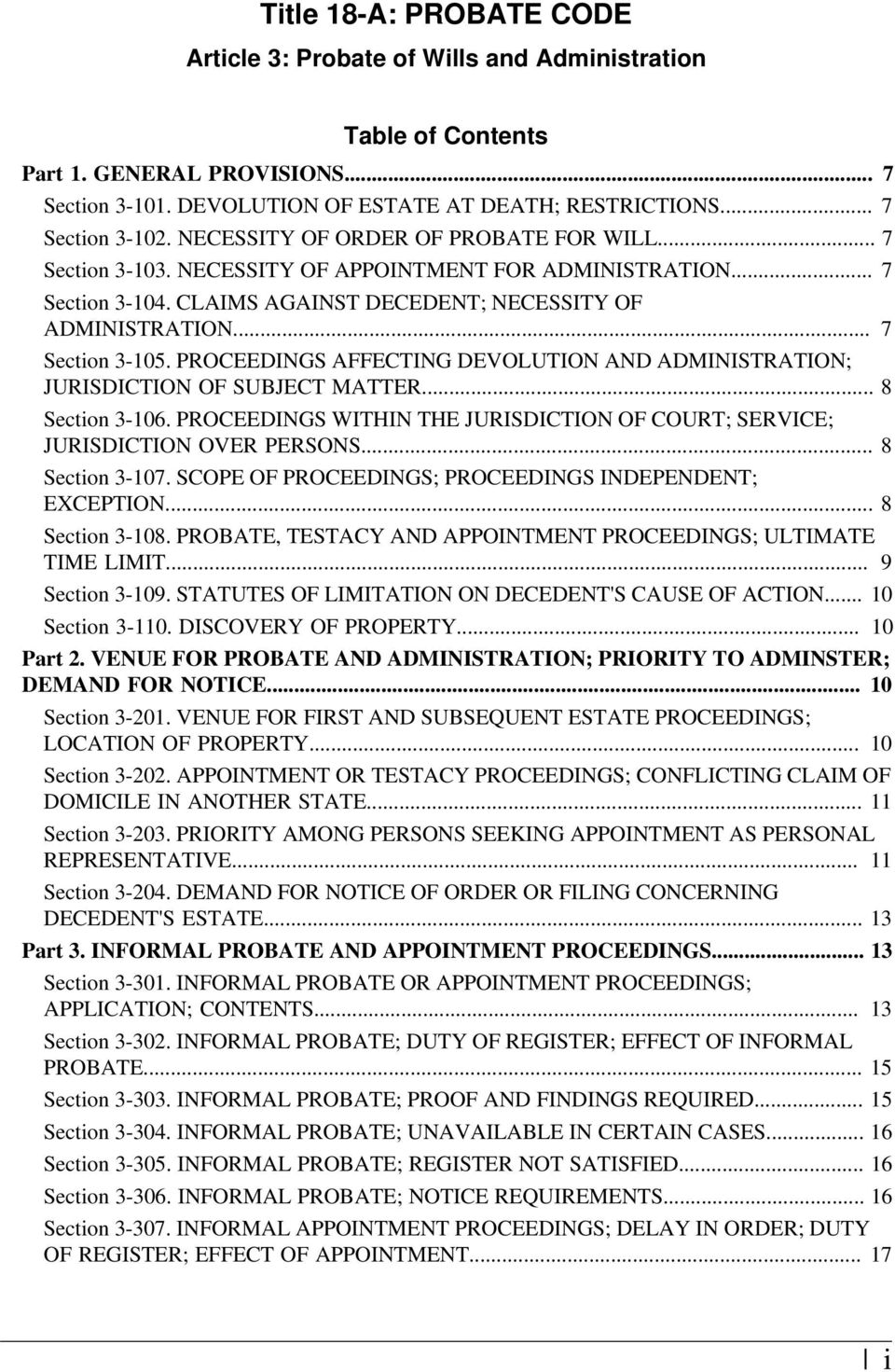
2 Text current through October 15, 2015, see disclaimer at end of document. Section INFORMAL APPOINTMENT PROCEEDINGS; PROOF AND FINDINGS REQUIRED Section INFORMAL APPOINTMENT PROCEEDINGS; REGISTER NOT SATISFIED Section INFORMAL APPOINTMENT PROCEEDINGS; NOTICE REGUIREMENTS Section INFORMAL APPOINTMENT UNAVAILABLE IN CERTAIN CASES Part 4. FORMAL TESTACY AND APPOINTMENT PROCEEDINGS Section FORMAL TESTACY PROCEEDINGS; NATURE; WHEN COMMENCED Section FORMAL TESTACY OR APPOINTMENT PROCEEDINGS; PETITION; CONTENTS Section FORMAL TESTACY PROCEEDING; NOTICE OF HEARING ON PETITION Section FORMAL TESTACY PROCEEDINGS; WRITTEN OBJECTIONS TO PROBATE Section FORMAL TESTACY PROCEEDINGS; UNCONTESTED CASES; HEARINGS AND PROOF Section FORMAL TESTACY PROCEEDINGS; CONTESTED CASES; TESTIMONY OF ATTESTING WITNESSES Section FORMAL TESTACY PROCEEDINGS; BURDENS IN CONTESTED CASES Section FORMAL TESTACY PROCEEDINGS; WILL CONSTRUCTION; EFFECT OF FINAL ORDER IN ANOTHER JURISDICTION Section FORMAL TESTACY PROCEEDINGS; ORDER; FOREIGN WILL Section FORMAL TESTACY PROCEEDINGS; PROBATE OF MORE THAN ONE INSTRUMENT Section FORMAL TESTACY PROCEEDINGS; PARTIAL INTESTACY Section FORMAL TESTACY PROCEEDINGS; EFFECT OF ORDER; VACATION Section FORMAL TESTACY PROCEEDINGS; VACATION OF ORDER FOR OTHER CAUSE Section FORMAL PROCEEDINGS CONCERNING APPOINTMENT OF PERSONAL REPRESENTATIVE Part 5. SUPERVISED ADMINISTRATION Section SUPERVISED ADMINISTRATION; NATURE OF PROCEEDING Section SUPERVISED ADMINISTRATION; PETITION; ORDER Section SUPERVISED ADMINISTRATION; EFFECT ON OTHER PROCEEDINGS Section SUPERVISED ADMINISTRATION; POWERS OF PERSONAL REPRESENTATIVE Section SUPERVISED ADMINISTRATION; INTERIM ORDERS; DISTRIBUTION AND CLOSING ORDERS ii

3 Text current through October 15, 2015, see disclaimer at end of document. Part 6. PERSONAL REPRESENTATIVE: APPOINTMENT, CONTROL AND TERMINATION OF AUTHORITY Section QUALIFICATION Section ACCEPTANCE OF APPOINTMENT; CONSENT TO JURISDICTION Section BOND NOT REQUIRED WITHOUT COURT ORDER, EXCEPTIONS Section BOND AMOUNT; SECURITY; PROCEDURE; REDUCTION Section DEMAND FOR BOND BY INTERESTED PERSON Section TERMS AND CONDITIONS OF BONDS Section ORDER RESTRAINING PERSONAL REPRESENTATIVE Section TERMINATION OF APPOINTMENT; GENERAL Section TERMINATION OF APPOINTMENT; DEATH OR DISABILITY Section TERMINATION OF APPOINTMENT; VOLUNTARY Section TERMINATION OF APPOINTMENT BY REMOVAL; CAUSE; PROCEDURE Section TERMINATION OF APPOINTMENT; CHANGE OF TESTACY STATUS Section SUCCESSOR PERSONAL REPRESENTATIVE Section SPECIAL ADMINISTRATOR; APPOINTMENT Section SPECIAL ADMINISTRATOR; WHO MAY BE APPOINTED Section SPECIAL ADMINISTRATOR; APPOINTED INFORMALLY; POWERS AND DUTIES Section SPECIAL ADMINISTRATOR; FORMAL PROCEEDINGS; POWER AND DUTIES Section TERMINATION OF APPOINTMENT; SPECIAL ADMINISTRATOR Section PUBLIC ADMINISTRATORS Part 7. DUTIES AND POWERS OF PERSONAL REPRESENTATIVES Section TIME OF ACCRUAL OF DUTIES AND POWERS Section PRIORITY AMONG DIFFERENT LETTERS Section GENERAL DUTIES; RELATION AND LIABILITY TO PERSONS INTERESTED IN ESTATE; STANDING TO SUE Section PERSONAL REPRESENTATIVE TO PROCEED WITHOUT COURT ORDER; EXCEPTION Section DUTY OF PERSONAL REPRESENTATIVE; INFORMATION TO HEIRS AND DEVISEES Section DUTY OF PERSONAL REPRESENTATIVE; INVENTORY AND APPRAISAL Section EMPLOYMENT OF APPRAISERS Section DUTY OF PERSONAL REPRESENTATIVE; SUPPLEMENTARY INVENTORY Section DUTY OF PERSONAL REPRESENTATIVE; POSSESSION OF ESTATE Section POWER TO AVOID TRANSFERS iii

4 Text current through October 15, 2015, see disclaimer at end of document. Section POWERS OF PERSONAL REPRESENTATIVES; IN GENERAL Section IMPROPER EXERCISE OF POWER; BREACH OF FIDUCIARY DUTY Section SALE, ENCUMBRANCE OR TRANSACTION INVOLVING CONFLICT OF INTEREST; VOIDABLE; EXCEPTIONS Section PERSONS DEALING WITH PERSONAL REPRESENTATIVE; PROTECTION Section TRANSACTIONS AUTHORIZED FOR PERSONAL REPRESENTATIVES; EXCEPTIONS Section POWERS AND DUTIES OF SUCCESSOR PERSONAL REPRESENTATIVE Section COREPRESENTATIVES; WHEN JOINT ACTION REQUIRED Section POWERS OF SURVIVING PERSONAL REPRESENTATIVE Section COMPENSATION OF PERSONAL REPRESENTATIVE Section EXPENSES IN ESTATE LITIGATION Section PROCEEDINGS FOR REVIEW OF EMPLOYMENT OF AGENTS AND COMPENSATION OF PERSONAL REPRESENTATIVES AND EMPLOYEES OF ESTATE Part 8. CREDITORS' CLAIMS Section NOTICE TO CREDITORS Section STATUTES OF LIMITATIONS Section LIMITATIONS ON PRESENTATION OF CLAIMS Section MANNER OF PRESENTATION OF CLAIMS Section CLASSIFICATION OF CLAIMS Section ALLOWANCE OF CLAIMS Section PAYMENT OF CLAIMS Section INDIVIDUAL LIABILITY OF PERSONAL REPRESENTATIVE Section SECURED CLAIMS Section CLAIMS NOT DUE AND CONTINGENT OR UNLIQUIDATED CLAIMS Section COUNTERCLAIMS Section EXECUTION AND LEVIES PROHIBITED Section COMPROMISE OF CLAIMS Section ENCUMBERED ASSETS Section ADMINISTRATION IN MORE THAN ONE STATE; DUTY OF PERSONAL REPRESENTATIVE Section FINAL DISTRIBUTION TO DOMICILIARY REPRESENTATIVE Section SURVIVAL OF ACTIONS Section DAMAGES LIMITED TO ACTUAL DAMAGES Part 9. SPECIAL PROVISIONS RELATING TO DISTRIBUTION Section SUCCESSORS' RIGHTS IF NO ADMINISTRATION iv

5 Text current through October 15, 2015, see disclaimer at end of document. Section DISTRIBUTION; ORDER IN WHICH ASSETS APPROPRIATED; ABATEMENT Section RIGHT OF RETAINER Section INTEREST ON GENERAL PECUNIARY DEVISE Section PENALTY CLAUSE FOR CONTEST Section DISTRIBUTION IN KIND; VALUATION; METHOD Section DISTRIBUTION IN KIND; EVIDENCE Section DISTRIBUTION; RIGHT OR TITLE OF DISTRIBUTEE Section IMPROPER DISTRIBUTION; LIABILITY OF DISTRIBUTEE Section PURCHASERS FROM DISTRIBUTEES PROTECTED Section PARTITION FOR PURPOSE OF DISTRIBUTION Section PRIVATE AGREEMENTS AMONG SUCCESSORS TO DECEDENT BINDING ON PERSONAL REPRESENTATIVE Section DISTRIBUTIONS TO TRUSTEE Section DISPOSITION OF UNCLAIMED ASSETS Section DISTRIBUTION TO PERSON UNDER DISABILITY Section APPORTIONMENT OF ESTATE TAXES Part 10. CLOSING ESTATES Section FORMAL PROCEEDINGS TERMINATING ADMINISTRATION; TESTATE OR INTESTATE; ORDER OF GENERAL PROTECTION Section FORMAL PROCEEDINGS TERMINATING TESTATE ADMINISTRATION; ORDER CONSTRUING WILL WITHOUT ADJUDICATING TESTACY Section CLOSING ESTATES; BY SWORN STATEMENT OF PERSONAL REPRESENTATIVE Section LIABILITY OF DISTRIBUTEES TO CLAIMANTS Section LIMITATIONS ON PROCEEDINGS AGAINST PERSONAL REPRESENTATIVE Section LIMITATIONS ON ACTIONS AND PROCEEDINGS AGAINST DISTRIBUTEES Section CERTIFICATE DISCHARGING LIENS SECURING FIDUCIARY PERFORMANCE Section SUBSEQUENT ADMINISTRATION Part 11. COMPROMISE OF CONTROVERSIES Section EFFECT OF APPROVAL OF AGREEMENTS INVOLVING TRUSTS INALIENABLE INTERESTS, OR INTERESTS OR THIRD PERSONS Section PROCEDURE FOR SECURING COURT APPROVAL OF COMPROMISE Part 12. COLLECTION OF PERSONAL PROPERTY BY AFFIDAVIT AND SUMMARY ADMINISTRATION PROCEDURES FOR SMALL ESTATES Section COLLECTION OF PERSONAL PROPERTY BY AFFIDAVIT Section EFFECT OF AFFIDAVIT Section SMALL ESTATES; SUMMARY ADMINISTRATIVE PROCEDURE v
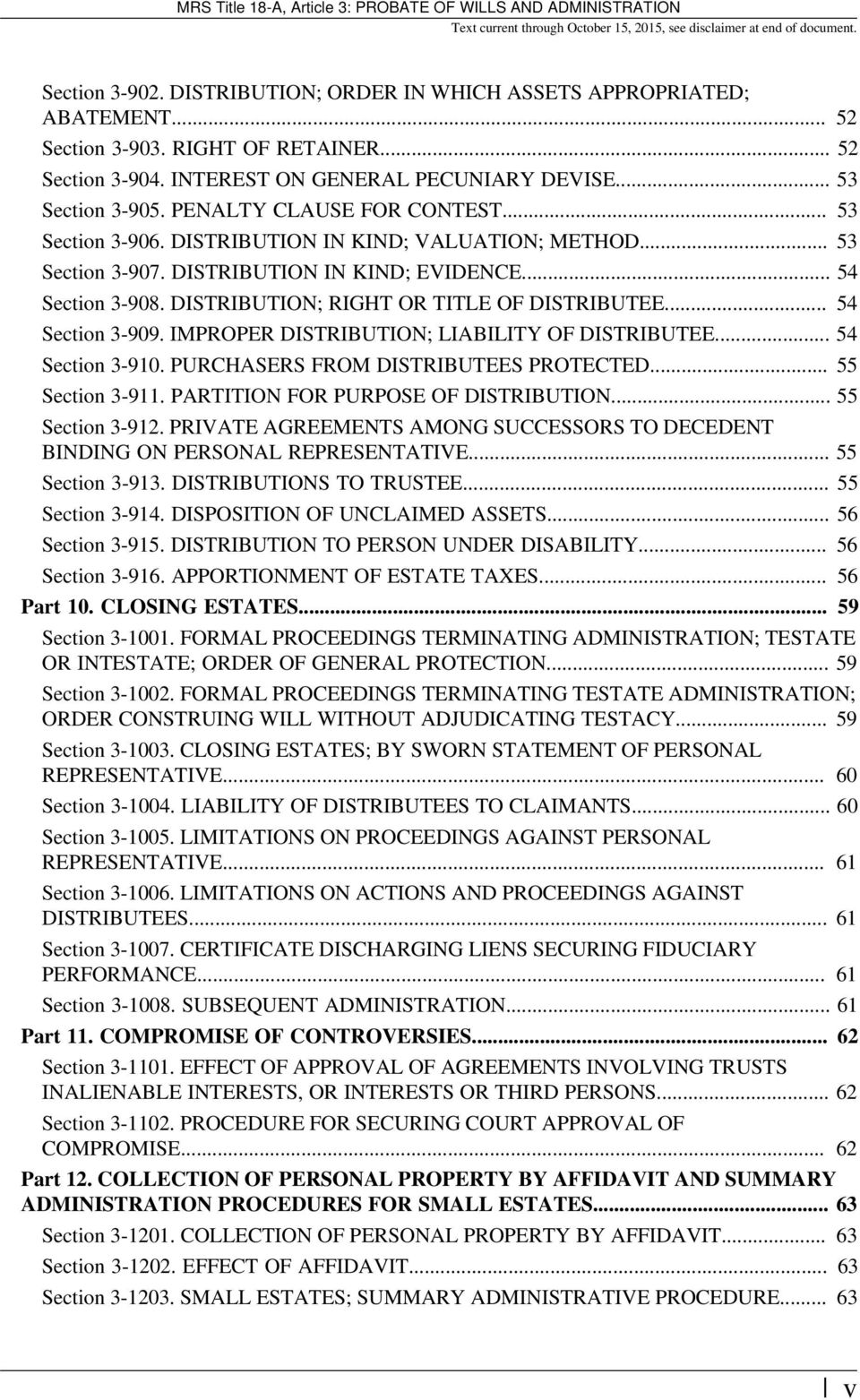
6 Text current through October 15, 2015, see disclaimer at end of document. Section SMALL ESTATES; CLOSING BY SWORN STATEMENT OF PERSONAL REPRESENTATIVE Section SOCIAL SECURITY PAYMENTS vi

7 Maine Revised Statutes Title 18-A: PROBATE CODE Article 3: Probate of Wills and Administration Part 1: GENERAL PROVISIONS DEVOLUTION OF ESTATE AT DEATH; RESTRICTIONS The power of a person to leave property by will, and the rights of creditors, devisees, and heirs to his property are subject to the restrictions and limitations contained in this Code to facilitate the prompt settlement of estates. Upon the death of a person, his real and personal property devolves to the persons to whom it is devised by his last will or to those indicated as substitutes for them in cases involving lapse, renunciation, or other circumstances affecting the devolution of testate estate, or in the absence of testamentary disposition, to his heirs, or to those indicated as substitutes for them in cases involving renunciation or other circumstances affecting devolution of intestate estates, subject to homestead allowance, exempt property and family allowance, to rights of creditors, elective share of the surviving spouse, and to administration. [] NECESSITY OF ORDER OF PROBATE FOR WILL Except as provided in section , to be effective to prove the transfer of any property or to nominate an executor, a will must be declared to be valid by an order of informal probate by the registers or an adjudication of probate by the judge, except that a duly executed and unrevoked will which has not been probated may be admitted as evidence of a devise if (1) no court proceeding concerning the succession or administration of the estate has occurred, and (2) either the devisee or his successors and assigns possessed the property devised in accordance with the provisions of the will, or the property devised was not possessed or claimed by anyone by virtue of the decedent's title during the time period for testacy proceedings. [] NECESSITY OF APPOINTMENT FOR ADMINISTRATION Except as otherwise provided in Article IV, to acquire the powers and undertake the duties and liabilities of a personal representative of a decedent, a person must be appointed by order of the judge or registers, qualify and be issued letters. Administration of an estate is commenced by the issuance of letters. [1979, c. 540, 1 (NEW).] CLAIMS AGAINST DECEDENT; NECESSITY OF ADMINISTRATION No proceeding to enforce a claim against the estate of a decedent or his successors may be revived or commenced before the appointment of a personal representative. After the appointment and until distribution, all proceedings and actions to enforce a claim against the estate are governed by the procedure prescribed by this Article. After distribution a creditor whose claim has not been barred may recover from the distributees as provided in section or from a former personal representative individually liable as provided in section Devolution of estate at death; restrictions 7
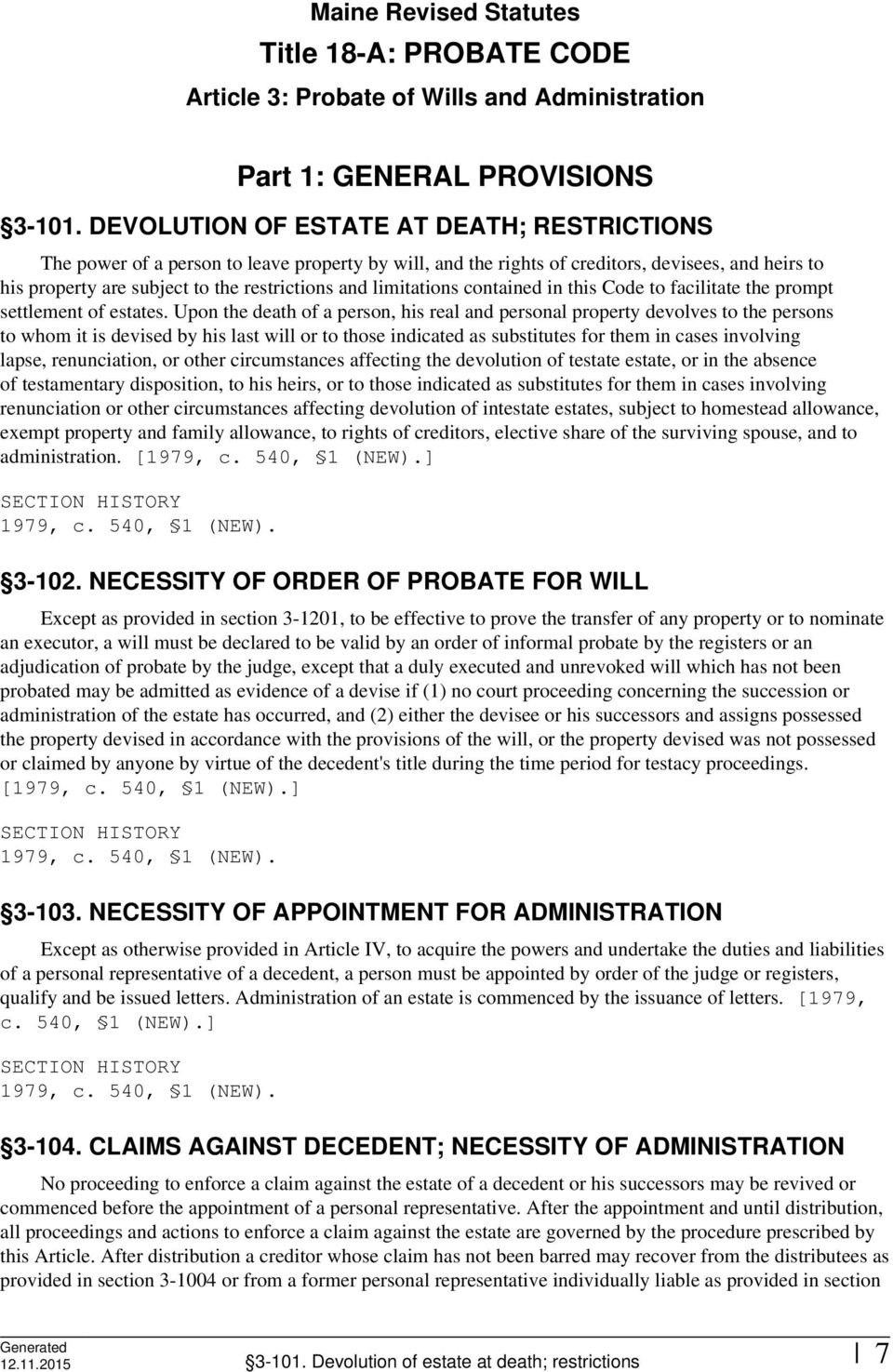
8 This section has no application to a proceeding by a secured creditor of the decedent to enforce his right to his security except as to any deficiency judgment which might be sought therein. [1979, c. 540, 1 (NEW).] PROCEEDINGS AFFECTING DEVOLUTION AND ADMINISTRATION; JURISDICTION OF SUBJECT MATTER Persons interested in decedents' estates may apply to the register for determination in the informal proceedings provided in this Article, and may petition the court for orders in formal proceedings within the court's jurisdiction including but not limited to those described in this Article. The court has exclusive jurisdiction of informal and formal proceedings to determine how decedents' estates subject to the laws of this State are to be administered, expended and distributed. The court has concurrent jurisdiction of any other action or proceeding concerning a succession or to which an estate, through a personal representative, may be a party, including actions to determine title to property alleged to belong to the estate, and of any action or proceeding in which property is distributed by a personal representative or its value is sought to be subjected to rights of creditors or successors of the decedent. [] PROCEEDINGS WITHIN THE JURISDICTION OF COURT; SERVICE; JURISDICTION OVER PERSONS In proceedings within the exclusive jurisdiction of the court where notice is required by this Code or by rule, and in proceedings to construe probated wills or determine heirs which concern estates that have not been and cannot now be opened for administration, interested persons may be bound by the orders of the court in respect to property in or subject to the laws of this State by notice in conformity with section An order is binding as to all who are given notice of the proceeding though less than all interested persons are notified. [] SCOPE OF PROCEEDINGS; PROCEEDINGS INDEPENDENT; EXCEPTION Unless supervised administration as described in Part 5 is involved, (1) each proceeding before the judge or register is independent of any other proceeding involving the same estate; (2) petitions for formal orders of the judge may combine various requests for relief in a single proceeding if the orders sought may be finally granted without delay. Except as required for proceedings which are particularly described by other sections of this Article, no petition is defective because it fails to embrace all matters which might then be the subject of a final order; (3) proceedings for probate of wills or adjudications of no will may be combined with proceedings for appointment of personal representatives; and (4) a proceeding for appointment of a personal representative is concluded by an order making or declining the appointment. [1979, c. 540, 1 (NEW).] Proceedings affecting devolution and administration; jurisdiction of subject matter
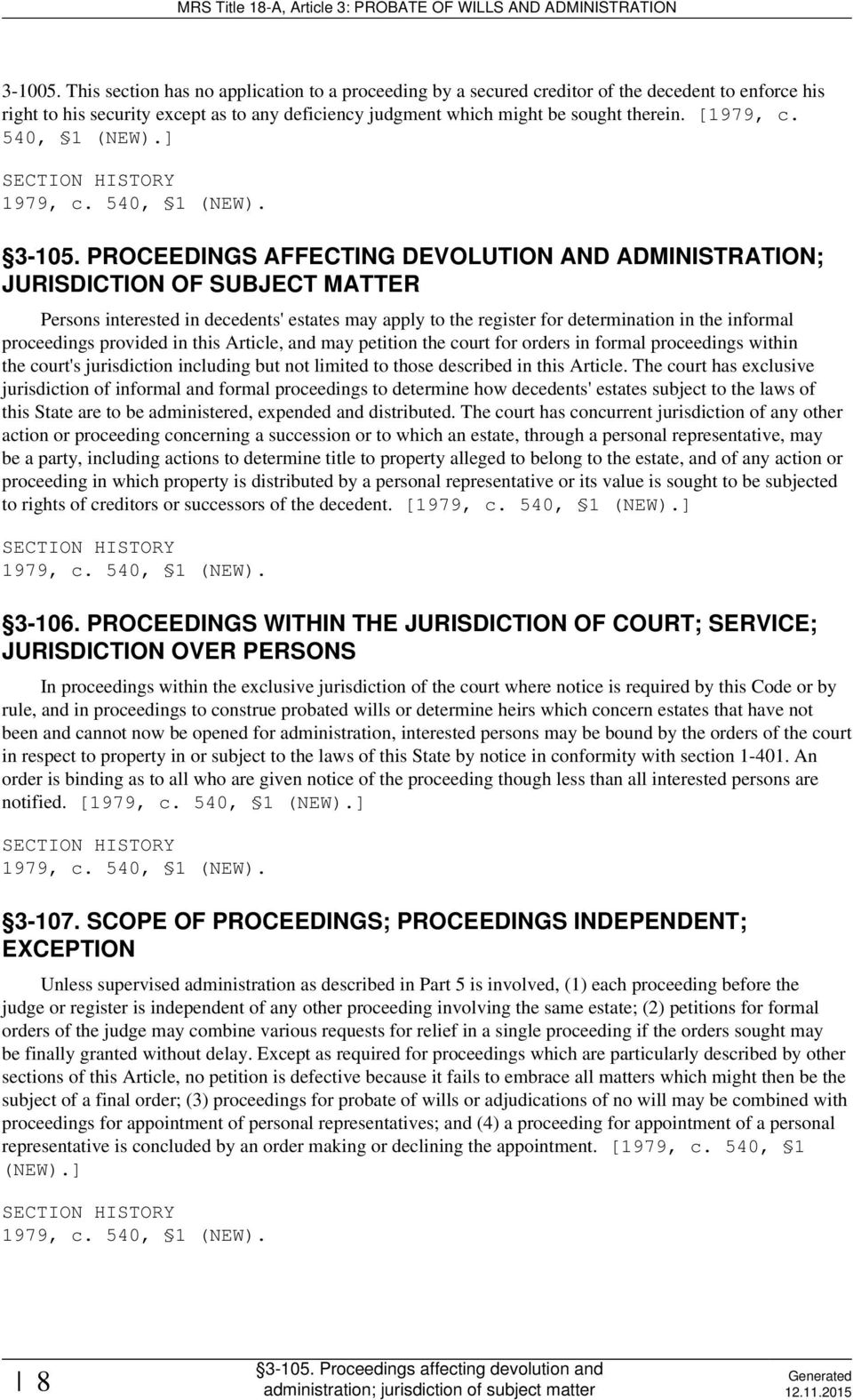
9 PROBATE, TESTACY AND APPOINTMENT PROCEEDINGS; ULTIMATE TIME LIMIT (a). For a decedent dying on or after January 1, 1981, no informal probate or appointment proceeding or formal testacy or appointment proceeding, other than a proceeding to probate a will previously probated at the testator's domicile and appointment proceedings relating to an estate in which there has been a prior appointment, may be commenced more than 3 years after the decedent's death, except: (1). If a previous proceeding was dismissed because of doubt about the fact of the decedent's death, appropriate probate, appointment or testacy proceedings may be maintained at any time thereafter upon a finding that the decedent's death occurred prior to the initiation of the previous proceeding and the applicant or petitioner has not delayed unduly in initiating the subsequent proceeding; [1983, c. 256, (NEW).] (2). Appropriate probate, appointment or testacy proceedings may be maintained in relation to the estate of an absent, disappeared or missing person for whose estate a conservator has been appointed, at any time within 3 years after the conservator becomes able to establish the death of the protected person; [2009, c. 368, 1 (AMD).] (3). A proceeding to contest an informally probated will and to secure appointment of the person with legal priority for appointment in the event the contest is successful may be commenced within the later of 12 months from the informal probate or 3 years from the decedent's death; and [2009, c. 368, 2 (AMD).] (4). Appropriate probate, appointment or testacy proceedings may be commenced in relation to a claim for personal injury made against the decedent by a person without actual notice of the death of the decedent at any time within 6 years after the cause of action accrues. If the proceedings are commenced more than 3 years after the decedent's death, any recovery is limited to applicable insurance. [2009, c. 368, 3 (NEW).] These limitations do not apply to proceedings to construe probated wills or determine heirs of an intestate. In cases under paragraph (1) or (2), the date on which a testacy or appointment proceeding is properly commenced is deemed to be the date of the decedent's death for purposes of other limitations provisions of this Code that relate to the date of death. [ 2009, c. 368, 1-3 (AMD).] (b). For a decedent dying before January 1, 1981, no informal probate or appointment proceeding or formal testacy or appointment proceeding, other than a proceeding to probate a will previously probated at the testator's domicile and appointment proceedings relating to an estate in which there has been a prior appointment, may be commenced more than 20 years after the decedent's death, except: (1). If a previous proceeding was dismissed because of doubt about the fact of the decedent's death, appropriate probate, appointment or testacy proceedings may be maintained at any time thereafter upon a finding that the decedent's death occurred prior to the initiation of the previous proceeding and the applicant or petitioner has not delayed unduly in initiating the subsequent proceeding; [1983, c. 256, (NEW).] (2). Appropriate probate, appointment or testacy proceedings may be maintained in relation to the estate of an absent, disappeared or missing person for whose estate a conservator has been appointed at any time within the applicable limitation period, as set forth in this section, which shall begin to run after the conservator becomes able to establish the death of the protected person; and [1983, c. 256, (NEW).] (3). A proceeding to contest an informally probated will and to secure appointment of the person with legal priority for appointment in the event the contest is successful may be commenced within the later of 12 months from the informal probate or the running of the applicable limitation period. [2005, c. 683, Pt. C, 5 (AMD).] Probate, testacy and appointment proceedings; ultimate time limit 9

10 These limitations do not apply to proceedings to construe probated wills or determine heirs of an intestate. In cases under paragraph (1) or (2), the date on which a testacy or appointment proceeding is properly commenced is deemed to be the date of the decedent's death for purposes of the limitations provisions of this Code that relate to the date of death. [ 2005, c. 683, Pt. C, 5 (AMD).] 1983, c. 256, (RPR). 2005, c. 683, C5 (AMD). 2009, c. 368, 1-3 (AMD) STATUTES OF LIMITATION ON DECEDENT'S CAUSE OF ACTION No statute of limitation running on a cause of action belonging to a decedent which had not been barred as of the date of his death, shall apply to bar a cause of action surviving the decedent's death sooner than 4 months after death. A cause of action which, but for this section, would have been barred less than 4 months after death, is barred after 4 months unless tolled. [] DISCOVERY OF PROPERTY (a). Upon petition by a county attorney, personal representative, heir, devisees, creditor or other person interested in the estate of a decedent, anyone suspected of having concealed, withheld or conveyed away any property of the decedent, or of having fraudulently received any such property, or of aiding others in so doing, may be cited by the judge to appear before him to be examined on oath in relation thereto, and the judge may require him to produce for the inspection of the court and parties all documents within his control relating to the matter under examination. The time for filing such petitions shall be governed by section (b). If a person duly cited refuses to appear and submit himself to such examination, or to answer all lawful interrogatories, or to produce such documents he shall be subject to contempt of the court and is liable to any injured party in a civil action for all the damages, expenses and charges arising from such refusal. Part 2: VENUE FOR PROBATE AND ADMINISTRATION; PRIORITY TO ADMINSTER; DEMAND FOR NOTICE VENUE FOR FIRST AND SUBSEQUENT ESTATE PROCEEDINGS; LOCATION OF PROPERTY is: (a). Venue for the first informal or formal testacy or appointment proceedings after a decedent's death (1). In the county where the decedent had his domicile at the time of his death; or [1979, c. 540, 1 (NEW).] Statutes of limitation on decedent's cause of action
![provisions of this Code that relate to the date of death. [ 2005, c. 683, Pt. C, 5 (AMD).] 1983, c. 256, (RPR). 2005, c. 683, C5 (AMD). 2009, c. 368, 1-3 (AMD). 3-109.](/docs-images/41/11685705/images/page_10.jpg "STATUTES OF LIMITATION ON DECEDENT'S CAUSE OF ACTION No statute of limitation running on a cause of action belonging to a decedent which had not been barred as of the date of his death, shall apply")
11 (2). If the decedent was not domiciled in this State, in any county where property was located either at the time of his death or at any time thereafter. [] (b). Venue for all subsequent proceedings within the exclusive jurisdiction of the court is in the place where the initial proceeding occurred, unless the initial proceeding has been transferred as provided in subsection (c) of section (c). If the first proceeding was informal, on application of an interested person and after notice to the proponent in the first proceeding, the judge, upon finding that venue is elsewhere, may transfer the proceeding and the file to the other court. (d). For the purpose of aiding determinations concerning location of assets which may be relevant in cases involving non-domiciliaries, a debt, other than one evidenced by investment or commercial paper or other instrument in favor of a non-domiciliary, is located where the debtor resides or, if the debtor is a person other than an individual, at the place where it has its principal office. Commercial paper, investment paper and other instruments are located where the instrument is. An interest in property held in trust is located where the trustee may be sued APPOINTMENT OR TESTACY PROCEEDINGS; CONFLICTING CLAIM OF DOMICILE IN ANOTHER STATE If conflicting claims as to the domicile of a decedent are made in a formal testacy or appointment proceeding commenced in this State, and in a testacy or appointment proceeding after notice pending at the same time in another state, the court of this State must stay, dismiss, or permit suitable amendment in, the proceeding here unless it is determined that the local proceeding was commenced before the proceeding elsewhere. The determination of domicile in the proceeding first commenced must be accepted as determinative in the proceeding in this State. [] PRIORITY AMONG PERSONS SEEKING APPOINTMENT AS PERSONAL REPRESENTATIVE (a). Whether the proceedings are formal or informal, persons who are not disqualified have priority for appointment in the following order: (1). The person with priority as determined by a probated will including a person nominated by a power conferred in a will; [] (2). The surviving spouse of the decedent who is a devisee of the decedent; [1979, c. 540, 1 (NEW).] (3). Other devisees of the decedent; [] Appointment or testacy proceedings; conflicting claim of domicile in another state 11
12 (4). The surviving spouse of the decedent; [] (4-A). The surviving domestic partner of the decedent; [2003, c. 672, 8 (NEW).] (5). Other heirs of the decedent; [] (6). Forty-five days after the death of the decedent, any creditor; [] (7). Six months after the death of the decedent if no testacy proceedings have been held or no personal representative has been appointed, the State Tax Assessor upon application by that officer. [1979, c. 540, 1 (NEW).] [ 2003, c. 672, 8 (AMD).] (b). An objection to an appointment can be made only in formal proceeding. In case of objection the priorities stated in (a) apply except that (1). If the estate appears to be more than adequate to meet exemptions and costs of administration but inadequate to discharge anticipated unsecured claims, the judge, on petition of creditors, may appoint any qualified person; [] (2). In case of objection to appointment of a person other than one whose priority is determined by will by an heir or devisee appearing to have a substantial interest in the estate, the judge may appoint a person who is acceptable to heirs and devisees whose interests in the estate appear to be worth in total more than 1/2 of the probable distributable value, or, in default of this accord any suitable person. [1979, c. 540, 1 (NEW).] (c). A person entitled to letters under subsection (a), paragraphs (2) through (5) may nominate a qualified person to act as personal representative. Any person may renounce his right to nominate or to an appointment by appropriate writing filed with the court. When 2 or more persons share a priority, those of them who do not renounce must concur in nominating another to act for them or in applying for appointment. (d). Conservators of the estates of protected persons, or if there is no conservator, any guardian except a guardian ad litem of a minor or incapacitated person, may exercise the same right to nominate, to object to another's appointment, or to participate in determining the preference of a majority in interest of the heirs and devisees that the protected person or ward would have if qualified for appointment. (e). Appointment of one who does not have priority may be made only in formal proceedings. Appointment of one who has priority resulting from renunciation or nomination pursuant to subsection (c) may be made in informal proceedings. Before appointing one without priority, the judge shall determine that those having priority, although given notice of the proceedings, have failed to request appointment or to nominate another for appointment and that administration is necessary. [ 1993, c. 109, 1 (AMD).] (f). No person is qualified to serve as a personal representative who is: (1). Under the age of 18; [] (2). A person whom the court finds unsuitable in formal proceedings. [1979, c. 540, 1 (NEW).] Priority among persons seeking appointment as personal representative

13 (g). A personal representative appointed by a court of the decedent's domicile has priority over all other persons except where the decedent's will nominates different persons to be personal representative in this State and in the state of domicile. The domiciliary personal representative may nominate another, who shall have the same priority as the domiciliary personal representative. (h). This section governs priority for appointment of a successor personal representative but does not apply to the selection of a special administrator. 1993, c. 109, 1 (AMD). 2003, c. 672, 8 (AMD) DEMAND FOR NOTICE OF ORDER OR FILING CONCERNING DECEDENT'S ESTATE Any person desiring notice of an order or filing pertaining to a decedent's estate in which he has a financial or property interest may file a demand for notice with the court at any time after the death of the decedent, and may thereupon have notice of such demand given to the personal representative, and shall thereafter receive service of every filing, notice or order to which the demand relates, in such manner and form as the Supreme Judicial Court shall by rule provide. The validity of an order or notice which is issued or a filing which is accepted without compliance with this requirement shall not be affected by the error, but the person receiving the order, giving notice, or making the filing may be liable for any damage caused by the absence of service. The requirement of notice arising from demand under this provision may be waived by the demandant in such manner and form as the Supreme Judicial Court shall by rule provide, and shall cease upon the termination of his interest in the estate. [] Part 3: INFORMAL PROBATE AND APPOINTMENT PROCEEDINGS INFORMAL PROBATE OR APPOINTMENT PROCEEDINGS; APPLICATION; CONTENTS (a). Applications for informal probate or informal appointment shall be directed to the register and be verified by the applicant to be accurate and complete to the best of his knowledge and belief and shall contain the following information and such other information as the Supreme Judicial Court may by rule provide: (1). Every application for informal probate of a will or for informal appointment of a personal representative, other than a special or successor representative, shall contain the following: (i) A statement of the interest of the applicant; (ii) The name, and date of death of the decedent, his age, and the county and state of his domicile at the time of death, and the names and addresses of the spouse, children, heirs and devisees and the ages of any who are minors so far as known or ascertainable with reasonable diligence by the applicant; (iii) If the decedent was not domiciled in the state at the time of his death, a statement showing venue; (iv) A statement identifying and indicating the address of any personal representative of the decedent appointed in this state or elsewhere whose appointment has not been terminated; Demand for notice of order or filing concerning decedent's estate 13
14 (v) A statement indicating whether the applicant has received a demand for notice, or is aware of any demand for notice of any probate or appointment proceeding concerning the decedent that may have been filed in this state or elsewhere; and (vi) That the time limit for informal probate or appointment as provided in this Article has not expired either because 3 years or less have passed since the decedent's death, or, if more than 3 years from death have passed, circumstances as described by section authorizing tardy probate or appointment have occurred. [] (2). An application for informal probate of a will shall state the following in addition to the statements required by paragraph (1): (i) That the original of the decedent's last will is in the possession of the court, or accompanies the application, or that an authenticated copy of a will probated in another jurisdiction accompanies the application; (ii) That the applicant, to the best of his knowledge, believes the will to have been validly executed; (iii) That after the exercise of reasonable diligence, the applicant is unaware of any instrument revoking the will, and that the applicant believes that the instrument which is the subject of the application is the decedent's last will. [] (3). An application for informal appointment of a personal representative to administer an estate under a will shall describe the will by date of execution and state the time and place of probate or the pending application or petition for probate. The application for appointment shall adopt the statements in the application or petition for probate and state the name, address and priority for appointment of the person whose appointment is sought. [] (4). An application for informal appointment of an administrator in intestacy shall state in addition to the statements required by paragraph (1): (i) That after the exercise of reasonable diligence, the applicant is unaware of any unrevoked testamentary instrument relating to property having a situs in this State under section 1-301, or, a statement why any such instrument of which he may be aware is not being probated; (ii) The priority of the person whose appointment is sought and the names of any other persons having a prior or equal right to the appointment under section [1979, c. 540, 1 (NEW).] (5). An application for appointment of a personal representative to succeed a personal representative appointed under a different testacy status shall refer to the order in the most recent testacy proceeding, state the name and address of the person whose appointment is sought and of the person whose appointment will be terminated if the application is granted, and describe the priority of the applicant. [] (6). An application for appointment of a personal representative to succeed a personal representative who has tendered a resignation as provided in section 3-610, subsection (c), or whose appointment has been terminated by death or removal, shall adopt the statements in the application or petition which led to the appointment of the person being succeeded except as specifically changed or corrected, state the name and address of the person who seeks appointment as successor, and describe the priority of the applicant. [] Informal probate or appointment proceedings; application; contents
![the decedent's death, or, if more than 3 years from death have passed, circumstances as described by section 3-108 authorizing tardy probate or appointment have occurred. [] (2).](/docs-images/41/11685705/images/page_14.jpg "An application for informal probate of a will shall state the following in addition to the statements required by paragraph (1): (i) That the original of the decedent's last will is in the possession")
15 (b). By verifying an application for informal probate, or informal appointment, the applicant submits personally to the jurisdiction of the court in any proceeding for relief from fraud relating to the application, or for perjury, that may be instituted against him INFORMAL PROBATE; DUTY OF REGISTER; EFFECT OF INFORMAL PROBATE Upon receipt of an application requesting informal probate of a will, the register upon making the findings required by section shall issue a written statement of informal probate if at least 120 hours have elapsed since the decedent's death. Informal probate is conclusive as to all persons until superseded by an order in a formal testacy proceeding. No defect in the application or procedure relating thereto which leads to informal probate of a will renders the probate void. [] INFORMAL PROBATE; PROOF AND FINDINGS REQUIRED (a). In an informal proceeding for original probate of a will, the register shall determine whether: (1). The application is complete; [] (2). The applicant has made oath or affirmation that the statements contained in the application are true to the best of his knowledge and belief; [] (3). The applicant appears from the application to be an interested person as defined in section 1-201, paragraph (20); [] (4). On the basis of the statements in the application, venue is proper; [1979, c. 540, 1 (NEW).] (5). An original, duly executed and apparently unrevoked will is in the register's possession; [1979, c. 540, 1 (NEW).] (6). Any notice required by section has been given and that the application is not within section 3-304; and [] (7). It appears from the application that the time limit for original probate has not expired. [1979, c. 540, 1 (NEW).] (b). The application shall be denied if it indicates that a personal representative has been appointed in another county of this State or except as provided in subsection (d), if it appears that this or another will of the decedent has been the subject of a previous probate order Informal probate; duty of register; effect of informal probate 15

16 (c). A will which appears to have the required signatures and which contains an attestation clause showing that requirements of execution under sections 2-502, or have been met shall be probated without further proof. In other cases, the register may assume execution if the will appears to have been properly executed, or he may accept a sworn statement or affidavit of any person having knowledge of the circumstances of execution, whether or not the person was a witness to the will. (d). Informal probate of a will which has been previously probated elsewhere may be granted at any time upon written application by any interested person, together with deposit of an authenticated copy of the will and of the statement probating it from the office of court where it was first probated. (e). A will from a foreign jurisdiction, including a place that does not require probate of a will after death and which is not eligible for probate under subsection (a), may be probated in this State upon receipt by the register of a duly authenticated copy of the will and a duly authenticated certificate of its legal custodian that the copy filed is a true copy and that the will has been probated in the foreign jurisdiction or has otherwise become operative under the law of that place INFORMAL PROBATE; UNAVAILABLE IN CERTAIN CASES Applications for informal probate which relate to one or more of a known series of testamentary instruments, other than a will and its codicil, the latest of which does not expressly revoke the earlier, shall be declined. [] INFORMAL PROBATE; REGISTER NOT SATISFIED If the register is not satisfied that a will is entitled to be probated in informal proceedings because of failure to meet the requirements of sections and or any other reason, he may decline the application. A declination of informal probate is not an adjudication and does not preclude formal probate proceedings. [] INFORMAL PROBATE; NOTICE REQUIREMENTS The moving party shall give notice as described by section of the moving party's application for informal probate to any person demanding notice pursuant to section 3-204, to an heir, devisee or personal representative who has not waived notice in a writing filed with the court and to any personal representative of the decedent whose appointment has not been terminated. If the decedent was 55 years of age or older, the moving party shall give notice as described in section to the Department of Health and Human Services. No other notice of informal probate is required. [2005, c. 12, Pt. DDD, 1 (AMD); 2005, c. 12, Pt. DDD, 17 (AFF).] Informal probate; unavailable in certain cases
17 1979, c. 690, 5 (AMD). 2005, c. 12, DDD1 (AMD). 2005, c. 12, DDD17 (AFF) INFORMAL APPOINTMENT PROCEEDINGS; DELAY IN ORDER; DUTY OF REGISTER; EFFECT OF APPOINTMENT (a). Upon receipt of an application for informal appointment of a personal representative other than a special administrator as provided in section 3-614, if at least 120 hours have elapsed since the decedent's death, the register, after making the findings required by section 3-308, shall appoint the applicant subject to qualification and acceptance; provided, that if the decedent was a nonresident, the register shall delay the order of appointment until 30 days have elapsed since death unless the personal representative appointed at the decedent's domicile is the applicant, or unless the decedent's will directs that his estate be subject to the laws of this State. (b). The status of personal representative and the powers and duties pertaining to the office are fully established by informal appointment. An appointment, and the office of personal representative created thereby, is subject to termination as provided in sections through 3-612, but is not subject to retroactive vacation INFORMAL APPOINTMENT PROCEEDINGS; PROOF AND FINDINGS REQUIRED (a). In informal appointment proceedings, the register must determine whether: (1). The application for informal appointment of a personal representative is complete; [1979, c. 540, 1 (NEW).] (2). The applicant has made oath or affirmation that the statements contained in the application are true to the best of his knowledge and belief; [] (3). The applicant appears from the application to be an interested person as defined in section 1-201, paragraph (20); [] (4). On the basis of the statements in the application, venue is proper; [1979, c. 540, 1 (NEW).] (5). Any will to which the requested appointment relates has been formally or informally probated; but this requirement does not apply to the appointment of a special administrator; [1979, c. 540, 1 (NEW).] (6). Any notice required by section has been given; [] (7). From the statements in the application, the person whose appointment is sought has priority entitling him to the appointment. [] (b). Unless section controls, the application must be denied if it indicates that a personal representative who has not filed a written statement of resignation as provided in section 3-610, subsection (c) has been appointed in this or another county of this State, that, unless the applicant is the domiciliary personal Informal appointment proceedings; delay in order; duty of register; effect of appointment 17
18 representative or his nominee, the decedent was not domiciled in this State and that a personal representative whose appointment has not been terminated has been appointed by a court in the state of domicile, or that other requirements of this section have not been met INFORMAL APPOINTMENT PROCEEDINGS; REGISTER NOT SATISFIED If the register is not satisfied that a requested informal appointment of a personal representative should be made because of failure to meet the requirements of sections and 3-308, or for any other reason, he may decline the application. A declination of informal appointment is not an adjudication and does not preclude appointment in formal proceedings. [] INFORMAL APPOINTMENT PROCEEDINGS; NOTICE REGUIREMENTS The moving party shall give notice as described by section of the moving party's intention to seek an appointment informally: (1) to any person demanding notice pursuant to section 3-204; (2) to an heir or devisee who has not waived notice in a writing filed with the court; and (3) to any person having a prior or equal right to appointment not waived in writing and filed with the court. If the decedent was 55 years of age or older, the moving party shall give notice as described in section to the Department of Health and Human Services. No other notice of an informal appointment proceeding is required. [2005, c. 12, Pt. DDD, 2 (AMD); 2005, c. 12, Pt. DDD, 17 (AFF).] 1979, c. 690, 6 (AMD). 2005, c. 12, DDD2 (AMD). 2005, c. 12, DDD17 (AFF) INFORMAL APPOINTMENT UNAVAILABLE IN CERTAIN CASES If an application for informal appointment indicates the existence of a possible unrevoked testamentary instrument which may relate to property subject to the laws of this State, and which is not filed for probate in this court, the register shall decline the application. [] Part 4: FORMAL TESTACY AND APPOINTMENT PROCEEDINGS FORMAL TESTACY PROCEEDINGS; NATURE; WHEN COMMENCED A formal testacy proceeding is litigation to determine whether a decedent left a valid will. A formal testacy proceeding may be commenced by an interested person filing a petition as described in section 3-402, subsection (a) in which he requests that the judge, after notice and hearing, enter an order probating a will, or a petition to set aside an informal probate of a will or to prevent informal probate of a will which is the subject of a pending application, or a petition in accordance with section 3-402, subsection (b) for an order that the decedent died intestate. [] Informal appointment proceedings; register not satisfied

19 A petition may seek formal probate of a will without regard to whether the same or a conflicting will has been informally probated. A formal testacy proceeding may, but need not, involve a request for appointment of a personal representative. [] During the pendency of a formal testacy proceeding, the register shall not act upon any application for informal probate of any will of the decedent or any application for informal appointment of a personal representative of the decedent. [] Unless a petition in a formal testacy proceeding also requests confirmation of the previous informal appointment, a previously appointed personal representative, after receipt of notice of the commencement of a formal probate proceeding, must refrain from exercising his power to make any further distribution of the estate during the pendency of the formal proceeding. A petitioner who seeks the appointment of a different personal representative in a formal proceeding also may request an order restraining the acting personal representative from exercising any of the powers of his office and requesting the appointment of a special administrator. In the absence of a request, or if the request is denied, the commencement of a formal proceeding has no effect on the powers and duties of a previously appointed personal representative other than those relating to distribution. [] FORMAL TESTACY OR APPOINTMENT PROCEEDINGS; PETITION; CONTENTS (a). Petitions for formal probate of a will, or for adjudcation of intestacy with or without request for appointment of a personal representative, must be directed to the judge, request a judicial order after notice and hearing, contain further statements as indicated in this section, and contain such other information and be in such form as the Supreme Judicial Court may by rule provide. A petition for formal probate of a will shall: (1). Request an order as to the testacy of the decedent in relation to a particular instrument which may or may not have been informally probated and determining the heirs; [] (2). Contain the statements required for informal applications as stated in the 6 subparagraphs under section 3-301, subsection (a), paragraph (1), and the statements required by section 3-301, subsection (a), paragraph (2), subparagraphs (ii) and (iii); and [] (3). State whether the original of the last will of the decedent is in the possession of the court or accompanies the petition. [] If the original will is neither in the possession of the court nor accompanies the petition and no authenticated copy of a will probated in another jurisdiction accompanies the petition, the petition also must state the contents of the will and indicate that it is lost, destroyed or otherwise unavailable. [1979, c. 540, 1 (NEW).] (b). A petition for adjudication of intestacy and appointment of an administrator in intestacy must request a judicial finding and order that the decedent left no will and determining the heirs, contain the statements required by section 3-301, subsection (a), paragraphs (1) and (4) and indicate whether supervised administration is sought and contain such other information and be in such form as the Supreme Judicial Court may by rule provide. A petition may request an order determining intestacy and heirs without requesting the appointment of an administrator, in which case the statements required by section 3-301, subsection (a), paragraph (4), subparagraph (ii) may be omitted Formal testacy or appointment proceedings; petition; contents 19
![[] During the pendency of a formal testacy proceeding, the register shall not act upon any application for informal probate of any will of the decedent or any application for informal appointment of](/docs-images/41/11685705/images/page_19.jpg "a personal representative of the decedent.")
20 FORMAL TESTACY PROCEEDING; NOTICE OF HEARING ON PETITION (a). Upon commencement of a formal testacy proceeding, the court shall fix a time and place of hearing. Notice must be given in the manner prescribed by section by the petitioner to the persons enumerated in this subsection and to any additional person who has filed a demand for notice under section Notice must be given to the following persons: the surviving spouse, children and other heirs of the decedent, the devisees and executors named in any will that is being, or has been, probated or offered for informal or formal probate in the county or that is known by the petitioner to have been probated or offered for informal or formal probate elsewhere and any personal representative of the decedent whose appointment has not been terminated. If the decedent was 55 years of age or older, the petitioner shall give notice as described in section to the Department of Health and Human Services. Notice may be given to other persons. In addition, the petitioner shall give notice by publication to all unknown persons and to all known persons whose addresses are unknown who have any interest in the matters being litigated. [2005, c. 12, Pt. DDD, 3 (AMD); 2005, c. 12, Pt. DDD, 17 (AFF).] (b). If it appears by the petition or otherwise that the fact of the death of the alleged decedent may be in doubt, or on the written demand of any interested person, a copy of the notice of the hearing on said petition shall be sent by registered mail to the alleged decedent at his last known address. The court shall direct the petitioner to report the results of, or make and report back concerning, a reasonably diligent search for the alleged decedent in any manner that may seem advisable, including any or all of the following methods: (1). By inserting in one or more suitable periodicals a notice requesting information from any person having knowledge of the whereabouts of the alleged decedent; [] (2). By notifying law enforcement officials and public welfare agencies in appropriate locations of the disappearance of the alleged decedent; [] (3). By engaging the services of an investigator. The costs of any search so directed shall be paid by the petitioner if there is no administration or by the estate of the decedent in case there is administration. [] 2005, c. 12, DDD3 (AMD). 2005, c. 12, DDD17 (AFF) FORMAL TESTACY PROCEEDINGS; WRITTEN OBJECTIONS TO PROBATE Any party to a formal proceeding who opposes the probate of a will for any reason shall state in that party's pleadings that party's objections to probate of the will. [2013, c. 2, 32 (COR).] RR 2013, c. 2, 32 (COR) FORMAL TESTACY PROCEEDINGS; UNCONTESTED CASES; HEARINGS AND PROOF If a petition in a testacy proceeding is unopposed, the court may order probate or intestacy on the strength of the pleadings if satisfied that the conditions of section have been met, or conduct a hearing in open court and require proof of the matters necessary to support the order sought. If evidence Formal testacy proceedings; written objections to probate

21 concerning execution of the will is necessary, the affidavit or testimony of one of any attesting witnesses to the instrument is sufficient. If the affidavit or testimony of an attesting witness is not available, execution of the will may be proved by other evidence or affidavit. [] FORMAL TESTACY PROCEEDINGS; CONTESTED CASES; TESTIMONY OF ATTESTING WITNESSES (a). If evidence concerning execution of an attested will which is not self-proved is necessary in contested cases, the testimony of at least one of the attesting witnesses, if within the State competent and able to testify, is required. Due execution of an attested or unattested will may be proved by other evidence. (b). If the will is self-proved, compliance with signature requirements for execution is conclusively presumed and other requirements of execution are presumed subject to rebuttal without the testimony of any witness upon filing the will and the acknowledgment and affidavits annexed or attached thereto, unless there is proof of fraud or forgery affecting the acknowledgment or affidavit FORMAL TESTACY PROCEEDINGS; BURDENS IN CONTESTED CASES In contested cases, petitioners who seek to establish intestacy have the burden of establishing prima facie proof of death, venue, and heirship. Proponents of a will have the burden of establishing prima facie proof of due execution in all cases, and, if they are also petitioners, prima facie proof of death and venue. Contestants of a will have the burden of establishing lack of testamentary intent or capacity, undue influence, fraud, duress, mistake or revocation. Parties have the ultimate burden of persuasion as to matters with respect to which they have the initial burden of proof. If a will is opposed by the petition for probate of a later will revoking the former, it shall be determined first whether the later will is entitled to probate, and if a will is opposed by a petition for a declaration of intestacy, it shall be determined first whether the will is entitled to probate. [] FORMAL TESTACY PROCEEDINGS; WILL CONSTRUCTION; EFFECT OF FINAL ORDER IN ANOTHER JURISDICTION A final order of a court of another state determining testacy, the validity or construction of a will, made in a proceeding involving notice to and an opportunity for contest by all interested persons must be accepted as determinative by the courts of this State if it includes, or is based upon, a finding that the decedent was domiciled at his death in the state where the order was made. [] Formal testacy proceedings; contested cases; testimony of attesting witnesses 21
22 FORMAL TESTACY PROCEEDINGS; ORDER; FOREIGN WILL After the time required for any notice has expired, upon proof of notice, and after any hearing that may be necessary, if the court finds that the testator is dead, venue is proper and that the proceeding was commenced within the limitation prescribed by section 3-108, it shall determine the decedent's domicile at death, his heirs and his state of testacy. Any will found to be valid and unrevoked shall be formally probated. Termination of any previous informal appointment of a personal representative, which may be appropriate in view of the relief requested and findings, is governed by section The petition shall be dismissed or appropriate amendment allowed if the court is not satisfied that the alleged decedent is dead. A will from a foreign jurisdiction, including a place which does not require probate of a will after death, may be proved for probate in this State by a duly authenticated certificate of its legal custodian that the copy introduced is a true copy and that the will has been probated in the foreign jurisdiction or has otherwise become effective under the law of the other place. [] FORMAL TESTACY PROCEEDINGS; PROBATE OF MORE THAN ONE INSTRUMENT If 2 or more instruments are offered for probate before a final order is entered in a formal testacy proceeding, more than one instrument may be probated if neither expressly revokes the other or contains provisions which work a total revocation by implication. If more than one instrument is probated, the order shall indicate what provisions control in respect to the nomination of an executor, if any. The order may, but need not, indicate how any provisions of a particular instrument are affected by the other instrument. After a final order in a testacy proceeding has been entered, no petition for probate of any other instrument of the decedent may be entertained, except incident to a petition to vacate or modify a previous probate order and subject to the time limits of section [] FORMAL TESTACY PROCEEDINGS; PARTIAL INTESTACY If it becomes evident in the course of a formal testacy proceeding that, though one or more instruments are entitled to be probated, the decedent's estate is or may be partially intestate, the court shall enter an order to that effect. [] FORMAL TESTACY PROCEEDINGS; EFFECT OF ORDER; VACATION Subject to appeal and subject to vacation as provided herein and in section 3-413, a formal testacy order under sections to 3-411, including an order that the decedent left no valid will and determining heirs, is final as to all persons with respect to all issues concerning the decedent's estate that the court considered or might have considered incident to its rendition relevant to the question of whether the decedent left a valid will, and to the determination of heirs, except that: [] (1). The court shall entertain a petition for modification or vacation of its order and probate of another will of the decedent if it is shown that the proponents of the later-offered will were unaware of its existence at the time of the earlier proceeding or were unaware of the earlier proceeding and were given no notice thereof, except by publication Formal testacy proceedings; probate of more than one instrument
23 (2). If intestacy of all or part of the estate has been ordered, the determination of heirs of the decedent may be reconsidered if it is shown that one or more persons were omitted from the determination and it is also shown that the persons were unaware of their relationship to the decedent, were unaware of his death or were given no notice of any proceeding concerning his estate, except by publication. (3). A petition for vacation under either paragraphs (1) or (2) must be filed prior to the earlier of the following time limits: (i). If a personal representative has been appointed for the estate, the time of entry of any order approving final distribution of the estate, or, if the estate is closed by statement, 6 months after the filing of the closing statement. [] (ii). Whether or not a personal representative has been appointed for the estate of the decedent, the time prescribed by section when it is no longer possible to initiate an original proceeding to probate a will of the decedent. [] (iii). Twelve months after the entry of the order sought to be vacated. [1979, c. 540, 1 (NEW).] (4). The order originally rendered in the testacy proceeding may be modified or vacated, if appropriate under the circumstances, by the order of probate of the later-offered will or the order redetermining heirs. (5). The finding of the fact of death is conclusive as to the alleged decedent only if notice of the hearing on the petition in the formal testacy proceeding was sent by registered or certified mail addressed to the alleged decedent at his last known address and the court finds that a search under section 3-403, subsection (b) was made. If the alleged decedent is not dead, even if notice was sent and search was made, he may recover estate assets in the hands of the personal representative. In addition to any remedies available to the alleged decedent by reason of any fraud or intentional wrongdoing, the alleged decedent may recover any estate or its proceeds from distributees that is in their hands, or the value of distributions received by them, to the extent that any recovery from distributees is equitable in view of all of the circumstances. [1979, c. 540, 1 (NEW).] FORMAL TESTACY PROCEEDINGS; VACATION OF ORDER FOR OTHER CAUSE For good cause shown, an order in a formal testacy proceeding may be modified or vacated within the time allowed for appeal. [] Formal testacy proceedings; vacation of order for other cause 23
24 FORMAL PROCEEDINGS CONCERNING APPOINTMENT OF PERSONAL REPRESENTATIVE (a). A formal proceeding may be brought for adjudication regarding the priority or qualification of one who is an applicant for appointment as personal representative, or of one who previously has been appointed personal representative in informal proceedings. If an issue concerning the testacy of the decedent is or may be involved, such proceeding is governed by section 3-402, as well as by this section. In other cases, the petition shall contain or adopt the statements required by section 3-301, paragraph (1) and describe the question relating to priority or qualification of the personal representative which is to be resolved. If the proceeding precedes any appointemnt of a personal representative, it shall stay any pending informal appointment proceedings as well as any commenced thereafter. If the proceeding is commenced after appointment, the previously appointed personal representative, after receipt of notice thereof, shall refrain from exercising any power of administration except as necessary to preserve the estate or unless the judge orders otherwise. (b). After notice to interested persons, including all persons interested in the administration of the estate as successors under the applicable assumption concerning testacy, any previously appointed personal representative and any person having or claiming priority for appointment as personal representative, the judge shall determine who is entitled to appointment under section 3-203, make a proper appointment and, if appropriate, terminate any prior appointment found to have been improper as provided in cases of removal under section Part 5: SUPERVISED ADMINISTRATION SUPERVISED ADMINISTRATION; NATURE OF PROCEEDING Supervised administration is a single in rem proceeding to secure complete administration and settlement of a decedent's estate under the continuing authority of the court which extends until entry of an order approving distribution of the estate and discharging the personal representative or other order terminating the proceeding. A supervised personal representative is responsible to the court, as well as to the interested parties, and is subject to directions concerning the estate made by the court on its own motion or on the motion of any interested party. Except as otherwise provided in this Part, or as otherwise ordered by the court, a supervised personal representative has the same duties and powers as a personal representative who is not supervised. [] SUPERVISED ADMINISTRATION; PETITION; ORDER A petition for supervised administration may be filed by any interested person or by a personal representative at any time or the prayer for supervised administration may be joined with a petition in a testacy or appointment proceeding. If the testacy of the decedent and the priority and qualification of any personal representative have not been adjudicated previously, the petition for supervised administration shall include the matters required of a petition in a formal testacy proceeding and the notice requirements and procedures applicable to a formal testacy proceeding apply. If not previously adjudicated, the court shall adjudicate the testacy of the decedent and questions relating to the priority and qualifications of the personal Supervised administration; nature of proceeding
25 representative in any case involving a request for supervised administration, even though the request for supervised administration may be denied. After notice to interested persons, the court shall order supervised administration of a decedent's estate: (1) if the decedent's will directs supervised administration, it shall be ordered unless the court finds that circumstances bearing on the need for supervised administration have changed since the execution of the will and that there is no necessity for supervised administration; (2) if the decedent's will directs unsupervised administration, supervised administration shall be ordered only upon a finding that it is necessary for protection of persons interested in the estate; or (3) in other cases if the court finds that supervised administration is necessary under the circumstances. [1979, c. 540, 1 (NEW).] SUPERVISED ADMINISTRATION; EFFECT ON OTHER PROCEEDINGS (a). The pendency of a proceeding for supervised administration of a decedent's estate stays action on any informal application then pending or thereafter filed. (b). If a will has been previously probated in informal proceedings, the effect of the filing of a petition for supervised administration is as provided for formal testacy proceedings by section (c). After he has received notice of the filing of a petition for supervised administration, a personal representative who has been appointed previously shall not exercise his power to distribute any estate. The filing of the petition does not affect his other powers and duties unless the court restricts the exercise of any of them pending full hearing on the petition SUPERVISED ADMINISTRATION; POWERS OF PERSONAL REPRESENTATIVE Unless restricted by the court, a supervised personal representative has, without interim orders approving exercise of a power, all powers of personal representatives under this Code, but he shall not exercise his power to make any distribution of the estate without prior order of the court. Any other restriction on the power of a personal representative which may be ordered by the court must be endorsed on his letters of appointment and, unless so endorsed, is ineffective as to persons dealing in good faith with the personal representative. [] Supervised administration; effect on other proceedings 25
26 SUPERVISED ADMINISTRATION; INTERIM ORDERS; DISTRIBUTION AND CLOSING ORDERS Unless otherwise ordered by the court, supervised administration is terminated by order in accordance with time restrictions, notices and contents of orders prescribed for proceedings under section Interim orders approving or directing partial distributions or granting other relief may be issued by the court at any time during the pendency of a supervised administration on the application of the personal representative or any interested person. [] Part 6: PERSONAL REPRESENTATIVE: APPOINTMENT, CONTROL AND TERMINATION OF AUTHORITY QUALIFICATION Prior to receiving letters, a personal representative shall qualify by filing with the appointing court any required bond and a statement of acceptance of the duties of the office. [] ACCEPTANCE OF APPOINTMENT; CONSENT TO JURISDICTION By accepting appointment, a personal representative submits personally to the jurisdiction of the court in any proceeding relating to the estate that may be instituted by any interested person. Notice of any proceeding shall be delivered to the personal representative, or mailed to him by ordinary first class mail at his address as listed in the application or petition for appointment or as thereafter reported to the court and to his address as then known to the petitioner. [] BOND NOT REQUIRED WITHOUT COURT ORDER, EXCEPTIONS No bond is required of a personal representative appointed in informal proceedings, except (1) upon the appointment of a special administrator; (2) when an executor or other personal representative is appointed to administer an estate under a will containing an express requirement of bond; or (3) when bond is required under section Bond may be required by court order at the time of appointment of a personal representative appointed in any formal proceeding except that bond is not required of a personal representative appointed in formal proceedings if the will relieves the personal representative of bond, unless bond has been requested by an interested party and the court is satisfied that it is desirable, or as provided in section 3-619, subsection (g). Bond required by any will or under this section may be dispensed with informal proceedings upon determination by the court that it is not necessary. No bond is required of any personal representative who, pursuant to statute, has deposited cash or collateral with an agency of this State to secure performance of the personal representative's duties. [1997, c. 2, 41 (COR).] 1979, c. 663, 124 (AMD). 1979, c. 690, 7 (AMD). 1981, c. 268, 1 (AMD). RR 1997, c. 2, 41 (COR) Qualification
27 BOND AMOUNT; SECURITY; PROCEDURE; REDUCTION If bond is required and the provisions of the will or order do not specify the amount, unless stated in his application or petition, the person qualifying shall file a statement under oath with the register indicating his best estimate of the value of the personal estate of the decedent and of the income expected from the personal and real estate during the next year, and he shall execute and file a bond with the registers, or give other suitable security, in an amount not less than the estimate. The register shall determine that the bond is duly executed by a corporate surety, or one or more individual sureties whose performance is secured by pledge of personal property, mortgage on real property or other adequate security. The register may permit the amount of the bond to be reduced by the value of assets of the estate deposited with a domestic financial institution, as defined in section 6-101, in a manner that prevents their unauthorized disposition. On petition of the personal representative or another interested person the judge may excuse a requirement of bond, increase or reduce the amount of the bond, release sureties, or permit the substitution of another bond with the same or different sureties. [] DEMAND FOR BOND BY INTERESTED PERSON Any person apparently having an interest in the estate worth in excess of $1,000, or any creditor having a claim in excess of $1,000, may make a written demand that a personal representative give bond. The demand must be filed with the register and a copy mailed to the personal representative, if appointment and qualification have occurred. Thereupon, bond is required, but the requirement ceases if the person demanding bond ceases to be interested in the estate, or if bond is excused as provided in sections or After he has received notice and until the filing of the bond or cessation of the requirement of bond, the personal representative shall refrain from exercising any powers of his office except as necessary to preserve the estate. Failure of the personal representative to meet a requirement of bond by giving suitable bond within 30 days after receipt of notice is cause for his removal and appointment of a successor personal representative. [] TERMS AND CONDITIONS OF BONDS (a). The following requirements and provisions apply to any bond required by this Part: (1). Bonds shall name the judge as obligee for the benefit of the persons interested in the estate and shall be conditioned upon the faithful discharge by the fiduciary of all duties according to law. [1979, c. 540, 1 (NEW).] (2). Unless otherwise provided by the terms of the approved bond, sureties are jointly and severally liable with the personal representative and with each other. The address of sureties shall be stated in the bond. [] (3). By executing an approved bond of a personal representative, the surety consents to the jurisdiction of the court which issued letters to the primary obligor in any proceedings pertaining to the fiduciary duties of the personal representative and naming the surety as a party. Notice of any proceeding shall be delivered to the surety or mailed to him by registered or certified mail at his address as listed with the court where the bond is filed and to his address as then known to the petitioner. [1979, c. 540, 1 (NEW).] (4). On petition of a successor personal representative, any other personal representative of the same decedent, or any interested person, a proceeding in the court may be initiated against a surety for breach of the obligation of the bond of the personal representative. [] Demand for bond by interested person 27
28 (5). The bond of the personal representative is not void after the first recovery but may be proceeded against from time to time until the whole penalty is exhausted. [] (b). No action or proceeding may be commenced against the surety on any matter as to which an action or proceeding against the primary obligor is barred by adjudication or limitation ORDER RESTRAINING PERSONAL REPRESENTATIVE On petition of any person who appears to have an interest in the estate, the judge by temporary order may restrain a personal representative from performing specified acts of administration, disbursement, or distribution, or exercise of any powers or discharge of any duties of his office, or make any other order to secure proper performance of his duty, if it appears to the judge that the personal representative otherwise may take some action which would jeopardize unreasonably the interest of the applicant or of some other interested person. Persons with whom the personal representative may transact business may be made parties. [] TERMINATION OF APPOINTMENT; GENERAL Termination of appointment of a personal representative occurs as indicated in sections to 3-612, inclusive. Termination ends the right and power pertaining to the office of personal representative as conferred by this Code or any will, except that a personal representative, at any time prior to distribution or until restrained or enjoined by court order, may perform acts necessary to protect the estate and may deliver the assets to a successor representative. Termination does not discharge a personal representative from liability for transactions or omissions occurring before termination, or relieve him of the duty to preserve assets subject to his control, to account therefor and to deliver the assets. Termination does not affect the jurisdiction of the court over the personal representative, but terminates his authority to represent the estate in any pending or future proceeding. [] TERMINATION OF APPOINTMENT; DEATH OR DISABILITY The death of a personal representative or the appointment of a conservator for the estate of a personal representative, terminates his appointment. Until appointment and qualification of a successor or special representative to replace the deceased or protected representative, the representative of the estate of the deceased or protected personal representative, if any, has the duty to protect the estate possessed and being administered by his decedent or ward at the time his appointment terminates, has the power to perform acts necessary for protection and shall account for and deliver the estate assets to a successor or special personal representative upon his appointment and qualification. [] Order restraining personal representative
29 TERMINATION OF APPOINTMENT; VOLUNTARY (a). An appointment of a personal representative terminates as provided in section , one year after the filing of a closing statement. (b). An order closing an estate as provided in section or terminates an appointment of a personal representative. (c). A personal representative may resign his position by filing a written statement of resignation with the register after he has given at least 15 days written notice to the persons known to be interested in the estate. If no one applies or petitions for appointment of a successor representative within the time indicated in the notice, the filed statement of resignation is ineffective as a termination of appointment and in any event is effective only upon the appointment and qualification of a successor representative and delivery of the assets to him TERMINATION OF APPOINTMENT BY REMOVAL; CAUSE; PROCEDURE (a). A person interested in the estate may petition for removal of a personal representative for cause at any time. Upon filing of the petition, the court shall fix a time and place for hearing. Notice shall be given by the petitioner to the personal representative, and to other persons as the court may order. Except as otherwise ordered as provided in section 3-607, after receipt of notice of removal proceedings, the personal representative shall not act except to account, to correct maladministration or preserve the estate. If removal is ordered, the court also shall direct by order the disposition of the assets remaing in the name of, or under the control of, the personal representative being removed. (b). Cause for removal exists when removal would be in the best interests of the estate, or if it is shown that a personal representative or the person seeking his appointment intentionally misrepresented material facts in the proceedings leading to his appointment, or that the personal representative has disregarded an order of the court, has become incapable of discharging the duties of his office, or has mismanaged the estate or failed to perform any duty pertaining to the office. Unless the decedent's will directs otherwise, a personal representative appointed at the decedent's domicile, incident to securing appointment of himself or his nominee as ancillary personal representative, may obtain removal of another who was appointed personal representative in this State to administer local assets Termination of appointment by removal; cause; procedure 29
30 TERMINATION OF APPOINTMENT; CHANGE OF TESTACY STATUS Except as otherwise ordered in formal proceedings, the probate of a will subsequent to the appointment of a personal representative in intestacy or under a will which is superseded by formal probate of another will, or the vacation of an informal probate of a will subsequent to the appointment of the personal representative thereunder, does not terminate the appointment of the personal representative although his powers may be reduced as provided in section Termination occurs upon appointment in informal or formal appointment proceedings of a person entitled to appointment under the later assumption concerning testacy. If no request for new appointment is made within 30 days after expiration of time for appeal from the order in formal testacy proceedings, or from the informal probate, changing the assumption concerning testacy, the previously appointed personal representative upon request may be appointed personal representative under the subsequently probated will, or as in intestacy as the case may be. [] SUCCESSOR PERSONAL REPRESENTATIVE Parts 3 and 4 of this Article govern proceedings for appointment of a personal representative to succeed one whose appointment has been terminated. After appointment and qualification, a successor personal representative may be substituted in all actions and proceedings to which the former personal representative was a party, and no notice, process or claim which was given or served upon the former personal representative need be given to or served upon the successor in order to preserve any position or right the person giving the notice or filing the claim may thereby have obtained or preserved with reference to the former personal representative. Except as otherwise ordered by the court, the successor personal representative has the powers and duties in respect to the continued administration which the former personal representative would have had if his appointment had not been terminated. [1979, c. 540, 1 (NEW).] SPECIAL ADMINISTRATOR; APPOINTMENT A special administrator may be appointed: [] (1). Informally by the register on the application of any interested person when necessary to protect the estate of a decedent prior to the appointment of a general personal representative or if a prior appointment has been terminated as provided in section 3-609; (2). In a formal proceeding by order of the court on the petition of any interested person and finding, after notice and hearing, that appointment is necessary to preserve the estate or to secure its proper administration including its administration in circumstances where a general personal representative cannot or should not act. If it appears to the court that an emergency exists, appointment may be ordered without notice Successor personal representative
31 SPECIAL ADMINISTRATOR; WHO MAY BE APPOINTED (a). If a special administrator is to be appointed pending the probate of a will which is the subject of a pending application or petition for probate, the person named executor in the will shall be appointed if available, and qualified. (b). In other cases, any proper person may be appointed special administrator SPECIAL ADMINISTRATOR; APPOINTED INFORMALLY; POWERS AND DUTIES A special administrator appointed by the register in informal proceedings pursuant to section 3-614, paragraph (1) has the duty to collect and manage the assets of the estate, to preserve them, to account therefor and to deliver them to the general personal representative upon his qualification. The special administrator has the power of a personal representative under the Code necessary to perform his duties. [1979, c. 540, 1 (NEW).] SPECIAL ADMINISTRATOR; FORMAL PROCEEDINGS; POWER AND DUTIES A special administrator appointed by order of the court in any formal proceeding has the power of a general personal representative except as limited in the appointment and duties as prescribed in the order. The appointment may be for a specified time, to perform particular acts or on other terms as the court may direct. [] TERMINATION OF APPOINTMENT; SPECIAL ADMINISTRATOR The appointment of a special administrator terminates in accordance with the provisions of the order of appointment or on the appointment of a general personal representative. In other cases, the appointment of a special administrator is subject to termination as provided in sections through [1979, c. 540, 1 (NEW).] PUBLIC ADMINISTRATORS (a). The Governor shall appoint in each county for a term of 4 years, unless sooner removed, a public administrator who shall, upon petition to the court and after notice and hearing, be appointed to administer the estates of persons who die intestate within the county, or who die intestate elsewhere leaving property within the county, and who are not known to have within the state any heirs who can lawfully inherit the estate, and Special administrator; appointed informally; powers and duties 31
32 for whom no other administration has been commenced. The public administrator shall have the same powers and duties of a personal representative under supervised administration as provided in section 3-504, and except as provided in subsection (g), shall give bond as provided for other personal representatives in cases of ordinary administration under sections through If any person entitled to appointment as personal representative under section shall, prior to the appointment of the public administrator, file a petition for informal or formal appointment as personal representative, the court shall withhold any appointment of the public administrator pending denial of the petition for the appointment of the private personal representative. [ 1981, c. 268, 2 (AMD).] (b). The public administrator may be allowed fees and compensation for his services as in the case of ordinary administration as provided in sections 3-719, and 3-721, except that no fee for his own services shall be paid without prior approval by the court. (c). Pending the appointment of the public administrator, and in the absence of any local administration or any administration by a domiciliary foreign personal representative under sections and 4-205, the public administrator may proceed to conserve the property of the estate when it appears necessary or expedient. (d). If, before the estate of such deceased in the hands of the public administrator is fully settled, any last will and testament of the decedent is granted informal or formal probate, or if any person entitled under section to appointment as personal representative is informally or formally appointed, the appointment of the public administrator is terminated as provided in section 3-608, and he shall account for and deliver the assets of the estate to the private personal representative as provided therein, or to the successors under the will as provided by law if no private personal representative has been appointed. (e). When there are assets, other than real property, remaining in the hands of such public administrator after the payment of the decedent's debts and all costs of administration and no heirs have been discovered, the public administrator must be ordered by the judge to deposit them with the Treasurer of State, who shall receive them and dispose of them according to Title 33, chapter 41. These assets must, for the purposes of Title 33, chapter 41, be presumed unclaimed when the judge orders the public administrator to deposit them with the Treasurer of State. [ 2003, c. 20, Pt. T, 12 (AMD).] (f). In all cases where a public administrator is appointed, the register shall immediately send to the Treasurer of State a copy of the petition and the decree thereon, and in all cases where the public administrator is ordered to pay the balance of the estate as provided in subsection (e) the judge shall give notice to the county treasurer of the amount and from what estate it is receivable. If the public administrator neglects for 3 months after the order of the judge to deposit the money, the county treasurer shall petition the court for enforcement of the order or bring a civil action upon any bond of the public administrator for the recovery thereof. The records and accounts of the public administrator shall be audited annually by the Office of the State Auditor. [ 1979, c. 540, 1 (NEW); 2013, c. 16, 10 (REV).] Public administrators
33 (g). Estates administered under this section having a value at the decedent's death not exceeding $200 shall be exempt from all notice and filing costs and from giving bond. The cost of notice shall be paid by the court. [ 1981, c. 268, 4 (NEW).] 1981, c. 268, 2-4 (AMD). 2003, c. 20, Pt. T, 12 (AMD). 2013, c. 16, 10 (REV). Part 7: DUTIES AND POWERS OF PERSONAL REPRESENTATIVES TIME OF ACCRUAL OF DUTIES AND POWERS The duties and powers of a personal representative commence upon his appointment. The powers of a personal representative relate back in time to give acts by the person appointed which are beneficial to the estate occurring prior to appointment the same effect as those occurring thereafter. Prior to appointment, a person named executor in a will may carry out written instructions of the decedent relating to his body, funeral and burial arrangements. A personal representative may ratify and accept acts on behalf of the estate done by others where the acts would have been proper for a personal representative. [1979, c. 540, 1 (NEW).] PRIORITY AMONG DIFFERENT LETTERS A person to whom general letters are issued first has exclusive authority under the letters until his appointment is terminated or modified. If, through error, general letters are afterwards issued to another, the first appointed representative may recover any property of the estate in the hands of the representative subsequently appointed, but the acts of the latter done in good faith before notice of the first letters are not void for want of validity of appointment. [] GENERAL DUTIES; RELATION AND LIABILITY TO PERSONS INTERESTED IN ESTATE; STANDING TO SUE (a). A personal representative is under a duty to settle and distribute the estate of the decedent in accordance with the terms of any probated and effective will and this Code, and as expeditiously and efficiently as is consistent with the best interests of the estate. The personal representative shall use the authority conferred upon the personal representative by this Code, the terms of the will, if any, and any order in proceedings to which the personal representative is party for the best interests of successors to the estate. A personal representative is a fiduciary who shall observe the standards of care applicable to trustees as described in Title 18-B, sections 802, 803, 805, 806 and 807 and Title 18-B, chapter 9, except as follows. (1). A personal representative, in developing an investment strategy, shall take into account the expected duration of the period reasonably required to effect distribution of the estate's assets. [1995, c. 525, 1 (NEW); 1995, c. 525, 4 (AFF).] Time of accrual of duties and powers 33
34 (2). Except as provided in section 3-906, subsection (a), paragraphs (1) and (2), a personal representative may make distribution of an estate's assets in cash or in kind, in accordance with the devisees' best interests, and is not required either to liquidate the estate's assets or to preserve them for distribution. [1997, c. 73, 1 (AMD); 1997, c. 73, 4 (AFF).] (3). If all devisees whose devises are to be funded from the residue of an estate agree, in a written instrument signed by each of them and presented to the personal representative, on an investment manager to direct the investment of the estate's residuary assets, the personal representative may, but need not, rely on the investment advice of the investment manager so identified or delegate the investment management of the estate's residuary assets to such manager and, in either case, may pay reasonable compensation to the manager from the residue of the estate. A personal representative who relies on the advice of, or delegates management discretion to, an investment manager in accordance with the terms of this section is not liable for the investment performance of the assets invested in the discretion of, or in accordance with the advice of, such investment manager. [1997, c. 73, 4 (AFF); 1997, c. 73, 2 (RPR).] [ 2005, c. 683, Pt. C, 6 (AMD).] (b). A personal representative shall not be surcharged for acts of administration or distribution if the conduct in question was authorized at the time. Subject to other obligations of administration, an informally probated will is authority to administer and distribute the estate according to its terms. An order of appointment of a personal representative, whether issued in informal or formal proceedings, is authority to distribute apparently intestate assets to the heirs of the decedent if, at the time of distribution, the personal representative is not aware of a pending testacy proceeding, a proceeding to vacate an order entered in an earlier testacy proceeding, a formal proceeding questioning his appointment or fitness to continue, or a supervised administration proceeding. Nothing in this section affects the duty of the personal representative to administer and distribute the estate in accordance with the rights of claimants, the surviving spouse, any minor and dependent children and any pretermitted child of the decedent as described elsewhere in this Code. (c). Except as to proceedings which do not survive the death of the decedent, a personal representative of a decedent domiciled in this State at his death has the same standing to sue and be sued in the courts of this State and the courts of any other jurisdiction as his decedent had immediately prior to death. 1995, c. 525, 1 (AMD). 1995, c. 525, 4 (AFF). 1997, c. 73, 1,2 (AMD). 1997, c. 73, 4 (AFF). 2005, c. 683, C6 (AMD) PERSONAL REPRESENTATIVE TO PROCEED WITHOUT COURT ORDER; EXCEPTION A personal representative shall proceed expeditiously with the settlement and distribution of a decedent's estate and, except as otherwise specified or ordered in regard to a supervised personal representative, do so without adjudication, order, or direction of the court, but he may invoke the jurisdiction of the court, in proceedings authorized by this Code, to resolve questions concerning the estate or its administration. [] Personal representative to proceed without court order; exception
35 DUTY OF PERSONAL REPRESENTATIVE; INFORMATION TO HEIRS AND DEVISEES Not later than 30 days after his appointment every personal representative, except any special administrator, shall give information of his appointment to the heirs and devisees, including, if there has been no formal testacy proceeding and if the personal representative was appointed on the assumption that the decedent died intestate, the devisees in any will mentioned in the application for appointment of a personal representative and, in any case where there has been no formal testacy proceedings, to the devisees in any purported will whose existence and the names of the devisees thereunder are known to the personal representative. The information shall be delivered or sent by ordinary mail to each of the heirs and devisees whose address is reasonably available to the personal representative. The duty does not extend to require information to persons who have been adjudicated in a prior formal testacy proceeding to have no interest in the estate. The information shall include the name and address of the personal representative, indicate that it is being sent to persons who have or may have some interest in the estate being administered, indicate whether bond has been filed, and describe the court where papers relating to the estate are on file. The personal representative's failure to give this information is a breach of his duty to the persons concerned but does not affect the validity of his appointment, his powers or other duties. A personal representative may inform other persons of his appointment by delivery or ordinary first class mail. [] DUTY OF PERSONAL REPRESENTATIVE; INVENTORY AND APPRAISAL Within 3 months after his appointment, a personal representative, who is not a special administrator or a successor to another representative who has previously discharged this duty, shall prepare and file or furnish an inventory of property owned by the decedent at the time of his death, listing it with reasonable detail, and indicating as to each listed item, its fair market value as of the date of the decedent's death, and the type and amount of any encumbrance that may exist with reference to any item. The inventory shall also include a schedule of credits of the decedent, with the names of the obligors, the amounts due, a description of the nature of the obligation, and the amount of all such credits, exclusive of expenses and risk of settlement or collection. [1979, c. 690, 8 (AMD).] The personal representative shall furnish a copy of the inventory to interested persons who request it. He may also file the original of the inventory with the court. [1979, c. 690, 9 (AMD).] When an inventory has not been filed or furnished as required under this section and an interested party makes a prima facie case that property that should have been inventoried is now missing, the personal representative has the burden of proving by a preponderance of the evidence that the specific property would properly be excluded from the inventory. [2003, c. 378, 1 (NEW).] 1979, c. 690, 8,9 (AMD). 2003, c. 378, 1 (AMD) EMPLOYMENT OF APPRAISERS The personal representative may employ a qualified and disinterested appraiser to assist him in ascertaining the fair market value of all assets as of the date of the decedent's death; but shall employ an appraiser for determining the value of real estate or securities not regularly traded on recognized exchanges. Different persons may be employed to appraise different kinds of assets included in the estate. The names and addresses of any appraiser shall be indicated on the inventory with the item or items he appraised. [1979, c. 690, 10 (AMD).] Duty of personal representative; inventory and appraisal 35
36 1979, c. 690, 10 (AMD) DUTY OF PERSONAL REPRESENTATIVE; SUPPLEMENTARY INVENTORY If any property not included in the original inventory comes to the knowledge of a personal representative or if the personal representative learns that the value or description indicated in the original inventory for any item is erroneous or misleading, he shall make a supplementary inventory or appraisement showing the market value as of the date of the decedent's death of the new item or the revised market value or descriptions, and the appraisers or other data relied upon, if any, and file it with the court or furnish copies thereof or information thereof to persons interested in the new information. [1979, c. 540, 1 (NEW).] DUTY OF PERSONAL REPRESENTATIVE; POSSESSION OF ESTATE Except as otherwise provided by a decedent's will, every personal representative has a right to, and shall take possession or control of, the decedent's property, except that any real property or tangible personal property may be left with or surrendered to the person presumptively entitled thereto unless or until, in the judgment of the personal representative, possession of the property by him will be necessary for purposes of administration. The request by a personal representative for delivery of any property possessed by an heir or devisee is conclusive evidence, in any action against the heir or devisee for possession thereof, that the possession of the property by the personal representative is necessary for purposes of administration. The personal representative shall pay taxes on, and take all steps reasonably necessary for the management, protection and preservation of, the estate in his possession. He may maintain an action to recover possession of property or to determine the title thereto. [] POWER TO AVOID TRANSFERS The property liable for the payment of unsecured debts of a decedent includes all property transferred by him by any means which is in law void or voidable as against his creditors, and subject to prior liens, the right to recover this property, so far as necessary for the payment of unsecured debts of the decedent, is exclusively in the personal representative. The personal representative is not required to institute such an action unless requested by creditors, who must pay or secure the cost and expenses of litigation. [1979, c. 540, 1 (NEW).] POWERS OF PERSONAL REPRESENTATIVES; IN GENERAL Until termination of his appointment, a personal representative has the same power over the title to property of the estate that an absolute owner would have, in trust however, for the benefit of the creditors and others interested in the estate. This power may be exercised without notice, hearing or order of court, except as limited by this section. The personal representative shall not sell or transfer any interest in real property of the estate without giving notice at least 10 days prior to that sale or transfer to any person succeeding to an interest in that property, unless the personal representative is authorized under the will to sell or transfer real estate without this notice. [1983, c. 583, 9 (RPR).] Duty of personal representative; supplementary inventory
37 1983, c. 583, 9 (RPR) IMPROPER EXERCISE OF POWER; BREACH OF FIDUCIARY DUTY If the exercise of power concerning the estate is improper, the personal representative is liable to interested persons for damage or loss resulting from breach of his fiduciary duty to the same extent as a trustee of an express trust. The rights of purchasers and others dealing with a personal representative shall be determined as provided in sections and [] SALE, ENCUMBRANCE OR TRANSACTION INVOLVING CONFLICT OF INTEREST; VOIDABLE; EXCEPTIONS Any sale or encumbrance to the personal representative, his spouse, agent or attorney, or any corporation or trust in which he has a substantial beneficial interest, or any transaction which is affected by a substantial conflict of interest on the part of the personal representative, is voidable by any person interested in the estate except one who has consented after fair disclosure, unless [] (1). The will or a contract entered into by the decedent expressly authorized the transaction; or (2). The transaction is approved by the court after notice to interested persons PERSONS DEALING WITH PERSONAL REPRESENTATIVE; PROTECTION A person who in good faith either assists a personal representative or deals with him for value is protected as if the personal representative properly exercised his power. The fact that a person knowingly deals with a personal representative does not alone require the person to inquire into the existence of a power or the propriety of its exercise. Except for restrictions on powers of supervised personal representatives which are endorsed on letters as provided in section 3-504, no provision in any will or order of court purporting to limit the power of a personal representative is effective except as to persons with actual knowledge thereof. A person is not bound to see to the proper application of estate assets paid or delivered to a personal representative. The protection here expressed extends to instances in which some procedural irregularity or jurisdictional defect occurred in proceedings leading to the issuance of letters, including a case in which the alleged decedent is found to be alive. The protection here expressed is not by substitution for that provided by comparable provisions of the laws relating to commercial transactions and laws simplifying transfers of securities by fiduciaries. [] Improper exercise of power; breach of fiduciary duty 37
38 TRANSACTIONS AUTHORIZED FOR PERSONAL REPRESENTATIVES; EXCEPTIONS Except as restricted or otherwise provided by the will or by an order in a formal proceeding and subject to the priorities stated in section 3-902, a personal representative, acting reasonably for the benefit of the interested persons, may properly: [] (1). Retain assets owned by the decedent pending distribution or liquidation including those in which the representative is personally interested or which are otherwise improper for trust investment; (2). Receive assets from fiduciaries, or other sources; (3). Perform, compromise or refuse performance of the decedent's contracts that continue as obligations of the estate, as he may determine under the circumstances. In performing enforceable contracts by the decedent to convey or lease land, the personal representative, among other possible courses of action, may: (i). Execute and deliver a deed of conveyance for cash payment of all sums remaining due or the purchaser's note for the sum remaining due secured by a mortgage or deed of trust on the land; or [] (ii). Deliver a deed in escrow with directions that the proceeds, when paid in accordance with the escrow agreement, be paid to the successors of the decedent, as designated in the escrow agreement; [1979, c. 540, 1 (NEW).] (4). Satisfy written charitable pledges of the decedent irrespective of whether the pledges constituted binding obligations of the decedent or were properly presented as claims, if in the judgment of the personal representative the decedent would have wanted the pledges completed under the circumstances; (5). If funds are not needed to meet debts and expenses currently payable and are not immediately distributable, deposit or invest liquid assets of the estate, including moneys received from the sale of other assets, in federally insured interest-bearing accounts, readily marketable secured loan arrangements or other prudent investments which would be reasonable for use by trustees generally; (6). Acquire or dispose of an asset, including land in this or another state, for cash or on credit, at public or private sale; and manage, develop, improve, exchange, partition, change the character of, or abandon an estate asset; (7). Make ordinary or extraordinary repairs or alterations in buildings or other structures, demolish any improvements, raze existing or erect new party walls or buildings; Transactions authorized for personal representatives; exceptions
39 (8). Subdivide, develop or dedicate land to public use; make or obtain the vacation of plats and adjust boundaries; or adjust differences in valuation on exchange or partition by giving or receiving considerations; or dedicate easements to public use without consideration; (9). Enter for any purpose into a lease as lessor or lessee, with or without option to purchase or renew, for a term within or extending beyond the period of administration; (10). Enter into a lease or arrangement for exploration and removal of minerals or other natural resources or enter into a pooling or unitization agreement; (11). Abandon property when, in the opinion of the personal representative, it is valueless, or is so encumbered, or is in condition that it is of no benefit to the estate; (12). Vote stocks or other securities in person or by general or limited proxy; (13). Pay calls, assessments, and other sums chargeable or accruing against or on account of securities, unless barred by the provisions relating to claims; (14). Hold a security in the name of a nominee or in other form without disclosure of the interest of the estate but the personal representative is liable for any act of the nominee in connection with the security so held; (15). Insure the assets of the estate against damage, loss and liability and himself against liability as to third persons; (16). Borrow money with or without security to be repaid from the estate assets or otherwise; and advance money for the protection of the estate; (17). Effect a fair and reasonable compromise with any debtor or obligor, or extend, renew or in any manner modify the terms of any obligation owing to the estate. If the personal representative holds a mortgage, pledge or other lien upon property of another person, he may, in lieu of foreclosure, accept a conveyance or transfer of encumbered assets from the owner thereof in satisfaction of the indebtedness secured by lien; Transactions authorized for personal representatives; exceptions 39
40 (18). Pay taxes, assessments, compensation of the personal representative, and other expenses incident to the administration of the estate; [ 1997, c. 668, 3 (AMD).] (19). Sell or exercise stock subscription or conversion rights; consent, directly or through a committee or other agent, to the reorganization, consolidation, merger, dissolution, or liquidation of a corporation or other business enterprise; (20). Allocate items of income or expense to either estate income or principal, as permitted or provided by law; (21). Employ persons, including attorneys, auditors, investment advisors, or agents, even if they are associated with the personal representative, to advise or assist the personal representative in the performance of his administrative duties; act without independent investigation upon their recommendations; and instead of acting personally, employ one or more agents to perform any act of administration, whether or not discretionary; (22). Prosecute or defend claims, or proceedings in any jurisdiction for the protection of the estate and of the personal representative in the performance of his duties; (23). Sell, mortgage, or lease any real or personal property of the estate or any interest therein for cash, credit, or for part cash and part credit, and with or without security for unpaid balances; (24). Continue any unincorporated business or venture in which the decedent was engaged at the time of his death (i) in the same business form for a period of not more than 4 months from the date of appointment of a general personal representative if continuation is a reasonable means of preserving the value of the business including good will, (ii) in the same business form for any additional period of time that may be approved by order of the court in a formal proceeding to which the persons interested in the estate are parties; or (iii) throughout the period of administration if the business is incorporated by the personal representative and if none of the probable distributees of the business who are competent adults object to its incorporation and retention in the estate; [ 1975, c. 540, 1 (NEW).] (25). Incorporate any business or venture in which the decedent was engaged at the time of his death; [ 1975, c. 540, 1 (NEW).] (26). Provide for exoneration of the personal representative from personal liability in any contract entered into on behalf of the estate; [ 1975, c. 540, 1 (NEW).] Transactions authorized for personal representatives; exceptions
41 (27). Satisfy and settle claims and distribute the estate as provided in this Code. [ 1975, c. 540, 1 (NEW).] 1997, c. 668, 3 (AMD) POWERS AND DUTIES OF SUCCESSOR PERSONAL REPRESENTATIVE A successor personal representative has the same power and duty as the original personal representative to complete the administration and distribution of the estate, as expeditiously as possible, but he shall not exercise any power expressly made personal to the executor named in the will. [1979, c. 540, 1 (NEW).] COREPRESENTATIVES; WHEN JOINT ACTION REQUIRED If 2 or more persons are appointed corepresentatives and unless the will provides otherwise, the concurrence of all is required on all acts connected with the administration and distribution of the estate. This restriction does not apply when any corepresentative receives and receipts for property due the estate, when the concurrence of all cannot readily be obtained in the time reasonably available for emergency action necessary to preserve the estate, or when a corepresentative has been delegated to act for the others. Persons dealing with a corepresentative if actually unaware that another has been appointed to serve with that corepresentative or if advised by the personal representative with whom they deal that the personal representative has authority to act alone for any of the reasons mentioned herein, are as fully protected as if the person with whom they dealt had been the sole personal representative. [2011, c. 420, Pt. A, 12 (AMD).] 2011, c. 420, Pt. A, 12 (AMD) POWERS OF SURVIVING PERSONAL REPRESENTATIVE Unless the terms of the will otherwise provide, every power exercisable by personal corepresentatives may be exercised by the one or more remaining after the appointment of one or more is terminated, and if one of 2 or more nominated as coexecutors is not appointed, those appointed may exercise all the powers incident to the office. [] COMPENSATION OF PERSONAL REPRESENTATIVE A personal representative is entitled to reasonable compensation for his services. If a will provides for compensation of the personal representative and there is no contract with the decedent regarding compensation, he may renounce the provision before qualifying and be entitled to reasonable compensation. A personal representative also may renounce his right to all or any part of the compensation. A written renunciation of fee may be filed with the court. [] Powers and duties of successor personal representative 41
42 EXPENSES IN ESTATE LITIGATION If any personal representative or person nominated as personal representative defends or prosecutes any proceeding in good faith, whether successful or not he is entitled to receive from the estate his necessary expenses and disbursements including reasonable attorneys' fees incurred. [1975, c. 540, 1 (NEW).] PROCEEDINGS FOR REVIEW OF EMPLOYMENT OF AGENTS AND COMPENSATION OF PERSONAL REPRESENTATIVES AND EMPLOYEES OF ESTATE (a). After notice to all interested persons, on petition of an interested person or on appropriate motion if administration is supervised, the propriety of employment of any person by a personal representative, including the employment of any attorney, auditor, investment advisor or other specialized agent or assistant, the reasonableness of the compensation of any person so employed, or the reasonableness of the compensation determined by the personal representative for his own services, may be reviewed by the court. Any person who has received excessive compensation from an estate for services rendered may be ordered to make appropriate refunds. (b). Factors to be considered as guides in determining the reasonableness of a fee include the following: (1). The time and labor required, the novelty and difficulty of the questions involved, and the skill requisite to perform the service properly; [1975, c. 540, 1 (NEW).] (2). The likelihood, if apparent to the personal representative, that the acceptance of the particular employment will preclude the person employed from other employment; [1975, c. 540, 1 (NEW).] (3). The fee customarily charged in the locality for similar services; [1975, c. 540, 1 (NEW).] (4). The amount involved and the results obtained; [1975, c. 540, 1 (NEW).] (5). The time limitations imposed by the personal representative or by the circumstances; [1975, c. 540, 1 (NEW).] (6). The experience, reputation and ability of the person performing the services. [1975, c. 540, 1 (NEW).] Part 8: CREDITORS' CLAIMS Proceedings for review of employment of agents and compensation of personal representatives and employees of estate
43 NOTICE TO CREDITORS (a). A personal representative upon application for appointment shall pay a fee to the court to permit the register to publish a notice to creditors once a week for 2 successive weeks in a newspaper of general circulation in the county announcing the appointment and the personal representative's address and notifying creditors of the estate to present their claims within 4 months after the date of the first publication of the notice or be forever barred. [ 2001, c. 559, Pt. X, 1 (AMD).] (b). A personal representative may give written notice by mail or other delivery to a creditor, notifying the creditor to present the creditor's claim within 4 months after the published notice, if given as provided in subsection (a), or within 60 days after the mailing or other delivery of the notice, whichever is later, or be forever barred. Written notice must be the notice described in subsection (a) or a similar notice. [ 1989, c. 661, 2 (NEW).] (c). The personal representative is not liable to a creditor or to a successor of the decedent for giving or failing to give notice under this section. [ 1989, c. 661, 2 (NEW).] 1989, c. 661, 2 (RPR). 2001, c. 559, X1 (AMD) STATUTES OF LIMITATIONS (a). Unless an estate is insolvent, the personal representative, with the consent of all successors whose interests would be affected, may waive any defense of limitations available to the estate. If the defense is not waived, no claim which was barred by any statute of limitations at the time of the decedent's death shall be allowed or paid. [ 1989, c. 661, 2 (NEW).] (b). The running of any statute of limitations measured from some other event than death or the giving of notice to creditors is suspended for 4 months after the decedent's death, but resumes thereafter as to claims not barred by other sections. [ 1989, c. 661, 2 (NEW).] (c). For purposes of any statute of limitations, the presentation of a claim pursuant to section is equivalent to commencement of a proceeding on the claim. [ 1989, c. 661, 2 (NEW).] 1989, c. 661, 2 (RPR) Statutes of limitations 43
44 LIMITATIONS ON PRESENTATION OF CLAIMS (a). All claims against a decedent's estate which arose before the death of the decedent, including claims of the State and any subdivision of the State, whether due or to become due, absolute or contingent, liquidated or unliquidated, founded on contract, tort, or other legal basis, if not barred earlier by another statute of limitations or nonclaim statute, are barred against the estate, the personal representative, and the heirs and devisees of the decedent, unless presented within the earlier of the following: (1). The time provided by section 3-801, subsection (b) for creditors who are given actual notice, and the time provided in section 3-801, subsection (a) for all creditors barred by publication; or [1989, c. 661, 3 (RPR).] (2). Nine months of the decedent's death. [1989, c. 661, 3 (RPR).] [ 1989, c. 661, 3 (RPR).] (a-1). A claim described in subsection (a) which is barred by the nonclaim statute of the decedent's domicile before the giving of notice to creditors in this State is barred in this State. [ 1989, c. 661, 4 (NEW).] (b). All claims against a decedent's estate which arise at or after the death of the decedent, including claims of the State and any subdivision of the State, whether due or to become due, absolute or contingent, liquidated or unliquidated, founded on contract, tort, or other legal basis, are barred against the estate, the personal representative, and the heirs and devisees of the decedent, unless presented as follows: (1). A claim based on a contract with the personal representative, within four months after performance by the personal representative is due; or [1989, c. 661, 5 (AMD).] (2). Any other claim, within the later of 4 months after it arises, or the time specified in subsection (a), paragraph (2). [1989, c. 661, 5 (AMD).] [ 1989, c. 661, 5 (AMD).] (c). Nothing in this section affects or prevents: (1). Any proceeding to enforce any mortgage, pledge, or other lien upon property of the estate; [1989, c. 661, 5 (AMD).] (2). To the limits of the insurance protection only, any proceeding to establish liability of the decedent or the personal representative for which the decedent or the personal representative is protected by liability insurance; [2001, c. 559, Pt. X, 2 (AMD).] (3). Collection of compensation for services rendered and reimbursement for expenses advanced by the personal representative or by the attorney or accountant for the personal representative of the estate; or [2001, c. 559, Pt. X, 3 (AMD).] (4). The State from filing and enforcing a claim for Medicaid reimbursement under Title 22, section 14. Notwithstanding subsection (a), paragraph (2), if this claim is filed within 4 months of published or actual notice of creditors, the claim is considered timely filed. [2001, c. 559, Pt. X, 4 (NEW).] [ 2001, c. 559, Pt. X, 2-4 (AMD).] 1989, c. 661, 3-5 (AMD). 2001, c. 559, X2-4 (AMD) Manner of presentation of claims
45 MANNER OF PRESENTATION OF CLAIMS Claims against a decedent's estate may be presented as follows: [] (1). The claimant may deliver or mail to the personal representative a written statement of the claim indicating its basis, the name and address of the claimant, and the amount claimed, or may file a written statement of the claim, in the form prescribed by rule, with the clerk of the court. The claim is deemed presented on the first to occur of receipt of the written statement of claim by the personal representative, or the filing of the claim with the court. If a claim is not yet due, the date when it will become due shall be stated. If the claim is contingent or unliquidated, the nature of the uncertainty shall be stated. If the claim is secured, the security shall be described. Failure to describe correctly the security, the nature of any uncertainty, and the due date of a claim not yet due does not invalidate the presentation made. (2). The claimant may commence a proceeding against the personal represensative in any court where the personal representative may be subjected to jurisdiction, to obtain payment of his claim against the estate, but the commencement of the proceeding must occur within the time limited for presenting the claim. No presentation of claim is required in regard to matters claimed in proceedings against the decedent which were pending at the time of his death. (3). If a claim is presented under paragraph (1), no proceeding thereon may be commenced more than 60 days after the personal representative has mailed a notice of disallowance; but, in the case of a claim which is not presently due or which is contingent or unliquidated, the personal representative may consent to an extension of the 60-day period, or to avoid injustice the court, on petition, may order an extension of the 60- day period, but in no event shall the extension run beyond the applicable statute of limitations. (4). When a decedent's estate has not been commenced at the time a claimant wishes to present a claim, a claim is deemed presented when the claimant files with the clerk of the court a written statement of claim meeting the requirements of subsection (1) and a demand for notice pursuant to section The provisions of subsection (3) apply upon the appointment of a personal representative. [ 1997, c. 321, 1 (NEW).] 1997, c. 321, 1 (AMD) CLASSIFICATION OF CLAIMS (a). If the applicable assets of the estate are insufficient to pay all claims in full, the personal representative shall make payment in the following order: (1). Costs and expenses of administration; [] (2). Reasonable funeral expenses; [] (3). Debts and taxes with preference under federal law; [] (4). Medicaid benefits recoverable under Title 22, section 14, subsection 2-I and reasonable and necessary medical and hospital expenses of the last illness of the decedent, including compensation of persons attending the decedent; [1993, c. 410, Pt. I, 1 (AMD).] (5). Debts and taxes with preference under other laws of this State; [1979, c. 540, 1 (NEW).] Classification of claims 45
46 (6). All other claims. [] [ 1993, c. 410, Pt. I, 1 (AMD).] (b). No preference shall be given in the payment of any claim over any other claim of the same class, and a claim due and payable shall not be entitled to a preference over claims not due. 1989, c. 397, 1 (AMD). 1993, c. 410, I1 (AMD) ALLOWANCE OF CLAIMS (a). As to claims presented in the manner described in section within the time limit prescribed in section 3-803, the personal representative may furnish a notice to any claimant stating that the claim has been disallowed. If, after allowing or disallowing a claim, the personal representative changes his decision concerning the claim, he shall notify the claimant. The personal representative may not change a disallowance of a claim after the time for the claimant to file a petition for allowance or to commence a proceeding on the claim has run and the claim has been barred. Every claim which is disallowed in whole or in part by the personal representative is barred so far as not allowed unless the claimant files a petition for allowance in the court or commences a proceeding against the personal representative not later than 60 days after the mailing of the notice of disallowance or partial allowance if the notice warns the claimant of the impending bar. Failure of the personal representative to furnish notice to a claimant of action on his claim for 60 days after the time for original presentation of the claim has expired has the effect of a notice of allowance. [ 1979, c. 690, 11, 12 (AMD).] (b). Upon the petition of the personal representative or of a claimant in a proceeding for the purpose, the court may allow in whole or in part any claim or claims presented to the personal representative or filed with the clerk of the court in due time and not barred by subsection (a). Notice in this proceeding shall be given to the claimant, the personal representative and those other persons interested in the estate as the court may direct by order entered at the time the proceeding is commenced. (c). A judgment in a proceeding in another court against a personal representative to enforce a claim against a decedent's estate is an allowance of the claim. (d). Unless otherwise provided in any judgment in another court entered against the personal representative, allowed claims bear prejudgment interest at the rate specified in Title 14, section 1602-B for the period commencing 60 days after the time for original presentation of the claim has expired unless based on a contract making a provision for interest, in which case they bear interest in accordance with that provision. (1). Interest may not accrue on any allowed claims, however allowed, against an insolvent estate, except to the extent that insurance coverage or other nonprobate assets are available to pay the claim in full. This paragraph is effective for estates of decedents who die on or after October 1, [1997, c. 202, 1 (NEW).] Allowance of claims
47 (2). To the extent that an allowed claim against an insolvent estate is secured by property, the value of which, as determined under section 3-809, is greater than the amount of the claim, the holder of the claim may receive interest on the principal amount of the claim and any reasonable fees, costs or charges provided for under an agreement under which the claim arose. This paragraph is effective for estates of decedents who die on or after October 1, [1997, c. 202, 1 (NEW).] [ 2003, c. 460, 9 (AMD).] 1979, c. 690, 11,12 (AMD). 1997, c. 202, 1 (AMD). 2003, c. 460, 9 (AMD) PAYMENT OF CLAIMS (a). Upon the expiration of the earlier of the time limitations provided in section for the presentation of claims, the personal representative shall proceed to pay the claims allowed against the estate in the order of priority prescribed, after making provision for homestead, family and support allowances, for claims already presented which have not yet been allowed or whose allowance has been appealed, and for unbarred claims which may yet be presented, including costs and expenses of administration. By petition to the court in a proceeding for the purpose, or by appropriate motion if the administration is supervised, a claimant whose claim has been allowed but not paid as provided may secure an order directing the personal representative to pay the claim to the extent that funds of the estate are available to pay it. [ 1989, c. 661, 6 (AMD).] (b). The personal representative at any time may pay any just claim that has not been barred, with or without formal presentation, but the personal representative is personally liable to any other claimant whose claim is allowed and who is injured by its payment if (1). Payment was made before the expiration of the time limit stated in subsection (a) and the personal representative failed to require the payee to give adequate security for the refund of any of the payment necessary to pay other claimants; or [1989, c. 661, 6 (AMD).] (2). Payment was made, due to the negligence or willful fault of the personal representative, in such manner as to deprive the injured claimant of priority. [1989, c. 661, 6 (AMD).] [ 1989, c. 661, 6 (AMD).] 1989, c. 661, 6 (AMD) INDIVIDUAL LIABILITY OF PERSONAL REPRESENTATIVE (a). Unless otherwise provided in the contract, a personal representative is not individually liable on a contract properly entered into in his fiduciary capacity in the course of administration of the estate unless he fails to reveal his representative capacity and identify the estate in the contract. (b). A personal representative is individually liable for obligations arising from ownership or control of the estate or for torts committed in the course of administration of the estate only if he is personally at fault Payment of claims 47
48 (c). Claims based on contracts entered into by a personal representative in his fiduciary capacity, on obligations arising from ownership or control of the estate or on torts committed in the course of estate administration may be asserted against the estate by proceeding against the personal representative in his fiduciary capacity, whether or not the personal representative is individually liable therefor. (d). Issues of liability as between the estate and the personal representative individually may be determined in a proceeding for accounting, surcharge or indemnification or other appropriate proceeding SECURED CLAIMS Payment of a secured claim is upon the basis of the amount allowed if the creditor surrenders his security; otherwise payment is upon the basis of one of the following: [] (1). If the creditor exhausts his security before receiving payment, unless precluded by other law, upon the amount of the claim allowed less the fair value of the security; or (2). If the creditor does not have the right to exhaust his security or has not done so, upon the amount of the claim allowed less the value of the security determined by converting it into money according to the terms of the agreement pursuant to which the security was delivered to the creditor, or by the creditor and personal representative by agreement, arbitration, compromise or litigation CLAIMS NOT DUE AND CONTINGENT OR UNLIQUIDATED CLAIMS (a). If a claim which will become due at a future time or a contingent or unliquidated claim becomes due or certain before the distribution of the estate, and if the claim has been allowed or established by a proceeding, it is paid in the same manner as presently due and absolute claims of the same class. (b). In other cases the personal representative or, on petition of the personal representative or the claimant in a special proceeding for the purpose, the court may provide for payment as follows: (1). If the claimant consents, he may be paid the present or agreed value of the claim, taking any uncertainty into account; [] (2). Arrangement for future payment, or possible payment, on the happening of the contingency or on liquidation may be made by creating a trust, giving a mortgage, obtaining a bond or security from a distributee, or otherwise. [] Secured claims
49 COUNTERCLAIMS In allowing a claim the personal representative may deduct any counterclaim which the estate has against the claimant. In determining a claim against an estate a court shall reduce the amount allowed by the amount of any counterclaims and, if the counterclaims exceed the claim, render a judgment against the claimant in the amount of the excess. A counterclaim, liquidated or unliquidated, may arise from a transaction other than that upon which the claim is based. A counterclaim may give rise to relief exceeding in amount or different in kind from that sought in the claim. [] EXECUTION AND LEVIES PROHIBITED No execution may issue upon nor may any levy be made against any property of the estate under any judgment against a decedent or a personal representative, but this section shall not be construed to prevent the enforcement of mortgages, pledges or liens upon real or personal property in an appropriate proceeding. [] COMPROMISE OF CLAIMS When a claim against the estate has been presented in any manner, the personal representative may, if it appears for the best interest of the estate, compromise the claim, whether due or not due, absolute or contingent, liquidated or unliquidated. [] ENCUMBERED ASSETS If any assets of the estate are encumbered by mortgage, pledge, lien, or other security interest, the personal representative may pay the encumbrance or any part thereof, renew or extend any obligation secured by the encumbrance or convey or transfer the assets to the creditor in satisfaction of his lien, in whole or in part, whether or not the holder of the encumbrance has presented a claim, if it appears to be for the best interest of the estate. Payment of an encumbrance does not increase the share of the distributee entitled to the encumbered assets unless the distributee is entitled to exoneration. [] ADMINISTRATION IN MORE THAN ONE STATE; DUTY OF PERSONAL REPRESENTATIVE (a). All assets of estates being administered in this State are subject to all claims, allowances and charges existing or established against the personal representative wherever appointed Counterclaims 49
50 (b). If the estate either in this State or as a whole is insufficient to cover all family exemptions and allowances determined by the law of the decedent's domicile, prior charges and claims, after satisfaction of the exemptions, allowances and charges, each claimant whose claim has been allowed either in this State or elsewhere in administrations of which the personal representative is aware, is entitled to receive payment of an equal proportion of his claim. If a preference or security in regard to a claim is allowed in another jurisdiction but not in this State, the creditor so benefited is to receive dividends from local assets only upon the balance of his claim after deducting the amount of the benefit. (c). In case the family exemptions and allowances, prior charges and claims of the entire estate exceed the total value of the portions of the estate being administered separately and this State is not the state of the decedent's last domicile, the claims allowed in this State shall be paid their proportion if local assets are adequate for the purpose, and the balance of local assets shall be transferred to the domiciliary personal representative. If local assets are not sufficient to pay all claims allowed in this State the amount to which they are entitled, local assets shall be marshalled so that each claim allowed in this State is paid its proportion as far as possible, after taking into account all dividends on claims allowed in this State from assets in other jurisdictions FINAL DISTRIBUTION TO DOMICILIARY REPRESENTATIVE The estate of a non-resident decedent being administered by a personal representative appointed in this State shall, if there is a personal representative of the decedent's domicile willing to receive it, be distributed to the domiciliary personal representative for the benefit of the successors of the decedent unless (1) by virtue of the decedent's will, if any, and applicable choice of law rules, the successors are identified pursuant to the local law of this State without reference to the local law of the decedent's domicile; (2) the personal representative of this State, after reasonable inquiry, is unaware of the existence or identity of a domiciliary personal representative; or (3) the court orders otherwise in a proceeding for a closing order under section or incident to the closing of a supervised administration. In other cases, distribution of the estate of a decedent shall be made in accordance with the other Parts of this Article. [1979, c. 540, 1 (NEW).] SURVIVAL OF ACTIONS (a). No personal action or cause of action is lost by the death of either party, but the same survives for and against the personal representative of the deceased, except that actions or causes of action for the recovery of penalties and forfeitures of money under penal statutes do not survive the death of the defendant. A personal representative may seek relief from a judgment in an action to which the deceased was a party to the same extent that the deceased might have done so. [ 2001, c. 217, 2 (AMD).] Final distribution to domiciliary representative
51 (b). When the only plaintiff or defendant dies while an action that survives is pending, or after its commencement and before entry of judgment, his personal representative may appear and enter the action or any appeal that has been made, and suggest on the record the death of the party. If the personal representative does not appear within 90 days after his appointment, he may be cited to appear, and after due notice judgment may be entered against him by dismissal or default if no such appearance is made. (c). When either of several plaintiffs or defendants in an action that survives dies, the death may be suggested on the record, and the personal representative of the deceased may appear or be cited to appear as provided in subsection (b). The action may be further prosecuted or defended by the survivors and the personal representative jointly or by either of them. The survivors, if any, on both sides of the action may testify as witnesses. (d). When a judgment creditor dies before the first execution issues or before an execution issued in his lifetime is fully satisfied, such execution may be issued or be effective in favor of the deceased judgment creditor's personal representative, but no execution shall issue or be effective beyond the time within which it would have been effective or issued if the party had not died. (e). An execution issued under subsection (d) shall set forth the fact that the judgment creditor has died since the rendition of the judgment and that the substituted party is the personal representative of the decedent's estate. (f). The personal representative proceeding under this section shall be liable, and shall hold any recovered property or award, in his representative capacity, except as otherwise provided in section , c. 217, 2 (AMD) DAMAGES LIMITED TO ACTUAL DAMAGES In any tort action against the personal representative of a decedent's estate, in his representative capacity, the plaintiff can recover only the value of the goods taken or damage actually sustained. [1979, c. 540, 1 (NEW).] Part 9: SPECIAL PROVISIONS RELATING TO DISTRIBUTION SUCCESSORS' RIGHTS IF NO ADMINISTRATION In the absence of administration, the heirs and devisees are entitled to the estate in accordance with the terms of a probated will or the laws of intestate succession. Devisees may establish title by the probated will to devised property. Persons entitled to property by homestead allowance, exemption or intestacy may establish title thereto by proof of the decedent's ownership, his death, and their relationship to the decedent Damages limited to actual damages 51
52 Successors take subject to all charges incident to administration, including the claims of creditors and allowances of surviving spouse and dependent children, and subject to the rights of others resulting from abatement, retainer, advancement, and ademption. [] DISTRIBUTION; ORDER IN WHICH ASSETS APPROPRIATED; ABATEMENT (a). Except as provided in subsection (b) and except as provided in connection with the share of the surviving spouse who elects to take an elective share, shares of distributees abate, without any preference or priority as between real and personal property, in the following order: (1) property not disposed of by the will; (2) residuary devises; (3) general devises; (4) specific devises. For purposes of abatement, a general devise charged on any specific property or fund is a specific devise to the extent of the value of the property on which it is charged, and upon the failure or insufficiency of the property on which it is charged, a general devise to the extent of the failure or insufficiency. Abatement within each classification is in proportion to the amounts of property each of the beneficiaries would have received if full distribution of the property had been made in accordance with the terms of the will. (b). If the will expresses an order of abatement, or if the testamentary plan or the express or implied purpose of the devise would be defeated by the order of abatement stated in subsection (a), the shares of the distributees abate as may be found necessary to give effect to the intention of the testator. (c). If the subject of a preferred devise is sold or used incident to administration, abatement shall be achieved by appropriate adjustments in, or contribution from, other interests in the remaining assets RIGHT OF RETAINER The amount of a noncontingent indebtedness of a successor to the estate if due, or its present value if not due, shall be offset against the successor's interest; but the successor has the benefit of any defense which would be available to him in a direct proceeding for recovery of the debt. Such debt constitutes a lien on the successor's interest in favor of the estate, having priority over any attachment or transfer of the interest by the successor. [] Distribution; order in which assets appropriated; abatement
53 INTEREST ON GENERAL PECUNIARY DEVISE General pecuniary devises bear interest at the legal rate of 5% per year beginning one year after the first appointment of a personal representative until payment, unless a contrary intent is indicated in the will or is implicit in light of the unproductive or underproductive nature or decline in value, during the administration of the estate, of the portion of the estate out of which such devise is payable. [1979, c. 540, 1 (NEW).] PENALTY CLAUSE FOR CONTEST A provision in a will purporting to penalize any interested person for contesting the will or instituting other proceedings relating to the estate is unenforceable if probable cause exists for instituting proceedings. [] DISTRIBUTION IN KIND; VALUATION; METHOD (a). Unless a contrary intention is indicated by the will, the distributable assets of a decedent's estate must be distributed as follows. (1). A specific devisee must receive the thing devised to that devisee, and a spouse or child who has selected particular assets of an estate as provided in section must receive the items selected. [1997, c. 73, 3 (AMD); 1997, c. 73, 4 (AFF).] (2). Any homestead or family allowance or pecuniary devise may be satisfied by value in kind, in the personal representative's discretion, if: (i) The person entitled to the payment has not demanded payment in cash; (ii) The property distributed in kind is valued at fair market value as of the date of its distribution; and (iii) No residuary devisee has requested that the asset to be distributed remain a part of the residue of the estate or if, a residuary devisee has requested that the asset to be distributed remain a part of the residue of the estate, there are insufficient other assets to which no residuary devisee has made such a request to permit satisfaction of the estate's obligations and funding of all pecuniary devises made under the decendent's will. [1997, c. 73, 3 (AMD); 1997, c. 73, 4 (AFF).] (3). For the purpose of valuation under paragraph (2), securities regularly traded on recognized exchanges, if distributed in kind, are valued at the price for the last sale of like securities traded on the business day prior to distribution or, if there was no sale on that day, at the median between amounts bid and offered at the close of that day. Assets consisting of sums owed the decedent or the estate by solvent debtors as to which there is no known dispute or defense are valued at the sum due with accrued interest or discounted to the date of distribution. For assets that do not have readily ascertainable values, a valuation as of a date not more than 30 days prior to the date of distribution, if otherwise reasonable, controls. For purposes of facilitating distribution, the personal representative may ascertain the value of the assets as of the time of the proposed distribution in any reasonable way, including the employment of qualified appraisers, even if the assets may have been previously appraised. [1997, c. 73, 3 (AMD); 1997, c. 73, 4 (AFF).] Penalty clause for contest 53
54 (4). The residuary estate may be distributed by the personal representative in cash or in kind, in accordance with the best interests of the residuary devisees. Residuary assets may be distributed, at the personal representative's discretion, in pro rata or non pro rata shares; except that residuary assets not distributed pro rata must be valued as of the date on which they are distributed. [1997, c. 73, 3 (AMD); 1997, c. 73, 4 (AFF).] [ 1997, c. 73, 3 (AMD); 1997, c. 73, 4 (AFF).] (b). After the probable charges against the estate are known, the personal representative may mail or deliver a proposal for distribution to all persons who have a right to object to the proposed distribution. The right of any distributee to object to the proposed distribution on the basis of the kind or value of asset he is to receive, if not waived earlier in writing, terminates if he fails to object in writing received by the personal representative within 30 days after mailing or delivery of the proposal. 1979, c. 690, (AMD). 1993, c. 371, 3 (AMD). 1997, c. 73, 3 (AMD). 1997, c. 73, 4 (AFF) DISTRIBUTION IN KIND; EVIDENCE If distribution in kind is made, the personal representative shall execute an instrument or deed of distribution assigning, transferring or releasing the assets to the distributee as evidence of the distributee's title to the property. [] DISTRIBUTION; RIGHT OR TITLE OF DISTRIBUTEE Proof that a distributee has received an instrument or deed of distribution of assets in kind, or payment in distribution, from a personal representative, is conclusive evidence that the distributee has succeeded to the interest of the estate in the distributed assets, as against all persons interested in the estate, except that the personal representative may recover the assets or their value if the distribution was improper. [1979, c. 540, 1 (NEW).] IMPROPER DISTRIBUTION; LIABILITY OF DISTRIBUTEE Unless the distribution or payment no longer can be questioned because of adjudication, estoppel, or limitation, a distributee of property improperly distributed or paid, or a claimant who was improperly paid, is liable to return the property improperly received and its income since distribution if he has the property. If he does not have the property, then he is liable to return the value as of the date of disposition of the property improperly received and its income and gain received by him. [] Distribution in kind; evidence
55 PURCHASERS FROM DISTRIBUTEES PROTECTED If property distributed in kind or a security interest therein is acquired for value by a purchaser from or lender to a distributee who has received an instrument or deed of distribution from the personal representative, or is so acquired by a purchaser from or lender to a transferee from such distributee, the purchaser or lender takes title free of rights of any interested person in the estate and incurs no personal liability to the estate, or to any interested person, whether or not the distribution was proper or supported by court order or the authority of the personal representative was terminated before execution of the instrument or deed. This section protects a purchaser from or lender to a distributee who, as personal representative, has executed a deed of distribution to himself, as well as a purchaser from or lender to any other distributee or his transferee. To be protected under this provision, a purchaser or lender need not inquire whether a personal representative acted properly in making the distribution in kind, even if the personal representative and the distributee are the same person, or whether the authority of the personal representative had terminated before the distribution. Any recorded instrument described in this section on which the register of deeds notes by an appropriate stamp "Maine Real Estate Transfer Tax Paid" shall be prima facie evidence that the transfer was made for value. [1983, c. 441, 4 (AMD).] 1983, c. 441, 4 (AMD) PARTITION FOR PURPOSE OF DISTRIBUTION When 2 or more heirs or devisees are entitled to distribution of undivided interests in any real or personal property of the estate, the personal representative or one or more of the heirs or devisees may petition the court prior to the formal or informal closing of the estate, to make partition. After notice to the interested heirs or devisees, the court shall partition the property in the same manner as provided by the law for civil actions of partition. The court may direct the personal representative to sell any property which cannot be partitioned without prejudice to the owners and which cannot conveniently be allotted to any one party. [1979, c. 540, 1 (NEW).] PRIVATE AGREEMENTS AMONG SUCCESSORS TO DECEDENT BINDING ON PERSONAL REPRESENTATIVE Subject to the rights of creditors and taxing authorities competent successors may agree among themselves to alter the interests, shares, or amounts to which they are entitled under the will of the decedent, or under the laws of intestacy, in any way that they provide in a written contract executed by all who are affected by its provisions. The personal representative shall abide by the terms of the agreement subject to his obligation to administer the estate for the benefit of creditors, to pay all taxes and costs of administration, and to carry out the responsibilities of his office for the benefit of any successors of the decedent who are not parties. Personal representatives of decedents' estates are not required to see to the performance of trusts if the trustee thereof is another person who is willing to accept the trust. Accordingly, trustees of a testamentary trust are successors for the purposes of this section. Nothing herein relieves trustees of any duties owed to beneficiaries of trust. [] DISTRIBUTIONS TO TRUSTEE (a). [ 2003, c. 618, Pt. B, 20 (AFF); 2003, c. 618, Pt. B, 5 (RP).] Partition for purpose of distribution 55
56 (b). If the trust instrument does not excuse the trustee from giving bond, the personal representative may petition the appropriate court to require that the trustee post bond if he apprehends that distribution might jeopardize the interests of persons who are not able to protect themselves, and he may withhold distribution until the court has acted. (c). No inference of negligence on the part of the personal representative may be drawn from the personal representative's failure to exercise the authority conferred by subsection (b). [ 2003, c. 618, Pt. B, 6 (AMD); 2003, c. 618, Pt. B, 20 (AFF).] 2003, c. 618, B5,6 (AMD). 2003, c. 618, B20 (AFF) DISPOSITION OF UNCLAIMED ASSETS (A). If an heir, devisee or claimant can not be found, the personal representative shall distribute the share of the missing person to the person's conservator, if any; otherwise it must be disposed of according to Title 33, chapter 41. [ 2003, c. 20, Pt. T, 13 (AMD).] 2003, c. 20, T13 (AMD) DISTRIBUTION TO PERSON UNDER DISABILITY A personal representative may discharge his obligation to distribute to any person under legal disability by distributing to his conservator, or any other person authorized by this Code or otherwise to give a valid receipt and discharge for the distribution. [] APPORTIONMENT OF ESTATE TAXES (a). For purposes of this section: (1). "Estate" means the gross estate of a decedent as determined for the purpose of federal estate tax and the estate tax payable to this State; [] (2). "Person" means any individual, partnership, association, joint stock company, corporation, government, political subdivision, governmental agency, or local governmental agency; [1979, c. 540, 1 (NEW).] (3). "Person interested in the estate" means any person entitled to receive, or who has received, from a decedent or by reason of the death of a decedent any property or interest therein included in the decedent's estate. It includes a personal representative, conservator, and trustee; [1979, c. 540, 1 (NEW).] (4). "State" means any state, territory, or possession of the United States, the District of Columbia, and the Commonwealth of Puerto Rico; [] (5). "Tax" means the federal estate tax, the Maine estate tax whenever it is imposed, and interest and penalties imposed in addition to the tax. [] Disposition of unclaimed assets
57 (6). "Fiduciary" means personal representative or trustee. [] (b). Unless the will otherwise provides, the tax shall be apportioned among all persons interested in the estate. The apportionment is to be made in the proportion that the value of the interest of each person interested in the estate bears to the total value of the interests of all persons interested in the estate. The values used in determining the tax are to be used for that purpose. If the decedent's will directs a method of apportionment of tax different from the method described in this Code, the method described in the will controls. (c). (1). The court in which venue lies for the administration of the estate of a decedent, on petition for the purpose may determine the apportionment of the tax. [] (2). If the court finds that it is inequitable to apportion interest and penalties in the manner provided in subsection (b), because of special circumstances, it may direct apportionment thereof in the manner it finds equitable. [] (3). If the court finds that the assessment of penalties and interest assessed in relation to the tax is due to delay caused by the negligence of the fiduciary, the court may charge him with the amount of the assessed penalties and interest. [] (4). In any action to recover from any person interested in the estate the amount of the tax apportioned to the person in accordance with this Code the determination of the court in respect thereto shall be prima facie correct. [] (d). (1). The personal representative or other person in possession of the property of the decedent required to pay the tax may withhold from any property distributable to any person interested in the estate, upon its distribution to him, the amount of tax attributable to his interest. If the property in possession of the personal representative or other person required to pay the tax and distributable to any person interested in the estate is insufficient to satisfy the proportionate amount of the tax determined to be due from the person, the personal representative or other person required to pay the tax may recover the deficiency from the person interested in the estate. If the property is not in the possession of the personal representative or the other person required to pay the tax, the personal representative or the other person required to pay the tax may recover from any person interested in the estate the amount of the tax apportioned to the person in accordance with this Act. [] (2). If property held by the personal representative is distributed prior to final apportionment of the tax, the distributee shall provide a bond or other security for the apportionment liability in the form and amount prescribed by the personal representative. [] (e). (1). In making an apportionment, allowances shall be made for any exemptions granted, any classification made of persons interested in the estate and for any deductions and credits allowed by the law imposing the tax. [] Apportionment of estate taxes 57
58 (2). Any exemption or deduction allowed by reason of the relationship of any person to the decedent or by reason of the purposes of the gift inures to the benefit of the person bearing such relationship or receiving the gift; but if an interest is subject to a prior present interest which is not allowable as a deduction, the tax apportionable against the present interest shall be paid from principal. [1979, c. 540, 1 (NEW).] (3). Any deduction for property previously taxed and any credit for gift taxes or death taxes of a foreign country paid by the decedent or his estate inures to the proportionate benefit of all persons liable to apportionment. [] (4). Any credit for inheritance, succession or estate taxes or taxes in the nature thereof applicable to property or interests includable in the estate, inures to the benefit of the persons or interests chargeable with the payment thereof to the extent proportionately that the credit reduces the tax. [1979, c. 540, 1 (NEW).] (5). To the extent that property passing to or in trust for a surviving spouse or any charitable, public or similar purpose is not an allowable deduction for purposes of the tax solely by reason of an inheritance tax or other death tax imposed upon and deductible from the property, the property is not included in the computation provided for in subsection (b), and to that extent no apportionment is made against the property. The sentence immediately preceding does not apply to any case if the result would be to deprive the estate of a deduction otherwise allowable under Section 2053(d) of the Internal Revenue Code of 1954, as amended, of the United States, relating to deduction for state death taxes on transfers for public, charitable, or religious uses. [] (f). No interest in income and no estate for years or for life or other temporary interest in any property or fund is subject to apportionment as between the temporary interest and the remainder. The tax on the temporary interest and the tax, if any, on the remainder is chargeable against the corpus of the property or funds subject to the temporary interest and remainder. (g). Neither the personal representative nor other person required to pay the tax is under any duty to institute any action to recover from any person interested in the estate the amount of the tax apportioned to the person until the expiration of the 3 months next following final determination of the tax. A personal representative or other person required to pay the tax who institutes the action within a reasonable time after the 3 months' period is not subject to any liability or surcharge because any portion of the tax apportioned to any person interested in the estate was collectible at a time following the death of the decedent but thereafter became uncollectible. If the personal representative or other person required to pay the tax cannot collect from any person interested in the estate the amount of the tax apportioned to the person, the amount not recoverable shall be equitably apportioned among the other persons interested in the estate who are subject to apportionment. (h). A personal representative acting in another state or a person required to pay the tax domiciled in another state may institute an action in the courts of this State and may recover a proportionate amount of the federal estate tax, of an estate tax payable to another state or of a death duty due by a decedent's estate to another state, from a person interested in the estate who is either domiciled in this State or who owns Apportionment of estate taxes
59 property in this State subject to attachment or execution. For the purposes of the action the determination of apportionment by the court having jurisdiction of the administration of the decedent's estate in the other state is prima facie correct. Part 10: CLOSING ESTATES FORMAL PROCEEDINGS TERMINATING ADMINISTRATION; TESTATE OR INTESTATE; ORDER OF GENERAL PROTECTION (a). A personal representative or any interested person may petition for an order of complete settlement of the estate. The personal representative may petition at any time, and any other interested person may petition after one year from the appointment of the original personal representative except that no petition under this section may be entertained until the time for presenting claims which arose prior to the death of the decedent has expired. The petition may request the court to determine testacy, if not previously determined, to consider the final account or compel or approve an accounting and distribution, to construe any will or determine heirs and adjudicate the final settlement and distribution of the estate. After notice to all interested persons and hearing the court may enter an order or orders, on appropriate conditions, determining the persons entitled to distribution of the estate, and, as circumstances require, approving settlement and directing or approving distribution of the estate and discharging the personal representative from further claim or demand of any interested person. (b). If one or more heirs or devisees were omitted as parties in, or were not given notice of, a previous formal testacy proceeding, the court, on proper petition for an order of complete settlement of the estate under this section, and after notice to the omitted or unnotified persons and other interested parties determined to be interested on the assumption that the previous order concerning testacy is conclusive as to those given notice of the earlier proceeding, may determine testacy as it affects the omitted persons and confirm or alter the previous order of testacy as it affects all interested persons as appropriate in the light of the new proofs. In the absence of objection by an omitted or unnotified person, evidence received in the original testacy proceeding shall constitute prima facie proof of due execution of any will previously admitted to probate, or of the fact that the decedent left no valid will if the prior proceedings determined this fact FORMAL PROCEEDINGS TERMINATING TESTATE ADMINISTRATION; ORDER CONSTRUING WILL WITHOUT ADJUDICATING TESTACY A personal representative administering an estate under an informally probated will or any devisee under an informally probated will may petition for an order of settlement of the estate which will not adjudicate the testacy status of the decedent. The personal representative may petition at any time, and a devisee may petition after one year, from the appointment of the original personal representative, except that no petition under this section may be entertained until the time for presenting claims which arose prior to the death of the decedent has expired. The petition may request the court to consider the final account or compel or approve an accounting and distribution, to construe the will and adjudicate final settlement and distribution Formal proceedings terminating administration; testate or intestate; order of general protection 59
60 of the estate. After notice to all devisees and the personal representative and hearing, the court may enter an order or orders, on appropriate conditions, determining the persons entitled to distribution of the estate under the will, and, as circumstances require, approving settlement and directing or approving distribution of the estate and discharging the personal representative from further claim or demand of any devisee who is a party to the proceeding and those he represents. If it appears that a part of the estate is intestate, the proceedings shall be dismissed or amendments made to meet the provisions of section [1979, c. 540, 1 (NEW).] CLOSING ESTATES; BY SWORN STATEMENT OF PERSONAL REPRESENTATIVE (a). Unless prohibited by order of the court and except for estates being administered in supervised administration proceedings, a personal representative may close an estate by filing with the court no earlier than 6 months after the date of original appointment of a general personal representative for the estate, a verified statement stating that the personal representative, or a previous personal representative, has: (1). Determined that the time limited for presentation of creditors' claims has expired; [1989, c. 661, 7 (RPR).] (2). Fully administered the estate of the decedent by making payment, settlement, or other disposition of all claims that were presented, expenses of administration and estate, inheritance and other death taxes, except as specified in the statement, and that the assets of the estate have been distributed to the persons entitled. If any claims remain undischarged, the statement must state whether the personal representative has distributed the estate subject to possible liability with the agreement of the distributees or it shall state in detail other arrangements which have been made to accommodate outstanding liabilities; and [1989, c. 661, 7 (AMD).] (3). Sent a copy of the statement to all distributees, to all persons who would have a claim to succession under the testacy status upon which the personal representative is authorized to proceed, and to all creditors or other claimants of whom the personal representative is aware whose claims are neither paid nor barred and has furnished a full account in writing of the personal representative's administration to the distributees whose interests are affected thereby. [1989, c. 661, 7 (AMD).] [ 1989, c. 661, 7 (AMD).] (b). If no proceedings involving the personal representative are pending in the court one year after the closing statement is filed, the appointment of the personal representative terminates. 1989, c. 661, 7 (AMD) LIABILITY OF DISTRIBUTEES TO CLAIMANTS After assets of an estate have been distributed and subject to section , an undischarged claim not barred may be prosecuted in a proceeding against one or more distributees. No distributee shall be liable to claimants for amounts received as exempt property, homestead or family allowances, or for amounts in excess of the value of his distribution as of the time of distribution. As between distributees, each shall bear the cost of satisfaction of unbarred claims as if the claim had been satisfied in the course of administration. Any Closing estates; by sworn statement of personal representative
61 distributee who shall have failed to notify other distributees of the demand made upon him by the claimant in sufficient time to permit them to join in any proceeding in which the claim was asserted against him loses his right of contribution against other distributees. [] LIMITATIONS ON PROCEEDINGS AGAINST PERSONAL REPRESENTATIVE Unless previously barred by adjudication and except as provided in the closing statement, the rights of successors and of creditors whose claims have not otherwise been barred against the personal representative for breach of fiduciary duty are barred unless a proceeding to assert the same is commenced within 6 months after the filing of the closing statement. The rights thus barred do not include rights to recover from a personal representative for fraud, misrepresentation, or inadequate disclosure related to the settlement of the decedent's estate. [] LIMITATIONS ON ACTIONS AND PROCEEDINGS AGAINST DISTRIBUTEES Unless previously adjudicated in a formal testacy proceeding or in a proceeding settling the accounts of a personal representative or otherwise barred, the claim of any claimant to recover from a distributee who is liable to pay the claim, and the right of an heir or devisee, or of a successor personal representative acting in the heir's or devisee's behalf, to recover property improperly distributed or its value from any distributee is forever barred at the later of 3 years after the decedent's death or one year after the time of its distribution, but all claims of creditors of the decedent are barred 9 months after the decedent's death. This section does not bar an action to recover property or value received as the result of fraud. [1991, c. 2, 51 (COR).] 1989, c. 661, 8 (AMD). RR 1991, c. 2, 51 (COR). 1991, c. 188, (AMD) CERTIFICATE DISCHARGING LIENS SECURING FIDUCIARY PERFORMANCE After his appointment has terminated, the personal representative, his sureties, or any successor of either, upon the filing of a verified application showing, so far as is known by the applicant, that no action concerning the estate is pending in any court, is entitled to receive a certificate from the Registrar that the personal representative appears to have fully administered the estate in question. The certificate evidences discharge of any lien on any property given to secure the obligation of the personal representative in lieu of bond or any surety, but does not preclude action against the personal representative or the surety. [1979, c. 540, 1 (NEW).] SUBSEQUENT ADMINISTRATION If other property of the estate is discovered after an estate has been settled and the personal representative discharged or after one year after a closing statement has been filed, the court upon petition of any interested person and upon notice as it directs may appoint the same or a successor personal Limitations on proceedings against personal representative 61
62 representative to administer the subsequently discovered estate. If a new appointment is made, unless the court orders otherwise, the provisions of this Code apply as appropriate; but no claim previously barred may be asserted in the subsequent administration. [] Part 11: COMPROMISE OF CONTROVERSIES EFFECT OF APPROVAL OF AGREEMENTS INVOLVING TRUSTS INALIENABLE INTERESTS, OR INTERESTS OR THIRD PERSONS A compromise of any controversy as to admission to probate of any instrument offered for formal probate as the will of a decedent, the construction, validity, or effect of any probated will, the rights or interests in the estate of the decedent, of any successor, or the administration of the estate, if approved in a formal proceeding in the court for that purpose, is binding on all the parties thereto including those unborn, unascertained or who could not be located. An approved compromise is binding even though it may affect a trust or an inalienable interest. A compromise does not impair the rights of creditors or of taxing authorities who are not parties to it. [] PROCEDURE FOR SECURING COURT APPROVAL OF COMPROMISE The procedure for securing court approval of a compromise is as follows: [1979, c. 540, 1 (NEW).] (1). The terms of the compromise shall be set forth in an agreement in writing which shall be executed by all competent persons, and parents or legal guardians who have both actual custody and legal responsibility for a minor child acting for any such minor child, who have beneficial interests or claims which will or may be affected by the compromise. Execution is not required by any person whose identity cannot be ascertained or whose whereabouts is unknown and cannot reasonably be ascertained. (2). Any interested person, including the personal representative or a trustee, then may submit the agreement to the court for its approval and for execution by the personal representative, the trustee of every affected testamentary trust, and other fiduciaries and representatives. (3). After notice to all interested persons or their representatives, including the personal representative of the estate and all affected trustees of trusts, the court, if it finds that the contest or controversy is in good faith and that the effect of the agreement upon the interests of persons represented by fiduciaries or other representatives is just and reasonable, shall make an order approving the agreement and directing all fiduciaries subject to its jurisdiction to execute the agreement. Minor children represented only by their parents may be bound only if their parents join with other competent persons in execution of the compromise. Upon the making of the order and the execution of the agreement, all further disposition of the estate is in accordance with the terms of the agreement Effect of approval of agreements involving trusts inalienable interests, or interests or third persons
63 Part 12: COLLECTION OF PERSONAL PROPERTY BY AFFIDAVIT AND SUMMARY ADMINISTRATION PROCEDURES FOR SMALL ESTATES COLLECTION OF PERSONAL PROPERTY BY AFFIDAVIT (a). Thirty days after the death of a decedent, any person indebted to the decedent or having possession of tangible personal property or an instrument evidencing a debt, obligation, stock or chose in action belonging to the decedent shall make payment of the indebtedness or deliver the tangible personal property or an instrument evidencing a debt, obligation, stock or chose in action to a person claiming to be the successor of the decedent upon being presented an affidavit made by or on behalf of the successor stating that: (1). The value of the entire estate, wherever located, less liens and encumbrances, does not exceed $20,000; [2007, c. 30, 1 (AMD).] (2). Thirty days have elapsed since the death of the decedent; [] (3). No application or petition for the appointment of a personal representative is pending or has been granted in any jurisdiction; and [] (4). The claiming successor is entitled to payment or delivery of the property. [1979, c. 540, 1 (NEW).] [ 2007, c. 30, 1 (AMD).] (b). A transfer agent of any security shall change the registered ownership on the books of a corporation from the decedent to the successor or successors upon the presentation of an affidavit as provided in subsection (a). 2007, c. 30, 1 (AMD) EFFECT OF AFFIDAVIT The person paying, delivering, transferring, or issuing personal property or the evidence thereof pursuant to affidavit is discharged and released to the same extent as if he dealt with a personal representative of the decedent. He is not required to see to the application of the personal property or evidence thereof or to inquire into the truth of any statement in the affidavit. If any person to whom an affidavit is delivered refuses to pay, deliver, transfer, or issue any personal property or evidence thereof, it may be recovered or its payment, delivery, transfer, or issuance compelled upon proof of their right in a proceeding brought for the purpose by or on behalf of the persons entitled thereto. Any person to whom payment, delivery, transfer or issuance is made is answerable and accountable therefor to any personal representative of the estate or to any other person having a superior right. [] SMALL ESTATES; SUMMARY ADMINISTRATIVE PROCEDURE If it appears from the inventory and appraisal that the value of the entire estate, less liens and encumbrances, does not exceed homestead allowance, exempt property, family allowance, costs and expenses of administration, reasonable funeral expenses, and reasonable and necessary medical and hospital expenses Collection of personal property by affidavit 63
64 of the last illness of the decedent, the personal representative, without giving notice to creditors, may immediately disburse and distribute the estate to the persons entitled thereto and file a closing statement as provided in section [] SMALL ESTATES; CLOSING BY SWORN STATEMENT OF PERSONAL REPRESENTATIVE (a). Unless prohibited by order of the court and except for estates being administered by supervised personal representatives, a personal representative may close an estate administered under the summary procedures of section by filing with the court, at any time after disbursement and distribution of the estate, a verified statement stating that: (1). To the best knowledge of the personal representative, the value of the entire estate, less liens and encumbrances, did not exceed homestead allowance, exempt property, family allowance, costs and expenses of administration, reasonable funeral expenses, and reasonable, necessary medical and hospital expenses of the last illness of the decedent; [] (2). The personal representative has fully administered the estate by disbursing and distributing it to the persons entitled thereto; and [] (3). The personal representative has sent a copy of the closing statement to all distributees of the estate and to all creditors or other claimants of whom he is aware whose claims are neither paid nor barred and has furnished a full account in writing of his administration to the distributees whose interests are affected. [] (b). If no actions or proceedings involving the personal representative are pending in the court one year after the closing statement is filed, the appointment of the personal representative terminates. (c). A closing statement filed under this section has the same effect as one filed under section SOCIAL SECURITY PAYMENTS If, (1) not less than 30 days after the death of a Maine resident entitled, at the time of his death, to a monthly benefit or benefits under Title II of the Social Security Act, all or part of the amount of such benefit or benefits not in excess of $1,000 is paid by the United States to the surviving spouse, one or more of the deceased's children, or descendants of his deceased children, the deceased's father or mother, or the deceased's brother or sister, preference being given in the order named if more than one request for payment shall have been made by or for such individuals, upon an affidavit made and filed with the Department of Health, Education and Welfare by the surviving spouse or other relative by whom or on whose behalf request for payment is made, and (2) the affidavit shows the date of death of the deceased, the relationship of the affiant to the deceased, that no personal representative for the deceased has been appointed and qualified, and that, to the affiant's knowledge, there exists at the time of filing of the affidavit, no relative of a closer degree of kindred to the deceased than the affiant, then such payment pursuant to the affidavit shall be deemed to be a payment to the legal representative of the decedent and, regardless of the truth or falsity of the statements Small estates; closing by sworn statement of personal representative
65 made therein, shall constitute a full discharge and release of the United States from any further claim for such payment to the same extent as if such payment had been made to the personal representative of the decedent's estate. [] The State of Maine claims a copyright in its codified statutes. If you intend to republish this material, we require that you include the following disclaimer in your publication: All copyrights and other rights to statutory text are reserved by the State of Maine. The text included in this publication reflects changes made through the First Regular Session of the 127th Maine Legislature and is current through October 15, The text is subject to change without notice. It is a version that has not been officially certified by the Secretary of State. Refer to the Maine Revised Statutes Annotated and supplements for certified text. The Office of the Revisor of Statutes also requests that you send us one copy of any statutory publication you may produce. Our goal is not to restrict publishing activity, but to keep track of who is publishing what, to identify any needless duplication and to preserve the State's copyright rights. PLEASE NOTE: The Revisor's Office cannot perform research for or provide legal advice or interpretation of Maine law to the public. If you need legal assistance, please contact a qualified attorney Social security payments 65
Chapter 3 Probate of Wills and Administration. Part 1 General Provisions
 Chapter 3 Probate of Wills and Administration Part 1 General Provisions 75-3-101 Devolution of estate at death -- Restrictions. The power of a person to leave property by will and the rights of creditors,
ARTICLE III PROBATE OF WILLS AND ADMINISTRATION
 ARTICLE III PROBATE OF WILLS AND ADMINISTRATION GENERAL The provisions of this Article describe the Flexible System of Administration of Decedents' Estates. Designed to be applicable to both intestate
New Changes to the Probate Code
 Horry County Probate Court Continuing Legal Education Program November 1, 2013 New Changes to the Probate Code Jay M. Bultz, Esquire Bultz Law Offices, PA 417 79 th Avenue North, Suite A Myrtle Beach,
LOCAL RULES SUPERIOR COURT of CALIFORNIA, COUNTY of ORANGE. Chapter 3. Appointment of Personal Representatives
 Chapter 3 Appointment of Personal Representatives Rule 603.01 Special Letters of Administration A separate Judicial Council form must be used for a petition for special letters of administration, and the
Synopsis of Nevada Probate Law. Don W. Ashworth Probate Commissioner Eighth Judicial District Court
 Synopsis of Nevada Probate Law Don W. Ashworth Probate Commissioner Eighth Judicial District Court SYNOPSIS OF NEVADA PROBATE LAW LETTER OF ENTITLEMENT 146.080 This section is only applicable to estates
STATE OF SOUTH CAROLINA ) ) IN THE PROBATE COURT COUNTY OF: ) ) IN THE MATTER OF: ) ) CASE NUMBER: (check any that apply)
 STATE OF SOUTH CAROLINA ) ) IN THE PROBATE COURT COUNTY OF: ) ) IN THE MATTER OF: ) ) CASE NUMBER: Applicant/Petitioner: Telephone: APPLICATION FOR INFORMAL PROBATE OF WILL APPOINTMENT (check any that
CALIFORNIA PROBATE CODE Jan. 1, 2012 - DO NOT FILE WITH THE COURT - Sections 13006, 13050-13051, 13100-13116
 13006. "Successor of the decedent" means: (a) If the decedent died leaving a will, the sole beneficiary or all of the beneficiaries who succeeded to a particular item of property of the decedent under
Probate Proceeding Checklist (see Surrogate s Court Form P-1, rev. 2/08)
 Probate Proceeding Checklist (see Surrogate s Court Form P-1, rev. 2/08) If the will was previously admitted to probate the petitioner should submit Administration c.t.a. form CTA-1. This Checklist is
NC General Statutes - Chapter 28A Article 13 1
 Article 13. Representative s Powers, Duties and Liabilities. 28A-13-1. Time of accrual of duties and powers. The duties and powers of a personal representative commence upon the personal representative's
CIVIL PRACTICE AND PROCEDURE GARNISHMENT CHAPTER 77
 CIVIL PRACTICE AND PROCEDURE GARNISHMENT CHAPTER 77 77.01 Right to writ of garnishment.--every person or entity who has sued to recover a debt or has recovered judgment in any court against any person
CHAPTER 81. LAWS OF WISCONSIN-CH. 81 121. No. 52, S.] [Published May 9, 1941.
![CHAPTER 81. LAWS OF WISCONSIN-CH. 81 121. No. 52, S.] [Published May 9, 1941.](/thumbs/26/7647518.jpg "CHAPTER 81. LAWS OF WISCONSIN-CH. 81 121. No. 52, S.] [Published May 9, 1941.") LAWS OF WISCONSIN-CH. 81 121 No. 52, S.] [Published May 9, 1941. CHAPTER 81. AN ACT to create 268.22 to 268.34 of the statutes, providing for the disposition of property of absentees unheard of for a certain
LAWS OF WISCONSIN-CH. 81 121 No. 52, S.] [Published May 9, 1941. CHAPTER 81. AN ACT to create 268.22 to 268.34 of the statutes, providing for the disposition of property of absentees unheard of for a certain
15 GCA ESTATES AND PROBATE CH. 7 TESTAMENTARY ADDITIONS
 CHAPTER 7 TESTAMENTARY ADDITIONS TO TRUSTS, LIFE INSURANCE AND OTHER TRUSTS; BEQUESTS TO MINORS; DISCLAIMER OF TESTAMENTARY AND OTHER INTERESTS 2014 NOTE: Unless otherwise indicated, this Title includes
NC General Statutes - Chapter 28A Article 19 1
 Article 19. Claims Against the Estate. 28A-19-1. Manner of presentation of claims. (a) A claim against a decedent's estate must be in writing and state the amount or item claimed, or other relief sought,
UNDERSTANDING PROBATE. The Family Guide PREPARED BY ROBERT L. FERRIS
 UNDERSTANDING PROBATE The Family Guide PREPARED BY ROBERT L. FERRIS I FIRST STEPS: WHAT TO DO 1. Obtain certified copies of the Death Certificate. When a person dies in California, an official Death Certificate
Title 7. Probate Rules. Chapter 1. General Provisions
 Title 7. Probate Rules Chapter 1. General Provisions Rule 7.1. Probate rules Rule 7.2. Preliminary provisions Rule 7.3. Definitions and use of terms Rule 7.4. Waiver of rules in probate proceedings Rule
Estate Procedures for
 AOC-E-850, July 2014 Estate Procedures for Executors, Administrators, Collectors By Affidavit, and Summary Administration IMPORTANT NOTES The Clerk of Superior Court in all 100 counties serves as the judge
Supreme Court of Florida
 Supreme Court of Florida No. SC13-30 IN RE: AMENDMENTS TO THE FLORIDA PROBATE RULES. [September 26, 2013] PER CURIAM. This matter is before the Court for consideration of proposed amendments to the Florida
SUPERIOR COURT OF ARIZONA IN MARICOPA COUNTY
 Your Name: Your Address: Your City, Zip Your Telephone No. Represents [ ] Self, OR [ ] Attorney State Bar No. (If applicable): Licensed Fiduciary No. (If applicable): FOR CLERK S USE ONLY SUPERIOR COURT
Texas Probate Handbook
 Texas Probate Handbook This handbook presents only a basic outline; no attempt has been made to address many of the legal issues that may arise during the administration of an estate in Texas. Persons
INSTRUCTIONS FOR INFORMAL PROBATE WITH OR WITHOUT A WILL GENERAL INFORMATION
 INSTRUCTIONS FOR INFORMAL PROBATE WITH OR WITHOUT A WILL These general instructions are for informational purposes only and do not constitute legal advice. Please consult an attorney if you have specific
Florida Lawyers Support Services, Inc. PO Box 568157 - Orlando, Florida - 32856-8157 407.515.1501 Fax 407.515.1504 www.flssi.org 2015 PROBATE FORMS
 Florida Lawyers Support Services, Inc. PO Box 568157 - Orlando, Florida - 32856-8157 407.515.1501 Fax 407.515.1504 www.flssi.org 2015 PROBATE FORMS Effective January 1, 2015 Developed by members of the
Minnesota Probate Litigation Lawyers
 Minnesota Probate Litigation Lawyers Probate: Overview The worst situation anyone could face when attempting to handle the death of a loved one is a legal challenge to the estate. Lawsuits against an estate
Index to Rules. Local Probate Rule 1...Hours of Court. Local Probate Rule 2...Examination of Files, Records and Other Documents
 Local Rules of Court Geauga County Court of Common Pleas Probate Division (Effective July 1, 2009) Index to Rules Local Probate Rule 1...Hours of Court Local Probate Rule 2...Examination of Files, Records
CHAPTER 30.1-05 ELECTIVE SHARE OF SURVIVING SPOUSE
 CHAPTER 30.1-05 ELECTIVE SHARE OF SURVIVING SPOUSE 30.1-05-01. (2-202) Elective share. 1. The surviving spouse of a decedent who dies domiciled in this state has a right of election, under the limitations
ASSEMBLY BILL No. 597
 AMENDED IN ASSEMBLY APRIL 14, 2015 california legislature 2015 16 regular session ASSEMBLY BILL No. 597 Introduced by Assembly Member Cooley February 24, 2015 An act to amend Sections 36 and 877 of, and
Petition for Letters of Administration with Will Annexed (Will Previously Probated) INSTRUCTIONS
 Petition for Letters of Administration with Will Annexed (Will Previously Probated I. Specific Instructions INSTRUCTIONS 1. This form is to be used in connection with a petition for letters of administration
ASSEMBLY BILL No. 597
 california legislature 2015 16 regular session ASSEMBLY BILL No. 597 Introduced by Assembly Member Cooley February 24, 2015 An act to amend Sections 36 and 877 of, and to add Chapter 6 (commencing with
ESTATE SETTLEMENT BASICS
 ESTATE SETTLEMENT BASICS by Steven D. Beres Florida Bar Board Certified Wills, Trusts & Estates Lawyer The steps necessary to properly settle an estate upon the death of a family member or friend vary
ADMINISTRATION OF A DECEDENT S ESTATE (ADM)
 FILING FOR THE ADMINISTRATION OF A DECEDENT S ESTATE (ADM) IN THE DISTRICT OF COLUMBIA (VALUED AT MORE THAN $40,000) Office of the Register of Wills, Probate Division 515 5 th Street, NW, Third Floor Washington,
UNDERSTANDING PROBATE: A BASIC GUIDE TO THE PROBATE PROCESS
 WHAT IS PROBATE? JAY D. FULLMAN A PROFESSIONAL CORPORATION 800 South Beach Boulevard, Suite A La Habra, California 90631 Telephone (562) 694-6005 or (714) 255-2960 Facsimile (562) 697-7700 E-Mail: [email protected]
Title 13-B: MAINE NONPROFIT CORPORATION ACT
 Title 13-B: MAINE NONPROFIT CORPORATION ACT Chapter 7: DIRECTORS AND OFFICERS Table of Contents Section 701. BOARD OF DIRECTORS... 3 Section 702. NUMBER AND ELECTION OF DIRECTORS... 3 Section 703. VACANCIES...
PROBATE IN NEVADA WHAT, WHY, AND HOW by Layne T. Rushforth
 WHAT, WHY, AND HOW by Layne T. Rushforth 1. What is Probate?: Probate generally refers to the court proceeding required to formalize the transfer of the assets 1 belonging to a deceased person ( decedent
RULE 7 PROBATE CASES. RULE 7.10 Probate Courts/Session
 RULE 7 PROBATE CASES RULE 7.10 Probate Courts/Session The County Courts at Law of Fort Bend County, Texas setting as Probate Courts shall be deemed in session at all times regarding probate cases as set
NC General Statutes - Chapter 55 Article 14 1
 Article 14. Dissolution. Part 1. Voluntary Dissolution. 55-14-01. Dissolution by incorporators or directors. (a) The board of directors or, if the corporation has no directors, a majority of the incorporators
SUPERIOR COURT OF THE STATE OF CALIFORNIA FOR THE COUNTY OF
 ............... Attorneys for Estate Representative SUPERIOR COURT OF THE STATE OF CALIFORNIA FOR THE COUNTY OF Estate of CASE NO... WAIVER OF ACCOUNTING AND PETITION.., FOR FINAL DISTRIBUTION; STATUTORY
Title 18-A: PROBATE CODE
 Maine Revised Statutes Title 18-A: PROBATE CODE Table of Contents Article 1. GENERAL PROVISIONS, DEFINITIONS AND JURISDICTION... 5 Part 1. SHORT TITLE, CONSTRUCTION, GENERAL PROVISIONS... 5 Part 2. DEFINITIONS...
CHAPTER 5. PROBATE COURT MICHIGAN COURT RULES OF 1985
 CHAPTER 5. PROBATE COURT MICHIGAN COURT RULES OF 1985 Subchapter 5.000 General Provisions Rule 5.001 Applicability (A) Applicability of Rules. Procedure in probate court is governed by the rules applicable
Last Will And Testament Of fname mname lname
 Last Will And Testament Of fname mname lname I, fname mname lname, of city, state, being of sound mind and memory, hereby declare this to be my Last Will and Testament. I revoke any former Wills or amendments
INSTRUCTIONS FOR COMPLETING OFFICIAL FORM 1, VOLUNTARY PETITION I. INTRODUCTION
 INSTRUCTIONS FOR COMPLETING OFFICIAL FORM 1, VOLUNTARY PETITION I. INTRODUCTION This form, known as a "voluntary petition," must be used by a debtor to begin a bankruptcy case. Filing this petition is
Delaware UCCJEA 13 Del. Code 1901 et seq.
 Delaware UCCJEA 13 Del. Code 1901 et seq. 1901. Short title This chapter may be cited as the Uniform Child Custody Jurisdiction and Enforcement Act. 1902. Definitions As used in this chapter: (1) "Abandoned"
Title 4: JUDICIARY. Chapter 7: PROBATE COURT. Table of Contents
 Title 4: JUDICIARY Chapter 7: PROBATE COURT Table of Contents Subchapter 1. GENERAL PROVISIONS... 3 Section 201. COURTS OF RECORD; SEAL; PUNISHMENT FOR CONTEMPT... 3 Section 202. OATHS AND ACKNOWLEDGMENTS...
NC General Statutes - Chapter 57D Article 1 1
 Chapter 57D. North Carolina Limited Liability Company Act. Article 1. General Provisions. Part 1. Short Title; Reservation of Power; Definitions. 57D-1-01. Short title. This Chapter is the "North Carolina
Summary Outline of Mississippi Revised LLC Act (House Bill 683)
 Summary Outline of Mississippi Revised LLC Act (House Bill 683) In General The Revised Act is very friendly to small business but also supports freedom of contract principles. Existing LLCs that have written
SB 588. Employment: nonpayment of wages: Labor Commissioner: judgment enforcement.
 SB 588. Employment: nonpayment of wages: Labor Commissioner: judgment enforcement. (1) The Enforcement of Judgments Law provides for the enforcement of money judgments and other civil judgments. Under
Massachusetts Foreclosure Law Summary
 Foreclosure Summary Massachusetts Foreclosure Law Summary Quick Facts - Judicial Foreclosure Available: Yes - Non-Judicial Foreclosure Available: Yes - Primary Security Instruments: Deed of Trust, Mortgage
Probate Department 77 Fairfax Street, Suite 1A Berkeley Springs, WV 25411 Phone: (304) 258-8547 Fax: (304) 258-8545
 Probate Department 77 Fairfax Street, Suite 1A Berkeley Springs, WV 25411 Phone: (304) 258-8547 Fax: (304) 258-8545 PROBATE AND ESTATE ADMINISTRATION Morgan County, West Virginia The Probate Department
SMALL CLAIMS RULES. (d) Record of Proceedings. A record shall be made of all small claims court proceedings.
 SMALL CLAIMS RULES Rule 501. Scope and Purpose (a) How Known and Cited. These rules for the small claims division for the county court are additions to C.R.C.P. and shall be known and cited as the Colorado
Life Cycle of the Estate 101. Allison C. Treitler Estates and Special Investments Harvard University
 Life Cycle of the Estate 101 Allison C. Treitler Estates and Special Investments Harvard University Outline Review the probate process (Massachusetts) Trusts Protecting charitable interests during the
PLANNING TO ADMINISTER A DECEDENT S ESTATE. Oakland County Probate Court
 PLANNING TO ADMINISTER A DECEDENT S ESTATE Oakland County Probate Court Honorable Linda S. Hallmark Honorable Daniel A. O Brien Honorable Elizabeth Pezzetti Honorable Kathleen A. Ryan #8 A series of brochures
Title 18-A: PROBATE CODE
 Title 18-A: PROBATE CODE Article 6: NONPROBATE TRANSFERS Table of Contents Part 1. MULTIPLE-PARTY ACCOUNTS... 3 Section 6-101. DEFINITIONS... 3 Section 6-102. OWNERSHIP AS BETWEEN PARTIES, AND OTHERS;
BERMUDA 1978 : 25 LIFE INSURANCE ACT
 Title 17 Laws of Bermuda Item 50 BERMUDA 1978 : 25 LIFE INSURANCE ACT 1978 ARRANGEMENT OF SECTIONS 1 Interpretation 2 Application 3 Insurer to issue policy 4 Contents of policy 5 Contents of group policy
Any civil action exempt from arbitration by action of a presiding judge under ORS 36.405.
 CHAPTER 13 Arbitration 13.010 APPLICATION OF CHAPTER (1) This UTCR chapter applies to arbitration under ORS 36.400 to 36.425 and Acts amendatory thereof but, except as therein provided, does not apply
PLEASE NOTE. For more information concerning the history of this Act, please see the Table of Public Acts.
 PLEASE NOTE This document, prepared by the Legislative Counsel Office, is an office consolidation of this Act, current to December 19, 2009. It is intended for information and reference purposes only.
CODING: Words stricken are deletions; words underlined are additions. hb0087-00
 1 2 3 4 5 6 7 8 9 10 11 12 13 14 15 16 17 18 19 20 21 22 23 24 25 26 27 28 A bill to be entitled An act relating to mortgage foreclosures; amending s. 95.11, F.S.; revising the limitations period for commencing
A. PRACTICAL PROCEDURES FOR OPENING ESTATE ACCOUNTS
 CONSIDERATIONS FOR COLLECTING THE ASSETS, PREPARING THE INVENTORY AND HANDLING CLAIMS AGAINST THE ESTATE Jill M. Scherff Dinsmore & Shohl LLP 255 E. Fifth Street, Suite 1900 Cincinnati, OH 45202 (513)
NC General Statutes - Chapter 1 Article 34 1
 SUBCHAPTER XIII. PROVISIONAL REMEDIES. Article 34. Arrest and Bail. 1-409. Arrest only as herein prescribed. No person may be arrested in a civil action except as prescribed by this Article, but this provision
A. ALTERNATIVE METHODS: KNOWING YOUR OPTIONS
 BEING THOROUGH TO CLOSE THE ESTATE WITHOUT A HITCH Jill M. Scherff Dinsmore & Shohl LLP 255 E. Fifth Street, Suite 1900 Cincinnati, OH 45202 (513) 977-8109 [email protected] A. ALTERNATIVE METHODS:
AIA Document A310 TM 2010
 AIA Document A310 TM 2010 Bid Bond CONTRACTOR: OWNER: «Lane County» «125 East Eighth Avenue BOND AMOUNT: $ PROJECT: (Name, location or address, and Project number, if any) «Lane County Adult Corrections
SAMPLE DOCUMENT FOR INFORMATION ONLY SUPERIOR COURT OF THE STATE OF CALIFORNIA COUNTY OF SANTA CLARA. Case No.: ) ) ) ) ) ) ) ) ) ) ) ) ) ) )
 Name, Address and Telephone Number of Person Without Attorney: In Pro Per SUPERIOR COURT OF THE STATE OF CALIFORNIA COUNTY OF SANTA CLARA 0 In the Matter of the Estate of Decedent. Case No.: (FIRST AND
TEXAS RULES OF CIVIL PROCEDURE
 TEXAS RULES OF CIVIL PROCEDURE PART V - RULES OF PRACTICE IN JUSTICE COURTS Adopted by the Supreme Court of Texas Justice Court, Pct 1 1 of 24 TABLE OF CONTENTS SECTION 1. GENERAL... 6 RULE 523. DISTRICT
Title 33: PROPERTY. Chapter 12: SHORT FORM DEEDS ACT. Table of Contents
 Title 33: PROPERTY Chapter 12: SHORT FORM DEEDS ACT Table of Contents Section 761. STATUTORY FORMS; INCORPORATION BY REFERENCE; TITLE... 3 Section 762. RULES AND DEFINITIONS... 3 Section 763. WARRANTY
AIA Document A312 - Electronic Format. Performance Bond
 AIA Document A312 - Electronic Format Performance Bond THIS DOCUMENT HAS IMPORTANT LEGAL CONSEQUENCES: CONSULTATION WITH AN ATTORNEY IS ENCOURAGED WITH RESPECT TO ITS COMPLETION OR MODIFICATION. AUTHENTICATION
Probate Act CHAPTER 31 OF THE ACTS OF 2000. as amended by
 Probate Act CHAPTER 31 OF THE ACTS OF 2000 as amended by 2001, c. 5, ss. 12-33; 2002, c. 5, s. 47; 2004, c. 3, s. 31; 2007, c. 9, s. 35; 2007, c. 50; 2009, c. 5, s. 26; 2011, c. 8, s. 20; 2013, c. 3, s.
Riddle & Akiens, LLP
 Riddle & Akiens, LLP Planning for Generations SM Handbook for Fiduciaries What to do When a Loved One Dies What do I do after the death of a loved one? How do I prepare for the meeting with the attorney?
I. INTRODUCTION DEFINITIONS
 I. INTRODUCTION RULES FOR REGISTRATION OF SHARES IN BENEFICIARY FORM shall be governed by these Rules and construed in accordance with the laws of the state of Minnesota. These Rules for registration of
LEGISLATIVE BILL 72. Approved by the Governor May 13, 2015
 LEGISLATIVE BILL 72 Approved by the Governor May 13, Introduced by Schumacher, 22. A BILL FOR AN ACT relating to decedents' estates; to amend sections 30-3880, 30-3881, 30-3882, and 77-2018.02, Reissue
388 Blohm Ave. PO Box 388 Aromas CA 95004-0388 (831)726-3155 FAX (831)726-3951 email [email protected] ADDENDUM NO. 1
 388 Blohm Ave. PO Box 388 Aromas CA 95004-0388 (831)726-3155 FAX (831)726-3951 email [email protected] May 6, 2015 To: All Plan Holders From: Vicki Morris General Manager Subject: Water Serviceline Installation
TITLE 2 - RULES OF PROCEDURE CHAPTER 2-2 CIVIL ACTIONS, LIMITATIONS AND LIABILITY CIVIL ACTIONS
 TITLE 2 - RULES OF PROCEDURE CHAPTER 2-2 2-2-1 Availability of Civil Actions CIVIL ACTIONS (a) Civil actions are those causes, within the jurisdiction of the Tribal Court, originating in: (1) Tribal law,
SURETY. and Title: (Any additional signatures appear on the last page of this Performance Bond.)
 Performance Bond Document A312 2010 CONTRACTOR: (Name, legal status and address) SURETY: (Name, legal status and principal place of business) OWNER: (Name, legal status and address) CONSTRUCTION CONTRACT
PUBLIC CHAPTER NO. 353
 ~tate of m:ennessee PUBLIC CHAPTER NO. 353 HOUSE BILL NO. 493 By Representative Sargent Substituted for: Senate Bill No. 601 By Senator Johnson AN ACT to amend Tennessee Code Annotated, Section 6-55-202
CHAPTER 32-09.1 GARNISHMENT
 CHAPTER 32-09.1 GARNISHMENT 32-09.1-01. Definitions. In this chapter, unless the context or subject matter otherwise requires: 1. "Defendant" means every judgment debtor. 2. "Disposable earnings" means
NC General Statutes - Chapter 36C 1
 Chapter 36C. North Carolina Uniform Trust Code. Article 1. General Provisions and Definitions. 36C-1-101. Short title. This Chapter may be cited as the North Carolina Uniform Trust Code. (2005-192, s.
BILL ANALYSIS. C.S.S.B. 1309 By: Wentworth Civil Practices Committee Report (Substituted) BACKGROUND AND PURPOSE
 BILL ANALYSIS C.S.S.B. 1309 By: Wentworth Civil Practices Committee Report (Substituted) BACKGROUND AND PURPOSE C.S.S.B. 1309 gives the State of Texas civil remedies to be invoked by the attorney general
ARTICLE 19 Limited Liability Companies
 53-19-1 53-19-1 LIMITED LIABILITY COMPANIES 53-19-1 ARTICLE 19 Limited Liability Companies Sec. 53-19-1. Short title. 53-19-2. Definitions. 53-19-3. Name. 53-19-4. Reservation of name. 53-19-5. Registered
NC General Statutes - Chapter 28A 1
 Chapter 28A. Administration of Decedents' Estates. Article 1. Definitions and Other General Provisions. 28A-1-1. Definitions. As used in this Chapter, unless the context otherwise requires, the term: (1)
NC General Statutes - Chapter 31 1
 Chapter 31. Wills. Article 1. Execution of Will. 31-1. Who may make will. Any person of sound mind, and 18 years of age or over, may make a will. (1811, c. 280; R.C., c. 119, s. 2; Code, s. 2137; Rev.,
IN THE SUPREME COURT OF THE STATE OF ILLINOIS
 M.R. 3140 IN THE SUPREME COURT OF THE STATE OF ILLINOIS Order entered February 16, 2011. (Deleted material is struck through and new material is underscored.) Effective immediately, Supreme Court Rules
18 U.S.C. 983. General rules for civil forfeiture proceedings
 18 U.S.C. 983. General rules for civil forfeiture proceedings (a) Notice; claim; complaint.-- (1)(A)(i) Except as provided in clauses (ii) through (v), in any nonjudicial civil forfeiture proceeding under
Table of Contents. Section 1 Introduction... 1. Section 2 Register of Wills... 1. Section 3 Orphans Court... 2. Section 4 Definitions...
 Table of Contents Section 1 Introduction... 1 Section 2 Register of Wills... 1 Section 3 Orphans Court... 2 Section 4 Definitions... 3 Section 5 Regular Estates... 6 Section 6 Small Estates... 12 Section
[Insert graphic] COMPANIES (INSOLVENCY AND RECEIVERSHIP) ACT 2009 (NO. 2 OF 2009)
![[Insert graphic] COMPANIES (INSOLVENCY AND RECEIVERSHIP) ACT 2009 (NO. 2 OF 2009)](/thumbs/30/14002941.jpg "[Insert graphic] COMPANIES (INSOLVENCY AND RECEIVERSHIP) ACT 2009 (NO. 2 OF 2009)") [Insert graphic] COMPANIES (INSOLVENCY AND RECEIVERSHIP) ACT 2009 (NO. 2 OF 2009) 3 [Insert graphic] COMPANIES (INSOLVENCY AND RECEIVERSHIP) ACT 2009 (NO. 2 OF 2009) PASSED by the National Parliament
[Insert graphic] COMPANIES (INSOLVENCY AND RECEIVERSHIP) ACT 2009 (NO. 2 OF 2009) 3 [Insert graphic] COMPANIES (INSOLVENCY AND RECEIVERSHIP) ACT 2009 (NO. 2 OF 2009) PASSED by the National Parliament
13 LC 37 1568ER. Senate Bill 202 By: Senators Unterman of the 45th, Mullis of the 53rd and Chance of the 16th A BILL TO BE ENTITLED AN ACT
 Senate Bill 202 By: Senators Unterman of the 45th, Mullis of the 53rd and Chance of the 16th A BILL TO BE ENTITLED AN ACT 1 2 3 4 To amend Article 5 of Chapter 8 of Title 31 of the Official Code of Georgia
JUDGE GUY HERMAN TRAVIS COUNTY PROBATE COURT NO. 1 Travis County Courthouse, Room 217 1000 Guadalupe Street P.O. Box 1748 Austin, Texas 78767
 JUDGE GUY HERMAN TRAVIS COUNTY PROBATE COURT NO. 1 Travis County Courthouse, Room 217 1000 Guadalupe Street P.O. Box 1748 Austin, Texas 78767 The Uncontested Docket: When the Decedent Dies With a Will
PROOF OF CLAIM AND RELEASE
 Must Be Postmarked No Later Than November 6, 2015 In re Delcath Systems, Inc Securities Litigation c/o Garden City Group, LLC PO Box 10189 Dublin, OH 43017-3189 1-888-470-0243 wwwdelcathsecuritieslitigationcom
LIMITED LIABILITY COMPANY OPERATING AGREEMENT, LLC
 LIMITED LIABILITY COMPANY OPERATING AGREEMENT, LLC A MemberManaged Limited Liability Company OPERATING AGREEMENT THIS OPERATING AGREEMENT is made and entered into effective, 20, by and among: [list the
Bankruptcy Act. (Act No. 75 of June 2, 2004)
 Bankruptcy Act (Act No. 75 of June 2, 2004) Chapter I General Provisions (Article 1 to Article 14) Chapter II Commencement of Bankruptcy Proceedings Section 1 Petition for Commencement of Bankruptcy Proceedings
DISTRICT OF COLUMBIA COURT RULES SUPERIOR COURT RULES OF THE PROBATE DIVISION 1. Table of Contents. All Proceedings.
 DISTRICT OF COLUMBIA COURT RULES SUPERIOR COURT RULES OF THE PROBATE DIVISION 1 Table of Contents All Proceedings. Rule Page 1. Purpose and scope.... 1 2. Matters presented to the Register of Wills....
Guide to Probate & Administration in The Bahamas
 Guide to Probate & Administration in The Bahamas Contents Preface 2 1. Grant of Probate 3 2. Letters of Administration 3 3. Resealing Applications 4 4. Safeguards for Trustee or Personal Representatives
Personal injury claim" does not include a claim for compensatory benefits pursuant to worker s compensation or veterans benefits.
 Wisconsin AB 19 (2013) (a) Personal injury claim" means any claim for damages, loss, indemnification, contribution, restitution or other relief, including punitive damages, that is related to bodily injury
Province of Alberta LIMITATIONS ACT. Revised Statutes of Alberta 2000 Chapter L-12. Current as of December 17, 2014. Office Consolidation
 Province of Alberta LIMITATIONS ACT Revised Statutes of Alberta 2000 Current as of December 17, 2014 Office Consolidation Published by Alberta Queen s Printer Alberta Queen s Printer 5 th Floor, Park Plaza
AN ACT. To amend chapter 383, RSMo, by adding thereto thirteen new sections relating to the Missouri health care arbitration act.
 3721L.01I AN ACT To amend chapter 383, RSMo, by adding thereto thirteen new sections relating to the Missouri health care arbitration act. BE IT ENACTED BY THE GENERAL ASSEMBLY OF THE STATE OF MISSOURI,
14 Summary of California Law (10th), Wills and Probate
 14 Summary of California Law (10th), Wills and Probate I. INTRODUCTION A. [ 1] Legislative Power Over Inheritance. B. [ 2] Uniform and Model Acts. C. [ 3] Restatement. D. [ 4] Probate Rules. E. [ 5] Judicial
Surrogate s Court Checklists:
 Surrogate s Court Checklists: These checklists formulated by the Fourth Judicial District are supplied for your use in completing petitions of common proceedings filed in Surrogate s Court and for which
HP0868, LD 1187, item 1, 123rd Maine State Legislature An Act To Recoup Health Care Funds through the Maine False Claims Act
 PLEASE NOTE: Legislative Information cannot perform research, provide legal advice, or interpret Maine law. For legal assistance, please contact a qualified attorney. Be it enacted by the People of the
Personal Property Title Insurance Owner s Policy (PPT-1)
 Personal Property Title Insurance (PPT-1) Any notice of claim and any other notice or statement in writing required to be given to the Company under this Policy must be given to the Company at the address
NC General Statutes - Chapter 1 Article 3 1
 SUBCHAPTER II. LIMITATIONS. Article 3. Limitations, General Provisions. 1-14. Repealed by Session Laws 1967, c. 954, s. 4. 1-15. Statute runs from accrual of action. (a) Civil actions can only be commenced
RESTATED CERTIFICATE OF INCORPORATION OF AUTOLIV, INC.
 RESTATED CERTIFICATE OF INCORPORATION OF AUTOLIV, INC. AUTOLIV, INC., a Delaware corporation, the original Certificate of Incorporation of which was filed with the Secretary of State of the State of Delaware
Insurance Code section 11580.2
 Insurance Code section 11580.2 (a) (1) No policy of bodily injury liability insurance covering liability arising out of the ownership, maintenance, or use of any motor vehicle, except for policies that
Terms & Conditions of Janney Montgomery Scott LLC Transfer on Death ( TOD ) Account Registration
 Terms & Conditions of Janney Montgomery Scott LLC Transfer on Death ( TOD ) Account Registration Instructions: Carefully read the Terms & Conditions below and complete all applicable sections of the attached
11 LC 14 0449ER A BILL TO BE ENTITLED AN ACT
 House Bill 338 By: Representative Bryant of the 160 th A BILL TO BE ENTITLED AN ACT 1 2 3 4 5 6 7 8 9 10 11 12 13 14 15 16 To amend Title 44 of the Official Code of Georgia Annotated, relating to property,