
Understanding the Intent of the Requirements
|
|
|
- Hope Sanders
- 10 years ago
- Views:
Transcription
1 Payment Card Industry (PCI) Data Security Standard Navigating PCI DSS Understanding the Intent of the Requirements Version 1.1 February 2008
2 Table of Contents Cardholder Data and Sensitive Authentication Data Elements...iii Location of Cardholder data and Sensitive Authentication Data...iv Track 1 vs. Track 2 Data... v Related for the PCI Data Security Standard...1 for Requirements 1 and 2: Build and Maintain a Secure Network...2 Requirement 1: Install and maintain a firewall configuration to protect cardholder data... 2 Requirement 2: Do not use vendor-supplied defaults for system passwords and other security parameters... 7 for Requirements 3 and 4: Protect Cardholder Data...10 Requirement 3: Protect stored cardholder data Requirement 4: Encrypt transmission of cardholder data across open, public networks for Requirements 5 and 6: Maintain a Vulnerability Management Program...16 Requirement 5: Use and regularly update anti-virus software or programs Requirement 6: Develop and maintain secure systems and applications for Requirements 7, 8, and 9: Implement Strong Access Control Measures...21 Requirement 7: Restrict access to cardholder data by business need-to-know Requirement 8: Assign a unique ID to each person with computer access Requirement 9: Restrict physical access to cardholder data for Requirements 10 and 11: Regularly Monitor and Test Networks...28 Requirement 10: Track and monitor all access to network resources and cardholder data Requirement 11: Regularly test security systems and processes for Requirement 12: Maintain an Information Security Policy...33 Requirement 12: Maintain a policy that addresses information security for employees and contractors for Requirement A.1: PCI DSS Applicability for Hosting Providers...38 Appendix A: PCI Data Security Standard: Related Documents...39 Copyright 2008 PCI Security Standards Council LLC Page i
3 Preface This document describes the 12 Payment Card Industry Data Security Standard (PCI DSS) requirements, along with guidance to explain the intent of each requirement. This document is intended to assist merchants, service providers, and financial institutions who may want a clearer understanding of the Payment Card Industry Data Security Standard, and the specific meaning and intention behind the detailed requirements to secure system components (servers, network, applications etc) that support cardholder data environments. NOTE: Navigating PCI DSS: Understanding the Intent of the Requirements is for guidance only. When completing a PCI DSS on-site assessment or Self Assessment Questionnaire (SAQ), the PCI DSS v 1.1, the PCI DSS Security Audit Procedures, and the PCI DSS Self- Assessment Questionnaires v1.1 are the documents of record. PCI DSS requirements apply to all system components that are included in or connected to the cardholder data environment. The cardholder data environment is that part of the network that possesses cardholder data or sensitive authentication data, including network components, servers and applications. Network components may include but are not limited to firewalls, switches, routers, wireless access points, network appliances, and other security appliances. Server types may include but are not limited to the following: web, database, authentication, mail, proxy, network time protocol (NTP), and domain name server (DNS). Applications may include but not limited to all purchased and custom applications, including internal and external (Internet) applications. Adequate network segmentation, which isolates systems that store, process, or transmit cardholder data from those that do not, may reduce the scope of the cardholder data environment. A Qualified Security Assessor (QSA) can assist in determining scope within an entity s cardholder data environment along with providing guidance about how to narrow the scope of a PCI DSS assessment by implementing proper network segmentation. For questions that pertain to whether a specific implementation is consistent with the standard or is 'compliant' with a specific requirement, PCI SSC recommends companies consult a Qualified Security Assessor (QSA) to validate their implementation of technology and processes, and compliance with the PCI Data Security Standard. QSAs expertise in working with complex network environments lends well to providing best practices and guidance to the merchant or service provider attempting to achieve compliance. The PCI SSC List of Qualified Security Assessors can be found at: Copyright 2008 PCI Security Standards Council LLC Page ii

4 Cardholder Data and Sensitive Authentication Data Elements The following table illustrates commonly used elements of cardholder data and sensitive authentication data, whether storage of that data is permitted or prohibited, and whether each data element must be protected. This table is not meant to be exhaustive; its sole purpose is to illustrate the different type of requirements that apply to each data element. Cardholder data is defined as the primary account number ( PAN, or credit card number) and other data obtained as part of a payment transaction, including the following data elements (see more detail below in the table): PAN Cardholder Name Expiration Date Service Code Sensitive Authentication Data (1) full magnetic stripe data, 2) CAV2/CVC2/CVV2/CID, and 3) PINs/PIN blocks) The Primary Account Number (PAN) is the defining factor in the applicability of PCI DSS requirements and PA-DSS. If PAN is not stored, processed, or transmitted, PCI DSS and PA-DSS do not apply. Storage Protection Data Element Permitted Required PCI DSS Req. 3, 4 Primary Account Number Yes Yes Yes Cardholder Data Cardholder Name 1 Yes Yes 1 No Service Code 1 Yes Yes 1 No Expiration Date 1 Yes Yes 1 No Sensitive Full Magnetic Stripe 1 No N/A N/A Authentication CAV2/CVC2/CVV2/CID No N/A N/A Data 2 PIN/PIN Block No N/A N/A 1 2 These data elements must be protected if stored in conjunction with the PAN. This protection should be per PCI DSS requirements for general protection of the cardholder environment. Additionally, other legislation (e.g., related to consumer personal data protection, privacy, identity theft, or data security) may require specific protection of this data, or proper disclosure of a company's practices if consumer-related personal data is being collected during the course of business. PCI DSS; however, does not apply if PANs are not stored, processed, or transmitted. Do not store sensitive authentication data subsequent to authorization (not even if encrypted). Copyright 2008 PCI Security Standards Council LLC Page iii
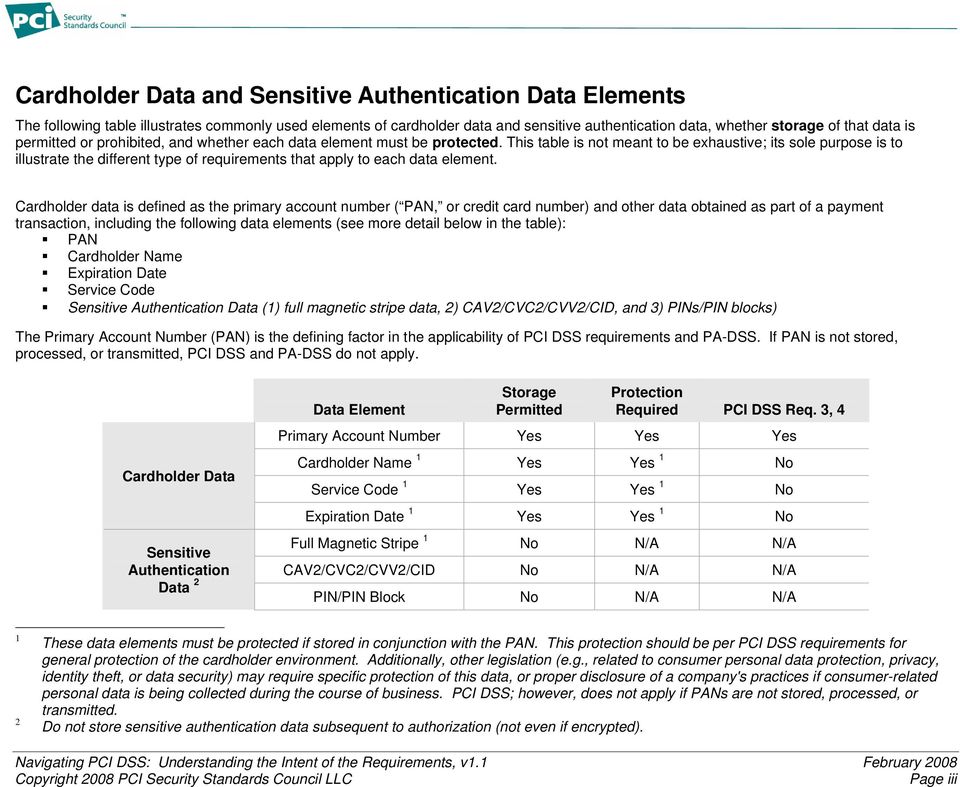
5 Location of Cardholder Data and Sensitive Authentication Data Sensitive authentication data consists of magnetic stripe (or track) data 3, card validation code or value 4, and PIN data 5. Storage of sensitive authentication data is prohibited! This data is very valuable to hackers as it allows them to generate fake payment cards and create fraudulent transactions. See PCI DSS Glossary, Abbreviations, and Acronyms for the full definition of sensitive authentication data. The pictures of the back and front of a credit card below show the location of cardholder data and sensitive authentication data. 3 Data encoded in the magnetic stripe used for authorization during a card-present transaction. Entities may not retain full magnetic-stripe data subsequent to transaction authorization. The only elements of track data that may be retained are account number, expiration date, and name. 4 The three- or four-digit value printed on or to the right of the signature panel or on the face of a payment card used to verify card-not-present transactions. 5 Personal Identification Number entered by cardholder during a card-present transaction, and/or encrypted PIN block present within the transaction message. Copyright 2008 PCI Security Standards Council LLC Page iv

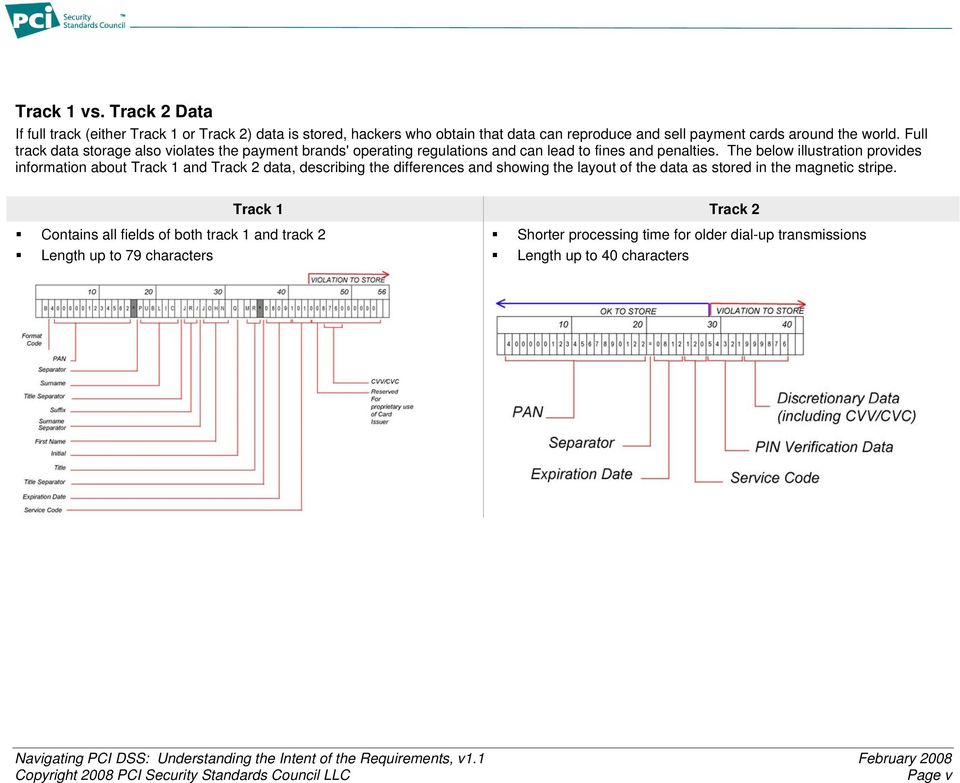
6 Track 1 vs. Track 2 Data If full track (either Track 1 or Track 2) data is stored, hackers who obtain that data can reproduce and sell payment cards around the world. Full track data storage also violates the payment brands' operating regulations and can lead to fines and penalties. The below illustration provides information about Track 1 and Track 2 data, describing the differences and showing the layout of the data as stored in the magnetic stripe. Contains all fields of both track 1 and track 2 Length up to 79 characters Track 1 Track 2 Shorter processing time for older dial-up transmissions Length up to 40 characters Copyright 2008 PCI Security Standards Council LLC Page v
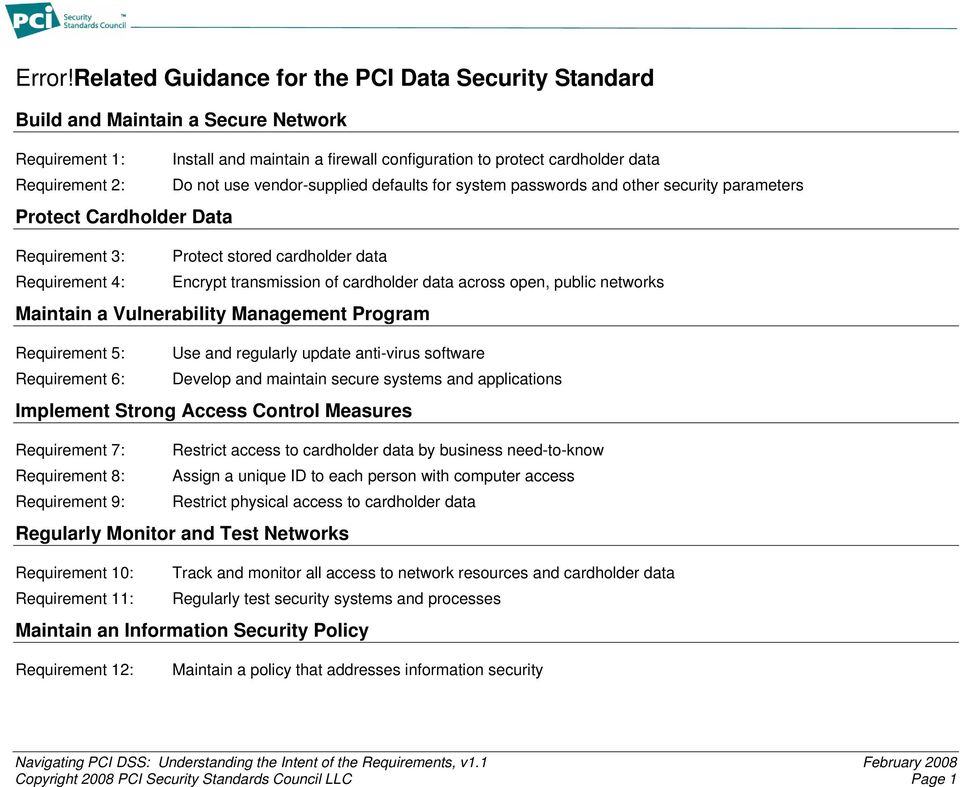
7 Error!Related for the PCI Data Security Standard Build and Maintain a Secure Network Requirement 1: Install and maintain a firewall configuration to protect cardholder data Requirement 2: Do not use vendor-supplied defaults for system passwords and other security parameters Protect Cardholder Data Requirement 3: Protect stored cardholder data Requirement 4: Encrypt transmission of cardholder data across open, public networks Maintain a Vulnerability Management Program Requirement 5: Use and regularly update anti-virus software Requirement 6: Develop and maintain secure systems and applications Implement Strong Access Control Measures Requirement 7: Restrict access to cardholder data by business need-to-know Requirement 8: Assign a unique ID to each person with computer access Requirement 9: Restrict physical access to cardholder data Regularly Monitor and Test Networks Requirement 10: Track and monitor all access to network resources and cardholder data Requirement 11: Regularly test security systems and processes Maintain an Information Security Policy Requirement 12: Maintain a policy that addresses information security Copyright 2008 PCI Security Standards Council LLC Page 1
8 for Requirements 1 and 2: Build and Maintain a Secure Network Requirement 1: Install and maintain a firewall configuration to protect cardholder data Firewalls are computer devices that control computer traffic allowed into and out of a company s network, as well as traffic into more sensitive areas within a company s internal network. A firewall examines all network traffic and blocks those transmissions that do not meet the specified security criteria. All systems must be protected from unauthorized access from the Internet, whether entering the system as e-commerce, employees Internetbased access through desktop browsers, or employees access. Often, seemingly insignificant paths to and from the Internet can provide unprotected pathways into key systems. Firewalls are a key protection mechanism for any computer network. Requirement 1.1 Establish firewall configuration standards that include the following: A formal process for approving and testing all external network connections and changes to the firewall configuration A current network diagram with all connections to cardholder data, including any wireless networks Requirements for a firewall at each Internet connection and between any demilitarized zone (DMZ) and the internal network zone Description of groups, roles, and responsibilities for logical management of network components Firewalls are software or hardware devices that block unwanted entry into the network. Without policies and procedures in place to document how staff should configure firewalls, a business could easily lose its first line of defense in data-protection. A policy and process for approving and testing all connections and changes to the firewall will help prevent security problems caused by misconfiguration of the network or firewall. Network diagrams enable the organization to identify the location of all its network devices. Without a network diagram, devices may be overlooked and may unknowingly become un-protected and thus vulnerable to compromise. Using a firewall on every connection coming into (and out of) the network allows the organization to monitor and control access in and out, and to minimize the chances of a hacker s obtaining access to the internal network. This description of roles and assignment of responsibility ensures that someone is clearly responsible for the security of all components and is aware of their responsibility, and that no devices are left unmanaged. Copyright 2008 PCI Security Standards Council LLC Page 2

9 1.1.5 Documented list of services and ports necessary for business Justification and documentation for any available protocols besides hypertext transfer protocol (HTTP), and secure sockets layer (SSL), secure shell (SSH), and virtual private network (VPN) Justification and documentation for any risky protocols allowed (for example, file transfer protocol (FTP), which includes reason for use of protocol and security features implemented Quarterly review of firewall and router rule sets Compromises often happen due to unused or insecure service and ports, since these often have known vulnerabilities and many organizations do not patch security vulnerabilities for services and ports they don't use (even though the vulnerabilities are still present). Each organization should clearly decide which services and ports are necessary for their business, document them for their records, and ensure that all other services and ports and disabled or removed. Also, organizations should consider blocking all traffic and only re-open those ports once a need has been determined and documented. There are many protocols that a business may need (or have enabled by default) that are commonly used by hackers to compromise a network. In addition to explanation at 1.1.5, if risky protocols are necessary for business, the risk posed by use of these protocols should be clearly understood and accepted by the organization, the use of the protocol should be justified, and the security features that allow these protocols to be used securely should be documented and implemented. This review gives the organization a quarterly opportunity to clean up any unneeded, outdated, or incorrect rules, and ensures that all rule sets allow only authorized service and ports that match business justifications Configuration standards for routers. These devices, along with firewalls, are part of the architecture that controls the entry points into the network. Documented policies help staff to configure and secure routers, and ensure that the organization s first line of defense in the protection of its data remains strong. 1.2 Build a firewall configuration that denies all traffic from untrusted networks and hosts, except for protocols necessary for the cardholder data environment. 1.3 Build a firewall configuration that restricts connections between publicly accessible servers and any system component storing cardholder data, including any connections from wireless networks. This firewall configuration should include the following: If a firewall is installed but does not have rules that control or limit certain traffic, malicious users may still be able to exploit vulnerable protocols and ports to attack your network. Copyright 2008 PCI Security Standards Council LLC Page 3
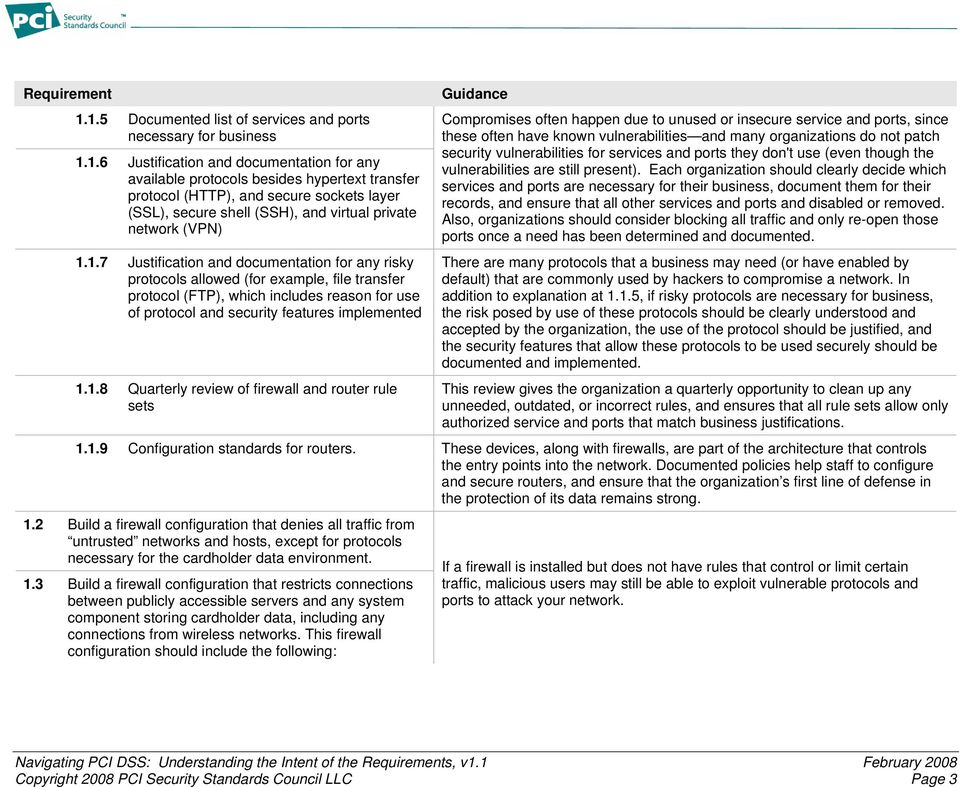
10 1.3.1 Restricting inbound Internet traffic to Internet protocol (IP) addresses within the DMZ (ingress filters) Not allowing internal addresses to pass from the Internet into the DMZ Implementing stateful inspection, also known as dynamic packet filtering (that is, only established connections are allowed into the network) Placing the database in an internal network zone, segregated from the DMZ Restricting inbound and outbound traffic to that which is necessary for the cardholder data environment Securing and synchronizing router configuration files. For example, running configuration files (for normal functioning of the routers), and start-up configuration files (when machines are re-booted) should have the same secure configuration Normally a packet contains the IP address of the computer that originally sent it. This allows other computers in the network to know where it came from. In certain cases, this sending IP address will be spoofed by hackers. For example, hackers send a packet with a spoofed address, so that (unless your firewall prohibits it) the packet will be able to come into your network from the Internet, looking like it is internal, and therefore legitimate, traffic. Once the hacker is inside your network, they can begin to compromise your systems. Ingress filtering is a technique you can use on your firewall to filter packets coming into your network to, among other things, ensure packets are not spoofed to look like they are coming from your own internal network. For more information on packet filtering, consider obtaining information on a corollary technique called egress filtering. A firewall that performs stateful packet inspection keeps "state" (or the status) for each connection to the firewall. By keeping "state," the firewall knows whether what appears to be a response to a previous connection is truly a response (since it "remembers" the previous connection) or is someone trying to spoof or trick the firewall into allowing the connection. Payment card account information requires the highest level of information protection. If account information is located within the DMZ, access to this information is easier for an external attacker, since there are fewer layers to penetrate. Without a firewall protecting account information, that data is vulnerable to malicious users from inside a flat network and any hackers that are able to penetrate from outside the network. This requirement is intended to prevent hackers from accessing the organization's network via unauthorized IP addresses or from using services, protocols, or ports in an unauthorized manner (for example, to send data they've obtained from within your network out to an external server). While running configuration files are usually implemented with secure settings, the start-up file (routers only run these files upon re-start) may not be implemented with the same secure settings because they only run occasionally. When a router does re-start without the same secure settings as those in the running configuration files, it may result in weaker rules that allow a hacker into the network. Copyright 2008 PCI Security Standards Council LLC Page 4
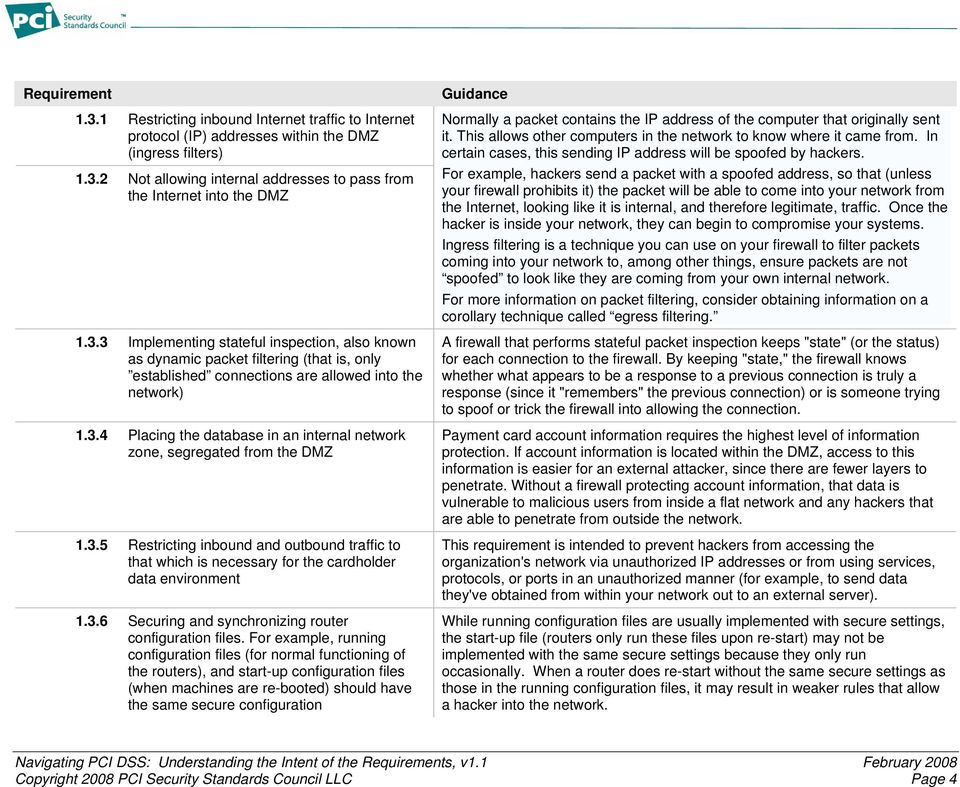
11 1.3.7 Denying all other inbound and outbound traffic not specifically allowed Installing perimeter firewalls between any wireless networks and the cardholder data environment, and configuring these firewalls to deny any traffic from the wireless environment or from controlling any traffic (if such traffic is necessary for business purposes) Installing personal firewall software on any mobile and employee-owned computers with direct connectivity to the Internet (for example, laptops used by employees), which are used to access the organization s network 1.4 Prohibit direct public access between external networks and any system component that stores cardholder data (for example, databases, logs, trace files) Implement a DMZ to filter and screen all traffic and to prohibit direct routes for inbound and outbound Internet traffic Restrict outbound traffic from payment card applications to IP addresses within the DMZ. All firewalls should include a rule that denies all inbound and outbound traffic not specifically needed. This will prevent inadvertent holes that would allow other, unintended and potentially harmful traffic in or out. The known (or unknown) implementation and exploitation of wireless technology within a network is a common path for malicious users to gain access to the network and cardholder data. If a wireless device or network is installed without a company s knowledge, a hacker could easily and invisibly enter the network. If firewalls do not restrict access from wireless networks into the payment card environment, hackers that gain unauthorized access to the wireless network can easily connect to the payment card environment and compromise account information. If a computer does not have a firewall or anti-virus program installed, spyware, Trojans, viruses, and worms (malware) may be downloaded unknowingly. The computer is even more vulnerable when directly connected to the Internet and not behind the corporate firewall. Malware loaded on a computer when not behind the corporate firewall can then maliciously target information within the network when the computer is re-connected to the corporate network. A firewall's intent is to manage and control all connections between public systems and internal systems (especially those that store cardholder data). If direct access is allowed between public systems and those that store cardholder data, the protections offered by the firewall are bypassed, and system components storing cardholder data may be exposed to compromise. The DMZ is the part of the firewall that faces the public Internet and manages connections between the Internet and internal services that an organization needs to have available to the public (like a web server). It is the first line of defense in isolating and separating traffic that needs to communicate with the internal network from traffic that does not. The DMZ also should evaluate all traffic outbound from inside the network to ensure that all outbound traffic follows established rules. For the DMZ to serve this function effectively, connections from inside the network to any addresses outside the network should not be allowed unless they first go through and are evaluated for legitimacy by the DMZ. Copyright 2008 PCI Security Standards Council LLC Page 5

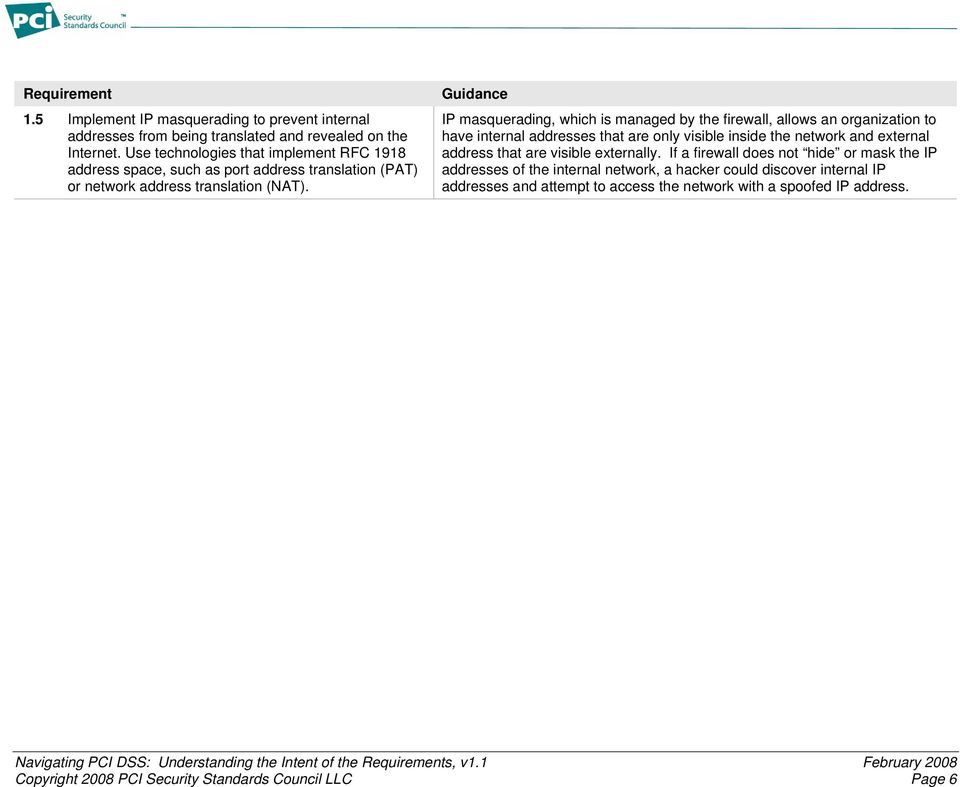
12 1.5 Implement IP masquerading to prevent internal addresses from being translated and revealed on the Internet. Use technologies that implement RFC 1918 address space, such as port address translation (PAT) or network address translation (NAT). IP masquerading, which is managed by the firewall, allows an organization to have internal addresses that are only visible inside the network and external address that are visible externally. If a firewall does not hide or mask the IP addresses of the internal network, a hacker could discover internal IP addresses and attempt to access the network with a spoofed IP address. Copyright 2008 PCI Security Standards Council LLC Page 6
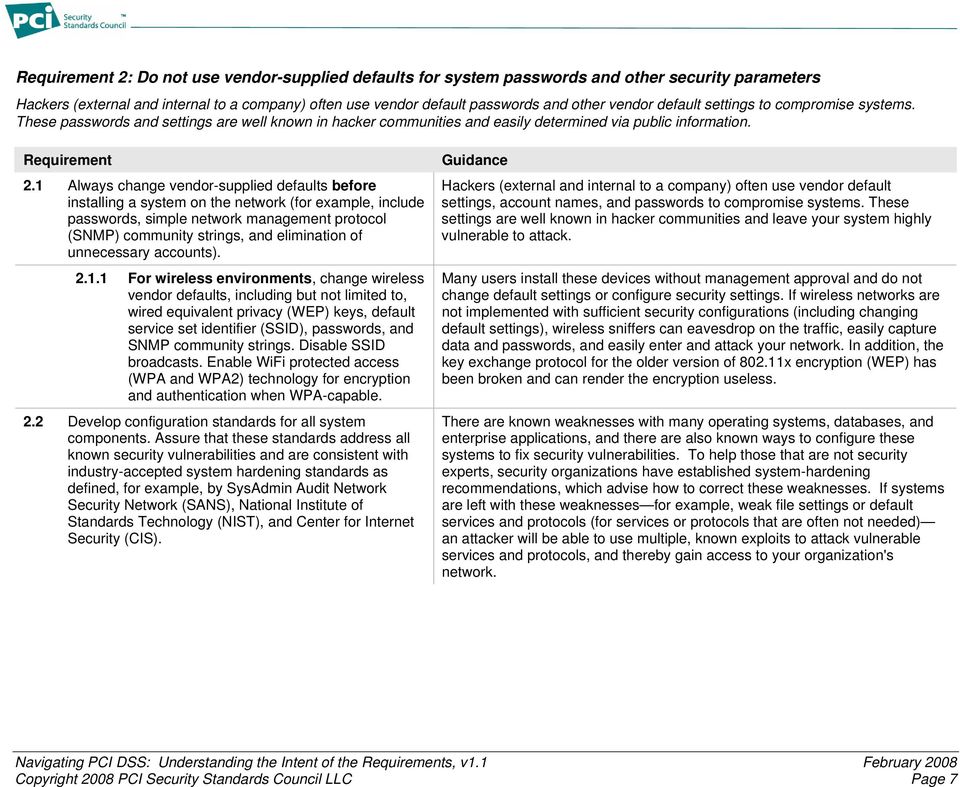
13 2: Do not use vendor-supplied defaults for system passwords and other security parameters Hackers (external and internal to a company) often use vendor default passwords and other vendor default settings to compromise systems. These passwords and settings are well known in hacker communities and easily determined via public information. Requirement 2.1 Always change vendor-supplied defaults before installing a system on the network (for example, include passwords, simple network management protocol (SNMP) community strings, and elimination of unnecessary accounts) For wireless environments, change wireless vendor defaults, including but not limited to, wired equivalent privacy (WEP) keys, default service set identifier (SSID), passwords, and SNMP community strings. Disable SSID broadcasts. Enable WiFi protected access (WPA and WPA2) technology for encryption and authentication when WPA-capable. 2.2 Develop configuration standards for all system components. Assure that these standards address all known security vulnerabilities and are consistent with industry-accepted system hardening standards as defined, for example, by SysAdmin Audit Network Security Network (SANS), National Institute of Standards Technology (NIST), and Center for Internet Security (CIS). Hackers (external and internal to a company) often use vendor default settings, account names, and passwords to compromise systems. These settings are well known in hacker communities and leave your system highly vulnerable to attack. Many users install these devices without management approval and do not change default settings or configure security settings. If wireless networks are not implemented with sufficient security configurations (including changing default settings), wireless sniffers can eavesdrop on the traffic, easily capture data and passwords, and easily enter and attack your network. In addition, the key exchange protocol for the older version of x encryption (WEP) has been broken and can render the encryption useless. There are known weaknesses with many operating systems, databases, and enterprise applications, and there are also known ways to configure these systems to fix security vulnerabilities. To help those that are not security experts, security organizations have established system-hardening recommendations, which advise how to correct these weaknesses. If systems are left with these weaknesses for example, weak file settings or default services and protocols (for services or protocols that are often not needed) an attacker will be able to use multiple, known exploits to attack vulnerable services and protocols, and thereby gain access to your organization's network. Copyright 2008 PCI Security Standards Council LLC Page 7
14 2.2.1 Implement only one primary function per server (for example, web servers, database servers, and DNS should be implemented on separate servers) Disable all unnecessary and insecure services and protocols (services and protocols not directly needed to perform the devices specified function) Configure system security parameters to prevent misuse Remove all unnecessary functionality, such as scripts, drivers, features, subsystems, file systems, and unnecessary web servers. 2.3 Encrypt all non-console administrative access. Use technologies such as SSH, VPN, or SSL/TLS (transport layer security) for web-based management and other non-console administrative access. This is intended to ensure your organization's system configuration standards and related processes address server functions that need to have different security levels, or that may introduce security weaknesses to other functions on the same server. For example: 1. A database, which needs to have strong security measures in place, would be at risk sharing a server with a web application, which needs to be open and directly face the Internet. 2. Failure to apply a patch to a seemingly minor function could result in a compromise that impacts other, more important functions (such as a database) on the same server. This requirement is meant for servers (usually Unix, Linux, or Windows based), but not mainframe systems. As stated at 1.1.7, there are many protocols that a business may need (or have enabled by default) that are commonly used by hackers to compromise a network. To ensure that these services and protocols are always disabled when new servers are deployed, this requirement should be part of your organization's configuration standards and related processes. This is intended to ensure your organization s system configuration standards and related processes specifically address security settings and parameters that have known security implications. The server-hardening standards must include processes to address unnecessary functionality with specific security implications (like removing/disabling FTP or the web server if the server will not be performing those functions). If remote administration is not done with secure authentication and encrypted communications, sensitive administrative or operational level information (like administrator s passwords) can be revealed to an eavesdropper. A hacker could use this information to access the network, become administrator, and steal data. Copyright 2008 PCI Security Standards Council LLC Page 8

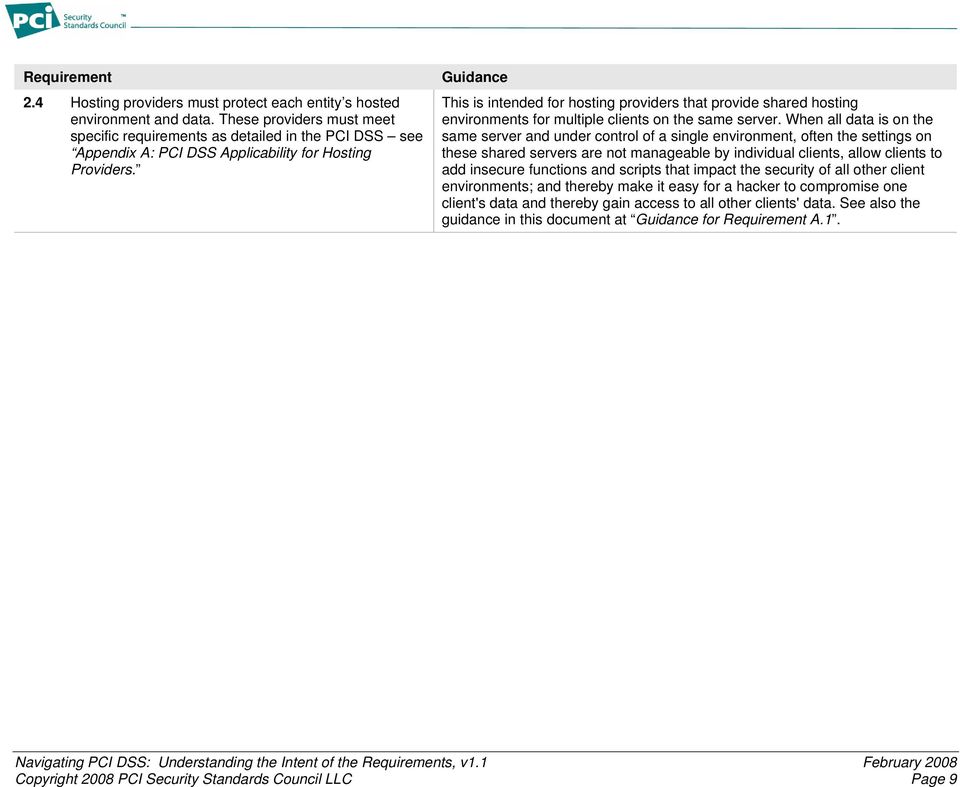
15 2.4 Hosting providers must protect each entity s hosted environment and data. These providers must meet specific requirements as detailed in the PCI DSS see Appendix A: PCI DSS Applicability for Hosting Providers. This is intended for hosting providers that provide shared hosting environments for multiple clients on the same server. When all data is on the same server and under control of a single environment, often the settings on these shared servers are not manageable by individual clients, allow clients to add insecure functions and scripts that impact the security of all other client environments; and thereby make it easy for a hacker to compromise one client's data and thereby gain access to all other clients' data. See also the guidance in this document at for Requirement A.1. Copyright 2008 PCI Security Standards Council LLC Page 9
16 for Requirements 3 and 4: Protect Cardholder Data Requirement 3: Protect stored cardholder data Encryption is a critical component of cardholder data protection. If an intruder circumvents other network security controls and gains access to encrypted data, without the proper cryptographic keys, the data is unreadable and unusable to that person. Other effective methods of protecting stored data should be considered as potential risk mitigation opportunities. For example, methods for minimizing risk include not storing cardholder data unless absolutely necessary, truncating cardholder data if full PAN is not needed, and not sending PAN in unencrypted s. Requirement 3.1 Keep cardholder data storage to a minimum. Develop a data retention and disposal policy. Limit storage amount and retention time to that which is required for business, legal, and/or regulatory purposes, as documented in the data retention policy. 3.2 Do not store sensitive authentication data subsequent to authorization (even if encrypted). Sensitive authentication data includes the data as cited in the following requirements, through 3.2.3: Extended storage of cardholder data that exceeds business need creates an unnecessary risk. The only cardholder data that may be stored is the primary account number or PAN (rendered unreadable), expiry date, name, and service code. Remember, if you don't need it, don't store it! Sensitive authentication data consists of magnetic stripe (or track) data 6, card validation code or value 7, and PIN data 8. Storage of sensitive authentication data is prohibited! This data is very valuable to hackers as it allows them to generate fake payment cards and create fraudulent transactions. See PCI DSS Glossary, Abbreviations, and Acronyms for the full definition of sensitive authentication data. 6 Data encoded in the magnetic stripe used for authorization during a card-present transaction. Entities may not retain full magnetic-stripe data subsequent to transaction authorization. The only elements of track data that may be retained are account number, expiration date, and name. 7 The three- or four-digit value printed on or to the right of the signature panel or on the face of a payment card used to verify card-not-present transactions. 8 Personal Identification Number entered by cardholder during a card-present transaction, and/or encrypted PIN block present within the transaction message. Copyright 2008 PCI Security Standards Council LLC Page 10

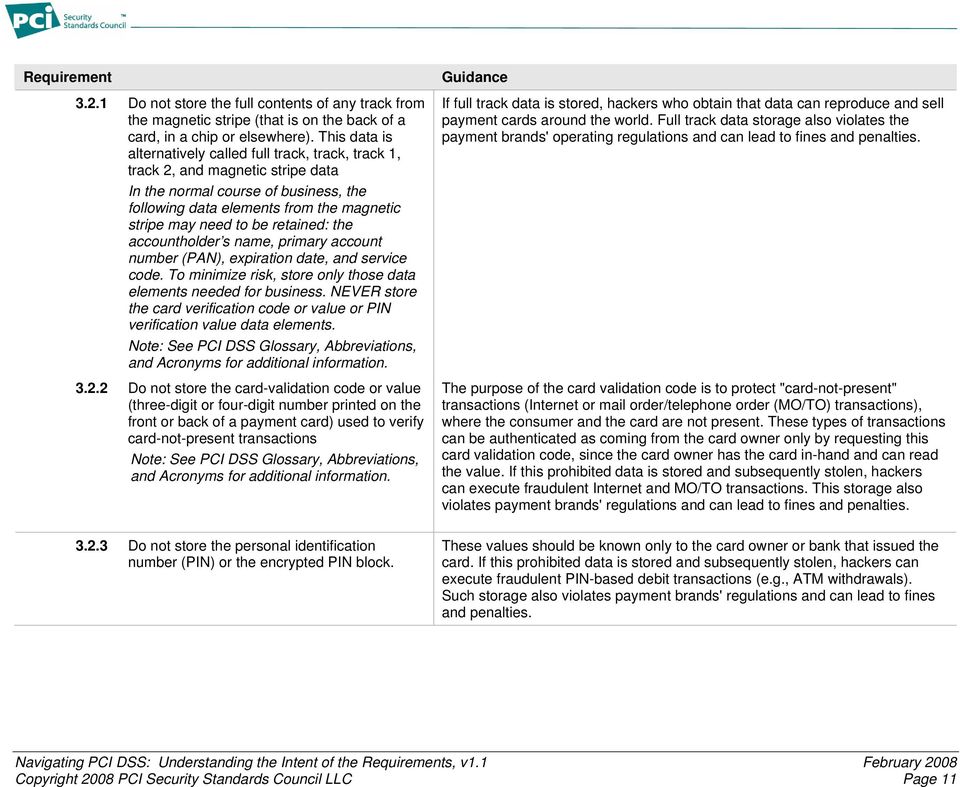
17 3.2.1 Do not store the full contents of any track from the magnetic stripe (that is on the back of a card, in a chip or elsewhere). This data is alternatively called full track, track, track 1, track 2, and magnetic stripe data In the normal course of business, the following data elements from the magnetic stripe may need to be retained: the accountholder s name, primary account number (PAN), expiration date, and service code. To minimize risk, store only those data elements needed for business. NEVER store the card verification code or value or PIN verification value data elements. Note: See PCI DSS Glossary, Abbreviations, and Acronyms for additional information Do not store the card-validation code or value (three-digit or four-digit number printed on the front or back of a payment card) used to verify card-not-present transactions Note: See PCI DSS Glossary, Abbreviations, and Acronyms for additional information Do not store the personal identification number (PIN) or the encrypted PIN block. If full track data is stored, hackers who obtain that data can reproduce and sell payment cards around the world. Full track data storage also violates the payment brands' operating regulations and can lead to fines and penalties. The purpose of the card validation code is to protect "card-not-present" transactions (Internet or mail order/telephone order (MO/TO) transactions), where the consumer and the card are not present. These types of transactions can be authenticated as coming from the card owner only by requesting this card validation code, since the card owner has the card in-hand and can read the value. If this prohibited data is stored and subsequently stolen, hackers can execute fraudulent Internet and MO/TO transactions. This storage also violates payment brands' regulations and can lead to fines and penalties. These values should be known only to the card owner or bank that issued the card. If this prohibited data is stored and subsequently stolen, hackers can execute fraudulent PIN-based debit transactions (e.g., ATM withdrawals). Such storage also violates payment brands' regulations and can lead to fines and penalties. Copyright 2008 PCI Security Standards Council LLC Page 11
18 3.3 Mask PAN when displayed (the first six and last four digits are the maximum number of digits to be displayed). Note: This requirement does not apply to employees and other parties with a specific need to see the full PAN; nor does the requirement supersede stricter requirements in place for displays of cardholder data (for example, for point of sale [POS] receipts). 3.4 Render PAN, at minimum, unreadable anywhere it is stored (including data on portable digital media, backup media, in logs, and data received from or stored by wireless networks) by using any of the following approaches: The display of full PAN on items such as computer screens, payment card receipts, faxes, or paper reports can result in this data s being obtained by unauthorized individuals and used fraudulently. Note that this data can be displayed in full form on the merchant copy receipts, or for those with a specific need to see the full PAN. Lack of protection of PANs can allow unauthorized internal users and intruders to view or download this data. PANs stored in primary storage (databases, or flat files such as text files spreadsheets) as well as non-primary storage (backup, audit logs, exception or troubleshooting logs) must all be protected. Damage from theft or loss of backup tapes during transport can be reduced by ensuring PANs are rendered unreadable via encryption, truncation, or hashing. Since audit, troubleshooting, and exception logs have to be retained, you can prevent disclosure of data in logs by rendering PANs unreadable (or removing or masking them) in logs. Strong one-way hash functions (hashed indexes) One-way hash functions such as SHA-1 can be used to render cardholder data unreadable. Hash functions are appropriate when there is no need to retrieve the original number (one-way hashes are irreversible). Truncation The intent of truncation is that only a portion (not to exceed the first six and last four digits) of the PAN is stored. This is different from masking, where the whole PAN is stored but the PAN is masked when displayed (i.e., only part of the PAN is displayed on screens, reports, receipts, etc.). Index tokens and pads (pads must be securely stored) Strong cryptography with associated key management processes and procedures. Index tokens and pads may also be used to render cardholder data unreadable. An index token is a cryptographic token that replaces the PAN based on a given index for an unpredictable value. A one-time pad is a system in which a private key, generated randomly, is used only once to encrypt a message that is then decrypted using a matching one-time pad and key. The intent of strong cryptography (see definition and key lengths in the PCI DSS Glossary, Abbreviations, and Acronyms) is that the encryption be based Copyright 2008 PCI Security Standards Council LLC Page 12
![cardholder data (for example, for point of sale [POS] receipts). 3.](/docs-images/42/11562844/images/page_18.jpg "4 Render PAN, at minimum, unreadable anywhere it is stored (including data on portable digital media, backup media, in logs, and data received from or stored by wireless networks) by using any of the")
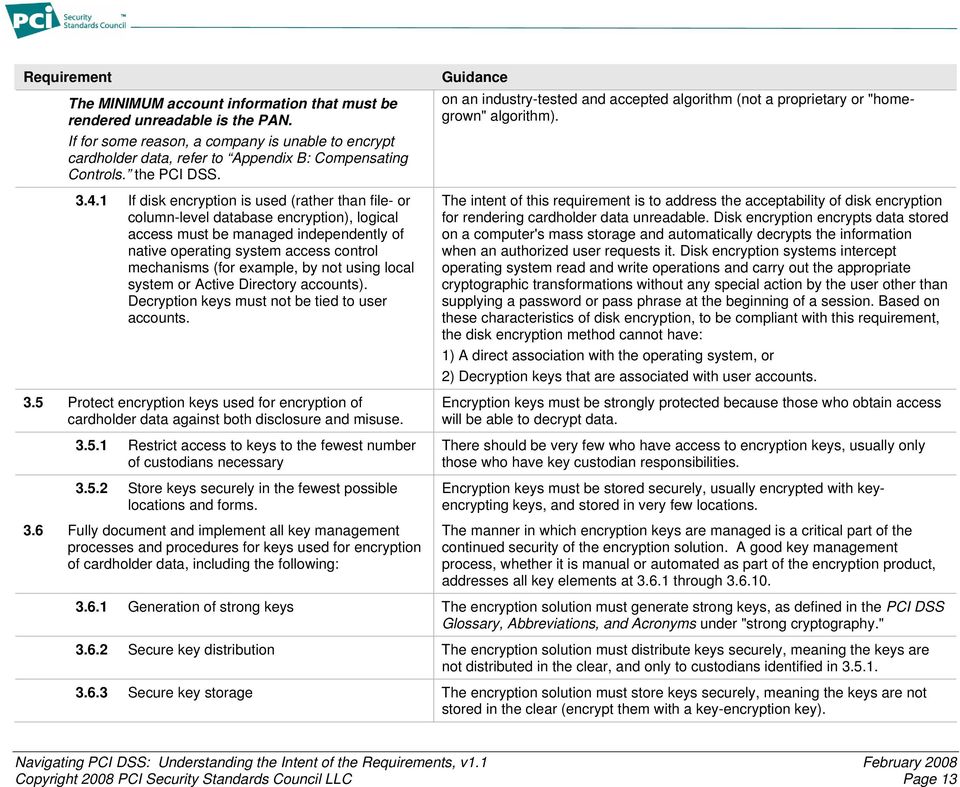
19 The MINIMUM account information that must be rendered unreadable is the PAN. If for some reason, a company is unable to encrypt cardholder data, refer to Appendix B: Compensating Controls. the PCI DSS If disk encryption is used (rather than file- or column-level database encryption), logical access must be managed independently of native operating system access control mechanisms (for example, by not using local system or Active Directory accounts). Decryption keys must not be tied to user accounts. 3.5 Protect encryption keys used for encryption of cardholder data against both disclosure and misuse Restrict access to keys to the fewest number of custodians necessary Store keys securely in the fewest possible locations and forms. 3.6 Fully document and implement all key management processes and procedures for keys used for encryption of cardholder data, including the following: on an industry-tested and accepted algorithm (not a proprietary or "homegrown" algorithm). The intent of this requirement is to address the acceptability of disk encryption for rendering cardholder data unreadable. Disk encryption encrypts data stored on a computer's mass storage and automatically decrypts the information when an authorized user requests it. Disk encryption systems intercept operating system read and write operations and carry out the appropriate cryptographic transformations without any special action by the user other than supplying a password or pass phrase at the beginning of a session. Based on these characteristics of disk encryption, to be compliant with this requirement, the disk encryption method cannot have: 1) A direct association with the operating system, or 2) Decryption keys that are associated with user accounts. Encryption keys must be strongly protected because those who obtain access will be able to decrypt data. There should be very few who have access to encryption keys, usually only those who have key custodian responsibilities. Encryption keys must be stored securely, usually encrypted with keyencrypting keys, and stored in very few locations. The manner in which encryption keys are managed is a critical part of the continued security of the encryption solution. A good key management process, whether it is manual or automated as part of the encryption product, addresses all key elements at through Generation of strong keys The encryption solution must generate strong keys, as defined in the PCI DSS Glossary, Abbreviations, and Acronyms under "strong cryptography." Secure key distribution The encryption solution must distribute keys securely, meaning the keys are not distributed in the clear, and only to custodians identified in Secure key storage The encryption solution must store keys securely, meaning the keys are not stored in the clear (encrypt them with a key-encryption key). Copyright 2008 PCI Security Standards Council LLC Page 13
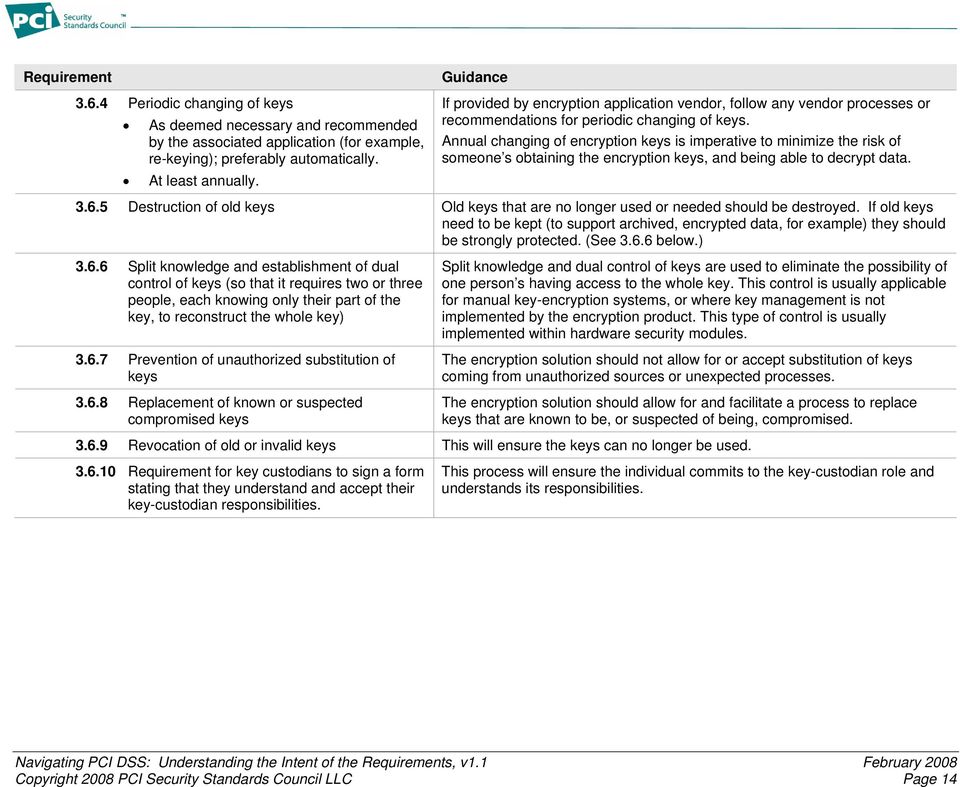
20 3.6.4 Periodic changing of keys As deemed necessary and recommended by the associated application (for example, re-keying); preferably automatically. At least annually. If provided by encryption application vendor, follow any vendor processes or recommendations for periodic changing of keys. Annual changing of encryption keys is imperative to minimize the risk of someone s obtaining the encryption keys, and being able to decrypt data Destruction of old keys Old keys that are no longer used or needed should be destroyed. If old keys need to be kept (to support archived, encrypted data, for example) they should be strongly protected. (See below.) Split knowledge and establishment of dual control of keys (so that it requires two or three people, each knowing only their part of the key, to reconstruct the whole key) Prevention of unauthorized substitution of keys Replacement of known or suspected compromised keys Split knowledge and dual control of keys are used to eliminate the possibility of one person s having access to the whole key. This control is usually applicable for manual key-encryption systems, or where key management is not implemented by the encryption product. This type of control is usually implemented within hardware security modules. The encryption solution should not allow for or accept substitution of keys coming from unauthorized sources or unexpected processes. The encryption solution should allow for and facilitate a process to replace keys that are known to be, or suspected of being, compromised Revocation of old or invalid keys This will ensure the keys can no longer be used Requirement for key custodians to sign a form stating that they understand and accept their key-custodian responsibilities. This process will ensure the individual commits to the key-custodian role and understands its responsibilities. Copyright 2008 PCI Security Standards Council LLC Page 14
21 4: Encrypt transmission of cardholder data across open, public networks Sensitive information must be encrypted during transmission over networks that are easy and common for a hacker to intercept, modify, and divert data while in transit. Requirement 4.1 Use strong cryptography and security protocols such as secure sockets layer (SSL) / transport layer security (TLS) and Internet protocol security (IPSEC) to safeguard sensitive cardholder data during transmission over open, public networks. Examples of open, public networks that are in scope of the PCI DSS are the Internet, WiFi (IEEE x), global system for mobile communications (GSM), and general packet radio service (GPRS) For wireless networks transmitting cardholder data, encrypt the transmissions by using WiFi protected access (WPA or WPA2) technology, IPSEC VPN, or SSL/TLS. Never rely exclusively on wired equivalent privacy (WEP) to protect confidentiality and access to a wireless LAN. If WEP is used, do the following: Use with a minimum 104-bit encryption key and 24 bit-initialization value Use ONLY in conjunction with WiFi protected access (WPA or WPA2) technology, VPN, or SSL/TLS Rotate shared WEP keys quarterly (or automatically if the technology permits) Rotate shared WEP keys whenever there are changes in personnel with access to keys Restrict access based on media access code (MAC) address. Sensitive information must be encrypted during transmission over public networks, because it is easy and common for a hacker to intercept and/or divert data while in transit. Note that SSL versions prior to v3.0 contain documented vulnerabilities, such as buffer overflows, that an attacker can use to gain control of the affected system. Hackers use free and widely available tools to eavesdrop on wireless communications. Use of appropriate encryption can prevent eavesdropping and disclosure of sensitive information across the network. Many known compromises of cardholder data stored only in the wired network originated when a hacker expanded access from a wireless network. WEP encryption should never be used alone since it is vulnerable due to weak initial vectors (IV) in the WEP key-exchange process, and lack of required rotation of keys. An attacker can use freely available brute-force cracking tools to penetrate WEP encryption. 4.2 Never send unencrypted PANs by . can be easily intercepted by packet-sniffing during delivery traversal across internal and public networks. Copyright 2008 PCI Security Standards Council LLC Page 15
22 for Requirements 5 and 6: Maintain a Vulnerability Management Program Requirement 5: Use and regularly update anti-virus software or programs Many vulnerabilities and malicious viruses enter the network via employees activities. Anti-virus software must be used on all systems commonly affected by viruses to protect systems from malicious software. Requirement 5.1 Deploy anti-virus software on all systems commonly affected by viruses (particularly personal computers and servers) Note: Systems commonly affected by viruses typically do not include UNIX-based operating systems or mainframes Ensure that anti-virus programs are capable of detecting, removing, and protecting against other forms of malicious software, including spyware and adware. 5.2 Ensure that all anti-virus mechanisms are current, actively running, and capable of generating audit logs. There is a constant stream of attacks using widely published exploits, often "0 day" (published and spread throughout networks within an hour of discovery) against otherwise secured systems. Without anti-virus software that is updated regularly, these new viruses can attack and disable your network. It is important to protect against ALL types and forms of malicious software. The best anti-virus software is limited in effectiveness if it does not have current anti-virus signatures or if it isn't active in the network or on an individual's computer. Audit logs provide the ability to monitor virus activity and anti-virus reactions. Copyright 2008 PCI Security Standards Council LLC Page 16
23 6: Develop and maintain secure systems and applications Unscrupulous individuals use security vulnerabilities to gain privileged access to systems. Many of these vulnerabilities are fixed by vendorprovided security patches. All systems must have the most recently released, appropriate software patches to protect against exploitation by employees, external hackers, and viruses. Note: Appropriate software patches are those patches that have been evaluated and tested sufficiently to determine that the patches do not conflict with existing security configurations. For in-house developed applications, numerous vulnerabilities can be avoided by using standard system development processes and secure coding techniques. Requirement 6.1 Ensure that all system components and software have the latest vendor-supplied security patches installed. Install relevant security patches within one month of release. 6.2 Establish a process to identify newly discovered security vulnerabilities (for example, subscribe to alert services freely available on the Internet). Update standards to address new vulnerability issues. 6.3 Develop software applications based on industry best practices and incorporate information security throughout the software development life cycle Testing of all security patches and system and software configuration changes before deployment Separate development, test, and production environments There are a considerable amount of attacks using widely published exploits, often "0 day" (published within the hour) against otherwise secured systems. Without implementing the most recent patches on systems as soon as possible, a hacker can use these exploits to attack and disable the network. Consider prioritizing changes such that critical security patches on critical or at-risk systems can be installed within 30 days, and other less-risky changes receive a lower priority. The intention of this requirement is that organizations are kept up-to-date with new vulnerabilities so they can appropriately protect their network, and incorporate newly discovered and relevant vulnerabilities into their configuration standards. Without the inclusion of security during the requirements definition, design, analysis, and testing phases of software development, security vulnerabilities can be inadvertently or maliciously introduced into the production environment. Ensure all installations and changes are performing as expected, and that they do not have any functions that are unexpected, unwanted, or harmful. Often development and test environments are less secure than the production environment. Without adequate separation, the production environment and cardholder data may be at risk due to vulnerabilities or weak internal processes Separation of duties between development, test, and production environments This minimizes the number of personnel with access to the production environment and cardholder data, and helps ensure that access is limited to those who truly need that access. Copyright 2008 PCI Security Standards Council LLC Page 17
24 6.3.4 Production data (live PANs) are not used for testing or development Removal of test data and accounts before production systems become active Removal of custom application accounts, usernames, and passwords before applications become active or are released to customers Review of custom code prior to release to production or customers in order to identify any potential coding vulnerability. 6.4 Follow change control procedures for all system and software configuration changes. The procedures must include the following: Security controls are usually not as stringent in the development environment. Use of production data allows potential hackers, as well as developers, the opportunity to gain unauthorized access to production information. Test data and accounts should be removed from production code before the application becomes active, since these items may give away information about the functioning of the application. Possession of such information could facilitate compromise of the application and related cardholder data. Custom application accounts, usernames, and passwords should be removed from production code before the application becomes active or are released to customers, since these items may give away information about the functioning of the application. Possession of such information could facilitate compromise of the application and related cardholder data. Security vulnerabilities in custom code are commonly exploited by hackers to gain access to a network and compromise cardholder data. Those with knowledge of secure coding techniques should review code to identify vulnerabilities. Without proper software change controls, security features could be inadvertently or deliberately omitted or rendered inoperable, processing irregularities could occur, or malicious code could be introduced. If related personnel policies for background checks and system access controls are not adequate, there is a risk that untrustworthy and untrained individuals may have unrestricted access to software code, terminated employees may have the opportunity to compromise systems, and unauthorized actions may not be detected Documentation of impact The impact of the change should be documented so that all affected parties will be able to plan appropriately for any processing changes Management sign-off by appropriate parties Management approval indicates that the change is a legitimate and authorized one sanctioned by the organization Testing of operational functionality Thorough testing should be performed to verify that all actions are expected, reports are accurate, that all possible error conditions react properly, etc Back-out procedures For each change, there should be back-out procedures in case the change fails, to allow for restoring back to the previous state. Copyright 2008 PCI Security Standards Council LLC Page 18
25 6.5 Develop all web applications based on secure coding guidelines such as the Open Web Application Security Project guidelines. Review custom application code to identify coding vulnerabilities. Cover prevention of common coding vulnerabilities in software development processes, to include the following: The application layer is high-risk and may be targeted by both internal and external threats. Without proper security, cardholder data and other confidential company information can be exposed, resulting in harm to a company, its customers, and its reputation Unvalidated input Information from web requests should be validated before being sent to the web application for example, checks for all alpha characters, mix of alpha and numeric, etc., should be done. Without these checks, hackers can pass invalid information into an application and attack components inside the network through the application Broken access control (for example, malicious use of user IDs) Broken authentication and session management (use of account credentials and session cookies) Malicious users often attempt to scan and enumerate existing user accounts on applications in order to find an attack entry point. Once an existing account is found, an attacker will try to use default passwords or brute force to access the application. Account credentials and session tokens should be properly protected. Attacks on passwords, keys, session cookies, or other tokens can defeat authentication restrictions and allow hackers to assume other users' identities. Additionally, cookies may store cardholder information and are by default stored in clear text Cross-site scripting (XSS) attacks With these attacks, a web application is used to send an attack to an end user's browser and can result in disclosure of the end user's session token, an attack on the end user's machine, and a hacker s sending spoofed content to fool the user Buffer overflows Hackers can crash web application components that do not properly validate input (see also above), and may able to take control of processes on the related server Injection flaws (for example, structured query language (SQL) injection) To speed up connectivity and reduce performance at the server end, clientside validation of input and manipulation of data is often required. It is often a relatively trivial exercise for hackers to bypass this checking and use the web application to send malicious commands to the server to initiate attacks such as buffer overflows, or to reveal both confidential information and server application functionality. This is also a popular means of conducting fraudulent transactions on commerce-enabled sites. Copyright 2008 PCI Security Standards Council LLC Page 19
26 6.5.7 Improper error handling Often, incorrect error handling provides information that helps a hacker compromise the system. If a hacker can create errors that the web application does not handle properly, they can gain detailed system information, create denial-of-service interruptions, cause security to fail, or crash the server. For example, the message "incorrect password provided" tells them the username provided was accurate and that they should focus their efforts only on the password. Use more generic error messages, like "data could not be verified." Insecure storage This relates to insecure use of cryptography. Since cryptography applications are difficult to code properly, this frequently results in weak protection of stored data and cryptography that is easier to break Denial of service Hackers can consume web application resources to the point that other users can no longer use the application. Hackers can also lock users out of their accounts or cause the application to fail Insecure configuration management Having a strong server configuration standard is critical to having secure web applications. Servers have many configuration options to control security and are not secure out of the box. 6.6 Ensure that all web-facing applications are protected against known attacks by applying either of the following methods: Having all custom application code reviewed for common vulnerabilities by an organization that specializes in application security Installing an application layer firewall in front of web-facing applications. Note: 6.6 is considered a best practice until June 30, 2008, after which it becomes a requirement. Attacks on web-facing applications are common and often successful, and are allowed by poor coding practices. This requirement for application code reviews or application-layer firewalls is intended to greatly reduce the number of compromises on web-facing applications that result in breaches of cardholder data. A tool that performs code reviews and/or scans for application vulnerabilities can also be used to satisfy this requirement. Application firewalls are used to filter and block non-essential traffic at the application layer. Used in conjunction with a network based firewall, a properly configured application layer firewall prevents application layer attacks should applications be improperly coded or configured. Copyright 2008 PCI Security Standards Council LLC Page 20
27 for Requirements 7, 8, and 9: Implement Strong Access Control Measures Requirement 7: Restrict access to cardholder data by business need-to-know This requirement ensures critical data can only be accessed by authorized personnel. Requirement 7.1 Limit access to computing resources and cardholder information only to those individuals whose job requires such access. 7.2 Establish a mechanism for systems with multiple users that restricts access based on a user s need to know and is set to deny all unless specifically allowed. The more people who have access to cardholder data, the more risk there is that a user s account will be used maliciously. Limiting access to those with a strong business reason for the access helps your organization prevent mishandling of cardholder data through inexperience or malice. Your organization should create a clear policy for data access control to define how, and to whom, access is granted. Without a mechanism to restrict access based on user s need to know, a user may unknowingly be granted access to cardholder data. Copyright 2008 PCI Security Standards Council LLC Page 21
28 8: Assign a unique ID to each person with computer access Assigning a unique identification (ID) to each person with access ensures that actions taken on critical data and systems are performed by, and can be traced to, known and authorized users. Requirement 8.1 Identify all users with a unique user name before allowing them to access system components or cardholder data. 8.2 In addition to assigning a unique ID, employ at least one of the following methods to authenticate all users: Password Token devices (e.g., SecureID, certificates, or public key) Biometrics. 8.3 Implement two-factor authentication for remote access to the network by employees, administrators, and third parties. Use technologies such as remote authentication and dial-in service (RADIUS) or terminal access controller access control system (TACACS) with tokens; or VPN (based on SSL/TLS or IPSEC) with individual certificates. 8.4 Encrypt all passwords during transmission and storage on all system components. 8.5 Ensure proper user authentication and password management for non-consumer users and administrators on all system components as follows: By ensuring each user is uniquely identified instead of using one ID for several employees an organization can maintain individual responsibility for actions and an effective audit trail per employee. This will help speed issue resolution and containment when misuse or malicious intent occurs. These authentication items, when used in addition to unique IDs, help protect users unique IDs from being compromised (since the one attempting the compromise needs to know both the unique ID and the password or other authentication item). Two-factor authentication technologies provide a one-time password, to be used when an additional authentication item is needed for higher-risk accesses, like from outside your network. For additional security, your organization can also consider using two-factor authentication when accessing networks of higher security from networks of lower security (for example, from corporate desktops (lower security) to production servers/databases with cardholder data (high security)). Many network devices and applications transmit the user ID and unencrypted password across the network and/or also store the passwords without encryption. A hacker can easily intercept the encrypted user ID and password during transmission using a sniffer, or directly access the user IDs and unencrypted passwords in files where they are stored, and use this stolen data to gain unauthorized access. Since one of the first steps a hacker will take to compromise a system is to exploit weak or nonexistent passwords, it is important to implement good processes for user authentication and password management. Copyright 2008 PCI Security Standards Council LLC Page 22
29 8.5.1 Control addition, deletion, and modification of user IDs, credentials, and other identifier objects Verify user identity before performing password resets Set first-time passwords to a unique value for each user and change immediately after the first use Immediately revoke access for any terminated users Remove inactive user accounts at least every 90 days Enable accounts used by vendors for remote maintenance only during the time period needed Communicate password procedures and policies to all users who have access to cardholder data Do not use group, shared, or generic accounts and passwords. To ensure users added to your systems are all valid and recognized users, the addition, deletion, and modification of user IDs should be managed and controlled by a small group with specific authority. The ability to manage these user IDs should be limited to only this small group. Many hackers use "social engineering for example, calling a help desk and acting as a legitimate user to have a password changed so they can utilize a user ID. Consider use of a secret question that only the proper user can answer to help administrators identify the user prior to re-setting passwords. Ensure such questions are secured properly and not shared. If the same password is used for every new user set up, an internal user, former employee, or hacker may know or easily discover this password, and use it to gain access to accounts. If an employee has left the company, and still has access to the network via their user account, unnecessary or malicious access to cardholder data could occur. This access could happen from the former employee or from a malicious user who exploits the older and/or unused account. Consider implementing a process with HR for immediate notification when an employee is terminated so that the user account can be quickly revoked. Existence of inactive accounts allows an unauthorized user exploit the unused account to potentially access cardholder data. Allowing vendors (like POS vendors) to have 24/7 access into your network in case they need to support your systems increases the chances of unauthorized access, either from a user in the vendor s environment or from a hacker who finds and uses this always-ready external entry point into your network. Please also see and for more on this topic. Communicating password procedures to all users helps those users understand and abide by the policies, and to be alert for any malicious users who may attempt to exploit their passwords to gain access to cardholder data (for example, by calling an employee and asking for their password so the caller can troubleshoot a problem ). If multiple users share the same account and password, it becomes impossible to assign accountability for, or to have effective logging of, an individual s actions, since a given action could have been performed by anyone in the group that shares the account and password. Copyright 2008 PCI Security Standards Council LLC Page 23
30 8.5.9 Change user passwords at least every 90 days Require a minimum password length of at least seven characters Use passwords containing both numeric and alphabetic characters Do not allow an individual to submit a new password that is the same as any of the last four passwords he or she has used Limit repeated access attempts by locking out the user ID after not more than six attempts Set the lockout duration to thirty minutes or until administrator enables the user ID If a session has been idle for more than 15 minutes, require the user to re-enter the password to re-activate the terminal Authenticate all access to any database containing cardholder data. This includes access by applications, administrators, and all other users. Strong passwords are the first line of defense into a network since a hacker will often first try to find accounts with weak or non-existent passwords. There is more time for an attacker to find these weak accounts, and compromise a network under the guise of a valid user ID, if passwords are short, simple to guess, or valid for a long time without a change. Strong passwords can be enforced and maintained per these requirements by enabling the password and account security features that come with your operating system (for example, Windows), networks, databases and other platforms. Without account-lockout mechanisms in place, an attacker can continually attempt to guess a password through manual or automated tools (password cracking), until they achieve success and gain access to a user s account. If an account is locked out due to someone continually trying to guess a password, controls to delay reactivation of these locked accounts stops the hacker from continually guessing the password (they will have to stop for at least 30 minutes until the account is reactivated). Additionally, if reactivation must be requested, the admin or help desk can validate that the account owner is the cause (from typing errors) of the lockout. When users walk away from an open machine with access to critical network or cardholder data, that machine may be used by others in the user s absence, resulting in unauthorized account access and/or account misuse. Without database authentication, potential for unauthorized or malicious access to the database increases, and such access cannot be logged since the user has not authenticated and is therefore not known to the system. Also, database access should be always through programmed stored procedures, rather than via direct access to the database by end users (except for DBAs, who can have direct access to the database for their administrative duties). Copyright 2008 PCI Security Standards Council LLC Page 24
31 9: Restrict physical access to cardholder data Any physical access to data or systems that house cardholder data provides the opportunity for individuals to access devices or data and to remove systems or hardcopies, and should be appropriately restricted. Requirement 9.1 Use appropriate facility entry controls to limit and monitor physical access to systems that store, process, or transmit cardholder data Use cameras to monitor sensitive areas. Audit collected data and correlate with other entries. Store for at least three months, unless otherwise restricted by law Restrict physical access to publicly accessible network jacks Restrict physical access to wireless access points, gateways, and handheld devices. Without physical access controls, unauthorized persons could potentially gain access to the building and to sensitive information, and could alter system configurations, introduce vulnerabilities into the network, or destroy or steal equipment. Without eyes on critical systems, physical breaches are harder to prevent and investigate, and the attackers cannot be identified. Restricting access to network jacks will prevent hackers from plugging into readily available network jacks that may allow them access into internal network resources. Consider turning off network jacks while not in use, and reactivating them only while needed. In public areas such as conference rooms, establish private networks to allow vendors and visitors to access Internet only so that they are not on your internal network. Without security over access to wireless components and devices, malicious users could use your company s unattended wireless devices to access your network resources, or even connect their own devices to your wireless network, giving them unauthorized access. Consider placing wireless access points and gateways in secure storage areas, such as within locked closets. Ensure strong encryption is enabled. Enable automatic device lockout on wireless handheld devices after a period of inactivity, and set your devices to require a password when powering on. Copyright 2008 PCI Security Standards Council LLC Page 25
32 9.2 Develop procedures to help all personnel easily distinguish between employees and visitors, especially in areas where cardholder data is accessible. Employee refers to full-time and part-time employees, temporary employees and personnel, and consultants who are resident on the entity s site. A visitor is defined as a vendor, guest of an employee, service personnel, or anyone who needs to enter the facility for a short duration, usually not more than one day. Without badge systems and door controls, unauthorized and malicious users can easily gain access to your facility to steal, disable, disrupt, or destroy critical systems and cardholder data. For optimum control, consider implementing badge or card access system in and out of work areas that contain cardholder data. 9.3 Make sure all visitors are handled as follows: Visitor controls are important to reduce the ability of unauthorized and malicious persons to gain access to your facilities (and potentially, to cardholder data) Authorized before entering areas where cardholder data is processed or maintained Given a physical token (for example, a badge or access device) that expires and that identifies the visitors as non-employees Asked to surrender the physical token before leaving the facility or at the date of expiration. 9.4 Use a visitor log to maintain a physical audit trail of visitor activity. Retain this log for a minimum of three months, unless otherwise restricted by law. 9.5 Store media backups in a secure location, preferably in an off-site facility, such as an alternate or backup site, or a commercial storage facility. 9.6 Physically secure all paper and electronic media (including computers, electronic media, networking and communications hardware, telecommunication lines, paper receipts, paper reports, and faxes) that contain cardholder data. Visitor controls are important to ensure visitors only enter areas they are authorized to enter, that they are identifiable as visitors so employees can monitor their activities, and that their access is restricted to just the duration of their legitimate visit. A visitor log is cheap and easy to maintain and will assist, during a potential data-breach investigation, in identifying physical access to a building or room, and potential access to cardholder data. Consider implementing logs at the entry to facilities and especially into zones where cardholder data is present. Backups may contain cardholder data and, if stored in a non-secured facility, may easily be lost, stolen, or copied for malicious intent. For secure storage, consider contracting with a commercial data-storage company OR, for a smaller entity, using a safe-deposit box. Cardholder data is susceptible to unauthorized viewing, copying, or scanning if it is unprotected while it is on portable media, printed out, or left on someone s desk. Consider procedures and processes for protecting cardholder data on media distributed to internal or external users. Without such procedures data can be lost or stolen and used for fraudulent purposes. Copyright 2008 PCI Security Standards Council LLC Page 26
33 9.7 Maintain strict control over the internal or external distribution of any kind of media that contains cardholder data including the following: Classify the media so it can be identified as confidential Send the media by secured courier or other delivery method that can be accurately tracked. 9.8 Ensure management approves any and all media that is moved from a secured area (especially when media is distributed to individuals). 9.9 Maintain strict control over the storage and accessibility of media that contains cardholder data Properly inventory all media and make sure it is securely stored Destroy media containing cardholder data when it is no longer needed for business or legal reasons as follows: Cross-cut shred, incinerate, or pulp hardcopy materials Purge, degauss, shred, or otherwise destroy electronic media so that cardholder data cannot be reconstructed. Media not identified as confidential may not be treated with the care it requires and may be lost or stolen. Include a media classification process in the procedures recommended in 9.6 above. Media may be lost or stolen if sent via a non-trackable method such as regular postal mail. Contract with a secure courier to deliver any media that contains cardholder data, so that you can use their tracking systems to maintain inventory and location of shipments. Cardholder data leaving secure areas without a process approved by management can lead to lost or stolen data. Without a firm process, media locations are not tracked, nor is there a process for where the data goes or how it is protected. Include development of a management-approved process for moving media in the procedures recommended in 9.6 above. Without careful inventory methods and storage controls, stolen or missing media could go unnoticed for an indefinite amount of time. Include development of a process to limit access to media with cardholder data in the procedures recommended above at 9.6. If media is not inventoried, stolen or lost media may not be noticed for a long time. Include development of a process for media inventories and secure storage in the procedures recommended above at 9.6. If steps are not taken to destroy information contained on PC hard disks and CDs, and on paper, disposal of such information may result in compromise and lead to financial or reputation loss. For example, hackers may use a technique known as dumpster diving, where they search through trashcans and recycle bins, and use found information to launch an attack. Include development of a process for properly destroying media with cardholder data, including proper storage of such media prior to destruction, in the procedures recommended above at 9.6 Copyright 2008 PCI Security Standards Council LLC Page 27
34 for Requirements 10 and 11: Regularly Monitor and Test Networks Requirement 10: Track and monitor all access to network resources and cardholder data Logging mechanisms and the ability to track user activities are critical. The presence of logs in all environments allows thorough tracking and analysis if something does go wrong. Determining the cause of a compromise is very difficult without system activity logs. Requirement 10.1 Establish a process for linking all access to system components (especially access done with administrative privileges such as root) to each individual user Implement automated audit trails for all system components to reconstruct the following events: All individual user accesses to cardholder data All actions taken by any individual with root or administrative privileges Access to all audit trails Invalid logical access attempts Use of identification and authentication mechanisms Initialization of the audit logs Creation and deletion of system-level objects. It is critical to have a process or system that links user access to system components accessed, and in particular, for those users with administrative privileges. This system generates audit logs and provides the ability to trace back suspicious activity to a specific user. Post-incident forensic teams heavily depend on these logs to initiate the investigation. Hackers on the network will often perform multiple access attempts on targeted systems. Generating audit trails of suspect activities alerts the system administrator, sends data to other monitoring mechanisms (like intrusion detection systems), and provides a history trail for post-incident follow-up. Copyright 2008 PCI Security Standards Council LLC Page 28
35 10.3 Record at least the following audit trail entries for all system components for each event: User identification Type of event Date and time Success or failure indication Origination of event Identity or name of affected data, system component, or resource. By recording these entries for the auditable events at 10.2, a potential compromise can be quickly identified, and with sufficient detail to know who, what, where, where, and how Synchronize all critical system clocks and times. If a hacker has entered the network, they will often attempt to change the time stamps of their actions within the audit logs to prevent detection of their activity. For post-incident forensics teams, the time of each activity is critical in determining how the systems were compromised. A hacker may also try to directly change the clock on a time server, if access restrictions are not appropriate, to restate the time to before the hacker was in the network Secure audit trails so they cannot be altered. Often a hacker who has entered the network will attempt to edit the audit logs in order to hide their activity. Without adequate protection of audit logs, their completeness, accuracy, and integrity cannot be guaranteed, and the audit logs can be rendered useless as an investigation tool after a compromise Limit viewing of audit trails to those with a jobrelated need Protect audit trail files from unauthorized modifications Promptly back up audit trail files to a centralized log server or media that is difficult to alter Copy logs for wireless networks onto a log server on the internal LAN. Adequate protection of the audit logs includes strong access control (limit access to logs based on need to know only) and use of internal segregation (to make the logs harder to find and modify). Copyright 2008 PCI Security Standards Council LLC Page 29
36 Use file integrity monitoring and change detection software on logs to ensure that existing log data cannot be changed without generating alerts (although new data being added should not cause an alert) Review logs for all system components at least daily. Log reviews must include those servers that perform security functions like intrusion detection system (IDS) and authentication, authorization, and accounting protocol (AAA) servers (for example, RADIUS). Note: Log harvesting, parsing, and alerting tools may be used to achieve compliance with Requirement Retain audit trail history for at least one year, with a minimum of three months online availability. File integrity monitoring systems check for changes to critical files, and notify when such changes are noted. For file integrity monitoring purposes, an entity usually monitors files that don t regularly change, but when changed indicate a possible compromise. For log files (which do change frequently) what should be monitored are, for example, when a log file is deleted, suddenly grows or shrinks significantly, and any other indicators that a hacker has tampered with a log file. There are both off-the-shelf and open source tools available for file integrity monitoring. Many breaches occur over days or months before being detected. Checking logs daily minimizes the amount of time and exposure of a potential breach. The log-review process does not have to be manual. Especially for those entities with a large number of servers, consider use of log harvesting, parsing, and alerting tools. Retaining logs for at least a year allows for the fact that it often takes a while to notice that a compromise has occurred or is occurring, and allows investigators sufficient log history to better determine the length of time of a potential breach and potential system(s) impacted. Copyright 2008 PCI Security Standards Council LLC Page 30
37 11: Regularly test security systems and processes Vulnerabilities are being discovered continually by hackers and researchers, and being introduced by new software. Systems, processes, and custom software should be tested frequently to ensure security is maintained over time and with any changes in software. Requirement 11.1 (a) Test security controls, limitations, network connections, and restrictions annually to assure the ability to adequately identify and to stop any unauthorized access attempts. (b) Use a wireless analyzer at least quarterly to identify all wireless devices in use Run internal and external network vulnerability scans at least quarterly and after any significant change in the network (such as new system component installations, changes in network topology, firewall rule modifications, product upgrades). Note: Quarterly external vulnerability scans must be performed by a scan vendor qualified by the payment card industry. Scans conducted after network changes may be performed by the company s internal staff Perform penetration testing at least once a year and after any significant infrastructure or application upgrade or modification (such as an operating system upgrade, a sub-network added to the environment, or a web server added to the environment). These penetration tests must include the following: Network-layer penetration tests Application-layer penetration tests. If not tested consistently, gaps will occur in security controls that can be exploited. Implementation and/or exploitation of wireless technology within a network is one of the most common paths for malicious users to gain access to the network and cardholder data. If a wireless device or network is installed without a company s knowledge, it can allow a hacker to easily and invisibly enter the network. In addition to wireless analyzers, nmap and other network tools that detect wireless devices can be used. A vulnerability scan is an automated tool run against external and internal network access points and devices and servers on the network, to expose potential vulnerabilities and identify ports in networks that could be found and exploited by hackers. Once these weaknesses are identified, the entity corrects them to make their network more secure. Network and application penetration tests are different from vulnerability scans in that penetration tests are more manual, attempt to actually exploit some of the vulnerabilities identified in scans, and follow practices used by hackers to take advantage of weak security systems or processes. Before applications, network devices, and systems are released into production, they should be hardened and secured using security best practices (per requirement 2.2). Vulnerability scans and penetration tests will expose any remaining vulnerabilities that could later be found and exploited by hackers. Copyright 2008 PCI Security Standards Council LLC Page 31
38 11.4 (a) Use network intrusion detection systems, host-based intrusion detection systems, and intrusion prevention systems to monitor all network traffic and alert personnel to suspected compromises. (b) Keep all intrusion detection and prevention engines up-to-date Deploy file integrity monitoring software to alert personnel to unauthorized modification of critical system or content files; and configure the software to perform critical file comparisons at least weekly. Critical files are not necessarily only those containing cardholder data. For file integrity monitoring purposes, critical files are usually those that do not regularly change, but the modification of which could indicate a system compromise or risk of compromise. File integrity monitoring products usually come preconfigured with critical files for the related operating system. Other critical files, such as those for custom applications, must be evaluated and defined by the entity (that is the merchant or service provider). These tools compare the traffic coming into the network with known signatures of thousands of compromise types (hacker tools, Trojans, etc.), and send alerts and/or stop the attempt as it happens. Without a proactive approach to unauthorized activity detection via these tools, attacks on (or misuse of) computer resources could go unnoticed in real time. Security alerts generated by these tools should be monitored, so that the attempted intrusions can be stopped. There are thousands of compromise types, with more being discovered on a daily basis. Stale versions of these systems will not have current signatures and will not identify new vulnerabilities that could lead to an undetected breach. Vendors of these products provide frequent, often daily, updates. File integrity monitoring systems check for changes to critical files, and notify when such changes are noted. There are both off-the-shelf and open source tools available for file integrity monitoring. If not implemented and the output monitored, a hacker or user with malicious intent could alter file contents or steal data undetected. Copyright 2008 PCI Security Standards Council LLC Page 32
39 for Requirement 12: Maintain an Information Security Policy Requirement 12: Maintain a policy that addresses information security for employees and contractors A strong security policy sets the security tone for the whole company and informs employees what is expected of them. All employees should be aware of the sensitivity of data and their responsibilities for protecting it. Requirement 12.1 Establish, publish, maintain, and disseminate a security policy that accomplishes the following: Addresses all requirements in this specification Includes an annual process that identifies threats and vulnerabilities, and results in a formal risk assessment Includes a review at least once a year and updates when the environment changes Develop daily operational security procedures that are consistent with requirements in this specification (for example, user account maintenance procedures, and log review procedures) Develop usage policies for critical employee-facing technologies (such as modems and wireless) to define proper use of these technologies for all employees and contractors. Ensure these usage policies require the following: A company's information security policy creates the roadmap for implementing security measures to protect its most valuable assets. A strong security policy sets the security tone for the whole company, and lets employees know what is expected of them. All employees should be aware of the sensitivity of data and their responsibilities for protecting it. Security threats and protection methods evolve rapidly throughout the year. Without updating the security policy to reflect these changes, new protection measures to fight against these threats will not exist. Daily operational security procedures act as desk instructions for workers to use in their day-to-day system administrative and maintenance activities. Undocumented operational security procedures will lead to workers who are not aware of the full scope of their tasks, processes that cannot be repeated easily by new workers, and potential gaps in these processes that may allow a hacker to gain access to critical systems and resources. Employee usage policies can either prohibit use of such devices if that is company policy, or provide guidance for employees as to correct usage and implementation. If usage policies are not in place, employees may use devices in violation of company policy, may unknowingly set up modems and/or wireless networks with no security, and thereby allow hackers to gain access to critical systems and cardholder data. To ensure that company standards are followed and only approved technologies are implemented, consider confining implementation to operations teams only; do not let unspecialized/general employees install these technologies. Copyright 2008 PCI Security Standards Council LLC Page 33
40 Explicit management approval Without requiring proper management approval for implementation of these technologies, an employee may innocently implement a solution to a perceived business need, but also open a huge hole that subjects critical systems and data to hackers Authentication for use of the technology If this technology is implemented without proper authentication (user IDs and passwords, tokens, VPNs, etc.), hackers may easily use this unprotected technology to access critical systems and cardholder data List of all such devices and personnel with access Labeling of devices with owner, contact information, and purpose Acceptable uses of the technologies Acceptable network locations for the technologies List of company-approved products Automatic disconnect of modem sessions after a specific period of inactivity Activation of modems for vendors only when needed by vendors, with immediate deactivation after use When accessing cardholder data remotely via modem, prohibition of storage of cardholder data onto local hard drives, floppy disks, or other external media. Prohibition of cut-andpaste and print functions during remote access Ensure that the security policy and procedures clearly define information security responsibilities for all employees and contractors. Hackers may breach physical security and place their own devices on the network as a back door. Employees may also bypass procedures and install devices. An accurate inventory with proper device labeling allows for quick identification of non-approved installations. Consider establishing an official naming convention for devices, and label and log all devices in concert with established inventory controls. By defining acceptable business use and location of company-approved devices and technology, the company is better able to manage and control gaps in configurations and operational controls, to ensure a back door is not opened for a hacker to gain access to critical systems and cardholder data. Modems are a frequent "back doors" to critical resources and cardholder data. By disconnecting modems when not in use (for example, those used to support your systems by your POS or other vendors), access and risk to networks is minimized. Consider using standard modem controls to disconnect devices after 15 minutes of inactivity. Please also see for more on this topic. To ensure your employees are aware of their responsibilities to not store or copy cardholder data onto their local personal computer or other media, your company should have a policy that clearly prohibits such activities. Without clearly defined security roles and responsibilities assigned, there could be inconsistent interaction with the security group, leading to unsecured implementation of technologies or use of outdated or unsecured technologies. Copyright 2008 PCI Security Standards Council LLC Page 34
41 12.5 Assign to an individual or team the following information security management responsibilities: Establish, document, and distribute security policies and procedures Monitor and analyze security alerts and information, and distribute to appropriate personnel Establish, document, and distribute security incident response and escalation procedures to ensure timely and effective handling of all situations Administer user accounts, including additions, deletions, and modifications Monitor and control all access to data Implement a formal security awareness program to make all employees aware of the importance of cardholder data security Educate employees upon hire and at least annually (for example, by letters, posters, memos, meetings, and promotions) Require employees to acknowledge in writing that they have read and understood the company s security policy and procedures Screen potential employees to minimize the risk of attacks from internal sources. For those employees such as store cashiers who only have access to one card number at a time when facilitating a transaction, this requirement is a recommendation only. Each person or team with responsibilities for information security management should be clearly aware of their responsibilities and related tasks, through specific policy. Without this accountability, gaps in processes may open access into critical resources or cardholder data. If users are not educated about their security responsibilities, security safeguards and processes that have been implemented may become ineffective through employee errors or intentional actions. If the security awareness program does not include annual refresher sessions, key security processes and procedures may be forgotten or bypassed, resulting in exposed critical resources and cardholder data. Requiring an employee signature helps ensure that they have read and understood the security policies/procedures, and that they have made a commitment to comply with these policies. Performing thorough background investigations on employees who have access to cardholder data reduces the risk of unauthorized use of account numbers by individuals with questionable or criminal backgrounds. It is expected that a company would have a policy and process for background checks, including their own decision process for which background check results would have an impact on their hiring decisions (and what that impact would be). Copyright 2008 PCI Security Standards Council LLC Page 35
42 12.8 If cardholder data is shared with service providers, then contractually the following is required: Service providers must adhere to the PCI DSS requirements Agreement that includes an acknowledgement that the service provider is responsible for the security of cardholder data the provider possesses. If a merchant or service provider shares cardholder data with a service provider, then the service provider receiving the cardholder data should sign a legal document that holds them responsible for complying with cardholder data security policies, and has them acknowledge this responsibility. This helps ensure that the continued protection of this data will be enforced by outside parties Implement an incident response plan. Be prepared to respond immediately to a system breach (a) Create the incident response plan to be implemented in the event of system compromise. (b) Ensure the plan addresses, at a minimum, specific incident response procedures, business recovery and continuity procedures, data backup processes, roles and responsibilities, and communication and contact strategies (for example, informing the Acquirers and credit card associations) Without a thorough security incident response plan that is properly disseminated, read, and understood by the parties responsible, confusion and lack of a unified response could create further downtime for the business, unnecessary public media exposure, as well as new legal liabilities. The incident response plan should be thorough and contain all the key elements to allow your company to respond effectively in the event of a breach that could impact cardholder data Test the plan at least annually Without proper testing, key steps may be missed that could limit exposure during an incident Designate specific personnel to be available on a 24/7 basis to respond to alerts Provide appropriate training to staff with security breach response responsibilities Include alerts from intrusion detection, intrusion prevention, and file integrity monitoring systems. Without a trained and readily available incident response team, extended damage to the network could occur, and critical data and systems may become polluted by inappropriate handling of the targeted systems. This can hinder the success of a post-incident investigation. If internal resources are not available, consider contracting with a vendor that provides these services. These monitoring systems are designed to focus on potential risk to data and are critical in taking quick action to prevent a breach. Ensure monitoring systems are included in incident response processes. Copyright 2008 PCI Security Standards Council LLC Page 36
43 Develop process to modify and evolve the incident response plan according to lessons learned and to incorporate industry developments All processors and service providers must maintain and implement policies and procedures to manage connected entities, to include the following: Incorporating lessons learned into the incident response plan after an incident helps keep the plan current and able to react to security trends A connected entity is any entity that is "upstream" and connected to a processor or service provider for purposes of receiving cardholder data, including processors, agents, sales organizations, and other service providers. This definition of "connected entities" does not include "downstream" entities such as merchants and other service providers and processors who originated the data and are now receiving it back from the entity in question. To manage these connected entities effectively, processors and service providers should have policies to guide them Maintain a list of connected entities An inventory list of connected entities should be maintained to provide information about each connection and to help troubleshoot, if needed Ensure proper due diligence is conducted prior to connecting an entity The policy should include a due diligence process, according to the due diligence deemed to be necessary by the company Ensure the entity is PCI DSS compliant The intent of this requirement is met if the company has a contract with the connected entity, per above Connect and disconnect entities by following an established process. The policy should include a checklist of steps to occur in the connection and disconnection processes. Copyright 2008 PCI Security Standards Council LLC Page 37
44 for Requirement A.1: PCI DSS Applicability for Hosting Providers Requirement A.1: Hosting providers protect cardholder data environment As referenced in Requirement 12.8, all service providers with access to cardholder data (including hosting providers) must adhere to the PCI DSS. In addition, Requirement 2.4 states that hosting providers must protect each entity s hosted environment and data. Therefore, hosting providers must give special consideration to the following: Requirement A.1 Protect each entity s (that is merchant, service provider, or other entity) hosted environment and data, as in A.1.1 through A.1.4: A.1.1 A.1.2 A.1.3 Ensure that each entity only has access to own cardholder data environment Restrict each entity s access and privileges to own cardholder data environment only Ensure logging and audit trails are enabled and unique to each entity s cardholder data environment and consistent with PCI DSS Requirement 10 A.1.4 Enable processes to provide for timely forensic investigation in the event of a compromise to any hosted merchant or service provider. Appendix A of the PCI DSS is intended for shared hosting providers who wish to provide their merchant and/or service provider customers with a PCI DSS compliant hosting environment. These steps should be met, in addition to all other relevant PCI DSS requirements. If a merchant or service provider is allowed to run their own applications on the shared server, these should run with the user ID of the merchant or service provider, rather than as a privileged user. A privileged user would have access to all other merchants and service providers cardholder data environments as well as their own. To ensure that access and privileges are restricted such that each merchant or service provider only has access to their own cardholder data environment, consider the following 1) privileges of the merchant s or service provider s web server user ID, 2) permissions granted to read, write, and execute files, 3) permissions granted to write to system binaries, 4) permissions granted to merchant s and service provider s log files, and 5) controls to ensure one merchant or service provider cannot monopolize system resources. Logs should be available in a shared hosting environment, so the merchants and service providers have access to, and can review, logs specific to their cardholder data environment. Shared hosting providers must enable a process to provide quick and easy response in the event that a forensic investigation is needed for a compromise, down to the appropriate level of detail so that and individual merchant s or service provider s details are available. Copyright 2008 PCI Security Standards Council LLC Page 38
45 Appendix A: PCI Data Security Standard: Related Documents The following documents were created to assist merchants and service providers in understanding the PCI Data Security Standard and compliance requirements and responsibilities. Document PCI Data Security Standard Navigating PCI DSS: Understanding the Intent of the Requirements PCI Data Security Standard: Self-Assessment Questionnaire Guidelines and Instructions Audience All merchants and service providers All merchants and service providers All merchants and service providers PCI Data Security Standard: Self-Assessment Questionnaire A and Attestations All service providers; merchants 9 PCI Data Security Standard: Self-Assessment Questionnaire B and Attestation Merchants 1 PCI Data Security Standard: Self-Assessment Questionnaire C and Attestation Merchants 1 PCI Data Security Standard: Self-Assessment Questionnaire D and Attestation Merchants 1 PCI DSS Glossary, Abbreviations, and Acronyms All merchants and service providers 9 To determine the appropriate Self-Assessment Questionnaire, see PCI Data Security Standard: Self-Assessment Questionnaire Guidelines and Instructions, Selecting the SAQ and Attestation That Best Apply To Your Organization. Copyright 2008 PCI Security Standards Council LLC Page 39
Using Automated, Detailed Configuration and Change Reporting to Achieve and Maintain PCI Compliance Part 2
 Using Automated, Detailed Configuration and Change Reporting to Achieve and Maintain PCI Compliance Part 2 An in-depth look at Payment Card Industry Data Security Standard Requirements 1, 2, 3, 4 Alex
PCI PA - DSS. Point BKX Implementation Guide. Version 2.01. Atos Xenta, Atos Xenteo and Atos Yomani using the Point BKX Payment Core
 PCI PA - DSS Point BKX Implementation Guide Atos Xenta, Atos Xenteo and Atos Yomani using the Point BKX Payment Core Version 2.01 POINT TRANSACTION SYSTEMS AB Box 92031, 120 06 Stockholm, Tel. +46 8 566
PCI PA - DSS. Point ipos Implementation Guide. Version 1.01. VeriFone Vx820 using the Point ipos Payment Core
 PCI PA - DSS Point ipos Implementation Guide VeriFone Vx820 using the Point ipos Payment Core Version 1.01 POINT TRANSACTION SYSTEMS AB Box 92031, 120 06 Stockholm, Tel. +46 8 566 287 00 www.point.se Page
SonicWALL PCI 1.1 Implementation Guide
 Compliance SonicWALL PCI 1.1 Implementation Guide A PCI Implementation Guide for SonicWALL SonicOS Standard In conjunction with ControlCase, LLC (PCI Council Approved Auditor) SonicWall SonicOS Standard
Payment Card Industry (PCI) Data Security Standard
 Payment Card Industry (PCI) Data Security Standard Requirements and Security Assessment Procedures Version 1.2.1 July 2009 Document Changes Date Version Description Pages October 2008 July 2009 1.2 1.2.1
Payment Card Industry (PCI) Data Security Standard. Version 1.1
 Payment Card Industry (PCI) Data Security Standard Version 1.1 Release: September, 2006 Build and Maintain a Secure Network Requirement 1: Requirement 2: Install and maintain a firewall configuration to
Payment Card Industry (PCI) Data Security Standard Self-Assessment Questionnaire C and Attestation of Compliance
 Payment Card Industry (PCI) Data Security Standard Self-Assessment Questionnaire C and Attestation of Compliance Payment Application Connected to Internet, No Electronic Cardholder Data Storage Version
PCI PA - DSS. Point XSA Implementation Guide. Atos Worldline Banksys XENTA SA. Version 1.00
 PCI PA - DSS Point XSA Implementation Guide Atos Worldline Banksys XENTA SA Version 1.00 POINT TRANSACTION SYSTEMS AB Box 92031, 120 06 Stockholm, Tel. +46 8 566 287 00 www.point.se Page number 2 (16)
PCI DSS Requirements - Security Controls and Processes
 1. Build and maintain a secure network 1.1 Establish firewall and router configuration standards that formalize testing whenever configurations change; that identify all connections to cardholder data
Understanding the Intent of the Requirements
 Payment Card Industry (PCI) Data Security Standard Navigating PCI DSS Understanding the Intent of the Requirements Version 2.0 October 2010 Document Changes Date Version Description October 1, 2008 1.2
Payment Card Industry (PCI) Data Security Standard
 Payment Card Industry (PCI) Data Security Standard Security Audit Procedures Version 1.1 Release: September 2006 Table of Contents Introduction... 3 PCI DSS Applicability Information... 4 Scope of Assessment
1.3 Prohibit Direct Public Access - Prohibit direct public access between the Internet and any system component in the cardholder data environment.
 REQUIREMENT 1 Install and Maintain a Firewall Configuration to Protect Cardholder Data Firewalls are devices that control computer traffic allowed between an entity s networks (internal) and untrusted
Visa Asia Pacific Account Information Security (AIS) Program Payment Application Best Practices (PABP)
 Visa Asia Pacific Account Information Security (AIS) Program Payment Application Best Practices (PABP) This document is to be used for payment application vendors to validate that the payment application
Payment Card Industry (PCI) Data Security Standard
 Payment Card Industry (PCI) Data Security Standard Requirements and Security Assessment Procedures Version 2.0 October 2010 Document Changes Date Version Description Pages October 2008 July 2009 October
PCI DSS FAQ. The twelve requirements of the PCI DSS are defined as follows:
 What is PCI DSS? PCI DSS is an acronym for Payment Card Industry Data Security Standards. PCI DSS is a global initiative intent on securing credit and banking transactions by merchants & service providers
Payment Card Industry Data Security Standard
 Payment Card Industry Data Security Standard Build and Maintain a Secure Network Requirement 1: Requirement 2: Install and maintain a firewall configuration to protect data Do not use vendor-supplied defaults
How NETGEAR ProSecure UTM Helps Small Businesses Meet PCI Requirements
 How NETGEAR ProSecure UTM Helps Small Businesses Meet PCI Requirements I n t r o d u c t i o n The Payment Card Industry Data Security Standard (PCI DSS) was developed in 2004 by the PCI Security Standards
Payment Card Industry (PCI) Compliance. Management Guidelines
 Page 1 thehelpdeskllc.com 855-336-7435 Payment Card Industry (PCI) Compliance Management Guidelines About PCI Compliance Payment Card Industry (PCI) compliance is a requirement for all businesses that
Payment Card Industry Self-Assessment Questionnaire
 How to Complete the Questionnaire The questionnaire is divided into six sections. Each section focuses on a specific area of security, based on the requirements included in the PCI Data Security Standard.
74% 96 Action Items. Compliance
 Compliance Report PCI DSS 2.0 Generated by Check Point Compliance Blade, on July 02, 2013 11:12 AM 1 74% Compliance 96 Action Items Upcoming 0 items About PCI DSS 2.0 PCI-DSS is a legal obligation mandated
Unified Security Anywhere PCI COMPLIANCE PCI COMPLIANCE WE CAN HELP MAKE IT HAPPEN
 Unified Security Anywhere PCI COMPLIANCE PCI COMPLIANCE WE CAN HELP MAKE IT HAPPEN PCI COMPLIANCE COMPLIANCE MATTERS. The PCI Data Security Standard (DSS) was developed by the founding payment brands of
Tripwire PCI DSS Solutions: Automated, Continuous Compliance
 Tripwire PCI DSS Solutions: Automated, Continuous Compliance white paper Configuration Control for Virtual and Physical Infrastructures Contents Contents 3 Introduction 4 Meeting Requirements with Tripwire
March 2012 www.tufin.com
 SecureTrack Supporting Compliance with PCI DSS 2.0 March 2012 www.tufin.com Table of Contents Introduction... 3 The Importance of Network Security Operations... 3 Supporting PCI DSS with Automated Solutions...
PCI Compliance We Can Help Make it Happen
 We Can Help Make it Happen Compliance Matters The Data Security Standard (DSS) was developed by the founding payment brands of the Security Standards Council (American Express, Discover Financial Services,
Visa U.S.A Cardholder Information Security Program (CISP) Payment Application Best Practices
 This document is to be used to verify that a payment application has been validated against Visa U.S.A. Payment Application Best Practices and to create the Report on Validation. Please note that payment
PCI Compliance. Top 10 Questions & Answers
 PCI Compliance Top 10 Questions & Answers 1. What is PCI Compliance and PCI DSS? 2. Who needs to follow the PCI Data Security Standard? 3. What happens if I don t comply? 4. What are the basic requirements
Payment Card Industry (PCI) Data Security Standard Self-Assessment Questionnaire D and Attestation of Compliance
 Payment Card Industry (PCI) Data Security Standard Self-Assessment Questionnaire D and Attestation of Compliance All other Merchants and all SAQ-Eligible Service Providers Version 1.1 February 2008 Table
Payment Card Industry (PCI) Data Security Standard. Requirements and Security Assessment Procedures. Version 3.1 April 2015
 Payment Card Industry (PCI) Data Security Standard Requirements and Security Assessment Procedures Version 3.1 April 2015 Document Changes Date Version Description Pages October 2008 1.2 July 2009 1.2.1
Payment Card Industry (PCI) Data Security Standard Self-Assessment Questionnaire D and Attestation of Compliance for Service Providers
 Payment Card Industry (PCI) Data Security Standard Self-Assessment Questionnaire D and Attestation of Compliance for Service Providers SAQ-Eligible Service Providers Version 3.0 February 2014 Document
Achieving PCI Compliance Using F5 Products
 Achieving PCI Compliance Using F5 Products Overview In April 2000, Visa launched its Cardholder Information Security Program (CISP) -- a set of mandates designed to protect its cardholders from identity
PCI Compliance Top 10 Questions and Answers
 Where every interaction matters. PCI Compliance Top 10 Questions and Answers White Paper October 2013 By: Peer 1 Hosting Product Team www.peer1.com Contents What is PCI Compliance and PCI DSS? 3 Who needs
Question Name C 1.1 Do all users and administrators have a unique ID and password? Yes
 Category Question Name Question Text C 1.1 Do all users and administrators have a unique ID and password? C 1.1.1 Passwords are required to have ( # of ) characters: 5 or less 6-7 8-9 Answer 10 or more
TABLE OF CONTENTS. Compensating Controls Worksheet... 51. ReymannGroup, Inc. PCI DSS SAQ Tool Version 2009 Page 1 of 51
 TABLE OF CONTENTS Purpose of this Tool... 2 How to Get the Most Value from this Tool... 2 Build and Maintain a Secure Network Requirement 1: Install and maintain a firewall configuration to protect data...
PCI Security Audit Procedures Version 1.0 December 2004
 PCI Security Audit Procedures Version 1.0 December 2004 Payment Card Industry Security Audit Procedures Disclaimer The Payment Card Industry (PCI) Security Audit Procedure is to be used as a guideline
Achieving PCI-Compliance through Cyberoam
 White paper Achieving PCI-Compliance through Cyberoam The Payment Card Industry (PCI) Data Security Standard (DSS) aims to assure cardholders that their card details are safe and secure when their debit
University of Sunderland Business Assurance PCI Security Policy
 University of Sunderland Business Assurance PCI Security Policy Document Classification: Public Policy Reference Central Register IG008 Policy Reference Faculty / Service IG 008 Policy Owner Chief Financial
Secure Auditor PCI Compliance Statement
 Payment Card Industry (PCI) Data Security Standard is an international information security standard assembled by the Payment Card Industry Security Standards Council (PCI SSC). The standard was created
Payment Card Industry (PCI) Data Security Standard. Requirements and Security Assessment Procedures. Version 3.0 November 2013
 Payment Card Industry (PCI) Data Security Standard Requirements and Security Assessment Procedures Version 3.0 November 2013 Document Changes Date Version Description Pages October 2008 1.2 July 2009 1.2.1
Payment Card Industry (PCI) Data Security Standard Self-Assessment Questionnaire B and Attestation of Compliance
 Payment Card Industry (PCI) Data Security Standard Self-Assessment Questionnaire B and Attestation of Compliance Imprint Machines or Stand-alone Dial-out Terminals Only, no Electronic Cardholder Data Storage
Section 3.9 PCI DSS Information Security Policy Issued: June 2016 Replaces: January 2015
 Section 3.9 PCI DSS Information Security Policy Issued: June 2016 Replaces: January 2015 I. PURPOSE The purpose of this policy is to establish guidelines for processing charges on Payment Cards to protect
Payment Card Industry (PCI) Data Security Standard
 Payment Card Industry (PCI) Data Security Standard Requirements and Security Assessment Procedures Version 3.0 DRAFT November 2013 Document Changes Date Version Description Pages October 2008 1.2 July
PCI DSS Policies Outline. PCI DSS Policies. All Rights Reserved. ecfirst. 2010. Page 1 of 7 www.ecfirst.com
 Policy/Procedure Description PCI DSS Policies Install and Maintain a Firewall Configuration to Protect Cardholder Data Establish Firewall and Router Configuration Standards Build a Firewall Configuration
Credit Card Security
 Credit Card Security Created 16 Apr 2014 Revised 16 Apr 2014 Reviewed 16 Apr 2014 Purpose This policy is intended to ensure customer personal information, particularly credit card information and primary
General Standards for Payment Card Environments at Miami University
 General Standards for Payment Card Environments at Miami University 1. Install and maintain a firewall configuration to protect cardholder data and its environment Cardholder databases, applications, servers,
Did you know your security solution can help with PCI compliance too?
 Did you know your security solution can help with PCI compliance too? High-profile data losses have led to increasingly complex and evolving regulations. Any organization or retailer that accepts payment
Payment Card Industry Security Audit Procedures. January 2005
 Payment Card Industry Security Audit Procedures January 2005 Copyright The information contained in this manual is proprietary and confidential to MasterCard International Incorporated (MasterCard) and
Key Steps to Meeting PCI DSS 2.0 Requirements Using Sensitive Data Discovery and Masking
 Key Steps to Meeting PCI DSS 2.0 Requirements Using Sensitive Data Discovery and Masking SUMMARY The Payment Card Industry Data Security Standard (PCI DSS) defines 12 high-level security requirements directed
Windows Azure Customer PCI Guide
 Windows Azure PCI Guide January 2014 Version 1.0 Prepared by: Neohapsis, Inc. 217 North Jefferson St., Suite 200 Chicago, IL 60661 New York Chicago Dallas Seattle PCI Guide January 2014 This document contains
Payment Card Industry (PCI) Data Security Standard Self-Assessment Questionnaire D and Attestation of Compliance
 Payment Card Industry (PCI) Data Security Standard Self-Assessment Questionnaire D and Attestation of Compliance All other Merchants and all SAQ-Eligible Service Providers Version 1.2 October 2008 Document
Becoming PCI Compliant
 Becoming PCI Compliant Jason Brown - [email protected] Enterprise Security Architect Enterprise Architecture Department of Technology, Management and Budget State of Michigan @jasonbrown17 History
REDSEAL NETWORKS SOLUTION BRIEF. Proactive Network Intelligence Solutions For PCI DSS Compliance
 REDSEAL NETWORKS SOLUTION BRIEF Proactive Network Intelligence Solutions For PCI DSS Compliance Overview PCI DSS has become a global requirement for all entities handling cardholder data. A company processing,
PCI Compliance - A Realistic Approach. Harshul Joshi, CISM, CISA, CISSP Director, Information Technology CBIZ MHM [email protected]
 PCI Compliance - A Realistic Approach Harshul Joshi, CISM, CISA, CISSP Director, Information Technology CBIZ MHM [email protected] What What is PCI A global forum launched in September 2006 for ongoing enhancement
Payment Card Industry (PCI) Data Security Standard. Summary of Changes from PCI DSS Version 1.2.1 to 2.0
 Payment Card Industry (PCI) Data Security Standard Summary of s from PCI DSS Version 1.2.1 to 2.0 October 2010 General General Throughout Removed specific references to the Glossary as references are generally
Top Three POS System Vulnerabilities Identified to Promote Data Security Awareness
 CISP BULLETIN Top Three POS System Vulnerabilities Identified to Promote Data Security Awareness November 21, 2006 To support compliance with the Cardholder Information Security Program (CISP), Visa USA
Enforcing PCI Data Security Standard Compliance
 Enforcing PCI Data Security Standard Compliance Marco Misitano, CISSP, CISA, CISM Business Development Manager Security & VideoSurveillance Cisco Italy 2008 Cisco Systems, Inc. All rights reserved. 1 The
Technology Innovation Programme
 FACT SHEET Technology Innovation Programme The Visa Europe Technology Innovation Programme () was designed to complement the Payment Card Industry (PCI) Data Security Standard (DSS) by reflecting the risk
Catapult PCI Compliance
 Catapult PCI Compliance Table of Contents Catapult PCI Compliance...1 Table of Contents...1 Overview Catapult (PCI)...2 Support and Contact Information...2 Dealer Support...2 End User Support...2 Catapult
Thoughts on PCI DSS 3.0. September, 2014
 Thoughts on PCI DSS 3.0 September, 2014 Speaker Today Jeff Sanchez is a Managing Director in Protiviti s Los Angeles office. He joined Protiviti in 2002 after spending 10 years with Arthur Andersen s Technology
A Rackspace White Paper Spring 2010
 Achieving PCI DSS Compliance with A White Paper Spring 2010 Summary The Payment Card Industry Data Security Standard (PCI DSS) is a global information security standard defined by the Payment Card Industry
Implementation Guide
 Implementation Guide PayLINK Implementation Guide Version 2.1.252 Released September 17, 2013 Copyright 2011-2013, BridgePay Network Solutions, Inc. All rights reserved. The information contained herein
GFI White Paper PCI-DSS compliance and GFI Software products
 White Paper PCI-DSS compliance and Software products The Payment Card Industry Data Standard () compliance is a set of specific security standards developed by the payment brands* to help promote the adoption
Payment Card Industry (PCI) Data Security Standard ROC Reporting Instructions for PCI DSS v2.0
 Payment Card Industry (PCI) Data Security Standard ROC Reporting Instructions for PCI DSS v2.0 September 2011 Changes Date September 2011 Version Description 1.0 To introduce PCI DSS ROC Reporting Instructions
Using Skybox Solutions to Achieve PCI Compliance
 Using Skybox Solutions to Achieve PCI Compliance Achieve Efficient and Effective PCI Compliance by Automating Many Required Controls and Processes Skybox Security whitepaper August 2011 1 Executive Summary
The University of Texas at El Paso
 The University of Texas at El Paso Payment Card Industry Standards and Procedures Standards, Procedures, and Forms That Conform to PCI DSS version 2.0 Policy Version 2.0 March 2012 About this Document
Payment Card Industry (PCI) Data Security Standard Self-Assessment Questionnaire D and Attestation of Compliance
 Payment Card Industry (PCI) Data Security Standard Self-Assessment Questionnaire D and Attestation of Compliance All other SAQ-Eligible Merchants and Service Providers Version 2.0 October 2010 Document
PCI DSS Requirements Version 2.0 Milestone Network Box Comments. 6 Yes
 Requirement 1: Install and maintain a firewall configuration to protect cardholder data 1.1 Establish firewall and router configuration standards that include the following: 1.1.1 A formal process for
Global Partner Management Notice
 Global Partner Management Notice Subject: Critical Vulnerabilities Identified to Alert Payment System Participants of Data Compromise Trends Dated: May 4, 2009 Announcement: To support compliance with
Payment Card Industry (PCI) Data Security Standard Self-Assessment Questionnaire C and Attestation of Compliance
 Payment Card Industry (PCI) Data Security Standard Self-Assessment Questionnaire C and Attestation of Compliance Merchants with Payment Application Systems Connected to the Internet No Electronic Cardholder
PA-DSS Implementation Guide for. Sage MAS 90 and 200 ERP. Credit Card Processing
 for Sage MAS 90 and 200 ERP Credit Card Processing Version 4.30.0.18 and 4.40.0.1 - January 28, 2010 Sage, the Sage logos and the Sage product and service names mentioned herein are registered trademarks
Payment Card Industry - Data Security Standard (PCI-DSS) Security Policy
 Payment Card Industry - Data Security Standard () Security Policy Version 1-0-0 3 rd February 2014 University of Leeds 2014 The intellectual property contained within this publication is the property of
Reducing PCI DSS Scope with the TransArmor First Data TransArmor Solution
 First Data First Data Market Market Insight Insight Reducing PCI DSS Scope with the TransArmor First Data TransArmor Solution SM Solution Organizations who handle payment card data are obligated to comply
Safe and Sound Processing Telephone Payments Securely. A white paper from Barclaycard and Visa Europe leading the way in secure payments April 2015
 Safe and Sound Processing Telephone Payments Securely A white paper from Barclaycard and Visa Europe leading the way in secure payments April 2015 Executive summary The following information and guidance
Payment Application Data Security Standard
 Payment Card Industry (PCI) Payment Application Data Security Standard ROV Reporting Instructions for PA-DSS v2.0 March 2012 Changes Date March 2012 Version Description Pages 1.0 To introduce PA-DSS ROV
Policies and Procedures
 Policies and Procedures Provided by PROGuard The following are policies and procedures which need to be enforced to ensure PCI DSS compliance. In order to answer yes to the questions and pass the SAQ,
How To Protect Data From Attack On A Network From A Hacker (Cybersecurity)
 PCI Compliance Reporting Solution Brief Automating Regulatory Compliance and IT Best Practices Reporting Automating Compliance Reporting for PCI Data Security Standard version 1.1 The PCI Data Security
ISO 27001 PCI DSS 2.0 Title Number Requirement
 ISO 27001 PCI DSS 2.0 Title Number Requirement 4 Information security management system 4.1 General requirements 4.2 Establishing and managing the ISMS 4.2.1 Establish the ISMS 4.2.1.a 4.2.1.b 4.2.1.b.1
Payment Card Industry (PCI) Data Security Standard Self-Assessment Questionnaire D and Attestation of Compliance
 Payment Card Industry (PCI) Data Security Standard Self-Assessment Questionnaire D and Attestation of Compliance All other SAQ-Eligible Merchants and Service Providers Version 2.0 October 2010 Document
Using the AppGate Network Segmentation Server TO ACHIEVE PCI COMPLIANCE
 Using the AppGate Network Segmentation Server TO ACHIEVE PCI COMPLIANCE Version 2.0 January 2013 Jamie Bodley-Scott Cryptzone 2012 www.cryptzone.com Page 1 of 12 Contents Preface... 3 PCI DSS - Overview
Payment Card Industry (PCI) Data Security Standard Self-Assessment Questionnaire
 Payment Card Industry (PCI) Data Security Standard Self-Assessment Questionnaire Instructions and Guidelines Version 1.1 February 2008 Table of Contents About this Document... 1 PCI Data Security Standard
SonicWALL PCI 1.1 Self-Assessment Questionnaire
 Compliance How to Complete the Questionnaire The questionnaire is divided into six sections. Each section focuses on a specific area of security, based on the requirements included in the Payment Card
Complying with PCI Data Security
 Complying with PCI Data Security Solution BRIEF Retailers, financial institutions, data processors, and any other vendors that manage credit card holder data today must adhere to strict policies for ensuring
ARE YOU REALLY PCI DSS COMPLIANT? Case Studies of PCI DSS Failure! Jeff Foresman, PCI-QSA, CISSP Partner PONDURANCE
 ARE YOU REALLY PCI DSS COMPLIANT? Case Studies of PCI DSS Failure! Jeff Foresman, PCI-QSA, CISSP Partner PONDURANCE AGENDA PCI DSS Basics Case Studies of PCI DSS Failure! Common Problems with PCI DSS Compliance
General Information. About This Document. MD0003-122 RES PCI Data Standard November 14, 2007 Page 1 of 19
 RES Version 3.2 Service Pack 7 Hotfix 6 with Transaction Vault Electronic Payment Driver Version 4.3 or Higher Payment Application Best Practices Implementation Guide General Information About This Document
Payment Card Industry Data Security Standard
 Payment Card Industry Data Security Standard Introduction Purpose Audience Implications Sensitive Digital Data Management In an effort to protect credit card information from unauthorized access, disclosure
AIS Webinar. Payment Application Security. Hap Huynh Business Leader Visa Inc. 1 April 2009
 AIS Webinar Payment Application Security Hap Huynh Business Leader Visa Inc. 1 April 2009 1 Agenda Security Environment Payment Application Security Overview Questions and Comments Payment Application
PCI Data Security and Classification Standards Summary
 PCI Data Security and Classification Standards Summary Data security should be a key component of all system policies and practices related to payment acceptance and transaction processing. As customers
Payment Card Industry (PCI) Data Security Standard Self-Assessment Questionnaire B and Attestation of Compliance
 Payment Card Industry (PCI) Data Security Standard Self-Assessment Questionnaire B and Attestation of Compliance Merchants with Only Imprint Machines or Only Standalone, Dial-out Terminals Electronic Cardholder
Josiah Wilkinson Internal Security Assessor. Nationwide
 Josiah Wilkinson Internal Security Assessor Nationwide Payment Card Industry Overview PCI Governance/Enforcement Agenda PCI Data Security Standard Penalties for Non-Compliance Keys to Compliance Challenges
PCI Quick Reference Guide
 PCI Quick Reference Guide Understanding the Payment Card Industry Data Security Standard version 1.2 For merchants and organizations that store, process or transmit cardholder data Contents Copyright 2008
MEETING PCI DSS MERCHANT REQUIREMENTS WITH A WATCHGUARD FIREBOX
 MEETING PCI DSS MERCHANT REQUIREMENTS WITH A WATCHGUARD FIREBOX FEBRUARY 2008 Introduction Over the past few years there have been several high profile security breaches that have resulted in the loss
The Comprehensive Guide to PCI Security Standards Compliance
 The Comprehensive Guide to PCI Security Standards Compliance Achieving PCI DSS compliance is a process. There are many systems and countless moving parts that all need to come together to keep user payment
PCI PA-DSS Implementation Guide
 PCI PA-DSS Implementation Guide For Atos Worldline Banksys XENTA, Atos Worldline YOMANI and Atos Worldline YOMANI XR terminals using the Point SAPC Y01.01 Software (Stand Alone Payment Core) Version 1.10