
Banking Schemes and Rules - Chapter 5
|
|
|
- Charla Norman
- 5 years ago
- Views:
Transcription
1 CHAPTER 5: PROMOTING EFFICIENCY AND COMPETITION 5.1 Introduction The main regulations in the Bankcard, MasterCard and Visa credit card schemes in Australia dealing with the collective setting of interchange fees, restrictions on merchant pricing and restrictions on entry have been assessed in previous Chapters on public interest grounds. Each of these regulations represents significant departures from the normal workings of the market. This final Chapter draws the previous analyses together by reviewing the regulations and their consequences against the benchmarks that underpin the public interest test, and summarising the public interest concerns. These concerns provide the background for the use of the Reserve Bank s payments system powers to promote reform of the designated credit card schemes, in the interests of promoting efficiency and competition in the Australian payments system. The Chapter outlines the reform measures and their likely impact. It then analyses the main objections to reform that have been raised and concludes that they are not a persuasive defence of the status quo. The last section outlines the next steps in the Reserve Bank s consultation process before its proposed standards and access regime are finalised. 5.2 Scheme regulations and competition benchmarks To meet the broad objectives of public policy, the payments system in Australia would be expected to be responsive to competitive pressures, including freedom of entry into the markets for different payment instruments, provided the safety of the system is not compromised. There is likely to be a role for private-sector regulations to ensure the safety, technical consistency and orderly operation of any payment system, but such regulations should not be so binding or widespread as to compromise the market process. For these reasons, the Reserve Bank specified a number of benchmarks as underpinning the public interest test in the payments system. The benchmarks, set out in Chapter 1, are that: relative prices charged by financial institutions to consumers who use payment instruments should take into account the relative costs of providing these instruments; merchants should be free to set prices for customers that promote the competitiveness of their business; prices of payment instruments should be transparent; 113
2 any restrictions on the entry of institutions to a payment system should be the minimum necessary for the safe operation of that system; and competition between different payment systems should be open and effective. Previous Chapters have discussed how the regulations of the designated credit card schemes depart from these benchmarks, and whether such departures can be defended in the public interest. Summarising, and taking the benchmarks in turn: in the designated credit card schemes, the cardholder faces no transaction fees, and may be paid for using the card by accumulating points in a loyalty program, even though this payment instrument is among the most expensive for financial institutions to provide and for merchants to accept. Credit card schemes and their members have argued that this pricing structure is essential for the growth of credit card networks and for maximising community welfare; because of card scheme restrictions, merchants in Australia are prevented from recovering their credit card costs from cardholders. These restrictions harm consumers who do not use credit cards and suppress price signals about the costs of alternative payment instruments. Again, credit card schemes and their members have argued that these restrictions are essential for the growth of credit card networks; merchants are at a disadvantage in negotiating with acquirers because merchant service fees are not posted by acquirers, but are negotiated bilaterally between a merchant and its acquirer and are closely held as commercial secrets. As a result, merchants cannot easily compare the range of fees on offer without incurring what could be significant search costs. This point is taken up below. Interchange fees, of course, are the key determinant of fees paid by merchants and credit cardholders, and the processes by which interchange fees have been set within the respective card schemes in Australia have lacked any transparency; card scheme requirements that new members should, broadly speaking, be deposit-taking institutions supervised by APRA are broad-brush requirements that do not directly address the risks to the schemes generated by credit card issuers and acquirers. The regulations may achieve their desired effect but, by excluding other potentially well-qualified institutions, they create barriers to entry that are higher than needed to preserve safety; and finally, the major banks that dominate the designated credit card schemes are also the dominant providers of competing payment instruments such as debit cards, cheques and direct debits. They have a strong influence on setting the fees and conditions in nearly all parts of the retail payments system. These are the circumstances in which the payment instrument which is among the most 114
3 costly for merchants to accept ie the credit card and for which there are ready substitutes is the one which is most actively promoted by financial institutions. Reviewed against the competition benchmarks, the regulations established by the designated credit card schemes raise three particular concerns from a public interest viewpoint. The first is the current arrangements for the collective setting of interchange fees. These arrangements are characterised by their rigidity and lack of transparency Bankcard s interchange fee, for example, has not changed in 27 years and the absence of any formal methodology for determining these fees. The second concern, in which interchange fees play a critical role, is the inefficiency of credit card pricing. Aside from annual fees, credit cardholders who do not use the revolving credit facility do not contribute to the costs of providing credit card payment services; instead, they receive a substantial subsidy in that they are provided with these payment services at a price below cost. Credit cardholders who use the revolving credit facility and merchants, through the interchange fee, cover the costs of credit card schemes. Merchants costs of accepting credit cards are, in turn, passed onto the community as a whole in the form of higher prices of goods and services. As noted in Chapter 2, credit card schemes and their members have argued that the subsidy is needed to encourage consumers to join credit card schemes, and use their cards, so that network externalities are realised. This argument suggests that the network externalities are so large as to justify cardholders being charged negative fees (ie being paid by issuers) to use their credit card. The evidence, however, is that network externalities are small, if they exist at all. Furthermore, any claim that the interchange fee must continue to generate negative fees to cardholders if they are to use credit cards is difficult to reconcile with the card schemes claim that cardholders derive significant benefits from credit card use. This inefficiency in the pricing of credit card services is reinforced by card scheme restrictions on merchant pricing that shield credit cardholders from directly facing the costs of transactions that they undertake. Card scheme members are able to generate their own set of incentives for credit card use through the use of loyalty programs, while denying merchants the right to offer incentives to promote their competitive interests. The consequence is a misallocation of resources in the Australian payments system. The third public interest concern is the lack of competition in the credit card market, and between payment networks more generally. The Reserve Bank acknowledges the need for minimum entry standards to ensure the safety of the designated credit card schemes. However, restrictions on entry in their current form serve mainly to 115
4 entrench the market power of incumbents and do not contribute to the allocative or dynamic efficiency of the credit card market. In the acquiring market, in particular, the restrictions have kept merchant service fees higher than they might otherwise be and have helped to deny acquirers as a group an independent and effective voice in interchange fee setting. Given these concerns, the Reserve Bank believes that the regulations of the designated credit card schemes suppress or distort the normal market mechanisms in ways that are not conducive to maximising community welfare. The community cannot be confident that the price mechanism is allocating resources efficiently to meet the demand for different payment instruments or that the credit card market is sufficiently contestable to ensure that card scheme members earn no more than a competitive return on their investments over time. The Reserve Bank has therefore set out a reform of credit card schemes that involves: an objective, transparent and cost-based methodology for determining interchange fees; freedom for merchants to recover from cardholders the cost of accepting credit cards; and a more liberal access regime that allows for the entry of specialist credit card service providers, both issuers and acquirers, to be supervised by APRA. In the Reserve Bank s opinion, this package of measures will promote a more efficient and lower-cost payments system in Australia, from which the community as a whole will benefit. The reform measures have been endorsed by the Payments System Board of the Reserve Bank. The Reserve Bank s proposed standard on interchange fees is likely to result in a significant reduction in the level of interchange fees in Australia, although the specific outcomes must await the costings to be carried out by the designated credit card schemes. Since interchange fees effectively set a floor for merchant services fees, the reduction in interchange fees would be expected to result, pari passu, in lower merchant service fees. Competition should ensure that these lower fees are passed through to the final prices of goods and services. Merchants would also be free to recover their merchant service fees from cardholders on a fee for service basis; to the extent that this occurs, the costs of accepting credit and charge cards would no longer be reflected in the prices of all goods and services. Reform of credit card schemes will also have a direct impact on credit cardholders and is likely to result in some re-pricing of credit card payment services. However, this is the means by which the price mechanism is to be given greater rein in the credit card market. A movement towards a user pays approach to credit card 116
5 payment services would be consistent with the approach adopted by Australian financial institutions in pricing other payment instruments under their control. As the ABA itself has confirmed: Pricing services efficiently provides consumers with choice to use lower cost distribution channels and, therefore, facilitates a more efficient financial system. It is also fairer and efficient, because consumers only pay for what they use. 198 The principles that consumers should face prices that take into account the relative costs of producing goods and services, as well as demand conditions, and that resources should be free to enter a market in response to above-normal profit opportunities, have been the guiding principles for tariff reform and market deregulation in Australia. Such market reforms may impact unevenly on different groups some gaining, some losing but they are now the well-established route to more efficient use of resources in the Australian economy. 5.3 Objections to credit card reform In submissions to the Reserve Bank, credit card schemes and their members have argued against any reform that would have the effect of reducing interchange fees and issuing revenues from this source. The arguments claim that reform will have three main unintended consequences : it will give an unfair competitive advantage to the three party card schemes, American Express and Diners Club; small credit card issuers will be disadvantaged and overall competition in the credit card market may be reduced; and consumers will not benefit because merchants will not pass on lower merchant service fees resulting from lower interchange fees. Competition between four party and three party schemes The credit card schemes and their members have argued that, as a matter of principle, it is inappropriate for the Reserve Bank to set a standard for interchange fees in the designated credit card schemes without also regulating the three party card schemes. 199 One submission, for example, has characterised the setting of such a standard as asymmetric regulation which is applied to a firm or group of firms due to some characteristic that distinguishes them from unregulated firms and for no other substantial reason. 200 This mis-states the reasons for the Reserve 198 Australian Bankers Association (2000), p Visa International (2001b), MasterCard International (2001), Australian Bankers Association (2001c) and Australia and New Zealand Banking Group (2001b). 200 Visa International (2001b), p

6 Bank s proposed use of its payments system powers. There is a substantial difference between the designated credit card schemes and the three party card schemes with respect to interchange fee setting. In the Bankcard, MasterCard and Visa credit card schemes, interchange fees are set collectively by the financial institutions that are members of these schemes, but that are otherwise competitors in providing credit card services to cardholders and merchants. The ACCC has reached the view that this behaviour is a breach of the Trade Practices Act American Express and Diners Club, on the other hand, do not have collectively determined interchange fees. 201 Whether they have an internal transfer mechanism or implicit interchange fee is not relevant; the three party card schemes do not have a process under which competitors collectively agree to set a price which then affects, in a uniform way, the prices each of the competitors charges to third parties. For this reason, the Reserve Bank saw no case on public interest grounds to designate the three party card schemes to deal with issues relating to collective fee setting (or restrictions on entry). However, the three party card schemes impose the same restrictions on merchant pricing as the designated credit card schemes. The Reserve Bank will therefore be consulting with the three party card schemes on why they should not meet the proposed standard on merchant pricing. Submissions have also argued that a standard for interchange fees in the designated credit card schemes will prevent these schemes from being able to compete effectively with the three party card schemes. This raises the question of the nature of competition between four and three party card schemes in Australia On the basis of network size, the four party credit card schemes would appear to have a dominant market position compared with the smaller three party card schemes. Visa has argued that there are significant network effects in credit card schemes and that the size of its network makes it particularly appealing to both cardholders and merchants: the fact that more merchants accept VISA than AMEX means that consumers facing the same terms and conditions of use for each card would prefer to carry a VISA card than an AMEX card. Similarly, the fact that there are more VISA cardholders makes accepting VISA cards more attractive to merchants than accepting AMEX cards, even if the terms and conditions of accepting these cards were identical. 202 There are a number of respects in which the four party card schemes have a position of network dominance in Australia. Firstly, Bankcard, MasterCard and Visa account for around 92 per cent of credit 201 Some submissions have pointed out that AMP Bank issues American Express cards and is paid a fee which appears similar to an interchange fee. However, this fee is one that is negotiated bilaterally between American Express and AMP Bank. 202 Visa International (2001a), p

7 and charge cards on issue, and for around 85 per cent of the value of credit and charge card transactions. Secondly, around 85 per cent of American Express or Diners Club cardholders also have a Bankcard, MasterCard or Visa credit card but only around ten per cent of cardholders in these latter schemes also have an American Express or Diners Club card. 203 Thirdly, the number of merchants in Australia that accept cards issued by members of the four party credit card schemes appears to be about double the number of merchants that accept American Express cards; the merchant base of Diners Club appears to be smaller again. 204 Network dominance in this form places the designated credit card schemes at the centre of the credit and charge card market in Australia. Their behaviour will have a significant impact on market outcomes, particularly compared to the behaviour of the three party card schemes that lack network size. If a standard for interchange fees resulted in lower merchant service fees in the designated credit card schemes, normal competitive processes would ensure that competitors would have to react. Merchants would have an even stronger preference than at present for cards of the four party card schemes. They would be likely to seek to renegotiate merchant service fees charged by American Express and Diners Club; alternatively, if fees did not adjust, some might stop accepting the latter cards altogether, a viable option because merchants may not fear losing many sales in view of the relatively small network size of American Express and Diners Club. These schemes would therefore be under strong competitive pressure to respond by lowering their merchant service fees to protect their merchant base. This sequence of competition has already played out in the United States. In earlier work sponsored by Visa, Evans and Schmalensee describe the revolt of Boston restaurants to the relatively high merchant service fees of American Express an incident dubbed the Boston Fee Party following which American Express reduced its average merchant service fees from 3.22 per cent to 2.74 per cent between 1990 and Evans and Schmalensee argue that American Express decreased its merchant discount as a result of competition from Visa and other systems. 205 In a recent submission, however, Visa has suggested that the nature of competition between the four and three party card schemes is quite different. It has argued 203 Roy Morgan Research. 204 There would seem to be two possible reasons for this low penetration rate. The first is that merchant service fees for American Express are too high, so merchants select lower cost methods, such as VISA. Alternatively, one might argue that merchants do not feel as much need to accept American Express because there are fewer cardholders for this card. Both of these reasons are likely to have some validity. Visa International (2001a), p Evans and Schmalensee (1999), pp

8 that three party card schemes are likely to have more market power, not less, relative to four party schemes. 206 This submission argues that a standard for interchange fees that results in a fall in issuers revenues would mean that issuers would no longer be able to offer loyalty programs with the previous levels of rewards. Competition between acquirers in the four party schemes would push merchant service fees in these schemes down in line with interchange fees, but Visa argues that the three party card schemes, even if subject to strong competitive pressures, would not be forced to match these reductions. The reasoning is that the three party schemes would have no incentive to change their prices to merchants and cardholders because they had already set them to maximise their profits; hence, the three party schemes would retain an income stream from merchants that would allow them to continue to offer loyalty programs with unchanged levels of rewards. The result would be a shift of cardholders to card schemes able to offer the most generous loyalty programs. In the Reserve Bank s opinion, this analysis provides only a selective view of the competitive process and suffers from significant flaws: the analysis assumes that the three party card schemes can set their merchant service fees without any reference to the fees charged by the members of the designated credit card schemes. The proposition that three party card schemes have completely independent pricing power is difficult to reconcile with the standard observation that the price of close substitutes is a key determinant of the price of a good or service; 207 the analysis assumes a particular sequence in the competitive responses to lower merchant service fees, but no theoretical or empirical support is provided for this sequence. In particular, it assumes that the immediate response is that cardholders in the four party credit card schemes switch to the three party schemes and this, in turn, gives the latter schemes leverage over merchants. However, if merchants are equally prompt in renegotiating fees in the three party schemes, which would have become even more expensive to them, the latter schemes would have much less scope to attract cardholders. Normal competitive pressures would force the three party schemes to respond to the fall in merchant service fees by their competitors and they would therefore face the same need to review their loyalty programs; and 206 Visa International (2001b), p 12. This differs from an earlier claim by Visa that the three party card schemes very likely lack market power. Visa International (2001a), p This argument has also been rejected by Access Economics, consultants to American Express: This proposition is unsustainable and it should be clear that, to the extent that the three-party schemes are close substitutes for four party cards, there will be a flow-on of any reductions in merchant service charges from regulation. Access Economics (2001), p
9 the analysis assumes that scheme restrictions on merchant pricing remain in force, denying merchants the freedom to recover from cardholders the cost of accepting credit and charge cards. The Reserve Bank s draft standard on merchant pricing on which the Reserve Bank will be consulting with the three party card schemes as well will give merchants that freedom. This has important implications for the degree of merchant resistance to accepting credit and charge cards. If merchants recover their costs from cardholders, the current gap in merchant service fees between the four and three party card schemes and any widening in that gap would be transparent to cardholders and, other things being equal, cardholders would continue to prefer the lower-cost option. Under these circumstances, it would be much more difficult for the three party schemes to maintain higher merchant service fees in the face of competition. The ABA has identified other consequences that it claims would flow from any reduction in interchange fee revenues in the designated credit card schemes. First, it has argued that issuers will increase fees to cardholders, leading some cardholders to give up their credit cards because by the reduction of interchange fees, the payment functionality had been priced beyond its value to them. 208 Since credit cardholders currently pay no price (and may earn rebates) for the payment services of a credit card, this argument would seem to confirm the inefficiency in current credit card pricing. The ABA claims that some credit cardholders will move to the three party schemes; however, it does not explain why such cardholders, who to date have chosen not to, would be prepared to pay the higher joining and annual fees of the three party schemes 209 or, in the case of charge cards, give up access to a revolving credit facility. 210 Nor does it explain why consumers, facing more efficient pricing signals, would not make greater use of other payment instruments such as debit cards or direct debits. 208 The ABA argues that this will result in fewer cardholders, fewer purchase transactions, an advantage to three-party charge card networks and cardholders that no longer have access to credit. Australian Bankers Association (2001c), pp The recent US district court judgment on the exclusionary rules of the international credit card schemes noted the advantages that a financial institution has in marketing credit cards to existing customers as part of a suite of financial services. All else being equal customers are significantly more likely to choose a card offered by their primary financial institution than any other institution. US District Court, Southern District of New York, 98 Civ (BSJ), p The ABA estimates that credit card annual fees would move from an indicative level of $15 pa to $42 pa if interchange fees were to fall to 0.4 per cent. Australian Bankers Association (2001c), p 4. The American Express green card has a joining fee of $30 and an annual fee of $65; Diners Club has a joining fee of $30 and an annual fee of $95. This comparison assumes that the three party card schemes would not have to adjust their cardholder fees in the face of downward pressure on their merchant service fees. 121

10 Secondly, the ABA has argued that because issuers would need to recover a higher portion of issuing costs from cardholders, it would be unlikely that all current cardholders would qualify for a credit card. The implication of this argument, however, is that current interchange fee revenues could be allowing issuers to provide cards to cardholders who would not meet the normal requirements for unsecured credit. Thirdly, the ABA has claimed that merchants with high fraud would be dropped and the universal payment guarantee would be curtailed to merchants or groups of merchants whose historical transactions had generated significant losses of any type. 211 The payment guarantee provided by issuers is not universal; merchants accepting card not present transactions, such as purchases over the phone or Internet, receive no such guarantee. In any event, the Reserve Bank s draft standard allows fraud costs incurred by issuers in providing payment guarantees to be included in interchange fees. By making these fraud costs transparent, moreover, card scheme members and merchants will have a stronger incentive to address these costs. In the ABA s view, the outcome of a standard for interchange fees would be reduced credit card transactions and higher average transaction costs in credit card networks. It has argued that either one scheme member will dominate both issuing or acquiring (and thus the schemes would look like a three party scheme) or that a few financial institutions could come together to form their own credit card company. However, the ABA has offered no evidence as to why the first outcome might result, and why it has not done so already; nor has it explained how the second outcome would differ from the current four party credit card schemes, in which the four major banks are dominant. In summary, the Reserve Bank is unpersuaded by the arguments that reform of the designated credit card schemes constitutes a regulatory bias that favours the three party card schemes, American Express and Diners Club. No convincing reasons have been provided why private-sector regulations in the dominant credit card networks are to be preferred, in the public interest, to publicly-determined standards that promote efficiency and lower costs in the payments system. The way in which competitive forces will play out between credit cards, charge cards and other payment instruments will depend on how cardholders and merchants react to more efficient price signals. Credit cardholders faced with fees more closely aligned to the costs of providing credit card services can be expected to make a more efficient choice between payment instruments; as well, lower merchant service fees offered by members of the designated credit card schemes will give merchants a stronger negotiating position in their dealings with the three party card schemes. Such 211 ibid, p
11 responses will promote a more efficient allocation of resources and a reduction in overall costs in the Australian payments system. Impact of reform on small credit card issuers A number of submissions have argued that, because of economies of scale in issuing, many of the smaller credit cards issuers are only breaking even on this activity and any reform that results in a reduction in interchange fee revenues will make their credit card business uneconomic. 212 In these circumstances, the argument goes, liberalising access to the credit card schemes will result in an overall decline in competition because, with lower interchange fees, new institutions will not be attracted to card issuing. The credit card market is similar to industries such as telecommunications and airlines, where there is scope to exploit economies of scale. Such industries are characterised by large fixed costs that, when spread over an increasing volume of output, result in declining per unit costs of production. Large firms in these industries can therefore run a profitable business at lower prices than a small firm. For competition authorities, the potential benefits to consumers of having a small number of larger firms, able to take advantage of economies of scale to reduce their prices, normally need to be weighed against possible exploitation of market power by these firms. Evidence of economies of scale in credit card issuing comes from the highly concentrated structure of issuing in Australia. Figure 5.1 shows the market share of the four major banks in transactions with bank-issued cards since the mid 1990s. The entry of new issuers has made little inroads into market concentration. In a confidential submission, the ABA has presented data showing that a sample of small issuers incurs higher costs and enjoys lower margins per card than an industry average. 213 These data are also consistent with the existence of economies of scale in card issuing. The key point, however, is that the existence of economies of scale is not an argument for keeping interchange fees high to enable smaller issuers to remain in the market. Such an argument confuses competition with the number of competitors. Turned around, it implies that community welfare would be enhanced if interchange fees were raised so as to make issuing profitable for institutions that 212 Australian Bankers Association (2001b), Visa International (2001b) and Australia and New Zealand Banking Group (2001a). 213 These data are not directly comparable with those in the Joint Study, which showed costs and revenues per transaction rather than per card. 123
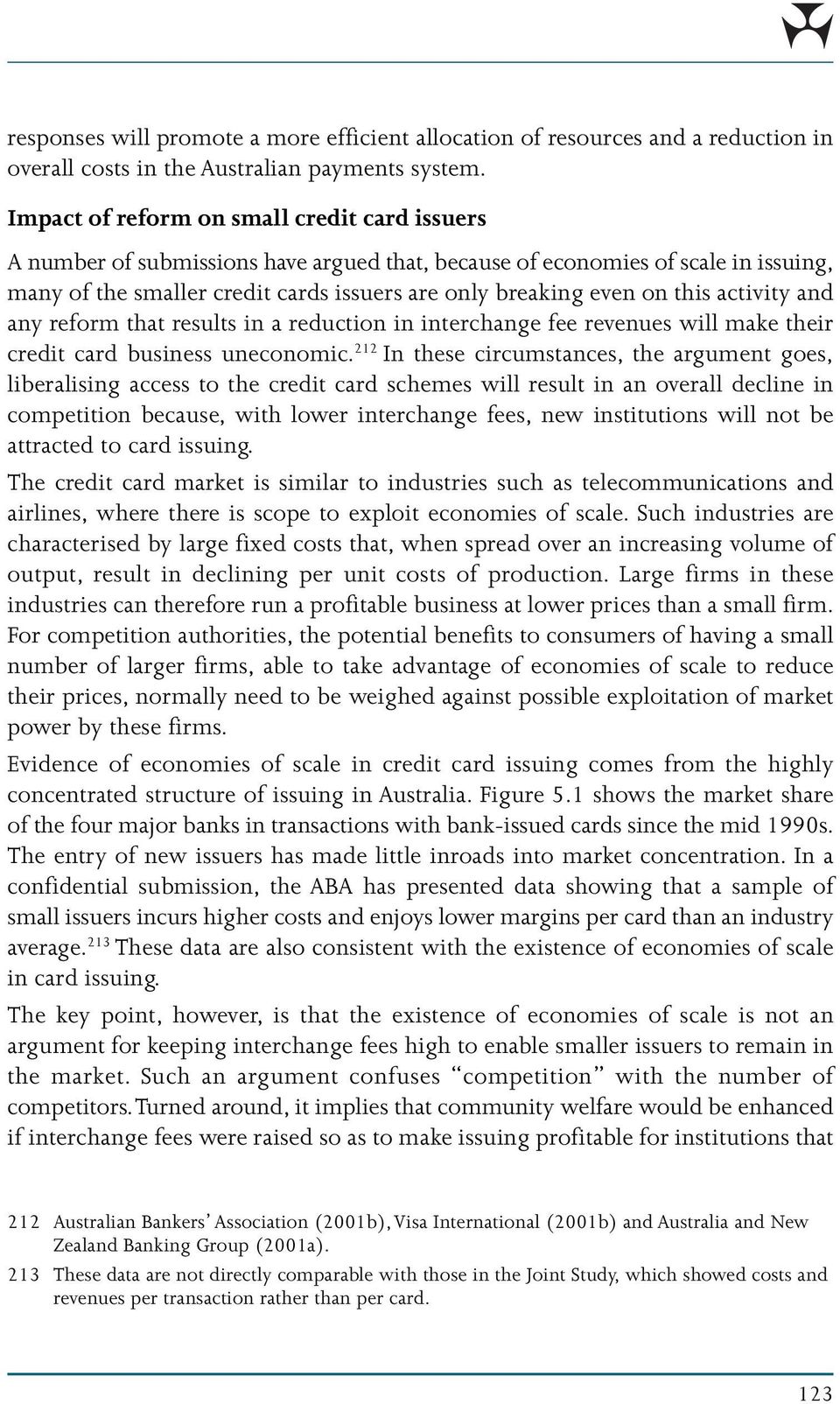
12 Figure 5.1: Share of four major banks in issuing per cent of number of transactions % % Source: Reserve Bank Transaction Cards Statistical Collection. would otherwise not break even. This might result in more issuers, but probably at the highest cost end. It would be a perverse result of competition if entry into credit card issuing must be supported by higher interchange fees passed through into higher consumer prices. In any normal competitive market, a larger number of suppliers would be expected to be the source of downward pressure on costs and prices. The objective of the Reserve Bank s proposed access regime for the designated credit card schemes is to facilitate entry by non-traditional institutions that may have the scale, skills and infrastructure to compete with established participants. Entry or the threat of entry by such institutions is likely, over time, to provide the main spur to competition in the credit card market. Impact of credit card reform on consumers Concerns have also been raised that any reduction in interchange fees, and hence in merchant service fees, would simply increase merchants profits and would not 124
13 be passed onto consumers through the prices of goods and services. The basis for these concerns is a claim that the merchant sector is not competitive. The pass-through of any reduction in interchange fees to the prices of goods and services has two stages: the pass-through of lower interchange fees to merchant service fees; and the pass-through of lower merchant service fees to final prices. The extent of pass-through at each stage is determined by the degree of competition prevailing. The claim that there would be no pass-through of lower interchange fees to consumers is unlikely to be true. Even a monopolist will pass through to its customers some part of a fall in the cost of its inputs; the more competitive a market, however, the more a fall in costs will be passed through into final prices. The pass-through of lower interchange fees to merchant service fees will depend on the degree of competition in the credit card acquiring market and the threat of new entry. Although there is no indication that interchange fees themselves have responded to changing cost conditions, acquirers argue that competition would force them to pass lower interchange fees pari passu into lower merchant service fees. 214 Acquirers that attempted to widen their margins could be expected to lose market share to acquirers offering lower merchant service fees. The more intense is competition, the more likely it is that acquirers will pass through fully any reduction in interchange fees. For reasons discussed in Chapter 4, however, competition in the credit card acquiring market is not as vigorous as it could be in Australia. One factor which has important implications for pass-through is the lack of transparency in interchange fees and merchant service fees. In retail financial services, interest rates and transactions fees are transparent and readily comparable across financial institutions, and individual institutions do not usually price discriminate between their customers. For merchants, however, the provision of financial services whether it be lending or acquiring services is negotiated on a case-by-case basis and pricing is not transparent. Larger firms with higher transaction volumes can usually obtain lower merchant service fees than smaller merchants, 215 but merchants need to be active in seeking quotes from acquirers to ensure they have achieved a competitive merchant service fee. The recent publication by the ARA of the range of merchant services fees being charged, 216 and the greater transparency of 214 See Australian Retailers Association (2001b) for a discussion of how interchange fees affect merchant service fees. 215 Evidence for this is presented in Table 4.3 of this document. 216 Australian Retailers Association (2001a). 125

14 interchange fees under the Reserve Bank s draft standard, will help to ensure that merchants are better informed when they enter the negotiating process with acquirers. Nonetheless, the significant search and adjustment costs involved for merchants may limit the pressure on acquirers to reduce merchant service fees for all merchants, particularly small ones. The pass-through of lower merchant service fees to the final prices of goods and services will depend on the degree of competition in the retailing sector. On a range of evidence, including market concentration and profit margins, the retail sector in Australia appears to be a vigorously competitive one. 217 Turning, first, to market concentration. In a confidential submission, the ABA has claimed that [r]etailing in Australia is very concentrated considerably more so than banking. There is no empirical evidence for this claim. While it is true that Coles Myer and Woolworths have a large share of the grocery market, grocery items account for only 34 per cent of retail trade in Australia. 218 Australian Bureau of Statistics (ABS) data on retail trade indicate that large businesses account for just 56 per cent of retail trade and, to get to this figure, the ABS includes businesses. 219 In contrast, just three banks represent a market share well above 56 per cent of credit card issuing. On this evidence, retailing is much less concentrated than the credit card market. As to profit margins, staff from the Productivity Commission have concluded that [w]holesale and retail trade have the lowest profit margins of all Australian industries. 220 They quote ABS data for 1997/98 that shows that profit margins in retail trade, at around 3 per cent, are low compared with the average for all industries of around 9 per cent. The same ABS data show that profit margins for finance and insurance (which includes banking) are around 25 per cent. 221 These figures do not, of course, take into account the different risk profiles of the industries, but they do suggest a highly competitive retail sector. 217 MasterCard International (2001) has acknowledged that competition at this [retail] level appears to be robust in Australia. p Excluding motor vehicles. ABS Catalogue For the purposes of the Retail Sales Survey, the Australian Bureau of Statistics includes all large retailers but only a sample of small retailers. The definition of large businesses for this purpose varies depending on the state and the industry, but is based on the number of employees. It includes, among others, all department stores, 85 per cent of supermarkets and grocery stores, 65 per cent of clothes and soft goods retailing and 57 per cent of household goods retailing. All Coles Myer and Woolworths businesses are included in the large businesses category. 220 Johnston et al (2000), p ABS Catalogue The profit margin is calculated as the percentage of operating income available as operating profit. 126

15 On the available evidence, the Reserve Bank is confident that, where merchants do not pass reductions in merchant service fees onto credit cardholders on a fee for service basis, competitive pressures will ensure that merchants pass these reductions through to the prices of final goods and services. The pass-through may not, of course, be readily apparent. The cost of accepting credit cards is embedded in a myriad of retail prices and the impact of lower merchant service fees on individual prices may not be obvious; moreover, to the extent they offset cost increases from other sources, lower merchant service fees may have the effect of tempering price increases that would otherwise have taken place. 5.4 Next steps The Reserve Bank is issuing its standards and access regime for the designated credit card schemes in draft form, as required by the Payment Systems (Regulation) Act Interested parties have the opportunity to comment, in writing and/or oral presentations, on the draft standards and access regime before they are finalised. Comments and details of contact persons should be submitted by 15 March 2002 to: Head of Payments Policy Reserve Bank of Australia GPO Box 3947 SYDNEY NSW 2001 or to [email protected] The Reserve Bank acknowledges that measures to promote efficiency and competition in the credit card market in Australia will have important implications for the pricing of other payment instruments, particularly debit cards. The Joint Study concluded that interchange fees in Australia s debit card system, which are determined bilaterally and flow from card issuers to acquirers, do not have a convincing rationale. Several submissions to the Reserve Bank have argued that debit card interchange fees should be reformed at the same time as those for credit cards, so that consumers and merchants can face more efficient prices for both payment instruments. The Reserve Bank agrees that this is a desirable objective, but it has not been prepared to slow the timetable for reform of the credit card market. In any event, the introduction of more efficient pricing arrangements for debit cards is, in the first instance, a matter for industry participants. The Reserve Bank remains willing to work with participants to this end. The Reserve Bank has also been in discussion with Visa, and Visa members issuing the Visa-branded debit card, about the current practice under which these issuers earn credit card interchange fees for what are essentially debit card transactions. 127

16 The Reserve Bank has advised Visa and issuing members that this practice imposes an inappropriate burden of costs on merchants and has no place in the Australian payments system. Issuing members have begun work on an interchange regime to address the issues raised by the Reserve Bank; at the same time, they have expressed concern about the impact on their net revenues if changes to the current practice were to precede reform of the debit card market more generally. 128

Box 1: Four party credit card schemes
 The relevant sections of the Payment Systems (Regulation) Act 1998 are provided in Attachment 1. The Reserve Bank did not designate the three party card schemes, the American Express card system and the
Review of Card Surcharging: A Consultation Document
 Review of Card Surcharging: A Consultation Document june 2011 Contents 1. Introduction 1 2. Background 2 3. Concerns about Surcharging Practices 5 4. Policy Options and Discussion 7 5. Summary of Issues
DEBIT AND CREDIT CARD SCHEMES IN AUSTRALIA A STUDY OF INTERCHANGE FEES AND ACCESS
 DEBIT AND CREDIT CARD SCHEMES IN AUSTRALIA A STUDY OF INTERCHANGE FEES AND ACCESS OCTOBER 2000 RESERVE BANK OF AUSTRALIA AUSTRALIAN COMPETITION AND CONSUMER COMMISSION The contents of this publication
Credit Cards and Payment Efficiency 1
 Credit Cards and Payment Efficiency 1 Stan Sienkiewicz August 2001 Summary: On May 22, 2001, the Payment Cards Center of the Federal Reserve Bank of Philadelphia sponsored a workshop on the role of interchange
Regulation and Innovation in the Australian Payments System
 Regulation and Innovation in the Australian Payments System Darren Flood Deputy Head of Payments Policy Department Reserve Bank of Australia Address to the Modernisation of Retail Payment Methods in Chile
Proposal for a Regulation of the European Parliament and of the Council on interchange fees for card-based payment transactions
 Proposal for a Regulation of the European Parliament and of the Council on interchange fees for card-based payment transactions About MasterCard MasterCard is a payments technology company that enables
MasterCard response to the Department of Finance public consultation Regulation (EU) 2015/751 on Interchange Fees for Card-based payment transactions
 MasterCard response to the Department of Finance public consultation Regulation (EU) 2015/751 on Interchange Fees for Card-based payment transactions MasterCard MasterCard Worldwide (MasterCard) is a public-listed,
Regulatory intervention in the payment card industry by the Reserve Bank of Australia
 Regulatory intervention in the payment card industry by the Reserve Bank of Australia Analysis of the evidence Prepared By: Robert Stillman, William Bishop, Kyla Malcolm, Nicole Hildebrandt CRA International
Evaluation of the 2009 interchange and credit card settlements
 ISBN no. [0000000000000] Project no. 11.02/13795 Public version Evaluation of the 2009 interchange and credit card settlements Research report Date: 19 December 2013 2 CONTENTS GLOSSARY... 3 SUMMARY...
See submissions from Australian Taxpayers Alliance and the International Alliance for Electronic Payments, Christopher Zinn, MasterCard and Visa.
 21 September 2015 Senate Standing Committee on Economics By email: [email protected] Dear Dr Dermody, RE: Inquiry into matters relating to credit card interest rates A number of submissions to the
Payment card rewards programs have become increasingly popular
 Do U.S. Consumers Really Benefit from Payment Card Rewards? By Fumiko Hayashi Payment card rewards programs have become increasingly popular in the United States. Nearly all large credit card issuers offer
Submission to the Commonwealth Consumer Affairs Advisory Council on Credit card surcharges and non-transparent transaction fees: a study
 Submission to the Commonwealth Consumer Affairs Advisory Council on Credit card surcharges and non-transparent transaction fees: a study June 2013 Credit card surcharges and non-transparent transaction
24 April 2015. By email: [email protected]
 24 April 2015 By email: [email protected] Dr Anthony Richards Head of Payments Policy Department Reserve Bank of Australia GPO Box 3947 Sydney NSW 2001 Dear Mr Richards, Review of Card Payments
The Role of Interchange Fees on Debit and Credit Card Transactions in the Payments System
 Economic Brief May 2011, EB11-05 The Role of Interchange Fees on Debit and Credit Card Transactions in the Payments System By Tim Mead, Renee Courtois Haltom, and Margaretta Blackwell When consumers use
Response to the Energy White Paper Issues Paper PREPARED BY EMC ENGINEERING FOR THE AUSTRALIAN GOVERNMENT DEPARTMENT OF INDUSTRY
 Response to the Energy White Paper Issues Paper PREPARED BY EMC ENGINEERING FOR THE AUSTRALIAN GOVERNMENT DEPARTMENT OF INDUSTRY i P a g e www.energym adeclean.com CONTENTS
AER Submission. Competition Policy Review Draft Report
 AER Submission Competition Policy Review Draft Report November 2014 1 Introduction The AER is Australia s national energy regulator and an independent decision-making authority. Our responsibilities are
Clean Energy Council submission to Queensland Competition Authority Regulated Retail Electricity Prices for 2014-15 Interim Consultation Paper
 Clean Energy Council submission to Queensland Competition Authority Regulated Retail Electricity Prices for 2014-15 Interim Consultation Paper Executive Summary The Clean Energy Council (CEC) supports
Visa Europe Our response to the European Commission s proposed regulation of interchange fees for card-based payment transactions
 Visa Europe Our response to the European Commission s proposed regulation of interchange fees for card-based payment transactions Executive summary On 24 July 2013 the European Commission published a proposal
TREASURY MINISTERIAL BRIEF
 TREASURY MINISTERIAL BRIEF Document 2 MS15-000931 25 March 2015 Treasurer cc: Parliamentary Secretary to the Treasurer; Secretary to the Treasury CREDIT CARD INTEREST RATES Timing: At your convenience
CREDIT CARD ISSUERS AND ACQUIRERS NEW ENTRANTS WHAT EFFECT HAVE THE NEW AUTHORISATION STANDARDS AND GUIDELINES HAD SO FAR?
 CREDIT CARD ISSUERS AND ACQUIRERS NEW ENTRANTS WHAT EFFECT HAVE THE NEW AUTHORISATION STANDARDS AND GUIDELINES HAD SO FAR? GREG BRUNNER General Manager, Policy Development Australian Prudential Regulation
Modernisation of Article 102 TFEU: Use of Economic Analysis for Conditional Rebates
 Competition Competence Report 1/ 2005 Competition Competence Report Modernisation of Article 102 TFEU: Use of Economic Analysis for Conditional Rebates The process of modernisation has reached Article
Lending to small business
 Lending to small business Supplementary submission to the Senate Economics Committee Inquiry into Access of Small Business to Finance David Richardson Senior Research Fellow The Australia Institute [email protected]
Rule change request. 18 September 2013
 Reform of the distribution network pricing arrangements under the National Electricity Rules to provide better guidance for setting, and consulting on, cost-reflective distribution network pricing structures
Financial System Inquiry SocietyOne Submission
 Financial System Inquiry SocietyOne Submission SocietyOne is pleased to make the following submission to the Financial System Inquiry. SocietyOne is Australia s first fully compliant Peer-to-Peer (P2P)
Industry Analysis - Electricity and Costs in Queensland
 CCIQ Submission to the QCA consultation paper Regulated Retail Electricity Prices 2013-14: Cost Components and Other Issues About the Submission CCIQ makes this submission in response to the QCAs consultation
Pricing in a Competitive Market with a Common Network Resource
 Pricing in a Competitive Market with a Common Network Resource Daniel McFadden Department of Economics, University of California, Berkeley April 8, 2002 I. This note is concerned with the economics of
Terms of Access to Payment Systems
 1 Terms of Access to Payment Systems The Different Positions of Small and Large Banks English summary of Swedish Competition Authority report 2006:1 2 Summary The Swedish banking market is dominated by
Review of Card Payments Regulation
 Review of Card Payments Regulation Issues Paper March 2015 Contents 1. Introduction 1 2. The Bank s Card System Reforms 3 3. Developments in the Card Payments Market 13 4. Issues for the Review 25 5. Issues
Competition policy brief
 Issue 2015-3 June 2015 ISBN 978-92-79-38783-8, ISSN: 2315-3113 Competition policy brief Occasional discussion papers by the Competition Directorate General of the European Commission The Interchange Fees
AER Issues Paper Tariff Structure Statement Proposals Victorian Electricity Distribution Network Service Providers
 20 January 2016 Australian Energy Regulator GPO Box 520 Melbourne VIC 3001 Via email: [email protected] AER Issues Paper Tariff Structure Statement Proposals Victorian Electricity Distribution Network
Review of the Energy Savings Scheme. Position Paper
 Review of the Energy Savings Scheme Position Paper October 2015 Contents Executive summary... 3 Energy Savings Scheme Review Report package... 3 Expanding to gas... 3 Target, penalties and duration...
Statement for the Record. On Behalf of the AMERICAN BANKERS ASSOCIATION. Before the. Antitrust Tax Force. Committee on the Judiciary
 Statement for the Record On Behalf of the AMERICAN BANKERS ASSOCIATION Before the Antitrust Tax Force Committee on the Judiciary United States House of Representatives May 15, 2008 Statement for the Record
The EU Work on Payments
 The EU Work on Payments W3C Workshop on Web Payments Paris, 24 25 March 2014 Alexander Gee DG Competition European Commission The views expressed are purely those of the author and may not be regarded
Credit card surcharges and non transparent transaction fees. A study. July 2013. Commonwealth Consumer Affairs Advisory Council
 Credit card surcharges and non transparent transaction fees A study July 2013 Commonwealth Consumer Affairs Advisory Council Commonwealth of Australia 2013 ISBN 978-0-642-74923-9 This publication is available
ESRI Research Note. The Irish Electricity Market: New Regulation to Preserve Competition Valeria di Cosmo and Muireann Á. Lynch
 ESRI Research Note The Irish Electricity Market: New Regulation to Preserve Competition Valeria di Cosmo and Muireann Á. Lynch Research Notes are short papers on focused research issues. They are subject
Retailer Margins in Victoria s Electricity Market. Discussion Paper
 Retailer Margins in Victoria s Electricity Market Discussion Paper May 2013 An appropriate citation for this paper is: Essential Services Commission 2013, Retailer Margins in Victoria s Electricity Market
Bureau of Communications Research. NBN non-commercial services funding options. Consultation Paper. Response by iinet
 Bureau of Communications Research NBN non-commercial services funding options Consultation Paper Response by iinet 1 1. Introduction The Australian Government has tasked the Bureau of Communications Research
Case 1:05-md-01720-JG-JO Document 5939-5 Filed 08/16/13 Page 1 of 85 PageID #: 69497 EXHIBIT 4
 Case 1:05-md-01720-JG-JO Document 5939-5 Filed 08/16/13 Page 1 of 85 PageID #: 69497 EXHIBIT 4 Case 1:05-md-01720-JG-JO Document 5939-5 Filed 08/16/13 Page 2 of 85 PageID #: 69498 UNITED STATES DISTRICT
Towards basic electronic payments A roadmap for competitive and inclusive payment systems in Europe
 Towards basic electronic payments A roadmap for competitive and inclusive payment systems in Europe Revised position paper Date: May 2013 What do we need from our electronic payments? What Europe needs
Submission to the Senate Inquiry into Matters Relating to Credit Card Interest Rates
 Submission to the Senate Inquiry into Matters Relating to Credit Card Interest Rates Senate Economics References Committee August 215 Introduction Credit cards offer two separate albeit interrelated functions,
The Consequences of Debit Interchange Price Fixing
 The Consequences of Debit Interchange Price Fixing Overview The Durbin Amendment has established a price fixing scheme for debit interchange, implemented by the Federal Reserve. Banks will be forced to
2014 Residential Electricity Price Trends
 FINAL REPORT 2014 Residential Electricity Price Trends To COAG Energy Council 5 December 2014 Reference: EPR0040 2014 Residential Price Trends Inquiries Australian Energy Market Commission PO Box A2449
1.0 Summary 3. 2.0 Introduction 4. 3.0 Reasons Against Imposing Stamp Duty on GST 5
 Property Council of Australia Stamp Duty and the GST A Submission to the Tasmanian Government: May 2000 Table of Contents 1.0 Summary 3 2.0 Introduction 4 3.0 Reasons Against Imposing Stamp Duty on GST
The Role of Exchange Settlement Accounts
 Reserve Bank of Australia Bulletin March 1999 The Role of Exchange Settlement Accounts Introduction Exchange Settlement (ES) Accounts provided by the Reserve Bank play an important role in the Australian
ANZ and Diners Club to launch new cards: Announce changes to reward programs
 For Release: 12 September 2003 Corporate Affairs Level 22, 100 Queen Street Melbourne Vic 3000 Facsimile 03 9273 4899 www.anz.com ANZ and Diners Club to launch new cards: Announce changes to reward programs
Inquiry into matters relating to Credit Card interest rates
 Committee Secretary 15 August 2015 Senate Standing Committees on Economics PO Box 6100 Parliament House Canberra ACT 2600 Inquiry into matters relating to Credit Card interest rates The Westpac Group thanks
The credit card industry in China The rise of a national champion and challenges for the future
 Student Research Projects/Outputs No.040 The credit card industry in China The rise of a national champion and challenges for the future Javier L Santomá Vilaclara MBA 2009 China Europe International Business
THE INNOVATION JOURNEY:
 THE INNOVATION JOURNEY: The last four years and into the future Presentation to the Australian Payments Forum Monday 15 April 2013 Where were we? DCITA Report 2006 APCA Innovation Report 2008/9 What s
How To Mitigate Market Power
 ENERGY ADVISORY COMMITTEE Electricity Market Review: Market Power The Issue To review the range of practices in assessing and mitigating market power in the electricity supply industry, and to consider
Why Europe needs the Payments Package: the merchants position
 Why Europe needs the Payments Package: the merchants position Summary July 2014 EuroCommerce and the European Retail Round Table (ERRT) urge the Council and the new Parliament to adopt the regulation on
European Payment Card Systems for the 21 st Century. A paper from MasterCard Europe
 U European Payment Card Systems for the 21 st Century A paper from MasterCard Europe For four decades, MasterCard Europe 1 has been working successfully with European banks to deliver secure, efficient
Market Analysis: Leased Lines (04/59) (04/60) Submission to ComReg Consultation Process
 Market Analysis: Leased Lines (04/59) (04/60) Submission to ComReg Consultation Process 16 July 2004 Market Analysis: Leased Lines (Retail and Wholesale Markets) 1 Introduction In this paper we are responding
During the meeting you requested further clarification on the following issues:
 14 August 2001 Mr Ross Wilson Productivity Commission Level 3 Nature Conservation House Cnr Emu Bank and Benjamin Way BELCONNEN ACT 2617 By facsimile: 02 6240 3399 Dear Mr Wilson Pay TV Content Access
Summary of Submissions Received on the Consultation on Strengthening Statutory Payment Oversight Powers and the Reserve Bank s Responses
 Summary of Submissions Received on the Consultation on Strengthening Statutory Payment Oversight Powers and the Reserve Bank s Responses October 2013 2 SECTION ONE: INTRODUCTION 1. In March 2013, the Reserve
THE SOCIETY OF ACTUARIES IN IRELAND
 THE SOCIETY OF ACTUARIES IN IRELAND Submission on the Health Insurance Authority s Consultation Paper on Risk Equalisation in the Irish Private Health Insurance Market August 2010 Contents 1 Introduction
THOUGHT LEADERSHIP THE GOLDEN AGE OF CARD PAYMENTS
 THOUGHT LEADERSHIP THE GOLDEN AGE OF CARD PAYMENTS 1 TABLE OF CONTENTS EXECUTIVE SUMMARY... 3 HISTORICALLY, COSTS HAVE STYMIED GROWTH OF CARD PAYMENTS... 3 GOLDEN AGE OF CARD PAYMENTS... 5 MORE VOLATILITY
Credit Card Market Study Interim Report: Annex 5 Firm business model analysis
 MS14/6.2: Annex 5 Market Study business model analysis November 2015 Introduction 1. This annex summarises issuers approach to evaluating profitability, as well as a summary of the role of affinity and
DECISION ON DETERMINING THE INTERCHANGE FEE IN VISA AND MASTERCARD SYSTEMS
 DECISION ON DETERMINING THE INTERCHANGE FEE IN VISA AND MASTERCARD SYSTEMS The proceedings initiated upon a complaint of the Polish Organisation of Commerce and Distribution, were conducted under Polish
Controlling Interest: Are Ceilings On Interest Rates a Good Idea?
 Source: http://www.chicagofed.org/consumer_information/controlling_interest.cfm Controlling Interest: Are Ceilings On Interest Rates a Good Idea? Do ceilings always result in lower rates? Can ceilings
Decision on the CMA s review of the Credit Cards (Merchant Acquisition) Order 1990
 Decision on the CMA s review of the Credit Cards (Merchant Acquisition) Order 1990 Contents Page Summary... 1 Introduction... 2 Background... 4 Monitoring activity... 7 Market developments... 7 Stakeholder
How To Decide If There Is A Need For Regulatory Intervention In Relation To End To End-To-End Competition In The Postal Sector
 End-to-end competition in the postal sector Final guidance on Ofcom s approach to assessing the impact on the universal postal service Guidance Publication date: 27 March 2013 Contents Section Page 1