
Optometric Vision Therapist Certification Guide
|
|
|
- Beverly Bennett
- 10 years ago
- Views:
Transcription
1 International Examination and Certification Board Optometric Vision Therapist Certification Guide Updated: November 21, 2013 This guide supersedes all older versions. College of Optometrists in Vision Development 215 West Garfield Rd., Aurora, OH Phone: Fax:

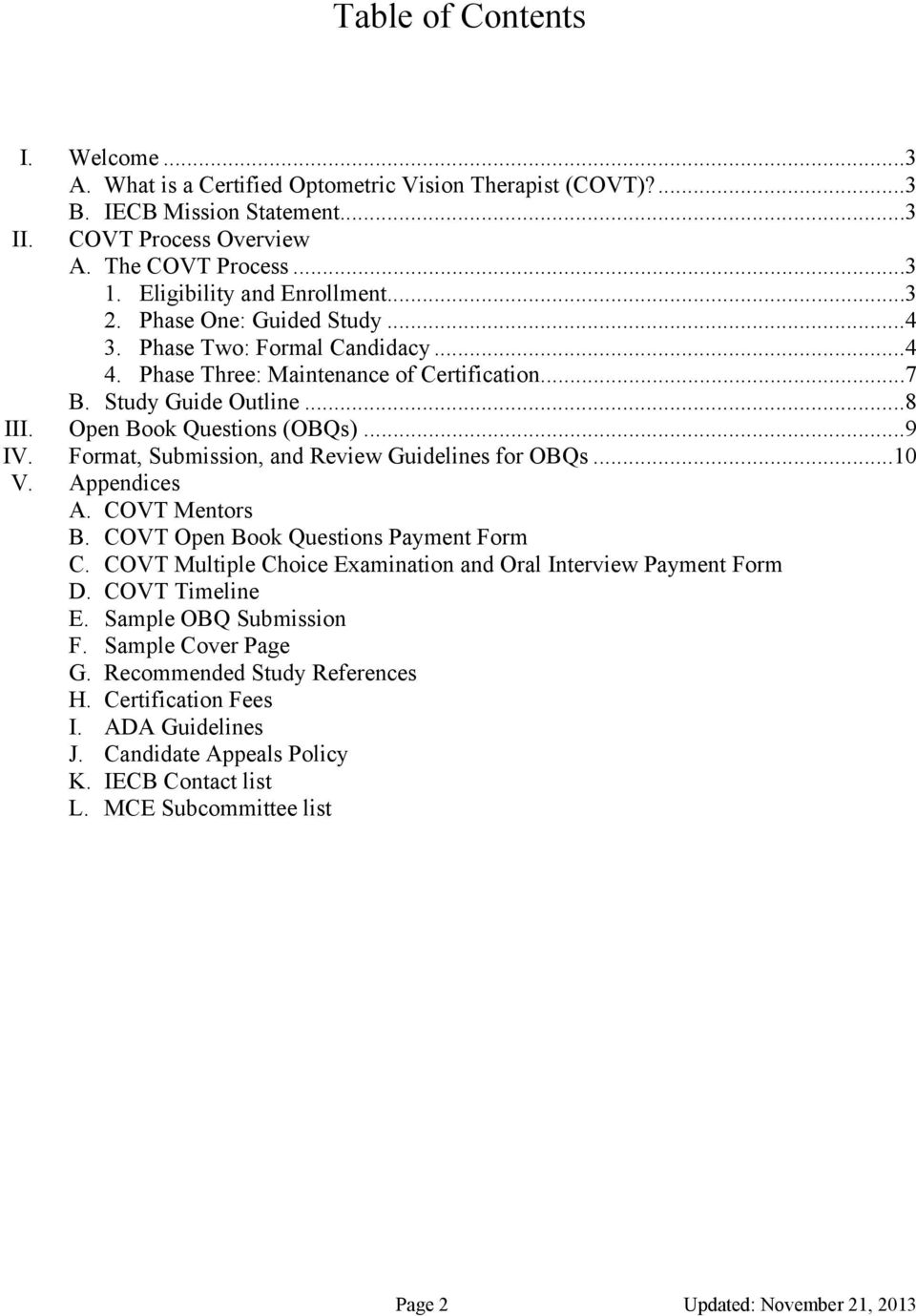
2 Table of Contents I. Welcome...3 A. What is a Certified Optometric Vision Therapist (COVT)?...3 B. IECB Mission Statement...3 II. COVT Process Overview A. The COVT Process Eligibility and Enrollment Phase One: Guided Study Phase Two: Formal Candidacy Phase Three: Maintenance of Certification...7 B. Study Guide Outline...8 III. Open Book Questions (OBQs)...9 IV. Format, Submission, and Review Guidelines for OBQs...10 V. Appendices A. COVT Mentors B. COVT Open Book Questions Payment Form C. COVT Multiple Choice Examination and Oral Interview Payment Form D. COVT Timeline E. Sample OBQ Submission F. Sample Cover Page G. Recommended Study References H. Certification Fees I. ADA Guidelines J. Candidate Appeals Policy K. IECB Contact list L. MCE Subcommittee list Page 2 Updated: November 21, 2013
3 I. Welcome The International Examination & Certification Board (IECB) of the College of Optometrists in Vision Development (COVD) welcomes you as an enrollee in the Certified Optometric Vision Therapist (COVT) Process. This guide will serve to acquaint you with the background information, references, requirements and procedures for becoming a board certified optometric vision therapist. A. What is a Certified Optometric Vision Therapist (COVT)? A COVT works under the direct supervision of a board certified Fellow and has demonstrated advanced competency in the areas of vision development, binocular vision, visual information processing, and vision therapy. We believe that the learning experience you are embarking on will be a rewarding one. Not only will you benefit from expanding your knowledge through guided study, but you will also gain satisfaction through public recognition of your achievement. Please see the section on learning objectives to get a good overview of the subject areas in which a COVT has been certified to have advanced knowledge and competence. After you have successfully completed your COVT certification, we urge you to stay abreast of advances in the field, as well as encouraging you to accept new responsibilities and leadership roles. B. IECB Mission Statement The mission of the IECB is to evaluate and certify the advanced competency of optometrists and vision therapists in providing care as related to development and behavior. This mission is accomplished by encouraging continuous learning and providing an evaluation process culminating in the identification of those professionals with demonstrated knowledge and clinical skills in vision care as related to development and behavior. The certification process is designed to encourage professional growth in a collegial environment. II. COVT Process Overview A. The COVT Process 1. Eligibility and Enrollment To apply as a candidate for COVT certification you must: Be actively engaged in vision therapy as an employee of a current Fellow of the College of Optometrists in Vision Development (FCOVD) or, when that s not feasible, provide vision therapy under the direct supervision of a current FCOVD And have at least 2000 hours of on-the-job clinical experience in providing vision therapy Or have an AA degree (or higher) with emphasis on the behavioral sciences, vision development or vision rehabilitation plus 1000 hours Page 3 Updated: November 21, 2013

4 of on-the-job vision therapy clinical experience. The candidate must submit a copy of the diploma for an AA or higher degree. Submit a completed application with the application fee to the COVD International Office. To complete certification you must: Have a completed application and fee on file with the COVD International office. Adhere to the Timeline requirements. Provide written approval from your FCOVD and COVT or COVT-I mentor for your response to each of the nine OBQ s and electronically submit them to the COVD International Office. Your written answers to these questions will then be reviewed by members of IECB. Successfully complete a multiple choice examination (MCE) and oral interview administered by the International Examination and Certification Board of COVD. Prior to the MCE, you must pay the examination fee. 2. Phase One: Guided Study The OBQs are provided to help prepare you for the MCE and the oral interview phases. They are designed to deepen your understanding about specific aspects of developmental optometric care and vision therapy. The list of topics in the Study Guide Outline on page 8 is designed to guide your study in these areas. The nine Open Book Questions (OBQs) are listed on page 9. To submit your OBQ s you must submit the name of your mentor and the FCOVD you are employed by or under the direct supervision of. A list of COVT mentors is shown in Appendix A. Your doctor and mentor MUST attest that they have approved your answer to each of these questions before you submit them. Your submissions of OBQs are processed by the COVD staff and then sent to the IECB review team. Prior to your first OBQ submission you must complete the COVT Open Book Questions Payment form (Appendix B). Reviewers have up to four weeks to score your submission(s) and provide questions and comments. You will receive a response approximately six weeks after submission date. The chair will send a letter when you have completed this phase of the certification process. Upon successful completion of your OBQs, you will be invited to the schedule your MCE. 3. Phase Two: Formal Candidacy The final phase in the COVT process consists of the Multiple Choice Examination (MCE) and Oral Interview. Before you can begin this phase you must submit the COVT MCE and Oral Interview Payment Form with payment (Appendix C). Step 1: Successful completion of the MCE. This is a 50 question test. Performance is reported as pass or fail based on criterion-referencing (not graded on a curve you are not competing against Page 4 Updated: November 21, 2013

5 the other candidates in your year). Raw scores are not relevant to the process and are not released. The questions have been written by COVTs and Fellows and edited for content and clarity, and are analyzed by experts in standardized test design after each test administration. You are allowed up to one-and-a-half (1½) hours to complete the examination. If a candidate does not receive a passing grade on the test, the candidate can request the IECB Chair to send a report of the test s topic areas where the candidate s performance was weak. The following breakdown of the clinical topic areas covered by the MCE may be helpful in your preparation for taking the 50 question multiple choice examination: 1. Eye Movements (4 questions) a. Fixations, pursuits, saccades b. Definitions, characteristics, symptoms when deficient, therapy 2. Refractive Conditions (3 questions) a. Myopia, hyperopia, astigmatism, presbyopia, anisometropia b. Definitions, characteristics, symptoms, therapy 3. Strabismus (3 questions) a. Esotropia, exotropia, hyper-hypo tropia b. Definitions, findings, symptoms, therapy i. Esotropia: basic, accommodative, divergence insufficiency, infantile ii. Exotropia: basic, divergence excess iii. Hyper-hypo tropia c. Comitant vs. non-comitant strabismus i. Definitions ii. Implications for vision therapy iii. Anomalous correspondence 4. Non Strabismic Anolalies of Binocular Vision (4 questions) a. Esophoria, exophoria, hyper-hypo exophoria i. Definitions, testing findings, symptoms, therapy ii. Esophoria: basic, accommodative, divergence insufficiency iii. Exophoria: basic, convergence insufficiency, pseudo convergence insufficiency, divergence excess iv. Hyper-hypo phoria 5. Amblyopia (3 questions) a. Refractive vs. strabismic vs. deprivation i. Definitions, testing, findings, symptoms, therapy ii. Eccentric fixation iii. Suppression 6. Accommodation (3 questions) Page 5 Updated: November 21, 2013

6 a. Accommodative infacility, accommodative inaccuracy, accommodative insufficiency, accommodative instability i. Definitions, testing, symptoms, therapy 7. Visual Perception/Visual Information Processing (9 questions) a. Definitions, testing, findings, symptoms, therapy i. Primitive reflexes ii. Body scheme iii. Self lateralization iv. Directionality v. Visual motor hierarchy vi. Visual perceptual areas (e.g., form discrimination, form constancy, closure) vii. Visual integrative areas (e.g., visual motor, visual auditory). viii. Perceptual/cognitive styles (e.g., simultaneous vs. successive; central vs. peripheral; impulsive vs. reflective 8. Special Populations (3 questions) a. Autism Spectrum Disorders b. Acquired Brain Injury i. Definitions, visual characteristics, therapy 9. Tools of Vision Therapy (18 questions) a. Lenses i. Compensatory ii. Monocular iii. Binocular iv. Dissociated (as with flippers) b. Prisms i. Compensatory ii. Monocular iii. Binocular iv. Disassociating v. Yoked c. Filters i. Methods of graded occlusion ii. Anaglyphs, Vectograms; iii. Monocular fixation in a binocular field (MFBF) d. Levels of demand i. When and how to increase or decrease the level of demand of procedures (or loading). ii. Self directed vs. therapist directed e. Procedures in terms of: i. Target selection ii. Working distance iii. In instrument versus free space You have two options for taking the MCE: Page 6 Updated: November 21, 2013

7 Option 1: At an accredited educational institution in your local community. The test must be taken during the week in August as specified in Appendix D (COVT Timeline). You make arrangements with a local college, university, library or learning center to take the exam, and you must supply a qualified proctor. The COVD office will provide you with the requirements and forms that need to be completed to schedule the test administration. If a candidate who uses this option doesn t pass the MCE, he/she can take it at the COVD Annual Meeting (see Option 2 below) at no additional cost. The candidate must contact the COVD office to arrange taking the test at the Annual Meeting. Option 2: At the COVD Annual Meeting. The test administration is given on the Monday prior to the beginning of the Annual Meeting. Step 2: Successful completion of the oral interview The oral interview is given only at the COVD Annual Meeting. Interviews are scheduled on Monday through Wednesday before the general meeting begins. The oral interview is conducted by two IECB members in a private setting and typically lasts minutes. During the interview, you will be asked questions primarily relating to the reviewers comments you received about your OBQs. Should the reviewers have further questions, an additional interview may be scheduled with two reviewers who were not involved with the first oral interview and the IECB Chair. There is no additional fee for the second oral interview. There is no score or grade that is determined from the oral interview. Results of the oral interview are used to determine if you have successfully completed the fellowship process. Step 3: Fellowship Induction Once you have successfully completed the multiple choice examination and oral interview, you will be invited to participate in the induction of new COVTs during the closing banquet at the COVD Annual Meeting. 4. Phase Three: Maintenance of Certification To meet the requirements for your maintenance of certification you must: Maintain continuous employment with, or be under the direct supervision of an active FCOVD. Your Certificate, once awarded, is good for a five year period before your certificate expires. To maintain certification, you must recertify. Complete a minimum of six hours of continuing education on vision therapy related topics annually which should be reported to the COVD International Office along with your annual renewal form. Inactive Status: If you no longer work for, or are under the supervision of a current FCOVD, your certification status will become inactive. Page 7 Updated: November 21, 2013

8 PLEASE NOTE: You do not lose your certification (COVT) but you must earn a minimum of six hours of continuing education in vision therapy related topics yearly. Once you are actively working under the supervision a doctor who is a Fellow, notify the COVD International office, and your certification status will be re-activated. B. Study Guide Outline The areas listed below are an overview and starting point for the candidate. 1. Understand and be prepared to discuss the following in terms of: Definition of the conditions, abilities or skills Signs, symptoms and avoidance behaviors associated with deficiency; how does it impact performance Vision therapy techniques for treatment A. Refractive status: Hyperopia, myopia, astigmatism, presbyopia, anisometropia Types of ophthalmic devices to compensate for these conditions B. Eye movements: Monocular & binocular accuracy, stability, control & automaticity Fixations Pursuits Saccades C. Accommodation: Expected monocular and binocular sufficiency, stability and flexibility clinical values Accommodative insufficiency, Accommodative excess Accommodative instability, Accommodative inflexibility D. Non strabismic/amblyopic deficiencies of binocular vision Esophoria, exophoria, hyper/hypo phoria Convergence Insufficiency, Convergence Excess Divergence Insufficiency, Divergence Excess Suppression, Levels of Binocular Fusion used in therapy E. Amblyopia: Refractive vs strabismicvs deprivation Effects on visual function beyond acuity Eccentric fixation F. Strabismus: Direction of turn, constant vs intermittent, comitant vs non-comitant Motor Fusion (eye position, comitancy) versus sensory fusion (first, second, and third degree fusion monocular fixation in a binocular filed, Suppression) Direction of strabismus (Esotropia, Exotropia, Hypertropia) Constant versus Intermittent G. Vision perception and information processing: Primitive reflexes, body schema, laterality, directionality Visual intersensory integration (visual motor, visual auditory, visual vestibular) Page 8 Updated: November 21, 2013

9 Visual thinking (visualization, visual imagery) Perceptual style (reflective versus impulsive, central versus peripheral) H. Visual field defects (hemianopsia, neglect) 2. Be prepared to discuss the tools for vision therapy in terms of: A. Lenses (monocular, binocular, dissociated) B. Prisms (monocular, binocular, yoked, dissociated) C. Filters (anaglyph, polaroid, graded occlusion) D. Occlusion (central, peripheral, selective, full, direct, indirect) E. Monocular fixation in a binocular field (MFBF) F. Vision therapy procedures in terms of: 1. Target selection 2. Working distance 3. In instrument techniques versus free space techniques 4. Levels of demand (multisensory and cognitive loading) 3. Communication with doctor/parent/patient to maximize outcome III. Open Book Questions (OBQs) Please prepare your answers to the following questions using the Format, Submission, and Review Guidelines for OBQs on page 10. See Appendix E for a Sample OBQ Submission. 1. Discuss eye movements in optometric vision therapy in the following areas: a. fixations b. pursuits c. saccades Include a working definition, how therapy is sequenced in your office, and how the level of difficulty is modified. 2. Discuss accommodation in optometric vision therapy. Include a working definition, how therapy is sequenced in your office, and how the level of difficulty is modified. 3. Discuss how plus and minus lenses affect accommodative and vergence demand. Include how lenses are used in optometric vision therapy to guide these areas of function. 4. Discuss binocular function in optometric vision therapy with patients who do not have strabismus or amblyopia. Include a working definition, how therapy is sequenced in your office, and how the level of difficulty is modified. 5. Discuss prisms and their use in optometric vision therapy in the following areas: a. monocular b. dissociating c. vergence d. yoked Include how prisms can be used with specific VT techniques. 6. Discuss amblyopia treatment in your office. Include how the treatment for patients with strabismic amblyopia and refractive amblyopia differs. 7. Discuss the treatment of strabismus in your office. Include the factors of eso/exo/hyper, constant/intermittent, and comitancy. 8. Discuss optometric vision therapy goals and procedures in your office relating to vision perception and information processing. 9. Discuss varying methods of patient motivation, goal setting, compliance and progress assessment. Page 9 Updated: November 21, 2013

10 Remember to have your doctor and mentor read your answers prior to submission. Your doctor and mentor must send an to acknowledging they have reviewed and approved your submission(s), listing the specific questions being submitted. This must be done for each time submissions are sent. Answers will not be submitted to the IECB Review Board without both doctor and mentor approval. IV. Format, Submission, and Review Guidelines for OBQs A. It is your responsibility to follow the COVT Timeline (Appendix D) and submit all materials, forms, and fees prior to or on the deadline date. No exceptions are made for missed deadlines if the candidate seeks to complete the process during that year. B. All submissions must be sent via to and must be written in English. C. All OBQ submissions must use the following format: 1. A cover page must be sent as a separate file with your first submission. It must contain the following: your name, address, telephone number, , and your candidate number. If any information contained on the cover page changes during process, you will need to resubmit your material with the changes. (See Appendix F for Sample Cover Page.) 2. Submissions must be typed using 12-point font, double-spaced, in Microsoft Word (.doc) format. 3. Header: List the assigned candidate number in the header of each page in the header. 4. Footer: Insert document type and page numbers in footer of document (Example: OBQ #1, page 1 of 3). 5. Each response should be no less than one page and no more than three pages, double spaced. 6. At top of first page, type OBQ # and type the question in its entirety. D. Write in a clear and concise manner and proofread your materials carefully. Remember to use the spell check. E. Use standard optometric terminology. Reviewers may not understand your clinical shorthand or conventions. F. Do not assume that the reviewers know what you are thinking. Please explain your answers in detail. G. Each OBQ must be submitted as a separate file. Files submitted which contain more than one OBQ will not be processed. H. Your doctor and mentor must read your OBQ answers prior to any submission. They must both send an to [email protected] with the following: 1. Candidate (your) name 2. Their name 3. List the specific OBQ# and question to be submitted 4. State that they have reviewed and approved your submission I. You may submit these materials in one complete packet or as you complete them. They may be submitted at any time. If you plan on completing the process in a specific year (e.g. 2014) you must adhere to the COVT timeline for that specific year. Page 10 Updated: November 21, 2013

11 215 West Garfield Road, Suite 200 Aurora, OH Phone: or Fax: Website: COVT Mentors Patti Andrich, COVT c/o Dr. Alex Andrich 7029 Royalton Rd. North Royalton, OH (P) (440) United States Mentors Lisa Knopp, COVT c/o Dr. Theodore S. Kadet 2225 Sahalee Dr. W Sammamish, WA (P) (425) [email protected] Nikki Biefel, COVT Golden Vision Therapy 2301 Ford Street Suite 101 Golden, CO (P)(303) [email protected] Melody Lay, COVT c/o Dr. Jenna McDermed Lake Underhill Rd, #236 Orlando, FL (P) (407) [email protected] Laura Clemmer, COVT c/o Dr. Kathleen Kinney rd Avenue Suite 411 Seattle, WA (P) (206) [email protected] Lyna Dyson, COVT 611 Starstone Drive San Marcos, CA (C) (760) preferred # (P) (858) ext. 22 [email protected] Tom Headline, COVT c/o Dr. Carole Hong 2625 Timberlake Ct. San Jose, CA (P) (408) [email protected] Diana Ludlam, COVT c/o Dr. Kenneth Ciuffreda SUNY College of Optometry 33 West 42nd Street, Rm 1415 New York, NY (P) (212) (C) (503) [email protected] Jennifer Mullen, COVT c/o Dr. Barry Tannen 1777 Kuser Road Hamilton Square, NJ (P) (609) [email protected] Robert Nurisio, COVT Austin Eye Gym 930 S. Bell Blvd Cedar Park, TX (P)(512) [email protected] Updated: November 25, 2013

12 United States Mentors (cont.) Deborah Killion, COVT c/o Dr. Michael Gallaway 4003 J Lincoln Drive, West Marlton, NJ (P) (856) [email protected] Becky Reeves-Manning, COVT c/o Dr. Ron Bateman 373 W. Drake Rd., Ste. 3 Fort Collins, CO [email protected] Jenni Roeber, COVT c/o Dr. Amy C. Cecil 100 Elk Run Drive, Suite 206 Basalt, CO (P) (970) (F) (970) [email protected] Jenny Rea, COVT c/o Dr. Nancy Torgerson Ash Way Ste 101 Lynnwood, Wa (P) (425) [email protected] Rob Truscott c/o Dr. Alexandar Andrich Royalton Road, Suite D North Royalton, Ohio (P) (440) [email protected] Wendy Warner, COVT c/o Dr. Dawn Dunford Portage Ave Winnipeg, MB R3J 0H2 (P) (204) [email protected] Mandi Schafer, COVT c/o Dr. Nancy Torgerson Ash Way, Suite 101 Lynnwood, WA (P) (206) [email protected] Jessica Zwilling Long Island Optometric Vision Development Dr. Michele R. Bessler, FCOVD 300 Garden City Plaza Suite #234 Garden City, NY (P) (516) (F) (516) [email protected] Jessica Stevenson, COVT The Solution Center Dr. Carole, R. Burns, OD, FCOVD 937 Polaris Woods Blvd Suite B Westerville, OH (P) (614) (F) (614) [email protected] Michelle Mott, COVT c/o Dr. Nancy Torgerson Ash Way, Suite 101 Lynnwood, WA (P) (425) [email protected] Updated: November 25, 2013

13 International Mentor Paula Peachey, COVT-I C/o Dr. Graham Peachey 112 Hume Street Wodonga, Vic, AUSTRALIA Updated: November 25, 2013

14 215 West Garfield Road, Suite 200 Aurora, OH Phone: or Fax: Website: COVT Open Book Questions Payment form Payment must be sent before or with first submission of OBQ s COVT Fee: $ COVD Member $ Non-Member Candidate Name: METHOD OF PAYMENT Check American Express Discover MasterCard Visa If paying by check: Payment must be drawn on a U.S. bank, in U.S. funds. Make payable to COVD. If paying by credit card: Name as it appears on card: Billing Address: Credit Card #: Exp. Date: Security # on back (or front) of card: Signature of cardholder: Mail: College of Optometrists in Vision Development (COVD) 215 West Garfield Road, Suite 200 Aurora, OH FAX:

15 215 West Garfield Road, Suite 200 Aurora, OH Phone: or Fax: Website: COVT Multiple Choice Examination and Oral Interview Payment Form Payment must be submitted with application COVT Fee: $ COVD Member $ Non-Member Candidate Name: METHOD OF PAYMENT Check American Express Discover MasterCard Visa If paying by check: Payment must be drawn on a U.S. bank, in U.S. funds. Make payable to COVD. If paying by credit card: Name as it appears on card: Billing Address: Credit Card #: Exp. Date: Security # on back (or front) of card: Signature of cardholder: Mail: College of Optometrists in Vision Development (COVD) 215 West Garfield Road, Suite 200 Aurora, OH FAX:

16 215 West Garfield Road, Suite 200 Aurora, OH Phone: or Fax: Website: Timeline for COVT Candidates Once you have applied for Certification as an Optometric Vision Therapist, you have up to four years to complete the certification process. If you plan to take the certification Multiple Choice Examination and Oral Interview in 2014, you must adhere to the following deadlines. PLEASE NOTE: Responses to Open Book Questions must be sent electronically to the COVD International Examination and Certification Board (IECB) Credentialing Director at: Normal review process may take up to six weeks. If the reviewers request more information (revisions), an additional six weeks may be needed to complete the review process. Please plan submissions accordingly. February 24, 2014 April 21, 2014 June 13, 2014 August 4-8, 2014 August 22, 2014 Three or more Open Book Questions due. Signed Guided Study Form and Payment due. Three or more Open Book Questions due. Remaining Open Book Questions due. Candidates taking the Multiple Choice Examination prior to Annual meeting must take the Multiple Choice Examination during the week of August 4-8, 2014 at a location of your choosing. All final Open Book questions must be completed to qualify for taking MCE and Oral Interview at the 2014 Annual Meeting, San Diego, CA. In order to take the Multiple Choice Examination and oral interview, a candidate must have successfully completed all the Open Book Questions. Once completed, COVD International Office will inform you by of the requirements and fees for scheduling the Multiple Choice Examination and oral interview. October 20, 2014 October 20 22, 2014 Multiple Choice Examination for candidates taking exam on-site or retaking exam at COVD 44 th Annual Meeting, at San Diego, CA. Oral Interview conducted at the COVD 44 th Annual Meeting, at San Diego, CA Updated: November 18, 2013

17 Candidate #: Sample OBQ Submission OBQ#1 Discuss eye movements in optometric vision therapy in the following areas: A. Fixations B. Pursuits C. Saccades Include a working definition, how therapy is sequenced in your office, and how the level of difficulty is modified. Fixations - Definition: The neuromuscular act of eyes, specifically the fovea s, aiming the eye or eyes at a specific spot in space. Accurate fixations are important so the patient can keep objects clear and they can identify them. The goal of fixation therapy is to help the patient be able to determine where they are looking in space and whether the target is in its real location. Fixations have to be accurate so that the patient can progress to pursuits and saccades. In our office we would begin with basic exercises, which help us evaluate where we need to begin therapy. Once we have established the capability of our patient After Image Fixation might be an appropriate exercise for us to work on. The patient wears a patch over one eye and fixates on the central fixation dot on the camera strobe. An After Image is generated on the fovea. This image will let the patient know where they are looking. During these exercises I observe the patient s posture and head movements. I want the patient s eyes to move independently from their head and body. I can also observe whether or not they can maintain fixation on a target, or if there are limitations in where they are able to focus their gaze. Questions I ask myself when observing therapy include; Does the patient find the target immediately or do they have to search to find the target? Does the patient notice if they are not looking where they have been asked to look? In some cases this exercise has been too challenging for our patients who are not anywhere near fixating accurately on the target. If the patient is not self -aware and cannot focus on smaller objects we may make the focal point larger and more interesting by using a fun sticker. Also, some patients may have specific extraocular muscle weaknesses which would affect their ability to fixate in various areas of gaze. The patient needs to have the ability to know when they are missing information. Also, adding a timer or cognitive element might encourage them to see how long they can hold a fixation while concentrating on something else. We typically begin with monocular activities and work towards binocular activities as the patient s abilities improve. OBQ# 1 Page 1 of 4

18 Candidate #: Sample OBQ Submission Pursuits - Definition: A pursuit is a smooth eye movement, in which the eye or eyes track an object such as a moving ball while maintaining accurate fixation. Once the patient is able to maintain accurate fixation, we progress to pursuits. The goal of vision therapy is to have the patient to be able to follow an object with their eyes without losing track of it and without head movements. I am looking for smooth movements of the eyes; without being jerky. We begin with patching one eye. I will inquire with the patient as to how their eye is feeling and if they feel a difference between their right and left eye. One of the exercises I like for pursuits is the Marsden ball exercise. The patient is asked to stand up and stand approximately 5 feet from the ball with feet shoulder width apart. I begin by moving the ball with my hand in X, Y, and Z axis slowly, and asking the patient to keep their gaze on a particular letter of the ball. I ask the patient if they are able to keep a letter on the ball in clear focus with it moving. If the letter is not in clear focus, then it could be decreased acuity, problems with the accommodation system not working properly, or they are not really fixating on it. If the exercise is too difficult, I may have the patient lie on the floor. This reduces distractions from the room, gives kinesthetic feedback and helps the patient keep their head still. An interesting sticker may be added to the bottom of the ball for children who may have difficulty focusing on a letter. To load this exercise, I then have them find different letters on the ball, and have them spell out different words, such as their name, to make it a little more challenging. If the patient is able to focus clearly on the ball I may swing the ball forward-andback, side-to side, or rotate it in a circle. Adding a balance board, walking rail, or answering questions can be used to increase the difficulty. This demand is similar to classroom situations in which you are asked use multiple senses, such as listening and writing or looking and talking at the same time. Other pursuit exercises include Hart Chart Rotation, pegboard rotation, marble roll, and balloon bounce. Once the patient has mastered monocular pursuits, we move onto binocular exercises. Saccades - Definition: Saccades are voluntary, quick and accurate movements of the eye from one object in space to another object in space. A saccade always starts and ends with a fixation. A successfully treated patient will be OBQ# 1 Page 2 of 4

19 Candidate #: Sample OBQ Submission able to move his or her eyes from one object to another quickly, accurately and without much effort, independently with an absence of head movements. The patient should be aware of his or her peripheral vision, as this will help them to know how far they have to move their eye to find the target without over shooting the target. Early in therapy, I talk with the patients about their peripheral vision and help them have a definition for this word. We do several examples in which we look at objects closer and then further away, so the patient can see the difference in the amount they are able to see if they keep their peripheral vision open. Saccades are very important for reading. The more a patient is able to keep their periphery open, the easier reading will be for them. If the patient is reading, and can see the beginning of the next line of text in his periphery, he will be able to accurately make the jump to the next line and not lose his place, which will help him gather information quickly, making reading easier and more enjoyable. Again, I will work on monocularity and then move to binocularity. One saccade exercise is the Door Saccade Exercise. I have the patient stand up with balanced posture; feet shoulder width apart with a patch on one eye. The patient is asked to stand approximately five feet from the door. Vertical strips with large-font lettering are placed on the door jambs. The strips are about three feet apart. The patient is asked to read the letters in one of several patterns, such as a zigzag pattern. The patient should keep their head still, with their eyes doing all the work. If the patient is unaware that they are moving their head during this activity, I may hold their head, or put a beanbag on their head to raise their awareness. I also watch their body language to see if they slouch, lean or sway. To decrease the difficulty of this exercise I would decrease the length of the strip, have the patient move further away or let them move their head until they are better at it. To load this exercise, I may have the patient alternate their gaze from the top letter of the strip to the bottom letter on the other strip. As accuracy improves, a metronome can be added, or other speed variable involving a timer. I let the patient adjust the metronome to find the maximum speed they think they can say the letters accurately on the beat. I ask them if they thought they were on beat. Then we will discuss whether or not they were actually on beat. Do they think they could do it better, faster or slower? The timer helps OBQ# 1 Page 3 of 4

20 Candidate #: Sample OBQ Submission encourage the patients to set their own goals and gives repeatable feedback. To load this exercise even further and make it more challenging for the patient, I would add faster rhythm, a timer, a balance board, walking rail or trampoline. When these exercises become easier, we move to near point saccade exercise like strip saccades, Michigan Tracking, and letter and number tracking. The near point exercises replicate everyday reading situations. Fixations, pursuits and saccades are basic skills that help form the building blocks for other skills in vision therapy. A note about exceeding the page limit: While this sample OBQ submission exceeds the recommended length of three pages, the reviewers will allow the overflow for a few reasons. First, you are required to list the OBQ in its entirety which can take up some valuable space; so if the question is long, don t worry if your response goes over the three page limit by a few lines. Second, sometimes you may feel you can t cut anything more from your answer to get it to fit on the three pages without it impacting the quality of your submission. If your doctor and mentor agree the length of your response is good, please submit it as is. As long as your answers are complete while being as succinct as possible, it is acceptable to slightly exceed the three page limit. OBQ# 1 Page 4 of 4

21 Sample Cover Page A cover page must be sent as a separate file with your first submission. If any information contained on cover page changes during process then you will need to resubmit with changes. Name: Address: City, State Zip Code Phone Number: Cell Number: address: Assigned Candidate Number:
22 215 West Garfield Road, Suite 200 Aurora, OH Phone: or Fax: Website: COVT Recommended Study References The below list encompass sources that were deemed appropriate by three COVTs who have been active in the certification process for many years. You will not be tested on specific sources. A recommended strategy is to first read the Open Book Questions and the Study Guide Outline in the COVT Candidate Guide. This should alert you to areas that you feel you need more knowledge, and then choose the sources that cover these areas. Your doctor may have some of these sources, but all are currently available from the Optometric Extension Program (oepf.org) or at the other indicated venues. Applied Concepts in Vision Therapy Dr. Leonard Press (Editor) OEPF The Vision Therapist s Toolkit Thomas Headline, Irene Wahlmeier, Vicki Bedes OEPF Helping Children Overcome Learning Difficulties Dr. Jerome Rosner Amazon.com Thinking Goes to School Drs. Furth and Wachs OEPF Sensory Integration and the Child A. Jean Ayres Amazon.com The Piaget Primer: Thinking, Learning, Teaching Ed Labinowicz Amazon.com Optometric Management of Learning-Related Vision Problems Drs. Mitchell Scheiman and Michael Rouse OEPF Vision: Its Development in Infant and Child Arnold Gesell et, al. OEPF Tests and Measurements for Behavioral Optometrists Drs. Harold Solan and Irwin Suchoff OEPF Cognitive Development: Piaget s Theory Dr. Irwin Suchoff OEPF Primitive Reflex Training Program: Vision Therapy at Home Visual Dynamix OEPF OEPF Monographs and Publications - Visual Perception (Vision Therapist Vol 38, #2, 96/97) - Visual Thinking for Problem Solving (Vision Therapist Vol 38, #3, 96/97) - Tools of Behavioral Vision Care: Lenses, Occluders & Filters (Vision Therapist Vol 38, #1, 96/97) - Tools of Behavioral Vision Care: Prisms (Vision Therapist Vol 37, #4, 95/96) - Nonstrabismic Vergence Problems (Vision Therapist Vol 38, #4, 96/97) - Focusing on Accommodation (Vision Therapist Vol 35, #4, 93/94) - Amblyopia (Vision Therapist Vol 34) - Sanet Volumes - Pursuits and Saccades: Theories and Testing - Guiding Strabismus Therapy (Lora McGraw) - Begin Where They Are! (Kathy Nurek and Donna Wendleburg) - Basic Visual Skills (Lora McGraw) Updated: November 20, 2013
23 215 West Garfield Road, Suite 200 Aurora, OH Phone: or Fax: Website: Additional Resources VT101 and VT 201 handouts available on request from Linda Sanet Websites: COVD: AOA: NORA: OEP: COVT Mentor Committee Chair Deborah Killion, COVT c/o: Dr. Michael Gallaway 4003 J Lincoln Dr. W., Ste. J Marlton, New Jersey [email protected] COVD International Office Katie Kirschner 215 West Garfield Rd., Ste. 200 Aurora, OH (phone), (fax) Web: [email protected] or [email protected] Updated: November 20, 2013
24 215 West Garfield Rd, Ste 200 Aurora, OH Voice: (330) / (888) FAX: (330) Website: Certification Fees COVT COVD Member COVT Fees Application Fee $ Open Book Questions Review Fee $ Examination Fee $ Total - COVD Member COVT Fees: $ Non-Member COVT Fees Application Fee $ Open Book Questions Review Fee Non-Member $ Examination Fee- Non-Member $ Total Non-Member COVT Fees: $ FCOVD COVD Member FCOVD Fees Application Fee $ Open Book Questions & Case Report Review Fee $ Examination Fee $ Total - COVD Member FCOVD Fees: $ 1, Non-Member FCOVD Fees Application Fee $ Open Book Questions & Case Report Review Fee $ Examination Fee $ Total Non-Member FCOVD Fees: $ 1, FCOVD A COVD Member FCOVD-A Fees Application Fee $ Examination Fee - COVD Member $ Total- COVD Member FCOVD-A Fees: $ Non-Member FCOVD-A Fees Application Fee $ Examination Fee $ Total Non-Member FCOVD-A Fees: $ Recertification Fees COVT COVD Member COVT Recertification Fee $ 0.00 Non-Member COVT Recertification Fee $25/year for each non-member year Up to $ FCOVD & FCOVD-A COVD Member Fellow Recertification Fee $ 0.00 Non-Member Fellow Recertification Fee $100/year for each non-member year Up to $ Revised: November 19, 2013
25 215 West Garfield Rd, Ste 200 Aurora, OH Voice: (330) / (888) FAX: (330) Website: International Examination and Certification Board Guidelines for Candidates with Disabilities The International Examination and Certification Board (IECB) of the College of Optometrists in Vision Development, an organization that certifies professionals who specialize in the rehabilitation of individuals with visual disabilities, recognizes its role in the implementation of the Americans with Disabilities Act (ADA) as amended. The following are guidelines for candidates with disabilities who are applying for test accommodations under the ADA as amended: The candidate must inform the IECB of the request in writing, using the Request for Accommodation form. Please note that this request must have attached documentation from a qualified evaluator (a physician, psychologist, or optometrist) that demonstrates your disability. Please give your evaluator the Guidelines for Documentation of Disabilities to ensure that the IECB has the documentation it needs to comply with the law and to avoid delays in processing your request. Please remember to include a personal statement with your form. This personal statement should describe how your disability significantly affects your activities of daily living. Send your Request for Accommodation form, with the personal statement and the evaluator s documentation attached, within 60 days after submission of your Fellowship or COVT Application, to the College of Optometrists in Vision Development, 215 W. Garfield Rd., Ste. 200, Aurora, OH Each request is reviewed and evaluated on an individual basis. When the IECB determines that accommodation of your disability is appropriate, they will work with you to determine how best to accommodate your disability for each phase of the examination and certification process. If you have questions about this process, contact the COVD office at [email protected] or phone or ). Attachments: Guidelines for Documentation of Disabilities Request for Accommodations Form Updated: November 13, 2013
26 215 West Garfield Rd, Ste 200 Aurora, OH Voice: (330) / (888) FAX: (330) Website: Guidelines for Documentation of Disabilities The following are guidelines adopted by the COVD International Examination and Certification Board (IECB) for documentation of disabilities for candidates who are applying for test accommodations under the ADA as amended: The evaluator must be qualified to conduct the necessary assessments and make the relevant diagnosis or diagnoses. For learning disabilities, this should be a licensed psychologist or psychiatrist who has additional training and experience in the assessment of learning problems in adolescents and adults. For attention disorders, the evaluator should be a licensed psychologist or psychiatrist who has additional training and experience in the assessment of attentional difficulties and the diagnosis of ADHD in adolescents and adults. For physical disabilities, the evaluator should be a physician who has the appropriate training in the relevant specialty area. For vision or hearing disabilities, the evaluator should be an optometrist, ophthalmologist, or audiologist. The documentation must be current. Because appropriate accommodations can only be determined based on information about the current impact of the disability on activities of daily living, it is in the candidate s best interest that the information about the impairment be current. Therefore, testing should have been done within the past three years, and occasionally within the last year. The documentation must contain the following information: The date of the evaluation; Relevant educational, developmental, and medical history; History of prior accommodation, or rationale for lack of prior accommodation; The tests used to arrive at the diagnosis and the data from these tests; A specific diagnosis or diagnoses that causes impairment, including detailed interpretation of the data and how alternative diagnoses were ruled out, especially in the case of learning disabilities or ADHD; Suggestions for appropriate specific accommodation of the disability; A statement of the qualifications of the evaluator. This documentation must be typewritten on the evaluator s letterhead and signed by the evaluator. Updated: November 13, 2013
27 215 West Garfield Rd, Ste 200 Aurora, OH Voice: (330) / (888) FAX: (330) Website: Request for Accommodations Please provide the following information to the International Examination and Certification Board (IECB) of the College of Optometrists in Vision Development to document your request for accommodations under the ADA during the Fellowship or Certified Optometric Vision Therapist certification process: Name last first middle initial Gender male female Address street city state/province ZIP/postal code daytime phone number address Nature of disability learning impairment: reading disability writing disability language impairment: mental health impairment: sensory impairment: receptive language disorder expressive language disorder mixed or other language disorder attention deficit/hyperactivity disorder anxiety disorder other mental health disorder visual disability hearing disability physical impairment: mobility disorder neurological disorder other physical impairment Accommodation requested (not intended to be a comprehensive list of available accommodations) extended time on written examination separate room for written examination extra breaks during written examination accommodation during oral examination (please describe) other accommodation (please describe) History of prior accommodation (please check when accommodations were received and describe in your personal statement) none optometry school undergraduate secondary elementary Authorization I certify that the above and all additional information supplied is true and accurate. I authorize the International Examination & Certification Board of the College of Optometrists in Vision Development to contact the evaluating professional(s) who submitted the attached documentation, or will send documentation under separate cover, of my disability for confirmation, clarification, or further information. I also hereby authorize those professionals to provide the IECB with such information as is necessary to determine the level of disability and appropriate accommodations. Signature date Send completed form to: College of Optometrists in Vision Development, 215 W. Garfield Rd., Ste 200, Aurora, OH or to: [email protected], or fax to: Updated: November 13, 2013
28 215 West Garfield Rd, Ste 200 Aurora, OH Voice: (330) / (888) FAX: (330) Website: Candidate Appeals Policy The goal of this policy is two-fold: (1) Resolution of candidate s concerns to the satisfaction of both the candidate and IECB. (2) Maintenance of candidate confidentiality throughout the process. When a candidate for Fellowship or COVT has concerns regarding his/her equity of treatment during the certification process, that person will inform the IECB Chair in writing of the concerns. The following procedure will then be followed: (1) The IECB Chair will convene a group of three Fellows, at least one being a former IECB member, and all of who are acceptable to the candidate. These fellows (the group) will sign the IECB Confidentiality Form. (2) The group will be given access to all pertinent written material and given voice or electronic access to the involved IECB members and the candidate. (3) The group will take no more than three weeks to decide on the validity of the candidate s concerns. They will compose a document that states the reasons for their majority or unanimous decision and forward it to the IECB Chair. The Chair will take appropriate action, and send the group s document to the candidate. The candidate s signature below indicates that he/she was informed of, and understands the IECB s Appeals Process. Candidate Signature: Print Name: Date: Updated: November 13, 2013
29 COVD International Examination & Certification Board Irwin B. Suchoff, OD, FCOVD-A (Chair) 3201 Chippewa Run Kennesaw, GA Ph: Israel Greenwald, OD, FCOVD 50 Cooper Avenue Staten Island, NY Ph: Robert S. Fox, OD, FCOVD (Chair Elect) 1202 Troy Schenectady Rd. Latham, NY Ph: Carl G. Hillier, OD, FCOVD 7898 Broadway Lemon Grove, CA Ph: Nancy M. Mackowsky, OD, FCOVD (Secretary) 4505 Fairmeadow Lane, Ste. 207 Raleigh, NC Ph: Kristi A. Jensen, OD, FCOVD 309 E. Second St. Pomona, CA Ph: Philip C. Bugaiski, OD, FCOVD Berkeley Place Dr Ste 200 Charlotte, North Carolina Ph: Susan Oh, OD, FCOVD 2962 Oakberry Court Fullerton, CA Ph: Paul Freeman, OD, FCOVD 165 Backbone Rd Sewickley, PA Ph: Linda Sanet, COVT 1644 Gotham St. Chula Vista, CA Ph: Ilana Gelfond-Polnariev, OD, FCOVD 50 Cooper Ave. Staten Island, New York Ph: Credentialing Director Pamela R. Happ, CAE College of Optometrists in Vision Development 215 West Garfield Rd, Suite 200 Aurora, OH Ph: Fx: Updated: November 18, 2013
30 IECB Multiple Choice Question Examination Subcommittee Jack Richman, OD, FCOVD (Chair) 112 Ward St Hingham, MA Work: Mary Bartuccio, OD, FCOVD 1801 Old Mill Rd Germantown, Tennessee Work: Irwin B. Suchoff, OD, FCOVD-A (Ex-Officio) 3201 Chippewa Run Kennesaw, GA Ph: Robert S. Fox, OD, FCOVD 2317 Balltown Road, Ste. 203 Schenectady, NY Ph: Updated: 10/23/2013
Course # Getting on Base with Learning Based Vision Problems
 Course # 116 Getting on Base with Learning Based Vision Problems Clinical Practice Guideline Getting on Base with Learning Based Vision Problems Leonard J. Press, O.D., FCOVD, FAAO SECO 2012 www.aoa.org/documents/cpg
FORM A CONT. b. Courses to be Deleted From FSU Catalog: Prefix Number Title OPTM 743 Environmental Vision
 FORM A CONT. 1. Proposal Summary As part of the ongoing deliberative analysis of the MCO curriculum by the faculty, it was determined that one course, OPTM 743 Environmental Vision, included some material
1. Goal: Enhance the resident s clinical skills in pediatric optometry, vision therapy, and neurooptometric
 Residency in Vision Therapy and Rehabilitation Optometry Center for Vision Therapy Optometry Center for Vision Therapy (OCVT) 6836 Bee Caves Rd, Ste. 100 Austin, TX 78746 Program Coordinator: Briana Larson,
ABI/TBI-Induced Vision Impairment Adressed in a Multidiciplinary Rehabilitation Setting
 ABI/TBI-Induced Vision Impairment Adressed in a Multidiciplinary Rehabilitation Setting Steen Aalberg, F.C.O.V.D.I., optometrist DENMARK Practices in private VT-only office in the most southern part of
Lake Washington Institute of Technology PHYSICAL THERAPIST ASSISTANT AAS Application and Forms-Fall 2015
 Lake Washington Institute of Technology PHYSICAL THERAPIST ASSISTANT AAS Application and Forms-Fall 2015 This document contains the application form for the Physical Therapist Assistant AAS program. It
Vision Problems Children
 Vision Problems Children in with Sensory Processing Disorder Lynn F. Hellerstein, OD, FCOVD, FAAO 10 Sensory Focus Magazine Fall 2014 Sensory Processing Disorder (SPD) affects a wide variety of people.
TEXAS BOARD OF NURSING 333 Guadalupe #3-460 Austin, Texas 78701-3944 REQUESTING SPECIAL ACCOMMODATIONS
 333 Guadalupe #3-460 Austin, Texas 78701-3944 REQUESTING SPECIAL ACCOMMODATIONS In compliance with the Americans with Disabilities Act (ADA), the Texas Board of Nursing provides reasonable accommodations
Using the Balance Board in Therapy
 Using the Balance Board in Therapy Practical applications for linking somato-sensory and vestibular systems to the collaboration between the eyes and brain. Vision Therapy establishes and supports visual
Documentation Guidelines for ADD/ADHD
 Documentation Guidelines for ADD/ADHD Hope College Academic Success Center This document was developed following the best practice recommendations for disability documentation as outlined by the Association
Resolving Ocular Headaches, Dry Eyes, and Visual Discomfort
 Resolving Ocular Headaches, Dry Eyes, and Visual Discomfort As we have moved from a society of farming and manufacturing to one where technology dominates the work place, common visual deficiencies that
Office of Disability Support Service 0106 Shoemaker 301.314.7682 Fax: 301.405.0813 www.counseling.umd.edu/dss. A Guide to Services for Students with a
 Office of Disability Support Service 0106 Shoemaker 301.314.7682 Fax: 301.405.0813 www.counseling.umd.edu/dss A Guide to Services for Students with a Learning Disability (Revised 4.28.14) Do I Have A Learning
CHAPTER 2 CERTIFICATES. Applications for Certificate by Examination.
 CHAPTER 2 CERTIFICATES Section 1. Issuance. A certificate as CPA may be issued to those who meet the requirements of W.S. 33-3-109(a)(i) - (iv) or W. S. 33-3-116, and can establish to the satisfaction
Guidelines for the Clinical Research Program Test Accommodations Request Process
 Guidelines for the Clinical Research Program Test Accommodations Request Process Introduction The Clinical Research Program (CRP) provides reasonable and appropriate accommodations in accordance with the
Guidelines for Documentation of a A. Learning Disability
 Guidelines for Documentation of a Learning Disability A. Learning Disability B. Attention Deficit Disorder C. Psychiatric Disabilities D. Chronic Health Disabilities A. Learning Disability Students who
Henrico County Public Schools Department of Exceptional Education
 Henrico County Public Schools Department of Exceptional Education EDUCATIONAL EVALUATION CRITERIA FOR CONSIDERATION OF PRIVATE EVALUATIONS Revised 06/12/2013 Professionals utilize educational evaluations
Policy for Documentation
 Policy for Documentation act.org 2015 by ACT, Inc. All rights reserved. 3836 Introduction The ACT Policy for Documentation contains information individual examinees, professional diagnosticians, and qualified
Advanced Amblyopia Treatment. Learning Objectives: Learn about vision training for amblyopia to: Amblyopia. September 2015
 September 2015 Advanced Amblyopia Treatment Jen Simonson, OD, FCOVD Boulder, Colorado USA Learning Objectives: Learn about vision training for amblyopia to: 1. Decrease suppression 2. Improve fixation
Exotropias: A Brief Review. Leila M. Khazaeni, MD November 2, 2008
 Exotropias: A Brief Review Leila M. Khazaeni, MD November 2, 2008 Exotropia Myths Myth #1 He/she will grow out of it FALSE 75% of XTs show progression over a 3 year period Myth #2 The only treatment choice
NATIONAL MOTOR TRANSPORTATION CERTIFICATION FOR PRACTICING PROFESSIONALS IN THE TRANSPORTATION INDUSTRY
 NATIONAL MOTOR TRANSPORTATION CERTIFICATION FOR PRACTICING PROFESSIONALS IN THE TRANSPORTATION INDUSTRY WHAT IS THE NATIONAL MOTOR TRANSPORTATION CERTIFICATION PROGRAM? The National Motor Transportation
2WIN Binocular Mobile Refractometer and Vision Analyzer
 2WIN Binocular Mobile Refractometer and Vision Analyzer The smartest way to detect refractive errors and vision problems Adaptica was founded in 2009 as a spin-off of the University of Padova, Italy specialising
This program is offered entirely ONLINE throughout the United States and in approved international locations.
 West Virginia University 1 Special Education Degrees Offered Master of Arts in Special Education Doctor of Education with a major in Special Education MASTER OF ARTS IN SPECIAL EDUCATION OVERVIEW The graduate
Documentation Requirements ADHD
 Documentation Requirements ADHD Attention Deficit Hyperactivity Disorder (ADHD) is considered a neurobiological disability that interferes with a person s ability to sustain attention, focus on a task
Guidelines for Documentation of a Learning Disability (LD) in Gallaudet University Students
 Guidelines for Documentation of a Learning Disability (LD) in Gallaudet University Students Gallaudet University Office for Students with Disabilities Washington, D.C. 20002 2 Guidelines for Documentation
Attention deficit hyperactivity disorder (ADHD) is
 Measuring ADHD behaviors in children with symptomatic accommodative dysfunction or convergence insufficiency: a preliminary study Eric Borsting, O.D., M.S., Michael Rouse, O.D., M.S., and Ray Chu, O.D.
Educational Physical Therapy Guidelines and Policies For Educationally Based PT in Glenn County Schools
 Educational Physical Therapy Guidelines and Policies For Educationally Based PT in Glenn County Schools Glenn County SELPA Glenn County Office of Education 311 S. Villa Willows, CA 9588 (530) 934-6575
SPECIALTY TRAINING FOR PHYSICAL THERAPISTS
 SPECIALTY TRAINING FOR PHYSICAL THERAPISTS We offer specialty training in the art and skill of Proprioceptive Neuromuscular Facilitation (PNF), as developed by Herman Kabat, MD, and Margaret Knott, PT.
If your child fails the screening, you will be informed of test results. Please direct any questions to the. school nurse at.
 If your child passes the vision screening, you may not be contacted by the school nurse. A vision screening provides only a snapshot of how your child performs on the day the test was administered and
WORKSHOP DESCRIPTION
 Family and Child Care Resources Winter/Spring 2014 Workshops WORKSHOP DESCRIPTION F01 Attachment and the Circle of Security Friday February 28, 2014 9:00 a.m. 12:00 p.m. The Circle of Security training
Practice Test for Special Education EC-12
 Practice Test for Special Education EC-12 1. The Individualized Educational Program (IEP) includes: A. Written evaluation B. Assessment tests C. Interviews 2. Learning disabilities include: A. Cerebral
OPTOMETRY 02108 CAREERS/OPTOMETRY
 OPTOMETRY Doctors of Optometry are independent primary health care providers who specialize in the examination, diagnosis, treatment, and management of diseases and disorders of the visual system, the
APPLICATION PACKET. This application form is interactive. Download the form to your computer to fill it out.
 APPLICATION PACKET This application form is interactive. Download the form to your computer to fill it out. 3 TERRACE WAY GREENSBORO, NC 27403-3660 USA TEL: 336-482-2856 * FAX: 336-482-2852 www.cce-global.org
Appendix B: Certified Technology Specialist Design (CTS-D) - Exam Application
 Appendix B: Certified Technology Specialist Design (CTS-D) - Exam Application Section I: Summary of Eligibility Requirements To be eligible to take the CTS-D exam, a candidate must: Hold current certification
ASSESSMENT REPORT CMDS Master s 2014. I. CMDS Master s Degree (MS/MCD) student performance on the National Examination in Speech Language Pathology
 ASSESSMENT REPORT CMDS Master s 04 I. CMDS Master s Degree (MS/MCD) student performance on the National Examination in Speech Language Pathology Expected Outcome: Students nearing the completion of their
Welcome! We look forward to serving you!
 Welcome! Getting your eyes checked can help you be the vision of health. You may think you need an eye exam only when it s time to update your eyewear prescription. But the truth is, an eye exam can spot
NINJA. Utah s New Ideas to Network Junior Advocates aadajunioradvocates
 NINJA Utah s New Ideas to Network Junior Advocates aadajunioradvocates WE RE INVITING FUTURE COMMUNITY LEADERS TO ATTEND THE 3rd ANNUAL UTAH NINJA CONFERENCE FOR YOUTH WITH DISABILITIES June 8-11, 2015
2016 Corporate Communications - Purpose, Process and Winners
 2016 CASE STUDY COMPETITION IN CORPORATE COMMUNICATIONS CALL FOR ENTRIES PURPOSE In order to advance its mission of strengthening the enterprise leadership role of the chief communications officer and
EPPING SCHOOL DISTRICT OCCUPATIONAL THERAPIST JOB DESCRIPTION
 EPPING SCHOOL DISTRICT OCCUPATIONAL THERAPIST JOB DESCRIPTION TITLE: OCCUPATIONAL THERAPIST (OT) GENERAL DESCRIPTION: The Occupational Therapist provides services for the purpose of promoting health and
Instructions for Completing MEDICAL ASSESSMENT FORM For Students with Permanent Disabilities
 Instructions for Completing MEDICAL ASSESSMENT FORM For Students with Permanent Disabilities Nova Scotia Student Assistance requires this form to be completed by a qualified medical assessor in order to
Certification For Substance Abuse Program Administrators INFORMATION GUIDE
 Certification For Substance Abuse Program Administrators INFORMATION GUIDE C:\SAPACC\WebPage\CSAPAInfoGd09.doc C-SAPA Information Guide COMMISSION PRACTICE STANDARDS FOR CERTIFIED-SUBSTANCE ABUSE PROGRAM
2014-2015 Procedures and Requirements. Special Education. Revised: 8/15/14; Amended 3/27/15 MASTER S DEGREE
 1 MASTER S DEGREE 2014-2015 Procedures and Requirements Special Education Revised: 8/15/14; Amended 3/27/15 2 PROCEDURES AND REQUIREMENTS FOR THE SPECIAL EDUCATION MASTERS PROGRAM Department of Special
SPECIALTY CERTIFICATION IN REHABILITATION PSYCHOLOGY AMERICAN BOARD OF REHABILITATION PSYCHOLOGY CERTIFICATION PROCESS MANUAL
 SPECIALTY CERTIFICATION IN REHABILITATION PSYCHOLOGY AMERICAN BOARD OF REHABILITATION PSYCHOLOGY CERTIFICATION PROCESS MANUAL The American Board of Rehabilitation Psychology (ABRP) was incorporated in
MASTER OF ARTS IN CLINICAL PSYCHOLOGY
 MASTER OF ARTS IN CLINICAL PSYCHOLOGY Director: Douglas A. MacDonald, PhD Office: Reno 226 McNichols Campus Telephone: (313) 578-0388 Fax: (313) 578-0507 E-mail: [email protected] Website: http://liberalarts.udmercy.edu/psychology/pycmaclin.html
CLINICAL PSYCHOLOGY HANDBOOK
 College of Humanities and Social Sciences Department of Psychology CLINICAL PSYCHOLOGY HANDBOOK 1 Table of Contents Introduction... 3 Training Objectives and Evaluation Tools... 3 General Rules and Guidelines...
2014-2015 Procedures and Requirements. Special Education. Revised: 12/2/14 MASTER S DEGREE
 1 MASTER S DEGREE 2014-2015 Procedures and Requirements Special Education Revised: 12/2/14 2 PROCEDURES AND REQUIREMENTS FOR THE SPECIAL EDUCATION MASTERS PROGRAM Department of Special Education and Communication
BCRTA ADA Transportation Application
 BCRTA ADA Transportation Application All questions must be answered before your application will be considered. PART A. To be completed by applicant or on behalf of the applicant. PLEASE PRINT Applicant
Chapter 41 Speech-Language Pathology and Audiology Licensing Act
 Chapter 41 Speech-Language Pathology and Audiology Licensing Act 58-41-1 Title of chapter. This chapter is known as the "Speech-language Pathology and Audiology Licensing Act." 58-41-2 Definitions. In
Transnational Association of Christian Colleges and Schools
 Transnational Association of Christian Colleges and Schools Steps Toward Accreditation Transnational Association of Christian Colleges and Schools (TRACS) is recognized by the United States Department
A Guide To Special Education for Children Transitioning 1
 A Guide to Special Education for Children Transitioning from Preschool Special Education 2012 The Mid-State Early Childhood Direction Center Syracuse University 805 South Crouse Avenue Syracuse, NY 13244-2280
Vision therapy for oculomotor dysfunctions in acquired brain injury: A retrospective analysis
 Optometry (2008) 79, 18-22 Vision therapy for oculomotor dysfunctions in acquired brain injury: A retrospective analysis Kenneth J. Ciuffreda, O.D., Ph.D., Daniella Rutner, O.D., M.S., Neera Kapoor, O.D.,
Guidelines for Documentation of Attention Deficit/Hyperactivity Disorder In Adolescents and Adults
 Guidelines for Documentation of Attention Deficit/Hyperactivity Disorder In Adolescents and Adults Third Edition 2016 Office of Disability Policy Educational Testing Service Princeton, NJ 08541 Copyright
2013-2014 Disability Verification Form for the Ontario Student Assistance Program (OSAP) and 30% Off Ontario Tuition Grant
 2013-2014 Disability Verification Form for the Ontario Student Assistance Program (OSAP) and 30% Off Ontario Tuition Grant Purpose of this Form This form is used by the Ministry of Training, Colleges and
Dr. Rebecca I. Howard, PsyD 609 W. Littleton Blvd, Ste 303, Littleton, CO 80120 303 730 8083 [email protected]
 Dr. Rebecca I. Howard, PsyD 609 W. Littleton Blvd, Ste 303, Littleton, CO 80120 303 730 8083 [email protected] CLIENT INFORMATION AND CONSENT Welcome to my practice. This document contains important
Accommodations STUDENTS WITH DISABILTITES SERVICES
 Accommodations Otis College of Art and Design is committed to providing equality of education opportunity to all students. To assist in increasing the student s learning outcome, Students with Disabilities
Amy Berryman, OTR MSHSA Karen Rasavage, OTR. Combined Sections Meeting Las Vegas, NV February 5, 2014
 Clinical Evaluation and Management of Visual and Perceptual Impairments following Brain Injury Amy Berryman, OTR MSHSA Karen Rasavage, OTR Combined Sections Meeting Las Vegas, NV February 5, 2014 Objectives
MODERN CLINICAL OPTOMETRY BILLING & CODING THE MEDICAL EYE EXAMINATION. Definitions of Eye Examinations. Federal Government Definition
 MODERN CLINICAL OPTOMETRY BILLING & CODING THE MEDICAL EYE EXAMINATION Craig Thomas, O.D. 3900 West Wheatland Road Dallas, Texas 75237 972-780-7199 [email protected] Definitions of Eye Examinations Optometry
Marriage and Family Therapy/Counseling
 http://www.uakron.edu/education/academic-programs/counseling/doctoral/mft-doctoral/currentstudents.dot Department of Counseling Marriage and Family Therapy/Counseling INTERN & SITE SUPERVISOR HANDBOOK
Guidelines for the Documentation of a Learning Disability in Adolescents and Adults
 C O N C O R D I A C O L L E G E M O O R H E A D M I N N E S O TA COUNSELING CENTER, 901 8 TH STREET SOUTH, MOORHEAD, MN 56562 Guidelines for the Documentation of a Learning Disability in Adolescents and
Region 14 - Hopewell Center Consultation/Evaluation Referral Packet For Children 3 to 22 Years Old
 Region 14 - Hopewell Center Consultation/Evaluation Referral Packet For Children 3 to 22 Years Old Please use this packet to request the following Hopewell services: Motor Evaluation (Adapted Physical
Career Paths for the CDS Major
 College of Education COMMUNICATION DISORDERS AND SCIENCES (CDS) Advising Handout Career Paths for the CDS Major Speech Language Pathology Speech language pathologists work with individuals with communication
U.S. Department of Labor Bureau of Labor Statistics
 U.S. Department of Labor Bureau of Labor Statistics Occupational Outlook Handbook, 2006-07 Edition Optometrists 1 SIGNIFICANT POINTS Admission to optometry school is competitive. To be licensed, optometrists
Information materials and application form for AccessRide
 130 Nestor Street Nashville, TN 37210 ADA Paratransit for the Metropolitan Transit Authority Information materials and application form for AccessRide ADA/CIVIL RIGHTS INFORMATION CONTACT: (615) 862-5950
SOUTHEASTERN TECHNICAL INSTITUTE
 SOUTHEASTERN TECHNICAL INSTITUTE DENTAL ASSISTING MEDICAL ASSISTING APPLICATION FOR ACADEMIC YEAR 201 6-2017 250 Foundry Street South Easton, MA 02375 Phone: 508.238.1860 Website: www.stitech.org Southeastern
GUIDELINES AND SERVICES FOR OCCUPATIONAL THERAPY AND PHYSICAL THERAPY
 GUIDELINES AND SERVICES FOR OCCUPATIONAL THERAPY AND PHYSICAL THERAPY Linda Paule, Coordinator San Bernardino City Unified School District Dr. Patty Imbiorski, Director Special Education TABLE OF CONTENTS
Heritage University M.Ed. in Counseling
 Heritage University M.Ed. in Counseling A Master of Education Degree in Counseling is designed for students who wish to pursue graduate education beyond the bachelor level. The Counseling program offers
Section 3 Examinees: Application Form, General Policies, Exam Results
 The Certified Paralegal Program Section 3 Examinees: Application Form, General Policies, Exam Results Published by NALA, Inc. 7666 E. 61 st Street #315 Tulsa, OK 74133 June 2015 This information appears
Request for Special Testing Accommodations for the NCLEX-RN
 In accordance with the Americans with Disabilities Act (ADA) and the National Council of State Board of Nursing NCLEX Member Board Manual, the Louisiana State Board of Nursing (LSBN) will grant reasonable
Southwest Baptist University
 Doctoral Program in Educational Leadership Application Packet Southwest Baptist University College of Education and Social Sciences Department of Graduate Studies in Education Page 1 Overview of Program
Preparation "Speech Language Pathologist Overview"
 Speech Language Pathologist Overview The Field - Preparation - Day in the Life - Earnings - Employment - Career Path Forecast - Professional Organizations The Field Speech-language pathologists, sometimes
The GED Test - Accommodations
 FREQUENTLY ASKED QUESTIONS (FAQs) GED Test Accommodations Questions about the process of requesting accommodations on the GED test What types of conditions or impairments might need to be accommodated?
Pediatric and Binocular Vision Examination and Billing Protocols
 Pediatric and Binocular Vision Examination and Billing Protocols Recommended Eye Examination Frequency for the Pediatric Patient... 3 Routine Comprehensive Pediatric Eye Examination... 4 Billing for Pediatric
OPTOMETRIST OPTOMETRIST
 Educational institution: TALLINN HEALTH CARE COLLEGE Code of educational institution: 70003980 Title of study programme: (in Estonian and English) OPTOMETRIST OPTOMETRIST Level of study programme: Professional
The University of Memphis Guidelines for Documentation of a Learning Disability in Adolescents and Adults
 The University of Memphis Guidelines for Documentation of a Learning Disability in Adolescents and Adults Introduction The prevailing legal climate surrounding higher education and disability issues, combined
State University of New York. College of Optometry
 State University of New York College of Optometry Doctor of Optometry (OD) Degree Admissions & Financial AID The Doctor of Optometry (OD) Degree The four-year Doctor of Optometry (OD) program at SUNY College
Topics in Pharmacy Technician and Intern Laws for Ohio Pharmacists
 Topics in Pharmacy Technician and Intern Laws for Ohio Pharmacists By: Donald L. Sullivan, R.Ph., Ph.D. Program Number: 036-367-10-001-H03 C.E.U.s: 0.1 Contact Hours: 1 hour Release Date: 02/23/2010 Expiration
Understanding Psychobabble; How to talk to a mental health professional
 Understanding Psychobabble; How to talk to a mental health professional What we will talk about Commonly used terms and what they mean Abbreviations Questions you need to ask Tips for making your concerns
Early Intervention Specialists
 certification for Early Intervention Specialists january 2012 Massachusetts Department of Public Health Early Intervention Services www.mass.gov/dph/earlyintervention certification for Early Intervention
THE AMERICAN BOARD OF CLINICAL CHILD AND ADOLESCENT PSYCHOLOGY
 THE AMERICAN BOARD OF CLINICAL CHILD AND ADOLESCENT PSYCHOLOGY BY-LAWS 8/24/09; Rev. 6/14/11; 1/26/12 ARTICLE I ORGANIZATION DESCRIPTION The name of the Organization shall be the American Board of Clinical
How To Get A Phd In Engineering
 Department of Electrical and Computer Engineering Boise State University DOCTORAL PROGRAM ACADEMIC POLICIES AND PROCEDURES 1 I. Ph.D. Program Areas of Study The Department of Electrical and Computer Engineering
Frequently Asked Questions about SOHA Graduate Comps As of August 2013
 Frequently Asked Questions about SOHA Graduate Comps As of August 2013 1) What is the comprehensive exam? The comprehensive exam is one of several integrative experiences that occurs in the last long semester
Dear Doctor: Chair T. Bryson Struse, DO Marana, AZ. Vice Chair James C. Clouse, DO Clinton, MO. Secretary Treasurer Paul Chase, DO Cherry Hill, NJ
 Chair T. Bryson Struse, DO Marana, AZ Vice Chair James C. Clouse, DO Clinton, MO Secretary Treasurer Paul Chase, DO Cherry Hill, NJ Member Mark DiMarcangelo, DO Somers Point, NJ Certification Manager Jennifer
Requirements for Admission (DBA)
 CALIFORNIA INTERNATIONAL BUSINESS UNIVERSITY 520 WEST ASH STREET, 3RD FLOOR, SAN DIEGO, CALIFORNIA 92101 TEL: (619) 702-9400 FAX: (619) 702-9476 WWW.CIBU.EDU Requirements for Admission (DBA) California
Health Care Job Information Sheet #8. Optical Field
 Health Care Job Information Sheet #8 Optical Field A. Occupations 1) Optometrist 2) Optometric Assistant 3) Optician 4) Ophthalmic Medical Personnel (OMP) 5) Other positions in the optical field B. Labour
Texas State University. Sociology Department. Handbook. MA with a Major in Sociology. MS with a Major in Applied Sociology. 7 th Edition (2015)
 Texas State University Sociology Department Handbook MA with a Major in Sociology MS with a Major in Applied Sociology 7 th Edition (2015) Chair: Dr. Susan Day Director of Graduate Programs: Dr. Patti
MASTER OF SCIENCE DEGREE: COMMUNITY HEALTH PROMOTION DEPARTMENT OF HEALTH, HUMAN PERFORMANCE, & RECREATION
 MASTER OF SCIENCE DEGREE: COMMUNITY HEALTH PROMOTION DEPARTMENT OF HEALTH, HUMAN PERFORMANCE, & RECREATION The Community Health Promotion Program at the University of Arkansas Page 1 Welcome to the Master
WHAT IS CEREBRAL PALSY?
 WHAT IS CEREBRAL PALSY? Cerebral Palsy is a dysfunction in movement resulting from injury to or poor development of the brain prior to birth or in early childhood. Generally speaking, any injury or disease
Nebraska Mental Health Practitioner Licensure Examination Information
 Nebraska Mental Health Practitioner Licensure Examination Information Dear Examination Applicant: The following provides information relating to the examination process. If you have further questions,
*Note: Meeting the minimum requirements, as listed above, does not guarantee admission into a nursing program.
 INFORMATION APPLICABLE TO ALL NURSING PROGRAMS Individuals expressing interest in studying nursing at National University will be provided with objective counseling regarding all of the options available
Developmental Disabilities
 RIGHTS UNDER THE LAN TERMAN ACT Developmental Disabilities Chapter 2 This chapter explains: - What developmental disabilities are, - Who is eligible for regional center services, and - How to show the
GOVERNMENT OF THE DISTRICT OF COLUMBIA Department of Health Health Professional Licensing Administration
 GOVERNMENT OF THE DISTRICT OF COLUMBIA Department of Health Health Professional Licensing Administration Board of Professional Counseling APPLICATION INSTRUCTIONS AND FORMS TO PRACTICE PROFESSIONAL COUNSELING
LEGAL RIGHTS OF STUDENTS WITH DISABILITIES UNDER FEDERAL LAW A GUIDE FOR COLLEGE AND UNIVERSITY STUDENTS
 LEGAL RIGHTS OF STUDENTS WITH DISABILITIES UNDER FEDERAL LAW A GUIDE FOR COLLEGE AND UNIVERSITY STUDENTS Protection & Advocacy, Inc. 1-800-776-5746 www.pai-ca.org Publication #5309.01 October 2002 Table
AMERICAN OSTEOPATHIC BOARD OF EMERGENCY MEDICINE INFORMATION TO APPLICANTS FOR EXAMINATION AND CERTIFICATION IN EMERGENCY MEDICINE
 AMERICAN OSTEOPATHIC BOARD OF EMERGENCY MEDICINE INFORMATION TO APPLICANTS FOR EXAMINATION AND CERTIFICATION IN EMERGENCY MEDICINE Revised 03/2015 Effective for 2015 and 2016 Examinations 1 RE: BOARD ELIGIBILITY:
Scheduling Strategies
 Scheduling Strategies for Ambulatory Surgery Centers Dawn Q. McLane-Kinzie RN, MSA, CASC, CNOR Contents About the author........................................ iv Introduction, by Patrick Doyle................................
DRIVER REHABILITATION OVERVIEW
 DRIVER REHABILITATION OVERVIEW What is included in a Driving Evaluation? The purpose of the evaluation is to determine if the individual s medical condition, medications, functional limitations and/ or