
HEAD START PROGRAM INFORMATION REPORT
|
|
|
- Kathleen King
- 10 years ago
- Views:
Transcription
1 HEAD START PROGRAM INFORMATION REPORT REPORTING REQUIREMENTS The annual Head Start Program Information Report (PIR) must be completed by ALL programs funded by the federal government to operate Head Start Early Head Start programs. A separate PIR must be completed for each grantee each delegate agency. Separate reports must be completed for Head Start Early Head Start Programs. DEADLINE: The PIR is due no later than August 31, 2014 Programs are encouraged to submit their reports as soon as their enrollment year is complete. Submitting the PIR All programs are required to submit PIR data electronically using the Head Start Enterprise System (HSES), located at Delegate programs will submit their PIR through HSES to their grantee agency for review approval. When all of an agency s PIRs are complete, grantees will submit the PIRs through HSES to the Office of Head Start. There are three steps to submitting the PIR: 1. Input or upload the PIR, review answer all questions 2. Use the system validation function to check the program s PIR for errors make any necessary corrections 3. If validation is successful, mark the PIR complete Submission of the PIR to the Office of Head Start constitutes approval by the authorized representative of the grantee agency. Guidance Reference Materials PIR Guidance Reference materials are available at definitions in the report can be activated deactivated by selecting the Hide Show buttons at the top of each PIR section. Frequently Asked Questions are answered at Programs are encouraged to reference this copy of the PIR Form as they are preparing their data for submission. The PIR Change Highlights document, available on the ECLKC, provides an item-by-item listing of changes made to this year s PIR. Assistance Support Please contact the HSES Help Desk at [email protected] or (866) if you require assistance with reporting. The Paperwork Reduction Act of 1995 (Public Law ) Public reporting burden for this collection of information is estimated to average 4 hours per response, including the time for reviewing instructions, gathering maintaining the data needed, reviewing collection information. The project description is approved under the Office of Management Budget (OMB) control number An agency may not collect or sponsor a person is not required to respond to, a collection of information unless it displays a currently valid OMB control number PIR Form (Version 1.0 May 06, 2014) Page 1

2 CONTENTS The table of contents other links referenced in this document are active can be used to navigate. In PDF format the table of contents entries are also Bookmarks. A. Program Information... 4 General Information... 4 Enrollment Year... 5 Enrollment dates... 5 Funded Enrollment... 6 Funded enrollment by funding source... 6 Funded enrollment by program option children... 7 Funded enrollment of pregnant women (EHS programs)... 8 Funded enrollment at child care partner... 8 Classes... 9 Cumulative Enrollment... 9 Children by age... 9 Pregnant women (EHS programs)... 9 Total cumulative enrollment Type of eligibility Prior enrollment Transition turnover (HS programs) Transition turnover (EHS programs) Transition turnover (Migrant programs) Child care subsidy Ethnicity Race Primary language of family at home Transportation Transportation services Buses Record Keeping Management information systems B. Program Staff & Qualifications Total Staff Staff by type Total Volunteers Volunteers by type Management Staff Management staff salaries Coordination of services Child Development Staff Child development staff qualifications - preschool classroom assistant teachers (HS Migrant programs) Child development staff qualifications - infant toddler classroom assistant teachers (EHS Migrant programs) Child development staff qualifications - home-based FCC Non-Supervisory Child Development Staff Child development staff classroom teacher salary by level of education Child development staff average salary Child development staff ethnicity Child development staff race Child development staff language Child development staff classroom teacher turnover Child development staff home-based visitor turnover Family & Community Partnerships Staff Family & community partnerships staff qualifications Education & Child Development Management Staff Education & child development managers/coordinators qualifications PIR Form (Version 1.0 May 06, 2014) Page 2

3 C. Child & Family Services Health Services Health insurance children Health insurance - pregnant women (EHS programs) Medical Medical home - children Medical services children Body Mass Index (BMI) children (HS Migrant programs) Immunization services - children Pregnant women services (EHS programs) Pregnant women prenatal health (EHS programs) Dental Dental home children Preschool dental services (HS Migrant programs) Infant toddler preventive dental services (EHS Migrant programs) Pregnant women dental services (EHS programs) Mental Health Services Mental health professional Mental health services Mental health referrals Disabilities Services Preschool disabilities services (HS Migrant programs) Infant toddler Part C early intervention services (EHS Migrant programs) Preschool primary disabilities (HS Migrant programs) Education Development Tools/Approaches Screening Assessment Curriculum Staff-child interaction observation tools Family Community Partnerships Number of families Employment Federal or other assistance Job training/school Parent/guardian education Family services Father involvement Homelessness services Foster care child welfare Collaboration Agreements Local education agency (LEA) Public school pre-kindergarten programs Part C agencies Child welfare agencies D. Appendix Reference Links PIR Form (Version 1.0 May 06, 2014) Page 3

4 GENERAL INFORMATION A. PROGRAM INFORMATION The General Information data already exists in HSES. HSES provides the ability for programs to update this information as changes occur. Programs are asked to verify the accuracy, if necessary, complete or update the following information. Program Information HSES Data Value Options Program Information Note: Programs can make changes to Agency Type Agency Description, if incorrect, by sending an to the HSES Help Desk at copying the assigned Program Specialist. Grant Number Delegate Number Program Type Head Start Early Head Start Migrant & Seasonal Head Start Program Name Program Address Program City, State, Zip Code (5+4) Program Phone Number Program Fax Number Head Start or Early Head Start Director Name Head Start or Early Head Start Director Agency Agency Web Site Address Name Title of Approving Official DUNS Number (if available) Agency Type Community Action Agency (CAA) School System Charter School Private/Public Non-Profit (Non-CAA) (e.g., church or non-profit hospital) Private/Public For-Profit (e.g. for-profit hospitals) Government Agency (Non-CAA) Tribal Government or Consortium (American Indian/Alaska Native) Agency Affiliation A secular or non-religious agency A religiously affiliated agency or organization providing essentially secular services Agency Description Grantee that directly operates program(s) has no delegates Grantee that directly operates programs delegates service delivery Grantee that maintains central office staff only operates no program(s) directly Grantee that delegates all of its programs; it operates no programs directly maintains no central office staff Delegate agency PIR Form (Version 1.0 May 06, 2014) Page 4

5 ENROLLMENT YEAR Enrollment dates Enrollment Year - The period of time, not to exceed 12 months, during which the program provides direct child development services to a group of children their families. Enrollment Years, also sometimes called Program Years, do not need to align with budget period dates. Full-year options - Although full-year programs run continuously, such programs need to define a 12-month period as their Enrollment Year for reporting PIR data. Since the PIR is due August 31, 2014, the Enrollment End Date should not be later than this date. Year-round programs typically define their Enrollment Year as beginning ending in the summer, when programs may have significant turnover related to the school year. Enrollment Start Date Enrollment End Date Example 1: 08/01/ /31/2014 Example 2: 07/15/ /14/2014 Part-year options - Use the first last dates on which classes /or home visits begin end to specify the program s Enrollment Year. Since the PIR is due August 31, 2012, the Enrollment End Date should not be later than this date. Enrollment Start Date Enrollment End Date Example 1: 08/19/ /06/2014 Example 2: 09/03/ /20/2014 Migrant programs - May report both Start End Dates either in the same calendar year or in different years, not to exceed a 12 month period. Any of the following Migrant program examples would be acceptable: Enrollment Start Date Enrollment End Date Example 1: 06/9/ /22/2014 Example 3: 08/19/ /16/2014 Do not report on children families enrolled for the first time that will begin services in the next enrollment year. A.1 Enrollment Year: a. Start Date b. End Date Date (mm/dd/yyyy) PIR Form (Version 1.0 May 06, 2014) Page 5

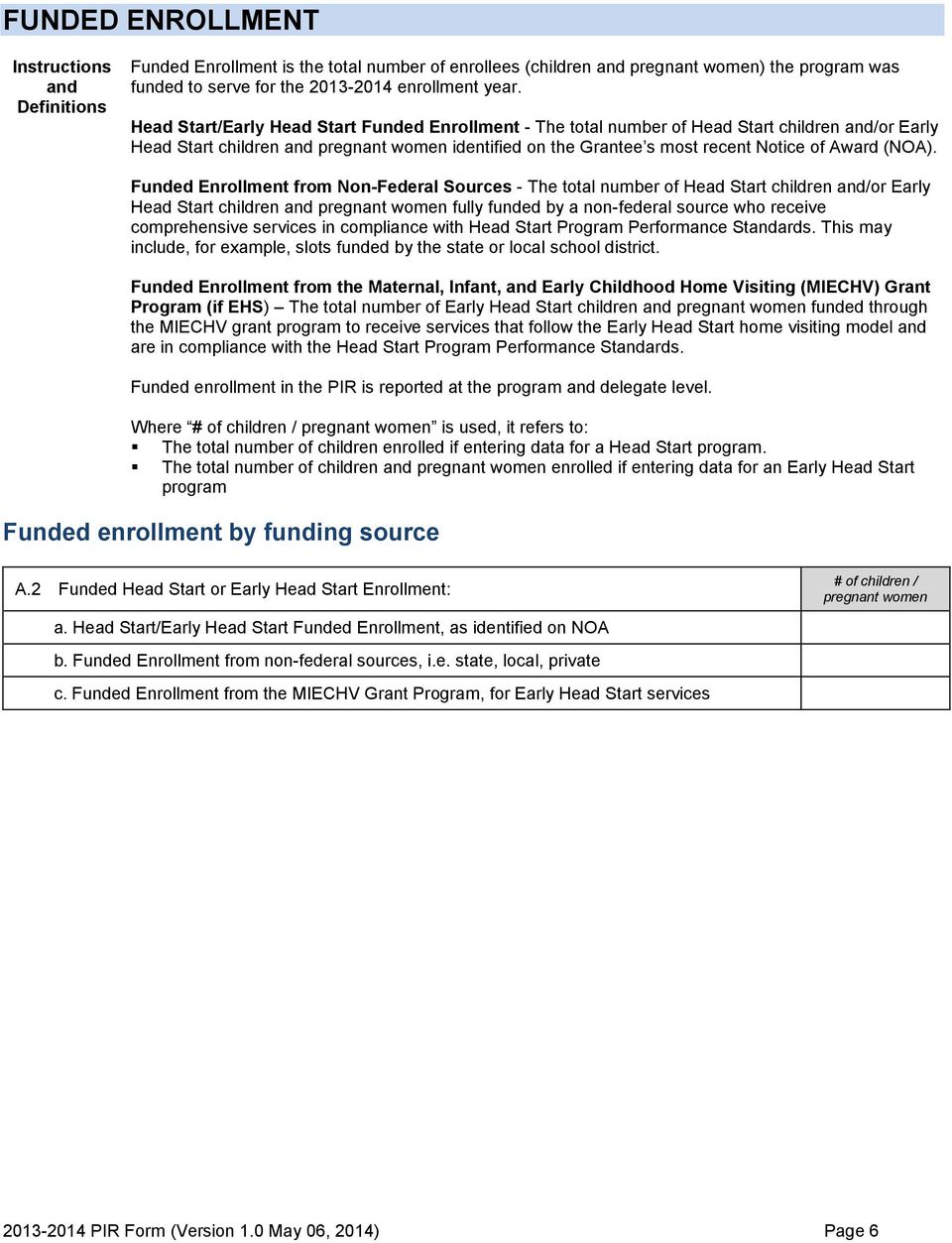
6 FUNDED ENROLLMENT Funded Enrollment is the total number of enrollees (children pregnant women) the program was funded to serve for the enrollment year. Head Start/Early Head Start Funded Enrollment - The total number of Head Start children /or Early Head Start children pregnant women identified on the Grantee s most recent Notice of Award (NOA). Funded Enrollment from Non-Federal Sources - The total number of Head Start children /or Early Head Start children pregnant women fully funded by a non-federal source who receive comprehensive services in compliance with Head Start Program Performance Stards. This may include, for example, slots funded by the state or local school district. Funded Enrollment from the Maternal, Infant, Early Childhood Home Visiting (MIECHV) Grant Program (if EHS) The total number of Early Head Start children pregnant women funded through the MIECHV grant program to receive services that follow the Early Head Start home visiting model are in compliance with the Head Start Program Performance Stards. Funded enrollment in the PIR is reported at the program delegate level. Where / pregnant women is used, it refers to: The total number of children enrolled if entering data for a Head Start program. The total number of children pregnant women enrolled if entering data for an Early Head Start program Funded enrollment by funding source A.2 Funded Head Start or Early Head Start Enrollment: a. Head Start/Early Head Start Funded Enrollment, as identified on NOA b. Funded Enrollment from non-federal sources, i.e. state, local, private c. Funded Enrollment from the MIECHV Grant Program, for Early Head Start services / pregnant women PIR Form (Version 1.0 May 06, 2014) Page 6
7 Funded enrollment by program option children Refer to regulations on program options, 45 CFR 1306 Head Start Staffing Requirements Program Options. Report funded enrollment for the program option used for the greatest part of the year when more than one program option is used with the same group of children. For example, programs with center-based services in the school year (9 months) home-based services for the summer months (3 months) would report funded enrollment as center-based services. This example is an implementation of consecutive program options in a single program year, not a combination option. Center-based option - services provided to children primarily in classroom settings. Full-day enrollment - services provided for more than 6 hours per day. o o Full-working-day enrollment - services provided for not less than 10 hours per day as permitted by State law (including regulation) for the provision of services. Full-calendar-year - all the days of the year other than Saturday, Sunday, a legal public holiday. Part-day enrollment - services provided for 6 hours or less per day o Double session option - option in which a single teacher is employed to work with one group of children in the morning a different group of children in the afternoon. The double session option does not refer to a program that employs a teacher to work with one group of children in the morning a different teacher to work with a different group of children in the afternoon, even if the same classroom space is used. Home-based option - services provided to children, primarily in the child's home, through intensive work with the child's parents family as the primary factor in the growth development of the child. Combination option - services provided to children in both a center setting through intensive work with the child's parents family at home. The combination option does not refer to a program that operates a center-based option during one part of the year a home-based option during another part of the year (consecutively). When consecutive program options are operating within the same program year, report funded enrollment for the primary option. For example, programs may operate center-based services for teen parents during the school year home-based services in the summer months. In this example, report the center-based option funded enrollment note the details of the home-based services in the question comments box. Family child care option - services provided to children receiving child care primarily in the home of a family child care provider or other family-like setting. Full-working-day enrollment - services provided for not less than 10 hours per day as permitted by State law (including regulation) for the provision of services. Full-calendar-year - all the days of the year other than Saturday, Sunday, a legal public holiday. Locally designed option - services provided through an alternative program variation that has been formally approved by the Office of Head Start PIR Form (Version 1.0 May 06, 2014) Page 7

8 A.3 Center-based option - 5 days per week: a. Full-day enrollment 1. Of these, the number available as full-working-day enrollment a. Of these, the number available for the full-calendar-year b. Part-day enrollment 1. Of these, the number in double sessions A.4 Center-based option - 4 days per week: a. Full-day enrollment b. Part-day enrollment 1. Of these, the number in double sessions A.5 Home-based option A.6 Combination option A.7 Family child care option a. Of these, the number available as full-working-day enrollment 1. Of these, the number available for the full-calendar-year A.8 Locally designed option Funded enrollment of pregnant women (EHS programs) A.9 Total number of pregnant women positions in funded enrollment Funded enrollment at child care partner # of pregnant women Child Care Partners - Child care centers that provide services to enrolled children that meet the Head Start Program Performance Stards. A.10 The number of funded enrollment positions at center-based child care partners with whom the program has formal contractual arrangements Include only those children served through a partner organization; not those in your own program s extended day or wrap-around care PIR Form (Version 1.0 May 06, 2014) Page 8

9 CLASSES Class - A group of children that functions as a single unit, including preschool, infants/toddlers, mixed-age groupings. Double Session Classes - Classes for which a single teacher is employed to work with one group of children in the morning a different group of children in the afternoon. Count each session as a separate class. For example, if a program had 5 classes that operated mornings 5 that operated afternoons with the same 5 teachers, this would count as 10 classes. Include both classes operated directly by Head Start Early Head Start, as well as those operated by child care partners. # of classes A.11 Total number of classes operated a. Of these, the number of double session classes CUMULATIVE ENROLLMENT Children by age Cumulative Enrollment - Include ALL children who have been enrolled in the program have attended at least one class or, for programs with home-based options, received at least one home visit. Include ALL pregnant women who have been enrolled in the program received Early Head Start services. Age of Child - Use the age of the child at the time of enrollment according to the date used by the local school system in determining eligibility for public school. A.12 Children by age: a. Under 1 year b. 1 year old c. 2 years old d. 3 years old e. 4 years old f. 5 years older at enrollment Pregnant women (EHS programs) # of pregnant women A.13 Cumulative enrollment of pregnant women PIR Form (Version 1.0 May 06, 2014) Page 9

10 Total cumulative enrollment / pregnant women A.14 Total cumulative enrollment System calculates total Type of eligibility Report each enrollee only once, in A.15, by primary type of eligibility. A.15 Report each enrollee only once by primary type of eligibility: / pregnant women a. Income below 100% of federal poverty line b. Receipt of public assistance such as TANF, SSI c. Status as a foster child - # children only d. Status as homeless e. Over income* f. Number of children exceeding the allowed over income enrollment (as noted below) with family incomes between 100% 130% of the federal poverty line** * Section 645(a)(B)(iii)(I) of the Head Start Act specifies that programs may serve, to a reasonable extent, up to 10 percent of participants in the area served who would benefit from such programs but who are not eligible due to options A.15.a through A.15.d above. Report in A.15.e above. ** Section 645(a)(B)(iii)(II) of the Head Start Act specifies that programs may serve children whose families have incomes below 130% of the federal poverty line if programs can demonstrate that all income-eligible children in their area are being served. This question applies only to those programs that have met the requirements of the Head Start Act have enrolled children below 130% of the federal poverty line. Report in A.15.f above. * Section 645(d) of the Head Start Act specifies that AIAN programs may enroll participants who do not meet the low-income criteria, as long as these participants comprise less than 50 percent of total enrollment. Report in A.15.e above. * Section 645(a) of the Head Start Act specifies that programs serving communities that meet these criteria may enroll participants who do not meet the low-income criteria, as long as these participants comprise less than 50 percent of total enrollment. Report in A.15.e above. A.16 If the program serves enrollees under A.15.f, specify how the program has demonstrated that all income-eligible children in their area are being served. Specify PIR Form (Version 1.0 May 06, 2014) Page 10

11 Prior enrollment Include children who were enrolled previously in Early Head Start, Head Start or some combination. For example, a child enrolled at birth in Early Head Start who is now in his or her second year of Head Start preschool should be counted in "Three or more years." Prior enrollment includes only those children who, in their previous year of Head Start or Early Head Start, were enrolled for at least half of the time that classes or home visits were in session. A.17 Enrolled in Head Start or Early Head Start for: a. The second year b. Three or more years Transition turnover (HS programs) HS Programs: When counting the number of children who were enrolled less than 45 days, count from the date the child began classes or, for home-based programs, the date home visits began. Grantees should include all children who have been enrolled in the program have attended at least one class. Programs with home-based options should include children who have received at least one home visit during that month. A.18 Total number of preschool children who left the program any time after classes or home visits began did not re-enroll a. Of the preschool children who left the program during the program year, the number of preschool children who were enrolled less than 45 days For Question A.18.b, report on all preschool children enrolled in Head Start at the end of the current enrollment year. If a child left the program prior to the end of the current enrollment year, do not report on that child. # of preschool children A.18.b. Of the number of preschool children enrolled in Head Start at the end of the current enrollment year, the number projected to be entering kindergarten in the following school year PIR Form (Version 1.0 May 06, 2014) Page 11

12 Transition turnover (EHS programs) EHS Programs: When counting the number of children who were enrolled less than 45 days, count from the date the child began classes or, for home-based programs, the date home visits began. Grantees should include all children who have been enrolled in the program have attended at least one class. Programs with home-based options should include children who have received at least one home visit during that month. Grantees should also include all pregnant women who have been enrolled in their program received Early Head Start services. Pregnant women who gave birth subsequently enrolled their infant in an Early Head Start program should NOT be included in turnover. A.19 Total number of infants toddlers who left the program any time after classes or home visits began did not re-enroll a. Of the infants toddlers who left the program above, the number of infants toddlers who were enrolled less than 45 days b. Of the infants toddlers who left the program during the program year, the number who aged out of Early Head Start 1. Of the infants toddlers who aged out of Early Head Start, the number who entered a Head Start program 2. Of the infants toddlers who aged out of Early Head Start, the number who entered another early childhood program 3. Of the infants toddlers who aged out of Early Head Start, the number who did NOT enter another early childhood program A.20 Total number of pregnant women who left the program after receiving Early Head Start services but before the birth of their infant, did not re-enroll A.21 Number of pregnant women receiving Early Head Start services at the time their infant was born a. Of the pregnant women enrolled when their infant was born, the number whose infant was subsequently enrolled in the program b. Of the pregnant women enrolled when their infant was born, the number whose infant was NOT subsequently enrolled in the program # of pregnant women PIR Form (Version 1.0 May 06, 2014) Page 12

13 Transition turnover (Migrant programs) Migrant Programs: When counting the number of children who were enrolled less than 45 days, count from the date the child began classes. Grantees should include all children who have been enrolled in the program have attended at least one class. If the program operated for less than 45 days, do NOT include children who completed the program in Turnover. A.22 Total number of children who left the program any time after classes or home visits began did not re-enroll a. Of the children who left the program during the program year, the number of children who were enrolled less than 45 days b. Of the children who left the program during the program year, the number of preschool children who aged out, i.e. left the program in order to attend kindergarten Child care subsidy Report the number of enrolled children for whom the program received a child care subsidy. Include all children who received services that met the Head Start Program Performance Stards regardless of the funding source. at end of enrollment year A.23 The number of enrolled children for whom the program received a child care subsidy Ethnicity The Office of Head Start follows the U.S. Census Bureau in terms of data collection on race ethnicity, by asking about them separately. Each family should choose how to report their own ethnicity race to the program for enrolled children ( enrolled pregnant women, if EHS). Each enrollee will be included in both an ethnicity category a race category. For example, a family that identifies their child as Black Cuban will be counted in the Hispanic or Latino ethnicity category also counted in the Black or African American race category. Hispanic or Latino origin - A person of Cuban, Mexican, Puerto Rican, South or Central American, or other Spanish culture or origin, regardless of their race. A.24 Ethnicity: a. Hispanic or Latino origin b. Non-Hispanic or Non-Latino origin / pregnant women PIR Form (Version 1.0 May 06, 2014) Page 13

14 Race American Indian or Alaska Native - A person having origins in any of the original peoples of North South America or Central America, who maintains tribal affiliation or community attachment. Asian - A person having origins in any of the original peoples of the Far East, Southeast Asia, or the Indian subcontinent. Black or African American - A person having origins in any of the Black racial groups of Africa. Native Hawaiian or other Pacific Isler - A person having origins in any of the original peoples of Hawaii, Guam, Samoa, or other Pacific Isls. White - A person having origins in any of the original peoples of Europe, the Middle East, or North Africa. Bi-Racial/Multi-Racial - A person of 2 or more races. Other - A person reporting a race other than those listed. Unspecified - A person whose race is unknown or whose parents declined to identify their race. A.25 Race: a. American Indian or Alaska Native b. Asian c. Black or African American d. Native Hawaiian or other Pacific Isler e. White f. Biracial/Multi-racial g. Other 1. Explain: h. Unspecified 1. Explain: / pregnant women PIR Form (Version 1.0 May 06, 2014) Page 14

15 Primary language of family at home A.26 Primary language of family at home: a. English b. Spanish / pregnant women c. Native Central American, South American, Mexican Languages (e.g., Mixteco, Quichean.) d. Caribbean Languages (e.g., Haitian-Creole, Patois) e. Middle Eastern & South Asian Languages (e.g., Arabic, Hebrew, Hindi, Urdu, Bengali) f. East Asian Languages (e.g., Chinese, Vietnamese, Tagalog) g. Native North American/Alaska Native Languages h. Pacific Isl Languages (e.g., Palauan, Fijian) i. European & Slavic Languages (e.g., German, French, Italian, Croatian, Yiddish, Portuguese, Russian) j. African Languages (e.g., Swahili, Wolof) k. Other (e.g., American Sign Language) 1. Specify: l. Unspecified (language is not known or parents declined identifying the home language) PIR Form (Version 1.0 May 06, 2014) Page 15

16 TRANSPORTATION Please read transportation questions carefully as responses are required from all programs, including those that do not provide transportation. Transportation services Yes (Y) / No (N) A.27 Does the program provide transportation to some or all of the enrolled children either directly or through a formal contractual agreement with a transportation provider? Buses a. Number of children for whom transportation is provided Include only buses purchased or leased with ACF grant funds that were used in the last program year to support the operation of the Head Start or Early Head Start program # of buses owned A.28 Total number of buses owned by the program that were purchased with ACF grant funds are currently used to support program operations, regardless of year purchased a. Of these, the number of buses purchased since last year s PIR was reported Yes (Y) / No (N) A.29 Are any of the buses used by the program leased by the program itself? # of buses leased a. Number of buses leased PIR Form (Version 1.0 May 06, 2014) Page 16

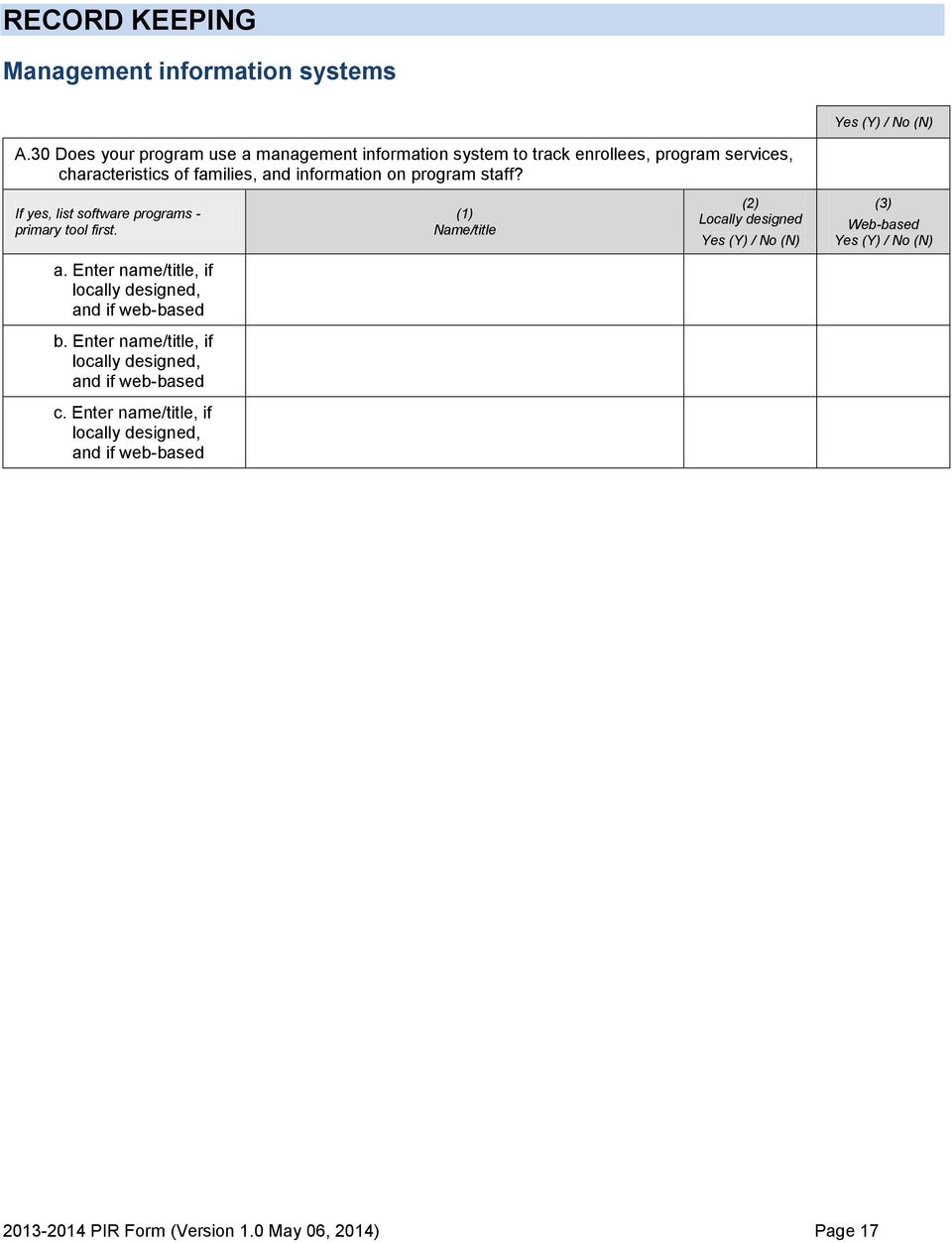
17 RECORD KEEPING Management information systems Yes (Y) / No (N) A.30 Does your program use a management information system to track enrollees, program services, characteristics of families, information on program staff? If yes, list software programs - primary tool first. Name/title Locally designed Yes (Y) / No (N) (3) Web-based Yes (Y) / No (N) a. Enter name/title, if locally designed, if web-based b. Enter name/title, if locally designed, if web-based c. Enter name/title, if locally designed, if web-based PIR Form (Version 1.0 May 06, 2014) Page 17
18 B. PROGRAM STAFF & QUALIFICATIONS This section of the PIR is used to describe all staff involved in the Head Start or Early Head Start program. Programs should include all staff on the payroll at any time since last year s PIR was reported. If more than one individual held the position during the year, provide information for the person who was in the position at the time the PIR is reported. If the position is vacant at the time the PIR is reported, provide information on the last person to hold the position during the year. Head Start Early Head Start programs must report separately. Report staff members who work with both programs on both PIRs. Grantees delegate agencies must also report staff separately. Staff to include or not to include in the PIR counts. Included Head Start or Early Head Start Staff - Includes all administrative, management, child development, content area, support staff such as custodians, regardless of the funding source for their salaries or number of hours worked. Contracted Staff - Includes individuals who are not Head Start or Early Head Start employees with whom the program has contracted to provide an ongoing service (e.g., disabilities specialists mental health professionals, child care providers, collaborative teaching staff, family child care providers, or bus drivers). May be Substitutes - For PIR purposes, include only those substitutes that replaced a staff included member for an extended period of time. Examples include turnover, maternity, or other Not included TOTAL STAFF Staff by type extended leave. Consultants - Individuals providing short-term services to the program are not to be counted as staff. Volunteers, student interns, or trainees are not to be counted as staff. B.1 Total number of staff members, regardless of the funding source for their salary or number of hours worked a. Of these, the number who are current or former Head Start or Early Head Start parents b. Of these, the number who left since last year s PIR was reported 1. Of these, the number who were replaced # of Head Start or Early Head Start staff # of contracted staff Programs completing the PIR survey for the first time should report the number of staff who left since the program began PIR Form (Version 1.0 May 06, 2014) Page 18

19 TOTAL VOLUNTEERS Volunteers by type # of volunteers B.2 Number of persons providing any volunteer services to the program since last year s PIR was reported a. Of these, the number who are current or former Head Start or Early Head Start parents Include both classroom non-classroom volunteers. Count each person only once, regardless of the number of times they have volunteered in the program. MANAGEMENT STAFF Management staff salaries Complete the table below for management staff individual staff persons with lead responsibility for each content area. Do not use averages. Annual Salary - Report the staff member s full annual salary for each position, even if part or all of the salary is funded by a non-acf source or if the position is split between programs. Specify the actual salary per year. Do not annualize this figure if the staff member works less than 12 months of the year. Report the percentage of the staff member s salary that is paid by Federal Head Start or Early Head Start funds. Enter the percentage (%); Do not enter the dollar amount. For example: The Program Director s annual salary is $75,000. One-third of their salary is paid for by the local school district two-thirds is paid by Head Start. Report the full annual salary of $75,000. Report the percentage funded by Head Start as 66%. B.3 Management staff: Annual salary % of salary funded by Head Start or Early Head Start a. Executive Director $ % b. Head Start or Early Head Start Director $ % c. Child Development & Education Manager $ % d. Health Services Manager $ % e. Family & Community Partnerships Manager $ % f. Disability Services Manager $ % g. Fiscal Officer $ % PIR Form (Version 1.0 May 06, 2014) Page 19

20 Coordination of services Report the average number of hours per week services managers in the listed positions spend working with community partners/service providers to plan implement coordinated services for Head Start children families. Examples include: hours a Disability Services Manager spends with LEA officials coordinating how a child s IEP or IFSP will be integrated into supported by the Head Start program; time a Health Services Manager spends developing maintaining partnerships with local health care providers to assure children have access to services for which they are referred. B.4 On average, the number of hours per week services managers spend coordinating services: Average # of hours per week a. Child Development & Education Manager b. Health Services Manager c. Family & Community Partnerships Manager d. Disability Services Manager If more than one person has lead responsibility for the role, provide the combined number of hours per week devoted, on average, to coordinating services PIR Form (Version 1.0 May 06, 2014) Page 20

21 CHILD DEVELOPMENT STAFF Child development staff qualifications - preschool classroom assistant teachers (HS Migrant programs) Include ALL preschool child development staff providing direct services to Head Start children in classroom settings, both part-time full-time, regardless of the funding source for their salaries. Include contracted child development staff the child development staff of partnering agencies that provide direct services to Head Start children. Count each preschool child development staff person by the highest degree or credential held. Staff persons that are continuing their education in pursuit of a higher degree or credential should also be reported in the relevant subsections of that category. Preschool Child Development Staff - refers to child development staff serving Head Start program children, as well as child development staff serving Migrant Seasonal Head Start program children ages three to five. Early Childhood Education Degree - Is an associate, baccalaureate, or advanced degree in early childhood education. Classroom Teachers - Includes all lead teachers co-lead teachers. Assistant Teachers - for preschool classes, this refers to either the second paid staff in the classroom or, when two teachers are present, the third paid staff working as a teacher aide. # of Classroom Teachers # of Assistant Teachers B.5 Total number of preschool child development staff by position # of Classroom Teachers # of Assistant Teachers Of the number of preschool child development staff by position, the number with the following degrees or credentials: a. An advanced degree in: 1. Early childhood education 2. Any field coursework equivalent to a major relating to early childhood education, with experience teaching preschool-age children PIR Form (Version 1.0 May 06, 2014) Page 21
22 # of Classroom Teachers # of Assistant Teachers Of the number of preschool child development staff by position, the number with the following degrees or credentials: b. A baccalaureate degree in: 1. Early childhood education 2. Any field coursework equivalent to a major relating to early childhood education with experience teaching preschool-age children 3. Any field has been admitted into is supported by the Teach for America program passed a rigorous early childhood content exam Of the preschool child development staff with a baccalaureate degree in B.5.b.1 through B.5.b.3 above, the number enrolled in: 4. Advanced degree in early childhood education or in any field coursework equivalent to a major relating to early childhood education # of Classroom Teachers # of Assistant Teachers Of the number of preschool child development staff by position, the number with the following degrees or credentials: c. An associate degree in: 1. Early childhood education 2. A field related to early childhood education coursework equivalent to a major relating to early childhood education with experience teaching preschool-age children Of the preschool child development staff with an associate degree in B.5.c.1 B.5.c.2 above, the number enrolled in: 3. A baccalaureate degree program in early childhood education or in any field coursework equivalent to a major relating to early childhood education # of Classroom Teachers # of Assistant Teachers Of the number of preschool child development staff by position, the number with the following credentials: d. A Child Development Associate (CDA) credential or state-awarded preschool, infant/toddler, family child care or home-based certification, credential, or licensure that meets or exceeds CDA requirements 1. Of these, a Child Development Associate (CDA) credential or state-awarded preschool, infant/toddler, family child care or home-based certification, credential, or licensure that meets or exceeds CDA requirements that is appropriate to the option in which they are working Of the preschool child development staff with the credentials in B.5.d above, the number enrolled in: 2. A baccalaureate degree program in early childhood education or in any field coursework equivalent to a major relating to early childhood education 3. An associate degree program in early childhood education or in a related field coursework equivalent to a major relating to early childhood education PIR Form (Version 1.0 May 06, 2014) Page 22
23 # of Classroom Teachers # of Assistant Teachers Of the number of preschool child development staff by position: e. The number who do not have the qualifications listed in B.5.a through B.5.d Of the preschool child development staff in B.5.e above, the number enrolled in: 1. A baccalaureate degree program in early childhood education or in any field coursework equivalent to a major relating to early childhood education 2. An associate degree program in early childhood education or in a related field coursework equivalent to a major relating to early childhood education 3. Any type of Child Development Associate (CDA) credential or state-awarded preschool, infant/toddler, family child care or home-based certification, credential, or licensure that meets or exceeds CDA requirements that is appropriate to the option in which they are working # of classes B.6 Total number of center-based option classes serving preschool-aged children B.7 Number of center-based option classes serving preschool-aged children in which at least one teacher (excluding assistant teachers) has one of the following: An advanced or baccalaureate degree in early childhood education or in any field coursework equivalent to a major relating to early childhood education with experience teaching pre-school age children, or A baccalaureate degree has been admitted into is supported by the Teach for America program passed a rigorous early childhood content exam. An associate degree in early childhood education or in a related field coursework equivalent to a major relating to early childhood education with experience teaching preschool-age children Only include center-based option classes serving preschool-age children; do not include combination option or locally designed option classes serving preschool-age children; do not include classes serving only infants toddlers PIR Form (Version 1.0 May 06, 2014) Page 23
24 Child development staff qualifications - infant toddler classroom assistant teachers (EHS Migrant programs) Includes child development staff, both part-time full-time in classroom settings, regardless of the funding source for their salaries, who provide services to infants, toddlers pregnant women. Include contracted child development staff the child development staff of partnering agencies that provide services to infants, toddlers pregnant women. Count each infant toddler child development staff person by the highest degree or credential held. Staff persons that are continuing their education in pursuit of a higher degree or credential should also be reported in the relevant subsections of that category. Infant Toddler Child Development Staff - refers to child development staff serving Early Head Start program children, child development staff serving Migrant Seasonal Head Start program infants /or toddlers,, where applicable, staff serving pregnant women. Early Childhood Education Degree - Is an associate, baccalaureate, or advanced degree in early childhood education. Classroom Teachers - Includes all lead teachers co-lead teachers. Each center-based infant toddler class must provide one teacher for each group of four children, with a total group size of no more than eight infants /or toddlers. All infant toddler classrooms must be staffed by two teachers. Assistant Teachers - For infant toddler classes, this refers to the third paid staff in a center-based class working as a teacher aide. # of Classroom Teachers # of Assistant Teachers B.8 Total number of infant toddler child development staff by position # of Classroom Teachers # of Assistant Teachers Of the number of infant toddler child development staff by position, the number with the following degrees or credentials: a. An advanced degree in: 1. Early childhood education with a focus on infant toddler development 2. Any field coursework equivalent to a major relating to early childhood education, with experience teaching infants /or toddlers PIR Form (Version 1.0 May 06, 2014) Page 24
25 # of Classroom Teachers # of Assistant Teachers Of the number of infant toddler child development staff by position, the number with the following degrees or credentials: b. A baccalaureate degree in: 1. Early childhood education with a focus on infant toddler development 2. Any field coursework equivalent to a major relating to early childhood education with experience teaching infants /or toddlers Of the infant toddler child development staff with a baccalaureate degree in B.8.b.1 through B.8.b.2 above, the number enrolled in: 3. Advanced degree in early childhood education or in any field coursework equivalent to a major relating to early childhood education with a focus on infant toddler development # of Classroom Teachers # of Assistant Teachers Of the number of infant toddler child development staff by position, the number with the following degrees or credentials: c. An associate degree in: 1. Early childhood education with a focus on infant toddler development 2. A field related to early childhood education coursework equivalent to a major relating to early childhood education with experience teaching infants toddlers Of the infant toddler child development staff with an associate degree in B.8.c.1 B.8.c.2 above, the number enrolled in: 3. A baccalaureate degree program in early childhood education or in any field coursework equivalent to a major relating to early childhood education with a focus on infant toddler development PIR Form (Version 1.0 May 06, 2014) Page 25
26 # of Classroom Teachers # of Assistant Teachers Of the number of infant toddler child development staff by position, the number with the following credentials: d. A Child Development Associate (CDA) credential or state-awarded preschool, infant/toddler, family child care or home-based certification, credential, or licensure that meets or exceeds CDA requirements 1. Of these, a Child Development Associate (CDA) credential or state-awarded preschool, infant/toddler, family child care or home-based certification, credential, or licensure that meets or exceeds CDA requirements that is appropriate to the option in which they are working Of the infant toddler child development staff with the credentials in B.8.d above, the number enrolled in: 2. A baccalaureate degree program in early childhood education or in any field coursework equivalent to a major relating to early childhood education with a focus on infant toddler development 3. An associate degree program in early childhood education or in a related field coursework equivalent to a major relating to early childhood education with a focus on infant toddler development # of Classroom Teachers # of Assistant Teachers Of the number of infant toddler child development staff by position: e. The number who do not have the qualifications listed in B.8.a through B.8.d Of the infant toddler child development staff in B.8.e above, the number enrolled in: 1. A baccalaureate degree program in early childhood education or in any field coursework equivalent to a major relating to early childhood education with a focus on infant toddler development 2. An associate degree program in early childhood education or in a related field coursework equivalent to a major relating to early childhood education with a focus on infant toddler development 3. Any type of Child Development Associate (CDA) credential or state-awarded preschool, infant/toddler, family child care or home-based certification, credential, or licensure that meets or exceeds CDA requirements that is appropriate to the option in which they are working PIR Form (Version 1.0 May 06, 2014) Page 26
27 Child development staff qualifications - home-based FCC Include all home-based visitors family child care staff, both part-time full-time, regardless of the funding source for their salary. Count each child development staff person once by the highest degree or credential held. It is recognized that staff may have multiple degrees /or credentials. Home-based Visitors - Includes home visitors with a caseload providing child development services in the home-based option only, whether or not they also function as family service workers. Family & community partnerships staff are reported in a separate section. Home-based Visitor Supervisor Staff responsible for supervising home-based visitors. Family Child Care Providers - Includes the provider of services in his or her place of residence or in another family-like setting. Family Child Care Specialist - a child development specialist or other Head Start or delegate agency staff member with responsibilities related to the provision of comprehensive Head Start Early Head Start services delivered in the family child care option. # of Home- Based Visitors # of Home- Based Visitor Supervisors (3) # of Family Child Care Providers (4) # of Family Child Care Specialists B.9 Total number of child development staff by position # of Home- Based Visitors # of Home- Based Visitor Supervisors (3) # of Family Child Care Providers (4) # of Family Child Care Specialists Of the number of child development staff by position, the number with the following degrees licenses: a. An advanced degree in/ licensed as: 1. Social work/ Licensed clinical social worker (LCSW)/ Licensed master social worker (LMSW) 2. Marriage family therapy/ Licensed marriage family therapist (LMFT) 3. Psychology 4. Sociology 5. Human services (include related areas such as child family services or social services) 6. Nursing plus Nurse Practitioner (NP) license 7. Early childhood education 8. Other 1. Specify: PIR Form (Version 1.0 May 06, 2014) Page 27
28 # of Home- Based Visitors # of Home- Based Visitor Supervisors (3) # of Family Child Care Providers (4) # of Family Child Care Specialists Of the number of child development staff by position, the number with the following degrees licenses: b. An baccalaureate degree in: 1. Social work 2. Psychology 3. Sociology 4. Human services (include related areas such as child family services or social services) 5. Nursing plus Registered Nurse (RN) license 6. Early childhood education 7. Other 1. Specify: # of Home- Based Visitors # of Home- Based Visitor Supervisors (3) # of Family Child Care Providers (4) # of Family Child Care Specialists Of the number of child development staff by position, the number with the following degrees licenses: c. An associate degree in: 1. Social work 2. Psychology 3. Sociology 4. Human services (include related areas such as child family services or social services) 5. Nursing plus Registered Nurse (RN) license 6. Early childhood education 7. Other 1. Specify: PIR Form (Version 1.0 May 06, 2014) Page 28
29 # of Home- Based Visitors # of Home- Based Visitor Supervisors (3) # of Family Child Care Providers (4) # of Family Child Care Specialists Of the number of child development staff by position, the number with the following licenses, certifications, or credentials: d. License, certification, or credential held: 1. Nursing, non-rn, i.e. LPN, CNA, etc. 2. Family development credential (FDC) 3. Child development associate credential (CDA) 4. State-awarded certification, credential, or license appropriate to the option in which they are working, i.e. home-based option or family child care option 5. Other 1. Specify: # of Home- Based Visitors # of Home- Based Visitor Supervisors (3) # of Family Child Care Providers (4) # of Family Child Care Specialists Of the number of child development staff by position: e. The number who do not have the qualifications listed in B.9.a through B.9.d. Of the staff in B.9.e above, the number enrolled in: 1. An advanced degree or license 2. A baccalaureate degree 3. An associate degree 4. Studies leading to a non-degree license, certificate, or credential PIR Form (Version 1.0 May 06, 2014) Page 29
30 NON-SUPERVISORY CHILD DEVELOPMENT STAFF Non-supervisory child development staff members are reported in questions B.10 through B.23. Do not include supervisory staff (child development supervisors or home-based supervisors). Child development staff classroom teacher salary by level of education Average Annual Salary - Report the average annual salary for classroom teachers with each listed degree or credential type, even if part or all of their salaries are funded by a non-acf source. Report the actual average salaries, not the pay scale for teachers with this degree or credential. B.10 Classroom teacher salary by level of education: Average annual salary a. Advanced degree in early childhood education or related degree $ b. Baccalaureate degree in early childhood education or related degree $ c. Associate degree in early childhood education or related degree $ d. A Child Development Associate (CDA) credential or state-awarded preschool, infant/toddler, family child care or home-based certification, credential, or licensure that meets or exceeds CDA requirements $ e. Classroom teachers that do not have the qualifications listed in B.10.a through B.10.d $ Child development staff average salary Average Annual Salary - Report the average annual salary for all staff in each position, even if part or all of the salary is funded by a non-acf source or if the position is split between programs. Calculate the average using actual salary per year. Do not annualize this figure if staff members work less than 12 months of the year. Average Hourly Rate - Report the average annual salary as an hourly dollar amount. For example, an average annual of salary of $30,000 in a 36-week, 40-hour per week program equals an average hourly rate of $ B.11 Average salary: Average annual salary Average hourly rate a. Classroom Teachers $ $ b. Assistant Teachers $ $ c. Home-Based Visitors $ $ d. Family Child Care Providers $ $ PIR Form (Version 1.0 May 06, 2014) Page 30
31 Child development staff ethnicity The Office of Head Start follows the U.S. Census Bureau in terms of data collection on race ethnicity, by asking about them separately. Each staff person should choose how to report their own ethnicity race to the program. Report each non-supervisory child development staff member in both an ethnicity category a race category. This includes classroom teachers, assistant teachers, home-based visitors, family child care providers. For example, a staff member that is identified as Black Cuban will be counted in the Hispanic or Latino ethnicity category also counted in the Black or African American race category. Hispanic or Latino origin - A person of Cuban, Mexican, Puerto Rican, South or Central American, or other Spanish culture or origin, regardless of their race. B.12 Ethnicity: a. Hispanic or Latino origin b. Non-Hispanic or Non-Latino origin # of non-supervisory child development staff Child development staff race American Indian or Alaska Native - A person having origins in any of the original peoples of North South America or Central America, who maintains tribal affiliation or community attachment. Asian - A person having origins in any of the original peoples of the Far East, Southeast Asia, or the Indian subcontinent. Black or African American - A person having origins in any of the Black racial groups of Africa. Native Hawaiian or other Pacific Isler - A person having origins in any of the original peoples of Hawaii, Guam, Samoa, or other Pacific Isls. White - A person having origins in any of the original peoples of Europe, the Middle East, or North Africa. Bi-Racial/Multi-Racial - A person of 2 or more races. Other - A person reporting a race other than those listed. Unspecified - A person whose race is unknown or who declined to identify their race. B.13 Race: a. American Indian or Alaska Native b. Asian c. Black or African American d. Native Hawaiian or other Pacific Isler e. White f. Biracial/Multi-racial g. Other 1. Explain: h. Unspecified 1. Explain: # of non-supervisory child development staff PIR Form (Version 1.0 May 06, 2014) Page 31
32 Child development staff language Report each non-supervisory child development staff member. This includes classroom teachers, assistant teachers, home-based visitors, family child care providers. # of non-supervisory child development staff B.14 The number who are proficient in a language(s) other than English a. Of these, the number who are proficient in more than one language other than English B.15 Language groups in which staff are proficient: a. Spanish # of non-supervisory child development staff b. Native Central American, South American, Mexican Languages (e.g., Mixteco, Quichean.) c. Caribbean Languages (e.g., Haitian-Creole, Patois) d. Middle Eastern & South Asian Languages (e.g., Arabic, Hebrew, Hindi, Urdu, Bengali) e. East Asian Languages (e.g., Chinese, Vietnamese, Tagalog) f. Native North American/Alaska Native Languages g. Pacific Isl Languages (e.g., Palauan, Fijian) h. European & Slavic Languages (e.g., German, French, Italian, Croatian, Yiddish, Portuguese, Russian) i. African Languages (e.g., Swahili, Wolof) j. Other (e.g., American Sign Language) 1. Specify: k. Unspecified (language is not known or staff declined identifying the language) PIR Form (Version 1.0 May 06, 2014) Page 32
33 Child development staff classroom teacher turnover This item applies to classroom teachers only. Do not include assistant teachers, home-based visitors, or family child care providers. # of classroom teachers B.16 The number of classroom teachers who left the program during the year Include those who left since last year s PIR was reported. B.17 Of these, the number who left for the following reasons: a. Higher compensation/benefits package in the same field (e.g., teacher left to school system) b. Change in job field c. Other 1. Comments: B.18 Number of classroom teacher vacancies in the program that remained unfilled for a period of 3 months or longer B.19 Number of classroom teachers hired during the year due to turnover # of classroom teachers Count only replacement staff; do not count staff added due to expansion. Child development staff home-based visitor turnover This item applies to home-based visitors only. Do not include family service workers, teachers, or family child care child development specialists. # of homebased visitors B.20 The number of home-based visitors who left the program during the year Include those who left since last year s PIR was reported. B.21 Of these, the number who left for the following reasons: a. Higher compensation/benefits package in the same field b. Change in job field c. Other 1. Comments: B.22 Number of home-based visitor vacancies in the program that remained unfilled for a period of 3 months or longer B.23 Number of home-based visitors hired during the year due to turnover # of homebased visitors Count only replacement staff; do not count staff added due to expansion PIR Form (Version 1.0 May 06, 2014) Page 33
34 FAMILY & COMMUNITY PARTNERSHIPS STAFF Family & community partnerships staff qualifications Include all family service staff, both part-time full-time, regardless of the funding source for their salary. Include family service staff shared by Head Start Early Head Start programs on the PIR of the program in which the majority of their time is spent. Count each staff member only once by the highest level of education completed. Related Degree - Is an advanced degree, baccalaureate degree, or an associate degree with a major in such fields as social work, sociology, psychology, family studies, counseling, family development, family systems theory, or human resources development. # of family workers # of FCP supervisors B.24 Total number of family & community partnerships (FCP) staff a. Of the FCP supervisors, the number who work directly with families, i.e. staff with a family caseload B.25 Of the family & community partnerships staff, the number with the following education: a. A related advanced degree b. A related baccalaureate degree c. A related associate degree d. GED or high school diploma # of family workers # of FCP supervisors B.26 Of the family & community partnerships staff who do not have a related degree, the number in training leading to a related degree or credential # of family workers # of FCP supervisors B.27 Comments on staff shared by Head Start Early Head Start programs: PIR Form (Version 1.0 May 06, 2014) Page 34
35 EDUCATION & CHILD DEVELOPMENT MANAGEMENT STAFF Education & child development managers/coordinators qualifications Head Start programs are required to hire staff or consultants to provide context area expertise in several key areas; see section (d) of the Head Start Program Performance Stards. The titles of these staff members vary; programs may refer to these persons as managers, coordinators, or content area experts, for example. The following PIR questions ask specifically about the manager(s)/coordinator(s) providing content area expertise oversight on education & child development services. The role of the education & child development manager/coordinator includes serving as a curriculum specialist providing assistance to teachers in the implementation adaptation of curricula to a group of children or the needs of an individual child. Note that in larger programs, there may be multiple education & child development (ECD) managers/coordinators, whereas in smaller programs, one individual may spend part of his or her time in the education & child development manager/coordinator role part of his or her time in another role(s). Report on all individuals with a full- or part-time role as ECD managers/coordinators B.28 Total number of education & child development managers/coordinators # of ECD managers/ coordinators # of ECD managers/ coordinators Of the education & child development managers/coordinators, the number with the following degrees or credentials: a. An advanced degree in early childhood education, or an advanced degree in any field coursework equivalent to a major relating to early childhood education with experience teaching preschool-age children b. A baccalaureate degree in early childhood education, or a baccalaureate degree in any field coursework equivalent to a major relating to early childhood education with experience teaching preschool-age children # of ECD managers/ coordinators Of the education & child development managers/coordinators, the number with the following degrees or credentials: c. An associate degree in early childhood education, or an associate degree in any field coursework equivalent to a major relating to early childhood education with experience teaching preschool-age children Of the education & child development managers/coordinators preschool child development staff in B.28.c above, the number enrolled in: 1. A baccalaureate degree in early childhood education, or a baccalaureate degree in any field coursework equivalent to a major relating to early childhood education PIR Form (Version 1.0 May 06, 2014) Page 35
36 # of ECD managers/ coordinators Of the education & child development managers/coordinators, the number with the following degrees or credentials: d. A Child Development Associate (CDA) credential or state-awarded preschool, infant/toddler, family child care or home-based certification, credential, or licensure that meets or exceeds CDA requirements Of the education & child development managers/coordinators preschool child development staff in B.28.d above, the number enrolled in: 1. A baccalaureate degree in early childhood education, or a baccalaureate degree in any field coursework equivalent to a major relating to early childhood education # of ECD managers/ coordinators Of the education & child development managers/coordinators, the number with the following degrees or credentials: e. None of the qualifications listed in B.28.a through B.28.d Of the education & child development managers/coordinators preschool child development staff in B.28.e above, the number enrolled in: 1. A baccalaureate degree in early childhood education, or a baccalaureate degree in any field coursework equivalent to a major relating to early childhood education B.29 Comments on education & child development managers/coordinators shared by Head Start Early Head Start programs: PIR Form (Version 1.0 May 06, 2014) Page 36
37 C. CHILD & FAMILY SERVICES Selected items in this section require data to be reported both at the time of enrollment at the end of the enrollment year. Report on ALL children pregnant women enrolled during the course of the enrollment year in both columns, including those who left the program late enrollees. At Enrollment - The status of the individual enrollee at the time of his or her enrollment (i.e., include the status of children who enrolled during the enrollment year). At End of Enrollment - The status of each enrollee at the end of his or her enrollment in the program. Include the status of those who left the program during the enrollment year. Since last year s PIR was reported Time frame to report on any services that occurred since the prior year s PIR was submitted. Include any services delivered after the end of the program year to children pregnant women enrolled in the program, providing they occur prior to PIR submission. For example, a child who is transitioning into the public school may be supported by family service staff to complete or continue medical treatments through the summer months, even though classes have ended. Also, include children who received services in preparation for their enrollment in Head Start or Early Head Start, such as EPSDT screenings. These screenings may have occurred prior to last year s PIR submission. However, these children were not included in that report therefore would be included in the current year s report. HEALTH SERVICES Health information should be obtained from the medical, dental, immunization records of all children pregnant women enrolled for any length of time since last year s PIR was reported. Indian Health Services Migrant Health Services are not considered health insurance for purposes of the PIR. Refer to the State EPSDT schedules Early Periodic Screening, Diagnostic, Treatment (EPSDT) Medicaid enrolled - The child or pregnant woman has been officially certified as eligible for Medicaid paid services. The term does not include children or pregnant women who are thought to be eligible but have not been officially certified. Include children or pregnant women enrolled in Medicaid for any length of time since last year s PIR was reported. Children s Health Insurance Program - A federal-state partnership administered by the state under broad federal guidelines. The program may be known as "CHIP" or function under a different name. CHIP enrolled - The child has been officially certified as eligible to receive services covered by the Children's Health Insurance Program. Include children enrolled in CHIP for any length of time PIR Form (Version 1.0 May 06, 2014) Page 37
38 Health insurance children Count each child only once In C.1.a, report children enrolled in Medicaid, CHIP, or a program jointly-funded by Medicaid CHIP, which is sometimes referred to as a Medicaid expansion program. at enrollment at end of enrollment year C.1 Number of all children with health insurance Of these, the number of children whose primary health insurance fits into the following categories: a. Number enrolled in Medicaid /or CHIP b. Number enrolled in state-only funded insurance (for example, medically indigent insurance) c. Number with private health insurance (for example, parent's insurance) d. Number with health insurance other than those listed above, for example, Military Health (Tri-Care or CHAMPUS) 1. Specify: C.2 Number of children with no health insurance Health insurance - pregnant women (EHS programs) # of pregnant women at enrollment # of pregnant women at end of enrollment C.3 Number of pregnant women with at least one type of health insurance Of these, the number of pregnant women whose primary health insurance fits into the following categories: a. Number enrolled in Medicaid b. Number enrolled in another publicly funded insurance program that is not Medicaid c. Number with private health insurance d. Number with health insurance other than those listed above, for example, Military Health (Tri-Care or CHAMPUS) 1. Specify: C.4 Number of pregnant women with no health insurance PIR Form (Version 1.0 May 06, 2014) Page 38
39 Medical Medical Home - An ongoing source of continuous, accessible health care excluding urgent care centers emergency room settings. Medical Treatment - Any service that is required to improve the physical condition of the child, including all forms of medical follow-up. Medical home - children Chronic Condition - Health conditions that continue over a long period of time. Examples include allergies, asthma, hearing loss, diabetes, etc. Include only those enrolled children diagnosed with a chronic condition that required ongoing medical treatment since last year s PIR was reported. at enrollment at end of enrollment year C.5 Number of children with an ongoing source of continuous, accessible health care C.6 Number of children receiving medical services through the Indian Health Service C.7 Number of children receiving medical services through a migrant community health center PIR Form (Version 1.0 May 06, 2014) Page 39
40 Medical services children Include children who left the program, if they were up-to-date when they left the program, when counting children who are up-to-date on a schedule of age-appropriate preventive primary health care. Question C.8.a. C.8.b ask specifically about children with any chronic condition needing medical treatment that have been newly diagnosed with this chronic condition since last year s PIR was reported, by a health care professional. Question C.9 asks about all children receiving medical treatment for the specific chronic conditions listed, regardless of when the condition was first diagnosed by a health care professional. at enrollment at end of enrollment year C.8 Number of all children who are up-to-date on a schedule of age-appropriate preventive primary health care, according to the relevant state s EPSDT schedule for well child care at end of enrollment year a. Of these, the number diagnosed by a health care professional with any chronic condition needing medical treatment since last year s PIR was reported 1. Of these, the number who have received or are receiving medical treatment b. Specify the primary reason that children who needed medical treatment, for any chronic condition diagnosed by a health care professional since last year s PIR was reported, did not receive it: Select one primary reason (X) 1. No health insurance 2. No pediatric care available in local area 3. Medicaid not accepted by health provider 4. Parents did not keep/make appointment 5. Children left the program before their appointment date 6. Appointment is scheduled for future date 7. No transportation 8. Other (please specify): PIR Form (Version 1.0 May 06, 2014) Page 40
41 C.9 Number of all children who received medical treatment for the following chronic conditions since last year s PIR was reported, regardless of when the condition was first diagnosed by a health care professional: a. Anemia b. Asthma c. Hearing Difficulties d. Vision Problems e. High Lead Levels f. Diabetes Body Mass Index (BMI) children (HS Migrant programs) Migrant programs should report on children age 3 older only when completing this item. Body Mass Index (BMI) is a number calculated from a child's weight height. For children teens, BMI is age- sex-specific is often referred to as BMI-for-age. After BMI is calculated for children teens, the BMI number is plotted on the CDC BMI-for-age growth charts (for either girls or boys) to obtain a percentile ranking. The percentile indicates the relative position of the child's BMI number among children of the same sex age. For children, BMI is used to screen for underweight, healthy weight, overweight, or obese. For more information, including BMI-for-age growth charts, see the Centers for Disease Control Prevention (CDC) website, at About BMI for Children Teens. C.10 Number of all children who are in the following weight categories according to the 2000 CDC BMIfor-age growth charts a. Underweight (BMI less than 5 th percentile for child s age sex) at enrollment b. Healthy weight (at or above 5 th percentile below 85 th percentile for child s age sex) c. Overweight (BMI at or above 85 th percentile below 95 th percentile for child s age sex) d. Obese (BMI at or above 95 th percentile for child s age sex) Immunization services - children at enrollment at end of enrollment year C.11 Number of children who have been determined by a health care professional to be up-to-date on all immunizations appropriate for their age C.12 Number of children who have been determined by a health care professional to have received all immunizations possible at this time, but who have not received all immunizations appropriate for their age C.13 Number of children who meet their state s guidelines for an exemption from immunizations PIR Form (Version 1.0 May 06, 2014) Page 41
42 Pregnant women services (EHS programs) C.14 Indicate the number of pregnant women who received the following services while enrolled in EHS: # of pregnant women a. Prenatal health care b. Postpartum health care c. Mental health interventions follow up d. Substance abuse prevention e. Substance abuse treatment f. Prenatal education on fetal development g. Information on the benefits of breastfeeding Pregnant women prenatal health (EHS programs) C.15 Trimester of pregnancy in which the pregnant women served were enrolled: # of pregnant women a. 1 st trimester (0-3 months) b. 2 nd trimester (3-6 months) c. 3 rd trimester (6-9 months) C.16 Of the total served, the number whose pregnancies were identified as medically high risk by a physician or health care provider Dental Dental Home - An ongoing source of continuous, accessible dental care provided by a dentist. Dental Services - Include enrollees who left the program, those that re-enrolled, late enrollees if they have completed a professional dental examination since last year s PIR was reported. Dental home children Preventive Care - Includes fluoride application, cleaning, sealant application, etc. Dental Treatment - Includes restoration, pulp therapy, or extraction. It does not include fluoride application or cleaning. at enrollment at end of enrollment year C.17 Number of children with continuous, accessible dental care provided by a dentist PIR Form (Version 1.0 May 06, 2014) Page 42
43 Preschool dental services (HS Migrant programs) Migrant programs should report on children age 3 older only when completing this item. C.18 Number of children who received preventive care since last year s PIR was reported C.19 Number of all children, including those enrolled in Medicaid or CHIP, who have completed a professional dental examination since last year s PIR was reported a. Of these, the number of children diagnosed as needing dental treatment since last year s PIR was reported 1. Of these, the number of children who have received or are receiving dental treatment b. Specify the primary reason that children who needed dental treatment did not receive it: 1. Health insurance doesn t cover dental treatment 2. No dental care available in local area 3. Medicaid not accepted by dentist 4. Dentists in the area do not treat 3 5 year old children 5. Parents did not keep/make appointment 6. Children left the program before their appointment date 7. Appointment is scheduled for future date 8. No transportation 9. Other (please specify): at end of enrollment year Select one primary reason (X) Infant toddler preventive dental services (EHS Migrant programs) Migrant programs should report on infants toddlers only when completing this item. at end of enrollment year C.20 Number of all children who are up-to-date on a schedule of age-appropriate preventive primary oral health care according to the relevant state s EPSDT schedule Pregnant women dental services (EHS programs) # of pregnant women C.21 Number of all pregnant women served who received a professional dental examination(s) /or treatment since last year s PIR was reported PIR Form (Version 1.0 May 06, 2014) Page 43
44 MENTAL HEALTH SERVICES Mental health professional Report the number of hours a mental health professional spent with children, parents families within or outside of the classroom, in training or consultation with Head Start staff. # of hours C.22 Average total hours per operating month a mental health professional(s) spends on-site Mental health services Do not include routine communication with staff or parents or routine child screenings assessments. C.23 Indicate the number of enrolled children who were served by the mental health (MH) professional(s) since last year s PIR was reported: a. Number of children for whom the MH professional consulted with program staff about the child s behavior / mental health 1. Of these, the number for whom the MH professional provided three or more consultations with program staff since last year s PIR was reported b. Number of children for whom the MH professional consulted with the parent(s) / guardian(s) about their child s behavior/mental health 1. Of these, the number for whom the MH professional provided three or more consultations with the parent(s) / guardian(s) since last year s PIR was reported c. Number of children for whom the MH professional provided an individual mental health assessment d. Number of children for whom the MH professional facilitated a referral for mental health services at end of enrollment year Mental health referrals at end of enrollment year C.24 Number of children who were referred by the program (by the MH professional or another staff member) for mental health services outside of Head Start, since last year s PIR was reported a. Of these, the number who received mental health services since last year s PIR was reported PIR Form (Version 1.0 May 06, 2014) Page 44
45 DISABILITIES SERVICES Preschool disabilities services (HS Migrant programs) C.25 Number of children enrolled in the program who had an Individualized Education Program (IEP), at any time during the enrollment year, indicating they were determined eligible by the LEA to receive special education related services a. Of these, the number who were determined eligible to receive special education related services: 1. Prior to enrollment into the program for this enrollment year 2. During this enrollment year b. Of these, the number who have not received special education related services Infant toddler Part C early intervention services (EHS Migrant programs) C.26 Number of children enrolled in the program who had an Individualized Family Service Plan (IFSP), at any time during the enrollment year, indicating they were determined eligible by the Part C Agency to receive early intervention services under the Individuals with Disabilities Education Act (IDEA) a. Of these, the number who were determined eligible to receive early intervention services: 1. Prior to enrollment into the program for this enrollment year 2. During this enrollment year b. Of these, the number who have not received early intervention services under IDEA PIR Form (Version 1.0 May 06, 2014) Page 45
46 Preschool primary disabilities (HS Migrant programs) Migrant Programs should report on children age 3 older only when completing this item. Report the number of children with an Individualized Education Program (IEP), enrolled during this enrollment year, whose primary or most significant disability was determined by a multidisciplinary team to be one of the following disabilities as categorized defined in regulations for the Individuals with Disabilities Education Act (IDEA). Report each child only once, by primary disability. C.27 Diagnosed primary disability: a. Health impairment (i.e. meeting IDEA definition of other health impairment ) b. Emotional disturbance c. Speech or language impairments d. Intellectual disabilities e. Hearing impairment, including deafness f. Orthopedic impairment g. Visual impairment, including blindness h. Specific learning disability i. Autism j. Traumatic brain injury k. Non-categorical/developmental delay l. Multiple disabilities (excluding deaf-blind) m. Deaf-blind determined to have this disability receiving special services PIR Form (Version 1.0 May 06, 2014) Page 46
47 EDUCATION AND DEVELOPMENT TOOLS/APPROACHES Screening The Head Start Act requires all children to receive a developmental, sensory, behavioral screening within 45 days of entering the program, in order to determine if further evaluation is needed. If a child was enrolled in Head Start as a three-year-old, received the screening, is returning to Head Start as a four-year-old, that child does NOT need to be re-screened (see Policy Clarification OHS PC C 002 Must a Head Start child in the child s second year of Head Start be re-screened for developmental concerns?). This question asks about the initial screenings within 45 days of entry for children who are enrolled in the program for the first time. These screenings may take place prior to the child receiving services, for example, developmental screening of children during summer months before classes start at the beginning of fall. This does not include ongoing screenings that children may receive as part of their regularly scheduled EPSDT visits nor does it include ongoing assessment of children s health development. Report on ALL children enrolled for the first time, including children who were screened but then left the program prior to 45 days. C.28 Number of all newly enrolled children since last year s PIR was reported C.29 Number of all newly enrolled children who completed required screenings within 45 days for developmental, sensory, behavioral concerns since last year s PIR was reported a. Of these, the number identified as needing follow-up assessment or formal evaluation to determine if the child has a disability C.30 The instrument(s) used by the program for developmental screening: Enter primary tool first a. Enter name/title b. Enter name/title c. Enter name/title Name/title Common titles have been pre-populated in a dropdown for your convenience are listed below. If available, please select the appropriate title with your cursor from the dropdown, to help ensure consistency in reporting. If your screening instrument is not available in the common titles, please select Other (Please Specify) enter the title in its entirety. The Office of Head Start does not endorse specific screening tools. Acuscreen AGS Screening Profile ASQ- 3 (Ages & Stages Questionnaire) ASQ-SE (Ages & Stages Questionnaire Social-Emotional) Dial 3 Battelle Developmental Inventory Dial 4 Battelle Developmental Inventory, 2nd Edition (BDI-2) Brigance Early Childhood Screen III Brigance Early Preschool Screen II Brigance Infant Toddler Screen Brigance Preschool Screen Brigance Preschool Screen - II Chicago Early Screening CIP (Comprehensive Identification Process) Denver Developmental Screening II Dial R Early Screening Profile EDEN (Evaluacion Desarrollo Del Nino) ESI-R (Early Screening Inventory Revised Preschool) First Step LAP-D (Learning Accomplishment Profile Diagnostic Screener) PIR Form (Version 1.0 May 06, 2014) Page 47
48 Assessment Head Start regulations at 45 CFR define child-level assessment data as the data collected by an agency on an individual child from one or more valid reliable assessments of a child's status progress, including but not limited to direct assessment, structured observations, checklists, staff or parent report measures, portfolio records or work samples. C.31 Approach or tool(s) used by the program to support ongoing child assessment: Enter primary tool first a. Enter name/title if locally designed b. Enter name/title if locally designed c. Enter name/title if locally designed Name/title Locally designed Yes (Y) / No (N) Common titles have been pre-populated in a dropdown for your convenience are listed below. If available, please select the appropriate title with your cursor from the dropdown, to help ensure consistency in reporting. If your assessment tool is not available in the common titles, please select Other (Please Specify) enter the title in its entirety. The Office of Head Start does not endorse specific assessment tools. AEPS (Assessment Evaluation Program System) Brigance Inventory of Early Development Child Development Checklist Child Observation Record (COR) High Scope E-LAP (Early Learning Accomplishment Profile) Galileo Assessment Scales Online HELP (Hawaii Early Learning Profile) High Reach Learning - GRO Child Outcome Measures LAP-3 (Learning Accomplishment Profile 3) Creative Curriculum Assessment Tool Creative Curriculum Developmental Continuum for Ages 3-5 Creative Curriculum Developmental Continuum for Infants, Toddlers Twos Creative Curriculum (Infants & Toddlers) DRDP (Desired Results Developmental Profile) DRDP+ (Desired Results Developmental Profile +) DRDP-R (Desired Results Developmental Profile Revised) DRDP-I/T (Desired Results Developmental Profile- Infant/Toddler) LAP-D (Learning Accomplishment Profile Diagnostic) LAP-R (Learning Accomplishment Profile Revised) Ounce Scale Portage Portfolios Pre-K Success Teaching Strategies GOLD Online Work Sampling PIR Form (Version 1.0 May 06, 2014) Page 48
49 Curriculum EHS programs: If no specific curriculum is used for pregnant women services (C.31.d), leave the item blank. C.32 Curriculum used by the program: a. For center-based services: Enter curriculum used as primary foundation first 1. Enter name/title if locally designed 2. Enter name/title if locally designed 3. Enter name/title if locally designed Name/title Locally designed Yes (Y) / No (N) Common titles have been pre-populated in a dropdown for your convenience are listed below. If available, please select the appropriate title with your cursor from the dropdown, to help ensure consistency in reporting. If your curriculum is not available in the common titles, please select Other (Please Specify) enter the title in its entirety. The Office of Head Start does not endorse specific curriculum. Assessment, Evaluation Programming System (AEPS) Core Knowledge Creative Curriculum (Early Childhood) Creative Curriculum (Infant & Toddler) Creative Curriculum (PreSchool) Creative Curriculum for Infants, Toddlers, Twos DLM (Developmental Learning Materials) Domains Based Curriculum High Reach High Scope (Infant & Toddler) High Scope (Preschool) Innovations Scholastic PIR Form (Version 1.0 May 06, 2014) Page 49
50 b. For family child care services: Enter curriculum used as primary foundation first 1. Enter name/title if locally designed 2. Enter name/title if locally designed 3. Enter name/title if locally designed Name/title Locally designed Yes (Y) / No (N) Common titles have been pre-populated in a dropdown for your convenience are listed below. If available, please select the appropriate title with your cursor from the dropdown, to help ensure consistency in reporting. If your curriculum is not available in the common titles, please select Other (Please Specify) enter the title in its entirety. The Office of Head Start does not endorse specific curriculum. Born to Learn (Parents as Teachers) Creative Curriculum for Family Child Care Creative Curriculum (Other) High Scope (Infant & Toddler) High Scope (Preschool) Partners For a Healthy Baby (Florida State University) Growing Great Kids c. For home-based services: Enter curriculum used as primary foundation first 1. Enter name/title if locally designed 2. Enter name/title if locally designed 3. Enter name/title if locally designed Name/title Locally designed Yes (Y) / No (N) Common titles have been pre-populated in a dropdown for your convenience are listed below. If available, please select the appropriate title with your cursor from the dropdown, to help ensure consistency in reporting. If your curriculum is not available in the common titles, please select Other (Please Specify) enter the title in its entirety. The Office of Head Start does not endorse specific curriculum. Born to Learn (Parents as Teachers) Creative Curriculum (Early Childhood) Creative Curriculum (Infant & Toddler) Creative Curriculum (PreSchool) Creative Curriculum for Infants, Toddlers, Twos Growing Great Kids High Reach High Scope (Infant & Toddler) High Scope (PreSchool) Partners For A Healthy Baby (Florida State University) PIR Form (Version 1.0 May 06, 2014) Page 50
51 d. For pregnant women services: Enter curriculum used as primary foundation first 1. Enter name/title if locally designed 2. Enter name/title if locally designed 3. Enter name/title if locally designed Name/title Locally designed Yes (Y) / No (N) Common titles have been pre-populated in a dropdown for your convenience are listed below. If available, please select the appropriate title with your cursor from the dropdown, to help ensure consistency in reporting. If your curriculum is not available in the common titles, please select Other (Please Specify) enter the title in its entirety. The Office of Head Start does not endorse specific curriculum. Becoming A Mom (March of Dimes) Born to Learn (Parents as Teachers) Comenzado Bien (March of Dimes) Great Beginnings Growing Great Kids Partners For A Healthy Baby (Florida State University) PIR Form (Version 1.0 May 06, 2014) Page 51
52 Staff-child interaction observation tools For C.34, only report staff-child interaction observation tools routinely used for settings applicable to the program. Examples of staff-child interaction tools are provided below for your convenience. The Office of Head Start does not endorse specific staff-child interaction tools. Examples: Arnett Caregiver Interaction Scale (CIS) Classroom Assessment Scoring System (CLASS) Home Visiting Rating-Scales (HOVRS) Yes (Y) / No (N) C.33 Does the program routinely use staff-child interaction observation tools to assess quality? C.34 If yes, interaction observation tool(s) used by the program: Enter tool(s) used to observe staff-child interactions in each setting offered a. Center-based settings b. Home-based settings c. Family child care settings Name/title Locally designed Yes (Y) / No (N) FAMILY AND COMMUNITY PARTNERSHIPS The following questions refer to the families of children pregnant women enrolled in Head Start Early Head Start. Parents - Include the biological or non-biological person(s) identified as the primary caregiver(s). Include, for example, custodial grparents, stepparents, guardians, foster parents. Number of families Count families, not children. Families with more than one child enrolled should be counted only once. Count dual-custody families as two families. # of families at enrollment C.35 Total number of families: a. Of these, the number of two-parent families b. Of these, the number of single-parent families Employment Count each family only once in the appropriate category according to their employment status at the time of enrollment. C.36 Of the number of two-parent families, the number of families in which: # of families at enrollment a. Both parents/guardians are employed PIR Form (Version 1.0 May 06, 2014) Page 52
53 C.36 Of the number of two-parent families, the number of families in which: # of families at enrollment b. One parent/guardian is employed c. Both parents/guardians are not working (i.e. unemployed, retired, or disabled) C.37 Of the number of single-parent families, the number of families in which: # of families at enrollment a. The parent/guardian is employed b. The parent/guardian is not working (i.e. unemployed, retired, or disabled) C.38 The number of all families in which at least one parent/guardian is a member of the United States military on active duty Federal or other assistance # of families at enrollment C.39 Total number of families receiving any cash benefits or other services under the Federal Temporary Assistance for Needy Families (TANF) Program C.40 Total number of families receiving Supplemental Security Income (SSI) C.41 Total number of families receiving services under the Special Supplemental Nutrition Program for Women, Infants, Children (WIC) C.42 Total number of families receiving services under the Supplemental Nutrition Assistance Program (SNAP), formerly referred to as Food Stamps Job training/school # of families at enrollment Count each family only once in the appropriate category according to their status at the time of enrollment. C.43 Of the number of two-parent families, the number of families in which: # of families at enrollment a. Both parents/guardians are in job training or school b. One parent/guardian is in job training or school c. Neither parent/guardian is in job training or school C.44 Of the number of single-parent families, the number of families in which: # of families at enrollment a. The parent/guardian is in job training or school b. The parent/guardian is not in job training or school PIR Form (Version 1.0 May 06, 2014) Page 53
54 Parent/guardian education Count each family only once. For example, if one parent completed high school one has an associate degree, count this family once under associate degree. C.45 Of the total number of families, the highest level of education obtained by the child s parent(s) / guardian(s): a. An advanced degree or baccalaureate degree b. An associate degree, vocational school, or some college c. A high school graduate or GED d. Less than high school graduate # of families at enrollment Family services Families may be counted in more than one category if more than one type of service was received. Include families that received services directly through the program or through program referrals. In terms of services, please count only those families that actually received the services, not those that were referred either did not go or were not yet able to receive the services due to denial or postponement. Families who attend educational presentations on the items clearly labeled as education may be counted as receiving the relevant type of education service. Informational brochures pamphlets distributed to all families are not counted in the PIR. C.46 The number of families who received the following services since last year s PIR was reported: # of families at end of enrollment a. Emergency/crisis intervention such as meeting immediate needs for food, clothing, or shelter b. Housing assistance such as subsidies, utilities, repairs, etc. c. Mental health services d. English as a Second Language (ESL) training e. Adult education such as GED programs college selection f. Job training g. Substance abuse prevention h. Substance abuse treatment i. Child abuse neglect services j. Domestic violence services k. Child support assistance l. Health education m. Assistance to families of incarcerated individuals n. Parenting education o. Relationship/marriage education C.47 Of these, the number of families who received at least one of the services listed above PIR Form (Version 1.0 May 06, 2014) Page 54
55 Father involvement Please count only those events that include a specific focus on fathers or father figures. Yes (Y) / No (N) C.48 Does the program have organized regularly scheduled activities designed to involve fathers / father figures? at end of enrollment a. Number of enrolled children whose fathers / father figures participated in these activities Homelessness services Homeless - The lack of a fixed, regular, adequate nighttime residence. See Policy Clarification OHS PC I 081 What is the definition of homeless children? for more information. C.49 Total number of families experiencing homelessness that were served during the enrollment year # of families C.50 Total number of children experiencing homelessness that were served during the enrollment year # of families C.51 Total number of families experiencing homelessness that acquired housing during the enrollment year Foster care child welfare Children in foster care are categorically eligible for Head Start. In C.53, report the number of ALL enrolled children who were referred by a child welfare agency, regardless of whether that child was in foster care. C.52 Total number of enrolled children who were in foster care at any point during the program year C.53 Total number of enrolled children who were referred to Head Start/Early Head Start services by a child welfare agency PIR Form (Version 1.0 May 06, 2014) Page 55
56 Collaboration Agreements Local education agency (LEA) # of LEAs C.54 Number of LEAs in the program s service area C.55 Number of formal agreements the program has with LEAs: # of formal agreements a. To coordinate services for children with disabilities b. To coordinate transition services Public school pre-kindergarten programs C.56 Does the program have formal collaboration resource sharing agreements with public school pre-kindergarten programs? Yes (Y) / No (N) a. If yes, the number of formal agreements in which the program is currently participating Part C agencies # of formal agreements C.57 Number of Part C agencies in the program s service area # of Part C Agencies a. Number of formal agreements the program has with Part C agencies to coordinate services for children with disabilities # of formal agreements Child welfare agencies Foster children are categorically eligible for Head Start Early Head Start. See Information Memorum ACF IM HS Head Start child welfare partnerships for more information. Yes (Y) / No (N) C.58 Does the program have formal collaboration agreements with child welfare agencies? a. If yes, the number of formal agreements in which the program is currently participating # of formal agreements PIR Form (Version 1.0 May 06, 2014) Page 56
57 D. APPENDIX REFERENCE LINKS Link to where referenced in this document Top of the Document Funded enrollment by program option children Type of eligibility Centers Classes Health services Body Mass Index (BMI) Screening Homelessness services Child welfare agencies Link as referenced in this document CFR 1306 Head Start Staffing Requirements Program Options Section 645(a)(B)(iii)(I) Section 645(a)(B)(iii)(II) Section 645(d) Section 645(a) 45 CFR 1309 Head Start Facilities Purchase, Major Renovation Construction Early Periodic Screening, Diagnostic, Treatment (EPSDT) About BMI for Children Teens Policy Clarification OHS PC C 002 Must a Head Start child in the child s second year of Head Start be rescreened for developmental concerns? Policy Clarification OHS PC I 081 What is the definition of homeless children? Information Memorum ACF IM HS Head Start child welfare partnerships URL or Mail To Address for Link All programs are required to submit PIR data electronically using the Head Start Enterprise System (HSES), located at PIR Guidance Reference materials, as well as, Frequently Asked Questions are available at Please contact the HSES Help Desk at [email protected] or (866) if you require assistance with reporting. 0Requirements/ Act/headstartact.html# Requirements/ mi/about_childrens_bmi.html ations%20%20faqs/c_pc.htm#c002 ations%20%20faqs/i_pc_actual.htm#i081 me_004_ html PIR Form (Version 1.0 May 06, 2014) Page 57
T.E.A.C.H. Early Childhood IOWA Scholarship and Compensation Project
 T.E.A.C.H. Early Childhood IOWA Scholarship and Compensation Project T.E.A.C.H. Early Childhood Iowa is a licensed program of Child Care Services Association APPLICATION Type of degree or credential desired
T.E.A.C.H. Early Childhood TEXAS Bachelor Degree Scholarship Program Application Early Childhood/Child Development/ Family and Child Studies
 Bachelor Degree Scholarship Early Childhood/Child Development/ Family and Child Studies Date: Name Address City, State, Zip County Phone Number SSN Email Date of Birth Gender Home: (mm/dd/yyyy) Work: Employment
Required Attachments for Scholarship Applications (Scholarship applications cannot be processed without the following attachments)
 Required Attachments for Scholarship Applications (Scholarship applications cannot be processed without the following attachments) For all Scholarship Applicants (Please attach the following documents)
Name. Address. City, State, Zip County Phone Number Home: Work: SSN Email Date of Birth (mm/dd/yyyy) Gender. Employment Status
 Name Address City, State, Zip County Phone Number Home: Work: SSN Email Date of Birth (mm/dd/yyyy) Gender Date: Employment Status Name of Center, FCC or LFCC Address Center, FCC or LFCC Phone Number Center,
SIDE-BY-SIDE COMPARISON OF FEDERAL AND STATE REQUIREMENTS FOR EARLY CHILDHOOD EDUCATION SERVICES
 SIDE-BY-SIDE COMPARISON OF FEDERAL AND STATE REQUIREMENTS FOR EARLY CHILDHOOD EDUCATION SERVICES The Side-by-Side Comparison of Federal and State Requirements for Early Childhood Education Services shows
Early Education and Care in NY State
 Early Education and Care in NY State Information provided by the NYS Council on Children & Families Edited by Child Care Solutions Child Care NY State regulations define child care as care for a child
Collection: Hispanic or Latino OR Not Hispanic or Latino. Second, individuals are asked to indicate one or more races that apply among the following:
 Overview: The United States Office of Management and Budget (OMB) issued standards for maintaining, collecting, and reporting federal data on race and ethnicity. On October 19, 2007 the Department of Education
CAMPUS ADMISSIONS APPLICATION
 FORM 19-18 ASHFORD UNIVERSITY CAMPUS ADMISSIONS APPLICATION 2011/12 ACADEMIC YEAR I will be attending: Full-Time Part-Time Commuter Resident Freshman Transfer Student 1 Personal Information Start Date:
UNIVERSITY OF ROCHESTER SCHOOL OF NURSING Nurse Practitioner Masters Program Web Page Address: www.son.rochester.edu
 UNIVERSITY OF ROCHESTER SCHOOL OF NURSING Nurse Practitioner Masters Program Web Page Address: www.son.rochester.edu Thank you for your interest in the University of Rochester School of Nursing Nurse Practitioner
T.E.A.C.H. Early Childhood North Carolina Master s Degree/Emphasis in Early Childhood Leadership and Management Scholarship Application
 T.E.A.C.H. Early Childhood North Carolina Master s Degree/Emphasis in Early Childhood Leadership and Management Scholarship Application Section I: Demographics for all applicants Date Social Security #
Collecting and Reporting Racial and Ethnic Data Instructions and Guidance on the Federal Guidelines effective December 3, 2007
 Collecting and Reporting Racial and Ethnic Data Instructions and Guidance on the Federal Guidelines effective December 3, 2007 January 2008 Maryland State Department of Education Division of Accountability
University Of Rochester School of Nursing. Leadership in Health Care Systems Masters Program Clinical Nurse Leader
 University Of Rochester School of Nursing Leadership in Health Care Systems Masters Program Clinical Nurse Leader Thank you for your interest in the University of Rochester School of Nursing Clinical Nurse
Illinois Early Childhood Programs Matrix
 Illinois Department of Human Services State Collaboration Office Illinois Early Childhood Programs Matrix Updated 06-2012 Posted Online: 09-20-2012 ILEarlyChildhoodCollab.org ILLINOIS EARLY CHILDHOOD PROGRAMS
T.E.A.C.H. Early Childhood VERMONT Associate Degree Family Child Care Provider Scholarship Application
 T.E.A.C.H. Early Childhood VERMONT Associate Degree Family Child Care Provider Scholarship Name Phone Number Home: Work: Cell: Email Address City, State, Zip County SSN Date of Birth (mm/dd/yyyy) Gender
UNIVERSITY OF ROCHESTER SCHOOL OF NURSING. Accelerated Bachelor s Program for Non-Nurses
 UNIVERSITY OF ROCHESTER SCHOOL OF NURSING Accelerated Bachelor s Program for Non-Nurses Web Page Address: www.son.rochester.edu Thank you for your interest in the University of Rochester School of Nursing.
T.E.A.C.H. Early Childhood North Carolina Bachelor s Practicum Only Scholarship Program Application
 T.E.A.C.H. Early Childhood North Carolina Bachelor s Practicum Only Scholarship Program Application Date Social Security # Name Address City, State, Zip County Phone Number Home: ( ) Work: ( ) Email Date
Bachelor s Degree Scholarship Application Checklist
 Bachelor s Degree Scholarship Application Checklist Please submit all of the following information with your completed application. Complete application (all sections completed) Copy of child care center/family
UNIVERSITY OF ROCHESTER SCHOOL OF NURSING Accelerated Masters Program for Non-Nurses
 UNIVERSITY OF ROCHESTER SCHOOL OF NURSING Accelerated Masters Program for Non-Nurses Web Page Address: www.son.rochester.edu Thank you for your interest in the University of Rochester School of Nursing.
T.E.A.C.H. Early Childhood Alabama Associate Degree Scholarship Application for Family Child Care Home Providers
 GENERAL INFORMATION: Social Security Number: - - Date: Name: Address: Apt #: City: State: Zip: County: Phone: Home: ( ) Cell: ( ) Work: ( ) Email Address: Date of Birth (mm/dd/yyyy): / / Gender: Female
Food Safety and Inspection Service Research Participation Program
 Food Safety and Inspection Service Research Participation Program Application Date: Applicant Type: If other, please specify: Position Posting Number: 1. Name: First Name Middle Name Last Name Suffix 2.
T.E.A.C.H. Early Childhood ALABAMA Bachelor Degree Scholarship Application for Child Care Center/Preschool Teachers
 GENERAL INFORMATION: Social Security Number: - - Date: Name: Address: Apt #: City: State: Zip: County: Phone: Home: ( ) Cell: ( ) Work: ( ) Email Address: Date of Birth (mm/dd/yyyy): / / Gender: Female
UNIVERSITY OF ROCHESTER SCHOOL OF NURSING RN to BS Program Web Page Address: www.son.rochester.edu
 UNIVERSITY OF ROCHESTER SCHOOL OF NURSING RN to BS Program Web Page Address: www.son.rochester.edu Thank you for your interest in the University of Rochester School of Nursing combined RN to BS Program
New U.S. Department of Education Race and Ethnicity Data Standards
 New U.S. Department of Education Race and Ethnicity Data Standards December 2009 Data Collection and Reporting Changes Starting School Year 2010-11 11 Data Analysis and Progress Reporting Division Illinois
OKLAHOMA: EARLY HEAD START INITIATIVE
 OKLAHOMA: EARLY HEAD START INITIATIVE A REPORT FROM THE CENTER FOR LAW AND SOCIAL POLICY & ZERO TO THREE 1 DECEMBER 2012 SUMMARY The Oklahoma Early Childhood Program uses public and private funds to enhance
TRIO Student Support Services
 TRIO Student Support Services Participant Application 2015-2016 Office Use Only Student Name: S# Reviewed By: First-Gen & Low-Income Disabled & Low-Income Low-Income Only First-Gen Only Disabled Denied/Not
3. Originating Office: Office of Head Start
 U.S. DEPARTMENT OF HEALTH AND HUMAN SERVICES ACF Administration for Children and Families 1. Log No. ACF-IM-HS-11-03 2. Issuance Date: 09/09/11 3. Originating Office: Office of Head Start 4. Key Words:
 Testimony of Danielle Ewen Director, Child Care and Early Education Center for Law and Social Policy Washington, DC Before the Committee on Appropriations Subcommittee on Labor, Health and Human Services,
NON-DEGREE/SPECIAL STUDENT ENROLLMENT
 NON-DEGREE/SPECIAL STUDENT ENROLLMENT Enrolling as a non-degree student enables a person to take one or two graduate level social work courses per term in order to help focus their interests, to test capabilities
Ohio Civil Service Application forstateandcountyagencies
 Ohio Civil Service Application forstateandcountyagencies GEN-4268 (REVISED 01/12) ThestateofOhioisanEqualOpportunityEmployerandproviderofADAservices. POSITION: AGENCY: POSITION NUMBER: POSITION: DEPARTMENT:
Associate Degree Scholarship Application Checklist Family Home Provider
 Associate Degree Scholarship Application Checklist Family Home Provider Please submit all of the following information with your completed application. Complete application (all sections completed) Copy
School District of New Richmond 701 East Eleventh Street New Richmond, WI 54017 715.243.7411 Fax 715.246.3638 www.newrichmond.k12.wi.
 School District of New Richmond 701 East Eleventh Street New Richmond, WI 54017 715.243.7411 Fax 715.246.3638 Starting School Date: Site Assigned: 4-Year-Old Kindergarten Registration 2016-2017 Check one:
Head Start Annual Report
 Head Start Annual Report Children s Friend Early Head Start and Head Start provides a comprehensive child and family development program for low-income children birth to age five and their families, as
Health Care Compliance Certificate
 Health Care Compliance Certificate The Health Care Compliance Certificate provides the unique skills needed to guide a health care organization through the complex maze of government laws and regulations.
CHILD DEVELOPMENT ASSOCIATE ADVISOR REGISTRY
 CHILD DEVELOPMENT ASSOCIATE ADVISOR REGISTRY GENERAL INFORMATION ROLES AND RESPONSIBILITIES ELIGIBILITY REQUIREMENTS CONSENT FORM WAIVER REQUEST FORM Council for Professional Recognition 2460 16th Street
SCHOOL FINANCE MEMORANDUM 10-018. District Personnel Directors, Business Managers, and Superintendents
 ARIZONA DEPARTMENT OF EDUCATION Tom Horne School Finance Superintendent of 1535 West Jefferson Public Instruction Phoenix, Arizona 85007 (602)-542-5695 (602)-542-3099 fax STATE OF ARIZONA SCHOOL FINANCE
ECEC Application Revised 01.5.15
 Salt River Pima-Maricopa Indian Community Early Childhood Education Programs Mailing Address: 10, 005 E. Osborn Road Physical Address: 4815 N. Center Street Scottsdale, AZ 85256 Phone: 480-362-2200 Fax:
Housing Counseling Agency Activity Report
 Housing Counseling Agency Activity Report U.S. Department of Housing and Urban Development Office of Housing Counseling Federal Housing Commissioner Read the instructions and Public Reporting Statement
Speech-Language Pathologist Limited License Application Checklist
 Speech-Language Pathologist Limited License Application Checklist I. All Applicants Must Submit: $100.00 Fee (check or money order payable to the Board of SLP) A recent 2x2 passport size color photo Signed
`SEC. 428K. LOAN FORGIVENESS FOR SERVICE IN AREAS OF NATIONAL NEED.
 SEC. 429. LOAN FORGIVENESS FOR TEACHERS EMPLOYED BY EDUCATIONAL SERVICE AGENCIES. Section 428J (20 U.S.C. 1078-10) is amended-- (1) in subsection (b)(1)(a)-- (A) by inserting `or location' after `a school';
FIREFIGHTER/PARAMEDIC EMPLOYMENT APPLICATION (Please Print)
 FIREFIGHTER/PARAMEDIC EMPLOYMENT APPLICATION (Please Print) FOR OFFICE USE ONLY CITY OF SPRINGFIELD, OHIO PERSONNEL DEPARTMENT 76 EAST HIGH STREET SPRINGFIELD, OHIO 45502 INSTRUCTIONS: Please fill out
2015-2016 SAMPLE APPLICATION
 2015-2016 SAMPLE APPLICATION Pages in the Application 1. Eligibility 2. Student Information 3. Race and Ethnicity 4. Academic Information 5. Academic Plans 6. Activities 7. Work Experience 8. Financial
UNDERGRADUATE NON-DEGREE ENROLLMENT FORM
 UNDERGRADUATE NON-DEGREE ENROLLMENT FORM UNDERGRADUATE STUDENTS ONLY: You WILL NOT be eligible for non-degree enrollment if any of the following statements apply to you. If you have: n Previously attended
Helping children develop to their full potential. Early Head Start Head Start Raising A Reader
 Helping children develop to their full potential Early Head Start Head Start Raising A Reader Fiscal Year 2011-2012 Contents Our Story............................................. 1 Mission Background
REQUIREMENTS FOR ORIGINAL OPTOMETRY LICENSURE
 REQUIREMENTS FOR ORIGINAL OPTOMETRY LICENSURE Applicants must have attained their 18 th birthday. The academic requirements are at least six calendar years at the college level, four years of which shall
Head Start State Collaboration Offices: Information to Inform Planning in the Priority Areas
 Head Start State Collaboration Offices: Information to Inform Planning in the Priority Areas School Transitions Professional Development Child Care and Early Childhood Systems Regional Office Priorities
NON-DEGREE STUDENT APPLICATION PROCESS
 NON-DEGREE STUDENT APPLICATION PROCESS Thank you for your interest in taking classes as a non-degree student at St. Mary s College of Maryland. Individuals who wish to take a limited number of credit classes
UNIVERSITY OF ROCHESTER SCHOOL OF NURSING
 UNIVERSITY OF ROCHESTER SCHOOL OF NURSING Instructions for Applicants to the PhD Program Web page address: www.son.rochester.edu The University of Rochester School of Nursing uses a self-managed application
UNIVERSITY OF ROCHESTER SCHOOL OF NURSING
 UNIVERSITY OF ROCHESTER SCHOOL OF NURSING Instructions for Applicants to the DNP Program Web page address: www.son.rochester.edu Thank you for your interest in the University of Rochester School of Nursing
APPLICATION FOR EMPLOYMENT INSTRUCTION SHEET
 APPLICATION FOR EMPLOYMENT INSTRUCTION SHEET Thank you for your interest in Navarro College. Please take a moment to read the following instructions before completing this application. Please follow the
Recruiting Manager Announcement Number SE-16-0137
 Career Opportunity This is not a Federal Position We are currently accepting applications to fill the following vacancy: Recruiting Manager Announcement Number SE-16-0137 OPEN DATE: March 17, 2016 CLOSING
University of Illinois College of Veterinary Medicine Coordinated Degree Program Application Package Augustana College 2015
 Augustana College and University of Illinois Coordinated Degree Program Baccalaureate of Arts/Doctorate of Veterinary Medicine (BA/DVM) (version 8/28/2015) Augustana College and the College of Veterinary
WATONGA ELEMENTARY SCHOOL 900 North Leach Main Office: (580) 623-5248 P.O. Box 640 Facsimile: (580) 623-5238 Watonga, Oklahoma 73772
 WATONGA ELEMENTARY SCHOOL 900 North Leach Main Office: (580) 623-5248 P.O. Box 640 Facsimile: (580) 623-5238 Watonga, Oklahoma 73772 Website: www.watongapublicschools.com 2014-2015 STUDENT ENROLLMENT INFORMATION
Neillsville Care & Rehab
 216 Sunset Pl Phone: (715) 743-5444 Fax: (715) 743-5448 An Equal Opportunity, Affirmative Action Employer Employment Application Position Applying for: PLEASE PRINT IN INK PERSONAL DATA LAST NAME FIRST
Post-Secondary Enrollment Options Application Instructions
 Post-Secondary Enrollment Options Application Instructions Please read and follow directions carefully. Incomplete applications will be returned. Step 1: Students: Complete the Applicant Information portion
Data Collection on Race, Ethnicity, and Language
 Data Collection on Race, Ethnicity, and Language Patient Financial Services Summit Maine Chapter of AAHAM and HFMA June 4, 2010 2009 by the Health Research and Educational Trust AF4Q Maine Purpose of This
How To Get A Good Grade At Univeristica Bmcc
 1 Profiles of Accepted Dental School Applicants from one application year at UMBC The PreMedical and PreDental Advising Office, University Center 116 PreMedical PreDental PreOptometry PrePodiatry PreVeterinary
DANVILLE-PITTSYLVANIA COMMUNITY SERVICES 245 HAIRSTON STREET DANVILLE, VIRGINIA 24540 434-799-0456
 APPLICATION FOR EMPLOYMENT DANVILLE-PITTSYLVANIA COMMUNITY SERVICES 245 HAIRSTON STREET DANVILLE, VIRGINIA 24540 434-799-0456 INSTRUCTIONS: PLEASE READ CAREFULLY BEFORE COMPLETING THIS APPLICATION 1. The
UNDERGRADUATE TEACHER CERTIFICATION ENROLLMENT FORM
 UNDERGRADUATE TEACHER CERTIFICATION ENROLLMENT FORM ELED, SPED and ECED are not available through the Teacher s Certification program. For any K 12 programs listed below, please seek advising from the
Washington State Association Of School Psychologists. MINORITY SCHOLARSHIP PROGRAM (2015) for Graduate Training in School Psychology
 Washington State Association Of School Psychologists MINORITY SCHOLARSHIP PROGRAM (2015) for Graduate Training in School Psychology Scholarship Application www.wsasp.org Mission Statement WSASP is aware
Highlights from State Reports to the National Youth in Transition Database, Federal Fiscal Year 2011
 Data Brief #1 Highlights from State Reports to the National Youth in Transition Database, Federal Fiscal Year 2011 September 2012 Background In 1999, Public Law 106-169 established the John H. Chafee Foster
Certified Nursing Assistant Instructor/Program Coordinator
 V A C A N C Y A N N O U N C E M E N T Certified Nursing Assistant Instructor/Program Coordinator Position Description: Duties & Responsibilities: Helena College University of Montana, a comprehensive two-year
Section # 16 ELIGIBILITY, RECRUITMENT, SELECTION, ENROLLMENT, AND ATTENDANCE Policy Program Area: CFR #
 Section # 16 ELIGIBILITY, RECRUITMENT, SELECTION, ENROLLMENT, AND ATTENDANCE Policy Program Area: CFR # ID Policy Subject Page 1305.3 a-g 2 ii EL01 Selection Policy & Procedure 16-1 1305.4 a-e EL02 Eligibility
Where would I work? Child Development Center School Age Care Program Family Child Care Office Youth Program Teen Program
 What Positions and Career Opportunities are Available in the Child Development Program System? Child Development Program Technician (direct care) Child Development Training and Curriculum Specialist (training)
ATTORNEY APPLICATION FOR EMPLOYMENT DIVISION OF LAW DEPARTMENT OF LAW AND PUBLIC SAFETY STATE OF NEW JERSEY
 ATTORNEY APPLICATION FOR EMPLOYMENT DIVISION OF LAW DEPARTMENT OF LAW AND PUBLIC SAFETY STATE OF NEW JERSEY The Division of Law provides legal counsel and representation to agencies of State government
HCAHPS Survey SURVEY INSTRUCTIONS
 HCAHPS Survey SURVEY INSTRUCTIONS You should only fill out this survey if you were the patient during the hospital stay named in the cover letter. Do not fill out this survey if you were not the patient.
School District of New Richmond 701 East Eleventh Street New Richmond, WI 54017 715.243.7411 Fax 715.246.3638 www.newrichmond.k12.wi.
 701 East Eleventh Street New Richmond, WI 54017 715.243.7411 Fax 715.246.3638 www.newrichmond.k12.wi.us Starting School Date: Site Assigned: 4-Year-Old Kindergarten Registration 2015-2016 Office Use Only:
Serving Preschool Children Through Title I
 Serving Preschool Children Through Title I Part A of the Elementary and Secondary Education Act of 1965, as Amended NON-REGULATORY GUIDANCE U. S. Department of Education u l u l u l u l u l u l u l u l
Custodial Mothers and Fathers and Their Child Support: 2011
 Custodial Mothers and Fathers and Their Child Support: 2011 Current Population Reports By Timothy Grall Issued October 2013 P60-246 IntroductIon This report focuses on the child support income that custodial
1. Name Last First Middle/Maiden. 2. Home Address. 3. Home Phone Alternate # Email. 4. Date of Birth Social Security #
 State of Maryland Department of Health and Mental Hygiene Board of Examiners for Audiologists, Hearing Aid Dispensers and Speech-Language Pathologists 4201 Patterson Avenue, Baltimore, Maryland 21215-2299
University of Michigan STUDENT SERVICES: ADMISSIONS
 RACKHAM GRADUATE SCHOOL University of Michigan STUDENT SERVICES: ADMISSIONS 915 E. Washington Street 0120 Rackham Building Ann Arbor, MI 48109-1070 E-Mail: [email protected] www.rackham.umich.edu/prospective-students/admissions
PUBLIC HEALTH - DAYTON & MONTGOMERY COUNTY APPLICATION PROCEDURES
 PUBLIC HEALTH - DAYTON & MONTGOMERY COUNTY APPLICATION PROCEDURES 1. A completed Application for Employment and Consent to Procurement of Consumer Credit Report are mandatory. The Office of Human Resources
Early Learning Compensation Rates Comparison
 Report to the Legislature Early Learning Compensation Rates Comparison January 2015 Table of Contents 1 Introduction Early Childhood Education and Assistance Program (ECEAP) 2 ECEAP Staff Qualification
GLOSSARY OF CHILD ACCOUNTING TERMS
 GLOSSARY OF CHILD ACCOUNTING TERMS ACT 80 (1969) EXCEPTION: An approval given by the Pennsylvania Department of Education which allows school districts, area vocational-technical schools and intermediate
Johns Hopkins University School of Medicine. Application for Postdoctoral Research Fellowship Training
 Johns Hopkins University School of Medicine Application for Postdoctoral Research Fellowship Training General Instructions for Completion of this Application Each section must be complete and legible or