
The Burden of Injury in Ottawa, 2010
|
|
|
- Donald Pitts
- 10 years ago
- Views:
Transcription
1 The Burden of Injury in Ottawa, 21

2

3 Message from Ottawa Public Health s Medical Officer of Health Dear Colleague, I am pleased to introduce The Burden of Injury in Ottawa, 21 report, which serves as the first-ever analysis by Ottawa Public Health to measure and describe the type of injuries affecting Ottawa residents. Injury, both unintentional and intentional, is a major cause of death, disability and hospitalizations in Ottawa. The burden from injury brings high social and economic costs. The impact on individuals, families and our communities is real, often leading to lifelong disabilities, lost productivity and increased health care costs. Given that the vast majority of unintentional injuries are preventable, this report gives public health program planners, alongside our community partners, the opportunity to identify emerging trends, identify key priorities and establish targeted strategies based on the report s findings. Along with giving an unprecedented description of the occurrence of injuries among Ottawa residents, the report also highlights effective injury prevention programs and identifies areas for improvement in program planning and partnerships. The report also addresses the assessment and surveillance requirements of the Ontario Public Health Standards. With this report, Ottawa Public Health aims to engage community partners, policy-makers and Ottawa residents in making injury prevention an important priority in public health policy and planning. Isra Levy, MB BCh, MSc, FRCPC, FACPM ottawa.ca/health [email protected] TTY: i

4 Acknowledgements Acknowledgements The report has been prepared through a collaborative effort between Ottawa Public Health and City of Ottawa partners. The report was written by: Amira Ali Senior Epidemiologist, Epidemiology Unit, Ottawa Public Health Donna Casey Program and Project Management Officer, Ottawa Public Health Nancy Langdon Supervisor, Injury Prevention Unit, Ottawa Public Health Robert Paiement (Primary Author) Project Officer, Injury Prevention Unit, Ottawa Public Health Katherine Russell (Primary Author) Epidemiologist, Epidemiology Unit, Ottawa Public Health Lindsay Whitmore Epidemiologist, Epidemiology Unit, Ottawa Public Health We would also like to thank the following Ottawa Public Health staff who contributed to the report: Ginette Asselin Public Health Nurse, Ottawa Public Health Kirsten Coupland-Tardif Public Health Nurse, Ottawa Public Health Lorrie Levesque Project Officer, Ottawa Public Health Terry-Lynne Marko Public Health Nurse, Ottawa Public Health Kuy Ngo Public Health Nurse, Ottawa Public Health Colleen O Mahony-Menton Project Officer, Ottawa Public Health In addition, we would like to thank the following organizations for their input: Safe Communities of Ottawa Plan-It Safe, Children s Hospital of Eastern Ontario Canadian Mental Health Association, Ottawa Branch Special thanks go to the following peer reviewers for their technical advice and review: Douglas Angus, BCom, MA, PhD Director, PhD Program in Population Health Professor, Telfer School of Management University of Ottawa Philip Groff, BA, MA, PhD President and CEO SMARTRISK Margaret Herbert, BSc, MSc Epidemiologist and Senior Advisor Health Promotion and Chronic Disease Prevention Public Health Agency of Canada Eoghan O Shea, BAO, MB BCh, LMCC, MICGP, CCFP, FCFP Vice-President, Academy of Medicine Ottawa Dania Versailles, RN, BSc, MScN Clinical Nurse Specialist Montfort Hospital Thank you as well to The Alder Group Inc. for their editing, graphic design and desktop publishing services. Please use the following citation when referencing this document: Ottawa Public Health. The Burden of Injury in Ottawa, 21. Ottawa (ON): Ottawa Public Health; 21. For additional copies of the report, please visit Ottawa.ca/health. For further information, please contact, Amira Ali at , extension 238 or [email protected]. ii Ottawa Public Health The Burden of Injury in Ottawa, 21

5 Table of Contents Message from Ottawa Public Health s Medical Officer of Health...i Acknowledgements...ii Executive Summary...1 Next Steps Introduction...3 Haddon Matrix A Framework for Injury Prevention... Best Practices in Injury Prevention... 5 The Injury Pyramid... 5 Injury Prevention Within Ottawa Public Health... 5 Data Sources... 6 Data Limitations/Considerations... 6 Abbreviations All Unintentional Injuries...9 Summary... 1 Introduction... 1 Self-Reported Injuries... 1 Emergency Room Visits and Hospitalizations for All Unintentional Injuries Diagnosis of Unintentional Injuries Emergency Room Visits Leading Causes of Unintentional Injuries Hospitalizations Leading Causes of Unintentional Injuries Unintentional Injury-Related Deaths Leading Causes of Unintentional Injury Death Potential Years of Life Lost Falls...19 Summary... 2 Introduction... 2 Self-Reported Falls Emergency Room Visits and Hospitalizations for Falls Diagnosis of Fall-Related Injuries Place of Occurrence of Falls... 2 Types of Falls Types of Falls Among Seniors Types of Falls Among Children Falls on Same Level Due to Slip, Trip or Stumble Falls On and From Stairs and Steps Falls Involving Snow and Ice Falls Involving a Bed, Chair or Other Furniture. 3 Falls On and From a Ladder or Scaffolding... 3 Falls Involving Wheelchairs, Strollers and Other Types of Walking Devices Fall-Related Deaths Motor Vehicle Traffic Collisions...33 Summary... 3 Introduction... 3 Reportable Collisions Emergency Room Visits and Hospitalizations for Motor Vehicle Traffic Collisions Diagnosis of Motor Vehicle Traffic Collision-Related Injuries Types of Collisions Car Occupants Pedestrians Motorcyclists Pedal Cyclists... Motor Vehicle Traffic Collision-Related Deaths... Collision Prevention Awareness and Behaviour.. 1 Seat Belts... 1 Impaired Driving... 2 Cell Phone Use While Driving... 3 Child Seats and Booster Seats ottawa.ca/health [email protected] TTY: iii
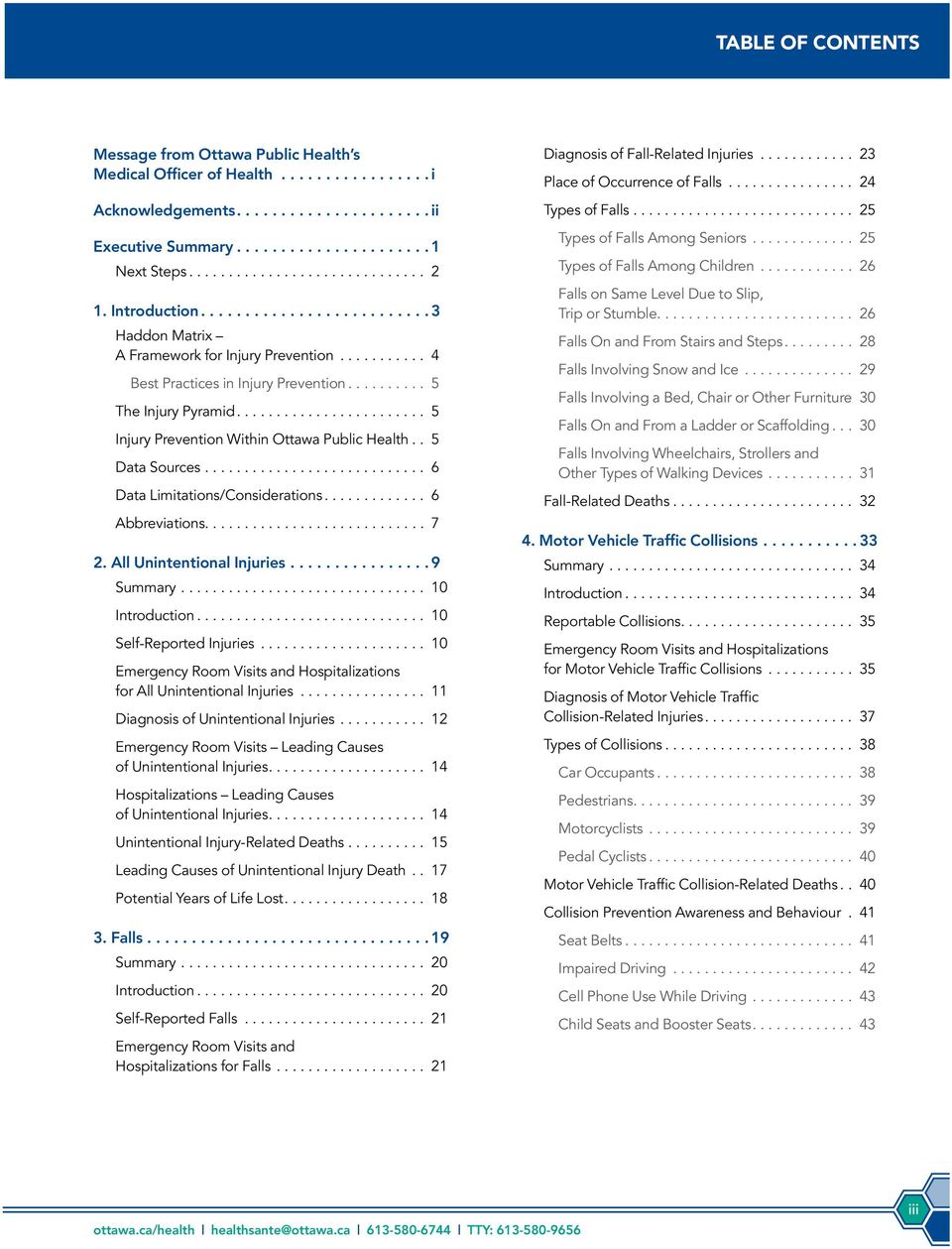
6 Table of Contents 5. Unintentional Poisoning and Substance Misuse...5 Summary... 6 Introduction... 6 Emergency Room Visits and Hospitalizations for Unintentional Poisoning and Substance Misuse.. 7 Place of Occurrence of Unintentional Poisoning and Substance Misuse... 9 Types of Poisoning Substances... 5 Unintentional Poisoning and Substance Misuse Deaths Self-Harm and Suicide...53 Summary... 5 Introduction... 5 Emergency Room Visits for Self-Harm Types of Self-Harm Injuries Self-Harm by Drugs, Medications and Alcohol. 56 Suicide Deaths Sport and Recreation Injuries Summary... 6 Introduction... 6 Emergency Room Visits and Hospitalizations for Sport and Recreation Injuries Types of Sport and Recreation Injuries Cycling Injuries Hockey Injuries Skiing and Snowboarding Injuries Ice Skating Injuries... 6 Playground Equipment-Related Injuries... 6 All-Terrain Vehicle and Snowmobiling Injuries. 6 Tobogganing Injuries In-line Skating, Skateboarding and Scooter Fall Injuries Sport and Recreation Injury Deaths Pedestrian Injuries...67 Summary Introduction Emergency Room Visits and Hospitalizations for Pedestrian Injuries Diagnosis of Pedestrian Injuries Types of Pedestrian Injuries Pedestrian Deaths Cycling Injuries...73 Summary... 7 Introduction... 7 Emergency Room Visits and Hospitalizations for Cycling Injuries Diagnosis of Cycling Injuries Types of Cycling Injuries Cycling Deaths Cycling Injury Prevention Behaviour Burns...79 Summary... 8 Introduction... 8 Emergency Room Visits and Hospitalizations for Burns Place of Occurrence of Burn Types of Burns... 8 Scalds Hot Appliances Burn-Related Deaths Drowning...87 Summary Introduction Emergency Room Visits and Hospitalizations for Near-Drowning Place of Occurrence of Near-Drowning Types of Near-Drowning Events... 9 iv Ottawa Public Health The Burden of Injury in Ottawa, 21
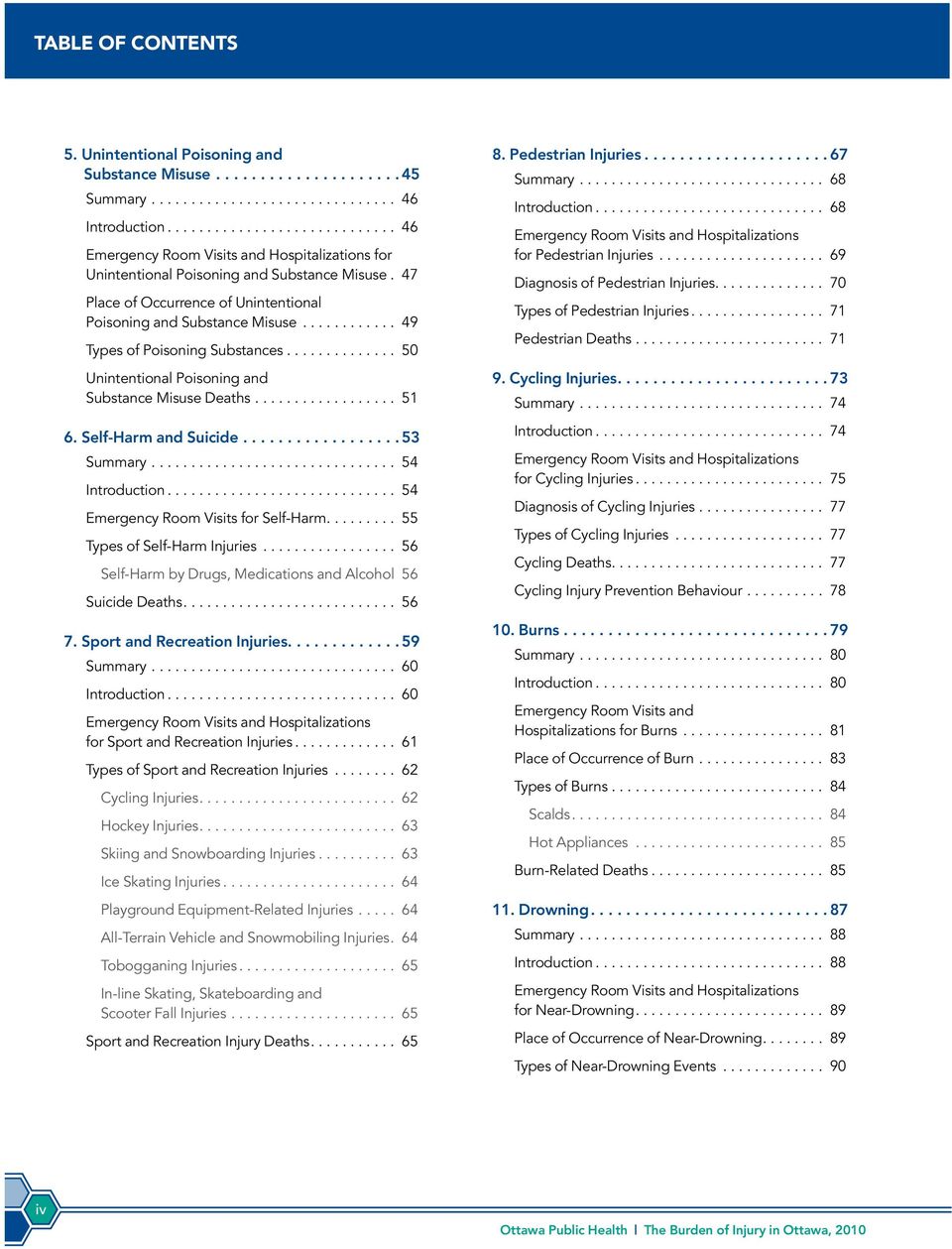
7 Table of Contents Near-Drowning Involving Watercraft... 9 Swimming Pool-Related Near-Drowning Drowning Deaths Public Health Practices and Partners...91 Falls Public Health Practices and Programs Partners in Falls Prevention Road Safety... 9 Public Health Practices and Programs... 9 Partners in Road Safety... 9 Self-Harm and Suicide Prevention Public Health Practices and Programs Partners in Self-Harm and Suicide Prevention.. 95 Unintentional Poisoning and Substance Misuse.. 96 Public Health Practices and Programs Partners in Unintentional Poisoning and Substance Misuse Prevention Burns Public Health Practices and Programs Partners in Burns Prevention Drowning Public Health Practices and Programs Partners in Drowning Prevention Sports and Recreation Public Health Practices and Programs Partners in Safe Sports and Recreation References...99 Appendices...1 Appendix 1: Glossary of Terms... 1 Appendix 2: Data Sources Appendix 3: External Cause of Injury Codes Appendix : Nature of Injury Codes ottawa.ca/health [email protected] TTY: v

8

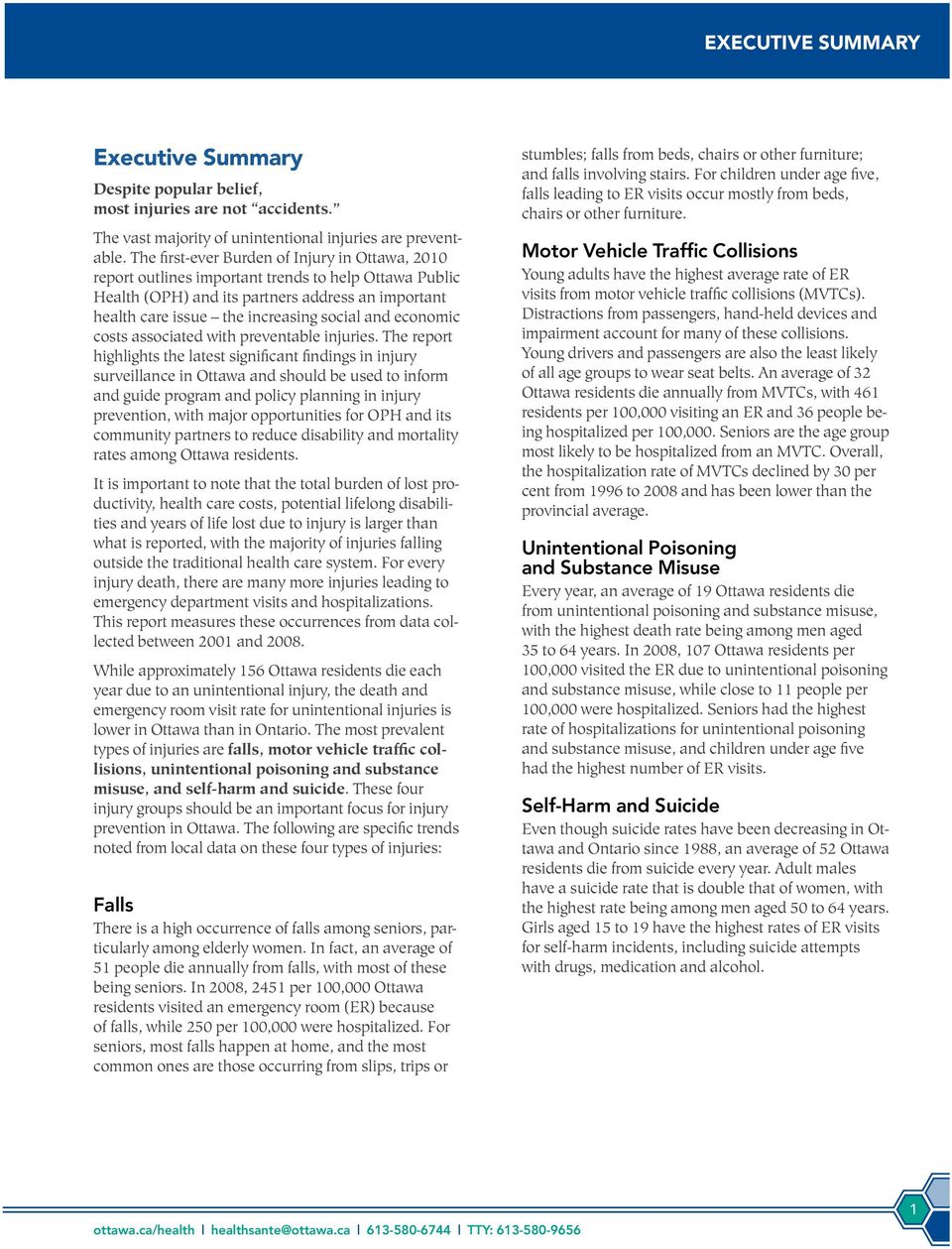
9 Executive Summary Executive Summary Despite popular belief, most injuries are not accidents. The vast majority of unintentional injuries are preventable. The first-ever Burden of Injury in Ottawa, 21 report outlines important trends to help Ottawa Public Health (OPH) and its partners address an important health care issue the increasing social and economic costs associated with preventable injuries. The report highlights the latest significant findings in injury surveillance in Ottawa and should be used to inform and guide program and policy planning in injury prevention, with major opportunities for OPH and its community partners to reduce disability and mortality rates among Ottawa residents. It is important to note that the total burden of lost productivity, health care costs, potential lifelong disabilities and years of life lost due to injury is larger than what is reported, with the majority of injuries falling outside the traditional health care system. For every injury death, there are many more injuries leading to emergency department visits and hospitalizations. This report measures these occurrences from data collected between 21 and 28. While approximately 156 Ottawa residents die each year due to an unintentional injury, the death and emergency room visit rate for unintentional injuries is lower in Ottawa than in Ontario. The most prevalent types of injuries are falls, motor vehicle traffic collisions, unintentional poisoning and substance misuse, and self-harm and suicide. These four injury groups should be an important focus for injury prevention in Ottawa. The following are specific trends noted from local data on these four types of injuries: Falls There is a high occurrence of falls among seniors, particularly among elderly women. In fact, an average of 51 people die annually from falls, with most of these being seniors. In 28, 251 per 1, Ottawa residents visited an emergency room (ER) because of falls, while 25 per 1, were hospitalized. For seniors, most falls happen at home, and the most common ones are those occurring from slips, trips or stumbles; falls from beds, chairs or other furniture; and falls involving stairs. For children under age five, falls leading to ER visits occur mostly from beds, chairs or other furniture. Motor Vehicle Traffic Collisions Young adults have the highest average rate of ER visits from motor vehicle traffic collisions (MVTCs). Distractions from passengers, hand-held devices and impairment account for many of these collisions. Young drivers and passengers are also the least likely of all age groups to wear seat belts. An average of 32 Ottawa residents die annually from MVTCs, with 61 residents per 1, visiting an ER and 36 people being hospitalized per 1,. Seniors are the age group most likely to be hospitalized from an MVTC. Overall, the hospitalization rate of MVTCs declined by 3 per cent from 1996 to 28 and has been lower than the provincial average. Unintentional Poisoning and Substance Misuse Every year, an average of 19 Ottawa residents die from unintentional poisoning and substance misuse, with the highest death rate being among men aged 35 to 6 years. In 28, 17 Ottawa residents per 1, visited the ER due to unintentional poisoning and substance misuse, while close to 11 people per 1, were hospitalized. Seniors had the highest rate of hospitalizations for unintentional poisoning and substance misuse, and children under age five had the highest number of ER visits. Self-Harm and Suicide Even though suicide rates have been decreasing in Ottawa and Ontario since 1988, an average of 52 Ottawa residents die from suicide every year. Adult males have a suicide rate that is double that of women, with the highest rate being among men aged 5 to 6 years. Girls aged 15 to 19 have the highest rates of ER visits for self-harm incidents, including suicide attempts with drugs, medication and alcohol. ottawa.ca/health [email protected] TTY:
10 Executive Summary Although these four groups of injuries are the most common in Ottawa, important findings emerged from the other types of injuries. These include the following: Children under five years of age have the highest rate of burns. Burns in the home account for 5 per cent of the burn-related hospitalizations. Most burn injuries result from scalding (7 per cent of the burn-related ER visits and 38 per cent of the hospitalizations), followed by exposure to smoke, fire or flames. Swimming pools are the most common location for near-drowning incidents resulting in ER visits for children and youth. Children under age five have the highest rate of ER visits for near-drowning, with 55 per cent of these events occurring at home. Pedestrian injuries resulting in an ER visit are highest for youth aged 1 to 19 years. Senior women and young males have the highest pedestrian injury hospitalization rates. The majority of pedestrian injuries are due to a collision with a car, pickup truck or van. Young males aged 1 to 19 years have the highest rates of ER visits for cycling injuries, followed by children aged five to nine years. The most common type of cycling injury involves falling or being thrown from a bicycle, followed by a collision with a motor vehicle. The top three sport and recreation activities resulting in an ER visit are cycling, hockey and skiing/snowboarding. For sport and recreation injury hospitalizations, the top three activities are cycling, skiing/snowboarding and ice skating. Rates of all-terrain vehicle-related injury leading to an ER visit more than doubled from 22 to 27. The most common sport and recreation activity leading to injury in children aged five to nine is the use of playground equipment. Next Steps The Burden of Injury in Ottawa, 21 report provides the opportunity to adopt a co-ordinated, evidencebased approach to injury prevention in Ottawa. The report provides individuals, program planners and policy-makers with the information needed to address injury prevention priorities in our community, in particular in the areas of the most common injuries among Ottawa residents: falls, motor vehicle traffic collisions, unintentional poisoning and substance misuse, and self-harm and suicide. Many factors are involved when injuries occur. The design of everyday objects and structures, underlying social factors and mental health issues are just a few of the multiple and complex factors that lead to injuries. Age and sex also play key roles in how and why injuries occur. Socio-economic status is also an important factor in hospitalizations from injuries. Research strongly shows that people living in lower-income neighbourhoods have higher rates of hospitalizations and mortality from injuries. Under the mandatory health programs and services outlined in the Ontario Public Health Standards, OPH is required to promote safety and injury prevention through its programs and partnerships. This report serves as a guide for OPH and its new and current partners to collaborate on the design of injury prevention strategies involving advocacy and community action. The report calls for an investment in multiple interventions using best practices to promote healthy behaviours for individuals, families and communities. 2 Ottawa Public Health The Burden of Injury in Ottawa, 21

11 Chapter 1 Chapter 1 Introduction

12 Chapter 1 Introduction The purpose of this report is to outline important injury trends to help Ottawa Public Health (OPH) and its partners address an important health care issue the increasing social and economic costs associated with preventable injuries. This is the first public health report in Ottawa to quantify and describe injury, which is one of the leading causes of premature death and disability in Ottawa. In 2, injuries resulted in 13,667 deaths and 211,768 hospitalizations within Canada. Injury takes a heavy social and economic toll, costing an estimated 19.8 billion dollars in direct and indirect costs in Canada in 2. 1 Injury prevention strategies can reduce both the rate and severity of injuries, resulting in considerable economic savings to the health care system and reducing the burden on the health care system downstream. The report portrays a current view of the burden of injuries in Ottawa, providing crucial evidence to inform injury prevention programming and policies as well as addressing the assessment and surveillance requirements of the Ontario Public Health Standards. The report also highlights effective injury prevention programs and areas for improvement. OPH program staff, other City departments, community partners, members of Council and concerned citizens can benefit from the findings of this report. This report is divided into 12 chapters. An executive summary provides the key highlights and trends from the data collected and analyzed from injuries resulting in hospitalizations, emergency department visits and deaths in Ottawa and outlines potential next steps for OPH and its partners to set priorities and adopt a framework for action in injury prevention. The first chapter outlines the framework for injury prevention, best practices and the mandate of OPH s injury prevention programs based on the requirements of the Ontario Public Health Standards. The following chapters focus on nine injury categories, including what the data reveal about the four leading causes of injury in Ottawa: falls, motor vehicle traffic collisions (MVTCs), unintentional poisoning and substance misuse, and self-harm and suicide. The final chapter of the report profiles OPH s injury prevention programs and partnerships for the nine injury categories examined in the report. It s important to note that the burden of injury in terms of lost productivity, health care costs, potential lifelong disabilities and years of life lost is larger than what is reported, with the majority of injuries falling outside the traditional health care system. For every injury death, there are many more injuries leading to emergency department visits and hospitalizations, which this report measures from data collected between 21 and 28. A broad range of interconnected factors can affect how injuries occur. Attitudes toward safety are critical. Environmental and engineering design is also important in reducing all types of injury. Complex underlying social factors such as unemployment and poor living conditions can also play pivotal roles. Mental health issues may also be a critical factor leading some people to harm themselves. 2 Haddon Matrix A Framework for Injury Prevention William Haddon developed a matrix where host, agent and environment interact over a time period. According to Haddon, injuries can be understood in three phrases: pre-event, event and post-event. 3 This framework for analysis makes it possible to identify: interventions aimed at preventing the injury pre-event (e.g., road and highway signage) interventions aimed at minimizing the impact of the injury event (e.g., air bag) interventions aimed at minimizing the severity of injury outcomes (e.g., rapid emergency response) Haddon also suggested that the most effective way to control injury was to use multiple strategies within each phase. He emphasized the use of passive interventions and implementing strategies that most effectively reduce injury. Ottawa Public Health The Burden of Injury in Ottawa, 21

13 Introduction Chapter 1 Best Practices in Injury Prevention Current evidence suggests that injury prevention works best when it: addresses the multiple factors that contribute to injury; encourages environmental and behavioural change; engages the people who are most at risk; involves action across sectors (e.g., health, police, education); and is sustained and reinforced over time. Strategies to reduce injuries must therefore include a wide variety of interventions, address a variety of determinants of health and involve a variety of disciplines (health, education, labour, transportation, police, etc.). The Injury Pyramid The ultimate target for prevention efforts is to reduce deaths and disabilities from injury. However, deaths make up a very small part of the overall impact that injuries have on the population. For every injury death, there are many more hospitalizations, emergency department visits and injuries that are not accounted for, having been treated outside of the traditional health care system. (Figure1) Figure 1 The Injury Pyramid Death Major Trauma In-patient Hospitalization Injury Prevention Within Ottawa Public Health Under the mandatory health programs and services outlined in the Ontario Public Health Standards, OPH is required to promote safety and injury prevention. Through its programs and partnerships, OPH s injury prevention objectives and strategies include: increasing the number of children, youth and adults practising safety measures while cycling and operating motorized vehicles (specifically, the use of helmets and car restraints and the safe operation of all motorized vehicles) reducing misuse of prevalent drugs such as marijuana reducing harmful drinking among young people and the general population reducing the rate of fall-related injuries in the elderly reducing health hazards in the physical environment with emergency response protocols, including extreme heat warnings reducing drowning in pools, lakes, rivers and other recreational bodies of water inspecting public pools, public wading pools and public spas and ensuring safety-related operational procedures are used at these facilities conducting surveillance of health-related information that identifies priority populations and contributes to effective public health program planning, delivery and management conducting surveillance of public beaches and public beach water-related illnesses promoting the health and safety of children and youth in the home Emergency Department Visits Physician Office/Medi-centre Visits Treated at Home/School/Work Rate per 1, population ottawa.ca/health [email protected] TTY: Ottawa number of visits Number of ER visits 5

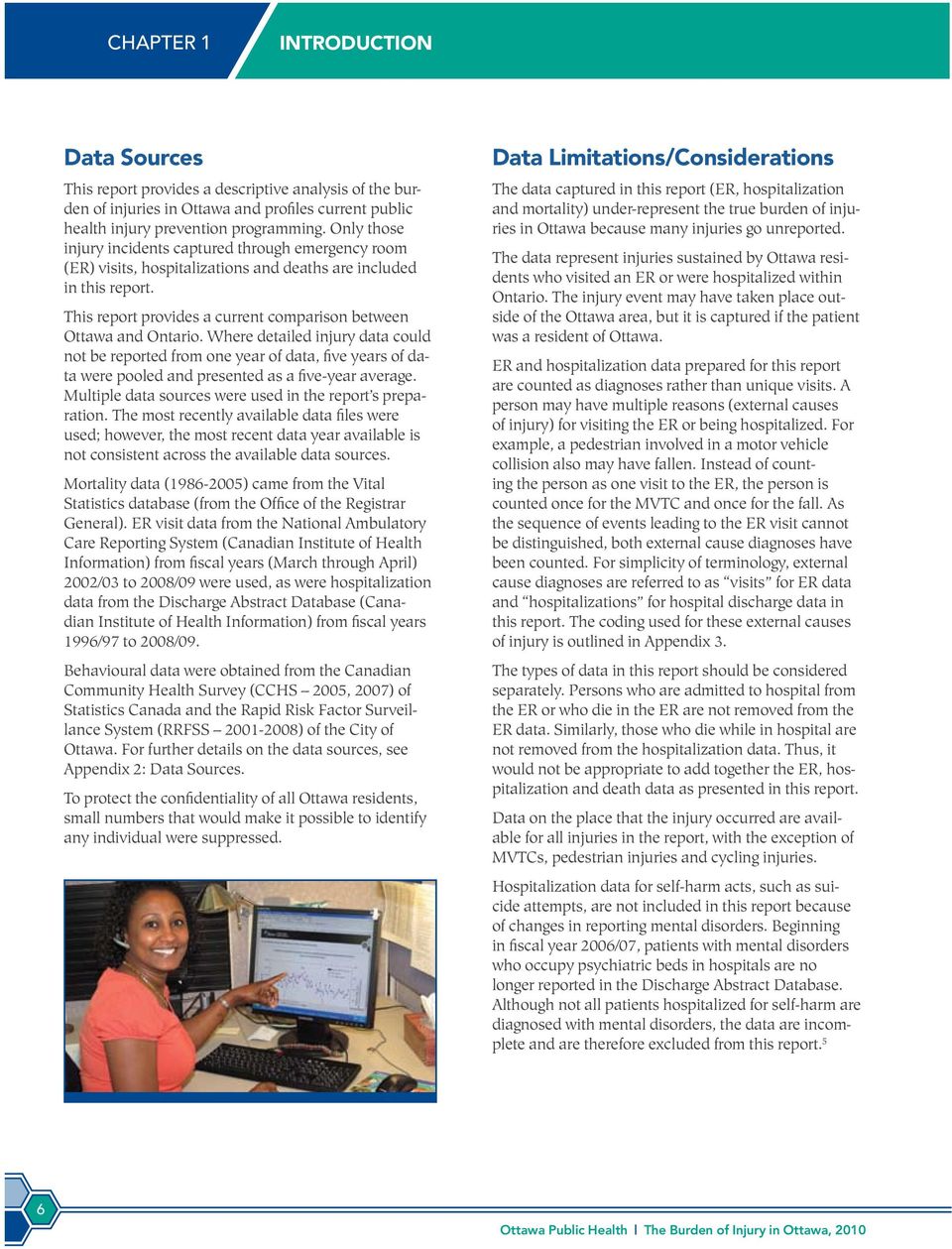
14 Chapter 1 Introduction Data Sources This report provides a descriptive analysis of the burden of injuries in Ottawa and profiles current public health injury prevention programming. Only those injury incidents captured through emergency room (ER) visits, hospitalizations and deaths are included in this report. This report provides a current comparison between Ottawa and Ontario. Where detailed injury data could not be reported from one year of data, five years of data were pooled and presented as a five-year average. Multiple data sources were used in the report s preparation. The most recently available data files were used; however, the most recent data year available is not consistent across the available data sources. Mortality data ( ) came from the Vital Statistics database (from the Office of the Registrar General). ER visit data from the National Ambulatory Care Reporting System (Canadian Institute of Health Information) from fiscal years (March through April) 22/3 to 28/9 were used, as were hospitalization data from the Discharge Abstract Database (Canadian Institute of Health Information) from fiscal years 1996/97 to 28/9. Behavioural data were obtained from the Canadian Community Health Survey (CCHS 25, 27) of Statistics Canada and the Rapid Risk Factor Surveillance System (RRFSS 21-28) of the City of Ottawa. For further details on the data sources, see Appendix 2: Data Sources. To protect the confidentiality of all Ottawa residents, small numbers that would make it possible to identify any individual were suppressed. Data Limitations/Considerations The data captured in this report (ER, hospitalization and mortality) under-represent the true burden of injuries in Ottawa because many injuries go unreported. The data represent injuries sustained by Ottawa residents who visited an ER or were hospitalized within Ontario. The injury event may have taken place outside of the Ottawa area, but it is captured if the patient was a resident of Ottawa. ER and hospitalization data prepared for this report are counted as diagnoses rather than unique visits. A person may have multiple reasons (external causes of injury) for visiting the ER or being hospitalized. For example, a pedestrian involved in a motor vehicle collision also may have fallen. Instead of counting the person as one visit to the ER, the person is counted once for the MVTC and once for the fall. As the sequence of events leading to the ER visit cannot be distinguished, both external cause diagnoses have been counted. For simplicity of terminology, external cause diagnoses are referred to as visits for ER data and hospitalizations for hospital discharge data in this report. The coding used for these external causes of injury is outlined in Appendix 3. The types of data in this report should be considered separately. Persons who are admitted to hospital from the ER or who die in the ER are not removed from the ER data. Similarly, those who die while in hospital are not removed from the hospitalization data. Thus, it would not be appropriate to add together the ER, hospitalization and death data as presented in this report. Data on the place that the injury occurred are available for all injuries in the report, with the exception of MVTCs, pedestrian injuries and cycling injuries. Hospitalization data for self-harm acts, such as suicide attempts, are not included in this report because of changes in reporting mental disorders. Beginning in fiscal year 26/7, patients with mental disorders who occupy psychiatric beds in hospitals are no longer reported in the Discharge Abstract Database. Although not all patients hospitalized for self-harm are diagnosed with mental disorders, the data are incomplete and are therefore excluded from this report. 5 6 Ottawa Public Health The Burden of Injury in Ottawa, 21
15 Introduction Chapter 1 Abbreviations ATV all-terrain vehicle CCHS CMHA DAD ER ICD IRSP LHIN MOHLTC MVTC NACRS OPH OSDUHS PHPDB PYLL RRFSS Canadian Community Health Survey Canadian Mental Health Association Discharge Abstract Database emergency room International Classification of Diseases Integrated Road Safety Program Local Health Integration Network Ministry of Health and Long-Term Care (Ontario) motor vehicle traffic collision National Ambulatory Care Reporting System Ottawa Public Health Ontario Student Drug Use and Health Survey Provincial Health Planning Database (Ontario) potential years of life lost Rapid Risk Factor Surveillance System ottawa.ca/health [email protected] TTY:

16

17 Chapter 2 Chapter 2 All Unintentional Injuries

18 Chapter 2 All Unintentional Injuries Summary Approximately 156 Ottawa residents die each year due to an unintentional injury. The death rate for unintentional injuries has been lower in Ottawa than in Ontario and higher in males than in females. Motor vehicle traffic collisions (MVTCs) are the leading cause of unintentional injury death in those under age 2 and those aged 2 to years. Unintentional poisoning and substance misuse rank as the leading cause of death in adults aged 5 to 6, followed closely by MVTCs, and falls are the leading cause for seniors. The rates of emergency room (ER) visits and of hospitalizations for all unintentional injuries in Ottawa have been lower than the Ontario rates. The leading cause of unintentional injury ER visits and hospitalizations across all ages is falls. Introduction This chapter examines the issue of unintentional injuries and focuses on a selected number of cause-specific unintentional injuries. Unintentional injuries are those where there is no evidence of predetermined intent. Intentional injuries, self-harm and suicide are not included in this chapter. Please refer to Chapter 6 for data on self-harm and suicide. The types of injuries included in this chapter are not mutually exclusive; for example, cycling injuries are included and covered as a part of MVTCs and of sport and recreation injuries. Self-Reported Injuries According to the Canadian Community Health Survey, in 25, 126, (18.2 per cent per cent) * Ottawa residents aged 12 and older reported that they had suffered an injury serious enough to limit normal activities (for example a broken bone, a bad cut or burn, a sprain, or a poisoning) in the last year. * The + symbol followed by a numerical value represents the interval within which the true value of a variable such as a mean, proportion or rate is contained. This is called the confidence interval (CI) and is calculated to a 95 per cent probability in this report. 1 Ottawa Public Health The Burden of Injury in Ottawa, 21
19 All Unintentional Injuries Chapter 2 Death Death Emergency Room Major Trauma Visits and Hospitalizations for All Unintentional Injuries Unintentional injuries In-patient Major caused Hospitalization Trauma a substantial burden on Ottawa ERs, accounting for an average of over 61, visits per year from 22 to 28. This represents about 25 per cent of all emergency room visits. In 28, the rate of ER visits for unintentional injuries was 739 per 1, population. From 22 to 28, the number and rate of ER visits Emergency In-patient Department Hospitalization Visits due to unintentional injuries remained stable in Ottawa, and the rates were less than the Ontario rates. (Figure 2.1) Physician Emergency Office/Medi-centre Department Visits Visits In 28, close Physician Treated to Office/Medi-centre at hospitalizations Home/School/Work Visits occurred because of an unintentional injury. Hospitalization rates due to unintentional injuries in Ottawa were stable over the past few years. In 28, the hospitalization rate was 399 per 1, population compared Treated at with Home/School/Work a provincial rate of 3 per 1, Ontario residents. (Figure 2.2) Figure 2.1 All Unintentional 12 Injury ER Visits City of Ottawa and Ontario Rate per Rate 1, per 1, population population Ottawa number of visits Ottawa rate Ottawa number of visits Ontario rate Ottawa rate Source: National Ambulatory Care Reporting System - ER Visits 22-28, Ontario MOHLTC, IntelliHEALTH ONTARIO, Extracted: August, 29 Data Note: Ontario Rates rate are age standardized to the 1991 Canadian population Number Number of ER visits of ER visits Source: National Ambulatory Care Reporting System - ER Visits 22-28, Ontario MOHLTC, IntelliHEALTH ONTARIO, Extracted: August, 29 Figure 2.2 All Unintentional Injury Hospitalizations City of Ottawa and Ontario Rate per Rate 1, per 1, population population Ottawa Number of Hospitalizations Ottawa rate Ottawa Number of Hospitalizations Ontario rate Ottawa rate Source: Hospital In-patient Data , Ontario MOHLTC, IntelliHEALTH ONTARIO, Extracted: July 23, 29 Data Note: Ontario Rates rate are age standardized to the 1991 Canadian 65. population Source: Hospital In-patient Data , Ontario MOHLTC, IntelliHEALTH ONTARIO, Extracted: July 23, Number Number of Hospitalizations of Hospitalizations Males 28 Females 28 Males Average Females Average ottawa.ca/health [email protected] TTY:
20 Chapter 2 Rate Rate per per 1, 1, population population All Unintentional Injuries For males, the highest rates 2 2 of all unintentional injury years and older (212.1 per 1, population) and 2 2 ER visits occurred in those 1 1 aged 1 to 19 years ( was double that of their senior male counterparts 1 1 per 1, population from 2 to 28), followed (995.6 per 1, population). (Figures 2. and 2.6) by those under age 1 ( per 1, population). Among females, those aged 65 years and older Diagnosis of Unintentional Injuries Ottawa Number of Hospitalizations Ottawa rate Number of Hospitalizations had the highest average unintentional injury ER visit Ontario Ottawa rate Approximately one-third of all unintentional injury rates Ontario (915.2 rate per 1, population from to ER visits 52.7 and 75. two-thirds of the 3.1 unintentional injury Source: Hospital In-patient Data , Ontario MOHLTC, IntelliHEALTH ONTARIO, Extracted: July 23, 29 28), Data Source: Note: Hospital Rates followed In-patient are age standardized Data by , young to the Ontario 1991 women Canadian MOHLTC, aged population IntelliHEALTH 1 to ONTARIO, 19 and Extracted: July 23, 29 hospitalizations involved treatment for a musculoskeletal injury (i.e., fracture, dislocation, sprain or strain). those under 1. (Figures 2.3 and 2.5) The average hospitalization rate for all unintentional injuries from (Figures 2.7 and 2.8) 2 to 28 was highest in senior females aged Number Number of of Hospitalizations Figure 2.3 All Unintentional Injury ER Visits by Age. City of Ottawa 28 and 2-8 Average Males 28 Females Males Females 28 Average 2 28 Average Number of ER Visits Number of ER Visits Source: National Ambulatory Care Reporting System - ER Visits 2-28, Ontario MOHLTC, IntelliHEALTH ONTARIO, Extracted: August, Source: National Ambulatory Care Reporting System - ER Visits 2-28, Ontario MOHLTC, IntelliHEALTH ONTARIO, Extracted: August, 29 Figure 2. All Unintentional Injury Hospitalizations by Age. City of Ottawa 28 and 2-28 Average Males 28 Females Males Females 28 Average 2 28 Average Number of Hospitalizations Number of Hospitalizations Source: Hospital In-patient Data 2-28, Ontario MOHLTC, IntelliHEALTH ONTARIO, Extracted: July 23, Source: Hospital In-patient Data 2-28, Ontario MOHLTC, IntelliHEALTH ONTARIO, Extracted: July 23, r, 1, population population Ottawa Public Health The Burden of Injury in Ottawa, 21

21 Number of Hospitalizations Source: Hospital In-patient Data 2-28, Ontario MOHLTC, IntelliHEALTH ONTARIO, Extracted: July 23, Figure Number of Hospitalizations Number of Hospitalizations All Unintentional Injury ER Visits by Age and Sex. City of Ottawa 28 and 2-28 Average Rate Rate per per 1, 1, Rate population per 1, population Females Males Source: National Ambulatory Care Reporting System - ER Visits 2-28, Ontario MOHLTC, Females Age Group IntelliHEALTH ONTARIO, Extracted: August, 29 Males Females Source: Males National 2 28 Ambulatory Care Reporting System - ER Visits , Ontario MOHLTC, IntelliHEALTH ONTARIO, Extracted: August, 29 Source: National Ambulatory Care Reporting System - ER Visits 2-28, Ontario MOHLTC, 2 IntelliHEALTH ONTARIO, Extracted: August,, 29 Figure 2.6 All Unintentional 2 Injury Hospitalizations by Age and Sex, City of Ottawa 28 and 2-28 Average Rate Rate per per 1, 1, Rate population per 1, population Source: Hospital In-patient Data 2-28, Ontario MOHLTC, IntelliHEALTH ONTARIO, Extracted: July 23, 29 Source: Hospital In-patient Data 2-28, Ontario MOHLTC, IntelliHEALTH ONTARIO, Extracted: July 23, All Unintentional Injuries Females Males Source: Hospital In-patient Data 2-28, Ontario MOHLTC, IntelliHEALTH ONTARIO, Females Age Group Extracted: July 23, 29 Males Females Source: Males Hospital 2 28 In-patient Data 2-28, Ontario MOHLTC, IntelliHEALTH ONTARIO, Extracted: July 23, 29 Source: Hospital In-patient Data 2-28, Ontario MOHLTC, IntelliHEALTH ONTARIO, Extracted: July 23, Chapter Figure 2.7 Rate Rate per per 1, 1, Rate population per 1, population % Open Wound, including Traumatic Amputation All Unintentional Injury ER Visits by Diagnosis City of Ottawa % 19.% Superficial Open Wound, including 19.% Traumatic Open Wound, Amputation including 5.3% Internal Organ Traumatic Amputation 17.% Superficial 1.2% Burns and Corrosion 17.% Superficial 5.3% Internal Organ.1% Nerves and Spinal Cord 5.3% Internal Organ 1.2% Burns and Corrosion 21.7% Other and Unspecified 1.2% Burns and Corrosion.1% Nerves and Spinal Cord 35.% Musculoskeletal.1% Nerves and Spinal Cord 21.7% Other and Unspecified Source: National Ambulatory Care Reporting System - ER Visits 2-28, 21.7% Ontario Other and MOHLTC, Unspecified IntelliHEALTH ONTARIO, Extracted: August, % Musculoskeletal 35.% Musculoskeletal Source: National Ambulatory Care Reporting System - ER Visits 2-28, Ontario MOHLTC, IntelliHEALTH ONTARIO, Extracted: August, 29 Source: National Ambulatory Care Reporting System - ER Visits 2-28, Ontario MOHLTC, IntelliHEALTH ONTARIO, Extracted: August,, Figure % Musculoskeletal All Unintentional Injury Hospitalizations by Diagnosis, City of Ottawa % Open Wound, including Traumatic Amputation 67.6% Musculoskeletal 1.% 67.6% Superficial Musculoskeletal 1.9% Open Wound, including 1.9%.6% Traumatic Open Burns Wound, Amputation and Corrosion including Traumatic Amputation 1.% Superficial.% 1.% Nerves Superficial and Spinal Cord.6% Burns and Corrosion.2%.6% Blood Burns Vessels and Corrosion.% Nerves and Spinal Cord 28.2%.% Other Nerves and and Unspecified Spinal Cord.2% Blood Vessels Source: Hospital In-patient Data 2-28, Ontario MOHLTC, IntelliHEALTH.2% Blood ONTARIO, Vessels Extracted: July 23, % Other and Unspecified 28.2% Other and Unspecified Source: Hospital In-patient Data 2-28, Ontario MOHLTC, IntelliHEALTH ONTARIO, Extracted: July 23, 29 Source: Hospital In-patient Data 2-28, Ontario MOHLTC, IntelliHEALTH ONTARIO, Extracted: July 23, Ottawa Deaths ottawa.ca/health 5 [email protected] TTY: Ottawa Rate Ontario Rate Ottawa Deaths Number Number of Deaths of Number Deaths of Deaths 13
22 Chapter 2 All Unintentional Injuries Table 2.1 Leading causes of unintentional injury emergency room visits, all ages, Ottawa 28 Rank Type of unintentional injury Number % 1 Falls Sport and recreation MVTCs Cycling Unintentional poisoning and substance misuse Burns Pedestrian Near-drowning 17 Total for all unintentional injuries Note: Categories are not mutually exclusive, and totals do not add up. Emergency Room Visits Leading Causes of Unintentional Injuries Across all age groups, falls were the leading cause of unintentional injury emergency visits. For children and youth under 2 years of age, sport and recreation injuries were the second leading cause, followed by MVTCs. For adults aged 2 years and older, MVTCs were the second leading cause, followed by sport and recreation injuries. (Tables 2.1 and 2.2) Table 2.2 Leading causes of unintentional injury emergency room visits by age, Ottawa 2-28 Type of unintentional injury 19 years 2 years 5 6 years 65 years and older Rank % Rank % Rank % Rank % Falls Sport and recreation MVTCs Cycling Unintentional poisoning and substance misuse Burns Pedestrian Near-drowning NR NR = not reportable (data suppressed due to small numbers) Hospitalizations Leading Causes of Unintentional Injuries Similar to ER visits, falls were the leading cause of unintentional injury hospitalization across all age groups. Sport and recreation injuries were the second leading cause for children and youth under the age of 2 years. For adults aged 2 and older, MVTCs were the second leading cause of unintentional injury hospitalization. (Tables 2.3 and 2.) Table 2.3 Leading causes of unintentional injury hospitalizations, all ages, Ottawa 28 Rank Type of unintentional injury Number % 1 Falls Sport and recreation MVTCs Cycling Unintentional poisoning and substance misuse Pedestrian Burns Near-drowning 9.2 Total for all unintentional injuries Note: Categories are not mutually exclusive, and totals do not add up. 1 Ottawa Public Health The Burden of Injury in Ottawa, 21
23 Rate per 1, population All Unintentional Injuries Chapter Table Females Leading causes of unintentional 153. injury hospitalizations 1.8 by age, Ottawa Males years 2- years 5-6 years 65 years and older Source: Type Hospital of unintentional In-patient Data 2-28, injury Ontario MOHLTC, IntelliHEALTH ONTARIO, Extracted: July 23, 29 Rank % Rank % Rank % Rank % Falls Sport and recreation MVTCs Cycling Unintentional poisoning and 19.% 6 Open Wound, including % Musculoskeletal substance misuse 1.5 Traumatic Amputation 1.9% Open Wound, including Burns % Superficial Traumatic Amputation Pedestrian % Superficial 5.3% Internal Organ Near-drowning % Burns and Corrosion.6% Burns and Corrosion.1% Nerves and Spinal Cord.% Nerves and Spinal Cord 21.7% Other and Unspecified Unintentional Injury-Related Deaths 35.% Musculoskeletal.2% Blood Vessels 28.2% Other and Unspecified In Ottawa, from 21 to 25, there was an average of 156 deaths per year due to unintentional injuries. The rate of unintentional Source: National Ambulatory injury Care Reporting deaths System declined - ER Visits 2-28, from Ontario a high MOHLTC, of 23.5 deaths Source: per 1, Hospital In-patient population Data 2-28, Ontario in 1987 MOHLTC, to IntelliHEALTH 16.8 per ONTARIO, 1, IntelliHEALTH ONTARIO, Extracted: August, 29 Extracted: July 23, 29 population in 25. The death rate has consistently been lower in Ottawa than in Ontario. (Figure 2.9) Figure 2.9 All Unintentional Injury-related Deaths. City of Ottawa and Ontario, Rate per 1, population Number of Deaths Ottawa Deaths Ottawa Rate Ontario Rate Source: Ontario Mortality Data , Ontario MOHLTC, IntelliHEALTH ONTARIO, Extracted: May 22, 29 Rate per 1, population Number of Deaths Male Deaths Female Deaths Male Rate Female Rate Source: Ontario Mortality Data , Ontario MOHLTC, IntelliHEALTH ONTARIO, Extracted: May 22, 29 ottawa.ca/health [email protected] TTY:
24 Rate Rate per 1, per 1, population Chapter 2 All Unintentional Injuries Ottawa Deaths Ottawa Deaths Rate Males have nearly twice the rates of unintentional injury death that females have in Ottawa. (Figure 2.1) Source: Ontario Mortality Data , Ontario MOHLTC, IntelliHEALTH ONTARIO, Extracted: May 22, 29 Unintentional injury death rates were highest among seniors aged 65 years and older. (Figure 2.11) Ottawa Ontario Rate Source: Ontario Rate Mortality Data , 3.1 Ontario 3.6 MOHLTC, 3. IntelliHEALTH ONTARIO, 25.9 Extracted: 25.9 May , Number Number of Deaths of Deaths Figure 2.1 All Unintentional Injury-related Deaths by Sex. City of Ottawa and Ontario, Male Deaths Male Female Deaths Male Female Rate Deaths Male Female Rate Rate Source: Female Ontario Mortality Rate Data , 17.1 Ontario 1.3 MOHLTC, 15.5 IntelliHEALTH ONTARIO, 15.1 Extracted: 1.1 May , Source: Ontario Mortality Data , Ontario MOHLTC, IntelliHEALTH ONTARIO, Extracted: May 22, 29 Rate Rate per 1, per 1, population Number Number of Deaths of Deaths Figure 2.11 Unintentional Injury Deaths by Age and Sex. City of Ottawa Males Females Males Source: Females Ontario Mortality Data 21-25,. Ontario MOHLTC, IntelliHEALTH 3.2 ONTARIO, Extracted: May 22, 29 Source: Ontario Mortality Data 21-25, Ontario MOHLTC, IntelliHEALTH ONTARIO, Extracted: May 22, 29 Rate Rate per 1, per 1, population Type Type of Injury of Injury All Unintentional All Unintentional Suicide Suicide MVTC MVTC Poisoning Poisoning Burns Burns Pedestrian Pedestrian Falls Falls Drowning Drowning Pedal Cyclist Pedal Cyclist Source: Ontario Mortality Data 25, Ontario MOHLTC, IntelliHEALTH ONTARIO, Extracted: May 22, 29 PYLL Ottawa per 1 Public population Health The Burden of Injury in Ottawa, 21 PYLL per 1 population Overall Overall Males Males Females Females Source: Ontario Mortality Data 25, Ontario MOHLTC, IntelliHEALTH ONTARIO, Extracted: May 22, 29
25 All Unintentional Injuries Chapter 2 Leading Causes of Unintentional Injury Death In 25, the leading cause of unintentional injury death in Ottawa was falls, followed by MVTCs and unintentional poisoning and substance misuse. (Table 2.5) MVTCs are the leading cause of unintentional injury death for Ottawa children and youth under age 2. For adults aged 2 to years, the leading causes of unintentional injury death were MVTCs, unintentional poisoning and substance misuse, and pedestrian injuries. For adults aged 5 to 6, unintentional poisoning and substance misuse was the leading cause of unintentional injury death, followed closely by MVTCs and falls. Falls were the leading cause of unintentional injury death for seniors aged 65 years and older, followed by MVTCs. (Table 2.6) Table 2.5 Leading causes of unintentional injury death, all ages, Ottawa 25 Rank Type of unintentional injury Number % 1 Falls MVTCs Unintentional poisoning and substance misuse Burns Pedestrian Sport and recreation Drowning <5 <3. 8 Cycling <5 <3. Other and unspecified Total for all unintentional injuries Note: Categories are not mutually exclusive, and totals do not add up. Table 2.6 Leading causes of unintentional injury death by age, Ottawa Type of unintentional injury -19 years 2- years 5-6 years 65 years and older Rank % Rank % Rank % Rank % Falls MVTCs Unintentional poisoning and substance misuse Pedestrian Note: Shaded cells have too few data to report ottawa.ca/health [email protected] TTY:
26 Male Female Rate Deaths Female Male Rate Rate Female Rate Source: Ontario Mortality Data , Ontario MOHLTC, IntelliHEALTH ONTARIO, Extracted: May 22, 29 Source: Ontario Chapter Mortality Data , 2 Ontario MOHLTC, All IntelliHEALTH Unintentional ONTARIO, Extracted: May 22, 29 Injuries Rate Rate per per 1, 1, population population Potential Years of Life Lost 6 because they are more likely to die before the age of Potential years of life lost (PYLL) is a measure of premature mortality. This measure represents the number All unintentional injury deaths cause more PYLL 2 than suicide does, and suicide causes more PYLL than of years not lived by an individual who 5 9 died before age MVTCs cause. (Figure 2.12) 75 and Males gives more importance 3. to the cause of early death Females Males than of death in. 3. old age. Deaths among the elderly Source: Females Ontario have Mortality little Data effect 21-25, on. Ontario these MOHLTC, values. IntelliHEALTH Males 3.2 ONTARIO, typically Extracted: May 22, 29 have Source: Ontario higher Mortality rates Data 21-25, of premature Ontario MOHLTC, mortality IntelliHEALTH than ONTARIO, females In 25, unintentional injury deaths caused more PYLL than 3.5 did suicide, breast 7.8 cancer, cervical 98.6 cancer, stroke or prostate cancer. (Figure 2.13) Extracted: May 22, Figure 2.12 Potential Years of Life Lost (PYLL) due to Selected Unintentional Injury Deaths or Suicide by Type of Injury and Sex (Age to 7 years). City of Ottawa, 25 Type Type of Injury of Injury All Unintentional All Unintentional Suicide Suicide MVTC MVTC Poisoning Poisoning Burns Burns Pedestrian Pedestrian Falls Falls Drowning Drowning Pedal Cyclist Pedal Cyclist Overall Males Overall Females Males Females Source: Ontario Mortality Data 25, Ontario MOHLTC, IntelliHEALTH ONTARIO, Extracted: May 22, 29 PYLL per 1 population Source: Ontario Mortality Data 25, Ontario MOHLTC, IntelliHEALTH ONTARIO, Extracted: May 22, 29 Figure 2.13 Potential Years of Life Lost (PYLL) due to Selected Causes by Cause and Sex (Age to 7 years). City of Ottawa, 25 Lung Cancer Lung Cancer Colorectal Cancer Colorectal Cancer Ischemic Heart Disease Ischemic Heart Disease All Unintentional All Unintentional Suicide Suicide Breast Cancer Breast Cancer Cervical Cancer Overall Cervical Cancer Males Overall Stroke Females Males Stroke Females Prostate Cancer Prostate Cancer Cause Cause 2. PYLL per 1 population Source: Ontario Mortality Data 25, Ontario MOHLTC, IntelliHEALTH ONTARIO, Extracted: May 22, 29 Source: Ontario Mortality Data 25, Ontario MOHLTC, IntelliHEALTH ONTARIO, Extracted: May 22, PYLL per 1 population PYLL per 1 population Ottawa Public Health The Burden of Injury in Ottawa, 21
27 Chapter 3 Chapter 3 Falls
28 Chapter 3 Falls Summary Falls account for more than 2, visits annually to Ottawa emergency rooms (ERs). Young children and elderly women are most likely to visit an ER or to be hospitalized for a fall. The top three types of falls for seniors aged 65 years and older were: falls on the same level due to a slip, trip or stumble falls involving a bed, chair or other furniture falls on and from stairs and steps For children under age five, the most common type of fall is from a bed, chair or other furniture. On average, 51 people die annually in Ottawa from a fall. Most of these are seniors. Introduction Falls were the leading cause of unintentional injury resulting in an ER visit and hospitalization in Ottawa in 28. Falls affect seniors more than any other age group. For the elderly, most falls happen at home, often due to slips, trips or stumbles; falls from beds, chairs or other furniture; and falls involving stairs. Muscle weakness and reduced physical fitness, particularly in the lower body, are important factors in falls among the elderly. Age-related changes in the musculoskeletal, neural and sensory systems can lead to limited ability to maintain upright balance. Vision changes and eye conditions including glaucoma and cataracts can change perception and make a person more at risk of falling. Chronic illnesses such as arthritis, stroke, Parkinson s disease, cardiovascular disease and osteoporosis are also key factors leading to falls among the elderly. Poor nutrition and taking medications that affect alertness, judgment, perception and co-ordination also put seniors at greater risk of falls. Environmental factors come into play as well, with poorly designed stairs and handrails, inadequate lighting, and weather conditions involving ice and snow leading to many falls among the elderly. Young children are also a predominant age group affected by falls. Children under five years of age account for the second highest rate of ER visits due to falls, with most injuries involving falls from beds, chairs or other furniture. 2 Ottawa Public Health The Burden of Injury in Ottawa, 21
29 Falls Chapter 3 Self-Reported Falls In 28, nearly one-quarter of Ottawa adults (23 per cent per cent) reported falling in the past year, and 8.3 per cent (+ 1.7 per cent) reported having a fall that was serious enough to limit their daily activities. 6 Among the 126,1 Ottawa residents aged 12 and over estimated to have a serious injury in 25 (18.2 per cent), 2.8 per cent (+ 7.6 per cent) of the reported serious injuries resulted from a fall. Of all serious injuries reported by seniors aged 65 years and older, 78.3 per cent (+ 16. per cent) resulted from a fall. 7 Emergency Room Visits and Hospitalizations for Falls Falls represent a tremendous burden on ERs, accounting for over 2, ER visits every year in Ottawa; this corresponds to a third of all ER visits due to unintentional injuries. In 28, the rate of ER visits for falls was 25.8 per 1, population. From 22 to 28, the number and rate of ER visits due to falls remained stable in Ottawa, and the rates were less than the Ontario rates. (Figure 3.1) Figure 3.1 Fall-related ER Visits. City of Ottawa and Ontario Rate per 1, population Rate per 1, population Ottawa number of visits Ottawa rate Ontario rate Source: National Ambulatory Care Reporting System - ER Visits 22-28, Ontario MOHLTC, IntelliHEALTH ONTARIO, Extracted: August, Ottawa number of visits Ottawa rate Ontario rate In Source: 28, National over Ambulatory 25 Care Reporting hospitalizations System - ER Visits 22-28, occurred Ontario because MOHLTC, IntelliHEALTH of a fall. ONTARIO, Hospitalization Extracted: August, 29 rates due to falls in Ottawa were stable Data Note: Rates are age standardized to the 1991 Canadian population over the past few years. In 28, 25.1 per 1, Ottawa residents were hospitalized due to falls compared with a 35 provincial rate of 251. per 1, Ontario residents. (Figure 3.2) Rate per 1, population Rate per 1, population Figure 3.2 Fall-related Hospitalizations. City of Ottawa and Ontario Ottawa Number of Hospitalizations Ottawa rate Ontario rate Ottawa Number of Hospitalizations Ottawa rate Ontario rate Source: Hospital In-patient Data , Ontario MOHLTC, IntelliHEALTH ONTARIO, Extracted: July 23, 29 Source: Hospital In-patient Data , Ontario MOHLTC, IntelliHEALTH ONTARIO, Extracted: July 23, Number of ER visits Number of ER visits Number of Hospitalizations Number of Hospitalizations Males 28 Females Average ottawa.ca/health [email protected] TTY: Males
30 Rate Rate per 1, per 1, population population Chapter Falls 5 Ottawa males and females had similar age-adjusted likely due to the large number of elderly females that rates of ER visits for falls. In 28, women accounted are hospitalized. Ottawa Number of Hospitalizations for 55 per cent of all ER visits and 6 per cent of hospitalizations resulting from a fall. Females had signifi- Ottawa rate Number of Hospitalizations Young children and elderly women were most likely Ontario Ottawa rate to visit an ER for a fall Seniors were more likely to be cantly Ontario * higher rate crude rates of hospitalizations for falls Source: Hospital In-patient Data , Ontario MOHLTC, IntelliHEALTH ONTARIO, Extracted: July , seriously injured from a 25.6 fall, resulting in hospitalization. (Figures 3.3 to 3.6) 251. than Data Note: males. Rates are age However, standardized to when the 1991 Canadian adjusted population for age, there Source: Hospital In-patient Data , Ontario MOHLTC, IntelliHEALTH ONTARIO, Extracted: July 23, 29 was Data Note: no Rates difference are age standardized between to the 1991 males Canadian and population females. This is Number Number of of Hospitalizations * Throughout this report, the word significantly is used to indicate statistical significance. Figure 3.3 Fall-related ER Visits by Age and Sex. City of Ottawa 28 and 2-8 Average Males 28 Females Males Females 28 Average 2 28 Average Source: National Ambulatory Care Reporting System - ER Visits 2-28, Ontario MOHLTC, IntelliHEALTH Number of ONTARIO, ER VisitsExtracted: August, Source: National Ambulatory Care Reporting System - ER Visits 2-28, Ontario MOHLTC, IntelliHEALTH ONTARIO, Extracted: August, 29 Number of ER Visits Figure 3. Fall-related Hospitalizations by Age and Sex. City of Ottawa 28 and 2-28 Average Males 28 Females Males Females 28 Average 2 28 Average Source: Hospital In-patient Data 2-28, Ontario MOHLTC, IntelliHEALTH ONTARIO, Extracted: Number July of 23, Hospitalizations Number of Hospitalizations Source: Hospital In-patient Data 2-28, Ontario MOHLTC, IntelliHEALTH ONTARIO, Extracted: July 23, , per 1, population population Ottawa Public Health The Burden of Injury in Ottawa, 21
31 Source: Hospital In-patient Data 2-28, Ontario MOHLTC, IntelliHEALTH ONTARIO, Extracted: July 23, 29 Number of Hospitalizations Source: Hospital In-patient Data 2-28, Ontario MOHLTC, IntelliHEALTH ONTARIO, Extracted: July 23, Number of Hospitalizations Falls Chapter Number of Hospitalizations Source: Hospital In-patient Data 2-28, Ontario MOHLTC, IntelliHEALTH ONTARIO, Extracted: July 23, 29 6 Figure 3.5 Fall-related ER Visits by Age. City of Ottawa 28 and 2-28 Average Avg Source: National Ambulatory Care Reporting System - ER Visits 2-28, Ontario MOHLTC, IntelliHEALTH 2 8 ONTARIO, Avg. Extracted: August 362.3, Avg Source: National Ambulatory Care Reporting System - ER Visits 2-28, Ontario MOHLTC, IntelliHEALTH ONTARIO, Extracted: August, 29 Rate per Rate 1, per 1, population population Figure 3.6 Rate per Rate 1, per 1, population population Avg Source: Hospital In-patient Data 2-28, Ontario MOHLTC, IntelliHEALTH ONTARIO, Extracted: 2 8 July 23, 29 Avg Avg Source: Hospital In-patient Data 2-28, Ontario MOHLTC, IntelliHEALTH ONTARIO, Extracted: July 23, 29 Diagnosis of Fall-Related Injuries Many different types of injuries can result from a fall from minor injuries such as cuts, scrapes 6.3% and Musculoskeletal bruises 17.9% Superficial to serious injuries such as concussions, sprains, dislocations and fractures. Serious injuries 17.9% such Superficial as fractures often result in lifelong functional impairments 8.2% Internal Organ and can lead to a loss of independence. 11.9% 8.2% Open Internal Wound, Organincluding Nearly half of all people who visited the 11.9% ER Open for Wound, falls including 21.7% Other Traumatic and Unspecified Amputation were treated for a musculoskeletal injury (i.e., fracture, dislocation, sprain or strain), while % per Other cent and Unspecified were Source: National Ambulatory Care Reporting System - ER Visits 2-28, Ontario MOHLTC, treated IntelliHEALTH for ONTARIO, superficial Extracted: August injuries, 29 and 11.9 per cent for open wound injuries. (Figure 3.7) Source: National Ambulatory Care Reporting System - ER Visits 2-28, Ontario MOHLTC, IntelliHEALTH ONTARIO, Extracted: August, 29 Approximately 7 per cent of the serious falls leading to hospitalization were diagnosed primarily with musculoskeletal injuries. Sports and athletics In particular, area fractures 7. were the most frequent type of injury resulting from a serious Sports fall. One-quarter Residential and athletics (26.6 per Institution area cent) of the falls requiring hospitalization School, Residential other were institution Institution diagnosed and with hip (femur).35. public administrative area Place of Place Occurrence of Occurrence 16 Fall-related Hospitalizations by Age. City of Ottawa 28 and 2-28 Average School, other institution and public Street administrative and highway area Trade Street and and service highway area Industrial Trade and construction and service area Home % Musculoskeletal Traumatic Amputation Home 16.9 Figure 3.7 Fall-related ER Visits by Diagnosis. City of Ottawa 2-28 fractures, 15.5 per cent were diagnosed with fractures of the lower leg Sports and and ankle, athletics and area 9.5 per cent 7. were diagnosed with fractures of the forearm. Residential Institution 5. Industrial and construction Farm area.1.2 Industrial and construction area ottawa.ca/health [email protected] TTY: Other specified places (eg., beach, Farm campsite, forest, amusement park) Farm Other specified places (eg., beach, Place of Occurrence Rate per 1, population Source: National Ambulatory Care Reporting System - ER Visits 2-28, Ontario MOHLTC, IntelliHEALTH ONTARIO, Extracted: August, 29 Rate per 1, population Source: Hospital In-patient Data 2-28, Ontario MOHLTC, IntelliHEALTH ONTARIO, Extracted: July 23, % Musculoskeletal 17.9% Superficial 8.2% Internal Organ 11.9% Open Wound, including Traumatic Amputation 21.7% Other and Unspecified Source: National Ambulatory Care Reporting System - ER Visits 2-28, Ontario MOHLTC, IntelliHEALTH ONTARIO, Extracted: August, 29 School, other institution and public administrative area Street and highway Trade and service area Home Age Gro Age Gro
32 Source: Hospital In-patient Data 2-28, Ontario MOHLTC, IntelliHEALTH ONTARIO, Extracted: July 23, Avg Chapter 3 Source: Hospital In-patient Data 2-28, Ontario MOHLTC, IntelliHEALTH ONTARIO, Extracted: July 23, 29 Falls 6.3% Musculoskeletal Place of Occurrence of Falls 17.9% Superficial 6.3% Musculoskeletal 8.2% Internal Organ 17.9% Superficial 11.9% Open Wound, including Between 2 and 28, 16.9 per cent of the falls resulting in an ER visit took place at home. Over half (55. per 8.2% Internal Traumatic Organ Amputation cent) of all fall-related ER visits did not specify where the fall took place. (Figure 3.8) Data pertaining to location of fall were more complete when hospitalization 21.7% 11.9% Other Open Wound, and resulted. Unspecified including During the same period, 35. per cent of the falls resulting in Traumatic Amputation hospitalization occurred at home, while 15.9 per cent occurred in a residential institution. (Figure 3.9) Source: National Ambulatory Care Reporting System - ER Visits 2-28, Ontario MOHLTC, 21.7% Other and Unspecified IntelliHEALTH ONTARIO, Extracted: August, 29 Figure 3.8 Fall-related ER Visits by Place of Occurrence. City of Ottawa 2-28 Source: National Ambulatory Care Reporting System - ER Visits 2-28, Ontario MOHLTC, IntelliHEALTH ONTARIO, Extracted: August, 29 Home 16.9 Sports and athletics area 7. Home 16.9 Place of Occurrence Place of Occurrence Residential Institution Sports and athletics area School, other institution and public Residential administrative Institution area School, other Street institution and highway and public administrative area Trade and service area Street and highway Industrial and construction area Trade and service area Farm Industrial and construction area Other specified places (eg., beach, campsite, forest, amusement Farm park) Other specified Unspecified places (eg., or Missing beach, campsite, forest, amusement park) Unspecified or Missing ER Visits - Percent (%) Source: National Ambulatory Care Reporting System - ER Visits 2-28, Ontario MOHLTC, IntelliHEALTH ONTARIO, Extracted: August, Source: National Ambulatory Care Reporting System Home - ER Visits 2-28, Ontario MOHLTC, IntelliHEALTH ONTARIO, Extracted: August, Figure 3.9 Fall-related Hospitalizations by Place of Occurrence. City of Ottawa 2-28 Residential Institution 15.9 Home 35. School, other institution and 6.1 public Residential administrative Institution area 15.9 Place of Occurrence Place of Occurrence School, Sports other and institution athletics area and public administrative area Street and highway Sports and athletics area Trade and service area Street and highway Industrial and construction area Trade and service area Farm Industrial and construction area Other specified places (eg., beach, campsite, forest, amusement Farm park) 5 6 ER Visits - Percent (%) Other specified Unspecified places (eg., or Missing beach, campsite, forest, amusement park) Unspecified or Missing Hospitalizations - Percent (%) 5 6 Source: Hospital In-patient Data 2-28, Ontario MOHLTC, IntelliHEALTH ONTARIO, Extracted: July 23, Hospitalizations - Percent (%) 2 Source: Hospital In-patient Data 2-28, Ontario MOHLTC, IntelliHEALTH ONTARIO, Extracted: July 23, 29 Other fall 22.% Falls involving wheelchairs and 1.2% other types of walking devices Other fall 22.% Falls on and from ladder or scaffolding 1.7% Falls involving wheelchairs and 1.2% other types of walking devices Falls involving playground equipment 2.8% Falls on and from ladder or scaffolding 1.7% 2.7% Falls on same level due to slip, trip or stumble 12.% 2.7% Falls on and same from level stairs due to and steps slip, trip or stumble Ottawa Public Health The Burden of Injury in Ottawa, % Falls involving skates, skis, 12.% snow Falls on boards, and from and stairs inline and skates steps
33 Residential Institution 5. Place of Occurrence School, other institution and public administrative area Types of Falls Street and highway Trade and service area Industrial and construction area Farm Falls Chapter 3 Falls on Other the specified same places level (eg., due beach, to a slip, trip 5.2 or stumble (2.7 per cent) represented the most common type of fall campsite, forest, amusement park) resulting in an ER visit for all ages. This was followed by falls on and from stairs and steps (12. per cent). 55. (Figure 3.1, Table Unspecified 3.1) or Missing For falls resulting in hospitalization, the most common type of fall was one on the same level due to a slip, trip or stumble (27.6 per cent), followed by falls on and from stairs (1. ER per Visits cent) - Percent and (%) falls on the same level involving ice or Source: National Ambulatory Care Reporting System - ER Visits 2-28, Ontario MOHLTC, IntelliHEALTH ONTARIO, Extracted: August, 29 snow (8.8 per cent). (Figure 3.11, Table 3.1) Table 3.1 Average annual number and proportion of fall-related ER visits and hospitalizations, all ages, Ottawa 2-28 Residential Institution Average # 15.9 of ER Average # of hospitalizations per year tions % of hospitaliza- Type of fall % of ER visits visits per year School, other institution and 6.1 On same level public due administrative to slip, trip or area stumble On and from stairs Sports and and steps athletics area Involving skates, skis, snowboards and in-line skates.5 Street and highway. Place of Occurrence Home 35. On same level involving ice and snow Trade and service area 2.5 Other fall on same level Involving Industrial bed, chair and or construction other furniture area Other fall from one level to another Farm. Involving playground equipment On and Other from specified ladder places or scaffolding (eg., beach, campsite, forest, amusement park) Involving wheelchairs and other types of walking devices Unspecified or Missing 27.1 Other Source: Hospital In-patient Data 2-28, Ontario MOHLTC, IntelliHEALTH ONTARIO, Extracted: July 23, 29 Figure 3.1 Types of Fall-related ER Visits. City of Ottawa Hospitalizations - Percent (%) 5 6 Other fall 22.% Falls involving wheelchairs and 1.2% other types of walking devices Falls on and from ladder or scaffolding 1.7% Falls involving playground equipment 2.8% Other fall from one level to another.1% 2.7% Falls on same level due to slip, trip or stumble 12.% Falls on and from stairs and steps 8.7% Falls involving skates, skis, snow boards, and inline skates 8.6% Falls on same level involving ice and snow Falls involving bed, chair or other furniture 6.% 7.9% Other fall on same level Source: National Ambulatory Care Reporting System - ER Visits 2-28, Ontario MOHLTC, IntelliHEALTH ONTARIO, Extracted: August, 29 Other fall 2.6% 27.6% Falls on same level due to slip, trip or stumble Falls involving playground equipment 1.3% Falls involving wheelchairs and 2.% other types of walking devices Falls on and from ladder or scaffolding 2.6% Other fall from one level to another 2.9% Falls involving skates, skis,.5% snow boards, and inline skates Source: Hospital In-patient Data 2-28, Ontario MOHLTC, IntelliHEALTH ONTARIO, Extracted: July 23, 29 ottawa.ca/health [email protected] TTY: % Other fall on same level 1.% Falls on and from stairs and steps 8.8% Falls on same level involving ice and snow 6.2% Falls involving bed, chair or other furniture 25 2
34 other types of walking devices 12.% Falls on and from stairs and steps Falls on and from ladder or scaffolding 1.7% Falls involving playground equipment 2.8% Chapter 3 Other fall from one level to another.1% Falls involving bed, chair or other furniture 6.% Falls 8.7% Falls involving skates, skis, snow boards, and inline skates 8.6% Falls on same level involving ice and snow 7.9% Other fall on same level Source: National Ambulatory Care Reporting System - ER Visits 2-28, Ontario MOHLTC, IntelliHEALTH ONTARIO, Extracted: August, 29 Figure 3.11 Types of Fall-related Hospitalizations, City of Ottawa 2-28 Other fall 2.6% 27.6% Falls on same level due to slip, trip or stumble Falls involving playground equipment 1.3% Falls involving wheelchairs and 2.% other types of walking devices Falls on and from ladder or scaffolding 2.6% Other fall from one level to another 2.9% Falls involving skates, skis,.5% snow boards, and inline skates 13.% Other fall on same level 1.% Falls on and from stairs and steps 8.8% Falls on same level involving ice and snow 6.2% Falls involving bed, chair or other furniture Source: Hospital In-patient Data 2-28, Ontario MOHLTC, IntelliHEALTH ONTARIO, Extracted: July 23, 29 Types of Falls Among Seniors 2 Seniors, particularly those aged 85 years and older, 16 accounted for the greatest number and rate of ER visits and 12 hospitalizations for falls. The top three most common types of falls requiring a visit to the ER or 8 hospitalization from 2 to 28 were: Rate per 1, population Table 3.2 Types of Falls Among Children falls on the same level due to a slip, trip or stumble other falls on the same level falls from a bed, chair or other furniture (Table 3.2) Average annual number and proportion of fall-related ER visits and hospitalizations, seniors aged 85 years and older, Ottawa Average # of ER Average # of hospitalizations per year Type 2 8 of fall Avg % of ER visits % of hospitalizations visits per year Source: National Ambulatory Care Reporting System - ER Visits 2-28, Ontario MOHLTC, IntelliHEALTH ONTARIO, Extracted: August, 29 On same level due to slip, trip or stumble Other fall on same level Involving bed, 6 chair or other furniture On and from 5stairs and steps Rate per 1, population Involving wheelchairs and other types of walking devices Injuries involving skates, skis, snowboards, in-line Children under five years of age accounted 5 9 for the 1 19 skates and 2 playground equipment 5 6 are captured 65+ in second 28 highest rate of 15.6 ER visits due to falls, 19.5 and they 1.3 Chapter 71.9 (Sport and Recreation 55.5 Injuries) present 2 8 a different Avg. pattern 13.8 of the most common 9.5 types of falls, as compared with seniors and the rest of the Falls on Same Level Due to Source: Hospital In-patient Data 2-28, Ontario MOHLTC, IntelliHEALTH ONTARIO, Extracted: July 23, 29 population. Between 2 and 28, the most common type of fall resulting in an ER visit for children under five in Ottawa involved falling from a bed, chair 7 or other furniture (26.3 per cent), followed by falling 6 on the same level due to a slip, trip or stumble (15.5 per cent) and 5 falling on or from stairs (13.6 per cent). (Table 3.3) Rate per 1, population On same level involving ice and snow Slip, Trip or Stumble Seniors aged 65 years and older had the highest rate of ER visits from 2 to 28 (181.8 per 1, population) and of hospitalizations (73.1 per 1, population) for falls on the same level due to a slip, trip or stumble. (Figures 3.12 and 3.13) Avg Ottawa Public 251. Health The Burden of Injury in Ottawa, Source: National Ambulatory Care Reporting System - ER Visits 2-28, Ontario MOHLTC, IntelliHEALTH ONTARIO, Extracted: August, 29
35 Hospitalizations - Percent (%) Source: Hospital In-patient Data 2-28, Ontario MOHLTC, IntelliHEALTH ONTARIO, Extracted: July 23, 29 Hospitalizations - Percent (%) Source: Hospital In-patient Data 2-28, Ontario MOHLTC, IntelliHEALTH ONTARIO, Extracted: July 23, 29 Other fall 22.% 2.7% Falls on same level due to slip, trip or stumble Other fall 22.% 2.7% Falls on same level due to Falls involving wheelchairs and 1.2% slip, trip or stumble other Falls types involving of walking wheelchairs devices and 1.2% 12.% Falls on and from stairs and steps other types of walking devices Falls on and from ladder or scaffolding 1.7% 12.% Falls on and from stairs and steps Falls on and from ladder or scaffolding 1.7% 8.7% Falls involving skates, skis, Table 3.3 snow boards, and inline skates Falls Average involving playground annual equipment number 2.8% and proportion of fall-related ER visits and hospitalizations, 8.7% Falls children involving aged skates, skis, to years, snow boards, and inline skates Falls Ottawa involving playground 2-28 equipment 2.8% 8.6% Falls on same level Other fall from one level to another.1% 8.6% involving Falls on same ice and level snow Average # of ER Average # of hospitalizations per year hospitalizations % of Type of fall Other fall from one level to another.1% % of ER visits involving ice and snow visits per year Falls involving bed, chair or other furniture 6.% 7.9% Other fall on same level Involving Falls bed, involving chair bed, or chair other or other furniture 6.% % Other fall on same level On same level due to slip, trip or stumble Source: National Ambulatory Care Reporting System - ER Visits 2-28, Ontario MOHLTC, IntelliHEALTH ONTARIO, Extracted: August, 29 Source: On and National from Ambulatory stairs Care and Reporting stepssystem - ER Visits 2-28, Ontario MOHLTC, 268 IntelliHEALTH ONTARIO, Extracted: 13.6 August, While being carried or supported by another person Other fall 2.6% % Falls on 5 same level due to slip, trip or 11.1 stumble Other fall 2.6% 27.6% Falls on same level due to slip, trip or stumble Involving baby walker, stroller/carriage and other Falls involving playground equipment 1.3% types of walking devices NR 13.% Other fall on same level Falls involving playground equipment 1.3% Falls involving wheelchairs and 2.% 13.% Other fall on same level Involving skates, skis, snowboards and in-line Falls other involving types of wheelchairs walking devices and 2.% skates NR 1.% Falls on and from stairs and steps other types of walking devices Falls on and from ladder or scaffolding 2.6% 1.% Falls on and from stairs and steps On same level involving ice and snow 13.7 NR Falls on and from ladder or scaffolding 2.6% 8.8% Falls on same level involving ice and snow On and from ladder or scaffolding 5.3 NR Other fall from one level to another 2.9% 8.8% Falls on same level involving ice and snow Other Other fall from one level to another 2.9% Falls involving skates, skis,.5% NR = not reportable snow Falls (data boards, involving and suppressed inline skates, skates skis, due.5% to small numbers) 6.2% 6.2% Falls involving bed, chair or other furniture Falls involving bed, chair or other furniture snow boards, and inline skates Source: Hospital In-patient Data 2-28, Ontario MOHLTC, IntelliHEALTH ONTARIO, Extracted: July 23, 29 Figure Source: Hospital 3.12 In-patient ER visit Data 2-28, rates for Ontario falls MOHLTC, due IntelliHEALTH to slip, trip ONTARIO, or stumble Extracted: July on 23, same 29 level by age Rate Rate per per 1, 1, population population Avg Source: 2 8 National Ambulatory Avg. Care Reporting System - ER Visits 2-28, 9. Ontario MOHLTC, IntelliHEALTH Source: National ONTARIO, Ambulatory Extracted: Care Reporting August, System 29 - ER Visits 2-28, Ontario MOHLTC, IntelliHEALTH ONTARIO, Extracted: August, 29 Figure 3.13 Hospitalizations rates for falls due to slip, trip or stumble on same level by age Rate Rate per per 1, 1, population population Involving playground equipment Avg Source: 2 8 Hospital In-patient Avg. Data 2-28, 13.8 Ontario MOHLTC, IntelliHEALTH 9.5 ONTARIO, Extracted: Source: Hospital July 23, In-patient 29 Data 2-28, Ontario MOHLTC, IntelliHEALTH ONTARIO, Extracted: July 23, Falls 5 Chapter 3 6 per 1, 1, population population ottawa.ca/health [email protected] TTY:
36 Source: National Ambulatory Care Reporting System - ER Visits 2-28, Ontario MOHLTC, IntelliHEALTH ONTARIO, Extracted: August, 29 Rate per Rate 1, per 1, population population 6 Chapter Falls On and From Stairs and Steps 1 Falls Falls on and from stairs and steps were 5 9 the second leading 1 19 type of fall resulting 2 in a visit to 5 6 the ER or a hospitalization. 65+ Many 28 of the falls on and 15.6 from stairs and 19.5 steps resulting in 1.3 an ER visit occurred 1.9 in infants and 55.5 children under 52.8 the age of five 2 8 (59.5 Avg. per 1, 13.8 population from to 28) 1.1 and older adults 1.6 over the age of years (99. per , from Source: Hospital 2 In-patient to 28). Data 2-28, Seniors Ontario also MOHLTC, had IntelliHEALTH the highest ONTARIO, rate of falls on Age and Group from stairs and steps requiring hospitalization Extracted: 2 8 July 23, Avg (119.9 per 1, population). (Figures 3.1 and 3.15) Source: Hospital In-patient Data 2-28, Ontario MOHLTC, IntelliHEALTH ONTARIO, Extracted: July 23, 29 7 Figure 3.1 ER visit rates for falls from stairs by age. City of Ottawa, 28 and 2 28 Average Avg Source: National Ambulatory Care Reporting System - ER Visits 2-28, Ontario MOHLTC, IntelliHEALTH 2 8 ONTARIO, Avg. Extracted: August 59.5, Source: National Ambulatory Care Reporting System - ER Visits 2-28, Ontario MOHLTC, IntelliHEALTH ONTARIO, Extracted: August, 29 Rate per Rate 1, per 1, population population Figure 3.15 Hospitalization rates for falls from/on stairs by age. City of Ottawa, 28 and 2 28 Average Avg Source: Hospital In-patient Data 2-28, Ontario MOHLTC, IntelliHEALTH ONTARIO, Extracted: 2 8 July 23, Avg Source: Hospital In-patient Data 2-28, Ontario MOHLTC, IntelliHEALTH ONTARIO, Extracted: July 23, 29 Rate per Rate 1, per 1, population population Rate per Rate 1, per 1, population population Ottawa Public 17.7 Health The Burden of Injury in Ottawa, Avg Source: National Ambulatory Care Reporting System - ER Visits 2-28, Ontario MOHLTC,
37 1 8 6 Falls Chapter Avg Falls Source: Source: Hospital Hospital Involving In-patient In-patient Data Data 2-28, 2-28, Snow Ontario Ontario and MOHLTC, MOHLTC, Ice IntelliHEALTH IntelliHEALTH ONTARIO, ONTARIO, Extracted: Extracted: July July 23, 23, Rate per 1, popu From 2 to 28, there was an annual average of 1789 ER visits and 216 hospitalizations for falls on the same level involving snow and ice. Falls of this type resulting in a visit to the ER or hospitalization are infrequent for children under five years of age. ER visits and hospitalizations for falls involving ice and snow occur most frequently among seniors aged 65 years and over, followed by adults aged 5 to 6 years of age. (Figures 3.16 and 3.17) Figure 3.16 ER visit rates for falls on same level involving ice and snow by age. City of Ottawa, 28 and 2 28 Average Rate per 1, population Avg Source: Source: National National Ambulatory Ambulatory Care Care Reporting Reporting System System - ER ER Visits Visits 2-28, 2-28, Ontario Ontario MOHLTC, MOHLTC, IntelliHEALTH IntelliHEALTH ONTARIO, ONTARIO, Extracted: Extracted: August August,, Figure 3.17 Hospitalization rates for falls on ice or snow by age. City of Ottawa, 28 and 2 28 Average Rate per 1, population Avg Source: Source: Hospital Hospital In-patient In-patient Data Data 2-28, 2-28, Ontario Ontario MOHLTC, MOHLTC, IntelliHEALTH IntelliHEALTH ONTARIO, ONTARIO, Extracted: Extracted: July July 23, 23, Rate per 1, population Avg Source: Source: National National Ambulatory Ambulatory Care Care Reporting Reporting System System - ER ER Visits Visits 2-28, 2-28, Ontario Ontario MOHLTC, MOHLTC, IntelliHEALTH IntelliHEALTH ONTARIO, ONTARIO, Extracted: Extracted: August August,, ottawa.ca/health [email protected] TTY: on n
38 Rate Rate per 1, per 1, population population 1 Chapter Falls Falls Involving a Bed, Chair or Other Furniture Falls from a bed, chair or other furniture represent the most common type of fall for children under the age of five Avg years. Seniors also have a high rate of ER visits and hospitalizations for falls from a bed, chair or other furniture. Source: 2 8 Hospital In-patient Avg. Data 2-28, 1.3 Ontario MOHLTC, IntelliHEALTH. ONTARIO, (Figures Extracted: July 23, Source: Hospital In-patient and Data 2-28, 3.19) Ontario These MOHLTC, types IntelliHEALTH of falls ONTARIO, were the third most common type for the most elderly (those aged 85 Extracted: July 23, 29 years and older). Figure 3.181ER visit rates for falls from bed, chair or other furniture by age. City of Ottawa, 28 and 2 28 Average Avg Source: 2 8 National Ambulatory Avg. Care Reporting System - ER Visits 2-28, 22.9 Ontario MOHLTC, IntelliHEALTH ONTARIO, Extracted: August, 29 Source: National Ambulatory Care Reporting System - ER Visits 2-28, Ontario MOHLTC, IntelliHEALTH ONTARIO, Extracted: August, 29 Rate Rate per 1, per 1, population population Figure 3.19 Hospitalization rates for falls from bed, chair or furniture by age. City of Ottawa, 28 and 2 28 Average Avg Source: 2 8 Hospital In-patient Avg. Data 2-28, 27.5 Ontario MOHLTC, IntelliHEALTH 1.8 ONTARIO, Extracted: July 23, 29 Source: Hospital In-patient Data 2-28, Ontario MOHLTC, IntelliHEALTH ONTARIO, Extracted: July 23, 29 Rate Rate per 1, per 1, population population Avg Avg Rate Rate per 1, per 1, population population Source: National Ambulatory Care Reporting System - ER Visits 2-28, Ontario MOHLTC, IntelliHEALTH ONTARIO, Extracted: August, 29 Source: National Ambulatory Care Reporting System - ER Visits 2-28, Ontario MOHLTC, IntelliHEALTH ONTARIO, Extracted: August, 29 Ottawa Public Health The Burden of Injury in Ottawa, 21
39 Avg Falls Chapter Source: National Ambulatory Care Reporting System - ER Visits 2-28, Ontario MOHLTC, 2 8 Avg IntelliHEALTH ONTARIO, Extracted: August, 29 Source: National Ambulatory Care Reporting System - ER Visits 2-28, Ontario MOHLTC, IntelliHEALTH ONTARIO, Extracted: August, 29 R Rate Age Grou Falls On and From 1 a Ladder or Scaffolding 12 Falls from ladders or scaffolding are common in the home or at 1 work. Between 2 and 28, males 2 15 accounted for 8 over 8 per cent of the ER visits and 1 hospitalizations 6 for falls from a ladder or scaffolding. Visits to the ER for falls from a ladder or scaffolding 5 were most frequent among adults aged 5 to 6 years, 2 followed by seniors aged 65 and older and those aged to. (Figure 3.2) Falls from ladders 5 9 and scaffolding resulting in hospitalization 26.8 were 15.2 most frequent Avg among 2 8 seniors Avg. aged years and older, 1.8 followed by adults Source: Hospital aged In-patient 5 Data to , and Ontario those MOHLTC, aged IntelliHEALTH 2 to ONTARIO, years. Source: Hospital In-patient Data 2-28, Ontario MOHLTC, IntelliHEALTH ONTARIO, Extracted: July 23, 29 (Figure 3.21) Extracted: July 23, 29 Rate per 1, population Figure 3.21 Hospitalization rates for falls from ladder or scaffolding by age. City of Ottawa, 28 and 2 28 Average Rate per 1, population Figure 3.2 ER visit rates for falls from ladder or scaffolding by age. City of Ottawa, 1 28 and 2 28 Average Ottawa Deaths Ottawa Rate Ontario Rate Age 9.5 G 2 8 Avg Source: Ontario Mortality 37.8 Data , Ontario MOHLTC, 71.8 IntelliHEALTH ONTARIO, 62.Extracted: May 22, 29 Source: National Ambulatory Care Reporting System - ER Visits 2-28, Ontario MOHLTC, IntelliHEALTH ONTARIO, Extracted: August, 29 Rate per 1, population Rate per 1, population Rate per 1, population Avg Source: Hospital In-patient Data 2-28, Ontario MOHLTC, IntelliHEALTH ONTARIO, Extracted: July 23, 29 Falls Involving Wheelchairs, Strollers and Other Types of Walking Devices Rate per 1, population 12 In Ottawa, 1 for children under the age of five years, an average 8of 31 visits to the ER were made annually from 2 to 28 for falls involving baby walkers, strollers or carriages and other types of walking 6 devices. 2 For seniors aged 85 years and older, an average of 89 visits to the ER and 21 hospitalizations occurred annually from 2 to 28 in Ottawa for a fall involving wheelchairs and other types of walking devices Male Deaths Female Deaths Male Rate Female Rate Source: Ontario Mortality Data , Ontario MOHLTC, IntelliHEALTH ONTARIO, Extracted: May 22, 29 Rate per 1, population ottawa.ca/health 3 [email protected] TTY: Number of Deaths 31
40 Avg Source: National Ambulatory Care Reporting System - ER Visits 2-28, Ontario MOHLTC, IntelliHEALTH ONTARIO, Extracted: August, 29 Chapter 2 3 Rate per 1, population Rate per 1, population Fall-Related Deaths In Ottawa, 28 from to 25, an average 9.1 of people died annually from a fall. Most people who die as a result of a 1 fall are 2 8 aged Avg. 65 years.2 and over. In , the mortality 18.1 rate from falls for all ages was 6. deaths per 1, population, while the mortality rate from falls for people aged 65 years and over was 5.6 deaths per 1, population. 5 (Figure Source: Hospital 3.22) In-patient Data 2-28, Ontario MOHLTC, IntelliHEALTH ONTARIO, Figure 3.22 Fall-related Deaths. City of Ottawa and Ontario, Avg Source: Hospital In-patient 8 Data 2-28, Ontario MOHLTC, IntelliHEALTH ONTARIO, Extracted: July 23, Rate per 1, population Rate per 1, population Ottawa Deaths Ottawa Rate Ontario Rate Age 9.5 Group Source: Ontario Mortality Data , Ontario MOHLTC, IntelliHEALTH ONTARIO, Extracted: May 22, 29 Data Note: Rates are age standardized to the Canadian 1989 population From Ontario 21 Rate to 25, 9. the 8.6 top 9. three 8.6 most 7.8 common types 8.2 of 8.9 falls 8.8 causing death were falls on the same level due to a slip, Age 9.5 Group trip Source: or Ontario stumble Mortality Data ( , per Ontario cent); MOHLTC, falls IntelliHEALTH on and ONTARIO, from Extracted: stairs May and 22, 29 steps (12.1 per cent); and falls involving a bed, chair or other furniture (5.5 per cent). Since 1996, mortality rates for falls have been lower among females than among males. (Figure 3.23) Rate per 1, population Rate per 1, population Extracted: July 23, 29 Falls Ottawa Deaths Ottawa Rate Male Deaths Female Deaths Male Rate Figure 3.23 Fall-related Deaths by Sex. City of Ottawa and Ontario, Female Rate Source: Ontario Mortality Data , Ontario MOHLTC, IntelliHEALTH ONTARIO, Extracted: May 22, 29 Data Note: Male Rates Deaths are age standardized to the Canadian 1 population Female Deaths Male Rate Female Rate Source: Ontario Mortality Data , Ontario MOHLTC, IntelliHEALTH ONTARIO, Extracted: May 22, Number of Deaths Number of Deaths Number of Deaths Number of Deaths 32 Ottawa Public Health The Burden of Injury in Ottawa, 21
41 Chapter Chapter Motor Vehicle Traffic Collisions
42 Chapter Motor Vehicle Traffic Collisions Summary On average, 32 deaths per year in Ottawa are due to motor vehicle traffic collisions (MVTCs). The rate of emergency room (ER) visits for MVTCs has been stable in Ottawa and consistently lower than the Ontario rate. The hospitalization rate of MVTCs declined by 3 per cent from 1996 to 28 and has been lower than the provincial average. Males are more likely to be hospitalized than females for an MVTC injury. Young adults represent the highest average rate of MVTC-related ER visits and the highest average rate of pedestrian and cycling injury from a traffic collision resulting in an ER visit. They are least likely to always wear a seat belt either as a driver or a passenger. Seniors aged 65 years and older have the highest average rate of hospitalizations due to MVTCs and are most at risk for pedestrian injury with severe outcome resulting in hospitalization. Introduction An MVTC is an incident where a vehicle collides with an object, causing damage to the vehicle or personal injury. A motor vehicle can be a car, truck or van, motorcycle, or bus; however, this chapter does not cover collisions involving snowmobiles, allterrain vehicles or boats. Collision injuries include those sustained by someone as a driver, passenger, motorcyclist, pedestrian or bicyclist. In addition to injury data from ER visits, hospitalizations and the death registry, reportable MVTC data in Ottawa are included. For more detailed information on reportable MVTCs, the Integrated Road Safety Program (IRSP) produces a comprehensive annual report on collision statistics in Ottawa. 8 3 Ottawa Public Health The Burden of Injury in Ottawa, 21
43 Motor Vehicle Traffic Collisions Chapter Reportable Collisions In 28, a total of 15,638 reportable * collisions were reported in Ottawa. The number of reported collisions was up 8.8 per cent from 26 (1,37 collisions) and up 3 per cent from 1999, when there were 11,67 collisions. 9 * Reportable collisions are those defined by the Ontario Highway Traffic Act as collisions having damage of $1 or more or where injury results. Emergency Room Visits and Hospitalizations for Motor Vehicle Traffic Collisions From 2 to 28, an average of 5 visits per year were made to Ottawa ERs because of an MVTC. During the same time period, the rate of ER visits for MVTCs was stable in Ottawa and consistently lower than the Ontario rate. In 28, the age-standardized rate for ER visits was 61.1 per 1, population, which was significantly lower than the Ontario rate of visits per 1, population. (Figure.1) Figure.1 Motor Vehicle Traffic Collision ER Visits. City of Ottawa and Ontario Rate per 1, population Rate per 1, population Ottawa number of visits Ottawa rate Ontario rate Source: National Ambulatory Care Reporting System - ER Visits 22-28, Ontario MOHLTC, IntelliHEALTH ONTARIO, Extracted: August, Ottawa number of visits Hospitalization rates due to MVTCs have also been significantly lower in Ottawa when compared with provincial Ontario rate rates. In 28, there were MVTC hospitalizations per 1, population in Ottawa. Hospitalization rates for Source: National Ambulatory Care Reporting System - ER Visits 22-28, Ontario MOHLTC, IntelliHEALTH ONTARIO, Extracted: August, 29 MVTCs Data Note: Rates declined are age standardized by approximately to the Canadian population 3 per cent in Ottawa and Ontario from 1996 to 28. (Figure.2) Rate per 1, population Rate per 1, population Ottawa rate Figure.2 Motor Vehicle 6Traffic Collision Hospitalizations. City of Ottawa and Ontario Ottawa Number of Hospitalizations Ottawa rate Ontario rate Source: Hospital In-patient Data , Ontario MOHLTC, IntelliHEALTH ONTARIO, Extracted: July 23, 29 Ottawa Number of Hospitalizations Ottawa rate Ontario rate Number of ER visits Number of ER visits Number of Hospitalizations Number of Hospitalizations Source: Hospital In-patient Data , Ontario MOHLTC, IntelliHEALTH ONTARIO, Extracted: July 23, Males Females Average ottawa.ca/health Males [email protected] TTY: Females Average
44 Rate per Rate 1, per 1, populati Chapter Ottawa Number of Hospitalizations Ottawa rate Number of Hospitalizations Young Ontario Ottawa adults rate aged 2 to 2 years account for the highest average number (male mean = per year; female mean Source: Ontario Hospital = 251 rate In-patient per Data year) , of ER Ontario visits 76.6 MOHLTC, per IntelliHEALTH 69.7 year 68. due ONTARIO, to 67.3 Extracted: MVTCs. July , On average, 67.3 males 59.9 show 58.9 a slightly 55.8 higher 55.5 proportion and rate Source: of Hospital MVTCs In-patient resulting Data , in Ontario a visit MOHLTC, to IntelliHEALTH the ER ONTARIO, as well Extracted: as of July MVTCs 23, 29 resulting in hospitalization. (Figures.3 and.) Motor Vehicle Traffic Collisions Number Number of Hospitaliza of Figure.3 Motor Vehicle Traffic Collision ER Visits by Age and Sex. City of Ottawa 28 and 2-8 Average Males 28 Females Males Females 28 Average 2 28 Average Number of ER Visits Source: National Ambulatory Care Reporting System - ER Visits 2-28, Ontario MOHLTC, IntelliHEALTH Number of ONTARIO, ER VisitsExtracted: August, Source: National Ambulatory Care Reporting System - ER Visits 2-28, Ontario MOHLTC, IntelliHEALTH ONTARIO, Extracted: August, 29 Figure. Motor Vehicle Traffic Collision Hospitalizations by Age and Sex. City of Ottawa 28 and 2-28 Average Males 28 Females Males Females 28 Average 2 28 Average Number of Hospitalizations Number of Hospitalizations Source: Hospital In-patient Data 2-28, Ontario MOHLTC, IntelliHEALTH ONTARIO, Extracted: July 23, 29 Source: Hospital In-patient Data 2-28, Ontario MOHLTC, IntelliHEALTH ONTARIO, Extracted: July 23, Rate Rate per per 1, population Avg Avg Source: National Ambulatory Care Reporting System - ER Visits 2-28, Ontario MOHLTC, Source: IntelliHEALTH National ONTARIO, Ambulatory Extracted: Care Reporting August, System 29 - ER Visits 2-28, Ontario MOHLTC, IntelliHEALTH ONTARIO, Extracted: August, 29 Ottawa Public Health The Burden of Injury in Ottawa, 21
45 2 28 Average Chapter Persons aged 15 to 2 years accounted for the highest average rate of MVTCs resulting in ER visits (851.8 per 1, Number of Hospitalizations - population from 2 to 28), followed by those aged 25 to years (57.6 per 1,). Seniors aged 65 years Source: Hospital In-patient Data 2-28, Ontario MOHLTC, IntelliHEALTH ONTARIO, Extracted: July 23, 29 and older had the highest average rate of hospitalizations due to MVTCs (56.3 per 1, population from 2 to Number of Hospitalizations 28), followed closely by 15- to 2-year-olds (51.5 per 1,). (Figures.5 and.6) Motor Vehicle Traffic Collisions Source: Hospital In-patient Data 2-28, Ontario MOHLTC, IntelliHEALTH ONTARIO, Extracted: July 23, Source: Hospital In-patient Data 2-28, Ontario MOHLTC, IntelliHEALTH ONTARIO, Extracted: July 23, Number of Hospitalizations 9 9 Figure.5 8Motor Vehicle Traffic Collision ER Visits by Age. City of Ottawa 28 and 2-28 Average Avg Avg Source: 28 National Ambulatory Care Reporting 89.3 System - ER Visits 2-28, Ontario MOHLTC, IntelliHEALTH ONTARIO, Extracted: August, Source: National Ambulatory Care Reporting System - ER Visits 2-28, Ontario MOHLTC, 2 8 Avg IntelliHEALTH ONTARIO, 57.6 Extracted: August, Rate per 1, Rate per population 1, population Source: National Ambulatory Care Reporting System - ER Visits 2-28, Ontario MOHLTC, IntelliHEALTH ONTARIO, Extracted: August, 29 Rate per 1, population Age Gro Figure.6 Motor Vehicle Traffic Collision Hospitalizations by Age. City of Ottawa 28 and 2-28 Average Avg Avg Source: Hospital In-patient Data 2-28, Ontario MOHLTC, IntelliHEALTH ONTARIO, 2 8 Avg Extracted: July 23, Rate per 1, Rate per population 1, population Source: Hospital In-patient Data 2-28, Ontario MOHLTC, IntelliHEALTH ONTARIO, Extracted: July 23, 29 Source: Hospital In-patient Data 2-28, Ontario MOHLTC, IntelliHEALTH ONTARIO, Extracted: July 23, 29 Diagnosis of Motor Vehicle Traffic Collision-Related Injuries 27.8% Superficial MVTCs can cause both internal and external 7.7% Internal wounds. Organ From 2 to 28, musculoskeletal and 27.8% superficial Superficial Traumatic Amputation injuries were the leading diagnoses seen 7.7% in Internal ER Organ visits.2% Crushing caused by MVTCs. (Figure.7) 6.2% Open Wound, including 6.2% Open Wound, including.1% Traumatic Nerves and Amputation Spinal Cord.2% Crushing.1% Burns and Corrosion.1% Nerves and Spinal Cord 11.6% Other & Unspecified.1% Burns and Corrosion 9.8% Other diagnosis 11.6% Other & Unspecified 36.5% Musculoskeletal 9.8% Other diagnosis Source: National Ambulatory Care Reporting System - ER Visits 2-28, Ontario MOHLTC, IntelliHEALTH ONTARIO, Extracted: August, % Musculoskeletal Rate per 1, population Figure.7 Motor Vehicle Traffic Collision ER Visits by Diagnosis. City of Ottawa % Superficial 7.7% Internal Organ 6.2% Open Wound, including Traumatic Amputation.2% Crushing.1% Nerves and Spinal Cord.1% Burns and Corrosion 11.6% Other & Unspecified 9.8% Other diagnosis 36.5% Musculoskeletal Source: National Ambulatory Care Reporting System - ER Visits 2-28, Ontario MOHLTC, IntelliHEALTH ONTARIO, Extracted: August, 29 Age Gro Source: National Ambulatory Care Reporting System - ER Visits 2-28, Ontario MOHLTC, IntelliHEALTH ONTARIO, Extracted: August, 29 Car Occupant 63.2 Car Occupant Pedestrian 8.1 ottawa.ca/health [email protected] Car Occupant TTY: Pedestrian Pedal Cyclist 7.5 Pedestrian 8.1 Pedal Cyclist
46 27.8% Superficial Chapter Types of Collisions 7.7% Internal Organ 6.2% 27.8% Open Superficial Wound, including 7.7% Traumatic Amputation Internal Organ.2% 6.2% Crushing Open Wound, including.1% Nerves Traumatic and Amputation Spinal Cord.2% Crushing.1% Burns and Corrosion.1% Nerves and Spinal Cord 11.6% Other & Unspecified.1% Burns and Corrosion 9.8% Other diagnosis 11.6% Other & Unspecified From 2 to 28, 63.2 per cent of the 36.5% MVTC-related Musculoskeletal ER visits involved car occupants injured in collisions, 8.1 per cent involved pedestrians, 7.5 per cent 9.8% involved Other diagnosis pedal cyclists and 6.2 per cent involved motorcyclists. Of the people Source: National Ambulatory Care Reporting System - ER Visits 2-28, Ontario MOHLTC, injured IntelliHEALTH in ONTARIO, traffic Extracted: collisions August, 29 requiring hospitalization, 36.5% Musculoskeletal 6. per cent were car occupants, 18.5 per cent were pedestrians, 13.8 per cent were motorcyclists and 6.8 per cent were pedal cyclists. (Figures.8 and.9) Source: National Ambulatory Care Reporting System - ER Visits 2-28, Ontario MOHLTC, IntelliHEALTH ONTARIO, Extracted: August, 29 Motor Vehicle Traffic Collisions Figure.8 Motor Vehicle Traffic Collision ER visits by type of victim/occupant. City of Ottawa 2-8 Car Occupant 63.2 Car Pedestrian Occupant Pedal Pedestrian Cyclist Pedal Motorcyclist Cyclist Bus Motorcyclist Occupant Occupant of pick-up Bus truck Occupant or van Occupant Occupant of heavy of pick-up transport truck vehicle or van Occupant of heavy Other transport land transport vehicle Other land transport ER Visits - Percent (%) Source: National Ambulatory Care Reporting System - ER Visits 2-28, Ontario MOHLTC, IntelliHEALTH ONTARIO, Extracted: August, ER Visits - Percent (%) Source: National Ambulatory Care Reporting System - ER Visits 2-28, Ontario MOHLTC, IntelliHEALTH ONTARIO, Extracted: August, 29 Figure.9 Motor Vehicle Car Occupant Traffic Collision Hospitalizations by type of victim/occupant. City of 6. Ottawa 2-28 Car Pedestrian Occupant Pedal Pedestrian Cyclist Pedal Motorcyclist Cyclist Bus Motorcyclist Occupant Occupant of pick-up Bus truck Occupant or van Occupant Occupant of heavy of pick-up transport truck vehicle or van Occupant of heavy Other transport land transport vehicle.8 1. Other land transport Hospitalizations - Percent (%) Source: Hospital In-patient Data 2-28, Ontario MOHLTC, IntelliHEALTH ONTARIO, Extracted: July 23, Hospitalizations - Percent (%) Source: Hospital In-patient Data 2-28, Ontario MOHLTC, IntelliHEALTH ONTARIO, Extracted: July 23, Rate per Rate 1, per 1, population population Ottawa Public 36. Health The Burden 28.8 of Injury in Ottawa, Source: National Ambulatory Care Reporting System - ER Visits 2-28, Ontario MOHLTC, IntelliHEALTH ONTARIO, Extracted: August, 29
47 Car Occupant 6. Car Motorcyclist Occupant Pedestrian 18.5 Bus Pedestrian Occupant Pedal Cyclist 13.8 Motor Vehicle Traffic Collisions Occupant of pick-up Pedal truck Cyclist or van Motorcyclist 9.6 Chapter Occupant of heavy transport Motorcyclist vehicle Bus Occupant Other land Bus Occupant transport Occupant of pick-up truck or van Car Occupants Occupant of pick-up truck or van 3. Occupant of heavy transport vehicle 1. Car occupants, including both drivers and passengers, represented Hospitalizations most - of Percent the ER (%) visits and hospitalizations for MVTCs, Source: Hospital Occupant with In-patient of young heavy Data Other 2-28, transport adults land transport Ontario vehicle aged MOHLTC, 15.8 IntelliHEALTH 1. to 2 years ONTARIO, accounting Extracted: July 23, 29 for the highest average ER visit rate and seniors aged 65 and older having the highest hospitalization rate from 2 to 28. (Figure.1) Other land transport Hospitalizations - Percent (%) Figure.1 Car occupant involved in MVTC ER visit rates by age. City of Ottawa, 2-28 Source: Hospital In-patient Data 2-28, Ontario MOHLTC, IntelliHEALTH ONTARIO, Extracted: July 23, 29 6 Hospitalizations - Percent (%) Rate per Rate 1, per 1, population Rate population per 1, population Source: Hospital In-patient Data 2-28, Ontario MOHLTC, IntelliHEALTH ONTARIO, Extracted: July 23, 29 5 Pedestrians Source: National Ambulatory 1 Care Reporting System - ER Visits 2-28, Ontario MOHLTC, 2 IntelliHEALTH ONTARIO, Extracted: August, Source: National Ambulatory Care Reporting System - ER Visits 2-28, Ontario MOHLTC, Young IntelliHEALTH 2 28 adults ONTARIO, 8 aged Extracted: 15 August 79. to, 2 29 years had the 91.1 highest average 553. rate of ER visits 36. from 2 to for pedestrian injuries from Source: National traffic Ambulatory collisions. Care Reporting Seniors System - had ER Visits the 2-28, 7 highest Ontario rates MOHLTC, of hospitalization for pedestrian injuries from a collision. (Figures IntelliHEALTH ONTARIO, Extracted: August, and.12) Other types of pedestrian injuries are covered in Chapter 8. Rate per Rate 1, per 1, population Rate population per 1, population Source: National Ambulatory 3 Care Reporting System - ER Visits 2-28, Ontario MOHLTC, IntelliHEALTH ONTARIO, 1 Extracted: August, Source: National Ambulatory Care Reporting System - ER Visits 2-28, Ontario MOHLTC, IntelliHEALTH 2 28 ONTARIO, Extracted: August 13.8, Rate per Rate 1, per 1, population Rate population per 1, population Figure.12 Pedestrian involved in MVTC Hospitalization rates by age. City of Ottawa, Source: Hospital In-patient 6 Data 2-28, Ontario MOHLTC, IntelliHEALTH ONTARIO, Extracted: July 23, Source: Hospital In-patient Data 2-28, Ontario MOHLTC, IntelliHEALTH ONTARIO, Extracted: 2 28 July 23, Source: Hospital In-patient 5 Data 2-28, Ontario MOHLTC, IntelliHEALTH ONTARIO, Extracted: July 23, 29, population Rate population per 1, population 6 5 Source: National Ambulatory Care Reporting System - ER Visits 2-28, Ontario MOHLTC, 1 IntelliHEALTH ONTARIO, Extracted: August, Figure.11 Pedestrian involved in MVTC ER visit rates by age. City of Ottawa, 2-28 ottawa.ca/health 1 [email protected] TTY:
48 Source: National Ambulatory Care Reporting System - ER Visits 2-28, Ontario MOHLTC, IntelliHEALTH ONTARIO, 12 Extracted: August, 29 Rate per 1, population Rate per 1, population 1 Chapter 1 Motorcyclists From Source: Hospital 2 In-patient to 28, Data 2-28, males Ontario accounted MOHLTC, IntelliHEALTH for 83.8 ONTARIO, per cent of all motorcycle collisions resulting in an ER visit. Rates of ER Extracted: July 23, 29 6 visits for motorcycle collisions were highest, on average, among young adults aged 15 to 2 years and adults aged 25 to. (Figure.13) Hospitalization rates were highest among adults aged 25 to years. Figure.13 Motorcyclist involved in MVTC 5 1 ER visit rates by age City of Ottawa, Source: National Ambulatory Care Reporting System - ER Visits 2-28, Ontario MOHLTC, IntelliHEALTH ONTARIO, 2 Extracted: August, 29 Pedal Cyclists From 2 to 28, males represented 72 per cent of pedal cyclists injured in MVTCs resulting in a visit to the ER Young Source: National adults Ambulatory aged Care 15 Reporting to 2 System years - ER Visits and 2-28, children Ontario MOHLTC, aged five to 1 had the highest rates of ER visits for pedal cycle injuries 5 IntelliHEALTH ONTARIO, Extracted: August, 29 involved in traffic. (Figure.1) Other types of pedal cyclist injuries and information on bicycle helmet use are covered in Chapter Source: National Ambulatory Care Reporting System - ER Visits 2-28, Ontario MOHLTC, IntelliHEALTH ONTARIO, 3 Extracted: August, Source: National Ambulatory Care Reporting System - ER Visits 2-28, Ontario MOHLTC, IntelliHEALTH ONTARIO, 8 Extracted: August, 29 Rate per 1, population Rate per 1, population Motor Vehicle 1 Traffic Collision-Related Deaths Rate per 1, population Rate per 1, population Source: Hospital In-patient Data 2-28, Ontario MOHLTC, IntelliHEALTH ONTARIO, Extracted: July 23, 29 Rate per 1, population Rate per 1, population Figure.1 Cyclist involved in MVTC ER visit rates by age. City of Ottawa, From 21 to 25, an average of 32 (range of 27 to 3) Ottawa residents died annually due to MVTCs. Ψ Age-standardized mortality 1986 rates 1987 due 1988 to 1989 MVTCs 199 have 1991 decreased from deaths per , 1999 population in to deaths 1 1 per 1, Ottawa Deaths 8 population in (Figure 1.15) Ottawa Rate From 21 to 25, 3.8 per cent of the Ottawa residents who died in an MVTC were car, pickup truck or van occupants, 33.1 per cent were cyclists, 19.3 per cent were pedestrians and 2.2 per cent were 5 Ontario Rate Age 8. Group motorcyclists. Source: Ontario Mortality 2 Data , Ontario MOHLTC, IntelliHEALTH ONTARIO, Extracted: May 22, Ottawa Deaths Ψ 1Ottawa This number Rate differs 8. from 9.1 the 9.9 number 8.7 of 5.8 deaths 5.6 from 7.9 reported collisions 7. in 5.3 the City.7 of. Ottawa Collision.2 Statistics 3.5. Report..1 The 3.3 data 9included in this report represent deaths of Ottawa residents who may have died in a collision occurring inside and outside of the City Ontario Rate of Ottawa. The number of deaths in the City of Ottawa 27 Collision Statistics Age 8. Group 6.8 Report 6.6 represents the number of deaths from collisions 6.5 Source: 7occurring Ontario Mortality in Data the , City of Ontario Ottawa, MOHLTC, and IntelliHEALTH the persons ONTARIO, who Extracted: died May are 22, not 29 necessarily Ottawa residents. 9 6 Percentage (%) ntage (%) Motor Vehicle Traffic Collisions * * NR Ottawa Public Health The Burden of Injury in Ottawa, ALWAYS OCCASIONALLY Number of Deaths Number of Deaths
49 Source: Hospital In-patient 5 Data 2-28, Ontario MOHLTC, IntelliHEALTH ONTARIO, Extracted: July 23, 29 Rate per 1, pop Rate per 1, population Rate per 1, population Motor Vehicle Traffic Collisions Chapter Source: National Ambulatory Care Reporting System - ER Visits 2-28, Ontario MOHLTC, IntelliHEALTH ONTARIO, 3 Extracted: August, 29 2 Figure.15 Motor Vehicle Traffic Collision Mortality Rates. City of Ottawa and Ontario, Source: National Ambulatory Care Reporting System - ER Visits 2-28, Ontario MOHLTC, IntelliHEALTH ONTARIO, 6 Extracted: August, Number of Deaths Ottawa Deaths 5 Ottawa Rate Ontario Rate Age 8. Group Source: Ontario Mortality Data , Ontario MOHLTC, IntelliHEALTH ONTARIO, Extracted: May 22, 29 Data Note: Rates are 2age standardized to the 1991 Canadian population 1 Rate per 1, population Collision 1 Prevention Awareness 9 and Behaviour traditionally 25 reported lower 5 6 rates of always wearing 65+ a seat belt when driving. (Figure.16) Source: National Ambulatory Care Reporting System 9.5- ER Visits 2-28, 9.3 Ontario MOHLTC, IntelliHEALTH ONTARIO, Extracted: August, The proportion of motor vehicle passengers who always wear their seat belt is lower than the proportion Seat 6 Belts 5 Seat belt use has been mandatory in Ontario since for driver usage. In 28, 91.5 per cent (+ 1.6 per cent) However, there are motor vehicle drivers and of passengers reported always wearing their seat belt * passengers 2 who do not always wear their seat belt. In when riding in a motor vehicle, while 7.1 per cent ( * 28 in Ottawa, 9 per cent (+ 1. per cent) of drivers 1.5 per cent) wore their seat belt occasionally. 1 NR 8 aged 18 years and 18 2 older always 25 wore their 5 6 seat belt Female motor vehicle passengers have consistently when driving a motor vehicle, and ALWAYS 5. per cent (+ 1. OCCASIONALLY been more likely to always wear their seat belt when 5 per cent) Source: wore Rapid Risk their Factor seat Surveillance belt System, occasionally. Ottawa Public Health Female drivers have consistently * Interpret with caution - high sampling variability NR = Not reportable travelling in a motor vehicle, as compared with males 2 been more likely than males to always wear their seat belt when driving a motor vehicle (28: males 86.8 per cent, females 9.9 per cent) (28: 1 males 89.7 per cent, females 97.5 per cent). Young adults aged 18 to 2 years are least likely to 9Ottawa Deaths always wear their seat belt when travelling as a passenger in a motor vehicle (28: 72.2 per cent A low 8Ottawa proportion Rate 8. of young adult 8.7 drivers 5.8 aged to years Ontario reported Rate always wearing their seat 8.7 belt 9. when Age 8. Group per cent). driving Source: 5 Ontario a motor Mortality Data vehicle , Ontario Young MOHLTC, adult IntelliHEALTH drivers ONTARIO, have Extracted: May 22, 29 Percentage (%) Percentage (%) Rate per 1, population 3 Figure 2.16 Frequency of Motor Vehicle Driver Seat Belt Use by Age, City of Ottawa YES NO 6 Source: Rapid Risk Factor Surveillance System, Ottawa Public Health * * NR 11.7 NR 9. NR 6.7* NR ALWAYS OCCASIONALLY Source: Rapid Risk Factor Surveillance System, Ottawa Public Health 6 * Interpret with caution - high sampling variability NR = Not reportable Males Females Males Females Males Females ottawa.ca/health 3 Source: Rapid Risk Factor [email protected] Surveillance System, Ottawa Public Health TTY: * Interpret with caution - high sampling variability NR = Not reportable Did not drive after drinking Drove after drinking Percentage (%) Percentage (%) Percentage (%) Number of Deaths 1
50 Ottawa Deaths Ottawa Rate Ontario Chapter Rate Motor Vehicle Traffic 8.2 Age 8. Group Collisions Source: Ontario Mortality Data , Ontario MOHLTC, IntelliHEALTH ONTARIO, Extracted: May 22, Ottawa Deaths Ottawa Rate Impaired Driving Ontario Rate resulting in severe injury, disability and even death. In 8 Age 8. Group Impaired Source: 7 Ontario Mortality driving, Data , or driving Ontario when MOHLTC, IntelliHEALTH a person s ONTARIO, ability Extracted: is May 22, 29 27, 2.6 per cent of the collisions in Ottawa involved Data 6 Note: Rates are age standardized to the 1991 Canadian population affected by alcohol or drugs, is a risky behaviour and alcohol. 9 5 a crime under the Criminal Code of Canada. Alcohol The proportion of adults who drove a motor vehicle in can 3reduce a person s ability to concentrate, reduce the last year after having two or more alcoholic drinks 1 13.* 2 reaction time when driving, impair judgment and 1 9 in the hour before they.9 drove decreased 5.* significantly cause blurred vision. Driving while under the influence NR from 6.9 per cent (+ 1.9 per cent) in 21 to 3.7 per of alcohol 18 2 or drugs can 25 lead to traffic 5 6 collisions cent (+ 1.1 per cent) in 28. (Figure.17) Percentage (%) Percentage (%) ALWAYS Source: Rapid Risk Factor Surveillance System, Ottawa Public Health OCCASIONALLY Figure *.17 Interpret with Proportion caution - high sampling of adults variability who NR did = Not and reportable did not drive a motor vehicle in the last year after having 2 or more 3 drinks in the hour before they drove, City of Ottawa 21, 22, and 13.* 28 Percentage (%) Percentage (%) Males have consistently 21 been more 22 likely than 28 females to report that they drove 21 a motor vehicle 22 after having 28 two or 11.7 NR 9. NR 6.7* NR more 1 drinks in the hour before they YES drove. In 22 and 28, a significantly smaller proportion NO of males reported drinking 9 Source: and Rapid driving Risk Factor Surveillance than in System, Ottawa (Figure Public Health.18) Percentage (%) Percentage (%) Rate per 1, popula.9 5.* NR ALWAYS OCCASIONALLY Source: Rapid Risk Factor Surveillance System, Ottawa Public Health * Interpret with caution - high sampling variability NR = Not reportable YES NO Source: Rapid Risk Factor Surveillance System, Ottawa Public Health Figure.18 Proportion of males and females who did and did not drive a motor vehicle in the last year after having 2 or more drinks in the hour before they drove, City of Ottawa 21, 22 and 28 Percentage (%) Percentage (%) 11.7 NR 9. NR 6.7* NR Males Females Males Females Males Females Source: Rapid Risk Factor Surveillance System, Ottawa Public Health * Interpret with caution - high sampling variability NR = Not reportable Did not drive after drinking Drove after drinking Males Females Males Females Males Females Source: Rapid Pre-legislation Risk Factor Surveillance System, Ottawa Public Health * Interpret with caution - high sampling variability NR = Not reportable Did not drive after drinking Drove after drinking Post-legislation Pre-legislation Post-legislation Source: Rapid Risk Factor Surveillance System, Ottawa Public Health Ottawa Public Health The Burden of Injury in Ottawa, Number of Deaths
51 Source: Ontario Mortality Data , Ontario MOHLTC, IntelliHEALTH ONTARIO, Extracted: May 22, 29 Percentage (%) Chapter In 27, 1.8 per cent (range by grade of 7. to 15. per cent) of the drivers in grades 1 to 12 in the Champlain Local 3 13.* Health 2 Integration Network (LHIN) region (which includes the City of Ottawa) reported that they had driven within * an hour of drinking two or more drinks of alcohol, and 16. per cent (range of 11.2 to 22. per cent) reported NR that they had driven within 18 2 an hour 25 of using cannabis. 5 6 Just over a quarter (27.3 per 18 2 cent, range 25 of 25.3 to per cent) of passengers in Champlain region high ALWAYS schools reported that they rode in a motor vehicle with OCCASIONALLY a driver who had been using alcohol, Source: and Rapid 23.6 Risk Factor per Surveillance cent (range System, Ottawa of 2.2 Public Health to 27. per cent) reported that they were a passenger in a motor vehicle with * Interpret with caution - high sampling variability NR = Not reportable a driver who had been using drugs. The rates of these behaviours were all similar to provincial averages. 1 Cell 1 Phone Use While Driving Driver 8 distraction and inattention are important driving safety issues. Cell phone use while driving can cause driver distraction 7 and can increase the risk of collision. In 29, Ontario passed legislation banning the use of hand-held 6 wireless communications devices such as cell phones, smart phones and electronic entertainment devices while driving. 5 In 23, one in five Ottawa residents reported using a cell phone (including hands-free cell phones) while driving. Three 3 other provinces have passed legislation to ban the use of hand-held cell phones while driving (Newfoundland 2 and Labrador, Nova Scotia and Quebec). Percentage (%) Child Seats and Booster Seats per cent 21 ( per 22 cent), but it was 28back up to YES On September 1, 25, new legislation came into effect requiring all children in Ontario to be transported The 26 increase in booster seat usage following 78.1 per cent (+ 7.9 per cent) NO in 28. (Figure.19) Source: Rapid Risk Factor Surveillance System, Ottawa Public Health in an appropriate booster seat while riding in a motor the legislation and the associated public awareness vehicle if they: campaigns indicates that public education coupled with enforcement is an effective means of ensuring are under eight years old; or sustained compliance with the legislation NR 9. NR 6.7* NR 1 weigh between 18 and 36 kg (-8 lbs); or 9 have a standing height of less 98.2 than 15 cm ( 9 ). Ottawa data on car seat usage among households with at least one child aged one to three years showed that 92 per cent of parents surveyed reported that their children (aged one to three) travelled in a forwardfacing car seat all of the time in 27. This percentage remained similar to that of 22. Car seat usage for children less than one year of age also exhibited similar results, with close to 1 per cent of parents Note: 7 If a child does not meet the height and weight requirement, it is safer 6for the child to continue to use a booster seat. 5 Booster seats provide 6 per cent more protection than 3 seat belts alone and substantially reduce the risk 2 of serious injury. 11 Ottawa data suggest that booster 1 seat usage among households with at least one child Males Females Males Females Males Females aged to 7 years increased following the legislation Percentage (%) from 52.9 per cent (+ 9.6 per cent) in 25 to 71. Source: Rapid Risk Factor Surveillance System, Ottawa Public Health per cent * Interpret (+ 9.3 with caution per - cent) high sampling in 26. variability Booster NR = Not reportable seat usage dropped slightly, though not significantly, in 27 to Motor Vehicle Traffic Collisions surveyed reporting that their children (less than one year of age) travelled in a rear-facing car seat all of the Did not drive after drinking Drove after drinking time in 27. This percentage was slightly higher than that of 22. Figure.19 Booster Seat Use of Households with Children -7 years. City of Ottawa 2 to 28 Percentage (%) Pre-legislation Post-legislation Source: Rapid Risk Factor Surveillance System, Ottawa Public Health ottawa.ca/health [email protected] TTY:
52
53 Chapter 5 Chapter 5 Unintentional Poisoning and Substance Misuse
54 Chapter 5 Unintentional Poisoning and Substance Misuse Summary There is an annual average of 19 deaths related to unintentional poisoning and substance misuse in Ottawa. The average death rate for unintentional poisoning and substance misuse in males increased 78 per cent from 199 to 25; however, there was no change in the female death rate. The increase in the male death rate was due to drug and medication poisonings; from 21 to 25, 52 per cent of these were from narcotics and hallucinogens, and 36 per cent were from other and unspecified drugs, medicaments and biological substances. The highest rates of unintentional poisoning and substance misuse deaths in males were in men aged 35 to and 5 to 6 years. The rate of emergency room (ER) visits for poisoning and substance misuse declined in Ottawa during 22 to 27, but it was higher in 28. Children under five years of age accounted for the highest rate of ER visits for unintentional poisoning, and seniors had the highest hospitalization rates. Introduction This chapter includes information on poisoning injury and exposure to noxious substances caused by an unintentional overdose of drugs or medications, being given or taking the wrong drug in error, taking a drug inadvertently and poisonings. It excludes the administration of drugs with suicidal or homicidal intent, the correct administration of drugs with adverse effects and contact with venomous animals or plants. Information on intentional self-harm and suicide is provided in Chapter 6. Unintentional poisoning and substance misuse affects several age groups, with men aged 35 to 6 years having the highest death rate and with 52 per cent of male adult deaths being related to narcotics and hallucinogens. Seniors have the highest rates of hospitalizations for unintentional poisoning and substance misuse, while children under age five have the highest number of ER visits. 6 Ottawa Public Health The Burden of Injury in Ottawa, 21
55 Unintentional Poisoning and Substance Misuse Chapter 5 Emergency Room Visits and Hospitalizations for Unintentional Poisoning and Substance Misuse The rate of visits to Ottawa ERs for a poisoning declined from 22 to 27 but jumped back up in 28 to a rate of 16.7 visits per 1, population. (Figure 5.1) Hospitalization rates for poisoning from 1996 to 27 in Ottawa were significantly lower than provincial rates. In 27, there were 1.5 hospitalizations per 1, population in Ottawa for unintentional poisoning or substance misuse. (Figure 5.2) Figure 5.1 Unintentional Poisoning and Substance Misuse ER Visits. City of Ottawa and Ontario Ottawa number of visits Ottawa number of visits Ottawa rate Ottawa rate Ontario rate Ontario rate Rate Rate per per 1, population Source: National Ambulatory Care Reporting System - ER Visits 22-28, Ontario MOHLTC, IntelliHEALTH ONTARIO, Extracted: August, 29 Source: Data Note: National Rates Ambulatory are age standardized Care Reporting to the System 1991 Canadian - ER Visits population 22-28, Ontario MOHLTC, IntelliHEALTH ONTARIO, Extracted: August, Number of of ER ER visits visits Figure 5.2 Unintentional Poisoning and Substance Misuse Hospitalizations. City of Ottawa and Ontario Rate Rate per per 1, population Ottawa Number of Hospitalizations Ottawa Number of Hospitalizations Ottawa rate Ottawa rate Ontario rate Ontario rate Source: Hospital In-patient Data , Ontario MOHLTC, IntelliHEALTH ONTARIO, Extracted: July 23, 29 Data Source: Note: Hospital Rates In-patient are age standardized Data , to the Ontario 1991 Canadian MOHLTC, population IntelliHEALTH ONTARIO, Extracted: July 23, Number of of Hospitalizations Males 28 Males 28 Females 28 Females Average 2 28 Average ottawa.ca/health [email protected] TTY:
56 Rate Rate per 1, per 1, popula p Chapter Unintentional Poisoning and Substance Misuse Ottawa Number of Hospitalizations Ottawa Number rate of Hospitalizations Ottawa Ontario rate Since 22, ER visit rates due to unintentional poisoning did not differ by sex. However, there were differences in Source: Ontario Hospital rate In-patient Data , Ontario 2.6 MOHLTC, 23.5 IntelliHEALTH 23.7 ONTARIO, 21.2 Extracted: 2.6 July 23, ER Data Note: visits Rates due are age to standardized unintentional to the 1991 Canadian poisoning population by age from 2 to 28, with Ottawa children under five years having the Source: Hospital In-patient Data , Ontario MOHLTC, IntelliHEALTH ONTARIO, Extracted: July 23, 29 highest Data Note: Rates average are age standardized number to the (annual 1991 Canadian mean population= 123 ER visits for males and females combined) and rate (273.1 per 1, population). (Figures 5.3 and 5.) Number Number of Hospitaliza of Figure 5.3 Unintentional Poisoning and Substance Misuse ER Visits by Age and Sex. City of Ottawa 28 and 2-28 Average 1 1 Males 28 Males Females Females Average 2 28 Average Number of ER Visits Source: National Ambulatory Care Reporting System - ER Visits 2-28, Ontario MOHLTC, Number IntelliHEALTH of ER ONTARIO, Visits Extracted: August, Source: National Ambulatory Care Reporting System - ER Visits 2-28, Ontario MOHLTC, IntelliHEALTH ONTARIO, Extracted: August, 29 Figure 5. Unintentional Poisoning and Substance Misuse ER Visits by Age. City of Ottawa 28 and 2-28 Average Rate Rate per 1, per 1, population population Avg Source: National Ambulatory Care Reporting System - ER Visits 2-28, Ontario MOHLTC, 2 8 Avg IntelliHEALTH ONTARIO, Extracted: August, Source: National Ambulatory Care Reporting System - ER Visits 2-28, Ontario MOHLTC, IntelliHEALTH ONTARIO, Extracted: August, 29 8 Rate Rate per 1, per 1, population population Age Ottawa Group Public 7.6 Health The Burden 13.5 of Injury in Ottawa, Source: Hospital In-patient Data 2-28, Ontario MOHLTC, IntelliHEALTH ONTARIO, Extracted: July 23, 29 Source: Hospital In-patient Data 2-28, Ontario MOHLTC, IntelliHEALTH ONTARIO, Extracted: July 23, 29
57 Rat Unintentional Poisoning and Substance Misuse 2 8 Avg Source: National Ambulatory Care Reporting System - ER Visits 2-28, Ontario MOHLTC, IntelliHEALTH ONTARIO, Extracted: August, Rate per 1, population Chapter 5 Seniors aged 1 65 years and older had the highest rate of hospitalizations for an unintentional poisoning. (Figure 5.5) Figure 5.5 Unintentional Poisoning and Substance Misuse Hospitalizations by Age. City of Ottawa 2-28 Average Avg Source: National Ambulatory Care Reporting System - ER Visits 2-28, Ontario MOHLTC, IntelliHEALTH ONTARIO, Extracted: August, Rate per 1, population Source: Hospital In-patient Data 2-28, Ontario MOHLTC, IntelliHEALTH ONTARIO, Extracted: July 23, 29 3 Rate per 1, population Place of 15 Occurrence of Unintentional Poisoning and Substance Misuse 1 Home 35. For poisonings resulting in an ER visit, 35. per cent took place in the home. Of the poisonings resulting in a hospitalization, 9.3 per cent occurred in the home and 1.7 per cent occurred in a school, other institution or public admin- 5 Trade & service area 6.9 istrative area. (Figures 5.6 and 5.7) Other specified places (eg. Beach, Of the 2 28 children campsite, forest, under amusement 13.3 age five park) who were 2.1 hospitalized for an 3.6 unintentional poisoning, per 13.5 cent were poisoned 26. in Source: Hospital In-patient the home and School, Data 16.7 other 2-28, per institution Ontario cent, and MOHLTC, IntelliHEALTH ONTARIO, in a school, 2.5 nursery or other institution. Fifty-two per cent of the seniors hospitalized for Extracted: July 23, 29 public administrative area unintentional poisoning were poisoned at home, while 11.9 per cent were poisoned at a residential institution. Residential Institution 1.8 Figure 5.6 Industrial Unintentional and construction Poisoning area and.8 Substance Misuse ER Visits by Place of Occurrence. City of Ottawa 2-28 Sports and athletics Home area Trade Street & and service highway area Other specified places (eg. Beach, campsite, Unspecified forest, amusement place or Missing park) School, other institution and public administrative area Residential Institution Source: National Ambulatory Care Reporting System - ER Visits , Ontario MOHLTC, IntelliHEALTH ONTARIO, Extracted: August, 29 Industrial and construction area ER Visits - Percent (%) Sports and athletics area Home Street and highway School, other institution and public administrative area Unspecified place or Missing Residential Institution Trade & service area 2. Source: National Ambulatory Care Reporting System - ER Visits 2-28, Ontario MOHLTC, IntelliHEALTH ONTARIO, Extracted: August, Other specified places (eg. Beach, campsite, forest, amusement park) Unspecified place or Missing ER Visits - Percent (%) 29. Home Hospitalizations - Percent (%) School, other institution and 1.7 Source: Hospital In-patient Data 2-28, Ontario MOHLTC, IntelliHEALTH ONTARIO, Extracted: July 23, 29 public administrative area Residential Institution 6.1 Trade & service area 2. ottawa.ca/health Other Unspecified [email protected] places chemicals (eg. and Beach, 21.1% TTY: noxious substances 2.2 campsite, forest, amusement park) Unspecified place or Missing 22.% Nonopiod analgesics, antipyretics and antirheumatics 7.8% Antiepileptic, sedative-hypnotic, 9
58 Sports and athletics area.3 Chapter 5 Street and highway Unspecified place or Missing.2 Unintentional Poisoning and Substance 9. Misuse ER Visits - Percent (%) Source: National Ambulatory Care Reporting System - ER Visits 2-28, Ontario MOHLTC, IntelliHEALTH ONTARIO, Extracted: August, 29 Figure 5.7 Unintentional Poisoning and Substance Misuse Hospitalizations by Place of Occurrence. City of Ottawa 2-28 Home 9.3 School, other institution and public administrative area 1.7 Residential Institution 6.1 Trade & service area Other specified places (eg. Beach, campsite, forest, amusement park) Unspecified place or Missing Hospitalizations - Percent (%) Source: Hospital In-patient Data 2-28, Ontario MOHLTC, IntelliHEALTH ONTARIO, Extracted: July 23, 29 Types of Poisoning Substances Forty-one (1.) Unspecified per chemicals cent and of the 21.1% ER visits and 77.5 per cent of the hospitalizations 22.% for poisoning Nonopiod analgesics, incidents antipyretics from 2 to and antirheumatics 28 were drugnoxious or medication-related. substances (Table 5.1) Table 5.1 Type of poisoning substance causing ER visit or hospitalization, all ages, Ottawa 2-28 Drugs and medications Pesticides 2.1% Other gases and vapours 6.8% Type of substance Average # of ER visits per year % of ER visits 7.8% Antiepileptic, sedative-hypnotic, antiparkinsonism and psychotropic drugs 2.3% Average Narcotics, # hallucinogens of hospitalizations per year % of hospitalizations Organic solvents and halogenated 2.3% Psychotherapeutic drugs hydrocarbons and their vapours 3.% Drugs acting on the autonomic nervous system Nonopioid analgesics, antipyretics and antirheumatics 2 Alcohol 2.% 29.8% Other/Unspecified drugs, medicaments Narcotics and hallucinogens 3 and biological substances Other drugs acting on the autonomic nervous system Source: National Ambulatory Care Reporting System - ER Visits 2-28, Ontario MOHLTC, IntelliHEALTH ONTARIO, Extracted: August, 29 Other/unspecified drugs and medicaments Drugs and medications total Rate per 1, population Other Other gases and vapours Males Alcohol Females Organic solvents and halogenated hydrocarbons and their vapours Pesticides 5.6 <1.2 Unspecified chemicals and noxious substances Other total TOTAL Includes antiepileptic, sedative-hypnotic, antiparkinsonism and psychotropic drugs 2 Includes anti-inflammatory drugs and pain and fever relievers such as acetaminophen, aspirin, ibuprofen and other antipyretics 3 Includes Source: cannabis, Ontario Mortality cocaine, Data codeine, , heroin, Ontario MOHLTC, LSD, methadone, IntelliHEALTH morphine ONTARIO, Extracted: and opium May 22, 29 Includes anticholinergics cholinergics, antimuscarinics, antiadrenergics and adrenergics 5 Category used to classify incidents attributed to drugs/medications not mentioned in the above categories and incidents attributed to more than one of the other drug categories 6 Includes carbon monoxide, sulphur dioxide, nitrogen oxides and vehicle exhaust 7 Includes corrosives, glues and adhesives, metals, paints and dyes, plant food and fertilizer, soaps and detergents, poisonous plants, and non-specific poisons , population Males - Drug & Medications Males - Other (Alcohol, gases, vapours, etc) Ottawa Public Health The Burden of Injury in Ottawa, 21
59 Home Unspecified School, other place institution or Missing and public administrative area Unintentional Residential InstitutionPoisoning 6.1 and Substance ER Visits - Percent Misuse (%) Source: National Ambulatory Care Reporting System - ER Visits 2-28, Ontario MOHLTC, IntelliHEALTH ONTARIO, Extracted: Trade August & service, 29 area Chapter 5 Other specified places (eg. Beach, campsite, forest, amusement park) 2.2 Unspecified place or Missing Home For children under five years of age, 65.7 per cent of the ER visits for poisonings were related to drugs and medications. Further, School, 22. other per institution cent and of the children visiting 1.7 the ER for a poisoning incident had ingested non-opioid analgesics, antipyretics and antirheumatics, which include anti-inflammatory Hospitalizations - drugs Percent (%) and pain and fever relievers such as public administrative area Source: Hospital In-patient Data 2-28, Ontario MOHLTC, IntelliHEALTH ONTARIO, Extracted: July 23, 29 acetaminophen, Residential aspirin Institution and ibuprofen. (Figure ) 1 Trade & service area 2. Figure 5.8 Type of unintentional poisoning ER visits for Children (- years) City of Ottawa 2-28 Other specified places (eg. Beach, 2.2 campsite, forest, amusement park) Unspecified chemicals and 21.1% Unspecified noxious place substances or Missing % Nonopiod analgesics, antipyretics and antirheumatics 6 Pesticides 2.1% % Antiepileptic, sedative-hypnotic, antiparkinsonism and psychotropic drugs Hospitalizations - Percent (%) Source: Hospital In-patient Other Data gases 2-28, and vapours Ontario MOHLTC, 6.8% IntelliHEALTH ONTARIO, Extracted: July 23, % Narcotics, hallucinogens Organic solvents and halogenated 2.3% hydrocarbons and their vapours 3.% Drugs acting on the autonomic nervous system Alcohol 2.% Unspecified chemicals and 21.1% noxious substances 29.8% Other/Unspecified drugs, medicaments 22.% Nonopiod and biological analgesics, substances antipyretics and antirheumatics Source: National Ambulatory Care Reporting System - ER Visits 2-28, Ontario MOHLTC, IntelliHEALTH ONTARIO, Extracted: August, 29 Pesticides 2.1% Other gases and vapours 6.8% Unintentional Poisoning and Substance Misuse Deaths Organic solvents and halogenated 2.3% From 21 to 25 in Ottawa, the average number of annual deaths due to poisoning and substance misuse was 18.8 hydrocarbons and their vapours 3.% Drugs acting on the autonomic nervous system (range of 15 to 22 per year). 3.5 Between and 25, the Females death rate for Ottawa males (three-year moving age-adjusted and biological average) substancesfrom unintentional 2.5 poisoning and substance misuse climbed 78 per cent, from 1.8 to 3.2 deaths per 1, population. In Ontario, Source: National Ambulatory Care Reporting System - ER Visits 2-28, Ontario MOHLTC, IntelliHEALTH ONTARIO, Extracted: August, the male death rate from poisoning did not change from 1991 to 21, but it rose from 2.6 deaths per 1, population in 21 to 3.8 deaths per 1, in 2. The average death rates from poisoning among Ottawa females 1.5 remained fairly unchanged during the same time period. (Figure 5.9) Rate per 1, population 1..5 Alcohol Males 2.% 7.8% Antiepileptic, sedative-hypnotic, antiparkinsonism and psychotropic drugs 2.3% Narcotics, hallucinogens 29.8% Other/Unspecified drugs, medicaments Figure 5.9 Unintentional Poisoning and Substance Misuse Mortality Rates (3YR Moving Avg) by sex. City of Ottawa 1986 to 25 Rate per 1, population Males Females Source: Ontario Mortality Data , Ontario MOHLTC, IntelliHEALTH ONTARIO, Extracted: May 22, Rate per 1, population Males - Drug & Medications Males - Other (Alcohol, gases, vapours, etc) Source: Ontario Mortality Data , Ontario MOHLTC, IntelliHEALTH ONTARIO, Extracted: May 22, ate per 1, population Source: Ontario Mortality Data , Ontario MOHLTC, IntelliHEALTH ONTARIO, Extracted: May 22, 29 ottawa.ca/health [email protected] TTY: Males - Drug & Medications Males - Other (Alcohol, gases, vapours, etc)
60 Pesticides 2.1% antiparkinsonism and psychotropic drugs Other gases and vapours 6.8% 2.3% Narcotics, hallucinogens Chapter 5 Organic solvents and halogenated 2.3% hydrocarbons and their vapours Unintentional Poisoning and Substance Misuse 3.% Drugs acting on the autonomic nervous system Alcohol 2.% 29.8% Other/Unspecified drugs, medicaments and biological substances Source: National Ambulatory Care Reporting System - ER Visits 2-28, Ontario MOHLTC, IntelliHEALTH ONTARIO, Extracted: August, 29 The increase in male mortality rates from poisonings during 199 to 25 was caused by an increase in deaths due to drugs and medications. The average death rate of poisonings from other substances (alcohol, gases, vapours, pesticides and organic solvents) did 3.5 not change. (Figure 5.1) Males Rate per 1, population 3. From 21 to 25, 87 per cent of the poisoning 2.5 deaths in males were due to drugs and medications. 2. Narcotics and hallucinogens were the source of half 1.5 of these deaths, while 36.1 per cent were from other 1. and unspecified drugs, medications and biological.5 substances, and 9.8 per cent were from psychotherapeutic drugs. Males aged 35 to and 5 to 6 years had the highest rates of unintentional poisoning and substance misuse Females Poisoning deaths in women, children and youth under 2 years of age and in seniors Source: aged Ontario 65 years Mortality and Data older , were too Ontario few MOHLTC, to report IntelliHEALTH on. ONTARIO, Extracted: May 22, Figure 5.1 Unintentional Poisoning and Substance Misuse Mortality Rates (3YR Moving Avg) in MALES by Type City of Ottawa 1986 to 25 Rate per 1, population Males - Drug & Medications Males - Other (Alcohol, gases, vapours, etc) Source: Ontario Mortality Data , Ontario MOHLTC, IntelliHEALTH ONTARIO, Extracted: May 22, Ottawa Public Health The Burden of Injury in Ottawa, 21
61 Chapter 6 Chapter 6 Self-Harm and Suicide
62 Chapter 6 Self-Harm and Suicide Summary There is an average of 52 suicides a year in Ottawa. Suicide rates have been decreasing in Ottawa and Ontario since Male suicide rates are at least double the female rates; the highest rate of male suicide occurs in the group aged 5 to 6 years. The most common mode of suicide is by hanging or strangulation (39 per cent), followed by drugs, medications and alcohol (2 per cent). Rates of emergency room (ER) visits for self-harm have been significantly higher in Ottawa than in Ontario. Females, particularly those aged 15 to 19 years, have the highest rates of ER visits for self-harm incidents. Most self-harm ER visits involve drugs, medications and alcohol (69 per cent). Introduction Self-harm is a broad term used to describe deliberate self-destructive behaviour. Selfharm is also known as self-injury or self-mutilation. Often self-harming actions are repetitive, causing damage to skin, bones, internal organs, the nervous system and other body parts. Self-harming behaviours can take numerous forms, including consuming poisons, drugs or alcohol (intentional overdose); cutting, piercing, scratching or bruising oneself; self-hanging or strangulation; jumping from high places or lying in front of moving objects; self-drowning or submersion; and self-injury by firearm. Not all acts of self-harm are intended to cause death. When self-harm results in death, it is described as suicide. Suicidal behaviour can be defined as behaviour leading to self-injury or death and can include both physical attempts and verbal threats to take one s life. Self-harm and suicide are closely linked with mental health, although there are a large number of other complex and underlying factors that affect this type of behaviour. In Ottawa, the data show that adult males and teenage girls are the two groups at most risk of self-harm injuries and suicide. Men are twice as likely as women to commit suicide, particularly men aged 5 to 6 years. Girls aged 15 to 19 years have the highest rates of ER visits for self-harm incidents, including suicide attempts with drugs, medication and alcohol. 5 Ottawa Public Health The Burden of Injury in Ottawa, 21
63 Self-Harm and Suicide Chapter 6 Emergency Room Visits for Self-Harm From 2 to 28, an average of 13 visits per year were made to Ottawa ERs for self-harm acts. Rates of ER visits were significantly higher in Ottawa than in Ontario for this period. (Figure 6.1) From 2 to 28, ER visit rates for self-harm were higher for females, particularly young females aged 15 to 19 years, who had the highest average number (mean = 29 ER visits per year) and rate (795. visits per 1, population) of self-harm incidents. (Figure 6.2) Hospitalization data for self-harm acts are not included in this report because of changes in reporting mental disorders. Beginning in fiscal year 26/7, patients with mental disorders who occupy psychiatric beds in hospitals are no longer reported in the Discharge Abstract Database. Although not all patients hospitalized for self-harm are diagnosed with mental disorders, the data are incomplete and are therefore excluded from this report. Figure 6.1 Self-Harm ER Visits. City of Ottawa and Ontario Rate per Rate 1, per 1, population population Ottawa number of visits Ottawa rate Ottawa number of visits Ontario rate Ottawa rate Source: National Ambulatory Care Reporting System - ER Visits 22-28, Ontario MOHLTC, IntelliHEALTH ONTARIO, Extracted: Aug 19, 29, Data Note: Ontario Rates rate are age standardized to the 1991 Canadian population Source: National Ambulatory Care Reporting System - ER Visits 22-28, Ontario MOHLTC, IntelliHEALTH ONTARIO, Extracted: Aug 19, 29, Number Number of ER of visits ER visits Figure 6.2 Self-Harm ER Visits by Age and Sex. City of Ottawa 2-28 Average Rate per Rate 1, per 1, population population Female rate Male rate 2 28 Female rate Source: National Ambulatory Care Reporting System - ER Visits 2-28, Ontario MOHLTC, IntelliHEALTH Male rate ONTARIO, 2 28 Extracted: August, Source: National Ambulatory Care Reporting System - ER Visits 2-28, Ontario MOHLTC, IntelliHEALTH ONTARIO, Extracted: August, % Sharp Object.8% 19.1% Hanging Sharp Object or strangulation.6%.8% Jumping Hanging or from strangulationa high place.%.6% Gases Jumping and from vapours a high place.1%.% Firearms Gases and vapours.1% Drowning Firearms or submersion 1.%.1% Other Drowning and or Unspecified submersion ottawa.ca/health [email protected] TTY: % 1.% Drugs, Other and medications Unspecified & alcohol 55 Source: National Ambulatory Care Reporting System - ER Visits 2-28, 68.5% Drugs, Ontario medications MOHLTC, & alcohol
64 Ontario rate Source: National Ambulatory Care Reporting System - ER Visits 22-28, Ontario MOHLTC, IntelliHEALTH ONTARIO, Extracted: Aug 19, 29, Chapter 6 Rate per 1, population Types of Self-Harm Injuries Figure 6.3 Type of Self-Harm ER visits. City of Ottawa On average, from 2 to 28, 68.5 per cent of selfharm acts resulting in an ER visit -9 were due 1-1 to inten % Sharp Object tional Female poisoning rate 2 28 or overdose by 1.3 drugs, medications or alcohol. Male rate (Figure ) The second 1.3 most common 29.5 mode 221. of Source: self-harm National Ambulatory injury Care was Reporting with System a - sharp ER Visits 2-28, object Ontario (19.1 MOHLTC, per IntelliHEALTH ONTARIO, Extracted: August, 29 cent of ER visits) Self-Harm by Drugs, Medications and Alcohol The most common type of drug or medication used for self-harm resulting in an ER visit was 19.1% psychotherapeutic drugs, including antiepileptic, sedative-hypnotic, Sharp Object Source: National Ambulatory Care Reporting System - ER Visits 2-28, Ontario MOHLTC,.8% Hanging or strangulation IntelliHEALTH ONTARIO, Extracted: August, 29 antiparkinsonism and psychotropic drugs (28. per cent of self-harm ER visits from 2.6% to 28). Jumping from This a high place was followed by anti-inflammatory drugs.% and Gases and pain vapours and fever relievers such as acetaminophen, aspirin.1% Firearms and ibuprofen (18.3 per cent). Intentional misuse of narcotics and hallucinogens resulted in 5.9 per cent of ER visits for self-harm incidents, and alcohol misuse.1% Drowning accounted or submersion for.1 per cent of such visits. Suicide Deaths Self-Harm and Suicide 1.% Other and Unspecified 68.5% Drugs, medications & alcohol Source: National Ambulatory Care Reporting System - ER Visits 2-28, Ontario MOHLTC, IntelliHEALTH ONTARIO, Extracted: August, 29 Female rate Male rate Source: National Ambulatory Care Reporting System - ER Visits 2-28, Ontario MOHLTC, IntelliHEALTH ONTARIO, Extracted: August, 29 One in 11 Ottawa residents (9.2 per cent) report that they have considered suicide 6 at one point in their life. 12 Between 21 and 25, there was an average of 52 suicide deaths in Ottawa. The rate of suicides in Ottawa decreased from a high of 12.8 per 1, population in 1988 to a low of.2 per 1, in (Figure 6.) Rate per 1, population Rate per.8% Hanging or strangulation.6% Jumping from a high place.% Gases and vapours.1% Firearms.1% Drowning or submersion 1.% Other and Unspecified 68.5% Drugs, medications & alcohol Figure 6. Suicide Mortality. City of Ottawa and Ontario Ottawa Deaths Ottawa Rate Ontario Rate Age 9.5 Group 8. 1 Source: Ontario Mortality Data , Ontario MOHLTC, IntelliHEALTH ONTARIO, Extracted: May 22, Ottawa Deaths Ottawa Rate Ontario Rate Age 9.5 Group Source: Ontario Mortality Data , Ontario MOHLTC, IntelliHEALTH ONTARIO, Extracted: May 22, Female rate Males rate Source: Ontario Mortality Data 21-25, Ontario MOHLTC, IntelliHEALTH ONTARIO, Age G Extracted: May 22, Rate per 1, population Rate per 1, population Female rate Ottawa 5.5 Public Health 5.8 The Burden of 6. Injury in Ottawa, Males rate Source: Ontario Mortality Data 21-25, Ontario MOHLTC, IntelliHEALTH ONTARIO, Rate per 1, population Number of Deaths
65 Rate per 1, Self-Harm and Suicide Chapter Ottawa Deaths Ottawa Rate Ontario Rate Age 9.5 Group While Source: Ontario the Mortality number Data , and the Ontario rate MOHLTC, of IntelliHEALTH ER visits ONTARIO, for intentional Extracted: May 22, 29 self-harm are higher among females, the number and the rate of suicides are higher for men than for women in Ottawa. The highest rate of male suicide occurs in the group aged 5 to 6 years. (Figure 6.5) 6 2 Number of Dea Figure 6.5 Suicide by Age and Sex. City of Ottawa Average Female rate Males rate Source: Ontario Mortality Data 21-25, Ontario MOHLTC, IntelliHEALTH ONTARIO, Extracted: May 22, 29 Rate per 1, population The most common mode of suicide was from hanging or strangulation (38.9 per cent), followed by drugs, medications and alcohol (23.7 per cent), jumping from a high place (1.3 per cent), firearms (9.2 per cent), sharp objects (.6 per cent), gases and vapours (3.1 per cent), and drowning or submersion (3.1 per cent). ottawa.ca/health [email protected] TTY:
66
67 Chapter 7 Chapter 7 Sport and Recreation Injuries
68 Chapter 7 Sport and Recreation Injuries Summary On average, six deaths occur annually in Ottawa due to sport and recreation injuries. Males aged 1 to 19 years have the highest rates of emergency room (ER) visits and hospitalizations for sport and recreation injuries in Ottawa. The top three sport and recreation activities resulting in an ER visit are cycling, hockey, and skiing or snowboarding. For sport and recreation injury hospitalizations, the top three activities are cycling, skiing or snowboarding, and ice skating. Using playground equipment is the most common sport and recreation activity leading to injury in children aged five to nine years. Rates of all-terrain vehicle (ATV) injury leading to an ER visit more than doubled from 22 to 27. Introduction People of all ages participate in sport and recreation activities. In particular, sport and recreation activities are a popular pastime for children and youth. Regardless of the level of involvement or skill, sport and recreation injuries remain common, and safe play is an important component of these activities. For the purpose of this chapter, sport and recreation injuries include those occurring while participating in hockey, baseball, soccer, football and rugby, as well as those sustained while cycling, skating, skiing, snowboarding, tobogganing, in-line skating, riding a scooter, skateboarding, swimming and diving, riding an ATV or snowmobiling, playing on playground equipment, and participating in recreational non-powered boating. 6 Ottawa Public Health The Burden of Injury in Ottawa, 21
69 Sport and Recreation Injuries Chapter 7 Emergency Room Visits and Hospitalizations for Sport and Recreation Injuries Between 2 and 28, there was an average of 6723 ER visits for sport and recreation injuries. The rate of ER visits in Ottawa declined from per 1, population in 22 to 83.9 per 1, in 28. These rates were slightly lower than the provincial averages. (Figure 7.1) Figure 7.1 Sport and Recreational Activity Injury ER Visits. City of Ottawa and Ontario Rate per Rate 1, per 1, population population Ottawa number of visits Ottawa rate Ottawa Ontario number rate of visits Source: Ottawa National rate Ambulatory Care Reporting System - ER Visits 22-28, Ontario MOHLTC, IntelliHEALTH ONTARIO, Extracted: August, Ontario rate Number Number of ER visits of ER visits Source: National Ambulatory Care Reporting System - ER Visits 22-28, Ontario MOHLTC, IntelliHEALTH ONTARIO, Extracted: August, 29 Severe sport and recreation injuries can result in hospitalization. Hospitalization rates due to sport and recreation injuries remained steady in Ottawa from 22 to 28 and were similar to the provincial averages. (Figure 7.2) Rate per Rate 1, per 1, population population 5 Figure 7.2 Sport and Recreational Activity Injury Hospitalizations. City of Ottawa and Ontario, Ottawa number of visits Ottawa rate Ottawa Ontario number rate of visits Source: Ottawa Hospital rate In-patient Data 22-28, Ontario MOHLTC, 39.6 IntelliHEALTH ONTARIO, 39.7 Extracted: Aug 3.7, Ontario rate Source: Hospital In-patient Data 22-28, Ontario MOHLTC, IntelliHEALTH ONTARIO, Extracted: Aug, Number Number of Hospitalizations of Hospitalizations Rate per Rate 1, per 1, population population Females Males Source: Females National Ambulatory 2 28 Care Reporting System - ER Visits , Ontario MOHLTC, IntelliHEALTH ONTARIO, Extracted: August, 29 Males Source: National Ambulatory Care Reporting System - ER Visits 2-28, Ontario MOHLTC, IntelliHEALTH ONTARIO, Extracted: August, 29 ottawa.ca/health [email protected] TTY: tion 15
70 Chapter 7 Sport and Recreation Injuries Ottawa number of visits Ottawa number of visits Ottawa rate Ottawa rate Ontario rate Ontario rate Source: Hospital In-patient Data 22-28, Ontario MOHLTC, IntelliHEALTH ONTARIO, Extracted: Aug, 29 Rate Rate per per 1, po Data Source: Note: Hospital Rates In-patient are age standardized Data 22-28, to the Ontario 1991 Canadian MOHLTC, population IntelliHEALTH ONTARIO, Extracted: Aug, 29 Males Data Note: Rates aged are 1 age standardized to 19 years to the 1991 have Canadian the population highest rates of ER visits and hospitalizations for sport and recreation injury. (Figures 7.3, 7.) Males in this age group are typically very active in sports and recreation activities. Females have significantly lower rates of sport and recreation injuries Number of of Hospital Figure 7.3 Sport and Recreational Activity Injury ER Visits by Age and Sex, City of Ottawa 2-28 Average Females 2 28 Females Males 2 28 Males Source: National Ambulatory Care Reporting System - ER Visits 2-28, Ontario MOHLTC, Source: IntelliHEALTH National ONTARIO, Ambulatory Extracted: Care Reporting August, System 29 - ER Visits 2-28, Ontario MOHLTC, IntelliHEALTH ONTARIO, Extracted: August, 29 Rate Rate per per 1, population Figure 7. Sport and Recreational Activity Injury Hospitalizations by Age and Sex, City of Ottawa 2-28 Average Females 2 28 Females Males 2 28 Males Source: Hospital In-patient Data 2-28, Ontario MOHLTC, IntelliHEALTH ONTARIO, Source: Extracted: Hospital July 23, In-patient 29 Data 2-28, Ontario MOHLTC, IntelliHEALTH ONTARIO, Extracted: July 23, 29 Rate Rate per per 1, population Rate Rate per per 1, population Females 2 28 Females Males 2 28 Males Source: National Ambulatory Care Reporting System - ER Visits 2-28, Ontario MOHLTC, Source: IntelliHEALTH National ONTARIO, Ambulatory Extracted: Care Reporting August, System 29 - ER Visits 2-28, Ontario MOHLTC, IntelliHEALTH ONTARIO, Extracted: August, Rate Rate per per 1, population Ottawa Public Health The Burden of Injury in Ottawa, Number of ATV visits Number of ATV visits Number of of ER ER Visits
71 Sport and Recreation Injuries Chapter 7 Types of Sport and Recreation Injuries The most common type of sport and recreation injury resulting in an ER visit was a cycling injury, followed closely by an injury sustained while playing hockey. For sport and recreation injuries requiring hospitalization, the most common activities resulting in hospitalization were cycling, skiing or snowboarding, and ice skating. (Table 7.1) For children aged five to nine years, the top three types of sport and recreation injury resulting in an ER visit were playground equipment use, cycling and hockey. The top three types for youth aged 1 to 19 years were hockey, skiing or snowboarding, and cycling. Table 7.1 Type of sport and recreation activity causing ER visit or hospitalization, all ages, Ottawa 2-28 Rank Sport or recreation activity Average # of ER visits per year % of ER visits Rank Sport or recreation activity Average # of hospitalizations per year % of hospitalizations 1 Cycling Cycling Hockey (ice, field and ball) Skiing/snowboarding Skiing/snowboarding Ice skating Playground equipment Playground equipment Soccer Hockey Fall involving rollerblade/ scooter/ skateboard 7 Ice skating ATV/snowmobiling Fall involving rollerblade/scooter/ skateboard Football/rugby Soccer ATV/snowmobiling Football/rugby Tobogganing Tobogganing Baseball Swimming/diving Recreational boating (non-powered) Recreational boating (non-powered) Swimming/diving Baseball 2.5 Cycling Injuries Cycling was the leading cause of sport and recreation activity leading to an ER visit or hospitalization. Cycling injuries are covered in Chapter 9. Hockey Injuries Hockey is a popular sport that can be played both indoors and outdoors. It is a sport in which protective equipment such as helmets, face shields and padding can be worn to help decrease the risk of injury. Data in this chapter include injuries sustained while playing ice, field and ball hockey and cannot be differentiated. From 2 to 28, hockey injuries led to an annual average of 15 ER visits and 25 hospitalizations. Males accounted for 91 per cent of the hockey injury ER visits and 9 per cent of the hospitalizations. In particular, males aged 1 to 19 years had the highest rates of hockey injuries, followed by those aged 2 to years. Hockey sticks and hockey pucks each accounted for 2 per cent of the hockey-related ER visits, while contact with another person accounted for 32 per cent of such ER visits and 3 per cent of the hockey injury hospitalizations. ottawa.ca/health [email protected] TTY:
72 Rate per 1, population Chapter Skiing and Snowboarding Injuries Skiing Source: National and Ambulatory snowboarding Care Reporting System are - popular ER Visits 2-28, winter Ontario sports; MOHLTC, however, both sports carry a risk of injury from falling or collision. IntelliHEALTH ONTARIO, Extracted: August, 29 From 2 to 28, skiing and snowboarding injuries were the second leading cause of hospitalizations for sport and recreation injury and the third leading cause of sport and recreation injury visits to the ER. The highest rates of hospitalization and ER visits for skiing and snowboarding injuries occurred in young males aged 1 to 19 years, followed by females aged 1 to 19 years. Falls from a snowboard 125were a more common cause of ER visits (51 per cent) than were falls involving skis (2 per cent), whereas falls involving 1 skis were a more common cause of hospitalizations (51 per cent) than were those involving snowboards (275per cent). Colliding with or being struck by an object represented five per cent of the ER visits and nine per cent of the 5hospitalizations for skiing and snowboarding injuries, while colliding or bumping into another person represented two 25 per cent of the ER visits and two per cent of the hospitalizations for skiing and snowboarding injuries Ice Skating Injuries Females Males Rate per 1, population 15 Sport and Recreation Injuries Females Males Injury Source: Hospital due In-patient to falling Data 2-28, while Ontario ice MOHLTC, skating IntelliHEALTH causes ONTARIO, a considerable amount of morbidity during the winter months. In Ottawa, ice skating falls were the third leading cause of hospitalization for sport and recreation injury from 2 to 28 Extracted: July 23, 29 and the seventh leading cause of sport and recreation injury visits to the ER. Rates of ice skating injury ER visits were highest for youth aged 1 to 1 years, followed by males aged 15 to 19 years and girls aged five to nine. (Figure 7.5) Figure 7.5 Ice Skating Injury ER Visits by Age and Sex. City of Ottawa 2-28 Average Rate per 1, population Females Males Source: National Ambulatory Care Reporting System - ER Visits 2-28, Ontario MOHLTC, IntelliHEALTH ONTARIO, Extracted: August, 29 Playground Equipment-Related Injuries In Ottawa, children aged five to nine accounted for the 25 Playground equipment is designed as an area for highest burden of playground equipment-related 25 injuries (667.8 ER visits per 1, population and children to play freely. Structure, 2 height and surfacing are important design aspects that can affect the hospitalizations per 1, population from risk of injury during play. Children who are developing balance skills are at increased risk of falling from (29.8 ER visits per 1, population and 1.2 to 28), followed by those four years and younger playground structures, as are children who like to hospitalizations per 1, population from 2 5 to experiment or challenge their abilities by jumping on 28) and from equipment or using it in ways for which it Number of ATV visits was not designed. Rate per 1, population Number of snowmobile visits ATV rate Snowmobile rate Source: National Ambulatory Care Reporting System - ER Visits 22-28, Ontario MOHLTC, IntelliHEALTH ONTARIO, Extracted: Aug, 29 Number of ER Visits 6, population 5 3 Ottawa Public Health The Burden of Injury in Ottawa, of ER Visits
73 Source: Hospital In-patient Data 2-28, Ontario MOHLTC, IntelliHEALTH ONTARIO, Extracted: July 23, 29 Sport and Recreation Injuries Chapter 7 Rate per 1, population All-Terrain Vehicle and Snowmobiling Injuries ATVs and snowmobiles 5have become popular recreational vehicles. The risk of injury involving ATVs and snowmobiles is influenced by several factors, including speed, riding at night, travelling in unsafe areas (e.g., on lakes) and consuming alcohol Females Rates Males of 2 28 ATV-related * ER visits in 7. Ottawa more 73.9 than doubled 193. from 7.9 per 12.91, population 55.1 in to per 1, in 27, while rates of snowmobiling ER visits were similar from 22 to 25 and were lower in 26 Source: National Ambulatory Care Reporting System - ER Visits 2-28, Ontario MOHLTC, through IntelliHEALTH ONTARIO, 28. Extracted: (Figure August 7.6), 29 Figure 7.6 ATV and Snowmobile Injury ER Visits. City of Ottawa Rate per 1, population Number of ATV visits Number of snowmobile visits ATV rate Snowmobile rate Number of ER Visits Source: National Ambulatory Care Reporting System - ER Visits 22-28, Ontario MOHLTC, IntelliHEALTH ONTARIO, Extracted: Aug, 29 Males accounted for 78 per cent of the ATV-related ER visits and 79 per cent of the snowmobile-related ER visits from 2 to 28. During that period, rates of ATV injuries were highest among males aged 1 to 2 years (65. ER visits per 1, population and 5.9 hospitalizations per 1, population), followed by males aged 25 to (25.3 ER 5 5 visits per 1, population and 3.5 hospitalizations per 1, population). The rate of snowmobile-related ER visits was highest among males aged 25 to years (16 visits per 1, population), followed by males aged 1 to 2 (1.2 visits per 1, population). Rate per 1, population 2 Tobogganing Injuries An average of 12 visits to the ER were made annually for an injury sustained while tobogganing. About 92 per cent of these ER visits were due to a collision with an object such as a tree, rock or fence or being thrown from a toboggan, and eight per cent of the tobogganing-related ER visits were associated with a collision with another person. From Number of roller skate/blade visits to 28, injuries sustained while tobogganing were most common in Ottawa children aged five to 1 years (five Number of skateboard visits to nine years: 72.5 visits per 1, population; 1 to 1 years: 6 visits per 1, population). Roller skate/blade rate Skateboard rate Source: National Ambulatory Care Reporting System - ER Visits 22-28, Ontario MOHLTC, IntelliHEALTH ONTARIO, Extracted: Aug, Number of ER Visits * For the purpose of this report, ATV injuries include injuries sustained by occupants of ATVs or other motor vehicles primarily designed for off-road use, such as dirt bikes and golf carts. ottawa.ca/health [email protected] TTY:
74 Rate per 1, population Chapter 7 In-line Skating, Skateboarding and Scooter Fall Injuries Visits to the ER for skateboarding injuries have been more common than ER visits for in-line skating injuries. Data Note: Rates Rates are age standardized of ER visits to the 1991 for Canadian skateboarding population injuries declined from 2 to 27, and rates of ER visits for falls while in-line skating declined from 22 to 28. (Figure 7.7) Sport and Recreation Injuries Number of ATV visits Source: National Ambulatory Care Reporting System - ER Visits 22-28, Ontario MOHLTC, IntelliHEALTH ONTARIO, Extracted: Aug, 29 Figure 7.7 Rollerskate/blade and Skateboard Fall Injury ER Visits. City of Ottawa Skateboarding injuries resulting in an ER visit were highest for males aged 1 to 19 years (315.2 visits per 1, population from 2 to 28). Number of snowmobile visits ATV rate Snowmobile rate Youth aged 1 to 1 years had the highest rates of ER visits for falls involving roller skating or in-line skating from 2 to 28 (5.9 visits per 1, population), followed by those aged 15 to 19 years (36. visits per 1, population) Number of ER Visits Rate per 1, population Number of roller skate/blade visits Number of skateboard visits Roller skate/blade rate Skateboard rate Number of ER Visits Source: National Ambulatory Care Reporting System - ER Visits 22-28, Ontario MOHLTC, IntelliHEALTH ONTARIO, Extracted: Aug, 29 Sport and Recreation Injury Deaths From 21 to 25 in Ottawa, an average of 6. deaths due to sport and recreation injuries occurred annually. As there are few deaths from sport and recreation injury in Ottawa each year, descriptive data on sport and recreation injury mortality in Ottawa cannot be published. 66 Ottawa Public Health The Burden of Injury in Ottawa, 21
75 Chapter 8 Chapter 8 Pedestrian Injuries
76 Chapter 8 Pedestrian Injuries Summary An average of seven pedestrian deaths occur in Ottawa annually. Emergency room (ER) visit rates for pedestrian injuries in Ottawa have remained steady from 2 to 27 and lower than the Ontario averages. Pedestrian injuries resulting in an ER visit are highest for youth aged 1 to 19 years. Senior women and young males (aged 1 to 19) have the highest hospitalization rates. The majority of pedestrian injuries are due to a collision with a car, pickup truck or van. Introduction Pedestrians are physically vulnerable to injury in the presence of motor vehicle traffic. Many people walk recreationally or use walking as a mode of transportation to work and school and for errands. In fact, 7.8 per cent of Ottawa s workforce, or about 31, residents, reported that walking was their primary mode of transportation to work in Creating a safe walking environment can substantially reduce the risk of pedestrian injuries. Risk factors for pedestrian injuries include high traffic volume, a road speed limit of greater than kilometres per hour, high average vehicle speed, darkness and rainy weather. 1 This chapter covers pedestrian injuries that are transport-related. 68 Ottawa Public Health The Burden of Injury in Ottawa, 21
77 Pedestrian Injuries Chapter 8 Emergency Room Visits and Hospitalizations for Pedestrian Injuries From 2 to 28, there was an average of 356 ER visits for pedestrian injuries. The ER visit rates for pedestrian injuries in Ottawa remained steady from 2 to 28 and were lower than the Ontario rates (Ottawa: 3.3 per 1, population in 28; Ontario: 9.1 per 1, population in 28). (Figure 8.1) In 28, there were 63 hospitalizations for pedestrian injuries. While hospitalization rates for pedestrian injuries decreased in Ontario from 1996 to 28, they remained relatively unchanged in Ottawa. The latest annual data available indicate that there were 7.1 hospitalizations for pedestrian injuries per 1, population in Ottawa and 6.7 per 1, in Ontario. (Figure 8.2) Figure 8.1 Pedestrian Injury ER Visits. City of Ottawa and Ontario Rate per Rate 1, per 1, population population Ottawa number of visits Ottawa rate Ottawa number of visits Ontario rate Ottawa rate Source: National Ambulatory Care Reporting System - ER Visits 22-28, Ontario MOHLTC, IntelliHEALTH ONTARIO, Extracted: August, 29 Data Note: Ontario Rates rate are age standardized to the 1991 Canadian 53.8 population Source: National Ambulatory Care Reporting System - ER Visits 22-28, Ontario MOHLTC, IntelliHEALTH ONTARIO, Extracted: August, Number Number of ER visits of ER visits Figure 8.2 Pedestrian Injury Hospitalizations. City of Ottawa and Ontario Rate per Rate 1, per 1, population population Ottawa Number of Hospitalizations Ottawa rate Ottawa Number of Hospitalizations Ontario rate Ottawa rate Source: Hospital In-patient Data , Ontario MOHLTC, IntelliHEALTH ONTARIO, Extracted: July 23, 29 Data Note: Ontario Rates rate are age standardized to the 1991 Canadian 12.6 population Source: Hospital In-patient Data , Ontario MOHLTC, IntelliHEALTH ONTARIO, Extracted: July 23, Number Number of Hospitalizations of Hospitalizations Males 28 Females 28 Males Average Females Average ottawa.ca/health [email protected] TTY:
78 Rate Rate per per 1 1 Chapter Pedestrian Injuries Ottawa Number of Hospitalizations Ottawa Number of Hospitalizations Ottawa rate Ottawa rate Ontario rate Ontario rate Source: Hospital In-patient Data , Ontario MOHLTC, IntelliHEALTH ONTARIO, Extracted: July 23, 29 Data Source: Note: Hospital Rates In-patient are age standardized Data , to the Ontario 1991 Canadian MOHLTC, population IntelliHEALTH ONTARIO, Extracted: July 23, 29 Males were slightly more likely than females to visit an ER or to be hospitalized for a pedestrian injury. Youth aged 1 to 19 years had the highest average rate of ER visits for pedestrian injuries (females: 66.9 visits per 1, population; males: 67.3 visits per 1, population). (Figures 8.3 and 8.) Number of Figure 8.3 Pedestrian Injury ER Visits by Age and Sex. City of Ottawa 28 and 2-28 Average Males 28 Males 28 Females 28 Females Average 2 28 Average Number of ER Visits Number of ER Visits Source: National Ambulatory Care Reporting System - ER Visits 2-28, Ontario MOHLTC, IntelliHEALTH ONTARIO, Extracted: August, 29 Source: National Ambulatory Care Reporting System - ER Visits 2-28, Ontario MOHLTC, IntelliHEALTH ONTARIO, Extracted: August, Figure 8. Pedestrian Injury ER Visits by Age and Sex, City of Ottawa 2-28 Average Rate Rate per per 1, population Females 2 28 Females Males 2 28 Males Source: National Ambulatory Care Reporting System - ER Visits 2-28, Ontario MOHLTC, Source: IntelliHEALTH National ONTARIO, Ambulatory Extracted: Care Reporting August, System 29 - ER Visits 2-28, Ontario MOHLTC, IntelliHEALTH ONTARIO, Extracted: August, Females Females Males Males Source: Hospital In-patient Data 2-28, Ontario MOHLTC, IntelliHEALTH ONTARIO, Source: Extracted: Hospital July 23, In-patient 29 Data 2-28, Ontario MOHLTC, IntelliHEALTH ONTARIO, Extracted: July 23, 29 Rate Rate per per 1, population 7 Ottawa Public Health The Burden of Injury in Ottawa, 21
79 Rate per 1, pop 6 2 Pedestrian Injuries Chapter Females Males Source: National Ambulatory Care Reporting System - ER Visits 2-28, Ontario MOHLTC, IntelliHEALTH ONTARIO, Extracted: August, 29 Rates of pedestrian injuries requiring hospitalization from 2 to 28 were highest in young males aged 1 to 19 (1.3 per 1, population) and senior females aged 65 and over (1.2 per 1,). (Figure 8.5) Figure 8.5 Pedestrian Injury Hospitalizations by Age and Sex, City of Ottawa 2-28 Average Rate per 1, population Females Males Source: Hospital In-patient Data 2-28, Ontario MOHLTC, IntelliHEALTH ONTARIO, Extracted: July 23, 29 Diagnosis of Pedestrian Injuries The most common diagnoses in the ER visits for pedestrian injuries from 2 to 28 were superficial injuries (35.7 per cent) and musculoskeletal injuries (3. per cent), followed by burns and corrosion (9.8 per cent). Musculoskeletal diagnoses made up 66.9 per cent of the pedestrian injury hospitalizations, followed by internal organ diagnoses (23.8 per cent). Types of Pedestrian Injuries Almost 78 per cent (77. per cent) of the ER visits for pedestrian injuries from 2 to 28 resulted from a collision with a car, pickup truck or van; 6.6 per cent resulted from a cyclist collision; and 5.7 per cent resulted from a collision with a heavy transport vehicle or bus. The most common types of pedestrian injuries leading to hospitalization were similar during this period, with 81.7 per cent due to a collision with a car, pick-up truck or van; 7.7 per cent due to a collision with a heavy transport vehicle or bus; and 3.1 per cent due to a collision with a cyclist. Pedestrian Deaths From 21 to 25, there was an average of seven pedestrian injury-related deaths per year in Ottawa. Descriptive data on these deaths cannot be published because of the small number that occurred. ottawa.ca/health [email protected] TTY:
80 Chapter 8 Pedestrian Injuries
81 Chapter 9 Chapter 9 Cycling Injuries
82 Chapter 9 Cycling Injuries Summary An average of 173 visits to the emergency room (ER) are made each year for cycling injuries in Ottawa. The rate of ER visits for cycling injuries in Ottawa peaked in 2 and has since declined. Males are more than twice as likely as females to visit the ER for a cycling injury. Young males aged 1 to 19 years have the highest rates of ER visits for cycling injuries, followed by children five to nine years of age. The most common type of cycling injury involves falling or being thrown from a bicycle, followed by a collision with a motor vehicle. Introduction Cycling is a popular form of recreation and a mode of transportation for some commuters. In 26, 2.3 per cent of Ottawa s workforce, or about 9 residents, reported that cycling was their primary mode of transportation to work. 13 Cycling offers health, social and environmental benefits. However, the design and maintenance of transportation infrastructure and the interaction with motor vehicle traffic can pose safety risks to cyclists. The cycling-related injuries included in this chapter are acute injuries sustained by a person riding on a bicycle, tricycle or attached trailer during transportation or recreational activity. Chronic injuries related to cycling ergonomics and overuse are not included. 7 Ottawa Public Health The Burden of Injury in Ottawa, 21
83 Cycling Injuries Chapter 9 Emergency Room Visits and Hospitalizations for Cycling Injuries From 2 to 28, an average of 173 ER visits per year were made for cycling injuries. The ER visit rate for cycling injuries in Ottawa peaked in 2 at 25.5 visits per 1, population, but it has since declined to 16.8 visits per 1, population in 28. The rates of ER visits for cycling injuries have remained lower in Ottawa, as compared with the Ontario averages. (Figure 9.1) There was an annual average of 95 hospitalizations for cycling injuries from 2 to 28. In 28, the Ottawa rate was 11.8 hospitalizations per 1, population, and the Ontario rate was 9.5 per 1,. (Figure 9.2) Figure 9.1 Cycling Injury ER Visits. City of Ottawa and Ontario Rate per 1, population Rate per 1, population Ottawa number of visits Ottawa rate Ontario rate Source: National Ambulatory Care Reporting System - ER Visits 22-28, Ontario MOHLTC, IntelliHEALTH ONTARIO, Extracted: August, 29 Data Note: 22 Rates are age standardized 23 to the Canadian population Ottawa number of visits Ottawa rate Ontario rate Number of ER visits Number of ER visits Source: National Ambulatory Care Reporting System - ER Visits 22-28, Ontario MOHLTC, IntelliHEALTH ONTARIO, Extracted: August, 29 Figure 9.2 Cycling Injury Hospitalizations. City of Ottawa and Ontario Rate per 1, population Rate per 1, population Ottawa Number of visits Ottawa rate Ontario rate Ottawa Number of visits Ottawa rate Ontario rate Source: National Ambulatory Care Reporting System - ER Visits 22-28, Ontario MOHLTC, IntelliHEALTH ONTARIO, Extracted: July 23, 29 Source: National Ambulatory Care Reporting System - ER Visits 22-28, Ontario MOHLTC, IntelliHEALTH ONTARIO, Extracted: July 23, Number of Hospitalizations Number of Hospitalizations ottawa.ca/health [email protected] TTY: Males 28 Females
84 Chapter 9 Rate Rate per 1, per 1, population population Cycling Injuries From 22 to 28, the 5ER visit rates for cycling due to cycling injuries. Children aged five to nine 5 years injuries were higher for males (28 males: per had the second highest rate of visits to the ER for a , population; 28 females: 97.6 per 1,). cycling injury (2 to 28 males: 19.5 per 1, Ottawa Number of visits Hospitalization rates were also higher for males than population; 2 to 28 females: per 1,). Ottawa rate Number of visits for females (28 males: 17.1 per 1, population; (Figures 9.3 and 9.) Ontario Ottawa rate females: 6.7 per 1,). Source: Ontario National rate Ambulatory Care Reporting System ER Visits 22-28, Ontario MOHLTC, 11.6 IntelliHEALTH 1.2 ONTARIO, 11. Hospitalization Extracted: 1. July , 29 rates 11.5 for 1.8 cycling 9.9 injuries 1. were 9.5 highest Young Source: National males, Ambulatory particularly Care Reporting System those - ER Visits aged 22-28, 1 to Ontario 19 MOHLTC, years, IntelliHEALTH ONTARIO, among Extracted: those July 23, 29 5 to 6 years of age (16.3 per 1, accounted for the highest average number (mean = population from 2 to 28) and those aged 1 to 36.6 visits per year) and rate (666.6 visits per 19 years (15 per 1,). 1, population from 2 to 28) of ER visits Number Number of of Hospitalizations Figure 9.3 Males 28 Females Males Cycling Injury ER Visits by Age and Sex. City of Ottawa 28 and 2-8 Average 2 28 Females 28 Average 2 28 Average Number of ER Visits Source: National Ambulatory Care Reporting System - ER Visits 2-28, Ontario MOHLTC, IntelliHEALTH ONTARIO, Extracted: August, Number of ER Visits Source: National Ambulatory Care Reporting System - ER Visits 2-28, Ontario MOHLTC, IntelliHEALTH ONTARIO, Extracted: August, 29 Figure 9. Cycling Injury ER Visits by Age and Sex. City of Ottawa 2-28 Average Rate Rate per 1, per 1, population population Females rate Males Females rate rate Source: Males National rate Ambulatory 2-28 Care Reporting System - ER 15.6 Visits 2-28, Ontario 19.5 MOHLTC, IntelliHEALTH ONTARIO, Extracted: August, 29 Source: National Ambulatory Care Reporting System - ER Visits 2-28, Ontario MOHLTC, IntelliHEALTH ONTARIO, Extracted: August, % Musculoskeletal.% Musculoskeletal 3.8% Other diagnosis Ottawa Public Health The Burden of Injury in Ottawa, 21
85 Females rate Males rate Cycling Injuries Chapter 9 Source: Source: National National Ambulatory Ambulatory Care Care Reporting Reporting System System - ER ER Visits Visits 2-28, 2-28, Ontario Ontario MOHLTC, MOHLTC, IntelliHEALTH IntelliHEALTH ONTARIO, ONTARIO, Extracted: Extracted: August August,, Age Diagnosis of Cycling Injuries The most common diagnoses of the ER visits for cycling injuries from 2 to 28 were musculoskeletal injuries (. per cent), followed by superficial injuries (21.2 per cent) and open wound injuries (17.6 per cent). (Figure 9.5) The cycling injuries requiring hospitalization were most commonly diagnosed as musculoskeletal injuries (7.8 per cent) and injuries to internal organs (16. per cent). Types of Cycling Injuries The most common type of cycling injury leading to an ER visit was one caused by falling or being thrown from a bicycle (66.5 per cent from 2 to 28). Cyclist collisions with motor vehicles ranked second (11. per cent), followed by collisions with stationary objects (2.5 per cent) and collisions with a pedestrian, animal or other cyclist (1.9 per cent). (Figure 9.6) The most common cycling injuries resulting in hospitalization were similar, with 63.3 per cent due to falling or being thrown from a bicycle and 19.1 per cent due to collisions with motor vehicles. (Figure 9.7) The most common type of cycling injury resulting in an ER visit for children aged five to nine years was falling or being thrown from a bicycle (8.6 per cent from 2 to 28). For those aged 1 to 19 years, 75.1 per cent of the cycling injuries resulting in an ER visit were from falling or being thrown from a bicycle, and 8.8 per cent involved a collision with a motor vehicle. Cycling Deaths There are few deaths from cycling injuries in Ottawa each year. Due to privacy issues, the data cannot be published. Figure 9.5 Cycling Injury ER Visits by Diagnosis. City of Ottawa 2-28.% Musculoskeletal 3.8% Other diagnosis 8.9% Other and Unspecified Injury.1% Nerves and Spinal Cord 8.1% Internal Organ 17.6% Open Wound, including Traumatic Amputation 21.2% Superficial Source: Source: National National Ambulatory Ambulatory Care Care Reporting Reporting System System - ER ER Visits Visits 2-28, 2-28, Ontario Ontario MOHLTC, MOHLTC, IntelliHEALTH IntelliHEALTH ONTARIO, ONTARIO, Extracted: Extracted: August August,, Figure 9.6 Types of Cycling Injury ER Visits. City of Ottawa % Other & unspecified 1.9% Collision with pedestrian, animal, or other cyclist 2.5% Collision with object 11.% Collision with motor vehicle 66.5% Fall or thrown from bicycle Source: Source: National National Ambulatory Ambulatory Care Care Reporting Reporting System System - ER ER Visits Visits 2-28, 2-28, Ontario Ontario MOHLTC, MOHLTC, IntelliHEALTH IntelliHEALTH ONTARIO, ONTARIO, Extracted: Extracted: August August,, Figure 9.7 Types of Cycling Injury Hospitalizations. City of Ottawa % Other & unspecified 3.1% Collision with pedestrian, animal, or other cyclist 2.7% Collision with object 19.1% Collision with motor vehicle 63.3% Fall or thrown from bicycle Source: Source: Hospital Hospital In-patient In-patient Data Data 2-28, 2-28, Ontario Ontario MOHLTC, MOHLTC, IntelliHEALTH IntelliHEALTH ONTARIO, ONTARIO, Extracted: Extracted: July July 23, 23, ottawa.ca/health [email protected] TTY: centage (%)
86 66.5% Fall or thrown from bicycle Source: National Ambulatory Care Reporting System - ER Visits 2-28, Ontario MOHLTC, IntelliHEALTH ONTARIO, Extracted: August, 29 Chapter 9 Cycling Injuries 11.7% Other & unspecified Cycling Injury Prevention Behaviour 3.1% Collision with pedestrian, When worn properly, an approved bicycle animal, helmet or other cyclist can greatly reduce the risk of severe head injury or death in the event of a fall or a crash. 15 In Ontario, cyclists under the age of 18 years are required to wear an approved bicycle helmet % Collision with object In 25, less than half (.7 per cent + 5 per cent) of the Ottawa residents aged 12 years and older reported that they 19.1% Collision with motor vehicle always wore a bicycle helmet when cycling, while 7.7 per cent * (+ 7.7 per cent) reported wearing one most of the time and 1.5 per cent (+ 5.3 per cent) reported that they rarely or never wore a helmet when cycling % Fall or thrown from bicycle In 28, three-quarters (7.1 per cent per cent) of the households with children aged 5 to 17 years reported that Source: Hospital In-patient Data 2-28, Ontario MOHLTC, IntelliHEALTH ONTARIO, their children wore their bicycle helmets all of the time when cycling; 17.2 per cent (+.5 per cent) reported that their Extracted: July 23, 29 children wore their helmets occasionally; and 8.8 per cent ** (+ 3.3 per cent) reported that their children never wore a helmet when cycling. (Figure 9.8) Younger children aged 5 to 8 years were more likely than older children aged 13 to 17 years to wear a helmet all of the time when cycling. Figure 9.8 Bicycle Helmet Use in Households With Children Aged 5-17 Years. City of Ottawa Percentage (%) * * 11.7* 8.8* All of the time Occasionally Never Source: Rapid Risk Factor Surveillance System 21-28, Ottawa Public Health Bike Helmet Use * Interpret with caution because of high sampling variability. ** Interpret with caution because of high sampling variability. 78 Ottawa Public Health The Burden of Injury in Ottawa, 21
87 Chapter 1 Chapter 1 Burns
88 Chapter 1 Burns Summary An average of five residents die annually in Ottawa due to burns. Overall, children under age five account for the highest injury burden related to burns. On average, 762 visits to the emergency room (ER) are made each year for burns. The rate of burns requiring an ER visit or hospitalization was lower in Ottawa than in Ontario from 22 to 28. Most burns occur at home (5 per cent of those leading to hospitalization). Most burns are caused by scalding (7 per cent of the burn-related ER visits and 38 per cent of the hospitalizations), followed by exposure to smoke, fire or flames. Introduction A burn is damage to body tissue that is caused by exposure to heat (also hot liquids, vapour and steam resulting in scalds), cold, electricity, chemicals, light, radiation or friction. Burn injuries can be highly variable in terms of the tissue affected, the severity and resultant complications. Burns are classified by severity as first degree (least severe), second degree and third degree (most severe). 8 Ottawa Public Health The Burden of Injury in Ottawa, 21
89 Burns Chapter 1 Emergency Room Visits and Hospitalizations for Burns From 2 to 28, there was an average of 762 visits per year to Ottawa ERs because of a burn. The rate of ER visits for burns has declined slightly since 22 in Ottawa and has been consistently significantly lower than the Ontario rate. In 28, the age-standardized rate of ER visits for burns was 93. per 1, population, which was significantly lower than the Ontario rate of 155. visits per 1, population. (Figure 1.1) Hospitalization rates due to burns have also been significantly lower in Ottawa, as compared with the rest of the province. In 28, there were 3.8 burnrelated hospitalizations per 1, population in Ottawa. While hospitalization rates for burns declined by nearly 5 per cent in Ontario from 11.8 per 1, population in 1998 to 6. per 1, in 27, a similar decline did not occur in Ottawa. Since 2, there has been an average of 33 hospitalizations for burns in Ottawa. (Figure 1.2) Figure 1.1 Burn-related ER Visits. City of Ottawa and Ontario Rate per 1, Rate per population 1, population Ottawa number of visits Ottawa rate Ontario rate Ottawa number of visits Source: National Ambulatory Care Reporting System - ER Visits 22-28, Ontario MOHLTC, IntelliHEALTH ONTARIO, Extracted: August, 29 Data Note: Ottawa Rates rate are age standardized to the 1991 Canadian 1.9 population Ontario rate Number of Number ER visits of ER visits Source: National Ambulatory Care Reporting System - ER Visits 22-28, Ontario MOHLTC, IntelliHEALTH ONTARIO, Extracted: August, 29 Figure 1.2 Burn-related Hospitalizations. City of Ottawa and Ontario, Rate per 1, Rate per population 1, population Ottawa Number of hospitalizations Ottawa rate Ontario rate Ottawa Number of hospitalizations Source: Hospital In-patient Data , Ontario MOHLTC, IntelliHEALTH ONTARIO, Extracted:July 23, 29, Ontario MOHLTC Data Note: Ottawa Rates rate are age standardized to the 1991 Canadian 7.1 population Ontario rate Source: Hospital In-patient Data , Ontario MOHLTC, IntelliHEALTH ONTARIO, Extracted:July 23, 29, Ontario MOHLTC Number of Number Hospitalizations of Hospitalizations 35 3 population r 1, population ottawa.ca/health [email protected] TTY:
90 Chapter 1 Rate Rate per 1, per 1, population population The ER visit rates for burns 2 were higher for males; there were no consistent differences in hospitalization rates by 2sex. 2 Burns Children under five accounted 1996 for the 1997 highest 1998 average rate of 21 ER visits 22 due 23 to burns 2 ( visits 26 per 27 1, 28popula- tion Ottawa from Number 2 of to hospitalizations 28). Youth aged to and adults 2 3 aged to 22 years shared 2 32 the 25 5 second highest average 28 3 rate of ER visits Ottawa rate Number due to of hospitalizations burns. (Figure Ontario 1.3) rate Ottawa rate Source: Ontario Hospital rate In-patient Data , Ontario 11.8 MOHLTC, IntelliHEALTH ONTARIO, 1.9 Extracted:July 9.523, 29, 9.6 Ontario MOHLTC Data Children Note: Rates under are age standardized age five to the also 1991 Canadian had the population highest rates of hospitalization for burns (12 per 1, population from 2 Source: Hospital In-patient Data , Ontario MOHLTC, IntelliHEALTH ONTARIO, Extracted:July 23, 29, Ontario MOHLTC Data to 28). Note: Rates Seniors are age standardized aged to the years Canadian and population older had 7.2 hospitalizations for burns per 1, population for the same period. (Figure 1.) Number Number of of Hospitalizations Figure 1.3 Burn-related 35 ER Visits by Age and Sex. City of Ottawa 2-28 Average Rate Rate per 1, per 1, population population Females rate Males Females rate rate Source: Males National rate Ambulatory 2-28 Care Reporting System ER Visits 2-28, Ontario 57.5 MOHLTC, IntelliHEALTH ONTARIO, Extracted: August, 29 Source: National Ambulatory Care Reporting System - ER Visits 2-28, Ontario MOHLTC, IntelliHEALTH ONTARIO, Extracted: August, 29 Figure 1. Burn-related Hospitalizations by Age and Sex City of Ottawa 2-28 Average Females rate Females Males rate rate Source: Males Hospital rate In-patient 2-28 Data 2-28, Ontario MOHLTC, 1.8 IntelliHEALTH ONTARIO, Extracted: July 23, 29 Source: Hospital In-patient Data 2-28, Ontario MOHLTC, IntelliHEALTH ONTARIO, Extracted: July 23, 29 Rate Rate per 1, per 1, population population Home Home Trade and service area School, Trade other and institution service area and public administrative area School, other institution and 1.9 Industrial public and administrative construction area area 1. Industrial and construction area 1. Street and highway.6 Ottawa Public Health The Burden of Injury in Ottawa, 21 Street and highway.6 Residential Institution.3
91 Burns Chapter Place of Occurrence of Burn Females rate On average, Males rate 2-28 from 2 to 28, 1.8 about one-third 2.5 (32.6 per cent) 3.3 of the burns 3.2 resulting in an 5.2 ER visit took place 6. in the home, Source: Hospital followed In-patient Data by 2-28, those Ontario occurring MOHLTC, IntelliHEALTH in trade ONTARIO, and service areas (9.8 Age per Group cent). Half of all burn-related ER visits did not Extracted: July 23, 29 specify where the burn took place. (Figure 1.5) Hospitalization data were more complete for the place that the burn injury occurred. From 2 to 28, almost half (8.5 per cent) of the burns resulting in a hospitalization occurred in the home, while 13.8 per cent occurred in a school, other institution or public administrative area. (Figure 1.6) Rate per 1, population Figure 1.5 Burn-related ER Visits by Place of Occurrence. City of Ottawa 2-28 Home 32.6 Trade and service area 9.8 School, other institution and public administrative area Industrial and construction area Street and highway Residential Institution Other specified places (eg., beach, campsite, forest, amusement park, ) Unspecified Percent (%) Source: National Ambulatory Care Reporting System - ER Visits 2-28, Ontario MOHLTC, IntelliHEALTH ONTARIO, Extracted: August, 29 Figure 1.6 Burn-related Hospitalizations by Place of Occurrence. City of Ottawa 2-28 Home 8.5 School, other institution and public administrative area 13.8 Residential Institution Trade and service area Other specified places (eg., beach, campsite, forest, amusement park, ) Unspecified place or Missing Source: Hospital In-patient Data 2-28, Ontario MOHLTC, IntelliHEALTH ONTARIO, Extracted: July 23, 29 Percent (%) 7.2% Scalding 16.7% Contact with hot appliances 8.8% Exposure to electric current, radiation, or man-made heat or cold ottawa.ca/health [email protected] TTY: % Contact with other and unspecified heat and 83
92 Home 8.5 Chapter 1 School, other institution and public administrative area Residential Institution Trade and service area Other specified places (eg., beach, campsite, forest, amusement park, ) Types of Burns Burns Unspecified place or Missing % Contact with other and On average, from 2 to 28, nearly half of the burns resulting in an ER visit were due to a scalding; unspecified approximately heat and hot substances one in five were due to exposure to smoke, fire or flames; and 16.7 per cent were due to contact with hot appliances. (Figure 1.7) Percent (%) Source: Hospital In-patient Data 2-28, Ontario MOHLTC, IntelliHEALTH ONTARIO, Extracted: July 23, Burns due to a scalding (38.9 per cent) and burns resulting from Source: exposure National Ambulatory to smoke, Care Reporting fire System or flames - ER Visits ( , per Ontario cent) MOHLTC, were IntelliHEALTH ONTARIO, Extracted: August, 29 most likely to result in hospitalization between 2 and 28. (Figure 1.8) % Scalding 16.7% Contact with hot appliances 8.8% Exposure to electric current, radiation, or man-made heat or cold % Exposure to smoke, fire or flames Figure 1.7 Types of burn-related ER visits. City of Ottawa, % Scalding 16.7% Contact with hot appliances 8.8% Exposure to electric current, radiation, or man-made heat or cold 6.7% Contact with other and unspecified heat and hot substances 2.8% Exposure to smoke, fire or flames Source: National Ambulatory Care Reporting System - ER Visits 2-28, Ontario MOHLTC, IntelliHEALTH ONTARIO, Extracted: August, 29 Figure 1.8 Types of burn-related ER visits. City of Ottawa, % Exposure to smoke, fire or flames 6.6% Contact with other and unspecified heat and hot substances 12.% Exposure to electric current, radiation, or man-made heat or cold 6.% Contact with hot appliances 38.9% Scalding Source: National Ambulatory Care Reporting System - ER Visits 2-28, Ontario MOHLTC, IntelliHEALTH ONTARIO, Extracted: August, 29 8 Scalds A scald is a burn that has been caused by skin contact with a very hot liquid or steam. 36.5% Hot Exposure water to smoke, at 6 o C (1 o fire or flames F) can burn skin in less than one second, while hot water at 9 o C can take from a couple 6.6% Contact of minutes with other and unspecified heat and to 1 minutes to burn skin. These types hot of substances burns are typically more severe and more than twice as likely to 12.% Exposure to electric current, require hospitalization, as compared with radiation, other or man-made types of burns. On average, the highest rate of heat ER or cold visits and hospitalizations for scalding occurs 6.% in children Contact with hot under appliances five years of age (123 ER visits per 1, population, 1.2 hospitalizations per 1, 38.9% population Scalding from Source: National 2 Ambulatory to 28). Care Reporting (Figure System 1.9) - ER Visits Common 2-28, Ontario causes MOHLTC, of IntelliHEALTH ONTARIO, Extracted: August, 29 scalding include contact with hot tap water, hot drinks, hot oils and steams. Scalding was the most common type of burn resulting in an ER visit or hospitalization. For children under five in Ottawa, the number one cause of scalding resulting in an ER visit was contact with hot drinks, food, fats and cooking oils (56.5 per 1 cent). The second leading cause was contact with other hot fluids (includes water heated on a stove) ( per cent), which was followed by contact with hot Rate per 1, population tap water (includes hot water in a bath or bucket and from a hose or tap) (1.6 per cent). (Figure 1.1) A similar pattern 1 of the leading causes of scalding was seen in Ontario. Across all ages, 1 just over half (55.8 per cent) of the ER visits for 8scalding were caused by contact with hot drinks, food, 6 fats and cooking oils; about one-quarter (26.2 per cent) were caused by contact with other hot fluids, including 2 water heated on a stove; 13.2 per cent were caused by contact with hot tap water (including hot water in a bath or bucket and from a tap or hose); and.8 per cent were caused by contact with steam or hot vapours. The same pattern appears in the scaldingrelated hospitalization Source: National Ambulatory Care Reporting System - ER Visits 2-28, Ontario MOHLTC, IntelliHEALTH ONTARIO, Extracted: August data:, 29 over half (56.9 per cent) of the hospitalizations due to scalding were caused by contact with hot drinks, food, fats and cooking oils; 29.2 per cent, by contact with other hot fluids; 12.3 per cent, by contact with hot tap-water; and 1.5 per cent, by contact with steam and hot vapours. 1.6% Contact with hot tap-water (includes hot water in bath, bucket, hot water from hose or tap) Rate per 1, population % Contact with hot drinks, food, fats and cooking oils % Contact with 1.other hot fluids (includes water heated on stove, 1. excludes hot liquid metals) Source: National Ambulatory Care Reporting System - ER Visits 2-28, Ontario MOHLTC, Age Ottawa Group Public Health The Burden of Injury in Ottawa, 21 IntelliHEALTH ONTARIO, Extracted: August, 29 1.% Contact with steam and hot vapours
93 6.% Contact with hot appliances 6.% Contact with hot appliances 38.9% Scalding 38.9% Scalding Source: National Ambulatory Care Reporting System - ER Visits 2-28, Ontario MOHLTC, Source: National Ambulatory Care Reporting System - ER Visits 2-28, Ontario MOHLTC, IntelliHEALTH ONTARIO, Extracted: August, 29 IntelliHEALTH ONTARIO, Extracted: August, % Scalding Source: National Ambulatory Care Reporting System - ER Visits 2-28, Ontario MOHLTC, IntelliHEALTH ONTARIO, Extracted: August, 29 Burns Chapter 1 1 Figure 1.9 ER rates for scaldings by age. City of Ottawa, 28 and 2-28 Average Source: National Ambulatory 2.1 Care Reporting System ER Visits 2-28, Ontario 1. MOHLTC, IntelliHEALTH ONTARIO, 2.1 Extracted: August, Source: National Ambulatory Care Reporting System - ER Visits 2-28, Ontario MOHLTC, Source: National Ambulatory Care Reporting System - ER Visits 2-28, Ontario MOHLTC, IntelliHEALTH ONTARIO, Extracted: August, 29 IntelliHEALTH ONTARIO, Extracted: August, 29 Rate per per 1, population Rate per 1, population Age Gro Hot Appliances Contact with household appliances such as a space heater, curling iron, oven, iron, toaster or barbeque can cause burn injury. In Ottawa, children under five years were the most likely age group to visit an ER for 56.5% Contact with hot drinks, a burn caused by contact with a hot 56.5% appliance Contact with hot (2 drinks, food, fats and cooking oils food, fats and cooking oils to 28: 82.1 visits per 1, population). 1.6% Contact with hot tap-water (Figure 1.11) 1.6% Contact with hot tap-water Burn-Related Deaths (includes hot water in bath, (includes hot water in bath, bucket, hot water from hose bucket, hot water from hose or tap) or tap) 31.% Contact with other hot fluids 31.% Contact with other hot fluids (includes water heated on stove, (includes water heated on stove, excludes hot liquid metals) excludes hot liquid metals) Since 21 in Ottawa, there has been an annual average of.8 (range of 2 to 7) deaths due 1.% to Contact burns. with steam 1.% Contact with steam Since and hot vapours and hot vapours there are few deaths from burns in Ottawa each year, descriptive Source: National Ambulatory data on Care Reporting burn mortality System - ER Visits in 2-28, Ottawa Ontario cannot MOHLTC, Source: National Ambulatory Care Reporting System - ER Visits 2-28, Ontario MOHLTC, IntelliHEALTH ONTARIO, Extracted: August, 29 be IntelliHEALTH published ONTARIO, due Extracted: to August confidentiality, 29 reasons. Figure 1.1 ER visits by type of scalding for children aged - years. City of Ottawa, % Contact with hot drinks, food, fats and cooking oils 1.6% Contact with hot tap-water (includes hot water in bath, bucket, hot water from hose or tap) 31.% Contact with other hot fluids (includes water heated on stove, excludes hot liquid metals) 1.% Contact with steam and hot vapours Source: National Ambulatory Care Reporting System - ER Visits 2-28, Ontario MOHLTC, IntelliHEALTH ONTARIO, Extracted: August, Figure 1.11 ER visit rates for burns due to contact with a hot appliance by age. City of Ottawa, 28 and 2-28 Average Source: National Ambulatory 17.1 Care Reporting System ER Visits 2-28, Ontario.7MOHLTC, IntelliHEALTH ONTARIO, 13.8 Extracted: August, Rate per per 1, population Source: National Ambulatory Care Reporting System - ER Visits 2-28, Ontario MOHLTC, Source: National Ambulatory Care Reporting System - ER Visits 2-28, Ontario MOHLTC, IntelliHEALTH ONTARIO, Extracted: August, 29 IntelliHEALTH ONTARIO, Extracted: August, 29 Rate per 1, population Age Gro ottawa.ca/health [email protected] TTY:
94
95 Chapter 11 Chapter 11 Drowning
96 Chapter 11 Drowning Summary Ottawa averages five drownings a year. Near-drowning events account for an average of 22 emergency room (ER) visits annually and lead to the hospitalization of nine people every year. Almost 17 per cent of the near-drowning events leading to ER visits occur in the home, while 21 per cent occur at other places such as beaches, campsites, canals, lakes, ponds, rivers, streams or water reservoirs. Children under the age of five have the highest rate of ER visits for near-drowning events, with 55 per cent occurring at home. Swimming pools are the most common location of the neardrowning events resulting in ER visits for children and youth Introduction Near-drowning and drowning events occur after immersion in water or other liquid, when liquid enters the lungs. Death from drowning occurs when the liquid in the lungs causes suffocation and interruption of the body s natural absorption of oxygen from the air, leading to asphyxia. Near-drowning is the survival from a drowning event involving the inhalation of water or other liquid, which can result in unconsciousness and, in some cases, serious longterm effects such as brain injury due to lack of oxygen. Near-drowning can lead to death. For children sustaining immersion and losing consciousness, the risk of death is as high as 5 per cent. For most children, their condition on arrival to the emergency department predicts the outcome of near-drowning. Once a child is admitted for neardrowning, the care from the medical and intensive care unit appears to have relatively little impact on the outcome. 17 Common factors that contribute to near-drowning and drowning include lack of or inadequate adult supervision of children; inability to swim or overestimation of swimming capabilities; and risk-taking behaviour, including taking dares from friends or using alcohol or drugs. Environmental strategies, such as installation of four-sided fences around swimming pools, and behavioural strategies, such as increased supervision of children while around water, are important initiatives to prevent these tragedies. 88 Ottawa Public Health The Burden of Injury in Ottawa, 21
97 Drowning Chapter 11 Emergency Room Visits and Hospitalizations for Near-Drowning From 2 to 28, an average of 22 people per year were treated in the ER and nine people per year were hospitalized for a near-drowning event in Ottawa. In 28, the age-standardized ER visit rate for neardrowning in Ottawa was 2.2 per 1, population. The ER visit rates of near-drowning in Ottawa and Ontario have remained relatively stable from 22 to 28. (Figure 11.1) Rate per 1, population During 2 to 28, 59 per cent of all near-drowning ER visits involved males, and the highest rate of 3 visits occurred in children less than five years old. 2 (Figure 11.2) Place of Occurrence of Near-Drowning During 2 to 28, 16.7 per cent of the neardrowning events resulting in ER visits occurred in the home; 7. per cent happened in sports and athletic areas; and 21.3 per cent took place in locations such as beaches, campsites, canals, lakes, ponds, rivers, streams or water reservoirs. Approximately half (51.9 per cent) of the near-drowning ER visits did not report the place where the near-drowning event occurred. In children under the age of five years, 55 5 per cent of the near-drowning events resulting in an ER visit occurred at home Figure 11.1 Near-Drowning ER Visits. City of Ottawa and Ontario Ottawa number of visits Ottawa rate Ontario rate Rate per 1, population 5 1 Source: National Ambulatory Care Reporting System - ER Visits 22-28, Ontario MOHLTC, IntelliHEALTH ONTARIO, Extracted: Aug, Ottawa number of visits Ottawa rate Ontario rate Source: National Ambulatory Care Reporting System - ER Visits 22-28, Ontario MOHLTC, IntelliHEALTH ONTARIO, Extracted: Aug, Number of ER visits Number of ER visits Figure 11.2 Near Drowning ER Visits by Age. City of Ottawa 2-28 Average Rate per 1, population Source: National Ambulatory Care Reporting System - ER Visits 2-28, Ontario MOHLTC, IntelliHEALTH ONTARIO, Extracted: August, 29 1 Rate per 1, population Source: National Ambulatory Care Reporting System - ER Visits 2-28, Ontario MOHLTC, IntelliHEALTH ONTARIO, Extracted: August, % Other & unspecified 3.8% Bathtub ottawa.ca/health [email protected] TTY: % Swimming pool 89
98 Chapter 11 Drowning R Rate Source: 2-28 National Ambulatory Care Reporting 8.9 System - ER Visits 2-28, 2.9 Ontario MOHLTC, 3. IntelliHEALTH ONTARIO, Extracted: August, 29 Source: National Ambulatory Care Reporting System - ER Visits 2-28, Ontario MOHLTC, IntelliHEALTH ONTARIO, Extracted: August, 29 Types of Near-Drowning Events Overall, during 2 to 28, 27.3 per cent of all neardrowning events resulting in ER visits involved watercraft, 21.2 per cent were swimming pool-related and 12.9 per cent were natural water-related. (Figure 11.3) The near-drowning events leading to ER visits for Ottawa children under 15 years of age were most likely to involve swimming pools (1.3 per cent), followed by those involving watercraft or a bathtub (1.9 per cent each). (Figure 11.) In children under five years old, 5 per cent of the near-drowning events resulting in ER visits were swimming pool-related. Figure 11.3 Types of Near-drowning ER visits. City of Ottawa % Other & unspecified 3.8% Other & unspecified 3.8% Bathtub 3.8% Bathtub 21.2% Swimming pool 21.2% Swimming pool 12.9% Natural water 12.9% Natural water 27.3% Involving watercraft 27.3% Involving watercraft Source: National Ambulatory Care Reporting System - ER Visits 2-28, Ontario MOHLTC, IntelliHEALTH ONTARIO, Extracted: August, 29 Source: National Ambulatory Care Reporting System - ER Visits 2-28, Ontario MOHLTC, IntelliHEALTH ONTARIO, Extracted: August, 29 Near-Drowning Involving Watercraft Nearly 3 per cent of the near-drowning events resulting in ER visits involved watercraft; of these, 2 per cent occurred with non-powered watercraft such as sailboats, canoes, kayaks, inflatables, water-skis, surfboards and windsurfers, while 35 per cent occurred with powered watercraft and 23 per cent were not specified by type. Near-drowning involving watercraft was most frequent among Ottawa residents between the ages of 1 and 6 years. Swimming Pool-Related Near-Drowning Between 2 and 28 in Ottawa, swimming pools were the most common location for near-drowning among children and youth who were treated at an ER. Children under age five had the highest number and rate of ER visits for swimming pool-related neardrowning events. Pools are a particular hazard for children under five years of age. Unfenced or inadequately fenced swimming pools are the cause of many drownings in private homes. According to a report from the Canadian Red Cross, half of the pool-related drowning incidents in single-unit homes involved children aged one to four years, making pools the most frequent location for the Figure 11. Types of Near-drowning ER visits for Children aged -1 years. City of Ottawa 2-28 drowning of young children. Nearly all of these pools (95 per cent) had inadequate safety gates. 18 Pools with easy access from the home are a particular concern. Constant and close adult supervision of children is necessary around pools at all times. Drowning Deaths 1.3% Swimming pool 1.3% Swimming pool 6.5% Natural water 6.5% Natural water 1.9% Involving watercraft 1.9% Involving watercraft 3.% Other & unspecified 3.% Other & unspecified 1.9% Bathtub 1.9% Bathtub Source: National Ambulatory Care Reporting System - ER Visits 2-28, Ontario MOHLTC, IntelliHEALTH ONTARIO, Extracted: August, 29 Source: National Ambulatory Care Reporting System - ER Visits 2-28, Ontario MOHLTC, IntelliHEALTH ONTARIO, Extracted: August, 29 Since 1986, there has been an average of five (range of one to 1) drownings per year in Ottawa. Descriptive data on the drowning deaths cannot be published because of the small number of drownings. 9 Ottawa Public Health The Burden of Injury in Ottawa, 21
99 Chapter 12 Chapter 12 Public Health Practices and Partners
100 Chapter 12 Public Health Practices and Partners The cause of injuries is complex and multifaceted. Many factors come into play when injuries occur, including the design of everyday objects and structures, and underlying social factors, along with age and sex. Similarly, the prevention of injuries is far from straightforward, with multiple strategies and partners that are key in reducing the burden of injury among individuals, families and communities. This report acts as an important surveillance document that will help inform future program planning in injury prevention. The report highlights important and emerging injury trends, with valuable opportunities for Ottawa Public Health (OPH) and its community partners to reduce disability and mortality rates among Ottawa residents. OPH strives to continually improve interventions to reduce the incidence of injuries among local residents. Under the mandatory health programs and services outlined in the Ontario Public Health Standards, OPH is required to promote safety and injury prevention through its programs and partnerships. OPH welcomes the new Guidance Documents (May 21) from the Ministry of Health Promotion to assist with the implementation of the revised 28 Ontario Public Health Standards. The Guidance Documents will help OPH monitor best and emerging practices in injury prevention and assist in identifying priority strategies for OPH and its partners. The following section profiles OPH s current injury prevention services, programs and partnerships. The prevention of injury poses a considerable challenge one that requires the collaboration of individuals, families and community agencies. 92 Ottawa Public Health The Burden of Injury in Ottawa, 21
101 Public Health Practices and Partners Chapter 12 Falls Public Health Practices and Programs OPH partners with community organizations to reduce the incidence of falls and fall-related injuries among older adults in Ottawa. The Ottawa Falls Prevention Coalition acts through direct interventions with policy-makers, service providers, health professionals, volunteers and the community. The Coalition s work includes disseminating falls prevention information; participating in awareness-raising activities, community development and mobilization; supporting falls prevention initiatives in the community; and leading research and policy change initiatives. OPH offers several programs that specifically address many of the risk factors for falls: The StandUp! program is designed for community groups such as senior citizen centres, community health centres and municipal recreation services. This program aims to increase the strength of participants lower limbs and improve their balance and teach participants how to keep their home environment safe. The program also increases participants sense of confidence with regard to falls prevention and encourages participants to stay physically active. The StandUp! program lasts 12 weeks and includes group exercises, exercises at home and discussion sessions on falls prevention. OPH offers train-the-trainer services by public health nurses to seniors, staff and volunteers at seniors centres, nursing homes and various community events, thereby providing fall prevention information and education through workshops, presentations and displays. OPH is a member of the Canadian Falls Prevention Education Collaborative and participated in the delivery of the Canadian Falls Prevention Curriculum. OPH serves as an advisory member to the West End Integrated Falls Program with the Champlain Local Health Integration Network (LHIN) and has participated in delivering education and health promotion activities for seniors, caregivers and service providers. Winter Active Winter Smart is an awareness and education strategy promoting active living and injury prevention for older adults during the winter months. Partners in Falls Prevention Alzheimer s Society of Ottawa and Renfrew County Bruyère Continuing Care, Ottawa Canadian Association for Parish Nursing Ministry, Ottawa Carefor Health and Community Services, Ottawa Centre de services Guigues, Ottawa Champlain Local Health Integration Network Community Health Centres, Ottawa Community Health Research Unit, University of Ottawa Conval-Aid, Health Care Specialists, Ottawa HealthCraft Products, Ottawa Home Health Care Agencies in Ottawa Montfort Hospital, Ottawa OC Transpo, Ottawa Osteoporosis Canada, Ottawa Chapter Parkinson Society Ottawa Queensway Carleton Hospital Regional Geriatric Assessment Program of Eastern Ontario, The Ottawa Hospital The Council on Aging of Ottawa The Good Companions Seniors Centre / Community Support Services, Ottawa VHA Home Healthcare, Rehab Solution, Ottawa ottawa.ca/health [email protected] TTY:
102 Chapter 12 Public Health Practices and Partners Road Safety Public Health Practices and Programs Road safety is a key concern and responsibility of the City of Ottawa. In 23, the City developed the Integrated Road Safety Program (IRSP) with the goal of reducing traffic fatalities and serious injuries. As a partnership between OPH, the Ottawa Police Service and the City s Public Works department, the IRSP incorporates education, enforcement and engineering in its approach to road safety. OPH also reaches out to high school students and parents in Ottawa to increase awareness of young driver safety issues, including distraction from passengers and hand-held devices, drowsiness, impairment, and seat belt use. OPH has also developed the Safe Young Drivers: You Hold the Key booklet and display that targets parents of young drivers. The booklet has been distributed to many community organizations throughout Ottawa. The City of Ottawa has completed a Pedestrian Plan to promote walking as a mode of transportation. In June 29, a Pedestrian Safety campaign was launched in collaboration with the Ottawa Police Service and the Public Works department. As part of a communication and outreach strategy, OPH will work to provide awareness as well as education in our community on pedestrian safety. OPH delivers services and programs to the public, parents, and elementary and high school students to promote safe bicycling and to prevent brain and spinal injuries. Those cycling safety initiatives include: helmet-fitting instructions to cyclists and in-line skaters at Alcatel-Lucent Sunday Bikedays during the spring and summer months. The program provides direct helmet fitting instruction to over 2 cyclists and in-line skaters annually. working closely with elementary school principals and teachers to teach cycling safety to young children. A safety video entitled Don t Use Your Brains For Brakes is widely used in schools for students in grades 3 to 6. OPH also offers a pamphlet to help parents choose the correct helmet for various recreational sports. OPH actively promotes the curriculum-based THINKFIRST for Kids injury prevention binder series for students from kindergarten to Grade 8. working with the City s Parks, Recreation and Cultural Services Department staff to host a Bike Rodeo and Bike Safety Stations at Special Event Days as part of the Summer Park Program providing helmet promotion messaging that targets high school students through the Live It Up J vis ma vie / Wear the Gear program, which incorporates safety gear promotion into youth-driven activities providing helmet-fitting train-the-trainer seminars to groups interested in teaching children about bicycle safety and proper helmet use Partners in Road Safety Canadian Automobile Association North & East Ontario, Ottawa Citizens for Safe Cycling, Ottawa City of Ottawa, Public Works Green Communities Canada Insurance Bureau of Canada Mothers Against Drunk Driving, Ottawa Chapter National Capital Commission Ontario Federation of Anglers and Hunters Ontario Ministry of Transportation Ontario Provincial Police Ontario Road Builders Association Ottawa Fire Services Ottawa Paramedic Service Ottawa Police Service Ottawa Safety Council Ottawa-Carleton Wildlife Centre Royal Canadian Mounted Police Safe Kids Canada ThinkFirst, Ottawa Chapter Young Drivers of Canada 9 Ottawa Public Health The Burden of Injury in Ottawa, 21
103 Public Health Practices and Partners Chapter 12 Self-Harm and Suicide Prevention Public Health Practices and Programs OPH is a member of the Suicide Prevention Coalition, which is led by the Ottawa Branch of the Canadian Mental Health Association (CMHA). The goal of the Coalition is to increase community capacity to respond to people who may be having suicidal thoughts and behaviours. OPH also collaborates with the city s four local school boards by implementing Healthy Active Schools. This initiative uses a comprehensive approach to supporting children to make healthy choices and providing them with the skills to develop healthy behaviours. Many schools offer the Playground Activity Leaders (PALS) program that combines daily physical activity, bullying prevention and social skills development to enhance the physical and mental health well-being of students. These programs assist youth to build resiliency and social skills. OPH works to improve the well-being and long-term prospects of children and families in Ottawa. Through the Healthy Babies/Health Children (HB/HC) program, OPH provides universal screening for postpartum depression and early identification of mental health issues for families. This is done through a variety of postpartum support services, including a phone call to all consenting families with newborns, the offer of a home visit, and long term home visiting. HBHC nurses also offer counseling, support, and information about community services to clients. The CMHA Ottawa Branch offers the Survivors of Suicide Support Program. The 1-week program assists people whose lives have been touched by a suicidal death. Trained and experienced facilitators, most of whom are themselves survivors of suicide, deliver the program. CMHA Ottawa Branch also offers the Applied Suicide Intervention Skills Training (ASIST) program, a two-day suicide intervention workshop presented by certified trainers. The ASIST workshop is designed to increase caregivers knowledge, comfort level and confidence in responding to a person at risk of suicide. Partners in Self-Harm and Suicide Prevention Bereaved Families of Ontario, Ottawa Canadian Mental Health Association, Ottawa Branch Conseil des écoles catholiques du Centre-Est Conseil des écoles publiques de l Est de l Ontario Distress Centre of Ottawa and Region Ottawa Catholic School Board Ottawa Police Services, Victims Crisis Unit Ottawa Suicide Prevention Coalition Ottawa-Carleton District School Board Pinecrest-Queensway Community Health Centre, Ottawa The Ottawa Hospital, Civic Campus Youth Net / Réseau Ado, Children s Hospital of Eastern Ontario, Ottawa Youth Services Bureau of Ottawa ottawa.ca/health [email protected] TTY:
104 Chapter 12 Public Health Practices and Partners Unintentional Poisoning and Substance Misuse Public Health Practices and Programs OPH offers programs for internal staff and schools and works with external partners including the Centre for Addiction and Mental Health (CAMH) and Mothers Against Drunk Driving (MADD) to educate youth, their families and schools about the harmful effects of substance use. The key goals are increasing awareness, advocating for healthy alcohol policies, and increasing resiliency and the use of refusal skills among youth. Curriculum support, community resources and presentations focus on engaging parents within our community in preventing substance misuse. A toolkit for teachers and parents highlights the importance of partnerships between schools and parents to promote substance misuse prevention. Peer educators also engage children and youth in community and youthdriven prevention initiatives. OPH also collaborates with community partners to promote substance misuse initiatives such as supporting student participation at the Ontario Students Against Impaired Driving conference or the Safe Young Drivers program, policy development and/or advocacy on substance issues such as alcohol warning labels, promoting adoption of municipal alcohol policies and raising awareness about youth and alcohol advertising. OPH s Site Clean Needle & Syringe Program (SCNSP) is a provincially mandated health program that prevents the spread of communicable diseases, primarily HIV, Hepatitis B and Hepatitis C, and minimizes the risks associated with substance use in society. The program, which offers one fixed clinic location and a mobile van, provides an access point for clients looking for testing and vaccinations for communicable and sexually transmitted diseases. Public health nurses and outreach workers provide drug overdose counselling to their clients and issue alerts of potentially tainted drugs to clients and local agencies through the Joint Action Team on Harm Reduction of the Ottawa Coalition on HIV/AIDS. OPH raises awareness about the causes of unintentional poisonings and how to prevent them. OPH delivers key home safety messages to parents, caregivers and educators through fact sheets, interactive home safety displays at community health fairs and events, parenting groups and drop-ins. Partners in Unintentional Poisoning and Substance Misuse Prevention Algonquin College, Ottawa Boys and Girls Club of Ottawa Canadian Automobile Association, North & East Ontario Canadian Mental Health Association, Ottawa Branch Carleton University, Ottawa Carlington Community and Health Centre, Ottawa Dave Smith Youth Treatment Centre, Ottawa La Cité collégiale, d Ottawa Maison Fraternité, d Ottawa Mothers Against Drunk Driving, Ottawa Chapter Ontario Ministry of Transportation Ontario Provincial Police Ottawa-Carleton District School Board Ottawa Police Service Plan-it Safe, Children s Hospital of Eastern Ontario, Ottawa Rideauwood Addiction and Family Services, Ottawa Royal Canadian Mounted Police The Ottawa Hospital The Ottawa Hospital, Civic Campus, Sexual Assault Partner Abuse Care Program University of Ottawa 96 Ottawa Public Health The Burden of Injury in Ottawa, 21
105 Public Health Practices and Partners Chapter 12 Burns Public Health Practices and Programs OPH raises public, parental and caregiver awareness of the causes and prevention of burns by providing important messaging through parenting groups, community events, pamphlets and website information. OPH distributes key home safety resources, including A Home Safety Checklist, hot water temperature indicator cards and Health Canada fact sheets. OPH collaborates with Ottawa Fire Services to provide information, resources and demonstrations of home and fire safety messages, including safe cooking and safe use of small appliances, at large community events. Jasmine s Safety House and Hazard House, an interactive mobile home, is used at community events to show visitors simple and easy ways to prevent common home injuries, including scalds and burns from hot water. The House also demonstrates how families can safely evacuate their home in case of a fire. Partners in Burns Prevention Ottawa Fire Services Drowning Public Health Practices and Programs OPH conducts outreach to parents, including clients of the Healthy Baby Healthy Children program, where OPH staff provide age-appropriate water safety instructions and stress parental vigilance around water. Parenting workshops give water safety reminders to parents and encourage swimming lessons. Drowning prevention materials are also distributed at community events throughout the spring and summer months. The City of Ottawa Parks, Recreation and Cultural Services department offers the Swim to Survive program to more than 16 Grade 3 students. The program consists of three hours of in-class education and three hours of swimming lessons taught by the Lifesaving Society at municipal pools. The Ontario Ministry of Education subsidizes this program, and the City donates the pool time. OPH is responsible for inspecting public pools, public wading pools and public spas and for ensuring that safety-related operational procedures are in use at these facilities. OPH is a member of the Ottawa Drowning Prevention Coalition, which is committed to raising awareness of water safety and drowning prevention for parents and caregivers and among children and youth. The City of Ottawa has implemented many activities to decrease the risk of drowning in Ottawa. These initiatives include the Within Arm s Reach campaign aimed at parents and caregivers of young children; enhancing safe environments through supervision, effective signage, mandatory pool fencing by-laws and the appropriate enforcement by police and by-law officers; and effective response such as cardiopulmonary resuscitation by either first responders or the public. Partners in Drowning Prevention Canadian Red Cross, Ottawa Branch City of Ottawa, Parks, Recreation and Cultural Services Dovercourt Recreational Centre, Ottawa Lifesaving Society Ottawa Fire Services Ottawa Paramedic Service Ottawa Police Service Plan-it Safe, Children s Hospital of Eastern Ontario, Ottawa ottawa.ca/health [email protected] TTY:
106 Chapter 12 Public Health Practices and Partners Sports and Recreation Public Health Practices and Programs OPH raises awareness of sport and recreation safety through several head injury prevention initiatives. These initiatives highlight key messages, including the importance of proper helmet and protective equipment use, and provide helmet-fitting training to partners. OPH participates in the Skate Safe program to address the growing number of ice skating injuries on the Rideau Canal Skateway. This collaboration with the National Capital Commission (NCC), Lafleur Skating Patrollers, ThinkFirst (Ottawa) and other partners allows OPH to promote safe skating with a helmet promotion and education display and free skating lessons on the Rideau Canal. Key resources include a pocket resource and pamphlets outlining proper helmet-fitting for various sports. The Skate Safe initiative reaches 15 people annually, with the majority being parents of children aged three to 12 years. OPH provides helmet-fitting train-the-trainer seminars to staff of the Parks, Recreation and Cultural Services Department, skating instructors and skate patrollers to prepare them to educate the public about proper helmet use for ice skating. OPH supports ThinkFirst s curriculum-based lesson plans and provides classroom support to elementary and high school teachers to help promote injury prevention in sport and recreational activities such as inline skating, skateboarding, riding scooters, skiing and snowboarding, and tobogganing. OPH also provides schools with other key materials, including the Don t Use Your Brains for Brakes video for grades 3 to 6, a helmet promotion pamphlet with bicycle helmet-fitting tips and the Live it Up J vis ma vie / Wear the Gear poster targeted to high school students. OPH also has a detailed web page with safety tips for each sport and information on playground safety. OPH is a key partner in Active Ottawa Actif (AOA), a community-led initiative that promotes increased physical activity to Ottawa residents of all ages. OPH staff provide annual train-the-trainer helmet-fitting seminars for AOA s I Love to Skate program. Helmet safety messaging has reached many children and youth through this partnership. Partners in Safe Sports and Recreation Active Ottawa Actif Children s Hospital of Eastern Ontario, Ottawa City of Ottawa, Parks, Recreation and Cultural Services, CAN-BIKE program and skating program Lafleur Ice Operations, Ottawa National Capital Commission Ottawa Pathway Patrol ThinkFirst, Ottawa Chapter 98 Ottawa Public Health The Burden of Injury in Ottawa, 21
107 References SMARTRISK. The Economic Burden of Injury in Canada. Toronto (ON): SMARTRISK; 29. Canadian Institute for Health Information. Injury Hospitalizations and Socio-Economic Status. Ottawa: Canadian Institute for Health Information; City of Ottawa, Public Works, Operations Engineering and Technical Support. City of Ottawa 27 Collision Statistics Report. Ottawa; 28. Adlaf EM, Paglia-Boak A. Drug Use Among Ontario Students Toronto: Centre for Addictions and Mental Health; Waller JA. Injury Control: A Guide to the Causes and Prevention of Trauma. Lexington (MA): Lexington Books; Safe Kids Canada. Booster Seat Use in Canada: A National Challenge. Toronto: Safe Kids Canada; 2.. Brussoni M, Towner E, Hayes M. Evidence into practice: combining the art and science of injury prevention. Inj Prev 26;12: Statistics Canada. Canadian Community Health Survey 27, Ontario Share File. Ottawa: Statistics Canada; Association of Public Health Epidemiologists of Ontario (APHEO). Core Indicators: 3. All-Cause Hospitalization [Internet]. APHEO; c28 [updated 29 Jun 19; accessed 29 Jul 19]. Available from: Statistics Canada. 26 Census. Ottawa: Statistics Canada; 26. Safe Kids Canada. Child and Youth Unintentional Injury: , 1 Years in Review. Toronto: Safe Kids Canada; Rapid Risk Factor Surveillance System (RRFSS) January to November 28 [database]. Ottawa: Ottawa Public Health; 28. Statistics Canada. Canadian Community Health Survey 25, Ontario Share File. Ottawa: Statistics Canada; Thompson DC, Rivara FP, Thompson R. Helmets for preventing head and facial injuries in bicyclists. Nurs Times 21 Oct 25;97(3):1. Ontario Government. Highway Traffic Act, subsection 1 (2.1): Bicycle Helmets City of Ottawa, Public Works, Operations Engineering and Technical Support. City of Ottawa 28 Collision Statistics Report. Ottawa; Thompson DC, Rivara FP. Pool fencing for preventing drowning in children. Cochrane Database Syst Rev 2;(2):CD Canadian Red Cross. Drownings and Other Water-Related Injuries in Canada Ottawa: Canadian Red Cross; 23. ottawa.ca/health [email protected] TTY:
108 Appendices Appendix 1: Glossary of Terms Term Age-specific rate Age-standardized rate Booster seat Confidence interval Crude rate Hospitalization Hospitalization rate International Classification of Diseases (ICD) Mean Morbidity Mortality rate Description The rate for a specified age group. The numerator and denominator refer to the same age group. 1 An age-standardized rate is formed by weighting age-specific rates according to the age distribution of the population to which they are to be generalized. 2 The age-standardized rate is not the actual rate (crude rate) in the population but a derived rate that is used for comparison with another population that might have a different age distribution. A child-safety seat designed for children who are too large for an infant seat but not big enough to be safely restrained with a seat belt in the vehicle s seats. The interval within which the true value of a variable such as a mean, proportion or rate is contained. 1 This is calculated to a 95 per cent probability in this report. A crude rate is the number of events occurring in a specified population per year. This rate reflects the actual rate in the population under study, but it should not be used for making comparisons between different populations when the age, race and sex distributions of the populations are different. Hospital separation (discharge). The number of hospitalizations in a given year divided by the number of people within that population. In this report, the hospitalization rate is composed of in-patient data only and does not include day procedures. The ICD is the international standard diagnostic classification system for all general epidemiological and many health management purposes. It is used to classify diseases and other types of health problems. The current version is ICD-1, which was endorsed by the World Health Organization (WHO) in 199 and came into use by the WHO member states in 199. In Canada, there is a subset of the international system known as ICD 1 CA. The average value of a set of numbers. Morbidity refers to any departure from health or well-being, but it often refers to the state of illness, disease or injury in a population. 1 The mortality rate is the total number of deaths in a population divided by the total population in a given time period. The mortality rate can be specific for diseases, events, age groups, sex, etc. Moving average A method of smoothing irregularities in trend data. Graphical display of three-year moving averages makes it easier to discern long-term trends in rates that otherwise might be obscured by short-term fluctuations. 1 Near-drowning The survival of a drowning event involving the inhalation of water or other liquid, which can result in unconsciousness and in some cases, serious long-term effects after the event, such as brain injury due to lack of oxygen. Near-drowning can lead to death. Narcotics and hallucinogens Drugs and medications that include cannabis, cocaine, codeine, heroin, LSD, methadone, morphine and opium. 1 Ottawa Public Health The Burden of Injury in Ottawa, 21
109 Appendices Term Description Nonopioid analgesics, antipyretics and antirheumatics Drugs and medications that include anti-inflammatory drugs and pain and fever relievers such as acetaminophen, aspirin, ibuprofen and other antipyretics. Prevalence The number of events (e.g., instances of a given disease or other condition) in a given population at a designated time. 1 Prevalence refers to all existing cases, while incidence refers only to new cases. Prevalence rate The total number of all individuals who have an attribute or disease at a particular time (or during a particular period) divided by the population at risk of having the attribute or disease at this point in time or midway through the period. 1 Proportion A type of ratio in which the numerator is included in the denominator. 1 Psychotherapeutic drugs Ratio Drugs and medications that include antiepileptic, sedative-hypnotic, antiparkinsonism and psychotropic drugs. The value obtained by dividing one quantity by another. A ratio is an expression of the relationship between a numerator and a denominator where the two usually are separate and distinct quantities, neither being included in the other. 1 Risk factor A factor that is associated with an elevated frequency of occurrence of the disease or condition. 2 Sampling variability Scald Statistical significance Sampling variability is the inconsistency among samples drawn from the same population, which can occur as individuals are selected by chance from that population. High sampling variability can indicate that an estimate is not as precise as it could be. Factors that increase sampling variability include a small sample size and an event with low prevalence or a rare condition. A burn that has been caused by skin contact with a very hot liquid or steam. This term is used to describe an observed difference between groups that is most likely to be a real difference and is unlikely to have occurred by chance. This difference is often calculated to the 95 per cent probability of a true difference being observed. Glossary References th 1. Last JM, editor. A Dictionary of Epidemiology. ed. New York: Oxford University Press; Kelsey JL, Whittemore AS, Evans AS, Thompson WD. Methods in Observational Epidemiology. 2 nd ed. New York: Oxford University Press; ottawa.ca/health [email protected] TTY:
110 Appendices Appendix 2: Data Sources Database Source Description Canadian Community Health Survey (CCHS) Statistics Canada, distributed by the Ontario MOHLTC This is a national population household survey for all provinces and territories in Canada, excluding populations on Indian reserves, Canadian Forces bases and some remote areas. The survey collects information on the health of the Canadian population aged 12 years and older as well as socio-economic data. Data collection commenced in 2. A broad range of topics are examined in the survey on health status, determinants of health and health system utilization. Data available for Ottawa includes the years 2/1, 23, 25 and 27. The CCHS is the data source for many of the health indicators generated by Statistics Canada and the Canadian Institute for Health Information. Census Statistics Canada Conducted every five years, the census is the major source of data describing the characteristics of Canada s population and dwellings. The Census of Population also provides demographic, social and economic characteristics not only for Canada but also for each province and territory, and for smaller geographic units such as cities or districts within cities. The census is the main source for denominators used in calculating health indicators. Discharge Abstract Database (DAD) intellihealth ONTARIO National Ambulatory Care Reporting System (NACRS) Ontario Student Drug Use and Health Survey (OSDUHS) Canadian Institute for Health Information (CIHI), accessed through intellihealth Ontario Ministry of Health and Long-term Care (MOHLTC) Canadian Institute for Health Information (CIHI), accessed through intellihealth Centre for Addiction and Mental Health (CAMH) The Discharge Abstract Database contains data on hospital discharges. Data are collected on a fiscal year basis (April 1 to March 3). Data from fiscal years 1996/97 to 21/2 are available and coded using the ICD-9 classification system. Data from fiscal years 22/3 to 28/9 are available and coded using the ICD-1-CA classification system. intellihealth is a health information database populated with the data sets contained within the Provincial Health Planning Database. It contains a collection of blended and collated business and health information, most of which is at the record level. These data are then accessed through a single, web-based reporting tool. intellihealth provides access to the DAD, the NACRS, the Vital Statistics Database and other information. The National Ambulatory Care Reporting System contains data for all hospital-based and community-based ambulatory care: day surgery, outpatient clinics and emergency departments. Data are collected on a fiscal year basis (April 1 to March 3). Data from fiscal years 22/3 to 27/8 are available and coded using the ICD-1-CA classification system. This report includes emergency department data only. The OSDUHS is a population survey of Ontario students in grades 7 to 12. The survey collects data on student drug use, mental health, physical activity and risk behaviour. 12 Ottawa Public Health The Burden of Injury in Ottawa, 21
111 Appendices Database Source Description Rapid Risk Factor Surveillance System (RRFSS) Vital Statistics Database Ottawa Public Health, conducted by the Institute for Social Research, York University Office of the Registrar General, accessed through intellihealth The RRFSS is an ongoing random-digit-dialled telephone survey of adults aged 18 years and over, conducted by the Institute for Social Research at York University on behalf of various public health units in Ontario. The first wave of data collection for Ottawa began in April 21. Households are randomly selected from all households in the City of Ottawa, and a sample of 1 residents are surveyed each month regarding health risk behaviours, knowledge, attitudes and awareness about health-related topics of importance to public health, such as smoking, bicycle helmet use, sun safety, etc. To ensure adequate representation of the French population in Ottawa, about 15 per cent of the monthly sample is obtained from census tracts that are predominantly inhabited by francophones. The Office of the Registrar General is part of the Ministry of Government Services of Ontario and is responsible for registering all live births, stillbirths and deaths for Ontario. To protect the confidentiality of all Ottawa residents, small numbers that would make it possible to identify any individual were suppressed. ottawa.ca/health [email protected] TTY:
112 Appendices Appendix 3: External Cause of Injury Codes External Cause of Injury ICD-9 ICD-1-CA ALL UNINTENTIONAL INJURIES E8-E869, E88-E929 V1-X59, Y85-Y86 Burns E89.-E899, E92-E926 X-X19, W85-W93 Exposure to smoke, fire and flames Scalding Contact with hot drinks, food, fats and cooking oils Contact with hot tap water Contact with other hot fluids Contact with steam and hot vapors Contact with hot appliances Exposure to electric current, radiation, or man-made heat or cold Contact with other and unspecified heat and hot substances X-X9 X1-X13 X1 X11 X12 X13 X15-X17 W85-W93 X1, X18-X19 Drowning E83, E832, E91 W65-W7, V9, V92 Bathtub Swimming pool Natural water W65, W66 W67, W68 W69, W7 Falls E88-E888 W-W19 Bed or chair Involving skates, skis, sport boards and in-line skates Involving wheelchair and other types of walking devices On and from ladder or scaffolding On same level from slip, trip or stumble On same level involving ice and snow W6, W7 W2 W5 W11, W12 W1 W 1 Ottawa Public Health The Burden of Injury in Ottawa, 21
113 Appendices External Cause of Injury ICD-9 ICD-1-CA Playground equipment Stairs and steps W9 W1 Motor Vehicle Traffic Collision (MVTC) E81-E819 V2-V, V9., V9.2, V9.9, V12-V1, V19.- V19.2, V19.-V19.6, V19.8, V2-V79, V8.3- V8.5, V8.9, V81.-V81.1, V82.-V82.1, V82.8, V83-V86, V87.-V87.8, V88.-V88.8, V89., V89.2 MVTC - Bus occupant MVTC - Car occupant V7-V79 V-V9 MVTC - Cyclist V12-V1, V19.-V19.2, V19.-V19.6, V19.8 MVTC - Motorcyclist MVTC - Other land transport MVTC - Occupant of heavy transport vehicle MVTC - Occupant of pickup truck or van V2-V29 V3-V39, V8.3-V8.5, V8.9, V81.-V81.1, V82.-V82.1, V82.8, V83-V86, V87.-V87.8, V88.-V88.8, V89., V89.2 V6-V69 V5-V59 MVTC - Pedestrian V2-V, V9., V9.2, V9.9 Pedestrian E8-E87(.2), E81- E819(.7), E82-E825(.7), E826-E829(.) V1-V6, V9 Poisoning X-X9 Alcohol Antiepileptic, sedative-hypnotic, antiparkinsonism and psychotropic drugs Drugs acting on the autonomic nervous system Narcotics and hallucinogens Nonopioid analgesics, antipyretics and antirheumatics Organic solvents and halogenated hydrocarbons and their vapours Other/unspecified drugs, medicaments and biological substances Other gases and vapours X5 X1 X3 X2 X X6 X X7 ottawa.ca/health [email protected] TTY:
114 Appendices External Cause of Injury ICD-9 ICD-1-CA Pesticides Unspecified chemicals and noxious substances X8 X9 Sports and Recreational Injuries V1-V19, W21.2, W21.3, W22.2, W51.2 W2.1, W21.3, W22.2, W51.2, W22.5, W51.5, W9, W2.2, W2.3, W2.8, W22., W51., W2., W22.3, W51.3, V86, W51.1, W22.1, W67-W7, V9.2-V9.8, V91.2- V91.8, V92.2-V92.8, V93.2-V93.8, V9.2-V9.8 ATV/Snowmobile Baseball W22.5, W51.5 Cycling E8-E87(.3); E81- E819(.6), E82-E825(.6); E826.1,.9; E827-E829(.1) V86 V1-V19 Fall involving rollerblade/scooter/skateboard W2.2, W2.3, W2.8 Football/rugby W22.3, W51.3 Hockey W21.2, W21.3, W22.2, W51.2 Ice skates W2. Playground equipment Pool and natural water Swimming/diving/drowning Recreational boating W9 W67-W7 V9.2-V9.8, V91.2-V91.8, V92.2-V92.8, V93.2- V93.8, V9.2-V9.8 Ski/Snowboard W2.1, W21.3, W22.2, W51.2 Soccer W22., W51. Tobogganing W51.1, W22.1 SELF-HARM/SUICIDE E95-E959 X6-X8, Y Ottawa Public Health The Burden of Injury in Ottawa, 21
115 Appendices Appendix : Nature of Injury Codes Nature of Injury (Diagnosis) ICD-1 Blood vessels S9., S15, S25, S35, S5, S55, S65, S75, S85, S95, T6.3, T11., T13., T1.5 Burns and corrosion Crushing T2 T32 S7, S17, S28., S38., S38.1, S7, S57, S67, S77, S87, S97, T Internal organ S6, S9.7, S9.8, S9.9, S26, S27, S36, S37, S39.6, T6.5 Musculoskeletal Nerves and spinal cord Open wound, including traumatic amputation Other and unspecified injury Superficial S2, S12, S22, S32, S2, S52, S62, S72, S82, S92, T2, T8, T1, T12, T1.2, S3, S13, S23, S33, S3, S53, S63, S73, S83, S93, T3, T11.2, T13.2, T1.3, S9.1, S9.18, S16, S29., S29.8, S39., S39.8, S6, S56, S66, S76, S86, S96, T6., T9.5, T11.5, T13.5, T1.6 S, S1, S2, S3, S, S5, S6, S7, S8, S9, T6., T6.1, T6.2, T11.3, T13.3, T1. S1, S5.2-S5.7, S9.2, S11, S21, S31, S1, S51, S61, S71, S81, S91, T1, T9.1, T11.1, T13.1, T1.1, S8, S18, S28.1, S38.2, S38.3, S8, S58, S68, S78, S88, S98, T5, T11.6, T13.6, T1.7 S19, S29.7, S29.8, S29.9, S39.7, S39.8, S39.9, S9, S59, S69, S79, S89, S99, T6.8, T7, T9.8, T9.9, T11.8, T11.9, T13.8, T13.9, T1.8, T1.9, T15, T16, T18, T19, T33, T3, T35, T66, T67, T68, T69, T7, T71, T73 (excludes T73., T73.1), T75 (excludes T75.3) S, S5., S5.1, S5.8, S5.9, S1, S2, S3, S, S5, S6, S7, S8, S9, T, T9., T11., T13., T1. ottawa.ca/health [email protected] TTY:
KFL&A Public Health BURDEN OF INJURY IN KINGSTON, FRONTENAC, LENNOX & ADDINGTON
 KFL&A Public Health BURDEN OF INJURY IN KINGSTON, FRONTENAC, LENNOX & ADDINGTON DECEMBER 213 Authors: Suzanne Fegan, Epidemiologist, Research and Evaluation Division, KFL&A Public Health Suzanne Biro,
The Injury Alberta Report, 2011
 The Injury Alberta Report, 2011 By 2015 480 Lives Saved 30% Fewer Injury Hospital Admissions $700 Million in Healthcare Costs Saved Injury Alberta is an initiative led by graduate students with the School
Injuries. Manitoba. A 10-Year Review. January 2004
 Injuries in Manitoba A 1-Year Review January 24 Executive Summary From 1992 to 21, 5,72 Manitobans died as a result of injuries. As well, there were 12,611 hospitalizations for injuries in the province.
bulletin 60 Injury among young Australians Highlights Contents bulletin 60 may 2008
 bulletin 60 may 2008 Injury among young Australians Highlights Injury has a major, but largely preventable, impact on the health of young Australians. It is the leading cause of death among young people
Injuries and Violence
 Injuries and Violence Introduction Injuries, both intentional and unintentional, are a significant health problem in children. Intentional or violent injuries refer to injuries that are self-inflicted,
INJURIES by Kathryn Wilkins and Evelyn Park
 Injuries 43 INJURIES by Kathryn Wilkins and Evelyn Park In 2000/01, an estimated 3.4 million Canadians aged 12 or older (13%) were seriously injured (Table A). That is, they sustained an injury severe
Community Motor Vehicle Collision Priority Setting Toolkit Part One
 Community Motor Vehicle Collision Priority Setting Toolkit Part One Table of Contents Introduction! 3 How to use this resource! 3 The Issue of Injury! 4 General information! 4 Motor Vehicle Collisions!
Transport accident fatalities: Australia compared with other OECD countries, 1980-1999 Cross-modal safety comparisons
 MORTALITY AND MORBIDITY IN AUSTRALIA DUE TO TRANSPORT ACCIDENTS (a report produced and published by the Australian Transport Safety Bureau, Canberra, 2004) INTRODUCTION The purpose of this publication
The Importance of Understanding External Cause of Injury Codes
 The Importance of Understanding External Cause of Injury Codes This presentation is designed to: Define external cause of injury codes Inform and Educate health care providers, policymakers, and the public
Appendix VIIA: Assigning E-codes, Posted December 2009 2
 APPENDIX VIIA: Assigning E-codes 1. Assign the appropriate E-code for all initial treatments of an injury. Use a late effect code for subsequent visits, readmissions, etc. when a late effect of the initial
SECTION 3.2: MOTOR VEHICLE TRAFFIC CRASHES
 SECTION 3.2: MOTOR VEHICLE TRAFFIC CRASHES 1,155 Deaths* 4,755 Hospitalizations 103,860 ED Visits *SOURCE: OHIO DEPARTMENT OF HEALTH, VITAL STATISTICS SOURCE: OHIO HOSPITAL ASSOCIATION CHAPTER HIGHLIGHTS:
AMERICAN COLLEGE OF SURGEONS Committee on Trauma. Injury Prevention. Presented by the Subcommittee on Injury Prevention and Control
 AMERICAN COLLEGE OF SURGEONS Committee on Trauma Injury Prevention Presented by the Subcommittee on Injury Prevention and Control AMERICAN COLLEGE OF SURGEONS Committee on Trauma Injury Prevention Presented
Mortality statistics and road traffic accidents in the UK
 Mortality statistics and road traffic accidents in the UK An RAC Foundation Briefing Note for the UN Decade of Action for Road Safety In 2009 2,605 people died in road traffic accidents in the UK. While
How To Analyse The Causes Of Injury In A Health Care System
 3.0 METHODS 3.1 Definitions The following three sections present the case definitions of injury mechanism, mortality and morbidity used for the purposes of this report. 3.1.1 Injury Mechanism Injuries
Seniors Falls in Canada
 Seniors Falls in Canada SECOND Report Protecting Canadians from Illness To promote and protect the health of Canadians through leadership, partnership, innovation and action in public health. Public Health
Ontario s Injury Prevention Strategy
 Ontario s Injury Prevention Strategy Working Together for a Safer, Healthier Ontario www.healthyontario.com ACKNOWLEDGEMENTS The Ministry of Health Promotion is a champion of healthy public policy in Ontario.
New Brunswick Health Indicators
 New Brunswick Health Indicators Issue 7, March 2013 A population health bulletin published by the Office of the Chief Medical Officer of Health Injuries in Sport, Recreation and Exercise Regular participation
SURVEILLANCE OF INTENTIONAL INJURIES USING HOSPITAL DISCHARGE DATA. Jay S. Buechner, Ph.D. Rhode Island Department of Health
 SURVEILLANCE OF INTENTIONAL INJURIES USING HOSPITAL DISCHARGE DATA Jay S. Buechner, Ph.D. Rhode Island Department of Health Background. Hospital discharge data systems have great potential for injury surveillance
The Health and Well-being of the Aboriginal Population in British Columbia
 The Health and Well-being of the Aboriginal Population in British Columbia Interim Update February 27 Table of Contents Terminology...1 Health Status of Aboriginal People in BC... 2 Challenges in Vital
Statistical Report on Health
 Statistical Report on Health Part II Mortality Status (1996~24) Table of Contents Table of Contents...2 List of Tables...4 List of Figures...5 List of Abbreviations...6 List of Abbreviations...6 Introduction...7
Main figures on Road Safety Data Spain 2013
 Main figures on Road Safety Data Spain 2013 Contents Preface.3 Road Safety Data 2013.4 Injuries related to traffic...10 Evolution of the road safety indicators.....12 Casualties.....14 Drivers...16 Fleet...17
CREATING CONDITIONS IN ARKANSAS WHERE INJURY IS LESS LIKELY TO HAPPEN.
 CREATING CONDITIONS IN ARKANSAS WHERE INJURY IS LESS LIKELY TO HAPPEN. First Edition: September, 2012 Current Edition: June, 2014 Arkansas Department of Health Injury and Violence Prevention Five Year
Non-Communicable Diseases Watch Volume 5 Number 3 March 2012
 Non-Communicable Diseases Watch Volume 5 Number 3 March 2012 Health Tips Injuries are NOT accidents Injuries are preventable Injury Accident Injuries have traditionally been regarded as random, unavoidable
Nebraska Occupational Health Indicator Report, 2013
 Occupational Health Indicator Report, 213 Occupational Safety and Health Surveillance Program Department of Health and Human Services Web: www.dhhs.ne.gov/publichealth/occhealth/ Phone: 42-471-2822 Introduction
Youth and Road Crashes Magnitude, Characteristics and Trends
 Youth and Road Crashes Magnitude, Characteristics and Trends The The mission of the (TIRF) is to reduce traffic related deaths and injuries TIRF is a national, independent, charitable road safety institute.
Head Injuries in Canada: A Decade of Change (1994 1995 to 2003 2004)
 August 2006 Head Injuries in Canada: A Decade of Change (1994 1995 to 2003 2004) 1. Introduction Traumatic injuries are a substantial health problem that can have serious implications, with the potential
Cycling Safety Action Plan 2014 2016
 Cycling Safety Action Plan 2014 2016 May 2014 CONTENTS 1. OVERVIEW OF CYCLING ROAD TRAUMA IN NSW LOCATION SERIOUS INJURIES WHEN TYPES OF CRASHES WHO HELMET USAGE SUMMARY OF NSW CYCLING ROAD TRAUMA 3 3
Iowa CODES Fact Sheet 1. Traumatic Brain Injuries Caused by Motor Vehicle Crash (MVC) - 2007-2009
 Iowa CODES Fact Sheet 1 Traumatic Brain Injuries Caused by Motor Vehicle Crash (MVC) - 2007-2009 Of all types of injury, traumatic brain injuries () are among the most likely to cause death or permanent
The cost of physical inactivity
 The cost of physical inactivity October 2008 The cost of physical inactivity to the Australian economy is estimated to be $13.8 billion. It is estimated that 16,178 Australians die prematurely each year
How To Write Long Term Care Insurance
 By Lori Boyce, AVP Risk Management and R&D Underwriting long term care insurance: a primer Every day Canadians die, are diagnosed with cancer, have heart attacks and become disabled and our insurance solutions
Trends in hospitalised injury, Australia. 1999 00 to 2010 11. Sophie Pointer. Injury research and statistics series No. 86
 Trends in hospitalised injury, Australia 1999 to 21 11 Sophie Pointer Injury research and statistics series No. 86 INJURY RESEARCH AND STATISTICS SERIES Number 86 Trends in hospitalised injury, Australia
Critical Illness Insurance. What is Critical Illness Insurance
 Critical Illness Insurance What is Critical Illness Insurance Whereas life insurance has been readily available for literally hundreds of years, critical illness insurance is a relatively recent development.
9. Substance Abuse. pg 166-169: Self-reported alcohol consumption. pg 170-171: Childhood experience of living with someone who used drugs
 9. pg 166-169: Self-reported alcohol consumption pg 170-171: Childhood experience of living with someone who used drugs pg 172-173: Hospitalizations related to alcohol and substance abuse pg 174-179: Accidental
Chronic Disease and Nursing:
 Chronic Disease and Nursing: A Summary of the Issues What s the issue? Chronic diseases are now the major global disease problem facing the world and a key barrier to development, to alleviating poverty,
Traffic Safety Facts. Children. 2003 Data. Motor vehicle crashes are the leading cause of death for children from 2 to 14 years old.
 Traffic Safety Facts 2003 Data DOT HS 809 762 Children Motor vehicle crashes are the leading cause of death for children from 2 to 14 years old. In 2003, there were more than 60 million children under
Appendix 1: ICD 10 AM (6th Edition) Cause of Injury Code and Description
 ICD 10 AM Cause of Injury Codes and Descriptions Page 1 of 61 Appendix 1: ICD 10 AM (6th Edition) Cause of Injury Code and Description V00.00 Pedestrian injured in collision with pedestrian conveyance,
The Top Ten Most Common Driving Injury Case Studies
 INJURY RESEARCH AND STATISTICS SERIES Number 53 Serious injury due to land transport accidents, Australia 2006 07 Geoff Henley and James E Harrison December 2009 Australian Institute of Health and Welfare
Children s Health and Nursing:
 Children s Health and Nursing: A Summary of the Issues What s the issue? The foundation for healthy growth and development in later years is established to a large degree in the first six years of life.
Australian Workers Compensation Statistics, 2012 13
 Australian Workers Compensation Statistics, 2012 13 In this report: Summary of statistics for non-fatal workers compensation claims by key employment and demographic characteristics Trends in serious claims
Identifying Factors Underlying Injury
 Moving Towards Competency in Injury Prevention Identifying Factors Underlying Injury Thomas Songer, PhD University of Pittsburgh Center for Injury Research & Control Lecture Objectives On completion of
Off-road Motor Vehicle-related Injuries in Massachusetts
 Off-road Motor Vehicle-related Injuries in Massachusetts Details from an Assessment of Medical Records Beth Hume, Project Director As part of a new initiative to evaluate the accuracy of injury codes,
Butler Memorial Hospital Community Health Needs Assessment 2013
 Butler Memorial Hospital Community Health Needs Assessment 2013 Butler County best represents the community that Butler Memorial Hospital serves. Butler Memorial Hospital (BMH) has conducted community
A Health Profile of Older North Carolinians
 A Health Profile of Older North Carolinians A Joint Publication of the State Center for Health Statistics and Older Adult Health Branch North Carolina Division of Public Health and North Carolina Division
Southern Grampians & Glenelg Shires COMMUNITY PROFILE
 Southern Grampians & Glenelg Shires COMMUNITY PROFILE Contents: 1. Health Status 2. Health Behaviours 3. Public Health Issues 4. References This information was last updated on 14 February 2007 1. Health
Child Safety Good Practice Guide: Good investments in unintentional child injury prevention and safety promotion.
 Child Safety Good Practice Guide: Good investments in unintentional child injury prevention and safety promotion Executive Summary Background The need for knowledge of what works is growing every day among
How To Improve Road Safety For Young People In Canada
 Deaths and Injuries to Young Canadians from Road Crashes Deaths and Injuries to Young Canadians from Road Crashes Daniel R. Mayhew Deanna Singhal Herb M. Simpson Douglas J. Beirness October 24 Table of
Overview of Injury in Texas and the Role of the EMS/Trauma Registry November, 2004
 Overview of Injury in Texas and the Role of the EMS/Trauma Registry November, 2004 Report Prepared by: Linda Jones, MSPH, Kelly Johnson, BS, John Hellsten, PhD, Blaise Mathabela, MS Texas Department of
New Zealand all-age mandatory bicycle helmet law
 New Zealand all-age mandatory bicycle helmet law A public health and safety disaster New Zealand is one of only three countries in the world with national all-age mandatory bicycle helmet laws, the others
INJURY DEATHS, HOSPITALIZATIONS, AND EMERGENCY DEPARTMENT VISITS EXTERNAL CAUSE OF INJURY INTENT AND MECHANISM CLASSIFICATIONS AND DESCRIPTIONS
 INJURY DEATHS, HOSPITALIZATIONS, AND EMERGENCY DEPARTMENT VISITS EXTERNAL CAUSE OF INJURY INTENT AND MECHANISM CLASSIFICATIONS AND DESCRIPTIONS 9/8/2008 Injury Intent (Hospitalizations and ED Visits) ICD
MANITOBA WORKPLACE INJURY AND ILLNESS STATISTICS REPORT FOR 2000-2004
 MANITOBA WORKPLACE INJURY AND ILLNESS STATISTICS REPORT FOR 2000-2004 OCTOBER 2005 Manitoba Workplace Injury and Illness Statistics Report for 2000-2004 October 2005 Manitoba Labour and Immigration Workplace
Traffic Collision Statistics Report
 Traffic Collision Statistics Report 2012 EXECUTIVE SUMMARY Executive Summary 2012 Traffic Collision Statistics Report Executive Summary Motor vehicle collisions resulting in a fatality, injury or property
Alcohol Quick Facts. New Zealand s drinking patterns. Health impacts. Crime and violence. Drink driving. Social costs
 Alcohol Quick Facts New Zealand s drinking patterns 85% of New Zealanders aged 1664 had an alcoholic drink in the past year (Ministry of Health 2009). Three in five (61.6%) past-year drinkers consumed
Occupational accident statistics 2008
 Labour Market 2010 Occupational accident statistics 2008 158,000 accidents at work occurred in Finland in 2008 Slightly more than 153,000 accidents at work occurred in Finland in 2008. early 142,000 of
Alcohol Facts and Statistics
 Alcohol Facts and Statistics Alcohol Use in the United States: Prevalence of Drinking: In 2012, 87.6 percent of people ages 18 or older reported that they drank alcohol at some point in their lifetime;
Adolescent Mortality. Alaska s adolescent mortality rate is 29% higher than the national rate and almost 1.6 times the Healthy People 2010 target.
 Alaska Maternal and Child Health Data Book 23 15 Adolescent Mortality Nationally, unintentional injury, assault and suicide account for 51% of deaths among adolescents ages 1-14 years in 2. Over the last
Car occupants intoxication and non-use of safety belts
 TØI report 499/2000 Authors: Fridulv Sagberg, Terje Assum Oslo 2000, 63 pages Norwegian language Summary: In-depth road accident investigations Aggregated results from 96 fatal accidents in Mälardalen,
Physical activity: a major public health priority. Professor Brian Oldenburg School of Public Health & Preventive Medicine, Monash University
 Physical activity: a major public health priority Professor Brian Oldenburg School of Public Health & Preventive Medicine, Monash University What is health? Health is a state of complete physical, mental,
PERSONAL INJURY COMPENSATION CLAIM GUIDE
 PERSONAL INJURY COMPENSATION CLAIM GUIDE Welcome to our Personal Injury Service What is Personal Injury? The Dictionary definition is: An injury not to property, but to your body, mind or emotions Our
ITSMR Research Note. Cell Phone Use and Other Driver Distractions: A Status Report KEY FINDINGS ABSTRACT INTRODUCTION.
 September 2012 KEY FINDINGS Observational Surveys 15% of the drivers observed in 2012 were engaged in some type of distracted driving behavior, down from in 2007. 4. of the drivers observed in the 2012
BICYCLE-RELATED INJURIES
 BICYCLE-RELATED INJURIES Injury Prevention Plan of Alabama 3 BICYCLE-RELATED INJURIES THE PROBLEM: An estimated 140,000 children are treated each year in emergency departments for head injuries sustained
Victorian Emergency Minimum Dataset (VEMD)
 Victorian Emergency Minimum Dataset (VEMD) Accessible and Restricted Data Fields Department of Health Victorian Emergency Minimum Dataset (VEMD) Accessible and Restricted Data Fields Updated July 2012
MISSOURI TRAFFIC SAFETY COMPENDIUM
 2010 MISSOURI TRAFFIC SAFETY COMPENDIUM MISSOURI STATE HIGHWAY PATROL STATISTICAL ANALYSIS CENTER 1510 East Elm Jefferson City, Missouri 65101 (573) 751-9000 CONTENTS PAGE EXECUTIVE SUMMARY INTRODUCTION...1
Wolfram Hell *, Matthias Graw. Ludwig Maximilians University, Forensic Medicine, Munich, Germany
 Elderly people in fatal traffic accidents. Analysis of the LMU Safety Accident Database with results from Accident reconstruction, autopsy and ideas of countermeasures from the technical and medical perspective.
Home Home Safety Safety Community Action Kit: A Guide for Health Professionals CONTENTS
 Home Home Safety Safety Community Action Kit: A Guide for Health Professionals MAJOR TYPES BACKGROUND OF CHILD ON INJURIES KIDSAFE IN WA THE HOME CONTENTS Kidsafe WA (Kidsafe Western Australia Inc.) is
Prevention of Falls and Fall Injuries in the Older Adult: A Pocket Guide
 INTERNATIONAL AFFAIRS & BEST PRACTICE GUIDELINES Prevention of Falls and Fall Injuries in the Older Adult: A Pocket Guide 2 Introduction to the Pocket Guide This pocket guide resource has been summarized
Road fatalities in 2012. Road fatality: person killed in a traffic crash or deceased because of an injury within 30 days after the crash.
 Norway Source: IRTAD, Public Roads Administration Inhabitants Vehicles/1 000 inhabitants Road fatalities in 2012 Fatalities /100 000 inhabitants in 2012 5.0 million 703 145 2.9 1. Road safety data collection
Injury / Incident Investigation
 Injury / Incident Investigation CAA HSU INFO 5.3 Rev 02: 08/09 Contents Flowcharts Forms Injury/Incident Investigation Injury/Incident Form Investigation Form Serious Harm Notification Form Definitions
Likelihood of Cancer
 Suggested Grade Levels: 9 and up Likelihood of Cancer Possible Subject Area(s): Social Studies, Health, and Science Math Skills: reading and interpreting pie charts; calculating and understanding percentages
Deaths/injuries in motor vehicle crashes per million hours spent travelling, July 2008 June 2012 (All ages) Mode of travel
 Cyclists CRASH STATISTICS FOR THE YEAR ENDED 31 DECEMBER 212 Prepared by the Ministry of Transport CRASH FACTSHEET November 213 Cyclists have a number of risk factors that do not affect car drivers. The
Oxfordshire Local Transport Plan 2011-2030 Revised April 2012. Objective 3 Reduce casualties and the dangers associated with travel
 6. Road Safety Objective 3 Reduce casualties and the dangers associated with travel Road safety continues to be a core priority both nationally and locally reflecting the very high human and other costs
INCREASING MOTORCYCLE HELMET USE
 INCREASING MOTORCYCLE HELMET USE Head injuries among motorcyclists are a growing concern Rapid growth in the use of motorized twowheeled vehicles in many countries has been accompanied by increases in
The total number of traffic collisions in Saskatchewan is up 5% from 51,733 in 2008 to 54,229 in 2009.
 2009 Summary The total number of traffic collisions in Saskatchewan is up 5% from 51,733 in 2008 to 54,229 in 2009. The number of fatal collisions decreased 2% over the past year from 132 in 2008 to 129
Injury Facts Statistical Highlights
 Injury Facts Statistical Highlights Ken Kolosh August 13, 2014 Injury Data Highlights Injury Facts 2014 Edition Most current data available 2012, 2011, or 2010 depending on the source 2 The Big Picture
All this information's are from Road Traffic Injury Prevention Training Manual made by World Health Organization
 RISK FACTORS FOR ROAD TRAFFIC INJURIES All this information's are from Road Traffic Injury Prevention Training Manual made by World Health Organization Keywords: crash, identify and analyze risk factors,
TOTAL NUMBER OF DEATHS DUE TO LEVEL CROSSING ACCIDENTS
 LEVEL CROSSING ACCIDENT FATALITIES The purpose of this publication is to provide an overview of level crossing fatalities in Australia. The information provided is based on unpublished data obtained from
The Alarming Facts of Road Accidents in India
 The Alarming Facts of Road Accidents in India! BMW Z3 Honda Accord On behalf of Indian Orthopaedic Association Prepared by Dr S Rajasekaran, President-Indian Orthopaedic Association ([email protected])
Creative Commons. Disclaimer. 978-1-74361-779-3 (pdf) 978-1-74361-795-3 (docx)
 2011 12 Australian Workers Compensation Statistics In this report: >> Summary of statistics for non-fatal workers compensation claims by key employment and demographic characteristics >> Profiles of claims