
Investors in People Impact Assessment. Final report August 2004
|
|
|
- Sarah Hancock
- 10 years ago
- Views:
Transcription
1 Final report Investors in People Impact Assessment 2004

2 Final report Investors in People Impact Assessment By: Charles Michaelis Michelle McGuire

3 Final report Contents 1 EXECUTIVE SUMMARY BACKGROUND KEY FINDINGS INTRODUCTION BACKGROUND OBJECTIVES REPORT STRUCTURE METHODOLOGY SURVEY METHOD SURVEY SAMPLE WEIGHTING THE DATA Recognised companies Uncommitted companies ESTABLISHING FINANCIAL BENEFITS Action Impact Value Attribution FINANCIAL BENEFITS OF IIP RECOGNITION OVERVIEW INVESTORS IN PEOPLE HAS HELPED BUSINESSES TO INCREASE PROFITS BY 756M ANNUALLY IIP BUSINESSES MAKE CHANGES THAT ARE TWICE AS PROFITABLE AS CHANGES MADE BY UNCOMMITTED COMPANIES IIP HELPS BUSINESSES TO MAKE CHANGES MORE EFFECTIVELY IIP HELPS BUSINESSES TO REALISE PROFIT THROUGH PEOPLE COST IMPACT OF IIP RECOGNITION Cost of achieving recognition Training and development costs Cost reductions MARKETING INVESTORS IN PEOPLE PEOPLE GO TO IIP EXPECTING BUSINESS BENEFITS SELF-MOTIVATED INVESTORS ARE MORE SUCCESSFUL Self motivated Investors Externally-motivated Investors IIP ORGANISATIONS WITH THE SUPPORT OF TOP MANAGEMENT ARE MORE SUCCESSFUL IIP HELPS PUBLIC SECTOR ORGANISATIONS TO IMPROVE IIP HELPS ORGANISATIONS IN THE PROCESS OF MAKING CHANGES % OF ORGANISATIONS SEE VALUE IN CONTINUING TO BE RECOGNISED BY IIP THERE IS A LARGE POTENTIAL MARKET FOR IIP Potential Investors Unlikely Investors CONCLUSIONS AND RECOMMENDATIONS FINANCIAL BENEFITS OF IIP RECOGNITION MARKETING INVESTORS IN PEOPLE APPENDIX 1 WEIGHTING... 46

4 Final report 7.1 RECOGNISED COMPANIES Private sector Public sector UNCOMMITTED COMPANIES APPENDIX 2 QUESTIONNAIRE FOR RECOGNISED COMPANIES APPENDIX 3 QUESTIONNAIRE FOR UNCOMMITTED COMPANIES... 68

5 1 Executive Summary 1.1 Background The study was designed to explore the impact of achieving accreditation for the Investors in People Standard on business performance. The sample consisted of a total of 1,600 companies, equally divided between recognised public sector organisations, recognised SMEs (5-249 employees), recognised large employers (250+ employees) and non-recognised companies. The companies were consulted through a telephone survey between 1 st March and 25 th March Key findings Organisational changes made by Investors in People recognised employers are twice as profitable as changes made by other companies. Changes made over the last three years by Investors in People recognised organisations increased profit by 7.16% of sales or 505 per employee per year, as opposed to 3.78% of sales or 197 per employee per year for other companies. This profit gap of 353 per employee per year can be attributed to the Investors in People Standard. The profit attributed to working with the Investors in People Standard, by size of organisation, is as follows: o Small organisations per employee per year (accounting for 4% of total increase) o Medium organisations per employee per year (accounting for 60% of the total) o Large organisations - 41 per employee per year (accounting for 36% of the total) Extrapolating the findings from the sample to all Investors in People recognised organisations in the UK, increased profit of around 756 million in these businesses may be attributable to Investors in People. 94% of Investors in People employers saw value in continuing to work with the Investors in People Standard. 5

6 1.3 Contributory factors A catalyst for business improvement: 92% of the organisations working with the Investors In People Standard had made changes to improve their business since commitment. 85% of the other companies surveyed had made changes to improve their business in the last three years. For 64% of Investors in People recognised employers, the Standard was either crucial or very influential in making changes. It was very important or influential for: o 55% of small sized businesses o 53% of medium sized businesses o 41% of large sized businesses. Organisations recognised with the Investors in People Standard make many types of change more effectively than non-recognised companies: o 32% of Investors in People recognised organisations have made changes to training and development compared to 16% of non-recognised companies. The increase in profit per employee arising from these changes was 146 for recognised employers, but only 4 per employee for unrecognised businesses. o 28% of Investors in People recognised organisations have made changes in the area of appraisals and feedback, compared to 17% of non-recognised businesses. The increase in profit per employee arising from these changes was 136 for recognised employers, but only 6 per employee for unrecognised businesses. o Changes in the area of organisational objectives led to an increase in profit per employee of 51 for Investors in People recognised organisations, but only 18 for non-recognised businesses. Empowering employees increases profits: Investors in People recognised organisations involve staff more effectively and gain a greater profit increase as a result. 91% of recognised employers have made changes that involve staff, and this has led to 82% of the total profit increase for the recognised businesses in this study. By contrast, only 36% of non-recognised organisations have made changes that directly involve staff (delivering less than 25% of the total increase for non-recognised businesses). Improving benefits increases productivity: For Investors in People recognised organisations, the Standard is exceeding expectations in terms of staff benefits (e.g. more motivated staff, lower turnover and absenteeism) and in terms of cost benefits (e.g. improved efficiency and productivity, less waste, increased sales). 6
7 Support at senior levels leads to greater ROI: 87% of the companies working with the Investors in People Standard had top management support for becoming recognised. 13% of companies felt that top management were not completely supportive, and in these companies fewer financial benefits resulted from recognition. Recognised businesses with commitment from top management have seen an average annual profit increase of 886 per employee compared to an average annual profit increase of 350 per employee for companies without commitment from top management. Greater employee buy-in helps meet objectives: Working with the Investors in People Standard is most helpful in introducing changes to improve understanding of how employees can help the organisation meet its objectives (it was helpful for more than 80% of recognised organisations in this effort). 7

8 2 Introduction 2.1 Background Investors in People is the national Standard which sets out a level of good practice for the development of people to achieve business goals. The Standard provides a national framework for improving business performance and competitiveness, through a planned approach to setting and communicating business objectives and developing people to meet these objectives. The Investors in People Standard is based on four principles: Commitment to invest in people to achieve business goals Planning how skills, individuals and teams are to be developed to achieve these goals Taking action to develop and use necessary skills in a well defined and continuing programme directly tied to business objectives Evaluating outcomes of training and development for individuals' progress towards goals, the value achieved and future needs. The benefits of recognition against businesses achieving the Standard are thought to be improved staff and customer satisfaction, staff motivation and quality; reductions in costs and wastage, all leading to improved earnings, productivity and profitability. Investors in People UK commissioned Databuild Ltd to establish the impact of the Standard on the profitability and productivity of businesses that have achieved recognition. 2.2 Objectives The principle objective of the study is to establish the impact of achieving recognition against the Investors in People Standard on businesses performance, specifically assessing increases in sales, profits and productivity resulting from following the Investors in People principles. The study also: Identifies non-financial benefits such as improved communications and planning Assesses the extent to which benefits can be attributed to the adoption of the Standard Identifies differences in performance between firms that are recognised with the Standard and those that are not. 8

9 2.3 Report structure Following this introduction, the next chapter outlines the methodology for the work detailing the survey method, survey sample and weighting factors used for the research. The main findings of the research are divided into two chapters; the first outlines the financial benefits of IiP recognition, the second, implications for marketing IiP. Throughout the report, quotations are used to illustrate the subject matter covered in each section. All quotations are from IiP companies, except where indicated. Conclusions and recommendations are detailed in the final section of the report. The weighting factors used in the research and the questionnaires used to interview both recognised and uncommitted businesses are added as an appendix. 9

10 3 Methodology 3.1 Survey method The study was carried out through a telephone survey of 1,200 senior managers in a sample of organisations that have achieved IIP recognition and a sample of 400 in organisations that have not committed to the IIP principles. All interviews took place between 1 st March and 25 th March 2004 with interviews lasting an average of 15 minutes. Where the organisation had achieved IiP recognition, we spoke to the contact named on the database provided by IiP, where this was not possible (e.g. there was not a named contact on the database); we asked for someone in the organisation who was involved in Investors in People. When interviewing organisations that had not committed to IiP recognition, we asked for someone from Human Resources or Personnel in the first instance, where this was not possible, we spoke to a senior manager. There was a 10% refusal rate for this project. 10

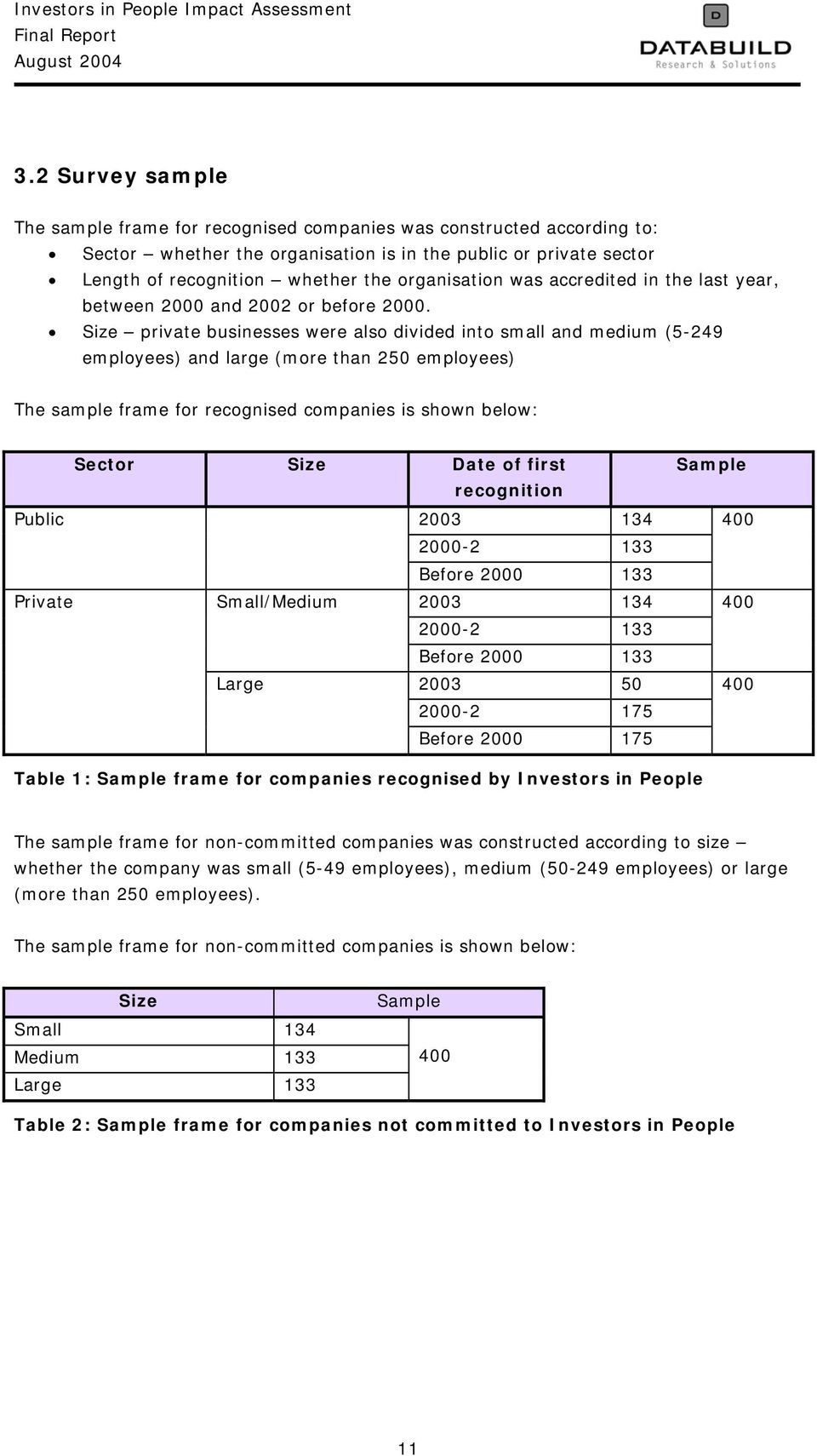
11 3.2 Survey sample The sample frame for recognised companies was constructed according to: Sector whether the organisation is in the public or private sector Length of recognition whether the organisation was accredited in the last year, between 2000 and 2002 or before Size private businesses were also divided into small and medium (5-249 employees) and large (more than 250 employees) The sample frame for recognised companies is shown below: Sector Size Date of first recognition Public Before Private Small/Medium Before Large Before Sample Table 1: Sample frame for companies recognised by Investors in People The sample frame for non-committed companies was constructed according to size whether the company was small (5-49 employees), medium ( employees) or large (more than 250 employees). The sample frame for non-committed companies is shown below: Size Small 134 Medium 133 Large 133 Sample 400 Table 2: Sample frame for companies not committed to Investors in People 11
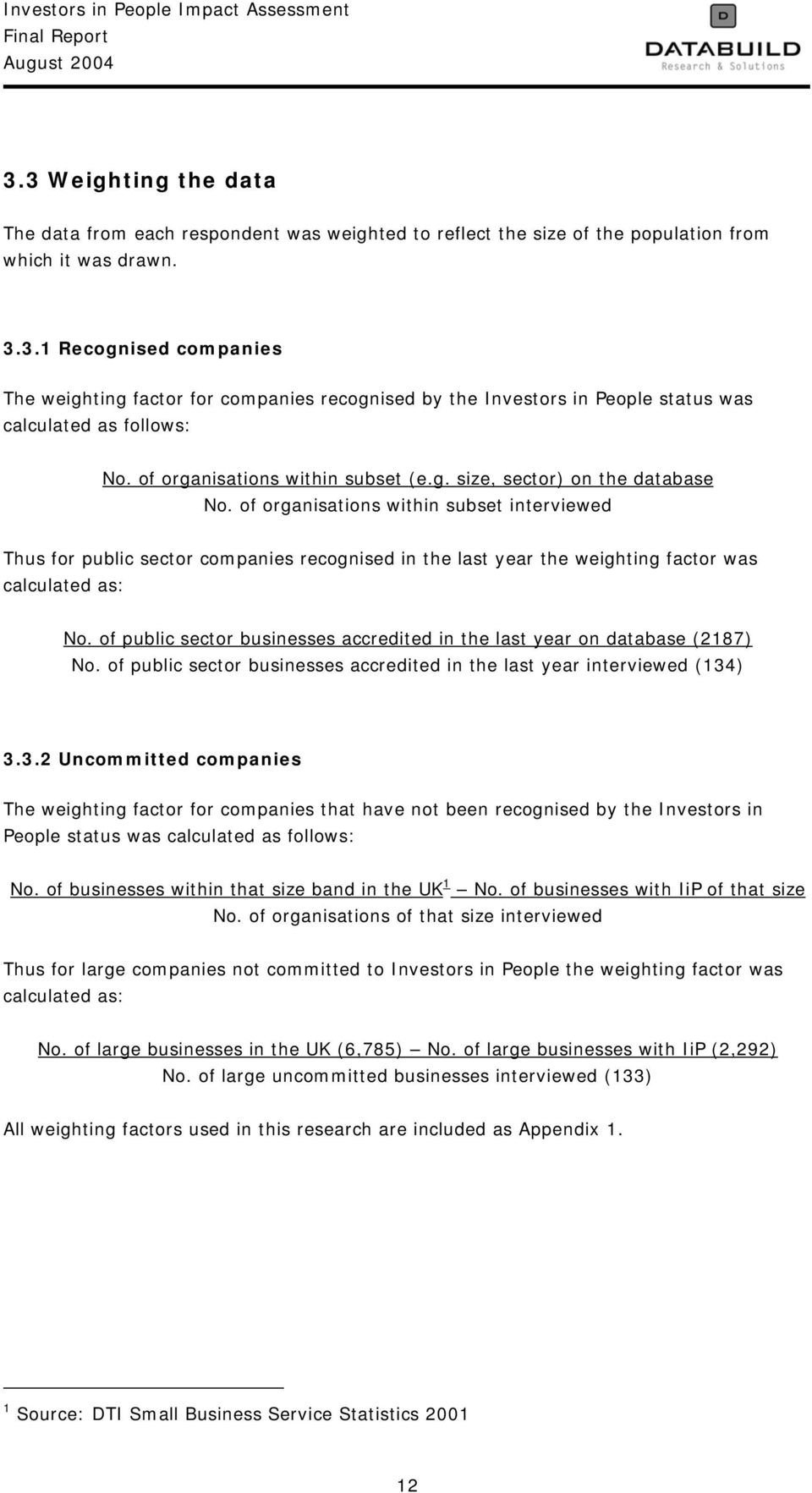
12 3.3 Weighting the data The data from each respondent was weighted to reflect the size of the population from which it was drawn Recognised companies The weighting factor for companies recognised by the Investors in People status was calculated as follows: No. of organisations within subset (e.g. size, sector) on the database No. of organisations within subset interviewed Thus for public sector companies recognised in the last year the weighting factor was calculated as: No. of public sector businesses accredited in the last year on database (2187) No. of public sector businesses accredited in the last year interviewed (134) Uncommitted companies The weighting factor for companies that have not been recognised by the Investors in People status was calculated as follows: No. of businesses within that size band in the UK 1 No. of businesses with IiP of that size No. of organisations of that size interviewed Thus for large companies not committed to Investors in People the weighting factor was calculated as: No. of large businesses in the UK (6,785) No. of large businesses with IiP (2,292) No. of large uncommitted businesses interviewed (133) All weighting factors used in this research are included as Appendix 1. 1 Source: DTI Small Business Service Statistics
13 3.4 Establishing financial benefits This section outlines the methodology for establishing the financial benefits attributed to IiP. Respondents were asked: 1. If they had taken action to improve their business since deciding to commit to IiP. 2. Whether this change had made any impact on their businesses 3. What the value of that impact had been 4. To what extent they could attribute the changes made to the business to Investors in People The following explain this methodology in more detail: Action All respondents were asked if they had made any changes to the operation and management of their business since deciding to commit to IiP. Changes were categorised as follows: Involving people in business decisions Improving staffs understanding of how they can help the organisation meet its objectives Instigating training and development to improve the performance of the organisation Recruiting appropriate individuals and inducting them effectively Regular appraisals and feedback Focusing on leadership and management Where respondents said they had not made any changes to their business, they were prompted with these categories, to see if they had made any changes in any of these areas Impact Where business had made changes, respondents were asked whether they had seen any benefits as a result of that change. Responses were categorised as follows: More motivated staff Increased staff satisfaction More productive staff/improved productivity Lower turnover of staff Less staff absenteeism Increased customer satisfaction Improved reputation Less waste Improved quality Reduced costs/improved efficiency Improved profit margins Increased sales 13

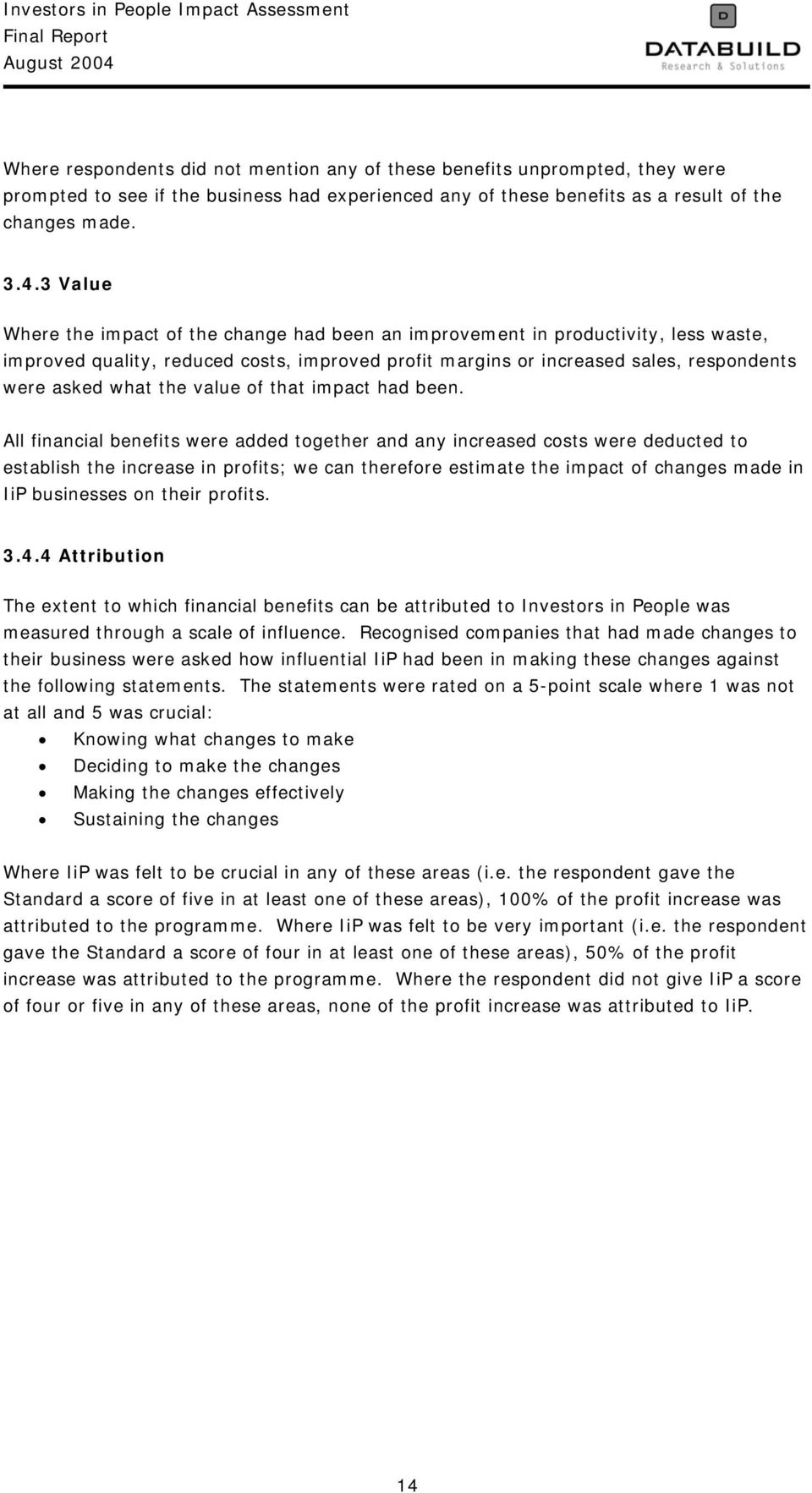
14 Where respondents did not mention any of these benefits unprompted, they were prompted to see if the business had experienced any of these benefits as a result of the changes made Value Where the impact of the change had been an improvement in productivity, less waste, improved quality, reduced costs, improved profit margins or increased sales, respondents were asked what the value of that impact had been. All financial benefits were added together and any increased costs were deducted to establish the increase in profits; we can therefore estimate the impact of changes made in IiP businesses on their profits Attribution The extent to which financial benefits can be attributed to Investors in People was measured through a scale of influence. Recognised companies that had made changes to their business were asked how influential IiP had been in making these changes against the following statements. The statements were rated on a 5-point scale where 1 was not at all and 5 was crucial: Knowing what changes to make Deciding to make the changes Making the changes effectively Sustaining the changes Where IiP was felt to be crucial in any of these areas (i.e. the respondent gave the Standard a score of five in at least one of these areas), 100% of the profit increase was attributed to the programme. Where IiP was felt to be very important (i.e. the respondent gave the Standard a score of four in at least one of these areas), 50% of the profit increase was attributed to the programme. Where the respondent did not give IiP a score of four or five in any of these areas, none of the profit increase was attributed to IiP. 14
15 4 Financial benefits of IiP recognition 4.1 Overview The chart below compares the financial benefits of changes made to the management of businesses with IiP recognition and those that have not committed to the Standard: IiP recognised organisations Uncommitted organisations 92% taken action to improve business since commitment 85% taken action to improve business in last three years Improved profit by 505/employee/year Improved profit by 197/employee/year Annual profit of 353 per employee attributed to IiP 15
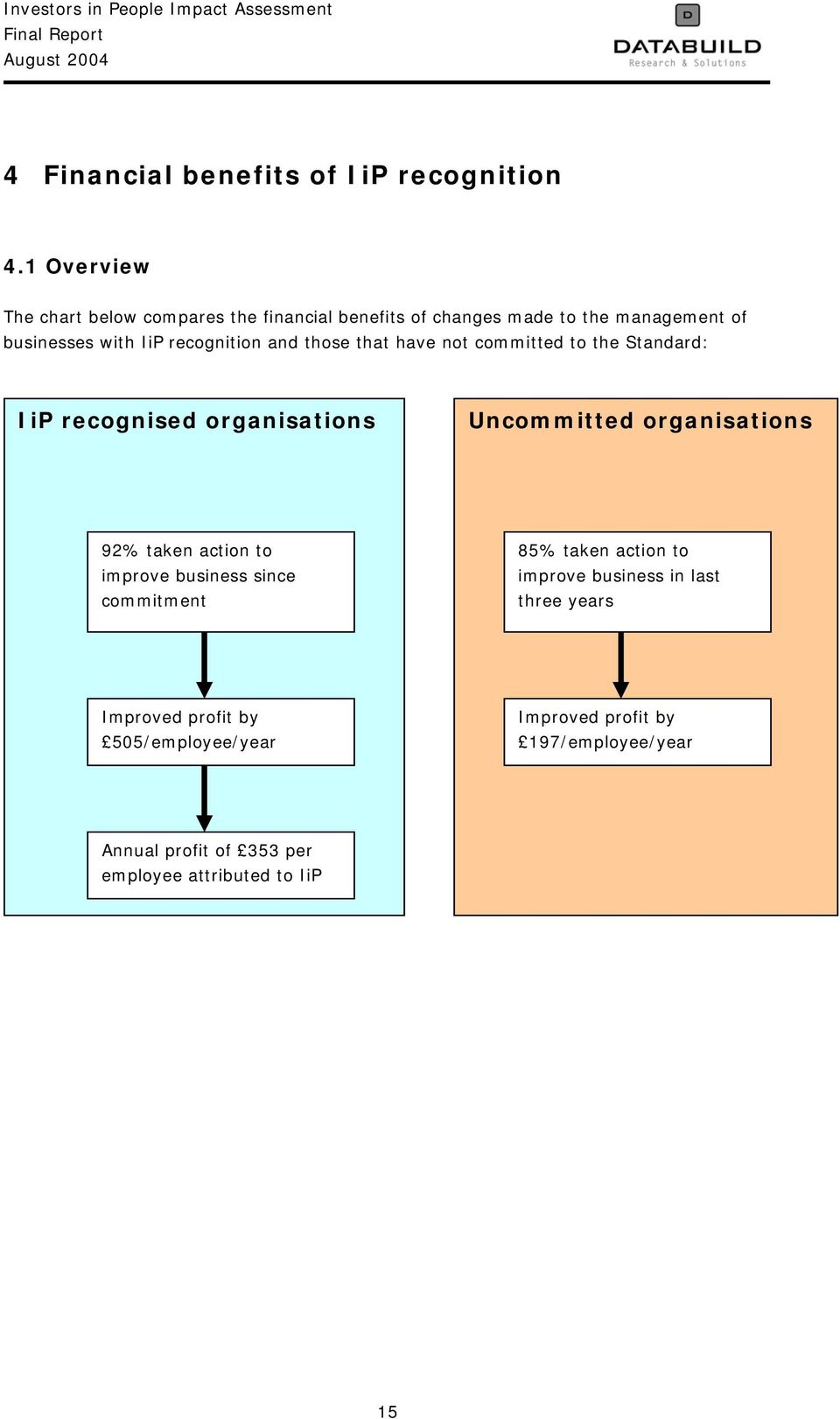
16 4.2 Investors in People has helped businesses to increase profits by 756m annually Following the methodology as described in section 3.4, Investors in People companies have added an average of 353 per employee to their annual profits through their commitment to the Investors in People principles. When this is scaled up to all IiP recognised businesses (i.e. is weighted to the number of IiP businesses), it can be said that IiP has helped businesses accredited to the Standard to increase their profit by 756m a year. This represents an average profit increase of 4% of sales. 60% of the total increase in profits is among medium sized recognised businesses who have achieved attributed annual profit increases of 602 per employee. Small businesses have achieved attributed annual profit increases of 303 per employee but account for only 4% of the total. Large businesses account for 36% of the total profit increase attributed to IiP but achieved the smallest benefit per employee at 41 each. 4.3 IiP businesses make changes that are twice as profitable as changes made by uncommitted companies Respondents in companies not committed to IiP were also asked questions to determine the economic impact of changes they had made. The average annual profit increase achieved by companies not committed to the Standard was 3.78% of sales or 197 per employee. This can be compared to the total annual profit increase achieved by companies recognised by the Investors in People Standard which was an average of 7.16% of sales or 505 per employee (this is the total average annual profit increase per employee, following the calculations in 3.4. This has not been weighted to reflect attribution to maintain comparability to the figure for non-iip businesses which will have no attribution to IiP.). IiP businesses are making changes that are twice as profitable as changes made by uncommitted companies. 16

17 The following chart breaks down the total annual profit improvement per employee for both recognised and uncommitted businesses was as a result of: Reduced costs Improved productivity Improved quality Increased sales Reduced waste Recognised 26% 26% 28% 9% 11% Uncommitted 31% 26% Profit improvements of IiP and non-iip organisations /employee/year Improved productivity Improved quality Reduced costs Reduced waste Increased sales Figure 1: Breakdown of profit improvement in IiP businesses (n=152) The breakdown of profit improvements in non-iip businesses is very similar to IiP businesses. Both IiP and non-iip businesses see improved profits mainly as a result of reduced costs, improved productivity and improved quality. However, IiP businesses achieved a greater proportion of their improvements through reduced costs than non-iip businesses (see section for a breakdown of cost reductions). 17

18 4.4 IiP helps businesses to make changes more effectively There is no significant difference between the proportions of IiP companies and non-iip companies that have taken action to improve their businesses: 92% of companies that have been recognised with the Investors in People Standard have made changes to the operation and management of their business since committing to IiP. 85% of companies that have not committed to the Standard have made changes to the operation and management of their business in the last three years. Exploring which sorts of recognised companies have taken action, there are few differences between companies that have taken action in terms of sector, size and length of recognition against the Standard. However, considering businesses not committed to the Standard; 91% of medium and large businesses have made changes compared to 84% of small businesses. However, as the figures above show, most businesses are making changes. If this is added to the fact that IiP businesses make changes that are twice as profitable as changes made by uncommitted companies, we can say that all businesses are making changes, both IiP businesses and non-iip businesses, but IiP businesses are doing it better i.e. changes made by IiP companies result in higher profit improvements. Where companies had not made changes to the operation and management of their business they were asked why. These companies felt that there was no need to make changes to the operation and management of the business either because the company was already operating well, the company was too small or the company was too old or too young for change. 18
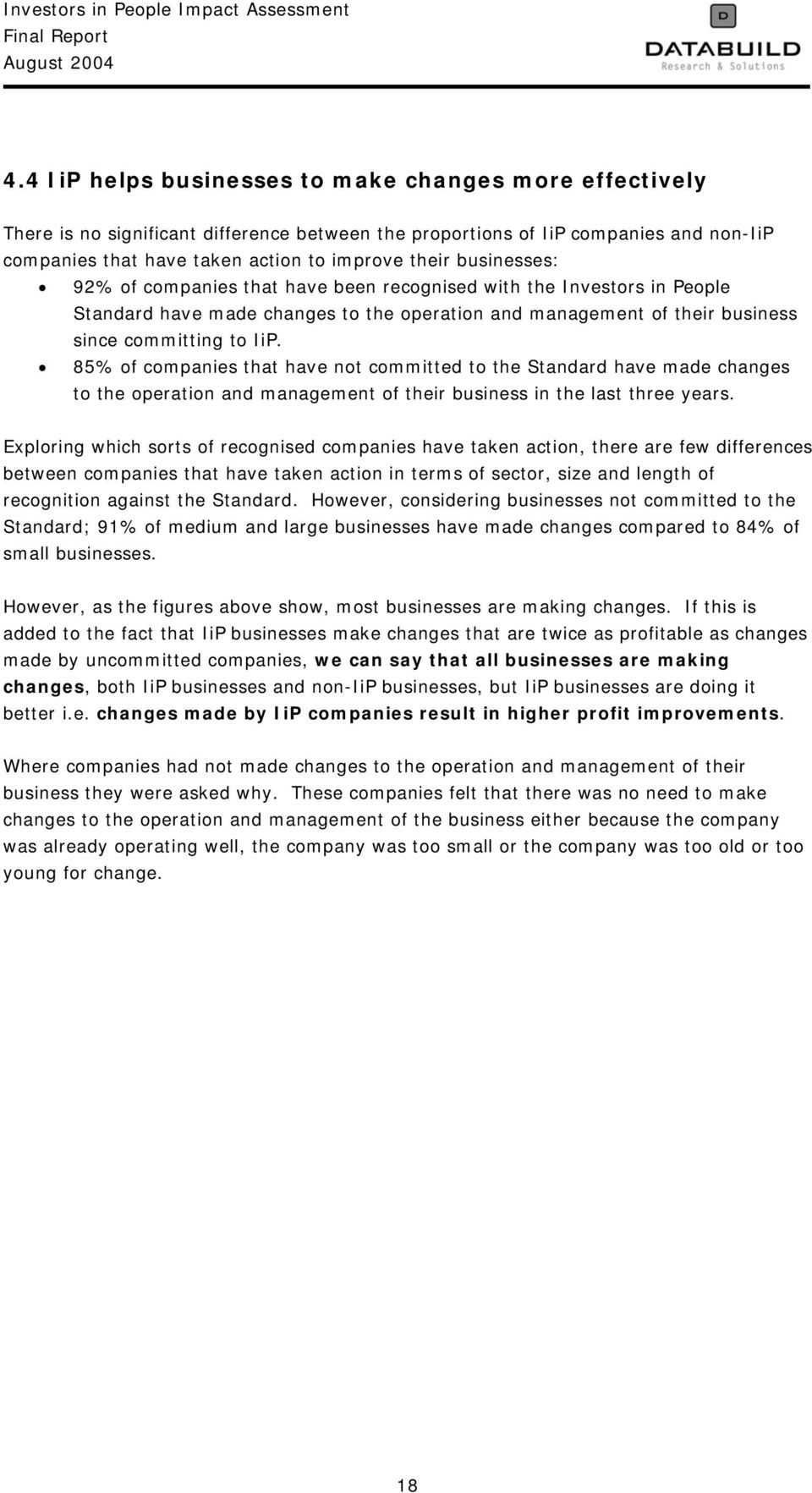
19 Economic benefits appear to increase over time. 88% of the profit increase seen by IiP companies is from companies that were recognised to the Standard before This is shown in the chart below where n represents the number of private sector companies recognised against IiP for whom we were able to calculate profit improvement figures: Figure 2: Total annual profit increase broken down by year of recognition against IiP (n=102) 19
20 4.5 IiP helps businesses to realise profit through people Having established that changes made by IiP businesses result in higher profit improvements, this section looks at what sort of changes are made by IiP businesses to understand why. Where companies had made changes to the operation and management of the business, changes were coded into the following areas: Involving people in business decisions Improving staffs understanding of how they can help the organisation meets it s objectives Instigating training and development to improve the performance of the organisation Recruiting appropriate individuals and inducting them effectively Regular appraisals and feedback Focusing on leadership and management Involving people in business decisions more of a team approach, shared responsibilities We involved staff more in business planning We are giving staff more power and involving them more in the running of things Other Improving staffs The types of changes that both recognised and uncommitted businesses had made to their businesses are shown in the graph below: Leadership and management Training and development Appraisals and feedback Organisation objectives Business decisions Recruiting % of IiP and non-iip businesses Uncommitted Recognised understanding of how they can help the organisations meet its objectives We ve got people more involved and more aware of what s going on. Meeting more regularly, improved communication. everyone now knows what they are doing. Roles and responsibilities are clearer. Figure 3: Types of changes made by IiP and non-iip businesses (n=1,092) 20

21 The largest area of change for both recognised and uncommitted businesses is leadership and management. Where IiP and non- IiP businesses differ is that more IiP businesses are improving training, development appraisals and feedback; changes that directly involve staff. 32% of recognised businesses have made changes concerning training and development compared to 16% of non-iip businesses. 28% of IiP businesses have made changes in the area of appraisals and feedback compared to 17% of non-iip businesses. Instigating training and development to improve the performance of the organisation Greater commitment to training More effective training plans to help identify training needs There has been more evaluation of training and how training is allocated Recruiting appropriate individuals and inducting them effectively We now have an induction policy. We took on a training and recruitment manager. There s a formal staff handbook for clear induction. 21
22 Looking at which changes deliver the best economic benefits, instigating training and development to improve the performance of the organisation and regular appraisals and feedback are the changes that result in the largest increase in profit for companies recognised by the Investors in People Standard. Focusing on leadership and management We have made changes in line management. The chart below shows the annual profit increase per employee for recognised and uncommitted companies broken down by the actions that were taken. This has been calculated by taking the profit increase for each company and dividing it between the actions taken. Where we had a direct figure for an action e.g. training and development has lead to savings in training of x pounds then x pounds is attributed to training and development. Otherwise, the profit increase is split equally between actions taken. Savings are then expressed as a saving per employee. Instead of being committee led we now have four partners and a management team. We ve given senior managers more responsibility by removing a tier or management. Leadership and management Training and development Appraisals and feedback Organisation objectives Business decisions Recruiting 6 45 Other Increase in annual profit per employee ( ) Uncommitted Recognised Regular appraisals and feedback Figure 4: Profit increase delivered by different types of changes (n=152) We now do planning sheets where we get feedback from students at the end of the academic year. We now carry out 360 degree appraisals. 22 We now have a performance management system.
23 It can be seen that IiP companies achieve higher annual profit increases per employee than non-iip companies in all areas except leadership and management and other. However, the most striking differences are the areas of training and development and appraisals and feedback which provide more than half of the profit improvement for IiP companies but are only 5% of the profit improvement for uncommitted companies. IiP companies carry out more training and development and appraisals and feedback than non-iip companies and demonstrate that carrying these out effectively results in large profit increases. 23
24 4.6 Cost impact of IiP recognition Cost of achieving recognition Many businesses have incurred costs in achieving recognition against the Standard. The 61% of respondents who were personally involved in IiP when their organisation first committed to the Standard and so were able to talk about the recognition process were asked a series of questions about the process that the organisation went through in order to obtain the Standard. Wages, as staff are more trained with more responsibility Of these 61% - 80% had used external advice or intermediaries to they expect higher wages. help them obtain the Standard and 40% had paid an average of However this balances out with 2,400 for this help with a range between 50 and 50, % the increase in efficiency and had received assistance with funding the recognition process. the money saved from lower reject rates Training and development costs Organisations that had made changes to the operation and management of their business since committing to IiP were asked if any of their costs had risen as a result of Investors in People. 44% of IiP organisations said that they had seen their costs rise as a result of Investors in People. 71% of these companies have seen their training and development costs increase. Other costs that have risen as a result of Investors in People are costs associated with: Administration Staffing Recruitment Reassessment Recruitment, training and development costs have increased. Admin costs have increased, as more staff are employed to deal with IIP. We have a larger budget for training and development, but this pays off as profit margins improve when staff perform better. Respondents have seen costs increase from between 100 to 50,000 a year as a result of Investors in People; this works out at increased costs of 62 per employee per year, half of which is spent on training and development. 33% of uncommitted companies said that they had seen their costs rise as a result of changes made to the operation and management of their business with an average increase of 10 per employee per year, less than a quarter of this is spent on training and development. It should be noted that these costs have been taken into account in calculating the increased profits discussed in sections 4.1 to 4.5. IiP companies are investing more on training and development than non-iip companies but have seen larger profit improvements than non-iip companies 24
25 resulting from this investment. IiP companies increased profits are, on average, nearly ten times their increased costs Cost reductions Some companies costs have reduced as a result of changes made following commitment to the Standard. These accounted for 28% of the profit improvements covered in sections 4.1.to 4.5. The following graph indicates the proportion of organisations that have reduced costs as a result of changes made to the operation and management of the business by both recognised and uncommitted organisations: Training is now carried out in house - 20% reduction in training costs. Agency costs have reduced, staff recommend more people themselves. Recruitment Staffing Training Development Other We are just not doing as much recruitment because people are staying and taking on expanded roles. By about 800 a year because we don't need to hire as many supply teachers % of respondents Unrecognised Private recognised Public recognised Figure 5: Cost reductions seen by recognised and uncommitted organisations (n=524) 25
26 5 Marketing Investors in People 5.1 People go to IiP expecting business benefits The unprompted expectations of IiP from both IiP and non-iip companies show that organisations go to IiP expecting business benefits. Both IiP companies and uncommitted companies that had an awareness and understanding of Investors in People (e.g. were planning to commit to IiP or were considering committing to IiP) were asked unprompted and prompted questions about the benefits they would expect to obtain by becoming recognised with the Standard. Interestingly, nearly half of recognised organisations (47%) talked about the benefits of the process of Investors in People rather than outcomes, examples include: An evaluation of our practices Acknowledgement of our staff An opportunity to reconsider the culture of our company To make us focus on people issues It provides a framework for our development Where respondents cited tangible benefits that they expected to obtain from recognition against Investors in People the responses were coded. The unprompted expectations of IiP organisations are shown in the graph below; public and private organisations are shown separately for comparison: Staff motivation Costs/efficiency Reputation Staff satisfaction Staff turnover None Customer satisfaction Quality Productivity Profits Sales Staff absenteeism % of IiP organisations Private Public Figure 6: Unprompted benefits expected by IiP organisations (n=1200) 26
27 Unprompted, all organisations recognised with the Standard principally expected to see improved staff motivation, satisfaction and increased efficiency. However, many of those in the private sector also expected to see benefits to their reputation. When prompted responses were added to unprompted, 74% of recognised organisations expected increased efficiency and 59% improved productivity. Just over a fifth of recognised companies in the private sector expected to see improved profit margins. Only 20% of recognised organisations did not expect to see any hard business benefits as a result of recognition against the IiP Standard. Many of the organisations that did not expect to see any bottom line benefits are small and in the public sector. The unprompted expectations of companies not committed to the Standard are shown in the graph below: Reduced costs Staff motivation Sales Profit margins Staff satisfaction Productivity Reputation Quality Customer satisfaction Staff turnover % of unrecognised companies Figure 7: Unprompted benefits expected by non-iip companies (n=74) As can be seen, companies that had not been through the process of recognition against the Investors in People Standard had similar expectations of the benefits of IiP as those who had. Interestingly, a slightly higher proportion of uncommitted companies cited improved profit margins and increased sales as a benefit unprompted than recognised companies, which suggests that some uncommitted companies have a more accurate perception of IIP than recognised organisations did before they went through the recognition process. 27
28 The benefits seen by businesses in both the public and private sectors are very similar. For both public and private sector organisations, increased staff motivation is the largest benefit obtained from changes made to the operation and management of the organisation; improved quality and increased staff satisfaction are also frequently seen benefits for both sectors. Differences between the benefits obtained by public and private sector organisations centre around harder business benefits, benefits which have a direct financial impact on the business. For public sector organisations improvements in productivity and reduced costs are seen less frequently than other benefits. However, over 60% of businesses in the private sector have reduced costs and improved productivity. Benefits can be grouped as follows: External benefits: improved reputation and increased customer satisfaction Staff benefits: more motivated staff, increased staff satisfaction, lower turnover of staff and less staff absenteeism Cost benefits: reduced costs/improved efficiency, improved quality, less waste, more productive staff, improved profit margins and increased sales. 28
29 The following charts compare the unprompted expectations of IiP with the unprompted benefits of IiP for both private and public sector recognised organisations. Cost benefits Staff benefits External benefits Cost benefits Staff benefits External benefits % of private sector recognised companies % of public sector recognised organisations Obtained Expected Obtained Expected Figure 8: Comparison of expected benefits of IiP against actual benefits of IiP for recognised organisations (n=800 private sector, 400 public sector) IiP is exceeding the expectations of private sector companies in terms of staffing benefits and costs benefits. This is particularly significant for cost benefits; 29% of private sector companies go to IiP expecting cost benefits which are then realised for 44% of private sector companies. The differences for public sector organisations are less marked with slightly higher realisation of cost benefits and slightly lower realisation of staff benefits. However, IiP is not meeting expectations in terms of external benefits for private sector companies. 36% of private sector companies go to IiP expecting external benefits such as improved reputation and customer satisfaction. Only 13% of private sector businesses cite either improved reputation or customer satisfaction as a benefit of changes made to the business following commitment to IiP. 29
30 5.2 Self-motivated Investors are more successful All companies recognised with the Investors in People Standard were asked what the motivation was for becoming an Investor in People. Motivations can be divided into external and self motivations. External motivations included: Thinking about when you decided to become an IIP, what was the motivation? EXTERNAL MOTIVATION Our parent company instructed us to do Corporate decisions. The decision to become an Investor in People had been made at corporate or group level and subsidiaries or departments were expected to comply with the decision. it. We felt we were already adopting the principles and we wanted recognition. some of our clients were looking for it. Marketing. Respondents felt that customers were more likely to use companies that were recognised by IiP or customers would only use recognised companies. They wanted the Standard to demonstrate to their customers that they cared about people. It was a way of separating ourselves from the cowboys in the industry. Funding. Public sector organisations felt that IiP would increase their chance of receiving funding, or receiving an increased amount of funding. Everyone else was doing it. Recruitment. Companies feel that IiP recognition makes them an employer of choice and they can therefore attract better quality staff. Not to be left behind. Companies were motivated to obtain the Standard because everyone else was doing it. Recognition. A number of companies felt that they were already doing what Investors in People required, therefore they might as well get the Standard. 30
31 Self motivations included: Benchmarking. Companies wanted to use the Standard as a way of benchmarking or evaluating themselves. This review process would highlight areas for improvement. For staff. Companies wanted to demonstrate to staff that they were valued. Structure/framework. IiP was used as a structure or a framework for addressing people issues within the organisation. Manage change. IiP was used to manage change within organisations; one respondent described how the Standard had prepared two firms for a successful merger. Result of a need. Some companies were motivated to use IiP as an improvement tool, as a method of improving staff appraisals or team work. Thinking about when you decided to become an IIP, what was the motivation? SELF MOTIVATION IIP is a good business management tool - it improves business performance. We needed a framework to use for business development. Bottom line measures - training, staff retention, improved sales. Essentially we used it as a health check. We wanted to be appraised by an external body. IiP companies can therefore be segmented into two groups according to motivation for obtaining the Standard. Self-motivated investors are internally motivated to obtain the Standard compared to externally motivated investors. Each group is considered below: Self motivated Investors Around two thirds of recognised companies are self-motivated investors, companies whose motivation to become committed to the Standard came from within because they want: To benchmark their company, To demonstrate to staff that they are valued, A structure for addressing people issues, A tool to manage change or to improve an aspect of their company e.g. appraisals. Looking at the characteristics of this group, self-motivated investors are more likely to be private sector companies rather than public sector organisations but there is no significant relationship between size of the company and whether or not the company is selfmotivated. On the whole self-motivated investors obtain greater financial benefits from recognition against the Standard. The average annual profit increase for self-motivated Investors is nearly three times as high as for externally motivated Investors. These companies are also more likely to see the value in continuing recognition against IiP and as such do not need additional incentives to maintain recognition against IiP as they recognise the benefits that can be obtained from the Standard. 31
32 5.2.2 Externally-motivated Investors Around a third of organisations recognised with the IiP Standard were externally motivated to obtain the Standard: The decision to obtain the Standard was made by head office or a parent company Customers pushed them to get the Standard They wanted recognition for what they were already doing They wanted the Standard because everyone else has it. Companies accredited with the Standard before 2000 are more likely to be externally rather than self motivated to have obtained the Standard, perhaps as a result of the exclusivity of the award at this time. A large proportion of externally motivated investors are public sector organisations and on the whole they experience less benefit as a result of their IiP status than self-motivated investors. Externally motivated Investors are the companies that might choose not to continue with IiP recognition and need to be provided with reasons to stay. They need the prestige of IiP to be maintained and marketed. The chart below shows internally and externally motivated Investors by sector. Agriculture Utility Supply Manufacturing Construction Wholesale and retail Hotels and restaurants Transport Financial intermediation Business Activities Public admin Education Health and social work Other activities % of IiP organisations External Internal Figure 9: Motivation by sector (n=721) Although all utilities companies that are recognised to the Standard are self motivated, it should be remembered that this represents a very small number of IiP companies overall. However, there are large numbers of IiP organisations in the education and wholesale and retail sectors and many of these are self motivated. 32
33 5.3 IiP organisations with the support of top management are more successful Organisations were asked how committed top management were to the idea of becoming an Investor in People. 87% of organisations had complete commitment from top management. 13% of organisations had difficulties in persuading top management or felt that top management were not completely supportive. Comments included: They were not very committed at the beginning. This was the reason we failed at the first attempt to gain the accreditation. More committed second time round. I'd say that top management didn't have a clue what the Standard really meant to the company. Initially they weren't committed but I talked them round Not very committed at the beginning as they didn't see that it could bring in any benefits. It is mostly large organisations who have experienced less commitment from top management; in small and medium sized Investors it is often top management who have championed IiP. The lack of commitment from top management does have an affect on the economic benefits achieved through IiP recognition. Organisations that have lacked full support from top management have seen less financial benefit as a result of their IiP recognition than organisations that have full top management support. IiP businesses with commitment from top management have seen an average annual profit increase of 886 per employee compared to an average annual profit increase of 350 per employee for companies without commitment from top management. 2 2 Not all respondents were asked how committed top management were to the idea of becoming an Investor in People. If a respondent was not personally involved with Investors in People when their organisation became committed to the Standard, they were not asked this question. 33
34 5.4 IiP helps public sector organisations to improve All private sector organisations were asked whether they used any of the following key indicators to measure their business performance: Financial performance Market share Efficiency (including productivity) Customer satisfaction Staff satisfaction Where possible, they were asked to rate the organisation s performance in this area before and after commitment to IiP on a scale of 1 to 5 where 1 is poor and 5 is excellent. Public sector organisations were asked the same questions with regards to the following key indicators: Efficiency (including productivity) Customer or client satisfaction Staff satisfaction Position against competition or league tables Meeting public service objectives 99% of recognised organisations and 98% of uncommitted organisations use at least one of these key indicators to measure their organisational performance. Respondent s ratings of key indicators before and after commitment to IiP were used to calculate improvements in each of the key indicators i.e. rating of indicator out of five before was subtracted from rating of indicator out of five now to indicate where IiP is helping companies to improve. Improvements in ratings are shown in the graphs below: Staff satisfaction Efficiency Customer satisfaction Financial performance Market share Improvement in key indicators Figure 10: Improvement in key indicators of private sector companies (n=443) 34
35 Efficiency Staff satisfaction Meeting objectives Position against competition Customer satisfaction Improvement in key indicators Figure 11: Improvement in key indicators of public sector companies (n=768) As can be seen IiP has had most effect on increasing staff satisfaction and improving efficiency. 35
36 5.5 IiP helps organisations in the process of making changes The extent to which changes made to the operation and management of the organisation can be attributed to Investors in People was measured through a 5 point scale of influence. IiP organisations that had made changes were asked how influential IiP had been in four areas. The statements were rated on a 5-point scale where 1 was not at all and 5 crucial: Knowing what changes to make Deciding to make the changes Making the changes effectively Sustaining the changes For 64% of organisations, Investors in People was either crucial or very influential in at least one of these areas. IiP is seen to be most helpful in the later two areas, making the changes effectively and sustaining the changes. Often IiP is used as a tool to make and sustain changes following the decision to make a change. It gave us a structure and a benchmark; something to aim for. We were more aware of what we did and why; helped with decision making. It made us more focused and gave us a structure to work by, it also reaffirmed things we were doing initially by giving us a Standard. It was just about providing the tools and the support. Looking at how IiP helps changes in different types of organisation the following observations can be made: The Standard is more influential in making changes effectively in small and medium sized businesses than in large businesses 55% of small sized businesses and 53% of medium sized businesses think IiP was very important or influential in making the changes effectively compared to 41% of large sized businesses. There is room to improve the influence of IiP on decision making in large businesses 29% of large businesses found IIP very important or crucial in knowing what changes to make compared to 42% of small businesses. 31% of large businesses found IiP very important or crucial in deciding to make the changes compared to 45% of small businesses. The Standard is more influential on changes made in companies that received the Standard last year than companies that received the Standard before However, the impact of memory should be borne in mind here. There is the potential that the longer the changes have been implemented, the less they are associated with IiP. 36
37 Where the respondent has given IiP a score of four or five in any of the statements IiP is said to be influential. The graph shows the percentage of people who made each change for whom IiP was influential. Organisation objectives Business decisions Training and development Other Appraisals and feedback Recruiting Leadership and management % of recognised companies Figure 12: Changes where IiP has been influential (n=288) IiP is most helpful in changes involving improving staff understanding of how they can help the organisation meet its objectives and involving people in business decisions. In comparison, it is somewhat less helpful in helping organisations to recruit appropriate individuals and induct them effectively and in changes focusing on leadership and management. Overall, however, IiP is considered helpful for over 50% of organisations making each type of change. Only 7% of businesses thought IiP was of very little influence (i.e. they rated IiP at one or two for each of the statements). On the whole, these companies are large, private sector companies. These companies were typically externally motivated to obtain the Standard and the individual interviewed was not involved when the organisation first committed to the Standard. 37
38 5.6 94% of organisations see value in continuing to be recognised by IiP There are several key reasons why 94% of recognised organisations want to continue to be recognised by the Standard: Reputation. The company likes the fact that customers can see they have the Standard, it sets them apart from organisations that don t. Measuring their performance. IiP is a good way of continuing to monitor their performance; a means of benchmarking themselves at regular intervals. Staff. Having the Standard demonstrates to staff that they are valued. Maintain Standards. IiP keeps people on their toes and ensures that they maintain Standards. The reasons for not seeing any value in continuing to be recognised by IiP include: The Standard has no recognition within the industry (construction). The company is too large, this makes it very time consuming. There were benefits at the beginning, but now the whole thing is up and running assessment is just a paper-pushing exercise. The Standard is not as recognised as it was, there is not enough PR or communication about IiP, certainly not as much as there was. A large proportion of the organisations that do not see any value in continuing with their IiP accreditation are small businesses in the private sector who were accredited between 2000 and Additionally, in over 50% of cases where the organisation sees no value in continuing with their IiP accreditation, the respondent in the survey was not involved in IiP when the organisation committed to the Standard. 38
39 5.7 There is a large potential market for IiP 3 There is a very large awareness of IiP amongst uncommitted The value is only in the companies in the private sector. 80% of uncommitted companies procedures you need to put in have heard of Investors in People. Looking at awareness by size: place. We already have them. 75% of small companies have heard of IiP 95% of medium companies have heard of IiP Small company so we have no 99% of large companies have heard of IiP need for it plus we cant afford to be spending money on it. However, some respondents in uncommitted companies who had heard of IiP did not think that IiP could help their company. There We are restructuring the were a number of reasons for this: business at the moment so it would not be applicable. Size. Respondents felt that the company was too small to benefit from IiP or that IiP was not relevant for them There is little training done in because it was only for large businesses. this type of industry. No value. Some companies did not see any value in becoming an Investor in People, they felt that they were We already go to training already doing what would be required of them to obtain associations plus the business is the Standard, and there was therefore no additional quite specialised. benefit from obtaining the Standard. Culture. A number of companies felt that training and development, or people issues were of no value in the type of work they did. These were often businesses in the construction or manufacturing sectors. Relevance. Respondents considered themselves to be specialised companies, IiP would therefore not apply to them. This group is unlikely to be persuaded to become involved in IiP without some fundamental change in their outlook and can be considered to be unlikely investors. Other uncommitted companies recognised the value in IiP but did not have the resources or see it as a sufficiently high priority for them at the moment: Lack of resources. The organisation does not have the money or staff available to dedicate to the Standard. External factors. Other issues have taken priority such as the company has been taken over or decreased sales. Changes. The company was going through changes, and was waiting for a period of stability before looking to obtain the Standard again. No need. There is no need for the company to try and obtain the Standard as they are already addressing people issues through another scheme or programme. This group may be attracted to and take up the Standard with a little more persuasion and can be considered to be potential investors. 3 Quotations in this section are statements from non-iip companies 39
40 5.7.1 Potential Investors Around three-quarters of uncommitted companies are potential investors, these are companies that are aware of IiP and may have looked into it. They may have rejected the idea of becoming committed to the Standard because they don t really understand the Standard and lack good information about it. They may also have rejected the Standard for internal reasons e.g. the organisation is going through a period of change. These companies require access to good, clear information about the Standard and the benefits of recognition, as they may dismiss IiP through falsely thinking it is not appropriate to their organisation. On the whole these companies are actively making changes to their company but without the help of IiP, they would therefore benefit from the messages in the first chapter of the report such as IiP helps businesses make changes that are twice as profitable as changes made by uncommitted companies. Using details of the number of businesses in the UK and the number of recognised businesses in each size category as specified on the IiP database we estimate that there are 300,400 potential Investors in the UK. This can be broken down into: 280,000 small businesses 17,000 medium businesses 3,400 large businesses Unlikely Investors Around a quarter of uncommitted companies are unlikely investors. These companies are generally small companies that are making very few changes to their business. Some unlikely investors have heard of IiP and dismissed it as they do not see any value in it, others in this group have not heard of IiP but are culturally opposed to the training and development of their staff, often because they consider themselves to be operating quite well without doing so or staff are in low skilled jobs. 40
41 6 Conclusions and recommendations Conclusions and recommendations are structured around the two core chapters of the report: 1. Financial benefits of IiP recognition. Looking at how Investors in People helps businesses to improve their business performance. 2. Marketing Investors in People. Looks at the implications of this research for marketing IiP both to existing and potential customers. The narrative follows the outline of the Executive Summary with recommendations bulleted as appropriate. 6.1 Financial benefits of IiP recognition The study has established that achieving recognition against the Investors in People Standard impacts on business performance. Overall, the average annual profit increase achieved by companies recognised by the Investors in People Standard was 7.16% of sales or 505 per employee. Of this, 353 per employee was attributed to IiP. Investors in People has helped businesses to increase profits by 756m annually. The average annual profit increase achieved by companies not committed to the Standard was 3.78% of sales or 197 per employee. IiP businesses are making changes that are twice as profitable as changes made by uncommitted companies. IiP businesses are not making any more changes than non-iip businesses and are realising that profit increase in the same way as non-iip businesses, primarily as a result of reduced costs, improved productivity and improved quality but IiP helps businesses to make changes more effectively and therefore more profitably. Both IiP and non-iip businesses are focusing on leadership and management, for non-iip companies changes concerned with leadership and management make up a significant proportion of their overall profit improvements. The Leadership and Management model is an effective way to introduce businesses to IiP. This area is where both IiP and non-iip businesses are making the most changes, over 50% of non-iip businesses are focusing on leadership and management changes. As a stand alone model this should be promoted more (e.g. through IiP delivery partners) to engage potential investors with the IiP principles. 41
42 Where changes in IiP companies differ to changes in non-iip companies is though the amount of changes that are focussed on staff, IiP companies are making more changes that improve business performance through people than non-iip companies. The types of changes that IiP companies are making are leading to greater profit improvements. IiP helps businesses to realise profit through people, namely instigating training and development to improve the performance of the organisation and regular appraisals and feedback. However, non-iip businesses are making some changes in terms of their staffing, particularly improving staff s understanding of how they can help the organisation meet its objectives, but the benefits of these changes are leading to a small percentage of the total profit increase of non-iip businesses. 36% of non-iip businesses have made changes that directly involve staff which has delivered less than a quarter of the total profit increase of non-iip businesses. In comparison, 91% of IiP businesses have made changes that involve staff and this has lead to 82% of the total profit increase of IiP businesses. Although IiP businesses are making more changes that directly involve staff it should be noted that these sorts of changes can be costly. IiP businesses are therefore spending more than non-iip businesses on training and development but IiP businesses are training and developing staff more effectively than non-iip businesses and have therefore seen larger profit improvements as a result. For a number of uncommitted companies the perceived costs of IiP act as a deterrent to recognition. This research suggests that there are costs involved with IiP recognition but that the improved financial benefits of recognition outweigh the costs incurred. This is a worthwhile message for both potential and current Investors, particularly because it takes time to see the financial benefits. 42
43 6.2 Marketing Investors in People The unprompted expectations of IiP from both IiP and non-iip companies show that businesses go to IiP expecting business benefits. Unprompted, all organisations recognised with the Standard principally expected to see improved staff motivation, satisfaction and increased efficiency. However, many of those in the private sector also expected to see benefits to their reputation. Interestingly, around 50% of recognised companies talk about processes rather than benefits when they are asked about the benefits of IIP. However, when prompted, they are comfortable talking about harder business benefits in the context of IIP. As most organisations are comfortable talking about bottom line benefits in the context of IiP, Investors in People UK should continue to promote bottom line benefits, using the language in promotional material and IiP materials. Other motivations for wanting to become an Investor can be divided into External and Self motivations. Around two thirds of recognised companies are self-motivated investors, companies who become committed to the Standard to benefit their company on an internal level e.g. as a structure or framework for addressing people issues within their organisation. On the whole, self-motivated Investors are more successful. Self-motivated Investors do not need additional incentives to maintain recognition against IiP as they recognised the benefits that can be obtained from the Standard. A number of these companies can be used as material for case studies, to help persuade top management. These companies can champion IiP for those that need more persuading. Around a third of organisations recognised with the IiP Standard are externally motivated to obtain the Standard, the decision to obtain the Standard being made by head office or their parent company or they wanted the Standard because everyone else has it. These companies may need more incentives to stay accredited. This group would benefit from using the Profile benchmarking tool as this provides continued reason to use the Standard. Externally motivated Investors need the prestige of IiP to be maintained and marketed would benefit from national press coverage of the Standard, or mentions by successful companies. If IiP status is a corporate or group decision, encourage companies and groups to want to do IiP not just because they have to but for added incentives e.g. incentives at Sainsbury for being the best Sainsbury store in terms of IiP. The same could be introduced in local schools, hospitals etc., top management could be given tools with which to incentivise and motivate departments to get the most out of the decision to commit. 43
44 Another factor which affects the relative success of IiP companies is the support of top management; IiP companies with the support of top management are more successful. Organisations that have lacked full support from top management have seen less financial benefits as a result of IiP recognition than organisations that have full top management support. The material in this research as concerns economic benefits provides excellent persuasive material for top managers. IiP could generate a persuasive tool such as a benefits chart to help present the business case for IiP to top management. Profile should be promoted to top management; this demonstrates the benefits of continuous use of IiP. However, whether or not companies have top management support, the support of IiP is found to be helpful in making changes. For 64% of recognised companies IiP was either crucial or very influential in making changes. It is most helpful in making changes effectively and sustaining change. Typically, IiP helps businesses in the process of making changes once the decision to make a change has been made. Decisions to make changes in business are largely motivated by the need for changes on the bottom line, improved profits or improved productivity. Although IiP is becoming increasingly associated with bottom line benefits, it is still more associated with helping business processes than making decisions that will affect the bottom line. Organisations will tend to diagnose a problem, propose a solution and then look to IiP to implement this effectively. As the Standard becomes more associated with bottom line benefits, it will be increasingly used for business planning at this level. 44
45 94% of businesses see value in continuing to be recognised by IiP. The key reasons why recognised companies continue to be recognised with the Standard are to maintain a good reputation though accreditation, to demonstrate to staff that they are valued, as a means of monitoring performance and as a check to maintain Standards. A key reason why companies see the value in maintaining their accreditation to IiP is the reputation of the Investors in People brand. Key to maintaining the value of IiP status for many recognised organisations is for Investors in People UK to maintain the prestige of the IiP brand. It appears that where the current individual responsible for IiP was not involved with IiP when the company first became committed to the Standard, IiP status may lose its value in the company. This has implications for how IiP manage their client relationships. IiP need to market the benefits of IiP status to individuals who take over responsibility for IiP in that company. Un-recognised companies also see the value in the Standard. There is a very large awareness of IiP amongst uncommitted companies in the private sector. 80% of uncommitted companies have heard of Investors in People. These companies represent a large potential market for IiP as many of these are actively making changes to their company but would benefit from the support of IiP. These companies require access to good, clear information about the Standard and the benefits of recognition, they would benefit from relevant case studies, as they may dismiss IiP through incorrectly thinking it is not appropriate to their organisation. Potential investors may have enquired about the Standard in some way, through the website for example; it would therefore be good to generate a database of these companies to target marketing efforts. Around a quarter of uncommitted companies are unlikely investors. These companies are generally small companies that are making very few changes to their business. Some unlikely investors have heard of the Standard and dismissed it, as they do not see any value in it. Others in this group have not heard of IiP but are culturally opposed to the training and development of their staff, they see no reason for this often because they consider themselves to be operating quite well without doing so or staff are in low skilled jobs. There is a strong case for not marketing IiP to these companies directly. These companies need persuading about the importance of people issues first. IiP could partner with Trade Associations, writing in trade or national press to try to achieve this. IiP could also build on its work with the Skills Alliance. 45
46 7 Appendix 1 Weighting The data used to produce this report has been weighted to reflect its representation in the universe of recognised organisations. 7.1 Recognised companies Private sector Size of company Small/Medium Large Length of recognition Population (a) No. of completed interviews (b) Weight (=a/b) , , Pre , Pre , Public sector Length of recognition Population (a) No. of completed interviews (b) Weight (=a/b) , Pre Uncommitted companies Size Population 4 (a) No. of completed interviews (b) Weight (=a/b) Small 31, Medium 22, Large 4, Source: Small Business Service This is the number of businesses of that size in the UK minus the number of private sector businesses recognised to the IiP Standard of that size. 46
47 8 Appendix 2 Questionnaire for recognised companies 1: QUEST Questionnaire information Project name: Investors in People Impact Assessment... 1 Written by: (Michelle McGuire and Charles Michaelis)... 2 Questionnaire status: Final... 3 Approved by: Sue Burns... 4 Date of approval: 3rd March : VERS Extract raw data prior to the change. Increase Version number (Code) with subsequent amendments of the questionnaire. Fill in Questionnaire log. Zip project run on previous version and save it in the "Out of the way" folder. Version number 1st March : CHECK Project manager to fill in while checking data Checking status of the interview Data OK... 1 Correction... 2 Clarification... 3 Rejected : SECT From database Sector from database Public... 1 Private : SIZE From database Size of organisation Small (5-49)... 1 Medium (50-249)... 2 Large (>=250) : RECO1 From database Date of first recognition 47
48 7: RECO2 From database Date of last recognition 8: LENG From database Time since first recognition Last year Before : F : PHONE Phone number 11: CONAM Business name 12: TITLE Title 13: NAME1 First name 14: NAME2 Surname 48
49 15: INTRO Hello, my name is $I. I'm calling from Databuild. We are an independent research company and we're doing some work for Investors in People. We are currently assessing the impact that achieving recognition against the Standard has on different organizations. Is now a convenient time to talk? Possible issues: The data that is provided to the client will be anonymous. The conversation will last about 15 minutes. All respondents are chosen at random from a database provided by Investors in People Continue Busy signal... BS Definite appointment... AP General appointment... GP Left message... LM No answer... NA General call back...lt Refused personally... RF Not allowed to speak to respondent...gk Number unobtainable...nu Quota full... QF Not a 'recognised' company... NC No longer in business...dd Call back after the end of field work period... VA Duplicate...DU 16: REC ALL RESPONSES WILL BE TREATED IN COMPLETE CONFIDENCE AND CALLS MAY BE RECORDED FOR TRAINING PURPOSES 17: JOB Interviewer to categorise Please can I confirm your job title? Owner/Chief Executive/Partner... 1 Other Director/Senior Manager... 2 HR/Personnel... 3 Manager... 4 Other : SECT2 Interviewer to categorise. Can I just check that your organisation is in the <sect> sector? Public... 1 Private
50 19: ACT1 Record verbatim and classify - private sector What does your business do? Agriculture/hunting/forestry Air transport Computer related activities Construction Education Electricity/water/gas supply Financial intermediation Fishing Health/social work Hotels/restaurants/bars Land transport Membership organisations Manufacturing, of what? Mining/quarrying Other business activities Other services Other transport activities/travel activities Post/telecommunications Public admin/defense/social security Real estate activities Recreation/cultural/sporting activities Renting of machinery/equipment Research and development Retail trade Sale/maintenance/repair of motor vehicles Sewage/refuse disposal Water transport Wholesale/commission trade : MANUF If organisation is a manufacturer Mft recycling Mft of basic metals/fabricated metal prods Mft of chemicals/chemical prods/fibres Mft of coke/petroleum prods/nuclear fuel Mft of electrical/optical equipment Mft of food/beverages/tobacco Mft of leather/leather prods/footwear Mft of machinery/equipment Mft of other non mineral products Mft of pulp, paper/paper products:publishing&pting Mft of rubber/plastic products Mft of textile/textile products Mft of transport equipment Mft of wood/wood products
51 21: ACT2 Record verbatim and categorise - public sector What does your business do? Agriculture/hunting/forestry Air transport Computer related activities Construction Education Electricity/water/gas supply Financial intermediation Fishing Health/social work Hotels/restaurants/bars Land transport Membership organisations Manufacturing, of what? Mining/quarrying Other business activities Other services Other transport activities/travel activities Post/telecommunications Public admin/defense/social security Real estate activities Recreation/cultural/sporting activities Renting of machinery/equipment Research and development Retail trade Sale/maintenance/repair of motor vehicles Sewage/refuse disposal Water transport Wholesale/commission trade : EMP Enter current number of employees Approximately how many people work in your recognised organisation? (I.e. site/branch/department/company that is recognised with the Investors in People Standard) 23: SIZE2 Automatic coding of size Small or Medium (5-249)... 1 Large (250+) : TURN Enter 999 for don't know and for public sector What is the approximate turnover of your organisation? 51
52 25: NUM How many IIP assessments has the organisation had? Don't know : FREQ How often does the organisation get assessed for IIP? Annually... 1 Every eighteen months... 2 Every two years... 3 Every three years... 4 Not with a regular frequency... 5 Too early to say... 6 Other, please describe : INV If not, get details of why not. Were you involved with Investors in People when your organisation committed to the Standard? Yes... 1 No, why not? : DECI Record verbatim and classify Thinking about when you decided to become an Investor in People, what was the motivation? 29: DECI2 Get details of job title/responsibilities Within the organisation, who was the first person to suggest that you become an Investor in People? Chief executive... 1 Managing director... 2 Other director... 3 Human resources/personnel... 4 Other, please specify... 5 No one else involved : TYPE1 Thinking about your business before you committed to Investors in People, how strongly would you agree or disagree with the following statements? Strongly agree Agree Neither agree nor Disagree Strongly disagree Don't know disagree Growth was a key 52
53 objective for the organisation The organisation was undergoing a period of change We had no clear way of measuring organisational performance We regularly used external help to improve our organisation 34: CHNG You mentioned that the organisation was undergoing a period of change - what was the reason for this? 35: INV1A Did you use any external advice or intermediaries to help you to obtain the Standard? Yes, Leaning and Skills Council (England) Yes, Business Link (England) Yes, Scottish Enterprises Yes, Highlands and Islands Enterprise Yes, Education and Learning Wales Yes, Department for Employment and Learning (NI) Yes, external consultant Laurel on-line Yes, other please specify No, didn't use any external help : INV1B If organisation have received help from an advisor or intermediary Did you pay for this help? Yes, how much?... 1 No... 2 Rather not say : INV1C Did you receive any subsidies or grants through the recognition process? Yes... 1 No
54 38: INV2A What were the responsibilties/jobtitles of the person who was the driving force behind the organisation becoming accredited? Chief executive... 1 Managing director... 2 Other director... 3 Human resources/personnel... 4 Other, please specify... 5 No one else involved : INV2C Thinking about support for IIP in the organisation, how committed were top management to the idea of becoming an Investor in People? 40: INV3 Enter 999 for don't know Roughly, how many days a year does the organisation spend on administration and management related to IIP in total? 41: BENO Unprompted - record verbatim and classify What benefits did you expect to obtain by becoming recognised? More motivated staff/staff better able to do their job Increased staff satisfaction More productive staff/improved productivity Lower turnover of staff Less staff absenteeism Increased customer satisfaction Improved reputation/like the recognition of having IIP Less waste Improved quality Reduced costs/improved efficiency/better processes Improved profit margins Increased sales Other, please specify None
55 42: BENPR Prompted - for private sector Did you expect to obtain any of the following business benefits? More motivated staff/staff better able to do their job Increased staff satisfaction Improved productivity Lower turnover of staff Less staff absenteeism Increased customer satisfaction Improved reputation/like the recognition of having IIP Less waste Improved quality Reduced costs Improved profit margins Increased sales Other, please specify None Increase efficiency None : BENPU Did you expect to obtain any of the following benefits for your organisation? More motivated staff/staff better able to do their job Increased staff satisfaction Improved productivity Lower turnover of staff Less staff absenteeism Increased customer satisfaction Improved reputation/like the recognition of having IIP Less waste Improved quality Reduced costs Improved profit margins Increased sales Other, please specify None Increased efficiency None : SKL1 On a scale of 1 to 10 where 1 is very poor and 10 excellent how would you rate your organisation against the following statements: The organisation has a plan with clear aims and objectives which are understood by everyone The organisation is committed to 55
56 supporting the development of its people The organisation evaluates outcomes of training and development against its goals 47: KIPR Record verbatim and classify Do you use any of the following key indicators to measure your business performance? Financial performance Market share Efficiency (includes productivity) Customer satisfaction Staff satisfaction None : SKP2 49: BM1 Thinking about the organisation before you became committed, on a scale of 1 to 5 where 1 is poor and 5 is excellent how would your rate the organisation's Financial performance Market share Efficiency Customer satisfaction Staff satisfaction 54: AM1 Thinking about the organisation now, on a scale of 1 to 5 where 1 is poor and 5 is excellent how would your rate the organisation's Financial performance Market share Efficiency Customer satisfaction 56
57 Staff satisfaction 59: KIPU Do you use any of the following key indicators to measure your organisational performance? Efficiency (includes productivity)... 1 Customer or client satisfaction... 2 Staff satisfaction... 3 Position against competition or league tables... 4 Meeting public service objectives... 5 None : SKP3 61: BBM1 Thinking about the organisation before you became committed, on a scale of 1 to 5 where 1 is poor and 5 is excellent how would your rate the organisation's Efficiency Customer/client satisfaction Staff satisfaction Position against competition Meeting public service objectives 66: AAM1 Thinking about the organisation now, on a scale of 1 to 5 where 1 is poor and 5 is excellent how would your rate the organisation's Efficiency Customer/client satisfaction Staff satisfaction Position against competition Meeting public service objectives 57
58 71: KIOT Do you use any other key indicators to measure your organisational performance? Yes, please specify... 1 No : CHNG1 Unprompted - record verbatim and classify Have you made any changes to the operation and management of the business since deciding to commit to IIP? Yes, please describe... 1 No : CHNG2 Prompted - Record verbatim and classify Have you made changes to the operation and management of the business in any of the following areas since deciding to commit to IIP? Involving people in business decisions... 1 Improving staffs understanding of how they can help the organisation meet its objectives 2 Instigating training and development to improve the performance of the organisation3 Recruiting appropriate individuals and inducting them effectively 4 Regular appraisals and feedback... 5 Focusing on leadership and management... 6 Other, please specify... 7 None : IMP Record verbatim and classify - QUESTIONS ARE ROUTED FROM THIS QUESTION What has been the benefit of these changes to your organisation? More motivated staff/staff better able to do job Increased staff satisfaction More productive staff/improved productivity Lower turnover of staff Less staff absenteeism Increased customer satisfaction Improved reputation/like the recognition of having IIP Less waste Improved quality Reduced costs/improved efficiency/better processes Improved profit margins Increased sales Other, please specify None Don't know/couldn't say
59 75: IMPPR Prompted question looking at staff benefits Thinking about your staff, has the organisation seen any of the following benefits as a result of the changes you described... Staff better able to do job Increased staff satisfaction More productive staff Lower turnover of staff Less staff absenteeism Increased customer satisfaction Improved reputation/like the recognition of having IIP Less waste Improved quality Reduced costs/improved efficiency/better processes Improved profit margins Increased sales Other, please specify None Don't know/couldn't say : IMP1A Prompted question looking at marketing benefits Thinking about the marketing of your company, has the organisation seen any of the following benefits as a result of the changes you described... More motivated staff/staff better able to do job Increased staff satisfaction More productive staff/improved productivity Lower turnover of staff Less staff absenteeism Increased customer satisfaction Improved reputation Less waste Improved quality Reduced costs/improved efficiency/better processes Improved profit margins Increased sales Other, please specify None Don't know/couldn't say
60 77: IMP1B Prompted question looking at marketing benefits Thinking about the reputation of the organisation, has the organisation seen any of the following benefits as a result of the changes you described... More motivated staff/staff better able to do job Increased staff satisfaction More productive staff/improved productivity Lower turnover of staff Less staff absenteeism Increased customer or client satisfaction Improved reputation Less waste Improved quality Reduced costs/improved efficiency/better processes Improved profit margins Increased sales Other, please specify None Don't know/couldn't say : IMP2A Prompted question looking at efficiency Thinking about the efficiency of your company, has the organisation seen any of the following benefits as a result of the changes you described... More motivated staff/staff better able to do job Increased staff satisfaction More productive staff/improved productivity Lower turnover of staff Less staff absenteeism Increased customer satisfaction Improved reputation/like the recognition of having IIP Less waste Improved quality Reduced costs or improved efficiency Improved profit margins Increased sales Other, please specify None Don't know/couldn't say
61 79: IMP2B Prompted question looking at efficiency Thinking about the efficiency of your company, has the organisation seen any of the following benefits as a result of the changes you described... More motivated staff/staff better able to do job Increased staff satisfaction More productive staff/improved productivity Lower turnover of staff Less staff absenteeism Increased customer satisfaction Improved reputation/like the recognition of having IIP Less waste Improved quality Reduced costs or improved efficiency Improved profit margins Increased sales Other, please specify None Don't know/couldn't say : SKP7 81: WHIC1 If reduced costs/improved efficiency/improved staff productivity/improved staff retention/improved staff absenteeism - prompted You talked about improvements in staffing and efficiency, as a result have any of the the following costs reduced... Staffing costs Recruitment costs Training costs Development costs Other costs, please describe No costs reduced Don't know, couldn't say : SKIP8 83: Q1 If quality has improved What benefits have you obtained from the improvement in quality? Reduced costs... 1 Reduced reject rate... 2 Reduced the amount of work you have to put into correcting mistakes 3 Other benefit, please describe... 4 No benefit... 5 Don't know
62 84: SKIP9 85: W1 If waste has reduced What benefits have you obtained from the reduction in waste? Reduced your costs... 1 Increased your capacity... 2 Other benefit, please describe... 3 No benefit... 4 Don't know : SKP10 87: WC Probe for cost saving By how much has the reduction in waste reduced your costs? Amount in 's... 1 Don't know : SKP11 89: TC If training costs have reduced - probe for cost saving By how much have your training costs reduced? Amount in 's... 1 Don't know : SKP12 91: RC If recruitment costs have reduced - probe for cost saving By how much have your recruitment costs reduced? Amount in 's... 1 Don't know : SKP13 93: DC If development costs have reduced - probe for cost saving By how much have your development costs reduced? Amount in 's... 1 Don't know : SKP15 62
63 95: SC If staffing costs have reduced - probe for cost saving By how much have your staffing costs reduced? Amount in 's... 1 Don't know : SKP16 97: OC If other costs have reduced - probe for cost saving By how much has this cost reduced? Amount in 's... 1 Don't know : COST1 Have any of your costs risen as a result of Investors in People? Yes... 1 No : COST2 Could you describe which costs have risen? Yes... 1 No : COST3 Could you estimate by how much these costs have risen? Yes... 1 Don't know/couldn't say : SKP1 102: SKP17 103: S1 If sales increased. Enter 99 for don't know You mentioned that sales had increased what were your sales before you made the changes ( )? 104: S2 Enter 99 for don't know What are your sales since the changes ( )? 63
64 105: SEST Prompted Could you give me a rough estimate of the increase; is it... Less than 5%? %? %? %?... 4 Over 20%?... 5 Don't know/couldn't say : SKP18 107: P1 If profit margin/productivity has increased. Enter 99 for don't know You mentioned that profit margins had improved/productivity had increased, what was your net profit margin before you made the changes (%)? 108: P1EST Prompted Could you give me a rough estimate; was it... Less than 5%? %? %? %?... 4 Over 20%?... 5 Don't know : P2 Enter 99 for don't know What is your net profit margin now (%)? 110: P2EST Prompted Could you give me a rough estimate; is it... Less than 5%? %? %? %?... 4 Over 20%?... 5 Don't know : ATT1 Thinking about the changes that you have made to your organisation, on a scale of 1 to 5 where 1 is not at all and 5 is crucial how influential was Investors in People in, 64
65 Knowing what changes to make Deciding to make the changes Making the changes effectively Sustaining the changes 115: ONCE How often do you expect to see these benefits of your IIP accreditation? Continually... 1 Annually... 2 One-off... 3 Less frequent benefit... 4 Other, please specify... 5 Don't know : MCH1 You mentioned earlier that the organisation was undergoing a period of change before you committed to Investors in People. Did IIP help you manage that process of change? Yes... 1 No... 2 Don't know/couldn't say : MCH2 How did IIP help you manage that change? 118: NOCH Record verbatim and classify Why haven't you made any changes to your business since deciding to commit to IIP? Don't need to/systems already in place... 1 Other, please specify : VALUE Record verbatim and classify What is the value of continuing to be recognised by Investors in People? Describe... 1 There is no value... 2 Don't know
66 120: NOVAL If no value Why is there no value to continuing your commitment to the Standard? 121: HELP Is there any further help that you would like from IIP? Yes... 1 No : FINAL Finally, IIP will be producing a summary of this research, would you like to be ed a copy? Yes... 1 No : Take address 124: TIME 125: INT99 Thank you very much for your time and feedback <TITLE> <NAME2>, it is much appreciated. Completed interview : INT Interrupt call back Interrupt don't call back (INTRO) Busy signal... BS (INTRO) Definite appointment... AP (INTRO) General appointment... GP (INTRO) Left message... LM (INTRO) No answer... NA (INTRO) General call back...lt (INTRO) Refused personally... RF (INTRO) Not allowed to speak to respondent...gk (INTRO) Number unobtainable...nu (INTRO) Quota full... QF (INTRO) Quote full - recontact...qr (INTRO) Not SME... LG (INTRO) No longer in business...dd (INTRO) Call back after the end of field work period... VA (INTRO) Duplicate...DU (INTRO) Unable to conduct the interview in English... UE (INTRO) Not in the UK... UK (INT01) Did not qualify...nq (INT99) Completed interview (INTRO) Not a 'recognised' company... NC 66
67 127: CB 128: F6 Interviewer's comments 67
68 9 Appendix 3 Questionnaire for uncommitted companies 1: QUEST Questionnaire information Project name: Investors in People Impact Assessment... 1 Written by: (Michelle McGuire and Charles Michaelis)... 2 Questionnaire status: Final... 3 Approved by: Sue Burns... 4 Date of approval: 3rd March : VERS Extract raw data prior to the change. Increase Version number (Code) with subsequent amendments of the questionnaire. Fill in Questionnaire log. Zip project run on previous version and save it in the "Out of the way" folder. Version number 1st March : CHECK Project manager to fill in while checking data Checking status of the interview Data OK... 1 Correction... 2 Clarification... 3 Rejected : SIZE From database Size of organisation Small (5-49)... 1 Medium (50-249)... 2 Large (>=250) : F : PHONE Phone number 7: CONAM Business name 8: TITLE Title 68
69 9: NAME1 First name 10: NAME2 Surname 11: INTRO Hello, my name is $I. I'm calling from Databuild. We are an independent research company who have been commissioned by the Department for Education and Skills to look into the different approaches to training and development and the impact of these on business performance. Is now a convenient time to talk? Possible issues: The data that is provided to the client will be anonymous. The conversation will last about 10 minutes. All respondents are chosen at random from a database provided by D&B. Continue Busy signal... BS Definite appointment... AP General appointment... GP Left message... LM No answer... NA General call back...lt Refused personally... RF Not allowed to speak to respondent...gk Number unobtainable...nu Quota full... QF Not SME... LG No longer in business...dd Call back after the end of field work period... VA 'Recognised' by Investors in People... RC Duplicate...DU 12: REC ALL RESPONSES WILL BE TREATED IN COMPLETE CONFIDENCE AND CALLS MAY BE RECORDED FOR TRAINING PURPOSES 13: JOB Interviewer to categorise Please can I confirm your job title? Owner/Chief Executive/Partner... 1 Other Director/Senior Manager... 2 Manager... 3 Human Resources/Personnel... 4 Other
70 14: ACT1 Record verbatim and classify - private sector What does your business do? Agriculture/hunting/forestry Air transport Computer related activities Construction Education Electricity/water/gas supply Financial intermediation Fishing Health/social work Hotels/restaurants/bars Land transport Membership organisations Manufacturing, of what? Mining/quarrying Other business activities Other services Other transport activities/travel activities Post/telecommunications Public admin/defense/social security Real estate activities Recreation/cultural/sporting activities Renting of machinery/equipment Research and development Retail trade Sale/maintenance/repair of motor vehicles Sewage/refuse disposal Water transport Wholesale/commission trade : MANUF If organisation is a manufacturer Mft recycling Mft of basic metals/fabricated metal prods Mft of chemicals/chemical prods/fibres Mft of coke/petroleum prods/nuclear fuel Mft of electrical/optical equipment Mft of food/beverages/tobacco Mft of leather/leather prods/footwear Mft of machinery/equipment Mft of other non mineral products Mft of pulp, paper/paper products:publishing&pting Mft of rubber/plastic products Mft of textile/textile products Mft of transport equipment Mft of wood/wood products : EMP 999 for don't know Approximately how many people work in your company? 70
71 17: SIZE2 Automatic coding of size Small (5-49)... 1 Medium (50-250)... 2 Large (250+) : TURN Enter 999 for don't know What is the approximate turnover of the organisation? 19: HEAR1 Have you heard of Investors in People (If asked: Investors in People is the national Standard which sets out a level of good practice for training and development of people to achieve business goals - Yes... 1 No : HEAR2 Where did you hear of Investors in People? 21: UNDER How do you think that Investors in People could help your company? 22: CONS Has the company considered becoming recognised by Investors in People? Have received the IIP Standard... 1 Committed to IIP... 2 Planning to commit to IIP... 3 Is considering committing to IIP... 4 Considered committing to IIP and rejected idea... 5 No hasn't considered committing to IIP... 6 Other, please specify?... 7 Don't know/couldn't say : APOL I'm afraid that we are have already conducted research with companies accredited to Investors in People, so I need take up no more of your time. Thank you for you help. 24: DECAG Record verbatim and classify Why did you decide not to commit to Investors in People? 71
72 25: BENO Unprompted - record verbatim and classify What benefits would you expect to obtain by becoming recognised? More motivated staff/staff better able to do their job Increased staff satisfaction More productive staff/improved productivity Lower turnover of staff Less staff absenteeism Increased customer satisfaction Improved reputation/like the recognition of having IIP Less waste Improved quality Reduced costs/improved efficiency/better processes Improved profit margins Increased sales Other, please specify None Don't know : BENPR Prompted Would you expect to obtain any of the following business benefits? More motivated staff/staff better able to do their job Increased staff satisfaction Improved productivity Lower turnover of staff Less staff absenteeism Increased customer satisfaction Improved reputation/like the recognition of having IIP Less waste Improved quality Reduced costs Improved profit margins Increased sales Other, please specify None Increase efficiency None : SKL1 On a scale of 1 to 10 where 1 is very poor and 10 excellent how would you rate your organisation against the following statements: The organisation has a plan with clear aims and objectives which are understood by everyone The organisation is committed to supporting the development of its people The organisation evaluates outcomes of training and development against 72
73 its goals 30: SKL1Y You did not rate the statement that 'the organisation has a plan with clear aims and objectives which are understood by everyone' that highly - why is that? 31: SKL2Y You did not rate the statement that 'the organisation is committed to supporting the development of its people' that highly - why is that? 32: SKL3Y You did not rate the statement that that 'the organisation evaluates the outcomes of training and development against business goals' that highly - why is that? 33: RTM Where would you go for help with this? 34: TYPE1 Thinking about your business, how strongly would you agree or disagree with the following statements? Strongly agree Agree Neither agree nor Disagree Strongly disagree Don't know disagree Growth is a key objective for the organisation The organisation is undergoing a period of change We have no clear way of measuring organisational performance We regularly use external help to improve our business 38: KIPR Record verbatim and classify Do you use any of the following key indicators to measure your business performance? Financial performance Market share Efficiency (includes productivity) Customer satisfaction Staff satisfaction None : BM1 On a scale of 1 to 5 where 1 is poor and 5 is excellent how would your rate the 73
74 organisation's Financial performance Market share Efficiency Customer satisfaction Staff satisfaction 44: KIOT Do you use any other key indicators to measure your organizational performance? Yes, please specify... 1 No : STAND Is the business working towards any quality Standards? ISO... 1 EFQM... 2 Other, please specify... 3 No : CHNG1 Unprompted - record verbatim and classify Have you made any changes to the operation and management of the business in the last three years? Yes, please describe... 1 No : CHNG2 Prompted - Record verbatim and classify Have you made changes to the operation and management of the business in the last three years in any of the following areas... Involving people in business decisions... 1 Improving staffs understanding of how they help the organisation meet objectives 2 Instigating training and development to improve the performance of the organisation3 Recruiting appropriate individuals and inducting them effectively 4 Regular appraisals and feedback... 5 Focusing on leadership and management... 6 Other, please specify... 7 None
75 48: IMP Record verbatim and classify - QUESTIONS ARE ROUTED FROM THIS QUESTION What has been the benefit of these changes to your organisation? More motivated staff/staff better able to do job Increased staff satisfaction More productive staff/improved productivity Lower turnover of staff Less staff absenteeism Increased customer satisfaction Improved reputation/like the recognition of having IIP Less waste Improved quality Reduced costs/improved efficiency/better processes Improved profit margins Increased sales Other, please specify None Don't know/couldn't say : IMPPR Prompted question looking at staff benefits Thinking about your staff, has the organisation seen any of the following benefits as a result of the changes you described... Staff better able to do job Increased staff satisfaction More productive staff Lower turnover of staff Less staff absenteeism Increased customer satisfaction Improved reputation/like the recognition of having IIP Less waste Improved quality Reduced costs/improved efficiency/better processes Improved profit margins Increased sales Other, please specify None Don't know/couldn't say
76 50: IMP1A Prompted question looking at marketing benefits Thinking about the marketing of your company, has the organisation seen any of the following benefits as a result of the changes you described... More motivated staff/staff better able to do job Increased staff satisfaction More productive staff/improved productivity Lower turnover of staff Less staff absenteeism Increased customer satisfaction Improved reputation Less waste Improved quality Reduced costs/improved efficiency/better processes Improved profit margins Increased sales Other, please specify None Don't know/couldn't say : IMP2A Prompted question looking at efficiency Thinking about the efficiency of your company, has the organisation seen any of the following benefits as a result of the changes you described... More motivated staff/staff better able to do job Increased staff satisfaction More productive staff/improved productivity Lower turnover of staff Less staff absenteeism Increased customer satisfaction Improved reputation/like the recognition of having IIP Less waste Improved quality Reduced costs or improved efficiency Improved profit margins Increased sales Other, please specify None Don't know/couldn't say : SKP7 76
77 53: WHIC1 If reduced costs/improved efficiency/improved staff productivity/improved staff retention/improved staff absenteeism - prompted You talked about improvements in staffing and efficiency, as a result have any of the following costs reduced... Staffing costs Recruitment costs Training costs Development costs Other costs, please describe No costs reduced Don't know, couldn't say : SKIP8 55: Q1 If quality has improved What benefits have you obtained from the improvement in quality? Reduced costs... 1 Reduced reject rate... 2 Reduced the amount of work you have to put into correcting mistakes 3 Other benefit, please describe... 4 No benefit... 5 Don't know : SKIP9 57: W1 If waste has reduced What benefits have you obtained from the reduction in waste? Reduced your costs... 1 Increased your capacity... 2 Other benefit, please describe... 3 No benefit... 4 Don't know : SKP10 59: WC Probe for cost saving By how much has the reduction in waste reduced your costs? Amount in 's... 1 Don't know : SKP11 77
78 61: TC If training costs have reduced - probe for cost saving By how much have your training costs reduced? Amount in 's... 1 Don't know : SKP12 63: RC If recruitment costs have reduced - probe for cost saving By how much have your recruitment costs reduced? Amount in 's... 1 Don't know : SKP13 65: DC If development costs have reduced - probe for cost saving By how much have your development costs reduced? Amount in 's... 1 Don't know : SKP15 67: SC If staffing costs have reduced - probe for cost saving By how much have your staffing costs reduced? Amount in 's... 1 Don't know : SKP16 69: OC If other costs have reduced - probe for cost saving By how much has this cost reduced? Amount in 's... 1 Don't know : COST1 Have any of your costs risen as a result of the changes that you have made to your business? Yes... 1 No : COST2 Could you describe which costs have risen? Yes... 1 No
79 72: COST3 Could you estimate by how much these costs have risen? Yes... 1 Don't know/couldn't say : SKP17 74: S1 If sales increased. Enter 99 for don't know You mentioned that sales had increased what were your sales before you made the changes ( )? 75: S2 Enter 99 for don't know What are your sales since the changes ( )? 76: SEST Prompted Could you give me a rough estimate of the increase; is it... Less than 5%? %? %? %?... 4 Over 20%?... 5 Don't know/couldn't say : SKP18 78: P1 If profit margin/productivity has increased. Enter 99 for don't know You mentioned that profit margins had improved/productivity had increased, what was your net profit margin before you made the changes (%)? 79: P1EST Prompted Could you give me a rough estimate; was it... Less than 5%? %? %? %?... 4 Over 20%?... 5 Don't know : P2 Enter 99 for don't know What is your net profit margin now (%)? 79
80 81: P2EST Prompted Could you give me a rough estimate; is it... Less than 5%? %? %? %?... 4 Over 20%?... 5 Don't know : ONCE Are these benefits a one-off or will they occur each year? Continually... 1 Annually... 2 One-off... 3 Less frequent benefit... 4 Other, please specify... 5 Don't know : WHY Thinking about the changes that you have made to your business, what was the main motivation for those changes? 84: WHO Who was the person who led the organisation through the changes? 85: ASIS1 Did you use any external help in making these changes to your business? Yes... 1 No : ASIS2 What external help did you use in making these changes? Consultant... 1 Trade association... 2 Business association... 3 Training provider... 4 Other... 5 Don't know/couldn't say : ASIS3 Why did you not use any help in making these changes? Have all the expertise/experience in-house... 1 Too expensive... 2 Other, please specify... 3 Don't know
81 88: COMM Thank you for your time, do you have any final comments concerning your organisation's approach to people management, training and development? Yes... 1 No : NOCH1 Record verbatim and classify Why haven't you made any changes to the operation and management of the business in the past three years? Don't need to/systems already in place... 1 Other, please specify : FINAL Finally, IIP will be producing a summary of this research, would you like to be ed a copy? Yes... 1 No : Take address 92: TIME 93: INT99 Thank you very much for your time and comments <TITLE> <NAME2>, it is much appreciated. Completed interview : INT Interrupt call back Interrupt don't call back (INTRO) Busy signal... BS (INTRO) Definite appointment... AP (INTRO) General appointment... GP (INTRO) Left message... LM (INTRO) No answer... NA (INTRO) General call back...lt (INTRO) Refused personally... RF (INTRO) Not allowed to speak to respondent...gk (INTRO) Number unobtainable...nu (INTRO) Quota full... QF (INTRO) Quote full - recontact...qr (INTRO) Not SME... LG (INTRO) No longer in business...dd (INTRO) Call back after the end of field work period... VA (INTRO) Duplicate...DU (INTRO) Unable to conduct the interview in English... UE (INTRO) Not in the UK... UK (INT01) Did not qualify...nq (INT99) Completed interview (INTRO) 'Recognised' by Investors in People... RC 81
82 95: CB 96: F6 Interviewer's comments 82
to selection. If you have any questions about these results or In the second half of 2014 we carried out an international
 Candidate Experience Survey RESULTS INTRODUCTION As an HR consultancy, we spend a lot of time talking We ve set out this report to focus on the findings of to our clients about how they can make their
Consumer research into use of fixed and mobile internet
 Consumer research into use of fixed and mobile internet Research Document Publication date: 23 March 10 Contents Section Page 1 Introduction 1 2 Methodology 2 3 Residential consumers 3 4 Business consumers
Catching People Doing Things Right
 Catching People Doing Things Right A Simple Idea... Imagine if you could make it really easy for customers to give positive feedback What would you do with the flow of Thank You s and good news stories?
HCPC 2015 Employee Exit Interview Report
 HCPC 2015 Employee Exit Interview Report Section Page 1. Introduction 3 2. Scope 3 3. Employee turnover rates 3 4. Summary of findings 3 5. Analysis of data 4 6. Conclusions and actions 11 2 1. Introduction
Research to support the evaluation of Investors in People: Employer survey. Evidence Report 54 July 2012
 Research to support the evaluation of Investors in People: Employer survey Evidence Report 54 July 2012 Research to support the evaluation of Investors in People: Employer survey Authors: Mark Winterbotham,
Workplace Productivity Snapshot
 Workplace Productivity Snapshot 2 WORKPLACE PRODUCTIVITY SNAPSHOT How To Use This Tool This self-assessment productivity tool is designed for the owners and managers of small-to-medium businesses. It is
E-Commerce and ICT Activity, 2012. 95% of businesses had broadband Internet and 82% had a website.
 Statistical Bulletin E-Commerce and ICT Activity, 2012 Coverage: UK Date: 04 December 2013 Geographical Area: UK Theme: Business and Energy Key points E-commerce sales represented 18% of business turnover
THE BEGINNERS GUIDE TO IR35
 TO CONTENTS Introduction - What is? Chapter 1 - Know your status Chapter 2 - The cost of non compliance Chapter 3 - Selecting your operating structure Chapter 4 - Investigations Using this guide You can
Investors in People First Assessment Report
 Investors in People First Assessment Report K.H.Construction Cambridge Assessor: Lesley E Ling On-site Date/s: 3 rd September 2008. Recognition Date: Contents 1. Introduction Page 2 2. Assessment and Client
PRCA Communications Management Standard (CMS) for In-House Teams
 PRCA Communications Management Standard (CMS) for In-House Teams PRCA Communications Management Standard (CMS) for In-House Teams Contents Introduction 4 The Communications Management Standard for In-House
FREQUENTLY ASKED QUESTIONS
 Frequently Asked Questions www.recruitmentstartup.net FREQUENTLY ASKED QUESTIONS Who are Recruitment Start Up Ltd? We are a leading Recruitment Business Start Up Specialist, with over 25 years experience
HMRC Tax Credits Error and Fraud Additional Capacity Trial. Customer Experience Survey Report on Findings. HM Revenue and Customs Research Report 306
 HMRC Tax Credits Error and Fraud Additional Capacity Trial Customer Experience Survey Report on Findings HM Revenue and Customs Research Report 306 TNS BMRB February2014 Crown Copyright 2014 JN119315 Disclaimer
Getting the best from your 360 degree feedback
 1 Contents Getting the best from your 360 degree feedback... 3 What it is.... 3 And isn t.... 4 Using the system... 5 Choosing your respondents... 5 Choosing your competencies... 5 Compiling your questionnaire...
How HR Software Can Help Deliver a Competitive Advantage
 How HR Software Can Help Deliver a Competitive Advantage whitepaper Content 3 4 6 9 12 Executive Summary What is competitive advantage? How can HR contribute to your competitive advantage? Key HR Software
Understanding the links between employer branding and total reward
 8 September 2010 Understanding the links between employer branding and total reward An overview of our research findings and the implications for reward Limited is authorised and regulated by the Financial
Services Provided. PO Box 5057 Amman 11953, Jordan Telefax: + 962 6 585 12 19 [email protected] www.shareek-hr.com
 At a time when service-oriented businesses are fast outnumbering all other types of businesses, more and more organisations are citing human resources as their number one asset. Having said that, it only
An Introduction to Key Performance Indicators produced and written for CCI by Dr. Will Swan and Emma Kyng
 An Introduction to Key Performance Indicators produced and written for CCI by Dr. Will Swan and Emma Kyng Centre for Construction Innovation - November 2004 CONTENTS Executive Summary... 3 1. Introduction...
The HR Director s Talent Challenge: Research report on Motivation and Engagement of staff in Higher Education institutions
 The HR Director s Talent Challenge: Research report on Motivation and Engagement of staff in Higher Education institutions Fierce competition for funding and the need to differentiate from other institutions
The mtmconsulting School Marketing Survey 2009
 The mtmconsulting School Marketing Survey 2009 Portland House 43 High Street Southwold Suffolk, IP18 6AB Tel: 01502 722787 Fax: 01502 722305 Email: [email protected] April, 2009 Contents Headline
Summary Report. Department of Innovation, Industry, Science and Research. Industry and Small Business Policy Division
 Summary Report Department of Innovation, Industry, Science and Research Industry and Small Business Policy Division Small Business Dispute Resolution June 2010 DIISR Small Business Dispute Resolution Research
Analysis of Employee Contracts that do not Guarantee a Minimum Number of Hours
 Analysis of Employee Contracts that do not Guarantee a Minimum Number of Hours Coverage: GB Date: 30 April 2014 Geographical Area: GB Theme: Labour Market 1. Summary There is no legal definition of zero-hours
Customer Market Research Primer
 Customer Market Research Primer This factsheet acts as a primer to the basic concepts of Market Research and how a business or individual could do their own research. Market research is an effective way
Key Steps to Implementing Performance Management
 Key Steps to Implementing Performance Management Key Steps to Implementing Performance Management COPYRIGHT NOTICE PPA Consulting Pty Ltd (ACN 079 090 547) 2005-2013 You may only use this document for
Small Business Survey Scotland 2012
 Small Business Survey Scotland 2012 March 2013 Office of the Chief Economic Adviser Small Business Survey Scotland 2012 Office of the Chief Economic Adviser http://www.scotland.gov.uk/topics/economy/ Small
Benefits of the APMP Professional Certification Program to Organizations & Individuals
 Benefits of the APMP Professional Certification Program to Organizations & Individuals Table of Contents TABLE OF CONTENTS... 2 INTRODUCTION... 4 THE PROFESSIONAL Certification PROCESS... 5 THE BENEFITS
INVESTORS IN PEOPLE REVIEW REPORT
 INVESTORS IN PEOPLE REVIEW REPORT Lower Farm Primary School Page: 1 of 13 CONTENTS Key Information 3 Assessor Decision 3 Milestone Dates 3 Introduction 4 Assessment Objectives 4 Feedback Against the Assessment
INVESTORS IN PEOPLE ASSESSMENT REPORT PERPETUITY RESEARCH & CONSULTANCY INTERNATIONAL
 INVESTORS IN PEOPLE ASSESSMENT REPORT PERPETUITY RESEARCH & CONSULTANCY INTERNATIONAL Page: 1 of 11 Page Description 3 Key Information 3 Conclusion 4 Introduction to Perpetuity Research & Consultancy International
Customer Satisfaction with Oftel s Complaint Handling. Wave 4, October 2003
 Customer Satisfaction with Oftel s Complaint Handling Wave 4, October 2003 Chapter 1 - Introduction 1.1 Oftel s Consumer Representation Section (CRS) is responsible for answering and where possible dealing
Providing Continuing Professional Development In Small to Medium Sized Enterprises
 Providing Continuing Professional Development In Small to Medium Sized Enterprises A Survey Carried out by Beti Williams Department of Computer Science, University of Wales Swansea Singleton Park, Swansea,
Investors in People (IiP)
 Investors in People (IiP) The Investors in People standard is a business improvement tool designed to advance an organisation s performance through the management and development of its people. believe
customer experiences Delivering exceptional Customer Service Excellence
 Delivering exceptional customer experiences Customer Service QA can work with you to create customer experiences that consistently reflect the aims, values and aspirations of your organisation. Every organisation
getting there Models for Self- Directed Support broker support Getting There Discussion paper
 Models for Self- Directed Support broker support Getting There Discussion paper getting there Outside the Box November 2012 Introduction Introduction what this section covers: About Getting There Summary
Case study: developing an internal communications and engagement strategy
 Case study: developing an internal communications and engagement strategy Writing an internal communications and engagement strategy that works isn t easy, but essential if you re going to focus on achieving
Westminster Kingsway College Strategic Plan 2014-17
 Westminster Kingsway College Strategic Plan 2014-17 Young people Providing young people with the skills, qualifications and enterprising outlook, which give personalised pathways to employment or further
Women-led Businesses Analysis from the SME Finance Monitor YEQ1 2014 An independent report by BDRC Continental, February 2015 providing intelligence
 Women-led Businesses Analysis from the SME Finance Monitor YEQ1 2014 An independent report by BDRC Continental, February 2015 providing intelligence 1 Shiona Davies Director Tel: 020 7490 9124 [email protected]
Key findings. Colum McGuire, Vice-President (Welfare) of Kent Union, 2011-12
 0 P a g e Contents Introduction... 2 Key findings... 2 Viewing and choosing a property... 3 Fees and deposits... 4 Would you recommend your landlord/agent to a friend?... 5 Why would students recommend
PHSO. Employee Survey Feedback & Planning
 PHSO Employee Survey Feedback & Planning Who are People Insight? We are a specialist consultancy in organisational development & employee engagement We run engagement surveys, develop insights and lead
AOM Example Question Paper and Mark Schemes
 AOM Example Question Paper and Mark Schemes Please be aware the live examinations are taken at a Pearson Vue test centre and the layout will be different to this example paper. During live examinations
Investors in People Assessment Report. Presented by Alli Gibbons Investors in People Specialist On behalf of Inspiring Business Performance Limited
 Investors in People Assessment Report for Bradstow School Presented by Alli Gibbons Investors in People Specialist On behalf of Inspiring Business Performance Limited 30 August 2013 Project Reference Number
Managing drug and alcohol misuse at work
 Survey report September 2007 Managing drug and alcohol misuse at work Contents Summary of key findings 2 Policies and procedures 4 Testing 10 Managing and supporting employees with drug and/or alcohol
E-commerce and ICT Activity, 2013. While 22% of businesses generated e-commerce sales, 51% of businesses made e-commerce purchases in 2013.
 Statistical Bulletin E-commerce and ICT Activity, 2013 Coverage: UK Date: 28 November 2014 Geographical Area: UK Theme: Business and Energy Key Points E-commerce sales represented 20% of business turnover
The advice challenge: Understanding what clients value
 The advice challenge: Understanding what clients value Life s better with the right partner 2 The advice challenge: Understanding what clients value The advice challenge: Understanding what clients value
Credit Conditions Survey. Survey results 2014 Q4
 Credit Conditions Survey Survey results 14 Q4 Credit Conditions Survey 14 Q4 As part of its mission to maintain monetary stability and financial stability, the Bank needs to understand trends and developments
THE 360 DEGREE FEEDBACK POCKETBOOK. By Tony Peacock Drawings by Phil Hailstone
 THE 360 DEGREE FEEDBACK POCKETBOOK By Tony Peacock Drawings by Phil Hailstone CONTENTS INTRODUCTION 5 The basic concept, link to traditional appraisal, revealing the blind spot, benefits and uses GETTING
Contact Centre Job Satisfaction Survey
 Contact Centre Job Satisfaction Survey Contents 1. Introduction 3 2. What Our Respondents Said... 5 3. Across the Industry... 6 4. Head of Multi-Site / Contact Centre Director 11 5. Head of Contact Centre
Corporate Learning Priorities Survey 2014 Using learning and development to achieve strategic business aims
 Corporate Learning Priorities Survey 2014 Using learning and development to achieve strategic business aims Greenlands campus Malaysia campus South Africa campus Contents Executive summary 2 Key findings
Survey of more than 1,500 Auditors Concludes that Audit Professionals are Not Maximizing Use of Available Audit Technology
 Survey of more than 1,500 Auditors Concludes that Audit Professionals are Not Maximizing Use of Available Audit Technology Key findings from the survey include: while audit software tools have been available
BUSINESS MARKETING RESEARCH STUDY
 BUSINESS MARKETING RESEARCH STUDY Updated: February 25, 2014 877-9REVIEW (877-973-8439) Marketing Manager 12.3% General Manager 17.8% Executive 20.0% Business Owner or Partner 49.8% 40.0% 35.0% 30.0% 25.0%
ESS BIZTOOLS Small Business Advisors Services Package
 ESS BIZTOOLS Small Business Advisors Services Package This is the material to be included in the Small Business Advisors Services Package. Sections and Papers Section Paper No 001 Beginning in Business
VISION FOR LEARNING AND DEVELOPMENT
 VISION FOR LEARNING AND DEVELOPMENT As a Council we will strive for excellence in our approach to developing our employees. We will: Value our employees and their impact on Cardiff Council s ability to
Competency Based Recruitment and Selection
 Competency Based Recruitment and Selection A Handbook for Managers 2010 March 2010 v2 1 March 2010 v2 2 Table of Contents Introduction...4 1. What are competencies?...4 2. Why use competencies for recruitment
Stratford on Avon District Council. The Human Resources Strategy
 Stratford on Avon District Council The Human Resources Strategy Page 1 1 Purpose of The Human Resources (HR) Strategy The purpose of this document is to review the role and effectiveness of human resource
Employer Insights: skills survey 2015
 Employer Insights: skills survey 2015 The Tech Partnership is a growing network of employers, collaborating to create the skills for the digital economy. Its leadership includes the CEOs of major companies
From the Top: Superintendents on Instructional Leadership
 RESEARCH AND COMMUNICATIONS From the Top: Superintendents on Instructional Leadership Report of a National Survey Among Superintendents Conducted for Education Week by Belden Russonello & Stewart July
The NHS Knowledge and Skills Framework (NHS KSF) and the Development Review Process
 The NHS Knowledge and Skills Framework (NHS KSF) and the Development Review Process [This is the final draft of the NHS KSF Handbook that will be used for national roll-out if implementation of Agenda
Public Utilities Commission Commercial Survey
 Public Utilities Commission Commercial Survey Prepared for: Public Utilities Commission Focus Groups Surveys Public Opinion Polling, Portland, Maine 04101 Telephone: 207-772-4011 Fax: 207-772-7027 www.criticalinsights.com
Running a successful golf club
 Running a successful golf club Issue 1 Membership and Customer Relationship Management (CRM): Why profiling is key to retention An ebook by NFS Technology Group www.nfs- hospitality.com How to run a successful
Project Management. What is Project Management?
 Project Management Project Management enables your business to proceed with new initiatives in a way that allows: Costs to be controlled Agreed outcomes to be measured and confirmed Timescales to be met
Records management in English local government: the effect of Freedom of Information. Elizabeth Shepherd [email protected]
 Records management in English local government: the effect of Freedom of Information Elizabeth Shepherd [email protected] Overview of presentation Research context: FOI Act 2000; role of Information
Alaska Employer Health-Care Benefits: A Survey of Alaska Employers
 Alaska Employer Health-Care Benefits: A Survey of Alaska Employers By Mouhcine Guettabi Rosyland Frazier Gunnar Knapp Institute of Social and Economic Research University of Alaska Anchorage 3211 Providence
The Scottish Housing Regulator. The Priorities of Gypsies/Travellers and Factored Owners. Report
 The Scottish Housing Regulator The Priorities of Gypsies/Travellers and Factored Owners Report August 2012 CONTENTS SUMMARY FINDINGS... I 1. INTRODUCTION... 1 Background and Objectives... 1 Study Methodology...
Supply Chain Strategy. Edition 01-2014
 Supply Chain Strategy Edition 01-2014 Contents Executive Summary Mutual Benefits of the Supply Chain 01 04 Subcontractor Relations Guidelines 05 Levels of Engagement 07 Introduction Tiered Supply The Chain
Skills & Demand in Industry
 Engineering and Technology Skills & Demand in Industry Annual Survey www.theiet.org The Institution of Engineering and Technology As engineering and technology become increasingly interdisciplinary, global
Credit Card Market Study Interim Report: Annex 4 Switching Analysis
 MS14/6.2: Annex 4 Market Study Interim Report: Annex 4 November 2015 This annex describes data analysis we carried out to improve our understanding of switching and shopping around behaviour in the UK
Business Plan 2015/18
 Business Plan 2015/18 BUSINESS PLAN 2015/18 FORWARD In May 2015 a new Government will be ushered in. However, whatever the outcome the same challenge remains, to tackle local government's projected 12.4
Applies from 1 April 2007 Revised April 2008. Core Competence Framework Guidance booklet
 Applies from 1 April 2007 Revised April 2008 Core Competence Framework Guidance booklet - Core Competence Framework - Core Competence Framework Core Competence Framework Foreword Introduction to competences
Managing Customer. Relationships
 Managing Customer Relationships A guide to help you identify a range of areas to address in order to get the most from your relationships with your customers Managing customer relationships should be seen
Survey Concerning Corporate Restructuring and Employment
 The Japan Institute of Labour, 2002 Survey Concerning Corporate Restructuring and Employment A. Summary of the Survey Given the recent sluggish economy and increasingly fierce competition among companies
IT Project Management
 IT Project Management IT Project Management provides a structured approach to making things happen and in doing so, enables initiatives (projects) to be delivered to time, quality and budget. www.business.wales.gov.uk/superfastbusinesswales
B2B Marketing Outlook Australia 2011 A research report exploring B2B marketing usage, intentions and directions
 B2B Marketing Outlook Australia 2011 A research report exploring B2B marketing usage, intentions and directions March 2011 Research conducted by: Research supported by: 2011 Green Hat Marketing Pty Ltd.
6 Development of feedback to QAA reviewers and providing coaching to QAA staff.
 QAA Board of Directors Human Resources and Organisational Development (HROD) annual report BD 10 12 12 Item 24 BD/2012/93 Topic 1 This paper reports on Human Resources and Organisational Development achievements
INVESTORS IN PEOPLE ASSESSMENT REPORT. Rodor Housing & Support Limited
 INVESTORS IN PEOPLE ASSESSMENT REPORT Rodor Housing & Support Limited Page: 1 of 11 Key Information Assessment Type Investors in People Specialist Name First time assessment Sue Long Visit Date 10/2/2014
Performance management the key to ensuring effective staff
 Performance management the key to ensuring effective staff How do you get the best out of your staff? What factors are key in people achieving what they need to achieve -- being effective in their role?
Your guide to finding a job
 Your guide to finding a job Inside: your questions answered Planning your strategy Being creative with your approach Identifying the right partners INSPIRING LEARNING 2 Don t let anything hold you back
Hosting Motivation and Satisfaction Study:
 Hosting Motivation and Satisfaction Study: Feedback from 2006-07 Long-Term Exchange Students, Host Families, and Host School Conducted by surveying a random selection of participants from exchange programs
Survey of Injured Workers: Claim Suppression and Direction of Care
 Survey of Injured Workers: Claim Suppression and Direction of Care Prepared for: State of Washington Department of Labor & Industries June 2007 2324 Eastlake Avenue East, Suite 300 Seattle, WA 98102-3306
Chapter 11. Strategic Planning, Appraisal and Staff Development
 Chapter 11 Strategic Planning, Appraisal and Staff Development 11. STRATEGIC PLANNING, APPRAISAL AND STAFF DEVELOPMENT 11.1 Strategic Planning The University of Wales: Trinity Saint David focuses on its
ESP MARKETING TEACHER S NOTES
 Teacher s notes: Level 1 (Intermediate) ESP MARKETING TEACHER S NOTES Worksheet A A. Vocabulary With stronger students, don t give them the correct answers until they have read the text and have had a
The complete guide to becoming a mortgage advisor
 The complete guide to becoming a mortgage advisor Mortgage advisors help people with one of the biggest purchases of their lives, helping them to secure a mortage to buy or re-mortgage property. If you