
LexisNexis Public Access Portal:
|
|
|
- Ashley Ferguson
- 10 years ago
- Views:
Transcription
1 PLEASE READ Rules and regulations of the Division of Consumer Affairs, the boards and committees in, and other units of, the Division are codified in Title 13 of the New Jersey Administrative Code, published by LexisNexis. Notices of proposal and notices of adoption are printed in the New Jersey Register, also published by LexisNexis. The official text of the rules and regulations and their regulatory history and notices of rule proposals and adoptions can be found through the free LexisNexis Public Access Portal. LexisNexis Public Access Portal: The text of rules and regulations and notices of proposal and adoptions in PDF format provided on this website by the Division of Consumer Affairs are unofficial courtesy copies, which may differ from the official text. Though every effort is made to ensure that the text of courtesy copies is identical to the official version, if any discrepancies exist between the text on this website and the official version, the official version will govern.
2 N EW J ERSEY A DMINISTRATIVE C ODE T ITLE 13 L AW AND P UBLIC S AFETY C HAPTER 39 S TATE B OARD OF P HARMACY Chapter 39 Page 1 of 161 Last Revision Date: 1/5/2015
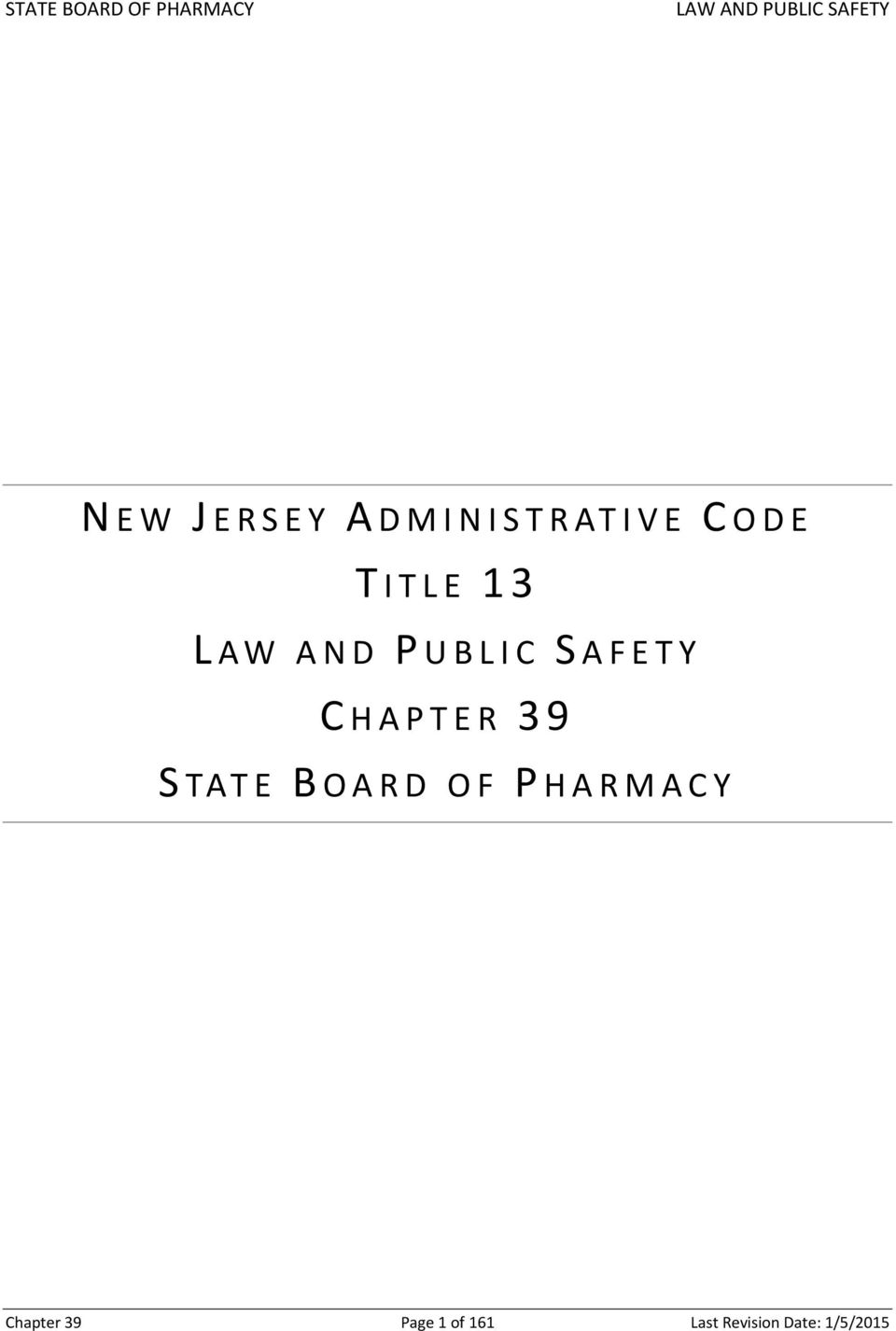
3 CHAPTER TABLE OF CONTENTS SUBCHAPTER 1. GENERAL PROVISIONS : Purpose and scope : Definitions : Fee schedule : Payment of penalties : Opportunity to be heard : Waiver : Failure to complete application process SUBCHAPTER 2. REQUIREMENTS FOR INITIAL LICENSURE : Requirements for initial licensure as a pharmacist : Licensure examination scores : Proof of character : Criminal history background check : Refusal to license : Internship and externship practical experience requirements : Pharmacy intern registration requirements : (Reserved) : (Reserved) : (Reserved) : (Reserved) : (Reserved) : (Reserved) : (Reserved) : (Reserved) : (Reserved) : (Reserved) : (Reserved) : (Reserved) : (Reserved) SUBCHAPTER 2A. REQUIREMENTS FOR RECIPROCAL LICENSURE :39 2A.1 Requirements for reciprocal licensure :39 2A.2 Proof of character :39 2A.3 Refusal to license :39 2A.4 Criminal history background check Chapter 39 Page 2 of 161 Last Revision Date: 1/5/2015
4 13:39 2A.5 Multistate Jurisprudence Pharmacy Examination SUBCHAPTER 3. PHARMACIST REQUIREMENTS : Authorization to practice; display of license : Replacement license : Change of name : Change of address of record; service of process : Verification of licensure : Reproduction of license prohibited : Biennial license renewal; administrative suspension : Reinstatement from administrative and disciplinary license suspensions : Inactive licensure : Steering prohibited : Responsibilities of pharmacists SUBCHAPTER 3A. CONTINUING EDUCATION :39 3A.1 Continuing education credit hour requirements :39 3A.2 Criteria for continuing education credit :39 3A.3 Continuing education credit hour calculations :39 3A.4 Continuing education credit hour reporting procedure :39 3A.5 Waiver of continuing education requirements :39 3A.6 Responsibilities of continuing education sponsors :39 3A.7 Monitoring of continuing education programs or courses SUBCHAPTER 4. PHARMACY PERMIT REQUIREMENTS : New pharmacies; pharmacy departments; eligibility and application : Issuance of permits; permit renewals : Display of permits : Death of owner or partner : Change of ownership; asset acquisition : Change of corporate officers or stockholders of a publicly traded corporation : Change of location and/or address of licensed premises : Remodeling of licensed premises : Change of name : Discontinued pharmacies : Availability of records upon termination of business : Business hours; unauthorized closing : Replacement permit : Reproduction of permits : Security of pharmacies and pharmacy departments Chapter 39 Page 3 of 161 Last Revision Date: 1/5/2015

5 13: Permits; specialized permits : Steering prohibited : Responsibilities of permit holders : Procedures for centralized prescription handling : Out of State pharmacy registration : Procedures for physician ordered or government sponsored immunizations performed by pharmacists SUBCHAPTER 5. RETAIL FACILITY REQUIREMENTS : Purpose and scope : Pharmacy access and egress : Pharmacy signs : Spatial requirement of pharmacy prescription area : Prescription counter : Prescription area sink : Adequate storage : Minimum equipment and supplies; cleanliness : Prescription balances, scales, weights and automatic counting devices : Restriction on storage of prescription legend drugs and controlled dangerous substances : (Reserved) : (Reserved) : Prescription drug retail price list SUBCHAPTER 6. PHARMACIST IN CHARGE; PHARMACY PERSONNEL : Purpose and scope : Pharmacist in charge : Identification tag : Meal or restroom breaks : Prescription handling by pharmacy externs, pharmacy interns, pharmacy technicians, pharmacy technician applicants, or unlicensed or unregistered personnel : Pharmacy technician registration and pharmacy technician applicants : Authorization to practice as a pharmacy technician; display of registration : Replacement of technician registration : Technician change of name : Technician change of address of record; service of process : Verification of technician registration : Reproduction of technician registration prohibited : Biennial technician registration renewal; administrative suspension : Reinstatement from administrative and disciplinary suspensions of a pharmacy technician's registration Chapter 39 Page 4 of 161 Last Revision Date: 1/5/2015

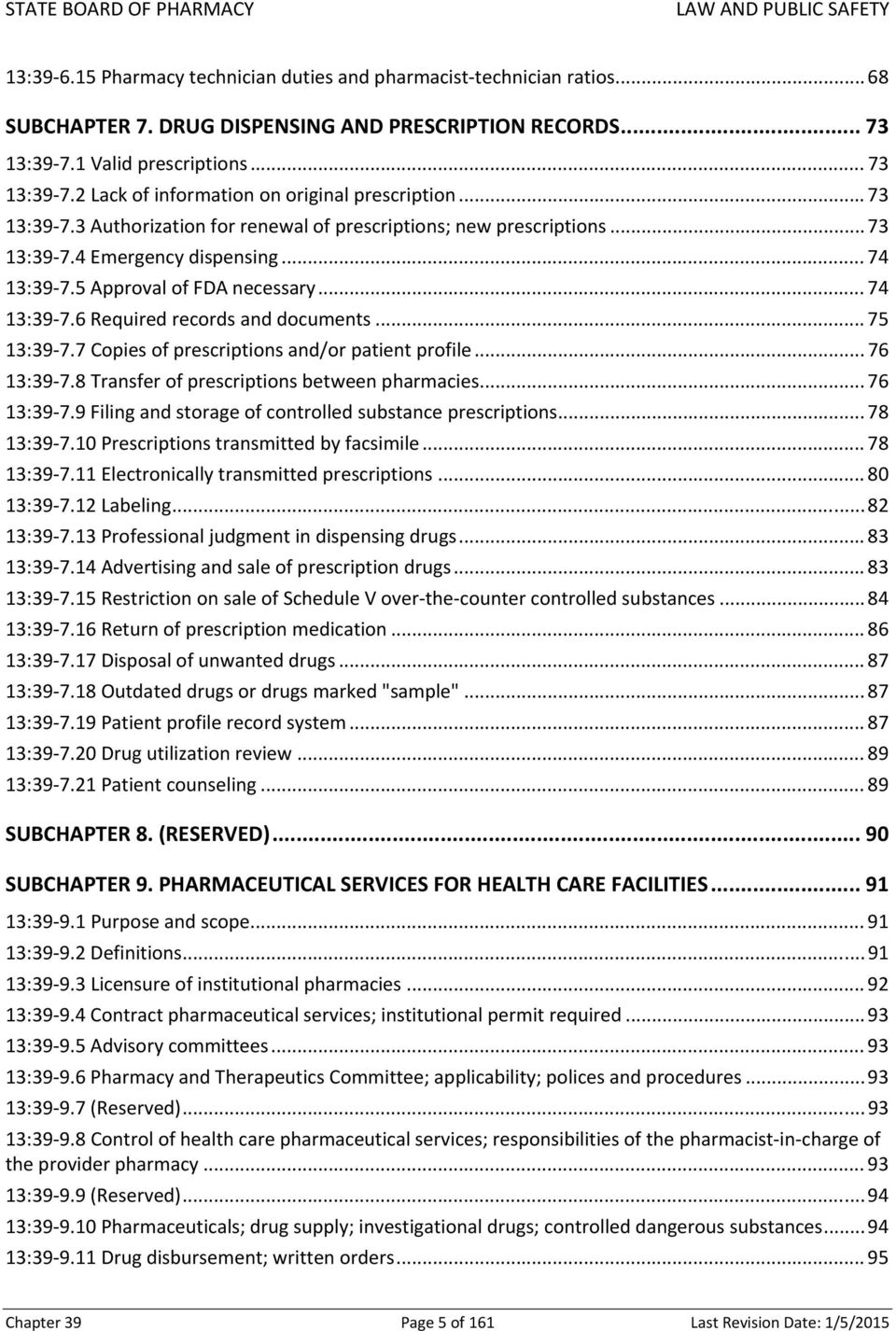
6 13: Pharmacy technician duties and pharmacist technician ratios SUBCHAPTER 7. DRUG DISPENSING AND PRESCRIPTION RECORDS : Valid prescriptions : Lack of information on original prescription : Authorization for renewal of prescriptions; new prescriptions : Emergency dispensing : Approval of FDA necessary : Required records and documents : Copies of prescriptions and/or patient profile : Transfer of prescriptions between pharmacies : Filing and storage of controlled substance prescriptions : Prescriptions transmitted by facsimile : Electronically transmitted prescriptions : Labeling : Professional judgment in dispensing drugs : Advertising and sale of prescription drugs : Restriction on sale of Schedule V over the counter controlled substances : Return of prescription medication : Disposal of unwanted drugs : Outdated drugs or drugs marked "sample" : Patient profile record system : Drug utilization review : Patient counseling SUBCHAPTER 8. (RESERVED) SUBCHAPTER 9. PHARMACEUTICAL SERVICES FOR HEALTH CARE FACILITIES : Purpose and scope : Definitions : Licensure of institutional pharmacies : Contract pharmaceutical services; institutional permit required : Advisory committees : Pharmacy and Therapeutics Committee; applicability; polices and procedures : (Reserved) : Control of health care pharmaceutical services; responsibilities of the pharmacist in charge of the provider pharmacy : (Reserved) : Pharmaceuticals; drug supply; investigational drugs; controlled dangerous substances : Drug disbursement; written orders Chapter 39 Page 5 of 161 Last Revision Date: 1/5/2015
7 13: Drug disbursement; oral orders : Monitoring of patient drug therapy : Medication not dispensed in finished form : Drug labeling : Use of patient's own medication : Drug dispensing devices : Disposal of unused medications : Records and reports : Drug information and education : After hours access to the institutional pharmacy : Pharmacy facilities; space : Storage and security : Equipment : Institutional decentralized pharmacies : Valid medication orders; out of State medication orders : Prescriptions and medication orders transmitted by technological devices in an institution SUBCHAPTER 10. AUTOMATED MEDICATION SYSTEMS : Purpose and scope : "Automated medication system" definition : Authority to use automated medication system : Written policies and procedures of operation : Personnel training requirements : Written program for quality assurance : Written plan for recovery : Written program for preventative maintenance of automated medication system SUBCHAPTER 11. COMPOUNDING sterile preparations IN RETAIL AND INSTITUTIONAL PHARMACIES : Purpose and scope : Definitions : Application and pre approval requirements for compounding sterile preparations : Cleanroom: use, access, location; temperature; air pressure : Cleanroom requirements : Ante area requirements : Buffer area requirements : Use of compounding aseptic isolators and compounding aseptic containment isolators located outside of a cleanroom : Compounding of antineoplastic agents and other hazardous substances Chapter 39 Page 6 of 161 Last Revision Date: 1/5/2015

8 13: institutional pharmacy use of airflow workbenches not in a buffer area for low risk level compounded sterile preparations : Compounding immediate use compounded sterile preparations in an institutional pharmacy : Pharmacist in charge responsibilities : Pharmacy technicians, pharmacy interns, and pharmacy externs; required supervision : Personnel cleansing and garbing requirements : Cleaning and disinfection requirements for cleanroom, buffer area, and ante area : Training and Evaluation requirements : Batch preparation : Compounded sterile preparations for prescriber practice use : Stability criteria and beyond use dating : Documentation; audit trail : Information required to appear on prescription label : Handling, packaging, and delivery : Policy and procedures manual : Quality assurance program SUBCHAPTER 11A. COMPOUNDING NON STERILE PREPARATIONS IN RETAIL AND INSTITUTIONAL PHARMACIES :39 11A.1 Purpose and scope :39 11A.2 Definitions :39 11A.3 Prohibited compounding :39 11A.4 Compounding commercially available products :39 11A.5 Batch preparation :39 11A.6 Compounded non sterile preparations for prescriber practice use :39 11A.7 Preparation of pharmacy generated products (PGPs) for over the counter sale :39 11A.8 Compounding area :39 11A.9 Equipment and supplies :39 11A.10 Responsibilities of the compounding pharmacist; reporting requirement :39 11A.11 Beyond use dates :39 11A.12 Ingredient selection :39 11A.13 Information required to appear on prescription label :39 11A.14 Pharmacy technicians, pharmacy interns, and pharmacy externs; required supervision :39 11A.15 Audit trail; compounding record documentation SUBCHAPTER 12. NUCLEAR PHARMACIES : Definitions : General requirements for pharmacies providing radiopharmaceutical service : General requirements for a nuclear pharmacist Chapter 39 Page 7 of 161 Last Revision Date: 1/5/2015
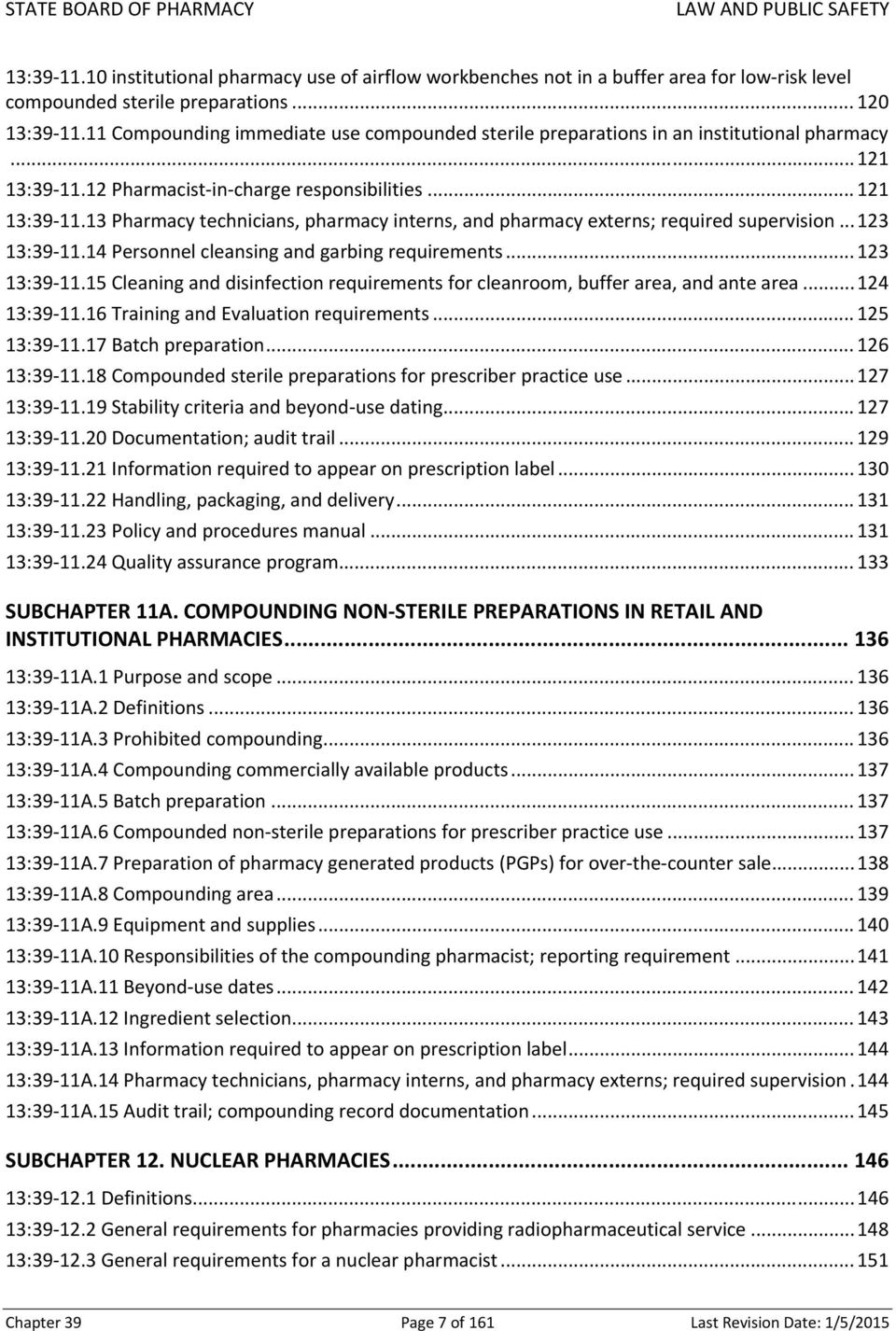
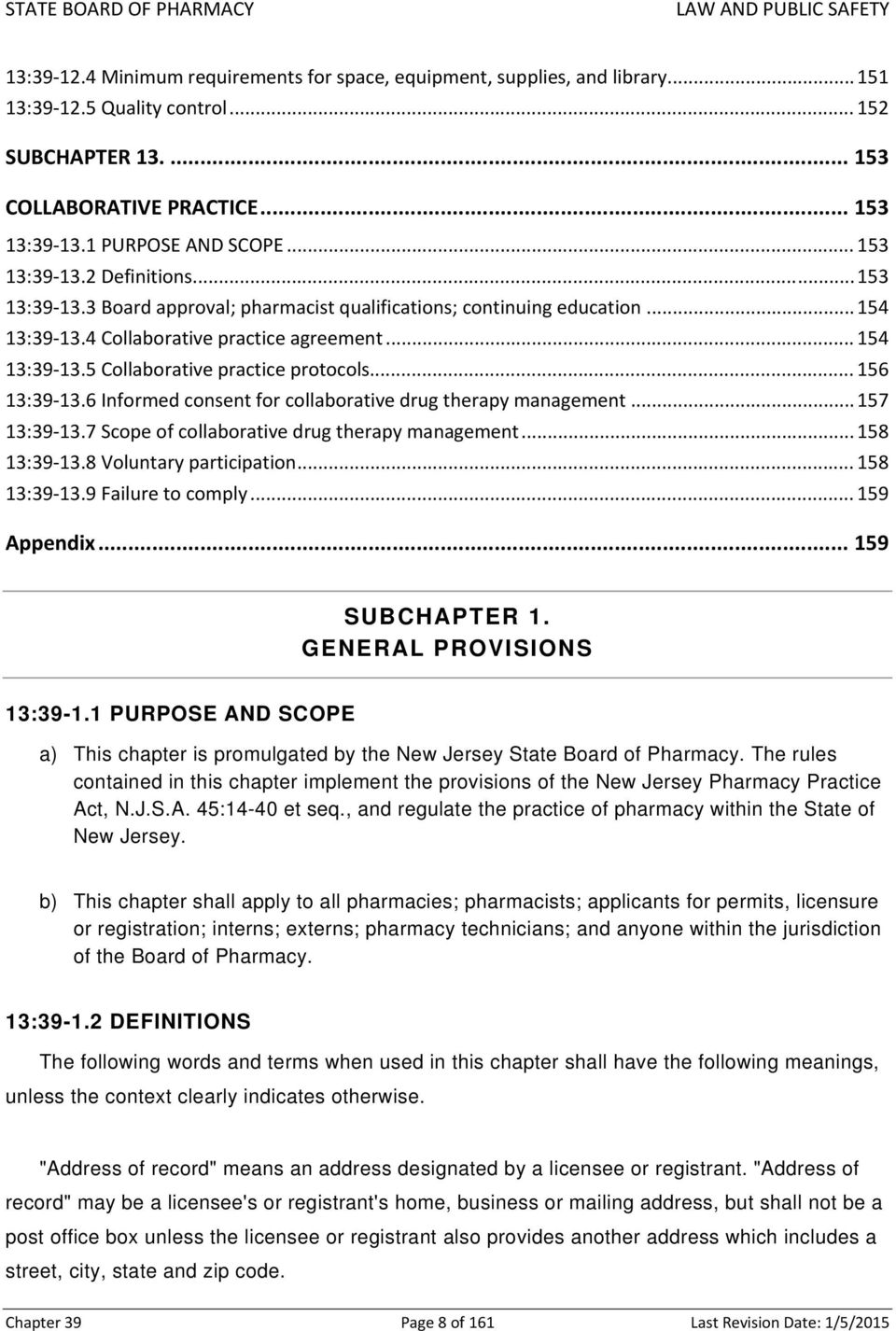
9 13: Minimum requirements for space, equipment, supplies, and library : Quality control SUBCHAPTER COLLABORATIVE PRACTICE : PURPOSE AND SCOPE : Definitions : Board approval; pharmacist qualifications; continuing education : Collaborative practice agreement : Collaborative practice protocols : Informed consent for collaborative drug therapy management : Scope of collaborative drug therapy management : Voluntary participation : Failure to comply Appendix SUBCHAPTER 1. GENERAL PROVISIONS 13: PURPOSE AND SCOPE a) This chapter is promulgated by the New Jersey State Board of Pharmacy. The rules contained in this chapter implement the provisions of the New Jersey Pharmacy Practice Act, N.J.S.A. 45:14-40 et seq., and regulate the practice of pharmacy within the State of New Jersey. b) This chapter shall apply to all pharmacies; pharmacists; applicants for permits, licensure or registration; interns; externs; pharmacy technicians; and anyone within the jurisdiction of the Board of Pharmacy. 13: DEFINITIONS The following words and terms when used in this chapter shall have the following meanings, unless the context clearly indicates otherwise. "Address of record" means an address designated by a licensee or registrant. "Address of record" may be a licensee's or registrant's home, business or mailing address, but shall not be a post office box unless the licensee or registrant also provides another address which includes a street, city, state and zip code. Chapter 39 Page 8 of 161 Last Revision Date: 1/5/2015
10 "Board" means the New Jersey State Board of Pharmacy. "Compounding" means the preparation, mixing, assembling, packaging and labeling of a drug or device as the result of a practitioner's prescription or initiative based on the relationship of the practitioner or patient with the pharmacist in the course of professional practice or for the purpose of, or incident to, research, teaching or chemical analysis and not for sale or dispensing. Compounding also includes the preparation of drugs or devices in anticipation of prescription drug orders based on routine, regularly observed prescribing patterns. "Device" means an instrument, apparatus, implement, machine, contrivance, implant, in vitro reagent or other similar or related article, including any component part or accessory, which is required under Federal or State law to be prescribed by an authorized prescriber and dispensed by a pharmacist, in the usual scope of pharmacy practice. "Dispense or dispensing" means the procedure entailing the interpretation of a practitioner's prescription or medication order for a drug, biological or device, and, pursuant to that order, the proper selection, measuring, compounding, labeling and packaging in a proper container for the subsequent administration to, or use by, a patient. The act of dispensing shall include all necessary consultation by the pharmacist. "Drug or medication" means: 1. Articles recognized in the official United States Pharmacopoeia/National Formulary, official Homeopathic Pharmacopoeia of the United States, or any official supplement to any of them; 2. Articles intended for use in the diagnosis, cure, mitigation, treatment or prevention of disease in human beings or animals; 3. Articles (other than food) intended to affect the structure of any function of the body of human beings or animals; and 4. Articles intended for use as components of any article specified in 1, 2 or 3 above, but not including devices or their components, parts or accessories. "Immediate personal supervision" means that the pharmacist is physically present in the compounding/dispensing area when interns, externs and pharmacy technicians are performing delegated duties, and the pharmacist conducts any necessary in-process checks and the final Chapter 39 Page 9 of 161 Last Revision Date: 1/5/2015

11 check in preparation and compounding of medications, including the checking of each ingredient used, the quantity of each ingredient whether weighed, measured or counted, the finished label and the accuracy and appropriateness of the actions of pharmacy technicians, interns and externs. "Legend drug or device" means any drug or device that: 1. Bears, at a minimum, the symbol "Rx only" or words of similar import; and/or 2. Requires a prescription or order by a practitioner. "Pharmaceutical services" means all services provided by a pharmacist. These services shall be concerned with, but not limited to: interpreting the prescription or medication order; selecting, preparing, compounding, packaging, labeling, distributing and dispensing prescribed drugs; the proper and safe storage of drugs; the monitoring of drug therapy; the reporting and recording of adverse drug reactions and the provision of appropriate drug information; teaching and counseling on the proper and safe use of drugs and medications. "Pharmacist" means an individual holding an active license to engage in the practice of pharmacy in this State. "Pharmacy" means a location permitted by the Board to engage in the practice of pharmacy in this State. Pharmacy extern or extern means a pharmacy extern as defined at N.J.A.C. 13:39-2.6(a). Pharmacy intern or intern means a pharmacy intern as defined at N.J.A.C. 13:39-2.6(a). "Pharmacy technician" means an individual registered with the Board and who works under the immediate personal supervision of a pharmacist in compliance with N.J.A.C. 13: For purposes of this definition, interns, externs, cashiers, stocking and clerical help are not pharmacy technicians. Chapter 39 Page 10 of 161 Last Revision Date: 1/5/2015

12 "Practitioner" means an individual currently licensed, registered or otherwise authorized by the jurisdiction in which the individual practices to administer or prescribe drugs and/ or devices in the course of professional practice. "Prescription" means a lawful order of a practitioner for a drug, device or diagnostic agent for a specific patient. "Professional judgment" means judiciousness and discretion based upon thorough knowledge and sound application of the specialized body of knowledge peculiar to the practice of pharmacy, and an understanding of the relationship of this knowledge and its application to the well-being of the patient and to the judgment of the practitioner. 13: FEE SCHEDULE a) The following fees shall be charged by the Board: 1) For pharmacists as follows: i) Application for licensure ii) Verification of licensure iii) Application for reciprocity iv) Application for reinstatement (1) Disciplinary suspension (2) Administrative suspension v) Initial license fee (1) If paid during the first year of a biennial renewal period (2) If paid during the second year of a biennial renewal period vi) Biennial license renewal Chapter 39 Page 11 of 161 Last Revision Date: 1/5/2015
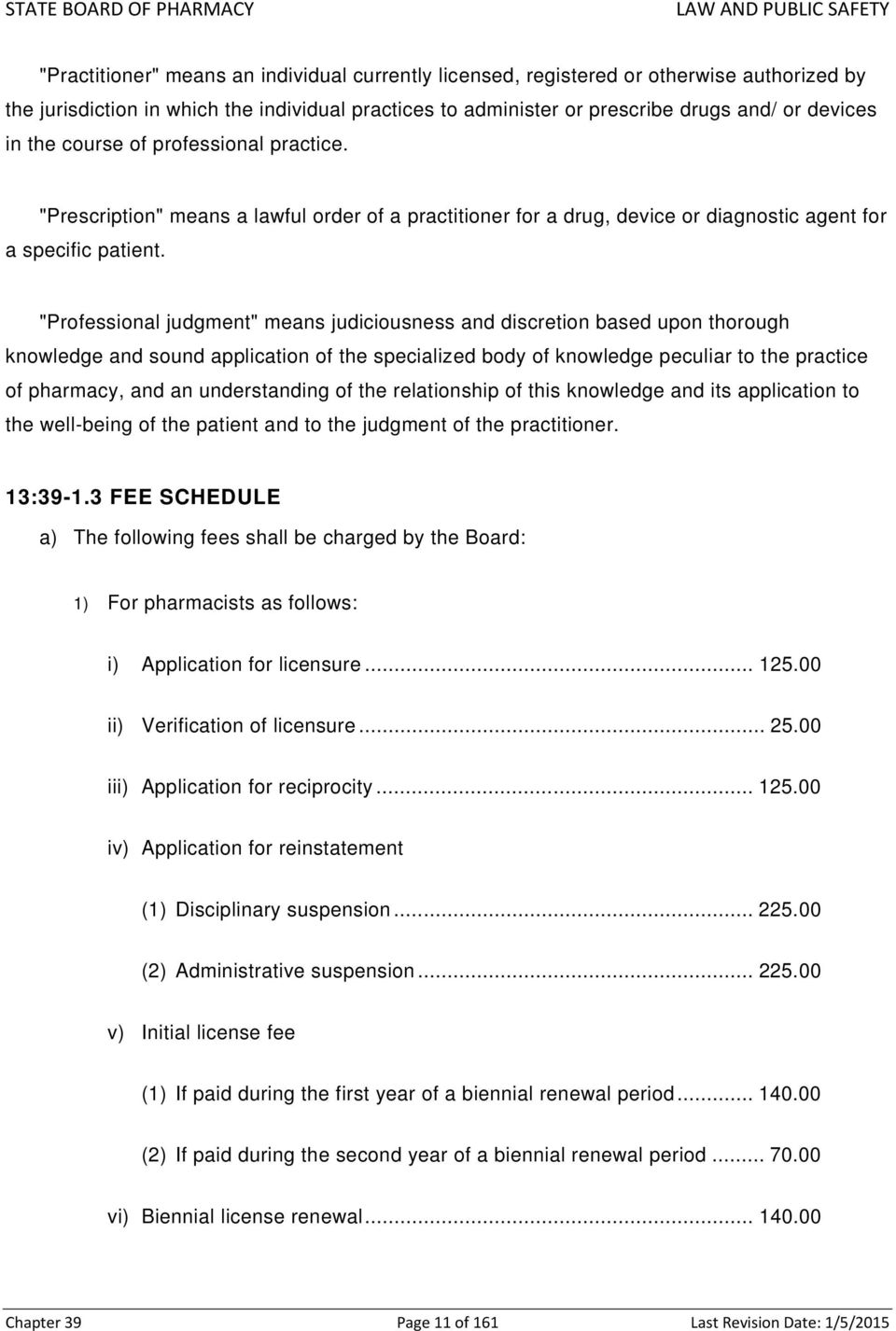
13 vii) Replacement biennial license viii) Inactive license renewal... (To be determined by future rulemaking) ix) Late renewal fee x) Replacement fee of initial wall license xi) Continuing education review fee xii) Continuing education program or course: sponsor review fee ) For in-state pharmacies as follows: i) Pharmacy permits (1) Application for permit (2) Annual permit renewal (3) Change of ownership/name (4) Change of location ii) Replacement of annual permit iii) Late renewal fee iv) Verification of permit ) For pharmacy technicians as follows: i) Application for registration ii) Initial registration fee: (1) If paid during the first year of a biennial renewal period (2) If paid during the second year of a biennial period Chapter 39 Page 12 of 161 Last Revision Date: 1/5/2015
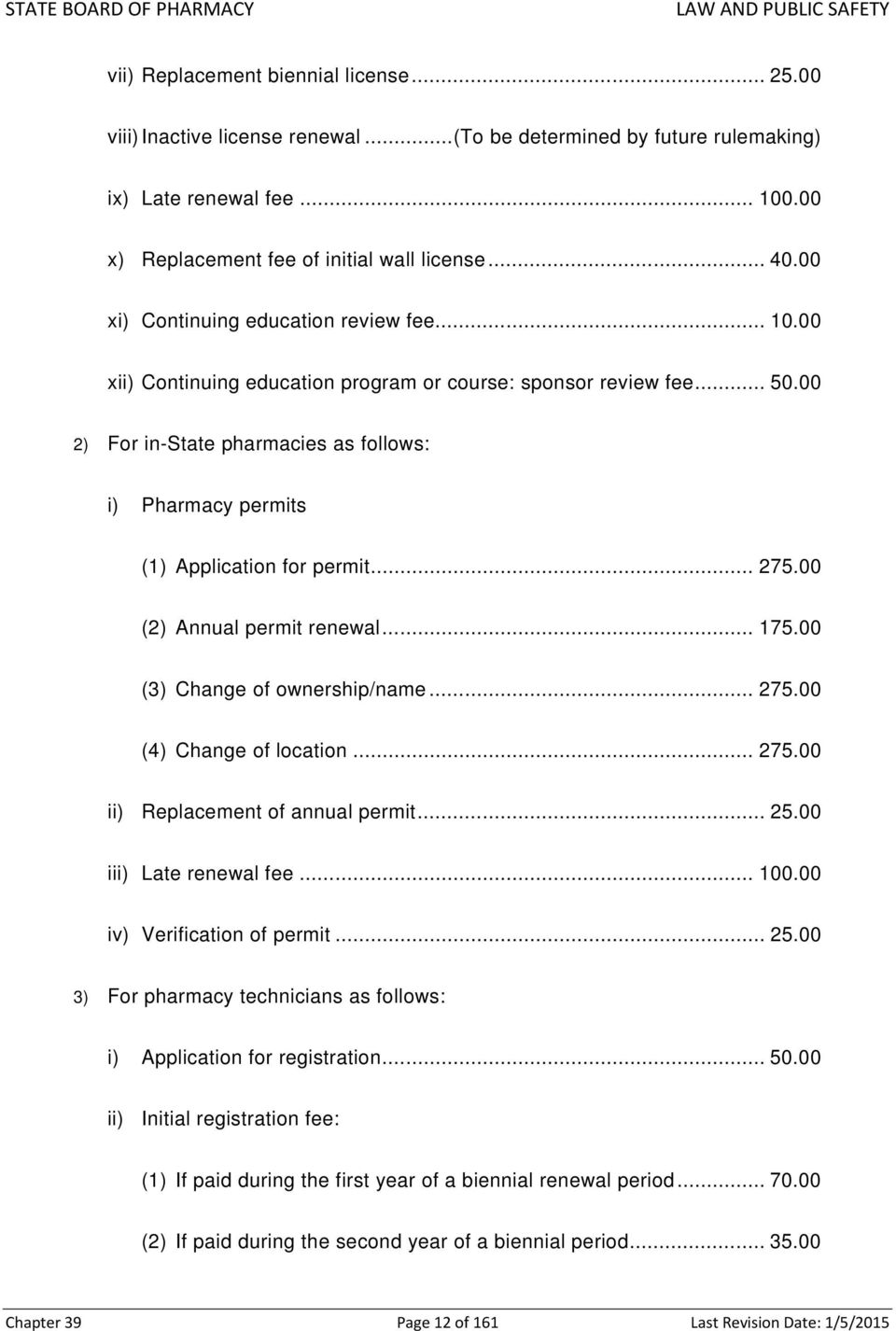
14 iii) Biennial registration renewal iv) Replacement biennial registration v) Late renewal fee vi) Verification of registration ; and vii) Reinstatement fee: (1) Disciplinary suspension (2) Administrative suspension... (To be determined by future rulemaking) 4) For out-of-state pharmacies as follows: i) Pharmacy permits (1) Application for permit (2) Annual permit renewal (3) Change of ownership/name (4) Change of location ii) Replacement of annual permit iii) Late renewal fee iv) Verification of permit ) For pharmacy interns as follows: i) Application for registration ii) Initial registration fee iii) Registration renewal (One time only) Chapter 39 Page 13 of 161 Last Revision Date: 1/5/2015

15 13: PAYMENT OF PENALTIES a) Any penalties levied by the Board shall be paid within 15 business days of the finalization of a penalty letter or final order of the Board unless otherwise prescribed by statute or terms of a final order. b) Failure to comply with this rule may result in action by the Board according to the provisions of N.J.S.A. 45: : OPPORTUNITY TO BE HEARD a) Any time the Board seeks to impose a disciplinary sanction upon a licensee, the licensee may request an opportunity to be heard by the Board. b) When demonstrated facts are in dispute, a hearing shall be conducted pursuant to the Administrative Procedure Act, N.J.S.A. 52:14B-1 et seq., and the Uniform Administrative Procedure Rules, N.J.A.C. 1:1. 13: WAIVER a) The rules in this chapter may be relaxed by the Board upon a showing of undue hardship, economic or otherwise, on an applicant; that the waiver of the rule would not unduly burden any affected parties; and that the waiver is consistent with the underlying purposes of the Pharmacy Practice Act, N.J.S.A. 45:14-40 et seq. and the implementing rules of this chapter. b) Waiver requests shall be submitted to the Board in writing and shall include the following: 1) The specific rule(s) or part(s) of the rule(s) for which the waiver is requested; 2) The reasons for requesting the waiver, including a statement detailing the hardship that would result to the applicant if the waiver is not approved; and 3) Documentation which supports the applicant's request for the waiver, if applicable. c) Absent a request for a waiver, the Board may waive the rules in this chapter if full compliance with the rules, or parts of the rules, would endanger the health, safety and welfare of the general public. Chapter 39 Page 14 of 161 Last Revision Date: 1/5/2015

16 13: FAILURE TO COMPLETE APPLICATION PROCESS If an applicant for a permit, license or registration issued pursuant to the requirements of this chapter fails to complete the application process within two years of the date of initial application, the Board shall administratively close the application. Following such action, an applicant making reapplication to the Board shall resubmit all required documentation and the applicable application fee set forth at N.J.A.C. 13: SUBCHAPTER 2. REQUIREMENTS FOR INITIAL LICENSURE 13: REQUIREMENTS FOR INITIAL LICENSURE AS A PHARMACIST d) An applicant for initial licensure as a pharmacist in New Jersey shall satisfy the following requirements: 1) The applicant shall be at least 18 years of age and shall submit a completed application for initial licensure, which shall include a passport size photo of the applicant and the application fee set forth in N.J.A.C. 13:39-1.3; 2) The applicant shall have graduated with either a degree of Bachelor of Science in pharmacy with a minimum five-year course of study, or with a Doctor of Pharmacy, from a school or college of pharmacy accredited by the American Council of Pharmaceutical Education (ACPE) or deemed ACPE-equivalent by ACPE; i) The applicant shall submit an official transcript from the registrar of the school or college of pharmacy substantiating that the applicant has graduated; ii) An applicant who has received a pharmacy degree from a school or college of pharmacy located in a foreign country that has not been accredited by ACPE or has not been deemed ACPE-equivalent by ACPE, shall satisfy the requirements of (b) below; 3) The applicant shall have passed the North American Pharmacist Licensure Examination (NAPLEX) and the Multistate Jurisprudence Pharmacy Examination (MJPE), consistent with the requirements of N.J.A.C. 13: The applicant shall take the NAPLEX and the MJPE only after providing the Board with an official transcript and receiving authorization to test from the National Association of Boards of Pharmacy (NABP). An applicant who has already taken the NAPLEX and has had his or her scores transferred to New Jersey within five years of having passed the examination consistent with N.J.A.C. 13:39-2.2, shall take the MJPE only after Chapter 39 Page 15 of 161 Last Revision Date: 1/5/2015
17 providing the Board with an official transcript and receiving authorization to test from NABP allowing the applicant to be admitted to the MJPE examination; 4) If the applicant is applying for initial licensure more than two years following his or her graduation from pharmacy school, the applicant shall complete 1,440 hours of practical experience in a Board-approved internship. The applicant shall register with the Board as an intern and shall satisfy all internship requirements set forth in N.J.A.C. 13: within the two-year period immediately preceding the date of application; and 5) The applicant shall have satisfied the good moral character and criminal history background check requirements set forth in N.J.A.C. 13: and 2.4. e) An applicant for initial licensure as a pharmacist in New Jersey who has graduated from a school or college of pharmacy in a foreign country that has not been accredited by ACPE or has not been deemed ACPE-equivalent by ACPE, shall satisfy the following requirements: 1) The applicant shall be at least 18 years of age and shall submit a completed application for initial licensure, which shall include a passport size photo of the applicant and the application fee set forth in N.J.A.C. 13:39-1.3; 2) The applicant shall have graduated with either a degree of Bachelor of Science in pharmacy with a minimum five-year course of study or with a Doctor of Pharmacy; 3) The applicant shall have a valid certification from the Foreign Pharmacy Graduate Examination Committee (FPGEC) of NABP; 4) The applicant shall complete 1,440 hours of practical experience in a Boardapproved internship. The applicant shall register with the Board as an intern and shall satisfy all internship requirements set forth in N.J.A.C. 13: within the two-year period immediately preceding the date of application. The internship shall not commence before the applicant has been certified by FPGEC; 5) The applicant shall have passed the NAPLEX and the MJPE, consistent with the requirements of N.J.A.C. 13: The applicant shall take the NAPLEX and the MJPE only after providing the Board with an official transcript and receiving authorization to test from NABP. An applicant who has already taken the NAPLEX and has had his or her scores transferred to New Jersey within five years of having passed the examination consistent with N.J.A.C. 13:39-2.2, shall take the MJPE only after providing the Board with an official transcript and receiving authorization to test Chapter 39 Page 16 of 161 Last Revision Date: 1/5/2015
18 from NABP allowing the applicant to be admitted to the MJPE examination. An applicant shall not be eligible to take the referenced examination until the completion of his or her internship; and 6) The applicant shall have satisfied the good moral character and criminal history background check requirements set forth in N.J.A.C. 13: and : LICENSURE EXAMINATION SCORES a) An applicant for initial licensure shall attain a passing score of not less than 75 on the North American Pharmacist Licensure Examination (NAPLEX). If an applicant fails the NAPLEX, he or she shall be required to repeat the examination. b) An applicant for initial licensure shall attain a passing score of not less than 75 on the Multistate Jurisprudence Pharmacy Examination (MJPE). If an applicant fails the MJPE, he or she shall be required to repeat the examination. c) If an applicant fails either the NAPLEX or the MJPE three times, the Board may direct the applicant to take remedial courses at an accredited school or college of pharmacy prior to retaking the failed examination(s). d) NAPLEX and MJPE results shall be valid only for a period of five years from the date that an applicant receives a passing score on the respective examination. 13: PROOF OF CHARACTER a) An applicant for initial licensure shall submit evidence of good moral character, which shall be an ongoing requirement for licensure. In determining whether the applicant shall be licensed in the State, the Board shall consider evidence, which demonstrates that the applicant: 1) Is not presently engaged in drug or alcohol use that is likely to impair the ability to practice pharmacy with reasonable skill and safety. For purposes of this section, the term "presently" means at this time or any time within the previous 365 days; 2) Has not been convicted of violating any law of this State or any other state of the United States relating to controlled dangerous substances or other habit-forming drugs; 3) Has not been convicted of violating any law relating to the practice of pharmacy consistent with N.J.S.A. 45:1-21(f); Chapter 39 Page 17 of 161 Last Revision Date: 1/5/2015
19 4) Has not been convicted of a crime involving moral turpitude; and 5) Has not had his or her license or, if a permit holder, his or her permit, suspended or revoked as a result of any administrative or disciplinary proceedings in this or any other jurisdiction which proved the applicant to be in violation of any laws, rules or regulations pertaining to the practice of pharmacy, and that the applicant is not currently under suspension or revocation. 13: CRIMINAL HISTORY BACKGROUND CHECK An applicant for initial licensure as a pharmacist in the State shall submit his or her name, address and fingerprints for purposes of a criminal history background check to be conducted by the State of New Jersey pursuant to N.J.S.A. 45:1-28 et seq., P.L. 2002, c. 104, to determine whether criminal history record information exists which may be considered by the Board in determining whether the applicant shall be licensed in the State. 13: REFUSAL TO LICENSE The Board may refuse to issue a license to any applicant who has violated any law related to the practice of pharmacy or for any of the reasons set forth in N.J.S.A. 45:1-21 et seq. 13: INTERNSHIP AND EXTERNSHIP PRACTICAL EXPERIENCE REQUIREMENTS a) The following words and terms, when used in this section, shall have the following meanings, unless the context clearly indicates otherwise. "Extern preceptor" means an individual approved by an American Council of Pharmaceutical Education (ACPE) approved school or college of pharmacy, at which a pharmacy extern is enrolled, who assumes the responsibility to supervise and provide instructional training to a pharmacy extern. "Intern preceptor" means a pharmacist licensed in this State who assumes the responsibility to supervise and provide instructional training to a pharmacy intern as set forth in (f) below. "Pharmacy extern" means any person who is in the fifth or sixth college year, or the third or fourth professional year, at an ACPE-approved school or college of pharmacy who is assigned to a pharmacy training site for the purpose of acquiring practical experience under the supervision of the school or college at which he or she is enrolled. Chapter 39 Page 18 of 161 Last Revision Date: 1/5/2015

20 "Pharmacy intern" means a person who is employed in an approved pharmacy training site for the purpose of acquiring practical experience and who has first registered for such purposes with the Board pursuant to N.J.S.A. 45:14-48b(2), and who has: 1. Graduated from an ACPE-approved school or college of pharmacy who is making an application for initial licensure as a pharmacist more than two years following the date of graduation; 2. Graduated from a school or college of pharmacy in a foreign country that has not been accredited by ACPE or that has not been deemed ACPE-equivalent by ACPE; or 3. Applied to the Board for reciprocal licensure and has not been engaged in the practice of pharmacy for at least 1,500 hours within the two-year period immediately preceding the date of application. "Pharmacy internship or externship" means the program in which practical experience is acquired by a pharmacy intern or extern. "Pharmacy training site" means a site that is licensed by the Board where drugs are dispensed or pharmaceutical care is provided by a licensed pharmacist and that has a satisfactory record of observance of Federal, State and municipal law and ordinances governing the activities in which it is or has been engaged. b) The 1,440 hours of practical experience required for the successful completion of a pharmacy internship shall be obtained consistent with the following: 1) The 1,440 hours of practical experience shall be completed in no less than 34 weeks and no more than 104 weeks, under the supervision of an intern preceptor. Each week of practical experience shall consist of no less than 15 hours and no more than 45 hours of actual service per week; 2) The intern preceptor and the pharmacy intern shall keep accurate records of the time spent by the pharmacy intern for credit toward the requirements of (b)1 above. The Board shall provide appropriate forms to be submitted to the Board for approval of internship experience; and 3) No credit shall be given for hours served as a pharmacy intern prior to the applicant's registration with the Board and approval of the intern preceptor by the Board. c) A pharmacist who wishes to be an intern preceptor shall apply to the Board and shall furnish evidence that he or she: Chapter 39 Page 19 of 161 Last Revision Date: 1/5/2015
21 1) Has been licensed and employed on a full-time basis as a pharmacist in the area of practice in which he or she is to be engaged as a preceptor for at least two years immediately preceding the date of application and is currently engaged in the practice of pharmacy in the State of New Jersey; and 2) Has not been convicted of a crime or offense relating adversely to the practice of pharmacy consistent with N.J.S.A. 45:1-21(f) or a crime of moral turpitude and has not been the subject of disciplinary action taken by a professional board resulting in the suspension, revocation or surrender of a license or the placement of significant limitations on such license. d) The Board shall approve an intern preceptor selected by each pharmacy intern prior to the beginning of the internship. An intern preceptor shall not supervise the training of more than one pharmacy intern at a time. e) The intern preceptor in a pharmacy training site shall provide the Board with a detailed written report outlining the progress, aptitude and readiness to practice of any pharmacy intern under his or her supervision at the conclusion of the internship. f) The intern preceptor shall be responsible for supervising the activities of the pharmacy intern and providing the pharmacy intern with experience and knowledge related to the preceptor's area of practice. 13: PHARMACY INTERN REGISTRATION REQUIREMENTS a) No person shall be employed as a pharmacy intern until he or she has been registered with the Board pursuant to this section and his or her preceptor has been approved by the Board pursuant to N.J.A.C. 13:39-2.6(c). b) An applicant for registration as a pharmacy intern shall submit a written application, on a form supplied by the Board, and shall submit: 1) His or her name, address and fingerprints for purposes of a criminal history background check to be conducted by the State of New Jersey pursuant to N.J.S.A. 45:1-28 et seq., (P.L. 2002, c. 104) to determine whether criminal history record information exists that may disqualify the applicant from being registered as a pharmacy intern by the Board; 2) A passport size photo of the applicant; Chapter 39 Page 20 of 161 Last Revision Date: 1/5/2015
22 3) Evidence of good moral character, which shall be an ongoing requirement for registration. In determining whether the applicant shall be registered, the Board shall consider evidence, which demonstrates that the applicant: i) Is not presently engaged in drug or alcohol use that is likely to impair the ability to practice as a pharmacy intern with reasonable skill and safety. For purposes of this section, the term "presently" means at the time of application or any time within the previous 365 days; ii) Has not been convicted of violating any law of this State or any other state of the United States relating to controlled dangerous substances or other habit-forming drugs; iii) Has not been convicted of violating any law relating to the practice of pharmacy consistent with N.J.S.A. 45:1-21(f) or a crime of moral turpitude; and iv) Has not had his or her authority to engage in the activity regulated by the Board suspended or revoked as a result of any administrative or disciplinary proceedings in this or any other jurisdiction that determined the applicant to be in violation of any laws, rules or regulations pertaining to the practice of pharmacy and that the applicant is not currently under suspension or revocation; and 4) The application fee and registration fee set forth at N.J.A.C. 13: c) A person who has been educated in a foreign country in a college or school of pharmacy that has not been approved by the American Council of Pharmaceutical Education (ACPE) or that has not been deemed ACPE-equivalent by ACPE, shall be certified by the Foreign Pharmacy Graduate Examination Committee (FPGEC) of the National Association of Boards of Pharmacy prior to applying to the Board for registration as a pharmacy intern. d) A pharmacy intern registration obtained pursuant to this section shall be valid for a period of two years from the date of issuance. Upon application to the Board, an intern registration may be renewed one time only, on an individual basis, for reasons of military service, hardship, illness or disability. e) A change in an intern preceptor shall require prior Board approval, consistent with the requirements of N.J.A.C. 13:39-2.6(d). The new intern preceptor shall be responsible for making application to the Board for approval. Chapter 39 Page 21 of 161 Last Revision Date: 1/5/2015
23 f) The intern preceptor and the pharmacy intern shall notify the Board in writing within 10 days of a change in the pharmacy training site and/or the termination or resignation of the intern. g) In addition to the notification requirements of (f) above, a pharmacy intern shall notify the Board in writing within 10 days of any change in his or her name or address of record, as defined in N.J.A.C. 13: : (RESERVED) 13: (RESERVED) 13: (RESERVED) 13: (RESERVED) 13: (RESERVED) 13: (RESERVED) 13: (RESERVED) 13: (RESERVED) 13: (RESERVED) 13: (RESERVED) 13: (RESERVED) 13: (RESERVED) 13: (RESERVED) SUBCHAPTER 2A. REQUIREMENTS FOR RECIPROCAL LICENSURE 13:39-2A.1 REQUIREMENTS FOR RECIPROCAL LICENSURE a) Reciprocal licensure of out-of-state pharmacists shall be limited to those pharmacists who have been duly licensed in mutually reciprocating states and who satisfy the requirements of this section. b) A pharmacist currently licensed in a mutually reciprocating jurisdiction shall satisfy the following requirements in order to obtain a license by reciprocity in New Jersey: 1) The applicant shall be at least 18 years of age and shall submit a completed application for reciprocity, including a passport size photo of the applicant and the Chapter 39 Page 22 of 161 Last Revision Date: 1/5/2015
24 application fee set forth in N.J.A.C. 13: The application shall substantiate that the applicant: i) Has obtained his or her initial licensure by examination and that the initial license is in good standing; and ii) Has not had any other license granted to the applicant by any other state suspended, revoked or otherwise restricted for any reason except for the failure to renew, or for the failure to obtain the required continuing education credits in any state where the applicant is currently licensed but is not engaged in the practice of pharmacy; 2) The applicant shall have graduated with either a degree of Bachelor of Science in pharmacy with a minimum five-year course of study, or a Doctor of Pharmacy degree, from a college or school of pharmacy that has been accredited by the American Council of Pharmaceutical Education (ACPE), or that has been deemed ACPEequivalent by ACPE. i) An applicant who has received a pharmacy degree from a school or college of pharmacy located in a foreign country that has not been accredited by ACPE or that has not been deemed ACPE-equivalent by ACPE, who wishes to obtain a license by reciprocity in this State shall satisfy the requirement of (c) below; 3) The applicant shall have engaged in the practice of pharmacy for a period of at least 1,500 hours within the two-year period immediately preceding the date of application; or shall have registered with the Board as an intern and shall have satisfied all internship requirements set forth in N.J.A.C. 13: within the two-year period immediately preceding the date of application; 4) The applicant shall have passed the Multistate Jurisprudence Pharmacy Examination (MJPE), consistent with N.J.A.C. 13:39-2A.5. The applicant shall take the MJPE only after submitting all required documentation to the Board and receiving authorization to test from the National Association of Boards of Pharmacy (NABP); and 5) The applicant shall have satisfied the good moral character and criminal history background check requirements set forth in N.J.A.C. 13:39-2A.2 and 2A.4. c) A pharmacist currently licensed in a mutually reciprocating jurisdiction who received a pharmacy degree from a school or college of pharmacy located in a foreign country that has not been accredited by ACPE or that has not been deemed ACPE-equivalent by Chapter 39 Page 23 of 161 Last Revision Date: 1/5/2015
25 ACPE, who wishes to obtain a license by reciprocity in this State shall satisfy the following requirements: 1) The applicant shall be at least 18 years of age and shall submit a completed application for reciprocity, including a passport size photo of the applicant and the application fee set forth in N.J.A.C. 13: The application shall substantiate that the applicant: i) Has obtained his or her initial licensure by examination and that the initial license is in good standing; and ii) Has not had any other license granted to the applicant by any other state suspended, revoked or otherwise restricted for any reason except for the failure to renew, or for the failure to obtain the required continuing education credits in any state where the applicant is currently licensed but is not engaged in the practice of pharmacy; 2) The applicant shall have a valid certification from the Foreign Pharmacy Graduate Examination Committee (FPGEC) of NABP; 3) The applicant shall have graduated with either a degree of Bachelor of Science in pharmacy with a minimum five-year course of study or a Doctor of Pharmacy degree; 4) The applicant shall have engaged in the practice of pharmacy for a period of at least 1,500 hours within the two-year period immediately preceding the date of application. i) An applicant who has engaged in the practice of pharmacy for less than 1,500 hours, shall register with the Board as an intern and shall satisfy all internship requirements set forth in N.J.A.C. 13: within the two-year period immediately preceding the date of application; 5) The applicant shall have passed the Multistate Jurisprudence Pharmacy Examination (MJPE), consistent with N.J.A.C. 13:39-2A.5. The applicant shall take the MJPE only after submitting all required documentation to the Board and receiving authorization to test from NABP; and 6) The applicant shall have satisfied the good moral character and criminal history background check requirements set forth in N.J.A.C. 13:39-2A.2 and 2A.4. d) In addition to the requirements set forth in (a) and (b) above, an applicant for licensure by reciprocity shall meet all licensure transfer criteria utilized by NABP. Chapter 39 Page 24 of 161 Last Revision Date: 1/5/2015
26 13:39-2A.2 PROOF OF CHARACTER a) An applicant for licensure by reciprocity shall submit, as part of his or her licensure application, evidence of good moral character, which shall be an ongoing requirement for licensure. In determining whether the applicant shall be licensed in the State, the Board shall consider evidence, which demonstrates that the applicant: 1) Is not presently engaged in drug or alcohol use that is likely to impair the ability to practice pharmacy with reasonable skill and safety. For purposes of this section, the term "presently" means at this time or any time within the previous 365 days; 2) Has not been convicted of violating any law of this State or any other state of the United States relating to controlled dangerous substances or other habit-forming drugs; 3) Has not been convicted of violating any law relating to the practice of pharmacy consistent with N.J.S.A. 45:1-21(f); 4) Has not been convicted of a crime involving moral turpitude; and 5) Has not had his or her license suspended or revoked as a result of any disciplinary proceedings in this or any other jurisdiction, which proved the applicant to be in violation of any laws, rules or regulations pertaining to the practice of pharmacy and that the applicant is not currently under such suspension or revocation. 13:39-2A.3 REFUSAL TO LICENSE The Board may refuse to issue a license to any applicant for licensure by reciprocity that has violated any law relating to the practice of pharmacy or for any of the reasons set forth in N.J.S.A. 45:1-21 et seq. 13:39-2A.4 CRIMINAL HISTORY BACKGROUND CHECK An applicant for licensure by reciprocity in the State shall submit his or her name, address and fingerprints for purposes of a criminal history background check to be conducted by the State of New Jersey pursuant to N.J.S.A. 45:1-28 et seq., P.L. 2002, c.104, to determine whether criminal history record information exists which may be considered by the Board in determining whether the applicant shall be licensed in the State. Chapter 39 Page 25 of 161 Last Revision Date: 1/5/2015
27 13:39-2A.5 MULTISTATE JURISPRUDENCE PHARMACY EXAMINATION a) An applicant for reciprocal licensure shall pass the Multistate Jurisprudence Pharmacy Examination. A passing score of not less than 75 shall be attained. If an applicant fails the examination, he or she shall be required to repeat the examination. b) If the applicant for reciprocal licensure fails the examination three times, the Board may direct the applicant to take remedial courses at an accredited school or college of pharmacy prior to retaking the law examination. SUBCHAPTER 3. PHARMACIST REQUIREMENTS 13: AUTHORIZATION TO PRACTICE; DISPLAY OF LICENSE a) An applicant who has successfully satisfied all Board requirements for licensure and has been approved by the Board to be licensed shall receive an authorization signed by the Executive Director of the Board granting the applicant the right to practice pharmacy in the State of New Jersey until such time as an initial license may be issued. The licensee shall maintain such authorization on his or her person at all times while engaging in the practice of pharmacy until the initial license is issued. b) Upon issuance of a license, the current biennial renewal license shall be conspicuously displayed in the pharmacist's principal place of employment. c) A pharmacist who is employed by more than one pharmacy in the State shall maintain the wallet-sized license issued by the Board on his or her person when he or she is working at a location where his or her current biennial renewal license is not on display. 13: REPLACEMENT LICENSE A replacement initial license or renewal license shall be issued by the Board upon payment of a fee as prescribed in N.J.A.C. 13: and upon submission of proof of the applicant's identity and reasonable proof of the loss or destruction of the initial license or renewal license, or upon return of the damaged initial license or renewal license to the Board. 13: CHANGE OF NAME If a pharmacist legally changes the name under which he or she engages in the practice of pharmacy, the pharmacist shall notify the Board within 30 days of such change. The pharmacist shall submit original proof of the change of name or a certified copy of the court order or Chapter 39 Page 26 of 161 Last Revision Date: 1/5/2015
28 marriage certificate, which shall be retained by the Board. When a replacement license is issued, the initial license shall be returned for cancellation and the pharmacist shall remit the required fee as prescribed in N.J.A.C. 13: : CHANGE OF ADDRESS OF RECORD; SERVICE OF PROCESS a) A pharmacist shall notify the Board in writing of any change in his or her address of record within 30 days. b) Failure to notify the Board of any change in a pharmacist's address of record pursuant to (a) above may result in disciplinary action in accordance with N.J.S.A. 45:1-21(h) and N.J.A.C. 13:45C-1.3, and the imposition of penalties set forth in N.J.S.A. 45:1-25. c) Service of any administrative complaint or other Board-initiated process at a pharmacist's address of record shall be deemed adequate notice for the purposes of N.J.A.C. 1:1-7.1 and the commencement of any disciplinary proceedings. 13: VERIFICATION OF LICENSURE A verification that the license of a pharmacist is in good standing shall be supplied by the Board upon written request and upon payment of the fee set forth in N.J.A.C. 13: : REPRODUCTION OF LICENSE PROHIBITED The biennial license or wallet-sized license issued by the Board to any pharmacist shall not be reprinted, photographed, photostated, duplicated or reproduced by any other means either in whole or in part, except as provided in N.J.A.C. 13: : BIENNIAL LICENSE RENEWAL; ADMINISTRATIVE SUSPENSION a) A pharmacist shall renew his or her license for a period of two years from the last expiration date. The pharmacist shall submit a renewal application to the Board, along with the renewal fee set forth in N.J.A.C. 13:39-1.3, prior to the date of license expiration. A pharmacist who submits a renewal application within 30 days following the date of license expiration shall submit the renewal fee, as well as the late fee set forth in N.J.A.C. 13: A pharmacist who fails to submit a renewal application within 30 days of license expiration shall have his or her license suspended without a hearing. Such suspension shall be deemed an administrative suspension. b) A pharmacist who continues to engage in the practice of pharmacy with a suspended license shall be deemed to be engaging in the unauthorized practice of pharmacy and shall be subject to the penalties set forth in N.J.S.A. 45:1-25 et seq. Chapter 39 Page 27 of 161 Last Revision Date: 1/5/2015
29 c) The Board shall send a notice of renewal to each pharmacist at least 60 days prior to the expiration of the license. If the notice to renew is not sent at least 60 days prior to the expiration date, no monetary penalties or fines shall be imposed upon the pharmacist for failure to renew. 13: REINSTATEMENT FROM ADMINISTRATIVE AND DISCIPLINARY LICENSE SUSPENSIONS a) A pharmacist who has had his or her license administratively suspended pursuant to N.J.A.C. 13: may apply to the Board for reinstatement within five years following the date of license expiration. A pharmacist applying for reinstatement shall submit: 1) A renewal application, including an affidavit of employment listing each job held during the period of license suspension, including the names, addresses, and telephone numbers of each employer; 2) All past due renewal fees set forth in N.J.A.C. 13:39-1.3; 3) A reinstatement fee set forth in N.J.A.C. 13:39-1.3; 4) Any outstanding penalties imposed by the Board; and 5) Evidence of having completed all delinquent continuing education credits consistent with the requirements of N.J.A.C. 13:39-3A to a maximum of five years or 75 credits. b) If the license has been administratively suspended for a period of more than five years, a pharmacist applying for reinstatement shall satisfy all requirements in (a)1 through 4 above and shall pass the MJPE and the NAPLEX. c) A pharmacist who has had his or her license suspended pursuant to disciplinary action taken by the Board may apply to the Board for reinstatement of his or her license at the conclusion of the suspension period. A pharmacist applying for reinstatement from a disciplinary suspension shall submit: 1) A reinstatement application, including an affidavit of employment listing each job held during the period of license suspension, including the names, addresses, and telephone numbers of each employer; 2) A reinstatement fee set forth in N.J.A.C. 13:39-1.3; 3) The applicable renewal fee(s) set forth in N.J.A.C. 13:39-1.3; and Chapter 39 Page 28 of 161 Last Revision Date: 1/5/2015
30 4) Evidence of having met all conditions imposed by the Board pursuant to the disciplinary and/or reinstatement order(s). 13: INACTIVE LICENSURE a) A pharmacist may, upon application to the Board, choose inactive status. A pharmacist electing inactive status shall not engage in the practice of pharmacy in New Jersey for the entire biennial registration period. A licensee on inactive status may resume the practice of pharmacy in New Jersey upon application to the Board consistent with the following requirements: 1) If a licensee was practicing pharmacy in another state where he or she is licensed, and practiced for at least 1,000 hours within the two years immediately prior to the date of application for return to active status, the licensee shall remit payment of the renewal fee for the current biennial registration period set forth in N.J.A.C. 13:39-1.3; 2) If a licensee was practicing pharmacy in another state where he or she is licensed, but practiced for less than 1,000 hours within the two years immediately prior to the date of application for return to active status, the licensee shall submit evidence of having completed 30 credits of continuing education, consistent with the requirements set forth in N.J.A.C. 13:39-3A.1, within the two years immediately prior to the date of application. The licensee shall also remit the renewal fee for the current biennial registration period set forth in N.J.A.C. 13:39-1.3; and 3) If a licensee has not practiced pharmacy in another state during the inactive period, the licensee shall submit evidence of having completed 15 credits of continuing education per year, consistent with the requirements set forth in N.J.A.C. 13:39-3A to a maximum of 75 credits. At least 30 credits shall have been completed within the two years immediately prior to the date of application to return to active status. The licensee shall also remit the renewal fee for the current biennial registration period set forth in N.J.A.C. 13: : STEERING PROHIBITED It shall be unlawful for a pharmacist to enter into an arrangement with a health care practitioner who is licensed to issue prescriptions for the purpose of directing or diverting patients to or from a specified pharmacy or restraining in any way a patient's freedom of choice to select a pharmacy. 13: RESPONSIBILITIES OF PHARMACISTS a) All pharmacists shall be responsible for compliance with all the rules, regulations and laws governing the practice of pharmacy. Chapter 39 Page 29 of 161 Last Revision Date: 1/5/2015
31 b) Any pharmacist found to have violated the New Jersey Pharmacy Practice Act, N.J.S.A. 45:14-40 et seq., or the rules in this chapter, shall be subject to disciplinary action. SUBCHAPTER 3A. CONTINUING EDUCATION 13:39-3A.1 CONTINUING EDUCATION CREDIT HOUR REQUIREMENTS a) Each applicant for biennial license renewal shall complete a minimum of 30 credits of continuing education during the preceding biennial period, except that the Board shall not require completion of continuing education credits for an applicant's initial license renewal. At least 10 of the continuing education credits shall be obtained through didactic instruction. For purposes of this subsection, "didactic instruction" means in-person instruction and may include telephonic or electronic instruction that is interactive, but shall not include videotaped instruction. At least three continuing education credits shall be obtained in pharmacy law applicable to the practice of pharmacy in New Jersey. b) Ten credits of continuing education may be carried over into a succeeding biennial period only if such credits were earned during the last six months of the preceding biennial period and were not previously reported. 13:39-3A.2 CRITERIA FOR CONTINUING EDUCATION CREDIT a) A licensee may obtain continuing education credit from the following categories: 1) Programs or courses offered by American Council of Pharmaceutical Education approved providers; 2) Programs and courses that have received prior Board approval pursuant to N.J.A.C. 13:39-3 A.6; 3) Graduate course work relevant to the practice of pharmacy, taken at an accredited college or university, beyond that required for professional licensure; 4) Participation in teaching and/or research appointments; 5) Participation as a preceptor in externship programs; 6) Participation as a preceptor in internship programs; and Chapter 39 Page 30 of 161 Last Revision Date: 1/5/2015
32 7) Publication of an article related to the practice of pharmacy in a peer-reviewed professional journal. b) A licensee seeking credit for attendance at a program or course that is not offered by an American Council of Pharmaceutical Education approved provider and that has not been approved by the Board pursuant to N.J.A.C. 13:39-3A.6, shall submit for Board review and approval, on a form provided by the Board, information similar to that which is required to be submitted by a sponsor pursuant to N.J.A.C. 13:39-3A.6(a), the continuing education review fee set forth at N.J.A.C. 13: and the verification of attendance. 13:39-3A.3 CONTINUING EDUCATION CREDIT HOUR CALCULATIONS a) Credit for continuing education shall be granted as follows for each biennial license period: 1) Attendance at approved programs or courses shall be granted one credit for each hour of attendance. Credit shall not be granted for programs or courses which are less than one contact hour in duration, which is defined as 50 minutes of actual attendance in a program or course of study. One half credit shall be granted for each 30 minute segment of a program or course that is more than one contact hour in duration. Completion of an entire program or course is required in order to receive any continuing education credit for the program or course. 2) Successful completion of graduate course work related to the practice of pharmacy at an accredited college or university beyond that which is required for professional licensure shall be granted three continuing education credits for each course credit awarded. 3) Teaching and research appointments related to the practice of pharmacy shall be granted three continuing education credits for each new program or course taught or subject matter researched by a licensee, to a maximum of six credits. "New," in this paragraph, means a program, course or subject matter which the licensee has never taught or researched before in any educational or practice setting. A licensee who is employed as a teacher and/or as a researcher on a full-time basis shall not be eligible to obtain continuing education credit for such activities. 4) Participation as a preceptor in an externship program, upon prior approval by a college of pharmacy, shall be granted three continuing education credits per student to a maximum of six credits. Chapter 39 Page 31 of 161 Last Revision Date: 1/5/2015
33 5) Participation as a preceptor in an internship program shall be granted three continuing education credits per 160 hours of work performed by the intern(s) and supervised by the licensee, to a maximum of six credits. 6) Publication of an article related to the practice of pharmacy in a peer-reviewed professional journal shall be granted three continuing education credits per article to a maximum of six credits. b) The Board shall not grant credit for, or approve as a component of a continuing education program, participation in the routine business portion of any meeting of a pharmaceutical organization or any presentation that is offered to sell a product or promote a business enterprise. 13:39-3A.4 CONTINUING EDUCATION CREDIT HOUR REPORTING PROCEDURE a) A licensee shall specify on his or her application for biennial license renewal that the required number of continuing education credits has been completed. Falsification of any information contained in the renewal application may result in an appearance before the Board and the assessment of penalties and/or license suspension pursuant to N.J.S.A. 45:1-21 et seq. b) A licensee shall maintain all documentation concerning the completion of continuing education requirements for a period of five years from the completion of the credit hours and shall submit such documentation to the Board upon request. Such documentation shall consist of: 1) For programs offered by American Council of Pharmaceutical Education approved providers, a certificate of completion from the course or program; 2) For programs and courses approved by the Board, the sponsors' written verification of attendance; 3) For teaching or research appointments in an academic setting, a statement from the chairperson of the department verifying completion of the assignment; 4) For research appointments in an industrial setting, a statement from the project coordinator verifying completion of the assignment; 5) For participation as a preceptor in an externship program, a certificate from the college of pharmacy; Chapter 39 Page 32 of 161 Last Revision Date: 1/5/2015
34 6) For participation as a preceptor in an internship program, a certificate from the Board; and 7) For publications in a peer-reviewed professional journal, submission of the published article. c) The Board shall audit licensees on a random basis at the end of each biennial period to determine compliance with continuing education requirements. 13:39-3A.5 WAIVER OF CONTINUING EDUCATION REQUIREMENTS a) The Board may waive continuing education requirements on an individual basis for reasons of military service, hardship, illness or disability. b) A licensee seeking a waiver of continuing education requirements shall apply to the Board in writing and set forth with specificity the reasons for requesting the waiver. The licensee shall also provide the Board with such additional information as the Board may request in support of the application for waiver. c) A waiver of continuing education requirements granted pursuant to this section shall be effective only for the biennial period in which such waiver is granted. If the condition(s) which necessitated the waiver continues into the next biennial period, a licensee shall apply to the Board for a renewal of such waiver for the new biennial period. 13:39-3A.6 RESPONSIBILITIES OF CONTINUING EDUCATION SPONSORS a) A continuing education sponsor shall receive prior Board approval for a program or course if the sponsor provides, in writing on a form provided by the Board, information which demonstrates that the program or course meets the following requirements: 1) The program or course is offered in a subject matter relevant to the practice of pharmacy; 2) The program or course is at least one contact hour in length; and 3) The program or course is conducted by a qualified instructor or discussion leader who submits a curriculum vitae and who is: i) A pharmacist with a B.S. in Pharmacy or a Pharm.D. with at least five years of experience; Chapter 39 Page 33 of 161 Last Revision Date: 1/5/2015
35 ii) A pharmacist with a B.S. in Pharmacy or a Pharm.D. with expertise in the program or course subject area; iii) A pharmacist with a B.S. in Pharmacy or a Pharm.D. who is certified by a nationally recognized board or association; or iv) A licensed health care professional who demonstrates special expertise in the lecture subject area. b) A continuing education sponsor may request approval for a program or course conducted by an individual who possesses expertise in a subject area relevant to the practice of pharmacy, provided that the program or course to be conducted by that individual satisfies the requirements of (a)1 and 2 above. c) Applications for pre-approval of continuing education programs or courses shall be submitted by the continuing education sponsor on a form provided by the Board at least 45 days prior to the date the program or course is to be offered. Incomplete applications shall be returned to the sponsor. d) The Board shall approve only such continuing education programs and courses as are available and advertised on a reasonable nondiscriminatory basis to all persons licensed to practice pharmacy in the State. The Board shall maintain a list of all approved programs and courses at the Board office and shall furnish the list to licensees upon request. e) A continuing education sponsor shall not make substantive changes to an approved program or course, such as a change in program or course content or instructor, without prior Board approval. f) The continuing education sponsor shall monitor attendance at, or ensure completion of, each approved program or course and furnish to each enrollee a verification of attendance which shall include at least the following information: 1) The title, date and location of the program or course offering; 2) The name of the program or course presenter; 3) The name and certificate number of the program or course presented; 4) The number of continuing education credits awarded; and Chapter 39 Page 34 of 161 Last Revision Date: 1/5/2015
36 5) The name, address, telephone number and signature of the sponsor, or if the sponsor is an association or organization, the signature of an officer or responsible party of the association or organization. g) The continuing education sponsor shall submit the fee set forth at N.J.A.C. 13:39-1.3(a)1xii for each submission of program or course offerings. h) The continuing education sponsor shall maintain a list of all attendees who completed each approved program or course for a period of five years from the date the program or course was offered. 13:39-3A.7 MONITORING OF CONTINUING EDUCATION PROGRAMS OR COURSES A Board member or a Board representative may monitor an approved program or course without prior notification to the continuing education sponsor. SUBCHAPTER 4. PHARMACY PERMIT REQUIREMENTS 13: NEW PHARMACIES; PHARMACY DEPARTMENTS; ELIGIBILITY AND APPLICATION a) A permit application shall be submitted to the Board by every individual or business entity desiring to operate a new pharmacy. Such application shall be made on a form furnished by the Board. If the area for which a pharmacy permit is sought is less than the total area of the premises, the area subject to permit shall be known as the "pharmacy department." b) The permit application shall indicate the exact intended location and plan or physical arrangement of the proposed pharmacy or pharmacy department area, including any drive-thru area, and shall indicate any area contiguous or adjacent to but not necessarily a part of the proposed permitted area, and any area where drugs will be stored and/or dispensed. c) The permit application shall include the exact trade name(s), if any; the corporate names, if any; the name and addresses of the owners and operators, if a sole proprietorship, partnership, limited liability partnership or limited liability company; the names and addresses of all officers and stockholders and the names and addresses of all principals duly licensed to write prescriptions if the pharmacy is not a publicly traded corporation; and the names and addresses of the officers, if a publicly traded corporation. Chapter 39 Page 35 of 161 Last Revision Date: 1/5/2015
37 d) The permit application shall include the name of the pharmacist-in-charge who shall be a pharmacist in good standing in the State of New Jersey. e) No person, business entity or equity holder of the business entity shall be eligible for a new permit or a renewal thereof who is not of high moral character or against whom there is pending any indictment or any alleged violation of local, State or Federal law pertaining to the practice of pharmacy or the dispensing of controlled dangerous substances or any drug under N.J.S.A. 24:21-2. f) A person submitting an application may be interviewed by the Board to review his or her qualifications and eligibility. g) Before a permit may be issued to an applicant, the Board shall inspect and approve the premises, fixtures and equipment of the new pharmacy or pharmacy department to ensure compliance with this subchapter and all relevant statutes, regulations and ordinances. h) Upon approval of the permit application, the Board shall issue a permit number that will allow the applicant to place prescription legend drugs in stock. 13: ISSUANCE OF PERMITS; PERMIT RENEWALS a) All permits shall be issued by the Board in the name of the pharmacy for the operation of which the permit is issued. b) A permit holder shall submit to the Board, on an annual basis, within 30 days after the permit expiration, a renewal application and the renewal fee set forth in N.J.A.C. 13:39-1.3(a)2. A permit holder that fails to submit the renewal application within 30 days after the permit expiration shall submit the late renewal fee set forth in N.J.A.C. 13:39-1.3(a)2 in addition to the renewal fee. A permit holder that continues to engage in the practice of pharmacy with an expired permit shall be deemed to be engaging in the unauthorized practice of pharmacy and shall be subject to the penalties set forth in N.J.S.A. 45:1-25 et seq. c) The Board shall send a notice of renewal to each permit holder, at least 60 days prior to the expiration of the permit. If the notice to renew is not sent 60 days prior to the expiration date, no monetary penalty or fines shall apply to the permit holder for any unauthorized practice during the period following the permit expiration, not to exceed the number of days short of 60 before the renewal was issued. Chapter 39 Page 36 of 161 Last Revision Date: 1/5/2015
38 13: DISPLAY OF PERMITS The current permit issued by the Board for the operation of a pharmacy shall be conspicuously displayed. 13: DEATH OF OWNER OR PARTNER In the case of death of an individual owner or a partner, the permit issued to the deceased owner or to the partnership is terminated and shall be returned to the Board pursuant to N.J.A.C. 13: If the operation of the pharmacy is to be continued, the estate or heirs of the deceased partner and/or the remaining partners shall comply with the requirements set forth at N.J.A.C. 13: : CHANGE OF OWNERSHIP; ASSET ACQUISITION a) When there is a change in the ownership of the business entity holding a permit to operate a pharmacy, the following requirements shall be satisfied, as applicable: 1) When a complete change in ownership occurs and none of the current owners retains any ownership interest, the new owner(s) shall, prior to, or within 10 business days of, such change, submit to the Board a new permit application pursuant to N.J.A.C. 13:39-4.1, the new permit application fee set forth in N.J.A.C. 13:39-1.3, and an inventory of the pharmacy's controlled substances. A new pharmacy permit number shall be issued upon request; 2) When a reallocation of ownership interests occurs among existing owners, the owners shall, prior to, or within 10 business days of, such change, submit to the Board an affidavit explaining the asset reallocation. A new pharmacy permit number shall not be issued upon a reallocation of business assets among existing owners; or 3) When the existing ownership is changed through the addition of a new owner(s) or the subtraction of an existing owner, the owners shall, prior to, or within 10 business days of, the addition of the new owner(s), submit to the Board a new permit application pursuant to N.J.A.C. 13: and the new permit application fee set forth in N.J.A.C. 13: A new pharmacy permit number shall be issued upon request. b) Upon a change in ownership pursuant to (a) above, the new ownership of such entity shall take custodial ownership of the previous five years of prescription and profile records of the previous pharmacy and shall ensure that the prescription and profile records are maintained pursuant to N.J.A.C. 13: and 7.19 after the date of acquisition. Chapter 39 Page 37 of 161 Last Revision Date: 1/5/2015
39 c) Upon the sale, transfer or acquisition of the business assets of a pharmacy, the person or entity acquiring such assets shall take custodial ownership of the pharmacy's previous five years of prescription and profile records and shall ensure that the prescription and profile records are maintained pursuant to N.J.A.C. 13: and 7.19 after the date of acquisition. 13: CHANGE OF CORPORATE OFFICERS OR STOCKHOLDERS OF A PUBLICLY TRADED CORPORATION If there is a change of registered agents or officers or a change of stock ownership involving 10 percent or more of the outstanding stock of a publicly traded corporation, the corporation shall file an affidavit with the Board within 30 days indicating the changes that have taken place and any other information requested by the Board. 13: CHANGE OF LOCATION AND/OR ADDRESS OF LICENSED PREMISES a) When a pharmacy permit holder intends to change the physical location and address of the permitted premises, the permit holder shall apply to the Board, at least 30 days prior to such change, for a new pharmacy permit. If the change in location and address will result in the temporary closing of the pharmacy, the permit holder shall comply with all requirements set forth at N.J.A.C. 13: (c) and (d). The permit holder shall submit a new permit application pursuant to N.J.A.C. 13: and the new permit application fee set forth in N.J.A.C. 13: The Board shall issue an amended pharmacy permit reflecting the new location and address of the pharmacy. Before an amended permit may be issued to the permit holder for the new location, the Board shall inspect and approve the premises, fixtures, equipment and inventory of the new location to ensure compliance with this subchapter and all relevant statutes, regulations and ordinances. The permit holder shall ensure that the prescription and profile records from the pharmacy's previous location and address are maintained pursuant to N.J.A.C. 13: and 7.19 after the location and address change. b) Whenever there is a change in a pharmacy's address but no change in the physical location of the licensed premises, the permit holder shall, within 10 business days of the change in address, submit an affidavit to the Board explaining such change. 13: REMODELING OF LICENSED PREMISES a) Prior to the remodeling of a pharmacy or pharmacy department, where such remodeling entails a change within the premises of the location or size of the prescription area, or a change in the dimensions of the licensed premises, the permit holder shall notify the Board at least 30 days in advance on a form prescribed by the Board. The pharmacy permit holder shall submit plans for the continuation of operations during the remodeling process which the Board shall review and approve, and the anticipated date of completion. The permit holder shall ensure compliance with all requirements set forth in Chapter 39 Page 38 of 161 Last Revision Date: 1/5/2015
40 this chapter while services continue during the remodeling process, and if the remodeling will result in the temporary closing of the pharmacy, the permit holder shall comply with all requirements set forth at N.J.A.C. 13: (c) and (d). b) The pharmacy permit holder shall notify the Board upon completion of the remodeling process. Within 60 days of the completion of the remodeling, the Board shall inspect and approve the premises, fixtures, equipment and inventory of the remodeled pharmacy to ensure compliance with this subchapter and all relevant statutes, regulations and ordinances. 13: CHANGE OF NAME a) When a pharmacy permit holder intends to change the name of the pharmacy, the permit holder shall apply to the Board, at least 30 days prior to such change, for an amended permit. The permit holder shall submit a new permit application pursuant to N.J.A.C. 13: and the new permit application fee set forth in N.J.A.C. 13: The Board shall issue an amended pharmacy permit reflecting the new name of the pharmacy. b) The Board shall issue an amended permit bearing the new name upon return of the permit bearing the previous name to the Board for cancellation and payment of the permit fee as prescribed in N.J.A.C. 13: c) If a change in pharmacy name is associated with a change in ownership, the permit holder shall ensure that the requirements set forth in N.J.A.C. 13: are satisfied. 13: DISCONTINUED PHARMACIES a) Whenever a pharmacy is to be discontinued and closed for any reason, including suspension or retirement of the permit holder, sale or insolvency, the permit holder shall immediately send written notification of the anticipated closing to the State Board of Pharmacy, the Office of Drug Control and the Drug Enforcement Administration at least 15 days prior to the anticipated closing date. Whenever a pharmacy is to be discontinued and closed as a result of an unanticipated occurrence, such as the death of the permit holder, the permit holder's representative shall send written notification to the Board, the Office of Drug Control and the Drug Enforcement Administration, as soon as possible prior to the actual closing date. All medications, including prescription legend and controlled drugs, should be transferred to the holder of a current pharmacy permit; a wholesaler; a reverse distributor; and/or a manufacturer. All medications not properly transferred shall remain on the pharmacy premises with all licenses and registrations in effect until such medications are disposed of in the manner prescribed by the Board, the Office of Drug Control and/or the Drug Enforcement Administration. Chapter 39 Page 39 of 161 Last Revision Date: 1/5/2015
41 b) Within 30 days of closing a pharmacy pursuant to (a) above, the permit holder or his or her representative shall remove all drug signs from both the inside and outside of the discontinued pharmacy and shall notify the Board in writing of the location of the previous five years of prescription and patient profile records, consistent with the requirements of N.J.A.C. 13: and The permit holder or his or her representative shall return the permit to the Board for cancellation within 30 days of the closing. Prescription records and other information may be requested by the Board as outlined in N.J.A.C. 13: and : AVAILABILITY OF RECORDS UPON TERMINATION OF BUSINESS a) When a pharmacy ceases operation as the result of a suspension, retirement or death of the owner, sale or other cause including insolvency, the permit holder, or the one responsible for supervising the disposition of the practice, shall make every effort to notify patrons that they have the right to obtain copies of currently valid prescriptions and/or copies of their patient profile and the location of the prescriptions and patient profile for a one-year period following notice, using all of the following methods: 1) Notification in writing to the Board; 2) Publication, once weekly for two successive weeks in a newspaper whose circulation encompasses the geographic area in which the pharmacy is located, of a notice advising patrons that they have the right to obtain copies of their prescriptions and/or patient profile, and the location of the prescriptions and patient profile for a one-year period following publication; and 3) A sign placed in the pharmacy location informing the patrons that they have the right to obtain copies of their prescriptions and/or patient profile, and the location of the prescriptions and patient profile. 13: BUSINESS HOURS; UNAUTHORIZED CLOSING a) All pharmacies shall be kept open for the transaction of business at least 40 hours per week and at least five days per week. b) If any permanent changes are made in the opening or closing hours of a pharmacy, the Board office shall be notified in writing of these changes within 30 days. c) A notice shall be conspicuously displayed on the exterior of any pharmacy indicating any temporary changes in the opening or closing hours of the pharmacy, or indicating a temporary closing of the pharmacy whenever such changes occur. Chapter 39 Page 40 of 161 Last Revision Date: 1/5/2015
42 d) Any temporary closing of a pharmacy for more than 48 hours shall be reported to and approved by the Board. Notification to the Board shall include contingency plans for accessing patient records. Any temporary closing of more than 48 hours without prior Board approval shall result in the pharmacy being deemed a discontinued pharmacy requiring compliance with the requirements of N.J.A.C. 13: and : REPLACEMENT PERMIT A replacement permit may be issued by the Board upon payment of a fee pursuant to N.J.A.C. 13: and submission of an affidavit describing the loss or destruction of the permit originally issued, or upon return of the damaged permit. 13: REPRODUCTION OF PERMITS a) Any permit issued by the Board for the operation of a pharmacy may be copied only for State agencies and other business entities with whom the permit holder does pharmacy related business. b) Any reproduction of a pharmacy permit by a permit holder for any unlawful purpose shall subject a permit holder to disciplinary action pursuant to N.J.S.A. 45: : SECURITY OF PHARMACIES AND PHARMACY DEPARTMENTS a) The pharmacist(s) on duty in all pharmacies, including pharmacy departments, shall be responsible for: 1) Keeping the pharmacy or pharmacy department closed and the security system turned on at all times when he or she is not present within the permitted premises in the case of a pharmacy, or, in the case of a pharmacy department, when he or she is not present within the department, except as provided in N.J.A.C. 13:39-6.4; i) In the case of a pharmacy or pharmacy department that has been issued an institutional permit, pharmacy technicians may remain within the permitted premises when the pharmacy or pharmacy department is closed and secured, if the pharmacist determines, based on his or her professional judgment, that the security of prescription legend drugs, devices and controlled substances will be maintained in the pharmacist's absence; 2) Ensuring that the security of the prescription dispensing area and its contents are maintained at all times, including the restriction of persons unauthorized by the pharmacist on duty from being present in the prescription dispensing area; and Chapter 39 Page 41 of 161 Last Revision Date: 1/5/2015
43 3) Reporting all thefts or diversions of prescription legend drugs and devices and controlled substances, and any significant loss of prescription legend drugs and devices and controlled substances, to the pharmacist-in-charge or the pharmacy permit holder upon discovery. When determining whether a loss of prescription legend drugs or devices or controlled substances is significant, the following factors shall be considered, consistent with 21 CFR (c): i) The actual quantity of prescription legend drugs, devices or controlled substances missing in relation to the type of business; ii) The specific prescription legend drug, device or controlled substance missing; iii) Whether the loss of the prescription legend drug, device or controlled substance can be associated with access to those drugs, devices or controlled substances by specific individuals, or whether the loss can be attributed to unique activities that may take place involving the drugs, devices or controlled substances; iv) A pattern of losses over a specific time period, whether the losses appear to be random and the results of efforts taken to resolve the losses; v) If known, whether the specific prescription legend drugs, devices or controlled substances are likely candidates for theft or diversion; and vi) Local trends and other indicators of the theft or diversion potential of the missing prescription legend drug, device or controlled substance. b) The holder of a pharmacy or pharmacy department permit and the pharmacist-in-charge of the pharmacy or pharmacy department shall ensure that: 1) All entrances to the pharmacy or pharmacy department are capable of being locked and are connected to a monitored security system that transmits an audible, visual or electronic signal warning of intrusion. The security system shall be equipped with a back-up mechanism to ensure notification or continued operation if the security system is tampered with or is disabled. Only the pharmacist-in-charge shall be responsible for the security of the keys and the security system access code to the pharmacy or pharmacy department; 2) If a theft or diversion of prescription legend drugs or devices or controlled substances, or a significant loss of prescription legend drugs or devices or controlled substances, as delineated in (a) above, is reported to the pharmacist-in-charge, the pharmacist-in-charge shall notify the holder of the pharmacy or pharmacy department Chapter 39 Page 42 of 161 Last Revision Date: 1/5/2015
44 permit of such report. The pharmacist-in-charge and the holder of the pharmacy or pharmacy department permit shall ensure that: i) A written report is filed with the Board upon discovery of the theft or diversion or the significant loss of prescription legend drugs or devices; and ii) A written report is filed with the Federal Drug Enforcement Administration upon discovery of the theft or diversion or any significant loss of controlled substances, consistent with Federal requirements. A copy of such report shall be filed with the Office of Drug Control, consistent with State requirements and with the Board; 3) There is a secure area for receiving packages known to contain prescription legend drugs and devices and controlled substances. No prescription drug shall be accepted during the hours the pharmacy or pharmacy department is closed unless adequate security for the storage of such shipments has been provided; and 4) If a drop-off device is utilized for prescriptions, it is of a one-way, irretrievable and secure design. c) In addition to the requirements set forth in (b) above, the holder of a pharmacy department permit and the pharmacist-in-charge of the pharmacy department shall also ensure that: 1) The pharmacy department is constructed so as to enable the closing off and securing of the department from the main store area. The department shall be separated from the main store area by a secured barrier or partition extending from the floor or fixed counter to the ceiling of either the department or main store and attached thereto; 2) All medications requiring supervision of a pharmacist, including dispensed medication, remain within the confines of the department when the pharmacist is not in the pharmacy department; 3) The pharmacy department has a published telephone number different from that of the establishment in which the department is located. No extensions of this phone shall be located outside the department; and 4) The telephone number of the pharmacist-in-charge is available in the office of the manager of the establishment. d) The holder of a pharmacy or pharmacy department permit shall comply with any law and/or ordinance of the municipality in which the pharmacy or pharmacy department is Chapter 39 Page 43 of 161 Last Revision Date: 1/5/2015
45 located requiring the placement of a security key box on the exterior of the pharmacy or the premises in which the pharmacy department is located for purposes of permitting emergency access to the premises. 13: PERMITS; SPECIALIZED PERMITS a) The Board may issue a special permit, wherein the type of service is of a limited nature. The permit so issued, being based on special conditions of use imposed by the Board, may necessitate the waiver of certain rule requirements. b) Specialized permits shall pertain to pharmacies providing specific services as may be necessary and proper to efficiently meet a limited public need for pharmaceutical services. An applicant for any specialized pharmacy permit shall provide the Board with an application and a policy and procedure manual which sets forth a detailed description of the type of specialized pharmacy services to be provided within the pharmacy practice. The policy and procedure manual shall also contain detailed provisions which ensure the protection of the public welfare as determined by the Board. 13: STEERING PROHIBITED It shall be unlawful for a pharmacy permit holder to enter into an arrangement with a practitioner for the purpose of directing or diverting patients to or from a specified pharmacy for the filling of prescriptions or restraining in any way a patient's freedom of choice to select a pharmacy. 13: RESPONSIBILITIES OF PERMIT HOLDERS a) All permit holders shall be responsible for compliance with all the rules, regulations and laws governing the practice of pharmacy. b) Any permit holder may be held liable for violations of the New Jersey Pharmacy Practice Act, N.J.S.A. 45:14-40 et seq., and the rules in this chapter and may be subject to disciplinary action. 13: PROCEDURES FOR CENTRALIZED PRESCRIPTION HANDLING a) The four component functions of handling a prescription are intake, processing, fulfillment and dispensing. b) Central prescription handling entails two or more licensed pharmacies sharing responsibility for performing the four component functions of handling a prescription. For purposes of this section, the term "prescription" shall include medication orders when a Chapter 39 Page 44 of 161 Last Revision Date: 1/5/2015
46 healthcare facility is involved in any of the component functions of central prescription handling. c) The following pharmacies may engage in central prescription handling: an intake or originating pharmacy; a central processing pharmacy; a central fill pharmacy; and a dispensing pharmacy. The four component functions of handling a prescription shall be performed by the following pharmacies: 1) An intake or originating pharmacy, which is a pharmacy that received the patient's or prescribing practitioner's request to fill or refill a prescription. A central processing pharmacy or a central fill pharmacy, as delineated in (c)2 and 3 below, may be considered the intake or originating pharmacy if the prescription was transmitted by the prescribing practitioner directly to the centralized pharmacy as provided in N.J.A.C. 13: and 7.11 or if the patient requested the refill from that pharmacy; 2) A central processing pharmacy, which is a pharmacy that engages in prescription review by performing functions that may include, but are not limited to, data entry, prospective drug review, refill authorizations, interventions, patient counseling, claims submission, claims resolution and adjudication; 3) A central fill pharmacy, which is a pharmacy engaging in central prescription handling by filling and/or refilling prescriptions, which includes the preparation and packaging of the medication; and 4) A dispensing pharmacy, which is a pharmacy that receives the processed prescription and/or the filled or refilled prescription for dispensing to the patient or to the patient's authorized representative and that offers patient counseling regarding the dispensed medication. d) Two or more of the pharmacies delineated in (c) above may engage in central prescription handling provided: 1) Any or all of the pharmacies participating in central prescription handling have a contractual agreement to provide such services or have the same owner; 2) Prior to engaging in central prescription handling, all pharmacies that are parties to the central prescription handling obtain Board approval. If a participating pharmacy is located outside the State of New Jersey, the pharmacy shall have registered with the Board pursuant to N.J.A.C. 13: The pharmacies shall make a single application to the Board, delineating the scope of practice of each pharmacy and the specific rules in this chapter with which each pharmacy shall comply; Chapter 39 Page 45 of 161 Last Revision Date: 1/5/2015
47 3) An audit trail is maintained that records and documents the unique and secure user identifier(s) of the pharmacist(s), pharmacy technician(s), intern(s) or ex-tern(s) and the component function(s) performed by each, at the time the functions are performed, for each step of prescription handling that is required to be performed by a pharmacist, pharmacy technician, intern or extern pursuant to the requirements of this chapter. All steps performed by a pharmacy technician, intern or extern shall be documented in the audit trail. All entries to the audit trail made by a pharmacy technician, intern or extern shall be reviewed and approved by the pharmacist. When more than one pharmacist is involved in the component functions of prescription handling, the unique and secure user identifier(s) of the pharmacist(s) responsible for the accuracy and appropriateness of each component function(s) shall be recorded in the audit trail. The audit trail and prescription information shall be maintained or stored in original hard copy form or in any other media that facilitates the reproduction of the original hard copy and shall be maintained for not less than five years from the date the prescription is filled or refilled. The oldest four years of information shall be maintained in such a manner so as to be retrievable and readable within two weeks. The most recent one year of information shall be retrievable and readable within one business day. Records not currently in use need not be stored in the pharmacy, but the off-site facilities used to store such records shall be secure. Patient records shall be kept confidential, but shall be made available to persons authorized to inspect them under State and Federal statutes and regulations; 4) The dispensed prescription for any product bears a permanently affixed label with at least the following information: i) The brand name, or if a generic, the brand name and the name of the generic in the following form, with the generic name and brand name inserted as appropriate: Generic for "; ii) The strength of medication, where applicable; iii) The quantity dispensed; iv) The date upon which prescription medication is dispensed; v) A CDS cautionary label, where applicable and when permitted by law; vi) The patient name; Chapter 39 Page 46 of 161 Last Revision Date: 1/5/2015
48 vii) The practitioner name; viii) The prescription number; ix) Directions for use; x) The phrase "use by" followed by the product's use by date, if dispensed in any packaging other than the manufacturer's original packaging. For purposes of this paragraph, "use by date" means the earlier of one year from the date of dispensing or the expiration date on the manufacturer's container; xi) All auxiliary labeling as recommended by the manufacturer and/or as deemed appropriate in the professional judgment of the dispensing pharmacist; and xii) The name, address and telephone number of any or all of the following: (1) The intake pharmacy; (2) The central processing pharmacy; (3) The central fill pharmacy; and/or (4) The dispensing pharmacy; 5) The patient name, the brand or generic name of the medication, and the directions for use appear in larger type, in a different color type, or in bolded type, in comparison to the other information required to appear on the label of the dispensed container pursuant to (d)4 above; 6) The patient is provided with written information, either on the prescription label or with the prescription container, that indicates which pharmacy to contact if the patient has any questions about the prescription or the medication. The written information provided to the patient shall be in bold print, easily read, and shall include the hours a pharmacist is available and a telephone number where a pharmacist may be reached. The telephone service shall be available at no cost to the pharmacy's primary patient population; 7) All pharmacies that are to engage in central prescription handling maintain a common policies and procedures manual which designates who shall be responsible for each of the component functions of handling the prescription and for ensuring compliance Chapter 39 Page 47 of 161 Last Revision Date: 1/5/2015
49 with the Board rules set forth in this chapter. The policies and procedures manual shall also include maintenance of the audit trail required by (d)3 above. The policies and procedures manual shall be made available to the Board upon request; 8) All pharmacies that are to engage in central prescription handling share a common electronic file; and 9) All pharmacies that are to engage in central prescription handling are responsible for ensuring that the prescription has been properly filled. e) A prescription for a controlled substance may be filled or refilled by pharmacies engaging in central prescription handling when permitted by law, consistent with Federal requirements set forth at 21 CFR 1300 et seq. 13: OUT-OF-STATE PHARMACY REGISTRATION a) Any pharmacy located in a state other than New Jersey (hereinafter "out-of-state pharmacy") that ships, mails, distributes or delivers in any manner, legend drugs or devices or controlled dangerous substances pursuant to a prescription into the State, or which participates in a central prescription handling arrangement pursuant to N.J.A.C. 13: , shall be registered with the Board pursuant to this section. b) It shall be unlawful for any out-of-state pharmacy not registered with the Board pursuant to this section to ship, mail, distribute or deliver in any manner, legend drugs or devices or controlled dangerous substances pursuant to a prescription into the State of New Jersey. Such conduct shall be deemed a violation of N.J.S.A. 45:14-73 and this section. c) An out-of-state pharmacy seeking to register with the Board shall submit a completed application for registration to the Board, which shall include the following: 1) The name under which the pharmacy is to be operated, the type of practice in which the pharmacy will be engaging, the weekly hours of operation for the pharmacy, and a copy of the prescription label to be used by the pharmacy; 2) The location, names and titles of all principal corporate officers, if the applicant is a corporation, or the location, names and titles of any individuals in whom ownership is or will be vested, if the applicant is not a corporation; 3) The name of the pharmacist-in-charge and his or her license number in the state in which the pharmacy is located, and his or her weekly hours of employment; Chapter 39 Page 48 of 161 Last Revision Date: 1/5/2015
50 4) A dated copy of the most recent inspection report resulting from an inspection of the out-of-state pharmacy conducted by the regulatory or licensing agency in the state in which the pharmacy is located; 5) A letter of good standing from the state licensing authority in the state in which the licensed, permitted or registered out-of-state pharmacy is located; and 6) The application fee specified in N.J.A.C. 13:39-1.3(a)4. d) An out-of-state pharmacy registered with the Board shall maintain, at all times, a valid unexpired license, permit, or registration to conduct the pharmacy in compliance with the laws and regulations of the state in which it is located. The pharmacy shall notify the Board immediately upon the permanent closing of the pharmacy or upon the commencement of any action by the licensing authority in the state in which it is located concerning its license, permit or registration to conduct the pharmacy. Suspension or revocation of a pharmacy's license, permit or registration in the state in which it is located shall result in the immediate commencement of proceedings by the Board to suspend or revoke the out-of-state pharmacy's registration in New Jersey. e) An out-of-state pharmacy registered with the Board shall submit on an annual basis, prior to the expiration of the registration, a renewal application which shall contain the information set forth in (c)1 through 5 above, and the renewal fee set forth in N.J.A.C. 13:39-1.3(a)4. A registered out-of-state pharmacy that fails to submit the renewal application within 30 days after the registration expiration shall submit the late renewal fee set forth in N.J.A.C. 13:39-1.3(a)4 in addition to the renewal fee. An out-of-state pharmacy that continues to ship, mail, distribute or deliver legend drugs or devices or controlled dangerous substances into the State, or continues to participate in a central prescription handling arrangement pursuant to N.J.A.C. 13: , with an expired registration shall be deemed to be engaging in the unauthorized practice of pharmacy and shall be subject to the penalties set forth in N.J.S.A. 45:1-25 et seq. f) An out-of-state pharmacy registered with the Board shall submit the information set forth in (c)1 through 5 above and the fee set forth in N.J.A.C. 13:39-I.3(a)4, if applicable, within 30 days of the following: 1) Any change in ownership of the individual equity holder(s) or business entity holding the license, permit or registration to operate the pharmacy; 2) A change of registered agents or officers or a change of stock ownership involving 10 percent or more of the outstanding stock of a publicly traded corporation holding the license, permit or registration to operate the pharmacy; Chapter 39 Page 49 of 161 Last Revision Date: 1/5/2015
51 3) A change in the location of the licensed, permitted or registered pharmacy; 4) A change in the name of the licensed, permitted or registered pharmacy; or 5) A change in the pharmacist-in-charge. g) An out-of-state pharmacy may obtain a replacement registration upon payment of the fee specified in N.J.A.C. 13:39-1-3(a)4 and upon submission of an affidavit describing the loss or destruction of the registration originally issued, or upon return of the damaged permit. h) An out-of-state pharmacy registered with the Board shall: 1) Inform the Board, upon request, of the results of any inspections or investigations conducted by the regulatory or licensing agency of the state in which the pharmacy is licensed, permitted or registered or by a Federal agency, including the filing of any action against the pharmacy by the agency; 2) Inform the Board, upon request, of any directions to, and requests for information from, the pharmacy issued by the regulatory or licensing agency of the state in which the pharmacy is licensed, permitted or registered or by a Federal agency; and 3) Comply with directions concerning compliance with this section and any requests for information issued by the Board. i) An out-of-state pharmacy registered with the Board shall maintain its record of prescriptions for patients in the State of New Jersey for a period of not less than five years. The oldest four years of record information shall be maintained in such a manner so as to be retrievable and readable within two weeks. The most recent one year of record information shall be retrievable and readable within one business day. j) An out-of-state pharmacy registered with the Board shall, during its regular hours of operation, but not less than five days per week, and for a minimum of 40 hours per week, provide a toll-free telephone service to facilitate communication between patients in the State of New Jersey and a pharmacist who has access to the patients' records. This tollfree number shall be disclosed on a label affixed to each container of drugs dispensed to patients in the State of New Jersey or the out-of-state pharmacy shall meet the requirements set forth in N.J.A.C. 13: (d)6. k) The Board may forward a complaint against any out-of-state pharmacy registered with the Board for alleged violations of any New Jersey or Federal law or regulation, or any Chapter 39 Page 50 of 161 Last Revision Date: 1/5/2015
52 information concerning alleged violations of New Jersey or Federal law by the pharmacy, to the regulatory or licensing agency in the state in which the pharmacy is located, or the Board may institute disciplinary proceedings in New Jersey pursuant to N.J.S.A. 45:1-21 et seq., to resolve the complaint or alleged violation. 13: PROCEDURES FOR PHYSICIAN ORDERED OR GOVERNMENT SPONSORED IMMUNIZATIONS PERFORMED BY PHARMACISTS a) The provisions of this section set forth the requirements for licensed pharmacists authorized to administer vaccines and related emergency medications, which shall be limited to diphenhydramine and epinephrine, to eligible patients who are 18 years of age and older, consistent with the requirements of N.J.S.A. 45:14-63, under the following circumstances: 1) Pursuant to a prescription by a New Jersey licensed physician for a vaccine, related emergency medications, and pharmacist administration of the vaccine that is patient specific; 2) In immunization programs implemented pursuant to a New Jersey licensed physician's standing order for the vaccine, related emergency medications, and administration instructions that are not patient specific; and/or 3) In immunization programs sponsored by government agencies that are not patient specific. b) In order to administer vaccines and related emergency medications pursuant to this section, a licensed pharmacist shall be pre-approved by the Board to perform such functions. In order to obtain such prior Board approval, a pharmacist shall submit documentation to the Board which establishes that he or she has satisfied the following education and training requirements: 1) Completion of an academic and practical curriculum that includes instruction in Centers for Disease Control and Prevention (CDC) guidelines for vaccine administrations, set forth in Appendix D of "Epidemiology and Prevention of Vaccine- Preventable Diseases (The Pink Book: Course Textbook)," updated 10th edition, February The CDC vaccine administration guidelines are incorporated herein by reference, as amended and supplemented, and can be found at the CDC website, specifically, The instruction shall be offered by a provider accredited by the Accreditation Council for Pharmacy Education (ACPE). The curriculum shall include the following subjects: Chapter 39 Page 51 of 161 Last Revision Date: 1/5/2015
53 i) The Occupational Exposure to Bloodborne Pathogens standard of the Occupational Health and Safety Administration (OSHA), set forth at 29 C.F.R , and the New Jersey Public Employees Occupational Safety and Health (PEOSH) Act, set forth at N.J.S.A. 34:6A-25 et seq., incorporated herein by reference; ii) CDC Guideline for Infection Control in Health Care Personnel (1998). The CDC Guideline for Infection Control in Health Care Personnel (1998) are incorporated herein by reference, as amended and supplemented, and can be found at the CDC website, specifically, iii) Basic immunology; iv) Communicable or vaccine preventable disease epidemiology; v) Vaccine characteristics, contraindications, monitoring, proper storage and proper handling; vi) Informed consent; vii) Pre-and post-vaccine assessment and counseling; viii) Immunization record management; ix) Immunization schedules established pursuant to "General Recommendations on Immunization" of the CDC Advisory Committee on Immunization Practices (ACIP) (December 1, 2006), incorporated herein by reference, as amended and supplemented. The ACIP recommendations can be found at the CDC website, specifically, x) Injection techniques; xi) Emergency responses to adverse events; xii) Medical waste disposal; and xiii) Reporting adverse events; Chapter 39 Page 52 of 161 Last Revision Date: 1/5/2015
54 2) Current certification in the American Heart Association Basic Life Support (BLS) protocol, the Red Cross Adult Cardiac Pulmonary Resuscitation (CPR) protocol for health care providers or in a course that complies with guidelines created by the International Liaison Committee on Resuscitation (ILCOR). The ILCOR guidelines, 2005 International Consensus on Cardiopulmonary Resuscitation (CPR) and Emergency Cardiovascular Care (ECC) Science with Treatment Recommendations, are incorporated herein by reference, as amended and supplemented, and can be found at the American Heart Association website, specifically, and 3) At least two hours of continuing education in immunizations, consistent with the requirements of N.J.A.C. 13:39-3 A.1, in each biennial renewal period. c) Documentation which establishes that a licensed pharmacist has satisfied the education and training requirements of (b) above shall be maintained at the pharmacy practice site. If the immunization program is to take place somewhere other than the pharmacy practice site, the documentation shall be maintained in the licensed pharmacist's possession at the immunization location. Such documentation shall be made available for inspection by the Board. d) Board approval granted pursuant to this section shall be renewed on a biennial basis. A pharmacist seeking such renewal shall submit documentation which establishes that he or she has satisfied the requirements of (b)2 and 3 above. e) A physician's standing order shall specify the procedures that shall be followed for the reporting of adverse events. The licensed pharmacist shall maintain and adhere to a manual of policies and procedures for dealing with acute adverse events. The policies and procedures manual shall require, at a minimum, that the pharmacist immediately notify emergency medical personnel and obtain assistance for the patient when an adverse event requiring the administration of emergency medications occurs. The policies and procedures manual shall be reviewed annually by the licensed pharmacist and such review shall be documented. f) Physicians' standing orders shall be maintained in either hard copy or electronic form as provided in (l) below, and shall be available for inspection by the Board at the pharmacy practice site and, if applicable, at the immunization location. g) Before administration of a vaccine, the licensed pharmacist shall: 1) Screen the patient using CDC established criteria for each specific vaccine to be administered; Chapter 39 Page 53 of 161 Last Revision Date: 1/5/2015
55 2) Counsel the patient and/or the patient's representative about contraindications, proper care of the injection site, and instructions to contact a physician or emergency care facility in the event of any adverse reaction; 3) Inform the patient and/or the patient's representative in writing, in specific and readily understood terms, about the risks and benefits of the vaccine and provide the patient with a vaccine information sheet published by the CDC; and 4) Obtain a signed informed consent form, which complies with the requirements of (h) below, from the patient or the patient's representative which shall be maintained at the pharmacy practice site. If the immunization program is to take place somewhere other than the pharmacy practice site, the signed informed consent forms shall be maintained in the licensed pharmacist's possession at the immunization location. The signed informed consent forms shall be maintained in either hard copy or electronic form as provided in (l) below. h) The informed consent form provided by a licensed pharmacist to a patient shall contain a check-off box which authorizes the pharmacist to send copies of the patient's vaccine documentation to the patient's primary care provider, and another check-off box which prohibits the pharmacist from sending copies of the patient's vaccine documentation to the patient's primary care provider. The informed consent form shall specify that a patient's failure to select one of the two check-off boxes shall result in the patient's vaccine documentation being sent to the patient's primary care provider, if identified. i) The licensed pharmacist shall document all immunizations he or she performs and such documentation shall be maintained at the pharmacy practice site. If the immunization program is to take place somewhere other than the pharmacy practice site, the documentation shall be maintained in the licensed pharmacist's possession at the immunization location, and then transferred to the pharmacy practice site. Such documentation shall be retained in either hard copy or electronic form, consistent with (l) below, and shall be made available for inspection by the Board. Such documentation shall include: 1) The patient's name, address, telephone number, date of birth, allergies and gender; 2) The vaccine administered, the manufacturer, expiration date, lot number, site of administration, and dose administered; 3) The date of original order and the date of administration(s); Chapter 39 Page 54 of 161 Last Revision Date: 1/5/2015
56 4) The name and address of the delegating physician, and the name and address of the licensed pharmacist administering the dose, and the immunization location, if different from the pharmacy practice site; and 5) The name and address of the patient's primary care provider, if provided. j) The licensed pharmacist shall document in detail and immediately report all clinically significant adverse events to the delegating physician, and to the primary care provider, if identified and if authorized on the informed consent form consistent with (h) above. The licensed pharmacist shall, within 72 hours, report such events to the appropriate government reporting system. k) The licensed pharmacist shall provide a copy of all patient related documentation and a copy of the signed informed consent form to each patient receiving an immunization, or to the patient's representative, to the patient's primary care provider, if provided and if authorized on the informed consent form consistent with (h) above, and if applicable, to the appropriate government reporting system. l) All documentation and records required to be maintained by this section shall be maintained in either hard copy or electronic form for a period of not less than seven years from the date of most recent entry and shall be supplied to any physician or health care provider upon receipt of a signed patient release of health information form. All records shall be made available to persons authorized to inspect them under State and Federal statutes and regulations. The oldest six years of information shall be maintained in such a manner so as to be retrievable and readable within two weeks. The most recent one year of information shall be retrievable and readable within one business day. Records not currently in use need not be stored in the pharmacy, but the storage facilities shall be secure. Patient records shall be kept confidential. m) In the case of immunization programs implemented pursuant to a physician's standing order, a licensed pharmacist shall be supervised by the delegating physician. Supervision by the delegating physician shall be deemed adequate if the delegating physician: 1) Is responsible for formulating or approving a standing order, periodically reviewing the order and the services provided to patients under the order; 2) Is geographically located to be easily accessible to the pharmacy practice site and, if applicable, to the immunization location. Chapter 39 Page 55 of 161 Last Revision Date: 1/5/2015
57 3) Is available through direct telecommunication for consultation, assistance, and direction; and 4) Receives annual status reports on the immunization program as administered by the pharmacist. SUBCHAPTER 5. RETAIL FACILITY REQUIREMENTS 13: PURPOSE AND SCOPE The rules in this subchapter shall apply to all retail pharmacies, retail pharmacy departments and all institutional pharmacies filling prescriptions for outpatient use. For purposes of this subchapter, "pharmacy" means a retail pharmacy, retail pharmacy department or an institutional pharmacy filling prescriptions for outpatient use. 13: PHARMACY ACCESS AND EGRESS Pharmacies shall maintain entrances which are easily and safely accessible to the general public. Access to and egress from the pharmacy shall not be such that the public must traverse or traffic through any area in which prescriptions are prepared. 13: PHARMACY SIGNS a) Pharmacies shall post a sign on the exterior of the building or a sign which is otherwise visible from a public roadway, conspicuously identifying the existence of a pharmacy on the premises, unless prohibited by lease agreement or municipal ordinance. In such case, a copy of the lease or ordinance shall be furnished to the Board. b) Pharmacies shall post the hours that the pharmacy is open and the name of the pharmacist-in-charge in plain view at all consumer entrances and consumer access points to the pharmacy, including drive-thru windows and drop-off boxes. c) In the case of a pharmacy department, the hours that the department is open and the name of the pharmacist-in-charge shall be posted in plain view at the entrance to the department and at all consumer entrances and consumer access points to the premises, including drive-thru windows and drop-off boxes. When the premises in which the pharmacy department is located maintains different hours of operation from the pharmacy department, all advertising, announcements, signs and statements indicating hours of operation and the presence of the pharmacy department shall clearly and distinctly indicate the hours that the pharmacy department is open. Chapter 39 Page 56 of 161 Last Revision Date: 1/5/2015
58 13: SPATIAL REQUIREMENT OF PHARMACY PRESCRIPTION AREA a) For pharmacies in operation prior to July 1, 1963, the space devoted to the prescription area and laboratory shall not be less than 10 percent of the main floor area of the pharmacy, and in no instance shall it be less than 50 square feet. If the main floor area of such pharmacy exceeds 1,200 square feet, the 10 percent requirement does not apply and the minimum requirement for the prescription area shall not be less than 120 square feet. b) For all other pharmacies including pharmacies subject to the provisions of (a) above which are moving to a new location, the prescription area must occupy exclusively a minimum of 150 square feet. 13: PRESCRIPTION COUNTER Pharmacies shall contain a prescription counter or counters on which to work, and the free working space shall not be less than 18 inches in width and not less than 12 total feet in length. This minimum working surface shall be kept clear at all times for the processing and/or compounding of prescriptions. 13: PRESCRIPTION AREA SINK An adequate sink with hot and cold running water shall be provided in the prescription area, easily accessible to the prescription counter. 13: ADEQUATE STORAGE There shall be sufficient shelf, drawer or cabinet space within the prescription area for proper storage of prescription drugs and chemicals and the minimum equipment required pursuant to N.J.A.C. 13: All prescription drugs and chemicals shall be maintained under adequate storage conditions, including proper lighting, ventilation and temperature control, as recommended by the drug manufacturer. 13: MINIMUM EQUIPMENT AND SUPPLIES; CLEANLINESS a) All prescription areas shall contain the following minimum equipment and supplies, which shall be stored, so as to be readily accessible: 1) An up-to-date, comprehensive pharmaceutical reference text(s) and suitable current reference texts encompassing the pharmaceutical services provided by the pharmacy, drug interactions, drug product composition and patient counseling. Unabridged electronic versions of such reference texts shall be acceptable; Chapter 39 Page 57 of 161 Last Revision Date: 1/5/2015
59 2) Over the counter Schedule V Record Book or an electronic recording system, as permitted by Federal law pursuant to 21 CFR and , to maintain all required information consistent with N.J.A.C. 13:45H-7.19(a)5, if Schedule V controlled substances are sold without a prescription; 3) Permanent prescription filing device and patient profile record system; 4) Storage place of substantial construction, which is capable of being securely locked when the pharmacist is not present in the prescription dispensing area, for Schedule II controlled substances, if not dispersed; 5) Suitable volumetric devices; 6) A steel spatula and a spatula of rubber or composition; 7) Refrigerator, as required by United States Pharmacopoeia Standards, to be used only for the storage of pharmaceuticals; 8) Suitable counting trays or approved counting device; 9) Labels; 10) Auxiliary labels; 11) Two Drug Utilization Review Council Placards and the 29th edition of the list of "Approved Drug Products with Therapeutic Equivalence Evaluations," commonly known as the "Orange Book," incorporated herein by reference, as amended and supplemented. The Orange Book can be obtained by contacting the Superintendent of Documents, Government Printing Office, PO Box , Pittsburgh, PA , (202) or toll free (866) , and is available on-line at and at 12) Assorted stock of prescription containers and child safety closures or caps that meet the standards on light resistance, tightness, and water vapor permeation of Chapter 661 and moisture permeability of Chapter 671 of the United States Pharmacopoeia/National Formulary, 2014 edition, which are both incorporated herein by reference, as amended and supplemented, and are available for purchase at the United States Pharmacopeia/National Formulary website at and Chapter 39 Page 58 of 161 Last Revision Date: 1/5/2015
60 13) Copies of, or access to, current State statutes and rules relating to the practice of pharmacy. b) All prescription areas where non-sterile compounding is performed shall contain the following minimum equipment and supplies, which shall be stored, so as to be readily accessible: 1) Class A prescription balance with a complete set of metric weights or equivalent electronic weighing device; 2) A glass mortar and pestle; 3) Glass funnels; 4) Stirring rods; 5) Ointment tile or parchment paper; and 6) Suppository mold. c) The prescription area and all related equipment and supplies shall be kept in a clean, orderly and sanitary condition at all times. 13: PRESCRIPTION BALANCES, SCALES, WEIGHTS AND AUTOMATIC COUNTING DEVICES a) All pharmacies shall have all balances, scales, weights and automatic counting devices inspected every 12 months by the Department of Weights and Measures of the municipality or county in which the pharmacy is located, and such balances, scales, weights and automatic counting devices shall be properly sealed by the applicable authority. b) Counting trays or counting devices that meet the requirements of (a) above shall be used to count oral, solid drugs or medications. 13: RESTRICTION ON STORAGE OF PRESCRIPTION LEGEND DRUGS AND CONTROLLED DANGEROUS SUBSTANCES a) Prescription legend drugs, devices and controlled dangerous substances shall not be stored in the pharmacy or pharmacy department in such a manner as to be accessible to the public. Chapter 39 Page 59 of 161 Last Revision Date: 1/5/2015
61 b) Prescription legend drugs, devices and controlled dangerous substances shall be stored only in areas of the premises that are part of the pharmacy or pharmacy department, except that in a health care facility, prescription legend drugs, devices and controlled dangerous substances shall be stored consistent with the requirements of N.J.A.C. 13: c) Prescription legend drugs, devices and controlled dangerous substances that are received during hours the pharmacy or pharmacy department is closed shall be stored consistent with the requirements of N.J.A.C. 13: (b)3. 13: (RESERVED) 13: (RESERVED) 13: PRESCRIPTION DRUG RETAIL PRICE LIST a) A pharmacy shall comply with all requirements imposed by, and all requests for information from, the Division of Consumer Affairs concerning prescription drug retail price lists as provided in N.J.A.C. 13:45A b) Failure on the part of a pharmacy to comply with the requirements of N.J.A.C. 13:45A may subject the permit holder and/or the pharmacist in charge to disciplinary action pursuant to N.J.S.A. 45:1-21 et seq. SUBCHAPTER 6. PHARMACIST-IN-CHARGE; PHARMACY PERSONNEL 13: PURPOSE AND SCOPE The rules in this subchapter shall apply to all pharmacies and pharmacy departments in the State. For purposes of this subchapter, "pharmacy" means a retail pharmacy or a retail pharmacy department, an institutional pharmacy or a nuclear pharmacy. 13: PHARMACIST-IN-CHARGE a) Every pharmacy shall name a pharmacist whose license is in good standing in New Jersey as the pharmacist-in-charge of the pharmacy. No pharmacy shall operate without a pharmacist-in-charge for longer than 30 days. b) Whenever the pharmacist-in-charge is absent from the pharmacy for more than 30 days, the pharmacist-in-charge and the permit holder shall notify the Board of the name of the pharmacist who shall act as the interim pharmacist-in-charge. Chapter 39 Page 60 of 161 Last Revision Date: 1/5/2015
62 c) A pharmacist shall not assume the responsibilities of a pharmacist-in-charge of more than one pharmacy or pharmacy department simultaneously, except as provided in (c)1 below. 1) If an area within a health care facility is permitted as both an institutional pharmacy and a retail pharmacy, the health care facility may employ one individual to act as the pharmacist-in-charge for both the institutional pharmacy and the retail pharmacy. d) Whenever there is a change of a pharmacist-in-charge of a pharmacy, an inventory of all controlled dangerous substances as defined in N.J.A.C. 13:45H-10.1 through 10.5 shall be performed consistent with the requirements of N.J.A.C. 13: and 5.5. e) Whenever a pharmacist assumes or terminates the duties as a pharmacist-in-charge of a pharmacy, the pharmacist-in-charge and the permit holder shall so advise the Board in writing within 30 days by completing a form provided by the Board. f) A pharmacist-in-charge shall be a full-time employee, employed for a minimum of 35 hours per week and shall be physically present in the pharmacy or pharmacy department for that amount of time necessary to supervise and ensure that: 1) The pharmacy is staffed by sufficient, competent personnel in keeping with the size, scope and complexity of the pharmaceutical services provided by the pharmacy; 2) Accurate records of all prescription medication received and dispensed are maintained; 3) Policies are in place regarding accurate dispensing and labeling of prescriptions and that such policies are followed; 4) Security of the prescription area and its contents are maintained at all times consistent with the requirements set forth in N.J.A.C. 13: ; 5) Only pharmacists and interns or externs under immediate personal supervision provide professional consultation with patients and physicians; 6) Only pharmacists, interns or externs accept telephone prescriptions and only pharmacists, interns or externs, or pharmacy technicians consistent with the requirements of N.J.A.C. 13:39-6.6(b), accept renewal authorizations; Chapter 39 Page 61 of 161 Last Revision Date: 1/5/2015
63 7) No misbranded, deteriorated, adulterated, improperly stored or outdated drugs or any drugs marked "sample" or with any like designation or meaning are dispensed or present in the active stock in the pharmacy; 8) The prescription area is maintained in an orderly and sanitary manner; and 9) The pharmacy and all pharmacy personnel provide pharmaceutical services in accordance with acceptable professional standards and comply with all Federal and State statutes, rules and regulations governing the practice of pharmacy. 13: IDENTIFICATION TAG All personnel working in the pharmacy, except personnel engaging in the compounding of sterile preparations consistent with the requirements of N.J.A.C. 13:39-11, shall wear an identification tag, which shall include at least the person's first name, first initial of their last name and job title. The identification tag of any employee in training shall reflect the status of the employee as a trainee. 13: MEAL OR RESTROOM BREAKS a) A sole pharmacist on duty may take restroom breaks and 30-minute meal breaks while working in a pharmacy consistent with the following requirements: 1) The pharmacist shall remain in the pharmacy or, in the case of a pharmacy department, in the pharmacy department building, and shall be accessible for emergencies or for counseling, if requested; 2) The pharmacy shall remain open during the restroom or meal breaks, provided a pharmacy employee remains present in the pharmacy, for patient related services, which include, but are not limited to, the following: i) The receipt of new written prescriptions; and ii) The dispensing of prescription medications which have been checked by the pharmacist; and 3) A sign shall be posted in the prescription dispensing area stating "Pharmacist on break, but available for emergencies and counseling." Chapter 39 Page 62 of 161 Last Revision Date: 1/5/2015
64 13: PRESCRIPTION HANDLING BY PHARMACY EXTERNS, PHARMACY INTERNS, PHARMACY TECHNICIANS, PHARMACY TECHNICIAN APPLICANTS, OR UNLICENSED OR UNREGISTERED PERSONNEL a) A pharmacy intern, pharmacy extern, pharmacy technician, or pharmacy technician applicant in any pharmacy may perform the component functions of prescription handling described in N.J.A.C. 13: , consistent with the requirements of this chapter. On or after April 5, 2011, all steps performed by a pharmacy technician, pharmacy technician applicant, pharmacy intern, or pharmacy extern shall be documented in the pharmacy audit trail consistent with the requirements of N.J.A.C. 13: b) Pharmacy interns and pharmacy externs may assist the pharmacist in performing the following tasks: 1. Retrieval of prescription files, patient files, and profiles and other such records pertaining to the practice of pharmacy; 2. Data entry of prescription medication information, including the original or refill date of the prescription, the number or designation identifying the prescription, the practitioner s information, and the name, strength, and quantity of the prescribed medication; 3. The collection of the following demographic information for the patient profile: the name, address, and telephone number of the patient; the patient s age, date of birth; or age group (infant, child, adult); gender; any allergies and idiosyncrasies of the patient; and any medical conditions that may relate to drug utilization; 4. Transcription of scanned prescription or medication order information into the patient record; 5. Label preparation; 6. The counting, weighing, measuring, pouring, and compounding of prescription medication or stock legend drugs and controlled substances, including the filling of an automated medication system; and 7. Accepting authorization from a patient for a prescription refill, or from a practitioner or his or her agent for a prescription renewal, provided that the prescription remains unchanged. c) The collection of the demographic information under (b)3 above may be performed by unlicensed or unregistered personnel. Chapter 39 Page 63 of 161 Last Revision Date: 1/5/2015
65 13: PHARMACY TECHNICIAN REGISTRATION AND PHARMACY TECHNICIAN APPLICANTS a) A person wishing to be registered with the Board as a pharmacy technician shall: 1) Be 18 years of age or older; 2) Possess a high school diploma or its equivalent; 3) Submit a certification attesting to the fact that he or she is proficient in written and spoken English; 4) Apply to the Board for registration and submit the application fee set forth in N.J.A.C. 13:39-1.3; 5) Submit his or her name, address and fingerprints for purposes of a criminal history background check pursuant to N.J.S.A. 45:1-28 et seq., (P.L. 2002, c. 104) to determine whether criminal history record information exists which may disqualify the applicant from being registered by the Board; and 6) Submit, as part of the application for registration, evidence of good moral character which is an ongoing requirement for registration, and evidence that he or she: i) Is not presently engaged in drug or alcohol use that is likely to impair the ability to practice as a pharmacy technician with reasonable skill and safety. For purposes of this section, the term "presently" means at the time of application or any time within the previous 365 days; ii) Has not been convicted of violating any law of this State or any other state of the United States relating to controlled dangerous substances or other habit-forming drugs; iii) Has not been convicted of violating any law relating to the practice of pharmacy; iv) Has not been convicted of a crime involving moral turpitude; and v) Has not had his or her authority to engage in the activity regulated by the Board suspended or revoked as a result of any administrative or disciplinary proceedings in this or any other jurisdiction which determined the applicant to be in violation of any laws, rules or regulations pertaining to the practice of pharmacy, and that the applicant is not currently under suspension or revocation. Chapter 39 Page 64 of 161 Last Revision Date: 1/5/2015
66 b) By March 2, 2008, a pharmacy shall only employ a person registered with the Board as a pharmacy technician pursuant to (a) above, or a pharmacy technician applicant, consistent with (c) below, to perform pharmacy technician functions. c) By March 2, 2008, any person who is hired as a pharmacy technician who is not registered with the Board shall be designated a pharmacy technician applicant. A person may only be considered a pharmacy technician applicant one time and only for a maximum of 180 consecutive days. During the first 10 days of employment, the pharmacy technician applicant shall file an application with the Board to begin the pharmacy technician registration process. The applicant shall retain proof of filing the application until he or she receives his or her registration. If at the conclusion of the 180 day period, the pharmacy technician applicant has not completed the pharmacy technician registration process, consistent with (a) above, the applicant shall cease performing pharmacy technician functions in the pharmacy. d) All persons who are employed as pharmacy technicians on September 4, 2007 shall be registered with the Board by March 2, Such persons shall satisfy the requirements set forth in (a) above, except that such persons shall be exempt from satisfying the requirement established in (a)2 above. Such persons shall present proof of employment to the Board which establishes that they have been practicing as pharmacy technicians prior to September 4, e) If an applicant for registration as a pharmacy technician is being investigated for any alleged violation of the New Jersey Pharmacy Practice Act, N.J.S.A. 45:14-40 et seq., or the pharmacy laws, rules or regulations of any other jurisdiction, the Board in its discretion may deny the applicant the opportunity to register as a pharmacy technician. f) A pharmacy shall not employ as a pharmacy technician applicant any person who was previously employed as a pharmacy technician applicant at a pharmacy in the State and who failed to complete the pharmacy technician registration process or any person who has been the subject of disciplinary action by the Board. 13: AUTHORIZATION TO PRACTICE AS A PHARMACY TECHNICIAN; DISPLAY OF REGISTRATION a) An applicant for registration as a pharmacy technician who has successfully satisfied all Board requirements for registration and has been approved by the Board to be registered shall, upon payment of the initial registration fee set forth in N.J.A.C. 13:39-1.3, receive an authorization signed by the Executive Director of the Board granting the applicant the right to practice as a pharmacy technician in the State of New Jersey until such time as an initial registration may be issued. The registrant shall maintain such authorization on his or her person at all times while engaging in the practice of pharmacy as a pharmacy technician until the initial registration is issued. Chapter 39 Page 65 of 161 Last Revision Date: 1/5/2015
67 b) Upon issuance, the current biennial renewal registration shall be conspicuously displayed in the registered pharmacy technician's principal place of employment. c) A registered pharmacy technician who is employed by more than one pharmacy in the State shall maintain the wallet-sized registration issued by the Board on his or her person when he or she is working at a location where his or her current biennial renewal registration is not on display. 13: REPLACEMENT OF TECHNICIAN REGISTRATION A replacement initial registration or renewal registration shall be issued by the Board upon payment of a fee as prescribed in N.J.A.C. 13: and upon submission of proof of the applicant's identity and reasonable proof of the loss or destruction of the initial registration or renewal registration, or upon return of the damaged initial registration or renewal registration to the Board. 13: TECHNICIAN CHANGE OF NAME If a registered pharmacy technician legally changes the name under which he or she has been practicing as a pharmacy technician, the pharmacy technician shall notify the Board within 30 days of such change. The registered pharmacy technician shall submit original proof of the change of name or a certified copy of the court order or marriage certificate which shall be retained by the Board. When a replacement registration is issued, the initial registration shall be returned for cancellation and the pharmacy technician shall remit the required fee as prescribed in N.J.A.C. 13: : TECHNICIAN CHANGE OF ADDRESS OF RECORD; SERVICE OF PROCESS a) A registered pharmacy technician shall notify the Board in writing of any change in his or her address of record within 30 days of such change. b) Failure to notify the Board of any change in a registered pharmacy technician's address of record pursuant to (a) above may result in disciplinary action in accordance with N.J.S.A. 45:1-21(h) and N.J.A.C. 13:45C-1.3, and the imposition of penalties set forth in N.J.S.A. 45:1-25. c) Service of any administrative complaint or other Board-initiated process at a registered pharmacy technician's address of record shall be deemed adequate notice for the purposes of N.J.A.C. 1:1-7.1 and the commencement of any disciplinary proceedings. Chapter 39 Page 66 of 161 Last Revision Date: 1/5/2015
68 13: VERIFICATION OF TECHNICIAN REGISTRATION A verification that the registration of a pharmacy technician is in good standing shall be supplied by the Board upon written request and upon payment of the fee set forth in N.J.A.C. 13: : REPRODUCTION OF TECHNICIAN REGISTRATION PROHIBITED The initial registration, biennial registration or wallet-sized registration issued by the Board to any pharmacy technician shall not be reprinted, photographed, photostated, duplicated or reproduced by any other means either in whole or in part, except as provided in N.J.A.C. 13: : BIENNIAL TECHNICIAN REGISTRATION RENEWAL; ADMINISTRATIVE SUSPENSION a) A pharmacy technician shall renew his or her registration for a period of two years from the last expiration date. The pharmacy technician shall submit a renewal application to the Board, along with the renewal fee set forth in N.J.A.C. 13:39-1.3, prior to the date of registration expiration. A pharmacy technician who submits a renewal application within 30 days following the date of registration expiration shall submit the renewal fee, as well as the late fee set forth in N.J.A.C. 13: A pharmacy technician who fails to submit a renewal application within 30 days of registration expiration shall have his or her registration suspended without a hearing. Such suspension shall be deemed an administrative suspension. b) A pharmacy technician who continues to perform the functions of a pharmacy technician with a suspended registration shall be deemed to be engaging in unauthorized practice as a pharmacy technician and shall be subject to the penalties set forth in N.J.S.A. 45:1-25 et seq. c) The Board shall send a notice of renewal to each pharmacy technician, at least 60 days prior to the expiration of his or her registration. If the notice to renew is not sent 60 days prior to the expiration date, no monetary penalty or fines shall apply to the pharmacy technician for any unauthorized practice during the period following the registration expiration, not to exceed the number of days short of 60 before the renewal was issued. 13: REINSTATEMENT FROM ADMINISTRATIVE AND DISCIPLINARY SUSPENSIONS OF A PHARMACY TECHNICIAN'S REGISTRATION a) A pharmacy technician who has had his or her registration administratively suspended pursuant to N.J.A.C. 13: may apply to the Board for reinstatement following the Chapter 39 Page 67 of 161 Last Revision Date: 1/5/2015
69 date of registration expiration. A pharmacy technician applying for reinstatement shall submit: 1) A reinstatement application, including an affidavit of employment listing each job held during the period of registration suspension, including the names, addresses, and telephone numbers of each employer; 2) All past due renewal fees set forth in N.J.A.C. 13:39-1.3; 3) A reinstatement fee set forth in N.J.A.C. 13:39-1.3; and 4) Any outstanding penalties imposed by the Board. b) A pharmacy technician who has had his or her registration suspended pursuant to disciplinary action taken by the Board may apply to the Board for reinstatement of his or her registration at the conclusion of the suspension period. A pharmacy technician applying for reinstatement from a disciplinary suspension shall submit: 1) A renewal application, including an affidavit of employment listing each job held during the period of registration suspension, including the names, addresses, and telephone numbers of each employer; 2) A reinstatement fee set forth in N.J.A.C. 13:39-1.3; 3) The applicable renewal fee(s) set forth in N.J.A.C. 13:39-1.3; and 4) Evidence of having met all conditions imposed by the Board pursuant to the disciplinary and/or reinstatement order(s). 13: PHARMACY TECHNICIAN DUTIES AND PHARMACIST-TECHNICIAN RATIOS a) Pharmacy technicians and pharmacy technician applicants may assist the pharmacist in performing the following tasks: 1) Retrieval of prescription files, patient files and profiles and other such records pertaining to the practice of pharmacy; 2) Data entry of prescription medication information, including the original or refill date of the prescription, the number or designation identifying the prescription, the Chapter 39 Page 68 of 161 Last Revision Date: 1/5/2015
70 practitioner s information, and the name, strength, and quantity of the prescribed medication; 3) The collection of the following demographic information for the patient profile: the name, address, and telephone number of the patient; the patient s age, date of birth; or age group (infant, child, adult); gender; any allergies and idiosyncrasies of the patient; and any medical conditions that may relate to drug utilization; 4) Transcription of scanned prescription or medication order information into the patient record; 5) Label preparation; 6) The counting, weighing, measuring, pouring and compounding of prescription medication or stock legend drugs and controlled substances, including the filling of an automated medication system; and 7) Accepting authorization from a patient for a prescription refill, or from a practitioner or his or her agent for a prescription renewal, provided that the prescription remains unchanged, consistent with (a)7i below: i) The pharmacy technician or pharmacy technician applicant shall identify himself or herself as a pharmacy technician when accepting authorization from a practitioner or his or her agent. For purposes of this section, "prescription refill" means the dispensing of medications pursuant to a practitioner's authorization provided on the original prescription. For purposes of this section, "prescription renewal" means the dispensing of medications pursuant to a practitioner's authorization to fill an existing prescription that has no refills remaining. b) Pharmacy technicians and pharmacy technician applicants shall not: 1) Receive new verbal prescriptions; 2) Interpret a prescription or medication order for therapeutic acceptability and appropriateness; 3) Verify dosage and directions; 4) Engage in prospective drug review; Chapter 39 Page 69 of 161 Last Revision Date: 1/5/2015
71 5) Provide patient counseling; 6) Monitor prescription usage; 7) Override computer alerts without first notifying the pharmacist; 8) Transfer prescriptions from one pharmacy to another pharmacy; or 9) Violate patient confidentiality. c) A pharmacy shall require all pharmacy technicians and pharmacy technician applicants employed by the pharmacy to sign a patient confidentiality statement. Such statements shall be maintained on-site by the pharmacy. d) Except as provided in (e) below, a pharmacist shall not supervise more than two pharmacy technicians at any given time. The pharmacist shall provide immediate personal supervision, as defined in N.J.A.C. 13:39-1.2, of all pharmacy technicians he or she supervises. Those personnel who do computer processing of prescriptions are to be included in the 1 to 2 ratio. A registered pharmacy technician or a pharmacy technician applicant who is receiving in-service training, which shall not exceed 210 days, shall be excluded from the 1 to 2 ratio during such training. A pharmacist shall not supervise more than two persons receiving in-service training at the same time. e) A pharmacy that employs a pharmacist to pharmacy technician ratio greater than 1:2 shall: 1) Establish written job descriptions, task protocols, and policies and procedures that pertain to the duties performed by the pharmacy technicians; 2) Ensure and document that all pharmacy technicians who are working when the ratio exceeds 1:2 have: i) Passed the Pharmacy Technician Certification Board's Pharmacy Technician Certification Examination and have fulfilled the requirements to maintain this status; ii) Passed a Board-approved certification program and have fulfilled the requirements to maintain this status; or Chapter 39 Page 70 of 161 Last Revision Date: 1/5/2015
72 iii) Completed a program that includes a testing component, which has been approved by the Board as satisfying the criteria set forth in (f) below. Completion of a program with a Board-approved testing component shall qualify the pharmacy technician to work only for the specific pharmacy and/or corporation for which the pharmacy technician was employed when the training was obtained. If the pharmacy technician becomes employed by another pharmacy and/or corporation, the pharmacy technician shall be required to complete the new employer's training program; 3) Ensure that all pharmacy technicians are knowledgeable in the established job descriptions, task protocols, and policies and procedures in the pharmacy setting in which the technicians are to perform their duties; 4) Ensure that the duties assigned to any pharmacy technician do not exceed the established job descriptions, task protocols and policies and procedures, nor involve any of the prohibited tasks in (b) above; 5) Ensure that all pharmacy technicians receive in-service training before the pharmacy technicians assume their responsibilities and maintain documentation thereof. A registered pharmacy technician or a pharmacy technician applicant who is receiving in-service training, which shall not exceed 210 days, shall be excluded from the 1 to 2 ratio during such training. A pharmacist shall not supervise more than two persons receiving in-service training at the same time; 6) Provide immediate personal supervision as defined in N.J.A.C. 13:39-1.2; and 7) Provide the Board, upon request, with a copy of the established job descriptions, task protocols, and policies and procedures for all pharmacy technician duties. f) If the pharmacist to pharmacy technician ratio exceeds 1:2, the pharmacy shall maintain a policy and procedure manual with regard to pharmacy technicians, which shall include the following: 1) Supervision by a pharmacist; 2) Confidentiality safeguards of patient information; 3) Minimum qualifications; 4) Documentation of in-service education and/or ongoing training and demonstration of competency, specific to practice site and job function; Chapter 39 Page 71 of 161 Last Revision Date: 1/5/2015
73 5) General duties and responsibilities of pharmacy technicians; 6) Retrieval of prescription files, patient files, patient profile information and other records pertaining to the practice of pharmacy; 7) All functions related to prescription processing; 8) All functions related to prescription legend drug and controlled substance ordering and inventory control; 9) Prescription refill and renewal authorization; 10) Procedures dealing with documentation and records required for controlled drug substance and prescription legend drugs; 11) Procedures dealing with medication errors, including classification of medication errors; 12) Pharmacy technician functions related to automated systems; 13) Functions that may not be performed by pharmacy technicians, including at a minimum those functions listed in (b) above; and 14) A form signed by the pharmacy technician which verifies that the manual has been reviewed by the technician. g) The pharmacist-in-charge shall review at least every two years and, if necessary, amend the policy and procedure manual. Documentation of the review shall be made available to the Board upon request. h) When pharmacy technicians and pharmacy technician applicants are engaged in any permitted activities, the pharmacist(s) shall be responsible for all the activities of the pharmacy technicians and the pharmacy technician applicants. Chapter 39 Page 72 of 161 Last Revision Date: 1/5/2015
74 SUBCHAPTER 7. DRUG DISPENSING AND PRESCRIPTION RECORDS 13: VALID PRESCRIPTIONS a) A pharmacist shall only fill a prescription issued by a practitioner licensed to issue prescriptions in New Jersey and practicing in New Jersey if the prescription is on a New Jersey Uniform Prescription Blank pursuant to N.J.S.A. 45:14-55 and N.J.A.C. 13:45A- 27, except as provided in N.J.A.C. 13: and b) A pharmacist shall fill a prescription issued by a practitioner authorized to issue prescriptions in another state, territory or possession of the United States, including prescriptions issued at facilities within or outside of New Jersey that are regulated by the United States Department of Veterans Affairs and/or the Department of Defense. Such prescriptions shall be filled pursuant to New Jersey law. Such prescriptions shall not be required to be issued on a New Jersey Uniform Prescription Blank. c) Prescriptions, other than those listed in (a) and (b) above, shall not be filled by a pharmacy in New Jersey. 13: LACK OF INFORMATION ON ORIGINAL PRESCRIPTION a) If a practitioner fails to include on the original prescription any information that he or she is required to include pursuant to rules governing the practitioner's professional practice, including New Jersey Uniform Prescription Blanks rules set forth at N.J.A.C. 13:45A-27, the pharmacist shall obtain such information. 1) If the practitioner has failed to include directions for use and the practitioner cannot be contacted, the pharmacist shall indicate on the prescription label the words "use as directed" or "as ordered by the physician" or similar words to the same effect. b) All information required for a valid prescription shall be recorded on the prescription, or in the patient profile record system maintained pursuant to N.J.A.C. 13: , or in the pharmacy's other manual or electronic files. 13: AUTHORIZATION FOR RENEWAL OF PRESCRIPTIONS; NEW PRESCRIPTIONS a) A prescription for medication or devices, which pursuant to State or Federal law may be sold, dispensed or furnished only upon prescription, shall not be renewed without specific authorization of the practitioner or the practitioner's authorized agent, and the prescription may not be filled or refilled after one year from the date the original Chapter 39 Page 73 of 161 Last Revision Date: 1/5/2015
75 prescription was issued. A pharmacist obtaining authorization from a practitioner's authorized agent shall document the name and title of the agent. 1) Prescriptions marked "PRN" or other letters or words meaning refill as needed shall not be renewed beyond one year past the date the original prescription was issued. b) When the renewals listed on the original prescription have been depleted, no additional renewals may be added to the original prescription. For additional dispensing, a new prescription must be authorized by the practitioner. c) Prescription information obtained from a practitioner shall be documented at the time of receipt as a new prescription in hard copy form or by direct entry into the electronic prescription records system. 13: EMERGENCY DISPENSING a) Except as provided in (b) below, in the absence of a current, valid prescription, a pharmacist may dispense an emergency supply (no more than a 72-hour quantity) of a chronic maintenance drug or device if, in his or her professional judgment, refusal would endanger the health or welfare of the patient, provided the following conditions are satisfied: 1) The pharmacist first ascertains to the best of his or her ability, by direct communication with the patient or caregiver, that such a medication or device was prescribed for that patient by order of a practitioner. The pharmacist shall require the patient or caregiver to provide suitable identification. Such communication shall be documented in the patient profile record system maintained pursuant to N.J.A.C. 13: or in the pharmacy's other manual or electronic files; and 2) The pharmacist documents the dispensing of the emergency supply in the prescription record system. b) A pharmacist may dispense an emergency supply of a Schedule II controlled dangerous substance in the absence of a current, valid prescription upon receipt of oral authorization from a practitioner as provided under Federal law pursuant to 21 CFR , consistent with the requirements of N.J.A.C. 13:45H : APPROVAL OF FDA NECESSARY a) No drug or medicine other than a compounded prescription order shall be sold or dispensed in any pharmacy within the State of New Jersey until such drug or medicine has received New Drug Application (NDA), Abbreviated New Drug Application (ANDA), Chapter 39 Page 74 of 161 Last Revision Date: 1/5/2015
76 Investigational New Drug Application (INDA) or other Federal Food and Drug Administration approval, where required. b) The storage, labeling and dispensing of all Investigational New Drugs shall be a pharmaceutical service provided in cooperation with, and in support of the principal investigator. Under these parameters the dispensing of such drugs shall not be construed to be a violation of (a) above. A pharmacy participating in experimental research shall comply with Federal Department of Health and Human Services regulations set forth at 45 CFR Part 46, Protection of Human Subjects of Research, incorporated by reference herein, as amended and supplemented and with the New Jersey Department of Health and Senior Services' Policy on the Protection of Human Research Subjects, incorporated by reference herein, as amended and supplemented, and which is available at 13: REQUIRED RECORDS AND DOCUMENTS a) On or after April 5, 2011, a pharmacy shall maintain an audit trail that records and documents the unique and secure user identifier(s) of the pharmacist(s), pharmacy technician(s), intern(s) or extern(s) performing the component functions of intake, processing, fulfillment, and dispensing of prescriptions as defined in N.J.A.C. 13: , which are required to be performed by a pharmacist, pharmacy technician, intern or extern pursuant to the requirements of this chapter. The collection of demographic information for the patient profile as provided for in N.J.A.C. 13: (a)3 is not required to be, but may be, recorded in the audit trail. All entries to the audit trail made by a pharmacy technician, intern or extern shall be reviewed and approved by the pharmacist. The pharmacist shall be responsible for the accuracy and appropriateness of the filled prescription. When more than one pharmacist is involved in the component functions of prescription handling, each pharmacist shall be responsible for the accuracy and appropriateness of each component function he or she performed or reviewed and approved, and his or her unique and secure user identifier(s) shall be recorded in the audit trail. Audit trail documentation shall be generated at the time each component function(s) is performed. b) Computer systems employed for audit trail documentation shall be designed to identify and document the unique and secure identifier for all pharmacists, pharmacy technicians, interns and externs who utilize the system. Computer systems that automatically generate the unique and secure user identifier of a pharmacist, pharmacy technician, intern or extern without requiring an entry by the responsible party are prohibited. c) Appropriate documentation identifying the unique and secure user identifier of all pharmacists, pharmacy technicians, interns and externs employed by the pharmacy shall be maintained by the pharmacy for a period of not less than five years after the last date of employment. If a pharmacy utilizes a manual system, appropriate documentation Chapter 39 Page 75 of 161 Last Revision Date: 1/5/2015
77 identifying the handwritten initials with the handwritten signature and printed name of all pharmacists, pharmacy technicians, interns and externs employed by the pharmacy shall be maintained for a period of not less than five years after the last date of employment. The oldest four years of record information shall be maintained in such a manner so as to be retrievable and readable within two weeks. The most recent one year of a record information shall be retrievable and readable within one business day. Records not currently in use need not be stored in the pharmacy, but off-site facilities used to store such records shall be secure. d) All audit trail and prescription information shall be maintained or stored in original hard copy form or in any other media that facilitates the reproduction of the original hard copy and shall be maintained for a period of not less than five years. The oldest four years of record information shall be maintained in such a manner so as to be retrievable and readable within two weeks. The most recent one year of a record information shall be retrievable and readable within one business day. Records not currently in use need not be stored in the pharmacy, but off-site facilities used to store such records shall be secure. Patient records shall be kept confidential, but shall be made available to persons authorized to inspect them under State and Federal statutes and regulations. e) Notwithstanding the requirements of (d) above, a pharmacy shall maintain prescription records for controlled dangerous substances as required by Federal law consistent with the provisions of 21 CFR : COPIES OF PRESCRIPTIONS AND/OR PATIENT PROFILE a) A pharmacy shall immediately comply with the patient's request for copies of prescriptions and/or patient profile. Copies of prescriptions issued directly to the patient shall state in letters at least equal in size to those describing the medication dispensed, the underlined statement: "COPY FOR INFORMATION ONLY." b) Presentation of a prescription marked "COPY FOR INFORMATION ONLY" or a labeled prescription container shall be for information purposes only and shall have no legal status as a valid prescription order. The pharmacist in receipt of such copy or labeled prescription container shall contact the prescribing practitioner for a new prescription or the last dispensing pharmacy to transfer the prescription pursuant to N.J.A.C. 13: : TRANSFER OF PRESCRIPTIONS BETWEEN PHARMACIES a) When a patient, the patient's caregiver, or a pharmacy acting on behalf of a patient or caregiver requests the transfer of a valid prescription between pharmacies, a pharmacy shall immediately comply with the patient's request. Chapter 39 Page 76 of 161 Last Revision Date: 1/5/2015
78 b) Except as provided in (c) and (d) below, a prescription may be transferred between pharmacies, consistent with this section, for one year from the date the prescription was written, provided refills of the prescription are available. c) A prescription for a Schedule II controlled substances may not be transferred. d) A prescription for a Schedule III, IV or V controlled substance may be transferred between pharmacies pursuant to N.J.A.C. 13:45H-7.14(h) and 7.18(d). A prescription for a Schedule III, IV or V controlled substance that has been transferred shall not be transferred a second time. This prohibition shall not apply to the transfer of such prescriptions between pharmacies engaged in central prescription handling pursuant to N.J.A.C. 13: (e) and to pharmacies that share a real-time, on-line database consistent with the requirements of 21 CFR e) A prescription may be transferred between pharmacies for the purpose of refill dispensing by telephone, or by facsimile or electronic means as provided in N.J.A.C. 13: and 7.11, provided that: 1) The sending pharmacy invalidates the prescription on file as of the date the prescription is transferred and records on the back of the invalidated prescription order or in the electronic system the following: i) That the prescription has been transferred and the date of transfer; ii) The name and address or store identifier of the pharmacy to which the prescription was transferred; iii) The name or personal identifier of the pharmacist, intern or extern to whom the prescription was transferred; and iv) The initials or personal identifier of the pharmacist, intern, or extern issuing the transferred prescription order; 2) The receiving pharmacy, upon receiving such prescription directly from another pharmacy, records the following: i) The name and address or store identifier and original prescription number of the pharmacy from which the prescription was transferred; ii) The name or personal identifier of the sending pharmacist, intern or extern; Chapter 39 Page 77 of 161 Last Revision Date: 1/5/2015
79 iii) All information constituting a prescription order, as well as the following: (1) Date of issuance of original prescription; (2) Original number of refills authorized on original prescription; (3) Number of valid refills remaining; and (4) Date the prescription was last filled; and 3) The pharmacist, intern, extern, or technician at the receiving pharmacy informs the patient or caregiver that the original prescription has been cancelled at the sending pharmacy. 13: FILING AND STORAGE OF CONTROLLED SUBSTANCE PRESCRIPTIONS a) Prescriptions for all controlled substances listed in Schedule II shall be maintained in a separate prescription file. b) Prescriptions for all controlled substances listed in Schedules III, IV and V shall be maintained in a separate prescription file for such controlled substances only or in such form that they are readily retrievable from other prescription records of the pharmacy. Prescriptions will be deemed readily retrievable if, at the time they are initially filed, the face of the prescription is stamped in red ink in the lower right corner with the letter "C" no less than one-inch high and filed either in the prescription file for controlled substances listed in Schedule II or in the prescription file for non-controlled substances. If a pharmacy employs an electronic recordkeeping system for prescriptions that permits identification by prescription number and retrieval of original documents by the practitioner's name, patient's name, drug dispensed and date filled, then the requirement to mark the hard copy prescription with a red "C" shall be waived. 13: PRESCRIPTIONS TRANSMITTED BY FACSIMILE a) A pharmacist may accept for dispensing a facsimile prescription, consistent with the requirements of this section. For purposes of this section, "facsimile prescription" means a prescription which is transmitted by a device which sends an exact image to the receiver. b) A pharmacist shall not fill a facsimile prescription transmitted by anyone other than a practitioner authorized to prescribe medications pursuant to N.J.S.A. 45:14-40, or the prescribing practitioner's authorized agent. Chapter 39 Page 78 of 161 Last Revision Date: 1/5/2015
80 c) The facsimile machine used to receive prescriptions shall be located within the pharmacy prescription area. d) A facsimile prescription shall contain all information required to be included on a written prescription pursuant to New Jersey State Board of Medical Examiners rule N.J.A.C. 13:35-7.2(d), except that an NJPB shall not be required for the prescription. e) The facsimile transmission of the prescription shall contain the following: 1) The identification number of the facsimile machine which is used to transmit the prescription; 2) The date and time of the prescription transmission; 3) The name, address, telephone number and facsimile number of the pharmacy; and 4) If an authorized agent transmits the facsimile prescription, the full name and title of the transmitting agent. f) A pharmacist shall seek verbal verification of a facsimile prescription from the prescribing practitioner whenever the pharmacist has reason to question the authenticity, accuracy or appropriateness of the prescription. A pharmacist may accept verbal verification regarding the authenticity or legibility of a facsimile prescription from a prescribing practitioner's authorized agent. A pharmacist shall not fill a facsimile prescription where there is a question regarding authenticity, accuracy or appropriateness if such verification is not provided. g) A pharmacist shall retain a printed copy of a facsimile prescription, or an electronic reproduction of the facsimile prescription that is readily retrievable and printable, for a minimum of five years. The printed copy shall be of non-fading legibility. h) A pharmacist may fill a prescription for a Schedule II controlled substance transmitted by facsimile provided that the original signed prescription is presented to the pharmacist prior to the dispensing of the controlled substance, except as provided in (h)1, 2 and 3 below. 1) A prescription for a Schedule II narcotic substance prescribed for pain management to be compounded for the direct administration to a patient by parenteral, intravenous, intramuscular, subcutaneous or intraspinal infusion may be transmitted by the practitioner or the practitioner's agent to the dispensing pharmacy by Chapter 39 Page 79 of 161 Last Revision Date: 1/5/2015
81 facsimile. The facsimile shall serve as the original written prescription and shall be maintained pursuant to the requirements of (g) above. 2) A prescription for a Schedule II substance prescribed for pain management for a resident of a long-term care facility may be transmitted by the practitioner or the practitioner's agent to the dispensing pharmacy by facsimile. The facsimile shall serve as the original written prescription and shall be maintained pursuant to the requirements of (g) above. 3) A prescription for a Schedule II narcotic substance prescribed for pain management for a patient receiving services from a hospice certified by Medicare under Title XVIII or licensed by the State may be transmitted by the practitioner or the practitioner's agent to the dispensing pharmacy by facsimile. The practitioner or the practitioner's agent shall note on the facsimile prescription that the patient is a hospice patient. The facsimile shall serve as the original written prescription and shall be maintained pursuant to the requirements of (g) above. i) A pharmacist may fill a prescription for a Schedule III, IV or V controlled substance transmitted by facsimile consistent with the requirements of this section. The facsimile prescription shall serve as the original written prescription. j) A pharmacist shall not enter into any agreement with a prescribing practitioner that requires that facsimile prescriptions be transmitted to a particular pharmacy or in any way denies a patient the right to have his or her prescription transmitted by facsimile to a pharmacy of the patient's choice. k) Nothing in this section shall be construed to preclude the facsimile transfer of information between pharmacies for purposes of transferring prescriptions pursuant to N.J.A.C. 13: l) A pharmacist shall not use a technological device in order to circumvent his or her responsibilities with regard to verifying the validity of prescriptions or in order to circumvent other standards of pharmacy practice. 13: ELECTRONICALLY TRANSMITTED PRESCRIPTIONS a) A pharmacist may accept for dispensing an electronic prescription, consistent with the requirements of this section. For purposes of this section, "electronic prescription" means a prescription which is transmitted by a computer device in a secure manner, including computer to computer and computer to facsimile transmissions. Chapter 39 Page 80 of 161 Last Revision Date: 1/5/2015
82 b) A pharmacist shall not fill an electronic prescription transmitted by anyone other than a practitioner authorized to prescribe medications pursuant to N.J.S.A. 45:14-40, or the prescribing practitioner's authorized agent. If the electronic prescription is transmitted by the practitioner's authorized agent, the transmission shall include the full name and title of the agent. c) The permitholder shall ensure that the electronic system utilized to receive prescriptions shall have adequate security and system safeguards designed to prevent and detect unauthorized access, modification or manipulation of the prescriptions. d) The computer or device used to receive electronically transmitted prescriptions shall be located within the pharmacy prescription area. e) An electronic prescription shall contain all information required to be included on a written prescription pursuant to New Jersey State Board of Medical Examiners rule N.J.A.C. 13:35-7.2(d), except that a handwritten original signature and an NJPB shall not be required for the prescription. Consistent with the requirements of N.J.A.C. 13:35-7.4A, the practitioner's electronic signature or other secure method of validation shall be provided with the electronic prescription unless the prescription is transmitted by the practitioner's authorized agent. If transmitted by an authorized agent, the full name and title of the agent shall be included on the transmission and the agent shall not sign the prescription. f) A pharmacist shall seek verbal verification of an electronic prescription from the prescribing practitioner whenever the pharmacist has reason to question the authenticity, accuracy or appropriateness of the prescription. A pharmacist may accept verbal verification regarding the authenticity or legibility of an electronic prescription from a prescribing practitioner's authorized agent. A pharmacist shall not fill the electronic prescription where there is a question regarding authenticity, accuracy or appropriateness if such verification is not provided. g) A pharmacist shall retain a printed copy of an electronic prescription, or a record of an electronic prescription that is readily retrievable and printable, for a minimum of five years. The printed copy shall be of non-fading legibility. h) A pharmacist may fill a prescription for a Schedule II controlled substance transmitted electronically, provided that the original signed prescription is presented to the pharmacist prior to the dispensing of the controlled substance. If permitted by Federal law, and in accordance with Federal requirements, an electronic prescription shall serve as the original signed prescription. Chapter 39 Page 81 of 161 Last Revision Date: 1/5/2015
83 i) A pharmacist may fill a prescription for a Schedule III, IV or V controlled substance transmitted electronically, provided that the pharmacist has obtained the original signed prescription, an oral prescription, or a facsimile prescription from the prescribing practitioner or the prescribing practitioner's authorized agent prior to the dispensing. If permitted by Federal law, and in accordance with Federal requirements, an electronic prescription shall serve as the original signed prescription. j) A pharmacist shall not enter into any agreement with a prescribing practitioner that requires that electronic prescriptions be transmitted to a particular pharmacy or in any way denies a patient the right to have his or her prescription transmitted electronically to a pharmacy of the patient's choice. k) Two or more permit holders may establish a common electronic filing system to maintain required dispensing information. l) Nothing in this section shall be construed to preclude the electronic transfer of information between pharmacies for purposes of transferring prescriptions pursuant to N.J.A.C. 13: m) A pharmacist shall not use a technological device in order to circumvent his or her responsibilities with regard to verifying the validity of prescriptions or in order to circumvent other standards of pharmacy practice. 13: LABELING a) The dispensed container for any product shall bear a permanently affixed label with at least the following information: 1) The pharmacy name and address; 2) The pharmacy telephone number; 3) The brand name, or if a generic, the brand name and the name of the generic in the following form, with the generic name and brand name inserted as appropriate: " Generic for "; 4) The strength of medication, where applicable; 5) The quantity dispensed; 6) The date upon which prescription medication is dispensed; Chapter 39 Page 82 of 161 Last Revision Date: 1/5/2015
84 7) A CDS cautionary label, where applicable; 8) The patient name; 9) The practitioner's name; 10) The prescription number; 11) Directions for use; and 12) The phrase "use by" followed by the product's use by date, if dispensed in any packaging other than the manufacturer's original packaging. i) For purposes of this paragraph, "use by date" means the earlier of one year from the date of dispensing or the expiration date on the manufacturer's container. b) The patient name, the brand or generic name of the medication, and the directions for use shall appear in larger type, in a different color type, or in bolded type, in comparison to the other information required to appear on the label of the dispensed container pursuant to (a) above. c) In addition to the requirements set forth in (a) and (b) above, the dispensed container for any product shall bear all auxiliary labeling as recommended by the manufacturer. d) When, in the judgment of the pharmacist, directions to the patient or cautionary messages are necessary, either for clarification or to ensure proper administration, storage or use of the medication, the pharmacist may add such directions or cautionary messages to those indicated by the practitioner on the original prescription. 13: PROFESSIONAL JUDGMENT IN DISPENSING DRUGS The pharmacist shall have the right to refuse to fill a prescription if, in his or her professional judgment, the prescription is outside the scope of practice of the practitioner; or if the pharmacist has sufficient reason to question the validity of the prescription; or to protect the health and welfare of the patient. 13: ADVERTISING AND SALE OF PRESCRIPTION DRUGS a) "Advertisement" means any attempt directly or indirectly by publication, dissemination, or circulation in print or electronic media which directly or indirectly induces or attempts to Chapter 39 Page 83 of 161 Last Revision Date: 1/5/2015
85 induce any person or entity to purchase or enter into an agreement to purchase services or goods from a Board licensee. b) Price quotations for prescription drugs appearing in any advertisement shall stipulate the strength and quantity required to be purchased for the offered cost. Price quotations shall include the usual and customary prescription cost. All services including, but not limited to, delivery charges rendered by the pharmacy which will add additional costs to the price quoted, must be set forth in the advertisement. c) Any reference in any form of advertisement to the quality of a drug or its beneficial use is prohibited. d) Price quotations for drugs appearing in any advertisement shall stipulate the effective period of price quotation. e) Upon request by any consumer, the pharmacist shall give usual and customary price information for a non-third party paying customer over the telephone and shall stipulate the effective period of the price quotation. f) All advertisements shall be predominantly informational and shall not be misleading, confusing or false. Any advertisement demeaning the quality of professional services rendered by another licensee or permittee shall be prohibited. 13: RESTRICTION ON SALE OF SCHEDULE V OVER-THE-COUNTER CONTROLLED SUBSTANCES a) It shall be considered unprofessional conduct for a pharmacist to dispense a Schedule V over-the-counter controlled substance when: 1) The pharmacist, in his or her professional judgment, knows or reasonably should know that the requested substance will be used for unauthorized or illicit consumption or distribution; or 2) The pharmacist, in his or her professional judgment, knows or reasonably should know that the person requesting the substance previously used it for unauthorized or illicit consumption or distribution. b) The standard of professional judgment and care that attends the sale of a Schedule V over-the-counter controlled substance shall conform to the following: Chapter 39 Page 84 of 161 Last Revision Date: 1/5/2015
86 1) All pharmacists shall comply with N.J.A.C. 13:45H-7.19, which requires that the sale of specified controlled substances be limited in quantity during any 48-hour period, that the purchaser be at least 18 years of age, and that the pharmacist obtain suitable identification (including proof of age where appropriate) from every purchaser not known to the pharmacist. 2) In all instances, any doubts regarding the propriety of a sale of a Schedule V substance shall be resolved against making the sale. 3) The pharmacist shall enter every sale of a Schedule V substance in the Over-the- Counter Schedule V Record Book pursuant to N.J.A.C. 13:45H The information to be recorded shall include the purchaser's first and last name, street address, city and state, the name and quantity of the Schedule V substance sold, the date of each sale, and the name or initials of the pharmacist making the sale. 4) Upon an individual's second request for a Schedule V substance within a short period of time (two to four days), the pharmacist shall determine, through direct communication with the purchaser, whether the substance is being used correctly. In that regard, the pharmacist shall ascertain how many people are using the substance and whether the condition which the substance is being used to treat is improving. 5) Upon an individual's third request for a Schedule V substance within a short period of time relative to the number of persons using it (two to four days subsequent to the second purchase), the pharmacist shall advise the purchaser of the substance's abuse potential and shall caution the purchaser to consult a physician if the condition for which the substance is being used does not improve. 6) Upon an individual's fourth request for a Schedule V substance within a short period of time (two to four days subsequent to the third purchase), the pharmacist shall determine, through direct communication with the purchaser, how many people are using the substance, whether continued use will be therapeutic, whether the purchaser is treating a condition which requires a physician's consultation, whether the purchaser is exhibiting signs of drug abuse and whether the purchaser is making similar requests of other local pharmacies. 7) If a pharmacist determines that an individual's request for a Schedule V substance within a short period of time (two to four days) subsequent to his or her fourth purchase is warranted, the pharmacist shall document in the Over-the-Counter Schedule V Record Book the justification for such sale. In addition, the pharmacist shall recommend that the purchaser consult with a physician for medical evaluation due to the substance's abuse potential as well as the potential hazard presented by the substance's continued use. Chapter 39 Page 85 of 161 Last Revision Date: 1/5/2015
87 8) If any Schedule V substance is dispensed to one individual more than five times within any 12-month period, the pharmacist shall obtain oral or written confirmation from the purchaser's physician as to the continued need for the substance and shall document such confirmation in the Over-the-Counter Schedule V Record Book. 13: RETURN OF PRESCRIPTION MEDICATION a) Prescription medication correctly dispensed to a patient may be accepted for return by the pharmacist but shall not be placed in stock for reuse or resale, except as provided in N.J.A.C. 13: (a)2. b) Prescription medication incorrectly dispensed to a patient shall be accepted for return by the pharmacist and shall not be placed back in stock for reuse or resale. c) Prescription medication that has been prepared for a patient, but which has not been dispensed to the patient, may be placed back in stock for reuse or resale provided that: 1) In the professional judgment of the pharmacist, the prescription medication is eligible for re-dispensing. Eligible medications are those medications that are able to be consumed by a patient within the original time frame established for the medication's stability and expiration. Products that have a limited shelf life and/or that have not been stored consistent with manufacturers' storage requirements may not be redispensed; 2) The prescription medication shall not be placed in manufacturers' stock containers of different lot numbers and/or with different expiration dates; 3) Manufacturers' stock containers shall not be overfilled; 4) In those circumstances in which prescription medications cannot be properly returned to the original manufacturers' stock containers, the medication shall be held in the pharmacy in the labeled container in which it has been repackaged. Prior to redispensing, such medications shall be placed in a new container with a new label or the original label shall be removed and the container shall be relabeled; 5) If the manufacturer or the FDA orders a recall of a drug product, the pharmacist shall assume products held in labeled containers without lot numbers are included in the recall and proceed accordingly; and 6) Medications held for re-dispensing shall be used as soon as possible. Such medications, lacking original lot numbers and expiration dates, shall not be dispensed Chapter 39 Page 86 of 161 Last Revision Date: 1/5/2015
88 to patients beyond six months from the date the medications were originally prepared for dispensing. Re-dispensed medications shall be marked with the same use by date as the medication which was originally prepared for dispensing. 13: DISPOSAL OF UNWANTED DRUGS Unwanted drugs shall be disposed of in a manner that does not cause them to become a health hazard, and in accordance with all local, State, and Federal codes. 13: OUTDATED DRUGS OR DRUGS MARKED "SAMPLE" No outdated, misbranded, deteriorated, improperly stored or adulterated drugs, or any drugs marked "sample" or with any like designation or meaning shall be dispensed or placed or maintained in active stock for use or sale. 13: PATIENT PROFILE RECORD SYSTEM a) A patient profile system must be maintained by all pharmacies for persons for whom prescriptions are dispensed. The Patient Profile Record System (PPRS) may be a manual or electronic system and shall be devised, so as to enable the immediate retrieval of information necessary to enable the dispensing pharmacist to identify previously dispensed medication and patient specific information at the time a prescription is presented for dispensing. One profile record may be maintained for members of a family living at the same address and possessing the same family name. b) The following information shall be recorded in the PPRS: 1) The family name and the first name of the person for whom the medication is intended (the patient); 2) The address and telephone number of the patient; 3) Indication of the patient's age, birth date or age group (infant, child, adult) and gender; 4) The original or refill date the medication is dispensed; 5) The number or designation identifying the prescription; 6) The practitioner's name; Chapter 39 Page 87 of 161 Last Revision Date: 1/5/2015
89 7) The name, strength and quantity of the drug dispensed; 8) Pharmacist's comments relevant to the patient's drug therapy; and 9) Any allergies and idiosyncrasies of the patient and any medical conditions that may relate to drug utilization, as communicated by the patient or the patient's representative. i) If there are no patient allergies, idiosyncrasies or medical conditions that may relate to drug utilization, such information shall be documented in the patient profile record system. c) The pharmacist shall use professional judgment to review and monitor the patient profile, determine if there should be any adjustment in the original patient information and so indicate the appropriate change in the patient profile record. d) All prescription patients who patronize a pharmacy shall have a profile record as specified by this section, and the pharmacist shall inquire as to whether other prescription drugs are being concomitantly utilized in order to establish a current drug history for the patient. e) A patient profile record shall be maintained or stored in original hard copy form or in any other media that facilitates the reproduction of the original hard copy and shall be maintained for a period of not less than five years from the date of the last entry in the profile record. In using an electronic data processing system, the system shall have the capability of producing retrievable and readable documents of all original and refilled prescription data for a period of not less than five years, including the number of refills authorized by the practitioner. The oldest four years of record information shall be maintained in such a manner so as to be retrievable and readable within two weeks. The most recent one year of record information shall be retrievable and readable within one business day. Records not currently in use need not be stored in the pharmacy, but offsite facilities used to store such records shall be secure. Patient records shall be kept confidential, but shall be made available to persons authorized to inspect them under State and Federal statutes and regulations. f) If the pharmacy uses an electronic data processing system, an auxiliary recordkeeping system shall be established when the electronic data processing system is inoperative for any reason. When the electronic data processing system is restored to operation, the patient profile information and number of refills authorized during the time the electronic system was inoperative shall be entered into the electronic data processing system within 72 hours. Chapter 39 Page 88 of 161 Last Revision Date: 1/5/2015
90 g) If an electronic data processing system is used, the system shall provide adequate safeguards against manipulation and alteration of records and to protect confidentiality of the information contained in the data bank. h) The holder of the pharmacy permit shall make arrangements with the supplier of data processing services or materials to ensure that the pharmacy will continue to have adequate and complete prescription and dispensing records if the relationship with such supplier terminates for any reason. 13: DRUG UTILIZATION REVIEW a) Upon receipt of a new or refill prescription, a pharmacist shall examine the patient's profile record before dispensing the medication, to determine the possibility of a potentially significant drug interaction, reaction or misutilization of the prescription. Upon determining a potentially significant drug interaction, reaction or misutilization, the pharmacist shall take the appropriate action to avoid or minimize the problem, which shall, if necessary, include consultation with the patient and/or the practitioner. b) Upon receipt of a refill prescription, a pharmacist shall determine if a substantial time, as is appropriate for that drug in the pharmacist's professional judgment, has elapsed from the last filling. When necessary, the pharmacist shall consult with the practitioner and/or the patient to ensure that continued use of the medication is appropriate. c) When patient profile records indicate sporadic, erratic or irrational use of medication by a patient, the pharmacist shall consult with the patient and/or the practitioner to determine if continued use of the medication is appropriate. 13: PATIENT COUNSELING a) Except as provided in (a)5 below, before dispensing a new medication, a pharmacist shall make reasonable efforts to counsel the patient or the patient's caregiver. Counseling may include the following: 1) The name and description of the medication; 2) The dosage form, dosage, route of administration, and duration of drug therapy; 3) Special directions and precautions for preparation, administration and use by the patient; Chapter 39 Page 89 of 161 Last Revision Date: 1/5/2015
91 4) Common adverse or severe side effects or interactions and contraindications that may be encountered, including how to avoid such side effects, interactions and contraindications, and the action required if they occur; 5) Techniques for self-monitoring drug therapy; 6) Proper storage; 7) Prescription refill information; and 8) Action to be taken in the event of a missed dose. b) The offer to counsel may be made by pharmacy personnel. However, counseling shall be performed only by a pharmacist, or by a pharmacy intern or pharmacy extern under the immediate personal supervision of a pharmacist consistent with the requirements of N.J.A.C. 13:39-6.2(f)5. c) A pharmacist shall not be required to counsel a patient or caregiver when the patient or caregiver refuses such counseling. The absence of any record of a failure to accept the pharmacist's offer to counsel shall be presumed to signify that the offer was accepted and that the counseling was provided. d) If the patient or caregiver is not physically present, the offer to counsel shall be made by telephone or in writing on a separate document accompanying the prescription. A written offer to counsel shall be in bold print, easily read, and shall include the hours a pharmacist is available and a telephone number where a pharmacist may be reached. The telephone service must be available at no cost to the pharmacy's primary patient population. e) The requirements of this section shall not apply to a pharmacist who dispenses any drug to an inpatient at a hospital or a long term care facility in which the resident is provided with 24-hour nursing care. SUBCHAPTER 8. (RESERVED) Chapter 39 Page 90 of 161 Last Revision Date: 1/5/2015
92 SUBCHAPTER 9. PHARMACEUTICAL SERVICES FOR HEALTH CARE FACILITIES 13: PURPOSE AND SCOPE a) The rules in this subchapter shall apply to all retail pharmacies which contract to provide pharmaceutical services for healthcare facilities and to all institutional pharmacies which provide pharmaceutical services for their own health care system. b) An institutional pharmacy filling prescriptions for outpatient use shall comply with all retail pharmacy requirements of this chapter. 13: DEFINITIONS The following words and terms, as used in this subchapter, shall have the following meanings, unless the context clearly indicates otherwise. "Drug administration" means a procedure in which a prescribed drug is given to a patient by an authorized person in accordance with all laws and rules governing such procedures. "Formulary" means a continually revised compilation of pharmaceuticals available in the pharmacy for use in the facility developed by the Pharmacy and Therapeutics Committee. "Health care facility" means a facility or institution licensed by the Department of Health and Senior Services pursuant to N.J.S.A. 26:2H-1 et seq. "Health care system" means one or more health care facilities which are owned or controlled by the same legal entity. "Institutional pharmacy" means the area in a health care facility or a health care system licensed by the Board as a pharmacy that maintains an institutional permit. "Institutional pharmacy" includes any areas of the health care facility or the health care system where pharmaceuticals are stored, compounded or dispensed. "Medication order" means a written request for medication originated by a practitioner and intended for patient use in the health care facility, and not for use of the institution's employees or their dependents or outpatients of the facility's clinics. A valid medication order contains the Chapter 39 Page 91 of 161 Last Revision Date: 1/5/2015
93 date ordered, the patient's name and location within the facility, the name, dose, route, and frequency of administration of the medication, and any additional instructions. Computergenerated medication orders within an institutional setting, utilizing the practitioner's electronic signature or password will meet legal requirements for a practitioner's original handwritten signature on medication orders. Computerized signatures or passwords will be accepted provided that the facility has adequate safeguards which assure the confidentiality of each electronic signature or password and which prohibit their improper or unauthorized use. "Pharmacy and Therapeutics Committee" means the active standing committee of the institution or health care facility which is the organizational line of communication and liaison between the medical service and pharmacists and which acts to review and promote rational drug therapy and utilization in the facility. "Unit dose packaging" means a single unit use non-parenteral medication provided in packaging which contains the following information for each unit in the package: 1. Product name; 2. Strength and/or quantity and/or volume, where appropriate; 3. Lot number; 4. The phrase "use by" followed by the product's use by date. i. For purposes of this paragraph, "use by date" means the earlier of one year from the date of packaging or the expiration date on the manufacturer's container; 5. Manufacturer or repackager; and 6. If there is more than one product in the single unit, a physical description of each medication in the single unit. 13: LICENSURE OF INSTITUTIONAL PHARMACIES a) Any institutional pharmacy as defined under N.J.A.C. 13: shall be registered with and possess an institutional permit issued by the Board. The permit shall be conspicuously displayed in the facility's pharmacy. The institutional pharmacy is subject to and shall be conducted in accordance with all existing State and Federal rules and regulations. Chapter 39 Page 92 of 161 Last Revision Date: 1/5/2015
94 b) An institutional pharmacy that is part of a health care system may fill medication orders for health care facilities that are part of the health care system and that provide pharmaceutical services directly to the patients of the health care system. 13: CONTRACT PHARMACEUTICAL SERVICES; INSTITUTIONAL PERMIT REQUIRED An institutional permit is required for any area within an institution serviced by an outside vendor that performs on-site pharmaceutical services as defined in N.J.A.C. 13: : ADVISORY COMMITTEES The pharmacist-in-charge, or designee, shall be an actively participating member on any committees of the facility that may be concerned with drugs and their utilization. 13: PHARMACY AND THERAPEUTICS COMMITTEE; APPLICABILITY; POLICES AND PROCEDURES a) In all health care facilities providing pharmaceutical services to patients, an active standing committee of the institution entitled the Pharmacy and Therapeutics Committee or other appropriate name shall be established if required pursuant to Department of Health and Senior Services rules. A Pharmacy and Therapeutics Committee shall be multidisciplinary and include a pharmacist. b) In all health care facilities providing pharmaceutical services to patients that are not required to maintain a Pharmacy and Therapeutics Committee pursuant to Department of Health and Senior Services rules, the pharmacist-in-charge of the provider pharmacy, in cooperation with the health care facility, shall create policies and procedures as needed to provide pharmaceutical services to the health care facility. Copies of the policies and procedures shall be made available to the Board upon request. 13: (RESERVED) 13: CONTROL OF HEALTH CARE PHARMACEUTICAL SERVICES; RESPONSIBILITIES OF THE PHARMACIST-IN-CHARGE OF THE PROVIDER PHARMACY a) The pharmaceutical services of the health care facility shall be the responsibility of and under the control, supervision, and direction of the pharmacist-in-charge of the provider pharmacy. b) If a health care facility does not have an institutional pharmacy on its premises or chooses to utilize the services of a pharmacy outside the health care system, it may enter into an agreement with a retail pharmacy licensed by the Board. The pharmacist-in- Chapter 39 Page 93 of 161 Last Revision Date: 1/5/2015
95 charge of the retail pharmacy shall direct, control, supervise and be responsible for the pharmaceutical services provided to the facility. c) The pharmacist-in-charge of the provider pharmacy, with the cooperation of the Pharmacy and Therapeutics Committee, shall develop written policies and procedures as needed to provide pharmaceutical services to the facility. The written policies and procedures shall be available to the Board. 13: (RESERVED) 13: PHARMACEUTICALS; DRUG SUPPLY; INVESTIGATIONAL DRUGS; CONTROLLED DANGEROUS SUBSTANCES a) The pharmacist-in-charge shall be responsible for determining the specifications for drugs and pharmaceutical preparations used in the treatment of patients of the facility as to quality, quantity and source of supply. An authorized purchasing agent and/or materials manager and/or pharmacy buyer of the facility may perform the actual procurement. All purchases shall be reviewed by the pharmacist-in-charge or his or her designee, who shall be a pharmacist. b) Written policies and procedures for the maintenance, content, control and accountability of drugs supplied and located throughout the facility shall be developed by the pharmacist-in-charge and approved by the Pharmacy and Therapeutics Committee. c) Written policies and procedures for the control, use and accountability of Investigational New Drugs shall be developed by the pharmacist-in-charge and the Pharmacy and Therapeutics Committee. The storage, labeling and dispensing of all Investigational New Drugs shall be a pharmaceutical service provided in cooperation with, and in support of the principal investigator. Under these parameters, the dispensing of these drugs shall not be construed to be a violation of N.J.A.C. 13:39-7.5(a). A facility participating in experimental research involving residents shall comply with Federal Department of Health and Human Services regulations, set forth at 45 CFR Part 46, Protection of Human Subjects of Research, which is incorporated by reference herein, as amended and supplemented and with the New Jersey Department of Health and Senior Services' Policy on the Protection of Human Research Subjects, which is incorporated by reference herein, as amended and supplemented, and which is available at d) Written policies and procedures for the control, use and accountability of controlled dangerous substances shall be developed by the pharmacist-in-charge and the Pharmacy and Therapeutics Committee. Controlled dangerous substances shall be purchased, received, stored, dispensed, administered, recorded and controlled in accordance with State and Federal laws and regulations. Chapter 39 Page 94 of 161 Last Revision Date: 1/5/2015
96 13: DRUG DISBURSEMENT; WRITTEN ORDERS a) The pharmacist shall review the practitioner's original order or a copy of the original order generated by any media that facilitates the reproduction of the original order before any initial dose of medication is dispensed, except as provided for in N.J.A.C. 13: b) Drugs not specifically limited as to time or number of doses when ordered shall be controlled by the automatic stop order procedure or other methods in accordance with written policies of the facility. c) The Pharmacy and Therapeutics Committee shall develop a list of unapproved or unacceptable abbreviations and symbols which shall not be used in the facility. Orders involving symbols or abbreviations shall only be dispensed consistent with this list. d) When appropriate, the pharmacist shall make necessary entries into the patient medical record relative to drug use in accordance with health care facility policies and, where applicable, pursuant to regulations of the Department of Health and Senior Services and/or Centers for Medicare and Medicaid Services. 13: DRUG DISBURSEMENT; ORAL ORDERS a) The provisions of this section shall be implemented in accordance with the policies and procedures of, and protocols of the Pharmacy and Therapeutics Committee. b) A pharmacist shall receive oral orders only from an authorized practitioner. Such orders shall be immediately recorded and signed by the person receiving the order on the medication order sheet or into the electronic data processing system. c) Oral orders for Schedule II controlled substances shall be permitted only in the case of a bona fide emergency situation. d) Oral orders received consistent with the requirements of (b) and (c) above shall be countersigned by the practitioner. e) The pharmacist may release to the patient at discharge any remaining medication in a multiple dose container (for example, inhalers, multiple dose injectable medications, such as insulin, topical preparation, drops, ointments and topical irrigation solutions), and a limited supply of other medications, provided that the pharmacist: 1) Labels the medications for out-patient use pursuant to labeling requirements set forth in N.J.A.C. 13: ; Chapter 39 Page 95 of 161 Last Revision Date: 1/5/2015
97 2) Counsels the patient prior to discharge from the hospital or medical facility pursuant to N.J.A.C. 13: ; and 3) Ensures that discharge orders contain the attending physician's authorizations to dispense the remaining doses of the prescription or the limited supply of other medications to the patient or guardian. 13: MONITORING OF PATIENT DRUG THERAPY a) The pharmacist shall be responsible for monitoring drug therapy of patients in the facility. This shall include, but is not limited to, maintaining and reviewing the patient medication profile prior to the dispensing of medications. b) In instances involving the issuance and administration of STAT orders (orders requiring immediate attention) these drugs shall be documented on the patient's medication profile immediately after dispensing. c) When the pharmacy is closed, these drugs shall be documented on the patient's medication profile immediately after the pharmacy is reopened. 13: MEDICATION NOT DISPENSED IN FINISHED FORM The pharmacist shall be responsible for providing medication in a form that requires little or no further alterations, preparation, reconstitution, dilution or labeling by other licensed personnel. The pharmacist shall provide adequate instructions for those products that are not dispensed in finished form. 13: DRUG LABELING Labeling of medications, other than intravenous solutions, shall be in conformance with written policies and procedures controlling the drug distribution system in use within the facility and in accord with current acceptable standards of pharmaceutical practice. Labeling of intravenous solutions shall be consistent with the labeling requirements set forth in N.J.A.C. 13: : USE OF PATIENT'S OWN MEDICATION a) No drugs shall be administered to a patient except those provided through the pharmacy or as provided by written policies and procedures developed by the pharmacist-in-charge or, where applicable, the director of pharmaceutical services and approved by the Pharmacy and Therapeutics Committee. Chapter 39 Page 96 of 161 Last Revision Date: 1/5/2015
98 b) Although the use of patient's own medications may be warranted in certain situations, it should be discouraged as a general or routine practice. If a patient's previously acquired medication is to be used, a written order to this effect shall be signed and dated by the patient's physician. Such medications shall be identified by the pharmacist as to contents and dispensing origin. Also, these medications shall be documented as part of the pharmacy's patient profile record system. 13: DRUG-DISPENSING DEVICES a) Where the use of a drug-dispensing device is approved as an integral part of the drug distribution system by the facility, the pharmacist-in-charge and the Pharmacy and Therapeutics Committee, the device may be used when the pharmacist is not on duty (absent during either the day or night), provided that any absence of the pharmacist does not exceed 24 hours, or when the pharmacist is on duty, provided that proper review of the use of the drug-dispensing device can be ascertained. The supervision of any drug dispensing device so utilized shall be the responsibility of the pharmacist-in-charge servicing the health care facility. The drug-dispensing device data shall be checked for accuracy every 24 hours by a pharmacist and so documented. b) Packaging and labeling of medication for drug-dispensing devices, when done by the pharmacy, shall be performed under the immediate personal supervision of a pharmacist in the employ of or under contract to the facility. c) Stocking of the drug-dispensing devices with prepackaged medications shall be performed by or under the supervision of a pharmacist. d) The cleanliness of the drug dispensing devices shall be maintained by a pharmacist or by a person under the supervision of a pharmacist. e) Controlled substances and other medications to which, in the professional judgment of the pharmacist-in-charge, access should be limited, shall be secured within the drug dispensing device to limit access to single medications only and shall be checked and documented by the pharmacist or his or her designee who shall be a licensed health care professional, every 24 hours. Other than a pharmacist, only authorized registered nurses, licensed practical nurses, practitioners, pharmacy technicians, interns and externs shall have access to the medication in each drug-dispensing device. The activity regarding all medication, including the identity of the person accessing the medication, shall be recorded and available to the pharmacist. f) All medications withdrawn from a drug dispensing device require a medication order by an authorized practitioner. All such medication orders shall be checked by the pharmacist within 24 hours from the time of the original order and so noted on the pharmacy's patient medication profile. Chapter 39 Page 97 of 161 Last Revision Date: 1/5/2015
99 g) When there is no pharmacy on the premises and when the drug-dispensing devices are an integral part of the approved drug distribution system of the facility, the devices shall be controlled by the pharmacist-in-charge who is responsible for the pharmaceutical services of the institution. Under these circumstances, the time between medication order checks shall not exceed 24 hours. 13: DISPOSAL OF UNUSED MEDICATIONS a) Written policies and procedures governing unused medications shall be established and implemented by the pharmacist-in-charge and shall comply with the following requirements: 1) All medications where the drug source, lot or control number, or expiration or use by date are missing, shall be sent to the pharmacy for final disposition, or shall be disposed of by the health care facility according to its written protocol. 2) If a unit dose packaged medication has been stored in a medication room or secure area in the institution and the medication seal and control number are intact, the medication may be recycled and redispensed. 3) Any and all medication returned by out-patients of the facility shall not be redispensed. 4) The record of disposal of unused or nonadministered dispensed controlled dangerous substances expended or wasted either by accident or intent shall be signed and cosigned and witnessed by a licensed nurse, physician or pharmacist, or where allowed by Department of Health and Senior Services rules an administrator of the health care facility, and disposed of by the health care facility according to its written protocol and consistent with all local, State and Federal laws and regulations. 13: RECORDS AND REPORTS a) Records of the pharmaceutical services of the provider pharmacy for the facility shall be the responsibility of the pharmacist-in-charge. On or after April 5, 2011, a pharmacy shall maintain an audit trail that records and documents the unique and secure user identifier(s) of the pharmacist(s), pharmacy technician(s), intern(s) or extern(s) performing the component functions of intake, processing, fulfillment, and dispensing of prescriptions as defined in N.J.A.C. 13: , which are required to be performed by a pharmacist, pharmacy technician, intern or extern pursuant to the requirements of this chapter. The collection of demographic information for the patient profile as provided for in N.J.A.C. 13: (a)2i is not required to be, but may be, recorded in the audit trail. All entries to the audit trail made by a pharmacy technician, intern or extern shall be reviewed and approved by the pharmacist. The pharmacist shall be responsible for the Chapter 39 Page 98 of 161 Last Revision Date: 1/5/2015
100 accuracy and appropriateness of the filled prescription. When more than one pharmacist is involved in the component functions of prescription handling, each pharmacist shall be responsible for the accuracy and appropriateness of each component function he or she performed or reviewed and approved, and his or her unique and secure user identifier(s) shall be recorded in an audit trail. Audit trail documentation shall be generated at the time the component function(s) is performed. All audit trail and medication order information shall be maintained or stored in original hard copy form or in any other media that facilitates the reproduction of the original hard copy and shall be maintained for a period of not less than five years. The oldest four years of information shall be maintained in such a manner so as to be retrievable and readable within two weeks. The most recent one year of information shall be retrievable and readable within one business day. Records not currently in use need not be stored in the pharmacy, but offsite facilities used to store such records shall be secure. Patient records shall be kept confidential, but shall be made available to persons authorized to inspect them under State and Federal statutes and regulations. b) The pharmacy shall maintain a patient profile record for each patient receiving drug therapy in accordance with N.J.A.C. 13: and as follows: 1) The profile records for inpatients shall contain: the date of each entry; the name; sex; age or birthdate; location of the patient; the drug name, dose, route of administration and quantity dispensed; the reported diagnosis, allergies and chronic condition(s) of the patient. 2) All notations made on the inpatients' profile records by pharmacy technicians, interns and externs shall be verified and countersigned, either manually or electronically, by the supervising pharmacist. 3) The inpatient profile record shall be filed and stored for five years following patient discharge. The oldest four years of information shall be maintained in such a manner so as to be retrievable and readable within two weeks. The most recent one year of information shall be retrievable and readable within one business day. c) All outpatient prescriptions dispensed and outpatient profile records in the institutional pharmacy shall conform to the requirements set forth in N.J.A.C. 13: d) Records for receipt, use and final disposition of controlled dangerous substances shall be maintained by the institutional pharmacy in compliance with the requirements of Federal and State controlled dangerous substances laws and regulations. Nursing administration and audit records for controlled dangerous substances shall be available for review by the pharmacy. Chapter 39 Page 99 of 161 Last Revision Date: 1/5/2015
101 e) Records of the receipt, dispensing and disposal of investigational drugs shall be maintained by the institutional pharmacy in compliance with Federal and State laws and regulations. f) The pharmacist-in-charge shall be responsible for maintaining a system by which all reported adverse drug reactions are recorded and reviewed by the Pharmacy and Therapeutics Committee, where applicable, and are submitted to all appropriate State and local agencies consistent with State and local laws and regulations. 13: DRUG INFORMATION AND EDUCATION a) The pharmacist-in-charge shall be responsible for maintaining drug standards, references and sources of drug information current and adequate to meet the needs of the pharmacists, physicians, nurses, other health care personnel, and patients of the facility. Reference texts shall include, but not be limited to, those required by the Board under N.J.A.C. 13: b) On each patient care unit, the pharmacist shall maintain the following: 1) A copy of the current institutional formulary; 2) A reference drug compendium which will give basic information concerning drugs approved by the Pharmacy and Therapeutics Committee; and 3) The telephone number of either the local or regional poison control center. c) The pharmacist shall participate in the drug education programs of the facility. 13: AFTER HOURS ACCESS TO THE INSTITUTIONAL PHARMACY a) Only a pharmacist shall have access to the pharmacy stock of controlled dangerous substances in Schedules II through V. b) Only a pharmacist shall have access to the institutional pharmacy except that in a pharmacist's absence from an institution, a registered nurse designated by the registered pharmacist-in-charge may obtain medication from the hospital pharmacy as needed in an emergency and not available as floor stock. c) A designated registered nurse shall remove only those medication doses which shall be administered prior to the opening of the pharmacy. The designated registered nurse may remove the following from the pharmacy stock of drugs or automated dispensing device: Chapter 39 Page 100 of 161 Last Revision Date: 1/5/2015
102 1) A drug in its original container or a drug prepackaged by the pharmacy for use in the institution; 2) The required dose(s) of a drug from the original container for a specific patient. d) The pharmacist-in-charge shall obtain from the registered nurse on a suitable form a record of any drugs removed showing the following: 1) The name of the drug; 2) The dosage size; 3) The amount taken; 4) The date; 5) The patient's name and location; and 6) The signature of the nurse. e) The pharmacist-in-charge shall obtain with the record in (d) above the container from which the required dose(s) was taken for drug administration purposes in order that it may be properly checked by a pharmacist. f) All records in (d) above shall be maintained or stored in original hard copy form or in any other media that facilitates the reproduction of the original hard copy, and shall be kept by the pharmacy for five years. The oldest four years of information shall be maintained in such a manner so as to be retrievable and readable within two weeks. The most recent one year of information shall be retrievable and readable within one business day. Records not currently in use need not be stored in the pharmacy, but off-site facilities used to store such records shall be secure. Patient records shall be kept confidential, but shall be made available to persons authorized to inspect them under State and Federal statutes and regulations. 13: PHARMACY FACILITIES; SPACE a) Adequate facilities (space, lighting, equipment, temperature control and supplies) shall be provided for the control of the professional, technical and administrative functions of the institutional pharmacy as needed for the effective and efficient assurance of patient safety through proper purchasing, receipt, storage, dispensing, administration and control of drugs. Chapter 39 Page 101 of 161 Last Revision Date: 1/5/2015
103 b) The facilities shall include, but are not limited to, those requirements provided in N.J.A.C. 13: through : STORAGE AND SECURITY a) Provisions shall be made for adequate safe storage of drugs wherever they are stored in the health care facility. 1) All drugs shall be secured for safe use and protected against illicit diversion. Controlled dangerous substances in the institutional pharmacy and throughout the facility shall be stored and protected in conformance with State and Federal laws and regulations. 2) Supplies of external preparations stored in patient care areas shall be kept separate from internal medications. 3) The pharmacist-in-charge or, where provided for in Department of Health and Senior Services rules, the director of pharmaceutical services shall be responsible for all the medications in the facility. 4) The drugs throughout the facility shall be maintained under adequate storage conditions including proper lighting, ventilation and temperature control as required by the drug manufacturer. b) The pharmacist-in-charge or, where provided for in Department of Health and Senior Services rules, the director of pharmaceutical services shall establish a system of control for all drugs dispensed for use in the drug therapy of patients of the facility. Inspections shall be conducted of all medication areas located in the facility or any other service area of the facility at least once every two months to check for expiration or use by dates, proper storage, misbranding, physical integrity, security and accountability of all drugs. These inspections shall be fully documented. Written inspection reports shall be prepared and signed by the inspecting pharmacist or by the pharmacy technician, intern or extern and co-signed by his or her supervising pharmacist. The pharmacist-in-charge shall be responsible for ensuring that, prior to performing any inspections pursuant to this subsection, pharmacy technicians, interns and externs are trained and can successfully demonstrate competency. Procedures for the review of these reports shall be developed and instituted by the pharmacist-in-charge and can be incorporated into the overall quality assurance program of the health care facility. c) Procedures shall be established to assure the immediate and efficient removal of all outdated and recalled drugs from patient care areas and from the active stock of the Chapter 39 Page 102 of 161 Last Revision Date: 1/5/2015
104 pharmacy. The pharmacist-in-charge shall develop written policies and procedures governing the removal from the facility of outdated or recalled drugs. 13: EQUIPMENT Adequate equipment shall be provided for the compounding, packaging, labeling, refrigeration, sterilization, testing and safe distribution of drugs and other functions. 13: INSTITUTIONAL DECENTRALIZED PHARMACIES a) An institutional decentralized pharmacy or a "satellite pharmacy", means an area within a health care system that has been issued an institutional permit and is in a location other than the original permitted location, where the preparation or dispensing or compounding of medications is performed. b) Medication shall not be dispensed from a decentralized pharmacy without a pharmacist present, except that, when the decentralized pharmacy is closed, a licensed nurse may dispense medication in accordance with the written policies and procedures of the institution. c) Institutions operating decentralized pharmacies shall notify the Board, in writing, of the existence of, and the discontinuation of, each decentralized pharmacy location. d) Institutional decentralized pharmacies shall be subject to normal Board inspections. e) Inspections of all medications in a decentralized institutional pharmacy shall be performed consistent with the requirements of N.J.A.C. 13: f) Institutional decentralized pharmacies shall comply with all requirements in this subchapter applicable to the pharmaceutical services provided by the decentralized pharmacy, as determined by the pharmacist-in-charge. 13: VALID MEDICATION ORDERS; OUT-OF-STATE MEDICATION ORDERS a) Only medication orders issued by a practitioner licensed to write medication orders in the United States or any territory of the United States shall be considered valid medication orders and such medication orders shall be filled pursuant to New Jersey law. b) Medication orders, other than those listed in (a) above, shall not be filled by a pharmacy in New Jersey. Chapter 39 Page 103 of 161 Last Revision Date: 1/5/2015
105 13: PRESCRIPTIONS AND MEDICATION ORDERS TRANSMITTED BY TECHNOLOGICAL DEVICES IN AN INSTITUTION a) A pharmacist may, subject to the conditions set forth in this section, accept for dispensing a prescription or a medication order transmitted by a facsimile (FAX) machine or other technological device as approved by the Board. b) A pharmacist filling prescriptions under an institutional permit for employees of the institution and their dependents and for eligible outpatients may accept for dispensing prescriptions for all substances consistent with the requirements of N.J.A.C. 13: and c) A pharmacist who is authorized to fill inpatient medication orders, as defined in N.J.A.C. 13:39-9.2, in an institutional pharmacy may accept all inpatient medication orders, including orders for Schedule II substances, which have been transmitted by technological device. d) Whenever a pharmacist has reason to question the accuracy or authenticity of a prescription or medication order transmitted by technological device, the pharmacist shall verify the transmission directly with the prescribing practitioner. e) It shall be deemed professional misconduct for a pharmacist to use a technological device in order to circumvent his or her responsibilities with regard to documenting, authenticating and verifying medication orders and prescriptions or in order to circumvent other standards of pharmacy practice. f) No licensee or permit holder registered under N.J.S.A. 45:14-40 et seq. shall under any circumstances provide a technological device to, or accept a technological device from, any practitioner licensed to write prescriptions. g) No licensee or permit holder shall enter into any agreement with an authorized practitioner which denies the patient the right to have his or her prescription transmitted by technological device to a pharmacy of the patient's choice. Chapter 39 Page 104 of 161 Last Revision Date: 1/5/2015
106 SUBCHAPTER 10. AUTOMATED MEDICATION SYSTEMS 13: PURPOSE AND SCOPE The rules in this subchapter establish standards applicable to all pharmacies and/or facilities that utilize automated medication systems to store, package, dispense and distribute prescriptions or medication orders. 13: "AUTOMATED MEDICATION SYSTEM" DEFINITION As used in this subchapter, "automated medication system" means any process that performs operations or activities, other than compounding or administration, relative to the storage, packaging, dispensing and distribution of medications, and which collects, controls and maintains all transaction information. "Automated medication system" does not mean an automatic counting device operated pursuant to N.J.A.C. 13: or a mechanical drug dispensing device operated pursuant to N.J.A.C. 13: : AUTHORITY TO USE AUTOMATED MEDICATION SYSTEM a) A pharmacy may use an automated medication system to fill prescriptions or medication orders provided that: 1) The pharmacist-in-charge shall be responsible for the supervision of the operation of the system, or in the case of an automated medication system utilized at a location with no on-site pharmacy, the pharmacist-in-charge of the provider pharmacy shall be responsible for the supervision of the operation of the system; 2) The pharmacy has conducted a self-inspection of the automated medication system documented on a form provided by the Board and has submitted the self-inspection to the Board; 3) The automated medication system has been tested by the pharmacy and found to dispense accurately. The pharmacy shall make the results of such testing available to the Board upon request; and 4) The pharmacy has made the automated medication system available to the Board for the purpose of inspection, whereby the Board may validate the accuracy of the selfinspection and/or of the system. Chapter 39 Page 105 of 161 Last Revision Date: 1/5/2015
107 b) The pharmacist-in-charge shall be responsible for the following: 1) Reviewing and approving all policies and procedures for system operation, safety, security, accuracy and access, patient confidentiality and prevention of unauthorized access and malfunction; 2) Ensuring that medications in the automated medication system are inspected, at least once every two months, for expiration or use by date, misbranding and physical integrity, and ensuring that the automated medication system is inspected, at least once every two months, for security and accountability; 3) Assigning, discontinuing or changing personnel access to the automated medication system; 4) Ensuring that the automated medication system is stocked accurately and an accountability record is maintained in accordance with the written policies and procedures of operation; and 5) Ensuring compliance with all applicable provisions of N.J.A.C. 13:39. 13: WRITTEN POLICIES AND PROCEDURES OF OPERATION a) When an automated medication system is used to fill prescriptions or medication orders, it shall be operated according to written policies and procedures of operation. The policies and procedures of operation shall: 1) Include a table of contents; 2) Include a description of all procedures of operation; 3) Set forth methods that shall ensure retention of each amendment, addition, deletion or other change to the policies and procedures of operation for at least two years after the change is made. Each such change shall be signed or initialed by the pharmacist-in-charge and shall include the date on which the pharmacist-in-charge approved the change; 4) Set forth methods that shall ensure that a pharmacist currently licensed in the transmitting jurisdiction reviews and approves the transmission of each original or new prescription or medication order to the automated medication system before the transmission is made; Chapter 39 Page 106 of 161 Last Revision Date: 1/5/2015
108 5) Set forth methods to identity the quality control measures in place to ensure the accuracy of the final dispensed product; 6) Set forth methods that shall ensure that access to the records of medications and other medical information of the patients maintained by the pharmacy is limited to licensed practitioners or personnel approved to have access to the records, for the purpose of complying with N.J.A.C. 13: ; 7) Set forth methods that shall ensure that access to the automated medication system for stocking and retrieval of medications is limited to licensed practitioners or qualified pharmacy technicians, interns and externs under the supervision of a pharmacist. An accountability record, which documents all transactions relative to stocking and removing medications from the automated medication system shall be maintained; and 8) Identify the circumstances under which medications may be removed from the automated medication system by a licensed practitioner for distribution to a patient without prior order review by a pharmacist. b) A pharmacy which uses an automated medication system to fill prescriptions or medication orders shall, at least annually, review its written policies and procedures of operation and revise them if necessary. c) A copy of the written policies and procedures of operation adopted pursuant to this section shall be retained at the pharmacy and at the healthcare facility where the automated medication system is utilized. Upon request, the pharmacy shall provide to the Board a copy of the written policies and procedures of operation for inspection and review. 13: PERSONNEL TRAINING REQUIREMENTS The pharmacist-in-charge shall be responsible for ensuring that, prior to performing any services in connection with an automated medication system, all pharmacists and pharmacy technicians, interns and externs are trained in the pharmacy's standard operating procedures with regard to automated medication systems as set forth in the written policies and procedures of operation maintained pursuant to N.J.A.C. 13: Chapter 39 Page 107 of 161 Last Revision Date: 1/5/2015
109 13: WRITTEN PROGRAM FOR QUALITY ASSURANCE a) A pharmacy which uses an automated medication system to fill prescriptions or medication orders shall operate according to a written program for quality assurance of the automated medication system which: 1) Requires continuous monitoring of the automated medication system; 2) Establishes mechanisms and procedures to test the accuracy of the automated medication system at least every six months and whenever any upgrade or change is made to the system; 3) Establishes a protocol for measuring the effectiveness of the automated medication system; 4) Requires the pharmacy to report to the Board each recurring error of the automated medication system. A "recurring error," for purposes of this section, means any specific type of inaccuracy within the automated medication system that occurs more than twice within a 14 day period; and 5) Requires the pharmacy to maintain all documentation relating to the written program for quality assurance for at least two years. 13: WRITTEN PLAN FOR RECOVERY a) A pharmacy which uses an automated medication system to fill prescriptions or medication orders shall maintain a written plan for recovery from a disaster which interrupts the ability of the pharmacy to provide services. The written plan for recovery shall include: 1) Planning and preparation for a disaster; 2) Procedures for response to a disaster; 3) Procedures for the maintenance and testing of the written plan for recovery; and 4) A procedure to notify the Board, each organization which has contracted with the pharmacy, each patient of the pharmacy, and other appropriate agencies, of a disaster and the date on which the pharmacy expects to recommence the provision of service. Chapter 39 Page 108 of 161 Last Revision Date: 1/5/2015
110 13: WRITTEN PROGRAM FOR PREVENTATIVE MAINTENANCE OF AUTOMATED MEDICATION SYSTEM A pharmacy which uses an automated medication system to fill prescriptions or medication orders shall maintain a written program for preventative maintenance of the system. SUBCHAPTER 11. COMPOUNDING STERILE PREPARATIONS IN RETAIL AND INSTITUTIONAL PHARMACIES 13: PURPOSE AND SCOPE The rules in this subchapter regulate the practice of sterile compounding and shall apply to all retail and institutional pharmacies that compound and dispense sterile preparations. This subchapter establishes standards for the quality and control of processes, components, and environments associated with compounded sterile preparations and for the skill and knowledge of pharmacy personnel who prepare compounded sterile preparations. 13: DEFINITIONS The following words and terms, when used in this subchapter, shall have the following meanings: Ante area means an ISO class 8 or better area where personnel hand hygiene and garbing procedures, staging of components, order entry, labeling, and other high-particulate-generating activities are performed. The ante area is also a transition area that: 1. Provides assurance that pressure relationships are constantly maintained so that air flows from clean to dirty areas; and 2. Reduces the need for the heating, ventilating, and air-conditioning (HVAC) control system to respond to large disturbances. Biological safety cabinet means a ventilated cabinet for compounded sterile preparations that has an open front with inward airflow for personnel protection, downward high-efficiency particulate air (HEPA)-filtered laminar airflow for product protection, and HEPA-filtered exhaust air for environmental protection. Chapter 39 Page 109 of 161 Last Revision Date: 1/5/2015
111 Buffer area means an ISO class 7 area where the primary engineering control is physically located and where the preparation and staging of components and supplies used in compounding sterile preparations occurs. Cleanroom means a room in which the concentration of airborne particles is controlled to meet a specified airborne particulate cleanliness (ISO) class. Microorganisms in the environment are monitored, so that a microbial level for air, surface, and personnel gear are not exceeded for a specified cleanliness class. A cleanroom includes a buffer area or room and an ante area or room. "Compounding" means the preparation, mixing, assembling, packaging, or labeling of a drug or device as the result of a practitioner's prescription or medication order or initiative based on the relationship of the practitioner or the patient with the pharmacist in the course of professional practice, or for the purpose of, or incident to, research, teaching, or chemical analysis and not for sale or dispensing. Compounding also includes the preparation of drugs or devices in anticipation of prescriptions or medication orders based on routine, regularly-observed prescribing patterns. Compounding includes mixing, reconstituting, or assembling a drug according to the product s labeling or to the manufacturer s directions. Compounding aseptic containment isolator means a compounding aseptic isolator designed to provide worker protection from exposure to undesirable levels of airborne hazardous drugs throughout the compounding and material transfer processes and to provide an aseptic environment for compounding sterile preparations. Air exchange with the surrounding environment should not occur unless the air is first passed through a microbial retentive filter (high-efficiency particulate air (HEPA) minimum) system capable of containing airborne concentrations of the physical size and state of the drug being compounded. Compounding aseptic isolator means a form of isolator specifically designed for compounding pharmaceutical ingredients or preparations. It is designed to maintain an aseptic compounding environment within the isolator throughout the compounding and material transfer process. Air exchanges into the isolator from the surrounding environment should not occur unless the air has first passed through a microbially retentive filter (high-efficiency particulate air (HEPA) minimum). Chapter 39 Page 110 of 161 Last Revision Date: 1/5/2015
112 Immediate use compounded sterile preparations means preparations intended for emergency patient care and involve only simple aseptic measuring and transfer manipulations of no more than three sterile non-hazardous commercial drug and diagnostic radiopharmaceutical drug products, including an infusion or diluent solution. Unless required for the preparation, the compounding process occurs continuously without delays or interruptions and does not exceed one hour. Administration of immediate use compounded sterile preparations shall begin within one hour of preparation or the compounded sterile preparations shall be discarded. Immediate use compounded sterile preparations shall not be compounded and stored for anticipated needs and shall not be compounded as batch preparations. At no time during the compounding process, nor prior to administration, are critical sites and ingredients of the compounded sterile preparation directly exposed to contact contamination, such as human touch, cosmetic flakes, or particulates, blood, human body substances, and non-sterile inanimate sources. "ISO class 5 air quality conditions" means conditions in which the air particle count is no greater than a total of 3,520 particles of 0.5 micrometers and larger per cubic meter of air (100 particles per cubic foot) that is supplied by high-efficiency particulate air (HEPA) or HEPAfiltered air. "ISO class 7 air quality conditions" means conditions in which the air particle count is no greater than a total of 352,000 particles of 0.5 micrometers and larger per cubic meter of air (10,000 particles per cubic foot) that is supplied by high-efficiency particulate air (HEPA) or HEPA-filtered air. ISO class 8 air quality conditions means conditions in which the air particle count is no greater than a total of 3,520,000 particles of 0.5 micrometers and larger per cubic meter of air (100,000 particles per cubic foot) that is supplied by high-efficiency particulate air (HEPA) or HEPA-filtered air. Negative pressure room means a room that is at a lower pressure than the adjacent spaces and, therefore, the net airflow is into the room. Positive pressure room means a room that is at a higher pressure than the adjacent spaces and, therefore, the net airflow is out of the room. Chapter 39 Page 111 of 161 Last Revision Date: 1/5/2015
113 Primary engineering control means a device or room that provides an ISO class 5 environment for the exposure of critical sites when compounding sterile preparations. Such devices include laminar airflow workbenches, biological safety cabinets, compounding aseptic isolators, and compounding aseptic containment isolators. Risk levels for compounded sterile preparations means the established classification for compounded sterile preparations based on the potential for microbial, chemical, and physical contamination of the preparations and are defined as follows: 1. Low-risk level compounded sterile preparations means preparations compounded with aseptic manipulations entirely within ISO class 5 or better air quality using only sterile ingredients, products, components, and devices. The compounding process involves only assembling, transferring, measuring, and mixing, using no more than three commercially manufactured sterile products, and not more than two entries into one sterile container or package to make the compounded sterile preparations. The compounding process is limited to aseptically opening ampules, penetrating sterile stoppers on vials with sterile needles and syringes, and transferring sterile liquids in sterile syringes to sterile administration devices, package containers of other sterile products, and containers for storage and dispensing. 2. Medium-risk level compounded sterile preparations means preparations compounded under low-risk level conditions but which require multiple individual or small doses of sterile products to be combined or pooled to prepare compounded sterile preparations that will be administered either to multiple patients or to one patient on multiple occasions. The compounding process includes complex aseptic manipulations other than single volume transfer, and requires an unusually long duration, such as that required to complete dissolution or homogeneous mixing. 3. High-risk level compounded sterile preparations means preparations compounded from non-sterile ingredients or from ingredients that are incorporated using non-sterile equipment before terminal sterilization, or from commercially manufactured sterile products that lack effective antimicrobial preservatives and whose preparation, transfer, sterilization, and packaging is performed in air quality worse than ISO class 5 for more than one hour. Watercontaining preparations that are stored for more than six hours before terminal sterilization are also classified as high-risk level compounded sterile preparations. Chapter 39 Page 112 of 161 Last Revision Date: 1/5/2015
114 13: APPLICATION AND PRE-APPROVAL REQUIREMENTS FOR COMPOUNDING STERILE PREPARATIONS a) An applicant for a new pharmacy who wishes to compound sterile preparations shall satisfy all pharmacy permit application requirements set forth in N.J.A.C. 13: As part of the permit application, the applicant shall submit plans detailing the physical arrangements necessary to ensure compliance with the requirements in this subchapter. An applicant for a pharmacy permit shall not dispense sterile preparations compounded at the site until receiving written approval from the Board to engage in such activities. Prior to issuing the written approval, the Board shall conduct an inspection of the pharmacy to ensure compliance with the requirements in this subchapter. b) The holder of an existing pharmacy permit who wishes to compound sterile preparations shall submit an amended pharmacy permit application to the Board. The amended permit application shall contain plans detailing the physical arrangements necessary to ensure compliance with the requirements in this subchapter. The holder of an existing pharmacy permit shall not dispense sterile preparations compounded at the site until receiving written approval from the Board to engage in such activities. Prior to issuing the written approval, the Board shall conduct an inspection of the pharmacy to ensure compliance with the requirements in this subchapter. c) A pharmacy permit holder who is approved to compound sterile preparations shall notify the Board at least 60 days in advance of any remodeling, change of location, or change in size of the pharmacy cleanroom, consistent with the requirements of N.J.A.C. 13: and 4.8. Such notification shall include the pharmacy s remodeling or relocation plans, as appropriate, the pharmacy s interim plans for the continuation of sterile compounding operations, which the Board shall review and approve, and the anticipated date of completion. The pharmacy permit holder and the pharmacist-in-charge shall ensure compliance with all requirements set forth in this subchapter while compounding operations continue during the remodeling or relocation process. The pharmacy permit holder shall notify the Board upon completion of the remodeling or relocation process, at which time the Board shall inspect the premises. d) A pharmacy holding an institutional permit that is approved to compound sterile preparations and that intends to compound sterile preparations using a laminar airflow workbench not located in a buffer area, as provided in N.J.A.C. 13: , shall notify the Board at least 60 days in advance of its intention and of all locations where such equipment will Chapter 39 Page 113 of 161 Last Revision Date: 1/5/2015
115 be installed. The pharmacy permit holder shall notify the Board upon completion of such installation, at which time the Board shall inspect the equipment. The pharmacy shall not utilize such equipment to compound sterile preparations until receiving Board approval. e) A pharmacy permit holder who is approved to compound sterile preparations and who intends to utilize compounding aseptic isolators or compounding aseptic containment isolators not located in a buffer area, as provided in N.J.A.C. 13: , shall notify the Board at least 60 days in advance of its intention and of all locations where such equipment will be installed. The pharmacy permit holder shall notify the Board upon completion of such installation, at which time the Board shall inspect the equipment. The pharmacy shall not utilize such equipment to compound sterile preparations until receiving Board approval. 13: CLEANROOM: USE, ACCESS, LOCATION; TEMPERATURE; AIR PRESSURE a) The pharmacy shall have a designated area for sterile preparation compounding, known as the cleanroom. A cleanroom shall be physically designed and environmentally controlled to minimize airborne contamination from contacting critical sites. Critical sites are locations that include any component or fluid pathway surfaces (for example, vial septa, injection ports, beakers), openings (for example, opened ampules, needle hubs), exposed and at risk of direct contact with air (for example, ambient room or HEPA-filtered), moisture (for example, oral and mucosal secretions), or touch contamination. A cleanroom shall include a buffer area and an ante area. The buffer area shall contain an ISO class 5 or better primary engineering control, such as a laminar airflow workbench, biological safety cabinet, compounding aseptic isolator, and/or compounding aseptic containment isolator, unless the buffer area has ISO class 5 or better air quality. b) All sterile compounding shall take place within the confines of the buffer area, except for the following: 1. Compounding in a compounding aseptic isolator or a compounding aseptic containment isolator pursuant to N.J.A.C. 13: ; 2. Compounding in a laminar airflow workbench in an institutional pharmacy pursuant to N.J.A.C. 13: ; and Chapter 39 Page 114 of 161 Last Revision Date: 1/5/2015
116 3. Compounding immediate use compounded sterile preparations in an institutional pharmacy pursuant to N.J.A.C. 13: c) A cleanroom shall be: 1) Accessible only to designated personnel; 2) Used only for the compounding of sterile preparations or such other tasks that require a cleanroom; 3) Structurally isolated from other areas within the pharmacy by means of restricted entry or access; and 4) Air conditioned to maintain a temperature of 59 to 77 degrees Fahrenheit with an ideal temperature of 66 degrees Fahrenheit. d) A pressure indicator or air velocity meter shall be installed that can be readily monitored for correct room pressurization or air velocity, respectively, consistent with the following: 1. For compounding of non-hazardous drugs, if the buffer area and the ante area are physically separated through the use of walls, doors, and pass-throughs, a minimum differential positive pressure of 0.02 inch to 0.05 inch water column shall be required. For buffer areas not physically separated from the ante area, the principle of displacement airflow shall be employed. Using displacement airflow, an air velocity of 40 feet per minute or more from the buffer area across the line of demarcation into the ante area is required. 2. For compounding of antineoplastic agents and other hazardous substances in a cleanroom pursuant to N.J.A.C. 13: , the primary engineering control shall be placed in an ISO class 7 buffer room that is physically separated from other preparation areas and has not less than 0.01 inch water column negative pressure to adjacent positive pressure ISO class 7 or better ante room, thus providing inward airflow to contain any airborne drug. 3. For compounding of antineoplastic agents and other hazardous substances outside of a cleanroom pursuant to N.J.A.C. 13: , if a compounding aseptic containment isolator is used outside of a buffer area, the compounding area shall be physically separated from other Chapter 39 Page 115 of 161 Last Revision Date: 1/5/2015
117 areas and shall maintain a minimum negative pressure of 0.01 inch water column and have a minimum of 12 air exchanges per hour. e) No chewing gum, drinks, candy, or food items shall be brought into the cleanroom. 13: CLEANROOM REQUIREMENTS a) The surfaces of ceilings, walls, floors, fixtures, shelving, counters, and cabinets in the cleanroom shall be smooth, impervious, free from cracks and crevices, and nonshedding, thereby minimizing spaces in which microorganisms and other contaminants may accumulate. b) Work surfaces shall be constructed of smooth, impervious materials, such as stainless steel or molded plastic, so that the work surfaces may be readily cleaned and sanitized. All work surfaces shall be resistant to damage from cleaning and sanitizing agents. c) Junctures where ceilings meet walls shall be covered, caulked, or sealed to avoid cracks and crevices in which microorganisms and other contaminates can accumulate. All areas in ceilings and walls where the surface has been penetrated shall be sealed. d) Ceilings that consist of inlaid panels shall be impregnated with a polymer to render them impervious and hydrophobic and shall either be caulked or weighted and clipped. e) Walls shall be constructed of flexible material (for example, heavy gauge polymer), panels locked together and sealed, or of epoxy-coated gypsum board. f) Floors shall have a covering that shall be seamless or have heat-welded seams and coving to the sidewall. There shall be no floor drains. g) There shall be no dust-collection overhangs (such as ceiling utility pipes) and ledges (such as window sills) should be avoided. All sprinkler heads shall be flush with the ceiling. h) Ceiling lighting fixtures shall have exterior lens surfaces which are smooth, mounted flush, and air tight. Chapter 39 Page 116 of 161 Last Revision Date: 1/5/2015
118 i) Carts shall be of stainless steel wire, nonporous plastic, or sheet metal construction with good quality, cleanable casters to promote mobility. j) Refrigerators shall be within, or reasonably accessible to, the cleanroom in order to ensure the integrity of the compounded sterile preparations, consistent with the requirements of N.J.A.C. 13: (b)3. 13: ANTE AREA REQUIREMENTS a) The ante area shall have appropriate environmental control devices capable of maintaining ISO class 8 air quality conditions for non-hazardous drug compounding activities and ISO class 7 air quality conditions for hazardous drug compounding activities as provided in N.J.A.C. 13: (d)2. b) The ante area shall contain the following equipment: 1) A sink with hot and cold running water with an integrated and closed plumbing system; 2) Waste containers for all personal protective equipment; 3) An eyewash station; and 4) A hazardous waste spill kit. 13: BUFFER AREA REQUIREMENTS a) The buffer area shall have appropriate environmental control devices capable of maintaining ISO class 7 air quality conditions during normal activity consistent with the requirements of N.J.A.C. 13: (d). b) The buffer area shall contain only the following: 1) Items such as furniture, equipment, supplies, and other materials that are required for the tasks to be performed there; 2) Items that are nonpermeable, nonshedding, cleanable, and resistant to disinfectants; and Chapter 39 Page 117 of 161 Last Revision Date: 1/5/2015
119 3) Items that have been cleaned and disinfected immediately prior to their being placed in the buffer area. c) Equipment and other items used in the buffer area shall not be taken from these areas except for calibration, servicing, or other activities associated with the proper maintenance of the item. d) The buffer area shall be kept clean and arranged in an orderly fashion. All required equipment shall be maintained in good operating condition. e) The buffer area shall not be used for bulk storage, warehousing, or clerical and secretarial functions. f) The buffer area shall not contain any sinks. g) The buffer area shall be a minimum of 100 square feet in size and shall be compatible with the volume of compounding being conducted. h) The buffer area shall contain waste containers in compliance with Occupational Safety and Health Administration (OSHA) standards for disposal of used needles and syringes set forth in 29 CFR and for disposal of chemotherapy waste set forth at 29 CFR , incorporated herein by reference, and available at 13: USE OF COMPOUNDING ASEPTIC ISOLATORS AND COMPOUNDING ASEPTIC CONTAINMENT ISOLATORS LOCATED OUTSIDE OF A CLEANROOM A pharmacy may utilize compounding aseptic isolators and compounding aseptic containment isolators not located in a cleanroom to prepare compounded sterile preparations, provided the compounding aseptic isolators and compounding aseptic containment isolators can provide isolation from the room and maintain ISO class 5 air quality during dynamic operating conditions, including transferring ingredients, components, and devices into and out of the isolator and during preparation of compounded sterile preparations. A pharmacy utilizing a compounding aseptic containment isolator not located in a cleanroom to compound antineoplastic agents and other hazardous substances shall comply with the requirements of N.J.A.C. 13: (d)3. Particle counts sampled approximately six to 12 inches upstream of the critical exposure site must maintain ISO class 5 air quality levels during compounding operations. Compounding Chapter 39 Page 118 of 161 Last Revision Date: 1/5/2015
120 personnel shall obtain documentation from the manufacturer that the compounding aseptic isolator or compounding aseptic containment isolator will meet this standard when located in worse than ISO class 7 environments. A compounding aseptic isolator and compounding aseptic containment isolator not located in a buffer area shall be located in an area that is maintained under sanitary conditions and such area shall only be traveled by persons engaging in the compounding of sterile preparations. 13: COMPOUNDING OF ANTINEOPLASTIC AGENTS AND OTHER HAZARDOUS SUBSTANCES a) For purposes of this section, hazardous substances are those substances identified as hazardous by the National Institute for Occupational Safety and Health (NIOSH) in NIOSH Publication No : Preventing Occupational Exposure to Antineoplastic and Other Hazardous Drugs in Health Care Settings, Appendix A (2012 Edition). The sample list of drugs that shall be handled as hazardous (Appendix A) is incorporated herein by reference, as amended and supplemented, and can be found at the Centers for Disease Control and Prevention website, specifically, b) Pharmacies shall not prepare antineoplastic agents and other hazardous substances as immediate use compounded sterile preparations. in: c) Pharmacies shall compound antineoplastic agents and other hazardous substances only 1. A compounding aseptic containment isolator or a Class II or Class III biological safety cabinet in a negative pressure cleanroom. When handling volatile hazardous drugs, such devices shall be vented to the outside air; or 2. A compounding aseptic containment isolator located outside of a negative pressure cleanroom, consistent with N.J.A.C. 13: When handling volatile hazardous drugs, such devices shall be vented to the outside air. d) Correct room pressurization shall be maintained at all times when compounding antineoplastic agents and other hazardous substances, consistent with N.J.A.C. 13: (d). Chapter 39 Page 119 of 161 Last Revision Date: 1/5/2015
121 e) Personnel who compound and dispense antineoplastic agents and other hazardous substances shall adhere to standards established by the Occupational Health and Safety Administration (OSHA) set forth in Section VI, Chapter 2 of OSHA s Technical Manual on Controlling Occupational Exposure to Hazardous Drugs (effective date January 20, 1999). OSHA s Technical Manual is incorporated herein by reference, as amended and supplemented, and can be found at the OSHA website, specifically, Personnel shall also comply with the standards established by NIOSH in NIOSH Publication No : Preventing Occupational Exposure to Antineoplastic and Other Hazardous Drugs in Health Care Settings. The NIOSH Publication No (2012 Edition) is incorporated herein by reference, as amended and supplemented, and can be found at the CDC website, specifically, f) Antineoplastic agents and other hazardous substances used to compound sterile preparations shall be stored separately from other inventory in a manner to prevent contamination and personnel exposure. Such storage is preferable within a containment area such as a negative pressure room. The storage area shall have sufficient general exhaust, at least 12 air exchanges per hour to dilute and remove any airborne contaminants. Antineoplastic agents and hazardous substances used to compound sterile preparations shall be handled with caution using appropriate chemotherapy gloves during distribution, receiving, stocking, inventorying, preparing for administration, and disposal. 13: INSTITUTIONAL PHARMACY USE OF AIRFLOW WORKBENCHES NOT IN A BUFFER AREA FOR LOW-RISK LEVEL COMPOUNDED STERILE PREPARATIONS A pharmacy holding an institutional pharmacy permit may utilize ISO class 5 laminar airflow workbenches not located in a buffer area to prepare low-risk level compounded sterile preparations provided that the administration of such preparations commences within 12 hours of the preparation or as recommended by the manufacturer, whichever is less. Such workbenches shall be located in an area which is maintained under sanitary conditions and which is traveled only by persons engaging in the compounding of sterile preparations. Such workbenches shall not be in a location that has unsealed windows or doors that connect to the outdoors or high traffic flow, or that is adjacent to areas including, but not limited to, construction sites, warehouses, or food preparation. Sinks may not be located adjacent to the ISO class 5 workbench environments and must be separated from the immediate area of ISO class 5 Chapter 39 Page 120 of 161 Last Revision Date: 1/5/2015
122 workbenches. Personnel engaged in sterile compounding in such areas shall follow the procedures relating to cleansing and garbing set forth in N.J.A.C. 13: : COMPOUNDING IMMEDIATE USE COMPOUNDED STERILE PREPARATIONS IN AN INSTITUTIONAL PHARMACY A pharmacy holding an institutional pharmacy permit may prepare non-hazardous immediate use compounded sterile preparations outside of an ISO class 5 laminar airflow workbench when the delay resulting from the use of the workbench would harm the patient, including situations in which the patient experiences a sudden change in clinical status. 13: PHARMACIST-IN-CHARGE RESPONSIBILITIES a) The pharmacist-in-charge shall supervise all sterile compounding performed by pharmacy personnel. The pharmacist-in-charge shall be trained in aseptic manipulation skills. b) The pharmacist-in-charge shall be responsible for, at a minimum, the following: 1) Determining the procedural, environmental, and quality control practices that are necessary for the risk levels he or she assigns to specific compounded sterile preparations; 2) Ensuring that the selected sterilization method both sterilizes and maintains the strength, purity, quality, and packaging integrity of the compounded sterile preparations; 3) Ensuring the placement in buffer areas and ante areas of equipment (for example, refrigerators), devices (for example, computers and printers) and objects (for example, carts and cabinets) that are not essential to compounding is dictated by their effect on the required environmental quality of air atmospheres and surfaces, which shall be verified by monitoring; 4) Storage of all materials pertinent to the compounding of sterile preparations, including drugs, chemicals, and biologicals, and the establishment of specific procedures for procurement of the materials in accordance with State and Federal laws and regulations; 5) Ensuring that all packaging and labeling of all compounded sterile preparations in the pharmacy are performed under the immediate personal supervision of a pharmacist; Chapter 39 Page 121 of 161 Last Revision Date: 1/5/2015
123 6) Ensuring that preparation and compounding of sterile preparations is performed only by pharmacists who have been trained in aseptic manipulation skills, or by pharmacy technicians, pharmacy interns or pharmacy externs who have been trained in aseptic manipulation skills working under the immediate personal supervision of a pharmacist trained in aseptic manipulation skills; 7) Recording all transactions of the pharmacy as may be necessary under applicable State, Federal, and local laws and rules, to maintain accurate control over, and accountability for, all pharmaceutical materials, and ensuring that policies and procedures exist with respect to the maintenance of the audit trail required pursuant to N.J.A.C. 13: ; 8) Ensuring that all pharmacists, pharmacy technicians, pharmacy interns, and pharmacy externs who compound sterile preparations are trained and evaluated consistent with the requirements of N.J.A.C. 13: ; 9) Establishing procedures for maintaining the integrity of the product and the manufacturer's control identity when repackaging sterile products. A pharmacist shall check all repackaging and shall initial the repackaging records; 10) Disposal of all unused drugs and materials used in compounding sterile preparations, including antineoplastic agents and other hazardous substances, in accordance with accepted professional standards, and the Medical Waste Act, N.J.S.A. 13:1E-48.1 et seq., so as not to endanger the public health; 11) Ensuring that the compounding area and its contents and other areas where compounded sterile preparations are present are secured, so as to prevent access by unauthorized personnel; 12) Ensuring that the pharmacy contains, in addition to the minimum reference library mandated in N.J.A.C. 13:39-5.8(a)1, references pertinent to compounding sterile preparations; 13) Ensuring that records are maintained that document, at least once daily, that appropriate controlled cold (refrigerator), controlled freezer, if applicable, and controlled room temperatures, as these terms are defined in United States Pharmacopeia 797, are maintained. Such records shall be maintained for no less than five years and shall be made available to the Board for inspection upon request; 14) Ensuring that all information required to be maintained as part of a pharmacy s patient profile record system pursuant to N.J.A.C. 13: or 9.19 is maintained for all compounded sterile preparations; Chapter 39 Page 122 of 161 Last Revision Date: 1/5/2015
124 15) Ensuring that initial and ongoing multidisciplinary clinical monitoring and comprehensive care plans are maintained and readily available; and 16) Maintaining a policy and procedures manual detailing the pharmacy s standard operating procedures with regard to compounded sterile preparations, consistent with the requirements of N.J.A.C. 13: , and maintaining a written quality assurance program, consistent with the requirements of N.J.A.C. 13: : PHARMACY TECHNICIANS, PHARMACY INTERNS, AND PHARMACY EXTERNS; REQUIRED SUPERVISION a) Pharmacists shall provide immediate personal supervision to pharmacy technicians, pharmacy interns, or pharmacy externs who are performing sterile compounding. The ratio of pharmacists to pharmacy technicians shall not exceed 1:2 at any given time unless all of the requirements of N.J.A.C. 13: are met. 1) Supervision shall include, but is not limited to, the checking of each ingredient used, the quantity of each ingredient whether weighed, measured or counted, and the finished label. b) The pharmacist may delegate to pharmacy technicians, pharmacy interns, or pharmacy externs only the following tasks: recording of the prescription, selection of the drugs, container, and diluent, labeling, and compounding of preparations. The pharmacist shall ensure that each task has been performed correctly. 13: PERSONNEL CLEANSING AND GARBING REQUIREMENTS a) All personnel who engage in compounding sterile preparations shall comply with the following requirements before entering the buffer area: 1. Personnel shall remove personal outer garments (for example, bandanas, coats, hats, jackets, scarves, sweaters, vests), all cosmetics, and hand, wrist, and other visible jewelry or piercings (for example, earrings, or lip or eyebrow piercings); 2. The wearing of artificial nails or extenders is prohibited while working in the compounding area. Natural nails shall be kept neat and trimmed; 3. Personnel protective equipment shall be donned in the following order: i. Dedicated shoes or shoe covers; Chapter 39 Page 123 of 161 Last Revision Date: 1/5/2015
125 ii. Head and facial hair covers (for example, beard covers in addition to face masks); iii. Face masks; and iv. Eye shields, if required; 4. A hand and forearm cleansing procedure shall be performed. Personnel shall remove debris from underneath fingernails using a nail cleaner under running warm water followed by vigorous hand washing for at least 30 seconds. Hands and forearms to the elbows shall be completely dried using either lint-free disposable towels or an electric hand dryer; and 5. Personnel shall wear non-shedding gowns with sleeves that fit snugly around the wrists and enclosed at the neck, that are designed for buffer area use. b) Following the completion of all steps in (a) above, and once inside the buffer area, personnel shall perform antiseptic hand cleansing, using a waterless alcohol-based surgical hand scrub with persistent activity following manufacturers recommendations. Once hands are dried thoroughly, personnel shall don sterile gloves. Gloves shall be routinely inspected for holes, punctures, or tears, and shall be replaced immediately if any are detected. 1. Gloves become contaminated when they make contact with non-sterile surfaces during compounding activities. Disinfection of contaminated gloved hands may be accomplished by wiping or rubbing sterile 70 percent Isopropyl Alcohol (IPA) on all contact surface areas of the gloves and letting the gloved hands dry thoroughly. Routine application of sterile 70 percent IPA shall occur throughout the compounding process and whenever non-sterile surfaces (for example, vials, counter tops, chairs, and carts) are touched. c) When compounding personnel exit the cleanroom during a work shift, the exterior gown may be removed and retained in the cleanroom if not visibly soiled, and may be re-donned during that same work shift only. Shoe covers, hair and facial hair covers, face masks/eye shields, and gloves, however, shall be replaced with new ones before re-entering the buffer area, and proper hand hygiene shall be performed, consistent with (a) and (b) above. 13: CLEANING AND DISINFECTION REQUIREMENTS FOR CLEANROOM, BUFFER AREA, AND ANTE AREA a) The cleanroom, buffer area, and ante area shall be cleaned and disinfected consistent with the following requirements: Chapter 39 Page 124 of 161 Last Revision Date: 1/5/2015
126 1. All surfaces in laminar airflow workbenches, biological safety cabinets, compounding aseptic isolators, and compounding aseptic containment isolators shall be cleaned and disinfected at the beginning of each work shift, before each batch preparation is started, after spills, and when surface contamination is known or suspected; and 2. All counters, work surfaces, and floors shall be cleaned and disinfected daily; 3. All walls, ceilings, and storage shelving shall be cleaned monthly. b) All cleaning and disinfection shall be performed consistent with the standards established in USP 797 Appendix II, which is incorporated herein by reference, as amended and supplemented, and which is available for purchase at the United States Pharmacopeia website, 13: TRAINING AND EVALUATION REQUIREMENTS a) The pharmacist-in-charge and all pharmacists, pharmacy technicians, pharmacy interns, and pharmacy externs involved in compounding sterile preparations shall have didactic and practical training in sterile preparation compounding, including proper personnel cleansing and garbing, and cleaning and disinfecting the sterile compounding areas, cleanroom technology, laminar flow technology, isolator technology, if applicable, and quality assurance techniques. Such training shall be documented for each person before that individual begins to compound sterile preparations and annually thereafter for all pharmacists, pharmacy technicians, pharmacy interns, and pharmacy externs who compound sterile preparations. That documentation shall be maintained by the permitholder for five years and made available to the Board upon request. b) The pharmacist-in-charge shall be responsible for ensuring that, prior to compounding sterile preparations and annually thereafter, all pharmacists, pharmacy technicians, pharmacy interns, and pharmacy externs shall have passed a written test that demonstrates competency in all areas set forth in (a) above, and in the pharmacy's standard operating procedures with regard to compounding sterile preparations as set forth in the policy and procedure manual required to be maintained pursuant to N.J.A.C. 13: c) The pharmacist-in-charge shall be responsible for testing of the aseptic technique of all pharmacists, pharmacy technicians, pharmacy interns, and pharmacy externs involved in compounding sterile preparations consistent with the methods set forth in USP 797 concerning Aseptic Manipulation Competency Evaluation, incorporated herein by reference, as amended and supplemented, and which is available for purchase at the United States Pharmacopeia website, prior to compounding sterile Chapter 39 Page 125 of 161 Last Revision Date: 1/5/2015
127 preparations. Aseptic technique retesting shall be conducted annually for all personnel engaged in compounding low- and medium-risk level preparations and semi-annually for all personnel engaged in compounding high-risk level preparations. d) All pharmacists, pharmacy technicians, pharmacy interns, and pharmacy externs engaging in the compounding of sterile preparations shall successfully complete an initial gloved fingertip/thumb sampling procedure prior to compounding sterile preparations. Gloved fingertip/thumb sampling shall be conducted annually for all personnel engaged in compounding low- and medium-risk level preparations and semi-annually for all personnel engaged in compounding high-risk level preparations. e) Individuals who fail the written test and/or the test of aseptic technique shall be prohibited from compounding sterile preparations until passing both tests. f) All test results shall be maintained by the permit holder for five years and shall be made available to the Board for inspection upon request. 13: BATCH PREPARATION Pharmacists, pharmacy technicians, pharmacy interns, and pharmacy externs, consistent with N.J.A.C. 13: , may compound sterile preparations in a quantity that is supported by prior valid prescriptions or medication orders before receiving a valid written prescription or medication order, provided the pharmacist: 1. Documents a history of valid prescriptions or medication orders subsequently received, within the beyond-use dating time of each product, which have been generated solely within an established professional prescriber-patient-pharmacist relationship; 2. Maintains the prescription or medication order on file for all such products dispensed at the pharmacy; 3. Documents the batch preparation process, including selection of the drugs, containers, and diluents, lot numbers and expiration dates of the drugs, containers and diluents, if any, and verification that the compounded sterile preparation has been visually inspected to ensure the absence of particulate matter in solutions, the absence of leakage from vials and bags, and the accuracy and thoroughness of labeling. Each batch shall be given a unique batch number to identify the specific batch; and Chapter 39 Page 126 of 161 Last Revision Date: 1/5/2015
128 4. Ensures that the labeling requirements set forth at N.J.A.C. 13: (a)1, 5, 7, 9, and 10 are satisfied. (b) Pharmacists, pharmacy technicians, pharmacy interns, and pharmacy externs, consistent with N.J.A.C. 13: , may batch prepare compounded sterile preparations for use by a licensed prescriber in his or her practice without a prescription, pursuant to N.J.A.C. 13: , provided the pharmacist: 1. Complies with all requirements of N.J.A.C. 13: ; and 2. Documents the batch preparation process in accordance with N.J.A.C. 13: (c). 13: COMPOUNDED STERILE PREPARATIONS FOR PRESCRIBER PRACTICE USE A pharmacy may prepare compounded sterile preparations for a licensed prescriber for use in the prescriber's practice without a prescription consistent with State and Federal laws pertinent to the prescriber s health care practice. 13: STABILITY CRITERIA AND BEYOND-USE DATING a) For purposes of this section, stability means the extent to which a preparation retains, within specified limits and throughout its period of storage and use, the same properties and characteristics that it possessed at the time of compounding. b) In the absence of supporting valid scientific sterility testing and stability information that is directly applicable to specific preparations, the following dates and times for storage and initiation of administration of the compounded sterile preparations shall apply, according to the assigned risk level of the preparation, unless the manufacturer s package indicates a different stability time: 1. For low-risk level compounded sterile preparations, in the absence of passing a sterility test: i. Administration shall begin within 48 hours when the preparation is stored at controlled room temperature (20 degrees Celsius to 25 degrees Celsius); Chapter 39 Page 127 of 161 Last Revision Date: 1/5/2015
129 ii. Administration shall begin within 14 days when the preparation is stored at cold temperatures (two degrees Celsius to eight degrees Celsius); iii. Administration shall begin within 45 days when the preparation is stored in a solid frozen state (-20 degrees Celsius); and iv. For products prepared in an airflow workbench not located in a buffer area in accordance with N.J.A.C. 13: , administration shall begin within 12 hours or less of preparation; 2. For medium-risk level compounded sterile preparations, in the absence of passing a sterility test: i. Administration shall begin within 30 hours when the preparation is stored at controlled room temperature (20 degrees Celsius to 25 degrees Celsius); ii. Administration shall begin within nine days when the preparation is stored at cold temperatures (two degrees Celsius to eight degrees Celsius); and iii. Administration shall begin within 45 days when the preparation is stored in a solid frozen state (-20 degrees Celsius); 3. For high-risk level compounded sterile preparations, in the absence of passing a sterility test: i. Administration shall begin within 24 hours when the preparation is stored at controlled room temperature (20 degrees Celsius to 25 degrees Celsius); ii. Administration shall begin within three days when the preparation is stored at cold temperatures (two degrees Celsius to eight degrees Celsius); and iii. Administration shall begin within 45 days when the preparation is stored in a solid frozen state (-20 degrees Celsius); and Chapter 39 Page 128 of 161 Last Revision Date: 1/5/2015
130 4. For immediate use compounded sterile preparations, administration shall begin no less than one hour following the start of preparing the compounded sterile preparation. c) The administration dates and times established in (b) above shall not be exceeded or extended for compounded sterile preparations without verifiable supporting valid scientific sterility and stability information that is directly applicable to the specific preparation or compound. d) A pharmacist shall determine the beyond-use date for a compounded sterile preparation consistent with (b) above and assign an appropriate discard-after date for the compounded sterile preparation. The discard-after date shall appear on the label consistent with the requirements of N.J.A.C. 13: e) Opened or needle-punctured single-dose containers of sterile products (for example, bags, bottles, syringes, and vials) used in the compounding of sterile preparations for immediate use in an institutional pharmacy pursuant to N.J.A.C. 13: , shall be used within one hour if opened in worse than ISO Class 5 air quality, and any remaining contents shall be discarded. f) Single-dose vials used in the compounding of sterile preparations exposed to ISO Class 5 or cleaner air quality may be used up to six hours after initial puncture. g) Opened single-dose ampules used in the compounding of sterile preparations shall not be stored for any period of time. h) Opened or needle-punctured multiple-dose vials used in the compounding of sterile preparations shall be used within 28 days after initially entering the vial, unless otherwise specified by the manufacturer. 13: DOCUMENTATION; AUDIT TRAIL a) The pharmacist shall ensure that compounded sterile preparations have been properly prepared, consistent with the assigned risk level of the preparation, labeled, controlled, stored, dispensed, and distributed in accordance with the provisions of this subchapter. The pharmacist shall be responsible for the accuracy and appropriateness of the compounded prescription. When more than one pharmacist is involved in the steps of the compounding process, the pharmacist shall be responsible for the accuracy and Chapter 39 Page 129 of 161 Last Revision Date: 1/5/2015
131 appropriateness of each step he or she performed or he or she approved and reviewed, and his or her unique and secure user identifier(s) shall be recorded in the audit trail. b) A pharmacy shall maintain an audit trail for all compounded sterile preparations consistent with the requirements of N.J.A.C. 13: c) A pharmacy shall maintain a compounding record for each compounded sterile preparation that contains the following information: 1. Selection of the drugs, container, and diluent prior to their being compounded, including documentation of lot numbers and expiration dates of the drugs, containers, and diluents, if applicable; 2. Verification that ingredients comply with the prescription or medication order; 3. Verification that the prescription or medication order label complies with the requirements of N.J.A.C. 13: ; 4. Verification that the compounded sterile preparation has been visually inspected to ensure the absence of particulate matter in solutions, the absence of leakage from vials and bags, and the accuracy and thoroughness of labeling; and 5. Verification that the prescription or medication order is complete and ready to be dispensed, including any necessary ancillary supplies. 13: INFORMATION REQUIRED TO APPEAR ON PRESCRIPTION LABEL a) The dispensed container for any compounded sterile preparation shall bear a permanently affixed label with at least the following information: 1) The date and the time prepared; 2) In the retail pharmacy only, the name of the prescriber; 3) The name of the patient; 4) Directions for use; 5) The name and strength or quantity of all active ingredients, and the name and volume of the diluent, vehicle, and base solution(s), if applicable; Chapter 39 Page 130 of 161 Last Revision Date: 1/5/2015
132 6) The name, address, and telephone number of the pharmacy; 7) The phrase use by followed by the preparation s use by date and time (if no time is stated, it is presumed to be 11:59 P.M. of the stated use by date). 8) Any ancillary and cautionary instructions as needed; 9) As pertinent, a warning consistent with applicable Federal and State law, that antineoplastic agents and other hazardous substances products are biohazardous; 10) As pertinent, the requirements for proper storage; and 11) In a retail pharmacy, for those medications not dispensed pursuant to the requirements of N.J.A.C. 13:39-9, the prescription number. b) For immediate use compounded sterile preparations, when the preparation is not administered by the person who prepared it, or its administration is not witnessed by the person who prepared it, the compounded sterile preparation shall be labeled consistent with the requirements of (a) above and shall also include the name or identifier of the person who prepared the compounded sterile preparation. 13: HANDLING, PACKAGING, AND DELIVERY a) The pharmacy shall be responsible for the proper handling and packaging of compounded sterile preparations for delivery from the pharmacy to the patient in order to assure and maintain the integrity, efficacy, stability, and sterility of these preparations. The pharmacist-in-charge shall ensure that: 1) Tamper-evident packaging is utilized; 2) Delivery is made from the pharmacy to the patient or patient care location within a reasonable time; and 3) Proper in-transit storage is provided consistent with product labeling. 13: POLICY AND PROCEDURES MANUAL a) The pharmacy s policy and procedures manual shall set forth in detail the pharmacy's standard operating procedures with regard to compounded sterile preparations. b) The policy and procedures manual shall include policies and procedures governing the following: Chapter 39 Page 131 of 161 Last Revision Date: 1/5/2015
133 1) A risk-management program, including, but not limited to, documentation of incidents, adverse drug reactions, and product contamination. i. The risk-management program shall require that the pharmacist-in-charge report all confirmed incidents of product contamination to the New Jersey Board of Pharmacy within 48 hours of becoming aware of such incidents; 2) Security measures ensuring that the premises where compounded sterile drugs are present are secured, so as to prevent access by unauthorized personnel; 3) Equipment; i) Procedures for use; and ii) Documentation of appropriate certifications; 4) Cleaning and disinfecting standards and procedures, consistent with the requirements of N.J.A.C. 13: ; 5) Reference materials as set out in N.J.A.C. 13: and 11.12(b)12; 6) Information concerning drug: i) Preparation; ii) Storage and handling; iii) Dispensing; iv) Labeling; v) Delivery; and vi) Destruction, recalls and returns; 7) Patient recordkeeping as set forth in N.J.A.C. 13: (b)14; 8) Handling, dispensing and documentation of investigational new drugs; Chapter 39 Page 132 of 161 Last Revision Date: 1/5/2015
134 9) A quality assurance program as set forth in N.J.A.C. 13: ; 10) Verification of training and competency guidelines as set forth in N.J.A.C. 13: ; 11) Compounding process validation; 12) Documentation as set forth in N.J.A.C. 13: ; 13) Description of appropriate garb and garbing procedures, consistent with the requirements of N.J.A.C. 13: ; 14) Conduct guidelines for personnel in the cleanroom; 15) Personnel responsibilities; 16) Patient education; 17) Protocol and procedures to maintain the integrity of the interior work area of the laminar airflow workbenches, compounding aseptic isolators, compounding aseptic containment isolators, and biological safety cabinets; and 18) Written procedures in compliance with the Occupational Safety and Health Administration standards for handling small and large spills of antineoplastic agents and other hazardous substances. c) The policy and procedures manual shall be reviewed, at a minimum, once every 24 months and shall be updated, on a continuous basis, to reflect current practice. Documentation of the review shall be made available to the Board upon request. 13: QUALITY ASSURANCE PROGRAM a) The pharmacy s quality assurance program shall require, at a minimum, that: 1) A reasonable effort shall be made by the pharmacist to assure that compounded sterile preparations shall be kept under appropriate controlled conditions at the location of use by providing adequate labeling and verbal or written instructions regarding proper storage and administration as set forth by the product manufacturer, with each compounded sterile preparation dispensed; Chapter 39 Page 133 of 161 Last Revision Date: 1/5/2015
135 2) The quality assurance program encompasses all phases of sterile compounding for each unique type of compounded sterile preparation dispensed; 3) After the preparation of every admixture, the contents of the container are thoroughly mixed and then visually inspected to ensure the absence of particulate matter in solutions, the absence of leakage from vials and bags, or any other defects, and the accuracy and thoroughness of labeling; 4) All pharmacists, pharmacy technicians, pharmacy interns, and pharmacy externs involved in compounding sterile preparations shall have their aseptic technique tested consistent with the requirements of N.J.A.C. 13: ; 5) All high-risk level compounded sterile preparations that are prepared in groups of more than 25 identical individual single-dose packages (for example, ampules, bags, syringes, vials), or in multiple-dose vials for administration to multiple patients, or that are exposed longer than 12 hours at two degrees to eight degrees Celsius and longer than six hours at warmer than eight degrees Celsius before they are sterilized, and all compounded sterile preparations whose beyond-use date has been exceeded, shall be tested to ensure that they are sterile before they are dispensed or administered. The USP membrane filtration method shall be used where feasible. Another method may be used if verification results demonstrate that the alternative is at least as effective and reliable as the membrane filtration method or the USP direct inoculation of the culture medium method, consistent with the standards set forth in USP 797 concerning Sterility Testing, 2012 edition, incorporated herein by reference, as amended and supplemented, and available for purchase at the United States Pharmacopeia website, i. When high-risk level compounded sterile preparations are dispensed before receiving the results of the sterility tests set forth in (a)5 above, the written quality assurance procedure shall require daily observation of the incubating test specimens and immediate recall of the dispensed compounded sterile preparations when there is any evidence of microbial growth in the test specimens. The patient and the physician of the patient to whom a potentially contaminated compounded sterile preparation was administered shall be notified immediately of the potential risk. Positive sterility tests shall require rapid and systematic investigation of aseptic technique, environmental control, and other sterility assurance controls in order to identify sources of contamination and to take corrective action. ii. All high-risk level compounded sterile preparations, except those for inhalation and ophthalmic administration, shall be tested to ensure that they do not contain excessive bacterial endotoxins; Chapter 39 Page 134 of 161 Last Revision Date: 1/5/2015
136 6) Air and surface sampling for microbial organisms in ISO class 5 primary engineering controls, such as laminar airflow workbenches, compounding aseptic isolators, compounding aseptic containment isolators, and biological safety cabinets, and in all other ISO classified areas is done once every six months and at any time when microbial contamination is suspected; 7) Pressure differential monitoring shall be conducted consistent with the requirements of N.J.A.C. 13: (d). A pressure gauge or velocity meter shall be installed to monitor the pressure differential or airflow between the buffer area and the ante area and between the ante area and the general environment outside the cleanroom. The results shall be reviewed and documented on a log at least every work shift (minimum frequency shall be at least daily) or by a continuous recording device; 8) Laminar airflow workbenches, compounding aseptic isolators, compounding aseptic containment isolators, and biological safety cabinets shall be certified every six months, and every time they are moved, by an independent certification company to ensure that these primary engineering controls meet appropriate ISO classifications; 9) A cleanroom shall be certified by an independent certification company every six months and whenever the room or a primary engineering control in the room is relocated or altered, or whenever major service to the facility is performed, to ensure that the cleanroom meets appropriate ISO classifications. Such certifications shall be performed consistent with procedures outlined in the Controlled Environment Testing Association (CETA) Certification Guide for Sterile Compounding Facilities (CAG ) (revised December 8, 2008), incorporated herein by reference, as amended and supplemented, and which may be found at the CETA website, specifically, f; and 10) Whenever test results indicate that the cleanroom or any primary engineering controls do not meet the standards established in this section, the pharmacy shall immediately cease using the cleanroom or primary engineering control that is out of compliance until such time that the cleanroom and/or the primary engineering control meets the requisite standards. Test results indicating non-compliance with the requisite standards shall require re-evaluation of all procedures associated with the production of compounded sterile preparations in the impacted cleanroom or primary engineering control and documentation with respect to the period of time that the cleanroom and/or primary engineering control was out of compliance. Chapter 39 Page 135 of 161 Last Revision Date: 1/5/2015
137 SUBCHAPTER 11A. COMPOUNDING NON-STERILE PREPARATIONS IN RETAIL AND INSTITUTIONAL PHARMACIES 13:39-11A.1 PURPOSE AND SCOPE The rules in this subchapter regulate the practice of non-sterile compounding and shall apply to all retail and institutional pharmacies that compound and dispense non-sterile preparations. This subchapter establishes standards for the quality and control of processes, components, and environments associated with compounded non-sterile preparations, and for the skill and knowledge of pharmacy personnel who prepare compounded non-sterile preparations. The requirements in this subchapter establish minimum good compounding practices that will enhance a pharmacist s ability to compound non-sterile preparations that are of acceptable strength, quality, and purity. 13:39-11A.2 DEFINITIONS The following words and terms, when used in this subchapter, shall have the following meanings: "Compounding" means the preparation, mixing, assembling, packaging, and labeling of a drug or device as the result of a practitioner's prescription or medication order or initiative based on the relationship of the practitioner or patient with the pharmacist in the course of professional practice or for the purpose of, or incident to, research, teaching, or chemical analysis and not for sale or dispensing. Compounding also includes the preparation of drugs or devices in anticipation of prescriptions or medication orders based on routine, regularly observed, prescribing patterns. Compounding pharmacist means a pharmacist who performs or supervises any part of the compounding process. 13:39-11A.3 PROHIBITED COMPOUNDING a) A pharmacist shall not compound preparations that contain drug products that appear on the Federal Food and Drug Administration s list of Drug Products Withdrawn or Removed from the Market for Reasons of Safety or Effectiveness, codified at 21 CFR Chapter 39 Page 136 of 161 Last Revision Date: 1/5/2015
138 b) A pharmacist shall not compound any commercially available drug products except as provided in N.J.A.C. 13:39-11A.4. 13:39-11A.4 COMPOUNDING COMMERCIALLY AVAILABLE PRODUCTS a) A pharmacist shall not compound commercially available products unless: 1. The commercially available product is modified to produce a significant difference, in the professional judgment of the prescriber, between the compounded product for the patient and the comparable commercially available product; or 2. The commercially available product is not available from normal distribution channels in a timely manner to meet the patient s needs, and the dispensing of the compounded product has been approved by the prescriber and the patient. b) A pharmacist who compounds a commercially available product consistent with the requirements of (a) above shall maintain documentation of the reason for such compounding. 13:39-11A.5 BATCH PREPARATION A pharmacist may compound non-sterile preparations in a quantity that is supported by prior valid prescriptions or medication orders before receiving a valid written prescription or medication order, provided the pharmacist can document a history of valid prescriptions subsequently received shortly thereafter or medication orders that have been generated solely within an established professional prescriber-patient-pharmacist relationship, and provided the prescription or medication order is retained on file at the pharmacy, consistent with the requirements of N.J.A.C. 13: The pharmacist shall document the batch preparation process in accordance with the requirements of N.J.A.C. 13:39-11A :39-11A.6 COMPOUNDED NON-STERILE PREPARATIONS FOR PRESCRIBER PRACTICE USE A pharmacy may prepare compounded non-sterile preparations for a licensed prescriber for use in the prescriber's practice without a prescription consistent with State and Federal laws pertinent to the prescriber s health care practice. Chapter 39 Page 137 of 161 Last Revision Date: 1/5/2015
139 13:39-11A.7 PREPARATION OF PHARMACY GENERATED PRODUCTS (PGPS) FOR OVER-THE-COUNTER SALE a) A pharmacist may prepare a pharmacy generated product to be sold over-the-counter without a prescription or medication order provided that: 1. The product does not contain an ingredient that exceeds allowable strengths and doses for over-the-counter drugs; and 2. The finished product is not one for which a prescription or medication order is required. b) A finished product that is prepared pursuant to (a) above shall be properly labeled with the following: 1. The product name; 2. The name of all ingredients; 3. The strength or quantity of all active ingredients; 4. The package size; 5. Directions for use; 6. The use by date, consistent with the requirements of N.J.A.C 13:39-11A.11; 7. The name, address, and telephone number of the pharmacy; 8. Any ancillary and cautionary instructions, as needed; and 9. As pertinent, the requirements for proper storage. c) A pharmacy generated product shall be sold directly to the consumer only after professional interaction or consultation between a pharmacist and the consumer. Chapter 39 Page 138 of 161 Last Revision Date: 1/5/2015
140 d) A pharmacy generated product shall be stored in such a manner as to be inaccessible to the public. e) A pharmacy generated product shall not be sold to any entity for resale purposes. f) The preparation of pharmacy generated products shall be documented in accordance with the requirements of N.J.A.C. 13:39-11A.15(b)1 and 6 through :39-11A.8 COMPOUNDING AREA a) A pharmacy that regularly engages in compounding shall have an area specifically designated for the safe and orderly compounding of drug products. Such area shall allow for the orderly placement of equipment and materials in order to minimize the potential for errors. b) A pharmacy that engages in occasional compounding shall prepare an area prior to each compounding activity that allows for the safe and orderly compounding of drug products. The area shall allow for the orderly placement of equipment and materials in order to minimize the potential for errors. c) A pharmacy engaged in compounding shall ensure that: 1. All compounding areas are well-lighted and ventilated and are maintained in a clean and sanitary condition; 2. Heating and air conditioning systems are controlled to avoid decomposition of chemicals; 3. Sewage, trash, and other refuse in and from the pharmacy and immediate drug compounding area are maintained, and disposed of, in a timely, safe, and sanitary manner; and 4. The compounding area is easily accessible to hot and cold running water, exclusive of the bathroom sink; soap or detergent; and air dryers or single source towels. Chapter 39 Page 139 of 161 Last Revision Date: 1/5/2015
141 13:39-11A.9 EQUIPMENT AND SUPPLIES a) A pharmacy shall possess equipment appropriate to the type of compounding performed at the pharmacy. b) Equipment used in compounding drug products shall be of appropriate design and capacity, and shall be suitably located to facilitate operations for the intended use, cleaning, and maintenance of the equipment. c) Equipment used in compounding drug products shall be of suitable composition. Equipment surfaces that contact components shall not be reactive, additive, or adsorptive, so as to alter the safety, identity, strength, quality, and purity of the compounded product. d) Equipment used in compounding drug products shall be thoroughly cleaned and sanitized after each use, and when necessary, prior to use, in order to prevent cross-contamination of ingredients and preparations. e) Equipment used in compounding drug products shall be stored in a manner to prevent cross-contamination of ingredients and preparations. f) Automated, mechanical, or electronic equipment may be used in compounding non-sterile preparations. All equipment utilized in compounding non-sterile preparations shall be inspected, maintained, and validated at appropriate intervals, consistent with manufacturer s recommendations, to ensure the accuracy and reliability of equipment performance. g) When antineoplastic agents and hazardous substances are utilized in the compounding of non-sterile preparations, a pharmacy shall adhere to standards established by the Occupational Health and Safety Administration (OSHA) set forth in Section VI, Chapter 2 of OSHA s Technical Manual on Controlling Occupational Exposure to Hazardous Drugs (effective date January 20, 1999). OSHA s Technical Manual is incorporated herein by reference, as amended and supplemented, and can be found at the OSHA website, specifically, Personnel shall also comply with the standards established by National Institute for Occupational Safety and Health (NIOSH) in NIOSH Publication No : Preventing Occupational Exposure to Antineoplastic and Other Hazardous Drugs in Health Care Settings. The NIOSH standard is incorporated herein by Chapter 39 Page 140 of 161 Last Revision Date: 1/5/2015
142 reference, as amended and supplemented, and can be found at the CDC website, specifically, 1. For purposes of this subsection, hazardous substances are those substances identified as hazardous in NIOSH Publication No , Appendix A. 13:39-11A.10 RESPONSIBILITIES OF THE COMPOUNDING PHARMACIST; REPORTING REQUIREMENT a) A compounding pharmacist shall be responsible for the ensuring that: 1. Compounded non-sterile preparations have been properly prepared, labeled, controlled, stored, dispensed, and distributed in accordance with the provisions of this subchapter; 2. All aspects of the compounding process set out in N.J.A.C. 13:39-11A.15 are documented and that accurate compounding records for all compounded non-sterile preparations prepared by the pharmacy are maintained; 3. Compounding personnel are capable of performing and qualified to perform their assigned duties; 4. Ingredients used in compounding have their expected identity, quality, and purity consistent with the requirements of N.J.A.C. 13:39-11A.12; 5. Compounded preparations are of acceptable strength, quality, and purity, with appropriate packaging and labeling, and are prepared in accordance with good compounding practices, official standards, and relevant scientific data and information; 6. Critical processes are recorded and validated to ensure that procedures will consistently result in the expected qualities in the finished preparation; 7. The compounding environment is suitable for its intended purpose; Chapter 39 Page 141 of 161 Last Revision Date: 1/5/2015
143 8. Appropriate stability evaluation is performed or is determined from the literature for establishing reliable beyond-use dating to ensure that the finished preparations have their expected potency, purity, quality, and characteristics, at least until the labeled beyond-use date; errors; 9. Compounding conditions and procedures are in place to minimize the potential for 10. Adequate procedures and records exist for investigating and correcting failures or problems in compounding, testing, or in the preparation itself; and 11. The patient is advised that the product dispensed is a compounded preparation. b) Any confirmed incidents of product contamination shall be reported by the pharmacist-incharge to the New Jersey Board of Pharmacy within 48 hours of becoming aware of any such incidents. 13:39-11A.11 BEYOND-USE DATES a) The beyond-use date is the date after which a compounded non-sterile preparation shall not be used. The beyond-use date shall be determined from the date the preparation is compounded. Because compounded preparations are intended for administration immediately or following short-term storage, beyond-use dates may be assigned based on criteria different from those applied to assigning expiration dates to manufactured drug products. b) In the absence of stability information that is applicable to a specific drug product and preparation, the following are the maximum beyond-use dates for non-sterile compounded drug preparations that are packaged in tight, light-resistant containers and stored at controlled room temperature unless otherwise indicated: 1. For nonaqueous liquids and solid formulations: i. Where the manufactured drug product is the source of the active ingredient, the beyond-use date shall not be later than 25 percent of the time remaining until the product s expiration date or six months, whichever is earlier; Chapter 39 Page 142 of 161 Last Revision Date: 1/5/2015
144 ii. Where a United States Pharmacopeia National Formulary (USP NF), analytical reagent (AR), certified American Chemical Society (ACS), or Food Chemicals Codex (FCC) grade substance is the source of the active ingredient, the beyond-use date shall not be later than six months or the expiration date of the ingredient, whichever is earlier; and iii. Where there is more than one ingredient, the beyond-use date shall be no longer than six months or the expiration date of the first ingredient to expire, whichever is earlier; 2. For water-containing formulations (prepared from ingredients in solid form), the beyond-use date shall not be later than 14 days for liquid preparations when stored at cold temperatures between two degrees and eight degrees Celsius (36 degrees and 46 degrees Fahrenheit); and 3. For all other formulations, the beyond-use date shall not be later than the intended duration of therapy or 30 days, whichever is earlier. c) The beyond-use date limits established in this section may be exceeded only when there is supporting valid scientific stability information that is directly applicable to the specific preparation (that is, the same drug concentration range, ph, excipients, vehicle, water content, etc.). 13:39-11A.12 INGREDIENT SELECTION a) All ingredients used to compound non-sterile preparations shall be United States Pharmacopeia National Formulary (USP NF), analytical reagent (AR), certified American Chemical Society (ACS), or Food Chemicals Codex (FCC) grade substances. If a USP-NF, AR, ACS, or FCC grade substance ingredient is not available, the pharmacist shall establish the purity and safety of the ingredient by reasonable means, which may include lot analysis, manufacturer reputation, or reliability of source study. b) A manufactured drug product may be utilized as the source of an active ingredient. Only manufactured drug products from containers labeled with a batch control number and an unexpired expiration date shall be utilized as sources of active ingredients. When compounding with manufactured drug products, the compounding pharmacist shall consider all ingredients present in the drug product relative to the intended use of the compounded non-sterile preparation. Chapter 39 Page 143 of 161 Last Revision Date: 1/5/2015
145 c) Components used in the compounding of non-sterile preparations such as aliquots, triturates, stock solutions, buffering agents, or isotonic solutions may be prepared in advance and stored as pharmacy stock. The preparation of such products shall be documented in accordance with the requirements of N.J.A.C. 13:39-11A.15(b)1 and 6 through :39-11A.13 INFORMATION REQUIRED TO APPEAR ON PRESCRIPTION LABEL a) The dispensed container for any compounded non-sterile preparation shall bear a permanently affixed label with at least the following information: 1. In a retail pharmacy only, the name of the prescriber. i. An institutional pharmacy compounding non-sterile preparations for out-patient use shall include the name of the prescriber on the label, consistent with the requirements of N.J.A.C. 13:39-9.1(b); 2. The name of the patient; 3. The name of all active ingredients; 4. Directions for use; 5. The use by date, consistent with the requirements of N.J.A.C 13:39-11A.11; 6. The name, address, and telephone number of the pharmacy; 7. Any ancillary and cautionary instructions as needed; and 8. As pertinent, the requirements for proper storage. 13:39-11A.14 PHARMACY TECHNICIANS, PHARMACY INTERNS, AND PHARMACY EXTERNS; REQUIRED SUPERVISION a) The compounding pharmacist shall provide immediate personal supervision to pharmacy technicians, pharmacy interns, or pharmacy externs who are performing non-sterile preparation compounding. Chapter 39 Page 144 of 161 Last Revision Date: 1/5/2015
146 1. Supervision shall include, but is not limited to, the checking of each ingredient used, the quantity of each ingredient whether weighed, measured, or counted, and the finished label. b) The compounding pharmacist may delegate to pharmacy technicians, pharmacy interns, or pharmacy externs only the following tasks: recording of the prescription, selection of the drugs and container, typing of labels, and compounding of preparations. The compounding pharmacist shall ensure that each task has been performed correctly. 13:39-11A.15 AUDIT TRAIL; COMPOUNDING RECORD DOCUMENTATION a) A pharmacy shall maintain an audit trail for all non-sterile compounded preparation prescriptions dispensed consistent with the requirements of N.J.A.C. 13: b) Except as provided in (c) below, a pharmacy shall maintain a compounding record for each compounded non-sterile preparation that contains the following information: 1. Selection of the ingredients and documentation of source, lot numbers, and expiration dates of all ingredients used; 2. Verification that ingredients comply with the prescription or medication order; 3. Verification that the prescription or medication order label complies with the requirements of N.J.A.C. 13:39-11A.13; 4. Verification that the prescription or medication order is complete and ready to be dispensed, including any necessary ancillary supplies; 5. Strength of preparation; 6. Date of preparation; 7. Name or personal identifier of the person(s) who performed each step of the compounding process and the compounding pharmacist(s) who verified the preparation; 8. Reference(s) for formulation, if available; Chapter 39 Page 145 of 161 Last Revision Date: 1/5/2015
147 9. Total quantity; 10. Detailed steps of the compounding process to ensure that the exact same compound can be duplicated at a future date; 11. Type of dispensing container used when a drug has specific storage requirements; 12. Beyond-use date of the finished product consistent with the requirements in N.J.A.C. 13:39-11A.11; 13. The assigned internal identification number for the preparation or the prescription number; and 14. Instructions for use, storage, and handling of the compounded preparation. c) A compounding record shall not be required for: 1. Mixing, reconstituting, or assembling a drug according to the product s labeling or the manufacturer s directions; and 2. Product flavoring. SUBCHAPTER 12. NUCLEAR PHARMACIES 13: DEFINITIONS The following words and terms when used in this subchapter shall have the following meanings, unless the context clearly indicates otherwise. "Authentication of product history" includes, but is not limited to, identifying the purchase source, the ultimate use or disposition and any intermediate handling of any components of a radiopharmaceutical. Chapter 39 Page 146 of 161 Last Revision Date: 1/5/2015
148 "Authorized practitioner" means a practitioner duly authorized by applicable Federal and State law to possess, use and administer radiopharmaceuticals. "Designated agent" means an individual under the direct supervision of a practitioner authorized to communicate the practitioner's instructions to the nuclear pharmacy. "Immediate personal supervision" means that the pharmacist is physically present in the compounding/dispensing area when interns, externs and pharmacy technicians are performing delegated duties, and the pharmacist conducts any necessary in-process checks and the final check in preparation and compounding of medications, including the checking of each ingredient used, the quantity of each ingredient whether weighed, measured or counted, and the finished label. "Internal test assessment" includes, but is not limited to, conducting those tests necessary to insure the integrity of the test. "Radiopharmaceutical" means any substance defined as a drug in Section 201(g)(1) of the Federal Food, Drug and Cosmetic Act or in the FDA's Nuclear Pharmacy Guidelines and which exhibits spontaneous disintegration of unstable nuclei with the emission of nuclear particles or photons and includes any such drug which is intended to be made radioactive. This definition includes nuclide generators which are intended to be used in the preparation of any such substance but does not include drugs such as carbon-containing compounds or potassiumcontaining compounds or potassium-containing salts which contain trace quantities of naturally occurring radionuclides. "Radiopharmaceutical quality assurance" includes, but is not limited to, the performance of appropriate chemical, biological and physical tests on radiopharmaceuticals and the interpretation of the resulting data to determine their suitability for use in humans and animals, including internal test assessment, authentication of product history and the keeping of proper records. "Radiopharmaceutical service" includes, but is not limited to, the compounding, dispensing, labeling and delivery of radiopharmaceuticals; the participation in radiopharmaceutical utilization reviews; the proper and safe storage and distribution of radiopharmaceuticals; the maintenance of radiopharmaceutical quality assurance; and the offering of those acts, services, operations or Chapter 39 Page 147 of 161 Last Revision Date: 1/5/2015
149 transactions necessary in the conduct, operation, management and control of a nuclear pharmacy. 13: GENERAL REQUIREMENTS FOR PHARMACIES PROVIDING RADIOPHARMACEUTICAL SERVICE a) The application for a specialized retail permit to operate a pharmacy providing radiopharmaceutical services shall only be issued to a site employing a qualified nuclear pharmacist. All personnel performing tasks in the preparing and distribution of drugs shall be under the immediate personal supervision of the nuclear pharmacist who shall be responsible for all nuclear operations of the licensed area and shall be in personal attendance at all times when the nuclear pharmacy is open for business. On or after April 5, 2011, nuclear pharmacies shall maintain an audit trail that records and documents the unique and secure user identifier(s) of the pharmacist(s), pharmacy technician(s), intern(s) or extern(s) performing the radiopharmaceutical services, which are required to be performed by a pharmacist, pharmacy technician, intern or extern pursuant to the requirements of this chapter. The collection of demographic information for the patient profile as provided for in N.J.A.C. 13: (a)2i is not required to be, but may be, recorded in the audit trail. All entries to the audit trail made by a pharmacy technician, intern or extern shall be reviewed and approved by the pharmacist. The pharmacist shall be responsible for the accuracy and appropriateness of the radiopharmaceutical services performed. When more than one pharmacist is involved in performing radiopharmaceutical services pursuant to this subchapter, each pharmacist shall be responsible for the accuracy and appropriateness of the radiopharmaceutical services he or she performed or reviewed and approved, and his or her unique and secure user identifier(s) shall be recorded in the audit trail. Audit trail documentation shall be generated at the time each service is performed. Such documentation shall be maintained or stored in original hard copy form or in any other media that facilitates the reproduction of the original hard copy and shall be kept by the pharmacy for five years. The oldest four years of information shall be maintained in such a manner so as to be retrievable and readable within two weeks. The most recent one year of information shall be retrievable and readable within one business day. Records not currently in use need not be stored in the pharmacy, but off-site facilities used to store such records shall be secure. Patient records shall be kept confidential, but shall be made available to persons authorized to inspect them under State and Federal statutes and regulations. b) Nuclear pharmacies shall have adequate space, commensurate with the scope of services required and provided, meeting minimal United States Nuclear Regulatory Commission or its successor's requirements and the requirements established by the State of New Jersey Bureau of Radiation Protection. The nuclear pharmacy shall be separate from the pharmacy areas for non-radioactive drugs and shall be inaccessible to all unauthorized personnel. All pharmacies handling radiopharmaceuticals shall be provided with a radioactive storage and decay area. A nuclear pharmacy dispensing Chapter 39 Page 148 of 161 Last Revision Date: 1/5/2015
150 radioactive drugs may be exempted from the general space requirements for pharmacies. c) The process used for handling radioactive materials by any license holder must involve appropriate procedures for the purchase, receipt, storage, manipulation, compounding, distribution, and disposal of radioactive materials. In order to ensure the public health, safety, and welfare, a nuclear pharmacy shall first meet the following general requirements: 1) The environment where the handling of radioactive materials takes place shall be properly ventilated so that radioactive materials cannot be airborne from that environment to other non-occupationally unrestricted areas; 2) The environment shall be properly located so that the receipt and dispersal of radioactive materials does not result in inadvertent and undesired contamination of other non-occupationally labeled areas; and 3) The area shall be designed in such a manner that radioactive materials can be contained in given areas to ensure adequate safety and protection to personnel working in or near them and to insure proper operation of the corresponding assay equipment. d) Nuclear pharmacies shall maintain records of acquisition and disposition of all radioactive drugs in accordance with rules and regulations of the United States Nuclear Regulatory Commission. e) The immediate outer container of a radioactive drug to be dispensed shall be labeled with the following: 1) The standard radiation symbol; 2) The words, "CAUTION RADIOACTIVE MATERIAL"; 3) The radionuclide; 4) The chemical form; 5) The amount of radioactive material contained in millicuries or microcuries; 6) If a liquid, the volume in milliliters; Chapter 39 Page 149 of 161 Last Revision Date: 1/5/2015
151 7) The requested calibration time for the radioactivity contained; 8) The name, address, and telephone number of the nuclear pharmacy; 9) The prescription number; and 10) The date and patient's name, if available. f) The immediate container shall be labeled with the following: 1) The standard radiation symbol; 2) The words, "CAUTION RADIOACTIVE MATERIAL"; 3) The name of the radiopharmaceutical. g) Nuclear pharmacies shall only dispense radiopharmaceuticals which comply with acceptable professional standards of radiopharmaceutical quality assurance. h) A nuclear pharmacist may transfer to authorized persons and United States Nuclear Regulatory Commission licensed medical practitioners radioactive materials not intended for drug use, in accordance with the regulations of the United States Nuclear Regulatory Commission or its successor. A nuclear pharmacy may furnish radiopharmaceuticals to these practitioners for patient use. i) Nuclear pharmacies shall comply with all applicable laws and regulations of Federal and State agencies including those laws and regulations governing non-radioactive drugs. For nuclear pharmacies handling radiopharmaceuticals exclusively, the Board of Pharmacy may waive rules pertaining to pharmacy permits for nonradiopharmaceuticals which requirements do not pertain to the practice of nuclear pharmacy. j) Radioactive drugs are to be dispensed only upon a non-refillable prescription order from a United States Nuclear Regulatory Commission licensed medical practitioner (or the designated agent) authorized to possess, use and administer radiopharmaceuticals. k) Prescription orders for delivery of radioactive drugs for use in the medical practice of a United States Nuclear Regulatory Commission licensed medical practitioner may be placed on a telephone answering and recording device, only if the practitioner (or the designated agent) is identified in such a manner that is clearly recognized by the nuclear pharmacist dispensing the radioactive drug. Chapter 39 Page 150 of 161 Last Revision Date: 1/5/2015
152 l) A qualified nuclear pharmacist shall have the authority to delegate to any qualified and properly trained person or persons, acting under his or her immediate personal supervision, any nuclear pharmacy act which a reasonable and prudent pharmacist would find is within the scope of sound pharmaceutical judgment to delegate. Such delegation may only occur if, in the professional opinion of the qualified nuclear pharmacist, the act may be properly and safely performed by the person to whom the pharmacy act is delegated. The delegated act may only be performed in its customary manner, not in violation of other statutes. The person to whom a nuclear pharmacy act is delegated shall not hold himself or herself out to the public as being authorized to practice pharmacy. 13: GENERAL REQUIREMENTS FOR A NUCLEAR PHARMACIST a) A qualified nuclear pharmacist shall meet the following requirements: 1) He or she is a pharmacist licensed to practice in the State of New Jersey; and 2) He or she meets minimal standards of training and experience in the handling of radioactive materials in accordance with the requirements of the United States Nuclear Regulatory Commission or its successor and the State of New Jersey Bureau of Radiation Protection. 13: MINIMUM REQUIREMENTS FOR SPACE, EQUIPMENT, SUPPLIES, AND LIBRARY a) Each nuclear pharmacy must meet the following requirements for space: 1) The area for the storage, compounding and dispensing of radioactive drugs shall be completely separate from pharmacy areas for non-radioactive drugs; 2) Hot lab and storage area shall be a minimum of 120 square feet; and 3) The compounding and dispensing area shall be a minimum of 300 square feet. b) Each nuclear pharmacy shall be equipped with at least the following items of equipment: 1) Dose calibrator; 2) Refrigerator; 3) Drawing station; Chapter 39 Page 151 of 161 Last Revision Date: 1/5/2015
153 4) Well scintillation counter; 5) Microscope; 6) Chromatographic apparatus or comparable means of effectively assuring tagging efficiency; 7) Radiation survey equipment of the appropriate type and calibration to detect quantities of radioactive materials as prescribed in the appropriate radioactive material licenses; and 8) Other equipment deemed necessary for radiopharmaceutical quality control for products compounded or dispensed as may be determined by the United States Nuclear Regulatory Commission or its successor and the State of New Jersey Bureau of Radiation Protection. c) Each nuclear pharmacy shall have on the premises the following, up-to-date reference books: 1) An up-to-date, comprehensive pharmaceutical reference text(s) and suitable reference texts encompassing the general practice of pharmacy, drug interactions, drug product composition and patient counseling. Unabridged computerized versions of these reference texts shall be acceptable; 2) State statutes and rules relating to pharmacy; 3) State and Federal regulations governing the use of applicable radioactive materials; and 4) Text relating to the practice of nuclear pharmacy and radiation safety. 13: QUALITY CONTROL The holder of a nuclear pharmacy permit shall be responsible for the radioactive quality control of all drugs, including biologicals, dispensed or manufactured. Radioactive pharmaceutical quality controls include, but are not limited to, the carrying out and interpretation of data resulting from chemical, biological and physical tests on potentially radioactive pharmaceuticals to determine the suitability for use in humans and other animals, including internal test assessment and authentication of product history. Chapter 39 Page 152 of 161 Last Revision Date: 1/5/2015
154 SUBCHAPTER 13. COLLABORATIVE PRACTICE 13: PURPOSE AND SCOPE The rules in this subchapter establish standards applicable to all pharmacists who seek to engage in collaborative practice with one or more physicians licensed by the Board of Medical Examiners. Only those activities that have been approved by the collaborating physician, consistent with his or her scope of practice, shall be permitted. 13: DEFINITIONS (a) The following words and terms, as used in this subchapter, shall have the following meanings, unless the context clearly indicates otherwise: Collaborative drug therapy management" means the cooperative management of a patient s drug, biological, and device-related health care needs, pursuant to a collaborative practice protocol directed on a voluntary basis by a patient s physician with the patient s informed consent, by the patient s physician and a pharmacist who has signed a collaborative practice agreement with the physician. Collaborative practice means that practice of pharmacy whereby one or more pharmacists have jointly agreed to work in conjunction with one or more physicians for the purpose of collaborative drug therapy management of patients, consistent with the requirements of this subchapter. Collaborative practice protocol means a written document that identifies the collaborative drug therapy management actions that a pharmacist is authorized to perform for a patient and that is developed jointly by the pharmacist and the physician and meets the requirements outlined in N.J.A.C 13: Informed consent means the written document that is signed by a patient whereby the patient agrees to collaborative drug therapy management by the patient s physician and a pharmacist who has entered into a collaborative practice agreement with the physician. Chapter 39 Page 153 of 161 Last Revision Date: 1/5/2015
155 Therapeutic interchange means the substitution and dispensing of a drug chemically dissimilar from the prescription drug originally prescribed. 13: BOARD APPROVAL; PHARMACIST QUALIFICATIONS; CONTINUING EDUCATION (a) In order to enter into an agreement to engage in the collaborative drug therapy management of a patient with a physician licensed in this State, a licensed pharmacist shall be pre-approved by the Board to engage in such activity. In order to obtain Board approval, a pharmacist shall submit a collaborative practice application and documentation that establishes that he or she has successfully completed one of the following: 1. A certificate training program offered by an American Council of Pharmaceutical Education-approved provider; 2. A post-graduate residency program accredited by the American Society of Health- System Pharmacists; or 3. A certification program from the Board of Pharmacy Specialties. (b) The Board shall issue an authorization to engage in collaborative drug therapy management to a pharmacist who, upon application to the Board, demonstrates satisfaction of the requirements of (a) above. (c) A pharmacist granted authorization to engage in collaborative drug therapy management pursuant to this section shall complete a minimum of 10 credits of continuing education every biennial renewal period in each disease(s) or condition(s) covered by the collaborative practice agreement(s) to which he or she is a party, consistent with the requirements of N.J.A.C. 13:39-3A. However, to the extent that a pharmacist may enter into collaborative practice agreements to treat patients with co-existing, interrelated conditions or diseases, a pharmacist need only complete a total of 10 credits in the interrelated conditions or diseases. 13: COLLABORATIVE PRACTICE AGREEMENT (a) A pharmacist who engages in collaborative practice with one or more physicians shall provide the Board, upon request, with a signed copy of a collaborative practice agreement. The Chapter 39 Page 154 of 161 Last Revision Date: 1/5/2015
156 collaborative practice agreement shall be consistent with the example contained in N.J.A.C. 13:39-13 Appendix, which is incorporated herein by reference. The written agreement shall: 1. Identify, by name and title, each physician and each pharmacist who is permitted to participate in a patient's collaborative drug therapy management, including all covering physicians and/or pharmacists. Each covering physician shall meet the requirements of N.J.A.C. 13: (b) and each covering pharmacist shall meet the requirements of N.J.A.C. 13: The agreement shall establish the means by which the physician and/or pharmacist will be notified about covering practitioners for collaborative practice purposes; 2. Specify the functions and responsibilities, including the scope of practice and authority, to be exercised by the pharmacist; 3. Indicate any restrictions placed on the use of certain types or classes of drugs or drug therapies; 4. Indicate any diagnosis or types of diseases that are specifically included or excluded; 5. Include copies of all protocols to be used in the collaborative practice; 6. Contain an effective date for the agreement; and 7. Be signed and dated by the physician(s) and pharmacist(s). (b) Any changes, additions, or deletions to the collaborative practice agreement shall be submitted to the Board upon request. (c) The pharmacist shall cooperate with the method established by the physician for monitoring compliance with the agreement and clinical outcomes of the patients. (d) The collaborative practice agreement may be terminated at any time by either the physician or the pharmacist by written documentation. Upon termination of a collaborative practice agreement, the physician and the pharmacist shall provide notice of the termination to each individual patient who is undergoing collaborative drug therapy management. Upon Chapter 39 Page 155 of 161 Last Revision Date: 1/5/2015
157 termination of the agreement, the patient s informed consent for collaborative drug therapy management under the agreement shall be voided. (e) All records relating to a collaborative practice agreement shall be maintained in either hard copy or electronic form for a period of not less than seven years from the date of termination of the agreement and shall be supplied to the Board upon request. All records shall be made available to persons authorized to inspect them under State and Federal statutes and regulations. The oldest six years of information shall be maintained in such a manner, so as to be retrievable and readable within two weeks. The most recent one year of information shall be retrievable and readable within one business day. Records not currently in use need not be stored in the pharmacy, but the storage facilities shall be secure. Patient records shall be kept confidential. 13: COLLABORATIVE PRACTICE PROTOCOLS (a) A collaborative practice protocol shall be developed for each different type of collaborative drug therapy management authorized by the physician under the collaborative practice agreement and shall identify those activities that may be performed by the collaborating pharmacist. (b) Each protocol shall: 1. Be jointly developed by the physician and the pharmacist, consistent with standards and practices that are deemed commonly accepted and recognized by national standard setting organizations, or national or State professional organizations of the same discipline as the treating physician, and be signed and dated by both the physician and the pharmacist; 2. Be initiated and utilized at the sole discretion of the physician for a specific patient with whom the physician has a bona fide physician-patient relationship as defined in N.J.A.C. 13: (a); 3. Be agreed to by both the physician and the pharmacist with the written informed consent of the patient, consistent with the requirements of N.J.A.C. 13: ; 4. Be available at the practice sites of the pharmacist and physician and made available at each site to the patient; Chapter 39 Page 156 of 161 Last Revision Date: 1/5/2015
158 5. Establish the means by which the patient will be advised of the right to elect to participate in and withdraw from the collaborative drug therapy management; 6. Establish when physician notification is required, the physician chart update interval, and an appropriate time frame within which the pharmacist shall notify the physician of any change in dose, duration, or frequency of medication prescribed. Written notification, by either facsimile or electronic means, shall be provided to the physician no later than eight hours after any change in prescribed medication is made by the pharmacist; 7. Identify the method and time frame for notification of the physician if an adverse event occurs; and 8. Be reviewed at least once per year by the parties to determine whether the protocol should be renewed, modified, or terminated. 13: INFORMED CONSENT FOR COLLABORATIVE DRUG THERAPY MANAGEMENT (a) Written informed consent shall be obtained from each individual patient participating in collaborative drug therapy management. Both the physician and the pharmacist shall retain a copy of the patient s written informed consent. The written informed consent shall: 1. Contain the specific patient s name; 2. Identify the risks and benefits of collaborative drug therapy management, including the fact that services provided under collaborative drug therapy management may not be covered by the patient s insurance provider; 3. Identify the fact that covering physicians and/or pharmacists may be utilized in the collaborative drug therapy management of the patient s care; 4. Identify the patient s right to elect to participate in and withdraw from the collaborative drug therapy management; and 5. Be signed and dated by the patient. Chapter 39 Page 157 of 161 Last Revision Date: 1/5/2015
159 13: SCOPE OF COLLABORATIVE DRUG THERAPY MANAGEMENT (a) Collaborative drug therapy management shall be between a single patient with whom the physician has a bona fide physician-patient relationship, the physician, and the patient's collaborative practice pharmacist(s) and shall address that patient's specific condition, disease or diseases. (b) Collaborative drug therapy management may include the collecting, analyzing, and monitoring of patient data, ordering or performing of laboratory tests based on the standing orders of a physician as set forth in the written collaborative practice protocols, consistent with (c) below; ordering of clinical tests based on the standing orders of a physician as set forth in the written collaborative practice protocols; modifying, continuing, or discontinuing drug or device therapy; and therapeutic drug monitoring with appropriate modification to dose, dosage regimen, dosage forms, or route of administration. (c) A pharmacist may perform laboratory tests that are granted waived status in accordance with the provisions of the "New Jersey Clinical Laboratory Improvement Act," P.L. 1975, c. 166 (N.J.S.A. 45: et seq.), Department of Health and Senior Services rules set forth at N.J.A.C. 8:44, and Department of Health and Senior Services CLIA Program requirements, available at provided the tests are consistent with the pharmacy practice area or disease state covered by the collaborative practice agreement. (d) The interpretation of clinical or laboratory tests under a written collaborative practice protocol shall be performed by a pharmacist only in direct consultation with a physician. (e) Collaborative drug therapy management shall not include therapeutic interchange at the time of dispensing without the prior, specific informed consent of the patient and the consent of the patient s physician. Written confirmation of the consent, which may be by electronic means, shall be maintained at the pharmacy practice site of the collaborating pharmacist. 13: VOLUNTARY PARTICIPATION (a) Participation in, or withdrawal from, a collaborative practice agreement shall be voluntary on the part of a physician and a pharmacist. Chapter 39 Page 158 of 161 Last Revision Date: 1/5/2015
160 (b) Participation in, or withdrawal from, collaborative drug therapy management shall be voluntary on the part of the individual patient. 13: FAILURE TO COMPLY Any violation of the collaborative practice agreement or protocols on the part of the pharmacist may be deemed professional misconduct and may subject the pharmacist to discipline consistent with N.J.S.A. 45:1-21. APPENDIX Collaborative Practice Agreement The Pharmacist(s) and Physician(s) listed below are parties to this collaborative practice agreement, through which the pharmacist(s) receives authority, under the supervision of the physician(s) (or covering physician), to perform the functions outlined in accordance with applicable New Jersey statutes and regulations. Physician: Name: Title: Address: Phone Number: License Number: Type of Practice/Specialty: Pharmacist: Name: Chapter 39 Page 159 of 161 Last Revision Date: 1/5/2015
161 Address: Phone Number: License Number: Qualifications for Collaborative Practice: Describe the functions and responsibilities, including scope and authority, to be exercised by the pharmacist (attach extra sheets if needed): Indicate any restrictions placed on the use of certain types or classes of drugs or drug therapies under this agreement (attach extra sheets if needed): Indicate any diagnosis, or types of diseases which are specifically included or excluded under this agreement (attach extra sheets if needed): Attach any protocols to be used in decision making or other activities contemplated under this agreement. This must include a protocol for treating an acute allergic or other adverse reaction related to drug therapy. Each protocol must establish when physician notification is required, the time frame within which the pharmacist must notify the physician of any change in dose, duration or frequency of medication prescribed, and the type of pharmacist documentation required. Written notification, by either facsimile or electronic means, shall be provided to the Chapter 39 Page 160 of 161 Last Revision Date: 1/5/2015
162 physician no later than eight hours after any change in prescribed medication is made by the pharmacist. Physician Signature: Date: Pharmacist Signature: Date: Chapter 39 Page 161 of 161 Last Revision Date: 1/5/2015
GRADUATE REGISTERED PHYSICIANS
 REGULATION 37 GRADUATE REGISTERED PHYSICIANS Act 929 of 2015 codified in A.C.A. 17-95-901-917 ARKANSAS GRADUATE REGISTERED PHYSICIAN ACT I. Definitions. A. Graduate registered physician means an individual
LexisNexis Public Access Portal: www.lexisnexis.com/njoal
 PLEASE READ Rules and regulations of the Division of Consumer Affairs, the boards and committees in, and other units of, the Division are codified in Title 13 of the New Jersey Administrative Code, published
LexisNexis Public Access Portal: www.lexisnexis.com/njoal
 PLEASE READ Rules and regulations of the Division of Consumer Affairs, the boards and committees in, and other units of, the Division are codified in Title 13 of the New Jersey Administrative Code, published
LexisNexis Public Access Portal: www.lexisnexis.com/njoal
 PLEASE READ Rules and regulations of the Division of Consumer Affairs, the boards and committees in, and other units of, the Division are codified in Title 13 of the New Jersey Administrative Code, published
DISTRICT OF COLUMBIA MUNICIPAL REGULATIONS FOR PHARMACY TECHNICIANS
 Title 17 District of Columbia Municipal Regulations DISTRICT OF COLUMBIA MUNICIPAL REGULATIONS FOR PHARMACY TECHNICIANS Effective CHAPTER 99 PHARMACY TECHNICIANS Secs. 9900 General Provisions 9901 Term
CHAPTER 10 PHARMACY TECHNICIAN REGULATIONS TABLE OF CONTENTS
 CHAPTER 10 PHARMACY TECHNICIAN REGULATIONS TABLE OF CONTENTS Section 1. Authority.... 1 Section 2. Definitions.... 1 Section 3. Qualifications and Requirements for Pharmacy Technicians and Pharmacy Technicians-in-Training....
247 CMR: BOARD OF REGISTRATION IN PHARMACY
 247 CMR 2.00: DEFINITIONS Section 2.00: Definitions 2.00: Definitions Additional definitions pertaining to: (1) nuclear pharmacies are contained in 247 CMR 13.00: Registration Requirements and Minimal
247 CMR: BOARD OF REGISTRATION IN PHARMACY
 247 CMR 8.00: PHARMACY INTERNS AND TECHNICIANS Section 8.01: Pharmacy Interns 8.02: Pharmacy Technicians 8.03: Pharmacy Technician Trainees 8.04: Certified Pharmacy Technicians 8.05: Requirements for the
Chapter 11 The Practice of Physician Assistants
 Chapter 11 The Practice of Physician Assistants Scope 100 The following regulations pertain to physician assistants practicing medicine with physician supervision. Physician assistants may perform those
DIVISION 25 CERTIFIED OREGON PHARMACY TECHNICIANS AND PHARMACY TECHNICIANS
 855-025-0001 DIVISION 25 CERTIFIED OREGON PHARMACY TECHNICIANS AND PHARMACY TECHNICIANS Purpose and Scope Transition from Registration of Technician to Licensure of Technician The purpose of the Pharmacy
NJ Department Of Health And Senior Services Division Of Long Term Care Systems P.O. Box 367 Trenton, NJ 08625-0367
 NJ Department Of Health And Senior Services Division Of Long Term Care Systems P.O. Box 367 Trenton, NJ 08625-0367 Chapter N.J.A.C. 8:34 Rules for Licensure of Nursing Home Administrators And Rules Regulating
GEORGIA ~ STATUTE. Georgia Code Annotated 16-13-21 (DEA registration); 43-34-100 et seq; 43-34-21 et seq (medical board provisions; PA committee)
 GEORGIA ~ STATUTE STATUTE DATE Enacted 1972 REGULATORY BODY PA DEFINED SCOPE OF PRACTICE PRESCRIBING/DISPENSING SUPERVISION DEFINED Georgia Code Annotated 16-13-21 (DEA registration); 43-34-100 et seq;
12 LC 33 4750S A BILL TO BE ENTITLED AN ACT BE IT ENACTED BY THE GENERAL ASSEMBLY OF GEORGIA:
 The House Committee on Health and Human Services offers the following substitute to SB 368: A BILL TO BE ENTITLED AN ACT 1 2 3 4 5 To amend Chapter 26 of Title 43 of the Official Code of Georgia Annotated,
LexisNexis Public Access Portal: www.lexisnexis.com/njoal
 PLEASE READ Rules and regulations of the Division of Consumer Affairs, the boards and committees in, and other units of, the Division are codified in Title 13 of the New Jersey Administrative Code, published
For the purpose of 245 CMR 2.00 the terms listed below have the following meanings:
 245 CMR 2.00: NURSING HOME ADMINISTRATORS Section 2.01: Source of Authority; Title 2.02: Definitions 2.03: Gender of Pronouns 2.04: Board Officers and Duties 2.05: Requirements for Original Licensure 2.06:
ENROLLED 2008 Legislature CS for CS for SB 1360
 1 2 3 4 5 6 7 8 9 10 11 12 13 14 15 16 17 18 19 20 21 22 23 24 25 26 27 28 An act relating to pharmacy technicians; amending s. 465.0075, F.S.; revising licensure requirements; amending s. 465.014, F.S.;
TABLE OF CONTENTS CHAPTER 3 PHARMACY INTERNSHIP REGULATIONS
 TABLE OF CONTENTS CHAPTER 3 PHARMACY INTERNSHIP REGULATIONS Section 1. Authority.... 1 Section 2. Interns in Pharmacy.... 1 Section 3. Internship Training Requirements.... 2 Section 4. Intern Training....
ALABAMA BOARD OF MEDICAL EXAMINERS ADMINISTRATIVE CODE CHAPTER 540-X-8 ADVANCED PRACTICE NURSES: COLLABORATIVE PRACTICE TABLE OF CONTENTS
 Medical Examiners Chapter 540-X-8 ALABAMA BOARD OF MEDICAL EXAMINERS ADMINISTRATIVE CODE CHAPTER 540-X-8 ADVANCED PRACTICE NURSES: COLLABORATIVE PRACTICE TABLE OF CONTENTS 540-X-8-.01 540-X-8-.02 540-X-8-.03
CHAPTER 10 PHARMACY TECHNICIAN REGULATIONS. These regulations are promulgated as authorized by the Act.
 CHAPTER 10 PHARMACY TECHNICIAN REGULATIONS Section 1. Authority. These regulations are promulgated as authorized by the Act. Section 2. Definitions. (a) "Pharmacy Technician-in-training" means an individual
ARKANSAS STATE BOARD OF PHYSICAL THERAPY RULES AND REGULATIONS
 ARKANSAS STATE BOARD OF PHYSICAL THERAPY RULES AND REGULATIONS I. Officers and Meetings A. Officers shall: 1. Consist of a chairperson and a secretary/treasurer, each of whom shall have the privilege of
MUNICIPAL REGULATIONS for CLINICAL NURSE SPECIALISTS
 MUNICIPAL REGULATIONS for CLINICAL NURSE SPECIALISTS CHAPTER 60 CLINICAL NURSE SPECIALIST Secs. 6000 Applicability 6001 General Requirements 6002 Term of Certificate 6003 Renewal of Certificate 6004 Educational
at least 1500 hours of Board-approved pharmacy internship experience, of which:
 247 CMR 8. 00: PHARMACY INTERNS AND TECHNICIANS Section 8.01: Pharmacy Interns 8.02: Pharmacy Technicians 8.03: Pharmacy Technician Trainees 8.04: Certified Pharmacy Technicians 8.05: Requirements for
LexisNexis Public Access Portal: www.lexisnexis.com/njoal
 PLEASE READ Rules and regulations of the Division of Consumer Affairs, the boards and committees in, and other units of, the Division are codified in Title 13 of the New Jersey Administrative Code, published
CHAPTER 10 PHARMACY TECHNICIAN REGULATIONS. These regulations are promulgated as authorized by the Act.
 CHAPTER 10 PHARMACY TECHNICIAN REGULATIONS Section 1. Authority. These regulations are promulgated as authorized by the Act. Section 2. Definitions. (a) "Pharmacy Technician-in-training" means an individual
MUNICIPAL REGULATIONS for NURSE PRACTITIONERS
 MUNICIPAL REGULATIONS for NURSE PRACTITIONERS CHAPTER 59 NURSE-PRACTITIONERS Secs. 5900 Applicability 5901 General Requirements 5902 Term of Certificate 5903 Renewal of Certificate 5904 Educational Requirements
LexisNexis Public Access Portal: www.lexisnexis.com/njoal
 PLEASE READ Rules and regulations of the Division of Consumer Affairs, the boards and committees in, and other units of, the Division are codified in Title 13 of the New Jersey Administrative Code, published
PLEASE READ. The official text of New Jersey Statutes can be found through the home page of the New Jersey Legislature http://www.njleg.state.nj.
 PLEASE READ The official text of New Jersey Statutes can be found through the home page of the New Jersey Legislature http://www.njleg.state.nj.us/ New Jersey Statutes Annotated (N.J.S.A.), published by
Louisiana Administrative Code. Title 46 Professional and Occupational Standards. Part LIII: Pharmacists
 Chapter 9. Pharmacy Technicians Louisiana Administrative Code Title 46 Professional and Occupational Standards Part LIII: Pharmacists 901. Definitions A. As used in this Chapter, the following terms shall
13 HB 315/AP A BILL TO BE ENTITLED AN ACT
 House Bill 315 (AS PASSED HOUSE AND SENATE) By: Representatives Cooper of the 43 rd, Clark of the 101 st, Rynders of the 152 nd, Kaiser of the 59 th, Jones of the 53 rd, and others A BILL TO BE ENTITLED
ARKANSAS STATE BOARD OF PHYSICAL THERAPY RULES AND REGULATIONS
 ARKANSAS STATE BOARD OF PHYSICAL THERAPY RULES AND REGULATIONS I. Officers and Meetings A. Officers shall: 1. Consist of a chairperson and a secretary/treasurer, each of whom shall have the privilege of
CHAPTER 131. SENATE BILL No. 33
 CHAPTER 131 SENATE BILL No. 33 AN ACT concerning the state board of pharmacy; pharmacy technicians; terms and membership of the state board of pharmacy; fingerprinting and criminal history record checks;
SENATE, No. 2598 STATE OF NEW JERSEY. 216th LEGISLATURE INTRODUCED DECEMBER 8, 2014
 SENATE, No. STATE OF NEW JERSEY th LEGISLATURE INTRODUCED DECEMBER, 0 Sponsored by: Senator PETER J. BARNES, III District (Middlesex) SYNOPSIS Establishes licensure for associate marriage and family therapists.
CHAPTER 152 SENATE BILL 1362 AN ACT
 Senate Engrossed State of Arizona Senate Fiftieth Legislature Second Regular Session 0 CHAPTER SENATE BILL AN ACT AMENDING SECTION -0, ARIZONA REVISED STATUTES; AMENDING TITLE, CHAPTER, ARTICLE, ARIZONA
Rules of Department of Insurance, Financial Institutions and Professional Registration Division 2220 State Board of Pharmacy Chapter 7 Licensing
 Rules of Department of Insurance, Financial Institutions and Professional Registration Chapter 7 Licensing Title Page 20 CSR 2220-7.010 General Licensing Rules...3 20 CSR 2220-7.025 Intern Pharmacist Licensure...3
CHAPTER 10 PHARMACY TECHNICIAN REGULATIONS. These regulations are promulgated as authorized by the Act.
 CHAPTER 10 PHARMACY TECHNICIAN REGULATIONS Section 1. Authority. These regulations are promulgated as authorized by the Act. Section 2. Definitions. Direct supervision means that a licensed pharmacist
VIRGINIA DEPARTMENT OF HEALTH PROFESSIONS
 Commonwealth of Virginia VIRGINIA DEPARTMENT OF HEALTH PROFESSIONS REGULATIONS GOVERNING THE PRACTICE OF PHYSICAL THERAPY Title of Regulations: 18 VAC 112-20-10 et seq. Statutory Authority: Chapter 34.1
RULES AND REGULATIONS FOR LICENSING DOCTORS OF ACUPUNCTURE AND ACUPUNCTURE ASSISTANTS (R5-37.2-ACU)
 RULES AND REGULATIONS FOR LICENSING DOCTORS OF ACUPUNCTURE AND ACUPUNCTURE ASSISTANTS (R5-37.2-ACU) STATE OF RHODE ISLAND AND PROVIDENCE PLANTATIONS Department of Health July 1980 As Amended: March 1988
TITLE 13. LAW AND PUBLIC SAFETY CHAPTER 55A SECURITY OFFICERS AND SECURITY OFFICER COMPANIES
 1 TITLE 13. LAW AND PUBLIC SAFETY CHAPTER 55A SECURITY OFFICERS AND SECURITY OFFICER COMPANIES SUBCHAPTER 1. GENERAL PROVISIONS 13:55A-1.1 Purpose The rules of this chapter are promulgated by the Superintendent
TEXAS ~ STATUTE Continued
 TEXAS ~ STATUTE STATUTE DATE Enacted 1981 REGULATORY BODY Texas Rev. Civ. Stat., Occupations Code, Chapter 204: Physician Assistant Licensing Act; Occupations Code Chapter 157; Authority of Physician to
REGULATION 3 PHARMACY TECHNICIANS
 REGULATION 3 PHARMACY TECHNICIANS 03-00 PHARMACY TECHNICIANS REGISTRATION/PERMIT REQUIRED 03-00-0001 DEFINITIONS (a) Pharmacy technician means those individuals, exclusive of pharmacy interns, who assist
DIVISION OF CORPORATIONS, BUSINESS AND PROFESSIONAL LICENSING
 Statutes and Regulations Public Accountancy October 2014 (Centralized Statutes and Regulations not included) DEPARTMENT OF COMMERCE, COMMUNITY, AND ECONOMIC DEVELOPMENT DIVISION OF CORPORATIONS, BUSINESS
LexisNexis Public Access Portal: www.lexisnexis.com/njoal
 PLEASE READ Rules and regulations of the Division of Consumer Affairs, the boards and committees in, and other units of, the Division are codified in Title 13 of the New Jersey Administrative Code, published
12 LC 33 4683S. The House Committee on Health and Human Services offers the following substitute to HB 972: A BILL TO BE ENTITLED AN ACT
 The House Committee on Health and Human Services offers the following substitute to HB 972: A BILL TO BE ENTITLED AN ACT 1 2 3 4 5 6 7 8 9 10 11 12 13 To amend Chapter 34 of Title 43 of the Official Code
PHARMACIST LICENSE APPLICATION
 THE STATE Department Commerce, Community, and Economic Development In accordance with AS 08.80.410, a person may not assume or use the title "pharmacist," or any variation the title, or hold out to be
PROPOSED REGULATION OF THE STATE BOARD OF NURSING. LCB File No. R114-13
 PROPOSED REGULATION OF THE STATE BOARD OF NURSING LCB File No. R114-13 AUTHORITY: 1-4 and 6-19, NRS 632.120 and 632.237; 5, NRS 632.120 and 632.345. A REGULATION relating to nursing; Section 1. Chapter
LexisNexis Public Access Portal: www.lexisnexis.com/njoal
 PLEASE READ Rules and regulations of the Division of Consumer Affairs, the boards and committees in, and other units of, the Division are codified in Title 13 of the New Jersey Administrative Code, published
MUNICIPAL REGULATIONS for NURSE- ANESTHETISTS
 MUNICIPAL REGULATIONS for NURSE- ANESTHETISTS CHAPTER 57 CERTIFIED REGISTERED NURSE-ANESTHETISTS Secs. 5700 Applicability 5701 General Requirement 5702 Term of Certificate 5703 Renewal of Certificate 5704
IAC 10/5/11 Pharmacy[657] Ch 4, p.1. CHAPTER 4 PHARMACIST-INTERNS [Prior to 2/10/88, see Pharmacy Examiners[620] Ch 3]
![IAC 10/5/11 Pharmacy[657] Ch 4, p.1. CHAPTER 4 PHARMACIST-INTERNS [Prior to 2/10/88, see Pharmacy Examiners[620] Ch 3]](/thumbs/39/19374263.jpg "IAC 10/5/11 Pharmacy[657] Ch 4, p.1. CHAPTER 4 PHARMACIST-INTERNS [Prior to 2/10/88, see Pharmacy Examiners[620] Ch 3]") IAC 10/5/11 Pharmacy[657] Ch 4, p.1 CHAPTER 4 PHARMACIST-INTERNS [Prior to 2/10/88, see Pharmacy Examiners[620] Ch 3] 657 4.1(155A) Definitions. Board means the Iowa board of pharmacy examiners. Internship
IAC 10/5/11 Pharmacy[657] Ch 4, p.1 CHAPTER 4 PHARMACIST-INTERNS [Prior to 2/10/88, see Pharmacy Examiners[620] Ch 3] 657 4.1(155A) Definitions. Board means the Iowa board of pharmacy examiners. Internship
TITLE 16 OCCUPATIONAL AND PROFESSIONAL LICENSING CHAPTER 19 PHARMACISTS PART 5 INTERNSHIP TRAINING PROGRAM
 TITLE 16 OCCUPATIONAL AND PROFESSIONAL LICENSING CHAPTER 19 PHARMACISTS PART 5 INTERNSHIP TRAINING PROGRAM 16.19.5.1 ISSUING AGENCY: Regulation and Licensing Department -- Board of Pharmacy, 1650 University
REGULATION NO. 6 REGULATIONS GOVERNING THE LICENSING AND PRACTICE OF OCCUPATIONAL THERAPISTS
 REGULATION NO. 6 REGULATIONS GOVERNING THE LICENSING AND PRACTICE OF OCCUPATIONAL THERAPISTS 1. APPLICATION FOR LICENSURE. Any person who plans to practice as a licensed occupational therapist or occupational
 San Diego County Code of Regulatory Ordinances TITLE 2 LICENSES, BUSINESS REGULATIONS AND BUSINESS TAXES* DIVISION 1. BUSINESS REGULATIONS* CHAPTER 1. UNIFORM LICENSING PROCEDURE CHAPTER 1. UNIFORM LICENSING
IAC 1/21/15 Professional Licensure[645] Ch 240, p.1 CHAPTER 240 LICENSURE OF PSYCHOLOGISTS
![IAC 1/21/15 Professional Licensure[645] Ch 240, p.1 CHAPTER 240 LICENSURE OF PSYCHOLOGISTS](/thumbs/27/11317802.jpg "IAC 1/21/15 Professional Licensure[645] Ch 240, p.1 CHAPTER 240 LICENSURE OF PSYCHOLOGISTS") IAC 1/21/15 Professional Licensure[645] Ch 240, p.1 PSYCHOLOGISTS CHAPTER 240 CHAPTER 241 CHAPTER 242 LICENSURE OF PSYCHOLOGISTS CONTINUING EDUCATION FOR PSYCHOLOGISTS DISCIPLINE FOR PSYCHOLOGISTS CHAPTER
IAC 1/21/15 Professional Licensure[645] Ch 240, p.1 PSYCHOLOGISTS CHAPTER 240 CHAPTER 241 CHAPTER 242 LICENSURE OF PSYCHOLOGISTS CONTINUING EDUCATION FOR PSYCHOLOGISTS DISCIPLINE FOR PSYCHOLOGISTS CHAPTER
Physical Therapist Licensing Act
 45:9-37.11. Short title This act shall be known and may be cited as the "Physical Therapist Licensing Act of 1983." L.1983, c. 296, s. 1. 45:9-37.12. Legislative findings and declarations The Legislature
MUNICIPAL REGULATIONS FOR NURSE- MIDWIVES
 MUNICIPAL REGULATIONS FOR NURSE- MIDWIVES CHAPTER 58 NURSE-MIDWIVES Secs. 5800 Applicability 5801 General Requirement 5802 Term of Certificate 5803 Renewal of Certificate 5804 Educational and Experience
KANSAS ADMINISTRATIVE REGULATIONS RULES AND REGULATIONS FOR LICENSURE OF KANSAS ADULT CARE HOME ADMINISTRATORS
 28-38-18. LICENSING EXAMINATIONS. KANSAS ADMINISTRATIVE REGULATIONS RULES AND REGULATIONS FOR LICENSURE OF KANSAS ADULT CARE HOME ADMINISTRATORS (a) Each candidate for licensure as an adult care home administrator
CHAPTER 331. C.45:2D-1 Short title. 1. This act shall be known and may be cited as the "Alcohol and Drug Counselor Licensing and Certification Act.
 CHAPTER 331 AN ACT to license and certify alcohol and drug counselors, creating an Alcohol and Drug Counselor Committee, revising various parts of the statutory law. BE IT ENACTED by the Senate and General
- 1 - First Time Pharmacy Managers (Revised 02/02/2011)
 State of Connecticut Department of Consumer Protection Commission of Pharmacy 165 Capitol Avenue, Room 147 Hartford, CT 06106 - Telephone: 860-713-6070 ALL FIRST-TIME PHARMACY MANAGERS ARE REQUIRED TO
PLEASE NOTE. For more information concerning the history of these regulations, please see the Table of Regulations.
 PLEASE NOTE This document, prepared by the Legislative Counsel Office, is an office consolidation of this regulation, current to September 12, 2015. It is intended for information and reference purposes
03 PHARMACY TECHNICIANS
 03 PHARMACY TECHNICIANS 03-00 PHARMACY TECHNICIANS REGISTRATION/PERMIT REQUIRED 03-00-0001 DEFINITIONS: A. PHARMACY TECHNICIAN: This term refers to those individuals identified as Pharmacist Assistants
SUBCHAPTER 7 MEDICATION ASSISTIVE PERSONS
 SUBCHAPTER 7 MEDICATION ASSISTIVE PERSONS SECTION. SECTION. 17-87-701, Definitions 17-87-707. Disciplinary actions. 17-87-702. Certificate required. 17-87-708. Penalty. 17-87-703. Designated facilities.
MINNESOTA BOARD OF PHYSICAL THERAPY
 Telephone 612-627-5406 Fax 612-627-5403 PHYSICAL THERAPY BOARD PHYSICAL THERAPIST ASSISTANT FACT SHEET The Physical Therapy Board is appointed by the Governor to act on issues regarding physical therapist
AN ACT PROFESSIONS AND OCCUPATIONS
 1504 Professions and Occupations Ch. 286 CHAPTER 286 PROFESSIONS AND OCCUPATIONS SENATE BILL 13-151 BY SENATOR(S) Nicholson, Aguilar, Guzman, Newell, Tochtrop, Todd; also REPRESENTATIVE(S) Primavera, Fields,
OKLAHOMA BOARD OF NURSING 2915 North Classen Blvd., Suite 524 Oklahoma City, OK 73106 (405) 962-1800
 OKLAHOMA BOARD OF NURSING 2915 North Classen Blvd., Suite 524 Oklahoma City, OK 73106 (405) 962-1800 INSTRUCTIONS FOR PRACTICAL NURSE EQUIVALENCY CANDIDATES APPLYING FOR LICENSURE BY EXAMINATION FEE FOR
13 LC 33 5035S. The House Committee on Health and Human Services offers the following substitute to HB 178: A BILL TO BE ENTITLED AN ACT
 The House Committee on Health and Human Services offers the following substitute to HB 178: A BILL TO BE ENTITLED AN ACT 1 2 3 4 5 6 7 8 9 10 11 To amend Chapter 34 of Title 43 of the Official Code of
OCCUPATIONAL THERAPY PRACTICE ACT - CREATION OF BOARD, REQUIREMENTS FOR LICENSURE, PRACTICE AND REFERRAL, RENEWAL OF LICENSE, REFUSAL, SUSPENSION OR
 OCCUPATIONAL THERAPY PRACTICE ACT - CREATION OF BOARD, REQUIREMENTS FOR LICENSURE, PRACTICE AND REFERRAL, RENEWAL OF LICENSE, REFUSAL, SUSPENSION OR REVOCATION OF LICENSE AND IMPAIRED PROFESSIONALS PROGRAM
IAC 2/11/09 Professional Licensure[645] Ch 141, p.1 CHAPTER 141 LICENSURE OF NURSING HOME ADMINISTRATORS
![IAC 2/11/09 Professional Licensure[645] Ch 141, p.1 CHAPTER 141 LICENSURE OF NURSING HOME ADMINISTRATORS](/thumbs/29/13863239.jpg "IAC 2/11/09 Professional Licensure[645] Ch 141, p.1 CHAPTER 141 LICENSURE OF NURSING HOME ADMINISTRATORS") IAC 2/11/09 Professional Licensure[645] Ch 141, p.1 NURSING HOME ADMINISTRATORS CHAPTER 141 CHAPTER 142 CHAPTER 143 CHAPTER 144 LICENSURE OF NURSING HOME ADMINISTRATORS RESERVED CONTINUING EDUCATION FOR
IAC 2/11/09 Professional Licensure[645] Ch 141, p.1 NURSING HOME ADMINISTRATORS CHAPTER 141 CHAPTER 142 CHAPTER 143 CHAPTER 144 LICENSURE OF NURSING HOME ADMINISTRATORS RESERVED CONTINUING EDUCATION FOR
07 LC 33 1788 A BILL TO BE ENTITLED AN ACT BE IT ENACTED BY THE GENERAL ASSEMBLY OF GEORGIA:
 0 LC House Bill 0 By: Representative Stephens of the th A BILL TO BE ENTITLED AN ACT To amend Chapter of Title of the Official Code of Georgia Annotated, relating to pharmacists and pharmacies, so as to
Assembly Bill No. 85 Committee on Commerce and Labor
 Assembly Bill No. 85 Committee on Commerce and Labor CHAPTER... AN ACT relating to professions; transferring certain duties of the Secretary-Treasurer of the Board of Examiners for Alcohol, Drug and Gambling
ARKANSAS STATE BOARD OF ATHLETIC TRAINING PRACTICE ACT
 ARKANSAS STATE BOARD OF ATHLETIC TRAINING PRACTICE ACT 17-93-402. Definitions. For purposes of this subchapter, unless the context otherwise requires: (1) Athlete means an individual who is participating
HEALTH OCCUPATIONS TITLE 19. SOCIAL WORKERS SUBTITLE 3. LICENSING
 HEALTH OCCUPATIONS TITLE 19. SOCIAL WORKERS SUBTITLE 3. LICENSING 19-301. License required; exceptions; practice without license (a) In general. -- Except as otherwise provided in this title, an individual
NEW JERSEY ADMINISTRATIVE CODE TITLE 8, CHAPTER 7 LICENSURE OF PERSONS FOR PUBLIC HEALTH POSITIONS. Authority. N.J.S.A. 26:1A-38 et seq.
 NEW JERSEY ADMINISTRATIVE CODE TITLE 8, CHAPTER 7 LICENSURE OF PERSONS FOR PUBLIC HEALTH POSITIONS Authority N.J.S.A. 26:1A-38 et seq. Amendments in bold adopted December 7, 1998 SUBCHAPTER 1. GENERAL
REVISED PROPOSED REGULATION OF THE BOARD OF PSYCHOLOGICAL EXAMINERS. LCB File No. R127-14. July 8, 2015
 REVISED PROPOSED REGULATION OF THE BOARD OF PSYCHOLOGICAL EXAMINERS LCB File No. R127-14 July 8, 2015 EXPLANATION Matter in italics is new; matter in brackets [omitted material] is material to be omitted.
Sixty-third Legislative Assembly of North Dakota In Regular Session Commencing Tuesday, January 8, 2013
 Sixty-third Legislative Assembly of North Dakota In Regular Session Commencing Tuesday, January 8, 2013 HOUSE BILL NO. 1091 (Human Services Committee) (At the request of the State Board of Nursing) AN
49 18.402 DEPARTMENT OF STATE Pt. I
 49 18.402 DEPARTMENT OF STATE Pt. I (3) The medical doctor has knowledge that the delegatee has education, training, experience and continued competency to safely perform the medical service being delegated.
State Board of Respiratory Care Laws
 45:14E-1. Short title This act shall be known and may be cited as the "Respiratory Care Practitioner Licensing Act." L.1991,c.31,s.1. 45:14E-2. Findings, declarations The Legislature finds and declares
EXAMINATION INFORMATION FOR PROSPECTIVE TEXAS CPA APPLICANTS
 EXAMINATION INFORMATION FOR PROSPECTIVE TEXAS CPA APPLICANTS This brochure contains current information relative to applying for the Uniform CPA Examination under the jurisdiction of the Texas State Board
New Jersey Board of Nursing Regulations
 SUBCHAPTER 14. HOMEMAKER-HOME HEALTH AIDES 13:37-14.1 Purpose and scope (a) The rules in this subchapter are designed to protect the health and safety of the public through certification of homemaker-home
RULES OF THE ALABAMA BOARD OF MEDICAL EXAMINERS
 RULES OF THE ALABAMA BOARD OF MEDICAL EXAMINERS CHAPTER 540-X-18 QUALIFIED ALABAMA CONTROLLED SUBSTANCES REGISTRATION CERTIFICATE (QACSC) FOR CERTIFIED REGISTERED NURSE PRACTITIONERS (CRNP) AND CERTIFIED
IAC 12/12/12 Pharmacy[657] Ch 5, p.1 CHAPTER 5 PHARMACY SUPPORT PERSONS
![IAC 12/12/12 Pharmacy[657] Ch 5, p.1 CHAPTER 5 PHARMACY SUPPORT PERSONS](/thumbs/39/20007517.jpg "IAC 12/12/12 Pharmacy[657] Ch 5, p.1 CHAPTER 5 PHARMACY SUPPORT PERSONS") IAC 12/12/12 Pharmacy[657] Ch 5, p.1 CHAPTER 5 PHARMACY SUPPORT PERSONS 657 5.1(155A) Definitions. For purposes of this chapter, the following definitions shall apply: Board means the Iowa board of pharmacy.
IAC 12/12/12 Pharmacy[657] Ch 5, p.1 CHAPTER 5 PHARMACY SUPPORT PERSONS 657 5.1(155A) Definitions. For purposes of this chapter, the following definitions shall apply: Board means the Iowa board of pharmacy.
Physician Assistant Licensing Act
 45:9-27.10. Short title 1. This act shall be known and may be cited as the "Physician Assistant Licensing Act." L.1991,c.378,s.1. 45:9-27.11. Definitions 2. As used in this act: "Approved program" means
IAC 4/18/12 Professional Licensure[645] Ch 280, p.1 CHAPTER 280 LICENSURE OF SOCIAL WORKERS
![IAC 4/18/12 Professional Licensure[645] Ch 280, p.1 CHAPTER 280 LICENSURE OF SOCIAL WORKERS](/thumbs/26/8564883.jpg "IAC 4/18/12 Professional Licensure[645] Ch 280, p.1 CHAPTER 280 LICENSURE OF SOCIAL WORKERS") IAC 4/18/12 Professional Licensure[645] Ch 280, p.1 SOCIAL WORKERS CHAPTER 280 CHAPTER 281 CHAPTER 282 CHAPTER 283 LICENSURE OF SOCIAL WORKERS CONTINUING EDUCATION FOR SOCIAL WORKERS PRACTICE OF SOCIAL
IAC 4/18/12 Professional Licensure[645] Ch 280, p.1 SOCIAL WORKERS CHAPTER 280 CHAPTER 281 CHAPTER 282 CHAPTER 283 LICENSURE OF SOCIAL WORKERS CONTINUING EDUCATION FOR SOCIAL WORKERS PRACTICE OF SOCIAL
ALABAMA STATE BOARD OF PHARMACY ADMINISTRATIVE CODE CHAPTER 680-X-2 PRACTICE OF PHARMACY TABLE OF CONTENTS
 ALABAMA STATE BOARD OF PHARMACY ADMINISTRATIVE CODE CHAPTER 680-X-2 PRACTICE OF PHARMACY TABLE OF CONTENTS 680-X-2-.01 680-X-2-.02 680-X-2-.03 680-X-2-.04 680-X-2-.05 680-X-2-.06 680-X-2-.07 680-X-2-.08
MAINE BOARD OF PHARMACY
 MAINE BOARD OF PHARMACY Pharmacist by Examination/Score Transfer Do not return the following informational pages with your application; it is for your information only Department of Professional and Financial
HAWAII ADMINISTRATIVE RULES{PRIVATE } DEPARTMENT OF COMMERCE AND CONSUMER AFFAIRS NURSING HOME ADMINISTRATORS
 HAWAII ADMINISTRATIVE RULES{PRIVATE } TITLE 16 DEPARTMENT OF COMMERCE AND CONSUMER AFFAIRS CHAPTER 90 NURSING HOME ADMINISTRATORS Subchapter 1 General Provisions 16-90-1 Objective 16-90-2 Definitions 16-90-3
PHARMACIST EDUCATIONAL LIMITED LICENSE APPLICATION PACKET
 Michigan Department of Licensing and Regulatory Affairs Bureau of Professional Licensing Board of Pharmacy PO Box 30670 Lansing MI 48909 (517) 335-0918 www.michigan.gov/healthlicense Page 1 of 17 PHARMACIST
PLEASE READ. The official text of New Jersey Statutes can be found through the home page of the New Jersey Legislature http://www.njleg.state.nj.
 PLEASE READ The official text of New Jersey Statutes can be found through the home page of the New Jersey Legislature http://www.njleg.state.nj.us/ New Jersey Statutes Annotated (N.J.S.A.), published by
RULES AND REGULATIONS FOR THE LICENSURE OF RADIOGRAPHERS, NUCLEAR MEDICINE TECHNOLOGISTS AND RADIATION THERAPISTS (R5-68-RAD)
 RULES AND REGULATIONS FOR THE LICENSURE OF RADIOGRAPHERS, NUCLEAR MEDICINE TECHNOLOGISTS AND RADIATION THERAPISTS (R5-68-RAD) STATE OF RHODE ISLAND AND PROVIDENCE PLANTATIONS DEPARTMENT OF HEALTH June