
Economics of Regulation. Price Discrimination
|
|
|
- Rebecca Chandler
- 10 years ago
- Views:
Transcription
1 Economics of Regulation Price Discrimination
2 Definition A. When a seller charges different prices to different customers for the same product (movies theater $6 Adults $3.50 Children) B. When a seller charges the same price to different customers when the cost of serving them are different. (Coffee with cream and sugar costs the same as black coffee).

3 Definition C. In general, price discrimination exists when D. Conditions for price discrimination. Seller must have some degree of monopoly power. Must be able to identify differences in intensity of demand. Must prevent arbitrage.

4 First Degree Price Discrimination A pricing scheme that extracts ALL of the consumer s surplus from the consumer and gives it to the seller.
5 First Degree Price Discrimination (Individual s demand curve) Total Consumer surplus is PCEG. Monopoly pricing takes rectangle from CS to PS with deadweight loss. First Degree PD transfers ALL the CS to PS.
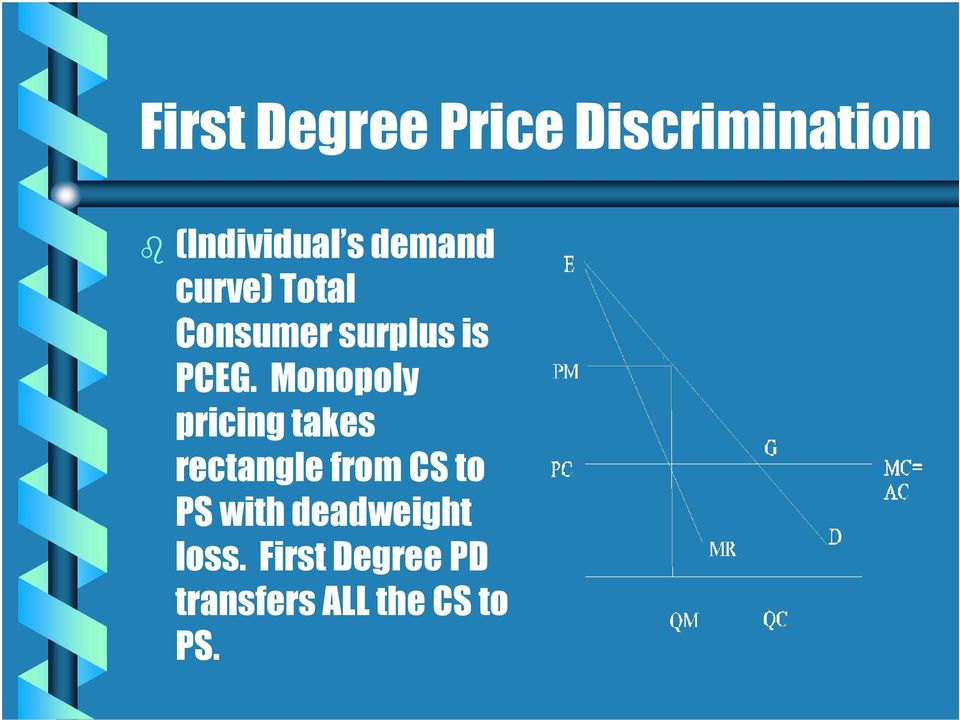
6 First Degree Price Discrimination Two pricing schemes 1. Offer take it or leave it offer of QC at a total price equal to 0EGQC. Demand curve gives the consumer s willingness to pay. 2. Offer two-part tariff with an entry fee equal to PCEG and a usage fee of PC.

7 First Degree Price Discrimination Aggregating individual s demands causes problems - must be able to separate who has the highest willingness to pay for the first unit of the good and so on. This becomes almost perfect price discrimination.
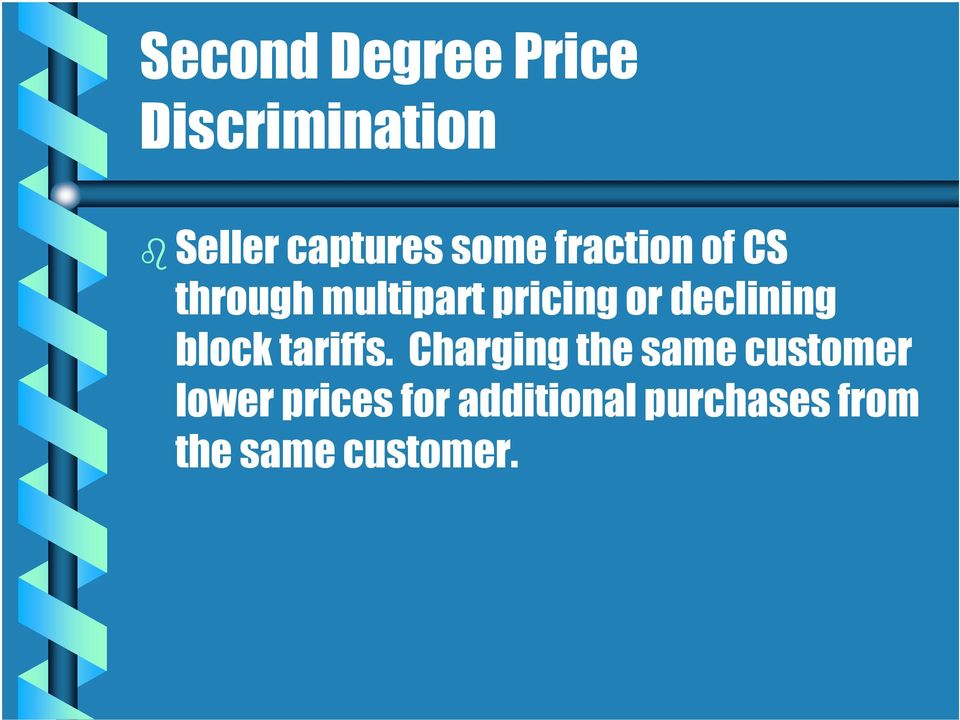
8 Second Degree Price Discrimination Seller captures some fraction of CS through multipart pricing or declining block tariffs. Charging the same customer lower prices for additional purchases from the same customer.
9 Second Degree Price Discrimination Buy 2 for $60 or 3 for $80. Lowering the marginal unit s price to $20 gains an extra $10 in profits CS Transferred MC=AC D 2 3

10 Third Degree Price Discrimination Dividing customers into different groups and setting a different price for each group. Also known as market segmentation.

11 D1 is less elastic; gets higher price. D2 is more elastic gets lower price.

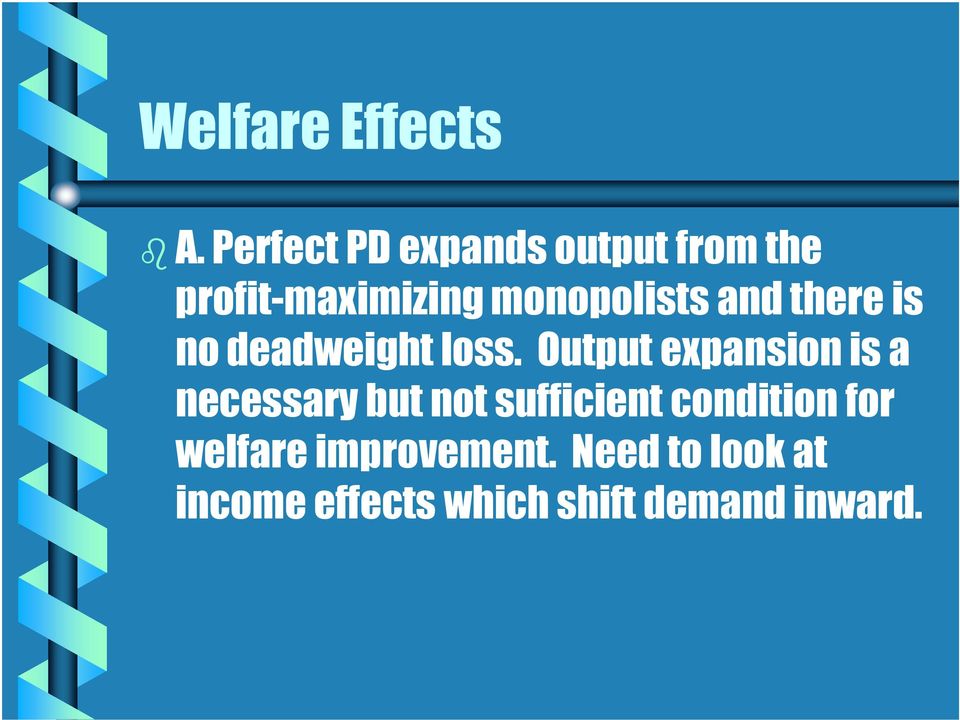
12 Welfare Effects A. Perfect PD expands output from the profit-maximizing monopolists and there is no deadweight loss. Output expansion is a necessary but not sufficient condition for welfare improvement. Need to look at income effects which shift demand inward.
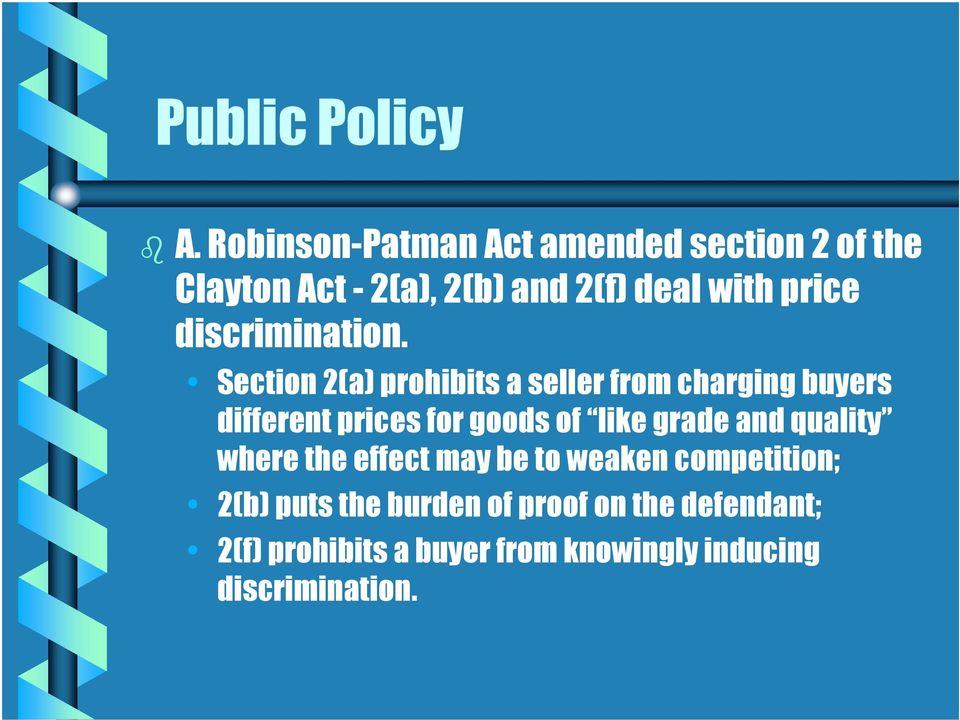
13 Public Policy A. Robinson-Patman Act amended section 2 of the Clayton Act - 2(a), 2(b) and 2(f) deal with price discrimination. Section 2(a) prohibits a seller from charging buyers different prices for goods of like grade and quality where the effect may be to weaken competition; 2(b) puts the burden of proof on the defendant; 2(f) prohibits a buyer from knowingly inducing discrimination.
14 Public Policy Three possible legal defenses 1. Cost defense - price differences reflect real differences in costs. 2. Meeting-competition defense - concessions to some buyers to meet an equally low price of a competitor 3. Distress defense - to stave off bankruptcy.

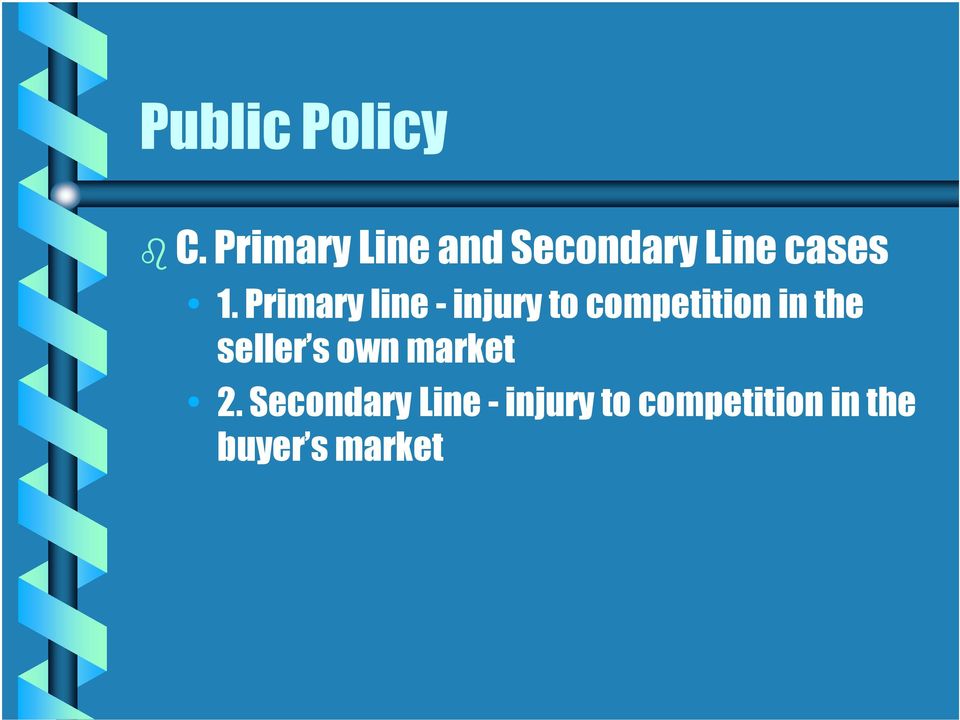
15 Public Policy C. Primary Line and Secondary Line cases 1. Primary line - injury to competition in the seller s own market 2. Secondary Line - injury to competition in the buyer s market
16 Public Policy - Con s 1. Preservation of small business, clearly a central goal of the act s sponsors is not a proper goal of antitrust. 2. PD not always monopoly induced and harmful. Can be the result of competition and benefit consumers. 3. May actually lead to inefficient rigid prices and suppress price competition.
17 Public Policy Pro s? 1. Protecting small competitors can serve consumers interests. 2. Protecting small competitors may be 2. Protecting small competitors may be justified on social or political grounds.

18 Basing-Point Pricing Prices for delivered goods set by list price plus a shipping charge determined from a basing point or point of origin regardless of whether the goods were actually manufactured there. 1. Glucose manufacturers used Chicago even though they had plants in Chicago and Kansas City. Another one was in Decatur. 2. Cement Institute - used to disguise price fixing - harder to hide price cuts.

19 Cases Morton Salt Utah Pie
Chapter 15: Monopoly WHY MONOPOLIES ARISE HOW MONOPOLIES MAKE PRODUCTION AND PRICING DECISIONS
 Chapter 15: While a competitive firm is a taker, a monopoly firm is a maker. A firm is considered a monopoly if... it is the sole seller of its product. its product does not have close substitutes. The
Thus MR(Q) = P (Q) Q P (Q 1) (Q 1) < P (Q) Q P (Q) (Q 1) = P (Q), since P (Q 1) > P (Q).
 A monopolist s marginal revenue is always less than or equal to the price of the good. Marginal revenue is the amount of revenue the firm receives for each additional unit of output. It is the difference
 1 Monopoly Why Monopolies Arise? Monopoly is a rm that is the sole seller of a product without close substitutes. The fundamental cause of monopoly is barriers to entry: A monopoly remains the only seller
Common in European countries government runs telephone, water, electric companies.
 Public ownership Common in European countries government runs telephone, water, electric companies. US: Postal service. Because delivery of mail seems to be natural monopoly. Private ownership incentive
Monopolistic Competition
 Monopolistic Chapter 17 Copyright 2001 by Harcourt, Inc. All rights reserved. Requests for permission to make copies of any part of the work should be mailed to: Permissions Department, Harcourt College
Monopoly WHY MONOPOLIES ARISE
 In this chapter, look for the answers to these questions: Why do monopolies arise? Why is MR < P for a monopolist? How do monopolies choose their P and Q? How do monopolies affect society s well-being?
Figure 1, A Monopolistically Competitive Firm
 The Digital Economist Lecture 9 Pricing Power and Price Discrimination Many firms have the ability to charge prices for their products consistent with their best interests even thought they may not be
Monopolistic Competition
 In this chapter, look for the answers to these questions: How is similar to perfect? How is it similar to monopoly? How do ally competitive firms choose price and? Do they earn economic profit? In what
MULTIPLE CHOICE. Choose the one alternative that best completes the statement or answers the question.
 Chapter 11 Monopoly practice Davidson spring2007 MULTIPLE CHOICE. Choose the one alternative that best completes the statement or answers the question. 1) A monopoly industry is characterized by 1) A)
MODULE 62: MONOPOLY & PUBLIC POLICY
 MODULE 62: MONOPOLY & PUBLIC POLICY Schmidty School of Economics 1 LEARNING TARGETS I CAN Ø Compare & Contrast the effect that perfect competition and monopoly has upon society's welfare. Ø Explain how
Chapter 11 Pricing With Market Power
 Chapter 11 Pricing With Market Power Review Questions 1. Suppose a firm can practice perfect first-degree price discrimination. What is the lowest price it will charge, and what will its total output be?
3 Price Discrimination
 Joe Chen 26 3 Price Discrimination There is no universally accepted definition for price discrimination (PD). In most cases, you may consider PD as: producers sell two units of the same physical good at
First degree price discrimination ECON 171
 First degree price discrimination Introduction Annual subscriptions generally cost less in total than one-off purchases Buying in bulk usually offers a price discount these are price discrimination reflecting
How To Calculate Profit Maximization In A Competitive Dairy Firm
 Microeconomic FRQ s 2005 1. Bestmilk, a typical profit-maximizing dairy firm, is operating in a constant-cost, perfectly competitive industry that is in long-run equilibrium. a. Draw correctly-labeled
MULTIPLE CHOICE. Choose the one alternative that best completes the statement or answers the question on the accompanying scantron.
 Principles of Microeconomics Fall 2007, Quiz #6 Name MULTIPLE CHOICE. Choose the one alternative that best completes the statement or answers the question on the accompanying scantron. 1) A monopoly is
-1- Worked Solutions 5. Lectures 9 and 10. Question Lecture 1. L9 2. L9 3. L9 4. L9 5. L9 6. L9 7. L9 8. L9 9. L9 10. L9 11. L9 12.
 -1- Worked Solutions 5 Lectures 9 and 10. Question Lecture 1. L9 2. L9 3. L9 4. L9 5. L9 6. L9 7. L9 8. L9 9. L9 10. L9 11. L9 12. L10 Unit 5 solutions Exercise 1 There may be practical difficulties in
Managerial Economics & Business Strategy Chapter 8. Managing in Competitive, Monopolistic, and Monopolistically Competitive Markets
 Managerial Economics & Business Strategy Chapter 8 Managing in Competitive, Monopolistic, and Monopolistically Competitive Markets I. Perfect Competition Overview Characteristics and profit outlook. Effect
Economic analysis of the market - 1
 Economic analysis of the market - 1 Paolo Buccirossi Rome, April 28 2014 Questions 1. What are the desirable properties (the goals ) of a system to trade (buy and sell) goods or services? 2. Is competition
1) If the government sets a price ceiling below the monopoly price, will this reduce deadweight loss in a monopolized market?
 Managerial Economics Study Questions With Solutions Monopoly and Price Disrcimination 1) If the government sets a price ceiling below the monopoly price, will this reduce deadweight loss in a monopolized
Chapter 11: Price-Searcher Markets with High Entry Barriers
 Chapter 11: Price-Searcher Markets with High Entry Barriers I. Why are entry barriers sometimes high? A. Economies of Scale in some markets average total costs fall over the full range of output. Therefore
MULTIPLE CHOICE. Choose the one alternative that best completes the statement or answers the question.
 MBA 640 Survey of Microeconomics Fall 2006, Quiz 6 Name MULTIPLE CHOICE. Choose the one alternative that best completes the statement or answers the question. 1) A monopoly is best defined as a firm that
ECON 103, 2008-2 ANSWERS TO HOME WORK ASSIGNMENTS
 ECON 103, 2008-2 ANSWERS TO HOME WORK ASSIGNMENTS Due the Week of June 23 Chapter 8 WRITE [4] Use the demand schedule that follows to calculate total revenue and marginal revenue at each quantity. Plot
Market Power and Efficiency in Card Payment Systems: A Comment on Rochet and Tirole
 Market Power and Efficiency in Card Payment Systems: A Comment on Rochet and Tirole Luís M. B. Cabral New York University and CEPR November 2005 1 Introduction Beginning with their seminal 2002 paper,
Managerial Economics
 Managerial Economics Unit 4: Price discrimination Rudolf Winter-Ebmer Johannes Kepler University Linz Winter Term 2012 Managerial Economics: Unit 4 - Price discrimination 1 / 39 OBJECTIVES Objectives Explain
Marginal cost. Average cost. Marginal revenue 10 20 40
 Economics 101 Fall 2011 Homework #6 Due: 12/13/2010 in lecture Directions: The homework will be collected in a box before the lecture. Please place your name, TA name and section number on top of the homework
3) The excess supply curve of a product we (H) import from foreign countries (F) increases as B) excess demand of country F increases.
 International Economics, 8e (Krugman) Chapter 8 The Instruments of Trade Policy 8.1 Basic Tariff Analysis 1) Specific tariffs are A) import taxes stated in specific legal statutes. B) import taxes calculated
2. Price Discrimination
 The theory of Industrial Organization Ph. D. Program in Law and Economics Session 5: Price Discrimination J. L. Moraga 2. Price Discrimination Practise of selling the same product to distinct consumers
Econ 101: Principles of Microeconomics
 Econ 101: Principles of Microeconomics Chapter 7: Taxes Fall 2010 Herriges (ISU) Ch. 7: Taxes Fall 2010 1 / 25 Outline 1 The Excise Tax 2 The Benefits and Costs of Taxation 3 Tax Fairness versus Tax Efficiency
Problem Set 9 (75 points)
 Problem Set 9 (75 points) 1. A student argues, "If a monopolist finds a way of producing a good at lower cost, he will not lower his price. Because he is a monopolist, he will keep the price and the quantity
The Efficiency of Markets. What is the best quantity to be produced from society s standpoint, in the sense of maximizing the net benefit to society?
 The Efficiency of Markets What is the best quantity to be produced from society s standpoint, in the sense of maximizing the net benefit to society? We need to look at the benefits to consumers and producers.
Lecture 10 Monopoly Power and Pricing Strategies
 Lecture 10 Monopoly Power and Pricing Strategies Business 5017 Managerial Economics Kam Yu Fall 2013 Outline 1 Origins of Monopoly 2 Monopolistic Behaviours 3 Limits of Monopoly Power 4 Price Discrimination
Price Discrimination
 Discrimination A2 Micro Economics Tutor2u, November 2010 Key issues The meaning of price discrimination Conditions required for discrimination to occur Examples of price discrimination Economic efficiency
Microeconomics Topic 7: Contrast market outcomes under monopoly and competition.
 Microeconomics Topic 7: Contrast market outcomes under monopoly and competition. Reference: N. Gregory Mankiw s rinciples of Microeconomics, 2 nd edition, Chapter 14 (p. 291-314) and Chapter 15 (p. 315-347).
Part IV. Pricing strategies and market segmentation
 Part IV. Pricing strategies and market segmentation Chapter 9. Menu pricing Slides Industrial Organization: Markets and Strategies Paul Belleflamme and Martin Peitz Cambridge University Press 2010 Chapter
AP Microeconomics 2003 Scoring Guidelines
 AP Microeconomics 2003 Scoring Guidelines The materials included in these files are intended for use by AP teachers for course and exam preparation; permission for any other use must be sought from the
Economics 431 Fall 2003 1st midterm Answer Key
 Economics 431 Fall 003 1st midterm Answer Key 1) (7 points) Consider an industry that consists of a large number of identical firms. In the long run competitive equilibrium, a firm s marginal cost must
Pricing with Perfect Competition. Business Economics Advanced Pricing Strategies. Pricing with Market Power. Markup Pricing
 Business Economics Advanced Pricing Strategies Thomas & Maurice, Chapter 12 Herbert Stocker [email protected] Institute of International Studies University of Ramkhamhaeng & Department of Economics
Chapter 7: Market Structure in Government and Nonprofit Industries. Soft Drinks. What is a Market? Do NFPs Compete? Some NFPs Compete Directly
 Chapter 7: Market Structure in Government and Nonprofit Industries Soft Drinks HTTP:/www.economics.emory.edu/Working_Pa pers/wp/2008wp/frisvold_08_08_paper.pdf What is a Market? A market is a process in
Final Exam 15 December 2006
 Eco 301 Name Final Exam 15 December 2006 120 points. Please write all answers in ink. You may use pencil and a straight edge to draw graphs. Allocate your time efficiently. Part 1 (10 points each) 1. As
4. Market Structures. Learning Objectives 4-63. Market Structures
 1. Supply and Demand: Introduction 3 2. Supply and Demand: Consumer Demand 33 3. Supply and Demand: Company Analysis 43 4. Market Structures 63 5. Key Formulas 81 2014 Allen Resources, Inc. All rights
Economics 201 Fall 2010 Introduction to Economic Analysis
 Economics 201 Fall 2010 Introduction to Economic Analysis Jeffrey Parker Problem Set #5 Solutions Instructions: This problem set is due in class on Wednesday, October 13. If you get stuck, you are encouraged
Business Ethics Concepts & Cases
 Business Ethics Concepts & Cases Manuel G. Velasquez Chapter Four Ethics in the Marketplace Definition of Market A forum in which people come together to exchange ownership of goods; a place where goods
Do not open this exam until told to do so.
 Do not open this exam until told to do so. Department of Economics College of Social and Applied Human Sciences K. Annen, Winter 004 Final (Version ): Intermediate Microeconomics (ECON30) Solutions Final
Principle of Microeconomics Econ 202-506 chapter 13
 Principle of Microeconomics Econ 202-506 chapter 13 MULTIPLE CHOICE. Choose the one alternative that best completes the statement or answers the question. 1) The WaveHouse on Mission Beach in San Diego
Lecture 9: Price Discrimination
 Lecture 9: Price Discrimination EC 105. Industrial Organization. Fall 2011 Matt Shum HSS, California Institute of Technology September 9, 2011 September 9, 2011 1 / 23 Outline Outline 1 Perfect price discrimination
MULTIPLE CHOICE. Choose the one alternative that best completes the statement or answers the question.
 Economics 103 Spring 2012: Multiple choice review questions for final exam. Exam will cover chapters on perfect competition, monopoly, monopolistic competition and oligopoly up to the Nash equilibrium
MICROECONOMICS II PROBLEM SET III: MONOPOLY
 MICROECONOMICS II PROBLEM SET III: MONOPOLY EXERCISE 1 Firstly, we analyze the equilibrium under the monopoly. The monopolist chooses the quantity that maximizes its profits; in particular, chooses the
Why do merchants accept payment cards?
 Why do merchants accept payment cards? Julian Wright National University of Singapore Abstract This note explains why merchants accept expensive payment cards when merchants are Cournot competitors. The
The economics of online personalised pricing
 The economics of online personalised pricing May 2013 OFT1488 Crown copyright 2013 This report has been written by Patrick Coen and Natalie Timan of the OFT, and has benefitted from comments by various
Market Definition Does Not Yield Evidence of Class-Wide Impact
 Market Definition Does Not Yield Evidence of Class-Wide Impact Dr. Michael D. Noel, Ph.D. & Parker Normann, Ph.D. Edgeworth Economics June 2012 (published version available in the Antitrust Practitioner)
Market Structure: Oligopoly (Imperfect Competition)
 Market Structure: Oligopoly (Imperfect Competition) I. Characteristics of Imperfectly Competitive Industries A. Monopolistic Competition large number of potential buyers and sellers differentiated product
1 of 14 11/5/2013 4:33 PM
 1 of 14 11/5/2013 4:33 PM Market power is A characteristic of all market structures. The ability to alter the market price of a product. Most common for competitive firms. Enjoyed by all firms at high
Course: Economics I. Author: Ing. Martin Pop
 Course: Economics I Author: Ing. Martin Pop Contents Introduction 1. Characteristics of imperfect competition. The main causes of imperfect competition 2. Equilibrium firms in imperfect competition 3.
chapter: Solution Solution Monopoly 1. Each of the following firms possesses market power. Explain its source.
 S197-S28_Krugman2e_PS_Ch14.qxp 9/16/8 9:22 PM Page S-197 Monopoly chapter: 14 1. Each of the following firms possesses market power. Explain its source. a. Merck, the producer of the patented cholesterol-lowering
Chapter 14 Monopoly. 14.1 Monopoly and How It Arises
 Chapter 14 Monopoly 14.1 Monopoly and How It Arises 1) One of the requirements for a monopoly is that A) products are high priced. B) there are several close substitutes for the product. C) there is a
Variable Cost. Marginal Cost. Average Variable Cost 0 $50 $50 $0 -- -- -- -- 1 $150 A B C D E F 2 G H I $120 J K L 3 M N O P Q $120 R
 Class: Date: ID: A Principles Fall 2013 Midterm 3 Multiple Choice Identify the choice that best completes the statement or answers the question. 1. Trevor s Tire Company produced and sold 500 tires. The
Answers to Chapter 6 Exercises
 Answers to Chapter 6 Exercises Review and practice exercises 6.1. Perfect price discrimination. Consider a monopolist with demand D = 10 p and marginal cost MC = 40. Determine profit, consumer surplus,
SOLUTIONS TO HOMEWORK SET #4
 Sloan School of Management 15.010/15.011 Massachusetts Institute of Technology SOLUTIONS TO HOMEWORK SET #4 1. a. If the markets are open to free trade, the monopolist cannot keep the markets separated.
Chapter 11 Pricing Strategies for Firms with Market Power
 Managerial Economics & Business Strategy Chapter 11 Pricing Strategies for Firms with Market Power McGraw-Hill/Irwin Copyright 2010 by the McGraw-Hill Companies, Inc. All rights reserved. Overview I. Basic
AGEC 105 Spring 2016 Homework 7. 1. Consider a monopolist that faces the demand curve given in the following table.
 AGEC 105 Spring 2016 Homework 7 1. Consider a monopolist that faces the demand curve given in the following table. a. Fill in the table by calculating total revenue and marginal revenue at each price.
p, we suppress the wealth arguments in the aggregate demand function. We can thus state the monopolist s problem as follows: max pq (p) c (q (p)).
 Chapter 9 Monopoly As you will recall from intermediate micro, monopoly is the situation where there is a single seller of a good. Because of this, it has the power to set both the price and quantity of
Review Question - Chapter 7. MULTIPLE CHOICE. Choose the one alternative that best completes the statement or answers the question.
 Review Question - Chapter 7 MULTIPLE CHOICE. Choose the one alternative that best completes the statement or answers the question. 1) International trade arises from A) the advantage of execution. B) absolute
ECON 600 Lecture 5: Market Structure - Monopoly. Monopoly: a firm that is the only seller of a good or service with no close substitutes.
 I. The Definition of Monopoly ECON 600 Lecture 5: Market Structure - Monopoly Monopoly: a firm that is the only seller of a good or service with no close substitutes. This definition is abstract, just
BEE2017 Intermediate Microeconomics 2
 BEE2017 Intermediate Microeconomics 2 Dieter Balkenborg Sotiris Karkalakos Yiannis Vailakis Organisation Lectures Mon 14:00-15:00, STC/C Wed 12:00-13:00, STC/D Tutorials Mon 15:00-16:00, STC/106 (will
1. Supply and demand are the most important concepts in economics.
 Page 1 1. Supply and demand are the most important concepts in economics. 2. Markets and Competition a. Market is a group of buyers and sellers of a particular good or service. P. 66. b. These individuals
CHAPTER 10 MARKET POWER: MONOPOLY AND MONOPSONY
 CHAPTER 10 MARKET POWER: MONOPOLY AND MONOPSONY EXERCISES 3. A monopolist firm faces a demand with constant elasticity of -.0. It has a constant marginal cost of $0 per unit and sets a price to maximize
Part IV. Pricing strategies and market segmentation. Chapter 8. Group pricing and personalized pricing
 Part IV. Pricing strategies and market segmentation Chapter 8. Group pricing and personalized pricing Slides Industrial Organization: Markets and Strategies Paul Belleflamme and Martin Peitz Cambridge
CEVAPLAR. Solution: a. Given the competitive nature of the industry, Conigan should equate P to MC.
 1 I S L 8 0 5 U Y G U L A M A L I İ K T İ S A T _ U Y G U L A M A ( 4 ) _ 9 K a s ı m 2 0 1 2 CEVAPLAR 1. Conigan Box Company produces cardboard boxes that are sold in bundles of 1000 boxes. The market
Sustainable Energy Systems
 Theory of Regulation PhD, DFA M. Victor M. Martins Semester 2 2008/2009 2. 1 Natural monopoly regulation 2. 1 Natural monopoly regulation: efficient pricing, linear, non linear pricing and Ramsey pricing.
Econ 201 Lecture 17. The marginal benefit of expanding output by one unit is the market price. Marginal cost of producing corn
 Econ 201 Lecture 17 The Perfectly Competitive Firm Is a Taker (Recap) The perfectly competitive firm has no influence over the market price. It can sell as many units as it wishes at that price. Typically,
Monopoly: static and dynamic efficiency M.Motta, Competition Policy: Theory and Practice, Cambridge University Press, 2004; ch. 2
 Monopoly: static and dynamic efficiency M.Motta, Competition Policy: Theory and Practice, Cambridge University Press, 2004; ch. 2 Economics of Competition and Regulation 2015 Maria Rosa Battaggion Perfect
The Analysis of the Article Microsoft's Aggressive New Pricing Strategy Using. Microeconomic Theory
 2 The Analysis of the Article Microsoft's Aggressive New Pricing Strategy Using Microeconomic Theory I. Introduction: monopolistic power as a means of getting high profits II. The review of the article
CHAPTER 12 MARKETS WITH MARKET POWER Microeconomics in Context (Goodwin, et al.), 2 nd Edition
 CHAPTER 12 MARKETS WITH MARKET POWER Microeconomics in Context (Goodwin, et al.), 2 nd Edition Chapter Summary Now that you understand the model of a perfectly competitive market, this chapter complicates
Price Discrimination
 Price Discrimination Mark Armstrong Department of Economics University College London October 2006 1 Introduction In broad terms, one can say that price discrimination exists when two similar products
Price Discrimination: Part 2. Sotiris Georganas
 Price Discrimination: Part 2 Sotiris Georganas 1 More pricing techniques We will look at some further pricing techniques... 1. Non-linear pricing (2nd degree price discrimination) 2. Bundling 2 Non-linear
Chapter 7 Monopoly, Oligopoly and Strategy
 Chapter 7 Monopoly, Oligopoly and Strategy After reading Chapter 7, MONOPOLY, OLIGOPOLY AND STRATEGY, you should be able to: Define the characteristics of Monopoly and Oligopoly, and explain why the are
Economics Chapter 7 Market Structures. Perfect competition is a in which a large number of all produce.
 Economics Chapter 7 Market Structures Perfect competition is a in which a large number of all produce. There are Four Conditions for Perfect Competition: 1. 2. 3. 4. Barriers to Entry Factors that make
Market Power and Pricing Strategies
 Market Power and Pricing Strategies Y 10 ou ve no doubt noticed many places where you can receive price discounts if you show your student ID. Commonly discounted goods include movie admissions, clothing
Everything is worth what its purchaser will pay for it. Publilius Syrus (1st century B.C.)
 ch12_perloff_16072 2/17/03 4:50 PM Page 387 Pricing 12 CHAPTER Everything is worth what its purchaser will pay for it. Publilius Syrus (1st century B.C.) Why does Disneyland charge local residents $28
Pricing to Mass Markets. Simple Monopoly Pricing, Price Discrimination and the Losses from Monopoly
 Pricing to Mass Markets Simple Monopoly Pricing, Price Discrimination and the Losses from Monopoly Many Buyers Costly to set individual prices to each consumer to extract their individual willingness-to-pay.
chapter Perfect Competition and the >> Supply Curve Section 3: The Industry Supply Curve
 chapter 9 The industry supply curve shows the relationship between the price of a good and the total output of the industry as a whole. Perfect Competition and the >> Supply Curve Section 3: The Industry
Final Exam (Version 1) Answers
 Final Exam Economics 101 Fall 2003 Wallace Final Exam (Version 1) Answers 1. The marginal revenue product equals A) total revenue divided by total product (output). B) marginal revenue divided by marginal
MULTIPLE CHOICE. Choose the one alternative that best completes the statement or answers the question.
 Test 2 Review Econ 201, V. Tremblay MULTIPLE CHOICE. Choose the one alternative that best completes the statement or answers the question. 1) Barbara left a $25,000 job as an architect to run a catering
Chapter 7: Market Structures Section 3
 Chapter 7: Market Structures Section 3 Objectives 1. Describe characteristics and give examples of monopolistic competition. 2. Explain how firms compete without lowering prices. 3. Understand how firms
Chapter 14 Monopoly. 14.1 Monopoly and How It Arises
 Chapter 14 Monopoly 14.1 Monopoly and How It Arises 1) A major characteristic of monopoly is A) a single seller of a product. B) multiple sellers of a product. C) two sellers of a product. D) a few sellers
Rutgers University Economics 102: Introductory Microeconomics Professor Altshuler Fall 2003
 Rutgers University Economics 102: Introductory Microeconomics Professor Altshuler Fall 2003 Answers to Problem Set 11 Chapter 16 2. a. If there were many suppliers of diamonds, price would equal marginal
Agricultural Supply Management and Antitrust in the United States System of Agribusiness
 Agricultural Supply Management and Antitrust in the United States System of Agribusiness Yuliya Bolotova Assistant Professor of Agribusiness [email protected] International Food and Agribusiness Management
Price Discrimination
 E. Glen Weyl University of Chicago Lecture 10 Regular Section Elements of Economic Analysis II Fall 2011 Introduction Key assumption of last lecture was uniform pricing Everyone pays same for ever unit
Lecture 6: Price discrimination II (Nonlinear Pricing)
 Lecture 6: Price discrimination II (Nonlinear Pricing) EC 105. Industrial Organization. Fall 2011 Matt Shum HSS, California Institute of Technology November 14, 2012 EC 105. Industrial Organization. Fall
How To Price Bundle On Cable Television
 K. Bundling Brown and in Cable P. J. Alexander Television Bundling in Cable Television: A Pedagogical Note With a Policy Option Keith Brown and Peter J. Alexander Federal Communications Commission, USA
How To Learn Economics In India
 B.A. PROGRAMME DISCIPLINE COURSE ECONOMICS COURSE CONTENTS (Effective from the Academic Year 2011-2012 onwards) DEPARTMENT OF ECONOMICS UNIVERSITY OF DELHI DELHI 1 Syllabus for B.A. Programme - Economics
MULTIPLE CHOICE. Choose the one alternative that best completes the statement or answers the question.
 MULTIPLE CHOICE. Choose the one alternative that best completes the statement or answers the question. 1) The four-firm concentration ratio equals the percentage of the value of accounted for by the four
MONOPOLIES HOW ARE MONOPOLIES ACHIEVED?
 Monopoly 18 The public, policy-makers, and economists are concerned with the power that monopoly industries have. In this chapter I discuss how monopolies behave and the case against monopolies. The case
12 Monopolistic Competition and Oligopoly
 12 Monopolistic Competition and Oligopoly Read Pindyck and Rubinfeld (2012), Chapter 12 09/04/2015 CHAPTER 12 OUTLINE 12.1 Monopolistic Competition 12.2 Oligopoly 12.3 Price Competition 12.4 Competition
11 PERFECT COMPETITION. Chapter. Competition
 Chapter 11 PERFECT COMPETITION Competition Topic: Perfect Competition 1) Perfect competition is an industry with A) a few firms producing identical goods B) a few firms producing goods that differ somewhat
A. a change in demand. B. a change in quantity demanded. C. a change in quantity supplied. D. unit elasticity. E. a change in average variable cost.
 1. The supply of gasoline changes, causing the price of gasoline to change. The resulting movement from one point to another along the demand curve for gasoline is called A. a change in demand. B. a change
CHAPTER 18 MARKETS WITH MARKET POWER Principles of Economics in Context (Goodwin et al.)
 CHAPTER 18 MARKETS WITH MARKET POWER Principles of Economics in Context (Goodwin et al.) Chapter Summary Now that you understand the model of a perfectly competitive market, this chapter complicates the
AP Microeconomics Review
 AP Microeconomics Review 1. Firm in Perfect Competition (Long-Run Equilibrium) 2. Monopoly Industry with comparison of price & output of a Perfectly Competitive Industry 3. Natural Monopoly with Fair-Return
Price Discrimination
 Perfect Imperfect E. Glen Weyl University of Chicago Lecture 10 Turbo Section Elements of Economic Analysis II Fall 2011 Introduction Perfect Imperfect Key assumption of last lecture was uniform pricing