
By Don Quixote, J.D. COMMON LAW ABATEMENT
|
|
|
- Jerome Cummings
- 10 years ago
- Views:
Transcription
1 THE DON QUIXOTE SCHOOL OF LAW By Don Quixote, J.D. COMMON LAW ABATEMENT
2 COMMENTS FROM THE PROFESSOR ON TRAFFIC CITATIONS AND INTRODUCTION TO ABATEMENT There are many that believe that special appearances (by paper work, motions, etc.) nullify a court jurisdiction. Under emergency powers, this is false doctrine. There is no remedy in challenging a court jurisdiction, except by abating its process, first. Abatements are not a challenge to a court jurisdiction, merely a good faith attempt to correct errors in process, "clear up the errors, judge, and I'll appear." Special appearances fail when a judge knows what he is doing. Under martial rule, judges do whatever they want, whenever they want so long as he/she does not alarm the public or disturb the peace. Jurisdiction is always granted to try jurisdictional questions, even if one goes to higher courts. Defendants grant jurisdiction without knowing it, because they never challenge the process that creates the jurisdiction in the first place (see: FRCP 2.4 (2)(4)). Process is perfected by appearance, special or otherwise. Also remember the court is not the building the judge or anyone else, it is the paperwork. If the court paperwork is defective, there is no court and it ceases to exist. The only way to overcome the War Powers court process is by Abatement. Traffic tickets are a pain for all of us. When using this Abatement Strategy, first send in the Notice of Abatement, Memorandum of Law and Denial of Corporate Existence to the Clerk of Court. That generally takes care of the annoying ticket. If you do not hear from him within 15 days, send in the Default Notice of the Notary to the Clerk. If you receive a summons, which has the proper signature of the judge and the court seal, send in the Subpoena and Discovery Interrogatories to the Prosecuting Attorney and the court. Your challenging jurisdiction and the opposing party must traverse your challenge or the court cannot proceed. In most cases they will never give you the documents you have requested or answer your questions, if they do, you won. The people granted authority to the state legislature to adjudicate only a few matters: Actions at law, actions in equity, and actions under the rule of necessity (military). Admiralty was remanded to the federal government and the states (are supposed to) have no authority to legislate in this jurisdiction. There was a time when someone aggrieved of harm would file a tort at law. Moreover, the nature of the action governed the rules of the procedure. If there was a breach of contract, then this was an equity matter. If the aggrieved party could allege a tortious breach of contract, this matter was moved from the equity side of the court into the law side. This is because the people must have access to a remedy at law if this type of action could give relief. If one were in the military, or if one were under territory under martial law, the court was a military court. If there was a breach of an International Contract, the Matter was federal and heard under Admiralty. The state Legislature cannot vest a "court" with authority that has not been delegated to it by the People via the constitution of the State. They cannot create a new "nature of action" out of thin air. Later on, when the constitutions of the several States were amended to recognize and administrate corporations, a separate court was established, and the action was in the nature of administrative. Page 2 of 88

3 Live people could not be brought into administrative courts, as the only matter at issue was a breach of corporate charter by an artificial person. Somewhere along the line, the announcement in the Complaint of the nature of the action was lost. The attorneys all got together and decided that it would be much "simpler" (for them) if there were only one form of action. So today, there is no disclosure of the nature of the action, unless one demands to know the nature and cause of the accusation by using a demand for a bill of particulars. I have been quite successful with this procedure, even in states that have decided that a demand for bill of particulars is a discretionary motion before the court. For example, in Pennsylvania, the demand for bill of particulars used to be before arraignment so that one had an opportunity to raise a meaningful defense against the elements of personal jurisdiction and "venue" (to include territorial jurisdiction as well as the "nature of the action" that used to be a part of subject matter jurisdiction). Within the past couple decades, they moved it into "discovery", which is after arraignment, so the ability of one to challenge the jurisdiction and venue of the court was lost. This is because entering a plea ACCEPTS the jurisdiction. In this way, only subject matter jurisdiction was challengeable. If they say this is a matter at law, my defense against this jurisdiction is whether there is a live damaged Party. I do not ask if this is an equity jurisdiction because equity is not a criminal type of action. If they say this is a matter in hustings (which is the true nature of action of all administrative law), my defense against this jurisdiction is that I am not an artificial person (unless I am a federal citizen - but that is quite another matter entirely), unless they can show from the records in the Secretary of State's office that I have charted as such. If they say this is an admiralty matter, my defense against this jurisdiction is whether the offense was committed on federal territory, over which the state has retained concurrent jurisdiction (although I still have-not found how the state exercises an admiralty jurisdiction in light of 28 USC 1333). If they say this is a military matter, my defense against this jurisdiction is that: 1) I am not a member of their military (I am, however, a member of the Militia of one of the several states - but they do not operate as such anymore), 2) the nation is not under martial law (or is it?). Given the fact that there are currently 14 Notices from the President s of a Declaration of National Emergency published in the Federal Register, we may very well be in a state of martial law. The one from March 6, A.D is still in effect today. However, they are not going to admit the nature of the action, as this will admit their want of jurisdiction on the record for all to see, so THEY move to dismiss the charges. Every time. Page 3 of 88

4 While I will never succeed in bringing down the current regime in this Manner, at least other folks see what I am doing and some decide along the way that they want to learn this procedure. I contend that if only 10% of the people enforced their right to know the "Nature and Cause" of the accusation, that we could most certainly shut down the incessant stream of revenue being fleeced from the people by these "administrative" courts. As far as the "compelling government interest" doctrine, this is clearly matter founded in law martial rule - the military authority is in the process of returning control to the civil authorities, but has not yet completed the process I simply do not understand the Nature and Cause of the Accusation with regard to the elements of personal jurisdiction, venue, and the nature of the action until the prosecution properly alleges them. I am therefore unable to enter a plea to the charge, until I have had an opportunity to raise a meaningful defense against these elements. I cannot rebut an unstated presumption. The courts operate on silent judicial notice of presumption all the time. It is time for this to end. Generally, when you appear the Police Officer is not there because he has been instructed to stay home that day. You simply move for a dismissal for lack of prosecution, as the Prosecutor cannot testify to facts, which he has no first hand knowledge of. Be especially careful of the judge s conduct, he is required by his Oath of Office to be an impartial trier of fact, not the assistant prosecutor. Have fun but please do not abuse this procedure or it may become ineffective because of the abuse. Professor of Law Don Quixote, J.D. Page 4 of 88

5 EXAMPLE OF AN ACTUAL PROCEEDING WHERE ABATEMENT OCCURRED LOS ANGELES, CALIFORNIA; MONDAY, MARCH 21, 1994; 1:30 P.M. THE CLERK: Item number 6, case number CV-94xxxxx, United States of America versus Randy L. Oxxxxxxxxxr. MR. ROTH: Good afternoon, your Honor, Assistant U.S. Attorney Gregory Roth appearing on behalf of the United States, and its agency the Internal Revenue Service. THE COURT: Is there any opposition? MR. OxxxxxxxxxR: For the record. THE COURT: Yes. Mr. OxxxxxxxxxR: My Christian name is Randy Lee and my family name is Oxxxxxxxxxr. THE COURT: All right. MR. OxxxxxxxxxR: That is spelled capital R, lower case, a-n-d-y, capital L, lower case e-e, capital O, lower case x-x-x-x-x-x-x-x-x-r. I have responded to this petition, because it was found on the door of the place where I take up housekeeping and attempts to create a colorable persona under colorable law by the name of capital R-A-N-D-Y L period, OXXXXXXR. The artifice being used here to deceive this Honorable Court must be abated as a Public Nuisance. For the record Randy Lee and Jesus the Christ Advocate and Wonderful Counselor are using the Right of Visitation to exercise the Ministerial Powers to be heard on this matter. I, Randy Lee am a native Californian and a Man on the Land in Los Angeles County, not a resident in the Federal Judicial District in the Central District of California. My Colors and Authority is the California Bear Flag with the Gold star. My Law is My Family Bible, which I have in hand. In addition, the Seal of the People shows my Status. I am who I say I am, not whom the U.S. Attorney says I am. Further, I sayeth not and I stand mute. THE COURT: All right. Please take your things off the podium and sit down at your table. Mr. Roth, do you have any response to this alleged case of mistaken identity. Page 5 of 88

6 MR. ROTH: Well, your Honor, Mr. Oxxxxxxxxxr seems to think that if you spell your name in upper and lower case, it relieves him of compliance. THE COURT: Thank you, Mr. Roth. Please call the next case clerk. (Proceedings concluded.) C E R T I F I C A T E I hereby certify that the foregoing matter entitled UNITED STATES OF AMERICA versus RANDY L. OxxxxxxxxxR No. CV-94 xxxx -JGD is transcribed from the stenographic notes taken by me and is a true and accurate description of the same. (Signed). 3/25/94. BEVERLY A. CASARES CSR# 8630, Official Court Reporter 1 Corpus Juris on Abatement. Definition, Nature, and Effect of Abatement [1] A. DEFINITION. The abatement of an action at law is the overthrowing of the action caused by defendant's pleading some matter of fact tending to impeach the correctness of the writ or declaration. The abatement of a suit in equity is a mere suspension of all the proceedings therein for a want of proper parties before the court. A plea in abatement is defined to be a plea that, without disputing the justice of the plaintiff's claim, objects to the place, mode, or time of asserting it, and requires that therefore, and pro hac vice, judgment be given for the defendant, leaving it open to renew the suit in another place or form, or at another time. [2] B. EFFECT OF ABATEMENT - 1. At Law-a. Effect on Principal Suit. At law the abatement of a suit is a complete termination of that particular suit, so that it cannot be revived; but it does not determine or defeat plaintiff's cause of action or bar the issuance of a new suit. [7] C. PLEAS IN ABATEMENT NOT FAVORED. Pleas in abatement, being dilatory pleas, are not favored either at common law, or under the codes and practices acts. FOR THIS REASON, as will be shown in another place, pleas or answers in abatement must allege with the greatest certainty in every particular every fact necessary to their sufficiency. No presumptions of law or fact are allowed in their favor, but on the contrary every intendment must be taken against them. Furthermore matter in abatement must be pleaded at the earliest opportunity, and, if the facts are known, before a plea or answer in bar is interposed, and before a general imparlance or continuance. Therefore, this is why the Judge did what he did. The guy did not win per se, as the IRS could have corrected the defect in the "writ" and brought a new suit. Page 6 of 88

7 Again, from 1 Corpus Juris: II Objections to Jurisdiction [17] A. Nature of Pleas to the Jurisdiction. At common law pleas by which objection is taken to the jurisdiction of the court are not strictly pleas in abatement, but are in a class by themselves and are designated as pleas to the jurisdiction. They differ at common law from pleas in abatement in several respects, as, for example, in that they must be pleaded in person and not by attorney, and in that they must conclude, not with a prayer for judgment of the writ or declaration, or of the writ and declaration, and that the same be quashed, but whether the court will or ought to take further cognizance of the action or suit. They are, however, dilatory pleas, as distinguished from pleas to the merits, in that their effect is to defeat the present suit and not to deny or bar the cause of action, and therefore they are in modern practice treated for most purposes like other dilatory pleas as pleas in abatement, and are subject to most of the rules governing such pleas. The following is an excerpt from an article by James Hazel titled The Abatement Process (See also James' article: Notes About Deceptive All Capitals Names): In written form, the following example, to be delivered to the court clerk or judge, conforms with Randy Lee's successful petition, and to the requirements for abatements as enumerated in Corpus Juris Secundum and many, many cases, which have treated the subject of abatement for misnomer. [This is useful for instances where you have the opportunity, as in most cases, to reply in writing to a written demand/summons -- as it's much simpler than appearing in person, and most people prefer this option.] First Amendment Petition for Abatement To: THE (FICTITIOUS NAME OF COURT, EXPRESSED IN ALL UPPERCASE LETTERS); ADDRESS OF COURT, INCLUDING ZIP CODE. From: Petitioner John Doe (properly capitalized); Mail received: c/o (USPS address, including ZIP Code). Regarding: (Complaint, demand or accusation, [No. ]), attached hereto and thereby incorporated as an integral part of this Petition for Abatement. COMES NOW, John Allan Doe, the live Man, by authority of the First Article of amendment (A.D. 1791) to the constitution of the United States, to petition this court to abate the abovereferenced (Accusation, Complaint) on the following grounds: 1. The (accusation--complaint) against JOHN DOE, a fictitious name, was delivered into my hand on (date). As a prudent Man who fears that his ignoring of the Instrument might Page 7 of 88

8 well result in coercive procedures being used against him, I have chosen to approach this court with this petition that the court abate the Instrument so it cannot in its present form, further restrain my liberties. 2. That the Instrument was served on or delivered to me is evidence that this is a case of misnomer or mistaken identity. The instrument is against a fictitious name, "JOHN DOE." My given, Christian name is "John," with the initial letter capitalized as required by Rules of English Grammar for the writing of the names of natural persons. My patronymic, family name or surname is "Doe," with the initial letter capitalized. The (accusation, complaint) does not name me as a Party. 3. If the complainant or accuser has any claim or argument against me, it can bring a complaint or accusation against my real name. My objections herein will make it possible for the complainant or accuser to issue a corrected writ, which is the primary purpose of matters in abatement. 4. This is by content, grounds, intent and definition is a petition in abatement, and not a plea in bar; and may not be construed as a motion for dismissal or for mere amendment of the instrument. It may be justly resolved, only by abatement by the court. When a Petition for Abatement is before a court, that court is charged with according to the defendant (petitioner) the benefit of the doubt. In addition, courts should take cognizance of the law that provides: Where conditions for its issuance exist, abatement is a matter of right, not of discretion; The misnomer or mis-description of a party defendant is ground for abatement; and, Grounds for abatements are the same for equity and law cases. FURTHER I SAYETH NOT, except to advise the court that in the absence of abatement of the instrument as a restraint against my liberty, I shall henceforth remain mute. Dated this day of the (First - Twelfth) month of the Nineteenth Hundred and Ninety Sixth year Anno Domini, in County, State of (capitalize lawful name of State): John Allan Doe [When a DEMAND is abated, it can theoretically be re-filed; properly naming the Accused Man or Woman] Most DEMANDS prosecuted in courts contain other fatal errors besides mistaken identify of the accused. By use of all uppercase letters in their entitlements or captions, and by erroneously capitalizing the terms "plaintiff' and "defendant," they fail to identify the Parties, the Venue, including the NAMES of lawful states and counties, and the NAME of a lawful court. It is advisable to avoid the shotgun technique of trying to "cure" all defects with one abatement petition, but is preferable to focus the first (and usually the last needed abatement petition, on the failure to accuse the coerced Man or Woman by his/her proper name. The present Page 8 of 88

9 de facto courts have no lawful power to name natural-born people, or otherwise exercise jurisdiction over them, except with their tacit (ignorant) Consent. To date, I have heard of no abated accusation being re-filed, properly naming the natural Man or Woman who objected to be held to answer to a demand against a fictitious person. However, in the unlikely event that an accusation or demand is re-filed using a proper name for the accused, a second petition for abatement would lie against failure to name the venue. Then if necessary a third, for failure to name the court. If still necessary, a fourth petition failure to identify the "nature" of the parties (plaintiff and defendant). Another method used successfully is the following. Send them in proper order. Page 9 of 88

10 First Amendment Petition for Abatement To: THE (FICTITIOUS NAME OF COURT, EXPRESSED IN ALL UPPERCASE LETTERS); ADDRESS OF COURT, INCLUDING ZIP CODE. From: Petitioner John Doe (properly capitalized); Mail received: c/o (USPS address, including ZIP Code). Regarding: (Complaint, demand or accusation, [NO. ]), attached hereto and thereby incorporated as an integral part of this petition for abatement. Comes Now, John Allan: Doe (hereinafter Petitioner ), to petition this court to abate the above-referenced (accusation, complaint) on the following grounds: Petitioner is respectfully requires that you Abate the above referenced (State Name) Uniform Traffic Citation and Complaint #????. Petitioner is a natural Man, living upon the Soil of (your state s Name). Petitioner is not exercising Petitioner s right to travel freely within this state to engage in commercial activity. As Petitioner s travel is not a commercial activity, Petitioner is not subject to being detained or summoned to this court by Officer/Trooper (Name & number of officer) exercising the Police Power of the State to enforce its private commercial statutes in Commerce. Below are some of Petitioner s reasons as to why Petitioner will not appear unless defects in the service of process are corrected. Notice of Abatement for Improper Service Petitioner was presented with a paper styled in capital letters as ( NAME OF STATE ) UNIFORM CITATION AND COMPLAINT dated [date here]. Petitioner has received but have not accepted the Uniform Traffic Citation and Complaint and is hereby rejecting said document for Cause without Dishonor. Petitioner is returning said document marked "Without Prejudice" thereby retaining all of [his/her] Rights in Law and Equity as Petitioner challenges the subject matter and in personam jurisdiction of the court for the following causes: Courts enforcing mere statutes do not act judicially merely ministerial, having thus no judicial immunity, and unlike courts of law do not obtain jurisdiction by service of process nor even arrest and compelled appearance. Boswell vs. Otis, 9 Howard 336, 348. Service of a traffic ticket on a motorist does not give the court jurisdiction over his person... Service of a traffic ticket imposes no compulsion on him, and no penalty attached for failure to heed it... Purpose of traffic ticket is to secure the motorist's voluntary appearance. Colville vs. Bennett, 293 NYS 2d 685. If the (NAME OF STATE) UNIFORM TRAFFIC CITATION AND COMPLAINT is a Summons requiring Petitioner s appearance, the following defects must be corrected before I will submit to the courts jurisdiction. Page 10 of 88
![]), attached hereto and thereby incorporated as an integral part of this petition for abatement.](/docs-images/53/11154846/images/page_10.jpg "Comes Now, John Allan: Doe (hereinafter Petitioner ), to petition this court to abate the above-referenced (accusation, complaint) on the following grounds: Petitioner is respectfully requires that")
11 The mandate contained within the Fifth Article of amendment to the Constitution of the United States require as due process i.e., meaning initiatives through judicial courts with proper jurisdiction, precedes the imposition of administratively issued summonses, except where licensing agreement obligate assets. Petitioner has no knowledge of (Your full Name) having any licensing agreement(s) with the County of (Name), State of (Name), or the United States, which obligates assets and Petitioner demands decisive Proof to the Contrary. The Police Officer/State Trooper (Name), (State Name) Uniform Traffic Citation and Complaint, in issue does not meet the legal definition of a judicial summons as follows: Summons. Instrument used to commence a civil action or special proceeding and is a means of acquiring jurisdiction over a party. Writ or process directed to the sheriff or other proper officer, requiring him to notify the person named that an action has been commenced against him in the court from where the process issues, and that he is required to appear, on a day named, and answer the complaint in such action. Upon the filing of the complaint the clerk is required to issue a summons and deliver it for service to the marshal or to a person specially appointed to serve it. Fed. R. Civil P. 4(a). Black s Law Dictionary, Sixth Edition, pg Note: There are no definitions for the terms administrative summons in Black s Law Dictionary, Sixth Edition. The (State Name) Uniform Traffic Citation and Complaint in issue neither indicates on its face that a lawsuit is pending, nor does it comply with the rules for form and content of civil summonses and is defective in the following ways: (a) The (State Name) Uniform Traffic Citation and Complaint does not bear the signature of the clerk of the court. (b) The (State Name) Uniform Traffic Citation and Complaint does not have the seal of the court placed upon it. (c) The (State Name) Uniform Traffic Citation and Complaint does not contain the name of the court upon it. (d) The (State Name) Uniform Traffic Citation and Complaint does not contain the names of the parties to the cause of action with their respective designations as plaintiff and defendant. (e) The (State Name) Uniform Traffic Citation and Complaint does not contain the name and address of the plaintiff s attorney or plaintiff s address per se. (f) The (State Name) Uniform Traffic Citation and Complaint does not contain the mandatory notice to the defendant of the time and place in which the defendant is to appear and defend. (g) The (State Name) Uniform Traffic Citation and Complaint does not contain the proper default warning language to defendant. (h) The (State Name) Uniform Traffic Citation and Complaint does not have a copy of the plaintiff s Complaint and Probable Cause affidavit attached. 4. Without an attached Complaint and Probable Cause Affidavit, Petitioner has no way of knowing what the nature and cause of the underlying Complaint is about and what relief demanded by the alleged plaintiff. 5. Officer (Name) himself served said (State Name) Uniform Traffic Citation and Complaint and is the Party who has an adversarial interest in the instant Matter. Page 11 of 88
12 Note: A Summons may be served by any person who is at least 18 years of age and not a party to the action. Caldwell vs. Coppola, 219 Cal.App.3rd, 859. The prohibition of personal service of process by parties is to discourage fraudulent service by persons with an adversarial interest in a legal action. It appears from the returned document, that your organization is requesting my voluntary appearance, but threatening me with conviction and judgment for an undisclosed amount exceeding the base fine if I do not voluntarily comply. In light of the case law cited above and that by voluntarily subjecting myself to your organization's jurisdiction I would put my personal property at a substantial risk of loss. Your organization's coercive threats of retaliation for the exercise of stewardship over my personal property seem inappropriate and unconstitutional in denying me due process of law. Especially inappropriate, in light of the fact that I am advised by a decision of the United States Supreme court to pause, reflect and accurately ascertain your organization's official capacity and authority. It is well-established by the Supreme Court of the United States that whatever the form in which the government functions, anyone entering into an arrangement with the government takes the risk of having accurately ascertained that he who purports to act for the government stays within the bounds of his authority [see: Federal Crop Insurance Corp. vs. Merrill, 332 U.S. 380 at 384 (1947)]. I have included within this communication a Memorandum of Law on the Subject of Petitioner s unalienable Right to travel upon the public highway. Petitioner thinks that it will enlighten this court as to Petitioner s lawful position and will give this court ample evidence and reason to abate the Traffic Citation. Petitioner expects your response to Petitioner s Abatement and correction of the errors, by the issuance of a proper summons or an Affidavit in rebuttal to the above lawful position. Signed by the appropriate judicial officer in blue ink with the court seal of your organization and service of the summons by the County Sheriff. In addition a clarification of any error you claim Petitioner has made in this Abatement along with all the documents you offer in support of your position, within the reasonable time period of 15 days of your receipt of this NOTICE OF ABATEMENT. If you need additional time please make your request in writing and it will be granted. If Petitioner does not hear from you in 15 days, your lack of response will establish the presumption that the returned document was improperly served, that there exist no un-resolved material facts in issue or that a controversy between the Parties exist. A Notice of Default will be issued to you. By your acquiescence in the Matter your organization will have accepted Petitioner s lawful position as being applicable in the instance, thus closing and settling the Matter. Time is of the Essence. Of this sealed Instrument take proper Notice, give due Heed and Govern your Self accordingly. Respectfully presented, Page 12 of 88
13 (Your Full Name), in sui juris Capacity c/o Street Address or P.O. Box city, state [ZIP Code] Inclosed and attached: Page 13 of 88
![O. Box city, state [ZIP Code]](/docs-images/53/11154846/images/page_13.jpg "Inclosed and attached: Page 13")
14 Registered Mail Number Affidavit of (Your Full Name) - Page One of Two Affidavit of Denial of Corporation Existence of (Your Name) One, (Your Name), the live Man and (state of birth) Exempt (hereinafter Affiant ), declares and states that the following facts are true to the best of my knowledge and belief and of which One has first hand knowledge of the matters stated herein. One, (Your Name), is of the age of majority and competent to testify on the matters stated herein. If any man or woman desires to answer this Affidavit, please do so in the manner of this instrument. By Notarized Affidavit, using your Christian or family name for signature and mail to the below named Notary, address provided, within five (5) days or default will be obtained. Your hand-written signature only, do not type it out. 1. Affiant hereby denies that the following corporations exist and their capacity to sue or be sued, is challenged by negative averment pursuant to F.R.C.P. 9(a): THE UNITED STATES, a.k.a. THE UNITED STATES OF AMERICA THE STATE OF (NAME) THE COUNTY OF (NAME), (NAME) CITY, ALL BAR ASSOCIATIONS, THE UNITED STATES DISTRICT COURT, (YOUR NAME ALL CAPS) of (Address, CITY (NAME), (STATE NAME) and All other Corporate Members who are, or may be associated with any Complaints against my natural Body. 2. One (Your Name) has no Contract with the State or Federal governments, which give Equity Jurisdiction to the Courts. One has no bank account, no credit cards. 3. One has rescinded the governments Social Security Number and any present or future benefits, of that socialist system for religious conviction. 4. One (Your Name), has signed no International Maritime Agreement with the State of (Name) or Federal governments, either intentionally, willingly or knowingly, which would give Admiralty or Vice Admiralty jurisdiction to the Courts of either the state or federal governments and does not voluntarily submit to any of those jurisdictions. 5. One (Your Name) is subject only to the common law of the republic state of (Name) and United States of America and is not subject to any Corporation or its system of Administrative Law. 6. One (Your Name), is not a Corporation or Member of a Corporation, a Trustee or Beneficiary of any Trust created by government, is not a legal fiction or a juristic personality and refutes any unknown nexus which might attach him to any such entity or jurisdiction. Page 14 of 88

15 7. One (Your Name) cannot be held in involuntary Servitude or Peonage pursuant to Thirteenth Amendment to the United States Constitution. 8. One cannot be held as surety or collateral for any Bankruptcy of the corporate Federal or State governments without my permission, which has never been given. 9. One (Your Name) has never applied for Bankruptcy and never given his permission to the State of Federal governments for his participation in any bankruptcy scheme of the Federal or State governments or the Federal Reserve Bank, Inc. 10. One (Your Name) is a live natural Man, living upon the Soil of the sovereign Republic of (Name). 11. One (Your Name) is not subject to federal law legislated by Congress under its authority of Article IV of the Constitution for the United States or state or federal Admiralty/Equity judicial jurisdiction. 12. One (Your Name) is subject only to law legislated by Congress under its authority of Article I of the Constitution for the United States, if the law has complied with the Paperwork Reduction Act, the Administrative Procedures Act and the Federal Register Act, which would specifically identify the law as being applicable to the general population of the fifty union States of America. 13. One (Your Name) is subject only to a republican Form of Government, pursuant to the national Constitution and the Constitution of (your state s Name) under the equal footing doctrine of the Constitution for the United States of America, not under a corporate Municipal form or quasi-military form of government known as either a Democracy or Martial Rule. Further Affiant says not. (Your full Name), in sui juris Capacity Notarial Certification On this day of, A.D. 2003, a live Man who identified his Self as (Your Full Name) appeared before me, a Notary Public for the STATE OF (NAME OF CORPORATE STATE), and attested to the truth of this affidavit with his private Seal and Signature. Name of Notary and his Address Page 15 of 88

16 Information Only ~ DO NOT INCLUDE ON YOUR AFFIDFAVIT: Don t replace the One with I, as I, is not you it is merely a signifier of a Number or entity. Use the Notary address for their response to you not your own. If within five days or their receiving the Affidavit they do not answer, type up a Notice of Default and send it to them, the Notary is the one who signs the default notice. Three copies of this affidavit should be (preferably) handwritten; one copy forwarded to the U.S. Attorney in time to give them five days to respond and send it Registered Mail so that she has to sign for it. One copy should be kept on you when you go to court and thirty minutes before you enter the court, file one in their court record Have the clerk stamp the other and keep with you in court in case the prosecutor and judge have not received their copies. Page 16 of 88

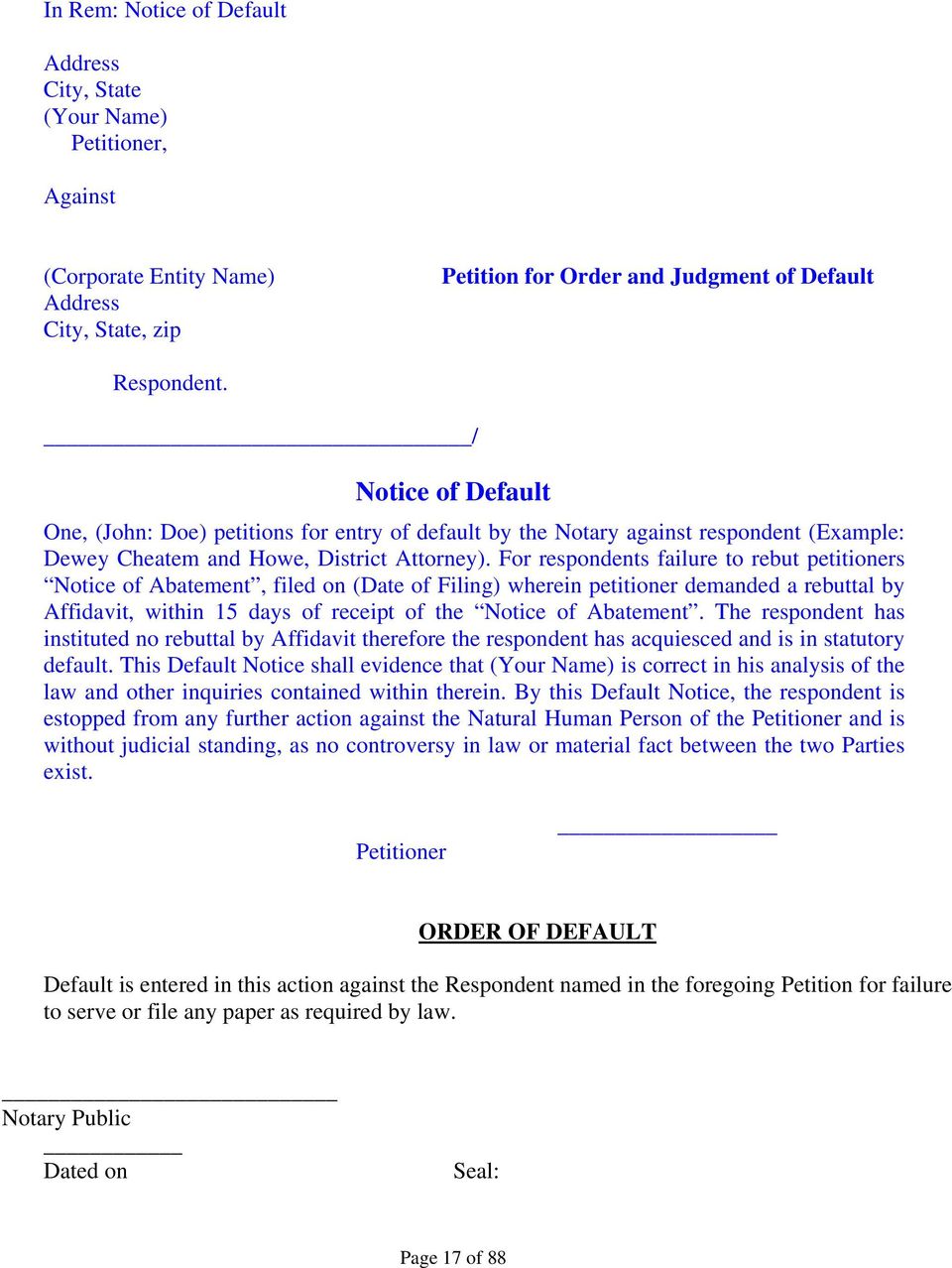
17 In Rem: Notice of Default Address City, State (Your Name) Petitioner, Against (Corporate Entity Name) Address City, State, zip Petition for Order and Judgment of Default Respondent. / Notice of Default One, (John: Doe) petitions for entry of default by the Notary against respondent (Example: Dewey Cheatem and Howe, District Attorney). For respondents failure to rebut petitioners Notice of Abatement, filed on (Date of Filing) wherein petitioner demanded a rebuttal by Affidavit, within 15 days of receipt of the Notice of Abatement. The respondent has instituted no rebuttal by Affidavit therefore the respondent has acquiesced and is in statutory default. This Default Notice shall evidence that (Your Name) is correct in his analysis of the law and other inquiries contained within therein. By this Default Notice, the respondent is estopped from any further action against the Natural Human Person of the Petitioner and is without judicial standing, as no controversy in law or material fact between the two Parties exist. Petitioner ORDER OF DEFAULT Default is entered in this action against the Respondent named in the foregoing Petition for failure to serve or file any paper as required by law. Notary Public Dated on Seal: Page 17 of 88
18 CERTIFICATE OF SERVICE One, (Your Name) hereby certify that a true and correct copy of the Petition for default and Default was served by Registered Mail, by the United States Postal Service on (Date) to (Corporate Entity name) at (Address, City and State). (Your Full Name), in sui juris Capacity Page 18 of 88

19 IN THE DISTRICT COURT OF THE (NUMBER) JUDICIAL CIRCUIT (CITY) DIVISION IN THE STATE OF (NAME) STATE OF (NAME), INC., ) Case No: CITY, COUNTY OF (NAME), ) ) NOTICE AND DEMAND FOR And All Other Persons Known and Unknown; ) ABATEMENT And All whom may be Concerned, ) ) Accuser(s) ) vs. ) ) Spell your name Uc and lc, Sui Juris ) ) Accused. ) ) NOTICE AND DEMAND FOR ABATEMENT AND MEMORANDUM OF LAW IN SUPPORT Now, comes the Accused (Your Name) by his own Authority, appearing specially and not generally or voluntarily, so as not to confuse the court, and challenges the jurisdiction of this court. But being under the Threat of Arrest if he failed to appear, at no time does the Accused submit to the Jurisdiction and Venue of the above-entitled court and at no time waving any Rights whatsoever knowingly or unknowingly. The Accused gives Notice that this Action be abated or dismissed immediately or show cause why the Accused should not take all lawful recourse against the Accuser(s). 1. Determination of Material Facts via Tacit Procuration 1. Can the state legislature with the power to make all laws and needful rules, abrogate by that power the Citizens constitutional guarantees? Accused (Name) believes that they may not. 2. The Accused is possessed of all rights pursuant to the Constitution for the United States of America, the Constitution of the (Name of State) State, common law and the rules applicable to criminal procedure. Page 19 of 88

20 3. The Accused makes this special appearance in order to determine what rights will be afforded him by this court and which rights will be denied. 4. Due process requirements of the federal and state constitutions require among other procedures that the Accused be furnished by the plaintiff with a verified complaint of injury, so that the Accused may consider a plea other than guilty. 5. By the Plaintiff not being afforded this fundamental right, he cannot determine the nature of the offense he is being charged with that has caused damage to the plaintiff; or what plea other than guilty is available to him. 6. By denying the Accused the accusatory instrument, the court is denied subject matter jurisdiction, as there is no valid charging document before the criminal court at the time of the arraignment. 7. Absence of a verified complaint or information denies the court of subject matter jurisdiction and even if the accused appears in court the judge cannot arraign him unless the accusatory instrument has been filed. 8. In order for the court to have subject matter jurisdiction, the police officer who has issued and served the appearance/traffic ticket must, at or before the return date, file with the criminal court a misdemeanor complaint, a simplified information or an information charging the person named in the appearance ticket with the offence specified therein. 9. It may be that the court has a misunderstanding of what the law requires and that the signed appearance ticket is a sufficient document upon which to arraign (Your Name) 10. The appearance/traffic ticket utterly fails to meet the requirements of an accusatory pleading in that it fails to state the title of the action, the name of the plaintiff, or contain a statement of the public offense which it allegedly charges; it fails to constitute a accusatory pleading since it is not sworn to before some officer entitled to administer oaths. 11. In addition the appearance/traffic ticket is not subscribed by any prosecutor, it is signed by the police officer, but he is only a witness and is not identified as one who is authorized by law who may be a prosecuting attorney representing the people. 12. As the prosecuting attorney does not subscribe the appearance/traffic ticket the people, of this great state of (Name of State), have not charged the accused with any crime whatsoever. Page 20 of 88

21 13. Without an accusatory instrument subscribed by the prosecuting attorney, charging the accused with a crime, there is no charge for (Your Name) to plea to or to defend against. 14. The Accused (Your Name) has met the plaintiff (whoever that may be) step by step, by this special appearance as he agreed too and promised in the appearance/traffic ticket ; it would be the plaintiff who has chosen not to prosecute by not filing a verified complaint, therefore depriving this court of any jurisdiction. Therefore, (Your Full Name) notices this honorable court to abate the appearance/traffic ticket numbered (Number of the ticket) for lack of jurisdiction. Respectfully presented, (Your Full Name), in sui juris Capacity c/o postal service address: (street or P.O. Box) city, state, [postal code: 97xxx] DECLARATION I declare under penalty of perjury, under the laws of the United States of America, that the above is true and correct to the best of my knowledge and belief. Executed on this day of, in the Year of our Lord, (Your Full Name), in sui juris Capacity COUNTY OF (NAME) STATE OF (NAME) NOTORIAL On this day of, 2004, (Your Full Name) did personally appear before me, identified by (form of identification) and did take and Oath and stated that the above Notice to Abate is true and correct to the best of his knowledge and belief. Subscribed by me the below identified Notary Public in and for the State of (Name), on the date first above written. {Seal} (Name of Notary) My Commission expires: Page 21 of 88
22 CERTIFICATE OF SERVICE I hereby certify that a true and correct copy of the above Notice to Abate and Memorandum of Law was mailed to the (State Name) State Attorney, by U.S. Mail on the day of (Month), 2000 to the following address. Name of Agent or Counsel: Address: City State of (Name) (Your Full Name), Accused Page 22 of 88
23 To: (Name of Judge) (Circuit Court) (Address) City, STATE, ZIP From: (Your Full Name) c/o (Street Address) (City, State), in America [postal code: xxxxx] Dated: Certified Mail No. The Honorable (Name of Judge), When I specially visit your court on a forced response on (Date of Hearing) to a Bill of Pains and Penalties issued by the (Officer Name) employed by the (Police Agency), employed by the corporate (YOUR STATE), I move this court and you, (Judge Name), to take judicial notice that my special visitation was forced, that my visitation is special, and not general, since this notice is my timely and specific objection to the presumptions upon which a false conclusion of law has been made administratively with regard to my status before this court. The plaintiff in this case is an administrative officer representing the corporate and de facto (YOUR STATE), which has legislative power to compel performance upon the letter of its statutes upon all persons subject to its jurisdiction. The only due process that its legislative courts recognize is the right to be heard on the facts of the case. The corporate plaintiff in this criminal action before this court has made an unproven conclusion of law that (Your Name) is among those persons who have lost, or otherwise abandoned, their status in the guaranteed "republican Form" of Government and who must perform under legislative power upon the exact letter of every legislative statute with no due process of law protection other than that outlined in paragraph two of this letter. It is from this false Conclusion of Law that administrative officer (Officer Name) issued the contested Bill of Pains and Penalties upon (Your Name). This court must take judicial Notice that (Your Name) an un-enfranchised Individual has made a contrary conclusion of law to that of plaintiff. (Your Name) claims his guaranteed, fundamental and unalienable rights stemming from both the National and State constitutions to full due process of law in all criminal actions against him, means he is subject only to judicial power, not legislative power. Said judicial power when exercised over him requires a corpus delicti or a damaged party who has sworn out a verified complaint against him. This is lacking in the criminal complaint against (Your Name) brought on by plaintiff. So, the unlawfully charged (Your Name) declares that his un-enfranchised status as a preamble American Citizen of the guaranteed "Republican form" of government known as The United States of America and inhabitant of (Your State), that without a corpus delicti, no court judicial or legislative tribunal has a criminal jurisdiction over his person or property. Therefore, the accused specially visits before the law side of this court seeking its protection from the excess zeal of corporate government, trusting that this court will assume a neutral stance at law and require the corporate plaintiff in this criminal action to prove its in rem and, or, in personam criminal Page 23 of 88
24 jurisdiction over the accused to be a fact of law before this court will take on the role of judging the facts of this legislative charge brought before you. Your solemn Oath of Office compels nothing less from you. Cordially presented, (Your Full Name), in sui juris Capacity Page 24 of 88
25 Attn: Clerk of Court (Number) Judicial District (Date) (Address) CITY, ST ZIP Certified Mail # RE: Case No. (Ticket Number) Honorable Clerk of Court, Please issue a Subpoena Deuces Tecum, for (Name of Officer), as a Witness and to produce the following legal papers, documents, records under his control, for the Trial (Date of Trial) as these documents are absolutely essential for the Accused s Defense. 1) Any legal papers, documents or records under his control, other than documents obtained by fraud without full disclosure, that create the presumption that (Your Name spelled i.e. John Don; Jones is a resident of (Name of State) (i.e. STATE OF NEW YORK). 2) Any legal papers, documents or records under his control, other than documents obtained by fraud without full disclosure, that establish that (Your Name spelled i.e. John Don: Jones,) is engaged in a revenue taxable activity and trafficking in commerce. 3) Any legal papers, documents or records under his control, other than documents obtained by fraud without full disclosure that establish this case as an Adversary Proceeding, pursuant to Bankruptcy Rules Section VII, or is an in rem proceeding. 4) Any legal papers, documents or records under his control, signed by me other than documents obtained by fraud without full disclosure, that establish that (Your Name spelled i.e. John Don: Jones is an artificial, fictitious person, juristic personality, or entity, referred to by the state as (Your Name in all Caps. i.e. JOHN DON JONES). 5) Any legal papers, documents or records under his control, other than documents obtained by fraud without full disclosure, that establish that (Your Name spelled i.e. John Don: Jones is a vassal. 6) Any legal papers, documents or records under his control, other than documents obtained by fraud without full disclosure, that establish that (Your Name spelled i.e. John Don: Jones is co-bankrupt Debtor with the (State name in all Caps.) Page 25 of 88
26 7) Any legal papers, documents or records under his control, other than documents obtained by fraud without full disclosure, that establish this case and (Your Name spelled i.e. John Don: Jones) as in rem and in personam has liability. 8) Any legal papers, documents or records under his control, other than documents obtained by fraud without full disclosure, that establish that (Your Name spelled i.e. John Don; Jones is a co-obligator with the (Name of State and County) (i.e. STATE OF NEW YORK and ALBANY COUNTY). DISCOVERY / INTERROGATORIES TO (Name of Policeman and County Prosecutor) 1) Under what Trust(s) are the CORPORATIONS chartered as the (NAME OF STATE and COUNTY in all caps), operating under? 2) Does the Constitution for the United States of America guarantee a Republican Form of government? 3) Where in the Constitution for the United States of America is the authority been granted to the State or Federal Government to incorporate and establish a democratic Corporation form of government? 4) Does this/these Trust(s) issue Permits and Licenses? 5) Does this Trust(s) Articles place the REGISTERED OWNER or LICENSED AGENT in a FIDUCIARY position? Or Both? 6) If so, is the LICENSEE or PERMITTEE an employee under CONTRACT? 7) What are the limitations imposed upon the licensed employee as stated in the CONTRACT issued under the authority of the Trust(s)? 8) Is either Mr. (Name of Prosecutor) or (Name of Prosecutor in charge of the case) a licensed Foreign Agent under the Articles of the Trust(s)? 9) If so, is this license for administrative enforcement of the (Name of State) Revised Statutes of the state of (Name of State)? 10) What is the Public Community? 11) Is this Contract a Commercial Contract? 12) Is (Name of Prosecutor and Prosecutor in charge) of the Municipal Corporation known as the Prosecuting Attorney s Office a Fiduciary and/or Trustee under the Trust? Page 26 of 88
27 13) Are the aforementioned individuals under contract to the Municipal corporation known as (NAME OF COUNTY IN CAPS). 14) Are the aforementioned individuals under contract within a Trust chartered as a service corporation on behalf of a fictitious entity called the State of (Name)? 15) Is the name of this fictitious entity called the (State of NAME)? Yes No 16) What other name does this entity function under? List all names of fictitious entity and trust. 17) Where is this fictitious entity chartered? 18) Is this fictitious entity a municipal corporation? 19) What is the geographical location of this chartered fictitious entity? 20) Is said fictitious entity an alter ego of some other entity? 21) Is this fictitious entity a fictitious plaintiff? 22) Can a fiduciary bring a legal action on behalf of an alter ego? 23) Can an attorney at law litigate as an agent on behalf of a fictitious plaintiff, or an alter ego? 24) Are the aforementioned individuals registered as a Foreign Agent on behalf of their alter ego principle with the Attorney General of the United States? 25) Is the aforementioned individuals registered as an agent on behalf of their alter ego principle with the Secretary of State of the (Name of State)? 26) Is it contempt of court to litigate as an attorney at law for the fictitious plaintiff? 27) If the aforementioned individuals are licensed under contract, what agency is the contract program administered under? 28) Is the agency a trust for the State of (Name of State)? 29) Who is the beneficiary of above mentioned and referenced Trust(s)? 30) If so, what is the name of this trust? 31) Who are the trustee and co-trustee? 32) What is the Prosecuting Attorney s Office? Page 27 of 88
28 33) What agency of the State of (Name) issued the Contract, which is serviced by the aforementioned office? 34) Is there a contractual relationship between (Name of County) and the Prosecuting Attorney s Office? 35) What are the contractual relationships between the municipal corporations known as the State of (Name), the county of (Name), and the corporation known as the United States? 36) Were the above-mentioned contractual relationships formed as a result of any type of bankruptcy action? 37) If so, where was this action litigated, and by whom? If additional time is required to produce the requested documents, records, legal papers and interrogatories, please consider this a request for postponement of the trial to a latter date. This is to assure that all requested material and questions are fully complied with and with sufficient lead-time that will allow my assistance of counsel and me to inspect the material in preparation of my defense. Respectfully presented, (Your Full Name) in sui juris Capacity Page 28 of 88
29 IN THE DISTRICT COURT OF THE (NUMBER) JUDICIAL CIRCUIT (CITY) DIVISION IN THE STATE OF (NAME) STATE OF (NAME), INC., ) Case No: CITY, COUNTY OF (NAME), ) ) Accuser(s) vs. ) ) Spell your name Uc and lc, Sui Juris ) ) Accused. ) ) ) Notice and Demand for Abatement ) Notice and Demand for Abatement Now, comes the Accused (Your Name) by his own authority, appearing specially and not generally or voluntarily so as not to confuse the court and challenges the jurisdiction of this court. Being under the Threat of Arrest if he failed to appear, at no time does the Accused submit to the Jurisdiction and Venue of the above-entitled court and at no time waving any Rights whatsoever knowingly or unknowingly. Accused asks the Court to take judicial notice of the fact that he is without counsel, is not schooled in the law and legal procedures, and is not licensed to practice law. Therefore his pleadings must be read and construed liberally. See Haines v. Kerner, 404 US at 520 (1980); Birl v. Estelle, 660 F.2d 592 (1981). Further accused believes that this court has a responsibility and legal duty to protect any and all of the Accused s constitutional and statutory rights. See United States v. Lee, 106 US 196,220 [1882] The Accused gives notice that this proceeding be abated or dismissed immediately. I. ARGUMENT 1. Can the state legislature with the power to make all laws and needful rules, abrogate by that power the Citizens constitutional guarantees? Accused (Name) believes that they may not. Page 29 of 88
30 2. The Accused is possessed of all rights pursuant to the Constitution for the United States of America, the Constitution of the (Name of State) State, common law and the rules applicable to criminal procedure. 3. The Accused makes this special appearance in order to determine what rights will be afforded him by this court and which rights will be denied. 4. Due process requirements of the federal and state constitutions require among other procedures that the Accused be furnished by the plaintiff with a verified complaint of injury, so that the Accused may consider a plea other than guilty. 5. By the plaintiff not being afforded this fundamental right, he cannot determine the nature of the offense he is being charged with that has caused damage to the plaintiff; or what plea other than guilty is available to him. 6. By plaintiff denying the Accused the accusatory instrument, the court is denied subject matter jurisdiction, as there is no valid charging document before the criminal court at the time of the arraignment. 7. Absence of a verified complaint or information denies the court of subject matter jurisdiction and even if the accused appears in court the judge cannot arraign him unless the accusatory instrument has been filed. 8. In order for the court to have subject matter jurisdiction, the police officer who has issued and served the appearance/traffic ticket must, at or before the return date, file with the criminal court a misdemeanor complaint, a simplified information or an information charging the person named in the appearance ticket with the offence specified therein. 9. It may be that the court has a misunderstanding of what the law requires and that the signed appearance ticket is a sufficient document upon which to arraign (Your Name) 10. The appearance/traffic ticket utterly fails to meet the requirements of an accusatory pleading in that it fails to state the title of the action, the name of the plaintiff, or contain a statement of the public offense which it allegedly charges; it fails to constitute a accusatory pleading since it is not sworn to before some officer entitled to administer oaths. 11. In addition the appearance/traffic ticket is not subscribed by any prosecutor, it is signed by the police officer, but he is only a witness and is not identified as one who is authorized by law who may be a prosecuting attorney representing the people. Page 30 of 88
31 12. As the prosecuting attorney does not subscribe the appearance/traffic ticket the people, of this great state of (Name of State), have not charged the accused with any crime whatsoever. 13. Without an accusatory instrument subscribed by the prosecuting attorney, charging the accused with a crime, there is no charge for (Your Name) to plea to or to defend against. 14. The Accused (Your Name) has met the plaintiff (whoever that may be) step by step, by this special appearance as he agreed to and promised in the appearance/traffic ticket ; it would be the plaintiff who has chosen not to prosecute, by not filing a verified complaint, therefore depriving this court of any jurisdiction. Therefore, (Your Name) notices this honorable court to abate the appearance/traffic ticket numbered (Number of the ticket) for lack of jurisdiction. Respectfully presented, (Your Full Name) Address City, State, zip Phone Number Page 31 of 88
32 IN THE DISTRICT COURT OF THE (NUMBER) JUDICIAL CIRCUIT (CITY) DIVISION IN THE STATE OF (NAME) STATE OF (NAME), INC., ) Case No: CITY, COUNTY OF (NAME), ) ) ) Accuser(s) ) vs. ) ) PETITIONER S MEMORANDUM OF LAW ) Spell your name Up and Lc, sui juris ) IN SUPPORT OF NOTICE TO ABATE ) ) Accused. ) ) This Memorandum will be construed to comply with provisions necessary to establish presumed fact, pursuant to Rule 301, Federal Rules of Evidence, and attending State rules. Should interested Parties fail to rebut any given Allegation of Fact or Matter of Law addressed herein with specificity, the position will be construed as adequate to meet requirements of Judicial Notice, thus preserving fundamental Law. Matters addressed herein, if not rebutted, will be construed to have general application. This Memorandum addresses the Issue of state statutes, regulation and licensing of a constitutional Right to free travel upon the public roads of an Oregon Citizen. I. Overview of American People s Right to Travel If ever a judge understood the American People s right to use the public roads, it was Justice Tolman of the Supreme Court of the State of Washington. Justice Tolman stated: Complete freedom of the highways is so old and well established a blessing that we have forgotten the days of the Robber Barons and toll roads, and yet, under an act like this, arbitrarily administered, the highways may be completely monopolized, if, through lack of interest, the people submit, then they may look to see the most sacred of their liberties taken from them one by one, by more or less rapid encroachment. Robertson vs. Department of Public Works, 180 Wash 133, 147. Page 32 of 88
33 The words of Justice Tolman ring most prophetically in the ears of American Citizens throughout the country today as the use of the public roads has been monopolized by the very entity which has been empowered to stand guard over our freedoms, that of state government. II. RIGHTS The most sacred of liberties of which, Justice Tolman spoke was personal liberty which have been placed in conflict by the plaintiff. The definition of personal liberty is: Personal liberty, or the Right to enjoyment of life and liberty, is one of the fundamental or natural Rights, which has been protected by its inclusion as a guarantee in the various constitutions, which is not derived from, or dependent on, the U.S. Constitution, which may not be submitted to a vote and may not depend on the outcome of an election. It is one of the most sacred and valuable Rights, as sacred as the Right to private property...and is regarded as inalienable 16 C.J.S., Constitutional Law, Sect. 202, p.987. This concept is further amplified by the definition of personal liberty: and further... Personal liberty largely consists of the Right of locomotion --to go where and when one pleases-- only so far restrained as the Rights of others may make it necessary for the welfare of all other citizens. The Right of the Citizen to travel upon the public highways and to transport his property thereon, by horse drawn carriage, wagon, or automobile, is not a mere privilege which maybe permitted or prohibited at will, but the common Right which he has under his Right to life, liberty, and the pursuit of happiness. Under this Constitutional guarantee one may, therefore, under normal conditions, travel at his inclination along the public highways or in public places, and while conducting himself in an orderly and decent manner, neither interfering with nor disturbing another's Rights, he will be protected, not only in his person, but in his safe conduct. [Emphasis added] II Am. Jur. (1 st ) Constitutional Law, Sect p.ll35. Personal liberty--consists of the power of locomotion, of changing situations, of removing one's person to whatever place one s inclination may direct, without imprisonment or restraint unless by due process of law. 1 Blackstone s Commentary 134; Hare, Constitution.777; Bouvier s Law Dictionary, 1914 ed., Black s Law Dictionary, 5th ed. Justice Tolman was concerned about the State prohibiting the Citizen from the most sacred of his liberties, the Right of movement, the Right of moving one s self from place to place without threat of imprisonment; the Right to use the public roads in the ordinary course of life. When the State allows the formation of a corporation it may control its creation by establishing guidelines (statutes) for its operation (charters). Corporations who use the roads in the course of business, do not use the roads in the ordinary course of life. There is a difference between a corporation and a live Individual. The United States Supreme Court has stated: Page 33 of 88
34 ...We are of the opinion that there is a clear distinction in this particular between an individual and a corporation, and that the latter has no right to refuse to submit its books and papers for examination on the suit of the State. The individual may stand upon his Constitutional Rights as a Citizen. He is entitled to carry on his private business in his own way. His power to contract is unlimited. He owes no duty to the State or to his neighbors to divulge his business, or to open his doors to investigation, so far as it may tend to incriminate him. He owes no such duty to the State since he receives nothing there from, beyond the protection of his life, liberty, and property. His Rights are such as the law of the land long antecedent to the organization of the state, and can only be taken from him by due process of law, and in accordance with the Constitution. Among his Rights are the refusals to incriminate himself, and the immunity of himself and his property from arrest or seizure except under warrant of law. He owes nothing to the public so long as he does not trespass upon their rights. Upon the other hand, the corporation is a creature of the state. It is presumed to be incorporated for the benefit of the public. It receives certain special privileges and franchises, and holds them subject to the laws of the state and the limitations of its charter. Its rights to act as a corporation are only preserved to it so long as it obeys the laws of its creation. There is a reserved right in the legislature to investigate its contracts and find out whether it has exceeded its powers. It would be a strange anomaly to hold that the State, having chartered a corporation to make use of certain franchises, could not in exercise of its sovereignty inquire how those franchises had been employed, and whether they had been abused, and demand the production of corporate books and papers for that purpose. [Emphasis added] Hale vs. Hinkel, 201 U.S. 43, 74-75, (1906). Corporations engaged in mercantile equity fall under the purview of the State s admiralty jurisdiction, and the public at large must be protected from their activities, as they (the corporations) are engaged in business for profit....based upon the fundamental ground that the sovereign state has the plenary control of the streets and highways in the exercise of its police power (see police power, infra.), may absolutely prohibit the use of the streets as a place for the prosecution of a private business for gain. They all recognize the fundamental distinction between the ordinary Right of the Citizen to use the streets in the usual way and the use of the streets as a place of business or a main instrumentality of business for private gain. The former is a common Right; the latter is an extraordinary use. As to the former the legislative power is confined to regulation, as to the tatter it is plenary and extends even to absolute prohibition. Since the use of the streets by a common carrier in the prosecution of its business as such is not a right but a mere license of privilege. Hadfield vs. Lundin, 98 Wash. 6571, 168, p It will be necessary to review early cases and legal authority in order to reach a lawfully correct theory dealing with this Right or privilege. Defendant will attempt to reach a sound conclusion as to what is a Right to use the road and what is a privilege to use the road. Once reaching this determination, we shall then apply those positions to modern case decision. Page 34 of 88
35 Where rights secured by the Constitution are involved, there can be no rule making or legislation which would abrogate them. Miranda vs. Arizona, 384 U.S. 436, 491, (1966). and... and... The claim and exercise of a constitutional Right cannot be converted into a crime. Miller vs. United States, 230 V. 486,489, (1956). There can be no sanction or penalty imposed upon one because of this exercise of constitutional Rights. Sherar vs. Cullen, 481 F. 2d 946, (1973). Streets and highways are established and maintained for the purpose of travel and transportation by the public. Such travel may be for business or pleasure. The use of the highways for the purpose of travel and transportation is not a mere privilege, but a common and fundamental Right of which the public and the individual cannot be rightfully deprived. [Emphasis added] Chicago Motor Coach vs. Chicago, 169 N. E. 22 (1929); Ligare vs. Chicago, 28 N. E. 934 (1891); Boon vs. Clark, 214 S. W. 607 (1919); 25 Am. Jur. (1st) Highways Sect and... The Right of the Citizen to travel upon the public highways and to transport his property thereon, either by horse drawn carriage or by automobile, is not a mere privilege which a city can prohibit or permit at will, but a common Right which he has under the right to life, liberty, and the pursuit of happiness. [Emphasis added] Thompson vs. Smith, 154 S.E. 579 (1930). A Citizen has a Right to travel upon the public highways by automobile and the Citizen cannot be rightfully deprived of his Liberty. So where does the misconception that the use of the public road is always and only a privilege come from?...for while a Citizen has the Right to travel upon the public highways and to transport his property thereon, that Right does not extend to the use of the highways, either in whole or in part, as a place for private gain. For the latter purpose no person has a vested right to use the highways of the state, but is a privilege or a license which the legislature may grant or withhold at its discretion. State vs. Johnson, 243 P (1926); Hadfield, supra; Cummins vs. Homes, 155 P. 171; Packard vs. Banton, 44 S. Ct. 256 (1924); Here the courts held that a Citizen has the Right to travel upon the public highways, but that he did not have the right to conduct business upon the highways. On this point of law all authorities are unanimous. Heretofore the court has held, and we think correctly, that while a Citizen has the Right to travel upon the public highways and to transport his property thereon, that Right does Page 35 of 88
36 not extend to the use of the highways, either in whole or in part, as a place of business for private gain. Barney vs. Board of Railroad Commissioners, 17 P.2d 82 (1932); Willis vs. Buck, 263 P. 982 (1928). and... The right of the citizen to travel upon the highway and to transport his property thereon, in the ordinary course of life and business, differs radically and obviously from that of one who makes the highway his place of business for private gain in the running of a stagecoach or omnibus. State vs. City of Spokane, 186 P. 864 (1920). What is this Right of the Citizen which differs so radically and obviously from one who uses the highway as a place of business? Who better to enlighten us than Justice Tolman of the Supreme Court of Washington? In State vs. City of Spokane, supra, the Court also noted a very radical and obvious difference, but went on to explain just what the difference is: The former is the usual and ordinary right of the Citizen, a common right to all, while the latter is special, unusual, and extraordinary. This distinction, elementary and fundamental in character, is recognized by all the authorities. State vs. City of Spokane, supra. This position does not hang precariously upon only a few cases, but has been proclaimed by an impressive array of cases ranging from the state courts to the federal courts. the right of the Citizen to travel upon the highway and to transport his property thereon in the ordinary course of life and business, differs radically and obviously from that of one who makes the highway his place of business and uses it for private gain in the running of a stagecoach or omnibus. The former is the usual and ordinary right of the Citizen, a right common to all, while the latter is special, unusual, and extraordinary. Ex Parte Dickey, (Dickey vs. Davis), 85 So. 782 (1915). and... The right of the Citizen to travel upon the public highways and to transport his property thereon, in the ordinary course of life and business, is a common right which he has under the right to enjoy life and liberty, to acquire and possess property, and to pursue happiness and safety. It includes the right, in so doing, to use the ordinary and usual conveyances of the day, and under the existing modes of travel, includes the right to drive a horse drawn carriage or wagon thereon or to operate an automobile thereon, for the usual and ordinary purpose of life and business. Teche Lines vs. Danforth., 12 So. 2d 784 (1943); Thompson vs. Smith, supra. There is no dissent among various authorities as to this position. (See Am. Jur. [1st] Const. Law, 329 and corresponding Am. Jur. [2nd].) Personal liberty -- or the right to enjoyment of life and liberty -- is one of the fundamental or natural rights, which has been protected by its inclusion as a guarantee in Page 36 of 88
37 the various constitutions, which is not derived from nor dependent on the U.S. Constitution... It is one of the most sacred and valuable rights [remember the words of Justice Tolman, supra.] as sacred as the right to Private property...and is regarded as inalienable. 16 C.J.S. Const. Law, Sect. 202, p.987. As we can see, the distinction between a Right to use the public roads and a privilege to use the public roads is drawn upon the line of using the road as a place of business and the various state courts have held so. But what have the U.S. courts held on this point? First, it is well established law that the highways of the state are public property, and their primary and preferred use is for private purposes, and that their use for purposes of gain is special and extraordinary which, generally at least, the legislature may prohibit or condition as it sees fit. Stephenson vs. Binford, 287 U. S. 251 (1932); Packard vs. Banton, 264 U. S. 140 (1924), and cases cited; Frost Trucking Co. vs. Railroad Commission, 271 U. S. 582 (1926); Railroad commission vs. Jater-City Forwarding Co., 57 S.W.2d 290; Parlett Cooperative vs. Tidewater Lines, 164 A So what is a privilege to use the roads? By now it should be apparent even to the learned that an attempt to use the road use as a place of business is a privilege. The distinction must be drawn between... Traveling upon and transporting one's property upon the public roads, which is our Right; Using the public roads as a place of business or a main instrumentality of business, which is a privilege. [The roads]...are constructed and maintained at public expense, and no person therefore, can insist that he has, or may acquire, a vested right to their use in carrying on a commercial business. Ex Parte Sterling, 53 S.W. 2d 294; Barney vs. Railroad Commissioners, 17 P. 2d 82 (1932); Stephenson vs. Binford, supra. When the public highways are made the place of business the state has a right to regulate their use in the interest of safety and convenience of the public as well as the preservation of the highways. Barney vs. Railroad Commissioners, supra. [The state s] right to regulate such use is based upon the nature of the business and the use of the highways in connection therewith. Ibid. We know of no inherent right in one to use the highways for commercial purposes. The highways are primarily for the use of the public, and in the interest of the public, the state may prohibit or regulate the use of the highways for gain. Robertson vs. Dept. of Public Works, supra. There should be considerable authority on a subject considering the importance of this deprivation on the liberty of the individual using the roads in the ordinary course of life and business. However, it should be noted that extensive research has not turned up one case or Page 37 of 88
38 authority acknowledging the state s power to convert the individual s right to travel upon the public roads into a privilege. Therefore, it must be concluded that the Citizen does have a Right to travel and transport his property upon the public highways and roads and the exercise of this Right and it is not a privilege. III. DEFINITIONS In order to understand the correct application of the statute in question, we must first define the terms used in connection with this point of law. As will be shown, many terms used today do not, in their legal context, mean what we assume they mean, thus resulting in the misapplication of statutes in the instant case. AUTOMOBILE AND MOTOR VEHICLE There is a clear distinction between an automobile and a motor vehicle. An automobile has been defined as: The word automobile connotes a pleasure vehicle designed for the transportation of persons on highways. American Mutual Liability Ins. Co., vs. Chaput, 60 A. 2d 118, 120; 95 NH 200. While the distinction is made clear between the two as the courts have stated: A motor vehicle or automobile for hire is a motor vehicle, other than an automobile stage, used for the transportation of persons for which remuneration is received. International Motor Transit Co. vs. Seattle' 251 P The term motor vehicle is different and broader than the word automobile. City of Dayton vs. DeBrosse, 23 N.E. 2d 647, 650; 62 Ohio App The distinction is made very clear in United State Code, Title 18, 31: Motor vehicle means every description or other contrivance propelled or drawn by mechanical power and used for commercial purposes on the highways in the transportation of passengers, or passengers and property. Used for commercial purposes means the carriage of persons or property for any fare, fee, rate, charge or other considerations, or directly or indirectly in connection with any business, or other undertaking intended for profit. Page 38 of 88
39 Clearly, an automobile is private property in use for private purposes, while a motor vehicle is a machine, which may be used upon the highways for trade, commerce, or hire. TRAVEL The term travel is a significant term and is defined as: The term travel and traveler are usually construed in their broad and general sense...so as to include all those who rightfully use the highways viatically (when being reimbursed for expenses) and who have occasion to pass over them for the purpose of business, convenience, or pleasure. [Emphasis added] 25 Am. Jur. (1st) Highways, Sect. 427, p.717. Traveler-- One who passes from place to place, whether for pleasure, instruction, business, or health. Locket vs. State, 47 Ala. 45; Bouvier s Law Dictionary, 1914 ed., p Travel -- To journey or to pass through or over; as a country district, road, etc. To go from one place to another, whether on foot, or horseback, or in any conveyance as a train, an automobile, carriage, ship, or aircraft; make a journey. Century Dictionary, p Therefore, the term travel or traveler refers to one who uses a conveyance to go from one place to another and included all those who use the highways as a matter of Right. Notice that in all these definitions the phrase for hire never occurs. This term travel or traveler implies by definition one who uses the road as a means to move from one place to another. Therefore, one who uses the road in the ordinary course of life and business for the purpose of travel and transportation is a traveler. DRIVER The term driver in contradistinction to traveler is defined as: Driver -- One employed in conducting a coach, carriage, wagon, or other vehicle... Bouvier s Law Dictionary, 1914 ed., p Notice that this definition includes one who is employed in conducting a vehicle. It should be self-evident that this person could not be traveling on a journey, but is using the road as a place in the conduct of business. OPERATOR Today we assume that a traveler is a driver, and a driver is an operator. However, this is not the case. Page 39 of 88
40 It will be observed from the language of the ordinance that a distinction is to be drawn between the terms operator and driver ; the operator of the service car being the person who is licensed to have the car on the streets in the business of carrying passengers for hire; while the 'driver' is the one who actually drives the car. However, in the actual prosecution of business, it was possible for the same person to be both operator and driver. Newbill vs. Union Indemnity Co., 60 S.E. 2d 658. To further clarify the definition of an operator the court observed that this was a vehicle for hire and that it was in the business of carrying passengers. This definition would seem to describe a person who is using the road as a place of business, or in other words, a person engaged in the privilege of using the road for gain. This definition then is a further clarification of the distinction mentioned earlier and therefore: 1. Traveling upon and transporting one's property upon the public roads as a matter of Right meets the definition of a traveler. 2. Using the road as a place of business as a matter of privilege meets the definition of a driver or an operator or both. TRAFFIC Having defined the terms automobile, motor vehicle, traveler, driver, and operator, the next term to define is traffic :...traffic thereon is to some extent destructive, therefore, the prevention of unnecessary duplication of auto transportation service will lengthen the life of the highways or reduce the cost of maintenance, the revenue derived by the state...will also tend toward the public welfare by producing at the expense of those operating for private gain, some small part of the cost of repairing the wear Northern Pacific R.R. Co. vs. Schoenfeldt, 213 P. 26. Note: In the above, Justice Tolman expounded upon the key of raising revenue by taxing the privilege to use the public roads at the expense of those operating for gain. In this case, the word traffic is used in conjunction with the unnecessary Auto Transportation Service, or in other words, vehicles for hire. The word traffic is another word, which is to be strictly construed to the conducting of business. Traffic-- Commerce, trade, sale or exchange of merchandise, bills, money, or the like. The passing of goods and commodities from one person to another for an equivalent in goods or money... Bouvier s Law Dictionary, 1914 ed., p Page 40 of 88
41 Here again, notice that this definition refers to one conducting business. No mention is made of one who is traveling in his automobile. This definition is of one who is engaged in the passing of a commodity or goods in exchange for money, i.e. vehicles for hire. Furthermore, the word traffic and travel must have different meanings, which the counts recognize. The difference is recognized in Ex Parte Dickey, supra:...in addition to this, cabs, hackney coaches, omnibuses, taxicabs, and hacks, when unnecessarily numerous, interfere with the ordinary traffic and travel and obstruct them. The court, by using both terms, signified its recognition of a distinction between the two. But, what was the distinction? We have already defined both terms, now to nail the matter down: The word traffic is manifestly used here in secondary sense, and has reference to the business of transportation rather than to its primary meaning of interchange of commodities. Allen vs. City of Bellingham, 163 P. 18 (1917). Here the Supreme Court of the State of Washington has defined the word traffic (in either its primary or secondary sense) in reference to business, and not to mere travel! So it is clear that the term traffic is business related and therefore, it is a privilege. The net result being that traffic is brought under the (police) power of the legislature. The term has no application to one who is not using the roads as source of income or a place of business. LICENSE It seems only proper to define the word license, as the definition of this word will be extremely important in understanding the statutes as they are properly applied: The permission, by competent authority to do an act which without permission, would be illegal, a trespass, or a tort. People vs. Henderson, 2l8 N.W. 2d 2, 4. Leave to do a thing which licensor could prevent. Western Electric Co. vs. Pacent Reproducer Corp., 42 F. 2d 116,118. In order for these two definitions to apply in this case, the state would have to prove the position that the exercise of a Constitutional Right to use the public roads in the ordinary course of life and business is illegal, a trespass, or a tort, which the state could then regulate or prevent. This position, however, would raise constitutional questions, as this position would be diametrically opposed to fundamental constitutional law. (See Conversion of a Right to a Crime, infra.) In the instant case, the proper definition of a license is: Page 41 of 88
42 a permit, granted by an appropriate governmental body, generally for consideration, to a person, firm, or corporation, to pursue some occupation or to carry on some business which is subject to regulation under the police power. [emphasis added] Rosenblatt vs. California State Board of Pharmacy, 158 P. 2d 199, 203. This definition would fall more in line with the privilege of carrying on business on the streets. Most people tend to think that licensing is imposed by the state for the purpose of raising revenue, yet there may well be more subtle reasons contemplated; for when one seeks permission from someone to do something he invokes the jurisdiction of the licensor which, in this case, is the state. In essence, the licensee may well be seeking to be regulated by the licensor. A license fee is a charge made primarily for regulation, with the fee to cover costs and expenses of supervision or regulation. State vs. Jackson, 60 Wisc. 2d 700; 211 N.W. 2d 480, 487. The fee is the price; the regulation or control of the licensee, which is the real aim of the legislation. Are these licenses really used to fund legitimate government or are they nothing more than a subtle introduction of police power into every facet of our lives? Have our enforcement agencies been diverted from crime prevention, perhaps through no fault of their own, now busying themselves as they check our papers to see that all are properly endorsed by the state? At which Legislative Session will it be before we are forced to get a license for Lawnmowers, Generators, Tillers, and Air Conditioners or before Women are required to have a license for their blender or mixer? All have motors on them and the state can always use the revenue. At what point does the steady encroachment into our Liberty cease? POLICE POWER The confusion of the police power with the power of taxation usually arises in cases where the police power has affixed a penalty to a certain act or omission to act, or where it requires licenses to be obtained and a certain sum be paid for certain occupations. The power used in the instant case cannot however, be the power of taxation since an attempt to levy a tax upon a Right would be open to constitutional objection. (See taxing power, infra.) Each law relating to the legitimate use of police power must ask three questions: Page 42 of 88
43 1. Is there threatened danger? 2. Does a regulation involve a constitutional Right? 3. Is the regulation reasonable? People vs. Smith, 108 Am. St. Rep. 715; Bouvier s Law Dictionary, 1914 ed., under Police Power. When applying these three questions to the statute in question, some very important issues are clarified. 1. First, is there a threatened danger in the individual using his automobile on the public highways, in the ordinary course of life and business? The answer is No! There is nothing inherently dangerous in the use of an automobile when it is carefully managed. Their guidance, speed, and noise are subject to a quick and easy control, under a competent and considerate manager, it is as harmless on the road as a horse and buggy, possibly more so. It is the manner of managing the automobile and that alone, which threatens the safety of the public. The ability to stop quickly and to respond quickly to guidance would seem to make the automobile one of the least dangerous conveyances. (See Yale Law Journal, December, 1905.) The automobile is not inherently dangerous. Cohens vs. Meadow, 89 SE 876; Blair vs. Broadwater, 93 SE 632 (1917). To deprive all persons of the Right to use the road in the ordinary course of life and business, because one might in the future, become dangerous, would be a deprivation not only of the Right to travel, but also the Right to due process. (See Due Process, infra.) 2. Next, does the regulation involve a constitutional Right? This question has already been addressed and answered in this brief, and need not be reinforced other than to remind this Court that this Citizen does have the Right to travel upon the public highway by automobile in the ordinary course of life and business. It can therefore be concluded that this regulation does involve a constitutional Right. 3. The third question is the most important in this case. Is this regulation reasonable? Page 43 of 88
44 The answer is No! It will be shown later in Regulation, infra, that this licensing statute is oppressive and could be effectively administered by less oppressive means. Although the Fourteenth Amendment does not interfere with the proper exercise of the police power in accordance with the general principle that the power must be exercised so as not to invade unreasonably the rights guaranteed by the United States Constitution, it is established beyond question that every state power, including the police power, is limited by the Fourteenth Amendment (and others) and by the inhibitions there imposed. Moreover, the ultimate test of the propriety of police power regulations must be found in the Ninth Amendment, since it operates as a bulwark to limit the field of the police power to the extent of preventing the enforcement of statutes in denial of Rights that the Constitution protects. (See Parks vs. State, 64 N.E. 682 (1902)). With regard particularly to the U.S. Constitution, it is elementary that a Right secured or protected by that document cannot be overthrown or impaired by any state police authority. Connolly vs. Union Sewer Pipe Co., 184 U. S. 540 (1902); Lafarier vs. Grand Trunk R.y. Co., 24 A. 848 (1892); O Neil vs. Providence Amusement Co., 103 A The police power of the state must be exercised in subordination to the provisions of the U.S. Constitution. [emphasis added] Panhandle Eastern Pipeline Co. vs. State Highway Commission, 294 U. S. 613 (1935); Buchanan vs. Warley, 245 U.S. 60 (1917). It is well settled that the Constitutional Rights protected from invasion by the police power, include Rights safeguarded both by express and implied prohibitions in the Constitutions. Tighe vs. Osborne, 131 A. 60 (1925). As a rule, fundamental limitations of regulations under the police power are found in the spirit of the Constitutions, not in the letter, although they are just as efficient as if expressed in the clearest language. Mehlos vs. City of Milwaukee, 146 N. W. 882 (1914). As it applies in the instant case, the language of the Fifth Amendment is clear: No person shall be deprived of Life, Liberty, or Property without due process of law. As has been demonstrated the courts at all levels have firmly established an absolute Right to travel. In the instant case, the state, by applying commercial statutes to all entities, natural and artificial persons alike, the legislature has deprived this free and natural person of the Right of Liberty, without cause and without due process of law. DUE PROCESS Page 44 of 88
45 The essential elements of due process of law are.. Notice and the Opportunity to defend. Simon vs. Craft, 182 U. S. 427 (1901). Yet, not one individual has ever been given notice of the loss of his/her Right, before signing the license (contract). Nor was the Citizen given any opportunity to defend against the loss of his/her right to travel by automobile on the highways, in the ordinary course of life and business. This amounts to an arbitrary government deprivation on Liberty. and... There should be no arbitrary deprivation of Life or Liberty... Barbier vs. Connolly, 113 U.S. 27, 31 (1885); Yick Wo vs. Hopkins, 1l8 U.S. 356 (1886). The right to travel is part of the Liberty of which a Citizen cannot deprived without due process of law under the Fifth Amendment. This Right was emerging as early as the Magna Carta. Kent vs. Dulles, 357 U.S. 116 (1958). The focal point of this question of police power and due process must balance upon the point of making the public highways a safe place for the public to travel. If a man travels in a manner that creates actual damage, an action in law would be the appropriate remedy (civilly) for recovery of damages. The state could then also proceed against the Individual to deprive him of his Right to use the public highways, for Cause. This process would fulfill the due process requirements of the Fifth Amendment while at the same time insuring that Rights guaranteed by the Constitution for the United States of America and the respective state constitutions would be protected for all. But unless or until harm or damage (a Crime) is committed, there is no cause for interference in the private affairs or actions of a sovereign Citizen. One of the most famous and perhaps the most quoted definitions of due process of law is that of Daniel Webster in his Dartmouth College Case, 4 Wheat 518 (1819), in which he declared that due process means a law which hears before it condemns, which proceeds upon inquiry, and renders judgment only after trial. (See also State vs. Strasburg, 110 P (1910); Dennis vs. Moses, 52 P. 333.) Somewhat similar is the statement that is a rule as old as the law that no one shall be personally bound (restricted) until he has had his day in court, until he has been duly summoned to appear and has been afforded an opportunity to be heard. Judgment without such summons and opportunity lacks all the attributes of a judicial determination; it is judicial usurpation and it is Page 45 of 88
46 oppressive and can never be upheld where it is unfairly administered. (12 Am. Jur. [1st] Const. Law, Sect. 573, p.269.) Note: This sounds like the process used to deprive one of the privilege of operating a motor vehicle for hire. It should be kept in mind, however, that we are discussing the arbitrary deprivation of the Right to use the road that all citizens have in common. The futility of the state s position can be most easily observed in the A.D Washington Attorney General's opinion on a similar issue: The distinction between the Right of the Citizen to use the public highways for private, rather than commercial purposes is recognized... and... Under its power to regulate private uses of our highways, our legislature has required that motor vehicle operators be licensed (I.C ). Undoubtedly, the primary purpose of this requirement is to insure, as far as possible, that all motor vehicle operators will be competent and qualified, thereby reducing the potential hazard or risk of harm, to which other users of the highways might otherwise be subject. But once having complied with this regulatory provision, by obtaining the required license, a motorist enjoys the privilege of traveling freely upon the highways... Washington A.G.O No. 88, p. 11. This alarming opinion appears to be saying that every person using an automobile as a matter of right, must give up the Right and convert the Right into a privilege. This is accomplished under the guise of regulation. This statement is indicative of the insensitivity, even the pretended ignorance of the government to the restrictions placed upon government by and through the several constitutions. That legal proposition may have been able to stand in 1959; however, as of 1966, in the United States Supreme Court decision in Miranda, clearly demonstrated that even this weak defense of the state s actions must fail. Where rights secured by the Constitution are involved, there can be no rule making or legislation which would abrogate them. Miranda vs. State of Arizona, 384 U.S. 436,491 (1966). Thus the legislature does not have the power to abrogate the Citizen s Right to travel upon the public roads, by passing legislation forcing the citizen to waive his Right and convert that Right into a privilege. Furthermore, we have previously established that this privilege has been Page 46 of 88
47 defined as applying only to those who are conducting business in the streets or operating forhire vehicles. The legislature has attempted, by legislative fiat, to deprive the Citizen of his Right to use the roads in the ordinary course of life and business, without affording the Citizen the safeguard of due process of law. This has been accomplished under supposed powers of regulation. REGULATION In addition to the requirement that regulations governing the use of the highways must not be violative of constitutional guarantees, the prime essentials of such regulation are reasonableness, impartiality, and definiteness or certainty. 25 Am. Jur. (1st) Highways, Sect and... Moreover, a distinction must he observed between the regulation of an activity which may be engaged in as a matter of right and one carried on by government sufferance of permission. Davis vs. Massachusetts, 167 U.S. 43; Pachard vs. Banton, supra. One can say for certain that these regulations are impartial since they are being applied to all, even though they are clearly beyond the limits of the legislative power. However, we must consider whether such regulations are reasonable and non-violative of constitutional guarantees. First, let us consider the reasonableness of this statute requiring all persons to be licensed (presuming that we are applying this statute to all persons using the public roads). In determining the reasonableness of the statute we need only ask two questions: Does the statute accomplish its stated goal? The answer is No! The attempted explanation for this regulation to insure the safety of the public by insuring, as much as possible, that all are competent and qualified. However, one can keep his license without resetting, from the time he/she is first licensed until the day he/she dies, without regard to the competency of the Person, by merely renewing said license before it expires. It is therefore possible to completely skirt the goal of this attempted regulation, thus proving that this regulation does not accomplish its goal. If an analysis were compiled of all accidents between those individuals having license and those who do not, it Page 47 of 88
48 would reveal that the highest percentage of accidents were had by those who had licenses. A license does not in and of its self guarantee the safety of the general public. Much like the License to Practice Law or Medicine assure that only competent Lawyers and Doctors ply their trade. A review of the annual Malpractice lawsuits is the only proof necessary to establish that it does not. Furthermore, by testing and licensing, the state gives the appearance of underwriting the competence of the licensees, and could therefore be held liable for failures, accidents, etc. caused by licensees as the state has certified through the issuance of the license that the individual is competent. Is the statute reasonable? The answer is No! This statute cannot be determined to be reasonable since it requires to the Citizen to give up his or her natural Right to travel unrestricted in order to accept the privilege. The purported goal of this statute could be met by much less oppressive regulations, i.e., competency tests and certificates of competency before using an automobile upon the public roads. (This is exactly the situation in the aviation sector.) But isn't this what we have now? The answer is No! The real purpose of this license is much more insidious. When one signs the license, he/she gives up his/her Constitutional Right to travel in order to accept and exercise a privilege under Contract. After signing the license, a quasi-contract, the Citizen has given the state his/her consent to be prosecuted for constructive crimes and quasi-criminal actions where there is no harm done and no damaged property. These prosecutions take place without affording the Citizen their constitutional Rights and guarantees such a the Right to a trial by jury of twelve persons and the Right to counsel, as well as the normal safeguards such as proof of intent, a corpus dilecti and a grand jury indictment. These unconstitutional prosecutions take place because the Citizen is exercising a privilege and Page 48 of 88
49 has given his/her implied consent to legislative enactments designed to control interstate commerce, a regulated enterprise under the police power of the state. We must now conclude that the Citizen is forced to give up constitutional guarantees of Right in order to exercise his state privilege to travel upon the public highways in the ordinary course of life and business. SURRENDER OF RIGHTS A Citizen cannot be forced to give up his/her Rights in the name of regulation....the only limitations found restricting the right of the state to condition the use of the public highways as a means of vehicular transportation for compensation are (1) that the state must not exact of those it permits to use the highways for hauling for gain that they surrender any of their inherent U.S. Constitutional Rights as a condition precedent to obtaining permission for such use... [emphasis added] Riley vs. Lawson, 143 So. 619 (1932); Stephenson vs. Binford, supra. If one cannot be placed in a position of being forced to surrender Rights in order to exercise a privilege, how much more must this maxim of law, then, apply when one is simply exercising (putting into use) a Right? To be that statute which would deprive a Citizen of the rights of person or property, without a regular trial, according to the course and usage of the common law, would not be the law of the land. Hoke vs. Henderson, 15 NC 15. and... We find it intolerable that one Constitutional Right should have to be surrendered in order to assert another. Simons vs. United States, 390 U.S Since the state requires that one give up Rights in order to exercise the privilege of driving, the regulation cannot stand under the police power, due process, or regulation, but must be exposed as a statute which is oppressive and one which has been misapplied to deprive the Citizen of Rights guaranteed by the United States Constitution and the state constitution. TAXING POWER Any claim that this statute is a taxing statute would be immediately open to severe Constitutional objections. If it could be said that the state had the power to tax a Right, this would enable the state to destroy Rights guaranteed by the constitution through the use of oppressive taxation. The question herein, is one of the state taxing the Right to travel by the ordinary modes of the day, and whether this is a legislative object of the state taxation. Page 49 of 88
50 The views advanced herein are neither novel nor supported by authority. The Supreme Court has repeatedly considered the question of taxing power of the states. The Right of the state to impede or embarrass the Constitutional operation of the U.S. Government or the Rights which the Citizen holds under it, has been uniformly denied. McCulloch vs. Maryland, 17 U. S. (4 Wheat) 316 (1819). The power to tax is the power to destroy, and if the state is given the power to destroy Rights through taxation, the framers of the Constitution wrote that document in vain....it maybe said that a tax of one dollar for passing through the state cannot sensibly affect any function of government or deprive a Citizen of any valuable Right. But if a state can tax...a passenger of one dollar, it can tax him a thousand dollars. Crandall vs. Nevada, 75 U. S. (6 Wall) 35, 46, (1867). and... If the Right of passing through a state by a Citizen of the United States is one guaranteed by the Constitution, it must be sacred from state taxation. Ibid., p.47. Therefore, the Right of travel must be kept sacred from all forms of state taxation and if this argument is used by the state as a defense of the enforcement of this statute, then this argument also must fail. CONVERSION OF A RIGHT TO A CRIME As previously demonstrated, the Citizen has the Right to travel and to transport his property upon the public highways in the ordinary course of life and business. However, if one exercises this Right to travel (without first giving up the Right and converting that Right into a privilege) the Citizen is by statute, guilty of a crime. This amounts to converting the exercise of a Constitutional Right into a crime. Recall the Miller vs. United States and Sherar vs. Cullen quotes from p.5, and, The state cannot diminish Rights of the people. Hurtado vs. California, 110 U. S. 516 (1883). and... Where rights secured by the Constitution are involved, there can be no rule making or legislation which would abrogate them. Miranda, supra. Indeed, the very purpose for creating the state under the limitations of the constitution was to protect the rights of the people from intrusion, particularly by the forces of government. So we Page 50 of 88
51 can see that any attempt by the legislature to make the act of using the public highways as a matter of Right into a crime, is void upon its face. Any person who claims his Right to travel upon the highways, and so exercises that Right, cannot be tried for a crime of doing so. And yet this Sui juris stands before this court today to answer charges for the crime of exercising his Right to Liberty. As we have already shown, the term drive can only apply to those who are employed in the business of transportation for hire. It has been shown that freedom includes the Citizen s Right to use the public highways in the ordinary course of life and business without license or regulation by the police powers of the state. TITLE OF NOBILITY The Constitution for the United States of America at Article I, Section 10, Clause 1 prohibits the granting of a Title of Nobility. No state shall grant a Title of Nobility. Since the granting of a title of nobility is absolutely prohibited this court lacks subject matter jurisdiction to enforce a title of nobility and its attendant rules and regulations. The Utah Supreme Court has stated that the Ability to drive a motor vehicle on a public roadway is not a fundamental right, but a revocable privilege. City of Salina vs. Wisden, 737 P. 2d The distinctive appellation, designation or title driver is a title of privilege, a title of Noble Privilege a Title of Nobility. In the words of Thomas L. Willmore, City Attorney for the City of Tremonton, Utah (case no , Tremonton City Justice Court) A Title of Nobility is defined as to nominate to an order of persons to whom privileges are granted... objection to a Title of Nobility arises from the special privileges that attach to the title rather than to the title itself. Words and Phrases, volume 8A, page 40. A Driver License is... a privilege which is granted... by the State (a municipal corporation). In other words to obtain a drivers license is to be nominated to an order of persons known as drivers and be granted the special privileges that attach to the Title. The United States Page 51 of 88
52 Constitution at Article 1 Section 10 Prohibits the States from granting a Title of Nobility (i.e. a drivers license and its attendant rules and regulations). Pursuant to City of Salina vs. Wisden, the Driver License and its attendant rules and regulations are by legal definition a Title of Nobility. Article 1 Section 10 of the United States Constitution prohibits the States from granting Title of Nobility. The Court lacks subject matter jurisdiction to enforce upon the defendant a Title of Nobility. What is prohibited to the States is forbidden to the Court to enforce. California Motor Transport Co. vs. Trucking Unlimited, 404 U.S. 908 (1972). Therefore, the Accused requests the Court to make a legal determination as to what is a Title of Nobility. The following case law will define a title of nobility for the court to use to make its determination. The following quotes give the answer: and NOBILITY. An order of man, in several countries, to whom special privileges are granted at the expense of the rest of the people. Bouvier's Law Dictionary (l870) To confer a title of nobility, is to nominate to an order of persons to whom privileges are granted at the expense of the rest of the people. It is not necessarily hereditary, and the objection to it arises more from the privileges supposed to be attached, than to the otherwise empty title or order. HORST vs. MOSES (1872), 48 Ala. 129, 142; 46 Corpus Juris 598, Nobility, note 4; (1874) Bouvier's Law Dictionary, Nobility and These component... terms privilege, honor, and emolument... are collectively in the term 'title of nobility. HORST vs. MOSES (1872), 48 Ala. 129, at 142 Government granted: entitlement-privileges, such as a Drivers License and its privileges, are obviously Noble entitlements and franchises as pointed out by Richard B. Stewart, left-wing politician, Rhodes Scholar and Harvard Law Professor: Page 52 of 88
53 The third great innovation in American administrative law, which has largely occurred during the past 20 years, extended the procedural controls and principles of judicial review developed in the context of regulatory decision-making to the operations of the welfare state, including programs of government insurance and assistance, government employment decisions, and the administration of government grants and contracts. Under traditional private law principles, these benefits were privileges and not rights because their withholding did not constitute the commission of a tort or other natural law wrong against a disappointed applicant or terminated recipient. With the growth of the post-world War II welfare state, the distinction between rights and privileges gradually eroded. Statutes conveying these various benefits and advantages were held by courts to create entitlements... The Limits of Administrative Law, in the Courts: Separation of Powers, Final Report on the 1983 Chief Justice Earl Warren Conference on Advocacy; page 77 Library of Congress # and The Constitution for the united States of America at Article I, Section 10, Clause 1, mandates: No State shall... grant any Title of Nobility and The establishment of... the prohibition of... TITLES OF NOBILITY... are perhaps greater securities to liberty and republicanism than any it [the national Constitution] contains. Nothing need be said to illustrate the importance of the prohibition of titles of nobility. This may truly be denominated the cornerstone of republican government; for so long as they are excluded there can never be serious danger that the government will be any other than that of the people. [danger = nobility government, that of the police state] The Federalist Papers: 484: S&6 -Alexander Hamilton A title of nobility is privilege of license and license of privilege otherwise such title of nobility ceases to exist without such privilege of license and license of privilege. A license to drive is a title of nobility, in that it is a special grant of privilege to use vehicles upon the public highways and roads. So says the Utah Supreme Court cited in Salina vs. Wisden, supra. The State of (Name) (falsely acting as a King) grants title of nobility when it takes away a natural existing public or private right, forbidding a natural activity or occupation to all, then turns around and specially grants it back to a few, or many, the special privilege to engage in that activity or occupation and requiring the obtaining of a title of noble privilege (drivers license/license plate) to drive vehicles, and obeying attending nobility rules, as applied to the Page 53 of 88
54 Accused is Contrary to the Constitution for the united States of America mandate at Article I, Section 10, Clause 1: No State shall... grant any Title of Nobility. Hence, (State Name) Revised Statutes, Title (Number) et. seq., all attendant nobility traffic rules, regulations and penalties, made pursuant to such, is to the Contrary of the (res judicata) mandate of the Constitution for the United States of America (lest we be corporate slaves) and is notwithstanding and void, by mere operation of law upon this record, as applied to the Accused. Hence the Count lacks subject matter jurisdiction because of the prohibition of titles of nobility, attendant rules, regulations and penalties. CONCLUSION It is the duty of the courts to recognize the substance of Things and not the mere Form. The courts are not bound by mere form, nor are they to be misled by mere pretenses. They are at liberty --indeed they are under a solemn duty--to look at the substance of things, whenever they enter upon the inquiry whether the legislature has transcended the limits of its authority. If, therefore, a statute purported to have been enacted to protect...the public safety, has no real or substantial relation to those objects or is a palpable invasion of Rights secured by the fundamental law, it is the duty of the courts to so adjudge, and thereby give effect to the Constitution. Mulger vs. Kansas, 123 U.S. 623, 661. and... It is the duty of the courts to be watchful for the Constitutional rights of the citizen and against any stealthy encroachments thereon. Boyd vs. United States, 116 U.S. 616 (1889). No higher duty of this court exists than to recognize and stop the stealthy encroachments, which have been made upon the Citizen s Right to travel and to use the roads to transport his property in the ordinary course of life and business. (Hadfleld, supra.) Further, the court must recognize that the Right to travel is part of the Liberty of which a Citizen cannot be deprived without specific cause and without the due process of law guaranteed in the Fifth Amendment. (Kent, supra.) The history of this invasion of the Citizen s Right to use the public highways shows clearly that the legislature simply found a heretofore untapped source of revenue, became greedy and attempted to enforce a statute in an unconstitutional manner upon those free and natural Men and Page 54 of 88
55 Women who have a Right to travel upon the highways. This was not attempted in an outright action, but in a slow, meticulous, calculated encroachment upon the Citizen s Right to travel. This position most be accepted unless the Prosecutor can show his authority for the position that the use of the road in the ordinary course of life and business is a privilege. To rule in any other manner, without clear authority for an adverse ruling, will infringe upon fundamental and basic concepts of constitutional Law. This position, that a Right cannot be regulated under any guise, must be accepted without concern for the monetary loss of the State. Disobedience or evasion of a Constitutional Mandate cannot be tolerated, even though such disobedience may, at least temporarily, promote in some respects the best interests of the public. Slote vs. Examination, 112 ALR 660. and... and... Economic necessity cannot justify a disregard of Constitutional guarantee. Riley vs. Carter, 79 ALR 1018; 16 Am. Jur. (2nd), Const. Law, Sect. 81. Constitutional Rights cannot be denied simply because of hostility to their assertions and exercise; vindication of conceded Constitutional Rights cannot be made dependent upon any theory that it is less expensive to deny them than to afford them. Watson vs. Memphis, 375 U.S Therefore, the Court s decision in the instant case must be made without the issue of cost to the state being taken into consideration, as that Issue is irrelevant. The State cannot lose money that it never had a right to demand from the Sovereign People. Finally, we come to the issue of Public Policy. It could be argued that the licensing scheme of all persons is a matter of Public Policy. However, if this argument is used, it too must fail, as: No public policy of a state can be allowed to override the positive guarantees of the Constitution of the United States. 16 Am. Jur. (2nd), Const. Law, Sect. 70. So even Public Policy cannot abrogate this Citizen s Right to travel and to use the public highways in the ordinary course of life and business. Therefore, it must be concluded that: and... We have repeatedly held that the legislature may regulate the use of the highways for carrying on business for private gain and that such regulation is a valid exercise of the police power. Northern Pacific R.R. Co. supra. Page 55 of 88
56 The act in question is a valid regulation, and as such is binding upon all who use the highway for the purpose of private gain. Ibid. Any other construction of this statute would render it unconstitutional as applied to this Citizen or any Citizen. The Accused therefore moves this court to Abate this Action or in the alternative to dismiss the charge against him, with prejudice. Pursuant to Federal Rule of Evidence 301 and attending state rules, the burden now rests with the Plaintiff to bring forward evidence in rebuttal of any facts stated herein by the defendant, with law and great specificity, not merely verbiage and personal convictions and beliefs of the agency s biased legal counsel. Defendant believes that he has made a compelling case in support of his petition for Abatement with sound law and legal theory and requests that if the court rules adverse to that legal theory, that the Judge, submit a written opinion and conclusion of law, defining errors in the defendants legal reasoning and theory so that a clear and defined legal obligation of the defendant to comply with existing state statutes relative to his constitutional Right to travel is understood and established as a matter of law for the accused and the public at large. Respectfully submitted, (Your Full Name), in sui juris Capacity Address City, State Phone DECLARATION I declare under penalty of perjury, under the laws of the United States of America, that the foregoing is true and correct, to the best of my knowledge and belief. Executed on this day of, in the Year of our Lord, Page 56 of 88
57 (Your full Name), NOTORIAL COUNTY OF (NAME) STATE OF (NAME) On this day of, 2002, (Your Name) did personally appear before me, identified by (form of identification) and did take and Oath and stated that the above Motion to Abate is true and correct to the best of his knowledge and belief. Subscribed by me the below identified Notary Public in and for the State of (Name), on the date first above written. (Name of Notary) Seal My Commission expires: CERTIFICATE OF SERVICE I hereby certify that a true and correct copy of the above Memorandum of Law was mailed to the (State Name) State Attorney, by U.S. Mail on the day of (Month), 2000 to the following address. Name of Agent or Counsel: Address: City State of (Name) (Your Full Name), Defendant Page 57 of 88
58 IN THE UNITED STATES DISTRICT COURT OF THE (NUMBER) JUDICIAL CIRCUIT FOR THE (REGION) DISTRICT OF (STATE) IN RE: UNITED STATES OF AMERICA, vs. plaintiff, CASE NO. (Your Name) and (Wife) United States nationals, NOTICE OF ABATEMENT defendants. / DEFENDANT NOTICE TO ABATE AND MEMORANDUM OF LAW IN SUPPORT Defendant, (Your Name), files this Notice to abate plaintiff s suit for lack of subject matter jurisdiction, as authorized by Federal Rule of Civil Procedure 12(b)(1). Defendant asks the Court to take judicial notice of the fact that he appears without Assistance of Counsel, is not schooled in the law and legal procedures, and is not licensed to practice law. Therefore his pleadings must be read and construed liberally. See Haines vs. Kerner, 404 U.S. at 520 (1980); Birl vs. Estelle, 660 F.2d 592 (1981). Further defendant believes that this court has a responsibility and legal duty to protect any and all of the accused constitutional and statutory rights [see: United States vs. Lee, 106 U.S. 196, 220 (1882) and Yick Wo vs. Hopkins, 118 U.S. 356, 370 (1887)]. A. INTRODUCTION 1. The UNITED STATES OF AMERICA is the plaintiff. (Your Full Name) is the defendant. 2. Plaintiff sued defendant for (state basis for suit). 3. The court lacks subject matter jurisdiction over the plaintiff s suit; therefore, the suit should be abated. B. ARGUMENT Page 58 of 88
59 4. This courts jurisdiction is restricted to cases wherein there has been no deprivation of constitutional rights of the parties. The plaintiff has deprived the defendant of his due process rights; the administrative agency has proceeded without statutory and regulatory authority, and the administrative agency has deprived the defendant of substantive due process rights; the court is deprived of subject matter jurisdiction. Due Process Requirements relating to Grand Jury arrays and Indictment 5. Defendant now summarizes indispensable or "substantive" elements of Federal criminal prosecution, which constitutes applicable due process rights in the instant matter, which were not afforded the defendant. (a) The criminal prosecution process may commence if and only if there is an affidavit of criminal complaint submitted under oath in a probable cause hearing. (Rule 3, F.R.Crim.P.) (b) A committing magistrate judge must issue a warrant or summons after finding probable cause. (Rule 4, F.R. Crim. P.) (c) The defendant may be arrested and "returned" by the appropriate Federal authority. (Rule 4, F.R. Crim. P.) (d) The defendant then has an initial appearance at which he is asked to enter a plea, and bond, if any, is set. If the offense is a felony offense, a United States Magistrate Judge may not ask for or enter a plea. The defendant is entitled to a preliminary hearing unless an indictment or information (against a corporation) is returned prior to a preliminary hearing. In the event that the defendant is "joined" by a grand jury under Rule 8 and has not previously been arrested, the Federal criminal prosecution process begins here, and the defendant is entitled to a preliminary hearing. (Rule 5, F.R.Crim.P.) (e) If the defendant exercises his right to a preliminary hearing, he has the opportunity to crossexamine adverse witnesses and he may introduce his own evidence, whether the evidence is via a Page 59 of 88
60 witness or is documentary evidence. (Rule 5.1, F.R.Crim.P.) The preliminary examination may be bypassed only in the event that the defendant waives the right, or indictment issues subsequent to the initial appearance. In the Federal system, corporations may be prosecuted by information. (f) The defendant, or his counsel, has the right to challenge array of the grand jury pool and voir dire individual grand jury candidates prior to the grand jury being sworn in. (Rule 6(b), F.R.Crim.P. and 28 U.S.C. 1867). (g) In the course of its investigation, based on an affidavit of complaint and the finding of probable cause, a grand jury may by "presentment" issue additional indictments and/or join additional defendants in compliance with provisions of Rule 8, F.R.Crim.P. (h) The grand jury must return indictments in open court, and the grand jury foreman must file a letter or certificate of concurrence with the clerk of the court. (Rule 6(f), F.R.Crim.P.) (i) A warrant or summons may issue against additional parties joined to an original cause of action subsequent to grand jury deliberation and return of indictment in accordance with Rule 6. (Rule 9, F.R.Crim.P.) (j) After all previous conditions are met, as applicable, a defendant may be arraigned and called on to plead. (Rules 10 and 11, F.R.Crim.P.) C. Conclusion 6. Defendant now makes this timely notice to abate under authority of 28 U.S.C. 1867(e). 7. Pursuant to Rule 6(b) of the Federal Rules of Criminal Procedure, defendant must be notified of a grand jury investigation. In the instant Matter defendant was not notified of any grand jury being seated in which he was the target of the investigation. Therefore, defendant did not have the opportunity to challenge the jury pool and individual jurors seated on the grand jury as required by Page 60 of 88
61 FRCP 6(b)(1) and (2); the court lacks subject matter jurisdiction and should abate the plaintiff s claims. (Your Full Name), Defendant in Error Page 61 of 88
62 IN THE UNITED STATES DISTRICT COURT OF THE (NUMBER) JUDICIAL CIRCUIT FOR THE (REGION) DISTRICT OF (STATE) IN RE: UNITED STATES OF AMERICA, vs. plaintiff, CASE NO. (Your Name) and (Wife) American nationals, MEMORANDUM OF LAW defendants. / DEFENDANTS MEMORANDUM OF LAW IN SUPPORT OF NOTICE TO ABATE FOR LACK OF SUBJECT MATTER JURISDICTION 1.The only legitimate procedure for the government to get around proper process as prescribed in Rules 3 through 11 is if someone is joined to an existing investigation in accordance with Rule 8. In other words, there must first be an affidavit of complaint against someone, as required by Rule 3, then the process followed through Rule 5, and usually Rule 5.1, prior to a grand jury being selected and seated for that particular case. Thereafter, related offenses can be added, and new defendants named, in accordance with Rule 8. Then and only then does the Rule 9 warrant apply. 2.Defendant understands that at 28 USC 2072(b) Federal Rules of Procedure may not deprive any one of substantive rights. Poetically speaking rights secured by the Fourth, Fifth, Sixth, and Ninth Amendments are carved in stone and defendant further suggests that they are cumulative. 3.Rights are not independent or elective unless someone knowingly chooses to forfeit one of the specified rights. If one of the constitutionally secured rights is bypassed, administrative offices Page 62 of 88
63 including the Department of Justice, U.S. Attorney and courts of the United States lack or lose subject matter jurisdiction. This is the Essence of the Fifth Amendment guarantee that no person shall be deprived of life, liberty or property without "due process of law." 4.Not only does there have to be law, which compels or prohibits any given activity, that law is usually complex, involving more than one statute, but procedure or process must conform to that prescribed by the "Constitution and laws of the United States." The Fourth, Fifth, Sixth, and Ninth Amendments secure mandatory minimum requirements of due process. 5.The Fourth Amendment requirement for probable cause, "supported by Oath or affirmation," is the demarcation point: " no Warrants shall issue, but upon probable cause, supported by Oath or affirmation " 6.There must be 1) oath or affirmation, 3) complaint, that sets out the key elements of a crime and 3) committing magistrate must issue a warrant based on the complaint. Unless or until these three threshold requirements are met, there can be no Federal prosecution. 7.Defendant for illustration will use Federal tax law as an example. At 18 USC 3045 we find authorization for who may set the criminal prosecution process in motion via an affidavit of complaint: "Warrants of arrest for violations of internal revenue laws may be issued by United States magistrates upon the complaint of a United States attorney, assistant United States attorney, collector, or deputy collector of internal revenue or revenue agent, or private citizen; but no such warrant of arrest shall be issued upon the complaint of a private citizen unless first approved in writing by a United States attorney." 8.This Code section needs an amount of qualification: Whoever makes the affidavit of complaint must have personal knowledge of the facts. In other words, the U.S. Attorney cannot make the affidavit of complaint unless he has personally been involved with the investigation process and has had hands-on involvement with securing and examination of evidence. Page 63 of 88
64 9.Defendant s question, then, is whether or not the Federal Rules of Criminal Procedure preserve this constitutionally secured right. We find that they do. Rule 3 of the F.R. Crim. P., is specific: "Rule 3. The Complaint "The Complaint is a written statement of the essential facts constituting the offense charged. It shall be made upon oath before a magistrate judge." Rules 3 through 9 of the Federal Rules of Criminal Procedure preserve the proper procedural sequence of the Fourth, Fifth and Sixth Amendments. If any portion of any of these rules, i.e., of any of the three amendments, is defective, Courts of the United States lose subject matter jurisdiction. 10. In our present environment the first most people know of a Federal investigation is when they receive a "summons" in the mail, with something akin to an "indictment" attached, or they are arrested on a warrant with an indictment attached. Occasionally a U.S. Attorney, the Criminal Division of the Internal Revenue Service, the FBI or another Federal agency will notify the Target of an investigation, and sometimes the Target will be offered the opportunity to testify to a grand jury that may be considering an indictment. Defendant was never notified. 11. Whether arrested or summoned, the target's first court appearance is at the alleged arraignment after the grand jury has supposedly issued an indictment. At the hearing, the defendant is asked to enter a plea. If the defendant refuses to enter a plea, the presiding magistrate, usually a United States Magistrate Judge, enters a plea for him. After that ritual, the U.S. Magistrate Judge will either set or deny bond. 12. Where is the affidavit of complaint, probable cause hearing, et cetera? 13. Has the defendant had the opportunity to examine witnesses and evidence against him, call his own witnesses and present contravening documentary or other evidence? 14. As we will see, current Federal prosecution practice for all practical purposes trashes Fourth, Fifth, Sixth Amendment, and Ninth due process rights and it employs the services of quasijudicial officers who don't have lawful authority to do what they're doing. In sum, current Page 64 of 88
65 Federal prosecution practice amounts to a criminal conspiracy among administrative and judicial officers. 15. Federal criminal prosecution must begin with the affidavit of criminal complaint required by the Fourth Amendment and Rule 3 of the Federal Rules of Criminal Procedure. Without the affidavit of complaint, courts of the United States do not have subject matter jurisdiction, so whatever ensuing verdict, judgment and/or sentence there might be, is a nullity, it is void, and for this reason alone this action should be vacated. 16. We then go to Rule 4, the probable cause hearing. Warrants for seizure and/or arrest must issue following a probable cause hearing. 17. The Federal courts are presently relying on Rule 9(a), "Warrant or Summons Upon Indictment or Information". Rule 9(a), in relative part, stipulates that; "Upon the request of the attorney for the government the court shall issue a warrant for each defendant named in an information supported by a showing of probable cause under oath as is required by Rule 4(a), or in an indictment More than one warrant or summons may issue for the same defendant When a defendant is arrested with a warrant or given a summons appears initially before a magistrate judge, the magistrate judge shall proceed in accordance with the applicable divisions of Rule 5." 18. The government then jumps to Rule 10, the arraignment, rather than dropping back to Rule 5, as Rule 9 specifies. Rule 5 is "Initial Appearance Before the Magistrate Judge." 19. Grand juries have certain investigative powers. If in the course of investigating a case that is lawfully before them, the grand jury members may find evidence sufficient to recommend additional charges, or name additional defendants, by way of Presentment. 20. But if the original complaint against the primary defendant for a specific offense is not before it, the grand jury has no basis for initiating any investigation. There must be original probable cause Page 65 of 88
66 determined by a committing magistrate, with the finding of probable cause being predicated on the complaint and affidavit. Rule 6(b)(1) to demonstrates this: "(1) Challenges. The attorney for the government or a defendant who has been held to answer in the district court may challenge the array of jurors on the ground that the grand jury was not selected, drawn or summoned in accordance with law, and may challenge an individual juror on the ground that the juror is not legally qualified. Challenges shall be made before the administration of the oath to the jurors and shall be tried by the court." 21. The right to challenge grand jury array (composition) and individual jurors is antecedent to individual jurors being administered the oath required prior to a grand jury being formally seated. 22. The government attorney and the defendant, or the defendant's Counsel both has the right to challenge the array and disqualify grand jury candidates prior to the grand jury being seated. If this right has been denied, there is a simple solution at Rule 6(b)(2): "(2) Motion to Dismiss. A motion to dismiss the indictment may be based on objections to array or on the lack of legal qualification of an individual juror, if not previously determined upon challenge. It shall be made in the manner prescribed in 28 USC 1867(e) and shall be granted under the conditions prescribed in that statute. An indictment shall not be dismissed on the ground that one or more members of the grand jury were not legally qualified if it appears from the record kept pursuant to subdivision (c) of this rule that 12 or more jurors, after deducting the number not legally qualified, concurred in finding the indictment." 23. Rule 6(c) requires the grand jury foreman to record the vote then file a letter or certificate of concurrence with the clerk of the court. 24. If the original defendant or his counsel did not have the opportunity to challenge the grand jury array (composition selection process) and individual grand jurors prior to the grand jury being seated, they're all disqualified as the qualification process is among the defendant's constitutionally secured due process rights. Page 66 of 88
67 25. By consulting Chapter 121 of Title 28 generally, and 28 USC 1867 specifically, we find that there is no distinction in the voir dire examination and other jury qualification process for grand juries or petit trial juries: "(a) In criminal cases, before the voir dire examination begins, or within seven days after the defendant discovered or could have discovered, by the exercise of diligence, the grounds therefore, whichever is earlier, the defendant may move to dismiss the indictment or stay the proceedings against him on the ground of substantial failure to comply with the provisions of this title in selecting the grand or petit jury." 26. If a defendant doesn't know a grand jury is investigating him, he doesn't have the opportunity to challenge the grand jury array, or individual grand jurors. Consequently, he has been deprived of substantive due process, which is expressly prohibited by 28 U.S.C. 2072(b). 27. We have an adversarial judicial system in this country. All parties to any given action, the government included, stand on equal ground. The system isn't set up for the convenience of government. In fact, government always has the burden of proof, whether in civil or criminal matters. 28. The defendant has the right to challenge the qualifications and competency of everyone involved in the prosecution process, inclusive of grand and petit jurors selected from "peers" who ultimately have responsibility for determining indictable offenses and/or final liability. If and when government personnel deprive the Citizen of any of these rights, constitutionally secured due process of law is abridged and the courts lose subject matter jurisdiction. Now consider Rule 6(f), F.R. Crim. P. "(f) Finding and Return of Indictment. An indictment may be found only upon concurrence of 12 or more jurors. The indictment shall be returned by the grand jury to a federal magistrate judge in open court. If a complaint or information is pending against the defendant and 12 jurors do not concur in finding an indictment, the foreperson shall so report to a federal magistrate judge in writing forthwith." Page 67 of 88
68 29. This section of Rule 6 specifies foundational necessities: Federal government may prosecute felony crimes only on a valid affidavit of complaint that has been presented in a probable cause hearing (Rules 3 and 4). 30. Only corporations can be prosecuted via "information". 31. In the context of Rule 6(f), we see the antecedent affidavit of complaint and probable cause hearing preserved in the second sentence: The grand jury may proceed only on "complaint" or "information" that has previously been formally processed. 32. If the grand jury issues an indictment, the return must be made in open court to a magistrate judge. 33. The return should appear on the case docket, and a transcript of the hearing should be available. A return of an indictment is the same as the petit trial jury return of a verdict. 34. In practice, any given grand jury returns several indictments at once. However, when defendant understood the Indictment Process, it is clear that the grand jury pool may be held over for several months, but that any given grand jury is empanelled to consider only one charge or set of charges in related cases. 35. To date, defendants haven't found where an indictment on any single case or set of related cases has been returned in open court and a transcript of the proceeding is available. 36. Rule 8 governs limits of the reach of any given grand jury, Rule 8 being "Joinder of Offenses and of Defendants." 37. During any court or jury session, any given juror might sit on one or more grand or petit juries, but each jury has limited subject matter jurisdiction. Page 68 of 88
69 38. Where the Grand Jury is concerned, it may proceed only from an original Complaint where probable cause has been found to issue additional indictments and/or name additional defendants where the Crimes; " are of the same or similar character or are based on the same act or transaction or on two or more acts or transactions connected together or constituting parts of a common scheme or plan." (Rule 8(a)) Rule 8(b) specifies criteria for naming additional defendants. Here is where defendants reservation of rights in Rule 9(a) comes in: "When a defendant arrested with a warrant or given a summons appears initially before a magistrate judge, the magistrate judge shall proceed in accordance with the applicable subdivisions of Rule 5." We will first consider Rule 5(b) and the first portion of Rule 5(c): "(b) Misdemeanors and Other Petty Offenses. If the charge against the defendant is a misdemeanor or other petty offense triable by a United States magistrate judge under 18 U.S.C. 3401, the magistrate judge shall proceed in accordance with Rule 58. "(c) Offenses not triable by the United States Magistrate Judge. If the charge against the defendant is not triable by the United States magistrate judge, the defendant shall not be called upon to plead 39. What is now known as the United States Magistrate Judge was originally a National Park Commissioner. The name of the office has changed, but the nature of the office hasn't. This is an administrative, not a judicial office. It's equivalent to what used to be the police court magistrate. 40. Today the only offenses triable by a United States Magistrate Judge are traffic violations and other petty offenses committed on military reservations, in national parks and forests, etc., under regulations promulgated by the Department of Defense and the Department of the Interior. 41. United States Magistrate Judges in the several States have "venue" jurisdiction solely over offenses committed on Federal enclaves where United States Government has exclusive or concurrent jurisdiction ceded by one of the several States. Page 69 of 88
70 42. As Rule 5(c) specifies, they cannot even ask for, much less make a plea for a defendant charged with a felony crime. This prohibition is effective under Rules 5, 9, 10 and When and if a United States Magistrate Judge asks for, or makes, a plea for a defendant in a felony case, he has usurped power vested in Article III judicial officer of the United States. 44. Where this quasi-judicial officer exceeds authority Congress vested in him by law, the United States loses subject matter jurisdiction and there are grounds to pursue lawful remedies, both civil and criminal. 45. Government officials, regardless of capacity, enjoy the cloak of immunity only to the outer reaches of their lawful authority. The notion of blanket judicial or any other absolute immunity is nothing more than a convenient fiction. Rule 5(c), second paragraph, also specifies that; "A defendant is entitled to a preliminary examination, unless waived, when charged with any offense, other than a petty offense, which is to be tried by a judge of the district court." 46. It is useful to understand the term "magistrate judge" as opposed to "United States Magistrate Judge" or "United States magistrate judge." 47. The President of the United States is the nation's highest "magistrate." 48. In other words, the "magistrate" is a ministerial, not a judicial office. 49. All lawful judges function in a magistrate capacity when they preside at probable cause hearings, initial appearances and the like. In a sense, this is an "extra-judicial" capacity that within proper context can be vested in or exercised by administrative or judicial officers. 50. The United States Magistrate Judge is an administrative office with quasi-judicial capacity limited to specific subject matter, where the "district judge" of the United States is vested with Page 70 of 88
71 the full range of United States judicial authority, i.e., his extra-judicial capacity as magistrate judge extends to Federal offenses of all stripes. 51. Essentials of the preliminary hearing or examination are prescribed at Rule 5.1(a) of the Federal Rules of Criminal Procedure: "(a) Probable Cause Finding. If from the evidence it appears that there is probable cause to believe that an offense has been committed and that the defendant committed it, the federal magistrate judge shall forthwith hold the defendant to answer in district court. The finding of probable cause may be based upon hearsay evidence in whole or in part. The defendant may cross-examine adverse witnesses and may introduce evidence " Now we go back to Rule 5(c) second paragraph: "A defendant is entitled to a preliminary examination, unless waived, when charged with any offense, other than a petty offense, which is to be tried by a judge of the district court. If the defendant waives preliminary examination, the magistrate judge shall forthwith hold the defendant to answer in the district court. If the defendant does not waive the preliminary examination, the magistrate judge shall schedule a preliminary examination. Such examination shall be held within a reasonable time but in any event not later than 10 days following the initial appearance if the defendant is in custody and no later than 20 days if the defendant is not in custody, provided, however, that the preliminary examination shall not be held if the defendant is indicted or if an information against the defendant is filed in district court before the date set for the preliminary examination " 52. If a defendant is joined to an indictment under Rule 8, he has the right to a preliminary hearing under Rule 5.1. This assures his opportunity to challenge witnesses and present evidence before being subjected to the trial process. The right is particularly important where government prosecutors routinely play "let's make a deal" to secure incriminating testimony from questionable witnesses. 53. It appears that the Department of Justice and United States Attorneys are convening grand juries under auspices of the "special grand jury" provisions in Chapter 216 ( ) of Title However, this is misapplication of law as special grand jury investigation authority extends only to criminal activity involving government personnel and the grand jury is limited to issuing Page 71 of 88
72 reports. Defendants and prospective defendants are afforded the opportunity to rebut or correct the reports prior to public release. 55. Although Evidence unearthed by the Special Grand Jury may be used as the basis of criminal prosecution, the Special Grand Jury does not have indictment authority. 56. It appears that the first steps toward securing secret indictments were taken during prohibition days to shield grand jury members from organized crime reprisal. Although secret indictments were, and are, patently unconstitutional, the extreme remedy in the midst of highly volatile and dangerous circumstances was rationalized in the midst of what amounted to domestic war with organized crime. Unfortunately, as other such rationalizations, those who found the extraordinary process convenient incorporated it as routine practice. 57. Rule 60(b) of the Federal Rules of Civil Procedure preserves causes to challenge judgments. They are as follow: Mistake, inadvertence, surprise, or excusable neglect; Newly discovered evidence which by due diligence could not have been discovered in time to move for a new trial under Rule 59(b); Fraud whether heretofore denominated intrinsic or extrinsic, misrepresentation, or other misconduct of an adverse party; The judgment is void; The judgment has been satisfied, released, or discharged, or a prior judgment upon which it is based has been reversed or otherwise vacated, or it is no longer equitable that the judgment should have prospective application; or Any other reason justifying relief from the operation of the judgment. The rule then specifies; Page 72 of 88
73 "The motion that shall be made within a reasonable time, and for reasons (1), (2), and (3) not more than one year after the judgment, order, or proceeding was entered or taken. A motion under this subdivision (b) does not affect the finality of a judgment or suspend its operation. This rule does not limit the power of the court to entertain an independent action or relieve a party from a judgment, order, or proceeding, or to grant relief to a defendant not actually personally notified as provided in Title 28, USC 1655 or to set aside a judgment, for fraud upon the court. Writs of coram nobis, bills in the nature of a bill of review, are abolished, and the procedure for obtaining any relief from a judgment shall be by motion as prescribed in these rules or by an independent action." 58. There are two keys in Rule 60(b). First, Rule 60(b)(4), where the "judgment is void," opens the door to vacating a judgment at any time, and second, the void judgment may be attacked "by motion as prescribed in these rules or by an independent action." 59. A judgment is void where the court lacked subject matter jurisdiction. 60. The court lacks subject matter jurisdiction when and if the administrative agency has proceeded without statutory and regulatory authority, or the administrative agency has deprived the defendant of substantive due process rights. 61. Where the court lacked subject matter jurisdiction, the judgment is void; it has no lawful effect. 62. The defendant may proceed by motion at any time, without the encumbrance of time limitation, or may initiate collateral attack via the extraordinary writs, i.e., an independent action. Respectfully Submitted, (Your Name), Defendant in Error CERTIFICATE OF SERVICE Page 73 of 88
74 I, sent via the U.S. Postal service, by 1st class mail, the foregoing Notice of Abatement and Memorandum of Law in Support, to (Name), Assistant United States Attorney for the Plaintiff United States, at (Address, City, State, zip), on the day of (Month) (Your Name) IN THE UNITED STATES DISTRICT COURT OF THE (NUMBER) JUDICIAL CIRCUIT FOR THE (REGION) DISTRICT OF (STATE) IN RE: UNITED STATES OF AMERICA, vs. plaintiff, CASE NO. (Your Name) and (Wife) American nationals, NOTICE OF ABATEMENT defendants. / DEFENDANT NOTICE TO ABATE AND MEMORANDUM OF LAW IN SUPPORT Defendant, (Your Name), files this Notice to abate plaintiff s suit for lack of subject matter jurisdiction, as authorized by Federal Rule of Civil Procedure 12(b)(1). Defendant asks the Court to take judicial notice of the fact that he appears without counsel, is not schooled in the law and legal procedures, and is not licensed to practice law. Therefore his pleadings must be read and construed liberally. See Haines v. Kerner, 404 US at 520 (1980); Birl v. Estelle, 660 F.2d 592 (1981). Further defendant believes that this court has a responsibility and legal duty to protect any and all of the accused constitutional and statutory rights. See United States v. Lee, 106 US 196,220 [1882] Page 74 of 88
75 A. INTRODUCTION 1.The UNITED STATES OF AMERICA is the plaintiff. (Your Name) is the defendant. 2.Plaintiff sued defendant for (state basis for suit). 3.The court lacks subject matter jurisdiction over the plaintiff s suit; therefore, the suit should be abated. B. ARGUMENT 1.This courts jurisdiction is restricted to cases wherein there has been no deprivation of constitutional rights of the parties. The plaintiff has deprived the defendant of his due process rights; the administrative agency has proceeded without statutory and regulatory authority, and the administrative agency has deprived the defendant of substantive due process rights; the court is deprived of subject matter jurisdiction. Due process requirements relating to grand jury arrays and indictment 2. Defendant now summarizes indispensable or "substantive" elements of Federal criminal prosecution, which constitutes applicable due process rights in the instant matter, which were not afforded the defendant. (a) The criminal prosecution process may commence if and only if there is an affidavit of criminal complaint submitted under oath in a probable cause hearing. (Rule 3, F.R.Crim.P.) (b) A committing magistrate judge must issue a warrant or summons after finding probable cause. (Rule 4, F.R.Crim.P.) (c) The defendant may be arrested and "returned" by the appropriate Federal authority. (Rule 4, F.R.Crim.P.) (d) The defendant then has an initial appearance at which he is asked to enter a plea, and bond, if any, is set. If the offense is a felony offense, a United States Magistrate Judge may not ask for or enter a plea. Page 75 of 88
76 The defendant is entitled to a preliminary hearing unless an indictment or information (against a corporation) is returned prior to a preliminary hearing. In the event that the defendant is "joined" by a grand jury under Rule 8 and has not previously been arrested, the Federal criminal prosecution process begins here, and the defendant is entitled to a preliminary hearing. (Rule 5, F.R.Crim.P.) (e) If the defendant exercises his right to a preliminary hearing, he has the opportunity to cross-examine adverse witnesses and he may introduce his own evidence, whether the evidence is via a witness or is documentary evidence. (Rule 5.1, F.R.Crim.P.) The preliminary examination may be bypassed only in the event that the defendant waives the right, or indictment issues subsequent to the initial appearance. In the Federal system, corporations may be prosecuted by information. (f) The defendant, or his counsel, has the right to challenge array of the grand jury pool and voir dire individual grand jury candidates prior to the grand jury being sworn in. (Rule 6(b), F.R.Crim.P. and 28 U.S.C. 1867). (g) In the course of its investigation, based on an affidavit of complaint and the finding of probable cause, a grand jury may by "presentment" issue additional indictments and/or join additional defendants in compliance with provisions of Rule 8, F.R.Crim.P. (h) The grand jury must return indictments in open court, and the grand jury foreman must file a letter or certificate of concurrence with the clerk of the court. (Rule 6(f), F.R.Crim.P.) (i) A warrant or summons may issue against additional parties joined to an original cause of action subsequent to grand jury deliberation and return of indictment in accordance with Rule 6. (Rule 9, F.R.Crim.P.) (j) After all previous conditions are met, as applicable, a defendant may be arraigned and called on to plead. (Rules 10 and 11, F.R.Crim.P.) C. Conclusion Page 76 of 88
77 6.Defendant now makes this timely notice to abate under authority of 28 U.S.C. 1867(e). 7.Pursuant to Rule 6(b) of the Federal Rules of Criminal Procedure, defendant must be notified of a grand jury investigation. In the instant matter defendant was not notified of any grand jury being seated in which he was the target of the investigation. Therefore, defendant did not have the opportunity to challenge the jury pool and individual jurors seated on the grand jury as required by FRCP 6(b)(1) and (2); the court lacks subject matter jurisdiction and should abate the plaintiff s claims. (Your Name), Defendant in Error DEFENDANT S in Error MEMORANDUM OF LAW IN SUPPORT OF NOTICE TO ABATE FOR LACK OF SUBJECT MATTER JURISDICTION 63. The only legitimate procedure for the government to get around proper process as prescribed in Rules 3 through 11 is if someone is joined to an existing investigation in accordance with Rule 8. In other words, there must first be an affidavit of complaint against someone, as required by Rule 3, then the process followed through Rule 5, and usually Rule 5.1, prior to a grand jury being selected and seated for that particular case. Thereafter, related offenses can be added, and new defendants named, in accordance with Rule 8. Then and only then does the Rule 9 warrant apply. 64. Defendant understands that at 28 USC 2072(b) Federal rules of procedure may not deprive anyone of substantive rights. Poetically speaking rights secured by the Fourth, Fifth, Sixth, and Ninth Amendments are carved in stone and defendant further suggests that they are cumulative. 65. Rights are not independent or elective unless someone knowingly chooses to forfeit one of the specified rights. If one of the constitutionally secured rights is bypassed, administrative offices including the Department of Justice, U.S. Attorney and courts of the United States lack or lose Page 77 of 88
78 subject matter jurisdiction. This is the essence of the Fifth Amendment guarantee that no person shall be deprived of life, liberty or property without "due process of law." 66. Not only does there have to be law, which compels or prohibits any given activity, that law is usually complex, involving more than one statute, but procedure or process must conform to that prescribed by the "Constitution and laws of the United States." The Fourth, Fifth and Sixth Amendments secure mandatory minimum requirements of due process. 67. The Fourth Amendment requirement for probable cause, "supported by Oath or affirmation," is the demarcation point: " no Warrants shall issue, but upon probable cause, supported by Oath or affirmation " 68. There must be 1) oath or affirmation, 3) complaint, that sets out the key elements of a crime and 3) committing magistrate must issue a warrant based on the complaint. Unless or until these three threshold requirements are met, there can be no Federal prosecution. 69. Defendant for illustration will use Federal tax law as an example. At 18 USC 3045 we find authorization for who may set the criminal prosecution process in motion via an affidavit of complaint: "Warrants of arrest for violations of internal revenue laws may be issued by United States magistrates upon the complaint of a United States attorney, assistant United States attorney, collector, or deputy collector of internal revenue or revenue agent, or private citizen; but no such warrant of arrest shall be issued upon the complaint of a private citizen unless first approved in writing by a United States attorney." 70. This Code section needs an amount of qualification: Whoever makes the affidavit of complaint must have personal knowledge of the facts. In other words, the U.S. Attorney cannot make the affidavit of complaint unless he has personally been involved with the investigation process and has had hands-on involvement with securing and examination of evidence. Page 78 of 88
79 71. Defendant s question, then, is whether or not the Federal Rules of Criminal Procedure preserve this constitutionally secured right. We find that they do. Rule 3 of the FR Crim. P., is specific: "Rule 3. The Complaint "The Complaint is a written statement of the essential facts constituting the offense charged. It shall be made upon oath before a magistrate judge." Rules 3 through 9 of the Federal Rules of Criminal Procedure preserve the proper procedural sequence of the Fourth, Fifth and Sixth Amendments. If any portion of any of these rules, i.e., of any of the three amendments, is defective, Courts of the United States lose subject matter jurisdiction. 72. In our present environment the first most people know of a Federal Investigation is when they receive a "summons" in the mail, with something akin to an "indictment" attached, or they are arrested on a warrant with an indictment attached. Occasionally a U.S. Attorney, the Criminal Division of the Internal Revenue Service, the FBI or another Federal agency will notify the target of an investigation, and sometimes the target will be offered the opportunity to testify to a grand jury that may be considering an indictment. Defendant was never notified. 73. Whether arrested or summoned, the target's first court appearance is at the alleged arraignment after the grand jury has supposedly issued an indictment. At the hearing, the defendant is asked to enter a plea. If the defendant refuses to enter a plea, the presiding magistrate, usually a United States Magistrate Judge, enters a plea for him. After that ritual, the U.S. Magistrate Judge will either set or deny bond. 74. Where is the affidavit of complaint, probable cause hearing, et al? 75. Has the defendant had the opportunity to examine witnesses and evidence against him, call his own witnesses and present contravening documentary or other evidence? 76. As we will see, current Federal prosecution practice for all practical purposes trashes Fourth, Fifth, Sixth, and Ninth Amendment due process rights and it employs the services of quasijudicial officers who don't have lawful authority to do what they're doing. In sum, current Page 79 of 88
80 Federal prosecution practice amounts to a criminal conspiracy among administrative and judicial officers. 77. Federal criminal prosecution must begin with the affidavit of criminal complaint required by the Fourth Amendment and Rule 3 of the Federal Rules of Criminal Procedure. Without the affidavit of complaint, courts of the United States do not have subject matter jurisdiction, so whatever ensuing verdict, judgment and/or sentence there might be, is a nullity, it is void, and for this reason alone this action should be vacated. 78. We then go to Rule 4, the probable cause hearing. Warrants for seizure and/or arrest must issue following a probable cause hearing. 79. The Federal courts are presently relying on Rule 9(a), "Warrant or Summons Upon Indictment or Information". Rule 9(a), in relative part, stipulates that; "Upon the request of the attorney for the government the court shall issue a warrant for each defendant named in an information supported by a showing of probable cause under oath as is required by Rule 4(a), or in an indictment More than one warrant or summons may issue for the same defendant When a defendant is arrested with a warrant or given a summons appears initially before a magistrate judge, the magistrate judge shall proceed in accordance with the applicable divisions of Rule 5." 80. The government then jumps to Rule 10, the arraignment, rather than dropping back to Rule 5, as Rule 9 specifies. Rule 5 is "Initial Appearance Before the Magistrate Judge." 81. Grand juries have certain investigative powers. If in the course of investigating a case that is lawfully before them, the grand jury members may find evidence sufficient to recommend additional charges, or name additional defendants, by way of presentment. 82. But if the original complaint against the primary defendant for a specific offense is not before it, the grand jury has no basis for initiating any investigation. There must be original probable cause determined by a committing magistrate, with the finding of probable cause being predicated on the complaint and affidavit. Page 80 of 88
81 Rule 6(b)(1) to demonstrates this: "(1) Challenges. The attorney for the government or a defendant who has been held to answer in the district court may challenge the array of jurors on the ground that the grand jury was not selected, drawn or summoned in accordance with law, and may challenge an individual juror on the ground that the juror is not legally qualified. Challenges shall be made before the administration of the oath to the jurors and shall be tried by the court." 83. The right to challenge grand jury array (composition) and individual jurors is antecedent to individual jurors being administered the oath required prior to a grand jury being formally seated. 84. The government attorney and the defendant, or the defendant's Counsel both has the right to challenge the array and disqualify grand jury candidates prior to the grand jury being seated. If this right has been denied, there is a simple solution at Rule 6(b)(2): "(2) Motion to Dismiss. A motion to dismiss the indictment may be based on objections to array or on the lack of legal qualification of an individual juror, if not previously determined upon challenge. It shall be made in the manner prescribed in 28 USC 1867(e) and shall be granted under the conditions prescribed in that statute. An indictment shall not be dismissed on the ground that one or more members of the grand jury were not legally qualified if it appears from the record kept pursuant to subdivision (c) of this rule that 12 or more jurors, after deducting the number not legally qualified, concurred in finding the indictment." 85. Rule 6(c) requires the grand jury foreman to record the vote then file a letter or certificate of concurrence with the clerk of the court. 86. If the original defendant or his counsel did not have the Opportunity to challenge the Grand Jury array (composition selection process) and individual grand jurors prior to the grand jury being seated, they're all disqualified as the qualification process is among the defendant's constitutionally secured due process rights. 87. By consulting Chapter 121 of Title 28 generally, and 28 USC 1867 specifically, we find that there is no distinction in the voir dire examination and other jury qualification process for grand juries or petit trial juries: Page 81 of 88
82 "(a) In criminal cases, before the voir dire examination begins, or within seven days after the defendant discovered or could have discovered, by the exercise of diligence, the grounds therefore, whichever is earlier, the defendant may move to dismiss the indictment or stay the proceedings against him on the ground of substantial failure to comply with the provisions of this title in selecting the grand or petit jury." 88. If a defendant doesn't know a grand jury is investigating him, he doesn't have the opportunity to challenge the grand jury array, or individual grand jurors. Consequently, he has been deprived of substantive due process, which is expressly prohibited by 28 U.S.C. 2072(b). 89. We have an adversarial judicial system in this country. All Parties to any given action, the government included, stand on equal ground. The system isn't set up for the convenience of government. In fact, government always has the burden of proof, whether in civil or criminal matters. 90. The defendant has the right to challenge the qualifications and competency of everyone involved in the prosecution process, inclusive of grand and petit jurors selected from "peers" who ultimately have responsibility for determining indictable offenses and/or final liability. If and when government personnel deprive the Citizen of any of these rights, constitutionally secured due process of law is abridged and the courts lose subject matter jurisdiction. Now consider Rule 6(f), F.R. Crim. P. "(f) Finding and Return of Indictment. An indictment may be found only upon concurrence of 12 or more jurors. The indictment shall be returned by the grand jury to a federal magistrate judge in open court. If a complaint or information is pending against the defendant and 12 jurors do not concur in finding an indictment, the foreperson shall so report to a federal magistrate judge in writing forthwith." 91. This section of Rule 6 specifies foundational necessities: Federal government may prosecute felony crimes only on a valid affidavit of complaint that has been presented in a probable cause hearing (Rules 3 and 4). 92. Only corporations can be prosecuted via "information". Page 82 of 88
83 93. In the context of Rule 6(f), we see the antecedent affidavit of complaint and probable cause hearing preserved in the second sentence: The grand jury may proceed only on "complaint" or "information" that has previously been formally processed. 94. If the grand jury issues an indictment, the return must be made in open court to a magistrate judge. 95. The return should appear on the case docket, and a transcript of the hearing should be available. A return of an indictment is the same as the petit trial jury return of a verdict. 96. In practice, any given grand jury returns several indictments at once. However, when defendant understood the indictment process, it is clear that the grand jury pool may be held over for several months, but that any given grand jury is empanelled to consider only one charge or set of charges in related cases. 97. To date, defendants haven't found where an indictment on any single case or set of related cases has been returned in open court and a transcript of the proceeding is available. 98. Rule 8 governs limits of the reach of any given grand jury, Rule 8 being "Joinder of Offenses and of Defendants." 99. During any court or jury session, any given juror might sit on one or more grand or petit juries, but each jury has limited subject matter jurisdiction Where the grand jury is concerned, it may proceed only from an original complaint where probable cause has been found to issue additional indictments and/or name additional defendants where the crimes; " are of the same or similar character or are based on the same act or transaction or on two or more acts or transactions connected together or constituting parts of a common scheme or plan." (Rule 8(a)) Rule 8(b) specifies criteria for naming additional defendants. Here is where defendants reservation of rights in Rule 9(a) comes in: Page 83 of 88
84 "When a defendant arrested with a warrant or given a summons appears initially before a magistrate judge, the magistrate judge shall proceed in accordance with the applicable subdivisions of Rule 5." We will first consider Rule 5(b) and the first portion of Rule 5(c): "(b) Misdemeanors and Other Petty Offenses. If the charge against the defendant is a misdemeanor or other petty offense triable by a United States magistrate judge under 18 USC 3401, the magistrate judge shall proceed in accordance with Rule 58. "(c) Offenses not triable by the United States Magistrate Judge. If the charge against the defendant is not triable by the United States magistrate judge, the defendant shall not be called upon to plead 101. What is now known as the United States Magistrate Judge was originally a National Park Commissioner. The name of the office has changed, but the nature of the office hasn't. This is an administrative, not a judicial office. It's equivalent to what used to be the police court magistrate Today the only offenses triable by a United States Magistrate Judge are traffic violations and other petty offenses committed on military reservations, in national parks and forests, etc., under regulations promulgated by the Department of Defense and the Department of the Interior United States Magistrate Judges in the several States have "venue" jurisdiction solely over offenses committed on Federal enclaves where United States Government has exclusive or concurrent jurisdiction ceded by one of the several States As Rule 5(c) specifies, they cannot even ask for, much less make a plea for a defendant charged with a felony crime. This prohibition is effective under Rules 5, 9, 10 and When and if a United States Magistrate Judge asks for, or makes, a plea for a defendant in a felony case, he has usurped power vested in Article III judicial officer of the United States Where this quasi-judicial officer exceeds authority Congress vested in him by law, the United States loses subject matter jurisdiction and there are grounds to pursue lawful remedies, both civil and criminal. Page 84 of 88
85 107. Government officials, regardless of capacity, enjoy the cloak of immunity only to the outer reaches of their lawful authority. The notion of blanket judicial or any other absolute immunity is nothing more than a convenient fiction. Rule 5(c), second paragraph, also specifies that; "A defendant is entitled to a preliminary examination, unless waived, when charged with any offense, other than a petty offense, which is to be tried by a judge of the district court." 108. It is useful to understand the term "magistrate judge" as opposed to "United States Magistrate Judge" or "United States magistrate judge." 109. The President of the United States is the nation's highest "magistrate." 110. In other words, the "magistrate" is a ministerial, not a judicial office All lawful judges function in a magistrate capacity when they preside at probable cause hearings, initial appearances and the like. In a sense, this is an "extra-judicial" capacity that within proper context can be vested in or exercised by administrative or judicial officers The United States Magistrate Judge is an administrative office with quasi-judicial capacity limited to specific subject matter, where the "district judge" of the United States is vested with the full range of United States judicial authority, i.e., his extra-judicial capacity as magistrate judge extends to Federal offenses of all stripes Essentials of the preliminary hearing or examination are prescribed at Rule 5.1(a) of the Federal Rules of Criminal Procedure: "(a) Probable Cause Finding. If from the evidence it appears that there is probable cause to believe that an offense has been committed and that the defendant committed it, the federal magistrate judge shall forthwith hold the defendant to answer in district court. The finding of probable cause may be based upon hearsay evidence in whole or in part. The defendant may cross-examine adverse witnesses and may introduce evidence " Now we go back to Rule 5(c) second paragraph: Page 85 of 88
86 "A defendant is entitled to a preliminary examination, unless waived, when charged with any offense, other than a petty offense, which is to be tried by a judge of the district court. If the defendant waives preliminary examination, the magistrate judge shall forthwith hold the defendant to answer in the district court. If the defendant does not waive the preliminary examination, the magistrate judge shall schedule a preliminary examination. Such examination shall be held within a reasonable time but in any event not later than 10 days following the initial appearance if the defendant is in custody and no later than 20 days if the defendant is not in custody, provided, however, that the preliminary examination shall not be held if the defendant is indicted or if an information against the defendant is filed in district court before the date set for the preliminary examination " 114. If a defendant is joined to an indictment under Rule 8, he has the right to a preliminary hearing under Rule 5.1. This assures his opportunity to challenge witnesses and present evidence before being subjected to the trial process. The right is particularly important where government prosecutors routinely play "let's make a deal" to secure incriminating testimony from questionable witnesses It appears that the Department of Justice and United States Attorneys are convening grand juries under auspices of the "special grand jury" provisions in Chapter 216 ( ) of Title However, this is misapplication of law as special grand jury investigation authority extends only to criminal activity involving government personnel and the grand jury is limited to issuing reports. Defendants and prospective defendants are afforded the opportunity to rebut or correct the reports prior to public release Although evidence unearthed by the special grand jury may be used as the basis of criminal prosecution, the special grand jury does not have indictment authority It appears that the first steps toward securing secret indictments were taken during prohibition days to shield grand jury members from organized crime reprisal. Although secret indictments were and are patently unconstitutional, the extreme remedy in the midst of highly volatile and dangerous circumstances was rationalized in the midst of what amounted to domestic war with Page 86 of 88
87 organized crime. Unfortunately, as other such rationalizations, those who found the extraordinary process convenient incorporated it as routine practice Rule 60(b) of the Federal Rules of Civil Procedure preserves causes to challenge judgments. They are as follow: Mistake, inadvertence, surprise, or excusable neglect; Newly discovered evidence which by due diligence could not have been discovered in time to move for a new trial under Rule 59(b); Fraud whether heretofore denominated intrinsic or extrinsic, misrepresentation, or other misconduct of an adverse party; The judgment is void; The judgment has been satisfied, released, or discharged, or a prior judgment upon which it is based has been reversed or otherwise vacated, or it is no longer equitable that the judgment should have prospective application; or Any other reason justifying relief from the operation of the judgment. The rule then specifies; "The motion that shall be made within a reasonable time, and for reasons (1), (2), and (3) not more than one year after the judgment, order, or proceeding was entered or taken. A motion under this subdivision (b) does not affect the finality of a judgment or suspend its operation. This rule does not limit the power of the court to entertain an independent action or relieve a party from a judgment, order, or proceeding, or to grant relief to a defendant not actually personally notified as provided in Title 28, USC 1655 or to set aside a judgment, for fraud upon the court. Writs of coram nobis, bills in the nature of a bill of review, are abolished, and the procedure for obtaining any relief from a judgment shall be by motion as prescribed in these rules or by an independent action." 120. There are two keys in Rule 60(b). First, Rule 60(b)(4), where the "judgment is void," opens the door to vacating a judgment at any time, and second, the void judgment may be attacked "by motion as prescribed in these rules or by an independent action." 121. A judgment is void where the court lacked subject matter jurisdiction. Page 87 of 88
88 122. The court lacks subject matter jurisdiction when and if the administrative agency has proceeded without statutory and regulatory authority, or the administrative agency has deprived the defendant of substantive due process rights Where the court lacked subject matter jurisdiction, the judgment is void; it has no lawful effect The defendant may proceed by motion at any time, without the encumbrance of time limitation, or may initiate collateral attack via the extraordinary writs, i.e., an independent action. Respectfully presented, (Your Full Name), Defendant in Error CERTIFICATE OF SERVICE I, sent via the U.S. Postal service, by 1st class mail, the foregoing Notice of Abatement and Memorandum of Law in Support, to (Name), Assistant United States Attorney for the Plaintiff United States, at (Address, City, State, zip), on the day of (Month) (Your Full Name) Page 88 of 88
Chapter 153. Violations and Fines 2013 EDITION. Related Laws Page 571 (2013 Edition)
 Chapter 153 2013 EDITION Violations and Fines VIOLATIONS (Generally) 153.005 Definitions 153.008 Violations described 153.012 Violation categories 153.015 Unclassified and specific fine violations 153.018
Subchapter 6.600 Criminal Procedure in District Court
 Subchapter 6.600 Criminal Procedure in District Court Rule 6.610 Criminal Procedure Generally (A) Precedence. Criminal cases have precedence over civil actions. (B) Pretrial. The court, on its own initiative
SMALL CLAIMS RULES. (d) Record of Proceedings. A record shall be made of all small claims court proceedings.
 SMALL CLAIMS RULES Rule 501. Scope and Purpose (a) How Known and Cited. These rules for the small claims division for the county court are additions to C.R.C.P. and shall be known and cited as the Colorado
CLARK COUNTY, NEVADA. ANSWER ) Defendant. ) )
 1 2 3 4 5 6 7 8 9 10 11 12 13 14 15 16 17 18 19 20 21 22 23 24 25 26 27 28 ANS (NAME) (ADDRESS) (CITY, STATE, ZIP) (TELEPHONE) Defendant Pro Se DISTRICT COURT CLARK COUNTY, NEVADA ) ) Case No.: Plaintiff,
CIVIL PRACTICE AND PROCEDURE GARNISHMENT CHAPTER 77
 CIVIL PRACTICE AND PROCEDURE GARNISHMENT CHAPTER 77 77.01 Right to writ of garnishment.--every person or entity who has sued to recover a debt or has recovered judgment in any court against any person
General District Courts
 General District Courts To Understand Your Visit to Court You Should Know: It is the courts wish that you know your rights and duties. We want every person who comes here to receive fair treatment in accordance
TEXAS RULES OF CIVIL PROCEDURE
 TEXAS RULES OF CIVIL PROCEDURE PART V - RULES OF PRACTICE IN JUSTICE COURTS Adopted by the Supreme Court of Texas Justice Court, Pct 1 1 of 24 TABLE OF CONTENTS SECTION 1. GENERAL... 6 RULE 523. DISTRICT
INDIANA FALSE CLAIMS AND WHISTLEBLOWER PROTECTION ACT. IC 5-11-5.5 Chapter 5.5. False Claims and Whistleblower Protection
 As amended by P.L.79-2007. INDIANA FALSE CLAIMS AND WHISTLEBLOWER PROTECTION ACT IC 5-11-5.5 Chapter 5.5. False Claims and Whistleblower Protection IC 5-11-5.5-1 Definitions Sec. 1. The following definitions
HP0868, LD 1187, item 1, 123rd Maine State Legislature An Act To Recoup Health Care Funds through the Maine False Claims Act
 PLEASE NOTE: Legislative Information cannot perform research, provide legal advice, or interpret Maine law. For legal assistance, please contact a qualified attorney. Be it enacted by the People of the
SMALL CLAIMS COURT IN ARKANSAS
 SMALL CLAIMS COURT IN ARKANSAS Note: The information contained in this publication is designed as a useful guide to remind you of your rights as a citizen of this state. You should not rely totally on
GLOSSARY OF SELECTED LEGAL TERMS
 GLOSSARY OF SELECTED LEGAL TERMS Sources: US Courts : http://www.uscourts.gov/library/glossary.html New York State Unified Court System: http://www.nycourts.gov/lawlibraries/glossary.shtml Acquittal A
Colorado Revised Statutes 2014 TITLE 20
 TITLE 20 DISTRICT ATTORNEYS ARTICLE 1 District Attorneys PART 1 GENERAL PROVISIONS 20-1-101. Bond and oath of district attorney and staff. (1) Every district attorney, before entering upon the duties of
Illinois Compiled Statutes. HIGHER EDUCATION (110 ILCS 1005/) Private College Act.
 Illinois Compiled Statutes HIGHER EDUCATION (110 ILCS 1005/) Private College Act. (110 ILCS 1005/0.01) (from Ch. 144, par. 120) Sec. 0.01. Short title. This Act may be cited as the Private College Act.
*Reference Material For information only* The following was put together by one of our classmates! Good job! Well Done!
 From: "We The People for Independent Texas" Subject: No contract - No case. *Reference Material For information only* The following was put together by one of our classmates! Good job! Well Done! Courts
SUPREME COURT OF PENNSYLVANIA DOMESTIC RELATIONS PROCEDURAL RULES COMMITTEE RECOMMENDATION 140
 SUPREME COURT OF PENNSYLVANIA DOMESTIC RELATIONS PROCEDURAL RULES COMMITTEE RECOMMENDATION 140 CHAPTER 1950. ACTIONS PURSUANT TO THE PROTECTION OF VICTIMS OF SEXUAL VIOLENCE OR INTIMIDATION ACT Rule 1951.
Glossary of Court-related Terms
 Glossary of Court-related Terms Acquittal Adjudication Appeal Arraignment Arrest Bail Bailiff Beyond a reasonable doubt Burden of proof Capital offense Certification Charge Circumstantial evidence Citation
UNITED STATES DISTRICT COURT FOR THE EASTERN DISTRICT OF LOUISIANA
 Case 2:11-cv-00225-KDE-SS Document 1 Filed 02/02/11 Page 1 of 15 UNITED STATES DISTRICT COURT FOR THE EASTERN DISTRICT OF LOUISIANA ) MARIO CACHO and ANTONIO OCAMPO, ) ) Plaintiffs, ) No. v. ) ) SHERIFF
CALIFORNIA FALSE CLAIMS ACT GOVERNMENT CODE SECTION 12650-12656
 CALIFORNIA FALSE CLAIMS ACT GOVERNMENT CODE SECTION 12650-12656 12650. (a) This article shall be known and may be cited as the False Claims Act. (b) For purposes of this article: (1) "Claim" includes any
Prepared by: Hon. Duncan W. Keir, Judge U.S. Bankruptcy Court for the District of Maryland. and. Richard L. Wasserman, Esq.
 Memorandum Summarizing Procedures With Respect To Removal Of Bankruptcy-Related State Court Actions To The United States District Court And United States Bankruptcy Court In Maryland Prepared by: Hon.
How To File A Civil Suit In Texas
 Effective 09/01/2013 JUDGE ERIN H. GARCIA JUSTICE OF THE PEACE 2-2 974 E HARRISON ST BROWNSVILLE, TEXAS 78520 (956) 544-0858 / FAX: (956) 550-1467 INFORMATION ON CIVIL SUITS The Rules of Judicial Ethics
Sangamon County Circuit Clerk Anthony P. Libri. Small Claims Court Manual
 Sangamon County Circuit Clerk Anthony P. Libri Small Claims Court Manual The purpose of this guide is to explain, in simple language, workings of Small Claims Court in Sangamon County. Because procedures
South Carolina Department of Insurance Professional Bondsman / Runner / Surety Bondsman License Application
 South Carolina Department of Insurance Professional Bondsman / Runner / Surety Bondsman License Application Staple a passport size full-face photograph of applicant here. Please check only one type of
ILLINOIS WHISTLEBLOWER REWARD AND PROTECTION ACT
 . ILLINOIS WHISTLEBLOWER REWARD AND PROTECTION ACT 175/1. Short title 1. This Act may be cited as the Whistleblower Reward and Protection Act. 175/2. Definitions 2. Definitions. As used in this Act: (a)
IN THE SUPREME COURT OF THE STATE OF ILLINOIS
 M.R. 3140 IN THE SUPREME COURT OF THE STATE OF ILLINOIS Order entered February 16, 2011. (Deleted material is struck through and new material is underscored.) Effective immediately, Supreme Court Rules
Table of Contents INTRODUCTION... 3
 5 Bond Forfeitures Table of Contents INTRODUCTION... 3 PART 1 BAIL... 4 A. BAIL BOND... 4 1. Bail Bond Surety... 4 2. Bail Bond Board... 5 B. CASH BOND... 5 C. PERSONAL BOND... 5 PART 2 SURRENDER OF PRINCIPAL...
EARLY CARE & EDUCATION LAW UNIT WHAT YOU NEED TO KNOW ABOUT SMALL CLAIMS COURT
 EARLY CARE & EDUCATION LAW UNIT Publication Date: November 2013 WHAT YOU NEED TO KNOW ABOUT SMALL CLAIMS COURT In the operation of your child care business you may encounter problems which force you to
PART V - RULES OF PRACTICE IN JUSTICE COURTS. [RULES 523 to 591. Repealed effective August 31, 2013] RULE 500. GENERAL RULES
![PART V - RULES OF PRACTICE IN JUSTICE COURTS. [RULES 523 to 591. Repealed effective August 31, 2013] RULE 500. GENERAL RULES](/thumbs/27/10408808.jpg "PART V - RULES OF PRACTICE IN JUSTICE COURTS. [RULES 523 to 591. Repealed effective August 31, 2013] RULE 500. GENERAL RULES")
CIVIL TRIAL RULES. of the COURTS OF ORANGE COUNTY, TEXAS. Table of Contents GENERAL MATTERS. Rule 1.10 Time Standards for the Disposition of Cases...
 CIVIL TRIAL RULES of the COURTS OF ORANGE COUNTY, TEXAS Table of Contents GENERAL MATTERS Addendum to Local Rules Rule 1.10 Time Standards for the Disposition of Cases...2 Rule 1.11 Annual Calendar...3
!" #$ % # $ ##!# & '((!) * % ( * % '+ ( ((* % ,-- (- (. ) * % '(. ). * % () ) ( / &0#!!0 &102!
 !"#$ % $!&& !" #$ % # $ ##!# & '((! * % ( * % '((* % '+ ( ((* %,-- (- (. * % '(.. * % ( ( / &0#!!0 &102! '! ( * +,., 3 4 5 6 (- - 7 768 4 6 74 4 9(: ;9 (%- ( 8:< 4,=. 4 8 #-!.. (?. +. @. (.. @ '+. (7(..
ORDER I. COURT ADMINISTRATION
 IN THE CIRCUIT COURT FOR THE FIFTH JUDICIAL DISTRICT, BLOUNT COUNTY, TENNESSEE, DIVISIONS I AND II AND FOR THE CHANCERY COURT FOR BLOUNT COUNTY, TENNESSEE (BLOUNT COUNTY, CASES ONLY) ORDER PURSUANT TO
HOW TO REPRESENT YOURSELF IN CIVIL CASES IN JUSTICE COURT
 HOW TO REPRESENT YOURSELF IN CIVIL CASES IN JUSTICE COURT If you are reading this you have either been sued in Justice Court, or you are thinking about suing someone in Justice Court. Following are the
Title 5: ADMINISTRATIVE PROCEDURES AND SERVICES
 Title 5: ADMINISTRATIVE PROCEDURES AND SERVICES Chapter 337-A: PROTECTION FROM HARASSMENT Table of Contents Part 12. HUMAN RIGHTS... Section 4651. DEFINITIONS... 3 Section 4652. FILING OF COMPLAINT; JURISDICTION...
Sangamon County Circuit Clerk s Office. Small Claims Court Manual. Updated March 2008
 Sangamon County Circuit Clerk s Office Small Claims Court Manual Small Claims Court Manual 1 The purpose of this guide is to explain, in simple language, the workings of the Small Claims Court in Sangamon
Criminal Justice System Commonly Used Terms & Definitions
 Criminal Justice System Commonly Used Terms & Definitions A B C D E F G H I J K L M N O P Q R S T U V W X Y Z Accused: Acquittal: Adjudication: Admissible Evidence: Affidavit: Alford Doctrine: Appeal:
Rule 6 Adopted at a joint meeting of the District and County Court at Law Judges of Webb County on December 2, 2009
 Rule 6 Adopted at a joint meeting of the District and County Court at Law Judges of Webb County on December 2, 2009 Committee Members Pete Garza Hugo Martinez Richard Gonzalez Fernando Sanchez Eduardo
HB 2845. Introduced by Representative Patterson AN ACT
 REFERENCE TITLE: state false claims actions State of Arizona House of Representatives Fiftieth Legislature Second Regular Session HB Introduced by Representative Patterson AN ACT AMENDING TITLE, ARIZONA
IN THE IOWA DISTRICT COURT FOR WOODBURY COUNTY. WRITTEN PLEA OF GUILTY AND WAIVER OF RIGHTS (OWI First Offense)
 IN THE IOWA DISTRICT COURT FOR WOODBURY COUNTY THE STATE OF IOWA, Plaintiff, vs. Defendant. CRIMINAL NO. WRITTEN PLEA OF GUILTY AND WAIVER OF RIGHTS (OWI First Offense) COMES NOW the above-named Defendant
The False Claims Act: A Primer
 The False Claims Act: A Primer The False Claims Act (FCA), 31 U.S.C. 3729-3733 was enacted in 1863 by a Congress concerned that suppliers of goods to the Union Army during the Civil War were defrauding
LANDLORD S GUIDE TO NONPAYMENT SUMMARY PROCEEDINGS
 LANDLORD S GUIDE TO NONPAYMENT SUMMARY PROCEEDINGS For Courts Outside New York City New York State Unified Court System DIVISION OF COURT OPERATIONS OFFICE OF TRIAL COURT OPERATIONS SEPTEMBER 2007 LANDLORD
PROSECUTING AND DEFENDING A SMALL CLAIMS CASE. Instructions Sample Forms Rules Statutes. Effective June 7, 2005
 PROSECUTING AND DEFENDING A SMALL CLAIMS CASE Instructions Sample Forms Rules Statutes Effective June 7, 2005 1 SMALL CLAIMS INFORMATION AND INSTRUCTIONS Please read carefully. Definitions follow the instructions.
Chapter 3. Justice Process at the County Level. Brooks County Courthouse
 Chapter 3 Justice Process at the County Level Brooks County Courthouse Chapter Three: Judice Process at the County Level Developmental Assets: Life Skills: TEKS: Objectives: 10. Safety 30. Responsibility
IC 5-11-5.7 Chapter 5.7. Medicaid False Claims and Whistleblower Protection
 IC 5-11-5.7 Chapter 5.7. Medicaid False Claims and Whistleblower Protection IC 5-11-5.7-1 Application; definitions Sec. 1. (a) This chapter applies only to claims, requests, demands, statements, records,
"# $% & $ % $$ "$ ' '((!) * % ( * % '+( ((* % ,-- (- (. ) * % () ) ( / &0#!!0 &102!
 !"#$ % $!&& ! "# $% & $ % $$ "$ ' '((! * % ( * % '((* % '+( ((* %,-- (- (. * % ( ( / &0#!!0 &102! (" * +, -., %3 0 4 5 6 5 7 (- - 8 879 5 7 85 5 :(; . 59 $. *"/ *. (@. +. A. (.. A '+. (8(..
United States District Court Western District of Michigan FILING YOUR LAWSUIT IN FEDERAL COURT
 United States District Court Western District of Michigan FILING YOUR LAWSUIT IN FEDERAL COURT * This handbook is not for use by prisoners * Prepared by the Office of the Clerk United States District Court
GUIDELINES FOR ATTORNEYS TAXATION OF COURT COSTS IN THE SOUTHERN DISTRICT OF OHIO
 GUIDELINES FOR ATTORNEYS TAXATION OF COURT COSTS IN THE SOUTHERN DISTRICT OF OHIO The purpose of these guidelines is to explain the standard and customary practices of the Clerk s Office of the United
The Credit Reporting Act
 1 CREDIT REPORTING c. C-43.2 The Credit Reporting Act being Chapter C-43.2 of The Statutes of Saskatchewan, 2004 (effective March 1, 2005). NOTE: This consolidation is not official. Amendments have been
Any civil action exempt from arbitration by action of a presiding judge under ORS 36.405.
 CHAPTER 13 Arbitration 13.010 APPLICATION OF CHAPTER (1) This UTCR chapter applies to arbitration under ORS 36.400 to 36.425 and Acts amendatory thereof but, except as therein provided, does not apply
PACKET 9. Forms for a Petition for Temporary Custody When:
 PACKET 9 Forms for a Petition for Temporary Custody When: 1. You are Extended Family or you reasonably believe that you are the father of the Minor Child(ren) 2. The child(ren) reside with you. EIGHTH
JUSTICE COURT # 2 GRAHAM COUNTY STATE OF ARIZONA P.O. BOX 1159, 136 WEST CENTER STREET, PIMA AZ 85543 PHONE (928) 485-2771 FAX (928) 485-9961
 JUSTICE COURT # 2 GRAHAM COUNTY STATE OF ARIZONA P.O. BOX 1159, 136 WEST CENTER STREET, PIMA AZ 85543 PHONE (928) 485-2771 FAX (928) 485-9961 SMALL CLAIMS INSTRUCTIONS FOR FILING ***EFFECTIVE JANUARY 1,
BILL ANALYSIS. C.S.S.B. 1309 By: Wentworth Civil Practices Committee Report (Substituted) BACKGROUND AND PURPOSE
 BILL ANALYSIS C.S.S.B. 1309 By: Wentworth Civil Practices Committee Report (Substituted) BACKGROUND AND PURPOSE C.S.S.B. 1309 gives the State of Texas civil remedies to be invoked by the attorney general
GUILTY PLEA and PLEA AGREEMENT United States Attorney Northern District of Georgia
 Case 1:11-cr-00326-SCJ-JFK Document 119-1 Filed 01/20/12 Page 1 of 16 GUILTY PLEA and PLEA AGREEMENT United States Attorney Northern District of Georgia UNITED STATES DISTRICT COURT NORTHERN DISTRICT OF
Missouri Small Claims Court Handbook. The Missouri Bar Young Lawyers' Section
 Missouri Small Claims Court Handbook The Missouri Bar Young Lawyers' Section TABLE OF CONTENTS I. INTRODUCTION TO THE SMALL CLAIMS COURT...1 Page II. THINGS TO CONSIDER BEFORE BRINGING A CLAIM...1 A. WHO
FOR USE IN THE MARION COUNTY SMALL CLAIMS COURTS
 LITIGANTS MANUAL FOR USE IN THE MARION COUNTY SMALL CLAIMS COURTS The Indiana General Assembly created the Marion County Small Claims Courts and provided that litigants may try their cases in such courts
Georgia Taxpayer Protection False Claims Act
 Georgia Taxpayer Protection False Claims Act (Ga. Code. Ann. 23-3-120 to 127) i 23-3-120. Definitions As used in this article, the term: (1) "Claim" means any request or demand, whether under a contract
COMMONWEALTH OF MASSACHUSETTS JUVENILE COURT DEPARTMENT JUVENILE COURT RULES
 COMMONWEALTH OF MASSACHUSETTS JUVENILE COURT DEPARTMENT JUVENILE COURT RULES FOR THE CARE AND PROTECTION OF CHILDREN Rule 1. Scope of Rules These rules apply to all actions in the Juvenile Court Department
CAUSE NO. THE STATE OF TEXAS IN THE 49th DISTRICT COURT ZAPATA COUNTY, TEXAS
 CAUSE NO. STATE S EXHIBIT #1 THE STATE OF TEXAS IN THE 49th DISTRICT COURT VS. OF ZAPATA COUNTY, TEXAS PLEA OF GUILTY, ADMONISHMENTS, VOLUNTARY STATEMENTS, WAIVERS, STIPULATION & JUDICIAL CONFESSION (Defendant
APPEARANCE, PLEA AND WAIVER
 Guide to Municipal Court What Types of Cases Are Heard in Municipal Court? Cases heard in municipal court are divided into four general categories: Violations of motor vehicle and traffic laws Violations
NOT ACTUAL PROTECTION: ACTUAL INNOCENCE STANDARD FOR CRIMINAL DEFENSE ATTORNEYS IN CALIFORNIA DOES NOT ELIMINATE ACTUAL LAWSUITS AND ACTUAL PAYMENTS
 NOT ACTUAL PROTECTION: ACTUAL INNOCENCE STANDARD FOR CRIMINAL DEFENSE ATTORNEYS IN CALIFORNIA DOES NOT ELIMINATE ACTUAL LAWSUITS AND ACTUAL PAYMENTS By Celeste King, JD and Barrett Breitung, JD* In 1998
Debt Claim Petition Packet
 Debt Claim Petition Packet Judge Michael C. Roach Justice Court Stephens County Courthouse 200 West Walker / 3 rd Floor Breckenridge, TX 76424 Phone#: 254.559.5322 Fax#: 254.559.1127 Justice Court, Precinct
OFFICE OF THE DISTRICT ATTORNEY Third Judicial District Of Kansas Chadwick J. Taylor, District Attorney
 OFFICE OF THE DISTRICT ATTORNEY Third Judicial District Of Kansas Chadwick J. Taylor, District Attorney Shawnee County Courthouse Fax: (785) 251-4909 200 SE 7th Street, Suite 214 Family Law Fax: (785)
Delaware UCCJEA 13 Del. Code 1901 et seq.
 Delaware UCCJEA 13 Del. Code 1901 et seq. 1901. Short title This chapter may be cited as the Uniform Child Custody Jurisdiction and Enforcement Act. 1902. Definitions As used in this chapter: (1) "Abandoned"
NOTICE TO GRANDPARENT
 A Power of Atrney may be created if the parent, guardian, or cusdian of the child is any of the following: 1. Seriously ill, incarcerated, or about be incarcerated 2. Temporarily unable provide financial
AN ACT. To amend chapter 383, RSMo, by adding thereto thirteen new sections relating to the Missouri health care arbitration act.
 3721L.01I AN ACT To amend chapter 383, RSMo, by adding thereto thirteen new sections relating to the Missouri health care arbitration act. BE IT ENACTED BY THE GENERAL ASSEMBLY OF THE STATE OF MISSOURI,
INSTRUCTIONS FOR SEALING/EXPUNGING AN ADULT CRIMINAL COURT RECORD
 INSTRUCTIONS FOR SEALING/EXPUNGING AN ADULT CRIMINAL COURT RECORD Complete the following paperwork for this process: Step 1. Florida Department of Law Enforcement (FDLE) Certificate of Eligibility packet
51ST LEGISLATURE - STATE OF NEW MEXICO - FIRST SESSION, 2013
 SENATE BILL 1ST LEGISLATURE - STATE OF NEW MEXICO - FIRST SESSION, INTRODUCED BY Joseph Cervantes 1 ENDORSED BY THE COURTS, CORRECTIONS AND JUSTICE COMMITTEE AN ACT RELATING TO CIVIL ACTIONS; CLARIFYING
Computing and Extending Time; Time. The following rules apply in
 AMENDMENTS TO THE FEDERAL RULES OF CIVIL PROCEDURE Rule 6. Computing and Extending Time; Time for Motion Papers (a) Computing Time. The following rules apply in computing any time period specified in these
How to Use the California Identity Theft Registry
 How to Use the California Identity Theft Registry A Guide for Victims of Criminal Identity Theft Tips for Consumers Consumer Information Sheet 8 June 2014 What Is Criminal Identity Theft?...1 How You May
SB 588. Employment: nonpayment of wages: Labor Commissioner: judgment enforcement.
 SB 588. Employment: nonpayment of wages: Labor Commissioner: judgment enforcement. (1) The Enforcement of Judgments Law provides for the enforcement of money judgments and other civil judgments. Under
ASSEMBLY BILL No. 597
 AMENDED IN ASSEMBLY APRIL 14, 2015 california legislature 2015 16 regular session ASSEMBLY BILL No. 597 Introduced by Assembly Member Cooley February 24, 2015 An act to amend Sections 36 and 877 of, and
Glossary of Terms Acquittal Affidavit Allegation Appeal Arraignment Arrest Warrant Assistant District Attorney General Attachment Bail Bailiff Bench
 Glossary of Terms The Glossary of Terms defines some of the most common legal terms in easy-tounderstand language. Terms are listed in alphabetical order. A B C D E F G H I J K L M N O P Q R S T U V W
A Victim s Guide to the Capital Case Process
 A Victim s Guide to the Capital Case Process Office of Victims Services California Attorney General s Office A Victim s Guide to the Capital Case Process Office of Victims Services California Attorney
HEARING EXAMINER RULES FOR WHISTLEBLOWER RETALIATION CASES
 City of Seattle OFFICE OF HEARING EXAMINER HEARING EXAMINER RULES FOR WHISTLEBLOWER RETALIATION CASES Adopted May 8, 2014 Office of Hearing Examiner 700 Fifth Avenue, Suite 4000 Mailing: PO Box 94729 Seattle,
Illinois False Claims Act
 Illinois False Claims Act (740 Ill. Comp. Stat. Ann. 175/1 to 175/8) i 740 ILCS 175/1. [Short title] Sec. 1. This Act may be cited as the Illinois False Claims Act. 740 ILCS 175/2. Definitions Sec. 2.
NC General Statutes - Chapter 1A Article 3 1
 Article 3 Pleadings and Motions. Rule 7. Pleadings allowed; motions. (a) Pleadings. - There shall be a complaint and an answer; a reply to a counterclaim denominated as such; an answer to a crossclaim,
How To Defend Yourself In A Tax Court
 Escape Conviction when Prosecuted for a Federal Tax Crime Court, DOJ, IRS no jurisdiction without specific Section of Title 26 quoted Why, in a "Federal District Court" when charged with a "tax crime"
Your Criminal Justice System
 Your Criminal Justice System Helpful Information for the Victims and Witnesses of Crime Provided by Kansas Attorney General Derek Schmidt Victims Services Division 120 SW 10th Ave, 2nd Floor Topeka, KS
Compulsory Arbitration
 Local Rule 1301 Scope. Compulsory Arbitration Local Rule 1301 Scope. (1) The following civil actions shall first be submitted to and heard by a Board of Arbitrators: (a) (b) (c) (d) Civil actions, proceedings
Misc. Docket No. f ( '9256
 IN THE SUPREME COURT OF TEXAS Misc. Docket No. f ( '9256 FINAL APPROVAL OF AMENDMENTS TO TEXAS RULES OF CIVIL PROCEDURE 735 AND 736 ORDERED that: 1. Pursuant to Section 22.004 of the Texas Government Code,
Schedule of Forms SCHEDULE OF FORMS 3. Nil
 Queen s Bench Forms SCHEDULE OF FORMS 3 Schedule of Forms FORMS FOR PART 1 [Foundational Rules] Form R Nil rule No. Form No. Source FORMS FOR PART 2 [Parties to Litigation] Form R rule No. Form No. Source
Case 2:06-cv-02026-CM Document 114 Filed 03/10/09 Page 1 of 10 IN THE UNITED STATES DISTRICT COURT FOR THE DISTRICT OF KANSAS
 Case 2:06-cv-02026-CM Document 114 Filed 03/10/09 Page 1 of 10 IN THE UNITED STATES DISTRICT COURT FOR THE DISTRICT OF KANSAS ) METROPOLITAN LIFE INSURANCE ) COMPANY, ) ) Plaintiff, ) ) CIVIL ACTION v.
UNITED STATES DISTRICT COURT FOR THE MIDDLE DISTRICT OF TENNESSEE DIVISION. UNITED STATES OF AMERICA ) ) ) v. ) No. ) (Judge ) ) )
 UNITED STATES DISTRICT COURT FOR THE MIDDLE DISTRICT OF TENNESSEE DIVISION UNITED STATES OF AMERICA ) ) ) v. ) No. ) (Judge ) ) ) PETITION TO ENTER A PLEA OF GUILTY (Misdemeanor) I,, respectfully represent
Case 1:03-cr-00422-LEK Document 24 Filed 05/02/06 Page 1 of 7. Petitioner, Respondent. MEMORANDUM-DECISION AND ORDER 1
 Case 1:03-cr-00422-LEK Document 24 Filed 05/02/06 Page 1 of 7 UNITED STATES DISTRICT COURT NORTHERN DISTRICT OF NEW YORK PATRICK GILBERT, Petitioner, -against- UNITED STATES OF AMERICA, 1:05-CV-0325 (LEK)
PIERCE COUNTY DISTRICT COURT 930 TACOMA AVE S, Room 239, TACOMA, 98402. Small Claims Information
 930 TACOMA AVE S, Room 239, TACOMA, 98402 Small Claims Information A Small Claims case can be filed for the recovery of money only. This amount cannot exceed $5,000. LEGAL ADVICE The clerk will assist
FALSE CLAIMS ACT STATUTORY LANGUAGE
 33 U.S.C. 3729-33 FALSE CLAIMS ACT STATUTORY LANGUAGE 31 U.S.C. 3729. False claims (a) LIABILITY FOR CERTAIN ACTS. (1) IN GENERAL. Subject to paragraph (2), any person who (A) knowingly presents, or causes
Small Claims Court Information provided by Oregon State Bar http://www.osbar.org/public/legalinfo/1061_smallclaims.htm
 Community Alliance of Tenants Tenant Education Information is for general information purposes only, and is not a substitute for the advice of an attorney Small Claims Court Information provided by Oregon
What Is Expungement?...1 When Can I File For Expungement?...2 Case Information...3 Petitions For Expungement...3 What Do the Dispositions Mean and
 Expungement Information About Removing Criminal Records from Public Access in Maryland Table of Contents What Is Expungement?...1 When Can I File For Expungement?...2 Case Information...3 Petitions For
-410 St John s Avenue, Palatka, FL or from the following website http://.putnam-fl.com/coc/
 INSTRUCTIONS FOR FILING A PETITION TO SEAL OR EXPUNGE CRIMINAL RECORDS 1. Before you can file your petition to expunge or seal your criminal history record with the court, you must apply to the Florida
CIRCUIT COURT OF ILLINOIS. Sixth Judicial Circuit Champaign County
 Sixth Judicial Circuit Champaign County How to do a Wage Deduction Proceeding If you already have a money judgment against someone, you are the Petitioner. The other party, who owes you the money, is the
IN THE MISSISSIPPI SUPREME COURT
 IN THE MISSISSIPPI SUPREME COURT IN THE MATTER OF THE MISSISSIPPI RULES OF CIVIL PROCEDURE; UNIFORM CIRCUIT AND COUNTY COURT RULES; UNIFORM CHANCERY COURT RULES; AND UNIFORM RULES OF PROCEDURE IN JUSTICE
A CITIZEN'S GUIDE TO FILING APPEALS IN THE COURT OF APPEALS OF GEORGIA
 A CITIZEN'S GUIDE TO FILING APPEALS IN THE COURT OF APPEALS OF GEORGIA August 2012 A CITIZEN S GUIDE TO FILING APPEALS IN THE COURT OF APPEALS OF GEORGIA This pamphlet is designed primarily for parties
CASE 0:12-cv-02811-RHK-SER Document 1 Filed 11/02/12 Page 1 of 8 UNITED STATES DISTRICT COURT DISTRICT OF MINNESOTA ) ) ) ) ) ) ) ) ) ) ) ) )
 CASE 0:12-cv-02811-RHK-SER Document 1 Filed 11/02/12 Page 1 of 8 UNITED STATES DISTRICT COURT DISTRICT OF MINNESOTA File No. Julius Chad Zimmerman, Plaintiff, v. Dave Bellows, in his individual and official
Section 1: The Eviction Process. Section 2: Eviction Answer Packet. Section 3: Eviction Answer and Counterclaim Packet
 Section 1: The Eviction Process Section 2: Eviction Answer Packet Section 3: Eviction Answer and Counterclaim Packet Section 4: Possession Bond Hearing Request Packet!! "#!! "$%&%"'! (!(!!!!!!") $# (!(!!((
HAWAI`I REVISED STATUTES CHAPTER 672B DESIGN CLAIM CONCILIATION PANEL. Act 207, 2007 Session Laws of Hawai`i
 HAWAI`I REVISED STATUTES CHAPTER 672B DESIGN CLAIM CONCILIATION PANEL Act 207, 2007 Session Laws of Hawai`i Section 672B-1 Definitions 672B-2 Administration of chapter 672B-3 Design claim conciliation
UNITED STATES DISTRICT COURT MIDDLE DISTRICT OF FLORIDA TAMPA DIVISION. v. CASE NO. 8:15-CR-244-T-23AEP PLEA AGREEMENT
 Case 8:15-cr-00244-SDM-AEP Document 3 Filed 07/08/15 Page 1 of 15 PageID 6 UNITED STATES DISTRICT COURT MIDDLE DISTRICT OF FLORIDA TAMPA DIVISION UNITED STATES OF AMERICA v. CASE NO. 8:15-CR-244-T-23AEP
ASSEMBLY BILL No. 597
 california legislature 2015 16 regular session ASSEMBLY BILL No. 597 Introduced by Assembly Member Cooley February 24, 2015 An act to amend Sections 36 and 877 of, and to add Chapter 6 (commencing with
COURT OF COMMON PLEAS, BELMONT COUNTY, OHIO. State of Ohio, ) ) Plaintiff ) ) CASE NO.: vs. ) ) DRUG COURT PLEA, ) ) Defendant )
 COURT OF COMMON PLEAS, BELMONT COUNTY, OHIO State of Ohio, ) ) Plaintiff ) ) CASE NO.: vs. ) ) DRUG COURT PLEA, ) ) Defendant ) I,, being before the Court this day and with my counsel, Attorney, represent
PROCEDURES FOR PLAINTIFFS IN CIVIL CASES
 PROCEDURES FOR PLAINTIFFS IN CIVIL CASES I. INTRODUCTION: If you cannot resolve your differences with another individual or company, then you may consider pursuing your legal remedy by filing a civil lawsuit.
Your Guide to Illinois Traffic Courts
 Consumer Legal Guide Your Guide to Illinois Traffic Courts Presented by the Illinois Judges Association and the Illinois State Bar Association Illinois Judges Association Traffic courts hear more cases
How to Clear an Arrest from Your Record in Texas (Expunction)
 How to Clear an Arrest from Your Record in Texas (Expunction) Can I clear an arrest from my record? You may be able to clear an arrest from your record through a process called expunction if: charges were
12 HB 822/AP A BILL TO BE ENTITLED AN ACT
 House Bill 822 (AS PASSED HOUSE AND SENATE) By: Representatives Lindsey of the 54 th, Lane of the 167 th, Atwood of the 179 th, Oliver of the 83 rd, and Dollar of the 45 th A BILL TO BE ENTITLED AN ACT