
GUIDE ON THE DETERMINATION OF MEDICAL TAX CREDITS AND ALLOWANCES
|
|
|
- Clifton Nash
- 10 years ago
- Views:
Transcription
1 SOUTH AFRICAN REVENUE SERVICE GUIDE ON THE DETERMINATION OF MEDICAL TAX CREDITS AND ALLOWANCES (Issue 4) Another helpful guide brought to you by the South African Revenue Service

2 Guide on the determination of medical tax credits and allowances Foreword This guide provides general guidelines regarding the medical scheme fees tax credit and the deductibility of medical and physical impairment or disability expenses for income tax purposes. It does not delve into the precise technical and legal detail that is often associated with tax, and should, therefore, not be used as a legal reference. It is not a binding general ruling under section 89 of Chapter 7 of the Tax Administration Act 28 of The guide examines what comprises qualifying medical expenditure; what may be claimed as a medical scheme fees tax credit; what may be claimed as a deduction; who may claim this deduction; when the deduction may be claimed; the limitations applicable in the determination of the deduction; and the meaning of certain terms and the circumstances under which these terms apply. This guide includes the amendments effected by section 43(1) of the Taxation Laws Amendment Act 24 of 2011 that was promulgated on 10 January As the year of assessment of an individual ends on the last day of February, these amendments are applicable to the years of assessment commencing on or after 1 March 2012 (that is, the 2013 year of assessment). Should you require additional information concerning any aspect of taxation you may visit SARS website at visit your nearest SARS branch; contact your own tax advisor or tax practitioner; contact the SARS National Contact Centre if calling locally, on ; or if calling from abroad, on Comments on this guide may be sent to [email protected]. Prepared by Legal and Policy Division SOUTH AFRICAN REVENUE SERVICE Date of first issue : February 2007 Date of second issue : February 2008 Date of third issue : October 2011 Date of this issue : September 2013 Guide on the Determination of Medical Tax Credits and Allowances (Issue 4) ii

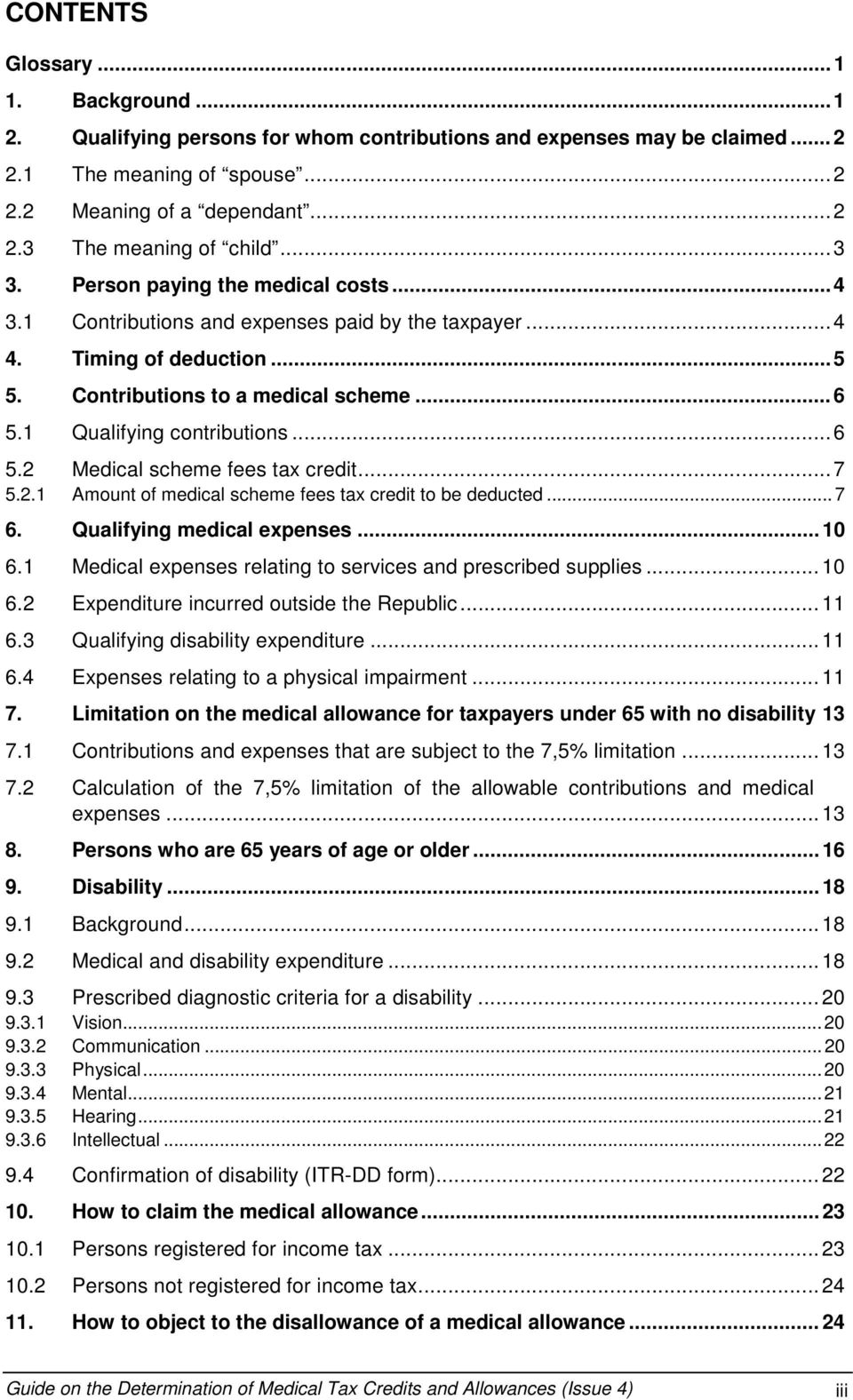
3 CONTENTS Glossary Background Qualifying persons for whom contributions and expenses may be claimed The meaning of spouse Meaning of a dependant The meaning of child Person paying the medical costs Contributions and expenses paid by the taxpayer Timing of deduction Contributions to a medical scheme Qualifying contributions Medical scheme fees tax credit Amount of medical scheme fees tax credit to be deducted Qualifying medical expenses Medical expenses relating to services and prescribed supplies Expenditure incurred outside the Republic Qualifying disability expenditure Expenses relating to a physical impairment Limitation on the medical allowance for taxpayers under 65 with no disability Contributions and expenses that are subject to the 7,5% limitation Calculation of the 7,5% limitation of the allowable contributions and medical expenses Persons who are 65 years of age or older Disability Background Medical and disability expenditure Prescribed diagnostic criteria for a disability Vision Communication Physical Mental Hearing Intellectual Confirmation of disability (ITR-DD form) How to claim the medical allowance Persons registered for income tax Persons not registered for income tax How to object to the disallowance of a medical allowance Guide on the Determination of Medical Tax Credits and Allowances (Issue 4) iii
4 12. Other information Relief of customs and excise duty on a motor vehicle adapted for a physically disabled person Annexure A The law Annexure B The prescribed list of expenditure Guide on the Determination of Medical Tax Credits and Allowances (Issue 4) iv

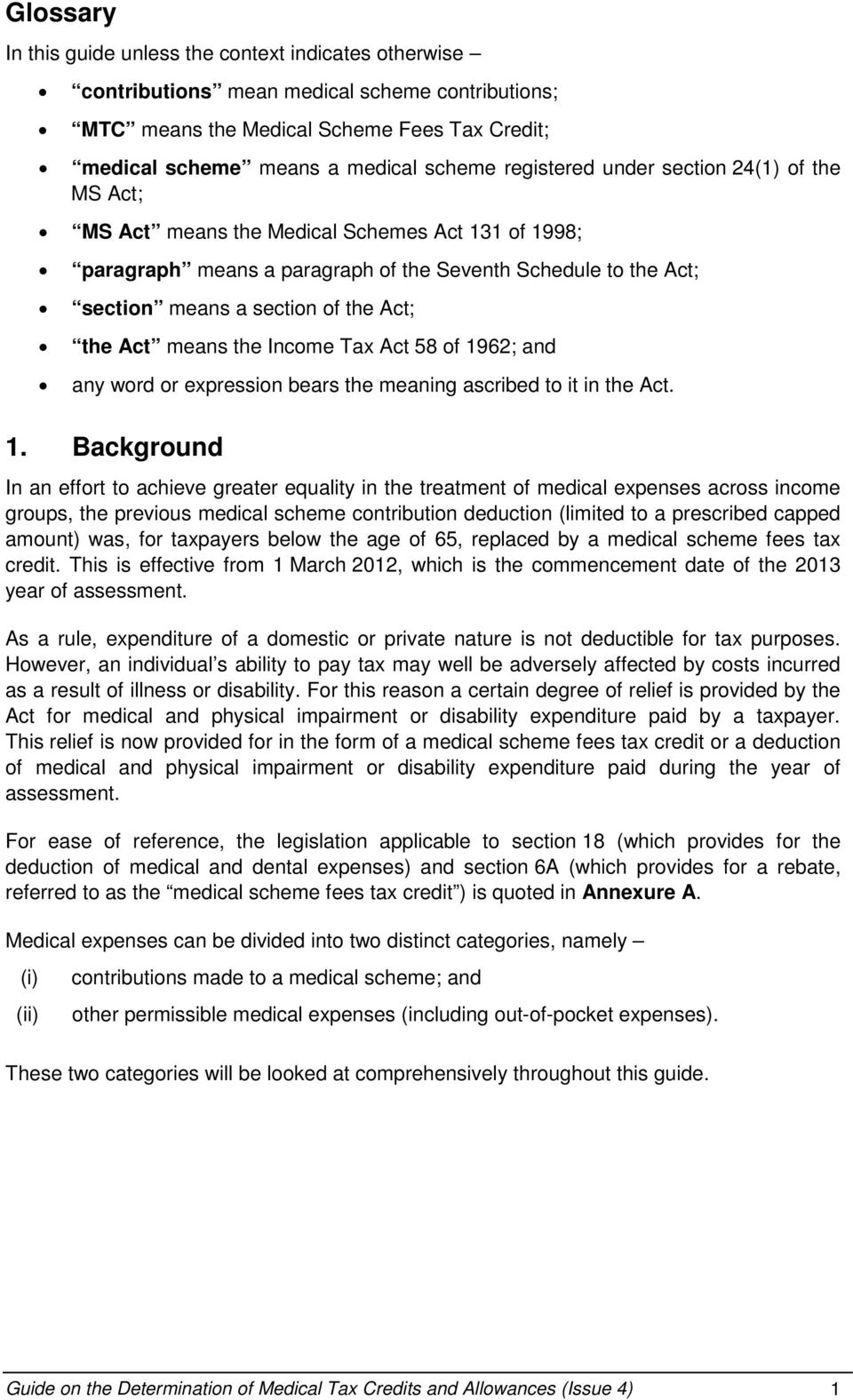
5 Glossary In this guide unless the context indicates otherwise contributions mean medical scheme contributions; MTC means the Medical Scheme Fees Tax Credit; medical scheme means a medical scheme registered under section 24(1) of the MS Act; MS Act means the Medical Schemes Act 131 of 1998; paragraph means a paragraph of the Seventh Schedule to the Act; section means a section of the Act; the Act means the Income Tax Act 58 of 1962; and any word or expression bears the meaning ascribed to it in the Act. 1. Background In an effort to achieve greater equality in the treatment of medical expenses across income groups, the previous medical scheme contribution deduction (limited to a prescribed capped amount) was, for taxpayers below the age of 65, replaced by a medical scheme fees tax credit. This is effective from 1 March 2012, which is the commencement date of the 2013 year of assessment. As a rule, expenditure of a domestic or private nature is not deductible for tax purposes. However, an individual s ability to pay tax may well be adversely affected by costs incurred as a result of illness or disability. For this reason a certain degree of relief is provided by the Act for medical and physical impairment or disability expenditure paid by a taxpayer. This relief is now provided for in the form of a medical scheme fees tax credit or a deduction of medical and physical impairment or disability expenditure paid during the year of assessment. For ease of reference, the legislation applicable to section 18 (which provides for the deduction of medical and dental expenses) and section 6A (which provides for a rebate, referred to as the medical scheme fees tax credit ) is quoted in Annexure A. Medical expenses can be divided into two distinct categories, namely (i) (ii) contributions made to a medical scheme; and other permissible medical expenses (including out-of-pocket expenses). These two categories will be looked at comprehensively throughout this guide. Guide on the Determination of Medical Tax Credits and Allowances (Issue 4) 1
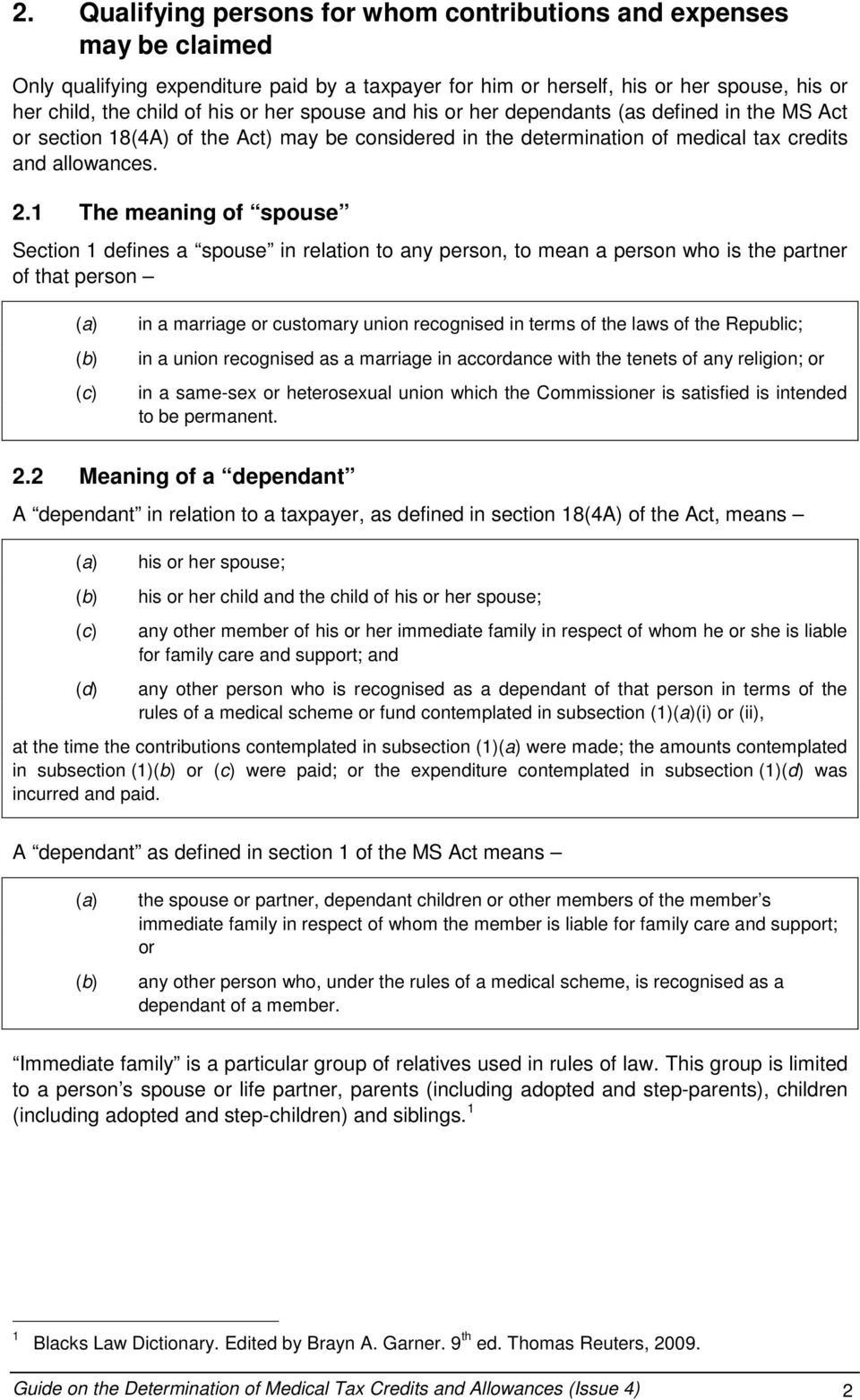
6 2. Qualifying persons for whom contributions and expenses may be claimed Only qualifying expenditure paid by a taxpayer for him or herself, his or her spouse, his or her child, the child of his or her spouse and his or her dependants (as defined in the MS Act or section 18(4A) of the Act) may be considered in the determination of medical tax credits and allowances. 2.1 The meaning of spouse Section 1 defines a spouse in relation to any person, to mean a person who is the partner of that person (a) (b) (c) in a marriage or customary union recognised in terms of the laws of the Republic; in a union recognised as a marriage in accordance with the tenets of any religion; or in a same-sex or heterosexual union which the Commissioner is satisfied is intended to be permanent. 2.2 Meaning of a dependant A dependant in relation to a taxpayer, as defined in section 18(4A) of the Act, means (a) (b) (c) (d) his or her spouse; his or her child and the child of his or her spouse; any other member of his or her immediate family in respect of whom he or she is liable for family care and support; and any other person who is recognised as a dependant of that person in terms of the rules of a medical scheme or fund contemplated in subsection (1)(a)(i) or (ii), at the time the contributions contemplated in subsection (1)(a) were made; the amounts contemplated in subsection (1)(b) or (c) were paid; or the expenditure contemplated in subsection (1)(d) was incurred and paid. A dependant as defined in section 1 of the MS Act means (a) (b) the spouse or partner, dependant children or other members of the member s immediate family in respect of whom the member is liable for family care and support; or any other person who, under the rules of a medical scheme, is recognised as a dependant of a member. Immediate family is a particular group of relatives used in rules of law. This group is limited to a person s spouse or life partner, parents (including adopted and step-parents), children (including adopted and step-children) and siblings. 1 1 Blacks Law Dictionary. Edited by Brayn A. Garner. 9 th ed. Thomas Reuters, Guide on the Determination of Medical Tax Credits and Allowances (Issue 4) 2
7 2.3 The meaning of child A child (as defined in section 1 of the Act) in relation to any person includes: any person adopted by him or her (a) (b) under the law of the Republic; or under the law of any country other than the Republic, provided the adopted person is under such law accorded the status of a legitimate child of the adoptive parent and the adoption was made at a time when the adoptive parent was ordinarily resident in such country; The following persons are not included in the definition of a child : A foster child (regardless of the period the child is in the taxpayer s care) A child who has not yet been legally adopted A child who is under the taxpayer s custodianship A child, as defined in section 18(4) of the Act, means the taxpayer s child or child of his or her spouse who was alive during any portion of the year of assessment, and who on the last day of the year of assessment (a) (b) was unmarried and was not or would not, had he lived, have been (i) over the age of 18 years; (ii) over the age of 21 years and was wholly or partially dependent for his maintenance upon the taxpayer and has not become liable for the payment of normal tax in respect of such year; or (iii) over the age of 26 years and was wholly or partially dependent for his maintenance upon the taxpayer and has not become liable for the payment of normal tax in respect of such year and was a full-time student at an educational institution of a public character; or in the case of any other child, was incapacitated by a disability from maintaining himself or herself and was wholly or partially dependent for maintenance upon the taxpayer and has not become liable for the payment of normal tax in respect of such year. In order to qualify for a deduction of medical expenses paid for a child, the child must be the taxpayer s own child or the child of the taxpayer s spouse. A person over the age of 21 is not regarded as a child if liable for income tax. Medical expenses can be claimed for a child, irrespective of the child s age, if the child is disabled and as a result not in a position to maintain him or herself; admitted as a dependant on the taxpayer s medical scheme; and not liable for the payment of normal tax. Guide on the Determination of Medical Tax Credits and Allowances (Issue 4) 3

8 3. Person paying the medical costs 3.1 Contributions and expenses paid by the taxpayer Only qualifying medical costs (contributions and expenses as discussed below) which were paid by a taxpayer personally, will be taken into account in determining the medical tax credits and allowances that the taxpayer will be entitled to claim. Medical costs incurred by a person other than the taxpayer will not be taken into account when medical tax credits and allowances are determined, except for qualifying medical costs paid by the estate of a deceased taxpayer for the period up to the date of the taxpayer s death. These costs are deemed to have been paid by the taxpayer on the day before the taxpayer s date of death; and qualifying medical costs paid by an employer of a taxpayer, to the extent that the amount has been included in the income of the taxpayer as a taxable benefit. Example 1 Contributions and expenses paid on behalf of a member of a medical scheme Facts: AE, a friend of BC, paid monthly contributions of R1 000 to Excellent Health SA, a registered medical scheme. The amounts were paid on behalf of BC and BC s spouse and children, who are all considered to be dependants of BC under the rules of the medical scheme. AE also paid for prescribed medicine that was not fully covered by Excellent Health SA. Result: BC may not claim an MTC or any other medical allowance for the amounts paid by AE. AE may also not claim the contributions and expenses paid on behalf of BC. Medical costs paid by the employer Medical costs paid by a taxpayer s employer for the benefit of the taxpayer are regarded as a taxable benefit and are therefore subject to tax. However, medical costs paid by the taxpayer s employer are deemed to have been paid by the taxpayer. These amounts therefore form part of the taxpayer s medical scheme contributions and expenses for tax purposes. As such, the total contributions and expenses (which will include those paid for the taxpayer s benefit by the employer) will be taken into account when determining an MTC and allowance. Although the amounts (referred to above) paid by the employer are regarded as a taxable benefit, there are amounts that attract no value and are therefore not subject to tax. No value will be placed on contributions paid by the employer to a medical scheme registered under the MS Act when the benefit is derived by a taxpayer who, by reason of superannuation, ill-health or other infirmity retired from the employ of the employer; the dependants of a deceased employee after his or her death if he or she was in the employ of the employer on the date of death; or the dependants of a taxpayer after his or her death if he or she retired from the employ of the employer by reason of superannuation, ill-health or other infirmity. Guide on the Determination of Medical Tax Credits and Allowances (Issue 4) 4

9 No value is placed on medical services and expenses paid by an employer if the employee is over the age of 65; the medical services are rendered by the employer to its employees in general at their place of work for the better performance of their duties; the services are rendered or medicine supplied to comply with any law of the Republic; or the medical treatment provided by the employer consists of one of the prescribed minimum benefits determined by the Minister of Health under the provisions of the MS Act, provided by the employer in terms of a scheme or programme of the employer that is either carrying on the business of a medical scheme and has been exempted by the Registrar of Medical Schemes from complying with the provisions of the MS Act; or not carrying on the business of a medical scheme, and the employee, his or her spouse and children are not beneficiaries of a medical scheme registered under the MS Act, or if they are such beneficiaries, the cost of the medical treatment is recovered from that medical scheme. A taxpayer may only claim a medical tax credit and allowances on amounts paid by an employer that have been included in that taxpayer s remuneration. 4. Timing of deduction Qualifying medical contributions and expenses can only be claimed in the year of assessment during which they are actually paid. Expenses can be incurred during a year of assessment but may not be paid in that same year of assessment. This will, for example, be the case when expenses have been incurred towards the end of a year of assessment, but have only been paid in a subsequent year of assessment. Example 2 Medical expenses incurred in one year of assessment and paid in the next year of assessment Facts: AA went in for an operation in February AA received an account from the hospital and the doctor on 20 February 2013, but only paid the account on 15 March Result: AA incurred this expense during the 2013 year of assessment but only paid this expense during the 2014 year of assessment. AA may, therefore, only claim the expense in the 2014 year of assessment. Guide on the Determination of Medical Tax Credits and Allowances (Issue 4) 5

10 5. Contributions to a medical scheme 5.1 Qualifying contributions Contributions paid by the taxpayer for him or herself, his or her spouse and any dependant (as defined in the MS Act see 2.2), to a medical scheme registered under the MS Act, may be taken into account when the MTC and medical allowances are determined. Contributions paid by the taxpayer to any other fund registered under similar provisions in the laws of any other country, may also be taken into account. Example 3 Contributions to an unregistered medical scheme Facts: AA paid monthly contributions of R2 000 to XYZ Health SA, which is not a registered medical scheme. The contributions are for AA, AA s mother, AA s spouse and their two children. They are all considered dependants under the rules of the medical scheme. Result: The amounts paid by AA were not paid to a registered medical scheme, and is as a result are not qualifying contributions. Example 4 Contributions to a registered medical scheme Facts: AB paid monthly contributions of R2 000 to ABC Health SA, a registered medical scheme. The contributions are for AB, AB s mother, AB s spouse and their two children. They are all considered dependants under the rules of the medical scheme. Result: The monthly contributions for the year of assessment of R are qualifying contributions. Example 5 Contributions to a foreign medical scheme Facts: AC lives in South Africa and is liable to tax in South Africa. AC paid monthly contributions of R2 000 to British Health. The contributions are for AC, AC s spouse and their children. They are all considered dependants under the rules of the medical scheme. British Health is not registered as a medical scheme under section 24(1) of the MS Act, but is registered under the laws of the United Kingdom. Result: The monthly contributions for the year of assessment of R are qualifying contributions. Contributions paid by a taxpayer to a different medical scheme than the scheme that the taxpayer is a member of, for a person who is dependent on that taxpayer for family care and support, will also be a qualifying contribution. The dependant does not have to be registered as a dependent on the taxpayer s medical scheme for the contribution to qualify for an MTC and medical allowances. Guide on the Determination of Medical Tax Credits and Allowances (Issue 4) 6

11 Example 6 Contributions to different medical schemes Facts: GE paid monthly contributions of R2 500 to ABC Health SA, a registered medical scheme. The contributions are for himself, his spouse and their two children. They are all considered dependants under the rules of the medical scheme. GE also paid monthly contributions of R1 500 to Tip Top Health (a registered medical scheme) for his mother who is dependent on him for family care and support. Result: The monthly contributions for the year of assessment of R (R2 500 x 12) + R (R1 500 x 12) = R are qualifying contributions. 5.2 Medical scheme fees tax credit The medical scheme fees tax credit is not applicable to a taxpayer that is 65 years of age and older. An adjustment has been made to the manner in which medical expenses may be claimed with effect from 1 March An MTC (in the form of a tax rebate) was introduced to replace the tax deduction for medical scheme contributions paid by a person who has not yet attained the age of 65 years by the end of the year of assessment. This MTC will be available to taxpayers who are members of a registered medical scheme and are below the age of 65 (see 8 for the tax implication to persons over the age of 65). The credit itself is set at a fixed amount per month, which is in line with how the former capping amounts were determined. Since the MTC is a rebate and not a deduction, it is not refundable and cannot exceed the amount of normal tax to be deducted. In certain instances, employers are obliged to take into account the MTC when calculating the tax to be withheld from employees. This is usually carried out using the various payroll systems. Taxpayers who have not had their MTC taken into account may submit a tax return to take advantage of the credit, if applicable Amount of medical scheme fees tax credit to be deducted The medical scheme fees tax credits for the year of assessment commencing on or after 1 March 2012, are as follows: R230 in respect of benefits to the taxpayer; R460 in respect of benefits to the taxpayer and one dependant; or R460 in respect of benefits to the taxpayer and one dependant, plus R154 for every additional dependant, for each month in that year of assessment for which medical scheme contributions are paid. Guide on the Determination of Medical Tax Credits and Allowances (Issue 4) 7

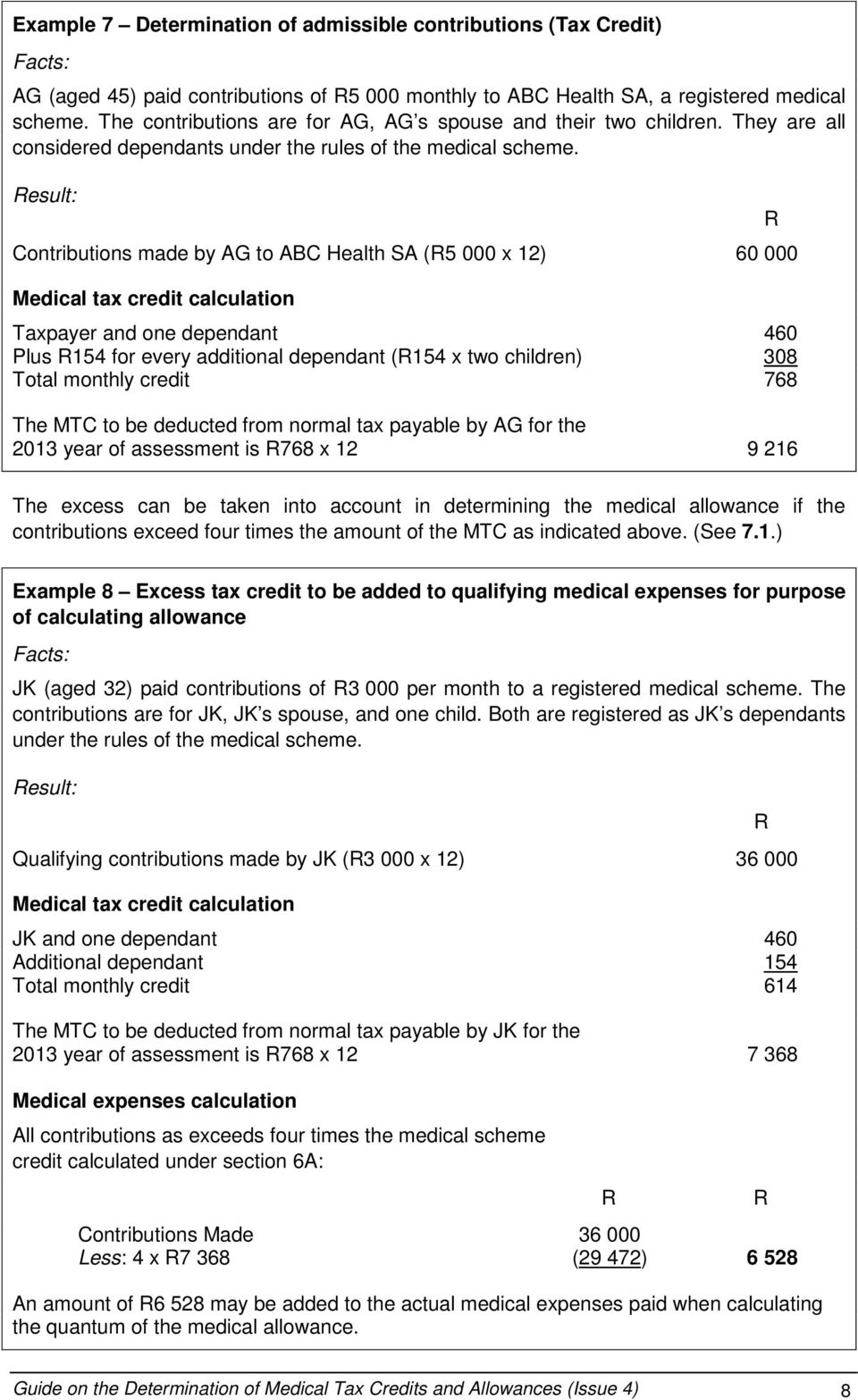
12 Example 7 Determination of admissible contributions (Tax Credit) Facts: AG (aged 45) paid contributions of R5 000 monthly to ABC Health SA, a registered medical scheme. The contributions are for AG, AG s spouse and their two children. They are all considered dependants under the rules of the medical scheme. Result: Contributions made by AG to ABC Health SA (R5 000 x 12) Medical tax credit calculation Taxpayer and one dependant 460 Plus R154 for every additional dependant (R154 x two children) 308 Total monthly credit 768 The MTC to be deducted from normal tax payable by AG for the 2013 year of assessment is R768 x R The excess can be taken into account in determining the medical allowance if the contributions exceed four times the amount of the MTC as indicated above. (See 7.1.) Example 8 Excess tax credit to be added to qualifying medical expenses for purpose of calculating allowance Facts: JK (aged 32) paid contributions of R3 000 per month to a registered medical scheme. The contributions are for JK, JK s spouse, and one child. Both are registered as JK s dependants under the rules of the medical scheme. Result: Qualifying contributions made by JK (R3 000 x 12) Medical tax credit calculation JK and one dependant 460 Additional dependant 154 Total monthly credit 614 The MTC to be deducted from normal tax payable by JK for the 2013 year of assessment is R768 x Medical expenses calculation All contributions as exceeds four times the medical scheme credit calculated under section 6A: Contributions Made Less: 4 x R7 368 (29 472) An amount of R6 528 may be added to the actual medical expenses paid when calculating the quantum of the medical allowance. R R R Guide on the Determination of Medical Tax Credits and Allowances (Issue 4) 8
13 Example 9 Determination of medical scheme fees tax credit for the 2013 year of assessment Facts: For the 2013 year of assessment, LM (aged 47) paid R1 700 per month in medical scheme contributions and did not incur any other medical expenses during the year. LM s taxable income (after accounting for all applicable deductions) for 2013 is R LM is the main member of the medical scheme, and has one dependant registered on that scheme. Result: Medical tax credit calculation Total contributions: R1 700 x MTC: Member and one dependant = R460 per month, thus: R460 x 12 months = R5 520 maximum rebate for the year of assessment Calculation of net normal tax Normal tax on R Less: Primary rebate (11 440) Less: Medical tax credit (5 520) Net normal tax due The MTC is a rebate against taxes payable and is as a result limited to the tax payable. The MTC can accordingly not create a tax loss nor can any excess be carried forward to the next year of assessment. Example 10 Determination of medical scheme fees tax credit for the 2013 year of assessment Facts: For the 2013 year of assessment, HD (aged 55) paid R2 200 per month in medical scheme contributions and did not incur any other medical expenses during the year. HD s taxable income, after including all taxable benefits and accounting for all applicable deductions, is R for the 2013 year of assessment. HD is the main member of the medical scheme, and has two dependants registered on that scheme. Result: R Contributions paid to the medical scheme for the 2013 year of assessment: R2 200 x Medical tax credit calculation: Member and two dependants R460 + R154 per month 614 R614 x 12 months = R7 368 maximum rebate Tax due Normal tax on R Less: Primary rebate (11 440) Less: Medical tax credit (R7 368 limited to R2 060) (2 060) Net normal tax due 0 R Guide on the Determination of Medical Tax Credits and Allowances (Issue 4) 9

14 6. Qualifying medical expenses 6.1 Medical expenses relating to services and prescribed supplies Expenses paid by a taxpayer during the year of assessment to any duly registered i. medical practitioner, dentist, optometrist, homeopath, naturopath, osteopath, herbalist, physiotherapist, chiropractor or orthopaedist for professional services rendered or medicines supplied; or ii. iii. nursing home or hospital or any duly registered or enrolled nurse, midwife or nursing assistant (or to any nursing agency for the services of such nurse, midwife or nursing assistant), for illness or confinement; or pharmacist for medicines as prescribed by any person referred to in (i), will be taken into account in determining the medical allowance, provided these expenses have been paid for the benefit of the taxpayer, his or her spouse, his or her children or the children of his or her spouse or any of his or her dependants as defined in section 18(4A). In order for the expenses to be considered for deduction, the expense must not have been recoverable from the taxpayer s medical scheme. Medical expenses (apart from contributions) that are paid by an employer on a taxpayer s behalf may be taken into account, provided the amount paid by the employer was included in the taxpayer s taxable income. Example 11 Expenditure not recoverable from medical scheme Facts: BA paid R1 000 to Dr F (who is a registered medical practitioner) for consultation fees. BA belongs to a registered medical scheme, to which a claim of R1 000 was submitted. The medical scheme paid only R600 of this expense, resulting in BA having to pay the remaining R400. Result: The difference of R400 (R1 000 less R600) that was not paid by the medical scheme is regarded as a qualifying expense and will be taken into account when the medical allowance is determined. Example 12 Payment to an unregistered medical practitioner Facts: BB paid R1 000 to C for a medical consultation. C is a second-year medical student. Result: The payment of R1 000 is not a qualifying expense and will not be taken into account when the medical allowance is determined, as the amount which BB paid was not to a duly registered medical practitioner. Guide on the Determination of Medical Tax Credits and Allowances (Issue 4) 10

15 Example 13 Non-prescription medicine Facts: BC purchased headache tablets off-the-shelf at the local pharmacy for R50. Result: As the headache tablets were not prescribed by a registered medical practitioner, nor were they relating to a physical impairment which is prescribed by the Commissioner, the R50 is not regarded as a qualifying expense and will not be taken into account when the medical allowance is determined. 6.2 Expenditure incurred outside the Republic Expenses for medical services and supplies as reflected in 6.1 that have been incurred outside South Africa may be taken into account in the determination of the medical allowance during a year of assessment if they have been paid during that year of assessment, and are substantially similar to qualifying medical services rendered or medicines supplied in South Africa. 6.3 Qualifying disability expenditure Only expenditure (relating to the actual disability) prescribed by the Commissioner may be claimed as a deduction. These expenses are provided in the List of Qualifying Physical Impairment or Disability Expenditure, 1 March 2012 (see Annexure B). See 9 for a detailed discussion of how the MTC and medical expense allowance works for persons with a disability. 6.4 Expenses relating to a physical impairment Taxpayers are also permitted to take into account qualifying physical impairment expenditure in computing the medical allowance. This is over and above any qualifying contributions made to medical schemes and qualifying medical expenses paid. Qualifying expenditure is described in section 18(1)(d) as any expenditure that is prescribed by the Commissioner (other than expenditure recoverable by the taxpayer or his or her spouse) necessarily incurred and paid by the taxpayer in consequence of any physical impairment or disability suffered by the taxpayer, his or her spouse or child, or any dependant of the taxpayer. The expense must be in consequence of a physical impairment or disability suffered by the taxpayer, his or her spouse, his or her children, the children of his or her spouse or any of his or her dependants. Expenditure incurred for a dependant will only qualify if that expense was necessarily incurred and paid by the taxpayer. Guide on the Determination of Medical Tax Credits and Allowances (Issue 4) 11

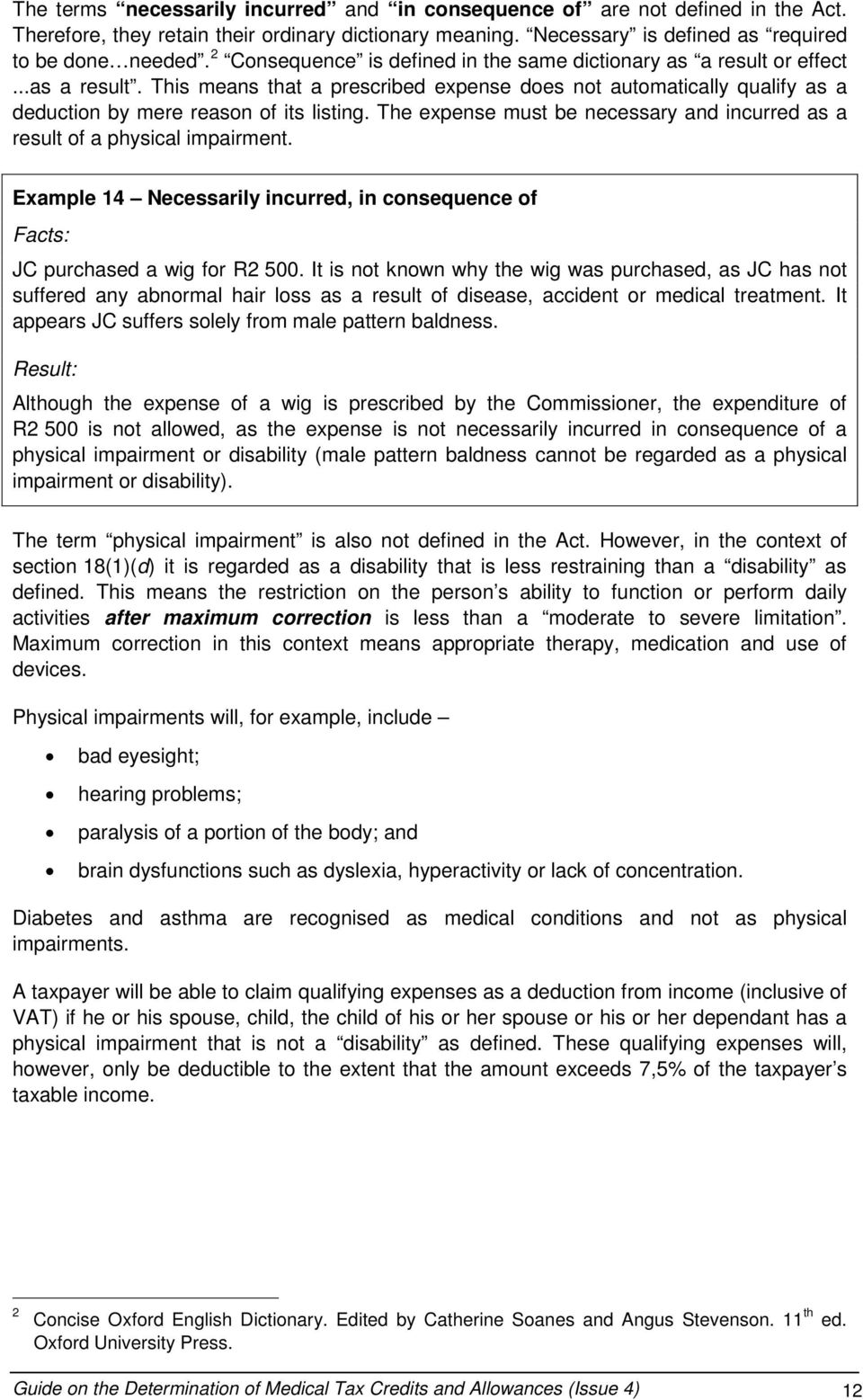
16 The terms necessarily incurred and in consequence of are not defined in the Act. Therefore, they retain their ordinary dictionary meaning. Necessary is defined as required to be done needed. 2 Consequence is defined in the same dictionary as a result or effect...as a result. This means that a prescribed expense does not automatically qualify as a deduction by mere reason of its listing. The expense must be necessary and incurred as a result of a physical impairment. Example 14 Necessarily incurred, in consequence of Facts: JC purchased a wig for R It is not known why the wig was purchased, as JC has not suffered any abnormal hair loss as a result of disease, accident or medical treatment. It appears JC suffers solely from male pattern baldness. Result: Although the expense of a wig is prescribed by the Commissioner, the expenditure of R2 500 is not allowed, as the expense is not necessarily incurred in consequence of a physical impairment or disability (male pattern baldness cannot be regarded as a physical impairment or disability). The term physical impairment is also not defined in the Act. However, in the context of section 18(1)(d) it is regarded as a disability that is less restraining than a disability as defined. This means the restriction on the person s ability to function or perform daily activities after maximum correction is less than a moderate to severe limitation. Maximum correction in this context means appropriate therapy, medication and use of devices. Physical impairments will, for example, include bad eyesight; hearing problems; paralysis of a portion of the body; and brain dysfunctions such as dyslexia, hyperactivity or lack of concentration. Diabetes and asthma are recognised as medical conditions and not as physical impairments. A taxpayer will be able to claim qualifying expenses as a deduction from income (inclusive of VAT) if he or his spouse, child, the child of his or her spouse or his or her dependant has a physical impairment that is not a disability as defined. These qualifying expenses will, however, only be deductible to the extent that the amount exceeds 7,5% of the taxpayer s taxable income. 2 Concise Oxford English Dictionary. Edited by Catherine Soanes and Angus Stevenson. 11 th ed. Oxford University Press. Guide on the Determination of Medical Tax Credits and Allowances (Issue 4) 12
17 7. Limitation on the medical allowance for taxpayers under 65 with no disability 7.1 Contributions and expenses that are subject to the 7,5% limitation In addition to the MTC, you will be entitled to a deduction that is limited to the amount by which the sum of the amounts listed below exceeds 7,5% of your taxable income (excluding certain retirement related lump sums and withdrawals) before taking into account this deduction. i. All contributions made by you to a registered medical scheme in respect of yourself, your spouse and any dependant that exceeds four times the MTC; and ii. Actual qualifying medical expenses (including physical impairment expenses) paid by you and not recoverable from the medical scheme in respect of yourself, your spouse, qualifying children and any dependant admitted as your dependant in terms of your medical scheme or fund at the time such expenses were paid. In (ii) above, the following expenses must be taken into account in the determination of the medical allowance, subject to the 7,5% limitation (see 7.2): All qualifying out-of-pocket medical expenses relating to services and prescribed supplies; Expenses relating to a physical impairment (if applicable); and Disability expenses of a person other than the taxpayer, his or her spouse, his or child or the child of his or her spouse. 7.2 Calculation of the 7,5% limitation of the allowable contributions and medical expenses An allowance for all contributions as exceeds four times the MTC plus the out-of-pocket and physical impairment expenses, as set out in 5 and 0, the total of which exceeds 7,5% of taxable income before the medical deduction will be allowed as a deduction against income. Any retirement fund lump sum or withdrawal benefit (as defined in section 1) received by the taxpayer, must also be excluded for purposes of the 7,5% calculation. Example 15 Claim for physical impairment expenditure limited to 7,5% of taxable income Facts: During the 2013 year of assessment, Y (aged 34) earned a salary of R Y contributed R to ABC Medical Aid Scheme. Y s employer paid R of the R The R paid by Y s employer was included as a taxable fringe benefit in Y s hands. Y s employer withheld employees tax of R from the remuneration of R All amounts are correctly reflected on Y s IRP5 certificate. Y is claiming allowable out-of-pocket medical expenses of R as well as R2 691 incurred and paid for over-the-counter medication for a physical impairment (the expenses appear on the prescribed list). Y has kept proof of all expenses. Y is the main member on ABC Medical Aid Fund and has two dependants. Guide on the Determination of Medical Tax Credits and Allowances (Issue 4) 13

18 Result: Total contributions paid ,00 Medical Tax Credit Calculation MTC: (R460 + R154) x ,00 Tax Liability Taxable income (R R24 000) ,00 Less: Deductions: Medical (note 1) (23 586,00) Taxable income ,00 Normal tax on R ,50 Less: Primary rebate (11 440,00) ,50 Less: Medical tax credit (7 368,00) Net normal tax ,50 Less: Employees tax (22 542,00) Due to Y (5 896,50) Note 1: Medical deduction The aggregate of: (i) All contributions [section 18(2)(c), read with section 18(1)(a) and section 18(5)(b)] as exceeds four times the medical scheme credit calculated under section 6A: Contributions made Less: 4 x R7 368 (29 472) R R R (ii) Plus All allowable amounts excluding contributions [section 18(2)(c)(ii), read with Section 18(1)(b), (c) and (d)] R R as exceeds 7,5% of the taxable income before the medical allowance: Less: 7,5% of R (15 765) Total claim Example 16 Claim for physical impairment expenditure limited to 7,5% of taxable income Facts: During the 2013 year of assessment, X (aged 38) earned a salary of R X contributed R towards ABC Medical Aid Scheme. X s employer paid R of the R The R paid by X s employer was included in X s income as a taxable fringe benefit. X s employer withheld employees tax of R from X s remuneration of R All amounts were correctly reflected on X s IRP5 certificate. Guide on the Determination of Medical Tax Credits and Allowances (Issue 4) 14
![(22 542,00) Due to Y (5 896,50) Note 1: Medical deduction The aggregate of: (i) All contributions [section 18(2)(c), read with section 18(1)(a) and section 18(5)(b)] as exceeds four times the medical](/docs-images/53/11138965/images/page_18.jpg "scheme credit calculated under section 6A: Contributions made 46 900 Less: 4 x R7 368 (29 472) 17 428 R R R (ii) Plus All allowable amounts excluding contributions [section 18(2)(c)(ii), read with")
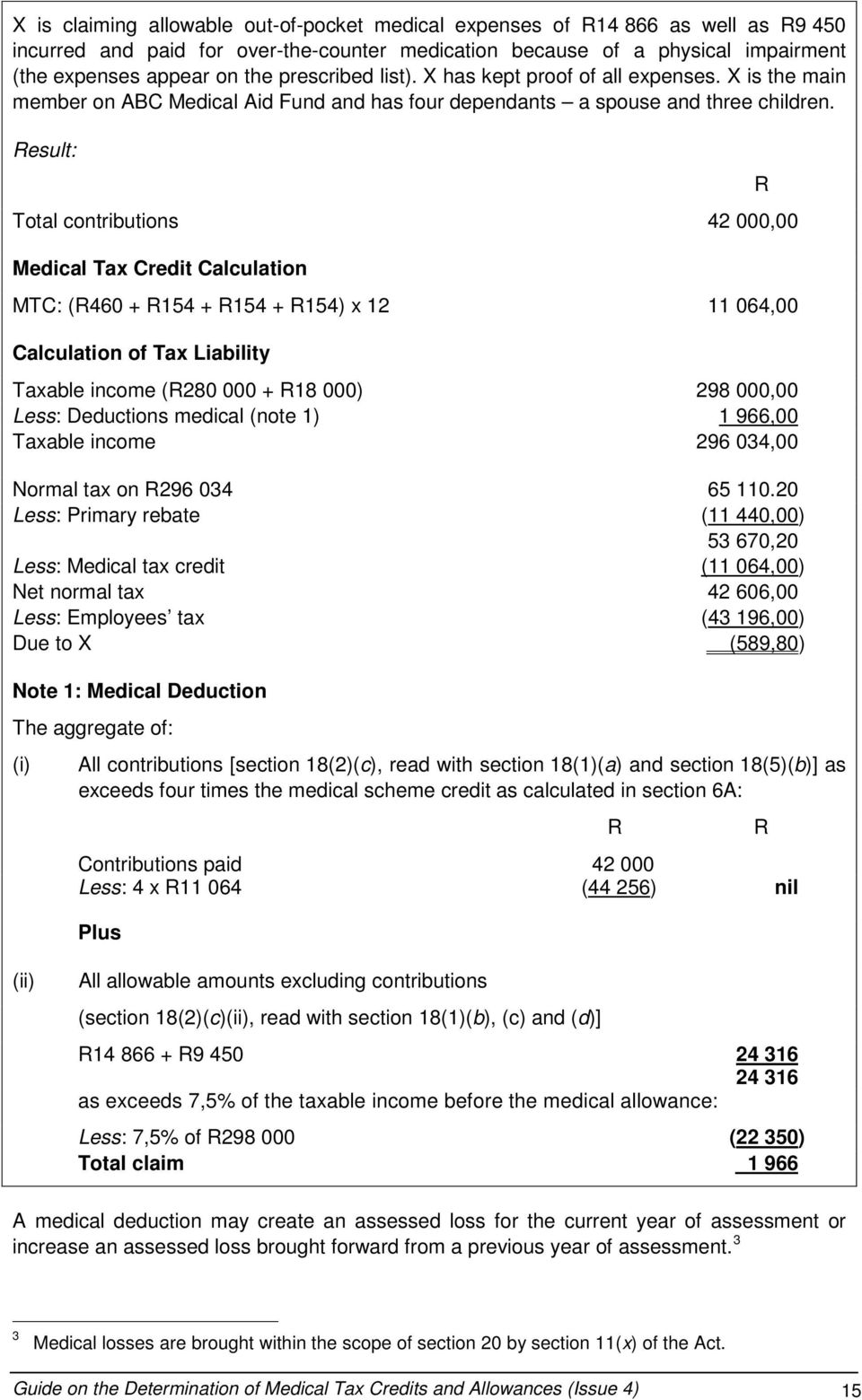
19 X is claiming allowable out-of-pocket medical expenses of R as well as R9 450 incurred and paid for over-the-counter medication because of a physical impairment (the expenses appear on the prescribed list). X has kept proof of all expenses. X is the main member on ABC Medical Aid Fund and has four dependants a spouse and three children. Result: Total contributions ,00 Medical Tax Credit Calculation MTC: (R460 + R154 + R154 + R154) x ,00 Calculation of Tax Liability Taxable income (R R18 000) ,00 Less: Deductions medical (note 1) 1 966,00 Taxable income ,00 Normal tax on R Less: Primary rebate (11 440,00) ,20 Less: Medical tax credit (11 064,00) Net normal tax ,00 Less: Employees tax (43 196,00) Due to X (589,80) Note 1: Medical Deduction The aggregate of: (i) All contributions [section 18(2)(c), read with section 18(1)(a) and section 18(5)(b)] as exceeds four times the medical scheme credit as calculated in section 6A: Contributions paid Less: 4 x R (44 256) nil Plus R R R (ii) All allowable amounts excluding contributions (section 18(2)(c)(ii), read with section 18(1)(b), (c) and (d)] R R as exceeds 7,5% of the taxable income before the medical allowance: Less: 7,5% of R (22 350) Total claim A medical deduction may create an assessed loss for the current year of assessment or increase an assessed loss brought forward from a previous year of assessment. 3 3 Medical losses are brought within the scope of section 20 by section 11(x) of the Act. Guide on the Determination of Medical Tax Credits and Allowances (Issue 4) 15
20 An assessed loss brought forward from a previous year of assessment must first be set off against the taxable income of the current year of assessment before calculating the 7,5% limitation. Example 17 Determination of medical allowance when an assessed loss is brought forward from a previous year of assessment Facts: A did not make any contributions to a medical scheme and all qualifying expenses incurred were out-of-pocket expenses. Assessed loss brought forward from a previous year of assessment (40 000) Taxable income before the deduction of medical expenses Qualifying medical expenses (out-of pocket) Result: Taxable income before the deduction of medical expenses Assessed loss brought forward from previous year of assessment (40 000) Taxable income for current year of assessment before medical expenses Less: 7,5% of taxable income before medical allowance [(R R40 000) x 7,5%] (750) Medical allowance (R = R29 250) (29 250) Assessed loss after medical allowance (19 250) R 8. Persons who are 65 years of age or older A person who is 65 years of age or older on the last day of the year of assessment, is granted a medical allowance for all qualifying contributions and qualifying medical and physical disability and physical impairment expenses for that year of assessment. Neither the limitation of 7,5% nor the MTC is applicable. Example 18 Medical allowance for person who is 65 years or older Facts: BA (aged 65) earned R from a living annuity for the 2013 year of assessment. BA incurred the following medical expenses: R2 500 per month for medical scheme contributions; and R5 000 for out-of-pocket expenses for prescription items and visits to duly registered medical practitioners. Result: As BA is 65 years or older, all qualifying medical expenditure will be allowed as a deduction. The amount that will qualify as an allowance is determined as follows: R Medical scheme contributions: R2 500 x 12 months Out-of-pocket expenses Medical allowance Guide on the Determination of Medical Tax Credits and Allowances (Issue 4) 16

21 BA s taxable income will be determined as follows: Annuity income Income Less: Deductions medical allowance (35 000) TAXABLE INCOME Example 19 Medical allowance for person who is 65 years or older Facts: AZ (aged 67) earned a pension income of R for the 2013 year of assessment and income of R from an annuity. AZ incurred the following medical expenses: R3 100 per month for medical scheme contributions; R6 250 for out-of-pocket expenses for prescription items and visits to duly registered medical practitioners; R2 500 for spectacles (that were not covered by the medical scheme) for a physical impairment; R500 for medical consultation fees incurred to rush a friend to the emergency room following an accident (the friend is not a listed dependant on AZ s medical aid); R280 for a consultation with a general practitioner on 20 February The amount was paid by AZ on 2 March Result: As AZ is 65 years or older, all qualifying medical expenditure will be allowed as a deduction. The amount that will qualify as an allowance is determined as follows: R Medical scheme contributions: R3 100 x 12 months Out-of-pocket expenses Physical impairment expenditure Fees for friend (disallowed; friend is not a dependant) NIL Consultation with general practitioner (disallowed; expense incurred in 2013 year of assessment, but only paid in 2014 year of assessment) NIL Medical allowance AZ s taxable income will be determined as follows: Pension income Annuity Income Less: Deductions medical allowance (45 950) TAXABLE INCOME Guide on the Determination of Medical Tax Credits and Allowances (Issue 4) 17
22 9. Disability 9.1 Background A full medical deduction for both contributions and other expenses can no longer be claimed when the taxpayer, his or her spouse or any of his or her children or his or her spouse s children is a person with a disability. The following may be claimed: (a) A monthly MTC for contributions paid of (i) R230 for the member; (ii) R460 for the member and the first dependant; and (iii) R154 for each additional dependant. (b) A deduction for all of the permitted out-of-pocket and prescribed disability or physical impairment expenses. (c) A deduction for medical scheme contributions paid by the taxpayer to a registered medical scheme to the extent that they exceed four times the MTC that the taxpayer is entitled to. 9.2 Medical and disability expenditure Expenditure prescribed by the Commissioner and which is necessarily incurred and paid for by the taxpayer in consequence of a disability, is deductible in accordance with section 18, but is subject to certain limitations. As discussed in 6.3, it is a requirement that a prescribed expense must be necessary and in consequence of a person s specific disability and does not automatically qualify as a deduction by mere reason of its listing. For example, if a person in a wheelchair buys a hand-held GPS, the cost of the hand-held GPS will not qualify under section 18(1)(d) even though the expense has been prescribed (listed) by the Commissioner. This is because the hand-held GPS is not directly connected to this person s disability and hence neither necessarily incurred nor incurred in consequence of the disability. In the case of a person who is, for example, visually impaired, the cost of the hand-held GPS may qualify. A disability, as defined in section 18(3), means a moderate to severe limitation of a person s ability to function or perform daily activities as a result of a physical, sensory, communication, intellectual or mental impairment, if the limitation (a) (b) has lasted or has a prognosis of lasting more than a year; and is diagnosed by a duly registered medical practitioner in accordance with criteria prescribed by the Commissioner. The 7,5% limitation (as explained in 7.2) does not apply if the taxpayer, his or her spouse or any of his or her children or his or her spouse s children is a person with a disability in accordance with the published criteria. In addition to the MTC (which is claimable against normal tax payable), a medical allowance is also permitted and is equal to the total amount of all the permissible out-of-pocket and prescribed disability or physical impairment expenses; and the medical contributions made that exceeds four times the MTC as determined in above. Guide on the Determination of Medical Tax Credits and Allowances (Issue 4) 18
23 Example 20 Person with disability Facts: During the 2013 year of assessment, Y (aged 34) earned a salary of R Y s employer withheld employees tax of R23 910, and all amounts were correctly reflected on Y s IRP5 certificate. Y contributed R towards ABC Medical Aid Scheme and the employer paid R of the R Y is claiming allowable out-of-pocket medical expenses of R9 232 as well as R for two hearing aids. Y s four year old daughter is regarded as disabled as she is almost deaf in both ears. Y has kept proof of all expenses. Y is the main member on the ABC Medical Aid Fund and has two dependants a spouse and daughter. Result: Medical tax credit (R460 + R154) x ,00 Tax liability Income (R R24 000) ,00 Less: Deductions medical (note 1) (Section 18(2)(b)) (59 351,00) Taxable income ,00 Normal tax on R ,82 Less: Primary rebate (Section 6(2)(a)) (11 440,00) ,82 Less: Medical tax credit (Section 6A(2)) (7 368,00) Net normal tax 8 344,82 Less: Employees tax (23 910,00) Due to Y (15 565,18) Note 1: Medical Deduction The aggregate of: All allowable amounts, excluding contributions and (section 18(2)(b)(i), read with Section 18(1)(b), (c) and (d)]: R R All contributions [section 18(2)(b)(ii), read with section 18(1)(a) and section 18(5)(b)] as exceeds four times the medical scheme credit as calculated under section 6A: Allowable Contributions Less 4 x R7 368 (29 472) TOTAL CLAIM R Guide on the Determination of Medical Tax Credits and Allowances (Issue 4) 19
24 The full allowance may only be claimed if the person with the disability is the taxpayer, his or her spouse, his or her child or his or her spouse s child. 4 The full allowance is not available for other dependants, for example a foster child, which is not a child as defined. The expenses will be considered, but will be subject to the 7,5% limitation as discussed in Prescribed diagnostic criteria for a disability For each of the impairments in the definition of a disability in section 18, the Commissioner has prescribed diagnostic criteria. These criteria seek to assess the functional impact of the impairment on a person s ability to perform daily activities and not the diagnosis of a medical condition. These criteria are discussed below: Vision The minimum requirement for a person to be classified as a blind person is visual acuity in the better eye with best possible correction, less than 6/18 (0.3); and visual field 10 degrees or less around central fixation. 6/18 means that what a person with normal vision can read at 18 metres, the person being tested can only read at 6 metres. Best possible correction refers to the position after a person s vision has been corrected by means of spectacles, contact lenses or intraocular (implanted) lenses Communication A person is regarded as having a moderate to severe communication disability if, despite appropriate therapy, medication and/or suitable devices, one or more life activities (as listed below, pending age appropriateness), is substantially limited, that is, more than merely inconvenient or bothersome. In other words, if one or more of the following apply, the individual will be regarded as suffering from a moderate to severe communication disability: Inability to make self-understood to familiar communication partners using speech in a quiet setting. Inability to make self-understood to both familiar or non-familiar communication partners and incapability of meeting appropriate communication needs for his or her age by using speech, in less than 30 intelligible words. Problems in understanding meaningful language by familiar communication partners that lead to substantial difficulty in communicating. The need to rely on augmentative or alternative communication (AAC), including unaided (for example, sign language or other manual signs) or aided means of communication (ranging from communication boards to speech generating devices) Physical A person is regarded as a person with a disability if the impairment is such that the person is unable to walk, for example, a wheelchair user; only able to walk with the use of assistive devices, for example, callipers, crutches, walking frames and other similar devices; 4 Section 18(2)(b). Guide on the Determination of Medical Tax Credits and Allowances (Issue 4) 20
25 able to walk without the use of assistive devices, but with a degree of difficulty, for example, persons with Cerebral Palsy, Polio (that is, persons who require an inordinate amount of time to walk); and functionally limited in the use of the upper limbs Mental With the exclusion of intellectual disability, a person is regarded as having a mental disability if that person has been diagnosed (in accordance with accepted diagnostic criteria as prescribed in the Diagnostic and Statistical Manual IV-TR (DSM-IV-TR)) by a mental health care practitioner who is authorised to make such diagnosis, and such diagnosis indicates a mental impairment that disrupts daily functioning and which moderately or severely interferes or limits the performance of major life activities, such as learning, thinking, communicating and sleeping, amongst others. A moderate impairment means a Global Assessment Functioning Score (GAF-Score) of 31 to 60. A severe impairment means a GAF-Score of 30 and below Hearing The term hearing disability refers to the functional limitations resulting from a hearing impairment. Hearing impairment is a sensory impairment that will influence verbal communication between speaker and listener. An adult is considered moderately to severely hearing impaired when the hearing loss, without the use of an amplification device, is described as follows: Bilateral hearing loss with a pure tone average equal to or greater than 25 dbhl in each ear. Unilateral hearing loss with pure tone average equal to or greater than 40 dbhl in the affected ear. A child is considered moderately to severely hearing impaired when the hearing loss, without the use of an amplification device, is as follows: Bilateral hearing loss with a pure tone average greater than 15 dbhl in each ear. Unilateral hearing loss with a pure tone average equal to or greater than 20 dbhl in the affected ear. Notes: Hearing impairment is an abnormal or reduced function in hearing resulting from an auditory disorder. A child is a person who is not over the age of 18 years. Amplification devices include hearing aids, implantable devices and assistive listening devices. Pure Tone Average (PTA): average of hearing sensitivity thresholds (in decibel hearing level) to pure tone signals at 500Hz and 1000Hz, 2000Hz and 4000Hz of each ear. Bilateral hearing loss is a hearing sensitivity loss in both ears. Unilateral hearing loss is a hearing sensitivity loss in one ear only. Guide on the Determination of Medical Tax Credits and Allowances (Issue 4) 21
26 9.3.6 Intellectual A person is regarded as having an intellectual disability if he or she has a moderate to severe impairment in intellectual functioning that is accompanied by a significant limitation in adaptive functioning in at least two of the following skill areas: Communication Self-care Home living Social or interpersonal skills Use of community resources Self-direction Functional academic skills, work, leisure, health and safety A moderate impairment means an intelligence quotient (IQ) of 35 to 49. A severe impairment means an IQ of 34 and below. 9.4 Confirmation of disability (ITR-DD form) A person who wishes to claim a medical deduction for disability expenses must complete a Confirmation of Diagnosis of Disability form (ITR-DD), which is available on the SARS website ( ITR-DD must not be submitted with the annual income tax return, but must be retained for compliance purposes in the event of a SARS audit. The ITR- DD needs to be completed and endorsed by a registered medical practitioner every five years, if the disability is of a more permanent nature. However, if the disability is temporary, the ITR-DD will only be valid for one year, which effectively means that a new ITR-DD must be completed for each year of assessment during which a disability claim is made. A disability will be regarded as being temporary in nature if that disability is expected to last for less than five years. Part A of the ITR-DD must be completed for the person with the disability. To ensure that there is no breach of patient-doctor confidentiality, it is important that the authorisation in Part A is duly signed by the person with the disability. The ITR-DD must be signed by a parent, guardian or court-appointed curator, as the case may be, if the person with the disability is a minor, or is physically or mentally incapable of doing so. Part B of the ITR-DD must be completed by a duly registered medical practitioner who is qualified to express an opinion regarding the person s disability. The practitioner needs to complete the appropriate diagnostic criteria. In Part C of the ITR-DD the registered medical practitioner must indicate and describe if the functional limitations with respect to performing activities of daily living are regarded as either mild or moderate to severe ; indicate if the disability has lasted, or is expected to last for a continuous period of more than 12 months; and sign the declaration. Guide on the Determination of Medical Tax Credits and Allowances (Issue 4) 22
27 Duly registered medical practitioners specifically trained to deal with the particular disability include the following: Vision: Hearing: Speech: Physical: Intellectual: Mental: Practitioner trained to use the Snellen chart (for example, an optometrist or ophthalmologist). Practitioner trained to perform or conduct a battery of the diagnostic audiometry tests (for example, an Ear, Nose and Throat Specialist or Audiologist). Speech-Language Pathologist. Orthopaedic Surgeon, Neuro Surgeon, Physiotherapist or Occupational Therapist. Psychiatrist or Clinical Psychologist. Psychiatrist or Clinical Psychologist. 10. How to claim the medical allowance 10.1 Persons registered for income tax The following documentation must be retained for audit purposes when a medical allowance is claimed for a year of assessment: Proof of contributions paid to a registered medical scheme or to any other funds registered under similar provisions in the laws of any other country. In the case of salary earners, contributions paid to a registered medical scheme will normally be reflected on the employees tax certificate (IRP 5). A statement from the medical scheme indicating the total amount of claims submitted to the fund that were not refunded to the taxpayer or paid by the scheme to the service provider. The medical statements, which are generally released by each medical scheme in February or March each year, usually reflect the total amount for the year of assessment. A completed list of amounts not submitted to or recoverable from the taxpayer s medical scheme, together with proof of such amounts incurred and paid. A letter from the taxpayer s medical scheme, stating that the benefits allocated to certain medical procedures are exhausted, when applicable. A duly completed and signed Confirmation of Disability (ITR-DD) form, if applicable. The aforementioned documentation as well as receipts must not be submitted with the annual income tax return, but must be stored and made available on SARS request, in the event that the taxpayer is required to substantiate the medical claims. The taxpayer is required to keep records such as receipts, paid cheques, bank statements, deposit slips and invoices for five years from the date on which the return for the relevant year of assessment was received by SARS. However, in cases where objections and appeals have been lodged against assessments, the taxpayer must keep all records and data relating to the assessments under objection or appeal until such time that the objection or appeal has been finalised, even if the timeframe for finalisation exceeds five years. Guide on the Determination of Medical Tax Credits and Allowances (Issue 4) 23
28 10.2 Persons not registered for income tax Taxpayers who are not required to submit tax returns are generally either employees, or are taxpayers whose income is below the tax threshold. These taxpayers may have qualifying medical expenses or an MTC that was not taken into account during the year of assessment. The mere submission of a tax return will have no effect on the taxpayer s tax liability, if the employer has already taken the MTC into account. The MTC will also not create a refund if the taxpayer has no liability for normal tax. Taxpayers must request an income tax return at the local SARS branch office, via the SARS Contact Centre or online through the SARS efiling website ( if there is qualifying medical expenditure or an MTC that has not been taken into account, and if the taxpayers wish to apply for a refund. Should the medical deduction or MTC result in a reduction of the tax paid, the taxpayer will be refunded accordingly. Taxpayers may only apply for a refund of an amount if the application is made within three years from the end of the year of assessment during which the amount was deducted; the amount deducted is an amount of employees tax deducted from remuneration paid to the taxpayer; income for that year of assessment only consisted of remuneration; and the submission of a tax return was not required for that year of assessment and no returns were submitted for three years since the end of that year of assessment. 11. How to object to the disallowance of a medical allowance A taxpayer who claimed a deduction for a medical allowance and who is not satisfied with the assessment issued may object to it. The objection must be in the prescribed form Notice of Objection (NOO) which can be obtained via efiling or at a SARS branch office. The NOO, which states the grounds on which the objection is lodged, must reach the relevant SARS branch office where the taxpayer is on register for income tax within 30 business days after the date of the assessment. The relevant documentation as discussed in must be submitted together with the objection. Further information regarding the objection and appeal procedure is available on the SARS website ( and is set out in the Tax Guide on Dispute Resolution. Guide on the Determination of Medical Tax Credits and Allowances (Issue 4) 24
29 12. Other information 12.1 Relief of customs and excise duty on a motor vehicle adapted for a physically disabled person The full customs or excise duty on motor vehicles may, by specific permit, be claimed as a rebate under the conditions prescribed by the International Trade Administration Commission (ITAC) (imported vehicles) or SARS (locally manufactured vehicles), after consultation with the South African National Council for the Blind, the Deaf Federation of South Africa, the South African Federation for Mental Health, the National Council for Persons with Physical Disability in South Africa or Epilepsy South Africa or of a body which is affiliated to the Council, Federation or League concerned. These vehicles, including station wagons (but excluding racing cars), must be principally designed for the transport of persons and adapted or be adapted so that they can be driven solely by a physically disabled person. The following conditions apply in this regard: (a) The adaptation of the motor vehicle must be of such a nature that the physically disabled driver of the motor vehicle has easy access to all controls necessary to drive such a vehicle. (b) The permit may not be issued within five years of the issue of a previous permit to such disabled person. (c) Permits may, however, be issued within a shorter period provided that proof is submitted that the motor vehicle previously entered under rebate of duty was stolen or written off by the licensing authorities. (d) If the vehicle is offered, advertised, lent, hired, let under a lease agreement, pledged, given away, exchanged, sold or otherwise disposed of within five years from the date of entry under rebate items , or , such foregoing acts shall render the vehicle liable to the payment of duty on a pro-rata basis. The full rebate of either customs or excise duty of such vehicles is regulated as follows: Imported vehicles: Part 2 of Schedule 4 to the Customs and Excise Act 91 of 1964, rebate item , tariff heading rebate code (transport) and tariff heading rebate code (to be driven). Locally manufactured vehicles: Part 2 of Schedule 6 to the Customs and Excise Act, rebate item (transport) and (to be driven). Guide on the Determination of Medical Tax Credits and Allowances (Issue 4) 25
30 Annexure A The law Section 18 of the Income Tax Act 58 of Deduction in respect of medical and dental expenses. (1) Notwithstanding the provisions of section 23, there must be allowed to be deducted from the income of any taxpayer who is a natural person an allowance in respect of (a) (b) (c) (d) any contributions made by that taxpayer in respect of the year of assessment in respect of that taxpayer, his or her spouse and any dependant, as defined in section 1 of the Medical Schemes Act, 1998 (Act 131 of 1998), of that taxpayer to (i) any medical scheme registered under the provisions of that Act; or (ii) any fund which is registered under any similar provision contained in the laws of any other country where the medical scheme is registered; any amounts (other than amounts recoverable by the taxpayer or his or her spouse) which were paid by the taxpayer during the year of assessment to any duly registered (i) medical practitioner, dentist, optometrist, homeopath, naturopath, osteopath, herbalist, physiotherapist, chiropractor or orthopedist for professional services rendered or medicines supplied to the taxpayer, his or her spouse or his or her children, or any dependant of the taxpayer; or (ii) nursing home or hospital or any duly registered or enrolled nurse, midwife or nursing assistant (or to any nursing agency in respect of the services of such a nurse, midwife or nursing assistant) in respect of the illness or confinement of the taxpayer, his or her spouse or his or her children, or any dependant of the taxpayer; or (iii) pharmacist for medicines supplied on the prescription of any person mentioned in subparagraph (i) for the taxpayer, his or her spouse or his or her children, or any dependant of the taxpayer; and any amounts (other than amounts recoverable by the taxpayer or his or her spouse) which were paid by the taxpayer during the year of assessment in respect of expenditure incurred outside the Republic on services rendered or medicines supplied to the taxpayer or his or her spouse or children, or any dependant of the taxpayer, and which are substantially similar to the services and medicines in respect of which a deduction may be made under paragraph (b) of this subsection; and any expenditure that is prescribed by the Commissioner (other than expenditure recoverable by the taxpayer or his or her spouse) necessarily incurred and paid by the taxpayer in consequence of any physical impairment or disability suffered by the taxpayer, his or her spouse or child, or any dependant of the taxpayer. (2) The allowance under subsection (1) is equal to (a) (b) where the taxpayer is entitled to a rebate under section 6(2)(b), the sum of the amounts referred to in subsection (1); where the taxpayer, his or her spouse or his or her child is a person with a disability, the aggregate of (i) the sum of the amounts referred to in subsection (1)(b), (c) and (d); and (ii) so much of the contributions made by the taxpayer as contemplated in subsection (1)(a) as exceeds four times the amount of the medical scheme fees tax credit in respect of that taxpayer in terms of section 6A; or Guide on the Determination of Medical Tax Credits and Allowances (Issue 4) 26
31 (c) in any other case (i) so much of the contributions made by the taxpayer during the relevant year of assessment as contemplated in subsection (1)(a), as exceeds four times the amount of the medical scheme fees tax credit in respect of that taxpayer in terms of section 6A; and (ii) so much of the sum of all amounts contemplated in subsection (1)(b), (c) and (d), as in the aggregate exceeds 7,5 per cent of the taxpayer s taxable income (excluding any retirement fund lump sum benefit and retirement fund lump sum withdrawal benefit) as determined before allowing any deduction under this subparagraph. (3) For the purposes of this section disability means a moderate to severe limitation of a person s ability to function or perform daily activities as a result of a physical, sensory, communication, intellectual or mental impairment, if the limitation (a) (b) has lasted or has a prognosis of lasting more than a year; and is diagnosed by a duly registered medical practitioner in accordance with criteria prescribed by the Commissioner. (4) For the purposes of this section the expression child means the taxpayer s child or child of his or her spouse who was alive during any portion of the year of assessment, and who on the last day of the year of assessment (a) was unmarried and was not or would not, had he lived, have been (b) (4A) (a) (b) (c) (d) (i) over the age of 18 years; (ii) over the age of 21 years and was wholly or partially dependent for his maintenance upon the taxpayer and has not become liable for the payment of normal tax in respect of such year; or (iii) over the age of 26 years and was wholly or partially dependent for his maintenance upon the taxpayer and has not become liable for the payment of normal tax in respect of such year and was a full-time student at an educational institution of a public character; or in the case of any other child, was incapacitated by a disability from maintaining himself or herself and was wholly or partially dependent for maintenance upon the taxpayer and has not become liable for the payment of normal tax in respect of such year. For purposes of this section dependant in relation to a taxpayer means his or her spouse; his or her child and the child of his or her spouse; any other member of his or her immediate family in respect of whom he or she is liable for family care and support; and any other person who is recognised as a dependant of that person in terms of the rules of a medical scheme or fund contemplated in subsection (1)(a)(i) or (ii), at the time the contributions contemplated in subsection (1)(a) were made, the amounts contemplated in subsection (1)(b) or (c) were paid or the expenditure contemplated in subsection (1)(d) was incurred and paid. (5) For purposes of this section, any amount contemplated in subsection (1), which has been paid by (a) (b) the estate of a deceased taxpayer is deemed to have been paid by the taxpayer on the day before his or her death; or an employer of the taxpayer must, to the extent that the amount has been included in the income of that taxpayer as a taxable benefit in terms of the Seventh Schedule, be deemed to have been paid by that taxpayer. Guide on the Determination of Medical Tax Credits and Allowances (Issue 4) 27
32 Section 6A of the Income Tax Act 58 of A. Medical scheme fees tax credit (1) A rebate, to be known as the medical scheme fees tax credit must be deducted from normal tax payable by a taxpayer who is a natural person, unless the taxpayer is entitled to a rebate under section 6(2)(b). (2)(a) The medical scheme fees tax credit applies in respect of fees paid by the taxpayer to (i) a medical scheme registered under the Medical Schemes Act, 1998 (Act 131 of 1998); or (ii) a fund which is registered under any similar provision contained in the laws of any other country where the medical scheme is registered. (b) The amount of the medical scheme fees tax credit must be (i) R230, in respect of benefits to the taxpayer; (ii) R460, in respect of benefits to the taxpayer and one dependant; or (iii) R460, in respect of benefits to the taxpayer and one dependant, plus R154 in respect of benefits to each additional dependant for each month in that year of assessment in respect of which those fees are paid. (3) For the purposes of this section, any amount contemplated in subsection (2) that has been paid by (a) (b) the estate of a deceased taxpayer is deemed to have been paid by the taxpayer on the day before his or her death; or any employer of the taxpayer is, to the extent that the amount has been included in the income of that taxpayer as a taxable benefit in terms of the Seventh Schedule, deemed to have been paid by that taxpayer. (4) For the purposes of this section a dependant in relation to a taxpayer means a dependant as defined in section 1 of the Medical Schemes Act, 1998 (Act 131 of 1998). Section 24 of the Medical Schemes Act 131 of Registration as medical scheme. (1) The Registrar shall, if he or she is satisfied that a person who carries on the business of a medical scheme which has lodged an application in terms of section 22, complies or will be able to comply with the provisions of this Act, register the medical scheme, with the concurrence of the Council, and impose such terms and conditions as he or she deems necessary. Section 1 of the Mental Health Care Act 17 of 2002 mental illness means a positive diagnosis of a mental health related illness in terms of accepted diagnostic criteria made by a mental health care practitioner authorized to make such diagnosis; Guide on the Determination of Medical Tax Credits and Allowances (Issue 4) 28
33 Annexure B The prescribed list of expenditure The prescribed list of expenditure for purposes of section 18(1)(d) of the Act is set out below: NATURE OF EXPENSE PERSONAL ATTENDANT CARE EXPENSES 1 Expenditure that is incurred and paid for purposes of special care, for special services to assist, guide, care for a person with a physical impairment or disability, regardless of the place the services are rendered (for example home, nursing home, retirement home etc). Examples of expenditure in this category include nursing services, special care for a person with a disability etc. This will include salaries paid to care attendants, agency fees if the care attendant is provided by an agency as well as fees for professional services performed by, for example, nursing homes. Examples: The parents of a child with a disability employ someone primarily to care for and look after the needs of the child who incidentally assists with general housekeeping activities. The salary paid to such person will qualify. However, if the parents employ the person primarily to perform housekeeping activities who incidentally assists with the child, the salary paid to such person will not qualify. Actual living-in expenses: Electricity, food and water incurred and paid by the taxpayer for the care attendant. SARS would generally allow the living-in expenses incurred and paid by the taxpayer, if the aggregate amount of such expenses does not exceed 10% of the annual salary payable to a care attendant up to a limit of 50% of the annual domestic worker minimum wage under Area A of the Sectoral Determination 7 for Domestic Workers (currently R ). Exclusions: The spouse, parent or child is excluded as a care attendant. For example, if the wife is a person with a disability and the husband looks after her, the amount paid to the husband by the wife will not qualify for a deduction. Any living-in expenses for a person with a disability and any other living-in expenses other than food, electricity and water for a care attendant. For example, the taxpayer cannot claim for the space (for example room) used by the person with a disability in the house. 2. Training for workers and or parents and related expenditure. Examples of expenditure in this category include special courses, training undergone by the parents or care attendant who will care for a person with a disability. Guide on the Determination of Medical Tax Credits and Allowances (Issue 4) 29
34 TRAVEL & OTHER RELATED EXPENSES Expenditure in this category refers to reasonable travelling expenses (including accommodation, where applicable) incurred and paid by the taxpayer to acquire goods or services (including maintenance of such goods) required by a person with a physical impairment or disability. Please remember that the qualifying travel expenses are limited to goods or services required as a consequence of disability. For example, if a person with a disability goes to the doctor with flu, the travelling expenses for this trip do not qualify for a deduction. Examples: 1. Reasonable travelling expenses (including accommodation) incurred and paid for the person to attend a place that trains him or her in the handling of service animals (including hearing and guide dogs) and other aids or supporting devices. 2. Transportation costs specifically incurred and paid for a learner with a disability who attends a specialised school in instances where such school is not available within the 10 km radius from where the person lives. 3. Reasonable transportation costs incurred and paid to transport a person with a disability to and from home to a protective workshop or day care centre if the following conditions are met: The person must, due to the nature of his or her disability, have no reasonable prospect of finding employment in the open labour market; The person must need daily care and supervision; The person must be a child as contemplated in section 18(4) of the Act, who has a disability as defined in section 18(3) of the Act; and The protective workshop or day care centre must be a public benefit organisation (PBO) approved by SARS under section 30(3) of the Act. 4. Transportation costs incurred and paid for repairs and maintenance to aids and other supporting devices. For example, if the person takes a wheelchair to the manufacturer for maintenance or repairs, the travelling expenses will be deductible. 5. Transportation costs and other related expenses (for example boarding) paid for an assistant or care attendant away from the primary residence of a person with a disability. For example, if the person with a disability is going away on business or on holiday accompanied by a care attendant, the actual cost of air travel, train, bus or taxi for the care attendant will be deductible. No travelling expenses will be deductible under section 18 of the Act if the taxpayer uses his or her own vehicle or hires a vehicle for the trip. Guide on the Determination of Medical Tax Credits and Allowances (Issue 4) 30
35 Note: 1. Actual qualifying expenses incurred and paid by the taxpayer must be deducted. However, if a private motor vehicle is used and accurate records of qualifying kilometres are kept: Example: The taxpayer may estimate the expenses incurred by using the rates per kilometre prescribed by the Minister of Finance. These rates are to be found in the Regulation titled Fixing of rate per kilometre in respect of motor vehicles for the purposes of section 8(1)(b)(ii) and (iii) of the Income Tax Act, 1962 ; and The modification costs for the vehicle must be excluded from the cost of the vehicle since these costs are claimed under section 18 of the Act. If the cost price of the vehicle was R (which include modification costs of R50 000), the value to be used in determining the rate per kilometre will be R (that is R minus R50 000). 2. Travelling must be to the nearest place where the goods or services can be acquired. INSURANCE, MAINTENANCE, REPAIRS AND SUPPLIES Expenditure in this category refers to expenses incurred and paid by the taxpayer to insure, maintain, supplement and repair aids, special devices, alterations to assets, and artificial limbs and organs required by a person with a physical impairment or disability so that they can function or perform daily activities. PROSTHETICS 1. Prosthetic breasts (needed because of a radical mastectomy), limbs or eyes. 2. Custom-made braces for limbs and woven or elasticised stockings. 3. Wigs the amount paid for a wig by a person who has suffered abnormal hair loss due to a disease, accident, or medical treatment. 4. False teeth or dentures. Guide on the Determination of Medical Tax Credits and Allowances (Issue 4) 31
36 AIDS & OTHER DEVICES (EXCLUDING MOTOR VEHICLES, SECURITY SYSTEMS, SWIMMING POOLS AND OTHER SIMILAR ASSETS) Expenditure in this category refers to expenses incurred and paid by the taxpayer for aids and other devices, required and used by a person with a physical impairment or disability so that they can function or perform daily activities (includes temporal hire of aids or other devices whilst the person s aid or device is being repaired). Examples: 1. Air conditioner, heater, fan, air filter, cleaner, or purifier and environment control system (computerised or electronic) to prevent hypothermia or hyperthermia for a person with spinal cord injury or as required by a person with epilepsy. 2. Computer devices and related equipment (including the software to operate such devices) required by a person with a disability due to a moderate to severe impairment in hand functions or visual ability (for example track ball). 3. Computer or other electronic equipment required in order to convert printed material or image files into text, Braille, speech or any other accessible format, including peripheral equipment such as scanners, Braille printers, speakers and headphones for the personal use by or for a person with a disability. 4. Converted, printed and graphical material, including talking, Braille and large print textbooks, maps or drawings for a person with a disability. 5. Helmets (protective gear) used by people with epilepsy to prevent injury, especially head injuries during seizures. 6. Household tools (without which performing a task would not be possible) that enable a person with a disability to perform tasks of daily living. 7. Iron lung, a portable chest respirator that performs the same function and a continuous positive airway pressure machine. 8. Kidney machine, oxygen concentrator and extremity pump for a person diagnosed with chronic lymphedema. 9. Magnification and image-enhancement devices that enable a person to read, including optacons, large-screen computer monitors, magnifiers, video magnifiers, CCTV readers, video goggles, electronic magnifiers that plug into a computer, monitor or TV and telescopic spectacles. 10. Mobile ramps and tie-downs, used to assist wheelchair users in moving in and out of the vehicles or buildings that have no ramps. 11. Mobility aids, including wheelchairs, wheelchair carriers, crutches and walking frames. 12. Navigation aids, including white canes, sonic or tactile echo location devices and handheld GPS devices and related software required by a person with a disability. Guide on the Determination of Medical Tax Credits and Allowances (Issue 4) 32
37 13. Orthopaedic shoes, boots, and inserts, including braces and including standard shoes and boots used by a person who walks with an unsteady gait when not using such aid. 14. Pacemakers. 15. Page-turning devices to assist a person to turn the pages of a book or other bound document for persons whose disability moderately or severely restricts their ability to use arms or hands. 16. Prescription spectacles and contact lenses. 17. Pressure care mattresses and body positioners to assist a person with a spinal cord injury to prevent pressure sores and correct postural alignment while lying down. 18. Shake awake alarms. 19. Signalling devices emits light instead of sound (for example, a light emitting doorbell). 20. Sound-recording, amplification and playback devices (for example, audio recorders, hearing aids and dictaphones). 21. Speech-generating devices that enable a person to communicate, including a relevant keyboard. 22. Specialised anti-glare screens for televisions and computers used by a person with photosensitive epilepsy to minimise exposure to seizures. 23. Special educational toys (for example, touch, feel, sound etc) for a person with a disability. 24. Talking and sound-making devices that enable a person to perform daily tasks, including talking calculators, specially adapted cell phones, specially adapted watches, alarm clocks, kitchen and bathroom scales, light detectors, electronic hand held bar code readers and liquid level indicators. 25. Teletypewriters or similar devices required by a person with a disability to make or receive phone calls. 26. Television closed caption decoders (including volume control feature and visual or vibratory signalling device) required by a person with a disability. 27. Water filter, cleaner, or purifier the expense incurred by a person to cope with or overcome a severe chronic respiratory ailment, or severe chronic immune system degeneration. 28. Word-to-text devices for a person with a disability that causes moderate to severe impairment in hand functions or visual or hearing impairments) such as some persons with Cerebral Palsy. Guide on the Determination of Medical Tax Credits and Allowances (Issue 4) 33
38 SERVICES Expenditure in this category refers to expenditure incurred and paid by the taxpayer for services acquired by him or her which are required by a person with a physical impairment or disability so that he or she can function or perform daily activities. Only services that are acquired from an independent service provider who is not a spouse or a relative of a person with a disability (unless the spouse or relative is in the business of providing such service) will qualify. Examples: 1. Deaf-blind intervening services. 2. Lip-speaker services. 3. Note-taking services, including real-time captioning. 4. Reading services. 5. Rehabilitative therapy to teach a person to function or perform basic daily activities (for example, how to use a wheel chair, dressing, grooming etc). 6. Sign-language interpretation services used by a person with a hearing impairment. 7. Special education schools for learners with disabilities. Qualifying expenses will include school assistant or classroom costs; and school fees limited to the amount in excess of the fees that would have been payable if the person attended the closest fee-paying public school not specialising in learners with special educational needs. 8. School not specialising in learners with special educational needs limited to additional expenses incurred and paid as a result of the disability. 9. Tutoring services used by, and which are supplementary to the primary education of a person with a learning disability or impairment in intellectual or mental functions, and paid to someone in the business of providing such services that is not related to the person being tutored. 10. Driver services for a person with a disability. 11. Special training services for a person with a disability this category includes expenditure incurred and paid for specialised training provided to a person with a disability for rehabilitation purposes. This will include training to cope with the disability, how to use an assistive device or aid etc. Guide on the Determination of Medical Tax Credits and Allowances (Issue 4) 34
39 CONTINENCE PRODUCTS 1. Catheters, catheter trays, tubing, or other products required for incontinence management. 2. Colostomy, urostomy and ileostomy products, and associated products and aids. 3. Diapers, disposable briefs, pads, linen and mattress savers for a person who is incontinent due to an illness, injury or affliction. 4. Anal-irrigation kits (bowel management). SERVICE ANIMALS Expenditure in this category refers to expenditure incurred and paid for a service animal required by a person with a disability in order to function or perform daily activities. Examples: 1. The cost of an animal specifically trained to be used as an aid to perform daily functions. 2. The care and maintenance (including food and veterinarian care) of such an animal. ALTERATIONS OR MODIFICATIONS TO ASSETS ACQUIRED OR TO BE ACQUIRED Expenditure in this category refers to expenditure incurred and paid by the taxpayer for alterations or modifications to assets to make such assets accessible or usable by a person with a physical impairment or disability so that they can function or perform daily activities. Examples: 1. Power-operated stairs/lift or guided chairs to be used in a stairway and their installation cost. Driveway access reasonable amounts paid to alter the driveway of the main residence. 2. Elevators to enable access to different levels of a building, enter or leave a vehicle, or place a wheelchair on or in a vehicle. 3. Amounts paid for alterations to a new or existing primary residence to give a person reasonable access, mobility or functioning to or within the home, such as, buying and installing outdoor ramps where stairways impede the person s mobility; enlarging halls and doorways to give the person wheelchair-access to the various rooms of the residence; lowering kitchen or bathroom cabinets to give the person access to them; and bathroom aids to help a person get in or out of a bath or shower or to get on or off a toilet. Note: The cost of acquiring the dwelling does not qualify for the deduction. Guide on the Determination of Medical Tax Credits and Allowances (Issue 4) 35
40 4. Vehicles modifications to the vehicle to permit a person with a disability to gain access in and out of the vehicle or to drive the vehicle. Note: The cost of acquiring the vehicle will not qualify for a deduction. 5. Security systems modifications to a security system (for example, alarms) to enable a person with a disability to use or operate it. For example, modifications to the alarm system to emit a red light instead of making a sound to warn a person with a hearing impairment that the alarm has been activated will qualify. Note: The cost of acquiring and installing the security system itself will not qualify for a deduction. 6. Swimming pools modifications or alterations to a swimming pool to enable a person with a disability to gain access in and out of the swimming pool, for example, installing rails or a hoist. Note: The construction and installation cost of the swimming pool will not qualify. 7. Garage doors, gates or doorway (only for persons with a moderate to severe mobility impairment (for example, a wheelchair user etc.) and a double amputee of upper limbs the cost of automating a garage door, a gate or doorway (including a remote). Note: The cost of acquiring and installing a gate, garage door or door itself will not qualify. Guide on the Determination of Medical Tax Credits and Allowances (Issue 4) 36
Tax Guide on the Deduction of Medical Expenses. Another helpful guide brought to you by the South African Revenue Service
 Tax Guide on the Deduction of Medical Expenses Another helpful guide brought to you by the South African Revenue Service TAX GUIDE ON THE DEDUCTION OF MEDICAL www.sars.gov.za EXPENSES i SOUTH AFRICAN REVENUE
Confirmation of Diagnosis of Disability (To determine eligibility under section 18(2)(b) of the Income Tax Act, 1962 (as amended))
 Confirmation of Diagnosis of Disability (To determine eligibility under section 18(2)(b) of the Income Tax Act, 1962 (as amended)) ITR-DD This certificate must not be submitted with your tax return but
TAX ADMINISTRATION LAWS AMENDMENT BILL
 REPUBLIC OF SOUTH AFRICA TAX ADMINISTRATION LAWS AMENDMENT BILL (As introduced in the National Assembly (proposed section 7); explanatory summary of Bill published in Government Gazette No. 393 of 22 October
Income Tax - Taxation of Insurance Policies - 2012-2013.doc INSURANCE POLICIES 2012-2013
 INCOME TAX INSURANCE POLICIES 2012-2013 1 BACKGROUND Effective from January 2011, a number of significant changes to the Income Tax Act were made which resulted in some unintended consequences. These changes
ABC OF CAPITAL GAINS TAX FOR INDIVIDUALS
 SOUTH AFICAN EVENUE SEVICE ABC OF CAPITAL GAINS TAX FO INDIVIDUALS Another helpful guide brought to you by the South African evenue Service ABC OF CAPITAL GAINS TAX FO INDIVIDUALS Foreword This guide provides
HOW TO COMPLETE YOUR INDIVIDUAL INCOME TAX RETURN (ITR12)
 1 HOW TO COMPLETE YOUR INDIVIDUAL INCOME TAX RETURN (ITR12) INTRODUCTION The return that has been issued to you was specifically customised to suit your needs based on the information supplied by you when
that the assets are often used outside of the office, some private or domestic use is inevitable.
 DRAFT DRAFT INTERPRETATION NOTE DATE: ACT : INCOME TAX ACT NO. 58 OF 1962 (the Act) SECTION : PARAGRAPHS 2(b), 2(e), 2(h), 6, 10 AND 13(1) OF THE SEVENTH SCHEDULE SUBJECT : TAXABLE BENEFIT USE OF EMPLOYER-PROVIDED
INTERPRETATION NOTE: NO. 77. DATE: 4 March 2014
 INTERPRETATION NOTE: NO. 77 DATE: 4 March 2014 ACT : INCOME TAX ACT NO. 58 OF 1962 SECTION : PARAGRAPHS 2(b), 2(e), 2(h), 6, 10 AND 13(1) OF THE SEVENTH SCHEDULE SUBJECT : TAXABLE BENEFIT USE OF EMPLOYER-PROVIDED
Tax offsets QUESTION 19 SPOUSE TAX OFFSETS STOP NOTE. Did you have a spouse married or de facto?
 Tax offsets 19 QUESTION 19 SPOUSE TAX OFFSETS Did you have a spouse married or de facto? STOP If you maintained a child or a student, you cannot complete your tax return using Retirees TaxPack 2004 see
Funeral Aid Insurance: Application for benefit
 Funeral Aid Insurance: Application for benefit Employee Benefits Name of scheme Code Important: This form must be completed when: the insurance of an employee commences in terms of the policy or there
- 2 - INCOME TAX RATES Rate of normal income tax on taxable income of any natural person or special trust: 2014/2015
 TAX GUIDE 2014 2015 - 1 - CONTENTS INCOME TAX RATES, REBATES AND THRESHOLDS 2 WEAR AND TEAR ALLOWANCES General 3 Capital allowances 3 RESIDENCE BASIS OF TAXATION Resident 4 Non-resident 4 INTEREST AND
IN RESPECT OF FRINGE BENEFITS
 GUIDE FOR EMPLOYERS IN RESPECT OF (2016 TAX YEAR) 1 PURPOSE 3 2 SCOPE 3 3 OBLIGATIONS OF THE EMPLOYER 3 4 TAXABLE BENEFITS 4 4.1 ACQUISITION OF AN ASSET AT LESS THAN THE ACTUAL VALUE 4 4.2 RIGHT OF USE
ACT : INCOME TAX ACT NO. 58 OF 1962 (the Act) SECTION : PARAGRAPH 7 OF THE SEVENTH SCHEDULE TO THE ACT SUBJECT : RIGHT OF USE OF MOTOR VEHICLE
 INTERPRETATION NOTE: NO. 72 DATE: 22 March 2013 ACT : INCOME TAX ACT NO. 58 OF 1962 (the Act) SECTION : PARAGRAPH 7 OF THE SEVENTH SCHEDULE TO THE ACT SUBJECT : RIGHT OF USE OF MOTOR VEHICLE CONTENTS PAGE
SENTINEL RETIREMENT FUND RULES
 SENTINEL RETIREMENT FUND RULES November 2013 TABLE OF CONTENTS PAGE 1. INTRODUCTION... 1 2. DEFINITIONS... 2 3. MEMBERSHIP... 8 4. CONTRIBUTIONS... 11 4.1 Contributions by MEMBERS and EMPLOYERS... 11 4.2
NATIONAL BUDGET 2012/13
 NATIONAL BUDGET 2012/13 On 22 February 2012 the Finance Minister, Pravin Gordhan delivered his National Budget Speech and announced the tax proposals for the forthcoming year as well as proposals which
DRAFT GUIDE ON THE TAXATION OF LUMP SUM BENEFITS
 GUIDE ON THE TAXATION OF LUMP SUM BENEFITS GUIDE ON THE TAXATION OF LUMP SUM BENEFITS Another helpful guide brought to you by the South African Revenue Service. Foreword This document is a general guide
Reliance Super. Taxation Supplement. 14 March 2014. a membership category of Maritime Super
 Taxation Supplement 14 March 2014 Contents Tax on contributions 2 Tax on rollovers 3 Tax on investment earnings 3 Tax on super benefits 3 Spouse tax offset 7 Tax deductions for the self-employed 7 Low
The phasing out of standard income tax on employees (SITE)
 The phasing out of standard income tax on employees (SITE) 1. Introduction 1 March 2011 saw the start of the phasing out of Standard Income Tax on Employees (SITE). SITE taxpayers who received more than
Legal Update: Tax Administration Laws Amendment Act 39 of 2013
 No.12 of 2014 June 2014 Legal Update: Tax Administration Laws Amendment Act 39 of 2013 The Tax Administration Laws Amendment Act ( the Act ) was promulgated on 16 January 2014. The Act amends the Transfer
INTERPRETATION NOTE: NO. 14 (Issue 3) DATE: 20 March 2013
 INTERPRETATION NOTE: NO. 14 (Issue 3) DATE: 20 March 2013 ACT : INCOME TAX ACT NO. 58 OF 1962 (the Act) SECTION : SECTIONS 8(1)(a); 8(1)(b) and 8(1)(c) AND PARAGRAPH 1 OF THE FOURTH SCHEDULE SUBJECT :
(28 February 2014 to date) PENSION FUNDS ACT 24 OF 1956
 (28 February 2014 to date) [This is the current version and applies as from 28 February 2014, i.e. the date of commencement of the Financial Services Laws General Amendment Act 45 of 2013 - to date] PENSION
CHAPTER 428. BE IT ENACTED by the Senate and General Assembly of the State of New Jersey:
 CHAPTER 428 AN ACT concerning retirement benefits for members of the Police and Firemen's Retirement System of New Jersey, amending various parts of the statutory law and supplementing P.L.1944, c.255.
DATE: 12 January 2006. : INCOME TAX ACT, NO. 58 OF 1962 (the Act)
 SOUTH AFRICAN REVENUE SERVICE INTERPRETATION NOTE NO. 34 DATE: 12 January 2006 ACT SECTION : INCOME TAX ACT, NO. 58 OF 1962 (the Act) : Section 10(1)(o)(i) of the Act Definition of remuneration, paragraph
STATUTORY INSTRUMENTS. S.I. No. 582 of 2014 RULES FOR PRE-EXISTING PUBLIC SERVICE PENSION SCHEME MEMBERS REGULATIONS 2014
 STATUTORY INSTRUMENTS. S.I. No. 582 of 2014 RULES FOR PRE-EXISTING PUBLIC SERVICE PENSION SCHEME MEMBERS REGULATIONS 2014 2 [582] S.I. No. 582 of 2014 RULES FOR PRE-EXISTING PUBLIC SERVICE PENSION SCHEME
receive the full amount of any of the qualifying benefits and allowances for the full year, and have no other taxable income.
 Page 1 of 9 Guide to tax offsets Overview Tax offsets (sometimes also referred to as rebates) directly reduce the amount of tax you must pay. They are not the same as tax deductions. Deductions only reduce
FLORIDA PERSONAL INJURY PROTECTION
 POLICY NUMBER: COMMERCIAL AUTO CA 22 10 01 13 THIS ENDORSEMENT CHANGES THE POLICY. PLEASE READ IT CAREFULLY. FLORIDA PERSONAL INJURY PROTECTION For a covered "auto" licensed or principally garaged in,
ACT : INCOME TAX ACT NO. 58 OF 1962 SECTION : SECTION 12H SUBJECT : ADDITIONAL DEDUCTION FOR LEARNERSHIP AGREEMENTS CONTENTS
 INTERPRETATION NOTE: NO. 20 (Issue 6) DATE: 27 November 2015 ACT : INCOME TAX ACT NO. 58 OF 1962 SECTION : SECTION 12H SUBJECT : ADDITIONAL DEDUCTION FOR LEARNERSHIP AGREEMENTS CONTENTS PAGE Preamble...
TAX ADMINISTRATION LAWS AMENDMENT ACT
 REPUBLIC OF SOUTH AFRICA TAX ADMINISTRATION LAWS AMENDMENT ACT REPUBLIEK VAN SUID-AFRIKA WYSIGINGSWET OP BELASTING- ADMINISTRASIEWETTE No 21, 12 GENERAL EXPLANATORY NOTE: [ ] Words in bold type in square
AustChoice Super general reference guide (ACH.02)
 AustChoice Super general reference guide (ACH.02) Issued: 28 May 2015 This guide contains important information not included in the AustChoice Super PDS. We recommend you read this entire guide. The information
Instructions for Form 8853
 2014 Instructions for Form 8853 Archer MSAs and Long-Term Care Insurance Contracts Department of the Treasury Internal Revenue Service Section references are to the Internal Revenue Code unless otherwise
[05.05.19] Payments on Termination of an Office or Employment or a Change in its Functions
![[05.05.19] Payments on Termination of an Office or Employment or a Change in its Functions](/thumbs/26/8602141.jpg "[05.05.19] Payments on Termination of an Office or Employment or a Change in its Functions") [05.05.19] Payments on Termination of an Office or Employment or a Change in its Functions Contents Sections 123 and 201, and Schedule 3 of the Taxes Consolidation Act, 1997 Updated April 2014 1. Introduction...3
[05.05.19] Payments on Termination of an Office or Employment or a Change in its Functions Contents Sections 123 and 201, and Schedule 3 of the Taxes Consolidation Act, 1997 Updated April 2014 1. Introduction...3
tes for Guidance Taxes Consolidation Act 1997 Finance Act 2014 Edition - Part 30
 Part 30 Occupational Pension Schemes, Retirement Annuities, Purchased Life Annuities and Certain Pensions CHAPTER 1 Occupational pension schemes 770 Interpretation and supplemental (Chapter 1) 771 Meaning
Flexible Spending Account Election of Reimbursement & Compensation Reduction Agreement
 Flexible Spending Account Election of Reimbursement & Compensation Reduction Agreement Medical/Dental Expenses Dependent Care Expenses When you elect a TPA for your University Health Care Plan, that TPA
Fact Sheet Tax on Super 2009/10
 It pays to belong TM Key Focus A tax of 15% applies to concessional (i.e. before tax) contributions. All employer and salary sacrifice contributions will be taxed at the top marginal rate if your super
Guide for Tax Rates/Duties/Levies (Issue 11)
 Guide for Tax Rates/Duties/Levies (Issue 11) Guide for Tax Rates/Duties/Levies Preface This is a guide provides a current and historical view of the rates for various taxes, duties and levies collected
Instructions for Form 8853
 2010 Instructions for Form 8853 Archer MSAs and Long-Term Care Insurance Contracts Department of the Treasury Internal Revenue Service Section references are to the Internal Revenue Code unless otherwise
Instructions for Form 8889
 2014 Instructions for Form 8889 Health Savings Accounts (HSAs) Department of the Treasury Internal Revenue Service Section references are to the Internal Revenue Code unless otherwise noted. Future Developments
INTERPRETATION NOTE: NO. 35 (ISSUE 3) DATE: 31 March 2010
 INTERPRETATION NOTE: NO. 35 (ISSUE 3) DATE: 31 March 2010 ACT : INCOME TAX ACT, NO. 58 OF 1962 (the Act) SECTION : PARAGRAPHS 1, 2(1A) AND 2(5) OF THE FOURTH SCHEDULE AND SECTION 23(k) SUBJECT : EMPLOYEES
THE AVAYA INC. LIFE INSURANCE PLANS Active Represented SUMMARY PLAN DESCRIPTION. Effective 1/1/2013 Last Updated 3/31/2013
 THE AVAYA INC. LIFE INSURANCE PLANS Active Represented SUMMARY PLAN DESCRIPTION Effective 1/1/2013 Last Updated 3/31/2013 Helpful search tools: Table of Contents (TOC): Each item on the TOC is a hyperlink
ACT : INCOME TAX ACT NO. 58 OF 1962 SECTION : SECTION 11(nA) SUBJECT : TAX DEDUCTION FOR AMOUNTS REFUNDED TO EMPLOYERS
 DRAFT DRAFT INTERPRETATION NOTE DATE: ACT : INCOME TAX ACT NO. 58 OF 1962 SECTION : SECTION 11(nA) SUBJECT : TAX DEDUCTION FOR AMOUNTS REFUNDED TO EMPLOYERS Preamble In this Note unless the context indicates
tes for Guidance Taxes Consolidation Act 1997 Finance Act 2014 Edition - Part 13
 Part 13 Close companies CHAPTER 1 Interpretation and general 430 Meaning of close company 431 Certain companies with quoted shares not to be close companies 432 Meaning of associated company and control
Capital Acquisitions Tax
 Capital Acquisitions Tax 23 Part 23 Exemptions from CAT 23.1 Introduction CATCA 2003 Part 9 provides a number of exemptions from CAT depending on the relationship between the parties and on the nature
3. The law For ease of reference, the relevant sections of the Act are quoted in the Annexure.
 INTERPRETATION NOTE: NO. 55 (Issue 2) DATE: 30 March 2011 ACT : INCOME TAX ACT NO. 58 OF 1962 (the Act) SECTION : SECTION 8C AND 10(1)(nD), PARAGRAPH 11A OF THE FOURTH SCHEDULE AND PARAGRAPH 2(a) OF THE
Paying Superannuation Death Benefits All Australian Funds 1. Lump Sum Member s Deceased Estate 2. Lump sum Dependants
 Paying Superannuation Death Benefits All Australian Funds As a consequence of the sole purpose test (see section 62 of the Superannuation Industry Supervision Act 1993 (the SIS Act ) and the accompanying
1. Purpose This Note provides guidance on the application and interpretation of paragraph (ja) and its interaction with other provisions of the Act.
 INTERPRETATION NOTE: NO. 11 (Issue 3) DATE: 11 February 2015 ACT : INCOME TAX ACT NO. 58 OF 1962 SECTION : PARAGRAPH (ja) OF THE DEFINITION OF GROSS INCOME IN SECTION 1(1) SUBJECT : TRADING STOCK: ASSETS
Visa Inc. MetLife Life and AD&D Insurance Plan. Summary of Benefits for Employees
 Visa Inc. MetLife Life and AD&D Insurance Plan Summary of Benefits for Employees Effective January 1, 2013 MetLife Life and AD&D Insurance Plan 1 Table of Contents BENEFITS UNDER THE LIFE AND AD&D PLAN...
Instructions for Form 8889 Health Savings Accounts (HSAs)
 2009 Instructions for Form 8889 Health Savings Accounts (HSAs) Department of the Treasury Internal Revenue Service Section references are to the Internal can contribute to your HSA. However, contributions
THE EDMONTON PIPE INDUSTRY HEALTH AND WELFARE PLAN
 THE EDMONTON PIPE INDUSTRY HEALTH AND WELFARE PLAN AS AT MAY 2008 GENERAL INFORMATION PURPOSE OF THE BENEFITS AT A GLANCE ELIGIBILITY This is summary of the s covered under the Health and Welfare Plan.
Tax on contributions. Non-concessional (after tax) contribution caps. Age at 1 July 2015 Annual cap Tax rate Under 65 $180,000* Nil 65-74 $180,000 Nil
 This section summarises the main Federal Government taxes that apply to superannuation at the time of preparation. For more information, contact MyLife MySuper on 1300 MYLIFE (695 433) or the Australian
STELLENBOSCH UNIVERSITY RETIREMENT FUND GUIDE FOR NEW MEMBERS
 1 of 9 STELLENBOSCH UNIVERSITY RETIREMENT FUND GUIDE FOR NEW MEMBERS SECTION 1 The intention of the University of Stellenbosch Retirement Fund (USRF) is to provide the best available benefits for contributions
Retirement fund contributions
 No. 3 of 2016 January 2016 Retirement fund contributions This Legal Update must be read together with Legal Update 3 of 2014, issued on 17 January 2014, with the substitution of the date 1 March 2015 with
Your death and disability benefits (Rio Tinto)
 Rio Tinto Staff Superannuation Fund Guide 6 22 June 2012 Your death and disability benefits (Rio Tinto) The information in this document forms part of the Product Disclosure Statement for the Rio Tinto
The Taxation of Income and Benefits Received by Employees in the Public Service 2004/05
 The Taxation of Income and Benefits Received by Employees in the Public Service 2004/05 CONTENTS THE TAXATION OF INCOME AND BENEFITS RECEIVED BY EMPLOYEES IN THE PUBLIC SERVICE FOR THE PERIOD 1 MARCH 2004
Persons 65 or older or persons younger than 65 if that person, their spouse or their child is a person with a disability:
 P6 ZAF TAX RATES AND ALLOWANCES JUNE AND DECEMBER 2015 The following tax rates and allowances are to be used in answering the questions. Year ending 28 February 2015/31 March 2015 Rebates Primary rebate
Instructions for Form 8853
 2011 Instructions for Form 8853 Archer MSAs and Long-Term Care Insurance Contracts Department of the Treasury Internal Revenue Service Section references are to the Internal Revenue Code unless otherwise
THE ITC BUY OUT BOND BROCHURE. www.independent-trustee.com
 THE ITC BUY OUT BOND BROCHURE www.independent-trustee.com If you were the member of an occupational pension scheme, leaving or have left employment, or your pension scheme is being wound up, it is time
ACT : INCOME TAX ACT NO. 58 OF 1962 SECTION : SECTION 1(1) SUBJECT : RESIDENT: DEFINITION IN RELATION TO A NATURAL PERSON PHYSICAL PRESENCE TEST
 INTERPRETATION NOTE: NO. 4 (Issue 4) DATE: 12 March 2014 ACT : INCOME TAX ACT NO. 58 OF 1962 SECTION : SECTION 1(1) SUBJECT : RESIDENT: DEFINITION IN RELATION TO A NATURAL PERSON PHYSICAL PRESENCE TEST
SPORTING ACCIDENT CLAIM FORM Please read this page first before completing the Claim Form
 SPORTING ACCIDENT CLAIM FORM Please read this page first before completing the Claim Form Dear Member, Thank you for your Claim Form request. This letter contains important information relevant to your
Trust Deed for National Provident Lump Sum Cash Accumulation Scheme
 Trust Deed for National Provident Lump Sum Cash Accumulation Scheme as amended by Deeds of Amendment dated: 30 September 1991 29 May 1992 30 March 1993 21 July 1993 18 November 1993 21 December 1995 29
2015 Individual Income Tax Return Check List
 2015 Individual Income Tax Return Check List YOUR PERSONAL DETAILS This checklist is for you to review, collect and submit your personal tax documents to our office for professional review. After it is
An Act to re-enact and modernise the law relating to payroll tax; to harmonise payroll tax law with other States; and for other purposes.
 Version: 1.7.2013 South Australia Payroll Tax Act 2009 An Act to re-enact and modernise the law relating to payroll tax; to harmonise payroll tax law with other States; and for other purposes. Contents
GUIDE FOR EMPLOYERS IN RESPECT OF TAX DEDUCTION TABLES (2011 TAX YEAR)
 GUIDE FOR EMPLOYERS IN RESPECT OF TAX DEDUCTION TABLES (2011 TAX YEAR) Revision: 0 Page 1 of 8 TABLE OF CONTENTS 1 PURPOSE 3 2 SCOPE 3 3 REFERENCES 3 3.1 LEGISLATION 3 3.2 CROSS REFERENCES 3 4 DEFINITIONS
BERMUDA GOVERNMENT EMPLOYEES (HEALTH INSURANCE) (BENEFITS) ORDER 1997 BR 32 / 1997
 QUO FA T A F U E R N T BERMUDA GOVERNMENT EMPLOYEES (HEALTH INSURANCE) (BENEFITS) ORDER 1997 BR 32 / 1997 [made under section 12 of the Government Employees (Health Insurance) Act 1986 and brought into
TAX BENEFITS DUE TO LIFE INSURANCE POLICY, HEALTH INSURANCE POLICY AND EXPENDITURE ON MEDICAL TREATMENT
 TAX BENEFITS DUE TO LIFE INSURANCE POLICY, HEALTH INSURANCE POLICY AND EXPENDITURE ON MEDICAL TREATMENT Introduction Payment of premium on life insurance policy and health insurance policy not only gives
INDIVIDUALS AND EMPLOYEES:
 INDIVIDUALS AND EMPLOYEES: This draft legislation is released for public information. The amendments contained in this draft are merely proposals which are subject to change and final approval by the Minister
DRAFT GUIDE TO THE EMPLOYMENT TAX INCENTIVE (ETI)
 SOUTH AFRICAN REVENUE SERVICE DRAFT GUIDE TO THE EMPLOYMENT TAX INCENTIVE (ETI) Another helpful guide brought to you by the South African Revenue Service Preface Draft Guide on the Employment Tax Incentive
SOUTH AFRICAN REVENUE SERVICE ABC OF CAPITAL GAINS TAX FOR COMPANIES
 SOUTH AFRICAN REVENUE SERVICE ABC OF CAPITAL GAINS TAX FOR COMPANIES Another helpful guide brought to you by the South African Revenue Service ABC OF CAPITAL GAINS TAX FOR COMPANIES Foreword This guide
Canadian Health Insurance. The Medical Expense Tax Credit. Life s brighter under the sun. June 2012. health plans
 Canadian Health Insurance tax Guide June 2012 Life s brighter under the sun Sun Life Assurance Company of Canada, 2012. Individuals may not deduct hospital and medical expenses from their income, but they
Insurance and estate planning. A Financial Planning Technical Guide
 Insurance and estate planning A Financial Planning Technical Guide 2 Insurance and estate planning Introduction 4 General insurance 4 Private health insurance 4 Personal insurance 5 Business insurance
The Insurer s definitions 12. Nominating your beneficiary 16
 Russell iq Super 1 July 2014 JUMP TO Insurance in your superannuation 3 The Insurer s definitions 12 Nominating your beneficiary 16 The information in this document provides additional information to the
PERSONAL RETIREMENT SAVINGS ACCOUNT (PRSA)
 PENSIONS INVESTMENTS LIFE INSURANCE PERSONAL RETIREMENT SAVINGS ACCOUNT (PRSA) STANDARD GROUP PRSA POLICY DOCUMENT TERMS AND CONDITIONS ABOUT US Established in Ireland in 1939, Irish Life is now part of
INCOME TAX : THE TREATMENT OF GAINS AND LOSSES ON FOREIGN EXCHANGE TRANSACTIONS IN TERMS OF SECTION 24I OF THE INCOME TAX ACT, 1962 (the Act)
 REPUBLIC OF SOUTH AFRICA SOUTH AFRICAN REVENUE SERVICE PRACTICE NOTE : NO. 4 DATE : 8 MARCH 1999 INCOME TAX : THE TREATMENT OF GAINS AND LOSSES ON FOREIGN EXCHANGE TRANSACTIONS IN TERMS OF SECTION 24I
[7.1.2] Compensation Payments in respect of Personal Injuries. (Exemption of Investment Income) Section 189 TCA 1997
![[7.1.2] Compensation Payments in respect of Personal Injuries. (Exemption of Investment Income) Section 189 TCA 1997](/thumbs/18/802597.jpg "[7.1.2] Compensation Payments in respect of Personal Injuries. (Exemption of Investment Income) Section 189 TCA 1997") [7.1.2] Compensation Payments in respect of Personal Injuries (Exemption of Investment Income) Section 189 TCA 1997 Updated January 2015 Other Reference Material: Leaflet IT13 This instruction also includes
[7.1.2] Compensation Payments in respect of Personal Injuries (Exemption of Investment Income) Section 189 TCA 1997 Updated January 2015 Other Reference Material: Leaflet IT13 This instruction also includes
SAMPLE ONLY. TotalCare Max - Personal. Optional Benefit Appendix DISABILITY INCOME PROTECTION BENEFIT INDEMNITY
 TotalCare Max - Personal Optional Benefit Appendix DISABILITY INCOME PROTECTION BENEFIT INDEMNITY This appendix only applies if cover under the policy schedule includes the disability income protection
Self Directed Personal Retirement Bond. Personal Retirement Benefits Brochure
 Self Directed Personal Retirement Bond Personal Retirement Benefits Brochure Contents Section 1: What is a Personal Retirement Bond? 2 Section 2: Definitions 3 Section 3: Contributions 4 Section 4: Charges
EMPLOYEE DISABILITY BENEFITS
 For Use With Form AA-1d EMPLOYEE DISABILITY BENEFITS United States of America Railroad Retirement Board Visit our Web site at http://www.rrb.gov Form RB-1d (03-09) Table of Contents Part I - General Information
Super taxes, caps, payments, thresholds and rebates
 Fact Sheet Super taxes, caps, payments, thresholds and rebates This fact sheet provides a useful one-stop reference guide to the tax rates, caps, thresholds and rebates that apply or are related to superannuation
Group Life Assurance Policy
 Group Life Assurance Policy Pensions Life Assurance Income Protection Group Life Assurance Policy Life Assurance Plan Whereas the Grantees described in the Schedule hereto have made a proposal to the Irish
IBN Glossary - Benefit Definitions. Accidental Death and Dismemberment
 IBN Glossary - Benefit Definitions Accidental Death and Dismemberment Actuary - (Pension) Added Years Additional Voluntary Contributions (AVC) AVCs in house AVCs - FSAVCs AD&D provides coverage for death
Name (Last, First, Initial): Address: E-mail Address: Marital Status: Single Married Widowed Divorced
 2015 Benefits Program Enrollment Form for Members of SEIU If you are transferring into a benefit eligible position, you must complete this form (online enrollment is unavailable). Please Print. You must
2. The law For ease of reference the relevant sections of the Act are quoted in Annexure A.
 DRAFT DRAFT INTERPRETATION NOTE DATE: ACT : VALUE-ADDED TAX ACT NO. 89 OF 1991 SECTIONS : SECTIONS 11(2), (b), (c), (d), (e) AND 12(g) SUBJECT : THE VALUE-ADDED TAX TREATMENT OF SUPPLIES OF TRANSPORT SERVICES
Private health insurance rebate and Medicare levy surcharge changes. June 2012
 June 2012 IN THIS ISSUE Private health insurance rebate and Medicare Levy surcharge changes 30 June is around the corner Tax Changes affecting Small businesses Changes to the timing of Trust resolutions
SMSF insurance options and strategies
 SMSF insurance options and strategies Agenda Will be looking at: Requirement to consider insurance Why hold insurance through an SMSF? Life Insurance Permanent Incapacity Temporary Incapacity. Requirement
How To Get A Pension In The Uk
 1 The MLA s Annuity Payment Regulations Repealed by Saskatchewan Regulations 62/2008 (effective July 25, 2008) Formerly Chapter M-12.1 Reg 1 (effective April 1, 1979) as amended by Saskatchewan Regulations
Civil Service Injury Benefits Scheme
 Civil Service Injury Benefits Scheme Civil Service Injury Benefits Scheme The Civil Service Injury Benefits Scheme was made on 22 July 2002 under section 1 of the Superannuation Act 1972 and came into
A GUIDE TO RETIREMENT ANNUITY TRUST SCHEMES ( RATS ) IN GUERNSEY
 A GUIDE TO RETIREMENT ANNUITY TRUST SCHEMES ( RATS ) IN GUERNSEY TABLE OF CONTENTS INTRODUCTION... 3 WHAT IS A RETIREMENT ANNUITY TRUST SCHEME?... 3 THE TRUSTEES... 4 APPROVAL... 4 TRANSFERS FROM OTHER
Contents. INCOME TAX ACT Medical Expense and Disability Tax Credits and Attendant Care Expense Deduction
 NO.: IT-519R2 (Consolidated) DATE: See Bulletin Revisions section SUBJECT: REFERENCE: INCOME TAX ACT Medical Expense and Disability Tax Credits and Attendant Care Expense Deduction Sections 64, 118.2,
Electrical. Insurance. Trustees. Health Care Booklet for Electrical Construction Workers
 Electrical Insurance Trustees Health Care Booklet for Electrical Construction Workers Contents Page About This Booklet....................................................1 Your Benefits At-A-Glance...............................................2
INCOME & CAPITAL GAINS TAX
 INCOME & CAPITAL GAINS TAX A1 Section 1 General notes 1. Introduction In South Africa income tax is levied in terms of the Income Tax Act Nr. 58 of 1962 (as amended). This Act contains provisions for
Tax Guide 2014/15 South Africa
 Tax Guide 2014/15 South Africa Individuals and Trusts Tax Rates 1 March 2014 to 28 February 2015 Individual Taxpayers and Special Trusts Taxable Income R0 174 550 Rate of Tax 18% of taxable income R174