
About Credit Europe Bank
|
|
|
- Leonard Price
- 10 years ago
- Views:
Transcription
1 Annual Report 2013
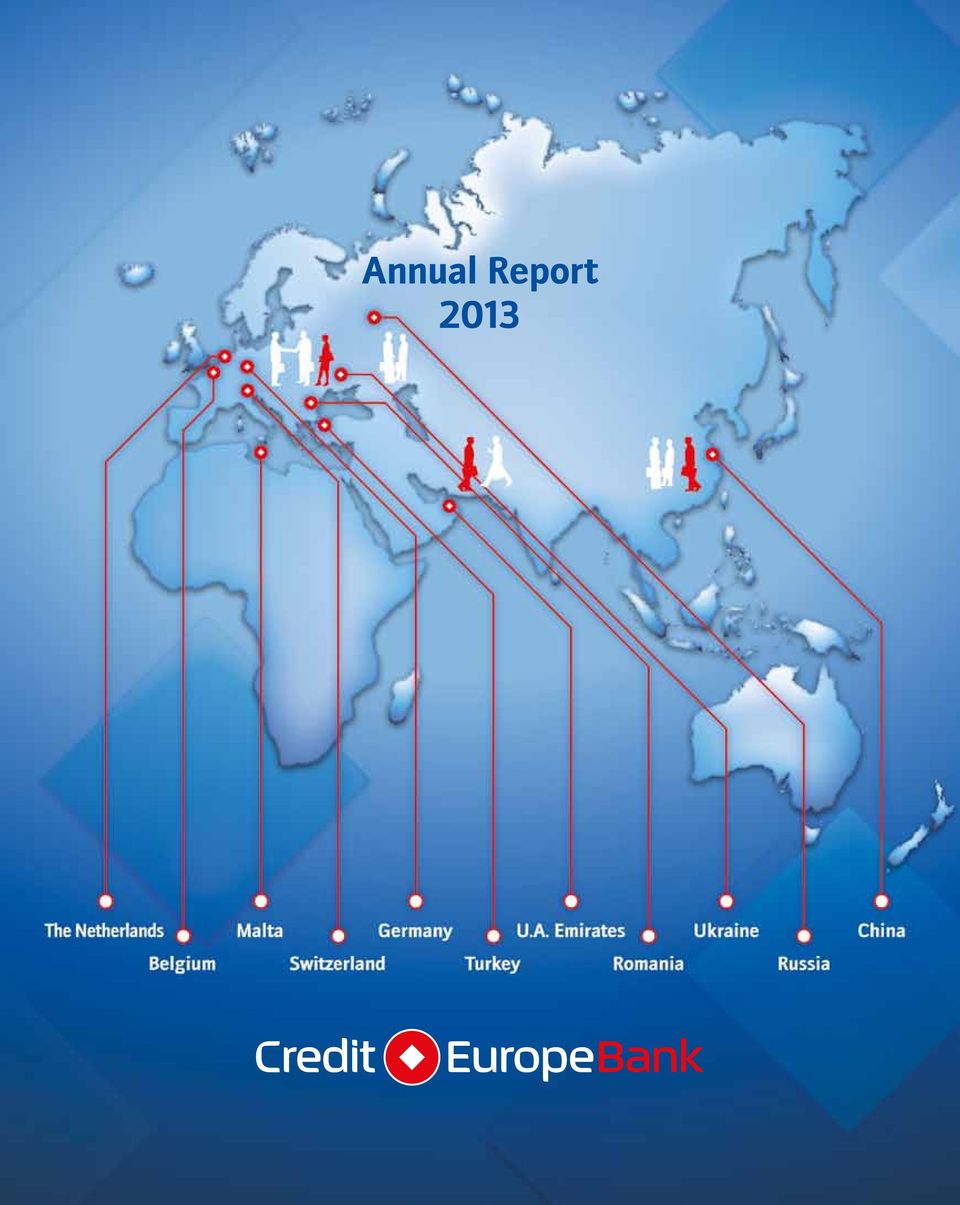
2 About Credit Europe Bank Credit Europe Bank N.V. is headquartered in the Netherlands and operates 184 branches, 957 ATMs, 21,870 sales points and more than 22,600 point of sale terminals. The bank has about 6,200 employees in 11 countries. More than 4.2 million customers around the world entrust their financial affairs to Credit Europe Bank. We offer to our corporate customers a wide range of banking products, including international trade and commodity finance, project finance and working capital loans. Represented in key trading hubs such as the Netherlands, Switzerland and the United Arab Emirates, as well as in raw material exporting and importing countries including, Russia, Turkey and Ukraine, we are well positioned to finance our customers transaction flows across the globe. We offer simple, transparent and competitive products to our clients. Accordingly, when developing a new product we ensure that it is easy to understand, easy to compare, easy to manage and should provide a fair deal and value for our customers. To our retail and SME customers we offer non-complex and transparent products in seven Western and Eastern European countries: Belgium, Germany, the Netherlands, Malta, Ukraine, Romania and Russia. Our mission is providing financial services that create value for customers. Our vision is being the preferred bank in our core markets.

3 Contents Strategy 3 Five-year key figures 4 Report of the Managing Board From the CEO 5 Our Network 6 Retail Banking 8 Corporate Banking 10 Funding 12 Human Resources 14 Corporate Social Responsibility 15 Risk Management and Control 16 Outlook 18 Profile of the Managing Board 20 Corporate Governance 24 Profile of the Supervisory Board 30 Report of the Supervisory Board 32 Consolidated Financial Statements Consolidated Statement of Financial Position 37 Consolidated Statement of Income 38 Consolidated Statement of Comprehensive Income 39 Consolidated Statement of Changes in Equity 40 Consolidated Statement of Cash Flows 41 Notes to Consolidated Financial Statements 42 Parent Company Financial Statements Statement of Financial Position 119 Statement of Income 120 Statement of Changes in Equity 121 Summary of Significant Accounting Policies 122 Notes to Financial Statements 123 Other Information 135 Independent Auditor s Report 136

4

5 Strategy Banking in its purest form is our business: easy-to-use loan and deposit products for retail customers and financing services that support our corporate clients in growing their businesses. Our strategy is to be close to our customers: we provide our services through a network of 184 branches, 957 ATMs, 21,870 sales points and more than 22,600 point of sale terminals in 11 countries and with a wealth of local knowledge. For more than two decades, we have focused on international trade and commodity finance. We have gained thorough experience and expertise to act as a bridge for our customers in key importing and exporting countries in Western Europe, the Black Sea region, the Gulf region, China and the Americas. We will continue to offer short-term, self-liquidating commodity financing, as well as balance sheet lending and project finance. In corporate banking, as a medium-sized bank with hands-on managers and short communication lines, we are fast to spot and react to our customers needs and to create innovative, tailor-made solutions. Our flexible approach supported our customers during turbulent times and positioned us to take advantage of improving market conditions. 3 Strategy In the Western European markets, we offer retail banking products via internet and telephone banking as well as through our broker and partner network. In addition to simple savings products, we continue to build up our retail loan business in Germany. Our services are facilitated by having a centralized, cross-border contact center applying high-quality information technology. In Russia and Romania, next to the above mentioned distribution channels, we also use our branch network to serve our retail customers and consolidate our retail position. In all areas of the bank, we invest in the professionalism, expertise and customer focus of our employees. In order to sustain our long-term growth ambitions, we combine prudent capital and liquidity management with sound risk management, high level of compliance and transparent corporate governance. We believe this strategy safeguards the interests of all our stakeholders.

6 Five-year key figures 4 4 Five-year key figures millions (*) Assets Cash and balances at central banks 501 1,238 1,771 1,235 1,596 Financial assets at fair value through profit or loss Financial investments 1, ,414 1,118 Loans and receivables banks Loans and receivables customers 6,653 5,954 6,556 5,854 5,219 Other assets Total assets 10,158 9,237 10,505 10,003 9,956 Liabilities Due to banks 1,632 1, ,114 1,317 Due to customers 6,002 5,932 7,520 7,185 7,223 Issued debt securities Other liabilities Subordinated liabilities Total liabilities 9,517 8,588 9,766 9,270 9,318 Total equity Total equity and liabilities 10,158 9,237 10,505 10,003 9,956 millions (*) Net interest income Net fee and commission income Operating income Credit loss charges (176) (140) (102) (105) (160) Net operating income Total operating expenses (301) (290) (269) (239) (238) Share of profit of associate Operating profit before tax Income tax expense (15) (27) (24) (25) (27) Profit for the year from continued operations Result for the year from discontinued operations - (1) Profit for the year (*) including effects of the spin-off of Fibabanka AS

7 Report of the Managing Board From the CEO In 2013, Credit Europe Bank N.V. again delivered a solid financial performance with growth of its revenues, evidencing strength of the underlying business model. We continued to focus on customer satisfaction, client acquisition, the increasing use of group-wide synergies, and the adherence to strict risk management principles. Particularly, our prudent credit policy and experience in the markets enhanced our ability to guard the quality of our asset portfolio during a period of market volatility. During the reporting year, the global economy has slowly moved into a less volatile phase. There are clearer indications that structural imbalances are subsiding, however the macroeconomic environment remains challenging. In 2013, we saw negative effects of the increase in the risk of default of certain European economies, the stresses on the financial system within the Eurozone and historical low interest rates. Also, we observed corporate customers being very conservative in their investment decisions. Despite the challenging environment, in 2013 both our corporate and retail lending activities showed a considerable growth. The corporate loan book grew more than 20% mainly led by our Amsterdam teams. Similarly, our trade finance teams in different countries performed well and increased the number of our trade finance customers. The overall retail loan portfolio increased by 5% mainly through the growth in Russia, where we were ranked the 16th bank in terms of retail loans. The major growth was derived from cash loans by crossselling to the existing customer base. The bank keeps its strong position in car loans, being the 6th biggest lender in the car loans market. In addition to existing brands, Honda also became one of the partners in our joint lending program. In line with our long lasting cooperation with Ikano Group, we have established a new joint venture bank in Russia with a paid up capital of RUR 300 million. This new entity, Ikano Bank LLC was registered in April This establishment will enable us to further develop our partnership with Ikano Group by providing services for targeted clients in Russia such as IKEA, Mega Malls and Marks&Spencer. In Romania, the plastic cards business continued to be the main driver of new retail business generation with our CardAvantaj, one of the most popular credit card brands in the country for the last 10 years with 17% market share. In Germany, processes have been further refined to improve customer focus and service. To further promote the product portfolio and to find new opportunities, we strengthened and enhanced some web-based intermediary partnerships and made investments in our strategic technology initiatives. During 2013, total customer deposits remained stable at EUR 6 billion with an increasing share of our customer deposits in Russia and Romania. In line with our strategy, we succeeded to increase the share of corporate deposits from 22% to 27%. On the wholesale funding side, we attracted new investors from international capital markets and the Russian domestic market by issuing senior and subordinated debt securities. In January 2013, Credit Europe Bank NV successfully issued a 10 year subordinated debt of US$ 400 million for the purpose of strengthening the capital base as well as the long term funding mix of the bank. As of 31 December 2013, our net profit reached a satisfactory level of EUR 94 million, while the solvency ratio stood at a solid 13.47%. Looking ahead, interest rate decisions in the near future will continue to impact the emerging markets. In major developed economies several new policy initiatives have reduced systemic risks and helped stabilize consumer, business and investor confidence; however these measures had a very limited impact on growth. Credit Europe Bank is not invulnerable to the macroeconomic forces, yet we mitigate the effects of this challenging and fast changing environment with our strong risk management and in-depth knowledge about our markets and products. The bank s solid footing and strong position in the markets provide a good foundation for the future. We are confident in our ability to continue our profitable growth in 2014 and beyond. To conclude, I would like to express our gratitude to our customers, business partners and employees all of whom worked together intensively last year to continue generating long-term value for all our stakeholders. Amsterdam, March 7, 2014 E. Murat Başbay 5 Report of the Managing Board

8 Our Network 6 Our Network Western Europe Corporate Banking and trade finance services from the Netherlands, Switzerland and Malta Private banking services from Switzerland Strong focus on direct banking services Retail Banking services to almost half a million customers in Germany, the Netherlands, Belgium and Malta, mainly through the multilingual contact center in Frankfurt Russia Active in Retail, Corporate, Commercial and SME Banking 114 branches in more than 50 cities covering seven time zones 14,200 sales points and 13,960 point of sale terminals Ranked 17th in retail loans, 5th in car loans, 6th in instant loans, 16th in credit cards 802 ATMs Romania Active in Retail and Commercial Banking 65 branches in 31 cities Dominant market player with more than 280,000 active credit cards and 17% market share Strong partner merchant network with 7,670 sales points and 8,685 point of sale terminals Ukraine Active in Corporate, Commercial and SME Banking Turkey Representative office in Istanbul Outside Europe Trade finance services from the Dubai International Financial Centre in the United Arab Emirates Representative office in Shanghai, China

9 Customer Focus The success of our customers is our own success. All of our decisions are therefore taken with the customer in focus.

10 Retail Banking 8 Retail Banking In 2013, Credit Europe Bank served over 4 million retail customers in Western and Eastern Europe by offering a broad range of competitive, transparent and non-complex products. Retail Banking offers deposits, cash loans, car loans and credit cards as well as a number of insurance products in cooperation with external insurance providers via online banking and an extensive broker and partner network. In Russia and Romania, in addition to telephone and web-based banking, we serve our customers through a wide-spread network of branches and points of sale. The implementation of a new product is always according to the bank s New Product Approval Policy. In 2013, uncertainty in the markets, regulatory changes and historically low interest rates in Western Europe remained challenging and put pressure on volumes and margins. Despite this difficult environment, we continued to grow our business and generate healthy revenues. Russia - strengthening the network Retail Banking in Russia focused on customer service process optimization, branch network efficiency and further development of our sales channels. We achieved a strong performance, through 114 branches in 53 cities and 14,200 (2012: 12,430) points of sale in retail outlets. We strengthened our positions in retail lending and became the 17th Russian bank in terms of retail loans, the fifth in terms of issued car loans, and the sixth in point of sale loans 1. Compared to the previous year, our retail deposit base in Russia grew by 7%. Within the car loans business, we further reinforced our partner network by adding HONDA to our existing 9 brands and participated in a government subsidy program on car loans. We also continued with lending services for travel and education. With respect to the credit cards, we launched new co-branded cards such as Pegas Touristik Shop & Travel Card and Card Credit Laplandia. In 2013, while increasing our number of ATMs to 802, we joined a domestic ATM network called ORS (United Payment System) and started a co-operation with the domestic Golden Crown Money Transfer in addition to the already existing liaison with Western Union. (1) Frank Research Group

11 Retail Banking Germany - at the service of our customers Our Western Europe retail operations are centralized in Frankfurt, Germany, where we have our multilingual customer contact center, sales & marketing and back offices, serving our customers in the Netherlands, Germany, Belgium and Malta. Our top priority is to assist our customers to meet more of their financial needs. In 2013, Retail Banking in Western Europe reaffirmed the commitment for client-centricity and undertook a new program to improve service levels and convenience. On the deposit side, new web-based product features have been initiated in order to provide customers with enhanced service quality and efficiency. The initiatives are also part of a package of measures to extend the high security level in the online banking environment. Overall, we kept our Western Europe retail deposit and retail loan portfolios stable during A special attention was paid to further diversify the banc assurance business. Our insurance penetration ratios have been better than the market average. We continued to focus on our strategic partnerships and gained important partners such as Barmenia, one of the major independent insurance groups in Germany. The collaboration with Fidelity Worldwide Investments proved to be efficient as well. Romania - 10 years CardAvantaj Even though in 2013 the economy has given the first signs of recovery, the Romanian business environment remained challenging. As in previous years Romania has been confronted with economic vulnerabilities such as external financing concerns and the contraction in lending activities. Under these circumstances, Retail Banking in Romania concentrated mainly on the credit card business, while keeping the other activities at reduced levels. The credit card CardAvantaj maintained its strong position in the Romanian market with its 17% market share was the year that CardAvantaj marked its 10 years anniversary in the local market. It also received an accolade from the business publication Business Arena, awarding the credit card with Best banking products CardAvantaj 10 years. During 2013, the network of merchants was supported by new partnerships with important local players such as Groupon, Christian Tour, Sabon, Pau, Mobil Pay, Stefanel, Rombiz and Baumax. The number of POS s further increased with a special focus to our presence in the health sector. As of December 2013, Credit Europe Bank had approximately 80,000 CardAvantaj PayPass cards issued, extending significantly also its network of corresponding POS. As for the Internet Banking, a new interface was designed and introduced in 2013 to make it easier for our clients to access information and execute banking transactions online. Retail Banking 9

12 Corporate Banking 10 Retail Banking Corporate Banking is one of the main business lines of Credit Europe Bank. The Bank offers a full range of corporate banking services and products to a large customer base spread in a large geography. Our strength lies in our local presence and expertise. With physical presence in six different geographies, we are well capable to monitor local markets, understand the needs of our customers and act promptly. Our local teams operate in close co-operation with each other in providing cross border solutions to our international clientele. We create added value for our customers through tailormade solutions to their needs in an increasingly competitive marketplace. Since its inception, Credit Europe Bank has been a niche player in structured trade and commodity finance. The bank has accumulated a valuable expertise in servicing the needs of large and medium sized international commodity traders, importers and exporters. Through our presence in key trading hubs such as Amsterdam, Geneva and Dubai as well as in raw material exporting and importing countries, we are perfectly positioned to handle our customers trade finance transactions across the globe. Our services are diversified across geographies and commodities from minerals, metals, energy and petrochemicals to soft commodities such as grains, paper and pulp. In addition to international trade finance, the Corporate Banking Division offers a whole range of corporate banking products in different countries. In line with the Corporate Banking strategy, our teams target industries with high growth potential. The project finance loans are mostly undertaken for the commercial real estate sector in different countries. In 2013, the bank continued its low risk appetite in marine finance and concentrated mostly in monitoring the existing portfolio. Prudence and Agility 2013 was a challenging year for the banking industry. Stagnant economies in the western markets were accompanied with the regional conflicts and political uncertainties in the emerging markets. Most of the emerging powerhouses experienced diminished growth rates. On top of the macroeconomic concerns, there were additional challenges for the banks. As a result of the quantitative easing, the margins continued to be under pressure; the excess liquidity and decreasing financing requirements resulted in lower yields. Meanwhile, the banking sector faced headwind through a rapidly changing regulatory environment and ever increasing compliance requirements. Given this challenging environment, prudence was the strategy for our Corporate Banking division. Balancing prudence with agility when required was the most important challenge for While maintaining our agility in providing financial solutions to our customers, we had to be more selective in accepting new transactions and to ask for additional collaterals when necessary. Despite the challenges, Corporate Banking managed to perform well in 2013 and grew both its asset size and revenues. As a result of our regional expertise and our large customer base, we successfully grew our loan book by 20% without jeopardizing the asset quality. During the year, our strategy was to focus on project finance and balance sheet lending to blue-chip companies within target markets and geographies. Also, our close relationships with market leaders of the tourism sector in Russia enabled us to be the first port of call when tourism flows between Russia and Turkey were concerned. Corporate Banking: main products and services PRODUCTS & SERVICES CEB NL CEB RU CEB RO CEB UAE CEB CH CEB UA Structured Trade and Commodity Finance Balance Sheet Lending and Syndicated Loans Current Accounts and FX Services Project Finance Factoring Marine Finance

13 Corporate Banking Loans to Corporate Customers ( million) Trade Finance Volume ( million) 3, , , , , , In red (upper part): Non-cash loans In blue (lower part): Cash-loans 3, , , , (*) 2011 and 2012 figures exclude Fibabanka TF volume In 2013, we increased the number of our structured trade and commodity finance customers. Accordingly, the 2013 trade finance volume was Euro 8.7 billion, being 17% higher than , , , , , Corporate Banking 11

14 Funding 12 Corporate Banking Credit Europe Bank has a stable, granular and geographically diversified deposit base which is the core funding source of the bank. We offer easy-to-use and transparent deposit products to our clients in all our branches and subsidiaries. The customer deposits size of the bank remained stable around Euro 6 billion during 2013, while the cost of deposits have further come down. The bank remained to be active in international and local capital markets throughout the year. In January 2013, Credit Europe Bank NV successfully issued 10 year term Basel III compliant, subordinated Tier II securities for US$ 400 million. Credit Europe Bank Ltd. tapped the Russian Ruble bond market during 2013 with three successful issues for a total amount of Ruble 15 billion: February 2013; RUB 5 billion for 3 years, with 1 year put option April 2013; RUB 5 billion for 3 years, with 2 years put option September 2013; RUB 5 billion for 3 years with 1 year put option Credit Europe Bank Ltd in Russia also obtained Euro 30 million medium-term financing from the Black Sea Trade and Development Bank in July 2013 to finance its residential mortgage loans. In December 2013, Credit Europe Bank Ltd and Credit Europe Bank (Suisse) concluded two international club loans for RUB 5.5 billion and around US$ 100 million, respectively. Credit ratings The bank and its Russian subsidiary have the following credit ratings as of end-2013: Credit Europe Bank NV, the Netherlands Moody s Global Local Currency Deposit Rating Ba2 / outlook negative Fitch Long Term Issuer Default Rating BB - / outlook stable Credit Europe Bank Ltd, Russia Moody s Global Local Currency Deposit Rating Ba3 / outlook negative Fitch Long Term Issuer Default Rating BB - / outlook stable

15 Professionalism Our professionalism embraces and stimulates the necessary skills, qualifications, knowledge and diversity. Our colleagues undertake their tasks in a competent and integer manner. Through teamwork we achieve our goals.

16 Human Resources Credit Europe Bank accustoms itself to generate the best value for its customers and is committed to the development and well-being of its employees. Our strategy is to recruit the best and brightest and to retain, develop and motivate them throughout their careers within our Bank. Our highly trained, long-tenured and motivated personnel remain our most important corporate asset. We recognize our leading capabilities and expertise which enable us to outdistance the competition and win in the marketplace. We strive to cultivate a high-performing workforce of innovative and engaged employees, responding rapidly to changing business conditions and customer needs, working in a supportive working community that values professionalism and best practices in the market. We offer our staff members, opportunities to grow professionally through training or new tasks within their own field of expertise. We support a continuous enrichment of our human assets by optimizing the capabilities of every employee, assign them where most appropriate and provide ongoing training where needed. The benefits of this development are twofold: the individual s job satisfaction increases while we better utilize our human resources. 14 Human Resources Next to it, we offer market conform employment benefits including appropriate insurances. We support our international oriented staff (and their family members) with all practical matters, tax issues and other (legal) obligations which are coming together with living abroad. Furthermore, Credit Europe Bank is focusing on areas such as performance management and talent development. We continued to organize (e-learning) trainings, team-building events and operational workshops to enhance competences. We have a wide variation of employees with different backgrounds. As an international bank serving customers in different geographies, we believe that in today's workplace, diversity is the key to new ways of thinking, reaching out to a wider range of customers and growing our business. We have clear objectives to maintain a positive climate of inclusion and engagement, and increase external recognition as a diverse organization. Guiding our employees originating from abroad in different fields is part of the services of our Human Resources department. Our total workforce is about 6,200 (end 2013). Workforce / gender Workforce / age group 4% 1% 31% 12% 36% (01) <25 male female (02) (03) % 47% (04) (05) >55

17 Corporate Social Responsibility Credit Europe Bank is committed to conducting its business in an ethical, socially responsible and environmentally sustainable manner. The Bank gives high importance to the impact of its activities on its stakeholders customers, investors, regulators and other authorities, and employees - as well as on society and the environment at large. The year 2013 was marked by high-level formalization of the bank s Social and Environmental Responsibility Policy and by taking the necessary actions to ensure adherence to the policy at all levels across the Bank, in order to establish genuine awareness. The policy is sponsored by the Managing Board and supplements other internal policies and procedures such as the Code of Conduct. Credit Europe Bank s Social and Environmental Responsibility Policy is based on four main principles: (i) Ethical business practices The Bank is diligent in ensuring compliance with applicable laws and regulations and using relevant local and international best practices. It conducts its business in an ethical manner, giving priority to observation of the basic ethical norms, i.e. the value of human life, the right to work, fair working conditions, civil responsibility, equal opportunities, occupational health and safety. (ii) Environmental commitment Credit Europe Bank avoids participating in activities that can potentially have a negative impact on the environment and the Bank s reputation. The Bank is conscious of its responsibility to conserve resources and continuously aims to use the resources required for its business practices more efficiently. (iii) Transparency and communication The Bank s social and environmental performance is regularly reported to the Managing Board through a system of established committees. The Bank s main activities in the field of social and environmental responsibility are also subject to disclosure in the annual report. (iv) Voluntary participation The Bank independently and voluntarily chooses its strategy in establishing a socially and environmentally responsible policy. This means that the policy is not the result of any regulatory requirement and that Credit Europe Bank is free to decide what concrete measures and activities are included in the policy. Corporate Social Responsibility 15 In the coming years, Credit Europe Bank aspires to further enhance its social and environmental responsibility activities, in order to establish a more robust sustainability framework within the Bank.

18 Risk Management and Control 16 Risk Management and Control Risk management and control is anchored strategically in the Banks organization, with active involvement at both the Managing Board and Supervisory Board level. A risk management and control framework has been implemented that fits the Bank s business activities and geographical organization. The Supervisory Board conducts oversight on the risk appetite and risk exposure of Credit Europe Bank s activities and portfolio. The Managing Board, and in particular the Chief Risk Officer (CRO) are responsible for implementing and monitoring the risk policies within the organization and are supported by the Risk Management Division and the Non-Financial Risk Management Division. The Bank distinguishes financial and non-financial risk management as follows: Financial risk management: credit risks, market risks, ALM and capital and liquidity management. Non-financial risk management: compliance risks, operational risks, IT security risks and information security risks. Each banking subsidiary has local risk management and compliance functions, which report both to local and Head Office management. Credit Europe Bank has adopted a three line of defense model for risk management and control. The business units form the first line of defense. The second line of defense consists of the risk management, compliance and control functions. The presence of the CRO within the Managing Board ensures that risk management-, complianceand control issues are addressed and discussed at the highest level of the organization. The third line of defense is the internal audit function, which assesses the functioning and effectiveness of business units, risk management and nonfinancial risk management activities. Credit Europe Bank s risk management and control framework enables the Managing Board to control the financial and non-financial risks of business activities. This framework is governed by a system of policies, procedures, committees, business lines, support and control functions. Limits and controls have been put in place to mitigate the financial and non-financial risks to an acceptable level within Credit Europe Bank s risk appetite. The risk appetite has been approved by the Supervisory Board and is designed to set Credit Europe Banks willingness to take risk and to set risk limits in order to protect the Bank s activities, not only in terms of profitability and maintaining sound capital adequacy and liquidity ratios, but also in terms of reputation and integrity risks. To maintain the quality of financial reports, the Bank has implemented internal financial reporting controls in order to increase the effectiveness of reporting. Paragraph 38 of the Notes to the Financial Statements elaborates in more detail on the risk management and control framework, the risks incurred and the main risk factors attached to the strategy of the Bank. Our corporate website also provides information on risk management and control. Key developments in 2013 In 2013, the following events required specific attention of the Managing Board: The Bank further strengthened its liquidity management activities by implementing a process for Internal Liquidity Adequacy Assessment (ILAAP) and related reporting standards. Late 2012, the Bank started to implement a tool streamlining the liquidity management process, which implementation continued in The Bank improved its systems and controls under the asset-liability management framework. Stronger capital composition at all levels plays a major role in CEB s Basel III migration plan and accordingly we anticipate a rising trend in CEB s our Core Tier 1 ratio ahead of the timeline announced by the Basel Committee. In line with the Bank s funding strategy, Credit Europe Bank has continued to diversify its funding mix by geography and product type. The Bank issued new debt instruments in 2013, both senior and sub-ordinated. In this respect the Bank elaborated on a recovery plan in The recovery plan of the Bank provides a menu of measures to address a range of severe financial stresses. The Bank s recovery plan can be readily implemented when necessary and is integrated within the Bank s risk management- and internal control framework. The Managing Board pays continuous attention to further improve the internal control environment in the Bank both in financial risk- and non-financial risk areas. The annual internal control framework evaluation performed at Bankand subsidiary level and follow-up of the improvement areas identified thereby contribute to a better standard of the internal control and risk management practices and facilitate benchmarking between Credit Europe Bank s entities. In compliance with the Dutch Banking Code, the Managing Board and Supervisory Board focused on the Bank s material risks and risk appetite. The updated risk appetite policy was further improved to better support the risk management activities of the Bank and to strengthen the monitoring of the products and services delivered to the clients. With the product approval process embedded in its practices, the Bank ensures that proposed new business activities are aligned with the Bank s risk appetite policy. During the lifecycle of a product, the results and developments are monitored against the risk appetite in force.

19 Risk Management and Control The safety and security of the online banking systems are becoming more and more important. Activities and necessary trainings in the area of cyber security were performed both at parent bank and banking subsidiaries to improve the current prevention and detection measures, and also to be aligned with the current regulations and industry best practices. Ongoing services availability and continuous operation in the event of a disaster is a priority for the Bank. In this respect, the Bank performed a comprehensive operational business continuity test with relocation of the staff to the alternate site, covering disaster recovery capabilities and resumption of the vital business processes. The test was successful and proved the business continuity and disaster recovery planning of the Bank. Areas of improvement for 2014 The Bank continues to focus on the operational efficiency of its business activities by using its core IT system. Further improvements of risk assessments and control activities to be undertaken by business units, will be implemented in The results of these assessments will be used for further strengthening of the internal control framework and the Bank s risk and control measures. Furthermore, the Bank continues to make all necessary preparations to become compliant with the due diligence rules for new accounts under FATCA which will become effective in These preparations require adjustments to the Bank s core IT system and related procedures. These initiatives will, however, enable us to meet increasing client expectations and to process transactions more efficiently and effectively. Responsibility Statement Credit Europe Bank s internal control framework is based on the framework developed by COSO (Committee of Sponsoring Organizations of the Treadway Commission). Our risk management and control framework is compliant with the basic requirements II.1.4 and II.1.5 of the Dutch Corporate Governance Code. Internal controls ensure that transactions are recorded as necessary for reporting in accordance with International Financial Reporting Standards as adapted by the European Union. The Managing Board has concluded that the risk management and control framework is adequate and effective and provides reasonable assurance that the financial reporting is free of material misstatement. Pursuant to article 5:25c section 2 part c of the Financial Supervision Act, the members of the Managing Board state that, to the best of their knowledge: the financial statements give a true and fair view of the assets, liabilities, financial position and profit or loss of Credit Europe Bank and the companies included in the consolidation; the annual report gives a true and fair view of the state of affairs on the balance sheet date and the course of affairs during the financial year 2013 of Credit Europe Bank and its affiliated entities whose information is included in its financial statements; the annual report describes the material risks which Credit Europe Bank faces. Risk Management and Control 17

20 Outlook Outlook Looking into 2014, there is a broad-based gradual acceleration in global growth in developed markets. Among the developed markets particularly US economy is on a path to better economic outlook with 2.2%-2.5% growth expectations in Improving labor data, stronger consumer confidence, and investment build-up are signaling positive trend for the coming year. FED remains on path to policy normalization leaving investors only with the question of timing. FED tapering started in December 2013 and investors are currently pricing the beginning of rate hikes in around mid In the Euro area, after six quarters of contraction, economies are turning the corner slowly with some positive growth figures. It seems that the inflation outlook will be staying below ECB target during 2014 with continued fear of downside risks. In 2014, ECB will stay dovish where policy options include further rate cuts, longer term financing operations, asset purchases, and stronger forward rate guidance. However, strong US macro-economic environment and rising interest rates can drag the Euro rates to the upside. In the periphery economies, the main concerns are the prolonged low growth & possible deflationary environment which can create unsustainable debt levels for the future. As a linked subject, Asset Quality Review stress tests are going to be crucial in understanding the knock-on impact of the sovereign related problems on the banking industry. The results will be critical to see the recapitalization requirements of EU banks as well as their liquidity needs. Dutch economy is expected to grow again in 2014 around 1%, first annual increase since 2011 but still lagging the euro area aggregate. Stabilization in the housing market and the correction on inflation rates from 3% to 1.5% are positive factors to motivate consumer confidence. On the other hand, ongoing fiscal consolidation, rising unemployment and longstanding key labor and pension market reforms are downside risks which could hinder the economic recovery in In Asia, Japan was the only exceptional market where rates did not increase during the second half of 2013 due to central bank s efforts for stepped up purchase operations. Bank of Japan is most likely to use a similar strategy for 2014 and expand the monetary base to support inflation expectations. Chinese authorities came up with a comprehensive reform plan for the next 5-10 years on various aspects of both political and economic strategies. The priority reform areas have been financial, fiscal, land and resource pricing which will be dealing with overcapacity and imbalances. Going forward, policy actions and implementations will be the main driver of putting economy back to a more sustainable growth path in 2014 and beyond. Chinese inflation seems to continue at manageable levels around 2.7% which will be moving towards the official target of 3.5% for next year. Emerging markets are expected to have a difficult year with slowing growth and increasing financing needs. After a challenging summer, Turkish economy proved more resilient with higher capacity utilization rates and improving sentiment towards the year end is going to be the elections year for both municipality and presidential elections which will be a challenge for the fiscal and monetary policy. Annual inflation figure is expected around 7.3% levels which will continue on a downward trend due to favorable base effect. The headline inflation is expected to converge to 7%-7.5% levels in Turkish economy is still among the most vulnerable with high current account deficit, corporates FX open positions and pressure on the currency. Russian economy is slowing down with weaker consumer credit growth and real income growth. Slowing inflation figures and moderate growth performance provides enough room for monetary policy easing. Meanwhile Russian current account surplus is deteriorating with rising deficit in services and investment income which is expected to continue in medium term. When the monetary easing is coupled with the narrowing current account surplus and rising net capital outflows with FED tapering expectations, there is an increasing depreciation pressure on RUB in After years of austerity measures Romania is trying to balance out its fiscal measures and an upgrade from the credit rating agencies is probable for Cooperating with the EU/IMF/ WB with new agreements, Romania aims exiting from external support. An expected current deficit at the end of 2013 year and mild surpluses in both 2014 and 2015 are broadly in line with the external creditors objectives. Political tensions are on the rise due to presidential elections in late On the growth side, a deceleration to 2.3% is expected in 2014 from 2.6% in 2013 at year end with some upside risks due to election linked increased public spending. Market expects further monetary easing with two more 25bps cuts in the first quarter and an inflation to be 1%-2% in first the half but higher in the second half of 2014 with lower yielding agricultural output. In Ukraine, the street protests demanding closer European integration that started in November 2013 turned violent and continued for several months severely affecting the already

21 Outlook 2014 fragile economy. The political crisis in Ukraine reached a crucial juncture. President Yanukovich was impeached and he fled the capital in late February. Early elections are due to take place in May 2014 and a national unity government will be formed under a new prime minister. While Yanukovich's departure and the agreement to hold new elections may ease unrest in the short term; continuing internal divisions and Ukraine's geostrategic significance for Russia, the EU and the US mean that the country's political and economic trajectory remains highly fraught. With the political endgame in Ukraine in sight, the focus now shifts on Ukraine s weak economic position. Ukraine s key vulnerabilities in the economic sphere include a high external deficit and low reserves as well as a challenging repayment schedule. Globally the main expectations seem to be concentrated on higher interest rates and stronger economic outlook in developed markets in US markets will be the key driver of both expectations as long as the economic data keeps supporting the economic trend. Moreover, Emerging Markets will be more in their adjustment cycle due to strong movements of capital and changing global macro scene. Overall investors are getting gradually prepared for a new economic cycle in 2014 with their eyes on US markets. Outlook 19
22 Profile of the Managing Board 20 Profile of the Managing Board From left to right: Umut Bayoğlu (CFO), Scott Cheung (CRO), Enver Murat Bașbay (CEO), Ine Bastiaens (Corporate Secretary), Șenol Aloğlu (Deputy CEO), Levent Karaca (member)
23 Profile of the Managing Board Profile of the Managing Board as per February 2014 E. Murat Başbay (1968) Chief Executive Officer Enver Murat Başbay holds a BSc degree in business administration from Bosphorus University, Istanbul. He began his career in 1992 as an auditor at Arthur Andersen and worked in the Istanbul and Dubai offices. In 1997 he was a member of the founding team of Credit Europe Bank in Russia. In 1999 he joined the management team of Credit Europe Bank in the Netherlands and he played an active role in the expansion of the bank as CFO and member of the Managing Board. Mr. Başbay returned to Russia in 2005 as CEO for a five year period. Since June 2010, Mr. Başbay has been CEO of Credit Europe Bank, currently responsible for treasury, corporate credits and corporate governance. Şenol Aloğlu (1965) Deputy Chief Executive Officer A graduate of Bosphorus University, Istanbul, in business administration, Şenol Aloğlu started his banking career at Interbank in 1987, joining the Fiba Group in He held various positions at Finansbank AS and Finans Leasing AS in Istanbul. In November 2000, he was appointed Executive Vice President for Financial Institutions and also Country Manager for the Netherlands. In November 2005, he was appointed Managing Board member at Credit Europe Bank. Mr. Aloğlu is responsible for retail banking, bank relations, financial institutions credits, information technology, operations and public relations. Umut Bayoğlu (1973) Chief Financial Officer Holds a BSc in economics from METU in Ankara. He began his career in 1996 as a management trainee with Finansbank AS. In 2001 he was appointed Head of Financial Control in Germany. In 2006 he became CFO of Credit Europe Bank and in 2008 he joined the Managing Board. He is responsible for financial control, human resources, accounting and central bank reporting. Scott Cheung (1975) Chief Risk Officer Holds a postgraduate Register-accountant qualification from the University of Amsterdam. He worked for six years at Ernst & Young Accountants in Amsterdam and Hong Kong, before joining Credit Europe Bank in 2002 as Head of the Internal Audit Department. In 2006, he was appointed Head of Group Audit, responsible for coordinating the group s Internal Audit activities. Mr. Cheung has been a member of the Managing Board since December 1, He is responsible for financial and non-financial risk management, internal audit and compliance. Levent Karaca (1970) Member Holds an MBA degree in Finance and Economics from Marmara University in Istanbul. He began his career in Istanbul with Finansbank AS, worked for Banque de Bosphore in Paris, France and joined Credit Europe Bank in He worked at the Belgian branch of the bank, and was responsible for setting up the corporate and retail divisions of this branch before moving to Russia in 2006, where he was head of the Corporate Banking division and a member of the management team. He returned to Amsterdam in 2010 to become Division Director Corporate Banking responsible for the corporate banking activities of the bank on a consolidated level. Mr. Karaca was appointed to the Managing Board of the bank per2012. As a Board Member he is chiefly responsible for corporate banking and legal affairs. Profile of the Managing Board 21
24
25 Integrity Integrity defines our obligation to generate trust and confidence through ethical behavior and by complying with laws, regulations and guidelines.
26 Corporate Governance 24 Corporate Governance A. General Credit Europe Bank N.V. (CEB) is a public limited company (naamloze vennootschap) established in Amsterdam on February 24, The company has registered shares and is not listed on any stock exchange. Share capital The total issued and fully paid-up share capital of the bank at end-2013 amounted to million (the same as at end-2012). The shares of CEB are fully owned by Credit Europe Group N.V. (CEG), a holding company established in the Netherlands. CEB makes up around 99% of CEG s assets. CEG s shares are ultimately owned, through the investment company FIBA Holding AS in Turkey, by Mr. Hüsnü M. Özyeğin. Regulatory framework CEB has had a full banking license in the Netherlands since The Dutch Central Bank (De Nederlandsche Bank or DNB) is the consolidated prudential supervisor: its supervision extends to CEB s banking activities in the Netherlands as well as to the banking activities of its subsidiaries. In addition, the bank is registered as financial services provider with the Netherlands Authority for the Financial Markets (Autoriteit Financiële Markten or AFM). Although CEB is not listed, it voluntarily supports and applies, to a large extent, the best practices of the Dutch Corporate Governance Code, mindful of its role as a financial institution in the Netherlands. This is also in line with Dutch Central Bank recommendations to apply the best practices of the Dutch Corporate Governance Code. For more information on the bank s application of the principles and best practices of the Dutch Corporate Governance Code, see page 30. Not only is the Dutch Central Bank the supervisor of CEB, it is also our regulator. The provisions in the Regulations and Policy Rules issued by DNB apply to CEB to the fullest extent. Furthermore, the international standards and guidelines from European- and other relevant authorities are used by CEB as tool to substantiate its due compliance to these regulations. In addition, CEB is subject to the provisions of the Banking Code (Code Banken) insofar its principles are not overruled in the meantime by legislation or other DNB rules. The sectorwide principles in the Banking Code were announced by the Dutch Bankers Association (Nederlandse Vereniging van Banken) with effect from January 1, For more information on our application of the principles of the Banking Code, please see a summary report in page 30, section D and a full report on The statutory corporate rules in the Netherlands are laid down in the bank's articles of association (statuten). The Managing Board, Supervisory Board and each subcommittee have their own charters (reglementen). The charters of the Managing Board, the Supervisory Board and its subcommittees are published on our corporate website. For employees and others working with CEB, a Code of Conduct has been established to set standards for professional conduct. Furthermore, an extensive set of internal governancerelated policies and procedures apply to our employees, ranging from whistleblower procedures to policies relating to expenses. Credit Europe Bank N.V. as a parent bank Per the end of 2013 CEB directly owns five banking subsidiaries in Russia, Switzerland, Romania, Ukraine and the United Arab Emirates, and three leasing companies in Russia, Romania and Ukraine. To underpin the central position of the head office in Amsterdam, the Netherlands, the bank applies a functional reporting structure: local managers in the subsidiaries maintain a direct reporting line to the functional head of the respective department in Amsterdam. This structure applies to departments such as Internal Audit, Compliance, Treasury (asset-liability management), Credits, Risk Management, IT, Financial Control and Corporate Banking. Moreover, the general managers of all subsidiaries report directly to the CEO of CEB. During 2013, the general managers of the bank s subsidiaries and the members of the Managing Board met on a regular basis. The main purpose of these meetings is to share knowledge and experience, to align group policies, and to consider the bank s strategy and budgets. Finally, in order to ensure that CEB s business policies are applied consistently and for CEB to exercise control over its subsidiaries, the CEO of CEB and one other Managing Board member sit on the Supervisory Board or Board of Directors of subsidiaries of CEB. In such local boards, CEB is now in the process of appointing one or two independent CEB Supervisory Board members. B. Boards CEB has a two-tier board structure, with a Managing Board and a Supervisory Board. Managing Board Composition The Managing Board consists of 5 board members. Their individual resumes can be found on page 25.
27 Corporate Governance Tasks The Managing Board is responsible for the management of CEB, which includes realizing the bank s goals and strategy, setting policies and achieving results. The Managing Board is also responsible for compliance with all relevant laws and regulations, management of the risks attached to our banking activities and the bank s funding. Without affecting this collective and joint responsibility, the members of the Managing Board have agreed to allocate their tasks as follows: Murat Başbay, CEO Treasury, corporate credit and corporate governance Şenol Aloğlu, Deputy CEO Retail banking, bank relations, financial institutions credits, operations, information technology, public relations Umut Bayoğlu, CFO Financial control, human resources, accounting, central bank reporting Scott Cheung, CRO Financial and non-financial risk management, internal audit, compliance Levent Karaca, member Corporate banking and legal Supervisory Board For a full description of the Supervisory Board: its composition, tasks, subcommittees and 2013 report, see page 37. C. Dutch Corporate Governance Code This section contains a brief overview of CEB s compliance with the best practice rules of the Dutch Corporate Governance Code (in this section known as the Code). It should be noted that due to our private ownership structure, the Code s provisions on shareholders (rights, meetings, obligations, protective measures see Chapter IV of the Code) are not applicable to CEB. Based on a gap analysis of the provisions in the Code and CEB s current practice and structure, the CEB s main deviations from the relevant best practices of the Code are: Transparency on remuneration of Managing Board and Supervisory Board (best practice provisions II.2 and III.7) At present, information is given on the remuneration of the Managing and Supervisory Boards collectively per board, split into fixed and variable remuneration. No information is given at an individual level. This also applies to (individual) pension rights, peer group information and performance assessment criteria. It is the view of the Managing Board that the aggregate quantitative and qualitative information provided in the Remuneration Report in paragraph F below is sufficiently transparent for stakeholders. Information in paragraph F below is in line with the disclosure requirements set out by DNB. Independence of Supervisory Board members (best practice provision III.2) Under best practice provision III.2, the requirement is set for Supervisory Board members that all members but one are independent. Since January 1, 2013, the following statement applies to the Supervisory Board of CEB: that half of the members are independent. This ratio is in line with DNB s requirements in that respect. Diversity On 1 January 2013 the Dutch One-tier Board Act came into effect. This act states that the Management Board and Supervisory Board should have a balanced gender distribution, which means that at least 30% should be male and at least 30% should be female. This also applies to Credit Europe Bank and its major consolidated subsidiaries. Credit Europe Bank did not yet comply with this regulation in 2013, as this regulation is relatively new and no new members have been appointed to the Managing Board or Supervisory Board since August 2012, Credit Europe is investigating future compliance with these requirements. D. Banking Code This section summarizes how CEB applies the principles of the Banking Code and where we deviate from these. A full report on our implementation of the Banking Code can be found on our website, Since the Dutch Bankers Association published the Banking Code in September 2009, the Managing Board has taken all necessary steps to apply the Code s guidelines and principles to CEB at a consolidated level. An initial analysis, evaluating the structure, services and products offered by CEB, revealed that the bank was to a large extent already in compliance with the principles. On the basis of a road map with a concrete plan of action, the Managing Board took steps to improve or fully comply with the requirements of the Banking Code. All actions and measures were discussed and approved at Supervisory Board level. As of February 2014, CEB is in full compliance with the principles of the Banking Code. Please find below a summary of our application of the Banking Code principles. The overview follows the sequence of the chapters in the Banking Code. A full report can be found at 1. Supervisory Board Since the beginning of January 2013, CEB s Supervisory Board has consisted of six members. Taking into account the bank s size and nature, but also the composition of the Supervisory Board, Corporate Governance 25
28 Corporate Governance 26 Corporate Governance such a number is deemed sufficient in itself. The number of independent members and dependent members is equal at 3. All the members of the Supervisory Board have a financial or legal background and the majority of them are still active in the financial and/or legal services business on a day-to-day basis. As of February 2014, two members of the Supervisory Board, Mr. Murat Ozyegin and Mr. Mehmet Gulesci were re-appointed for another 4 year term. It is common practice within CEB that every Supervisory Board member is physically present at each board and subcommittee meeting. In terms of compensation, each Supervisory Board member receives a suitable amount of compensation (fixed; no variable pay). Suitable takes into account the total number of hours spent on the tasks. For the board training a yearly agenda is set. In 2013 for example we had trainings by external parties on talent management, cybercrime, and an IFRS update. For 2014 already new trainings on different topics are being organized. To date, the Supervisory Board has performed a self-evaluation annually and has done external board evaluations in June 2011 and in November The self-evaluation and the external evaluations focus on topics like the cooperation amongst board members, the internal and external functioning of the Board and the cooperation with the Managing Board. CEB has an Audit & Risk Committee, which is a subcommittee of the Supervisory Board. Risk was explicitly added to Audit and a substantial amount of time and attention is dedicated to risk management subjects during Audit & Risk Committee meetings. The Audit & Risk Committee meets at least four times a year and standing topics in the meeting are reviewing consolidated risk management updates, the internal audit plan, internal audit status reports, the external audit plan, the external audit reports and the most recent financials. 2. Managing Board Since January 1, 2012, the Managing Board of CEB has had five members. All members have gained thorough expertise and knowledge of banking, of our company, and of the locations in the various countries where the bank is active. It is the Managing Board s task to set the business policy and strategy of CEB. On an annual basis, mostly while discussing the consolidated budget, the bank s business policy is discussed with and validated by the Supervisory Board. This policy also takes into account external developments such as movements in the markets where the bank is active, global financial developments, the general financial situation of the bank, its clients interests and other stakeholders positions. The members of the Managing Board, together with other senior executives such as the division directors of Risk Management and Treasury, meet on a weekly basis in the Asset & Liability Committee, where the bank s liquidity position is discussed and related policies are reviewed. Additionally, meetings of the IT Steering Committee take place monthly and are attended by members of the Managing Board and representatives of the IT department. Furthermore, on a weekly basis there are HR working committee meetings to which at least one member of the Managing Board and representatives of the HR department attend. The moral declaration on ethical conduct, signed by every Managing Board member, is published on our corporate website. Not only have the members of the Managing Board signed this declaration, but the Board has also asked all employees working in the Amsterdam head office and its branches to sign such a statement. The signed declaration is part of an employee s personal file with the HR department. All new hires are asked to sign a moral declaration once they join the bank. In CEB subsidiaries, a similar exercise was performed to have senior staff and employees sign a moral declaration. By virtue of a new DNB regulation, the CEB Supervisory Board members and Managing Board members gave their oath in June 2013 in the Dutch Consulate in Istanbul, in the presence of the Dutch consul. 3. Risk Management Risk management is at the heart of our organization, and supported at both the Managing Board and Supervisory Board level. In addition to the Risk Management and control statement, as presented in the Report of the Managing Board page7 more detailed information is presented in paragraph 38 of the Consolidated Financial Statements. 4. Putting the customer first From the start of entering into the Dutch banking sector, CEB felt obliged to make the interests of its retail clients a priority in its service provision. From the outset, it has been our goal to offer a small range of easy-to-use, easy-to-understand and simple online retail products. On the savings side, CEB offers a daily savings account and some time deposits with terms ranging from six months to 10 years. The bank principally
29 Corporate Governance avoids complicated interest structures, in which it is difficult for clients to trace or receive bonus interest or similar benefits. On the retail loans side, we offer installment loans and revolving loans. In Western Europe, CEB does not offer securities products, complicated derivatives, other investment instruments or mortgage loans for retail clients. CEB attaches great importance to accurate, comprehensible, clear marketing and client communication by post, and telephone but also on our websites, where up-to-date information on products, interest rates, contact details and background is always available to clients. Having no bricks and mortar service offices in the Netherlands, Belgium or Germany but a multilingual centralized service center, we can invest the money we save on rent and advertising costs in training our employees to deliver high-quality, accurate and flexible services. CEB seeks to consider the client s needs in all stages of the development of new products and services, from conceptualization through to market launch. In future, new products and services will also have to comply with CEB s Principles of a Modern Savings Policy, drafted with a view to the guidelines in the Banking Code and as required by the AFM. This policy is currently being discussed for approval within the bank. The Managing Board and its executives responsible for the retail business are fully aware that client focus is more than high-quality and flexible service levels; more than simply evaluating the number of client complaints received each year. Client focus is also anticipating and assessing a client s needs and interests. For example, for our seven-year and 10-year time deposits, we offer the option of a monthly payout of accrued interest. For clients who deposit their money with us for such a considerable length of time, it was deemed fair to offer a monthly payment of accrued interest. On the retail loans side, we have monitoring tools to be able to screen a client s creditworthiness and to give early warnings to the client care department and clients themselves if there are discrepancies in the payment/repayment rhythm. The tool also helps us grant the kind of loan best suited to a client s need, rather than suited to enhancing the bank s profit. For example, if a client wants a loan to buy a car, our client support must and will advise a personal loan instead of a revolving loan, even though the latter would benefit CEB s earnings more. 5. Audits The Internal Audit Department (IAD) within CEB plays an important role in ensuring ever better governance. It represents an independent and objective assurance and consulting function as a third line of defense. Through the application of a risk-based methodology, IAD evaluates and examines whether proper measures are taken to ensure control in the organization and its activities. The Group Internal Auditor has a direct reporting line to the CRO and the Chairman of the Audit & Risk Committee. 6. Remuneration For a summary of the remuneration policy in CEB, please revert to paragraph F below. E. Handling potential conflicts of interests Credit Europe Bank has affected a group of procedures suitable for managing potential conflicts of interests. Such arrangements have to be complied with for professional integrity - and transparency reasons. The generic arrangements aim at setting criteria and controls that identify and govern potential conflicts of interest arising from normal personal banking transactions by employees, senior management or members of the Managing and Supervisory Board. In 2013 no direct, indirect or formal conflicts of interest were identified. A special category of potentially conflicting situations forms the Bank entering into a transaction with a related party. Parties related to Credit Europe Bank include all Fiba Group associated companies, any member of the Managing- or Supervisory Board as well as their close family members and any entities controlled by them. Related party transactions are settled in the normal course of business and on an arm s length basis, i.e. under the same commercial and market terms that apply to non-related parties. The kind of transactions that fall under related party transactions are various: loans, deposits or foreign exchange transactions. The Bank has specific arrangements in place to ensure a proper management of potential conflicts of interests in related party transactions. These arrangements include procedures to identify, authorize and report related party transactions to the Managing Board and the Compliance Oversight Committee. In every Compliance Oversight Committee meeting, an overview Corporate Governance 27
30 Corporate Governance 28 Corporate Governance with (approved) related party transactions is presented to review whether the Bank acted in conformity with its established procedures and with the required approval process. On an annual basis, the bank s Internal Audit department carries out audit procedures to provide reasonable assurance that the Bank s policies and procedures for related party transactions are properly and effectively executed. See also note 36 of the financial statements for the disclosure on related parties. F. Remuneration Report (i) Decision- making process to determine the remuneration By virtue of CEB s Group Remuneration Policy (described in more detail below), the key elements of the governance structure for the fixing, execution and evaluation of the remuneration management are as follows: CEB s Supervisory Board is responsible for the establishment, execution and evaluation of the Group Remuneration Policy and the Supervisory Board monitors the proper implementation of this by the Managing Board. The HR & Remuneration Committee (a subcommittee of the Supervisory Board described in more detail below) prepares the decision-making process for the Supervisory Board, taking into account the long-term interests of all stakeholders of CEB. Remuneration of Key Executives (defined in the Group Remuneration Policy; in the Dutch Central Bank s Regulation on Sound Remuneration Policy these persons are referred to as identified staff ) is determined by the Supervisory Board. The remuneration of the other employees is determined and implemented by the Managing Board and supervised by the HR & Remuneration Committee. For senior managers in control functions, remuneration is directly supervised by the HR & Remuneration Committee. As a general principle, CEB s Group Remuneration Policy authorizes the Supervisory Board to adjust the variable remuneration of (a group of) Employees as defined in such Policy, if continuation on the same level would have an unfair and unintended effect. Moreover, the Supervisory Board has the right to reclaim the variable component of remuneration granted to Employees, if it turns out that such a variable was based on inaccurate data. Such reclaim is allowed until two years after the award of the variable pay. (ii) Link between performance and pay One of the key elements of CEB s Group Remuneration Policy is the description of the appraisal process. On the basis of predetermined and assessable objectives, comprising financial and non-financial elements, and also on the basis of competences and general indicators, an Employee s overall performance assessment is determined, at least once per year. The nonfinancial objectives form a substantial portion of the total set of objectives for an employee. Objective-setting Each year, the Managing Board formulates its own objectives (financial and non-financial) and presents them for approval to the Supervisory Board. The approved objectives are then assigned (partially) to the relevant Key Executives and Employees. Pursuant to the Group Remuneration Policy, financial objective-setting for Employees in control functions may not be based on the commercial objectives of CEB, i.e. the objectives of these Employees must be set independent from the financial targets and/or results of the business they control. Performance assessment Financial performance of an employee is assessed in the context of CEB s financial stability and own-funds requirements as well as the long-term interests of the shareholders and other stakeholders. Financial performance shall be evaluated on the basis of (a) divisional/ departmental profitability, calculated on financial criteria such as Net Income and (b) the department s attribution/claim to the risk profile of CEB. Via a web-based performance management system, an overall performance score is generated. The three performance categories are competences, general indicators and objectives. For the overall score, the following weighted percentages apply per category: competences 30%, general indicators 20% and objectives 50%. The end score is a figure between 1 and 5 whereby 5 is excellent. Performance evaluation of a Key Executive takes into account performance over several years and appraisals for Employees in control functions take into account the countervailing function of these staff members. (iii) Most important characteristics of remuneration system Apart from the governance structure and appraisal process, the CEB Group Remuneration Policy also incorporates rules and guidelines for the setting and determination of fixed and variable remuneration for Employees. As a rule in CEB, fixed salary levels are conservatively (i.e. on the low end) aligned in comparison to similar functions in banking and the industry, nationally and internationally.
31 Corporate Governance One of the basic principles for granting variable pay (if any at all) is that variable pay may never exceed 100% of the fixed salary, and that guaranteed variable remuneration to Key Executives or other senior managers is not allowed. Phantom Share plan In 2012 CEB introduced a Phantom Share Plan. In brief, such a plan lays down the terms and conditions for the granting of Phantom Shares to Key Executives. The Plan entails that variable remuneration awarded to a Key Executive will be for 60% unconditional and for 40% deferred. At least 50% of the variable remuneration (deferred or unconditional) is in the form of financial instruments whose value is determined by/ derived from the value of CEB shares: Phantom Shares. These financial instruments are rights not shares. The deferred part of the variable remuneration vests over a period of 3 years. Furthermore, vested Phantom Shares (whether deferred or unconditional) are subject to a retention period of 1 year. Vesting and exercise of the Phantom Shares is subject to the fulfillment of certain conditions. For example, the holder s performance score (see paragraph (ii) above) must exceed a certain limit. (iv) Most important parameters & motivation for variable remuneration Pursuant to the Group Remuneration Policy, the granting of variable remuneration at all depends on CEB s performance in a year. By virtue of the rules, if CEB s ROAE in any given year is less than 2% or negative, there will be no variable remuneration. Additionally, the requirement applies that the granting of variable remuneration may not restrict CEB s possibilities to reinforce its regulatory capital, its solvency ratio or its own funds. CEB has no other non-cash benefits/non-cash variable remuneration elements. (v) Aggregate quantitative information on remuneration per business segment Over 2013, CEB paid out EUR 62,440,322 to employees working in the Wholesale Banking business segment and EUR 92,294,830 to employees in the Retail Banking segment (fixed gross salaries). (vi) Aggregate quantitative information on remuneration for Key Executives and senior managers CEB has identified 45 Key Executive (or identified staff as referred to in the Dutch central bank Remuneration Regulation on Sound Remuneration Policy) and 112 senior managers. In 2013, the total amount of remuneration paid out to these Key Executives and senior managers amounted to EUR , split into EUR for Key Executives and EUR for senior managers. Such total remuneration was split into EUR fixed salary (for Key Executives EUR and senior managers EUR ) and EUR variable remuneration (for Key Executives EUR and senior managers EUR ). Please note that the variable remuneration for Key Executives was split in a deferred and unconditional part (resp. 40% and 60%) and awarded in cash or Phantom Shares (50/50). A retention period of 1 year applies to the vested Phantom Shares. The total amount of awarded + outstanding deferred remuneration (vested and unvested) in 2013 (for the Phantom Shares granted as per 2012) amounts to EUR As part of the CEB s Group Remuneration Policy, variable remuneration packages of all employees are granted based on the (financial and non-financial) performance over the respective reporting year and paid out in the form of cash and/ or Phantom Share (both unconditional and conditional) in the preceding years. The Phantom Share Plan was implemented in 2012 and the first deferred remuneration was paid out in May 2013 and the follow up second (and from the second deferred part: the first) deferred payment over the 2013 performance will be paid out in April By virtue of the rules in the Group Remuneration Policy, in 2014 there will be no less than awarded deferred pay-out due to unsatisfactory performance adjustment. (vii) New severance payment In the reporting year 2013, CEB on a consolidated basis paid severance payments to a total of 89 employees of which 5 are Key Executives. For none of them did the severance payment exceed one year's fixed salary a requirement explicitly included in CEB's Group Remuneration Policy. In total, CEB paid EUR in severance in The highest amount granted was EUR CEB did not pay sign-on or entry awards to a Key Executive in Corporate Governance
32 Profile of the Supervisory Board Profile of the Supervisory Board 30 From left to right: Onur Umut, Korkmaz Ilkorur, Hector de Beaufort (chairman), Mehmet Güleșci, Murat Özyeğin and Frits Deiters.
33 Profile of the Supervisory Board Profile of the Supervisory Board as per February 2014 Hector de Beaufort (1956) Chairman Holds a Master s degree in Law from Utrecht University, the Netherlands and from the University of Pennsylvania. He has been senior corporate partner at the leading international law firm Clifford Chance in the Netherlands since Prior to this, he was partner at Stibbe in the Netherlands and worked as a lawyer at Hughes Hubbard Reed in the USA. He has broad international experience in business law and corporate governance and has specific knowledge of corporate finance and capital market transactions. Besides the legal career, Mr. De Beaufort is active in foundations like the Stichting Vrienden van het Mauritshuis, the Von Grimborn Arboretum and the Raad van Beheer Kroondomein Het Loo. Mr. De Beaufort, who is a Dutch national, was appointed as independent member to the Supervisory Board in February 2011 and elected Chairman in January Murat Özyeğin (1976) Vice Chairman Holds a BS in Industrial Management and Economics from Carnegie Mellon University and completed his MBA at Harvard Business School. Currently he is the Head of Strategic Planning and Business Development of Fiba Group, Executive Board Member of Fina and Fiba Holding and Chairman of all of Fiba Group's non-banking businesses. Mr. Özyeğin began his career in 1998 at Bear Stearns & Co. Inc. in New York City as a Financial Analyst within the Mergers & Acquisition Group. In 2000, he was appointed a Senior Analyst position at the London office of the same company. After his return to Turkey in 2003, he established the Strategy and Business Development Departments of Finansbank and FIBA Holding. Next to his Fiba and Fina positions, Mr. Özyeğin is an Executive Board member of Endeavor Turkey, Hüsnü M. Özyeğin Foundation, a member of the Turkish Industry and Business Association (TÜSÍAD), Member of the Board of Trustees of Özyeğin University and World Wildlife Fund, Board Member of Global Relations Forum, Board Member of OECD s Business, Industry Advisory Council (BIAC) and Member of Global Advisory Council of Harvard University. Mr. Özyeğin, who has Turkish nationality, was appointed to the Supervisory Board of Credit Europe Bank in Frits Deiters (1940) Holds a graduate degree in Economics from the University of Amsterdam. He has had a successful 35-year career with ABN Amro Bank (and its predecessors) in corporate- and private banking, and lastly as Country Manager for Luxembourg. Until late 2012, he was non-executive board member and chairman of the Audit, Risk and Compliance Committee of Lombard International Assurance, Luxembourg - a subsidiary of Friends Life in London. At present he is Treasurer of the Stichting Vrienden van het Singer Museum. Mr. Deiters is a Dutch national and was appointed to the Supervisory Board as independent member in May Mehmet Güleşci (1962) Holds a BA and an MBA from Bosphorus University in Istanbul. He is CFO of the Fiba Group and serves as a Board Member of a number of Credit Europe Bank subsidiaries and Fiba Group companies. Before joining Fiba Group in 1997, he was an Audit Partner at Ernst & Young in Turkey, responsible for the financial sector. He was CFO, and subsequently Board Member, of Finansbank AS until Mr. Güleşci, who is a Turkish national, was appointed to the Supervisory Board in Korkmaz Ilkorur (1944) Has a master degree of Economics from the University of Pittsburgh, USA. He built up long years of managerial experience as a professional in the financial world with several banks and insurance companies like the Industrial Bank of Turkey, Yapi Kredi Bank and SBN Insurance.From 2002 till 2010 Mr. Ilkorur has been with the Business and Industrial Advisory Committee (BIAC) to the Organization for Economic Cooperation and Development (OECD) acting as the Chairman of the Governance Working Group. Since 1998 Mr. Ilkorur is a Member of the Senior Advisory Board of Oliver Wyman. One of Mr. Ilkorur s side functions is that he is (emeritus) trustee of the Robert College in Istanbul. Mr. Ilkorur is a Turkish national and was appointed to the Supervisory Board in August He qualifies as independent board member according to Dutch regulatory standards. F. Onur Umut (1962) Holds a BSc from Bosphorus University in Istanbul and completed the Wharton Executive MBA (1998). He joined the Fiba Group in 1988 and is now a member of the Board. From 1996 to 1999, he served as General Manager of Credit Europe Bank. He was appointed General Manager of Finansbank AS, Turkey. Mr. Umut, who has Turkish nationality, was appointed to the Supervisory Board in Profile of the Supervisory Board 31
34 Report of the Supervisory Board 32 Report of the Supervisory Board The Supervisory Board is pleased to report that CEB, thanks to its sound business strategy and its own strengths, succeeded to increase its profitability and booked a net profit of EUR 94 million in % higher than The Supervisory Board was happy with the successful issue of CEB s US$ 400 million 10 year subordinated securities in early 2013 which qualifies as Tier II capital within the current Basel III regime. After a long and difficult period, we are glad to observe that a slow pick-up is under way for the European economies. In 2013, GDP stagnated in the EU and may expand in 2014 but will be most probably not higher than 1.5% was challenging for the emerging market economies including Russia and Turkey where CEB has sizeable exposures. However, despite some short term volatilities, both countries remained their resilience. CEB continued to increase its business activities and profitability in Russia while its exposure to Turkey has naturally decreased following the spin-off of its Turkish subsidiary in late Rapidly changing regulatory environment requires utmost attention of the Managing Board and its staff in order to continue being fully compliant with the rules and regulations in all countries that CEB operates. In 2013, we have experienced important changes in the fields of capital and liquidity management as well as corporate governance. The Supervisory Board is gratified to see that the responsibilities are taken with due care and commitment from all persons involved within CEB. More in general, 2013 was another challenging yet good year for Credit Europe Bank and the Supervisory Board wishes to extend its gratitude to all employees working in the CEB group of companies for their continuous loyalty and energy expended in supporting the strength of the group. Net income allocation The Supervisory Board has taken note of the Report of the Managing Board and the financial statements for 2013, comprising the balance sheet and profit and loss accounts. The financial statements further include explanatory notes and other information, including the report of the external auditors, KPMG Accountants NV, for the year ending December 31, We propose and advise that the General Meeting of Shareholders adopt these financial statements. Furthermore, we propose to add the full amount of net income to the retained earnings (i.e. to pay no dividend to shareholders), thereby discharging the members of the Managing Board from their liability with respect to their management responsibilities and the members of the Supervisory Board with respect to their supervisory responsibilities. To conclude, we believe CEB is well positioned to face forthcoming challenges and opportunities for Given the incessant efforts and support of all CEB employees managed and guided by the Managing Board the Supervisory Board is convinced that this forms a solid basis to face the year ahead, with all its challenges and opportunities. Supervisory Board structure As per February 2014, the Supervisory Board of CEB had six members: Hector de Beaufort (Chairman), Onur Umut, Mehmet Güleşci, Murat Özyeğin (Vice Chairman), Frits Deiters and Korkmaz Ilkorur. All members of the Supervisory Board have a background and experience in banking, legal or finance. Mehmet Güleşci qualifies as financial expert as per III.3.2 of the Dutch Corporate Governance Code. Hector de Beaufort, chairman of the Supervisory Board is senior partner with Clifford Chance in Amsterdam, specialized in the legal side of M&A transactions, corporate finance and capital markets transactions. In line with corporate rules in the Netherlands, and as set out in CEB s Articles of Association and in the Charter of the Supervisory Board, the Supervisory Board s task is to supervise the policy of the Managing Board and the general affairs of the bank, and to support the Managing Board with advice. Committees The Supervisory Board is supported by four committees: Audit & Risk, Corporate Governance & Nomination, HR & Remuneration and Compliance Oversight. The main objective of each committee is as follows: Audit & Risk: advises the Supervisory Board on, and supervises the status of and developments in the bank s risk management system, internal control systems, including the internal audit function and compliance-related issues. It also performs a review of CEB s financial statements and the reports of the external auditor. Moreover, it discusses the relationship with the external auditor, including his independence, remuneration and other permitted services executed for the bank. In 2013 the following Supervisory Board members were members of this subcommittee: Frits Deiters (Chairman), Mehmet Güleşci, Korkmaz Ilkorur. Corporate Governance & Nomination: advises the Supervisory Board on corporate governance developments
35 Report of the Supervisory Board reviews the implementation of corporate governance principles and practices within CEB and advises on adjustments. Also responsible for nominations, which involves establishing and advising on the selection criteria, profile and nomination process for new Supervisory and Managing Board members. The following Supervisory Board members formed the Corporate Governance & Nomination Committee in 2013: Hector de Beaufort (Chairman), Murat Özyeğin, Mehmet Güleşci. HR & Remuneration: proposes a policy and a structure relating to performance evaluation and target-setting for a certain level of senior employees of CEB and its subsidiaries, and oversees the implementation of relevant policies for the Supervisory Board. Members of the HR & Remuneration Committee in 2013 were: F. Onur Umut (Chairman), Murat Özyeğin, Hector de Beaufort. Compliance Oversight: keeps the Supervisory Board and Managing Board informed and updated on developments and/ or best practices in compliance and reviews these developments and/or best practices for applicability to CEB. Reviews the implementation of CEB s compliance principles and Compliance Program and advises on adjustments. In 2013, this committee consisted of the following Supervisory Board members: Korkmaz Ilkorur (Chairman), Frits Deiters and Onur Umut. Supervisory Board meetings The full Supervisory Board met six times during 2013: four meetings in accordance with pre-determined schedules, the other two meetings were held on specific times when certain situations were to be discussed. The latter were mostly held in the form of a video conference meeting. The meeting in December 2013 coincided with a global budget meeting. Two of the six meetings were held in the offices of a subsidiary of the bank. All Supervisory Board members were present at all meetings. As a rule, the Managing Board is always present at Supervisory Board meetings, with the exception of the executive session, in which the Supervisory Board discusses its own functioning as a whole, its culture and its relationship with the Managing Board. Recurring topics in all Supervisory Board meetings are risk management and risk monitoring, developments in the retail and corporate banking business, in treasury and in liquidity management and updates on (regulatory) corporate governance guidelines. Not only in collective meetings are these topics discussed; also in various informal contacts between and with Supervisory Board members and (individual) members of the Managing Board or their direct reports, the developments in these areas are discussed or further explored. These contacts contribute to the Supervisory Board s engaging role and to the enhancing of the quality of the Board s supervisory responsibility. Audit & Risk Committee This committee met four times in Representatives of the bank s external auditor, the Managing Board, the Division Directors of the Internal Audit and Risk Management departments respectively joined all meetings. Key topics were financial performance, risk management developments and the risk profile of the bank, global internal audit activities and reports of the external auditor. Attention was paid to the bank s Internal Capital Adequacy Assessment Process (ICAAP), the Internal Liquidity Adequacy Assessment Process (ILAAP), CEB s risk appetite policy, the Information Security and the Recovery Plan. Corporate Governance & Nomination Committee This committee met four times in Key topics were the required supervisory authority s requested changes in the corporate governance set up of the local boards of the subsidiaries, the related amendments to internal documents (like charters) and the implementation of new rules and regulations in the field of good governance. The CEO was present at all committee meetings. HR & Remuneration Committee In 2013, this committee met four times. Focus during the meetings was on the Group s HR reports, the possible set up of a talent management programme and recently, the new proposed act on the new remuneration rules for the Dutch banking sector. The CEO and CFO participated in all meetings. Compliance Oversight Committee This committee met four times in 2013 and was joined during these meetings by the CEO, the Chief Risk Officer and the Division Director Non-Financial Risk Management. During the meetings, the focus was on monitoring transactions with high-risk countries, compliance with sanctions regulations, the preparations for the new FATCA rules, and the review of related party transactions. Amsterdam, March 7, 2014 Hector de Beaufort, Chairman Murat Özyeğin Frits Deiters Mehmet Güleşci Korkmaz Ilkorur F. Onur Umut Report of the Supervisory Board 33
36
37 Transparency Transparency is a key business best practice in our products and services, accounting standards or management decision-making.
38 36 Consolidated Financial Statements 2013 Consolidated Financial Statements 2013 As of December 31, 2013 In thousands of EURO unless otherwise indicated
39 Consolidated Statement of Financial Position Notes Assets Cash and balances at central banks 5 500,873 1,237,932 Financial assets at fair value through profit or loss 6 17,552 38,746 Financial investments 7 1,550, ,447 Loans and receivables - banks 8 692, ,264 Loans and receivables - customers 9 6,652,984 5,954,911 Derivative financial instruments , ,998 Equity accounted investment 12 17,084 4,584 Property and equipment , ,829 Intangible assets 14 35,040 30,073 Deferred tax assets 31 17,360 26,100 Current tax assets 12,805 14,194 Other assets , ,022 Total assets 10,157,780 9,237,100 Liabilities Due to banks 16 1,631,970 1,113,373 Due to customers 17 6,002,197 5,931,934 Derivative financial instruments , ,690 Issued debt securities , ,280 Deferred tax liabilities 31 40,877 50,376 Current tax liabilities 12,973 16,179 Other liabilities 19 79,532 57,418 Total liabilities (excluding subordinated liabilities) 8,938,794 8,083,250 Subordinated liabilities , ,082 Total liabilities 9,516,508 8,588,332 Equity Equity attributable to shareholders of the Parent Company 637, ,251 Equity attributable to non-controlling interests 3,742 8,517 Consolidated Statement of Financial Position 37 Total equity , ,768 Total equity and liabilities 10,157,780 9,237,100 Commitment and contingencies 35 1,996,420 1,184,815
40 Consolidated Statement of Income Notes Interest and similar income 962, ,548 Interest expense and similar charges (519,303) (536,767) Net interest income , ,781 Fees and commissions income 140, ,087 Fees and commissions expense (64,065) (54,825) Net fee and commission income 23 76,741 69,262 Net trading income 24 17,794 18,420 Results from financial transactions 25 28,872 31,649 Other operating income 26 20,002 28, Operating income 66,668 79,055 Credit loss charges 10 (176,338) (139,902) Net operating income 409, ,196 Consolidated Statement of Income Personnel expenses 27 (154,735) (148,680) General and administrative expenses 28 (90,778) (93,948) Depreciation and amortization 13,14 (22,649) (19,267) Other operating expenses 29 (7,798) (18,823) Other impairment loss 30 (24,688) (9,203) Total operating expenses (300,648) (289,921) Share of loss of associate 12 (158) (364) Operating profit before tax 109, ,911 Income tax expense 31 (14,863) (26,458) Profit for the year from continuing operations 94,280 79,453 Result for the year from discontinued operations 39 - (1,393) Profit for the year 94,280 78,060 Attributable to: Equity holders of the Parent Company 93,944 77,377 Profit for the year from continuing operations 93,944 61,243 Profit for the year from discontinued operations - 16,134 Non-controlling interests Profit for the year from continuing operations Profit for the year from discontinued operations Earnings per share attributable to equity holders of the Parent Company (in Euros) From continuing operations 32 Basic Diluted From discontinued operations 32 Basic Diluted
41 Consolidated Statement of Comprehensive Income Profit for the year 94,280 78,060 Items that are or may be reclassified to the statement of income Change in translation reserve (62,771) 20,365 Change in fair value reserve (39,724) 38,702 Change in net investment hedge reserve 8,973 (51,341) Change in cash flow hedge reserve (407) 425 Items that will never be reclassified to the statement of income: Change in tangibles revaluation reserve Other comprehensive income for the year (93,899) 8,985 Total comprehensive income for the year , Total comprehensive income attributable to: Equity holders of the Parent Company ,362 Non-controlling interests Total comprehensive income ,045 Consolidated Statement of Comprehensive Income 39
42 Consolidated Statement of Changes in Equity 40 Consolidated Statement of Changes in Equity Attributable to equity holders of the Parent Company Net invest- Cash Fair ment flow Non- Issued Share Retained value hedge hedge Translation controlling Total capital premium earnings reserve reserve reserve reserve Total interest equity At January 1, , , ,543 8,015 (147,955) 742 (71,342) 640,251 8, ,768 Total comprehensive income Change in fair value reserve (39,664) (39,664) (60) (39,724) Change in translation reserve (62,752) (62,752) (19) (62,771) Change in net investment hedge reserve , ,973-8,973 Change in cash flow hedge reserve (399) - (399) (8) (407) Change in tangibles revaluation reserve (2) 30 Profit for the year , , ,280 Total comprehensive income ,976 (39,664) 8,973 (399) (62,752) Transactions with owners of the Bank Acquisition of the non-controlling interest without change in control (5,022) (5,022) Dividends paid - - (2,855) (2,855) - (2,855) At December 31, , , ,664 (31,649) (138,982) 343 (134,094) 637,530 3, ,272 At January 1, , , ,356 (30,603) (96,614) 323 (90,975) 725,735 12, ,605 Total comprehensive income Change in fair value reserve , , ,702 Change in translation reserve ,633 19, ,365 Change in net investment hedge reserve (51,341) - - (51,341) - (51,341) Change in cash flow hedge reserve Change in tangibles revaluation reserve Profit for the year , , ,060 Total comprehensive income ,203 38,618 (51,341) ,633 85,532 1,513 87,045 Transactions with owners of the Bank Acquisition of the non-controlling interest without change in control (5,322) (5,322) Dividends paid - -(171,016)(*) (171,016) (544) (171,560) At December 31, , , ,543 8,015 (147,955) 742 (71,342) 640,251 8, ,768 (*)More information can be found in Note 39.
43 Consolidated Statement of Cash Flows Notes Cash flows from operating activities Profit for the year 94,280 78,060 Adjustments for: Credit loss charges , ,902 Depreciation and amortization 13,14 22,649 19,267 Impairment loss 30 24,688 9,203 Income tax expense 31 14,863 26,458 Gain on disposal of subsidiary 39 - (3,546) Net interest income 22 (442,878) (387,781) (110,060) (118,437) Changes in: Financial assets at fair value through profit or loss 21,194 (2,096) Loans and receivables - banks (311,648) 205,227 Loans and receivables - customers (864,105) (717,836) Other assets (60,803) 108,137 Due to banks 519, ,615 Due to customers 122,684 (599,496) Other liabilities (17,786) (231,258) Interest received 950, ,686 Interest paid (572,373) (614,621) Taxes paid (12,135) (25,206) Net cash used in operating activities (334,840) (535,285) Consolidated Statement of Cash Flows 41 Cash flows from investing activities Acquisition of financial investments 7 (2,370,653) (1,388,206) Proceeds from sales of financial investments 7 1,742,882 1,150,430 Acquisition of property and equipment 13 (16,977) (17,578) Proceeds from sale of property and equipment 13 6, Acquisition of intangibles 14 (12,021) (6,000) Acquisition of subsidiaries (4,890) (3,629) Disposal of discontinued operations 39-39,494 Net cash used in investing activities (654,817) (224,518) Cash flows from financing activities Proceeds from issuance of debt securities and subordinated liabilities 745, ,203 Repayment of long-term funding (475,316) (209,818) Dividends paid (2,855) (171,016) Net cash from financing activities 267, ,369 Net decrease in cash and cash equivalents (721,940) (535,434) Cash and cash equivalents at January 1 1,237,932 1,770,458 Effect of exchange rate fluctuations on cash and cash equivalents held (15,119) 2,908 Cash and cash equivalents at December ,873 1,237,932
44 Notes to Consolidated Financial Statements 1. Reporting entity 42 General Credit Europe Bank N.V., herein after the Bank, is domiciled in Amsterdam, the Netherlands. The Consolidated Financial Statements of the Bank for the year ended December 31, 2013, comprise the figures of the Bank, its subsidiaries and other controlled entities. Together they are referred to as the Bank. The Bank was founded as a specialized trade-finance bank, which aimed to actively participate in the wholesale financing of international trade. In later years, the Bank started retailbanking activities, including savings accounts, mortgage loans, consumer loans and credit cards. The Bank s registered office is Karspeldreef 6A, 1101 CJ Amsterdam, Netherlands. Changes to the Group Notes to Consolidated Financial Statements There is no significant change to the Group within 2013.
45 Notes to consolidated financial statements 2. Basis of preparation a) Statement of compliance The Consolidated Financial Statements of Credit Europe Bank N.V. and all its subsidiaries are prepared in accordance with International Financial Reporting Standards (IFRS), as adopted by the European Union (EU), and have been approved by the Managing Board and the Supervisory Board on March 7, b) Basis of measurement The Consolidated Financial Statements have been prepared on the historical-cost basis, except for available-for-sale investments, derivative financial instruments, assets held for sale and financial assets (and liabilities) designated at fair value through profit or loss, which are measured at fair value. The amortized costs of financial assets and liabilities designated as hedged items in qualifying fair value hedge relationships are adjusted for changes in fair value attributable to the risk being hedged. c) Functional and presentation currency These Consolidated Financial Statements are presented in Euros, which is the Bank s functional currency. Financial information presented in Euros has been rounded to the nearest thousands, except where indicated. d) Use of estimates and judgments The preparation of Consolidated Financial Statements in conformity with IFRS requires the Bank s management to make judgments, estimates and assumptions that affect the application of policies, and the reported amounts of assets and liabilities, income and expenses. The estimates and associated assumptions are based on historical experience and various other factors that are believed to be reasonable under the circumstances, the results of which form the basis of judgments about the carrying values of assets and liabilities that are not readily apparent from other sources. Actual results may differ from these estimates. The estimates and underlying assumptions are reviewed on an ongoing basis. Revisions to accounting estimates are recognized in the period in which the estimate is revised if the revision affects only that period or in the period of the revision and future periods if the revision affects both current and future periods. The most significant use of judgments and estimates are as follows: (a) Judgments i. Determination of control over investee Management applies its judgment to determine whether the control indicators set out in Significant Accounting Policies indicate that the Bank controls an entity. ii. Fair value of financial instruments Fair value is the amount for which an asset could be exchanged, or a liability settled, between knowledgeable, willing parties in an arm s length transaction on the measurement date. Where the fair values of financial assets and financial liabilities recorded on the statement of financial position cannot be derived from active markets, they are determined using a variety of valuation techniques that include the use of mathematical models. The input to these models is taken from observable markets where possible, but where this is not feasible, a degree of judgment is required in establishing fair values. The chosen valuation technique makes maximum use of market input and relies as little as possible on estimates specific to the Bank. iii. Impairment losses on loans and receivables The Bank evaluates the assets, which are accounted for at amortized, for impairment. The individual component of the total allowance for impairment applies to financial assets evaluated individually for impairment and is based on management s best estimate of the present value of the cash flows that are expected to be received. In estimating these cash flows, management makes judgments about a debtor s financial institution and the net realizable value of any underlying collateral. Each impaired asset is assessed on its merits, and the workout strategy and estimate of cash flows considered recoverable are independently approved by the Credit Risk Committee. In assessing the need for collective loss allowance, management considers factors such as credit quality, portfolio size, concentrations and economic factors. To estimate the required allowance, assumptions are made to define how inherent losses are modeled and to determine the required input parameters, based on historical experience and current economic conditions. The accuracy of the allowance depends on the model assumptions and parameters used in determining the collective allowance. iv. Deferred tax assets Deferred tax assets are recognized for all tax losses to the extent that is probable that taxable profit will be available against which the losses can be utilized. Significant management judgment is required to determine the amount of deferred tax assets that can be recognized, based on the likely timing and level of future taxable profits together with future tax-planning strategies.(b) Assumptions and estimation Notes to consolidated financial statements 43
46 Notes to Consolidated Financial Statements 44 Notes to Consolidated Financial Statements uncertainties Impairment of financial instruments The collective allowance for groups of homogenous loans is established using statistical methods such as roll rate methodology or, for small portfolios with insufficient information, a formula approach based on historical loss rate experience. The roll rate methodology uses statistical analysis of historical data on delinquency to estimate the amount of loss. Management applies judgment to ensure that the estimate of loss arrived on the basis of historical information is appropriately adjusted to reflect the economic conditions and product mix at the reporting date. Roll rates and loss rates are regularly benchmarked against actual loss experience. 3. Significant accounting policies The accounting policies set out below have been applied consistently to all periods presented in these Consolidated Financial Statements, and have been applied consistently throughout the Bank. a) Basis of consolidation Business combinations Business combinations are accounted for using the acquisition method as at the acquisition date, which is the date on which control is transferred to the Bank. The Bank has control over an entity when all of the following conditions are present: power over the entity, exposure, or rights, to variable returns from its involvement with the entity, the ability to use its power over the entity to affect the amount of the Bank s returns. Power is the existing rights of the Bank that give it the current ability to direct relevant activities of the entity. The Bank measures goodwill as the fair value of the consideration transferred including the recognized amount of any non-controlling interest in the acquire, less the net recognized amount (generally fair value) of the identifiable assets acquired and liabilities assumed, all measured as of the acquisition date. When the excess is negative, a bargain purchase gain is recognized immediately in the income statement. The consideration transferred does not include amounts related to the settlement of pre-existing relationships. Such amounts are generally recognized in the income statement. Transactions costs, other than those associated with the issue of debt or equity securities, that the Bank incurs in connection with a business combination are expensed as incurred. Any contingent consideration payable is measured at fair value at the acquisition date. If the contingent consideration is classified as equity, then it is not remeasured and settlement is accounted for within equity. Otherwise, subsequent changes in the fair value of the contingent consideration are recognized in the income statement. Subsequent measurement Goodwill is measured at cost less accumulated impairment losses. In respect of equity accounted investments, the carrying amount of goodwill is not included in the carrying amount of the investment, and an impairment loss on such an investment is not allocated to the carrying amount of the equity accounted investment. Non-controlling interests For each business combination, the Bank elects to measure any non-controlling interests in the acquiree either: at their proportionate share of the acquiree s identifiable net assets, which are generally at fair value; or at fair value. Changes in the Bank s interest in a subsidiary that do not result in a loss of control are accounted for as transactions with owners in their capacity as owners. Adjustments to noncontrolling interests are based on a proportionate amount of the net assets of the subsidiary. No adjustments are made to goodwill and no gain or loss is recognized in the income statement. Subsidiaries Subsidiaries are those enterprises controlled by the Bank. The financial statements of subsidiaries are included in the Consolidated Financial Statements from the date that control commences until the date that control ceases. Structured entities A structured entity is an entity that has been designed so that voting or similar rights are not the dominant factor in deciding who controls the entity, such as when any voting rights relate to administrative tasks only and the relevant activities are directed by means of contractual arrangements. In such cases, the Bank s consideration of the purpose and design of a structured entity includes consideration of the risks to which a
47 Notes to consolidated financial statements structured entity was designed to be exposed, the risks it was designed to pass on to the parties involved with the structured entity and whether the Bank is exposed to some or all of those risks. Structured entities are created to accomplish a narrow and well-defined objective, such as the securitization of particular assets or the execution of a specific borrowing or lending transaction. A structured entity is consolidated after the Bank s assessment whether it has control over the entity. The Bank concludes that it controls a structured entity if and only if the Bank is exposed or has rights to variable returns from its involvement with a structured entity and has the ability to affect those returns through its power over the entity. Loss of control On the loss of control, the Bank derecognizes the assets and liabilities of the subsidiary, any non-controlling interests and the other components of equity related to the subsidiary. Any surplus or deficit arising on the loss of control is recognized in profit or loss. If the Bank retains any interest in the previous subsidiary, then such interest is measured at fair value at the date that control is lost. Subsequently that retained interest is accounted for as an equity-accounted investee or as an available-for-sale financial asset depending on the level of influence retained. Investments in associates and jointly controlled entities (equity-accounted investments) Associates are those entities in which the Bank has significant influence, but not control, over the financial and operating policies. Significant influence is presumed to exist when the Bank holds between 20 and 50 percent of the voting power of another entity. Joint ventures are those entities over whose activities the Bank has joint control, established by contractual agreement and requiring unanimous consent for strategic financial and operational decisions.investments in associates and jointly controlled entities are accounted for using the equity method (equity-accounted investments) and are recognized initially at cost. The cost of the investment includes transaction costs. The consolidated financial statements include the Bank s share of the profit or loss and other comprehensive income, after adjustments to align the accounting policies with those of the Bank, from the date that significant influence or joint control commences until the date that significant influence or joint control ceases. When the Bank s share of losses exceeds its interest in an equity-accounted investment, the carrying amount of that interest, including any long-term investments, is reduced to zero, and the recognition of further losses is discontinued except to the extent that the Bank has an obligation or has made payments on behalf of the investee. Transactions eliminated on consolidation Intra-group balances and transactions, and any unrealised income and expenses (except for foreign currency transaction gains or losses) arising from intra-group transactions are eliminated in preparing the consolidated financial statements. Unrealised gains arising from transactions with equity accounted investees are eliminated against the investment to the extent of the Bank s interest in the investee. Unrealised losses are eliminated in the same way as unrealised gains, but only to the extent that there is no evidence of impairment. b) Foreign currency translation Transaction and balances Transactions in foreign currencies are translated to the respective functional currencies of the Bank entities at the spot exchange rates at the dates of the transactions. Monetary assets and liabilities denominated in foreign currencies at the reporting date are translated to the functional currency at the exchange rate at that date. The foreign currency gain or loss on monetary items is the difference between amortised cost in the functional currency at the beginning of the year, adjusted for effective interest and payments during the year, and the amortised cost in foreign currency translated at the exchange rate at the end of the year. Non-monetary assets and liabilities that are measured at fair value in a foreign currency are translated to the functional currency at the spot exchange rate at the date on which the fair value was determined. Non-monetary items that are measured based on historical cost in a foreign currency are translated using the spot exchange rate at the date of the transaction. Foreign currency differences arising on translation are generally recognized in profit or loss. However, foreign currency differences arising from the translation of the following items are recognized in other comprehensive income: available-for-sale equity investments (except on impairment in which case foreign currency differences that have been recognized in other comprehensive income are reclassified to profit or loss); a financial liability designated as a hedge of the net investment in a foreign operation to the extent that the hedge is effective; or qualifying cash flow hedges to the extent the hedge is effective. Notes to consolidated financial statements 45
48 Notes to Consolidated Financial Statements 46 Notes to Consolidated Financial Statements Translation differences in the income statement accounts are included in net trading income. Translation differences related to the disposal of available-for-sale securities are considered an inherent part of the capital gains or losses recognized in results from financial transactions. Foreign operations The assets and liabilities of foreign operations, including goodwill and fair value adjustments arising on acquisition, are translated into euro at spot exchange rates at the reporting date. The income and expenses of foreign operations are translated into euro at average exchange rates of the year. Foreign currency differences are recognized in other comprehensive income, and presented in the foreign currency translation reserve (translation reserve) in equity. However, if the foreign operation is a non-wholly owned subsidiary, then the relevant proportion of the translation difference is allocated to non-controlling interests. When a foreign operation is disposed of such that control, significant influence or joint control is lost, the cumulative amount in the translation reserve related to that foreign operation is reclassified to the income statement as part of the gain or loss on disposal. When the Bank disposes of only part of its interest in a subsidiary that includes a foreign operation while retaining control, the relevant proportion of the cumulative amount is reattributed to non-controlling interests. When the Bank disposes of only part of its investment in an associate or joint venture that includes a foreign operation while retaining significant influence or joint control, the relevant proportion of the cumulative amount is reclassified to the income statement. When the settlement of a monetary item receivable from or payable to a foreign operation is neither planned nor likely in the foreseeable future, foreign currency differences arising from such item are considered to form part of the net investment in the foreign operation and are recognized in other comprehensive income, and presented in the translation reserve in equity. Hedge of a net investment in a foreign operation Refer to note j. c) Financial assets and liabilities Recognition The Bank initially recognizes financial assets and liabilities on the date that they are originated. All other financial instruments (including regular way purchases and sales of financial assets) are recognized on the trade date, which is the Bank becomes a party to the contractual provisions of the instrument. Forward purchases and sales other than those requiring delivery within the timeframe established by regulation or market convention are recognized as forward transactions until settlement. A financial asset or financial liability is measured initially at fair value plus, for an item not classified at fair value through profit or loss, transaction costs that are directly attributable to its acquisition or issue. Classifications Financial assets The Bank classifies its financial assets in one of the following categories: Loans and receivables Held to maturity Available for sale At fair value through profit or loss and within the category as: - Held for trading - Designated at fair value through profit and loss. Financial liabilities The Bank classifies its financial liabilities, other than financial guarantees and loan commitments, as measured at amortised cost or fair value through profit and loss. Derecognition Financial assets The Bank derecognizes a financial asset (or, where applicable, a part of a financial asset or part of a group of similar financial assets) when: the contractual rights to the cash flows from the financial asset expire; the Bank retains the contractual rights to receive cash flows of the financial asset, but assumes a contractual obligation ( pass-through arrangement) to pay the cash flows in full without material delay to a third party; or it transfers the rights to receive the contractual cash flows in a transaction in which substantially all the risks and rewards of ownership of the financial asset are transferred or in which the Bank neither transfers nor retains substantially all the risks and rewards of ownership and it does not retain control of the financial asset. Any interest in transferred financial assets that qualify for derecognition that is created or retained by the Bank is
49 Notes to consolidated financial statements recognized as a separate asset or liability. On derecognition of a financial asset, the difference between the carrying amount of the asset (or the carrying amount allocated to the portion of the asset transferred), and the sum of (i) the consideration received (including any new asset obtained less any new liability assumed) and (ii) any cumulative gain or loss that had been recognized in other comprehensive income is recognized in the income statement. The Bank enters into transactions whereby it transfers assets recognized on its balance sheet, but retains either all or substantially all of the risks and rewards of the transferred asset, or a portion of them. If all or substantially all risks and rewards are retained, then the transferred assets are not derecognized from the balance sheet. Transfers of assets with retention of all risks and rewards include, for example, securities lending and repurchase transactions. In transactions in which the Bank neither retains nor transfers substantially all the risks and rewards of ownership of a financial asset and it retains control over the asset, the Bank continues to recognize the asset to the extent of its continuing involvement, determined by the extent to which it is exposed to changes in the value of the transferred asset. Continuing involvement that takes the form of a guarantee over the transferred asset is measured at the lower of the original carrying amount of the asset and the maximum amount of the consideration that the Bank could be required to repay. In certain transactions the Bank retains the obligation to service the transferred financial asset for a fee. The transferred asset is derecognized if it meets the derecognition criteria. An asset or liability is recognized for the servicing contract, depending on whether the servicing fee is more than adequate (asset) or is less than adequate (liability) for performing servicing. The Bank securitizes various loans and advances to customers, which generally result in the sale of these assets to securitization vehicles, which in turn issue securities to investors. Interests in the securitized financial assets may be retained in the form of senior or subordinated tranches, interest-only strips or other residual interests (retained interests). Retained interests are primarily recorded in available-for-sale investment securities and carried at fair value. Gains or losses on securitization depend in part on the carrying amount of the transferred financial asset, allocated between the financial assets derecognized and the retained interests based on their relative fair value at the date of the transfer. Gains or losses on securitization are recorded in results from financial transactions. Financial liabilities A financial liability is derecognized when the obligation under the liability is discharged, cancelled or expires. Where an existing financial liability is replaced by another from the same lender on substantially different terms, or the terms of an existing liability are substantially modified, such an exchange or modification is treated as a derecognition of the original liability and the recognition of a new liability, and the difference in the respective carrying amounts is recognized in the income statement. Offsetting and collateral The Bank enters into master netting arrangements with counterparties wherever possible, and when appropriate, obtains collateral. The Bank receives and gives collateral in the form of cash and marketable securities in respect of derivatives, sale and repurchase agreements, reverse sale and repurchase agreements, securities lending and securities borrowing transactions. Financial assets and liabilities are offset and the net amount presented in the statement of financial position when, and only when, the Bank currently has a legally enforceable right to set off the recognized amounts; and intends either to settle on a net basis, or to realise the asset and settle the liability simultaneously. Due to differences in the timing of actual cash flows, derivatives with positive and negative fair values are not netted, even if they are held with the same counterparty. Also current accounts with positive and negative balances held with the same counterparties are not netted. Amortised cost measurement The amortised cost of a financial asset or liability is the amount at which the financial asset or liability is measured at initial recognition, minus principle repayments, plus or minus the cumulative amortization using the effective interest method of any difference between the initial amount recognized and the maturity amount, minus any reduction for impairment. The amortization is recognized in the income statement under interest income. Fair value measurement Fair value is the price that would be received to sell an asset or paid to transfer a liability in an orderly transaction between market participants at the measurement date in the principal Notes to consolidated financial statements 47
50 Notes to Consolidated Financial Statements 48 Notes to Consolidated Financial Statements or, in its absence, the most advantageous market to which the Bank has access at that date. The fair value of a liability reflects its non-performance risk. When available, the Bank measures the fair value of an instrument using quoted prices in an active market for that instrument. A market is regarded as active if transactions for the asset or liability take place with sufficient frequency and volume to provide pricing information on an ongoing basis. If a market for a financial instrument is not active, the Bank establishes fair value using a valuation technique. Valuation techniques include using recent arm s length transactions between knowledgeable, willing parties (if available), reference to the current fair value of other instruments that are substantially the same, discounted cash-flow analyses and option-pricing models. The chosen valuation technique makes maximum use of relevant observable inputs, relies as little as possible on unobservable inputs specific to the Bank, incorporates all factors that market participants would consider in setting a price, and is consistent with accepted economic methodologies for pricing financial instrument. Inputs to valuation techniques reasonably represent market expectations and measures of the risk-return factors inherent in the financial instrument. The Bank calibrates valuation techniques and tests them for validity using prices from observable current market transactions in the same instrument or based on other available observable market data. Assets and long positions are measured at a bid price, liabilities and short positions are measured at an ask price. Fair values reflect the credit risk of the instrument and include adjustments to take account of the credit risk of the Bank entity and the counterparty where appropriate. Fair value estimates obtained from models are adjusted for any other factors, such as liquidity risk or model uncertainties; to the extent that the Bank believes a third-party market participant would take them into account in pricing a transaction. The best evidence of the fair value of a financial instrument at initial recognition is the transaction price (i.e. the fair value of the consideration given or received). However, in some cases, the fair value of a financial instrument on initial recognition may be different to its transaction price. If such fair value is evidenced by comparison with other observable current market transactions in the same instrument (i.e. without modification or repackaging) or based on a valuation technique whose variables only include data from observable markets, then the difference is recognized in the income statement (net trading income) on initial recognition of the instrument. In other cases the difference is not recognized in the income statement immediately but is recognized over the life of the instrument on an appropriate basis or when the instrument is redeemed, transferred or sold, or the fair value becomes observable. The principal methods and assumptions used by the Bank in determining the fair value of financial instruments are: Fair values for trading and investment securities are determined using market prices from active markets. If no quoted prices are available from an active market, the fair value is determined using discounted cash-flow models. Discount factors are based on the swap curve (observable in the market), plus a spread reflecting the characteristics of the instrument. Fair values for derivative financial instruments are obtained from active markets or determined using, as appropriate, discounted cash-flow models. Discount factors are based on the swap curve (observable in the market), plus a spread reflecting the characteristics of the instrument. Fair values for loans and deposits are determined using discounted cash-flow models based on the Bank s current incremental lending rates for similar types of loans. For variable-rate loans that re-price frequently and have no significant change in credit risk, fair values are approximated by the carrying amount. The fair value of loans that are quoted in active markets is determined using the quoted prices. The Bank uses valuation method to establish the fair value of instruments where prices quoted in active markets are not available. Parameter inputs to the valuation method are based on observable data derived from prices of relevant instruments traded in an active market. These valuation methods involve discounting future cash flows of loan with related yield curve plus spread on similar transactions and using recent offers if available. The carrying amounts are considered to approximate fair values for other financial assets and liabilities. Identification and measurement of impairment At each balance sheet date, the Bank assesses whether there is any objective evidence that a financial asset or group of financial assets is impaired. A financial asset or a group of financial assets is deemed to be impaired if, and only if, there is objective evidence of impairment as a result of one or more events that occurred after the initial recognition of the asset (an incurred loss event ) and that loss event (or events) has an impact on the estimated future cash flows of the financial asset or group of financial assets that can be reliably estimated. Objective evidence of impairment may include indications that the borrower or group of borrowers are experiencing
51 Notes to consolidated financial statements significant financial difficulty, default or delinquency in interest or principal payments, restructuring of loans or advances by the Bank on terms that the Bank would not otherwise consider, indications that a borrower or issuer will enter bankruptcy, the disappearance of an active market for a security, deterioration in the value of collateral, or other observable data relating to a group of assets, such as adverse changes in the payment status of borrowers or issuers in the group, or economic conditions that correlate with defaults in the group. (i) Loans and receivables from customer and banks For loans and receivables from customers and banks carried at amortized cost, the Bank first assesses whether objective evidence of impairment exists individually for significant financial assets or collectively for non-significant financial assets. If the Bank determines that no objective evidence of impairment exists for an individually assessed financial asset, whether significant or not, it includes the asset in a group of financial assets with similar credit-risk characteristics and collectively assesses them for impairment. Assets that are individually assessed for impairment and for which an impairment loss is, or continues to be, recognized are not included in a collective assessment of impairment. If there is objective evidence that an impairment loss has been incurred, the loss is measured as the difference between the asset s carrying amount and the present value of estimated future cash flows (excluding future expected credit losses that have not yet been incurred). The carrying amount of the asset is reduced through an allowance account and the loss is recognized in the income statement. Interest continues to be accrued on the reduced carrying amount based on the original effective interest rate of the asset. Loans, together with the associated allowance accounts, are written off when there is no realistic prospect of future recovery and all collateral has been realized or has been transferred to the Bank. If, in a subsequent year, the estimated impairment loss increases or decreases due to an event occurring after the impairment was recognized, the previously recognized impairment loss is increased or reduced by adjusting the allowance account. When any part of a claim is deemed uncollectible or forgiven, a write-off is charged to the allowance account. If a future write-off is later recovered, the recovery is credited to the other operating income. The present value of estimated future cash flows is discounted at the financial asset s original effective interest rate. If a loan has a variable interest rate, the discount rate for measuring any impairment loss is the current effective interest rate. The calculation of the present value of the estimated future cash flows of a collateralized financial asset reflects the cash flows that may result from foreclosure, less costs for obtaining and selling the collateral, whether or not foreclosure is probable. A collective component of the total allowance is established for groups of homogenous loans that are not considered individually significant. The collective allowance for groups of homogenous loans is established using statistical methods such as roll rate methodology. The roll rate methodology uses statistical analysis of historical data on delinquency to estimate the amount of loss. The IBNR allowance covers credit losses inherent in portfolios of loans and advances with similar credit risk characteristics when there is objective evidence to suggest that they contain impaired items but the individual impaired items cannot yet be identified. By definition, these are losses that cannot yet be attributed to particular transactions. Therefore, this provision is derived from the portfolio analysis, which is based on the homogenous exposure structures of the financial assets being analyzed. Financial assets are grouped on the basis of their credit-risk characteristics, such as type, geographical location, past-due status and other relevant factors. Future cash flows on a group of financial assets that are collectively evaluated for impairment are estimated on the basis of historical loss experiences for assets with credit-risk characteristics similar to those in the group. Historical loss experiences are adjusted on the basis of current and observable data to reflect the effects of current conditions that did not affect the year on which the historical loss experience is based and to remove the effects of conditions in the historical period that do not exist currently. The methodology and assumptions used for estimating future cash flows are reviewed regularly by means of back testing to reduce any differences between loss estimates and actual loss experience. Where possible, the Bank seeks to restructure loans rather than take possession of collateral. If the terms of a financial asset are renegotiated or modified or an existing financial asset is replace with a new one due to financial difficulties of the borrower then an assessment is made whether the financial asset should be derecognized. If the cash flows of the renegotiated asset are substantially different, then the contractual rights to cash flows from the original financial Notes to consolidated financial statements 49
52 Notes to Consolidated Financial Statements 50 Notes to Consolidated Financial Statements asset are deemed to have expired. A substantial difference is defined, if the discounted present value of the cash flows under the new terms, including any fees paid net of any fees received, and discounting using the original effective interest rate, is at least 10 percent different from the discounted present value of the remaining cash flows of the financial asset. In this case the original financial asset is derecognized and the new financial asset is recognized at fair value. The impairment loss is measured as follows: If the expected restructuring does not result in derecognition of the existing asset, the estimated cash flows arising from the modified financial assets are included in the measurement of the existing asset based on their expected timing and amounts discounted at the original effective interest rate of the existing financial asset. If the expected restructuring results in derecognition of the existing asset, then the expected fair value of the new asset is treated as the final cash flow from the existing financial asset at the time of derecognition. This amount is discounted from the expected date of derecognition to the reporting date using the original effective interest rate of the existing financial asset. Once the terms have been renegotiated, the loan is no longer considered past due. Management continuously reviews renegotiated loans to ensure that all criteria are met and that future payments are likely to occur. The loans continue to be subject to an individual or collective impairment assessment. Impairment losses are recognized in the income statement (under credit loss charges) and reflected in an allowance account against loans and advances. Contractual interest receipts are taken into account when the entity estimates the future cash flows of the instrument and are thus recognized upon receipt. If no contractual interest payments will be collected, the only interest income recognized is the unwinding of the discount on those cash flows expected to be received. When an event occurring after the impairment was recognized causes the amount of impairment loss to decrease, the decrease in impairment loss is reversed through the income statement. (ii) Held-to-maturity financial investments For held-to-maturity investments, the Bank assesses individually whether there is objective evidence of impairment. If there is objective evidence that an impairment loss has been incurred, the loss is measured as the difference between the asset s carrying amount and the present value of estimated future cash flows discounted at the assets original effective interest rate. The carrying amount of the asset is reduced and the amount of the loss is recognized in the income statement. If, in a subsequent year, the estimated impairment loss decreases because of an event occurring after the impairment was recognized, any amounts formerly charged are reversed through credit loss charges. (iii) Available-for-sale financial assets For available-for-sale financial assets, the Bank assesses whether there is objective evidence that a financial asset or a group of financial assets is impaired at each balance sheet date. In the case of equity investments classified as availablefor-sale, objective evidence would include a significant or prolonged decline in the fair value of the investment below cost. Significant or prolonged are interpreted on a caseby-case. Generally the Bank considers a decline of 20% to be significant and a period of nine months to be prolonged. Where there is evidence of impairment, impairment losses on available-for-sale investment securities are recognized by transferring the cumulative loss directly in equity to income statement. The cumulative loss that is removed from equity and recognized in income statement is the difference between the acquisition costs, net of any principal repayment and amortization, and the current fair value, less any impairment loss previously recognized in the income statement. In the case of unquoted debt instruments classified as available-for-sale, the impairment loss is calculated as the difference between the carrying amount of the investment and the present value of estimated future cash flows, discounted at the current market rate of return for similar financial assets. Whether an impairment event has occurred is assessed for each debt instrument individually based on the impairment indicators relevant for that instrument. Interest based on market rates is accrued at the effective interest rate on the reduced carrying amount of the asset, and is recorded as part of interest and similar income. If, in a subsequent year, the fair value of a debt instrument increases and the increase can be objectively related to an event occurring after the impairment loss was recognized in the income statement, the impairment loss is reversed through the income statement. However, any subsequent recovery in the fair value of an impaired available-for-sale equity security is recognized directly in equity.
53 Notes to consolidated financial statements d) Cash and cash equivalents Cash and cash equivalents, as referred to in the cash flows statement, comprises cash on hand and balances with central banks with an insignificant risk of a change in value. Cash and cash equivalents are carried at amortized costs in the statement of financial position. The cash flows statement, based on the indirect method of calculation, gives details of the source of cash and cash equivalents that became available during the year, and the application of these cash and cash equivalents over the course of the year. The cash flows are analyzed into cash flows from operations, including banking, investment and financing activities. Movements in loans and receivables and inter-bank deposits are included in cash flows from operating activities. Investment activities comprise sales and redemptions in respect of financial investments, and property and equipment. The issuing of shares, and the borrowing and repayment of long-term funds are treated as financing activities. Movements due to currency translation differences and the effects of the consolidation of business acquisitions, where of material significance, are eliminated from the cash flows figures. e) Trading assets and liabilities (excluding trading derivatives) Trading assets and liabilities are those assets and liabilities that the Bank acquires or incurs principally for the purpose of selling or repurchasing in the near future, or holds as part of portfolio that is managed together for short-term profit or position taking. Trading assets and liabilities are initially recognized and subsequently measured at fair value in the statement of financial positionwith transaction costs taken directly to income statement. Interest income or expense is recorded in net interest income according to the terms of the contract. All changes in fair value, except for the interest accruals, are recognized as part of net trading income in the income statement. Trading assets and liabilities are not reclassified subsequent to their initial recognition. f) Available-for-sale financial assets Available-for-sale financial assets are instruments that are designated as such or do not qualify to be classified as fair value through profit or loss or held-to-maturity. They may be sold in response to liquidity needs or changes in market conditions. After initial measurement, available-for-sale financial assets are subsequently measured at fair value. Unrealized gains and losses are recognized directly in equity in the fair value reserve. When the security is disposed of, or is determined to be impaired, the cumulative gain or loss previously recognized in equity is recognized in the income statement in results from financial transactions. Interest earned while holding available-for-sale investment securities is reported as interest income using the effective interest rate. The losses arising from impairment of such investments are recognized in the income statement as credit loss charges. g) Held-to-maturity investments Held-to-maturity investments are non-derivative assets with fixed or determinable payments and fixed maturity that the Bank has the intention and ability to hold to maturity, and which are not designated as at fair value through profit or loss or as available-for-sale. After initial measurement, held-tomaturity investments are subsequently measured at amortized cost using the effective interest rate method, less any provision for impairment. h) Loans and receivables Loans and receivables (excluding trading loans) are nonderivative financial assets with fixed or determinable payments and fixed maturities that are not quoted in an active market. They are not entered into with the intention of immediate or short-term resale. Loans and receivables are initially measured at fair value plus incremental direct costs and subsequently measured at amortised cost using the effective interest method. When the Bank chooses to designate the loans and receivables as measured at fair value through profit or loss, they are measured at fair value with face value changes recognized immediately in the income statement. Loans and receivables also include finance lease receivables in which the Bank is the lessor. i) Derivatives held for trading A derivative financial instrument is a financial contract between two parties where payments are dependent on movements in price of one or more underlying financial instruments, references, rates or indices. Derivatives include currency and cross-currency swaps, forward foreign-exchange contracts, interest-rate swaps, currency options, equity options, bonds options, futures and credit-default swaps. Derivatives are recorded at fair value and carried as assets when their fair value is positive and as liabilities when their fair value is negative. Derivative financial instruments are subsequently remeasured at fair value. Changes in the fair value of derivatives are included in net trading income. Derivatives embedded in other financial instruments are Notes to consolidated financial statements 51
54 Notes to Consolidated Financial Statements 52 Notes to Consolidated Financial Statements treated as separate derivatives and recorded at fair value if their economic characteristics and risks are not closely related to those of the host contract, and the host contract is not itself held for trading or designated at fair value through profit or loss. The embedded derivatives separated from the host are carried at fair value in the trading portfolio with changes in fair value recognized in the income statement under net trading income. j) Derivatives held for risk management purposes and hedge accounting Derivatives held for risk management purposes (i.e. assetliability management) include all derivative assets and liabilities that are not classified as trading assets and liabilities. Derivatives held for risk-management purposes are measured at fair value in the statement of financial position. Interest component of derivative financial instruments used for assetliability management are recorded in interest income and interest expense. The Bank designates certain derivatives held for risk management purposes and certain non-derivative financial instruments as hedging instruments in qualifying hedging relationships. On initial designation of the hedge, the Bank formally documents the relationship between the hedging instrument(s) and hedged item(s), including the risk-management objective and strategy in undertaking the hedge transaction, together with the method that will be used to assess the effectiveness of the hedging relationship. The Bank makes an assessment, both at the inception of the hedge relationship as well as an ongoing basis, of whether the hedging instrument(s) is (are) expected to be highly effective in offsetting the changes in the fair value or cash flows of the respective hedged item(s) during the period for which the hedge is designated, and whether the actual results of each hedge are within a range of percent. These hedging relationships are discussed below. Fair value hedges When a derivative is designated as the hedging instrument in a hedge of the change in fair value of a recognised asset or liability or a firm commitment that could affect profit or loss, changes in the fair value of the derivative are recognised immediately in the statement of income together with changes in the fair value of the hedged item that are attributable to the hedged risk. If the hedging derivative expires or sold, terminated or exercised, or the hedge no longer meets the criteria for fair value hedge accounting, or the hedge designation is revoked, then hedge accounting is discontinued prospectively. However, if the derivative is novated to a central counterparty by both parties as a consequence of laws or regulations without changes in its terms except for those that are necessary for the novation, then the derivative is not considered as expired or terminated. Any adjustment up to the point of discontinuation to a hedged item for which the effective interest method is used is amortised to the statement of income as part of the recalculated effective interest rate of the item over its remaining life. Net investment hedges When a derivative or a non-derivative financial liability is designated as the hedging instrument in a hedge of a net investment in a foreign operation, the effective portion of changes in the fair value of the hedging instrument is recognized directly in equity, in the hedging reserve. Any ineffective portion of changes in the fair value of the derivative is recognized immediately in income statement. The amount recognized in equity is removed and included in income statement on disposal of the foreign operations. Cash-flow hedges The effective portion of changes in the fair value of derivatives that are designated and qualify as cash flow hedges are recognized in equity. The gain or loss relating to the ineffective portion is recognized immediately in the income statement. Amounts accumulated in equity are reclassified to the income statement in the periods in which the hedged cash flows affect profit or loss. When a derivative is designated as the hedging instrument in a hedge of the variability in cash flows attributable to a particular risk associated with a recognised asset or liability that could affect profit or loss, the effective portion of changes in the fair value of the derivative is recognised in the other comprehensive income and presented in the hedging reserve within equity. Any ineffective portion of changes in the fair value of the derivative is recognised immediately in the statement of income. The amount recognised in the other comprehensive income is reclassified to the statement of income as a reclassification adjustment in the same period as the hedged cash flows affect profit or loss, and in the same line item in the statement of income and other comprehensive income. If the hedging derivative expires or sold, terminated, or
55 Notes to consolidated financial statements exercised, or the hedge no longer meets the criteria for cash flow hedge accounting, or the hedge designation is revoked, then hedge accounting is discontinued prospectively. However, if the derivative is novated to a central counterparty by both parties as a consequence of laws or regulations without changes in its terms except for those that are necessary for the novation, then the derivative is not considered as expired or terminated. k) Repurchase transactions and reverse repo transactions Transactions where financial instruments, such as loans and securities, are sold under a commitment to repurchase (repos) at a predetermined price or are purchased under a commitment to resell (reverse repo) are treated as collateralized borrowing and lending transactions. The legal title of the financial instrument subject to resale or repurchase commitments is transferred to the lender. Financial instruments transferred under a repurchase commitment are henceforth included in the relevant items of the Bank s statement of financial position, such as loans and receivables - customers and financial investments, while the borrowing is recorded in due to banks. Financial instruments received under a resale commitment are recorded in the off-balance sheet accounts, unless sold. Income and expenses arising from repurchase and resale commitments, being the difference between the selling and the purchase price, are accrued over the period of the transaction and recorded in the income statement as interest and similar income or interest expense and similar charges. l) Leasing Determining whether an arrangement is, or contains, a lease is based on the substance of the arrangement and requires an assessment of whether the fulfillment of the arrangement depends on using a specific asset or assets and the arrangement conveys a right to use the asset. (i) Bank as a lessee Finance leases, which substantially transfer all the risks and benefits incidental to ownership of the leased item to the Bank, are capitalized at the inception of the lease at the fair value of the leased property or, if lower, at the present value of the minimum lease payments, and are included in property and equipment with the corresponding liability to the lessor included in other liabilities. Lease payments are apportioned between the finance charges and reduction of the lease liability to achieve a constant rate of interest on the remaining balance of the liability. Finance charges are charged directly to the income statement as interest and similar expenses. Capitalized leased assets are depreciated over the shorter of the estimated useful life of the asset and the lease term if there is no reasonable certainty that the Bank will obtain ownership by the end of the lease term. Operating lease payments are not recognized on the statement of financial position. Any rentals payable are accounted for on a straight-line basis over the lease term and included in general and administrative expenses. (ii) Bank as a lessor Finance leases, where the Bank substantially transfers all the risks and benefits incidental to ownership of the leased item to the lessee, are included on the statement of financial position as loans and receivables - customers. A receivable is recognized over the leasing period at an amount equal to the present value of the lease payments using the implicit rate of interest and including any guaranteed residual value. All income resulting from the receivable is included under interest and similar income in the income statement. m) Property and equipment Property and equipment is stated at cost less accumulated depreciation and any accumulated impairment. Borrowing costs, if any, are included in the cost of property and equipment in case they are directly attributable to the acquisition, construction or production of the asset. Changes in the expected useful life are accounted for by changing the amortization period or method, as appropriate, and treated as changes in accounting estimates. Depreciation is calculated on property and equipment using the straight-line method to allocate their cost to their residual values over their estimated useful lives as follows: Buildings Furniture and fixtures IT equipment Vehicles Leasehold improvements years 3-20 years 3-10 years 3-5 years Over the term of respective leases or 3-5 years An item of property and equipment is derecognized upon disposal or when no future economic benefits are expected from its use or disposal. Any gain or loss arising on derecognition of the asset (calculated as the difference between the net disposal proceeds and the carrying amount of the asset) is recognized in other operating income in the income statement. Notes to consolidated financial statements 53
56 Notes to Consolidated Financial Statements 54 Notes to Consolidated Financial Statements n) Intangible assets (i) Software Intangible assets mainly include the value of computer software. Software acquired by the Bank is measured on initial recognition at cost. Following initial recognition, software is carried at cost less any accumulated amortization and any accumulated impairment losses. Intangible assets are amortized over the useful economic life and are assessed for impairment whenever there is an indication that the intangible asset may be impaired. The amortization period and the amortization method are reviewed at least at each financial year-end. The amortization expense on intangible assets is recognized in the income statement in depreciation and amortization. Expenditure on internally developed software is recognized as asset when the Bank is able to demonstrate its intention and ability to complete the development and use the software in a manner that will generate future economic benefits and can reliably measure the costs to complete development. The capitalized costs of internally developed software include all costs directly attributable to developing the software, and are amortized over its useful life. Internally developed software is stated at capitalized cost, less accumulated amortization and any accumulated impairment losses. Amortization is calculated using the straight-line method over their estimated useful life of software, from the date it is available to use. The estimated useful life of software is three to ten years. (ii) Goodwill Goodwill (negative goodwill) arises on the acquisition of subsidiaries. Goodwill arising on the acquisition of a noncontrolling interest in a subsidiary represents the excess of the cost of the additional investment over the carrying amount of the interest in the net assets acquired at the date of exchange. Subsequent to initial recognition, goodwill is measured at cost less accumulated impairment losses. o) Assets held for sale The Bank takes possession of collateral it holds as security. The Bank books these assets as held for sale. These assets are not used for the daily banking transactions and the management intends to sell these assets in the future in their present conditions. They are initially measured at fair value less costs at acquisition. After initial measurement, non-current assets held for sale are subsequently measured at fair value. Changes in the fair value of the assets are recognized under the income statement in other impairment loss. These assets have not been disclosed separately in the statement of financial position, but are disclosed separately as component of other assets. p) Impairment of non-financial assets At each reporting date, or more frequently if events or changes in circumstances indicate that the carrying value may be impaired, the Bank assesses whether there is an indication that a non-financial asset may be impaired. If any such indication exists, or when annual impairment testing for an asset is required, the Bank makes an estimate of the asset s recoverable amount. Where the carrying amount of an asset exceeds its recoverable amount, the asset is considered impaired and is written down to its recoverable amount. The recoverable amount of an asset is the greater of its value in use and its fair value, less cost to sell. In assessing value in use, the estimated future cash flows are discounted to their present value using a pre-tax discount rate that reflects current market assessments of the time value of money and the risks specific to the asset. For non-financial assets excluding goodwill, an assessment is made at each reporting date as to whether there is any indication that previously recognized impairment losses may no longer exist or may have decreased. If such indication exists, the recoverable amount is estimated. A previously recognized impairment loss is reversed only if there has been a change in the estimates used to determine the asset s recoverable amount since the last impairment loss was recognized. If that is the case, the carrying amount of the asset is increased to its recoverable amount. Impairment losses for goodwill cannot be reversed for subsequent increases in its recoverable amount in future periods. q) Deposits, issued debt securities and subordinated liabilities Deposits, issued debt securities and subordinated liabilities are the Bank s sources of debt funding. Issued financial instruments or their components that are not designated at fair value through profit or loss, are classified as liabilities under issued debt securities where the substance of the contractual arrangement results in the Bank having an obligation to either deliver cash or another financial asset to the holder, or to satisfy the obligation other than by exchange of a fixed amount of cash. Deposits, issued debt securities and subordinated liabilities are initially measured at fair value, plus directly attributable
57 Notes to consolidated financial statements transaction costs, and are subsequently measured at amortized cost using the effective interest rate method. Amortized cost is calculated by taking into account any discount or premium on the issue and fees that is an integral part of the effective interest rate. r) Financial guarantees and loan commitments In the ordinary course of business, the Bank gives financial guarantees consisting of letters of credit, letters of guarantees, and acceptances. Financial guarantees are initially recognized in the financial statements at fair value, in other liabilities, being the premium received. Subsequent to initial recognition, the Bank s liability under each guarantee is measured at the higher of the amortized premium and the best estimate of expenditure required settling any financial obligation arising as a result of the guarantee. Any increase in the liability relating to financial guarantees is taken to the income statement as other impairment loss. The premium received is recognized in the income statement under fees and commission income on a straight-line basis over the life of the guarantee. Loan commitments are firm commitments to provide credit under pre-specified terms and conditions. s) Provisions Provisions are recognized when the Bank has a present obligation (legal or constructive) as a result of a past event, and it is probable that an outflow of resources embodying economic benefits will be required to settle the obligation and a reliable estimate can be made of the amount of the obligation. Provisions are determined by discounting the expected future cash flows at a pre-tax rate that reflects current market assessments of the time value of money and, where appropriate, the risks specific to the liability. Bank levies A provision for bank levies is recognized when the condition that triggers the payment of the levy is met. If a levy obligation is subject to a minimum activity threshold so that the obligation event is reaching a minimum activity, then a provision is recognized when that minimum activity threshold is reached. t) Employee benefits Defined contribution plan Obligations for contributions to defined contribution plans are expensed as the related service is provided and recognized as personnel expenses in the statement of income. u) Income taxes (i) Current tax Current tax assets and liabilities for current and prior years are measured at the amount expected to be recovered from, or paid to, the tax authorities. The tax rates and tax laws used to compute the amount are those that are enacted, or substantively enacted, by the balance sheet date. (ii) Deferred income tax Deferred income tax is provided, using the liability method, on all taxable temporary differences arising between the carrying amounts of assets and liabilities for financial reporting purposes and the amounts used for taxation purposes, except for differences not deductible for tax purposes and initial recognition of assets and liabilities that affect neither accounting nor taxable profit. Deferred tax liabilities and assets are recognized when it is probable that the future economic benefits resulting from the reversal of taxable temporary differences will flow to or from the Bank. Deferred tax assets are recognized only to the extent that it is probable that future taxable profit will be available against which the deferred tax asset can be utilized. The carrying value of deferred tax assets is reviewed at each balance sheet date and reduced to the extent that it is no longer probable that sufficient taxable profit will be available to allow all or part of the deferred tax asset to be utilized. Unrecognized deferred tax assets are reassessed at each balance sheet date and are recognized to the extent that it has become probable that future taxable profit will allow the deferred tax asset to be recovered. Deferred tax assets and liabilities are measured at the tax rates that are expected to apply in the year when the asset is realized or the liability is settled, based on tax rates (and tax laws) that have been enacted or substantively enacted at the balance sheet date. Current tax and deferred tax relating to items recognized directly in equity are also recognized in equity and not in the income statement. Deferred tax assets and deferred tax liabilities are offset if a legally enforceable right exists to offset current tax assets against current tax liabilities, and the deferred taxes relate to the same taxable entity and the same taxation authority. v) Recognition of income and expenses Revenue is recognized to the extent that it is probable that the economic benefits will flow to the Bank and the revenue can 55 Notes to consolidated financial statements
58 Notes to Consolidated Financial Statements 56 Notes to Consolidated Financial Statements be reliably measured. The following specific recognition criteria must also be met before revenue is recognized: (i) Interest income and expenses Interest income and expenses are recognized in the statement of income using the effective interest method. The effective interest rate is the rate that exactly discounts the estimated future cash payments and receipts through the expected life of the financial asset or financial liability (or, where appropriate, a shorter period) to the carrying amount of the financial asset or financial liability. When calculating the effective interest rate, the Bank estimates future cash flows considering all contractual terms of the financial instrument, but not future credit losses. The calculation of the effective interest rate includes transaction costs and fees and points paid or received that are an integral part of the effective interest rate. Transaction costs include incremental costs that are directly attributable to the acquisition or issue of a financial asset or financial liability. Interest income and expenses from asset-liability risk management derivatives are included within interest income and expense. (ii) Fees and commissions income The Bank earns fee and commission income from a diverse range of services it provides to its customers. Fees and commissions for the provision of services over a period of time are generally recognized on an accrual basis. Loan commitment fees for loans that are likely to be drawn down and other credit related fees are deferred (together with any incremental costs), and are recognized as an adjustment to the effective interest rate of the loan. Commission and fees arising from negotiating or participating in the negotiation of a transaction for a third party are recognized on completion of the underlying transaction. Management and service fees are recognized based on the applicable service contracts. Fees for bank transfers and other banking transaction services are recorded as income when collected. (iii) Net trading income Net trading income comprises gains and losses arising from changes in the fair value and disposal of financial assets and liabilities held for trading, and includes dividends received from trading instruments. Realized and unrealized gains and losses on derivative financial instruments held for trading are recognized under net trading income. (iv) Results from financial transactions Results from financial transactions include gains and losses on the sale of financial instruments not classified as held for trading. Dividend income from non-trading portfolio equity investments is recognized when entitlement is established. w) Fiduciary activities Assets held in fiduciary capacity, if any, are not reported in the financial statements, as they are not the assets of the Bank. x) Dividends on ordinary shares Dividends on ordinary shares of the Bank are recognized as a liability and they are deducted from equity when they are approved by the Bank s shareholders. Interim dividends are deducted from equity when they are paid. Dividends for the year that are approved after the balance sheet date are dealt with in the subsequent events note. y) Equity components Translation reserve The currency translation account comprises all currency differences arising from translating the financial statements of foreign operations, net of the translation impact on foreign currency liabilities. These currency differences are included in the income statement on disposal or partial disposal of the operation. Net investment hedge reserve The Bank uses mixture of forward foreign-exchange contracts to hedge the foreign currency translation risk on its net investments in foreign subsidiaries. When a financial instrument is designated as the hedging instrument to hedge a carrying value of net investment in a foreign operation, the effective portion of changes in the fair value of the hedging instrument is recognized directly in equity, in the `net investment hedge reserve'. The hedge reserve includes interest elements of the forward contract, which for hedge effectiveness is excluded from the hedge effectiveness test. Any ineffective portion of changes in the fair value of the derivative as determined by hedge effectiveness testing is recognized immediately in income statement. The amount recognized in equity is removed and included in the income statement on disposal of the foreign operation. Cash flow hedge reserve The Bank uses derivative financial instruments such as interest rate swaps to hedge the exposure to variability in the future
59 Notes to Consolidated Financial Statements cash flows. The cumulative effective gain or loss recognized in equity of the derivative used in a cash flow hedge is transferred to income statement in the same period that the hedge cash flows affect income statement. Fair value reserve In this component, gains and losses arising from a change in the fair value of available-for-sale assets are recognized, net of taxes. When the relevant assets are sold, impaired or disposed of the related cumulative gain or loss recognized in equity is transferred to the income statement. z) Earnings per share The Bank presents basic and diluted earnings-per-share (EPS) data for its ordinary shares. Basic EPS is calculated by dividing the profit and loss attributable to ordinary shareholders of the Bank by the weighted average number of ordinary shares outstanding during the period. Diluted EPS is determined by adjusting the profit and loss attributable to ordinary shareholders and weighted average number of ordinary shares outstanding for the effects of any potentially diluting ordinary shares. aa) Discontinued operation A discontinued operation is a component of the Bank s business, the operations and cash flows of which can be clearly distinguished from the rest of the Bank and which: represents a separate major line of business or geographical area of operations; is part of a single coordinated plan to dispose of a separate major line of business or geographical area of operations; or is a subsidiary acquired exclusively with a view to resale. Classification as a discontinued operation occurs on disposal or when the operation meets the criteria to be classified as held-for-sale, if earlier. When an operation is classified as a discontinued operation, the comparative statement of comprehensive income is re-presented as if the operation had been discontinued from the start of the comparative year. ab) Segment reporting Segment information is presented in respect of the Bank s operating segments, where the Bank assesses performance and accordingly makes resource allocations. bb) New standards and interpretations not yet adopted At the date of authorization of these financial statements, certain new standards, interpretations and amendments to existing standards that are likely to be applicable to the Bank have been published but are not yet effective, and have not been adopted early by the Bank. IFRS 9: Financial Instruments IFRS 9 (2009) introduces new requirements for the classification and measurement of financial assets. IFRS 9 (2010) introduces additions relating to financial liabilities. IFRS 9 (2013) introduces new requirements for hedge accounting. The IASB currently has an active project to make limited amendments to the classification and measurement requirements of IFRS 9 and add new requirements to address the impairment of financial assets. The mandatory effective date of IFRS 9 is not specified but will be determined when the outstanding phases are finalized. The Bank's management has yet to assess the impact of this new standard on the Bank's consolidated financial statements. However, the management does not expect to implement IFRS 9 until all of its chapters have been published and they can comprehensively assess the impact of all changes. Amendments to IAS 32: Offsetting financial assets and financial liabilities The amendments to IAS 32 clarify the offsetting criteria in IAS 32 by explaining when an entity currently has a legally enforceable right to set-off and when gross settlement is equivalent to net settlement. The amendments are effective for annual periods beginning on or after 1 January 2014 and interim periods within those annual periods. The Bank's management assessed the impact of amendments on the Bank's consolidated financial statements and none of these amendments are expected to have a material effect on the Bank s consolidated financial statements. Amendments to IFRS 10, 12 and IAS 27: Investment Entities In October 2012 the IASB issued investment entities. These amendments include the creation of a definition of an investment entity, the requirement that such entities measure investments in subsidiaries at fair value through profit or loss instead of consolidating them, new disclosure requirements for investment entities and requirements for an investment entity s separate financial statements. The amendments are effective from 1 January The Bank's management assessed the impact of amendments on the Bank's consolidated financial statements and none of these amendments are expected to have a material effect on the Bank s consolidated financial statements. Amendment to IAS 36: Recoverable Amount Disclosures for Notes to consolidated financial statements 57
60 Notes to Consolidated Financial Statements 58 Notes to Consolidated Financial Statements Non-Financial Assets In 2013 IFRS 13, Fair Value Measurement, is issued resulting in enhanced fair value measurement and disclosure requirements. In conjunction with the issuance of this new standard IAS 36 was amended to remove fair value guidance from the standard and ensure consistency with IFRS 13 fair value framework. These amendments include guidance illustrating differences between value in use and fair value. The amendments are effective from 1 January The Bank's management assessed the impact of amendments on the Bank's consolidated financial statements and none of these amendments are expected to have a material effect on the Bank s consolidated financial statements. Amendment to IAS 39: Novation of Derivatives and Continuation of Hedge Accounting The amendment provides relief from discontinuing hedge accounting when novation of a hedging instrument to a central counter party meets specified criteria. The amendments are effective from 1 January The Bank's management assessed the impact of amendments on the Bank's consolidated financial statements and none of these amendments are expected to have a material effect on the Bank s consolidated financial statements. IFRIC 21 Levies IFRIC 21 defines a levy as an outflow from an entity imposed by a government in accordance with legislation. It confirms that an entity recognizes a liability for a levy when and only when the triggering event specified in the legislation occurs. 4. Segment information Segment information is presented in respect of the Bank s operating segments, for which the Bank assesses performance and accordingly makes resource allocations. Germany, the Netherlands and Belgium. Western Europe wholesale: includes loans to non-retail customers and funds entrusted by non-retail customers in the Netherlands, Germany, Belgium, Malta and Switzerland. Russia retail: includes retail loans and funds entrusted from retail customers in Russia. Russia wholesale: includes loans to non-retail customers and funds entrusted from non-retail customers in Russia. Romania retail: includes retail loans and funds entrusted from retail customers in Romania. Romania wholesale: includes loans to non-retail customers and funds entrusted from non-retail customers in Romania. Other: includes Bank s operations in Dubai, Ukraine and Turkey. Turkey segment information is presented as result for the year from discontinued operations for the year ended December 31, Measurement of segment assets and liabilities, and segment income and results is based on the Bank s accounting policies. Inter-segment pricing is determined on an arm s length basis. Segment results, assets and liabilities include items directly attributable to a segment as well as those that can be allocated on a reasonable basis. The Bank has seven (2012: seven) reportable segments (described below), which are the group s strategic areas of operation. The strategic areas offer banking and banking related products, and are managed separately to take account of local economic environments, which require different risk management and pricing strategies. For each of the strategic areas, the CFO reviews internal management reports on at least a monthly basis. The following summary describes the operation of each of the Bank s reportable segments: Western Europe retail: includes retail loans and funds entrusted by retail customers in Western Europe, including
61 Notes to Consolidated Financial Statements West West Europe Russia Romania Europe Whole- Russia Whole- Romania Whole Retail sale Retail sale Retail sale Other Total Interest income external 24, , , ,261 56,565 33,032 22, ,181 Interest income other segments - 54,694-4,214-14, ,695 Interest revenue 24, , , ,475 56,565 47,990 23,596 1,036,876 Interest expenses external (6,394) (274,837) (135,731) (65,430) (33,870) (1,586) (1,455) (519,303) Interest expense other segments - (23,434) - (22,470) - (25,779) (3,012) (74,695) Interest expense (6,394) (298,271) (135,731) (87,900) (33,870) (27,365) (4,467) (593,998) Net interest income 17,730 61, ,650 48,575 22,695 20,625 19, ,878 Net commission income external 1,140 21,372 29,032 10,270 8,988 2,974 2,965 76,741 Net commission income other segments - (4,269) - (331) 4,625 (1) (24) - Trading and other income 1,085 29,751 12,032 7,779 2,316 13, ,668 Trading and other income other segments - 1,654 - (1,968) Credit loss charges (8,545) (16,222) (103,776) (3,488) (26,187) (18,192) 72 (176,338) Depreciation and amortization expense (796) (7,191) (10,112) (1,322) (1,768) (1,032) (428) (22,649) Other operating expenses (9,548) (67,344) (126,220) (23,806) (27,100) (17,428) (6,553) (277,999) Equity accounted earnings (158) (158) Operating profit before taxes 1,066 19,225 53,606 35,709 (16,431) , ,143 Income tax expense 27 (950) (12,932) (7,352) 3,813 3,525 (994) (14,863) Notes to consolidated financial statements 59 Profit for the year 1,093 18,275 40,674 28,357 (12,618) 4,131 14,368 94,280 Other information at 31 December 2013 Total assets 387,250 4,686,306 2,415, , , , ,223 10,157,780 Total liabilities 3,782,676 2,123,726 1,991, , , , ,669 9,516,508 Equity accounted investments ,084 17,084 Reversal of impairment allowances no longer required ,474 4,382 6,509 1,934 17,299
62 Notes to Consolidated Financial Statements 60 Notes to Consolidated Financial Statements West West Europe Russia Romania Europe Whole- Russia Whole- Romania Whole Retail sale Retail sale Retail sale Other Total Interest income external 23, , , ,138 58,375 38,346 26, ,548 Interest income other segments - 82,457-2,902-17,430 1, ,509 Interest revenue 23, , , ,040 58,375 55,776 28,615 1,029,057 Interest expenses external (6,981) (343,455) (108,668) (38,485) (32,079) (5,618) (1,481) (536,767) Interest expense other segments - (33,207) - (31,750) - (32,185) (7,367) (104,509) Interest expense (6,981) (376,662) (108,668) (70,235) (32,079) (37,803) (8,848) (641,276) Net interest income 16,436 64, ,596 39,805 26,296 17,973 19, ,781 Net commission income external 3,996 21,468 20,562 7,808 10,556 2,226 2,646 69,262 Net commission income other segments - (4,832) ,621 - (38) - Trading and other income 2,776 41,125 15,656 9,008 2,717 7, ,055 Trading and other income other segments - (124) - (127) - (502) Credit loss charges (10,024) (17,945) (55,457) 2,735 (37,273) (19,029) (2,909) (139,902) Depreciation and amortization expense (900) (7,388) (7,059) (770) (1,523) (922) (705) (19,267) Other operating expenses (8,848) (51,480) (123,885) (28,099) (30,413) (20,030) (7,899) (270,654) Equity accounted earnings (364) (364) Operating profit before taxes 3,436 45,732 52,413 30,609 (25,019) (13,268) 12, ,911 Income tax expense (847) (12,481) (10,727) (7,278) 4,256 2,213 (1,594) (26,458) Profit for the year from continued operations 2,589 33,251 41,686 23,331 (20,763) (11,055) 10,414 79,453 Result for the year from discontinued operations (1,393) (1,393) Profit for the year 2,589 33,251 41,686 23,331 (20,763) (11,055) 9,021 78,060 Other information at 31 December 2012 Total assets 363,986 4,378,911 2,157, , , , ,359 9,237,100 Total liabilities 4,014,753 1,662,090 1,820, , , ,295 41,873 8,588,332 Equity accounted investments ,584 4,584 Reversal of impairment allowances no longer required ,959 13,714 6,851 1,926 36,345
63 Notes to Consolidated Financial Statements 5. Cash and balances at central banks This item includes cash on hand and deposits with central banks in countries in which the Bank has a presence Balances with central banks 427,417 1,153,677 Cash on hand 73,456 84,255 Total 500,873 1,237,932 Deposits at central banks include reserve deposits amounting to EUR 160,361 (2012: EUR 179,894), which represents the mandatory deposit and is not available in the Bank s day-to-day operations. 6. Financial assets at fair value through profit or loss Financial assets held for trading Government bonds 14,619 - Corporate bonds Bank bonds ,286 Equity instruments 1,392 1,460 Total 17,552 38,746 As of December , EUR 17,552 (2012: EUR 38,746) of the total is listed securities. As of December , the fair value of financial assets accepted as collateral that have been sold or re-pledged was EUR 1,542 (2012: EUR 7,809). These transactions are conducted under terms that are normal and customary to standard lending, and securities borrowing and lending activities, as well as requirements determined by exchanges where the Bank acts as an intermediary. Gains and losses on changes in fair value of trading instruments are recognized in net trading income. Notes to consolidated financial statements 61
64 Notes to Consolidated Financial Statements 7. Financial investments 62 Notes to Consolidated Financial Statements Available-for-sale financial investments 1,550, ,447 Total 1,550, ,447 As of December , the fair value of financial assets accepted as collateral that have been sold or re-pledged was EUR 618,936 (2012: EUR 392,268). These transactions are conducted under terms that are normal and customary to standard lending, and securities borrowing and lending activities, as well as requirements determined by exchanges where the Bank acts as an intermediary. Available-for-sale portfolio Government bonds 922, ,823 Bank bonds 388, ,896 Loans 180,826 85,544 Corporate bonds 45,215 20,270 Equities 13,480 13,914 Total 1,550, ,447 As of December , EUR 1,346,477 (2012: EUR 865,709) of the total is listed securities and EUR 203,526(2012: EUR 108,738) is non-listed financial instruments.
65 Notes to Consolidated Financial Statements The movement in investment securities may be summarized for 2013 and 2012 as follows: At January 1, ,447 Additions 2,370,653 Disposals (sale and redemption) (1,742,882) Net changes in fair value (40,337) Exchange differences (11,878) At December 31, ,550,003 Available- Held-tofor-sale Availablefor-sale maturity At January 1, ,005 76,135 Additions 1,388,206 - Disposals (sale and redemption) (1,074,078) (76,352) Net changes in fair value 42,225 - Disposal of subsidiary (6,485) - Impairment (654) - Exchange differences 1, At December 31, ,447 - During the year ended 31 December 2012 the Bank sold before contractual maturity held-to-maturity investments in total amount of EUR 76,135. As consequence of these sales the Bank is precluded from classifying any financial instruments as financial instruments held-to-maturity during the subsequent two financial years. 8. Loans and receivables - banks Placements with other banks 676, ,868 Loans and advances 17,835 20,257 Other - 18,317 Subtotal 694, ,442 Allowance for impairment (1,178) (1,178) 63 Notes to Consolidated Financial Statements Total 692, ,264 Placement with other banks that are not available in the Bank s day-to-day operations amount to EUR 145,047 (2012: EUR 42,226).
66 Notes to Consolidated Financial Statements 9. Loans and receivables - customers Commercial loans 3,467,280 2,908,707 Consumer loans 2,880,612 2,688,192 Credit card loans 435, ,306 Finance lease receivables, net 105, ,240 Private customers loans 18,637 27,082 Subtotal 6,907,182 6,140,527 Individually assessed allowances for impairment (45,439) (38,030) Collectively assessed allowances for impairment (208,759) (147,586) Total 6,652,984 5,954,911 No individual loan or receivable has terms and conditions that materially affect the amount, timing or certainty of the consolidated cash flows of the Bank. Details of finance lease receivables are summarized below: Notes to Consolidated Financial Statements Not later than 1 year 31,941 33,974 Later than 1 year and not later than 5 years 74,939 81,196 Later than 5 years 11,769 2,936 Gross lease receivables 118, ,106 Not later than 1 year (4,111) (3,284) Later than 1 year and not later than 5 years (9,075) (9,478) Later than 5 years (375) (104) Unearned interest income (13,561) (12,866) Finance lease receivables, net 105, ,240
67 Notes to Consolidated Financial Statements 10. Loan impairment charges and allowances Balance at January 1 186, ,636 New impairment allowances 193, ,593 Reversal of impairment allowances no longer required (17,299) (36,345) Amounts written off (91,365) (136,443) Currency translation differences (16,391) 2,673 Disposal of subsidiary - (3,320) Balance at December , ,794 Consumer loans 155, ,746 Commercial loans 55,325 42,874 Credit card loans 35,198 29,607 Finance lease receivables 8,633 12,389 Loans to banks 1,178 1,178 Total 255, ,794 Credit loss charges in income statement New impairment allowances 193, ,593 Reversal of impairment allowances no longer required (17,299) (36,345) Credit loss charges 176, ,248 In 2013, none (2012: EUR 654) of the credit loss charge recognized in income statement is related to financial investment held as available-for-sale. Individually assessed allowances for impairment Balance at January 1 39,208 67,362 New impairment allowances 38,167 46,804 Reversal of impairment allowances no longer required (5,540) (22,690) Amounts written off (24,253) (51,061) Currency translation differences (965) 661 Disposal of subsidiary - (1,868) 65 Notes to Consolidated Financial Statements Balance at December 31 46,617 39,208 Collectively assessed allowances for impairment Balance at January 1 147, ,274 New impairment allowances 155, ,789 Reversal of impairment allowances no longer required (11,759) (13,655) Amounts written off (67,112) (85,382) Currency translation differences (15,426) 2,012 Disposal of subsidiary - (1,452) Balance at December , ,586
68 Notes to Consolidated Financial Statements 11. Derivative financial instruments 66 Notes to Consolidated Financial Statements In the ordinary course of business, the Bank enters into various types of transactions that involve derivative financial instruments. A derivative financial instrument is a financial contract between two parties where payments depend on movements in price in one or more underlying financial instruments, reference rates or indices. Derivative financial instruments include forwards, swaps, futures, credit default swaps and options. The table below shows the fair values of derivative financial instruments, recorded as assets and liabilities, together with their notional amounts. The notional amount, recorded gross, is the amount of a derivative s underlying asset, reference rate or index, and is the basis on which changes in the value of derivatives are measured. The notional amounts indicate the volume of transactions outstanding at the year-end and are indicative of neither the market nor the credit risk. Derivatives held for trading Notional Fair values Fair values Notional Fair values Fair values amounts assets liabilities amounts assets liabilities Interest rate derivatives Swaps 48,855 8, ,417 21,166 7,868 Futures (35,379) , Subtotal 13,476 8, ,922 21,197 7,899 Currency derivatives Swaps 4,627, , ,960 5,695, , ,354 Forwards 762,715 12,007 11, ,993 3,120 2,752 Futures , Options (purchased) 2,611,304 84,523-2,458,435 31,739 - Options (sold) (2,581,304) 7 84,143 (2,398,435) - 31,692 Subtotal 5,419, , ,934 6,526, , ,850 Credit Risk Derivatives Credit default swaps (purchased) , Subtotal , Other derivatives Equity options (purchased) 237,624 12, ,344 3,476 - Equity options (sold) (237,624) - 12,134 (164,812) - 3,474 Subtotal - 12,134 12,134 9,532 3,476 3,474 Total derivatives 5,433, , ,823 6,918, , ,229 Derivative financial instruments held or issued for trading purposes: Most of the Bank s derivative trading activities relate to asset and liability management of the Bank and deals with customers who are normally laid off with counterparties. The Bank may also take positions with the expectation of profiting from favorable movements in prices, rates on indices. Forwards and futures: Forwards and futures contracts are contractual agreements to buy or sell a specified financial instrument at a specific price and date in the future. Forwards are customized contracts transacted in the over-the-counter market. Futures contracts are transacted in standardized amounts on regulated exchanges and are subject to daily cash margin requirements. Swaps: Swaps are contractual agreements between two parties to exchange movements in interest or foreign-currency rates or equity indices based on specified notional amounts.
69 Notes to Consolidated Financial Statements Credit-default swap: A credit-default swap (CDS) is a swap designed to transfer the credit risk of fixed-income products from one party to the other. It is an agreement between a protection buyer and a protection seller whereby the buyer pays a periodic fee in return for a contingent payment by the seller upon a credit event (such as a certain default) happening in the reference entity. Options: Options are contractual agreements that convey the right, but not the obligation for the purchaser, either to buy or sell a specific amount of a financial instrument at a fixed price, either at a fixed future date or at any time within a specified period. Fair value hedges The Bank uses interest rate swaps to hedge its exposure to changes in fair values of its fixed rate EUR customer deposits and crosscurrency swaps to hedge its exposure to market interest rates on certain loans and advances. The fair value of derivatives designated as fair value hedges are as follows: Nominal Fair Fair Nominal Fair Fair Amounts values -assets values -liabilities Amounts values -assets values -liabilities Instrument type: Interest rate swaps 161,738 4, ,445 10,805 - Currency swaps (170,222) 2,082 - (180,736) 7,486 - Total (8,484) 6,536-81,709 18,291 - During 2013, EUR 168 loss relating to the ineffective portion of fair value hedges was recognized in income statement (2012: EUR 257 loss). Net investment hedges The Bank uses a mixture of foreign exchange contracts to hedge the foreign currency translation risk on its net investment in foreign subsidiaries. The fair value of derivatives designated as net investment hedges is as follows: Nominal Fair Fair Nominal Fair Fair Amounts values -assets values -liabilities Amounts values -assets values -liabilities 67 Notes to Consolidated Financial Statements Instrument type: Currency swaps 1,110,684 45,529 62,167 1,218,608 23,370 50,818 Total 1,110,684 45,529 62,167 1,218,608 23,370 50,818 During 2013, EUR 301 gain relating to the ineffective portion of net investment hedges was recognized in income statement (2012: EUR 6 loss). Cash flow hedges The Bank uses cross-currency swaps to hedge the exposure to variability in the foreign currency risk arising from foreign currency denominated borrowing and debt securities issued. The fair value of derivatives designated as cash flow hedge is as follows: Nominal Fair Fair Nominal Fair Fair Amounts values -assets values -liabilities Amounts values -assets values -liabilities Instrument type: Currency swaps 50, ,092-5,643 Total 50, ,092-5,643
70 Notes to Consolidated Financial Statements 68 During 2013 no losses relating to the ineffective portion of cash flow hedges was recognized in income statement (2012: None). The table below shows the fair value of derivative financial instruments recorded as assets and liabilities Assets Liabilities Assets Liabilities Derivatives designated as Held for trading 294, , , ,229 Net investment hedge 45,529 62,167 23,370 50,818 Cash flow hedge ,643 Fair value hedge 6,536-18,291 - Total 346, , , , Equity-accounted investments For 2013 and 2012, the movements of participating interests of the Bank companies are as follows: Notes to Consolidated Financial Statements Balance at Capital Increase Balance at January 1, Result for and New December 31, 2013 the year Establishments 2013 Cirus Holding B.V. 3, ,083 Ikano Finance Holding B.V Stichting Credit Europe Custodian Services Armada GemiInsaatTeknoljisive San. Tic. A.S. - (274) 12,604 12,330 Nomadmed XXI S.L Total 4,584 (158) 12,658 17,084 Balance at Capital Increase Balance at January 1, Result for and New December 31, 2012 the year Establishments 2012 Cirus Holding B.V. 4,000 (9) - 3,991 Ikano Finance Holding B.V. 823 (355) Stichting Credit Europe Custodian Services Total 4,948 (364) - 4,584 Cirus Holding B.V. is a joint venture entity, in which both the Bank and Ikano SA holds 50% of the shares. The company is established as parent company of a new bank in Russia. Ikano Finance Holding B.V. is a holding company which through its wholly owned Russian based subsidiary cooperates with Credit Europe Bank (Russia) Ltd in providing financial services and co-branded cards to the retail customers of IKEA and MEGA in Russia. Stichting Credit Europe Custodian Services is an entity that holds securities with custodian companies on behalf of clients of the Bank. The Bank owns a participation of 100%. From a legal point of view, control of a Stichting is exercised by its sole organ, being the board of directors. Control is not in the hand of shareholders because there are no shares or similar instruments. Armada GemiInsaatTeknoljisi.ve San. Tic. A.S. is a joint venture entity, in which the Bank and Palmali Group holds 50% of the shares. The company constructs and provides rent services for ships, yachts, bulk carriers and containerships. Nomadmed XXI, S.L. is a limited company of which the Bank is the sole shareholder. The company is established in Spain in order to deal with purchase, sale, lease or construction of real estate.
71 Notes to Consolidated Financial Statements 13. Property and equipment The book value of property and equipment is as follows: Land and Furniture Leasehold Buildings and fixtures Vehicles improvements Total Balance at January 1, ,584 40,737 32,446 8, ,829 Additions 2,436 11, ,992 16,977 Disposals (267) (618) (5,865) (92) (6,842) Depreciation (1,598) (8,864) (4,500) (2,336) (17,298) Impairment - - (11,747) - (11,747) Currency translation differences (94) (2,314) (863) (471) (3,742) Balance at December 31, ,061 40,021 9,940 8, ,177 Cost 69, ,222 28,676 21, ,521 Cumulative depreciation and impairment (20,286) (66,201) (18,736) (13,121) (118,344) Balance at December 31, ,061 40,021 9,940 8, ,177 Land and Furniture Leasehold Buildings and fixtures Vehicles improvements Total Balance at January 1, ,538 36,803 37,342 11, ,518 Additions , ,926 17,578 Revaluation Disposals (2) (393) (167) (409) (971) Depreciation (1,137) (7,360) (4,782) (1,992) (15,271) Write off (970) (943) (12) (704) (2,629) Disposal of subsidiary - (1,288) (19) (3,655) (4,962) Currency translation differences (345) 445 (397) 61 (236) Balance at December 31, ,584 40,737 32,446 8, ,829 Notes to Consolidated Financial Statements 69 Cost 67, ,266 47,541 20, ,678 Cumulative depreciation and impairment (18,724) (61,529) (15,095) (12,501) (107,849) Balance at December 31, ,584 40,737 32,446 8, ,829 The Bank does not have any restrictions on title, and property, plant and equipment pledged as security for liabilities (2012: None). The Bank does not have any contractual commitments for the acquisition of property, plant and equipment.
72 Notes to Consolidated Financial Statements 14. Intangible assets 70 The book value of intangibles is as follows: Patents Other Goodwill and licenses intangibles Total Balance at January 1, ,789 3,987 5,297 30,073 Additions 8, ,109 12,021 Amortization - (2,451) (2,900) (5,351) Currency translation differences (1,325) 2 (380) (1,703) Balance at December 31, ,530 2,384 5,126 35,040 Cost 27,530 21,290 12,412 61,232 Cumulative amortization - (18,906) (7,286) (26,192) Balance at December 31, ,530 2,384 5,126 35,040 Notes to Consolidated Financial Statements Patents Other Goodwill and licenses intangibles Total Balance at January 1, ,383 8,909 6,502 33,794 Additions 2,406 1,137 2,457 6,000 Amortization - (2,675) (1,321) (3,996) Disposal of subsidiary - (2,933) (2,486) (5,419) Currency translation differences - (451) 145 (306) Balance at December 31, ,789 3,987 5,297 30,073 Cost 20,789 20,491 10,442 51,722 Cumulative amortization - (16,504) (5,145) (21,649) Balance at December 31, ,789 3,987 5,297 30,073 The Bank does not have any intangible assets whose title is restricted (2012: None). There are no intangible assets pledged as security for liabilities (2012: None). During 2013 and 2012, there were no contractual commitments for the acquisition of intangible assets.
73 Notes to Consolidated Financial Statements 15. Other assets Assets held for sale 74,426 60,384 POS, plastic cards and ATM related receivables 43,884 37,659 Receivables from De Nederlandsche Bank 29,754 34,057 Prepayments to suppliers 19,092 27,222 Tax related receivables 11,120 1,972 Deferred acquisition costs 9,081 3,298 Items in the course of settlement 5,769 4,629 Accounts receivable 3,012 4,959 Amounts held as guarantee 2,545 12,153 Materials and supplies 1,442 2,114 Other assets 7,126 3,575 Total 207, ,022 Assets held for sale represents repossessed collateral (i.e. ships and residential real estate) after clients were not able to meet their payment obligations. 16. Due to banks Time deposits 1,286, ,087 Syndication loan 230, ,948 Current accounts 115,582 88,338 Total 1,631,970 1,113,373 The amount of repo transactions in time deposits is EUR 598,749 (2012: EUR 47,144). As of December 31, 2013, the Bank maintained time deposit balances of EUR 95,805 (2012: EUR 102,793), which were pledged to the Bank as collateral for loans granted by the Bank. Notes to Consolidated Financial Statements Due to customers Retail time deposits 2,973,033 3,197,512 Retail saving and demand deposits 1,410,556 1,435,837 Corporate time deposits 1,088, ,391 Corporate demand deposits 530, ,194 Total 6,002,197 5,931,934 As of December 31, 2013, the Bank maintained customer deposit balances of EUR 142,720 (2012: EUR 127,017), which were pledged to the Bank as collateral for loans and off-balance sheet credit instruments granted by the Bank. As of December 31, 2013, EUR 1,630,444 (2012: EUR 1,602,849) of deposits from customers are expected to be settled more than 12 months after the balance sheet date.
74 Notes to Consolidated Financial Statements 18. Issued debt securities 72 Notes to Consolidated Financial Statements Year of maturity RUB 5,000 million of bonds with a coupon rate of 10% , ,913 RUB 5,000 million bonds with an early redemption offer date on February 21, 2014 and with a coupon rate of 9.6% ,679 - RUB 5,000 million bonds with an early redemption offer date on September 9, 2014 and with a coupon rate of 8.9% ,024 - RUB 4,329 million bonds with a coupon rate of 9.2% , ,124 RUB 5,000 million bonds with a coupon rate of 8.10% , ,428 RUB 5,000 million bonds with an early redemption offer date on April 19, 2015 and with a coupon rate of 9.4% ,947 - RUB 4,000 million promissory notes ,821 - RUB 3,237 million bonds with a coupon rate of 9.5% ,621 44,410 RUB 2,355 million mortgage backed securities with a coupon rate of 8% ,726 57,552 EUR 15 million promissory notes ,761 - RUB 797 million promissory notes Various 17,582 - USD 300 million loan participation notes with a coupon rate of 7.75% ,308 RUB 224 million promissory notes Various - 5,545 Total 862, , Other liabilities Items in the course of settlement 24,862 8,491 Unearned premiums reserve 18,682 6,849 Accrued expenses 8,203 7,985 Non-current tax related payable 6,823 10,863 Staff related liabilities 6,691 4,408 ATM settlements 2,447 2,875 Payables to suppliers 2,226 2,733 Payables regarding insurance agreements 1,593 1,443 Advances from customers 1,031 2,373 Deferred income 1,023 2,098 Credit card payables Provisions Other liabilities 4,617 6,070 Total 79,532 57,418 The Bank recognized a liability of EUR 305 (2012: EUR 267) in relation to the crisis tax of 16% to be charged to salaries above EUR 150. This liability will be settled in 2014.
75 Notes to Consolidated Financial Statements 20. Subordinated liabilities Issued liabilities qualify as subordinated debt if claims by the holders are subordinated to all other current and future liabilities of, respectively, the Bank and other Group companies. These liabilities, except for the subordinated bonds issued by Credit Europe Bank Ltd. on November 12, 2012 for an amount of USD 250 million, qualify as capital, taking into account remaining maturities, for the purpose of determining the consolidated capital adequacy ratio for DNB. Year of maturity USD million perpetual Tier I loan with a fixed interest rate of % per annum Not applicable 91,239 95,338 USD 250 million subordinated notes with a fixed interest rate of 8.50 % per annum , ,942 USD 50 million Tier II loan with a fixed interest rate of 10 % per annum ,580 38,246 USD 400 million Tier II loan with a fixed interest rate of 8 % per annum ,074 - EUR 60 million subordinated notes which was early repaid in ,018 USD 20 million Tier II loan which was early repaid in ,299 USD 40 million Tier II loan which was early repaid in ,358 USD 90 million Tier II loan which was early repaid in ,250 USD 50 million Tier II loan which was early repaid in ,631 Total 577, , Capital and reserves Share capital 429, ,500 Share premium 163, ,748 Retained earnings 348, ,543 Fair value reserve (31,649) 8,015 Translation reserve (134,094) (71,342) Hedging reserve (138,639) (147,213) Equity attributable to shareholders of the Parent Company 637, ,251 Equity attributable to non-controlling interests 3,742 8, Notes to Consolidated Financial Statements Total equity 641, ,768 As of December 31, 2013, the authorized share capital is EUR 1,000 million (2012: EUR 1,000 million) and consists of EUR 1,000 million (2012: EUR 1,000 million) ordinary shares with a face value of EUR 1. The called-up and paid-in capital consists of million (2012: million) ordinary shares with a face value of EUR 1. Translation reserve The translation reserve comprises all foreign exchange differences arising from the translation of the financial statements of foreign operations. Hedging reserve The hedging reserve comprises the effective portion of the cumulative net change in the fair value of hedging instruments used in hedges of net investment in foreign operations and in cash flow hedges. Fair value reserves The fair value reserve includes the cumulative net change in the fair value of available-for-sale investments, excluding impairment losses, until the investment is derecognized or impaired.
76 Notes to Consolidated Financial Statements 22. Net interest income Interest income from: Loans and receivables customers valued at amortized cost 783, ,896 Derivative financial instruments 108, ,929 Financial investments 52,773 41,819 Interest on financial lease 10,651 10,628 Loans and receivables banks valued at amortized cost 5,390 9,882 Cash and balances at central banks valued at amortized cost 1,096 1,953 Financial assets held for trading 816 8,441 Subtotal 962, , Notes to Consolidated Financial Statements Interest expense from: Due to customers valued at amortized cost 185, ,036 Derivative financial instruments 157, ,780 Issued debt securities valued at amortized cost 71,553 60,496 Subordinated liabilities valued at amortized cost 54,318 30,337 Due to banks valued at amortized cost 50,260 43,118 Subtotal 519, ,767 Total 442, ,781
77 Notes to Consolidated Financial Statements 23. Net fee and commission income Fee and commission income Credit card fees 62,824 50,475 Insurance related fees 17,620 14,847 Payment and transaction services fees 11,823 9,227 Cash loan fees 10,280 12,668 Cash withdrawal fees 10,240 7,041 Foreign exchange transaction fees 5,198 4,354 Letters of credit commissions 4,639 5,203 Letters of guarantee commissions 3,574 3,481 Portfolio and other management fees 3,115 1,477 Commission on account maintenance 2,305 3,007 Commissions on fiduciary transactions 2,080 2,277 Commissions on fund transfers 1,957 1,928 Other fees and commissions 5,151 8,102 Subtotal 140, ,087 Fee and commission expense Credit card fees 41,277 31,080 Insurance related fees 7,017 1,963 Commission paid to intermediaries/retailers 6,252 12,213 Collection operation fees 3,787 3,209 Payment and transaction services expense 3,115 3,176 Account maintenance fees Other fee and commission expenses 2,060 2,575 Subtotal 64,065 54, Notes to Consolidated Financial Statements Total 76,741 69, Net trading income Foreign exchange 11,686 11,960 Trading loans 4,108 3,528 Fixed income (350) 5,710 Derivatives 2,350 (2,778) Total 17,794 18,420
78 Notes to Consolidated Financial Statements 25. Results from financial transactions 76 Notes to Consolidated Financial Statements Net gain from the disposal of available-for-sale investments 28,872 23,764 Net gain from the disposal of held to maturity investments - 7,885 Total 28,872 31,649 Results from financial transactions include amounts transferred from equity to the income statement on derecognition of availablefor-sale asset and gains and losses recognized from the difference between the carrying amount and the consideration received upon derecognition. 26. Other operating income Income from loan sales 8,271 12,332 Collection from written off loans 6,546 8,795 Insurance recovery 1, Rent income Sale of assets held for resale Sale of fixed assets Income related to previous year 417 1,016 Dividend received Income from financial leasing activities 105 3,329 Other income 1,365 1,350 Total 20,002 28, Personnel expenses Wages and salaries 120, ,663 Retirement benefit costs 15,375 13,793 Social security and federal budget payments 11,528 11,369 Health insurance costs 1,697 1,599 Other employee costs 5,372 4,256 Total 154, ,680 Average number of the employees 6,517 6,364 Banking activities Netherlands Banking activities - foreign countries 6,312 6,153 The retirement benefit costs of EUR 1,060 (2012: EUR 807) relates to a defined contribution plan. The Bank has no defined benefit program. The assets of the schemes are held separately from those of the Bank in funds under the control of insurance companies.
79 Notes to Consolidated Financial Statements 28. General and administrative expenses Rent and maintenance expenses 37,446 33,764 Communication and information expenses 14,640 14,634 Taxes other than income 9,519 12,605 Professional fees and consultancy 6,506 5,419 Stationary, office supplies and printing expense 3,498 6,880 Travel and transportation expenses 3,047 3,383 Information technology expenses 2,960 3,490 Security expenses 2,836 2,681 Advertising and marketing expenses 2,386 2,549 Membership fees 1,661 1,390 Cleaning expenses 1,236 1,123 Legal services expenses 1, Insurance premiums Representative expenses Other expenses 2,260 3,235 Total 90,778 93, Other operating expenses Claims service expenses 1, Losses from asset held for sale Collection expenses Expenses paid to retail partners 299 4,265 Unamortized part of fixed assets taken out of use 259 2,884 Expenses related to previous year 190 5,647 Insurance receivable write off - 2,525 Other 4,473 2, Notes to Consolidated Financial Statements Total 7,798 18, Other impairment loss Property and equipment 12,203 - Equity accounted investments 7,347 - Assets held for sale 4,941 8,827 (Reversal of provision) / provision for financial guarantee contracts (57) 376 Other Total 24,688 9,203
80 Notes to Consolidated Financial Statements 31. Taxation 78 Notes to Consolidated Financial Statements The Netherlands Corporate income tax is levied at the rate of 25% on the worldwide income of resident companies, which is determined by modifying accounting income for certain exclusions and allowances for tax purposes for the year A unilateral decree for the avoidance of double taxation provides relief for resident companies from Dutch tax on income, such as foreign business profits derived through a permanent establishment abroad, if no tax treaty applies. Under the Dutch taxation system, tax losses can be carried forward to be offset against future taxable income for nine years. Tax losses can be carried back to offset profits for up to one year. Companies must file their tax returns within six months following the close of the tax year to which they relate, unless the company applies for an extension (normally an additional nine months). Tax returns are open for five years from the date of final assessment of the tax return during which time the tax authorities have the right to audit tax returns, and the related accounting records on which they are based, and may issue re-assessments based on their findings. Beginning from January 1, 2007, the Bank formed a fiscal unity with its Parent company. As a result of the fiscal unity, all profits and losses of the fiscal unity members are consolidated for tax purposes. The main advantages of a fiscal unity are that tax losses of one company can be offset against profits of another company and assets can be transferred to another company without recognizing income at the moment of transfer. Russian Federation The taxation system in the Russian Federation is characterized by frequent changes in legislation, official pronouncements and court decisions. The applicable tax rate for current tax is 20% (2012: 20%) and deferred tax is 20% (2012: 20%). Taxes are subject to review and investigation by a number of authorities, which have the authority to impose severe fines, penalties and interest charges. A tax year remains open for review by the tax authorities during the three subsequent calendar years; however, under certain circumstances, a tax year may remain open longer. The Russian Federation suggests that the tax authorities are taking a more assertive position in their interpretation and enforcement of tax legislation. These circumstances may create tax risks in the Russian Federation that are substantially more significant than in other countries. Management believes that it has provided adequately for tax liabilities based on its interpretations of applicable Russian tax legislation, official pronouncements and court decisions. However, the interpretations of the relevant authorities could differ and the effect on the financial position of the Bank, if the authorities were successful in enforcing their interpretations, could be significant. Romania The applicable tax rate for current and deferred tax is 16% (2012: 16%). The Romanian Government has a number of agencies that are authorized to conduct audits (controls) of Romanian companies, as well as foreign companies doing business in Romania. These controls are similar in nature to tax audits performed by tax authorities in many countries, but may extend not only to tax matters, but to other legal and regulatory matters in which the applicable agency may be interested. The statute of limitations period in Romania is of 5 years (extended to 10 years in case tax evasion is suspected by the tax authorities). When management is aware of specific circumstances where there is the probability of fine, appropriate reserves are established for such contingencies. It is likely that the Bank s consolidated subsidiaries in Romania will continue to be subject to controls from time to time for violations and alleged violations of existing and new laws and regulations. Although, the Bank s consolidated subsidiaries in Romania can contest the allegations of violations and resulting penalties when management believe there is cause to do so, the adoption or implementation of laws or regulations in Romania could have a material effect on the Bank s consolidated subsidiaries in Romania. The effective tax rate as per 31 December 2013 amounts to 16%. Switzerland Corporate tax in Switzerland is a combination of Canton and Federal tax. Cantonal tax is levied at the effective rate of 23.38% on the net profit of the related period and at the effective rate of 0.401% on the shareholders equity of the related period. Federal tax is levied at the rate of 8.50% on the net profit of the related period. Since the tax expenses are tax deductible, the effective net tax rate is around 24%. In addition to the cantonal and federal taxes, another professional tax is levied at various effective rates on the average of the last two years gross revenue figures, rent expenses and number of employees.
81 Notes to Consolidated Financial Statements Under the Swiss taxation system, tax losses can be carried forward to be offset against future taxable income for seven years. Companies must file their tax returns within four months following the close of the tax year to which they relate, unless the company applies for an extension. Tax returns are open for five years from the date of final assessment of the tax return, during which time the tax authorities have the right to audit tax returns, and the related accounting records on which they are based, and may issue re-assessments based on their findings. Ukraine The applicable tax rate for corporate profit is 19% (2012: 23%). The tax amount defined by the Bank could be re-assessed by the tax authorities during the three subsequent calendar years after the date of submitting the respective tax return; however, under certain circumstances this period could be longer. Therefore, the Bank should keep its primary documents related to tax returns until the beginning of the tax audit, but for no less than three years. Tax losses can be carried forward to be offset against future taxable income for the next taxable years after the year when this loss appeared. In case the tax losses are declared to the Tax Authority for the period of four consecutive tax years, Tax Authority gains the right to perform unscheduled audit. Starting from 1 January 2011 new Tax Code of Ukraine was adopted that implies certain changes in tax accounting. In particular Tax code stipulates the decrease in corporate income tax rates from 25% to 23 % since 1 April 2011, 21% since 1 January 2012, 19% since 1 January 2013 and 16% since 1 January Notes to Consolidated Financial Statements
82 Notes to Consolidated Financial Statements 80 Notes to Consolidated Financial Statements Effective tax rate 13.62% 24.98% Income tax expense recognized in the income statement Current income tax (10,504) (31,881) Current income tax charge (10,960) (31,966) Adjustment in respect of current income tax of previous year Deferred income tax (4,359) 5,423 Relating to origination and reversal of temporary differences (5,349) 5,423 The effect of change in tax rate Income tax reported in income statement (14,863) (26,458) Income-tax expense recognized in equity Deferred income tax 3,626 (5,798) Fair value reserve 3,487 (5,722) Cash flow hedge 107 (108) Revaluation surplus Income tax reported in equity 3,626 (5,798) Reconciliation of income tax Operating profit before tax 109, ,911 Statutory tax rate 25.0% 25.00% At statutory income tax (27,286) (26,478) Income not subject to tax 10,614 - Expenditure not allowable for income tax purposes (6,721) (134) Tax loss carry back 2,400 - Equity allocation to branches 2,310 - Adjustment to prior years Effect of different income tax rates in other countries 526 (2,828) The effect of change in tax rate Utilization of previously unrecognized tax losses (299) 260 Other 2,787 2,118 Income tax (14,863) (26,458) Assets Liabilities Net Assets Liabilities Net Tax losses carried forward 8,226-8,226 10,912-10,912 Loans and receivables 4,395 (9,755) (5,360) 6,434 (16,364) (9,930) Cash flow hedge - (475) (475) 1,866-1,866 Property, plant and equipment 462 (3,053) (2,591) 484 (2,648) (2,164) General risk provision - (21,601) (21,601) - (21,181) (21,181) Due to banks 93 (894) (801) - (959) (959) Available for sale securities 1,227 (3,406) (2,179) 535 (7,087) (6,552) Deferred commission income (17) (17) Other 2,957 (1,693) 1,264 5,869 (2,120) 3,749 17,360 (40,877) (23,517) 26,100 (50,376) (24,276)
83 Notes to Consolidated Financial Statements Deferred tax changes recorded in the income tax expense Deferred tax of fiscal loss (3,437) 3,927 Loan impairment provision 2,350 (2,828) Revaluations of foreign exchange contracts to fair value (3,469) 4,627 Revaluations of financial assets to fair value (828) 126 Difference in changes in depreciation rates (518) 28 Commissions to be amortized 810 (488) Transaction cost to be amortized (888) (499) Other 1, (4,359) 5, Earnings per share The calculations for basic and diluted earnings per share are presented in the following table Weighted average number of ordinary shares outstanding 429, ,500 Diluted number of ordinary shares 429, ,500 Profit for the year from continuing operations attributable to shareholders of the Parent Company Basic earnings per ordinary share from continuing operations Fully diluted earnings per ordinary share from continuing operations Profit for the year from discontinued operations attributable to shareholders of the Parent Company Basic earnings per ordinary share from discontinued operations Fully diluted earnings per ordinary share from discontinued operations Notes to Consolidated Financial Statements
84 Notes to Consolidated Financial Statements 33. Fair value information 82 Notes to Consolidated Financial Statements Fair value is the price that would be received to sell an asset or paid to transfer a liability in an orderly transaction between market participants at the measurement date in the principal or in its absence, the most advantageous market to which the Bank has access at that date. The fair value of a liability reflects its non-performance risk. When available, the Bank measures the fair value of an instrument using the quoted price in an active market for that instrument. A market is regarded as active if transactions for the asset or liability take place with sufficient frequency and volume to provide pricing information on an ongoing basis. If there is no quoted market price in an active market, then the Bank uses valuation techniques that maximize the use of relevant observable inputs and minimize the use of unobservable inputs. Classification of financial assets and liabilities The table below provides reconciliation between line items in the statement of financial position and categories of financial instruments Other Total Designated Loans and Available amortised carrying Trading at fair value receivables for sales costs amount Cash and balances at central banks - 500, ,873 Financial assets at fair value through profit or loss - 17, ,552 Financial investments ,550,003-1,550,003 Loans and receivables - banks , ,841 Loans and receivables - customers - - 6,652, ,652,984 Derivative financial instruments 346, ,810 Total Assets 346,810 17,552 7,846,698 1,550,003-9,761,063 Due to banks ,631,970 1,631,970 Due to customers ,002,197 6,002,197 Derivative financial instruments 309, ,025 Issued debt securities , ,220 Subordinated liabilities , ,714 Total Liabilities 309, ,074,101 9,383,126
85 Notes to Consolidated Financial Statements 2012 Other Total Designated Loans and Available amortised carrying Trading at fair value receivables for sales costs amount Cash and balances at central banks - 1,237, ,237,932 Financial assets at fair value through profit or loss - 38, ,746 Financial investments , ,447 Loans and receivables - banks , ,264 Loans and receivables - customers - - 5,954, ,954,911 Derivative financial instruments 253, ,998 Total Assets 253,998 38,746 7,573, ,447-8,840,298 Due to banks ,113,373 1,113,373 Due to customers ,931,934 5,931,934 Derivative financial instruments 249, ,690 Issued debt securities , ,280 Subordinated liabilities , ,082 Total Liabilities 249, ,214,669 8,464,359 Fair value hierarchy The fair value hierarchy consists of three levels, depending upon whether fair values are determined based on quoted prices in an active market (Level 1), valuation techniques with observable inputs (Level 2) or valuation techniques that incorporate inputs which are unobservable and which have significant impact on the fair value of the instrument (Level 3): Valuation Models The Bank measures fair values using the following fair value hierarchy, which reflects the significance of the inputs used in making the measurements. Level 1: This category includes inputs that are quoted market prices (unadjusted) in active markets for identical instruments. These are instruments where the fair value can be determined directly from prices which are quoted in active, liquid markets and where the instrument observed in the market is representative of that being priced in the Bank s portfolio. Level 2: This category includesinputs other than quoted prices included within Level 1 that are observable either directly (i.e. as prices) or indirectly (i.e. derived from prices). This category includes instruments valued using: quoted market prices in active markets for similar instruments; quoted prices for identical or similar instruments in markets that are considered less than active; or other valuation techniques in which all significant inputs are directly or indirectly observable from market data. Level 3: This category includes all instruments where the valuation technique uses inputs based on unobservable data, which could have a significant effect on the instrument s valuation. This category includes instruments that are valued based on quoted prices for similar instruments where significant, unobservable adjustments or assumptions are required to reflect differences between instruments. Unobservable in this context means that there is little or no current market data available from which the price at which an arm s length transaction would be likely to occur can be derived. 83 Notes to Consolidated Financial Statements The Bank uses following assumptions to estimate the fair value of financial instruments: Equity securities: Fair values of publicly traded equity securities are based on quoted market prices where available. In the case of where no quoted market is available, fair value is determined based on quoted prices for similar securities or other valuation techniques. Valuation techniques include discounted cash flow models and transaction multiple methods. Debt securities: Fair values are based on quoted market prices, where available.quoted market prices may be obtained from an exchange, dealer, broker, pricing service or regulatory service. If quoted prices in an active market are not available, fair value is based on an analysis of available market inputs, which may include values obtained from one or more pricing services or by a valuation technique that discounts expected future cash flows using a market interest rate curves, referenced credit spreads and maturity of the investment.
86 Notes to Consolidated Financial Statements 84 Notes to Consolidated Financial Statements Derivative assets and liabilities: Derivatives are valued using valuation techniques. The valuation techniques and inputs depend on the type of derivative and the nature of the underlying instruments. Observable prices or model inputs are usually available in the market for exchange-traded derivatives and simple over-the-counter derivatives. Availability of observable market prices and model inputs reduces the need for management judgement and estimation and also reduces the uncertainty associated with determining fair values. The principal techniques used to value these instruments are based on discounted cash flows, Black-Scholes option models and Monte Carlo simulation. These valuation models calculate the present value of expected future cash flows. Inputs to valuation models are determined from observable market data where possible. The inputs used include prices available from exchanges, dealers, brokers or providers of consensus pricing, yield curves, credit spreads, default rates, recovery rates, volatility of underlying interest rates, equity prices and foreign currency exchange rates. These inputs are determined with reference to quoted prices, recently executed trades, independent market quotes, where available. Fair value estimates obtained from models are adjusted for any other factors, such as liquidity risk or model uncertainties; to the extent that the Bank believes that a third party market participant would take them into account in pricing a transaction. Fair values reflect the credit risk of the instrument and include adjustments to take account of the credit risk of the Bank entity and the counterparty where appropriate. For measuring derivatives, fair values taken into account both credit valuation adjustments (CVA) and debit valuation adjustments (DVA). Loans to customers designated as available for sale: Fair values of loans are determined by reference to similar instruments trading in active markets and valuation models where all inputs are observable. These models calculate the present value of expected future cash flows. The inputs used include prices available from dealers, brokers or providers of consensus pricing, yield rates and currency exchange rates Valuation framework The Bank has an established control framework with respect to the measurement of fair values. This framework includes a Product Control function, which is independent of front office management and reports to the Chief Financial Officer, and which has overall responsibility for independently verifying the results of trading and investment operations and all significant fair value measurements. Specific controls include: verification of observable pricing; re-performance of model valuations; analysis and investigation of significant daily valuation movements When third party confirmation, such as broker quotes or pricing services, is used to measure fair value, Product Control assesses and documents the evidence obtained from the third parties to support the conclusion that such valuations meet the requirements of IFRS. This includes: verifying that the broker or pricing service is approved by the Bank for use in pricing the relevant type of financial instrument; understanding how the fair value has been arrived at and the extent to which it represents actual market transactions; when prices for similar instruments are used to measure fair value, how these prices have been adjusted to reflect the characteristics of the instrument subject to the measurement; and if a number of quotes for the same financial instrument have been obtained, then how fair value has been determined using these quotes. Significant valuation issues are reported to the Asset Liability Committee (ALCO). Level 3 Financial assets and liabilities Level 3 financial assets include equity securities which are not quoted in the market. Their fair value is determined using valuation techniques: discounted cash flow models and transaction multiples. In these techniques, fair value is estimated on the basis of an analysis of the investee s financial position and results, risk profile, earnings comparisons and revenue multiples and by reference to market valuations for similar entities quoted in an active market and discount of cash flows. Unobservable inputs used in these techniques are not developed by the Bank. The Bank uses unadjusted prices from third party pricing information through valuation reports. The unobservable inputs used in the valuation are long term growth rate and WACC for the discounted cash flow method and EBITDA multiplier for the transaction multiple method.
87 Notes to Consolidated Financial Statements The Bank has no Level 3 financial liabilities. Amounts recognized in other comprehensive income relating to unrealized gains and losses from available for sale financial instruments are included in fair value reserve, if any. As the Bank uses unadjusted prices obtained from third party valuation, there is no significant sensitivity to the Bank s own unobservable inputs. Changes in the unobservable inputs used in the valuation of Level 3 financial assets would not have a significant impact on equity and net income. Reconciliation The following table shows a reconciliation from the beginning balances to the ending balances for fair value measurements in the Level 3 of the fair value hierarchy Financial investments At January 1 13, Purchase of assets 52 13,643 Exchange differences (591) (256) At December 31 13,163 13,702 Financial instruments measured at fair value The table below analyses financial instruments measured at fair value, by the level in the fair value hierarchy into which the fair value measurement is categorized. The amounts are based on the values recognized in the statement of financial position. December 31, 2013 Note Level 1 Level 2 Level 3 Total Financial assets Trading assets 6 17, ,552 Derivative assets held for risk management and trading 11 96, , ,810 Financial investments 7 1,346, ,363 13,163 1,550,003 Total 1,460, ,207 13,163 1,914,365 Financial liabilities Derivative assets held for risk management 11 96, , , Notes to Consolidated Financial Statements Total 96, , ,025 December 31, 2012 Note Level 1 Level 2 Level 3 Total Financial assets Trading assets 6 38, ,746 Derivative assets held for risk management and trading 11 35, , ,998 Financial investments 7 865,709 95,036 13, ,447 Total 939, ,819 13,702 1,267,191 Financial liabilities Derivative assets held for risk management 11 35, , ,690 Total 35, , ,690 No securities were transferred from Level 1 to Level 2 of the fair value hierarchy in 2013.
88 Notes to Consolidated Financial Statements Financial instruments not measured at fair value The following table compares the carrying amount of financial assets and liabilities not measured at fair value and analyses them by the level in the fair value hierarchy. Total Total carrying December 31, 2013 Note Level 1 Level 2 Level 3 fair values amount Financial assets Cash and balances at central banks 5-500, , ,873 Loans and receivables - banks 8-692, , ,841 Loans and receivables - customers 9-6,689,121-6,689,121 6,652,984 Total - 7,882,986-7,882,986 7,846, Notes to Consolidated Financial Statements Financial liabilities Due to banks 16-1,646,097-1,646,097 1,631,970 Due to customers 17-6,089,667-6,089,667 6,002,197 Issued debt securities , , ,220 Subordinated liabilities , , , ,714 Total 1,014,535 8,140,924-9,155,459 9,074,101 Total Total carrying December 31, 2012 Note Level 1 Level 2 Level 3 fair values amount Financial assets Cash and balances at central banks 5-1,237,932-1,237,932 1,237,932 Loans and receivables - banks 8-380, , ,264 Loans and receivables - customers 9-5,998,283-5,998,283 5,954,911 Total - 7,616,630-7,616,630 7,573,107 Financial liabilities Due to banks 16-1,119,221-1,119,221 1,113,373 Due to customers 17-5,979,321-5,979,321 5,931,934 Issued debt securities , , ,280 Subordinated liabilities , , , ,082 Total 830,767 7,424,066-8,254,833 8,214, Offsetting financial assets and financial liabilities The following table includes financial assets and liabilities that are subject to an enforceable master netting arrangement or similar agreement that covers similar financial instruments, irrespective of whether they are offset in the statement of financial position. The table shows the potential effect on the Bank s statement of financial position on financial instruments that have been shown in a gross position where right of set-off exists under certain circumstances that do not qualify for netting on the statement of financial position. Similar agreements include derivative clearing agreements, master repurchase agreements and master securities lending agreements. Similar financial instruments include derivatives, sales and repurchase agreements and securities borrowing and lending agreements. Loans and deposits are not disclosed in the below table, unless they are offset in the statement of financial position.
89 Notes to Consolidated Financial Statements The Bank uses the ISDA (International Swaps and Derivatives Association) master netting arrangements for derivatives to mitigate the credit risk. The ISDA and similar master netting arrangements do not meet the criteria for offsetting in the statement of financial position. This is because they create for the parties of the agreement a right of set-off recognized amounts that is enforceable only following an event of default, insolvency or bankruptcy of the Bank or the counterparties. The Bank receives and gives collateral in the form of cash and marketable securities in respect of derivatives, reverse repo agreements, repo agreements and securities lending and borrowing transactions. Assets Offsetting 2013 Related Amounts Not Offset in the Statement of Financial Position Financial Counterparty Net Instrument Position in the Amounts Cash Collaterals Statement Presented in Collaterals Recognized Gross of Financial the Financial Financial Received/ in the Off Net Amounts Position Position Instruments Pledged Balance Sheet Amount Derivative assets 346, ,810 (171,070) (23,862) - 151,878 Reverse repo agreements 307, , (307,409) - Total 654, ,219 (171,070) (23,862) (307,409) 151,878 Liabilities Derivative liabilities 309, ,025 (171,070) (59,721) - 78,234 Repo agreements 598, ,749 (598,749) Total 907, ,774 (769,819) (59,721) - 78, Notes to Consolidated Financial Statements 2012 Related Amounts Not Offset in the Statement of Financial Position Offsetting Financial Counterparty Net Instrument Position in the Amounts Cash Collaterals Statement Presented in Collaterals Recognized Gross of Financial the Financial Financial Received/ in the Off Net Amounts Position Position Instruments Pledged Balance Sheet Amount Assets Derivative assets 253, ,998 (134,978) (34,716) - 84,304 Reverse repo agreements 47,347-47, (47,347) - Total 301, ,345 (134,978) (34,716) (47,347) 84,304 Liabilities Derivative liabilities 249, ,690 (134,978) (41,052) - 73,660 Repo agreements 47,144-47,144 (47,144) Total 296, ,834 (182,122) (41,052) - 73,660
90 Notes to Consolidated Financial Statements 35. Commitments and contingencies 88 Notes to Consolidated Financial Statements To meet the financial needs of customers, the Bank issues various irrevocable commitments and contingent liabilities. Even though these obligations may not be recognized on the statement of financial position, they do contain credit risk and are, therefore, part of the overall risk of the Bank. In many instances, the amount recognized on the statement of financial position for incurred obligations does not represent the loss potential of the arrangement in full. Letters of credit, guarantees and acceptances commit the Bank to make payments on behalf of customers, contingent on the failure of the customer to perform under the terms of the contract. Guarantees carry the same credit risk as loans. Credit guarantees can be in the form of bills of exchange, irrevocable letters of credit, advance payment guarantees, or endorsement liabilities from bills rediscounted. Commitments to extend credit represent contractual commitments to make loans and revolving credits. Commitments generally have fixed expiration dates, or other termination clauses. Since commitments may expire without being drawn upon, the total contract amounts do not necessarily represent future cash requirements. With respect to credit risk on commitments to extend the credit, the Bank is potentially exposed to loss in an amount equal to the total unused commitments. However, the likely amount of loss is less than the total unused commitments since most commitments to extend credit are contingent upon customers maintaining specific standards. The Bank monitors the term to maturity of credit commitments because longer-term commitments generally have a greater degree of credit risk than shorter-term commitments Contingent liabilities with respect to irrevocable letters of credit - import 329, ,685 Contingent liabilities with respect to letters of guarantee granted - non-banks 130, ,310 Contingent liabilities with respect to letters of guarantee granted - banks 36,150 12,650 Contingent liabilities with respect to irrevocable letters of credit - export 23,957 17,309 Contingent liabilities with respect other guarantees Total non-cash loans 520, ,768 Revocable credit-line commitments 711, ,576 Credit-card limits 731, ,026 Other commitments 32, ,445 Total 1,996,420 1,184,815 Litigation claims Litigation is a common occurrence in the banking industry due to the nature of the business. The Bank has an established protocol for dealing with such legal claims. Once professional advice has been obtained and the amount of damages reasonably estimated, the Bank makes adjustments to account for any adverse effects the claims might have on its financial standing. As of December , the Bank management is unaware of any significant actual, pending or threatened claims against the Bank. Lease commitments The Bank leases a number of buildings and cars under operating leases. Non-cancelable operating lease rentals are payable as follows: Operating lease commitment - bank as lessee and rent commitments Not later than 1 year 10,950 11,791 Later than 1 year and not later than 5 years 18,067 17,879 Total 29,017 29,670 The Bank leases a number of premises and equipment under operating lease. The leases typicallyrun for an initial period of one to five years, with an option to renew the lease after that date. Leasepayments are usually changed annually to reflect market rentals. None of the leases includescontingent rentals. During the current year EUR 18,962 was recognized as an expense in the statement of income in respect of operating leases (2012: EUR 16,361).
91 Notes to Consolidated Financial Statements 36. Related parties The Bank s Parent Company is Credit Europe Group N.V., The Netherlands, and the Ultimate Parent Company is FfiBA Holding A.Ş., Turkey, both ultimately controlled by a single individual, Mr. HüsnüÖzyeğin. Parties are considered related if one party has the ability to control the other party or exercise significant influence over the other party in financial and operating decisions. The Bank enters into transactions with its Parent company, ultimate parent company and other related parties controlled by Mr. Hüsnü Özyeğin in the ordinary course of business at commercial interest and commission rates. The Bank provides general banking services to related parties including current accounts, time deposits, fx transactions, fiduciary transactions, brokerage activities and custodian services. All loans and advances to related parties are performing advances, and are free of any provision for possible credit losses. All amounts included in the financial statements stated in the table below relate to Group companies controlled by Mr. Hüsnü Özyeğin: Ultimate Other Ultimate Other Parent Parent Related Parent Parent Related Company Company Parties Company Company Parties Assets Loans and receivables banks , ,677 Loans and receivables customers 10, ,948 14,500-99,455 Derivative financial instruments 717 5, , ,978 41,716 Liabilities Due to banks - - 1, ,061 Due to customers 3, ,432 3,830 8, ,598 Derivative financial instruments 495 1,787 25, ,001 37,167 Subordinated liabilities ,239 45, ,219 Commitment and contingencies , , Notes to Consolidated Financial Statements All credit risk exposures related to derivate financial instruments are fully collateralized through pledge agreements. As of December 31, 2013, The Bank does not have any provisions regarding related party balances (2012: None) The income and expenses in respect of related parties included in the financial statements are as follows: Ultimate Other Ultimate Other Parent Parent Related Parent Parent Related Company Company Parties Company Company Parties Interest income 1,257-3,524 2, ,516 Interest expense (600) - (12,001) (6,340) (6) (19,375) Commission income , ,478 Commission expense - - (550) - - (506) Net trading income (97) Other operating income General and administrative expenses - - (241) - (150) (240)
92 Notes to Consolidated Financial Statements In 2013, former employees of Credit Europe Bank Ltd. sold part of their holdings with the Bank to Credit Europe Bank N.V. for a value of EUR 12,956 (2012: EUR 3,629). Key management is defined as those persons in the Bank s Supervisory and Managing Board. The number of key management personnel is 11 (2012: 13). Key management personnel and their immediate relatives have transactions in the ordinary course of business at commercial interest and commission rates with the Bank. Loans granted to key management are as follows: Loans and receivables - customers 246 3,348 As of December 31, 2013, the Bank does not have any provisions regarding the balances with key management personnel (2012: None). 90 Notes to Consolidated Financial Statements Key management costs, including remuneration and fees for the year ended December 31, 2013 amounted to EUR 3,187(2012: EUR 3,026). Pension plan contribution amounted to EUR 142 (2012: EUR 128). 37. Intra-Group balances Intra-group balances that are eliminated during consolidation process: Assets Financial assets designated at fair value through profit or loss Financial investments 89, ,323 Loans and receivables - banks(*) 575, ,166 Loans and receivables customers 123, ,959 Derivative financial instruments 18,572 26,117 Other assets 960 1,150 Liabilities Due to banks 692, ,903 Due to customers 6,448 6,222 Derivative financial instruments 18,572 26,117 Issued debt securities 60,660 85,984 Subordinated liabilities 28,991 29,726 Other liabilities 960 1,150 Commitments and contingencies 54,294 48, Interest income 74, ,509 Interest expense (74,695) (104,509) Commission income 4,625 4,870 Commission expense (4,625) (4,870) (*) Includes EUR 40,421 exposure fully collateralized by securities (2012: EUR 90,337)
93 Notes to Consolidated Financial Statements 38. Risk management Credit Europe Bank has set policy-level standards in accordance with the regulations of the Dutch Central Bank (De Nederlandsche Bank DNB) and the guidelines published by the Basel Committee and the European Banking Authority (formerly known as CEBS). The core elements of the bank s risk management and control framework are: Adhering to the risk appetite and strategy set Periodically assessing the risk governance structure Maintaining capital management in line with the capital strategy Managing financial and operational risk in line with the risk appetite and strategy Risk Appetite and Risk Governance The risk management philosophy requires direct reporting lines and a clear division of tasks and responsibilities. At the same time, it ensures that bank-wide criteria for acceptance, monitoring, control and management of risks are deeply rooted. We clearly separate risk ownership from business activities. Main pillars of the risk appetite are illustrated below: 91 QUALITATIVE Governance Standardized policies, guidelines and limits Risk tolerance is proposed and executed by the Managing Board upon the approval of the Supervisory Board Risk appetite in certain geographies and segments is determined in accordance with local presence and expertise Risk management is centralized and functions independently from the business lines Reputation Ensure high financial reporting transparency and efficient external communications QUANTITATIVE Credit risk concentration Diversified exposure within different geographies through retail, SME and corporate clients. Low sovereign exposure Liquidity No risk tolerance for liquidity risk, restrictions on short-term funding and credit-sensitive liabilities Insignificant liability concentration Trading and ALM Minor sensitivity to trading risk and limited interest rate mismatches in the banking book No exposure to securitized/re-securitized assets or CDOs Notes to Consolidated Financial Statements CEB exercises full control over its subsidiaries business performance and steers their risk appetite. In addition, we employ the following risk management governance structure: Effective Audit & Risk Committees at subsidiary as well as consolidated level; Direct reporting of general managers of the banks' subsidiaries to the CEO of CEB; Presence of a global CRO function on the Managing Board; A uniform credit committee structure at both local and the consolidated level. The Audit and Risk Committee (ARC) at the consolidated level plays a pivotal role in CEB s risk governance framework. ARC meets 4 times a year and receives regular reports and updates on the Bank s actual risk appetite with respect to the approved risk appetite statement. The Committee reviews and monitors the limits for individual types of risks and takes decisions whether principal risks have been properly identified and are being appropriately managed. ARC also makes assessments on the existing risk management capacity / know-how of the Bank and raises action items / investment plans where necessary- to reach the desired level. In line with the ARC recommendations we continued to invest in the Bank s risk management systems in 2013, including but not limited to the streamlining of the credit process, particularly with regard to capital planning, and implementing integrated stress testing tools.
94 Notes to Consolidated Financial Statements 92 Notes to Consolidated Financial Statements Capital Management A capital level commensurate with the Bank s risk profile is the key to financial resilience. CEB operates with an optimum level and mix of capital resources. A centralized regulatory/internal capital management model plays a major role in this process. The internal capital model incorporates detailed scenario analyses of key risk factors and their potential effects on income statement and the Bank s capital base under different assumptions. This framework is designed to ensure CEB has sufficient capital resources to meet the capital requirements of DNB, as well as those of local regulators in our operating countries. It further ensures that we have capital available to meet our own risk appetite and internal guidelines. We place great emphasis on the strength of our capital base as a way to maintain investor, creditor and market confidence, and to sustain future business development. CEB allocates assets in accordance with the risk-return thresholds defined in our risk appetite statement. Business units are required to fully understand the inherent risk-reward profile of their business and to generate a specific level of return on regulatory/ internal capital requirements. The CEB risk strategy has proved its value, not only by providing consistently strong financial results, but also by yielding consistently robust returns on equity. The Bank s capital-management objectives are to: Maintain sufficient capital resources to meet the DNB s minimum regulatory capital requirements. Ensure that locally regulated subsidiaries can meet their minimum capital requirements. Achieve adequate capital levels to support the bank s risk appetite and internal capital requirements. Maintain a strong capital base to reassure investors, creditors and markets, and to sustain future business development. To support its capital-management objectives, the Bank takes into account: Possible volatility in anticipated demand for capital caused by new business opportunities, including acquisitions, or by deterioration in the credit quality of the Bank s assets Possible volatility of reported profits and other capital resources compared with forecast. Capital ratio sensitivity to foreign-exchange-rate movements.
95 Notes to Consolidated Financial Statements Regulatory Capital The Bank and all its subsidiaries are regulated by DNB, which consequently acts as the home regulator for Basel II compliance. The Bank applies the standardized approach for credit and market risks and operational risk. Banks are expected to meet the capitalrequirements constraints imposed by the Basel II accord. These are a minimum capital ratio of 8%, which is a ratio of total own funds to total risk-weighted assets (RWA), and minimum Tier I ratio of 4% (a ratio of Tier I capital to total RWA). The Bank s total own funds consist of Tier I capital (also referred as core capital ) and Tier II capital (or supplementary capital ). The various elements making up both components are presented in the table below: Composition of total own funds Tier I capital - paid up share capital 429, ,500 - share premium 163, ,748 - eligible reserves (including retained earnings) (23,528) (43,872) - non-controlling interests 3,742 8,517 - income from current year 93,944 77,377 - perpetual Tier I capital 91,239 95,338 Deductions from Tier I capital (*) (34,280) (27,708) Total Tier I capital 724, ,900 Tier II capital - subordinated capital 326, ,480 - revaluation reserves 5,514 5,482 Deductions from Tier II capital (*) (6,401) (42,170) Total Tier II capital 325, ,792 Total own funds 1,049, ,692 (*) Deductions from total own funds includes goodwill, other solvency deductible intangible assets, participations held in insurance and other entities which are not subject to banking supervision, holdings in other credit and financial institutions amounting to more than 10% of their capital which are not within consolidation scope, as well as the straight-line amortization of Tier II capital. 93 Notes to Consolidated Financial Statements
96 Notes to Consolidated Financial Statements 94 Notes to Consolidated Financial Statements The terms and conditions of the main features included in the Bank s total own funds can be found in notes 20 and 21. The Bank and its individually supervised subsidiaries have complied with all externally imposed capital requirements throughout the reporting period and maintained their capital ratios above the regulatory minimum ratios. Solvency ratio Capital ratio 13.47% 13.40% Tier I ratio 9.29% 10.29% Basel III In December 2010, the Basel Committee specified the details of the new capital requirements -- in particular, the target ratios and transition periods during which banks must adapt to the new regulations. Accompanied by the previous amendments (CRD II and CRD III), Basel III aspires to make the banking system safer by focusing on capital and funding. In general, the new rules will expose certain business models to substantial capital and liquidity shortfalls. CEB is well positioned to adopt Basel III and most of the expected impacts have already been deflected. For many banks, Basel III s stricter requirements on capital quality and widened capital deductions will have significant impact. However, CEB is insulated from this aspect of the new rules thanks to our historic reliance on core capital and limited use of hybrid capital instruments, and the restrictiveness of the existing capital definition in the Netherlands. It is likely that banks with capital markets-intensive business models will be far more affected than those with a more traditional focus like CEB. As a commercial and retail-oriented bank, CEB is very well positioned with regard to the product-specific changes in the capital markets segment. In fact, as a significantly low-leverage bank, the new rules may give us a competitive advantage in certain product segments. The trade finance business in particular could benefit, as the new leverage ratio threshold introduces a fivefold increase over today s capital ratio requirements for trade finance commitments. Another new requirement regards short-term liquidity and long-term funding. The Bank business model incorporates a strong focus on building, diversifying and stabilizing the deposit base, making it sufficiently resilient to withstand even the most severe systemic and/or bank-specific shocks. This approach gives an excellent starting position in terms of new liquidity and funding requirements, considering Basel III s focus on stable funding. With some fine-tuning of our business model, such as increasing the relative trade finance weight in the loan book and by continuing to optimize our product and customer mix, CEB will comfortably adapt to the new regulatory landscape. Meanwhile, we aim to further centralize liquidity management and invest in treasury systems that provide a more precise view of the Bank s liquidity position. Credit risk Credit risk is defined as the current or prospective threat to the bank s earnings and capital as a result of counterparty s failure to comply with financial or other contractual obligations. Credit risk constitutes the most significant risk of the bank and arises mainly from its trade-finance, lending, treasury, mortgage and leasing businesses. Concentration limits The bank has established maximum concentration limits in terms of both nominal and capital consumption- over country, industry and single-name concentrations to manage concentration risk in its loan portfolio.
97 Notes to Consolidated Financial Statements Credit risk is managed by following tools and principles: Risk mitigation CEB actively uses collateral management as the major risk mitigation mechanism. Collaterals are managed and followed-up in processes fully supported by the bank s banking system by means of collateral-transaction linkages, blocked accounts and system checking of collateralization. In particular, specialized lending is run through on collaterals and documentation. Valuation reports, survey report updates, insurance policies management are followed up systematically. Outsourcing is also utilized by Collateral Management Agreements and Collateral Monitoring Agreements with expert collateral management agents who have the management and reporting capabilities on the site of the collateral. CEB follows legal certainty and operational requirements as a pre-requisite for consideration risk mitigation effects of the collaterals. Legal department conducts in-depth legal review confirming the enforceability of the collateral arrangements under the law applicable to these arrangements in all relevant jurisdictions. Collateral value should not have a material positive correlation with the credit quality of the provider. The market value of the collateral should be appraised at least annually or more often whenever there exist a reason to believe that a significant decrease in its market value has occurred. Internal Rating Models and Scorecards CEB uses a centralized internal rating system, which is the primary tool for quantifying counterparty credit risk at the consolidated level. CEB borrower rating system employs a fundamental credit analysis supplemented by statistical models, as appropriate, in accordance with the analytical methodology. The obligor rating framework has several building blocks to ensure that qualitative and quantitative risk drivers of corporate default are inherent in the rating process. Since 2011, Internal Rating System model coverage has been extended with new specialized lending models, which ensure more robust estimation of initial risk parameters for transactional lending portfolios. In line with the CEB NV lending practices, seven sub-classes of specialized lending, namely structured trade finance, marine object finance, marine project (shipbuilding) finance, income producing real estate finance, real estate development finance, object finance and other project finance, are separately identified within the corporate asset class regarding the applied rating criteria. 95 Notes to Consolidated Financial Statements A continually improving rating system can reduce credit losses and sustain the long-term profitability and competitive advantage of the Bank.Validation of the internal rating system encompasses qualitative elements as well as quantitative methods. The key metrics used to measure the discriminatory power of the internal rating system is the Cumulative Accuracy Profile (CAP) and Accuracy Ratio(AR), which compresses the information depicted in the CAP curve into a single summary statistic. Accuracy of the risk parameter estimates is also continuously reviewed by their back testing and benchmarking. CEB has established a center of excellence for retail risk management responsible for scoring, risk based pricing, algorithm development, stress testing, monitoring and reporting. The center is composed of highly skilled statisticians, bankers, econometrists, database programmers and risk managers. The team has worked in projects in several countries including Russia, Romania, Germany, Turkey and Belgium. Now through their efforts, all banking entities are taking the right risk with the right interest margin. Stress testing The Bank puts stress-testing and capital planning at the centre of its internal capital assessment process. The factual starting point of the capital planning process is the three year business plan which reflects the baseline assumptions on the global economy. Macroeconomic assumptions are mainly based on a survey of multiple sources to ensure objectivity and consistency. Then, the Bank identifies the potential threats to its business plan and capital adequacy based on a set of adverse scenarios.
98 Notes to Consolidated Financial Statements 96 Notes to Consolidated Financial Statements Having a hypothetical stress testing framework, the bank s stress-testing methodology discourages both under-and over-reliance on internal data. The magnitude of the shocks varied across different portfolios based on their expected default correlation with the systematic risks which materialize under the adverse scenario. The bank s credit-risk stress tests shock both default- and recovery-related risk parameters. In particular, risk concentrations in the portfolio are penalized with harsher shocks. The bank s stress-testing methodology does not aim to make accurate forecasts of the downturns, but instead aims to capture the tail loss by simulating the unexpected and the undesirable. 38. a. Credit exposure Maximum credit-risk exposure The Bank identifies its maximum credit exposure as the sum of all transactions that may potentially expose the Bank to credit losses, should the counterparty not fulfill its contractual obligations. The maximum credit exposure presented in the table below comprises onand off-balance sheet items. Credit exposure is measured without taking account of any collateral held or other credit enhancements. Maximum credit-risk exposure, net of impairment allowances On-balance sheet items are presented at their gross carrying amount, gross of impairment allowances. Derivative financial instruments are assessed at fair value of future cash flows. The off-balance credit risk exposure comprises: Letters of guarantee granted and letters of credit issued or confirmed, shown at the maximum amount that the Bank would have to pay if the guarantees or letters of credit are called upon; and, Undrawn credit-card limits Revocable credit line commitments are excluded as they do not create credit risk Balance sheet items Balances with central banks 427,417 1,153,677 Financial assets designated at fair value through profit or loss 17,552 38,746 Financial investments 1,550, ,101 Loans and receivables - banks 694, ,442 Loans and receivables - customers 6,907,182 6,140,527 Derivative financial instruments 346, ,998 Total balance sheet 9,942,983 8,943,491 Off- balance sheet items Issued letters of guarantee 167, ,774 Issued irrevocable letters of credit 353, ,994 Undrawn credit-card limits 731, ,026 Total off-balance sheet* 1,252, ,794 Maximum credit risk exposure 11,195,734 9,557,285 *Excluding revocable credit line commitments. The Bank considers items such as other credit commitments and contingent liabilities as a part of its maximum credit risk exposure. However, these are not included in tables below since they are composed of credit facilities that are either revocable or can be cancelled unconditionally by the Bank, and therefore bear insignificant credit risk. Concentration of credit exposure Concentration risk normally arises when number of counterparties operates in the same geographical region or within the same economic sector, and thus is affected to the same extent as economic, political and other conditions.
99 Notes to Consolidated Financial Statements 38.b. Sector concentration The Bank monitors its credit exposure within the following counterparty groups: corporate customers, banks and central governments, retail customers, SME customers, and residential mortgage loans. Exposure to corporate customers is presented, broken down by industry, according to the internal sector definitions On-balance Off-balance Total % of total Total % of total sheet sheet exposure(*) exposure exposure(*) exposure Exposure to central governments and financial institutions Exposure to central governments and central banks 427, , % 1,153, % Exposure to financial institutions 694,019 58, , % 411, % Total exposure to central governments and financial institutions 1,121,436 58,410 1,179, % 1,565, % Corporate exposure Oil & derivatives 237, , , % 172, % Real estate 436, , % 418, % Leisure & tourism 401,288 3, , % 391, % Shipping & shipyards 389,740 3, , % 387, % Energy/coal 224,998 4, , % 255, % Financial services & investments 225, , % 99, % Construction & installation 140,474 80, , % 178, % Iron & steel 131,338 47, , % 205, % Retail 149,639 4, , % 209, % Petrochemical, plasticizers & derivatives 97,972 44, , % 109, % Textile, clothing, ready made wearing & leather 123,068 7, , % 63, % Soft commodities & agricultural products 119, , % 86, % Food, beverage & tobacco 103,433 1, , % 55, % Holding 80,770 2,400 83, % 37, % Transportation, logistics & warehousing 67, , % 32, % Automotive & derivatives 62, , % 76, % Media & publishing 56, , % 57, % Fertilizers 54, , % 42, % Services 42, , % 24, % Telecommunications 38,420-38, % 1, % Technology, IT & electronic equipment 31,030-31, % 21, % Paper & pulp 28,594 1,804 30, % 23, % Machinery office & optical equipment 24, , % 13, % Building materials 19, , % 17, % Luxury Goods 13,002-13, % 14, % Durable consumer goods 3,911-3, % 5, % Education & cultural services % 4, % Other 87,683 7,100 94, % 93, % 97 Notes to Consolidated Financial Statements Total exposure to corporate clients and private banking 3,393, ,017 3,853, % 3,100, %
100 Notes to Consolidated Financial Statements 98 Notes to Consolidated Financial Statements Exposure to retail customers and SMEs On-balance Off-balance Total % of total Total % of total sheet sheet exposure(*) exposure exposure(*) exposure Exposure to retail customers 2,723, ,937 3,454, % 2,767, % Exposure secured by residential real estate 593, , % 636, % Exposure to SME 197,156 2, , % 219, % Total exposure to retail customers and SMEs 3,514, ,324 4,248, % 3,624, % Total credit risk exposure* 8,028,618 1,252,751 9,281, % 8,289, % *Excluding financial assets and derivatives. The top five industries account for 50.59% (2012: 53.63%) of the total corporate portfolio, reflecting the traditional business areas of the Bank where it possesses strong expertise and profound industry practice. 38.c. Geographical concentration The following table provides the distribution of the Bank s credit exposure by risk country as of December 31, 2013: 2013 Other emerging Developed Total Russia Turkey Romania Ukraine markets markets exposure Balance sheet items Demand deposits with central banks 68, ,236 12, , ,417 Financial assets designated at fair value through profit or loss 7,630 1,542 1, ,988 17,552 Financial investments 267, , ,638 35,936 22, ,209 1,550,003 Loans and receivables banks 69,681 74,995 60,739 5,895 20, , ,019 Loans and receivables customers 3,441, ,957 1,085, ,041 84,798 1,401,899 6,907,182 Derivative financial instruments 1, , , ,810 Total balance sheet 3,856,593 1,295,104 1,418, , ,640 3,068,452 9,942,983 Off-balance sheet items 692, , ,678 8,532 14, ,672 1,252,751 Total credit-risk exposure 4,548,971 1,400,548 1,527, , ,687 3,392,124 11,195,734
101 Notes to Consolidated Financial Statements The following table provides the distribution of the Bank s credit exposure by risk country as of December 31, 2012: Balance sheet items Other 2013 emerging Developed Total Russia Turkey Romania Ukraine markets markets exposure Demand deposits with central banks 58, ,016 1, ,779 1,153,677 Financial assets designated at fair value through profit or loss - 22,774 1, ,533 38,746 Financial investments 218, , ,483 40,275 12, , ,101 Loans and receivables banks 25,245 92,331 61,771-11, , ,442 Loans and receivables customers 3,065, ,591 1,164, ,118 41,127 1,154,911 6,140,527 Derivative financial instruments , , ,998 Total balance sheet 3,368,517 1,027,539 1,484, ,573 65,750 2,853,159 8,943,491 Off-balance sheet items 290,610 69, ,511 5,483 9, , ,794 Total credit-risk exposure 3,659,127 1,097,343 1,588, ,056 75,361 2,987,934 9,557, d. Collaterals and other credit enhancements obtained The Bank s credit policy requires that the loan extension process is conducted with strong evidence of the customer s ability to repay the loan. Collaterals are also actively used for the purposes of credit risk mitigation. In the tables below, collaterals are aggregated into two groups: Financial collaterals, which includes any kind of documentary collateral, such as bills of exchange or trade-related promissory notes. Cash collaterals, credit derivatives and other guarantees are also part of this group. Physical collaterals comprise other collaterals not mentioned under financial collaterals. Although the Bank accepts personal and corporate guarantees as collateral, they are not included in the tables below, due to their limited credit risk mitigation ability. 99 Notes to Consolidated Financial Statements Breakdown of collateralized exposure by collateral type 2013 Total Fair value of Fair value of Total Collaterals exposure, financial of physical collaterals to total net collaterals collaterals obtained exposure Balance sheet Demand deposits with central banks 427, % Financial assets designated at fair value through profit or loss 17, % Financial investments 1,550, % Loans and receivables - banks 694, , ,020 39% Loans and receivables - customers 6,907, ,494 3,638,070 4,188,564 61% Derivative financial instruments 346,810 5,096-5,096 0% Total balance sheet 9,942, ,610 3,638,070 4,466,680 45% Off-balance sheet 1,252,751 19,320 3,232 22,552 2% Total credit risk exposure 11,195, ,930 3,641,302 4,489,232 40%
102 Notes to Consolidated Financial Statements Breakdown of collateralized exposure by collateral type 2012 Balance sheet Total Fair value of Fair value of Total Collaterals exposure, financial of physical collaterals to total net collaterals collaterals obtained exposure Demand deposits with central banks 1,153, % Financial assets designated at fair value through profit or loss 38, % Financial investments 975, % Loans and receivables - banks 381,442 47,347-47,347 12% Loans and receivables - customers 6,140, ,234 3,325,550 3,828,784 62% Derivative financial instruments 253,998 26,510-26,510 10% Total balance sheet 8,943, ,091 3,325,550 3,902,641 44% 100 Notes to Consolidated Financial Statements Off-balance sheet 613,794 30,672 5,697 36,369 6% Total credit risk exposure 9,557, ,763 3,331,247 3,939,010 41% In general, the Bank obtains collaterals to secure its loan portfolio. Collaterals for derivative financial instruments consist mostly of the margins called by the Bank for its OTC derivative assets. 38.e. Creditquality of financial assets The following table presents the credit quality of the Bank s financial assets, as of December 31, In assessing the credit quality of its financial assets, the Bank obtains ratings from eligible credit assessment institutions, namely Fitch, Standard & Poor s (S&P) and Moody s. In order to compare assets, the ratings below were mapped to Fitch s rating scale. External rating class AAA / AA- A+ / A- BBB+ / BBB- BB+ / B- Below B- No rating Total Demand deposits with central banks 232, ,974 12, ,417 Financial assets designated at fair value through profit or loss - - 8, ,381 17,552 Financial investments 299, , ,367 6,040 60,261 1,550,003 Loans and receivables banks 71,397 91, , ,201 4, , ,019 Loans and receivables customers ,906 6,007 23,538 6,843,731 6,907,182 Derivative financial instruments 36,301 83,791 46, , ,810 Off-balance sheet 3,761 2,272 8,952 27,575 7,534 1,202,657 1,252,751 Total 643, ,976 1,394, ,249 42,056 8,461,343 11,195, External rating class AAA / AA- A+ / A- BBB+ / BBB- BB+ / B- Below B- No rating Total Demand deposits with central banks 956, ,800 1, ,153,677 Financial assets designated at fair value through profit or loss - 2,856 21,402 13,048-1,440 38,746 Financial investments 131, , , ,322-49, ,101 Loans and receivables banks 111,928 37,061 65,420 25,903 5, , ,442 Loans and receivables customers ,474 17,189 6,106,864 6,140,527 Derivative financial instruments 36,305 94,776 16,458 4, , ,998 Off-balance sheet 7,215 8, , , ,794 Total 1,243, , , ,311 22,783 6,973,751 9,557,285
103 Notes to Consolidated Financial Statements The assets in the tables above are allocated through the rating bucket following the principles imposed by the Basel II accord. Where multiple credit assessments are available, a second worst is taken into account. The total amount of impaired assets included in the tables above is EUR 1,227 (2012: EUR 1,227). The total amount of provisions allocated for these assets is EUR 1,178 (2012: EUR 1,178), while EUR 1,178 is allocated for loans to banks. Impaired assets are concentrated in the categories Below B- and No rating. Loans and receivables - customers The next section provides a detailed overview of the credit quality of the Bank s loans and advances portfolio. CEB s current Loan Assessment and Impairment Policy is aligned with the industry practices and regulatory requirements. Our loan classification approach is based on the respective recovery capabilities and debtors creditworthiness levels, providing the management and the external stakeholders a detailed and a transparent overview of the portfolio s credit quality. There have been no major revisions in this policy in CEB differentiates between the following categories of assets in the loan portfolio: Standard (performing) loans covers corporate, retail, SME loans on which payments are made according to the contractual terms, repayment problems are not expected in the future and which are totally recoverable (collectable). Watch List (sub-standard loans) is for corporate loans where problems with principal or interest payments are not necessarily present yet, but which require close monitoring due to negative trends in the debtors payment capability or cash-flow positions, for instance. Corporate loans experiencing delays of contractual payments of less than 90 days or credit-quality deterioration in terms of internal rating. Non-Performing Loans (NPL) includes loans and receivables with limited (doubtful) recovery prospects. These clients: have limited means for total recovery because their repayment capacity is inadequate to cover payments on respective terms; they are likely to lead to losses if these problems are not solved; or, are in a situation where full or partial recovery prospects are fully dependent on the outcome of the liquidation of the underlying assets or recourse to the guarantor; or, have suffered significant credit quality deterioration; or, have delayed the capital and/or interest payments for more than 90 days as of the day of their payment date Delinquent Loans are retail loans (including SME loans and the residential-mortgage portfolio) with a delay in contractual payment of no more than 90 days (also shown on Watch List). 101 Notes to Consolidated Financial Statements Impairment allowances The Bank aims to maintain sufficient reserves to cover its incurred losses. According to its policy, the Bank differentiates between: Provisions for individually assessed assets Provisions for collectively assessed assets Individual Assessment All Watch List and NPL customers are analyzed individually, regardless of size. Standard (performing) loans are subject to individual assessment only if they are deemed significant. The significance criterion is established at global level, and amounts to EUR 1 million. In terms of individual assessment, the trigger point for impairment is formal classification of an account as exhibiting serious financial problems and where any further deterioration is likely to lead to failure. Two key inputs to the cash flow calculation are the valuation of all security and collateral and the timing of all asset realizations. Collective Assessment The Bank identifies loans to be evaluated for impairment on an individual basis and segments the remainder of the portfolio into groups of loans with similar credit characteristics. CEB classifies its corporate portfolio either on an obligor or a transactional rating scale, where corresponding probability of default PD or expected loss EL figures are readily available. The Bank calculates collective impairment allowances for retail portfolios using the dynamic statistical model, based on analysis of the portfolio s default and recovery rates according to historical data. The same approach is implemented across the Bank s entities, with adjustment for specific local conditions. The methodology remained unchanged in 2013.
104 Notes to Consolidated Financial Statements 102 Notes to Consolidated Financial Statements 38.f. Credit quality of loans and advances to customers The following tables provide a breakdown of the Bank s loans and advances to customers per credit-quality group, defined above. It also shows the allocation of provisions and collaterals obtained per group Provisions Provisions for for individually collectively Collateral Gross assesed assesed Net Financial Physical Total to net loans assets (-) assets (-) loans collateral collateral collateral loans Corporate loans 3,393,127 (40,494) (12,097) 3,340, ,536 1,960,970 2,425,506 73% Standard loans 3,105,638 (3,903) (12,028) 3,089, ,890 1,709,744 2,170,634 70% Watch List 164,939 (13,651) (69) 151,219 2, , ,045 97% NPL 122,550 (22,940) - 99,610 1, , , % Retail loans (incl. mortgages) 3,316,899 (1,709) (188,959) 3,126,231 80,665 1,542,029 1,622,694 52% Performing loans 2,748,079 - (9,706) 2,738,373 55,328 1,225,091 1,280,419 47% Watch List 298,809 - (29,475) 269,334 12, , ,044 70% NPL 270,011 (1,709) (149,778) 118,524 12, , , % SME loans 197,156 (3,236) (7,703) 186,217 5, , ,364 75% Performing loans 162,780 (466) (1,521) 160,793 5, , ,296 72% Watch List 8,677 - (306) 8, ,744 7,752 93% NPL 25,699 (2,770) (5,876) 17,053-16,316 16,316 96% Total exposure 6,907,182 (45,439) (208,759) 6,652, ,493 3,638,071 4,188,564 63% Total NPL 418,260 (27,419) (155,654) 235,187 14, , , % Provisions for Provisions for 2012 individually collectively Collateral Gross assesed assesed Net Financial Physical Total to net loans assets (-) assets (-) loans collateral collateral collateral loans Corporate loans 2,822,097 (34,710) (9,643) 2,777, ,092 1,575,704 1,949,796 70% Standard loans 2,624,379 (14,467) (9,643) 2,600, ,766 1,401,705 1,769,471 68% Watch List 111,206 (4,371) - 106, , ,738 97% NPL 86,512 (15,872) - 70,640 6,326 70,261 76, % Retail loans (incl. mortgages) 3,100,341 (613) (130,025) 2,969, ,413 1,590,397 1,711,810 58% Performing loans 2,654,266 - (7,679) 2,646,587 95,797 1,323,569 1,419,366 54% Watch List 254,516 (47) (19,093) 235,376 16, , ,722 74% NPL 191,559 (566) (103,253) 87,740 9, , , % SME loans 218,089 (2,707) (7,918) 207,464 7, , ,178 81% Performing loans 183,929 - (1,185) 182,744 7, , ,633 77% Watch List 9,356 - (439) 8, ,292 8,312 93% NPL 24,804 (2,707) (6,294) 15,803-18,233 18, % Total exposure 6,140,527 (38,030) (147,586) 5,954, ,234 3,325,550 3,828,784 64% Total NPL 302,875 (14,720) (113,972) 174,183 15, , , %
105 Notes to Consolidated Financial Statements Further credit quality breakdown of retail loans are as below: 2013 Gross Net Total Collateral loans Provisions loans collateral to net loans Credit cards 435,565 (35,198) 400, Standard loans 367,617 (1,682) 365, % Watch List 26,624 (5,846) 20, % NPL 41,324 (27,670) 13, % Car loans 1,052,508 (61,938) 990,570 1,052, % Performing loans 891,593 (3,716) 887, , % Watch List 86,313 (10,918) 75,395 86, % NPL 74,602 (47,304) 27,298 74, % Mortgage 593,880 (47,219) 546, ,310 89% Performing loans 390,144 (1,435) 388, ,182 86% Watch List 102,699 (3,638) 99,062 89,853 91% NPL 101,037 (42,146) 58,891 63, % Other retail 1,234,946 (46,313) 1,188,633 84,096 7% Performing loans 1,098,726 (2,874) 1,095,852 55,644 5% Watch List 83,172 (9,072) 74,100 12,878 17% NPL 53,048 (34,367) 18,681 15,574 83% Total retail exposure 3,316,899 (190,668) 3,126,231 1,622,694 52% Total NPL 270,011 (151,487) 118, , % 2012 Gross Net Total Collateral loans Provisions loans collateral to net loans Credit cards 411,306 (29,607) 381, Standard loans 350,891 (1,774) 349,117-0% Watch List 23,475 (4,073) 19,402-0% NPL 36,940 (23,760) 13,180-0% Notes to Consolidated Financial Statements 103 Car loans 1,046,943 (37,531) 1,009,412 1,046, % Performing loans 944,053 (3,032) 941, , % Watch List 60,206 (6,324) 53,882 60, % NPL 42,684 (28,175) 14,509 42, % Mortgage 636,448 (32,022) 604, ,228 89% Performing loans 444,731 (987) 443, ,217 86% Watch List 113,710 (3,466) 110,244 97,548 88% NPL 78,007 (27,569) 50,438 62, % Other retail 1,005,644 (31,478) 974, ,781 13% Performing loans 914,592 (1,887) 912,705 96,102 11% Watch List 57,124 (5,276) 51,848 16,969 33% NPL 33,928 (24,315) 9,613 12, % Total retail exposure 3,100,341 (130,638) 2,969,703 1,711,810 58% Total NPL 191,559 (103,819) 87, , %
106 Notes to Consolidated Financial Statements 104 Notes to Consolidated Financial Statements Strong collateralization forms a major component of CEB s risk appetite lending criteria and we believe this substantially mitigates the losses CEB might incur otherwise. The table above shows the collaterals held by the Bank against credit exposures. These valuations renewed at least annually and conducted mostly by third party appraisers. In certain cases, particularly residential mortgage loans, CEB could employ internal appraisers but ensure that all internal valuations are benchmarked against market prices. The total amount of NPL as of December 31, 2013 is EUR 418,260 (2012: EUR 302,875). The total NPL ratio as of December 31, 2013, is 6.06% (2012: 4.93%). The Bank ensures that it allocates sufficient reserves to maintain a high level of provisioning coverage for its non-performing loans (NPL) after taking into account the fair value of collaterals obtained. Thus the total coverage for Bank s NPL as of December 31, 2013 is 117% (2012: 122%). The evolution of the net NPL ratio after deduction of the provisions can be seen in the below table Loans to Customers (Gross) 6,907,182 6,140,527 NPLs (Gross) 418, ,875 Provisions (254,198) (185,616) NPLs (Net) 164, ,259 Net NPL ratio 2.5% 2.0% As of December 31, 2013, the total net amount of restructured loans comprises EUR 128,099 (2012: EUR 114,526). 38.g. Aging of loans and advances to customers The tables below present the Bank s portfolio of loans and advances to customers, broken down by delinquency bucket: Net exposure 2013 Loans Loans Loans 30 or more 60 or more Loans Loans less than but less but less 90 days Total that are not 30 days than 60 days than 90 days or more loans to past due past due past due past due past due customers Corporate loans 3,050,531 73,281 73,363 68, ,133 3,393,127 Retail loans and residential mortgage loans 2,748, ,772 62,337 47, ,747 3,316,899 SME loans 159,150 6,793 3,451 1,963 25, ,156 Total loans and advances to customers 5,957, , , , ,679 6,907,182 Net exposure 2012 Loans Loans Loans 30 or more 60 or more Loans Loans less than but less but less 90 days Total that are not 30 days than 60 days than 90 days or more loans to past due past due past due past due past due customers Corporate loans 2,652,601 8,319 21,766 44,781 94,630 2,822,097 Retail loans and residential mortgage loans 2,654, ,162 59,018 40, ,084 3,100,341 SME loans 180,298 6,919 2,729 3,364 24, ,089 Total loans and advances to customers 5,486, ,400 83,513 88, ,493 6,140,527
107 Notes to Consolidated Financial Statements 38.h.Geographical concentration of loans advanced to customers, broken down by counterparty type The following tables breaks down customers loans and receivables by risk country: Gross exposure 2013 Other emerging Developed Total Russia Romania Turkey Ukraine markets markets exposure Corporate loans 999, , , ,569 84,798 1,054,975 3,393,127 Standard loans 969, , ,684 97,372 83, ,121 3,105,638 Watch List 26,852 42,050 10,665 13,451-71, ,939 NPL 3,127 72,885 26,608 2,746 1,251 15, ,550 Retail loans (incl. mortgages) 2,315, ,407-8, ,924 3,316,899 Performing loans 2,028, ,262-6, ,324 2,748,079 Watch List loans 163, , , ,809 NPL 123, ,126-1,340-13, ,011 SME loans 126,932 69, ,156 Performing loans 119,781 42, ,780 Watch List loans 1,807 6, ,677 NPL 5,344 20, ,699 Total exposure 3,441,829 1,085, , ,041 84,798 1,401,899 6,907,182 Gross exposure 2012 Other emerging Developed Total Russia Romania Turkey Ukraine markets markets exposure Corporate loans 874, , ,591 88,899 41, ,933 2,822,097 Standard loans 843, , ,060 80,910 41, ,518 2,624,379 Watch List 27,570 14,639 13,778 6,176-49, ,206 NPL 3,127 31,447 35,753 1,813-14,372 86,512 Retail loans (incl. mortgages) 2,046, ,244-12, ,978 3,100,341 Performing loans 1,876, ,326-11, ,364 2,654,266 Watch List loans 100, , , ,516 NPL 69, ,327-1,145-12, ,559 SME loans 144,097 73, ,089 Performing loans 138,777 44, ,929 Watch List loans 1,812 7, ,356 NPL 3,508 21, ,804 Notes to Consolidated Financial Statements 105 Total exposure 3,065,269 1,164, , ,118 41,127 1,154,911 6,140,527
108 Notes to Consolidated Financial Statements 106 Notes to Consolidated Financial Statements 38.i. Liquidity risk The Bank defines liquidity risk as the current or prospective risk to earnings and capital arising from an institution s inability to meet its liabilities when they come due. CEB considers funding and liquidity as a major source of risk. CEB s minor and very limited tolerance towards liquidity risk is explicitly reflected its high internal liquidity buffer requirements and strict definition of liquid assets (or counterbalancing capacity). The Bank monitors its liquidity position on a daily basis and conducts regular liquidity stress testing and it is perceived as an important risk indicator by Asset/Liability Committee (ALCO), Audit and Risk Committee (ARC) and the Supervisory Board. The Bank identifies the following items as the key liquidityrisk drivers: Withdrawal of deposits: The Bank should withstand a severe meltdown in its non-maturity deposits through deploying its available liquid assets. The severity is defined as a 40% loss in the saving-account balance in a period of one month. Erosion in value of liquid assets: The Bank applies a 75% haircut for the securities that are not eligible for re-financing through the European Central Bank (ECB). The remaining qualifying securities are taken into account after adding nominal 5% on top of the existing haircuts applied by the ECB. The policy also incorporates a scenario of material price drops, which in return further decrease the re-financing capacity. Erosion in value of liquid assets: The Bank applies a 75% haircut for the securities that are not eligible for re-financing through the European Central Bank (ECB). The remaining qualifying securities are considered after applying certain haircuts according to their external ratings. Additional collateral requirements: The Bank has sensitivity to certain FX parities due to its involvement in swap markets. The Bank might face intensive margin calls from the counterparties if certain FX rates move in the adverse direction. The Bank measures the required liquidity under worse-than-expected FX market conditions. The Board and senior management ensure that the Bank's funding strategy and its implementation are consistent with their expressed risk tolerance. The board delegates responsibility for establishing specific liquidity-risk policies and practices to the ALCO. ALCO is responsible for ensuring that measurement systems adequately identify and quantify the Bank s liquidity exposure and that reporting systems communicate accurate and relevant information about the level and sources of that exposure. Any violation of the liquidity policy and predefined limits is reported to ALCO. In the case of limit excess during market turmoil, ALCO calls an immediate meeting to discuss options to bring the liquidity to its desired levels. This can include slowing down and/ or ceasing to enter into new commitments, selling assets from trading and AFS portfolios, and increasing spreads to attract new long-term funds on the consumer and corporate sides, as defined in the Bank s contingency-funding plan. To mitigate liquidity risk, the Bank diversifies funding sources as customer deposits and funds borrowed from abroad and it keeps certain level of assets as cash and cash equivalents. Liquidity gaps as a result of size and maturity mismatches in assets and liabilities also generate liquidity risk. Liquidity-gap analysis is done on a monthly basis, to be submitted to ALCO, or more frequently when required. It distributes all on-balance sheet assets and liabilities expected cash flows in predefined maturity bands according to remaining contractual maturity. In its second consultation paper, International Framework for Liquidity Risk Measurement, Standards and Monitoring, the Basel Committee proposes a strengthened liquidity framework which introduces quantitative standards for funding and liquidity. The two proposed measures are a 30-day liquidity coverage ratio (LCR) designed to ensure short-term resilience to liquidity disruptions and a longer-term structural liquidity ratio to address liquidity mismatches and promote the use of stable funding sources (NSFR). The regulatory observation period has already started in 2011 in the Netherlands and CEB s Basel III liquidity ratios (both LCR and NSFR) are comfortably higher than the minimum requirements.
109 Notes to Consolidated Financial Statements 2013 Up to Over Maturity not Based on remaining maturity 1 month months months Year 5 years applicable Total Assets Cash and balances at central banks 500, ,873 Financial assets designated at fair value through profit or loss - 7, ,395 1,392 17,552 Financial investments 18, , , , ,312 13,480 1,550,003 Loans and receivables banks 546, ,859 19,166 8, ,841 Loans and receivables customers 959, ,073 1,492,946 2,550, , ,187 6,652,984 Tangible and intangible assets , ,217 Other assets 62,598 89, , ,636 6, , ,310 Total assets 2,088,061 1,011,582 2,185,733 2,938,769 1,413, ,485 10,157,780 Liabilities Due to banks 851, , , ,047 5,869-1,631,970 Due to customers 1,352, ,763 2,251,432 1,329, ,196-6,002,197 Issued debt securities 42, , , ,895 36, ,220 Other liabilities 43,778 55, , , , ,407 Subordinated liabilities ,475 91, ,714 Total liabilities 2,290,309 1,330,768 3,064,269 1,811, , ,851 9,516,508 Cumulative Liquidity gap (202,248) (521,434) (1,399,970) (273,089) 309, , , Up to Over Maturity not Based on remaining maturity 1 month months months Year 5 years applicable Total Assets Cash and balances at central banks 1,237, ,237,932 Financial assets designated at fair value through profit or loss ,984 13,895 1,459 38,746 Financial investments 36, , , , ,434 13, ,447 Loans and receivables banks 329,885 31,353 19, ,264 Loans and receivables customers 580, ,065 1,167,544 2,655, , ,183 5,954,911 Tangible and intangible assets , ,902 Other assets 10,734 43,701 51,660 85, , ,898 Notes to Consolidated Financial Statements 107 Total assets 2,194, ,089 1,374,148 3,118,932 1,082, ,753 9,237,100 Liabilities Due to banks 220, , , , ,113,373 Due to customers 1,513, ,080 2,098,409 1,329, ,730-5,931,934 Issued debt securities 315 7, , ,348 57, ,280 Other liabilities 26,975 16,975 42,949 41, , ,663 Subordinated liabilities , ,726 95, ,082 Total liabilities 1,761, ,575 2,673,167 2,218, , ,098 8,588,332 Cumulative Liquidity gap 433, ,968 (961,051) (60,689) 340, , ,768
110 j. Market risks Market risk is defined as the current or prospective threat to the Bank s earnings and capital as a result of adverse market movements in market prices (security and derivative prices, as well as interest rates and foreign exchange rates) or in parameters such as volatility and correlations. The trading portfolio includes financial instruments, such as securities, derivatives and loans to financial institutions, which are exposed to short-term price/interest-rate fluctuations. Eligible positions should be in line with the guidelines and principles set out in the market-risk policy. No eligible positions and financial instruments approved by ALCO are monitored within the scope of the banking book. In line with its business plan, the Bank has a minor risk appetite in market risk. The Bank aims to regularly measure and monitor its market risk associated with adverse market movements affecting the trading components of its Treasury and FI portfolio. It measures its market risk using different approaches - standard and internal models. Bank risk tolerance in the form of limits is determined to manage market risk efficiently and keep it within these limits. Risk limits, such as the Value-at-Risk (VaR) limit, notional limits and sensitivity limits, are set by considering the primary risk factors. In case of a limit breach, ALCO is convened to determine strategy and take necessary actions to restore the outstanding exposure within limits in a certain period of time. The Bank measures the market risk of its trading book and the foreign-exchange risk of its banking book by using an internal historical simulation method, based on VaR methodology. VaR defines the maximum loss not exceeded with a given probability over a given period of time under normal market conditions. However, this approach fails to capture exceptional losses under extreme market conditions; that is why market risk measurement is complemented by periodic stress-testing analysis. The internal historical simulation method of VaR model is used for risk-monitoring purposes and whereas regulatory capital for market risk is calculated and reported quarterly according to the Standard Approach, as specified in the DNB smarket-risk regulations. The internal historical simulation method is used starting from January The last 250 historical daily returns of market risk factors are used to stress the current trading positions to estimate possible fluctuations caused by market movements while keeping the portfolio fixed. The internal limit for the 10-day trading portfolio, with VaR at 99%-confidence interval, is EUR 8 million (2012: EUR 10 million). This implies that VaR from foreign-exchange risk and interest-rate risk in the trading book should not exceed this level. Other market risks, such as liquidity, re-pricing and interest-rate risk, on the banking book are measured and monitored through sensitivity and gap analyses, detailed in subsequent sections. Value-at-risk figures Trading Book (2013) Total Diversification effect(*) Interest-rate risk Foreign-exchange risk Average 1, ,026 Maximum 3,377-1,005 2,640 Minimum Period-end 1, Value-at-risk figures Trading Book (2012) Total Diversification effect(*) Interest-rate risk Foreign-exchange risk Average % Maximum 2, % 2, Minimum % Period-end % (*) Starting from January 2013, the Bank measures the market risk of its trading book and the foreign-exchange risk of its banking book by using an internal historical simulation method while the Monte Carlo simulations method was in place, formerly. As of the year end 2013, diversification effect is not applicable anymore, for the Bank.
111 Notes to Consolidated Financial Statements 38.k. Interest-rate risk in the banking book One of the Bank s major risks under Pillar II is the interest-rate risk on the banking book. The Bank defines interest-rate risk as the current or prospective risk to earnings and capital arising from adverse movements in interest rates. The trading book is also subject to interest-rate risk, but this type of risk is dealt with under the Market Risk: Value-at-Risk section. The Bank has a minor risk tolerance towards interest-rate risk in its banking book. The Bank s interest-rate risk is monitored for the banking book by means of static re-pricing gap and interest rate sensitivity analyses once a month at all levels and for each major currency in use. Interest-rate sensitivity on the banking book is calculated according to the economic-value approach. Interest-rate sensitivity in the banking book is calculated according to the economic-value approach. All future cash flows, arising solely from on- and off- balance sheet assets and liabilities are discounted back to their present values with zero-coupon yield curves to see the impact of interest-rate changes on the economic value of the Bank. The impact of the curve with the maximum net gain or loss compared to a benchmark curve is analyzed. Interest-rate sensitivity in the banking book is measured by means of PV01 method. The PV01 method is based on flat upward shifts of each currency s yield curve in magnitudes of one basis point. The economic value impact of these shifts on the banking book is then analyzed. PV01 analysis is complemented with 200 basis-points (bps) scenarios, which consist of the parallel shifts of the yield curves by shifting short-term rates and long-term rates for each individual currency. The interest rate risk on the banking book, excluding the trading book has been calculated as EUR 42.7 million for 2013 with 200 basis point upward parallel rate shock(2012: EUR 23.5 million). The impact of the curve with the maximal net gain or loss compared to a benchmark curve is then analyzed. Determination of economic internal capital to be set aside to cover potential interest-rate risk in the banking book is based on a Historical Simulation method. Historical economic values of the current banking book are calculated by discounting the re-pricing gaps in each of the major currencies with historical month-end zero-coupon swap curves in pre-defined maturity buckets. Once historical economic values are obtained, an economic value change distribution is created using a rolling window of one year. The interest rate repricing gap table below is prepared to determine the Bank s exposure to interest rate risk as a result of maturity mismatches in its balance sheet. Repricing is based on remaining days to maturity for fixed rate instruments and next repricing date for floating rate instruments. Notes to Consolidated Financial Statements 109
112 Noninterest- Over bearing Up to 1 month 1 3 months 3 12 months 1-5 years 5 years items(*) Total Assets Cash and balances at central banks 371, , ,873 Financial assets designated at fair value through profit or loss - 7, ,395 1,392 17,552 Financial investments 73,178 74, , , ,709 13,480 1,550,003 Loans and receivables - banks 288, ,465 19,188 8, , ,841 Loans and receivables - customers 1,577, ,964 1,643,218 1,819, , ,960 6,652,984 Tangible and intangible assets , ,217 Other assets , ,310 Total assets 2,310,762 1,256,057 2,250,996 2,074, ,183 1,298,847 10,157,780 Liabilities Due to banks 913, , ,396 12,460-91,723 1,631,970 Due to customers 1,896, ,853 1,331,233 1,191, , ,570 6,002,197 Issued debt securities 42, , , ,895 36, ,220 Other liabilities , ,407 Subordinated liabilities , , ,714 Total liabilities 2,852,116 1,110,264 1,982,132 1,505, ,371 1,239,700 9,516,508 Off-balance interest-sensitivity gap 120,711 21,436 (102,144) (129,835) 72,517 - (17,315) Net gap (420,643) 167, , , ,329 59, ,810 (*) Non-interest-bearing items are not taken into account in the net gap
113 Notes to Consolidated Financial Statements 2013 Noninterest- Over bearing Up to 1 month 1 3 months 3 12 months 1-5 years 5 years items(*) Total Assets Cash and balances at central banks 1,092, ,118 1,237,932 Financial assets designated at fair value through profit or loss ,983 13,896 1,459 38,746 Financial investments 51, , , , ,494 13, ,447 Loans and receivables - banks 182,558 31,210 7,446 4, , ,264 Loans and receivables - customers 1,378, ,615 1,388,486 1,750, , ,421 5,954,911 Tangible and intangible assets , ,902 Other assets , ,898 Total assets 2,705,534 1,050,615 1,542,851 2,075, ,937 1,200,212 9,237,100 Liabilities Due to banks 295, ,918 96, ,374-61,685 1,113,373 Due to customers 2,018, ,172 1,187,530 1,300, , ,807 5,931,934 Issued debt securities 315 7, , ,348 57, ,280 Other liabilities , ,663 Subordinated liabilities 15,299 60,018-95, , ,082 Total liabilities 2,329, ,723 1,597,087 1,985, ,995 1,091,155 8,588,332 Off-balance interest-sensitivity gap 438,122 89,901 65,868 (94,760) 72, ,648 Net gap 813, ,793 11,632 (4,414) 68, ,057 1,111,359 (*) Non-interest-bearing items are not taken into account in the net gap Notes to Consolidated Financial Statements 111
114 Notes to Consolidated Financial Statements 112 Notes to Consolidated Financial Statements 38.l. Currency risk The Bank takes on exposure to effects of fluctuations in the prevailing foreign currency exchange rates on its financial position and cash flows. The Bank enters into foreign currency forward transactions and swap transactions to decrease foreign currency position risk. The Bank s position limits on currency risk are determined according to the foreign currency net position standard ratio determined by the DNB. The Bank has control limits for the positions of forward transactions, options and other similar agreements. The credit risk arising from these instruments is managed together with the risks resulting from market fluctuations. The Bank monitors the risks of forward transactions, options and other similar agreements, reviews open positions with the ALCO and takes appropriate action where deemed necessary. Consolidated subsidiaries and associates determine position limits related to currency risk as determined by local regulatory bodies. Subsidiaries established abroad conduct their operations in the currencies of the countries they are incorporated in. DNB sets the foreign currency limit to 15% of the Bank s Total Own Funds. The result of structural foreign exchange positions on the Bank s net investments in foreign subsidiaries and branches, together with any related net investment hedges (see note 11), is recognized in equity. Foreign-exchange risk of the position held is calculated with VaR methodology and reported daily for the Bank level and monthly on a consolidated level. The VaR limits and other market risks related issues are monitored by the Risk Management Department and discussed in weekly ALCO meetings. The currency position, taking off-balance sheet derivative transactions into account, is at insignificant levels as of December 31, 2013 and December 31, The positions are taken in line with the Bank s risk management policies.
115 Notes to Consolidated Financial Statements Currency analysis for the year ended December 31, 2013: EUR(*) USD CHF RON RUB UAH TRY Others Total Cash and balances with central banks 301,709 5, , ,095 10, ,873 Financial assets designated at fair value through profit or loss 6,989 9,171-1, ,552 Financial investments 819, , ,391 37,063 23, ,550,003 Loans and receivables banks 354, ,058 1,792 58,819 62,774 5,883 5,279 3, ,841 Loans and receivables customers 1,492,476 1,957, , ,697 2,523,981 28, ,443 5,925 6,652,984 Derivative financial instruments 310,957 21, ,904 1, ,810 Equity-accounted investments 4,754 12, ,084 Property and equipment 53, ,721 31,317 1, ,177 Goodwill and other intangible assets 29, , ,040 Other assets 60,870 16, ,478 89,508 1, ,416 Total assets 3,434,334 2,738, , ,676 2,874,855 72, ,122 11,216 10,157,780 Due to banks 749, ,279 3,381 1, , ,679 1,631,970 Due to customers 4,117, ,517 2, , ,273 20,256 45,442 5,246 6,002,197 Derivative financial instruments 266,750 20, ,299 4,837-12,484 1, ,025 Issued debt securities 14,760 17, , ,220 Other liabilities 51,215 4,136 22,768 6,198 42,977 6, ,382 Subordinated liabilities - 577, ,714 Total liabilities 5,198,933 1,579,633 29, ,541 2,172,329 26,326 58,381 15,779 9,516,508 Net on-balance sheet position - 1,159, ,139 96, ,526 45, ,741 (4,563) 2,405,871 Off-balance sheet net position - (1,175,272) (153,272) (63,479) (599,946) (33,728) (252,723) 6,079 (2,272,341) Net open position - (16,068) 2,867 32, ,580 11,961 (1,982) 1, ,530 (*) Euros are not included in the total net position, since it is the Bank s functional currency. Notes to Consolidated Financial Statements 113
116 114 Notes to Consolidated Financial Statements Currency analysis for the year ended December 31, 2012: EUR(*) USD CHF RON RUB UAH TRY Others Total Cash and balances with central banks 1,010,722 3, , ,585 1, ,237,932 Financial assets designated at fair value through profit or loss 14,513 22,794-1, ,746 Financial investments 336, ,338-17,210 44,764 29, ,447 Loans and receivables banks 117, ,218 1,135 56,684 23,080-3,913 2, ,264 Loans and receivables customers 1,472,725 1,735, , ,086 2,289,189 29,772 32,831 2,664 5,954,911 Derivative financial instruments 239,763 11,294 1, ,998 Equity-accounted investments 4, ,584 Property and equipment 55,590 22,366 1,003 19,578 30,060 1, ,829 Goodwill and other intangible assets 23, , ,073 Other assets 72,660 14, ,669 80,616 2, ,316 Total assets 3,348,991 2,531, , ,767 2,597,574 64,012 37,652 6,112 9,237,100 Due to banks 409, , , , ,148 1,113,373 Due to customers 4,377, ,632 2, , ,653 8,476 35,878 24,894 5,931,934 Derivative financial instruments 228,724 12,734 1,465 1,327 3, ,690 Issued debt securities - 193, , ,280 Other liabilities 40,017 3,562 24,382 18,399 32,259 5, ,973 Subordinated liabilities 60, , ,082 Total liabilities 5,116,104 1,477,492 28, ,564 1,488,920 13,811 36,943 32,618 8,588,332 Net on-balance sheet position - 1,053, ,680 54,203 1,108,654 50, (26,506) 2,415,881 Off-balance sheet net position - (1,054,767) (173,618) (61,951) (1,107,713) (49,493) (619) 27,185 (2,420,976) Net open position - (827) 1,062 (7,748) (5,095) (*) Euros are not included in the total net position, since it is the Bank s functional currency.
117 Notes to Consolidated Financial Statements 38.m Operational risk CEB has a global Operational Risk Management (ORM) Department whose goal is to consolidate already-existing ORM activities and coordinate implementation of the framework at locations where there was no prior ORM activity. The framework uses the risk control self-assessment and operational loss database to identify risks and establish risk mitigating action points. Related departments have been given awareness trainings to ensure that operational risk management is embedded in day-to-day operations. 39. Discontinued operations On September 30, 2012 the Bank management agreed with Fiba Holding to sell the Fibabanka shares to Fiba Holding for a consideration of EUR 172,372. The shares of Fibabanka were transferred on December 3, 2012 with retrospective effect as per 30 September 2012 (date when control was lost). The transaction is executed in the form of a spin-off. As part of the spin-off process all assets and liabilities of Fibabanka A.S. is transferred to Fiba Holding A.S.; for the respective equity transfer the Bank paid out a dividend amount of EUR to Fiba Holding A.S. as per the execution date. Below financials are translated to EUR at exchange rate at the date of the transaction Assets Cash and balances at central banks 132,878 Financial assets at fair value through profit or loss 9,620 Financial investments 6,288 Loans and receivables - banks 10,272 Loans and receivables - customers 1,151,827 Other assets 29,775 Total assets 1,340,660 Liabilities Due to banks 204,464 Due to customers 910,524 Issued debt securities 31,069 Other liabilities 23,183 Total liabilities 1,169,240 Notes to Consolidated Financial Statements 115 Net asset value 171,420 Shares disposed 97.63% Net assets disposed 167,351 Cash received 172,372 License rights 2,933 Gain on disposal 2,088
118 The Bank agreed to sell the shares in its subsidiary Credit Plus Gulf to its parent company Fiba Holding AS. This sale was completed on December 28, The shares of Credit Plus Gulf were transferred on December 28, 2012 with retrospective effect as per 30 November 2012 (date when control was lost). Below financials are translated to EUR at exchange rate at the date of the control was lost Assets Cash and balances at central banks - Loans and receivables - banks 1,193 Loans and receivables - customers 52,056 Other assets Notes to Consolidated Financial Statements Total assets 53,349 Liabilities Due to banks 54,774 Other liabilities 59 Total liabilities 54,833 Net asset value (1,484) Shares disposed 100% Net assets disposed 1,458 Cash received - Gain on disposal 1,458 Results of discontinued operations Below table presents net results of discontinued operations as presented in the income statement. Results from operating activities for discontinued operations are as of the date when control was lost for Income 121,665 Expenses (101,761) Results from operating activities 19,904 Income tax expense (4,131) Results from operating activities, net of tax 15,773 Gain on disposal 3,546 Cumulative loss on reserves reclassified from equity on loss of control on subsidiary (20,712) Loss from discontinued operations (1,393) Net cash received 2012 Cash received 172,372 Cash and cash equivalent balances disposed (-) (132,878) Net cash inflow 39,494
119 Notes to Consolidated Financial Statements Cash flows from discontinued operation Net cash used in operating activities (48,283) Net cash from investing activities 1,481 Net cash from financing activities 74,714 Net cash flows for the year 27, Subsequent events There has been no significant subsequent event between the balance sheet date and the date of approval of these accounts which would be reported by the Bank. 41. List of subsidiaries There are no significant restrictions on the ability of subsidiaries to transfer funds to the Parent Company in the form of cash dividends or to repay loans or advances. Name Place Country Interest Credit Europe Bank (Dubai) Ltd Dubai United Arab Emirates % % Credit Europe Bank (Suisse) SA Geneva Switzerland % % Credit Europe Leasing (Ukraine) LLC Kiev Ukraine % % Stichting Credit Europe Custodian Services Amsterdam The Netherlands % % Walton Maritime SA Marshall Islands Marshall Islands % % Gosport Marine Inc. Marshall Islands Marshall Islands % % Bell Maritime Corporation Marshall Islands Marshall Islands % % Hunter Navigation Inc. Marshall Islands Marshall Islands % % Maritime Enterprises B.V. Amsterdam The Netherlands % % PJSC Credit Europe Bank (Ukraine) Kiev Ukraine 99.99% 99.99% Credit Europe Leasing (Romania) Bucharest Romania 99.99% 99.99% Credit Europe Bank (Romania) SA Bucharest Romania 98.93% 98.79% Credit Europe Bank (Russia) Ltd Moscow Russia 99.58% 98.49% Credit Europe Leasing (Russia) LLC Moscow Russia 98.40% 98.40% Cirus Holding B.V. Amsterdam The Netherlands 50.00% 50.00% Ikano Finance Holding B.V. Amsterdam The Netherlands 50.00% 50.00% Twilight Navigation Ltd Marshall Islands Marshall Islands % - Yenikoy Enterprises B.V. Amsterdam The Netherlands % - Nomadmed XXI S.L. Barcelona Spain % Notes to Consolidated Financial Statements 117 Amsterdam, March 7, 2014
120 Parent Company Financial Statements As of and for the year ended December 31, 2013
121 Statement of Financial Position Notes Assets Cash and balances with central banks a 232, ,633 Amount due from banks b 1,045, ,015 Loans and advances to customers c 2,653,596 2,413,196 Debt securities d 1,056, ,729 - Trading Available-for-sale 1,056, ,321 Derivatives e 275, ,783 Investments in Group companies f 877, ,904 Intangible assets g 29,269 23,921 Property and equipment h 44,800 46,031 Other assets i 65,252 71,644 Total assets 6,280,291 6,254,856 Liabilities Amounts due to banks j 818, ,259 Customer deposits k 4,091,625 4,315,456 Derivatives e 243, ,859 Other liabilities l 29,008 41,670 Provision f 34,157 20,221 Subordinated loans m 425, ,140 Total liabilities 5,642,761 5,614,605 Equity Share capital n 429, ,500 Share premium 163, ,748 Legal reserves (16,413) 20,881 -Fair value reserve (31,649) 8,015 -Affiliated companies 282, ,939 -Currency translation differences (134,094) (71,342) -Net investment hedge (138,982) (147,955) -Cash flow hedge Tangibles 5,514 5,482 Other reserves 23,267 1,602 Unappropriated result 37,428 24,520 Total equity 637, ,251 Statement of Financial Position 119 Total equity and liabilities 6,280,291 6,254,856 Commitment and contingencies p 446, ,341
122 Statement of Income Profit for the year of the Parent Company after taxes 37,428 24,520 Profit for the year participating interests after taxes 56,516 52,857 Profit for the year 93,944 77, Statement of Income
123 Statements of Changes in Equity Issued Share Legal Other Unappropriate capital premium reserves reserves results Total At January 1, , ,748 20,881 1,602 24, ,251 Change in fair value reserve - - (39,664) - - (39,664) Change in currency translation reserve - - (62,752) - - (62,752) Change in tangibles revaluation reserve Change in hedging reserve - - 8, ,574 Total income and expense for the year recognized directly in equity - - (93,810) - - (93,810) Profit for the year ,516-37,428 93,944 Transfer from retained earnings ,520 (24,520) - Dividends received Dividends paid (2,855) - (2,855) At December 31, , ,748 (16,413) 23,267 37, ,530 At January 1, , ,748 1, ,164 11, ,735 Change in fair value reserve , ,618 Change in currency translation reserve , ,633 Change in tangibles revaluation reserve Change in hedging reserve - - (50,922) - - (50,922) Total income and expense for the year recognized directly in equity - - 8, ,155 Profit for the year ,857-24,520 77,377 Transfer from retained earnings ,607 (11,607) - Dividends received - - (41,847) 41, Dividends paid (171,016) - (171,016) Statements of Changes in Equity 121 At December 31, , ,748 20,881 1,602 24, ,251
124 Summary of significant accounting policies Basis of preparation The Parent Company financial statements of Credit Europe Bank N.V. (CEB, the Bank) have been prepared in accordance with accounting principles in the Netherlands as embodied in Part 9 of Book 2 of the Netherlands Civil Code. Based on article 2:362.8 of the Netherlands Civil Code, the valuation principles applied in the Parent Company financial statements are based on International Financial Reporting Standards (IFRS), as used for the preparation of the Consolidated Financial Statements of the Bank. The accounting policies that are used in the preparation of these parent financial statements are consistent with the accounting policies used in preparation of the Consolidated Financial Statements of the Bank, as set out in those financial statements. The additional accounting policies that are specific to the Parent Company Financial Statements of CEB are set out below. Based on article 402 of Book 2 of the Netherlands Civil code, the Company s notes are simplified. 122 Summary of significant accounting policies Investment in subsidiaries The Group companies are stated at their net asset value, determined on the basis of IFRS, as applied in the Consolidated Financial Statements of the Bank. For details on the accounting policies applied for the Group companies, refer to the notes to the Consolidated Financial Statements as shown earlier in this document. Dividend income Dividend income from investments in subsidiaries is recognized when the right to receive payment is established.
125 Notes to Financial Statements A. Cash and balances at central banks This item includes cash on hand and deposits with central banks in countries in which CEB has a presence Balances at central bank 232, ,571 Cash on hand Total 232, ,633 Deposits at central banks include reserve deposits amounting to EUR 25,050(2012: EUR 26,666), that represent the mandatory deposits that are not available in the CEB s day-to-day operations. B. Amounts due from banks Placement with other banks 499, ,808 Loans and advances 374, ,474 Trading loans 172,972 71,911 Subtotal 1,046, ,193 Allowance for impairment (1,178) (1,178) Total 1,045, ,015 Loans and receivables from intra group companies amount to EUR 482,313 (2012: EUR 644,270). The amount that will not mature within one year is EUR 377,664 (2012: EUR 359,335). Notes to Financial Statements 123 C. Loans and advances to customers Commercial loans 2,118,203 1,862,677 Consumer loans 569, ,824 Subtotal 2,687,526 2,446,501 Allowance for impairment (33,930) (33,305) Total (*) 2,653,596 2,413,196 (*) None of these loans is subordinated. Loans and receivables from intra group companies amount to EUR 108,023 (2012: EUR 127,513). No individual loan or receivable has terms and conditions that materially affect the amount, timing or certainty of the cash flows of CEB. Loans and advances to customers do not include any amount related to receivables regarding securities that have been acquired in reverse repo transactions. As of December 31, 2013, EUR 1,606,638 (2012: EUR 1,783,207) of loans and advances to customers are not expected to mature within one year.
126 Notes to Financial Statements D. Debt securities 124 Notes to Financial Statements Financial asset held for trading (*) Available-for- sale (**) Total Government bonds - 724, ,265 Bank bonds - 328, ,431 Corporate bonds - 3,385 3,385 Total - 1,056,081 1,056,081 Financial asset held for trading (*) Available-for- sale (**) Total Bank bonds , ,708 Government bonds - 105, ,000 Equity Total , ,729 (*) As of December 31, 2013, there is no held for trading portfolio (2012: EUR 408, listed). Gains and losses on changes in the fair value of trading instruments are recognized in net trading income As of December 31, 2012, bank bonds issued by intra group companies amount to EUR 387, the amount that will not mature within one year is 387 and the amount without maturity is 21. (**) EUR 1,056,081 of the total is listed securities (2012: EUR 759,321) and bank bonds issued by intra group companies amount to EUR 89,651 (2012: EUR 115,216). The amount that will not mature within one year is EUR 704,685 (2012: EUR 554,804). E. Derivative financial instruments In the ordinary course of business, CEB enters into various types of transactions that involve derivative financial instruments. A derivative financial instrument is a financial contract between two parties where payments are dependent upon movements in price in one or more underlying financial instruments, reference rates or indices. The table below shows the fair values of derivative financial instruments, recorded as assets and liabilities, together with their notional amounts. The notional amount, recorded gross, is the amount of a derivative s underlying asset, reference rate or index, and is the basis on which changes in the value of derivatives are measured. The notional amounts indicate the volume of transactions outstanding at the year-end and are indicative of neither the market risk nor the credit risk.
127 Notes to Financial Statements Derivatives held for trading Interest rate derivatives Notional Fair values Fair values Nomional Fair values Fair values amounts assets liabilities amounts assets liabilities Swaps 48,855 8, ,417 21,166 7,866 Futures (35,379) , Subtotal 13,476 8, ,922 21,197 7,897 Currency derivatives Swaps 3,451, , ,765 4,658, , ,359 Forwards 501,273 5,068 5, , Futures , Options (purchased) 708,471 21, ,915 1,413 - Options (sold) (678,471) - 21,596 (496,915) - 1,366 Subtotal 3,982, , ,496 5,239, , ,746 Credit derivatives Credit default swaps (purchased) , Subtotal , Other derivatives Equity options (purchased) 231,108 11, ,840 2,394 - Equity options (sold) (231,108) - 11,300 (161,308) - 2,392 Subtotal - 11,300 11,300 9,532 2,394 2,392 Total derivatives 3,996, , ,551 5,631, , ,041 Notes to Financial Statements 125 Derivative financial instruments held or issued for trading purposes: Most of the Bank s derivatives-trading activities relate to asset and liability management for the Bank and deals with customers who are normally laid off with counterparties. The Bank may also take positions with the expectation of profiting from favorable movements in prices or rates on indices. No hedge accounting has been applied. Forwards and futures: Forwards and futures contracts are contractual agreements to buy or sell a specified financial instrument at a specific price and date in the future. Forwards are customized contracts transacted in the over-the-counter market. Future contracts are transacted in standardized amounts on regulated exchanges and are subject to daily cash margin requirements. Swaps: Swaps are contractual agreements between two parties to exchange movements in interest or foreign-currency rates and equity indices based on specified notional amounts. Credit-default swap: A credit-default swap (CDS) is a swap designed to transfer the credit risk of fixed income products from one party to the other. It is an agreement between a protection buyer and a protection seller, whereby the buyer pays a periodic fee in return for a contingent payment by the seller upon a credit event (such as a certain default) happening in the reference entity. Options: Options are contractual agreements that convey the right, but not the obligation for the purchaser, either to buy or sell a specific amount of a financial instrument at a fixed price, either at a fixed future date or at any time within a specified period.
128 Notes to Financial Statements Notes to Financial Statements 126 Derivatives held for risk management Fair value hedges The Bank uses interest rates swaps to hedge its exposure to changes in fair values of its fixed rate EUR customer deposits and cross currency swaps to hedge its exposure to market interest rates on certain loans and advances. The fair value of derivatives designated as fair value hedges are as follows: Notional Fair values Fair values Notional Fair values Fair values amounts assets liabilities amounts assets liabilities Instrument type: Interest rate forwards and swaps 161,738 4, ,445 10,805 - Currency swaps (170,222) 2,082 - (180,736) 7,486 - Subtotal (8,484) 6,536-81,709 18,291 - Net investment hedges The Bank uses a mixture of foreign exchange contracts to hedge the foreign currency translation risk on its net investment in foreign subsidiaries. The fair value of derivatives designated as net investment hedges are as follows: Notional Fair values Fair values Notional Fair values Fair values amounts assets liabilities amounts assets liabilities Instrument type: Currency swaps 1,110,684 45,529 62,167 1,218,608 23,370 50,818 Subtotal 1,110,684 45,529 62,167 1,218,608 23,370 50,818 The table below shows the fair value of derivative financial instruments recorded as assets and liabilities Assets Liabilities Assets Liabilities Derivatives for Held for trading 223, , , ,041 Fair value hedges 6,536-18,291 - Net investment hedges 45,529 62,167 23,370 50, , , , ,859
129 Notes to Financial Statements F. Investments in Group companies For 2013, the movement of participating interests in Group companies is as follows: Result Change Provision Net carrying Balance at Change in for the in share Translation Balance at for period amount at 1 January Additions reserves year capital difference 31 December losses 31 December Credit Europe Bank (Russia) Ltd 435,114 6,107 (2,453) 67,157 - (54,224) 451, ,701 Credit Europe (Romania) Bank SA 151,679 20,136 (4,422) 1,524 - (1,239) 167, ,678 Credit Europe (Suisse) Bank SA 118,240 - (2,863) 5,158 - (1,952) 118, ,583 Credit Europe (Dubai) Ltd 48,996 - (543) 3,796 - (2,263) 49,986-49,986 PJSC Credit Europe Bank 63, ,156 (22,378) (4,368) 48,655-48,655 Credit Europe Leasing (Romania) SA 15, (2,203) - (65) 13,136-13,136 Yenikoy Enterprises B.V. - 19,941 - (7,610) ,331-12,331 Walton Maritime SA - 17,111 - (9,367) ,310-8,310 Cirus Holding B.V. 3, ,083-4,083 Credit Europe Leasing (Russia) LLC ,361 - (156) 2,205-2,205 Ikano Finance Holding B.V Stichting Credit Europe Custodian Services Hunter Navigation Inc Nomadmed XXI S.L Bell Maritime Corporation (3,368) (3,226) 3,226 - Gosport Marine Inc (9,746) (9,063) 9,063 - Credit Europe Leasing (Ukraine) LLC (427) (255) Maritime Enterprises B.V (502) - - (502) Twilight Navigation Ltd (925) - 35 (890) Notes to Financial Statements Total 837,904 63,349 (9,923) 57,143 (22,378) (62,669) 863,426 13, ,362
130 Notes to Financial Statements Notes to Financial Statements 128 For 2012, the movement of participating interests in Group companies is as follows: Credit Europe Bank Net carrying Balance Result Balance Provision amount at 1 Change in for the Dividend Translation at 31 for period at 31 January Additions Disposals reserves year paid difference December losses December (Russia) Ltd 375,623 1,465-3,465 68,917 (26,260) 11, , ,114 Credit Europe (Romania) Bank SA 176, ,762 (23,868) - (4,891) 151, ,679 Credit Europe (Suisse) Bank SA 117, (137) 12,807 (12,421) , ,240 PJSC Credit Europe Bank 57, (391) 8,381 - (1,459) 63,887-63,887 Credit Europe (Dubai) Ltd 47, ,896 - (986) 48,996-48,996 Credit Europe Leasing (Romania) SA 17, (2,010) - (495) 15,404-15,404 Cirus Holding B.V. 4, (9) - - 3,991-3,991 Ikano Finance Holding B.V (355) Stichting Credit Europe Custodian Services Bell Maritime Corporation (400) (360) Walton Maritime SA (5,122) (3,359) (8,294) 8,294 - Gosport Marine Inc. (5,119) (2,406) (7,363) 7,363 - Hunter Navigation Inc. (539) (997) - - (1,536) 1,536 - Credit Europe Leasing (Ukraine) LLC (14,244) 12, (498) - (162) (2,494) 2,494 - Fibabanka A.S. 142,949 - (142,949) Credit Plus Gulf (Dubai) Ltd (117) Credit Europe Leasing (Russia) LLC 7, (4,876) (3,166) Maritime Enterprises B.V (192) - - (174) Total 921,866 13,893 (142,832) 6,699 54,464 (41,847) 5, ,683 20, ,904 As at 31 December 2013, participating interest in Group companies included credit institutions of EUR 849,880 (2012: EUR 830,286).
131 Notes to Financial Statements G. Intangible assets The book value of intangibles is as follows: Patents and Goodwill licenses Total Balance at January 1, ,789 3,132 23,921 Other additions 8, ,416 Amortization - (1,743) (1,743) Currency translation difference (1,325) - (1,325) Balance at December 31, ,530 1,739 29,269 Balance at January 1, ,383 8,123 26,506 Other additions 2, ,762 Disposal of subsidiary - (2,933) (2,933) Amortization - (1,982) (1,982) Currency translation difference - (432) (432) 129 Balance at December 31, ,789 3,132 23,921 H. Property and equipment The book value of property and equipment is as follows: Furniture Leasehold Buildings and fixtures Vehicles improvements Total Balance at January 1, ,878 2, ,031 Additions Disposals Depreciation (1,272) (775) (11) (1) (2,059) Notes to Financial Statements Balance at December 31, ,874 1, ,800 Balance at January 1, ,524 2, ,417 Additions Disposals Depreciation (787) (1,038) (11) (1) (1,837) Balance at December 31, ,878 2, ,031 I. Other assets Receivables from DNB 29,754 34,057 Assets held for sale 17,685 13,360 Other receivables 5,529 8,753 Current tax assets 4,573 9,291 Prepayments and advance payments to suppliers 1, Deferred tax assets 965 3,541 Other assets 5,497 1,889 Total 65,252 71,644 Assets held for sale represents repossessed collateral (i.e. ships and residential real estate) when clients were not able to meet their payment obligations. As of December 31, 2013, EUR 30,719(2012: EUR 37,598) of other assets are not expected to mature within one year.
132 Notes to Financial Statements J. Amounts due to banks Notes to Financial Statements 130 This item comprises amounts due to banking institutions Time deposits 766, ,487 Current accounts 52, ,772 Total 818, ,259 Deposits and current accounts of intra group companies amount to EUR 56,100 (2012: EUR 136,430). Amount of due to banks which is on demand is EUR 611,193 (2012: EUR 60,235). The amount of repo transactions in time deposits is EUR 556,290 (2012: EUR 355,976). As of December 31, 2013, the Bank maintained time deposit balances of EUR 95,805 (2012: EUR 102,793), which were pledged to the Bank as collateral for loans granted by the Bank. K. Customer deposits This item comprises amounts due to customers other than banking institutions Retail time deposits 2,492,885 2,754,703 Retail saving and demand deposits 1,252,879 1,260,050 Corporate time deposits 181, ,721 Corporate demand deposits 164, ,982 Total 4,091,625 4,315,456 As of December 31, 2013, EUR 1,415,817(2012: EUR 1,552,206) of deposits from customers are expected to be settled more than 12 months after the balance sheet date. As of December 31, 2013, the Bank maintained customer deposit balances of EUR 111,654 (2012: EUR 85,865), which were pledged to the Bank. Deposits and current accounts of intra group companies amount to EUR 1,012(2012: EUR 94).
133 Notes to Financial Statements L. Other liabilities Current tax liabilities 7,400 13,521 Accrued expenses 5,297 3,536 Taxes other than income 4,573 5,122 Deferred tax liabilities 3,672 5,776 Unfinished settlements 1,939 7,775 Other payables 6,127 5,940 Total 29,008 41,670 The amount that will not mature within one year is EUR 3,672 (2012: EUR 5,776) M. Subordinated liabilities Issued liabilities qualify as subordinated debt if claims by the holders are subordinated to all other current and future liabilities of CEB. This liability qualifies as capital, taking into account remaining maturities, for the purpose of determining the consolidated capital adequacy ratio for the Dutch Central Bank (De Nederlandsche Bank - DNB). Year of maturity USD million perpetual Tier I loan with a fixed interest rate of % per annum Not applicable 91,239 95,338 USD 50 million Tier II loan with a fixed interest rate of 10 % per annum ,580 38,246 USD 400 million Tier II loan with a fixed interest rate of 8 % per annum ,074 - EUR 60 million subordinated notes which was early repaid in ,018 USD 20 million Tier II loan which was early repaid in ,299 USD 40 million Tier II loan which was early repaid in ,358 USD 90 million Tier II loan which was early repaid in ,250 USD 50 million Tier II loan which was early repaid in , Notes to Financial Statements Total 425, ,140 The Bank had not any defaults on principal, interest or other breaches with respect to its subordinated liabilities during the years ended 2013 and 2012.
134 Notes to Financial Statements N. Share capital The authorized share capital is EUR 1,000 million (2012: EUR 1,000 million) and comprises 1,000 million (2012: 1,000 million) ordinary shares with a face value of EUR 1. The called-up and paid-in capital consists of million (2012: million) ordinary shares with a face value of EUR 1. O. Legal reserves Under Dutch GAAP, legal reserves are required in certain circumstance. The objective of these legal reserves is to protect the creditors (i.e. the bank is only allowed to pay out profits to its shareholders that it has realized or can realize when the bank wants to). Legal reserves only relate to the Bank Financial Statements and are not applicable to the Consolidated Financial Statements. Profits of participations cannot be paid out to the Bank due to local legal requirements. 132 Notes to Financial Statements For CEB, the following legal reserves are important: Participations reserve Currency translation differences reserve Revaluation for AFS instruments reserve Hedge accounting reserve In determining legal reserves deferred taxes on AFS instruments and revaluation reserves of buildings are taken into account. Deferred taxes attributable to equity are calculated on the difference between IFRS and tax values of AFS instruments and buildings. Hedge accounting reserves are subject to the participation exemption regime according to Dutch tax laws. Accordingly, profits and losses from participations are not taxable in The Netherlands. Due to the participation exemption regime, in practice, the participation hedge results are carried into statement of income for tax purposes and then exempted from taxable profit. P. Commitments and contingencies To meet the financial needs of customers, the Bank issues various irrevocable commitments and contingent liabilities. Even though these obligations may not be recognized on the balance sheet, they do contain credit risk and are, therefore, part of the overall risk of the Bank. In many instances, the amount recognized on the balance sheet for incurred obligations does not represent the loss potential of the arrangement in full. Letters of credit, guarantees and acceptances commit the Bank to make payments on behalf of customers, contingent on the failure of the customer to perform under the terms of the contract. Guarantees carry the same credit risk as loans. Credit guarantees can be in the form of bills of exchange, irrevocable letters of credit, advance payment guarantees and endorsement liabilities from bills rediscounted. Commitments to extend credit represent contractual commitments to make loans and revolving credits. Commitments generally have fixed expiration dates, or other termination clauses. Since commitments may expire without being drawn upon, the total contract amounts do not necessarily represent future cash requirements. With respect to credit risk on commitments to extend credit, the Bank is potentially exposed to loss equal to the total unused commitments. However, the likely amount of loss is less than the total unused commitments since most commitments to extend credit are contingent upon customers maintaining specific standards. The Bank monitors the term-to-maturity of credit commitments because longer-term commitments generally have a greater degree of credit risk than shorter-term commitments.
135 Notes to Financial Statements Contingent liabilities with respect to irrevocable letters of credit - import 279, ,731 Contingent liabilities with respect to letter of guarantees granted banks 76,247 44,116 Contingent liabilities with respect to letter of guarantees granted others 40,614 31,564 Contingent liabilities with respect to irrevocable letters of credit - export 21,251 17,538 Total non-cash loans 417, ,949 Revocable credit-line commitments 28,755 8,392 Total 446, ,341 Q. Litigation claims Litigation is a common occurrence in the Banking industry due to the nature of the business. The Bank has an established protocol for dealing with such legal claims. Once professional advice has been obtained and the amount of damages reasonably estimated, the Bank makes adjustments to account for any adverse effects the claims may have on its financial standing. At year end, the Bank s management is unaware of any significant actual, pending or threatened claims against the Bank. R. Rental and lease contracts The Bank leases a number of property and equipment under operating lease. The amounts can be specified as follows: Operating lease commitment - Bank as lessee and rent commitments Not later than 1 year Later than 1 year and not later than 5 years Total Notes to Financial Statements 133 S. Remuneration Key management costs including remuneration and fees; Total remuneration to supervisory board members Total remuneration to managing board members 2,263 2,055 Total 3,188 3,026 Pension plan contribution amount is EUR 142 (2012: EUR 128). Managing Board Loans, advances and guarantees Outstanding at 1 January Granted during the year - 52 Repaid during the year (31) (10) Outstanding at 31 December 44 75
136 Notes to Financial Statements Other information 134 These transactions were concluded at staff terms and/or market rates. The average interest on fixed-interest loans in EUR for the Managing Board was 4.84% in 2013 (2012: 4.84%). There is no guarantee provided to managing and supervisory board members. Amsterdam, March 7, 2014 Supervisory Board: Hector De Beaufort Murat Özyeğin Frits Deiters Mehmet Güleşci Korkmaz Ilkorur Onur Umut Managing Board: Murat Basbay ŞenolAloğlu Umut Bayoğlu Scott Cheung Levent Karaca
137 Other Information Proposed profit appropriation The profit is appropriated pursuant to Article 31 of the Articles of Association of CEB; the relevant stipulations are as follows: The profits shall be at the disposal of the General Meeting of Shareholders. Dividends may be paid only up to an amount that does not exceed the distributable part of net assets. Dividends shall be paid after adoption of the annual accounts from which it appears that payment of dividends is permissible. It is proposed to appropriate net profit pursuant to the Articles of Association, as follows: Proposed profit appropriation Net profit 93,944 Addition to retained earnings pursuant to Article 31 of the Articles of Association 93, Other Information
138 Independent Auditor s Report To: The General Meeting of Shareholders of Credit Europe Bank N.V. 136 Report on the financial statements We have audited the accompanying financial statements 2013 of Credit Europe Bank N.V., Amsterdam. The financial statements include the consolidated financial statements and the company financial statements. The consolidated financial statements comprise the consolidated statement of financial position as at 31 December 2013, the consolidated statements of income, comprehensive income, changes in equity and cash flows for the year then ended, and notes, comprising a summary of the significant accounting policies and other explanatory information. The company financial statements comprise the company statement of financial position as at 31 December 2013, the company statements of income and changes in equity for the year then ended and the notes, comprising a summary of the accounting policies and other explanatory information. Managing Board s responsibility The Managing Board is responsible for the preparation and fair presentation of these financial statements in accordance with International Financial Reporting Standards as adopted by the European Union and with Part 9 of Book 2 of the Netherlands Civil Code, and for the preparation of the Report of the Managing Board in accordance with Part 9 of Book 2 of the Netherlands Civil Code. Furthermore, the Managing Board is responsible for such internal control as it determines is necessary to enable the preparation of the financial statements that are free from material misstatement, whether due to fraud or error. Independent Auditor s Report Auditor s responsibility Our responsibility is to express an opinion on these financial statements based on our audit. We conducted our audit in accordance with Dutch law, including the Dutch Standards on Auditing. This requires that we comply with ethical requirements and plan and perform the audit to obtain reasonable assurance about whether the financial statements are free from material misstatement. An audit involves performing procedures to obtain audit evidence about the amounts and disclosures in the financial statements. The procedures selected depend on the auditor s judgment, including the assessment of the risks of material misstatement of the financial statements, whether due to fraud or error. In making those risk assessments, the auditor considers internal control relevant to the entity s preparation and fair presentation of the financial statements in order to design audit procedures that are appropriate in the circumstances, but not for the purpose of expressing an opinion on the effectiveness of the entity s internal control. An audit also includes evaluating the appropriateness of accounting policies used and the reasonableness of accounting estimates made by the Managing Board, as well as evaluating the overall presentation of the financial statements. We believe that the audit evidence we have obtained is sufficient and appropriate to provide a basis for our audit opinion. Opinion with respect to the consolidated financial statements In our opinion, the consolidated financial statements give a true and fair view of the financial position of Credit Europe Bank N.V. as at 31 December 2013 and of its result and its cash flows for the year then ended in accordance with International Financial Reporting Standards as adopted by the European Union and with Part 9 of Book 2 of the Netherlands Civil Code. Opinion with respect to the company financial statements In our opinion, the company financial statements give a true and fair view of the financial position of Credit Europe Bank N.V. as at 31 December 2013 and of its result for the year then ended in accordance with Part 9 of Book 2 of the Netherlands Civil Code. Report on other legal and regulatory requirements Pursuant to the legal requirements under Section 2:393 sub 5 at e and f of the Netherlands Civil Code, we have no deficiencies to report as a result of our examination whether the Report of the Managing Board, to the extent we can assess, has been prepared in accordance with Part 9 of Book 2 of this Code, and whether the information as required under Section 2:392 sub 1 at b - h has been annexed. Further, we report that the Report of the Managing Board to the extent we can assess, is consistent with the financial statements as required by Section 2:391 sub 4 of the Netherlands Civil Code. Amstelveen, March 7, 2014 KPMG Accountants N.V. W.G. Bakker RA
139 Head office Credit Europe Bank NV Karspeldreef 6a 1101 CJ Amsterdam The Netherlands t 31 (0) f 31 (0) Branches Credit Europe Bank NV Niederlassung Deutschland Im Galluspark Frankfurt am Main Germany t 49 (0) f 49 (0) Credit Europe Bank NV Bijkantoor België Mechelsesteenweg Antwerp Belgium t 32 (0) f 32 (0) Credit Europe Bank NV Malta Branch Tower Road 143/2 Sliema SLM 1604 Malta t 356 (0) f 356 (0) Representative offices Credit Europe Bank NV Istanbul Temsilcilik Ofisi Eski Büyükdere Caddesi No: 22 Park Plaza Kat 10 Maslak Istanbul Turkey t 90(0) f 90(0) Credit Europe Bank NV Unit 2812, Plaza 66, 1266 Nanjing West Road Shanghai , China t 86 (0) f 86 (0) Direct subsidiaries Credit Europe Bank Ltd Paveletskaya Plaza, Paveletskaya Square 2/2 Moscow Russia t 7 (0) f 7 (0) Credit Europe Leasing LLC Leningradskiy Prospect 74A Moscow Russia t 7 (0) f 7 (0) Credit Europe Bank (Romania) SA Anchor Plaza Building, B section 26Z Timisoara Blvd., 6th district Bucharest Romania t 40 (0) f 40 (0) Credit Europe Bank (Suisse) SA 12, Rue du Mt. Blanc 1211 Geneva Switzerland t 41 (0) f 41 (0) CJSC Credit Europe Bank (Ukraine) 2, Mechnikova Str. 9th Floor Parus Business Center 01601, Kiev Ukraine t 380 (0) f 380 (0) Credit Europe Leasing LLC 2, Mechnikova Str. 9th Floor Parus Business Center 01601, Kiev Ukraine t 380 (0) f 380 (0) Credit Europe Bank (Dubai) Ltd Currency House Office Building 1 Level 7, Unit 7 Al Fattan Area, DIFC Dubai United Arab Emirates t f
140 Our Network Western Europe Corporate Banking and trade finance services from the Netherlands, Switzerland and Malta Private banking services from Switzerland Strong focus on direct banking services Retail Banking services to almost half a million customers in Germany, the Netherlands, Belgium and Malta, mainly through the multilingual contact center in Frankfurt Russia Active in Retail, Corporate, Commercial and SME Banking 114 branches in more than 50 cities covering seven time zones 14,200 sales points and 13,960 point of sale terminals Ranked 17th in retail loans, 5th in car loans, 6th in instant loans, 16th in credit cards 802 ATMs Romania Active in Retail and Commercial Banking 65 branches in 31 cities Dominant market player with more than 280,000 active credit cards and 17% market share Strong partner merchant network with 7,670 sales points and 8,685 point of sale terminals Ukraine Active in Corporate, Commercial and SME Banking Turkey Representative office in Istanbul Outside Europe Trade finance services from the Dubai International Financial Centre in the United Arab Emirates Representative office in Shanghai, China
About Credit Europe Bank
 Annual Report 2012 About Credit Europe Bank We offer to our corporate customers a wide range of banking products, including international trade and commodity finance, project finance and working capital
Trade and Commodity Finance. Profile
 Trade and Commodity Finance Profile 2 Who is Credit Europe Bank? Founded in 1994, Credit Europe Bank NV (CEB NV) has grown into a solid, international financial services group, ranked in the top ten of
We also assign a D- bank financial strength rating (BFSR) to the bank. The rationale for this rating mirrors that for the BCA.
 Moody s Investors Service Ltd CREDIT OPINION MORTGAGE AND LAND BANK OF LATVIA Summary Rating Rationale In accordance with Moody s rating methodology for government-related issuers (GRIs), we assign A2/Prime-1
Credit Europe Bank NV
 MAY 19, 2014 BANKING COMPANY PROFILE Credit Europe Bank NV Amsterdam, Netherlands Table of Contents: COMPANY OVERVIEW 1 FINANCIAL HIGHLIGHTS (AS REPORTED) 2 BUSINESS ACTIVITIES 2 DISTRIBUTION CAPACITY
MANAGING RISK IN EMERGING MARKETS OUR CORE BUSINESS
 MANAGING RISK IN EMERGING MARKETS OUR CORE BUSINESS Fiscal Year 2014 PROVEN TRACK RECORD 58 Years of profitable investments in emerging markets $67b $51.7b $15.3b $22.4b $17.3b $5.1b $1.5b Diversified
mr. M.G.F.M.V. Janssen Secretary to the Managing Board T: +31 20 557 52 30 I: www.kasbank.com
 Date: 27 August 2015 For information: mr. M.G.F.M.V. Janssen Secretary to the Managing Board T: +31 20 557 52 30 I: www.kasbank.com Growth of 20% in net result, excluding non-recurring items, to EUR 8.3
INTERNATIONAL MONETARY FUND. Russian Federation Concluding Statement for the 2012 Article IV Consultation Mission. Moscow, June 13, 2012
 INTERNATIONAL MONETARY FUND Russian Federation Concluding Statement for the 2012 Article IV Consultation Mission Moscow, June 13, 2012 The Russian economy has recovered from the 2008-09 crisis and is now
As of July 1, 2013. Risk Management and Administration
 Risk Management Risk Control The ORIX Group allocates management resources by taking into account Group-wide risk preference based on management strategies and the strategy of individual business units.
REPORT OF THE SUPERVISORY BOARD ON OPERATION IN 2013 AND ORIENTATION FOR 2014
 JSC BANK FOR FOREIGN TRADE OF VIET NAM Address: 198 Tran Quang Khai St, Ha No Business Registration No. 0100112437 (8 th revision dated 1 st August, 2013) SOCIALIST REPUBLIC OF VIETNAM Independence - Freedom
Medium-term Business Plan
 Mitsubishi UFJ Financial Group, Inc. Medium-term Business Plan Tokyo, May 15, 2015 --- Mitsubishi UFJ Financial Group, Inc. (MUFG) announced today that it has formulated its medium-term business plan for
Mario Draghi: Europe and the euro a family affair
 Mario Draghi: Europe and the euro a family affair Keynote speech by Mr Mario Draghi, President of the European Central Bank, at the conference Europe and the euro a family affair, organised by the Bundesverband
Bank of America Merrill Lynch Banking & Insurance CEO Conference Bob Diamond
 4 October 2011 Bank of America Merrill Lynch Banking & Insurance CEO Conference Bob Diamond Thank you and good morning. It s a pleasure to be here and I d like to thank our hosts for the opportunity to
SECTOR ASSESSMENT (SUMMARY): FINANCE 1. 1. Sector Performance, Problems, and Opportunities
 Country Partnership Strategy: Bangladesh, 2011 2015 SECTOR ASSESSMENT (SUMMARY): FINANCE 1 Sector Road Map 1. Sector Performance, Problems, and Opportunities 1. The finance sector in Bangladesh is diverse,
THE RETURN OF CAPITAL EXPENDITURE OR CAPEX CYCLE IN MALAYSIA
 PUBLIC BANK BERHAD ECONOMICS DIVISION MENARA PUBLIC BANK 146 JALAN AMPANG 50450 KUALA LUMPUR TEL : 03 2176 6000/666 FAX : 03 2163 9929 Public Bank Economic Review is published bi monthly by Economics Division,
PRESS RELEASE. Ana Botín: Santander is well positioned to face the challenges. We will lead change GENERAL SHAREHOLDERS MEETING
 PRESS RELEASE GENERAL SHAREHOLDERS MEETING Ana Botín: Santander is well positioned to face the challenges. We will lead change Banco Santander has room for growth within our customer base and in our ten
ING Bank N.V. Certificates Programme
 FOURTH SUPPLEMENT DATED 9 MAY 2014 UNDER THE CERTIFICATES PROGRAMME ING Bank N.V. (Incorporated in The Netherlands with its statutory seat in Amsterdam) Certificates Programme This Supplement (the Supplement
Introduction to mbank Group The most successful organic growth story in Poland
 Introduction to mbank Group The most successful organic growth story in Poland August 2015 mbank Group in a snapshot General description Key financial data (PLN M) Set up in 1986, mbank (originally BRE
THE COUNTRY STRATEGY OF THE INTERNATIONAL INVESTMENT BANK for the Russian Federation
 THE COUNTRY STRATEGY OF THE INTERNATIONAL INVESTMENT BANK for the Russian Federation (Main provisions) This country strategy for 2013-2015 has been drawn up as an elaboration of the Development Strategy
List of legislative acts
 List of legislative acts BRRd : d irective 2014/59/EU of the European Parliament and of the Council of 15 May 2014 establishing a framework for the recovery and resolution of credit institutions and investment
We endeavor to maximize returns.
 We endeavor to maximize returns. Ayşegül Özel Yapı Kredi Bankası Private Banking Portfolio Manager Erdoğan Yücel Yapı Kredi Emeklilik Sales Manager FInance 4 th largest private bank (asset size) Leader
How To Improve Profits At Bmoi
 Bank of America Merrill Lynch Banking and Insurance CEO Conference London, 29 September 2009 Good morning. I d like to thank Bank of America Merrill Lynch for letting us speak this morning. Before I talk
OUR HISTORY, RESTRUCTURING AND OPERATIONAL REFORM
 OUR HISTORY We were established in 1951 as an agricultural cooperative bank. In the 1950s, as a specialized subsidiary bank of the PBOC, we assumed the functions of organizing and promoting rural financial
China Merchants Bank Co., Ltd. 2013 Annual Results Announcement
 China Merchants Bank Co., Ltd. 2013 Annual Results Announcement Forward-Looking Statement Disclaimer This presentation and subsequent discussions may contain forward-looking statements that involve risks
RISK FACTORS AND RISK MANAGEMENT
 Bangkok Bank Public Company Limited 044 RISK FACTORS AND RISK MANAGEMENT Bangkok Bank recognizes that effective risk management is fundamental to good banking practice. Accordingly, the Bank has established
MISSION VALUES. The guide has been printed by:
 www.cudgc.sk.ca MISSION We instill public confidence in Saskatchewan credit unions by guaranteeing deposits. As the primary prudential and solvency regulator, we promote responsible governance by credit
International Monetary and Financial Committee
 International Monetary and Financial Committee Twenty-Seventh Meeting April 20, 2013 Statement by Koen Geens, Minister of Finance, Ministere des Finances, Belgium On behalf of Armenia, Belgium, Bosnia
CHINA LIFE INSURANCE COMPANY LIMITED ANNOUNCES 2012 ANNUAL RESULTS (H SHARE)
 Press Release For Immediate Release CHINA LIFE INSURANCE COMPANY LIMITED ANNOUNCES 2012 ANNUAL RESULTS (H SHARE) HONG KONG, 27 March 2013 China Life Insurance Company Limited (SSE: 601628, SEHK: 2628,
AXA INVESTMENT MANAGERS
 AXA INVESTMENT MANAGERS Entering a new phase of growth Investor Day November 20, 2014 Andrea ROSSI CEO AXA Investment Managers Member of the AXA Group Executive Committee Certain statements contained herein
FITCH DOWNGRADES RABOBANK TO 'AA-'; OUTLOOK NEGATIVE
 FITCH DOWNGRADES RABOBANK TO 'AA-'; OUTLOOK NEGATIVE Fitch Ratings-Paris/London-21 November 2013: Fitch Ratings has downgraded Rabobank Group's (Rabobank) Long-term Issuer Default Rating (IDR) to 'AA-'
Public consultation on Building a Capital Markets Union
 Case Id: 6793f8c7-c6ef-45dd-8987-665fe5775337 Date: 13/05/2015 23:30:38 Public consultation on Building a Capital Markets Union Fields marked with * are mandatory. Introduction The purpose of the Green
Strategic Planning and Organizational Structure Standard
 Table of contents Strategic Planning and Organizational Structure Standard 1. General provisions Grounds for application of the Standard Provisions of the Standard 2. Contents of the Standard 3. Corporate
Financial Risk Management Courses
 Financial Risk Management Courses The training was great, the materials were informative and the instructor was very knowledgeable. The course covered real scenarios that were well put together and delivered.
This chapter assesses the risks that were identified in the first chapter and elaborated in the earlier chapters of this report.
 5. Risk assessment This chapter assesses the risks that were identified in the first chapter and elaborated in the earlier chapters of this report. 5.1. Qualitative risk assessment Qualitative risk assessment
Corporate Governance. 48 OLYMPUS Annual Report 2015
 Corporate Governance Basic Stance toward Corporate Governance The Olympus Group strives to realize better health and happiness for people by being an integral member of society, sharing common values,
Basel II, Pillar 3 Disclosure for Sun Life Financial Trust Inc.
 Basel II, Pillar 3 Disclosure for Sun Life Financial Trust Inc. Introduction Basel II is an international framework on capital that applies to deposit taking institutions in many countries, including Canada.
CHINA LIFE INSURANCE COMPANY LIMITED ANNOUNCES 2014 ANNUAL RESULTS (H SHARE)
 For Immediate Release CHINA LIFE INSURANCE COMPANY LIMITED ANNOUNCES 2014 ANNUAL RESULTS (H SHARE) HONG KONG, 24 March 2015 China Life Insurance Company Limited (SSE: 601628, SEHK: 2628, NYSE: LFC) today
Lecture 4: The Aftermath of the Crisis
 Lecture 4: The Aftermath of the Crisis 2 The Fed s Efforts to Restore Financial Stability A financial panic in fall 2008 threatened the stability of the global financial system. In its lender-of-last-resort
Hong Kong is increasingly seen as a necessary operations
 1 TIMOTHY LOH Financial Services & Law Review Setting Up In Hong Kong: A Guide for the Finance Industry Hong Kong is increasingly seen as a necessary operations center for the financial industry. It is
Abu Dhabi Islamic Bank net profit for Q1 2016 increases 6.9% to AED 482.0 million
 MANAGEMENT DISCUSSION & ANALYSIS FOR THE QUARTER ENDING 31 MARCH 2016 Abu Dhabi Islamic Bank net profit for Q1 2016 increases 6.9% to AED 482.0 million Group Financial Highlights Income Statement: Q1 2016
Agreement to Acquire 100% Ownership of Protective Life Corporation
 [Unofficial Translation] June 4, 2014 Koichiro Watanabe President and Representative Director The Dai-ichi Life Insurance Company, Limited Code: 8750 (TSE First section) Agreement to Acquire 100% Ownership
EIOPA Risk Dashboard March 2015 Q4 2014 data PUBLIC. EIOPA-FS-15/209 Frankfurt, 20th March 2015
 EIOPA Risk Dashboard March 2015 Q4 2014 data PUBLIC EIOPA-FS-15/209 Frankfurt, 20th March 2015 Summary The release of this EIOPA Risk Dashboard is based on 2014- Q4 indicators submitted on a best effort
BOARD OF GOVERNORS FEDERAL RESERVE SYSTEM
 BOARD OF GOVERNORS OF THE FEDERAL RESERVE SYSTEM WASHINGTON, D.C. 20551 DIVISION OF BANKING SUPERVISION AND REGULATION DIVISION OF CONSUMER AND COMMUNITY AFFAIRS SR 12-17 CA 12-14 December 17, 2012 TO
Saxo Capital Markets CY Limited
 Saxo Capital Markets CY Limited DISCLOSURES IN ACCORDANCE WITH THE REGULATION FOR THE CAPITAL REQUIREMENTS OF INVESTMENT FIRMS FOR THE YEAR ENDED 31 DECEMBER 2014 MAY 2015 CONTENTS 1. GENERAL INFORMATION
Personal and Commercial Client Group Canada
 Management s Discussion and Analysis Personal and Commercial Client Group Canada Robert W. Pearce President and Chief Executive Officer, Personal and Commercial Client Group Canada Group Description Personal
Understanding Fixed Income
 Understanding Fixed Income 2014 AMP Capital Investors Limited ABN 59 001 777 591 AFSL 232497 Understanding Fixed Income About fixed income at AMP Capital Our global presence helps us deliver outstanding
FITCH UPGRADES ABN AMRO TO 'A+'; OUTLOOK STABLE
 FITCH UPGRADES ABN AMRO TO 'A+'; OUTLOOK STABLE Fitch Ratings-London-14 April 2016: Fitch Ratings has upgraded ABN AMRO N.V.'s Long-Term Issuer Default Rating (IDR) to 'A+' from 'A', and affirmed the bank's
Joint Economic Forecast Spring 2013. German Economy Recovering Long-Term Approach Needed to Economic Policy
 Joint Economic Forecast Spring 2013 German Economy Recovering Long-Term Approach Needed to Economic Policy Press version Embargo until: Thursday, 18 April 2013, 11.00 a.m. CEST Joint Economic Forecast
Governor's Statement No. 34 October 9, 2015. Statement by the Hon. BARRY WHITESIDE, Governor of the Bank and the Fund for the REPUBLIC OF FIJI
 Governor's Statement No. 34 October 9, 2015 Statement by the Hon. BARRY WHITESIDE, Governor of the Bank and the Fund for the REPUBLIC OF FIJI Statement by the Hon. Mr. Barry Whiteside, Governor of the
RIA Novosti Press Meeting. Economic Outlook and Policy Challenges for Russia in 2012. Odd Per Brekk Senior Resident Representative.
 RIA Novosti Press Meeting Economic Outlook and Policy Challenges for Russia in 2012 Odd Per Brekk Senior Resident Representative January 26, 2012 This morning I will start with introductory remarks on
2015Q1 INVESTMENT OUTLOOK
 TTG WEALTH MANAGEMENT 2015Q1 INVESTMENT OUTLOOK TABLE OF CONTENTS Contents 2015Q1 Core Asset Allocation Summary 1 2015Q1 Satellite Asset Allocation Summary 2 2014 Year-End Review 3 Investment Outlook for
We continue our consumer finance activities with KoçFinans, Turkey s first consumer finance company.
 BANKING AND INSURANCE As the leading banking and insurance group in Turkey, we are the key thanks to our customer-oriented approach, strong financial structure, and millions of active customers. As Yapı
Pohjola Group. 31 March 2008
 Pohjola Group 31 March 2008 Group business structure Strategy Interim report 31 March 2008 Pohjola Group Banking and Investment Services Non-life Insurance Acquisition synergies Prospects for 2008 Dividend
Governance Guideline SEPTEMBER 2013 BC CREDIT UNIONS. www.fic.gov.bc.ca
 Governance Guideline SEPTEMBER 2013 BC CREDIT UNIONS www.fic.gov.bc.ca INTRODUCTION The Financial Institutions Commission 1 (FICOM) holds the Board of Directors 2 (board) accountable for the stewardship
Statement of Principles
 Statement of Principles Bank Registration and Supervision Prudential Supervision Department Document Issued: 2 TABLE OF CONTENTS Subject Page A. INTRODUCTION... 3 B. PURPOSES OF BANK REGISTRATION AND SUPERVISION...
STANDARDS OF BEST PRACTICE ON COUNTRY AND TRANSFER RISK
 STANDARDS OF SOUND BUSINESS PRACTICES COUNTRY AND TRANSFER RISK 2005 The. All rights reserved 1 STANDARDS OF BEST PRACTICE ON COUNTRY AND TRANSFER RISK A. PURPOSE/OBJECTIVE This document sets out the minimum
An outlook on the Spanish economy Official Monetary and Financial Institutions Forum (OMFIF), London
 09.02.2016 An outlook on the Spanish economy Official Monetary and Financial Institutions Forum (OMFIF), London Luis M. Linde Governor I would like to thank OMFIF and Mr. David Marsh for the invitation
FITCH AFFIRMS NORWEGIAN SAVINGS BANKS
 FITCH AFFIRMS NORWEGIAN SAVINGS BANKS Fitch Ratings-London-04 November 2015: Fitch Ratings has affirmed SpareBank 1 Nord-Norge's (SNN) Long-term Issuer Default Rating (IDR) at 'A', SpareBank 1 SMN's (SMN),
WHO WE WORK DAY AND NIGHT TO PROVIDE THE BEST PRODUCTS AND SERVICES TO OUR CUSTOMERS AND EXPAND OUR SERVICE NETWORK IN THE FINANCE.
 74 KOÇ HOLDİNG ANNUAL REPORT 2014 if not us, then WHO WE WORK DAY AND NIGHT TO PROVIDE THE BEST PRODUCTS AND SERVICES TO OUR CUSTOMERS AND EXPAND OUR SERVICE NETWORK IN THE FINANCE SECTOR KOÇ HOLDİNG ANNUAL
Global Investment Trends Survey May 2015. A study into global investment trends and saver intentions in 2015
 May 2015 A study into global investment trends and saver intentions in 2015 Global highlights Schroders at a glance Schroders at a glance At Schroders, asset management is our only business and our goals
Standard Chartered Singapore posts 17% rise in operating profit
 FOR IMMEDIATE RELEASE Standard Chartered Singapore posts 17% rise in operating profit Strong fundamentals and resilient platform continue to drive growth 2 August 2012, Singapore Standard Chartered Bank
RISK MANAGEMENt AND INtERNAL CONtROL
 RISK MANAGEMENt AND INtERNAL CONtROL Overview 02-09 Internal control the Board meets regularly throughout the year and has adopted a schedule of matters which are required to be brought to it for decision.
SECOND MEETING OF TURKISH-RUSSIAN WORKING GROUP ON BANKING AND FINANCIAL COOPERATION. September 2011
 SECOND MEETING OF TURKISH-RUSSIAN WORKING GROUP ON BANKING AND FINANCIAL COOPERATION September 2011 TURKISH BANKING SECTOR WELL POSITIONED AGAINST GLOBAL HEADWINDS Volatility in Europe and US Global Imbalances
The Mexican Economy: Facts and Opportunities
 Manuel Sánchez Santander Global Fixed Income Summit London, England, September 20, 2012 Contents 1 Structural features 2 Recent developments and outlook 3 Inflation and monetary policy 4 Economic challenges
Risk Management Systems of the Resona Group
 Systems of the Resona Group RESONA HOLDINGS, INC. Systems of the Resona Group 24 Systems Basic Approach to The trends toward financial liberalization, globalization, and securitization, along with progress
Arnout H. E. M. Wellink. President, De Nederlandsche Bank Chairman, Basel Committee on Banking Supervision
 President, De Nederlandsche Bank Chairman, Basel Committee on Banking Supervision 118 27. Mai 2008 Banking Supervision in Europe: Developments and Challenges 1. The banking system has gone through major
Foreign Exchange Investments Discover the World of Currencies. Private Banking USA
 Foreign Exchange Investments Discover the World of Currencies Credit Suisse Securities (USA) llc Private Banking USA 2 Foreign exchange: There s no ignoring the largest market in the world. Introduction
TO OUR SHAREHOLDERS A MESSAGE FROM THE CEO. shareholders equity ratio and ROE both rose to over 10%.
 TO OUR SHAREHOLDERS A MESSAGE FROM THE CEO During the fiscal year ended March 31, 2004, attained record-high total revenues, income before income taxes, and net income. We also made steady progress in
How To Understand The Turkish Economy
 BRSA Bank Only Macro Outlook Q1 GDP growth at 3.2%, mostly backed by net exports. Budget deficit was TRY 6.7 billion in H1 12, one third of Latest GDP figure is supportive of the soft landing the government
News Release January 28, 2016. Performance Review: Quarter ended December 31, 2015
 News Release January 28, 2016 Performance Review: Quarter ended December 31, 20% year-on-year growth in total domestic advances; 24% year-on-year growth in retail advances 18% year-on-year growth in current
PERSONAL RETIREMENT SAVINGS ACCOUNT INVESTMENT REPORT
 PENSIONS INVESTMENTS LIFE INSURANCE PERSONAL RETIREMENT SAVINGS ACCOUNT INVESTMENT REPORT FOR PERSONAL RETIREMENT SAVINGS ACCOUNT () PRODUCTS WITH AN ANNUAL FUND MANAGEMENT CHARGE OF 1% - JULY 201 Thank
Strategic and Operational Overview May 11, 2016
 Strategic and Operational Overview May 11, 2016 Safe Harbor Statement This presentation contains several forward-looking statements. Forward-looking statements are those that use words such as believe,
Risks and uncertainties
 Risks and uncertainties Our risk management approach We have a well-established risk management methodology which we use throughout the business to allow us to identify and manage the principal risks that
ARC Assigns BBB Rating to Italy
 ARC Assigns BBB Rating to Italy ISSUER RATINGS DATE Republic of Italy August 28, 2015 ISSUER RATINGS - FOREIGN CURRENCY Medium and Long Term BBB (BBB, Stable) ISSUER RATINGS - LOCAL CURRENCY Medium and
MS&AD Insurance Group Holdings 2 nd Information Meeting of FY 2015 (Held on November 25, 2015) Q&A Session Summery
 MS&AD Insurance Group Holdings 2 nd Information Meeting of FY 2015 (Held on November 25, 2015) Q&A Session Summery Below is a summery of Q&A session from the Information Meeting held on November 25, 2015
Scenarios and Strategies from an International Player Viewpoint. Gilles Benoist, CEO, CNP Assurances. Introduction
 Montepaschi Vita Forum - 14 October 2005 Coming Regulatory Developments and Future Shape of the Insurance Industry Scenarios and Strategies from an International Player Viewpoint Gilles Benoist, CEO, CNP
Group Financial Review
 Management Discussion and Analysis of Financial Statements. Fifth consecutive year of record performance for the Group. Simplified Income Statement RM Million +/- RM Million % Net interest income 2,065.9
IN THIS REVIEW, WE HAVE ARRANGED OUR BUSINESSES AROUND OUR TWO DISTINCT CUSTOMER
 Review of TD s businesses REVIEW OF TD S BUSINESSES PROFILES OF TD S BUSINESSES TODAY IN THIS REVIEW, WE HAVE ARRANGED OUR BUSINESSES AROUND OUR TWO DISTINCT CUSTOMER BASES RETAIL AND WHOLESALE TO SHOW
CONSOLIDATED RESULTS AS AT 30 JUNE 2012
 CONSOLIDATED RESULTS AS AT 30 JUNE 2012 THE IMPLEMENTATION OF THE PROJECT TO SIMPLIFY THE GROUP CORPORATE STRUCTURE CONTINUES, WITH POSITIVE EFFECTS ON CAPITAL AND SYNERGIES FURTHER IMPROVEMENT IN THE
Adjusting to a Changing Economic World. Good afternoon, ladies and gentlemen. It s a pleasure to be with you here in Montréal today.
 Remarks by David Dodge Governor of the Bank of Canada to the Board of Trade of Metropolitan Montreal Montréal, Quebec 11 February 2004 Adjusting to a Changing Economic World Good afternoon, ladies and
Export Development Canada
 Export Development Canada Special Examination Report 2009 Office of the Auditor General of Canada Bureau du vérificateur général du Canada Ce document est également publié en français. Office of the Auditor
News Release April 29, 2016. Performance Review: Quarter ended March 31, 2016
 News Release April 29, Performance Review: Quarter ended March 31, 16% year-on-year growth in domestic advances; retail portfolio crossed ` 2,00,000 crore (US$ 30.2 billion) during the quarter ended March
ACCELERATING THE TRANSFORMATION
 Paris, September 12, 2011 ACCELERATING THE TRANSFORMATION SOCIETE GENERALE: THE HARD FACTS GIIPS: we have a low, declining and manageable sovereign exposure of EUR 4.3 billion Legacy assets: we accelerated
The Goldman Sachs Group, Inc. and Goldman Sachs Bank USA. 2015 Annual Dodd-Frank Act Stress Test Disclosure
 The Goldman Sachs Group, Inc. and Goldman Sachs Bank USA 2015 Annual Dodd-Frank Act Stress Test Disclosure March 2015 2015 Annual Dodd-Frank Act Stress Test Disclosure for The Goldman Sachs Group, Inc.
Regulatory Practice Letter November 2014 RPL 14-20
 Regulatory Practice Letter November 2014 RPL 14-20 BCBS Issues Final Net Stable Funding Ratio Standard Executive Summary The Basel Committee on Banking Supervision ( BCBS or Basel Committee ) issued its
Financial Repression: A Driving Force for Mergers and Acquisitions?
 Strategy / Investment Financial Repression: A Driving Force for Mergers and Acquisitions? International capital markets have seen a growing number of corporate mergers and acquisitions (M&A) over the past