
PG&E Corporation and Pacific Gas and Electric Company Annual Report
|
|
|
- Lorena McBride
- 10 years ago
- Views:
Transcription
1 PG&E Corporation and Pacific Gas and Electric Company 2011 Annual Report

2

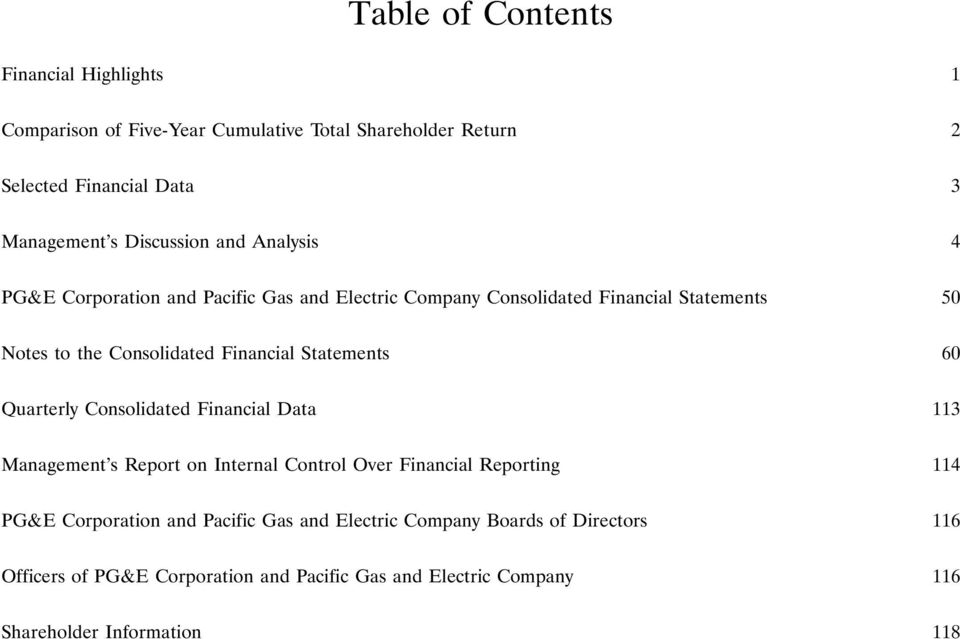
3 Table of Contents Financial Highlights 1 Comparison of Five-Year Cumulative Total Shareholder Return 2 Selected Financial Data 3 Management s Discussion and Analysis 4 PG&E Corporation and Pacific Gas and Electric Company Consolidated Financial Statements 50 Notes to the Consolidated Financial Statements 60 Quarterly Consolidated Financial Data 113 Management s Report on Internal Control Over Financial Reporting 114 PG&E Corporation and Pacific Gas and Electric Company Boards of Directors 116 Officers of PG&E Corporation and Pacific Gas and Electric Company 116 Shareholder Information 118
4

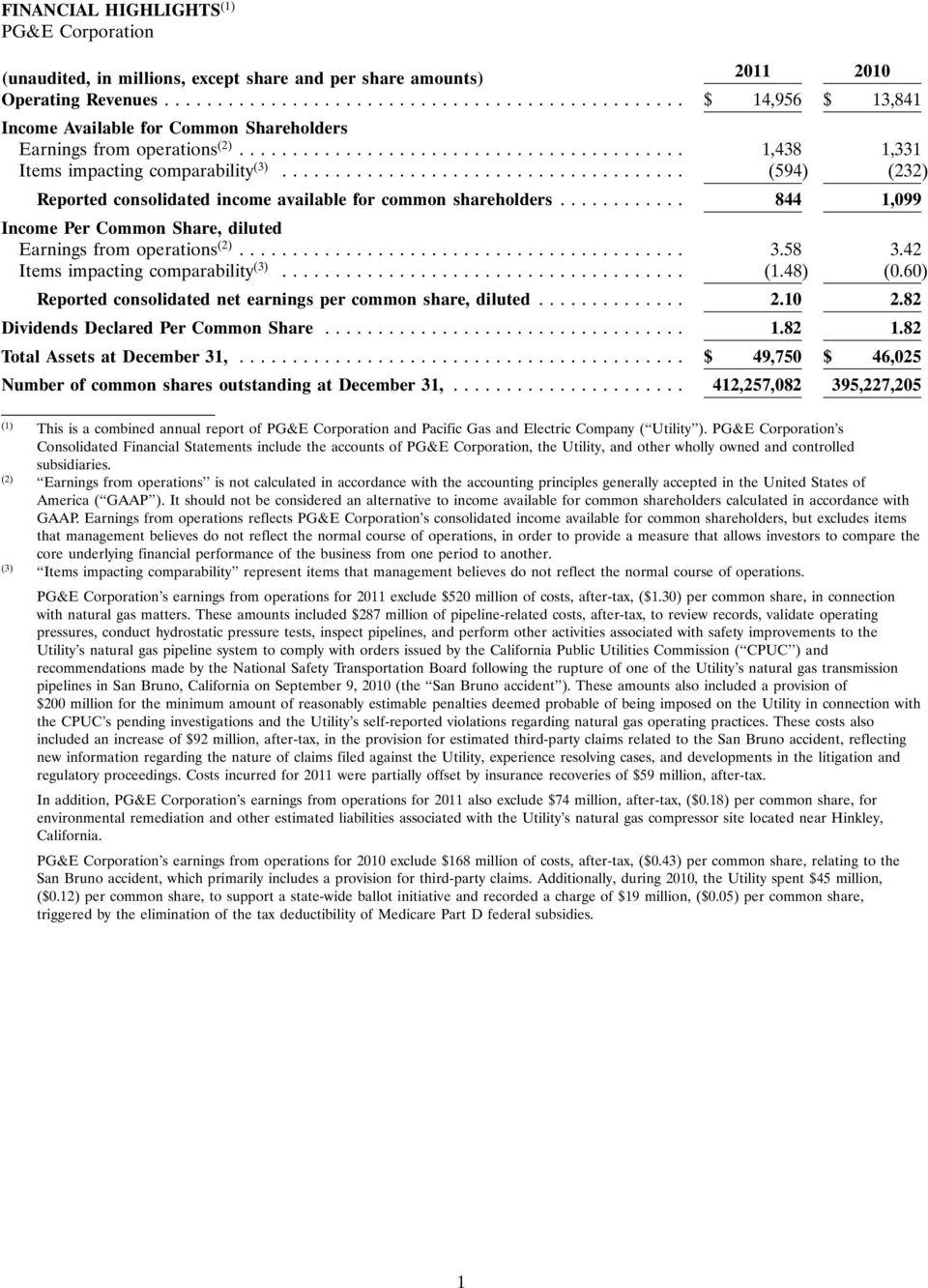
5 FINANCIAL HIGHLIGHTS (1) PG&E Corporation (unaudited, in millions, except share and per share amounts) Operating Revenues... $ 14,956 $ 13,841 Income Available for Common Shareholders Earnings from operations (2)... 1,438 1,331 Items impacting comparability (3)... (594) (232) Reported consolidated income available for common shareholders ,099 Income Per Common Share, diluted Earnings from operations (2) Items impacting comparability (3)... (1.48) (0.60) Reported consolidated net earnings per common share, diluted Dividends Declared Per Common Share Total Assets at December 31,... $ 49,750 $ 46,025 Number of common shares outstanding at December 31, ,257, ,227,205 (1) This is a combined annual report of PG&E Corporation and Pacific Gas and Electric Company ( Utility ). PG&E Corporation s Consolidated Financial Statements include the accounts of PG&E Corporation, the Utility, and other wholly owned and controlled subsidiaries. (2) Earnings from operations is not calculated in accordance with the accounting principles generally accepted in the United States of America ( GAAP ). It should not be considered an alternative to income available for common shareholders calculated in accordance with GAAP. Earnings from operations reflects PG&E Corporation s consolidated income available for common shareholders, but excludes items that management believes do not reflect the normal course of operations, in order to provide a measure that allows investors to compare the core underlying financial performance of the business from one period to another. (3) Items impacting comparability represent items that management believes do not reflect the normal course of operations. PG&E Corporation s earnings from operations for 2011 exclude $520 million of costs, after-tax, ($1.30) per common share, in connection with natural gas matters. These amounts included $287 million of pipeline-related costs, after-tax, to review records, validate operating pressures, conduct hydrostatic pressure tests, inspect pipelines, and perform other activities associated with safety improvements to the Utility s natural gas pipeline system to comply with orders issued by the California Public Utilities Commission ( CPUC ) and recommendations made by the National Safety Transportation Board following the rupture of one of the Utility s natural gas transmission pipelines in San Bruno, California on September 9, 2010 (the San Bruno accident ). These amounts also included a provision of $200 million for the minimum amount of reasonably estimable penalties deemed probable of being imposed on the Utility in connection with the CPUC s pending investigations and the Utility s self-reported violations regarding natural gas operating practices. These costs also included an increase of $92 million, after-tax, in the provision for estimated third-party claims related to the San Bruno accident, reflecting new information regarding the nature of claims filed against the Utility, experience resolving cases, and developments in the litigation and regulatory proceedings. Costs incurred for 2011 were partially offset by insurance recoveries of $59 million, after-tax. In addition, PG&E Corporation s earnings from operations for 2011 also exclude $74 million, after-tax, ($0.18) per common share, for environmental remediation and other estimated liabilities associated with the Utility s natural gas compressor site located near Hinkley, California. PG&E Corporation s earnings from operations for 2010 exclude $168 million of costs, after-tax, ($0.43) per common share, relating to the San Bruno accident, which primarily includes a provision for third-party claims. Additionally, during 2010, the Utility spent $45 million, ($0.12) per common share, to support a state-wide ballot initiative and recorded a charge of $19 million, ($0.05) per common share, triggered by the elimination of the tax deductibility of Medicare Part D federal subsidies. 1
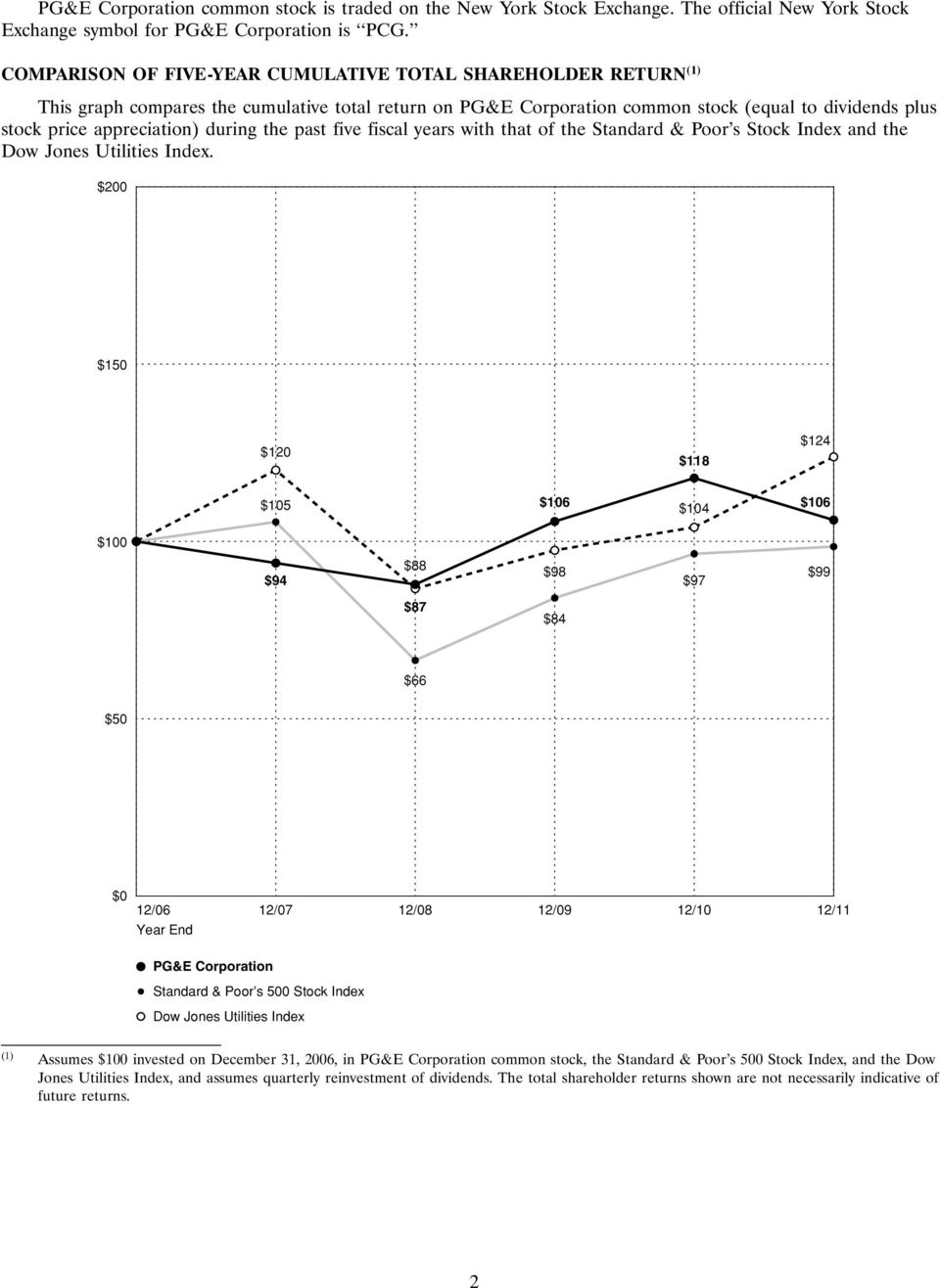
6 PG&E Corporation common stock is traded on the New York Stock Exchange. The official New York Stock Exchange symbol for PG&E Corporation is PCG. COMPARISON OF FIVE-YEAR CUMULATIVE TOTAL SHAREHOLDER RETURN (1) This graph compares the cumulative total return on PG&E Corporation common stock (equal to dividends plus stock price appreciation) during the past five fiscal years with that of the Standard & Poor s Stock Index and the Dow Jones Utilities Index. $200 $150 $120 $118 $124 $105 $106 $104 $106 $100 $94 $88 $98 $97 $99 $87 $84 $66 $50 $0 12/06 Year End 12/07 12/08 12/09 12/10 12/11 PG&E Corporation Standard & Poor s 500 Stock Index Dow Jones Utilities Index 7MAR (1) Assumes $100 invested on December 31, 2006, in PG&E Corporation common stock, the Standard & Poor s 500 Stock Index, and the Dow Jones Utilities Index, and assumes quarterly reinvestment of dividends. The total shareholder returns shown are not necessarily indicative of future returns. 2
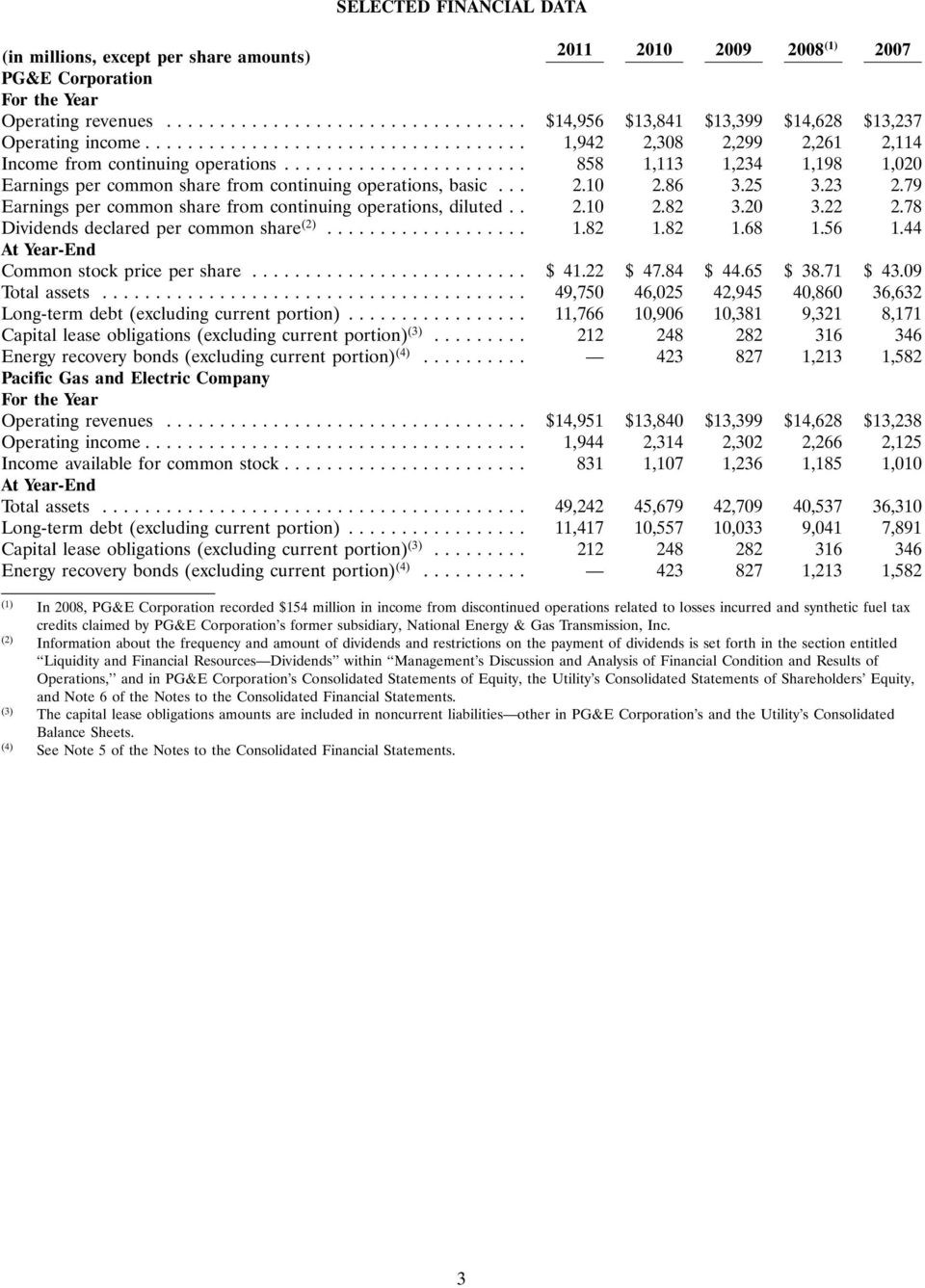
7 SELECTED FINANCIAL DATA (in millions, except per share amounts) PG&E Corporation For the Year (1) 2007 Operating revenues... $14,956 $13,841 $13,399 $14,628 $13,237 Operating income... 1,942 2,308 2,299 2,261 2,114 Income from continuing operations ,113 1,234 1,198 1,020 Earnings per common share from continuing operations, basic Earnings per common share from continuing operations, diluted Dividends declared per common share (2) At Year-End Common stock price per share... $ $ $ $ $ Total assets... 49,750 46,025 42,945 40,860 36,632 Long-term debt (excluding current portion)... 11,766 10,906 10,381 9,321 8,171 Capital lease obligations (excluding current portion) (3) Energy recovery bonds (excluding current portion) (4) ,213 1,582 Pacific Gas and Electric Company For the Year Operating revenues... $14,951 $13,840 $13,399 $14,628 $13,238 Operating income... 1,944 2,314 2,302 2,266 2,125 Income available for common stock ,107 1,236 1,185 1,010 At Year-End Total assets... 49,242 45,679 42,709 40,537 36,310 Long-term debt (excluding current portion)... 11,417 10,557 10,033 9,041 7,891 Capital lease obligations (excluding current portion) (3) Energy recovery bonds (excluding current portion) (4) ,213 1,582 (1) In 2008, PG&E Corporation recorded $154 million in income from discontinued operations related to losses incurred and synthetic fuel tax credits claimed by PG&E Corporation s former subsidiary, National Energy & Gas Transmission, Inc. (2) Information about the frequency and amount of dividends and restrictions on the payment of dividends is set forth in the section entitled Liquidity and Financial Resources Dividends within Management s Discussion and Analysis of Financial Condition and Results of Operations, and in PG&E Corporation s Consolidated Statements of Equity, the Utility s Consolidated Statements of Shareholders Equity, and Note 6 of the Notes to the Consolidated Financial Statements. (3) The capital lease obligations amounts are included in noncurrent liabilities other in PG&E Corporation s and the Utility s Consolidated Balance Sheets. (4) See Note 5 of the Notes to the Consolidated Financial Statements. 3
8 MANAGEMENT S DISCUSSION AND ANALYSIS OF FINANCIAL CONDITION AND RESULTS OF OPERATIONS OVERVIEW PG&E Corporation, incorporated in California in 1995, is a holding company that conducts its business through Pacific Gas and Electric Company ( Utility ), a public utility operating in northern and central California. The Utility generates revenues mainly through the sale and delivery of electricity and natural gas to customers. The Utility served approximately 5.2 million electricity distribution customers and approximately 4.3 million natural gas distribution customers at December 31, The Utility is regulated primarily by the California Public Utilities Commission ( CPUC ) and the Federal Energy Regulatory Commission ( FERC ). In addition, the Nuclear Regulatory Commission ( NRC ) oversees the licensing, construction, operation, and decommissioning of the Utility s nuclear generation facilities. The CPUC has jurisdiction over the rates and terms and conditions of service for the Utility s electricity and natural gas distribution operations, electric generation, and natural gas transportation and storage. The FERC has jurisdiction over the rates and terms and conditions of service governing the Utility s electric transmission operations and over the rates and terms and conditions of service governing the Utility on its interstate natural gas transportation contracts. The Utility also is subject to the jurisdiction of other federal, state, and local governmental agencies. Before setting rates, the CPUC and the FERC conduct proceedings to determine the annual amount of revenue ( revenue requirements ) that the Utility is authorized to collect from its customers to recover its reasonable operating and capital costs (depreciation, tax, and financing expenses) of providing utility services. The primary CPUC proceedings are the general rate case ( GRC ) and the gas transmission and storage rate case ( GT&S ) which generally occur every few years and result in revenue requirements that are set for multi-year periods. The CPUC also periodically conducts a cost of capital proceeding, where it determines the capital structure the Utility must maintain (i.e., the relative weightings of common equity, preferred equity, and debt) and authorizes the Utility to earn a specific rate of return on each capital component, including a rate of return on equity ( ROE ). The authorized revenue requirements the CPUC sets in the GRC and GT&S rate cases are set at levels to provide the Utility an opportunity to earn its authorized rates of return on its rate base the Utility s net investment in facilities, equipment, and other property used or useful in providing utility service to its customers. The primary FERC proceeding is the electric transmission owner ( TO ) rate case which generally occurs on an annual basis. The rate of return that the Utility earns on its FERC-jurisdictional assets is not specifically authorized, but revenues authorized by the FERC are expected to allow the Utility to earn a reasonable rate of return. The Utility s ability to recover the revenue requirements that have been authorized by the CPUC in a GRC does not depend on the volume of the Utility s sales of electricity and natural gas services. This decoupling of revenues and sales eliminates volatility in the revenues earned by the Utility due to fluctuations in customer demand. However, fluctuations in operating and maintenance costs may impact the Utility s ability to earn its authorized rate of return. The Utility s ability to recover a portion of its revenue requirements that have been authorized by the CPUC in recent GT&S rate cases depends on the volume of natural gas transported. The Utility s recovery of its revenue requirements that have been authorized by the FERC in a TO rate case varies with the volume of electricity sales. The Utility also collects additional revenue requirements to recover certain capital expenditures and costs that the CPUC has authorized the Utility to pass on to customers, including costs to purchase electricity and natural gas; and to fund public purpose, demand response, and customer energy efficiency programs. Therefore, although the timing and amount of these costs can impact the Utility s revenue, these costs generally do not impact net income. The Utility s revenues and net income also may be affected by incentive ratemaking mechanisms that adjust rates depending on the extent to which the Utility meets or fails to meet certain performance criteria, such as customer energy efficiency goals. The Utility may incur costs during a particular time period that are higher than the revenue requirements collected in rates during the same time period to recover those costs, negatively affecting the Utility s ability to earn its authorized return during that time period. Differences can occur if actual costs are higher than forecasted costs; if the Utility incurs unanticipated costs, such as costs related to storms, outages, catastrophic events, or to comply with new legislation, regulations, or orders; or if the Utility is required to pay third-party claims that are not recoverable through insurance. In addition, the CPUC could disallow recovery of costs that the CPUC finds were not prudently or reasonably incurred. Finally, there may be some types of costs that the CPUC has determined will not be recoverable through rates, such as environmental-related liabilities associated with the Utility s natural gas 4
9 compressor station located in Hinkley, California, penalties associated with investigations or violations, or that the Utility has decided it will not seek to recover through rates, such as certain costs associated with its natural gas transmission pipeline operations. This is a combined annual report of PG&E Corporation and the Utility, and includes separate Consolidated Financial Statements for each of these two entities. PG&E Corporation s Consolidated Financial Statements include the accounts of PG&E Corporation, the Utility, and other wholly owned and controlled subsidiaries. The Utility s Consolidated Financial Statements include the accounts of the Utility and its wholly owned and controlled subsidiaries. This combined Management s Discussion and Analysis of Financial Condition and Results of Operations ( MD&A ) of PG&E Corporation and the Utility should be read in conjunction with the Consolidated Financial Statements and the Notes to the Consolidated Financial Statements included in this annual report. Key Factors Affecting Results of Operations and Financial Condition During 2011, PG&E Corporation s and the Utility s financial condition, results of operations, and cash flows, continued to be negatively affected by proceedings and investigations related to its natural gas pipeline operations that were commenced after the rupture of one of the Utility s natural gas transmission pipelines in San Bruno, California on September 9, 2010 (the San Bruno accident ). On August 30, 2011, the National Transportation Safety Board ( NTSB ) announced that it had determined the probable cause of the San Bruno accident placing the blame primarily on the Utility. Most recently, on January 12, 2012, the CPUC opened an investigation to determine whether the Utility violated applicable laws and regulations in connection with the San Bruno accident, citing the findings and allegations made by the CPUC s Consumer Protection and Safety Division ( CPSD ) in its investigative report released on January 12, The CPUC is conducting two other investigations and a rulemaking proceeding regarding natural gas matters. The Utility has also self-reported to the CPUC violations of various regulations and orders applicable to natural gas operating practices. (See Natural Gas Matters below.) The outcome of these matters and a number of other factors have had, and will continue to have, a material impact on PG&E Corporation s and the Utility s future results of operations, financial condition, and cash flows as discussed below. The Outcome of Matters Related to the Utility s Natural Gas System. In 2011, the Utility incurred expenses of $483 million for hydrostatic pressure tests and other pipeline-related activities that will not be recovered through rates. In 2012, the Utility forecasts that it will incur costs associated with its natural gas pipeline system ranging from $450 million to $550 million that may not be recoverable through rates. Although the Utility has requested the CPUC to authorize the Utility to recover certain costs it incurs in 2012 and future years under its proposed pipeline safety enhancement plan, it is uncertain what portion of these costs will be recoverable and when such costs will be recovered. (See Natural Gas Matters CPUC Rulemaking Proceeding below.) Additionally, the Utility has incurred a cumulative charge of $375 million ($155 million in 2011 and $220 million in 2010) for third-party claims related to the San Bruno accident and estimates that it is reasonably possible it will incur up to an additional $225 million, for a total possible loss of $600 million. PG&E Corporation and the Utility also believe that it is probable the CPUC will impose penalties of at least $200 million on the Utility as a result of its pending investigations and the Utility s self-reported violations and have accrued this amount as of December 31, PG&E Corporation and the Utility are unable to estimate the reasonably possible amount of penalties in excess of the amount accrued, and such amounts could be material. (See Note 15 of the Notes to the Consolidated Financial Statements.) An investigation of the San Bruno accident by federal and state authorities also may result in the imposition of civil or criminal penalties on the Utility. PG&E Corporation s and the Utility s future financial condition, results of operations, and cash flows will be affected by the scope and timing of the final CPUC-approved pipeline safety enhancement plan, the ultimate amount of pipeline-related costs that are not recovered through rates, the ultimate amount of costs incurred for third-party claims that are not recoverable through insurance, and the ultimate amount of civil or criminal penalties, or punitive damages the Utility may be required to pay. The Ability of the Utility to Control Operating Costs and Capital Expenditures. The Utility s revenue requirements are generally set by the CPUC and the FERC at a level to allow the Utility to recover its forecasted operating expenses, to recover depreciation, tax, and interest expenses associated with forecasted capital expenditures, and to earn a ROE. Actual costs may differ from the Utility s forecasts, or the Utility may incur significant unanticipated costs. For example, in addition to the expenses related to natural gas matters above, the Utility forecasts that it will incur expenses in each of 2012 and 2013 that are approximately $200 million higher than amounts assumed under the 2011 GRC and the GT&S rate case as the Utility works to improve the safety and reliability of its electric and natural gas operations. This higher level of expenditures will negatively affect PG&E Corporation s and the Utility s future financial condition, results of operations, 5
10 and cash flows. Further, any future increase in the Utility s environmental-related liabilities that are not recoverable through rates, such as costs associated with its natural gas compressor station located in Hinkley, California, could negatively affect PG&E Corporation s and the Utility s future financial condition, results of operations, and cash flows. Authorized Rate of Return, Capital Structure, and Financing. Future changes in the Utility s CPUC-authorized ROE and capital structure would affect the amount of the Utility s net income and the amount of PG&E Corporation s income available for common shareholders. The Utility s capital structure for its electric and natural gas distribution and electric generation rate base, consisting of 52% common equity and 48% debt and preferred stock, and its authorized ROE of 11.35% will remain in effect through The CPUC will determine the Utility s future capital structure and ROE in the Utility s next cost of capital proceeding. The Utility will file its cost of capital application with the CPUC in April The Utility s financing needs will be affected by various factors, including changes to its authorized capital structure and rates of return, the timing and amount of capital expenditures and operating expenses, collateral requirements, the amount of costs related to natural gas matters that are not recovered through rates, and the amount of any penalties the Utility may be required to pay. PG&E Corporation contributes equity to the Utility as needed by the Utility to maintain its CPUC-authorized capital structure. PG&E Corporation s and the Utility s ability to access the capital markets and the terms and rates of future financings, can be affected by changes in their credit ratings, the outcome of the natural gas matters described above, general economic and market conditions, and other factors. (See Liquidity and Financial Resources below.) The Timing and Outcome of Ratemaking and Other Regulatory Proceedings. The Utility s revenues are affected by the timing and outcome of rate case decisions. In 2011, the CPUC issued decisions that determine the majority of the Utility s base revenue requirements (i.e., revenues to own and operate the Utility s assets) for the next several years. The CPUC s decision in the most recent GRC set revenue requirements for the Utility s electric and natural gas distribution and electric generation operations from 2011 through The CPUC s decision in the most recent GT&S rate case set revenue requirements for the Utility s natural gas transmission and storage operations from 2011 through On August 10, 2011, the FERC approved an uncontested settlement of the Utility s 13 th TO rate case. (See Results of Operations below.) As soon as July 2012, the Utility may file a notice of intent with the CPUC that will include a draft of the Utility s GRC application for the period beginning January 1, The Utility s GRC application is planned for December From time to time, the Utility also files separate applications with the CPUC requesting authority to recover costs for other projects, such as the Utility s proposed pipeline safety enhancement plan. (See Natural Gas Matters CPUC Rulemaking Proceeding below.) The Utility s revenues will be affected by whether and when the CPUC authorizes the Utility to recover such costs. The Utility also collects revenue requirements to recover certain costs that the CPUC has authorized the Utility to pass through to customers, such as electric procurement costs. The Utility s recovery of these costs is often subject to compliance and audit proceedings conducted by the CPUC which may result in the disallowance of costs previously recorded for recovery. The outcome of these proceedings can be affected by many factors, including general economic conditions, the level of customer rates, regulatory policies, and political considerations. (See Risk Factors below.) 6
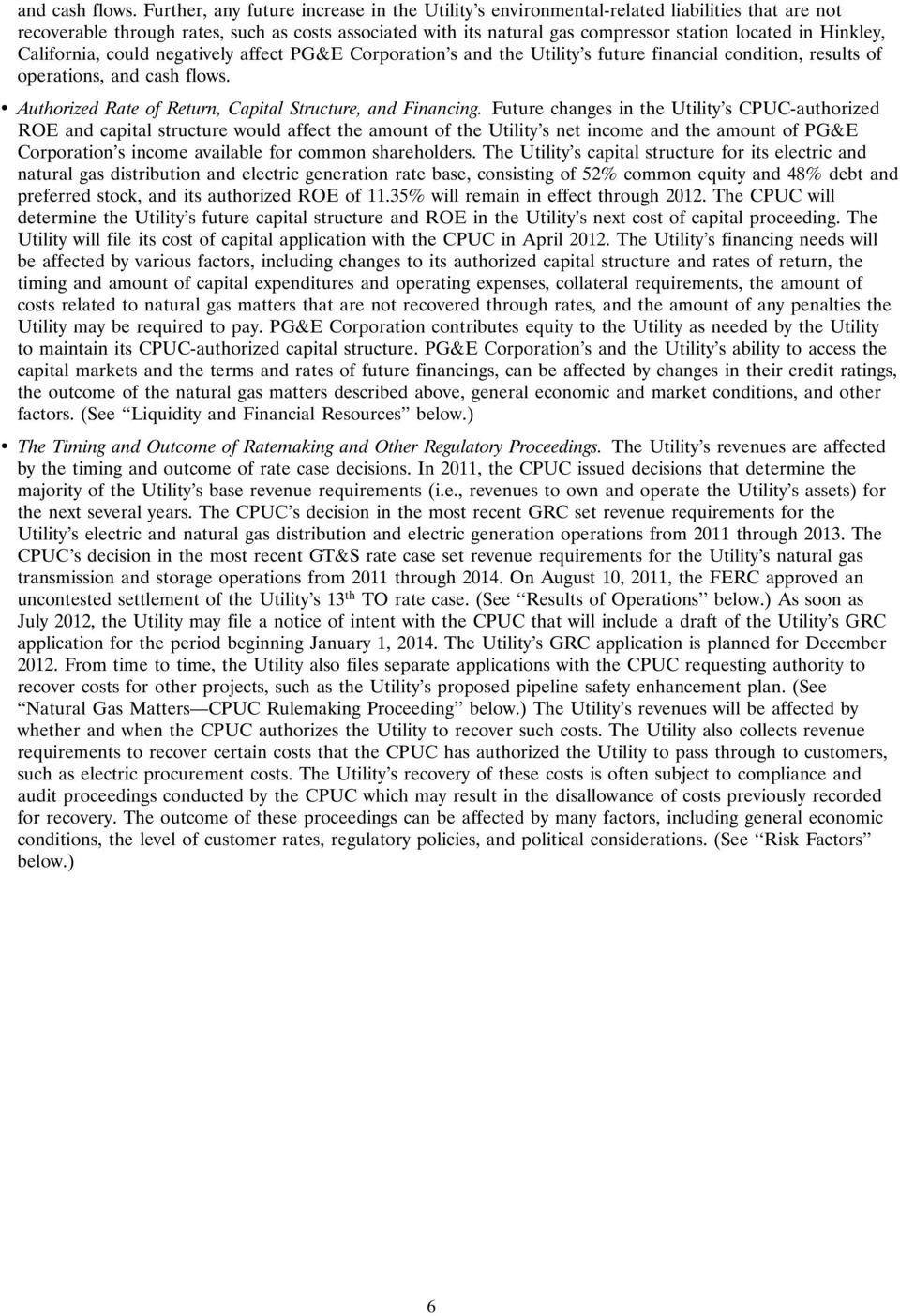
11 Summary of Changes in Earnings per Common Share and Income Available for Common Shareholders for 2011 PG&E Corporation s income available for common shareholders decreased by $255 million, or 23%, from $1,099 million in 2010 to $844 million in The following table is a summary reconciliation of the key changes, after-tax, in income available for common shareholders and earnings per common share for the year ended December 31, See Results of Operations below for further information. Earnings Per Common Share Earnings (Diluted) Income Available for Common Shareholders $1,099 $2.82 Natural gas matters... (352) (0.87) Environmental-related costs... (74) (0.18) Litigation and regulatory matters... (28) (0.07) Storm and outage expenses... (20) (0.05) Gas transmission revenues... (20) (0.05) Increase in rate base earnings Statewide ballot initiative SmartMeter TM cost disallowance Federal healthcare law Other... (11) (0.01) Increase in shares outstanding (1)... (0.12) Income Available for Common Shareholders $ 844 $2.10 (1) Represents the impact of a higher number of shares outstanding at December 31, 2011, compared to the number of shares outstanding at December 31, PG&E Corporation issues shares to fund its equity contributions to the Utility that are used by the Utility to maintain its capital structure and fund operations, including expenses related to natural gas matters. This has no dollar impact on earnings. 7
12 CAUTIONARY LANGUAGE REGARDING FORWARD-LOOKING STATEMENTS This report contains forward-looking statements that are necessarily subject to various risks and uncertainties. These statements reflect management s judgment and opinions which are based on current estimates, expectations, and projections about future events and assumptions regarding these events and management s knowledge of facts as of the date of this report. These forward-looking statements relate to, among other matters, estimated capital expenditures; estimated environmental remediation, tax, and other liabilities; estimates and assumptions used in PG&E Corporation s and the Utility s critical accounting policies; anticipated outcomes of various regulatory, governmental, and legal proceedings; estimated losses and insurance recoveries associated with the San Bruno accident; estimated additional costs the Utility will incur related to its natural gas transmission and distribution business; estimated future cash flows; and the level of future equity or debt issuances. These statements are also identified by words such as assume, expect, intend, forecast, plan, project, believe, estimate, target, predict, anticipate, aim, may, might, should, would, could, goal, potential, and similar expressions. PG&E Corporation and the Utility are not able to predict all the factors that may affect future results. Some of the factors that could cause future results to differ materially from those expressed or implied by the forward-looking statements, or from historical results, include, but are not limited to: the outcomes of pending and future investigations and regulatory proceedings related to the San Bruno accident, and the safety of the Utility s natural gas pipelines in its service territory; the ultimate amount of costs the Utility incurs for natural gas matters that are not recovered through rates; the ultimate amount of third-party claims associated with the San Bruno accident that are not recovered through insurance; and the amount of any civil or criminal penalties, or punitive damages the Utility may incur related to these matters, including the amount of penalties that the CPSD may impose on the Utility for violations of natural gas safety regulations; the outcome of future investigations or proceedings that may be commenced by the CPUC or other regulatory authorities relating to the Utility s compliance with law, rules, regulations, or orders applicable to the operation, inspection, and maintenance of its electric and gas facilities (in addition to investigations or proceedings related to the San Bruno accident and natural gas matters); whether PG&E Corporation and the Utility are able to repair the reputational harm that they have suffered which, in part, will depend on their ability to adequately and timely respond to the findings and recommendations made by the NTSB and CPUC s independent review panel and cure the deficiencies that have been identified in the Utility s operating practices and procedures and corporate culture; developments that may occur in the various investigations of the San Bruno accident and natural gas matters; the decisions, findings, or orders issued in connection with these investigations, including the amount of civil or criminal penalties that may be imposed on the Utility; developments that may occur in the civil litigation related to the San Bruno accident; and the extent of service disruptions that may occur due to changes in pipeline pressure as the Utility continues to inspect and test pipelines; the adequacy and price of electricity and natural gas supplies, the extent to which the Utility can manage and respond to the volatility of electricity and natural gas prices, the ability of the Utility and its counterparties to post or return collateral in connection with price risk management activities; and the availability and price of nuclear fuel used in the two nuclear generation units at Diablo Canyon; explosions, fires, accidents, mechanical breakdowns, equipment failures, human errors, labor disruptions, and similar events, as well as acts of terrorism, war, or vandalism, including cyber-attacks, that can cause unplanned outages, reduce generating output, disrupt the Utility s service to customers, or damage or disrupt the facilities, operations, or information technology and systems owned by the Utility, its customers, or third parties on which the Utility relies; and subject the Utility to third-party liability for property damage or personal injury, or result in the imposition of civil, criminal, or regulatory penalties on the Utility; the impact of storms, tornadoes, floods, drought, earthquakes, tsunamis, wildland and other fires, pandemics, solar events, electromagnetic events, and other natural disasters, or that affect customer demand or that damage or disrupt the facilities, operations, or information technology and systems owned by the Utility, its customers, or third parties on which the Utility relies; the potential impacts of climate change on the Utility s electricity and natural gas businesses, the impact of environmental laws and regulations aimed at the reduction of carbon dioxide and other greenhouse gases ( GHG ) on the Utility s electricity and natural gas businesses, and whether the Utility is able to recover 8
13 associated compliance costs, including the cost of emission allowances and offsets, that the Utility may incur under cap and trade regulations; changes in customer demand for electricity ( load ) and natural gas resulting from unanticipated population growth or decline in the Utility s service area, general and regional economic and financial market conditions, the development of alternative energy technologies including self-generation and distributed generation technologies, or other reasons; the occurrence of unplanned outages at the Utility s large hydroelectric or nuclear generation facilities and the ability of the Utility to procure replacement electricity if hydroelectric or nuclear generation operations were unavailable; the results of seismic studies the Utility is conducting that could affect the Utility s ability to continue operating Diablo Canyon or renew the operating licenses for Diablo Canyon; the impact of new NRC orders or regulations to implement various recommendations made by the NRC s task force following the March 2011 earthquake and tsunami in Japan that caused significant damage to nuclear facilities in Japan; and the impact of new legislation, regulations, or policies that may be adopted in the future to address the operations, security, safety, or decommissioning of nuclear facilities, the storage of spent nuclear fuel, seismic design, cooling water intake, or other issues; the impact of federal or state laws or regulations, or their interpretation, on energy policy and the regulation of utilities and their holding companies, including how the CPUC interprets and enforces the financial and other conditions imposed on PG&E Corporation when it became the Utility s holding company, and whether the outcome of proceedings and investigations relating to the Utility s natural gas operations affects the Utility s ability to make distributions to PG&E Corporation in the form of dividends or share repurchases; whether the Utility s newly installed electric and gas SmartMeter TM devices and related software systems and wireless communications equipment continue to accurately and timely measure customer energy usage and generate billing information, whether the Utility recovers costs associated with analog meters that customers choose instead of digital meters, whether the Utility can successfully implement dynamic pricing retail electric rates that are more closely aligned with wholesale electricity market prices, and whether the Utility can continue to rely on third-party vendors and contractors to support the advanced metering system; whether the Utility is able to protect its information technology, operating systems and networks, including the advanced metering system infrastructure, from damage, disruption, or failure caused by cyber-attacks, computer viruses, and other hazards; and whether the Utility s security measures are sufficient to protect the confidential customer, vendor and financial data contained in such systems and networks from unauthorized access and disclosure; the extent to which PG&E Corporation or the Utility incurs costs in connection with third-party claims or litigation, that are not recoverable through insurance, rates, or from other third parties; the ability of PG&E Corporation, the Utility, and counterparties to access capital markets and other sources of credit in a timely manner on acceptable terms; the impact of environmental remediation laws, regulations, and orders; the extent to which the Utility is able to recover compliance and remediation costs from third parties or through rates or insurance; and the ultimate amount of costs the Utility incurs in connection with its natural gas compressor station located near Hinkley, California, which are not recoverable through rates or insurance; the loss of customers due to various forms of bypass and competition, including municipalization of the Utility s electric distribution facilities, increasing levels of direct access by which consumers procure electricity from alternative energy providers, and implementation of community choice aggregation, which permits certain types of governmental bodies to purchase and sell electricity for their local residents and businesses; and the outcome of federal or state tax audits and the impact of changes in federal or state tax laws, policies, or regulations, such as The Tax Relief, Unemployment Insurance Reauthorization, and Job Creation Act of 2010 (the Tax Relief Act ). For more information about the significant risks that could affect the outcome of these forward-looking statements and PG&E Corporation s and the Utility s future financial condition and results of operations, see the discussion in the section entitled Risk Factors below. PG&E Corporation and the Utility do not undertake an obligation to update forward-looking statements, whether in response to new information, future events, or otherwise. 9
14 RESULTS OF OPERATIONS The table below details certain items from the accompanying Consolidated Statements of Income for 2011, 2010, and 2009: Year ended December 31, (in millions) Utility Electric operating revenues $11, $10, $10,257 Natural gas operating revenues... 3,350 3,196 3,142 Total operating revenues... 14,951 13,840 13,399 Cost of electricity... 4,016 3,898 3,711 Cost of natural gas... 1,317 1,291 1,291 Operating and maintenance... 5,459 4,432 4,343 Depreciation, amortization, and decommissioning... 2,215 1,905 1,752 Total operating expenses... 13,007 11,526 11,097 Operating income... 1,944 2,314 2,302 Interest income Interest expense... (677) (650) (662) Other income, net Income before income taxes... 1,325 1,695 1,732 Income tax provision Net income ,121 1,250 Preferred stock dividend requirement Income Available for Common Stock... $ 831 $ 1,107 $ 1,236 PG&E Corporation, Eliminations, and Other (1) Operating revenues... $ 5 $ 1 $ Operating expenses Operating loss... (2) (6) (3) Interest income... 2 Interest expense... (23) (34) (43) Other income (expense), net... (4) 5 8 Loss before income taxes... (27) (35) (38) Income tax benefit... (40) (27) (22) Net income (loss)... $ 13 $ (8) $ (16) Consolidated Total Operating revenues... $14,956 $13,841 $13,399 Operating expenses... 13,014 11,533 11,100 Operating income... 1,942 2,308 2,299 Interest income Interest expense... (700) (684) (705) Other income, net Income before income taxes... 1,298 1,660 1,694 Income tax provision Net income ,113 1,234 Preferred stock dividend requirement of subsidiary Income Available for Common Shareholders... $ 844 $ 1,099 $ 1,220 (1) PG&E Corporation eliminates all intercompany transactions in consolidation. 10

15 Utility The following presents the Utility s operating results for 2011, 2010, and Electric Operating Revenues The Utility s electric operating revenues consist of amounts charged to customers for electricity generation, transmission and distribution services, as well as amounts charged to customers to recover the cost of electricity procurement, public purpose, energy efficiency, and demand response programs. The Utility provides electricity to residential, industrial, agricultural, and small and large commercial customers through its own generation facilities and through power purchase agreements with third parties. The following table provides a summary of the Utility s total electric operating revenues: (in millions) Revenues excluding pass-through costs... $ 6,798 $ 6,123 $ 5,905 Revenues for recovery of passed-through costs... 4,803 4,521 4,352 Total electric operating revenues... $11,601 $10,644 $10,257 The Utility s total electric operating revenues, including revenues intended to recover costs that are passed through to customers, increased by $957 million, or 9%, in 2011 compared to Costs that are passed through to customers and do not impact net income increased by $282 million, primarily due to increases in the cost of electricity procurement (see Cost of Electricity below), cost of public purpose programs, and pension expense. Electric operating revenues, excluding costs passed through to customers, increased by $675 million. The increase is primarily due to additional base revenues that were authorized by the CPUC in the 2011 GRC and for various separately funded projects, and the FERC in the 13 th TO rate case. The Utility s total electric operating revenues, including revenues intended to recover costs that are passed through to customers, increased by $387 million, or 4%, in 2010 compared to Costs that are passed through to customers and do not impact net income increased by $169 million, primarily due to increases in the cost of electricity procurement partially offset by decreases in the cost of public purpose programs. (See Cost of Electricity below.) Electric operating revenues, excluding costs passed through to customers, increased by $218 million. This was primarily due to increases in authorized base revenues. The Utility s future electric operating revenues excluding pass through costs are expected to increase for 2012 and 2013 as authorized by the CPUC in the 2011 GRC. Additionally, the Utility s future electric operating revenues will be impacted by the cost of electricity and other costs that are passed through to customers. Cost of Electricity The Utility s cost of electricity includes the costs of power purchased from third parties, transmission costs, the cost of fuel used in its own generation facilities, the cost of fuel supplied to other facilities under power purchase agreements and realized gains and losses on price risk management activities. The volume of power the Utility purchases is driven by customer demand, the availability of the Utility s own generation facilities, and the cost effectiveness of each source of electricity. (See Note 10 of the Notes to the Consolidated Financial Statements.) The Utility s cost of electricity is passed through to customers. The Utility s cost of electricity excludes non-fuel costs associated with operating the Utility s own generation facilities and electric transmission system, which are included in operating and maintenance expense in the Consolidated Statements of Income. 11

16 The following table provides a summary of the Utility s cost of electricity and the total amount and average cost of purchased power: (in millions) Cost of purchased power... $ 3,719 $ 3,647 $ 3,508 Fuel used in own generation facilities Total cost of electricity... $ 4,016 $ 3,898 $ 3,711 Average cost of purchased power per kwh (1)... $ $ $ Total purchased power (in millions of kwh)... 41,958 44,837 42,767 (1) Kilowatt-hour The Utility s total cost of electricity increased by $118 million, or 3%, in 2011 compared to This was caused by an increase in the price of purchased power resulting from California Independent System Operator Corporation ( CAISO ) related transmission charges and increased renewable energy deliveries. The Utility s mix of resources is determined by the availability of the Utility s own electricity generation, its renewable energy portfolio targets, and the cost-effectiveness of each source of electricity. The Utility s total cost of electricity increased by $187 million, or 5%, in 2010 compared to This was caused by an increase in the volume of purchased power and an increase in the cost of fuel used in the Utility s own generation facilities. The volume of purchased power is driven by the availability of the Utility s own electricity generation and the cost-effectiveness of each source of electricity. Various factors will affect the Utility s future cost of electricity, including the market prices for electricity and natural gas, the availability of Utility-owned generation, and changes in customer demand. Additionally, the cost of electricity is expected to be impacted by the higher cost of procuring renewable energy as the Utility increases the amount of its renewable energy deliveries to comply with current and future California law and regulatory requirements. The Utility s future cost of electricity also will be affected by legislation and rules applicable to GHG emissions. (See Environmental Matters below.) Natural Gas Operating Revenues The Utility s natural gas operating revenues consist of amounts charged for transportation, distribution, and storage services, as well as amounts charged to customers to recover the cost of natural gas procurement and public purpose programs. The Utility delivers gas through its transmission and distribution systems to end-use customers. The following table provides a summary of the Utility s natural gas operating revenues: (in millions) Revenues excluding pass-through costs... $1,784 $1,703 $1,667 Revenues for recovery of passed-through costs... 1,566 1,493 1,475 Total natural gas operating revenues... $3,350 $3,196 $3,142 The Utility s natural gas operating revenues, including revenues intended to recover costs that are passed through to customers, increased by $154 million, or 5%, in 2011 compared to This reflects a $73 million increase in the costs which are passed through to customers and do not impact net income, primarily due to an increase in the costs of public purpose programs and pension expense. Natural gas operating revenues, excluding costs passed through to customers, increased by $81 million, primarily due to additional base revenues authorized by the CPUC in the 2011 GT&S and GRC, which were partially offset by a decrease in natural gas storage revenues. The Utility s natural gas operating revenues, including revenues intended to recover costs that are passed through to customers, increased by $54 million, or 2%, in 2010 compared to This reflects an $18 million increase in the costs which are passed through to customers and do not impact net income, primarily due to an increase in the cost of public purpose programs. Natural gas operating revenues, excluding costs passed through to customers, increased by $36 million, primarily due to an increase in authorized base revenue, partially offset by a decrease in natural gas storage revenues. (The Utility s storage facilities were at capacity throughout the year and less gas was transported from storage due to the milder weather that prevailed. As result, the Utility was unable to accept more gas for storage.) 12

17 The Utility s operating revenues for natural gas transmission and storage services in 2012, 2013, and 2014 are expected to increase as authorized by the CPUC in the 2011 GT&S rate case. Additionally, the Utility s revenues for natural gas distribution services in 2012 and 2013 excluding pass through costs are expected to increase as authorized by the CPUC in the 2011 GRC. The Utility s gas operating revenues for future years also will be impacted by changes in the cost of natural gas, natural gas throughput volume, and other factors. Cost of Natural Gas The Utility s cost of natural gas includes the procurement, storage, and transportation of natural gas. The cost of natural gas excludes the cost of transportation on the Utility s owned pipeline, which is included in operating and maintenance expense in the Consolidated Statements of Income. The Utility s cost of natural gas also includes realized gains and losses on price risk management activities. (See Note 10 of the Notes to the Consolidated Financial Statements.) The Utility s cost of natural gas is passed through to customers. The following table provides a summary of the Utility s cost of natural gas: (in millions) Cost of natural gas sold... $1,136 $1,119 $1,130 Transportation cost of natural gas sold Total cost of natural gas... $1,317 $1,291 $1,291 Average cost per Mcf of natural gas sold... $ 4.49 $ 4.69 $ 4.47 Total natural gas sold (in millions of Mcf) (1) (1) One thousand cubic feet The Utility s total cost of natural gas increased by $26 million, or 2%, in 2011 compared to The increase was primarily due to the absence of a $49 million refund the Utility received in 2010 for pass through to customers as part of a litigation settlement. The increase was partially offset by a decrease in procurement costs resulting from a decline in the average market price of natural gas during The Utility s total cost of natural gas decreased by less than $1 million in 2010 compared to The Utility received $49 million in the first quarter of 2010 to be refunded to customers as part of a litigation settlement arising from the manipulation of the natural gas market by third parties during 1999 through The decrease resulting from the settlement was partially offset by an increase in transportation costs and an increase in procurement costs due to increases in the average market price of natural gas purchased. The Utility s future cost of natural gas will be affected by the market price of natural gas and changes in customer demand. In addition, the Utility s future cost of natural gas may be affected by federal or state legislation or rules to regulate the GHG emissions from the Utility s natural gas transportation and distribution facilities and from natural gas consumed by the Utility s customers. Operating and Maintenance Operating and maintenance expenses consist mainly of the Utility s costs to operate and maintain its electricity and natural gas facilities, customer billing and service expenses, the cost of public purpose programs, and administrative and general expenses. The Utility s ability to earn its authorized rate of return depends in large part on the success of its ability to manage expenses and to achieve operational and cost efficiencies. The Utility s operating and maintenance expenses (including costs currently passed through to customers) increased by $1,027 million, or 23%, in 2011 compared to Costs that are passed through to customers and do not impact net income increased by $210 million primarily due to pension expense, public purpose programs, and meter reading. Excluding costs currently passed through to customers, operating and maintenance expenses increased by $817 million in 2011 compared to 2010, primarily due to a $456 million increase in costs for natural gas matters. (See Natural Gas Matters below.) Total costs associated with natural gas matters were $739 million in 2011, which included $483 million to conduct hydrostatic pressure tests and perform other pipeline-related activities, $200 million for estimated penalties related to the CPUC s pending investigations and the Utility s self-reported violations, and $155 million for estimated third-party claims related to the San Bruno accident, that were partially offset by 13
18 $99 million in insurance recoveries. In comparison, the Utility incurred $283 million for natural gas matters in 2010 as described below. The remaining increase in operating and maintenance costs was attributable to a number of factors, including $122 million for estimated environmental remediation costs and other liabilities associated with the Utility s natural gas compressor site located near Hinkley, California; approximately $82 million for labor and other maintenance-related costs, primarily associated with higher storm costs; and $32 million for legal and regulatory matters, including penalties resulting from the CPUC s investigation of a natural gas explosion and fire that occurred on December 24, 2008 in Rancho Cordova, California ( the Rancho Cordova accident.) The Utility s operating and maintenance expenses (including costs currently passed through to customers) increased by $89 million, or 2%, in 2010 compared to Costs that are passed through to customers and do not impact net income increased by $9 million primarily due to the cost of public purpose programs. Excluding costs currently passed through to customers, operating and maintenance expenses increased by $80 million in 2010 compared to The increase in operating and maintenance expenses was primarily due to $283 million of costs associated with the San Bruno accident. This amount included a provision of $220 million for estimated third-party claims and $63 million to provide immediate support to the San Bruno community and perform other pipeline-related activities following the accident. Additionally, operating and maintenance expenses increased due to a $36 million provision that was recorded for SmartMeter TM related capital costs that were forecasted to exceed the CPUC-authorized amount for recovery. These increases were partially offset by decreases of approximately $139 million in labor costs and other costs as compared to 2009 when costs were incurred in connection with an additional scheduled refueling outage at Diablo Canyon and accelerated natural gas leak surveys (and associated remedial work), $67 million in severance costs as compared to 2009 when charges were incurred related to the reduction of approximately 2% of the Utility s workforce, and $21 million in uncollectible customer accounts as a result of customer outreach and increased collection efforts. The Utility forecasts that it will incur costs associated with its natural gas pipeline system ranging from $450 million to $550 million in 2012, which may not be recoverable through rates. Although the Utility has requested the CPUC to authorize the Utility to recover certain costs it incurs in 2012 and future years under its proposed pipeline safety enhancement plan, it is uncertain what portion of these costs will be recoverable and when such costs will be recovered. In addition, the CPUC may order the Utility to incur costs that will not be recoverable through rates, for example, if the CPUC adopts the operational and financial recommendations made by the CPSD. (See Natural Gas Matters Pending CPUC Investigations and Enforcement Matters below.) Future operating and maintenance expense may also be affected by the resolution of third-party claims related to the San Bruno accident, related insurance recoveries, and the ultimate amount of civil or criminal penalties, or punitive damages that may be imposed on the Utility. In addition to the expenses related to natural gas matters discussed above, the Utility forecasts that it will incur expenses in each of 2012 and 2013 that are approximately $200 million higher than amounts assumed under the 2011 GRC and the GT&S rate case as the Utility works to improve the safety and reliability of its electric and natural gas operations. Finally, the Utility s costs may be impacted by the SmartMeter TM opt-out program and the timing of recovery of such costs. (See Regulatory Matters below.) Depreciation, Amortization, and Decommissioning The Utility s depreciation and amortization expense consists of depreciation and amortization on plant and regulatory assets, and decommissioning expenses associated with fossil and nuclear decommissioning. The Utility s depreciation, amortization, and decommissioning expenses increased by $310 million, or 16%, in 2011 compared to 2010, primarily due to capital additions and an increase in depreciation rates as authorized by the 2011 GRC and GT&S rate cases. The Utility s depreciation, amortization, and decommissioning expenses increased by $153 million, or 9%, in 2010 compared to 2009, primarily due to capital additions. The Utility s depreciation expense for future periods is expected to be impacted as a result of changes in capital expenditures and the implementation of new depreciation rates as authorized by the CPUC in the GRC and GT&S rate cases. TO rate cases authorized by FERC will also have an impact on depreciation rates in the future. Interest Income The Utility s interest income decreased by $4 million, or 44%, in 2011 as compared to 2010, primarily due to lower interest rates affecting various regulatory balancing accounts and fluctuations in those accounts. 14

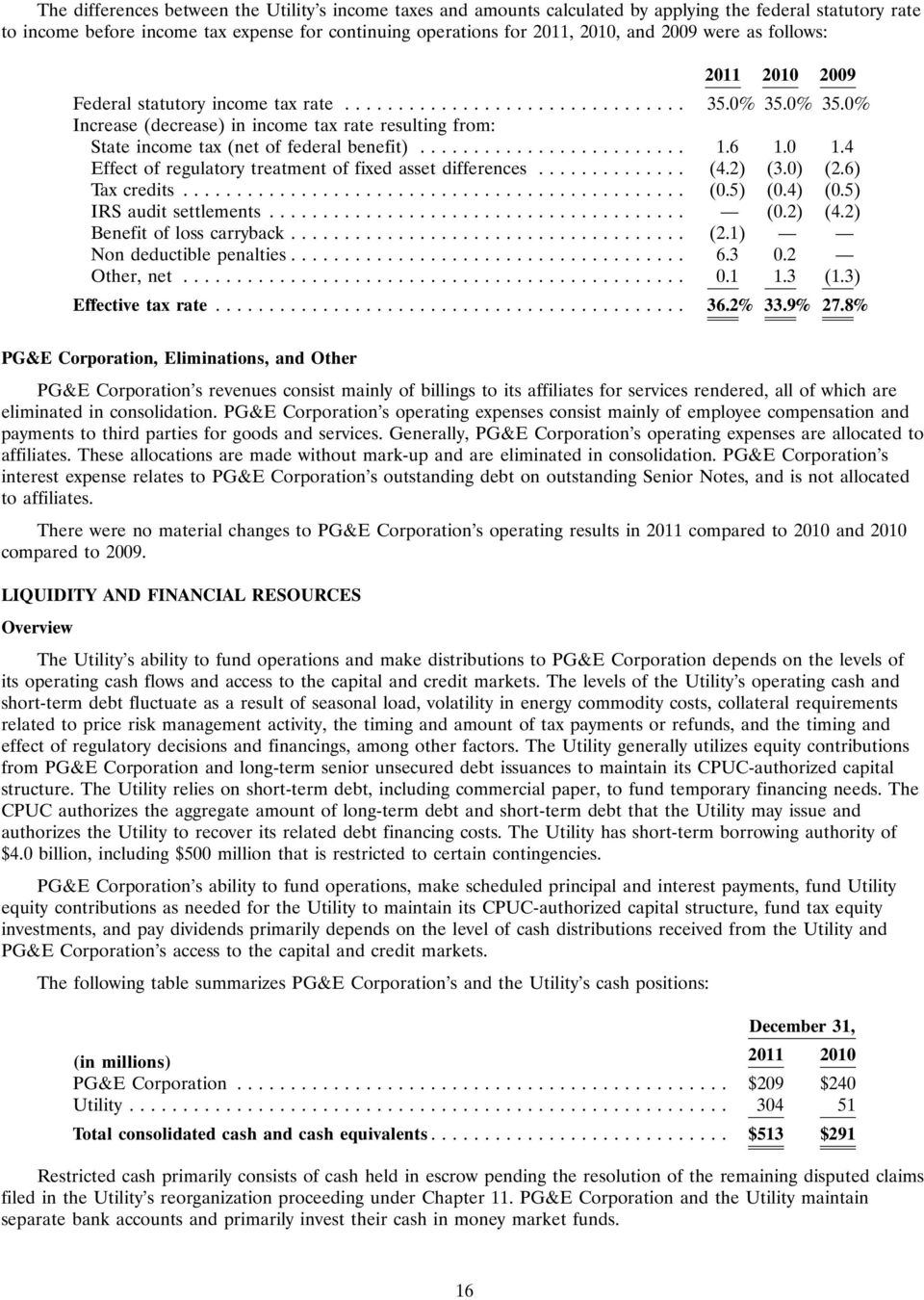
19 The Utility s interest income decreased by $24 million, or 73%, in 2010 as compared to 2009, primarily due to lower interest rates affecting various regulatory balancing accounts and fluctuations in those accounts. In addition, interest income decreased as compared to 2009 when the Utility received interest income on previously incurred costs related to the proposed divestiture of its hydroelectric generation facilities. The Utility s interest income in future periods will be primarily affected by changes in the balance of funds held in escrow pending resolution of the Chapter 11 disputed claims, changes in regulatory balancing accounts, and changes in interest rates. (See Note 13 of the Notes to the Consolidated Financial Statements.) Interest Expense The Utility s interest expense increased by $27 million, or 4%, in 2011 as compared to 2010 primarily due to an increase in outstanding senior notes, partially offset by decreases in the outstanding balance of the energy recovery bonds ( ERBs ). (See Note 5 of the Notes to the Consolidated Financial Statements.) The Utility s interest expense decreased by $12 million, or 2%, in 2010 as compared to This decrease was primarily attributable to decreases in the outstanding balances of the liability for Chapter 11 disputed claims, ERBs, and various regulatory balancing accounts and to lower interest rates on short-term debt. The decrease was partially offset by an increase in outstanding senior notes. (See Note 5 of the Notes to the Consolidated Financial Statements.) The Utility s interest expense in future periods will be impacted by changes in interest rates, changes in the liability for Chapter 11 disputed claims, changes in regulatory balancing accounts and regulatory assets, and changes in the amount of debt outstanding as long-term debt matures and additional long-term debt is issued. (See Liquidity and Financial Resources below.) Other Income, Net The Utility s other income, net increased by $31 million, in 2011 compared to 2010 when the Utility incurred costs to support a California ballot initiative that appeared on the June 2010 ballot, which were not recoverable in rates. The increase was partially offset by a decrease in allowance for equity funds used during construction as the average balance of construction work in progress was lower in 2011 as compared to The Utility s other income, net decreased by $37 million, or 63%, in 2010 compared to The decrease was primarily due to a $45 million increase in other expenses as a result of costs the Utility incurred to support a California ballot initiative. This expense was partially offset by an increase in allowance for equity funds used during construction due to higher average balances of construction work in progress in 2010 compared to Income Tax Provision The Utility s income tax provision decreased by $94 million, or 16%, in 2011 compared to The effective tax rates were 36% and 34% for 2011 and 2010, respectively. The effective tax rate for 2011 increased as compared to 2010, mainly due to non- tax deductible penalties related to natural gas matters, partially offset by a benefit associated with a loss carryback recorded in 2011 and the reversal of a deferred tax asset attributable to the Medicare Part D subsidy, which affected the tax provision balance in 2010 with no comparable effect in The Utility s income tax provision increased by $92 million, or 19%, in 2010 compared to The effective tax rates were 34% and 28% for 2010 and 2009, respectively. The effective tax rate for 2010 increased as compared to the same period in 2009 when the Utility recognized state tax benefits arising from tax accounting method changes and benefits of various audit settlements at higher levels than 2010 settlements. The effective tax rate also increased due to the reversal of a deferred tax asset in the first quarter of 2010 that had previously been recorded to reflect the future tax benefits attributable to the Medicare Part D subsidy after 2012, which was eliminated as part of the federal healthcare legislation passed during March
20 The differences between the Utility s income taxes and amounts calculated by applying the federal statutory rate to income before income tax expense for continuing operations for 2011, 2010, and 2009 were as follows: Federal statutory income tax rate % 35.0% 35.0% Increase (decrease) in income tax rate resulting from: State income tax (net of federal benefit) Effect of regulatory treatment of fixed asset differences... (4.2) (3.0) (2.6) Tax credits... (0.5) (0.4) (0.5) IRS audit settlements... (0.2) (4.2) Benefit of loss carryback... (2.1) Non deductible penalties Other, net (1.3) Effective tax rate % 33.9% 27.8% PG&E Corporation, Eliminations, and Other PG&E Corporation s revenues consist mainly of billings to its affiliates for services rendered, all of which are eliminated in consolidation. PG&E Corporation s operating expenses consist mainly of employee compensation and payments to third parties for goods and services. Generally, PG&E Corporation s operating expenses are allocated to affiliates. These allocations are made without mark-up and are eliminated in consolidation. PG&E Corporation s interest expense relates to PG&E Corporation s outstanding debt on outstanding Senior Notes, and is not allocated to affiliates. There were no material changes to PG&E Corporation s operating results in 2011 compared to 2010 and 2010 compared to LIQUIDITY AND FINANCIAL RESOURCES Overview The Utility s ability to fund operations and make distributions to PG&E Corporation depends on the levels of its operating cash flows and access to the capital and credit markets. The levels of the Utility s operating cash and short-term debt fluctuate as a result of seasonal load, volatility in energy commodity costs, collateral requirements related to price risk management activity, the timing and amount of tax payments or refunds, and the timing and effect of regulatory decisions and financings, among other factors. The Utility generally utilizes equity contributions from PG&E Corporation and long-term senior unsecured debt issuances to maintain its CPUC-authorized capital structure. The Utility relies on short-term debt, including commercial paper, to fund temporary financing needs. The CPUC authorizes the aggregate amount of long-term debt and short-term debt that the Utility may issue and authorizes the Utility to recover its related debt financing costs. The Utility has short-term borrowing authority of $4.0 billion, including $500 million that is restricted to certain contingencies. PG&E Corporation s ability to fund operations, make scheduled principal and interest payments, fund Utility equity contributions as needed for the Utility to maintain its CPUC-authorized capital structure, fund tax equity investments, and pay dividends primarily depends on the level of cash distributions received from the Utility and PG&E Corporation s access to the capital and credit markets. The following table summarizes PG&E Corporation s and the Utility s cash positions: December 31, (in millions) PG&E Corporation... $209 $240 Utility Total consolidated cash and cash equivalents... $513 $291 Restricted cash primarily consists of cash held in escrow pending the resolution of the remaining disputed claims filed in the Utility s reorganization proceeding under Chapter 11. PG&E Corporation and the Utility maintain separate bank accounts and primarily invest their cash in money market funds. 16
21 Revolving Credit Facilities and Commercial Paper Program In May 2011, PG&E Corporation and the Utility each entered into a new revolving credit facility. The following table summarizes PG&E Corporation s and the Utility s outstanding borrowings under their revolving credit facilities and the Utility s commercial paper program at December 31, 2011: Letters of Termination Facility Credit Commercial Facility (in millions) Date Limit Outstanding Borrowings Paper Availability PG&E Corporation... May 2016 $ 300 (1) $ $ $ $ 300 Utility... May ,000 (2) 343 1,389 (3) 1,268 (3) Total revolving credit facilities... $3,300 $343 $ $1,389 $1,568 (1) Includes a $100 million sublimit for letters of credit and a $100 million commitment for swingline loans, defined as loans that are made available on a same-day basis and are repayable in full within 7 days. (2) Includes a $1.0 billion sublimit for letters of credit and a $300 million commitment for swingline loans. (3) The Utility treats the amount of its outstanding commercial paper as a reduction to the amount available under its revolving credit facility. For the year ended December 31, 2011, the average outstanding borrowings on PG&E Corporation s revolving credit facility was $53 million and the maximum outstanding balance during the year was $75 million; and the average outstanding borrowings on the Utility s revolving credit facility was $2 million and the maximum outstanding balance during the year was $208 million. For the year ended December 31, 2011, the average outstanding commercial paper balance was $818 million and the maximum outstanding balance during the year was $1.4 billion. The revolving credit facilities include usual and customary covenants for revolving credit facilities of this type, including covenants limiting liens to those permitted under PG&E Corporation s and the Utility s senior note indentures, mergers, sales of all or substantially all of PG&E Corporation s and the Utility s assets, and other fundamental changes. In addition, the revolving credit facilities require that PG&E Corporation and the Utility maintain a ratio of total consolidated debt to total consolidated capitalization of at most 65% as of the end of each fiscal quarter. The $300 million revolving credit facility agreement also requires that PG&E Corporation own, directly or indirectly, at least 80% of the common stock and at least 70% of the voting capital stock of the Utility. At December 31, 2011, PG&E Corporation and the Utility were in compliance with all covenants under each of the revolving credit facilities. See Note 4 of the Notes to the Consolidated Financial Statements for additional information about the credit facilities and the Utility s commercial paper program, which information is hereby incorporated by reference Financings Utility The following table summarizes debt issuances in 2011: (in millions) Senior Notes Issue Date Amount 4.25%, due May 13 $ %, due September Floating rate, due November %, due December Total debt issuances in $ 1,050 The net proceeds from the issuance of Utility senior notes in 2011 were used to support liquidity requirements relating to the Utility s commodity hedging activities, to repay a portion of outstanding commercial paper, to redeem $200 million principal amount of Series 1996 A pollution control bonds, and for general corporate purposes. The Utility also received cash contributions of $555 million from PG&E Corporation during 2011 to ensure that the Utility had adequate capital to maintain the 52% common equity ratio authorized by the CPUC. 17
22 PG&E Corporation On May 9, 2011, PG&E Corporation entered into an Equity Distribution Agreement providing for the sale of PG&E Corporation common stock having an aggregate gross sales price of $288 million. On November 28, 2011, PG&E Corporation entered into a new Equity Distribution Agreement providing for the sale of PG&E Corporation common stock having an aggregate gross offering price of up to $400 million. Sales of the shares are made by means of ordinary brokers transactions on the New York Stock Exchange, or in such other transactions as agreed upon by PG&E Corporation and the sales agents and in conformance with applicable securities laws. For the year ended December 31, 2011, PG&E Corporation sold 9,574,457 shares of common stock under the May and November Equity Distribution Agreements for cash proceeds of $384 million, net of fees and commissions paid of $4 million. The proceeds from these sales were used for general corporate purposes, including the infusion of equity into the Utility. As of December 31, 2011, PG&E Corporation had the ability to issue an additional $300 million of common stock under the November Equity Distribution Agreement. In addition, during the year ended December 31, 2011, PG&E Corporation issued 7,222,803 shares of common stock under its 401(k) plan, its Dividend Reinvestment and Stock Purchase Plan, and upon the exercise of employee stock options, generating $278 million of cash. Future Financing Needs The amount and timing of the Utility s future debt financings and equity needs will depend on various factors, including: the amount of cash internally generated through normal business operations; the timing and amount of forecasted capital expenditures; the timing of the resolution of the Chapter 11 disputed claims and the amount of interest on these claims that the Utility will be required to pay (see Note 13 of the Notes to the Consolidated Financial Statements); the timing and amount of payments made to third parties in connection with the San Bruno accident, and the timing and amount of related insurance recoveries; the timing and amount of penalties imposed on the Utility in connection with the various regulatory proceedings and investigations related to the San Bruno accident and the Utility s natural gas pipeline system; the timing and amount of costs associated with the Utility s natural gas pipeline system, and the amount that is not recoverable through rates (see Operating and Maintenance above and Natural Gas Matters below); the amount of future tax payments (see the discussion of the Tax Relief Act under Utility Operating Activities below); and the conditions in the capital markets, and other factors. PG&E Corporation contributes equity to the Utility as needed to maintain the Utility s CPUC-authorized capital structure. The Utility is required to file an application with the CPUC in April 2012 to begin the cost of capital proceeding in which the CPUC will determine the Utility s authorized capital structure and rates of return beginning on January 1, A change in the Utility s authorized capital structure also may impact PG&E Corporation s and the Utility s future debt and equity financing needs. (See the 2012 Cost of Capital Proceeding discussion in Regulatory Matters below.) Credit Ratings PG&E Corporation s and the Utility s credit ratings may affect access to the credit and capital markets and the respective financing costs in those markets. Credit rating downgrades may increase the cost of short-term borrowing, including commercial paper and the costs associated with the respective credit facilities, and long-term debt. In December 2011, Standard & Poor s Ratings Services ( S&P ) downgraded PG&E Corporation s and the Utility s corporate and senior unsecured debt credit ratings and the Utility s preferred stock credit rating. The corporate credit and senior unsecured debt ratings of PG&E Corporation and the Utility remained at investment grade levels at December 31,
23 S&P s downgrade reflects its view that PG&E Corporation and the Utility are beginning a multiyear rebuilding of the Utility s gas operations, customer reputation, and regulatory relationships following the San Bruno accident. S&P affirmed a stable outlook for PG&E Corporation and the Utility as of December On September 30, 2011, Moody s Investors Service affirmed the ratings of and stable outlook for PG&E Corporation and the Utility. The credit ratings downgrade had no impact on the principal balance, principal payments, interest rates, or fees related to PG&E Corporation s and the Utility s long-term debt outstanding at the time of the downgrade. Dividends The dividend policies of PG&E Corporation and the Utility are designed to meet the following three objectives: Comparability: Pay a dividend competitive with the securities of comparable companies based on payout ratio (the proportion of earnings paid out as dividends) and, with respect to PG&E Corporation, yield (i.e., dividend divided by share price); Flexibility: Allow sufficient cash to pay a dividend and to fund investments while avoiding having to issue new equity unless PG&E Corporation s or the Utility s capital expenditure requirements are growing rapidly and PG&E Corporation or the Utility can issue equity at reasonable cost and terms; and Sustainability: Avoid reduction or suspension of the dividend despite fluctuations in financial performance except in extreme and unforeseen circumstances. The Boards of Directors of PG&E Corporation and the Utility have each adopted a target dividend payout ratio range of 50% to 70% of earnings from operations. Earnings from operations are calculated on an adjusted basis to exclude the impact of items that management believes do not reflect the normal course of operations. Earnings from operations are not a substitute or alternative for consolidated net income presented in accordance with GAAP. Dividends paid by PG&E Corporation and the Utility are expected to remain in the lower end of the target payout ratio range so that more internal funds are readily available to support the Utility s capital investment needs. Each Board of Directors retains authority to change the respective common stock dividend policy and dividend payout ratio at any time, especially if unexpected events occur that would change its view as to the prudent level of cash conservation. No dividend is payable unless and until declared by the applicable Board of Directors. In addition, the CPUC requires that the PG&E Corporation Board of Directors give first priority to the Utility s capital requirements, as determined to be necessary and prudent to meet the Utility s obligation to serve or to operate the Utility in a prudent and efficient manner, in setting the amount of dividends. The Boards of Directors must also consider the CPUC requirement that the Utility maintain, on average, its CPUC-authorized capital structure including a 52% equity component. The following table summarizes PG&E Corporation s and the Utility s dividends paid: (in millions) PG&E Corporation: Common stock dividends paid $ $ $590 Common stock dividends reinvested in Dividend Reinvestment and Stock Purchase Plan Utility: Common stock dividends paid... $716 $716 $624 Preferred stock dividends paid On December 21, 2011, the Board of Directors of PG&E Corporation ( Board ) declared dividends of $0.455 per share, totaling $188 million, of which $182 million was paid on January 15, 2012 to shareholders of record on December 30, The remaining $6 million was reinvested under the Dividend Reinvestment and Stock Purchase Plan. On December 21, 2011, the Board of Directors of the Utility declared dividends on its outstanding series of preferred stock, payable on February 15, 2012, to shareholders of record on January 31,
24 As the Utility focuses on improving the safety and reliability of its natural gas and electric operations, and subject to the outcome of the matters described under Natural Gas Matters below, PG&E Corporation expects that its Board of Directors will maintain the current annual common stock dividend of $1.82 per share in Utility Operating Activities The Utility s cash flows from operating activities primarily consist of receipts from customers less payments of operating expenses, other than expenses such as depreciation that do not require the use of cash. The Utility s cash flows from operating activities for 2011, 2010, and 2009 were as follows: (in millions) Net income... $ 845 $1,121 $1,250 Adjustments to reconcile net income to net cash provided by operating activities: Depreciation, amortization, and decommissioning... 2,215 1,905 1,752 Allowance for equity funds used during construction... (87) (110) (94) Deferred income taxes and tax credits, net Other Effect of changes in operating assets and liabilities: Accounts receivable... (227) (105) 157 Inventories... (63) (43) 109 Accounts payable (33) Disputed claims and customer refunds... (700) Income taxes receivable/payable... (192) (58) 21 Other current assets and liabilities Regulatory assets, liabilities, and balancing accounts, net... (100) (394) (516) Other noncurrent assets and liabilities (331) (282) Net cash provided by operating activities... $3,763 $3,236 $2,904 During 2011, net cash provided by operating activities increased by $527 million compared to 2010 primarily due to a decrease of $214 million in net collateral paid by the Utility related to price risk management activities. Collateral payables and receivables are included in other noncurrent assets and liabilities and other current assets and liabilities within the Consolidated Statements of Cash Flows. The increase also reflects a decrease in tax payments of $121 million in 2011 compared to The remaining changes in cash flows from operating activities consisted of fluctuations in activities within the normal course of business such as the timing and amount of customer billings and collections. During 2010, net cash provided by operating activities increased $332 million compared to This increase reflects the Utility s $700 million payment to the California Power Exchange ( PX ) in 2009, partially offset by net tax refunds that the Utility received in 2009 that were higher than the amount received in (The Utility s payment to the PX decreased the Utility s liability for the remaining net disputed claims made in the Utility s Chapter 11 proceeding.) The remaining changes in cash flows from operating activities consisted of fluctuations in activities within the normal course of business such as collateral and the timing and amount of customer billings and collections. On December 17, 2010, the Tax Relief Act was signed into law, which generally allows the Utility to accelerate depreciation by deducting up to 100% of the investment cost of certain qualified property placed into service during 2011 (or as late as 2012 under phase out or transition rules) and up to 50% of the investment cost of property placed into service in 2012 (or as late as 2013 under the phase out rules). As a result of the accelerated depreciation, the Utility did not make a federal tax payment in The Utility also expects that its 2012 federal tax payment will be reduced depending on the amount and timing of the Utility s qualifying capital additions. (See Regulatory Matters CPUC Resolution Regarding the Tax Relief Act below.) Future cash flow from operating activities will be affected by the timing and amount of payments to be made to third parties in connection with the San Bruno accident, related insurance recoveries, penalties that may be assessed, and higher operating and maintenance costs associated with the Utility s natural gas and electric operations, among other factors. (See Operating and Maintenance above and Natural Gas Matters below.) 20
25 Investing Activities The Utility s investing activities primarily consist of construction of new and replacement facilities necessary to deliver safe and reliable electricity and natural gas services to its customers. The amount and timing of the Utility s capital expenditures is affected by many factors, including the timing of regulatory approvals and the occurrence of storms and other events causing outages or damages to the Utility s infrastructure. Cash used in investing activities also includes the proceeds from sales of nuclear decommissioning trust investments which are largely offset by the amount of cash used to purchase new nuclear decommissioning trust investments. The funds in the decommissioning trusts, along with accumulated earnings, are used exclusively for decommissioning and dismantling the Utility s nuclear facilities. The Utility s cash flows from investing activities for 2011, 2010, and 2009 were as follows: (in millions) Capital expenditures... $(4,038) $(3,802) $(3,958) Decrease in restricted cash Proceeds from sales and maturities of nuclear decommissioning trust investments... 1,928 1,405 1,351 Purchases of nuclear decommissioning trust investments... (1,963) (1,456) (1,414) Other Net cash used in investing activities... $(3,859) $(3,768) $(3,344) Net cash used in investing activities increased by $91 million in 2011 compared to This increase was primarily due to an increase of $236 million in capital expenditures. This increase was partially offset by a decrease of $134 million in restricted cash that was primarily due to releases from escrow for settled or withdrawn Chapter 11 disputed claims in 2011, with few similar releases in Net cash used in investing activities increased by $424 million in 2010 compared to 2009, primarily due to the Utility s $700 million payment to the PX which decreased the restricted cash balance in This increase was partially offset by a decrease in capital expenditures of $156 million as compared to Capital expenditures decreased in 2010 due to permitting delays, the postponement of purchases of materials which would otherwise have been capitalized earlier in the year, and poor weather conditions in the first half of 2010 which delayed construction activities as resources were re-directed to emergency response activities. Future cash flows used in investing activities are largely dependent on the timing and amount of capital expenditures. (See Capital Expenditures below for further discussion of expected spending and significant capital projects.) Financing Activities The Utility s cash flows from financing activities for 2011, 2010, and 2009 were as follows: (in millions) Borrowings under revolving credit facilities... $ 208 $ 400 $ 300 Repayments under revolving credit facilities... (208) (400) (300) Net issuances of commercial paper, net of discount of $4 in 2011 and $3 in 2010 and Proceeds from issuance of short-term debt, net of issuance costs of $1 in 2010 and Proceeds from issuance of long-term debt, net of premium, discount, and issuance costs of $8 in 2011, $23 in 2010, and $25 in ,327 1,384 Short-term debt matured... (250) (500) Long-term debt matured or repurchased... (700) (95) (909) Energy recovery bonds matured... (404) (386) (370) Preferred stock dividends paid... (14) (14) (14) Common stock dividends paid... (716) (716) (624) Equity contribution Other (73) (5) Net cash provided by financing activities... $ 349 $ 249 $ 722 In 2011, net cash provided by financing activities increased by $100 million compared to the same period in In 2010, net cash provided by financing activities decreased by $473 million compared to Cash provided by or used in financing activities is driven by the Utility s financing needs, which depend on the level of cash 21
26 provided by or used in operating activities and the level of cash provided by or used in investing activities. The Utility generally utilizes long-term senior unsecured debt issuances and equity contributions from PG&E Corporation to maintain its CPUC-authorized capital structure, and relies on short-term debt to fund temporary financing needs. PG&E Corporation As of December 31, 2011, PG&E Corporation s affiliates had entered into four tax equity agreements with two privately held companies to fund residential and commercial retail solar energy installations. Under these agreements, PG&E Corporation has agreed to provide lease payments and investment contributions of up to $396 million to these companies in exchange for the right to receive benefits from local rebates, federal grants, and a share of the customer payments made to these companies. PG&E Corporation s financial exposure from these arrangements is generally limited to its lease payments and investment contributions to these companies. As of December 31, 2011, PG&E Corporation had made total payments of $359 million under these tax equity agreements and received $136 million in benefits and customer payments. Lease payments, investment contributions, benefits, and customer payments received are included in cash flows from operating and investing activities within the Consolidated Statements of Cash Flows. In addition to the investments above, PG&E Corporation had the following material cash flows on a stand-alone basis for the years ended December 31, 2011, 2010, and 2009: dividend payments, common stock issuances, borrowings and repayments under the revolving credit facility in 2011 and 2010, the senior note issuance of $350 million in March 2009, net tax refunds of $189 in 2009, and transactions between PG&E Corporation and the Utility. CONTRACTUAL COMMITMENTS The following table provides information about PG&E Corporation s and the Utility s contractual commitments at December 31, 2011: Payment due by period Less Than More Than (in millions) Contractual Commitments: Utility Long-term debt (1) : Fixed rate obligations... 1 Year $ Years $2, Years $1,044 5 Years $16,575 Total $20,805 Variable rate obligations ,140 Energy recovery bonds Purchase obligations (4) : Power purchase agreements (2) : Qualifying facilities ,588 1,415 3,341 7,080 Renewable contracts (other than QF) ,327 2,722 18,058 23,938 Other power purchase agreements ,453 1,215 3,726 7,050 Natural gas supply and transportation ,507 Nuclear fuel ,546 Pension and other benefits (3) (6) 2,578 Capital lease obligations (4) Operating leases (4) Preferred dividends (5) PG&E Corporation Long-term debt (1) : Fixed rate obligations (1) Includes interest payments over the terms of the debt. Interest is calculated using the applicable interest rate at December 31, 2011 and outstanding principal for each instrument with the terms ending at each instrument s maturity. Variable rate obligations consist of bonds, due in 2016 and 2026 and are backed by letters of credit that expire on May 31, (See Note 4 of the Notes to the Consolidated Financial Statements.) For information on ERBs, see Note 5 of the Notes to the Consolidated Financial Statements. (2) This table includes power purchase agreements that have been approved by the CPUC and have completed major milestones for construction. (See Note 15 of the Notes to the Consolidated Financial Statements.) (3) PG&E Corporation s and the Utility s funding policy is to contribute tax-deductible amounts, consistent with applicable regulatory decisions, sufficient to meet minimum funding requirements. (See Note 12 of the Notes to the Consolidated Financial Statements.) (4) See Note 15 of the Notes to the Consolidated Financial Statements. (5) Based on historical performance, it is assumed for purposes of the table above that dividends are payable within a fixed period of five years. (6) Payments into the pension and other benefits plans are based on annual contribution requirements. As these annual requirements continue indefinitely into the future, the amount reflected represents only 1 year of contributions for the Utility s pension, pension benefit obligation plans, and long-term disability plans. 22
27 The contractual commitments table above excludes potential commitments associated with the conversion of existing overhead electric facilities to underground electric facilities. At December 31, 2011, the Utility was committed to spending approximately $292 million for these conversions. These funds are conditionally committed depending on the timing of the work, including the schedules of the respective cities, counties, and communication utilities involved. The Utility expects to spend approximately $61 million to $86 million each year in connection with these projects. Consistent with past practice, the Utility expects that these capital expenditures will be included in rate base as each individual project is completed and recoverable in rates charged to customers. The contractual commitments table above also excludes potential payments associated with unrecognized tax benefits. Due to the uncertainty surrounding tax audits, PG&E Corporation and the Utility cannot make reliable estimates of the amount and period of future payments to major tax jurisdictions related to unrecognized tax benefits. Matters relating to tax years that remain subject to examination are discussed in Note 9 of the Notes to the Consolidated Financial Statements. CAPITAL EXPENDITURES The Utility makes various capital investments in its electric generation and electric and natural gas transmission and distribution infrastructure to maintain and improve system reliability, safety, and customer service; to extend the life of or replace existing infrastructure; and to add new infrastructure to meet growth. Most of the Utility s revenue requirements to recover forecasted capital expenditures are authorized in the GRC, TO, and GT&S rate cases. The Utility also collects additional revenue requirements to recover capital expenditures related to projects that have been specifically authorized by the CPUC, such as new power plants, gas or electric distribution projects, and the SmartMeter TM advanced metering infrastructure. The Utility s capital expenditures for property, plant, and equipment totaled $4.2 billion in 2011, $3.9 billion in 2010, and $3.9 billion in The amount of capital expenditures differs from the amount of rate base additions used for regulatory purposes primarily because authorized capital expenditures are not added to rate base until the assets are placed in service. The Utility s ability to invest in its electric and natural gas systems and develop new generation facilities is subject to many risks, including risks related to securing adequate and reasonably priced financing, obtaining and complying with terms of permits, meeting construction budgets and schedules, and satisfying operating and environmental performance standards. (See Risk Factors below.) Natural Gas Pipeline Safety Enhancement Plan As directed by the CPUC, on August 26, 2011, the Utility filed its proposed pipeline safety enhancement plan to replace certain natural gas pipeline segments, install automatic or remote shut-off valves, and take other actions to improve its natural gas pipeline system. Under the first phase of the plan, the Utility forecasts that its total capital expenditures over a four-year period will be approximately $1.4 billion. The Utility is uncertain whether and when its proposed plan will be approved by the CPUC and what portion of costs will be recoverable from customers. (See Natural Gas Matters CPUC Rulemaking Proceeding below.) Oakley Generation Facility In December 2010, the CPUC approved a purchase and sale agreement between the Utility and Contra Costa Generating Station LLC for the development and construction of the Oakley Generation Facility, a 586-megawatt natural gas-fired, combined-cycle generation facility proposed to be located in Oakley, California. Under the CPUC s decision, if the Utility acquires the facility before January 1, 2016 the Utility would be unable to recover costs incurred before January 1, 2016 to acquire and operate the facility through rates. Instead, the Utility would have to rely on market revenues received from the sale of electricity generated by the facility to recover its costs. Costs the Utility incurs after January 1, 2016 would be recoverable through rates. The Utility and the developer are negotiating an amendment to the purchase and sale agreement to delay the acquisition until January 1, 2016 or later, and to reflect the possibility that the facility may be operated before the Utility acquires the facility. The Utility is uncertain whether and when the proposed amendment will be executed. In addition, several appeals of the CPUC s decision and environmental matters are pending at the California courts. 23
28 NATURAL GAS MATTERS On September 9, 2010, a Utility-owned natural gas pipeline ruptured in a residential area located in the City of San Bruno, California which resulted in the deaths of eight people, injuries to numerous individuals, and extensive property damage. Following the San Bruno accident, various civil lawsuits, investigations, and regulatory proceedings were commenced. The NTSB, an independent review panel appointed by the CPUC, and the CPSD have completed investigations into the causes of the accident, placing the blame primarily on the Utility. In June 2011, the independent review panel issued a report that was highly critical of the Utility s natural gas operating practices and procedures, including its risk management and pipeline integrity programs, and its corporate culture. In August 2011, the NTSB announced that it had determined that the probable cause of the San Bruno accident was the Utility s inadequate quality assurance and quality control in 1956 during its Line 132 relocation project and an inadequate pipeline integrity management program. In January 2012, the CPSD issued its report containing the findings of its investigation into the San Bruno accident and alleging that the Utility committed numerous violations of applicable laws and regulations. The CPUC has issued three orders instituting investigations pertaining to the Utility s natural gas operations, including an investigation into the San Bruno accident to consider the CPSD s allegations. Additionally, under the CPUC s new citation program, the Utility has self-reported to the CPUC violations of various regulations and orders applicable to natural gas operating practices. PG&E Corporation and the Utility believe that it is probable that the Utility will be required to pay penalties as a result of these investigations and self-reports and have accrued the minimum amount of reasonably estimable penalties in their financial statements. (See Pending CPUC Investigations and Enforcement Matters below.) It is reasonably possible that an investigation of the San Bruno accident by federal and state authorities could result in the imposition of civil or criminal penalties on the Utility. (See Criminal Investigation below.) In December 2011, the Utility paid penalties of $38 million after the CPUC approved a stipulation to resolve its investigation of the Rancho Cordova accident. In the stipulation entered into with the CPSD, the Utility admitted that it committed various violations of law in connection with the accident and that it will not seek to recover the penalties through rates. Various civil lawsuits have been filed by residents of San Bruno in California state courts against PG&E Corporation and the Utility related to the San Bruno accident. These lawsuits seek compensation for personal injury and property damage and other relief, including punitive damages. PG&E Corporation and the Utility concluded that it is probable that the Utility will incur losses in connection with these lawsuits and have accrued an amount in their financial statements. (See Pending Lawsuits and Other Claims below.) In 2011, in response to the NTSB s recommendations and CPUC orders, the Utility incurred material expenses to perform hydrostatic pressure tests and other tests on portions of its natural gas pipeline system, review and validate its pipeline records, install automatic or remote shut-off valves on certain pipelines, revise its pipeline integrity management program, and perform other activities related to the safety of its natural gas pipeline system. As described above in Operating and Maintenance, these pipeline-related expenses will not be recovered through rates. Additionally, the CPUC has established a rulemaking proceeding to develop and adopt safety-related changes to the regulation of natural gas transmission pipelines in California. As directed by the CPUC, on August 26, 2011, the Utility filed its proposed natural gas transmission pipeline safety enhancement plan. The Utility is uncertain what portion of plan-related costs will ultimately be recoverable through rates and when such costs will be recovered. (See CPUC Rulemaking Proceeding below.) Finally, several natural gas incidents occurred in the latter half of 2011 that involve cracking in some of the Utility s older natural gas distribution lines that are composed of plastic pipe. The Utility intends to replace over 1,200 miles of its natural gas distribution pipelines that are composed of this plastic pipe but the timing and estimated cost of replacement has not yet been determined. Pending CPUC Investigations and Enforcement Matters CPUC Investigation Regarding Utility s Facilities Records for its Natural Gas Pipelines On February 24, 2011, the CPUC issued an order instituting an investigation ( OII ) pertaining to safety recordkeeping for the Utility s gas transmission pipeline (Line 132) that ruptured in the San Bruno accident, as well as for its entire gas transmission system. The CPUC will determine (1) whether the Utility s recordkeeping practices for its gas transmission pipeline system and its knowledge of its own gas transmission pipeline system (and, in particular, the San Bruno pipeline) were deficient and unsafe, and (2) whether the Utility thereby violated applicable 24
29 law and safety standards. Among other matters, this phase will determine whether the San Bruno accident would have been preventable by the exercise of safe procedures and/or accurate and effective technical recordkeeping in compliance with the law. The CPUC will consider whether the Utility s approach to recordkeeping stems from corporate-level management policies and practices and, if so, whether such practices and policies contributed to recordkeeping violations that adversely affected safety. The CPSD is scheduled to file its report on the Utility s recordkeeping practices on March 5, Evidentiary hearings for the investigation are scheduled for September 2012 with a final decision expected in February See Penalties Conclusion below. CPUC Investigation Regarding Class Location Designations for Pipelines On November 10, 2011, the CPUC issued an OII pertaining to the Utility s operation of its natural gas transmission pipeline system in or near locations of higher population density. Under federal and state regulations, the class location designation of a pipeline is based on the types of buildings, population density, or level of human activity near the segment of pipeline, and is used to determine the maximum allowable operating pressure ( MAOP ) up to which a pipeline can be operated. In the OII, the CPUC referred to the Utility s June 30, 2011 class location study, in which the Utility reported that the class designations for some of its transmission pipeline segments had changed from what was reflected in the Utility s Geographical Information System ( GIS ). Among other issues, the CPUC will determine whether the Utility failed to conduct class location studies when required, failed to adequately patrol and conduct continuing surveillance of its pipeline transmission system, failed to replace pipeline segments or reduce MAOP when the class location designation of a segment changed, and failed to furnish and maintain adequate, efficient, just and reasonable natural gas transmission service. On January 17, 2012, in its response to the OII, the Utility provided further information about the classification of its transmission pipeline segments. The Utility reported that 162 miles of pipeline had a current class location designation that was higher than reflected in its GIS. Most of the misclassifications were attributable to the Utility s failure to correctly identify development or well-defined areas near the pipeline. The Utility determined that some segments had been incorrectly classified since The Utility also determined that it had not timely performed a class location study for certain segments and did not confirm the MAOP of those segments for which the Utility had not timely identified a change in class location. On February 2, 2012, the Utility filed an update reporting that approximately 10 miles had been operating at a MAOP higher than allowed for their current class location. A prehearing conference was held on February 3, 2012 at which the assigned administrative law judge ( ALJ ) set April 2, 2012 as the date for the Utility to report the final results of its validation of the class location data. The ALJ will set a second prehearing conference during the week of April 16, 2012 to address the scope and procedural schedule of the proceeding, including the date of an evidentiary hearing. See Penalties Conclusion below. CPUC Investigation Regarding San Bruno Accident On January 12, 2012, the CPUC issued an OII to determine whether the Utility violated applicable laws, rules, orders, requirements, and industry safety standards in connection with the San Bruno accident. The CPUC stated that the scope of the investigation will include all past operations, practices and other events or courses of conduct that could have led to or contributed to the San Bruno accident, as well as, the Utility s compliance with CPUC orders and resolutions issued since the date of the San Bruno accident. The CPUC cited the findings and allegations made by the CPSD in its investigative report released on January 12, In its report, the CPSD alleged that the San Bruno accident was caused by the Utility s failure to follow accepted industry practice when installing the section of pipe that failed, the Utility s failure to comply with federal pipeline integrity management requirements, the Utility s inadequate record keeping practices, deficiencies in the Utility s data collection and reporting system, inadequate procedures to handle emergencies and abnormal conditions, the Utility s deficient emergency response actions after the incident, and a systemic failure of the Utility s corporate culture that emphasized profits over safety. The CPUC noted that the CPSD s investigation is ongoing and that the CPSD could raise additional concerns for the CPUC to consider. The CPSD report also discussed the findings of an independent consulting firm engaged by the CPUC to conduct an audit of the Utility s natural gas transmission and storage expenditures from 1996 to The CPSD report stated that the purpose of the audit was to determine whether the amounts that the CPUC authorized for gas pipeline safety investments were actually spent on safety investments. The CPSD made various recommendations based on its allegations and the findings in the consultant s audit report. During this time, the consultant s audit report alleged that the Utility spent less on capital expenditures and operation and maintenance expense than it recovered in rates, by $95 million and $39 million, respectively, and alleged that the Utility collected $430 million 25
30 more in revenues than needed to earn its authorized ROE. Among other recommendations, the CPSD recommended that the Utility should use such amounts to fund future gas transmission expenditures and operations. In the OII, the CPUC stated that it may consider ordering the Utility to implement the recommendations made in the CPSD s report, in order to improve and ensure system-wide safety and reliability. In addition, the CPUC stated that it will decide in a separate proceeding whether the Utility s ratepayers or shareholders, or both, will pay for the Utility s cost of testing, pipe replacement, or other costs, noting that some costs may stem from the San Bruno pipe rupture or from recordkeeping deficiencies, both of which could be significant. At a prehearing conference held on February 14, 2012, the ALJ set a procedural schedule for the parties to conduct discovery and submit testimony before evidentiary hearings begin on September 17, See Penalties Conclusion below. Other Natural Gas Compliance Matters Finally, in December 2011, the CPUC delegated authority to its staff to enforce compliance with certain state and federal regulations related to the safety of natural gas facilities and utilities natural gas operating practices, including the authority to issue citations and impose penalties. The Utility has filed several self-reports to inform the CPUC that the Utility failed to comply with various regulations and orders applicable to its natural gas operating practices. Recently, the CPSD issued a citation to the Utility that included a penalty of approximately $17 million for certain self-reported violations for failing to conduct periodic leak surveys due to plat maps being misplaced. The Utility has appealed the penalty, in part, on the basis that the penalty amount is inappropriate in the circumstances and that the CPSD over-counted the number of violations. The CPSD may issue additional citations and impose penalties on the Utility for other violations the Utility has reported to the CPUC. See Penalties Conclusion below. Penalties Conclusion If the CPUC determines that the Utility violated applicable law, rules or orders, in connection with the above matters, the CPUC can impose penalties of up to $20,000 per day, per violation. (For violations that are considered to have occurred on or after January 1, 2012, the statutory penalty has increased to a maximum of $50,000 per day, per violation.) The CPUC has wide discretion to determine the amount of penalties based on the totality of the circumstances, including such factors as the number of violations; the length of time the violations existed; the severity of the violations, including the type of harm caused by the violations and the number of persons affected; conduct taken to prevent, detect, disclose or rectify the violations; and the financial resources of the regulated entity. The CPUC has historically exercised this discretion in determining penalties. The CPUC has stated that it is prepared to impose very significant penalties if the evidence adduced at hearing establishes that the Utility s policies and practices contributed to the loss of life, injuries, or loss of property resulting from the San Bruno accident. PG&E Corporation and the Utility believe it is probable that the CPUC will impose penalties of at least $200 million on the Utility as a result of these investigations and the Utility s self-reported violations and have accrued this amount as of December 31, In reaching this conclusion, management has considered, among other factors, the findings and allegations contained in the report recently issued by the CPSD; the Utility s self-reports to the CPUC that some of the Utility s past natural gas operating practices did not comply with applicable laws and regulations for a significant period of time; and the outcome of prior CPUC investigations of other matters. PG&E Corporation and the Utility are unable to estimate the reasonably possible amount of penalties in excess of the amount accrued, and such amounts could be material. Among other factors, PG&E Corporation and the Utility are uncertain whether additional citations or violations will be identified; how the CPUC will exercise its discretion in calculating the ultimate amount of penalties; whether the ultimate amount of penalties will be determined separately for each matter above or in the aggregate; and whether and how the CPUC will consider the broader impacts of the San Bruno accident on the Utility s results of operations, financial condition, and cash flows. The Utility s estimates and assumptions are subject to change as the CPUC investigations progress and more information becomes known, and such changes are likely to have a material impact on PG&E Corporation s and the Utility s financial condition, results of operations, and cash flows. (See Note 15 to the Consolidated Financial Statements.) 26
31 Criminal Investigation On June 9, 2011, the Utility was notified that representatives from the U.S. Department of Justice, the California Attorney General s Office, and the San Mateo County District Attorney s Office are conducting an investigation of the San Bruno accident. The Utility is cooperating with the investigation. PG&E Corporation and the Utility are unable to estimate the amount (or range of amounts) of reasonably possible losses associated with any civil or criminal penalties that could be imposed on the Utility. Pending Lawsuits and Other Claims In addition to the investigations and proceedings discussed above, approximately 100 lawsuits involving thirdparty claims for personal injury and property damage, including two class action lawsuits, have been filed against PG&E Corporation and the Utility in connection with the San Bruno accident on behalf of approximately 370 plaintiffs. The lawsuits seek compensation for personal injury and property damage, and other relief, including punitive damages. These cases have been coordinated and assigned to one judge in the San Mateo County Superior Court, and a trial date of July 23, 2012 has been set for the first of these cases. The Utility stated publicly that it is liable for the San Bruno accident and will take financial responsibility to compensate all of the victims for the injuries they suffered as a result of the accident. The Utility has recorded a cumulative charge of $375 million ($220 million in 2010 and $155 million in 2011) for estimated third-party claims, and made payments of $98 million as of December 31, The Utility estimates it is reasonably possible that it may incur as much as an additional $225 million for third-party claims, for a total loss of $600 million. (See Note 15 to the Consolidated Financial Statements.) The Utility has liability insurance from various insurers who provide coverage at different policy limits that are triggered in sequential order or layers. Generally, as the policy limit for a layer is exhausted, the next layer of insurance becomes available. The aggregate amount of this insurance coverage is approximately $992 million in excess of a $10 million deductible. The Utility submitted insurance claims to certain insurers for the lower layers and recognized $99 million for insurance recoveries during Although the Utility believes that a significant portion of costs incurred for third-party claims relating to the San Bruno accident will ultimately be recovered through its insurance, it is unable to predict the amount and timing of additional insurance recoveries. (See Note 15 to the Consolidated Financial Statements.) Additionally, a purported shareholder derivative lawsuit was filed following the San Bruno accident to seek recovery on behalf of PG&E Corporation and the Utility for alleged breaches of fiduciary duty by officers and directors, among other claims. The judge has ordered that proceedings in the derivative lawsuit be delayed until further order of the court. In February 2011, the Board authorized PG&E Corporation to reject a shareholder demand that the Board (1) institute an independent investigation of the San Bruno accident and related alleged safety issues; (2) seek recovery of all costs associated with such issues through legal proceedings against those determined to be responsible, including Board members, officers, other employees, and third parties; and (3) adopt corporate governance initiatives and safety programs. The Board also reserved the right to commence further investigation or litigation regarding the San Bruno accident if the Board deems such investigation or litigation appropriate. CPUC Rulemaking Proceeding On February 24, 2011, the CPUC began a rulemaking proceeding to develop and adopt safety-related changes to the regulation of natural gas transmission pipelines in California. As directed by the CPUC, on August 26, 2011, the Utility filed its proposed pipeline safety enhancement plan to conduct pressure tests, replace certain natural gas pipeline segments, install automatic or remote control shut-off valves, and perform other activities to improve its natural gas pipeline system. The Utility forecasted that its total expenditures over a four-year period (2011 through 2014) would be approximately $2.2 billion, which included an estimated $1.4 billion in capital expenditures and $750 million in expenses. The Utility had proposed that most plan-related costs incurred from January 1, 2012 through 2014 be recovered through rates. Since the CPUC is not expected to issue a decision on the proposed plan until mid-2012 or later, the Utility had requested that the CPUC authorize the Utility to track costs incurred under the plan after January 1, 2012 so that the CPUC can consider whether such costs will be recoverable through rates after a final decision is issued. The CPUC has not yet taken any action on this request. 27
32 On January 13, 2012, the Utility filed its response to recommendations made by the CPSD on the proposed plan. The Utility agreed with most of the CPSD s 16 recommendations, including a recommendation that the Utility not recover through rates the costs it incurs to conduct pressure tests on pipelines installed generally between 1961 and 1970 if certain documentation is missing. Consequently, the Utility expects that the costs for these pressure tests will be borne by shareholders, as recommended by the CPSD, instead of by ratepayers as the Utility had originally proposed. The Utility has objected to the CPSD s recommendation that the Utility not seek rate recovery of certain costs to implement changes and enhancements to the Utility s pipeline records management process and to develop a new system to manage gas transmission assets. On January 31, 2012, the CPUC s Division of Ratepayer Advocates, The Utility Reform Network, and other parties filed their comments on the Utility s proposed plan. They have made various recommendations addressing cost recovery and ratemaking issues, including recommendations that the Utility be prohibited from recovering all or a portion of plan-related costs through rates and that the Utility s rate of return on any authorized capital expenditures be reduced or limited to the costs of debt. The Utility s rebuttal testimony is due on February 28, 2012 and evidentiary hearings are scheduled to commence on March 12, 2012 for two weeks. As discussed in Operating and Maintenance above, during 2011, the Utility has incurred incremental pipelinerelated costs of $483 million in operating and maintenance expense that will not be recoverable from customers through rates. The Utility forecasts that it will incur costs associated with its natural gas pipeline system ranging from $450 million to $550 million in 2012, which may not be recoverable from customers. The ultimate amount of pipeline-related costs that are recoverable from customers will depend on various factors, including when and whether the CPUC takes action on the Utility s recovery request above, the scope and timing of the work to be performed under the Utility s pipeline safety enhancement plan as approved by the CPUC, the amount of costs to perform work under the plan that the CPUC determines the Utility may not recover through rates, whether the CPUC adopts the financial recommendations made by the CPSD as discussed above, and whether additional costs are incurred to comply with new regulatory and legislative requirements. Finally, the CPUC has not yet acted on the proposed stipulation to resolve an order to show cause that the CPUC issued on March 24, 2011 to require the Utility to show why it should not be penalized for failing to present evidence that it aggressively and diligently searched its pipeline records as previously ordered. On February 3, 2012, the Utility and the CPSD filed a joint status report stating that the Utility had completed the compliance plan agreed to in the stipulation resolving the order to show cause on time, that the Utility should pay the agreed $3 million penalty, and that the proceeding should be closed. REGULATORY MATTERS The Utility is subject to substantial regulation by the CPUC, the FERC, the NRC and other federal and state regulatory agencies. The resolutions of these and other proceedings may affect PG&E Corporation s and the Utility s results of operations and financial condition. As soon as July 2012, the Utility may file a notice of intent with the CPUC that will include a draft of the Utility s GRC application for the period beginning January 1, The Utility s GRC application is planned for December Cost of Capital Proceeding The CPUC authorizes the Utility s capital structure (i.e., the relative weightings of common equity, preferred equity, and debt) and the authorized rates of return on each component that the Utility may earn on its electric and natural gas distribution and electric generation assets. The current authorized capital structure consisting of 52% equity, 46% long-term debt, and 2% preferred stock will remain in effect through California utilities are required to file their applications with the CPUC in April 2012 to begin the cost of capital proceeding in which the CPUC will determine the utilities authorized capital structure and rates of return beginning on January 1, Diablo Canyon Nuclear Power Plant In 2010, the Utility began to conduct extensive seismological studies of the area at and surrounding the Utility s Diablo Canyon nuclear power plant located in San Luis Obispo, California, a seismically active region, as had been recommended by the California Energy Commission. The CPUC authorized the Utility to recover estimated costs of approximately $17 million to conduct these studies. The Utility s current estimate of the remaining costs to conduct the studies has increased, primarily because the studies will encompass a greater geographic area than originally planned, and the Utility has requested that the CPUC authorize the Utility to recover an additional $47 million. The Utility expects that the studies will not be completed until 2014 or The Utility is uncertain when the CPUC will act on this request and what portion of these estimated costs will be recoverable through rates. Actual costs may 28
33 differ from estimates depending on the procurement process, environmental permitting processes, and required environmental mitigation. The NRC operating license for Diablo Canyon Unit 1 expires in November 2024 and the operating license for Diablo Canyon Unit 2 expires in August In 2009, the Utility filed an application at the NRC to begin the license renewal process which is expected to take several years as the NRC holds public hearings and conducts safety and environmental analyses and site audits. The Utility s application has been challenged by local environmental and anti-nuclear power organizations. At the Utility s request, the NRC has agreed to delay processing the Utility s application until the seismological studies have been completed. During 2012, the NRC is expected to adopt new regulations or issue orders to implement some of the 12 recommendations made by a task force the NRC appointed following the March 2011 earthquake and tsunami that caused significant damage to nuclear facilities in Japan. The 12 recommendations are intended to improve safety at U.S. nuclear power plants and upgrade protection against earthquakes, floods, and power losses. The NRC is expected to implement the remaining recommendations over the next five years. Although the Utility has already taken significant action at Diablo Canyon to address concerns raised by the events in Japan, the Utility could incur additional costs to comply with new regulations that may be adopted by the NRC s task force recommendations. Deployment of SmartMeter TM Technology The Utility has been installing an advanced metering infrastructure, using SmartMeter technology, throughout its service territory. On February 1, 2012, the CPUC issued a decision that requires the Utility to allow residential customers the choice to have traditional meters rather than meters equipped with advanced SmartMeter technology. The decision finds that the Utility should be permitted to recover costs associated with allowing customers to opt-out of the SmartMeter program to the extent that those costs are appropriate, reasonable, and not already being recovered in rates. The CPUC will conduct a second phase to address cost recovery issues. Until a final decision on cost recovery is issued, the decision authorizes the Utility to establish memorandum accounts to track costs for potential future recovery. PG&E Corporation and the Utility are uncertain what portion of its total costs to allow customers to opt-out will ultimately be recoverable through rates. CPUC Resolution Regarding the Tax Relief Act The Tax Relief Act generally allows the Utility to accelerate depreciation by deducting up to 100% of the investment cost of certain qualified property placed into service during 2011 (or as late as 2012 under phase out or transition rules) and up to 50% of the investment cost of certain qualified property placed into service in 2012 (or as late as 2013 under the phase out rules). Amounts that are not subject to 50% or 100% acceleration will be recovered under normal tax depreciation lives and methods. As a result of the accelerated depreciation, the Utility s federal tax payments are expected to be lower. (See Liquidity and Financial Resources above.) The resolution authorizes the Utility to use the tax savings to invest in certain additional capital infrastructure not otherwise funded through rates. The CPUC has adopted resolutions establishing a one-way memorandum account for certain rate-regulated utilities, including the Utility, to record the net change in the cost of providing utility service associated with the Tax Relief Act. The memorandum account will be in effect for capital investments (other than those related to natural gas transmission operations) until 2014, the test year of the Utility s next GRC; and until 2015 for capital investments related to natural gas transmission operations, the test year for the Utility s next GT&S rate case. In each rate case, the CPUC will determine the disposition of the memorandum account. If the Utility s realized tax savings are not fully invested in its capital infrastructure, causing the memorandum account to be over-collected at the time of disposition, the balance will be subject to refund to customers. Other Matters In addition to the ongoing investigations, proceedings, and litigation related to the Utility s gas system (see Natural Gas Matters above), on October 14, 2011, the Utility filed a supplemental report with the CPUC detailing the results of the Utility s re-inspection of its underground facilities (used to house electric distribution equipment) in the San Jose division and other areas of the Utility s service territory. The supplemental report was prompted by the Utility s earlier report that it had determined that some underground electric facilities had not been inspected, as reported by some employees and contractors. The Utility has completed the re-inspections of these facilities and has taken steps to improve its inspection verification procedures and increase inspection audits. In addition, the Utility has committed to re-inspect approximately 16,000 additional overhead electric facilities. The Utility will report the results to the CPUC by April 30,
34 ENVIRONMENTAL MATTERS The Utility s operations are subject to extensive federal, state, and local laws and permits relating to the protection of the environment and the safety and health of the Utility s personnel and the public. (See Risk Factors below.) These laws and requirements relate to a broad range of the Utility s activities, including the remediation of hazardous wastes; the reporting and reduction of carbon dioxide and other GHG emissions; the discharge of pollutants into the air, water, and soil; and the transportation, handling, storage, and disposal of spent nuclear fuel. Remediation The Utility has been, and may be, required to pay for environmental remediation costs at sites where it is identified as a potentially responsible party under federal and state environmental laws. These sites include former manufactured gas plant ( MGP ) sites, current and former power plant sites, former gas gathering and gas storage sites, sites where natural gas compressor stations are located, current and former substations, service center and general construction yard sites, and sites currently and formerly used by the Utility for the storage, recycling, or disposal of hazardous substances. Under federal and California laws, the Utility may be responsible for remediation of hazardous substances even if it did not deposit those substances on the site. Hinkley Natural Gas Compressor Site The Utility is legally responsible for remediating groundwater contamination caused by hexavalent chromium used in the past at the Utility s natural gas compressor site located near Hinkley, California. The Utility is also required to take measures to abate the effects of the contamination on the environment. The Utility s remediation and abatement efforts are subject to the regulatory authority of the California Regional Water Quality Control Board, Lahontan Region ( Regional Board ). The Regional Board has issued several orders directing the Utility to implement interim remedial measures to both reduce the mass of the underground plume of hexavalent chromium and to monitor and control movement of the plume. In August 2010, the Utility filed a comprehensive feasibility study with the Regional Board that included an evaluation of possible alternatives for a final groundwater remediation plan. The Utility filed several addendums to its feasibility study based on additional analyses of remediation alternatives and further information from the Regional Board. In September 2011, the Utility submitted a final remediation plan to the Regional Board that recommends a combination of remedial methods, including using pumped groundwater from extraction wells to irrigate agricultural land and in-situ treatment of the contaminated water. The Regional Board stated that it anticipates releasing a draft environmental impact report ( EIR ) in the second half of 2012 and that it will consider certification of the final EIR, which will include the final approved remediation plan, by the end of the year. On October 11, 2011, the Regional Board issued an amended cleanup and abatement order that requires the Utility to provide an interim and permanent replacement water system for certain properties with domestic wells containing hexavalent chromium concentrations above the 3.1 parts per billion ( ppb ) background level and propose a method to evaluate individual wells with hexavalent chromium concentrations below 3.1 ppb to determine if they have been impacted by the Utility s past operations. The order requires the Utility to provide evidence to prove that the provided water meets primary and secondary drinking water standards and contains hexavalent chromium in concentrations no greater than 0.02 ppb. The order notes that for purposes of this standard, drinking water must test below the reporting limit of 0.06 ppb due to the limitation of laboratory analysis of low levels of chromium. On October 25, 2011, the Utility filed a stay request and petition with the California State Water Resources Control Board ( State Board ) and requested that the State Board determine that the Utility is not required to comply with these provisions of the order, in part, because the Utility believes that it is not feasible to implement the ordered actions and that the ordered actions are not supported by California law. The Regional Board s response to the petition is due by February 20, As of December 31, 2011 and December 31, 2010, $149 million and $45 million, respectively, were accrued in PG&E Corporation s and the Utility s Consolidated Balance Sheets for estimated undiscounted future remediation costs associated with the Hinkley site. During the third quarter of 2011, the Utility increased its provision for environmental remediation liabilities by $140 million due to changes in cost estimates and assumptions associated with the developments described above. During 2011, the Utility spent $36 million for remediation costs at Hinkley. Future costs will depend on many factors, including when and whether the Regional Board certifies the final remediation plan, the extent of the groundwater chromium plume, the levels of hexavalent chromium the Utility is required to use as the standard for remediation, and the scope of requirements to provide a permanent water 30
35 replacement system to affected residents. As more information becomes known regarding these factors, estimates and assumptions regarding the amount of liability incurred may be subject to further changes. Future changes in estimates may have a material impact on PG&E Corporation s and the Utility s financial condition, results of operations, and cash flows. The Utility is unable to recover remediation costs for the Hinkley natural gas compressor site through customer rates. As a result, future increases to the Utility s provision for its remediation liability will impact PG&E Corporation s and the Utility s financial results. (See Note 15 of the Notes to the Consolidated Financial Statements for a discussion of estimated environmental remediation liabilities.) Climate Change A report issued on June 16, 2009 by the U.S. Global Change Research Program (an interagency effort led by the National Oceanic and Atmospheric Administration) states that climate changes caused by rising emissions of carbon dioxide and other heat-trapping gases have already been observed in the United States, including increased frequency and severity of hot weather, reduced runoff from snow pack, and increased sea levels. In December 2009, the U.S. Environmental Protection Agency ( EPA ) issued a finding that GHG emissions cause or contribute to air pollution that endangers public health and welfare. The impact of events or conditions caused by climate change could range widely, from highly localized to worldwide, and the extent to which the Utility s operations may be affected is uncertain. See Risk Factors below. At the federal level, the EPA is charged with implementation and enforcement of the Clean Air Act. Although there have been several legislative attempts to address climate change through imposition of nationwide regulatory limits on GHG emissions, comprehensive federal legislation is unlikely to be enacted in the next few years. In the absence of federal legislative action, the EPA has used its existing authority under the Clean Air Act to address GHG emissions, including establishing an annual GHG reporting requirement. The California Legislature adopted the California Global Warming Solutions Act of 2006 (also known as Assembly Bill 32 or AB 32 ), which requires the gradual reduction of California s statewide GHG emissions (including GHG emissions from the out-of-state generation of electricity used in California) to the 1990 level by 2020, on a schedule beginning in The California Air Resources Board ( CARB ) is the state agency charged with establishing the statewide GHG limit for 2020, and for developing and implementing the GHG emission control measures necessary to achieve the 2020 emissions limit. The CARB has approved various regulations to implement AB 32, including a state-wide, comprehensive cap and trade program that sets gradually declining limits (or caps ) on the amount of GHGs that may be emitted by the major sources of GHG emissions. These regulations became effective on January 1, The cap and trade program s first two-year compliance period, beginning January 1, 2013, will apply to the electricity generation and large industrial sector. The next compliance period, from January 1, 2015 through December 31, 2017, also will apply to the natural gas supply and transportation sectors. (The last compliance period, from January 1, 2018 through December 31, 2020, will apply to all sectors.) Before the first compliance period begins the CARB will issue a fixed number of emission allowances (i.e., the rights to emit GHGs), some of which will be allocated at no charge to regulated electric distribution utilities for their customers benefit. The CARB will sell other allowances at an auction, the first of which is scheduled to be held on August 15, Various organizations have challenged AB 32 and the CARB s regulations. It is uncertain when these challenges will be resolved and how the resolution will affect implementation of the cap-and-trade program. Renewable Energy Resources On December 10, 2011, California s new renewable portfolio standard ( RPS ) program became effective. The new RPS law increases the amount of renewable energy that load-serving entities ( LSE s), such as the Utility, must deliver to their customers from at least 20% of their total retail sales, as required by the prior law, to 33% of their total retail sales. The RPS law establishes three initial compliance periods: , , and The RPS compliance requirement that must be met for each of these compliance periods will gradually increase. Thereafter, compliance with the 33% RPS requirement will be determined on an annual basis. It is uncertain which decisions issued by the CPUC pursuant to the former 20% RPS law will remain in effect under the new program. As part of its ongoing 33% implementation proceeding, the CPUC has indicated its intent to address, in the near term, all compliance provisions of the new law, including rules that focus on the banking of eligible renewable deliveries. The CPUC is also expected to determine whether to change the penalty provisions established under the former RPS law, which permitted a maximum penalty of $25 million per year on each LSE that had an unexcused failure to meet its compliance obligation. 31
36 Additionally, the California Energy Commission, which continues to have responsibility for certifying the eligibility of renewable resources and verifying LSE compliance with the RPS program, has also initiated a proceeding to implement the new RPS law and is expected to issue one or more draft regulations implementing the 33% legislation in the first half of The Utility has made substantial financial commitments as a result of its agreements to purchase renewable energy to meet RPS requirements. (See Note 15 of the Notes to the Consolidated Financial Statements.) The costs incurred by the Utility under third-party contracts to meet RPS requirements are recovered with other procurement costs through rates. The costs of Utility-owned renewable generation projects will be recoverable through traditional cost-of-service ratemaking mechanisms provided that costs do not exceed the maximums authorized by the CPUC for the respective project. Water Quality Section 316(b) of the federal Clean Water Act requires that cooling water intake structures at electric power plants, such as the nuclear generation facilities at Diablo Canyon, reflect the best technology available to minimize adverse environmental impacts. On April 20, 2011, the EPA published draft regulations that propose specific reductions for impingement (which occurs when larger organisms are caught on water filter screens) and provide a case-by-case site specific assessment to establish compliance requirements for entrainment (which occurs when organisms are drawn through the cooling water system). The proposed site specific assessment allows for the consideration of a variety of factors including social costs and benefits, energy reliability, land availability, and non-water quality adverse impacts. The draft regulations were subject to public comment and final regulations are not expected until July The State Board also has adopted a policy on once-through cooling. The policy, effective October 1, 2010, generally requires the installation of cooling towers or other significant measures to reduce the impact on marine life from existing power generation facilities by at least 85%. However, with respect to the state s nuclear power generation facilities, the policy allows other compliance measures to be taken if the costs to install cooling towers are wholly out of proportion to the costs considered by the State Board in developing its policy or if the installation of cooling towers would be wholly unreasonable after considering non-cost factors such as engineering and permitting constraints and adverse environmental impacts. The Utility believes that the costs to install cooling towers at Diablo Canyon, which could be as much as $4.5 billion, will meet the wholly out of proportion test. The Utility also believes that the installation of cooling towers at Diablo Canyon would be wholly unreasonable. If the State Board disagreed and if the installation of cooling towers at Diablo Canyon were not technically or economically feasible, the Utility may be forced to cease operations at Diablo Canyon and may incur a material charge. Assuming the State Board does not require the installation of cooling towers at Diablo Canyon, the Utility could incur significant costs to comply with alternative compliance measures or to make payments to support various environmental mitigation projects. The Utility would seek to recover such costs in rates. The Utility s Diablo Canyon operations must be in compliance with the State Board s policy by December 31, LEGAL MATTERS In addition to the provisions made for contingencies related to the San Bruno accident, PG&E Corporation s and the Utility s Consolidated Financial Statements also include provisions for claims and lawsuits that have arisen in the ordinary course of business, regulatory proceedings, and other legal matters. See Legal and Regulatory Contingencies in Note 15 of the Notes to the Consolidated Financial Statements. OFF-BALANCE SHEET ARRANGEMENTS PG&E Corporation and the Utility do not have any off-balance sheet arrangements that have had, or are reasonably likely to have, a current or future material effect on their financial condition, changes in financial condition, revenues or expenses, results of operations, liquidity, capital expenditures, or capital resources, other than those discussed in Note 2 (PG&E Corporation s tax equity financing agreements) and Note 15 of the Notes to the Consolidated Financial Statements (the Utility s commodity purchase agreements). RISK MANAGEMENT ACTIVITIES The Utility and PG&E Corporation, mainly through its ownership of the Utility, are exposed to market risk, which is the risk that changes in market conditions will adversely affect net income or cash flows. PG&E Corporation and the Utility face market risk associated with their operations; their financing arrangements; the marketplace for 32
37 electricity, natural gas, electric transmission, natural gas transportation, and storage; other goods and services; and other aspects of their businesses. PG&E Corporation and the Utility categorize market risks as price risk and interest rate risk. The Utility is also exposed to credit risk, the risk that counterparties fail to perform their contractual obligations. The Utility actively manages market risk through risk management programs designed to support business objectives, discourage unauthorized risk-taking, reduce commodity cost volatility, and manage cash flows. The Utility uses derivative instruments only for non-trading purposes (i.e., risk mitigation) and not for speculative purposes. The Utility s risk management activities include the use of energy and financial instruments such as forward contracts, futures, swaps, options, and other instruments and agreements, most of which are accounted for as derivative instruments. Some contracts are accounted for as leases. On July 21, 2010, President Obama signed into law federal financial reform legislation, the Dodd-Frank Wall Street Reform and Consumer Protection Act. PG&E Corporation and the Utility are monitoring implementation of the Act, and evaluating draft and final regulations as they are issued to assess compliance requirements as well as potential impacts on the Utility s procurement activities and risk management programs. Commodity Price Risk The Utility is exposed to commodity price risk as a result of its electricity and natural gas procurement activities, including the procurement of natural gas and nuclear fuel necessary for electricity generation and natural gas procurement for core customers. As long as the Utility can conclude that it is probable that its reasonably incurred wholesale electricity procurement costs and natural gas costs are recoverable, fluctuations in electricity and natural gas prices will not affect earnings but may impact cash flows. The Utility s natural gas transportation and storage costs for core customers are also fully recoverable through a ratemaking mechanism. The Utility s natural gas transportation and storage costs for non-core customers may not be fully recoverable. The Utility is subject to price and volumetric risk for the portion of intrastate natural gas transportation and storage capacity that has not been sold under long-term contracts providing for the recovery of all fixed costs through the collection of fixed reservation charges. The Utility sells most of its capacity based on the volume of gas that the Utility s customers actually ship, which exposes the Utility to volumetric risk. The Utility uses value-at-risk to measure its shareholders exposure to price and volumetric risks resulting from variability in the price of, and demand for, natural gas transportation and storage services that could impact revenues due to changes in market prices and customer demand. Value-at-risk measures this exposure over a rolling 12-month forward period and assumes that the contract positions are held through expiration. This calculation is based on a 95% confidence level, which means that there is a 5% probability that the impact to revenues on a pre-tax basis, over the rolling 12-month forward period, will be at least as large as the reported value-at-risk. Value-at-risk uses market data to quantify the Utility s price exposure. When market data is not available, the Utility uses historical data or market proxies to extrapolate the required market data. Value-at-risk as a measure of portfolio risk has several limitations, including, but not limited to, inadequate indication of the exposure to extreme price movements and the use of historical data or market proxies that may not adequately capture portfolio risk. The Utility s value-at-risk calculated under the methodology described above was approximately $11 million at December 31, The Utility s approximate high, low, and average values-at-risk during the 12 months ended December 31, 2011 were $11 million, $7 million, and $9 million, respectively. (See Note 10 of the Notes to the Consolidated Financial Statements for further discussion of price risk management activities.) Interest Rate Risk Interest rate risk sensitivity analysis is used to measure interest rate risk by computing estimated changes in cash flows as a result of assumed changes in market interest rates. At December 31, 2011, if interest rates changed by 1% for all current PG&E Corporation and Utility variable rate and short-term debt and investments, the change would affect net income for the next 12 months by $13 million, based on net variable rate debt and other interest rate-sensitive instruments outstanding. Energy Procurement Credit Risk The Utility conducts business with counterparties mainly in the energy industry, including other California investor-owned electric utilities, municipal utilities, energy trading companies, financial institutions, and oil and natural gas production companies located in the United States and Canada. If a counterparty fails to perform on its 33
38 contractual obligation to deliver electricity or gas, then the Utility may find it necessary to procure electricity or gas at current market prices, which may be higher than the contract prices. The Utility manages credit risk associated with its counterparties by assigning credit limits based on evaluations of their financial conditions, net worth, credit ratings, and other credit criteria as deemed appropriate. Credit limits and credit quality are monitored periodically. The Utility ties many energy contracts to master commodity enabling agreements that may require security (referred to as Credit Collateral in the table below). Credit collateral may be in the form of cash or letters of credit. The Utility may accept other forms of performance assurance in the form of corporate guarantees of acceptable credit quality or other eligible securities (as deemed appropriate by the Utility). Credit collateral or performance assurance may be required from counterparties when current net receivables and replacement cost exposure exceed contractually specified limits. The following table summarizes the Utility s net credit risk exposure to its counterparties, as well as the Utility s credit risk exposure to counterparties accounting for greater than 10% net credit exposure, as of December 31, 2011 and December 31, 2010: Net Credit Number of Exposure to Gross Credit Wholesale Wholesale Exposure Customers or Customers or Before Credit Credit Net Credit Counterparties Counterparties (in millions) Collateral (1) Collateral Exposure (2) >10% >10% December 31, $151 $13 $138 2 $106 December 31, (1) Gross credit exposure equals mark-to-market value on physically and financially settled contracts, notes receivable, and net receivables (payables) where netting is contractually allowed. Gross and net credit exposure amounts reported above do not include adjustments for time value or liquidity. (2) Net credit exposure is the Gross Credit Exposure Before Credit Collateral minus Credit Collateral (cash deposits and letters of credit). For purposes of this table, parental guarantees are not included as part of the calculation. CRITICAL ACCOUNTING POLICIES The preparation of Consolidated Financial Statements in accordance with GAAP involves the use of estimates and assumptions that affect the recorded amounts of assets and liabilities as of the date of the financial statements and the reported amounts of revenues and expenses during the reporting period. The accounting policies described below are considered to be critical accounting policies due, in part, to their complexity and because their application is relevant and material to the financial position and results of operations of PG&E Corporation and the Utility, and because these policies require the use of material judgments and estimates. Actual results may differ substantially from these estimates. These policies and their key characteristics are outlined below. Regulatory Assets and Liabilities The Utility s rates are primarily set by the CPUC and the FERC and are designed to recover the cost of providing service. The Utility capitalizes and records, as regulatory assets, costs that would otherwise be charged to expense if it is probable that the incurred costs will be recovered in future rates. Regulatory assets are amortized over the future periods that the costs are expected to be recovered. If costs expected to be incurred in the future are currently being recovered through rates, the Utility records those expected future costs as regulatory liabilities. In addition, the Utility records regulatory liabilities when the CPUC or the FERC requires a refund to be made to customers or has required that a gain or other reduction of net allowable costs be given to customers over future periods. Determining probability requires significant judgment by management and includes, but is not limited to, consideration of testimony presented in regulatory hearings, proposed regulatory decisions, final regulatory orders, and the strength or status of applications for rehearing or state court appeals. For some of the Utility s regulatory assets, including the regulatory assets for ERBs and utility retained generation, the Utility has determined that the costs are recoverable based on specific approval from the CPUC. The Utility also records a regulatory asset when a mechanism is in place to recover current expenditures and historical experience indicates that recovery of incurred costs is probable, such as the regulatory assets for pension benefits; deferred income tax; price risk management; and 34
39 unamortized loss, net of gain, on reacquired debt. The CPUC has not denied the recovery of any material costs previously recognized by the Utility as regulatory assets during 2011, 2010, and If the Utility determined that it is no longer probable that revenues or costs would be recovered or reflected in future rates, or if the Utility ceased to be subject to rate regulation, the revenues or costs would be charged to income in the period in which that determination was made. At December 31, 2011, PG&E Corporation and the Utility reported regulatory assets (including current regulatory balancing accounts receivable) of $8.7 billion and regulatory liabilities (including current balancing accounts payable) of $5.3 billion. Loss Contingencies Environmental Remediation Liabilities The Utility is subject to loss contingencies pursuant to federal and California environmental laws and regulations that in the future may require the Utility to pay for environmental remediation at sites where it has been, or may be, a potentially responsible party. Such contingencies may exist for the remediation of hazardous substances at various potential sites, including former MGP sites, power plant sites, gas compressor stations, and sites used by the Utility for the storage, recycling, or disposal of potentially hazardous materials, even if the Utility did not deposit those substances on the site. The Utility generally commences the environmental remediation assessment process upon notification from federal or state agencies, or other parties, of a potential site requiring remedial action. (In some instances, the Utility may voluntarily initiate action to determine its remediation liability for sites that it no longer owns in cooperation with regulatory agencies. For example, the Utility has begun a voluntary program related to certain former MGP sites.) Based on such notification, the Utility completes an assessment of the potential site and evaluates whether it is probable that a remediation liability has been incurred. The Utility records an environmental remediation liability when site assessments indicate remediation is probable and it can reasonably estimate the loss within a range of possible amounts. Given the complexities of the legal and regulatory environment and the inherent uncertainties involved in the early stages of a remediation project, the process for estimating remediation liabilities is subjective and requires significant judgment. Key factors evaluated in developing cost estimates include the extent and types of hazardous substances at a potential site, the range of technologies that can be used for remediation, the determination of the Utility s liability in proportion to other responsible parties, and the extent to which such costs are recoverable from third parties. When possible, the Utility estimates costs using site-specific information, but also considers historical experience for costs incurred at similar sites depending on the level of information available. Estimated costs are composed of the direct costs of the remediation effort and the costs of compensation for employees who are expected to devote a significant amount of time directly to the remediation effort. These estimated costs include remedial site investigations, remediation actions, operations and maintenance activities, post remediation monitoring, and the costs of technologies that are expected to be approved to remediate the site. Remediation efforts for a particular site generally extend over a period of several years. During this period, the laws governing the remediation process may change, as well as site conditions, thereby possibly affecting the cost of the remediation effort. At December 31, 2011 and 2010, the Utility s accruals for undiscounted gross environmental liabilities were $785 million and $612 million, respectively. The Utility s undiscounted future costs could increase to as much as $1.5 billion if the extent of contamination or necessary remediation is greater than anticipated or if the other potentially responsible parties are not financially able to contribute to these costs, and could increase further if the Utility chooses to remediate beyond regulatory requirements. Although the Utility has provided for known environmental obligations that are probable and reasonably estimable, estimated costs may vary significantly from actual costs, and the amount of additional future costs may be material to results of operations in the period in which they are recognized. Legal and Regulatory Matters PG&E Corporation and the Utility are subject to various laws and regulations and, in the normal course of business, PG&E Corporation and the Utility are named as parties in a number of claims and lawsuits. In addition, the Utility can incur penalties for failure to comply with federal, state, or local laws and regulations. PG&E Corporation and the Utility record a provision for a loss when it is both probable that a loss has been incurred and the amount of the loss can be reasonably estimated. PG&E Corporation and the Utility evaluate the range of reasonably estimated losses and record a provision based on the minimum amount, unless an amount within the range is a better estimate than any other amount. These accruals, and the estimates of any additional reasonably 35
40 possible losses (or reasonably possible losses in excess of the amounts accrued), are reviewed quarterly and are adjusted to reflect the impacts of negotiations, discovery, settlements and payments, rulings, advice of legal counsel, and other information and events pertaining to a particular matter. In assessing such contingencies, PG&E Corporation s and the Utility s policy is to exclude anticipated legal costs. (See Legal and Regulatory Contingencies in Note 15 of the Notes to the Consolidated Financial Statements.) Asset Retirement Obligations PG&E Corporation and the Utility account for an asset retirement obligation ( ARO ) at fair value in the period during which the legal obligation is incurred if a reasonable estimate of fair value and its settlement date can be made. A legal obligation can arise from an existing or enacted law, statute, or ordinance; a written or oral contract; or under the legal doctrine of promissory estoppel. At the time of recording an ARO, the associated asset retirement costs are capitalized as part of the carrying amount of the related long-lived asset. The Utility recognizes a regulatory asset or liability for the timing differences between the recognition of expenses and costs recovered through the ratemaking process. Most of PG&E Corporation s and the Utility s AROs relate to the Utility s obligation to decommission its nuclear generation facilities and certain fossil fuel-fired generation facilities. The Utility estimates its obligation for the future decommissioning of its nuclear generation facilities and certain fossil fuel-fired generation facilities. To estimate the liability, the Utility uses a discounted cash flow model based upon significant estimates and assumptions about future decommissioning costs (which are based upon decommissioning costs studies prepared for regulatory purposes), inflation rates, and the estimated date of decommissioning. The estimated future cash flows are discounted using a credit-adjusted risk-free rate that reflects the risk associated with the decommissioning obligation. (See Note 2 of the Notes to the Consolidated Financial Statements.) Changes in these estimates and assumptions could materially affect the amount of the recorded ARO for these assets. For example, a premature shutdown of the nuclear facilities at Diablo Canyon would increase the likelihood of an earlier start to decommissioning and cause an increase in the ARO. Additionally, if the inflation adjustment increased 25 basis points, the amount of the ARO would increase by approximately 0.83%. Similarly, an increase in the discount rate by 25 basis points would decrease the amount of the ARO by 1.02%. At December 31, 2011, the Utility s recorded ARO for the estimated cost of retiring these assets is $1.6 billion. Pension and Other Postretirement Benefit Plans PG&E Corporation and the Utility provide a non-contributory defined benefit pension plan for eligible employees and retirees (referred to collectively as pension benefits ), contributory postretirement health care and medical plans for eligible employees and retirees and their eligible dependents, and non-contributory postretirement life insurance plans for eligible employees and retirees (referred to collectively as other postretirement benefits ). The measurement of costs and obligations to provide pension benefits and other postretirement benefits are based on a variety of factors, including the provisions of the plans, employee demographics and various actuarial calculations, assumptions, and accounting mechanisms. The assumptions are updated annually and upon any interim re-measurement of the plan obligations. Actuarial assumptions used in determining pension obligations include the discount rate, the average rate of future compensation increases, and the expected return on plan assets. Actuarial assumptions used in determining other postretirement benefit obligations include the discount rate, the expected return on plan assets, and the health care cost trend rate. PG&E Corporation and the Utility review these assumptions on an annual basis and adjust them as necessary. While PG&E Corporation and the Utility believe that the assumptions used are appropriate, significant differences in actual experience, plan changes or amendments, or significant changes in assumptions may materially affect the recorded pension and other postretirement benefit obligations and future plan expenses. Changes in benefit obligations associated with these assumptions may not be recognized as costs on the statement of income. Differences between actuarial assumptions and actual plan results are deferred in accumulated other comprehensive income (loss) and are amortized into income only when the accumulated differences exceed 10% of the greater of the projected benefit obligation or the market value of the related plan assets. If necessary, the excess is amortized over the average remaining service period of active employees. As such, benefit costs calculated in accordance with GAAP may not reflect the actual level of cash benefits provided to plan participants. PG&E Corporation s and the Utility s pension expense calculated in accordance with GAAP totaled $395 million in 2011, $397 million in 2010, and $458 million in PG&E Corporation and the Utility s other postretirement benefit expense calculated in accordance with GAAP totaled $108 million in 2011, $104 million in 2010, and $94 million in
41 PG&E Corporation and the Utility recognize the funded status of their respective plans on their respective Consolidated Balance Sheets with an offsetting entry to accumulated other comprehensive income (loss), resulting in no impact to their respective Consolidated Statements of Income. Since 1993, the CPUC has authorized the Utility to recover the costs associated with its other postretirement benefits based on the annual tax-deductible contributions to the appropriate trusts. Regulatory adjustments have been recorded in the Consolidated Statements of Income and the Consolidated Balance Sheets of the Utility to reflect the difference between Utility pension expense or income for accounting purposes and Utility pension expense or income for ratemaking, which is based on a funding approach. The differences between pension benefit costs recognized in accordance with GAAP and amounts recognized for ratemaking purposes are recorded as a regulatory asset or liability as amounts are probable of recovery from customers. Therefore, the difference is not expected to impact net income in future periods. (See Note 3 of the Notes to the Consolidated Financial Statements.) Pension and other postretirement benefit funds are held in external trusts. Trust assets, including accumulated earnings, must be used exclusively for pension and other postretirement benefit payments. Consistent with the trusts investment policies, assets are primarily invested in equity securities and fixed-income securities. (See Note 12 of the Notes to the Consolidated Financial Statements.) PG&E Corporation and the Utility review recent cost trends and projected future trends in establishing health care cost trend rates. This evaluation suggests that current rates of inflation are expected to continue in the near term. In recognition of continued high inflation in health care costs and given the design of PG&E Corporation s plans, the assumed health care cost trend rate for 2011 is 8%, gradually decreasing to the ultimate trend rate of 5% in 2018 and beyond. Expected rates of return on plan assets were developed by determining projected stock and bond returns and then applying these returns to the target asset allocations of the employee benefit trusts, resulting in a weighted average rate of return on plan assets. Fixed-income returns were projected based on real maturity and credit spreads added to a long-term inflation rate. Equity returns were estimated based on estimates of dividend yield and real earnings growth added to a long-term rate of inflation. For the Utility s defined benefit pension plan, the assumed return of 5.5% compares to a ten-year actual return of 7.6%. The rate used to discount pension benefits and other benefits was based on a yield curve developed from market data of approximately 530 Aa-grade non-callable bonds at December 31, This yield curve has discount rates that vary based on the duration of the obligations. The estimated future cash flows for the pension and other postretirement benefit obligations were matched to the corresponding rates on the yield curve to derive a weighted average discount rate. The following reflects the sensitivity of pension costs and projected benefit obligation to changes in certain actuarial assumptions: Increase Increase in 2011 Increase in Projected (Decrease) in Pension Benefit Obligation at (in millions) Assumption Costs December 31, 2011 Discount rate... (0.5)% $91 $1,072 Rate of return on plan assets... (0.5)% 51 Rate of increase in compensation % The following reflects the sensitivity of other postretirement benefit costs and accumulated benefit obligation to changes in certain actuarial assumptions: Increase Increase in 2011 Increase in Accumulated (Decrease) in Other Postretirement Benefit Obligation at (in millions) Assumption Benefit Costs December 31, 2011 Health care cost trend rate % $4 $ 47 Discount rate... (0.5)% Rate of return on plan assets.. (0.5)% 6 ACCOUNTING STANDARDS ISSUED BUT NOT YET ADOPTED See Note 2 of the Notes to the Consolidated Financial Statements. 37
42 RISK FACTORS PG&E Corporation s and the Utility s reputations have been significantly impacted by the publicity surrounding the San Bruno accident and related investigations, and may be further adversely affected by current and future CPUC investigations or other regulatory, governmental, media or public scrutiny of the Utility s operations and negative publicity associated with the utility industry in general or PG&E Corporation and the Utility in particular. Such further reputational harm or the inability of PG&E Corporation and the Utility to restore their reputations may further affect their financial conditions, results of operations and cash flows. The reputations of PG&E Corporation and the Utility have seriously suffered as a result of the San Bruno accident. In June 2011, the CPUC s independent review panel appointed to investigate the San Bruno accident issued a report that criticized many aspects of the Utility s operations and corporate culture. In August 2011, the NTSB determined that the probable cause of the San Bruno accident was the Utility s inadequate quality assurance and quality control in 1956 and inadequate pipeline integrity management program. The CPUC commenced two investigations pertaining to the Utility s natural gas transmission pipeline operations, and commenced a third investigation on January 12, 2012 to investigate the CPSD s allegations about the cause of the San Bruno accident. In its January 12, 2012 report on the San Bruno accident the CPSD stated that the San Bruno accident was caused by the Utility s failure to follow accepted industry practice when installing the section of pipe that failed, the Utility s failure to comply with federal pipeline integrity management requirements, the Utility s inadequate record keeping practices, deficiencies in the Utility s data collection and reporting system, inadequate procedures to handle emergencies and abnormal conditions, the Utility s deficient emergency response actions after the incident, and a systemic failure of the Utility s corporate culture that emphasized profits over safety. In December 2011, the CPUC delegated authority to the CPSD to issue citations and impose penalties, at the maximum daily amount, for violations of natural gas regulations and rules. The CPSD has recently exercised this authority and imposed penalties of approximately $17 million on the Utility for self-reported violations. A criminal investigation of the San Bruno accident has also been commenced. These reports, statements and other published information, including the CPSD s recently issued citation, and adverse media coverage of the San Bruno accident, have significantly harmed the reputations of PG&E Corporation and the Utility, and similar reports, statements and other published information, and future citations that the CPSD may issue, are likely to continue to do so as the various governmental investigations and San Bruno accident-related lawsuits proceed. In addition, the Utility s operations are also subject to heightened and well-publicized concerns about many issues, such as the Utility s nuclear generation operations at Diablo Canyon and the risks of terrorist acts, earthquakes, or a nuclear accident, the Utility s environmental remediation activities, and the accuracy, privacy, and safety of the Utility s newly installed advanced metering infrastructure. These issues and concerns have often led to additional adverse media coverage and could later result in investigations or other action by regulators, legislators and law enforcement officials or in lawsuits. These concerns, particularly those related to the San Bruno accident, also may have an adverse impact on the market price of PG&E Corporation common stock. PG&E Corporation s and the Utility s ability to repair the reputational harm that they have suffered will depend, in part, on whether they adequately and timely respond to the findings and recommendations made by the NTSB and CPUC s independent review panel and cure the deficiencies that have been identified in the Utility s operating practices and procedures and corporate culture and whether they are able to adequately convince regulators, legislators, law enforcement officials, the media and the public that they have done so. Their ability to repair their reputations also may be affected by new developments that may occur in the various investigations of the San Bruno accident and natural gas matters; the amount of civil or criminal penalties that may be imposed on the Utility; new developments that may occur in the San Bruno accident-related civil litigation; if the CPSD issues additional citations, and the extent of service disruptions that may occur due to changes in pipeline pressure as the Utility continues to inspect and test pipelines. If PG&E Corporation and the Utility are unable to repair their reputations, their financial conditions, results of operations and cash flows may be further negatively impacted. PG&E Corporation s and the Utility s financial condition, results of operations, and cash flows could be materially affected by the ultimate amount of third party liability the Utility incurs in connection with the San Bruno accident and the availability, timing and amount of related insurance recoveries, the ultimate amount of penalties the CPUC imposes on the Utility in connection with the pending investigations, and the amount of penalties the CPSD imposes on the Utility pursuant to authority delegated to it by the CPUC. Following the San Bruno accident on September 9, 2010, various civil lawsuits, regulatory investigations and proceedings, and a criminal investigation were commenced. The Utility has stated publicly that it is liable for the San 38
43 Bruno accident and it will take financial responsibility to compensate all of the victims for the injuries they suffered as a result of the accident. PG&E Corporation and the Utility have concluded that it is probable that the Utility will incur a loss in connection with these lawsuits and have accrued an amount in their financial statements for the reasonably estimable minimum amount of loss. Although PG&E Corporation and the Utility believe that a significant portion of the third-party liabilities the Utility incurs will be recoverable through insurance, the insurers could deny coverage for claims under the terms of the policies, deem settlement amounts excessive and not payable, or be financially unable to pay the Utility s claims. PG&E Corporation and the Utility also are unable to estimate the amount (or range of amounts) of reasonably possible losses associated with any punitive damages that could be awarded to plaintiffs in the civil litigation. (See Note 15 of the Notes to the Consolidated Financial Statements.) Further, as discussed above under the section of MD&A entitled Natural Gas Matters, there are several investigations pending at the CPUC. If the CPUC determines that the Utility violated applicable law, rules or orders, the CPUC can impose significant penalties of up to $20,000 per day, per violation. (For violations that are considered to have occurred on or after January 1, 2012, the statutory penalty has increased to a maximum of $50,000 per day, per violation.) The CPUC has wide discretion to determine the amount of penalties, depending on the facts and circumstances of each case. The CPUC can consider many factors, such as whether to count a violation as a single violation that occurred only one day or a continuing violation that can be penalized each day. The CPUC has stated that it is prepared to impose substantial penalties on the Utility. The CPSD has already issued a citation and imposed penalties of approximately $17 million on the Utility. The CPSD may impose additional penalties on the Utility for other violations the Utility reports to the CPUC. PG&E Corporation and the Utility have concluded that it is probable that the Utility will be required to pay penalties as a result of the CPUC investigations and the self-reported violations and have accrued an amount in their financial statements that reflects the reasonably estimable minimum amount of penalties they believe it is probable that the Utility will incur. After considering the many variables that could affect the ultimate amount of penalties the Utility may be required to pay, PG&E Corporation and the Utility are unable to estimate the reasonably possible amount of penalties that the Utility could incur in excess of the amount accrued. PG&E Corporation and the Utility also are unable to estimate the amount (or range of amounts) of reasonably possible losses associated with any civil or criminal penalties that may be imposed. Any civil or criminal penalties imposed on the Utility will not be recoverable from customers. (See Note 15 of the Notes to the Consolidated Financial Statements.) The Utility s estimates and assumptions underlying the accrued amounts and the ultimate amount of third-party losses and penalties are subject to change based on many factors, including developments that occur as the San Bruno accident litigation and the investigations continue, as more information becomes known, and if the CPSD issues additional citations. Future changes to estimates and assumptions could result in additional accruals in future periods which could have a material impact on PG&E Corporation s and the Utility s financial condition and results of operations in the period in which they are recognized. PG&E Corporation s and the Utility s financial condition, results of operations, and cash flows will be affected by the amount of costs the Utility incurs to improve the safety and reliability of its natural gas transmission operations and in connection with the related investigations, regulatory proceedings and litigation, and the amount of such costs that the Utility is allowed to recover through rates. The Utility has requested that the CPUC allow the Utility to recover costs it incurs in 2012 through 2014 under the first phase of the Utility s proposed natural gas transmission pipeline safety enhancement plan (with limited exceptions), but it is uncertain what portion of the costs will ultimately be recovered through rates. In its January 12, 2012 report on the San Bruno accident, the CPSD cited the findings of an audit of the Utility s spending for its natural gas transmission operations since 1996 to support the CPSD s recommendations that the CPUC order the Utility to use funds alleged to have been underspent since 1996 on natural gas transmission business, as well revenues collected since 1996 that allegedly exceeded the amount the Utility needed to earn its authorized ROE, to fund future gas transmission expenditures and operations. In addition, on January 31, 2012, the CPUC s Division of Ratepayer Advocates, The Utility Reform Network, and other parties proposed that the Utility be prohibited from recovering all or a portion of plan-related costs through rates and that the Utility s rate of return on authorized capital expenditures be reduced or limited to the costs of debt. The ultimate amount of unrecoverable costs that shareholders may bear will depend on various factors, including when and whether the CPUC takes action on the Utility s recovery request, the scope and timing of the work to be performed under the plan as approved by the CPUC, the amount of costs to perform work under the plan that the CPUC determines the Utility may not recover through rates, and whether additional costs are incurred to comply 39
44 with new regulatory and legislative requirements. In addition, the Utility also may incur third-party liability related to service disruptions caused by changes in pressure on its natural gas transmission pipelines as work is performed under the plan. If the CPUC does not allow the Utility to recover a material portion of the pipeline-related costs for which the Utility has sought or intends to seek to recover through rates, PG&E Corporation s and the Utility s financial condition, results of operations and cash flows could be materially affected. PG&E Corporation s and the Utility s financial condition depends upon the Utility s ability to recover its operating expenses and its electricity and natural gas procurement costs and to earn a reasonable rate of return on capital investments, in a timely manner from the Utility s customers through regulated rates. The Utility s ability to recover its costs and earn its authorized rate of return can be affected by many factors, including the time lag between the incurrence of costs and the recovery of the costs in customers rates. The CPUC or the FERC may not allow the Utility to recover costs that it has already incurred on the basis that such costs were not reasonably or prudently incurred or for other reasons. The Utility may also determine not to seek recovery of certain costs, such as costs incurred in connection with certain pipeline-related activities. (See Natural Gas Matters above.) Further, to serve its customers in a safe and reliable manner the Utility may be required to incur expenses before the CPUC approves the recovery of such costs, for example, to improve the safety and reliability of the Utility s natural gas transmission system. In such circumstances, the CPUC may allow the Utility to track such costs for future recovery. The Utility may not be able to recover costs incurred before the CPUC allows the costs to be tracked or if the CPUC does not permit the costs to be tracked. In addition, fluctuating commodity prices, changes in laws and regulations or changes in the political and regulatory environment may have an adverse effect on the Utility s ability to timely recover its costs and earn its authorized rate of return. For example, during the 2000 through 2001 energy crisis the market mechanism flaws in California s newly established wholesale electricity market led to dramatically high market prices for electricity that the Utility was unable to recover through customer rates ultimately causing the Utility to file a petition for reorganization under Chapter 11 of the U.S. Bankruptcy Code. Although current law and regulatory mechanisms permit the Utility to pass through its costs to procure electricity and natural gas, including the costs associated with the Utility s derivative contracts, a significant and sustained rise in commodity prices could cause public policymakers and customers to demand rate relief. In response to this pressure, the CPUC could be more likely to disallow the Utility s costs to ease the rate burdens. This pressure could increase as the Utility continues to collect authorized rates to support public purpose programs, such as energy efficiency programs, and low-income rate subsidies, and to fund customer incentive programs. In addition, legislation or regulations may be adopted in the future that could adversely affect the Utility s ability to recover its costs. The Utility s ability to recover its costs also may be impacted by the economy and the economy s corresponding impact on the Utility s customers. For example, during the last economic downturn, customer growth slowed and customer demand decreased in the Utility s service territory. Increased unemployment and a decline in the values of residential real estate resulted in an increase in unpaid customer accounts receivable. A sustained downturn or sluggishness in the economy also could reduce the Utility s sales to industrial and commercial customers. Although the Utility generally recovers its costs through rates, regardless of sales volume, rate pressures increase when the costs are borne by a smaller sales base. A portion of the Utility s revenues depends on the level of customer demand for the Utility s natural gas transportation services which can fluctuate based on economic conditions, the price of natural gas, and other factors. The Utility s failure to recover any material amount of its costs through its rates in a timely manner would have a material effect on PG&E Corporation s and the Utility s financial condition, results of operations, and cash flows. The Utility s ability to procure electricity to meet customer demand at reasonable prices and recover procurement costs timely may be affected by increasing renewable energy requirements, new state cap-and trade regulations, and the continuing functioning of the wholesale electricity market in California. The Utility meets customer demand for electricity from a variety of sources, including electricity generated from the Utility s own generation facilities, electricity provided by third parties under power purchase contracts, and purchases on the wholesale electricity market. The Utility must manage these sources using the principles of least cost dispatch. If the CPUC found that the Utility did not act prudently in following the principles of least cost dispatch, the CPUC could disallow costs that the CPUC determined the Utility incurred as a result of the imprudent action. 40
45 The Utility enters into power purchase agreements, including contracts to purchase renewable energy, following competitive requests for offers. The Utility submits the winning contracts to the CPUC for approval and authorization to recover contract costs through rates. There is a risk that the contractual prices the Utility is required to pay will become uneconomic in the future for a variety of reasons, including developments in alternative energy technology, increased self-generation by customers, an increase in distributed generation, and lower customer demand due to economic conditions or the loss of the Utility s customers to other generation providers. In particular, as the market for renewable energy develops in response to California s new renewable energy requirements, there is a risk that the Utility s contractual commitments could result in procurement costs that are higher than the market price of renewable energy in the future. This could create a further risk that the CPUC would disallow contract costs in the future if the CPUC determines that the costs are unreasonably above market. The Utility also may incur costs in connection with GHG cap-and-trade regulations adopted by the CARB pursuant to AB 32. The CARB will issue a fixed number of free emission allowances (i.e., the rights to emit GHGs), to the Utility that will be sold through the CARB-managed auction for the benefit of the Utility s customers. The ultimate costs that the Utility incurs to purchase emission allowances and offsets on behalf of its customers may exceed the value of the auction revenues. It is uncertain how the Utility s costs would be affected if federal or regional cap and trade programs are adopted. The Utility also purchases energy through the day-ahead wholesale electricity market operated by the CAISO. The amount of electricity the Utility purchases on the wholesale market fluctuates due to a variety of factors, including, the level of electricity generated by the Utility s own generation facilities, changes in customer demand, periodic expirations or terminations of power purchase contracts, the execution of new power purchase contracts, fluctuation in the output of hydroelectric and other renewable power facilities owned or under contract by the Utility, and the implementation of new energy efficiency and demand response programs. The market prices of electricity also fluctuate. Although market mechanisms are designed to limit excessive prices, these market mechanisms could fail, or the related systems and software on which the market mechanisms rely may not perform as intended, which could result in excessive market prices. In addition, the Utility may incur costs to implement systems and software needed to adapt to new market features. Although procurement costs and costs to adapt to new market features are expected to be passed through to customers, there is a risk that, as rates rise to reflect these costs, increasing public pressure to reduce rates could cause the CPUC to disallow some of these costs and PG&E Corporation s and the Utility s financial condition, results of operations, and cash flows could be materially adversely affected. PG&E Corporation s and the Utility s financial results can be affected by the loss of Utility customers and decreased new customer growth due to municipalization, an increase in the number of community choice aggregators, increasing levels of direct access, and the development and integration of self-generation technologies. The Utility s customers could bypass its distribution and transmission system by obtaining such services from other providers. This may result in stranded investment capital, loss of customer growth, and additional barriers to cost recovery. Forms of bypass of the Utility s electricity distribution system include construction of duplicate distribution facilities to serve specific existing or new customers. In addition, municipalities could exercise their power of eminent domain to acquire the Utility s facilities and use the facilities to provide utility service to the municipalities residents. The Utility may be unable to recover its investment in the distribution assets that it no longer owns. The Utility s natural gas transmission facilities could risk being bypassed by interstate pipeline companies that construct facilities in the Utility s markets, by customers who build pipeline connections that bypass the Utility s natural gas transmission and distribution system, or by customers who use and transport liquefied natural gas. Alternatively, the Utility s customers could bypass purchasing electricity from the Utility by becoming direct access customers of alternative energy suppliers or becoming customers of governmental bodies registered as community choice aggregators to purchase and sell electricity for their residents and businesses. Although the Utility is permitted to collect a non-bypassable charge for generation-related costs incurred on behalf of these customers, or distribution, metering, or other services it continues to provide, the fee may not be sufficient for the Utility to fully recover the costs to provide these services. Furthermore, if the former customers return to receiving electricity supply from the Utility, the Utility would be required to meet their electricity needs at costs that could exceed the rates charged to these customers. A combination of technology-related cost declines and sustained federal or state subsidies make distributed generation a viable, cost-effective alternative to the Utility s bundled electric service, further threatening the Utility s 41
46 ability to recover its generation, transmission, and distribution investments without a fundamental change in rate design and tariffs. If the CPUC fails to adjust the Utility s rates, including non-bypassable charges and procurement costs, to reflect the impact of changing loads, PG&E Corporation s and the Utility s financial condition, results of operations, and cash flows could be materially adversely affected. PG&E Corporation s and the Utility s financial conditions, results of operations, and cash flows could be materially affected if the Utility s advanced metering system fails to function as intended, if the Utility is unable to continue relying on the third-party contractors and vendors that support and maintain certain proprietary components of the system, or if the Utility incurs unrecoverable costs to allow customers to decline to accept the installation of advanced gas and electric meters. The Utility has been installing an advanced metering infrastructure, using SmartMeter technology, throughout its service territory. On February 1, 2012, the CPUC issued a decision that requires the Utility to allow residential customers the choice to have traditional meters rather than meters equipped with advanced SmartMeter technology. Although the decision finds that the Utility should be permitted to recover costs associated with allowing customers to opt-out of the SmartMeter program, it is uncertain how much of these costs will ultimately be recoverable through rates. The Utility also could incur additional unrecoverable costs to make changes to the advanced metering system to accommodate dynamic pricing rates for customers later in 2012, as required by the CPUC. (Dynamic pricing rates are intended to encourage efficient energy consumption and to create cost-effective demand response by more closely aligning retail rates with wholesale electricity market prices.) Further, the Utility could be subject to penalties if it cannot timely implement dynamic pricing rates. The Utility relies on third party contractors and vendors to service, support, and maintain certain proprietary functional components of the metering system. If such a vendor or contractor ceased operations, if there was a contractual dispute, or a failure to renew or negotiate the terms of a contract so that the Utility becomes unable to continue relying on such a third-party vendor or contractor, then the Utility could experience costs associated with disruption of billing and measurement operations and would incur costs as it seeks to find other replacement contractors or vendors or hire and train personnel to perform such services. If the Utility incurs additional costs associated with old analog meters, the implementation of dynamic pricing, or the loss of third-party vendors or contractors that it is unable to recover through rates, PG&E Corporation s and the Utility s financial condition, results of operations, and cash flows could be materially adversely affected. The Utility s operating revenues depend on accurate and timely measurement of customer energy usage and the generation of accurate billing information. If the new advanced metering system failed to accurately and timely measure customer energy usage and generate billing information due to a lack of system support, or mechanical or system failure, PG&E Corporation s and the Utility s financial condition, results of operations and cash flows could be materially affected. The operation of the Utility s electricity and natural gas generation, transmission, and distribution facilities involve significant risks which, if materialized, can adversely affect PG&E Corporation s and the Utility s financial condition, results of operations and cash flows, and the Utility s insurance may not be sufficient to cover losses caused by an operating failure or catastrophic event. The Utility owns and operates extensive electricity and natural gas facilities, including two nuclear generation units and an extensive hydroelectric generating system consisting of approximately 170 dams, a pumped storage facility, numerous reservoirs, and many miles of canals, flumes, and tunnels. The Utility s service territory covers approximately 70,000 square miles in northern and central California and is composed of diverse geographic regions with varying climates and weather conditions that create numerous operating challenges. The Utility s facilities are interconnected to the U.S. western electricity grid and numerous interstate and continental natural gas pipelines. The Utility s ability to earn its authorized rate of return depends on its ability to efficiently maintain and operate its facilities and provide electricity and natural gas services safely and reliably. The maintenance and operation of the Utility s facilities, and the facilities of third parties on which the Utility relies, involves numerous risks, including the risks discussed elsewhere in this section and those that arise from: the release of hazardous or toxic substances into the air or water; 42
47 fuel supply interruptions or the lack of available fuel which reduces or eliminates the Utility s ability to provide electricity and/or natural gas service; the failure of a large dam or other major hydroelectric facility; the breakdown or failure of equipment, electric transmission or distribution lines, or natural gas transmission and distribution pipelines, that can cause explosions, fires, or other catastrophic events; the failure of new generation facilities to perform at expected or at contracted levels of output or efficiency; use of new or unproven technologies; the failure to take expeditious or sufficient action to mitigate operating conditions, facilities, or equipment, that the Utility has identified, or reasonably should have identified, as unsafe, which failure then leads to a catastrophic event; operator or other human error; cyber-attack; severe weather events such as storms, tornadoes, floods, drought, earthquakes, tsunamis, wildland and other fires, pandemics, solar events, electromagnetic events, or other natural disasters; and acts of terrorism, vandalism, or war. The occurrence of any of these events could affect demand for electricity or natural gas; cause unplanned outages or reduce generating output which may require the Utility to incur costs to purchase replacement power; cause damage to the Utility s assets or operations requiring the Utility to incur unplanned expenses to respond to emergencies and make repairs; damage the assets or operations of third parties on which the Utility relies; subject the Utility to claims by customers or third parties for damages to property, personal injury, or wrongful death, or subject the Utility to penalties. These costs may not be recoverable through rates. Insurance, equipment warranties or other contractual indemnification requirements, may not be sufficient or effective to provide full or even partial recovery under all circumstances or against all hazards or liabilities to which the Utility may become subject. An uninsured loss could have a material effect on PG&E Corporation s and the Utility s financial condition, results of operations, and cash flows. Future insurance coverage may not be available at rates and on terms as favorable as the rates and terms of the Utility s current insurance coverage or may not be available at all. The Utility may experience a labor shortage if it is unable to attract and retain qualified personnel to replace employees who retire or leave for other reasons, the Utility s operations may be affected by labor disruptions as a substantial number of employees are covered by collective bargaining agreements, and the Utility may be unable to retain or attract qualified individuals to serve in senior management positions. The Utility s workforce is aging and many employees will become eligible to retire within the next few years. Although the Utility has undertaken efforts to recruit and train new field service personnel, the Utility may not be successful. The Utility may be faced with a shortage of experienced and qualified personnel that could negatively impact the Utility s operations as well as its financial condition and results of operations. The majority of the Utility s employees are covered by collective bargaining agreements with three unions. The terms of these agreements impact the Utility s labor costs. It is possible that labor disruptions could occur. In addition, it is possible that some of the remaining non-represented Utility employees will join one of these unions in the future. It is also possible that PG&E Corporation and the Utility may face challenges in attracting and retaining senior management talent. The Utility s operational and information systems on which it relies to conduct its business and serve customers could fail to function properly due to technological problems, a cyber-attack, acts of terrorism, severe weather, a solar event, an electromagnetic event, a natural disaster, the age and condition of information technology assets, human error, or other reasons, that could disrupt the Utility s operations and cause the Utility to incur unanticipated losses and expense. The operation of the Utility s extensive electricity and natural gas systems rely on evolving information technology systems and network infrastructures that are likely to become more complex as new technologies and systems are developed to establish a Smart Grid to monitor and manage the nation s interconnected electric transmission grids. The Utility s business is highly dependent on its ability to process and monitor, on a daily basis, a very large number of transactions, many of which are highly complex. The Utility s ability to measure customer energy usage and generate bills depends on the successful functioning of the newly installed advanced metering system throughout its service territory. The additional changes needed to implement dynamic pricing for the 43
48 Utility s customers may increase the risk of damage from a system-wide failure or from an intentional disruption of the system by third parties. The failure of these information systems and networks could significantly disrupt operations; result in outages; reduced generating output; damage to the Utility s assets or operations or those of third parties on which it relies; and subject the Utility to claims by customers or third parties, any of which could have a material effect on PG&E Corporation s and the Utility s financial condition, results of operations, and cash flows. The Utility s information systems, including its financial information, operational systems, advanced metering, and billing systems, require constant maintenance, modification, and updating, which can be costly and increases the risk of errors and malfunction. Any disruptions or deficiencies in existing information systems, or disruptions, delays or deficiencies in the modification or implementation of new information systems, could result in increased costs, the inability to track or collect revenues, the diversion of management s and employees attention and resources, and could negatively impact the effectiveness of the companies control environment, and/or the companies ability to timely file required regulatory reports. Despite implementation of security and mitigation measures, all of the Utility s technology systems are vulnerable to disability or failures due to cyber-attacks, viruses, human errors, acts of war or terrorism and other reasons. If the Utility s information technology systems were to fail, the Utility might be unable to fulfill critical business functions and serve its customers, which could have a material effect on PG&E Corporation s and the Utility s financial conditions, results of operations, and cash flows. In addition, in the ordinary course of its business, the Utility collects and retains sensitive information including personal identification information about customers and employees, customer energy usage, and other confidential information. The theft, damage, or improper disclosure of sensitive electronic data can subject the Utility to penalties for violation of applicable privacy laws, subject the Utility to claims from third parties, and harm the Utility s reputation. The Utility s operations are subject to extensive environmental laws and changes in or liabilities under these laws could adversely affect PG&E Corporation s and the Utility s financial conditions, results of operations, and cash flows. The Utility s operations are subject to extensive federal, state, and local environmental laws, regulations, orders, relating to air quality, the CARB s new GHG cap-and-trade program, water quality and usage, remediation of hazardous wastes, and the protection and conservation of natural resources and wildlife. There are significant capital, operating and other costs associated with compliance with these environmental statutes, rules and regulations, and those costs could be even more significant in the future as a result of new legislation, the current trend toward more stringent standards, and stricter and more expansive application of existing environmental regulations. Failure to comply with these laws and regulations, or failure to comply with the terms of licenses or permits issued by environmental or regulatory agencies, could expose the Utility to claims by third parties or the imposition of civil or criminal penalties or other sanctions. The Utility has been, and may be, required to pay for environmental remediation costs at sites where it is identified as a potentially responsible party under federal and state environmental laws. These sites, some of which the Utility no longer owns, include former MGP sites, current and former power plant sites, former gas gathering and gas storage sites, sites where natural gas compressor stations are located, current and former substations, service center and general construction yard sites, and sites currently and formerly used by the Utility for the storage, recycling, or disposal of hazardous substances. Under federal and California laws, the Utility may be responsible for remediation of hazardous substances even if it did not deposit those substances on the site. Although the Utility has provided for known environmental obligations that are probable and reasonably estimable, estimated costs may vary significantly from actual costs, and the amount of additional future costs may be material to results of operations in the period in which they are recognized. (See Note 15 to the Notes to the Consolidated Financial Statements for more information.) The CPUC has authorized the Utility to recover its environmental remediation costs for certain sites through various ratemaking mechanisms. One of these mechanisms allows the Utility rate recovery for 90% of its hazardous substance remediation costs for certain approved sites without a reasonableness review. (The environmental costs for certain sites, such as the remediation costs associated with the Hinkley natural gas compressor site discussed below, are excluded from this ratemaking mechanism.) The CPUC may discontinue or change these ratemaking mechanisms in the future or the Utility may incur environmental costs that exceed amounts the CPUC has authorized the Utility to recover in rates. 44
49 The Utility s costs to remediate groundwater contamination near the Hinkley natural gas compressor site and to abate the effects of the contamination, have had, and may continue to have, a material effect on PG&E Corporation s and the Utility s financial conditions, results of operations, and cash flows. The Utility is legally responsible for remediating groundwater contamination caused by hexavalent chromium used in the past at the Utility s natural gas compressor site located near Hinkley, California. As discussed above under Environmental Matters, several orders have been issued to require the Utility to take measures to remediate the underground chromium plume and abate the effects of the contamination on the environment. In October 2011, the Regional Board issued an amended clean up and abatement order that the Utility has challenged. The Regional Board also is evaluating final remediation alternatives submitted by the Utility and is expected to issue a decision on the final remediation plan in July The amount of future remediation costs will depend on many factors, including when and whether the Regional Board certifies a final remediation plan, the extent of the groundwater chromium plume, the levels of hexavalent chromium the Utility is required to use as the standard for remediation, and the scope of requirements to provide a permanent water replacement system to affected residents. Since these costs are not recoverable through rates or insurance, future increases to the Utility s provision for its remediation liability at the Hinkley site will impact PG&E Corporation s and the Utility s financial condition and results of operations. The Utility s future operations may be impacted by climate change that may have a material impact on PG&E Corporation s and the Utility s financial condition, results of operations, and cash flows. A report issued on June 16, 2009 by the U.S. Global Change Research Program (an interagency effort led by the National Oceanic and Atmospheric Administration) states that climate changes caused by rising emissions of carbon dioxide and other heat-trapping gases have already been observed in the United States, including increased frequency and severity of hot weather, reduced runoff from snow pack, and increased sea levels. In December 2009, the EPA issued a finding that GHG emissions cause or contribute to air pollution that endangers public health and welfare. The impact of events or conditions caused by climate change could range widely, from highly localized to worldwide, and the extent to which the Utility s operations may be affected is uncertain. For example, if reduced snowpack decreases the Utility s hydroelectric generation, there will be a need for additional generation from other sources. Under certain circumstances, the events or conditions caused by climate change could result in a full or partial disruption of the ability of the Utility or one or more of the entities on which it relies to generate, transmit, transport, or distribute electricity or natural gas. The Utility has been studying the potential effects of climate change on the Utility s operations and is developing contingency plans to adapt to those events and conditions that the Utility believes are most significant. Events or conditions caused by climate change could have a greater impact on the Utility s operations than the Utility s studies suggest and could result in lower revenues or increased expenses, or both. If the CPUC fails to adjust the Utility s rates to reflect the impact of events or conditions caused by climate change, PG&E Corporation s and the Utility s financial condition, results of operations, and cash flows could be materially affected. The operation and decommissioning of the Utility s nuclear power plants expose it to potentially significant liabilities and capital expenditures that it may not be able to recover from its insurance or other sources, adversely affecting PG&E Corporation s and the Utility s s financial conditions, results of operations, and cash flows. The operation of the Utility s nuclear generation facilities expose it to potentially significant liabilities from environmental, health and financial risks, such as risks relating to the storage, handling and disposal of spent nuclear fuel, the release of radioactive materials caused by a nuclear accident, seismic activity, natural disaster, or terrorist act. There are also significant uncertainties related to the regulatory, technological, and financial aspects of decommissioning the nuclear generation plants when their licenses expire. The Utility maintains insurance and decommissioning trusts to reduce the Utility s financial exposure to these risks. However, the costs or damages the Utility may incur in connection with the operation and decommissioning of nuclear power plants could exceed the amount of the Utility s insurance coverage and nuclear decommissioning trust assets. In addition, as an operator of the two operating nuclear reactor units at Diablo Canyon, the Utility may be required under federal law to pay up to $235 million of liabilities arising out of each nuclear incident occurring not only at the Utility s Diablo Canyon facility but at any other nuclear power plant in the United States. The NRC oversees the licensing, construction, and decommissioning of nuclear facilities and has broad authority to impose requirements relating to the maintenance and operation of nuclear facilities; the storage, handling and disposal of spent fuel; and the safety, radiological, environmental, and security aspects of nuclear facilities. The NRC has adopted regulations that are intended to protect nuclear facilities, nuclear facility employees, and the public from 45
50 potential terrorist and other threats to the safety and security of nuclear operations, including threats posed by radiological sabotage or cyber-attack. The Utility incurs substantial costs to comply with these regulations. As discussed above, under Diablo Canyon Nuclear Power Plant, the Utility has been conducting extensive seismological studies of the area at and surrounding the Diablo Canyon power plant. These studies are not expected to be completed until 2014 or The NRC has agreed to delay processing the Utility s pending license renewal application until the studies have been completed. The NRC is also considering the adoption of new requirements to improve safety at U.S. nuclear power plants and upgrade protection against earthquakes, floods and power losses, pursuant to the recommendations made by an NRC task force following the March 2011 earthquake and tsunami in Japan that seriously damaged nuclear facilities. The Utility may be required to incur additional capital expenditures and other expenses to address any new seismic design requirements, backup power requirements, or other requirements that the NRC may impose following the completion of the seismic studies, or in response to NRC orders and regulations that may be adopted to implement the task force s recommendations. The Utility may determine that it cannot comply with such new requirements, orders or regulations in a feasible and economic manner and voluntarily cease operations at Diablo Canyon. Alternatively, the NRC may order the Utility to cease its nuclear operations until it can comply with new requirements. Further, the NRC could deny the Utility s re-licensing applications requiring nuclear operations to cease when the current licenses expire in 2024 and If one or both units at Diablo Canyon were shut down, the Utility would be required to purchase replacement power from more expensive sources. The Utility also could incur significant expense to comply with federal and state policies and regulations applicable to the use of cooling water intake systems at generation facilities, such as Diablo Canyon. If the Utility were required to install cooling towers in order to comply with the new regulations, the Utility could decide to cease operations at Diablo Canyon rather than incur the significant expense involved. The CPUC has authority to determine the rates the Utility can collect to recover its operating, maintenance and decommissioning costs and the outcome of these rate proceedings can be influenced by public and political opposition to nuclear power. The Utility also plans to seek CPUC approval to recover estimated costs to renew the operating licenses and to complete the additional seismological studies. In addition, the Utility s ability to continue to operate its nuclear generation facilities is subject to the availability of adequate nuclear fuel supplies on terms that the CPUC will find reasonable. If the Utility were unable to recover its capital expenditures, operating and maintenance costs, nuclear fuel costs, re-licensing expenses, or the costs to purchase replacement power during outages, PG&E Corporation s and the Utility s financial condition, results of operations, and cash flows could be materially affected. The Utility is subject to penalties for failure to comply with federal, state, or local statutes and regulations. Changes in the political and regulatory environment could cause federal and state statutes, regulations, rules, and orders to become more stringent and difficult to comply with, and required permits, authorizations, and licenses may be more difficult to obtain, increasing the Utility s expenses or making it more difficult for the Utility to execute its business strategy. The Utility must comply in good faith with all applicable statutes, regulations, rules, tariffs, and orders of the CPUC, the FERC, the NRC, and other regulatory agencies relating to the aspects of its electricity and natural gas utility operations that fall within the jurisdictional authority of such agencies. In addition to the NRC requirements described above, these include meeting new renewable energy delivery requirements, resource adequacy requirements, federal electric reliability standards, customer billing, customer service, affiliate transactions, vegetation management, operating and maintenance practices, and safety and inspection practices. The Utility is subject to penalties and sanctions for failure to comply with applicable statutes, regulations, rules, tariffs, and orders. On January 1, 2012, the CPUC s statutory authority to impose penalties increased from up to $20,000 per day, per violation, to up to $50,000 per day, per violation. The CPUC has wide discretion to determine, based on the facts and circumstances, whether a single violation or multiple violations were committed and to determine the length of time a violation existed for purposes of calculating the amount of penalties. In December 2011, the CPUC delegated authority to the CPSD to levy citations and impose penalties for violations of regulations related to the safety of natural gas facilities and utilities natural gas operating practices. The delegated authority requires the CPUC staff to assess the maximum statutory fine. (For a discussion of pending investigations and enforcement proceedings, see MD&A Natural Gas Matters above.) In addition, on January 3, 2012, the federal Pipeline Safety, Regulatory Certainty and Job Creation Act of 2011 became effective. Among other changes, this act increases the maximum penalty that may be imposed by the federal 46
51 Pipeline and Hazardous Materials Safety Administration ( PHMSA ) for violation of federal pipeline safety regulations from $100,000 to $200,000 for an individual violation and from $1,000,000 to $2,000,000 for a series of violations. The Utility must comply with federal electric reliability standards that are set by the North American Electric Reliability Corporation and approved by the FERC. These standards relate to maintenance, training, operations, planning, vegetation management, facility ratings, and other subjects. These standards are designed to maintain the reliability of the nation s bulk power system and to protect the system against potential disruptions from cyberattacks and physical security breaches. Under the Energy Policy Act of 2005, the FERC can impose penalties (up to $1 million per day, per violation) for failure to comply with these mandatory electric reliability standards. As these and other standards and rules evolve, and as the wholesale electricity markets become more complex, the Utility s risk of noncompliance may increase. In addition, statutes, regulations, rules, tariffs, and orders may become more stringent and difficult to comply with in the future, or their interpretation and application may change such that the Utility will be determined to have not complied with such new interpretations. If this occurs, the Utility could be exposed to increased costs to comply with the more stringent requirements or new interpretations and to potential liability for customer refunds, penalties, or other amounts. If it is determined that the Utility did not comply with applicable statutes, regulations, rules, tariffs, or orders, and the Utility is ordered to pay a material amount in customer refunds, penalties, or other amounts, PG&E Corporation s and the Utility s financial condition, results of operations, and cash flows would be materially affected. The Utility also must comply with the terms of various permits, authorizations, and licenses. These permits, authorizations, and licenses may be revoked or modified by the agencies that granted them if facts develop that differ significantly from the facts assumed when they were issued. In addition, discharge permits and other approvals and licenses often have a term that is less than the expected life of the associated facility. Licenses and permits may require periodic renewal, which may result in additional requirements being imposed by the granting agency. In connection with a license renewal for one or more of the Utility s hydroelectric generation facilities or assets, the FERC may impose new license conditions that could, among other things, require increased expenditures or result in reduced electricity output and/or capacity at the facility. If the Utility cannot obtain, renew, or comply with necessary governmental permits, authorizations, or licenses, or if the Utility cannot recover any increased costs of complying with additional license requirements or any other associated costs in its rates in a timely manner, PG&E Corporation s and the Utility s financial condition and results of operations could be materially affected. Market performance or changes in other assumptions could require PG&E Corporation and the Utility to make significant unplanned contributions to its pension plan, other postretirement benefits plans, and nuclear decommissioning trusts. PG&E Corporation and the Utility provide defined benefit pension plans and other postretirement benefits for eligible employees and retirees. The Utility also maintains three trusts for the purposes of providing funds to decommission its nuclear facilities. Up to approximately 60% of the plan assets and trust assets have generally been invested in equity securities, which are subject to market fluctuation. A decline in the market value may increase the funding requirements for these plans and trusts. The cost of providing pension and other postretirement benefits is also affected by other factors, including the assumed rate of return on plan assets, employee demographics, discount rates used in determining future benefit obligations, rates of increase in health care costs, levels of assumed interest rates, future government regulation, and prior contributions to the plans. Similarly, funding requirements for the nuclear decommissioning trusts are affected by changes in the laws or regulations regarding nuclear decommissioning or decommissioning funding requirements, changes in assumptions as to decommissioning dates, technology and costs of labor, materials and equipment change, and assumed rate of return on plan assets. For example, changes in interest rates affect the liabilities under the plans: as interest rates decrease, the liabilities increase, potentially increasing the funding requirements. The Utility has recorded an asset retirement obligation related to decommissioning its nuclear facilities based on various estimates and assumptions. Changes in these estimates and assumptions can materially affect the amount of the recorded asset retirement obligation. The CPUC has authorized the Utility to recover forecasted costs to fund pension and postretirement plan contributions and nuclear decommissioning through rates. If the Utility is required to make significant unplanned contributions to fund the pension and postretirement plans and nuclear decommissioning trusts and is unable to 47
52 recover such contributions in rates, the contributions would negatively affect PG&E Corporation s and the Utility s financial condition, results of operations, and cash flows. Other Utility obligations, such as its workers compensation obligations, are not separately earmarked for recovery through rates. Therefore, increases in the Utility s workers compensation liabilities and other unfunded liabilities caused by a decrease in the applicable discount rate negatively impact net income. PG&E Corporation s and the Utility s financial statements reflect various estimates, assumptions, and values; changes to these estimates, assumptions, and values as well as the application of and changes in accounting rules, standards, policies, guidance, or interpretations could materially affect PG&E Corporation s and the Utility s financial condition or results of operations. The preparation of financial statements in conformity with GAAP requires management to make estimates and assumptions that affect the reported amounts of revenues, expenses, assets, and liabilities, and the disclosure of contingencies. (See the discussion under Note 1 of the Notes to the Consolidated Financial Statements and the section entitled Critical Accounting Policies above.) If the information on which the estimates and assumptions are based proves to be incorrect or incomplete, if future events do not occur as anticipated, or if there are changes in applicable accounting guidance, policies, or interpretation, management s estimates and assumptions will change as appropriate. A change in management s estimates or assumptions, or the recognition of actual losses that differ from the amount of estimated losses, could have a material impact on PG&E Corporation s and the Utility s financial condition, results of operations, and cash flows. As a holding company, PG&E Corporation depends on cash distributions and reimbursements from the Utility to meet its debt service and other financial obligations and to pay dividends on its common stock. PG&E Corporation is a holding company with no revenue generating operations of its own. PG&E Corporation s ability to pay interest on its outstanding debt, the principal at maturity, and to pay dividends on its common stock, as well as satisfy its other financial obligations, primarily depends on the earnings and cash flows of the Utility and the ability of the Utility to distribute cash to PG&E Corporation (in the form of dividends and share repurchases) and reimburse PG&E Corporation for the Utility s share of applicable expenses. Before it can distribute cash to PG&E Corporation, the Utility must use its resources to satisfy its own obligations, including its obligation to serve customers, to pay principal and interest on outstanding debt, to pay preferred stock dividends, and meet its obligations to employees and creditors. The Utility s ability to pay common stock dividends is constrained by regulatory requirements, including that the Utility maintain its authorized capital structure with an average 52% equity component. Further, the CPUC could adopt the CPSD s financial recommendations made in its January 12, 2012 report on the San Bruno accident, including that the Utility should target retained earnings towards safety improvements before providing dividends, especially if the Utility s ROE exceeds the level set in a GRC. PG&E Corporation s and the Utility s ability to pay dividends also could be affected by financial covenants contained in their respective credit agreements that require each company to maintain a ratio of consolidated total debt to consolidated capitalization of at most 65%. If the Utility is not able to make distributions to PG&E Corporation or to reimburse PG&E Corporation, PG&E Corporation s ability to meet its own obligations could be impaired and its ability to pay dividends could be restricted. PG&E Corporation could be required to contribute capital to the Utility or be denied distributions from the Utility to the extent required by the CPUC s determination of the Utility s financial condition. The CPUC imposed certain conditions when it approved the original formation of a holding company for the Utility, including an obligation by PG&E Corporation s Board of Directors to give first priority to the capital requirements of the Utility, as determined to be necessary and prudent to meet the Utility s obligation to serve or to operate the Utility in a prudent and efficient manner. The CPUC later issued decisions adopting an expansive interpretation of PG&E Corporation s obligations under this condition, including the requirement that PG&E Corporation infuse the Utility with all types of capital necessary for the Utility to fulfill its obligation to serve. The Utility s financial condition will be affected by the amount of costs the Utility incurs in connection with its natural gas transmission and distribution operations that it is not allowed to recover through rates, the amount of third-party losses it is unable to recover through insurance, and the amount of penalties the Utility incurs in connection with the pending investigations. After considering these impacts, the CPUC s interpretation of PG&E Corporation s obligation under the first priority condition could require PG&E Corporation to infuse the Utility with significant capital in the future or could prevent distributions from the Utility to PG&E Corporation, or both, any of which could materially 48
53 restrict PG&E Corporation s ability to pay principal and interest on its outstanding debt or pay its common stock dividend, meet other obligations, or execute its business strategy. Further, laws or regulations could be enacted or adopted in the future that could impose additional financial or other restrictions or requirements pertaining to transactions between a holding company and its regulated subsidiaries. PG&E Corporation s and the Utility s financial condition, results of operations, and cash flows will be affected by their ability to continue accessing the capital markets and by the terms of debt and equity financings. The Utility relies on access to capital and credit markets as significant sources of liquidity to fund capital expenditures, pay principal and interest on its debt, provide collateral to support its natural gas and electricity procurement hedging contracts, and fund other operations requirements that are not satisfied by operating cash flows. See the discussion of the Utility s future financing needs above in Liquidity and Financial Resources. PG&E Corporation relies on independent access to the capital and credit markets to fund its operations, make capital expenditures, and contribute equity to the Utility as needed to maintain the Utility s CPUC-authorized capital structure, if funds received from the Utility (in the form of dividends or share repurchases) are insufficient to meet such needs. PG&E Corporation may also be required to access the capital markets when the Utility is successful in selling long-term debt so that PG&E Corporation can contribute equity to the Utility as needed to maintain the Utility s authorized capital structure. PG&E Corporation s and the Utility s ability to access the capital and credit markets and the costs and terms of available financing depend on many factors, including changes in their credit ratings; changes in the federal or state regulatory environment affecting energy companies generally or PG&E Corporation and the Utility in particular; the overall health of the energy industry; volatility in electricity or natural gas prices; disruptions, uncertainty or volatility in the capital and credit markets; and general economic and market conditions. If PG&E Corporation s or the Utility s credit ratings were downgraded to below investment grade, their ability to access the capital and credit markets could be negatively affected and could result in higher borrowing costs, fewer financing options, including reduced access to the commercial paper market, lower capital spending levels, and additional collateral posting requirements, which in turn could impact liquidity and lead to an increased financing need. If the Utility were unable to access the capital markets, it could be required to decrease or suspend dividends to PG&E Corporation. PG&E Corporation also would need to consider its alternatives, such as contributing capital to the Utility, to enable the Utility to fulfill its obligation to serve. If PG&E Corporation is required to contribute equity to the Utility in these circumstances, it would be required to seek these funds from the capital or credit markets. The completion of capital investment projects is subject to substantial risks, and the timing of the Utility s capital expenditures and recovery of capital-related costs through rates, if at all, will directly affect net income. The Utility s ability to make capital investments in its electric and natural gas businesses is subject to many risks, including risks related to obtaining regulatory approval, securing adequate and reasonably priced financing, obtaining and complying with the terms of permits, meeting construction budgets and schedules, and satisfying operating and environmental performance standards. Third-party contractors on which the Utility depends to develop or construct these projects also face many of these risks. Changes in tax laws or policies, such as those relating to production and investment tax credits for renewable energy projects, may also affect when or whether a potential project is developed. The development of proposed Utility-owned renewable energy projects may also be affected by the extent to which necessary electric transmission facilities are built and evolving federal and state policies regarding the development of a smart electric transmission grid. In addition, reduced forecasted demand for electricity and natural gas as a result of an economic slow-down may also increase the risk that projects are deferred, abandoned, or cancelled. 49
54 PG&E Corporation CONSOLIDATED STATEMENTS OF INCOME (in millions, except per share amounts) Year ended December 31, Operating Revenues Electric... $11,606 $10,645 $10,257 Natural gas... 3,350 3,196 3,142 Total operating revenues... 14,956 13,841 13,399 Operating Expenses Cost of electricity... 4,016 3,898 3,711 Cost of natural gas... 1,317 1,291 1,291 Operating and maintenance... 5,466 4,439 4,346 Depreciation, amortization, and decommissioning... 2,215 1,905 1,752 Total operating expenses... 13,014 11,533 11,100 Operating Income... 1,942 2,308 2,299 Interest income Interest expense... (700) (684) (705) Other income, net Income Before Income Taxes... 1,298 1,660 1,694 Income tax provision Net Income ,113 1,234 Preferred stock dividend requirement of subsidiary Income Available for Common Shareholders... $ 844 $ 1,099 $ 1,220 Weighted Average Common Shares Outstanding, Basic Weighted Average Common Shares Outstanding, Diluted Net Earnings Per Common Share, Basic... $ 2.10 $ 2.86 $ 3.25 Net Earnings Per Common Share, Diluted... $ 2.10 $ 2.82 $ 3.20 Dividends Declared Per Common Share... $ 1.82 $ 1.82 $ 1.68 See accompanying Notes to the Consolidated Financial Statements. 50
55 PG&E Corporation CONSOLIDATED BALANCE SHEETS (in millions) Balance at December 31, ASSETS Current Assets Cash and cash equivalents... $ 513 $ 291 Restricted cash ($51 and $38 related to energy recovery bonds at December 31, 2011 and 2010, respectively) Accounts receivable Customers (net of allowance for doubtful accounts of $81 at December 31, 2011 and 2010) Accrued unbilled revenue Regulatory balancing accounts... 1,082 1,105 Other Regulatory assets ($336 and $0 related to energy recovery bonds at December 31, 2011 and 2010, respectively)... 1, Inventories Gas stored underground and fuel oil Materials and supplies Income taxes receivable Other Total current assets... 6,480 5,542 Property, Plant, and Equipment Electric... 35,851 33,508 Gas... 11,931 11,382 Construction work in progress... 1,770 1,384 Other Total property, plant, and equipment... 49,567 46,289 Accumulated depreciation... (15,912) (14,840) Net property, plant, and equipment... 33,655 31,449 Other Noncurrent Assets Regulatory assets ($0 and $735 related to energy recovery bonds at December 31, 2011 and 2010, respectively)... 6,506 5,846 Nuclear decommissioning trusts... 2,041 2,009 Income taxes receivable Other Total other noncurrent assets... 9,615 9,034 TOTAL ASSETS... $ 49,750 $ 46,025 See accompanying Notes to the Consolidated Financial Statements. 51
56 PG&E Corporation CONSOLIDATED BALANCE SHEETS (in millions, except share amounts) Balance at December 31, LIABILITIES AND EQUITY Current Liabilities Short-term borrowings... $ 1,647 $ 853 Long-term debt, classified as current Energy recovery bonds, classified as current Accounts payable Trade creditors... 1,177 1,129 Disputed claims and customer refunds Regulatory balancing accounts Other Interest payable Income taxes payable Deferred income taxes Other... 1,836 1,558 Total current liabilities... 7,749 7,185 Noncurrent Liabilities Long-term debt... 11,766 10,906 Energy recovery bonds Regulatory liabilities... 4,733 4,525 Pension and other postretirement benefits... 3,396 2,234 Asset retirement obligations... 1,609 1,586 Deferred income taxes... 6,008 5,547 Other... 2,136 2,085 Total noncurrent liabilities... 29,648 27,306 Commitments and Contingencies (Note 15) Equity Shareholders Equity Preferred stock... Common stock, no par value, authorized 800,000,000 shares, 412,257,082 shares outstanding at December 31, 2011 and 395,227,205 shares outstanding at December 31, ,602 6,878 Reinvested earnings... 4,712 4,606 Accumulated other comprehensive loss... (213) (202) Total shareholders equity... 12,101 11,282 Noncontrolling Interest Preferred Stock of Subsidiary Total equity... 12,353 11,534 TOTAL LIABILITIES AND EQUITY... $49,750 $46,025 See accompanying Notes to the Consolidated Financial Statements. 52
57 PG&E Corporation CONSOLIDATED STATEMENTS OF CASH FLOWS (in millions) Year ended December 31, Cash Flows from Operating Activities Net income... $ 858 $ 1,113 $ 1,234 Adjustments to reconcile net income to net cash provided by operating activities: Depreciation, amortization, and decommissioning... 2,215 1,905 1,752 Allowance for equity funds used during construction... (87) (110) (94) Deferred income taxes and tax credits, net Other Effect of changes in operating assets and liabilities: Accounts receivable... (288) (44) 156 Inventories... (63) (43) 109 Accounts payable (40) Disputed claims and customer refunds... (700) Income taxes receivable/payable... (103) (78) 171 Other current assets and liabilities Regulatory assets, liabilities, and balancing accounts, net... (100) (394) (516) Other noncurrent assets and liabilities (351) (305) Net cash provided by operating activities... 3,739 3,206 3,039 Cash Flows from Investing Activities Capital expenditures... (4,038) (3,802) (3,958) Decrease in restricted cash Proceeds from sales and maturities of nuclear decommissioning trust investments... 1,928 1,405 1,351 Purchases of nuclear decommissioning trust investments... (1,963) (1,456) (1,414) Other... (113) (70) 19 Net cash used in investing activities... (3,986) (3,857) (3,336) Cash Flows from Financing Activities Borrowings under revolving credit facilities Repayments under revolving credit facilities... (358) (490) (300) Net issuances of commercial paper, net of discount of $4 in 2011, and $3 in 2010 and Proceeds from issuance of short-term debt, net of issuance costs of $1 in 2010 and Proceeds from issuance of long-term debt, net of premium, discount, and issuance costs of $8 in 2011, $23 in 2010, and $29 in ,327 1,730 Short-term debt matured... (250) (500) Long-term debt matured or repurchased... (700) (95) (909) Energy recovery bonds matured... (404) (386) (370) Common stock issued Common stock dividends paid... (704) (662) (590) Other (88) (17) Net cash provided by financing activities Net change in cash and cash equivalents (236) 308 Cash and cash equivalents at January Cash and cash equivalents at December $ 513 $ 291 $ 527 Supplemental disclosures of cash flow information Cash received (paid) for: Interest, net of amounts capitalized... $ (647) $ (627) $ (612) Income taxes, net... (42) (135) 359 Supplemental disclosures of noncash investing and financing activities Common stock dividends declared but not yet paid... $ 188 $ 183 $ 157 Capital expenditures financed through accounts payable Noncash common stock issuances See accompanying Notes to the Consolidated Financial Statements. 53
58 PG&E Corporation CONSOLIDATED STATEMENTS OF EQUITY (in millions, except share amounts) Noncontrolling Accumulated Interest Common Common Other Total Preferred Stock Stock Reinvested Comprehensive Shareholders Stock Total Comprehensive Shares Amount Earnings Income (Loss) Equity of Subsidiary Equity Income Balance at December 31, ,346,685 $5,984 $3,614 $(221) $ 9,377 $252 $ 9,629 Income available for common shareholders... 1,220 1,220 1,220 $1,220 Employee benefit plan adjustment (net of income tax expense of $8) Comprehensive income... $1,281 Common stock issued, net... 8,925, Stock-based compensation amortization Common stock dividends declared and paid... (464) (464) (464) Common stock dividends declared but not yet paid.. (157) (157) (157) Tax benefit from employee stock plans Balance at December 31, ,272,457 6,280 4,213 (160) 10, ,585 Net income... 1,113 1,113 1,113 $1,113 Employee benefit plan adjustment (net of income tax benefit of $25)... (42) (42) (42) (42) Comprehensive income... $1,071 Common stock issued, net... 23,954, Stock-based compensation amortization Common stock dividends declared... (706) (706) (706) Tax expense from employee stock plans... (4) (4) (4) Preferred stock dividend requirement of subsidiary... (14) (14) (14) Balance at December 31, ,227,205 6,878 4,606 (202) 11, ,534 Net income Employee benefit plan adjustment (net of income tax benefit of $9)... (11) (11) (11) (11) Comprehensive income... $ 847 Common stock issued, net... 17,029, Stock-based compensation amortization Common stock dividends declared... (738) (738) (738) Tax benefit from employee stock plans Preferred stock dividend requirement of subsidiary... (14) (14) (14) Balance at December 31, ,257,082 $7,602 $4,712 $(213) $12,101 $252 $12,353 See accompanying Notes to the Consolidated Financial Statements. 54
59 Pacific Gas and Electric Company CONSOLIDATED STATEMENTS OF INCOME (in millions) Year ended December 31, Operating Revenues Electric... $11,601 $10,644 $10,257 Natural gas... 3,350 3,196 3,142 Total operating revenues... 14,951 13,840 13,399 Operating Expenses Cost of electricity... 4,016 3,898 3,711 Cost of natural gas... 1,317 1,291 1,291 Operating and maintenance... 5,459 4,432 4,343 Depreciation, amortization, and decommissioning... 2,215 1,905 1,752 Total operating expenses... 13,007 11,526 11,097 Operating Income... 1,944 2,314 2,302 Interest income Interest expense... (677) (650) (662) Other income, net Income Before Income Taxes... 1,325 1,695 1,732 Income tax provision Net Income ,121 1,250 Preferred stock dividend requirement Income Available for Common Stock... $ 831 $ 1,107 $ 1,236 See accompanying Notes to the Consolidated Financial Statements. 55
60 Pacific Gas and Electric Company CONSOLIDATED BALANCE SHEETS (in millions) Balance at December 31, ASSETS Current Assets Cash and cash equivalents... $ 304 $ 51 Restricted cash ($51 and $38 related to energy recovery bonds at December 31, 2011 and 2010, respectively) Accounts receivable Customers (net of allowance for doubtful accounts of $81 at December 31, 2011 and 2010) Accrued unbilled revenue Regulatory balancing accounts... 1,082 1,105 Other Regulatory assets ($336 and $0 related to energy recovery bonds at December 31, 2011 and 2010, respectively)... 1, Inventories Gas stored underground and fuel oil Materials and supplies Income taxes receivable Other Total current assets... 6,326 5,362 Property, Plant, and Equipment Electric... 35,851 33,508 Gas... 11,931 11,382 Construction work in progress... 1,770 1,384 Total property, plant, and equipment... 49,552 46,274 Accumulated depreciation... (15,898) (14,826) Net property, plant, and equipment... 33,654 31,448 Other Noncurrent Assets Regulatory assets ($0 and $735 related to energy recovery bonds at December 31, 2011 and 2010, respectively)... 6,506 5,846 Nuclear decommissioning trusts... 2,041 2,009 Income taxes receivable Other Total other noncurrent assets... 9,262 8,869 TOTAL ASSETS... $ 49,242 $ 45,679 See accompanying Notes to the Consolidated Financial Statements. 56
61 Pacific Gas and Electric Company CONSOLIDATED BALANCE SHEETS (in millions, except share amounts) Balance at December 31, LIABILITIES AND SHAREHOLDERS EQUITY Current Liabilities Short-term borrowings... $ 1,647 $ 853 Long-term debt, classified as current Energy recovery bonds, classified as current Accounts payable Trade creditors... 1,177 1,129 Disputed claims and customer refunds Regulatory balancing accounts Other Interest payable Income taxes payable Deferred income taxes Other... 1,628 1,349 Total current liabilities... 7,544 7,026 Noncurrent Liabilities Long-term debt... 11,417 10,557 Energy recovery bonds Regulatory liabilities... 4,733 4,525 Pension and other postretirement benefits... 3,325 2,174 Asset retirement obligations... 1,609 1,586 Deferred income taxes... 6,160 5,659 Other... 2,070 2,008 Total noncurrent liabilities... 29,314 26,932 Commitments and Contingencies (Note 15) Shareholders Equity Preferred stock Common stock, $5 par value, authorized 800,000,000 shares, 264,374,809 shares outstanding at December 31, 2011 and ,322 1,322 Additional paid-in capital... 3,796 3,241 Reinvested earnings... 7,210 7,095 Accumulated other comprehensive loss... (202) (195) Total shareholders equity... 12,384 11,721 TOTAL LIABILITIES AND SHAREHOLDERS EQUITY... $49,242 $45,679 See accompanying Notes to the Consolidated Financial Statements. 57
62 Pacific Gas and Electric Company CONSOLIDATED STATEMENTS OF CASH FLOWS (in millions) Year ended December 31, Cash Flows from Operating Activities Net income... $ 845 $ 1,121 $ 1,250 Adjustments to reconcile net income to net cash provided by operating activities: Depreciation, amortization, and decommissioning... 2,215 1,905 1,752 Allowance for equity funds used during construction... (87) (110) (94) Deferred income taxes and tax credits, net Other Effect of changes in operating assets and liabilities: Accounts receivable... (227) (105) 157 Inventories... (63) (43) 109 Accounts payable (33) Disputed claims and customer refunds... (700) Income taxes receivable/payable... (192) (58) 21 Other current assets and liabilities Regulatory assets, liabilities, and balancing accounts, net... (100) (394) (516) Other noncurrent assets and liabilities (331) (282) Net cash provided by operating activities... 3,763 3,236 2,904 Cash Flows from Investing Activities Capital expenditures... (4,038) (3,802) (3,958) Decrease in restricted cash Proceeds from sales and maturities of nuclear decommissioning trust investments... 1,928 1,405 1,351 Purchases of nuclear decommissioning trust investments... (1,963) (1,456) (1,414) Other Net cash used in investing activities... (3,859) (3,768) (3,344) Cash Flows from Financing Activities Borrowings under revolving credit facilities Repayments under revolving credit facilities... (208) (400) (300) Net issuances of commercial paper, net of discount of $4 in 2011, and $3 in 2010 and Proceeds from issuance of short-term debt, net of issuance costs of $1 in 2010 and Proceeds from issuance of long-term debt, net of premium, discount, and issuance costs of $8 in 2011, $23 in 2010, and $25 in ,327 1,384 Short-term debt matured... (250) (500) Long-term debt matured or repurchased... (700) (95) (909) Energy recovery bonds matured... (404) (386) (370) Preferred stock dividends paid... (14) (14) (14) Common stock dividends paid... (716) (716) (624) Equity contribution Other (73) (5) Net cash provided by financing activities Net change in cash and cash equivalents (283) 282 Cash and cash equivalents at January Cash and cash equivalents at December $ 304 $ 51 $ 334 Supplemental disclosures of cash flow information Cash received (paid) for: Interest, net of amounts capitalized... $ (627) $ (595) $ (578) Income taxes, net... (50) (171) 170 Supplemental disclosures of noncash investing and financing activities Capital expenditures financed through accounts payable... $ 308 $ 364 $ 273 See accompanying Notes to the Consolidated Financial Statements. 58
63 Pacific Gas and Electric Company CONSOLIDATED STATEMENTS OF SHAREHOLDERS EQUITY (in millions) Accumulated Additional Other Total Preferred Common Paid-in Reinvested Comprehensive Shareholders Comprehensive Stock Stock Capital Earnings Income (Loss) Equity Income Balance at December 31, $258 $1,322 $2,331 $6,092 $(216) $ 9,787 Net income... 1,250 1,250 $1,250 Employee benefit plan adjustment (net of income tax expense of $10) Comprehensive income. $1,312 Equity contribution Tax benefit from employee stock plans. 6 6 Common stock dividend (624) (624) Preferred stock dividend (14) (14) Balance at December 31, ,322 3,055 6,704 (154) 11,185 Net income... 1,121 1,121 $1,121 Employee benefit plan adjustment (net of income tax benefit of $25)... (41) (41) (41) Comprehensive income. $1,080 Equity contribution Tax expense from employee stock plans. (4) (4) Common stock dividend (716) (716) Preferred stock dividend (14) (14) Balance at December 31, ,322 3,241 7,095 (195) 11,721 Net income $ 845 Employee benefit plan adjustment (net of income tax benefit of $5)... (7) (7) (7) Comprehensive income. $ 838 Equity contribution Common stock dividend (716) (716) Preferred stock dividend (14) (14) Balance at December 31, $258 $1,322 $3,796 $7,210 $(202) $12,384 See accompanying Notes to the Consolidated Financial Statements. 59
64 NOTE 1: ORGANIZATION AND BASIS OF PRESENTATION PG&E Corporation is a holding company that conducts its business through Pacific Gas and Electric Company ( Utility ), a public utility operating in northern and central California. The Utility generates revenues mainly through the sale and delivery of electricity and natural gas to customers. The Utility is regulated by the California Public Utilities Commission ( CPUC ) and the Federal Energy Regulatory Commission ( FERC ). In addition, the Nuclear Regulatory Commission ( NRC ) oversees the licensing, construction, operation, and decommissioning of the Utility s nuclear generation facilities. The Utility s accounts for electric and gas operations are maintained in accordance with the Uniform System of Accounts prescribed by the FERC. This is a combined annual report of PG&E Corporation and the Utility. The Notes to the Consolidated Financial Statements apply to both PG&E Corporation and the Utility. PG&E Corporation s Consolidated Financial Statements include the accounts of PG&E Corporation, the Utility, and other wholly owned and controlled subsidiaries. The Utility s Consolidated Financial Statements include the accounts of the Utility and its wholly owned and controlled subsidiaries. All intercompany transactions have been eliminated from the Consolidated Financial Statements. The accompanying Consolidated Financial Statements have been prepared in accordance with accounting principles generally accepted in the United States of America ( GAAP ) for annual financial statements and in accordance with the instructions to Form 10-K and Regulation S-X promulgated by the Securities and Exchange Commission ( SEC ). The preparation of financial statements in conformity with GAAP requires management to make estimates and assumptions based on a wide range of factors, including future regulatory decisions and economic conditions, that are difficult to predict. Some of the more critical estimates and assumptions relate to the Utility s regulatory assets and liabilities, legal and regulatory contingencies, environmental remediation liabilities, asset retirement obligations ( ARO ), and pension and other postretirement benefit plans obligations. Management believes that its estimates and assumptions reflected in the Consolidated Financial Statements are appropriate and reasonable. Actual results could differ materially from those estimates. NOTE 2: SUMMARY OF SIGNIFICANT ACCOUNTING POLICIES Cash and Cash Equivalents Cash and cash equivalents consist of cash and short-term, highly liquid investments with original maturities of three months or less. Cash equivalents are stated at fair value. Restricted Cash Restricted cash consists primarily of the Utility s cash held in escrow pending the resolution of the remaining disputed claims made by electricity suppliers in the Utility s proceeding under Chapter 11 of the U.S. Bankruptcy Code ( Chapter 11 Settlement Agreement ). (See Note 13 below.) Restricted cash also includes the cash collected from the Utility s electricity customers and remitted to PG&E Energy Recovery Funding LLC ( PERF ) for payment of principal, interest, and miscellaneous expenses associated with the energy recovery bonds ( ERBs ) issued by PERF. (See Note 5 below.) Allowance for Doubtful Accounts Receivable PG&E Corporation and the Utility recognize an allowance for doubtful accounts to record accounts receivable at estimated net realizable value. The allowance is determined based upon a variety of factors, including historical write-off experience, aging of receivables, current economic conditions, and assessment of customer collectability. Inventories Inventories are carried at weighted-average cost. Inventories include natural gas stored underground, and materials and supplies. Natural gas stored underground represents purchases that are injected into inventory and then expensed at weighted average cost when withdrawn and distributed to customers or used in electric generation. Materials and supplies are charged to inventory when purchased and then expensed or capitalized to plant, as appropriate, when consumed or installed. 60
65 NOTE 2: SUMMARY OF SIGNIFICANT ACCOUNTING POLICIES (Continued) Property, Plant, and Equipment Property, plant, and equipment are reported at their original cost. These original costs include labor and materials, construction overhead, and allowance for funds used during construction ( AFUDC ). The Utility s estimated useful lives and balances of its property, plant, and equipment were as follows: Balance at Estimated Useful December 31, (in millions, except estimated useful lives) Lives (years) Electricity generating facilities (1) to 100 $ 6,488 $ 6,012 Electricity distribution facilities to 55 22,395 20,991 Electricity transmission to 70 6,968 6,505 Natural gas distribution facilities to 53 7,832 7,443 Natural gas transportation and storage... 5 to 48 4,099 3,939 Construction work in progress... 1,770 1,384 Total property, plant, and equipment... 49,552 46,274 Accumulated Depreciation... (15,898) (14,826) Net property, plant, and equipment... $ 33,654 $ 31,448 (1) Balance includes nuclear fuel inventories. Stored nuclear fuel inventory is stated at weighted average cost. Nuclear fuel in the reactor is expensed as it is used based on the amount of energy output. (See Note 15 below.) Depreciation The Utility depreciates property, plant, and equipment using the composite, or group, method of depreciation, in which a single depreciation rate is applied to the gross investment in a particular class of property. This method approximates the straight line method of depreciation over the useful lives of property, plant, and equipment. The Utility s composite depreciation rates were 3.67% in 2011, 3.38% in 2010, and 3.43% in The useful lives of the Utility s property, plant, and equipment are authorized by the CPUC and the FERC, and the depreciation expense is recovered through rates charged to customers. Depreciation expense includes a component for the original cost of assets and a component for estimated cost of future removal, net of any salvage value at retirement. Upon retirement, the original cost of the retired assets, net of salvage value, is charged against accumulated depreciation. The cost of repairs and maintenance, including planned major maintenance activities and minor replacements of property, is charged to operating and maintenance expense as incurred. AFUDC AFUDC is a method used to compensate the Utility for the estimated cost of debt (i.e., interest) and equity funds used to finance regulated plant additions and is capitalized as part of the cost of construction. AFUDC is recoverable from customers through rates over the life of the related property once the property is placed in service. AFUDC related to the cost of debt is recorded as a reduction to interest expense. AFUDC related to the cost of equity is recorded in other income. The Utility recorded AFUDC of $40 million and $87 million during 2011, $50 million and $110 million during 2010, and $44 million and $95 million during 2009, related to debt and equity, respectively. Capitalized Software Costs PG&E Corporation and the Utility capitalize costs incurred during the application development stage of internal use software projects to property, plant, and equipment. PG&E Corporation and the Utility amortize capitalized software costs ratably over the expected lives of the software, ranging from 5 to 15 years and commencing upon operational use. Capitalized software costs totaled $714 million at December 31, 2011 and $580 million at December 31, 2010, net of accumulated amortization of $480 million at December 31, 2011 and $386 million at December 31, Amortization expense for capitalized software was $138 million in 2011, $94 million in 2010, and $37 million in Amortization expense is estimated to be approximately $154 million annually for 2012 through
66 NOTE 2: SUMMARY OF SIGNIFICANT ACCOUNTING POLICIES (Continued) Regulation and Regulated Operations As a regulated entity, the Utility s rates are designed to recover the costs of providing service. The Utility capitalizes and records, as regulatory assets, costs that would otherwise be charged to expense if it is probable that the incurred costs will be recovered in future rates. Regulatory assets are amortized over the future periods that the costs are recovered. If costs expected to be incurred in the future are currently being recovered through rates, the Utility records those expected future costs as regulatory liabilities. In addition, amounts that are probable of being credited or refunded to customers in the future are recorded as regulatory liabilities. The Utility records differences between customer billings and the Utility s authorized revenue requirements as a significant portion of recovery is independent, or decoupled, from the volume of electricity and natural gas sales. The Utility also records differences between incurred costs and customer billings or authorized revenue meant to recover those costs. To the extent these differences are probable of recovery or refund, the Utility records a regulatory balancing account asset or liability, respectively. For further discussion, see Revenue Recognition and Note 3 below. To the extent that portions of the Utility s operations cease to be subject to cost-of-service rate regulation, or recovery is no longer probable as a result of changes in regulation or other reasons, the related regulatory assets and liabilities are written off. Intangible Assets Intangible assets primarily consist of hydroelectric facility licenses with terms ranging from 19 to 53 years. The gross carrying amount of intangible assets was $112 million at December 31, 2011 and The accumulated amortization was $47 million at December 31, 2011 and $44 million at December 31, The Utility s amortization expense related to intangible assets was $3 million in 2011 and $4 million in 2010 and The estimated annual amortization expense for 2012 through 2016 based on the December 31, 2011 intangible assets balance is $3 million. Intangible assets are recorded to other noncurrent assets other in the Consolidated Balance Sheets. Asset Retirement Obligations PG&E Corporation and the Utility record an ARO at discounted fair value in the period in which the obligation is incurred if the discounted fair value can be reasonably estimated. In the same period, the associated asset retirement costs are capitalized as part of the carrying amount of the related long-lived asset. In each subsequent period, the ARO is accreted to its present value, and the capitalized cost is depreciated over the useful life of the long-lived asset. PG&E Corporation and the Utility also record an ARO if a legal obligation to perform an asset removal exists and can be reasonably estimated, but performance is conditional upon a future event. The Utility recognizes timing differences between the recognition of costs and the costs recovered through the ratemaking process as regulatory assets or liabilities. (See Note 3 below). The Utility has an ARO primarily for its nuclear generation facilities, certain fossil fuel-fired generation facilities, and gas transmission system assets. Detailed studies of the cost to decommission the Utility s nuclear power plants are conducted every three years in conjunction with the Nuclear Decommissioning Cost Triennial Proceedings conducted by the CPUC. The decommissioning cost estimates are based on the plant location and cost characteristics for the Utility s nuclear power plants. Actual decommissioning costs may vary from these estimates as a result of changes in assumptions such as decommissioning dates; regulatory requirements; technology; and costs of labor, materials, and equipment. For GAAP purposes, the Utility adjusts its nuclear decommissioning obligation to reflect changes in the estimated costs of decommissioning its nuclear power facilities and records this as an adjustment to the ARO liability on its Consolidated Balance Sheets. The total nuclear decommissioning obligation accrued in accordance with GAAP was $1.2 billion at December 31, 2011 and For regulatory purposes, the estimated undiscounted nuclear decommissioning cost for the Utility s nuclear power plants was approximately $2.3 billion at December 31, 2011 and 2010 (or approximately $4.4 billion in future dollars). These estimates are based on the 2009 decommissioning cost studies, prepared in accordance with CPUC requirements. 62
67 NOTE 2: SUMMARY OF SIGNIFICANT ACCOUNTING POLICIES (Continued) A reconciliation of the changes in the ARO liability is as follows: (in millions) ARO liability at December 31, $1,593 Revision in estimated cash flows... (23) Accretion Liabilities settled... (77) ARO liability at December 31, ,586 Revision in estimated cash flows Accretion Liabilities settled... (87) ARO liability at December 31, $1,609 The Utility has identified the following AROs for which a reasonable estimate of fair value could not be made. As a result, the Utility has not recorded a liability related to these AROs: Restoration of land to its pre-use condition under the terms of certain land rights agreements. Land rights, communications equipment leases, and substation facilities will be maintained for the foreseeable future, and therefore, the Utility cannot reasonably estimate the settlement date or range of settlement dates for the obligations associated with these assets; Removal and proper disposal of lead-based paint contained in some Utility facilities. The Utility does not have information available that specifies which facilities contain lead-based paint and, therefore, cannot reasonably estimate the settlement date(s) associated with the obligations; and Removal of certain communications equipment from leased property, and retirement activities associated with substation and certain hydroelectric facilities. The Utility will maintain and continue to operate its hydroelectric facilities until the operation of a facility becomes uneconomical. The operation of the majority of the Utility s hydroelectric facilities is currently, and for the foreseeable future, expected to be economically beneficial. Therefore, the settlement date cannot be determined at this time. Impairment of Long-Lived Assets PG&E Corporation and the Utility evaluate the carrying amounts of long-lived assets for impairment, based on projections of undiscounted future cash flows, whenever events occur or circumstances change that may affect the recoverability or the estimated life of long-lived assets. If this evaluation indicates that such cash flows are not expected to fully recover the assets, the assets are written down to their estimated fair value. No significant impairments were recorded in 2011, 2010, or Gains and Losses on Debt Extinguishments Gains and losses on debt extinguishments associated with regulated operations are deferred and amortized over the remaining original amortization period of the debt reacquired, consistent with recovery of costs through regulated rates. PG&E Corporation and the Utility recorded unamortized loss on debt extinguishments, net of gain, of $186 million and $204 million at December 31, 2011 and 2010, respectively. The amortization expense related to this loss was $18 million in 2011, $23 million in 2010, and $25 million in Deferred gains and losses on debt extinguishments are recorded to current assets regulatory assets and other noncurrent assets regulatory assets in the Consolidated Balance Sheets. Gains and losses on debt extinguishments associated with unregulated operations are fully recognized at the time such debt is reacquired and are reported as a component of interest expense. Accumulated Other Comprehensive Loss Accumulated other comprehensive loss reports a measure for accumulated changes in equity of an enterprise that result from transactions and other economic events, other than transactions with shareholders. The following 63
68 NOTE 2: SUMMARY OF SIGNIFICANT ACCOUNTING POLICIES (Continued) table sets forth the after-tax changes in each component of PG&E Corporation s accumulated other comprehensive loss: (in millions) Balance at beginning of year... $(202) $(160) $(221) Period change in pension benefits and other benefits (Note 12): Unrecognized prior service cost (1) (29) (1) Unrecognized net gain (loss) (2)... (655) (110) 363 Unrecognized net transition obligation (3) Transfer to regulatory account (4)(5) (316) Balance at end of year... $(213) $(202) $(160) (1) Net of income tax benefit (expense) of $(24) million, $20 million, and $1 million for December 31, 2011, 2010, and 2009, respectively. (2) Net of income tax benefit (expense) of $452 million, $73 million, and $(216) million for December 31, 2011, 2010, and 2009, respectively. (3) Net of income tax benefit (expense) of $(11) million for December 31, 2011, 2010, and (4) Net of income tax benefit (expense) of $(408) million, $(57) million, and $218 million for December 31, 2011, 2010, and 2009, respectively. (5) Amounts transferred to the pension regulatory asset are probable of recovery from customers in future rates. There was no material difference between PG&E Corporation s and the Utility s accumulated other comprehensive income (loss) for the periods presented above. Revenue Recognition The Utility recognizes revenues after the CPUC or the FERC has authorized rate recovery, amounts are objectively determinable and probable of recovery, and amounts will be collected within 24 months. (See Note 3 below.) The Utility recognizes revenues as the electricity and natural gas services are delivered, and include amounts for services rendered but not yet billed at the end of the period. The CPUC authorizes most of the Utility s revenue requirements in its general rate case ( GRC ), which generally occurs every three years. The Utility s ability to recover revenue requirements authorized by the CPUC in the GRC is independent, or decoupled, from the volume of the Utility s sales of electricity and natural gas services. Generally, the revenue recognition criteria are met ratably over the year. The CPUC also has authorized the Utility to collect additional revenue requirements to recover certain capital expenditures and costs that the Utility has been authorized to pass on to customers, including costs to purchase electricity and natural gas; to fund public purpose, demand response, and customer energy efficiency programs. Generally, the revenue recognition criteria for pass through costs billed to customers are met at the time the costs are incurred. The Utility s revenues and earnings also are affected by incentive ratemaking mechanisms that adjust rates depending on the extent to which the Utility meets certain performance criteria. The FERC authorizes the Utility s revenue requirements in annual transmission owner rate cases. The Utility s ability to recover revenue requirements authorized by the FERC is dependent on the volume of the Utility s electricity sales, and revenue is recognized only for amounts billed and unbilled. The Utility records differences between actual customer billings and the Utility s authorized revenue requirement, as well as differences between incurred costs and customer billings or authorized revenue meant to recover those costs. To the extent these differences are probable of recovery or refund, the Utility records a regulatory balancing account asset or liability, respectively. In determining whether revenue transactions should be presented net of the related expenses, the Utility considers various factors, including whether the Utility takes title to the product being delivered, has latitude in establishing price for the product, and is subject to the customer credit risk. 64
69 NOTE 2: SUMMARY OF SIGNIFICANT ACCOUNTING POLICIES (Continued) Income Taxes PG&E Corporation and the Utility use the liability method of accounting for income taxes. Income tax provision (benefit) includes current and deferred income taxes resulting from operations during the year. Investment tax credits are deferred and amortized to income over time. The Utility amortizes its investment tax credits over the life of the related property in accordance with regulatory treatment. PG&E Corporation amortizes its investment tax credits over the projected investment recovery period. (See Note 9 below.) PG&E Corporation and the Utility recognize a tax benefit if it is more likely than not that a tax position taken or expected to be taken in a tax return will be sustained upon examination by taxing authorities based on the merits of the position. The tax benefit recognized in the financial statements is measured based on the largest amount of benefit that is greater than 50% likely of being realized upon settlement. The difference between a tax position taken or expected to be taken in a tax return and the benefit recognized and measured pursuant to this guidance represents an unrecognized tax benefit. PG&E Corporation files a consolidated U.S. federal income tax return that includes domestic subsidiaries in which its ownership is 80% or more. In addition, PG&E Corporation files a combined state income tax return in California. PG&E Corporation and the Utility are parties to a tax-sharing agreement under which the Utility determines its income tax provision (benefit) on a stand-alone basis. Nuclear Decommissioning Trusts The Utility s nuclear power facilities consist of two units at Diablo Canyon and the retired facility at Humboldt Bay. Nuclear decommissioning requires the safe removal of nuclear facilities from service and the reduction of residual radioactivity to a level that permits termination of the NRC license and release of the property for unrestricted use. The Utility s nuclear decommissioning costs are recovered from customers through rates and are held in trusts until authorized for release by the CPUC. The Utility classifies its investments held in the nuclear decommissioning trusts as available-for-sale. As the Utility s nuclear decommissioning trust assets are managed by external investment managers, the Utility does not have the ability to sell its investments at its discretion. Therefore, all unrealized losses are considered other-than-temporary impairments. Gains or losses on the nuclear decommissioning trust investments are refundable or recoverable, respectively, from customers. Therefore, trust earnings are deferred and included in the regulatory liability for recoveries in excess of the ARO. There is no impact on the Utility s earnings or accumulated other comprehensive income. The cost of debt and equity securities sold is determined by specific identification. Accounting for Derivatives and Hedging Activities Derivative instruments are recorded in PG&E Corporation s and the Utility s Consolidated Balance Sheets at fair value, unless they qualify for the normal purchase and sales exception. Changes in the fair value of derivative instruments are recorded in earnings or, to the extent that they are probable of future recovery through regulated rates, are deferred and recorded in regulatory accounts. The normal purchase and sales exception to derivative accounting requires, among other things, physical delivery of quantities expected to be used or sold over a reasonable period in the normal course of business. Transactions for which the Utility elects the normal purchase and sales exception are not reflected in the Consolidated Balance Sheets at fair value. They are accounted for under the accrual method of accounting. Therefore, expenses are recognized as incurred. PG&E Corporation and the Utility offset the cash collateral paid or cash collateral received against the fair value amounts recognized for derivative instruments executed with the same counterparty under a master netting arrangement where the right of offset and the intention to offset exist. (See Note 10 below.) 65
70 NOTE 2: SUMMARY OF SIGNIFICANT ACCOUNTING POLICIES (Continued) Fair Value Measurements PG&E Corporation and the Utility determine the fair value of certain assets and liabilities based on assumptions that market participants would use in pricing the assets or liabilities. Fair value is defined as the price that would be received to sell an asset or paid to transfer a liability in an orderly transaction between market participants at the measurement date, or the exit price. PG&E Corporation and the Utility utilize a fair value hierarchy that prioritizes the inputs to valuation techniques used to measure fair value and give precedence to observable inputs in determining fair value. An instrument s level within the hierarchy is based on the lowest level of any significant input to the fair value measurement. The hierarchy gives the highest priority to unadjusted quoted prices in active markets for identical assets or liabilities (Level 1 measurements) and the lowest priority to unobservable inputs (Level 3 measurements). (See Note 11 below.) Variable Interest Entities PG&E Corporation and the Utility evaluate whether any entities are a variable interest entity ( VIE ) that could require consolidation. PG&E Corporation and the Utility use a qualitative approach to determine who has a controlling financial interest in a VIE and perform ongoing assessments of whether an entity is the primary beneficiary of a VIE. PG&E Corporation and the Utility are required to consolidate any entities that they control. In most cases, control can be determined based on majority ownership or voting interests. However, for certain entities, control is difficult to discern based on ownership or voting interests alone. These entities are referred to as VIEs. A VIE is an entity that does not have sufficient equity at risk to finance its activities without additional subordinated financial support from other parties, or whose equity investors lack any characteristics of a controlling financial interest. An enterprise has a controlling financial interest if it has the obligation to absorb expected losses or receive expected gains that could potentially be significant to a VIE and the power to direct the activities that are most significant to a VIE s economic performance. An enterprise that has a controlling financial interest is known as the VIE s primary beneficiary and is required to consolidate the VIE. Some of the counterparties to the Utility s power purchase agreements are considered VIEs. In determining whether the Utility has a controlling financial interest in a VIE, the Utility assesses whether it absorbs any of the VIE s expected losses or receives any portion of the VIE s expected residual returns, as a result of power purchase agreements. This assessment includes an evaluation of how the risks and rewards associated with the power plant s activities are absorbed by variable interest holders as well as an analysis of the variability in the VIE s gross margin and the impact of power purchase agreements on the gross margin. For each variable interest, the Utility assesses whether it has the power to direct the activities of the power plant that most directly impact the VIE s economic performance. The Utility held a variable interest in several entities that own power plants that generate electricity for sale to the Utility under power purchase agreements. Each of these VIEs was designed to own a power plant that would generate electricity for sale to the Utility utilizing various technologies such as natural gas, wind, solar photovoltaic, solar thermal, and hydroelectric. Under each of these power purchase agreements, the Utility is obligated to purchase electricity or capacity, or both, from the VIE. The Utility did not provide any other support to these VIEs, and the Utility s financial exposure is limited to the amount it pays for delivered electricity and capacity. (See Note 15 below.) The Utility does not have the power to direct the activities that are most significant to these VIE s economic performance. This assessment considers any decision-making rights associated with designing the VIE, dispatch rights, operating and maintenance activities, and re-marketing activities of the power plant after the end of the power purchase agreement with the Utility. As a result, the Utility does not have a controlling financial interest in any of these VIEs. Therefore, at December 31, 2011, the Utility was not the primary beneficiary of, and did not consolidate, any of these VIEs. The Utility continued to consolidate PERF at December 31, 2011, as the Utility is the primary beneficiary of PERF. In 2005, PERF was formed as a wholly owned subsidiary of the Utility to issue ERBs in connection with the settlement agreement entered into between PG&E Corporation, the Utility, and the CPUC in 2003 to resolve the Chapter 11 Settlement Agreement. The Utility has a controlling financial interest in PERF since the Utility is exposed to PERF s losses and returns through the Utility s 100% equity investment in PERF and the Utility was involved in the design of PERF, which was an activity that was significant to PERF s economic performance. The 66
71 NOTE 2: SUMMARY OF SIGNIFICANT ACCOUNTING POLICIES (Continued) assets of PERF were $485 million at December 31, 2011 and primarily consisted of assets related to ERBs, which are included in other current assets regulatory assets in the Consolidated Balance Sheets. The liabilities of PERF were $423 million at December 31, 2011 and consisted of ERBs, which are included in current liabilities in the Consolidated Balance Sheets. (See Note 5 below.) The assets of PERF are only available to settle the liabilities of PERF. As of December 31, 2011, PG&E Corporation s affiliates had entered into four tax equity agreements with two privately held companies to fund residential and commercial retail solar energy installations. Under these agreements, PG&E Corporation has agreed to provide lease payments and investment contributions of up to $396 million to these companies in exchange for the right to receive benefits from local rebates, federal grants, and a share of the customer payments made to these companies. The majority of these amounts are recorded in other noncurrent assets other in PG&E Corporation s Consolidated Balance Sheets. As of December 31, 2011, PG&E Corporation had made total payments of $359 million under these tax equity agreements and received $136 million in benefits and customer payments. PG&E Corporation holds a variable interest in these companies as a result of these agreements. PG&E Corporation was not the primary beneficiary of and did not consolidate any of these companies at December 31, In making this determination, PG&E Corporation evaluated which party has control over these companies significant economic activities such as designing the companies, vendor selection, construction, customer selection, and re-marketing activities at the end of customer leases, and determined that these activities are under the control of these companies. PG&E Corporation s financial exposure from these arrangements is generally limited to its lease payments and investment contributions to these companies. Accounting Standards Issued But Not Yet Adopted Amendments to Fair Value Measurement Requirements In May 2011, the Financial Accounting Standards Board ( FASB ) issued an accounting standards update that will clarify certain fair value measurement requirements. In addition, the accounting standards update will permit an entity to measure the fair value of a portfolio of financial instruments based on the portfolio s net position, provided that the portfolio has met certain criteria. Furthermore, the accounting standards update will refine when an entity should, and should not, apply certain premiums and discounts to a fair value measurement. The accounting standards update will be effective prospectively for PG&E Corporation and the Utility beginning on January 1, The adoption of the accounting standards update will be reflected in footnote disclosures only and will not have an impact on PG&E Corporation s or the Utility s Consolidated Financial Statements. Presentation of Comprehensive Income In June 2011, the FASB issued an accounting standards update that will require an entity to present either (1) a statement of comprehensive income or loss or (2) a statement of other comprehensive income or loss. A statement of comprehensive income or loss would be comprised of a statement of income or loss with other comprehensive income and losses, total other comprehensive income or loss, and total comprehensive income or loss appended. A statement of other comprehensive income or loss would immediately follow a statement of income or loss and would be comprised of other comprehensive income and losses, total other comprehensive income or loss, and total comprehensive income or loss. Furthermore, the accounting standards update will prohibit an entity from presenting other comprehensive income and losses in a statement of equity. In December 2011, the FASB issued an accounting standards update to defer the requirement for an entity to present reclassifications between other comprehensive income or loss and net income or loss. This supersedes the requirement that was originally included in the June 2011 accounting standard update. The accounting standards updates will be effective retrospectively for PG&E Corporation and the Utility beginning on January 1, The adoption of the accounting standards updates will impact financial statement presentation with the addition of new statements of comprehensive income or loss. 67
72 NOTE 3: REGULATORY ASSETS, LIABILITIES, AND BALANCING ACCOUNTS Regulatory Assets Current Regulatory Assets At December 31, 2011 and 2010, the Utility had current regulatory assets of $1,090 million and $599 million, respectively, consisting primarily of ERBs, price risk management regulatory assets, the Utility s retained generation regulatory assets, and the electromechanical meters regulatory asset. The regulatory asset for ERBs of $336 million represents the refinancing of the regulatory asset provided for in the Chapter 11 Settlement Agreement. The Utility expects to fully recover this asset by the end of 2012 when the ERBs mature. (See Note 5 below.) The current portion of price risk management regulatory assets of $450 million represents the expected future recovery of unrealized losses related to price risk management derivative instruments over the next year. (See Note 10 below.) The Utility expects to recover these losses, as part of its energy procurement costs, as they are realized over the next year. The current portion of the Utility s retained generation regulatory assets of $62 million represents the amortization of underlying generation facilities expected to be recovered within the next 12 months. (See Long-Term Regulatory Assets below.) The current portion of the Utility s regulatory asset that represents the net book value of electromechanical meters of $49 million is expected to be recovered within the next 12 months. Long-Term Regulatory Assets Long-term regulatory assets are composed of the following: Balance at December 31, (in millions) Pension benefits... $2,899 $1,759 Deferred income taxes... 1,444 1,250 Utility retained generation Environmental compliance costs Price risk management Electromechanical meters Unamortized loss, net of gain, on reacquired debt Energy recovery bonds Other Total long-term regulatory assets... $6,506 $5,846 The regulatory asset for pension benefits represents the cumulative differences between amounts recognized for ratemaking purposes and amounts recognized in accordance with GAAP, which also includes amounts that otherwise would be recorded to accumulated other comprehensive loss in the Consolidated Balance Sheets. (See Note 12 below.) The regulatory asset for deferred income taxes represents deferred income tax benefits previously passed through to customers. The CPUC requires the Utility to pass through certain tax benefits to customers by reducing rates, thereby ignoring the effect of deferred taxes. Based on current regulatory ratemaking and income tax laws, the Utility expects to recover these regulatory assets over average plant depreciation lives of 1 to 45 years. In connection with the Chapter 11 Settlement Agreement, the CPUC authorized the Utility to recover $1.2 billion of costs related to the Utility s retained generation assets. The individual components of these regulatory assets are being amortized over the respective lives of the underlying generation facilities, consistent with the period over which the related revenues are recognized. The weighted average remaining life of the assets is 13 years. The regulatory asset for environmental compliance costs represents the cumulative differences between amounts recognized for ratemaking purposes and amounts recognized in accordance with GAAP. The Utility expects to recover these costs over the next 32 years, as the environmental compliance work is performed. (See Note 15 below.) 68
73 NOTE 3: REGULATORY ASSETS, LIABILITIES, AND BALANCING ACCOUNTS (Continued) The regulatory asset for price risk management represents the expected future recovery of unrealized losses related to price risk management derivative instruments beyond one year. The Utility expects to recover these losses as they are realized over the next 11 years. (See Note 10 below.) The regulatory asset for electromechanical meters represents the expected future recovery of the net book value of electromechanical meters that have been replaced with SmartMeter devices. The Utility expects to recover this regulatory asset over the next five years. The regulatory asset for unamortized loss, net of gain, on reacquired debt represents the expected future recovery of costs related to debt reacquired or redeemed prior to maturity with associated discount and debt issuance costs. These costs are expected to be recovered over the next 15 years, which is the remaining amortization period of the reacquired debt. The Utility expects to fully recover these costs by The regulatory asset related to ERBs is classified as current as of December 31, 2011, as the ERBs will mature December 31, (See Current Regulatory Assets above). At December 31, 2011 and 2010, other primarily consisted of regulatory assets relating to ARO expenses for decommissioning of the Utility s fossil fuel-fired generation facilities that are probable of future recovery through the ratemaking process; costs that the Utility incurred in terminating a 30-year power purchase agreement which are being amortized and collected in rates through September 2014; and costs incurred in relation to the Utility s plan of reorganization under Chapter 11 that became effective in April 2004 and are being amortized and collected in rates through April In general, the Utility does not earn a return on regulatory assets if the related costs do not accrue interest. Accordingly, the Utility earns a return only on its retained generation regulatory assets, regulatory assets for electromechanical meters, and regulatory assets for unamortized loss, net of gain, on reacquired debt. Regulatory Liabilities Current Regulatory Liabilities At December 31, 2011 and 2010, the Utility had current regulatory liabilities of $161 million and $81 million, respectively, primarily consisting of amounts that the Utility expects to refund to customers for over-collected electric transmission rates and amounts that the Utility expects to refund to electric transmission customers for their portion of settlements the Utility entered into with various electricity suppliers to resolve certain remaining Chapter 11 disputed claims. (See Note 13 below.) Current regulatory liabilities are included within current liabilities other in the Consolidated Balance Sheets. Long-Term Regulatory Liabilities Long-term regulatory liabilities are composed of the following: Balance at December 31, (in millions) Cost of removal obligation... $3,460 $3,229 Recoveries in excess of ARO Public purpose programs Other Total long-term regulatory liabilities... $4,733 $4,525 The regulatory liability for the Utility s cost of removal obligations represents differences between asset removal costs recorded and amounts collected in rates for those costs. The regulatory liability for recoveries in excess of ARO represents differences between ARO expenses and amounts collected in rates for the decommissioning of the Utility s nuclear power facilities. Decommissioning costs recovered in rates are placed in nuclear decommissioning trusts. The regulatory liability for recoveries in excess of 69
74 NOTE 3: REGULATORY ASSETS, LIABILITIES, AND BALANCING ACCOUNTS (Continued) ARO also represents the deferral of realized and unrealized gains and losses on those nuclear decommissioning trust assets. The regulatory liability for public purpose programs represents amounts received from customers designated for public purpose program costs that are expected to be incurred in the future. The public purpose programs regulatory liabilities primarily consist of amounts collected from customers to pay for costs that the Utility expects to incur in the future under energy efficiency programs designed to encourage the manufacture, design, distribution, and customer use of energy efficient appliances and other energy-using products; under the California Solar Initiative program to promote the use of solar energy in residential homes and commercial, industrial, and agricultural properties; and under the Self-Generation Incentive program to promote distributed generation technologies installed on the customer s side of the utility meter. At December 31, 2011 and 2010, other primarily consisted of regulatory liabilities related to the gain associated with the Utility s acquisition of the permits and other assets related to the Gateway Generating Station as part of a settlement that the Utility entered into with Mirant Corporation and price risk management regulatory liabilities representing the expected future refund of unrealized gains related to price risk management derivative instruments with terms in excess of one year. (See Note 10 below.) Regulatory Balancing Accounts The Utility s current regulatory balancing accounts represent the amounts expected to be received from or refunded to the Utility s customers through authorized rate adjustments within the next 12 months. Regulatory balancing accounts that the Utility does not expect to collect or refund in the next 12 months are included in other noncurrent assets regulatory assets and noncurrent liabilities regulatory liabilities in the Consolidated Balance Sheets. Current Regulatory Balancing Accounts, net Receivable (Payable) Balance at December 31, (in millions) Utility generation... $241 $303 Distribution revenue adjustment mechanism Public purpose programs Hazardous substance Gas fixed cost Energy procurement... (48) (25) Energy recovery bonds... (105) (34) Other Total regulatory balancing accounts, net... $708 $849 The utility generation balancing account is used to record and recover the authorized revenue requirements associated with Utility-owned electric generation, including capital and related non-fuel operating and maintenance expenses. The distribution revenue adjustment mechanism balancing account is used to record and recover the authorized electric distribution revenue requirements and certain other electric distribution-related authorized costs. The Utility s recovery of these revenue requirements is decoupled from the volume of sales; therefore, the Utility recognizes revenue evenly over the year, even though the level of cash collected from customers will fluctuate depending on the volume of electricity sales. During the colder months of winter there is generally an undercollection in these balancing accounts due to a lower volume of electricity sales and lower rates. During the warmer months of summer there is generally an over-collection due to a higher volume of electricity sales and higher rates. 70
75 NOTE 3: REGULATORY ASSETS, LIABILITIES, AND BALANCING ACCOUNTS (Continued) The public purpose programs balancing accounts are primarily used to record and recover the authorized public purpose program revenue requirements and incentive awards earned by the Utility for implementing customer energy efficiency programs. The public purpose programs primarily consist of the energy efficiency programs; low-income energy efficiency programs; research, development, and demonstration programs; and renewable energy programs. The hazardous substance balancing accounts are used to track recoverable hazardous substance remediation costs through the CPUC-approved ratemaking mechanism that authorizes the Utility to recover 90% of such costs for certain sites. The current balance represents eligible remediation costs incurred by the Utility during 2010 that are expected to be recovered during (See Note 15 below.) The gas fixed cost balancing account is used to record and recover CPUC-authorized gas distribution revenue requirements and certain other gas distribution-related costs. Similar to the utility generation and the distribution revenue adjustment mechanism balancing accounts discussed above, the Utility s recovery of these revenue requirements is decoupled from the volume of sales. During the colder months of winter there is generally an over-collection in this balancing account primarily due to higher natural gas sales. During the warmer months of summer there is generally an under-collection primarily due to lower natural gas sales. The Utility is generally authorized to recover 100% of its prudently incurred electric fuel and energy procurement costs. The Utility tracks energy procurement costs in balancing accounts and files annual forecasts of energy procurement costs that it expects to incur during the following year. The Utility s electric rates are set to recover such expected costs. The balancing account for ERBs records the benefits and costs associated with bonds that are provided to, or received from, customers. This account ensures that customers receive the benefits of the net amount of energy supplier refunds, claim offsets, and other credits received by the Utility. At December 31, 2011 and 2010, other primarily consisted of balancing accounts that track recovery of the authorized revenue requirements and costs related to the SmartMeter TM advanced metering project. In addition, at December 31, 2011, other included balancing accounts that were authorized by the 2011 GRC to track the recovery of meter reading costs. 71
76 NOTE 4: DEBT Long-Term Debt The following table summarizes PG&E Corporation s and the Utility s long-term debt: December 31, (in millions) PG&E Corporation Senior notes, 5.75%, due Unamortized discount... (1) (1) Total senior notes Total PG&E Corporation long-term debt Utility Senior notes: 4.20% due % due % due ,000 1, % due % due % due % due % due % due ,000 3, % due % due % due % due % due Less: current portion... (500) Unamortized discount, net of premium... (51) (52) Total senior notes, net of current portion... 10,149 9,348 Pollution control bonds: Series 1996 C, E, F, 1997 B, variable rates (1), due 2026 (2) Series 1996 A, 5.35%, due 2016 (3) Series 2004 A-D, 4.75%, due 2023 (3) Series 2009 A-D, variable rates (4), due 2016 and 2026 (5) Series 2010 E, 2.25%, due 2026 (6) Less: current portion... (50) (309) Total pollution control bonds... 1,268 1,209 Total Utility long-term debt, net of current portion... 11,417 10,557 Total consolidated long-term debt, net of current portion... $11,766 $10,906 (1) At December 31, 2011, interest rates on these bonds and the related loans ranged from 0.03% to 0.05%. (2) Each series of these bonds is supported by a separate letter of credit that expires on May 31, Although the stated maturity date is 2026, each series will remain outstanding only if the Utility extends or replaces the letter of credit related to the series or otherwise obtains consent from the issuer to the continuation of the series without a credit facility. (3) The Utility has obtained credit support from an insurance company for these bonds. (4) At December 31, 2011, interest rates on these bonds and the related loans ranged from 0.02% to 0.05%. (5) Each series of these bonds is supported by a separate direct-pay letter of credit that expires on May 31, Subject to certain requirements, the Utility may choose not to provide a credit facility without issuer consent. (6) These bonds bear interest at 2.25% per year through April 1, 2012; are subject to mandatory tender on April 2, 2012; and may be remarketed in a fixed or variable rate mode. 72
77 NOTE 4: DEBT (Continued) Pollution Control Bonds The California Pollution Control Financing Authority and the California Infrastructure and Economic Development Bank have issued various series of fixed rate and multi-modal tax-exempt pollution control bonds for the benefit of the Utility. All of the pollution control bonds were used to finance or refinance pollution control and sewage and solid waste disposal facilities at the Geysers geothermal power plant or at the Utility s Diablo Canyon nuclear power plant and were issued as exempt facility bonds within the meaning of the Internal Revenue Code of 1954 ( Code ), as amended. In 1999, the Utility sold the Geysers geothermal power plant to Geysers Power Company, LLC pursuant to purchase and sale agreements stating that Geysers Power Company, LLC will use the bond-financed facilities solely as pollution control facilities. The Utility has no knowledge that Geysers Power Company, LLC intends to cease using the bond-financed facilities solely as pollution control facilities. Repayment Schedule PG&E Corporation s and the Utility s combined aggregate principal repayment amounts of long-term debt at December 31, 2011 are reflected in the table below: (in millions, except interest rates) PG&E Corporation Average fixed interest rate % Thereafter Total 5.75% Fixed rate obligations... $ $ $ 350 $ $ $ $ 350 Utility Average fixed interest rate % 6.25% 4.80% 5.70% 5.62% Fixed rate obligations... $ 50 (1) $ 400 $ 1,000 $ $ $9,145 $10,595 Variable interest rate as of December 31, % 0.04% Variable rate obligations... $ $ $ $ $923 (2) $ $ 923 Less: current portion... (50) (50) Total consolidated long-term debt... $ $ 400 $ 1,350 $ $923 $9,145 $11,818 (1) These bonds, due in 2026, are subject to mandatory tender on April 2, 2012 and may be remarketed in a fixed or variable rate mode. Accordingly, the bonds have been classified for repayment purposes in (2) These bonds, due in 2016 and 2026, are backed by letters of credit that expire on May 31, Short-term Borrowings The following table summarizes PG&E Corporation s and the Utility s outstanding borrowings on its revolving credit facilities and commercial paper program at December 31, 2011: Letters of Termination Facility Credit Commercial Facility (in millions) Date Limit Outstanding Borrowings Paper Availability PG&E Corporation... May 2016 $ 300 (1) $ $ $ $ 300 Utility... May ,000 (2) 343 1,389 (3) 1,268 (3) Total revolving credit facilities... $3,300 $343 $ $1,389 $1,568 (1) Includes a $100 million sublimit for letters of credit and a $100 million commitment for swingline loans, defined as loans that are made available on a same-day basis and are repayable in full within 7 days. (2) Includes a $1.0 billion sublimit for letters of credit and a $300 million commitment for swingline loans. (3) The Utility treats the amount of its outstanding commercial paper as a reduction to the amount available under its revolving credit facility. For the year ended December 31, 2011, the average outstanding borrowings on PG&E Corporation s revolving credit facility, the Utility s revolving credit facility, and commercial paper program was $53 million, $2 million, and $818 million, respectively. At December 31, 2011, the average yield on outstanding commercial paper was 0.57%. 73
78 NOTE 4: DEBT (Continued) Revolving Credit Facilities On May 31, 2011, PG&E Corporation entered into a $300 million revolving credit facility with a syndicate of lenders. This revolving credit facility replaced the $187 million revolving credit facility that PG&E Corporation entered into on February 26, 2007 (amended April 27, 2009). Also on May 31, 2011, the Utility entered into a $3.0 billion revolving credit facility with a syndicate of lenders. This revolving credit facility replaced the $1.9 billion revolving credit facility that the Utility entered into on February 26, 2007 (amended April 27, 2009), and the $750 million revolving credit facility that the Utility entered into on June 8, The revolving credit facilities have terms of five years and all amounts are due and payable on the facilities termination date, May 31, At PG&E Corporation s and the Utility s request and at the sole discretion of each lender, the facilities may be extended for additional periods. The revolving credit facilities may be used for working capital and other corporate purposes. The Utility s revolving credit facility may also be used for the repayment of commercial paper. Provided certain conditions are met, PG&E Corporation and the Utility have the right to increase, in one or more requests, given not more frequently than once a year, the aggregate lenders commitments under the revolving credit facilities by up to $100 million and $500 million, respectively, in the aggregate for all such increases. Borrowings under the revolving credit facilities (other than swingline loans) bear interest based, at PG&E Corporation s and the Utility s election, on (1) a London Interbank Offered Rate ( LIBOR ) plus an applicable margin or (2) the base rate plus an applicable margin. The base rate will equal the higher of the following: the administrative agent s announced base rate, 0.5% above the federal funds rate, or the one-month LIBOR plus an applicable margin. Interest is payable quarterly in arrears, or earlier for loans with shorter interest periods. PG&E Corporation and the Utility also will pay a facility fee on the total commitments of the lenders under the revolving credit facilities. The applicable margins and the facility fees will be based on PG&E Corporation s and the Utility s senior unsecured debt ratings issued by Standard & Poor s Rating Services and Moody s Investor Service. Facility fees are payable quarterly in arrears. The revolving credit facilities include usual and customary covenants for revolving credit facilities of this type, including covenants limiting liens to those permitted under PG&E Corporation s and the Utility s senior note indentures, mergers, sales of all or substantially all of PG&E Corporation s and the Utility s assets, and other fundamental changes. In addition, the revolving credit facilities require that PG&E Corporation and the Utility maintain a ratio of total consolidated debt to total consolidated capitalization of at most 65% as of the end of each fiscal quarter. The $300 million revolving credit facility agreement also requires that PG&E Corporation own, directly or indirectly, at least 80% of the common stock and at least 70% of the voting capital stock of the Utility. At December 31, 2011, PG&E Corporation and the Utility were in compliance with all covenants under each of the revolving credit facilities. Commercial Paper Program The Utility has a $1.75 billion commercial paper program, the borrowings from which are used primarily to cover fluctuations in cash flow requirements. Liquidity support for these borrowings is provided by available capacity under the Utility s revolving credit facilities, as described above. The commercial paper may have maturities up to 365 days and ranks equally with the Utility s other unsubordinated and unsecured indebtedness. Commercial paper notes are sold at an interest rate dictated by the market at the time of issuance. Other Short-term Borrowings On November 22, 2011, the Utility issued $250 million principal amount of Floating Rate Senior Notes due November 20, The interest rate for the Floating Rate Senior Notes is equal to the three-month LIBOR plus 0.45% and will reset quarterly beginning on February 20, At December 31, 2011, the interest rate on the Floating Rate Senior Notes was 0.94%. For the year ended December 31, 2011, the average interest rate on the Floating Rate Senior Notes was 0.94%. NOTE 5: ENERGY RECOVERY BONDS In 2005, PERF issued two separate series of ERBs in the aggregate amount of $2.7 billion to refinance a regulatory asset that the Utility recorded in connection with the Chapter 11 Settlement Agreement. The proceeds of the ERBs were used by PERF to purchase from the Utility the right, known as recovery property, to be paid a 74
79 NOTE 5: ENERGY RECOVERY BONDS (Continued) specified amount from a dedicated rate component ( DRC ) to be collected from the Utility s electricity customers. DRC charges are authorized by the CPUC under state legislation and will be paid by the Utility s electricity customers until the ERBs are fully retired. Under the terms of a recovery property servicing agreement, DRC charges are collected by the Utility and remitted to PERF for payment of principal, interest, and miscellaneous expenses associated with the bonds. The first series of ERBs issued on February 10, 2005 included five classes aggregating to a $1.9 billion principal amount, with scheduled maturities ranging from September 25, 2006 to December 25, Interest rates on the remaining two outstanding classes are 4.37% for the earlier maturing class and 4.47% for the later maturing class. The proceeds of the first series of ERBs were paid by PERF to the Utility and were used by the Utility to refinance the remaining unamortized after-tax balance of the settlement regulatory asset. The second series of ERBs, issued on November 9, 2005, included three classes aggregating to an $844 million principal amount, with scheduled maturities ranging from June 25, 2009 to December 25, Interest rates on the remaining two classes are 5.03% for the earlier maturing class and 5.12% for the later maturing class. The proceeds of the second series of ERBs were paid by PERF to the Utility to pre-fund the Utility s tax liability that will be due as the Utility collects the DRC charges from customers. The total amount of ERB principal outstanding was $423 million at December 31, 2011 and $827 million at December 31, The remaining ERBs, which bear an average fixed interest rate of 4.66%, mature in While PERF is a wholly owned consolidated subsidiary of the Utility, it is legally separate from the Utility. The assets (including the recovery property) of PERF are not available to creditors of the Utility or PG&E Corporation, and the recovery property is not legally an asset of the Utility or PG&E Corporation. NOTE 6: COMMON STOCK AND SHARE-BASED COMPENSATION PG&E Corporation PG&E Corporation had 412,257,082 shares of common stock outstanding at December 31, During the year ended December 31, 2011, PG&E Corporation issued 7,222,803 shares of common stock under its 401(k) plan, its Dividend Reinvestment and Stock Purchase Plan, and upon the exercise of employee stock options. On May 9, 2011, PG&E Corporation entered into an Equity Distribution Agreement providing for the sale of PG&E Corporation common stock having an aggregate gross sales price of $288 million. On November 28, 2011, PG&E Corporation entered into a new Equity Distribution Agreement providing for the sale of PG&E Corporation common stock having an aggregate gross offering price of up to $400 million. Sales of the shares are made by means of ordinary brokers transactions on the New York Stock Exchange, or in such other transactions as agreed upon by PG&E Corporation and the sales agents and in conformance with applicable securities laws. For the year ended December 31, 2011, PG&E Corporation sold 9,574,457 shares of common stock under the May and November Equity Distribution Agreements for cash proceeds of $384 million, net of fees and commissions paid of $4 million. As of December 31, 2011, PG&E Corporation had the ability to issue an additional $300 million of common stock under the November Equity Distribution Agreement. Utility As of December 31, 2011, PG&E Corporation held all of the Utility s outstanding common stock. Dividends The Board of Directors of PG&E Corporation and the Utility declare dividends quarterly. Under the Utility s Articles of Incorporation, the Utility cannot pay common stock dividends unless all cumulative preferred dividends on the Utility s preferred stock have been paid. On February 16, June 15, September 21, and December 21, 2011, the Board of Directors of PG&E Corporation declared a quarterly dividend of $0.455 per share. 75
80 NOTE 6: COMMON STOCK AND SHARE-BASED COMPENSATION (Continued) PG&E Corporation and the Utility each have revolving credit facilities that require the respective company to maintain a ratio of consolidated total debt to consolidated capitalization of at most 65%. Based on the calculation of this ratio for PG&E Corporation, no amount of PG&E Corporation s reinvested earnings were restricted at December 31, Based on the calculation of this ratio for the Utility, $2.3 billion of the Utility s reinvested earnings were restricted at December 31, In addition, the CPUC requires the Utility to maintain a capital structure composed of at least 52% equity on average. At December 31, 2011, the Utility was required to maintain reinvested earnings of $6.7 billion as equity to meet this requirement. In addition, to comply with the revolving credit facility s 65% ratio requirement and the CPUC s requirement to maintain a 52% equity component, $7.2 billion and $11.7 billion of the Utility s net assets, respectively, were restricted at December 31, 2011 and could not be transferred to PG&E Corporation in the form of cash dividends. As a holding company, PG&E Corporation depends on cash distributions from the Utility to meet its debt service and other financial obligations and to pay dividends on its common stock. Long-Term Incentive Plan The PG&E Corporation 2006 Long-Term Incentive Plan ( 2006 LTIP ) permits the award of various forms of incentive awards, including stock options, stock appreciation rights, restricted stock awards, restricted stock units ( RSU ), performance shares, deferred compensation awards, and other share-based awards, to eligible employees of PG&E Corporation and its subsidiaries. Non-employee directors of PG&E Corporation are also eligible to receive restricted stock and either stock options or RSUs under the formula grant provisions of the 2006 LTIP. A maximum of 12 million shares of PG&E Corporation common stock (subject to adjustment for changes in capital structure, stock dividends, or other similar events) has been reserved for issuance under the 2006 LTIP, of which 5,715,712 shares were available for award at December 31, The following table provides a summary of total compensation expense for PG&E Corporation for share-based incentive awards for 2011, 2010, and 2009: (in millions) Restricted stock units... $ 22 $ 9 $ 11 Restricted stock Performance shares: Liability awards... (13) Equity awards Total compensation expense (pre-tax).. $ 26 $ 56 $ 57 Total compensation expense (after-tax). $ 16 $ 33 $ 34 There were no significant share-based compensation costs capitalized during 2011, 2010, and There was no material difference between PG&E Corporation and the Utility for the information disclosed above. Restricted Stock Units In 2009, PG&E Corporation began awarding primarily RSUs instead of restricted stock. Each RSU represents one hypothetical share of PG&E Corporation common stock. Awards generally vest in 20% increments on the first business day of March in year one, two, and three, with the remaining 40% vesting on the first business day of March in year four. Vested RSUs are settled in shares of PG&E Corporation common stock. Additionally, upon settlement, RSU recipients receive payment for the amount of dividend equivalents associated with the vested RSUs that have accrued since the date of grant. RSU expense is recognized ratably over the requisite service period based on the fair values determined, except for the expense attributable to awards granted to retirement-eligible participants, which is recognized on the date of grant. The weighted average grant-date fair value per RSUs granted during 2011, 2010, and 2009 was $45.10, $42.97, and $35.53, respectively. The total fair value of RSUs that vested during 2011, 2010, and 2009 was $11 million, $5 million, and less than $1 million, respectively. The tax benefit from RSU that vested during 2011, 2010, and 2009 was not material. As of December 31, 2011, $31 million of total unrecognized compensation costs related to nonvested RSUs was expected to be recognized over the remaining weighted average period of 2.42 years. 76
81 NOTE 6: COMMON STOCK AND SHARE-BASED COMPENSATION (Continued) The following table summarizes RSU activity for 2011: Number of Weighted Average Restricted Grant-Date Stock Units Fair Value Nonvested at January ,154,396 $ Granted ,122 $ Vested... (280,937) $ Forfeited... (88,533) $ Nonvested at December 31. 1,626,048 $ Restricted Stock Prior to 2011, PG&E Corporation had awarded shares of restricted common stock to eligible employees. The terms of the restricted stock award agreements provide that the shares will vest over a five year period. Although the recipients of restricted common stock possess voting rights, they may not sell or transfer their shares until the shares vest. For restricted common stock awarded prior to 2009, the terms of the agreements provide that 60% of the shares vest over a period of three years at the rate of 20% per year. If PG&E Corporation s annual total shareholder return ( TSR ) is in the top quartile of its comparator group, as measured for the three immediately preceding calendar years, the restrictions on the remaining 40% of the shares will lapse in the third year. If PG&E Corporation s TSR is not in the top quartile for that period, then the restrictions on the remaining 40% of the shares will lapse in the fifth year. Compensation expense related to the portion of the restricted stock award that is subject to conditions based on TSR is recognized over the shorter of the requisite service period and three years. Dividends declared on restricted stock are paid to recipients only when the restricted stock vests. The weighted average grant-date fair value per-share of restricted common stock granted during 2010 and 2009 was $42.97 and $35.53, respectively. PG&E Corporation did not award restricted common stock in The total fair value of restricted common stock that vested during 2011, 2010, and 2009 was $12 million, $8 million, and $24 million, respectively. The tax benefit from restricted common stock that vested during 2011, 2010, and 2009 was not material. As of December 31, 2011, there was less than $1 million of total unrecognized compensation cost related to restricted common stock. The following table summarizes restricted common stock activity for 2011: Number of Weighted Average Shares of Grant-Date Restricted Stock Fair Value Nonvested at January 1 475,880 $ Granted... Vested... (312,539) $ Forfeited... (3,585) $ Nonvested at December ,756 $ Performance Shares In 2011, PG&E Corporation granted 774,125 contingent performance shares to eligible employees under the 2006 LTIP. Unlike performance shares awarded prior to 2010 (see below), which are settled in cash, 2011 and 2010 grants will be settled in PG&E Corporation common stock and are classified as share-based equity awards. The vesting of the performance shares granted in 2011 and 2010 is dependent upon three years of continuous service. Additionally the amount of common stock that recipients are entitled to receive, if any, will be determined based on PG&E Corporation s TSR relative to the performance of a specified group of peer companies for the applicable three-year performance period. Total compensation expense for these shares is based on the grant-date fair value, 77
82 NOTE 6: COMMON STOCK AND SHARE-BASED COMPENSATION (Continued) which is determined using a Monte Carlo simulation valuation model. Performance share expense is recognized ratably over the requisite service period based on the fair values determined, except for the expense attributable to awards granted to retirement-eligible participants, which is recognized on the date of grant. Dividend equivalents on equity-classified awards, if any, will be paid in cash upon the vesting date based on the amount of common stock awarded. The weighted average grant-date fair value for performance shares granted during 2011 and 2010 was $33.91, and $35.60, respectively. There was no tax benefit associated with performance shares during 2011, 2010, and 2009, as awards that settle in cash have no tax impact, and awards that settle in shares do not generate a tax benefit until vested. As of December 31, 2011, $17 million of total unrecognized compensation costs related to nonvested performance shares are expected to be recognized over the remaining weighted average period of 1.24 years. The following table summarizes performance shares classified as equity awards activity for 2011: Number of Weighted Average Performance Grant-Date Shares Fair Value Nonvested at January ,970 $ Granted ,125 $ Vested... Forfeited... (58,689) $ Nonvested at December 31 1,325,406 $ Prior to 2010, PG&E Corporation awarded performance shares to eligible employees under the 2006 LTIP that vest at the end of a three-year period and are settled in cash. Upon vesting, the amount of cash that recipients are entitled to receive, if any, is determined by multiplying the number of vested performance shares by the average closing price of PG&E Corporation common stock for the last 30 calendar days in the three-year performance period. This result is then adjusted based on PG&E Corporation s TSR relative to the performance of a specified group of peer companies for the applicable three-year performance period. These outstanding performance shares are classified as a liability because the performance shares can only be settled in cash. During each reporting period compensation expense recognized for these performance shares will fluctuate based on PG&E Corporation s common stock price and its TSR relative to its comparator group. As of December 31, 2011, no amount was accrued as the performance share liability for PG&E Corporation. As of December 31, 2010, $68 million was accrued as the performance share liability for PG&E Corporation. The following table summarizes performance shares classified as liability awards activity for 2011: Number of Weighted Performance Average Fair Shares Value Nonvested at January ,137,490 $60.37 Granted... Vested... (516,411) $95.47 Forfeited... (22,716) $11.34 Nonvested at December ,363 $ 0.00 For performance shares classified as liability awards, the total intrinsic value of amounts settled during 2011, 2010, and 2009 was $55 million, $17 million, and $21 million, respectively. NOTE 7: PREFERRED STOCK PG&E Corporation PG&E Corporation has authorized 80 million shares of no par value preferred stock and 5 million shares of $100 par value preferred stock, which may be issued as redeemable or nonredeemable preferred stock. PG&E Corporation does not have any preferred stock outstanding. 78
83 NOTE 7: PREFERRED STOCK (Continued) Utility The Utility has authorized 75 million shares of $25 par value preferred stock and 10 million shares of $100 par value preferred stock. The Utility specifies that 5,784,825 shares of the $25 par value preferred stock authorized are designated as nonredeemable preferred stock without mandatory redemption provisions. All remaining shares of preferred stock may be issued as redeemable or nonredeemable preferred stock. The following table summarizes the Utility s outstanding preferred stock, none of which had mandatory redemption provisions at December 31, 2011 and 2010: (in millions, except share amounts, redemption price, and par value) Shares Outstanding Redemption Price Balance Nonredeemable $25 par value preferred stock 5.00% Series ,000 N/A $ % Series... 1,173,163 N/A % Series... 4,211,662 N/A 105 Total nonredeemable preferred stock... 5,784,825 $145 Redeemable $25 par value preferred stock 4.36% Series ,291 $25.75 $ % Series , % Series , % Series... 1,778, % Series A , Total redeemable preferred stock... 4,534,958 $113 Preferred stock... $258 At December 31, 2011, annual dividends on the Utility s nonredeemable preferred stock ranged from $1.25 to $1.50 per share. The Utility s redeemable preferred stock is subject to redemption at the Utility s option, in whole or in part, if the Utility pays the specified redemption price plus accumulated and unpaid dividends through the redemption date. At December 31, 2011, annual dividends on redeemable preferred stock ranged from $1.09 to $1.25 per share. Dividends on all Utility preferred stock are cumulative. All shares of preferred stock have voting rights and an equal preference in dividend and liquidation rights. Upon liquidation or dissolution of the Utility, holders of preferred stock would be entitled to the par value of such shares plus all accumulated and unpaid dividends, as specified for the class and series. During each of 2011, 2010, and 2009, the Utility paid $14 million of dividends on preferred stock. NOTE 8: EARNINGS PER SHARE PG&E Corporation s basic earnings per common share ( EPS ) was calculated by dividing the income available for common shareholders by the weighted average number of common shares outstanding. For 2010 and 2009, PG&E Corporation calculated EPS using the two-class method because PG&E Corporation s convertible subordinated notes that were outstanding prior to June 29, 2010 were considered to be participating securities. In applying the two-class method, undistributed earnings were allocated to both common shares and participating securities. Since all of PG&E Corporation s convertible subordinated notes have been converted into common stock, there were no participating securities outstanding as of December 31, 2011 and
84 NOTE 8: EARNINGS PER SHARE (Continued) The following is a reconciliation of PG&E Corporation s income available for common shareholders and weighted average common shares outstanding for calculating basic EPS: Year Ended December 31, (in millions, except per share amounts) Basic Income available for common shareholders $ $1, $1,220 Less: distributed earnings to common shareholders Undistributed earnings... $ 844 $ 393 $ 599 Allocation of undistributed earnings to common shareholders Distributed earnings to common shareholders... $ $ 706 $ 621 Undistributed earnings allocated to common shareholders Total common shareholders earnings... $ $1,091 $1,194 Weighted average common shares outstanding, basic Convertible subordinated notes Weighted average common shares outstanding and participating securities Net earnings per common share, basic Distributed earnings, basic (1)... $ $ 1.85 $ 1.69 Undistributed earnings Total... $2.10 $ 2.86 $ 3.25 (1) Distributed earnings, basic may differ from actual per share amounts paid as dividends, as the EPS computation under GAAP requires the use of the weighted average, rather than the actual, number of shares outstanding. In calculating diluted EPS during the periods in which PG&E Corporation s convertible subordinated notes were outstanding, PG&E Corporation applied the if-converted method to reflect the dilutive effect of the convertible subordinated notes to the extent that the impact was dilutive when compared to basic EPS. In addition, PG&E Corporation applied the treasury stock method of reflecting the dilutive effect of outstanding share-based compensation in the calculation of diluted EPS. The following is a reconciliation of PG&E Corporation s income available for common shareholders and weighted average common shares outstanding for calculating diluted EPS: Year Ended December 31, (in millions, except per share amounts) Diluted Income available for common shareholders $ $1, $1,220 Add earnings impact of assumed conversion of participating securities: Interest expense on convertible subordinated notes, net of tax Unrealized loss on embedded derivative, net of tax... 2 Income available for common shareholders and assumed conversion... $ 844 $1,107 $1,237 Weighted average common shares outstanding, basic Add incremental shares from assumed conversions: Convertible subordinated notes Employee share-based compensation Weighted average common shares outstanding, diluted Total earnings per common share, diluted... $2.10 $ 2.82 $ 3.20 For each of the periods presented above, the calculation of outstanding common shares on a diluted basis excluded an insignificant amount of options and securities that were antidilutive. 80
85 NOTE 9: INCOME TAXES The significant components of income tax provision (benefit) were as follows: PG&E Corporation Utility Year Ended December 31, (in millions) Current: Federal $ (77) 2010 $(12) 2009 $(747) 2011 $ (83) 2010 $(54) 2009 $ (696) State (41) (45) Deferred: Federal , ,139 State... (135) (91) 92 (128) (90) 89 Tax credits... (4) (5) (5) (4) (5) (5) Income tax provision... $ 440 $547 $ 460 $ 480 $574 $ 482 The following describes net deferred income tax liabilities: PG&E Corporation Utility Year Ended December 31, (in millions) Deferred income tax assets: Customer advances for construction... $ 108 $ $ 108 $ Reserve for damages Environmental reserve Compensation Net operating loss carry forward Other Total deferred income tax assets... $1,763 $1,343 $1,513 $1,217 Deferred income tax liabilities: Regulatory balancing accounts... $ 878 $1,116 $ 878 $1,116 Property related basis differences... 6,309 5,236 6,301 5,234 Income tax regulatory asset Other Total deferred income tax liabilities... $7,967 $7,003 $7,872 $6,994 Total net deferred income tax liabilities... $6,204 $5,660 $6,359 $5,777 Classification of net deferred income tax liabilities: Included in current liabilities... $ 196 $ 113 $ 199 $ 118 Included in noncurrent liabilities... 6,008 5,547 6,160 5,659 Total net deferred income tax liabilities... $6,204 $5,660 $6,359 $5,777 81
86 NOTE 9: INCOME TAXES (Continued) The differences between income taxes and amounts calculated by applying the federal statutory rate to income before income tax expense were as follows: PG&E Corporation Utility Year Ended December 31, Federal statutory income tax rate % 35.0% 35.0% 35.0% 35.0% 35.0% Increase (decrease) in income tax rate resulting from: State income tax (net of federal benefit) Effect of regulatory treatment of fixed asset differences... (4.4) (3.1) (2.7) (4.2) (3.0) (2.6) Tax credits... (0.5) (0.4) (0.5) (0.5) (0.4) (0.5) IRS audit settlements (4.5) (0.2) (4.2) Benefit of loss carryback... (1.9) (2.1) Non deductible penalties Other, net... (1.5) 0.7 (1.5) (1.3) Effective tax rate % 33.2% 27.4% 36.2% 33.9% 27.8% Unrecognized tax benefits The following table reconciles the changes in unrecognized tax benefits: PG&E Corporation Utility (in millions) Balance at beginning of year... $ 714 $673 $ 75 $ 712 $652 $ 37 Additions for tax position taken during a prior year Reductions for tax position taken during a prior year... (198) (20) (3) (196) Additions for tax position taken during the current year Settlements... (15) (55) (27) (15) (54) (12) Balance at end of year... $ 506 $714 $673 $ 503 $712 $652 The component of unrecognized tax benefits that, if recognized, would affect the effective tax rate at December 31, 2011 for PG&E Corporation and the Utility is $32 million and $29 million, respectively, with the remaining balance representing the probable deferral of taxes to later years. PG&E Corporation and the Utility recognize accrued interest and penalties related to unrecognized tax benefits as income tax expense in the Consolidated Statements of Income. Interest expense net of penalties recognized in income tax expense by PG&E Corporation and the Utility in 2011 was $3 million and $2 million, respectively. Interest income net of penalties recognized in income tax expense by PG&E Corporation in 2010 and 2009 was $3 million and $19 million, respectively. Interest income net of penalties recognized in income tax expense by the Utility in 2010 and 2009 was $3 million and $14 million, respectively. As of December 31, 2011, PG&E Corporation and the Utility had accrued interest income of $3 million and $4 million, respectively. As of December 31, 2010, PG&E Corporation and the Utility had accrued interest income of $8 million. The IRS is continuing to work with the utility industry to provide consistent repairs deduction guidance for natural gas transmission, natural gas distribution, and electric generation businesses. PG&E Corporation and the Utility expect the IRS to release this guidance in PG&E Corporation and the Utility are unable to determine whether the unrecognized tax benefits related to the items discussed above will change significantly within the next 12 months. 82
87 NOTE 9: INCOME TAXES (Continued) Tax settlements and years that remain subject to examination In 2008, PG&E Corporation began participating in the Compliance Assurance Process ( CAP ), a real-time IRS audit intended to expedite resolution of tax matters. The CAP audit culminates with a letter from the IRS indicating its acceptance of the return. The IRS partially accepted the 2008 return, withholding two matters for further review. In December 2010, the IRS accepted the 2009 tax return without change. In September 2011, the IRS partially accepted the 2010 return, withholding two matters for further review. The IRS has not completed the CAP audit for The most significant of the matters withheld for further review relates to a tax accounting method change filed by PG&E Corporation to accelerate the amount of deductible repairs. The IRS and PG&E Corporation agreed to wait for industry resolution of the method change before conducting an audit. In August 2011, the IRS issued new guidance regarding the repairs deduction for electric transmission and distribution businesses for years ending on or after December 31, The guidance was not applicable to tax years prior to In the fourth quarter 2011, the IRS agreed to allow PG&E Corporation to file claims for for the repairs method change. As a result, PG&E Corporation made a cumulative adjustment for the repairs deduction for all of the applicable years, which resulted in a decrease of $174 million to the unrecognized tax benefit in In December 2011, the California Franchise Tax Board completed its audits of PG&E Corporation s 2004 and 2005 combined California income tax returns, as well as the amended income tax returns reflecting IRS settlements for these years. In addition, the California statute of limitation for the tax years expired on December 31, PG&E Corporation recorded a tax benefit of $9 million as a result of the resolution of these audits. PG&E Corporation believes that the final resolution of open federal and California audits will not have a material impact on its financial condition or results of operations. Loss carry forwards As of December 31, 2011 and 2010, PG&E Corporation had approximately $17 million and $24 million, respectively, of federal and California capital loss carry forwards based on filed tax returns, of which approximately $16 million will expire if not used by December 31, For all periods presented, PG&E Corporation has provided a full valuation allowance against its deferred income tax assets for capital loss carry forwards. The Tax Relief, Unemployment Insurance Reauthorization, and Job Creation Act of 2010 (the Tax Relief Act ) federal legislation that was signed into law on December 17, 2010, provides for full expensing for tax purposes of qualified property, plant, and equipment placed in service from September 9, 2010 to December 31, The Tax Relief Act increased PG&E Corporation s federal net operating loss carry forwards. As of December 31, 2011, PG&E Corporation had approximately $1.8 billion of federal net operating loss carry forwards and $10 million of tax credit carry forwards, which will expire between 2029 and In addition, PG&E Corporation had approximately $82 million of loss carry forwards related to charitable contributions, which will expire between 2013 and PG&E Corporation believes it is more likely than not the tax benefits associated with the federal operating loss, charitable contributions, and tax credit can be realized within the carry forward periods, therefore no valuation allowance was recognized as of December 31, The amount of federal net operating loss carry forwards for which a tax benefit from employee stock plans would be recorded in additional paid-in capital was approximately $16 million as of December 31, NOTE 10: DERIVATIVES AND HEDGING ACTIVITIES Use of Derivative Instruments The Utility and PG&E Corporation, mainly through its ownership of the Utility, face market risk primarily related to electricity and natural gas commodity prices. All of the Utility s risk management activities involving derivatives reduce the volatility of commodity costs on behalf of its customers. The CPUC allows the Utility to charge customer rates designed to recover the Utility s reasonable costs of providing services, including the costs related to price risk management activities. 83
88 NOTE 10: DERIVATIVES AND HEDGING ACTIVITIES (Continued) The Utility uses both derivative and non-derivative contracts in managing its customers exposure to commodityrelated price risk, including: forward contracts that commit the Utility to purchase a commodity in the future; swap agreements that require payments to or from counterparties based upon the difference between two prices for a predetermined contractual quantity; and option contracts that provide the Utility with the right to buy a commodity at a predetermined price. These instruments are not held for speculative purposes and are subject to certain regulatory requirements. Commodity-related price risk management activities that meet the definition of derivatives are recorded at fair value on the Consolidated Balance Sheets. As long as the current ratemaking mechanisms discussed above remain in place and the Utility s risk management activities are carried out in accordance with CPUC directives, the Utility expects to fully recover, in rates, all costs related to commodity derivative instruments. Therefore, all unrealized gains and losses associated with the change in fair value of these derivative instruments are deferred and recorded within the Utility s regulatory assets and liabilities on the Consolidated Balance Sheets. (See Note 3 above.) Net realized gains or losses on commodity derivative instruments are recorded in the cost of electricity or the cost of natural gas with corresponding increases or decreases to regulatory balancing accounts for recovery from customers. The Utility elects the normal purchase and sale exception for qualifying commodity derivative instruments. Derivative instruments that require physical delivery in quantities that are expected to be used by the Utility over a reasonable period in the normal course of business, and do not contain pricing provisions unrelated to the commodity delivered are eligible for the normal purchase and sale exception. The fair value of instruments that are eligible for the normal purchase and sales exception are not reflected in the Consolidated Balance Sheets. Electricity Procurement The Utility enters into third-party power purchase agreements for electricity to meet customer needs. The Utility s third-party power purchase agreements are generally accounted for as leases, but certain third-party power purchase agreements are considered derivative instruments. The Utility elects the normal purchase and sale exception for eligible derivative instruments. A portion of the Utility s third-party power purchase agreements contain market-based pricing terms. In order to reduce volatility in customer rates, the Utility enters into financial swap contracts to effectively fix the price of future purchases and reduce cash flow variability associated with fluctuating electricity prices. These financial swaps are considered derivative instruments. Electric Transmission Congestion Revenue Rights The California electric transmission grid, controlled by the California Independent System Operator ( CAISO ), is subject to transmission constraints when there is insufficient transmission capacity to supply the market resulting in transmission congestion. The CAISO imposes congestion charges on market participants to manage transmission congestion. To allocate the congestion revenues among the market participants the CAISO has created congestion revenue rights ( CRRs ) to allow market participants to hedge the financial risk of CAISO-imposed congestion charges in the day-ahead market. The CAISO releases CRRs through an annual and monthly process, each of which includes an allocation phase (in which load-serving entities such as the Utility are allocated CRRs at no cost based on the customer demand or load they serve) and an auction phase (in which CRRs are priced at market and available to all market participants). The Utility participates in the allocation and auction phases of the annual and monthly CRR processes. The CRRs held by the Utility are considered derivative instruments. Natural Gas Procurement (Electric Fuels Portfolio) The Utility s electric procurement portfolio is exposed to natural gas price risk primarily through physical natural gas commodity purchases to fuel Utility-owned natural gas generating facilities and tolling agreements, and electricity procurement contracts indexed to natural gas prices. To reduce the volatility in customer rates, the Utility purchases financial instruments such as swaps and options to reduce future cash flow variability from fluctuating natural gas prices. These financial instruments are considered derivative instruments. 84
89 NOTE 10: DERIVATIVES AND HEDGING ACTIVITIES (Continued) Natural Gas Procurement (Core Gas Supply Portfolio) The Utility enters into physical natural gas commodity contracts to fulfill the needs of its residential and smaller commercial customers known as core customers. (The Utility does not procure natural gas for industrial and large commercial, or non-core, customers.) Changes in temperature cause natural gas demand to vary daily, monthly, and seasonally. Consequently, varying volumes of natural gas may be purchased or sold in the multi-month, monthly, and to a lesser extent, daily spot market to balance such seasonal supply and demand. The Utility purchases financial instruments such as swaps and options as part of its core winter hedging program in order to manage customer exposure to high natural gas prices during peak winter months. These financial instruments are considered derivative instruments. Volume of Derivative Activity At December 31, 2011, the volumes of PG&E Corporation s and the Utility s outstanding derivative contracts were as follows: Contract Volume (1) Greater Than Greater Than 1 Year but 3 Years but Less Than Less Than Less Than Greater Than Underlying Product Instruments 1 Year 3 Years 5 Years 5 Years (2) Natural Gas (3)... Forwards and Swaps 500,375, ,088,902 6,080,000 (MMBtus (4) ) Options 257,766, ,543,013 Electricity... Forwards and Swaps 4,718,568 5,206,512 2,142,024 3,754,872 (Megawatt-hours) Options 1,248, , , ,096 Congestion Revenue Rights 84,247,502 72,882,246 72,949,250 61,673,535 (1) Amounts shown reflect the total gross derivative volumes by commodity type that are expected to settle in each time period. (2) Derivatives in this category expire between 2017 and (3) Amounts shown are for the combined positions of the electric fuels and core gas portfolios. (4) Million British Thermal Units. Presentation of Derivative Instruments in the Financial Statements In PG&E Corporation s and the Utility s Consolidated Balance Sheets, derivative instruments are presented on a net basis by counterparty where the right of offset exists under a master netting agreement. The net balances include outstanding cash collateral associated with derivative positions. At December 31, 2011, PG&E Corporation s and the Utility s outstanding derivative balances were as follows: Gross Derivative Cash Total Derivative (in millions) Balance Netting Collateral Balances Commodity Risk (PG&E Corporation and the Utility) Current assets other... $ 54 $(39) $103 $ 118 Other noncurrent assets other (59) 54 Current liabilities other... (489) (176) Noncurrent liabilities other... (398) (238) Total commodity risk... $(720) $ $478 $(242) 85
90 NOTE 10: DERIVATIVES AND HEDGING ACTIVITIES (Continued) At December 31, 2010, PG&E Corporation s and the Utility s outstanding derivative balances were as follows: Gross Derivative Cash Total Derivative (in millions) Balance Netting Collateral Balances Commodity Risk (PG&E Corporation and the Utility) Current assets other... $ 56 $(45) $ 79 $ 90 Other noncurrent assets other (62) Current liabilities other... (388) (224) Noncurrent liabilities other... (486) (294) Total commodity risk... $(741) $ $424 $(317) Gains and losses recorded on PG&E Corporation s and the Utility s derivative instruments were as follows: Commodity Risk (PG&E Corporation and Utility) For the year ended December 31, (in millions) Unrealized (loss) gain regulatory assets and liabilities (1)... $ 21 $(260) $ 15 Realized loss cost of electricity (2)... (558) (573) (701) Realized loss cost of natural gas (2)... (106) (79) (54) Total commodity risk instruments... $(643) $(912) $(740) (1) Unrealized gains and losses on commodity risk-related derivative instruments are recorded to regulatory assets or liabilities, rather than recorded to the Consolidated Statements of Income. These amounts exclude the impact of cash collateral postings. (2) These amounts are fully passed through to customers in rates. Accordingly, net income was not impacted by realized amounts on these instruments. Cash inflows and outflows associated with the settlement of all derivative instruments are included in operating cash flows on PG&E Corporation s and the Utility s Consolidated Statements of Cash Flows. The majority of the Utility s commodity risk-related derivative instruments contain collateral posting provisions tied to the Utility s credit rating from each of the major credit rating agencies. As of December 31, 2011, the Utility s credit rating was investment grade. If the Utility s credit rating were to fall below investment grade, the Utility would be required to immediately post additional cash to fully collateralize its net liability derivative positions. At December 31, 2011, the additional cash collateral that the Utility would be required to post if its credit risk-related contingency features were triggered was as follows: (in millions) Derivatives in a liability position with credit risk-related contingencies that are not fully collateralized... $(611) Related derivatives in an asset position Collateral posting in the normal course of business related to these derivatives Net position of derivative contracts/additional collateral posting requirements (1)... $(275) (1) This calculation excludes the impact of closed but unpaid positions, as their settlement is not impacted by any of the Utility s credit risk-related contingencies. 86
91 NOTE 11: FAIR VALUE MEASUREMENTS PG&E Corporation and the Utility measure their cash equivalents, trust assets, and price risk management instruments at fair value. Fair value is an exit price, representing the amount that would be received to sell an asset or paid to transfer a liability in an orderly transaction between market participants. As such, fair value is a marketbased measurement that should be determined based on assumptions that market participants would use in pricing an asset or a liability. A three-tier fair value hierarchy is established as a basis for considering such assumptions and for inputs used in the valuation methodologies in measuring fair value: Level 1 Observable inputs that reflect quoted prices (unadjusted) for identical assets or liabilities in active markets. Level 2 Other inputs that are directly or indirectly observable in the marketplace. Level 3 Unobservable inputs which are supported by little or no market activities. The fair value hierarchy requires an entity to maximize the use of observable inputs and minimize the use of unobservable inputs when measuring fair value. Assets and liabilities measured at fair value on a recurring basis for PG&E Corporation and the Utility are summarized below (money market investments and assets held in rabbi trusts are held by PG&E Corporation and not the Utility). The 2010 presentation has been changed to reflect gross assets and liabilities by level to conform to the current period presentation. Additionally, the Company corrected $125 million that was netted and classified 87
92 NOTE 11: FAIR VALUE MEASUREMENTS (Continued) inappropriately between Level 3 price risk management instrument assets and liabilities and other immaterial price risk management instrument changes. Fair Value Measurements At December 31, (in millions) Assets: Level 1 Level 2 Level 3 Netting (1) Total Level 1 Level 2 Level 3 Netting (1) Total Money market investments... $ 206 $ $ $ $ 206 $ 138 $ $ $ $ 138 Nuclear decommissioning trusts U.S. equity securities , ,036 Non-U.S. equity securities U.S. government and agency securities Municipal securities Other fixed-income securities Total nuclear decommissioning trusts (2)... 1, ,229 1, ,194 Price risk management instruments (Note 10) Electric Gas... 6 (3) Total price risk management instruments Rabbi trusts Fixed-income securities Life insurance contracts Total rabbi trusts Long-term disability trust U.S. equity securities Non-U.S. equity securities Fixed-income securities Total long-term disability trust Total assets... $2,127 $680 $ 69 $ 5 $2,881 $2,117 $497 $125 $ 68 $2,807 Liabilities: Price risk management instruments (Note 10) Electric... $ 411 $289 $143 $(441) $ 402 $ 235 $ 73 $475 $(315) $ 468 Gas (32) (41) 50 Total liabilities... $ 442 $302 $143 $(473) $ 414 $ 276 $ 74 $524 $(356) $ 518 (1) Includes the effect of the contractual ability to settle contracts under master netting agreements and margin cash collateral. (2) Excludes $188 million and $185 million at December 31, 2011 and December 31, 2010, respectively, primarily related to deferred taxes on appreciation of investment value. Valuation Techniques The following describes the valuation techniques used to measure the fair value of the assets and liabilities shown in the table above. Money Market Investments PG&E Corporation invests in money market funds that seek to maintain a stable net asset value. These funds invest in high-quality, short-term, diversified money market instruments, such as treasury bills, federal agency securities, certificates of deposit, and commercial paper with a maximum weighted average maturity of 60 days or less. PG&E Corporation s investments in these money market funds are generally valued using unadjusted prices in an active market for identical assets and are thus classified as Level 1. Money market funds are recorded as cash and cash equivalents in PG&E Corporation s Consolidated Balance Sheets. 88
93 NOTE 11: FAIR VALUE MEASUREMENTS (Continued) Trust Assets The assets held by the nuclear decommissioning trusts, the rabbi trusts related to the non-qualified deferred compensation plans, and the long-term disability trust are composed primarily of equity securities, debt securities, and life insurance policies. In general, investments held in the trusts are exposed to various risks, such as interest rate, credit, and market volatility risks. Equity securities primarily include investments in common stock, which are valued based on unadjusted prices in active markets for identical securities and are classified as Level 1. Equity securities also include commingled funds composed of equity securities traded publicly on exchanges across multiple industry sectors in the U.S. and other regions of the world, which are classified as Level 2. Price quotes for the assets held by these funds are readily observable and available. Debt securities are composed primarily of fixed-income securities that include U.S. government and agency securities, municipal securities, and corporate debt securities. U.S. government and agency securities consist primarily of treasury securities that are classified as Level 1 because the fair value is determined by observable market prices in active markets. A market-based valuation approach is generally used to estimate the fair value of debt securities classified as Level 2. Under a market approach, fair values are determined based on evaluated pricing data, such as broker quotes, for similar securities adjusted for observable differences. Significant inputs used in the valuation model generally include benchmark yield curves and issuer spreads. The external credit rating, coupon rate, and maturity of each security are considered in the valuation, as applicable. Price Risk Management Instruments Price risk management instruments include physical and financial derivative contracts, such as forwards, swaps, options, and CRRs that are either exchange-traded or over-the-counter traded. (See Note 10 above.) Exchange-traded forwards and swaps that are valued using observable market prices for the underlying commodity are classified as Level 1. Forwards and swaps transacted in the over-the-counter market that are identical to exchange-traded forwards and swaps or are valued using market-corroborated inputs are classified as Level 2. Forwards and swaps that are valued using unobservable data are classified as Level 3. These contracts are valued using either estimated basis adjustments from liquid trading points or techniques, including extrapolation from observable prices, when a contract term extends beyond a period for which market data is available. Exchange-traded options are valued using observable market data and market-corroborated data and are classified as Level 2. Over-the-counter options are valued using a standard option pricing model which includes forward prices for the underlying commodity, time value at a risk-free rate, and volatility and are classified as Level 3. For periods where market data is not available, the Utility extrapolates observable data using internal models. The Utility holds CRRs to hedge financial risk of CAISO-imposed congestion charges in the day-ahead market. CRRs are valued based on prices observed in the auction which are extrapolated and discounted at the risk free rate. Limited market data is available between auction dates; therefore, CRRs are classified as Level 3. Transfers between Levels PG&E Corporation and the Utility recognize any transfers between levels in the fair value hierarchy as of the end of the reporting period. At December 31, 2011, the valuation of price risk management over-the-counter forwards and swaps and exchange-traded options incorporated market observable and market corroborated inputs, where certain previously-considered unobservable inputs became observable. Therefore, the Utility transferred these instruments out of Level 3 and into Level 2. No significant transfers between Levels 1 and 2 occurred in the years ended December 31, 2011 and
94 NOTE 11: FAIR VALUE MEASUREMENTS (Continued) Level 3 Reconciliation The following table presents the reconciliation for Level 3 price risk management instruments for the years ended December 31, 2011 and 2010, respectively: Price Risk Management Instruments (in millions) Liability balance as of January 1... $(399) $(250) Realized and unrealized gains (losses): Included in regulatory assets and liabilities or balancing accounts (1) (149) Transfers out of Level Liability balance as of December $ (74) $(399) (1) Price risk management activity is recoverable through customer rates, therefore, balancing account revenue is recorded for amounts settled and purchased and there is no impact to net income. Unrealized gains and losses are deferred in regulatory liabilities and assets. Financial Instruments PG&E Corporation and the Utility use the following methods and assumptions in estimating fair value for financial instruments: The fair values of cash, restricted cash, deposits, net accounts receivable, short-term borrowings, accounts payable, customer deposits, and the Utility s variable rate pollution control bond loan agreements approximate their carrying values at December 31, 2011 and 2010, as they are short-term in nature or have interest rates that reset daily. The fair values of the Utility s fixed rate senior notes and fixed rate pollution control bond loan agreements, PG&E Corporation s fixed rate senior notes, and the ERBs issued by PERF were based on quoted market prices at December 31, 2011 and The carrying amount and fair value of PG&E Corporation s and the Utility s debt instruments were as follows (the table below excludes financial instruments with carrying values that approximate their fair values): At December 31, Carrying Carrying (in millions) Debt (Note 4) Amount Fair Value Amount Fair Value PG&E Corporation... $ 349 $ 380 $ 349 $ 383 Utility... 10,545 12,543 10,444 11,314 Energy recovery bonds (Note 5) Nuclear Decommissioning Trust Investments The Utility classifies its investments held in the nuclear decommissioning trust as available-for-sale. As the day-to-day investing activities of the trusts are managed by external investment managers, the Utility does not have the ability to sell its investments at its discretion. Therefore, all unrealized losses are considered other-than-temporary impairments. Gains or losses on the nuclear decommissioning trust investments are refundable or recoverable, respectively, from customers. Therefore, trust earnings are deferred and included in the regulatory liability for recoveries in excess of ARO. There is no impact on the Utility s earnings or accumulated other comprehensive income. (See Note 3 above.) 90
95 NOTE 11: FAIR VALUE MEASUREMENTS (Continued) The following table provides a summary of available-for-sale investments held in the Utility s nuclear decommissioning trusts: Total Total Amortized Unrealized Unrealized Total Fair (in millions) As of December 31, 2011 Equity securities U.S.... Cost $ 334 Gains $518 Losses $(3) Value (1) $ 849 Non-U.S (2) 323 Debt securities U.S. government and agency securities Municipal securities Other fixed-income securities Total... $1,478 $756 $(5) $2,229 As of December 31, 2010 Equity securities U.S.... $ 509 $529 $(2) $1,036 Non-U.S (1) 349 Debt securities U.S. government and agency securities (2) 624 Municipal securities (1) 119 Other fixed-income securities Total... $1,444 $756 $(6) $2,194 (1) Excludes $188 million and $185 million at December 31, 2011 and 2010, respectively, primarily related to deferred taxes on appreciation of investment value. The debt securities mature on the following schedule: As of (in millions) December 31, 2011 Less than 1 year... $ years years More than 10 years Total maturities of debt securities... $1,057 The following table provides a summary of activity for the debt and equity securities: (in millions) Proceeds from sales and maturities of nuclear decommissioning trust investments... $1,928 $1,405 $1,351 Gross realized gains on sales of securities held as available-for-sale Gross realized losses on sales of securities held as available-for-sale... (30) (11) (55) 91
96 NOTE 12: EMPLOYEE BENEFIT PLANS PG&E Corporation and the Utility provide a non-contributory defined benefit pension plan for eligible employees and retirees (referred to collectively as pension benefits ), contributory postretirement medical plans for eligible employees and retirees and their eligible dependents, and non-contributory postretirement life insurance plans for eligible employees and retirees (referred to collectively as other benefits ). PG&E Corporation and the Utility have elected that certain of the trusts underlying these plans be treated under the Code as qualified trusts. If certain conditions are met, PG&E Corporation and the Utility can deduct payments made to the qualified trusts, subject to certain Code limitations. PG&E Corporation and the Utility use a December 31 measurement date for all plans. PG&E Corporation s and the Utility s funding policy is to contribute tax-deductible amounts, consistent with applicable regulatory decisions and federal minimum funding requirements. Based upon current assumptions and available information, the Utility has not identified any minimum funding requirements related to its pension plans. Change in Plan Assets, Benefit Obligations, and Funded Status The following tables show the reconciliation of changes in plan assets, benefit obligations, and the plans aggregate funded status for pension benefits and other benefits for PG&E Corporation during 2011 and 2010: Pension Benefits (in millions) Change in plan assets: Fair value of plan assets at January $10, $ 9,330 Actual return on plan assets... 1,016 1,235 Company contributions Benefits and expenses paid... (503) (477) Fair value of plan assets at December $10,993 $10,250 Change in benefit obligation: Projected benefit obligation at January 1... $12,071 $10,766 Service cost for benefits earned Interest cost Actuarial loss... 1, Plan amendments... (1) Transitional costs Benefits paid... (503) (452) Projected benefit obligation at December 31 (1)... $14,000 $12,071 Funded status: Current liability... $ (5) $ (5) Noncurrent liability... (3,002) (1,816) Accrued benefit cost at December $(3,007) $(1,821) (1) PG&E Corporation s accumulated benefit obligation was $12,285 million and $10,653 million at December 31, 2011 and 2010, respectively. 92
97 NOTE 12: EMPLOYEE BENEFIT PLANS (Continued) Other Benefits (in millions) Change in plan assets: Fair value of plan assets at January $1, $1,169 Actual return on plan assets Company contributions Plan participant contribution Benefits and expenses paid... (130) (122) Fair value of plan assets at December $1,491 $1,337 Change in benefit obligation: Benefit obligation at January 1... $1,755 $1,511 Service cost for benefits earned Interest cost Actuarial loss Plan amendments Transitional costs... 1 Benefits paid... (130) (113) Federal subsidy on benefits paid Plan participant contributions Benefit obligation at December $1,885 $1,755 Funded status: Noncurrent liability... $(394) $ (418) Accrued benefit cost at December $ (394) $ (418) There was no material difference between PG&E Corporation and the Utility for the information disclosed above. On February 16, 2010, the Utility amended its contributory postretirement medical plans for retirees to provide for additional employer contributions towards retiree premiums. The plan amendment was accounted for as a plan modification that required re-measurement of the accumulated benefit obligation, plan assets, and periodic benefit costs. The inputs and assumptions used in re-measurement did not change significantly from December 31, 2009 and did not have a material impact on the funded status of the plans. The re-measurement of the accumulated benefit obligation and plan assets resulted in an increase to other postretirement benefits and a decrease to other comprehensive income of $148 million. The impact to net periodic benefit cost was not material. 93
98 NOTE 12: EMPLOYEE BENEFIT PLANS (Continued) Components of Net Periodic Benefit Cost Net periodic benefit cost as reflected in PG&E Corporation s Consolidated Statements of Income for the year ended December 31, 2011, 2010, and 2009 is as follows: Pension Benefits (in millions) Service cost for benefits earned... $ 320 $ 279 $ 259 Interest cost Expected return on plan assets... (669) (624) (579) Amortization of prior service cost Amortization of unrecognized loss Net periodic benefit cost Less: transfer to regulatory account (1)... (139) (233) (294) Total... $ 256 $ 164 $ 164 Other Benefits (1) The Utility recorded $139 million, $233 million, and $295 million for the years ended December 31, 2011, 2010, and 2009, respectively, to a regulatory account as the amounts are probable of recovery from customers in future rates. (in millions) Service cost for benefits earned... $ 42 $ 36 $ 30 Interest cost Expected return on plan assets... (82) (74) (68) Amortization of transition obligation Amortization of prior service cost Amortization of unrecognized loss (gain) Net periodic benefit cost... $108 $104 $ 94 There was no material difference between PG&E Corporation and the Utility for the information disclosed above. Components of Accumulated Other Comprehensive Income PG&E Corporation and the Utility record the net periodic benefit cost for pension benefits and other benefits as a component of accumulated other comprehensive income, net of tax. Net periodic benefit cost is composed of unrecognized prior service costs, unrecognized gains and losses, and unrecognized net transition obligations as components of accumulated other comprehensive income, net of tax. (See Note 2 above.) Regulatory adjustments are recorded in the Consolidated Statements of Income and Consolidated Balance Sheets to reflect the difference between pension expense or income calculated in accordance with GAAP for accounting purposes and pension expense or income for ratemaking, which is based on a funding approach. A regulatory adjustment is also recorded for the amounts that would otherwise be charged to accumulated other comprehensive income for the pension benefits related to the Utility s defined benefit pension plan. The Utility would record a regulatory liability for a portion of the credit balance in accumulated other comprehensive income, should the other benefits be in an overfunded position. However, this recovery mechanism does not allow the Utility to record a regulatory asset for an underfunded position related to other benefits. Therefore, the charge remains in accumulated other comprehensive income (loss) for other benefits. 94
99 NOTE 12: EMPLOYEE BENEFIT PLANS (Continued) The estimated amounts that will be amortized into net periodic benefit cost for PG&E Corporation in 2012 are as follows: Pension Benefits (in millions) Unrecognized prior service cost... $ 19 Unrecognized net loss Total... $144 Other Benefits (in millions) Unrecognized prior service cost... $25 Unrecognized net loss... 6 Unrecognized net transition obligation Total... $55 There were no material differences between the estimated amounts that will be amortized into net period benefit costs for PG&E Corporation and the Utility. Valuation Assumptions The following actuarial assumptions were used in determining the projected benefit obligations and the net periodic cost. The following weighted average year-end assumptions were used in determining the plans projected benefit obligations and net benefit cost. Pension Benefits Other Benefits December 31, December 31, Discount rate % 5.42% 5.97% % % % Average rate of future compensation increases % 5.00% 5.00% Expected return on plan assets % 6.60% 6.80% % % % The assumed health care cost trend rate as of December 31, 2011 is 8%, decreasing gradually to an ultimate trend rate in 2018 and beyond of approximately 5%. A one-percentage-point change in assumed health care cost trend rate would have the following effects: One- One- Percentage- Percentage- Point Point (in millions) Increase Decrease Effect on postretirement benefit obligation... $95 $(98) Effect on service and interest cost... 7 (8) Expected rates of return on plan assets were developed by determining projected stock and bond returns and then applying these returns to the target asset allocations of the employee benefit plan trusts, resulting in a weighted average rate of return on plan assets. Returns on fixed-income debt investments were projected based on real maturity and credit spreads added to a long-term inflation rate. Returns on equity investments were estimated based on estimates of dividend yield and real earnings growth added to a long-term inflation rate. For the pension plan, the assumed return of 5.5% compares to a ten-year actual return of 7.6%. The rate used to discount pension benefits and other benefits was based on a yield curve developed from market data of over approximately 530 Aa-grade 95
100 NOTE 12: EMPLOYEE BENEFIT PLANS (Continued) non-callable bonds at December 31, This yield curve has discount rates that vary based on the duration of the obligations. The estimated future cash flows for the pension and other benefit obligations were matched to the corresponding rates on the yield curve to derive a weighted average discount rate. The difference between actual and expected return on plan assets is included in unrecognized gain (loss), and is considered in the determination of future net periodic benefit income (cost). The actual return on plan assets in 2010 was in line with the expectations. The actual return on plan assets in 2011 exceeded expectations due to a higher than expected return on fixed-income debt investments. Investment Policies and Strategies The financial position of PG&E Corporation s and the Utility s funded employee benefit plans is driven by the relationship between plan assets and liabilities. As noted above, the funded status is the difference between the fair value of plan assets and projected benefit obligations. Volatility in funded status occurs when asset values change differently from liability values and can result in fluctuations in costs for financial reporting, as well as the amount of minimum contributions required under the Employee Retirement Income Security Act of 1974, as amended ( ERISA ). PG&E Corporation s and the Utility s investment policies and strategies are designed to increase the ratio of trust assets to plan liabilities at an acceptable level of funded status volatility. Interest rate, credit, and equity risk are the key determinants of PG&E Corporation s and the Utility s funded status volatility. In addition to affecting the trust s fixed-income portfolio market values, interest rate changes also influence liability valuations as discount rates move with current bond yields. To manage this risk, PG&E Corporation s and the Utility s trusts hold significant allocations to fixed-income investments that include U.S. government securities, corporate securities, interest rate swaps, and other fixed-income securities. Although they contribute to funded status volatility, equity investments are held to reduce long-term funding costs due to their higher expected return. The equity investment allocation is implemented through portfolios that include common stock and commingled funds across multiple industry sectors. Private real estate, real assets, and absolute return investments, which include hedge fund portfolios, are held to diversify the plan s holdings in equity and fixed-income investments by exhibiting returns with low correlation to the direction of these markets. Over the last three years, target allocations for equity investments have generally declined in favor of longermaturity fixed-income investments and real assets as a means of dampening future funded status volatility. Historically, the equity investment allocation was implemented through diversified U.S. equity, non-u.s. equity, and global portfolios. In 2011, the equity allocation began transitioning to a combined global allocation. In 2012, the U.S. equity and non-u.s. equity allocations will be eliminated. PG&E Corporation and the Utility apply a risk management framework for managing the risks associated with employee benefit plan trust assets. The guiding principles of this risk management framework are the clear articulation of roles and responsibilities, appropriate delegation of authority, and proper accountability and documentation. Trust investment policies and investment manager guidelines include provisions to ensure prudent diversification, manage risk through appropriate use of physical direct asset holdings and derivative securities, and identify permitted and prohibited investments. The target asset allocation percentages for major categories of trust assets for pension and other benefit plans at December 31, 2012, 2011, and 2010 are as follows: Pension Benefits Other Benefits Global equity securities... 35% 5% 5% 38% 3% 3% U.S. equity securities Non-U.S. equity securities Absolute return Private real estate securities Real assets Extended fixed-income securities... 3 Fixed-income securities Cash equivalents... 1 Total % 100% 100% 100% 100% 100% 96
101 NOTE 12: EMPLOYEE BENEFIT PLANS (Continued) Fair Value Measurements The following tables present the fair value of plan assets for pension and other benefits plans by major asset category at December 31, 2011 and Fair Value Measurements At December 31, (in millions) Pension Benefits: Level 1 Level 2 Level 3 Total Level 1 Level 2 Level 3 Total U.S. equity securities... $ 244 $2,161 $ $ 2,405 $ 328 $2,482 $ $ 2,810 Non-U.S. equity securities ,363 1, ,111 1,467 Global equity securities Absolute return Real assets Fixed-income securities: U.S. government... 1, , ,023 Corporate , , , ,279 Other Cash equivalents Total... $2,204 $7,664 $1,137 $11,005 $1,729 $7,303 $1,163 $10,195 Other Benefits: U.S. equity securities... $ 86 $ 222 $ $ 308 $ 104 $ 230 $ $ 334 Non-U.S. equity securities Global equity securities Absolute return Real assets Fixed-income securities: U.S. government Corporate Other Cash equivalents Total... $ 396 $1,074 $ 54 $ 1,524 $ 337 $ 831 $ 186 $ 1,354 Other (1)... (45) 38 Total plan assets at fair value... $12,484 $11,587 (1) Balances include the impact of administrative trust net assets (liabilities), and deferred tax liability on the unrealized gain from investments for Pension and Other Benefits. Valuation Techniques The following describes the valuation techniques used to measure the fair value of the assets and liabilities shown in the table above. Equity Securities The U.S. equity securities, non-u.s. equity securities, and global equity categories include equity investments in common stock and commingled funds comprised of equity across multiple industries and regions of the world. Equity investments in common stock are actively traded on public exchanges and are therefore considered Level 1 assets. These equity investments are generally valued based on unadjusted prices in active markets for identical securities. Commingled funds are maintained by investment companies for large institutional investors and are not publicly traded. Commingled funds are comprised primarily of underlying equity securities that are publicly traded on exchanges, and price quotes for the assets held by these funds are readily observable and available. Commingled funds are categorized as Level 2 assets. 97
102 NOTE 12: EMPLOYEE BENEFIT PLANS (Continued) Absolute Return The absolute return category includes portfolios of hedge funds that are valued based on a variety of proprietary and non-proprietary valuation methods, including unadjusted prices for publicly-traded securities in active markets. Hedge funds are considered Level 3 assets. Real Assets The real asset category includes portfolios of commodities, global real estate investment trusts ( REITS ), global listed infrastructure equities, and private real estate funds. The commodities, global REITS, and global listed infrastructure equities are actively traded on a public exchange and are therefore considered Level 1 assets. Private real estate funds are valued using pricing models and valuation inputs that are unobservable and are considered Level 3 assets. Fixed-Income The fixed-income category includes U.S. government securities, corporate securities, and other fixed-income securities. U.S. government fixed-income primarily consists of U.S. Treasury notes and U.S. government bonds that are valued based on quoted market prices or evaluated pricing data for similar securities adjusted for observable differences. These securities are categorized as Level 1 or Level 2 assets. Corporate fixed-income primarily includes investment grade bonds of U.S. issuers across multiple industries that are valued based on a compilation of primarily observable information or broker quotes in non-active markets. The fair value of corporate bonds is determined using recently executed transactions, market price quotations (where observable), bond spreads or credit default swap spreads obtained from independent external parties such as vendors and brokers adjusted for any basis difference between cash and derivative instruments. These securities are classified as Level 2 assets. Corporate fixed-income also includes commingled funds comprised of private corporate debt instruments and insurance contracts for deferred annuities. These investments are valued using pricing models and valuation inputs that are unobservable and are considered Level 3 assets. Other fixed-income primarily includes pass-through and asset-backed securities. Pass-through securities are valued based on benchmark yields created using observable market inputs and are Level 2 assets. Asset-backed securities are primarily valued based on broker quotes and are considered Level 2 assets. Other fixed-income also includes municipal bonds and futures. Municipal bonds are valued based on a compilation of primarily observable information or broker quotes in non-active markets and are considered Level 2 assets. Futures are valued based on unadjusted prices in active markets and are Level 1 assets. Cash Equivalents Cash equivalents consist primarily of money markets and commingled funds of short-term securities that are considered Level 1 assets and valued at the net asset value of $1 per unit. The number of units held by the plan fluctuates based on the unadjusted price changes in active markets for the funds underlying assets. Transfers Between Levels PG&E Corporation and the Utility recognize any transfers between levels in the fair value hierarchy as of the end of the reporting period. As shown in the table below, transfers out of Level 3 represent assets that were previously classified as Level 3 for which the lowest significant input became observable during the period. No significant transfers between Levels 1 and 2 occurred in the years ended December 31, 2011 and
103 NOTE 12: EMPLOYEE BENEFIT PLANS (Continued) Level 3 Reconciliation The following table is a reconciliation of changes in the fair value of instruments for pension and other benefit plans that have been classified as Level 3 for the years ended December 31, 2011 and 2010: Pension Benefits Other Benefits Corporate Other Corporate Other Absolute fixed- fixed- Absolute fixed- fixed- Real (in millions) return income income Total return income income assets Total Balance as of January 1, $340 $531 $190 $1,061 $32 $124 $17 $ $ 173 Actual return on plan assets: Relating to assets still held at the reporting date Relating to assets sold during the period (2) (1) Purchases, issuances, sales, and settlements (39) (80) (14) 10 (8) (7) (5) Balance as of December 31, $494 $549 $120 $1,163 $47 $129 $10 $ $ 186 Actual return on plan assets: Relating to assets still held at the reporting date (2) Relating to assets sold during the period (2) (2) Purchases, issuances, sales, and settlements Purchases Settlements... (14) (35) (58) (107) (1) (30) (5) (36) Transfers out of Level 3... (63) (63) (146) (5) (151) Balance as of December 31, $487 $650 $ $1,137 $47 $ 1 $ $ 6 $ 54 Cash Flow Information Employer Contributions PG&E Corporation and the Utility contributed $230 million to the pension benefit plans and $137 million to the other benefit plans in These contributions are consistent with PG&E Corporation s and the Utility s funding policy, which is to contribute amounts that are tax-deductible and consistent with applicable regulatory decisions and federal minimum funding requirements. None of these pension or other benefits were subject to a minimum funding requirement requiring a cash contribution in The Utility s pension benefits met all the funding requirements under ERISA. PG&E Corporation and the Utility expect to make total contributions of approximately $286 million and $109 million to the pension plan and other postretirement benefit plans, respectively, for
104 NOTE 12: EMPLOYEE BENEFIT PLANS (Continued) Benefits Payments and Receipts As of December 31, 2011, the estimated benefits PG&E Corporation is expected to pay and federal subsidies it is estimated to receive in each of the next five fiscal years, and in aggregate for the five fiscal years thereafter for PG&E Corporation, are as follows: (in millions) Pension Other Federal Subsidy $ 547 $113 $ (6) (7) (8) (8) (9) , (58) There were no material differences between the estimated benefits expected to be paid by PG&E Corporation and paid by the Utility for the years presented above. There were no material differences between the estimated subsidies expected to be received by PG&E Corporation and received by the Utility for the years presented above. The Medicare Prescription Drug, Improvement, and Modernization Act of 2003 establishes a prescription drug benefit under Medicare ( Medicare Part D ) and a tax-exempt federal subsidy to sponsors of retiree health care benefit plans that provide a benefit that is at least actuarially equivalent to Medicare Part D. PG&E Corporation and the Utility determined that benefits provided to certain participants will be at least actuarially equivalent to Medicare Part D. For the years ended December 31, 2011 and 2010, PG&E Corporation received $4 million and $3 million in federal subsidy receipts, respectively. There was no material difference between PG&E Corporation s and the Utility s Medicare Part D subsidy for 2011 and 2010, respectively. Defined Contribution Benefit Plans PG&E Corporation sponsors employee retirement savings plans, including a 401(k) defined contribution savings plan. These plans are qualified under applicable sections of the Code and provide for tax-deferred salary deductions, after-tax employee contributions, and employer contributions. Employer contribution expense reflected in PG&E Corporation s Consolidated Statements of Income was as follows: (in millions) Year ended December 31, $ There were no material differences between the employer contribution expense for PG&E Corporation and the Utility for the years presented above. NOTE 13: RESOLUTION OF REMAINING CHAPTER 11 DISPUTED CLAIMS Various electricity suppliers filed claims in the Utility s Chapter 11 proceeding seeking payment for energy supplied to the Utility s customers through the wholesale electricity markets operated by the CAISO and the California Power Exchange ( PX ) between May 2000 and June These claims, which the Utility disputes, are being addressed in various FERC and judicial proceedings in which the State of California, the Utility, and other electricity purchasers are seeking refunds from electricity suppliers, including municipal and governmental entities, for overcharges incurred in the CAISO and the PX wholesale electricity markets between May 2000 and June Hearings at the FERC are scheduled to commence on April 11, 2012 to address the Utility s and other electricity purchasers refund claims for the May through September 2000 period. While the FERC and judicial proceedings have been pending, the Utility entered into a number of settlements with various electricity suppliers to resolve some of these disputed claims and to resolve the Utility s refund claims against these electricity suppliers. These settlement agreements provide that the amounts payable by the parties are, in some instances, subject to adjustment based on the outcome of the various refund offset and interest issues being 100
105 NOTE 13: RESOLUTION OF REMAINING CHAPTER 11 DISPUTED CLAIMS (Continued) considered by the FERC. The settlement amounts, net of deductions for contingencies based on the outcome of the various refund offset and interest issues being considered by the FERC, will continue to be refunded to customers in rates. Additional settlement discussions with other electricity suppliers are ongoing. Any net refunds, claim offsets, or other credits that the Utility receives from energy suppliers through resolution of the remaining disputed claims, either through settlement or the conclusion of the various FERC and judicial proceedings, will also be refunded to customers. At December 31, 2011 and December 31, 2010, the Utility held $320 million and $512 million in escrow, respectively, including interest earned, for payment of the remaining net disputed claims. These amounts are included within restricted cash on the Consolidated Balance Sheets. The following table presents the changes in the remaining net disputed claims liability: (in millions) Balance at December 31, $934 Interest accrued Less: supplier settlements... (114) Balance at December 31, $ 848 At December 31, 2011, the Utility s net disputed claims liability was $848 million, consisting of $673 million of remaining disputed claims (classified on the Consolidated Balance Sheets within accounts payable disputed claims and customer refunds) and interest accrued at the FERC-ordered rate of $669 million (classified on the Consolidated Balance Sheets within interest payable) partially offset by accounts receivable from the CAISO and the PX of $494 million (classified on the Consolidated Balance Sheets within accounts receivable other). Interest accrues on the net disputed claims liability at the FERC-ordered rate, which is higher than the rate earned by the Utility on the escrow balance. Although the Utility has been collecting the difference between the accrued interest and the earned interest from customers, this amount is not held in escrow. If the amount of interest accrued at the FERC-ordered rate is greater than the amount of interest ultimately determined to be owed with respect to disputed claims, the Utility would refund to customers any excess net interest collected from customers. The amount of any interest that the Utility may be required to pay will depend on the final amounts to be paid by the Utility with respect to the disputed claims and when such interest is paid. NOTE 14: RELATED PARTY AGREEMENTS AND TRANSACTIONS The Utility and other subsidiaries provide and receive various services to and from their parent, PG&E Corporation, and among themselves. The Utility and PG&E Corporation exchange administrative and professional services in support of operations. Services provided directly to PG&E Corporation by the Utility are priced at the higher of fully loaded cost (i.e., direct cost of good or service and allocation of overhead costs) or fair market value, depending on the nature of the services. Services provided directly to the Utility by PG&E Corporation are generally priced at the lower of fully loaded cost or fair market value, depending on the nature and value of the services. PG&E Corporation also allocates various corporate administrative and general costs to the Utility and other subsidiaries using agreed-upon allocation factors, including the number of employees, operating and maintenance expenses, total assets, and other cost allocation methodologies. Management believes that the methods used to allocate expenses are reasonable and meet the reporting and accounting requirements of its regulatory agencies. The Utility s significant related party transactions were as follows: Year Ended December 31, (in millions) Utility revenues from: Administrative services provided to PG&E Corporation $ $ $ 5 Utility expenses from: Administrative services received from PG&E Corporation... $49 $55 $62 Utility employee benefit due to PG&E Corporation At December 31, 2011 and December 31, 2010, the Utility had a receivable of $21 million and $89 million, respectively, from PG&E Corporation included in accounts receivable other and other noncurrent assets other on the Utility s Consolidated Balance Sheets, and a payable of $13 million and $16 million, respectively, to PG&E Corporation included in accounts payable other on the Utility s Consolidated Balance Sheets. 101
106 NOTE 15: COMMITMENTS AND CONTINGENCIES PG&E Corporation and the Utility have substantial financial commitments in connection with agreements entered into to support the Utility s operating activities. PG&E Corporation and the Utility also have significant contingencies arising from their operations, including contingencies related to guarantees, regulatory proceedings, nuclear operations, legal matters, and environmental remediation. Commitments Third-Party Power Purchase Agreements As part of the ordinary course of business, the Utility enters into various agreements to purchase power and electric capacity. The price of purchased power may be fixed or variable. Variable pricing is generally based on the current market price of either natural gas or electricity at the date of delivery. The table below shows the costs incurred for each type of third-party power purchase agreement for the following periods: Payments (in millions) Qualifying facilities (1)... $1,069 $1,164 $1,210 Renewable energy contracts Other power purchase agreements (1) Payments include $297, $321, and $344 attributable to renewable energy contracts with qualifying facilities at December 31, 2011, 2010 and 2009, respectively. Qualifying Facility Power Purchase Agreements Under the Public Utility Regulatory Policies Act of 1978 ( PURPA ), electric utilities are required to purchase energy and capacity from independent power producers with generation facilities that meet the statutory definition of a qualifying facility ( QF ). QFs include small power production facilities whose primary energy sources are co-generation facilities that produce combined heat and power and renewable generation facilities. To implement the purchase requirements of PURPA, the CPUC required California investor-owned electric utilities to enter into long-term power purchase agreements with QFs and approved the applicable terms and conditions, prices, and eligibility requirements. These agreements require the Utility to pay for energy and capacity. Energy payments are based on the QF s electrical output and CPUC-approved energy prices, while capacity payments are based on the QF s total available capacity and contractual capacity commitment. Capacity payments may be adjusted if the QF exceeds or fails to meet performance requirements specified in the applicable power purchase agreement. As of December 31, 2011, the Utility had agreements with 217 QFs for approximately 3,400 megawatts ( MW ) that are in operation. Agreements for approximately 3,100 MW expire at various dates between 2012 and QF power purchase agreements for approximately 300 MW have no specific expiration dates and will terminate only when the owner of the QF exercises its termination option. The Utility also has power purchase agreements with 72 inoperative QFs. The total operational QF agreements consist of approximately 2,200 MW from cogeneration projects and approximately 1,200 MW from renewable sources. Renewable Energy Power Purchase Agreements The Utility has entered into various contracts to purchase renewable energy to help the Utility meet the current renewable portfolio standard ( RPS ) requirement. California law requires retail sellers of electricity to comply with the RPS by purchasing renewable energy so that the amount of electricity delivered from eligible renewable resources equals at least 33% of their total retail sales. In general, renewable contract payments consist primarily of per megawatt hour payments and either a small or no fixed capacity payment. The Utility s obligations under a significant portion of these agreements are contingent on the third party s construction of new generation facilities. As shown in the table below, the Utility s commitments for energy payments under these renewable energy agreements are expected to grow significantly, assuming that the facilities are developed timely. Other Power Purchase Agreements In accordance with the Utility s CPUC-approved long-term procurement plans, the Utility has entered into several power purchase agreements for conventional generation resources, which include tolling agreements and resource adequacy agreements. The Utility s obligations under a portion of these 102
107 NOTE 15: COMMITMENTS AND CONTINGENCIES (Continued) agreements are contingent on the third parties development of new generation facilities to provide the power to be purchased by the Utility under the agreements. The Utility also has agreements with various irrigation districts and water agencies to purchase hydroelectric power that require the Utility to make semi-annual fixed minimum payments. In addition, these agreements require the Utility to make variable payments based on the operating and maintenance costs incurred by the irrigation districts and water agencies. At December 31, 2011, the undiscounted future expected payment obligations under power purchase agreements that have been approved by the CPUC and have completed major milestones for construction were as follows: Qualifying Renewable Total (in millions) Facility (Other than QF) Other Payments $ 736 $ 831 $ 656 $ 2, , , , , , , , ,661 Thereafter... 3,341 18,058 3,726 25,125 Total... $7,080 $23,938 $7,050 $38,068 The table above excludes $34 billion of future expected payments that were previously included in prior periods related to agreements ranging from 10 to 25 years in length that are cancellable if the construction of a new generation facility have not met certain contractual milestones with respect to construction. Based on the Utility s experience with these types of facilities, the Utility has determined that there is more than a remote chance that contracts could be cancelled until the generation facilities have commenced construction. Some of the power purchase agreements that the Utility entered into with independent power producers that are QFs are treated as capital leases. The following table shows the future fixed capacity payments due under the QF contracts that are treated as capital leases. (These amounts are also included in the table above.) The fixed capacity payments are discounted to their present value in the table below using the Utility s incremental borrowing rate at the inception of the leases. The amount of this discount is shown in the table below as the amount representing interest. (in millions) $ Thereafter Total fixed capacity payments Less: amount representing interest Present value of fixed capacity payments... $248 Minimum lease payments associated with the lease obligations are included in cost of electricity on PG&E Corporation s and the Utility s Consolidated Statements of Income. The timing of the recognition of the lease expense conforms to the ratemaking treatment for the Utility s recovery of the cost of electricity. The QF contracts that are treated as capital leases expire between April 2014 and September The present value of the fixed capacity payments due under these contracts is recorded on PG&E Corporation s and the Utility s Consolidated Balance Sheets. At December 31, 2011 and 2010, current liabilities other included $36 million and $34 million, respectively, and noncurrent liabilities other included $212 million and $248 million, respectively. The corresponding assets at December 31, 2011 and 2010 of $248 million and $282 million including accumulated amortization of $160 million and $126 million, respectively are included in property, plant, and equipment on PG&E Corporation s and the Utility s Consolidated Balance Sheets. 103
108 NOTE 15: COMMITMENTS AND CONTINGENCIES (Continued) Natural Gas Supply, Transportation, and Storage Commitments The Utility purchases natural gas directly from producers and marketers in both Canada and the United States to serve its core customers and to fuel its owned-generation facilities. The Utility also contracts for natural gas transportation from the points at which the Utility takes delivery (typically in Canada, the US Rocky Mountain supply area, and the southwestern United States) to the points at which the Utility s natural gas transportation system begins. In addition, the Utility has contracted for natural gas storage services in northern California in order to better meet core customers winter peak loads. At December 31, 2011, the Utility s undiscounted future expected payment obligations were as follows: (in millions) $ Thereafter Total... $2,507 Costs incurred for natural gas purchases, natural gas transportation services, and natural gas storage amounted to $1.8 billion in 2011, $1.6 billion in 2010, and $1.4 billion in Nuclear Fuel Agreements The Utility has entered into several purchase agreements for nuclear fuel. These agreements have terms ranging from one to 14 years and are intended to ensure long-term nuclear fuel supply. The contracts for uranium and for conversion and enrichment services provide for 100% coverage of reactor requirements through 2016, while contracts for fuel fabrication services provide for 100% coverage of reactor requirements through The Utility relies on a number of international producers of nuclear fuel in order to diversify its sources and provide security of supply. Pricing terms are also diversified, ranging from market-based prices to base prices that are escalated using published indices. At December 31, 2011, the undiscounted future expected payment obligations were as follows: (in millions) $ Thereafter Total... $1,546 Payments for nuclear fuel amounted to $77 million in 2011, $144 million in 2010, and $141 million in
109 NOTE 15: COMMITMENTS AND CONTINGENCIES (Continued) Other Commitments The Utility has other commitments relating to operating leases. At December 31, 2011, the future minimum payments related to these commitments were as follows: (in millions) $ Thereafter Total... $189 Payments for other commitments relating to operating leases amounted to $27 million in 2011, $25 million in 2010, and $22 million in PG&E Corporation and the Utility had operating leases on office facilities expiring at various dates from 2012 to Certain leases on office facilities contain escalation clauses requiring annual increases in rent ranging from 1% to 4%. The rentals payable under these leases may increase by a fixed amount each year, a percentage of a base year, or the consumer price index. Most leases contain extension options ranging between one and five years. Underground Electric Facilities At December 31, 2011, the Utility was committed to spending approximately $292 million for the conversion of existing overhead electric facilities to underground electric facilities. These funds are conditionally committed depending on the timing of the work, including the schedules of the respective cities, counties, and communications utilities involved. The Utility expects to spend approximately $61 million to $86 million each year in connection with these projects. Consistent with past practice, the Utility expects that these capital expenditures will be included in rate base as each individual project is completed and recoverable in rates charged to customers. Contingencies PG&E Corporation PG&E Corporation retains a guarantee related to certain obligations of its former subsidiary, National Energy & Gas Transmission, Inc. ( NEGT ), that were issued to the purchaser of an NEGT subsidiary company in PG&E Corporation s primary remaining exposure relates to any potential environmental obligations that were known to NEGT at the time of the sale but not disclosed to the purchaser, and is limited to $150 million. PG&E Corporation has not received any claims nor does it consider it probable that any claims will be made under the guarantee. PG&E Corporation believes that if it were required to satisfy its obligations under this guarantee any required payments would not have a material impact on its financial condition, results of operations, or cash flows. Utility Spent Nuclear Fuel Storage Proceedings Under federal law, the U.S. Department of Energy ( DOE ) was required to dispose of spent nuclear fuel and high-level radioactive waste from electric utilities with commercial nuclear power plants no later than January 31, 1998, in exchange for fees paid by the utilities. The DOE failed to meet its contractual obligation to dispose of nuclear waste from the Utility s nuclear generating facility at Diablo Canyon and its retired facility at Humboldt Bay ( Humboldt Bay Unit 3 ). As a result, the Utility constructed an interim dry cask storage facility to store spent fuel at Diablo Canyon through at least
110 NOTE 15: COMMITMENTS AND CONTINGENCIES (Continued) The Utility and other nuclear power plant owners sued the DOE to recover costs that they incurred to build on-site storage facilities. The Utility sought to recover $92 million of costs that it incurred through After several years of litigation, the U.S. Court of Federal Claims awarded the Utility $89 million on March 30, The DOE filed an appeal of this decision on May 28, The appeal was argued in the Federal Circuit Court of Appeals on March 10, The Utility is awaiting a decision on the appeal and has not recorded any receivable for the award. Additionally, on August 3, 2010, the Utility filed two complaints against the DOE in the U.S. Court of Federal Claims seeking to recover all costs incurred since 2005 to build on-site storage facilities. The Utility estimates that it has incurred at least $205 million of such costs since Any amounts recovered from the DOE will be credited to customers. Nuclear Insurance The Utility has several types of nuclear insurance for the two nuclear generating units at Diablo Canyon and Humboldt Bay Unit 3. The Utility has insurance coverage for property damages and business interruption losses as a member of Nuclear Electric Insurance Limited ( NEIL ). NEIL is a mutual insurer owned by utilities with nuclear facilities. NEIL provides property damage and business interruption coverage of up to $3.2 billion per incident ($2.7 billion for property damage and $490 million for business interruption) for Diablo Canyon. In addition, NEIL provides $131 million of property damage insurance for Humboldt Bay Unit 3. Under this insurance, if any nuclear generating facility insured by NEIL suffers a catastrophic loss, the Utility may be required to pay an additional premium of up to $40 million per one-year policy term. NRC regulations require that the Utility s property damage insurance policies provide that all proceeds from such insurance be applied, first, to place the plant in a safe and stable condition after an accident and, second, to decontaminate the plant before any proceeds can be used for decommissioning or plant repair. NEIL policies also provide coverage for damages caused by acts of terrorism at nuclear power plants. Certain acts of terrorism may be certified by the Secretary of the Treasury. If damages are caused by certified acts of terrorism, NEIL can obtain compensation from the federal government and will provide up to its full policy limit of $3.2 billion for each insured loss. In contrast, NEIL would treat all non-certified terrorist acts occurring within a 12-month period against one or more commercial nuclear power plants insured by NEIL as one event and the owners of the affected plants would share the $3.2 billion policy limit amount. Under the Price-Anderson Act, public liability claims that arise from nuclear incidents that occur at Diablo Canyon, and that occur during the transportation of material to and from Diablo Canyon are limited to $12.6 billion. As required by the Price-Anderson Act, the Utility purchased the maximum available public liability insurance of $375 million for Diablo Canyon. The balance of the $12.6 billion of liability protection is provided under a loss-sharing program among utilities owning nuclear reactors. The Utility may be assessed up to $235 million per nuclear incident under this program, with payments in each year limited to a maximum of $35 million per incident. Both the maximum assessment and the maximum yearly assessment are adjusted for inflation at least every five years. The next scheduled adjustment is due on or before October 29, The Price-Anderson Act does not apply to public liability claims that arise from nuclear incidents that occur during shipping of nuclear material from the nuclear fuel enricher to a fuel fabricator or that occur at the fuel fabricator s facility. Such claims are covered by nuclear liability policies purchased by the enricher and the fuel fabricator as well as by separate supplier s and transporter s ( S&T ) insurance policies. The Utility has a S&T policy that provides coverage for claims arising from some of these incidents up to a maximum of $375 million per incident. In addition, the Utility has $53 million of liability insurance for Humboldt Bay Unit 3 and has a $500 million indemnification from the NRC for public liability arising from nuclear incidents, covering liabilities in excess of the $53 million of liability insurance. If the Utility incurs losses in connection with any of its nuclear generation facilities that are either not covered by insurance or exceed the amount of insurance available, such losses could have a material effect on PG&E Corporation s and the Utility s financial condition, results of operations, and cash flows. 106
111 NOTE 15: COMMITMENTS AND CONTINGENCIES (Continued) Legal and Regulatory Contingencies PG&E Corporation and the Utility are subject to various laws and regulations and, in the normal course of business, PG&E Corporation and the Utility are named as parties in a number of claims and lawsuits. In addition, the Utility can incur penalties for failure to comply with federal, state, or local laws and regulations. PG&E Corporation and the Utility record a provision for a loss when it is both probable that a loss has been incurred and the amount of the loss can be reasonably estimated. PG&E Corporation and the Utility evaluate the range of reasonably estimated losses and record a provision based on the lower end of the range, unless an amount within the range is a better estimate than any other amount. These accruals, and the estimates of any additional reasonably possible losses (or reasonably possible losses in excess of the amounts accrued), are reviewed quarterly and are adjusted to reflect the impacts of negotiations, discovery, settlements and payments, rulings, advice of legal counsel, and other information and events pertaining to a particular matter. In assessing such contingencies, PG&E Corporation s and the Utility s policy is to exclude anticipated legal costs. The accrued liability associated with claims and litigation, regulatory proceedings, penalties, and other legal matters (other than third-party claims and penalties related to the San Bruno accident and natural gas matters) totaled $52 million at December 31, 2011 and $55 million at December 31, 2010 and are included in PG&E Corporation s and the Utility s current liabilities other in the Consolidated Balance Sheets. Except as discussed below, PG&E Corporation and the Utility do not believe that losses associated with legal and regulatory contingencies would have a material impact on their financial condition, results of operations, or cash flows. Natural Gas Matters On September 9, 2010, an underground 30-inch natural gas transmission pipeline (Line 132) owned and operated by the Utility, ruptured in a residential area located in the City of San Bruno, California (the San Bruno accident ). The ensuing explosion and fire resulted in the deaths of eight people, numerous personal injuries, and extensive property damage. The National Transportation Safety Board ( NTSB ), an independent review panel appointed by the CPUC, and the CPUC s Consumer Protection and Safety Division ( CPSD ) completed investigations into the causes of the accident, placing the blame primarily on the Utility. In January 2012, the CPSD issued its report containing the findings of its investigation into the San Bruno accident and alleged that the Utility committed numerous violations of applicable laws and regulations. The CPUC has issued three orders instituting investigations pertaining to the Utility s natural gas operations, including an investigation into the San Bruno accident to consider the CPSD s allegations. Additionally, under the CPUC s new citation program, the Utility has self-reported to the CPUC that the Utility failed to comply with various regulations and orders applicable to natural gas operating practices. The Utility believes it is probable that the CPUC will impose material penalties in connection with these pending investigations and self-reported violations. See Pending CPUC Investigations and Enforcement Matters below. It is reasonably possible that an investigation of the San Bruno accident by state and federal authorities could also result in the imposition of civil or criminal penalties on the Utility. See Criminal Investigation below. Finally, various civil lawsuits have been filed by residents of San Bruno in California state courts against PG&E Corporation and the Utility related to the San Bruno accident. These lawsuits seek compensation for personal injury and property damage and other relief, including punitive damages. See Third-Party Claims below. Pending CPUC Investigations and Enforcement Matters On February 24, 2011, the CPUC commenced an investigation pertaining to safety recordkeeping for Line 132, as well as for the Utility s entire gas transmission system. The Utility has provided extensive information to the CPUC, including information regarding its records, some of which date from The CPSD is scheduled to file its report on the Utility s recordkeeping practices on March 5, Hearings for the investigation are scheduled for September 2012 with a final decision expected in February On November 10, 2011, the CPUC commenced an investigation pertaining to the Utility s operation of its natural gas transmission pipeline system in or near locations of higher population density. Under federal and state regulations, the class location designation of a pipeline is based on the types of buildings, population density, or level of human activity near the segment of pipeline, and is used to determine the maximum allowable operating pressure 107
112 NOTE 15: COMMITMENTS AND CONTINGENCIES (Continued) ( MAOP ) up to which a pipeline can be operated. On January 17, 2012, the Utility reported that 162 miles of pipeline had a current class location designation that was higher than reflected in the Utility s Geographic Information System. Most of the misclassifications were attributable to the Utility s failure to correctly identify development or well-defined areas near the pipeline. The Utility determined that some segments had been incorrectly classified since The Utility also determined that it had not timely performed a class location study for certain segments and did not confirm the MAOP of those segments for which the Utility had not timely identified a change in class location. On February 2, 2012, the Utility filed an update reporting that approximately 10 miles had been operating at a MAOP higher than allowed for their current class location. A prehearing conference was held on February 3, 2012 at which the assigned administrative law judge ( ALJ ) set April 2, 2012 as the date for the Utility to submit a second update reporting the final results of its validation of the class location data. The ALJ will set a second prehearing conference during the week of April 16, On January 12, 2012, the CPUC commenced an investigation to determine whether the Utility violated applicable laws and requirements in connection with the San Bruno accident as alleged by the CPSD. In its report, the CPSD alleged that the San Bruno accident was caused by the Utility s failure to follow accepted industry practice when installing the section of pipe that failed, the Utility s failure to comply with federal pipeline integrity management requirements, the Utility s inadequate record keeping practices, deficiencies in the Utility s data collection and reporting system, inadequate procedures to handle emergencies and abnormal conditions, the Utility s deficient emergency response actions after the incident, and a systemic failure of the Utility s corporate culture that emphasized profits over safety. The CPUC stated that the scope of the investigation will include all past operations, practices and other events or courses of conduct that could have led to or contributed to the San Bruno accident, as well as, the Utility s compliance with CPUC orders and resolutions issued since the date of the San Bruno accident. The CPUC noted that the CPSD s investigation is ongoing and that the CPSD could raise additional concerns that it could request the CPUC to consider. Finally, in December 2011, the CPUC delegated authority to its staff to enforce compliance with certain state and federal regulations related to the safety of natural gas facilities and utilities natural gas operating practices, including the authority to levy citations and impose penalties. The Utility has filed several self-reports to inform the CPUC of violations of various regulations and orders applicable to its natural gas operating practices. Recently, the CPSD issued a citation to the Utility that included a penalty of approximately $17 million for certain self-reported violations for failing to conduct periodic surveys due to plat maps being misplaced. The Utility has appealed the penalty, in part, on the basis that the penalty amount is inappropriate in the circumstances and that the CPSD over-counted the number of violations. The CPSD may issue additional citations and impose penalties on the Utility for other violations the Utility has reported to the CPUC. Penalties Conclusion If the CPUC determines that the Utility violated applicable laws, rules or orders, in connection with these above matters, the CPUC can impose penalties of up to $20,000 per day, per violation. (For violations that are considered to have occurred on or after January 1, 2012, the statutory penalty has increased to a maximum of $50,000 per day, per violation.) The CPUC has wide discretion to determine the amount of penalties based on the totality of the circumstances, including such factors as the number of violations; the length of time the violations existed; the severity of the violations, including the type of harm caused by the violations and the number of persons affected; conduct taken to prevent, detect, disclose or rectify the violations; and the financial resources of the regulated entity. The CPUC has historically exercised this discretion in determining penalties. The CPUC has stated that it is prepared to impose very significant penalties if the evidence adduced at hearing establishes that the Utility s policies and practices contributed to the loss of life, injuries, or loss of property resulting from the San Bruno accident. PG&E Corporation and the Utility believe it is probable that the CPUC will impose penalties of at least $200 million on the Utility as a result of these investigations and the Utility s self-reported violations and have accrued this amount as of December 31, In reaching this conclusion, management has considered, among other factors, the findings and allegations contained in the report recently issued by the CPSD; the Utility s self-reports to the CPUC that some of the Utility s past natural gas operating practices did not comply with applicable laws and regulations for a significant period of time; and the outcome of prior CPUC investigations of other matters. PG&E Corporation and the Utility are unable to estimate the reasonably possible amount of penalties in excess of the amount accrued, and such amounts could be material. Among other factors, PG&E Corporation and the Utility are 108
113 NOTE 15: COMMITMENTS AND CONTINGENCIES (Continued) uncertain whether additional citations or violations will be identified; how the CPUC will exercise its discretion in calculating the ultimate amount of penalties; whether the ultimate amount of penalties will be determined separately for each matter above or in the aggregate; and whether and how the CPUC will consider the broader impacts of the San Bruno accident on the Utility s results of operations, financial condition, and cash flows. The Utility s estimates and assumptions are subject to change as the CPUC investigations progress and more information becomes known, and such changes are likely to have a material impact on PG&E Corporation s and the Utility s financial condition, results of operations, and cash flows. Criminal Investigation On June 9, 2011, the Utility was notified that representatives from the U.S. Department of Justice, the California Attorney General s Office, and the San Mateo County District Attorney s Office are conducting an investigation of the San Bruno accident. The Utility is cooperating with the investigation. PG&E Corporation and the Utility are unable to estimate the amount (or range of amounts) of reasonably possible losses associated with any civil or criminal penalties that could be imposed on the Utility. Third-Party Claims Approximately 100 lawsuits involving third-party claims for personal injury and property damage in connection with the San Bruno accident, including two class action lawsuits, have been filed against PG&E Corporation and the Utility on behalf of approximately 370 plaintiffs. The lawsuits seek compensation for these third-party claims and other relief, including punitive damages. These cases have been coordinated and assigned to one judge in the San Mateo County Superior Court. The judge overseeing the coordinated San Bruno accident civil litigation has set a trial date of July 23, 2012 for the first of these lawsuits. The Utility has publicly stated that it is liable for the San Bruno accident and will take financial responsibility to compensate all of the victims for the injuries they suffered as a result of the accident. The Utility recorded $220 million in 2010 and $155 million in 2011 for estimated third-party claims related to the San Bruno accident, for a cumulative provision of $375 million. The Utility estimates it is reasonably possible that it may incur as much as an additional $225 million for third-party claims, for a total loss of $600 million, increased from the $400 million total loss previously estimated in The Utility s change in estimate resulted primarily from new information regarding the nature of claims filed against the Utility, experience to date in resolving cases, and developments in the litigation and regulatory proceedings related to the San Bruno accident. PG&E Corporation and the Utility are unable to estimate the amount (or range of amounts) of reasonably possible losses associated with any punitive damages related to these matters. As more information becomes known, estimates and assumptions regarding the amount of liability incurred may be subject to further changes. Future changes in estimates may have a material impact on PG&E Corporation s and the Utility s financial condition, results of operations, and cash flows in the period during which they are recorded. The following amounts were accrued for third-party claims in other current liabilities in PG&E Corporation s and the Utility s Consolidated Balance Sheets: (in millions) Balance at January 1, $ 0 Loss accrued Less: Payments... (6) Balance at December 31, Additional loss accrued Less: Payments... (92) Balance at December 31, $
114 NOTE 15: COMMITMENTS AND CONTINGENCIES (Continued) Additionally, the Utility has liability insurance from various insurers who provide coverage at different policy limits that are triggered in sequential order or layers. Generally, as the policy limit for a layer is exhausted the next layer of insurance becomes available. The aggregate amount of this insurance coverage is approximately $992 million in excess of a $10 million deductible. The Utility submitted insurance claims to certain insurers for the lower layers and recognized $99 million for insurance recoveries during the year end December 31, As of December 31, 2011, $22 million was recorded as a receivable for insurance recoveries in PG&E Corporation s and the Utility s Consolidated Balance Sheets. Although the Utility believes that a significant portion of costs incurred for third-party claims relating to the San Bruno accident will ultimately be recovered through its insurance, it is unable to predict the amount and timing of additional insurance recoveries. Environmental Remediation Contingencies The Utility has been, and may be required to pay for environmental remediation at sites where it has been, or may be, a potentially responsible party under federal and state environmental laws. These sites include former manufactured gas plant ( MGP ) sites, power plant sites, gas gathering sites, sites where natural gas compressor stations are located, and sites used by the Utility for the storage, recycling, or disposal of potentially hazardous substances. Under federal and California laws, the Utility may be responsible for remediation of hazardous substances even if it did not deposit those substances on the site. Given the complexities of the legal and regulatory environment and the inherent uncertainties involved in the early stages of a remediation project, the process for estimating remediation liabilities is subjective and requires significant judgment. The Utility records an environmental remediation liability when site assessments indicate that remediation is probable and it can reasonably estimate the loss within a range of possible amounts. The Utility records an environmental remediation liability based on the lower end of the range of estimated costs, unless an amount within the range is a better estimate than any other amount. Amounts recorded are not discounted to their present value. The following table presents the changes in the environmental remediation liability from December 31, 2010: (in millions) Balance at December 31, $ 612 Additional remediation costs accrued: Transfer to regulatory account for recovery Amounts not recoverable from customers Less: Payments... (152) Balance at December 31, $ 785 The $785 million accrued at December 31, 2011 consisted of the following: $149 million for remediation at the Utility s natural gas compressor site located near Hinkley, California ( Hinkley natural gas compressor site ), as described below; $218 million for remediation at the Utility s natural gas compressor site located on the California border, near Topock, Arizona; $81 million related to a remediation liability that the Utility retained after selling certain fossil fuel-fired generation facilities in 1998 and 1999; $133 million related to remediation costs for the Utility s generation facilities (other than remediation costs for fossil fuel-fired generation), other facilities, and for third-party disposal sites; $154 million related to investigation and/or remediation costs at former MGP sites owned by the Utility or third parties (including those sites that are the subject of remediation orders by environmental agencies or claims by the current owners of the former MGP sites); and $50 million related to remediation costs for decommissioning fossil fuel-fired generation facilities and sites. 110
115 NOTE 15: COMMITMENTS AND CONTINGENCIES (Continued) Hinkley Natural Gas Compressor Site The Utility is legally responsible for remediating groundwater contamination caused by hexavalent chromium used in the past at the Utility s natural gas compressor site located near Hinkley, California. The Utility is also required to take measures to abate the effects of the contamination on the environment. The Utility s remediation and abatement efforts are subject to the regulatory authority of the California Regional Water Quality Control Board, Lahontan Region ( Regional Board ). The Regional Board has issued several orders directing the Utility to implement interim remedial measures to both reduce the mass of the underground plume of hexavalent chromium and to monitor and control movement of the plume. In August 2010, the Utility filed a comprehensive feasibility study with the Regional Board that included an evaluation of possible alternatives for a final groundwater remediation plan. The Utility filed several addendums to its feasibility study based on additional analyses of remediation alternatives and further information from the Regional Board. In September 2011, the Utility submitted a final remediation plan to the Regional Board that recommends a combination of remedial methods, including using pumped groundwater from extraction wells to irrigate agricultural land and in-situ treatment of the contaminated water. The Regional Board stated that it anticipates releasing a draft environmental impact report ( EIR ) in the second half of 2012 and that it will consider certification of the final EIR, which will include the final approved remediation plan, by the end of On October 11, 2011, the Regional Board issued an amended cleanup and abatement order to require the Utility to provide an interim and permanent replacement water system for certain properties with domestic wells containing hexavalent chromium concentrations above the 3.1 parts per billion ( ppb ) background level and to propose a method to evaluate individual wells with hexavalent chromium concentrations below 3.1 ppb in the affected area to determine if they have been impacted by the Utility s past operations. The order requires the Utility to provide evidence to prove that the provided water meets primary and secondary drinking water standards and contains hexavalent chromium in concentrations no greater than 0.02 ppb. The order notes that for purposes of this standard, drinking water must test below the reporting limit of 0.06 ppb due to the limitation of laboratory analysis of low levels of chromium. On October 25, 2011, the Utility filed a stay request and petition with the California State Water Resources Control Board ( State Board ) and requested that the State Board determine that the Utility is not required to comply with these provisions of the order, in part, because the Utility believes that it is not feasible to implement the ordered actions and that the ordered actions are not supported by California law. The Regional Board s response to the petition is due by February 20, As of December 31, 2011 and December 31, 2010, $149 million and $45 million, respectively, were accrued in PG&E Corporation s and the Utility s Consolidated Balance Sheets for estimated undiscounted future remediation costs associated with the Hinkley site. During 2011, the Utility increased its provision for environmental remediation liabilities by $140 million due to changes in cost estimates and assumptions associated with the developments described above. During 2011, the Utility spent $36 million for remediation costs at Hinkley. Future costs will depend on many factors, including when and whether the Regional Board certifies the final remediation plan, the extent of the groundwater chromium plume, the levels of hexavalent chromium the Utility is required to use as the standard for remediation, and the scope of requirements to provide a permanent water replacement system to affected residents. As more information becomes known regarding these factors, estimates and assumptions regarding the amount of liability incurred may be subject to further changes. Future changes in estimates may have a material impact on PG&E Corporation s and the Utility s financial condition, results of operations, and cash flows. The Utility is unable to recover remediation costs for the Hinkley site through customer rates. As a result, future increases to the Utility s provision for its remediation liability will impact PG&E Corporation s and the Utility s financial results. Reasonably Possible Environmental Contingencies Although the Utility has provided for known environmental obligations that are probable and reasonably estimable, estimated costs may vary significantly from actual costs, and the amount of additional future costs may be material to results of operations in the period in which they are recognized. The Utility s undiscounted future costs could increase to as much as $1.5 billion (including amounts related to the Hinkley natural gas compressor site) if the extent of contamination or necessary remediation is greater than anticipated or if the other potentially 111
116 NOTE 15: COMMITMENTS AND CONTINGENCIES (Continued) responsible parties are not financially able to contribute to these costs, and could increase further if the Utility chooses to remediate beyond regulatory requirements. Recoveries of Environmental Remediation Costs The CPUC has authorized the Utility to recover 90% of its hazardous substance remediation costs from customers without a reasonableness review for certain approved sites (excluding any remediation costs associated with the Hinkley natural gas compressor site). The Utility expects to recover $393 million through this ratemaking mechanism. The CPUC has historically authorized the Utility to recover 100% of its remediation costs for decommissioning fossil fuel-fired generation facilities and sites through decommissioning funds collected in rates, and the Utility believes it is probable that it will continue to recover these costs in the future. The Utility expects to recover $50 million through this ratemaking mechanism and an additional $68 million from other ratemaking mechanisms. Finally, the Utility also recovers these costs from insurance carriers and from other third parties whenever possible. Any amounts collected in excess of the Utility s ultimate obligations may be subject to refund to customers. 112
117 QUARTERLY CONSOLIDATED FINANCIAL DATA (UNAUDITED) Quarter ended (in millions, except per share amounts) 2011 PG&E CORPORATION December 31 September 30 June 30 March 31 Operating revenues... $3,815 $3,860 $3,684 $3,597 Operating income Net income Income available for common shareholders Net earnings per common share, basic Net earnings per common share, diluted Common stock price per share: High Low UTILITY Operating revenues... $3,813 $3,859 $3,683 $3,596 Operating income Net income Income available for common stock PG&E CORPORATION Operating revenues... $3,621 $3,513 $3,232 $3,475 Operating income Net income Income available for common shareholders Net earnings per common share, basic Net earnings per common share, diluted Common stock price per share: High Low UTILITY Operating revenues... $3,620 $3,513 $3,232 $3,475 Operating income Net income Income available for common stock During the third quarter 2010, second quarter 2011, and third quarter 2011, the Utility recorded a provision of $220 million, $59 million, and $96 million, respectively, for estimated third-party claims related to the San Bruno accident. During the second quarter 2011 and fourth quarter 2011, the Utility submitted insurance claims to certain insurers for the lower layers and recognized $60 million and $39 million, respectively, for insurance recoveries. Additionally, during the fourth quarter of 2011, the Utility accrued $200 million related to pending CPUC investigations and enforcement matters. See Note 15 of the Notes to the Consolidated Financial Statements. During the third quarter 2011, the Utility recorded a charge of $125 million for environmental remediation and other estimated liabilities associated with the Utility s natural gas compressor site located near Hinkley, California. 113
118 MANAGEMENT S REPORT ON INTERNAL CONTROL OVER FINANCIAL REPORTING Management of PG&E Corporation and Pacific Gas and Electric Company ( Utility ) is responsible for establishing and maintaining adequate internal control over financial reporting. PG&E Corporation s and the Utility s internal control over financial reporting is a process designed to provide reasonable assurance regarding the reliability of financial reporting and the preparation of financial statements for external purposes in accordance with generally accepted accounting principles, or GAAP. Internal control over financial reporting includes those policies and procedures that (1) pertain to the maintenance of records that, in reasonable detail, accurately and fairly reflect the transactions and dispositions of the assets of PG&E Corporation and the Utility, (2) provide reasonable assurance that transactions are recorded as necessary to permit preparation of financial statements in accordance with GAAP and that receipts and expenditures are being made only in accordance with authorizations of management and directors of PG&E Corporation and the Utility, and (3) provide reasonable assurance regarding prevention or timely detection of unauthorized acquisition, use, or disposition of assets that could have a material effect on the financial statements. Because of its inherent limitations, internal control over financial reporting may not prevent or detect misstatements. Also, projections of any evaluation of effectiveness to future periods are subject to the risk that controls may become inadequate because of changes in conditions or that the degree of compliance with the policies or procedures may deteriorate. Management assessed the effectiveness of internal control over financial reporting as of December 31, 2011, based on the criteria established in Internal Control Integrated Framework issued by the Committee of Sponsoring Organizations of the Treadway Commission. Based on its assessment and those criteria, management has concluded that PG&E Corporation and the Utility maintained effective internal control over financial reporting as of December 31, Deloitte & Touche LLP, an independent registered public accounting firm, has audited the Consolidated Balance Sheets of PG&E Corporation and the Utility, as of December 31, 2011 and 2010; and PG&E Corporation s related consolidated statements of income, equity, and cash flows and the Utility s related consolidated statements of income, shareholders equity, and cash flows for each of the three years in the period ended December 31, As stated in their report, which is included in this annual report, Deloitte & Touche LLP also has audited PG&E Corporation s and the Utility s internal control over financial reporting as of December 31, 2011, based on criteria established in Internal Control Integrated Framework issued by the Committee of Sponsoring Organizations of the Treadway Commission. 114
119 REPORT OF INDEPENDENT REGISTERED PUBLIC ACCOUNTING FIRM To the Board of Directors and Shareholders of PG&E Corporation and Pacific Gas and Electric Company San Francisco, California We have audited the accompanying consolidated balance sheets of PG&E Corporation and subsidiaries (the Company ) and of Pacific Gas and Electric Company and subsidiaries (the Utility ) as of December 31, 2011 and 2010, and the Company s related consolidated statements of income, equity, and cash flows and the Utility s related consolidated statements of income, shareholders equity, and cash flows for each of the three years in the period ended December 31, We also have audited the Company s and the Utility s internal control over financial reporting as of December 31, 2011, based on criteria established in Internal Control Integrated Framework issued by the Committee of Sponsoring Organizations of the Treadway Commission. The Company s and the Utility s management is responsible for these financial statements, for maintaining effective internal control over financial reporting, and for its assessment of the effectiveness of internal control over financial reporting, included in the accompanying Management s Report on Internal Control Over Financial Reporting. Our responsibility is to express an opinion on these financial statements and an opinion on the Company s and the Utility s internal control over financial reporting based on our audits. We conducted our audits in accordance with the standards of the Public Company Accounting Oversight Board (United States). Those standards require that we plan and perform the audit to obtain reasonable assurance about whether the financial statements are free of material misstatement and whether effective internal control over financial reporting was maintained in all material respects. Our audits of the financial statements included examining, on a test basis, evidence supporting the amounts and disclosures in the financial statements, assessing the accounting principles used and significant estimates made by management, and evaluating the overall financial statement presentation. Our audits of internal control over financial reporting included obtaining an understanding of internal control over financial reporting, assessing the risk that a material weakness exists, and testing and evaluating the design and operating effectiveness of internal control based on the assessed risk. Our audits also included performing such other procedures as we considered necessary in the circumstances. We believe that our audits provide a reasonable basis for our opinions. A company s internal control over financial reporting is a process designed by, or under the supervision of, the company s principal executive and principal financial officers, or persons performing similar functions, and effected by the company s board of directors, management, and other personnel to provide reasonable assurance regarding the reliability of financial reporting and the preparation of financial statements for external purposes in accordance with generally accepted accounting principles. A company s internal control over financial reporting includes those policies and procedures that (1) pertain to the maintenance of records that, in reasonable detail, accurately and fairly reflect the transactions and dispositions of the assets of the company; (2) provide reasonable assurance that transactions are recorded as necessary to permit preparation of financial statements in accordance with generally accepted accounting principles, and that receipts and expenditures of the company are being made only in accordance with authorizations of management and directors of the company; and (3) provide reasonable assurance regarding prevention or timely detection of unauthorized acquisition, use, or disposition of the company s assets that could have a material effect on the financial statements. Because of the inherent limitations of internal control over financial reporting, including the possibility of collusion or improper management override of controls, material misstatements due to error or fraud may not be prevented or detected on a timely basis. Also, projections of any evaluation of the effectiveness of the internal control over financial reporting to future periods are subject to the risk that the controls may become inadequate because of changes in conditions, or that the degree of compliance with the policies or procedures may deteriorate. In our opinion, the consolidated financial statements referred to above present fairly, in all material respects, the financial position of PG&E Corporation and subsidiaries and of Pacific Gas and Electric Company and subsidiaries as of December 31, 2011 and 2010, and the respective results of their operations and their cash flows for each of the three years in the period ended December 31, 2011, in conformity with accounting principles generally accepted in the United States of America. Also, in our opinion, the Company and the Utility maintained, in all material respects, effective internal control over financial reporting as of December 31, 2011, based on the criteria established in Internal Control Integrated Framework issued by the Committee of Sponsoring Organizations of the Treadway Commission. As discussed in Note 15 to the consolidated financial statements, several investigations and enforcement matters are pending with the California Public Utilities Commission and may result in material amounts of penalties. /s/ DELOITTE & TOUCHE LLP February 16, 2012 San Francisco, California 115
120 BOARDS OF DIRECTORS OF PG&E CORPORATION AND PACIFIC GAS AND ELECTRIC COMPANY DAVID R. ANDREWS Senior Vice President, Government Affairs, General Counsel, and Secretary, Retired, PepsiCo, Inc. ROGER H. KIMMEL Vice Chairman, Rothschild Inc. RICHARD A. MESERVE President, Carnegie Institution of Washington LEWIS CHEW Former Senior Vice President, Finance and Chief Financial Officer, National Semiconductor Corporation FORREST E. MILLER Group President-Corporate Strategy and Development, C. LEE COX (1) Retired, AT&T Inc. Vice Chairman, Retired, AirTouch Communications, Inc. and President and Chief Executive Officer, Retired, AirTouch Cellular ANTHONY F. EARLEY, JR. (2) Chairman of the Board, Chief Executive Officer, and President, PG&E Corporation FRED J. FOWLER Chairman of the Board, Spectra Energy Partners, LP ROSENDO G. PARRA Senior Vice President, Retired, Dell Inc. and Partner and Co-Founder, Daylight Partners BARBARA L. RAMBO Chief Executive Officer, Taconic Management Services BARRY LAWSON WILLIAMS Managing General Partner, Retired, and President, Williams Pacific Ventures, Inc. MARYELLEN C. HERRINGER Executive Vice President, General Counsel, and (1) C. Lee Cox is the non-executive Chairman of the Board of Secretary, Retired, APL Limited Pacific Gas and Electric Company, as well as the lead director of PG&E Corporation and Pacific Gas and Electric Company. CHRISTOPHER P. JOHNS (3) (2) Anthony F. Earley, Jr. is a director of PG&E Corporation only. President, Pacific Gas and Electric Company (3) Christopher P. Johns is a director of Pacific Gas and Electric Company only. PG&E CORPORATION OFFICERS ANTHONY F. EARLEY, JR. Chairman of the Board, Chief Executive Officer, and President KENT M. HARVEY Senior Vice President and Chief Financial Officer HYUN PARK Senior Vice President and General Counsel GREG S. PRUETT Senior Vice President, Corporate Affairs JOHN R. SIMON Senior Vice President, Human Resources NICHOLAS M. BIJUR Vice President and Treasurer STEPHEN J. CAIRNS Vice President, Internal Audit and Compliance LINDA Y.H. CHENG Vice President, Corporate Governance and Corporate Secretary DINYAR B. MISTRY Vice President and Controller ANIL K. SURI Vice President and Chief Risk and Audit Officer GABRIEL B. TOGNERI Vice President, Investor Relations 116
121 PACIFIC GAS AND ELECTRIC COMPANY OFFICERS C. LEE COX LORAINE M. GIAMMONA Non-executive Chairman of the Board Vice President, Call Centers CHRISTOPHER P. JOHNS DEANN HAPNER President Vice President, FERC and ISO Relations NICKOLAS STAVROPOULOS Executive Vice President, Gas Operations GEISHA J. WILLIAMS Executive Vice President, Electric Operations KAREN A. AUSTIN Senior Vice President and Chief Information Officer DESMOND A. BELL Senior Vice President, Safety and Shared Services THOMAS E. BOTTORFF Senior Vice President, Regulatory Relations HELEN A. BURT Senior Vice President and Chief Customer Officer JOHN T. CONWAY Senior Vice President, Energy Supply EDWARD D. HALPIN Senior Vice President and Chief Nuclear Officer KENT M. HARVEY Senior Vice President, Financial Services GREG S. PRUETT Senior Vice President, Corporate Affairs JOHN R. SIMON Senior Vice President, Human Resources FONG WAN Senior Vice President, Energy Procurement WILLIAM D. ARNDT Vice President, Strategic Business Management JAMES R. BECKER Site Vice President, Diablo Canyon Power Plant EDWARD T. BEDWELL Vice President, Government Relations VALERIE J. BELL Vice President, Information Technology Operations NICHOLAS M. BIJUR Vice President and Treasurer STEPHEN J. CAIRNS Vice President, Internal Audit and Compliance MARK T. CARON Vice President, Tax LINDA Y.H. CHENG Vice President, Corporate Governance and Corporate Secretary BRIAN K. CHERRY Vice President, Regulation and Rates ROGER C. FRIZZELL Vice President, Corporate Relations and Chief Communications Officer EZRA C. GARRETT Vice President, Community Relations WILLIAM H. HARPER III Vice President, Talent Management and Chief Diversity Officer RICHARD R. HARRIS Vice President and Chief Technology Officer SANFORD L. HARTMAN Vice President and Managing Director, Law CHARU JAIN Vice President, Business Technologies M. KIRK JOHNSON Vice President, Gas Transmission Maintenance and Construction MARK S. JOHNSON Vice President, Electric Transmission Operations GREGORY K. KIRALY Vice President, Electric Distribution Operations KEVIN B. KNAPP Vice President, Gas Distribution Maintenance and Construction SEAN P. KOLASSA Vice President, Investment Planning, Gas Operations ROY M. KUGA Vice President, Energy Supply Management RANDAL S. LIVINGSTON Vice President, Power Generation JANET C. LODUCA Vice President, Environmental STEVEN E. MALNIGHT Vice President, Customer Energy Solutions PLACIDO J. MARTINEZ Vice President, Strategic Asset Management DINYAR B. MISTRY Vice President, Chief Financial Officer, and Controller GUN S. SHIM Vice President, Supply Chain Management ANIL K. SURI Vice President and Chief Risk and Audit Officer ALBERT F. TORRES Vice President, Customer Operations ROLANDO I. TREVINO Vice President, Public Safety and Integrity Management JASON P. WELLS Vice President, Finance ANDREW K. WILLIAMS Vice President, Human Resources JANE K. YURA Vice President, Gas Standards and Policy 117
122 SHAREHOLDER INFORMATION For financial and other information about PG&E Corporation and Pacific Gas and Electric Company, please visit our websites, and respectively. As of February 7, 2012, there were 71,943 holders of record of PG&E Corporation common stock. PG&E Corporation is the holder of all issued and outstanding shares of Pacific Gas and Electric Company common stock. If you have questions about your PG&E Corporation common stock account or Pacific Gas and Electric Company preferred stock account, please contact our transfer agent, Computershare Shareowner Services LLC ( Computershare ). you receive all tax forms, publications, and proxy materials through your broker. If you are receiving unwanted duplicate mailings, you should contact your broker to eliminate the duplications. Stock Exchange Listings PG&E Corporation s common stock is traded on the New York and Swiss stock exchanges. The official New York Stock Exchange symbol is PCG, but PG&E Corporation common stock is listed in daily newspapers under PG&E or PG&E Cp. (1) Pacific Gas and Electric Company has eight issues of preferred stock, all of which are listed on the NYSE Amex Computershare Shareowner Services LLC Equities market. P. O. Box Issue Newspaper Symbol (1) Pittsburgh, PA First Preferred Cumulative, Par Value $25 Per Share Toll free telephone services: (Customer Non Redeemable: Service Representatives are available Monday through Friday 6.00%... PacGE pfa from 9:00 a.m. EST to 7:00 p.m. EST) 5.50%... PacGE pfb 5.00%... PacGE pfc Website: Redeemable: sos.aspx?rocc=1 5.00%... PacGE pfd 5.00% Series A... PacGE pfe If you have general questions about PG&E Corporation or 4.80%... PacGE pfg Pacific Gas and Electric Company, please contact the 4.50%... PacGE pfh Corporate Secretary s Office. 4.36%... PacGE pfi Vice President, Corporate Governance and Corporate (1) Secretary Local newspaper symbols may vary. Linda Y.H. Cheng 2012 Dividend Payment Dates PG&E Corporation 77 Beale Street PG&E Corporation P. O. Box January 15 San Francisco, CA April July 15 Fax October 15 Securities analysts, portfolio managers, or other Pacific Gas and Electric Company representatives of the investment community should contact February 15 the Investor Relations Office. May 15 August 15 Vice President, Investor Relations November 15 Gabriel B. Togneri PG&E Corporation PG&E Corporation Dividend Reinvestment and Stock 77 Beale Street Purchase Plan ( DRSPP ) P. O. Box If you hold PG&E Corporation or Pacific Gas and Electric San Francisco, CA Company stock in your own name, rather than through a broker, you may automatically reinvest dividend payments Fax from common and/or preferred stock in shares of PG&E Corporation common stock through the DRSPP. You may PG&E Corporation obtain a DRSPP prospectus and enroll by contacting General Information Computershare. If your shares are held by a broker in street name, you are not eligible to participate in the DRSPP. Pacific Gas and Electric Company General Information Replacement of Dividend Checks If you hold stock in your own name and you do not receive your dividend check within 10 days after the payment date, or Stock Held in Brokerage Accounts ( Street Name ) if a check is lost or destroyed, you should notify When you purchase your stock and it is held for you by your Computershare so that payment can be stopped on the check broker, the shares are listed with Computershare in the and a replacement can be mailed. broker s name, or street name. Computershare does not know the identity of the individual shareholders who hold their Lost or Stolen Stock Certificates shares in this manner. They simply know that a broker holds If you hold stock in your own name and your stock certificate a number of shares that may be held for any number of has been lost, stolen, or in some way destroyed, you should investors. If you hold your stock in a street name account, notify Computershare immediately. 118
123 PG&E CORPORATION AND PACIFIC GAS AND ELECTRIC COMPANY ANNUAL MEETINGS OF SHAREHOLDERS Date: May 14, 2012 Time: 10:00 a.m. Location: PG&E Corporation and Pacific Gas and Electric Company Headquarters 77 Beale Street San Francisco, CA Form 10-K If you would like to obtain a copy, free of charge, of PG&E Corporation s and Pacific Gas and Electric Company s joint Annual Report on Form 10-K for the year ended December 31, 2011, which has been filed with the Securities and Exchange Commission, please send a written request to, or call, the Corporate Secretary s Office at: Linda Y.H. Cheng PG&E Corporation 77 Beale Street P. O. Box San Francisco, CA Fax You may also view the Form 10-K, and all other reports submitted by PG&E Corporation and Pacific Gas and Electric Company to the Securities and Exchange Commission on our website at: 119
124 [THIS PAGE LEFT INTENTIONALLY BLANK]
125 [THIS PAGE LEFT INTENTIONALLY BLANK]
126 [THIS PAGE LEFT INTENTIONALLY BLANK]
127 [THIS PAGE LEFT INTENTIONALLY BLANK]
128
PG&E Corporation and Pacific Gas and Electric Company. 2013 Annual Report
 PG&E Corporation and Pacific Gas and Electric Company 2013 Annual Report Table of Contents Financial Highlights 1 Comparison of Five-Year Cumulative Total Shareholder Return 2 Selected Financial Data
UNITED STATES SECURITIES AND EXCHANGE COMMISSION WASHINGTON, D.C. 20549 FORM 10-Q
 UNITED STATES SECURITIES AND EXCHANGE COMMISSION WASHINGTON, D.C. 20549 FORM 10-Q (Mark One) QUARTERLY REPORT PURSUANT TO SECTION 13 OR 15(d) OF THE SECURITIES EXCHANGE ACT OF 1934 For the quarterly period
PG&E Corporation and Pacific Gas and Electric Company. 2014 Joint Annual Report to Shareholders
 PG&E Corporation and Pacific Gas and Electric Company 2014 Joint Annual Report to Shareholders TABLE OF CONTENTS A Letter from the Chairman i Financial Highlights iii Comparison of Five-Year Cumulative
SUPPLEMENTAL INVESTOR INFORMATION. Fourth Quarter 2012
 SUPPLEMENTAL INVESTOR INFORMATION Fourth Quarter 2012 Kevin Bryant Tony Carreño VP Investor Relations and Strategic Director Investor Relations Planning & Treasurer 816-556-2782 816-654-1763 [email protected]
Forward-Looking Statements
 MANAGEMENT S DISCUSSION AND ANALYSIS For the three months ended March 31, 2010 Dated May 21, 2010 Management's Discussion and Analysis ( MD&A ) is intended to help shareholders, analysts and other readers
NORTHWESTERN ENERGY REPORTS THIRD QUARTER 2015 FINANCIAL RESULTS
 NorthWestern Corporation d/b/a NorthWestern Energy 3010 W. 69 th Street Sioux Falls, SD 57108 www.northwesternenergy.com NYSE: NWE FOR IMMEDIATE RELEASE NORTHWESTERN ENERGY REPORTS THIRD QUARTER 2015 FINANCIAL
Spectra Energy Reports First Quarter 2012 Results
 Media: Analysts: Wendy Olson (713) 627-4072 (713) 627-4747 (24-hour media line) John Arensdorf (713) 627-4600 Date: May 4, 2012 Spectra Energy Reports First Quarter 2012 Results Reported net income from
REPUBLIC SERVICES, INC. REPORTS THIRD QUARTER RESULTS
 REPUBLIC CONTACTS Media Inquiries: Darcie Brossart (480) 718-6565 Investor Inquiries: Ed Lang (480) 627-7128 REPUBLIC SERVICES, INC. REPORTS THIRD QUARTER RESULTS Reports third quarter earnings of $0.42
The Kansai Electric Power Company, Incorporated and Subsidiaries
 The Kansai Electric Power Company, Incorporated and Subsidiaries Consolidated Financial Statements for the Years Ended March 31, 2003 and 2002 and for the Six Months Ended September 30, 2003 and 2002 The
Energy Future Holdings Reports First Quarter 2013 Results
 News Release FOR IMMEDIATE RELEASE Energy Future Holdings Reports First Quarter 2013 DALLAS May 2, 2013 Energy Future Holdings Corp. (EFH) today reported consolidated financial results for the first quarter
Illustrative Financial Statements Prepared Using the Financial Reporting Framework for Small- and Medium-Entities
 Illustrative Financial Statements Prepared Using the Financial Reporting Framework for Small- and Medium-Entities Illustrative Financial Statements This component of the toolkit contains sample financial
Walmart reports Q1 FY 16 EPS of $1.03
 Walmart reports Q FY 6 EPS of.03 Q diluted EPS from continuing operations was.03, within guidance of 0.95 to.0. Currency negatively impacted EPS by approximately 0.03. Walmart U.S..% comp includes positive
Spectra Energy Reports Fourth Quarter and Year-End 2011 Results
 Media: Analysts: Wendy Olson (713) 627-4072 (713) 627-4747 (24-hour media line) John Arensdorf (713) 627-4600 Date: February 2, 2012 Spectra Energy Reports Fourth Quarter and Year-End 2011 Results Company
Waste Management Announces Second Quarter Earnings
 FOR IMMEDIATE RELEASE Waste Management Announces Second Quarter Earnings Collection and Disposal Income from Operations Grows 3.4% HOUSTON July 26, 2012 Waste Management, Inc. (NYSE: WM) today announced
VALIDUS ANNOUNCES 2015 FULL YEAR NET INCOME OF $374.9 MILLION 2015 NET OPERATING RETURN ON AVERAGE EQUITY OF 11.3%
 VALIDUS ANNOUNCES 2015 FULL YEAR NET INCOME OF $374.9 MILLION 2015 NET OPERATING RETURN ON AVERAGE EQUITY OF 11.3% BOOK VALUE PER DILUTED COMMON SHARE OF $42.33 AT DECEMBER 31, 2015 Pembroke, Bermuda,
PAYCHEX, INC. REPORTS THIRD QUARTER RESULTS
 PAYCHEX, INC. REPORTS THIRD QUARTER RESULTS March 25, 2015 THIRD QUARTER FISCAL 2015 HIGHLIGHTS Total service revenue increased 8% to $693.6 million for the third quarter; 9% for the nine months. Payroll
Walmart reports Q3 FY 16 EPS of $1.03, Walmart U.S. added $2.7 billion in sales, comp sales of 1.5%
 Walmart reports Q3 FY 6 EPS of.03, Walmart U.S. added 2.7 billion in sales, comp sales of.5% Q3 diluted EPS from continuing operations was.03, benefited by approximately 0.04 from an adjustment for certain
ACL International Ltd.
 ACL International Ltd. (formerly Anthony Clark International Insurance Brokers Ltd.) MANAGEMENT S DISCUSSION AND ANALYSIS FOR THE YEAR ENDED MARCH 31, 2014 June 26, 2014 MANAGEMENT S DISCUSSION AND ANALYSIS
FORTISALBERTA INC. MANAGEMENT S DISCUSSION AND ANALYSIS
 FORTISALBERTA INC. MANAGEMENT S DISCUSSION AND ANALYSIS May 1, 2015 The following ( MD&A ) of FortisAlberta Inc. (the Corporation ) should be read in conjunction with the following: (i) the unaudited interim
Protective Reports First Quarter of 2011 Results and Announces Completion of Coinsurance Agreement
 Protective Life Corporation Post Office Box 2606 Birmingham, AL 35202 205-268-1000 FOR IMMEDIATE RELEASE Protective Reports First Quarter of 2011 Results and Announces Completion of Coinsurance Agreement
Thomas A. Bessant, Jr. (817) 335-1100
 Additional Information: Thomas A. Bessant, Jr. (817) 335-1100 For Immediate Release ********************************************************************************** CASH AMERICA FIRST QUARTER NET INCOME
EMC Insurance Group Inc. Reports 2014 Fourth Quarter and Year-End Results and 2015 Operating Income Guidance
 FOR IMMEDIATE RELEASE Contact: Steve Walsh (Investors) 515-345-2515 Lisa Hamilton (Media) 515-345-7589 EMC Insurance Group Inc. Reports 2014 Fourth Quarter and Year-End Results and 2015 Operating Income
(713) 627-5353 (713) 627-4747 (24-hour media line) (713) 627-4600. Date: May 3, 2013
 Media: Analysts: Caitlin Currie (713) 627-5353 (713) 627-4747 (24-hour media line) John Arensdorf (713) 627-4600 Date: May 3, 2013 Spectra Energy Reports First Quarter 2013 Results Reported net income
WESTERN DIGITAL CORPORATION CONDENSED CONSOLIDATED BALANCE SHEETS. (in millions; unaudited) ASSETS
 CONDENSED CONSOLIDATED BALANCE SHEETS (in millions; unaudited) ASSETS Apr. 1, July 3, 2016 2015 Current assets: Cash and cash equivalents $ 5,887 $ 5,024 Short-term investments 146 262 Accounts receivable,
EQUITY OFFICE ANNOUNCES FIRST QUARTER 2004 RESULTS
 Two North Riverside Plaza, Suite 2100 Chicago, Illinois 60606 phone 312.466.3300 fax 312.454.0332 www.equityoffice.com Equity Office (Investors/Analysts): Diane Morefield 312.466.3286 Equity Office (Media):
PAYCHEX, INC. REPORTS THIRD QUARTER RESULTS
 PAYCHEX, INC. REPORTS THIRD QUARTER RESULTS March 26, 2014 THIRD QUARTER FISCAL 2014 HIGHLIGHTS Total service revenue increased 7% to $626.0 million. Payroll service revenue increased 5% to $413.9 million.
Performance Food Group Company Reports First-Quarter Fiscal 2016 Earnings
 NEWS RELEASE For Immediate Release November 4, 2015 Investors: Michael D. Neese VP, Investor Relations (804) 287-8126 [email protected] Media: Joe Vagi Manager, Corporate Communications (804) 484-7737
Kiwi Energy NY LLC 144 North 7 th Street #417 Brooklyn, NY 11249 1-877- 208-7636 www.kiwienergy.us
 Kiwi Energy NY LLC 144 North 7 th Street #417 Brooklyn, NY 11249 1-877- 208-7636 www.kiwienergy.us Natural Gas / Electricity SALES AGREEMENT Customer Disclosure Statement Page 1 Price: Variable rate per
Spectra Energy Reports First Quarter 2009 Results
 Media: Analysts: Wendy Olson (713) 627-4072 (713) 627-4747 (24-hour media line) John Arensdorf (713) 627-4600 Date: May 5, 2009 Spectra Energy Reports First Quarter 2009 Results Reported net income (controlling
BlackBerry Reports Strong Software Revenue and Positive Cash Flow for the Fiscal 2016 First Quarter
 FOR IMMEDIATE RELEASE June 23, BlackBerry Reports Strong Software Revenue and Positive Cash Flow for the Fiscal 2016 First Quarter Waterloo, ON BlackBerry Limited (NASDAQ: BBRY; TSX: BB), a global leader
PAYCHEX, INC. REPORTS SECOND QUARTER RESULTS
 PAYCHEX, INC. REPORTS SECOND QUARTER RESULTS December 19, 2014 SECOND QUARTER FISCAL 2015 HIGHLIGHTS Total service revenue increased 10% to $665.9 million. Payroll service revenue increased 4% to $411.2
FINANCIAL SUMMARY. (All financial information has been prepared in accordance with U.S. generally accepted accounting principles)
 FINANCIAL SUMMARY FY2015 First Quarter (April 1, 2014 through June 30, 2014) English translation from the original Japanese-language document TOYOTA MOTOR CORPORATION FY2015 First Quarter Consolidated
PAYCHEX, INC. REPORTS SECOND QUARTER RESULTS
 PAYCHEX, INC. REPORTS SECOND QUARTER RESULTS December 22, 2015 SECOND QUARTER FISCAL 2016 HIGHLIGHTS Total revenue increased 7% to $722.4 million. Total service revenue increased 7% to $711.3 million.
Spectra Energy Reports Second Quarter 2007 Results
 Media: Molly Boyd (713) 627-5923 (713) 627-4747 (24-hour media line) Analysts: John Arensdorf (713) 627-4600 Date: August 6, 2007 Spectra Energy Reports Second Quarter 2007 Results Second quarter reported
Federal Home Loan Bank of San Francisco Announces Second Quarter Operating Results
 News Release Federal Home Loan Bank of San Francisco Announces Second Quarter Operating Results San Francisco, The Federal Home Loan Bank of San Francisco today announced that its net income for the second
Second Quarter Highlights
 Kalamazoo, Michigan - July 23, 2015 - Stryker Corporation (NYSE:SYK) reported operating results for the second quarter of 2015: Second Quarter Highlights Raises full year organic sales growth guidance
EMERSON AND SUBSIDIARIES CONSOLIDATED OPERATING RESULTS (AMOUNTS IN MILLIONS EXCEPT PER SHARE, UNAUDITED)
 CONSOLIDATED OPERATING RESULTS (AMOUNTS IN MILLIONS EXCEPT PER SHARE, UNAUDITED) TABLE 1 Quarter Ended March 31, Percent Change Net Sales $ 5,854 $ 5,919 1% Costs and expenses: Cost of sales 3,548 3,583
Contact: Ken Bond Deborah Hellinger Oracle Investor Relations Oracle Corporate Communications 1.650.607.0349 1.212.508.7935
 For Immediate Release Contact: Ken Bond Deborah Hellinger Oracle Investor Relations Oracle Corporate Communications 1.650.607.0349 1.212.508.7935 [email protected] [email protected] ORACLE
Midwest Utilities Seminar 2014
 Midwest Utilities Seminar 2014 Cautionary Statement Regarding Forward-Looking Information Much of the information contained in this presentation is forward-looking information based upon management s current
PAYCHEX, INC. REPORTS FOURTH QUARTER AND FISCAL 2015 RESULTS
 PAYCHEX, INC. REPORTS FOURTH QUARTER AND FISCAL 2015 RESULTS July 1, 2015 FOURTH QUARTER AND FULL YEAR FISCAL 2015 HIGHLIGHTS Total service revenue increased 8% to $681.4 million for the fourth quarter;
ACE Limited Bärengasse 32 CH-8001 Zurich Switzerland
 ACE Limited Bärengasse 32 CH-8001 Zurich Switzerland acegroup.com @ACEGroup NEWS RELEASE ACE Reports Second Quarter Operating Income of $788 Million or $2.40 per Share, P&C Combined Ratio of 87.7% and
DISCOVER FINANCIAL SERVICES REPORTS FOURTH QUARTER RESULTS: NET INCOME OF $371 MILLION AND EARNINGS PER SHARE OF $0.63
 DISCOVER FINANCIAL SERVICES REPORTS FOURTH QUARTER RESULTS: NET INCOME OF $371 MILLION AND EARNINGS PER SHARE OF $0.63 Riverwoods, IL, Dec. 17, 2009 - Discover Financial Services (NYSE: DFS) today reported
HP Inc. Reports Hewlett-Packard Company Fiscal 2015 Full-Year and Fourth Quarter Results
 HP Inc. 1501 Page Mill Road Palo Alto, CA 94304 hp.com News Release HP Inc. Reports Hewlett-Packard Company Fiscal 2015 Full-Year and Fourth Quarter Results Editorial contacts HP Inc. Media Relations [email protected]
Performance Food Group Company Reports Second-Quarter and First-Half Fiscal 2016 Results; Reaffirms Full-Year Fiscal 2016 Adjusted EBITDA Outlook
 NEWS RELEASE For Immediate Release February 3, 2016 Investors: Michael D. Neese VP, Investor Relations (804) 287-8126 [email protected] Media: Joe Vagi Manager, Corporate Communications (804) 484-7737
Tower International Reports Solid Third Quarter And Raises Full Year Outlook
 FOR IMMEDIATE RELEASE Tower International Reports Solid Third Quarter And Raises Full Year Outlook LIVONIA, Mich., November 3, 2011 Tower International, Inc. [NYSE: TOWR], a leading integrated global manufacturer
Entergy Mississippi's receivables from or (payables to) the money pool were as follows:
 Entergy Mississippi, Inc. Management's Financial Discussion and Analysis The increase was partially offset by $12.7 million of insurance proceeds received in the first quarter 2015 related to the Baxter
GAP INC. REPORTS THIRD QUARTER RESULTS
 GAP INC. REPORTS THIRD QUARTER RESULTS SAN FRANCISCO November 19, 2015 Gap Inc. (NYSE: GPS) today reported results for the third quarter of fiscal year 2015 and updated its full-year fiscal 2015 outlook.
Investments and advances... 313,669
 Consolidated Financial Statements of the Company The consolidated balance sheet, statement of income, and statement of equity of the Company are as follows. Please note the Company s consolidated financial
BLACKBERRY REPORTS THIRD QUARTER RESULTS FOR FISCAL 2014
 NEWS RELEASE FOR IMMEDIATE RELEASE December 20, 2013 BLACKBERRY REPORTS THIRD QUARTER RESULTS FOR FISCAL 2014 Waterloo, ON BlackBerry Limited (NASDAQ: BBRY; TSX: BB), a global leader in wireless innovation,
Year Ended December 31, 2011
 Cigna Reports Full Results Projects Strong Business Growth for 2012 BLOOMFIELD, Conn., February 02, 2012 - Cigna Corporation (NYSE: CI) today reported fourth quarter and full year results that included
How To Profit From A Strong Dollar
 For Immediate Release MERCER INTERNATIONAL INC. REPORTS STRONG 2015 THIRD QUARTER RESULTS ANNOUNCES QUARTERLY CASH DIVIDEND OF $0.115 NEW YORK, NY, October 29, 2015 - Mercer International Inc. (Nasdaq:
Mitsubishi Electric Announces Consolidated Financial Results for the First 9 Months and Third Quarter of Fiscal 2016
 MITSUBISHI ELECTRIC CORPORATION PUBLIC RELATIONS DIVISION 7-3, Marunouchi 2-chome, Chiyoda-ku, Tokyo, 100-8310 Japan FOR IMMEDIATE RELEASE No. 2989 Investor Relations Inquiries Investor Relations Group
American International Group, Inc.
 Financial Supplement Fourth Quarter 2013 All financial information in this document is unaudited. This report should be read in conjunction with AIG s Annual Report on Form 10-K for the year ended December
DST SYSTEMS, INC. ANNOUNCES THIRD QUARTER 2015 FINANCIAL RESULTS
 ANNOUNCES THIRD QUARTER 2015 FINANCIAL RESULTS KANSAS CITY, MO - October 22, 2015 DST Systems, Inc. (NYSE: DST) reported consolidated net income of $75.1 million ($2.08 per diluted share) for the third
FLY LEASING REPORTS SECOND QUARTER 2010 FINANCIAL RESULTS AND REPURCHASE OF 1.4 MILLION SHARES
 FLY LEASING REPORTS SECOND QUARTER FINANCIAL RESULTS AND REPURCHASE OF 1.4 MILLION SHARES Dublin, Ireland, August 4, FLY Leasing Limited (NYSE: FLY) ( FLY ), a global lessor of modern, fuel-efficient commercial
BlackBerry Reports 2015 Fiscal First Quarter GAAP Profitability
 NEWS RELEASE FOR IMMEDIATE RELEASE June 19, BlackBerry Reports 2015 Fiscal First Quarter GAAP Profitability Waterloo, ON BlackBerry Limited (NASDAQ: BBRY; TSX: BB), a global leader in mobile communications,
BlackBerry Reports Software and Services Growth of 106 Percent for Q4 and 113 Percent for Fiscal 2016
 April 1, FOR IMMEDIATE RELEASE BlackBerry Reports Software and Services Growth of 106 Percent for Q4 and 113 Percent for Fiscal Company reports positive free cash flow for eighth consecutive quarter and
FORD UNIVERSITY. Stuart Rowley Vice President and Controller
 FORD UNIVERSITY Stuart Rowley Vice President and Controller March 13, 2015 FORD UNIVERSITY Agenda for today s discussion: Warranty Reserves China JV Equity Earnings Venezuela Accounting Change Cash Drivers
Ford Credit Earns Full-Year 2014 Pre-Tax Profit of $1.9 Billion; Net Income of $1.7 Billion*
 Ford Credit Earns Full-Year Pre-Tax Profit of $1.9 Billion; Net Income of $1.7 Billion* DEARBORN, Mich., Jan. 29, 2015 Ford Motor Credit Company reported a pre-tax profit of $1.9 billion in, its highest
IFMI REPORTS SECOND QUARTER 2015 FINANCIAL RESULTS
 IFMI REPORTS SECOND QUARTER 2015 FINANCIAL RESULTS Second Quarter Adjusted Operating Income of $1.0 Million or $0.05 per Diluted Share Board Declares Dividend of $0.02 per Share Philadelphia and New York,
Intel Reports Second-Quarter Results
 Intel Corporation 2200 Mission College Blvd. Santa Clara, CA 95054-1549 CONTACTS: Mark Henninger Amy Kircos Investor Relations Media Relations 408-653-9944 480-552-8803 [email protected] [email protected]
Sierra Wireless Reports Second Quarter 2015 Results
 Sierra Wireless Reports Second Quarter 2015 Results Q2 2015 revenue of $158 million; 17% year-over-year growth Record revenue of $158.0 million, an increase of 17.0% compared to Q2 2014 Non-GAAP earnings
Thomas A. Bessant, Jr. (817) 335-1100
 Additional Information: Thomas A. Bessant, Jr. (817) 335-1100 For Immediate Release ********************************************************************************** CASH AMERICA FIRST QUARTER NET INCOME
Walmart reports Q2 FY 16 EPS of $1.08, updates guidance Walmart U.S. delivered 1.5% comps, and improved customer experience scores
 Walmart reports Q2 FY 6 EPS of.08, updates guidance Walmart U.S. delivered.5% comps, and improved customer experience scores Q2 diluted EPS from continuing operations was.08. Currency exchange rates negatively
American International Group, Inc.
 Financial Supplement First Quarter 2012 This report should be read in conjunction with AIG s Report on Form 10-Q for the quarter ended March 31, 2012 filed with the Securities and Exchange Commission.
MANAGEMENT S DISCUSSION AND ANALYSIS OF FINANCIAL CONDITION AND RESULTS OF OPERATIONS
 thescore, Inc. MANAGEMENT S DISCUSSION AND ANALYSIS OF FINANCIAL CONDITION AND RESULTS OF OPERATIONS For the Three and Six Months Ended February 28, 2015 The following is Management's Discussion and Analysis
News Release. Contact: Randy Belote (Media) 703-280-2720 [email protected]. Steve Movius (Investors) 703-280-4575 steve.movius@ngc.
 Northrop Grumman Reports Fourth Quarter and 2015 Financial Results News Release Contact: Randy Belote (Media) 703-280-2720 [email protected] Steve Movius (Investors) 703-280-4575 [email protected]
ADP REPORTS FOURTH QUARTER AND FISCAL 2011 RESULTS; PROVIDES FISCAL 2012 GUIDANCE
 FOR IMMEDIATE RELEASE ADP REPORTS FOURTH QUARTER AND FISCAL 2011 RESULTS; PROVIDES FISCAL 2012 GUIDANCE For the Year, Revenues Rise 11%, 6% Organic; EPS from Continuing Operations up 6% (excluding certain
ADP Reports Third Quarter Fiscal 2014 Results
 April 30, 2014 ADP Reports Third Quarter Fiscal 2014 Results Revenues Rise 7%, Nearly all Organic, to $3.3 Billion for the Quarter; EPS Rises 7% ROSELAND, N.J., April 30, 2014 (GLOBE NEWSWIRE) -- ADP (Nasdaq:ADP),
News from The Chubb Corporation
 News from The Chubb Corporation The Chubb Corporation 15 Mountain View Road P.O. Box 1615 Warren, New Jersey 07061-1615 Telephone: 908-903-2000 FOR IMMEDIATE RELEASE Chubb Reports Second Quarter Net Income
Morningstar Document Research
 Morningstar Document Research FORM8-K PAYCHEX INC - PAYX Filed: March 25, 2015 (period: March 25, 2015) Report of unscheduled material events or corporate changes. The information contained herein may
GAP INC. REPORTS FOURTH QUARTER AND FISCAL YEAR 2014 RESULTS
 GAP INC. REPORTS FOURTH QUARTER AND FISCAL YEAR 2014 RESULTS Fourth Quarter 2014 Earnings Per Share Grew 10 Percent; Up 20 Percent Excluding Foreign Exchange Impact Fiscal Year 2014 Earnings Per Share
HYDRO ONE LIMITED REPORTS FOURTH QUARTER 2015 RESULTS
 HYDRO ONE LIMITED REPORTS FOURTH QUARTER 2015 RESULTS Quarterly results reflect a number of timing, unusual and unseasonal weather related items while core operations remain strong; Board declares first
GAAP quarterly net income of $1.9 billion or $0.80 per share including non-cash, non-operating
 Visa Inc. Reports Fiscal First Quarter 2016 Results GAAP quarterly net income of $1.9 billion or $0.80 per share including non-cash, non-operating income related to the revaluation of the Visa Europe put
UNITED STATES SECURITIES AND EXCHANGE COMMISSION Washington, D.C. 20549. FORM 10-Q (Mark One)
 ================================================================================ UNITED STATES SECURITIES AND EXCHANGE COMMISSION Washington, D.C. 20549 FORM 10-Q (Mark One) [ X ] QUARTERLY REPORT PURSUANT
ASPEN INSURANCE HOLDINGS LIMITED REPORTS SECOND QUARTER 2006 EARNINGS. Net profit of $101.8 million for three months ended June 30, 2006
 FOR IMMEDIATE RELEASE Investor Contact: Aspen Insurance Holdings Limited T 441-297-9382 Noah Fields, Head of Investor Relations Julian Cusack, Chief Financial Officer European Press Contact: The Maitland
DOLLARAMA REPORTS STRONG SALES AND NET EARNINGS INCREASES TO CLOSE FISCAL YEAR 2011
 For immediate distribution DOLLARAMA REPORTS STRONG SALES AND NET EARNINGS INCREASES TO CLOSE FISCAL YEAR 2011 MONTREAL, Quebec, April 7, 2011 Dollarama Inc. (TSX: DOL) ( Dollarama or the Corporation )
Mitsubishi Electric Announces Consolidated Financial Results for the First Quarter of Fiscal 2017
 MITSUBISHI ELECTRIC CORPORATION PUBLIC RELATIONS DIVISION 7-3, Marunouchi 2-chome, Chiyoda-ku, Tokyo, 100-8310 Japan FOR IMMEDIATE RELEASE No. 3040 Investor Relations Inquiries Investor Relations Group,
Financial Review. 16 Selected Financial Data 18 Management s Discussion and Analysis of Financial Condition and Results of Operations
 2011 Financial Review 16 Selected Financial Data 18 Management s Discussion and Analysis of Financial Condition and Results of Operations 82 Quantitative and Qualitative Disclosures About Market Risk 90
Orlando Utilities Commission
 THREE MONTHS ENDED December 2015 1 Table of Contents Management s Discussion and Analysis 3 Statements of Revenues, Expenses and Changes 6 in Net Position based on Budget - Unaudited Statements of Net
Billing Services Group Limited ( BSG or the Company ) Unaudited interim results for the six months ended June 30, 2011
 Immediate Release Billing Services Group Limited ( BSG or the Company ) Unaudited interim results for the six months ended June 30, 2011 STRONG CASH FLOW ALLOWS FOR ONGOING DEBT REDUCTION AND FAVORABLE
Introduction to Regulatory Accounting
 Introduction to Regulatory Accounting John Caldwell, Ph.D. Director of Economics EEI Advanced Rates Training Course July 23, 2012 Agenda for Today s Presentation 1. Review of General Ratemaking Concepts
ONEBEACON REPORTS $11.13 BOOK VALUE PER SHARE
 NEWS RELEASE For Immediate Release Investor Relations Media Contact: Paul McDonough Carmen Duarte Phone: 952.852.6020 781.332.7268 Email: [email protected] [email protected] Website: www.onebeacon.com
ID Watchdog, Inc. Management s Discussion and Analysis For the Three and Six Months Ended June 30, 2015 and 2014
 ID Watchdog, Inc. Management s Discussion and Analysis For the Three and Six Months Ended Introduction The following discussion and analysis provides information that management believes is relevant to
Khan Resources Inc. Interim Consolidated Balance Sheets (Expressed in United States dollars) (All dollar amounts are in thousands) (Unaudited)
 Interim Consolidated Balance Sheets (All dollar amounts are in thousands) March 31, September 30, 2008 2007 Assets Current Cash $ 32,105 $ 33,859 Accounts receivable 52 47 Prepaid expenses and other assets
Spectra Energy Reports Fourth Quarter and Year-End 2007 Results
 Media: Molly Boyd (713) 627-5923 (713) 627-4747 (24-hour media line) Analysts: John Arensdorf (713) 627-4600 Date: February 6, 2008 Spectra Energy Reports Fourth Quarter and Year-End 2007 Results Fourth