
International Business & Economics Research Journal June 2013 Volume 12, Number 6
|
|
|
- Dennis Randall
- 10 years ago
- Views:
Transcription
1 Establishing The Challenges Affecting South African SMEs Michael C. Cant, University of South Africa, South Africa Johannes A. Wiid, University of South Africa, South Africa ABSTRACT Cant and Ligthelm (2003) estimate that percent of SMEs fail. A number of elements and challenges have been identified as contributing factors to the high failure rate of SMEs in South Africa. The research investigates the extent to which the identified variables affect South African SMEs. The objective of this paper is to determine to what extent SMEs experience selected challenges or issues that negatively influence the success of the business. Challenges and issues include exogenous macro environmental variables and endogenous environmental variables, namely marketing. A questionnaire was constructed and judgement sampling was used to gather the responses of 81 SMEs. The research identified inflation and interest rates, crime and unemployment, low demand for products, the wrong pricing strategies implemented and the location of the business to be the major problems experienced by SMEs. The challenge now is to improve the skills and capabilities of SMEs to ensure their success as they play a vital role in the South African economy. Keywords: Business Problems; South Africa; SMEs; Marco Environment; Micro Environment; Marketing INTRODUCTION S MEs play a crucial role in almost all economies but particularly in developing countries with major employment and income distribution challenges, such as South Africa. The creation and sustainability of new SMEs are vital to the economic prosperity of a country or else it risks an economic stagnation (Fatoki & Garwe, 2010). Kongolo (2010) states that SMEs account for roughly 91 percent of the formal business entities, contributing between 51- and 57 percent to the GDP and 60 percent of employment in South Africa. However, many small businesses within South Africa do not make it past the second year of trading with failure rates as high as 63 percent (Roberts, 2010). SMEs like any other business entity are exposed to various macro environmental variables however some of the main issues faced by SMEs include marketing, management, social, human resources and financial related matters. The aim of this research was to establish the challenges affecting South African SMEs. Previous research conducted by Fatoki and Garwe (2010) investigated internal (access to finance, management skills, networking, investment information technology and cost of production) and external environmental (economic environment, markets, infrastructure, crime, corruption, labour and regulations) factors that can and will have an impact on a business and focused on obstacles to the growth of new SMEs in South Africa. On the other hand, Fatoki and Odeyemi (2010) focused on financial related challenges whereas van Scheers (2012) and Cant (2012) focused on marketing related challenges and marketing skills shortages experienced by South African SMEs and their implications for success. This study provides a holistic view of the various problems experienced in running a South African SME namely; lack of marketing knowledge and management skills, social influences and lastly, human resources and financial related matters. Brink, Cant and Ligthelm (2003) conducted a similar study which indicated the role and effect of various macro environmental changes on the success of businesses. Many SMEs fail in spite of support from government and private initiatives that support and develop small businesses. SMEs experience problems not only during economic downturns but also during economic progress (Kongolo, 2010). The aim of this study was to identify the major elements and problems affecting South African 2013 The Clute Institute Copyright by author(s) Creative Commons License CC-BY 707

2 SMEs. The research methodology is explained, followed by the literature review, which confirms the research findings discussed after which some recommendations are made. RESEARCH OBJECTIVES The main aim of the study was to establish which challenges are perceived to negatively influence South African SMEs by examining the following research questions: Which macro environmental variables have an impact on South African SMEs? Does the lack of marketing knowledge negatively affect the success of South African SMEs? RESEARCH METHODOLOGY The research followed a quantitative analysis of the research question to establish what the major macro environmental and marketing related problems affecting South African SMEs are. To address this problem adequately, the research methodology was based on the primary data collected from South African SMEs. The sample consisted of 81 SMEs operating in the Tshwane area. To achieve a low level of error, judgement sampling method was used. The questionnaire consisted of a set of questions which were divided into two major sections. The first section relates to the demographics, which describe the profile of the respondent in terms of position, involvement, and level of education, gender, age and race. The second part of the questionnaire investigated the perceptions of the problems experienced by SMEs. The main constructs of this study are marketing, and management problems which were measured through Likert-type scales. The basic Likert scale consisted of five points with labels ranging from strongly disagree to strongly agree. The data is quantified and analysed by examining the frequency of occurrences and the importance of the problem. A frequency distribution will be used once all the data has been accumulated. Zikmund (2009) states that a frequency distribution shows in absolute or relative terms how often the different values of the variable are actually encountered in the sample. LITERATURE REVIEW A SME is described by the National Small Business Act of South Africa of 1996, as amended in 2003, as: a separate distinct entity including cooperative enterprises and non-governmental organisations managed by one owner or more, including branches or subsidiaries if any is predominately carried out in any sector or subsector of the economy mentioned in the schedule of size standards and can be classified as SME by satisfying the criteria mentioned in the schedule of size standards (Government Gazette of the Republic of South Africa, 2008). The various challenges identified that prevent the creation of new SMEs are also those that are the cause of the high failure rates within South Africa and are discussed below. Macro and Market Environment SMEs like any other business entity need to be aware of changes in the external environment, which includes changes taking place in the economic, social, political, technological and international environment. The major variables that impact South African SMEs include interest and exchange rates, inflation, unemployment, crime, HIV/Aids, technological advancements and government legislation (Brink & Cant, 2003). It is crucial that the owner or manager be aware of these external variables to minimise any negative effects and be able to swiftly adapt to these changes in order to take advantage of possible opportunities as well as to ward off any threats (Sha, 2006). As with all businesses, SMEs face challenges posed by the economic climate in a country as the economic factors have a direct impact on the consumption patterns of consumers and significantly affects all businesses in all sectors (Fatoki & Garwe, 2010). A few years ago the interest rate was more than 18 percent which had a significant impact on consumers and businesses alike in terms of spending power. Since the economic slowdown from 2008, interest rates worldwide has dropped with some countries having a 1 percent interest rate and South Africa standing at a prime rate of 7 percent - the lowest in decades. Economic variables include interest and exchange rates and inflation, all of which influences the demand for goods and services (Fatoki & Garwe, 2010). Another serious 708 Copyright by author(s) Creative Commons License CC-BY 2013 The Clute Institute

3 macro environmental factor is the high levels of crime in South Africa. Due to the high incidents of crime, businesses are incurring huge costs to safeguard not only goods but customers as well. In addition, SMEs in South Africa, as is the case all over the world, have to pay registration and licenses fees and pay taxes as part of government legislation which has an impact on its growth (Fatoki & Garwe, 2010). A good knowledge of the market environment is also required for SMEs. They need to know who their customers are, what they buy, how they buy, where they buy and when they buy in order to be able to meet their needs and demands and to survive. The target market area is therefore very important to a business as the composition of this environment has an impact on the skills needed and the actions to be followed. This environment also includes the competitors in the market and it is imperative that the business knows who they are, where they are and what they offer. Micro Environment Insufficient management skills, expertise in functional areas such as marketing and human resources, and financial knowledge are the major causes of SME failures (Brink & Cant, 2003). The most relevant issue faced by most SMEs are marketing related problems. Marketing is a fundamental yet overwhelming concept for most SMEs as many struggle to employ it effectively (Van Scheers, 2012). Marketing factors such as competition, low demand for products, not being able to meet customer needs, wrong pricing strategies, lack of knowledge, poor location, product variety and branding, all have an impact on SMEs. Dockel and Ligthelm (2009) point out that SMEs undertake little marketing activities as they have difficulties managing the various marketing challenges stated above. Secondary research indicate that SME owners perception on marketing related challenges is that they lack time or funds to invest in research to establish their target market, customer trends and marketing in general (Van Scheers, 2012). RESEARCH FINDINGS The previous section provided a review of literature on problems experienced by SMEs. This section reports on the key findings from the research conducted. Completed questionnaires were received from 81 respondents (n=81) who either own or manage a SME in the Tshwane area. Partnership 5% Business type Private company 3% Close corporation 32% Sole Proprietor 60% Figure 1: The type of business 2013 The Clute Institute Copyright by author(s) Creative Commons License CC-BY 709

4 Survey Population Characteristics Respondents were asked to indicate their business type, socio-economic and demographic information for the purpose of the study. Questions such as the respondents occupational level, gender, age and racial group were asked in the demographics section of the questionnaire. The following information were gathered from the respondents and used to establish the demographic profile of respondents who participated in the study. As illustrated in Figure 1, the sample consisted of 60 percent sole proprietors, 32 percent close corporations, 5 percent partnerships and 3 percent private companies. Figure 2 below illustrates the position held by respondents who participated in the study. Exactly half (50%) of the respondents are both the owner and the manager, while 32 percent are just a manager and 18 percent are just the owner. Respondent position Owner, 18% Manager, 32% Both owner and mananger, 50% Figure 2: The position held by the respondent 90% 80% 70% 60% 50% 40% 30% 20% 10% 0% 79% 48% 23% 16% 12% 6% 5% 5% 5% 0% Africans Asian Coloureds Indians Whites 60-older Race Age Figure 3: Race and age of respondents Figure 3 graphically portrays the racial and age profile of respondents who participated in the study. Just fewer than eight in every ten SMEs (79%) were owned or managed by Africans, 6 percent by Asians and 5 percent by Coloureds, Indians and Whites respectively. On the other hand, about half (48%) of respondents are between the ages of 18-30, 16 percent between the ages of 31-40, 23 percent between the ages of and 12 percent between the ages of Copyright by author(s) Creative Commons License CC-BY 2013 The Clute Institute

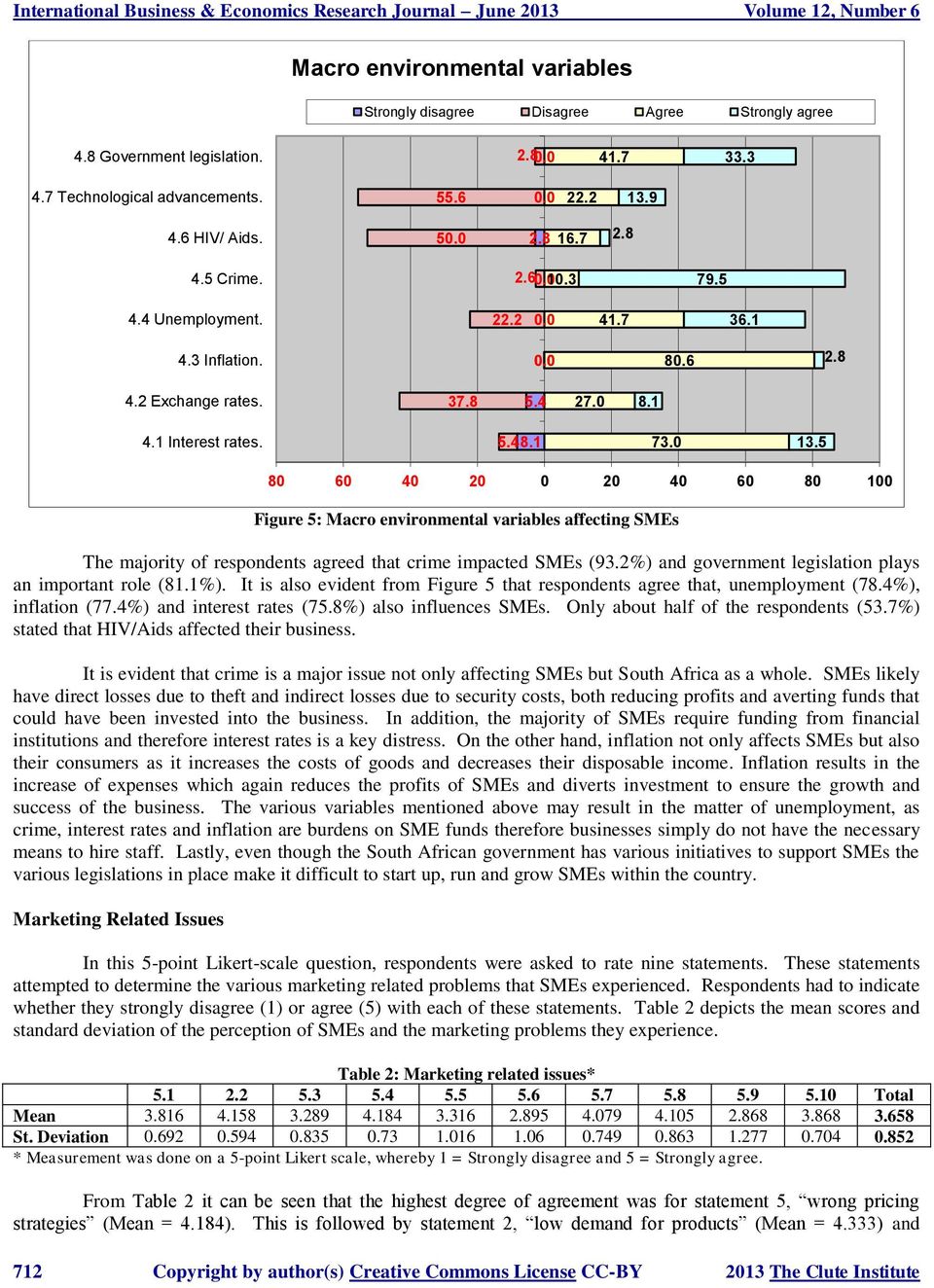
5 Level of education Post graduate degree 12% Undergraduate degree 12% Diploma only 6% Certificate only 6% Did not matriculate 35% Figure 4: The level of education of respondents Figure 4 illustrates the level of education of the respondents. About a third (35%) of respondents did not graduate matric, while the rest have matric (6%), an undergraduate degree (12%) and a post-graduate degree (12%). Roughly two thirds of the respondents are male (58%) and the rest are female (42%). Macro Environment This question in the survey was in the form of a 5-item Likert scale. Respondents were asked to indicated whether they strongly disagreed (1) or strongly agreed (5) with the statement. The mean is calculated by adding a list of scores and dividing them by the total number of scores (Wellman, Kruger & Mitchell, 2007). Standard deviation is the most commonly used and most important measure of variability in statistics which uses the mean as reference point and measures variability by calculating the distance between each score and the mean (Gravetter & Wellnaue, 2009). Table 1 depicts the mean scores and standard deviation of the impact that macro environmental variables have on SMEs. Table 1: Macro environmental variables* Total Mean St. Deviation * Measurement was done on a 5-point Likert scale, whereby 1 = Strongly disagree and 5 = Strongly agree. From Table 1 it can be seen that the highest degree of agreement was for statement 5, crime (Mean = 4.658). This is followed by statement 8, government legislation (Mean = 4.053) and then statement 4, unemployment (Mean = 3.921). The lowest degree of agreement was found to have come from statement 6, HIV/Aids (Mean = 2.684). The standard deviation for statement 7, technological advances is high, indicating a large distribution of value in the question. From the statements that were asked, it is clear that the macro environmental variables listed do affect SMEs, with a total mean score of and standard deviation of Figure 5 is thus indicative as to these statements and graphically presents the degree of agreeability and disagreeability The Clute Institute Copyright by author(s) Creative Commons License CC-BY 711

6 Macro environmental variables Strongly disagree Disagree Agree Strongly agree 4.8 Government legislation Technological advancements HIV/ Aids Crime Unemployment Inflation Exchange rates Interest rates Figure 5: Macro environmental variables affecting SMEs The majority of respondents agreed that crime impacted SMEs (93.2%) and government legislation plays an important role (81.1%). It is also evident from Figure 5 that respondents agree that, unemployment (78.4%), inflation (77.4%) and interest rates (75.8%) also influences SMEs. Only about half of the respondents (53.7%) stated that HIV/Aids affected their business. It is evident that crime is a major issue not only affecting SMEs but South Africa as a whole. SMEs likely have direct losses due to theft and indirect losses due to security costs, both reducing profits and averting funds that could have been invested into the business. In addition, the majority of SMEs require funding from financial institutions and therefore interest rates is a key distress. On the other hand, inflation not only affects SMEs but also their consumers as it increases the costs of goods and decreases their disposable income. Inflation results in the increase of expenses which again reduces the profits of SMEs and diverts investment to ensure the growth and success of the business. The various variables mentioned above may result in the matter of unemployment, as crime, interest rates and inflation are burdens on SME funds therefore businesses simply do not have the necessary means to hire staff. Lastly, even though the South African government has various initiatives to support SMEs the various legislations in place make it difficult to start up, run and grow SMEs within the country. Marketing Related Issues In this 5-point Likert-scale question, respondents were asked to rate nine statements. These statements attempted to determine the various marketing related problems that SMEs experienced. Respondents had to indicate whether they strongly disagree (1) or agree (5) with each of these statements. Table 2 depicts the mean scores and standard deviation of the perception of SMEs and the marketing problems they experience. Table 2: Marketing related issues* Total Mean St. Deviation * Measurement was done on a 5-point Likert scale, whereby 1 = Strongly disagree and 5 = Strongly agree. From Table 2 it can be seen that the highest degree of agreement was for statement 5, wrong pricing strategies (Mean = 4.184). This is followed by statement 2, low demand for products (Mean = 4.333) and 712 Copyright by author(s) Creative Commons License CC-BY 2013 The Clute Institute
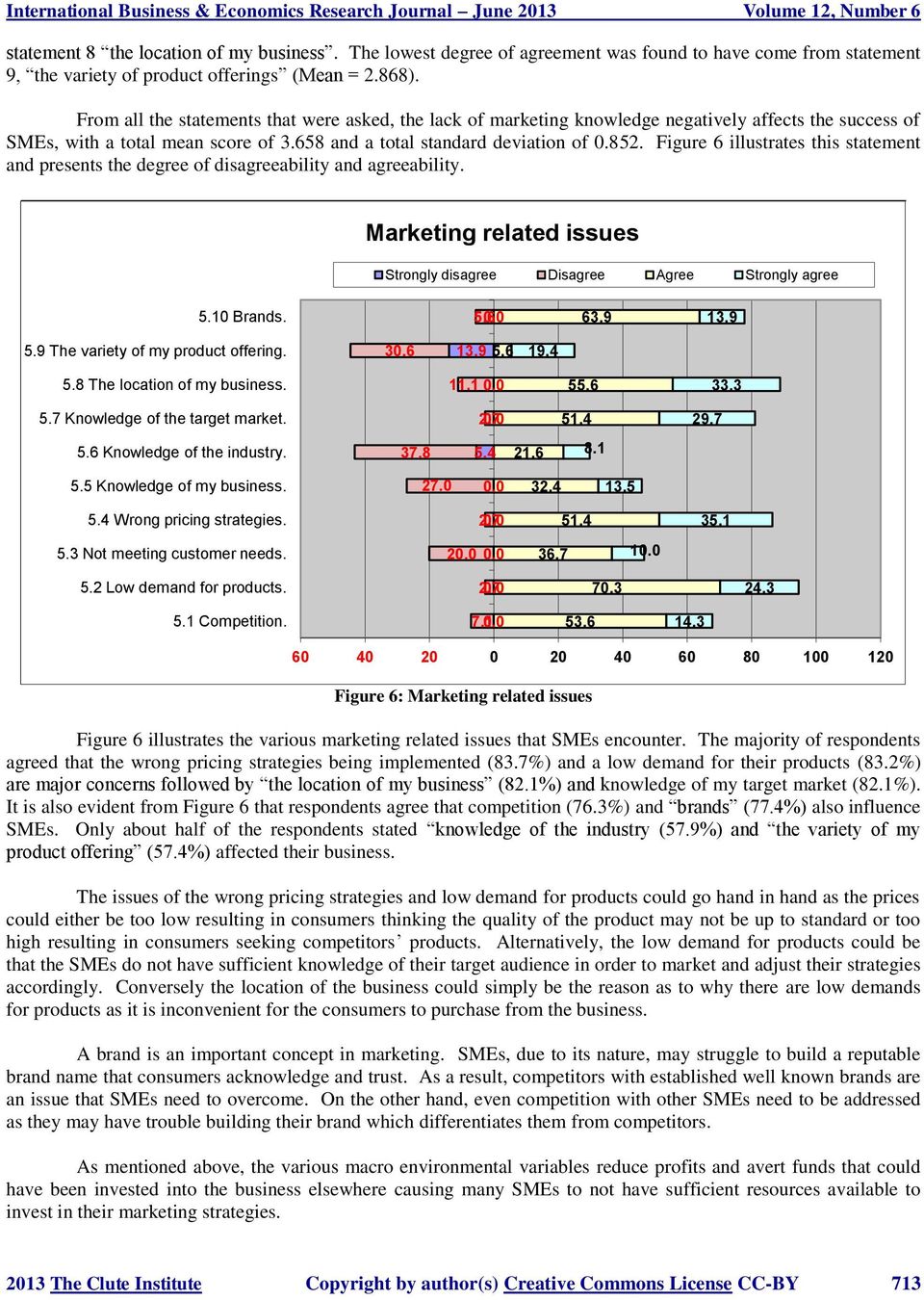
7 statement 8 the location of my business. The lowest degree of agreement was found to have come from statement 9, the variety of product offerings (Mean = 2.868). From all the statements that were asked, the lack of marketing knowledge negatively affects the success of SMEs, with a total mean score of and a total standard deviation of Figure 6 illustrates this statement and presents the degree of disagreeability and agreeability. Marketing related issues Strongly disagree Disagree Agree Strongly agree 5.10 Brands The variety of my product offering The location of my business Knowledge of the target market Knowledge of the industry Knowledge of my business Wrong pricing strategies Not meeting customer needs Low demand for products Competition Figure 6: Marketing related issues Figure 6 illustrates the various marketing related issues that SMEs encounter. The majority of respondents agreed that the wrong pricing strategies being implemented (83.7%) and a low demand for their products (83.2%) are major concerns followed by the location of my business (82.1%) and knowledge of my target market (82.1%). It is also evident from Figure 6 that respondents agree that competition (76.3%) and brands (77.4%) also influence SMEs. Only about half of the respondents stated knowledge of the industry (57.9%) and the variety of my product offering (57.4%) affected their business. The issues of the wrong pricing strategies and low demand for products could go hand in hand as the prices could either be too low resulting in consumers thinking the quality of the product may not be up to standard or too high resulting in consumers seeking competitors products. Alternatively, the low demand for products could be that the SMEs do not have sufficient knowledge of their target audience in order to market and adjust their strategies accordingly. Conversely the location of the business could simply be the reason as to why there are low demands for products as it is inconvenient for the consumers to purchase from the business. A brand is an important concept in marketing. SMEs, due to its nature, may struggle to build a reputable brand name that consumers acknowledge and trust. As a result, competitors with established well known brands are an issue that SMEs need to overcome. On the other hand, even competition with other SMEs need to be addressed as they may have trouble building their brand which differentiates them from competitors. As mentioned above, the various macro environmental variables reduce profits and avert funds that could have been invested into the business elsewhere causing many SMEs to not have sufficient resources available to invest in their marketing strategies The Clute Institute Copyright by author(s) Creative Commons License CC-BY 713
8 LIMITATIONS The limitations of this study need to be acknowledged and taken into consideration before any recommendations are made. Firstly the sampling size that was used was very small (n= 81), therefore variables identified cannot be generalised to be representative of all South African SMEs. Secondly, since the sample size is so small, it is evident that not all SMEs were approached therefore the results cannot be representative of all SMEs in the Tshwane region. RECOMMENDATIONS It has been emphasised that SMEs play a crucial role in the economy, but many struggle to operate in the complex and competitive business environment. Even though macro environmental and marketing variables are universal, some are country or region specific. For instance, the study shows that crime is the leading macro environmental variable affecting South African SMEs. Training programmes and workshops targeting SMEs should incorporate the key variables identified in order to be focused and specific on the problems experienced by South African SMEs and allow for practical application of concepts and procedures. Associations and representative bodies should be formed which focuses on the key variables such as crime prevention tips and methods. Negotiations should be done with local government to increase its role in supporting SMEs according to the specific key variables identified The marketing of SMEs should include aspects of the Proudly South African initiative and also the endorsement of supporting local SMEs. CONCLUSIONS SMEs in South Africa play an essential role in the development of South Africa s economy and have become the primary source of job creations. These SMEs are faced with a variety of exogenous and endogenous variables which are not only affecting its day to day business but its long term success and survival. The aim of this study was to determine the key variables specifically affecting South African SMEs. The research formulated two objectives to establish the key macro environmental and marketing variables affecting South African SMEs. The results reflected in the study indicate that crime, government legislation, unemployment and inflation and interest rates are the key macro environmental variables affecting South African SMEs. On the other hand, the wrong pricing strategies, low demand for products, location of the business and the knowledge of the target audience are the main marketing variables. Future research can be done on other regions and sectors in South Africa and comparisons can be done. AUTHOR INFORMATION Prof. Michael C. Cant is the CoD of the Department of Marketing and Retail Management at the University of South Africa (UNISA). He has published over 30 accredited articles in refereed journals and is the editor and author of more than 30 books in marketing. These books are widely prescribed at universities in South Africa. He has presented papers at more than 45 international conferences all over the world and is a well respected marketing and retail scholar. He holds a DCom in Marketing from the University of South Africa. Prof. Michael C. Cant, DCom, University of South Africa (UNISA), Department of Marketing and Retail Management, P. O Box 329, UNISA, 0003, South Africa. [email protected] (Corresponding author) Prof. Johannes A. Wiid is an Associate Professor in the Department of Marketing and Retail Management at the University of South Africa. He has published extensively in various refereed journals and is the editor and author of more than 5 books in marketing. These books are widely prescribed at universities in South Africa. He holds a DCom in Marketing from the University of Johannesburg. [email protected] 714 Copyright by author(s) Creative Commons License CC-BY 2013 The Clute Institute

9 REFERENCES 1. Brink, A., Cant, M.C. & Ligthelm, A. (2003). Problems experienced by small businesses in South Africa. Retrieved from: 2. Cant, M.C. & Lightelm, A. (2003). Small business problems in the South African context: a proactive entrepreneurial approach. Retrieved from: 3. Fatoki, O. and Garwe, D. (2010). Obstacles to the growth of new SMEs in South Africa: a principal component analysis approach. [Online] available from: 4. Fatoki, O. & Odeyemi, A. (2010). The determinants of access to trade credit by new SMEs in South Africa. Retrieved from: 5. Government Gazette of the Republic of South Africa. (2003). National small business amendment act. 6. Kongolo, M. (2010). Job creation versus job shedding and the roles of SMEs in economic development. Retrieved from: 7. Robert, J. (2010). Small business failure rates as high as 63% in first two years. Retrieved from: 8. Sha, S. (2006). An investigation into problems facing small-to-medium sized enterprises in achieving growth in the Eastern Cape: enhancing the strategy for developing small growth potential firms in the Eastern Cape. Retrieved from: 9. Van Scheers, L. (2012). Marketing related challenges of small and medium enterprises (SMEs) in developing African countries: the South African challenge The Clute Institute Copyright by author(s) Creative Commons License CC-BY 715

10 NOTES 716 Copyright by author(s) Creative Commons License CC-BY 2013 The Clute Institute
Problems experienced by small businesses in South Africa
 Problems experienced by small businesses in South Africa A paper for the Small Enterprise Association of Australia and New Zealand 16 th Annual Conference, Ballarat, 28 Sept-1 Oct, 2003. Annekie Brink
The Journal of Applied Business Research January/February 2016 Volume 32, Number 1
 Loyalty To SMES: A Pipe Dream In The Current Economic Climate? Johannes A. Wiid, Ph.D., University of South Africa (UNISA), South Africa Michael C. Cant, Ph.D., University of South Africa (UNISA), South
SMEs marketing skills challenges in South Africa
 African Journal of Business Management Vol. 5(13), pp. 5048-5056, 4 July, 2011 Available online at http://www.academicjournals.org/ajbm DOI: 10.5897/AJBM10.007 ISSN 1993-8233 2011 Academic Journals Full
Since achieving independence from Great Britain in 1963, Kenya has worked to improve its healthcare system.
 Medical Management Plan Kenya OVERVIEW Company Mission Our mission is to encourage young people to volunteer for worthwhile work in developing countries. We expect that doing this kind of voluntary work
PUBLIC SERVICE REGULATIONS REQUIREMENTS (CHAPTER I, PART III B) HUMAN RESOURCES PLAN AND ORGANISATIONAL STRUCTURE
 Part 5 HR Pages 72-82 5/7/03 8:38 AM Page 72 72 PART 5 PUBLIC SERVICE REGULATIONS REQUIREMENTS (CHAPTER I, PART III B) HUMAN RESOURCES PLAN AND ORGANISATIONAL STRUCTURE Part 5 HR Pages 72-82 5/7/03 8:38
PRESIDENT'S OFFICE. No. 1901. 27 November 1996 NO. 102 OF 1996: NATIONAL SMALL BUSINESS ACT, 1996.
 PRESIDENT'S OFFICE No. 1901. 27 November 1996 NO. 102 OF 1996: NATIONAL SMALL BUSINESS ACT, 1996. It is hereby notified that the President has assented to the following Act which is hereby published for
Alumni Perceptions of AACSB Accreditation to the Undergraduate Program
 Alumni Perceptions of AACSB Accreditation to the Undergraduate Program Juan M. Dempere, Metropolitan State College of Denver Ramon Griffin, Metropolitan State College of Denver Paul Camp, Metropolitan
Level 4 Diploma in Advanced Hospitality and Tourism Management (VRQ) Qualification Syllabus
 Level 4 Diploma in Advanced Hospitality and Tourism Management (VRQ) Qualification Syllabus Contents Page 1. The Level 4 Diploma in Advanced Hospitality and Tourism Management Syllabus 4 2. Structure of
SMALL BUSINESS REPUTATION & THE CYBER RISK
 SMALL BUSINESS REPUTATION & THE CYBER RISK Executive summary In the past few years there has been a rapid expansion in the development and adoption of new communications technologies which continue to
A Guide to Carrying Out a SWOT Analysis Introduction
 A Guide to Carrying Out a SWOT Analysis Introduction Resource 1.4 A SWOT (strengths, weaknesses, opportunities and threats) analysis is often done as part of the process of developing a business plan or
B126 Business Administration Project Management MTCU code - 60200 Program Learning Outcomes
 B126 Business Administration Project Management MTCU code - 60200 Program Learning Outcomes Synopsis of the Vocational Learning Outcomes The graduate has reliably demonstrated the ability to 1. evaluate
How To Calculate How Much Money A Business Makes From Its Customers
 ENTERPRISE SURVEYS INDICATOR DESCRIPTIONS Aug 20th, 2015 http://www.enterprisesurveys.org [email protected] ABOUT ENTERPRISE SURVEYS The Enterprise Surveys focus on the many factors that
Transportation costs make up a
 The Cost and Demographics of Vehicle Acquisition LAURA PASZKIEWICZ Laura Paszkiewicz is an economist in the Branch of Information Analysis, Division of Consumer Expenditure Surveys, Bureau of Labor Statistics.
Summary of the Research on the role of ICT related knowledge and women s labour market situation
 Summary of the Research on the role of ICT related knowledge and women s labour market situation Comparative anlysis of the situation in the five surveyed countries: Analysis of data about employment shows
Data Functionality in Marketing
 Data Functionality in Marketing By German Sacristan, X1 Head of Marketing and Customer Experience, UK and author of The Digital & Direct Marketing Goose Data is not a new thing. Successful businesses have
International Journal of Humanities Social Sciences and Education (IJHSSE)
 Volume 2, Issue 4, April 2015, PP 2228 ISSN 23490373 (Print) & ISSN 23490381 (Online) www.arcjournals.org International Journal of Humanities Social Sciences and Education (IJHSSE) Education and Development
LICENSED SOCIAL WORKERS IN THE UNITED STATES, 2004. Chapter 2 of 4. Demographics
 LICENSED SOCIAL WORKERS IN THE UNITED STATES, 2004 Chapter 2 of 4 Demographics Prepared by Center for Health Workforce Studies School of Public Health, University at Albany Rensselaer, NY and NASW Center
The Role of Small and Medium Size Enterprises in Economic Development
 The Role of Small and Medium Size Enterprises in Economic Development Selcuk Caner HSE Conference, Moscow 1. Introduction Improvements in the cost reducing industries, changes in the industrial structure
The Journal of Applied Business Research September/October 2012 Volume 28, Number 5 ABSTRACT
 Incorporating Customer Service Expectations In The Restaurant Industry: The Guide To Survival M.C. Cant, Ph.D., University of South Africa, South Africa C. Erdis, MCom, University of South Africa, South
Bedford Group of Drainage Boards
 Bedford Group of Drainage Boards Risk Management Strategy Risk Management Policy January 2010 1 Contents 1. Purpose, Aims & Objectives 2. Accountabilities, Roles & Reporting Lines 3. Skills & Expertise
How To Help Your Organisation Be Ethical
 Audit Advisory Tax RISK ADVISORY SERVICES MEASURING AND MONITORING ETHICS In association with The Leader for Exceptional Client Service BDO IN SOUTH AFRICA PROVIDES AUDIT, ADVISORY AND TAX SERVICES TO
Opinion Poll. Small Businesses Support Increasing Minimum Wage. April 24, 2013
 Opinion Poll Small Businesses Support Increasing Minimum Wage April 24, 2013 Small Business Majority 1101 14 th Street, NW, Suite 1001 Washington, DC 20005 (202) 828-8357 www.smallbusinessmajority.org
Successful Steps and Simple Ideas to Maximise your Direct Marketing Return On Investment
 Successful Steps and Simple Ideas to Maximise your Direct Marketing Return On Investment By German Sacristan, X1 Head of Marketing and Customer Experience, UK and author of The Digital & Direct Marketing
Exploring the Consumer Behavior That Influences. Student College Choice
 11(2004),53-72 Exploring the Consumer Behavior That Influences Student College Choice Cheng-Chuan Shen 1 Abstract This study examined consumer behavior influencing student college choice. The study focused
The Acceptability of Online University Degrees in the Arab Academia
 The Acceptability of Online University Degrees in the Arab Academia Dr. Gamal M. M. Mustafa Associate Professor of Foundations of Education Al-Azhar Univ. Egypt & Imam Mohd Inibn Saud Islamic Univ. KSA.
River Stour (Kent) Internal Drainage Board Risk Management Strategy and Policy
 River Stour (Kent) Internal Drainage Board Risk Management Strategy and Policy Page: 1 Contents 1. Purpose, Aims & Objectives 2. Accountabilities, Roles & Reporting Lines 3. Skills & Expertise 4. Embedding
TALENT SKILL AMBITION BRILLIANT
 20 16 TALENT SKILL AMBITION BRILLIANT why study at aaa? Rated one of the top advertising and design colleges in the world by Lürzer s Archive Most awarded advertising school in Africa All our qualifications
The Tax Shop CONTENTS. Accounting. Payroll. Taxation. COMPANY PROFILE THE TAX SHOP GROUP. Mission and Vision...2. Code of Ethics...
 CONTENTS SECTION PAGE Mission and Vision...2 Code of Ethics.... 2 History of the Group....2 Organisation Structure.. 2 Tax Shop Services..... 3 Our Clients 5 Director Details.. 5 Group Details.. 6 Contact
LIONS CLUBS NEW ZEALAND MULTIPLE DISTRICT 202 FORWARD ACTION PLAN (April 2015)
 BACKGROUND ANALYSIS: LIONS CLUBS NEW ZEALAND MULTIPLE DISTRICT 202 FORWARD ACTION PLAN (April 2015) In spite of the now universal recognition that we need new members we have continued to experience an
THE COSTS AND BENEFITS OF DIVERSITY
 Fundamental rights & anti-discrimination THE COSTS AND BENEFITS OF DIVERSITY European Commission Emplo 2 THE COSTS AND BENEFITS OF DIVERSITY A Study on Methods and Indicators to Measure the Cost-Effectiveness
Central African Republic Country Profile 2011
 Central African Republic Country Profile 2011 Public Disclosure Authorized Public Disclosure Authorized Public Disclosure Authorized Public Disclosure Authorized Region: Sub-Saharan Africa Income Group:
Factors Affecting the Competitiveness of the Agribusiness Sector in Swaziland
 Factors Affecting the Competitiveness of the Agribusiness Sector in Swaziland Bongiwe P. Dlamini P. O. Box 7689, Mbabane, H100, Swaziland Johann F. Kirsten Department of Agricultural Economics, Extension
Screen and Media. Sector Key Messages. Respondents % of overall Respondents Individuals 65 of 722 9% Small to Medium 20 of 128 16% Large 4 of 36 11%
 Screen and Media Sector Key Messages This sub-report aims to provide key messages about the Screen and Media sector of the Arts, Creative and Cultural industries in South Australia. This is achieved by
Masters Degree in Public Management
 Masters Degree in Public Management Course Overview The Masters in Public Management is for those in middle and senior management in the public service. What our current students appreciate most about
CHAPTER 3. Research methodology
 39 CHAPTER 3 Research methodology 3.1 INTRODUCTION In this chapter the research methodology used in the study is described. The geographical area where the study was conducted, the study design and the
Identify the category that is applicable to you and complete only those sections of the form as indicated in the table below.
 Application to study at Unisa (Only for first-time applicants who have not previously registered for a formal programme.) Applications Office: PO Box 1, Unisarand, 0148 Website: www.unisa.ac.za See the
THEME: PROMOTING GOOD PRACTICES IN DRUG POLICY DEVELOPMENT AND IMPLEMENTATION
 Page 1 AFRICAN UNION UNION AFRICAINE UNIÃO AFRICANA Addis Ababa, ETHIOPIA P. O. Box 3243 Telephone 251-11-5517 700 Fax 251-11-5517 844 website: www. africa-union.org 5 th SESSION OF THE AU CONFERENCE OF
Virginia s College and Career Readiness Initiative
 Virginia s College and Career Readiness Initiative In 1995, Virginia began a broad educational reform program that resulted in revised, rigorous content standards, the Virginia Standards of Learning (SOL),
A Survey on the Need to Offer Forensic Accounting Education in the Kingdom of Bahrain
 International Journal of Pedagogical Innovations ISSN 2210-1543 Int. J. Ped. Inn. 2, No. 2 (July 2014) A Survey on the Need to Offer Forensic Accounting Education in the Kingdom of Bahrain Sutan Emir Hidayat
Ministerie van Toerisme, Economische Zaken, Verkeer en Telecommunicatie Ministry of Tourism, Economic Affairs, Transport and Telecommunication
 SME Policy Framework for St. Maarten May, 2014 Department of Economic Affairs, Transportation & P. 1 of 16 TABLE OF CONTENTS 1. Introduction 2. SME Developments in St. Maarten 2.1 Definition 2.2 Government
Entrepreneurs of Small Scale Sector: A Factor Analytical Study of Business Obstacles
 Entrepreneurs of Small Scale Sector: A Factor Analytical Study of Business Obstacles Anil Kumar Associate professor, Haryana School of Business, Guru Jambheshwar University of Science & Technology, Hisar
Short courses presented by the NWU Programme in Forensic Accountancy
 Short courses presented by the NWU Programme in Forensic Accountancy Certificate in: Commercial Forensic Accounting Commercial Forensic Law Commercial Forensic Investigation Commercial Forensic Information
PIAAC Outline of First International Report (2013) & Proposed Thematic PIAAC Data Analysis ADVANCED OUTLINE OF THE FIRST INTERNATIONAL PIAAC REPORT 1
 ADVANCED OUTLINE OF THE FIRST INTERNATIONAL PIAAC REPORT 1 The development and implementation of PIAAC A collaborative effort Form and Style of the first international report A key objective of the first
The Umbrella Concept. Results of the SME and Start-up Survey 2012. Prof. Dr. R.-Dieter Reineke Andrew Mpeqa, MSc, MA Michael Sitte, MSc, MA
 The Umbrella Concept Results of the SME and Start-up Survey 2012 Prof. Dr. R.-Dieter Reineke Andrew Mpeqa, MSc, MA Michael Sitte, MSc, MA Institut für Unternehmensführung Olten, November 2012 Agenda THE
JOURNALISM EDUCATION IN MAINSTREAM MEDIA
 JOURNALISM EDUCATION IN MAINSTREAM MEDIA Education trends and training needs (July 2009) This document has been produced with the financial assistance of the European Union. The contents of this document
A study by Gallup and Inside Higher Ed SCOTT JASCHIK & DOUG LEDERMAN
 THE 2015 SURVEY OF Community College Presidents A study by Gallup and Inside Higher Ed SCOTT JASCHIK & DOUG LEDERMAN EDITORS, SUPPORT FOR THIS PROJECT PROVIDED BY WWW.INSIDEHIGHERED.COM THE 2015 SURVEY
Consultation on the introduction of diversity succession planning for board appointments and the lowering of the 150 employees threshold for
 Consultation on the introduction of diversity succession planning for board appointments and the lowering of the 150 employees threshold for publishing gender pay gap and equal pay statements etc. October
AIE delivers award and non-award programs for students in business, human resource management and entrepreneurship
 Australian Institute of Entrepreneurship (AIE) The Australian Institute of Entrepreneurship (AIE), in Melbourne, is a registered Vocational Education and Training Enterprise since 2007.AIE is also a Commonwealth
Gender Equality: Student Culture Survey Guidance for Departments
 Gender Equality: Student Culture Survey Guidance for Departments 1 1. Introduction The steps that lead to gender equality and wider diversity within organisations are also those that promote good practice
accredited affordable accessible MANCOSA BURSARY FUND Information Pack
 accredited affordable accessible MANCOSA BURSARY FUND Information Pack 2016 Bursary Fund 2016 MANCOSA recognises the changing needs in dynamic economies and is committed to skills and training development
Impact Factor 0.348 E- ISSN - 2349-6746 ISSN -2349-6738
 BUYING BEHAVIOUR OF INVESTORS OF SMALL TOWNS WITH RESPECT TO INSURANCE POLICIES: A STUDY ON BARPETA DISTRICT OF ASSAM Dr. Bidyut Jyoti Bhattacharjee Assistant Professor, Department of Commerce, B.H.College,
BEYOND ALBRECHT AND SACK: A COMPARISON OF ACCOUNTING PROFESSIONALS AND COLLEGE STUDENTS
 BEYOND ALBRECHT AND SACK: A COMPARISON OF ACCOUNTING PROFESSIONALS AND COLLEGE STUDENTS Bill Francisco is an assistant professor in the School of Accountancy at Georgia Southern University. He may be contacted
ASSESSMENT OF FACTORS AFFECTING SMALL BUSINESSES PERFORMANCE IN TANZA- NIA
 ASSESSMENT OF FACTORS AFFECTING SMALL BUSINESSES PERFORMANCE IN TANZA- NIA Paluku Kazimoto Faculty of Business Univesity of Arusha P.o.Box 7 Usa River, Arusha [email protected], [email protected]
Mexico Country Profile 2010. Region: Latin America & Caribbean Income Group: Upper middle income Population: 105,280,515 GNI per capita: US$8,340.
 Mexico Country Profile 2010 Region: Latin America & Caribbean Income Group: Upper middle income Population: 105,280,515 GNI per capita: US$8,340.00 Contents Introduction Business Environment Obstacles
How To Ensure That Sovini Is A Successful Business
 Group Risk Management Policy Originator: Approval date: Policy and Strategy Team Sovini Board PCHA Board OVH Board/EMT 6 th December 2013 31 st October 2013 14 th October 2013 Review date: December 2014
A STUDY ON INFLUENCE OF ADVERTISEMENT IN CONSUMER BRAND PREFERENCE (Special Reference to Soft Drinks Market in Hosur Town)
 A STUDY ON INFLUENCE OF ADVERTISEMENT IN CONSUMER BRAND PREFERENCE (Special Reference to Soft Drinks Market in Hosur Town) Dr.A. VinayagaMoorthy Professor, Department of Commerce, Periyar University,Salem-11.
Job Preference Factors of International Students
 Job Preference Factors of International Students Hanoku Bathula Senior Lecturer International Business Programme AIS St Helens PO Box 2995 Auckland 1140 New Zealand Phone: +649 8151717 Extn 814 Email:
The EIU Methodology EIU (Economist Intelligence Unit)
 Briefing Paper prepared for the Global Assessment Report on Disaster Risk Reduction 2013 The EIU Methodology EIU (Economist Intelligence Unit) Geneva, Switzerland, 2013 OVERVIEW The operational risk model
The Effects of Demographics on Consumer Perceptions of Identity Theft in Rural and Urban Settings
 The Effects of Demographics on Consumer Perceptions of Identity Theft in Rural and Urban Settings Axton Betz, Ph.D. Student, Iowa State University 1 Identity theft is a serious crime in which an individual
The Development of Self-Employment in Russia
 The Development of Self-Employment in Russia Theodore February 2001 PONARS Policy Memo 186 University of Arizona Despite the important economic, social, and political roles the self-employed can potentially
Having undertaken a general discussion on the basis of Report IV, Small and medium-sized enterprises and decent and productive employment creation,
 International Labour Conference Provisional Record 104th Session, Geneva, June 2015 11-1 Fourth item on the agenda: Small and medium-sized enterprises and decent and productive employment creation Reports
Steve and Clint Marchant Data Based Insights, Inc. on behalf of the ACS Department of Research & Market Insights. March 5, 2015
 Starting Salaries of Chemists And Chemical Engineers: 2014 Analysis of the American Chemical Society's Survey Of New Graduates in Chemistry and Chemical Engineering Steve and Clint Marchant Data Based
Chapter 10 SUPPLY AND DEMAND OF IT SKILLS
 Chapter 10 SUPPLY AND DEMAND OF IT SKILLS 10.1 Overview Some general patterns have emerged about the supply and demand of IT-related jobs and skills in South Africa these emerged during interviews and
Course Description. SEMESTER I Fundamental Concepts of Substance Abuse MODULE OBJECTIVES
 Course Description SEMESTER I Fundamental Concepts of Substance Abuse MODULE OBJECTIVES At the end of this course participants will be able to: Define and distinguish between substance use, abuse and dependence
How consumers want Charities to communicate with them
 How consumers want Charities to communicate with them A summary of the latest research findings 2 Listening to consumers Supporters of not-for-profit organisations range from individual donors who make
Key Findings ASIC Report 419. Australian Financial Attitudes and Behaviour Tracker Wave 1: March August 2014
 ASIC Report 419 Wave 1: March August 2014 Australian Securities and Investments Commission December 2014 Contents INTRODUCTION 3 KEY FINDINGS 9 Financial attitudes 10 Keeping track of finances 11 Planning
Keeping your business moving
 Keeping moving Helping No law firm understands what it takes to compete in today s market better than BHP. We ourselves have grown through innovation to become a diverse and dynamic entrepreneurial business.
PJ McGrath and L Nickola University of South Africa, Private Bag X6, Florida, 1710 South Africa [email protected]. Abstract
 A NEW EDUCATION FRAMEWORK AND THE IMPACT ON VOCATIONAL QUALIFICATIONS OFFERED BY SOUTH AFRICAN COMPREHENSIVE UNIVERSITIES AND UNIVERSITIES OF TECHNOLOGY PJ McGrath and L Nickola University of South Africa,
Blue Saffron Managed Services : The Customer Experience
 Blue Saffron Managed Services : The Customer Experience 1 Contents Background... 3 Section 1: SME Business and ICT Challenges... 3 Section 2: Key Drivers and Considerations for Managed Services... 5 Section
SMEs Access to Financial Services: Bankers Eye. Evelyn Mweta Richard, Neema Geoffrey Mori
 Chinese Business Review, ISSN 1537-1506 February 2012, Vol. 11, No. 2, 217-223 D DAVID PUBLISHING SMEs Access to Financial Services: Bankers Eye Evelyn Mweta Richard, Neema Geoffrey Mori University of
The Role of Business Schools in Entrepreneurial Development of rural areas of India through Entrepreneurial Education Introduction:
 The Role of Business Schools in Entrepreneurial Development of rural areas of India through Entrepreneurial Education Kalpana Singh Asst. Professor (Management) Shri Venkateshwara University Entrepreneurship
ENTERPRISE RISK MANAGEMENT POLICY
 ENTERPRISE RISK MANAGEMENT POLICY TITLE OF POLICY POLICY OWNER POLICY CHAMPION DOCUMENT HISTORY: Policy Title Status Enterprise Risk Management Policy (current, revised, no change, redundant) Approving
Students Perception Toward the Use of Blackboard as a Course. Delivery Method. By Dr. Ibtesam Al mashaqbeh
 Students Perception Toward the Use of Blackboard as a Course Delivery Method. By Dr. Ibtesam Al mashaqbeh Abstract: The aim of this study was to investigate students perception toward the use of blackboard
EXECUTIVE SUMMARY. Audit Report on PC Training and Business College
 HIGHER EDUCATION QUALITY COMMITTEE EXECUTIVE SUMMARY Audit Report on PC Training and Business College Report of the HEQC to PC Training and Business College September 2007 Didacta Building, 211 Skinner
Does Skepticism Influence Consumers Intention to Purchase Cause-related Products?
 Does Skepticism Influence Consumers Intention to Purchase Cause-related Products? Dr. Marhana M. Anuar Senior Lecturer Faculty of Management and Economics Universiti Malaysia Terengganu Dr. Khatijah Omar
An Equity Profile of the Kansas City Region. Summary. Overview. The Equity Indicators Framework. central to the region s economic success now and
 An Equity Profile of the Kansas City Region PolicyLink and PERE An Equity Profile of the Kansas City Region Summary Overview Across the country, regional planning organizations, community organizations
AAA School of Advertising Part Time Bachelor of Arts in Marketing Communication
 AAA School of Advertising Part Time Bachelor of Arts in Marketing Communication 2014 CURRICULUM BA IN MARKETING COMMUNICATION DURATION: 4 YEARS COURSE STRUCTURE YEAR 1: 5 MODULES 1. Principles of Marketing
GRADUATES EVALUATIONS OF THE MASTER OF NURSING SCIENCE DEGREE PROGRAMME OFFERED BY THE UNIVERSITY OF BOTSWANA
 GRADUATES EVALUATIONS OF THE MASTER OF NURSING SCIENCE DEGREE PROGRAMME OFFERED BY THE UNIVERSITY OF BOTSWANA M.B. Sabone, Ph D University of Botswana School of Nursing Corresponding author: e-mail: [email protected]
INSURANCE REGULATORY AUTHORITY
 INSURANCE REGULATORY AUTHORITY RISKS AND MITIGATION STRATEGIES BY MICRO AND SMALL ENTERPRISES IN KENYA: A CASE OF MERU COUNTY VICTOR MOSE, PILLY OSIEMO AND ROBERT KULOBA Policy Research and Development
COURSE INFORMATION BSB61015 Advanced Diploma of Leadership and Management
 COURSE INFORMATION BSB61015 Advanced Diploma of Leadership and Management What is the Australian Qualifications Framework? The Australian Qualifications Framework (AQF) establishes the quality of Australian
Graduate entry to practice in nursing: exploring demographic characteristics of commencing students
 Graduate entry to practice in nursing: exploring demographic characteristics of commencing students AUTHORS Lisa McKenna PhD MEdSt GradDipHealthAdmin&InfoSys RN RM Associate Professor, School of Nursing
High school student engagement among IB and non IB students in the United States: A comparison study
 RESEARCH SUMMARY High school student engagement among IB and non IB students in the United States: A comparison study IB Global Policy & Research Team, in collaboration with the Center for Evaluation and
A-LEVEL BUSINESS Paper 3 Specimen Assessment Material. Mark scheme
 A-LEVEL BUSINESS Paper 3 Specimen Assessment Material Mark scheme Mark schemes are prepared by the Lead Assessment Writer and considered, together with the relevant questions, by a panel of subject teachers.
An investigation into Accounting Practices of Small and Medium Enterprises of Tehran Province in Iran
 Available online at www.behaviorsciences.com Reef Resources Assessment and Management Technical Paper ISSN: 1607-7393 RRAMT 2014- Vol. 40, 2014, 1 An investigation into Accounting Practices of Small and
Effective Factors on the Development of Life Insurance in Guilan Province
 Vol. 5, No.3, July 2015, pp. 178 182 E-ISSN: 2225-8329, P-ISSN: 2308-0337 2015 HRMARS www.hrmars.com Effective Factors on the Development of Life Insurance in Guilan Province Fardin MEHRABIAN 1 Nehzat
accredited affordable accessible MANCOSA BURSARY FUND Information Pack
 accredited affordable accessible MANCOSA BURSARY FUND Information Pack 2015 Bursary Fund 2015 MANCOSA recognises the changing needs in dynamic economies and is committed to skills and training development
Retail Sector Labour Market Review September 2013
 Retail Sector Labour Market Review September 2013 Contents Introduction... 3 Economic contribution and performance... 6 What constitutes the retail sector?... 6 Size and number of businesses... 6 Table