
BUYING OR SELLING A BUSINESS: A CHECKLIST FOR SUCCESSFULLY NEGOTIATING PRICE
|
|
|
- Alban Cook
- 10 years ago
- Views:
Transcription
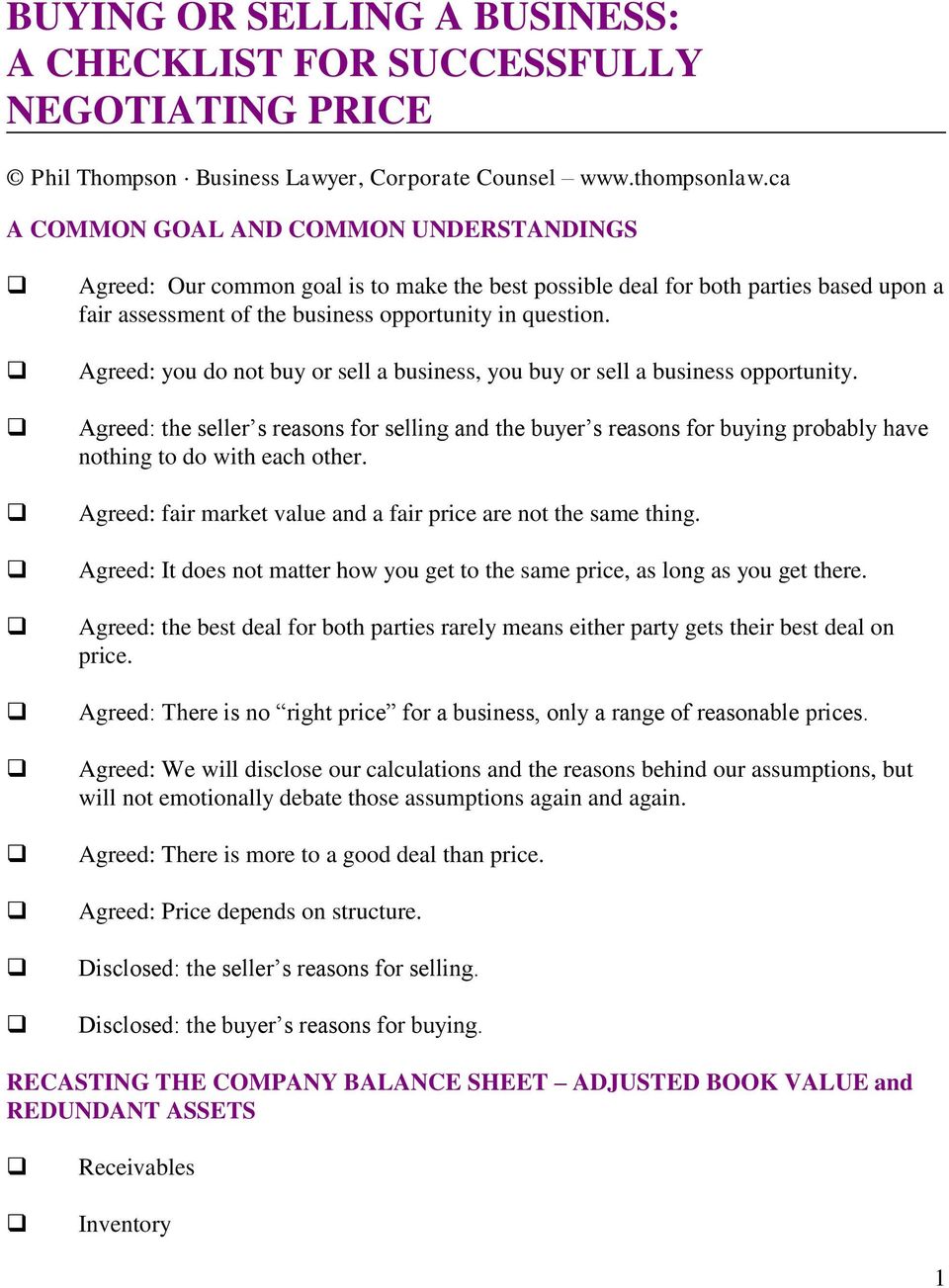
1 BUYING OR SELLING A BUSINESS: A CHECKLIST FOR SUCCESSFULLY NEGOTIATING PRICE Phil Thompson Business Lawyer, Corporate Counsel A COMMON GOAL AND COMMON UNDERSTANDINGS Agreed: Our common goal is to make the best possible deal for both parties based upon a fair assessment of the business opportunity in question. Agreed: you do not buy or sell a business, you buy or sell a business opportunity. Agreed: the seller s reasons for selling and the buyer s reasons for buying probably have nothing to do with each other. Agreed: fair market value and a fair price are not the same thing. Agreed: It does not matter how you get to the same price, as long as you get there. Agreed: the best deal for both parties rarely means either party gets their best deal on price. Agreed: There is no right price for a business, only a range of reasonable prices. Agreed: We will disclose our calculations and the reasons behind our assumptions, but will not emotionally debate those assumptions again and again. Agreed: There is more to a good deal than price. Agreed: Price depends on structure. Disclosed: the seller s reasons for selling. Disclosed: the buyer s reasons for buying. RECASTING THE COMPANY BALANCE SHEET ADJUSTED BOOK VALUE and REDUNDANT ASSETS Receivables Inventory 1
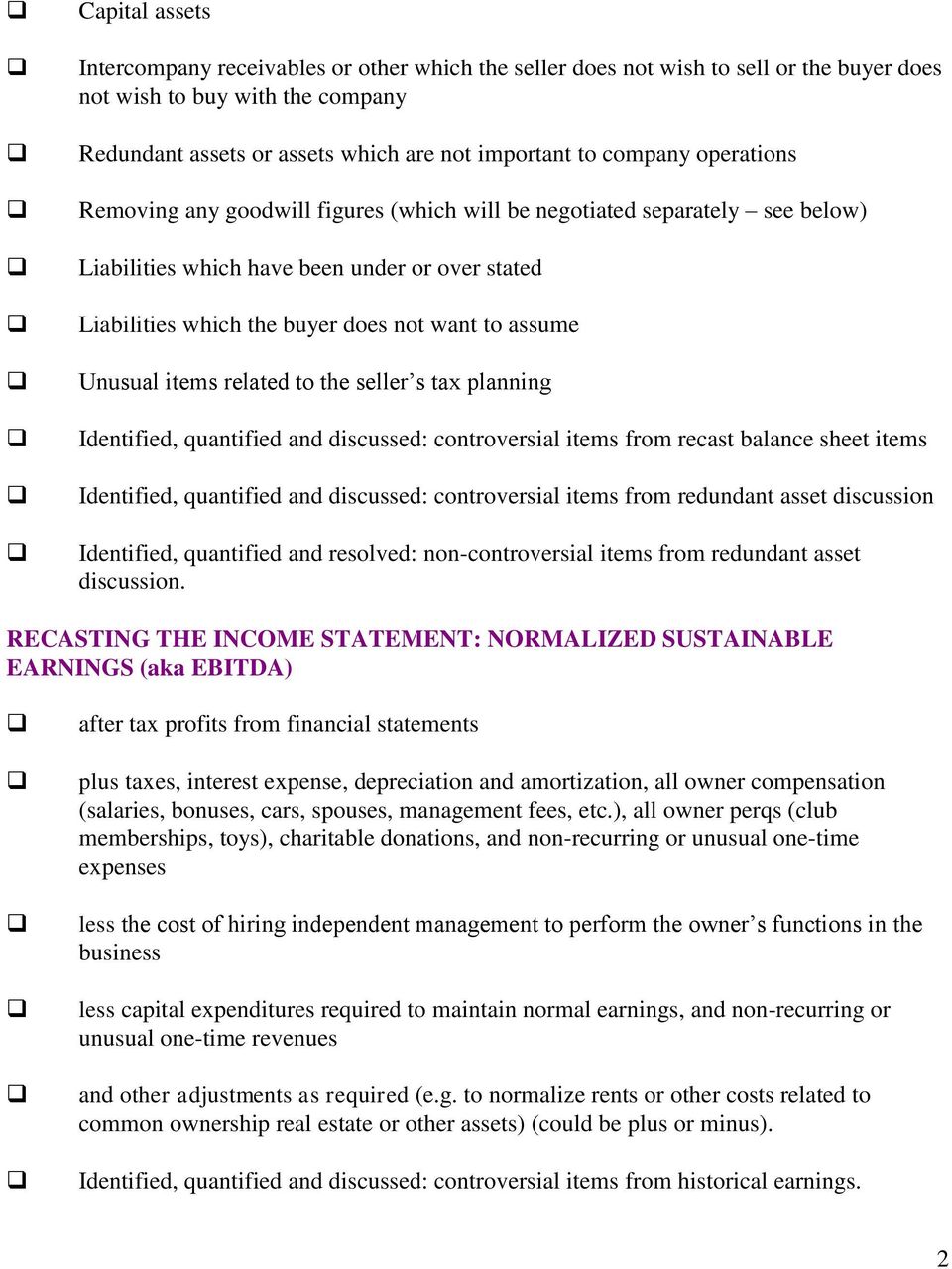
2 Capital assets Intercompany receivables or other which the seller does not wish to sell or the buyer does not wish to buy with the company Redundant assets or assets which are not important to company operations Removing any goodwill figures (which will be negotiated separately see below) Liabilities which have been under or over stated Liabilities which the buyer does not want to assume Unusual items related to the seller s tax planning Identified, quantified and discussed: controversial items from recast balance sheet items Identified, quantified and discussed: controversial items from redundant asset discussion Identified, quantified and resolved: non-controversial items from redundant asset discussion. RECASTING THE INCOME STATEMENT: NORMALIZED SUSTAINABLE EARNINGS (aka EBITDA) after tax profits from financial statements plus taxes, interest expense, depreciation and amortization, all owner compensation (salaries, bonuses, cars, spouses, management fees, etc.), all owner perqs (club memberships, toys), charitable donations, and non-recurring or unusual one-time expenses less the cost of hiring independent management to perform the owner s functions in the business less capital expenditures required to maintain normal earnings, and non-recurring or unusual one-time revenues and other adjustments as required (e.g. to normalize rents or other costs related to common ownership real estate or other assets) (could be plus or minus). Identified, quantified and discussed: controversial items from historical earnings. 2
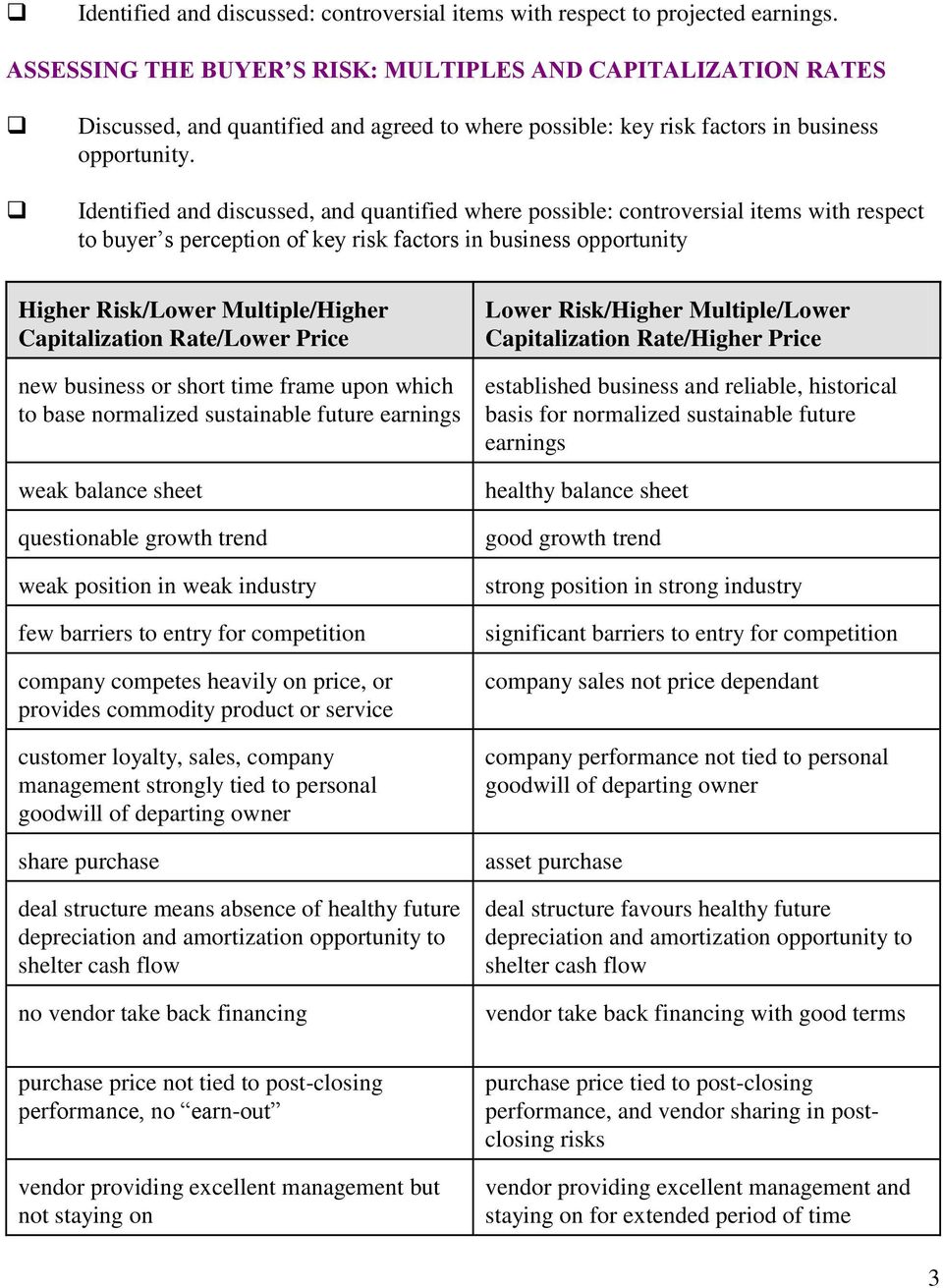
3 Identified and discussed: controversial items with respect to projected earnings. ASSESSING THE BUYER S RISK: MULTIPLES AND CAPITALIZATION RATES Discussed, and quantified and agreed to where possible: key risk factors in business opportunity. Identified and discussed, and quantified where possible: controversial items with respect to buyer s perception of key risk factors in business opportunity Higher Risk/Lower Multiple/Higher Capitalization Rate/Lower Price new business or short time frame upon which to base normalized sustainable future earnings weak balance sheet questionable growth trend weak position in weak industry few barriers to entry for competition company competes heavily on price, or provides commodity product or service customer loyalty, sales, company management strongly tied to personal goodwill of departing owner share purchase deal structure means absence of healthy future depreciation and amortization opportunity to shelter cash flow no vendor take back financing Lower Risk/Higher Multiple/Lower Capitalization Rate/Higher Price established business and reliable, historical basis for normalized sustainable future earnings healthy balance sheet good growth trend strong position in strong industry significant barriers to entry for competition company sales not price dependant company performance not tied to personal goodwill of departing owner asset purchase deal structure favours healthy future depreciation and amortization opportunity to shelter cash flow vendor take back financing with good terms purchase price not tied to post-closing performance, no earn-out vendor providing excellent management but not staying on purchase price tied to post-closing performance, and vendor sharing in postclosing risks vendor providing excellent management and staying on for extended period of time 3
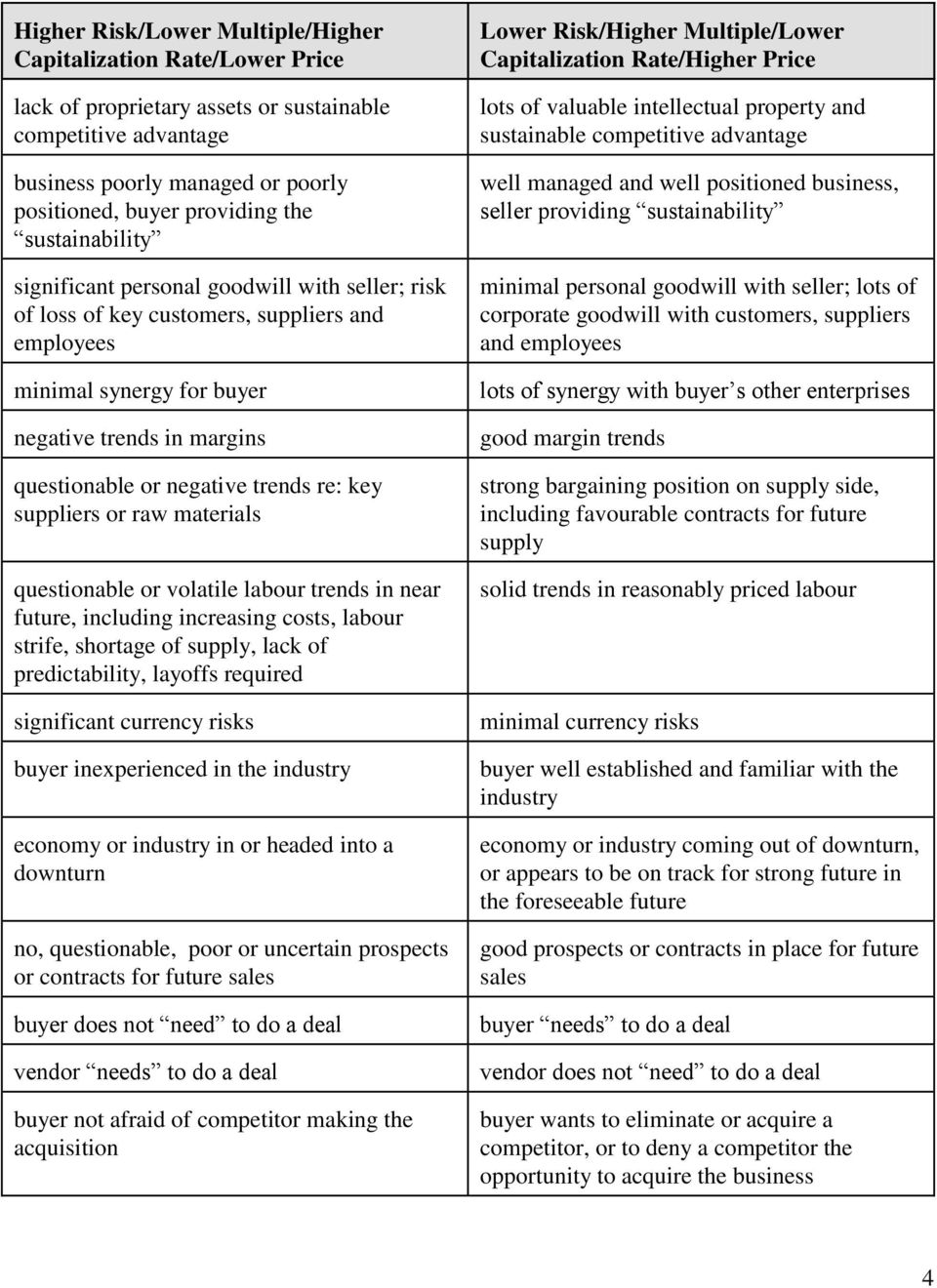
4 Higher Risk/Lower Multiple/Higher Capitalization Rate/Lower Price lack of proprietary assets or sustainable competitive advantage business poorly managed or poorly positioned, buyer providing the sustainability significant personal goodwill with seller; risk of loss of key customers, suppliers and employees minimal synergy for buyer negative trends in margins questionable or negative trends re: key suppliers or raw materials questionable or volatile labour trends in near future, including increasing costs, labour strife, shortage of supply, lack of predictability, layoffs required significant currency risks buyer inexperienced in the industry economy or industry in or headed into a downturn no, questionable, poor or uncertain prospects or contracts for future sales buyer does not need to do a deal vendor needs to do a deal buyer not afraid of competitor making the acquisition Lower Risk/Higher Multiple/Lower Capitalization Rate/Higher Price lots of valuable intellectual property and sustainable competitive advantage well managed and well positioned business, seller providing sustainability minimal personal goodwill with seller; lots of corporate goodwill with customers, suppliers and employees lots of synergy with buyer s other enterprises good margin trends strong bargaining position on supply side, including favourable contracts for future supply solid trends in reasonably priced labour minimal currency risks buyer well established and familiar with the industry economy or industry coming out of downturn, or appears to be on track for strong future in the foreseeable future good prospects or contracts in place for future sales buyer needs to do a deal vendor does not need to do a deal buyer wants to eliminate or acquire a competitor, or to deny a competitor the opportunity to acquire the business 4
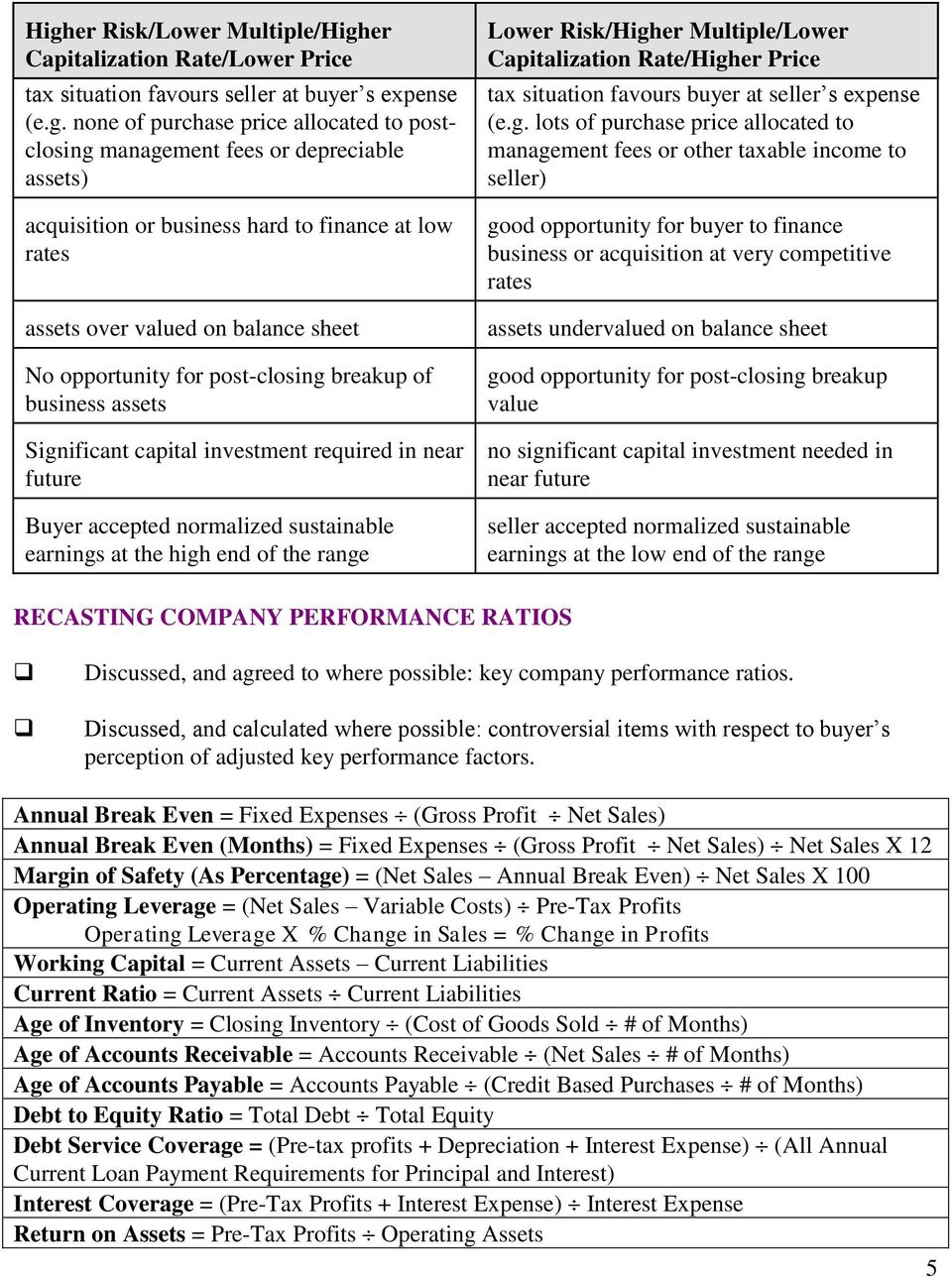
5 Higher Risk/Lower Multiple/Higher Capitalization Rate/Lower Price tax situation favours seller at buyer s expense (e.g. none of purchase price allocated to postclosing management fees or depreciable assets) acquisition or business hard to finance at low rates assets over valued on balance sheet No opportunity for post-closing breakup of business assets Significant capital investment required in near future Buyer accepted normalized sustainable earnings at the high end of the range Lower Risk/Higher Multiple/Lower Capitalization Rate/Higher Price tax situation favours buyer at seller s expense (e.g. lots of purchase price allocated to management fees or other taxable income to seller) good opportunity for buyer to finance business or acquisition at very competitive rates assets undervalued on balance sheet good opportunity for post-closing breakup value no significant capital investment needed in near future seller accepted normalized sustainable earnings at the low end of the range RECASTING COMPANY PERFORMANCE RATIOS Discussed, and agreed to where possible: key company performance ratios. Discussed, and calculated where possible: controversial items with respect to buyer s perception of adjusted key performance factors. Annual Break Even = Fixed Expenses (Gross Profit Net Sales) Annual Break Even (Months) = Fixed Expenses (Gross Profit Net Sales) Net Sales X 12 Margin of Safety (As Percentage) = (Net Sales Annual Break Even) Net Sales X 100 Operating Leverage = (Net Sales Variable Costs) Pre-Tax Profits Operating Leverage X % Change in Sales = % Change in Profits Working Capital = Current Assets Current Liabilities Current Ratio = Current Assets Current Liabilities Age of Inventory = Closing Inventory (Cost of Goods Sold # of Months) Age of Accounts Receivable = Accounts Receivable (Net Sales # of Months) Age of Accounts Payable = Accounts Payable (Credit Based Purchases # of Months) Debt to Equity Ratio = Total Debt Total Equity Debt Service Coverage = (Pre-tax profits + Depreciation + Interest Expense) (All Annual Current Loan Payment Requirements for Principal and Interest) Interest Coverage = (Pre-Tax Profits + Interest Expense) Interest Expense Return on Assets = Pre-Tax Profits Operating Assets 5
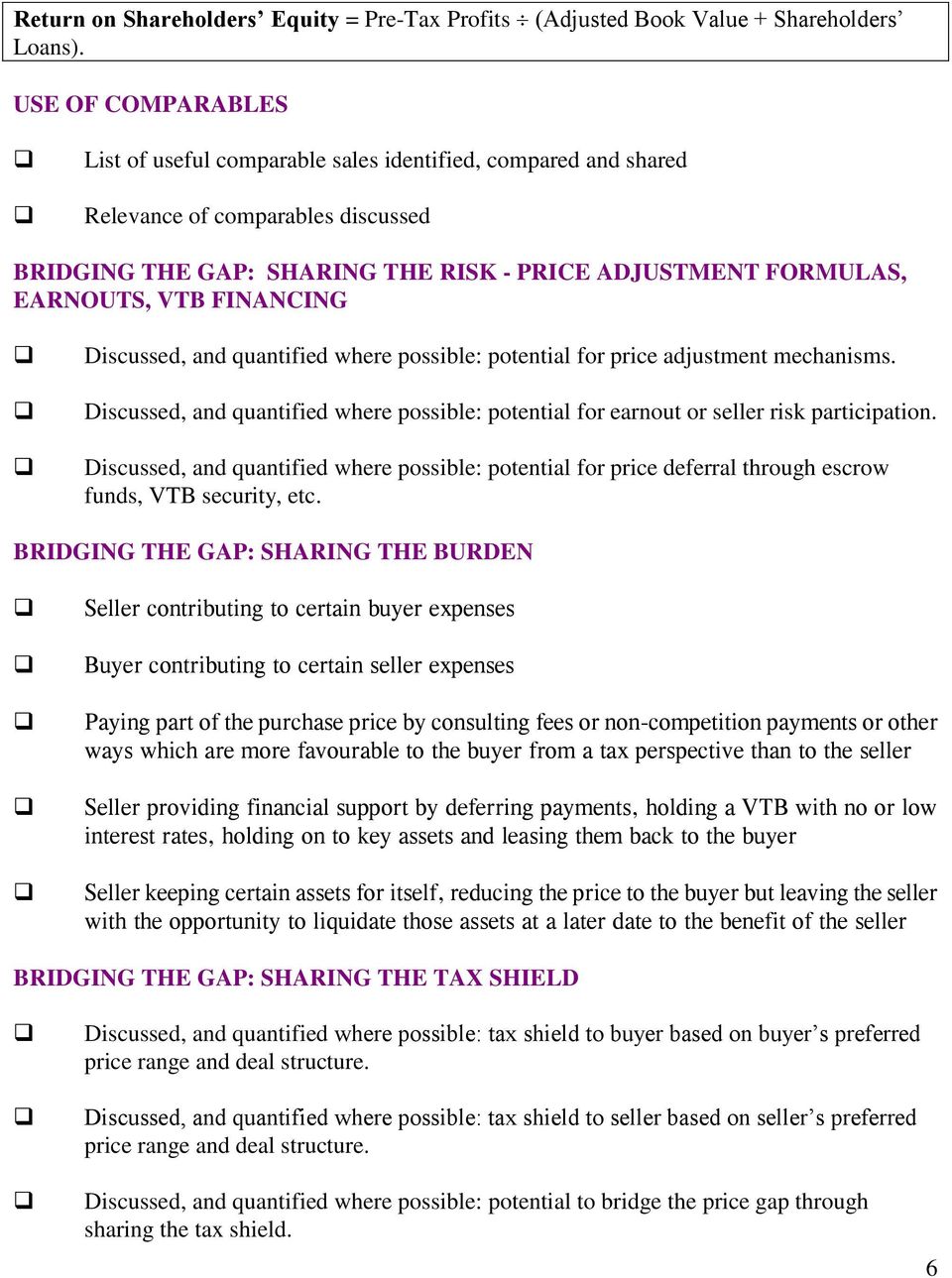
6 Return on Shareholders Equity = Pre-Tax Profits Loans). (Adjusted Book Value + Shareholders USE OF COMPARABLES List of useful comparable sales identified, compared and shared Relevance of comparables discussed BRIDGING THE GAP: SHARING THE RISK - PRICE ADJUSTMENT FORMULAS, EARNOUTS, VTB FINANCING Discussed, and quantified where possible: potential for price adjustment mechanisms. Discussed, and quantified where possible: potential for earnout or seller risk participation. Discussed, and quantified where possible: potential for price deferral through escrow funds, VTB security, etc. BRIDGING THE GAP: SHARING THE BURDEN Seller contributing to certain buyer expenses Buyer contributing to certain seller expenses Paying part of the purchase price by consulting fees or non-competition payments or other ways which are more favourable to the buyer from a tax perspective than to the seller Seller providing financial support by deferring payments, holding a VTB with no or low interest rates, holding on to key assets and leasing them back to the buyer Seller keeping certain assets for itself, reducing the price to the buyer but leaving the seller with the opportunity to liquidate those assets at a later date to the benefit of the seller BRIDGING THE GAP: SHARING THE TAX SHIELD Discussed, and quantified where possible: tax shield to buyer based on buyer s preferred price range and deal structure. Discussed, and quantified where possible: tax shield to seller based on seller s preferred price range and deal structure. Discussed, and quantified where possible: potential to bridge the price gap through sharing the tax shield. 6
7 BRIDGING THE GAP: INTANGIBLES Discussed: intangible reasons for bridging the gap, including: how badly each party needs to do the deal how badly each party wants to do the deal how badly the parties want to do business with each other what synergies the buyer thinks it can bring to the table to drive normalized sustainable future earnings to higher levels, thereby effectively reducing the buyer s multiple how the buyer is financing the deal, and whether that financing package ultimately reduces his risk to an acceptable level how the deal is structured, including vendor take back financing, price adjustment clauses, post-closing support, etc. how the deal is structured for after tax cash flow to each party. 7

SELLING YOUR BUSINESS: SUCCESSFULLY NEGOTIATING PRICE
 SELLING YOUR BUSINESS: SUCCESSFULLY NEGOTIATING PRICE Phil Thompson Business Lawyer, Corporate Counsel www.thompsonlaw.ca The Most Difficult Issue In Negotiating The Purchase Or Sale Of A Business Is Negotiating
Valuing the Business
 Valuing the Business 1. Introduction After deciding to buy or sell a business, the subject of "how much" becomes important. Determining the value of a business is one of the most difficult aspects of any
Chapter 4: Liquor Store Business Valuation
 Chapter 4: Liquor Store Business Valuation In this section, we will utilize three approaches to valuing a liquor store. These approaches are the: (1) cost (asset based), (2) market, and (3) income approach.
The Nature of Accounting Systems
 Basic Accounting & Budgeting February 4, 2009 The Nature of Accounting Systems Accounting is the process of recording, classifying, summarizing, reporting and interpreting information about the economic
Advanced Merger Model Quick Reference Common Formulas & Model Setup. http://breakingintowallstreet.com. Transaction Structure & Assumptions
 Transaction Structure & Assumptions Equity Purchase Price = Diluted Shares Outstanding * Per Share Purchase Price For private companies, you don t have shares outstanding or share prices, so the equity
Understanding Financial Statements. For Your Business
 Understanding Financial Statements For Your Business Disclaimer The information provided is for informational purposes only, does not constitute legal advice or create an attorney-client relationship,
Glossary and Formulas
 A-B Accounts Payable Includes, but is not limited to, Trade Accounts Payable and Trade Acceptances, that is, amounts owed to vendors for goods and services purchased from outside suppliers and due within
Understanding Business Valuations
 Understanding Business Valuations SBA America East Conference August 1, 2012 Neal Patel, CBA Reliant Business Valuation Abridged Slides: Email [email protected] for full presentation Appraiser s Professional
Report Description. Business Counts. Top 10 States (by Business Counts) Page 1 of 16
 5-Year County-Level Financial Profile Industry Report Architectural Services (SIC Code: 8712) in Prince George County, Maryland Sales Range: $500,000 - $999,999 Date: 11/07/08 Report Description This 5-Year
Understanding Financial Information for Bankruptcy Lawyers Understanding Financial Statements
 Understanding Financial Information for Bankruptcy Lawyers Understanding Financial Statements In the United States, businesses generally present financial information in the form of financial statements
How To Calculate Financial Leverage Ratio
 What Do Short-Term Liquidity Ratios Measure? What Is Working Capital? HOCK international - 2004 1 HOCK international - 2004 2 How Is the Current Ratio Calculated? How Is the Quick Ratio Calculated? HOCK
Smithfield Motors: A case in lending, strategy, and value
 ABSTRACT Smithfield Motors: A case in lending, strategy, and value Steve A. Nenninger Sam Houston State University The primary subject matter of this case is financial statement analysis. Issues examined
BUYING OUT A PARTNER: A CHECKLIST OF ISSUES TO CONSIDER
 BUYING OUT A PARTNER: A CHECKLIST OF ISSUES TO CONSIDER Phil Thompson Business Lawyer, Corporate Counsel www.thompsonlaw.ca All business partnerships end eventually. If nothing else, death or retirement
Analyzing Cash Flows. April 2013
 Analyzing Cash Flows April 2013 Overview Introductions Importance of cash flow in underwriting decisions Key attributes to calculating cash flow Where to obtain information to calculate cash flows Considerations
CONSIDERATIONS IN BUYING AND SELLING A BUSINESS
 CONSIDERATIONS IN BUYING AND SELLING A BUSINESS David H. Pettit, Esq. Feil, Pettit & Williams, PLC Charlottesville, VA I. Ownership A. Are the owners of sound mind and in agreement? B. Can the transaction
A PRACTICAL GUIDE TO BUYING AND SELLING A BUSINESS
 A PRACTICAL GUIDE TO BUYING AND SELLING A BUSINESS A COURTESY GUIDE PREPARED BY SWAAB ATTORNEYS 2014 Overview of the acquisition process TIMETABLE > Identify target / Invitation to tender > Initial investigation
Aastra Technologies Limited First Quarter ended March 31, 2003
 Aastra Technologies Limited First Quarter ended March 31, 2003 AASTRA TECHNOLOGIES LIMITED MESSAGE TO OUR SHAREHOLDERS First Quarter ended March 31, 2003 To our Shareholders: Aastra Technologies Limited
Liquidity analysis: Length of cash cycle
 2. Liquidity analysis: Length of cash cycle Operating cycle of a merchandising firm: number of days it takes to sell inventory + number of days until the resulting receivables are converted to cash Acquisition
Financial Statement Analysis in Mergers and Acquisitions. Howard E. Johnson, MBA, CA, CMA, CBV, CPA, CFA. Campbell Valuation Partners Limited
 - 1 - Financial Statement Analysis in Mergers and Acquisitions Howard E. Johnson, MBA, CA, CMA, CBV, CPA, CFA Campbell Valuation Partners Limited Overview Financial statement analysis is fundamental to
Performance Review for Electricity Now
 Performance Review for Electricity Now For the period ending 03/31/2008 Provided By Mark Dashkewytch 780-963-5783 Report prepared for: Electricity Now Industry: 23821 - Electrical Contractors Revenue:
BUSINESS PLAN TEMPLATE
 iplanner.net Small Business Plans Online BUSINESS PLAN TEMPLATE For a start-up company 18/01/2012 12:33:19(GMT) Executive Summary... 3 Business Overview... 3 Products and Services... 3 Sales Forecast...
Transferring Business Assets
 Transferring Business Assets In the future, you may either want to transfer your business to heirs or sell your business to employees, competitors, or others. Planning for transfer of a family business
EQUINIX, INC. CONDENSED CONSOLIDATED STATEMENTS OF OPERATIONS - GAAP PRESENTATION (in thousands, except per share data) (unaudited)
 CONDENSED CONSOLIDATED STATEMENTS OF OPERATIONS - GAAP PRESENTATION (in thousands, except per share data) Recurring revenues $ 314,727 $ 282,117 $ 216,517 $ 834,080 $ 610,384 Non-recurring revenues 15,620
Chapter 5: Business Valuation (Market Approach)
 Chapter 5: Business Valuation (Market Approach) This methodology values larger companies based upon the value of similar publicly traded For smaller companies, otherwise known as micro businesses (e.g.,
SEAGATE TECHNOLOGY PLC CONDENSED CONSOLIDATED BALANCE SHEETS
 CONDENSED CONSOLIDATED BALANCE SHEETS (In millions) June 28, ASSETS Current assets: Cash and cash equivalents $ 2,259 $ 1,708 Short-term investments 47 480 Restricted cash and investments 4 101 Accounts
SMALL BUSINESS DEVELOPMENT CENTER RM. 032
 SMALL BUSINESS DEVELOPMENT CENTER RM. 032 FINANCING THROUGH COMMERCIAL BANKS Revised January, 2013 Adapted from: National Federation of Independent Business report Steps to Small Business Financing Jeffrey
Financial Formulas. 5/2000 Chapter 3 Financial Formulas i
 Financial Formulas 3 Financial Formulas i In this chapter 1 Formulas Used in Financial Calculations 1 Statements of Changes in Financial Position (Total $) 1 Cash Flow ($ millions) 1 Statements of Changes
Summary of Financial Report for the FY ending March 2015 (Non-Consolidated)
 Summary of Financial Report for the FY ending March 2015 (Non-Consolidated) April 30, 2015 Listed Company Name: Japan Tissue Engineering Co., Ltd. Listed Securities Exchange: JQ Stock Code: 7774 URL http://www.jpte.co.jp
Session 19 -Taxable acquisitions
 -Taxable acquisitions Acquire stock or assets? Assume that Buyer Corporation wants to acquire the business of Target Corporation Target's assets have appreciated and are worth more than their tax basis
Practice Bulletin No. 2
 Practice Bulletin No. 2 INTERNATIONAL GLOSSARY OF BUSINESS VALUATION TERMS To enhance and sustain the quality of business valuations for the benefit of the profession and its clientele, the below identified
Accounts Payable are the total amounts your business owes its suppliers for goods and services purchased.
 Accounts Payable are the total amounts your business owes its suppliers for goods and services purchased. Accounts Receivable are the total amounts customers owe your business for goods or services sold
FINANCIAL ANALYSIS CS. Sample Reports. version 2008.x.x
 FINANCIAL ANALYSIS CS Sample Reports version 2008.x.x TL 19887 (10/14/2008) Copyright Information Text copyright 2004-2008 by Thomson Reuters/Tax & Accounting. All rights reserved. Video display images
How to Maximize the Value When Selling Your Management Company
 WHITE PAPER How to Maximize the Value When Selling Your Management Company INSIDE THIS REPORT Rational for Selling Management Company Valuation Acquisition Deal Structure Tips to Optimize Your Exit Value
International Glossary of Business Valuation Terms*
 40 Statement on Standards for Valuation Services No. 1 APPENDIX B International Glossary of Business Valuation Terms* To enhance and sustain the quality of business valuations for the benefit of the profession
Business Valuation A presentation for Manitoba Learning Match 2014. Daniel Bernard, CA, CBV
 Business Valuation A presentation for Manitoba Learning Match 2014 February 11, 2014 Daniel Bernard, CA, CBV J.P. Barnabé, CA Overview When to get a Valuation Valuation Reports Basic Principles of Valuation
Learning Objectives: Quick answer key: Question # Multiple Choice True/False. 14.1 Describe the important of accounting and financial information.
 0 Learning Objectives: 14.1 Describe the important of accounting and financial information. 14.2 Differentiate between managerial and financial accounting. 14.3 Identify the six steps of the accounting
Performance Food Group Company Reports First-Quarter Fiscal 2016 Earnings
 NEWS RELEASE For Immediate Release November 4, 2015 Investors: Michael D. Neese VP, Investor Relations (804) 287-8126 [email protected] Media: Joe Vagi Manager, Corporate Communications (804) 484-7737
Financial Ratios and Quality Indicators
 Financial Ratios and Quality Indicators From U.S. Small Business Administration Online Women's Business Center If you monitor the ratios on a regular basis you'll gain insight into how effectively you
Consolidated balance sheet
 Consolidated balance sheet Non current assets 31/12/2009 31/12/2008 (*) 01/01/2008 (*) Property, plant and equipment 1,352 1,350 1,144 Investment property 7 11 11 Fixed assets held under concessions 13,089
SELLING THE BUSINESS: PRACTICAL, TAX AND LEGAL ISSUES. William C. Staley. Attorney www.staleylaw.com 818 936-3490
 SELLING THE BUSINESS: PRACTICAL, TAX AND LEGAL ISSUES William C. Staley, Attorney www.staleylaw.com 818 936-3490 WEST SAN GABRIEL VALLEY DISCUSSION GROUP LOS ANGELES CHAPTER CALIFORNIA SOCIETY OF CPAS
In this chapter, we build on the basic knowledge of how businesses
 03-Seidman.qxd 5/15/04 11:52 AM Page 41 3 An Introduction to Business Financial Statements In this chapter, we build on the basic knowledge of how businesses are financed by looking at how firms organize
Niche medical billing service with stable, reliable government clients
 Niche medical billing service with stable, reliable government clients This 25+ year old company provides a narrow niche medical billing service that primarily serves city and county government agencies
HOW TO BUY A BUSINESS
 HOW TO BUY A BUSINESS Buying a business is possibly the most important financial decision you will make. It may consume all your spare cash, cause you to borrow a significant sum of money, determine your
Managing Cash Flow: Practical ways to Improving Cash Flow & Optimise Funding
 Managing Cash Flow: Practical ways to Improving Cash Flow & Optimise Funding A Practical Guide to understanding Effective Financial Management Module 6 Brendan Binchy CEO ROCG Europe W: www.europe.rocg.com
What is a business plan?
 What is a business plan? A business plan is the presentation of an idea for a new business. When a person (or group) is planning to open a business, there is a great deal of research that must be done
Marketing Software and Web Developer with Clients Nationwide
 Marketing Software and Web Developer with Clients Nationwide This web-development, marketing, and software company, founded in 2000, has developed a loyal, long-term client base, who appreciates its excellent
ICAP GROUP S.A. FINANCIAL RATIOS EXPLANATION
 ICAP GROUP S.A. FINANCIAL RATIOS EXPLANATION OCTOBER 2006 Table of Contents 1. INTRODUCTION... 3 2. FINANCIAL RATIOS FOR COMPANIES (INDUSTRY - COMMERCE - SERVICES) 4 2.1 Profitability Ratios...4 2.2 Viability
RISK ASSESSMENT FOR SMALL BUSINESS. Terry S. Campbell, Community Development Officer Department of Development & Technology
 RISK ASSESSMENT FOR SMALL BUSINESS Terry S. Campbell, Community Development Officer Department of Development & Technology Date: March 25, 2004 1 Counseling Tool Outline - Cover Page - Outline - Introduction
Chapter 002 Financial Statements, Taxes and Cash Flow
 Multiple Choice Questions 1. The financial statement summarizing the value of a firm's equity on a particular date is the: a. income statement. B. balance sheet. c. statement of cash flows. d. cash flow
Having cash on hand is costly since you either have to raise money initially (for example, by borrowing from a bank) or, if you retain cash out of
 1 Working capital refers to liquid funds used to purchase materials and pay workers. This is in contrast to long term capital such as buildings and machinery. Part of working capital management is cash
Performance Review. Sample Company
 Performance Review Sample Company For the period ended 12/31/2017 Provided By Page 1 / 18 This report is designed to assist you in your business' development. Below you will find your overall ranking,
Consolidated Financial Results for Fiscal Year 2013 (April 1, 2013 March 31, 2014)
 Consolidated Financial Results for Fiscal Year 2013 (April 1, 2013 March 31, 2014) 28/4/2014 Name of registrant: ShinMaywa Industries, Ltd. Stock Exchange Listed: Tokyo Code number: 7224 (URL: http://www.shinmaywa.co.jp
LEADing Practice Financial Scorecard Measurements
 LEADing Practice Financial Scorecard Measurements Scorecard Area Finance & Accounting Scorecard Group Accounting ratios Balance sheet Scorecard Performance Measurement Deferred revenue as % of total revenue
Note 2 SIGNIFICANT ACCOUNTING
 Note 2 SIGNIFICANT ACCOUNTING POLICIES BASIS FOR THE PREPARATION OF THE FINANCIAL STATEMENTS The consolidated financial statements have been prepared in accordance with International Financial Reporting
Mergers & Acquisitions The Basics
 Mergers & Acquisitions The Basics Following is a Chart Comparing and Contrasting Asset and Equity Sales taken from my book: Buying and Selling a Business A Practical Guide to the Acquisition and Sale Process
BSM Connection elearning Course
 BSM Connection elearning Course Basics of Medical Practice Finance: Part 2 2009, BSM Consulting All rights reserved. Table of Contents OVERVIEW... 1 PRACTICE PERFORMANCE RATIOS... 1 UNDERSTANDING THE CONCEPT
Projecting the 3 Statements & 3-Statement Modeling Quiz Questions
 Projecting the 3 Statements & 3-Statement Modeling Quiz Questions 1. Let s say that we re creating 3-statement projections for a company, and in its historical filings Depreciation & Amortization and Stock-Based
Ratio Analysis. A) Liquidity Ratio : - 1) Current ratio = Current asset Current Liability
 A) Liquidity Ratio : - Ratio Analysis 1) Current ratio = Current asset Current Liability 2) Quick ratio or Acid Test ratio = Quick Asset Quick liability Quick Asset = Current Asset Stock Quick Liability
Small-business owners who need
 BUSINESS PLANS ARE MORE IMPORTANT NOW THAN EVER Jenni Jeras 1 Small-business owners who need financing are smart to do their homework, and that includes creating a comprehensive business plan. Lenders
Preparing a Successful Financial Plan
 Topic 9 Preparing a Successful Financial Plan LEARNING OUTCOMES By the end of this topic, you should be able to: 1. Describe the overview of accounting methods; 2. Prepare the three major financial statements
UNDERSTANDING WHERE YOU STAND. A Simple Guide to Your Company s Financial Statements
 UNDERSTANDING WHERE YOU STAND A Simple Guide to Your Company s Financial Statements Contents INTRODUCTION One statement cannot diagnose your company s financial health. Put several statements together
Financial Terms & Calculations
 Financial Terms & Calculations So much about business and its management requires knowledge and information as to financial measurements. Unfortunately these key terms and ratios are often misunderstood
APPENDIX 1 The Statement of Financial Position
 APPENDIX 1 The Statement of Financial Position 1. Assets: the resources of the organization which are used to provide service and generate value 2. Current assets: assets which can be converted to cash
FINANCIAL REPORTING GUIDELINES
 FINANCIAL REPORTING GUIDELINES These policies support and extend COMTA Accreditation Standard XII. As such, institutions must demonstrate compliance to both. STATEMENT OF PURPOSE: All new institutional
BUYING OR SELLING YOUR BUSINESS
 BUYING OR SELLING YOUR BUSINESS On a regular basis I and work with buyers and sellers of businesses. In this article, I thought I would walk you through some considerations from an Advisor s point-of-view
SELLING YOUR private BUSINESS
 SELLING YOUR private BUSINESS BDO Canada Transaction Advisory Services Inc. A plan for success 2 Selling your business The decision to sell is a difficult one for any business owner. While it s natural
Business Valuation Report
 Certified Business Appraisals, LLC Business Valuation Report Prepared for: John Doe Client Business, Inc. 1 Market Way Your Town, CA January 1, 2016 1 Market Street Suite 100 Anytown, CA 95401 Web: www.yourdomain.com
SMALL BUSINESS OWNER S HANDBOOK
 SMALL BUSINESS OWNER S HANDBOOK PART II: FINANCIAL PLANNING FOR SMALL BUSINESSES Introduction Financial Planning Methods of Financing Your Business Other Types of Funds & Financing How to Approach Lenders
Consolidated Financial Results for Six Months Ended September 30, 2007
 Consolidated Financial Results for Six Months Ended September 30, 2007 SOHGO SECURITY SERVICES CO., LTD (URL http://ir.alsok.co.jp/english) (Code No.:2331, TSE 1 st Sec.) Representative: Atsushi Murai,
Willamette Management Associates
 Valuation Analyst Considerations in the C Corporation Conversion to Pass-Through Entity Tax Status Robert F. Reilly, CPA For a variety of economic and taxation reasons, this year may be a particularly
Accounting Principles Critical to Success Presented By: C. P. Krishnan. www.cakintl.com
 Accounting Principles Critical to Success Presented By: C. P. Krishnan Basic Accounting You Need to Know Assets, Liabilities, Equity, Income, & Expenses Assets Includes what you have and what people owe
Moss Adams Introduction to ESOPs
 Moss Adams Introduction to ESOPs Looking for an exit strategy Have you considered an ESOP? Since 1984, we have performed over 2,000 Employee Stock Ownership Plan (ESOP) valuations for companies with as
Business Plan Template
 Business Plan Template Why have a Business Plan? The real value of your business plan is to empower you in a systematic way to comprehend the dynamics of your business. It enables you to review your business
CASH FLOW STATEMENT & BALANCE SHEET GUIDE
 CASH FLOW STATEMENT & BALANCE SHEET GUIDE The Agriculture Development Council requires the submission of a cash flow statement and balance sheet that provide annual financial projections for the business
AN INTRODUCTION TO REAL ESTATE INVESTMENT ANALYSIS: A TOOL KIT REFERENCE FOR PRIVATE INVESTORS
 AN INTRODUCTION TO REAL ESTATE INVESTMENT ANALYSIS: A TOOL KIT REFERENCE FOR PRIVATE INVESTORS Phil Thompson Business Lawyer, Corporate Counsel www.thompsonlaw.ca Rules of thumb and financial analysis
BACKGROUND KNOWLEDGE for Teachers and Students
 Pathway: Business, Marketing, and Computer Education Lesson: BMM C6 4: Financial Statements and Reports Common Core State Standards for Mathematics: N.Q.2 Domain: Quantities Cluster: Reason quantitatively
SMALL BUSINESS DEVELOPMENT CENTER RM. 032
 SMALL BUSINESS DEVELOPMENT CENTER RM. 032 THE BUSINESS VALUATION PROCESS: BUYING/SELLING A BUSINESS (c) Revised January, 2013 Board of Regents, University of Wisconsin System Julie Britz, Writer; Mark
BUYING AND SELLING A BUSINESS
 BUYING AND SELLING A BUSINESS Joanne M. Murray, Esquire Antheil Maslow & MacMinn, LLP 131 West State Street Doylestown, PA 18901 215-230-7500 Telephone 215-230-7796 Facsimile BUCKS COUNTY BAR ASSOCIATION
RAPID REVIEW Chapter Content
 RAPID REVIEW BASIC ACCOUNTING EQUATION (Chapter 2) INVENTORY (Chapters 5 and 6) Basic Equation Assets Owner s Equity Expanded Owner s Owner s Assets Equation = Liabilities Capital Drawing Revenues Debit
6. Show all your workings. icpar
 CERTIFIED PUBLIC ACCOUNTANT FOUNDATION LEVEL 1 EXAMINATION F1.3: FINANCIAL ACCOUNTING MONDAY: 10 JUNE 2013 INSTRUCTIONS: 1. Time Allowed: 3 hours 15 minutes (15 minutes reading and 3 hours writing). 2.
An Introduction to Business Valuation
 An Introduction to Business Valuation TM I ntroduction to Business Valuation If you own stock in a public corporation, you can readily determine its value by going to The Wall Street Journal and finding
* * * Chapter 15 Accounting & Financial Statements. Copyright 2013 Pearson Education, Inc. publishing as Prentice Hall
 Chapter 15 Accounting & Financial Statements Copyright 2013 Pearson Education, Inc. publishing as Prentice Hall Bookkeeping vs. Accounting Bookkeeping Accounting The recording of business transactions.
COMPONENTS OF THE STATEMENT OF CASH FLOWS
 ILLUSTRATION 24-1 OPERATING, INVESTING, AND FINANCING ACTIVITIES COMPONENTS OF THE STATEMENT OF CASH FLOWS CASH FLOWS FROM OPERATING ACTIVITIES + Sales and Service Revenue Received Cost of Sales Paid Selling
3. CONSOLIDATED QUARTERLY FINANCIAL STATEMENTS
 3. CONSOLIDATED QUARTERLY FINANCIAL STATEMENTS (1) Consolidated Quarterly Balance Sheets September 30, 2014 and March 31, 2014 Supplementary Information 2Q FY March 2015 March 31, 2014 September 30, 2014
Performance Food Group Company Reports Second-Quarter and First-Half Fiscal 2016 Results; Reaffirms Full-Year Fiscal 2016 Adjusted EBITDA Outlook
 NEWS RELEASE For Immediate Release February 3, 2016 Investors: Michael D. Neese VP, Investor Relations (804) 287-8126 [email protected] Media: Joe Vagi Manager, Corporate Communications (804) 484-7737
Chapter 4: Buying an Existing Business
 Chapter 4: Buying an Existing Business 1 Learning Objectives To understand that buying an existing business has several important advantages over starting one, including less risk, less time and effort,
Module 2: Preparing for Capital Venture Financing Financial Forecasting Methods TABLE OF CONTENTS
 Module 2: Preparing for Capital Venture Financing Financial Forecasting Methods Module 2: Preparing for Capital Venture Financing Financial Forecasting Methods 1.0 FINANCIAL FORECASTING METHODS 1.01 Introduction
Business Plan. In completing the following proposal provide as much detailed information as possible.
 Business Plan A business plan is an integral part of a financing request. It is an introduction to your business, and it provides us with the initial information that we require to start to an application.
Financial Ratio Cheatsheet MyAccountingCourse.com PDF
 Financial Ratio Cheatsheet MyAccountingCourse.com PDF Table of contents Liquidity Ratios Solvency Ratios Efficiency Ratios Profitability Ratios Market Prospect Ratios Coverage Ratios CPA Exam Ratios to
Guide to Financial Ratios Analysis A Step by Step Guide to Balance Sheet and Profit and Loss Statement Analysis
 Guide to Financial Ratios Analysis A Step by Step Guide to Balance Sheet and Profit and Loss Statement Analysis By BizMove Management Training Institute Other free books by BizMove that may interest you:
Global Telecom & Technology Reports Fourth Quarter and Full Year 2010 Results
 Global Telecom & Technology Reports Fourth Quarter and Full Year 2010 Results MCLEAN, Va. (BUSINESS WIRE Global Telecom & Technology, Inc. ( GTT, (OTCBB: GTLT, a global telecommunications carrier and leading