
Life and Health Insurance. Illinois. State Law Supplement
|
|
|
- Christiana Long
- 10 years ago
- Views:
Transcription
1 Life and Health Insurance Illinois State Law Supplement

2

3 Life and Health Insurance Illinois Effective January 1, 2015 State Law Supplement Important: Check for Updates States sometimes revise their exam content outlines unexpectedly or on short notice. To see whether there is an update for this product because of an exam change, go to and check the Insurance Licensing Blog. If there is an update, it will be clearly noted in the blog entries for this state.

4 At press time, this edition contains the most complete and accurate information currently available. Owing to the nature of license examinations, however, information may have been added recently to the actual test that does not appear in this edition. Please contact the publisher to verify that you have the most current edition. This publication is designed to provide accurate and authoritative information in regard to the subject matter covered. It is sold with the understanding that the publisher is not engaged in rendering legal, accounting, or other professional services. If legal advice or other expert assistance is required, the services of a competent professional should be sought. ILLINOIS LIFE AND HEALTH INSURANCE LAW SUPPLEMENT, EFFECTIVE JANUARY 1, Kaplan, Inc. The text of this publication, or any part thereof, may not be reproduced in any manner whatsoever without written permission from the publisher. If you find imperfections or incorrect information in this product, please visit and submit an errata report. Published in March 2015 by Kaplan Financial Education. Printed in the United States of America. ISBN: PPN:

5 Contents Introduction v S E C T I O N 1 Cram Sheets 1 S E C T I O N 2 C L A S S N O T E S 5 S E C T I O N 3 D E T A I L E D T E X T 3 3 S E C T I O N 4 P R A C T I C E E X A M 8 9 iii

6

7 Introduction What is a State Law Supplement? This book focuses on the state-specific statutes and regulations on the state exam content outline. In order to be fully prepared for the exam, you must understand completely both the national License Exam Manual and this supplement. How is the supplement organized? In order to make this book flexible and easy to use, we ve divided it into four sections, and are each broken into topic areas as seen below. Section Cram Sheets Cram sheets focus on very specific details for your state. The information is presented in an easy to understand table format primarily highlighting days, dates, and dollars. Class Notes The class notes are meant to be a summary of the key topics in the law supplement, and are available to all students classroom and self-study. Detailed Text The text section is the most detailed section of the law supplement. All topics in your state s exam content outline law and regulations section are covered. Practice Exams The practice exams test your retention of the law supplement material. Topic Areas General Insurance Law Life Insurance Law Health Insurance Law General Insurance Law Life Insurance Law Health Insurance Law General Insurance Law Life Insurance Law Health Insurance Law General Insurance Law Life Insurance Law Health Insurance Law Do I have to learn everything in this book? Not necessarily! The table below shows the sections you should study depending on the exam you are preparing for. State Exam Life and Health Insurance Life Insurance Only Health Insurance Only Sections to Study General (All Lines), Life, and Health Insurance General (All Lines), and Life Insurance only General (All Lines), and Health Insurance only v

8 vi Illinois Law Supplement How should I study this information? Below is a best study practice for the law and regulations section of your exam. 1. Law Supplement Cram Sheet: Your exam will probably ask about specific fine amounts or days notice requirements (e.g., changing your address). 2. Law Supplement Class Notes: Reading the class notes exposes students to the majority of topics covered in the law supplement. 3. Law Supplement Detailed Text: Read this text for more in-depth descriptions of the state s insurance laws and regulations. 4. Law Supplement Practice Exams: There are two law supplement practice exams. One is in the back of the law supplement. State specific law questions can also be found in the InsurancePro QBank at 5. In your final preparation for the exam take the time to again review the cram sheet and class notes. Use them as a last-minute refresher of the most important law and regulation testable topics.

9 s e c t i o n 1 Cram Sheets HOW TO USE: In your final preparations for your insurance exam use this cram sheet to memorize key days, dates, and dollars. A suggested technique is to cover the left hand column; read the right hand column; then uncover the left hand column to reveal the correct answer. 1

10 2 Illinois Law Supplement ILLINOIS LAWS, RULES, AND REGULATIONS PERTINENT TO ALL LINES Director of Insurance (DOI) 20 to 30 days DOI time frame for hearing after cease and desist order $100/day up to $5,000 Examinations Producer fine for cease and desist violation $1,000 Producer fine per violation for refusal to obey unfair trade practice cease and desist order $250,000 Insurer pays up to $ and/or revocation of certificate of authority for violation of an unfair claims practice cease and desist order 10 days The DOI must give at least days notice before a hearing 10 days Insurer lead time to request hearing regarding examination report 90 days DOI must issue a written examination report within this period 14 days Producer lead time to request hearing regarding examination report $5,000 Producer fine for failure to obey a written DOI order Licensing and Registration 90 days Applicant must pass both parts of license exam within this period of time 30 days Producer time to notify DOI of change of address or felony conviction 30 days Producer time to notify DOI of change of license status (non-resident to resident, new state, etc.) 90 days Length of temporary producer license. DOI denies insurer requests if 50+% of applicants fail exam within six months 180 days 12 months Annually Length of temporary non-producer license. DOI may renew for one more period without examination. Producer who lapses license may renew in this period without new exam by paying double renewal fee Limited lines producer license renews on the 1st of January 30 days Producer time to request hearing regarding suspension, revocation, non-renewal 18 years old $180 $50 $150 $50 $50 $1,000 $200 $50 1 year 20 hours 12.5 hours Producer License Requirements Be at least years old Pass the state exam for each line of authority Not committed any act that is grounds for denial, suspension, or revocation Completed pre-licensing study, unless exempted, for each line of authority Pay license fees License Fees $ for biennial resident producers license ($250 for non-resident); same fees for rental auto limited licenses $ for a temporary insurance producers license $ for biennial business entity registration $ annually for a limited lines producer license $ application fee for the written license examination $ annual registration for an educational provider $ for biennial limited lines license $ for biennial self-storage facility limited license Pre-Licensing Education Requirements Pre-licensing requirements must be completed within year(s) of license exam hours (7.5 hours mandatory classroom) per line of authority (life, accident, and health, property, casualty, etc.) hours (5 hours mandatory classroom) for a motor vehicle insurance license

11 Illinois Law Supplement 3 $2,500 or 5% Bond amount is greater of $ or % of brokered premium for previous year up to $50,000 maximum 2 years Producer license renews on the last day of birth month every years 24 hours 3 hours Continuing Education Producer must take hours continuing education to renew license hours must be in ethics 20 to 30 days DOI time frame for a hearing if a producer requests it regarding license suspension or revocation $10,000 and $100,000 In addition to or instead of a license denial or suspension, a person may be subject a civil penalty up to $ per cause and $ for all causes Exceed Fiduciary Responsibilities Controlled Business A license is deemed to be used for controlled business if, during the immediately preceding 12-month period, the total premiums on controlled business the total premiums on all other business 90 days Producer must forward funds to insurer within this period 15 days Producer time to hold customer funds before must be placed in premium trust account Criminal Penalties Misdemeanor Felony Felony Felony Class A : Misappropriation (converting to own use) fiduciary funds up to $150 or less Class 4 : Repeated occurrences of above Class 3 : Misappropriation (converting to own use) fiduciary funds up to $150 or more Class 4 : Selling, soliciting, or negotiating insurance without a license (in addition to any fine) 3 years Period after license revocation before producer may re-apply Commission and Compensation 30 days If a policy is canceled within 90 days of effective date, insurer or producer must refund prorated compensation within days 7 years Producer must keep record of service fees charged/received Marketing Practices 15 days Insurer working days to provide claim forms to insured 30 days Insurer time to affirm or deny liability on claims and offer payment 45 days Insurer is required to explain delay if claim unresolved beyond this period $200 $10,000 Producer pays to county treasurer $ for unfair practice of twisting Illinois Life and Health Insurance Guaranty Fund $300,000 $100,000 $250,000 $500,000 $300,000 $300,000 The Association s liability, regardless of the number of policies, is as follows: Life insurance death benefits Life insurance cash value Present value of annuity benefits Basic medical expense coverages or major medical coverage Disability benefits Long-term care insurance

12 4 Illinois Law Supplement ILLINOIS LAWS, RULES, AND REGULATIONS PERTINENT TO LIFE AND HEALTH ONLY 10 days 20 days 30 days Free look for life and health insurance Free look for life insurance replacements Free look for long-term care insurance and Medicare supplements ILLINOIS LAWS, RULES, AND REGULATIONS PERTINENT TO LIFE ONLY Life Policy Provisions 30 days Grace period for individual life insurance 6% Maximum allowable charge on overdue premiums 2 months Length of time that if a life insurer has not paid the death benefit it must pay interest 24 months or less Terminally ill life expectancy to qualify for accelerated benefits Replacements 3 days Period of time within receiving an application that the replacing insurer must notify any other existing insurer At least 3 years Producer Training Length of time replacing insurer must keep copies of the above replacement notice records 4 hours Producer annuity training course. 4 hours Viatical settlements producer required initial training course ILLINOIS LAWS, RULES, AND REGULATIONS PERTINENT TO HEALTH ONLY Medicare Supplements 6 months Maximum preexisting condition exclusion period $500 to $5,000 Insurer or producer fine per offense of Medicare supplement laws Up to $10,000, and Class 3 felony Insurer or producer penalties for selling unapproved Medicare supplement policies 24 months Maximum suspension of Medicare supplement benefits due to Medicaid eligibility Long-Term Care (LTC) Insurance 12 months Minimum benefit period for LTC policies 6 months Maximum preexisting condition exclusion period 31 days Right to convert group LTC contract to individual contract without proof of insurability Health Advertising 5% Minimum inflation protection percentage that an insurer must offer $200 $10,000 Producer or insurer fine for knowingly violating advertising regulations Individual Accident and Health (A&H) Policies Group Health 24 months Maximum preexisting condition exclusion before effective date for A&H policy 2 to 50 employees Number of eligible full-time employees for small group health plan 5 years Period an insurer who withdraws from group market must wait before applying to reenter Health Maintenance Organization (HMO) $3,000 Maximum individual HMO deductibles and copays per calendar year ($6,000 per family)

13 s e c t i o n 2 Class Notes HOW TO USE: The class notes are an excellent place to start when studying the state specific laws and regulations. The class notes are a summary of the key law supplement topics. For some students the class notes may be their primary section to study the law and regulation exam material. 5

14 6 Illinois Law Supplement
15 Illinois Law Supplement 7

16 8 Illinois Law Supplement

17 Illinois Law Supplement 9
18 10 Illinois Law Supplement
19 Illinois Law Supplement 11
20 12 Illinois Law Supplement

21 Illinois Law Supplement 13
22 14 Illinois Law Supplement
23 Illinois Law Supplement 15
24 16 Illinois Law Supplement
25 Illinois Law Supplement 17
26 18 Illinois Law Supplement
27 Illinois Law Supplement 19
28 20 Illinois Law Supplement
29 Illinois Law Supplement 21
30 22 Illinois Law Supplement
31 Illinois Law Supplement 23
32 24 Illinois Law Supplement
33 Illinois Law Supplement 25
34 26 Illinois Law Supplement
35 Illinois Law Supplement 27
36 28 Illinois Law Supplement
37 Illinois Law Supplement 29
38 30 Illinois Law Supplement
39 Illinois Law Supplement 31
40
41 s e c t i o n 3 Detailed Text HOW TO USE: All state specific topics in your state s exam content outline law and regulation section are covered in this detailed text. Students are encouraged to read the text for in-depth descriptions of the state s insurance laws and regulations. In addition, some topics are not covered in the Cram Sheets and Class Notes, and are only covered in the Detailed Text. 33
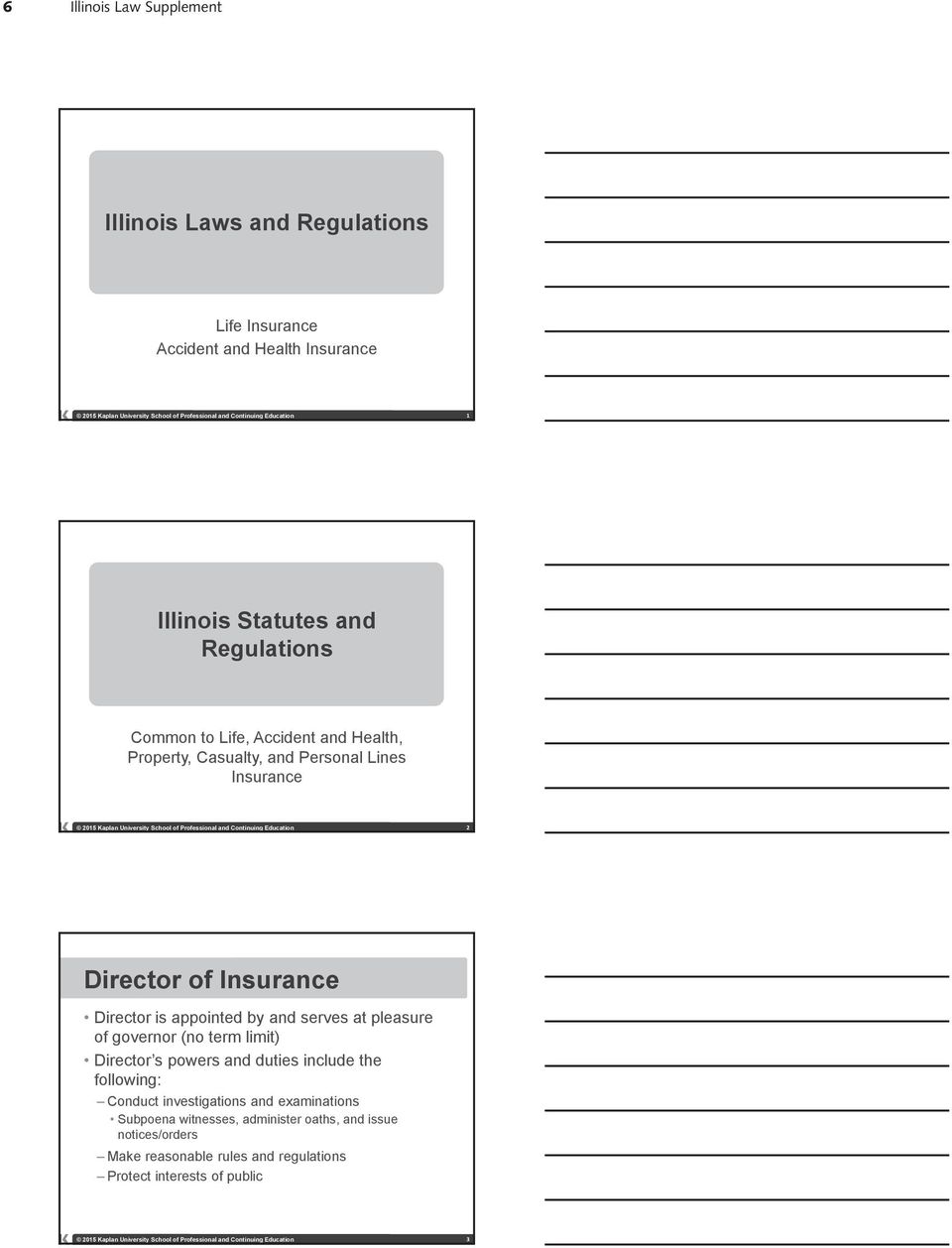
42 34 Illinois Law Supplement I. ILLINOIS STATUTES AND REGULATIONS COMMON TO LIFE, ACCIDENT, AND HEALTH AND PROPERTY, CASUALTY, AND PERSONAL LINES INSURANCE A. INSURANCE DIRECTOR In Illinois, the Director of Insurance is appointed by the governor. The Director must be well versed in insurance and have no financial interest in any insurer or agency. The Director is charged with the rights, powers, and duties necessary to enforce and execute the insurance laws of Illinois effectively. 1. General powers [Secs. 5/401, 5/401.1, 5/403, 5/431] Upon the request of the Illinois attorney general, the Director may initiate court actions in Illinois to enforce an order or administrative proceeding. The Director has the power to examine the affairs of every person doing insurance business in Illinois to determine whether the person has engaged in any unfair method of competition or any unfair or deceptive act. a. The Director of Insurance has the power to: make reasonable rules and regulations as necessary to implement the insurance laws; conduct investigations as needed to determine whether any person has violated any insurance law or regulation; conduct examinations, investigations, and hearings as necessary for administering the insurance laws efficiently; institute such actions or other lawful proceedings as deemed necessary for enforcing the state s insurance laws and regulations; and when the Director is required to consider criminal history, he can request records from the department of state police and that police department is authorized to furnish the information being requested. b. Cease and desist orders If it appears to the Director that a person or company is conducting insurance business in a manner that violates Illinois insurance laws or in any way endangers policyholders, companies, or the general public, he may issue, without notice, a cease and desist order. 1.) At the same time that the cease and desist order is issued, the Director will serve notice of a hearing to review the violation. 2.) The hearing will be between 20 and 30 days from the date of the hearing notice. 3.) The notice must state the nature of the violation. 4.) After proper hearings, if the alleged violations are found to be true, the Director may take whatever action is necessary to bring an end to the violation(s). This may involve the imposition of fines and penalties.
43 Illinois Law Supplement 35 5.) Offenders who violate a cease and desist order will be subject to a fine of up to $100 per day for every day the violation continues, up to a maximum of $5,000. The Director also has the power to revoke or suspend any license or certificate of authority. 6.) After the process has been followed, the person or company is entitled to a judicial review of the order. 7.) Unfair marketing practices [Sec. 5/431] The Director may issue cease and desist orders against offenders who engage in unfair trade practices. Refusal to obey these orders subjects offenders to a fine of $1,000 for each violation. 8.) Unfair claims practices [Sec. 5/154.8] Failure of a company to obey an order may result in revocation of their certificate of authority for six months, a civil penalty of up to $250,000, or both. 2. Examinations [Secs. 5/132; 5/402; 5/403; 5/ ] Conducting examinations of insurers and producers are critical functions of the Director. a. Examination of insurers To determine an insurer s financial condition or business practices, the Director may examine any: company authorized to do business in Illinois; person who is involved in the formation of a company; licensed producer or firm or any person or company seeking a license; or person engaged in the business of adjusting losses or financing premiums. 1.) Examinations, investigations, and hearings may be conducted personally by the Director or by one or more of the Insurance Department s actuaries, technical advisers, deputies, or examiners. For this purpose, the Director also may retain independent actuaries or certified public accountants who are deemed qualified. 2.) The cost of the examination is charged to the company or person being examined. 3.) Those who are to participate in a hearing must be notified in writing of the time and place, with at least 10 days advance notice. The notice must state the subject of the hearing and specific charges or allegations, if any. Witnesses may be subpoenaed and examined. 4.) Refusal or failure of a person to submit to an examination constitutes grounds for suspension, refusal or nonrenewal of the individual s licensure or authority.
44 36 Illinois Law Supplement 5.) Companies or persons who are examined for violations may request a hearing within 10 days of receiving an examination report. a.) The request must be in writing, together with a statement of objections to the examination report. b.) After the hearing is conducted, the Director must issue a written order based on the examination report and hearing within 90 days of filing the report or within 90 days of the hearing. b. Examination of producers The Director may examine any insurance producer applicant, licensed insurance producer, limited line producer, temporary insurance producer, or any business entity. All persons being examined, as well as their officers, directors, and producers must provide the Director with access to all books and documents. 1.) The Director may designate a subordinate to conduct the examination. The Director or his designee may question any individual under oath who may have information about the person being examined. 2.) The examiners must submit a report of their findings to the Director. A report alleging violations of the Insurance Code or any administrative rules must be in writing and be based upon: facts gained from the records, documents, and other evidence obtained by the examiners; sworn testimony; or written affidavits from the person s officers, directors, insurance producers, limited lines producer, temporary insurance producers or employees, or other individuals. 3.) If a report is made, the Director must deliver a copy of it to the person who was examined. The examinee has the opportunity to demand a hearing about the facts and evidence contained in the report. 4.) Producers who are examined for violations may request a hearing within 14 days of receiving the examination report (compared to companies that must request a hearing within 10 days). a.) The request must be in writing, together with a statement of objections to the examination report. b.) After the hearing is conducted, the Director must issue a written order based on the examination report and hearing within 90 days of filing the report or within 90 days of the hearing. 5.) After the hearing or the expiration of the time during which a person may request a hearing, if the examination reveals that the person violated any law, rule, or prior order, the Director in the written order may require the
45 Illinois Law Supplement 37 person to take any action he considers necessary. The order is subject to review under the Administrative Review Law. 6.) A person who violates a written order issued by the Director is guilty of a business offense and may be fined not more than $5,000. B. LICENSING AND REGISTRATION 1. Persons required to be licensed A person may not sell, solicit, or negotiate insurance in Illinois for any class of insurance unless the person is licensed for that line of authority. The person may not charge a fee or engage in business of offering advice or opinion without a license. In addition to the fines, that person would be guilty of a Class 4 felony. a. Insurance producers [Secs. 5/500 15; 5/500 20; 5/500 25; 5/500 30] 1.) Application for license An individual applying for a resident insurance producer license must declare under penalty of refusal, suspension, or revocation of the license that the statements made in the application are true, correct, and complete to the best of the individual s knowledge. The Director may require additional documents to verify the information contained in an application. There is an application fee that must be submitted as well. 2.) Licensing examination A resident individual applying for an insurance producer license must pass a written examination, unless exempt. Prelicensing study is required prior to taking the examination. The applicant must show proof of prelicensing prior to sitting for the exam. a.) In Illinois, the insurance producer exam consists of two parts. Both parts of the examination must be passed within 90 days of each other. b.) The examination will test the knowledge of the individual concerning the lines of authority for which application is made, the duties and responsibilities of an insurance producer, and the insurance laws and rules of Illinois. c.) An individual applying for an examination must pay a nonrefundable fee to the state, plus a separate fee payable to the designated testing service for all of the services requested by the applicant. d.) An individual who fails to appear for the scheduled examination or fails to pass the examination must reapply and resubmit all required fees and forms before being rescheduled for another examination. 3.) License Unless denied a license, persons who have met the licensing requirements will be issued a two-year insurance producer license.
46 38 Illinois Law Supplement a.) An insurance producer may receive a license in one or more of the following lines of authority. Life This is insurance coverage on human lives, including benefits of endowment and annuities and may include benefits in the event of death or dismemberment by accident and benefits for disability income. Variable life and variable annuity products This is insurance coverage provided under variable life insurance contracts and variable annuities. Accident and health This is insurance coverage for sickness, bodily injury, or accidental death, and may include benefits for disability income and long-term care insurance. Property This is insurance coverage for the direct or consequential loss or damage to property. Casualty This is insurance coverage against legal liability, including that for death, injury, or disability or damage to real or personal property. Personal lines This is property and casualty insurance coverage sold to individuals and families for primarily noncommercial purposes. b.) The license must contain the licensee s name, address, and personal identification number, the date of issuance, the lines of authority, the expiration date, and any other information the Director deems necessary. Licensees must inform the Director of any change of address within 30 days. c.) An insurance producer license will remain in effect unless revoked or suspended, as long as the fee is paid and continuing education requirements for resident individual producers are met by the due date. b. Limited lines producer license [Sec. 5/ ] In Illinois, an individual who is at least 18 years of age and whom the Director considers to be competent, trustworthy, and of good business reputation, can apply for a limited lines license. 1.) An individual may obtain a limited lines producer license for one or more of the following classes of insurance: Baggage or limited travel health, accident, or trip cancellation insurance sold in connection with transportation provided by a common carrier Industrial life insurance Industrial accident and health insurance Insurance issued by a company organized under the Farm Mutual Insurance Company Act of 1986 Legal expense insurance
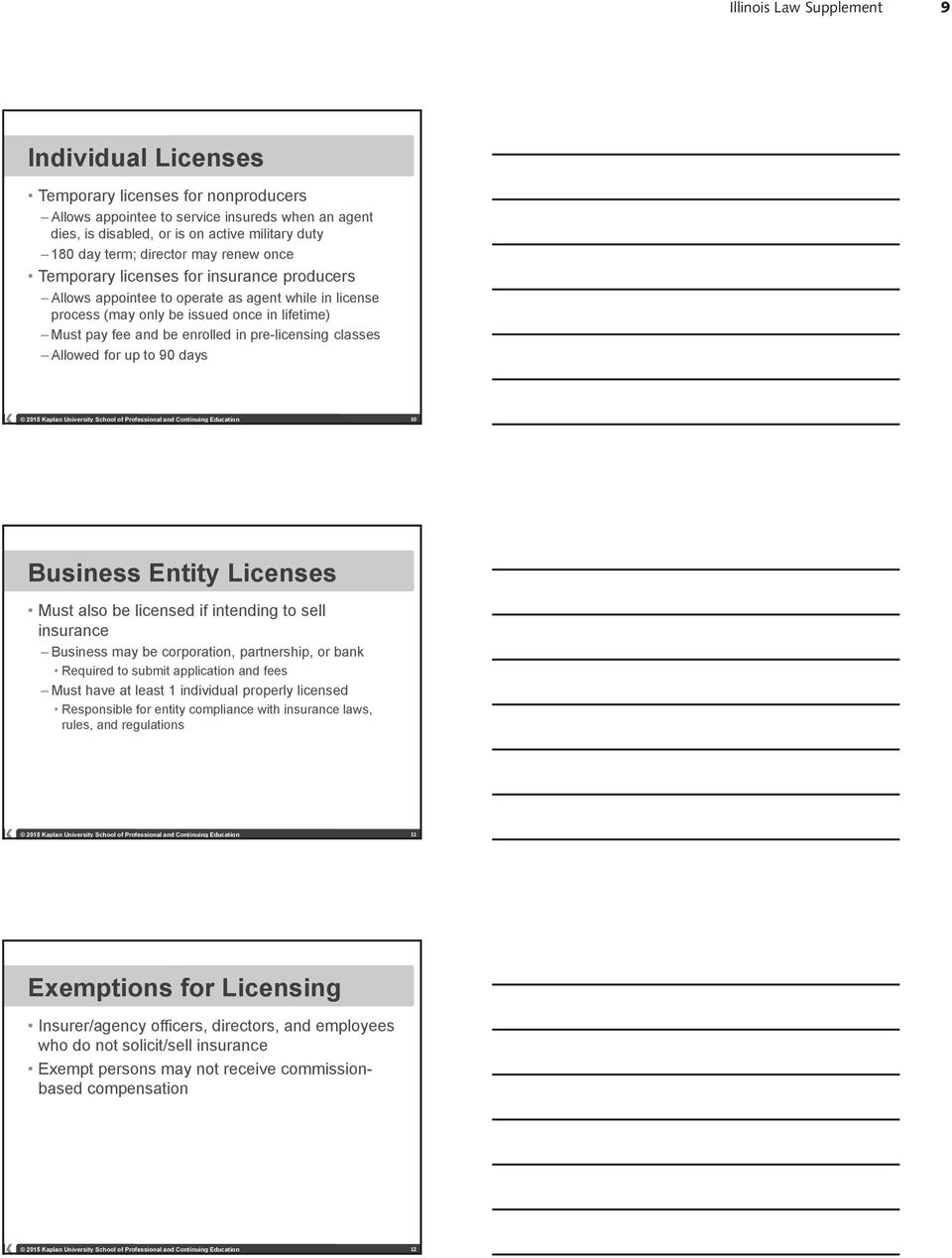
47 Illinois Law Supplement 39 Enrollment of recipients of public aid or Medicare in a health maintenance organization A limited health care plan issued by an organization having a certificate of authority under the Limited Health Service Organization Act Credit life and credit accident and health insurance and other credit insurance policies which are approved or permitted by the Director (a credit insurance must conduct a training program in which an applicant shall receive basic instruction about the credit insurance products that they will be selling) 2.) A limited lines producer may represent more than one insurance company, health maintenance organization, or limited health service organization. 3.) An applicant who has met the requirements of this section will be issued a perpetual limited lines producer license. 4.) A limited lines producer license will remain in effect as long as the appointing insurance company pays the required fee January 1 of each year, unless the license is revoked or suspended. Failure of the insurance company to pay the license fee or to submit the required documents will cause immediate termination of the limited lines insurance producer license. 5.) A limited lines producer license may be terminated by the insurance company or the licensee. 6.) A limited lines producer license must contain the name, address and personal identification number of the licensee, the date the license was issued, general conditions relative to the license s expiration or termination, and any other information the Director considers proper. A limited line producer license, if applicable, must also contain the name and address of the appointing insurance company. c. Nonresidents [Sec. 5/500 40] A nonresident person will receive a nonresident producer license if, in his home state, he is currently licensed as a resident and in good standing; has submitted the proper request for a license and paid the required fees; and has submitted to the Director the license application that was submitted to his home state or, instead of that application, a completed Uniform Application. 1.) The person s home state must award nonresident producer licenses to residents of Illinois on the same basis. 2.) The Director may verify the producer s licensing status through the producer database maintained by the National Association of Insurance Commissioners or its affiliates.
48 40 Illinois Law Supplement 3.) A nonresident producer who moves from one state to another or a resident producer who moves from Illinois to another state must file a change of address and provide certification from the new resident state within 30 days of the change of legal residence. No fee or license application is required. 4.) A person licensed as a surplus lines producer in his home state will receive a nonresident surplus lines producer license in Illinois, and a person licensed as a limited lines producer in his home state will receive a nonresident limited lines producer license in this state. d. Business entities [Secs. 5/500 30; 5/500 35] A business entity acting as an insurance producer must obtain an insurance producer license. Application must be made using the Uniform Business Entity Application. Before approving the application, the Director must find that the business entity: has submitted an application on the Uniform Business Entity Application; has paid the required fees; and has designated a licensed producer responsible for the business entity s compliance with the insurance laws and rules of Illinois. e. Temporary insurance producers [Secs. 5/500 60; 5/500 65] 1.) Temporary licenses for nonproducers The Director may issue a temporary insurance producer license for up to 180 days and, at his discretion, may renew the temporary producer license for an additional 180 days without requiring an examination. a.) A temporary license may be issued to the following individuals: the surviving spouse or court-appointed representative of a licensed producer who dies or becomes mentally or physically disabled to allow adequate time for the: sale of the producer s business, recovery of the producer, or training and licensing of new personnel to operate the producer s business; a member or employee of a business entity licensed as an insurance producer, upon the death or disability of an individual designated in the business entity application or the license; or the designee of a licensed insurance producer entering active service in the armed forces of the United States of America. b.) The Director may require the temporary licensee to have a suitable sponsor who is a licensed producer or insurer and who assumes responsibility for all acts of the temporary licensee and may impose other similar requirements designed to protect insureds and the
49 Illinois Law Supplement 41 public. The Director may revoke a temporary license if the interest of insureds or the public are endangered. A temporary licensee may not continue after the owner or the personal representative disposes of the business. c.) A person who wishes to become a temporary producer must file an application and pay the appropriate fees to the Director. 2.) Temporary licenses for insurance producer applicants The Director may grant a temporary insurance producer license to an applicant for an insurance producer license, without requiring an examination, for a period of 90 days. a.) The following requirements must be met. i.) The applicant must be enrolled in a training course or training program conducted by or on behalf of the appointing insurance company. ii.) The applicant must be in the process of fulfilling the prelicensing requirements. iii.) The appointing insurer has submitted the proper application form and fee to the Director. b.) An individual applicant may not hold more than one temporary insurance producer license during his lifetime. c.) The Director may refuse to grant temporary insurance producer licenses to applicants from an insurance company when, during a six-month period, more than 50% of the company s temporary license holders have failed to obtain insurance producer licenses. f. Exemptions [Secs. 5/500 15; 5/500 20] 1.) Not all who deal with insurance are required to be licensed. Those who are exempt from the producer licensing requirements include: an officer, director, or employee of an insurer or an insurance producer who does not receive any commission on policies sold in Illinois; an officer, director, or employee whose activities are executive, administrative, managerial, or clerical, and are only indirectly related to the sale of insurance; an officer, director, or employee whose activities relate to underwriting, loss control, inspection or the processing, adjusting, investigating, or settling of claims; the officer, director, or employee who acts as an agency supervisor, assists insurance producers, and provides technical advice that does not include selling insurance, soliciting, or negotiation of insurance;
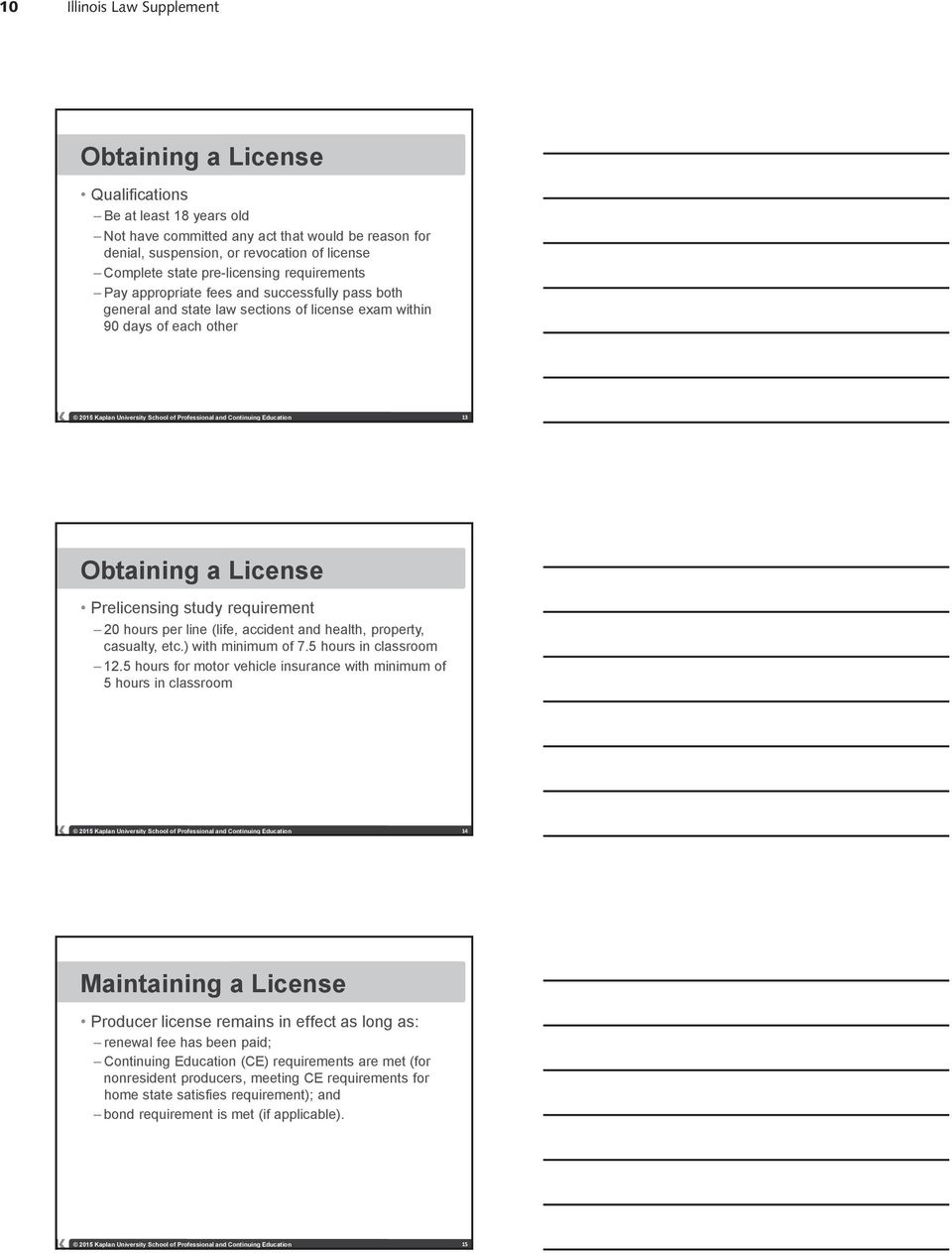
50 42 Illinois Law Supplement a person who takes enrollments or performs administrative services for group life, accident, and health and annuity plans and receives no commission for the services; an employer or association or its officers, directors, or employees who administer its employee benefit program and who are not compensated by the company issuing the insurance contracts; employees of insurers who rate or classify risks or train insurance producers and who do not sell insurance; a person whose activities are limited to advertising, and not selling, insurance; a nonresident who sells commercial property and casualty insurance to an insured with risks located in more than one state, provided that the person is licensed in the state where the insured maintains its principal place of business; or a salaried, full-time employee who advises his employer about insurance, provided that the employee does not sell insurance or receive a commission. 2.) Along these lines, certain individuals are allowed to charge a fee for offering advice or service about the benefits, advantages, or disadvantages of any insurance policy. These individuals include: a licensed attorney who advises on insurance matters incidental to his position; a licensed insurance producer, limited insurance representative, or temporary insurance producer offering advice concerning insurance for which he is licensed to sell; a trust officer of a bank performing duties incidental to his position; an actuary or a certified public accountant engaged or employed in a consulting capacity, performing duties incidental to that position; and a licensed public adjuster acting within the scope of his license. g. Reinstatement [Sec. 5/500-35] A producer who allows his license to lapse may, within 12 months after the due date of the renewal fee, be issued a license without passing a written examination. However, the penalty is double the unpaid renewal fee. 2. Obtaining a license a. Qualifications [Secs. 5/500 30; 5/500 70] Before approving the application, the Director must find that the individual: is at least 18 years of age; has not committed any act that is a ground for denial, suspension, or revocation; has completed, unless exempted, a prelicensing course of study for the lines of authority for which he has applied; has paid the fees; and has successfully passed the examinations for the lines of authority for which the person has applied.
51 Illinois Law Supplement 43 b. License fees [Sec. 5/ ] In Illinois, license fees are directed into a special state fund, known as the Insurance Producer Administration Fund, and are used to pay the expenses of the Department of Insurance. Insurance licensing and registration fees are as follows: $180 every two years for an insurance producer s license and $250 for a nonresident license $50 for a temporary insurance producer s license $150 every two years for a business entity s registration fee $50 annually for a limited line producer license $50 application fee for the written license examination $1,000 for the annual registration fee of an education provider A certification fee of $50 for each certified prelicensing or continuing education course and an annual fee of $20 for renewing each course s certification $180 for a resident and $250 for a nonresident once every two years for a car rental limited line license $200 every two years for a limited lines license $50 every two years for a self service storage facility limited lines license c. Prelicensing study requirement [Sec. 5/500 30; Reg. 3119] Applicants for a producer license may be required to complete a prelicensing course of study within one year before taking the license examination, consisting of the following minimum hours: 20 hours for a life insurance license with a minimum of 7.5 hours mandatory classroom 20 hours for an accident and health insurance license with a minimum of 7.5 hours mandatory classroom 20 hours for a fire insurance license with a minimum of 7.5 hours mandatory classroom 20 hours for a casualty insurance license with a minimum of 7.5 hours mandatory classroom 20 hours for property casualty personal lines with a minimum of 7.5 hours mandatory classroom 12.5 hours for a motor vehicle insurance license with a minimum of 5 hours mandatory classroom d. Course details [Reg. 3119, Exhibit E] License applicants can prepare for the state prelicensing examination in a seminar or classroom or a combination of classroom and self study as long as the minimum classroom hours are attended. Any person whose license has been lapsed or suspended for one year or more must reapply for licensure and is subject to the prelicensing education requirements. To be approved for prelicensing education, a course must cover specific topics as mandated by the state. These topics on life and health insurance can be found at the exam publisher s Website, e. Bond requirement [Sec. 5/ ] All applicants for a producer s license must certify that they are bonded or that an insurance company will take responsibility for funds received on its behalf by the producer. Insurance compa-
52 44 Illinois Law Supplement nies that appoint agents to act on their behalf assume responsibility for the acts of their agents, for the contracts they accept from their agents, and for monies their agents collect from applicants and policyholders. In effect, such insurance companies bond their appointed agent representatives. In cases where a producer licensee is not appointed by an insurer and places business among insurers, a bond is required and must be filed with the application for license. 1.) The amount of the bond must be the greater of $2,500 or 5% of premiums brokered in the previous year (but not to exceed $50,000 total aggregate liability). a.) The bond must remain in force until the surety is released from liability by the Director or until the bond is cancelled by the surety. The surety may cancel the bond and be released from further liability on 30 days written notice in advance to the principal. b.) The cancellation does not affect any liability incurred before the end of the 30-day period. The producer s license may be revoked if the producer acts without a bond that is required under this section. 2.) Applicants who certify that they are acting solely for an insurance company (which has assumed the same responsibility for funds received on its behalf by a producer that a surety would assume under a bond) are exempt from the bond requirement. This certification is required with the initial license application and must be submitted at each license renewal. 3.) Proof of the agent s appointment and the insurance company s assumption of liability must be maintained by the licensee at his place of business, and is subject to examination by the Director. 4.) If a party injured under the terms of the bond requests the producer to provide the name of the surety and the bond number, the producer must provide the information within three working days of receiving the request. 5.) It should be noted that an insurance producer s license will terminate automatically if there is no bond in force or if no insurer has assumed such responsibility, as explained previously. 3. Maintaining a license [Sec. 5/500 35] Unless revoked or suspended, an insurance producer s license remains in effect as long as he meets the bond requirement, pays the necessary annual fee, and complies with the continuing education requirement. Also, recall that an individual insurance producer who allows his license to lapse may, within 12 months after the due date of the renewal fee, be issued a license without having to again pass a written examination. This is known as reinstatement. a. Continuing education [Sec. 5/500 35] Before each license renewal, an insurance producer must complete at least 24 hours of education in a classroom, seminar, webinar, or via a self-study form of instruction. Three of the 24 required
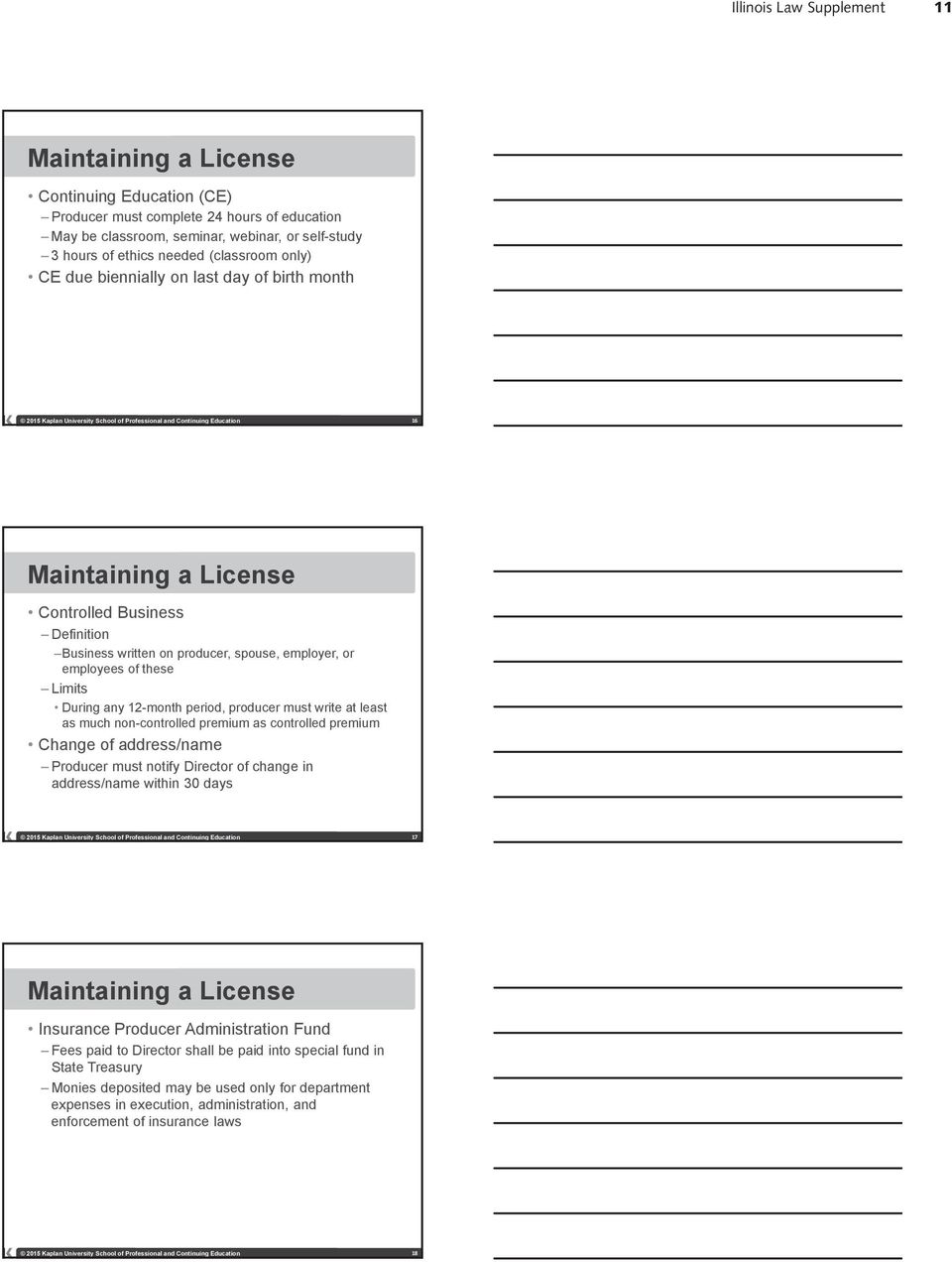
53 Illinois Law Supplement 45 hours must consist of an approved ethics course delivered in a classroom. Continuing education courses must be approved by the Director before they can be taken by producers for credit. The producer must complete all the courses before the renewal date to allow the education provider time to report the credit to the Department. Producers are required to keep a record of each continuing education course taken for three years after it is completed, noting the provider s name, course title, and the date on which it was completed. Producers can accumulate up to 36 credit hours of continuing education. 1.) Credit for self-study continuing education courses requires the successful completion of an examination. a.) The licensee may not grade the examination. However, if the selfstudy material is completed through an approved computerized interactive format where the computer validates the successful completion of the self-study material, no additional examination is required. b.) The self-study credit hours contained in a certified course will be considered classroom hours when at least two-thirds of the hours are given as classroom or seminar instruction. 2.) An insurance producer license automatically terminates if the producer does not complete the continuing education requirement. However, a licensed insurance producer who is unable to comply with license renewal procedures due to military service may request a waiver of the procedures. b. Controlled business [Sec. 5/ ] Producer licenses are granted with the expectation that producers will serve the insurance needs of the general public. The Director will not issue a license to a person he believes will use it to write controlled business. 1.) Controlled business means insurance procured by or through the person upon: his own life, person, property, or risks or those of his spouse; or the life, person, property, or risks of his employer or own business. 2.) The Director will not grant or extend an insurance producer license if he believes that: during either of the two years immediately preceding the extension date of the license, the total amount of premiums on insurance from controlled business exceeded the total amount of premiums from all other insurance; or during the 12 months immediately following the issuance of the license, the total amount of premiums from controlled business would exceed the total amount of premiums on all other insurance business of the applicant or licensee.
54 46 Illinois Law Supplement c. Change of address [Sec. 5/500 35(g)] A licensed insurance producer must advise the Director of a change in his residential address within 30 days of the change. d. Required fees [Sec. 5/ ] All fees paid to and collected by the Director shall be paid promptly after receipt, together with a detailed statement of the fees, into a special fund in the State Treasury to be known as the Insurance Producer Administration Fund. The monies deposited may be used only for payment of the expenses of the Department in the execution, administration, and enforcement of the insurance laws. 4. License suspension, revocation, or denial [Sec. 5/500 70] The Director may place on probation, suspend, revoke, or refuse to issue or renew an insurance producer s license, levy a civil penalty, or take any combination of actions. a. The Director may take action against an individual for any of the following causes: Providing incorrect, misleading, incomplete, or materially untrue information in the license application Violating any insurance laws or any rule, subpoena, or order of the Director or another state s Insurance Commissioner Obtaining or attempting to obtain a license through misrepresentation or fraud Improperly withholding, misappropriating, or converting any monies or properties received in the course of doing insurance business Intentionally misrepresenting the terms of an actual or proposed insurance contract or application for insurance Conviction of a felony Having admitted committing or been found guilty of committing any unfair trade practice or fraud Using fraudulent, coercive, or dishonest practices or demonstrating incompetence, untrustworthiness, or financial irresponsibility in the conduct of business in Illinois or elsewhere Having an insurance producer license denied, suspended, or revoked in any other state, district, or territory Forging a name to an application for insurance or to a document related to an insurance transaction Improperly using notes or any other reference material to complete an examination for an insurance license Knowingly accepting insurance business from an individual who is not licensed Failing to comply with an administrative or court order imposing a child support obligation Failing to pay state income tax or penalty or interest or comply with any administrative or court order directing payment of state income tax to the Department of Revenue
55 Illinois Law Supplement 47 Failing to repay a student loan to the Illinois Student Assistance Commission Failing to comply with any provision of the Viatical Settlements Act of 2009 b. If the Director takes action to nonrenew, suspend, or revoke a license or to deny an application for a license, he must notify the person, in writing, of the reason for the action. 1.) Within 30 days of receiving the notification, the applicant or licensee may write to the Director and request a hearing to determine the reasonableness of the Director s action. 2.) The hearing must be held between 20 and 30 days of the mailing of the notice of hearing. c. The license of a business entity may be suspended, revoked, or refused if the Director finds, after a hearing, that an individual licensee s violation was known or should have been known by one or more of the partners or managers and the violation was neither reported to the Director nor corrective action taken. d. In addition to or instead of any license denial or suspension, a person may, after a hearing, be subject to a civil penalty of up to $10,000 for each cause and $100,000 for all causes. e. The Director has the authority to impose any penalty against any person who is under investigation or charged with any violation of this Code, even if the person s license has been surrendered or has lapsed. f. On suspension, denial, or revocation of a license, the licensee must hand over the license to the Director. The Director will notify all interested insurance companies and persons when a licensee s suspension, denial, or revocation becomes final. g. A person whose license is revoked or whose application is denied is ineligible to apply for any license for three years. h. A person whose license has been revoked, suspended, or denied may not be employed or engaged in any insurance business during the time the revocation, suspension, or denial is in effect. C. FIDUCIARY RESPONSIBILITIES [SEC. 5/ ; REG. 3113] Any money that an insurance producer, limited insurance representative, temporary insurance producer, or registered firm receives for soliciting, negotiating, renewing, or binding insurance policies must be held in a fiduciary capacity and not misappropriated or converted to the individual or firm s own use. 1. In issuing a policy based on an application or at the request of an insurance producer, a company authorizes the producer to collect any premium due for the policy at the
56 48 Illinois Law Supplement time of issuance or delivery and any premium that becomes due on the policy within 90 days. Consequently, any premium paid by the policyowner to the producer will be deemed to have been received by the insurance company. a. If an insurance producer knowingly misappropriates or converts to his own use or illegally withholds fiduciary monies amounting to $150 or less, he is guilty of a Class A misdemeanor. Repeated occurrences of such actions are subsequently rated a Class 4 felony. b. If the amount of misappropriated funds is more than $150, the offending licensee is guilty of a Class 3 felony. c. An insurance company that authorizes a producer to collect premiums on its behalf may hold them no more than 90 days. 2. With any balance payable to an insurance producer within a specified period of 90 days or less, where the balance is not fully paid within that period, a late charge not exceeding 1.5% per month may be added by the insurance producer to induce payment of the premium. 3. Premium Fund Trust Account [Reg. 3113] The Department of Insurance has issued specific guidelines for handling and keeping records of premium funds by licensed producers and firms and for depositing such funds in separate premium fund trust accounts. Essentially, any funds from applicants or policyowners that will be held for longer than 15 days by the producer (before they are remitted to the insurer) must be placed in a Premium Fund Trust Account (PFTA). The PFTA must be established and maintained with an Illinois-based financial institution. a. All monies deposited into the PFTA are considered to be fiduciary funds until lawfully withdrawn. Lawful withdrawals include: net or gross premiums due to other licensees or insurance companies; premiums refunded to applicants on policy surrender; commissions, when specifically matched to money (previously deposited in the PFTA) representing premiums on which the commissions are based; and interest that the licensee is authorized to retain. b. Withdrawals must be made payable to the licensee or another licensee. Monies in the PFTA must not be used as a general operating account or claim payment account. D. COMMISSIONS AND COMPENSATION [SECS. 5/151; 5/500 80] An insurer or insurance producer may not pay a commission or any other valuable consideration to a person for selling or negotiating insurance in Illinois if that person is required to be licensed but is not when conducting insurance business. 1. A person may not accept a commission or other consideration for selling, soliciting, or negotiating insurance if that person is required to be licensed and is not at the time of the transaction.
57 Illinois Law Supplement Renewal or other deferred commissions may be paid to a person for selling insurance if the person was licensed at that time of the initial transaction. 3. No licensee may charge any additional compensation (other than premium commissions) from an insurance applicant or policyholder unless the fee is agreed on, put in writing, and given to the applicant or policyholder before the performance of the service of the issuance of the policy, whichever comes first. 4. A copy of the memorandum must be kept for seven years by the producer who collects or receives the service fee. If the compensation or fee exceeds 10% of the premium amount, the memorandum must include the signature of the insured or prospective insured acknowledging the service fee. 5. If an insurance policy is cancelled for any reason within 90 days of its effective date, the producer or insurer must refund to the consumer a prorated portion of the fee or compensation within 30 days after the producer or insurer receives documentation that the policy has been cancelled. A producer or insurer may not charge the consumer for cancellation of any insurance policy. E. FELONY CONVICTIONS [SEC. 5/500 95] An insurance producer who is convicted of a felony must report the conviction to the Director within 30 days of the judgment and submit a copy of the judgment, the probation or commitment order, and any other relevant documents at the same time. F. DISCLOSURE [SEC. 5/ ] An individual or group policy involving an insurance producer or an individual or group life or accident and sickness application must bear the name and signature of the licensee who solicited and wrote the application. G. MARKETING PRACTICES Licensees are prohibited from engaging in unfair or deceptive acts or methods of competition with respect to selling and servicing insurance policies. Although certain acts are clearly defined in the code as illegal, the Director also may decide whether other unspecified activities are deceptive or unfair. 1. Unfair claims practices [Secs. 5/154.5; 5/154.6; Reg. 919] The Insurance Code clearly identifies certain claim settlement practices that are illegal. These actions are illegal if they are committed knowingly in violation of the law or with such frequency as to indicate a persistent tendency to engage in such acts. Included in this group of illegal and unfair practices are: knowingly misrepresenting policy provisions to claimants or insureds at time of claims; failing to acknowledge promptly pertinent communications concerning claims; failing to adopt and implement reasonable standards for settling claims; not attempting to settle claims promptly and fairly when the insurer s liability has become reasonably clear; compelling policyholders to go to court to recover amounts due them by offering them substantially less than the amounts recovered by litigation; engaging in activity resulting in a disproportionate number of complaints against the insurer received by the Department of Insurance;
58 50 Illinois Law Supplement engaging in activity resulting in a disproportionate number of lawsuits filed against the insurer by claimants; refusing to pay claims without conducting a reasonable investigation based on all available information; failing to affirm or deny coverage of claims within a reasonable time after receiving proof-of-loss statements; attempting to settle a claim for less than could reasonably be expected, according to written or printed advertising material; making a claim payment to a policyholder or beneficiary and omitting the coverage under which each payment is made; delaying investigation or claim payment by requiring duplicate verification of facts; failing to offer a reasonable and accurate explanation for denying a claim; failing to provide necessary claim forms within 15 working days of a request with explanations as to how to use them effectively; and engaging in any other acts that are in substance equivalent to any of the above. a. The Director is authorized to examine the claims practices of all companies authorized to do business in Illinois. Reasonable promptness in settling claims is defined as a maximum of 15 working days from the time a communication is received from a claimant or insured. b. Companies must affirm or deny liability on claims within a reasonable time and offer payment of approved claims within 30 days of affirming liability. 1.) Insurers are not to indicate that a payment draft represents a final payment or a release if additional claim benefits are probable under the policy, unless the policy limit has been paid or there is a bona fide dispute over the coverage or amount payable. 2.) In addition, a company may not require an insured to submit to a polygraph or similar type of examination as a condition to paying a claim. c. If a claim remains unresolved for 45 days from the date reported, the company must provide the insured or, when applicable, the insured s beneficiary with a reasonable written explanation for the delay. d. Companies may not settle claims for life and accident and health policies involving a covered and noncovered condition on a percentage basis of contributing to the loss, unless the percentage is reasonable and the insured is given a written explanation. Also, companies may not do anything that would misrepresent a policy provision or influence an insured to settle a disability claim on a lump-sum basis. 2. Rebating [Secs. 5/151; 5/152; 5/153] Nothing of value may be given to a prospective insurance applicant to induce the purchase of a policy. The Illinois Insurance Code specifically states that it s unlawful for any insurance company, agent, or broker to offer, promise, or pay, directly or indirectly, any rebate of premium, com-
59 Illinois Law Supplement 51 mission, or special advantage in a policy s date or age of issue or any other valuable consideration as an inducement to purchase insurance that is not specified in the policy. a. This section of the law does not prevent a company from paying a bonus to policyholders out of surplus or prevent companies that sell industrial life policies on a weekly payment plan from returning a percentage of premium to policyholders who make premium payments directly to the company for at least one year in lieu of weekly collection. Furthermore, the law does not prohibit an insurer from offering a child passenger restraint system or discount on the purchase of such system to policyholders, when the purpose of the system is to protect the child in compliance with the Child Passenger Protection Act. b. It also is unlawful for an insured person or insurance applicant to accept a rebate of premium, commission, or valuable consideration of any kind other than that specified in the policy. c. A company or person convicted of a rebating violation will be guilty of a Class B misdemeanor. Also, a licensee who is found guilty of rebating may not receive any commission for selling the policy associated with the rebate. If paid, such commission may be recovered by the company. d. A company may not be held guilty of rebating by reason of an act by its licensees or employees, unless an officer, director, or department head knowingly permitted such an act or had prior knowledge of it. e. Individuals may not be excused from testifying or producing records at the trial or hearing of any person or company charged with rebating on grounds that such testimony or evidence may tend to incriminate them. However, they will not be prosecuted for any act for which they are compelled to testify or produce evidence nor will such testimony or evidence be used against them in any criminal probe or proceeding except for perjury committed while testifying. 3. Misrepresentation [Secs. 5/149; 5/154] Misrepresentation or false advertising of a policy or a company is illegal. This includes issuing, circulating, or making false estimates, illustrations, or statements about the provisions of a policy, dividends to be received, benefits, or advantages of a policy and the general condition of any insurer. a. It also is unlawful to make any misleading representation or comparison of companies or policies (known as twisting) to insured persons to induce them to lapse, forfeit, change, or surrender their insurance, whether on a temporary or permanent plan. The penalty for violating this section of the law is a fine of between $200 and $10,000 to be recovered by the state attorney and paid to the county treasurer. b. Misrepresentation or false warranties made orally by the applicant cannot be used to void the policy, but misrepresentations made in writing (on the applica-
60 52 Illinois Law Supplement tion) can be grounds for voiding a contract in accordance with the terms of the policy s contestability clause. Such misrepresentation or false warranty may not void a policy unless there was an actual intent to deceive or it materially affects acceptance of the risk by the company. Misrepresentation or false warranties by the applicant or prospective insured will void the contract. 4. Defamation [Sec. 5/149] Defamation is defined as oral or written statements that are false, maliciously critical, or derogatory to the financial condition of an insurer or intended to injure any person engaged in the insurance business. Defamation is prohibited in Illinois. a. Further, it may not be implied in any way that policies are approved, endorsed, or guaranteed by the state of Illinois, US government, or the Department of Insurance. b. The penalty for violating this section of the law is a fine of between $200 and $10,000, to be recovered by the state attorney and paid to the county treasury. 5. Other unfair practices [Sec. 5/424] In addition to the unfair trade and marketing practices described above, the Illinois Insurance Code cites other actions that are deemed illegal in all situations. a. Unfair discrimination It is illegal to permit unfair discrimination in the policy rates charged to individuals of the same risk classification except where the distinction is based on sound actuarial principles or is related to actual or reasonably anticipated experience. Unfair discrimination exists when two people of equal risk are charged different rates or provided different service and benefits solely because of a difference in race, religion, national origin, where they live, or any physical disability including blindness or partial blindness. However, an insurer may exclude coverage for disabilities consisting solely of the blindness or partial blindness that already existed at the time the policy was issued. It is also unfair to refuse to insure a person only because he is a member of the United States Armed Forces, the National Guard, or Armed Forces Reserve. Furthermore, an insurer may not refuse to insure, refuse to continue to insure, or limit the amount or kind of coverage available to an individual or charge a different rate to an individual for the same coverage on the basis of the person s past lawful travel experiences. Any differences based on travel cannot be solely because of the destination s inclusion on the United States Department of State s travel warning list. b. Boycott, coercion, and intimidation It is illegal to enter into any agreement or act of boycott, coercion, or intimidation tending to result in unreasonable restraint of or monopoly in the insurance business. H. LIFE AND HEALTH INSURANCE GUARANTY ASSOCIATION ACT [SEC. 5/531.01a-.19] The Illinois Life and Health Insurance Guaranty Association protects insureds against the failure of insurance companies to perform their contractual obligations under life and health insurance policies, annuity contracts, and health or medical care ser-
61 Illinois Law Supplement 53 vice contracts, resulting from the impairment or insolvency of the insurers that issue these policies or contracts. The association guarantees payment of benefits and continuation of coverage. Members of the association are assessed to provide the funds. 1. Coverage The association covers policies and contracts issued to persons who are policyowners, beneficiaries, assignees, or payees of the policyowners, and who are Illinois residents, or who were covered by policies issued by Illinois insurers. The law does not apply to: a contract of reinsurance assumed by the impaired or insolvent insurer, other than reinsurance for which assumption certificates have been issued; a burial society, fraternal benefit society, or mutual benefit association duly organized under the law or a foreign fraternal benefit society licensed under the law; a health maintenance organization (HMO); a vision service plan corporation; a dental service plan corporation; a pharmaceutical service plan corporation; or that portion of variable life insurance or variable annuity contracts not guaranteed by an insurer under which the risk is borne by the policyholder. 2. Establishment of the association The association is a non-profit organization formed by member insurers. The association exercises its powers through its Board of Directors. The association must maintain the following two accounts: A life insurance and annuity account which includes life insurance, annuities, and unallocated annuities (Section 403(b)) A health insurance account 3. Limits of liability The association s liabilities will not exceed the lesser of the contractual obligations for which the insurer is liable or would have been liable if it were not impaired or insolvent or, with respect to any one life: $300,000 in life insurance death benefits, but not more than $100,000 in net cash surrender and net cash withdrawal values for life insurance; $300,000 in health insurance benefits, including net cash surrender and net cash withdrawal values; $250,000 in present value of annuity benefits, including net cash surrender and net cash withdrawal values; or $5,000,000 in benefits, irrespective of the number of contracts with respect to the contract owner or plan sponsor. 4. Powers and duties The association may do the following: Guarantee and reinsure covered policies of an impaired insurer Provide funds and guarantees to honor the policies of an impaired or insolvent insurer Assure payment of the insurer s contractual obligations Loan money to the impaired or insolvent insurer
62 54 Illinois Law Supplement 5. Assessment of insurers In order to provide the funds needed to carry out the association s duties, its board of directors will assess member insurers. Assessments are due 30 days after written notice to the member insurers and accrue interest, compounded daily, from the due date. 6. Association report The association is subject to examination and regulation by the director. The association s board must give the director a financial report for the fiscal year and a report of its activities during that year, not later than the first day of the fifth month after the end of the association s fiscal year. 7. Advertising It is prohibited for any insurer, agent, or affiliate to use the Insurance Guaranty Association in any advertisement for the purpose of sales, solicitation, or inducement to purchase insurance. II. ILLINOIS STATUTES AND REGULATIONS PERTINENT TO LIFE INSURANCE ONLY A. REQUIRED PROVISIONS [SEC 5/224] No policy of life insurance other than industrial, group or annuities may be issued in Illinois without the following provisions. 1. Grace period a. The ensured is entitled to a grace period of 30 days or one month during which a premium may be paid subject to the right of the company to charge interest at the rate of 6% per year. b. An individual life insurance policy cannot lapse or be forfeited for nonpayment during the military service of a service member in excess of 29 consecutive days during the two-year period of military service. To be eligible for this benefit he must provide the insurance company with a copy of the orders calling the service member to military service and of any orders further extending the service member s period of service. 2. Settlement When a policy becomes a claim on the death of the insured, settlement shall be made within two months after receipt by the insurer of proof of death. Interest shall accrue at a rate of 10% per year on any amounts retained by the insurer beyond 31 days before payment of the total amount due or the first installment payable if the beneficiary has requested installment payments. 3. Free look During a period of 10 days after the policy has been delivered to the owner, it may be surrendered to the insurer and a refund of all premiums shall be made. In the event of a policy replacement, the owner shall be provided with a Notice Regarding Replacement together with a 20-day free look regarding the new policy. B. ADVERTISING AND SALES [REG. 909] The Insurance Code establishes minimum standards and guidelines to ensure full and truthful disclosure to the public of all material and relevant information in advertising life insurance policies and annuities contracts.
63 Illinois Law Supplement An advertisement includes printed and published material, descriptive literature used in direct mail, newspapers, magazines, radio and television scripts, billboards, prepared sales talks and presentations, as well as other material used for recruiting, training, and educating sales personnel. The insurer is responsible for all such advertisements, regardless of who wrote, designed, or presented them. 2. Life insurance or annuity advertisements may not use the terms investment, investment plan, founder s plan, charter plan, profits, profit sharing, savings, savings plan, or other similar terms that might mislead purchasers into believing they would receive something other than a policy or benefit not available to others of the same class and age group. If words or phrases such as nonmedical or no medical exam required are used where policy issue is not guaranteed, the advertisement must contain an explanation that issuance of the policy may depend on the answers to health questions. 3. The specific title of a policy must not be misleading as to the policy benefits. If a policy advertised contains graded or modified benefits, the benefit limitations must be prominently displayed. An advertisement must not state or imply that dividends, if any, are guaranteed. 4. All testimonials must be genuine, represent the current opinion of the author, be applicable to the policy being advertised and be accurately reproduced. Also, advertising policies as introductory, initial, or special offers or advertising that applicants will receive substantial advantages not available later is prohibited unless such is a fact. 5. Enrollment periods may not be described as special or limited or by similar words, when the insurer uses successive enrollment periods as its usual method of marketing its policies. A lapse of at least six months must exist between enrollment periods in which a particular insurance policy may be purchased on an individual basis. 6. It is unlawful for an advertisement to make unfair or incomplete comparisons or give unfair descriptions of policies, benefits, dividends, or rates of other insurers or their methods of marketing. Further, the name of the insurer must be clearly identified in every advertisement. 7. Advertisements must not create an impression that the insurer, its financial condition, or its policies are recommended or endorsed by any government entity, unless such entity has actually authorized such recommendation or endorsement. Insurers must maintain a file of all advertisements for four years or until the next examination report of the insurer, whichever is the longer period of time. C. REPLACEMENT [REG. 917] 1. Purpose The purpose of the replacement regulation is to regulate the activities of insurers and insurance producers with respect to the replacement of existing life insurance or annuities and to protect the interests of life insurance and annuity policyowners by establishing minimum standards of conduct to be observed in the replacement or proposed replacement of existing life insurance by: assuring that the policyowner receives information with which a decision can be made in his own best interest; and reducing the opportunity for misrepresentation and incomplete disclosures.
64 56 Illinois Law Supplement 2. Definitions a. Replacement of life insurance is any transaction whereby new life insurance is to be purchased and, as part of that transaction, existing life insurance is to be: lapsed or surrendered; converted into paid-up insurance or continued as extended term insurance; amended or reduced in face amount; reissued with any reduction in cash value; or pledged as collateral for a loan or subjected to borrowing more than 25% of the policy s existing cash value. b. Direct-response sales means any sale of life insurance or annuity where the insurer does not utilize an insurance producer in the sale or delivery of the policy. c. Existing insurer means the insurance company whose policy is or will be changed or terminated in such a manner as described within the definition of replacement. d. Existing life insurance means any life insurance or annuity in force, including insurance under a binding or conditional receipt or an insurance policy that is within an unconditional refund period, but excluding life insurance obtained through the exercise of a dividend option. e. Policy summary means a written statement describing the elements of the policy. f. Registered contract means any contract issued by a life insurance company that is registered with the Federal Securities and Exchange Commission. g. Replacing insurer means the insurance company that issues a new policy which is a replacement of existing life insurance or annuity. 3. Exemptions The replacement regulation, however, does not apply to: credit life insurance; group life insurance and group annuities; policies issued in connection with a pension, profit-sharing, or other benefit plan that qualifies for tax deductibility of premiums; registered contracts, except that the appropriate prospectus or offering circular shall be given to the applicant; nonconvertible term life insurance that expires in five years or less and that cannot be renewed; transactions where the replacing insurer and existing insurer are the same or are subsidiaries under common ownership or control, although producers proposing replacement must complete their replacement duties; or transactions where the total cash surrender value of all existing policies affected by the replacement is less than $500 and the sum of their face amounts is less than $5,000.
65 Illinois Law Supplement Duties of the producer For every life insurance application, the producer must obtain a signed statement from the applicant indicating whether or not replacement is involved. In addition, the producer must also sign a similar statement revealing whether or not he knows replacement is involved in the transaction. When replacement is involved, the producer must: present to the applicant a copy of the Important Notice Regarding Replacement of Life Insurance and have it signed by the applicant; provide the applicant with copies of any sales proposals used; and submit to the replacing insurer a signed copy of the Important Notice Regarding Replacement of Life Insurance and copies of all sales proposals used. 5. Duties of the replacing insurance company In replacement cases, insurers must require their producers to comply with the replacement regulation and furnish applicants with a copy of the Buyer s Guide. a. Within three working days of receiving a replacement application, the replacing insurer must forward to the existing insurer the Notice Regarding Proposed Replacement of Life Insurance or Annuity. b. The replacing insurer must also delay issuing its policy for at least 20 days. c. The replacing insurer must deliver to the insured a statement that he has the right to an unconditional refund of all premiums paid within 20 days from the date of delivery. d. Each replacing insurer must maintain a file of replacement notices for at least three years. D. LIFE SOLICITATION [REG. 930] 1. Purpose The life insurance solicitation regulation specifically requires that insurers deliver information to buyers that will help them select life insurance plans that are most appropriate for their needs and that will assist them in evaluating the relative costs of similar policies. 2. Definitions Life insurance solicitation rules involve certain terms and concepts that are important to understand, including the following. a. Buyer s Guide This is a document that generally describes life insurance from a buyer s perspective. The Code defines the format these guides must follow. Insurers can use the NAIC Buyer s Guide as a substitute for the Buyer s Guide created by the Division of Insurance. b. Cash dividend This is the current dividend paid through a participating whole life insurance policy. c. Equivalent level annual dividend This is a hypothetical dividend growth projection allowed by the Code. It is based on a formula that projects dividends
66 58 Illinois Law Supplement to 10 and 20 years and is intended to put all participating policies on a level playing field with respect to projected dividends. d. Life insurance cost index This is a hypothetical amount representing the final cost of a life insurance policy that is surrendered before death or maturity. It involves the guaranteed cash value (if any), projected dividends (if any), and the future value of future premiums (to the projected date of surrender). Projected surrender dates may be 10 or 20 years from the illustration date. e. Policy Summary This is a written statement (the Policy Summary must be printed in a separate document; for example, it may not be combined with the Buyer s Guide) describing the basic elements of the policy under consideration, including the: name and address of the insurance company and the producer; generic name of the policy; annual premium for the policy and each optional rider for the first five policy years plus other years, including a year between the insured s age 60 and 65 and/or (if earlier) the policy s maturity date; projected dividends through at least the 20th year (based on current dividend scale), with an accompanying statement saying that dividends are not guaranteed; and date of the Policy Summary s preparation. 3. Exemptions The solicitation regulation, which applies to issuers of life insurance contracts (including fraternal benefit societies), does not apply to certain types of policies or contracts, including: annuities; credit life insurance; group life insurance; franchise life insurance; policies issued in connection with pension and welfare plans that are subject to the federal Employment Retirement Income Security Act of 1974 (ERISA); and variable life insurance. 4. Disclosure requirements (including Buyer s Guide content) Illinois s life insurance disclosure laws require all insurers to provide specific information to every applicant purchasing life insurance. The purpose of the requirement is to improve applicants ability to select the most appropriate policies to meet their needs. a. Insurers must deliver two separate documents to the applicant: a Buyer s Guide and a Policy Summary. b. The Buyer s Guide must be presented before accepting the applicant s initial premium or premium deposit (in the case of direct response insurers, they must be delivered with or before the delivery of the policy). Insurers can use the NAIC Buyer s Guide as a substitute for the Buyer s Guide created by the Division of Insurance.
67 Illinois Law Supplement 59 c. The Policy Summary must be delivered with or before delivery of the policy (whether by a producer or a direct response insurer). d. On request, any prospective purchaser must be given a Buyer s Guide and Policy Summary. e. The Buyer s Guide is intended to explain the three basic kinds of life insurance (term, whole life, and endowment) and how to use the cost indexes. The guide also points out that a policy with a small index number generally is a better buy than a comparable policy with a larger index number. f. Failure to provide a Buyer s Guide or Policy Summary to prospective buyers constitutes an omission that misrepresents the benefits, advantages, and conditions or terms of a life insurance policy. g. This law requires that producers identify themselves and explain that they are soliciting life insurance on behalf of an insurance company (giving the full name of the company they represent). Terms such as financial planner, investment adviser, financial consultant, and so forth may not be used to imply that the producer is generally engaged in an advisory business in which compensation is unrelated to sales, unless that is true. h. Any cost comparison presented in the sale must allow for the time value of money. 1.) Statements made regarding the use of life insurance cost indexes must include an explanation that the indexes are useful only when comparing the relative costs of two or more similar policies. 2.) The cost indexes normally advise the buyer that policies with low index numbers are usually better buys. However, other factors to consider are additional policy benefits and features and the quality of the service rendered by the producer and the insurer. These factors are not reflected in cost indices. i. Guaranteed and nonguaranteed benefits may not be shown as a single sum, unless shown separately and in close proximity. Statements about the use of the Life Insurance Cost Index must include an explanation that indexes are useful only for comparing the relative costs of two or more similar policies. 5. Agent responsibilities An agent must inform the prospective purchaser, before beginning a life insurance sales presentation, that he is acting as a life insurance agent and inform the prospective purchaser of the full name of the insurance company that he is representing to the buyer. In sales situations in which an agent is not involved, the insurer must identify its full name. 6. Suitability in the sale of life insurance [Regs , , 909] The state regulates the conduct of agents who recommend the purchase or exchange of a life insurance policy, variable life insurance contract, or an annuity to a consumer. The purpose of this regulation is to set standards and procedures for such recommendations by insurers or agents so that the insurance needs and financial objectives of the consumers are properly addressed.
68 60 Illinois Law Supplement a. Duties when recommending purchase or exchange When recommending the purchase or exchange of a life insurance policy, a variable life insurance contract, or an annuity, the agent or insurer must have reasonable grounds to believe that the recommendation is suitable for the consumer on the basis of the facts disclosed by the consumer concerning his investments, other insurance products, financial circumstances, and financial objectives. To this end, the agent or insurer must make a reasonable effort to determine the consumer s: financial status; tax status; investment objectives; and such other information that should be considered when making recommendations to the consumer. However, the agent or insurer is excused from this requirement if the consumer: refuses to give the relevant information requested by the agent or insurer; decides to enter into an insurance transaction that is not based on a recommendation of the agent or insurer; or does not give complete or accurate information to the agent or insurer. An insurer is responsible for supervising its agents to ensure that they comply with these requirements. This includes maintaining written procedures for the agents to follow and periodically reviewing its records to detect and prevent violations of these requirements. b. Duties specific to sale or replacement of annuities [Regs , ] 1.) When recommending the sale of an annuity, the producer must ensure the consumer has been informed of all relevant annuity details, including potential surrender periods and charges, potential tax liabilities in sale, surrender or annuitization, mortality and expense fees, investment advisory fees, charges for and features of riders, limitations of interest, insurance and investment components, and market risk. 2.) The producer must also ensure that the consumer would benefit from certain features of an annuity such as tax-deferred growth, annuitization, and living or death benefits. Further, the particular annuity as a whole, considering specific subaccounts to which funds will be allocated, as well as riders or other product enhancements, must be suitable based on information provided by the consumer. 3.) Where an annuity exchange or replacement is contemplated, the producer must ensure the transaction is suitable considering specifically surrender periods and charges, loss of any benefits, and increases in any fees. Also, the producer must determine and consider whether the consumer has had an annuity exchange or replacement within the preceding 36 months.
69 Illinois Law Supplement 61 4.) Insurers, general agents, and producers shall maintain and make available to the Director records of suitability information collected from consumers that formed the basis for annuity transactions for a period of seven years after the date of the transaction. Insurers are permitted, but not required, to maintain such documentation on behalf of a producer. 5.) Insurers are required to establish a supervision system that achieves compliance with this section including incorporating suitability principles into producer training procedures and materials, providing adequate annuity product training to producers, monitoring annuity recommendations for suitability, and timely detecting of unsuitable recommendations, including appropriate remedies. Insurers shall annually provide a report to senior management detailing the outcomes of this system. c. Producer annuity training [Reg ] 1.) After June 30, 2012, an insurance producer who engages in the sale of annuity products shall complete a one-time, four hour credit training course approved by the Department prior to such activities. Completing substantially equivalent training in any other state shall satisfy this requirement. This training may be approved as a portion of the producer s biennial continuing education requirement. 2.) Insurers are required to obtain and maintain records verifying producer compliance with this training requirement. E. ACCELERATED BENEFITS [SEC. 5/4; REG. 1407] Many life insurers now offer an accelerated benefits option, usually at no charge, either as a separate policy rider or as a provision in the policy itself. The accelerated benefit option allows for the early payment of a portion (or all, in some cases) of a life insurance policy s face amount. State law regulates accelerated benefit provisions in individual and group life insurance policies, contracts, riders, endorsements, or amendments, and sets standards of disclosure for the benefit of consumers. The law does not regulate long-term care policies, contracts, riders, endorsements, or amendments that are subject to the other provisions of the insurance code. 1. To qualify for early payment, the insured must either suffer from a terminal medical condition or have a qualified covered condition that requires skilled nursing care. a. If an accelerated benefit paid is less than the full face amount, the remaining (unpaid) face amount must be paid on the insured s death (i.e., it is nonforfeitable). b. A terminal illness is a medical condition that, in a licensed physician s opinion, would result in the insured s death within 24 months or any condition that requires continuous confinement in an eligible institution if the insured is expected to remain until death.
70 62 Illinois Law Supplement c. A qualified covered condition includes a heart attack, stroke, coronary artery surgery, life threatening cancer, kidney failure, Alzheimer s disease, paraplegia, and major organ transplant that requires the insured to be confined to a skilled nursing facility with no expectation of recovery. 2. Disclosure requirements regarding accelerated benefits [Reg ] If an insurer charges a premium or a cost of insurance charge, the producer must, on delivering the policy, give the applicant an illustration numerically showing the effect of the payment of the accelerated benefit on the policy s cash value, accumulation account, death benefit, premium, policy loans, and liens. a. If insurance is sold by direct mail solicitation, the insurer must provide the illustration when the policy is delivered. b. Insurers must provide information on policy values to a policyowner on request. c. A written disclosure, including a description of the accelerated benefit, the conditions that trigger payment of the benefit, and any effect the payment will have on the policy s cash value, accumulation account, death benefit, premium, policy loans, and policy liens must be provided to the applicant before or on presenting the application when insurance is solicited by an agent or broker (an acknowledgment of the disclosure must be signed by the applicant) or on policy delivery in the case of direct mail solicitation. d. In the case of direct mail solicitations, the disclosure form must be accompanied by a notice that the insurer will pay a full refund of premium if the insured returns the policy to the insurer within 30 days of receipt. e. Upon application and at the time the request for accelerated benefits is submitted, the policyowner must receive a statement that the accelerated benefits may be taxable and assistance should be sought from a personal tax adviser. 3. The Health Insurance Act of 1996 established that accelerated life insurance proceeds will be treated the same as life insurance death benefits, that is, they are income tax free in most cases. 4. When a policyowner requests an acceleration, the insurer must send a written statement to the policyowner and any irrevocable beneficiary that shows any effect the payment will have on cash value, face value accumulation account, death benefit, premium, policy loans, and policy liens. 5. When an insurer pays an accelerated benefit, it must issue a new or amended schedule page to the policy to reflect any new or reduced in-force policy face amount. 6. General Standards [Reg ] Coverage must be clearly labeled accelerated benefit in its title and all references to it. Accelerated benefits may not be described or marketed as long-term care insurance. The death benefit net of any outstanding policy loans must not be reduced more than the amount of the accelerated death benefits and any accrued interest. Furthermore, the insurer is required to guarantee the renewability and cost for the term of an individual accelerated benefit policy.
71 Illinois Law Supplement Standards for Claims Payment [Reg ] Before paying a claim, an insurer: may require medical evidence of an insured s terminal illness or qualified condition; may conduct its own medical examination of the insured; must obtain approval from any assignees; and must obtain approval from any irrevocable beneficiary. The insurer may not place any restrictions on the insured s use of the proceeds. Payment of an accelerated benefit does not affect any remaining death benefit in an accidental death benefit provision. F. ILLUSTRATIONS [REG. 1406] Insurance products and insurance companies that market life insurance products must help the consumer understand the proposed life insurance policy by using numerical illustrations. These illustrations are to describe the policy by numerically outlining the projected performance of the policy at the time of the sale or upon the purchase. 1. Life insurance illustrations must include the following: Name of the insurer Name and address of insurance producer Name, age, and gender of proposed insured Rating classification Initial death benefit 2. Life insurance illustrations may not: represent a policy as being anything other than life insurance; describe non-guaranteed elements in a confusing manner; or provide incomplete information to an applicant. G. VIATICAL SETTLEMENTS [SEC. 159] A viatical settlement is a written agreement between a viatical settlement provider (a person, partnership, corporation, or other entity) and a person (viator) who owns or is insured by a life insurance policy and who has a catastrophic or life-threatening illness or condition. The agreement sets the terms under which the provider will compensate the policyowner, in an amount less than the expected death benefit, in exchange for the policyowner s assignment, sale, or other transfer of the policy s death benefit or ownership to the provider. 1. License required No one may act as a settlement provider without a license to do so. An applicant must submit an application and fee to the Director of Insurance. Licenses can be renewed each year by application and payment of a renewal fee. A license will expire unless it is renewed.
72 64 Illinois Law Supplement 2. License revocation The Director may suspend, revoke, or refuse to renew the license of a viatical settlement provider if: the licensee s application contains any misrepresentations; the licensee has been guilty of fraudulent or dishonest practices, is subject to a final administrative action, or is untrustworthy or incompetent to act as a viatical settlement provider; the licensee has a pattern of unreasonably untimely payments to policyowners or designees; the licensee has been convicted of a felony or misdemeanor involving criminal fraud; or the licensee has violated any provisions of the state s laws regulating viatical settlements. 3. Forms The Director must approve all viatical settlement forms before a viatical settlement provider can use them. If the Director has not approved a form within 60 days after it is filed for approval, it is considered approved. 4. Reports A viatical settlement provider must file an annual statement that reports information required by the Director by March 1 of each year. The provider must notify the Director of a change in its business address within 30 days of the change. 5. The Viatical Settlement Act of 2009 became effective July 1, This act provides regulation for viatical contracts issued by providers, brokers, and life insurance agents soliciting these contracts. Under this act, viatical settlement brokers are required to attend a one-time initial training course (minimum of four hours) with ongoing continuing education. Also, contracts must be approved by the Director of Insurance. H. UNFAIR PRACTICES [SEC. 5/236] 1. Life insurers are forbidden to discriminate in favor of insureds of the same underwriting class in respect to premiums, dividends, or any other policy terms or benefits. 2. Life insurers are forbidden to discriminate against individuals with handicaps or disabilities, including blindness, in respect to premiums, dividends, or any other policy terms or benefits, unless the differences are based on sound actuarial principles. 3. Life insurers are forbidden to discriminate by refusing to insure or continue to insure members of the armed forces, including National Guard and Reserve components. 4. All insurers and producers are forbidden to discriminate against individuals based solely on their lawful past or expected future travel experiences, unless the differences are based on sound actuarial principles.
73 Illinois Law Supplement 65 III. ILLINOIS STATUTES AND REGULATIONS PERTINENT TO ACCIDENT AND HEALTH INSURANCE ONLY A. MEDICARE SUPPLEMENTS [SECS. 5/363; 5/363a; 5/500 75; REG. 2008] To fill the gaps created by Medicare Part A and B deductibles and copayments, senior citizens may purchase group or individual Medicare supplement policies (also known as Medigap policies). Basic Medicare benefits plus a Medicare supplement result in more complete coverage. 1. Minimum standards To protect senior consumers (the near-exclusive market for this product), Medicare supplement policies are held to strict NAIC standards and guidelines, as are the insurers that issue them and the producers who sell them. a. The basic purpose of these guidelines is to: ensure standardized coverages and simplify terms and benefits of such policies; promote public understanding of these policies and facilitate policy comparisons; and eliminate provisions contained in such policies that may be confusing or misleading. b. A Medicare supplement policy is any individual or group policy primarily designed as a supplement to Medicare s reimbursements for hospital, medical, or surgical expenses. 1.) Such policies are issued by insurance companies and fraternal benefit societies. 2.) Other qualified organizations, such as hospital plan corporations and professional health services corporations, offer similar benefits through subscriber contracts. c. 30-day free look All Medicare supplement policies must provide a minimum of 30 days from the date of policy delivery during which the policyowner may return the policy for a complete refund of monies paid. This privilege must be clearly displayed on the policy s cover. d. No duplication of benefits Medicare supplement policies may not offer benefits that duplicate those of Medicare. e. Limited preexisting condition restriction Medicare supplement policies may exclude coverage of preexisting medical conditions no longer than six months from the date of policy issue. Furthermore, a preexisting condition may be defined no more restrictively than one for which medical care or advice was sought (or should have been sought) within six months before the effective date of coverage.
74 66 Illinois Law Supplement 2. Disclosure requirements The following are disclosure requirements for Medicare supplement policies issued in Illinois. a. Advertising Any advertisement that describes a Medicare supplement policy must conform with certain requirements, including the following. 1.) It may not refer to the Medicare program or imply in any way that failure to respond will jeopardize eligibility for Medicare. 2.) It must clearly explain that the product described is an insurance product and that neither the company nor the producer is affiliated with Medicare or the federal government. 3.) It must clearly explain the material that will be provided to those who respond to the ad and it must present the insurer s name and address. b. Mandatory agent practices In all Medicare supplement sales situations, producers must: identify themselves as an insurance agent; identify the insurance companies that they represent; provide their full address and telephone number and that of the insurance company that will issue the policy; determine what, if any, policy is appropriate for the prospective applicant; fully and completely disclose the applicant s medical history on the application if such information is required for policy issue; complete a Policy Checklist (in duplicate) that covers such things as the applicant s name and columns listing what Medicare pays, what the policy will pay, and what the policyowner will be responsible for paying for different services (e.g., hospital, home care, prescriptions, and so forth). This checklist must state whether the policy conforms with the minimum standards for all Medicare supplement policies issued in Illinois and must be signed by the applicant; and state their name on the application and sign the document, identifying themselves as the producer who solicited and wrote the application. c. Prohibited agent practices Producers are prohibited from engaging in certain practices, including the following. 1.) They may not use any form of misleading, false, or deceptive representations to induce a sale. 2.) They may not in any way imply that they are affiliated with or endorsed by Medicare or the federal government.
75 Illinois Law Supplement 67 3.) They may not imply that they will provide continuing service (other than sale and renewal activities) to the policyowner, unless that is a producer s intent. 4.) In general, they may not misrepresent any aspect of the policy or the insurer, including references to the nature of the company, the policy being sold, the effective date of coverage, the right to a 30-day free look and the terms of the preexisting conditions limit. d. Outline of coverage An outline of coverage must be presented to applicants at the time the application is taken. 1.) If the actual policy issued differs from what was described in the outline of coverage, a revised outline of coverage must be presented with the policy at delivery. 2.) The revised outline must include, in bold print, a statement explaining that there is a difference between the policy and what was described in the original outline of coverage. 3.) All applicants for Medicare supplement policies must acknowledge receipt of the outline in writing. e. Penalties Any company or producer that is found to violate any provisions of the Medicare supplement section of the Code may be fined anywhere from $500 to $5,000 for each offense. 1.) Any producer or company that sells a Medicare supplement policy that has not been approved by the Director commits a Class 3 felony if it is done knowingly and may be fined up to $10, Duty to Disabled Persons Under Age 65 [Sec. 5/363(6)] Issuers of Medicare supplement policies must follow certain requirements when dealing with applicants who are under age 65 and eligible for Medicare due to a disability. a. An insurer cannot deny coverage to an applicant who is under 65 years of age if the applicant: is eligible for Medicare due to a disability and the person applies for a Medicare supplement policy within six months of the first day on which the person enrolls in Medicare Part B; is covered by Medicare and an employer group health plan that stops providing supplemental health benefits; has a Medicare Advantage plan with an HMO, PPO, and a Private Fee-For- Service or Medicare SELECT plan, and the applicant moves out of the plan s service area; has a Medicare Advantage plan as described above and the insurer goes out of business, withdraws from the market, or has its Medicare contract terminated;
76 68 Illinois Law Supplement has a Medicare Advantage plan as described above but the plan violates its contract provisions or is misrepresented when marketed to consumers; or is insured by a Medicare supplement policy and the insurer goes out of business, withdraws from the market, or the insurer or its agents misrepresent the plan and the applicant is left without coverage. b. When dealing with applicants under age 65 who are eligible for Medicare by reason of disability, an insurer must: make available every type of Medicare supplement policy that the insurer makes available to persons eligible for Medicare by reason of age; and charge a premium rate for a medical supplemental insurance plan that does not exceed the highest rate the insurer charges persons who are 65 years old or older. 4. Exclusions and limitations No Medicare supplement policy can include a probationary period of more than six months. Furthermore, the policy cannot define a preexisting condition more restrictively than one for which medical advice was given or treatment recommended within six months before the effective date of coverage. a. A Medicare supplement policy may not cover losses resulting from sickness on a different basis than losses resulting from accidents. b. Medicare supplement policies that cover cost-sharing amounts under Medicare must adjust automatically to coincide with any changes in these amounts that Medicare makes. c. Medicare supplement policies must be issued as guaranteed renewable. d. A Medicare supplement policy cannot terminate coverage of a spouse solely because of the occurrence of the event specified for termination of coverage of the insured. e. The termination of a Medicare supplement policy cannot compromise any continuous loss that began while the policy was in force. f. Suspension by the policyholder All Medicare supplement policies must provide for a suspension of benefits and premiums (up to 24 months) in the event the policyholder applies for and is entitled to Medicaid benefits. 1.) To obtain such a suspension, the policyholder must notify the insurer within 90 days of becoming entitled to this assistance. 2.) The coverage is automatically reinstituted if the insured loses his entitlement, notifies the insurer within 90 days, and pays the premium effective as of that date.
77 Illinois Law Supplement Replacement requirements All applications for Medicare supplement policies must contain questions designed to elicit information as to whether the applicant has another Medicare supplement (or other health insurance) policy or whether the policy being applied for is intended to replace any other health policy currently in force. a. If it is determined that a sale will replace another Medicare supplement policy, the insurer or agent must give the applicant a Notice Regarding Replacement. b. This notice, which the applicant must sign, advises replacement only after a comparison of the proposed coverage with the existing coverage indicates that it is a wise decision. c. In addition, if a Medicare supplement policy replaces an existing Medicare supplement policy, the replacing insurer must waive time periods applicable to preexisting conditions, waiting periods, elimination periods, and probationary periods for similar benefits to the extent the time was spent under the original policy. d. If a Medicare supplement policy replaces another that has been in effect for at least six months, the replacing policy may not include any time period applicable to preexisting conditions, waiting periods, elimination periods, or probationary periods for benefits similar to those contained in the original policy. B. LONG-TERM CARE INSURANCE (LTC) [SECS. 5/351A-1; 5/351A-3 THROUGH 5/351A-11] Long-term care insurance is any group or individual accident and health insurance policy designed to provide the insured at least 12 consecutive months of coverage for necessary diagnostic, preventive, therapeutic, rehabilitative, maintenance, or personal care services in a setting other than an acute care unit of a hospital. This may include the home as well as skilled nursing care facilities. Facility or long-term care facility means a private home, institution, building, residence, or any other place, whether operated for profit or not. 1. Traditional long-term care [Reg. 2012] Long-term care insurance is typically designed to provide benefits if the insured is confined to a nursing care facility for medically necessary purposes. Long-term care policies may not limit coverage for skilled nursing care only or provide significantly more coverage to skilled care in a facility than for lower levels of care. Illinois has established minimum standards for long-term care insurance policies. a. Outline of coverage [Sec. 5/351A-8] An outline of coverage and Policy Summary must be presented to prospective applicants at the time of initial solicitation. The outline of coverage must include: a description of the principal benefits and coverage provided by the policy; a description of the principal exclusions, reductions, and limitations contained in the policy; a description of the policy s terms for renewal; a description of the terms under which the policy (or group certificate) may be returned and premiums refunded;
78 70 Illinois Law Supplement a statement that the outline of coverage is a summary only and not a contract; and a brief description of the relationship between cost of care and policy benefits. b. 30-day free look All long-term care policies must provide a minimum of 30 days, following the delivery of the policy to the policyowner, during which the owner may return the policy for a full refund of all premiums. c. No skilled care only No long-term care policy may provide coverage for skilled nursing care only (i.e., they cannot exclude lower levels of professional nursing care, such as intermediate). Further, they cannot provide significantly more coverage for skilled nursing care than for lower levels of care. d. Policy termination Except for nonpayment of premiums, long-term care policies cannot be cancelled or not renewed they must be guaranteed renewable. e. Preexisting conditions Long-term care policies and group certificates may only exclude coverage for preexisting conditions that were diagnosed or treated within the previous six months. f. Prior institutionalization Long-term care policies may not require insureds first to be hospitalized before qualifying for benefits. g. Conversion and continuation privileges If a group long-term care policy is terminated for any reason except nonpayment of premium, each insured covered for six consecutive months before the termination must be given the right to convert to a comparable individual policy, without having to provide evidence of insurability. 1.) Written application for the individual policy must be made and the first premium paid no later than 31 days from termination of coverage under the group policy and premiums will be based on the insured s issue age. 2.) No new waiting periods may be imposed, except to the extent that the insured voluntarily increases benefit levels, in which case a new waiting period may be imposed on the amount of additional benefits. h. Group certificate disclosures An insurer that issues a group long-term care insurance policy must include the following information in the certificates it provides to members of the group: a description of the benefits and coverage; a statement of the exclusions, restrictions, and limitations of coverage; and a statement that the group s master policy controls the terms of the insurance contract.
79 Illinois Law Supplement 71 i. Inflation protection Long-term care policies must offer the insured the option to purchase an inflation protection feature that either: increases benefit levels annually and guarantees the insured the right to increase benefit levels periodically without providing evidence of insurability as long as the option for the previous period has not been declined; increases benefit levels annually so that the increases are compounded annually at a rate not less than 5%; or covers a specified percentage of actual or reasonable charges. 2. Long-Term Care Partnership Program [Secs. 132/5 and 15; Reg. 2012] The purpose of this program is to reduce Medicaid costs for long-term care by delaying or eliminating consumers dependence on Medicaid through the use of financial incentives. The Illinois Partnership Program allows individuals to qualify for long-term care insurance coverage under Medicaid without first having to deplete their financial assets. It also provides counseling services to person who are planning for their longterm care needs. C. ACCIDENT AND HEALTH ADVERTISING [SEC. 5/149; REG. 2002] Illinois has adopted specific guidelines and regulations to ensure truthful and adequate disclosure in the advertising of accident and health insurance. 1. Advertisement is broadly defined to include: printed and published materials; audiovisual materials; descriptive literature; radio and television scripts; billboards; illustrations; form letters; and sales talks and presentations. 2. The content of an advertisement must be sufficiently clear to avoid deception or the tendency to mislead or deceive. An advertisement may not use words or phrases such as all, full, complete, comprehensive, unlimited, up to, as high as, or similar terminology that exaggerates benefits or terms of a policy. 3. Also prohibited is the use of words or phrases such as tax free, extra cash, extra income, or similar words that could mislead the public into believing that the policy would enable them to make a profit from being hospitalized. 4. Advertisements for policies that provide benefits for specified illnesses only must clearly and conspicuously state the limited nature of the policies. 5. Policy provisions relating to renewability, cancelability, and termination and any modification of benefits or premiums because of age or other reasons must be disclosed.
80 72 Illinois Law Supplement 6. All exceptions, reductions, or limitations in benefit coverage must be explained. 7. Testimonials or endorsements used in advertising health insurance must be genuine, accurate, represent the current opinion of the author, and apply to the policy being advertised. If a person is compensated for making a testimonial or endorsement, that fact must be disclosed in the advertisement using language such as paid endorsement. 8. Advertisements that present statistical data may not use irrelevant facts but must instead accurately reflect all relevant facts. The source of statistics must be presented in the advertisement. 9. An advertisement may not make unfair or incomplete comparisons of policies or benefits and may not disparage competitors, their policies, services, or business methods. An insurer s name must be stated in all of its advertisements. 10. Insurance companies are required to establish and maintain a system of control over the content, form, and method of dissemination of all its policy advertisements. The insurer is ultimately responsible for all advertisements related to its products, regardless of the source of the advertisement. 11. Penalties for violations [Sec. 5/149(5), (6)] An insurer or producer who knowingly violates the advertising regulations is guilty of a business offense and subject to a civil penalty of at least $200 and no more than $10,000. If a producer committed the infraction, an insurer will not be held to have violated the regulation unless an official of the insurer permitted the infraction or knew that it was to be committed. D. PREEXISTING ILLNESS [REG. 2005] By regulation, the Illinois Department of Insurance has established minimum standards for using the terms preexisting illness and preexisting conditions in accident and health insurance. In Illinois, different definitions are used for individual insurance and group insurance. For individuals, Illinois uses what is called a prudent person definition of preexisting conditions. Be aware that policies affected by the Affordable Care Act of 2010 (PPACA) are no longer allowed to have preexisting condition exclusions. 1. Generally in Illinois, a preexisting condition may be defined to include any previously diagnosed disease, illness or condition for which medical treatment or consultation occurred within 24 months before the effective date of the insured s coverage. 2. The preexisting illness or condition may be defined as one diagnosed before the effective date of coverage, but there is a reasonable medical question demonstrated by a physician that the illness or condition did continue within 24 months preceding coverage without the necessity of medical consultation or treatment. 3. Otherwise, a preexisting illness may be one that is evident because within 12 months before the effective date of coverage, the insured demonstrated a clear, distinct symptom of the sickness or condition that, in the opinion of a qualified physician, would: indicate the condition probably manifested itself before the effective date of the coverage; and cause an ordinarily prudent person to seek diagnosis, care, or treatment.
81 Illinois Law Supplement 73 This definition is the minimum that an insurer may use to define a preexisting illness or condition. Of course, the insurer is free to use any definition that is more favorable to the insured. 4. For small groups in Illinois, the preexisting conditions definition is the objective definition as used in HIPAA (the Health Insurance Portability and Accountability Act) a condition for which the insured sought advice, diagnosis, care or treatment during the previous six months. Those preexisting conditions may be excluded by the insurer for up to 12 months under the new plan until This meets the federal HIPAA standards. For more detail, please read the group standards section. 5. After the policy has been in effect for two years, the only reason coverage may be rescinded is fraud. E. MINIMUM STANDARDS FOR INDIVIDUAL HEALTH POLICIES [REG. 2007] 1. Purpose To protect buyers, the Code requires that all individual accident and health insurance policies meet minimum standards for benefits. Certain types of provisions are prohibited and specific disclosure provisions and replacement procedures must be followed. 2. Definitions Policies that base benefits on an accidental means provision require that the cause of the injury must have been unexpected and accidental. Policies that use the accidental bodily injury provision require that the result of the injury the injury itself must be unexpected and accidental. In Illinois, policies must use the accidental bodily injury provision. a. Partial disability must be defined in relation to the insured s inability to perform one or more but not all of the major, important, or essential duties of his employment or occupation or may be related to a percentage of time worked, to a specified number of hours worked, or to compensation received. b. A general definition of total disability must not be more restrictive than one requiring the insured to be unable to engage in any employment or occupation that he could be reasonably expected to engage in, based on education, training, or experience. Other policies stipulate that the disabled insured must not, in fact, be engaged in any employment or occupation for wage or profit. c. Convalescent nursing home, extended care facility, or skilled nursing facility must be defined so as not to be more restrictive than requiring that it: be operated pursuant to law; be approved for Medicare payments (or be qualified for Medicare payments, if so requested); be primarily engaged in providing skilled nursing care; and provide continuous 24-hour-a-day nursing service under the supervision of a registered nurse.
82 74 Illinois Law Supplement d. Home health care may not be defined to be any more restrictive than skilled nursing care or services provided to a person at a residence location according to a physician-prescribed plan of treatment for illness or infirmity. e. One period of confinement or continuous hospital confinement means consecutive days of in-hospital service received as an inpatient or successive confinements when discharge from and readmission to the hospital occurs within a period of time not more than 90 days (or, if greater, three times the maximum number of days provided by the policy, to a maximum of 180 days). 3. Prohibited provisions No accident and health policy issued in Illinois may contain any of the following provisions. a. No policy may contain provisions establishing a probationary or waiting period during which no coverage is provided under the policy. 1.) An exception is that a policy may specify a probationary or waiting period not to exceed six months for specified diseases or conditions and losses resulting from hernia, varicose veins, adenoids, appendix, and tonsils. 2.) However, the permissible six months exception must not be applicable where such specified diseases or conditions are treated on an emergency basis. 3.) Accident policies must not contain a probationary or waiting period. b. No policy or rider for additional coverage may be issued as a dividend unless an equivalent cash payment is offered to the policyholder as an alternative to such dividend policy or rider. No such dividend policy or rider may be issued for an initial term of less than six months. c. A disability policy, hospital confinement indemnity policy, or specified disease policy may contain a return of premium or cash value benefit as long as the policy: provides for a return of 100% of all premiums paid less the claims incurred by the time the insured attains age 65; contains a reasonable nonforfeiture benefit and provides for the value to be paid automatically upon lapse or death; and does not tie the return of premium to anything less than 100% of the premiums paid less claims paid. d. Accident and health policies must not contain provisions excluding coverage for: confinement in a hospital operated by a federal, state, or local government; charges for medical services provided by a federal, state, or local government; or where a liability exists for charges made to or on behalf of the insured or covered dependents.
83 Illinois Law Supplement 75 e. No policy may limit or exclude coverage by type of illness, accident, treatment, or medical condition, except for: preexisting conditions or diseases; mental or emotional disorders, alcoholism, intoxication, and drug addiction; pregnancy, except for complications of pregnancy; rehabilitative care; injury, illness, treatment, or medical condition arising out of: war or act of war, suicide (sane or insane), attempted suicide, or intentionally self-inflicted injury, aviation, or with respect to short-term nonrenewable policies, interscholastic sports; cosmetic surgery, except that cosmetic surgery must not include reconstructive surgery when such service is incidental to or follows surgery resulting from trauma, infection, or other diseases of the involved part; foot care in connection with corns, calluses, flat feet, fallen arches, weak feet, chronic foot strain, or symptomatic complaints of the feet; benefits provided under Medicare, any state or federal workers compensation, employer s liability or occupational disease law, or any motor vehicle no-fault law; dental care or treatment; eyeglasses, hearing aids, and examination for the prescription or fitting thereof; rest cures, custodial care, transportation, and routine physical examinations; territorial limitations; sex change surgery or surgical sterilization; tests or x-rays not related to diagnosis; infertility; drugs, therapies, procedures, or treatments that are not medically necessary; weight reduction procedures, treatments, or classes (except for morbid obesity); and smoking cessation classes or patches. f. No policy, rider, or endorsement providing benefits for loss due to an accident or accidental injury may contain a provision or clause limiting, reducing, or excluding liability for a loss resulting from purely accidental circumstances (e.g., involuntary or unintentional ingestion of poison or inhalation of poisonous gases or fumes). g. No policy, rider, or endorsement may limit or exclude coverage for illness, accident, treatment, or medical condition by using a general exclusion for complications arising from a covered condition or the treatment of a covered condition.
84 76 Illinois Law Supplement 4. Benefit standards The regulation also specifies minimum standards for basic hospital expense coverage, basic medical-surgical expense coverage, major medical policies, disability income policies, accident-only coverage, and specified disease policies. a. Accident-only policies cannot include a probationary period. b. Specified disease policies may include a six-month probationary period, except that the disease or condition must be covered without regard to a probationary period if it is treated on an emergency basis. 5. Disclosure and replacement requirements a. Disclosure provisions Each individual accident and health insurance policy must include a renewal, continuation, or nonrenewal provision on the first page. 1.) All policies, except single premium nonrenewable policies, also must include on the first page or be attached to the document, a prominent notice that the policyholder has the right to return the policy within 10 days of its delivery for a full refund of premium if not satisfied for any reason. 2.) For each individual accident and health insurance policy to be delivered in Illinois except direct response policies, an Outline of Coverage must be given to the applicant at the time of application. a.) A signed acknowledgment of receipt of the outline must be submitted to the insurer with the application. b.) If the policy is issued on a basis other than that applied for, a revised Outline of Coverage is to be delivered with the policy and contain the following statement in no less than 12-point type immediately above the company name: Notice: Read this Outline of Coverage carefully. It is not identical to the Outline of Coverage provided upon application and the coverage originally applied for has not been issued. 3.) Among its other provisions, the regulation specifies a prescribed Outline of Coverage for each type of policy. b. Requirements for replacement Application forms for individual accident and health insurance must include a question to elicit information as to whether the insurance to be issued is intended to replace other health insurance in force. A supplementary form for that purpose, to be signed by the applicant, may be used. 1.) On determining that a replacement is involved, an insurer (other than a direct response insurer) or its agent must furnish the applicant with a Notice to Applicant Regarding Replacement of Accident and Health Insurance before issuing or delivering the policy.
85 Illinois Law Supplement 77 a.) One copy of the notice is to be retained by the applicant and an additional copy, signed by the applicant, is to be retained by the insurer. b.) A direct response insurer must deliver the notice to the applicant upon policy issuance. 2.) The replacement notice, however, is not required with accident-only policies and single-premium nonrenewable policies. 3.) The replacement notice must follow substantially the specific form reproduced in the regulation. F. GROUP HEALTH INSURANCE In Illinois, group health insurance policies are subject to special rules. In this section we will look at discontinuance and replacement of group coverage as well as some rules and regulations covering small employer group health policies. 1. Discontinuance and replacement requirements [Sec. 5/367i; 97/20; Reg. 2013] Group health insurance policies must provide a reasonable extension of benefits in the event the insured is totally disabled on the date the policy is discontinued. a. In the case of HMO plans and hospital or medical expense coverages, an extension will be considered reasonable if it extends coverage until the earlier of the: end of 12 months; date the maximum benefit is reached; or end of total disability. b. For certain types of hospital or medical expense plans, such as those limited to hospital expenses only, medical expenses only, or surgical expenses only, an extension will be considered reasonable if it extends coverage until the earliest of the: end of 90 days; date the maximum benefit is reached; or end of total disability. c. Any applicable extension of benefits or accrued liability must be described in the policy and group certificate. Benefits payable during any extension of benefits may be subject to the policy s regular benefit limits. d. When discontinuing a group health insurance policy, the insurer must provide the policyholder with a notice that informs covered employees and members of the date the policy will be discontinued. If a discontinued policy is replaced by another group policy, the prior insurer is liable only for its accrued liabilities and extension of benefits.
86 78 Illinois Law Supplement e. Persons eligible for coverage under the succeeding insurer s policy are covered by that policy. For those ineligible under the succeeding policy, they must be covered by the succeeding insurer s policy (until they do become eligible) in a manner that treats them as if the change had not occurred. 2. Illinois Health Insurance Portability and Accountability Act [Secs. 97/1 50] The Illinois act applies to all group health insurance and service contracts issued, renewed or delivered for issuance or renewal in Illinois by a health insurer. a. Coverage for small groups In general, every insurer who offers health insurance for small groups must accept every small employer that applies for coverage. 1.) A small employer is one who, during the last calendar year, employed an average of at least two but not more than 50 persons and who employs at least two persons on the first day of the plan year. 2.) The insurer must cover every eligible person who applies for enrollment during the time the person is first eligible under the terms of the plan. b. Exclusions for preexisting conditions A group health plan may exclude preexisting conditions only if: the exclusion is for a condition, regardless of cause, for which the insured received medical advice or treatment within six months of the enrollment date (although genetic information cannot be treated as a condition unless a diagnosis establishes it as the cause of a condition); the exclusion lasts for no longer than 12 months (18 months in the case of a late enrollee) after the enrollment date; and the plan credits the insured for any exclusionary periods he satisfied under any other individual or group health insurance plan. c. Treatment of pregnancy, newborns, and adopted children A group health plan may not treat pregnancy as a preexisting condition. 1.) Furthermore, it may not impose any preexisting condition exclusion on a newborn if the infant was covered under creditable coverage within 30 days of birth, such as a dependent under a parent s health insurance policy. 2.) A group health plan cannot impose any preexisting condition exclusion on a child who is adopted or placed for adoption before reaching 18 years of age and who, within 30 days of being adopted or placed for adoption, is covered under creditable coverage. 3.) No group health plan can exclude a child from coverage or limit coverage on the sole grounds that the child was adopted.
87 Illinois Law Supplement 79 d. Special enrollment periods An insurer must allow an employee who is eligible for coverage under a group plan to enroll for coverage if: the employee (or an eligible dependent) was already covered under a group health plan or other health insurance policy when coverage was previously offered to the employee or dependent; the employee stated in writing at that time that coverage under a group health plan or other health insurance policy was the reason for declining enrollment (but only if the insurer required this statement at that time and informed the employee of the requirement at that time); the employee s or dependent s coverage under the previous group health plan or other health insurance policy was under a COBRA continuation provision and the coverage ended; the employee s or dependent s coverage was not extended under COBRA and ended because the insured was no longer eligible or the employer stopped contributing to the coverage; the employee requests enrollment no later than 30 days after coverage ends under a COBRA continuation provision, loss of eligibility, after loss of coverage through lack of employer contributions. 1.) Any special enrollment period for dependents cannot be less than 30 days. It must begin on the later of the date: the dependent coverage became available; or of marriage, birth, adoption, or placement for adoption. 2.) If a person wants to enroll a dependent during the first 30 days of a special enrollment period, the coverage will become effective in the case of marriage, no later than the first day of the month that begins after the date that the insurer receives the request for enrollment: in the case of a dependent s birth, on the dependent s birthday; or in the case of a dependent s adoption or placement for adoption, the date of the adoption or placement for adoption. e. Prohibited discrimination When offering group health insurance coverage under a group plan, an insurer may not condition eligibility for participation in the plan because of: health status; medical condition (including physical and mental illness); claims experience; previous treatment or health care received; medical history; genetic information; evidence of insurability (including conditions that arise from acts of domestic violence); or disability. f. Nonrenewal or discontinuation of coverage In general, an insurer that offers group health insurance must renew coverage at the option of the plan s sponsor.
88 80 Illinois Law Supplement 1.) Nevertheless, an insurer may refuse to renew or continue coverage under the following circumstances. a.) The plan sponsor fails to pay premiums or contributions or the insurer has not received timely premium payments. b.) The plan sponsor commits a fraudulent act or makes an intentional misrepresentation of material fact. c.) The plan sponsor fails to comply with the terms for employer contributions or group participation rules. d.) The insurer no longer offers the coverage. e.) There is no longer any enrollee in the plan who lives or works in the service area of the insurer, if the coverage was offered through a network plan. f.) The employer is no longer a member of the association to which the insurer offered the plan. 2.) An insurer may discontinue all coverage in the Illinois group market if the insurer: gives notice to the Department, every plan sponsor, participant, and beneficiary of the pending discontinuance at least 180 days before terminating coverage; and discontinues all of its group health insurance in Illinois and does not renew it. The insurer may not offer group health insurance in Illinois again until at least five years have passed after the last health insurance coverage was discontinued. g. Review of medical necessity Every HMO must have a process by which a physician, unaffiliated with the HMO and also selected by the patient, reviews the patient s case for medical necessity and renders an independent second opinion. If the reviewing physician determines that treatment is medically necessary, the HMO will cover the expenses of such treatment, even if it disagrees with the physician s determination. G. UNFAIR PRACTICES [REF 5/364] It is unfair to charge a different premium between individuals of the same risk. An insurer cannot discriminate solely on the basis of a handicap, disability, or blindness. The terms physician or doctor should include persons licensed to practice dentistry, as long as the services are covered by a particular policy. However, an insurer may provide incentives for insureds to utilize the services of a particular hospital or person. H. ILLINOIS HEALTH MAINTENANCE ORGANIZATION GUARANTY ASSOCIATION [REF 125/6-1 THROUGH 6-19] This HMO Guaranty Association (in contrast to the Illinois Life and Health Insurance Guaranty Association [5/ ] discussed above) specifically protects enrollees of health care plans who reside in the state
89 Illinois Law Supplement 81 against the failure of organizations who have contractual obligations under health care plans. The Association guarantees benefits and continuation of coverage within certain limits. Members of the Association are assessed to provide the funds and exercise its powers through a Board of Directors. IV. ILLINOIS STATUTES AND REGULATIONS PERTINENT TO MANAGED HEALTH CARE The following section covers the Illinois statutes and regulations pertinent to managed care. It reviews health maintenance organizations (HMOs), HMO producers, and limited health service organizations (LHSOs). A. HEALTH MAINTENANCE ORGANIZATIONS (HMO) [SECS. 125/1 2; 125/4 1 THROUGH 125/4 16; 25/5 3; THROUGH.40; THROUGH.141] 1. HMOs as domestic companies HMOs are domestic companies when they are organized under Illinois law or organized under the law of another state and 30% or more of its enrollees are Illinois residents. 2. Definitions a. Health care plan A health care plan is any arrangement through which an organization attempts to provide, arrange for, and pay for the cost of any basic health care services from providers selected by the HMO. Such an arrangement must consist of arranging for or providing health care, rather than just indemnifying against the cost of care. b. Managed care organization (MCO) A managed care organization (MCO) is a business and legal entity that offers health care services through health care providers with whom it has contracted to deliver these services. c. Point of service plan (POS) A point of service plan (POS) plan is a health insurance plan under which an eligible enrollee is covered by both HMO coverage and an indemnity insurance policy. When the insured needs health services, he may choose to get these services from the HMO or the indemnity benefit program. d. Basic health care services Basic health care services include emergency care, inpatient hospital and physician care, outpatient medical services, mental health services, and care for alcohol and drug abuse, including any reasonable deductibles and copayments. 3. Regulation of HMOs The following are areas in which the state of Illinois regulates HMOs.
90 82 Illinois Law Supplement a. Certificate of authority To conduct HMO business in Illinois, an HMO must have a certificate of authority (i.e., a license) from the Insurance Department. b. Changes in rates and benefits An insurer that wants to change its rate methodology, benefits, or other documents already filed and approved by the Director must file a notice of the proposed change with the Director. Supporting documents that explain the modification are also to be filed. 4. Grievance procedure Every HMO operating in Illinois must establish a system of handling grievances that is approved by the Director of Insurance. a. A record of each grievance received by an HMO must be maintained for at least three years after the grievance is resolved. b. HMOs must establish a grievance committee to hear and resolve grievances. The grievance committee must make a determination on a grievance within 60 days of the date it is received by the HMO. 5. Contracts and evidence of coverage [Sec. 125/4-1] HMO enrollees and subscribers must receive an individual or group contract or evidence of coverage that provides for the rendering of health care services. The evidence of coverage or contract must state the conditions, exceptions, exclusions, and limitations provided for in the contract. a. An HMO must, at the time of enrollment and then each year, give its enrollees a description of the services and information regarding where and how they can be obtained. This information is to be delivered to an enrollee within 30 days of the effective date of coverage or the date on which the HMO receives complete notification of the enrollment, whichever is later. b. Every group contract must offer health care services for no less than 12 months from the issuance or for any period mutually agreed on by the HMO and the group. The terms of renewal will be set by agreement of the parties, unless the HMO gives 31 days written notice of nonrenewal before the contract is due for renewal. c. In addition to the terms required in any evidence of coverage, a group plan must include: a detailed statement of any exceptions, exclusions, or limitations; terms and conditions of maternity benefits and related exceptions, exclusions, limitations, copayments, and deductibles; a statement that the contract, evidence of coverage, and all supporting documentation make up the entire contract between the parties; conditions of eligibility that must be met to enroll in a health care plan; a description of benefits and services available within the HMO s service area;
91 Illinois Law Supplement 83 a description of emergency care services and restrictions, without limiting coverage to care received only from providers having a contract with the HMO; a description of benefits and services available out of the HMO s service area; a description of copayments and deductibles, provided they do not exceed 50% of the usual fee of the service to the HMO and are waived when they exceed $3,000 per enrollee and $6,000 per family in a calendar year; definitions of preexisting conditions; conditions under which the enrollee may reinstate coverage; a grace period for the payment of any premium except the first, so that members of a group contract have at least 10 days to pay premiums when due and individual policyholders have at least 31 days to pay premiums when due; a free look period of 10 days, during which the enrollee may return the policy without charge and obtain a full refund of the premium paid; and a right to convert the policy to an individual or group HMO contract under certain circumstances. 6. Cancellation of contract HMOs may not cancel an HMO contract because of the enrollee s health or the fact that the enrollee has filed a grievance. A contract may be cancelled because of: the enrollee s failure to pay amounts due under the contract; fraud or material misrepresentation by the enrollee; the enrollee s violation of contract terms; failure of the enrollee and primary care physician to establish a satisfactory relationship when the enrollee has repeatedly refused to follow the plan of treatment ordered by the physician, and the HMO has given the enrollee the chance to choose an alternative physician, and the enrollee has been notified at least 31 days in advance that the HMO considers the patient-physician relationship to be unsatisfactory; and other good cause agreed on in the contract and approved by the Director. 7. Producer licensing requirements An HMO producer is a person who solicits, negotiates, effects, procures, renews, or continues enrollment in an HMO. To obtain an HMO producer s license, an applicant must: apply in writing; be at least age 18; have not committed any act that is a ground for denial, suspension, or revocation of an insurance license; and successfully pass the health insurance licensing examination. 8. Marketing HMOs are subject to special regulations regarding the marketing of their services. a. Evidence of coverage Every HMO must provide enrollees with a description of its services as well as information on how and where the enrollee can obtain these services.
92 84 Illinois Law Supplement 1.) This information must be provided as the time of enrollment and then on an annual basis. 2.) In addition, the HMO must provide each subscriber or enrollee with a group contract or evidence of coverage within 30 days from the later of the effective date of coverage or when the HMO receives completed notification of enrollment. 3.) The evidence of coverage must contain a clear and complete statement of: the health services that the enrollee is entitled to receive; the eligibility requirements; any limitation on the services, kinds of services, or benefits to be provided and exclusions including any copayment or other charges; the terms and conditions that may result in cancellation or termination; where and how to obtain information describing where and how to obtain services; and the method for resolving complaints. b. Soliciting enrollees An HMO and its representatives may solicit enrollees without violating the rules governing solicitation and advertising by health professionals. However, no solicitation may be made that advertises, identifies, or makes a qualitative judgment concerning any health professional who provides services for an HMO. c. Notice to enrollees An HMO must provide to its enrollees, no later than at the time of enrollment or issuance of a policy, a directory of the names and locations of primary care physicians in the network that applies to the enrollee s benefit plan. 9. HMO contract provisions The Director must approve every contract, evidence of coverage, endorsement, or rider to be issued or delivered by an HMO in Illinois. The Director may not approve documents containing provisions that encourage misrepresentation or that are unjust, unfair, inequitable, ambiguous, misleading, inconsistent, deceptive, or contrary to Illinois law or public policy. a. No contract or evidence of coverage issued by an HMO in Illinois may: limit or exclude payments of health care services for an enrollee or any covered dependent because he is eligible for or is receiving benefits under the Illinois Public Aid Code; cover health care services but deny reimbursement for expenses related to an organ transplant that the insurer deems experimental; deny coverage for the removal of breast implants when the removal is medically necessary (though this does not apply to removal of breast implants that were implanted solely for cosmetic reasons and unrelated to reconstruction following illness or accident); cover the dependents of a principal enrollee but limit or deny coverage of a principal enrollee s newborn infant from the moment of birth;
93 Illinois Law Supplement 85 exclude or limit coverage for a child on the basis that he is an adopted child of the principal enrollee; or cover basic health care services but exclude coverage for emergency transportation by ambulance. b. Required provisions The following are basic health care services that HMOs must cover in their plans: Physician services, including primary care, consultation, referral, surgical, anesthesia, or other services needed, though they do not need to include organ transplants unless a primary care physician authorizes a transplant and the HMOs medical Director approves it Outpatient diagnostic, imaging, pathology services, and radiation therapy 120 days of nonmental health inpatient services per year Emergency medical services for accidental injury or emergency illness at any time Maternity care, including prenatal and post-natal care A baseline mammogram for women 35 to 39 years of age and an annual mammogram for women 40 years old or older Breast reconstruction after a mastectomy Drugs for treatment of cancer, if they are approved by the federal Food and Drug Administration Blood transfusion services Preventive health services that are appropriate for the type of patient 10 days of inpatient mental health care per year Diagnosis, detoxification, and treatment of medical complications resulting from alcoholism and drug abuse or addiction Rehabilitation services for treatment of alcohol or drug abuse or addiction, on an inpatient basis for 10 days per year and on an outpatient basis for 20 visits per year Outpatient rehabilitative therapy (such as speech, physical, and occupational therapy) for up to 60 treatments per year c. Coverage of dependents [Sec. 125/4-2 (e), (f)] An HMO may not refuse enrollment of a child under the parent s health care plan if the child was born out of wedlock, is not claimed as a dependent on the parent s federal income tax return, or does not reside with the parent or in the service area covered by the health care plan. If a parent is under a court or administrative order to provide health care coverage under his own plan and the plan offers coverage for eligible dependents, the HMO must allow the parent to enroll the child in the plan, regardless of the usual enrollment period restrictions. If that parent fails to enroll the child, the other parent or an appropriate state agency may enroll the child. d. Examination of sexual assault or abuse victims [Sec. 125/4-4] HMOs must cover expenses for examination and testing of victims of sexual assault or abuse, or attempted sexual assault or abuse, to determine whether sexual contact occurred and whether a sexually transmitted disease or infection was caused. The victim is not responsible for a deductible or coinsurance payment.
94 86 Illinois Law Supplement e. Organ transplants [Sec. 125/4-5] An HMO may not deny reimbursement for an otherwise covered expense incurred for an organ transplant by claiming that the procedure is experimental, unless the procedure is deemed experimental by the federal Department of Health and Human Services, which must also hold that there is not enough data to determine whether the procedure is experimental or that there is not enough data to determine whether the procedure is clinically acceptable. f. Denial of coverage for fibrocystic condition An HMO may not exclude coverage for an enrollee simply because of a diagnosis of fibrocystic breast condition. 1.) There is an exception if the diagnosis finds an increased disposition to the development of breast cancer or if the enrollee s medical history shows a chronic, relapsing breast condition. g. Complaint system [Sec. 125/4-6] Each HMO must establish and maintain a complaint process by which it resolves enrollees complaints. Notwithstanding this requirement, enrollees and medical service providers may file complaints with the Director apart from any such process. If the Department of Insurance receives a complaint about an HMO or producer, it must notify the HMO or producer and give a due date for a response, which cannot be later than 21 days after the notice is sent. Failure to reply by that date may be followed by a collect telephone call or telegram, but continued failure to respond may result in further regulatory action. B. LIMITED HEALTH SERVICE ORGANIZATIONS (LHSO) [SECS. 130/1002; 130/ /3005; 130/ /4003] A limited health service organization (LHSO) provides for one or more limited health care plans by placing part of the risk of limited health care delivery on the organization or its providers. Illinois has special rules governing LHSOs. 1. Evidence of coverage [Secs. 130/3001, 3008] The LHSO must issue a group contract or evidence of coverage to each subscriber or enrollee within 30 days from the later of the effective date of coverage or when the LHSO receives completed notification of enrollment. a. Like an HMO, the evidence of coverage must contain a clear and complete statement of: the limited health services that the enrollee is entitled to receive; the eligibility requirements; any limitation on the services or benefits to be provided and exclusions including any copayment or other changes; the terms and conditions that may result in cancellation or termination; where and how to obtain information describing where and how to obtain services; and the method for resolving complaints.
95 Illinois Law Supplement 87 b. Any such group contract or evidence of coverage must provide for limited health services for a period of 12 months from the date of issuance. c. It must also provide for renewal unless written notice of termination is given 31 days before the renewal date. 2. Resolving complaints [Secs. 130/3002] Every LHSO must establish and maintain a complaint system providing reasonable procedures for resolving complaints brought by enrollees, but an enrollee or provider may still file a complaint with the Director. In a similar manner to complaints filed against HMOs, if the Department of Insurance receives a complaint about an LHSO or producer, it must notify the LHSO or producer and give a due date for a response, which cannot be later than 21 days after the notice is sent. Failure to reply by that date may be followed by a collect telephone call or telegram, but continued failure to respond may result in further regulatory action. 3. Solicitation and advertising [Sec. 130/3004] An LHSO and its representatives may solicit enrollees without violating the rules governing solicitation and advertising by health professionals. a. No LHSO or its representatives may use or permit the use of: advertising or solicitation that is untrue or misleading; or any form of evidence of coverage that is deceptive. b. If the Director finds that any plan advertisement has failed to comply with these rules, he may order the plan to publish a correction or retraction of any untrue or misleading statement contained in the advertisement. Also, the Director may order the plan to submit future advertisements for prior approval. 4. Producers [Sec. 130/3005] No person may apply, procure, solicit, negotiate, or place for others any evidence of coverage of a limited health service organization unless that person holds a valid limited insurance representative license or a producer s license to sell accident and health insurance policies in Illinois.
96
97 s e c t i o n 4 Practice Exam HOW TO USE: The practice exam tests your retention of the law supplement material. After you have studied the Cram Sheets, Class Notes, and Detailed Text take the following practice exam, as well as the state specific law questions in the InsurancePro TM QBank at 89
98 90 Illinois Law Supplement ILLINOIS LAW SUPPLEMENT PRACTICE EXAM Student instructions: Following your thorough study of this supplement, take this 50-question sample examination. Grade your performance using the answer key provided. Carefully review the topics pertaining to those questions answered incorrectly. I. General Insurance 1. An insurance producer who violates, aids, or abets any violation of an order issued by the head of the Insurance Department may have his license suspended or revoked and be fined a maximum penalty of A. $1,000 B. $5,000 C. $10,000 D. $20, Which of the following is NOT included in the general powers of the Director of Insurance? A. Making rules and regulations as necessary to implement the insurance laws B. Conducting examinations as needed to determine whether a person or company has violated any insurance law or regulation C. Instituting such actions or other lawful proceedings as deemed necessary to enforce the state s insurance laws and regulations D. Developing and writing insurance education courses 3. What is the daily fine that may be assessed against a person who disobeys a cease and desist order of the Director? A. $50 B. $100 C. $200 D. $ Which statement most accurately describes the writing of controlled business in Illinois? A. It is illegal in all instances. B. It is illegal if it exceeds 10% of a producer s total business in a year. C. It is illegal if it exceeds 25% of a producer s total business in a year. D. It is illegal if it exceeds 50% of a producer s total business in a year. 5. A licensed insurance producer, limited lines producer, or temporary insurance producer who is convicted of a felony must report such conviction to the Director within how many days of the judgment s entry date? A. 14 B. 21 C. 30 D Which type of license is required to solicit industrial life insurance or industrial accident and health insurance? A. Industrial license B. Limited lines producer license C. Temporary insurance producer s license D. Insurance producer s license 7. In the case of a deceased licensed insurance producer, the Director may extend a temporary insurance producer license to the administrator or executor for a period not to exceed a total of how many days? A. 60 B. 90 C. 180 D When is an insurance producer exempt from the bond requirement? A. When his license applies to only one class of insurance B. After he signs a personal bond waiver C. When he holds a nonresident s license D. After certifying to the Director that he is acting solely for an insurance company that has assumed the same responsibility that a surety would assume under a bond
99 Illionois Law Supplement How many years must an insurance company maintain documentation of an advertisement used in promoting a life insurance policy or annuity? A. 3 B. 4 C. 5 D If a licensee requests a hearing after an examination report, the Director will issue a written notice scheduling the hearing. Which of the following statements about the notice is NOT correct? A. The notice will state the grounds or charges for which the license was revoked or suspended. B. The notice will state the possible criminal charges that may result from the licensee s actions. C. The hearing date will be scheduled for between 20 and 30 days from the date of the notice. D. The notice will identify the location of the hearing. 11. Premium funds being held by insurance producers or registered firms must be deposited in A. state banks B. premium fund trust accounts C. insurance company accounts D. the insurance producer s personal savings account or firm s account for safe keeping 12. In life, accident, and health insurance, a misrepresentation or false warranty by an insured will NOT void the policy unless A. the policy has been in force less than 1 year B. there was intent to deceive or it materially affects acceptance of the risk by the company C. the insured has more than one policy with the same company D. the insured agrees to drop the policy 13. An agent whose license is revoked or whose application for a license is denied will be ineligible to reapply for any license for how many years? A. 1 B. 2 C. 3 D As established by law, the fee for an insurance producer s license is A. $10 every year B. $40 every year C. $100 every 2 years D. $180 every 2 years 15. Applicants for licensing as insurance producers must meet all of the following requirements EXCEPT A. be age 21 B. be competent, trustworthy, and of good business reputation C. complete an approved prelicensing course of study D. comply with the bond requirement 16. Which of the following statements about continuing education requirements in Illinois is NOT correct? A. The license of any person who fails to meet continuing education requirements will be automatically terminated. B. Only continuing education courses offered in a classroom setting are approved for credit. C. All continuing education courses must be approved by the Director before they can be offered to producers for credit. D. After being licensed, insurance producers must satisfactorily complete 30 hours of approved continuing education study during each compliance period.
100 92 Illionois Law Supplement 17. All of the following statements about rebating are correct EXCEPT A. any company or person convicted of a rebating violation will be guilty of a Class B misdemeanor B. while it is unlawful for an agent to give a rebate, it is not illegal for an insured or insurance applicant to accept a rebate C. an agent or broker who is found guilty of rebating may not receive any commission for selling a policy associated with the rebate D. paying a bonus to policyholders out of the insurance company s surplus is not classified as rebating 18. The Illinois Guaranty Fund was established to protect all of the following EXCEPT A. policyowners B. insurance companies C. annuitants D. beneficiaries 19. Regarding company claims practices, which of the following statements is NOT correct? A. Reasonable promptness in settling claims is defined as a maximum of 15 working days from the time a communication is received from a claimant or insured. B. Companies may not influence an insured to settle a disability claim on a lump-sum basis. C. A company may require an insured to submit to a polygraph test as a condition for paying a claim. D. If a claim remains unresolved for 30 working days from the date it is filed, the company must provide the claimant with a reasonable written explanation for the delay. 20. Under Illinois law, all of the following are defined as unfair claims practices by insurance companies EXCEPT A. failing to acknowledge promptly pertinent communications concerning claims B. delaying an investigation or claim payment by requiring a duplicate verification of facts C. compelling policyowners to go to court to recover amounts due them by offering them substantially less than the amounts recovered through litigation D. offering payment of approved claims within 30 days after affirming liability 21. All the following individuals are required to become licensed or registered in order to practice in the insurance business in Illinois EXCEPT A. nonresident producers who hold the CLU designation B. salaried employees in the office of a licensed producer whose compensation does not vary by amount of premiums received C. registered firms D. limited lines producers 22. An example of unfair discrimination is best demonstrated by which of the following situations? A. An insurer assigns a premium rating to an applicant because of studies that suggest members of the applicant s race have a shorterthan-average life expectancy. B. An insurer refuses to issue a policy to an applicant who has been treated for drug dependency on 2 separate occasions in the previous 5 years. C. An insurer assigns a premium rating to an applicant who weighs 30 pounds more than a typical person of that age and sex. D. An insurer refuses to issue a policy to an applicant whose credit history suggests an inability to financially support the policy being applied for.
101 Illionois Law Supplement A temporary insurance license allows the holder to do all of the following EXCEPT A. renew insurance business sold by the deceased B. sell new insurance business C. collect premiums payable to the estate D. perform tasks incidental to insurance business in force at the time of death 24. Which of the following statements about nonresident agents is CORRECT? A. A nonresident agent must take the Illinois licensing examination to transact insurance in Illinois. B. An individual who holds a producer license in his home state and whose state accepts Illinois agents as nonresidents may apply for a nonresident license in Illinois. C. A nonresident agent must file an affidavit with the Insurance Department that appoints the Insurance Director of his home state as an agent for service of process in any legal proceeding. D. A nonresident agent must take the same prelicensing education that resident agents complete. 25. How long does an insurance producer s license remain valid in Illinois? A. For as long as the 4-year licensing period, after which it must be renewed with another round of license testing B. As long as the appointing insurance company pays the appropriate fee each January 1 C. Perpetually, as long as the annual fee is paid and the bond requirement is met D. Until revoked by the appointing insurer 26. Funds held by an insurance producer in a fiduciary capacity A. cannot be converted to an individual s or firm s own use B. can be used as income by the producer since they result from sales C. must be held in the producer s personal account for at least 15 days D. are deemed producer funds if they are premiums collected to pay for insurance coverage 27. If a licensee in Illinois has been found guilty of rebating and has received the commission for the sale giving rise to the illegal rebate, this commission A. must be turned over to the Insurance Department B. may be recovered by the insurance company C. has been earned and is retained by the licensee D. is awarded to the purchaser of the insurance product by the Insurance Department 28. A producer must inform the Director of any change in his residential address within how many days of the change? A. 30 B. 60 C. 90 D. 180 II. Life Insurance 29. The life insurance replacement regulation applies to which of the following kinds of insurance? A. Group life insurance B. Credit life insurance C. Most individual life insurance policies and annuities D. Nonconvertible term life insurance that expires in 5 years or less and may not be renewed 30. In addition to a Buyer s Guide, what must be delivered to an applicant or insured either with or before delivery of a life insurance policy? A. Copy of the company s annual report B. Policy Summary C. Statement Regarding Dividends D. Copy of the signed application 31. Which of the following must a producer present to an applicant at the time of application when a life insurance policy is to be replaced? A. Insurer s Statement of Warranty B. Notice Concerning Alternatives C. Report of the Department of Insurance D. Important Notice Regarding Replacement of Life Insurance
102 94 Illionois Law Supplement 32. Statements about the use of the Life Insurance Cost Index must include an explanation that indices are useful only for comparing the relative costs of A. 2 or more similar policies B. life insurance and annuities C. nonrenewable term insurance D. term, whole life, and endowment policies 33. What must be delivered with a policy that is issued on a basis other than as applied for? A. Physician s report B. Notice of insured s right to cancel C. Replacement Notice D. Revised Outline of Coverage 34. All the following statements regarding a life insurance policy summary are correct EXCEPT A. they must include dividend projections through at least the 20th policy year B. they must illustrate the annual premium for the policy and each optional rider for the first 5 policy years plus other target years C. they may be combined in one document with the Buyer s Guide D. they must include the generic name of the policy being described 35. Which of the following statements regarding accelerated life insurance benefits is NOT correct? A. They may be payable to an insured who has undergone surgery for a triple heart bypass and will have to remain on medication for the remainder of his life but who can live at home and continue to work. B. They may be payable to an insured in the advanced stages of AIDS and who is expected to live no more than 1 year. C. When accelerated benefits are paid, the insurer must send a revised benefits page for the insured policy, describing the amount of remaining (unpaid) benefits. D. Requesting an acceleration, the insurer must send a written statement showing the effect the payment will have on cash value, face value accumulation account, death benefit, premium, policy loans, and liens. 36. When life insurance is replaced, the replacing insurer must do all of the following EXCEPT A. furnish applicants with a copy of the Buyer s Guide B. keep replacement notices on file for at least 3 years C. forward the Notice Regarding Proposed Replacement of Life Insurance or Annuity to the existing insurer within 30 days of receiving the replacement application D. require that agents comply with replacement regulations III. Accident and Health Insurance 37. An agent-solicited Medicare supplement policy must contain a printed notice that the insured, if not satisfied for any reason, has how many days after delivery in which to return the policy for a refund? A. 7 B. 10 C. 14 D An insurer is NOT required to present an applicant with a copy of the Notice to Applicant Regarding Replacement of Accident and Health Insurance before issuing a(n) A. accident only policies B. major medical insurance C. surgical expense policies D. basic hospital policies 39. At the time of application, all applicants for accident and health insurance except policies issued by direct response insurers must be given a(n) A. Outline of Coverage B. Replacement Notice C. Notice of Disclosure D. List of Exemptions
103 Illionois Law Supplement Which of the following statements concerning individual accident and health insurance policies is CORRECT? A. They must include a provision covering pregnancy. B. There must not be territorial limitations. C. They may limit or exclude coverage for preexisting conditions or diseases. D. They are now required to cover alcoholism and drug addiction. 41. An accident or health insurance policy may not be rescinded, except for fraud, after it has been in effect for A. 6 months B. 1 year C. 2 years D. 4 years 42. Which of the following coverages must be included in all Medicare supplement policies sold in Illinois? A. Skilled nursing coinsurance coverage B. Hospitalization coverage for an additional year after Medicare benefits expire C. The cost of prescription drugs D. The deductible amount for Medicare 43. Group health insurance policies must provide extended benefits to insureds who are disabled at the time of policy discontinuance until the earliest of any of the following occurrences EXCEPT A. the end of 12 months B. the date the maximum benefit is reached C. the end of the policy s conversion period D. the end of the total disability 44. When selling a health benefit plan to a small employer, insurers must make, as part of their solicitation and sales material, a reasonable disclosure of all the following EXCEPT A. provisions relating to policy renewability B. information relating to the insurer s claim experience C. provisions relating to preexisting conditions D. provisions concerning the insurer s right to change premiums 45. A Medicare supplement insurance policy application was taken on March 16. The insurer issued the policy on March 28, and it was delivered to the policyowner on April 5. Under these circumstances, when does the policy s free look period end? A. March 26 B. April 15 C. April 27 D. May Long-term care insurance policies sold in Illinois must include a renewability provision that is at least as favorable as a provision that makes the policy A. cancellable (insurers may cancel at any time provided a minimum of 30 days written notice is provided the policyowner) B. renewable at the insurer s option C. guaranteed renewable (premiums may be increased) D. noncancellable (premiums cannot be increased) 47. A Medicare supplement policy is issued on May 1. Until what date may the insurer exclude coverage of preexisting conditions, if it chooses to use the maximum time allowed under Illinois law? A. June 1 B. August 1 C. November 1 D. May 1 of the following year 48. Suppose an insurer offers coverage to a small employer in Illinois. This carrier must offer coverage to A. all small employers in Illinois B. all of the employer s eligible employees and their dependents C. certain highly compensated employees of the employer only D. certain eligible classes of employees of the employer only
104 96 Illionois Law Supplement 49. The penalties for violating the laws governing the sale of Medicare supplements in Illinois can include A. imprisonment for up to 3 years B. fines from $100 to $1,000 C. fines from $250 to $2,500 D. fines from $500 to $5, When a Medicare supplement policyholder applies for and is entitled to Medicaid benefits, Medicare supplement policies A. provide enhanced benefits B. must provide for a suspension of benefits and premiums for up to 24 months C. are automatically cancelled D. increase dramatically in premium cost
105 Illionois Law Supplement 97 ANSWERS TO ILLINOIS LAW PRACTICE EXAM 1. D 11. B 21. B 31. D 41. C 2. D 12. B 22. A 32. A 42. B 3. B 13. C 23. B 33. D 43. C 4. D 14. D 24. B 34. C 44. B 5. C 15. A 25. C 35. A 45. D 6. B 16. B 26. A 36. C 46. C 7. C 17. B 27. B 37. D 47. C 8. D 18. B 28. A 38. A 48. B 9. B 19. C 29. C 39. A 49. D 10. B 20. D 30. B 40. C 50. B
106 Notes
QUICK NOTES Insurance Schools, Inc. Supplemental Study Guide. For NEW YORK
 QUICK NOTES Insurance Schools, Inc. Supplemental Study Guide For NEW YORK LIFE, ACCIDENT & HEALTH INSURANCE AGENT / BROKER EXAMINATION SERIES 17-55 (April 2015 Edition) Click here http://www.insurance-schools.com/category.aspx?categoryid=516
INSURANCE AGENTS CHAPTER 10 LICENSING OF INSURANCE PRODUCERS
 IAC 1/13/99 Insurance[191] Ch 10, p.1 IAC 1/13/99 INSURANCE AGENTS CHAPTER 10 LICENSING OF INSURANCE PRODUCERS 191 10.1(522) Purpose and authority. 10.1(1) The purpose of these rules is to govern the qualifications
Property and Casualty Insurance
 Property and Casualty Insurance Iowa Effective January 1, 2015 State Law Supplement Important: Check for Updates States sometimes revise their exam content outlines unexpectedly or on short notice. To
Life and Health Insurance. State Law Supplement. Georgia
 Life and Health Insurance State Law Supplement Georgia Life and Health Insurance State Law Supplement Important: Check for Updates States sometimes revise their exam content outlines unexpectedly or on
STATE OF NEBRASKA DEPARTMENT OF INSURANCE 941 O STREET, SUITE 400 LINCOLN, NE 68508 Switchboard (402) 471-2201 Licensing Division (402) 471-4913
 STATE OF NEBRASKA DEPARTMENT OF INSURANCE 941 O STREET, SUITE 400 LINCOLN, NE 68508 Switchboard (402) 471-2201 Licensing Division (402) 471-4913 REQUIREMENTS AND PROCEDURE FOR OBTAINING A CORPORATE INSURANCE
INSURANCE REGULATION 115 LIFE SETTLEMENTS
 Table of Contents State of Rhode Island and Providence Plantations DEPARTMENT OF BUSINESS REGULATION Division of Insurance 1511 Pontiac Avenue, Bldg. 69-2 Cranston, RI 02920 INSURANCE REGULATION 115 LIFE
Chapter 31 VIRGIN ISLANDS PRODUCER AND ADJUSTER LICENSING ACT
 Chapter 31 VIRGIN ISLANDS PRODUCER AND ADJUSTER LICENSING ACT Table of Contents Section 751. Section 752. Section 753. Section 754. Section 755. Section 756. Section 757. Section 758. Section 759. Section
GENERAL ASSEMBLY OF NORTH CAROLINA SESSION 2009 HOUSE BILL 1313 RATIFIED BILL
 GENERAL ASSEMBLY OF NORTH CAROLINA SESSION 2009 HOUSE BILL 1313 RATIFIED BILL AN ACT TO PROVIDE FOR MEANINGFUL REGULATION OF INSURANCE PUBLIC ADJUSTERS. The General Assembly of North Carolina enacts: SECTION
State of Nebraska Department of Insurance 941 O Street, Suite 400 Lincoln, NE 68508
 QUALIFICATIONS State of Nebraska Department of Insurance 941 O Street, Suite 400 Lincoln, NE 68508 REQUIREMENTS AND PROCEDURE FOR OBTAINING AN INSURANCE CONSULTANT S LICENSE RESIDENT AND NONRESIDENT 1.
Title 24-A: MAINE INSURANCE CODE
 Title 24-A: MAINE INSURANCE CODE Chapter 16: PRODUCERS, ADJUSTERS AND CONSULTANTS HEADING: PL 1997, c. 457, 23 (new); 2001, c. 259, 1 (rpr) Table of Contents Subchapter 1. SCOPE OF CHAPTER AND DEFINITIONS...
CHAPTER 211. AN ACT concerning life insurance viatical settlements. BE IT ENACTED by the Senate and General Assembly of the State of New Jersey:
 CHAPTER 211 AN ACT concerning life insurance viatical settlements. BE IT ENACTED by the Senate and General Assembly of the State of New Jersey: C.17B:30A-1 Definitions relative to life insurance viatical
CHAPTER 210. C.17:22A-26 Short title. 1. This act shall be known and may be cited as the "New Jersey Insurance Producer Licensing Act of 2001.
 AN CHAPTER 210 ACT concerning the licensure of insurance producers, amending P.L.1960, c.32,supplementing Title 17 of the Revised Statutes and repealing parts of the statutory law. BE IT ENACTED by the
CHAPTER 80G BULLION COIN DEALERS
 1 MINNESOTA STATUTES 2015 80G.01 CHAPTER 80G BULLION COIN DEALERS 80G.01 DEFINITIONS. 80G.02 REGISTRATION. 80G.03 REGISTRATION DENIAL, NONRENEWAL, REVOCATION, AND SUSPENSION. 80G.04 CRIMINAL CONVICTIONS.
Life and Health Insurance
 Life and Health Insurance Connecticut Effective September 1, 2014 State Law Supplement Important: Check for Updates States sometimes revise their exam content outlines unexpectedly or on short notice.
Property and Casualty Insurance. Nevada. State Law Supplement
 Property and Casualty Insurance Nevada State Law Supplement Property and Casualty Insurance Nevada Effective January 1, 2014 State Law Supplement Important: Check for Updates States sometimes revise their
Property and Casualty Insurance
 Property and Casualty Insurance Connecticut Effective September 1, 2014 State Law Supplement Important: Check for Updates States sometimes revise their exam content outlines unexpectedly or on short notice.
PUBLIC ADJUSTERS IN PENNSYLVANIA
 I. HOW DOES PENNSYLVANIA REGULATE THE LICENSE AND ACTIVITIES OF PUBLIC ADJUSTERS AND PUBLIC ADJUSTER SOLICITORS? 63 P.S. 1601 et.seq. statutorily regulates the license and activities of public adjusters
1.0 Insurance Regulation 15% of the test
 1.0 Insurance Regulation 15% of the test 1.1 LICENSING The process of licensing in Pennsylvania is highly regulated. The Pennsylvania Department of Insurance supervises the process. You are about to find
PUBLIC ADJUSTER LICENSING MODEL ACT
 Model Regulation Service October 2005 PUBLIC ADJUSTER LICENSING MODEL ACT Table of Contents Section 1. Section 2. Section 3. Section 4. Section 5. Section 6. Section 7. Section 8. Section 9. Section 10.
IAC 11/18/09 Insurance[191] Ch 58, p.1 CHAPTER 58 THIRD-PARTY ADMINISTRATORS
![IAC 11/18/09 Insurance[191] Ch 58, p.1 CHAPTER 58 THIRD-PARTY ADMINISTRATORS](/thumbs/32/15644477.jpg "IAC 11/18/09 Insurance[191] Ch 58, p.1 CHAPTER 58 THIRD-PARTY ADMINISTRATORS") IAC 11/18/09 Insurance[191] Ch 58, p.1 CHAPTER 58 THIRD-PARTY ADMINISTRATORS 191 58.1(510) Purpose. The purpose of this chapter is to administer the provisions of Iowa Code chapter 510 relating to the
IAC 11/18/09 Insurance[191] Ch 58, p.1 CHAPTER 58 THIRD-PARTY ADMINISTRATORS 191 58.1(510) Purpose. The purpose of this chapter is to administer the provisions of Iowa Code chapter 510 relating to the
UNOFFICIAL COPY OF SENATE BILL 660. ENROLLED BILL -- Finance/Economic Matters -- Read and Examined by Proofreaders:
 I1 UNOFFICIAL COPY OF SENATE BILL 660 ENROLLED BILL -- Finance/Economic Matters -- (5lr2457) Introduced by Senator Astle Senators Astle and Exum Read and Examined by Proofreaders: Proofreader. Proofreader.
Rules and Regulations Relating to The Licensing And Regulation. of The Private Security Guard Business
 Rules and Regulations Relating to The Licensing And Regulation of The Private Security Guard Business Pursuant To The Private Security Guards Act of 1987 R.I.G.L. 5-5.1-1 et. seq. TABLE OF CONTENTS Section
Property and Casualty Insurance. State Law Supplement. Maryland
 Property and Casualty Insurance State Law Supplement Maryland Property and Casualty Insurance State Law Supplement Important: Check for Updates States sometimes revise their exam content outlines unexpectedly
CHAPTER 26.1-31.1 REINSURANCE INTERMEDIARIES
 CHAPTER 26.1-31.1 REINSURANCE INTERMEDIARIES 26.1-31.1-01. Definitions. As used in this chapter: 1. "Actuary" means a person who is a member in good standing of the American academy of actuaries. 2. "Controlling
OCCUPATIONS CODE TITLE 8. REGULATION OF ENVIRONMENTAL AND INDUSTRIAL TRADES CHAPTER 1303. RESIDENTIAL SERVICE COMPANIES. As Revised and in Effect on
 OCCUPATIONS CODE TITLE 8. REGULATION OF ENVIRONMENTAL AND INDUSTRIAL TRADES CHAPTER 1303. RESIDENTIAL SERVICE COMPANIES As Revised and in Effect on September 1, 2009 Texas Real Estate Commission P.O. Box
Substitute for HOUSE BILL No. 2024
 Substitute for HOUSE BILL No. 2024 AN ACT enacting the Kansas roofing contractor registration act. Be it enacted by the Legislature of the State of Kansas: Section 1. Sections 1 through 18, and amendments
Property and Casualty Insurance. Tennessee. State Law Supplement
 Property and Casualty Insurance Tennessee State Law Supplement Property and Casualty Insurance Tennessee Effective November 10, 2014 State Law Supplement Important: Check for Updates States sometimes
LEGISLATIVE BILL 198
 LB LB LEGISLATURE OF NEBRASKA ONE HUNDRED FOURTH LEGISLATURE FIRST SESSION LEGISLATIVE BILL FINAL READING Introduced by Williams,. Read first time January, Committee: Banking, Commerce and Insurance A
MARYLAND LAWS AND REGULATIONS ON INSURANCE PREMIUM
 MARYLAND LAWS AND REGULATIONS ON INSURANCE PREMIUM LAWS: 19 114. Deductibles in medical malpractice policies. (a) Each insurer that issues or delivers a medical professional liability insurance policy
Nebraska Loan Broker Act Chapter 45, Article 1, Section f 45-189 to 45-193
 45-189 Loan brokers; legislative findings. The Legislature finds that: Nebraska Loan Broker Act Chapter 45, Article 1, Section f 45-189 to 45-193 (1) Many professional groups are presently licensed or
CHAPTER 2014-123. Committee Substitute for Committee Substitute for House Bill No. 633
 CHAPTER 2014-123 Committee Substitute for Committee Substitute for House Bill No. 633 An act relating to the Division of Insurance Agents and Agency Services; amending s. 20.121, F.S.; revising the name
LICENSING PROCEDURES FOR MANAGING GENERAL AGENTS TO OBTAIN AUTHORITY IN VIRGINIA
 LICENSING PROCEDURES FOR MANAGING GENERAL AGENTS TO OBTAIN AUTHORITY IN VIRGINIA October 2005 GENERAL INFORMATION The 1992 Virginia General Assembly passed legislation requiring the licensing of managing
CIVILIAN PROCESS SERVER REGULATIONS CIVILIAN PROCESS SERVER APPLICATION INFORMATION
 CIVILIAN PROCESS SERVER APPLICATION INFORMATION Please review the regulations for Civilian Process Server Licensing. To obtain an application packet please contact the Permits and Licensing Office of the
CHAPTER 43-40 OCCUPATIONAL THERAPISTS
 CHAPTER 43-40 OCCUPATIONAL THERAPISTS 43-40-01. Definitions. As used in this chapter, unless the context or subject matter otherwise requires: 1. "Board" means the board of occupational therapy practice.
How To Use The Word \"Funeral\" In North Carolina
 Article 13D. Preneed Funeral Funds. 90-210.60. Definitions. As used in this Article, unless the context requires otherwise: (1) "Board" means the North Carolina Board of Funeral Service as created pursuant
RULES OF TENNESSEE DEPARTMENT OF COMMERCE AND INSURANCE INSURANCE DIVISION
 RULES OF TENNESSEE DEPARTMENT OF COMMERCE AND INSURANCE INSURANCE DIVISION CHAPTER 0780-1-76 SELF-INSURING ASSOCIATIONS AND NON-PROFIT TABLE OF CONTENTS 0780-1-76-.01 Purpose and Scope 0780-1-76-.11 Examinations
State Law Supplement. New Jersey
 NJ State Law Supplement New Jersey Life and Health Insurance This state-specific law guide is Effective July 7, 2011 Life and Health Insurance New Jersey Law Supplement Important: Check for Updates States
CONSUMER LOAN BROKER ACT. 81-19-11. Investigation of applicant; issuance or denial of license; time limit for acting on applications.
 CONSUMER LOAN BROKER ACT Section 81-19-1. Short title. 81-19-3. Definitions. 81-19-5. License requirement; penalty for violation. 81-19-7. Exclusions from chapter coverage. 81-19-9. License application;
Credit Services Organization Act 24 O.S. 131 148
 Credit Services Organization Act 24 O.S. 131 148 Chapter 8 Credit Services Organization Act Section 131 Short Title This act shall be known and may be cited as the "Credit Services Organization Act". Added
Property and Casualty Insurance
 Property and Casualty Insurance Colorado Effective January 1, 2015 State Law Supplement Important: Check for Updates States sometimes revise their exam content outlines unexpectedly or on short notice.
Life and Health Insurance. State Law Supplement. Maryland
 Life and Health Insurance State Law Supplement Maryland Life and Health Insurance State Law Supplement Important: Check for Updates States sometimes revise their exam content outlines unexpectedly or
Frequently Asked Questions for Professional Solicitors and Professional Fundraising Counsels
 Who needs to register? Frequently Asked Questions for Professional Solicitors and Professional Fundraising Counsels Professional Solicitors and Professional Fundraising Counsels must register. A Professional
NC General Statutes - Chapter 90B 1
 Chapter 90B. Social Worker Certification and Licensure Act. 90B-1. Short title. This Chapter shall be known as the "Social Worker Certification and Licensure Act." (1983, c. 495, s. 1; 1999-313, s. 1.)
West s Annotated MISSISSIPPI CODE
 West s Annotated MISSISSIPPI CODE Using the Classification and Numbering System of the Mississippi Code of 1972 Title 73 Professions and Vocations 2002 Cumulative Annual Pocket Part Chapter 60 HOME INSPECTORS
Nation Motor Club, LLC. 800 Yamato Road, Suite 100, Boca Raton, FL 33431 Tel: 561-226-3600 Fax: 561-226-3608
 Nation Motor Club, LLC. 800 Yamato Road, Suite 100, Boca Raton, FL 33431 Tel: 561-226-3600 Fax: 561-226-3608 DELAWARE COVER SHEET Individual/Business Entity Licensing Requirements The State of Delaware,
GENERAL ASSEMBLY OF NORTH CAROLINA SESSION 2013 H 2 HOUSE BILL 880 Committee Substitute Favorable 7/11/13
 GENERAL ASSEMBLY OF NORTH CAROLINA SESSION H HOUSE BILL 0 Committee Substitute Favorable // Short Title: Roofing Contractors/Consumer Protection. (Public) Sponsors: Referred to: April, 1 0 1 A BILL TO
GUIDING PRINCIPLES FOR MICHIGAN INSURANCE PRODUCER LICENSURE
 GUIDING PRINCIPLES FOR MICHIGAN INSURANCE PRODUCER LICENSURE Department of Insurance and Financial Services Office of Insurance Licensing and Market Conduct Revised Page 1 of 9 Introduction A primary mission
TABLE OF CONTENTS. This act shall be known and may be cited as the Appraisal Management Company Registration Act.
 Appraisal Management Company Registration Act 63 P.S. 457.21 457.31 (Current through 02/02/2012) (When referring to section numbers, use a truncated version of the number after the decimal point. For example,
CHAPTER 267. BE IT ENACTED by the Senate and General Assembly of the State of New Jersey:
 CHAPTER 267 AN ACT concerning third party administrators of health benefits plans and third party billing services and supplementing Title 17B of the New Jersey Statutes. BE IT ENACTED by the Senate and
NC General Statutes - Chapter 58 Article 33 1
 Article 33. Licensing of Agents, Brokers, Limited Representatives, and Adjusters. 58-33-1. Scope. This Article governs the qualifications and procedures for the licensing of agents, brokers, limited representatives,
Personal Lines Insurance Agents Professional Liability
 USLI.COM 888-523-5545 Personal Lines Insurance Agents Professional Liability INSURANCE AGENTS AND BROKERS PROFESSIONAL LIABILITY APPLICATION All questions must be answered and application must be signed
ADJUSTER TESTING AND LICENSING INSTRUCTIONS FOR FORM AID-LI-ADJ RESIDENT ADJUSTER
 Rev. 8/1/2014 ARKANSAS INSURANCE DEPARTMENT LICENSE DIVISION 1200 WEST 3 RD STREET LITTLE ROCK AR 72201 PHONE NUMBER 501-371-2750 FAX NUMBER 501-683-2607 WEBSITE: http://www.insurance.arkansas.gov/license.htm
Property and Casualty Insurance. Minnesota. State Law Supplement
 Property and Casualty Insurance Minnesota State Law Supplement Property and Casualty Insurance State Law Supplement Important: Check for Updates States sometimes revise their exam content outlines unexpectedly
MODEL LAW ON MOTOR VEHICLE INSPECTION BY INDEPENDENT CONTRACTORS AND SELF INSPECTORS
 MODEL LAW ON MOTOR VEHICLE INSPECTION BY INDEPENDENT CONTRACTORS AND SELF INSPECTORS Section 1. Definitions.-- As used in this act, the term: (1) "Contractor" means any person, corporation, or partnership
State of Rhode Island and Providence Plantations DEPARTMENT OF BUSINESS REGULATION Division of Insurance 1511 Pontiac Avenue Cranston, RI 029209
 Table of Contents State of Rhode Island and Providence Plantations DEPARTMENT OF BUSINESS REGULATION Division of Insurance 1511 Pontiac Avenue Cranston, RI 029209 INSURANCE REGULATION 42 MOTOR VEHICLE
16 LC 37 2118ER A BILL TO BE ENTITLED AN ACT BE IT ENACTED BY THE GENERAL ASSEMBLY OF GEORGIA:
 Senate Bill 347 By: Senator Bethel of the 54th A BILL TO BE ENTITLED AN ACT 1 2 3 4 5 6 To amend Title 33 of the Official Code of Georgia Annotated, relating to insurance, so as to provide for extensive
As used in 211 CMR 97.00, the following words mean:
 211 CMR 97.00 PROCEDURES FOR CANCELLATION AND NON-RENEWAL OF MOTOR VEHICLE INSURANCE POLICIES Section 97.01: Purpose, Scope and Authority 97.02: Definitions 97.03: Policy Cancellation 97.04: Content of
New Mexico Office of Superintendent of Insurance Producer Licensing Bureau
 PLEASE PRINT LEGIBLY OR TYPE Have you held an insurance license in any state within the last 5 years? Yes No If yes, identify the state Demographic Information 1 Soc. Security Number 2 If assigned, National
Arizona Revised Statutes Article 6 Licensing of Nursing Care Institution Administrators and Certification of Assisted Living Facilities Managers
 Arizona Revised Statutes Article 6 Licensing of Nursing Care Institution Administrators and Certification of Assisted Living Facilities Managers 36-446. Definitions In this article, unless the context
REPORT ON LIMITED LINES INSURANCE JANUARY 15, 2014. MSAR No. 9844
 REPORT ON LIMITED LINES INSURANCE JANUARY 15, 2014 MSAR No. 9844 For more information concerning this document, please contact: Nancy J. Egan Assistant Director of Government Relations Maryland Insurance
Insurance Chapter 482-1-147 ALABAMA DEPARTMENT OF INSURANCE INSURANCE REGULATION ADMINISTRATIVE CODE
 Insurance Chapter 482-1-147 ALABAMA DEPARTMENT OF INSURANCE INSURANCE REGULATION ADMINISTRATIVE CODE CHAPTER 482-1-147 INSURANCE PRODUCER, TEMPORARY PRODUCER, AND SERVICE REPRESENTATIVE REQUIREMENTS RELATING
HOUSE BILL NO. HB0058. Joint Corporations, Elections and Political Subdivisions Interim Committee A BILL. for
 00 STATE OF WYOMING 0LSO-00 HOUSE BILL NO. HB00 Insurance producer licensing. Sponsored by: Joint Corporations, Elections and Political Subdivisions Interim Committee A BILL for AN ACT relating to insurance;
Chapter 9 Uniform Athlete Agents Act
 Chapter 9 Uniform Athlete Agents Act 15-9-101 Title. This chapter is known as the "Uniform Athlete Agents Act." 15-9-102 Definitions. As used in this chapter: (1) "Agency contract" means an agreement in
How To Pass The Marriamandary Individual Tax Preparers Act
 SENATE BILL Q, C, Q lr CF HB By: Senators Conway, Colburn, Della, Garagiola, Lenett, and Pugh Pugh, and Haines Introduced and read first time: February, 00 Assigned to: Rules Re referred to: Education,
Mortgage Loan Company Act
 Mortgage Loan Company Act CHAPTER 58 ARTICLE 21 Mortgage Loan Companies and Loan Brokers Section: 58-21-1 Short title. 58-21-2 Definitions. 58-21-3 License required; qualified manager. 58-21-4 Application
Property and Casualty Insurance. West Virginia. State Law Supplement
 Property and Casualty Insurance West Virginia State Law Supplement Property and Casualty Insurance Law Supplement West Virginia Effective March 1, 2014 State Law Supplement Important: Check for Updates
Colorado. TrainingPro. Ax5 Test Preparation: Colorado License Law and Regulation
 TrainingPro Colorado Ax5 Test Preparation: Colorado License Law and Regulation 2014 - Advanced Education Systems, LLC DBA TrainingPro ALL RIGHTS RESERVED. No part of this publication may be reproduced,
13.4.5.3 STATUTORY AUTHORITY: Sections 59A-2-9 and 59A-12A-1 through 59A-12A-17 NMSA 1978. [2/1/92; Recompiled 11/30/01]
![13.4.5.3 STATUTORY AUTHORITY: Sections 59A-2-9 and 59A-12A-1 through 59A-12A-17 NMSA 1978. [2/1/92; Recompiled 11/30/01]](/thumbs/25/5665182.jpg "13.4.5.3 STATUTORY AUTHORITY: Sections 59A-2-9 and 59A-12A-1 through 59A-12A-17 NMSA 1978. [2/1/92; Recompiled 11/30/01]") This rule was filed as 13 NMAC 4.5. TITLE 13 CHAPTER 4 PART 5 INSURANCE LICENSING OF INSURANCE PROFESSIONALS INSURANCE ADMINISTRATORS 13.4.5.1 ISSUING AGENCY: New Mexico State Corporation Commission [Public
This rule was filed as 13 NMAC 4.5. TITLE 13 CHAPTER 4 PART 5 INSURANCE LICENSING OF INSURANCE PROFESSIONALS INSURANCE ADMINISTRATORS 13.4.5.1 ISSUING AGENCY: New Mexico State Corporation Commission [Public
NC General Statutes - Chapter 58 Article 49 1
 Article 49. Determination of Jurisdiction Over Providers of Health Care Benefits; Regulation of Multiple Employer Welfare Arrangements. 58-49-1. Purposes. The purposes of this section and G.S. 58-49-5
Registration of Athlete Agents
 Registration of Athlete Agents (June 2011) Andrew M. Cuomo Governor New York State DEPARTMENT OF STATE Division of Licensing Services www.dos.state.ny.us Cesar A. Perales Secretary of State Uniform Athlete
Article 21. Surplus Lines Act. 58-21-1. Short title. This Article shall be known and may be cited as the "Surplus Lines Act". (1985, c. 688, s. 1.
 Article 21. Surplus Lines Act. 58-21-1. Short title. This Article shall be known and may be cited as the "Surplus Lines Act". (1985, c. 688, s. 1.) 58-21-2. Relationship to other insurance laws. Unless
SUMMARY OF THE MONTANA LIFE AND HEALTH INSURANCE GUARANTY ASSOCIATION ACT AND NOTICE CONCERNING COVERAGE LIMITATIONS AND EXCLUSIONS
 SUMMARY OF THE MONTANA LIFE AND HEALTH INSURANCE GUARANTY ASSOCIATION ACT AND NOTICE CONCERNING COVERAGE LIMITATIONS AND EXCLUSIONS Residents of Montana who purchase life insurance, annuities or health
TITLE 81. BANKS AND FINANCIAL INSTITUTIONS CHAPTER 22. MISSISSIPPI DEBT MANAGEMENT SERVICES ACT [REPEALED EFFECTIVE JULY 1, 2013]
![TITLE 81. BANKS AND FINANCIAL INSTITUTIONS CHAPTER 22. MISSISSIPPI DEBT MANAGEMENT SERVICES ACT [REPEALED EFFECTIVE JULY 1, 2013]](/thumbs/32/15491712.jpg "TITLE 81. BANKS AND FINANCIAL INSTITUTIONS CHAPTER 22. MISSISSIPPI DEBT MANAGEMENT SERVICES ACT [REPEALED EFFECTIVE JULY 1, 2013]") TITLE 81. BANKS AND FINANCIAL INSTITUTIONS CHAPTER 22. MISSISSIPPI DEBT MANAGEMENT SERVICES ACT [REPEALED EFFECTIVE JULY 1, 2013] Section 81-22-1. Short title [Repealed effective July 1, 2013] 81-22-3.
TITLE 81. BANKS AND FINANCIAL INSTITUTIONS CHAPTER 22. MISSISSIPPI DEBT MANAGEMENT SERVICES ACT [REPEALED EFFECTIVE JULY 1, 2013] Section 81-22-1. Short title [Repealed effective July 1, 2013] 81-22-3.
Maryland Insurance Administration Individual Producer License Renewal / Reinstatement Checklist
 Maryland Insurance Administration Individual Producer License Renewal / Reinstatement Checklist Important Update: The attached application and supplement may be used to renew or reinstate an existing Maryland
DISCOUNT MEDICAL PLAN ORGANIZATION MODEL ACT
 Table of Contents Model Regulation Service October 2007 DISCOUNT MEDICAL PLAN ORGANIZATION MODEL ACT Section 1. Section 2. Section 3. Section 4. Section 5. Section 6. Section 7. Section 8. Section 9. Section
Nebraska Debt Management Statutes
 Nebraska Debt Management Statutes Neb. Rev. Stat. 69-1201. Terms, defined. As used in sections 69-1201 to 69-1217, unless the context otherwise requires: (1) Debt management shall mean the planning and
CHAPTER 45-02-02 LICENSING OF INSURANCE PRODUCERS, SURPLUS LINES INSURANCE PRODUCERS, AND CONSULTANTS
 CHAPTER 45-02-02 LICENSING OF INSURANCE PRODUCERS, SURPLUS LINES INSURANCE PRODUCERS, AND CONSULTANTS Section 45-02-02-01 De nitions 45-02-02-02 Applications for Licenses 45-02-02-03 Examination for Licensure
TITLE 209: DIVISION OF BANKS CHAPTER 41.00: THE LICENSING OF MORTGAGE LOAN ORIGINATORS
 TITLE 209: DIVISION OF BANKS CHAPTER 41.00: THE LICENSING OF MORTGAGE LOAN ORIGINATORS 41.01: Purpose and Scope The purpose of 209 CMR 41.00 et seq. is to establish procedures and requirements for the
How To Get A License To Work In North Carolina
 Article 89A. North Carolina Professional Employer Organization Act. Part 1. In General. 58-89A-1. Title. This Article shall be known and may be cited as the "North Carolina Professional Employer Organization
Independent Agent Contract
 CONT Independent Agent Contract For use with Independent Agents of: Union Central Life Insurance Company Ameritas Life Insurance Corp. Acacia Life Insurance Company First Ameritas Life Insurance Corp.
SECRETARY OF HOUSING AND ECONOMIC DEVELOPMENT TIMOTHY P. MURRAY LIEUTENANT GOVERNOR
 COMMONWEALTH OF MASSACHUSETTS Office of Consumer Affairs and Business Regulation DIVISION OF INSURANCE 1000 Washington Street, Suite 810 Boston, MA 02118-6200 (617) 521-7794 FAX (617) 521-7475 TTY/TDD
PROCESS SERVERS Section 22350 Business & Professions Code
 PROCESS SERVERS Section 22350 Business & Professions Code NECESSITY OF FILING REGISTRATION CERTIFICATE Section 22350 a) Any natural person who makes more than 10 services of process within this county
63rd Legislature AN ACT GENERALLY REVISING THE MONTANA DEFERRED DEPOSIT LOAN ACT; EXTENDING THE TIME
 63rd Legislature HB0116 AN ACT GENERALLY REVISING THE MONTANA DEFERRED DEPOSIT LOAN ACT; EXTENDING THE TIME TO REQUEST A HEARING; ADDING PENALTIES INCLUDING FORFEITURE OF LOAN PRINCIPAL FOR LOANS MADE
STATE OF OKLAHOMA. 2nd Session of the 53rd Legislature (2012) COMMITTEE SUBSTITUTE
 STATE OF OKLAHOMA nd Session of the rd Legislature () COMMITTEE SUBSTITUTE FOR HOUSE BILL NO. 0 By: Stiles COMMITTEE SUBSTITUTE An Act relating to professions and occupations; amending O.S., Sections.,.,.,.,.,.,.,.,.
LICENSING PROCEDURES FOR VIATICAL SETTLEMENT BROKERS AND PROVIDERS
 Fax: (615) 532-2862 STATE OF TENNESSEE DEPARTMENT OF COMMERCE AND INSURANCE Insurance Division Agent Licensing 500 James Robertson Parkway Nashville, TN 37243-1134 615 741-2693 [email protected]
Chapter 673 1999 EDITION. Accountants; Tax Consultants and Preparers
 Chapter 673 1999 EDITION Accountants; Tax Consultants and Preparers ACCOUNTANTS (Generally) 673.010 Definitions for ORS 673.010 to 673.457 673.015 Statement of public interest in regulating practice of
Texas Department of Insurance Individual Insurance License Application
 Texas Department of Insurance Individual Insurance License Application This application is only for applicants who must take or have taken a Prometric examination and applicants for a temporary license.
Application for Business Entity Insurance License (Please Print or Type)
 Check appropriate boxes for license requested. Resident License Non-Resident License o Identify Home State: o Identify Home State License #: New Application Additional Line(s) of Authority Application