
MAGERIT version 2 Methodology for Information Systems Risk Analysis and Management. Book I The Method MINISTERIO DE ADMINISTRACIONES PÚBLICAS
|
|
|
- Beatrice Todd
- 10 years ago
- Views:
Transcription
1 MINISTERIO DE ADMINISTRACIONES PÚBLICAS MAGERIT version 2 Methodology for Information Systems Risk Analysis and Management Book I The Method MINISTERIO DE ADMINISTRACIONES PÚBLICAS Madrid, 20 June 2006 NIPO: Catálogo general de publicaciones oficiales

2 PROJECT TEAM Director: Francisco López Crespo Ministerio de Administraciones Públicas Miguel Angel Amutio Gómez Ministerio de Administraciones Públicas Javier Candau Centro Criptológico Nacional External consultant: José Antonio Mañas Professor Universidad Politécnica de Madrid

3 Contents 1. Introduction to Magerit Objectives of Magerit Introduction to risk analysis and management Risk analysis and management in context Awareness and training Incidents and recovery Organisation of guides Method of use The elements catalogue The Guide to techniques For those who have worked with Magerit v Evaluation, certification, auditing and accrediting When should risks be analysed and managed? Undertaking the analysis and management Risk analysis Step 1: Assets Step 2: Threats Step 4: Determination of the impact Step 5: Determination of the risk Step 3: Safeguards Revision of step 4: residual impact Revision of step 5: residual risk Risk management Interpretation of the values for impact and residual risks Choice of safeguards Profit and loss Management attitude Revision of step 1: assets Structuring the project Participants Project undertaking Overview Process P1: Planning Activity A1.1: Opportunity study Activity A1.2: Determine the scope of the project Activity A1.3: Project planning Activity A1.4: Launch the project Synthesis of process P Process P1 checklist Process P2: Risk analysis Activity A2.1: Characterisation of assets Activity A2.2: Characterisation of threats Activity A2.3: Characterisation of safeguards Activity A2.4: Estimate of the risk status Synthesis of process P P2 process checklist Process P3: Risk Management Activity A3.1: Decision making Activity A3.2: Preparation of the information security plan Activity A3.3: Carrying out of plan Synthesis of process P Checklist for process P Development of information systems Start of the processes Life cycle of applications Systems plan...79 Ministerio de Administraciones Públicas page 3 (of 140)

4 4.3. Risk analysis Risk management Development security SPD Development process security SSI Information system security References Practical advice Identifying assets Discovering and modelling the dependencies between assets Valuing assets Identifying threats Valuing threats Choosing safeguards Successive approximations Baseline protection References...94 Appendix 1. Glossary Terms ISO/IEC Guide 73: References Appendix 2. References Appendix 3. Legal framework Appendix 4. Evaluation and certification framework Information security management systems (SGSI) Certification Accrediting by the certification organisation Terminology References Common evaluation criteria (CC) Beneficiaries Security requirements Creation of protection profiles Use of certified products Terminology References Appendix 5. Tools PILAR References Appendix 6. Evolution from Magerit version Appendix 7. Study case The history Process P2: Risk analysis Task T Identification of assets Task T2.1.2: Dependencies Task T2.1.3: Valuation Activity A2.2: Characterisation of threats Activity A2.4: Estimate of impact and risk Activity A2.3: Characterisation of safeguards Activity A2.4: Estimate of the risk status Process P3: Risk Management Activity A3.1: Decision making Activity A3.2: Security plan Evolution of the impact and risk indicators Classification according to ISO/IEC 17799: Ministerio de Administraciones Públicas page 4 (of 140)
5 Introduction 1. Introduction to Magerit The CSAE 1 prepares and promotes Magerit 2 in response to the perception that the government (and, in general, the whole society) increasingly depends on information technologies for achieving its service objectives. The purpose of Magerit is directly related to the generalised use of electronic, computerised and telematic media, which bring evident benefits for the public but which is also subject to certain risks that must be minimised with security countermeasures that generate confidence in the use of these media. Since Magerit was first published in 1997, risk analysis has been consolidated as a necessary step for security management, as clearly recognised in the OECD guidelines 3, which state in principle 6: 6) Risk evaluation. The participants must carry out risk evaluations. This methodology is of interest to anyone working with mechanised information and the computer systems that handle it. If this information, or the services that are provided thanks to it, are of value, this methodology will allow them to know how much of this value is at risk and will help them to protect it. Knowing the risks to which working elements are subject is simply essential to be able to manage them. This fact has given rise to a large number of informal guides, methodical approaches and support tools, all of which aim at an objective analysis to know how safe (or unsafe) systems are. The great challenge of all these approaches is the complexity of the problem they face, a complexity in the sense that there are many elements to be considered and that, if they are not rigorous, the conclusions will be unreliable. This is why a methodical approach is required that leaves no room for improvisation and does not depend on the whim of the analyst. Even though serious responsibilities for complying with the organisation s objectives have been placed in the hands of information systems, doubts about their security continue to arise. Those affected, often not technicians, wonder if they can place their trust on these systems. Each failure lowers the trust on information systems, especially when the investments made in defending the means of work do not rule out failures. The ideal situation is that systems do not fail. But the reality is that most of us are used to living with systems that fail. The matter is not as much the absence of incidents, but the confidence that they are under control; it is known what failures may occur and what to do when they do occur. Fear of the unknown is the main source of lack of confidence and, as a result, knowledge brings confidence: knowing the risks allows them to be faced and controlled Objectives of Magerit Magerit seeks to achieve the following objectives: Direct objectives: 1. To make those responsible for information systems aware of the existence of risks and of the need to treat them in time. 2. To offer a systematic method for analysing these risks. 3. To help in describing and planning the appropriate measures for keeping the risks under control. Indirect objectives: 4. To prepare the organisation for the processes of evaluating, auditing, certifying or accrediting, as relevant in each case. 1 CSAE: Higher Council for Electronic Government (Consejo Superior de Administración Electrónica). 2 MAGERIT: Risk Analysis and Management Methodology for Information Systems. 3 OECD Guidelines for the Security of Information Systems and Networks, Ministerio de Administraciones Públicas page 5 (of 140)

6 Introduction It also aims to achieve uniformity in the reports containing the findings and conclusions from a risk analysis and management project: Value model Description of the value of the assets for the organisation as well as the dependencies between the various assets. Risk map The account of the threats to which the assets are exposed. Safeguard evaluation Evaluation of the effectiveness of the existing safeguards in relation to the risk facing them. Risk status Classification of the assets by their residual risk; that is, by what could happen, taking the safeguards used into consideration. Deficiencies report Absence or weakness of the safeguards that appear appropriate to reduce the risks to the system. Security plan Group of security programs that put the risk management decisions into action Introduction to risk analysis and management Security is the capability of networks or information systems to resist accidents or illegal or malicious actions that compromise the availability, authenticity, integrity and confidentiality of the data stored or transmitted and of the services that these networks and systems offer or make accessible, with a specific level of confidence. The objective is to protect the organisation s purpose, taking the different security dimensions into account: Availability The readiness of the services to be used when necessary. The lack of availability causes an interruption of the service. Availability directly affects the organisation s productivity. Integrity The maintenance of the completeness and correctness of the data. Without integrity, information may appear to be altered, corrupt or incomplete. Integrity directly affects the correct undertaking of an organisation s functions. Confidentiality Information must only reach authorised persons. Lack of confidentiality or secrecy could cause leaks of information as well as unauthorised accesses. Confidentiality is difficult to recover and could undermine the confidence of others in the organisation when the person responsible for maintaining secrecy is not conscientious and it could involve the lack of compliance with laws and contractual undertakings relating to the safekeeping of data. Authenticity (of who uses the data or services) There must be no doubt as to who is responsible for information or for providing a service, both in order to trust on them and to follow up non-compliances or errors. Lack of authenticity causes falsifications and tricks that could lead to fraud. Authenticity is the basis for fighting against repudiation and it is thus basic to electronic commerce and electronic government, providing confidence without paperwork or physical attendance. All these features may or may not be required, depending on the case. Where required, they not achieved at zero cost; usually means and effort are required to achieve them. Risk analysis and management methodologies are used to rationalise this effort. Ministerio de Administraciones Públicas page 6 (of 140)

7 Introduction Risk An estimate of the degree of exposure to threat to one or more assets causing damage or prejudice to the organisation. The risk shows what could happen to the assets if they are not suitably protected. It is important to know which features are of interest in each asset as well as the degree to which these features are in danger, that is, to analyse the system: Risk analysis A systematic process for estimating the size of the risks to which an organisation is exposed. Knowing what may happen, decisions must be made: Risk management The selection and implementation of safeguards for knowing, preventing, reducing or controlling the identified risks. Note that one legitimate option is to accept the risk. One frequently hears that absolute security does not exist; effectively, it is always necessary to accept a risk which however, must be known and subjected to the quality threshold required by the service. Because all this is very delicate and is not merely technical, and includes the decision to accept a certain level of risk, it is essential to know in which conditions one is working and thus be able to ascertain to what level the system is trustworthy. This requires a methodical approach that allows decisions to be made with reason and to explain the decisions rationally Risk analysis and management in context The risk analysis and management tasks are not an end in themselves but form part of the continuous activity of security management. Risk analysis allows the determination of the assets, their value and how they are protected. In coordination with the organisation s objectives, strategy and policies, risk management activities allow a security plan to be prepared which, when implemented and operated, meets the proposed objectives with the level of risk accepted by management. The implementation of security controls requires a managed organisation and the informed participation of all persons working with the information system. These persons are responsible for the daily operation, the reaction to incidents and the general monitoring of the system to determine if it effectively and efficiently meets the proposed objectives. This working plan must be repetitive since information systems are rarely unchangeable; normally they are subject to continual development, their own (new assets) and to changes in the environment (new threats), requiring periodic reviews to learn from experience and to adapt to the new context. Risk analysis provides a model of the system in terms of assets, threats and safeguards and is the foundation for controlling all activities on a well founded base. Risk management is the structuring of the security actions to meet the needs detected through analysis Awareness and training risk risk analysis and andmanagement planning safeguards implementation operation and and change management objectives, strategy and and policy policy organization awareness and and training incidents and and recovery The best security plan will be seriously compromised without the active collaboration of the persons involved in the information system, especially if the attitude is negative, and contrary or one of fighting against the security measures. This requires the creation of a security culture which, coming from top management, encourages the awareness of all those involved of its need and relevance. Ministerio de Administraciones Públicas page 7 (of 140)

8 There are two basic pillars for creating this culture: Introduction A corporate security policy which is understood (written so as to be understood by those who are not experts in the matter) which is published and kept updated. Continuous training at all levels, with reminders of routine precautions and specialised activities, depending on the responsibility of each work post. So that these activities fit into the organisation, it is essential that security be: Unobtrusive, so that it does not unnecessarily impede daily activities or compromises the achievement of the proposed productivity objectives. Natural, so that it does not cause avoidable errors and facilitates compliance with the proposed good practices. Practised by management as an example in a daily activity with quick reactions to changes and incidents Incidents and recovery Persons involved must be aware of their role and continued relevance to prevent problems and to react when they do occur. It is important to create a culture of responsibility in which potential problems, discovered by those close to the affected assets, can be channelled towards the decision points. Thus, the safeguards system will respond to the situation. When an incident occurs, time starts to act against the system: its survival depends on the speed and correctness of the reporting and reaction activities. Any error, lack of precision or ambiguity in these critical moments is amplified, turning what could be a mere incident into a disaster. It is necessary to learn continuously from both successes and failures and to incorporate them into the risk analysis and management process. The maturity of an organisation is reflected in the orderliness and realism of its value model and, as a result, in the suitability of all types of safeguards, from tactical measures to an optimal organisation Organisation of guides This version 2 of Magerit has been structured into three books: this one, which describes The Method, the Elements catalogue and a Guide to Techniques. This guide describes the method from three angles: Chapter 2 describes the steps for carrying out an analysis of the risk status and for managing its mitigation. This is an entirely conceptual presentation. Chapter 3 describes the basic tasks to be carried out in a risk analysis and management project, on the understanding that it is not sufficient to have a clear idea of concepts but it is necessary to guide roles, activities, milestones and documentation so that the risk analysis and management project is constantly under control. Chapter 4 applies the methodology to the development of information systems on the understanding that system development projects must include risks from the start, both the risks to which they are exposed and those that the applications themselves introduce into the system. As a complement, Chapter 5 discusses a series of practical aspects arising from the accumulated experience over time for carrying out a really effective analysis and management. The Appendices contain reference material: 1. A glossary. 2. Bibliographical references used in developing this methodology. 3. Legal references covering the tasks of analysis and management. 4. Standards for evaluation and certification. 5. The features required from present or future tools for supporting the risk analysis and man- Ministerio de Administraciones Públicas page 8 (of 140)

9 agement process. 6. A comparison of how Magerit version 1 has developed into this version 2. Finally, a practical case is given as an example. Introduction Method of use Readers new to the subject should start with Chapter 2. Those who already have some knowledge of the concepts will find the example helps to centre ideas and terminology. For those about to start a risk analysis and management project, Chapter 3 helps to structure and plan it. If the information system is simple and small or if only a first approximation is required, an informal plan may be sufficient, but when the project is large, it is necessary to be methodical. For those carrying out a risk analysis and management project, Chapter 5 helps to centre the activity without distractions. Chapter 4 is for those about to collaborate in a project to develop a new information system or in a maintenance cycle. Appendix 4 is for those working with approved systems, whether interested in a mechanism for specifying what they need or because they are interested in a mechanism to specify what they have. The planning of these guides has followed a maximums criterion, considering all types of assets, all types of security aspects and all types of situations. In practice, the user may find situations in which the analysis is more restricted, as in some frequent practical cases: Only a study of the files affected by personal data legislation is required. Only a study of information confidentiality guarantees is required. Only a study of the availability of services is required (typically because a contingency plan is being developed). Etc. These frequent situations are formally contained in the tasks for activity A1.2 with the informal comment that concentrating on a reduced domain and increasing it according to requirements is more constructive than tackling it in its entirety The elements catalogue A separate book proposes a catalogue - open to additions - that provides guidelines for: Types of assets. Dimensions for evaluating assets. Criteria for evaluating assets. Typical threats to information systems. Safeguards to be considered for protecting information systems. There are two objectives: 1. Firstly, to facilitate the work of those involved in a project in the sense of giving them standard elements that they can adapt quickly, concentrating on the specifics of the system under analysis. 2. And secondly, to provide uniform results from the analysis, promoting uniform terminology and criteria that allow the comparison with and even integration of analyses carried out by different teams. Each section includes XML notation to be used for regularly publishing the elements in a standard format that can be processed automatically by analysis and management tools. Ministerio de Administraciones Públicas page 9 (of 140)

10 Introduction If the reader uses a risk analysis and management tool, this catalogue will form part of it. If the analysis is carried out manually, this catalogue provides a wide starting base for quick progress without distractions or oversights The Guide to techniques A separate book provides additional information and guides on some techniques often used when carrying out risk analysis and management projects: Techniques specific to risk analysis: Analysis using tables. Algorithmic analysis. Attack trees. General techniques: Cost/benefit analysis. Data flow charts. Process charts. Graphical techniques. Project planning. Work sessions: interviews, meetings and presentations. Delphi evaluation. This is a reference guide. As the reader progresses through the project s tasks, the use of certain specific techniques is recommended, to which this guide is an introduction, and references are provided so that the reader can learn more about the techniques described For those who have worked with Magerit v1.0 If you have worked with Magerit v1.0, all the concepts will be familiar although there has been a certain evolution. Specifically, you will recognise the so-called elements sub-model: assets, threats, vulnerabilities, impacts, risks and safeguards. This conceptual part has been validated over time and continues to be the centre around which the fundamental phases of analysis and management revolve. The so-called security sub-states has been corrected and enlarged, giving it the new name of dimensions 4 and introducing new yardsticks for measuring the interesting aspects of the assets. The process sub-model appears under the heading of structuring the risk analysis and management project. Although Magerit v1.0 has resisted the passing of time well in its conceptual aspects, the same cannot be said of the technical details of the information systems involved. An update has been attempted but above all the difference has been defined between what is essential (and permanent) and what is temporary and will change over time. This translates into giving parameters to the working method, referencing it to external catalogues of threats and safeguards that can be updated to adapt to the passing of time, both because of technological progress and progress in the subject, because, just as the system changes, so do the subjects around it, good and bad. The more successful the systems are, the more users they will have and, simultaneously, more subjects will be interested in abusing them or, simply, destroying them. Thus, the method remains open so that while what is being done and how it is being done remains clear, it can be adapted to details at all times. 4 Dimension, according to one of the definitions in the official Spanish dictionary, is each of the magnitudes of a group that serve to define a phenomenon. For example, the four-dimensional space in the theory of Relativity. Ministerio de Administraciones Públicas page 10 (of 140)

11 Introduction For practical purposes, the above paragraph means that the types of assets, the dimensions and evaluation criteria, the threats catalogue and safeguards catalogue have been placed in a separate book, the Elements catalogue, so that they can evolve. Appendix 6 gives more precise details of the differences between version 1.0 and this one Evaluation, certification, auditing and accrediting Risk analysis is the cornerstone in the processes of evaluating, certifying, auditing and accrediting that establish to what extent the information system is trustworthy. Given that no two information systems are alike, the evaluation of each specific system requires adapting to its components. Risk analysis provides an overview of each system, its value, the threats to which it is exposed and the safeguards with which it is equipped. Risk analysis is therefore an obligatory step towards carrying out all the above mentioned tasks, listed in the following diagram: risk analysis value model risk management safeguards risk map audit security evaluation registry certification accreditation evaluation report This section provides a conceptual presentation of these activities. The reader will find a specific discussion of the standards relating to management systems and security products in Appendix 4. Evaluation The evaluation of security and information systems is increasingly frequent, both internally as part of management processes and by independent external evaluators. Evaluations establish to what extent an information system is trustworthy. Certification The evaluation may lead to a certification or registration of the system s security. In practice, products are certified and security management systems are certified. The certification of products is in any case impersonal: This has these technical properties. However, the certification of management systems is concerned with the human component of the organisations, seeking to analyse the way in which the systems are used. 5 Certification means assuring a behaviour responsibly and in writing. The subject of the certification - product or system - is submitted to a series of evaluations aimed at an objective: What is it wanted for? 6. A certificate states that a system can protect data from threats with a certain level of quality (protection capacity). It states this on the basis that a series of safeguards has been observed to exist and operate. This means that there are risk analysis concepts behind a certificate. 5 There are vehicles with high technical features and others with lower ones, just as there are drivers who are real professionals and others of whom it is impossible to explain how they are qualified as suitable to handle vehicles. The ideal is to put a powerful car in the hands of a great driver. From there downwards, we have a great variety of situations of lesser confidence: greater risk of something going wrong. 6 And thus we have systems suitable for human consumption or for use in conditions of extreme heat. Ministerio de Administraciones Públicas page 11 (of 140)

12 Introduction Risk analysis must have been carried out before certification in order to know the risks and control them by adopting suitable controls. This will also be a control point for the management of the product or system. Accrediting Some certifications are designed to accredit the product or system. Accrediting is a specific process, the object of which is to qualify the system to form part of wider systems. It can be seen as a certification for a specific purpose. Audit Although not the same, internal or external audits of information systems are not very far from this world. Some are required by law in order to operate in a specific sector. Others are required by the organisation s management itself. Others are required by collaborating organisations that have their own level of risk connected with ours. An audit may serve as a risk analysis that allows (1) to know what is at play; (2) to know what the system is exposed to; and (3) to evaluate the effectiveness and efficiency of the safeguards. Frequently, auditors start with an implicit or explicit risk analysis either carried out by themselves or audited by them in the first phase of auditing, because it is difficult to form an opinion of what is not known. On the basis of the risk analysis, the system can be analysed and the management informed as to whether the system is under control, that is, if the security measures adopted are justified, implemented and monitored so that the system of indicators available to the management can be trusted for managing the systems security. The conclusion of the audit is a report on the deficiencies found, which are simply inconsistencies between the needs identified in the risk analysis and those discovered during the inspection of the system in operation. The audit report must describe the suitability of the measures and controls to the present regulations, identifying their deficiencies and proposing corrective or complementary measures. It will also include the data, facts and comments that support the conclusions reached and the proposed recommendations. [RD 994/1999, article 17.2.]. In the case of the government, there are some fundamental references with regard to which audits can and must be made: Royal Decree 994/1999, 11 June, approving the regulations for security measures for automated files containing personal data. Criteria for security, standardisation and conservation of applications used for processing jurisdictions, MAP, The audits must be repeated regularly both to follow the evolution of the risk analysis (which must be updated regularly) and to follow the evolution of the security plan determined by the Risk management activities When should risks be analysed and managed? Carrying out a risk analysis is laborious and costly. Preparing a map of assets and valuing them requires the collaboration of many people within the organisation from management levels to technicians. Not only must many people be involved but uniformity of criteria must be achieved between them because, although it is important to quantify the risks, it is even more important to define their relationships since a mass of data typically appears in a risk analysis. The way to tackle the complexity is to concentrate on the most important (maximum impact, maximum risk) and to remove the secondary or insignificant, but if the data are not well sorted in relative terms, it is impossible to interpret them. Ministerio de Administraciones Públicas page 12 (of 140)

13 Introduction To summarise, a risk analysis is not a minor task that anyone can carry out in their spare time. It is an important task that requires effort and co-ordination and must therefore be planned and justified. A risk analysis is recommended in any organisation that depends on information and communication systems to carry out its purpose; specifically, in any environment in which goods and services are handled electronically, whether in a public or private context. Risk analysis allows decisions to be made on investment in technology, from the acquisition of production equipment to the deployment of an alternative centre to ensure the continuity of the activity, including decisions on the acquisition of technical safeguards and on the selection and training of personnel. Risk analysis is a management tool that allows decisions to be made. Decisions may be made before deploying a service or when it is operating. It is very desirable to carry it out beforehand so that the measures that must be taken are incorporated into the design of the service, in the choice of components, in the development of the applications and in the user manuals. Anything that involves correcting unforeseen risks is costly in both internal and external time, which could damage the organisation s image and may eventually cause a loss of confidence in its capability. It has always been said that prevention is better than cure and this applies here: don t wait until a service is failing - it is necessary to anticipate and be prepared. For legal reasons The risk analysis may be required for legal reasons, such as the case of Royal Decree 263/1996, 16 February, which regulates the use of electronic, computer and telematic techniques by the government. Its article 4 (Guarantees for the use of electronic, computer and telematic media and applications) states: 2. When using the media and applications referred to in the previous section, the necessary technical and organisational measures must be adopted to ensure the authenticity, confidentiality, completeness, availability and conservation of the information. These security measures must take into account the state of the art and be matched to the nature of the data and of the handling and of the risks to which they are exposed 7. Similarly, Organic Law 15/1999, 13 December, on the protection of personal data, states in its article 9 (Data security): 1. The person responsible for the file and, where appropriate, the person responsible for its handling, must adopt the necessary technical and organisational measures that guarantee the security of the personal data and prevent its alteration, loss, unauthorised treatment or access, taking into account the state of the art, the nature of the data stored and the risks to which they are exposed, whether by human action or from the physical or natural environment. This text is used again in the preamble to Royal Decree 994/1999, 11 June, approving the regulations for security measures for automated files containing personal data. This decree includes the obligation of preparing a security document: 1. The person responsible for the file must prepare and implement the security standards in a document that must be complied with by the personnel with access to the automated personal data and to the information systems. It would be difficult to prepare this document without a prior analysis of the risks to the data, an analysis which allows us to determine the pertinent security measures. Certification and accrediting If certification for the system is sought, risk analysis is a prior requisite that will be required by the evaluator. It is the source of information for determining the relationship of relevant controls for the system and which must therefore be inspected. See Appendix 4.1 on the certification of information security management systems (SGSI). 7 Risk analysis allows the determination of the risks to which they are exposed and risks management allows the measures to be matched to these risks. Ministerio de Administraciones Públicas page 13 (of 140)

14 Introduction The risk analysis is also a requirement for systems accrediting processes 8. These processes are necessary for handling classified national, EU, Nato or other information from other international agreements. The first step in the process is to carry out a risk analysis to identify threats and safeguards and to satisfactorily manage risks to the system. Finally, the use of protection profiles as a contracting mechanism should be mentioned. Protection profiles (ISO/IEC-15408) have the double purpose of the a priori specification of the security requirements for a system (for its acquisition or development) and can serve as an international reference for the meaning of a certification. In either case, it sets a yardstick with respect to which the suitability of the system s security is qualified. See Appendix 4.2 on common evaluation criteria (CC). To conclude Analyse and manage the risks when there is a direct or indirect legal requirement and whenever required for the responsible protection of an organisation s assets. 8 In the formal meaning of authorisation for handling classified information. The accrediting processes depend on the applicable standards in each case. Ministerio de Administraciones Públicas page 14 (of 140)
15 Analysis and management 2. Undertaking the analysis and management This chapter describes the concept of risk analysis and management, what is sought at each moment and what conclusions are achieved. There are two large tasks to be carried out: I. Risk analysis which determines what the organisation has and estimates what may happen. Elements: 1. Assets, which are the elements in the information system (or closely related to it) that give value to the organisation. 2. Threats, which are things that may happen to the assets, causing damage to the organisation. 3. Safeguards (or countermeasures), which are defence elements deployed so that those threats do not cause [so much] damage. These elements allow the estimating of: 4. The impact: what may happen. 5. The risk: what will probably happen. Risk analysis allows these elements to be analysed methodically to reach conclusions with a basis. II. Risk management which allows a thorough and prudent defence to be organised, so that nothing bad happens and at the same time preparations are made to cope with emergencies, survive incidents and continue operating in the best conditions. Because nothing is perfect, it is said that the risk is reduced to a residual level that the management can live with. Informally, it can be said that the management of security in an information system is the management of its risks and that the analysis allows this management to be rationalised Risk analysis Risk analysis is a methodical approach to determine the risk, following specific steps: 1. Determine the relevant assets for the organisation, their inter-relationships and their value i.e. what prejudice (cost) would be caused by their degradation. 2. Determine the threats to which those assets are exposed. 3. Determine what safeguards are available and how effective they are against the risk. 4. Estimate the impact, defined as the damage to the asset arising from the appearance of the threat. 5. Estimate the risk, defined as the weighted impact on the rate of occurrence (or the expectation of appearance) of the threat. In order to organise the presentation, steps 1, 2, 4 and 5 are handled first, skipping step 3, so that any estimates of impact and risk are potential if no safeguards are deployed. Once this theoretical scenario is obtained, the safeguards are incorporated in step three, providing realistic estimates of impact and risk. Ministerio de Administraciones Públicas page 15 (of 140)
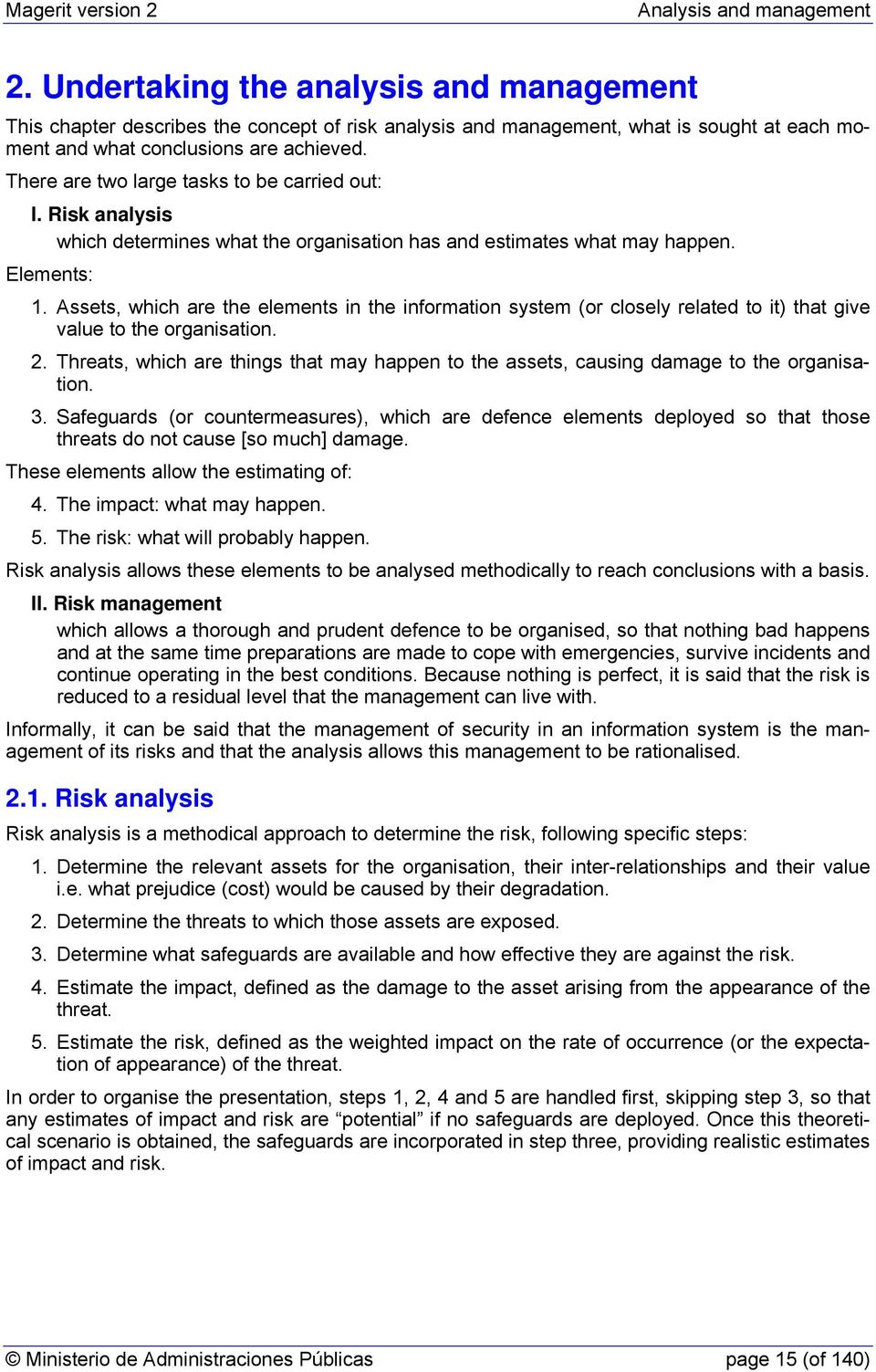
16 Analysis and management The following figure shows this first pass, the steps of which are described in the following sections 9 : are subject to assets assets have a threats threats value value cause a with a given degradation degradation frequency frequency impact impact risk risk Step 1: Assets The assets are the resources in the information system or related to it that are necessary for the organisation to operate correctly and achieve the objectives proposed by its management. The essential asset is the information handled by the system, that is the data. Other relevant assets can be identified around these data: The services that can be provided thanks to these data and the services needed to be able to manage these data. The computer applications (software) that allow these data to be handled. The computer equipment (hardware) that hosts the data, applications and services. The information media, which are data storage devices. The auxiliary equipment that complements the computer equipment. The communications networks that allow the exchange of data. The installations that house the computer and communications equipment. The persons who use or operate all the above elements. Types of assets Not all the assets are of the same type. The threats and safeguards are different according to the type of assets 10. Chapter 2 of the Elements catalogue gives a list of types of assets. If the system handles personal data, these are usually important in themselves and require a series of safeguards frequently regulated by law. With these assets, it is interesting to determine what treatment must be imposed 11. The fact that a datum is personal affects all the assets involved in its handling and safekeeping. 9 Readers familiar with Magerit v1.0 will notice the absence of the vulnerability concept (the potential or possibility that a threat will occur to an asset) which is incorporated using the degradation measurements of the asset and the frequency with which the threat occurs. 10 A telematic service is not attacked or defended in the same way as a work place. 11 It is as though the legislator had carried out the risk analysis for us and had determined the appropriate safeguards. In any case, laws and regulations exist and help to protect these important data. Ministerio de Administraciones Públicas page 16 (of 140)
17 Analysis and management Something similar happens with data classified as confidential. When a certain report is classified so that its copies are numbered, may only reach certain persons, must not leave the premises and must be rigorously destroyed, etc, a series of safeguards is being imposed because of the sector or organisation-specific regulations. Dependencies The most notable assets are the data and services but these depend on other, more prosaic, assets such as the equipment, the communications or the often-forgotten persons who work with them. Thus, the concept of dependencies between assets or the degree to which a higher asset is affected by a security incident in a lower one seems important 112. A higher asset is said to depend on the lower asset when the security needs of the higher one are reflected in the security needs of the lower one. In other words, when the appearance of a threat in the lower asset has a prejudicial effect on the high asset. Informally, this could be interpreted as the lower assets being the pillars that support the security of the higher assets. Although it is necessary to adapt to the organisation being analysed in each case, the group of assets can frequently be structured into layers, where the upper layers depend on the lower ones: Layer 1: The environment: assets that are needed to guarantee the following layers: Equipment and supplies: power, air-conditioning, communications. Personnel: management, operations, development, etc. Others: buildings, furniture, etc. Layer 2: The information system itself: Computer equipment (hardware). Applications (software). Communications. Information media: discs, tapes, etc. Layer 3: The information: Data. Meta-data: structures, indicators, encryption keys, etc. Layer 4: The functions of the organisation, which justify the existence of the information system and give it purpose: Objectives and mission. Goods and services produced. Layer 5: Other assets: Credibility or good image. Accumulated knowledge. Independence of criterion or action. The privacy of persons. The physical well-being of persons. 12 An example can be better than a thousand words. If the building housing the equipment burns down, what ceases to function is the service perceived by the user at a distance. If the portable computer of an executive containing strategic company information is stolen, what suffers is the confidentiality of that information. Installations can be rebuilt, but the opportunity of providing the service may be lost. Theft is overcome by buying another portable computer but the secret has already been lost. Ministerio de Administraciones Públicas page 17 (of 140)

18 Valuation Analysis and management Why is an asset of interest? Because of its value. We are not talking of what things cost but of their value. If something is not of any value, discard it. If an asset cannot be easily discarded, this is because it is of value. This is what has to be discovered since this is what has to be protected. The value may be its own or may be accumulated. Lower assets in the dependencies diagram are said to accumulate the value of the assets that are supported by them. The core value is usually the information (or data) that is handled by the system, with the other assets subordinated to the needs of using and protecting the information. Information systems also use the data to provide services, either internal to the organisation or for third parties, with a series of data being necessary to provide the service. Without going into technical details of how things are carried out, the group of data and end services allows an organisation to be classified functionally. The dependencies between assets allow the other assets to be related with data and services. Dimensions It may be interesting to look at the different dimensions of an asset: Its authenticity: To what extent would a lack of knowledge about who has done what be harmful? This valuation is typical of services (user authenticity) and of data (authenticity of the persons accessing the data for writing or, simply, querying). Its confidentiality: What damage would be caused by unauthorised knowledge? This valuation is typical of data. Its integrity: What damage would be caused if it was damaged or corrupt? This evaluation is typical of data that can be handled and be totally or partially false or even of a lack of data. Its availability: What damage would be caused if it were not available or could not be used? This valuation is typical of services. 13 In systems dedicated to e-government or e-commerce, knowledge of those involved is fundamental in order to be able to provide the service correctly and to be able to track down failures (accidental or deliberate) that may occur. As well as authenticity, it is interesting to calibrate in these assets: The accountability of the use of the service: what damage would be caused by not knowing to whom the service is provided? That is, who does what, when? The accountability of access to the data: what damage would be caused by not knowing who accesses the data and what they do with them? Usually the basic dimensions are recognised: authenticity, confidentiality, integrity and availability. Authenticity has been refined in this method to discriminate between the use of a service and the access to data. The concept of accountability has also been introduced, taken from the ISO/IEC guides, equally separated into the accountability of the service and of the data. The aspects of the authenticity and accountability of the data are critical for meeting the regulatory measures for files containing personal data. Chapter 3 of the Elements catalogue provides a list of security dimensions. 13 There are end services that provide the organisation s final mission. There are internal services used by the organisation to structure its own distribution of responsibilities. Finally there are services acquired from other organisations: external supplies. Ministerio de Administraciones Públicas page 18 (of 140)

19 Analysis and management In a tree of dependencies in which the upper assets depend on the lower ones, it is essential to value these upper assets, those that are important in themselves. This value automatically accumulates in the lower ones, which does not mean that these may not also need their own valuation. How much is the health of the assets worth? Once it has been determined which security dimensions are of interest in an asset, it must be valued. The valuation is the determination of the cost caused by an incident that destroys the asset. There are many factors to be considered: Replacement cost: acquisition and installation. Labour cost (specialised) invested in recovering (the value of) the asset. Loss of income. Operating capacity: the confidence of the users and suppliers which translates into a loss of activity or into worsened economic conditions. Penalties due to non-compliance with the law or with contractual obligations. Damage to other assets, internal or external. Injury to persons. Environmental damage. The evaluation may be quantitative (with a quantity) or qualitative (on a scale of levels). The most important criteria to be respected are: Uniformity: It is important to be able to compare values even if they are of different dimensions in order to be able to combine own and accumulated values as well as to be able to determine if the damage is more serious in one dimension or in another. The relationship: It is important to be able to see the relative value of an asset in comparison with other assets. All these criteria are met with financial valuations (the monetary cost required to cure the asset) and it is frequently tempting to put a price on everything. If this is achieved, fine. It is even easy to put a price on the most tangible aspects (equipment, working hours, etc) but when entering into more abstract evaluations (intangible, such as the organisation s credibility) the exact financial valuation can be slippery and the cause of bitter arguments between experts. Chapter 4 of the Elements catalogue gives some guidelines for the systematic valuation of assets. Qualitative valuation Qualitative scales allow rapid progress, positioning the value of each asset in the relative order with respect to the others. The scales are frequently provided as orders of magnitude for providing estimates of the order of magnitude of the risk. The limitation of qualitative valuations is that they do not allow values to be compared beyond their relative order - the values cannot be added. Chapter 8.1 of the Guide to techniques describes an analysis model based on qualitative valuations. Quantitative valuation Absolute numerical valuations require great effort but do not have the problems of qualitative valuations. Adding numerical values is absolutely natural and the interpretation of the results is never the cause of controversy. If the valuation is monetary, financial studies can also be made comparing what is at risk with what the solution costs by answering the questions: Is it worth investing so much money in this safeguard? Ministerio de Administraciones Públicas page 19 (of 140)

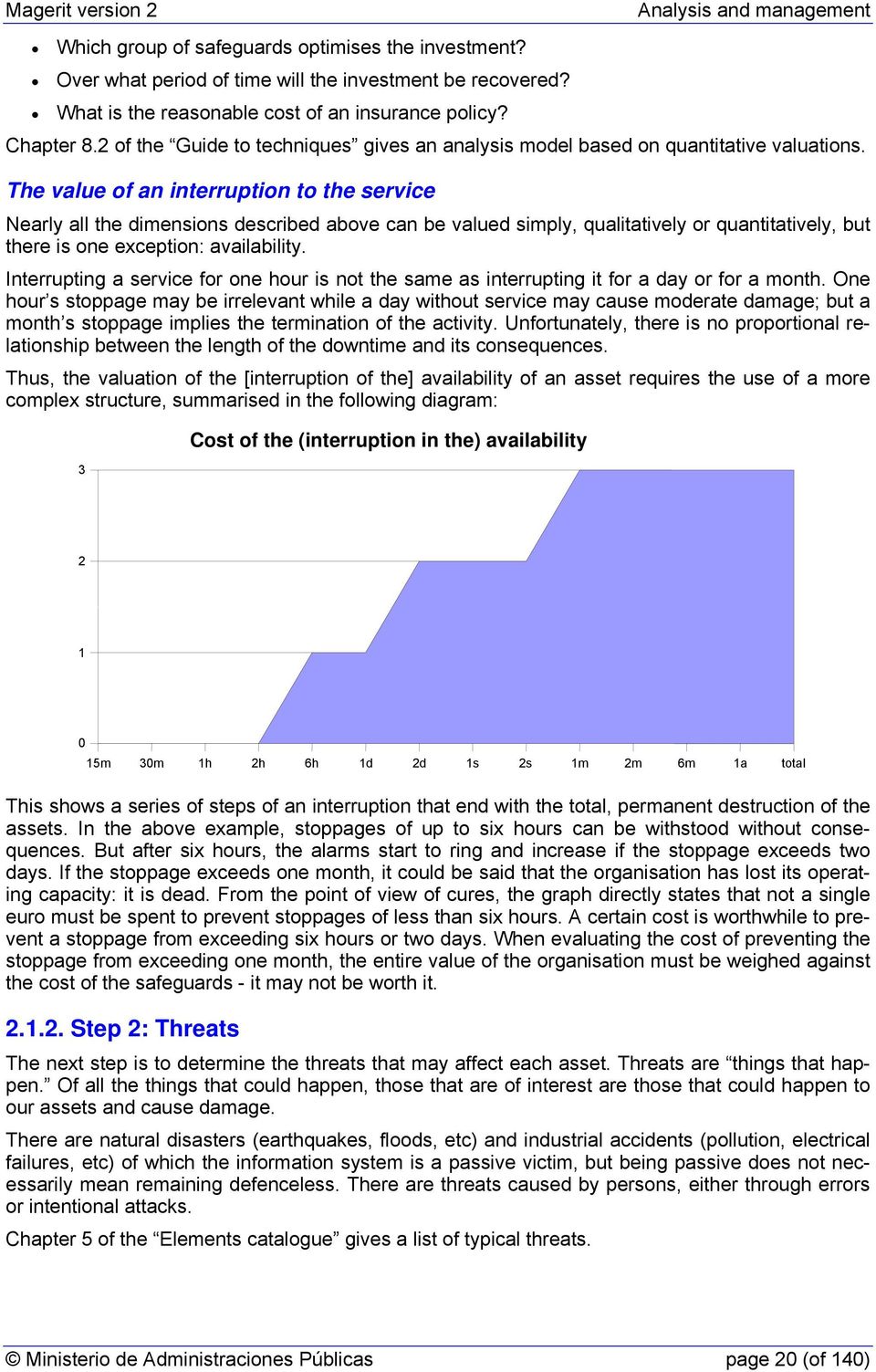
20 Which group of safeguards optimises the investment? Over what period of time will the investment be recovered? What is the reasonable cost of an insurance policy? Analysis and management Chapter 8.2 of the Guide to techniques gives an analysis model based on quantitative valuations. The value of an interruption to the service Nearly all the dimensions described above can be valued simply, qualitatively or quantitatively, but there is one exception: availability. Interrupting a service for one hour is not the same as interrupting it for a day or for a month. One hour s stoppage may be irrelevant while a day without service may cause moderate damage; but a month s stoppage implies the termination of the activity. Unfortunately, there is no proportional relationship between the length of the downtime and its consequences. Thus, the valuation of the [interruption of the] availability of an asset requires the use of a more complex structure, summarised in the following diagram: 3 Cost of the (interruption in the) availability m 30m 1h 2h 6h 1d 2d 1s 2s 1m 2m 6m 1a total This shows a series of steps of an interruption that end with the total, permanent destruction of the assets. In the above example, stoppages of up to six hours can be withstood without consequences. But after six hours, the alarms start to ring and increase if the stoppage exceeds two days. If the stoppage exceeds one month, it could be said that the organisation has lost its operating capacity: it is dead. From the point of view of cures, the graph directly states that not a single euro must be spent to prevent stoppages of less than six hours. A certain cost is worthwhile to prevent a stoppage from exceeding six hours or two days. When evaluating the cost of preventing the stoppage from exceeding one month, the entire value of the organisation must be weighed against the cost of the safeguards - it may not be worth it Step 2: Threats The next step is to determine the threats that may affect each asset. Threats are things that happen. Of all the things that could happen, those that are of interest are those that could happen to our assets and cause damage. There are natural disasters (earthquakes, floods, etc) and industrial accidents (pollution, electrical failures, etc) of which the information system is a passive victim, but being passive does not necessarily mean remaining defenceless. There are threats caused by persons, either through errors or intentional attacks. Chapter 5 of the Elements catalogue gives a list of typical threats. Ministerio de Administraciones Públicas page 20 (of 140)
21 Analysis and management Not all threats affect all assets 14 but there is a certain relationship between the type of asset and what could happen to it. Valuation of threats When an asset is the victim of a threat, not all of its dimensions are affected and not all to the same degree. Once it has been determined that a threat may damage an asset, the asset s vulnerability 15 must be estimated considering two aspects: Degradation: The amount of damage done to the asset. Frequency: How often the threat appears. Degradation measures the damage caused by an incident if it occurs. Degradation is often described as a part of the asset s value and therefore expressions appear such as that an active has been totally degraded, or very slightly degraded. When the threats are not intentional, it is probably enough to know the physically damaged part of an asset in order to calculate the proportional loss of value. But when the threat is intentional, one cannot think of proportions since the attacker may cause a great deal of damage selectively. Frequency 16 puts degradation into perspective since one threat may have terrible consequences but very unlikely to occur while another threat may have very small consequences but be so frequent as to accumulate into considerable damage. Frequency is modelled as an annual occurrence rate with the following typical values: 100 very frequent daily 10 frequent monthly 1 normal annually 1/10 infrequent every few years Step 4: Determination of the impact Impact is the measurement of the damage to an asset arising from the appearance of a threat. By knowing the value of the assets (in various dimensions) and the degradation caused by the threats, their impact on the system can be derived directly. The only consideration required relates to the dependencies between assets. Frequently, the value of the information system is centred on services it provides and the data it handles while the threats usually appear in the media. Accumulated impact This is calculated for an asset taking into account: Its accumulated value (its own plus the accumulated value of the assets that depend on it). The threats to which it is exposed. The accumulated impact is calculated for each asset, for each threat and in each evaluation dimension, being a function of the accumulated value and of the degradation caused. 14 Installations may catch fire but not applications. Persons may be subjected to a bacteriological attack but not services. However, computer viruses affect applications but not persons. 15 Readers familiar with Magerit v1.0 will notice the absence of the vulnerability concept (the potential or possibility that a threat will occur to an asset) which is incorporated using the degradation measurements of the asset and the frequency with which the threat occurs. 16 Measured as the average number of occurrences of the threat over a specific period. Typically, it is estimated annually. For example, if a fault occurs in a system s air conditioning on an average of five times a year, that is the frequency: 5. Ministerio de Administraciones Públicas page 21 (of 140)
22 Analysis and management The greater the intrinsic or accumulated value of an asset, the greater the impact. The greater the degradation of the attacked asset, the greater the impact. Because the accumulated impact is calculated on the assets that carry the weight of the information system, it allows the determination of the safeguards to be adopted in the working media: protection of equipment, back-up copies, etc. Deflected impact This is calculated for an asset taking into account: Its intrinsic value. The threats to which the assets on which it depends are exposed. The deflected impact is calculated for each asset, for each threat and in each valuation dimension, being a function of the intrinsic value and of the degradation caused. The greater the intrinsic value of an asset, the greater the impact. The greater the degradation of the attacked asset, the greater the impact. The greater dependency of the attacked asset, the greater the impact. Because the deflected impact is calculated on assets that have their own value, it allows the determination of the consequences of the technical incidents on the mission of the information system. It is therefore a management presentation that helps in making one of the critical decisions of a risk analysis: accepting a certain level of risk. Aggregation of impact values The above paragraphs determine the impact of a threat on an asset in a certain dimension. These single impacts may be aggregated under certain conditions: The deflected impact on different assets may be aggregated. The accumulated impact on assets that are not inter-dependent and that do not depend on any higher asset may be aggregated. The accumulated impact on assets that are not independent must not be aggregated because this would imply overrating the impact by including the accumulated value of the higher assets several times. The impact of different threats on the same asset may be aggregated although it is useful to consider to what measure the different threats are independent and may be concurrent. The impact of a threat in different dimensions may be aggregated Step 5: Determination of the risk Risk is the measurement of the probable damage to the system. Knowing the impact of the threats to the assets, the risk can be derived directly simply by taking into account the frequency of occurrence. The risk increases with the impact and with the frequency. Accumulated risk This is calculated for an asset taking into account: The accumulated impact on an asset arising from a threat. The frequency of threats. The accumulated risk is calculated for each asset, for each threat and each valuation dimension, being a function of the accumulated value, the degradation caused and the frequency of threat. Ministerio de Administraciones Públicas page 22 (of 140)
23 Analysis and management Because the accumulated risk is calculated on the assets that support the weight of the information system, it allows the determination of the safeguards that must be employed in the work media: protection of equipment, back-up copies, etc. Deflected risk This is calculated for an asset taking into account: The deflected impact on an asset due to a threat. The frequency of the threat. The deflected risk is calculated for each asset, for each threat and in each valuation dimension, being a function of the intrinsic value, the degradation caused and the frequency of the threat. Because the deflected risk is calculated on the assets that have intrinsic value, it allows the determination of the consequences of technical incidents on the mission of the information system. It is therefore a management presentation that helps in making one of the most critical decisions in a risk analysis: accepting a certain level of risk. Aggregation of risks The above paragraphs determine the risk to an asset of a threat in a certain dimension. These single risks may be aggregated under certain conditions: The deflected risk on different assets may be aggregated. The accumulated risk on assets that are not inter-dependent and do not depend on any common higher asset may be aggregated. The accumulated risk on assets that are not independent must not be aggregated since this would imply overrating the risk by including the accumulated value of higher assets several times. The risk of different threats on the same asset may be aggregated although it is useful to consider to what measure the different threats are independent and may be concurrent. The risk of a threat in different dimensions may be aggregated Step 3: Safeguards The above steps have not included the safeguards deployed. Thus, the impacts and risks to which the assets would be exposed if they were not protected in any way are measured. In practice, it is unusual to find unprotected systems: the measures described indicate what would happen if the safeguards were removed. Safeguards or counter-measures are procedures or technological mechanisms that reduce the risk. There are threats that can be removed simply by suitable organisation; others require technical devices (programs or equipment) while others need physical security. Finally, there is the personnel policy. Chapter 6 of the Elements catalogue gives a list of suitable safeguards for each type of asset. Safeguards enter into the calculation of the risk in two ways: Reducing the frequency of threats These are called preventive safeguards. Ideally, they completely prevent a threat from occurring. Impact limitation There are safeguards that directly limit any degradation while others allow the immediate detection of the attack to stop the progress of the degradation. There are even some safeguards that are limited to allowing the quick recovery of the system when the threat destroys it. In all of these versions, the threat occurs but the consequences are limited. Ministerio de Administraciones Públicas page 23 (of 140)
24 Analysis and management are subject to assets assets have a class of asset dimension threat risk level threats threats cause a with a given safeguards safeguards residual residual degradation degradation residual residual frequency frequency value value residual residual impact impact residual residual risk risk As well as being classified by their existence, safeguards are also classified by their effectiveness against the risk that they prevent. The ideal safeguard is 100% effective, which implies that: It is theoretically ideal. It is perfectly deployed, configured and maintained. It is always used. There are clear procedures for its normal use and its use in the event of incidents. The users are trained and aware. There are checks that warn of possible failures. A level of real effectiveness must be estimated for each specific case, ranging from 0% for those that are just decorative and 100% for those that are perfect Revision of step 4: residual impact If all homework has been carried out perfectly, the residual impact must be minimal. If some of the work is half done (imprecise standards, incomplete procedures, unsuitable or insufficient safeguards, or controls that do not control) then the system is said to be subject to a residual impact. The calculation of the residual impact is simple. Since neither the assets nor their dependencies have changed, only the size of the degradation, the impact calculations are repeated with this new degradation level. The size of the degradation, taking into account the effectiveness of the safeguards, is the proportion that remains between perfect effectiveness and real effectiveness. The residual impact may be accumulated on the lower assets or deflected on the higher assets Revision of step 5: residual risk If all homework has been carried out perfectly, the residual risk must be minimal. If some of the work is half done (imprecise standards, incomplete procedures, unsuitable or insufficient safeguards, or controls that do not control) then the system is said to be subject to a residual risk. Ministerio de Administraciones Públicas page 24 (of 140)
25 Analysis and management The calculation of the residual risk is simple. Since neither the assets nor their dependencies have changed, only the size of the degradation and the frequency of threats, the risk calculations are repeated using the residual impact and the new rate of occurrence. The size of the degradation is taken into consideration in calculating the residual impact. The size of the frequency, taking into account the effectiveness of the safeguards, is the proportion that remains between perfect effectiveness and real effectiveness. The residual risk may be accumulated on the lower assets or deflected on the higher assets Risk management Risk analysis determines impacts and risks. Impacts include absolute damage, regardless of whether the occurrence of the circumstance is more or less probable. On the other hand, the risk covers the probability of its occurring. The impact reflects the possible damage while the risk reflects the probable damage. If the impact and the residual risk are minimal, the work is finished; otherwise something must be done Interpretation of the values for impact and residual risks Impact and residual risk are a measurement of the present state, between the potential insecurity (without any safeguard) and the suitable measures that reduce impact and risk to minimal values. They are therefore a measurement of deficiencies. The following paragraphs refer to impact and risk together. If the residual value is equal to the potential value, the existing safeguards are worthless, usually not because nothing has been done but because there are fundamental elements that remain undone. If the residual value is minimal, the task is ended. This does not mean lowering one s guard but it does mean starting the day with a certain degree of confidence. 17. While the residual value is greater than minimal, there is a certain level of exposure. It is important to understand that a residual value is only a number. Its correct interpretation requires that it be accompanied by the list of what must be done and what has not been done. Those responsible for making decisions must pay careful attention to this account of pending tasks, called the deficiencies report Choice of safeguards Threats must be combated, in principle and while the alternative cannot be justified. It is necessary to plan the group of appropriate safeguards to prevent both the impact and the risk, either by reducing the degradation of the asset (minimising the damage) or by reducing the frequency of the threat (minimising its opportunities). All threats must be combated professionally, which means it is necessary to: 1. Set a policy for the organisation in the matter; that is, general directives for who is responsible for each thing. 2. Set a standard; that is, objectives to be met in order to be able to say correctly that the threat has been eliminated. 3. Set up procedures; that is, step by step instructions of what must be done. 17 Don Quixote (Chapter 10) described the balsam of Fierabras, which is "It is a balsam," answered Don Quixote, "with which one need have no fear of death, or dread dying of any wound. The security manager cannot indulge in blind confidence since systems develop, attackers innovate, users are unpredictable in their errors and is always necessary to be aware and react promptly to new realities. Ministerio de Administraciones Públicas page 25 (of 140)
26 Analysis and management 4. Deploy technical safeguards that effectively combat the threats and that can eliminate them. 5. Deploy controls that show that all the above is functioning as planned. This group of elements is normally called Information Security Management System (SGSI) although it is being managed as well as acting. The above paragraph may be deceptive if the reader understands that all of the points must be carried out for each threat. No. In practice, it translates into developing a policy, standards and procedures together with the deployment of a series of safeguards and controls to ensure that each threat has a suitable response. Of the above points, the most open is that of determining the appropriate safeguards. This is really an art that requires specialised personnel although in practice the most usual situations are perfectly documented in the literature and it is sufficient to choose from a catalogue according to the size of the risk. Types of safeguards As a priority, the system must consider preventive safeguards that ensure that the threat does not occur or that its damage is minimal; that is, they must prevent incidents or attacks. In practice, not everything can be foreseen, and not everything that can be foreseen can be eliminated in its origins within financial reason. Both to face the unknown and to protect against a threat to which the system is exposed, it is necessary to have elements available that detect when an incident occurs and allow a fast reaction to prevent its becoming a disaster. Both preventive and emergency measures allow a certain degradation of the assets so it is necessary to have available means for recovery that retrieve the value lost by the assets. Here, it is common sense to act preventively so that things cannot occur or so that not much damage is caused, but this is not always possible 18 and it is necessary to be prepared for what might happen. But an attack must never be allowed to occur unseen: it must be detected, recorded and acted against, firstly with an emergency plan (which stops the incident and limits it) and then with a plan for continuity and recovery to return to the original state. Finally, and without wanting to overwhelm the reader, it must be remembered that a certain balance should be reached between: Technical safeguards: in applications, equipment and communications. Physical safeguards: protecting the working environment for persons and equipment. Organisational measures: for preventing and managing incidents. Personnel policy: which at the end of the day is the essential and most delicate step: a policy for hiring, permanent training, incident reporting organisation, reaction plans and disciplinary measures Profit and loss Common sense dictates that the investment in safeguards cannot exceed the value of the assets to be protected. In practice there are graphs such as the following one that compare the cost of insecurity (the cost of not being protected) and the cost of the safeguards. 18 There are a thousand reasons that prevent absolute protection: cost, technical difficulty, legal limits, etc. However, one of the strongest reasons for not being able to prevent is mere lack of knowledge of what could happen. Something that occurred in the past can be prevented but it is difficult to foresee the next intentional attack since there is a creative component on the part of the attacker. Ministerio de Administraciones Públicas page 26 (of 140)
27 Analysis and management degree of security residual risk cost of safeguards total cost This type of graph tries to show how, in the progress from a security level of 0 towards a level of 100%, the cost of insecurity (the risk) reduces while the cost of investment in safeguards increases. It is intentional that the risk drops strongly with small investments 19 and that the cost of investments soars on reaching security levels close to 100% 20. The central curve sums the cost for the organisation either from the risk (low security) or from the investment in protection. Somehow, there is a balance point between what is at risk and what is invested in defence - the critical point if the only consideration is financial. But putting common sense into practice is not evident, neither in the part for calculating the risk nor in the part of calculating the cost of the safeguards. In other words, the above curve is a concept and cannot be applied to a real case. In practice, there are various hypothetical scenarios when protecting oneself against a risk that is considered important: E0: Nothing is done. E1: A certain group of safeguards is applied. E2: Another group of safeguards is applied. And so forth for N scenarios with different combinations of safeguards. The financial analysis must decide between these options, where E0 (not doing anything) is a possible option that may be financially justified. The cost involved over time must be estimated for each scenario. To aggregate costs, financial losses are accounted as negative values and financial inputs as positive values. Consider the following components: (recurrent) residual risk 21 (once) cost of the safeguards Basic security measures provide an important drop in the risk, which is why they are indispensable. 20 Showing yet again that absolute security (zero risk) does not exist. 21 If the frequency of threats has been estimated as an annual rate, the data for the residual risk must automatically be annual. If another scale has been used, it must be converted into annual terms. Ministerio de Administraciones Públicas page 27 (of 140)
28 (recurrent) annual cost of maintaining the safeguards. Analysis and management + (recurrent) improvement in productivity (recurrent) improvement in the organisation s capability for providing new services, achieving better conditions from suppliers, entering into association with other organisations, etc. The E0 scenario is very simple: each year there is a cost caused by the risk, which accumulates year after year. In the other scenarios, there are things to be added and things to be subtracted, giving rise to various situations. 24 : E0 E1 E2 E3 In E0 it is known what (is estimated) to have been lost each year. The E1 scenario looks like a bad idea since it involves an added cost in the first year which is not recovered in the following years. The E2 scenario is different since it involves a greater initial outlay that starts to become profitable from the fourth year. The E3 scenario is even more attractive, in which the cost of an even larger initial outlay results in savings from the third year and even provides operational profits from the fifth year. The E3 scenario could be said to be a good investment Management attitude The management of the organisation undergoing the risk analysis must determine the acceptable level of impact and risk. Put more correctly, it must accept responsibility for the deficiencies. This is not a technical decision; it may be a political or management decision or may be determined by law or by contractual undertakings with suppliers or users. These levels of acceptance can be set per asset or group of assets (in a specific department, in a specific service, in a specific dimension, etc). 22 Cost of improvement if the safeguard already exists, otherwise, cost of acquisition and installation. In both cases, the costs of training for operators, users, etc, must be imputed. 23 This section may be positive if the organisation improves its productivity or negative if it worsens. A typical example of safeguards that improve productivity would be the use of authentication devices instead of the classical password. A typical example of safeguards that reduce productivity would be the classification of documentation with restricted access control. 24 The X axis shows years, referenced to year 0 in which the risk analysis is carried out; the costs are shown in arbitrary units. Ministerio de Administraciones Públicas page 28 (of 140)
29 Analysis and management Any level of impact and/or risk is acceptable if it is known and formally accepted by the management 225. If the impact and/or risk is above the acceptable level, it is possible to: 1. Remove the asset. This is a strong measure but sometimes there are assets which, simply, are not worth keeping Introduce new safeguards or improve the effectiveness of the existing ones Revision of step 1: assets Some safeguards, especially technical ones, involve the deployment of more equipment 27 which, in turn, becomes an asset in the system. These assets support part of the system s value and are in turn subject to threats that may damage the valuable assets. It is therefore necessary to repeat the risk analysis, enlarging it with the new deployment of media and, of course, ensuring that the risk to the enlarged system is less than that to the original system, that is, that the safeguards effectively reduce the organisation s risk status. 25 To talk of management is to simplify reality. The term stakeholders is used to refer to those affected by the strategic decisions of an organisation: owners, managers, users, employees and even society in general, because at the end of the day, if unwisely high risks are accepted, those damaged may not only be the managers but everyone who puts confidence in the organisation whose sad performance obscures their legitimate expectations. In the final instance, the confidence in a sector or in a technology may be affected by the unwise actions of some of its members. 26 Is it really necessary to maintain this personal and high-level data? Is the wireless network really necessary in the office? 27 Typical examples would be a firewall, a system for managing private virtual networks, intelligent identification cards for users, a PKI, etc. Ministerio de Administraciones Públicas page 29 (of 140)
30 Project structure 3. Structuring the project The previous chapter described the concept of carrying out risk analysis and management; this chapter describes those concepts as parts of a risk analysis and management project (AGR) 28. The steps are divided into three large processes (preparation, analysis and management). Each process is organised into activities which are structured into tasks to be carried out. For each task, what has to be done as well as the possible difficulties in doing it and the form of carrying it out successfully are described 29. In each process, the milestones are given that show the progress of the project until its end. Magerit covers a very wide spectrum of interests for its users. A maximums criterion has been used in planning these guides, reflecting all types of assets, all types of security aspects, all types of situations. In practice, the user may face situations in which the analysis is more restricted, the following being some frequent practical cases: A study is only required of files affected by legislation regarding personal data. A study is only required of the information confidentiality guarantees. A study is only required of communications security. A study is only required of perimeter security. A study is only required on the availability of services (typically because a contingency plan is to be developed). Approval or accrediting is required for the system or for a product. A security metrics project is to be launched, involving identification of which points should be controlled and at what frequency and in what detail. Etc. These frequent situations are formally included in the tasks in activity A1.2 with the informal comments that it is constructive to concentrate on a reduced domain and then enlarge it according to needs rather than tackling the entirety. As well as covering a more or less extensive domain, situations may arise that require a different type of analysis: An urgent analysis to determine the critical assets. An overall analysis to determine general measures. A detailed analysis to determine specific safeguards for certain elements in the information system. A detailed quantitative analysis to determine the opportunity for a high cost. Etc. To summarise, the tasks described below must be adapted: 1. Horizontally to the required scope (activity A1.2). 2. Vertically to the appropriate depth Participants The following groups 30 are involved in the AGR project from start to finish: 28 Corresponds to the Processes model in Magerit version Chapter 6 includes additional practical advice. 30 It is important to formalise the roles of those participating in the project. This section identifies those roles and gives them standard names. Later, the moment (task) in a project at which they are formally constitu- Ministerio de Administraciones Públicas page 30 (of 140)
31 Project structure Management committee This group of participants must include persons at a high level in the organisation s management who know the strategic and business objectives to be achieved and have the authority to validate and approve each process carried out during the project s evolution. The responsibilities of this committee are: To assign the resources needed to carry out the project. To approve the final results of each process. The Management Committee formalises its functions in task T Tracking Committee This consists of the persons responsible for the units affected by the project as well as by those responsible for computing and for management within these units. It is also important that services common to the organisation (planning, budget, human resources, government, etc) participate. In any case, the make-up of the committee will depend on the properties of the units affected. The responsibilities of this committee are: To resolve incidents during the evolution of the project. To ensure the availability of human resources with suitable qualifications and their participation in those activities in which their collaboration is necessary. To approve the intermediate and final reports of each process. To prepare the final reports for the Management Committee. The Tracking Committee is created in task T1.1.1 and its functions are formalised in T Project team This consists of experts in technologies and information systems and technical personnel with qualifications in the affected domain, with knowledge of security management in general and of the application of the risk analysis and management methodology specifically. If the project is carried out with technical assistance through external contractor, persons specialising in information systems security must form part of this project team. The responsibilities of this team are: To carry out the project tasks. To compile, process and consolidate data. To prepare the reports. The project team is determined in task T Delegates groups This is formed of representative users from within the units affected by the project and consists of various possible sub-groups: Those responsible for the service and who are aware of the organisation s mission and its medium and long term strategies. Those responsible for internal services. Computer services operational personnel who are aware of the media deployed (production and safeguards) and of usual incidents. The units affected are determined in tasks T1.2.2 and T The delegates are identified in task T Some other individual roles must be identified as well as these groups: ted is described. Ministerio de Administraciones Públicas page 31 (of 140)
32 Project structure Promoter A person who leads the first tasks in the project, defining its opportunity and scope to launch the AGR project itself. This must be a person with an overview of the information systems and their role in the organisation s activities without needing to know the details but aware of the incidents. The promoter s role is defined in task T Project manager This must be a high-level manager with responsibilities within the organisation for security, information systems or planning, co-ordination or materials, services or similar areas. This is the visible head of the project team. The project manager is designated in task T Operational link This must be a person in the organisation with a good knowledge of the persons and units involved in the AGR project and who can connect the project team to the users group. He is the visible face of the Tracking Committee. The operational link is designated in task T It should be remembered that an AGR project is always mixed because of its very nature; that is, it requires the permanent involvement of specialists and users in both the preparatory phases and during its undertaking. The operational link has a permanent relevance that is not as usual in other types of more technical projects Project undertaking This section describes and formalises the actions to be carried out during an AGR project, setting a standardised development framework that defines: 1. A project structure that serves as a guide for the work team and that allows the involvement in it of managers and users. 2. A group of products to be obtained. 3. A group of techniques to obtain the products. 4. The functions and responsibilities of the participants. The project is divided into three large processes, each broken down into a series of activities and these, in turn, into tasks which are as detailed as required. Each task specifies the following items: Actions to be carried out. Input data. Output data: products and documents to be obtained as a result of the actions. Recommended techniques for successfully terminating the task s objectives. Participants who are involved in or are affected by the undertaking of the actions. An AGR project involves three processes: Ministerio de Administraciones Públicas page 32 (of 140)
33 Project structure Process P1: Planning Consider the approach needed to start the AGR project. Investigate the opportunity for carrying it out. Define the objectives to be met and the domain (reach) covered. Plan the material and human resources needed for its undertaking. Launch the project. Process P2: Risk analysis Identify the assets to be dealt with, the relationships between them and their valuation. Identify the important threats to those assets and their value in terms of frequency of occurrence and the degradation they cause to the value of the affected asset. Identify the existing safeguards and evaluate the effectiveness of their implementation. Estimate the impact and risk to which the assets in the system are exposed. Interpret the meaning of the impact and risk. Process P3: Risk management Choose a strategy to mitigate the impact and risk. Determine the appropriate safeguards for the above objective. Determine the quality needed for these safeguards. Design a security plan (action plan or master plan) to reduce the impact and risk to acceptable levels. Carry out the security plan. These three processes are not necessarily sequential. Process P1 is clearly the project trigger. Process P2 supports process P3 in the sense that Risk management (P3) is a continuous task supported by the analysis techniques (P2). Risk management always involves alterations to the group of safeguards either because new safeguards appear or because some are replaced with others or the existing ones are improved. Risk management may involve the alteration of the group of assets 31, either because new assets appear (safeguard elements that become part of the system) or because assets are removed from the system. In short, tasks from process P2 appear throughout the P3 process. P1: P1: Planning Planning P2: P2: Risk Risk analysis analysis P3: Risk management P3: Risk management A series of documents of general interest is generated throughout these processes 32 : P1: Planning Types of assets. Relevant security dimensions. 31 Formally, it is said that the introduction of safeguards to reduce certain risks may introduce new risks to the system. 32 Without including the working documents for the AGR project itself, which are detailed in the tasks. Ministerio de Administraciones Públicas page 33 (of 140)
34 Evaluation criteria. P2: Risk analysis Project structure Value model. Risk map. Safeguard evaluation. Risk status. Deficiencies report. P3: Risk management Security plan. Ministerio de Administraciones Públicas page 34 (of 140)
35 Project structure Overview Without prejudice to a detailed discussion later, the following lists the complete tree of processes, activities and tasks in an AGR project. Processes, activities and tasks Process P1: Planning Activity A1.1: Opportunity study: Task T1.1.1: Determine the opportunity. Activity A1.2: Determine the scope of the project. Task T1.2.1: General objectives and restrictions. Task T1.2.2: Determination of the domain and limits. Task T1.2.3: Identification of the environment. Task T1.2.4: Estimate of dimensions and costs. Activity A1.3: Project planning: Task T1.3.1: Evaluate loads and plan interviews. Task T1.3.2: Organise the participants. Task T1.3.3: Plan the work. Activity A1.4: Launch the project: Task T1.4.1: Adapt the questionnaires. Task T1.4.2: Evaluation criteria. Task T1.4.3: Resources needed. Task T1.4.4: Awareness. Process P2: Risk analysis Activity A2.1: Characterisation of assets: Task T2.1.1: Identification of assets. Task T2.1.2: Dependencies between assets. Task T2.1.3: Valuation of assets. Activity A2.2: Characterisation of threats: Task T2.2.1: Identification of threats. Task T2.2.2: Valuation of threats. Activity A2.3: Characterisation of safeguards: Task T2.3.1: Identification of existing safeguards. Task T2.3.2: Valuation of existing safeguards. Activity A2.4: Estimate of the risk status: Task T2.4.1: Estimate of the impact. Task 2.4.2: Estimate of the risk. Task 2.4.3: Interpreting the results. Process P3: Risk management Activity A3.1: Decision making: Task A3.1.1: Classification of risks. Activity A3.2: Security plan: Task T3.2.1: Security programmes. Task T3.2.2: Undertaking plan. Activity A3.3: Carrying out of plan: Task T3.3.*: Carrying out of each security programme. Ministerio de Administraciones Públicas page 35 (of 140)
36 Project structure 3.3. Process P1: Planning The main objective of this process is to set a general reference framework for the entire project. The following can be identified as complementary objectives: To motivate, make aware and involve the organisation s management. To explain the opportunity of carrying out an AGR project. For the management to confirm and announce its wish to carry it out. To create the human and material conditions to successfully carry out the project. This process is carried out using the following activities and tasks: Activity A1.1: Opportunity study The opportunity for carrying out the AGR project now is described, framed within the evolution of the other activities of the organisation. The result of this activity is the preliminary report. Tasks: Task T1.1.1: Determine the opportunity. Activity A1.2: Determine the scope of the project The final objectives, domain and limits of the project are defined. A preliminary identification of the environment and the general restrictions to be considered is made. And finally, the cost involved is estimated. The result of this activity is an AGR project profile. Tasks: Task T1.2.1: General objectives and restrictions. Task T1.2.2: Determination of the domain and limits. Task T1.2.3: Identification of the environment. Task T1.2.4: Estimate of dimensions and costs. Activity A1.3: Project planning The work load in carrying out the project is determined. The interviews to be made for collecting information are planned: who is to be interviewed. A working plan is prepared for carrying out the project. In this activity, the participants are determined and the groups and committees to carry out the project are structured. The result of this activity consists of: A working plan for the AGR project. Procedures for managing the information generated. Tasks: Task T1.3.1: Evaluate loads and plan interviews. Task T1.3.2: Organise the participants. Task T1.3.3: Plan the work. Activity A1.4: Launch the project The questionnaires for collecting information are adapted to the current project. The main techniques to be used for evaluating the risk are chosen and the resources needed to start Ministerio de Administraciones Públicas page 36 (of 140)
37 Project structure the project are assigned. An awareness campaign is also carried out for those affected on the purposes and requirements of their participation. The result of this activity consists of: The questionnaires for the interviews. The interviews plan. The catalogue of types of assets. The list of security dimensions. The evaluation criteria. Tasks: Task T1.4.1: Adapt the questionnaires. Task T1.4.2: Evaluation criteria. Task T1.4.3: Resources needed. Task T1.4.4: Awareness. Ministerio de Administraciones Públicas page 37 (of 140)
38 Project structure Activity A1.1: Opportunity study This consists of a single task: T1.1.1: Determine the opportunity. P1: Planning A1.1: Opportunity study T1.1.1: Determine the opportunity Objectives To identify or arouse the interest of the organisation s management in carrying out an AGR project. Input products Output products Preliminary report recommending the preparation of the AGR project. Awareness and support from the management for carrying out the AGR project. Creation of the Tracking Committee. Techniques, practices and guidelines 1. Interviews (see Guide to techniques 3.6.1) Meetings (see Guide to techniques 3.6.2) Participants The promoter. Management is usually very aware of the advantages of electronic, computer and telematic techniques for its operations but not so aware of the new security problems that these techniques imply or the legal or regulatory obligations that affect them. In all public and private organisations, it is important to transform the growing preoccupation with the lack of security in information systems, with the media and environment, into specific measures since their effects do not only affect the systems but also the very functioning of the organisation and, in critical situations, its mission and capacity for survival. Development The initiative for carrying out an AGR project comes from a promoter inside or outside the organisation who is aware of the problems related to security in information systems such as: Continuous security-related incidents. The lack of provisions in matters related to the evaluation of needs and means to reach an acceptable level of security in information systems that is compatible with the correct undertaking of the organisation s mission and functions. Restructuring in the products or services provided. Changes in the technology used. Development of new information systems. The promoter may prepare a framework questionnaire (a document that is difficult to systematise and that must be created for each specific case) to encourage thought on security aspects in the information systems by: Those responsible for the operational units (responsible for services) The questionnaire allows the situation regarding security in their information systems to be examined formally. They must be able to express their opinions on the security projects already carried out (with their degree of satisfaction or with the limits of these) and their expec- Ministerio de Administraciones Públicas page 38 (of 140)
39 Project structure tations with regard to the preparation of an AGR project 33. This high-level approach provides a first view of the specific objectives and options that must underlie the preparation of the project. Those responsible for computing The questionnaire provides a technical panorama for the preparation of the project and also the opportunity for studying its undertaking after including the above options. The answers from the framework questionnaire and the interviews with the above managers and groups gives the promoter a first approach to the functions, services and products involved in security matters in the information systems, their geographical location, the technical means, human means, etc. With these elements, the promoter prepares the preliminary report, recommending the preparation of the AGR project and including these items: A discussion of the basic arguments. A list of the antecedents regarding security in information systems (strategic plan, action plan, etc). A first approach to the domain to be included in the project depending on: The purposes of the units or departments. The management orientations and techniques. The organisational structure. The technical environment. A first approach to the human and material means for carrying out the AGR project. The promoter presents this preliminary report to the management, which may decide to: Approve the project, or, Change its domain and/or objectives, or, Delay the project. 33 They probably do not know what this means and it is necessary to include a short explanation in the framework questionnaire of what an AGR project is and what its objectives are. Ministerio de Administraciones Públicas page 39 (of 140)
40 Project structure Activity A1.2: Determine the scope of the project Once the opportunity of carrying out an AGR project is clear and has the support of management, this activity estimates the project planning elements, that is, the participants and their work loads. This estimate must take into account the possible existence of other plans (for example, a strategic information systems plan or general security plan in the units that may be affected or in the organisation) and the period considered for putting the AGR project into practice. Specifically, the existence of a strategic information systems plan for the units that may be affected within the organisation may greatly determine the scope and extension of the activities carried out in this activity. This activity consists of four tasks: T1.2.1: General objectives and restrictions. T1.2.2: Determination of the domain and limits. T1.2.3: Identification of the environment. T1.2.4: Estimate of dimensions and costs. P1: Planning A1.2: Determine the scope of the project T1.2.1: General objectives and restrictions Objectives To determine the project s short and medium term objectives. To determine the general restrictions on the project. Input products Compilation of the organisation s relevant documentation. Output products Detailed specification of the project s objectives. List of general restrictions. Techniques, practices and guidelines Interviews (see Guide to techniques 3.6.1). Meetings (see Guide to techniques 3.6.2). Participants The Tracking Committee An AGR project may have short term objectives such as ensuring a specific system or specific business process or may have wider objectives such as the overall analysis of the organisation s security. In both cases this must be determined. Especially when implementing corrective actions, it must be remembered that not everything goes but that the project has a series of restrictions, not necessarily technical, that set a framework to be adhered to. In order to include the restrictions in the risk analysis and management, they are grouped by different concepts, typically: Political or management restrictions: Typical of governmental organisations or those strongly related with governmental organisations, either as suppliers or as suppliers of services. Strategic restrictions: Arising from the forecast development of the organisation s structure or objectives. Ministerio de Administraciones Públicas page 40 (of 140)
41 Geographical restrictions: Project structure Arising from the organisation s physical location or its dependence on physical means of communication: islands, sites beyond frontiers, etc. Time restrictions: Taking into consideration collateral situations: labour conflicts, international crises, change of ownership, re-engineering of processes, etc. Structural restrictions: Taking the internal organisation into consideration: decision-making procedures, dependency on international parent companies, etc. Functional restrictions: Taking the organisation s objectives into account. Legal restrictions: Laws, regulations, sector regulations, external and internal contracts, etc. Restrictions relating to personnel: Working profiles, contractual undertakings, trade union undertakings, professional careers, etc. Methodological restrictions: Arising from the nature of the organisation and its working habits or abilities that may impose a certain way of doing things. Cultural restrictions: The culture or internal way of working may be incompatible with certain theoretically ideal safeguards. Budgetary restrictions: The amount of money is important but so is the way of planning the cost and managing the budget. Ministerio de Administraciones Públicas page 41 (of 140)
42 Project structure P1: Planning A1.2: Determine the scope of the project T1.2.2: Determination of the domain and limits Objectives To determine the domain, scope or perimeter of the AGR project. Input products Results of task T1.2.1, General objectives and restrictions. General profile of the units within the project s domain. Output products List of units in the organisation that will be affected as part of the project s domain. List of relevant roles in the units within the domain. Designation of the project manager. Techniques, practices and guidelines Process charts (see Guide to techniques 3.3). Participants Those responsible for the units in the organisation. The Tracking Committee This task identifies the units that form the target of the AGR project and specifies their general features with regard to persons responsible, services provided and geographical locations. It also identifies the main relationships of the units in the project with other entities such as the exchange of information on various media, access to common computer media, etc. The task involves a basic principle: risk analysis and management must be centred on a limited domain that may include various units or be kept within a single unit (depending on the complexity and type of problem to be handled) since a project with a reach that is too wide or indeterminate may be impractical because it is excessively generalised or too long, to the prejudice of the estimates of the elements in the analysis. P1: Planning A1.2: Determine the scope of the project T1.2.3: Identification of the environment Objectives To define the perimeter of the domain. To define the relationships between the interior of the domain and the environment. Input products Results of task T1.2.1, General objectives and restrictions. Results of task T1.2.2, Determination of the domain and limits. Diagram of the relationships of the units in the domain with the environment. Data flow charts. Output products List of the units in the organisation that will be affected as the perimeter of the domain. List of relevant roles in other units to be considered for defining the environment. Ministerio de Administraciones Públicas page 42 (of 140)
43 Project structure P1: Planning A1.2: Determine the scope of the project T1.2.3: Identification of the environment Techniques, practices and guidelines Data flow charts (see Guide to techniques 3.2). Process charts (see Guide to techniques 3.3). Interviews (see Guide to techniques 3.6.1). Meetings (see Guide to techniques 3.6.2). Participants Those responsible for the units in the domain. The Tracking Committee This task carries out an overall study of the information systems in the units in the project s domain to identify their main functions and purposes and their relationships with the environment as well as their development trends. The general profile of the units - obtained in the previous task - is enlarged in this task with the information provided by those responsible for the areas in these units. P1: Planning A1.2: Determine the scope of the project T1.2.4: Estimate of dimensions and costs Objectives To determine the volume of resources needed to carry out the AGR project: human, time and financial. Input products Results of task T1.2.1, General objectives and restrictions. Results of task T1.2.2, Determination of the domain and limits. Results of task T1.2.3, Identification of the environment. Output products Size of the project. Costs and benefits of the project. Techniques, practices and guidelines Cost/benefit analysis (see Guide to techniques 3.1). Project planning (see Guide to techniques 3.5). Participants The project manager. This task enables the dimensioning of the project (size, complexity, areas of uncertainty) based on knowledge of its objectives, domain and the profile of the units included in the study. The techniques to be used in the project are chosen according to the estimated dimension and objectives. For example, if the purpose of the project is to carry out an initial generic analysis, the technique for calculating the risks will be based on a discrimination in two blocks of the risks depending on whether or not more detailed analysis applications are required. The task also dimensions the project with regard to its cost and the return or benefits it may provide so that management has a basis for deciding on its undertaking and for assigning the resources needed for its development. Ministerio de Administraciones Públicas page 43 (of 140)
44 Project structure The study of the project s cost is carried out by estimating the times and profiles of the personnel assigned to the stages of the previously dimensioned project. The study of the return can only be very imprecise in this initial process since it is still not possible to take into account the real return of a security project, which is precisely the cost of not having this security in the domain under study, that is, the result of the AGR project itself. Ministerio de Administraciones Públicas page 44 (of 140)
45 Project structure Activity A1.3: Project planning In this activity the participants in the project, their work loads, their structuring into groups and their mode of acting are determined. This activity consists of three tasks: T1.3.1: Evaluate loads and plan interviews. T1.3.2: Organise the participants. T1.3.3: Plan the work. P1: Planning A1.3: Project planning T1.3.1: Evaluate loads and plan interviews Objectives To define the groups of delegates: the users affected in each unit. To plan the interviews for collecting information. Input products Results of activity A1.2, Determine the scope of the project. Output products List of participants in the delegates groups. Plan of interviews. Loads report. Techniques, practices and guidelines Project planning (see Guide to techniques 3.5). Participants The project manager. The Tracking Committee. The plan of interviews must detail who is to be interviewed, when and with what purpose. This plan allows the determination of the load that the project will imply for the affected units, either in the domain or in the environment. The plan of interviews is especially important when the subjects to be interviewed are in different geographical locations and the interviewing requires the movement of one or other of the parties. It is also useful to arrange interviews so that the most technical opinions are collected first and then those of management so that the interviewer can develop questions using facts (historical experience) before valuations and perspectives of the service to third parties. Ministerio de Administraciones Públicas page 45 (of 140)
46 Project structure P1: Planning A1.3: Project planning T1.3.2: Organise the participants Objectives To determine the entities participating in the management, undertaking, tracking and maintenance of the project. To define the functions and responsibilities of the participating entities. To set the operating rules and modes. To set the classification of the information generated. Input products Results of activity A1.2, Determine the scope of the project. Output products Formalisation of the Management Committee. Formalisation of the Tracking Committee. Criteria and procedures for classifying and managing the information generated. Designation of the operational link. Creation of the work team. Techniques, practices and guidelines Not applicable. Participants Tracking Committee. Project manager. Although all AGR projects involve basically the same committees, in this case the generic approach is moulded to the specific case; it can follow the general case or a specific one. It is particularly relevant to determine the classification of the documents produced during the project. If there is a classification standard, it should be adhered to in order to take advantage of the procedures already set up for handling documents; otherwise, it is necessary to prepare both the classification criteria and the handling procedures. The default classification will be confidential, it being particularly important to maintain the confidentiality of the documentation for the evaluation of safeguards and of deficiencies. Ministerio de Administraciones Públicas page 46 (of 140)
47 Project structure P1: Planning A1.3: Project planning T1.3.3: Plan the work Objectives To prepare the schedule for carrying out the stages, activities and tasks in the project. To set a tracking schedule that defines the tentative dates for meetings of the Management Committee, the plan for delivering the project s products, possible changes to the objectives set, etc. Input products Results of activity A1.2, Determine the scope of the project. Results of task T1.3.1, Evaluate loads and plan interviews. Results of task T1.3.2, Organise the participants. Output products Project schedule. Participants dedication. Specification of the necessary material resources. Description of milestones. Techniques, practices and guidelines Project planning (see Guide to techniques 3.5). Participants The project team. Ministerio de Administraciones Públicas page 47 (of 140)
48 Project structure Activity A1.4: Launch the project This activity completes the preparatory tasks for launching the project, starting with choosing and adapting the questionnaires used to collect data and specifying the criteria and techniques to be used, and ending by assigning the resources needed to carry out the project and carrying out the awareness campaign for those involved. This activity consists of four tasks: T1.4.1: Adapt the questionnaires. T1.4.2: Evaluation criteria. T1.4.3: Resources needed. T1.4.4: Awareness. P1: Planning A1.4: Launch the project T1.4.1: Adapt the questionnaires Objectives To identify the relevant information to be obtained, grouped according to the structure of the units and the participants roles. Input products Results of activity A1.3, Project planning. Output products Adapted questionnaires. Techniques, practices and guidelines Questionnaires (see Elements catalogue in general and specifically Appendix 2). Participants The project team. The task adapts the questionnaires to be used to collect information in process P1 to the project s objectives, the domain and the matters to be discussed with the users. The questionnaires are adapted in order to identify the work elements correctly - assets, threats, vulnerabilities, impact, existing safeguards, general restrictions, etc - in preparation for the needs of activities A2.1 (characterisation of assets), A2.2 (characterisation of threats) and A2.3 (characterisation of safeguards). Adaptation is always necessary (because of the very wide range of security problems that can and must be handled by Magerit) but the degree of adaptation depends also on the conditions in which these questionnaires are used. Interviews guided by the security specialist would not require the same degree of adaptation as those self-administered by the person responsible for the domain or by the users of the information systems. Ministerio de Administraciones Públicas page 48 (of 140)
49 Project structure P1: Planning A1.4: Launch the project T1.4.2: Evaluation criteria Objectives To determine the catalogue of types of assets. To determine the dimensions of the valuation of assets. To determine the levels of the valuation of assets including a unified guide of criteria for assigning a certain level to a certain asset. To determine the levels of the evaluation of threats: frequency and degradation. Input products Elements catalogue. Results of activity A1.3, Project planning. Output products Catalogue of types of assets. List of security dimensions. Valuation criteria. Techniques, practices and guidelines See Elements catalogue chapters 2, 3 and 4. Participants The project team. This task is preparation for process P2 (Risk Analysis) and sets the choice of the criteria and techniques to be used throughout the process. In fact the Risk management in process P3 is conditioned by the type of analysis carried out in process P2. If a type of criteria and techniques for evaluating the risks has been chosen, the same technique should be applied to evaluate the reduction of risks when the proposed safeguards are implemented. The choice of these criteria and techniques depends on: The project s objectives (T1.2.1). The project s domain (T1.2.2). The proposals in the Elements catalogue book, attached to this guide, should be used. Ministerio de Administraciones Públicas page 49 (of 140)
50 Project structure P1: Planning A1.4: Launch the project T1.4.3: Resources needed Objectives To assign the resources needed (human, organisational, technical, etc) for carrying out the AGR project. Input products Results of activity A1.3, Project planning. Output products Communications to the participating personnel of their assignation to the project. Availability of the necessary material resources. Techniques, practices and guidelines Project planning (see Guide to techniques 3.5). Participants The Tracking Committee. Ministerio de Administraciones Públicas page 50 (of 140)
51 Project structure P1: Planning A1.4: Launch the project T1.4.4: Awareness Objectives To inform the affected units. To create an atmosphere of general knowledge of the objectives, those responsible and the schedules. Input products Results of activity A1.3, Project planning. Output products Information note from the management. Material and report presenting the project. Techniques, practices and guidelines Presentations (see Guide to techniques 3.6.3). Participants The project manager. The Tracking Committee. The operational link. The project team. This task reports the launch of the AGR project to the affected units by various means and at least: An information note from management to the units involved, giving their support for carrying out project. The presentation of the project, its objectives and the methodology to be used, carried out by the project team in the units involved. Ministerio de Administraciones Públicas page 51 (of 140)
52 Project structure Synthesis of process P Control milestones Control milestone H1.1: Management must approve or not the undertaking of the AGR project on the basis of the opportunity study carried out by the promoter. Control milestone H1.2: The project Management Committee must validate the Risk analysis and management project planning report containing a synthesis of the products from the activities carried out in the P1 process Results Intermediate documentation Results of the interviews. Documentation from other sources: statistics, comments from experts and comments from the analysts. Additional documentation: drawings, organisational charts, requirements, specifications, functional analysis, work books, user manuals, operating manuals, flow charts for information and processes, data models, etc. Analysis of the results, with the detection of the critical key areas. Existing information that can be used for the project (for example, assets inventory). Results of any applications of risk analysis and management methods carried out previously (for example, cataloguing, grouping and valuation of assets, threats, vulnerabilities, impacts, risk, safeguard mechanisms, etc). Final documentation Types of assets. Relevant security dimensions. Evaluation criteria. Risk analysis and management project planning report containing a synthesis of the products from the activities carried out in process Process P1 checklist 34 Project organisation Management approval (P1). Explicit commitment from management (P1). Management support (P1). Tracking Committee (T1.3.2). Project team (T1.3.2). Project manager (T1.2.2). Operational link (T1.3.2). 34 This list provides a check that all the objectives, sub-objectives and output products detailed in the tasks have been achieved. Ministerio de Administraciones Públicas page 52 (of 140)
53 Project structure Groups of delegates (T1.3.1). Functions and working method (T1.3.2). Criteria for documentation classification and procedures for handling it (T1.3.2). Project planning Preliminary report recommending and justifying the opportunity for launching an AGR project (T1.1.1). Specific and unambiguous objectives (T1.2.1). Estimate of dimensions and costs (T1.2.4). Plan of interviews: persons and dates (T1.4.3). Work plan: milestones (T1.3.3). Assignation of resources (T1.4.3). Awareness of the organisation (T1.4.4). Risk analysis and management project plan (P1). Technical aspects General project limitations (T1.2.1). Project domain: units included in the analysis (T1.2.2). Project environment: other units related in some way (T1.2.3). Adapted questionnaires (T1.4.1). Catalogue of types of assets (T1.4.2). List of relevant security dimensions (T1.4.2). Evaluation criteria (T1.4.2). Ministerio de Administraciones Públicas page 53 (of 140)
54 Project structure 3.4. Process P2: Risk analysis This process is the central core of Magerit and its correct application governs the validity and usefulness of the entire project. The identification and estimation of the assets and any threats to them is a complex task. This process has the following objectives: To provide a model of the system s value, identifying and valuing the relevant assets. To provide a Risk map of the system, identifying and valuing the threats to those assets. To provide knowledge of the current safeguards situation. To evaluate the possible impact to the system under study, both the potential impact (without safeguards) and the residual impact (including the effect of the safeguards implemented, if dealing with a current system, otherwise of a planned system). To evaluate the possible risk to the system under study, both the potential risk (without safeguards) and the residual risk (including the effect of the safeguards implemented, if dealing with a current system, otherwise of a planned system). To show the Management Committee the areas of the system with the greatest impact and/or risk. The starting point for this process is the documentation from the previous one referring to the project s objectives, the plans for interviews, evaluation of work loads, the composition and rules for action for the team of participants, the work plan and the report presenting the project. This process is carried out using the following activities and tasks: Activity 2.1: Characterisation of assets This activity identifies the relevant assets in the system to be analysed, classifying them by type of asset, identifying the relationships between the assets, determining which security dimensions are important and valuing this importance. The result of this activity is the Value model report. Tasks: Task T2.1.1: Identification of assets. Task T2.2.2: Dependencies between assets. Task T2.3.3: Valuation of assets. Activity 2.2: Characterisation of threats This activity identifies the relevant threats to the system being analysed, classifying them by their estimated frequency of occurrence and the estimate of the damage (degradation) that they would cause to the assets. The result of this activity is the Risk map report. Tasks: Task T2.2.1: Identification of threats. Task T2.2.2: Valuation of threats. Activity 2.3: Characterisation of safeguards This activity identifies the safeguards deployed in the system being analysed, classifying them by their effectiveness against the threats they are designed to prevent. The result of this activity is the Safeguards evaluation report. Tasks: Task T2.3.1: Identification of existing safeguards. Ministerio de Administraciones Públicas page 54 (of 140)
55 Task T2.3.2: Valuation of existing safeguards. Project structure Activity 2.4: Estimate of the risk status This activity processes all the data compiled in the previous activities in order to: Prepare a risk status report: estimate of impact and risk. Prepare a deficiencies report: deficiencies or weaknesses in the safeguards system. Tasks: Task T2.4.1: Estimate of the impact. Task T2.4.2: Estimate of the risk. Task T2.4.3: Interpreting the results. Ministerio de Administraciones Públicas page 55 (of 140)
56 Project structure Activity A2.1: Characterisation of assets This activity consists of three tasks: T2.1.1: Identification of assets. T2.1.2: Dependencies between assets. T2.1.3: Valuation of assets. The objective of these tasks is to recognise the assets in the processes and to define the dependencies between them. Based on the information compiled in the previous activity, this activity deepens the study of the assets with a view to obtaining the necessary information for estimating the risk. Frequently, the tasks relating to the assets are carried out concurrently with those relating to the threats to them (A2.2) and the identification of current safeguards (A2.3) simply because the persons tend to coincide and it is difficult for them to avoid treating each asset vertically, seeing everything that affects it before moving on to the next one. Ministerio de Administraciones Públicas page 56 (of 140)
57 Project structure P2: Risk analysis A2.1: Characterisation of assets T2.1.1: Identification of assets Objectives To identify the assets in the domain, determining their features, attributes and classification in the specific types. Input products Inventories of the data handled by the organisation. Business processes. Use diagrams. Data flow charts. Inventories of logical equipment. Inventories of physical equipment. Functional classification of the work posts. The organisation s premises and sites. Output products List of assets to be considered. Characterisation of assets. Techniques, practices and guidelines Data flow charts (see Guide to techniques 3.2). Process charts (see Guide to techniques 3.3). Interviews (see Guide to techniques 3.6.1). Meetings (see Guide to techniques 3.6.2). See also section Participants The project team. The delegates groups. This task is critical. Good identification is important from various points of view: It precisely defines the scope of the project. It enhances communication with the user groups: everyone speaks the same language. It allows the determination of the precise dependencies between assets. It allows the assets to be valued precisely. It allows the threats to be identified and valued precisely. Characterisation of assets It is necessary to determine a series of features that define each asset: Code, typically from the inventory. Name (short). Description (long). Type (or types) of the asset. Ministerio de Administraciones Públicas page 57 (of 140)
58 Project structure Unit responsible. Sometimes there is more than one unit. For example, in the case of applications, it is necessary to differentiate between the unit that maintains it and the one that uses it. Person responsible. Especially relevant in the case of data. Sometimes more than one person is responsible. For example, in the case of personal data, it is necessary to differentiate between the person responsible for the data and the operator who handles it. Location: technical (in intangible assets) or geographical (in material assets). Quantity, if relevant, such as in the case of personal computing (for example, 350 desktop systems). Other features that are specific to the type of asset. Ministerio de Administraciones Públicas page 58 (of 140)
59 Project structure P2: Risk analysis A2.1: Characterisation of assets T2.1.2: Dependencies between assets Objectives To identify and value the dependencies between assets, that is, the measure to which a higher order asset can be prejudiced by a threat occurring in a lower order asset. Input products Results of task T1.2.1, Identification. Business processes. Data flow charts. Use diagrams. Output products Diagram of dependencies between assets. Techniques, practices and guidelines Data flow charts (see Guide to techniques 3.2). Process charts (see Guide to techniques 3.3). Interviews (see Guide to techniques 3.6.1). Meetings (see Guide to techniques 3.6.2). Delphi evaluation (see Guide to techniques 3.7). See also section Participants The project team. The delegates groups. It is useful to record the following information for each dependency: An estimate of the degree of dependency: up to 100%. An explanation of the valuation of the dependency. Interviews which support the above estimate. Ministerio de Administraciones Públicas page 59 (of 140)
60 Project structure P2: Risk analysis A2.1: Characterisation of assets T2.1.3: Valuation of assets Objectives To identify the dimension in which the asset is valuable. To evaluate the cost to the organisation of the destruction of the asset. Input products Results of task T1.4.2, Evaluation criteria. Results of task T2.1.1, Identification of assets. Results of task T2.1.2, Dependencies between assets. Output products Value model: reports of the assets value. Techniques, practices and guidelines Interviews (see Guide to techniques 3.6.1). Meetings (see Guide to techniques 3.6.2). Delphi evaluation (see Guide to techniques 3.7). See also section Participants The project team. The delegates groups. The Tracking Committee. Management. It may be necessary to interview different groups within the organisation to acquire this knowledge: Management, which knows the consequences for the organisation s mission. Those responsible for the services, who know the consequences of not providing a service or of providing a degraded service. Those responsible for the data, who know the consequences of data degradation. Those responsible for the information systems and their operation, who know the consequences of an incident. It is useful to record the following information for each valuation: The dimensions in which the asset is relevant. An estimate of the value in each dimension. An explanation of the valuation. Interviews from which the above estimates have been deduced. Ministerio de Administraciones Públicas page 60 (of 140)
61 Project structure Activity A2.2: Characterisation of threats This activity is usually carried out concurrently with activities A2.1 and A.2.3, given that the people to be interviewed are the same. This activity consists of two tasks: T2.2.1: Identification of threats. T2.2.2: Valuation of threats. P2: Risk analysis A2.2: Characterisation of threats T2.2.1: Identification of threats Objectives To identify the relevant threats to each asset. Input products Results of task T1.4.2, Evaluation criteria. Results of activity A2.1, Characterisation of assets. Output products List of possible threats. Techniques, practices and guidelines Catalogue of threats (see Elements catalogue, chapter 5). Attack trees (see Guide to techniques 2.3). Interviews (see Guide to techniques 3.6.1). Meetings (see Guide to techniques 3.6.2). Delphi evaluation (see Guide to techniques 3.7). See also section Participants The project team. The delegates groups. In this task, the important threats to the assets are identified, taking into consideration: The type of asset. The dimensions in which the asset is valuable. The organisation s experience. It is useful to record the following information for each threat to each asset: An explanation of the effect of the threat. Interviews from which the above estimate has been deduced. Background, if any, either within the organisation itself or in other organisations considered relevant. Ministerio de Administraciones Públicas page 61 (of 140)
62 Project structure P2: Risk analysis A2.2: Characterisation of threats T2.2.2: Valuation of threats Objectives To estimate the frequency at which each threat occurs to each asset. To estimate the degradation that the threat would cause in each of the asset s dimensions if it occurs. Input products Results of task T1.4.2, Evaluation criteria. Results of task T2.2.1, Identification of threats. Incident logs. Background: incidents in the organisation. Output products Risk map: Report on possible threats, according to their frequency of occurrence and the degradation they would cause to the assets. Techniques, practices and guidelines Attack trees (see Guide to techniques 2.3). Interviews (see Guide to techniques 3.6.1). Meetings (see Guide to techniques 3.6.2). Delphi evaluation (see Guide to techniques 3.7). See also section Participants The project team. The delegates groups. The threats identified in the previous task are evaluated in this task, taking into consideration: Universal experience (history). Experience (history) in the activity sector. Experience (history) in the environment in which the systems are located. Experience (history) of the organisation itself. Knowing that there is a series of possible problems as described in Section X, it is useful to record the following information for each threat to each asset: An estimate of the frequency of the threat. An estimate of the damage (degradation) that its occurrence would cause. An explanation of the estimates of frequency and degradation. Interviews from which the above estimates have been deduced. Ministerio de Administraciones Públicas page 62 (of 140)
63 Project structure Activity A2.3: Characterisation of safeguards This activity usually occurs concurrently with activities A2.1 and A2.2, given that the persons to be interviewed are the same. This activity consists of two tasks: T2.3.1: Identification of existing safeguards. T2.3.2: Valuation of existing safeguards. P2: Risk analysis A2.3: Characterisation of safeguards T2.3.1: Identification of existing safeguards Objectives To identify the safeguards of all types that have been planned and deployed by the date of the study. Input products Inventory of operating procedures. Inventory of hardware and software products and/or developments that support the systems security. Training plan. Definition of the work posts. Agreements. Agreements for outsourcing services. Output products List of safeguards deployed. Techniques, practices and guidelines Catalogues of safeguards (see Elements catalogue chapter 6). Attack trees (see Guide to techniques 2.3). Interviews (see Guide to techniques 3.6.1). Meetings (see Guide to techniques 3.6.2). See also section Participants The project team. The delegates groups. It is useful to record the following information for each safeguard: A description of the safeguard and its implementation status. A description of the threats it is to face. Interviews from which the above information has been deduced. Ministerio de Administraciones Públicas page 63 (of 140)
64 Project structure P2: Risk analysis A2.3: Characterisation of safeguards T2.3.2: Valuation of existing safeguards Objectives To determine the effectiveness of the safeguards deployed. Input products Inventory of safeguards (Elements catalogue). Output products Safeguards evaluation: Report on the safeguards deployed, according to their degree of effectiveness. Techniques, practices and guidelines Interviews (see Guide to techniques 3.6.1). Meetings (see Guide to techniques 3.6.2). Delphi evaluation (see Guide to techniques 3.7). See also section Participants The project team. The delegates groups. Specialists in specific safeguards. The effectiveness of the safeguards identified in the previous task is evaluated in this task, taking into consideration: The suitability of the safeguard for its purpose. The quality of the implementation. The training of those responsible for configuring and operating it. The training of the users, if they have an active role. The existence of controls for measuring its effectiveness. The existence of procedures for regular revisions. It is useful to record the following information for each safeguard: An estimate of its effectiveness in dealing with those threats. An exploration of the effectiveness estimate. Interviews from which the above estimate has been deduced. Ministerio de Administraciones Públicas page 64 (of 140)
65 Project structure Activity A2.4: Estimate of the risk status In this activity, information from the previous activities (A2.1, A2.2 and A2.3) is combined to provide estimates of the organisation s risk status. This activity consists of three tasks: T2.4.1: Estimate of the impact. T2.4.2: Estimate of the risk. T2.4.3: Interpreting the results. P2: Risk analysis A2.4: Estimate of the risk status T2.4.1: Estimate of the impact Objectives To determine the potential impact to which the system is subjected. To determine the residual impact to which the system is subjected. Input products Results of activity A2.1, Characterisation of assets. Results of activity A2.2, Characterisation of threats. Results of activity A2.3, Characterisation of safeguards. Output products Report on the impact (potential) per asset. Report on the residual impact per asset. Techniques, practices and guidelines Analysis using tables (see Guide to techniques 2.1). Algorithmic analysis (see Guide to techniques 2.2). See also section and Participants The project team. In this task, the impact to which the system s assets are exposed is estimated: The potential impact to which the system is exposed, taking into account the value of the assets and the valuation of threats but not the safeguards currently deployed. The residual impact to which the system is exposed, taking into account the value of the assets and the valuation of threats and the effectiveness of the safeguards currently deployed. Ministerio de Administraciones Públicas page 65 (of 140)
66 Project structure P2: Risk analysis A2.4: Estimate of the risk status T2.4.2: Estimate of the risk Objectives To determine the potential risk to which the system is subjected. To determine the residual risk to which the system is subjected. Input products Results of activity A2.1, Characterisation of assets. Results of activity A2.2, Characterisation of threats. Results of activity A2.3, Characterisation of safeguards. Output products Report on the risk (potential) per asset. Report on the residual risk per asset. Techniques, practices and guidelines Analysis using tables (see Guide to techniques 2.1). Algorithmic analysis (see Guide to techniques 2.2). See also section and Participants The project team. In this task, the risk to which the system s assets are exposed is estimated: The potential risk to which the system is subjected, taking into account the value of the assets and the valuation of threats but not the safeguards currently deployed. The residual risk to which the system is subjected, taking into account the value of the assets and the valuation of threats and the effectiveness of the safeguards currently deployed. Ministerio de Administraciones Públicas page 66 (of 140)
67 Project structure P2: Risk analysis A2.4: Estimate of the risk status T2.4.3: Interpreting the results: Objectives To interpret the above results for impact and risk. To establish priorities regarding assets or groups of assets, either by order of impact or by order of risk. Input products Results of activity A2.1, Characterisation of assets. Results of activity A2.2, Characterisation of threats. Results of activity A2.3, Characterisation of safeguards. Results of task T2.4.1, Estimate of the impact. Results of task T2.4.2, Estimate of the risk. Output products Prioritised report on assets subjected to greatest impact. Prioritised report on assets subjected to greatest risk. Risk status: Report summarising the impact and potential and residual risks to which each asset in the domain is exposed. Deficiencies report: A report that describes the inconsistencies between the safeguards required and those that exist and the inconsistencies between the size of the risk and the current effectiveness of the safeguards. Techniques, practices and guidelines Graphical techniques (see Guide to techniques 3.4). Meetings (see Guide to techniques 3.6.2). Presentations (see Guide to techniques 3.6.3). See also section Participants The project team. The Tracking Committee. Ministerio de Administraciones Públicas page 67 (of 140)
68 Project structure Synthesis of process P Control milestones Control milestone H2.1 Acceptance of the Value model report. Control milestone H2.2 Acceptance of the Risk map report. Control milestone H2.3 Acceptance of the Safeguards evaluation report. Control milestone H2.4 Acceptance of the Risk status report. Control milestone H2.5 Acceptance of the Deficiencies report report Results Intermediate documentation Results of the interviews. Documentation from other sources: statistics, comments from experts and comments from the analysts. Existing information that can be used by the project (for example, inventory of assets). Additional documentation: drawings, organisational charts, requirements, specifications, functional analysis, work books, user manuals, operating manuals, information and processes flowcharts, data models, etc. Final documentation Value model A report that details the assets, their dependencies, the dimensions in which they are valuable and an estimate of their value in each dimension. Risk map A report that details the important threats to each asset, according to their frequency of occurrence and the degradation they could cause to the asset if they occur. Safeguards evaluation A report that details the existing safeguards, according to their effectiveness for reducing the risk they face. Risk status A report that details the impact and residual risks for each asset for each threat. Deficiencies report A report that details the safeguards needed that are absent or insufficiently effective. This documentation is a faithful picture of the risk status and of the reasons why this risk is not to be disregarded. It is fundamental to understand the reasons that lead to a specific risk evaluation as a prior step to the following process, P3, designed to remove the risk or to reduce it to acceptable levels. Ministerio de Administraciones Públicas page 68 (of 140)
69 Project structure P2 process checklist Identification of assets (T2.1.1). Characterisation of assets (T2.1.1). Dependencies between assets (T2.1.2). Dimensions regarding security per asset (T2.1.3). Valuation of assets (T2.1.3). Value model (A2.1). Identification of relevant threats (T2.2.1). Estimate of the frequency of occurrence (T2.2.2). Estimate of the damage (degradation) arising from the appearance of a threat (T2.2.2). Risk map (A2.2). Identification of existing safeguards (T2.3.1). Estimate of the effectiveness of the existing safeguards (T2.3.2). Safeguards evaluation (A2.3). Estimate of the impact and residual impact (T2.4.1). Estimate of the risk and residual risk (T2.4.2). Risk status (P2). Deficiencies report (P2). Ministerio de Administraciones Públicas page 69 (of 140)
70 Project structure 3.5. Process P3: Risk Management The impact and risks identified in the previous process are processed, either by assuming them or by facing them. To face those risks considered unacceptable, a security plan must be carried out to correct the current situation. A security plan consists of a collection of security programmes. Some programmes will be simple while others will reach a sufficient level of complexity and cost that their undertaking becomes a project in itself. The series of programmes (and, where appropriate, projects) is planned over time using the so-called security plan that describes and organises the actions to bring the risk status to an acceptable level that is accepted by management. This process is carried out with the following activities and tasks: Activity A3.1: Decision making In this activity, the technical conclusions from process P2 are turned into action decisions. Tasks: Task T3.1.1: Classification of risks. Activity A3.2: Security plan. In this activity, action decisions are translated into specific actions: projects to improve security, planned over time. Tasks: Task T3.2.1: Security programmes. Task T3.2.2: Undertaking plan. Activity A3.3: Carrying out of plan This activity takes the series of projects in the security plan and carries them out. Tasks: Task T3.3.*: Carrying out of each security programme Ministerio de Administraciones Públicas page 70 (of 140)
71 Project structure Activity A3.1: Decision making This activity consists of a single task: T3.1.1: Classification of risks. P3: Risk management A3.1: Decision making T3.1.1: Classification of risks Objectives To classify the risks on a scale: critical, serious, appreciable or acceptable. Input products Results of process P1, Risk analysis. Applicable legislation, laws and jurisprudence. Sector regulations. Agreements and contracts. Environmental reports. Market studies. Output products A report classifying impacts and risks, including directives on the schedule for solving them. Techniques, practices and guidelines Meetings (see Guide to techniques 3.6.2). Delphi evaluation (see Guide to techniques 3.7). See also section Participants The project team. The Tracking Committee. The Management Committee. Given the impacts and the risks to which the system is exposed, a series of decisions - management, not technical - must be taken, conditioned by various factors: The seriousness of the impact and/or risk. The organisation s legal obligations. The organisation s obligations under sector regulations. The organisation s contractual obligations. Within the area of movement allowed by this framework, additional considerations may appear regarding the organisation s capacity for accepting certain intangible impacts 35 such as: Public image within society. Internal policy: relationships with the employees themselves such as the capacity to hire suitable persons, the ability to keep the best ones, capacity to support personnel turnover, capability to offer an attractive professional career, etc. 35 Because the risks analysis and management methodology is centred on damage evaluation, it does not fully capture the benefits of the absence of damage which generates an atmosphere of confidence and improves the undertaking of the organisation s functions in its operating environment. Ministerio de Administraciones Públicas page 71 (of 140)
72 Project structure Relationships with suppliers, such as the capability of reaching advantageous agreements over short, medium and long terms, capability to obtain priority treatment, etc. Relationships with clients or users such as the capability to win them over, capability to increase the offer, capability to stand out amongst the competition, etc. Relationships with other organisations, such as the capability to reach strategic agreements, alliances, etc. New business opportunities, such as ways to recover the investment in security. Access to recognised security certificates or qualifications. All the above considerations result in the classification of each important security risk, determining whether: 1. It is critical in the sense that it requires urgent attention. 2. It is serious in the sense that it requires attention. 3. It is appreciable in the sense that it could be the subject of a study for handling it. 4. It is acceptable in the sense that action will not be taken against it. Option four, accepting the risk, is always risky and must be taken with care and justification. The reasons that could lead to this acceptance are: When the residual impact is negligible. When the residual risk is negligible. When the cost of the suitable safeguards is out of proportion when compared to the residual impact and risks. All the decisions are proposed by the Tracking Committee after hearing of the opinion of the project manager. All the decisions are adopted by the Management Committee. This classification will have consequences in the following tasks and is a basic factor for establishing the relative priority of the actions. Ministerio de Administraciones Públicas page 72 (of 140)
73 Project structure Activity A3.2: Preparation of the information security plan Action decisions are turned into specific actions. This activity consists of two tasks: T3.2.1: Security programmes. T3.2.2: Undertaking plan. P3: Risk management A3.2: Preparation of the information security plan T3.2.1: Security programmes Objectives To prepare a set of security programmes. Input products Results of task T3.1.1, Classification of risks. Knowledge of security techniques and products. Catalogues of security products and services. Output products List of security programmes. Techniques, practices and guidelines Risk analysis (see process P2). Cost/benefit analysis (see Guide to techniques 3.1). Project planning (see Guide to techniques 3.5). See also section and Participants The project team. Security specialists. Specialists in specific areas of security. Basically, two steps are involved: 1. All the impact and risk scenarios considered critical or serious as a result of the previous task are taken into consideration. 2. A set of security programmes is prepared that provide a response to all of the above scenarios, knowing that one programme may attack different scenarios and that one scenario may be handled by different programmes. The final purpose is to implement or improve the implementation of a series of safeguards that reduce the impact and risk to residual levels accepted by the management. This handling of the safeguards becomes a series of tasks to be carried out. A security programme is a group of tasks. The grouping is made for convenience, either because the tasks by themselves lack effectiveness or because they are tasks with a common objective, or because they are tasks that involve a single action unit. Each security programme must detail: Its generic objective. The specific safeguards to be implemented or improved, detailing their objectives for quality, effectiveness and efficiency. The list of impact and/or risk scenarios to be faced: assets affected, types of asset, threats Ministerio de Administraciones Públicas page 73 (of 140)
74 faced, valuation of assets and threats and levels of impact and risk. The unit responsible for carrying them out. Project structure An estimate of costs, both financial and in terms of effort, for carrying them out, considering: Cost of acquisition (of products) or of contracting (of services) or of development (of turnkey systems); it may be necessary to evaluate various alternatives. Cost of initial implementation and maintenance over time. Cost of training, both of operators and users, depending on the case. Operating costs. Impact on the organisation s productivity. A list of sub-tasks to be carried out, considering: Changes in the regulations and development of procedures. Technical solution: programs, equipment, communications and installations. Deployment plan. Training plan. An estimate of the undertaking time from start-up to putting into operation. An estimate of the risk status (impact and residual risk on completion). A system of effectiveness and efficiency indicators that continuously show the quality of the security function required and its evolution over time. The above estimates may be very precise in simple programmes but may be just guidelines in complex programmes that involve carrying out a specific security project. In the latter case, each project will develop the latter details through a series of tasks for each project which, in general lines, will involve the following points: Study of the market offer: products and services. Cost of a specific development, either in-house or sub-contracted. If a specific development is considered suitable, it is necessary to determine: The functional and non-functional specification of the development. The development method that guarantees the security of the new component. The mechanisms for measurement (controls) that must be built in. The acceptance criteria. The maintenance plan: incidents and evolution. Ministerio de Administraciones Públicas page 74 (of 140)
75 Project structure P3: Risk management A3.2: Preparation of the information security plan T3.2.2: Undertaking plan Objectives To prepare a schedule of the security programmes. Input products Results of task T3.1.1, Classification of risks. Results of task T3.2.1, Security programmes. Output products Schedule for carrying out the plan. Security plan. Techniques, practices and guidelines Risk analysis (see process P2). Project planning (see Guide to techniques 3.5). Participants Development department. Purchasing department. A schedule must be prepared for the security programmes, taking the following factors into account: The critical nature, seriousness or convenience of the impacts and/or risks being faced, giving maximum priority to those programmes that handle critical situations. The cost of the programme. The availability of in-house personnel to take responsibility for the management (and, where appropriate, the undertaking) of the scheduled tasks. Other factors such as the preparation of the organisation s annual budget, relationships with other organisations, development of the legal, regulatory or contractual framework, etc. Typically, a security plan it is prepared at three levels: Master plan (one) Often called the action plan, this covers a long period (typically three to five years) and sets the directives for action. Annual plan (a series of annual plans) Covers a short period (typically, between one and two years) and sets the planning of the security programmes. Project plan (a group of projects with their planning) Covers a short period (typically, less than one year) and sets the detailed plan for carrying out each security programme. One single, master plan must be prepared which gives perspective and unity of objectives to the individual actions. This master plan allows annual plans to be developed which structure the assignation of resources for carrying out the tasks within the strategic framework, especially budgetary items. And, finally, there will be a series of projects that provide the security programmes. Ministerio de Administraciones Públicas page 75 (of 140)
76 Project structure Activity A3.3: Carrying out of plan This activity consists of a number of tasks that depend on the security plan determined in activity A3.2, since it involves carrying out the programmes planned in it. This activity consists of N tasks - as many as a have been set in the security plan. T3.3.*: Carrying out of each security programme36. P3: Risk management A3.3: Carrying out of plan T3.3.*: Carrying out of each security programme Objectives To attain the objectives described in the security plan for each programme. Input products Results of activity A3.2, Security plan. Current security programme. Risk analysis before carrying out the plan. Output products The implemented safeguard. Standards for use and operation. A system of indicators for effectiveness and efficiency in attaining the required security objectives. Updated value model. Updated Risk map. Updated risk status (impact and residual risks). Techniques, practices and guidelines Risk analysis (see process P2). Project planning (see Guide to techniques 3.5). Participants The project team: development of the risk analysis. Personnel specialising in the relevant safeguard. 36 This activity consists of an unknown number of tasks, to be determined in each project; thus the reference use of the symbol *. Ministerio de Administraciones Públicas page 76 (of 140)
77 Project structure Synthesis of process P Control milestones Control milestone H3.1 Management will approve or not the security plan including a list of security programmes and the proposed schedule for carrying them out. Control milestone H3.* Completion of each security programme, meeting the acceptance criteria described in the security plan Results Intermediate documentation Decisions for classifying the impact and risk scenarios. Final documentation Security plan Checklist for process P3 Classification of risks (T3.1.1). Identification of the required security programmes (T3.2.1). Security programmes: Objectives. Estimate of effort. Estimate of cost. Acceptance plan. Operation plan. Maintenance plan. Training plan. System for checking effectiveness. System for checking efficiency. Estimate of impact and residual risks. Undertaking schedule (T3.2.2). Strategic security plan: long term (A3.2). Tactical security plan: medium term (A3.2). Operational plans: individual projects (A3.2). Ministerio de Administraciones Públicas page 77 (of 140)
78 Information systems 4. Development of information systems Applications (software) are a frequent and core type of asset for treating information in general and for providing the services based on that information. The presence of applications in an information system is always a source of risk in the sense that it is a point at which threats may appear. On the other hand, sometimes, the applications appear as part of the answer in the sense that they safeguard the system against potential risks. In any case, the risk arising from the presence of applications must be under control. The analysis of the risks is a fundamental part of the design and development of secure information systems. It is possible -and imperative- to incorporate functions and mechanisms that strengthen security in a new system and in the development process, ensuring its consistency and security, following the organisation s security plan. It is a recognised fact that considering the security of a system before and during its development is more effective and economic than considering it afterwards. Security must be embedded in the system from its initial conception. There are two types of activities: SSI: Activities related to the very security of the information system. SPD: Activities related to security during the process of developing the information system Start of the processes There are various reasons that can lead to the development of a new application or the modification of an existing one: New services and/or data Requires the development of new applications or the modification of operational applications. May involve the disappearance of operational applications. The initiative may be taken by the development manager, with the security manager acting as a subsidiary. Technological development. Information technologies are continually developing, with changes appearing in techniques for developing systems, in languages, in development platforms, operating platforms, operating services, communications services, etc. It requires the development of new applications or the modification of operational applications. Might involve the disappearance of operational applications. The initiative may be taken by the development manager, with the security manager acting as a subsidiary. Modification of the security classification of services or data Typically requires the modification of operational applications. Rarely implies the development of new applications or the disappearance of operational applications. The initiative may be taken by the security manager, with the systems manager acting as a subsidiary. Consideration of new threats. The development of communications technologies and services may enable new threats or convert formerly unimportant threats into important ones in the future. It typically requires the modification of operational applications, either to their coding or, more frequently, in their operating conditions. Rarely implies the development of new applications or the disappearance of operational applications. The initiative may be taken by the security manager, with the systems manager acting as a subsidiary. Modification of the risk classification criteria. May be caused by operational quality criteria, by changes to applicable legislation, in sector regulations or by agreements or contracts with Ministerio de Administraciones Públicas page 78 (of 140)
79 third parties. Information systems Typically requires the modification of operational applications. Rarely implies the development of new applications or the disappearance of operational applications. The initiative may be taken by the security manager, with the systems manager acting as a subsidiary Life cycle of applications specification acquisition (standard) contracted development in-hose development acceptance deployment operation maintenance Typically, the life cycle of an application involves several phases or stages: Specification. In this phase, the requirements to be met by the application are determined and a plan is prepared for the following phases. Acquisition or development. To turn a specification into a reality, a product may be acquired or developed, either in-house or through outsourcing. Acceptance. Neither a new application nor a modification of an existing one must be allowed to enter into operation without being formally accepted. Deployment. This consists of installing the code in the system and configuring it so that it enters into operation. Operation. The users use the application, and users and/or operators attend to incidents. Maintenance. Either because new requirements appear or because a failure has been discovered, the application may require maintenance that requires returning to any of the previous stages - in the final resort, to the basic specification Systems plan Computer applications are one component of information systems. The applications are embedded in the information system to take care of part of the services required. A systems plan determines the framework for the development and operation of the computer applications, specifically: The services required, both for the internal users and to support the internal users or internal applications. The functional data used. The applications that handle these data. The equipment: computers and communications services. From the security point of view, a systems plan allows: The essential services to be identified and valued. Ministerio de Administraciones Públicas page 79 (of 140)
80 The essential data to be identified, classified and valued. The organisation s security policy to be determined, that is: The legal context within which the organisation operates. The criteria for excellence in service provision. The roles of the personnel related with the information systems. Information systems The systems plan allows the value model to be established, that is, the large sections (assets) and the first valuations of what will become a detailed risk analysis Risk analysis Being part of an information system, the risks associated with an application must be known and managed, whether they are supported by the application or are risks that affect higher assets or risks to lower assets accumulated. Magerit allows the application to be modelled directly with an asset, establishing its dependencies, whether of higher assets that depend on it or of lower ones that support it. The method allows threats and safeguards to be identified and valued, providing information on the impact and risk to the application itself and to the assets related with it. Self-contained AGR. If the organisation has not carried out an AGR project, it will be necessary to do so, incorporating at least the assets that are directly or indirectly related with the application. Marginal AGR. If the organisation has already carried out an AGR project, it is sufficient to revise the results of the project, incorporating the new assets. The appearance of a new application may imply new services, new data, new equipment, new premises and new personnel. It may also imply the disappearance of old assets that have been replaced by the new application and its possibilities. For each specific case, it is necessary to determine what must be added and what must be removed, following activities A2.1, A2.2 and A2.3 of process P2, Risk analysis. Regardless of the approach used, the result will be a list of impacts and risks to both the application and to its environment. These data are obtained by following the steps in activity A2.4 of process P2. The results are interpreted using task A2.4.3 of process P2, Interpreting the results Risk management The P3 Risk management process recommends safeguards and evaluates the effect of the safeguards deployed against the impact and risk. The decisions made will depend on the criteria set in the organisation s security policy and other considerations specific to each case. Although the security policy sets a reference framework that cannot be broken, usually not all the technical and operation details of the service to make precise decisions are covered. Due to the relationship between the elements in a system, it is not sufficient to protect a certain type of asset in order to protect the whole. However, this chapter concentrates on the measures that must be applied to applications so that they do not compromise the system s security. Always following the initiative and corroboration of the risk management process, the following aspects must be considered: During the specification: Dimensioning. User profiles. Requirements for user identification and authentication. Encryption requirements. Monitoring and logging requirements: Of input data. Ministerio de Administraciones Públicas page 80 (of 140)
81 Information systems Of output data. Of intermediate data. Of access to the application. Of activity (use). If standard software is acquired: Acquisition and maintenance contracts. If software development is sub-contracted: Acquisition and maintenance contracts. Development environment: space, persons, platforms and tools. Secure programming techniques. Source code management: Access control. Version control. If software is developed in-house: Maintenance conditions: Development environment: space, persons, platforms and tools. Secure programming techniques. Source code management: Access control. Version control. For acceptance: Acceptance tests: Test data. If they are not real, they must be realistic. If the use of real data is unavoidable, copies and access to them must be controlled. Functional tests (of the security services). Simulation of attacks. Test under load. Controlled intrusion (ethical hacking). Inspection of services/code. Information leaks: covert channels, through the records, etc. Access via back doors. Privilege escalation. Buffer overflow problems. Accrediting. For the deployment: Inventory of applications in operation. Change management: standards and procedures. Setting of passwords. During operation: Ministerio de Administraciones Públicas page 81 (of 140)
82 Standards and procedures for: User management. Password management. Log management. Information systems Incident management: recording evidence, escalation, emergency and recovery plans. Log analysis: tools, criteria, procedures, etc. User manuals: administrators, operators and users. Training: Initial and continuous: administrators, operators and users. In the maintenance cycles: End Standards and procedures for: Requests. Approval, including the differential analysis of risks and the approval of new measures, where relevant. Destruction of operational data. Copying and safekeeping of data when required by law or internal policy. Elimination of operating code: executable, configuration data and user accounts. Revision of back-up copies Development security As described above, a distinction can be made between the security of the development process (SPD tasks) and the security of the information system (SSI). The tasks in the interface are arranged according to whether they belong to one security objective or the other SPD Development process security Assets to be considered Each development stage requires an analysis of the specific risk involved: The data being handled: Systems specifications and documentation. Source code. Operator and user manuals. Test data. The software development environment: Tools for handling the documentation: generation, publication, documentation control, etc. Tools for handling the code: generation, compiling, version control, etc. The hardware development environment: central equipment, work posts, filing equipment, etc. The communications development environment. The installations. The personnel involved: developers, maintenance personnel and users (for tests). Ministerio de Administraciones Públicas page 82 (of 140)
83 Information systems Activities Involves the following steps: 1. The development team describes the elements involved via the project manager. 2. The analysis team receives the information on the assets involved via the security manager. 3. The risk analysis team analyses the risks. 4. The risk analysis team describes the risk status via its manager, proposing a series of measures to be taken. 5. The development team prepares a report on the cost of the recommended measures, including development costs and the costs of deviations in the delivery schedule. 6. Management classifies the risk and decides the safeguards to be implemented on the basis of the joint reports of the risk and cost analysis for the proposed solutions. 7. The risk analysis team prepares the report for the solutions adopted. 8. The security team prepares the relevant security standard. 9. Management approves the plan for carrying out the process with the required security. Results of the risk analysis and management In all cases: Recommended safeguards. Information handling standards and procedures. Other considerations Although each stage requires its specific risk analysis, it is true that the models are very similar so that the greatest efforts are made in the first one and the others are adaptations of it. During system planning, high-level contributions may appear that affect the organisation s security standards and even the corporate security policy itself. Notable among the standards and procedures generated is the need for a standard for classifying documentation and procedures for its handling. Special attention must be paid in all processes to the personnel involved; as basic rules, it is useful to: Identify the roles and the persons. Determine the security requirements for each post and incorporate them into the selection criteria and hiring conditions. Limit access to the information: by necessity only. Segregate tasks, especially preventing the concentration of those applications or parts of application that involve a high risk in one person SSI Information system security The entire existence of an information system can be seen as stages of growing concretion from a very overall perspective during the planning processes to a detailed vision during development and operation. However, this life cycle is not linear: it is frequently necessary to examine other options and review the decisions made. The impact and risk estimates in the risk analysis must be based on the actual systems, concentrating on their assets. Thus, the value model can be understood as an evolution, constantly collecting the level of detail available. As a methodology, Magerit allows the systematic and uniform treatment of what is essential to be able to compare options and to manage the systems development. The use of support tools must allow: Ministerio de Administraciones Públicas page 83 (of 140)
84 Information systems 1. An initial model to be captured (during system specification). 2. Variations to be studied (during system feasibility and architectural analysis). 3. A movement from generalisations to specifics, forecasting potential threats and the preparation of detection and reaction mechanisms (during system detailed design and development). 4. Their acceptance and use to be managed (during system deployment and acceptance). 5. The proposed changes to be periodically checked (during system maintenance). Use of Magerit methodology tasks Process P1: Planning Activity A1.1: Opportunity study Task T1.1.1: Determine the opportunity This task involves the internal decision to develop the information system, taking security into account. Activity A1.2: Determine the scope of the project Task T1.2.1: General objectives and restrictions Those of the information system under development. Task T1.2.2: Determination of the domain and limits Those of the information system under development. Task T1.2.3: Identification of the environment Those of the information system under development. Task T1.2.4: Estimate of dimensions and costs Part of the project (or projects) for developing the information system. Activity A1.3: Project planning Task T1.3.1: Evaluate loads and plan interviews This task is carried out as in any AGR project. The task must be carried out along with the very early system planning, preparing a list of interviews for the rest of the processes, except for occasional adjustments as deemed necessary. Task T1.3.2: Organise the participants This task is carried out as in any AGR project. Along with system planning, a list of participants to be interviewed must be prepared, without going into greater detail than their roles. As the system is developed, the persons that meet the planned roles are identified. Task T1.3.3: Plan the work Part of the project (or projects) for developing the information system. Activity A1.4: Launch the project Task T1.4.1: Adapt the questionnaires This task is carried out as in any AGR project. This task must be carried out along with the very early system planning, being established for the rest of the processes, except for occasional adjustments. Task T1.4.2: Evaluation criteria This task is carried out as in any AGR project. This task must be carried out along with the very early system planning, being established for the rest of the processes. Task T1.4.3: Resources needed Part of the project (or projects) for developing the information system. Ministerio de Administraciones Públicas page 84 (of 140)
85 Information systems Task T1.4.4: Awareness Part of the project (or projects) for developing the information system. Process P2: Risk analysis Activity A2.1: Characterisation of assets Task T2.1.1: Identification of assets During system planning, the generic assets are identified. As the development progresses, identification is tightened so that the generic assets become specific assets. Concretion must be at its maximum on reaching the development stage. Task T2.1.2: Dependencies between assets During system planning, general relationships appear. As the development progresses, dependencies are tightened as the generic assets become specific assets. Concretion must be at its maximum on reaching the development stage. Task T2.1.3: Valuation of assets The evaluation of the end services and the essential data can be made along with the very early system planning, although as the development progresses, the services and/or data can be segmented, requiring individual valuation which must never exceed the valuation of the aggregated services or data. In other words, the services and/or data can be separated in fractions of lower value. Typically, the evaluation of the rest of the assets can be analysed as a simple accumulated value from the higher assets, using the dependency relationships. Activity A2.2: Characterisation of threats Task T2.2.1: Identification of threats Threats to generic assets can be incorporated from the very early system planning, but as the detailed group of components is concreted, specific threats to the technology used must be incorporated. Task T2.2.2: Valuation of threats This task is carried out as in any AGR project. Activity A2.3: Characterisation of safeguards Task T2.3.1: Identification of existing safeguards Many safeguards may be identified from the very early system planning. However, the technical safeguards must be specified as the detailed group of components and the technology used is specified. Task T2.3.2: Valuation of existing safeguards This task is carried out as in any AGR project. Activity A2.4: Estimate of the risk status Task T2.4.1: Estimate of the impact This task is carried out as in any AGR project. Task T2.4.2: Estimate of the risk This task is carried out as in any AGR project. Task T2.4.3: Interpreting the results: This task is carried out as in any AGR project. Process P3: Risk Management Activity A3.1: Decision making Task T3.1.1: Classification of risks Ministerio de Administraciones Públicas page 85 (of 140)
86 Information systems This task is carried out as in any AGR project. Both the development team and the risk analysis team must take part in the decisionmaking. Activity A3.2: Preparation of the overall information security plan Task T3.2.1: Security programmes This task is included in the development tasks. Task T3.2.2: Undertaking plan This task is included in the development tasks. Activity A3.3: Carrying out of plan Task T3.3.*: Carrying out of each security programme These tasks are included in the development tasks. Other considerations It is important to carry out the risk analysis progressively, incorporating greater detail as the development progresses but never starting again from zero. During system planning, high-level contributions may appear that affect the organisation s security standards and even the corporate security policy itself. The standards and procedures derived from each development stage form a group of standards and procedures that will be used during the operation of the system. Typically, the standards must be completed in the early stages: system planning, feasibility study, and architectural design; they are rarely changed in the following stages. On the other hand, the procedures cannot be obtained until the details are specified in the detailed design, development, and deployment stages; they must not be changed, except for adjustments and corrections, in the following stages. During deployment and acceptance stages, standards and procedures are moved into operation. The maintenance stage may involve the correction of erroneous standards and procedures or the extension of incomplete standards and procedures that have not included all the practical circumstances. The specification of safeguards must include both the mechanisms for action and for the configuration, monitoring and control of their effectiveness and efficiency. Frequently, some developments appear that are specifically designed to configure the group of safeguards and to monitor their operation References NIST Special Publication , Security Considerations in the Information System Development Life Cycle, Rev.1. June NIST Special Publication Rev. A, Engineering Principles for Information Technology Security (A Baseline for Achieving Security), Rev. A, June Seguridad de las Tecnologías de la Información. La construcción de la confianza para una sociedad conectada, E. Fernández-Medina y R. Moya (editors). AENOR, Ministerio de Administraciones Públicas page 86 (of 140)
87 Practical advice 5. Practical advice All of the above is somewhat abstract and may not allow the analyst to progress easily through the steps described. Therefore, it has been considered appropriate to include some comments that may serve as a guide for progress. It is also recommended that the user consults the Elements catalogue containing types of assets, valuation dimensions, valuation guides and catalogues of threats and safeguards Identifying assets It is useful to repeat that only those information systems resources that have value to the organisation, either in themselves or because they support valuable assets, are of interest. As an example, a Web server is an asset with little value in itself. This can be assured because it is not normal for an organisation to deploy a Web server except when it needs to provide a service. All of its value is imputed: The non-availability of the server implies the interruption of the service. The cost involved in the interruption of the service is the availability value to be imputed to the server. Uncontrolled access to the server puts at risk the secrecy of its data. The cost involved in the loss of confidentiality of the data is the confidentiality value to be imputed to the server. And so on with the dimensions under consideration. The intangibles Certain elements of value in organisations are intangible: Credibility or good image. Accumulated knowledge. Independence of criterion or action. Personal privacy. Physical well-being of persons. These elements can be included in the risk analysis as assets 37 or as evaluation elements 38. The quantification of these items is often difficult but somehow it must never be forgotten that what is to be protected finally is the organisation s mission and the value of this lies in these intangibles, as recognised in Magerit version Identification of assets Perhaps the best approach to identify the assets is to ask directly: Which assets are fundamental to your achieving your objectives? Are there more assets that must be protected due to legal obligations? Are there assets that are related to the above? It is not always clear what an asset is individually. If, for example, your unit has 300 PC work posts, all with identical configurations and handling identical data, it is not useful to analyse 300 identical 37 Not all authors agree that it is a good idea to identify intangible assets. It is true that they are assets in the financial sense but it is questionable that they are actual resources of the information system. What happens is that if delegates are asked during the interviews in terms of the organisation s intangible values, the daily perspective is lost since most of the members of the organisation have more specific and closer objectives on which a considered opinion can be given. 38 See Catalogue of Elements, chapter 4. Valuation criteria. 39 See Magerit version 1.0, Procedures guide / 3. Elements sub-module / 3.4. Impacts / Types. Ministerio de Administraciones Públicas page 87 (of 140)
88 Practical advice assets. It is sufficient to analyse a generic PC that represents them all; grouping simplifies the model. On other occasions, the opposite occurs: a central server with a thousand functions - file server, mail server, intranet server, document management system server, etc. In these cases it is useful to segregate the services provided as independent (internal) services. Only on reaching the level of the physical equipment need all the services be converged in a single piece of equipment. If services are shared out among various servers in the future, it is then easy to revise the value model and dependencies Discovering and modelling the dependencies between assets Sometimes this is more difficult than expected because those responsible for the assets are usually more concerned about the functional chaining between the assets than about the dependence in the value propagation sense. It is necessary to tell the delegate that, instead of searching for what is necessary for the system to function, he should do the reverse: look for where the system may fail or, more precisely, where the assets security could be compromised. If there are data that are important because of their confidentiality, it is necessary to know in which places they will be stored and through which places they will travel; they could be revealed in these points. If there are data that are important because of their integrity, it is necessary to know in which places they will be stored and through which places they will travel; they could be altered in these points. If a service is important because of its availability, it is necessary to know which elements are used to provide it: the failure of these elements would stop the service. These considerations could be made as questions of the type: If you wanted to access these data, where would you attack? If you wanted to stop this service, where would you attack? This approach of putting yourself in the attacker s place gives rise to the techniques known as attack trees 40 which in this methodology are associated with what are called dependencies. An asset may be attacked directly or indirectly through another asset on which it depends. The above considerations can be shown in a flat dependencies diagram which can (and should, for practical purposes) be converted into a more compact tree. As a result, it is normal to say that the services depend on the equipment which in turn depends on the premises in which the equipment is located, without the need to state that the services depend on the premises 41. It is normal to identify internal services or horizontal services which are groups of assets for a specific function. These intermediate services are effective for compacting the dependencies graph because the dependencies of these services are interpreted unambiguously as dependencies of all the elements that provide the service. When data flow charts or process charts are used, the route followed by the data is not as important as the (unorganised) whole of the elements involved. The process depends on all the assets that appear in its diagram. Some data depend on all the sites through which they pass. In both diagrams, it is usual to find hierarchical descriptions where a process is subdivided into levels of greater detail. These hierarchical diagrams may help to prepare the dependencies graph. Typical mistakes It is not true to state that an application depends on the data it handles. The reasoning of those who say so is that the application does not function without data, which is correct, but it is not the 40 See Guide to techniques, section The "Guide to techniques" contains the algorithmic model for calculating the total dependencies between assets on the basis of the direct dependencies. Ministerio de Administraciones Públicas page 88 (of 140)
89 Practical advice interesting point. It is the opposite: the data depend on the application. In value terms, it could be said that the application has no value without data. Because the value is a property of the data, it is this value that is inherited by the application. Thus, the data depend on the application. From the other point of view, the data can be accessed through the application, making the application the means to attack the data. Given that data and applications usually join forces to provide a service, the value of the service is transmitted to both the data and to the applications involved. Bad service application application data Good service data data application service application It is not true to say that an application depends on the equipment in which it runs. The reasoning of those who state this is that the application does not function without equipment, which is correct but is not the interesting point. If both the application and the equipment are necessary to provide a service, this must be stated explicitly, without searching for more complex paths. Bad service application application equipment Good service application service equipment These mistakes sometimes pass unnoticed while the system is very small (only one service, one application and one piece of equipment) but they appear when the system grows. For example, application X may run on different equipment with different data to provide different services. It is then impossible to relate the application with one or more pieces of equipment, other than by considering each case. service service 11 service service 22 data data 11 data data 22 application application system system 11 system system 22 installations installations Are the dependencies well modelled? Establishing dependencies is a delicate task that can have a bad ending. Before a dependencies model can be considered good, it is necessary to trace for each asset all the assets that it depends on directly or indirectly and the following questions must be answered positively: Have all the assets through which the asset being valued may be attacked been identified? Can the asset being valued really be attacked in all the assets on which it depends? Ministerio de Administraciones Públicas page 89 (of 140)
90 Practical advice The dependency list propagates the accumulated value so that if an asset without accumulated value is found, this means that the dependencies are badly modelled or, simply, that the asset is irrelevant Valuing assets It is always useful to value the information or data that forms the reason for the information system s existence. If end services (provided to users beyond the analysis domain) have been modelled, they should also be valued. It is easy to identify data or information type assets and value them according to guideline classifications such as their personal nature or their security classification but it is much more delicate to value commercial or operational type data because it is necessary to look at the consequences of the damage suffered. The rest of the assets can often be left unvalued because their most important value is to support the data and/or services and the dependencies relationships take care of this calculation. However, it may be useful to value other types of assets. The simplest assets to value are those acquired in a shop. If one is faulty, another one must be installed. This costs money and time (that is, more money). This is known as a replacement cost. Apart from some notable exceptions, the cost of the physical assets is often minimal compared to other costs and can be overlooked. It is generally difficult to value persons but if a post involves a slow and laborious period of training, it must be remembered that the person filling this post becomes very valuable because his replacement cost is high. In any case, to value an asset, the person responsible must be identified - the suitable person to value the asset. This person must be helped with valuation tables such as those in chapter 4 of the Elements catalogue which, when adapted to the specific case, allow the perception of the value to be converted into a qualitative or quantitative measurement. Often, there is no single person responsible for an asset and/or service; instead, several persons within the organisation have qualified opinions on the matter. It is necessary to listen to them all and to reach a consensus. If there is no obvious consensus, the following may be required: A meeting: Bring the opinion holders together and try to reach a common opinion. A Delphi 42 : Send questionnaires to the opinion holders and try to converge on a common opinion. The assets evaluation processes frequently require the help of different persons to value different assets and often all those interviewed consider their assets as having the greatest importance, this being more frequent the more specialised the person interviewed. Since many evaluations are estimates of value, care must be taken that everyone uses the same estimating scale. It is therefore important to use a table such as that in chapter 4 of the Elements catalogue, directly or adapted to the specific case, and it is important that after asking those who are familiar with each asset, they all receive a copy of the overall valuation of the system so that they can appreciate the relevant relative value of their assets and provide an opinion in context. Personal data Personal data are controlled by laws and regulations and require the organisation to adopt a series of protection measures that are independent of the assets value See "Guide to techniques, chapter The evaluation of personal assets can be approached by quantifying the fine that would be imposed by the Data Protection Agency. This approach is not valid in a qualitative analysis. In a quantitative analysis, the approach starts from the hypothesis that the worst that could happen with this data is for it to be the Ministerio de Administraciones Públicas page 90 (of 140)
91 Practical advice The most realistic form of handling personal data is to classify them as such in the appropriate level and to determine their value: the damage that would be caused if they were wrongfully revealed or altered. With this approach, the analysis of impact and risks allows the data to be protected both by legal obligation and because of their own value Identifying threats The task seems impossible: identify the threats to each asset, in each dimension. One starting point is past experience, either in-house or that of similar organisations. What has happened may repeat itself and in any case it would be unthinkable not to take it into account. As a complement, a catalogue of threats such as that in the Elements catalogue helps to locate what should be considered, depending on the type of assets and on the dimensions in which it has its own or an accumulated value. Often, attack scenarios are invented that are dramatisations of how an attacker would attack our systems. This technique is sometimes known as attack trees. Put yourself in the place of the attackers and imagine what they would do with their knowledge and financial capability. Different situations may have to be considered, depending on the technical profile of the attacker or on his technical and human resources. The dramatisations are interesting for being able to calculate impacts and risks but are also very useful when convincing senior management and users that a threat is not theoretical but very real. When the safeguards are evaluated, it may be useful to revise these attack scenarios Valuing threats The task is demoralising: determine the degree of degradation that would be caused and the probable frequency of occurrence for each asset in each dimension. Whenever possible, it is useful to start with standard data. In the case of natural disasters or industrial accidents, an historical or generic series may be available or one from the place in which the equipment for the information system being studied is located. A log that shows which events are frequent and which never happen may also be available. Classifying human errors is more complicated but experience allows realistic values to be obtained. The most complex is classifying deliberate attacks because these depend on good or bad luck. There are many reasons that increase the danger of a threat: The attacker does not need great technical knowledge. 44 The attacker does not need a great investment in equipment. 45 There is a very large financial benefit in play (the attacker may get rich). There is an enormous benefit in play (the attacker may be strongly benefited, in terms of esteem, popularity, etc) so that challenges must be avoided and it is important never to boast about how invulnerable your information system is - it isn t and having this demonstrated is not amusing. There is a bad atmosphere at work, giving rise to discontented employees who take their revenge via the systems, simply to cause damage. There is a bad relationship with the external users, who take their revenge via our systems. cause of a fine. 44 Attention should be paid to the sale of attack tools. An attack may require a real expert to carry it out manually (that is, it is infrequent) but if the expert packages his attack in a tool with a simple graphical interface, using that tool becomes a game that requires nothing more from the attacker than an absence of scruples (that is, the threat becomes very frequent). 45 It must be remembered that the Internet is an immense network of computing power. If someone knows how to get organised, it is not difficult to put the Net to work for me which means that the attacker has vastly more effective means than the system being attacked. Ministerio de Administraciones Públicas page 91 (of 140)
92 Practical advice Starting from a standard value, it is necessary to increase or reduce the classifications for frequency and degradation until they describe the specific case as closely as possible. Often, the correct value cannot be determined and it is necessary to use simulations as guidelines. The use of some type of tool is very useful for studying the consequences of a certain value, which some authors call the sensitivity of the model to certain data. If it appears that the results change drastically due to small alterations in an estimate of frequency or degradation, it is necessary to: (1) Be realistic; and (2) Pay great attention to why the system is so sensitive to something so specific and to take measures designed to make the system independent, that is, to stop a certain threat from being critical. Remember that the frequency does not affect the impact so that studying the impact allows the degradation to be adjusted and then studying the risk allows the frequency to be adjusted. An unjustified degradation value must never be accepted in the hope of its being compensated with the frequency since the estimate of the impact is important in itself as well as that of the risk. Whatever the final decision made for estimating a value, it must be documented because explanations will be required sooner or later, above all if costly safeguards are to be recommended as a consequence Choosing safeguards Probably the only way is with a catalogue. Use an expert (system) to help see which solution is suitable for each combination of: Type of asset. Threat to which it is exposed. Dimension of value that is the cause of the concern. Risk level. Often, many solutions with different qualities are found for a problem. In these cases, a solution must be chosen that corresponds with the calculated impact and risk levels. Many safeguards are of low cost: it is sufficient to configure the systems suitably or organise standards so that people carry out tasks suitably. But some counter-measures are very expensive (to acquire, to deploy, to maintain periodically, to train the personnel in charge of them, etc). In these cases, it is useful to decide whether the cost of the safeguard does not exceed that of the potential risk, that is, always make spending decisions that involve a net saving. Last and by no means least, when safeguards are deployed it is necessary to consider their ease of use. Ideally, the safeguard should be transparent so that the user needs to do nothing or as little as possible. A safeguard that is complex to use and requires specialised personnel adds the threat implied by its erroneous use to the threats already in the system Successive approximations The reader will already have realised that risk analysis may be very laborious, requiring time and effort. It is also necessary to introduce many elements that are not objective but that are analysts estimates, which implies the need to explain and agree what each thing means to avoid being exposed to unknown or undervalued impacts or risks and to avoid turning paranoia into a waste of unjustified resources. In order to be practical and effective, it is useful to make successive approximations. Start with a high level superficial analysis, quickly identifying the most critical parts: assets of great value, clear vulnerabilities or, simply, textbook recommendations because there is nothing more prudent than learning from the experience of others. This risk analysis is evidently imperfect but it is enough to be confident in its correct handling. The following paragraphs describe how to quickly move towards the final objective: having impacts and risks under control. Note that these imperfect approximations allow the quick deployment of systems that are reasonably protected when there is no time for a full-scale risk analysis. When, after time, the risk management phase is reached after an exhaustive analysis, very probably many safeguards will be found to be already available, requiring only the introduction of some new ones and/or the im- Ministerio de Administraciones Públicas page 92 (of 140)
93 Practical advice provement to the effectiveness of those that already exist. Following these informal approximations is therefore not a waste of work Baseline protection Basic (baseline) protection measures are frequently heard of that must be implemented in all systems unless it is shown that they are not relevant in a specific case. Don t argue or hesitate. Your information systems must not be accessible to just anyone at any moment. They can be protected physically or logically, placing them in a room to which not just anyone has access or using logical access identification. But protect them! This type of reasoning can be applied frequently and leads to the deployment of a minimum of purely common sense safeguards. Once the obvious has been carried out and must never be argued over, more elaborate levels can be reached, that are specific to each system. A catalogue of safeguards is required to apply a baseline treatment. There are numerous sources, including: International standards, for example ISO/IEC 17799:2005. National standards, for example the Security criteria. Sector standards. Corporate standards, especially frequent in small branches of large organisations. The advantages of protection by catalogue are: It is very quick. It requires almost no effort. It provides a uniform level with other, similar organisations. The disadvantages of protection by catalogue are: The system may be protected against threats from which it does not suffer, implying an unjustified cost. The system may be unsuitably protected against real threats. In general terms, one does not know what is being done with baseline protection and although on the right track, there is no measurement of lacks or excesses. However, it can be a useful starting point for later refinement. Protection by catalogue can be refined somewhat by considering the value of the assets or quantifying the threats. Based on the classification of the assets If you have personal data classified as high level, they must be encrypted. If you have data classified as confidential, they must be labelled and encrypted. Apart from complying with specific laws and standards, a type of preventive vaccination of important assets must be carried out. If you have a local area network connected to the outside world you must put a firewall at the connection point. Based on the value of the assets If you have all the operational data on computer media, you must make back-up copies. If you have computer equipment, keep it up-to-date with the manufacturer s updates. Anything valuable must be taken care of in case something happens, without going into details of what exactly may happen. Ministerio de Administraciones Públicas page 93 (of 140)
94 Based on threats Practical advice When dealing with a so-called electronic government system (remote bureaucratic procedures) or if the systems are used for electronic trading (remote purchasing and sales), record who does what at all times in case of incidents with users, in which it is necessary to determine who is right and who pays for the damage. This will also show who is using the services without authorisation (fraud). What may be necessary is necessary and part of the responsibilities of the security manager is to have available the correct information when it is needed. Based on vulnerabilities If you have a network of old equipment and it is connected to the Internet, you must install a firewall. If you have a production application, it must keep it up to date by applying the improvements and correcting the defects announced by the manufacturer. When it is known that computer systems are vulnerable, they must be protected References ISO/IEC 17799:2005, Information technology Security techniques Code of practice for information security management, June Criterios de seguridad, normalización y conservación de las aplicaciones utilizadas para el ejercicio de potestades, MAP, C. Alberts and A. Dorofee, Managing information Security Risks. The OCTAVE Approach, Addison Wesley, UNE-ISO/IEC 17799:2002, Tecnología de la Información. Código de Buenas Prácticas de la Gestión de la Seguridad de la Información, United States General Accounting Office, Accounting and Information Management Division, Information Security Risk Assessment -- GAO Practices of Leading Organizations. Ministerio de Administraciones Públicas, Metodología de Análisis y Gestión de Riesgos de los Sistemas de Información, MAP, versión 1.0, Ministerio de Administraciones Públicas page 94 (of 140)
95 Glossary Appendix 1. Glossary Different authors or organisations define the same terms in different ways. The following tables contain definitions as they are used in this guide, in both Spanish and English. Of the many definitions, those preferred in Magerit v2 have been chosen and are shown in bold. When the definition comes from a source, this is quoted Terms Accrediting The action of allowing an information system or network to process sensitive data, determining both the degree to which the design and the implementation of the system meet the pre-set security and technical requirements. [CESID:1997] Accreditation: Formal declaration by the responsible management approving the operation of an automated system in a particular security mode using a particular set of safeguards. Accreditation is the official authorization by management for the operation of the system, and acceptance by that management of the associated residual risks. Accreditation is based on the certification process as well as other management considerations. [ :2005] Accountability Assurance that who did what and when can be determined at all times. Accountability: A quality that allows all the actions carried out to an information technology system to be associated unequivocally with an individual or entity. [CESID:1997] Accountability: The property that ensures that the actions of an entity may be traced uniquely to the entity. [ :2004] Accountability: Process of tracing information system activities to a responsible source. [CNSS:2003] Accumulated risk The calculated risk taking into consideration the value of an asset and the value of the assets that depend on it. This value is combined with the degradation caused by a threat and its estimated frequency. Accumulated value Considers the value of the asset itself and that of the assets that depend on it. Inherited goods: Those inherited from the grandparents. [DRAE] AGR Risk analysis and management Asset Resources of the information system or related with it that are necessary for the organisation to operate correctly and to attain the objectives proposed by its management. Resources of the information system or related with it that are necessary for the organisation to operate correctly and to attain the objectives proposed by its management. [Magerit:1997] Goods: In terms of values, an element with a positive value making it estimable. [DRAE] Asset: Anything that has value to the organisation. [ :2004] Asset: A component or part of the total system. Assets may be of four types: physical, application software, data, or end user services. [CRAMM:2003] Asset: Something of value to the enterprise. [Octave:2003] Asset: Any information resource with value that is worth protecting or preserving. [TDIR:2003] Assets: Information or resources to be protected by the countermeasures of a Target of Evaluation. [CC:1999] Attack Any deliberate action designed to break through the security mechanisms Ministerio de Administraciones Públicas page 95 (of 140)
96 Authenticity Availability Certification Confidentiality Control Controls selection document Countermeasure in an information system. [CESID:1997] Glossary Assurance of identity or origin. Authentication: The property of giving and recognising the authenticity of the assets in the domain (of information type) and/or the identity of those involved and/or the authorisation by those issuing it as well as the checking of these three matters. [Magerit:1997] Authenticity: Having an undisputed identity or origin. [OPSEC] Authenticity: The property of being genuine and being able to be verified and trusted; confidence in the validity of a transmission, a message, or message originator. [800-53:2004] Authenticity: The property that ensures that the identity of a subject or resource is the one claimed. Authenticity applies to entities such as users, processes, systems, and information. [ :2004] Assurance that the authorised users have access when they require it to the information and its associated assets. Assurance that the authorised users have access when they require it to the information and its associated assets. [17799:2002] Property that prevents the unauthorised denial of access to assets in the domain. [Magerit:1997] Availability: The assurance that data transmissions, computer processing systems, and/or communications are not denied to those who are authorized to use them (JCS 1997) [OPSEC] Availability: Ensuring timely and reliable access to and use of information. [800-53:2004] Availability: The extent to which, or frequency with which, an asset must be present or ready for use. [Octave:2003] Availability: Timely, reliable access to data and information services for authorized users. [CNSS:2003] [TDIR:2003] [CIAO:2000] Availability: The property of being accessible and usable upon demand by an authorized entity. [7498-2:1989] Confirmation of the result of an evaluation and that the evaluation criteria used were applied correctly. Assurance that the information is accessible only to those authorised to have access. Assurance that the information is accessible only to those authorised to have access. [17799:2002] A property that prevents the unauthorised disclosure of assets in the domain. [Magerit:1997] Confidentiality: An assurance that information is not disclosed to unauthorized entities or processes (DOD JP 1994; JCS 1997) [OPSEC] Confidentiality: Preserving authorized restrictions on information access and disclosure, including means for protecting personal privacy and proprietary information. [800-53:2004] Confidentiality: The requirement of keeping proprietary, sensitive, or personal information private and inaccessible to anyone that is not authorized to see it. [Octave:2003] Confidentiality: Assurance that information is not disclosed to unauthorized persons, processes, or devices. [CNSS:2003] [TDIR:2003] Confidentiality: The property that information is not made available or disclosed to unauthorized individuals, entities, or processes. [7498-2:1989] See safeguard. A formal document for a group of safeguards that shows whether they apply to the information system being studied or whether they are meaningless. See safeguard. Ministerio de Administraciones Públicas page 96 (of 140)
97 Glossary Deficiencies report Report: Absence or weakness of safeguards that appear suitable for reducing the risk to the system. Deflected risk The calculated risk taking into consideration the value of an asset. This value is combined with the degradation caused by a threat and its estimated frequency, both measured on the assets on which it depends. Degradation The loss of the value of an asset as a result of the appearance of a threat. Dimension (Of security) An aspect, different to other possible aspects, that allows the value of an asset to be measured in the sense of the damage that would be caused by its loss of value. Frequency The rate at which a threat occurs. Impact The effect that the appearance of a threat has on an asset. The effect that the appearance of a threat has on an asset. [Magerit:1997] Impact: The result of an information security incident. [ :2004] Impact: The effect of a threat on an organisation s mission and business objectives. [Octave:2003] Impact: The effect on the organisation of a breach in security. [CRAMM:2003] Impact analysis Study of the consequences to the organisation of a stoppage of X time. Incident Event with negative consequences for the information system security. Information security event: An identified occurrence of a system, service or network state indicating a possible breach of information security policy or failure of safeguards, or a previously unknown situation that may be security relevant. [17799:2005] Information security incident: Any unexpected or unwanted event that might cause a compromise of business activities or information security. [ :2004] Incident: A successful or unsuccessful action attempting to circumvent technical controls, organizational policy, or law. This is often called an attack. [TDIR:2003] Information system Computers and electronic communications networks as well as the electronic data stored, processed, retrieved or transmitted by them for their operation, use, protection and maintenance. A group of physical and logical elements, communications elements, data and personnel that allow the storage, transmission and processing of information. [Magerit:1997] Any system or product designed to store, process or transmit information. [CESID:1997] Information System: Set of information resources organized for the collection, storage, processing, maintenance, use, sharing, dissemination, disposition, display, or transmission of information. [CNSS:2003] Information System: Any procedure or process, with or without IT support, that provides a way of acquiring, storing, processing or disseminating information. Information systems include applications and their supporting infrastructure. [CRAMM:2003] Integrity Guarantee of the exactness and completeness of the information and the methods for processing it. Guarantee of the exactness and completeness of the information and the methods for processing it. [17799:2002] Property that prevents the unauthorised modification or destruction of assets in the domain. [Magerit:1997] Information integrity: The state that exists when information is unchanged from its source and has not been accidentally or intentionally modified, altered, or destroyed (NSC EO 1995; JCS 1997). [OPSEC] Ministerio de Administraciones Públicas page 97 (of 140)
98 Glossary Residual impact Residual risk Risk Risk analysis Integrity: Guarding against improper information modification or destruction, and includes ensuring information non-repudiation and authenticity. [800-53:2004] Integrity: the property of safeguarding the accuracy and completeness of assets. [ :2004] Integrity: the authenticity, accuracy, and completeness of an asset. [Octave:2003] Data integrity: A condition existing when data is unchanged from its source and has not been accidentally or maliciously modified, altered, or destroyed. [CNSS:2003] [TDIR:2003] [CIAO:2000] Data integrity: The data quality that exists as long as accidental or malicious destruction, alteration, or loss of data does not occur. [CRAMM:2003] Integrity: Condition existing when an information system operates without unauthorized modification, alteration, impairment, or destruction of any of its components. [CIAO:2000] The impact remaining in the system after the implementation of the safeguards described in the information security plan. The risk remaining in the system after the implementation of the safeguards described in the information security plan. Risk remaining after applying safeguards in a simulation scenario or in the real world. [Magerit:1997] Residual risk: The risk that remains after risk treatment. [ :2004] Residual risk: Portion of risk remaining after security measures have been applied. [CNSS:2003] [CRAMM:2003] Residual Risk: The potential for the occurrence of an adverse event after adjusting for the impact of all in-place safeguards. [TDIR:2003] Estimate of the degree of exposure to a threat appearing to one or more assets, causing damages or prejudices to the organisation. The possibility of a specific impact occurring on an asset, a domain or the entire organisation. [Magerit:1997] The probability that a vulnerability in the information system will be used by the threats to that system in order to penetrate it. [CESID:1997] Risk: combination of the probability of an event and its consequence. [17799:2005][Guide 73:2002] Risk: A measure of the potential degree to which protected information is subject to loss through adversary exploitation. [OPSEC] Risk: the potential that a given threat will exploit vulnerabilities of an asset or group of assets and thereby cause harm to the organisation. [ :2004] Risk: Possibility that a particular threat will adversely impact an information system by exploiting a particular vulnerability. [CNSS:2003] Risk: A combination of the likelihood that a threat will occur, the likelihood that a threat occurrence will result in an adverse impact, and the severity of the resulting adverse impact. Reducing either the threat or the vulnerability reduces the risk. [TDIR:2003] Total risk: The potential for the occurrence of an adverse event if no mitigating action is taken (i.e., the potential for any applicable threat to exploit a system vulnerability). [TDIR:2003] Risk: A measure of the exposure to which a system or potential system may be subjected. [CRAMM:2003] The systematic process for estimating the size of the risks to which an organisation is exposed. Identification of threats to the components belonging or relating to the information system (known as assets ) to determine the system s vulnerability to these threats and to estimate the impact or degree of damage that insufficient security may have for the organisation, obtaining a certain knowledge of the risk being run. [Magerit:1997] Ministerio de Administraciones Públicas page 98 (of 140)
99 Glossary Risk management Risk map Risk status Safeguard Risk analysis: Systematic use of information to identify sources and to estimate the risk. [17799:2005][Guide 73:2002] Risk assessment: Process of evaluating the risks of information loss based on an analysis of threats to, and vulnerabilities of, a system, operation or activity. [OPSEC] Risk analysis: The systematic process of estimating the magnitude of risks. [ :2004] Risk Analysis: Examination of information to identify the risk to an information system. [CNSS:2003] Risk Assessment:: Process of analyzing threats to and vulnerabilities of an information system, and the potential impact resulting from the loss of information or capabilities of a system. This analysis is used as a basis for identifying appropriate and cost-effective security countermeasures. [CNSS:2003] Risk Analysis: An analysis of system assets and vulnerabilities to establish an expected loss from certain events based on estimated probabilities of occurrence. [TDIR:2003] Risk Assessment: A study of vulnerabilities, threats, likelihood, loss or impact, and theoretical effectiveness of security measures. The process of evaluating threats and vulnerabilities, known and postulated, to determine expected loss and establish the degree of acceptability to system operations. [TDIR:2003] Selection and implementation of safeguards to know, prevent, reduce or control the identified risks. Selection and implementation of the security measures or safeguards that are suitable to know, prevent, reduce or control the identified risks and to reduce their potential or possible damage to the minimum. Risk management is based on the results of analysing the risks. [Magerit:1997] Risk management: Coordinated activities to direct and control an organisation with regard to risk. [17799:2005][Guide 73:2002] Risk management: A security philosophy which considers actual threats, inherent vulnerabilities, and the availability and costs of countermeasures as the underlying basis for making security decisions (JSCR 1994). [OPSEC] Risk management: Process of identifying and applying countermeasures commensurate with the value of the assets protected based on a risk assessment. [CNSS:2003] The identification, assessment, and mitigation of probabilistic security events (risks) in information systems to a level commensurate with the value of the assets protected. [CIAO:2000] Report: List of the threats to which the assets are exposed. Threat Analysis: The examination of all actions and events that might adversely affect a system or operation. [TDIR:2003] Threat Assessment: An evaluation of the nature, likelihood, and consequence of acts or events that could place sensitive information and assets as risk. [TDIR:2003] Report: Characterisation of assets by their residual risk; that is, what could happen, taking into consideration the safeguards deployed. Procedure or technological mechanism that reduces the risk. Control: Means of managing risks, including policies, procedures, guidelines, practices or organizational structures, which can be of administrative, technical, management or legal nature. [17799:2005] Countermeasure: Anything which effectively negates or mitigates an adversary s ability to exploit vulnerabilities. [OPSEC] Safeguard: Protective measures prescribed to meet the security requirements (i.e., confidentiality, integrity, and availability) specified for an information system. Safeguards may include security features, management Ministerio de Administraciones Públicas page 99 (of 140)
100 Safeguards evaluation Security Security audit Security plan Security programme Security project Threat Glossary constraints, personnel security, and security of physical structures, areas, and devices. [800-53:2004] Safeguard: a practice, procedure or mechanism that treats risk. [ :2004] Countermeasure: Action, device, procedure, technique, or other measure that reduces the vulnerability of an information system. [CNSS:2003] Security safeguard: Protective measures and controls prescribed to meet the security requirements specified for an information system. Safeguards may include security features, management constraints, personnel security, and security of physical structures, areas, and devices. [CNSS:2003] Countermeasure: Any action, device, procedure, technique, or other measure that mitigates risk by reducing the vulnerability of, threat to, or impact on a system. [TDIR:2003] Report: Evaluation of the effectiveness of the existing safeguards in relation to the risks they face. The capability of networks or information systems to resist accidents or illegal or malicious actions that compromise the availability, authenticity, integrity and confidentiality of the data stored or transmitted and of the services that these networks or systems make available with a specific level of competence. Information system security: Protection of information systems against unauthorized access to or modification of information, whether in storage, processing or transit, and against the denial of service to authorized users, including those measures necessary to detect, document, and counter such threats. [CNSS:2003] Independent study and examination of the history and activities of an information system in order to check the suitability of the system s controls, and to ensure their compliance with the security structure and operational procedures to detect breaches in security and to recommend changes in procedures, controls and security structures. Group of security programs that put Risk management decisions into practice. Grouping of tasks defined to face the risk to the system. The grouping is made by convenience either because the tasks by themselves lack effectiveness or because the tasks have a common objective or because the tasks involve a single unit of action. Security programme whose scope is such that it requires a specific plan. Events that may cause an incident in the organisation, producing material damage or immaterial losses in its assets. Events that may cause an incident in the organisation, producing material damage or immaterial losses in its assets. [Magerit:1997] Condition in the information system s environment which may cause a security violation, given the opportunity. [CESID:1997] Threat: A potential cause of an incident which may result in harm to a system or organisation. [17799:2005][ :2004] Threat: Any circumstance or event with the potential to adversely impact agency operations (including mission, functions, image, or reputation), agency assets, or individuals through an information system via unauthorized access, destruction, disclosure, modification of information, and/or denial of service. [800-53:2004] Threat: Any circumstance or event with the potential to adversely impact an information system through unauthorized access, destruction, disclosure, modification of data, and/or denial of service. [CNSS:2003] Threat: An activity, deliberate or unintentional, with the potential for causing Ministerio de Administraciones Públicas page 100 (of 140)
101 Value Value model Vulnerability Glossary harm to an automated information system or activity. [TDIR:2003] Threat: Any circumstance or event that could harm a critical asset through unauthorized access, compromise of data integrity, denial or disruption of service, or physical destruction or impairment. [CIAO:2000] A threat is an indication of a potential undesirable event. [NSTISSI:1998] Threat: A potential violation of security. [7498-2:1989] Of an asset. An estimate of the cost of the appearance of a threat. Quality of some realities, considered goods, which makes them estimable. [DRAE] Report: A description of the value of the assets to the organisation as well as the dependencies between the assets. Estimate of the effective exposure of assets to a threat. It is determined by two measurements: frequency of occurrence and the degradation caused. The vulnerability of an asset is the potential or possibility of the appearance of a threat to it. [Magerit:1997] Weakness in the security of an information system. [CESID:1997] Vulnerability: A weakness of an asset or group of assets that can be exploited by one or more threats. [17799:2005][ :2004] Vulnerability: The susceptibility of information to exploitation by an adversary. [OPSEC] Vulnerability: Weakness in an information system, system security procedures, internal controls, or implementation that could be exploited. [CNSS:2003] Vulnerability: A weakness or lack of controls that would allow or facilitate a threat actuation against a specific asset or target. [CRAMM:2003] 1.2. ISO/IEC Guide 73:2002 ISO/IEC Guide 73:2002 uses the following structuring of terms: Risk management: coordinated activities to direct and control an organization with regard to risk. Risk assessment: overall process of risk analysis and risk evaluation. Risk analysis: systematic use of information to identify sources and to estimate risk. Source identification: process to find, list and characterize sources 46. Risk estimation: process used to assign values to the probability 47 and consequences of a risk. Risk evaluation: process of comparing the estimated risk against given risk criteria to determine the significance of the risk. Risk treatment: process of selection and implementation of measures to modify risk. The following tables shows the alignment between Guide 73 and Magerit v2: 46 Source: item or activity having a potential for a consequence. Consequence: outcome of an event. Event: occurrence of a particular set of circumstances. 47 Probability: extend to which an event is likely to occur. Ministerio de Administraciones Públicas page 101 (of 140)
102 Glossary Guide 73:2002 Risk management Risk assessment Magerit v2 Risk análisis and management Risk analysis Risk analysis P2 Source identification Risk estimation Risk evaluation A3.1 P1 + P2 + P3 Risk treatment Risk management A3.2 + A References [DRAE] Real Academia Española. Diccionario de la Lengua Española. 22.ª edición, [OPSEC] OPSEC Glossary of Terms, [17799:2005] ISO/IEC 17799:2005, Information technology -- Code of practice for information security management, [ :2005] ISO/IEC TR 15443:2005, Information technology -- Security techniques -- A framework for IT security assurance -- Part 1: Overview and framework, [800-53:2004] NIST, Recommended Security Controls for Federal Information Systems, National Institute of Standards and Technology, special publication , [ :2004] ISO/IEC :2004, Information technology -- Security techniques -- Management of information and communications technology security -- Part 1: Concepts and models for information and communications technology security management, [CRAMM:2003] CCTA Risk Analysis and Management Method (CRAMM), Version 5.0, [Octave:2003] C. Alberts and A. Dorofee, Managing information Security Risks. The OCTAVE Approach, Addison Wesley, [TDIR:2003] Texas Department of Information Resources, Practices for Protecting Information Resources Assets, Revised September [CNSS:2003] Committee on National Security Systems, Instruction No. 4009, National Information Assurance (IA) Glossary, May [17799:2002] UNE ISO/IEC :2002, Tecnología de la Información Código de Buenas Prácticas para la Gestión de la Seguridad de la Información, [CIAO:2000] Critical Infrastructure Assurance Office, Practices for Securing Critical Information Assets, Ministerio de Administraciones Públicas page 102 (of 140)
103 January Glossary [CC:1999] ISO/IEC 15408:1999, Information technology Security techniques Evaluation criteria for IT security, [NSTISS:1998] National Security Telecommunications and Information Systems Security Committee, Index of National Security Telecommunications Information Systems Security Issuances, NSTISSI no. 4014, NSTISSC Secretariat, [CESID:1997] Centro Superior de Información de la Defensa, Glosario de Términos de Criptología, Ministerio de Defensa, 3ª edición, [Magerit:1997] Ministerio de Administraciones Públicas, Metodología de Análisis y Gestión de Riesgos de los Sistemas de Información, MAP, versión 1.0, [Ribagorda:1997] A. Ribagorda, Glosario de Términos de Seguridad de las T.I., Ediciones CODA, [7498-2:1989] ISO :1989, Information processing systems -- Open Systems Interconnection -- Basic Reference Model -- Part 2: Security Architecture, Ministerio de Administraciones Públicas page 103 (of 140)
104 References Appendix 2. References Some of the chapters and appendices contain bibliographic references that are specific to the matter under discussion. This appendix contains the references to methods that consider risk analysis and management as an integral activity. The references are sorted by date, from the most recent to the oldest. Federal Office for Information Security (BSI). IT Baseline Protection Manual, October 2003 Germany. The Vulnerability Assessment and Mitigation Methodology, P.S. Antón et al., RAND National Defense Research Institute, MR-1601-DARPA, Managing Information Security Risks: The OCTAVE Approach, C.J. Alberts and A.J. Dorofee, Addison-Wesley Pub Co; 1st edition (July 9, 2002) Information Security Risk Analysis, T.R. Peltier, Auerbach Pub; 1st edition (January 23, 2001) Risk Management: Multiservice Tactics, Techniques, and Procedures for Risk Management, Air Land Sea Application Center, FM , MCRP C, NTTP , AFTTP(I) February Air Force Pamphlet , Operational Risk Management (ORM) Guidelines and Tools, December KPMG Peat Marwick LLP, Vulnerability Assessment Framework 1.1, October 1998 Magerit, Metodología de Análisis y Gestión de Riesgos de los Sistemas de Información, MAP, versión 1.0, GMITS, ISO/IEC TR :1997, Information technology - Security techniques - Guidelines for the management of IT security - Part 2: Managing and planning IT security. Finally, mention must be made of a tool that implicitly contains a methodology. Because it is a product, the date is that of the latest version on the market. CRAMM, CCTA Risk Analysis and Management Method (CRAMM), Version 5.0, Ministerio de Administraciones Públicas page 104 (of 140)
105 Legal framework Appendix 3. Legal framework This section is only available in Spanish. Ministerio de Administraciones Públicas page 105 (of 140)
106 Evaluation and certification Appendix 4. Evaluation and certification framework The complexity of information systems requires a great deal of effort to determine the quality of the security measures with which it has been equipped and their trustworthiness. Frequently, third parties appear to independently issue judgments on these aspects, judgments which are issued after a rigorous evaluation and contained in a recognised document. This chapter describes two frameworks in which the process of evaluation and certification (or registry) has been formalised: In information security management systems. In security products. The opportunity, the way of organising oneself to reach certification and the administrative and standards framework in which the activities are carried out are described for both of these frameworks Information security management systems (SGSI) The problems of security in information systems have a technical origin but are so complex that the solution can not be exclusively technical. Technology is too rich in opportunities and therefore it must be kept under control, ensuring that it works for the organisation s objectives. Security means being prepared (beforehand), prepared to react to foreseen or unforeseen emergencies and to know how to recover after the disaster. None of this is free: it costs money, time and effort. It is therefore necessary to use financial criteria to reach a balanced solution between preventing what happens, what is done to detect failures and what is done to prepare for the time when something occurs, something which, theoretically, should never occur. This must be done without forgetting the time dimension because cost and investments must be rationalised so that we know today what we may discover tomorrow. There is therefore a management component that is as necessary as the technical components. Information security management system This is a management system which includes the policy, organisational structure, procedures, processes and resources needed to implement the management of information security. This system is the tool for the management of organisations to carry out the security policies and objectives (integrity, confidentiality and availability, assignation of responsibilities, authentication, etc). It provides mechanisms to safeguard the information assets and those of the systems which process them according to the organisation s security policies and strategic plans. [UNE 71502:2004] This is the essence of the PDCA model (plan, do, check, act) used in quality management models. Act maintenance and and improvement Plan planning Check monitoring and and evaluation Do implementation and and operation The planning (P for plan) must include a security policy that sets objectives and a risk analysis that models the system s value, its exposure to threats and what it has (or needs) to keep the risk under control. It is natural that these bases are used to generate a security plan for Risk management. Ministerio de Administraciones Públicas page 106 (of 140)
107 Evaluation and certification The action (D for do) means carrying out a plan in its technical and organisational aspects, involving those persons in charge of the system or related with it. A plan is successful when daily operations are carried out without surprises. The monitoring (C for check) of the system s operation begins with the fact that one cannot blindly confide in the effectiveness of the measures but must continually evaluate whether they respond as expected with the desired effectiveness. It is necessary to measure both what occurs and what would occur if measures had not been taken. Sometimes one speaks of the cost of insecurity as a justification for spending money and effort. It is also necessary to be aware of novelties that arise in both modifications to the information system itself and in the form of new threats. The reaction (A for act) is knowing how to obtain consequences from experience, one s own and that of similar systems, repeating the PDCA cycle. The evaluation of a security management system starts with the supposition that the above scheme guides the organisation s actions in security matters and judges the effectiveness of the implemented controls to reach the proposed objectives Certification The certification of a security management system consists of somebody who is competent affirming that a system is healthy and guarantees it with his word (in writing) with all the precautions of scope and time that are considered appropriate (and that are included explicitly), knowing that what is assured today must be revised over the medium term because everything changes. A series of processes must be followed to obtain a certificate. Without going into excessive detail, we will describe how the team sent by the certification organisation evaluates the equipment to be judged. The first thing to be done is to delimit the scope of what is to be evaluated as the information security management system. This is a delimitation for each organisation which reflects its mission and its internal organisation. It is important to delimit clearly. If the perimeter is unclear, what needs to be done in the following steps is unclear, especially with regard to the persons or departments from whom the relevant information must be obtained. Note that this may not be evident. Currently, it is rare to find an organisation that is closed from the point of view of its information systems: the outsourcing of services, electronic government and electronic commerce have diluted frontiers. Additionally, the internal organisational chart rarely shows security responsibilities. The next thing which must be clear, written and maintained is the corporate security policy. Often, the security policy includes a list of the legislation that affects it. It is absolutely necessary to delimit the legal and regulatory framework to be followed. Everything must be in writing, and well written: it must be understandable, coherent, published, known to those involved and kept up-to-date. A certification process always includes a strong documentation revision component. A picture of the organisation s risk status must be taken before the evaluation team arrives. In other words, a risk analysis must be made, identifying assets, valuing them, identifying and valuing the significant threats. This process includes determining which safeguards the system requires and with which quality. Each case is a separate world: not everyone has the same assets, and not all assets have the same values and are interconnected in the same way, and not everyone is subject to the same threats and neither does everyone adopt the same protection strategy. The important point is to have a strategy, marked by the policy and the detail on the Risk map. A risk analysis is an essential management tool. Preparing or not preparing a risk analysis does not mean greater or lesser security; it simply means knowing where you are. The results of the risk analysis allow the preparation of a statement of applicability and provides a justification for the quality required. All this must be checked by the evaluation team which, if satisfied, will issue the certificate. The evaluation team inspects the information system to be certified, comparing it with a recognised reference that allows the objective evaluation to avoid any type of arbitrariness or subjectivity and allows the universal use of the certificates issued. A certification scheme is used (for example, in Spain we have the UNE standard). Ministerio de Administraciones Públicas page 107 (of 140)
108 Evaluation and certification The UNE 71502:2004 standard is designed to specify the requirements to establish, implement, document and evaluate an information security management system according to the UNE ISO/IEC 17799:2002 standard within the context of the risks identified by the organisations. It specifies the requirements of the security controls according to the organisations requirements independently of their type, size or area of activity. The UNE 71502:2004 standard is based on a list of controls which are in turn based on the UNE- ISO/IEC 17799:2002 standard. The list must be adjusted to the organisation to be evaluated, removing those elements that are not relevant. If considered necessary, additional specific controls are chosen beyond UNE-ISO/IEC for each organisation that match its specific business model as well as the objectives to be obtained with them, justifying the selection. The basic list is: Security policy Periodic revision and evaluation of the security policy. Control and management of the documentation. Organisational aspects for security Assignation of responsibilities for information security. Identification of the risk through access by third parties. Contracting of services. Contracting of outsourcing. Contracting of collaborating companies. Classification and control of assets Inventory of assets. Classification of assets. Classification of the information. Periodic revision and classification of assets. Periodic revision of the risk analysis. Marking and handling of the information. Security connected with personnel Contracting of personnel. Training. Reporting of incidents. Physical and environment security Installation and protection of equipment. Maintenance of equipment. Management of communications and operations Operational processes. Control of changes. Management of incidents. Measures and controls against harmful software. Recovery of information. Management of removable media. Elimination of media. security. Availability of public systems. Control of input, storage and output of information. Analysis and management of records. System capacity planning. Physical exchange of information. Ministerio de Administraciones Públicas page 108 (of 140)
109 Logical exchange of information. Authorisation for the output of material and/or information. Back-up copies and restoration. Access control Identification and authentication of users. Restriction of access to the information. Control of access to the network. Control of access to the operating system. Control of logical access to the information. Management of passwords. Remote equipment management. Development and maintenance of systems Control of move from development to tests. Control of move from tests to production. Control of changes to operating system. Control of changes to the software. Selection, control and approval of external software. Control of the design of applications. Specification of security requirements. Control of operational software. Management of business continuity Management of business continuity. Maintenance and evaluation of the continuity plans. Conformity Identification of the applicable legislation. Revision of compliance with legislation. Internal audits. Evaluation and certification Accrediting by the certification organisation The credibility of the certification amounts to the trustworthiness of the organisation providing the certification. How is this confidence achieved? One essential component is the credibility of the certification scheme. A second component is the credibility of the organisation that issues the certificates. This organisation is responsible for the competence of the evaluation team and for carrying out the evaluation process. To certify that these responsibilities are complied with, an accrediting process is used in which a new organisation evaluates the evaluator. In Spain, the organisation responsible for accrediting certification organisations is ENAC which follows internationally recognised standards for certificates issued by certification authorities in different countries Terminology The following lists the terms used in information systems certification activities, as understood in this context. Accrediting A procedure in which an authorised organisation formally recognises that an organisation is competent to carry out a specific conformity evaluation activity. Auditing See evaluation. Ministerio de Administraciones Públicas page 109 (of 140)
110 Evaluation and certification Certification The purpose of certification is to publicly declare that a product, process or service complies with the set requirements. Certification: A comprehensive assessment of the management, operational, and technical security controls in an information system, made in support of security accreditation, to determine the extent to which the controls are implemented correctly, operating as intended, and producing the desired outcome with respect to meeting the security requirements for the system. [NIST SP ] Certification document (or record) A document that confirms that the information security management system (SGSI) in an organisation conforms to the reference standards adapted to the features of the certified organisation. Control selection document A document that describes the objectives of control and the relevant and applicable controls for the information security management system in the organisation. This document must be based on the results and conclusions of the risk analysis and management process. Certification scheme A technical and administrative framework that sets the working reference for comparing the conformity of the organisation being evaluated, issues the certificate or record and keeps it updated and valid. Evaluation A group of activities that allow the determination of whether an organisation meets the applicable criteria within a certification scheme. It includes preparatory activities, revision of the documentation, inspection of the information system and preparation of the relevant documentation for issuing the conformity certificate, if applicable. Certification (or record) organisation An organisation which uses the evaluation report to certify (or record) that the organisation satisfies the requirements set in the certification scheme. Conformity evaluation organisations These are responsible for evaluating and providing an objective declaration that the services and products comply with specific requirements, either regulatory or voluntary. Security policy A group of regulatory standards, rules and practices that determine the way in which the assets - including the information considered as sensitive - are managed, protected and distributed within an organisation References ISO/IEC 17799:2005, Information technology -- Code of practice for information security management, UNE 71502:2004, Especificaciones para los Sistemas de Gestión de la Seguridad de la Información (SGSI), UNE-ISO/IEC 17799:2002, Tecnología de la Información. Código de Buenas Prácticas de la Gestión de la Seguridad de la Información, ISO Guide 72:2001, Guidelines for the justification and development of management system standards, European Co-Operation for Accreditation, Guidelines for the Accreditation of Bodies Operating Certification/Registration of Information Security Management Systems, EA-7/03, February Ministerio de Administraciones Públicas page 110 (of 140)
111 4.2. Common evaluation criteria (CC) Evaluation and certification The need to evaluate the security of an information system appeared very early in the processes for acquiring equipment by the Department of Defense in the USA which, in 1983, published the so-called Orange Book (TCSEC Trusted Computer System Evaluation Criteria). The objective was to specify unambiguously what the purchaser needs and what the seller offers so that there are no misunderstandings; instead, there is a transparent scheme for evaluation, guaranteeing the objectivity of the acquisitions. The same need caused the appearance of European initiatives such as ITSEC (Information Technology Security Evaluation Criteria). During the 1990s, evaluation criteria proliferated world wide, greatly hindering international trade, and bringing about an agreement for convergence, called Common Criteria for Information Technology Security Evaluation, normally known as Common Criteria or by its initials, CC. As well as the need for a universal understanding, the CC include the changing nature of information technologies which, since 1980, have moved from being centred on computer equipment to include much more complex information systems. The CC allow: 1. The definition of security functions 48 in products and systems (in information technologies). 2. The determination of the criteria for evaluating [the quality] of these functions. It is essential that the CC be open to allow the evaluation to be objective and to be carried out by a third party (neither by the supplier nor by the user) so that the choice of suitable safeguards is notably simplified for organisations that need to mitigate their risks. The Spanish administration - and many others - recognises the security certificates issued in other countries on the basis of the Arrangement on the Recognition of Common Criteria Certificates in the field of Information Technology 49. The evaluation of a system is the basis for its certification. Certification requires the availability of: 1. Criteria that define the meaning of the elements to be evaluated. 2. A methodology that defines how the evaluation is carried out. 3. A certification scheme 50 that sets the administrative and regulatory framework under which the certification is carried out. 48 CC use their own terminology, which is rigorous but not always obvious. The precise definition of each term in the context of the CC is defined below. 49 On 23 May 2000 in Baltimore (Maryland, USA) Germany, Australia, Canada, Spain, the United States, Finland, France, Greece, Italy, Norway, New Zealand, the Netherlands and the United Kingdom ratified their adherence to the Arrangement on the Recognition of the Common Criteria Certificates in the field of Information Technology Security (hereinafter, the Arrangement). Later, they were joined by Israel, Sweden, Austria, Turkey, Hungary, Japan, the Czech Republic, Korea, Singapore and India. See 50 Royal Decree 421/2004, 12 March, regulates the functions of the National Cryptological Centre, which include that of forming the certification organisation of the national scheme for evaluating and certifying security in information technologies applied to products and systems within its sphere. The national scheme can be found at Ministerio de Administraciones Públicas page 111 (of 140)
112 Evaluation and certification evaluation criteria evaluation methodology evaluation schema evaluation evaluation outcome certification registry This allows the objectivity of the process to be guaranteed, that is, it encourages confidence that the results of a certification process are universally valid, regardless of where the certification was carried out. Given that [the quality of] the security required in a system is not always the same but depends on its use, the CC set a scale of assurance levels 51 : EAL0: No guarantees. EAL1: Functionally tested. EAL2: Structurally tested. EAL3: Methodically tested and checked. EAL4: Methodically designed, tested and reviewed. EAL5: Semi-formally designed and tested. EAL6: Semi-formally verified, designed and tested. EAL7: Formally verified, designed and tested. The higher levels require greater effort in development and evaluation but in exchange offer great guarantees to the users. For example, in the area of electronic signatures, secured signature devices are usually certified with a profile at level EAL Beneficiaries CC are aimed at a wide audience of potential beneficiaries of the formalisation of the concepts and elements for evaluation: consumers (users of security products), developers and evaluators. A common language between all of these provides appreciable advantages: For consumers They can express their requirements before acquiring the services or products that they need. This characterisation can be useful both for individual acquisitions and in identifying the needs of groups of users They can analyse the features of the services or products offered on the market. They can compare different offers. For developers They know what will be required of them and how their developments will be evaluated. They know objectively what the users require. 51 EAL: Evaluation Assurance Level 52 When a product falls between two levels, the lower level is shown followed by a + which is read as enhanced. Thus, a product evaluated EAL4+ means that it meets all the quality levels of Level 4 and some of those in the higher levels. Ministerio de Administraciones Públicas page 112 (of 140)
113 They can express what their developments do unambiguously. Evaluation and certification For evaluators They have a formalised framework for knowing what they have to evaluate and how they must classify it. For everyone They have objective criteria that allow the acceptance of certificates issued anywhere. All of these participants converge on an object to be evaluated called TOE (Target Of Evaluation), which is simply the (security) service or product whose (security) properties are to be evaluated. When a risk analysis provides a list of suitable safeguards, these can be expressed in CC terminology which allows it to connect with the above mentioned advantages, and become a standardised specification Security requirements Given a system, a risk analysis allows the determination of which safeguards are required and with what quality. This analysis can be carried out on a generic system or on a specific one. In the CC, the group of requirements for a generic system is called the protection profile (PP). When not dealing with a generic system but with a specific one, the group of requirements is known as the security target (ST). Given their generic nature, the PPs cover different specific products. They are usually prepared by groups of users or international organisations that wish to model the market 53. Because of their specific nature, the STs cover a specific product. They are usually prepared by the manufacturers themselves in order to formalise their offer 54. CC determine the sections into which a PP or an ST must be structured. The index of these documents is a good indicator of their scope: 53 A typical example of a PP is one that sets the security features to be required from a firewall. 54 A typical example of an ST is one that sets the security features for Model 3000 from manufacturer XXL, SA, a model that allows telephone communications to be encrypted. Ministerio de Administraciones Públicas page 113 (of 140)
114 PP- protection profile Introduction TOE description Security environment: Assumptions Threats Organizational security policies Security objectives: For the TOE For the environment Security requirements: For the environment TOE functional requirements TOE assurance requirements Application notes Rationale Evaluation and certification ST security target Introduction TOE description Security environment: Assumptions Threats Organizational security policies Security objectives: For the TOE For the environment Security requirements: For the environment TOE functional requirements TOE assurance requirements TOE summary specification PP claims: PP reference PP tailoring PP additions Rationale The PPs and STs may in turn be subjected to a formal evaluation that checks their completeness and integrity. The PPs evaluated in this way may be placed in public records for sharing by different users. When preparing an ST, reference is made to the PPs that it includes Creation of protection profiles The generation of a PP or an ST is basically a risk analysis process in which the analyst, having determined the domain of the analysis (the TOE in CC terminology) identifies threats and uses the impact and risk indicators to determine the required safeguards. In CC terminology, the required safeguards are called security requirements and are subdivided into two large groups: Functional security requirements What must be done? They define the functional behaviour of the TOE. Security functionality assurance requirements Is the TOE well built? Is it effective? Does it satisfy the objective for which it is required? Is it efficient? Does it achieve its objectives with a reasonable consumption of resources? It is important to note that CC establish a common language for expressing the functional and assurance objectives. It is therefore necessary that the risk analysis uses this terminology in choosing safeguards. The CC standard provides, in part 2, the standardised catalogue of functional objectives while part 3 provides the standardised catalogue of assurance objectives. Ministerio de Administraciones Públicas page 114 (of 140)
115 Part 2: Functional requirements FAU: Security audit FCO: Communication FCS: Cryptographic support FDP: User data protection FIA: Identification and authentication FMT: Security management FPR: Privacy FPT: Protection of the TOE security functions FRU: Resource utilisation FTA: TOE access FTP: Trusted path / channels Evaluation and certification Part 3: Assurance requirements ACM: Configuration management ADO: Delivery and operation ADV: Development AGD: Guidance documents ALC: Life cycle support ATE: Tests AVA: Vulnerability assessment APE: PP evaluation ASE: ST evaluation Use of certified products When a TOE has been certified according to a PP or an ST, depending on the case, it is certain that it meets the requirements and, further, that it meets them with the required quality (for example, EAL4). The certification of a system or product is not a blind guarantee of suitability: it is necessary to ensure that the PP or ST with respect to which it has been certified meets the requirements of our system. The risk analysis has allowed us to prepare the PP or ST or, sometimes, to choose a group that is appropriate to our risk map. It is essential that from the risk analysis some security requirements have been obtained whose satisfaction will allow the residual impact and risks to be kept under control. As a certified product matches a PP or ST that meets our needs, risk management is reduced to acquiring the product, installing it and operating it in suitable conditions. It is important to note that both the PPs and STs include a section called assumptions setting a series of pre-requirements that must be met by the operational environment in which the TOE is installed. It must be realised that the best product is unable to guarantee the meeting of the overall objectives if it is unsuitably installed or operated. As a result, certified products are very solid components in a system but it is also necessary to ensure their environment to assure the complete system Terminology Because their objective is to serve as an international reference for evaluations and certifications, the common criteria must be very precise in their terminology. In the above text, the terms have been introduced, as they were needed; these terms are explained formally below: Assurance grounds for confidence that an entity meets its security objectives. Evaluation assessment of a PP, an ST or a TOE against defined criteria. Evaluation Assurance Level (EAL) a package consisting of assurance components from CC part 3 that represents a point on the predefined assurance scale. Evaluation authority a body that implements the CC for a specific community by means of an evaluation scheme and thereby sets the standards and monitors the quality of evaluations conducted by bodies within that community. Ministerio de Administraciones Públicas page 115 (of 140)
116 Evaluation and certification Evaluation scheme the administrative and regulatory framework under which the CC is applied by an evaluation authority within a specific community. Formal expressed in a restricted syntax language with defined semantics based on well-established mathematical concepts. Informal expressed in natural language. Organisational security policies One or more security rules, procedures, practices, or guidelines imposed by an organisation upon its operations. Product a package of IT software, firmware and/or hardware, providing functionality designed for use or incorporation within a multiplicity of systems. Protection Profile (PP) an implementation-independent set of security requirements for a category of TOEs that meet specific consumer needs. Security objective a statement of intent to counter identified threats and/or satisfy identified organisation security policies and assumptions. Security Target (ST) a set of security requirements and specifications to be used as the basis for evaluation of an identified TOE. Semi-formal expressed in a restricted syntax language with defined semantics. System a specific IT installation, with a particular purpose and operational environment. Target of Evaluation (TOE) an IT product or system and its associated guidance documentation that is the subject of an evaluation. TOE Security Functions (TSF) a set consisting of all hardware, software, and firmware of the TOE that must be relied upon for the correct enforcement of the TSP. TOE Security Policy (TSP) a set of rules that regulate how assets are managed, protected and distributed within a TOE References Arreglo sobre el Reconocimiento de los Certificados de Criterios Comunes en el campo de la Seguridad de las Tecnologías de la Información, Mayo, CC, Common Criteria for Information Technology Security Evaluation, Versión 2.3, Part 1: Introduction and general model Part 2: Security functional requirements Part 3: Security assurance requirements Also published as international standard ISO/IEC 15408:2005, part -1, -2 and -3. ITSEC, European Commission, Information Technology Security Evaluation Criteria, version 1.2, Ministerio de Administraciones Públicas page 116 (of 140)
117 Evaluation and certification TCSEC, Department of Defense, Trusted Computer System Evaluation Criteria, DOD STD, Dec Ministerio de Administraciones Públicas page 117 (of 140)
118 Tools Appendix 5. Tools The undertaking of an AGR project involves working with a certain amount of assets that are rarely fewer than several dozen and normally numbered in the hundreds. The number of threats is typically in the order of several dozen while safeguards are in the thousands. All this tells us that it is necessary to handle a multitude of data and data combinations, leading, logically, to a search for automatic support tools. As general requirements, a support tool for AGR projects must: Allow working with a wide group of assets, threats and safeguards. Allow the flexible treatment of a group of assets to accommodate a model that is close to the organisation s actual situation. Be used throughout the three processes in the project, especially to support process P2, Risk analysis. Not hide the reasoning that leads to conclusions from the analyst. Tools can handle the information qualitatively or quantitatively. The choice between these modes has been the cause of a long debate. Qualitative models offer useful results compared to quantitative models, simply because the capture of qualitative data is more agile than the capture of quantitative data 55. Qualitative models are more effective in relating that which is more important with that which is not so important but they form the conclusions into large groups. Quantitative models, on the other hand, achieve a more precise location of each aspect. Residual impact and risk can be qualitative until large investments appear and it is necessary to determine their financial rationality - which is of more interest? At this point, numbers are needed. A mixed option is useful: a qualitative model for the complete information system with the ability to enter into a quantitative model for those components whose protection will require large outlays. It is also true that an organisation s value model must be used for a long time, at least during the years for which the security plan lasts, in order to analyse the effect of carrying out the programmes. It is notably more difficult to generate a value model from zero than to adapt an existing one to the development of the system s assets and to the evolution of the services provided by the organisation. This continuous evolution may involve the progressive migration from an initially qualitative model to an increasingly quantitative one. It must be stressed that the data characterising the possible threats are tentative in the first models but experience allows the valuations to be matched to the actual situation. Whether the tools are qualitative or quantitative, they must: Handle a reasonably complete catalogue of types of assets. This is shown in chapter 2 of the Elements catalogue. Handle a reasonably complete catalogue of valuation dimensions. This is shown in chapter 3 of the Elements catalogue. Help to value the assets by offering valuation criteria. This is shown in chapter 4 of the Elements catalogue. Handle a reasonably complete catalogue of threats. This is shown in chapter 5 of the Elements catalogue. Handle a reasonably complete catalogue of safeguards. This is shown in chapter 6 of the Elements catalogue. Evaluate the residual impact and risks. 55 Assets must be valued and this task requires consensus. Both the valuation and the search for consensus are notably quicker if an order of magnitude must be determined than if an absolute number must be determined. Ministerio de Administraciones Públicas page 118 (of 140)
119 Tools It is interesting that the tools can import and export data handled in formats that can easily be processed by other tools such as: XML Extended Mark-up Language. which is the option used in this guide, which sets XML formats for exchange. CSV Comma Separated Values PILAR PILAR, the Spanish acronym for Logical Computer Procedure for Risk Analysis, is a tool developed to the specifications of the National Intelligence Centre to support risk analysis in information systems using the Magerit methodology. The tool has been completely developed in Java and can be used on any platform that supports this programming environment without requiring third party product licences. The result is a single user graphical application. The tool supports all the Magerit method phases: Characterisation of assets: identification, classification, dependencies and valuation. Characterisation of threats. Evaluation of safeguards. The tool includes the Elements catalogue to allow uniformity in the results of the analysis: Types of assets. Valuation dimensions. Valuation criteria. Catalogue of threats. To incorporate this catalogue, PILAR differentiates between the risk calculation engine and the elements library, which can be replaced to follow the development over time of the elements catalogues. The tool evaluates the impact and the risk - accumulated and deflected, potential and residual - displaying it in a way that allows the analysis of the reason for a certain impact or risk. The safeguards are classified by phases, allowing different time situations to be incorporated in the same model. Typically, the result of the different security programmes during the undertaking of the security plan can be incorporated and the improvement to the system can be monitored. The results are shown in various formats: RTF reports, charts and tables for incorporation in a spreadsheet. It is thus possible to provide different types of reports and presentations of the results. Finally, the tool calculates security ratings according to the usual de iure or de facto standards, including: Security criteria, standardisation and conservation. UNE-ISO/IEC 17799:2002: Security management systems. RD 994/1999: Personal data. It should also be noted that PILAR includes both qualitative and quantitative models with the ability to switch between them to obtain the maximum benefit of theoretical possibilities of each References CARVER Criticality, Accessibility, Recuperability, Vulnerability, Effect, and Recognizability, National Infrastructure Institute s Center for Infrastructure Expertise, USA. COBRA Ministerio de Administraciones Públicas page 119 (of 140)
120 Tools Security Risk Analysis & Assessment, and ISO / BS7799 Compliance, C&A Systems Security Ltd, UK. CRAMM CCTA Risk Analysis and Management Method. Insight Consulting. UK. The CRAMM Risk Analysis and Management Method is owned, administered and maintained by the Security Service on behalf of the UK Government. EBIOS Méthode pour l Expression des Besoins et l Identification des Objectifs de Sécurité. Service Central de la Sécurité des Systèmes d'information. France. RIS2K Basis for Magerit v1.0. Ministerio de Administraciones Públicas. España. PILAR Procedimiento Informático-Lógico para el Análisis de Riesgos. Centro Nacional de Inteligencia. Ministerio de Defensa. España. Ministerio de Administraciones Públicas page 120 (of 140)
121 From Magerit v1 Appendix 6. Evolution from Magerit version 1 This section is only available in Spanish. Ministerio de Administraciones Públicas page 121 (of 140)
122 Study case Appendix 7. Study case As an example, this appendix studies the case of an administrative unit that uses its own and thirdparty information systems for its internal tasks and for providing public information services (electronic government). The example is only an illustration; the reader shall not derive greater consequences or conclusions that must be complied with. Even when faced with the same impact and risks, the solutions may be different without being able to be extrapolated blindly from one circumstance to another. Specially, it must be stressed the critical role that corresponds to the organisation s management as the last decision point with regard to the policy to be adopted for maintaining the impacts and risks under control. Most of the following text presents the situation in normal words as it becomes initially known to to the working team during the interviews. It is the mission of this team to translate the knowledge acquired into the formal terms defined for this methodology 7.1. The history The unit under study is not new, but has been handling documents for years, first manually and now with its own computer system. Recently, a connection has been added between its system and a central archive which behaves as a historical memory - it allows data to be recovered on start, and filed upon termitation. The latest novelty is to offer its own electronic government service in which users may carry out operations via the Web, using their identity card number as an identification together with a personal password. A civil servant who attends persons who visit the unit s premises, uses the same system locally. The electronic government project manager, alarmed by news in the media regarding the lack of security on the Internet and knowing that a failure in the service would cause serious damage to his unit s image, takes on the role of promoter. In this role, he writes an internal report 56 for the unit manager, describing: The computer resources being used and to be installed. The incidents that have occurred since the unit has existed. His concerns regarding the use of the Internet for providing the service. On the basis of this report, he presses for the launch of an risk analysis and management project. Convinced of the need to take measures before a disaster occurs, management creates a Tracking Committee consisting of the managers of the services involved: user service, legal advice, computer services and physical security. It is decided that the scope of the project (activity A1.2) will be the personal and remote electronic processing service. The security of the information handled will also be studied: files. With regard to the equipment, both equipment and communications networks will be analysed. The decision is made to leave elements that may be relevant in a more detailed analysis out of this study, such as systems user identification and authentication data, the work areas of the personnel who handle them, the equipment room (data processing centre) and the persons related with the process. A future, more detailed project is planned for these aspects. The evaluation of the security of the subcontracted services used is explicitly excluded. The analysis is local, confined to the unit concerned. These remote services were considered to be of opaque for the purposes of this analysis; that is, it is nor analysed how they are provided. The project to launch (activity A1.4) includes a management meeting with the Tracking Committee in which the main points of the analysis are explained by the promoter who was appointed AGR project manager, in which two persons of his development team will take part with a consulting 56 As usual in these initial phases, the project is not formalised. However, it is providing the Preliminary Report of activity A1.1. Opportunity study. Ministerio de Administraciones Públicas page 122 (of 140)
123 Study case contract with an external consulting company. One of the members of the internal team will have a technical profile: systems engineer. The external consultancy company is required to identify the persons who will participate and to sign a confidentiality agreement. The project is announced internally by a general communication to all the personnel in the unit and personal notification to those persons directly involved. These communications identify the people responsible for the project Process P2: Risk analysis The risk analysis phase starts with a series of interviews with the managers designated by the Tracking Committee, interviews in which the following participate: The link person as introducer. The external consultant as leader of the interview. The internal employee as the secretary: minutes of meeting and data collection. Public service to the citizens The service is provided by a computer database application developed in the past. The application is accessed via a local user identification that controls access privileges. For providing the service in person, those attending the end user identify themselves to the system. For remote processing, it is the end user the one who identifyies itself to the system. The processing includes a request (and data entry) phase and a response (and data delivery) phase. Users make their request and await a notification to collect the reply. The notification is t sent by mail: by registered letter in the case of personal processing, and by electronic mail in the case of remote processing. Starting a service involves opening a file, which is stored on the local network in the office. It also involves retrieving data from the central information archive, which are copied locally. When the service is closed, the data and a report of the actions carried out are sent to the central archive for safe keeping, eliminating the information from the local equipment. The unit s personnel are identified by a user account, while remote users are identified by their identity card number. In both cases the system requires a password for authenticatication. Finally, the role played by electronic mail throughout processing must be stressed, both as an internal communications medium between personnel and for notifying external users. As a rule, mail must not be used to transport documents; they must always be supplied by Web accesses. Central archive service A centralised archive and document recovery service is provided by an intranet. Users access it through a local Web interface that connects via a private virtual network with a remote server, with users identified by their identity card number. This service is only available to personnel in the unit and to the virtual employee who provides the remote formality service. Computer equipment The unit has various PCs in its premises. This equipment contains a Web navigator, an client without local storage of messages and a standard office package (word processor and spreadsheet). Altough there is local information storage capacity on the PCs disks, its use is discouraged and security copies are not made. In fact there is a procedure for installations/updates that deletes the local disk and re-installs the entire system. The equipment have no removable media of any type: diskette, CD, DVD, USB, etc. A medium-sized, general-purpose server is available as: File server. Electronic mail server, with local storage and access by Web. Ministerio de Administraciones Públicas page 123 (of 140)
124 Database server: current files and user identification. Web server for remote processing and for the local intranet. Study case Communications A local area network is available that covers the work premises and the equipment room. The installation of remote access modems and wireless networks is explicitly forbidden and there is a routine inspection procedure. There is an ADSL Internet connection contracted with a commercial carrier. Several services are provided on this connection: Remote processing service (own). service (as part of the remote processing service). Information access service (own). Private virtual network with the central archive. The Internet connection is exclusively via a firewall that limits the communications to the network, allowing only: The exchange of with the mail server. Web access with the Web server. The private virtual network with the central archive uses a software application. The network is set up at the start of the working day and is automatically shit down at the end of the day. During setting up, terminal equipments recognise each other and set a session key for the day. There is no involvement of any local operator. There is a feeling that many services depend on the Internet connection. Additionally, in the past, there have been incidents such as cuts in service due to municipal works and a deficient provision of service by the provider. As a result: 1. A service contract has been signed which sets a certain quality level, above which the operator must pay indemnities agreed beforehand in proportion to the period of interruption or to the slowness (insufficient volume of data transmitted in specific periods) of the connection. 2. A digital connection (ISDN) has been contracted with another supplier as a back up. This connection is not usually set up but is activated automatically when the ADSL connection is interrupted for more than 10 minutes. Physical security The personnel work in the unit s premises, mainly inside, except a series of terminals in the public areas. Access to the interior areas is limited to office hours, after which it is closed with a key. During office hours there is an entrance control that identifies the employees and records their entry and exit times. The equipment room is simply a room that is locked with a key kept by the systems administrator. The room has a fire detection and extinction system, which is checked annually. This room is 50 metres from the nearest water supply. The unit s premises occupy the entire fourth floor of a 12-storey office building. The access controls are the unit s own, not those of the building, the use of which is shared with other activities. There is no control over what is on the floor above or on the floor below. Ministerio de Administraciones Públicas page 124 (of 140)
125 Study case Task T Identification of assets As a result of the above interviews, it was decided to work with the following group of assets 57 : The types of assets in chapter 2 of the Elements catalogue have been used. The actual system is more complex than the one modelled hereon. The simplification aims to focus on the usual problems that araise in these cases, rather than to model every detail Task T2.1.2: Dependencies The following matrix of the dependencies between assets has been determined using the operational (availability) and data storage (integrity and confidentiality) dependencies. [S_T_in person] [S_T_remote] [D_exp] [ ] [archive] [SW_exp] [PC] [SRV] [firewall] [LAN] [ADSL] [S_T_in person] [S_T_remote] [D_exp] [ ] [archive] [SW_exp] [PC] [SRV] [firewall] [LAN] [ADSL] 57 The list of assets groups these in three layers (in bold). The layer structure is simply a means of arranging the information. Each layer shows which assets there are of each type. The list in the Elements catalogue, Chapter 2, Types of assets, has been used. Ministerio de Administraciones Públicas page 125 (of 140)
126 Study case In real systems, this kind of table presentation is unfeasible, due to the large number of asssts. Sometimes, a graph is a better presentation means. The following picture shows the dependencies, above and below the data files: Task T2.1.3: Valuation Management is worried by the potential abuse of processing, some of which may include the payment of large amounts of money, either to the organisation or to the users. The existence of a financial motive may encourage abuse both by internal personnel and remote users, with special unease caused by the impunity of attackers who could attack from any remote part of the planet. There is also special sensitivity regarding the availability of the services. There is especially concern that a request made in person cannot be attended to. Web services for external users are considered symbolic and need special care to give an image of modernity, effectiveness and a vocation for service. Anything that could give a bad image, either because the service is not available or it is provided erroneously or because incidents are not attended to quickly, etc, are all situations that are to be avoided as far as possible. Local databases contain information on persons regarded as of medium level within the classification of personal data. Because of all this, the following valuation 58 of the system s assets has been obtained. Only the higher assets in the dependencies tree have been explicitly valued, as follows: Security dimensions Asset [D] [I] [C] [A_S] [A_D] [T_S] [T_D] [S_T_in person] Processing in person [5] (1) [7] (2) [6] (3) [S_T_remote] Remote processing [3] (4) [7] (5) [6] (6) [D_exp] Current files [5] (7) [6] (8) [5] (9) [5] (10) 58 The valuation of each asset is given in each security dimension. Chapter 4, Valuation criteria in the Catalogue of Elements has been used as the evaluation criterion. The list in Chapter 3, Valuation dimensions in the Catalogue of Elements has been used for the security dimensions. Ministerio de Administraciones Públicas page 126 (of 140)
127 Study case Using: the security dimensions described in chapter 3 of the Elements catalogue. The levels and valuation criteria described in chapter 4 of the Elements catalogue. Especially, the levels have been assigned for the following reasons (footnotes in the above table): (1) [5.1] Probably causes the interruption of the organisation s activities. (2) [7.3] Probably has a great impact in other organisations. [5.3] Legal obligations: probably the cause of non-compliance with a law or regulation. (3) [6.3] Probably seriously breaks the law or regulations protecting personal information. (4) [3.2] Probably causes the interruption of the organisation s activities. (5) [7.3] Probably has a great impact in other organisations. [6.2] Probably seriously affects a group of individuals. [5.3] Legal obligations: probably the cause of non-compliance with a law or regulation. (6) [6.3] Probably seriously breaks the law or regulations protecting personal information. (7) [5.2] Probably causes a certain impact in other organisations. (8) [6.3] Probably seriously breaks the law or regulations protecting personal information. (9) [5.3] Legal obligations: probably the cause of non-compliance with a law or regulation. (10) [5.3] Legal obligations: probably the cause of non-compliance with a law or regulation. When this valuation is propagated through the dependencies tree 59, the following table of accumulated value is provided for each of the assets in the system (the value itself shown on a white background and the accumulated value on a coloured background): Security dimensions Asset [D] [I] [C] [A_S] [A_D] [T_S] [T_D] [S_T_in person] Processing in person [5] [7] [6] [S_T_remote] Remote processing [3] [7] [6] [D_exp] Current files [5] [5] [6] [7] [5] [6] [5] [ ] [5] [7] [6] [archive] Central historical archive [5] [5] [6] [7] [5] [6] [5] [SW_exp] Processing files [5] [5] [6] [7] [5] [6] [5] [PC] Working positions [5] [5] [6] [7] [5] [6] [5] [SRV] Server [5] [5] [6] [7] [5] [6] [5] [firewall] Firewall [5] [5] [6] [7] [5] [6] [5] [LAN] Local network [5] [5] [6] [7] [5] [6] [5] [ADSL] Internet connection [5] [5] [6] [7] [5] [6] [5] This is when the organisation s Value model 60 is obtained. 59 See Guide to techniques section Qualitative model. 60 See Appendix 4.1. Value model in the Catalogue of Elements. Ministerio de Administraciones Públicas page 127 (of 140)
128 Activity A2.2: Characterisation of threats Study case It is difficult, even impossible, to be precise about what would occur if no safeguard were in place. Therefore, it is used a standard, typical, qualification of the potential threats, taking into consideration the type of the asset and the value it accumulates. All considerations made, the following table 61 shows the potential threats on the data files. dimensions of security asset / threat frequency D I C A_S A_D T_S T_D [D_exp] Current files 50% 50% 100% 100% 100% 100% 100% [E.1] Users' errors 10 10% 10% [E.2] Administrator errors 1 20% 20% 10% 10% 10% 20% 20% [E.3] Monitoring errors 1 50% 50% [E.4] Configuration errors 0,5 50% 10% 10% 50% 50% 50% 50% [E.14] Information leakage 1 1% [E.15] Information alteration 10 1% [E.16] Insertion of faulty information 100 1% [E.17] Information degradation 10 1% [E.18] Destruction of information 10 1% [E.19] Disclosure of information 1 10% [A.4] Manipulation of the configuration 0,1 50% 10% 50% 100% 100% 100% 100% [A.11] Unauthorised access % 50% 50% [A.14] Evesdropping 10 50% [A.15] Alteration of information 10 50% [A.16] Entry of false information 20 50% [A.17] Corruption of information 10 50% [A.18] Destruction of information 10 50% [A.19] Disclosure of information % Notice that there is a difference between the user s perception (described in the above paragraphs) and the potential threats in the system. This difference is due to the existence of safeguards, which will be taken into account below. The organisation s Risk map 62 is obtained at this point Activity A2.4: Estimate of impact and risk While still not considering the safeguards, the following table estimates the accumulated impact and risk to the assets. 61 The first column shows the potential threats on the asset. The second contains the frequency of occurrence expressed as an annual rate (incidents per year). The other columns contain the degradation of the asset expressed as a percentage of its value. There is one column per security dimension (see Catalogue of Elements, chapter 3, Valuation dimensions ). 62 See Appendix 4.2. Risk map in the Catalogue of Elements. Ministerio de Administraciones Públicas page 128 (of 140)
129 Accumulated impact 63 Study case Accumulated risk To estimate the accumulated impact, see section Step 4: Determination of the impact. It takes into account the accumulated value on the asset (on each security dimension) and the degradation caused by the threat. See also section Qualitative model of the Techniques Guide. 64 To estimate the accumulated risk, see section Step 5: Determination of the risk. It takes into account the accumulated impact, and the estimated frequency of occurrence of the threat. See also section 2.1. Tabular analysis of the Techniques Guide, where risk is classified in a range from {0} (neglible) to {5} (very high). Ministerio de Administraciones Públicas page 129 (of 140)
130 Deflected impact 65 Study case 65 To estimate the deflected impact, see section Estimation of the impact. It takes into account the own value of the upper asset, and the degradation caused by the threat on the lower asset. Ministerio de Administraciones Públicas page 130 (of 140)
131 Deflected risk 66 Study case Activity A2.3: Characterisation of safeguards When evaluating the state of security of the unit being studied, it is necessary to investigate a series of general aspects and a series of specific aspects for each asset. This investigation involves taking into account the nature of the assets and their value and the threats to which they are exposed. Generally speaking, it is necessary to find out: How the security is organised: person responsible, decision-making, external contacts, etc. If the roles of the personnel, associated with access privileges, are identified. If there is an effective segregation of tasks. If there is a documented security policy that is periodically revised. How incidents are managed. How the activity logs are managed. If there is a contingency plan: management of emergencies, continuity and recovery. With regard to the services provided by the organisation, it is necessary to find out: If there are standards and procedures for use that are known and used. If there is capacity planning. If there are mechanisms to prevent repudiation. 66 To estimate the deflected risk, see section Estimation of the risk. It takes into account the deflected impact, and the estimated frequency of occurrence of the threat on the lower asset. Ministerio de Administraciones Públicas page 131 (of 140)
132 If there are mechanisms to prevent service denial attacks. How the users are managed. What trace is left of what is done. With regard to the data handled by the organisation, it is necessary to find out: If there is an inventory of files with the identification of the person responsible. If there are standards and procedures for use that are known and used. If back-up copies are made and with what quality. If there are mechanisms that guarantee secrecy. If mechanisms are planned to guarantee integrity. If access control mechanisms are planned. With regard to the applications in use, it is necessary to find out: How their maintenance is managed. How their configuration is controlled, especially of users and access rights. If the code is inspected, especially for rear access doors. With regard to the service, it is necessary to find out: If there are standards and procedures for use that are known and used. How the users are managed. How the contents of the messages and attached files are controlled. From the point of view of information leaks. From the point of view of the injection of harmful programs (for example, viruses). From the point of view of the authenticity of their origin. How the availability of the service is assured. With regard to the archive service, it is necessary to find out: If there are standards and procedures for use that are known and used. How those who access its use are controlled. How the secrecy of the data it carries is assured. How its availability is assured. With regard to the computer equipment, it is necessary to find out: If there are standards and procedures for use that are known and used. How its maintenance is managed. How its configuration is controlled, especially of users and access rights. How its availability is assured. With regard to the communications, it is necessary to find out: If there are standards and procedures for use that are known and used. How those who access its use are controlled. How the secrecy of the data it carries is assured. How its availability is assured. Study case The reader must remember that this is only an example that does not try to be exhaustive. The most important aspects have been referenced, not all of them. The absence of an analysis of the physical installations and personnel is especially noteworthy; these have been left out to keep the example small. Ministerio de Administraciones Públicas page 132 (of 140)
133 Investigation shows that: Study case There is a security policy, inherited from the unit s head office. Because it is a small unit, there is a single person responsible for security who reports directly to management and is the contact for other organisations. There is also a local incident escalation procedure that can cause escalation beyond the unit itself. The central server hosts a table to control the access privileges of each user, especially differentiating the administrative capability to handle files during their processing. All activity is recorded in a file to which only the operator has access and which is sent daily to the central archive. Procedures for working with the systems are not in writing. The Web applications themselves are left to adapt the activities that can be carried out at any time depending on the status of the formality under way and the user s privileges. All the actions of the personnel on the Web services are logged. For manual processing, there is a series of forms with instructions on when they should be used, what data must be provided and how to handle them. One person in the unit acts as the operator, taking care of all the installation, configuration and incident solving tasks. This person has written procedures for the routine activities but must improvise in atypical situations, for which he has the help of the technical support in the head office. There is no contingency plan. There are maintenance contracts with the suppliers of the equipment and of the basic programs: operating system, office computing, and Web servers. Internal users are administrated by the operator who requires written requests for entering new users, deleting users and making changes. This request must be signed by the manager. External users are entered personally by giving their identity card number. They must attend in person to obtain their password the first time. Once they are registered, there is no tracking of the accounts, which last indefinitely. Both internal and external users are identified by a user name and a password. They all receive brief instructions on how to choose passwords but there is no check to see that these are complied with or that the passwords are changed regularly. An audit was recently carried out of the personal data and this was easily passed in all its aspects. The data from the central archive are considered to be correct. The data entered by the public must be validated by the unit s personnel. The data entered by the internal users must be validated by a second user. Normally they are entered by one person and validated by the person signing the progress of the file. The formality files application is supplied by the head office and is considered to be of sufficient quality. An anti-virus system has been installed and a 24x7 maintenance service contracted through the head office with a response time of less than one day. The mail service is centralised in the server with access by internal users through a Web interface. Systematically, all attachments in outgoing s are removed and incoming attachments are analysed with the anti-virus system. The central archive service is provided externally and is considered to be of sufficient quality. A more detailed analysis must investigate the provision of this service. Internet communications take place via a standard ADSL contract, without a study of requirements having been made and without any contractual clauses regarding quality of service or increase of capacity. The connection to the central archive takes place over the Internet, using a private virtual end-to-end network. This network is configured and maintained from the central archive with Ministerio de Administraciones Públicas page 133 (of 140)
134 no local configuration capacity. It is considered to be of sufficient quality. Study case The organisation s Safeguards evaluation 67 is obtained at this point. Deficiencies found The following deficiencies were found after the investigations: The segregation of tasks is suitable except in the case of the systems administrator who has a wide access capability to all the systems, installations and configurations. There must be a contingency plan: emergencies management, continuity plan and recovery plan. There must be written procedures for all the ordinary tasks and for foreseeable incidents, including all those that have happened in the past. A study must be carried out on the use of the ADSL connection and its development in order to be able to plan an increase of capacity. It is also necessary to establish a service quality agreement with the supplier that includes an alternative communications channel in the case of a drop-out. Mechanisms must be established to detect and react to a service denial attack. The accounts of the external users must be monitored, at least to detect long periods without activity, penetration attempts and anomalous behaviour in general. The use of passwords as an authentication mechanism is considered weak ; the use of encrypted identification cards is recommended. The organisation s Deficiencies report 68 is obtained at this point Activity A2.4: Estimate of the risk status Once the Value model, the Risk map and the Safeguards evaluation are known, the impact and risk indicators can be calculated, both accumulated (on the lower assets) and deflected (on the higher assets). Accumulated residual impact 67 See Appendix 4.3, Evaluation of safeguards in the Catalogue of Elements. 68 See Appendix 4.5, Deficiencies report in the Catalogue of Elements. Ministerio de Administraciones Públicas page 134 (of 140)
135 Residual risk Study case Deflected residual impact Ministerio de Administraciones Públicas page 135 (of 140)
136 Residual deflected risk Study case The organisation s Risk status 69 is obtained at this point. This Risk status is documented in the Safeguards evaluation report that contains the current security deployment and in the Deficiencies report 70 which contains the weaknesses discovered Process P3: Risk Management Activity A3.1: Decision making Given the residual risk indicators and the deficiencies in the unit, management decides to classify the security programs to be carried out into the following levels: Urgent P1: Develop a contingency plan. P2: Monitor and manage the accounts of external users. Important considerations P3.1: Document all the working procedures, revising the current ones and adding those that are lacking. P3.2: Segregate the functions of the systems administrator. Matters for future consideration Use of identity cards. Relationship with the communications provider to guarantee quality of service. Contracting of an alternative communications service. Measures against denial of service attacks. 69 See Appendix 4.4., Risk status in the Catalogue of Elements. 70 See Appendix 4.5., Deficiencies report in the Catalogue of Elements. Ministerio de Administraciones Públicas page 136 (of 140)
137 Activity A3.2: Security plan Study case All the above considerations must be contained in a Security plan 71 that organises the activities in a planned and managed way. The development of the contingency plan (programme P1) becomes a specific project for which: 1. This year the project s costs will be estimated and a call for tenders requested, to be completed with the awarding to an external contractor. 2. Depending on the winning tender, funds will be set aside next year to prepare a plan. This preparation will include all the administrative tasks (dimensioning, selection of solutions, procedures, etc) except for possible building work or contracting of external continuity services, which will be the subject of future tenders. For the accounts monitoring (programme P2), a project is launched to develop an accounts management system that includes the detection of intrusions and the sounding of alarms. It is estimated that this project can be launched immediately and that it will last for one year. To document all the procedures (programme P3.1), the head office s current consulting contract will be enlarged. In this enlargement, external consultants will gather the relevant information and complete the current manuals. This task will not be carried out until next year. In preparing procedures, the specific tasks of an operator (local) will be defined together with those of an administrator (remote) in order to attain the objective of programme P3.2. Negotiations will be held with the central archive on the availability of a centralised administration service, leaving just the operating functions at the local level. Finally, the head office will be consulted about the use of corporate identity cards and even electronic identity cards as means that could be used in the future to improve user authentication. A study will be carried out next year on the changes required to incorporate these mechanisms for both internal and external users. Part of the study will be a detailed undertaking plan, although this will not be carried out for two years. 71 See Appendix 4.6, Security plan in the Catalogue of Elements. Ministerio de Administraciones Públicas page 137 (of 140)
138 Study case Evolution of the impact and risk indicators The following figures show the evolution of the impact and risk indicators, both accumulated and deflected, in three moments of the management of the information being studied: Without safeguards. At the present time. After carrying out programmes P1, P2 and P3 of the security plan. Residual accumulated impact Residual accumulated risk Ministerio de Administraciones Públicas page 138 (of 140)
139 Residual deflected impact Study case Residual deflected risk Ministerio de Administraciones Públicas page 139 (of 140)
140 Study case Classification according to ISO/IEC 17799:2005 The international standard stands for Code of Practice for Information Security Management. It defines a number of security controls relevant for the adequate management of security (ISMS Information Security Management System). The following graph shows the satisfaction of those controls, based on the information collected regarding safeguards: Ministerio de Administraciones Públicas page 140 (of 140)
MAGERIT version 3.0 Methodology for Information Systems Risk Analysis and Management. Book I - The Method
 MAGERIT version 3.0 Methodology for Information Systems Risk Analysis and Management Book I - The Method TITLE: MAGERIT version 3.0. Methodology for Information Systems Risk Analysis and Management. Book
Practical Overview on responsibilities of Data Protection Officers. Security measures
 Practical Overview on responsibilities of Data Protection Officers Security measures Manuel Villaseca Spanish Data Protection Agency [email protected] Security measures Agenda: The rol of DPO on security measures
Information Security Guideline for NSW Government Part 1 Information Security Risk Management
 Department of Commerce Guidelines Information Security Guideline for NSW Government Part 1 Information Security Risk Management Issue No: 3.2 First Published: Sept 1997 Current Version: Jun 2003 Table
Methods Commission CLUB DE LA SECURITE DE L INFORMATION FRANÇAIS. 30, rue Pierre Semard, 75009 PARIS
 MEHARI 2007 Overview Methods Commission Mehari is a trademark registered by the Clusif CLUB DE LA SECURITE DE L INFORMATION FRANÇAIS 30, rue Pierre Semard, 75009 PARIS Tél.: +33 153 25 08 80 - Fax: +33
The potential legal consequences of a personal data breach
 The potential legal consequences of a personal data breach Tue Goldschmieding, Partner 16 April 2015 The potential legal consequences of a personal data breach 15 April 2015 Contents 1. Definitions 2.
NSW Government Digital Information Security Policy
 NSW Government Digital Information Security Policy Version: 1.0 Date: November 2012 CONTENTS PART 1 PRELIMINARY... 3 1.1 Scope... 3 1.2 Application... 3 1.3 Objectives... 3 PART 2 CORE REQUIREMENTS...
University of Sunderland Business Assurance Information Security Policy
 University of Sunderland Business Assurance Information Security Policy Document Classification: Public Policy Reference Central Register Policy Reference Faculty / Service IG 003 Policy Owner Assistant
NSW Government Digital Information Security Policy
 NSW Government Digital Information Security Policy Version: 2.0 Date: April 2015 CONTENTS PART 1 PRELIMINARY... 3 1.1 Scope... 3 1.2 Application... 3 1.3 Objectives... 3 PART 2 POLICY STATEMENT... 4 Core
Guidelines 1 on Information Technology Security
 Guidelines 1 on Information Technology Security Introduction The State Bank of Pakistan recognizes that financial industry is built around the sanctity of the financial transactions. Owing to the critical
Information Security: Business Assurance Guidelines
 Information Security: Business Assurance Guidelines The DTI drives our ambition of prosperity for all by working to create the best environment for business success in the UK. We help people and companies
INFORMATION TECHNOLOGY SECURITY STANDARDS
 INFORMATION TECHNOLOGY SECURITY STANDARDS Version 2.0 December 2013 Table of Contents 1 OVERVIEW 3 2 SCOPE 4 3 STRUCTURE 5 4 ASSET MANAGEMENT 6 5 HUMAN RESOURCES SECURITY 7 6 PHYSICAL AND ENVIRONMENTAL
ISO27001 Controls and Objectives
 Introduction This reference document for the University of Birmingham lists the control objectives, specific controls and background information, as given in Annex A to ISO/IEC 27001:2005. As such, the
Capital Adequacy: Advanced Measurement Approaches to Operational Risk
 Prudential Standard APS 115 Capital Adequacy: Advanced Measurement Approaches to Operational Risk Objective and key requirements of this Prudential Standard This Prudential Standard sets out the requirements
How To Protect Decd Information From Harm
 Policy ICT Security Please note this policy is mandatory and staff are required to adhere to the content Summary DECD is committed to ensuring its information is appropriately managed according to the
Operational Risk Publication Date: May 2015. 1. Operational Risk... 3
 OPERATIONAL RISK Contents 1. Operational Risk... 3 1.1 Legislation... 3 1.2 Guidance... 3 1.3 Risk management process... 4 1.4 Risk register... 7 1.5 EBA Guidelines on the Security of Internet Payments...
Disaster Recovery. 1.1 Introduction. 1.2 Reasons for Disaster Recovery. EKAM Solutions Ltd Disaster Recovery
 Disaster Recovery 1.1 Introduction Every day, there is the chance that some sort of business interruption, crisis, disaster, or emergency will occur. Anything that prevents access to key processes and
Recommendations for companies planning to use Cloud computing services
 Recommendations for companies planning to use Cloud computing services From a legal standpoint, CNIL finds that Cloud computing raises a number of difficulties with regard to compliance with the legislation
Head of Information & Communications Technology Responsible work team: ICT Security. Key point summary... 2
 Policy Procedure Information security policy Policy number: 442 Old instruction number: MAN:F005:a1 Issue date: 24 August 2006 Reviewed as current: 11 July 2014 Owner: Head of Information & Communications
Sector Development Ageing, Disability and Home Care Department of Family and Community Services (02) 8270 2218
 Copyright in the material is owned by the State of New South Wales. Apart from any use as permitted under the Copyright Act 1968 and/or as explicitly permitted below, all other rights are reserved. You
GUIDANCE NOTE FOR DEPOSIT-TAKERS. Operational Risk Management. March 2012
 GUIDANCE NOTE FOR DEPOSIT-TAKERS Operational Risk Management March 2012 Version 1.0 Contents Page No 1 Introduction 2 2 Overview 3 Operational risk - fundamental principles and governance 3 Fundamental
A Guide to Carrying Out a SWOT Analysis Introduction
 A Guide to Carrying Out a SWOT Analysis Introduction Resource 1.4 A SWOT (strengths, weaknesses, opportunities and threats) analysis is often done as part of the process of developing a business plan or
Polish Financial Supervision Authority. Guidelines
 Polish Financial Supervision Authority Guidelines on the Management of Information Technology and ICT Environment Security for Insurance and Reinsurance Undertakings Warsaw, 16 December 2014 Table of Contents
Third Party Security Requirements Policy
 Overview This policy sets out the requirements expected of third parties to effectively protect BBC information. Audience Owner Contacts This policy applies to all third parties and staff, including contractors,
2008 by Bundesamt für Sicherheit in der Informationstechnik (BSI) Godesberger Allee 185-189, 53175 Bonn
 2008 by Bundesamt für Sicherheit in der Informationstechnik (BSI) Godesberger Allee 185-189, 53175 Bonn Contents Contents 1 Introduction 1.1 Version History 1.2 Objective 1.3 Target group 1.4 Application
Data Security Breach Incident Management Policy
 Data Security Breach Incident Management Policy Contents 1. Background... 1 2. Aim... 1 3. Definition... 2 4. Scope... 2 5. Responsibilities... 2 6. Data Classification... 2 7. Data Security Breach Reporting...
RISK MANAGEMENT FOR INFRASTRUCTURE
 RISK MANAGEMENT FOR INFRASTRUCTURE CONTENTS 1.0 PURPOSE & SCOPE 2.0 DEFINITIONS 3.0 FLOWCHART 4.0 PROCEDURAL TEXT 5.0 REFERENCES 6.0 ATTACHMENTS This document is the property of Thiess Infraco and all
Joint Universities Computer Centre Limited ( JUCC ) Information Security Awareness Training- Session Four
 Joint Universities Computer Centre Limited ( JUCC ) Information Security Awareness Training- Session Four Data Handling in University Business Impact Analysis ( BIA ) Agenda Overview Terminologies Performing
QUANTITATIVE MODEL FOR INFORMATION SECURITY RISK MANAGEMENT
 QUANTITATIVE MODEL FOR INFORMATION SECURITY RISK MANAGEMENT Rok Bojanc ZZI d.o.o. [email protected] Abstract: The paper presents a mathematical model to improve our knowledge of information security and
Office of Inspector General
 DEPARTMENT OF HOMELAND SECURITY Office of Inspector General Security Weaknesses Increase Risks to Critical United States Secret Service Database (Redacted) Notice: The Department of Homeland Security,
Nuclear Safety Council Instruction number IS-19, of October 22 nd 2008, on the requirements of the nuclear facilities management system
 Nuclear Safety Council Instruction number IS-19, of October 22 nd 2008, on the requirements of the nuclear facilities management system Published in the Official State Gazette (BOE) number 270 of November
OCC 98-3 OCC BULLETIN
 To: Chief Executive Officers and Chief Information Officers of all National Banks, General Managers of Federal Branches and Agencies, Deputy Comptrollers, Department and Division Heads, and Examining Personnel
Preparation of a Rail Safety Management System Guideline
 Preparation of a Rail Safety Management System Guideline Page 1 of 99 Version History Version No. Approved by Date approved Review date 1 By 20 January 2014 Guideline for Preparation of a Safety Management
Risk Management Policy and Framework
 Risk Management Policy and Framework December 2014 phone 1300 360 605 08 89589500 email [email protected] location 1Bagot Street Alice Springs NT 0870 post PO Box 2257 Alice Springs NT 0871
Data Protection Act 1998. Guidance on the use of cloud computing
 Data Protection Act 1998 Guidance on the use of cloud computing Contents Overview... 2 Introduction... 2 What is cloud computing?... 3 Definitions... 3 Deployment models... 4 Service models... 5 Layered
Nine Steps to Smart Security for Small Businesses
 Nine Steps to Smart Security for Small Businesses by David Lacey Co-Founder, Jericho Forum Courtesy of TABLE OF CONTENTS INTRODUCTION... 1 WHY SHOULD I BOTHER?... 1 AREN T FIREWALLS AND ANTI-VIRUS ENOUGH?...
Advantages and Disadvantages of Quantitative and Qualitative Information Risk Approaches
 Chinese Business Review, ISSN 1537-1506 December 2011, Vol. 10, No. 12, 1106-1110 D DAVID PUBLISHING Advantages and Disadvantages of Quantitative and Qualitative Information Risk Approaches Stroie Elena
Procuring Penetration Testing Services
 Procuring Penetration Testing Services Introduction Organisations like yours have the evolving task of securing complex IT environments whilst delivering their business and brand objectives. The threat
CRISC Glossary. Scope Note: Risk: Can also refer to the verification of the correctness of a piece of data
 CRISC Glossary Term Access control Access rights Application controls Asset Authentication The processes, rules and deployment mechanisms that control access to information systems, resources and physical
WEST LOTHIAN COUNCIL INFORMATION SECURITY POLICY
 WEST LOTHIAN COUNCIL INFORMATION SECURITY POLICY DATA LABEL: PUBLIC INFORMATION SECURITY POLICY CONTENTS 1. INTRODUCTION... 3 2. MAIN OBJECTIVES... 3 3. LEGISLATION... 4 4. SCOPE... 4 5. STANDARDS... 4
A Risk Management Standard
 A Risk Management Standard Introduction This Risk Management Standard is the result of work by a team drawn from the major risk management organisations in the UK, including the Institute of Risk management
Risk assessment. made simple
 Risk assessment made simple July 2015 1 Sayer Vincent LLP Chartered accountants and statutory auditors Invicta House 108 114 Golden Lane London EC1Y 0TL Offices in London, Bristol and Birmingham 020 7841
FINAL May 2005. Guideline on Security Systems for Safeguarding Customer Information
 FINAL May 2005 Guideline on Security Systems for Safeguarding Customer Information Table of Contents 1 Introduction 1 1.1 Purpose of Guideline 1 2 Definitions 2 3 Internal Controls and Procedures 2 3.1
Information Security Policy
 Office of the Prime Minister document CIMU P 0016:2003 Version: 2.0 Effective date: 01 Oct 2003 Information 1. statement i) General The Public Service of the Government of Malta (Public Service) shall
CYBERSECURITY IN FINANCIAL SERVICES POINT OF VIEW CHALLENGE 1 REGULATORY COMPLIANCE ACROSS GEOGRAPHIES
 POINT OF VIEW CYBERSECURITY IN FINANCIAL SERVICES Financial services institutions are globally challenged to keep pace with changing and covert cybersecurity threats while relying on traditional response
Business Ethics Policy
 Business Ethics Policy Page 1 of 12 Preface and document control This document is intended to provide information in respect of G4S Group Head Office policy, procedure, standards or guidance and will be
ISO 27001 Controls and Objectives
 ISO 27001 s and Objectives A.5 Security policy A.5.1 Information security policy Objective: To provide management direction and support for information security in accordance with business requirements
Information security controls. Briefing for clients on Experian information security controls
 Information security controls Briefing for clients on Experian information security controls Introduction Security sits at the core of Experian s operations. The vast majority of modern organisations face
AN OVERVIEW OF INFORMATION SECURITY STANDARDS
 AN OVERVIEW OF INFORMATION SECURITY STANDARDS February 2008 The Government of the Hong Kong Special Administrative Region The contents of this document remain the property of, and may not be reproduced
Business Continuity Planning and Disaster Recovery Planning
 4 Business Continuity Planning and Disaster Recovery Planning Basic Concepts 1. Business Continuity Management: Business Continuity means maintaining the uninterrupted availability of all key business
So the security measures you put in place should seek to ensure that:
 Guidelines This guideline offers an overview of what the Data Protection Act requires in terms of information security and aims to help you decide how to manage the security of the personal data you hold.
Advisory Guidelines of the Financial Supervisory Authority. Requirements regarding the arrangement of operational risk management
 Advisory Guidelines of the Financial Supervisory Authority Requirements regarding the arrangement of operational risk management These Advisory Guidelines have established by resolution no. 63 of the Management
PROJECT RISK MANAGEMENT
 PROJECT RISK MANAGEMENT DEFINITION OF A RISK OR RISK EVENT: A discrete occurrence that may affect the project for good or bad. DEFINITION OF A PROBLEM OR UNCERTAINTY: An uncommon state of nature, characterized
INFORMATION SECURITY PROCEDURES
 INFORMATION AN INFORMATION SECURITY PROCEURES Parent Policy Title Information Security Policy Associated ocuments Use of Computer Facilities Statute 2009 Risk Management Policy Risk Management Procedures
HIPAA Security. 6 Basics of Risk Analysis and Risk Management. Security Topics
 HIPAA Security SERIES Security Topics 1. Security 101 for Covered Entities 2. Security Standards - Administrative Safeguards 3. Security Standards - Physical Safeguards 4. Security Standards - Technical
Lawyers in Business Meetings
 Lawyers in Business Meetings Antoine Henry de Frahan M anaging a meeting is a simple things to do. At least, there a hundreds of books that will tell you how to do it, and you find in all corporate management
INFORMATION SECURITY: UNDERSTANDING BS 7799. BS 7799 is the most influential, globally recognised standard for information security management.
 FACTSHEET The essence of BS 7799 is that a sound Information Security Management System (ISMS) should be established within organisations. The purpose of this is to ensure that an organisation s information
The Auditor s Communication With Those Charged With Governance
 The Auditor s Communication With Governance 2083 AU Section 380 The Auditor s Communication With Those Charged With Governance (Supersedes SAS No. 61.) Source: SAS No. 114. Effective for audits of financial
Risk Management Policy
 Risk Management Policy Responsible Officer Author Ben Bennett, Business Planning & Resources Director Julian Lewis, Governance Manager Date effective from December 2008 Date last amended December 2012
Cyber Security: Guidelines for Backing Up Information. A Non-Technical Guide
 Cyber Security: Guidelines for Backing Up Information A Non-Technical Guide Essential for Executives, Business Managers Administrative & Operations Managers This appendix is a supplement to the Cyber Security:
The Influence of Software Vulnerabilities on Business Risks 1
 The Influence of Software Vulnerabilities on Business Risks 1 Four sources of risk relevant for evaluating the influence of software vulnerabilities on business risks Authors Hilbrand Kramer, MSc (Royal
Mapping of outsourcing requirements
 Mapping of outsourcing requirements Following comments received during the first round of consultation, CEBS and the Committee of European Securities Regulators (CESR) have worked closely together to ensure
DATA BREACH COVERAGE
 THIS ENDORSEMENT CHANGES THE POLICY. PLEASE READ THIS CAREFULLY. DATA BREACH COVERAGE SCHEDULE OF COVERAGE LIMITS Coverage Limits of Insurance Data Breach Coverage $50,000 Legal Expense Coverage $5,000
NEEDS BASED PLANNING FOR IT DISASTER RECOVERY
 The Define/Align/Approve Reference Series NEEDS BASED PLANNING FOR IT DISASTER RECOVERY Disaster recovery planning is essential it s also expensive. That s why every step taken and dollar spent must be
AUTOMATED PENETRATION TESTING PRODUCTS
 AUTOMATED PENETRATION TESTING PRODUCTS Justification and Return on Investment (ROI) EXECUTIVE SUMMARY This paper will help you justify the need for an automated penetration testing product and demonstrate
HIPAA Security. 2 Security Standards: Administrative Safeguards. Security Topics
 HIPAA Security SERIES Security Topics 1. Security 101 for Covered Entities 5. 2. Security Standards - Organizational, Security Policies Standards & Procedures, - Administrative and Documentation Safeguards
Corporate Information Security Policy
 Corporate Information Security Policy. A guide to the Council s approach to safeguarding information resources. September 2015 Contents Page 1. Introduction 1 2. Information Security Framework 2 3. Objectives
Care Providers Protecting your organisation, supporting its success. Risk Management Insurance Employee Benefits Investment Management
 Care Providers Protecting your organisation, supporting its success Risk Management Insurance Employee Benefits Investment Management Care providers are there to help those in need. But who helps the care
Special Purpose Reports on the Effectiveness of Control Procedures
 Auditing Standard AUS 810 (July 2002) Special Purpose Reports on the Effectiveness of Control Procedures Prepared by the Auditing & Assurance Standards Board of the Australian Accounting Research Foundation
Risk assessment. made simple. sayer vincent consultants and auditors. Introduction 3. step1 Identifying the risks 4. step2 Assessing the risks 7
 Risk assessment made simple Introduction 3 step1 Identifying the risks 4 step2 Assessing the risks 7 step3 Establishing action points 11 step4 Developing a risk register 13 Monitoring and assessment 14
ISRE 2400 (Revised), Engagements to Review Historical Financial Statements
 International Auditing and Assurance Standards Board Exposure Draft January 2011 Comments requested by May 20, 2011 Proposed International Standard on Review Engagements ISRE 2400 (Revised), Engagements
Regulations on Information Systems Security. I. General Provisions
 Riga, 7 July 2015 Regulations No 112 (Meeting of the Board of the Financial and Capital Market Commission Min. No 25; paragraph 2) Regulations on Information Systems Security Issued in accordance with
Financial Services Regulatory Commission Antigua and Barbuda Division of Gaming Customer Due Diligence Guidelines for
 Division of Gaming Customer Due Diligence Guidelines for Interactive Gaming & Interactive Wagering Companies November 2005 Customer Due Diligence for Interactive Gaming & Interactive Wagering Companies
Underwriting put to the test: Process risks for life insurers in the context of qualitative Solvency II requirements
 Underwriting put to the test: Process risks for life insurers in the context of qualitative Solvency II requirements Authors Lars Moormann Dr. Thomas Schaffrath-Chanson Contact [email protected]
Data Security Incident Response Plan. [Insert Organization Name]
![Data Security Incident Response Plan. [Insert Organization Name]](/thumbs/34/17160420.jpg "Data Security Incident Response Plan. [Insert Organization Name]") Data Security Incident Response Plan Dated: [Month] & [Year] [Insert Organization Name] 1 Introduction Purpose This data security incident response plan provides the framework to respond to a security
Data Security Incident Response Plan Dated: [Month] & [Year] [Insert Organization Name] 1 Introduction Purpose This data security incident response plan provides the framework to respond to a security
Information Management Advice 35: Implementing Information Security Part 1: A Step by Step Approach to your Agency Project
 Information Management Advice 35: Implementing Information Security Part 1: A Step by Step Approach to your Agency Project Introduction This Advice provides an overview of the steps agencies need to take
How to gather and evaluate information
 09 May 2016 How to gather and evaluate information Chartered Institute of Internal Auditors Information is central to the role of an internal auditor. Gathering and evaluating information is the basic
HIPAA Security Alert
 Shipman & Goodwin LLP HIPAA Security Alert July 2008 EXECUTIVE GUIDANCE HIPAA SECURITY COMPLIANCE How would your organization s senior management respond to CMS or OIG inquiries about health information
ISAE 3000 (Revised), Assurance Engagements Other Than Audits or Reviews of Historical Financial Information
 International Auditing and Assurance Standards Board Exposure Draft April 2011 Comments requested by September 1, 2011 Proposed International Standard on Assurance Engagements (ISAE) ISAE 3000 (Revised),
Application Security in the Software Development Lifecycle
 Application Security in the Software Development Lifecycle Issues, Challenges and Solutions www.quotium.com 1/15 Table of Contents EXECUTIVE SUMMARY... 3 INTRODUCTION... 4 IMPACT OF SECURITY BREACHES TO
TABLE OF CONTENTS. 2006.1259 Information Systems Security Handbook. 7 2006.1260 Information Systems Security program elements. 7
 PART 2006 - MANAGEMENT Subpart Z - Information Systems Security TABLE OF CONTENTS Sec. 2006.1251 Purpose. 2006.1252 Policy. 2006.1253 Definitions. 2006.1254 Authority. (a) National. (b) Departmental. 2006.1255
Advisory Guidelines of the Financial Supervision Authority. Requirements for Organising the Business Continuity Process of Supervised Entities
 Advisory Guidelines of the Financial Supervision Authority Requirements for Organising the Business Continuity Process of Supervised Entities These advisory guidelines were established by Resolution No
Nationwide Review of CMS s HIPAA Oversight. Brian C. Johnson, CPA, CISA. Wednesday, January 19, 2011
 Nationwide Review of CMS s HIPAA Oversight Brian C. Johnson, CPA, CISA Wednesday, January 19, 2011 1 WHAT I DO Manage Region IV IT Audit and Advance Audit Technique Staff (AATS) IT Audit consists of 8
THE SOUTH AFRICAN HERITAGE RESOURCES AGENCY ENTERPRISE RISK MANAGEMENT FRAMEWORK
 THE SOUTH AFRICAN HERITAGE RESOURCES AGENCY ENTERPRISE RISK MANAGEMENT FRAMEWORK ACCOUNTABLE SIGNATURE AUTHORISED for implementation SIGNATURE On behalf of Chief Executive Officer SAHRA Council Date Date
Service Children s Education
 Service Children s Education Data Handling and Security Information Security Audit Issued January 2009 2009 - An Agency of the Ministry of Defence Information Security Audit 2 Information handling and
PCI Compliance for Healthcare
 PCI Compliance for Healthcare Best practices for securing payment card data In just five years, criminal attacks on healthcare organizations are up by a stunning 125%. 1 Why are these data breaches happening?
Caedmon College Whitby
 Caedmon College Whitby Data Protection and Information Security Policy College Governance Status This policy was re-issued in June 2014 and was adopted by the Governing Body on 26 June 2014. It will be
Statutory duty of candour with criminal sanctions Briefing paper on existing accountability mechanisms
 Statutory duty of candour with criminal sanctions Briefing paper on existing accountability mechanisms Background In calling for the culture of the NHS to become more open and honest, Robert Francis QC,
Information Security Policy September 2009 Newman University IT Services. Information Security Policy
 Contents 1. Statement 1.1 Introduction 1.2 Objectives 1.3 Scope and Policy Structure 1.4 Risk Assessment and Management 1.5 Responsibilities for Information Security 2. Compliance 3. HR Security 3.1 Terms
Security Defense Strategy Basics
 Security Defense Strategy Basics Joseph E. Cannon, PhD Professor of Computer and Information Sciences Harrisburg University of Science and Technology Only two things in the water after dark. Gators and
Data Protection Act. Conducting privacy impact assessments code of practice
 Data Protection Act Conducting privacy impact assessments code of practice 1 Conducting privacy impact assessments code of practice Data Protection Act Contents Information Commissioner s foreword... 3
Cloud Computing and Records Management
 GPO Box 2343 Adelaide SA 5001 Tel (+61 8) 8204 8773 Fax (+61 8) 8204 8777 DX:336 [email protected] www.archives.sa.gov.au Cloud Computing and Records Management June 2015 Version 1 Version