
NIGERIA MORTGAGE REFINANCE COMPANY PLC RC:
|
|
|
- Norma Wheeler
- 10 years ago
- Views:
Transcription

1 This document is important and should be read carefully. If you are in any doubt about its contents or the action to be taken, please consult your Banker, Stockbroker, Accountant, Solicitor or any other professional adviser for guidance immediately. For information concerning certain risk factors which should be considered by prospective Investors, see risk factors commencing on page 29. Base Shelf Prospectus dated July 29, 2015 NIGERIA MORTGAGE REFINANCE COMPANY PLC RC: N140,000,000,000 MEDIUM TERM NOTE PROGRAMME BASE SHELF PROSPECTUS Under the Medium Term Note Programme described in this Base Shelf Prospectus (the Programme ), Nigeria Mortgage Refinance Company Plc (the Issuer or NMRC ), subject to compliance with all relevant laws, regulations and directives, may from time to time issue debt securities (the Bonds ). The aggregate nominal amount of Bonds outstanding will not at any time exceed N140,000,000,000. The Issuer will advance the proceeds of each issue of the Bonds to refinance eligible mortgage loans of its member mortgage lending banks subject to the terms and conditions of the applicable transaction documents. The Bonds issued under the Programme will be guaranteed by the Federal Government of Nigeria in accordance with the terms specified in the Deed of Guarantee dated 30 th April This Base Shelf Prospectus (also hereinafter referred to as Base Prospectus or Shelf Prospectus ) has been cleared and registered by the Securities & Exchange Commission ( the Commission ). It is a civil wrong and a criminal offence under the Investments and Securities Act No ( the Act ) to issue a prospectus, which contains false or misleading information. Clearance and registration of this Shelf Prospectus and the securities, which it offers, do not relieve the parties from any liability arising under the Act for false and misleading statements contained herein or for any omission of a material fact. Investors are advised to note that liability for false or misleading statements or acts made in connection with the Shelf Prospectus is provided in Sections 85 and 86 of the ISA. This Base Shelf Prospectus has been issued in compliance with Part XV of the Act, the Rules and Regulations of the Commission and the listing requirements of The Nigerian Stock Exchange and contains particulars which are compliant with the requirements of the Commission for the purpose of giving information with regard to the N140,000,000,000 NMRC Plc Medium Term Note Programme. This Shelf Prospectus contains information about the general characteristics of the securities offered on the basis of the Programme, their distribution terms as well as Investor rights and duties related to such securities in addition to information about the Issuer. The list of the documents incorporated by reference into this Shelf Prospectus is presented on page 7. Details of the final terms applicable to each Series of Bonds such as the issue price, issue date, maturity date, principal amount, redemption amount, interest rate, tranches (if any) applicable to any Bond and any other relevant provisions of such Bonds, will be specified in a pricing supplement (the Pricing Supplement ) set out in a supplement to this Shelf Prospectus. Bonds may be issued either in dematerialised form ( Dematerialised Bonds ) or in certificate form ( Certificate Bonds ) as more fully described herein. Bonds issued under the Programme will be rated. Bonds, whether Unsubordinated or Subordinated, will have such rating, as is assigned to them by the relevant rating agency as specified in the relevant Pricing Supplement. A rating is not a recommendation to buy, sell or hold securities and may be subject to suspension, change or withdrawal at any time by the assigning rating agency. The final terms of the relevant Bonds will be determined at the time of the offering of each Series/Tranche based on then prevailing market conditions and will be set out in the relevant Pricing Supplement. The registration of this Shelf Prospectus and any Pricing Supplement shall not be taken to indicate that the Commission endorses or recommends the securities or assumes responsibility for the correctness of any statements made or opinions or reports expressed in this Shelf Prospectus or any Pricing Supplement. No securities will be allotted or issued on the basis of this Prospectus read together with a Pricing Supplement later than two years after the date of the issue of the Shelf Prospectus. A DECISION TO INVEST IN THE SECURITIES OFFERED BY THE ISSUER SHOULD BE BASED ON CONSIDERATION BY THE INVESTOR OF THE SHELF PROSPECTUS, THE APPLICABLE PRICING SUPPLEMENT AND THE DOCUMENTS INCORPORATED BY REFERENCE THEREIN AS A WHOLE. Without prejudice to the provisions of Section 85 (1) (Civil Liability for Mis-statements in Prospectus) of the Investments & Securities Act No , the Board of Directors on behalf of Nigerian Mortgage Refinance Company Plc accepts full responsibility for the accuracy of the information contained in this Shelf Prospectus. The Board of Directors has taken reasonable care to ensure that the material facts contained herein are true and accurate in all material respects and confirms that, having made all reasonable enquiries, to the best of their knowledge and belief, there are no material facts, the omission of which would make any statement contained herein misleading or untrue. ISSUING HOUSE/BOOK RUNNER DUNN LOREN MERRIFIELD ADVISORY PARTNERS RC

2 CONTENTS CONTENTS... 2 TRANSACTION OVERVIEW... 3 STRUCTURE DIAGRAM... 4 DECLARATION BY THE ISSUER... 6 DOCUMENTS TO BE INCORPORATED BY REFERENCE... 7 PROGRAMME DESCRIPTION... 8 SUMMARY OF THE PROGRAMME... 9 TERMS AND CONDITIONS OF THE BONDS CREDIT STRUCTURE SUMMARY OF TRANSACTION DOCUMENTS RISK FACTORS FINANCIAL INFORMATION EXTRACTS OF THE DEED OF GUARANTEE EXTRACTS OF THE ISSUER S RATING REPORT INFORMATION RELATING TO THE ISSUER PROFILE OF BOARD MEMBERS AND MANAGEMENT NIGERIA MACROECONOMIC OVERVIEW THE NIGERIAN HOUSING MARKET STATUTORY AND GENERAL INFORMATION FORM OF THE PRICING SUPPLEMENT GENERAL PURPOSE OF ISSUE CLEARING AND SETTLEMENT OF THE BONDS TAXATION GLOSSARY PARTIES TO THE OFFER

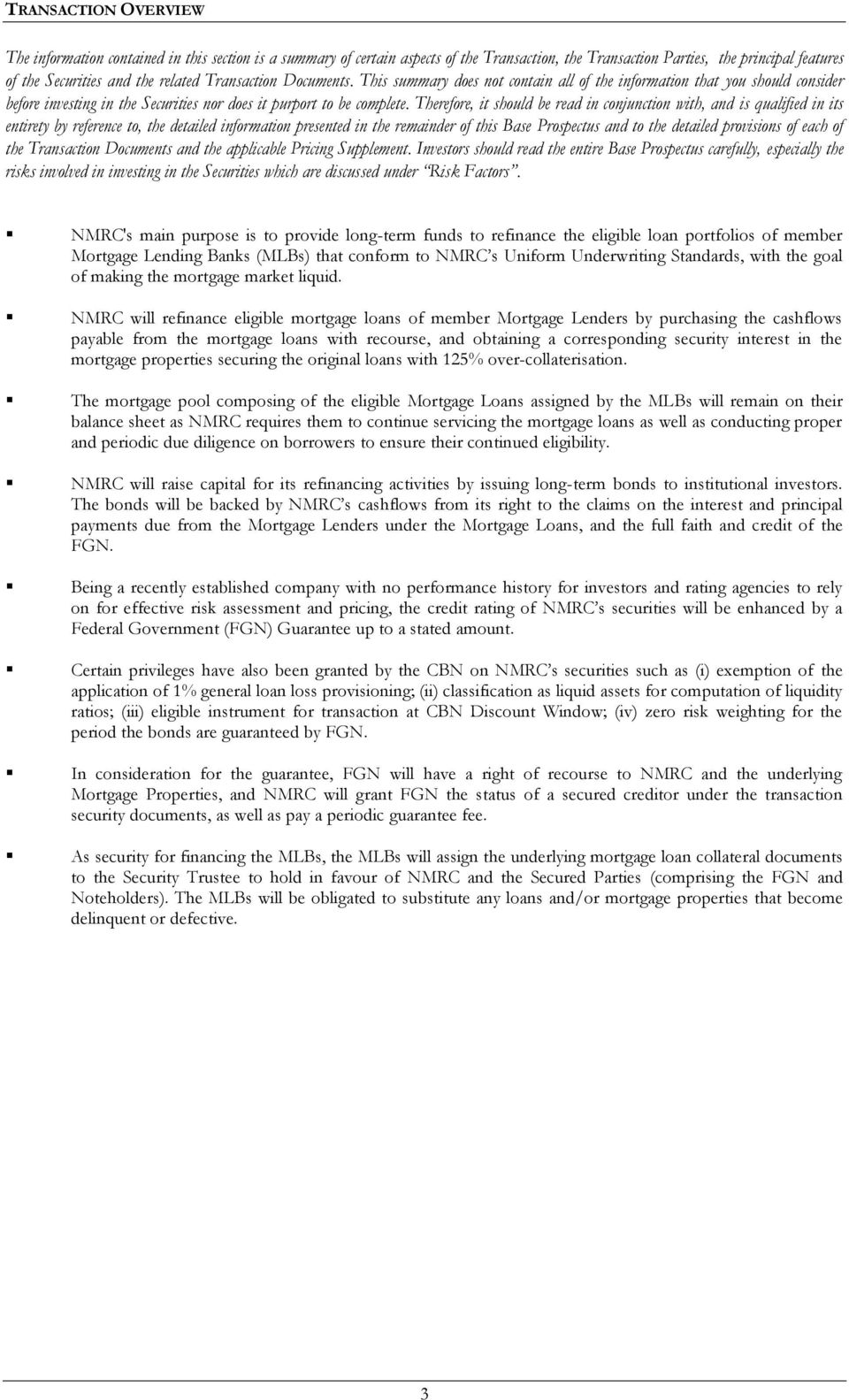
3 TRANSACTION OVERVIEW The information contained in this section is a summary of certain aspects of the Transaction, the Transaction Parties, the principal features of the Securities and the related Transaction Documents. This summary does not contain all of the information that you should consider before investing in the Securities nor does it purport to be complete. Therefore, it should be read in conjunction with, and is qualified in its entirety by reference to, the detailed information presented in the remainder of this Base Prospectus and to the detailed provisions of each of the Transaction Documents and the applicable Pricing Supplement. Investors should read the entire Base Prospectus carefully, especially the risks involved in investing in the Securities which are discussed under Risk Factors. NMRC's main purpose is to provide long-term funds to refinance the eligible loan portfolios of member Mortgage Lending Banks (MLBs) that conform to NMRC s Uniform Underwriting Standards, with the goal of making the mortgage market liquid. NMRC will refinance eligible mortgage loans of member Mortgage Lenders by purchasing the cashflows payable from the mortgage loans with recourse, and obtaining a corresponding security interest in the mortgage properties securing the original loans with 125% over-collaterisation. The mortgage pool composing of the eligible Mortgage Loans assigned by the MLBs will remain on their balance sheet as NMRC requires them to continue servicing the mortgage loans as well as conducting proper and periodic due diligence on borrowers to ensure their continued eligibility. NMRC will raise capital for its refinancing activities by issuing long-term bonds to institutional investors. The bonds will be backed by NMRC s cashflows from its right to the claims on the interest and principal payments due from the Mortgage Lenders under the Mortgage Loans, and the full faith and credit of the FGN. Being a recently established company with no performance history for investors and rating agencies to rely on for effective risk assessment and pricing, the credit rating of NMRC s securities will be enhanced by a Federal Government (FGN) Guarantee up to a stated amount. Certain privileges have also been granted by the CBN on NMRC s securities such as (i) exemption of the application of 1% general loan loss provisioning; (ii) classification as liquid assets for computation of liquidity ratios; (iii) eligible instrument for transaction at CBN Discount Window; (iv) zero risk weighting for the period the bonds are guaranteed by FGN. In consideration for the guarantee, FGN will have a right of recourse to NMRC and the underlying Mortgage Properties, and NMRC will grant FGN the status of a secured creditor under the transaction security documents, as well as pay a periodic guarantee fee. As security for financing the MLBs, the MLBs will assign the underlying mortgage loan collateral documents to the Security Trustee to hold in favour of NMRC and the Secured Parties (comprising the FGN and Noteholders). The MLBs will be obligated to substitute any loans and/or mortgage properties that become delinquent or defective. 3
4 STRUCTURE DIAGRAM The following diagram sets out the transaction structure relating to the issue of the Bonds by the Issuer under the Programme. This diagram is qualified in its entirety by reference to the more detailed information appearing elsewhere in this Base Shelf Prospectus. Financing Structure Refinance NMRC On lending at affordable rate; provide liquidity flexibility Participating Mortgage Lenders FGN Guarantee Security assignment of mortgage portfolio with recourse Issue Aaa rated Bonds Longer tenor funds at FGN rates Bond Proceeds Grant Eligible Mortgage Loans Provide longer tenor mortgage at affordable rates Assign Collateral and Repay Principal & Interest Bond Investors Borrowers Transaction Documentation Structure Issuing Houses Vending Agreement FGN Deed of Guarantee NMRC Master Purchase, Refinance & Servicing Agreement Participating Mortgage Lending Banks Security Deed Account Bank & Paying Agent Note Trustees Account Bank & Paying Agent Agreement Programme Trust Deed Series Trust Deed Security Trustees Security Trust Deed Registrar *See Summary of Transaction Documents on page 26 for further description 4

5 SUMMARY OF WITHDRAWALS AND CASHFLOW FROM THE TRANSACTION ACCOUNTS This chart provides only a simplified overview of the flow of funds. Mortgage Borrowers Monthly payment of mortgage loans Mortgage Accounts with Servicers/MLBs daily transfer Collection Accounts monthly transfer NMRC/Trustee Master Collection Account 3 Business Days before a Payment Date. Bondholders Interest & Principal Payment Account NMRC is discussing with the CBN to implement a Direct Debit System on the CBN Account of each Participating Mortgage Lending Bank such that an automatic debit of scheduled monthly deductions is effected directly from the CBN Account. 5

6 DECLARATION BY THE ISSUER 6

7 DOCUMENTS TO BE INCORPORATED BY REFERENCE The following documents have been filed with the Commission and shall be deemed incorporated in, and form part of this Shelf Prospectus: (i) declaration by the issuer of full disclosure; (ii) the audited financial statements of Nigeria Mortgage Refinance Company Plc for the year ended 31 st December 2014; and iii) the Rating Report by Global Credit Rating Company Limited dated May Any Pricing Supplement (Supplementary Shelf Prospectus) approved by the Commission is hereby incorporated by reference into the Shelf Prospectus and forms an integral part of this Shelf Prospectus. The Issuer s information given in this Shelf Prospectus and the terms and conditions of the Bonds to be issued under the Programme may be updated in a Supplementary Shelf Prospectus pursuant to the Rules and Regulations of the SEC. This Shelf Prospectus and any Pricing Supplement (Supplementary Shelf Prospectus), if applicable, are accessible, and copies of them are available free of charge at the offices of the Issuing House from 8:00a.m. till 5:30p.m on Business Days during the Offer Period. Telephone enquiries should be directed to the Issuing House as follows: ISSUING HOUSE CONTACT PERSON TELEPHONE NUMBER Dunn Loren Merrifield Advisory Partners Limited Chinua Azubike +234(0) Uzoma Okoro +234(0)

8 PROGRAMME DESCRIPTION Under this N140,000,000,000 (One Hundred and Forty Billion Naira) Medium Term Note Programme, the Company may issue from time to time, fixed or floating rate securities and any combination thereof (the Bonds ) through the Issuing House, or any additional party appointed under the Programme by the Issuer and/or Issuing House. The maximum aggregate principal amount of the Bonds at any time outstanding under the Programme will not exceed N140,000,000,000 (the Programme Limit ). The terms and conditions applicable to the issuance of Bonds under the Programme shall be established at the Issuer s initiative, taking into consideration its financial requirements and the conditions in the capital markets. These terms and conditions will be determined by the Issuer and the Issuing House and shall be set out in the Pricing Supplement (Supplementary Shelf Prospectus). A Pricing Supplement (Supplementary Shelf Prospectus) shall contain the terms and conditions of each Series of Bonds to be issued in or substantially in the form set out below in Form of Pricing Supplement on pages 108 to 111. Bonds may be distributed by way of public offer, private placement, or such other methods including through a book building process, and in such proportions as determined by the Issuer and the Issuing House. The method of distribution of each Series will be stated in the applicable Pricing Supplement (Supplementary Shelf Prospectus). Bonds will be issued in such denomination as may be agreed between the Issuer and the Issuing House and as indicated in the applicable Pricing Supplement (Supplementary Shelf Prospectus). The Bonds will be listed on a Securities Exchange. All Bonds issued on the basis of this Programme shall have ratings assigned to them. Other terms and conditions of the Bonds are, or shall be specified in this Shelf Prospectus, any supplementary Shelf Prospectus, i.e. the Pricing Supplement. This Programme shall be valid for a period of 36 Months from the date of its issue and shall be subject to renewal as may be approved by the Commission. If at any time the Issuer shall be required to prepare a supplementary shelf prospectus pursuant to Rule 279 (3) (5)(i) of the Rules and Regulations of the Commission in order to update or amend this Shelf Prospectus, without limitation, information changes, if any, including in relation to the Issuer since the date of this Shelf Prospectus in addition to such other information as is required by the Rules and Regulations of the SEC on the content of prospectuses, the Issuer will prepare and make available an appropriate amendment or supplement to this Shelf Prospectus or a further prospectus which, in respect of any subsequent issue of Bonds, shall constitute a supplementary shelf prospectus. Statement of Indebtedness As at 31 st December, 2014, Nigeria Mortgage Refinance Company Plc had outstanding non-interest start up loan totalling N347,421, (Three Hundred and Forty Seven Million, Four Hundred and Twenty One Thousand, One Hundred and Forty Five Naira) from the Accountant General s Office of the Federation, approved by the Presidency as a bridge finance facility for the setting-up of the NMRC. In addition, the Company also has drawn on the first tranche of Naira Equivalent of US$20 Million Tier 2 Capital from the CBN under the terms of the Subordinated Loan Agreement between the Issuer and CBN dated January Other than as stated above, the Company has no outstanding debentures, mortgages, loans, charges or similar indebtedness or material contingent liabilities or other similar indebtedness, other than in the ordinary course of business. 8

9 SUMMARY OF THE PROGRAMME The following information should be read in conjunction with the full text of this Base Prospectus, from which it is derived. The information provided below is a brief summary of the key features of the Programme, a description of the Issuer and, to the extent applicable, the summary of the terms and conditions of the Bonds. This summary should be read as an introduction to this Base Prospectus. It does not purport to be complete, and is taken from and qualified in its entirety by the remainder of this Base Prospectus as a whole. Issuer Guarantor Guarantee Programme Description Nigeria Mortgage Refinance Company Plc Federal Government of Nigeria The Bonds issued and covered by the Guarantee Amount are backed by the irrevocable and unconditional guarantee of the Guarantor, by way of continuing guarantee, of the due and punctual observance by the Issuer of all of its payment obligations in respect of all principal amounts and interest (where applicable) due and payable by the Issuer pursuant to the terms and conditions of the Deed of Guarantee. Programme of medium-term debt instruments (with tenors of between 12 Months to 25 Years) unsubordinated, secured debt instruments to be issued and offered in series and/or tranches. The Programme covers fixed rate bonds, floating rate bonds, and any combinations thereof, all of which shall be denominated in Naira. Securities held to maturity shall be redeemed at not less than the principal amount outstanding of such Securities. Securities offered under this Programme are accorded a shelf registration with the Securities & Exchange Commission for a three (3) Year period commencing on the date of issue of this Prospectus and are subject to renewal. The Securities shall be constituted by the Trust Deed. Programme Limit Use of Proceeds Issuing House Note Trustees Types of Securities to be issued under the Programme The provisions of the Trust Deed shall apply separately and independently to the Securities provided that any terms and conditions relevant to the Securities issued under the Programme shall be governed by the applicable Series Trust Deed and Pricing Supplement. N140,000,000,000 The use of proceeds for the relevant Series of Securities issued under the Programme shall be specified in the applicable Pricing Supplement. Dunn Loren Merrifield Advisory Partners Limited Stanbic IBTC Trustees and Skye Trustees have been appointed under the Trust Deed to hold the benefit of the payment obligation and other covenants of the Issuer on behalf of the Bondholders. The following form of Securities may be issued under the Programme as specified in the applicable Pricing Supplement: Fixed Rate Securities Where any Series of Securities are fixed rate Securities, such Securities shall bear interest at a fixed rate and will be payable for each Series in arrears on such date(s) and at such rate(s) as specified in the Conditions and/or the applicable Pricing Supplement. Floating Rate Securities Where any Series of Securities are floating rate Securities, the Interest 9

10 Rate applicable will be determined in accordance with the Conditions and/or the applicable Pricing Supplement. Maturities Subject to compliance with the SEC Rules and Regulations, all relevant laws and directives, Series of Securities may be issued in any maturity as may be allowed or required from time to time by the Commission (or equivalent body (however called)) or any laws or regulations applicable. The maturity of each Series of Securities will be specified in the applicable Pricing Supplement and Supplementary Trust Deed. Interest Periods The length of the interest periods for the Securities and the applicable interest rate or its method of calculation may differ from time to time or be constant for any Series as specified in the applicable Pricing Supplement and Supplementary Trust Deed. Redemption Subject to the applicable Pricing Supplement, the Principal Amount Outstanding of the Securities may be redeemed in instalments on an amortising basis on each Payment Date or redeemed in a single bullet payment at the Maturity Date. Method of Issue Securities may be distributed by way of public offer, private placement, or such other methods including through a book building process, and in such proportions as determined by the Issuer and the Issuing House Each Series may be issued in tranches (each a Tranche ) on the same or different issue dates. Tranche Issue Price Closing Date Currency Tenor Day Count Fraction/Business Day Convention Interest Rate Frequency The specific terms of each Tranche (including without limitation, the nominal amount, issue price, redemption price thereof, and interest, if any, payable thereunder) will be determined by the Issuer and the Issuing House at the time of the issue and will be set out in the applicable Pricing Supplement. The price of Securities of a specific series shall be defined in the Pricing Supplement of the relevant Series. The Closing Date of a specific Series shall be stated in the Pricing Supplement relating to the Series of Securities to be issued. Unless otherwise specified in the applicable Pricing Supplement, the Securities shall be denominated in Naira (N). The tenor of a particular Series of Securities shall be determined by the Issuer and the Issuing House and specified accordingly in the Pricing Supplement for the Securities being issued. Actual/Actual (actual number of days in a Month and the actual days in a Year). Different day count conventions may be stipulated in the Pricing Supplement. The interest, if any, payable on the Securities shall be determined by the Issuer and Issuing House(s)/Bookrunner(s) and stated accordingly in the Pricing Supplement for the Securities being issued. The frequency of payment of interest and any other monies due on the Securities shall be specified in the Pricing Supplement for the Securities being issued. 10

11 Repayment Credit Enhancement Subscription of Securities Form of Securities/Transferability Grossing Up Rating Taxation Claims And Litigation Governing Law Transaction Documents Repayment terms in respect of the Securities issued under the Programme shall be specified in the Pricing Supplement for the series of Securities being issued. The applicable credit enhancement for the repayment obligations of the Issuer in relation to any Securities issued to Investors shall be as specified in the applicable Pricing Supplement. The Securities may be subscribed to in accordance with the form of application set out in the Pricing Supplement relating to the Securities being issued. The Securities will be issued in registered form and be freely transferable in accordance with the provisions of the Trust Deed. The Securities may be initially represented by a Certificate(s). Where the securities are represented by certificates, the Certificate(s) will be authenticated by the Registrar and may be dematerialised and held in electronic book entry form at the CSCS depository. All amounts payable under the Securities will be paid in full without set-off or counterclaim or other restrictions and free and clear of and without any deductions or withholding for or on account of any taxes or any charges or otherwise. Securities issued under the Programme shall be assigned a rating by Global Credit Rating Co. ( GCR ) (or such other appointed Rating Agency) as specified in the applicable Pricing Supplement. Investors will be notified of any change in the current rating of any outstanding Securities in such manner as shall be determined by the Trustees. The Federal Government of Nigeria ( FGN ) has approved a waiver of taxes for all categories of bonds. The taxes covered by the approval are the Withholding Tax, Personal Income Tax, Value Added Tax, the Companies Income Tax and the Capital Gains. See page 114 Taxation. As at the date of this Prospectus, no litigation, arbitration or administrative proceedings is pending, has been commenced or is to the best of NMRC s knowledge threatened against the Company. Nigerian Law - Base Shelf Prospectus; - Programme Trust Deed; - Security Trust Deed - Series 1 Trust Deed - Vending Agreement - Account Bank & Paying Agent Agreement - Deed of Guarantee; - Master Purchase, Refinance and Servicing Agreement; and - Security Deed. Any other agreement(s) executed in connection with any Series of Bonds issued pursuant to this Base Prospectus. 11

12 TERMS AND CONDITIONS OF THE BONDS The following is the text of the terms and conditions which, as supplemented, amended and/or replaced by the Final Terms which are attached to the relevant Series Trust Deed, Supplementary Shelf Prospectus and/or Pricing Supplement (the Final Terms ), will be endorsed on or attached to the Notes issued under the Programme. Further information with respect to Notes of each Series will be given in the applicable Final Terms, which will provide for those aspects of these terms and conditions, which are applicable to those Notes. Certain provisions of these terms and conditions are summaries of, and are subject to, the detailed provisions of the Trust Deed. The board of directors of Nigeria Mortgage Refinance Company Plc (the "Issuer"), has by a resolution passed on 6 February, 2014, authorised the establishment of the N140,000,000,000 Medium Term Note Programme (the Programme ) for the issuance of Notes. The Notes constituted under the Programme may be issued in such series, together with any tranche or tranches of Notes, which are expressed to be consolidated forming a single series of Notes (each a Series ). Each Series is the subject of the Final Terms which supplements these terms and conditions (the Conditions ). The terms and conditions applicable to any particular Series of Notes are these Conditions as constituted by a separate trust deed applicable to each Series of Notes. In the event of any inconsistency between these Conditions and the applicable Final Terms, the applicable Final Terms shall prevail. The Programme is constituted by a trust deed (the "Programme Trust Deed" or Trust Deed ) between the Issuer and Skye Trustees Limited and Stanbic IBTC Trustees Limited (the "Trustees"), which expression shall include any person or persons for the time being appointed as the trustee or trustees (under the Trust Deed) for the holders (as defined below) of the Notes (the Noteholders ). The Noteholders are entitled to the benefit of, are bound by, and are deemed to have notice of, all the provisions of the Trust Deed. Copies of the Trust Deed are available for inspection at the specified offices of the Trustees, at Skye Bank Building (3rd Floor), 30 Marina, Lagos or The Wealth House, Plot 1678 Olakunle Bakare Close, Off Sanusi Fafunwa Street, Victoria Island, Lagos State, and at the specified offices of the Registrar at 213 Herbert Macaulay Way, Sabo, Yaba, Lagos. Words and expressions defined in the Trust Deed (as same has been and may be amended, varied or supplemented from time to time with the consent of the parties thereto) are expressly and specifically incorporated to and shall apply to these Conditions. 1. Interpretation (a) Definitions: In these Conditions, the following expressions have the following meanings: Business Day means a day (other than a Saturday, Sunday or Federal Government of Nigeria declared public holiday) on which commercial banks are open for general business in Abuja and Lagos; Business Day Convention, in relation to any particular date, has the meaning given in the applicable Final Terms and, if so specified in the applicable Final Terms, may have different meanings in relation to different dates and, in this context, the following expressions shall have the following meanings: (i) (ii) (iii) Following Business Day Convention means that the relevant date shall be postponed to the first following day that is a Business Day; Modified Following Business Day Convention or "Modified Business Day Convention" means that the relevant date shall be postponed to the first following day that is a Business Day unless that day falls in the next calendar month in which case that date will be the first preceding day that is a Business Day; Preceding Business Day Convention means that the relevant date shall be brought forward to the first preceding day that is a Business Day; 12

13 (iv) Floating Rate Convention means that each relevant date shall be the date which numerically corresponds to the day preceding such date in the calendar month which is the number of months specified in the applicable Final Terms as the Specified Period after the calendar month in which the preceding such date occurred, provided, however, that: (A) (B) (C) if there is no such numerically corresponding day in the calendar month in which any such date should occur, then such date will be the last day which is a Business Day in that calendar month; if any such date would otherwise fall on a day which is not a Business Day, then such date will be the first following day which is a Business Day unless that day falls in the next calendar month, in which case it will be the first preceding day which is a Business Day; and if the preceding such date occurred on the last day in a calendar month which was a Business Day, then all subsequent such dates will be the last day which is a Business Day in the calendar month which is the specified number of months after the calendar month in which the preceding such date occurred; Day Count Fraction means in respect of the calculation of an amount for any period of time (the "Calculation Period"), such day count fraction as may be specified in these conditions or the applicable Final Terms and: (i) (ii) (iii) (iv) if "Actual/Actual" is so specified, means the actual number of days in the Calculation Period divided by the actual number of days in that year; if "Actual/365 (Fixed)" is so specified, means the actual number of days in the Calculation Period divided by 365; if "Actual/360" is so specified, means the actual number of days in the Calculation Period divided by 360; and if "30/360" is so specified, means the number of days in the Calculation Period divided by 360 (the number of days to be calculated on the basis of a year of 360 days with day months (unless (i) the last day of the Calculation Period is the 31st day of a month but the first day of the Calculation Period is a day other than the 30th or 31st day of a month, in which case the month that includes that last day shall not be considered to be shortened to a 30-day month, or (ii) the last day of the Calculation Period is the last day of the month of February, in which case the month of February shall not be considered to be lengthened to a 30-day month); Extraordinary Resolution has the meaning defined in the Trust Deed; Final Redemption Amount means, in respect of any Note, its principal amount outstanding or such other amount as may be specified in, or determined in accordance with, the relevant Final Terms; Guarantee means the guarantee provided and forming the obligation of the Guarantor under the Deed of Guarantee dated April 30, 2015; Guarantor means the Federal Government of Nigeria acting through the Federal Ministry of Finance. Insolvency Event means in relation to the Issuer: (i) a voluntary case, proceeding or other action under any Applicable Law of any jurisdiction, domestic or foreign, relating to the bankruptcy, insolvency, reorganization, suspension of payments or relief of debtors seeking to have an order of relief entered into with respect to it, or seeking to adjudicate it a bankrupt or insolvent or seeking reorganization, arrangement, adjustment, winding-up, liquidation, dissolution, composition or other relief with respect to it or to its debts; 13

14 (ii) a voluntary case, proceeding or other action seeking appointment of a receiver, trustee, liquidator, intervenor, administrator, custodian, conservator or other similar official of it or for any substantial part of its Property; (iii) an involuntary case, proceeding or other action of a nature referred to in clause (i) above shall be commenced against it that: (A) shall result in the entry of an order for relief or of an order granting or approving such adjudication or appointment; or (B) shall remain unstayed, undismissed, undischarged or unbonded for a period of at least 90 days after the party s actual knowledge of such action; (iv) an involuntary case, proceeding or other action shall be commenced against it that seeks the issuance of a warrant of attachment, execution, distraint or other similar process against any substantial part of its Property that shall result in the entry of an order for relief and shall remain unstayed, undismissed, undischarged or unbonded for a period of at least 90 days from the entry thereof; (v) there shall be commenced against it any extra-judicial liquidation proceedings under any Applicable Law on insolvency; (vi) it shall admit in writing its inability to pay its debts as they become due; (vii) it shall make a general assignment for the benefit of creditors; or (viii) it shall take any corporate (or similar) action in furtherance of, or indicating its consent to, approval of or acquiescence in, any of the foregoing acts; Interest Amount means, in relation to a Note and an Interest Period, the amount of interest payable in respect of that Note for that Interest Period; Interest Commencement Date means the Issue Date of the Notes or such other date as may be specified as the Interest Commencement Date in the applicable Final Terms; Interest Payment Date means the date or dates specified as such in, or determined in accordance with the provisions of, the applicable Final Terms Interest Period means each period beginning on (and including) the Interest Commencement Date or any Interest Payment Date and ending on (but excluding) the next Interest Payment Date; Interest Rate means the rate or rates (expressed as a percentage per annum) of interest payable in respect of the Notes specified in applicable Final Terms or calculated or determined in accordance with the provisions of these Conditions and/or the applicable Final Terms; Issue Date has the meaning given in the applicable Final Terms; Indebtedness means any monetary indebtedness which is represented by a bond or other debt security and which is or is capable of being admitted to or listed or traded on a stock exchange or other securities market (including any over-the-counter market), any loan advanced by a bank, an insurance company or any other financial institution (including, without limitation, assignable loans) and any guarantee or suretyship in respect of any such monetary indebtedness or such loan; Maturity Date has the meaning assigned to it in the applicable Final Terms; Optional Redemption Amount (Call) means, in respect of any Note, its principal amount or such other amount as may be specified in, or determined in accordance with, the applicable Final Terms; Optional Redemption Date (Call) has the meaning given in the applicable Final Terms; Payment Date means in respect of each Series, the dates specified as such in the applicable Final Terms upon which interest and/or principal are due and payable in respect of the Notes of that Series; Person means any individual, company, corporation, firm, partnership, joint venture, association, organisation, state or agency of a state or other entity, whether or not having separate legal personality; 14

15 Principal Amount Outstanding means, on any day in relation to a Note, the principal amount of that Note on issue less the aggregate of all principal payments that have become due and payable in respect of that Note and have been paid on or prior to that day; Redemption Amount means, any principal amount specified to be redeemed, as appropriate, the Final Redemption Amount, the Optional Redemption Amount (Call), or such other amount in the nature of a redemption amount as may be specified in, or determined in accordance with the provisions of, the applicable Final Terms; Redemption Date means the Payment Date(s) specified in the applicable Final Terms; (b) Interpretation: In these Conditions: (i) (ii) any reference to principal shall include the Redemption Amount, any additional amounts in respect of principal which may be payable under condition 10 (Taxation), any premium payable in respect of a Note and any other amount in the nature of principal payable pursuant to these conditions; any reference to interest shall be deemed to include any additional amounts in respect of interest which may be payable under condition 10 (Taxation) and any other amount in the nature of interest payable pursuant to these conditions; (iii) references to Notes being "outstanding" shall be construed in accordance with the Trust Deed; (iv) (v) if an expression is stated in condition 1(a) (Definitions) to have the meaning given in the applicable Final Terms, but the applicable Final Terms give no such meaning or specify that such expression is "not applicable" then such expression is not applicable to the Notes; and Any reference to the Trust Deed shall be construed as a reference to the Trust Deed as amended and/or supplemented up to and including the Issue Date of the Notes. 2. Form, Denomination, Title and Series 2.1 Form and Denomination (i) (ii) (iii) The Notes may be issued in certificated form whereupon a Note Certificate ( Certificate ) will be issued to Noteholders in respect of their registered holding of Notes. Each Certificate will be numbered serially with an identifying number which will be recorded on the applicable Certificate and in the Register of Noteholders ( Register ). The Notes may also be issued through book-entry deposits by crediting the CSCS account of an applicant with the Principal Amount of Notes purchased by such applicant. The Notes shall be registered with a separate securities identification code with the CSCS. Statements issued or any other document issued by the CSCS as to the aggregate number of such Notes standing to the credit of the securities account of any Noteholder shall be conclusive and binding for all purposes save in the case of manifest error and such Noteholder shall be treated by the Issuer, the Trustee and the Registrar as the legal and beneficial owner of such aggregate number of Notes for all purposes. The Notes will be denominated in Nigerian Naira, issued at a par value of 100% and in minimum subscription amounts of N50,000,000 (Fifty Million Naira) and integral multiples of N1,000,000 (One Million Naira) thereafter. 2.2 Title Title to the Notes will pass upon registration of the name of the Noteholder in the Register maintained by the Registrar for this purpose. The Issuer, the Trustees and the Registrar may deem and treat the holder of any Note Certificate as the absolute owner of such Note Certificate, free from any equity, set- 15

16 off or cross-claim on the part of the Issuer against the original or any intermediate holder of such Note Certificate. All payments made to the holder shall be valid and, to the extent of sums so paid, effective to satisfy and discharge the liability for the moneys payable on the Notes. 2.3 Series Whether a Note is a Series I Note or a Series II Note or such other Series shall be stated on the applicable Note Certificate and recorded in the Register. The Register and/or the applicable Final Terms shall be conclusive as to the series of a Note. 3. Registration and Transfer of Notes 3.1 A Register of the Notes shall be kept by the Registrar at its office, and there shall be entered in such Register:- (i) (ii) (iii) (vi) (v) the names and addresses of the holders for the time being of the Notes; the amount of the units of Notes held by every registered holder; the account number of the Noteholder; the date at which the names of every registered holder is entered in respect of the Note standing in his name; and the serial number of each Note Certificate and date of issue thereof. 3.2 Any change of name or address on a part of the Noteholder shall forthwith be notified to the Registrar and thereupon the Register shall be altered accordingly. The Trustees and the Noteholders and any Person authorised by any of them shall be entitled at all reasonable times during office hours to inspect the Register and to make copies of or take extracts from the same. 3.3 The Notes are transferable in whole or in part in such denominations set out in the applicable Final Terms by instrument in writing in the usual common form of transfer or in any form approved by the Issuer and the Trustees and in accordance with the provisions of the Trust Deed. The Notes shall only be offered to HNIs and QIIs who shall confirm their status to the Registrars prior to registration. 3.4 Every instrument of transfer of the Notes must be signed by both the transferor and the transferee and title to the Note will pass upon registration of the instrument of transfer in accordance with the provisions of the Trust Deed. 3.5 Every instrument of transfer of the Note must be left for registration at the office of the Registrars for the time being of the Note, accompanied by the Certificate for the Note to be transferred and such other evidence as the Issuer may require to prove the title of the transferor or his right to transfer the Note, and if the instrument of transfer is executed by some other Person on his behalf, the authority of that Person so to do. 3.6 Any Person becoming entitled to the Notes in consequence of the death, bankruptcy, winding-up or dissolution of the holder thereof may, upon producing such evidence that he has or is entitled to the capacity in respect of which he proposes to act under this Condition or of his title as the Registrars shall think sufficient, be regarded as the holder of such Notes, or subject to the preceding Conditions as to transfer may transfer the same. The Issuer shall be at liberty to retain the interest payable upon any Notes which any Person is entitled to transfer under the preceding Condition until such Person shall be registered or duly transfer the same as aforesaid. 3.7 No Noteholder may require the transfer of a Note to be registered during a period of 10 (ten) Business Days immediately preceding each Payment Date during which the Register will be closed ( Record Date ) 16

17 4. Guarantee and Status 5. Security 4.1 Guarantee The Guarantor has, unconditionally and irrevocably, guaranteed the due payment of the outstanding amount expressed to be payable by the Issuer as specified under, and in accordance with the terms of the Deed of Guarantee. 4.2 Status of Notes and Guarantee The Notes constitute direct and unsubordinated obligations of the Issuer and shall at all times rank pari passu and rateably without any preference among them. The payment obligations of the Issuer under the Notes and of the Guarantor under the Deed of Guarantee shall, save for such exceptions as may be provided by applicable legislation, at all times rank at least equally with all other secured or unsubordinated indebtedness and monetary obligations of the Issuer and the Guarantor respectively, present and future. The Issuer shall create a security interest in its rights and benefits under the Master Purchase, Refinance and Servicing Agreement and the Security Deed in favour of the Security Trustee as beneficial owner by way of security assignment, of a value at the time of not less than 125% of the Principal Amount of Bonds Outstanding in accordance with the terms and conditions of the Security Trust Deed. 6. Redemption, Purchase and Cancellation 6.1 Redemption at Maturity Unless previously redeemed, purchased and cancelled, a Series of Notes may be fully redeemed in one bullet payment at its Final Redemption Amount (which, unless otherwise provided, is its Principal Amount Outstanding) at the Maturity Date specified in the applicable Final Terms. 6.2 Redemption by Instalments Notes may be partially redeemed by instalment on each Payment Date at the Redemption Amount (or Scheduled Principal) specified in the applicable Final Terms whereupon the Principal Amount Outstanding of such Note shall be reduced by the Redemption Amount on each Payment Date until fully redeemed at the Maturity Date. 6.3 Redemption of Unscheduled Principal To the extent that there are available funds from the Mortgage Pool with which to make any additional payments after the payment of the Scheduled Principal on a Payment Date, in accordance with the applicable Pricing Supplement, the Issuer will be entitled to make payment of any additional principal, and such additional payment shall constitute an Unscheduled Principal. 6.4 Redemption at the Option of the Issuer The Issuer may at its option and where specified in the applicable Final Terms as being applicable,, redeem in whole on any Optional Redemption Date (Call) at the applicable Optional Redemption Amount (Call) on the Issuer's giving not less than 20 (twenty) nor more than 60 (sixty) days' notice to the Trustees on behalf of the Noteholders (which notice shall be irrevocable and shall oblige the Issuer to redeem the Notes on the relevant Optional Redemption Date (Call) at the Optional Redemption Amount (Call) plus accrued interest (if any) to such date) 6.5 Redemption Due to Changes in Legislation or Tax For any Notes issued under the Programme, the Issuer will have the option to redeem the Notes wholly or in part on any Optional Redemption Date (Call) at the applicable Optional Redemption 17

18 Amount (Call), on the Issuer's giving not less than 20 nor more than 60 days' notice to the Noteholders (which notice shall be irrevocable and shall oblige the Issuer to redeem the Notes on the relevant Optional Redemption Date (Call) at the Optional Redemption Amount (Call) plus accrued interest (if any) to such date), if : the Issuer has or will become obliged to pay additional amounts as a result of any change in, or amendment to, the laws or regulations of the Federal Republic of Nigeria thereof or therein having power to tax, or any change in the application or official interpretation of such laws or regulations, which change or amendment becomes effective on or after the Issue Date; and such obligation cannot be avoided by the Issuer taking reasonable measures available to it, and which obligation results, in the absolute discretion of the Issuer, in an unacceptable increase to the Issuer of the funding costs relating to the Notes; provided, however, that no such notice of redemption shall be given earlier than 180 days prior to the earliest date on which the Issuer would be obliged to pay such additional amounts if a payment in respect of the Notes were then due. 6.6 Purchase The Issuer may at any time and from time to time purchase (at the market price or at a premium to the par value of the Notes) through the market or by tender but not otherwise. 6.7 Cancellation 7. Interest and Calculation All the Notes which are redeemed in accordance with the provisions of the Trust Deed will be cancelled and may not be reissued or resold. For so long as the Note is admitted to listing and/or trading on the FMDQ OTC or any other stock exchange and the rules of FMDQ OTC or such other exchange so require, the Registrar shall promptly inform the Stock Exchange of the cancellation of any Note under this Condition 6.7 (Cancellation). 7.1 Accrual of Interest The Notes will bear interest from and including the Interest Commencement Date at the Interest Rate payable in arrears on its Principal Amount Outstanding. Each Note will cease to bear interest from and including the due date for final redemption unless, upon due presentation, payment of principal is improperly withheld or refused, in which event interest will continue to accrue (as well as after and before judgment) at the Interest Rate in the manner provided in this Condition. 7.2 Fixed Rate or Floating Rate Notes The Interest Rate applicable to any Series of Notes (together with any tranche or tranches formed thereunder) may be specified as being Fixed Rate or Floating Rate and the amount of interest payable in respect of such Notes for any Interest Period shall be the applicable Interest Amount specified in (an amortisation/payment schedule appended to), or determined in accordance with, the applicable Final Terms 7.3 Zero Coupon Notes Where any Series of Notes specified to be Zero Coupon is repayable prior to the Maturity Date or other date for redemption and is not paid when due, the amount due and payable prior to the Maturity Date shall be an amount equal to the sum of the Redemption Amount and an amount calculated by applying the Interest Rate for any overdue principal of such a Note to the Principal Amount Outstanding and multiplying the product with the Day Count Fraction. 7.4 Calculation of Interest Amount The Interest Amount payable in respect of each Note for an Interest Period shall be specified in (an amortisation/repayment schedule appended to), or determined in accordance with, the applicable Final Terms. The amount of interest payable in respect of any Note for any period shall be calculated by multiplying the product of the Interest Rate and the Principal Amount Outstanding of such Note by the Day Count Fraction and rounding the resulting figure to the nearest sub unit of the naira. 18

19 8. Payments 8.1 The Principal Amount, Interest Amount, interest and any other amount(s) due in respect of any Series of the Notes shall be payable in the official currency of the Federal Republic of Nigeria, which at the respective dates of payment thereof is the legal tender for the payment of public and private debts. 8.2 The Trustees shall instruct the Paying Agent to pay into the bank account of each Noteholder (under the applicable series) on or before 4.p.m but in any event not later than the RTGS Closing Time on the Payment Date, the Principal Amount, Interest Amount (and any Unscheduled Principal, if any) due to each Noteholder. Payment instructions will be initiated by the Trustees for value on the Payment Date, or if the Payment Date is not a Business Day, for value on the first following day which is a Business Day. 8.3 Subject to Condition 10, (Taxation), payment of the Principal Amount, Interest Amount or any other amount due in respect of any Series of the Notes will be made by direct credit to the designated bank account of the Noteholders or by certified cheque mailed to the registered address of the Noteholder if a bank account is not specified for this purpose 8.4 For the purposes of this Condition, bank account means the bank account maintained by or on behalf of a Noteholder with a bank duly licensed by the Central Bank of Nigeria under the terms and conditions of the Account Bank and Paying Agent Agreement. The details of the bank account into which payments will be made shall be as advised in writing in the commitment form and registered address means the address appearing on the Register on that date. 8.5 A Noteholder whose name appears on the CSCS records as at close of business on the Record Date and whose names are recorded in the Register within 24 (twenty four) hours after the close of business on the Record Date shall be the only person entitled to receive payments in respect of the applicable Series under the Notes and the Registrar will be discharged by payment to, or to the order of, the Noteholder in respect of each amount so paid. 8.6 If the date for payment of the Principal Amount in respect of any Note is not a Business Day, the Holder thereof shall not be entitled to payment until the next following Business Day and shall not be entitled to further interest or other payment in respect of such delay. 9. Priority of Payments All monies received by the Trustees in respect of the Notes or amounts payable under this Trust Deed or the Deed of Guarantee shall, despite any appropriation of all or part of them by the Issuer or the Guarantor, be held by the Trustees on trust and shall be applied by the Trustees: (a) firstly, in payment of the interest and scheduled principal amounts owing upon each Series pari passu in proportion to the amount due to the Noteholders respectively and without preference or priority; (b) secondly, to pay any Unscheduled Principal pari passu and pro rata according to the respective amounts outstanding on the Notes. (c) thirdly, the payment of all costs, charges, expenses, and liabilities incurred and payments made in or about the execution of the trusts hereof (if any) including all remuneration payable to the Trustees and Rating Agency as provided in this Deed. (d) fourthly, any remainder after paying the amounts indicated above shall be paid to the Issuer If the Trustees holds any monies in respect of Notes which have become void, or in respect of which claims have become prescribed, the Trustees shall apply them in accordance with the order of payment set out above. 19

20 10. Taxation 10.1 All payments of principal, interest and any other sum due in respect of the Notes shall be made free and clear of, and without withholding or deduction for, any taxes, duties, assessments or governmental charges of whatsoever nature imposed, levied, collected, withheld or assessed by or within the Federal Republic of Nigeria or any political subdivision or any authority thereof or therein having power to tax, unless such withholding or deduction is required by law. In that event, no additional amounts shall be paid to the Noteholders as a result thereof By virtue of the provisions of Value Added Tax (Exemption of Proceeds of the Disposal of Government and Corporate Securities) Order, 2011 and the Companies Income Tax (Exemption of Bonds and Short Term Government Securities) Order, 2011 respectively (the Orders ), corporate bonds are exempted from the imposition of value added tax and companies income tax respectively for a period of 10 years from the date of the Orders. 11. Events of Default If any of the following events ( Events of Default ) occurs and is continuing, the Trustees may at their discretion and shall, upon the request in writing of the registered holders of at least two-thirds of the nominal amount of the Notes for the time being outstanding or upon being so directed by an Extra Ordinary Resolution of the Noteholders by notice in writing to the Issuer declare the Notes to have become immediately repayable, whereupon the principal together with the accrued interest shall become immediately due and payable : (a) (b) (c) (d) (e) (f) Payment Default: the Issuer does not pay any amount in respect of the Notes of the relevant Series or any of them within ten (10) business days of the due date for payment; Breach of other Obligations: the Issuer does not comply with its other obligations under or in respect of the Notes of the relevant Series and, if the non-compliance can be remedied, does not remedy the non-compliance within twenty (20) business days after written notice requiring such default to be remedied has been delivered to the Issuer by the Trustees (except where such default is not, in the reasonable opinion of the Trustees after consultation with the Issuer, capable of being remedied, in which case no such notice as is mentioned above will be required); Cross Default: any Indebtedness in excess of the amount indicated in the Final Terms of the applicable series (or its equivalent in any other currency) of the Issuer in respect of money borrowed or raised is not paid within 10 Business Days of: (i) its due date; or (ii) the end of any applicable period of grace, whichever is the later; Enforcement Proceedings: a distress, attachment, execution or other legal process is levied on, or enforced against the whole or any substantial part of the property, assets or revenues of the Issuer and is not discharged or stayed within 90 days thereof; Insolvency: an Insolvency Event occurs in respect of the Issuer; Obligations Unenforceable: any of the Notes, the Trust Deed, and/or the Final Terms is or becomes wholly or partly void, voidable or unenforceable. PROVIDED that the Note shall not be declared immediately payable unless: (I) on the occurrence of the event specified in sub-clause 11(a) (Payment Default), the Trustees shall have first acted in accordance with the terms of Clause [2.6] of the Deed of Guarantee; (II) on the occurrence of any event specified in sub-clauses 11 (b) (c) and (d), the Trustees shall have first served on the Issuer a preliminary notice requiring the Issuer as the case may be to pay the principal or interest in arrears or to remove, discharge or pay out to the satisfaction of the Trustees such distress, execution or process or to perform and observe the covenant or provisions the breach whereof has been committed or threatened and the Issuer shall have failed or neglected for a period of five (5) days to comply with such notice; and (III) in the case of any event specified in sub-clauses 11 (e) and (f), the Trustees shall have certified in writing to the Issuer that the Event of Default is, in its opinion, materially prejudicial to the interests of the Noteholders. 20

21 12. Enforcement 12.1 At any time after the Notes of any Series shall have become payable after the expiry of the notice period in Condition 11 (Events of Default) above, the Trustees may at their discretion and upon being requested to do so in writing by the Majority Noteholders or by an Extraordinary Resolution by the Majority Noteholders present and voting at a special meeting of the Noteholders of the relevant Series duly convened for that purpose, and without further notice institute such proceedings against the Guarantor in accordance with the terms and conditions of the Guarantee, to enforce payment of the Notes of such Series, the premium (if any) thereon and all unpaid interest (if any) which has accrued thereon Evidence that as regards any specified Notes the Issuer has made default in paying any amount due in respect of such Notes shall (unless the contrary be proved) be sufficient evidence that the same default has been made as regards all other Notes in the Series to which it relates Only the Trustees may enforce the provisions of these presents. No Noteholder shall be entitled to proceed directly against the Issuer to enforce the performance of any of the provisions of these presents unless the Trustees having become bound as aforesaid to take proceedings fails to do so within 60 days and such failure is continuing. 13. Meetings of Noteholders, Modification and Waiver of Breach 13.1 Convening Meeting of Noteholders: The Trust Deed contains provisions for convening meetings of Noteholders of a Series to consider matters affecting their interests, including the modification by Extraordinary Resolution of the Conditions or the provisions of the Trust Deed. Such a meeting may be convened by the Issuer or the Trustees and shall be convened by the Issuer or the Trustees at any time upon request in writing of holders of at least 10 percent of the aggregate principal amount of the outstanding Notes Quorum: The quorum at any meeting of the Noteholders convened for passing an Extraordinary Resolution will be two or more Persons holding or representing by proxy not less than [three-fourths] of the nominal amount of the Notes for the time being outstanding; or, at any adjourned such meeting, two or more Persons being or representing Noteholders of the relevant Series, whatever the amount of the Notes held by them shall be a quorum for all purposes including the passing of Extraordinary Resolutions and to decide upon all matters which could properly have been disposed of at the meeting from which the adjournment took place. An Extraordinary Resolution passed at any meeting of the Noteholders will be binding on all Noteholders of the relevant Series, whether or not they were present at such meeting Resolution in Writing A resolution in writing duly signed by the holders of all the Notes for the time being outstanding, shall be as effective for all purposes as an Extraordinary Resolution duly passed at a meeting of the Noteholders. Such Resolution in writing may be contained in one document or in several documents in like form each signed by or on behalf of one or more of the Noteholders Modifications and Waiver The Trustees may, with the approval of the Issuer and the Majority Noteholders, after the clearance of SEC has been sought and obtained and upon the giving of prior written notification to (i) the Rating Agency which has assigned a credit rating to the relevant Series or any Notes comprised therein make: any modification of any of the provisions of the Trust Deed or the Conditions that is of a formal, minor or technical nature or is made to correct a manifest error; and any other modification (except as mentioned in the Trust Deed) and any waiver or authorisation of any breach or proposed breach of any of the Conditions or any of the 21
22 provisions of the Trust Deed which, in the opinion of the Trustees, is not materially prejudicial to the interests of the Noteholders of that Series. Any such modification shall, upon receipt of the approval of the Commission, be binding on the Noteholders and shall be notified by the Issuer to the Noteholders as soon as practicable 14. Replacement of Certificates If any Certificate issued pursuant to these Conditions be defaced, lost or destroyed, it may be replaced on payment of all stamp duty (if any) payable on a new Certificate, and upon such terms as to evidence and indemnity as the Registrar may deem adequate and, in the case of defacement, on delivery of the old Certificate to the Registrar. An entry as to the issue of the new Certificate and indemnity (if any) shall be made in the Register. 15. Rights Against Predecessors-in-Title Except as required by law, the Issuer will recognise the registered holder of any Notes as the absolute owner thereof and shall not be bound to take notice or see to the execution of any trust whether express, implied or constructive to which any Notes maybe subject, and the receipt by such registered holder, or in the case of joint registered holders the receipt by any of them, of the interest from time to time accruing due for any other moneys available in respect thereof shall be a good discharge to the Issuer notwithstanding any notice it may have whether express or otherwise of the right, title, interest or claim of any other Person to or in such Notes interest or moneys. Notice of any trust express or constructive shall not be entered on the Register in respect of any Notes. 16. Substitution The Trust Deed contains provisions permitting the Issuer to agree: (a) with the consent of the Trustees and Majority Noteholders; (b) written confirmation and/or affirmation from the Rating Agency that the credit rating of such Notes will not be adversely affected; and (c) and approval of the Securities & Exchange Commission and the Securities Exchange, to agree to the substitution of the Issuer as principal debtor under the Trust Deed, with any other company; 17. Notices 17.1 Any notice may be given by the Issuer or by the Trustees to any Noteholder by sending the same through the post in a prepaid letter addressed to such Noteholder at its address appearing on the Register of Noteholders Any notice, or other communication may be given to the Trustees hereunder by sending the same through the post in a prepaid letter addressed to the Trustees at their registered offices in Nigeria Any notice, or other communication may be given to the Issuer by sending the same through the post in a prepaid letter addressed to the Issuer at its registered office in Nigeria: The Managing Director Nigeria Mortgage Refinance Company Plc. Wing A, 5th Floor Pent House, Clan s Place Plot 1386A, Tigris Crescent Maitama, Abuja 17.4 Provided that in each case, any notice given to any Noteholder, the Trustees or the Issuer by way of publication in two Nigerian National Dailies will suffice as sufficient notice. 22
23 18. Governing Law The Notes and all matters arising from or connected with the Notes are governed by, and shall be construed in accordance with, Nigerian law 23
24 CREDIT STRUCTURE This summary does not purport to be complete; to get a full understanding of the credit structure; please read in conjunction with the Transaction Documents. The Programme includes structural features designed to reduce credit risk and ensure the timely payment of amounts owed to the Noteholders. The structure of the credit arrangements under the Programme may be summarised as follows. FGN Guarantee To engender market confidence in the credit standing of NMRC as a bond issuing entity and enhance access to the capital markets, the Federal Government of Nigeria (FGN) through the Federal Ministry of Finance will guarantee NMRC s bond issuances up to a specified amount. FGN will provide a Guarantee for Notes issued by NMRC up to N440,000,000, in accordance with the terms of the Deed of Guarantee. By the Deed of Guarantee, the irrevocable and unconditional obligations of the Guarantor shall extend to, and cover NMRC s payment obligations owed or promised to the Note Trustee under the Trust Deed, on a revolving basis, in respect of the Bonds issued under the Programme subject to the Guarantee Amount. The Guaranteed Notes will be denominated in Nigerian Naira, as the FGN has an implied AAA long term national scale rating in its capacity as Guarantor for the notes as it has the ability to control the local currency and other factors within Nigeria. Please refer to Page 64 for Extracts of the Deed of Guarantee. Over-Collateralisation This type of credit enhancement is where an issuer of securities provides collateral in excess of what is required to adequately cover the repayment of the securities. By providing collateral with a higher face value than the securities being offered, an issuer can get a more favourable rating from a rating agency. NMRC will refinance eligible mortgage loans of member MLBs by purchasing the cashflows payable from the mortgage loans with recourse, and obtaining a corresponding security interest in the mortgage properties with 125% over-collaterisation (i.e. 125% of the principal value of the refinancing amount). NMRC will ensure that MLBs maintain adequate levels of collateral (125%) at all times; if the level of collateral declines, such MLBs will be requested to replenish or substitute the defective loans or mortgaged properties. The Refinancing Agreement provides for a direct deduction from the MLB s CBN Account if there is a shortfall and such shortfall is not replenished within 5 business days. Eligible Mortgage Loans will constitute the collateral for refinancing by NMRC, however, MLBs will be allowed to provide Federal Government securities and treasury bills issued by the Federal Government as eligible collaterals in the event MLBs do not have eligible Mortgage Loans for substitution. Pay - Through Payment Structure Under a pay-through payment structure, NMRC will pass mortgage payments to the investors, on monthly/quarterly basis (as specified in the applicable Final Terms), and subject to the same fluctuations, as there are in the actual cash generated by the mortgage loans. Thus, amounts collected every month is passed through to investors on a quarterly basis, after applicable deductions. Investors are therefore serviced as and when cash is actually generated by the underlying assets and prepayments are passed on to the investors thereby significantly reducing the risk of negative carry on excess cash retained in the structure. To achieve this, NMRC will issue Mortgage Pay-through Bonds (MPTB) which are bonds where the Issuer pays through to investors, at a specific coupon, scheduled principal and interest that mortgagors pay each month on the outstanding balance of the mortgage loans backing the security, along with any unscheduled prepayments. The Bonds will pay quarterly. Refinancing with Recourse (Substitution of Mortgage Loans) NMRC will only refinance eligible mortgage loans with recourse. This means that though NMRC is purchasing the receivables under the mortgage loans, the loans will remain on the MLBs books (balance sheet), as such, the credit risk performance of the mortgage loans shall remain with the MLB. The MLB will be obligated to substitute or repurchase the loans that cease being eligible under the NMRC Uniform Underwriting Standards which becomes delinquent or ineligible under the Master Purchase, Refinance and Servicing Agreement, hence NMRC s credit risk will be close to nil since NMRC will have full recourse to the Mortgage Lenders for any default on the refinancing 24
25 amount advanced to it pursuant to the Master Purchase, Refinance and Servicing Agreement (default risk). In other words, although, the refinancing amount advanced by NMRC to a MLB will be refinanced from the receivables of the Mortgage Pool, the MLB remains liable to NMRC in the event that receivables under the Mortgage Pool is inadequate to meet the MLBs monthly repayment obligation to NMRC under the Master Purchase, Refinance and Servicing Agreement. Thus NMRC has repayment right from both the Mortgage Pool and the MLB. Similarly, where there is a prepayment under the Mortgage Pool, the Mortgage Lender is also under an obligation to remit such repayment amount to NMRC. This structure greatly reduces NMRC s credit risk, if any. MLBs will provide NMRC with quarterly reports on defective loans and prepayments. Based on these reports, mortgage originators are required to replace any defective, delinquent or ineligible loans. Assignment of Beneficial Interest Structure NMRC will contract with eligible MLBs to enable: (i) an assignment of the MLB s beneficial right, title or interest in all distributions of principal and interest and all prepayments received on or with respect to the Mortgage Loans (the Mortgage Loan Rights ), with recourse (until the MLBs fully repays its obligations to the Issuer under the Master Purchase, Refinance and Servicing Agreement; and (ii) legal assignment by way of security wherein the MLB shall charge as beneficial owner and for continuing security to and in favour of the Security Trustee (and to its satisfaction) by way of a first fixed charge, eligible Mortgage Loans of a value at the time of not less than 125% of the Refinancing Amount, at the point of the refinance (the Refinancing Date ). The intention is for the assignment structure to effectively ring-fence those assets on the balance sheet of the MLB in the case of insolvency, meaning that NMRC will have a priority ranking above other creditors should the bank go into a liquidation process. Subordinated Debt Capital NMRC and CBN entered into a Subordinated Loan Agreement dated January 2014 for the disbursement of US$250 million to NMRC in the form of Tier 2 Capital. The US$250 million Tier 2 Capital is a World Bank International Development Association (IDA) line of credit equivalent for a 40 year period with a 10 year grace period, which will be disbursed in 6 tranches to NMRC based on disbursement linked indicators. The Loan shall be subordinated and rank after any bond issued by NMRC, and any other senior creditors of NMRC. The role of the Tier 2 Capital will be twofold: (i) to strengthen NMRC s balance sheet and (ii) to ensure sustainability of the model as it will provide confidence in the credit standing of NMRC as a bond issuing entity. NMRC has drawn on the first USD$20 Million from the IDA Facility as at July 2014 following compliance with the Effectiveness Conditions of the World Bank. The subordinated debt provides credit protection to the Bondholders (i.e. senior debt holders) because the subordinated debt holder (CBN) agrees to absorb losses before the senior debt holders. 25
26 SUMMARY OF TRANSACTION DOCUMENTS The information in this section is a summary of certain provisions of some, not all, of the Transaction Documents applicable to the Programme. This summary should be read in conjunction with and is qualified in its entirety by reference to the applicable Final Terms. Copies of all Transaction Documents (and the relevant Supplements thereto, if any) are available for inspection at the registered office of the Trustees. Unless defined in this section, terms used in this section have the meaning given to them in the "Glossary" of this Prospectus. Programme Trust Deed The principal agreement governing the Notes is a programme trust deed dated on or about the Initial Closing Date and made between, the Issuer and the Notes Trustee (the "Trust Deed"). The Trust Deed primarily: (i) (ii) (iii) (iv) (v) constitutes the Notes; sets out the covenants of the Issuer to the Notes; sets out the enforcement and post-enforcement procedures relating to the Notes; sets out the appointment, powers and responsibilities of the Notes Trustee; and contains the general terms and conditions under which the Notes in each Series will be issued subject to the Final terms of each Series. The Notes are guaranteed by the government of the Federal Republic of Nigeria for Bonds issued within the value of the Guarantee Amount. The Trust Deed sets out the form of the Notes, the terms and conditions, and the conditions for the issue and/or the cancellation of any Notes. It also contains covenants made by the Issuer in favour of the Note Trustee and Noteholders. The main covenant is that the Issuer will repay principal (Unscheduled and Scheduled) and pay interest on each of the Notes when due. The Trust Deed further provides for the establishment of Transaction Accounts as well as the Issuer s covenants to create security over the Transaction Accounts for the benefit of the Noteholders. The Issuer also covenanted to create security interest over the Mortgage Loans in favour of the Trustee on behalf of the Noteholders The Trust Deed also sets out the terms under which the Notes Trustees are appointed, the indemnification of the Notes Trustees, the payment they receive, the extent of the Notes Trustees authority to act on behalf of the Noteholders and provision for meetings of the Noteholders. The Notes Trustee is also given the ability to appoint a delegate or agent in the execution of any of its duties under the Trust Deed. The Trust Deed also sets out the circumstances in which the Notes Trustee may resign or retire. The Trust Deed is governed by Nigerian law. Account Bank and Paying Agent Agreement On or before the Initial Closing Date, the Issuer, the Note Trustee, the Security Trustee, the Account Bank and Paying Agent, and the Registrar will enter into an account bank and paying agent agreement (the "Account Bank and Paying Agent Agreement"), pursuant to which the Account Bank will agree to open and maintain the Master Collection Account and the Payment Account (the Transaction Accounts ). The Payment Account shall be established into which: (i) all amounts standing to the credit of the Master Collection Account; (ii) investment income received in respect of the proceeds of any Authorised Investments; and (iii) such other payments received by the Issuer as are, or ought in accordance with the Trust Deed and the Series Trust Deed will be applied in satisfaction of the Issuer s payment obligations. The amounts standing to the credit of the Payment Account shall be applied towards payment of the Issuer s payment obligations to the Noteholders. The Master Collection Account shall be established into which all monies received by the Issuer in respect of the Mortgage Loans shall be credited. The Account Bank and Paying Agent will act as agent for the payment of all the Issuer s payment obligations on the applicable due date and the Registrar will maintain the Notes Register and provide such other ancillary services as may be agreed. The Account Bank and Paying Agent shall have the responsibility of (i) ensuring that payment of any amount(s) due in respect of the Notes is made on behalf of the Issuer and Notes Trustee on each Payment Date; (ii) accepting deposits into, transferring into and making withdrawals from the Transaction Accounts; (iii) effecting investments in Authorised Investments on the Notes Trustee s instruction; and (iv) effecting the payment of all the Issuer s payment obligations under the applicable Series Trust Deed including but not limited to the payment of interests and principal due on the Notes to the Noteholders. 26
27 The Account Bank and Paying Agent shall on the instruction of the Notes Trustee, invest any amount standing to the credit of the Payment Account in Authorised Investments, the Account Bank shall act on the instruction of the Notes Trustees in undertaking such Authorised Investments. No withdrawal may be made from any Transaction Account, (and the Account Bank shall not permit any such withdrawal to be made from any Transaction Account held with it), if the withdrawal would result in that Account being overdrawn. The Account Bank and Paying Agent Agreement requires each of the Account Bank and Paying Agent and the Registrar to immediately notify the Notes Trustees and the Issuer of any event which would or could entitle the Notes Trustees to serve a notice of termination of the Account Bank and Paying Agent Agreement. The Account Bank and Paying Agent Agreement is governed by Nigerian law and disputes arising in connection therewith are to be resolved by arbitration in Nigeria. Deed of Guarantee Guarantee Obligation The parties to the Deed of Guarantee (the Guarantee) are the Issuer, the Note Trustees and the Federal Government of Nigeria. By the terms of the Guarantee, the FGN as Guarantor unconditionally and irrevocably guarantees to the Trustee for the benefit of the Bondholders, the due and punctual payment by the Issuer of all amounts due to the Bondholders in respect of the Bonds issued up to a value within the Guarantee Amount. The Guarantee also covers all fees incurred by the Trustee in enforcing the Guarantee. The Guarantee contains tax gross-up provisions which seek to ensure that the net amount ultimately received by the Note Trustees after any withholding or deduction is equal to the amount the Note Trustees would have received had no such withholding or deduction been required. Preliminary Demand Before taking steps to enforce the Guarantee and demand payment from the Guarantor, the Note Trustees will make a demand in writing for payment from the Issuer. The making of a demand by the Note Trustees will not adversely impact the right of the Note Trustees to make further or subsequent demands where permitted under the Guarantee, with respect to Bonds issued up to a value within the Guarantee Amount. Duration The Guarantee shall remain in full force and effect from and after the date of execution for all Notes issued up to a value of the Guarantee Amount, provided that the Guarantee shall apply to all the Notes issued up to the Guarantee Amount and continue to apply to any amounts due to the Noteholders by the Issuer in respect of all the Notes issued up to a value of the Guarantee Amount until the maturity date of such Bonds. The Guarantee is governed by Nigerian law. Security Trust Deed The Issuer and the Security Trustee will execute a Security Trust Deed ("Deed"), pursuant to which the security interest in the mortgage properties held by the Mortgage Lending Banks, will be created for the benefit of the Noteholders. The trust created under the Security Trust Deed includes a security assignment of NMRC s rights under the Transaction Documents, a charge on the Transaction Accounts and a floating charge over all of NMRC s undertakings. Creation of Security Interest As security for the satisfaction, performance and discharge of all the Secured Obligations, the Issuer shall charge, assign, transfer, pledge, grant and convey the security interests 9assigned by the MLBs to NMRC) to the Security Trustee for the benefit of the Noteholders. Continuing Security The security constituted by or pursuant to this Deed shall remain in full force and effect until the Redemption Date, as a continuing security and shall extend until the payment and discharge in full of the Secured Obligations regardless of any intermediate payment or discharge of less than all of the Secured Obligations. 27
28 Issuer s Covenant The Issuer shall covenant with the Security Trustee that it shall, with or without formal demand, discharge the Secured Obligations in full and not create any charge, pledge, lien or other encumbrance upon, or permit any charge, pledge, lien or other encumbrance to be created on the trust property created under the Security Trust Deed. Enforcement Powers of the Security Trustee The security constituted under this Deed will become immediately enforceable if an Event of Default occurs and is continuing. After the security constituted under this Deed becomes enforceable, the Trustee shall have the powers to enforce the security interests created pursuant to this Deed and enforce the obligations of the Issuer pursuant to the enabling law. Governing Law The Deed will be governed by, and shall be construed in accordance with Nigerian law. 28
29 RISK FACTORS An investment in the Bonds may involve a high degree of risk. Accordingly, prospective investors should carefully consider the following risk factors together with all the other information included in this Prospectus and applicable Final Terms before purchasing the Bonds. The risks outlined below are by no means exhaustive, and are not the only risks facing each Series of Bonds or the Issuer. Additional risks and uncertainties not currently known to the issuer, or that the issuer currently considers immaterial may also materially and adversely affect the Issuer in the future should market conditions deteriorate. Any of the following risks could result in a material adverse effect on the Company s financial condition, and ability to service its debt obligations, including the Bonds. 1. General Risks Relating to the Bond 1.1 Independent Review and Advice: The Bonds may not be suitable to all investors. Therefore each prospective investor in the Bonds must determine, based on its own independent review and such professional advice as it deems appropriate under the circumstances, that its acquisition of the Bonds is fully consistent with its investment needs, objectives and condition, that it complies and is fully consistent with all investment policies, guidelines and restrictions applicable to it and is a fit, proper and suitable investment for it, notwithstanding the clear and substantial risks inherent in investing in or holding the Bonds. A prospective investor may not rely on the Issuer or the Issuing House(s) or any of their respective affiliates in connection with its determination as to the legality of its acquisition of the Bond or as to the other matters referred to above. 1.2 Legality of Purchase: Neither the Issuer, the Book Runners nor any of their respective affiliates has or assumes responsibility for the lawfulness of the acquisition of the Bonds by a prospective investor in the Bonds, whether under the laws of the jurisdiction of its incorporation or the jurisdiction in which it operates (if different), or for compliance by that prospective investor with any law, regulation or regulatory policy applicable to it. 1.3 Change of Law: The Terms and Conditions of the Bonds are based on Nigerian law in effect as at the date of this Base Prospectus. No assurance can be given as to the impact of any possible judicial decision or change in Nigerian law or the official application or interpretation of Nigerian law after the date of this Base Prospectus. 1.4 Modification, waivers and substitution: The conditions of the Bonds contain provisions for calling General Meetings of Bondholders to consider matters affecting their general interests. These provisions permit Bondholders holding at least seventy-five percent (75%) of the aggregate nominal value of the Bonds for the time being outstanding to bind all Bondholders including Bondholders who did not attend and vote at the relevant General Meeting and Bondholders who voted in a manner contrary to the majority. 1.5 Taxation: On the 17th of March 2010, the Federal Government of Nigeria approved tax waivers for all categories of Bonds for a period of 10 (ten) years from the date of grant by the FGN. However, requisite administrative and legislative processes to give legal effect to these waivers are yet to be concluded. In some jurisdictions, no official statements of the tax authorities or court decisions may be available for such Bonds. Potential investors are advised not to rely upon the tax summary contained in this Base Prospectus and/or in the Pricing Supplement (Supplementary Shelf Prospectus) but to seek their own tax adviser s advice on their individual taxation with respect to the acquisition, sale and redemption of the Bonds. 1.6 Credit ratings may not reflect all risks: The Bonds issued under the Programme will be assigned a rating by the Rating Agency. Independent rating agencies may decide to rate the Bonds. The ratings may not reflect the potential impact of all risks related to structure, market, additional factors discussed above, and other factors that may affect the value of the Bonds. A credit rating is not a recommendation to buy, sell or hold securities and may be revised or withdrawn by the rating agency at any time. 1.7 The secondary market for trading the Securities may not be very liquid: The Nigerian securities markets are substantially smaller, less liquid and more concentrated than major securities markets. The Issuer cannot guarantee that the market for the Notes will always be active or liquid, for example, the Notes may be subject to extreme volatility at times, in response to fluctuating interest rates, developments in local and international capital markets and the overall market for debt securities among other factors. There is no assurance that the Notes may be easily disposed of at prices and volumes at instances best deemed appropriate by their holders. 29
30 1.8 Payments on Bonds will be affected in part by the rate of prepayment on the Mortgage Loans: NMRC will issue Bonds under the Programme with an option to pass through unscheduled principal payments. The rate of prepayments on the Bonds is influenced by a wide variety of economic, social and other factors, including the terms of the mortgages, prevailing mortgage market interest rates, the availability of alternative financing programs and other economic conditions. No assurance can be given as to the level of prepayment that the Mortgage Pool will experience. In addition, if any MLB is required to repurchase a Mortgage Loan because, for example, it does not comply with the UUS, then the payment received by NMRC will have the same effect as a prepayment of the Mortgage Loan. 2. Risks Relating to Nigeria 2.1 Political and regional instability: Oil exportation is the major source of government revenue to Nigeria and Nigeria s major oil producing area is the Niger Delta region. Up until recently, there have been political disturbances and intermittent kidnappings for ransom in the Niger Delta region, which substantially affected the country s oil production. This political disruption if it resurges, could adversely affect oil production and economic activity in the main oil producing region of Nigeria. The advent and activities of Boko Haram, the Islamist fundamentalist group, in the north-eastern part of the Federation in 2011 have introduced a new dimension to armed confrontations with public security forces. Suicide bombings, indiscriminate attacks on even coreligionists, and reports of collaboration with moles in the security agencies have raised serious concerns about the protection of lives and property, the sustained attractiveness of Nigeria to foreign investors, and the recovery of the capital market. Tackling this challenge may distract the government from addressing pressing economic and social issues. Although, the political and regional instability has had a material adverse effect on investment and confidence in the performance of the Nigerian economy, the Federal Government has embarked on a number of initiatives to address the instability and unrest. Part of these initiatives include declaring a state of emergency in three states, launching a counter offensive attack by the Military, imposing curfew in the affected regions, granting unconditional amnesty to former militants who surrendered their arms and ammunition, and a proposal to offer a 10% equity stake to host communities in all joint venture businesses that the FGN is a party to within the Niger Delta region. 2.2 Risks related to the economic stability of Nigeria: Downward pressure on the economic stability could develop if reforms stagnate, growth falters, external balance deteriorate from a sharp drop in oil production or prices and political tensions or violence increase substantially. The immediate past administration after the April 2011 election has sustained the reform momentum by implementing a number of wide sweeping political and economic reforms aimed at diversifying Nigeria s economy and increasing macroeconomic stability whilst promoting a private sector market driven economy. In November 2012, Standard & Poor's (S&P) upgraded its long-term foreign and local currency sovereign credit rating on Nigeria to BB-(three notches below the investment grade) from B+ because of improved financial stability. Moody's assigned local and foreign currency issuer ratings of Ba3 to Nigeria due to the country s stable outlook and Fitch Ratings revised the outlook on Nigeria s BB- rating to stable from negative. In March 2015 however, Standard & Poor downgraded Nigeria s rating from BB-to B+ on the grounds that the decline in oil prices in the last seven months has significantly affected Nigeria s external position and external vulnerability. S&P, however, identified the 2015 general elections and the potential under-performance on oil production as possible negative factors. The recent decline in the global price of oil has brought about a decline in Government revenue and budget for 2015, as well as effected a devaluation of the local currency. Having sustained its accretion of external reserves for many years, Nigeria currently has to support its budget by utilising portion of its excess crude savings which make up a substantial share of external reserves. The economic outlook anticipates continued reforms progress, tighter monetary policy, more fiscal discipline, including progress towards fully scrapping the petroleum subsidy and implementation of the Nigerian sovereign wealth fund Investments. 30
31 2.3 Global price of oil has a significant impact on the Nigerian economy: The CBN Q report states aggregate crude oil export at 1.42million barrels per day (bpd). Gross Oil receipt accounts for 69.9% of federally collected total revenue in Q4 2013, while non-oil receipt was 30.1%. Crude oil prices are volatile and prices have risen in recent years due to a number of factors such as the level of global production and demand and political factors such as war and other conflicts, particularly in the Middle East and Europe. The sharp decrease in oil prices by over 100% has adversely affected the Nigerian economy, including the housing sector. Though prices of most building materials, have risen in recent years and continue to stay high, the last quarter of 2014 saw a major cut in the price of cement which is a key material in the Nigerian housing sector. If the prices of raw materials rise and approach levels that are deemed unviable, this will result in a slowdown in housing projects and thereby reduce the NMRC s business opportunities, financial performance and ability to implement its strategy. The newly elected Buhari-led administration has expressed its commitment to economic reforms aimed at diversifying Nigeria s economy and increasing macroeconomic stability whilst promoting a private sector market-driven economy. With the increased liquidity the NMRC intends to bring to the housing sector, it is expected that this will in turn lead to a reduction of construction costs which will enable a large production of affordable housing. 2.4 Emerging markets such as Nigeria are subject to greater risks than more developed markets: In emerging market countries, securities markets may be smaller than in more developed countries, making it more difficult to sell securities in order to take profits or avoid losses. Companies in these markets sometimes have limited product lines, markets or resources, making it difficult to measure the value of the company. Political instability and possible corruption increase the possibility of fraud and other legal problems. Generally, investment in emerging markets is only suitable for sophisticated investors who fully appreciate the significance of the risks involved, and are familiar with investing in emerging markets. Investors should also note that emerging markets such as Nigeria are subject to rapid changes and that the information set forth in this Prospectus may become out-dated relatively quickly. 3. Risks relating to the NMRC Risk Inherent in the Purchase of Mortgage Loans with Recourse: NMRC will be exposed to a variety of risks when it purchases/refinances with recourse. The five major risks are market risk, liquidity risk, credit risk, operational risk and capital risk. 3.1 Market Risk: Market risk is the risk of losses as a result of adverse movements in the market interest rates or prices. Market risk consists of: a. Price risk is the risk of losses resulting from adverse movements in market prices. The risk- free rate of interest is set by the Federal Government and is exogenous to NMRC s operations. b. Interest rate risk is the potential of loss arising from mismatches in the assets and liabilities structure of NMRC. c. Pipeline/Delay risk arises due to changes in interest rates between the time of pricing of refinanced loans and issuance of bonds. d. Overcrowding risk arises if NMRC decides to issue bonds when other players are issuing. This will make NMRC s bonds less attractive as a result of competition. 3.2 Liquidity Risk: This arises when NMRC is unable to meet expected or unexpected current or future cash flows without affecting its daily operations or its financial condition. 3.3 Credit Risk: Credit risk consists of settlement risk and issuer risk. Settlement risk is the possibility that a counter party fails to fulfill its obligations as and when they fall due. 31
32 As NMRC will also invest its excess funds in bonds and in other instruments, it will also be subject to issuer risk, which is principally the risk of losses resulting from the default of NMRC on its securities which may arise from the adverse price movements of its investment portfolio. 3.4 Operational Risk: Operational risk is the potential exposure to financial or other damages resulting from failed processes, human behavior or from external events. In the set-up of the NMRC, it is possible that the NMRC might not be able to find the proper talent to staff the professional ranks of the Company in accordance with the requirements of the organization charts and job descriptions contained in its business plan. This can impact on the ability to manage internal processes and increase the operational risk faced by the NMRC. Operational risk is inherent in NMRC s business activities and, as with other risk types, is mitigated through an overall framework designed to balance strong corporate oversight with well-defined independent risk management. 3.5 Capital Risk Capital risk is the risk that the NMRC s total capital base is not properly managed in a prudent manner. 4 Risks relating to the activities of the NMRC: 4.1 Supply Risk: The supply of standardised mortgage loans is extremely limited and virtually non-existent in the affordable range. Most housing are either self-financed or the mortgage is customised, therefore there might be an insufficient stock of mortgages for refinancing by NMRC in its early years of operation. 4.2 Demand Risk: NMRC will operate on a market basis and will face risk that it is not able to offer pricing which is attractive enough to entice banks to participate. NMRC s liquidity is also largely dependent on the demand for its bonds and other mortgage securities which is targeted mainly towards investors. Thus, NMRC faces the risk that investors might not subscribe to its debt securities. 4.3 Governmental/ Regulatory Risk A large aspect of the success of the NMRC depends on the government agreeing to the list of concessions needed by the NMRC in order to successfully get its operations launched. These concessions include waiver of costs/fees for issuing bonds by governmental and other authorities such as the CBN, NSE, SEC, FIRS, DMO, etc. 4.4 Servicer Risk Typically, the originator is also the servicer of the refinanced loan, although this is likely to open up as the market becomes more active and specialist servicing companies begin to proliferate. The ability of the servicer to service the pool of loans over the term of the transaction is an important risk factor. 32
33 FINANCIAL INFORMATION 33
34 34
35 35
36 36
37 37
38 38
39 39
40 40
41 41
42 42
43 43
44 44
45 45
46 46
47 47
48 48
49 49
50 50
51 51
52 52
53 53
54 54
55 55
56 56
57 57
58 58
59 59
60 60
61 61
62 62
63 63
64 EXTRACTS FROM THE DEED OF GUARANTEE The information in this section is a summary of certain provisions of the Deed of Guarantee. This summary should be read in conjunction with and is qualified in its entirety by reference to all provisions of the Deed of Guarantee. Copies of the Deed of Guarantee are available for inspection at the registered office of the Issuing House. Unless defined in this section, terms used in this section have the meaning given to them elsewhere in this Prospectus, or in the Deed of Guarantee. The GUARANTEE is given by the FEDERAL GOVERNMENT OF NIGERIA in favour of STANBIC IBTC TRUSTEE LIMITED in consideration of the NIGERIA MORTGAGE REFINANCE COMPANY PLC. Issuing the Notes and subject to the terms and conditions set out herein. 2. THE GUARANTEE 2.1 Guarantee In consideration of the payment of the Guarantee Fee (as defined in clause 5.1 below) and the issuance of the Notes by the Issuer, the Guarantor hereby unconditionally and irrevocably guarantees to the Trustee for the benefit of the Noteholders, by way of revolving and continuing guarantee the due and punctual observance and performance by the Issuer of all its payment obligations in respect of all and any sums (including the principal and interest) due and payable by the Issuer under, arising from or in relation to Notes issued by NMRC for an amount not exceeding the Guarantee Amount ( the Guarantee ) The Guarantor hereby agrees to pay all costs, fees, and expenses (including, without limitation, reasonable fees of outside counsel) incurred by the Trustee in enforcing this Guarantee. Each payment by the Guarantor under this Guarantee shall, except as required by law, be made without withholding or deduction for or on account of any taxes. If any taxes are required to be withheld or deducted from any such payment, the Guarantor shall pay such additional amounts as may be necessary to ensure that the net amount actually received by the Trustee after such withholding or deduction is equal to the amount the Trustee would have received had no such withholding or deduction been required The Guarantee may be called by the Trustee from time to time and the Guarantor shall procure that the Paying Agent makes such payment to the Trustee whenever a Claim is made by the Trustee The Trustee may assign or transfer all or any parts of its rights under this Guarantee upon giving not less than thirty (30) Business Days notice in writing to the Guarantor and the Issuer. 2.2 Waiver of Defences The obligations of the Guarantor under this Deed shall be absolute and unconditional (in accordance with the terms of this Agreement), and shall be in addition to and not in substitution for any other rights which the Trustee may have against the Issuer or the Guarantor and shall remain in full force and effect until all the covenants, terms, and Deeds set forth in the Trust Deed shall have been completely discharged and performed, unless waived by the Trustee in writing. The Guarantor hereby acknowledges and undertakes that its obligations shall not be modified or impaired or discharged upon the happening from time to time of any of the following events: the extension of time for payment of any amounts due or the extension of time for performance of any of the covenants terms, or performance of the Deeds of the Issuer set forth in the Trust Deed; amendments to the Trust Deed, as the case may be; the failure, omission, or delay of the Trustee to enforce, ascertain, or exercise any right, power, or remedy under or pursuant to the terms of the Trust Deed or this Deed; the bankruptcy, insolvency, or other failure or financial disability of the Issuer; the addition, or partial or entire release of any guarantor, maker, or other party (including the Issuer) primarily or secondarily responsible for the performance of any of the covenants, terms, or Deeds set forth in the Trust Deed, or by any extension, waiver, amendment, or thing or circumstance whatsoever in law or in equity that may release or create a defence or discharge for a guarantor (other than complete performance in accordance with the terms of the Trust Deed): any failure of the Issuer, Trustee and or the Guarantor to comply with the requirements of any law, regulation or order. 64
65 2.3 Continuing Guarantee The Guarantee shall be an unconditional and continuing security and, accordingly, shall extend to cover any amounts due and outstanding to the Noteholders from time to time, under the Trust Deed and in respect of the Notes The Guarantor acknowledges that no Claim, demand or call made by the Trustee or satisfaction of any such demand or call so made by the Trustee on the Guarantee hereunder shall prejudice or restrict or discharge the right of the Trustee to make further or subsequent demands when otherwise permitted hereunder, provided that such initial demand or call, or subsequent demand or call relates to the Notes and is for an amount not exceeding the Guarantee Amount The Guarantor undertakes that further to above, it shall continue to honour all Claims, demands or calls that may be made on the Guarantee by the Trustee from time to time; provided that such Claims, demands or calls do not exceed the Guarantee Amount. 2.4 Additional Security This Guarantee shall be in addition to, and not in substitution for or derogation of, any other security that the Trustee may at any time hold in respect of the obligations of the Issuer under the Trust Deed The Trustee may enforce this Guarantee notwithstanding that it may hold any other guarantee, lien, or security of or for the obligation of the Issuer under the Trust Deed or that it may have available to it any other remedy at law or equity or under any applicable law. 2.5 Preliminary Demand Notwithstanding that this Guarantee is the unconditional obligation of the Guarantor, the Trustee agrees that before taking steps to enforce the Guarantee and demand payment from the Guarantor, it shall first make demand in writing for payment from the Issuer and the Issuer shall have failed to make the payment within 10 Business Days of the payment or performance falling due. Following the failure of the Issuer to make payment, the Trustee may notify the Guarantor in writing that payment from the Issuer is past due and make a demand in writing in accordance with clause 2.6 for payment from the Guarantor under this Deed, and the Guarantor shall make payment of the amount due and payable from the Issuer that remains unpaid, in each case within five (5) Business Days of receipt by the Guarantor of such notice. Late payments hereunder shall attract interest at an annual rate equal to that established for late payment in the Trust Deed Except as provided in clause above, the Trustee shall not be obliged before taking steps to enforce this Guarantee to exercise any other remedies that may be available to it under or in respect of the Trust Deed, or to obtain a judgment against Issuer thereon. 2.6 Certification Any demand for payment made pursuant to this Deed shall be made in person by a duly authorized officer of the Trustee at the Guarantor s designated offices being the Federal Ministry of Finance, Central Business Area, Abuja and shall be accompanied by a statement by an authorized officer of the Trustee describing the basis for the demand in reasonable detail as prescribed in the form below: 2.7 Subordination We hereby certify that (1) [Insert Name of Trustee] ( the Trustee ) is making this demand on the Federal Government Nigeria (the Guarantor ) in the amount of Naira [insert amount] in accordance with Clause 2.1 of the Deed of Guarantee, dated [insert date]], (2) the amount specified above is due and payable by the Issuer under the Trust Deed between the Trustee and the Issuer; (3) demand in writing for payment from the issuer was made on the date payment was due, and (4) such amount on the date hereof, remains unpaid by the Issuer. The Guarantor acknowledges and accepts that at any time the Issuer may have to indemnify it (the Guarantor) in respect of sums paid out by the Guarantor in performance of the Guarantee, its (Guarantor s) rights shall be subordinated to the rights of the Trustee to recover from the Issuer in full, all sums that may then be due and payable from Issuer under the Trust Deed. 65
66 2.8 FGN Support Obligations Without prejudice to the foregoing, the Guarantor hereby undertakes to the Trustee, for the benefit of each of the Noteholders, that if, at any time, it is determined by the Issuer that there may be an Anticipated Payment Default, the Guarantor shall, upon the request of the Issuer no later than ten (10) days to the relevant due date for the payment of such principal or coupon, pay the Short Fall Amount, into an account designated by the Issuer. 3. REPRESENTATION AND WARRANTIES 3.1 The Guarantor represents and warrants that, as of the date hereof: Power and Authority The Guarantor has full power, authority and legal right to incur the obligations hereunder, to execute and deliver, to perform and observe the terms and provisions of this Deed Legal Validity This Guarantee constitutes legal valid, binding and enforceable obligations of the Guarantor in accordance with its terms Approvals All necessary actions have been taken, and all requisite approvals as prescribed under the laws of the Federal Republic of Nigeria to authorize the execution, delivery, and performance of this Guarantee have been duly obtained. 4. RIGHT OF RECOURSE TO MORTGAGE POOL 4.1 The Issuer agrees that where the Guarantee is called, the Guarantor shall have a right of recourse to the Mortgage Pool secured under the Security Deed and subject to any other agreement entered into by the issuer in connection with the note issuance programme; 4.2 Subject to the rights of any prior or preferential encumbrances or creditors to the Issuer, the Guarantor shall have priority in the application of the net proceeds of enforcement of any underlying mortgage properties relating to the Mortgage Pool. 5. GENERAL 5.1 Guarantee Fee The Guarantor has entered into and issued this Guarantee in consideration of the agreed guarantee fee calculated at a rate of 10 per cent (%) per annum of the profit after tax of NMRC (the Guarantee Fee), payable annually by the NMRC to support the development of the Nigerian housing market in such manner as may be agreed in writing between the NMRC and the Federal Ministry of Finance. 5.2 Binding Effect This Guarantee shall be binding upon the Guarantor and its assigns, and shall inure to the benefit of the Trustee, its successors and assigns The Guarantor agrees with the Trustee that if any obligation guaranteed by it is or becomes unenforceable, invalid or illegal, it will, as an independent and primary obligation, indemnify the Trustee immediately within thirty (30) days of demand in writing against any cost, loss or liability it incurs as a result of the Issuer not paying any amount which would, but for such unenforceability, invalidity or illegality, have been payable by it under the Trust Deed on the date when it would have been due. The amount payable by the Guarantor under this Clause will not exceed the amount it would have had to pay under this Deed if the amount claimed had been recoverable on the basis of a guarantee. 66
67 5.3 Duration This Guarantee shall remain in full force and effect from and after the First Issue Date, provided that the obligations of the Guarantor under this Guarantee shall continue to apply to any principal or coupon amounts due to the Noteholders in respect of all the Notes issued by NMRC until the maturity date of such Notes Notwithstanding the provisions of paragraph above, the Guarantor may at its sole discretion extend the Guarantee Amount by issuing a notice (the Guarantee Extension Notice) substantially in the form set out in Schedule 1 hereto. 5.4 Dispute Resolution Any dispute arising out of or in connection with this Deed, including any question regarding its existence, validity or termination (a "Dispute") shall be referred to and finally resolved by arbitration under the provisions of the Arbitration and Conciliation Act, Chapter A18, Laws of the Federation of Nigeria, 2004 ( the Act ) In relation to any Dispute between two Parties to this Agreement, the number of arbitrators shall be three (3) with each disputing Party appointing one arbitrator each and the third arbitrator, shall be jointly appointed by the arbitrators. In the event of a dispute amongst all Parties, the number of the arbitrators shall be one (1) to be appointed by the Chairman of the Chartered Institute of Arbitrators UK (Nigeria Branch) The seat, or legal place, of arbitration shall always be, the Federal Capital Territory Abuja, Nigeria. If the Parties to the Dispute so agree in writing, any arbitration proceeding may be held in such other venue as may be mutually convenient The language of arbitration shall be English The award shall be rendered within three (3) months of the appointment of the arbitral tribunal, unless the parties agree that such limit be extended or the arbitral tribunal, considering the nature of the Dispute, determines that such limit must be extended in the interest of justice There shall be no hearing and the arbitral tribunal shall render its award on the basis of documents only, unless the Parties agree in writing that a hearing shall take place or the arbitral tribunal, considering the nature of the Dispute, determines that a hearing is required in the interest of justice The arbitral tribunal shall not be empowered to award punitive damages, and each Party hereby waives any right to seek or recover punitive damages with respect to any Dispute resolved by arbitration under this Clause Waiver of Sovereign Immunity The Guarantor hereby irrevocably and unconditionally agrees that it is subject to suit and or arbitration in Nigeria and any other jurisdiction in the world with respect to its obligations hereunder, and that the execution, delivery and performance of this Deed constitute commercial acts of the Guarantor The Guarantor hereby irrevocably and unconditionally agrees that should any proceedings be brought against the Guarantor or its assets, other than its aircrafts, ships, naval vessels and other defence-related assets or assets protected by any applicable laws (the Protected Assets ) in connection with this Deed, no claim of immunity from such proceedings shall be claimed by or on behalf of the Guarantor on behalf or any of its assets (other than the Protected Assets) The Guarantor waives any right of immunity, which it or any of its assets (other than the Protected Assets) now has or may in the future have in connection with any such proceedings The Guarantor consents generally in respect of the enforcement of any judgment or award against it in any such proceedings to the giving of any relief or the issue of any process in connection with such proceedings, including without limitation, the enforcement or execution against or in respect of any of its assets whatsoever (other than the Protected Assets) regardless of the use or intended use. 67
68 5.6 Remedies Cumulative The rights and remedies of the Parties provided by this Deed are cumulative and not exclusive of any rights or remedies provided by law. 5.7 Address for Notices Any notice to or demand on the Guarantor must be given in writing and may be: (a) (b) personally delivered and acknowledged; or sent through a reputable courier firm to the Guarantor as follows: Honourable Minister of Finance, Federal Ministry of Finance, Central Business District, Shehu Shagari Way, Abuja. The date on which any notice or demand hereunder is deemed to be given shall be: (a) (b) the date of actual delivery of such notice of demand to the office of the Minister, if delivered personally; and seven days after delivery by a reputable courier firm. The Guarantor may change its address for the purpose hereby by notice to both the NMRC and the Trustee in the manner aforesaid as follows: The Managing Director/Chief Executive Officer Nigeria Mortgage Refinance Company Wing A, 5th Floor Pent House, Clans Place, Plot 1386A, Tigris Crescent, Maitama, Abuja. The Trustee Stanbic IBTC Trustees Limited The Wealth House, Plot 1678 Olakunle Bakare Close, Off Sanusi Fafunwa Street, Victoria Island, Lagos. 6. NO WAIVER No failure or delay by the Trustee or the Issuer to exercise any right or remedy under this Deed shall constitute a waiver of that right or remedy. No single or partial exercise of any right or remedy shall preclude any other or further exercise thereof or the exercise of any other right or remedy. No waiver by the Trustee or the Issuer shall be effective unless it is in writing. 7. NO AGENCY This Deed is not intended to create, and shall not be construed to create an agency relationship between the parties, and no party shall be deemed to be an agent or representative of another party by virtue of this Deed. This Deed shall not constitute the Federal Ministry of Finance as agent or legal representative of the NMRC nor shall the Federal Ministry of Finance have the right or authority to assume, create or incur any liability or obligation, express or implied against, in the name of or on behalf of the NMRC. 8. PARTIAL INVALIDITY If, at any time, any provision of this Deed is or becomes illegal, invalid or unenforceable in any respect under any applicable law, the legality, validity or enforceability of the remaining provisions of this Deed or of the said provision under any other applicable laws shall not in any way be affected or impaired thereby. 68
69 9. COUNTERPARTS This Deed may be executed in any number of counterparts, each of which, when taken together shall constitute one and the same Deed. 10. GOVERNING LAW This Guarantee is governed by and shall be construed in accordance with the laws of the Federal Republic of Nigeria and such rules of international law as may be applicable. 11. EXECUTION This Deed of Guarantee is signed and executed by the Coordinating Minister for the Economy and Honourable Minister of Finance on behalf of the Federal Republic of Nigeria. 69

70 EXTRACTS FROM THE ISSUER S RATING REPORT 70
71 INFORMATION RELATING TO THE ISSUER Introduction The Nigeria Mortgage Refinance Company ( NMRC ) is a Public Private Partnership arrangement between the Federal Government of Nigeria and the private sector. It is being implemented as a component of the Nigeria Housing Finance Programme initiated by the Federal Ministry of Finance in collaboration with the Central Bank of Nigeria ( CBN ), Federal Ministry of Lands, Housing & Urban Development ( FMLHUD ) and the World Bank/ IFC. NMRC is a private sector driven company with the public purpose of developing the primary and secondary mortgage markets by raising long-term funds from the capital market and thereby providing access to affordable housing finance in Nigeria. NMRC was incorporated on 24th of June 2013 as Nigeria Mortgage Refinance Company Plc with an initial authorised share capital of N1,000,000.00, which was later increased to N8,500,000, in March It obtained an Approval-in-Principle from the CBN on 20 th June 2013 and a final license on 18 th February Vision & Mission NMRC s vision is to encourage and promote home ownership in Nigeria by providing financial facilities to the MLBs, thereby increasing the availability and affordability of mortgage loans to Nigerians. Its mission is to be a specialized financial institution that provides long-term funding to financial institutions by issuing medium to long-term bonds in the capital markets. NMRC is a wholesale institution which refinances/purchases mortgage loan portfolios rather than originating individual mortgage loans and will cater for financial institutions rather than individual borrowers. It will operate on commercial principles to attract the equity of private investors and International Financial Institutions (IFIs) and mobilize market based funding for the financial institutions on attractive terms. The NMRC s narrow and specialized mission is therefore to provide loans to qualified financial institutions and issue bonds and notes in the capital market. Business Strategies The business objectives of NMRC will include the following: To encourage financial institutions to increase their mortgage lending by providing them with long term funding; To increase the maturity structure of mortgage loans and reduce mortgage rates; To increase the efficiency of mortgage lending by taking a lead role in proposing changes to the enabling environment for mortgage lending as well as by standardizing mortgage lending practices and documentation of financial institutions; and To introduce a new class of high quality long-term assets to pension funds and other investors It is intended that these objectives will be achieved via a business development plan which will be executed in phases in order to enable the NMRC operate as efficiently as possible in the Nigerian environment and lay the foundations for undertaking more complex transactions in the future. It is therefore not intended that a rigid application of the business development plan will be followed; rather a flexible approach will be adopted through the constant review of NMRC s progress in line with the set out plan. Depending on the speed at which the market grows and develops, NMRC could move into a subsequent phase at an earlier or later stage. Phase 1 (Year 1) Preparatory activities to commence operations Recruitment and office organisation Commence marketing Establish Uniform Underwriting Standards Undertake technical activities for risk management Phase 2 (Year 2 3) Refinance mortgages with recourse only (mortgages that comply with set standards) Issue corporate bonds with FGN guarantees Continue working on setting mortgage standards Phase 3 (Year 4 6) Purchase/refinance only mortgages that comply with set standards Issue corporate bonds without guarantees Continue working on setting standards for mortgage lending and spearheading legal reforms Phase 4 (Year 7 onwards) Purchase mortgage loans without recourse Securitise mortgages from its portfolio and/or on behalf of its client mortgage originators Continue purchase with recourse scheme Continue developmental activities 71
72 Phase One a) Preparatory work to commence operations; incorporation of NMRC, obtaining all requisite regulatory licenses, approvals and registrations, recruitment of the CEO and other key officers, firm up organizational structure by drawing up relevant manuals on credit, ALM, financial management, operations, mortgage purchases/refinancing and treasury operations; b) Commence marketing of refinancing facilities to mortgage originators and marketing of its bonds to potential investors; c) Refinancing of Legacy Mortgage Loans by issuing corporate bonds with certain credit enhancement instruments which might include guarantee provided by the FGN; d) Working on setting mortgage underwriting standards for mortgage lending and spearheading legal and other reforms required for mortgage lending by devoting majority of its resources to developmental activities such as the standardisation of mortgage loan products, underwriting, servicing and documentation with the aim that mortgage originators begin to originate conforming loans based on NMRC Uniform Underwriting Standards (UUS). Phase Two a) Purchase/refinance Legacy Mortgage Loans and mortgage loans originated based on NMRC s UUS (all with recourse) by issuing corporate bonds with guarantees issued by the FGN; b) Continue work on setting mortgage standards for mortgage lending and spearheading legal and other reforms required for mortgage lending; c) Devote resources to technical activities for managing risks inherent in mortgage lending and improving the enabling environment for mortgage lending for the long-term benefit of market development. These activities include training of mortgage lenders, introducing seller ratings, servicing guidelines and servicer ratings, reforms to the property titling process of each state, improvement in registration of liens, improvement of foreclosure process, and initiating changes in the rules/laws required for securitization. Phase Three a) Purchase/refinance mortgage loans based only on NMRC s UUS and issue corporate bonds without guarantees. It is intended that by this phase, the mortgage originators will have built experience with standardization of mortgage loan products, underwriting criteria, documentation and other lending processes and also built up an adequate supply of mortgage loans originated based on these criteria. The NMRC will also be able to issue bonds on the strength of its balance sheet and the pool of mortgages it has refinanced without reliance on third party guarantees. b) Continue work on setting standards for mortgage lending and spearheading legal reforms required for mortgage lending. Phase Four a) Purchase mortgage loans without recourse and hold them in its books. Also at this stage, the NMRC may begin to securitize from its held portfolio by issuing Residential Mortgage Backed Securities and may also securitise mortgage loans on behalf of its client mortgage originators. The occurrence of these activities will depend largely on how developed the market has become in that the required laws and regulations have been put in place and the mortgage originators have standardised their lending practices. b) NMRC will also continue to provide its purchase with recourse scheme to the mortgage originators. Legal Structure NMRC has been set up as a public limited liability company in order to be able to access the capital markets; a public company structure also promotes good governance and better reporting standards than a private company. NMRC obtained the final license from the CBN in February 2015 to operate as a non-deposit taking financial institution. It is required to meet the same prudential requirements as other non-bank financial institutions. (See Current Supervisory and Regulatory Framework on page 76) 72
73 Ownership and Capital Structure NMRC is a private sector driven company with a public mission and it is intended that the shareholding structure will reflect the public-private partnership. To this end, NMRC will (i) be majorly privately owned; and (ii) have limited public stake Shareholding Structure of the NMRC NMRC currently has 22 investors with a total value for shares of N7.05 billion. The Ministry of Finance Incorporated (MoFI) and the Nigerian Sovereign Investment Authority (NSiA) own about 17.02% and 22.7% respectively, while 4 Commercial Banks (CBs) and 16 Primary Mortgage Banks (PMBs) represent the majority shareholders owning about 49.65% of the total shares of NMRC. The diagram below illustrates the current capital structure of the NMRC. Additional equity commitments of N2.88 billion have been made by Shelter Afrique, IFC and 5 other mortgage-lending banks. MoFI 17.02% NSiA 22.70% Commercial Banks 10.64% PMBs 49.65% The mix of investor groups has been deliberately chosen in order to ensure the success of NMRC, as each group will bring a unique value to the Company. These investors will contribute their market knowledge and depth of experience as well as their influence in the local market. Initially, a zero dividend policy will be maintained in order to support anticipated growth in NMRC s business, the mortgage market and to bolster confidence in the company among market participants, especially the regulators and bond investors. Capital calls will be made only when necessary in order to maintain regulatory norm or support NMRC as it seasons. Shareholders may exit at any time by selling their shares to another investor, and this will be carefully and precisely defined, through a negotiated process, in a shareholders agreement. Once a solid track record has been established, the NMRC intends to list its shares on a Securities Exchange for purchase by the public and trading by brokers. It is anticipated that this could be in the 7 to 10 year time frame. Capital Structure of NMRC NMRC, as a financial institution regulated by the CBN, will have to maintain capital to satisfy the regulatory requirements prescribed by the CBN. The capital adequacy rules that will apply to NMRC have been spelt out in the Regulatory Framework issued by the CBN. The capital structure is composed of Tier 1 capital of N7.05 Billion to meet the minimum capital requirement provided by the CBN, and Tier 2 Capital IDA line of credit of US$ 250 million equivalent which will be disbursed in 6 tranches to NMRC based on disbursement linked indicators. The role of the IDA line of credit will be twofold (i) Strengthen NMRC Balance Sheet - it will provide confidence in the credit standing of NMRC as a bond issuing entity which is critical in ensuring its ability to raise bond financing at just above sovereign debt levels (ii) Ensure Sustainability of model the IDA funds will be invested in government securities to generate sufficient return, to cover administrative expenses and generate sufficient income to grow the capital base in line with growth in the balance sheet. This is a departure from previous models where World Bank loans were used to directly provide funding for on-lending. One of the consequences is that NMRC will have to issue bonds from the outset before it can begin refinancing operations. 73
74 NMRC Capital Structure Bond Issues (FGN Guaranteed) NMRC is expected to issue Bonds under its Programme USD$250 Million IDA Loan Subordinated Debt (Tier 2 Capital) To be disbursed in 6 tranches based on Performance Linked Indicators Regulatory Tier 1 Capital N7.05 Billion received from potential Investors The US$250 million IDA Loan will be disbursed in the following six (6) tranches: i) US$20 million: Compliance with effective conditions; ii) US$100 million: NMRC has conducted due diligence for mortgage loans; iii) US$70 million: NMRC has issued bonds to refinance mortgages of US$120 million; iv) US$20 million: NMRC has issued additional bonds to refinance mortgages of US$100 million; v) US$20 million: NMRC has issued additional bonds to refinance mortgages of US$50 million; and vi) US$20 million: NMRC has issued additional bonds to refinance mortgages of US$50 million Corporate Governance Framework General Meeting Board of Directors Audit & Compliance Committee Credit Committee Executive Committee Risk Management Committee Management Team The three-tier governance structure is consistent with the overall strategic objectives of the Company. The structure would be constituted as follows: General Meeting: The ultimate decision making body of the Company comprising representatives of the different shareholders. 74
75 Board of Directors: The second level of governance responsible for overseeing the conduct of the Company s management and directing the realisation of its corporate goals. Management Team: Responsible for co-ordinating the day-to-day activities of the company and ensuring the realisation of the NMRC s overall business and strategic goals. The team shall comprise the Managing Director/ CEO of the Company and other executive management staff. The board consists of seven (7) members. It is made up of some CEOs of the participating mortgage lending banks and other institutional investors, nominated according to board seats allocated across the investor groups, however at any time the number of non- executive directors shall be at least twice the number of executive directors. The board is responsible for the formulation of policies and strategies of the Company. NMRC board adheres to strict corporate governance practises including the SEC and CBN Codes of Corporate Governance; therefore, the board is supported by board committees made up of board members with delegated authority to deliberate on specific issues and make recommendations to the board for approval. Committees already constituted include the following: Audit Committee: Reviews the audit of the company s operations as well as the effectiveness of the financial and internal controls. The Internal Auditor and External Auditors will report directly to the Board Audit & Compliance Committee. Investment Committee: assists the Board in setting the investment policy to be adopted for NMRC s funds and ensure that the investment of the Company funds is conducted in accordance with the Investment Policy. Finance and General Purpose Committee: considers and advises the Board on matters relating to NMRC s finances, financial policies, controls, resources, and any other matters which may be referred to it from time to time. Governance and Remuneration Committee: sets the principles and parameters of remuneration policy across the Company, considers and approves the remuneration arrangements of the Board, the executive directors of the Company, other senior executives, and exercises oversight for remuneration issues. Credit Committee: provide oversight and guidance to the Board regarding the performance and quality of NMRC s credit portfolio and the effectiveness of, and compliance with, its credit policies. Risk Committee: assists the Board in ensuring that there is sufficient oversight in the development of policies, strategies and procedures to manage the risks of NMRC. In addition, it ensures that systems are in place for risk management and reviews and recommends strategies to manage the risks of NMRC and the risk appetite and tolerance level. Other aspects of the corporate governance framework are the risk management framework, effectiveness of the internal and external audit and management structure of the NMRC all of which will require proper board oversight to ensure accountability and transparency in the carrying out of NMRC s operations. Risk Management NMRC s board has the ultimate responsibility to ensure that there is proper oversight of risk management of the Company. The board of directors sets the risk appetite and tolerance level in consonance with the NMRC s overall business objectives, approves all risk management strategies and policies and approves the methodology for identifying, measuring, managing and controlling risks. The Board Risk Management Committee will assist the board in ensuring that there is sufficient oversight in the development of policies, strategies and procedures to manage the risks of NMRC. In addition, it ensures that systems are in place for risk management, reviews and recommends strategies to manage the risks of the NMRC and the risk appetite and tolerance level. An important aspect of risk management is asset-liability management, often referred to as interest rate risk. The key technique for minimizing interest rate risk is duration matching. NMRC will seek to match the duration of its assets, primarily mortgage loans, with liabilities of similar duration. Both the asset-side and the liability side require active, regular management. NMRC s management, via the Asset Liability Management Committee, will keep close tabs in measuring the actual duration of the mortgage sub-portfolios and in making sure that the liability side closely matches these durations. If any material deviations develop, management will have to engage in corrective actions. 75
76 Internal Audit The CEO is responsible for implementation of the risk policies and strategies approved by the board by ensuring that there are adequate operational procedures, systems and controls for identifying, measuring, monitoring and reporting of risks and ensuring that the lines of authority and responsibility for managing risks are clear. The Internal Auditor ensures compliance with the NMRC s approved Risk Management Policies and Procedures and the effectiveness and adequacy of internal control procedures. Organisational Structure NMRC s staffing needs are much smaller than that of a retail bank or investment bank. An important element for the success of NMRC is its ability to remain lean at least in the initial few years until it is able to build up a substantial portfolio. The key to this operating model is the use of technology to manage transactions which will become standardized and repetitive. The organization structure set out below is based on the volume of business and the extent of developmental activities to be undertaken by NMRC. The proposed initial organization structure as shown below is indicative and still under-going review; consequently, the final structure may change. Organisational Chart Board of Directors CEO Board Audit Committee Company Secretary/Legal Chief Risk Manager Head, Internal Audit Chief Financial Officer Chief Operating Officer Head Treasury Head Accounts Head Credit &perations Head IT Head HR & Admin. Head Operations & Portfolio Head Marketing ALM/ Cash Mgt (1 Officer) Financial Controls (1 Officer) Data Centre Operations (1 Officer) Marketing Officers (3) App. & Dev. (1 Officer) Current Supervisory and Regulatory Framework for a Mortgage Refinance Company In December 2012, the management of the Central Bank of Nigeria approved the Regulatory and Supervisory Framework for the operations of Mortgage Refinance Companies (MRCs) as an exposure draft. 76
77 The framework provides for the licensing and establishment of a Mortgage Refinance Company (MRC) as a specialized second-tier institution, which would provide short-term liquidity, long-term funding and/or guarantees to mortgage originators and housing finance lenders. The regulatory framework is designed to ensure that MRCs operate in a safe and sound manner, on internationally accepted principles, standards and best practice in mortgage liquidity facilities. The regulatory framework is released pursuant to the provisions of the Central Bank of Nigeria (CBN) Act 2007, Banks and Other Financial Institutions Act (BOFIA) CAP B3, Laws of the Federation of Nigeria (LFN) 2004, other relevant Laws, and extant CBN Guidelines and Circulars. The Framework prescribes the basic regulatory requirements for the MRC s principal line of business of re-financing credits to borrowers on the security of residential mortgage assets and other qualified collaterals. It also sets the capital adequacy requirements for MRCs, including its minimum paid-up capital, maximum leverage limit, and the minimum risk weighted capital requirement. Furthermore, the framework specifies the types of collateral that a borrower can pledge for MRCs advances, and the discount that MRCs shall apply in determining how much it can lend against any qualified collateral. It also prescribes procedures for the management of the MRCs interest rate risk, its permissible investments and liquidity requirements. This framework is divided into ten (10) parts, beginning with a preamble, which includes a statement on the major regulatory powers and duties of the CBN with respect to MRCs operations. The second part discusses mortgage liquidity operations, followed by the licensing requirements for the approval-in-principle and the grant of final license in Part three. The fourth part highlights the MRCs corporate governance requirements, including the specific duties and responsibilities of its Board of Directors and senior management. The remaining six parts of the framework discuss sources of funds, rendition of returns, prudential requirements, on-site examination, reporting and off-site monitoring of MRCs and the administrative sanctions that the CBN may impose for violations of any of the specified regulatory requirements. This framework applies to the set-up and organisation of NMRC. Pilot State Governments NMRC will seek the assistance of FMOF, CBN and other relevant stakeholders to request, as a priority, the governors of the states of Abia, Anambra, Bauchi, Bayelsa, Delta, Ekiti, Gombe, Kano, Kwara, Kaduna, Lagos, Edo, Enugu, Nasarawa, Ondo, Rivers, Ogun States including Federal Capital Territory (FCT) and other identified states (as a demonstration pilot) to reduce the registration fee from the current levels. Discussions in this regard have been initiated by the FMOF and it is anticipated that the state governments as stakeholders in this initiative, will reduce the registration fees, and NMRC will refinance loans with recourse on a pilot basis in these states. As at 21 August 2013, the Coordinating Minister for the Economy and Minister of Finance met with Governors of proposed Pilot Scheme States (Abia, Anambra, Bauchi, Delta, Ekiti, Gombe, Kano, Kwara, Kaduna, Lagos, Edo, Enugu, Ondo, Rivers, Ogun), to introduce NMRC, its mission/objectives, potential benefits to the States, required commitments from the State Governments e.g. Land administration reform, GeMS3 technical assistance, etc. The respective State Governments have committed to supporting this initiative. Phase One of the visit to the Pilot States by the Technical Working Group of the Nigeria Housing Finance Programme commenced, with representatives of NMRC, CBN, Federal Ministry of Lands, and Federal Ministry of Finance. The team visited Kogi, Enugu, Abia, and Akwa Ibom States between July 1 4, Phase Two of the visit was conducted between September to Edo State, Delta State, Anambra State, and Ondo State by representatives of NMRC, CBN, Federal Ministry of Lands, Federal Ministry of Finance, and DFID. In December 2014, Coordinating Minister for the Economy and Minister of Finance requested for a reduction of land charges on mortgage transactions from the Governor of Lagos State and the FCT Minister respectively. The Lagos State Governor, in January 2015, signed into law an Executive Bill reducing the cost of land transactions in the State in order to ensure that land transactions are carried out with minimal difficulty especially with difficulties relating to payment of taxes, rates and legitimate levies charged under the enabling law. The Order, which was made on January 6, 2015, reduces Consent Fees from 6 percent to 1.5 percent while Capital Gains tax, which was previously 2 percent, is reduced to 0.5 percent. Also cost of Stamp Duty has been reduced from 2 percent to 0.5 percent while Registration Fees has been reduced from 3 percent to 0.5 percent. 77
78 Uniform Underwriting Standards NMRC s Uniform Underwriting Standards is intended to outline the minimum uniform standards under which a mortgage loan underwritten by a Member Mortgage Lending Bank will be eligible for refinancing by NMRC. The goal of NMRC s Uniform Underwriting Standards is to: (i) institute mortgage lending standards and procedures within the Nigerian mortgage market, thereby facilitating improved access to housing finance; and (ii) develop and establish criteria for acceptable mortgage loans, including payment performance, financial terms, legal contract terms, mortgage loan product designs, mortgage loan underwriting criteria, and the contents of mortgage loan documents. The standards balance the requirements of responsible finance and consumer protection with mortgage lenders need to enforce loan contracts. NMRC s goal is to act as a catalytic and focused advocate to address the issues of standardisation and effective risk management. The Uniform Underwriting Standards developed by NMRC will act as industry standards for granting home mortgage loans to borrowers that will qualify for refinancing by NMRC, promote efficiency and mitigating the mortgage financing risks in the market as well as lead to more affordable home ownership in Nigeria. The final version of NMRC s Uniform Underwriting Standards for Eligible Mortgage Loans was published in December This document can be downloaded at and will be updated by NMRC from time to time subject to prevailing market conditions and applicable developments in the mortgage industry. The following is a current list of the twenty (20) NMRC Member Mortgage Lending Banks: 1. Aso Savings & Loans Plc. 11. Infinity Trust Mortgage Bank Plc. 2. Homebase Mortgage Bank Limited 12. Mayfresh Savings & Loans Limited 3. Trust Bond Mortgage Bank Limited 13. Stanbic IBTC Bank Plc 4. FHA Homes Savings & Loans Limited 14. Nigeria Police Mortgage Bank Plc 5. Sterling Bank Plc 15. Sun Trust Savings & Loans Limited 6. Resort Savings & Loans Limited 16. New Prudential Building Society Limited 7. Abbey Mortgage Bank Plc. 17. Refuge Home Savings & Loans Limited 8. Imperial Homes Mortgage Bank Limited 18. Haggai Mortgage Bank Limited 9. Access Bank Plc 19. Jubilee Life Savings & Loans Limited 10. Heritage Bank Plc 20. Platinum Mortgage Bank Plc Refinancing of Legacy Mortgage Loans The first year of business transactions by NMRC will be focused on building up two portfolios: (a) purchases of legacy loans with recourse to lenders, and (b) purchase of new, standardized loans with recourse to lenders. In Phase 1, NMRC will initially refinance with recourse/purchase the legacy mortgage loans on a pilot basis from the mortgage originators. The legacy loans should, at the least, satisfy certain specific eligibility criteria in the Uniform Underwriting Standards (UUS) in order to be refinanced by NMRC. The legacy portfolios are the historical mortgage loans held by Nigerian financial institutions, and these loans are not at all standardized in terms of product or loan file documentation. The credit quality cannot be known except through the history of loan performance and an examination of the loan files. As a result, NMRC will be very cautious in refinancing legacy loans, and, indeed, extensive due diligence will be conducted to verify eligible legacy loans that conform with NMRC s UUS prior to refinancing. NMRC engaged PricewaterhouseCoopers (PwC), Deloitte, KPMG and Ernst & Young to conduct confirmatory due diligence on the eligible mortgage loans that have been pre-qualified for Legacy Loan refinancing. Standardisation One of the most important non-transactional tasks that NMRC must take on is the standardisation of the mortgage industry in Nigeria. Standardisation is valuable because it truly turns mortgage loans into commodities. It has the effect of stripping away all attempts to create differences or establish a certain kind of uniqueness on the part of mortgage originators. The result is an industry that is fluid, and well-organized. This creates liquidity in a long-term asset, and enables the application of standard processes and the use of common documents. 78
79 Following the publication of the Uniform Underwriting Standards, standardization will be further implemented in the following areas of primary mortgage lending: (i) (ii) Mortgage lending processes: origination, underwriting, closing, and foreclosure; and Mortgage loan file documents. NMRC will require all lenders with whom it does business to abide by the same origination, underwriting and closing process. This helps ensure that (i) all borrower credit risks are methodically and properly evaluated, (ii) the borrower is clearly educated and informed as to the responsibilities he is taking on, (iii) liens on security property are properly established, (iv) all origination and closing costs are properly accounted and disclosed, and (v) the money that changes hands at the closing table does so in a completely open and transparent way. Finally, if it comes to that, the foreclosure process is likewise standardised for the same reasons and benefits, namely disclosure, orderliness and fairness. In this way, all borrowers and lenders know and understand their duties and responsibilities and no one should be fairly able to claim that one side is taking advantage of the other side. A well-known problem with efficient foreclosure throughout sub-saharan Africa is the claim often put forward by borrowers (and unfortunately overly taken up by sympathetic courts) that sophisticated and predatory financial institutions take advantage of unknowing, naive borrowers. The standardized procedures and process that the NMRC will offer will provide for important consumer protection and foster orderly, well-documented lending. NMRC will require that the loan file and the documents that make up the loan file be standardized. The only difference in loan files will be the logo of the loan originator that appears at the top of each document. NMRC will publish a set of documents that must be used for: application, underwriting, appraisal, and closing. It will also publish a model loan file to establish the proper order of documents. This includes the Standard Mortgage Lending Agreements. Servicing Standards Although the loans are sold to/ refinanced by NMRC, mortgage originators continue to service the loans. More specifically, the servicing function includes the following: Continue to administer and service the mortgage loans purchased by NMRC; Maintain accurate mortgage servicing and accounting records; Collect and promptly remit to NMRC any and all amounts collected under the mortgage loans and due to NMRC; and Act as custodian of the loans and mortgage instruments of those loans sold to NMRC. Since the flow of money in the mortgage business is so critical to a smoothly functioning market, NMRC will be the first entity in the market to rate servicers on their ability to do this work. Clearly, a poorly functioning servicer can negatively affect the rating on bonds backed by the mortgages its services. Accordingly NMRC may use third party rating agencies to conduct servicer ratings on mortgage originators with a minimum service rating set as prequalification criteria for refinancing. As the market grows and matures, the servicing function will become independent from the job of originating mortgages. Among other things, this means that firms can choose to focus exclusively on the mundane, tedious but critical task of mortgage loan servicing. Servicing can be priced independently of the mortgage loan because NMRC will set a minimum mandatory value or fee to the servicing function and entrepreneurs will be able to buy and sell servicing for large pools or portfolios of mortgages. As a result, servicers will enjoy a revenue stream stemming from the servicing fee, offset in part by the expenses of administering the servicing operation. The more efficient the servicer can be, the more profit he can make. Efficiency can be achieved by growing volume (large servicing book of business) and by the smart use of technology since many of the servicing functions are routine and repetitive. Preparation for this development actually starts with NMRC. In addition to setting a minimum price for the servicing function, NMRC will devote some staff and other resources to monitoring servicers and the functions they perform. NMRC will promote the use of Servicer Ratings; Servicer Ratings are designed to be an indication of a mortgage bank's ability to effectively service mortgage loans refinanced by NMRC. The ratings incorporate an analysis of the servicer's experience in the mortgage loan servicing, management, staff, training programs, procedures, controls, and systems among others. 79
80 Model Mortgage and Foreclosure Law A critical developmental role set for NMRC on its establishment, was the promotion of legislative reform by proposing a Model Mortgage and Foreclosure Law for adaptation by Pilot States which will fast track the process for creating legal mortgages, ensure timely resolution of disputes and create an efficient foreclosure process. A Technical Working Team consisting of 6 Law Firms (Olaniwun Ajayi LP, Detail Commercial Solicitors, G. Elias & Co., Ajumogobia & Okeke, Kunle Omotola & Co., Perchstones & Graeys) and Professor I.O Smith completed the final draft of the Model Mortgage and Foreclosure Law. The Model & Foreclosure Law is in final form for engagement with the Pilot States. 21 (Twenty one) Pilot States have committed to (and some have commenced) the implementation of an Enabling Environment for the development of the mortgage market which includes adopting the passage of the Model Mortgage Law. Information & Communication Technology (ICT) Infrastructure Investors are dependent on the mortgage servicer to collect and remit payments to NMRC, therefore the servicer must have good systems for accumulating and remitting cash and performance information on a timely basis, and a good track record in processing information on collections. Information processing and real time transmission have become increasingly important in the secondary mortgage market. Historical performance data on mortgage payments (e.g., default and prepayment) remain a major factor in risk assessment and pricing of NMRC s bonds. Because of the importance of data in the assessment of risk, and the need to establish credible historical performance data on mortgage payments, NMRC is investing in a robust ICT Infrastructure that will be linked to the entire participating mortgage lending institutions. The ICT Infrastructure will include a mortgage loan processing system enhanced to incorporate the processing and reporting functions of NMRC refinancing transactions. It is expected that with the successful implementation of NMRC s ICT Infrastructure, historical performance data relevant to the mortgages refinanced by NMRC will be available for at least the following five years and a period covering an economic cycle, to assist in independently rating NMRC s credit risk and its Mortgage Portfolio; this will ultimately reduce the risk premium on NMRC s refinancing cost of funding. NMRC is implementing an ICT Framework that will link NMRC s system to the participating mortgage lending banks system to facilitate transaction velocity, uniformity in reporting and monitoring of conforming mortgage loans. The technology component is critical to providing an ICT platform that can provide automated processing of loan applications, establish credible historical performance data on mortgage payments for effective risk assessment and pricing of NMRC s bond issuance by investors and rating agencies. NMRC s Refinancing Model NMRC will contract with eligible MLBs to: (i) an assignment of the MLB s beneficial right, title or interest in all distributions of principal and interest and all prepayments received on or with respect to the Mortgage Loans (the Mortgage Loan Rights ), with recourse (until the MLBs fully repays its obligations to the Issuer under the Master Purchase, Refinance and Servicing Agreement; and (ii) legal assignment by way of security wherein the MLB shall charge as beneficial owner and for continuing security to and in favour of the Security Trustee (and to its satisfaction) by way of a first fixed charge, eligible Mortgage Loans of a value at the time of not less than 125% of the Refinancing Amount, at the point of the refinance (the Refinancing Date ). NMRC will purchase the Mortgage Loans at their book value after deducting unearned interest, if any, included in such balance. In consideration of the sale, NMRC will advance the Refinancing Amount. NMRC s Purchase Rate is the required rate of return on the Refinancing Amount or the Mortgage Loans purchased from the originators and shall form the basis of the computation of NMRC s Minimum Yield. By virtue of the assignment of the Mortgage Loan Rights, MLBs will be obligated to transfer to NMRC on a monthly basis, all monthly mortgage instalments from the borrowers net of the MLB s Monthly Spread including all Prepayments received on or with respect to the Mortgage Loans on and after the Refinancing Date. MLBs are required to remit monthly mortgage instalments from the borrowers equivalent to the Minimum Yield and remit to NMRC irrespective of whether the borrower pays the monthly instalments. In the event of partial prepayments made by the borrowers, MLBs must remit them to NMRC. 80
81 The assignment by way of sale will be documented under a Master Refinance, Purchase and Servicing Agreement (MRPSA) between NMRC and each MLBs. The MRPSA will set out the general terms and conditions of the refinancing by NMRC and the subsequent assignment of Mortgage Loan Rights to NMRC. It will also include a Declaration of Trust by MLBs that they hold in trust for NMRC, the distributions purchased by NMRC, and all monies received but not paid. The legal assignment by way of security will be secured by way of a specific charge in favour of NMRC according to the terms and conditions of the Security Deed between, NMRC, the Security Trustee and each MLBs. The charges used to secure the individual mortgage loans with the respective customers will be registered in the name of each MLB, the Security Trustee and the customer under a Tripartite Security Deed; with respect to existing mortgages (i.e. Legacy Mortgages), the Security Trustee will be an assignee of the rights to the property. Mortgage originators will also undertake to transfer the charge or assign its right to the property to NMRC or the Security Trustee appointed by NMRC, on obtaining a written demand from NMRC. Proposed Policy on Redemption/Substitution of Securities NMRC will ensure that Mortgage Lenders maintain adequate levels of collateral (125%) at all times. If the level of collateralisation declines, such Mortgage Lender will be requested to substitute such loans. Eligible Mortgage Loans will constitute the collateral for refinancing by NMRC. However, Mortgage Lenders will be allowed to provide federal government securities and treasury bills issued by the federal government as eligible collaterals in the event Mortgage Lenders do not have eligible Mortgage Loans. Mortgage originators will be required to submit to NMRC reports on defective loans and partial prepayments on a monthly/quarterly basis. On the occurrence of any event of default by mortgage originators, the Refinancing Amount will immediately become due and payable and the mortgage originators are required to immediately repay the Refinancing Amount, or substitute all outstanding mortgage loans sold to NMRC, or transfer the mortgage loans to a third party as determined by NMRC. Examples of events of default are: The mortgage originator fails to pay any payments due to NMRC in a timely manner. The mortgage originator fails to observe any material obligations under the MPRSA. Any representations or warranties given by the mortgage originator are found to be incorrect, fraudulent or misleading. Although Mortgage Loans are assigned to NMRC, Mortgage Lenders will continue to service the loans. The servicing obligations are contained in the MPRSA and more specifically includes the following: Continue to administer and service the mortgage loans in respect of the cashflows/receivables purchased by NMRC; Maintain accurate mortgage servicing and accounting records; Collect and promptly remit to NMRC any and all amounts due to NMRC; and Act as custodian of the loans and mortgage instruments of those cashflows/receivables assigned to NMRC. The Replacement Servicer may be appointed to take the place of a Mortgage Lender whose servicing obligations has been terminated 81
82 PROFILE OF BOARD MEMBERS AND MANAGEMENT BOARD OF DIRECTORS NMRC s Board of Directors (the Board of Directors ) is composed of seven (7) members. The Board members have concluded the verification process with the CBN. The Company will implement the SEC s latest Code on Corporate Governance in line with the code s requirements for Public Companies and the CBN Code of Corporate Governance for Banks. The members of the Board of Directors are: Prof. Charles Inyangete Position: Chief Executive Officer Company: Nigerian Mortgage Refinance Company Plc. Other Board memberships/committee: AGH Group, Integrated Risk & Investment Services (IRIS Group) Limited, T-Mortgage Limited, African Scientific Committee and West African Economic Society. Professor Charles Inyangete is a leading & seasoned Financial Services practitioner with over 20 years proven extensive international expertise and experience in Banking & Finance, Capital Markets development, Financial/Economic Reforms, Financial Innovation, Risk Management Strategies, International Corporate Finance, Investment Banking, Portfolio Management, Privatization & Corporate Restructuring. He served from 2001 to 2008 as an independent Non-Executive Director & Chairman of the Strategy & Risk Management Committee of the Board of Exim Bank and Member of the Working Group for the development of Tanzania s Mortgage Refinance Facility. He was the founding Executive Chairman of Vertex Financial Services where he spear-headed the merger of Vertex with African Harvest in He was instrumental in the establishment of Tanzania s first and only Stock Exchange, and developed the first market index for the Dar es Salaam Stock Exchange (DSE). He led the sponsors for the first regional corporate bond listing on the DSE in 1999 by the East African Development Bank (EADB). Between 1994 and 2000, he was the Professor of Finance and Director of a major European Union Funded Strategic Partnership & Institutional Development Programme for the University of Strathclyde, Glasgow UK at the Institute of Finance & Management Tanzania. He has served as external examiner including for Higher Doctorate & Doctorate Degrees and for Professorial Appointments with various Universities in Europe and East Africa. He also has extensive experience of financial management in education and public sector and lectured at universities in three continents - Europe, Africa and North America (USA). He has led professional teams on major national and international strategic advisory mandates and transactions over a wide range of issues in banking, capital markets, and financial sector reforms, and has provided professional services to domestic, regional and international institutions including private and public sector corporate entities, Central Banks, Government departments and numerous projects funded by International Agencies. Some of his wide range of experience includes: Independent Financial Adviser on the recapitalisation and acquisition of Finbank Plc by First City Monument Bank (FCMB), Nigeria, Independent Financial Adviser on the recapitalisation of Afribank, Nigeria, Member of the Working Group for the development of a mortgage liquidity facility leading to the setting up of the Tanzania Mortgage Refinance Company (TMRC) sponsored by the World Bank and Adviser to The Loans and Advances Realisation Trust (LART) of Tanzania a warehouse for Non-Performing Loans of Banks and Financial Institutions prior to privatisation. He was the Financial Expert monitoring the Management Support Services Contract part of the power sector reforms of Tanzania Electricity Supply Company (TANESCO) from 2004 to In 2003, Professor Inyangete developed regional benchmarks and a framework for Sovereign Asset and Liability Management for the ten-member Eastern and Southern African States of the Macro Economic & Financial Management Institute (MEFMI). He was also a panel member for developing a national housing and mortgage finance policy for Tanzania and the Chair of the Technical Working Group for the National Mortgage Finance Initiative of the National Social Security Fund (NSSF) which developed a framework for mortgage finance in Tanzania. Professor Inyangete holds a PhD in Finance (1991) for the study of risks, returns, market-making and the structure of the UK Securities market post Big Bang from the University of Strathclyde, Glasgow, United Kingdom. He also holds an M.Sc. in Financial Studies from University of Strathclyde, Glasgow, UK (1986); Association of International Accountants, Professional Module E, UK (1984) and a Higher Certificate in Accounting from Derbyshire College, UK (1982). He obtained a Certificate in Accountancy from Worcester College/Lanchester Polytechnic, UK (1978), an Institute of Accounting Staff Qualifying Certificate, UK (1979) and Association of International Accountants, Foundation, UK (1981). 82
83 Mr. Sonnie Ayere Position: Non- Executive Director Company: Dunn Loren Merrifield Group Other Board memberships/committee: AIICO Plc, Unique Group of Schools, Nigerian Bond Steering Committee, SEC committee on Market Structure & Reforms, the Securitisation Law of Nigeria, the FSS2020 Technical Steering Committee. Sonnie Ayere has over 20 years of in-depth corporate and structured finance, corporate banking and asset management experience working with the following institutions in London - HSBC London, NatWest Bank, The Sumitomo Mitsui Bank, Bank of Montreal - Nesbitt Burns; the International Finance Corporation (The World Bank Group) based in Washington D.C. and Johannesburg, South Africa, the UBA Group, before setting up Dunn Loren Merrifield Group. He assumed the role of Structured Finance Specialist for Sub-Saharan Africa in July 2002, where he was responsible for developing structured finance and securitization transactions in addition to developing debt capital markets and instruments for the bank. He pioneered IFC s interest in developing the Nigerian bond market and was a principal adviser to the Nigerian Debt Management Office on the development of the market. He later joined UBA Group as the pioneer Managing Director/CEO of UBA Global Markets, the investment banking arm of the group in August, After.4years at the helm of the investment banking arm of UBA Plc, he founded Dunn Loren Merrifield in June Mr. Ayere holds an MA (Hons.) in Financial Economics from the University of Dundee, Scotland in June He is an Alumni of Cass Business School London (MBA) - July 1996 and London Business School (June 1996). Sonnie is also FSA registered. He was conferred with an Honorary Doctorate Degree in Science (DSc.) from the European- American University in July Sonnie Ayere was appointed NMRC task manager in December Mr. Herbert Wigwe Position: Non- Executive Director Company: Group Deputy Managing Director Access Bank Plc. Other Board memberships/committee: The Access Bank UK, Access Bank Ghana and Central Securities Clearing Systems Plc Mr. Herbert Wigwe is an alumnus of Harvard Business School Executive Management Programme. He holds a Master s degree in Financial Economics from the University of London in He also holds a Master s degree in Banking and International Finance from the University College of North Wales obtained in 1991 and a B.Sc. degree in Accounting from the University of Nigeria, Nsukka He is also a Fellow of the Institute of Chartered Accountants of Nigeria (ICAN). Mr. Wigwe has over 20 years of experience in the financial services industry. Mr. Wigwe is a member of the Advisory Board of the Friends of the Global Fund, Africa otherwise known as Friends Africa; an international agency mobilising public and private efforts in the fight against the triple pandemics of HIV/AIDS, Malaria and Tuberculosis. Mr. Uche Orji Position: Non- Executive Director Company: Managing Director / CEO Nigeria Sovereign Investment Authority Mr Orji brings a wealth of global experience in the financial services sector. He possesses a highly relevant career spanning over eighteen years and 11 countries in Finance, Investment Research and Advisory covering various sectors. He joined the NSIA as CEO on October 2nd 2012, from Switzerland s largest bank, UBS Securities, where he was Managing Director in the New York branch of its Equities division. Prior to his experience at UBS Securities, Uche Orji had also spent 6 years at JP Morgan Securities in London, from , rising from the post of Vice President to Managing Director. Prior to JP Morgan, Uche Orji was at Goldman Sachs Asset Management, London from , as analyst/portfolio manager and later Executive Director. Mr. Orji studied Chemical Engineering at the University of Port Harcourt, Nigeria, graduating in 1990 and also obtained an MBA from Harvard Business School in Prior to his Harvard MBA program, Mr. Orji worked at Diamond Bank Plc., Lagos Nigeria and Arthur Andersen & Co. 83
84 Dr. Femi Johnson Position: Non- Executive Director Company: Managing Director/CEO Home Base Mortgage Bank Limited. Other Board memberships/committee: President of the Mortgage Banking Association of Nigeria (MBAN) Dr. Johnson is a Fellow (FCA) of the Institute of Chartered Accountants of Nigeria (ICAN), a Fellow (FCTI) of the Chartered Institute of Taxation of Nigeria (CITN), an Honorary Senior Chartered Banker (HCIB) of the Chartered Institute of Bankers of Nigeria (CIBN) and also an Associate of the New York State Society of Certified Public Accountants, (NYSSCPA). He is currently undertaking a DBA (Doctor of Business Administration) Programme at the Cranfield University, United Kingdom in Economics and Finance and holds an MBA degree from the Lagos Business School obtained in In 2004 he also had previously obtained an MBA from the University of Ado-Ekiti. He has served as a Chairman and member of various sub-committees of MBAN including the Liquidity Facility and Secondary Mortgage Market Creation Committee, Electronic Payments in Mortgage Banks, Money Market Association and Transactions Creation Committee, Enabling Policies for the Creation of Mortgage Brokers Operations Committee, Prevention of Subprime Mortgages in the Mortgage Market in Nigeria Committee, Central Bank of Nigeria s Electronic Financial Analysis and Surveillance System (EFASS) Compliance Committee, the committee working with USAID on mortgage participation/collaboration in Nigeria, the committee working on setting up an effective mortgage securitisation system in Nigeria. Prior to becoming the CEO of HomeBase Mortgage Bank, Dr. Johnson started his banking career in 1992 at Guaranty Trust Bank Plc., and then worked in Diamond Bank Limited, as well as First Atlantic Bank Plc. before joining Guardian Express Bank Plc. in 2001 as the Group Head, Telecoms and Technology. He was the pioneer Chief Executive Officer of Guardian Express Mortgage Limited in April 2004, and was appointed Deputy Managing Director/Chief Operating Officer of Spring Mortgage Limited in September 2006, following the merger of banks that birthed Spring Bank Plc. He has had varied experience in banking, covering areas like Credits and Marketing, Financial Control, Strategy and Planning, Treasury, banking Operations, Branding and Communications, Mortgage Banking etc, and has performed exceptionally in all these areas of banking. He has attended several foreign and local courses including courses at the Cranfield University, United Kingdom, INSEAD University, Abu Dhabi Campus, IESE Business School of the University of Navarra, Spain, Shanghai Jiao Tony University, China, National University of Singapore, Wharton School, University of Pennsylvania, Canada Mortgage & Housing Corporation, Canada, World Bank Head Office, Washington D.C. USA, etc. Mr. Razack Adeyemi Adeola Position: Non- Executive Director Company: Group Managing Director / CEO Sterling Bank Plc Other Board memberships/committee: Kakawa Discount House Ltd Yemi Adeola has over 25 years of professional experience spanning banking and finance, law, corporate consulting and academia. Mr. Adeola joined Citibank Nigeria in 1988, where he served in various capacities. In 1998, he was appointed to the Board of Directors as an Executive Director, responsible for the Commercial Banking business (ETM), a position he held until June 2003 when he left the bank to pursue a turn-around assignment as Deputy Managing Director of Trust Bank of Africa Limited. Following the merger of Trust Bank of Africa with four other Nigerian banks to form Sterling Bank in January 2006, he was appointed Executive Director, Corporate & Commercial Banking, a position he held till 2007 when he took over as Managing Director/CEO. Mr. Adeola studied Law (LLB Hons) at the University of Ile-Ife, Nigeria, graduating in 1982 and obtained his BL (Barrister at Law) from the Nigerian Law School in He holds an LLM with specialisation in Law of Secured Credit Transactions and International Economic Law from the University of Lagos, He is a J.F. Kennedy Scholar. Mr. Hassan Musa Usman Position: Non- Executive Director Company: Group Managing Director / CEO Aso Savings and Loans Plc. Other Board memberships/committee: NSIA Hassan Usman's wealth of experiences in the industry has been recognized both locally and internationally, with myriad of awards and commendations. Among others, in 1998 he received the Citibank Service of Excellence Award, and in 2003 he also received the most outstanding World Bank/USAID funded consultants Award. A Chartered 84
85 Accountant, Mr Usman has over 23 years experience in Finance and Investment Advisory and Privatisation Services, covering various sectors and global regions. Prior to becoming CEO of Aso, Mr. Usman served as Executive Director (Investments) at Abuja Investment and Property Development Company Ltd. He has also headed key units of the Bureau of Public Enterprises, including Petrochemicals and Gas, Transport Sector Reform and Telecommunications from 2000 to Mr. Usman had also spent 7 years at Citibank Nigeria from July 1994 until 2000, Hassan headed the Structured and Cross-border Finance Team within its Corporate Finance Group. Mr Usman also previously served as a member of the Governing Council of the Nigerian Stock Exchange. During this time he helped to arrange over 500 million US Dollars worth of transactions and arranged millions more in developmental loans from multilateral institutions. This followed stints managing Capital Markets and Corporate Banking relationships. Prior to Citibank, he worked for 3 years between 1990 and 1993 within the Financial Markets Division of Arthur Andersen S.C. London, and before then, as Research Assistant in the International Economic and Monetary Relations department of the Central Bank of Nigeria, Lagos. Mr. Usman graduated with a BA, in Economics from the University of Sussex in 1988, and an M.Phil in Development Economics from Darwin College, University of Cambridge in He is an Associate of the Institute of Chartered Accountants in England and Wales. He is also a Registered US National Association of Securities Dealers Series 7 Investment Banking Representative. PROFILE OF MANAGEMENT & KEY PERSONNEL Prof. Charles Inyangete Chief Executive Officer Please see profile on Page 82 Kehinde Ogundimu Chief Financial Officer Mr. Ogundimu is the Chief Financial Officer at NMRC. He is a seasoned financial management professional with over 20 years experience in financial services, energy and public accounting. He started his career with PricewaterhouseCoopers in 1991 and subsequently worked at Texaco Overseas (now Chevron Nigeria Limited) between 1997 and 2001 before moving to USA. While in the U.S, Mr. Ogundimu worked in various capacities at Pepco Energy Services between 2001 and 2003, Freddie Mac (2004), Fannie Mae ( ) and finally at Capital One Bank ( ), where he led the accounting function in the implementation of Murex (a derivatives management system) and in the consolidation of several loan origination and loan servicing platforms. Mr. Ogundimu is an Electrical Engineering graduate of the University of Ibadan (1989) and has an MBA from the University of Lagos (1996). He is a member of the Institute of Chartered Accountants of Nigeria (ACA (1996), a member of the American Institute of Certified Public Accountants (CPA) (2003) and a Chartered Financial Analyst (CFA) Charterholder (2010). Dr. Chii Akporji Director - Policy, Corporate Strategy & Partnerships Dr. Akporji is Director - Policy, Corporate Strategy & Partnerships at NMRC. Dr. Akporji has over twenty years experience in finance, housing and economic development. She is the National Coordinator of the Nigerian Housing Finance Project sponsored by the Ministry of Finance/World Bank Group in Nigeria for enabling home ownership, enhancing job creation and increasing economic growth in Nigeria. Dr. Akporji is also the Senior Advisor to the Coordinating Minister for the Economy and the Honourable Minister of Finance, Federal Republic of Nigeria. Dr. Akporji has served in various capacities at the World Bank Group including as Coordinator on Communications and Partnerships for Cities Alliance between 2005 and 2012; Development Communications Consultant for the Africa Region between 2003 and 2004; and Publications Officer, External Affairs and UN Relations Divisions between the period of Other positions held by Dr. Akporji include Managing Director/CEO of Minaj Media Group UK between 1998 and 2000 and Deputy Editor, The Financial Post News Magazine between 1988 and Dr. Akporji attended the University College, Dublin, Ireland where she obtained her B.A (in combined honours) in English Literature & Geography (1979). She holds a Master s degree in Modern Anglo-Irish Studies from the University of Ottawa, Canada (1982) and a Ph.D. in Comparative Literature from the University of Nigeria, Nsukka (1987). Dr. Akporji also holds other certificates including a Certificate in Publishing Management from Radcliffe College at Harvard University (1992), Executive Management Certificate, Stanford University Executive Programme 85
86 (under the auspices of World Bank Middle Management Training Programme) (2002) and Diploma in Project Management from Montgomery College, Rockville (2006). Kanayo C. Mba Head, Treasury, Funding & Issuance Kanayo joined NMRC as Head, Treasury, Funding & Issuance and has a wealth of experience in fixed income and foreign exchange trading and investments spanning over a decade. Shortly before he joined NMRC, Kanayo was the Head, Fixed Income Trading/Investments and the Ag. Head of Derivatives at the treasury group of Diamond Bank Plc., where he commenced his career as an executive trainee in October Kanayo is a certified treasury professional and a member of both the Financial Market Dealers Association (FMDA) and the Association for Finance Professionals. Mr. Mba obtained his Bachelor s degree in Engineering from the University of Nigeria, Nsukka (1998) and a Master s degree in Business Administration (Investment and Risk Management) from Imperial College, London (2013). Phyllis C. Uzoma Head, Risk Management Phyllis is Head, Risk Management at NMRC. She has extensive experience in credit risk management and evaluation. Phyllis started off her career as a credit risk management officer at Citibank Nigeria Limited (a member of Citigroup) in July 2002 where she spent over six years at the credit risk department of the bank. Mrs. Uzoma also worked as the head of the credit administration department at Zenith Bank Plc. between August 2008 and October 2010, before going on to head the credit evaluation arm of the risk management division of Keystone Bank Plc. Phyllis obtained her B.Sc. in Industrial Chemistry from the University of Nigeria (2001) and is currently undertaking her Master s degree in Finance (Economic Policy) at the University of London (ongoing). Phyllis is also an associate member of the Risk Managers Association of Nigeria (RIMAN). 86
87 NIGERIA MACROECONOMIC OVERVIEW The Information in this section has been extracted from documents and publications publicly available and released by various public and private organisations such as the CBN, the Economic Intelligence Unit (EIU), World Development Indicators, the World Bank, International Monetary Fund, National Bureau of Statistics, other financial magazines and journals. Neither the Issuer nor its advisers are able to ascertain if facts have been omitted that would render the reproduced information inaccurate or misleading. The Issuer and its advisers have relied on the accuracy of this information without independent verification and make no representation as to its accuracy or otherwise. Introduction The Federal Republic of Nigeria is located in West Africa and shares land borders with the Republic of Benin in the west, Chad and Cameroon in the east, and Niger in the north. Nigeria is the largest economy in Africa, classified within the lower-middle income countries group by the World Bank, 6th largest in the Organisation of Oil Producing Countries (OPEC) and 10th in the World. Following a rebasing exercise, Nigeria emerged Africa s largest economy with an estimated GDP of US$ billion ( trillion) between Q4, 2013 and Q but with a relatively low GDP per capita of c. US$2,688 in 2013 and a gini-coefficient of 48.8 in The economy is heavily dependent on the oil sector, which accounts for over 80% of government revenue and about 90% of foreign exchange earnings. The country displays the characteristics of a dual economy; a modern economy heavily dependent on oil earnings and a traditional subsistent agricultural economy. Over the last decade, several initiatives have been put in place to improve the country s macroeconomic management and international image. In the recent past, tighter controls on monetary policy, financial sector reforms and the use of oil revenues to reduce Nigeria's debt burden have considerably bolstered the country's external reserves position. In April 2006, Nigeria became the first African country to negotiate and then fully repay its Paris Club debt which was estimated at US$30.5 billion. In terms of debt-to-gdp ratios, Nigeria ranked sixth out of 60 countries considered with a relatively low debt to GDP ratio estimated at 18.6% as at Nigeria s debt to GDP ratio measured year on year as at Q3 of 2014 stood at 13%. Nigeria s external debt obligation as at September 2014 is estimated at US$9.13billion 1. Nigeria is the most populous country in Africa (and the eighth most populous country in the world) with an estimated population of over million people 2 as at 2012 and an annual estimated growth rate of c.2.47%. Key Demographic Information Estimated population (million) Estimated population growth rate (%) 2.47 Urban population (as a % of total) 49.6 Rate of urbanization (%) 3.75 Age structure (as a % of population): - 0 to 14 years years years and over 3.0 Source: Central Bank of Nigeria Annual Report; World Development Indicators; CIA - The World Fact Book Political Structure and Government Nigeria is a Federation made up of three tiers of government Federal, State and Local Governments. The 1979 Constitution was amended in May 1999 and it provides for a tripartite structure of government in which power is divided among the Executive, Legislative and Judicial branches. It establishes and sets out the powers and functions of the President (executive), the National Assembly (legislative) and an independent judicial system (judicial). Nigeria has adopted a presidential system of government with the executive powers of the Federal Government vested in the President. Such executive powers, subject to the provisions of the Constitution and any law made by the National Assembly, may be exercised by the President directly or through the Vice-President and ministers of the government or officers in the public service of the federal government. The President is elected by popular vote for a four-year term and is eligible to be elected to a second (and final) term. In addition to being the head of government, the President is also the Head of State and the Commander-in-Chief of the armed forces of the country. The legislative powers of the Federal Government are vested in the National Assembly, which consists of a Senate and a House of Representatives. The current House of Representatives has 360 members who are elected in single member constituencies. Members serve four-year terms, continually renewable for a further four-year term. The 1 Debt Management Office 2 Source: CIA The World Fact Book 87
88 number of seats per state is based on the population of each state. The Head of the House of Representatives is called the Honourable Speaker. The Senate is made up of members elected into that upper house for a four-year term continually renewable for a further four-year term. Each Nigerian state elects three senators while the federal capital territory, Abuja, elects one (109 seats in total). The Head of the Senate is referred to as the Senate President. In accordance with the Constitution, judicial authority is vested mainly in the following courts: the Supreme Court; the Court of Appeal; the Federal High Court; the State High Courts, Sharia Court of Appeal and the Customary Court of Appeal of the Federal Capital Territory, Abuja; Sharia Court of Appeal and Customary Court of Appeal of each state and such other court as may be authorised by law to exercise jurisdiction over matters The Supreme Court is the highest court in Nigeria. The Constitution also establishes the election tribunals and authorises the National Assembly to constitute other tribunals as may be required. The more prominent of these special courts are the Investments and Securities Tribunal, which handles disputes in relation to capital market activities, and the National Industrial Court, which deals with labour matters. Each state is governed by a Chief Executive (known as the Governor) who is elected to a four-year term of office and is eligible for a second (and final) four-year term. The Governor is assisted in carrying out his or her functions by a Deputy Governor who is also elected on terms identical to the Governor. The Governor is empowered to appoint Commissioners and Advisers and to assign responsibilities to them. The legislative powers of a state are vested in a unicameral legislative body called the House of Assembly. It is made up of representatives from all the Local Government Areas within the state and exercises identical functions at the state level with those of the National Assembly at the Federal level. A State House of Assembly consists of not less than twenty-four and not more than forty members. State governments are vested with the power to collect the personal income tax of their residents, impose sales tax and to impose and collect certain forms of stamp duties among others. There are 774 Local Government Councils in Nigeria. Each Local Government Area (LGA) is administered under a Local Government Council consisting of a Chairman who is the Chief Executive of the LGA and other elected members who are referred to as Councillors. Politics and Economy After several years of military rule, Federal Government of Nigeria returned to democratic rule in 1999 with the election of Chief Olusegun Obasanjo as its first civilian ruler. Chief Olusegun Obasanjo served two terms of four (4) years each as the President of the Federal Republic of Nigeria. Following the elections of April 2007, Alhaji Umaru Yar Adua emerged as the president, marking the first successful transition from one civilian government to another in Nigeria s 49 year history. The administration promised to tackle the major problems affecting Nigeria as included in a 7 point agenda, which included the following sectors: Power and Energy; Food Security and Agriculture; Wealth Creation and Employment; Transport; Land Reform; Security; and Education. However, after the death of President Umaru Yar Adua, Vice-President Dr. Goodluck Ebele Jonathan was sworn in as the President of Federal Republic of Nigeria on May 6, Following his re-election in April 2011, President Jonathan s administration continued the implementation of the Transformation Agenda and other development plans of the Nation. Nigeria s economic activities is currently being affected by certain economic indicators, one of which is the drastic drop in oil prices given the fact that oil revenue constitutes about 71% of the country s export. The benchmark oil price in the 2015 budget is currently put at $53, as a result of the significant reduction in the oil price. Other activities such as the just concluded elections and the activities of terrorist organisation, Boko Haram, which have killed more than 2,000 people since 2011 are some factors that have affected economic activities in the nation. The Nigerian Economy Gross Domestic Product Nigeria s macro-economy has recorded significant growth over the past seven years with GDP growing from N24.08 trillion in 2004 to N42.40 trillion in However, post-rebasing figures reveal a nominal GDP of N80.22 trillion in 2013 and a GDP of year ending September The growth in domestic output has for the past few years 88
89 been driven mainly by the non-oil sector. According to the 2014 report from the National Bureau of Statistics (NBS), the economy grew by 6.21% in the first quarter, up from 6.56% recorded in the same period of In the second quarter, the economy grew by 6.54% an increase from 6.18% posted in the corresponding quarter of The economy recorded growth rates of 6.23% in the third quarter, up from 6.81% recorded in the previous fiscal year. The economy grew by 6.81% in 2013 pre-basing, compared to 6.58% recorded in Whilst post-rebasing figures show a growth rate of 7.41% in 2013, up from 5.09% and 6.66% in 2011 and 2012 respectively. A summary of recent macro-economic indicators for Nigeria is shown below. These illustrate the improving economic environment in recent years. Key Economic Indicators GDP (current US$) * GNI per capita (US$) ,150 1,150 1,240 1,260 1,430 2,688 * Real GDP growth (%) Population Consumer price inflation (%; average) External reserves (US$ billion) Average exchange rate (/$) End-period exchange rate (/$) * Post rebased figures Source: Central Bank of Nigeria, National Bureau of Statistics, World Bank, EIU Country Report for Nigeria External Debt The nation s total external debt stock as at September 2014 stood at $9, million. In December 2013, debt stock was $8, million and represented an increase of 35.16% over 2012 figure ($6, million) and 55.68% over 2011 external debt stock. Debt owed to multilateral organizations (World Bank Group and the African Development Bank Group) accounted for 71.13% of total external debt stock as at December 2013 and 80.70% of external debts in December Whilst debt owed bilateral organizations accounted for 11.63% of external debts as at December Following the Paris Club debt relief in 2006, Nigeria is still among the countries with the lowest debt to GDP ratio in the world. In terms of debt-to-gdp ratios, Nigeria ranked sixth out of 60 countries considered with a relatively low debt to GDP ratio estimated at 18.6% as at 2012 (fig. 4). We also note that Nigeria s debt to GDP ratio further declined post-rebasing to 11% in Nigeria s external debt obligation as at December 2013 is currently estimated at US$8.822billion. (16.17% of total outstanding debt) Oil and Gas Production In the third quarter of 2014, average daily production of crude oil was 2.15mbpd, a decrease from 2.26mbpd recorded in the third quarter in 2013 and 2.21mbpd in The decline in Nigeria s oil production was attributed to high incidence of production shutdowns, pipeline vandalisation and intensified oil theft incidents which significantly disrupted production levels as some oil companies declared force majeure during the course of the year. It is expected that the Federal government would intensify efforts to plug various leakages in order to further boost the nation s oil production from current levels, particularly in view of the assumption of oil production estimate of ~2.27mbpd in the 2015 Budget down from 2.38mbpd in Though, the outlook on oil growth seems weak based on the performance in preceding quarters, we expect that the anticipated passage of the Petroleum Industry Bill (PIB) centered on a complete overhaul of the legal, regulatory and fiscal frameworks of the Oil & Gas Industry is a critical key driver of future growth. Domestic Debt Nigeria s domestic debt trend mirrored that of its external debt according to the DMO. The nation s total domestic debts rose from N7.12 trillion in December 2013 to N7.65 trillion by September The Federal Government s principal source of raising domestic capital between 2003 and 2006 was treasury bills. However, we have witnessed a shift to the issuance of Federal Government Bonds which accounts for approximately 59.31% of the domestic debt stocks as at December The rise in the nation s domestic debt stock was as a result of the need for the government to provide long term funding for its planned infrastructure developments and budgetary allocations. 89
90 Monetary Policy and Inflation In line with the CBN Act, 2007, one of the principal functions of the Central Bank of Nigeria is to ensure monetary policy and price stability. In order to facilitate the attainment of the objective of price stability and to support the economic policy of the Federal Government, the Act provides for the constitution of a twelve (12) man Monetary Policy Committee (MPC) with the Governor of the CBN as the Chairman. The CBN recognizes that achieving stable prices would require continuous assessment and evaluation of its monetary policy implementation framework to enable it respond to the ever-changing economic and financial environment. Based on the foregoing, the CBN introduced a new monetary policy framework that took effect on 11th December, 2006 with the Monetary Policy Rate (MPR) as the Operating Target rate. The ultimate goal of this new framework is to achieve a stable value of the domestic currency through stability in short-term interest rates around which serves as an indicative rate for transaction in the inter-bank money market as well as other Deposit Money Banks' (DMBs) interest rate. A key priority of the CBN is to reduce interest rate over time and sustain the lower rate such that it provides access to lower cost of funds for the development of the real sector. In September 2009, the MPR was reduced by 50 basis points from 10.25% to 9.75% in order to address the liquidity shortage in the economy and increase credit to the private sector. MPR was retained at 13% at the meeting of Nigeria s Monetary Policy held in January Similarly, the liquidity ratio was retained at 30%. The major monetary policy challenges remain that of managing excess liquidity in a high interest rate environment. Due to rising inflation and devaluation of the Naira against the dollar, the MPR was increased to 12% to stem these anomalies in the economy in The 2011 fiscal year was characterized by aggressive monetary tightening as Nigeria's Monetary Policy Committee (MPC) raised its benchmark interest rate six times in anticipation of upward inflationary pressures and to support the weakened local currency, from 6.25% to 12.0%, raised the Cash Reserve Requirement (CRR) three times from 1.0% to 8.0%; and the liquidity ratio. In October 2011, the economy felt the highest impact as the Monetary Policy Rate (MPR) was increased by 275 basis points to 12.0% from 9.25%. The foreign exchange net open position of DMBs from 5.0% to 3.0%, and adjusted the mid-point of the exchange rate band from N150/US$1 to N155/US$1. The MPR was maintained at 12.00% throughout With the MPR being stable at 12%, CBN has significantly curtailed the upward inflationary trend as inflation declined from 15.1% in December 2009 to 8.50% as at March Fiscal Policy In recent times, Nigeria s approach to the formulation of fiscal policies with respect to its expenditure has been to benchmark its budget below the expected price of crude oil in the international market as the revenue from oil contributes about 80% of the country s earnings. However, the 2015 budget is based on a benchmark of US$65 per barrel of crude oil despite the continuous drop in price which as at January 2015 averaged US$48 per barrel. Based on the current price of crude oil, this puts the country revenue generation under stress and Government have been discussing several initiatives to improve on revenues. Also, it is expected that the global price of crude oil will stabilize during the second quarter of The 2015 budget was underpinned by some assumptions which included a projected oil production level of 2.28 million barrels per day, down by 4.6% from the 2.39million barrels per day projected for The benchmark oil price is set at US$53/barrel, a modest decrease from the US77.5$/barrel approved in the 2014 Budget. This oil-pricebased fiscal rule has ensured that the economy stays focused on the improvement of budget execution and enhancement of public financial management. The fiscal policy as outlined under the National Economic Empowerment and Development Strategy ( NEEDS ), a comprehensive economic reform strategy, is intended to provide for infrastructural development necessary for an improved and efficient business sector, and improving the quality of life of Nigerians. It is modelled after the IMF s Poverty Reduction and Growth Facility for fiscal and monetary management. The State Economic Empowerment and Development Strategy ( SEEDS ) were developed to complement NEEDS at the state level. NEEDS influenced the establishment of the current administration s Transformation Agenda which buttresses the need for basic infrastructure and social developments with the major target being the creation of employment and wealth. REFORMS IN THE NIGERIAN ECONOMY Agriculture The Nigerian economy has traditionally been based on agriculture which has been the main foreign exchange earner until the growth of the oil industry. It is currently the largest employer of labour accounting for over 60% of employment. The sector (including crop production, livestock, forestry and fishing) recorded a contribution to real GDP of 26.63%% in the third quarter of The growth in the oil industry is believed to have attracted many people to urban centres, to the detriment of the agricultural sector. Periodic declines in world oil prices have prompted the government to offer incentives to support the agricultural sector with the aim of diversifying the 90
91 export base away from oil. The development of the sector is one of the items on the current administration s Agricultural Transformation agenda. Although massive investment is needed to modernise the sector, the country s favourable weather conditions and improving government support has contributed to the growth in agricultural production since According to the CBN, growth in crop production in the last few years has surpassed the population growth rate. The country s major crops are cocoa, corn, peanuts, sorghum, millet, soybeans, cotton, yam, rice, palm kernel, and rubber. In addition, poultry, goats, sheep, and cattle are raised in the country. The country s forestry output has been improving in recent years albeit at a low rate and the country is estimated to be Africa s largest producer of wood. The bulk of the wood production is burnt as fuel and a smaller proportion is made into timber, plywood and paper. Efforts have been directed by the federal government towards the transformation of the agricultural sector in recent times. In May 2009, the Federal Government through the CBN established a fund of N200 billion; a Commercial Agricultural Credit Scheme to promote commercial agricultural production in the country. The fund is to encourage commercial banks lending to agricultural companies at a single digit interest rate. In 2013, fiscal measures were introduced in a bid to develop the agricultural sector. Machinery and spare parts imported for local sugar manufacturing industries attracted 0% duty and a 5-year tax holiday was given to "sugarcane to sugar" value chain investors. Furthermore, import duty and levy on raw sugar stood at 10% and 50% respectively, while refined sugar attracted 20% duty and 60% levy. In addition, 10% import duty and 100% levy was applied to both brown and polished rice. Solid Minerals Prior to the emergence of the petroleum industry, solid minerals exploration was one of the key sectors of Nigeria s economy. Until the 1960s, coal and tin were mined in places like Jos and Enugu and exported on a large scale but poor management by state-owned enterprises led to a decline in existing operations. Nigeria is one of the countries with the highest concentration of varieties of solid minerals in Africa. The solid minerals sector is among the vital sectors that hold the key to the successful implementation of the Government s efforts at diversifying the economy for sustainable development. It is expected that 34 solid minerals of abundant commercial quantities will soon be subject to bidding rounds for prospecting and exploration. Mining and Quarrying sector contributes significantly to the real GDP with a contribution of 10.58% in the third quarter of Oil & Gas Production Oil and Gas Crude oil is the leading natural resources extract in Nigeria and is by far the highest earner of foreign exchange. It is the second largest contributor to GDP after agriculture and the country generates over 90% of its total export earnings from oil production. Oil was discovered in Nigeria in 1956 at Oloibiri in the Niger Delta region after half a century of exploration. The discovery was made by Shell-BP, which was at the time the sole concessionaire. In 1958, the Nation s first oil field came on stream with a production level of 5,100 barrels per day (bpd). Nigeria joined the Organisation of Petroleum Exporting Countries (OPEC) in 1971 and established the Nigerian National Petroleum Company (NNPC) in By the late sixties and early seventies, Nigeria had attained a crude oil production level of over 2 million barrels per day (mbpd). The oil boom of the 1970s was subsequently followed by the collapse of the world oil market in the 1970s which led to a substantial drop in production and consequently the economic recession. This period was characterized by weak economic growth, low oil prices, inept structural reforms and military rule. This situation prevailed for the better part of the 1980s and 1990s. In the early 2000s, Nigeria s oil production and oil price recovered strongly. Nigeria s average oil production was estimated at 2.20mbpd in 2013, as against 2.47mbpd produced in Although the oil sector benefited immensely from relatively high international prices coupled with the relative stability in the exchange rate of Naira against US Dollar. Nigeria is the largest oil producer in Africa, 6th largest in the Organisation of Oil Producing Countries (OPEC) and 10th in the World. Proven crude oil reserves in Nigeria are estimated to be 36 billion barrels expected to last for about 46 years and about 178 trillion cubic feet (TCF) of proven natural gas reserves. The majority of the country s oil reserves are found in the country's Niger Delta region in the southern part of the country and offshore in the Bight of Benin, Gulf of Guinea and Bight of Bonny. The vast majority of natural gas found in Nigeria is associated, meaning that it occurs in Crude Oil reserves as free gas. Because many of the fields lack the infrastructure to produce the associated natural gas, it is flared. Nigeria flares more natural gas than any other country in the world, with 43% of its total annual natural gas production being flared. This prompted the Nigerian Senate to set a new deadline for oil companies to end gas flaring by December 13, Recently, the gas flaring has reduced as a result of gas distribution companies utilising the gas to generate power across the country. The Nigerian gas produced for sale increased to 4.3 billion cubic feet per day in 2011 out of which 1.1 billion cubic feet per day is sold domestically. 91
92 Manufacturing and Industry Nigerian manufacturing companies operate in a difficult business environment where high operating costs and high energy costs resulting from incessant power failure remain prevalent in the industry. The manufacturing sector contributed 9.83%% to the real GDP in third quarter of However, there was a drop in the contribution to the real GDP compared to prior quarter, second quarter of 2014 which contributed 10.16% in the period. Despite the challenges, the manufacturing sector has strong potential for growth given the large population and growing brand consciousness. There are positive signs that activities in the manufacturing sector will experience further improvement as the Federal Government of Nigeria is keen on improving power supply by achieving the 6,000 megawatt power generation target by the end of the current fiscal year. Economic policies have been designed to encourage growth in the sector; for instance, the ban on the importation of various consumer goods has compelled consumers to look to locally available alternatives. The major products manufactured in Nigeria are textiles, footwear, consumer products, tobacco products, paper, cement, fertiliser, chemicals, steel, and processed agricultural goods. Financial Markets The Financial Institution sub-sector comprises banking and insurance firms, capital markets, investment management, real estate, and regulatory. On 6th July, 2004, the CBN announced its plan to comprehensively reform the Nigerian Banking System. The plan, a 13-point reform agenda, allowed for an increment in Commercial Bank s capital base or shareholders funds from N2bn to N25bn. This led to a reduction of the number of banks from 84 to 24. This and other factors led to decline in equity market capitalization on the Nigerian Stock Exchange (NSE). The state of the Nigerian capital market is largely affected by the state of the financial industry which accounts for about 20% of market capitalisation. Nigeria s capital market witnessed a sharp decline as a result of the 2008 financial meltdown amongst other factors. The market capitalization to GDP rose from 12.61% in 2012 to 16.49% in In performing its developmental role the Securities and Exchange Commission (SEC), the main regulatory institution of the Nigerian capital market undertook a number of reform activities. The Commission conducted a review of the 2003 Corporate Governance Code in its capital market reform in order to address weaknesses in current practices and strengthen governance and disclosure by public companies, the adoption of International Financial Reporting Standards (IFRS) by listed companies. The Commission also instituted a 40% downward review of fees and commissions and introduced rules to guide book building and shelf registration which are expected to enhance market operators ability to raise fixed income while giving investors confidence. In addition, the NSE in April 2012 announced the names of 10 market makers, as part of efforts to bring back liquidity and depth into the embattled market. Furthermore, the NSE took the decision to also review the listings rules, under the new rule, a company seeking listing on the main board must be registered as a public liability company with minimum of three years operating track record and meet the stated profit test or capitalization rule while the company on Alternative Securities Market (ASeM) must be registered as a public liability company with minimum of two years operating track record and must provide a comprehensive business plan covering a period not less than two years. The Nigerian Bond market has witnessed significant growth and activity in the last three years, as the value of transactions has increased since 2006, reaching a value of about N7.10 trillion as at July This increase was mainly on the back of newly issued sub-national and corporate bonds. Despite the rally in bond prices, the bond market still represents less than half of the stock market in capitalization terms. In 2012, the Nigerian bond market witnessed a reduction in the level of activities compared to 2010 levels, as the CBN strengthened its monetary tightening policies over the course of the year, the high interest rates deterred corporate bodies from raising funds within the Debt market. As at July 2013, the NSE recorded 25 Federal bonds with market cap of N4.74trillion; N497 billion of outstanding state bonds; and N billion of outstanding corporate issues as at August, J.P. Morgan announced that by October 1, 2012, FGN Bonds have been accepted for inclusion in one of its widely used Bond Indices: Government Bond Index-Emerging Markets (GBI-EM). J.P. Morgan describes the Index as the first comprehensive global local Emerging Markets index, and consists of regularly traded liquid fixed-rate domestic currency government bonds to which international investors can gain exposure. The inclusion of FGN Bonds in the GBI-EM, followed the DMO s engagements with J.P. Morgan, who based on their independent assessment of the FGN Bond Market, issued a statement on August 14, 2012 announcing that 3 FGN Bonds with tenors of 3, 7, and 10 years benchmark bonds have been selected for inclusion in the GBI-EM. Until this announcement, South Africa was the only African Government whose Bonds are included in the Index. Other countries in the Index are Brazil, Chile, Columbia, Hungary, Indonesia, Malaysia, Mexico, Peru, Philippines, Poland, Russia, South Africa, Thailand and Turkey. 92
93 In November 2012, Barclays (An international bank) announced a few selected FGN Bonds would be included in its Emerging Markets Local Currency Bond Index (EM-LCBI). The announcement and other details made available by Barclays, stated that the inclusion is expected to bring an inflow of about USD$1.1billion will be included in the Index in March Nigeria and Romania are the only 2 countries whose Governments local currency Bonds were added to the Index in March The announcement came on the heels of the recent inclusion of 3 FGN Bonds in the J.P. Morgan s Government Bond Index Emerging Markets (GBI-EM), it is evident that the investments made by the Debt Management Office (DMO), the Primary Dealer Market Makers (PDMMs) and other notable stakeholders in the domestic Bond Market towards the development of the FGN Bond Market, have largely achieved the desired results. The addition of Nigeria and Romania in March 2013 to the EM-LCBI, will bring the number of countries to 21, out of which only 3 are African countries: South Africa, Egypt and Nigeria. The Index is comprised of major emerging market countries including BRICS countries such as Brazil and Russia, as well as, Turkey, Mexico, Columbia, Philippines and Indonesia. Israel, South Korea and Czech Republic, though classified as advanced countries, are also included in the EM-LCBI. The DMO expects that the benefits which have already begun to accrue to Nigeria from the inclusion of FGN Bonds in the J.P. Morgan GBI-EM in October 2012 will be re-enforced by this development. Some of these benefits are: 1) Increased inflow of foreign investments into Nigeria, leading to: i) Larger investor base for the domestic securities market. ii) Higher foreign exchange inflows, increase in external reserves and stability in the Naira. 2) Improved perception of Nigeria, since it is now grouped in Indices dominated by strong emerging market countries Nigeria also adopted and implemented insurance sector reform as part of its economic restructuring program through several stages from The reform was conceived in order to improve functionality in this insurance arena and aid in the acceleration of the country's economic growth. The need for adequate liquidity in the industry to ensure that the banks meet up with their credit obligations to the other sectors for economic growth was constrained by the distortions that the banking industry experienced in 2008, which continued to the third quarter of 2009 especially the recent banking sector reforms initiated by the Central Bank of Nigeria to recover non-performing and bad loans from banks customers. The problem was a carryover from the global financial and economic meltdown via risky exposure of the banks to the oil sector and the Nigerian stock market. In 2013, IFC, a member of the World Bank Group, issued a Nigerian local currency bond in the bond market. The IFC Bond was 50% larger than the original N8 billion planned totalling N12 billion (US$75 million). The issue, called the Naija bond, is IFC s first naira-denominated bond. It is also the first placement by a non-resident issuer in Nigeria s domestic capital markets. FMDQ OTC FMDQ OTC Plc ( Financial Market Dealers Quotations ) is a Securities and Exchange Commission (SEC) licensed and self-regulated platform for over-the-counter (OTC) trading of fixed income securities. It was established with aims to strengthen the governance of the fixed income market and position the Nigerian money market for improved price formation through the emergence of a transparent corporate interest rate fixing in the Nigerian OTC market. FMDQ s responsibilities extend into other OTC markets including currencies and derivatives. In a bid to develop the Nigerian wholesale money market, it become pertinent that a comprehensive code of conduct and operating rules be instituted to guide the two-way quote market in trading money market instruments; hence the formation of FMDQ whose activities are also aimed at promoting governance among listing companies. Some of the money market instruments expected to trade on FMDQ s OTC Platform are Nigerian Treasury Bills, Commercial papers and Bankers Acceptance (BAs). Its commercial paper market development initiatives provide detailed information on both issuer and issues, the aim of which is to build a robust and trusted structure around the issuance and quotation of CPs. FMDQ has adopted the existing Financial Markets Dealers Association (FMDA) rules which complement the provisions of the Central Bank of Nigeria s 2007 Money Market Dealership System in Nigeria: Operational Procedure. FMDQ has also embarked on key activities such as Nigerian Interbank Offered Rate (NIBOR) reforms which will entail the strengthening of benchmark design and governance of the NIBOR process in order to enhance its credibility. FMDQ released an exposure draft of its CP Quotations Rules; in August 2014, detailing documentation requirements and Issuing, Paying, and Collecting Agent (IPCA) responsibilities, for review by the market. The final copy of the CP 93
94 quotation rules was released in October 2014 upon receiving a no-objection from the CBN in September The re-organization of the CP market has come at an auspicious time for the primary mortgage market with the advent of the proposed warehouse financing facility. A smooth running and well-functioning money market is essential to the success of the commercial paper program required for warehouse funding. FMDQ membership and recent activities in the Commercial Paper Market Following the release of the Commercial Paper Quotation Rules, FMDQ has witnessed a surge in response as well as interest from intended users of the platform. The total membership on the FMDQ platform as at time of writing this plan include: 26 Dealing members, 23 Registration members; 12 Listings members and 11 Quotations members, 13 Associate Members, 2 inter-dealer brokers, 6 brokers, and 5 end-user clients (investors in CPs) 3. Among the end-user client currently registered on FMDQ include Stanbic IBTC Pension Managers Limited, Stanbic IBTC Asset Management Limited, ARM Pension Managers Limited, HIP Asset Management Company Limited, and FBN Capital Asset Management Limited. Information gathered from FMDQ indicates that there are more interests from more of the major institutional investors. FMDQ recorded the first commercial paper issuance for quotation on its platform in the issuance of 100 billion Multi-Currency Commercial Paper Program by Stanbic IBTC Bank Plc. The issue took place on 3 rd November 2014 and according to the FMDQ, this kicks off what is expected to be a stream of high quality commercial paper listings that will provide the necessary visibility and liquidity for the secondary market trading CPs on the platform. The confidence of investors in terms of transparency of the issuer and liquidity of the issue is further proof of the effectiveness of both the Commercial paper Quotation Process and rules of the FMDQ 4. 3 Source: 4 Source:
95 THE NIGERIAN HOUSING MARKET This section demonstrates the market viability for the proposed investment in the mortgage industry. The section commences with a review of the housing market highlighting the fundamentals that will positively impact the Company. Given that the NMRC is expected to focus on refinancing mortgages, a review of key issues and the reform which is expected to drive the development of the industry is also presented and is concluded by a review of the future outlook of funding opportunities in the mortgage finance industry. Introduction The Nigerian mortgage industry is underdeveloped and generated less than 100,000 transactions between 1960 and The sector s aggregate loans to total assets fall far below the best practices standard of at least 70% as stipulated by the CBN. Only 5% of the 13.7 million housing units in Nigeria are currently financed with a mortgage. The value of mortgage loan assets outstanding in 2011 was N224 billion. While the number of mortgage loans increased from 4,560 in 2006 to 20,841 in The contribution of mortgage finance to Nigeria s GDP is close to negligible with real estate contributing less than 5%, and mortgage loans and advances at 0.5% of GDP, compared to 77% in the U.S., 80% in the UK, and 50% in Hong Kong. 5 Source: CBN 1.80% 1.60% 1.40% 1.20% 1.00% 0.80% 0.60% 0.40% 0.20% 0.00% Mortgage Loan as % of GDP 1.56% 1.46% 1.21% 1.14% 1.00% 0.55% The value of new loan as a percentage of outstanding mortgage loan assets increased from 21.0% in 2006 to 32.0% in The annual growth of new loan as a percentage of outstanding loan assets averaged 25.4% over a 6 year period; this trend tends to suggest a growing mortgage market. The number of non-performing loans more than doubled from 2006 to Non-performing loans which stood at 1,387 in 2006 increased to 3,543 in On the average, non-performing loans increased by 431 annually 6. The PMBs, which are the drivers of the market, accounted for 290 of the annual increase, while DMBs accounted for the rest; this depicts a growing mortgage market. According to DLM estimates, the mortgage market currently stands at N348 billion and is expected to hit N1 trillion by There are three sub-sectors of the Nigerian housing finance market; (i) the informal sector the largest, (ii) the subsidized sector - subset of the open market sector and benefits from subsidised loans from the National Housing Trust Fund and (iii) the formal open market sector - the upper income groups in the major urban centres. Informal Sector Most people live either in traditional villages in the rural areas or in informal settlements in the major urban areas. These settlements are visible in Lagos and the other major cities. In urban areas the housing is invariably poor quality, lacking the basic amenities, and overcrowded. The people living in this housing work in the informal economy and probably have no connections with any formal financial institution. Housing facilities in this sector of the economy are usually built by the owners. A very primitive construction can be built quickly, overnight if necessary. More substantial homes are constructed over a period of years as the owner can afford to pay for materials or professional help. Rotating savings and cooperative credit associations play a role by providing short term loans to their members 7. Subsidised Sector The subsidised mortgage circuit in Nigeria involves a government agency, a provident scheme and a network of primary mortgage lenders: The Federal Mortgage Bank of Nigeria (FMBN/ the Bank) administers the provident scheme and also has other functions, although at present it is not a mortgage bank. The National Housing Fund (NHF) is a compulsory savings scheme to finance house purchases. PMBs disburse subsidized loans financed by the NHF, often combined with open market loans funded by retail deposits. Formal Sector 5 Source: 6 Mortgage Finance in Nigeria: The Central Bank of Nigeria and World Bank, October Source: Nigeria Financial System Strategy 2020: Housing Finance March 2008 : Mark Boléa and Simon Walley 95
96 House purchase in the open market is difficult, the legal complication include: (i) mandatory governor s consent to property transactions; (ii) inefficient land management systems; (iii) high cost of property transactions; (iv) inadequate sources of cheap long term funding; and (v) inadequate structure of housing delivery. Due to the complicated, time consuming process that applies to property transactions, there are two predictable outcomes that apply in any country where these circumstances occur: (i) the volume of transactions is lower than it otherwise would be; and (ii) various devices are used to circumvent the procedures and minimise the fees. Federal Mortgage Bank of Nigeria (FMBN) The FMBN coordinates the administration of the contributory savings scheme known as the National Housing Fund (NHF), established by legislation in The NHF is a pool that mobilizes long-term funds from Nigerian workers, banks, insurance companies and the Federal Government to advance loans at concessionary interest rates to its contributors. Technically, the Bank is 50% owned by the Federal Government, 30% owned by the CBN and 20% owned by the NSITF. However, only the Federal Government has contributed any capital. It is the intention that the capital base of the Bank should increase to N100 billion 8 (approx. $633 million). Under the reform of the housing sector based on the Federal Government s 2002/2006 National Policy on Housing and Urban Development, the FMBN was restructured into a Federal Government-Sponsored Enterprise (FGSE) with more focus on secondary mortgage and capital market functions. To meet its mandate, the FMBN has shifted operational emphasis to expand its functions from only social housing on-lending. Under this mandate, it finances mortgages created by PMBs under the NHF and also gives Estate Development Loans (EDL) to real estate developers. The Bank s overall mandate is to promote the delivery of affordable and modern houses to Nigerians. As a financial institution the Bank is supervised by the CBN. It now describes its role as being to: Enhance the NHF and encourage PMBs. Facilitation of land transactions by helping to secure improvements to the titling process. Facilitate quick foreclosure where this is necessary. Facilitate access to the capital markets by mortgage institutions. The Bank has been involved in various initiatives to improve the functioning of the mortgage market, and can be seen as the champion for mortgage finance within government. Primary Mortgage Banks (PMBs) Primary Mortgage Banks (PMBs) (initially called Primary Mortgage Institutions), which were established through Decree No 53 of 1989, as their name suggests, were intended to be specialists in mortgage lending, like savings and loans associations in the USA and building societies in Britain. Their role is to collect retail deposits and to make mortgage loans, both on the open market and as the only institutions through which loans from the NHF are distributed. However, they have low capitalization and poor governance. Public confidence has been low, which has meant that they have been unable to raise deposits. Until 1999, PMBs were regulated by the FMBN. In that year regulation was moved to the CBN, recognizing that they were banking institutions. Mortgage services and products offered by PMBs include NHF loans, estate development loans, pension-linked loans, and LPO financing and overdraft facilities for their customers. Major challenges confronting the operations of the PMBs are NHF policy, structure of PMBs, the national economic climate, high cost of building materials, public apathy, difficulty of access to land and land documentation constraints, poor collateral, access to long term funds, cost and time of foreclosure, high interest rates and competitive finance market. Industry practitioners have suggested that the NHF policy should be reviewed, and that government should provide incentives such as tax rebates for building materials and for manufacturers to encourage the training of artisans to improve their skills and speed. Furthermore, there are serious concerns that the Nigerian land law should be reviewed to make access to land less cumbersome while cheap funding sources should be provided by government specifically for housing/mortgage finance. Most PMBs are very small, have made non-substantial loans and engage in various real estate activities to keep their businesses going. Some are owned by the various states of Nigeria. Most of the larger PMBs are either subsidiaries of banks or are connected with banks. One of the largest; Union Homes is listed on the NSE. Other listed PMBs include Spring Mortgages, Abbey Building Society Plc., Aso Savings & Loans Plc. and Resort Savings & Loans Plc. In 2012, the Other Financial Institutions Supervision Department (OFID) of the CBN released the revised guidelines in line with the proposed housing/mortgage finance reform agenda, which entails reforming and strengthening PMBs, developing institutional framework and the secondary mortgage market through adequate capitalization of PMBs, re- 8 Source: Nigeria Financial System Strategy 2020 : Housing Finance March 2008 : Mark Boléa And Simon Walley 96
97 focusing PMBs, standardization of mortgage underwriting, capacity building and professional development as well as promoting mortgage insurance and establishment of a Mortgage Liquidity Facility. Under the 2012 revised guidelines, mortgage firms have been categorized into National and State mortgage firms, while the National PMBs are allowed to operate in any or all parts of the federation after capitalisation of at least N5 billion minimum paid up capital, the State PMBs are restricted to only one state, and capitalisation of at least N2.5 billion. Specifically, under the revised guidelines, PMBs would only be allowed to perform duties such as mortgage finance, real estate construction finance acceptance of savings and time\term deposits and acceptance of mortgage-focused demand deposits. It clearly streamlines the activities of a PMB to the provision of mortgage finance and excludes other related activities e.g. the provision of estate management duties, etc. The CBN has also granted the mortgage firms a moratorium ending December 31 st 2013 to recapitalize or shore up their shareholders funds 9. REVIEW OF KEY HOUSING ISSUES Housing Supply Nigeria is the most populous country in Africa, with a population of more than million (2011) 10 and a concentration of about 50% in urban areas. The rapid growth of the country s metropolitan population is exerting tremendous pressure on the housing sector. In 2011, it was estimated that 67% of Nigeria s urban population were living in slums/inadequate settlements 11. The housing deficit has been estimated to be between million units 12. In Lagos, Ibadan, Kano, and Abuja where the urbanization is accentuated, there is an average rising need for housing by 20% annually. Current total output in the formal housing sector is estimated at no more than 100,000 units, but no good data exists. However, it is clear that the formal sector is only producing a fraction of the total number of urban units needed each year. By 2050, the UN estimates that 75% of the population will be living in cities; this translates into an annual housing requirement over the coming decades of at least 700,000 units just to keep up with growing demand and urban migration. Growing Urbanisation Nigeria s rapid pace of urbanization increases the importance of cities as engines of growth. Over the years, Nigeria has experienced rapid urbanization, with over 50% of its population living in urban centres in 2011, compared to an overall average for sub-saharan Africa of 37% 13. The high population growth rate further fuels the urbanization process presenting the country with a challenge of unblocking the potential of cities as engines of growth. The housing value chain is an important pillar for growth. Unlocking the supply response to an expanding housing market in Nigeria will provide for sustainable job growth and address housing demand. It is estimated that up to 700,000 houses in different market segments will be needed annually to keep up with demand. Currently production is below 100,000, resulting in an overall accumulated deficit of about 17 million units, although there is very little data to verify this. Increasing housing supply would underpin employment growth. There are also many social benefits associated with improved housing and home-ownership, not least of which is giving homeowners a true stake in their community. However, the problems facing the housing market are multiple and interrelated. These relate to interest rate environment, lack of long-term finance, a weak legal and regulatory environment and the availability and cost of housing stock. The lack of long-term housing finance is the major bottleneck for the development of the housing market. The housing finance sector has been subject to extensive diagnostic work 14 over recent years covering a range of different issues. Many of the development constraints have been well identified and the NMRC aims to strategically address some of the main issues. The mortgage market is underdeveloped, with mortgage loans outstanding estimated to be around $1,426 million, which is barely equivalent to 0.6% of GDP. This does not compare well to the BRIC countries where, for example, India, which has a similar level of GDP/head has reached over 9% equivalent of GDP in mortgage debt outstanding. Out of a total of 68 respondents to the CBN s mortgage market survey 2012, 55 reported that access to long term funds was their biggest issue in terms of growing their business further, equivalent to over 80% of respondents. Other obstacles which were also highlighted include difficulties with property registration, titling and the cost and time of foreclosing were listed as second and third respectively. 9 Source: CBN Circular Ref: FPR/DIR/CIR/GEN/01/ Source 11 Source: Population Reference Bureau, Source: World Bank 13 Source Population Reference Bureau, See i) Nigeria - Housing Finance Market Assessment, Walley and Boleat, 2007, ii) Nigeria - Housing Finance for the Poor, Walley 2008, iii) The legal framework for Housing Finance in Nigeria, Rabenhorst, 2012 iv) Regulatory framework for Mortgage Liquidity Facility in Nigeria, Bothwell
98 Access to Finance Nigeria s financial system has undergone restructuring several times and this has seen considerable improvements to its sector supervision. Following the banking crisis of 2008, the CBN articulated a blue print for reforming the financial system known as The Project Alpha Initiative which is built on 4 pillars, of enhancing the quality of banks, establishing financial stability, enabling healthy financial sector evolution and ensuring that financial sector contributes to the real economy 15. The CBN introduced regulation for the adoption of the IFRS in the Nigerian Banking Sector by end The CBN reviewed the Universal Banking Model and regulations with a view to directing banks to focus on their core banking business only. Under the new model introduced in 2010, licensed banks are authorized to carry the following types of business: Commercial banking (with regional, national and international authorization); Merchant (investment banking); Specialized banking (microfinance, mortgage, non-interest banking (regional and national)); and Development finance institutions. In 2012, the CBN reported that there were 101 PMBs specifically established for the purpose of providing mortgages, 870 Microfinance Banks, 21 Deposit Banks, 5 Discount Houses and 5 Development Finance Institutions which include the government-owned FMBN. Under the fresh guidelines issued in 2012, mortgage firms have been categorized into National and State mortgage firms, while the National PMBs are allowed to operate in any or all parts of the federation after the capitalisation of N5 billion minimum paid up capital, the State PMBs are restricted to only one state at the capitalisation of N2.5 billion. In 2012, the World Bank launched the Global Financial Inclusion (Global Findex) Database, exploring levels of financial inclusion around the world. According to Findex, while 30% of Nigerians over the age of 15 have an account at a formal financial institution, only 2% of Nigerians over the age of 15 have a loan from a financial institution, and almost none have an outstanding loan to purchase a home; 0.6% overall. Borrowing for home construction is more common, although still miniscule; 1.7% overall, or 1.5% of the top 60% of income earners and 1.9% of the bottom 40% of income earners. Despite the size of the Nigerian economy, mortgage debt to GDP is about 0.5%, and about only 5% of the 13.7 million housing units in Nigeria is currently financed with a mortgage; 65.3% of the adult population has never heard of Mortgages. 16 Most residential mortgage loans in Nigeria are provided by the commercial banks, PMBs and some, usually institutional, employers. Between 2006 and 2011, the average interest rates charged on outstanding mortgage loans increased from 15.90% to 16.52% in In June 2012 Mortgage interest rates oscillated within the 18 24% band 18, undermining household affordability and access to mortgage finance. However, the average interest rate for new loans oscillated within a range of and 18.44%. The mortgage market has been dominated by the PMBs; PMBs share of the market ranged between 61.0% in 2009 and 78.3% in The PMBs accounted for 70.3% of the mortgage loan outstanding in Average Interest rate on Outstanding Mortgage Loans Market Share of Outstanding Mortgage Loans Source: CBN 18.0% 17.0% 16.0% 15.0% 14.0% 13.0% 12.0% DMB% 13.9% 15.1% 17.0% 17.6% 16.5% 17.1% PMB% 16.2% 16.3% 16.7% 17.1% 16.4% 16.4% PMB% Share DMB % Share By June 2011, the total consolidated assets of PMBs had increased by 0.3% to N377 billion. Mortgage finance is thus limited; the MBAN estimates that the unmet mortgage finance requirement in the country could be conservatively put at between N20 N30 trillion. 15 Banking reform and its impact on the Nigerian economy: Sanusi Lamido Sanusi, CON Governor Central Bank of Nigeria 16 Source: 17 Source: Mortgage Finance in Nigeria: Central Bank of Nigeria and World Bank October Source 98
99 Constraints in addressing this challenge include the limited availability of long-term funds and a critical need to enhance the capital and resource base of PMBs and the FMBN; poor product design that fails to meet the affordability constraints of the majority; difficulty in accessing land and secure title; an inadequate legal framework and poor housing market infrastructure; and constraints in the housing construction sector. Land & Property Registration Land tenure and property registration has been identified as one of the major obstacles to the development of the Nigerian housing sector. Under the Land Use Act of 1978, there is no private ownership of land in Nigeria. The maximum interest a person may hold in land is the right of use and occupancy. This statutory right of occupancy of urban land is given to any person by the issuance of a governor s consent and a written certificate of occupancy (C of O). The process has proven to be time consuming, and very costly. The process of registration expected to take about 82 days takes between 6 months to 2 years, and costs 20.8% of the value of the property. This is very high compared to peer countries in the Sub-Saharan Africa. In the World Bank Doing Business 2012, Nigeria ranked 182 (out of 185) in terms of registering property because of its lengthy and costly process. Time and cost to register property June 2012: (Nigeria & Selected African Countries) 19 Nigeria South Africa Ghana Number of steps Time (days) Cost (per cent of value) 20.8% 5.9% 1.2% 9.4% Ranking (out of 185) N/A Sub-Saharan Africa Some efforts are being made to tackle these issues in certain states. Lagos State and Abuja have started the upgrading and computerization of its title registration system. Lagos State has also adopted some reforms to the Land Use Act, implemented a much shorter process for land registration, and also instituted a fast track court procedures designed to shorten claims involving a mortgage transaction. The cost and length of registration varies from state to state, but it remains high for the major states. The entire title registration process is so cumbersome that homeowners do not show any interest in registering their property. As a result, the records are inaccurate and incomplete. Other characteristics of the land tenure and property registration process in Nigeria include the weak collateral system, and the unreliable system of mortgage enforcement. The impact of this dysfunctional system includes the large proliferation of informal settlements, slums and the growing trend of land squatting in urban areas. Affordability Like many African countries, the lack of affordable housing is a problem in Nigeria. The NHF loan offering has LTVs that are graduated, between 70% and 90% and the larger the loan, the bigger the down payment required. Recently, the maximum loan available was increased from N5 million to N15 million 20, after the previous amount was recognised to be too little to purchase or build a starter house. There is no minimum limit, however, which does allow the possibility of borrowing for incremental housing. NHF loans are subsidised at a rate of 6% for up to 30 years. Taking a loan of N5 million (US$33,000) from the NHF at the subsidized 6% interest rate, N30,000 to N40,000 (US$200 US$264) needed a month to service the loan. Although the minimum wage was revised to N18,000 (US$116.24) in 2011, up from N7,500, where it was set in 2000, 80% of the population still earn less than US$60 a month. This notwithstanding, Nigeria s 2020 development strategy suggests an average house cost of US$50,000. There are a number of causes for the relatively high costs of housing in Nigeria. Over 60% of raw materials are imported; this leads to high building costs, which fluctuate in price with the exchange rate volatility. The cost of cement is illustrative. In 2011, cement prices had almost doubled to N2,800 (US$17.76) for a 50kg bag of cement. Government intervened with a regulatory policy directed at local manufacturers in the industry to increase their production capacity so that the price would reduce to N2,000. Another contributor is the lack of basic infrastructure, which adds as much as 30% to the total costs of the development. The price of land in Nigeria also adds to the high cost of housing which makes it not affordable to the general populace. Another factor is inflation, which contributes towards the high cost of borrowing in the country as the owner of capital has to be compensated over and above inflation rate as an incentive and this has additionally often discouraged banks from lending Source: 99
100 Housing affordability has historically been a challenge also in the rental market, where existing tenants were often required to pay a year or more advance rental payments, while new tenants are required to pay deposits upwards of 2 years. This kept many people out of the formal rental market. In August 2011, the Tenancy Bill of Lagos Statewas signed into law, making it illegal for a landlord to require deposits of more than 6 months rental payments from existing tenants, and limiting deposits for new tenants to 1 year s payments in advance. The new law also includes provisions on the notice period required for eviction, and imposes a fine of N250,000 for forceful eviction. However, there are reports that it has been ineffective, as some landlords continue to request up-front rental payments of up to 2 years 21. Property Market Nigeria has a high-income housing market with demand for good quality housing outstripping supply in many urban centres. However, as very little land is under formal title, and the predominance of less than mortgageable quality housing, means that overall the formal housing market is small and serves the minority. According to the Land Use Act, which many have argued requires amendment, the allocation of title to land is vested in the governor of each state. The governor has the rights and privileges to allocate land through a leasehold system. Where titles do exist, geospatial data and the formal registry system is inadequate, and bottlenecks arise in the property transfer system as a result of a series of legislative constraints and a multiplicity of laws establishing ownership of landed properties. The registration process is cumbersome, with 13 procedures, and lengthy. It is also seen as expensive as it costs an estimated 20.8% of the property value to register property, more than double the average for Sub- Saharan Africa. Speaking at a stakeholders meeting at the CBN, the President of the MBAN recommended a number of interventions to improve Nigeria s property market: (i) expedited review of mortgage related laws; (ii) reduced cost and process for registering property; and (iii) the computerisation of land registry offices. Construction The housing sector suffers from high construction costs, which limit the development of affordable housing. Construction costs are high because the construction sector in Nigeria suffers from a range of serious constraints. The construction supply chain is dysfunctional; locally produced building materials such as cement are up to three times the world market price, while other inputs such as doors, windows etc. are not available in large quantities and need to be imported. In addition, the cost of missing public infrastructure is often priced into residential housing. The lack of public infrastructure, public roads, water, sewerage and power force many developers to fund investments which in most countries would be provided by the public sector over a longer period of time. Skilled labor is in low supply, resulting in a situation where the construction companies have to train their own staff. All these cost factors make housing construction in Nigeria highly expensive and limit affordability. It is estimated that the production of a 3 bedroom house in Nigeria costs US$50,000 compared to US$36,000 in South Africa and US$26,000 in India 22. Foreclosure A legal framework for foreclosure exists; however, its implementation is not sufficiently clear and encourages informal practice. In order to keep credit risk as low as possible, lenders must be certain they have the means to seize and sell property used to secure the loan if the borrower defaults. According to the Doing Business in 2012 Report, there are 40 procedures taking an average of 457days and account for 32% of the claims to be received in enforcing contracts in Nigeria. The absence of a foreclosure law has been cited by some investors and local banks as the reason for not investing in the housing sector. Though the incidence of foreclosure in most countries (especially with regard to lowand middle-income families) is generally quite low, it is important for investors to know that they can take possession of their collateral and recover their loans as quickly as possible. Evidence from other countries has shown that implementing non-judicial foreclosure used solely for mortgage contracts is a necessity for the establishment of a secondary market. There is currently pending before the National Assembly, the Foreclosure Laws Bill (Residential Mortgages Act & Residential Mortgages (Incentives) Act), which urgently needs to be passed. Lagos State has adopted fast track court procedures for mortgage cases under a specialized commercial division of the High Court and also passed Housing Arbitration Rules. The fast track procedures have reduced the time to resolve a mortgage enforcement case to about 8 months. Similar procedures could be adopted in other states to make mortgage enforcement more efficient. It is anticipated that the NMRC will explore innovative and effective solutions to successfully implement non-judicial foreclosure. 21 Source:
101 Policy and Regulation The Vision 2020 national strategic plan provides that mortgages will play a key role in growing the economy. However, uncoordinated policies of various tiers of governments on land management and administration, which includes the high cost and long process of obtaining titles, are greatly hampering housing delivery. Protracted transaction processes, which include consents from the state governors, as well as onerous fees, all contribute to the unattractiveness of mortgage financing. The enormous powers of governors over state land allocation also means that title is prone to political uncertainty and interference. Establishing title to land can be a fraught process. Even in urban areas where title deeds are more common, there can be difficulties in clarifying who actually holds title to the land. This title uncertainty often means endless challenges in court, taking a number of years. Another hindrance is that 65% to 70% 31 of land is still held under customary title, again limiting its utility for mortgage finance. There is also a dire need for better land use management at local authority level to create better quality housing stock; fatal accidents caused by poorly constructed buildings are common. There have been some regulatory and policy changes. In 2000, the government implemented a number of reforms to spur on the housing sector. These included establishing a Real Estate Developers Association of Nigeria and a Ministry of Lands, Housing and Urban Development, as well as restructuring the housing finance system through the FMBN to introduce, among others, a secondary market. Computerised land registries have also been introduced in Lagos and Abuja. The Lagos State Government has established an electronic documents management solution to fasttrack title and mortgage documentation. To serve as a vital ingredient to the realisation of Vision 2020 and the transformation agenda, the Presidential Technical Committee on Land Reforms ( PTCLR/Committee ) was reconstituted in November 2011 by President Goodluck Ebele Jonathan, GCFR. The PTCLR was charged with the task of charting a roadmap for improving existing institutional and legal framework of land tenure with a view to developing a land market economy for the country. The terms of reference of the Committee though not exhaustive forms a framework from which a comprehensive land policy and management can be formulated for the nation. The Committee has since called for memoranda from all stakeholders to assist it in its arduous task. As part of the Committee s mandate to sensitize and create awareness, the Committee held its first stakeholders engagement forum at Abuja on 31 st July In August 2010, the governor of Lagos State signed into law a bill establishing the Lagos State Mortgage Board, which, among its various functions, is mandated to generate a conducive environment to enable access to mortgage as well as protect Lagosians and the State Government from the evil practices that will not enhance good living conditions for the people. There have been some regulatory changes covering the housing finance market. Proposals are on the table to no longer make PMBs the sole originators of mortgages for the NHF universal banks, pension funds, insurance companies and microfinance banks will in the future also have this ability. Foreclosure, which has always been difficult in Nigeria because of legal restrictions, has been eased through direct power of sale of pledged properties to prevent ill-founded court injunctions. In Lagos State, a legal framework is in place to protect the rights of the mortgagee and mortgagor; part of the legal framework, includes Lagos Mortgage and Property Law 2010; Tenancy Law 2011; Housing Arbitration Rules 2011 and creation of mortgage departments in the state High Courts, whose sole purpose is to hear mortgage foreclosure matters for expeditious disposal of such cases. Funding Mismatch Out of a total of 68 respondents to the CBN s mortgage market survey, 55 reported that access to long term funds was their major issue in terms of growing their business further. The inability to raise long-term funds is a significant constraint on the development of the mortgage market. This is based on the argument that mortgage loans are long term and therefore need to be financed by long-term investments. In fact many countries, notably Britain, have largely funded mortgage loans through short-term deposits, the adjustable rate mortgage being used to mitigate the effects of the maturity mismatch. While long term funding would be desirable, in the short term the availability of funds is not a constraint on the development of mortgage lending in Nigeria. Securing Longer Term Funding It is advantageous that longer term funds are available to finance mortgage loans. This financing structure is able to diversify the sources of funding, facilitating the matching of assets and liabilities and enable borrowers to have a choice between fixed rate and adjustable rate loans. The DMBs & PMBs themselves can raise long-term funds through bond issues or simply by seeking long-term deposits. However, there has to be a supply of funds as well as a demand. At least in the short term, the institutions best placed to supply longer terms funds are the PFAs, both because they hold significant funds and because they have long term and predictable liabilities. However, under their current regulations PFAs are not permitted to make or hold mortgage loans but can hold mortgage-backed securities, corporate bonds and other tradable instruments up to a total of 30% 101
102 of their assets 23. The rationale for including mortgage backed securities but not mortgages, is that PFAs should hold instruments that are tradable. FUTURE OUTLOOK An effective housing finance system will develop automatically if the necessary building blocks are in place. There are a number of key building blocks. Some include: Modernisation of property rights and laws; Efficient land registration arrangements; Mitigating foreclosure and default risk; Strengthening the domestic financial markets; and Integrating the informal financial sector into the formal sector and revolutionizing access to finance. Mortgage finance is seen as one of the drivers whose immediate development would enable the financial sector to catalyse growth in other parts of the economy. The key recommendations for mortgage finance are 24 : Establish a safe and profitable mortgage market by setting up appropriate infrastructure/institutions and remodeling existing ones; Introduce a new framework to strengthen property and security rights; Provide affordable and long-term mortgages to all classes of Nigerians; and Enhance the use of the market mechanism to improve the housing delivery system. 23 National Pension Commission Regulation: On Investment of Pension Fund Assets - Dec Source: Nigeria Financial System Strategy 2020 Housing Finance Report, Mark Boléat And Simon Walley 102
103 STATUTORY AND GENERAL INFORMATION 1. Corporate Information NMRC currently has its corporate head-office located at Wing A, 5th Floor, Pent House, Clans Place, Plot 1386A, Tigris Crescent, Maitama, Abuja, Nigeria. The Company will also have another operational office located in Lagos, Nigeria. 2. Incorporation and Share Capital History The Company was duly incorporated on 24 th of June 2013 as Nigeria Mortgage Refinance Company Plc. with RC No At incorporation, the Company s authorised share capital was N1,000, (One Million Naira only) divided into 1,000,000 (One Million) ordinary shares of N1.00 each. The Company s initial authorised share capital was increased on the 17 th of April, 2014, from N1,000, (One Million Naira Only) to N8,500,000,000 (Eight Billion Five Hundred Million Naira Only), by the creation of an additional 8,499,000,000 (Eight Billion Four Hundred and Ninety-nine Million) ordinary shares of N1.00 each. 3. Shareholding Structure NMRC currently has 22 investors with a total value for shares of N7.05 billion. The Ministry of Finance Incorporated (MoFI) and the Nigerian Sovereign Investment Authority (NSiA) own about 17.02% and 22.7% respectively, while 4 Commercial Banks (CBs) and 16 Primary Mortgage Banks (PMBs) represent the major shareholders owning about 49.65% of the total shares of NMRC. 4. Extracts from the Memorandum and Articles of Association Extracts from the Memorandum of Association (a) (b) (c) (d) (e) To advance monies to financial institutions for the refinancing and/or purchase of mortgages upon such terms and conditions as the Company may deem fit and to take such security over the refinancing provided by the Company, with or without recourse to the mortgagee and/or the mortgagor and/or take security in such other manner as the Company may deem fit as to secure repayment of monies advanced; To purchase mortgages, transfer or sell mortgages or enter into such financial arrangement with respect to such mortgages as it may deem necessary or it may require to secure the repayment of monies advanced or to finance the purchase or sale of further mortgages as the Company may desire; To borrow or raise money in such manner as the Company shall think fit, and in particular by the issue of bonds, debentures or debenture stock (perpetual or otherwise) and any other form of debt securities whether or not backed by rights in and relating to mortgages and to secure the repayment of any money borrowed, raised or owing, by mortgage, charge, or lien upon the whole or any part of the Company s property or assets (whether present or future) including its uncalled capital and guarantee the performance by the Company of any obligations or liability it may undertake; To guarantee the payment of any debentures, debenture stock, bonds, mortgages, charges, obligations, interest, individuals, securities, money or shares or the performance of contracts or engagements of any other company or person, and to give indemnities and guarantees of all kinds. To enter into arrangement with any government or governmental agency or authority for the furtherance of the objects of the Company and to obtain from any such government or governmental authority such rights, privileges, concession or aid as may be necessarily required by the Company to carry out such aforementioned arrangement. 5. Extracts from the Articles of Association Classes of Shares (a) The Company may from time to time issue classes of shares. It shall be the responsibility of the directors to determine the classes of shares to be issued. All the rights or restrictions attached to each particular class of 103
104 Meetings shares shall be specified in the terms of issue but such rights may at any time be varied in accordance with the provisions of section 141 of the Act. a) The annual general meeting shall be held at such time and place as the directors shall appoint. b) The chairman, if any, of the board of directors shall preside as chairman at every general meeting of the company, or if there is no such chairman, or if he is not present within thirty minutes after the time appointed for the holding of the meeting or is unwilling to act, the directors present shall elect one of their number to be chairman of the meeting. c) If at any meeting no director is willing to act as chairman or if no director is present within thirty minutes after the time appointed for holding the meeting, the members present shall choose one of their number to be chairman of the meeting. Voting No member shall be entitled to vote at any general meeting unless all calls or other sums payable by him in respect of shares in the company have been paid. The Seal The directors shall provide for the safe custody of the seal, which shall only be used by the authority of the directors or of a committee of the directors authorised by the directors in that behalf and every instrument to which the seal is affixed shall be signed by a director, and countersigned by the secretary or by a second director or by some other person appointed by the directors for the purpose. Notices A notice may be given by the company to any member either personally or by sending it by post to him or to his registered address, or(if he has no registered address within Nigeria) to the address, if any, within Nigeria supplied by him to the company for the giving of notice to him. Where a notice is sent by post, service of the notice shall be deemed to be effected by properly addressing, prepaying, and posting a letter containing the notice, and to have been effected at the expiration of seven days after the letter containing the same is posted. 6. Claims and Litigation As at the date of this Prospectus, no litigation, arbitration or administrative proceedings is pending, has been commenced or is to the best of NMRC s knowledge threatened against the Company. 7. Material Contracts The following agreements have/will be entered into and are considered material to this Programme: i. Master Purchase, Refinancing and Servicing Agreement (MPRSA) ii. iii. iv. Security Deed Programme Trust Deed Series 1 Trust Deed v. Security Trust Deed vi. vii. viii. ix. Account Bank and Paying Agent Agreement Vending Agreement Deed of Guarantee Recourse Agreement x. Subordinated Loan Agreement dated January 2014 between NMRC and CBN. 104
105 8. Material Transactions i. A non-interest start-up loan in the sum of N350,000, (Three Hundred and Fifty Million Naira) from the Accountant General s Office of the Federation was approved by the Presidency as a bridge finance facility as at 23 rd January, 2014 for the setting-up of the NMRC; ii. Disbursement of 1 st Tranche of Naira Equivalent of $USD20 Million Tier 2 Capital by the CBN under the terms of the Subordinated Loan Agreement as at January Relationship between the Issuer and its Advisers As at the date of this Prospectus, Mr Sonnie Ayere, a Non-Executive Director of the Issuing House is a Non- Executive Board Member of NMRC, save for the afore mentioned, there is no relationship between NMRC and any of its advisers except in the ordinary course of business. 10. Declarations Except as otherwise disclosed in the Prospectus: a) No share of the Company is under option or agreed conditionally or unconditionally to be put under option; b) No commission, discount, brokerages or other special terms have been granted by the Company to any person in connection with the Bond Issue; c) There are no founders, management or deferred shares or any option outstanding in the Company. d) There are no material service agreements between the Company and any of its directors and employees other than in the ordinary course of business; e) There are no long-term service agreement between the Company and any of its Directors and employees; f) No Director of the Company has had any interest, direct or indirect, in any property purchased or proposed to be purchased by the Company in two years prior to the date of this Prospectus: g) No existing and potential related-party transactions and conflict of interest in relation to the Company and its related-parties. i) None of the Company s Directors or key management staff is subject to any of the following (whether in or outside the Federal Republic of Nigeria): ii) iii) iv) A petition brought under any bankruptcy or insolvency laws filed (and not struck out), either against his person or against any partnership or company of which he is a partner, director or key personnel; A conviction in a criminal proceeding or is a named subject of pending criminal proceedings relating to fraud or dishonesty; and The subject of any order, judgment or ruling of any court of competent jurisdiction or a regulatory body relating to fraud or dishonesty restraining him from acting as an investment adviser, dealer in securities, director or employee of a financial institution and engaging in any type of business practice or activity. 11. Mergers and Takeovers As at the date of this Prospectus, the Directors were not aware of: (a) (b) a merger or takeover offer by third parties in respect of the Company s securities; and a merger or take-over offer by the Company in respect of another company s securities, during the current financial year 105
106 12. Consents The following have given and not withdrawn their written consents to the issue of this Prospectus with their names and reports (where applicable) included in the form and context in which they appear: Directors of NMRC: Company Secretary: Issuing House: Note Trustee: Security Trustee: Solicitors to the Offer: Solicitors to the Issuer Solicitors to the Note Trustee: Solicitor to the Security Trustee: Auditors to the Company: Rating Agency: Registrars: Account Bank & Paying Agent Receiving Banks: Prof. Charles Inyangete Mr. Sonnie Ayere Dr. Femi Johnson Mr. Hassan Usman Mr. Herbert Wigwe Mr. Razack Adeyemi Adeola Mr. Uche Orji Detail Nominees Dunn Loren Merrifield Advisory Partners Limited Stanbic IBTC Trustees Limited Skye Trustees Limited FBN Trustees Limited Olaniwun Ajayi LP Detail Commercial Solicitors G. Elias and Co. Perchstone and Graeys KPMG Professional Services Global Credit Rating Co. Meristem Registrars Limited Standard Chartered Bank Limited Access Bank Plc. Sterling Bank Plc 13. Fiscal Exemptions, Privileges and Concessions NMRC obtained the following waivers obtained from the CBN as at September 5, 2013: (i) Exemption from application of general loan loss provision of 1% (ii) (iii) (iv) (v) Classification of the NMRC Bonds as liquid assets for the purpose of computation of the Liquidity Ratios of financial institutions NMRC Bonds will be considered eligible instruments for transaction at the CBN Discount Window Grant of a zero risk weighting to NMRC Bonds for the period the bonds are guaranteed by the FGN Stamp Duty Concessions and SEC Registration Fee Concessions are currently being processed by the FMoF. 106
107 DOCUMENTS AVAILABLE FOR INSPECTION Copies of the following documents will be available for inspection at the offices of Dunn Loren Merrifield, 10th Floor, Elephant House, 214 Broad Street, Marina, Lagos between the hours of 8.00am and 5.00pm Nigerian time: (i) Business Plan for the Company; (ii) The Certificate of Incorporation of the Company, duly certified by the Company Secretary; (iii) The Memorandum and Articles of Association of the Company, duly certified by the CAC; (iv) Opinion on Claims and Litigation issued by Detail Commercial Solicitors in connection with the Bond Issue; (v) The Certificates of Registration of Increase in Share Capital; (vi) The Bond Prospectus; (vii) The Audited Statement of Affairs of the Company for the 6 months ended 31 December 2014; (viii) The Report from KPMG Professional Services, the Auditors, on the audited financial statements of the Company; (ix) The material contracts referred to on page 104; (x) The written consents referred to on page 106; (xi) The letter of approval from the Securities & Exchange Commission with respect to this Bond Issue; (xii) CBN Final License Letter dated February 18, 2015; (xiii) Board Resolution appointing Dunn Loren Merrifield as Financial Adviser/ Issuing House for the Proposed Bond Issuance; and (xiv) Subordinated Loan Agreement dated January 2014 between NMRC and the CBN. 107
108 FORM OF THE PRICING SUPPLEMENT Set out below is the form of the Pricing Supplement which will be completed by the Issuer for each Series of Bonds issued under the Programme: Pricing Supplement (Supplementary Shelf Prospectus) To the Base Shelf Prospectus dated [ ] [NIGERIA MORTGAGE REFINANCE COMPANY PLC] Issue of [ ] [Title of Bonds] Under the N140,000,000,000 Medium Term Note Programme Issue Price: [ ] per unit Payable in full on Application Application list Opens: [ ] Application list Closes: [ ] This Pricing Supplement (Supplementary Shelf Prospectus) is prepared for the purpose of Rule 279(3)(5)(i) of the Rules and Regulation of the Securities & Exchange Commission ( the Commission or SEC ) in connection with the N140,000,000,000 Medium Term Note Programme (the Securities or Bonds ) established by Nigeria Mortgage Refinance Company Plc ( the Issuer ). This Pricing Supplement (Supplementary Shelf Prospectus) is Supplementary to, and should be read in conjunction with, the Base Shelf Prospectus dated [ ] ( Shelf Prospectus ) and any other supplement to the Shelf Prospectus to be issued by the Issuer. Terms defined in the Shelf Prospectus have the same meaning when used in this Pricing Supplement (Supplementary Shelf Prospectus). To the extent that there is any conflict or inconsistency between the contents of this Pricing Supplement (Supplementary Shelf Prospectus) and the Shelf Prospectus, the provisions of this Pricing Supplement (Supplementary Shelf Prospectus) shall be deemed to amend the Shelf Prospectus. This Pricing Supplement (Supplementary Shelf Prospectus) may be used to offer and sell the Bonds only if accompanied by the Shelf Prospectus. Copies of the Shelf Prospectus can be obtained from the Issuing House. The registration of the Shelf Prospectus and this Pricing Supplement (Supplementary Shelf Prospectus) shall not be taken to indicate that the Commission endorses or recommends the Securities or assumes responsibility for the correctness of any statements made or opinions or reports expressed in the Shelf Prospectus or this Pricing Supplement (Supplementary Shelf Prospectus). No Securities will be allotted or issued on the basis of the Shelf Prospectus read together with this Pricing Supplement (Supplementary Shelf Prospectus) later than three (3) years after the date of the issue of the Shelf Prospectus. This Pricing Supplement (Supplementary Shelf Prospectus) contains particulars in compliance with the requirements of the Commission for the purpose of giving information with regard to the Securities being issued hereunder. Application will not be made to the Council of the Nigerian Stock Exchange for the admission of the Bonds to the Daily Official List of the Exchange. Without prejudice to the provision of section 85 (1) (Civil Liability for Mis-statements in Prospectus) of the Investments & Securities Act No , the Issuer accepts full responsibility for the accuracy of the information contained in this Pricing Supplement (Supplementary Shelf Prospectus). The Issuer declares that having taken reasonable care to ensure that such is the case, the information contained in this Pricing Supplement (Supplementary Shelf Prospectus) is, to the best of its knowledge, in accordance with the facts and does not omit anything likely to affect the import of such information and that save as disclosed herein, no other significant new factor, material mistake or inaccuracy relating to the information included in the Shelf Prospectus has arisen or has been noted, as the case may be, since the publication of the Shelf Prospectus. Further, the material facts contained herein are true and accurate in all material respects and the Issuer confirms that, having made all reasonable enquiries, to the best of its knowledge and belief, there are no material facts, the omission of which would make any statement contained herein misleading or untrue. FINAL TERMS OF SERIES [ ] BONDS 1. Issuer: [Nigeria Mortgage Refinance Company Plc] 2. Series Number: [ ] 3. Guarantor: [ ] 4. Aggregate Principal Amount of Series: [ ] 5. (i) Issue Price: [ ] (ii) Net Proceeds: [ ] 6. Denomination(s): [ ] 7. (i) Issue Date: [ ] 108
109 (ii) Interest Commencement Date (if different from Issue Date): [ ] 8. Maturity Date: [ ] 9. Interest Basis: [ % Fixed Rate] [ % Floating Rate] 10. Redemption/Payment Basis: [ ] 11. Status: [ ] 12. Security: [Applicable/Not Applicable] 13. Listing(s): [ ] 14. Method of Distribution: [ ] 15. Offer Period: [ ] PROVISIONS RELATING TO INTEREST (IF ANY) PAYABLE 16. Fixed Rate Bond Provisions (i) (ii) (iii) (iv) (v) Interest Rate(s): Interest Payment Date(s): Interest Amount(s): Day Count Fraction: Business Day Convention: [ %] [ ] [ ] [ ] [Following Business Day Convention/ Preceding Business Day Convention/ Modified Business Day] (vi) (vii) Business Day: Other terms relating to method of calculating interest for Fixed Rate Bonds: [ ] [Not Applicable/Give Details] 17. Floating Rate Bond Provisions [Applicable/Not Applicable] (if not delete the remaining sub-paragraphs of this paragraph) (i) (ii) (iii) (iv) (v) (vi) (vii) (viii) (ix) Interest Rate: Benchmark: Spread to Benchmark: Minimum Rate of Interest: Maximum Rate of Interest: Interest Payment Date(s): First Interest Payment Date: Party responsible for calculating interest rate and interest amount(s): Interest Reset Date: [ ] [ ] [ ] [ %] [ %] [ ] [ ] [ ] [ ] 109
110 (x) (xi) (xii) (xiii) (xiv) Interest Determination Date(s): Interest Periods: Day Count Fraction: Business Day Convention: Business Day: [ ] [ ] [ ] [ ] [ ] PROVISIONS RELATING TO REDEMPTION 18. Optional Early Redemption (Call Option): [Applicable/Not Applicable] 19. Optional Early Redemption (Put Option): [Applicable/Not Applicable] 20. Scheduled Redemption/Amortisation: [Applicable/Not Applicable] 21. Redemption Amount(s): [ ] 22. Scheduled Redemption Dates: [ ] 23. Final Redemption Amount: [ ] GENERAL PROVISIONS APPLICABLE TO THE BONDS 24. Form of Bonds: Dematerialised Bonds (i) (ii) Form of Dematerialised Bonds: Registrar: [Registered/Certificate/Dematerialised ] [ ] 25. Trustee(s): [ ] 26. Record Date: [ ] 27. Other terms or special conditions: [ ] DISTRIBUTION, CLEARING AND SETTLEMENT PROVISIONS 28. Book-building: [ ] 29. Underwriting: [ ] 30. Clearing System: Central Securities Clearing System Limited GENERAL 31. Rating: [ ] 32. Taxation: [ ] 33. Governing Law: Nigeria APPENDICES 34. Appendices: [List and Attach Appendices if applicable] 110
111 USE OF PROCEEDS [specify use of proceeds] MATERIAL ADVERSE CHANGE STATEMENT Except as disclosed in this document and in the Shelf Prospectus dated [ ] 2015 and the supplementary shelf prospectus [dated], there has been no significant change in the financial or trading position of the Issuer since [insert date of last audited accounts or interim accounts (if later)] and no material adverse change in the financial position or prospects of the Issuer since [insert date of last published annual accounts]. RESPONSIBILITY The Issuer accepts responsibility for the information contained in this Pricing Supplement (Supplementary Shelf Prospectus) which, when read together with the Shelf Prospectus referred to above, contains all information that is material in the context of the issue of the Bonds. Signed on behalf of the Issuer: Company Secretary/Director Chief Financial Officer Managing Director/CEO 111
112 GENERAL PURPOSE OF ISSUE NMRC will issue bonds from time to time under the Programme and utilise the proceeds to refinance eligible Mortgage Loans that conform with its Uniform Underwriting Standards as more particularly specified in the applicable Pricing Supplement. 112
113 CLEARING AND SETTLEMENT OF THE BONDS The following text regarding the clearing system has been obtained from sources that the Issuing House believes are reliable, the information, however, is subject to any changes to such procedures that may be instituted by the Clearing System from time to time. The Clearing System Central Securities Clearing System Limited (the CSCS ), the Clearing House of the Nigerian Stock and Bond Markets, was incorporated in July 1992 as a subsidiary of the Nigerian Stock Exchange (the NSE ). It was commissioned in April 1997 and commenced operations in the same year, acting as a clearing and settlement platform for stock (and later, bond) market transactions. The CSCS also acts as an integrated central securities depository for all share certificates of quoted securities including new issues on the NSE and a sub-registry for all quoted securities in conjunction with registrars of quoted companies. The CSCS provides safe keeping and custodial services for participants in the Nigerian capital market as well as digital data storage and retrieval centre. CSCS participants include banks (including the CBN), securities brokers and dealers and other professional financial intermediaries. The CSCS is regulated by the Securities and Exchange Commission (the SEC ). The CSCS facilitates the clearing and settlement of transactions among its participants through electronic book-entry changes in the accounts of the participants thereby, eliminating the need for physical transfer of certificates, consequently, substantially reducing the period it takes a transaction to commence and end. Transfer of interests in the Bonds between investors will be effected between CSCS participants in accordance with the rules and operating procedures of the CSCS. The Issuer will have no responsibility for the proper performance by the CSCS or the CSCS participants of their obligations under their respective rules and operating procedures. Secondary Market Transactions and Settlement Secondary market transactions will be done on a T+2 basis, with three parties (buyer, seller and CSCS) involved in the settlement of every trade. The steps involved in the settlement process are outlined below. The Settlement Process: Transaction Day ( Day T ): Two different trading houses close a deal and exchange reference details. The reference detail is a unique identifier used for each particular trade for easy reference, and is alpha numeric. It starts with the reference of the selling party, followed by that of the buying party and the month/year of trade and the deal number, e.g. TOO/NN/0908/ Day T + 1: All the deals consummated by a particular house are noted on a schedule/settlement blotter which is forwarded to CSCS before 10a.m. on Day Two. Day T + 2: CSCS reviews the blotters received from different houses and matches the trades. For all matched trades, CSCS crosses the bonds from seller to buyer. In cases where trades are not matched off, CSCS will notify both counter-parties and ask them to rectify the fault. CSCS crosses the bonds and sends a schedule showing the details of the deals to the Bond Registrar. The cash consideration could be transferred directly by the counterparties using the T24 system, RTGS or direct debit to the customer s account where the customer has an account with the selling institution or any other payment system as may be agreed by the two parties. 113
114 TAXATION The following, which applies only to persons who are the beneficial owners of the Bonds, is a summary of the Issuer's understanding of current law and practice in Nigeria as at the date of this Shelf Prospectus relating to certain aspects of the taxation of the Bonds in Nigeria. Prospective Bondholders who are in any doubt about their tax position or who may be subject to tax in a jurisdiction other than Nigeria should seek their own professional advice. Federal Government Waiver of Taxes on all Categories of Bonds The range of taxes covered by the approval, are those prescribed under the Value Added Tax Act, the Capital Gains Tax Act, and the Companies Income Tax Act. These tax exemptions are for an initial period of ten years. With these approvals, all bonds issued by corporates and bonds relating to asset-backed securities will now be tax exempt. Thus both the 10% capital gains tax on sales and the 10% withholding tax on interest payments on corporate bonds are no longer applicable. The approval also includes a reduction in stamp duties for re-issues of previously executed debentures to 20% of the Stamp Duty payable on a new debenture of the same value compared to 100% prior thereto. Corporation Tax In general, Nigerian companies must pay corporation tax on their income at the rate of 30% in relation to profits. Hence, NMRC will pay 30% on its profit annually. Value Added Tax There is no value-added tax payable in respect of payments in consideration for the issue of the Bonds or in respect of payments of interest or principal under the Bonds or the transfer of the Notes/Bonds, provided that value added tax may, however, be payable in respect of fees charged for certain services rendered to the Issuer, if for Nigerian value added tax purposes such services are rendered, or are deemed to be rendered, in Nigeria an exemption from value added tax does not apply with respect to such services. Capital Gains Tax In general, any subsequent disposal of the Bonds by a Bondholder who is resident in Nigeria prior to their redemption may be subject to Capital Gains Tax, where applicable. However, pursuant to the above exemption (Federal Government Waiver of Taxes on Corporate Bonds, ABS/MBS), Capital Gains Tax will not be payable on the disposal of the Bonds. Withholding Tax In general, withholding tax at the rate of 10% must be deducted from interest payments on the Bonds, this is however exempt pursuant to the above FGN waiver (Federal Government Waiver of Taxes on Corporate Bonds, ABS/MBS). Exchange Controls Under the provisions of the FEMM Act, any person may invest in any enterprise or security, with foreign currency or capital imported into Nigeria through an Authorised Dealer (i.e. a bank licensed by the Central Bank of Nigeria to deal in foreign currencies) either by telegraphic transfer, cheques or other negotiable instruments and converted into Naira in the market in accordance with the provisions of section 15(10) of the FEMM Act. The Authorised Dealer is required by statute to issue a Certificate of Capital Importation ("CCI"), evidencing receipt of the imported capital within 24 hours of receipt of imported funds. Any capital imported into Nigeria, including capital imported for the acquisition of the Bonds should be evidenced by a CCI issued by an Authorised Dealer through which the capital was imported. The CCI guarantees the unconditional transferability and remittance abroad of coupon payments and/or proceeds of sale of the Bonds abroad through Authorised Dealers. Any foreign investor wishing to invest in the Bonds in Nigeria would be required to arrange for its own individual CCI from an Authorised Dealer under the provisions of the law as stated above. Such investors should refer to their stockbroker, custodian or legal advisor. 114
115 GLOSSARY Unless the context otherwise requires, the following expressions shall have the meanings respectively assigned to them: Auditor Account Bank Board of Directors Bonds or Securities also referred to as Notes Bondholder or Noteholder Book Runners Business Day Business Day Convention, KPMG Professional Services; means, Standard Chartered Bank or any other person or entity appointed as account bank or in replacement of any existing account bank pursuant to the provisions of the Account Bank and Paying Agent Agreement; means the Directors of Nigeria Mortgage Refinance Company Plc; means the securities of any Series issued by the Company pursuant to the Programme constituted by the Trust Deed and upon the terms and conditions stipulated in this Shelf Prospectus and the applicable Final Terms; means any person for the time being entered in the Register or the Central Securities Clearing System (CSCS) as a holder of a unit or units of the Bonds and includes persons so registered as joint holders; means Dunn Loren Merrifield Advisory Partners means a day (other than a Saturday, Sunday or Federal Government of Nigeria declared public holiday) on which commercial banks are open for general business in Abuja and Lagos; means in relation to any particular date, has the meaning given in the relevant Final Terms and, if so specified in the relevant Final Terms, may have different meanings in relation to different dates and, in this context, the following expressions shall have the following meanings: (i) (ii) Following Business Day Convention means that the relevant date shall be postponed to the first following day that is a Business Day; Modified Following Business Day Convention or "Modified Business Day Convention" means that the relevant date shall be postponed to the first following day that is a Business Day unless that day falls in the next calendar month in which case that date will be the first preceding day that is a Business Day; (iii) Preceding Business Day Convention means that the relevant date shall be brought forward to the first preceding day that is a Business Day; (iv) Floating Rate Convention means that each relevant date shall be the date which numerically corresponds to the preceding such date in the calendar month which is the number of months specified in the applicable Final Terms as the Specified Period after the calendar month in which the preceding such date occurred, provided, however, that: (A) if there is no such numerically corresponding day in the calendar month in which any such date should occur, then such date will be the last day which is a Business Day in that calendar month; (B) if any such date would otherwise fall on a day which is not a Business Day, then such date will be the first following day which is a Business Day unless that day falls in the next calendar month, in which case it will be the first preceding day which is a Business Day; and (C) if the preceding such date occurred on the last day in a calendar month which was a Business Day, then all subsequent such dates will be the last day which is a Business Day in the calendar month which is the specified number of months after the calendar month in which the preceding such date occurred; 115
116 CAGR CBN Collection Account Conditions Certificates Closing Date CSCS Day Count Fraction Deed or Trust Deed Denominations Eligible Mortgage Loans or Mortgage Loans Extraordinary Resolution Events of Default Financial Indebtedness means compounded annual growth rate; means the Central Bank of Nigeria means the account established and maintained by NMRC in the Mortgage Lending Bank into which the proceeds under the Mortgage Loan Rights will be remitted by the Mortgage Lending Banks means in relation to the Bonds of any Series, the terms and conditions to be endorsed on, or incorporated by reference in, the Bond Certificate in respect of such Series or in such other form, having regard to the terms of the relevant Series, as may be agreed between the Company, the Trustees and the Issuing House(s) as modified and supplemented by the Final Terms applicable to such Series, as any of the same may from time to time be modified in accordance with the provisions of the Trust Deed; means in relation to the Bonds, a certificate in or substantially in the form specified in the Schedule to the Trust Deed or in such other form as may be agreed from time to time by the Trustees; means the closing date specified in the Final Terms relating to the Securities being issued; means the Central Securities Clearing System Limited; means in respect of the calculation of an amount for any period of time (the Calculation Period ) such day count fraction as may be specified in the Conditions or the applicable Final Terms, and, if Actual/365 is specified, the actual number of days in the Calculation Period divided by 365; means this trust deed (and the schedules hereto) and any trust deed supplemental thereto and the schedules (if any) thereto and the Bond Certificates, the Conditions, all as from time to time modified in accordance with the provisions herein or therein contained; means N50,000,000 and integral multiples of N10,000,000 or such other denominations as may be specified or determined in the applicable Final Terms; means mortgage loans of participating mortgage lending banks which conform to the NMRC Uniform Underwriting Standards has the meaning defined in the Trust Deed; means in respect of a Series, in relation to any Bonds of that Series, any of the events stipulated as such in Condition 9; means any indebtedness for or in respect of: (a) (b) (c) (d) (e) (f) (g) monies borrowed; any bond, note, debenture, loan stock or other similar instrument; any redeemable preference share; any finance or capital lease; receivables sold or discounted (otherwise than on a non-recourse basis); the acquisition cost of any asset to the extent payable after its acquisition or possession by the party liable where the deferred payment is arranged primarily as a method of raising finance or financing the acquisition of an asset; any other transaction, (including any forward sale or purchase agreement) which has the commercial effect of a borrowing; 116
117 (h) (i) any counter-indemnity obligation in respect of any guarantee, indemnity, bond or any other instrument issued by a bank or financial institution; any guarantee, indemnity or similar assurance against any financial loss of any person in respect of any item referred to in paragraphs (a) to (h) above; Final Terms means the relevant Series Trust Deed, Supplementary Shelf Prospectus and/or Pricing Supplement specifying the final terms applicable to a Series of Bonds, provided that, in the event of inconsistency between the terms defined in the Series Trust Deed, Supplementary Shelf Prospectus and/or Pricing Supplement, the relevant term shall have the meaning specified in the relevant document ranking the highest in the following order of priority: (i) (ii) firstly, the Series Trust Deed; secondly, the Supplementary Shelf Prospectus and/or Pricing Supplement; Final Redemption Amount Guarantor Interest Amount Interest Period Interest Rate means, in respect of any Bond, its principal amount or such other amount as may be specified in, or determined in accordance with, the applicable Final Terms; means the Federal Government of Nigeria or any other entity specified in the applicable Final Terms; means, in relation to a Bond and an Interest Period, the amount of interest payable in respect of that Bond for that Interest Period as may be specified in (an amortisation/payment schedule appended to), or determined in accordance with, the applicable Final Terms; means each period, as specified in the applicable Final Terms, in respect of which interest accrues on the Bonds of that Series, commencing on (and including) each Interest Payment Date and ending on (but excluding) the following Interest Payment Date, provided that the first Interest Period in respect of any Series of Bonds shall be from (and including) the Interest Commencement Date to (but excluding) the first Interest Payment Date thereafter, as specified in the applicable Final Terms; means the rate or rates (expressed as a percentage per annum) of interest payable in respect of the Bonds specified in the applicable Final Terms or calculated or determined in accordance with the provisions the applicable Final Terms; Investment and Securities Act or ISA means the Investments and Securities Act No. 29 of 2007; Interest Commencement Date Issue Date or Closing Date Issue Price Issuer or Company Issuing House means in respect of each Series of Bonds, the Issue Date or such other first date from which interest on such Bonds will accrue, as specified in the applicable Final Terms; in relation to a Series of Bonds, means the date specified as the Issue Date or Closing Date in the Pricing Supplement (Supplementary Shelf Prospectus) relating to the particular Series to be issued; means 100% or such other issue price specified in the applicable Final Terms in respect of each Series of Bonds; means Nigeria Mortgage Refinance Company Plc; means Dunn Loren Merrifield Advisory Partners Limited; 117
118 Majority Noteholder Master Collection Account Maturity Date MLB Month MPR Note Trustees means, in respect of each Series, Noteholders holding at least [fifty one per cent. (51%)] of the aggregate face value of the Notes outstanding for the time being under that Series, and, in respect of the Programme, Noteholders holding at least fifty one per cent (51%) of the aggregate face value of the Notes outstanding for the time being under the Programme; means the account in which all monies (representing principal and interest received in respect of the Mortgage Loans including prepayment charges and proceeds from claims made under any insurance policy) are deposited in accordance with the Account Bank and Paying Agent Agreement. means in relation to a Series of Bonds, the final date upon which the Bonds of that Series are to be redeemed, as set out in the applicable Final Terms; Mortgage Lending Bank means a calendar month; means the Central Bank of Nigeria monetary policy rate (or any remodification thereof); means Skye Trustees Limited & Stanbic IBTC Trustees Limited or any other trustee or trustees for the time being appointed under the Trust Deed or in replacement of any existing trustee; and Offer Documents Offer or Issue Offer Period means this Shelf Prospectus, the Pricing Supplement (Supplementary Shelf Prospectus) and any other document specified herein issued or to be issued by the Issuing House on behalf of the Company, inviting the public to subscribe to the Securities on the terms and conditions specified in them; means an issue, offer for subscription or purchase, or an invitation to subscribe for or purchase the Securities pursuant to the Offer Documents; means the period for which the Issue will be open as specified in the applicable Pricing Supplement (Supplementary Shelf Prospectus); Optional Redemption Amount (Call) Optional Redemption Date (Call) means, in respect of any Bond, the principal amount outstanding at the Optional Redemption Call date or such other amount as may be specified in, or determined in accordance with, the applicable Final Terms; has the meaning given in the applicable Final Terms; OTC market Payment Date or Interest Payment Date Payment Account Paying Agent Pool Factor means over-the-counter market; means in respect of each Series, the dates specified as such in the applicable Final Terms upon which interest and/or principal are due and payable in respect of the Bonds of that Series; means, in relation to a Series, an account established by the Issuer with the Account Bank under the control of the Trustees which shall be funded by the Issuer with instalments to be determined in accordance with the applicable Final Terms; means, Standard Chartered Bank Limited or any other person or entity appointed as paying agent or in replacement of any existing paying agent pursuant to the provisions of the Trust Deed; means a four digit decimal calculated by the Trustees (by dividing the principal amount outstanding on the Notes by the original principal amount of the Notes) with respect to a quarter which when multiplied by the original 118
119 principal amount of the Notes, represents the amount determined to be the Noteholders pro rata share of the aggregate unpaid principal balance of the Notes with respect to that quarterly period. Principal Amount Outstanding means, on any day in relation to a Bond, the principal amount of that Bond on issue less the aggregate of all principal payments that have become due and payable in respect of that Bond and have been paid on or prior to that day; Pricing Supplement (Supplementary Shelf Prospectus) means the Supplementary Prospectus issued in relation to a Series of Bonds, the final terms specifying the relevant issue details in relation to that Series of Bonds, setting out such additional and/or other terms and conditions in such form as described in the section of the Shelf Prospectus headed Form of Pricing Supplement ; Priority of Payments means the priority of payments provided in Condition 7; Programme Programme Limit Receiving Banks Record Date means the N140,000,000,000 (One Hundred and Forty Billion Naira) Nigeria Mortgage Refinance Company Plc Medium Term Note Programme constituted by the Trust Deed and prescribed in this Shelf Prospectus and the applicable Pricing Supplement (Supplementary Shelf Prospectus); means N140,000,000,000 (One Hundred and Forty Billion Naira) being the maximum aggregate principal amount of Bonds that can be issued and outstanding at any time under the Programme; means Access Bank Plc. and Sterling Bank Plc or any other deposit money bank for the time being appointed or in replacement of any existing Receiving Banks. In relation to the Bonds, means the date specified as the record date in the Conditions and/or the Pricing Supplement (Supplementary Shelf Prospectus) for that Series, being 21 days before the due date for the relevant payment; Redemption Amount or Principal Redemption Amount Redemption Amount Register Registrars RTGS Securities Exchange SEC or the Commission SEC Rules & Regulations means, in respect of any Bond, its principal amount or such other amount as may be specified in (an amortisation/payment schedule appended to), or determined in accordance with, the applicable Pricing Supplement (Supplementary Shelf Prospectus); means, as appropriate, the Final Redemption Amount, the Optional Redemption Amount (Call), or such other amount in the nature of a redemption amount as may be specified in, or determined in accordance with the provisions of, the applicable Final Terms; means the register containing the names, particulars and Bonds held by each Bondholder kept by the Registrars; means Meristem Registrars or any other person or entity appointed as registrars or in replacement of any existing registrar pursuant to the provisions of the Trust Deed; Real time gross settlement system; means a securities exchange registered and recognized by the Securities and Exchange Commission. means the Securities and Exchange Commission established under the Investments and Securities Act; means the Rules and Regulations of the Securities and Exchange Commission issued pursuant to the Investments and Securities Act No ; 119
120 Series Shelf Prospectus or Base Shelf Prospectus Tranche Transaction Accounts Trustees means an issue of Bonds that are identical in all respects, including the Issue Date; means this prospectus issued by the Company and registered with the SEC pursuant to the Rules and Regulations of the SEC; means one of the several related securities to be issued by the Issuer means the Collection, the Master Collection Account and the Payment Account; means the Note Trustees or any other trustee or trustees for the time being appointed under the Trust Deed or in replacement of any existing trustee; and Year means a calendar year. 120
121 PARTIES TO THE OFFER DIRECTORS, SECRETARY AND OTHER PARTIES TO THE BOND ISSUE ISSUER Nigeria Mortgage Refinance Company Plc Wing A, 5 th Floor Pent House, Clan s Place Plot 1386A, Tigris Crescent Maitama, Abuja Prof. Charles Inyangete Nigeria Mortgage Refinance Company Plc. Wing A, 5 th Floor Pent House, Clan s Place Plot 1386A, Tigris Crescent Maitama, Abuja Mr. Sonnie Ayere Nigeria Mortgage Refinance Company Plc. Wing A, 5 th Floor Pent House, Clan s Place Plot 1386A, Tigris Crescent Maitama, Abuja Dr. Femi Johnson Homebase Mortgage Limited Plot 639, Adeyemo Alakija Street Victoria Island Lagos Mr. Hassan Usman Aso Savings & Loans Plc Mortgage House Plot 266 Cadastral AO CBD, Abuja Mr. Herbert Wigwe Access Bank PIc Plot 999C, Danmole Street Victoria Island Lagos Mr. Uche Orji Nigeria Sovereign Investment Authority 4 th Floor, 1386A Tigris Crescent Maitama Abuja Mr. Razack Adeyemi Adeola Sterling Bank Plc 9 th Floor, Sterling Towers 20, Marina Lagos COMPANY SECRETARY Detail Nominees Limited DCS Place 8 DCS Street Lekki Phase 1 Lagos ISSUING HOUSE Dunn Loren Merrifield Advisory Partners 10 th Floor, Elephant House 214 Broad Street Marina Lagos 121
122 AUDITORS TO THE COMPANY KPMG Professional Services KPMG Tower Bishop Aboyade Cole Street Victoria Island Lagos SOLICITORS TO THE OFFER Olaniwun Ajayi The Adunola Plot L2, 401 Close, Banana Island, Ikoyi Lagos SOLICITORS TO THE ISSUER Detail Commercial Solicitors DCS Place 8 DCS Street Lekki Phase 1 Lagos NOTE TRUSTEES Stanbic IBTC Trustees Limited The Wealth House, Plot 1678 Olakunle Bakare Close Off Sanusi Fafunwa Street, Victoria Island Lagos. Skye Trustees Limited Skye Bank Building (3 rd Floor) 30 Marina, Lagos SECURITY TRUSTEE FBN Trustees Limited 16 Keffi Street, Ist Floor, Off Awolowo Road, Ikoyi Lagos SOLICITORS TO THE NOTE TRUSTEE G. Elias & Co. (Solicitors and Advocates) 6 Broad Street Lagos SOLICITORS TO THE SECURITY TRUSTEE Perchstone & Graeys 1, Perchstone & Graeys Close, Off Remi Olowude, Lekki, Lagos REGISTRARS Meristem Registrars Limited 213 Hebert Macaulay Way Sabo, Yaba Lagos STOCK BROKERS Dunn Loren Merrifield Securities 10 th Floor, Elephant House 214 Broad Street Marina Lagos RECEIVING BANK Access Bank Plc Plot 999c Danmole Street Victoria Island Lagos RECEIVING BANK Sterling Bank Plc Sterling Towers 20 Marina Lagos ACCOUNT BANK AND PAYING AGENT Standard Chartered Bank Limited 105B Ajose Adeogun Street Victoria Island, Lagos 122
How To Define The Terms Of A Loan Note
 CLIFFORD CHANCE LLP EXECUTION VERSION DATED 18 DECEMBER 2014 NEWDAY PARTNERSHIP LOAN NOTE ISSUER LTD AS LOAN NOTE ISSUER NEWDAY PARTNERSHIP RECEIVABLES TRUSTEE LTD AS RECEIVABLES TRUSTEE CITICORP TRUSTEE
THE GRANDE HOLDINGS LIMITED
 The Stock Exchange of Hong Kong Limited takes no responsibility for the contents of this announcement, makes no representation as to its accuracy or completeness and expressly disclaims any liability whatsoever
SECOND AMENDED AND RESTATED SUPPLEMENTAL TRUST DEED. April 7, 2016
 Execution Version SECOND AMENDED AND RESTATED SUPPLEMENTAL TRUST DEED April 7, 2016 (supplemental to the Trust Deed dated 2 July 2013, as amended on June 27, 2014, December 23, 2014 and June 24, 2015)
CERTIFICATE OF DESIGNATION OF PREFERRED STOCK OF LIGHTING SCIENCE GROUP CORPORATION. To Be Designated Series B Preferred Stock
 CERTIFICATE OF DESIGNATION OF PREFERRED STOCK OF LIGHTING SCIENCE GROUP CORPORATION To Be Designated Series B Preferred Stock Pursuant to Section 151(g) of the General Corporation Law of the State of Delaware
CN - 1 $50,000 (YOUR COMPANY NAME HERE) CONVERTIBLE SUBORDINATED PROMISSORY NOTE
 THIS NOTE HAS NOT BEEN REGISTERED UNDER THE SECURITIES ACT OF 1933, AS AMENDED, NOR UNDER ANY STATE SECURITIES LAW AND MAY NOT BE PLEDGED, SOLD, ASSIGNED OR TRANSFERRED UNLESS (I) A REGISTRATION STATEMENT
Business Loan Agreement
 Business Loan Agreement [Borrower Name] [Lender Name] Drafted by Solicitors Contents Clause 1. Definitions and Interpretation... 1 2. The Facility... 4 3. Purpose... 4 4. Drawing... 4 5. Conditions precedent...
CHF25,000,000 Class H-7C1 Fairway Series 1 (Omega Capital Europe p.l.c. Series 23) Secured 5 per cent Notes due 2013 Issue price: 100 per cent.
 PROSPECTUS DATED 17 JANUARY 2008 OMEGA CAPITAL EUROPE P.L.C. (a public limited company incorporated in Ireland) CHF25,000,000 Class H-7C1 Fairway Series 1 (Omega Capital Europe p.l.c. Series 23) Secured
DATED 2013 ALPHA PROSPECTS PLC AND [ ] 10 PER CENT. CONVERTIBLE UNSECURED LOAN NOTE 2016
![DATED 2013 ALPHA PROSPECTS PLC AND [ ] 10 PER CENT. CONVERTIBLE UNSECURED LOAN NOTE 2016](/thumbs/30/14685525.jpg "DATED 2013 ALPHA PROSPECTS PLC AND [ ] 10 PER CENT. CONVERTIBLE UNSECURED LOAN NOTE 2016") DATED 2013 ALPHA PROSPECTS PLC AND [ ] 10 PER CENT. CONVERTIBLE UNSECURED LOAN NOTE 2016 Alpha Prospects Plc 10% Convertible Unsecured Loan Note 2016 for [ ] August 2013 CONTENTS 1. DEFINITIONS AND INTERPRETATION...
DATED 2013 ALPHA PROSPECTS PLC AND [ ] 10 PER CENT. CONVERTIBLE UNSECURED LOAN NOTE 2016 Alpha Prospects Plc 10% Convertible Unsecured Loan Note 2016 for [ ] August 2013 CONTENTS 1. DEFINITIONS AND INTERPRETATION...
CERTIFICATE OF DESIGNATION OF TERMS OF NON-CUMULATIVE CONVERTIBLE SERIES 2004-1 PREFERRED STOCK
 CERTIFICATE OF DESIGNATION OF TERMS OF NON-CUMULATIVE CONVERTIBLE SERIES 2004-1 PREFERRED STOCK 1. Designation, Par Value and Number of Shares. The designation of the series of preferred stock of the Federal
DATED 2013 AFFINITY WATER PROGRAMME FINANCE LIMITED AS PROGRAMME ISSUER
 CLIFFORD CHANCE LLP EXECUTION COPY DATED 2013 AFFINITY WATER PROGRAMME FINANCE LIMITED AS PROGRAMME ISSUER AFFINITY WATER FINANCE (2004) LIMITED AFFINITY WATER HOLDINGS LIMITED AFFINITY WATER LIMITED AS
Term Sheet ISIN: NO 0010672827. FRN Marine Harvest ASA Senior Unsecured Open Bond Issue 2013/2018 (the Bonds or the Loan )
 Term Sheet ISIN: NO 0010672827 FRN Marine Harvest ASA Senior Unsecured Open Bond Issue 2013/2018 (the Bonds or the Loan ) Settlement date: Expected to be 12 March 2013 Issuer: Currency: Loan Amount / First
Loan Agreement (Short Form)
 Loan Agreement (Short Form) Document 2050A Access to this document and the LeapLaw web site is provided with the understanding that neither LeapLaw Inc. nor any of the providers of information that appear
THE GOVERNOR AND COMPANY OF THE BANK OF ENGLAND as Issuer. - and- THE LAW DEBENTURE TRUST CORPORATION P.L.C. as Trustee
 CLIFFORD CHANCE LLP CONFORMED COPY THE GOVERNOR AND COMPANY OF THE BANK OF ENGLAND as Issuer - and- THE LAW DEBENTURE TRUST CORPORATION P.L.C. as Trustee FIRST SUPPLEMENTARY TRUST DEED in respect of a
investing in the Company (including, without limitation, investment in securities and other interests in the Company);
 The Trust Deed is a complex document and the following is a summary only. Recipients of this prospectus and all prospective investors should refer to the Trust Deed itself to confirm specific information
AMENDED ARTICLES OF INCORPORATION OF FIFTH THIRD BANCORP, AS AMENDED. The name of the corporation shall be FIFTH THIRD BANCORP.
 AMENDED ARTICLES OF INCORPORATION OF FIFTH THIRD BANCORP, AS AMENDED FIRST: The name of the corporation shall be FIFTH THIRD BANCORP. SECOND: The place in the State of Ohio where the principal office of
The Lender has agreed to provide the Borrower with an unsecured term loan. PARTIES (1) incorporated and registered in England and Wales
 Loan Agreement THIS AGREEMENT is dated The Lender has agreed to provide the Borrower with an unsecured term loan. PARTIES (1) incorporated and registered in England and Wales with company number,, whose
BANK OF NEW ZEALAND FACILITY MASTER AGREEMENT. Important information about. Your home loan
 BANK OF NEW ZEALAND FACILITY MASTER AGREEMENT Important information about Your home loan Contents PAGE 2 Introduction Agreeing a facility 3 Changes to facilities Insurance 4 Pre-conditions This document
MODEL TRIPARTITE AGREEMENT (FOR ROAD PROJECTS) BETWEEN PROJECT AUTHORITY, CONCESSIONAIRE AND INFRASTRUCTURE DEBT FUND
 MODEL TRIPARTITE AGREEMENT (FOR ROAD PROJECTS) BETWEEN PROJECT AUTHORITY, CONCESSIONAIRE AND INFRASTRUCTURE DEBT FUND This Tripartite Agreement 1 is made at [New Delhi] on the ***** 2 day of *****, 201*
Sixth Amended and Restated Certificate of Incorporation of Visa Inc.
 Sixth Amended and Restated Certificate of Incorporation of Visa Inc. Visa Inc., a corporation organized and existing under the laws of the State of Delaware (the Corporation ), hereby certifies that: 1.
27 April 2010. E.M.I.S. FINANCE B.V. as Issuer. and. TMF TRUSTEE LIMITED as Trustee. and. THE BANK OF NEW YORK MELLON as Principal Paying Agent.
 27 April 2010 E.M.I.S. FINANCE B.V. as Issuer and TMF TRUSTEE LIMITED as Trustee and THE BANK OF NEW YORK MELLON as Principal Paying Agent and RENAISSANCE SECURITIES (CYPRUS) LIMITED as Calculation Agent
STRUCTURED DEPOSITS TERMS AND CONDITIONS
 STRUCTURED DEPOSITS TERMS AND CONDITIONS These Structured Deposits Terms and Conditions together with the applicable Term Sheet and Confirmation (as defined below) issued to you in respect of any Structured
RESTATED CERTIFICATE OF INCORPORATION OF CHEVRON CORPORATION
 RESTATED CERTIFICATE OF INCORPORATION OF CHEVRON CORPORATION Chevron Corporation, a corporation organized and existing under the laws of the State of Delaware (the Corporation ), hereby certifies as follows:
RESTATED ARTICLES OF INCORPORATION OF CISCO SYSTEMS, INC., a California Corporation
 RESTATED ARTICLES OF INCORPORATION OF CISCO SYSTEMS, INC., a California Corporation The undersigned, John T. Chambers and Larry R. Carter, hereby certify that: ONE: They are the duly elected and acting
Open Joint Stock Company Gazprom
 EXECUTION COPY FINAL TERMS DATED 9 APRIL 2008 Open Joint Stock Company Gazprom Series 17 U.S.$1,100,000,000 8.146 per cent. Loan Participation Notes due 11 April 2018 issued by, but with limited recourse
First Supplemental Trust Deed
 EXECUTION VERSION First Supplemental Trust Deed EnQuest PLC as Issuer and U.S. Bank Trustees Limited as Trustee and EnQuest NWO Limited, EnQuest Heather Limited, EnQuest Britain Limited, EnQuest Heather
Arrangers for the Programme
 Yorkshire Building Society (incorporated in England and Wales under the Building Societies Act 1986, as amended) 7.5 billion Global Covered Bond Programme unconditionally and irrevocably guaranteed as
Boa OCV AS. FRN Boa OCV AS Senior Secured Bond Issue 2014/2019
 Term sheet written in connection with application of listing on Nordic ABM Date: 10/11/2014 Final ISIN: NO 0010720790 Boa OCV AS FRN Boa OCV AS Senior Secured Bond Issue 2014/2019 Terms: Documentation:
RESTATED ARTICLES OF INCORPORATION of PHILIP MORRIS COMPANIES INC. ARTICLE I. The name of the Corporation is PHILIP MORRIS COMPANIES INC.
 RESTATED ARTICLES OF INCORPORATION of PHILIP MORRIS COMPANIES INC. ARTICLE I The name of the Corporation is PHILIP MORRIS COMPANIES INC. ARTICLE II The purpose for which the Corporation is organized is
Chase Issuance Trust. Chase Bank USA, National Association
 Prospectus dated August 8, 2011 Chase Issuance Trust Issuing Entity Chase Bank USA, National Association Sponsor, Depositor, Originator, Administrator and Servicer The issuing entity You should consider
TCL COMMUNICATION TECHNOLOGY HOLDINGS LIMITED (Incorporated in the Cayman Islands with limited liability) (Stock Code: 2618)
 The Stock Exchange of Hong Kong Limited takes no responsibility for the contents of this announcement, makes no representation as to its accuracy or completeness and expressly disclaims any liability whatsoever
AMENDED AND RESTATED CERTIFICATE OF INCORPORATION WOLVERINE WORLD WIDE, INC.
 AMENDED AND RESTATED CERTIFICATE OF INCORPORATION OF WOLVERINE WORLD WIDE, INC. Wolverine World Wide, Inc., a corporation organized and existing under the General Corporation Law of the State of Delaware
INTERNATIONAL COLLECTIVE INVESTMENT SCHEMES LAW
 REPUBLIC OF CYPRUS INTERNATIONAL COLLECTIVE INVESTMENT SCHEMES LAW (No 47(I) of 1999) English translation prepared by The Central Bank of Cyprus ARRANGEMENT OF SECTIONS PART I PRELIMINARY AND GENERAL Section
General Conditions for Loans reference No.: General Terms and Conditions for Loans dated 1 March 2016
 General Conditions for Loans reference No.: General Terms and Conditions for Loans dated 1 March 2016 These General Conditions for Loans is made between ( Lender )and the Entity who signs the Schedule
, 2012 THE HELLENIC REPUBLIC
 THIS FORM OF TRUST DEED IS FOR INFORMATIONAL PURPOSES ONLY AND HAS NOT BEEN EXECUTED BETWEEN THE HELLENIC REPUBLIC AND WILMINGTON TRUST (LONDON) LIMITED. TRUST DEED DATED, 2012 THE HELLENIC REPUBLIC and
SECURITIES LOAN AGREEMENT (without set-off) THIS AGREEMENT made in duplicate as of the day of, 20. a corporation incorporated pursuant to the laws of
 SECURITIES LOAN AGREEMENT (without set-off) THIS AGREEMENT made in duplicate as of the day of, 20. BETWEEN: a corporation incorporated pursuant to the laws of a corporation incorporated pursuant to the
NOTICE OF SHAREHOLDERS EXTRAORDINARY GENERAL MEETING
 Announcement NOTICE OF SHAREHOLDERS EXTRAORDINARY GENERAL MEETING Nicosia, 1 March 2011 Founded in 1899, the Bank of Cyprus Group is the leading Cypriot banking and financial services group. In addition
CZECH REPUBLIC ACT ON BONDS
 CZECH REPUBLIC ACT ON BONDS Important Disclaimer This translation has been generously provided by the Czech National Bank. This does not constitute an official translation and the translator and the EBRD
estpac NZ Covered Bond Limited (incorporated with limited liability in New Zealand, company number 3201526)
 estpac Securities NZ Limited (acting through its London branch) (incorporated with limited liability in New Zealand company number 1859984) 5 billion Global Covered Bond Programme unconditionally guaranteed
Credit Suisse Tailored Loan and Options Facility Terms and Conditions
 Dated 4 June 2013 Issued by Credit Suisse Investment Services (Australia) Limited (ABN 26 144 592 183 AFSL 370450) Credit Suisse Tailored Loan and Options Facility Terms and Conditions 1. OPTIONS FACILITY...
Personal Loan Contract
 GE Money Personal Loan Contract Terms & Conditions GE imagination at work Contents What we lend and when 1 The annual interest rate 2 Interest charges 2 Repayments 3 Early repayment 3 Fees and charges
GLOBAL MASTER SECURITIES LENDING AGREEMENT
 GLOBAL MASTER SECURITIES LENDING AGREEMENT CONTENTS 1. Applicability...1 2. Interpretation...1 3. Loans Of Securities...5 4. Delivery...5 5. Collateral...7 6. Distributions And Corporate Actions...10 7.
Final terms Series 11T
 Final terms Series 11T Issued by Realkredit Danmark A/S in Capital Centre T Non-callable floating annuity bonds with interest only-periods Translation from Danish. The Danish version prevails. Capital
AMENDED AND RESTATED CERTIFICATE OF INCORPORATION of BAXTER INTERNATIONAL INC.
 AMENDED AND RESTATED CERTIFICATE OF INCORPORATION of BAXTER INTERNATIONAL INC. Pursuant to Sections 242 and 245 of the General Corporation Law of Delaware Baxter International Inc., a corporation organized
Trading, Collaterised Accounts Terms & Conditions
 Trading, Collaterised Accounts Terms & Conditions CB/ST/V1/2012 1. PURPOSE 1.1 You (i.e. the Applicant) shall use the Collaterised Trading Facility ( the Facility ) only to deal in securities ( Securities
KAZAKHSTAN LAW ON JOINT STOCK COMPANIES
 KAZAKHSTAN LAW ON JOINT STOCK COMPANIES Important Disclaimer This does not constitute an official translation and the translator and the EBRD cannot be held responsible for any inaccuracy or omission in
LOAN AGREEMENT. (The City of Elk Grove Small Business Loan Program)
 LOAN AGREEMENT (The City of Elk Grove Small Business Loan Program) THIS LOAN AGREEMENT (the "Loan Agreement") is made and entered into as of [date], by and between The City of Elk Grove, a California municipal
DEED OF PRIORITIES. regulating priorities between two Debentures, to be used with factors/invoice discounters
 When this form has been completed and signed by the Customer and the Alternate Lender, send it to the Customer s Relationship Manager together with the completed Authority to contact form DEED OF PRIORITIES
BEST BUY CO., INC. 2004 OMNIBUS STOCK AND INCENTIVE PLAN
 BEST BUY CO., INC. 2004 OMNIBUS STOCK AND INCENTIVE PLAN Table of Contents Section 1. Purpose... 1 Section 2. Definitions... 1 Section 3. Administration... 3 (a) Power and Authority of the Committee...
NAB Equity Lending. Facility Terms
 NAB Equity Lending Facility Terms This document contains important information regarding the terms and conditions which will apply to your NAB Equity Lending Facility. You should read this document carefully
CHINA BILLION RESOURCES LIMITED * (Incorporated in the Cayman Islands with limited liability)
 Hong Kong Exchanges and Clearing Limited and The Stock Exchange of Hong Kong Limited take no responsibility for the contents of this announcement, make no representation as to its accuracy or completeness
Prudential plc (incorporated with limited liability in England and Wales under the Companies Act 1985 with registered number 1397169)
 DRAWDOWN PROSPECTUS DATED 13 DECEMBER 2013 Prudential plc (incorporated with limited liability in England and Wales under the Companies Act 1985 with registered number 1397169) as Issuer Issue of 700,000,000
[Insert: Full Legal Name of the Company] (the Company ) (Collectively the Company and the Shareholder are the Parties ).
![[Insert: Full Legal Name of the Company] (the Company ) (Collectively the Company and the Shareholder are the Parties ).](/thumbs/22/1342004.jpg "[Insert: Full Legal Name of the Company] (the Company ) (Collectively the Company and the Shareholder are the Parties ).") Summary Terms for a Shareholder s Agreement THIS AGREEMENT made as of the day of [], 200[]. A M O N G: [Insert: Investor], ( Shareholder ) - and - [Insert: Full Legal Name of the Company] (the Company
Summary Terms for a Shareholder s Agreement THIS AGREEMENT made as of the day of [], 200[]. A M O N G: [Insert: Investor], ( Shareholder ) - and - [Insert: Full Legal Name of the Company] (the Company
Home Loan Agreement General Terms
 Your Home Loan Agreement with us, China Construction Bank (New Zealand) Limited is made up of two documents: A. This document called ; and B. The document called Home Loan Agreement Specific Terms. Your
VERSION: JANUARY 2010 GLOBAL MASTER SECURITIES LENDING AGREEMENT
 VERSION: JANUARY 2010 GLOBAL MASTER SECURITIES LENDING AGREEMENT CONTENTS CLAUSE PAGE 1. APPLICABILITY...3 2. INTERPRETATION...3 3. LOANS OF SECURITIES...9 4. DELIVERY...9 5. COLLATERAL...10 6. DISTRIBUTIONS
Companies Act - Table A Articles of Association of
 Companies Act - Table A Articles of Association of company name 1. In these regulations, unless the context otherwise requires, expressions defined in the Companies Act, or any statutory modification thereof
DATED 2014 EMMIT PLC 5 PER CENT CONVERTIBLE UNSECURED LOAN NOTE 2017
 DATED 2014 EMMIT PLC 5 PER CENT CONVERTIBLE UNSECURED LOAN NOTE 2017 1 CONVERTIBLE LOAN NOTE executed as a deed and dated 2014 by EMMIT PLC, a company registered in England and Wales under Company No.
DEUTSCHE POSTBANK AG, BONN. Fixed rate unsecured callable subordinated Notes of [ ]/ [ ] TERMS AND CONDITIONS. 1 (Denomination, Form and Delivery)
![DEUTSCHE POSTBANK AG, BONN. Fixed rate unsecured callable subordinated Notes of [ ]/ [ ] TERMS AND CONDITIONS. 1 (Denomination, Form and Delivery)](/thumbs/28/12874139.jpg "DEUTSCHE POSTBANK AG, BONN. Fixed rate unsecured callable subordinated Notes of [ ]/ [ ] TERMS AND CONDITIONS. 1 (Denomination, Form and Delivery)") DEUTSCHE POSTBANK AG, BONN Fixed rate unsecured callable subordinated Notes of [ ]/ [ ] TERMS AND CONDITIONS 1 (Denomination, Form and Delivery) (1) The fixed rate unsecured callable subordinated notes
DEUTSCHE POSTBANK AG, BONN Fixed rate unsecured callable subordinated Notes of [ ]/ [ ] TERMS AND CONDITIONS 1 (Denomination, Form and Delivery) (1) The fixed rate unsecured callable subordinated notes
The attached is a draft of the type of working capital facility document that National Australia Bank, Mumbai branch, might enter into with its
 The attached is a draft of the type of working capital facility document that National Australia Bank, Mumbai branch, might enter into with its customers. The draft is not meant to be, nor should it be
DECISION NO (94/R) OF 2005 CONCERNING THE LISTING OF DEBT SECURITIES
 DECISION NO (94/R) OF 2005 CONCERNING THE LISTING OF DEBT SECURITIES The Chairman of the Board of Directors of the Stocks and Commodities Authority has, After pursuing the provisions of Federal Law No.
Labuan Limited Partnerships and Limited Liability Partnerships
 Labuan Limited Partnerships and Limited Liability Partnerships 1 laws OF MALAYSIA Act 707 LABUAN LIMITED PARTNERSHIPS AND LIMITED LIABILITY PARTNERSHIPS ACT 2010 2 Laws of Malaysia Act 707 Date of Royal
APPENDIX IV-10 FORM HUD 1731 - PROSPECTUS GINNIE MAE I MORTGAGE-BACKED SECURITIES (CONSTRUCTION AND PERMANENT LOAN SECURITIES)
 GINNIE MAE 5500.3, REV. 1 APPENDIX IV-10 FORM HUD 1731 - PROSPECTUS GINNIE MAE I MORTGAGE-BACKED SECURITIES (CONSTRUCTION AND PERMANENT LOAN SECURITIES) Applicability: Purpose: Prepared by: Prepared in:
STATUTORY INSTRUMENTS. S.I. No. 617 of 2007 THE SOLICITORS ACTS 1954 TO 2002 (PROFESSIONAL INDEMNITY INSURANCE) REGULATIONS 2007
 STATUTORY INSTRUMENTS. S.I. No. 617 of 2007 THE SOLICITORS ACTS 1954 TO 2002 (PROFESSIONAL INDEMNITY INSURANCE) REGULATIONS 2007 (Prn. A7/1680) 2 [617] S.I. No. 617 of 2007 THE SOLICITORS ACTS 1954 TO
FINAL TERM SHEET. Scatec Solar ASA Senior Unsecured Bond Issue 2015/2018 (the Bonds or the Bond Issue )
 11 November 2015 FINAL TERM SHEET Scatec Solar ASA Senior Unsecured Bond Issue 2015/2018 (the Bonds or the Bond Issue ) ISIN: NO001 075229.8 Issuer: Group: Currency: Borrowing Amount: Coupon Rate: Scatec
TACTEX F1 PRIVATE EQUITY FUND LP SUMMARY OF PRINCIPAL TERMS
 TACTEX F1 PRIVATE EQUITY FUND LP SUMMARY OF PRINCIPAL TERMS Certain terms and attributes of Tactex F1 Private Equity Fund LP (the Partnership ) are highlighted below. This summary is qualified in its entirety
Broker agreement (Group Insurance & Group Annuities)
 This agreement entered into Between: ( the Company ) and ( the Broker ) witnesseth that in consideration of the mutual covenants of the parties herein contained, the parties hereto agree as follows: 1.
State Super Investment Fund
 State Super Investment Fund Consolidated Trust Deed State Super Financial Services Australia Limited (Trustee) This is an unexecuted consolidated working copy of the Trust Deed for the State Super Investment
Business and Agri Loan Terms and Conditions
 October 2012 Thank you for choosing an ANZ loan. When you take out a loan, various terms and conditions apply to it. These are covered in this Terms and Conditions document and in your loan agreement.
The Global Voyager Fund Ltd. HIGH YIELD BOND FUND SHARES DIVIDEND REINVESTMENT PLAN TERMS AND CONDITIONS. Dated: 17 September, 2015.
 The Global Voyager Fund Ltd. HIGH YIELD BOND FUND SHARES DIVIDEND REINVESTMENT PLAN TERMS AND CONDITIONS Dated: 17 September, 2015 Dated 17 September, 2015 The Global Voyager Fund Ltd. TABLE OF CONTENTS
Individual Savings Account Supplementary Terms
 Individual Savings Account Supplementary Terms Individual Savings Account Supplementary Terms and Conditions for Stocktrade Retail Clients forming part of the Agreement between Stocktrade (a division of
7. (a) Place and Method of Offering / (b) Offer price of the Bonds:
 FOR RELEASE: September 2, 2004 Notice Concerning Issuance of Euro Yen Convertible Bonds due 2011 (convertible bonds type - bonds with stock acquisition rights, tenkanshasaigata shinkabu yoyakuken-tsuki
NATIONAL UNITED RESOURCES HOLDINGS LIMITED 國 家 聯 合 資 源 控 股 有 限 公 司 (Incorporated in Hong Kong with limited liability) (Stock Code: 254)
 Hong Kong Exchanges and Clearing Limited and The Stock Exchange of Hong Kong Limited take no responsibility for the contents of this announcement, make no representation as to its accuracy or completeness
How To Understand The Information Guidance From The Gambia'S Central Bank Of The Ghania
 CENTRAL BANK OF THE GAMBIA GUIDELINES FOR THE ISSUANCE OF GAMBIA GOVERNMENT BONDS JANUARY 2010 CONTENTS - 1 - PAGE 1.0 INTRODUCTION 3 2.0 GENERAL 3 3.0 METHOD OF APPLICATIONFOR BONDS 4 4.0 NOTIFICATION
NEW EQUITYMOBILICITY COMMUNICATIONS INC. - SHARE TERMS
 NEW EQUITYMOBILICITY COMMUNICATIONS INC. - SHARE TERMS That the classes and any maximum number of shares that the Corporation is authorized to issue shall be: (b) (d) an unlimited number of shares of a
Chase Issuance Trust
 The information in this prospectus is not complete and may be changed. This prospectus is not an offer to sell these securities and we are not seeking an offer to buy these securities in any state where
AMENDED AND RESTATED CERTIFICATE OF INCORPORATION BAXALTA INCORPORATED. Pursuant to Sections 228, 242 and 245 of the. Delaware General Corporation Law
 AMENDED AND RESTATED CERTIFICATE OF INCORPORATION OF BAXALTA INCORPORATED Pursuant to Sections 228, 242 and 245 of the Delaware General Corporation Law Baxalta Incorporated (hereinafter in this Amended
ANNEX FOR DWF MORTGAGE LOAN TRANSACTIONS: DECLARATION OF TRUST
 MORTGAGE LOANS (TRUST) October 2011 ANNEX FOR DWF MORTGAGE LOAN TRANSACTIONS: DECLARATION OF TRUST 1. APPLICATION 1.1 This Annex to the Terms and Conditions applies where the Bank has agreed that Initial
Share Purchase Plan. Arvida Group Ltd. 6 July 2015
 Arvida Group Ltd 6 July 2015 Share Purchase Plan This is an important document. You should read the whole document before deciding whether to subscribe for shares. If you have any doubts as to what you
Articles of Association of [ ] Company Limited
![Articles of Association of [ ] Company Limited](/thumbs/31/14909800.jpg "Articles of Association of [ ] Company Limited") This Document has been issued in the Chinese language with a separate English language translation. If there is any conflict between the meaning of English words or terms in the English language version
This Document has been issued in the Chinese language with a separate English language translation. If there is any conflict between the meaning of English words or terms in the English language version
Personal Loan Agreement
 March 2014 HSBC Bank Middle East Limited - PERSONAL LOAN AGREEMENT HSBC Bank Middle East Limited Personal Loan Agreement Copyright. HSBC Bank Middle East Limited 2014 ALL RIGHTS RESERVED. No part of this
AMENDED AND RESTATED BOND AGREEMENT. between. PA Resources AB (Issuer) and. Norsk Tillitsmann ASA (Bond Trustee) on behalf of.
 ISIN NO 001 060572.8 AMENDED AND RESTATED BOND AGREEMENT between PA Resources AB (Issuer) and Norsk Tillitsmann ASA (Bond Trustee) on behalf of the Bondholders in the bond issue 12.25 % PA Resources AB
OLD MUTUAL LIFE ASSURANCE COMPANY (SOUTH AFRICA) LIMITED
 APPLICABLE PRICING SUPPLEMENT OLD MUTUAL LIFE ASSURANCE COMPANY (SOUTH AFRICA) LIMITED (Incorporated in the Republic of South Africa with limited liability under registration number 1999/004643/06) Issue
BANK OF NEW ZEALAND FACILITY MASTER AGREEMENT. Important information about. Your home loan
 BANK OF NEW ZEALAND FACILITY MASTER AGREEMENT Important information about Your home loan Contents PAGE 2 Introduction Agreeing a facility 3 Changes to facilities Insurance 4 Pre-conditions This document
CENTRAL SECURITIES DEPOSITORY SYSTEM DEALING AGREEMENT BETWEEN BANK OF UGANDA AND
 CENTRAL SECURITIES DEPOSITORY SYSTEM DEALING AGREEMENT BETWEEN BANK OF UGANDA AND CENTRAL SECURITIES DEPOSITORY SYSTEM MEMBERSHIP FOR CSD DEALING SERVICE AN AGREEMENT made on the BETWEEN (1) THE BANK OF
2003 ISDA. Credit Derivatives. Definitions ISDA INTERNATIONAL SWAPS AND DERIVATIVES ASSOCIATION, INC.
 2003 ISDA Credit Derivatives Definitions ISDA INTERNATIONAL SWAPS AND DERIVATIVES ASSOCIATION, INC. Copyright 2003 by INTERNATIONAL SWAPS AND DERIVATIVES ASSOCIATION, INC. 360 Madison Avenue, 16 th Floor
Thank you for your enquiry regarding credit facilities with British Airways.
 Receivables Services Waterside (HDB1) P.O. Box 365 Harmondsworth UB7 0GB England Email: [email protected] Dear Sir/Madam, Thank you for your enquiry regarding credit facilities with British
AMENDED AND RESTATED BANK ACCOUNT AGREEMENT. by and among. RBC COVERED BOND GUARANTOR LIMITED PARTNERSHIP as Guarantor LP. and
 Execution Version AMENDED AND RESTATED BANK ACCOUNT AGREEMENT by and among RBC COVERED BOND GUARANTOR LIMITED PARTNERSHIP as Guarantor LP and ROYAL BANK OF CANADA as Cash Manager, Account Bank and GIC
ARCH CAPITAL ADVISORS
 ARCH CAPITAL ADVISORS TERM SHEET Mezzanine Debt This term sheet does not constitute an offer and is solely for discussion purposes. This term sheet shall not be construed as creating any obligations on
General Terms and Conditions. Specific Conditions. Fixed Rate, Fixed Term State Savings Products
 General Terms and Conditions and the Specific Conditions for the Rate, Term State Savings Products Issued on Sunday Terms and Conditions Rate, Term Products Index Page Definitions 4 General Terms & Conditions
Bank of America, National Association Sponsor, Servicer and Originator. BA Credit Card Funding, LLC Transferor and Depositor
 Prospectus Dated November 20, 2015 Bank of America, National Association Sponsor, Servicer and Originator The issuing entity BA Credit Card Funding, LLC Transferor and Depositor BA Credit Card Trust Issuing
RESTATED CERTIFICATE OF INCORPORATION OF VALERO ENERGY CORPORATION
 RESTATED CERTIFICATE OF INCORPORATION OF VALERO ENERGY CORPORATION (including amendments through May 24, 2011) ARTICLE I The name of the corporation is Valero Energy Corporation. ARTICLE II The address
BANCA IMI S.p.A. (incorporated with limited liability in the Republic of Italy) Structured Note Programme
 BANCA IMI S.p.A. (incorporated with limited liability in the Republic of Italy) Structured Note Programme Under this Structured Note Programme (the Programme) Banca IMI S.p.A. (the Issuer) may from time
Employee Salary Sacrifice Share Plan
 Employee Salary Sacrifice Share Plan Fortescue Metals Group Limited ABN 57 002 594 872 As approved by the Board of directors of Fortescue Metals Group Limited on 31 May 2011. Contents 1. Definitions and
Limited PROGRAMME MEMORANDUM ON
 Limited PROGRAMME MEMORANDUM ON P R E F E R E N C E S H A R E P R O G R A M M E Limited Disclaimer: This document is not an advertisement but is provided exclusively for information purposes and should
BOC CREDIT CARD (INTERNATIONAL) LIMITED TERMS & CONDITIONS OF BOC EXPRESS CASH INSTALMENT LOAN
 BOC CREDIT CARD (INTERNATIONAL) LIMITED TERMS & CONDITIONS OF BOC EXPRESS CASH INSTALMENT LOAN Successful applicant ( Borrower ) of the approved BOC Express Cash Instalment Loan shall be subject to the
Ship Finance International Limited 3 months NIBOR + 4.00% Senior Unsecured Bond Issue 2010/2014 ( the Bonds )
 Term sheet written in connection with application of listing on Oslo ABM Date: 2.12 2010 Status indication Final ISIN: NO 001058883.3 Ship Finance International Limited 3 months NIBOR + 4.00% Senior Unsecured