
Distribution Annual Reporting RIN, Basis of preparation
|
|
|
- Preston Morrison
- 10 years ago
- Views:
Transcription
1 Distribution Annual Reporting RIN, Basis of preparation

2 CONTACT This document is the responsibility of the Strategy and Stakeholder Relations Group within Tasmanian Networks Pty Ltd (ABN ). Please contact the indicated owner of the document with any queries or suggestions. RESPONSIBILITIES Document Owner Regulation Leader Tasmanian Networks Pty Ltd 1 7 Maria Street Lenah Valley TAS [email protected] Document Management Strategy and Stakeholder Relations Group ii TasNetworks

3 Introduction This Basis of Preparation document represents part of TasNetworks response to the Regulatory Information Notice (RIN) issued in August 2014 by the Australian Energy Regulator (AER), under Division 4 of Part 3 of the National Electricity (Tasmania) Law, for the purposes of collecting the information required to monitor TasNetworks compliance with the distribution determination applying to the regulatory control period that commenced on 1 July The information and explanatory material included in this Basis of Preparation relate to TasNetworks activities as Tasmania s licensed Distribution Network Service Provider (DNSP) during the regulatory year. Basis of Preparation Annual Reporting RIN iii

4 Table of contents 1. Information (a) Financial information Income Metering and Total Annual Retailer Charges (TARC) a. Capex total b. Capex - margins Capex Tax a. Maintenance - total b. Maintenance - margin a. Operating Activities - Total b. Operating activities - Margin Avoided cost payments Alternative Control Services and other services Efficiency Benefits Sharing Schemes Jurisdictional scheme payments Demand management incentive scheme Self insurance Change of accounting policy (CHAP) Related party transactions Shared assets (b) Non-financial regulatory information a. STPIS Reliability b. STPIS Customer service c. STPIS daily performance d. STPIS Guaranteed Service Level Customer service a. Feeder reliability b. Planned outages (c) Adjustments to statutory accounts (e) Regulatory accounting principles and policies (e) Capitalisation policy (f) Overhead allocation under Cost Allocation Method Material changes in regulatory accounting principles and policies Material changes in allocation of overheads Differences between actuals and forecasts Differences between STPIS targets and actual performance Compliance Classification of distribution services iv TasNetworks

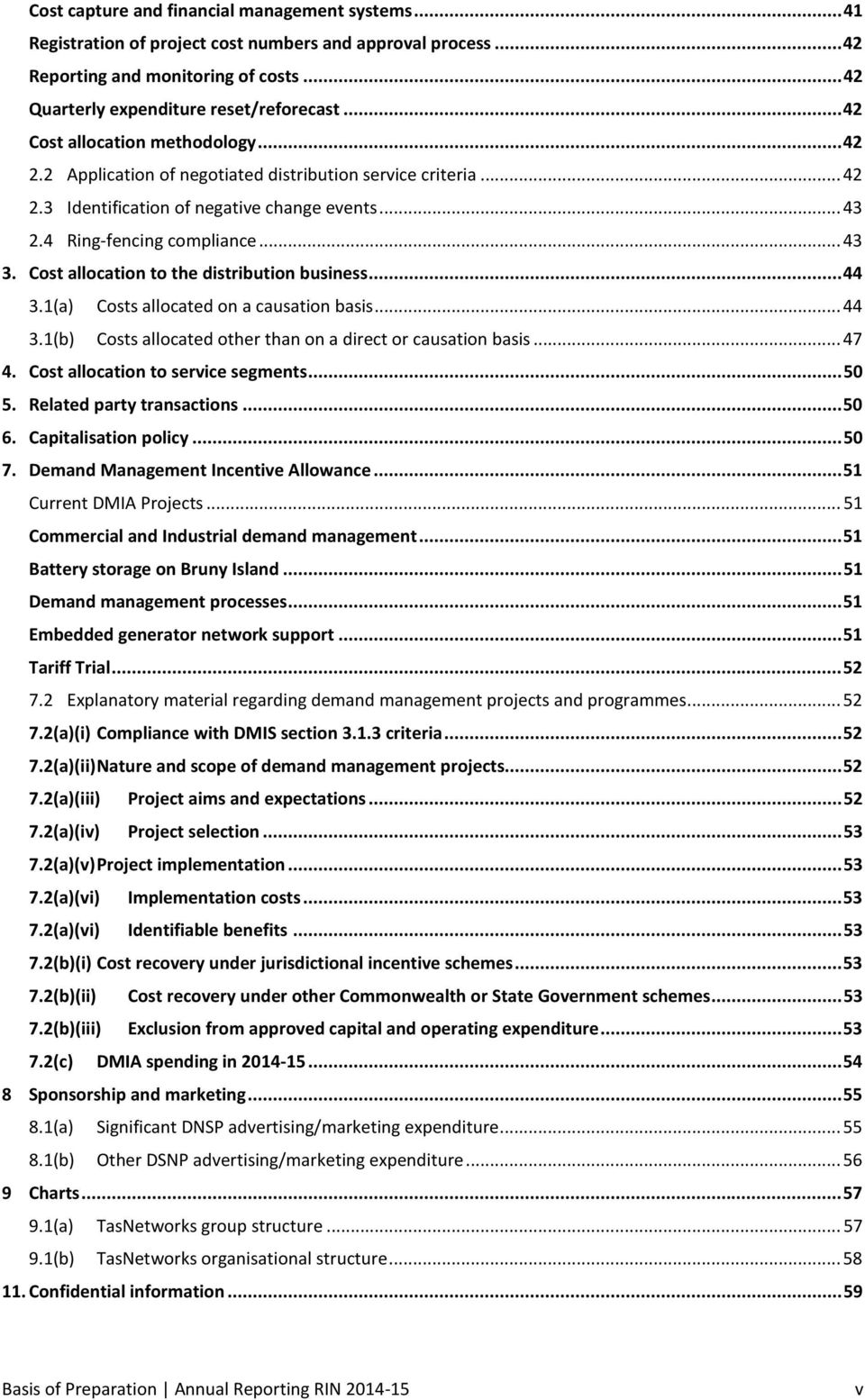
5 Cost capture and financial management systems Registration of project cost numbers and approval process Reporting and monitoring of costs Quarterly expenditure reset/reforecast Cost allocation methodology Application of negotiated distribution service criteria Identification of negative change events Ring-fencing compliance Cost allocation to the distribution business (a) Costs allocated on a causation basis (b) Costs allocated other than on a direct or causation basis Cost allocation to service segments Related party transactions Capitalisation policy Demand Management Incentive Allowance Current DMIA Projects Commercial and Industrial demand management Battery storage on Bruny Island Demand management processes Embedded generator network support Tariff Trial Explanatory material regarding demand management projects and programmes (a)(i) Compliance with DMIS section criteria (a)(ii) Nature and scope of demand management projects (a)(iii) Project aims and expectations (a)(iv) Project selection (a)(v) Project implementation (a)(vi) Implementation costs (a)(vi) Identifiable benefits (b)(i) Cost recovery under jurisdictional incentive schemes (b)(ii) Cost recovery under other Commonwealth or State Government schemes (b)(iii) Exclusion from approved capital and operating expenditure (c) DMIA spending in Sponsorship and marketing (a) Significant DNSP advertising/marketing expenditure (b) Other DSNP advertising/marketing expenditure Charts (a) TasNetworks group structure (b) TasNetworks organisational structure Confidential information Basis of Preparation Annual Reporting RIN v
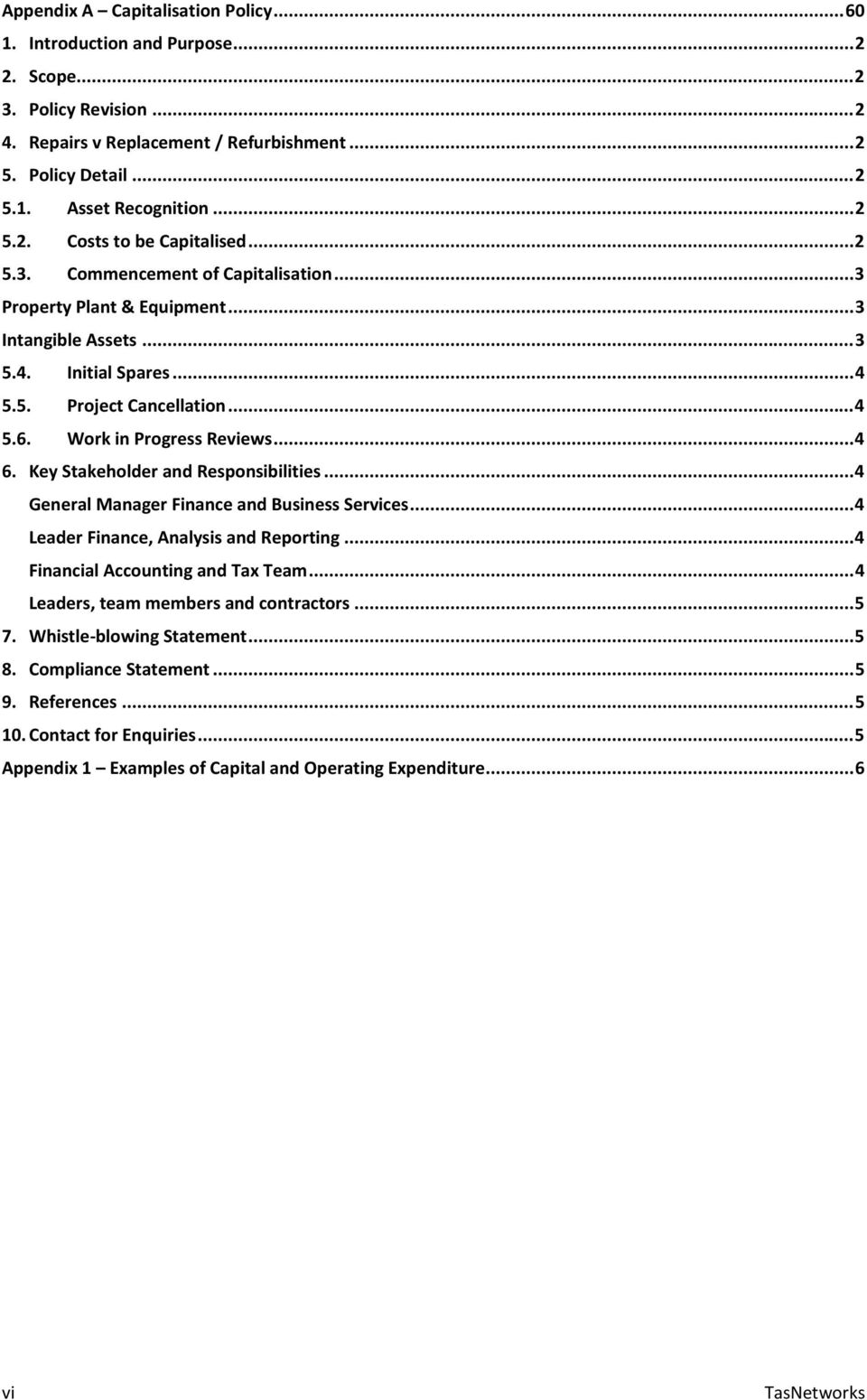
6 Appendix A Capitalisation Policy Introduction and Purpose Scope Policy Revision Repairs v Replacement / Refurbishment Policy Detail Asset Recognition Costs to be Capitalised Commencement of Capitalisation... 3 Property Plant & Equipment... 3 Intangible Assets Initial Spares Project Cancellation Work in Progress Reviews Key Stakeholder and Responsibilities... 4 General Manager Finance and Business Services... 4 Leader Finance, Analysis and Reporting... 4 Financial Accounting and Tax Team... 4 Leaders, team members and contractors Whistle-blowing Statement Compliance Statement References Contact for Enquiries... 5 Appendix 1 Examples of Capital and Operating Expenditure... 6 vi TasNetworks
7 Definitions and interpretation In this document and TasNetworks response to the RIN, unless otherwise noted: TasNetworks refers to TasNetworks, acting in its capacity as a licensed Distribution Network Service Provider in the Tasmanian jurisdiction of the National Electricity Market Distribution Determination refers to the distribution determination made by the Australian Energy Regulator applying to Aurora Energy and, now, TasNetworks. Aurora Energy refers to Aurora Energy Pty Ltd, acting in its capacity as the licensed DNSP in Tasmania prior to 1 July AER Aurora Energy CAM DBill DNSP Gentrack MAIFI OTTER POW RIN Rules SAIDI SAIFI SOM SDW TasNetworks TEC TNSP WASP Australian Energy Regulator Aurora Energy Pty Ltd Cost Allocation Method TasNetworks Market and Billing System Distribution Network Service Provider TasNetworks Market Data Management System Momentary Average Interruption Frequency Index Office of the Tasmanian Economic Regulator Programme of Work Regulatory Information Notice National Electricity Rules System Average Interruption Duration Index System Average Interruption Frequency Index TasNetworks Service Order Management System TasNetworks Spatial Data Warehouse Tasmanian Networks Pty Ltd Tasmanian Electricity Code Transmission Network Service Provider TasNetworks program-of-work management system (Works, Assets, Solutions and People) Basis of Preparation Annual Reporting RIN vii

8 viii TasNetworks

9 Distribution Annual Reporting RIN, Basis of preparation Basis of Preparation Annual Reporting RIN

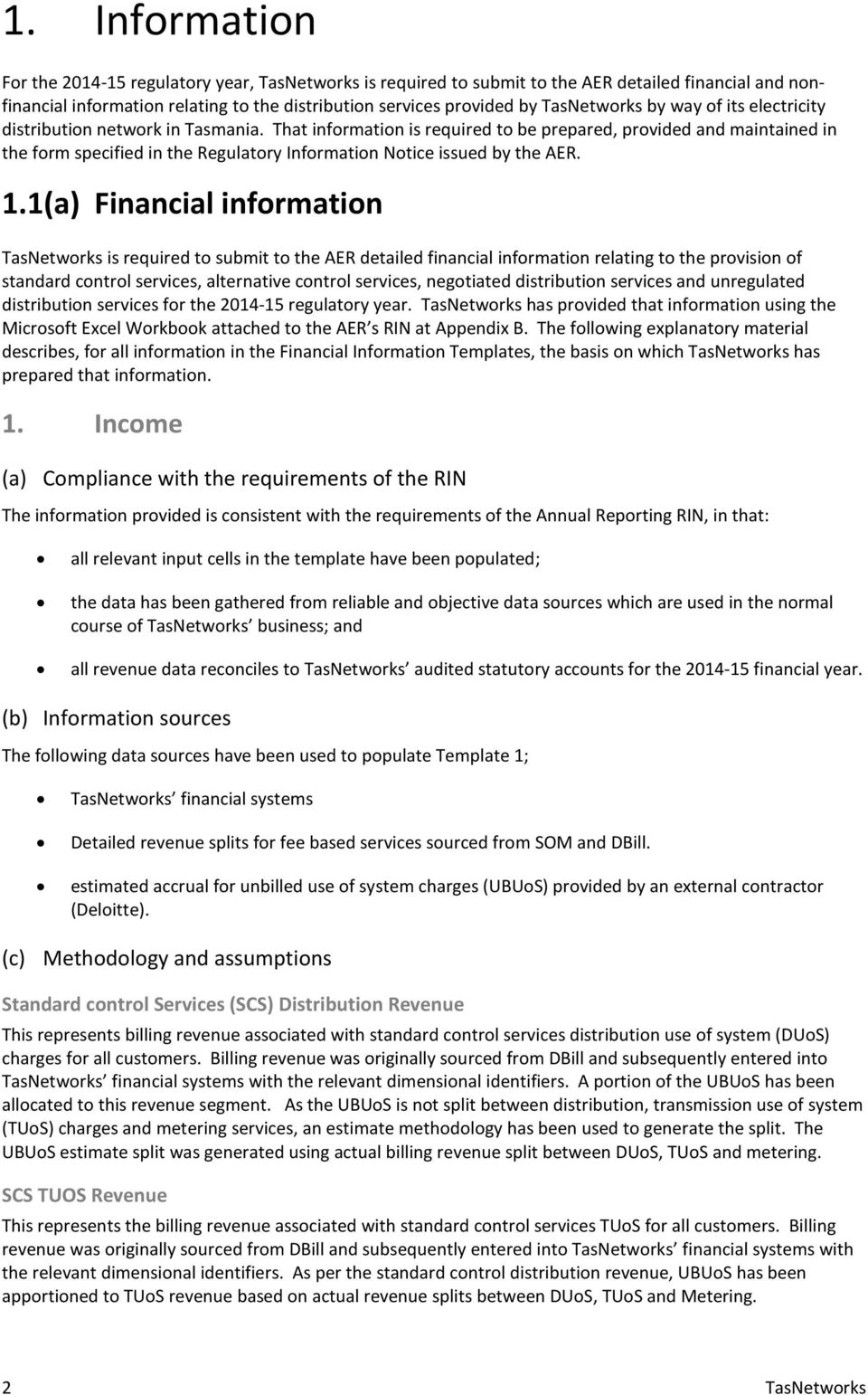
10 1. Information For the regulatory year, TasNetworks is required to submit to the AER detailed financial and nonfinancial information relating to the distribution services provided by TasNetworks by way of its electricity distribution network in Tasmania. That information is required to be prepared, provided and maintained in the form specified in the Regulatory Information Notice issued by the AER. 1.1(a) Financial information TasNetworks is required to submit to the AER detailed financial information relating to the provision of standard control services, alternative control services, negotiated distribution services and unregulated distribution services for the regulatory year. TasNetworks has provided that information using the Microsoft Excel Workbook attached to the AER s RIN at Appendix B. The following explanatory material describes, for all information in the Financial Information Templates, the basis on which TasNetworks has prepared that information. 1. Income The information provided is consistent with the requirements of the Annual Reporting RIN, in that: all relevant input cells in the template have been populated; the data has been gathered from reliable and objective data sources which are used in the normal course of TasNetworks business; and all revenue data reconciles to TasNetworks audited statutory accounts for the financial year. (b) Information sources The following data sources have been used to populate Template 1; TasNetworks financial systems Detailed revenue splits for fee based services sourced from SOM and DBill. estimated accrual for unbilled use of system charges (UBUoS) provided by an external contractor (Deloitte). (c) Methodology and assumptions Standard control Services (SCS) Distribution Revenue This represents billing revenue associated with standard control services distribution use of system (DUoS) charges for all customers. Billing revenue was originally sourced from DBill and subsequently entered into TasNetworks financial systems with the relevant dimensional identifiers. A portion of the UBUoS has been allocated to this revenue segment. As the UBUoS is not split between distribution, transmission use of system (TUoS) charges and metering services, an estimate methodology has been used to generate the split. The UBUoS estimate split was generated using actual billing revenue split between DUoS, TUoS and metering. SCS TUOS Revenue This represents the billing revenue associated with standard control services TUoS for all customers. Billing revenue was originally sourced from DBill and subsequently entered into TasNetworks financial systems with the relevant dimensional identifiers. As per the standard control distribution revenue, UBUoS has been apportioned to TUoS revenue based on actual revenue splits between DUoS, TUoS and Metering. 2 TasNetworks
11 Alternative Control Services (ACS) Public Lighting This represents revenue associated with the asset component of the approved tariff prices for public lighting. Data has been sourced from TasNetworks financial systems. ACS Metering This represents revenue associated with the metering component of the approved distribution network tariffs. Data has been sourced from TasNetworks financial systems. A portion of the UBUoS has been allocated to this revenue item based on the methodology previously detailed for standard control services distribution revenue. ACS Fee based services This represents revenue associated with items classified as fee based services as per the Distribution Determination. Data has been sourced from TasNetworks financial systems. Adjustments were required for fee based services to exclude charges which were incorrectly allocated as fee based services and have been reallocated to customer capital contributions. ACS Quoted Services Data has been sourced from TasNetworks financial systems, in addition to an adjustment of $17,000 which has been reallocated to capital contributions. Negotiated Services Other Revenue Data has been sourced from TasNetworks financial systems. Unregulated Services Distribution Revenue This represents revenue associated with the PAYG metering charge. Data has been sourced from TasNetworks financial systems. Capital Contributions SCS Capital contributions have been allocated in TasNetworks financial system in accordance with the approved method in the Distribution Determination. Source data is from the CAPEX RIN Mapping model. Adjustments to the final capital contributions were made in accordance with the reallocation of revenue from ACS Fee based services and ACS Quoted Services detailed above. ACS Public Lighting Capital Contributions This represents capital contributions relating to public lighting, with the data being sourced from the CAPEX RIN Mapping Model. Unregulated Services Profit from the sale of fixed assets This represents the distribution portion of the sale of fixed assets as per the audited statutory accounts for Unregulated Services Other Revenue This represents any revenue item that is not classified as regulated in the Distribution Determination, this includes Transmission related revenue. TUOS Costs Represents the cost of goods sold in relation to transmission charges. Data is sourced from TasNetworks financial systems. Costs Not Allocated to Distribution Business This represents cost associated with the Transmission sector of TasNetworks. Maintenance Costs These costs are as per the RIN sheet 5a. Maintenance Total. Basis of Preparation Annual Reporting RIN

12 Operating Expenses These costs are as per the RIN sheet 6a. Operating Activities. Depreciation Depreciation has been split across the relevant service classifications as per the RAB Roll Forward Model Depreciation not allocated to DB These costs represent the depreciation allocated to the Transmission sector of TasNetworks and is as per the Transmission regulated accounts for Finance Charges These costs are as per TasNetworks audited statutory accounts for Feed in Tariff Scheme The Feed In Tariff (FiT) Scheme is a State Government initiative whereby TasNetworks provides energy retailers with the variance between a legacy solar tariff rate and an OTTER determined fair and reasonable tariff rate. Data for the rebate is originally sourced from DBill and entered into TasNetworks financial systems. In accordance with Government policy, this expense has been allocated to unregulated distribution services. (d) Estimated information The majority of small customers have accumulation meters which are read on a quarterly reading cycle, meaning that UBUoS charges relating to these customers to 30 June 2015 have been estimated. The estimate accrual was generated by a Board approved methodology using a model developed by an external contractor (Deloitte). 2. Metering and Total Annual Retailer Charges (TARC) Table 1 Metering - Current Year Table 2 Metering - Prior Year The information provided is consistent with the requirements of the Annual Reporting RIN, in that: all relevant input cells in the template have been populated; the data has been gathered from reliable and objective data sources which are used in the normal course of TasNetworks business; the revenue derived from the provision of metering services is based on the type of meter installed to record data (i.e. single phase, multiphase or current transformer meters); and meter numbers by meter tariff type are as at 30 June 2014 and 30 June (b) Information sources Metering numbers for the current year ( ) has been sourced from DBill. Metering revenue for the current year has been sourced from TasNetworks financial systems. Metering data for the previous year ( ) is as reported in TasNetworks Annual Reporting RIN. (c) Methodology and assumptions The total metering numbers represent the number of metering tariffs recorded in DBill as at 30 June TasNetworks

13 Metering revenue has been sourced from TasNetworks financial systems. A portion of the UBUoS has been allocated to this revenue item based on the tariff billing information recorded in DBill. Unregulated metering installations have been excluded from the count of meter numbers, such as interval meters supplied by TasNetworks on a competitive basis and are not subject to regulated metering service charges. (d) Estimated information Tariff revenue data is originally calculated in DBill. As DBill is live, any adjustments made after reporting revenue in the statutory accounts will affect the data extracted. As a result of the time delay in extracting data from the live billing system, and the application of UBUoS, adjustments were made by using DBill data by tariff and meter type, then apportioning final charges to each metering tariff. Table 3 Total annual retailer charges (TARC) The information provided is consistent with the requirements of the Annual Reporting RIN, in that: the data has been gathered from reliable and objective data sources which are used in the normal course of TasNetworks business; all revenue data reconciles to TasNetworks audited statutory accounts for the period; and only those network charges billed by the distributor to all retailers have been utilised within this report. (b) Information sources Revenue charges as reported have been sourced from TasNetworks financial systems and DBill. (c) Methodology and assumptions The TARC represents all network charges billed by the distributor to all retailers for the period. TARC charges include the following items: Distribution charges Transmission charges Metering charges Fee based services Unmetered supply charges. The revenue associated with the items listed above is as per the Annual RIN reporting table 1. Income. The only adjustment to this data is the exclusion of the UBUoS charges. Basis of Preparation Annual Reporting RIN

14 3a. Capex total Table 1 Standard Control Services - capex by purpose Table 2 Material difference explanation Table 3 Capex by asset class Table 4 Alternative control services capex Table 5 Capital Contributions by asset class Table 6 Disposals by asset class The information provided is consistent with the requirements of the Annual Reporting RIN, in that: expenditure has been reported across service classifications in line with the AER approved CAM; and expenditure has been reconciled to TasNetworks audited statutory accounts. (b) Information sources The capital expenditure reported has been sourced from TasNetworks financial systems. (c) Methodology and assumptions There are a number of adjustments which have been made to TasNetworks audited statutory accounts data to produce a regulatory view. These are as follows: a true up of any under/over recovery of corporate and shared services expenditure has been allocated against work category codes based on direct labour hours, in line with the AER approved CAM. an allocation of the cash movement in provisions during the year has been allocated against work category codes based on direct labour hours, in line with the AER approved CAM. This treatment is consistent with the methodology used to determine the allowance in the Distribution Determination. Table 1 Standard Control Services capex by purpose Table 4 Alternative control services capex Expenditure is captured in TasNetworks financial systems at a detailed work category level (which is used to define the services being carried out). This data has then been mapped to the RIN service classifications according to the work category. Expenditure incurred in relation to corporate and shared assets has been allocated across the service classifications in line with the AER approved CAM. Table 2 Material difference explanation The commentary provided in Table 2 has been sourced through analysis of expenditure against forecasted spend. Table 3 Capex by asset class Expenditure is captured in TasNetworks financial system at a detailed work category level and allocated to each of the asset classes depending on the work category. A mapping template has been used to allocate costs to each asset class which is consistent with the methodology used for the Distribution Determination. 6 TasNetworks

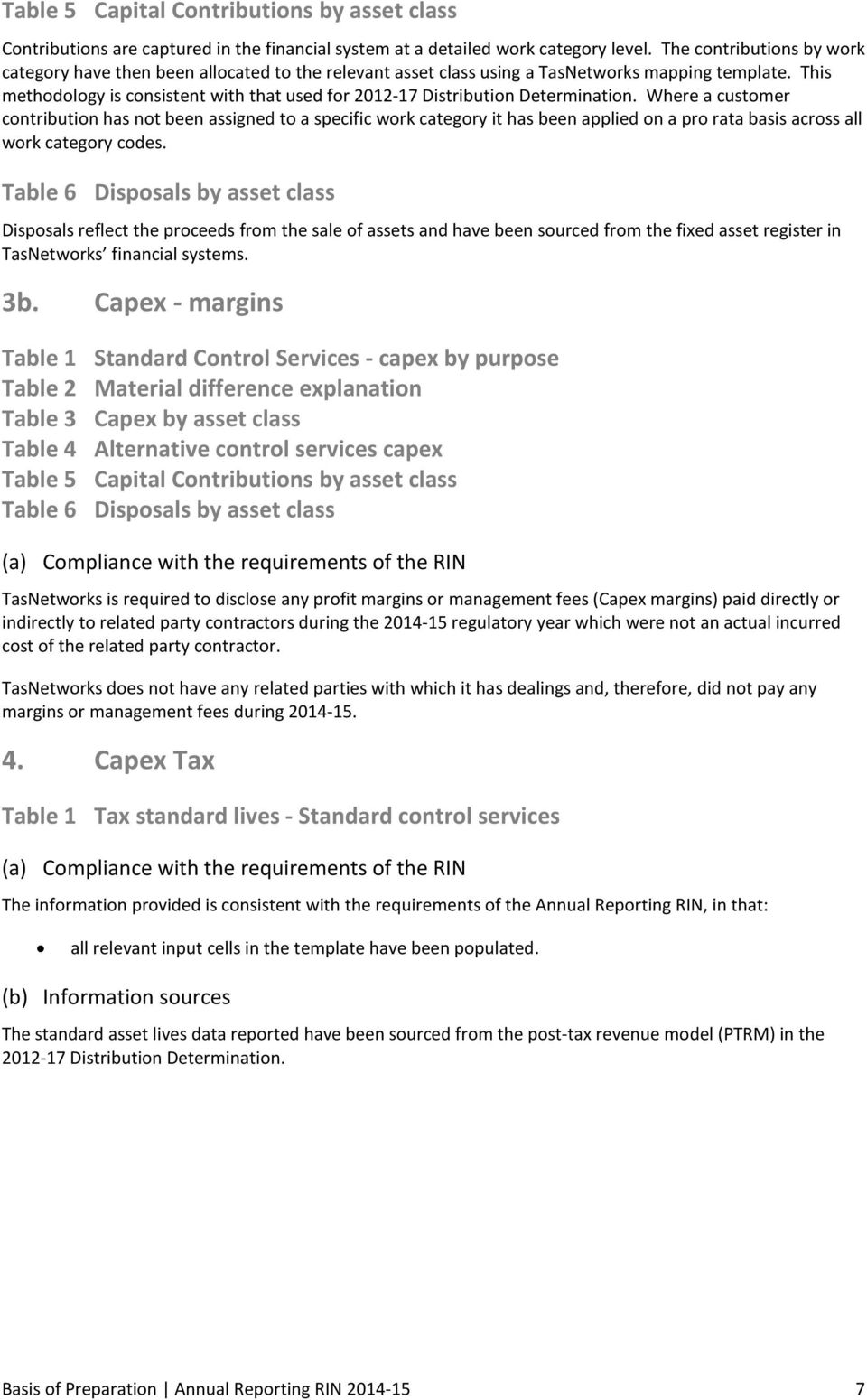
15 Table 5 Capital Contributions by asset class Contributions are captured in the financial system at a detailed work category level. The contributions by work category have then been allocated to the relevant asset class using a TasNetworks mapping template. This methodology is consistent with that used for Distribution Determination. Where a customer contribution has not been assigned to a specific work category it has been applied on a pro rata basis across all work category codes. Table 6 Disposals by asset class Disposals reflect the proceeds from the sale of assets and have been sourced from the fixed asset register in TasNetworks financial systems. 3b. Capex - margins Table 1 Standard Control Services - capex by purpose Table 2 Material difference explanation Table 3 Capex by asset class Table 4 Alternative control services capex Table 5 Capital Contributions by asset class Table 6 Disposals by asset class TasNetworks is required to disclose any profit margins or management fees (Capex margins) paid directly or indirectly to related party contractors during the regulatory year which were not an actual incurred cost of the related party contractor. TasNetworks does not have any related parties with which it has dealings and, therefore, did not pay any margins or management fees during Capex Tax Table 1 Tax standard lives - Standard control services The information provided is consistent with the requirements of the Annual Reporting RIN, in that: all relevant input cells in the template have been populated. (b) Information sources The standard asset lives data reported have been sourced from the post-tax revenue model (PTRM) in the Distribution Determination. Basis of Preparation Annual Reporting RIN
16 5a. Maintenance - total Table 1 Maintenance expenditure The information provided is consistent with the requirements of the Annual Reporting RIN, in that the expenditure has been split into standard control, alternative control, negotiated and unregulated services in line with AER approved CAM. The expenditure has been reconciled to TasNetworks audited statutory accounts. (b) Information sources The expenditure data reported in Template 5a has been sourced from WASP, TasNetworks financial systems and TasNetworks audited statutory accounts. (c) Methodology and assumptions The financial data has been extracted at a business level (Distribution or Transmission) and then at a work category level to allow the information to be allocated in accordance with the RIN requirements. The opex work categories are allocated RIN sub categories and service classifications (standard control, alternative control, negotiated and unregulated services) so that the information can be aligned with the RIN template tables. Corporate and Shared Services costs have been allocated across the service classifications in accordance with the AER approved CAM. Once the information has been reported in alignment with the RIN reporting requirement, the results are then reconciled to TasNetworks audited statutory accounts. The adjustments are shown in TasNetworks RIN response and were minor in nature. Table 2 Explanation of material differences In explaining material differences between actual and forecast expenditures on asset maintenance, TasNetworks has complied with the requirements of the Annual Reporting RIN, in that: TasNetworks has provided explanations only in cases where the difference between forecast and actual expenditure shown in Table 1 is greater than ±10 per cent of forecast expenditure; the expenditure forecasts used for comparative purposes have been deflated by removing the impact of the AER s forecast inflation from the Distribution Determination and reinflated taking into account the impact of actual inflation outcomes; the forecasts used for comparative purposes have been adjusted to the same dollar terms as the actual data reported for in the RIN template; and the actual expenditure data reported has been drawn from reliable and objective data sources which are used in the normal course of TasNetworks business. (b) Information sources The expenditure analysis undertaken in support of Table 2 drew on the Distribution Determination and the expenditure reported in Table 1 and sourced from WASP, TasNetworks financial systems and TasNetworks audited statutory accounts. 8 TasNetworks

17 (c) Methodology and assumptions Explanations of material differences have been provided on the basis of comparisons of actual to forecast expenditure. The forecasts used for comparative purposes are as per the Distribution Determination and have been adjusted to the same dollar terms as the actual data reported for in the RIN template. Table 3 Other network maintenance costs As no expenditure on other asset maintenance reported in Table 1 represented more than five per cent of the total maintenance expenditure on standard control services during , Table 3 was not required to be completed. 5b. Maintenance - margin Table 1 Maintenance expenditure Table 2 Explanation of material difference Table 3 Other network maintenance costs TasNetworks is required to disclose any profit margins or management fees paid directly or indirectly to related party contractors during the regulatory year which were not an actual incurred cost of the related party contractor. TasNetworks does not have any related parties with which it has dealings and, therefore, did not pay any margins or management fees during a. Operating Activities - Total Table 1 Operating charges and costs The information provided is consistent with the requirements of the Annual Reporting RIN, in that the expenditure has been split into standard control, alternative control, negotiated and unregulated services in line with the AER approved CAM. The expenditure has been reconciled back to TasNetworks audited statutory accounts. (b) Information sources The operating expenditure data reported has been sourced from WASP, TasNetworks financial systems and TasNetworks audited statutory accounts. (c) Methodology and assumptions The financial data has been extracted at a business (Distribution or Transmission) level and then at a work category level to allow the information to be allocated in accordance with the RIN requirements. The opex work categories are allocated RIN sub categories and service classifications (standard control, alternative control, negotiated and unregulated services) so that the information can be aligned with the RIN template tables. Corporate and Shared Services costs have been allocated across the service classifications in line with the AER approved CAM. Costs that were directly attributed to service classifications have been allocated on that basis. All other Corporate and Shared costs have been allocated in line with the AER approved CAM. Basis of Preparation Annual Reporting RIN

18 Once the information has been reported in alignment with the RIN reporting requirement the results are then reconciled to TasNetworks audited statutory accounts. Any adjustments are shown in the RIN reporting template and are only minor in nature. Table 2 Explanation of material difference In explaining material differences between actual and forecast operating charges and costs, TasNetworks has complied with the requirements of the Annual Reporting RIN, in that: TasNetworks has provided explanations only in cases where the difference between forecast and actual expenditure shown in Table 1 is greater than ±10 per cent of forecast expenditure; the forecasts used for comparative purposes have been adjusted to the same dollar terms as the actual data reported for in the RIN template; and the actual expenditure data reported in Template 6a has been drawn from reliable and objective data sources which are used in the normal course of TasNetworks business. (b) Information sources The expenditure analysis undertaken in support of Table 2 drew on the Distribution Determination and the expenditure reported in Table 1 was sourced from WASP, TasNetworks financial systems and TasNetworks audited statutory accounts. (c) Methodology and assumptions Explanations of material differences have been provided on the basis of comparisons of actual to forecast expenditure. The forecasts used for comparative purposes are as per the Distribution Determination and have been adjusted to the same dollar terms as the actual data reported for in the RIN template. Table 3 Other network operating costs As no other network operating costs reported in Table 1 represented more than five per cent of standard control operating costs in , Table 3 has not been completed. Table 4 Operating Expenditure - Non-Recurrent Network Operating Costs As no non-recurrent network operating costs reported in Table 1 represented more than five per cent of standard control operating costs in , Table 4 has not been completed. Table 5 Non network alternatives (demand management) operating costs that are not captured by the DMIS ($ nominal) The information provided is consistent with the requirements of the Annual Reporting RIN, in that: all fields have been completed for non-network projects which are applicable; only projects not covered by DMIS have been reported; 10 TasNetworks
19 the capital cost impacts were calculated from quotations or estimates made at the time of project initiation; and the assumptions made in generating these values have been provided in this Basis of Preparation. (b) Information sources Past loading data was retrieved from TasNetworks distribution SCADA management system PI Historian Future loading data was taken from TasNetworks annual feeder forecast. Financial estimates for augmentation deferral were sourced from external quotations by contractors and design estimations made internally by TasNetworks. The amount of generation required for peak shaving purposes in the regulatory year was acquired through consultation with network operators. (c) Methodology and assumptions Projects have been identified where capital expenditure has been deferred or made unnecessary in the foreseeable future through a given non-network project. Projects have been excluded where they were initiated without a plan to defer capital expenditure, such as to improve reliability or as an alternative to capital expenditure where it would not have been possible to implement the capital expenditure soon enough. For each project the current load forecast has been used to advise the projected year in which the augmentation would be again required, even with the non-network solution in place. The year of this future augmentation is taken as the end of the project life. For projects where the load has since reduced, and augmentation and the non-network solution is no longer required, it has been assumed that the project life ends during the year that the non-network solution is no longer required. Bruny Island Cable upgrade deferral project The cost to implement each network-based augmentation has been taken from quotes by external contractors or estimates made by TasNetworks Network Planning team at the time of project initialisation. Two cable options were costed by an internal designer. Of these, option 2 was the preferred option based on water depth and construction methodology. In addition it also provided an alternate route to supply the southern area of Bruny Island. Impact on Demand in the current year The demand impact was determined by considering the amount of real power injected by the mobile generator during peak periods to avoid overloading the capacity rating of the submarine cable. It should be noted that the projects for the period have been reported with an Impact on Demand Current Year Impact of 0.48 MW. Impact on Demand for the life of the project The impact on demand over the life of the project has been determined by assessing the maximum output of the generator connection site, which is expected to be fully utilised by the end of project life. Deferred capital cost for the life of the project The deferred capital cost for the whole of project life was determined was determined by taking the difference between the NPV cost to install a network-based augmentation project at the time it was originally needed in year 2015, and completing the augmentation at the end of the project life (in real dollars) in year The assumed discount rate was used for a 60 year period (asset life of submarine cable). The deferred capital cost for the current year impact was determined by taking the difference between the NPV cost to install a network-based augmentation project at the time it was originally needed in year 2015, and completing the augmentation one year later in Basis of Preparation Annual Reporting RIN

20 Deferral of capital expenditure which would have been completed by TasNetworks in its capacity as a TNSP has not been included. It is noted that there is no appropriate table equivalent to fill in for non-dmis projects in the Transmission RIN. 6b. Operating activities - Margin Table 1 Operating charges and costs Table 2 Explanation of material difference Table 3 Operating costs - Other standard control services Table 4 Operating Expenditure - Non-Recurrent network operating costs TasNetworks is required to disclose any profit margins or management fees paid directly or indirectly to related party contractors during the regulatory year which were not an actual incurred cost of the related party contractor. TasNetworks does not have any related parties with which it has dealings and, therefore, did not pay any margins or management fees during Avoided cost payments The information provided is consistent with the requirements of the Annual Reporting RIN, in that: all relevant input cells in the template have been populated; and the data has been gathered from reliable and objective data sources which are used in the normal course of TasNetworks business. (b) Information sources The expenditure data reported has been sourced from TasNetworks financial systems. (c) Methodology and assumptions There was only one payment made for avoided TUOS charges during and the details of that payment were sourced directly from TasNetworks financial systems. 8. Alternative Control Services and other services The information provided is consistent with the requirements of the Annual Reporting RIN, in that: all relevant input cells in the template have been populated; and the data has been gathered from reliable and objective data sources which are used in the normal course of TasNetworks business. (b) Information sources Revenue numbers have been sourced directly from TasNetworks financial systems. The allocation of revenue across services has been sourced from the following: directly from the financial system (where categorised at the required level); and 12 TasNetworks
21 monthly internal finance reports. All costs have been sourced directly from the TasNetworks financial system. (c) Methodology and assumptions Total revenue has been sourced from TasNetworks financial systems. TasNetworks financial systems do not categorise revenue across all of the various service classifications. Where revenue is not separately categorised, Monthly Retail Invoice Reports (which do categorise revenue) were summarised and reconciled to TasNetworks financial systems. Total costs (Opex and Capex) have been sourced from TasNetworks financial systems. Direct Costs represent Total Costs less Overhead Costs. Overhead Costs have been allocated in line with the AER approved CAM. Details for the following items have not been detailed as Fee Based Services in Template 8 Alternative Control Services and Other Services: PAYG Meter Alteration has been excluded as this service is treated as an Unregulated Service; Renewable Energy Connection has been excluded as this is treated as a Standard Control Service; and New Connections Permanent Supply have been excluded as this service is treated as a Standard Control Service. No capital costs have been allocated to Fee Based Services other than the allocation of Corporate Overheads in accordance with the AER approved CAM. 9. Efficiency Benefits Sharing Schemes Table 1 Opex for EBSS purposes Table 2 Explanation of Capitalisation Policy changes The information provided is consistent with the requirements of the Annual Reporting RIN, in that: all relevant input cells in the template have been populated; and the data has been gathered from reliable and objective data sources which are used in the normal course of TasNetworks business. (b) Information sources The data in Table 1 was sourced from TasNetworks financial systems. (c) Methodology and assumptions Debt raising costs TasNetworks had no debt raising costs in Superannuation defined benefit schemes Costs incurred in relation to TasNetworks obligations under the defined benefit superannuation scheme have not been included in TasNetworks opex. Basis of Preparation Annual Reporting RIN
22 Non network alternatives costs Expenditure against non-network work category codes has been sourced directly from TasNetworks financial systems. DMIA costs These costs are sourced directly from Table 11 DMIS-DMIA in the Annual Reporting RIN. Pass through event costs TasNetworks had no pass through events for GSL payments GSL payment costs are sourced directly from Template 6a Operating Costs in the Annual Reporting RIN. Electrical safety inspection levy payments These costs are sourced directly from Template 6a Operating Costs in the Annual Reporting RIN. NEM levy payments These costs are as per Template 6a Operating Costs in the Annual Reporting RIN. NEM and retail contestability operating costs These costs are sourced directly from Template 6a Operating Costs in the Annual Reporting RIN. Movements in provisions The value included is for the movement in provisions for standard control services. Capitalisation policy changes There were no changes to TasNetworks Capitalisation Policy in Therefore, Table 2 (Explanation of Capitalisation Policy Changes) has not been populated. 10. Jurisdictional scheme payments TasNetworks currently has no jurisdictional schemes and therefore has not made any payments. This has been noted in the template and no values have been reported. 11. Demand management incentive scheme Table 1 DMIA expenditure in the regulatory reporting year Table 2 DMIA expenditure in the previous reporting year The information provided is consistent with the requirements of the Annual Reporting RIN, in that: all relevant input cells in the template have been populated; the data has been gathered from reliable and objective data sources which are used in the normal course of TasNetworks business; and only those projects classified as Demand Management have been utilised within this report. (b) Information sources The data used to populate Tables 11.1 and 11.2 were sourced from TasNetworks financial systems. 14 TasNetworks
23 (c) Methodology and assumptions Raw data was sourced from TasNetworks financial systems for the relevant period. All projects with the demand management identifier (work category DMIAL (Demand management incentive allowance)) were extracted from the financial ledger. No capital expenditure was allocated to DMIS for or financial years. 12. Self insurance Table 1 Self insurance events with incurred costs greater than $100,000 Table 2 Self insurance events with an incurred cost of less than $ Table 3 Total self insurance relating to regulated assets No self-insurance allowance applies to TasNetworks during the regulatory control period, therefore, Template 12 does not apply to TasNetworks and has not been populated. 13. Change of accounting policy (CHAP) Table 1 Aggregate effects of changes in accounting policy Table 2 Description and reason for changes in accounting policy There were no changes made to TasNetworks accounting policies during , therefore, there are no values to report in Tables 1 and 2. This has been noted in the template. 14. Related party transactions Table 1 Payments made to related parties under control or influential ownership Table 2 Composition of margins in relation to table 1. TasNetworks is required to identify any related party with which a transaction was conducted during the regulatory year that related to the provision of standard control services, alternative control services or negotiated distribution services and provide details of those transactions. TasNetworks does not have any related parties with which it has dealings and, therefore, no reportable transactions with a related party occurred during Shared assets Table 1 Total unregulated revenue earned with shared assets The information provided is consistent with the requirements of the RIN, in that: all relevant input cells in the template have been populated; and the variables reported are based on reliable and objective data sources. Basis of Preparation Annual Reporting RIN
24 (b) Information sources The data in Table 1 was sourced from TasNetworks financial systems. (c) Methodology and assumptions Pole rental is the only unregulated revenue earned from shared assets. Table 2 Shared asset unregulated services and apportioned revenue The information provided is consistent with the requirements of the RIN, in that: all relevant input cells in the template have been populated; and the variables reported are based on reliable and objective data sources. (b) Information sources The information reported in Table 2 was sourced from TasNetworks financial systems. (c) Methodology and assumptions NBN Pole rental is the only unregulated revenue earned from shared assets. Revenue for this service is based on the number of poles and set rates, meaning that no apportionment is required to derive this revenue. 16 TasNetworks
25 1.1(b) Non-financial regulatory information TasNetworks is required to submit to the AER detailed non-financial information relating to the performance of its electricity distribution network and customer service outcomes during the regulatory year. TasNetworks has provided that information using the Microsoft Excel Workbook attached to the AER s RIN at Appendix C. The following explanatory material describes, for all information in the Non-Financial Information Templates, the basis on which TasNetworks has prepared that information. 1a. STPIS Reliability Table 1 SAIDI (System Average Interruption Duration Index) Table 2 SAIFI (System Average Interruption Frequency Index) The information provided is consistent with the requirements of the Annual Reporting RIN, in that: all relevant input cells in the template have been populated; the reliability statistics have been based on reliable and objective data sources used during the normal course of TasNetworks business; and TasNetworks reliability statistics have been calculated in accordance with the methodology approved by the AER. (b) Information sources The SAIDI and SAIFI statistics reported in Tables 1 and 2 have been based on data sourced from the SDW, WASP and asset history data warehouse. (c) Methodology and assumptions All reliability performance indices (SAIDI, SAIFI, MAIFI) have been calculated using disconnected kva and kva duration instead of disconnected customers and customer duration. The AER accepted the kva weighted measure as a transitional reporting methodology for the current regulatory control period due to insufficient customer data to set STPIS targets on during the previous regulatory control period. Queries were run on WASP and the SDW to extract a base data set of outages, outage assets, customers and distribution transformers for the financial year. The outage data was then filtered to exclude any outages for the financial year which were not on mainland Tasmania (e.g. outages on Bass Strait Islands). This data was then cleansed to ensure completeness of reliability areas, communities, feeders and kva disconnected. All customer installation faults were given a nominal 8 kva interrupted with corresponding kva duration of 8 kva x outage duration x 60. All other outages were manually inspected to identify issues and additional/missing information sourced from the asset history data warehouse. Where a transformer bordered on two reliability areas, the reliability area of highest value was chosen e.g. urban over high density rural. SAIDI and SAIFI impacts on the reliability area and the system were then calculated. Outages from the 2009 to 2014 financial years were taken from previous RIN reports and used to calculate the MED threshold for the 2015 financial year using the 2.5 Beta methodology. The daily system SAIDI (with STPIS exclusions applied) for the financial year, was calculated and daily SAIDI was compared to the calculated MED threshold to determine which days were MEDs for exclusion. All events that occurred on MEDs, planned outages and events that meet the STPIS exclusion criteria were excluded from the calculation of SAIDI and SAIFI. Basis of Preparation Annual Reporting RIN
26 An extract of base outage data was used to determine reliability area and system SAIDI and SAIFI for the financial year. (d) Estimated information As TasNetworks reports STPIS performance using kva instead of customers, the disconnected kva for individual customer installations must be estimated. A nominal figure of 8 kva is used as analysis conducted in prior years determined this as a reasonable value on which to base estimates of customer kva. Table 3 Momentary Average Interruption Frequency Index (MAIFI) The information provided is consistent with the requirements of the Annual Reporting RIN, in that: all relevant input cells in the template have been populated; the reliability statistics have been based on reliable and objective data sources used during the normal course of TasNetworks business; and TasNetworks reliability statistics have been calculated in accordance with the methodology approved by the AER. (b) Information sources The MAIFI statistics reported in Tables 1 and 2 have been based on data sourced from the SDW, including information captured by TasNetworks Network Operations Control System. (c) Methodology and assumptions All reliability performance indices, including MAIFI, have been calculated using disconnected kva and kva duration instead of disconnected customers and customer duration. The AER accepted the kva weighted measure as a transitional reporting methodology for the current regulatory control period due to insufficient customer data from the previous regulatory control period on which to base TasNetworks STPIS targets. Momentary interruptions are not recorded for all feeders and TasNetworks is unable to determine all the causes of MAIFI. Momentary interruptions caused by reclosers are automatically captured by TasNetworks automatic download process for devices where communications are available. Momentary interruptions on circuit breakers are extracted from TasNetworks Network Operations Control System on a quarterly basis. A query was run to extract all momentary outages on TasNetworks distribution network for the regulatory year with the outage impacts measured by disconnected kva and customers, in line with TasNetworks STPIS reporting requirements and Category RIN reporting obligations. Disconnected kva and customers are based on network configuration at the time of running the query, not the configuration at the time of the interruption, as the MAIFI calculation relies on TasNetworks protection zone model, which is refreshed each day and does not store changes. MAIFI for reliability areas and at a system level have been calculated by kva disconnected divided by total reliability area kva and system kva. Outages from the 2009 to 2014 financial years were taken from previous RIN reports and used to calculate the MED threshold for the financial year using the 2.5 Beta methodology. The daily system SAIDI (with STPIS exclusions applied) for the financial year, was calculated and daily SAIDI was compared to the calculated MED threshold to determine which days were MEDs for exclusion. All events that occurred on MEDs, planned outages and events that meet the STPIS exclusion criteria were excluded from the calculation of MAIFI. 18 TasNetworks
27 Base MAIFI data was then used to determine reliability area and system MAIFI for the regulatory year. Table 4 Customer numbers The information provided is consistent with the requirements of the Annual Reporting RIN, in that: all relevant input cells in the template have been populated; customer numbers have been compiled on the basis of reliable and objective data sources which are used during the normal course of TasNetworks business; and customer numbers reflect the active NMIs in TasNetworks distribution network at the beginning and end of the regulatory year. (b) Information sources The customer data in Table 4 has been drawn from a number of sources: SDW, DBill and GenTrack. (c) Methodology and assumptions A count of NMIs at the beginning and end of financial year was undertaken by reliability area. Those queries excluded NMIs on the Bass Strait Islands and NMIs with a status of Extinct. A small volume of NMIs (mostly associated with Un-Metered Supplies) with unknown reliability areas were redistributed proportionally across the rest of the population of NMIs. Table 5 Average customer numbers (kva) The information provided is consistent with the requirements of the Annual Reporting RIN, in that: all relevant input cells in the template have been populated; the data reported in Table 4 has been compiled on the basis of reliable and objective data sources which are used during the normal course of TasNetworks business; and connected kva refers to the capacity of connected and active distribution network transformers at the beginning and end of the financial year. (b) Information sources The information in Table 4 was sourced from the SDW. (c) Methodology and assumptions The sum of connected kva on mainland Tasmania at the end of the financial year was extracted from the SDW. The connected kva for the beginning of the financial year was taken from 2014 STPIS performance compliance reporting data. System kva was calculated as the sum of the connected kva for the reliability areas at the beginning and end of the regulatory year. The average kva for the year was calculated as the sum of connected kva at the beginning of the year plus the sum of connected kva at the end of the year, divided by two. These average kva values have been used for SAIDI and SAIFI calculations in the Annual Reporting RIN. Basis of Preparation Annual Reporting RIN
28 1b. STPIS Customer service Table 1 Telephone answering The information provided is consistent with the requirements of the Annual Reporting RIN, in that: the number of calls received reflects the number of calls to TasNetworks fault line (132004); the number of calls answered within 30 seconds has been taken from the time that a call enters the telephone system of TasNetworks call centre and the caller speaks with an operator, excluding the time that callers are connected to an automated interactive service that provides substantive information; TasNetworks call handling statistics have been compiled on the basis of reliable and objective data sources which are used during the normal course of TasNetworks business; and all relevant input cells in the template have been populated. (b) Information sources The information presented in Table 1 was sourced from the call management system used by TasNetworks fault centre. (c) Methodology and assumptions Call performance data for includes the date, total calls received, total calls answered, total calls abandoned and the percentage of calls answered within 30 seconds. The number of calls answered in 30 seconds was calculated by applying the percentage of calls answered within 30 seconds to the number of total calls answered on the day. Major event days and other allowable exclusions as per the AER s STPIS guideline have been applied to these figures. Table 2 New connections Table 3 Streetlight repair TasNetworks has no performance or reporting obligations under STPIS in relation to new connections or street lighting repairs. 1c. STPIS daily performance Table 1 Daily performance data (unplanned) The daily performance data provided is consistent with the requirements of the Annual Reporting RIN, in that: the number of calls received is the number of calls to TasNetworks fault line (132004); 20 TasNetworks
29 the number of calls answered within 30 seconds is the time taken to answer a call, measured from when a call enters the telephone system of the call centre to the moment that the caller speaks with an operator, but excluding the time that the caller is connected to an automated interactive service that provides substantive information; momentary interruptions due to feeder and feeder section outages are included (where available); outage exclusions are as per AER s STPIS instructions; MED calculation is as per the AER s STPIS instructions; TasNetworks performance data has been compiled on the basis of reliable and objective data sources which are used during the normal course of TasNetworks business; and all relevant input cells in the template have been populated. (b) Information sources The performance data reported in Table 1 has been sourced from multiple sources, including the SDW and SDW History, WASP and the call management system used by TasNetworks fault centre. (c) Methodology and assumptions All reliability performance indices (SAIDI, SAIFI, MAIFI) have been calculated using disconnected kva and kva duration instead of disconnected customers and customer duration. The AER accepted the kva weighted measure as a transitional reporting methodology for the current regulatory control period due to insufficient customer data having been gathered by Aurora Energy during the previous regulatory control period on which to base STPIS targets in the current control period. SAIDI and SAIFI Queries were run on WASP and the SDW to extract a base data set of outages, outage assets, customers and distribution transformers for the regulatory year. The outages for the regulatory year on mainland Tasmania (e.g. excluding Bass Strait Islands) were then extracted, with the outage impact measured by disconnected kva and kva duration instead of customers, as per TasNetworks STPIS reporting requirements. This data was then cleansed to ensure completeness of reliability areas, communities, feeders and kva disconnected. All customer installation faults were given a nominal 8 kva interrupted with corresponding kva duration of 8 kva x outage duration x 60. All other outages were manually inspected to identify issues and information sourced from the asset history data warehouse. Where a transformer bordered on two reliability areas, the reliability area of highest value was chosen, e.g. urban over high density rural. SAIDI and SAIFI impacts at a reliability area level and the system as a whole were then calculated. Network SAIDI and SAIFI were calculated by summing the total system SAIDI and SAIFI in the base outage dataset, without and with exclusions. These figures include major event days as they were not explicitly requested to be removed. This methodology is in line with the 2014 RIN submission. Community SAIDI and SAIFI in worksheet 1c Table 1 were calculated by summing the community SAIDI and SAIFI in the Base Outage Data worksheet for that particular community area, without and with exclusions. These figures also exclude major event days. MAIFI Momentary interruptions are not recorded for all feeders and TasNetworks is unable to determine the causes of MAIFI. Momentary interruptions caused by reclosers are automatically captured by TasNetworks automatic download process for devices where communications are available. Momentary interruptions on circuit breakers are extracted from TasNetworks Network Operations Control System (NOCs) on a quarterly basis. Basis of Preparation Annual Reporting RIN
30 Momentary outages on TasNetworks distribution network for the financial year were extracted from the SDW, with the outage impact measured by disconnected kva instead of customers, in-line with TasNetworks STPIS reporting obligations. Disconnected kva for reclosers was already pre-calculated as part of standard MAIFI reporting. A second query was run on the historical spatial data warehouse to extract the connected kva by feeder and reliability area at the beginning and end of the financial year to allow for disconnected kva on circuit breakers. The outputs from this query were then extracted and the averages used for circuit breaker disconnected kva. MAIFI for reliability areas and at a system level were calculated by kva disconnected divided by total reliability area kva and system kva. This calculation excludes events that occur on major event days. Customer Service Call performance data is extracted on a monthly basis, and includes the date and time of every call received, answered, abandoned and service level. Major Event Days Outages from the 2009 to 2014 financial years were taken from previous RIN reports and used to calculate the MED threshold for the financial year using the 2.5 Beta methodology. The daily system SAIDI for each day in the financial year, was calculated from this base data (excluding STPIS exclusion and planned outage events) to determine the MEDs for the period. 1d. STPIS Guaranteed Service Level There is no AER GSL scheme applying to TasNetworks during the current regulatory control period. 2. Customer service Table 1 Quality of supply The information provided is consistent with the requirements of the Annual Reporting RIN, in that: the number of overvoltage events and number of customers receiving over voltage due to the various causes has been provided where available; variations in voltage at zone substations and at measurement points on feeders are provided where available. Where inaccurate information, or information derived from inaccurate data was present, these sites were regarded as not measured, as the reported value would not represent the actual number of variations. TasNetworks quality of supply data has been compiled from reliable and objective data sources which are used during the normal course of TasNetworks business; and all relevant input cells in the template have been populated. (b) Information sources Table 1, Elements 1, 2, and 4 were obtained through the customer advocacy claims database. Table 1, Elements 5 and 6 were obtained through the Customer Advocacy Tool (CAT). For Table 1, Elements 7 to 14, information was obtained from TasNetworks historical SCADA measurements of voltages, stored in PI Historian. PI Datalink was used to extract the data from PI Historian using the sampled data function which interpolates the measured values. 22 TasNetworks
31 (c) Methodology and assumptions Elements 1 to 6 For Table 1, Element 1, the number of over voltage events due to high voltage injection, has been defined as the number of events where a complaint has been received by one or more customer(s). For Table 1, Element 2, the number of customers receiving over voltage due to high voltage injection, has been defined as the number of customers dealt with through claims or insurance, by that event. In future years, there will be a new event category for events and customer interactions as a result of high voltage injection that will be automatically recorded for reporting purposes. For Table 1, Element 3, the number of over voltage events - due to lightning is defined as the number of events where a complaint has been received by one or more customer(s). For Table 1, Element 4, the number of customers receiving over voltage due to lightning, has been defined as the number of customers that have been dealt with for either claims or insurance, by that event. For Table 1, Element 5, the number of over voltage events - due to voltage regulation or other cause is defined as the number of events where a complaint has been received by one or more customer(s). For Table 1, Element 6, the number of customers receiving over voltage due to voltage regulation or other cause is defined as the number of sites investigated where the complaint is verified as involving over voltage. This is consistent with the value reported in TasNetworks OTTER Annual Regulatory Report for the same performance metric. Elements 7 to 14 There are no power quality recording devices installed at any zone substations or on feeders in TasNetworks distribution network, which means that it is not possible to record voltage variations that are equal or less than 10 seconds in length. Basis for inclusion of SCADA points as measurements is that the data is sufficiently precise and of high enough resolution that the number of voltage variations reported is representative of the actual number of variations. Measurement locations were only considered to be measurements if the average sampling frequency over the year is greater than 6 measurements per minute. This ensures that variations that are greater than 10 seconds, and less than one minute are captured, and can be discriminated from events that are greater than one minute. Zone Substations are defined according to the definition that Aurora Energy had applied in previous RINs; Any substation that converts from a voltage at or above 33 kv to a voltage below 33 kv, but above 1 kv. Substations that are operated by TasNetworks, in its capacity as a TNSP, and fit this definition, have not been included in this Annual Reporting RIN. No recloser SCADA points were included as feeder measurements as the accuracy of their voltage transformers is +2.5% which is inadequate for accurate measurement of voltage variations. Regulator SCADA points were included as feeder measurements, where appropriate. For these sites, the load site voltage is used as the measurement, as the source side voltage is a calculated value. The PI compressed data function was used because it stores measurements as raw data, and does not interpolate the measurements. The standard nominal voltage range was assumed to be the values specified in the TEC, +/-6% from the standard voltages of 11 kv or 22 kv for steady state variations; and +/-10% from the standard voltages of 11 kv or 22 kv for 1 minute variations. Basis of Preparation Annual Reporting RIN
32 Reductions in the measured voltages values below 1kV are not considered to be variations, as it indicates failure of secondary systems, or loss of supply. Data was retrieved from PI historian using the PI datalink interface. The volume of data was restricted by applying an expression filter on the data, to only return data that is greater than +/-5% from the nominal voltage value. Values of time and voltage for each bus, at each zone substation and each tank, on each regulator site are retrieved and stored in a.csv file for import into MATLAB. MATLAB script is applied to both buses and both regulator tanks. For each bus, or each regulator tank, the MATLAB script stores the start time of each new event and defines the end time of the event as the last known value outside the relevant voltage bandwidth. These are classified as steady state and one minute events as appropriate Where the voltage drops back into the nominal bandwidth, any subsequent excursions are classified as new events. Where the time from a recorded voltage excursion to the previous measurement of a voltage excursion exceeds five minutes, that event is recorded as a new event. The number of events at a site is determine by applying the logical OR function to the time series data, for each of the measurements available at site. An excursion of any measurement at a site is counted as an excursion of that site. The difference between the number of events reported in this financial year and previous financial years is a result of two factors: Derwent Park zone substation is set high in the TEC bandwidth, which was the cause of the vast majority of variations; and There has been a significant increase in the number of zone substations and feeders monitored (from one to nine zone substations and from zero to fourteen feeders). (d) Estimated information For Element 5 in Table 1, there is no formal process to link events to customer complaints. The number of events is defined as the number of customer claims or complaints as appropriate, for this event type. That for a given customer claim or complaint, the event that caused the claim or complaint was unique for that customer. This approach will overestimate the actual number of events of these causes, as multiple customer complaints may be attributable to a single event. There is no process for linking the customer complaints to a single event. Attempting to perform this link by manually searching through the customer complaints and claims databases would be unreasonably time consuming and subject to human error. Therefore, the approach used here provides the best reasonable method for estimating the number of events of these types. Table 2 Complaints - technical quality of supply The information provided is consistent with the requirements of the Category Analysis RIN, in that: all relevant input cells in the template have been populated; 24 TasNetworks
33 the data refers to the complaints made by customers regarding technical quality of supply issues which resulted in an investigation by TasNetworks on their standard of service; the data provided relates to complaints from residential customers only; and the data has been sourced from reliable and objective data sources which are used during the normal course of TasNetworks business. (b) Information sources The volume of customer complaints received in relating to technical quality of supply has been derived from records kept in CAT. (c) Methodology and assumptions The data was extracted from voltage and radio frequency complaints captured in CAT. Each separate element type in Table 2 has been filtered in order to supply the individual inputs to apply in Table 3 Customer service Timely repair of faulty streetlights The information provided is consistent with the requirements of the Annual Reporting RIN, in that: all relevant input cells in the template have been populated; and the information used to populate Table 3 are based on data gathered from a reliable and objective data source which is used in the normal course of TasNetworks business. (b) Information sources Data was compiled from SOM for all public lighting faults logged. (c) Methodology and assumptions The count of faults for the year has been extracted to form a dataset of reported faults. The data captured included reported date and completed date and subtracting the reported date from completed date provided the days taken to repair each fault. A count was made of the number of faults with a days to repair number greater than 9 days to provide the number of faults repaired by the fix date. (9 days is used to allow for weekends, as TasNetworks Customer Charter and the TEC require faults to be fixed within 7 business days). Average days to repair is the average of the days to repair faults for the full year. The number of lights was sourced from the public lighting Table 4.1 in TasNetworks response to the Category Analysis RIN. Call Centre Performance The information provided is consistent with the requirements of the Annual Reporting RIN, in that: all relevant input cells in the template have been populated; and Basis of Preparation Annual Reporting RIN
34 the data has been gathered from reliable and objective data sources which are used in the normal course of TasNetworks business. (b) Information sources The data was sourced from the OpenScope Contact Centre Enterprise Reporting Tool. (c) Methodology and assumptions OpenScope collates the data and can demonstrate call volumes and wait times for calls that enter the fault queue. Customer complaints The information provided is consistent with the requirements of the Annual Reporting RIN, in that: all relevant input cells in the template have been populated; the data refers to complaints made by customers regarding their: technical quality of supply, reliability of supply, customer service and connection issues that resulted in investigations by TasNetworks of their standard of service; the data relates to residential customers only; and the data has been gathered from a reliable and objective data source which is used in the normal course of TasNetworks business. (b) Information sources The volumes of customer complaints to TasNetworks in have been derived from records kept in CAT. (c) Methodology and assumptions The data was extracted from the customer complaints information captured in CAT to populate the element (Customer complaint numbers) in Table 3. The volume of data pertained to all customer complaints resolved in The data was filtered in order to identify each of the five individual complaint topics listed in Table 3. 3a. Feeder reliability Table 1 Annual feeder reliability data The information provided is consistent with the requirements of the Annual Reporting RIN, in that: the feeder reliability indices submitted in Template 3a are based on information drawn from reliable and objective data sources which are used during the normal course of TasNetworks business; all relevant input cells in the template have been populated; TasNetworks has classified its distribution feeders as per the AER s instructions and definitions for feeder categorisation in the AER s STPIS scheme. Sub-transmission feeders have been excluded; 26 TasNetworks
35 energy not supplied was calculated using average feeder demand derived from feeder maximum demand and an estimated load factor, divided by the number of customers on the feeder (Economic Benchmarking RIN Table 3.6.2); TasNetworks has interpreted excluded events as those specified under clauses 3.3 and 5.4 of the AER s STPIS scheme; TasNetworks has interpreted momentary outages due to feeder outages as events that affected the whole feeder, e.g. operation of the feeder circuit breaker. Any feeder section outages have been excluded from the reported MAIFI, e.g. operation of a recloser; and TasNetworks has classified feeders as having low reliability as per the AER s instructions and definitions for the Annual Reporting RIN. (b) Information sources The information in Template 3a has been sourced from the SDW, WASP and TasNetworks asset history data warehouse. (c) Methodology and assumptions Queries were run on WASP and the SDW to extract a base data set of outages, outage assets, customers and distribution transformers for the regulatory year. All reliability performance indices (SAIDI, SAIFI, MAIFI) have been calculated using disconnected kva and kva duration instead of disconnected customers and customer duration for consistency with other reliability performance reporting in the Annual Reporting RIN. The AER accepted the kva weighted measure as a transitional reporting methodology for the current regulatory control period due to insufficient customer data being captured during the previous regulatory control period on which to base STPIS targets. Feeder ID/Name Description of the Feeder Service Area Length of High Voltage Distribution Lines (overhead) Length of High Voltage Distribution Lines (underground) Feeder kva Feeder attributes were extracted from TasNetworks asset history warehouse and the SDW. For each feeder, this included the following information: Feeder ID/Name; Description of the Feeder Service Area; Length of High Voltage Distribution Lines (overhead); Length of High Voltage Distribution Lines (underground); and Feeder kva. Connected kva by feeder was calculated as an average of connected kva at the beginning of the financial year and the end of the financial year. Feeder classification Feeder classifications were determined by applying the AER s feeder categorisation rules: Feeders were classified as urban if the maximum demand of the feeder divided by the total length of the feeder was greater than 0.3 MVA/km; Basis of Preparation Annual Reporting RIN
36 Feeders were classified as Short Rural if the maximum demand of the feeder divided by the total length of the feeder was less than or equal to 0.3 MVA/km and the total length of the feeder was less than or equal to 200km; Feeders were classified as Long Rural if the maximum demand of the feeder divided by the total length of the feeder was less than or equal to 0.3 MVA/km and the total length of the feeder greater than 200 km. Where there was no maximum demand available for a feeder, the classification was manually assessed based on their location and the classification of other feeders from that substation. Customer numbers A copy of the breakdown of customer numbers by feeder section was obtained from the source data of TasNetworks Economic Benchmarking RIN response for (see Table Distribution customer numbers by TasNetworks feeder categories). Column D of worksheet 3a. Table 1 was populated using column D of Feeder Customer Counts. Maximum demand (MVA) Energy not supplied (unplanned and planned) Feeder maximum demands, unplanned energy not supplied, and planned energy not supplied, were sourced from the Economic Benchmarking RIN, Table Energy Not Supplied. Feeder classification was undertaken as per the AER s feeder classification definition in Appendix G of the Annual Reporting RIN instructions and definitions. Number of unplanned outages Number of planned outages Minutes off Supply and Interruptions Unplanned customer minutes off supply (including excluded events and MEDs) Unplanned customer minutes off-supply (after removing excluded events and MED) Unplanned interruptions (SAIFI) (including excluded events and MEDs) Unplanned interruptions (SAIFI) (after removing excluded events and MEDs) Planned customer minutes off-supply (including excluded events and MEDs) Planned customer minutes off-supply (after removing excluded events and MED) Planned interruptions (SAIFI) (including excluded events and MEDs) Planned interruptions (SAIFI) (after removing excluded events and MEDs) Outages were sourced from TasNetworks WASP outage tables, to provide the following items: number of unplanned outages; number of planned outages; unplanned customer minutes off supply (including excluded events and MEDs); unplanned customer minutes off-supply (after removing excluded events and MED); unplanned interruptions (SAIFI) (including excluded events and MEDs); unplanned interruptions (SAIFI) (after removing excluded events and MEDs); planned customer minutes off-supply (including excluded events and MEDs); planned customer minutes off-supply (after removing excluded events and MED); planned interruptions (SAIFI) (including excluded events and MEDs); and 28 TasNetworks
37 planned interruptions (SAIFI) (after removing excluded events and MEDs). Momentary Interruptions Total number of momentary feeder outages Momentary interruptions due to feeder outages (MAIFI) (including excluded events and MEDs) Momentary interruptions due to feeder outages (MAIFI) (after removing excluded events and MEDs) Momentary interruptions were sourced from the SDW, to provide the following items: total number of momentary feeder outages; momentary interruptions due to feeder outages (MAIFI) (including excluded events and MEDs); and momentary interruptions due to feeder outages (MAIFI) (after removing excluded events and MEDs). Low Reliability Feeder (SAIDI) Low reliability feeders were classified as per the AER s low reliability feeder definition in Appendix G of the Annual Reporting RIN instructions and definitions. (d) Estimated information As TasNetworks reports STPIS performance using kva instead of customers, the disconnected kva for individual customer installations must be estimated. A nominal figure of 8 kva is used, this was determined to be a reasonable estimate of customer kva, from analysis performed in previous years. Momentary interruptions are not recorded for all feeders and TasNetworks is unable to determine the causes of momentary interruptions. Disconnected kva for MAIFI is based on network configuration at the time of running the query, not the configuration at the time of the interruption as the MAIFI calculation relies on TasNetworks protection zone model, which is refreshed on a daily basis and does not store changes. 3b. Planned outages Table 1 Planned outages The information provided is consistent with the requirements of the Annual Reporting RIN, in that: the feeder reliability indices are based on information drawn from reliable and objective data sources which are used during the normal course of TasNetworks business; and all relevant input cells in the template have been populated. (b) Information sources The reliability indices relating to planned outages reported by TasNetworks in Template 3b draw on data obtained from the SDW and WASP, as well as TasNetworks asset history data warehouse. (c) Methodology and assumptions All reliability performance indices (SAIDI, SAIFI, MAIFI) have been calculated using disconnected kva and kva duration instead of disconnected customers and customer duration. The AER accepted the kva weighted measure as a transitional reporting methodology for the current regulatory control period due to a lack of customer data from the previous regulatory control period to use as the basis of STPIS targets in the present regulatory control period. Basis of Preparation Annual Reporting RIN
38 Outage base data for the regulatory year was extracted from WASP and the SDW including, for each outage, outage assets, customers and distribution transformers, and filtered to remove outages which did not occur on mainland Tasmania (e.g. excluding Bass Strait Islands) with the outage impact measured by disconnected kva and kva duration instead of customers, as per TasNetworks STPIS reporting requirements. This data was then cleansed to ensure completeness of reliability areas, communities, feeders and kva disconnected. All other outages were manually inspected to identify issues and any missing information sourced from the asset history data warehouse. Where a transformer bordered on two reliability areas, the reliability area of highest value was chosen e.g. urban over high density rural. Outages from the 2009 to 2014 financial years were taken from previous RIN reports and used to calculate the MED threshold for the 2015 financial year using the 2.5 Beta methodology. The daily system SAIDI (with STPIS exclusions applied) for the 2015 financial year, was calculated and daily SAIDI was compared to the calculated MED threshold to determine MEDs. Those MEDs were then applied to exclude individual outages during the 2015 regulatory year. Base outage data was used to determine reliability area and system planned SAIDI and SAIFI for the 2014 regulatory year. (d) Estimated information As TasNetworks reports STPIS performance using kva instead of customers, the disconnected kva for individual customer installations must be estimated. A nominal figure of 8 kva is used, this was determined to be a reasonable estimate of customer kva, from analysis performed in previous years. 30 TasNetworks
39 1.1(c) Adjustments to statutory accounts In addition to the completed Financial Information Templates attached at Appendix B to the RIN, TasNetworks is required to provide the AER with a Microsoft Excel workbook that reconciles and explains adjustments between the Statutory Accounts and the Financial Information Templates, separately listing each adjustment made to derive the information submitted in the financial templates. TasNetworks has provided the required explanatory material and in doing so specified the amount of each adjustment and described the nature and basis of the adjustment. The adjustments made to TasNetworks audited statutory accounts in preparing the information presented in the Financial Information Templates are reproduced in the following table. Journal Number/ Template Number Account Debited Income Statement Balance Sheet Account Credited Debit Credit Debit Credit 1 Fixed assets (Provisions adjustment) 1,424,408 1 Reserves 1,424,408 Adjustment for non cash flow item in the provisions movement The RAB (Capex asset value) is adjusted for non cash flow item including the RBF actuarial adjustment and the RBF interest, plus movement in provisions balances. 2 Income Statement (Distribution Revenue) 3,112,838 2 Income Statement (Revenue PAYG unregulated) 19,942 2 Income Statement (Revenue unregulated PAYG metering) 1,678,300 2 Income Statement (Revenue customer ontributions) 1,414,596 3 Income Statement (Profit from sale of fixed assets) 386,074 Income Statement (Transfer profit from sale of fixed assets to unregulated 3 transmission) 882,710 Income Statement (Transfer profit from sale of fixed assets to unregulated 3 distribution) 214,426 Basis of Preparation Annual Reporting RIN
40 Journal Number/ Template Number Account Debited Income Statement Balance Sheet Account Credited Debit Credit Debit Credit 4 Income Statement (Capital contributions) 1,200,170 4 Income Statement (Transfer from distribution revenue customer contributions) 1,414,596 4 Income Statement (Tranmission and unregulated customer contributions) 214,426 Basic connection services and other revenue incorrectly coded as Fee Based Services within the statutory accounts when they should have been customer contributions an internal costing change. 5 Income allocated to unregulated (including Transmission related income) 239,460,934 5 Income allocated to unregulated (including Transmission related income) 239,460,934 6 Expenses allocated to unregulated 24,075,727 6 Expenses allocated to unregulated 24,075,727 7 Expenses not allocated to regulated distribution business 98,710,713 7 Expenses not allocated to regulated distribution business 98,710,713 8 Finance charges not allocated to distribution business 91,948,987 8 Finance charges not allocated to distribution business 91,948,987 9 Depreciation not allocated to distribution business 59,680,491 9 Depreciation not allocated to distribution business 59,680, FiT Scheme expenses allocated to unregualted 12,684, FiT Scheme expenses allocated to unregualted 12,684, TasNetworks
41 1.1(e) Regulatory accounting principles and policies In providing the financial information specified in Schedule 1 of the AER s Regulatory Information Notice, TasNetworks is required to adhere to the principles and requirements set out by the AER in Appendix A of the RIN. The following table records TasNetworks compliance with the requirements of Appendix A. Principle Statement of compliance Supporting information 1. General 1.1 (a) TasNetworks financial information presented in the RIN templates has been derived from its audited statutory accounts. (b) The financial information provided by TasNetworks can be verified with reference to its audited statutory accounts. (c) TasNetworks Regulatory Accounting Statements reflect the economic substance of transactions rather than their legal form. (d) TasNetworks financial information includes only costs that have been incurred in or relate to the provision of standard control services, alternative control services, negotiated distribution services and unregulated distribution services. (e) TasNetworks financial information has been presented on a fair and consistent basis and reflects only those costs, revenues, assets and liabilities that may be reasonably attributed to TasNetworks. (f) (g) (h) In so far as is reasonably practicable, TasNetworks financial information has been prepared in accordance with the general rules and format, and use the accounting principles and policies applicable to TasNetworks audited statutory accounts, except as otherwise required by the Regulatory Information Notice. TasNetworks financial information has been presented in an understandable manner, without compromising relevance or reliability. TasNetworks Regulatory Accounting Statements and financial information state fairly the financial position of TasNetworks, as at 30 June Independent audit opinion. Independent audit opinion. Independent audit opinion. TasNetworks regulatory accounts include only costs that have been incurred in or relate to the provision of distribution services that have been allocated to the distribution business and to service segments in accordance with TasNetworks CAM. Costs, revenue, assets and liabilities have been reported as per TasNetworks chart of accounts and agree with TasNetworks audited statutory accounts. Independent audit opinion. Independent audit opinion. Independent audit opinion. Independent audit opinion. Basis of Preparation Annual Reporting RIN
42 Principle Statement of compliance Supporting information 2. Cost allocation to the regulated distribution business 2.1 All costs in TasNetworks audited statutory accounts that relate to or have been incurred in the provision of distribution services have been allocated to TasNetworks in accordance with paragraph 2.3 of Appendix A Principles and Requirements. 2.2 All costs in TasNetworks audited statutory accounts that relate to or have been incurred in the provision of distribution services and allocated to TasNetworks as per principle 2.1 have been allocated to a standard control service, alternative control service, negotiated distribution service or unregulated distribution service. 2.3 (a) All costs allocated to TasNetworks under requirement 2.1 that are directly attributable to TasNetworks have been allocated to TasNetworks. (b) (c) (d) (e) All costs allocated to TasNetworks under requirement 2.1 that are not directly attributable to TasNetworks have been allocated to TasNetworks on a causation basis using an appropriate allocator (determined in accordance with Schedule 1 of the RIN), unless the item is not material. All costs allocated to TasNetworks under requirement 2.1 that are directly attributable to TasNetworks but not directly attributable to a standard control service, alternative control service, negotiated distribution service or unregulated distribution service have been allocated across distribution services in accordance with TasNetworks approved Cost Allocation Method. All fixed asset costs have been allocated to an Asset Category on either a directly attributable basis or a causal basis using appropriate allocators. All operating and maintenance costs have been allocated to an Activity Area/cost category on either a directly attributable basis, or a causation basis using an appropriate allocator. All costs that relate to or have been incurred in the provision of distribution services have been allocated to TasNetworks in accordance with paragraph 2.3 of Appendix A. Audit opinion and audited statutory accounts. All costs relating to or incurred in the provision of distribution services have been allocated to categories of distribution services in accordance with TasNetworks approved CAM. Independent audit opinion. All costs relating to or incurred in the provision of distribution services that are directly attributable to TasNetworks Distribution Business have been allocated in accordance with TasNetworks approved CAM. All costs relating to or incurred in the provision of distribution services that are not directly attributable to the distribution business have been allocated in accordance with TasNetworks approved CAM. All costs allocated to TasNetworks Distribution Business that are directly attributable to the Distribution Business but not a category of distribution service have been allocated to asset categories in accordance with TasNetworks approved CAM. Distribution fixed assets costs have been allocated to TasNetworks Distribution Business either directly or on a causation basis in accordance with TasNetworks approved CAM. Operating or maintenance costs allocated to a cost category on a directly attributable or causation basis have been allocated using the allocators set out in TasNetworks CAM. 34 TasNetworks
43 Principle Statement of compliance Supporting information 3. Capital contributions 3.1 Customer capital contributions have been treated by TasNetworks in accordance with the method approved in the AER s Distribution Determination. 4. Regulatory Asset Base 4.1 No asset revaluations or adjustments for impairment have been made that have not been agreed to or required by the AER. 4.2 No asset revaluations or adjustments for impairment made in TasNetworks audited statutory accounts have been reflected in TasNetworks Financial Information templates. 4.3 Capital works expenditure has been allocated to the relevant asset categories and has not been shown as work-in-progress, and all expenditure on capital works has been allocated to an asset category. 4.4 Goodwill and any related impairments have not been included in the Financial Information templates. 5. Avoided cost payments 5.1 All avoided cost payments made by TasNetworks to embedded generators relating to the deferral of augmentation of TasNetworks distribution network and the transmission network in Tasmania have been disclosed. 6. Regulatory accounting principles and policies 6.1 TasNetworks regulatory accounting principles and policies are based on a recognisable and rational economic basis, and conform to the measurement principles of the Australian Accounting Standards. Capital contributions have been recognised in line with TasNetworks Customer Capital Contributions policy. Any asset revaluations and adjustments for impairment made in TasNetworks audited statutory accounts have been reflected in TasNetworks regulatory accounts. In the case of grid assets, TasNetworks accounting policies require statutory asset values to align with regulatory asset values. Therefore, asset revaluations and adjustments for impairment made in TasNetworks audited statutory accounts (see metering asset impairment referenced in relation to Principle 5.2) have been reflected in TasNetworks regulatory accounts. Capital work in progress has been included as part of capital additions based on an as incurred methodology. Capital additions have been allocated to asset categories and the value of those additions aligned with TasNetworks audited financial statements. Independent audit opinion. Goodwill and impairment of assets have not been allocated to TasNetworks Distribution Business, All avoided cost payments recorded in TasNetworks financial systems have been reported. Overheads have been allocated to services based on TasNetworks approved CAM. Basis of Preparation Annual Reporting RIN
44 Principle Statement of compliance Supporting information 7. Basis of preparation For all information in the financial information templates, as well as the nonfinancial information templates, TasNetworks has explained in a separate document the basis on which the information was prepared, and this explanatory material has been made available for the purposes of audit and review. 8. Forecasts from the Distribution Determination 8.1 Forecasts from the Distribution Determination have been adjusted to the same dollar terms as the actual data reported in the financial information templates. 8.2 Capital, maintenance and operating expenditure forecasts have been reported in nominal dollars from the Distribution Determination. 8.3 Financial forecasts have been deflated by removing the impact of the inflation forecast by the AER in the Distribution Determination and reinflated on the basis of actual inflation outcomes. This Basis of Preparation Independent audit opinion. Independent audit opinion. Independent audit opinion. 36 TasNetworks
45 1.1(e) Capitalisation policy TasNetworks capitalisation policy for is provided in Appendix A to this Basis of Preparation document. There were no material changes in the capitalisation policy between the previous regulatory year ( ) and the regulatory year. 1.1(f) Overhead allocation under Cost Allocation Method TasNetworks is required to provide a statement of the policy applied in the regulatory year for determining the allocation of overheads to service segments in accordance with the AER approved CAM. Overheads have been allocated to service segments in accordance with the approved CAM. The CAM encompasses both the method and policy for the allocation of costs. 1.2 Material changes in regulatory accounting principles and policies There were no material changes in regulatory accounting principles and policies made in Material changes in allocation of overheads No material changes in the allocation of overheads were made in Basis of Preparation Annual Reporting RIN
46 1.4 Differences between actuals and forecasts For each of the items listed in the following table, TasNetworks is required to identify any differences of greater than or equal to ±10 per cent between the amounts reported in the Financial Information Templates and the corresponding amounts provided for by the AER in the Distribution Determination, and provide details of the operational activities and/or drivers that caused each material difference. Item 1.4(a) Total revenue (1) 1.4(b) Total operating expenditure (2) 1.4(c) Total maintenance expenditure (3) 1.4(d) Total capital expenditure (4) Forecast $'000 nominal Actual $'000 nominal Variance 300, , % 33,878 23, % 42,199 40, % 121, , % Explanatory information Milder weather conditions have led to reduced levels of consumption by consumers and an under-recovery of DUoS standard control revenue. Operating expenditure variances from forecasts are detailed in Template 6a. Operating Activities (T) Table 1. Material differences between forecast and actual expenditure are explained in Table 2. Maintenance expenditure variances detailed in Template 5a Maintenance total, with material differences between forecast and actual expenditure explained in Table 2 (Material difference explanation). Capital expenditure variances are detailed in Table 1 of Template 3a Capex - total, with material differences between forecast and actual expenditure explained in Table 2 (Material difference explanation). Notes to table 1 Applies to Standard control services only. Forecast revenue represents the total distribution revenue cap for standard control services (MAR plus an adjustment for DUoS under recovery in prior periods). 2, 3 & 4 Applies to Standard control services only. 38 TasNetworks
47 1.6 Differences between STPIS targets and actual performance Following is an explanation of any material differences between the target performance measures specified by the AER under the Service Target Performance Incentive Scheme (STIPS) 1 and TasNetworks actual performance in The supply reliability categories used in the following tables are as defined in the Tasmanian Electricity Code and the performance targets are as per the Distribution Determination of the SAIDI and SAIFI targets for TasNetworks STPIS 2. Supply reliability category Reliability Index Target Actual Variance Explanation Critical infrastructure High density commercial Urban SAIFI SAIDI SAIFI SAIDI SAIFI SAIDI The critical infrastructure supply reliability category recorded a lower number of interruptions of shorter duration than the historical average. This was due to a reduction in the number of can t find a cause failures, underground cable failures and overload related failures. The high density commercial supply reliability category recorded a lower number of interruptions of short duration than historical average. This was due to a reduction in the number of outages caused by connection failures, protection malfunctions and switchgear failures. The urban supply reliability category recorded a higher number of interruptions of longer duration than historical average. This was due to an increase in asset, vegetation and weather related failures. 1 2 Australian Energy Regulator, Electricity distribution network service providers Service target performance incentive scheme, November Australian Energy Regulator, Final Distribution Determination Aurora Energy Pty Ltd to , Section Performance targets, April Basis of Preparation Annual Reporting RIN
48 Supply reliability category Reliability Index Target Actual Variance Explanation High density rural SAIFI SAIDI The high density rural supply reliability category recorded a higher number of interruptions of longer duration than the historical average. This was due to an increase in asset, vegetation and weather related failures. Low density rural SAIFI SAIDI The low density rural supply reliability category recorded a higher number of interruptions of longer duration than the historical average. This was due to an increase in asset, fauna, vegetation and weather related failures. 40 TasNetworks
49 2. Compliance 2.1 Classification of distribution services The following is an explanation of the procedures and processes used by TasNetworks (formerly Aurora Energy) to ensure that its distribution services have been classified as set out by the AER in the Distribution Determination. Cost capture and financial management systems TasNetworks chart of accounts and costing systems have been established so that both operating expenditure and capital expenditure can be separately accounted for and reported in accordance with TasNetworks AER approved CAM and regulatory reporting requirements. In accordance with the AER Guidelines and the Rules provisions, TasNetworks commits to the CAM and its process for attributing costs directly to, and allocating shared costs to categories of service, TasNetworks principles, process and policies support compliance with the CAM. TasNetworks cost allocation principles and policies consider the direct allocation of costs to prescribed transmission services, negotiated transmission services, non-regulated transmission services, standard control distribution services, alternative control distribution services, negotiated distribution services and unregulated or unclassified services. Costs which are not directly allocated to one particular service type (e.g. most corporate overheads) are subject to a shared allocation of costs between prescribed transmission services, negotiated transmission services, non-regulated transmission services, standard control distribution services, alternative control distribution services, negotiated distribution services and unregulated or unclassified services. The chart of accounts structure enables costs to be automatically costed directly to, or automatically allocates costs between the categories of services provided by TasNetworks. When costs are incurred they are processed in the financial systems against the following chart of account dimensions: responsibility centre/department - defined as the area in the business that is responsible for the work performed; activity centre - defined as the nature of the work being performed and is also used to identify between capital and operating expenditure; cost element - defined as the nature of the costs incurred such as labour or contracted services; and work category - identifies the regulatory classification. The activity centre and work category dimensions form the basis for the cost hierarchy. Each activity centre and work category is assigned to a category of distribution, transmission or unclassified service. By establishing a clear relationship between the activity centre, work category and the categories of services, the financial systems ensure that costs are correctly attributed to the relevant service. TasNetworks has 3 main types of costs: directly allocated or attributable costs (such as timesheet labour, materials, fleet or direct coding to cost number or via journal such as licences fees, invoices for contracted services etc.); on costs, for labour, materials and fleet; and shared costs (allocated on the basis of causal cost allocators). Basis of Preparation Annual Reporting RIN
50 Registration of project cost numbers and approval process To ensure jobs are registered against the correct work category, TasNetworks governance process requires all work program jobs to be submitted to the Finance Team (Finance) for approval of the work category prior to the job being registered. The registering of jobs in the finance systems was limited to the Finance and Planning Teams to avoid/minimise incorrect jobs being created. During this process a check is undertaken against the project approval form, which was prepared by the relevant asset engineer, and outlines the type of work to be performed and the justification for the work being undertaken. This ensures the work category selected matched the nature of the work to be performed, and that the job was registered against the appropriate category in the financial service classification hierarchy. Projects are required to be approved in accordance with TasNetworks gated investment framework. The gated investment governance framework (framework) is TasNetworks governing document for the management and control of capital and operational investments. The framework ensures that TasNetworks expenditure program is managed to ensure the most effective and efficient use of capital and operating funds it has available. The framework forms part of TasNetworks broader governance framework for the management of business risks. Expenditure must be approved in line with the approved delegations framework. Reporting and monitoring of costs Finance distributes monthly reports to management and Board, outlining the costs incurred and against each service classification (work category). An analytical review of the costs is undertaken and any anomalies investigated (e.g. if any incorrect allocations of costs are identified). TasNetworks has established a governance committee which consisted of senior management from across the business. The gated investment governance process framework is TasNetworks governing procedure for the management and control of capital and operational expenditure. The committee meets monthly to provide commercial oversight over expenditure on TasNetworks program of work, and monitor spending in accordance with the AER s service classifications. It provides a forum to discuss future and current commercial and technical aspects of the business investment decisions. Quarterly expenditure reset/reforecast TasNetworks undertakes a detailed review of expenditure incurred against each service classification as part of the quarterly expenditure re-forecasting process. The purpose of this process was to reforecast the expected end of financial year spends. This process engaged stakeholders across the business and provided an opportunity for detailed review and interrogation of the expenditure. This process assisted with providing comfort that costs were being captured in the financial systems and reported against service classifications as appropriate. Cost allocation methodology TasNetworks ensures compliance with the AER approved CAM, which set out the methodology for allocating overheads to the different service classification types as determined by the AER. For each different overhead cost allocation pool (as per CAM) the process undertaken to ensure allocation of overheads is in accordance with the CAM. A final review was undertaken at financial year end (2014/15) to ensure that the allocation of costs to each service classification was in accordance with the AER approved CAM. 2.2 Application of negotiated distribution service criteria As part of its response to the Annual Reporting RIN for , TasNetworks is required to document the procedures and processes used to ensure that the negotiated distribution service criteria, as set out in the AER s Distribution Determination, have been applied when determining prices for negotiated distribution services. 42 TasNetworks
51 TasNetworks has only one form of negotiated distribution service during the regulatory control period the introduction of new public lighting technologies. Three new public lighting technologies were introduced during the regulatory year (32W CFL, 25W LED and 30W LED). These technologies were installed as private lights with pricing negotiated using the pricing model used for the Distribution Determination, minus maintenance costs, as there was no maintenance required during the period. 2.3 Identification of negative change events When setting the general annual revenue cap which TasNetworks is allowed to recover from its customers in relation to the provision of distribution network services, the revenue cap for each regulatory year may include a pass through of the unforeseen costs, or savings, arising from the occurrence of certain change events that have previously been defined as pass through events by the AER. Negative pass through events are change events that result in TasNetworks realising savings in the costs of providing direct control services and, under Chapter 6 of the Rules, TasNetworks is required to submit written notification to the AER of a negative change event within 90 business days of becoming aware of the occurrence of such an event. There were no negative change events in Ring-fencing compliance TasNetworks had compliance plans in place in accordance with its distribution licence and there were no noncompliances with the Guideline for ringfencing in the Tasmanian Electricity Supply Industry during the regulatory year. Basis of Preparation Annual Reporting RIN
52 3. Cost allocation to the distribution business All costs recorded in TasNetworks audited statutory accounts that relate to or are incurred by TasNetworks in the provision of distribution services must be allocated to TasNetworks in its capacity as a regulated distribution business, for the purposes of TasNetworks response to the RIN. 3.1(a) Costs allocated on a causation basis TasNetworks is required to identify items in the Financial Information Templates that, for the regulatory year, have been allocated to its distribution business (excluding unregulated services) on a causation basis, rather than a directly attributable basis, and explain the basis on which this was done. Item 3.1(a): Costs allocated on a causal, rather than direct basis Cost item 3.2(a) Amount 3.2(b) Allocation method & rationale 3.2(c) Allocator(s) People & Performance $3,153,354 The costs associated with TasNetworks People and Performance Division (which provides HR strategy, change management, HR policies, industrial relations, recruitment, performance management systems, learning and development, HR advice and support, and payroll and timekeeping across the corporation) are allocated to TasNetworks Distribution Business on the basis of employee numbers. The number of FTEs working in each division was chosen as the allocator for People and Performance costs on the basis that it reflects the amount of effort that the People and Performance Division would reasonably put into providing services to each division and the use of the relevant services by each division. Transactional Services $435,321 The costs associated with TasNetworks centralised accounts payable and accounts receivable functions are shared between TasNetworks services on the basis of the volume of external invoices processed on behalf of each division, as a percentage of the total volume of invoices received from external suppliers. (Internal transactions are excluded on the basis that they are executed by journal entries and do not involve the making of a payment). The volume of transactions was adopted as the most appropriate allocator of these costs. The number of transactions pertaining to each division is also able to be reliably identified without incurring undue cost, using TasNetworks existing financial and transactional systems. Allocated on the basis of FTE head count Number of transactions 44 TasNetworks
53 Item 3.1(a): Costs allocated on a causal, rather than direct basis Cost item 3.2(a) Amount 3.2(b) Allocation method & rationale 3.2(c) Allocator(s) Legal Services $692,572 The costs associated with TasNetworks Legal Services are allocated to TasNetworks Distribution Business on the basis of ABC surveys using estimated staff effort. Information Management $248,287 The costs associated with TasNetworks Information Management are allocated to TasNetworks Distribution Business on the basis of ABC surveys using estimated staff effort. Information Technology $13,716,595 The allocation to services on the basis of applicable causal drivers including IT applications, PCs and mobile devices reflects the strong causal link between the number of TasNetworks people who use PCs and the work load and direct cost to deliver information technology to the business. Facilities Management $2,747,441 The costs of operating and managing all owned and leased sites occupied by TasNetworks employees is allocated between TasNetworks services through ABC surveys which have an underlying basis of the drivers of costs such as staff effort, floor space occupied, location and type and nature of facility. Contracts and Procurement $672,284 The cost associated with providing centralised contract administration services is allocated between TasNetworks services on the basis of the dollar value of the contracts entered into by each division, relative to the total value of contracts entered into by the business as a whole. The monetary value of the contracts entered into by each division is considered to be reflective of the overall volume of contracts, their complexity and the corresponding resource effort involved in establishing, maintaining and finalising contracts for each division and subsidiary. The contracts entered into by each division and their value are also able to sourced from TasNetworks financial systems, enabling the allocator for this cost item to be developed reliably and cost effectively. Allocated on the basis of ABC surveys using estimated staff effort Allocated on the basis of ABC surveys using estimated staff effort Allocated to departments on the basis of applicable causal drivers including IT applications, PCs and mobile devices. Allocated on the basis of ABC surveys using estimated staff effort and applicable facility drivers Allocated on the basis of the dollar value of contracts relating to each service category Basis of Preparation Annual Reporting RIN
54 Item 3.1(a): Costs allocated on a causal, rather than direct basis Cost item 3.2(a) Amount 3.2(b) Allocation method & rationale 3.2(c) Allocator(s) Compliance and Risk $1,585,978 The costs associated with TasNetworks centralised compliance and risk functions (including Insurance) are shared between TasNetworks services on the basis of ABC surveys using estimated staff effort where a line of sight exists between cost and service, Insurance premiums are allocated on the basis of asset values and the balance allocated on weighted average basis. Strategy and Corporate Affairs $5,310,164 The costs associated with developing business strategy, market monitoring, policy development and public affairs and external relationship management is shared between TasNetworks services on the basis of the ABC surveys using estimated staff effort. Customer Engagement & Network Operations Division Strategic Asset Management Division Works and Service Delivery Management Costs $7,445,444 The costs associated with (the 15 departments) Customer Engagement and network operations Division - the management of network operations, large customer and market relationships, retailer management, the Customer Contact Centre, billing enquiries and dispute resolution, and telecommunications asset, network and customer management is shared between TasNetworks services on the basis of the ABC surveys using estimated staff effort. $5,208,026 The costs associated with (the 11 departments) Strategic Asset Management Division the management of asset strategy and planning, network analysis and planning is shared between TasNetworks services on the basis of the ABC surveys using estimated staff effort. $28,883,556 Works and Service Delivery Management Costs include those costs relating to the management, planning, operating and monitoring the works program. This includes a portion of non-productive time for field based employees (down time to attend meetings and undertake administrative tasks). Costs are allocated to the Distribution and then down to service category level on the basis of direct labour hours. Allocated on the basis of ABC surveys using estimated staff effort where a line of sight exists between cost and service, with the balance allocated on weighted average Insurance premiums are allocated on the basis of asset values Allocated on the basis of ABC surveys using estimated staff effort. Allocated on the basis of ABC surveys using estimated staff effort. Allocated on the basis of ABC surveys using estimated staff effort. Allocated based on labour hours 46 TasNetworks
55 3.1(b) Costs allocated other than on a direct or causation basis TasNetworks is required to identify those items in the Financial Information Templates for the regulatory year that were not allocated to its distribution business on a direct basis, and were also unable to be allocated on a causation basis. For each item identified, TasNetworks is required to explain the reasons why causal allocation could not be applied, indicate the materiality of the amount in question, and the means by which the cost was actually allocated. Item 3.1(b): Costs allocated other than on a causal or direct basis Cost item 3.3(a) Amount 3.3(b) Materiality 3.2(c) Allocation method & rationale Office of the CEO and Board $914,578 Office of the CEO costs are deemed to be immaterial on the basis that the allocation is less than 10% of the total cost allocation to the Distribution Business. The costs associated with centralised management and the provision of administrative support for the CEO and the TasNetworks Board of Directors are allocated between services on the basis of the weighted average of the total cost allocations that have a direct or causal driver. This allocator is used because it reflects the strategic business management focus of the CEO and the Board on each service. 3.2(d) Reasons for non-causal allocation While shared services costs are allocated between divisions using causal cost drivers, reflecting the generally variable nature of these costs, corporate costs are allocated using non-causal cost drivers because of the generally fixed nature of these costs, and the fact that they tend to be driven by corporate governance requirements rather than business activity. The weighted average of the total cost allocations that have a causality driver is an effective noncausal allocator of corporate costs because it leverages causal allocators and is based on sound causal data, which is in turn underpinned by reliable and objective data sources. Basis of Preparation Annual Reporting RIN
56 Item 3.1(b): Costs allocated other than on a causal or direct basis Cost item 3.3(a) Amount 3.3(b) Materiality 3.2(c) Allocation method & rationale Financial Analysis $1,135,870 Financial analysis and reporting costs are deemed to be immaterial on the basis that they represent less than 10% of the total cost allocation to the Distribution Business. Financial Accounting $647,448 Financial accounting costs are deemed to be immaterial on the basis that they represent less than 10% of the total cost allocation to the Distribution Business. GM Finance & Business Services $1,413,810 Finance and Business Services Management costs are deemed to be immaterial on the basis that they represent less than 10% of the total cost allocation to the Distribution Business. The costs associated with TasNetworks financial analysis and reporting team (including debt management) are allocated between services on the basis of the weighted average of the total cost allocations that have a causal driver. The costs associated with TasNetworks financial accounting team are allocated between services on the basis of the weighted average of the total cost allocations that have a causal driver. The costs associated with TasNetworks finance and business services management costs are allocated between services on the basis of the weighted average of the total cost allocations that have a causal driver. 3.2(d) Reasons for non-causal allocation Financial analysis and reporting costs have been allocated using non-causal cost drivers because of the generally fixed nature of these costs, and the fact that they tend to be driven by corporate governance requirements rather than business activity. Financial accounting costs have been allocated using non-causal cost drivers because of the generally fixed nature of these costs, and the fact that they tend to be driven by corporate governance requirements rather than business activity. Finance and business services management costs have been allocated using non-causal cost drivers because of the generally fixed nature of these costs, and the fact that they tend to be driven by corporate governance requirements rather than business activity. 48 TasNetworks
57 Item 3.1(b): Costs allocated other than on a causal or direct basis Cost item 3.3(a) Amount 3.3(b) Materiality 3.2(c) Allocation method & rationale Company Secretary and General Counsel $289,076 The cost of Company Secretary and general counsel is deemed to be immaterial on the basis that it represents less than 10% of the total cost allocation to the Distribution Business. The weighted average of the total cost allocations with a causal driver is used to share company secretary and general counsel costs between divisions on the basis that there is no identified causal relationship between the costs associated with the provision services, primarily labour, and the divisions. 3.2(d) Reasons for non-causal allocation Company Secretary and general counsel services costs have been allocated using non-causal cost drivers because of the generally fixed nature of these costs, and the fact that they tend to be driven by corporate governance requirements rather than business activity. Basis of Preparation Annual Reporting RIN
58 4. Cost allocation to service segments All costs relating to or incurred in the provision of distribution services and allocated to TasNetworks distribution business in are required to be allocated to a service segment. 3 All costs allocated from the distribution business to a service segment are allocated in accordance with the AER approved CAM. Tables 3.1 (a) and 3.1(b) detail those costs which are allocated to service segments on a causation basis and those not allocated via a causation basis, the method and the materiality level as applicable to those costs. 5. Related party transactions TasNetworks is required by the AER to identify any related party with which a transaction of greater than $100,000 in value was conducted during the regulatory year that related to the provision of standard control services, alternative control services or negotiated distribution services, and provide details of those transactions. Based on an AER definition, TasNetworks has defined a related party as another entity that at any time during the regulatory year: had or, would be expected to have had, control or significant influence over TasNetworks; or was, or would be expected to have been subject to control or significance by TasNetworks; or which was controlled or significantly influenced by another entity that also controlled TasNetworks. Financial institutions, authorised trustees corporations, fund managers, trade unions, statutory authorities, government departments or local governments have not been considered as related parties. On this basis, TasNetworks does not consider the Hydro-Electric Corporation or Aurora Energy Pty Ltd to have been related parties. TasNetworks did not conduct any reportable transactions with a related party during the regulatory year. 6. Capitalisation policy TasNetworks capitalisation policy for is provided in Appendix A to this Basis of Preparation document. There were no material changes in the capitalisation policy between the previous regulatory year ( ) and the regulatory year. 3 Service segment refers to standard control services, alternative control services and negotiated services. 50 TasNetworks
59 7. Demand Management Incentive Allowance Current DMIA Projects Commercial and Industrial demand management This work involved a survey of medium and larger commercial and industrial customers in Tasmania to determine the amount of network support which is available. This package of work is now complete and its outcomes have been used to inform other work packages such as the embedded generator network support trial. Battery storage on Bruny Island The purpose of this project is to prove that distributed energy storage can be used to defer network investment. It will install customer energy storage systems on Bruny Island to manage peak load on the cable and reduce the use of diesel. It will also provide validation on the parameters of distributed storage as a solution to network issues. The trial will also include a significant research component that will provide information and strategies that can be used to improve future use of the storage. The outcome of this project is intended to be: Validated information on the cost and reliability of distributed energy storage for network support; A strategy for integrating increasing portions of solar and energy storage into the electricity network; and Information on the network support payments required for this solution to be applied to other parts of the network. Demand management processes This work package aims to develop he internal systems required to use demand management to solve network constraints. The aim of this work is to: Use network support to resolve network issues; Determine the internal costs for using demand management; and Investigate different levels of automation and type of network support. Embedded generator network support This project will contract network support from an embedded generator in Tasmania to relieve network constraints. The main purpose of this agreement will be to: Validate use of embedded generation to resolve network issues; Refine cost estimates for this form of network support; Determine the operational requirements for interacting with providers. Basis of Preparation Annual Reporting RIN
60 Tariff Trial This project will trial new cost reflective tariffs ahead of their implementation in The aim of this project is to: Determine customer responses to demand tariffs; 7.2 Explanatory material regarding demand management projects and programmes TasNetworks notes the AER s advice that that the information provided below is intended to satisfy TasNetworks annual reporting obligations for the purposes of paragraph of the AER s Demand management incentives scheme Aurora Energy Regulatory Control Period commencing 1 July 2012, October For the purposes of the 14/15 reporting period, only the Commercial and Industrial Demand Management program incurred costs. 7.2(a)(i) Compliance with DMIS section criteria Commercial and Industrial demand management complies with the DMIA criteria detailed in section of the demand management incentive scheme in that: 1. The purpose of this project is to both shift and reduce the demand for standard control services through a non-network alternative; 2. This project is broad based and not targeted at a particular network user; 3. This project is designed to build demand management capability in TasNetworks and provide a new potentially efficient demand management mechanism; 4. This project is not tariff based; 5. The cost to TasNetworks cannot be recovered through any state or federal scheme. Although a contribution is sought from ARENA this cannot cover the entire cost. This project is not included in forecast capital or operating expenditure; and 6. This is operating expenditure. There will be no TasNetworks owned asset generated in this project. 7.2(a)(ii) The scope of this project is to: Nature and scope of demand management projects Survey demand management capabilities of commercial and industrial customers in Tasmania; Determine what framework a support agreement should; follow. 7.2(a)(iii) Project aims and expectations The outcomes of this project are intended to be: A list of demand management capabilities in commercial and industrial customers in Tasmania; and Guidance on how a network support agreement may be structured. Information on the incentives required for this solution to be applied to other parts of the network. 52 TasNetworks
61 7.2(a)(iv) Project selection Commercial and Industrial customers make a significant contribution to system peak demand. TasNetworks currently lacks adequate data to develop a comprehensive Commercial and Industrial demand Management Program that takes into account the following issues: linkages to the technical trial of a Demand Response System for buildings with Building Management Systems; and consideration of the factors that motivate Commercial and Industrial customers to participate in Demand Management programs and commit to managing their loads with appropriate incentives in response to notifications and/or accept Demand Management control of their electrical loads. 7.2(a)(v) Project implementation This project is being implemented through an agreement with a customer. 7.2(a)(vi) Implementation costs The cost in the financial year was $90, (a)(vi) Identifiable benefits The results of this survey provide an easy indication of the capability for demand management in an area. This feeds into network planning to determine if demand management is a credible solution to a network limitation. 7.2(b)(i) Cost recovery under jurisdictional incentive schemes 7.2(b)(ii) Cost recovery under other Commonwealth or State Government schemes 7.2(b)(iii) Exclusion from approved capital and operating expenditure The costs associated with the aforementioned DMIS/DMIA programmes are not: (i) (ii) (iii) recoverable under any other jurisdictional incentive scheme; recoverable under any other Commonwealth/State Government Scheme; or included as part of the forecast capital expenditure or forecast operating expenditure included in the Distribution Determination or any other incentive scheme applied by the Distribution Determination. Basis of Preparation Annual Reporting RIN
62 7.2(c) DMIA spending in The total expenditure in the current regulatory period attributable to the Demand Management Innovation Allowance is $90,952. Budgeted expenditure (excluding GST) $180,000 Actual costs incurred for $26,056 Actual costs incurred for $9,717 Project costs invoiced in $90,952 Final total project costs $126, TasNetworks
63 8 Sponsorship and marketing 8.1(a) Significant DNSP advertising/marketing expenditure Beneficiary Amount Purpose Detail Impact Promotional Products Clemenger Tasmania Pty Ltd $78, Marketing, branding and safety awareness $85, Safety awareness Safety in Schools program designed to educate school aged children around the dangers of electricity and how to stay safe. Promoting the TasNetworks distribution business brand and safety awareness. Activities undertaken by beneficiary Production of promotional materials for the Safety in schools program Marketing associated with Agfest Clemenger Tasmania Pty Ltd $292, Safety awareness Public education campaign. Marketing and advertising materials for public education campaign Red Jelly $188, Safety awareness Public education campaign Marketing and advertising for public education campaign Menzies Institute $43, Other Sponsorship/ partnership in Medical Medical Research Research Tasmanian Museum & Art Gallery Total $502, Expenditure item in statutory accounts GL code 3860 (Promotions) within Corporate and Shared Services GL code 3855 (Advertising) within Network Management GL code 3855 (Advertising) within Corporate and Shared Services Charges GL Code 3855 (Advertsing) within Corporate and Shared Services charges GL Code 3855 (Advertsing) within Corporate and Shared Services charges $50, Other Branding Pattern Bandits Exhibit Museum Exhibition GL Code 3855 (Advertsing) within Corporate and Shared Services charges Basis of Preparation Annual Reporting RIN
64 8.1(b) Other DSNP advertising/marketing expenditure Beneficiary Total Expenditure AMPERSAND SIGNS & DISPLAYS $ CREATIVE STAGE $1, DELORAINE SIGNS $ DIGITAL INK $ ENERGY USERS ASSOCIATION Of AUSTRALIA $3, FACEBOOK $ IMPACT PROMOTIONAL $7, ISENTIA PTY LTD $13, MARK MEDIA $ PRINT MAIL LOGISTICS $17, THE CURVE COMPANY $25, TROWUNNA WILDLIFE PARK $28, TWITTER $12.36 Total less than 5% of marketing expenditure $98, Category Total Expenditure Branding $42, Safety awareness $24, Sponsorship $31, Total less than 5% of marketing expenditure $98, TasNetworks
65 9 Charts 9.1(a) TasNetworks group structure Shareholders TasNetworks Auoracom Pty Ltd Ezikey Group Pty Ltd Basis of Preparation Annual Reporting RIN
66 9.1(b) TasNetworks organisational structure 58 TasNetworks
67 11. Confidential information TasNetworks has not sought to restrict disclosure of any of the financial or non-financial information provided in response to the Annual Reporting RIN. Therefore, TasNetworks consents to the public disclosure by the AER of all information provided in accordance with the aforementioned Regulatory Information Notice. Title, page and paragraph number of Description of the confidential Topic the confidential Identify the recognised Provide a brief explanation of why the confidential Specify reasons supporting how and why detriment Provide any reasons supporting why the identified detriment is not document containing the information. information confidentiality information falls into the would be caused from outweighed by the public benefit confidential information relates to (e.g. category that the selected category. disclosing the confidential (especially public benefits such as capex, opex, the rate of return confidential information falls information. the effect on the long term interests of consumers). etc.) within. Submission Title Number of pages of submission that include Number of pages of submission that do Total number of pages of submission Percentage of pages of submission that include Percentage of pages of submission that do information subject to a not include information subject to a not include claim of confidentiality information subject to a claim of claim of confidentiality information subject to a claim of confidentiality confidentiality Distribution Annual Reporting RIN, Basis of Preparation Nil % 100% Basis of Preparation Annual Reporting RIN
68 Appendix A Capitalisation Policy 60 TasNetworks
69 TasNetworks Policy Capitalisation Policy Overview of this Policy TasNetworks will comply with the Australian Accounting Standards by ensuring capital expenditure is accounted for in a logical and cost-effective manner. Tasmanian Networks Pty Ltd (ACN )
70 1. Introduction and Purpose TasNetworks recognises that a failure to comply with the Australian Accounting Standards can have significant adverse impacts on its reputation and its shareholders. The purpose of this policy is to ensure that capital expenditure is accounted for in a logical and costeffective manner which is compliant with relevant Australian Accounting Standards. 2. Scope This policy applies to all costs incurred in the replacement, alteration, construction and purchase of property, plant and equipment and intangible assets. The policy applies to both constructed and purchased assets. 3. Policy Revision This Policy will be reviewed and endorsed annually or when there is a significant change to the business or external environment that impacts this Policy. The General Manager Finance and Business Services in conjunction with the Leader Financial Analysis and Reporting can make administrative changes to the policy for matters such as minor organisation structure changes. 4. Repairs v Replacement / Refurbishment The major difference between the two is that repairs involve day-to-day maintenance of an asset, aimed at restoring the asset to its original working condition. Repairs do not extend the useful life or increase the future economic benefit of an asset. Refurbishment or replacements is expenditure that increases the estimated useful life of an asset, provides significant increase future economic benefits, increased capacity, improved efficiencies or economy of operations. 5. Policy Detail 5.1. Asset Recognition The capitalisation threshold for assets is $500, and all assets that meet this threshold together with targeted attractive assets are to be capitalised in accordance with Australian Accounting Standards. An asset should be recognised in the statement of financial position when: - It is probable that any future economic benefits associated with the item will flow to or from the entity; and - The asset has a cost or value that can be measured with reliability Costs to be Capitalised Page 2 of 7
71 Capitalisation Policy Costs of an item of property, plant and equipment (purchased or constructed) include: - The purchase price; - Import duties and non-refundable taxes (GST is excluded from the costs); - Initial delivery and handling costs (including freight); - Cost of site preparation; - Installation and assembly costs; - Professional fees (e.g. design, architectural and engineering); - Cost of testing to bring the asset into service; - Direct material costs; - Direct labour attributable to bringing the asset to its working condition; and - Overheads attributable to bringing the asset to its working condition as applied by TasNetworks Cost Allocation Methodology. In addition to the above: - Expenses incurred decommissioning an existing asset should not form part of the cost of a new asset, unless it forms an integral part of the site preparation costs required to install an asset at the same location; and - Restoration costs should be included in the cost of the asset to the extent it is recognised as a provision under AASB 137 Provisions, Contingent Liabilities and Contingent Assets. Such costs should be significant, easily measured, specific to the asset and probable to occur at the end of the service life of the asset. The following costs may not be capitalised as an asset: - Costs of relocating or reorganising an asset or operation; - Costs of opening a new facility, or conducting business in a new location (including the cost of training staff); - Administration costs including establishing policies and procedures, hiring and redundancy costs, meal entertainment, celebration events and work related clothing; - Costs of abnormal amounts of wasted material, labour, or other resources incurred in constructing an asset; and - Costs of day-to-day servicing including labour and consumables, which may include the cost of small parts. This is often described as repairs and maintenance Commencement of Capitalisation Capitalisation will usually commence once there is reasonable certainty of the project going ahead and economic benefits being realised. As a guide this may be the following: Property Plant & Equipment Capitalisation of projects will generally commence from when the functional requirement of the project has been approved. Purchased assets (eg motor vehicle, PC) are capitalised when the invoice is paid. Intangible Assets Where there is expenditure incurred in creating an internally generated intangible asset, it needs to be determined whether the expenditure meets the definition of research and development expenditure as defined in AASB 138 Intangible Assets. Research expenditure is not able to be capitalised. This includes the majority of expenditure prior to the initiation phase of a project. Expenditure incurred in creating a new asset is deemed to be development phase expenditure (compared with expenditure incurred in making the decision to create an asset, which is Page 3 of 7
72 research expenditure). Any costs incurred prior to the point of the approval of the preferred function option are operational in nature Initial Spares Spare parts and servicing equipment are usually carried as inventory and recognised in profit or loss as consumed. However, major spare parts and stand-by equipment (strategic spares) qualify as property, plant and equipment when it is expected their usage will extend for longer than one year Project Cancellation In the event of a project being cancelled at any point prior to completion, all expenditure on that project will immediately be expensed. Rejection of a business case might suggest a project has been cancelled, however if the business case is re-submitted, then only that portion of the expenditure relating exclusively to the previous submission (if any) will be expensed. Expenditure attributable to the successful business case may be capitalised Work in Progress Reviews Capital projects still in progress are regularly reviewed to ensure that they still comply with this capitalisation policy. Where expenditure no longer satisfies the criteria for being carried as an asset, is to be expensed. 6. Key Stakeholder and Responsibilities General Manager Finance and Business Services The General Manager Finance and Business Services is responsible for approving this Policy. Leader Finance, Analysis and Reporting The Finance, Analysis and Reporting Leader is responsible for: - Maintenance of this policy; - Ensuring the establishment of relevant procedures, processes and electronic systems which enable TasNetworks to meet its obligations; and - Managing compliance with this policy. Financial Accounting and Tax Team The Financial Accounting and Tax Team is responsible for: - Developing and documenting relevant procedures and processes which assist TasNetworks to meets its obligations in a timely and accurate manner; - Ensuring that management is adequately informed about its obligations so that they can appropriately address any significant issues in their day-to-day business decisions. - The day-to-day application of this policy and administration of capitalisation matters across all areas of financial management; - The maintenance of asset registers; - Maintaining up-to-date skills by annual attendance at relevant training courses and updates; and - Assisting with the development of this policy and enforcing day-to-day compliance. Page 4 of 7
73 Capitalisation Policy Leaders, team members and contractors Line managers, employees and contractors acting as TasNetworks agents are responsible for: - Adherence to any directions and/or guidance relating to capitalisation matters as are deemed necessary for the effective and efficient operations of TasNetworks; and - Adhering to this policy. 7. Whistle-blowing Statement If an individual is concerned about consequences associated with reporting a serious breach of this Policy, that individual should refer to the Public Interest Disclosures ( Whistleblowers ) Policy and Procedures available on TasNetworks intranet. 8. Compliance Statement Non-compliance with this policy will be dealt with in accordance with TasNetworks performance management process and may result in dismissal. 9. References Australian Accounting Standards Contact for Enquiries Contact: Leigh Burrill Role Financial Accounting and Tax Team Leader Phone: [email protected] Page 5 of 7
74 Appendix 1 Examples of Capital and Operating Expenditure Whether expenditure is capital or operating is determined by considering the facts in each case. The following examples are provided to assist with the application of this policy. Network assets Expenditure Repair a transmission line as a consequence of storm damage. Complete replacement of a transmission line due to a bush fire. Replacing all conductors on a line to increase capacity. Programed replacement of conductors that have reached the end of their useful life. Repair of a transformer. Refurbishment of a transformer. Analysis Repair did not extend the life of the original asset New asset created Increased the assets capacity Extended the life of the asset Repair did not extend the life of the original asset Increased the capacity and extended the life of the asset Accounting Treatment Operating Capital Capital Capital Operating Capital Installing an additional transformer. Creating a new asset Capital Upgrade an existing earthmat due to new safety requirements. Additional functionality Capital Building a new substation. Creating a new asset Capital Repair a wooden pole as an consequence of car accident with either a wooden pole or a concrete pole as being the modern day equivalent Complete replacement of poles (e.g. due to car accidents, bush fires, or programmed) Replacing conductor for all HV and LV feeders over 2 spans with larger conductor to increase capacity Programmed replacement HV and LV conductors that have reached the end of their serviceable life Repairing a transformer (e.g. Rewiring as part of maintenance program) All additions and extensions to overhead HV and LV feeders over 2 spans including switchyards Repair Extend the life of the original asset Increase in capacity Extend the life of the original asset Repair Creates a new asset Operating Capital Capital Capital Operating Capital Installing larger capacity transformer and Increase in capacity Capital Page 6 of 7
75 Capitalisation Policy associated equipment Installing additional transformer and associated equipment, reclosers, sectionalisers and air break isolators Installing additional HV and LV underground cables, including fittings Installing HV and LV underground cable to replace overhead line To upgrade and existing earthmat due to meet safety requirements Installing new substation including HV and LV switchgear, transformers and enclosure Creates a new asset Creates a new asset Creates a new asset Additional functionality Creates a new asset Capital Capital Capital Capital Capital Other assets Expenditure Installing a new IT System. Increases in functionality of a computer system improving quality of output, speed or security Installing a new system, upgrades and enhancements to current systems Refurbishments/office fit-outs. Analysis Searching for appropriate product. Costs incurred in the development and implementation phases of the new system, including project management. Additional functionality Searching for possible alternate products/ services Costs incurred in the development, implementation phases including project management Where it becomes evident that it is not probable future economic benefit will eventuate Creates an asset with separate useful life or increases future economic benefit of existing asset. Accounting Treatment Operating Capital Capital Operating Capital Operating Capital Purchase of minor assets. Creates a new asset. Capital Page 7 of 7
76
Cost Allocation Method
 Cost Allocation Method Ergon Energy Corporation Limited Document Summary Version: 4.0 Status: AER Approved Version History and Date of Issue Version Date Issued Summary of Changes 1.0 March 2009 Initial
PRELIMINARY DECISION CitiPower distribution determination 2016 20
 PRELIMINARY DECISION CitiPower distribution determination 2016 20 Attachment 8 Corporate income tax October 2015 8-0 Attachment 8 Corporate income tax CitiPower determination 2016 20 Commonwealth of Australia
2017 19 TasNetworks Regulatory Proposal Expenditure Forecasting Methodology
 2017 19 TasNetworks Regulatory Proposal Expenditure Forecasting Methodology Version Number 1 26 June 2015 Tasmanian Networks Pty Ltd (ACN 167 357 299) Table of contents 1 Introduction... 1 2 Meeting our
Tasmanian Transmission Revenue Proposal
 Tasmanian Transmission Revenue Proposal An overview for Tasmanian electricity consumers Regulatory control period 1 July 2014 30 June 2019 Tasmanian Networks Pty Ltd About TasNetworks We are Tasmania s
COMPLIANCE REVIEW OF 2006/07 ASSET MANAGEMENT PLAN. Top Energy Limited
 PB ASSOCIATES COMPLIANCE REVIEW OF 2006/07 ASSET MANAGEMENT PLAN Prepared for PB Associates Quality System: Document Identifier : 153162 Top Energy Final Report Revision : 2 Report Status : Final Date
How To Allocate Costs In The Ntraven Tt
 Power Networks Cost Allocation Method (Public Version) Version: 2.0 Last Updated: August 2013 Table of Contents Structure of this document... 1 1 Introduction and regulatory requirements... 2 1.1 Requirements
2016 2020 Price Reset. Appendix H Service target performance incentive scheme
 Appendix H Service target performance incentive scheme April 2015 Table of contents 1 SERVICE TARGET PERFORMANCE INCENTIVE SCHEME... 3 1.1 Reliability of supply targets... 3 1.2 SAIFI definition... 5 1.3
REGULATORY ACCOUNTING GUIDELINES FOR TRINIDAD AND TOBAGO ELECTRICITY COMMISSION DRAFT FOR CONSULTATION
 REGULATORY ACCOUNTING GUIDELINES FOR TRINIDAD AND TOBAGO ELECTRICITY COMMISSION DRAFT FOR CONSULTATION January 2008 C O N T E N T S Page No. 1. Overview 1 2. Introduction 3 3. RIC s Regulatory Framework
Quoted Services Application and Price Guide 2016-17
 Quoted Services Application and Price Guide 2016-17 As submitted to the Australian Energy Regulator Disclaimer TasNetworks (which, for the purposes of this disclaimer, includes all of its related bodies
VICTORIAN ELECTRICITY DISTRIBUTION NETWORK SERVICE PROVIDERS ANNUAL PERFORMANCE REPORT 2010
 VICTORIAN ELECTRICITY DISTRIBUTION NETWORK SERVICE PROVIDERS ANNUAL PERFORMANCE REPORT 2010 May 2012 Commonwealth of Australia 2012 This work is copyright. Apart from any use permitted by the Copyright
Energex. Statement of expected price trends. 1 July 2014 to 30 June 2015. -1-2014/15 Statement of expected price trends
 Energex Statement of expected price trends 1 July 2014 to 30 June 2015-1- 2014/15 Statement of expected price trends Version control Version Date Description 1.0 16 June 2013 Published on Energex s website
Electricity network services. Long-term trends in prices and costs
 Electricity network services Long-term trends in prices and costs Contents Executive summary 3 Background 4 Trends in network prices and service 6 Trends in underlying network costs 11 Executive summary
Pricing Methodology 1. 1 July 2009 to 30 June 2014. April 2010
 Pricing Methodology 1 1 July 2009 to 30 June 2014 April 2010 1 TransGrid s Pricing Methodology as approved by the Australian Energy Regulator ( AER ). This document outlines the pricing methodology that
2014 Residential Electricity Price Trends
 FINAL REPORT 2014 Residential Electricity Price Trends To COAG Energy Council 5 December 2014 Reference: EPR0040 2014 Residential Price Trends Inquiries Australian Energy Market Commission PO Box A2449
A Guide For Preparing The Financial Information Component Of An Asset Management Plan. Licensing, Monitoring and Customer Protection Division
 A Guide For Preparing The Financial Information Component Of An Asset Management Plan Licensing, Monitoring and Customer Protection Division July 2006 Contents 1 Important Notice 2 2 Scope and purpose
Maintained in accordance with Section 15.5 of the Undertakings given to the Competition Commission
 Macquarie UK Broadcast Holdings Group Regulatory Accounting Principles and Methodologies Maintained in accordance with Section 15.5 of the Undertakings given to the Competition Commission Dated: 15 October
EDB Information Disclosure Requirements Information Templates for Schedules 11a 13
 EDB Information Disclosure Requirements Information Templates for Schedules 11a 13 Disclosure Date 31 March 2015 Start Date (first day) 1 April 2015 Templates for Schedules 11a 13 (Asset Management Plan)
Electricity Networks Service Standards: An Overview
 Electricity Networks Service Standards: An Overview A Report for the NSW Department of Premier and Cabinet 2 September 2014 Final Report HoustonKemp.com Report Author/s Ann Whitfield Tom Graham Contact
Property, Plant and Equipment
 STATUTORY BOARD FINANCIAL REPORTING STANDARD SB-FRS 16 Property, Plant and Equipment SB-FRS 16 Property, Plant and Equipment applies to Statutory Boards for annual periods beginning on or after 1 January
All staff dealing with fixed assets must comply with the policies and procedures that relate to fixed assets.
 Fixed Assets Policy Purpose The purpose of the policy is to define fixed assets, the policy of capitalising expenditure at fair value and effectively controlling such assets (including contributed assets).
APRIL 2014 ELECTRICITY PRICES AND NETWORK COSTS
 APRIL 2014 ELECTRICITY PRICES AND NETWORK COSTS 1 WHAT MAKES UP THE RETAIL ELECTRICITY BILL? Retail electricity bills are made up of a number of components: Wholesale costs reflecting electricity generation
POWER NETWORKS. 2014-15 Electricity Network Tariffs and Charges and Future Price Trends
 POWER NETWORKS 2014-15 Electricity Network Tariffs and Charges and Future Price Trends August 2014 Power and Water Corporation Table of Contents 1 Business Characteristics... 3 2 2014 Network Price Determination...
Pricing Policy Statement - Excluded Retail Services. Introduction. Description of Excluded Services. Excluded Retail Services Offered in 2014/15
 Pricing Policy Statement - Excluded Retail Services Introduction SA Water s Water and Sewerage Retail Services: 2013-14 to 2015-16 Revenue Determination (ESCOSA, 2013, Section 2.2) requires SA Water to
Attachment 20.27 SA Power Networks: Network Program Deliverability Strategy
 Attachment 20.27 SA Power Networks: Network Program Deliverability Strategy Network Program Deliverability Strategy 2015-20 Regulatory Control Period SA Power Networks www.sapowernetworks.com.au Internal
Queensland Competition Authority SunWater Working Capital Allowance
 Queensland Competition Authority SunWater Working Capital Allowance Final report 23 August 2011 Contents 1. Introduction 2 1.1 Context 2 1.2 Terms of reference 2 2. Working capital allowances 3 2.1 The
ONESTEEL LIMITED PRO-FORMA FINANCIAL INFORMATION FOR THE MERGED GROUP IN RESPECT OF THE MERGER ONESTEEL LIMITED AND SMORGON STEEL GROUP LIMITED
 ONESTEEL LIMITED PRO-FORMA FINANCIAL INFORMATION FOR THE MERGED GROUP IN RESPECT OF THE MERGER OF ONESTEEL LIMITED AND SMORGON STEEL GROUP LIMITED For further information: Mark Gell General Manager, Corporate
Draft decision Essential Energy distribution determination. 2015-16 to 2018-19 Attachment 13: Classification of distribution services
 END.028.001.0038 Draft decision Essential Energy distribution determination 2015-16 to 2018-19 Attachment 13: Classification of distribution services November 2014 END.028.001.0038_002 Commonwealth of
COST AND MANAGEMENT ACCOUNTING
 EXECUTIVE PROGRAMME COST AND MANAGEMENT ACCOUNTING SAMPLE TEST PAPER (This test paper is for practice and self study only and not to be sent to the institute) Time allowed: 3 hours Maximum marks : 100
DISCLOSURE OF ELECTRICITY PRICING METHODOLOGY PURSUANT TO REQUIREMENT 22 OF THE ELECTRICITY INFORMATION DISCLOSURE REQUIREMENTS 2004
 DISCLOSURE OF ELECTRICITY PRICING METHODOLOGY PURSUANT TO REQUIREMENT 22 OF THE ELECTRICITY INFORMATION DISCLOSURE REQUIREMENTS 2004 Effective 1 April 2010 TABLE OF CONTENTS 1 INTRODUCTION... 1 2 DESCRIPTION
Retail Operating Costs A REPORT PREPARED FOR THE ECONOMIC REGULATION AUTHORITY OF WESTERN AUSTRALIA. March 2012
 Retail Operating Costs A REPORT PREPARED FOR THE ECONOMIC REGULATION AUTHORITY OF WESTERN AUSTRALIA March 2012 Frontier Economics Pty. Ltd., Australia. i Frontier Economics March 2012 Public Retail Operating
Information and Communications Technology. Capital Expenditure Overview - ICT. Contact: Alistair Legge. General Manager, Customers and Technology
 Capital Expenditure Overview - ICT Contact: Alistair Legge General Manager, Customers and Technology Phone: 03 8846 9891 30 April 2014 Information and Communications Technology Capital Expenditure Overview
Indian Accounting Standard (Ind AS) 7 Statement of Cash Flows
 Contents Indian Accounting Standard (Ind AS) 7 Statement of Cash Flows Paragraphs OBJECTIVE SCOPE 1 3 BENEFITS OF CASH FLOW INFORMATION 4 5 DEFINITIONS 6 9 Cash and cash equivalents 7 9 PRESENTATION OF
GETTING CONNECTED WITH
 GETTING CONNECTED WITH Table of Contents INTRODUCTION... 1 01 BEING A MEMBER... 1 Becoming a member... 1 Meters, reading your meter and meter testing... 2 Accessing your property... 2 Vegetation management...
Conditions means the standard terms and conditions set out in this document;
 October 2014 Conditions of Supply for Electricity SME Business Customers These are our terms and conditions which are applicable to Commercial Customers with tariffs in Duos Group DG1, DG2, DG 5 or DG
Review of Electricity Distribution Network Minimum Service Standards and Guaranteed Service Levels to apply in Queensland from 1 July 2010
 Final Decision Review of Electricity Distribution Network Minimum Service Standards and Guaranteed Service Levels to apply in Queensland from 1 July 2010 April 2009 Level 19, 12 Creek Street Brisbane Queensland
How To Account For Property, Plant And Equipment
 International Accounting Standard 16 Property, Plant and Equipment Objective 1 The objective of this Standard is to prescribe the accounting treatment for property, plant and equipment so that users of
2013 Residential Electricity Price Trends
 FINAL REPORT 2013 Residential Electricity Price Trends 13 December 2013 Reference: EPR0036 Final Report Inquiries Australian Energy Market Commission PO Box A2449 Sydney South NSW 1235 E: [email protected]
IFrS. Disclosure checklist. July 2011. kpmg.com/ifrs
 IFrS Disclosure checklist July 2011 kpmg.com/ifrs Contents What s new? 1 1. General presentation 2 1.1 Presentation of financial statements 2 1.2 Changes in equity 12 1.3 Statement of cash flows 13 1.4
Smart Grid, Smart City
 Smart Grid, Smart City National Cost Benefit Assessment 27 November, 2014 Smart Energy Forum Newcastle Institute for Energy and Resources Bob Bosler, Senior Consultant, Energeia Ranelle Cliff, Senior Project
Fixed Assets. Name: SudhirJain M. No.: 213157
 Fixed Assets Name: SudhirJain M. No.: 213157 Agenda AS- 10 Accounting for Fixed Assets Introduction & Scope Definitions and other relevant provisions Relevant provisions of other Accounting Standards applicable
Asset Management Plan
 2013 Asset Management Plan www.topenergy.co.nz INTRODUCTION Introduction It gives me great pleasure to present Top Energy s 2013-2023 Network Asset Management Plan (AMP). The 2013 plan follows on from
CitiPower 2016 Pricing Proposal
 CitiPower 2016 Pricing Proposal This page is intentionally left blank. 2 CitiPower 2016 Pricing Proposal Table of Contents 1 INTRODUCTION... 5 1.1 Our business...7 1.2 Network and metering tariffs...8
NIGERIAN ELECTRICITY REGULATORY COMMISSION. Presentation at the ELECTRIC POWER INVESTORS FORUM
 NIGERIAN ELECTRICITY REGULATORY COMMISSION Tariff Design and Regulation Presentation at the ELECTRIC POWER INVESTORS FORUM February 2011 OUTLINE Establishment and Functions of NERC MYTO as an Incentive
Customer connection enquiry form (For the connection of loads and generators)
 Customer connection enquiry form (For the connection of loads and generators) Please provide as much detail as possible to ensure TasNetworks can meet your requirements. When completed please attach and
Economic Benchmarking of Electricity Network Service Providers
 Economic Benchmarking of Electricity Network Service Providers Report prepared for Australian Energy Regulator 25 June 2013 Denis Lawrence and John Kain Economic Insights Pty Ltd 10 By St, Eden, NSW 2551,
Accounting for Fixed Assets
 96 Accounting Standard (AS) 10 Accounting for Fixed Assets Contents INTRODUCTION Paragraphs 1-6 Definitions 6 EXPLANATION 7-17 Identification of Fixed Assets 8 Components of Cost 9 Self-constructed Fixed
Attachment G.21. SAPN PUBLIC IT CISOV CRM Opex Step Change. 03 July, 2015
 Attachment G.21 SAPN PUBLIC IT CISOV CRM Opex Step Change 03 July, 2015 SAPN G.21_IT CISOV CRM Opex Step Change Rule Requirement The AER Expenditure Assessment Forecast Guideline - Distribution, November
ELECTRICITY FINAL BUDGET AND FEES: 2016-17
 ELECTRICITY FINAL BUDGET AND FEES: 2016-17 Published: May 2016 CONTENTS EXECUTIVE SUMMARY 4 1.1 Introduction 4 1.2 Key messages 4 1.3 2016-17 fees 5 1.4 Budget contacts 5 NATIONAL ELECTRICITY MARKET 6
National Electricity Amendment (Network Support Payments and Avoided TUoS for Embedded Generators) Rule 2011
 RULE DETERMINATION National Electricity Amendment (Network Support Payments and Avoided TUoS for Embedded Generators) Rule 2011 Commissioners Pierce Henderson Spalding 22 December 2011 JOHN PIERCE Chairman
Information Requirements: Business Plan. Trinidad & Tobago Electricity Commission
 Information Requirements: Business Plan June 01, 2011 May 31, 2016 Trinidad & Tobago Electricity Commission November 2010 This document is one of a series of discussion papers exploring a specific aspect
COLOCATION SERVICE SCHEDULE
 COLOCATION SERVICE SCHEDULE 1. DEFINITIONS AND INTERPRETATION 1.1 Definitions Capitalised terms in this Service Schedule not otherwise defined here have the meaning given in the Standard Terms and Conditions:
Electricity Contract. Standard Retail Contract between Aurora Energy and you. www.auroraenergy.com.au 1
 Electricity Contract Standard Retail Contract between Aurora Energy and you www.auroraenergy.com.au 1 Contents Introduction... 3 Your electricity contract with Aurora Energy... 3 Privacy Collection Statement...3
Note 2 SIGNIFICANT ACCOUNTING
 Note 2 SIGNIFICANT ACCOUNTING POLICIES BASIS FOR THE PREPARATION OF THE FINANCIAL STATEMENTS The consolidated financial statements have been prepared in accordance with International Financial Reporting
Attachment 20.64 SA Power Networks: Asset Management Plan 3.2.01 Substation Transformers 2014 to 2025
 Attachment 20.64 SA Power Networks: Asset Management Plan 3.2.01 Substation Transformers 2014 to 2025 ASSET MANAGEMENT PLAN 3.2.01 SUBSTATION TRANSFORMERS 2014 TO 2025 Published: October 2014 SA Power
POLICY MANUAL. Financial Management Significant Accounting Policies (July 2015)
 POLICY 1. Objective To adopt Full Accrual Accounting and all other applicable Accounting Standards. 2. Local Government Reference Local Government Act 1995 Local Government (Financial Management) Regulations
CUSTOMER CHARTER. Small Customer Charter
 CUSTOMER CHARTER Small Customer Charter Version 2.0 6 November 2014 1. Our commitment to you The terms and conditions agreed between you and Pacific Hydro Retail Pty Ltd (ABN 43 155 908 839) (hereafter
FINANCE POLICY POLICY NO F.6 SIGNIFICANT ACCOUNTING POLICIES. FILE NUMBER FIN 2 ADOPTION DATE 13 June 2002
 POLICY NO F.6 POLICY SUBJECT FILE NUMBER FIN 2 ADOPTION DATE 13 June 2002 Shire of Toodyay Policy Manual FINANCE POLICY SIGNIFICANT ACCOUNTING POLICIES LAST REVIEW 22 July 2014 (Council Resolution No 201/07/14)
Possible future retail electricity price movements: 1 July 2012 to 30 June 2015
 ELECTRICITY PRICE TRENDS FINAL REPORT Possible future retail electricity price movements: 1 July 2012 to 30 June 2015 22 March 2013 Reference: EPR0029 Electricity price trends report EMBARGO until 22 March
CUSTOMER CHARTER. Version 6
 CUSTOMER CHARTER R ETA I L Version 6 Introducing Tas Gas Retail Inside the Charter Welcome to Tas Gas Retail 2 About Tas Gas Retail 3 Account Information 4 Sample Account 7 Service Charges 8 Disconnection
NEPAL ACCOUNTING STANDARDS ON CASH FLOW STATEMENTS
 NAS 03 NEPAL ACCOUNTING STANDARDS ON CASH FLOW STATEMENTS CONTENTS Paragraphs OBJECTIVE SCOPE 1-3 BENEFITS OF CASH FLOWS INFORMATION 4-5 DEFINITIONS 6-9 Cash and cash equivalents 7-9 PRESENTATION OF A
G8 Education Limited ABN: 95 123 828 553. Accounting Policies
 G8 Education Limited ABN: 95 123 828 553 Accounting Policies Table of Contents Note 1: Summary of significant accounting policies... 3 (a) Basis of preparation... 3 (b) Principles of consolidation... 3
TREASURER S DIRECTIONS ACCOUNTING LIABILITIES Section A3.6 : Leases
 TREASURER S DIRECTIONS ACCOUNTING LIABILITIES Section A3.6 : Leases STATEMENT OF INTENT Assets required by Agencies to deliver outputs can be obtained by purchase or by lease. This Section provides the
Cash Flow Statements
 Compiled Accounting Standard AASB 107 Cash Flow Statements This compiled Standard applies to annual reporting periods beginning on or after 1 July 2007. Early application is permitted. It incorporates
Volex Group plc. Transition to International Financial Reporting Standards Supporting document for 2 October 2005 Interim Statement. 1.
 Volex Group plc Transition to International Financial Reporting Standards Supporting document for 2 October 2005 Interim Statement 1. Introduction The consolidated financial statements of Volex Group plc
ABN: 92 089 531 984 Address: Level 1, 1 William Street, Perth WA 6000 Fax: [08] 9486 3346 or [08] 9486 3951 Email: [email protected].
![ABN: 92 089 531 984 Address: Level 1, 1 William Street, Perth WA 6000 Fax: [08] 9486 3346 or [08] 9486 3951 Email: customer.services@alinta.net.](/thumbs/25/6818864.jpg "ABN: 92 089 531 984 Address: Level 1, 1 William Street, Perth WA 6000 Fax: [08] 9486 3346 or [08] 9486 3951 Email: customer.services@alinta.net.") Gas Supply Standard Form Contract Terms & Conditions Alinta Sales Pty Ltd ABN: 92 089 531 984 Address: Level 1, 1 William Street, Perth WA 6000 Fax: [08] 9486 3346 or [08] 9486 3951 Email: [email protected]
Gas Supply Standard Form Contract Terms & Conditions Alinta Sales Pty Ltd ABN: 92 089 531 984 Address: Level 1, 1 William Street, Perth WA 6000 Fax: [08] 9486 3346 or [08] 9486 3951 Email: [email protected]
The consolidated financial statements of
 Our 2014 financial statements The consolidated financial statements of plc and its subsidiaries (the Group) for the year ended 31 December 2014 have been prepared in accordance with International Financial
SCHEDULE 3 Generalist Claims 2015
 SCHEDULE 3 Generalist Claims 2015 Nominal Insurer And Schedule 3 (Claims) Page: 1 of 23 Contents Overview... 3 1. Scope of Services... 4 1.1 Claims Services... 4 1.2 Claims Process... 5 1.3 Assessment
Sri Lanka Accounting Standard-LKAS 7. Statement of Cash Flows
 Sri Lanka Accounting Standard-LKAS 7 Statement of Cash Flows CONTENTS SRI LANKA ACCOUNTING STANDARD-LKAS 7 STATEMENT OF CASH FLOWS paragraphs OBJECTIVE SCOPE 1 3 BENEFITS OF CASH FLOW INFORMATION 4 5 DEFINITIONS
Capcon Holdings plc. Interim Report 2011. Unaudited interim results for the six months ended 31 March 2011
 Capcon Holdings plc Interim Report 2011 Unaudited interim results for the six months ended 31 March 2011 Capcon Holdings plc ("Capcon" or the "Group"), the AIM listed investigations and risk management
Section 82. Australian Consumer Law. Cancellation notice Unsolicited consumer agreement. Right to cancel this agreement within 10
 Section 82 Australian Consumer Law Cancellation notice Unsolicited consumer agreement Right to cancel this agreement within 10 business day cooling off period You have a right to cancel this agreement
TEC Capital Asset Management Standard January 2011
 TEC Capital Asset Management Standard January 2011 TEC Capital Asset Management Standard Tertiary Education Commission January 2011 0 Table of contents Introduction 2 Capital Asset Management 3 Defining
Results For The Financial Year Ended 31 December 2014 Unaudited Financial Statements and Dividend Announcement
 Financial Statements and Related Announcement::Full Yearly Results http://infopub.sgx.com/apps?a=cow_corpannouncement_content&b=announcem... Page 1 of 1 2/27/2015 Financial Statements and Related Announcement::Full
AEMC Electricity Price Trends report released
 AEMC Electricity Price Trends report released AUSTRALIAN ENERGY MARKET COMMISSION LEVEL 5, 201 ELIZABETH STREET SYDNEY NSW 2000 T: 02 8296 7800 E: [email protected] W: WWW.AEMC.GOV.AU The Australian Energy
Terms and Conditions 1. AGREEMENT / EARLY TERMINATION RIGHT 2. DEFINITIONS
 Terms and Conditions 1. AGREEMENT / EARLY TERMINATION RIGHT (a) These terms and conditions, together with the Order Form, contain the entire understanding and agreement between you and us relating to the
International Financial Reporting Standards (IFRS)
 FACT SHEET September 2011 IAS 7 Statement of Cash Flows (This fact sheet is based on the standard as at 1 January 2010.) Important note: This fact sheet is based on the requirements of the International