
Table of Contents Rowan University In Brief... 1
|
|
|
- Joleen Blake
- 10 years ago
- Views:
Transcription
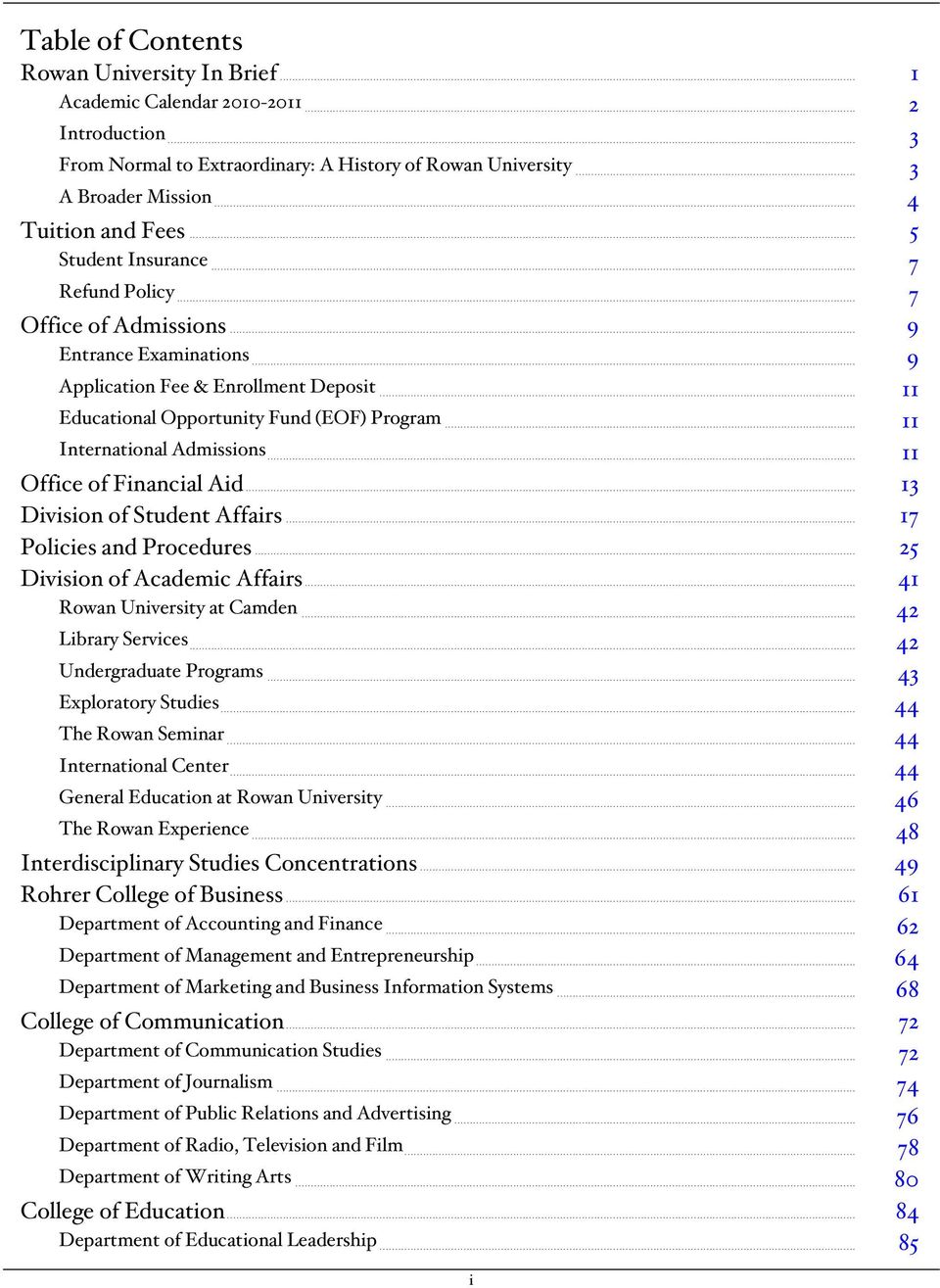
1 Table of Contents Rowan University In Brief Academic Calendar Introduction From Normal to Extraordinary: A History of Rowan University A Broader Mission Tuition and Fees Student Insurance Refund Policy Office of Admissions Entrance Examinations Application Fee & Enrollment Deposit Educational Opportunity Fund (EOF) Program International Admissions Office of Financial Aid Division of Student Affairs Policies and Procedures Division of Academic Affairs Rowan University at Camden Library Services Undergraduate Programs Exploratory Studies The Rowan Seminar International Center General Education at Rowan University The Rowan Experience Interdisciplinary Studies Concentrations Rohrer College of Business Department of Accounting and Finance Department of Management and Entrepreneurship Department of Marketing and Business Information Systems College of Communication Department of Communication Studies Department of Journalism Department of Public Relations and Advertising Department of Radio, Television and Film Department of Writing Arts College of Education Department of Educational Leadership i
2 Department of Foundations of Education Department of Health and Exercise Science Department of Reading Department of Special Educational Services/Instruction Department of Teacher Education College of Engineering Department of Chemical Engineering Department of Civil and Environmental Engineering Department of Electrical and Computer Engineering Department of Mechanical Engineering College of Fine and Performing Arts Department of Art Department of Music Department of Theatre and Dance College of Liberal Arts and Sciences Department of Biological Sciences Department of Chemistry and Biochemistry Department of Computer Science Department of English Department of Foreign Languages and Literatures Department of Geography and Anthropology Department of History Interdisciplinary Studies Bachelor of Arts Programs Department of Law and Justice Studies Department of Mathematics Department of Philosophy and Religion Studies Department of Physics and Astronomy Department of Political Science Department of Psychology Department of Sociology College of Professional and Continuing Education Faculty List Course Information Nomenclature of Courses General Education Course Listing Rowan Experience Course Listing Course Descriptions Organization of the University Executive Administration ii

3 General Information Campus Buildings Administrative Offices Telephone Numbers Directions to Campus The Emeriti Accreditations iii

4 Rowan University In Brief Type Comprehensive, coeducational, non-sectarian, state-supported, founded in 1923 Colleges Business, Communication, Education, Engineering, Fine and Performing Arts, Liberal Arts and Sciences, Professional and Continuing Education Degrees Bachelor of Arts, Bachelor of Fine Arts, Bachelor of Music, Bachelor of Science, Master of Arts, Master of Business Administration, Master of Education, Master of Engineering Management, Master of Music, Master of Science, Master of Science in Teaching, Educational Specialist, and Doctor of Education Campuses Glassboro, NJ Main (approximately 20 miles southeast of Philadelphia, PA) and Camden, NJ Branch Size Approximately 8,435 full-time and 2,727 part time students; approximately 574 full-time equivalent (FTE) faculty Average Costs ( )* Tuition & Fees Room & Board Total In State $11,234 $9,778 $21,012 Out of State $18,308 $9,778 $28,086 College of Professional and Continuing Education rates visit *subject to annual change. 1 ROWAN UNIVERSITY UNDERGRADUATE CATALOG

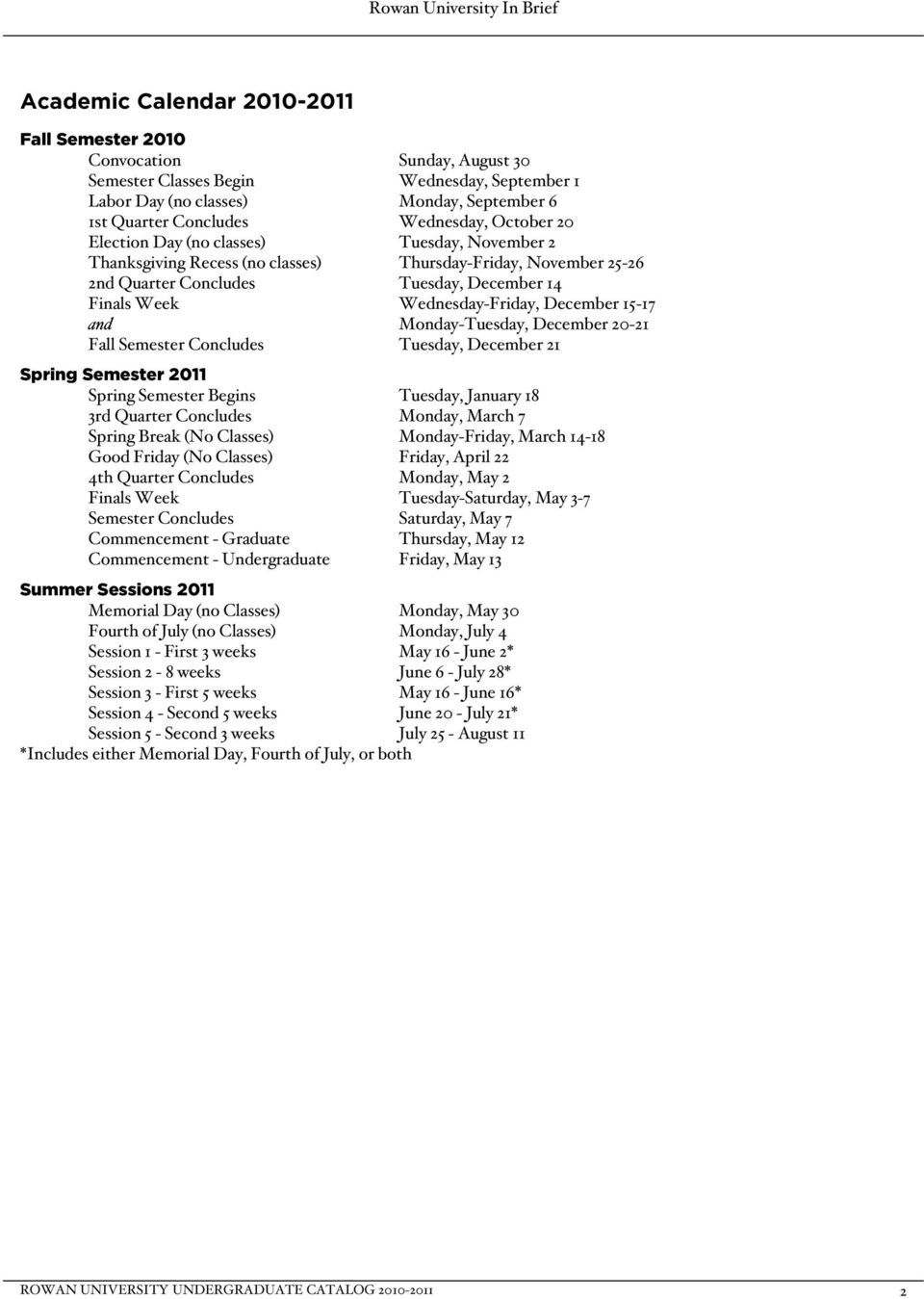
5 Rowan University In Brief Academic Calendar Fall Semester 2010 Convocation Sunday, August 30 Semester Classes Begin Wednesday, September 1 Labor Day (no classes) Monday, September 6 1st Quarter Concludes Wednesday, October 20 Election Day (no classes) Tuesday, November 2 Thanksgiving Recess (no classes) Thursday-Friday, November nd Quarter Concludes Tuesday, December 14 Finals Week Wednesday-Friday, December and Monday-Tuesday, December Fall Semester Concludes Tuesday, December 21 Spring Semester 2011 Spring Semester Begins Tuesday, January 18 3rd Quarter Concludes Monday, March 7 Spring Break (No Classes) Monday-Friday, March Good Friday (No Classes) Friday, April 22 4th Quarter Concludes Monday, May 2 Finals Week Tuesday-Saturday, May 3-7 Semester Concludes Saturday, May 7 Commencement - Graduate Thursday, May 12 Commencement - Undergraduate Friday, May 13 Summer Sessions 2011 Memorial Day (no Classes) Monday, May 30 Fourth of July (no Classes) Monday, July 4 Session 1 - First 3 weeks May 16 - June 2* Session 2-8 weeks June 6 - July 28* Session 3 - First 5 weeks May 16 - June 16* Session 4 - Second 5 weeks June 20 - July 21* Session 5 - Second 3 weeks July 25 - August 11 *Includes either Memorial Day, Fourth of July, or both ROWAN UNIVERSITY UNDERGRADUATE CATALOG
6 Rowan University In Brief Introduction From Normal to Extraordinary: A History of Rowan University Rowan University has evolved from its humble beginning in 1923 as a normal school, with a mission to train teachers for South Jersey classrooms, to a comprehensive University with a strong regional reputation. In the early 1900s, many New Jersey teachers lacked proper training because of a shortage of schools in the state that provided such an education. To address the problem in South Jersey, the state decided to build a two-year training school for teachers, known then as a normal school. The town of Glassboro was an early favorite because of its excellent rail system, harmonious blend of industry and agriculture, natural beauty and location in the heart of South Jersey. Several towns in the region competed to be the site of the new normal school because of the economic benefit and prestige such an institution would bring. In 1917, to sway the decision in their favor, 107 residents of Glassboro raised more than $7,000 to purchase 25 acres, which they offered to the state for free if the borough was selected as the site. The land tract included the Whitney mansion (now known as Hollybush) and carriage house. Before the purchase, the entire property belonged to the Whitney family, prominent owners of the Whitney Glass Works during the 1800s. This show of support, along with the site's natural beauty, convinced the selection committee that Glassboro was the perfect location. A Strong Foundation In September 1923, Glassboro Normal School opened with 236 students arriving by train to convene in the school's first building, now called Bunce Hall. Dr. Jerohn Savitz, the institution's first president, expanded the curriculum as the training of teachers became more sophisticated. Despite the rigors of the Depression, the program was expanded to four years in 1934, and in 1937 the school changed its name to New Jersey State Teachers College at Glassboro. The college gained a national reputation as a leader in the field of reading education and physical therapy when it opened a clinic for children with reading disabilities in 1935 and added physical therapy for the handicapped in The college was one of the first in the country to recognize these needs and was in the forefront of the special education movement. Rowan's second president, Dr. Edgar Bunce, created a junior college program in 1946 to serve World War II veterans taking advantage of the GI Bill. In the 1950s, Dr. Thomas Robinson, the University's third president, expanded the curriculum, increased enrollment and added several buildings to the campus. In 1958, the school's name was changed to Glassboro State College to better reflect its mission. A Historic Summit The University received worldwide attention when it hosted a historic summit conference between President Lyndon Johnson and Soviet Premier Aleksei Kosygin in Hollybush. The University was chosen because of its strategic location midway between Washington, D.C. and the United Nations Building in New York City where Kosygin was scheduled to speak. The meetings between the two leaders on June 23-25, 1967, led to a thaw in the Cold War and eased world tensions. Rapid Growth to Serve Needs The University's fourth president, Dr. Mark Chamberlain, guided the college through its next phase of growth as enrollment doubled and the college became a multi-purpose institution. As new majors and a Business Administration Division were added, the four divisions grew into schools and a board of trustees was formed. In 1969, the University opened a campus in Camden to expand its educational services. With a 1978 Division III National Championship in baseball, the first of 11 national championships for the college, the athletic program established itself as one of the premier athletic programs in the country. The fifth president, Dr. Herman James, assumed the leadership of the college in Under his direction, Rowan expanded by establishing the first doctoral program among the state's public institutions and adding the Colleges of Engineering and Communication. Dr. James was also responsible for the construction of Campbell Library, the Student Recreation Center and Rowan Hall. A Transformative Gift In July 1992, industrialist Henry Rowan and his wife, Betty, donated $100 million to the institution, then the largest gift ever given to a public college or University in the history of higher education. Later that year, the school changed its name to Rowan College of New Jersey to recognize its benefactorsâ generosity. The college achieved University status in 1997 and changed its name to Rowan University. 3 ROWAN UNIVERSITY UNDERGRADUATE CATALOG

7 Rowan University In Brief A Broader Mission To lead Rowan University into the 21st century, the Board of Trustees named Dr. Donald J. Farish as the sixth president in July Under his leadership, the University is working on an aggressive improvement plan that will give the University a national reputation for excellence and innovation and will make it the public University of choice in the region. The plan calls for a greater campus-wide focus on academic and student support initiatives as well as more than $500 million being spent on campus construction and renovation projects. Recent campus improvements include the construction of the University townhouses; Science Hall; Education Hall; and the Samuel H. Jones Innovation Center, the first building of the South Jersey Technology Park at Rowan University. Additionally, Rowan Boulevard, a $300-million mixed-use redevelopment project, is linking the campus with Glassboroâs historic downtown. The public/private partnership between the borough, developer SORA Holdings, and Rowan will create a unique college town setting in the form of a corridor complete with student apartments, a Barnes & Noble Collegiate Superstore, a hotel, shops and restaurants. These efforts have caught the attention of national organizations that evaluate colleges and universities. U.S. News & World Report ranks Rowan University in the "Top Tier" of Northern Regional Universities. Kaplan included the University in "The Unofficial, Biased Insider's Guide to the 320 Most Interesting Colleges." Also, Kiplinger's named Rowan University one of the "100 Best Buys in Public Colleges and Universities," and the Princeton Review included Rowan in the latest edition of "The Best Northeastern Colleges." Numerous Opportunities Rowan's more than 11,000 students can select from among 80 undergraduate majors, 55 master's degree programs and a doctoral program in educational leadership. The University is divided into six academic colleges: Business, Communication, Education, Engineering, Fine & Performing Arts and Liberal Arts & Sciences. It also provides educational opportunities through its College of Graduate and Continuing Education and is developing Cooper Medical School of Rowan University in partnership with Cooper Hospital. Cooper Medical School will be the first new medical school created in the state in more than 30 years and the first-ever four-year allopathic medical school in South Jersey. From the modest normal school begun more than 85 years ago, Rowan University has become an extraordinary comprehensive institution that has improved the quality of life for the citizens of New Jersey and the surrounding states. ROWAN UNIVERSITY UNDERGRADUATE CATALOG

8 Tuition and Fees The following is a summary of fees charged at Rowan. Tuition and other charges are subject to change at any time in accordance with policies established by the board of trustees of Rowan University. The fees do not include the cost of textbooks and personal expenses. Fees at Rowan for academic year are: Admissions Application (Graduate and Undergraduate): $50 Meal Plans: 14 Meal Plan with $200 Dining Dollars + $400 Boro Bucks $3, Meal Plan with $200 Dining Dollars + $400 Boro Bucks $3,200 7 Meal Plan with $200 Dining Dollars + $400 Boro Bucks $2,620 All Access Meal Plan $150 Dining Dollars + $200 Boro Bucks $3,710 Freshman Acceptance Fee (not refundable) $100 Housing in Residence Hall $6,248-$7,306 Housing Deposit $200 Housing in Edgewood Park Apartments $6,538 Triad Apartments $6,538 Town House $7,882 Rowan Blvd. $8,600 Identification Card $10 ID Card Replacement $25 Deferred Payment Plan Fee $30 Late Payment Fee $25-50 Late Registration Fee $75 Returned Check Charge $25-50 Parking Fee $60 Student Accident and Health Insurance (subject to change) $158 University Fee (p-t) $135.50/credit (f-t flat rate) $1,580.00/semester Student Teaching $ Transcript $10/15 Library Fines First Notice $1 2nd Notice $3 3rd Notice $6 Library fines are imposed on users who are delinquent in the return of library materials. The cost of repair or replacement of lost or damaged materials will be charged to users. Current fines and other charges are posted on the Library Services website. Library and other services may be denied if fine obligations are not met. Tuition Tuition for each semester will be charged on a per credit hour basis for part-time students and flat rate for full-time students. Undergraduate tuition rates ( ) are: New Jersey resident $590/credit Non-resident $590/credit Graduate tuition rates ( ) are: New Jersey resident (p-t) $590/credit (f-t flat rate) $5,312 Non-resident (p-t) $590/credit (f-t flat rate) $5,312 Expenses The Business Office is responsible for all billing of students and for the collection of payments. A statement of expenses for the fall semester will be mailed by July 6. A similar statement will be mailed by November 30 for the spring semester. All charges must be paid in full each semester on or before the date stipulated in the statement of expenses given each student. Students who do not pay their bills will be withdrawn from classes in accordance with the University policy on 5 ROWAN UNIVERSITY UNDERGRADUATE CATALOG

9 Tuition and Fees outstanding financial obligations. Credit may be extended to students engaged in negotiations concerning state scholarships, loans or grants. Questions regarding university expenses should be discussed with personnel in the Bursar's Office ( ). Checks in payment of all charges should be made payable to Rowan University. Payment may also be made with Master Charge, Visa, Discover or American Express. Detailed information on use of these credit cards is available to students prior to the beginning of each semester. All students qualify for the deferred payment program. Information on the deferred payment plan is available on the University invoice and in the Bursar's Office. Tuition and fees, regulated by Rowan University, are subject to change without notice to individual students. Summary of Expenses Estimated fees and expenses for New Jersey residents living on-campus or commuting are summarized below. Yearly Residents Commuters Tuition (30 cr/year is average $8,074 $8,074 load) University Fee $3,160 $3,160 Room and Board $9,778 Total expenses $21,012 $11,254 Based on the following: Residence Room (double) $6, Meal Plan $3,530 Tuition and fees for full-time out-of-state students is $18,308/year based on an average 30 credit hours a year. Tuition and other charges are subject to change at any time in accordance with policies established by Rowan University. Food Services Students living in a residence hall must purchase an unlimited, 14, 10 or 7 Meal Plan. Students living in apartments or off-campus also may purchase a Meal Plan, but it is not required. Residence Hall Residence halls and apartments are available to Rowan University students. Please visit for more information. Security deposits are required with application. Deposits are refunded when a reservation is canceled within the time frame set by Residence Life. University Fee This fee is charged to all students at $ per credit hour with a maximum of $1,580 per semester. The purpose of this fee is to help defray the costs of an array of varied but integral services and projects that directly affect our student's everyday. Some of these important areas are briefly described below. The fee helps to offset placement service costs in order to assist all of our students as they proceed from the academic world to the job market. It assists in the overall support of our Student Health Center which offers treatment to currently enrolled students for acute illnesses, urgent care situations and certain health promotion needs. Registered nurses are available. The funds received provide much needed support for expansion and upgrade of our computer labs and academic programs. The fee helps defray the cost of debt service on recently constructed or renovated buildings as well as the operation and maintenance cost of newly constructed buildings and partially finances the operations of the Recreation Center and Student Center. Late Payment Fee Students on Deferred Payment Plan who fail to pay bills by the date due will be charged a non- refundable late payment fee between $25 and $50, depending on when payment is made. Late Registration Fee Students who fail to register at the time designated will be charged a non-refundable $75 fee. Parking Commuting students may park on campus after purchasing a Rowan University parking decal. Decals are $60. Students with a commuter decal may park in a designated white lined space in Lots A, B, C, D, M, R and Y. Freshmen living on campus are NOT permitted to purchase a decal or have a vehicle on campus. Sophomores, juniors and seniors residing on campus may purchase a decal and will be permitted to park only in designated resident lots. Vehicles parking without a decal or in other than a designated space will be subject to a fine and having the vehicle towed at owner's expense. Handicapped spaces are provided for individuals whose physical handicaps require their use. A handicapped parking decal from Rowan must be displayed. This rule is vigorously enforced. ROWAN UNIVERSITY UNDERGRADUATE CATALOG

10 Tuition and Fees Returned Check Charge A charge of $25-50 will be made for each check that is given to the University if it is returned by the bank for any reason. Identification Cards The University requires that all matriculated students carry an official identification card at all times. This card is needed for library use, student activities, registration, cashing checks, recreation center and security purposes. The initial charge for an ID card is $10, and a $25 charge is made for each replacement of a lost card. Required Pre-matriculation Immunization and Medical Records As a condition of admission and continued enrollment, each student is required to provide evidence of immunization against measles, mumps, and rubella (N.J.S.A. 18A:61D-1). Students are also required to have vaccination against Hepatitis B (Series of 3 vaccines). Any student living in campus housing is required to first have vaccination against meningitis (Menactra ). Students are also required to submit a complete health record to the student health center. Failure to submit these requirements will result in an immunization hold that will prevent the student from living in campus housing or registering for courses. Additional information on these requirements is available from the Student Health Center website at Student Insurance New Jersey State law requires that all matriculated, fulltime students have health insurance coverage. To that end, all matriculated fulltime students will be automatically charged a Student Health Insurance fee ($166 fee ). To waive this fee, the student must complete a waiver identifying their current insurance coverage. This waiver must be completed, signed and returned to the Bursar's office prior to the start of the student's first semester and every Fall semester thereafter. Waivers may be downloaded from the bursar's website at More information can be obtained about Student Health Insurance from the Health Center Website at It is important to note that this insurance coverage is a limited plan. It is important for student and parents to review the coverage offered in the plan. Coverage for part-time students, spouses and children is available for a fee paid directly to the insurance company. See the Health Center website for more information. All students who compete in intercollegiate sports programs are covered while participating by a separate policy purchased by the university. Premiums for insurance are subject to change. Student Teaching Fee All teacher preparation students pay a student teaching fee of $ which covers the normal expenses incurred in the program, including a payment to the cooperating teacher. Students will be billed for this fee prior to the semester in which they are enrolled for student teaching. Transcript Fee A transcript is provided to each student upon graduation. Additional transcripts are available through the Registrar's Office for $10/15 each. Refund Policy Refunds will be prepared for all students who officially withdraw from the University. Requests for official withdrawal must be made through the Counseling Center. This procedure assures that students will receive the proper refund for tuition, fees, room and board charges. Approved Refund Schedule Tuition, and University fee only. Part-Time students: Written notice, using a Withdrawal Form (available from the Registrar's Office) must be submitted to the Registrar. The date of receipt of the Withdrawal Form in the Office of the Registrar will be used in computing the refund. Full-Time students: Refunds will be processed only for students who officially withdraw from all of their courses. There is no refund for withdrawal from individual courses. Financial Aid students: Refunds of Federal Financial Aid are processed in accordance with federal guidelines: Withdrawal before end of Add/Drop 100% Registration Withdrawal after Add/Drop None Room and Board Refunds for residence halls and for meal plans will be calculated as of the Sunday and Friday (respectively) immediately following the date of the student's official withdrawal. Refunds for room shall be pro-rated on a weekly basis until the end of the fifth week of the semester, at which point there will be no refund for the remaining weeks of the term. 7 ROWAN UNIVERSITY UNDERGRADUATE CATALOG

11 Tuition and Fees Outstanding Financial Obligations The University may deny a student graduation, readmission, registration, or records because of outstanding financial obligations to the University. This action may be taken in cases where reasonable notice of a debt and the consequences of nonpayment have been given to the student. If a student does not meet his/her outstanding obligations by the established deadlines under the policy, the student will automatically be denied registration for the following semester, in addition to losing all other university services. Denial for future semesters will also be continued until such time as the obligation is met. The student will have the right to a hearing in cases of dispute concerning an obligation. The request for a hearing must be submitted in writing by the student to the appropriate department or office head in which the obligation exists. If it becomes necessary, any appeal of a decision resulting from such a hearing must be arranged through the collection manager, Business Office, Savitz Hall or dean of students, Savitz Hall. The University will have the right to withhold the degree and all records, including certification, transcripts, placement services, etc., pending satisfactory financial arrangements. A complete text of the Outstanding Financial Obligations Policy may also be obtained from the collection manager, the business office, or the Dean of students in Savitz Hall. ROWAN UNIVERSITY UNDERGRADUATE CATALOG

12 Office of Admissions Albert Betts, Jr., Director Savitz Hall Rowan University admits applicants to undergraduate study on the basis of academic and personal qualifications. Recruitment and admission procedures are designed to enroll students who will benefit from and contribute to the University as it meets the challenges of the future. In addition to the traditional admission program, the University is also interested in providing educational opportunities for non-traditional students, i.e., the disadvantaged, minority students, adult students, veterans, etc. Freshman Admissions Rowan's admission process adheres to general policies established by the New Jersey Commission on Higher Education and the Rowan University Board of Trustees. Applicants are carefully considered in view of their total secondary school record, performance on the SAT I or ACT examination, school and community activities, post-secondary school experiences, and the University's estimate of the applicants potential as students and members of society. Applicants for Art, Music, Theatre and Dance are also required to complete an on-campus portfolio review or audition and interview. Deadlines for submitting freshman application and official records: January - Applicants should take the SAT I or ACT exam no later than the January testing date to ensure receiving all test scores by the admission deadline date. This is also the appropriate time to request that mid-term senior grades be sent to the Admissions Office. March - All applications, official high school transcripts and SAT I/ACT scores, must be complete and received by the Admissions Office by March 1. Electronic Application Freshman and transfer students have the option to apply electronically for admission to Rowan University through the links provided on the Rowan web site. Electronic application requires credit card payment of the application fee at the time of application submission. Other types of fee payment such as personal check or money order require using the paper application. Once received, electronic applications are processed according to the same standards, procedures, policies and timelines as paper application. Eligibility for Admission Applicants for admission to Rowan University must present certificates or transcripts proving graduation from an approved secondary school, or they must indicate that graduation is scheduled during the current scholastic year. GED equivalencies are considered in lieu of high school diplomas. Applicants should ensure that this information is forwarded to the Admissions Office. Applicants must show they have completed or are in the process of completing a minimum of 16 college preparatory courses to be eligible for consideration for admission. The New Jersey Commission on Higher Education has set the following college preparatory guidelines for admission: 4 units - English 2 units - laboratory science* 3 units - college prep mathematics (Algebra I & II, geometry)* 2 units - social studies 5 units - Additional work in at least two of the following areas: English, history, languages (minimum of two units in one language), mathematics, social science and science. *The College of Engineering seeks applicants with 3 units of laboratory science including chemistry and physics and 4 units of college preparatory mathematics including pre-calculus (calculus preferred). Entrance Examinations Applicants should submit either the SAT I or the ACT test scores in support of their application to Rowan University. Scholastic Assessment Test SAT I tests are given in numerous centers, usually in high schools, throughout the United States. Applications should be sent to College Entrance Examination Board, P.O. Box 592 Princeton, NJ 08540, or online at Applications should request that results be sent to Rowan University: C.E.E.B. Code American College Testing Program Student registration manuals are available in most high schools. Materials can also be obtained from ACT, P.O. Box 168, Iowa City, Iowa 52240, or online at Early Admission Rowan will consider an applicant just completing their junior year in high school. Students applying for early admission should be exceptionally well qualified, and have the support of family and high school officials. An interview is required for early admission. 9 ROWAN UNIVERSITY UNDERGRADUATE CATALOG

13 Office of Admissions Deferred Admission Rowan University is aware and, in many cases, approves of the feeling of many high school seniors that a year's experience between high school and college would be beneficial. A year away from formal academic work frequently sharpens the student's sense of direction and purpose. Any student who is accepted, pays the admission deposit, and then chooses to defer registration in courses at Rowan, must request deferred admission status before June 1. Deferred admission is not an option for those admitted to special admission programs or the EOF program. Out-Of-State Applicants Rowan University welcomes applications from out-of-state students. Advanced Placement Rowan University awards credit for the College Entrance Examination Board Advanced Placement examinations for scores of 3, 4, or 5. Candidates must arrange to have official score results forwarded to the University Registrar. Upon written request, degree credit equivalent to one semester's work (3 s.h.) will be awarded in that particular subject or its equivalent. Advanced placement credit is recognized as fulfilling general education requirements where applicable and will be considered as un-graded, transfer credit. The College-Level Examination Program (CLEP) is a series of examinations that allow students to demonstrate their knowledge in a wide range of subjects and receive credit. (See additional information in Course Credit by Examination.) Campus Visits & Interviews Students applying for admission to Rowan University are encouraged to visit the campus. Campus tours are offered several times a week throughout most of the year. The University also holds numerous open house programs throughout the year. Specific dates are listed in admissions publications and on the Rowan University website For those interested in studying at the Camden Campus, you may contact the Camden Admissions officer at for a tour and information. Individual interviews are not required unless specifically requested by the Admissions Office. Transfer Admission Students who have completed a minimum of 12 semester hours of transferable credit by the application deadline, are classified as transfer applicants. Rowan University admits transfer students on a competitive, space available basis. The cumulative GPA for all college work is the primary consideration for Rowan University's admission decisions. Although most programs require a 2.5 minimum GPA, some majors may also require completion of specific courses prior to admission. Transfer applicants should complete the following steps: 1. File an application for admission with all required documents and the $65 non-refundable application fee by March 1 for September entrance 2. Arrange to have official transcripts of all previous academic work sent from each college attended to Rowan's Admissions Office. Students with fewer than 24 credits completed by the deadline are also required to submit SAT I or ACT scores and their high school transcripts. 3. Payment of a non-refundable enrollment deposit after being offered admission and then enrollment in courses, completes the admission process. All potential transfers are accepted based on their academic credentials and choice of major. Candidates are given priority as follows: (1) completion of an associates degree or 60 transferable credits, (2) completion of transferable credits, (3) completion of transferable credits. County college transfer students are encouraged to complete the associate degree before transferring. Transfer students are encouraged to take advantage of information available through their community college transfer counselor, the Rowan University transfer equivalent information available on our website, and the NJ Transfer initiative njtransfer.org. Students who have been dismissed by their previous college are not immediately eligible for admission to Rowan University. Students must wait at least one year and show appropriate interim activities to be eligible for consideration. Students seeking to transfer into the Art, Music or Theatre and Dance programs must contact the appropriate department to arrange for a portfolio review or audition. These evaluations must be completed before the application deadline. An admission decision cannot be made without results of the performance evaluation. Because transfer admission decisions usually are made on the basis of incomplete transcripts of credit, they are always subject to review on the basis of later information. Offers of admission may be withdrawn if students do not complete their semester in progress satisfactorily. The registrar's office and the faculty make specific evaluations of college transcripts for transfer of credit in the student's major department. Students will receive an evaluation of previous coursework at the time of acceptance. Although applicable credits transfer, grades earned at other colleges do not affect the Rowan GPA. Mid-Year Admission Rowan University generally has junior level transfer openings at mid-year. Although other applicants may be considered on a space available basis, recent graduates of New Jersey community colleges and those who have completed at least 60 transferable credits from a four-year institution receive priority consideration for mid-year admission. The application deadline for consideration for spring admission is November 1st. ROWAN UNIVERSITY UNDERGRADUATE CATALOG

14 Office of Admissions Application Fee & Enrollment Deposit A $65 non-refundable application fee is required of all applicants. After notification of admission to Rowan University, applicants must send a $100 non-refundable enrollment deposit by the deadline given in the admission letter. This deposit reserves a place for students in the formal enrollment process. Fee Waiver: The $65 application fee may be waived by the University upon written certification by the applicant's school counselor or other school official that payment would constitute a financial burden to the applicant. Such requests must accompany the application. Matriculation: The term matriculation means a student has been formally admitted to Rowan University. A student becomes matriculated by going through the admission process and paying the $100 enrollment deposit. The last step in the matriculation process is enrollment in classes. Entering freshmen and transfer students must register for courses in the semester for which they were accepted to maintain matriculation status. Special Admissions - Adult Learners Rowan University has a special admission program designed to provide adult students who have been out of high school for three years or more with an opportunity to be evaluated for admission on more than the traditional academic information. Adult students' life and work experiences, special talents and motivation supplement traditional academic records in the evaluation of their chances for success at Rowan University. The specific requirements include: high school diploma or GED and SAT I or ACT results; resume of work, home or military experience, three letters of recommendation and a personal interview. Special Admissions - Maximizing Academic Potential Rowan University is deeply committed to supporting the continued and increased enrollment of qualified students from underrepresented groups. To this purpose the University has developed the Maximizing Academic Potential program (MAP). This program enrolls qualified minority and other first generation college students based on the evaluation of their secondary school achievement, recommendations, and assessments of their motivation to succeed. Students admitted under the MAP Program are required to attend a summer enrichment program. Educational Opportunity Fund (EOF) Program In September 1968, Rowan University instituted the Martin Luther King Scholars Program. This program provides access to college for students who are educationally and economically disadvantaged, and who are motivated and have the potential for success. Students are admitted on the basis of their need for more appropriate educational opportunities, their leadership potential, academic promise and financial need rather than past academic achievement alone. Traditional admission criteria are not used to the same degree to evaluate EOF applicants. Emphasis is placed on personal recommendations, personal interviews and assessment of potential rather than the accu-placer score, high school achievement and rank in class. GED equivalencies may be accepted in lieu of the high school diplomas. The Admissions Office in conjunction with the EOF Office selects students. EOF students are required to successfully complete a structured summer program prior to entering the fall semester. In the summer session, students are evaluated in various academic areas and receive concentrated developmental and supplementary instruction and tutoring as necessary. These supportive services are extended throughout the academic year. Students who successfully complete the Pre-College Institute are invited to return for the fall semester and are fully integrated into the University and enrolled as matriculated students. The program staff provides a comprehensive program of guidance and counseling for EOF students. Information concerning financial aid available to EOF students can be found under or by contacting the Rowan University Admissions Office. International Admissions Rowan University welcomes international applicants. Please contact the Office of Inter-national Student Services by phone or [email protected] or visit our website for detailed information. Placement/Basic Skills/Testing Requirements All freshmen and transfer students with less than 30 credits are required to take placement tests prior to registering for course work. These tests are designed to determine competency levels in the cognitive skill areas of mathematics, reading, and writing. Instructions for taking the placement examinations are included in the admission acceptance package. Students who are required to enroll in basic skills courses must complete such courses within one year. If the requirement is not satisfied within the required time, students are recommended for suspension. Basic skills courses do not count toward the minimum number of semester hours needed to complete the students major and/or degree requirement. Students majoring in mathematics, engineering, physical or computer science must also take a calculus-ready test. Students may also choose to take a Computer Competency Exam at the same time as the placement tests for reading and mathematics. The computer competency requirement may be fulfilled in one of two ways: 1. Pass the Computer Competency Exam. 11 ROWAN UNIVERSITY UNDERGRADUATE CATALOG

15 Office of Admissions 2. Pass a three-credit Basic Skills Computer Literacy course. Re-Entrance/Re-Admission To The University Students who have lost their matriculated status due to inactivity, withdrawal or dismissal before completing their major programs and/or being awarded their bachelor's degrees must apply for readmission to the University, following the reentrant application procedures, in order to regain matriculated status, become eligible to enroll in restricted course work, and request a Rowan degree. Students who lost their matriculated status due to graduation and would now like to return to Rowan to pursue a second bachelor's degree in an unrelated area must follow transfer application procedures (see Transfer Admission). Students seeking re-entrance to the University must file the "Re-Entrant Application" by May 1 for fall semester entrance or November 1 for spring semester entrance. Any additionally required application materials must also be received in the Admissions Office by these deadline dates. As part of the application process, students who were officially dismissed from the University must submit a written statement describing their activities since dismissal and three letters of recommendation. They must also arrange an interview with an authorized Admissions Office staff member. Students who have been dismissed for academic reasons may not register for any Rowan University courses, except basic skills course work. Completed re-entrant applications are reviewed and evaluated by the Admissions Committee and, in some cases, the applied major's academic department. Readmission to some majors requires departmental approval. ROWAN UNIVERSITY UNDERGRADUATE CATALOG

16 Office of Financial Aid Luis Tavarez, Director Savitz Hall Phone: Fax: Rowan University believes that all qualified students should have the opportunity to attend the University regardless of their financial resources. Rowan University offers financial assistance through scholarships, grants, loans and work programs. The cost of tuition at Rowan University is far less than that of many other colleges because of the subsidies received from the State of New Jersey and from the University's endowment. Students seeking assistance must file the Free Application for Federal Student Aid (FAFSA). The FAFSA is used to determine eligibility for assistance from the federal and New Jersey state financial aid programs. The FAFSA is available on the web at There is a paper version of the FAFSA which may be obtained only by calling FED-AID. We encourage applicants to file their FAFSA on the web. It is very important to designate Rowan University as a college choice by including Rowan University's federal school code on the FAFSA. As the result of completing and filing the FAFSA, the student receives a Student Aid Report (SAR) from the Federal Processor. Students should read and follow all instructions on the SAR. Federal Return of Title IV Funds Policy Students who receive federal financial aid - including loans - and withdraw or drop out of all of their classes on or before completing 60% of the semester will have their financial aid awards prorated. For more information, visit the financial aid office or our web site: Federal Pell Grant Program Pell Grant is an entitlement program made available by the federal government. The amount of any grant is based on the results of a formula established by the federal government. Additionally, the amount of the grant is affected by the amount of funds available to the program and the number of credits the student is (will be) taking. To be eligible for this grant, students must meet other criteria: 1. Students must matriculate in an eligible program. 2. Students must be U.S. citizen or an eligible non-citizen. 3. Students must demonstrate financial eligibility as determined by the need analysis formula and Pell Grant table. Federal Supplemental Educational Opportunity Grants Federal Supplemental Educational Opportunity Grants (SEOG) are available to students who demonstrate exceptional financial need and who also receive Pell Grants. Students applying for financial aid are automatically considered for a Supplemental Educational Opportunity Grant. Federal Stafford Student Loan Through the Federal Direct Student Loan Program matriculated students enrolled at least half time may borrow a maximum of $5,500 for their freshman year, $6,500 for their sophomore year, and up to $7,500 for both their junior and senior years. Students apply by completing the Free Application for Federal Student Aid (FAFSA), indicating that they are willing to accept financial aid in the form of a loan. There are two types of Federal Stafford Loans: 1. Subsidized: If the student demonstrates need based on the Student Aid Report, the federal government will pay the interest charge while the student is enrolled at least half-time. Students must pay the interest charge during the repayment period following graduation or withdrawal from the university. 2. Unsubsidized: All matriculated students enrolled for six credits or more may receive a Federal Unsubsidized Stafford Loan regardless of family income. However, the student will have to pay all interest charges until the loan is fully repaid. Federal Parent Loan for Undergraduate Students (PLUS) Parents of matriculated, dependent, undergraduate students enrolled at least half-time and making satisfactory academic progress towards a degree or certificate may borrow up to the cost of education from the federal government. Parents must be citizens or eligible non-citizens of the United States and pass a financial credit check. The PLUS loan, when added to other financial aid and/or resources, may not exceed the total cost of education for that academic year. TEACH Grants Grants offered to students pursuing a career in teaching in high need subject areas i.e. math, reading specialist, sciences, etc. The grants are for up to $4,000 each year. Students must teach four years in a low-income school district to earn their grants. If the recipient does not end up teaching at a low-income school district for the required four years, the grant will be treated as an unsubsidized student loan and must be repaid. 13 ROWAN UNIVERSITY UNDERGRADUATE CATALOG

17 Office of Financial Aid Federal Work Study Program With funds supplied by the Federal government, Rowan University provides jobs both on and off campus during the academic year for students who qualify. Students should indicate an interest for this program on the FAFSA. Many work-study positions provide skills and experience, which will assist students in their career development. Students can arrange their hours to the time they have available to work. Hours worked cannot exceed 20 per week while classes are in session or 30 per week when classes are not held. For more information, please see our web site at the following link: Institutional Work Study Program The University offers student jobs during the academic year and summer. Positions vary from general office to professional opportunities. Many work study positions provide skills and experiences, which will assist students in their career development. Students can arrange their hours to the time they have available to work. Hours worked cannot exceed 20 per week while classes are in session or 30 per week when classes are not held. For more information, check our web site at: FINANCIAL AID PROGRAMS AVAILABLE TO RESIDENTS OF NEW JERSEY Tuition Aid Grants (TAG) New Jersey Tuition Aid Grant (TAG) recipients must be residents of New Jersey for 12 consecutive months prior to receiving this grant. In addition, recipients must enroll as full- time undergraduates and must demonstrate financial need. Actual awards depend on state funding and the tuition charges. The New Jersey Higher Education Assistance Authority notifies students of their eligibility. Bloustein Scholars Program The Distinguished Scholars Program provides a $1,000 annual scholarship award for up to four years of undergraduate study at a New Jersey college or university and is renewable as long as satisfactory academic progress is made. Students are selected by their high schools and the New Jersey Office of Student Assistance. Educational Opportunity Fund Established by the New Jersey State Legislature in early 1968, the Educational Opportunity Fund (EOF) helps disadvantaged students. Eligibility is judged on financialneed and motivation for future academic work, not just on past grades or test scores. Students must live in New Jersey for twelve months before receiving this aid. To be considered for this program, students should write to request application forms from the Director of Admissions, Rowan University, Glassboro, NJ Rowan University's Educational Opportunity Fund Offices on the Glassboro and Camden campuses can provide more information. Satisfactory Academic Progress Satisfactory academic progress (SAP) towards the degree is necessary in order to receivefinancial aid from the state and federal programs. Satisfactory academic progress towardsthe degree is determined by the completion of coursework as well as the cumulative gradepoint average. Satisfactory Academic Progress Requirements Each year a student's progress will be measured by comparing the number of attempted credits with the credit hours earned. This includes any course for which the student has remained enrolled past the Drop/Add period, also courses not completed such as (W, WP, WF, NC, NA, INCs). A student must complete 70% of credits attempted at Rowan University to maintain satisfactory academic progress (Audited courses are not considered credits attempted). A student is eligible to receive funding up to 171 attempted credit hours. Special Admission Programs are allowed to receive funding up to 180 credits. Some programs limit funding on a semester basis. Transfer credits are counted toward the 171/180 limit. Additionally, students must maintain minimum GPA that exceeds the Academic Dismissal. See the Academic Standing Policy for Dismissal/Academic Probation in this catalog. Students who progress at the minimum rate established herein will run out of eligibility for certain state financial aid programs prior to completing their degree. These guidelines apply to all undergraduate programs. Students may appeal the removal of financial aid if there are mitigating circumstances. If the appeal is approved, aid will be reinstated. A brochure further detailing the SAP requirements is available in the Financial Aid Office. Rowan University Scholarships Rowan University rewards academic success through our scholarship program. Scholarships are awarded to qualified first-year students. Scholarships are renewable for an additional six semesters provided students maintain a 3.0 GPA and maintain continous full-time enrollment. Rowan University Outstanding Scholars Recruitment Program This is a merit-based scholarship program to reward recent high school graduates who have achieved academic distinction as indicated by high school percentile rank and SAT I (math + critical reading) score. Scholarships range from $2,000 to $10,900 depending upon student's qualifications. ROWAN UNIVERSITY UNDERGRADUATE CATALOG

18 Office of Financial Aid Doris V. Broome Scholarships Offered to incoming freshmen with outstanding academic records (1,100 SAT I, class rank in top 10 percent). 3.0 GPA required for renewal. $1,000 yearly for four years. Alumni/Broome Scholarships Offered to incoming freshmen with outstanding academic records (1,100 SAT I, class rank in top 10 percent). 3.0 GPA required for renewal. Scholarships range from $750 to $1,000 yearly for four years. Rowan University Foundation Scholarships $500 yearly for four years offered to outstanding freshmen students. 3.0 GPA required for renewal. Art, Music and Theatre Department Scholarships Variable award amounts offered to incoming freshmen and transfer art, music and theatre arts majors with demonstrated talent and academic achievement. Frances R. Lax Scholarships in Fine & Performing Arts Awarded competitively to freshmen fine and performing arts majors with demonstrated talent and significant academic achievement. $1,000 yearly for four years. 3.0 GPA required for renewal. William G. Rohrer Scholarships Awarded competitively to incoming freshman and junior-level transfer business or accounting majors with significant academic achievement as well as demonstrated civic involvement and leadership skills. $2,000 yearly for four years for freshmen, $2,000 yearly for two years for transfers. Transfer Trustee Scholarships Awarded competitively to N.J. community college graduates with a 3.5 GPA or higher attending Rowan University full time. $2,000 yearly for two years. Glassboro High School Scholars Program Graduating Glassboro High School Seniors who match certain criteria are eligible to receive one of three annual scholarships in the GHSS program. As an added incentive, students meeting these criteria also qualify for the Rowan University Scholars Program. The combined scholarships are enough funds to cover all academic expenses such as tuition, fees, room and board, for a full-time undergraduate student who chooses to live on campus. For more information see: Army Reserve Officers' Training Corps (ROTC) Rowan University participates in the U.S. Army Reserve Officers Training Corps (ROTC) Program. The primary purpose of Army ROTC is to provide leaders of character for the 21st century. Students can enroll in ROTC and participate in a uniquely interactive program focused on leadership development with emphasis on self-discipline, integrity, confidence, and responsibility. Our intent is to help the student improve their leadership and management skills whether they decide to pursue a career as an officer in our Army or in the private sector. Students can join the program without any obligation to the Army. Qualified students only sign a contract to serve in the Reserve Forces or Active Army when they begin their junior year or upon receiving an ROTC scholarship. Army scholarships offer an excellent incentive to join the ROTC program. The Army ROTC scholarship program provides financial assistance for the education and training of highly qualified and motivated students who desire to be commissioned as officers in the Army after graduation from college. Scholarships pay full tuition and fees at Rowan University. An additional scholarship benefit is a $1,200 yearly book allowance. Army scholarship winners also receive a tax-free stipend of $300- $500 per a month, depending on academic year, for up to 10 months for each year the scholarship is in effect and the student is in school. Non-scholarship students receive the book allowance and the stipend if they contract their junior year. Students with prior service or who are currently in the National Guard or Army Reserves may enter the program as Simultaneous Membership (SMP) cadets when they begin their sophomore year. SMP Cadets receive an SMP Kicker of $350 a month from the Reserve Component plus an additional $ per month from ROTC as well as any benefits received from the Guard or Reserve. SMP Cadets earn their commission in two to three years. Certain stipulations apply. If interested, students may contact Lieutenant Colonel Jill Nitz, [email protected], at the campus ROTC Office at 401 Mullica Hill Road (856) /5445. For additional information, refer to: Air Force Reserve Officers' Training Corps (ROTC) Air Force ROTC offers one-, two-, and three-year scholarships on a competitive basis to qualified applicants. All scholarships cover tuition, lab fees, and books, plus a tax-free monthly stipend. All members of the POC, regardless of scholarship status, receive the tax-free monthly stipend. (see Interdisciplinary Studies for details of the program.) For further information on the cross-enrollment program, scholarships, and career opportunities, contact the of Aerospace Studies, AFROTC Det 750, Saint Joseph's University, Philadelphia, PA 19131; ; [email protected]. 15 ROWAN UNIVERSITY UNDERGRADUATE CATALOG

19 Office of Financial Aid Upperclass Scholarships Scholarships are available to upperclass students through the University Scholarship Committee. Applications are available at the beginning of December. AFT Martin Luther King, Jr. Memorial Scholarship AFT Memorial Scholarships AFT John J. Schaub Memorial Scholarship AFT Paul K. Tong Memorial Scholarship Robert Becker Memorial Scholarship Marion and William Bickley Memorial Scholarship Robert D. Bole Memorial Scholarship Elizabeth M. Bozorth Recruitment Grant Atlantic City Electric Scholarship Dr. L. Ward Broomall Memorial Scholarship Marian E. Englehard Scholarship Sharon Edwards Scholarship Broome Alumni Association Undergraduate Scholarships Marius H. Livingston Memorial Scholarship AFL-CIO Peter J. McGuire Scholarships Irving Shipkin Scholarship Mabel Spencer Scholarship Mildred King Sangree Scholarship Albert J. Taylor AFL-CIO Scholarship Hazel P. Valiant Scholarship Beatrice Miller Van Doren Memorial Scholarship ROWAN UNIVERSITY UNDERGRADUATE CATALOG

20 Division of Student Affairs Carmen Jordan-Cox Vice President for Student Affairs Savitz Hall The Division of Student Affairs provides and supports a collaborative learning environment that promotes the education of the whole person within a global society. Student Affairs is dedicated to actively engaging students by encouraging healthy life choices, multicultural competency, personal and professional growth, campus and community involvement, civic responsibility and leadership development. As an integral partner in the educational process, Student Affairs is committed to student learning and continual improvement through ongoing assessment and review of its programs and services. The departments within the Division of Student Affairs include: Athletics, Academic Success Center (Basic Skills/Tutoring and Disability Resources and Veterans Testing) Career and Academic Planning (CAP) Center, Center for Addiction Studies, Counseling and Psychological Services, Dean of Students, Dining Services, EOF/MAP, Community Standards and Commuter Services, Multicultural Affairs, Public Safety, Recreation Center, Residential Learning and University Housing, Service Learning and Volunteerism, Student Activities, Student Center, and Student Health Center. These departments are responsible for numerous programs including Greek Affairs, Intramurals, Living and Learning Communities, Mentoring, Orientation, Parent & Family Program, Rowan After Hours, the Sophomore Year Experience, Student Leadership, the Student Government Association, and Student University Programming. Carol A. Gruber Associate Vice President for Student Engagement Savitz Hall, Room [email protected] The Associate Vice President for Student Engagement is responsible for the development of programs and initiatives that engage Rowan University students with their campus and community, in ways that are both intentional and transformational. These initiatives include student transition programming, student leadership, student activities, Greek Affairs, service learning and volunteerism, and student government. The Associate Vice President coordinates the development and implementation of programmatic Student Learning Outcomes and a comprehensive assessment and program review process for the Division of Student Affairs. Additionally, the Associate Vice President assists the Vice President in coordinating the Student Affairs strategic and operational planning process for the Division of Student Affairs. Richard L. Jones Associate Vice President for Residential Learning/Dean of Students Savitz Hall, Room [email protected] The Office of the Associate Vice President for Residential Learning/Dean of Students is responsible for creating and maintaining a safe, healthy, and supportive environment and culture that synthesizes the intellectual, physical, social, emotional, and leadership development of our students in a holistic way reflecting the university's mission, vision and core values. The Office provides oversight for Academic Success Center, CAP Center, EOF/MAP Office, Community Standards and Commuter Services Residential Learning and University Housing, CHAMP/Gear up program, and provides strong advocacy for students and student affairs. The staff and services cultivate an environment that integrates the values and teachings of the Rowan University experience to enhance and support student learning and development and to prepare graduates for lives of discernment, civic engagement and professional growth. As an advocate for students, the Office of the Associate Vice President for Residential Learning/Dean of Students provides guidance and support to students in the following areas; students facing prolonged absences due to a health problem or other extenuating circumstances; reporting sexual assault; and other related student issues. Academic Success Center John Woodruff Interim Director of Academic Success Center Savitz Hall, 3rd floor [email protected] The Academic Success Center provides a myriad of comprehensive programs and services that assist students in enhancing and maximizing their academic potential from Orientation through Graduation. The Center provides services in the following areas; tutorial services, veterans affairs, disability resources, testing/basic skills, academic coaching program, and an array of academic support workshops. 17 ROWAN UNIVERSITY UNDERGRADUATE CATALOG

21 Division of Student Affairs Athletics Joy Solomen Director of Athletics Esby Gymnasium The intercollegiate athletic department strives to be one of the finest Division III programs in the country. By providing strong leadership and competitive experiences, students are afforded the opportunity to develop as a scholar, athlete and citizen. Through strong support services, students are challenged to succeed, inspired to achieve and instilled with a sense of pride and tradition in the college community. Career and Academic Planning Center Lizziel Sullivan-Williams Director of Career & Academic Planning Center Savitz Hall [email protected] The mission of the Career & Academic Planning Center is to engage students in the development and implementation of meaningful educational and career goals consistent with their personal values, interests, and abilities. To this end, the CAP Center advocates the integration of developmental advising and career planning to provide the framework necessary in the educational process. Moreover, the CAP Center is dedicated to providing centralized, comprehensive, and coordinated academic advising programs to all students enrolled in the Exploratory Studies Program (undeclared students) and students changing majors. Finally, the CAP Center fosters excellence in career development, preparation, as well as professional opportunities by providing comprehensive services and programming and by promoting strong partnerships with employers, academic departments, and the university community. Conference and Event Services Tina Pinocci Assistant Vice President for Campus Recreation, Student Center & Conference Services Chamberlain Student Center [email protected] The Office of Conference and Event Services is responsible for planning, developing, implementing and overseeing programs and or services related to Rowan University campus facility rental and conference program development. The Office supports the goals and objectives of the University and the Division of Student Affairs by overseeing and managing scheduling of campus public spaces while maintaining a high standard of quality. The Office of Conference & Event Services is dedicated to strengthening the Rowan University community by providing comprehensive event management services, facilitating the effective and efficient year round use of university resources, and cultivating lasting relationships with clients, partners, and service providers. Counseling and Psychological Services Center David F. Rubenstein, Ph.D. Director of Counseling and Psychological Services Savitz Hall, 3rd floor for questions or to schedule an appointment The Counseling and Psychological Services Center (CPSC) provides confidential mental health services to enrolled students. The Center provides individual and group counseling, triage and emergency evaluations, psychological testing and outreach programs in the area of mental health. Some common areas addressed for college students include academic/personal skill building, personal and family relationships, stress, anxiety, depression, eating and body image issues, grief and loss, trauma and substance use. The University's Stress Management and Response Team (SMART) is coordinated through the Center and each professional staff is a core member of the team. This university-wide group is available to meet with various groups on campus in order to assist with response to traumatic events that impact particular groups of students or university community as a whole. Educational Opportunity Fund/Maximizing Academic Potential Penny McPherson-Barnes Assistant Dean of Students EOF/MAP Director Savitz Hall, 3rd floor ROWAN UNIVERSITY UNDERGRADUATE CATALOG
22 Division of Student Affairs The mission of the EOF/MAP program is to provide access to a community of learners that embrace high academic standards and an appreciation of learning. Through a holistic approach, we will value each student's unique gifts and talents and provide an environment that embraces and celebrates diversity. Consistent with the University mission, we will foster the intellectual, critical thinking and personal development of students, which enables them to live as essential contributing members of a multicultural society. EOF Program Description The Educational Opportunity Fund Program is an alternative admissions program established specifically to provide access to higher education for highly motivated low-income students who do not meet Rowan University's regular admission criteria. Eligible students receive a maximum amount of financial aid based on their individual need. The four main requirements for applicants before consideration are: 1. At least one year residency in New Jersey. 2. A background of historical poverty as indicated by the Free Application for Federal Student Aid (FAFSA). 3. Potential for college level success as demonstrated by an interview, letters of recommendation, etc. 4. A High School or General Equivalency Diploma. MAP Program Description Maximizing Academic Potential (MAP) is a special admissions program designed for highly motivated students who do not meet Rowan University's regular admission criteria. There are no financial eligibility criteria for the MAP program, although students are encouraged to complete the FAFSA. To be considered for the MAP program, students must submit the standard Rowan University admissions application with supporting documentation. Admissions officers identify potential candidates, reviews admission information and conduct student interviews to determine admittance. Selected students of the EOF and MAP program are conditionally admitted and required to participate in the Pre-College Institute (PCI). MAP students fully participate in all aspects of the Institute (academic, career, counseling and residential) consistent with EOF student participation. This program provides college survival skills, leadership skills, academic coursework and support, and information concerning the college environment. During PCI, the EOF/MAP staff evaluates the studentâs demonstrated ability to successfully transition into Rowan University and makes a recommendation regarding the appropriateness of fall admission. During the academic year, EOF/MAP students are provided with a broad range of academic support services including counseling, tutoring, leadership development, and workshops. Counselors interact with students in individual and small group settings, which cover academics. Health and Wellness Nancy M. H. Pontes, DNSc, APN, FNP-C Assistant Vice President for Health and Wellness/Director of Health Services (856) Fax (856) [email protected] Health and Wellness is an integrated branch within Student Affairs consisting of Student Health Services, Counseling and Psychological Services and Center for Addiction Studies and Awareness (CASA). Our departments place an emphasis upon students making lifestyle choices now that will have a positive impact upon health throughout the college experience and beyond. Because we recognize that holistic health and wellness is much broader than traditional concepts of health, we actively partner with other departments within Student Affairs and the university at large to promote campus wide healthy choices through "RU Ready to STEP UP?" This campaign actively encourages students to do the following: Safe Choices Think Healthy Embrace the Rowan Spirit Participate Understand and Appreciate Others Preserve Resources! Health Center Nancy M. H. Pontes, DNSc, APN, FNP-C Assistant Vice President for Health and Wellness/Director of Health Services Linden Hall-1st floor for questions or to schedule an appointment Fax The Student Health Center strives to remove health-related barriers to learning, to promote optimal wellness, to enable students to make informed decisions about health issues, and to empower students to be self-directed and well informed health care consumers. The Student Health Center has physicians, nurse practitioners and registered nurses who provide confidential preventive care and the treatment of acute illnesses and injuries to all students who are currently enrolled at 19 ROWAN UNIVERSITY UNDERGRADUATE CATALOG
23 Division of Student Affairs Rowan University. The Health Center actively promotes health through education outreach in a variety of programs and trainings for the University community through our "RU Ready to STEP UP?" campaign. All incoming matriculated students must provide the Student Health Center with a complete health record that is included in the admission packet and available at our website. This packet includes Personal Health Form, Physician Exam Form, Immunization Form, Tuberculosis Screening Form and Meningitis Information Form. Failure to submit these forms NJ State-required forms including documentation of 2 MMR vaccines, 3 Hepatitis B vaccines (taking 12 or more credits) and a Menactr TM Meningitis Vaccine (residential students) will prevent students from living in campus housing and registering for classes. Students may receive their vaccinations at the Student Health Center for a fee. Students are responsible for the cost of medications, testing and outside specialty consultations. New Jersey State law requires that all matriculated, fulltime students have health insurance coverage. These students will be automatically charged a Student Health Insurance fee. To waive this fee, the student must complete an online waiver identifying their current insurance coverage. To complete the waiver, go to click on "health insurance" and follow the instructions. Students need to carry their insurance and prescription cards with them at all times. Center for Addiction Studies & Awareness (CASA) Pamela M. Negro, MSW, LCADC, CPS, SAC, DRCC Director of Center for Addiction Studies and Awareness Alvin Shpeen Hall, 40 N. Academy Street for questions or to schedule an appointment Fax: The Rowan University Center for Addiction Studies & Awareness (CASA) provides Alcohol, Tobacco and Other Drug (ATOD) treatment, education classes and prevention programs designed to serve the entire Rowan Community. The Center for Addiction Studies Clinic is a fully licensed facility providing therapeutic services for those experiencing problems with alcohol and drug use. The Clinic is staffed by a multidisciplinary team of dependence specialists with backgrounds in psychology, social work, and counseling. Sometimes students feel that their substance use is interfering with day-to-day activities and/or leads to negative personal or legal consequences. Students may also come to college with a history of substance use. They may need help maintaining their sobriety or dealing with the consequences of a relapse. Our drug and alcohol counselors are available to talk with students no matter what their substance-use-related concern may be. The Center also offers students substance abuse educational classes on ATOD issues. For more information about these classes, please contact Sandra Woodell at [email protected]. Our Campus Prevention Project sponsors many health & wellness activities on the Rowan campus throughout the year, and we actively participate in the RU Ready to STEP UP campaign. CASA also sponsors Student Care, a peer facilitation group dedicated to health promotion. CASA offers weekly Twelve Step meetings that are open to the Rowan community. These meetings include Narcotics and Alcoholics Anonymous. AA and NA are closed meetings. Please check our web site for meeting times and locations. Community Standards and Commuter Services Joseph Mulligan Assistant Dean of Students/Director for Student Standards and Commuter Services Savitz Hall, Room [email protected] The mission of the Office of Community Standards and Commuter Services is to articulate to students the standards of behavior expected within the University community. Standards of student conduct ensure respect for all members of the community and maintenance of a collaborative and learning-centered environment as described in the University's mission statement. Education of students within these standards (which include honesty and personal integrity, respect for others as both individuals and groups, assumption of appropriate responsibility for the conduct of others within the community as well as for one's own behavior) occurs both proactively (publications, presentations, interaction) and reflectively (through the student disciplinary process). Rowan University is an academic community and as such the University has instituted a Student Code of Conduct to set forth the standards and expectations that are consistent with its purpose as an educational institution. The University reaffirms the principle of student freedom, coupled with an acceptance of full responsibility for one's behavior and the consequences of such behavior. Rowan University recognizes the rights of its students guaranteed by the Constitution of the United States and the State of New Jersey, which include a student's rights within the institution to freedom of speech, inquiry, assembly, peaceful pursuit of an education, and reasonable use of services and facilities of the university. While it is the goal of the student disciplinary process to educate students as to the purpose and importance of abiding by the Student Code of Conduct, the University will also issue sanctions as are appropriate and necessary to ensure continued and/or future adherence to this Code, and to protect the university community from disruptive behavior. The Student Code of Conduct has been developed to guarantee procedural fairness to students when there has been an alleged failure to abide by Rowan University's policies and regulations. Procedures may vary in formality given the gravity and nature of the offense ROWAN UNIVERSITY UNDERGRADUATE CATALOG
24 Division of Student Affairs and the sanctions that may be applied. The Office of Community Standards and Commuter Services is responsible for coordinating and adjudicating all University policy violations through oversight of the Campus Hearing Board and Administrative hearing officers as well as the Appeals process. The office is also responsible for tracking the completion of all disciplinary sanctions and addressing any noncompliance. Each student is responsible for reading and complying with the Student Code of Conduct, which is published in the Student Handbook and Planner and available on the Student Affairs webpage. The commuter and off-campus student services function of the office is responsible for addressing the concerns and unique needs of these students. Through education, resources, and support services the office provides opportunities for the off-campus and commuter student populations at Rowan to develop a sense of connectedness and community. In addition the office serves as a liaison between the University and our neighbors, encouraging dialogue about issues of mutual concern. Multicultural Affairs John T. Mills Assistant Director of Multicultural Affairs Savitz Hall Room [email protected] The Office of Multicultural Affairs (OMA) works diligently to advance and institutionalize diversity at Rowan University at both the curricular and co-curricular level. In order to achieve this, we work closely with several entities of the institution to provide cultural programming celebrating the various cultures and heritages that comprise the Rowan community. The OMA serves as a support for those campus organizations whose membership is primarily made up by the under-represented student body of Rowan University. The Office works with the various student cultural organizations to assist all participants in program development and membership growth. The primary goal of the OMA is to assist the University and the student body in creating a functional and safe multicultural environment that allows for academic and life experiences that will benefit graduates of Rowan. It is our intent to work towards enhancing the climate of the institution so that all students, staff and faculty feel safe in expressing themselves intellectually and socially. Orientation Program Drew Tinnin Associate Director of Orientation & Student Leadership Programs Student Center Room The University holds a two day orientation program for all incoming freshmen and parents. Orientation is designed to help first-year students and their parents learn about Rowan's academic programs, student services, how to be successful at the university level, maintaining a safe and healthy educational environment, and the Rowan community. During Orientation students register for classes, meet other students and begin to connect with the University, its culture, and the people who care about them and their future. A one-day orientation for all transfer students is held each winter and spring. Transfer students are encouraged to participate in Orientation and meet one another, begin their adjustment to the University and gain information about academic programs, student services, student clubs and organizations, and the Rowan community. Students can direct any questions about Orientation to the Associate Director, Orientation and Student Leadership Programs, Student Center Room 207, by calling Parent and Family Connections Program Julie A. Peterson Director of Student Enrichment and Family Connections Savitz Hall [email protected] Rowan University, through its Parent and Family Program, is committed to establishing and maintaining sound relationships with parents and guardians of our students to enhance and support their university experience and promote student success. We achieve this goal by being available to assist and guide parents in facilitating better communication with the university. We seek to maintain a welcoming university community by promoting an effective relationship between parents and the university community for the benefit of all. The Parent and Family Program is dedicated to helping families with their student's transition to the university. Our office is available to help direct parents to appropriate college resources, facilitate timely responses, and assist parents and guardians with questions or concerns. The Program works collaboratively with all campus offices to offer a high level of parent support and services designed to enhance their student learning and the support and retention of students. 21 ROWAN UNIVERSITY UNDERGRADUATE CATALOG
25 Division of Student Affairs Public Safety Michael Kantner Assistant Vice President for Public Safety & Emergency Management Bole Hall Annex or The mission of Rowan University Public Safety is to enhance the quality of life by providing a secure and safe environment through professional service to the University Community. Public Safety consists of six service areas: Public Safety Administration; Safety & Emergency Services; Police Services; Security Services; Parking Services; and Emergency Management. Safety & Emergency Services includes fire prevention and life safety, environmental health and safety, occupational health and safety, safety training (bloodborne pathogen, etc.), Automatic External Defibrillator (AED) training, First Aid & CPR training, emergency medical services, and Communications Center operations. Police Services includes law enforcement operations, patrol, criminal investigations, and Crime Prevention Programming, K-9 operations, accreditation efforts, policy and procedures development and uniform crime reporting. Security Services includes patrol operations, building opening and closings, special events management, recruitment and retention efforts, Safe Walk and Ride Program, oversight of the Student Community Policing Program student patrol operation, internal complaint investigations, and Parking Services. Recreation Center Tina Pinocci Assistant Vice President for Campus Recreation, Student Center & Conference Services [email protected] The Student Recreation Center staff is committed to providing exceptional programs, services, and facilities that promote and encourage a balanced, healthy lifestyle. We are dedicated to creating a safe and welcoming environment that enhances student learning and skill development, fosters enjoyment and appreciation for recreational life, and enriches the quality of life for the Rowan Community. Rowan University's Recreation Center is a three story, 76,000 square foot recreational activities facility. The building houses an eight-lane swimming pool, a three-lane indoor track, a three court multi-sport gymnasium, five racquetball courts (one used for indoor cycling) and a group exercise room. The facility also has a 9,000 square foot fitness and weight room, a conference room, locker/shower facilities, and a juice smoothie bar. The main desk of the facility operates as ID access/control area, equipment checkout center, and as the program/membership registration area. The Recreation Center's program covers a broad range of programs and services in addition to maintaining ready access to the facility. The building maintains 17-hour days during the academic year, with modified hours during the weekends, holidays, and breaks over the course of the year. From a programmatic standpoint, the Rec Center provides over 235 structured programs per year in the areas of intramural, and club sports as well as fitness, instructional activities, special events and youth activities. Although the foundation of our department rests on serving student recreational needs as a priority, we are also committed to a broader constituency. Membership figures from last year indicate that we served over 1,700 non-student members in the following categories:faculty/staff, alumni, spouse, dependent and community. Residential Learning and University Housing Richard Jones Savitz Hall, Room [email protected] The primary purpose of the Office of Residential Learning & University Housing is to assist and support students in the pursuit of their educational goals by working to create reasonable and responsible communities where students can interact and live on campus. The Office of Residential Learning & University Housing are located on the first floor in Savitz Hall. The Office of Residential Learning & University Housing is responsible for community development as well as the operation of the on-campus residence halls and apartments. For additional information, you may visit Please feel free to contact any member of our staff at (856) if you have any questions. Mandatory Housing: It is the policy of this institution that all unmarried undergraduate full-time students, under the age of 21, whether or not emancipated, who will not be living in the residence of their parents or legal guardian, must reside in the university residential facilities until completion of their sophomore year (or four full-time semesters). Students who wish to commute from the residence of their parents or legal guardians must live within a 40-mile radius of the institution and furnish a notarized statement of student residence confirming this. Residence Facilities: Rowan University offers two types of on-campus co-ed housing, residence halls and furnished apartments. Residence Halls: ROWAN UNIVERSITY UNDERGRADUATE CATALOG
26 Division of Student Affairs Evergreen Hall Laurel Hall Mullica Hall Magnolia Hall Mimosa Hall Oak Hall Chestnut Hall Willow Hall Apartments Edgewood Park Rowan Boulevard Apartments Triad Apartments Rowan Townhouses On-campus apartments are reserved for upperclassmen. Students with questions concerning housing facilities, arrangements or contract agreements should be directed to the University Housing Office, Savitz Service Learning and Volunteerism Andrew Perrone, Assistant Director Chamberlain Student Center The Office of Service Learning and Volunteerism and Community Engagement offers numerous opportunities for students who want to give back to the community as volunteers. Service Learning Programs at Rowan University provide students the choice to combine classroom learning with an active service component, while linking service to deeper levels of self-reflection and self-discovery around values, skills and academic content. Service Learning provides opportunities for students to extend their learning beyond the classroom and into the communities around them. Opportunities for Volunteerism and Community Service are provided through numerous Community Partners, ongoing Volunteer Programs, and Service Organizations and Clubs. Students who participate in service learning and volunteerism are able to: Develop civic-mindedness and social responsibility Academic learning becomes real and relevant See whether career choices are good ones Encouraged to examine moral and ethical issues Find the experiences personally rewarding Student Activities Constantine Alexakos Assistant Director for Student Activities Chamberlain Student Center, Room The Office of Student Activities (OSA) supports the mission of the Division of Student Affairs. This office is also responsible for oversight and advising of both Rowan After Hours and Student University Programmers. Through constant collaboration with campus partners, the OSA plans and implements co-curricular programs for all students that are designed to stimulate personal development, create opportunities for student engagement, and contribute to building campus community. Student Center Tina Pinocci Assistant Vice President for Campus Recreation, Student Center & Conference Services Chamberlain Student Center The Chamberlain Student Center serves as a safe and welcoming environment with unlimited opportunities for personal development and enhanced learning experiences. Through quality services, programs and facilities, the Student Center is "more than just a building." The Administration of the Chamberlain Student Center is responsible for a variety of services within the building. Scheduling of all meetings within the Student Center, approval of all flyers and posters is done in this office. Student employees working at the Information Desk and Prof's Place report to staff and supervisors housed here as well. The buildings policies and procedures are available at any time during the day. 23 ROWAN UNIVERSITY UNDERGRADUATE CATALOG
27 Division of Student Affairs Offices and services housed within the Chamberlain Student Center are; Student Conferences and Events Services, Student Government Association, Student University Programmers Student Engagement, Service Learning and Volunteerism, Student Activities, Mailroom, Sodexho Dining Services (Food Court, Market Basket Convenience Store, Jazzman's, Marketplace Dining, Owl's Nest, and Catering), and Student Publications. Student Government Association Chamberlain Student Center The Student Government Association (SGA), the official voice of students in University affairs, coordinates student activities on campus. All fulltime and part-time undergraduate students become members of the SGA upon payment of the student activity fee. The SGA maintains meaningful student input in University affairs, serves as a funding source and coordinating group for student activities and provides services for the welfare of the students and the University. The SGA encourages the concept of diversity by involving students with as broad a variety of ideas and backgrounds as possible. To accomplish this, SGA opens many positions to students through appointment or election. These range from serving as class advisory board members to being president of SGA. An elected executive board and senate consisting of student representatives of academic departments, classes and bureaus, administer the SGA. Students interested in running for or being appointed to a position in SGA may seek information in the SGA suite on the main floor in the Student Center or contact Nancy Fox extension Other Student Organizations At Rowan University, SGA charters and finances over 100 student clubs and organization. These organizations provide a wide variety of co-curricular and extra-curricular activities to meet the varying interests of Rowan University students. Students can become members of organizations by contacting the organization's president or advisor directly. All organizations have a mailbox located in the SGA suite. Students interested in forming a new organization can request a new charter for it from SGA. Student organizations are financed from fees charged to all matriculated undergraduate students. The Student Government Association assumes the responsibility for distributing all monies to the various organizations. ROWAN UNIVERSITY UNDERGRADUATE CATALOG
28 Policies and Procedures The following selected policies and procedures govern conditions that affect student enrollment. For more information on these and other policies that may relate to academic affairs, students are encouraged to consult with the dean of students, the registrar, the Career & Academic Planning Center and the Student Government Association. Academic Advising Policy Providing academic advisement at Rowan University is a partnership between advisor and advisee to provide information and support that will assist studentlevels in creating and accomplishing their educational and career goals. The University will make academic advising available to each matriculated student. Students have the responsibility and right to meet with the advisor for information relevant to their academic and career goals. Academic and career information is also provided to students by sources such as websites (e.g., University, College, Department, Career and Academic Planning Center, and Registrar's Office websites), published materials, and announcements, as well as through individual and group meetings with advisors. Advising that contributes to the Teaching and Learning Mission Is a student-centered process Facilitates problem-solving, decision-making and evaluation skills Encourages both short-term and long-term goal-setting Stresses the shared responsibility between students and their advisors Implementation Academic advising will be available to all students upon matriculation at Rowan University. Students who have declared a major should contact their departments to obtain advising. Students who have not declared a major should contact the Career and Academic Planning Center for advising. Students are encouraged to meet with the advisor each semester prior to registration. Advisors will provide available times for individual or group meetings to advise students. Responsibilities of Advisors: (The following responsibilities are illustrative as opposed to exhaustive) Make reasonable efforts to be: Accessible to and an advocate of the students Knowledgeable of university policies and procedures Helpful to students in defining and developing realistic goals Participatory, and inform students, when applicable, of special research and learning opportunities, honors programs and accelerated degree options, remediation or special assistance, and opportunities in a community of learners Helpful in assisting students with their planning programs consistent with their abilities and interests A source of information to students about matters such as course sequencing, grade point average, and special requirements for graduation for their majors A resource concerning the linkage between academic preparation and the worlds of work and graduate studies Responsibilities of Advisees: (The following responsibilities are illustrative as opposed to exhaustive) Make reasonable efforts to be: Responsible and understand requirements for educational progress Clear about personal values and goals Knowledgeable about college programs, policies, and procedures An active learner by participating fully in the advising experience Proactive in seeking out their advisor, prepared, and accurate Actively engaged in monitoring their academic progress and following through on the advisor's recommendations Academic Honors Policy Outstanding academic achievement is recognized when students have grade point averages of or better. Students who achieve this average, based on 12 semester hours of letter grades, for any one semester will be placed on the Dean s List. Rowan University recognizes exceptional academic achievement at graduation. Qualifications for academic honors at Commencement shall be based upon the student's academic average at the end of the first term of the senior year. The average shall be based upon a minimum of 36 semester hours of coursework completed at Rowan University at the time of computation. Honors are awarded according to the following schedule: Cum Laude Magna Cum Laude Summa Cum Laude Students' transcripts shall indicate academic honors based upon the cumulative grade point average achieved at the end of the senior year. Honors will be recalculated for grade changes that have been approved within 90 days after the end of the student's final semester. Academic Honors & Dean's List for Part-Time Students Policy 25 ROWAN UNIVERSITY UNDERGRADUATE CATALOG
29 Policies and Procedures Outstanding academic achievement is recognized when students have grade point averages or or better. Students who achieve this average based on 12 semester hours of letter grades for any one semester will be placed on the Dean's List. Part-time students who have completed 12 or more semester hours with letter grades during the academic year (Fall, Winter, Summer 1 and Summer 2 semesters) and who achieve a grade point average of or better will be placed on the Dean's List in August. Academic Integrity Violation Policy I. Introduction The integrity of academic programs is imperative to Rowan University's mission. While acknowledging the social and collaborative nature of learning, the University expects that grades awarded to students will reflect individual efforts and achievements. All members of the Rowan community are responsible for understanding what constitutes academic dishonesty; upholding academic integrity standards and encouraging others to do likewise; and knowing the procedures, rights and obligations involved in the Academic Integrity Policy. Academic dishonesty, in any form, will not be tolerated. Students who commit an act of academic dishonesty are subject to disciplinary sanctions up to and including expulsion from the university. II. Definitions of Academic Integrity Violations Cheating: Cheating is an act of deception by which a person misrepresents his or her mastery of material on a test or other academic exercise. Examples of cheating include but are not limited to: Copying from another person's work. Allowing another person to copy your work. Using unauthorized materials such as a textbook or notebook during an examination or using technology to illicitly access unauthorized materials. Using specifically prepared materials such as notes written on clothing or other unauthorized notes, formula lists, etc., during an examination. Collaborating with another person during an examination by giving or receiving information without permission. Plagiarism: Plagiarism occurs when a person represents someone else's words, ideas, phrases, sentences, or data as one's own work. When submitting work that includes someone else's words, ideas, syntax, data or organizational patterns, the source of that information must be acknowledged through complete, accurate and specific references. All verbatim statements must be acknowledged through quotation marks. To avoid a charge of plagiarism, a person should be sure to include an acknowledgment of indebtedness, such as a list of works cited or bibliography. Examples of plagiarism include but are not limited to: Quoting, paraphrasing or even borrowing the syntax of another's words without acknowledging the source. Using another's ideas, opinions or theories even if they have been completely paraphrased in one's own words without acknowledging the source. Incorporating facts, statistics or other illustrative material taken from a source, withoutacknowledging the source, unless the information is common knowledge. Submitting a computer program as original work that duplicates, in whole or in part, without citation, the work of another. Fabrication: Fabrication refers to the deliberate use of invented information or the falsification of research or other findings with the intent to deceive. Examples of fabrication include but are not limited to: Citation of information not taken from the source indicated. Listing of sources in a bibliography or other report not used in that project. Fabricating data or source information in experiments, research project or other cademic exercises. Misrepresenting oneself or providing misleading and false information in an attempt to access another user's computer account. Academic Misconduct: Academic Misconduct includes the alteration of grades; involvement in the acquisition or distribution of unadministered tests, and the unauthorized submission of student work in more than one class. Examples of academic misconduct include but are not limited to: Submitting written work to fulfill the requirements of more than one course without the explicit permission of both instructors. Changing, altering, falsifying or being accessory to the changing, altering or falsifying of a grade report or form, or entering any university office, building or accessing a computer for that purpose. Stealing, buying, selling, giving away or otherwise obtaining all or part of any unadministered test/examination or entering any university office or building for the purpose of obtaining an unadministered test/examination. Coercing any other person to obtain an unadministered test. Substituting for another student or permitting any other person to substitute for oneself to take a test or examination. Altering test answers and then claiming instructor inappropriately graded the examination. ROWAN UNIVERSITY UNDERGRADUATE CATALOG
30 Policies and Procedures Violating the Network and Computer Use Policy, also known as the "Acceptable Use Policy, Network and System Services" established by Information Resources is currently available for review at the following website: Below are some examples of violations listed in the policy. Students should refer to the policy for the full list of violations. Each user is solely responsible for all functions performed from his/her account(s) on any system. No user may violate Federal Copyright Law. This means he/she may not alter, copy, translate, transmit, or receive software, music, images, text, or any other information licensed to or copyrighted by another party unless the license or copyright explicitly permits he/she to do so. No user may attempt to monitor another individualâ s data communications, nor may he/she read, copy, change, or delete another individual's files or software, without the prior permission of the owner. No user may send messages that are likely to result in the loss of the recipient's work, system downtime, or otherwise compromise a remote user's system. This includes, but is not limited to, redistribution of computer viruses or Trojan horses. III. Classification of Academic Integrity Violations by Offense Violations of academic integrity are classified into four categories based on the seriousness of the behaviors and the possible sanctions imposed. Brief descriptions are provided below. These are general descriptions and should not be considered as all inclusive. LEVEL 1 VIOLATIONS Level 1 violations may occur because of ignorance or inexperience on the part of the person(s) committing the violation and ordinarily include a very minor portion of the course work. A sanction for a level 1 violation will not exceed a failing grade on the assignment. Example: Improper footnoting or unauthorized assistance with academic work on the part of a first-year Rowan University student. Recommended Sanction(s): Make-up assignment at a more difficult level or assignment of no credit for work in question, required attendance at a workshop on academic honesty, and/or an assignment that will increase the student's awareness of academic integrity. Reporting Mechanisms: Matters involving Level 1 violations are normally adjudicated by the instructor and sanctioned accordingly. A record of this violation will be retained in the Office of the Provost in accordance with State record retention guidelines. The student can appeal the determination and/or the sanction imposed in accordance with policy. LEVEL 2 VIOLATIONS Level 2 violations involve incidents of a more serious nature and affect a significant aspect or portion of the course. Any violation that involves repeat offenses at level 1 is considered a level 2 violation. A sanction for a level 2 violation will not exceed a failing grade in the course. Example: Quoting directly or paraphrasing without proper acknowledgment on an assignment or failing to acknowledge all sources of information and contributors who helped with an assignment. Recommended Sanction(s): A failing grade in the course, Academic Integrity Probation and/or the imposition of other lesser sanctions as deemed appropriate. Reporting Mechanisms: Matters involving Level 2 violations are normally adjudicated by the instructor and sanctioned accordingly following a sanction review by the Academic Integrity Review Board (for additional information refer to Section V below, "Academic Integrity Review Board Procedures"). The student can appeal the determination and/or the sanction imposed in accordance with policy. A record of this violation will be retained in the Office of the Provost in accordance with State record retention guidelines. LEVEL 3 VIOLATIONS Level 3 offenses are even more serious in nature and involve dishonesty on a more significant portion of course work, such as a major paper, hourly or final examination. Any violation that is premeditated or involves repeat offenses below level 3 is considered a level 3 violation. A sanction for a level 3 violation will not exceed suspension from the University. Example: Copying from or giving assistance to others on an hourly or final examination, plagiarizing major portions of an assignment, using forbidden material on an hourly or final examination, presenting the work of another as oneâ s own, or altering a graded examination for the purposes of re-grading. Recommended Sanction(s): A failing grade in the course, Academic Integrity Probation, and suspension from the University for one or more semesters with a notation of "Disciplinary Suspension" placed on a student's transcript and/or the imposition of other lesser sanctions as deemed appropriate. Reporting Mechanisms: Matters involving Level 3 violations are adjudicated by the Academic Integrity Review Board and sanctioned accordingly. The student can appeal the determination and/or the sanction imposed in accordance with policy. A record of this violation will be retained in the Office of the Provost in accordance with State record retention guidelines. LEVEL 4 VIOLATIONS Level 4 violations are the most serious breaches of academic integrity. They also include repeat offenses below level 3 violations and violations committed while already on or after returning from Academic Integrity Probation. 27 ROWAN UNIVERSITY UNDERGRADUATE CATALOG
31 Policies and Procedures Example: Forgery of grade change forms; theft of examinations; having a substitute take an examination; any degree of falsification or plagiarism relating to a senior or graduate thesis;fusing a purchased term paper; sabotaging another's work; the violation of the clinical code of a profession. Recommended sanction: Expulsion from the University and a permanent dismissal notation on the student's transcript and/or the imposition of other lesser sanctions as deemed appropriate. Reporting Mechanisms: Matters involving Level 4 violations are adjudicated by the Academic Integrity Review Board and sanctioned accordingly. The student can appeal the determination and/or the sanction imposed in accordance with policy. A record of this violation will be retained in the Office of the Provost in accordance with State record retention guidelines. IV. Reporting and Adjudication of Academic Integrity Violations A student or University employee who has witnessed an apparent act of academic misconduct or has information that reasonably leads to the conclusion that such an act has or will occur should inform the instructor or the Office of the Provost. An instructor who believes that a student has attempted or committed an apparent act of academic misconduct should investigate the matter. Instructors are encouraged to consult with staff in the Office of the Provost. Role of Instructor a. If the instructor then concludes that misconduct has occurred, he or she should obtain a copy of the Report of an Academic Integrity Violation (RAIV) form from the web, the departmental office, or the Office of the Provost. The instructor should complete as much of the RAIV form as possible prior to meeting with the student, including the appropriate type of violation/level. Instructors are permitted to refer the alleged violation directly to the Office of the Provost for adjudication by the Academic Integrity Review Board. In such matters a member of the Office of the Provost will be designated to conduct the meeting with the student. b. The instructor should make reasonable attempts to meet with the student in question as soon as possible. When necessary, such meetings may be conducted by telephone or electronic mail. In this meeting every effort should be made to preserve the basic teacher/student relationship. The student should be given the opportunity to respond to the allegation and to review and sign the RAIV if he/she so chooses. The student should be allowed to remain in class and complete course work until a final resolution is reached. c. The instructor should include a recommended grade sanction on the RAIV before the student signs the acknowledgement section of the RAIV form. Instructors may recommend sanctions up to and including a failing grade for the course. Students should not sign the form if they have additional questions or want to consult staff in the Office of the Provost. d. At the conclusion of the meeting the instructor must provide the student with a copy of the RAIV form. The instructor should then forward the form and all supporting documentation to the Office of the Provost for a determination of the appropriate level of violation. Level 1 violations: The instructor will make the determination on whether a violation has occurred and on the penalty. Appeals go directly to the Office of the Provost. Level 2 violations: The instructor will make the determination of whether a violation occurred and on the penalty. Appeals go to the Office of the Provost, which will refer the matter to the Academic Integrity Review Board for a sanction review. Level 3 and 4 violations: The Office of the Provost will refer the matter to the Academic Integrity Review Board for adjudication at a hearing. Appeals are decided by the Provost. a. Additional sanctions, including suspension or expulsion from the university, may be assessed when requested by the instructor, requested by the academic unit in which the violation occurred, or when stipulated by the academic integrity policy (i.e. the level of the violation or the existence of previous academic integrity violations by the student.) b. In the case that an instructor must assign a grade before the case is resolved, the instructor should assign a grade of "INC," which will be changed when the case is resolved. c. A student may not withdraw from a course in which he or she has committed or has been accused of committing an academic integrity violation. A student found to have withdrawn from a course in which an academic integrity violation is alleged or determined will be re-enrolled in the course upon receipt of a RAIV by the Office of the Provost. In addition, a student found responsible for an academic integrity violation in a course in which they have participated but have not enrolled will be retroactively enrolled and assigned an appropriate sanction. V. Academic Integrity Review Board Procedures The Academic Integrity Review Board is composed of six regular members. Two student members who are appointed by the Student Government Association. Student members must be matriculated and in good standing with the University. Two members of the faculty who are appointed by the University Senate President. Two members of the administration who are appointed by the Office of the Provost. One alternate from each category will also be appointed. The Academic Integrity Review Board is chaired by the Associate Provost for Academic Affairs. The Chair shall be a participating but nonvoting member of the Committee. The Academic Integrity Review Board may conduct a sanction review or be convened for adjudication of an allegation of academic dishonesty by a quorum of four members, provided that at least one student, one faculty member and one administrator are present. ROWAN UNIVERSITY UNDERGRADUATE CATALOG
32 Policies and Procedures Additional Procedural Guidelines a. For matters not being adjudicated by the Academic Integrity Review Board (Levels 1 and 2), the Board will conduct a sanction review to determine whether the student has prior violation and then determine appropriate additional sanctions. b. When applicable the Office of the Provost will be responsible for providing both the student and the instructor with proper notice concerning their participation in a hearing before the Academic Integrity Review Board. In addition notice of the results of hearings and matters referred for sanction review will also be provided. In the event that either the student or the instructor does not attend a scheduled hearing the matter will be heard based on the written record and the information provided by the party in attendance. c. Hearings conducted by the Academic Integrity Review Board will be closed to all members of the campus and outside community except those directly involved with the case. d. The burden of proof rests upon the complainant, who must establish that it was "more likely than not" that the accused student is responsible for the conduct violation based on the weight of the credible information presented. e. Any student appearing at a hearing before the Academic Integrity Review Board for adjudication of an allegation of academic dishonesty may challenge the assignment of any member of the board to his/her case. Upon hearing the details of the challenge, the Chair will either uphold or deny the challenge. f. A Board member will withdraw from adjudicating any case in which he/she cannot reach a fair and objective decision. g. There will be an audio recording of the hearing (excluding Board deliberations and voting) for the purpose of providing assistance to the Board in their deliberations and to the accused student or complainant for use in filing an appeal. This recording remains the property of the University and constitutes an official record of the hearing. h. Because legal procedures will not be formally applied, the Chair will make all determinations on questions of procedure and admissibility of information presented and will not be excluded from hearings or Board deliberations except that s/he will not vote. The Chair will exercise control over the manner in which the hearing is conducted to avoid unnecessarily lengthy hearings and to prevent the harassment or intimidation of witnesses. Anyone who disrupts a hearing or who fails to adhere to hearing procedures may be excluded from the proceeding. i. The Board will review all materials and hear all information pertinent to the case from the complainant, the accused and all witnesses. Members of the Board, including the Chair, will be free to ask relevant questions in order to clarify information or resulting issues. j. After hearing all the information, the Board will deliberate privately until a decision is reached by a majority vote. A tie vote will result in a finding of "not responsible." k. If the student is found "responsible" the Board will determine the appropriate sanction to be imposed. At this point both the academic and non-academic past disciplinary records of the accused student will be supplied to the Board by the Chair. Other information from the Chair which is relevant to the choice of sanction(s) may also be introduced at this point, including information concerning sanctions imposed against other students for similar offenses. No information directly related to the case in question may be introduced for the first time unless the accused student has been informed and allowed to review and comment on the information. l. Following the hearing, the Chair will provide the accused student with written notification of the decision reached, the reason for the decision and information regarding the University's appeal process. VI. Rights in Hearings The University disciplinary system is not a criminal or civil law process and the legal procedures applicable in criminal and civil cases will not apply. This policy is not intended to supercede any existing law or regulation. University disciplinary hearings will accord the following specific rights to all students: a. To receive written notice of the alleged violation. b. To have reasonable access to the case materials prior to and during any hearing. c. To have access to advice by an individual of his or her choosing, including an attorney. (refer to the Student Information Guide. However, the advisor may not participate in the hearing. d. To participate in the hearing, present information on his or her own behalf, call witnesses and question information provided at their hearing. This does not include the right to directly question witnesses. e. To receive written notification of the decision reached. The notification will also include a list of any sanctions imposed and appeal information. VII. Description of Sanctions A student may receive a single or multiple sanctions for violations of the Academic Integrity policy. Factors to be considered in deciding sanctions will include present demeanor and past disciplinary record of the student and the nature and severity of the violation. Sanctions which may be imposed upon any student found to have violated the Academic Integrity policy include the following: XF Grade: When a student fails a course for reasons of academic dishonesty, a grade of XF will be assigned. X will be removed from the transcript after the student completes an academic integrity seminar or its equivalent; the student can have a maximum of one X removed in his/her career as a Rowan student. XF for the purpose of GPA calculation will be 29 ROWAN UNIVERSITY UNDERGRADUATE CATALOG
33 Policies and Procedures considered an F. Academic Integrity Probation: A defined period of time (minimum of one semester) indicating that a student is no longer in good standing with the university. Any subsequent violation while in this status will likely result in suspension or expulsion from the university. Suspension: Beginning on the date the suspension takes effect, the student is no longer a registered student, may not attend classes, nor receive grades for a specified period of time. In addition, while in this status, the student is not permitted to be present on the campus or at a University-sponsored event for any reason whatsoever. The suspension will be noted on the student's academic transcript as disciplinary suspension. The student is not entitled to any refund of any fees after published refund Expulsion: Beginning on the date the expulsion takes effect, the student may never again be a registered student, may never attend classes, nor receive grades. In addition, the student may never be present on the campus nor at a University-sponsored event for any reason whatsoever. The expulsion will be noted on the student's academic transcript as Academic Integrity Expulsion. The student is not entitled to any refund of any fees after published refund dates. VIII. Appeal of Academic Integrity Violations 1. Upon receiving notification of the outcome of a case, the accused student may file an appeal for the following reasons: a. A specified procedural error(s) or error(s) in the interpretation of University regulations is so substantial as to have effectively denied the participant a fair hearing. b. New and significant information has become available which could not have been discovered by a properly diligent person before or during the hearing. c. The sanction is substantially disproportionate to the violation. d. The facts of the case were insufficient to establish that a violation occurred. Please Note: If a student has pleaded responsible to a violation, the reason for appeal will be limited to reason "c" only. 2. All appeals must be made within seven (7) business days of the date on the letter informing the student of the decision. Appeals must be submitted in writing to the Provost or designee and should explain in detail the basis of the request, including any supporting documentation. Upon receipt of the written appeal, the Provost will defer the imposition of the sanction(s) pending the decision on the appeal. 3. The Provost will review the written appeal and all documentation contained in the case file and will decide whether to deny or uphold the appeal. If an appeal is upheld based on procedural error or new information (reasons a or b above), the case will be remanded to the original adjudicator for re-opening of the hearing. If an appeal is upheld based on disproportionate sanction or lack of sufficient information (reasons c or d above), the Provost will render the appropriate determination and/or sanction. 4. The Provost will respond to the appeal within seven (7) business days of the date on the letter. The final decision will be issued in writing either accepting or denying the appeal and giving the reasons for this decision. 5. Normally, all appeal decisions are final and will be implemented immediately. For matters involving the expulsion of a student, the accused student may request that the President of the University review the decision of the Provost. A request for review by the President must be made within seven (7) business days of the date on the letter informing the parties of the Provost's decision. The request must be submitted in writing to the Office of President and must include clear and convincing reasons to change the decision of the Provost. The President may or may not elect to review a decision. The request for review will be responded to in a timely manner by the Office of the President. 6. The appeals process described will be the final step in the adjudication process. Approved May, 2008 ACADEMIC STANDING POLICY Academic Good Standing Rowan University has established standards for academic standing which apply to all matriculated undergraduate students as follows: Students who have attempted 15 or more semester hour credits and have a cumulative grade point average (GPA) of at least 2.0 are considered to be in good academic standing. Academic Suspension (For failure to meet basic skills requirements) Matriculated students must fulfill the basic skills requirements by the time they have attempted 30 credits at the university. Transfer students who enter with 30 or less credits must pass basic skills requirements by the end of their second semester at the university. Failure to meet this deadline will result in suspension. Procedures Students who are academically suspended may not register for regular university level courses in either the summer or academic year terms, but may register for basic skills courses. Students on academic suspension may not participate in extra-curricular or co-curricular activities sponsored by the university. Students may be removed from academic suspensions at any time by presenting to the appropriate dean or, for exploratory studies students, the director of Career and Academic Planning, evidence of successful completion of all ROWAN UNIVERSITY UNDERGRADUATE CATALOG
34 Policies and Procedures the basic skills requirements. Students may not remain on academic suspension status for more than one academic year (Fall/Spring semesters). Students who are not removed from academic suspension after one academic year are subject to dismissal from the university. Exceptions may be made for special programs (e.g., EOF, Specialized Services). Academic Probation (For GPA Falling Below 2.0) At the end of each Spring semester, matriculated students who have attempted 15 credits or more and have a cumulative GPA below 2.0 are placed on academic probation. This probationary period begins with the Fall semester. Students have one academic year in which to achieve a cumulative GPA of at least 2.0. Those who have not attained a cumulative GPA of at least 2.0 by this time will be dismissed from the university. In addition, 1. Full-time students must attempt 12 or more credits each semester of probation. An attempted credit is defined as credit for any courses in which a student receives a grade of A, B, C, D, F, P, S, W, WP, or WF, or IN. 2. Students will be considered on probation until they attain a cumulative GPA of at least Summer courses maybe taken to help students reach the 2.0 cumulative GPA. Procedures Students will receive a warning letter following any semester in which their cumulative GPA falls below 2.0. The College Deans will notify students when they are placed on academic probation. Such notices will include a requirement that students consult an academic advisor in their college early in the first probationary semester and in no event later than the end of that semester. The Registrar's Office will notify the colleges of students who are placed on academic probation and will note the academic probationary status on the student's academic record. Students will meet with their academic advisors to develop appropriate plans for achieving satisfactory academic performance. Students on academic probation may not participate in extra-curricular or co-curricular activities sponsored by the university. These policies apply to all students. Academic Dismissal Academic dismissal takes place under the following circumstances: Students who have attempted at least 15 credits and have been on probation for the academic year (Fall/Spring) will be dismissed from the University. Their dismissal is in effect as of the upcoming Fall semester. Procedures The Registrar's Office will notify the appropriate University officers when students are academically dismissed and will note the dismissal on the student's academic record. The College Deans will notify students in writing when they are dismissed. The notices will include a statement that registration for the next semester will be canceled. Students so dismissed cannot register in either academic year or summer terms, as full or part-time students, not as non-matriculated students. Students who have been academically dismissed from the University may apply for readmission through the Admissions Office after one academic year. Students who have been academically dismissed may not participate in extra-curricular or co-curricular activities sponsored by the university. Academic Standing Appeal Process The Office of the Provost serves as the focal point for the academic suspension, probation and dismissal. The Office of the Associate Provost for Academic Affairs is responsible for the implementation of this process. 1. Written notification of the appeal process and dates will be sent to the student. 2. Student contacts the Dean's Office in the College of their major or for undeclared majors, to make an appointment with the appeal committee. 3. Student completes and returns the Request an Appeal Hearing form with any supported material. 4. Students who do not appeal and students whose appeal is denied will be dismissed from the University. Decisions concerning academic dismissal are made independently of decisions governing financial aid awards. Appeals regarding the discontinuance of financial aid must be made to the Director of Financial Aid. NEW , revised ROWAN UNIVERSITY UNDERGRADUATE CATALOG
35 Policies and Procedures Articulation With Area Community Colleges Rowan University has currently active agreements with the majority of New Jersey's community colleges. These agreements are for graduates of transfer programs who seek to complete a baccalaureate degree. These agreements help ensure that courses taken at a community college meet the sequence requirements of our majors, making transfer easier for students. As with the transfer of any credit from another institution to Rowan University, only the credits are transferable; the grade point average (G.P.A.) relating to the credits is not transferred. Attendance Policy Because classroom experiences vary greatly among disciplines, deliveries and instructors, Rowan's community of learners is best realized when teachers and learners interact in ways deemed appropriate for any particular class. Thus, although what constitutes attendance can differ from course to course, the following applies to all courses: Responsibilities of Students 1. Students are expected to be present at each meeting of each scheduled class for which they are officially registered. Students are responsible for knowing the instructor's attendance policy as stated in the syllabus. 2. Students absent for any of the following reasons: Religious observances Official University activities Documented illness Death of a family member or loved one Inclement weather * Students must inform their instructor with official or verifiable written documentation before the fact in cases of religious observances and official University activities, or as soon as possible thereafter in cases of illness, death of a family member or loved one, and inclement weather. Students should consult with their instructor regarding acceptable documentation. 3. In the case of rare and compelling circumstances not listed in #2 above, students should make every effort to discuss reasonable accommodations with the instructor in advance if feasible or as soon as possible afterward. Responsibilities of Faculty 1. Faculty are expected to keep accurate attendance records. 2. Attendance requirements must be part of the syllabus provided to students prior to the end of the drop/add period. 3. In the case of #2 under Student Responsibilities, faculty must make reasonable accommodation to provide these students the opportunity to make up their written work, tests, or other assignments at the earliest possible convenient time. In cases where graded classroom activities cannot be repeated and the student has not exceeded the maximum number of allowable absences (as explained below under #6), the faculty member will either provide an alternative graded exercise to replace the missed activity or remove the activity from the calculation of the student's final grade. 4. Faculty are under no obligation to make special provisions for students that are absent for reasons other than those listed above. However, faculty are encouraged to consider accommodations for rare and compelling circumstances. 5. If a student develops a pattern of excessive and/or unexplained absences, faculty should advise the student to request assistance from the Dean of Students. 6. Faculty (singularly or as part of a department or program) may establish additional reasonable attendance criteria that are consistent with the above. This may include setting a maximum number of absences for a course - whether excused or unexcused - after which a student should withdraw from the class with a WF. If the Dean of Students determines, in consultation with the faculty member, that excused absences were a significant factor, the withdrawal may be altered to a simple W. Audit Policy Students who wish to attend classes in a particular course and not receive credit may do so by registering in person during final registration or Drop/Add at the Office of the Registrar. Auditors may choose whether or not to do the normally required course work; likewise, instructors may choose whether or not to formally evaluate auditors work. Auditors receive neither grade nor credit for any course. Courses designated 'AU' (audit) on student's transcripts do not count in defining full-time/part-time status, financial aid or veterans benefits, or degree requirements. Students are not permitted to audit private lessons for credit in the Department of Music, internships, student teaching, independent study, or other experiential courses. Tuition for courses taken under the audit designation is established by the University s Board of Trustees. Basic Skills Requirement Instruction in basic skills provides assistance for entering students needing skill development in reading, mathematics, writing or computer competency. All freshmen and transfer students with less than 25 credits are required to take placement tests to determine their level of proficiency in mathematics, reading, writing, and computer. Instructions for taking the placement examinations are included in Admission materials. Students who are required to enroll in basic skills courses must complete such courses within one year. If the requirement is not satisfied within the specified time, students are ROWAN UNIVERSITY UNDERGRADUATE CATALOG
36 Policies and Procedures recommended for suspension. Basic skills courses do not count toward the minimum number of semester hours needed to complete the student's major and/or degree requirement. Challenge Examination Challenge examinations will be limited to University-wide basic competency courses or the introductory course(s) in a major sequence. A student meeting the minimum level of proficiency shall be exempt from the challenged course. No credit will be awarded. Each department shall determine which courses may properly be challenged by students claiming proficiency. Change of Grade Policy Grades are subject to change under the following conditions: INCOMPLETES: A grade of incomplete (IN) may be changed to a letter grade ERRORS: A grade calculated or recorded erroneously may be changed to the grade actually earned. DISPUTES: A disputed grade may be changed if the student appeals it successfully. A disputed grade differs from a grade recorded in error in that disagreement over evaluation or application of criteria rather than miscalculation or clerical mistake is involved. The policies for these three conditions differ substantially. Students are advised to read each policy carefully, paying particular attention to the respective time lines. A request for change of grade is appropriate only when an error has been made by the professor in calculating or recording a student's grade or when an 'Incomplete' has turned into an 'F' and the student has met all requirements, for the course. In cases of a need to change a final grade assigned for a course, the time limit for confirmed contact of the professor who awarded the grade is twenty (20) business days, not including summer, into the semester following the one in which the grade was recorded. If the professor is unavailable or fails to respond by the 30th business day of the semester, students have an additional ten (10) business days to contact the department chair. Where the department chair and the instructor are one and the same, twenty (20) business days suffice before the student can move on to the next step. Students should retain evidence of their attempts to reach either party, in extraordinary, rare, and compelling circumstances beyond the control of the student, these limits may be extended, and changes may be made only with the written approval of the course instructor, when available, the department chair, and the dean. A change of grade is not a substitute for an 'Incomplete'. If a student has work missing at the end of a semester exams, papers, assignments to be written or rewritten - an 'Incomplete' may be assigned if circumstances warrant. It is not appropriate to use change of grade to alter P/NC to A-F grade or vice versa after the completion of the semester unless an error has been made. In designated courses a student may request a P/NC option before the end of the drop-add period during the semester in which the course is taken as noted in university policy. Students who do not declare an option for P/NC before the end of the drop/add period are to be graded on the A-F scale. Classroom Behavior Policy and Procedures The following procedures apply to classrooms as well as student interactions with instructors in labs, offices and other campus learning environments. Rowan University recognizes that students play a major part in creating and supporting the educational environment and believes that students have a right to learn and a responsibility to participate in the learning process. While Rowan University is committed to the fundamental principles of freedom of speech, including controversial positions taken in the classroom, all types of speech and behavior must be balanced with principles of appropriate classroom behavior. Furthermore, course instructors have a right to establish clear expectations in this regard, and students share the responsibility for maintaining an appropriate, orderly learning environment. Students who fail to adhere to the behavioral expectations outlined by the instructor (either in the syllabus or at the time the behavior occurs) may be subject to discipline in accordance with the procedures described in this classroom behavior policy. Students and instructors are expected to follow the procedures described below when a concern about student behavior in the classroom arises. This policy does not replace or preclude any Rowan policies or local, state or federal laws concerning unlawful behaviors, whether inside or outside the classroom, including those concerning the health and safety of class members or the instructor. What Constitutes Disruption? Disruptive behavior can be classified into two levels. Level I disruptive behavior can include: Persistent speaking without permission Engaging in activities not related to the class Inappropriate use of electronic devices, cell phones, or pagers Sleeping in class Chronically entering class late or leaving early Eating/drinking in class without permission Verbally abusive speech directed at faculty or other students Level II disruptive behaviors can include: 33 ROWAN UNIVERSITY UNDERGRADUATE CATALOG
37 Policies and Procedures Threats of any kind Harassment Physical altercations Destruction of property Any behavior that puts the health or safety of the instructor or other students in the classroom in jeopardy Some disruptive students many have emotional or mental disorders. Although such students may be considered disabled and are protected under the Rehabilitation Act/ADA, they are held to the same standards of conduct as any student. Procedures Level I Disruptive Behavior A. The instructor may warn the student that such behavior is unacceptable and, if such behavior continues, it may result in the student being directed to leave the classroom. The instructor is advised to make a written record of this incident for his/her personal records in the event further action is needed. B. If the instructor feels the behavior warrants prompt action and/or the behavior continues, the instructor must direct the student to leave the classroom immediately. If the student refuses to leave, the instructor should contact Public Safety at The instructor is required to make a written report of the incident and provide a copy of this report to the student, the department chair, the dean of the college where the course is held and the provost's office using the Classroom Behavior Report form. C. In the event the student is directed to leave the classroom, the instructor and student should attempt to resolve the issue prior to the next class meeting. D. If the issue cannot be resolved, then the matter must be referred to the department chair, who will meet with the student and instructor to facilitate a resolution. The department chair is required to make a written record of the meeting and provide copies to the instructor and student. E. If the issue is not resolved to both the instructor's and the student's satisfaction or the department chair believes that the student is in violation of the Student Code of Conduct or the disruptive behavior becomes a Level II situation, the chair must refer the matter to the Office of Judicial Affairs. The dean of the college where the course is housed and the provost's office will also be notified when this occurs. This process must be conducted in a timely manner so the student does not miss more than one week of class. Level II Disruptive Behavior A. The first course of action is to contact Public Safety ( ) to defuse the situation as necessary. B. All Level II violations must be referred to the Office of Judicial Affairs using the Classroom Behavior Report form. The department chair, the dean of the college where the course is housed, and the provost's office will also be notified. C. The student will be notified in writing by the Office of Judicial Affairs concerning violations of the Student Code of Conductand will have a hearing opportunity before being sanctioned for misconduct. Once a decision is made, the following will be notified in writing of the decision: the student, the instructor, the department chair, the dean of the college where the course is housed, and the provost's office. "Classroom Behavior Report Template" is located on the Provost Webpage. Course Credit by Examination and Challenge Examinations Credit by Examination is credit granted for satisfying the requirements of a course by written or oral examination, without the student having been formally enrolled for the course. Rowan University's policy for credit by examination serves both traditional and non-traditional students. Policy is therefore established in three areas: 1. Credit by examination for life experience using established external processes and agencies, 2. Credit by examination for life experience using campus based assessment processes, and 3. Challenge exams to demonstrate proficiency in specific courses now offered by the University. Students may wish to demonstrate sufficient proficiency by a challenge examination which exempts the student from further required coursework and/or credit hours only in the basic competency area of the curriculum. Successful challenge examinations may be used to meet general education distribution requirements. However, challenge examination does not reduce the total credit hours required for graduation from the University. Course Withdrawal Registration in a given Rowan University course implies the student's obligation to complete its requirements. Provisions for withdrawal are made for special circumstances. Except in extreme circumstances when the department chair and the dean of a particular college allow, students are not permitted to withdraw from the same course more than two (2) times. The notation of 'W', withdrawal, is not a grade. The notation of 'W' is made by the Registrar on the basis of information supplied by the student. Students should follow the regulations stated below in order to receive the notation of 'W'. A. To drop a course during the drop/add period only, students must secure a Drop/Add Form from the Registrar's Office. When students withdraw from a course during the drop/add period, neither the course nor the drop will be recorded on the transcript. B. To withdraw from a course between the drop/add period and mid-semester, students must secure a Withdrawal from Course Request Form A from the Registrar's Office. The reason for the request may be stated on the form and must be ROWAN UNIVERSITY UNDERGRADUATE CATALOG
38 Policies and Procedures signed by both the student and the course professor, who must note the student's last date of attendance in class on the form. Upon receipt of the signed Withdrawal from Course Request Form A, the Registrar's Office will enter a W on the official transcript. C. To withdraw after mid-semester, the same process as stated in item b above will prevail, except that the reason(s) for the request must be stated and approval must be obtained from the professor and respective department chairperson. If the approval is granted, the professor will indicate that the student is withdrawing with a passing grade (WP) or withdrawing with a failing grade (WF). The professor will also note the student's last date of attendance in class on the form. Upon receipt of the properly approved form, the Registrar's Office will enter a WP or WF on the official transcript. D. Withdrawals during the last four weeks of the semester are considered exceptional and may occur only with the approval of the professor, department chairperson and dean and only for good and sufficient reasons beyond the control of the student. (WP/WF remains in effect.) Credit by Examination for Life Experience, External Examination The University recognizes tests by external assessment agencies, e.g., College LevelExamination Placement (CLEP) and Advanced Placement. Assignment of credit basedupon external evaluation is considered as transfer credit. Credit assessments made by Thomas Edison College are accepted as transfer credit. No more than 30 hours totalsemester credit may be attained for life experience as determined by external assessment,other than from an accredited university or college, may count toward the total creditrequirement for graduation from Rowan University. Courses taken in the armed services and recommended for credit by the American Council on Education have been accepted.when these courses are applied to meet the major requirements, the respective major department/program advisor and dean must approve. Credit by Examination for Life Experience, Internal Evaluation An internal assessment to award credit by examination is done only if there are no approved external agencies or processes available to the student and an internal process is requested by a particular academic department or division. Assessment processes are developed by the particular department or division. No more than 18 credits may be awarded in lieu of coursework by internal departmental assessment. Successful applicants receive a grade of pass and credit will be applied to the total credit required for graduation. Curricular Definitions Major A major is a grouping of selected, related and approved courses that leads to a baccalaureate degree. The major has stated goals, requirements and a suggested sequence of courses.the University has established a set of policies and procedures for admission, continuance,and dismissal from an academic major. For more information on these policies and procedures, contact the Office of the Vice President for Student Affairs. Minor A minor is a grouping of selected, related and approved courses that originate under a major degree program. The minor has stated goals and a suggested distribution and a sequence of courses to include lower and upper level. Minors shall consist of a minimum of eighteen (18) semester hours in a specified field other than one's major. Concentration A concentration may generally be defined in two ways. It is a coordinated grouping of courses in disciplines that do not have major programs. It is an interdisciplinary or multidisciplinary grouping of courses focused on common subject matter. Concentrations shall have stated goals and a suggested distribution and sequence of courses. Concentrations shall consist of a minimum of eighteen (18) semester hours of credit and a maximum of twenty-four (24) semester hours. These courses do not constitute a major and are not required for graduation in any degree program. Specialization A specialization is a group of courses within an approved major degree program that are focused in a cohesive area of that major program. Specializations shall consist of a minimum of twelve (12) semester hours. Full-Time Status A full-time undergraduate student is one who has enrolled for a minimum of twelve (12)credit hours per semester. A full-time graduate student is one who has enrolled for a minimum of nine (9) credit hours per semester. Deferred Payment Plan A deferred payment plan is available to students. For details, students may contact the Bursar's Office. Exploratory Studies Matriculated students may enroll in courses as undeclared until they earn 60 credits. After students have earned 60 credits, they must either declare a major or they will be placed in Liberal Studies - Humanities and Social Sciences major. Extended and Final Registration (Matriculated and Non-Matriculated Students) Extended registration is usually conducted prior to the beginning of a semester or summer session. Final registration is conducted prior to the first week of a semester or summer session at which time a late registration fee is charged. Payment of tuition and fees for students who register during Final registration is due at the time of registration. Family Educational Rights and Privacy Act of 1974 (FERPA) In accordance with the provisions of the Family Educational Rights and Privacy Act of 1974, students have the right to inspect and review their own educational records. Records include permanent academic records in the Registrar's Office, student housing records in the Office of Residence Life, placement records and credentials (except those on file prior to 35 ROWAN UNIVERSITY UNDERGRADUATE CATALOG
39 Policies and Procedures January 1, 1975), and disciplinary records in the Office of Judicial Affairs. However, students must personally sign a release permitting the University the right to release copies of such records to outside individuals or agencies. Unless students sign such a release, records can be released only in accordance with the exceptions stipulated in the law. For details concerning this policy, contact the Associate Vice President for Student Affairs/Dean of Students in Savitz Hall. Grading System Policy The following notations are used to evaluate students' performances in courses: Letter Grade Point Value A 4.0 Excellent A- 3.7 B+ 3.3 B 3.0 Good B- 2.7 C+ 2.3 C 2.0 Fair C- 1.7 D+ 1.3 D 1.0 D- 0.7 F 0.0 Failure P Pass NC No Credit IN Incomplete The following notations are made by the registrar: W Withdrawal NR Not Recorded The 'NR' notation will be inserted by the registrar when instructors do not record grades forstudents in courses in which these students are registered. This notation may be changed later to a regular letter grade by instructors using the Change of Grade procedure. The symbol could be changed to a W if students present sufficient evidence of withdrawal from the course involved. The use of 'P/NC' (Pass/No Credit) in selected courses has been approved by the University Senate. A list of approved P/NC courses is published each semester in the Master schedule of Classes. Students must accept the responsibility of reviewing that listing. P/NC grades will not contribute to the computation of cumulative grade point averages or the designation of graduation honors. Descriptive reports will accompany P/NC grades only at students' written requests and at the option of the instructor. If students do not request an option for P/NC before the end of the last day of the second week of class, they will be graded on the A-F scale. Transfer and first-year students registering during or after September 1995 will be permitted to take up to 10 percent of the credits earned as P/NC. Students engaged in exchange programs are graded on the P/NC basis. The interim grade of 'IN' (incomplete) may be assigned by an instructor under certain circumstances. This grade must be removed before the end of the following academic semester. If students believe that circumstances warrant an extension, they may request the instructor, in writing, for such an extension. If approved, the instructor will renew the incomplete in the Registrar's Office when grades are due. Failure to remove the incomplete grade within the prescribed time will automatically change the 'IN' to an 'F'. Graduation Requirements Policy Students must complete an academic major program to the satisfaction of the department administering the major. Students must successfully complete a minimum of 120 semester hours with a minimum cumulative grade point average of 2.00 (Some programs require additional credits). To be eligible for graduation, transfer and native first-year students will be permitted to take up to 10% of the credits earned here Pass/No Credit. Any exception to this regulation requires the prior written consent of the academic major program advisor and the respective academic dean. A minimum of 30 credits of student's total degree program requirements must be taken in courses offered by Rowan University. This amount may be achieved through any combination of day, evening, on-campus and off-campus offerings and does not have to be the last 30 credits completed. All students planning to complete degree requirements at the end of the semester must complete the appropriate application at the Registrar s Office during the beginning of that semester. Diplomas will be available approximately eight weeks after the end of the term. The deadlines for filing are: October 15 for Fall Semester, February 2 for Spring Semester and July 15 for Summer Session. The University reserves the right to modify its requirements for graduation, continued registration or appropriate progress towards the degree as directed by the Commission on Higher Education, the Presidents Council, or by the board of trustees of Rowan University. These modifications may include, but are not limited to, requirements for the demonstration of competence in college level basic skills, satisfactory mastery of subject matter in a major field or the acquisition of a broadly based liberal arts education. ROWAN UNIVERSITY UNDERGRADUATE CATALOG
40 Policies and Procedures Leave of Absence or Withdrawal From The University Policy Leave of Absence Students who are currently enrolled but do not intend to register for classes in an upcoming semester may maintain their matriculated status by applying for a Leave of Absence at the Counseling and Psychological Services Center located in Savitz Hall. A leave of absence would allow a student to maintain their matriculated status for four consecutive semesters. Students cannot apply for a Leave of Absence for a semester in which they are currently registered for classes. Leaves of Absence can only be approved for semesters that have not yet begun. Withdrawal from Rowan To withdraw completely from Rowan University, a student must obtain a withdrawal from the Counseling and Psychological Services Center located in Savitz Hall. The student must complete the form in the Center. The date of actual withdrawal will be determined by the date the completed form is approved by the Counseling and Psychological Services Center. Students receiving financial aid may be required to return a portion of those funds if they withdraw prior to the mid-point of the semester, which is determined by federal guidelines. Students who fail to follow the withdrawal process will be assigned a grade of 'F' or 'NR', depending on the faculty member's ability to assign a grade for the semester. A student could request an Incomplete from a professor. Students who withdraw completely from the University and wish to re-enroll in the next semester should complete a Reapplication form obtained from the Admission Office located in Savitz Hall. Matriculated Distinguish Policy (To Distinguish Between Undergraduate and Graduate Educational Experiences in Student Records) Undergraduate and graduate educational experiences are distinct and need to be clearly delineated in student records: Students admitted to an undergraduate program will: Have all academic records stored in an undergraduate account; Apply all courses taken (whether graduate level or undergraduate level) to their undergraduate degree and undergraduate GPA; Be charged at the undergraduate rate for tuition and fees; Be subject to all undergraduate academic policies and procedures. Students admitted to a graduate program will: Have all academic records stored in a graduate account; Be charged for all courses (graduate or undergraduate) at the graduate rate for tuition and fees; Apply all courses to the graduate GPA; Be subject to all graduate academic policies and procedures; Undergraduate courses taken by graduate students cannot be used to fulfill degree requirements.* Credits from graduate level courses taken while an undergraduate student (whether taken at Rowan or other accredited university) may transfer and be used toward the graduate degree if approved by the program, but the grade associated with the courses will not transfer and will not impact the Rowan Graduate GPA. *Except in rare and compelling circumstances beyond the control of the student, where the student may apply a maximum of three semester hours of upper level undergraduate coursework toward the graduate program semester hour requirement with the prior approval of the program advisor, department chairperson, dean, and Director of The Graduate School. Matriculated/Non-Matriculated Status Policy Matriculated students are those who have formally been admitted to the University through the Admissions Office, have confirmed their intention to enroll in either a certificate granting program or a degree program, and who subsequently register and attend classes. Matriculated students regularly enroll in classes on either a full-time or part-time basis. Non-matriculated students are those who have not been formally admitted to the University through the Admissions Office. Non-matriculated students may enroll in courses until they have attempted a total of 24 credits. After attempting 24 s.h., students may not enroll for additional credits without fully matriculating or receiving permission of the academic dean. Furthermore, non-matriculated students may enroll in classes only on a part-time basis (not more than 11.5 credits per semester). Official Transcripts Policy Transcripts are prepared by the Registrar's Office in accordance with the policies of the American Association of Collegiate Registrars. Transcripts are sent only upon the written request of students. Where Rowan University transcripts show credit hours earned at other institutions, the official transcripts from those institutions have become a part of the student's permanent file in the Registrar's Office. Rowan University does not make copies of other institution's transcripts. It is necessary to obtain such transcripts directly from the institutions concerned. There is a charge of $10.00 at the counter and $15 by mail (check or money order, not cash) to process a request for each official Rowan University transcript. Disclosure of information contained in students' official transcripts may only be done in accordance with the provisions of the Family Educational Rights and Privacy Act of 1974 (FERPA). Process for Resolving Disputed Grades Policy It is the responsibility of the classroom instructor to evaluate each student's work and to assign a grade which is a fair and valid measure of the student's achievement in the course. In the event of a dispute over an assigned grade, the student will document in writing the rationale for the grade dispute. The student must provide a copy of his or her perception of the dispute to the instructor and the department chair. It will then become part of the permanent record concerning the dispute. This document must be signed and the date of the transmittal to the instructor and the department chair noted on the document. 37 ROWAN UNIVERSITY UNDERGRADUATE CATALOG
41 Policies and Procedures The time limit for initial confirmed contact of the professor who awarded the grade is twenty (20) business days, not including summer, into the semester following the one in which the grade was recorded. If the professor is unavailable or fails to respond by the 30th business day of the semester, students have an additional ten (10) business days to contact the department chair. Where the department chair and the instructor are one and the same, twenty (20) business days suffice before the student can move on to the next step. 1. Department Level A. The student and the instructor will meet to attempt resolution of the disputed grade. If the instructor is no longer accessible for any reason (e.g., prolonged illness, no longer at Rowan), the student may continue the process as noted in this policy by first meeting with the department chair (see 1 b). B. If the matter is not resolved, the student and the instructor will then meet with the department chair, who will act as a facilitator, to determine if resolution is possible. If the dispute cannot be resolved informally, faculty will continue to be available to assist in the resolution of the dispute. 2. College Level If the issue is not resolved at the department level, within ten (10) business days from the time the department chair is informed of the dispute, the student shall schedule a meeting with the appropriate academic dean within five (5) business days of the departmental decision and will provide, in writing, the rationale for the grade dispute. The academic dean will attempt to effect a reconciliation between the two parties within ten (10) business days of receiving the student's written rationale for the grade dispute. Pertinent documentation provided by the instructor and the student shall form the basis for discussion at this stage. 3. Grade Grievance Committee Level If the matter is still unresolved, ten (10) business days after the meeting with the academic dean, the student may pursue the matter with the associate provost for academic affairs. The associate provost for academic affairs will provide the Grievance Committee with the student's written grievance to determine whether a formal hearing is warranted. If the Grievance Committee determines a formal hearing is warranted, a date and time will be set for the hearing. The Grade Grievance Committee shall, at the conclusion of the hearing, have prepared a written recommendation to the provost. The recommendation shall be submitted within four working days after the hearing. 4. Provost Level Within ten (10) working days of receiving the recommendation, the provost will take action and shall notify both parties in the grievance of the decision and action taken. This action is final. The Grievance Committee shall be composed of two faculty members appointed by the Senate, two students appointed by the SGA, and two administrators appointed by the University president or his/her designee. A chairperson shall be elected from and by the membership and shall have the right to vote. The associate provost for academic affairs shall serve as an ex-officio member of the Committee without vote. A majority of the Committee membership must be present for all meetings of the committee. Every effort will be made by the associate provost for academic affairs to schedule a grade grievance hearing at a time that is mutually convenient to the instructor and the student. This may, however, not always be possible. The associate provost for academic affairs will set the schedule for the meeting after careful consideration of the personal schedules of the parties involved. A hearing will not be set for a time when either the instructor or the student has a class at Rowan scheduled. One continuance is permitted if unforeseen events make one or the other party's attendance impossible. Thereafter, a new date for the hearing will be set, and the committee will be convened despite the absence of one or both of the parties to the dispute. If any committee member has a direct personal or professional relationship with any individual(s) involved in a particular case, that committee member may disqualify him/herself from serving on the committee while the case is being heard. Further, if a charge of bias is raised by an individual, the contested committee member may disqualify him/herself from committee deliberations. Failing voluntary action in either situation, the committee itself must reach a decision as to the continuance of the individual so questioned. If a member is disqualified, another individual from the same constituency shall be appointed to serve in his/her place. Registration Procedures Policy Self Service Banner registration for matriculated students is usually conducted in April and May for the Fall semester, in October and November for the Spring semester and in March for the Summer sessions. Matriculated students may not register for more than 18 s.h. per semester unless approval is obtained from their academic dean, or, for undeclared majors, from the Office of Career & Academic Planning. Payment of tuition and fees for those students who use Self Service Banner must be made by the date indicated on the course confirmation invoice. Students who do not pay by the date indicated on the invoice will have their confirmations canceled. Students wishing to re-register after such a cancellation may do so at final registration by making selections from courses with seats remaining and paying tuition and fees at that time. Self Service Banner registration course confirmation invoices for students receiving scholarships, VA benefits, graduate assistant stipends and other financial aid must be validated by the Bursar's Office by the date indicated on the invoice. Students are responsible confirming registration regardless of who is paying the bill. If such confirmation has not been completed by the due date on the invoice, registration will be canceled. If students wish to reregister after such a cancellation, they may do so at final registration by making selections from courses with seats ROWAN UNIVERSITY UNDERGRADUATE CATALOG
42 Policies and Procedures remaining and presenting evidence of financial aid at that time. Repeating a Course Policy In the event that a student must or voluntarily chooses to repeat a course, the grade received for the repeated course will constitute the final grade for that subject for cumulative G.P.A. purposes whether the grade is higher or lower than the grade received in the original course. The original grade, although not counted in the cumulative G.P.A., remains on the student's transcript. Herein, the University stipulates that the same course may not be taken more than twice including withdrawals. However, except for general education courses, further restrictions may be determined by the individual departments/colleges, only to meet standards recommended by accrediting bodies, statutory regulations, and/or professional societies. Appeals may be made through the normal appeals process. Research Papers - The Term Paper Law Policy New Jersey Public Law 1977-C-215 prohibits the preparation for sale and/or subsequent sale of any term paper, thesis, dissertation, essay or other assignment with knowledge that the assignment will be submitted in whole or in part for academic credit. The law provides a $1,000 fine for any person or firm violating its provisions. Second Baccalaureate Degree Policy The University shall appropriately and fully recognize the completion of degree and major program requirements according to college. Since different degrees, such as the B.A. and the B.S., are distinct educational packages, or frameworks, the recognition shall also be kept distinct. If a student has fully completed two major programs, this should be recognized. However, if both programs are within the same type of bachelor's degree framework (B.A., B.S., B.F.A., etc.), then only one bachelor's degree shall be awarded and a double major recorded. Education dual majors shall be considered a double major for a B.A. unless the requirements for a second degree in a different bachelor's framework are also fully met. To fully meet the requirements would include meeting all general education requirements for each degree. If the two programs are not in the same degree framework, then a second bachelor's degree shall be awarded only if the student meets the following requirements: 1. Regular admission to and matriculation in both major programs. 2. Full completion of all requirements in both major programs and certification by both departments, or program coordinators, involved. In addition to the above, which governs the award of concurrent bachelor's degrees, the University also has a policy for the award of successive bachelor's degrees. For more information, students are encouraged to contact the Registrar's Office. Senior Privilege Policy Seniors at Rowan University who have at least a 3.0 GPA may request permission from The Graduate School dean to register for one graduate level course per semester. The total number of graduate credits taken shall not exceed 6 semester hours. Students may take a graduate course for application to either an undergraduate or a graduate degree, but may not apply the course to both. For a student to enroll in a graduate course, recommendations are required from both the student's undergraduate program advisor and the chairperson of the department(s) in which the graduate course(s) is/are housed. Furthermore, the final approval for exceptions to the policy must also be obtained from the dean of The Graduate School. Stop Out and Leave of Absence Policy Any student who does not register for two consecutive regular academic semesters will lose matriculated status at the end of the drop-add period of the third semester. Such students must then apply for readmission to the University through the Admissions Office and to a major program, and meet any new program requirements which have been officially instituted. Registration during a summer session will count toward registration; but failure to register during a summer session does not count as a third semester. A student may apply for an Official Leave of Absence through the Associate Vice President for Residential Learning/Dean of Students Office. Students may apply for leaves for a period of up to four consecutive regular academic semesters. Students who fail to register for a fifth consecutive regular academic semester will lose their matriculated status. Students who stop attending without notifying the University may apply for leaves of absence before failing to register for a third consecutive regular academic semester. If a leave of absence is granted, students can maintain matriculated status. However, the total number of consecutive semesters missed (the stop out plus extension with the leave of absence) shall not exceed four. Turnitin.com Policy University Policy: Rowan University has a license agreement with Turnitin, an online service that can be used to detect and prevent plagiarism in student assignments. Student papers are protected by the Family Educational Rights and Privacy Act (FERPA) as they are educational records that may contain personally identifiable information. The following policy should be in effect to be compliant with FERPA: The use of Turnitin by faculty is entirely voluntary. If a faculty member chooses to use Turnitin: The faculty member must notify students on the official syllabus of the following: 1. The use and purpose of Turnitin 2. The rights of the student to not submit personally identifiable information to Turnitin. Students must be informed that this will have no impact on their success in the class 39 ROWAN UNIVERSITY UNDERGRADUATE CATALOG
43 Policies and Procedures 3. The options that the faculty member and student have with respect to the students' right to privacy and the faculty member's right to evaluate student work for academic honesty If a faculty member personally submits student work to Turnitin or other plagiarism detection sites, the faculty member must remove all personally identifying information from the work. This includes the student's name, social security number, and/ or Rowan ID number. If a faculty member receives information from Turnitin that leads the faculty to judge that a student has plagiarized, the faculty member must follow the University policy for Academic Integrity. Faculty may not give out any information about student work to a faculty member from any other institution than Rowan University. All requests from faculty at other institutions should be forwarded to the Provost's Office. An instructor using Turnitin should offer students either an opt-in or opt-out option. See below for recommended syllabus statements. Note: this should be modified according the professor's specific use of Turnitin in a class. Recommended statement for the syllabus with the Opt-Out option: Rowan University has a licensing agreement with Turnitin, an online service to help prevent student plagiarism. As part of this course I will be using Turnitin at my discretion to determine the originality of your work. If your work is submitted to Turnitin, it will be stored in the Turnitin database. You have the right to refuse either to submit your work to Turnitin or have the university do so; availing yourself of this right will not negatively impact your success in the course. If you do not wish to use Turnitin you must notify me by within two weeks of today's date. If you object to the use of Turnitin I will use other procedures to assess originality. Recommended statement for the syllabus with the Opt-In option: Rowan University has a licensing agreement with Turnitin, an online service to help prevent student plagiarism. As part of this course I will be using Turnitin at my discretion to determine the originality of your work. If your work is submitted to Turnitin, it will be stored in the Turnitin database. You have the right to refuse either to submit your work to Turnitin or have the university do so; availing yourself of this right will not negatively impact your success in the course. If you object to the use of Turnitin I will use other procedures to assess originality. Undeclared Major See Exploratory Studies. Viewing Final Exams and Papers Faculty members have the responsibility of making final exams and papers accessible to students for viewing for a period of one semester after a final grade has been issued, or when an Incomplete becomes a final grade. ROWAN UNIVERSITY UNDERGRADUATE CATALOG
44 Division of Academic Affairs Ali A. Houshmand, Provost Bole Hall James Newell, Associate Provost for Academic Affairs Robert Zazzali, Associate Provost and ELO for Faculty Affairs Rowan University is an institution of higher learning in which priority is given to the intellectual development of its students. Intellectual development is held to be important for its own sake, essential as part of preparation for future careers and significant for the personal growth of students. Further, the University is committed to an academic tradition that encourages research and provides public service as a function of its social responsibility. All academic programs offered at Rowan University have broad perspectives affecting the mind, body and spirit of its students. Intellectual pursuits often are matched by experiential enrichment field experience, work study and personal involvement. Students at Rowan University are expected to master bodies of knowledge. This mastery is typically accomplished by means of subject-matter specialization in combination with a required general education program strongly based in the liberal arts and sciences. Academic excellence is core to all programs at Rowan University. Our faculty has the requisite expertise to assure the currency and high quality of the curriculum. The academic administrators and professional staff are selected according to their experience and expertise in curriculum, policy, and leadership. Support staff is essential to a well-functioning division that aims to promote student learning. Academic programs at Rowan University are reviewed, enhanced and/or modified regularly by the faculty to assure excellence and currency. Student learning outcomes assessment provide information to make changes where needed in the curriculum or to assure the excellence of programs. We seek accreditation or external review for academic programs to demonstrate quality. The academic program is divided into three main offerings: those courses which constitute the major program of study, general education courses which assure breadth and depth of the liberally educated mind, and free electives which provide students opportunities to explore various intellectual areas of curiosity. The Academic Affairs Division is headed by the Provost or Chief Academic Officer. The Provost is responsible for leadership and oversight of academic programs, faculty affairs, Library Services, technology delivery and planning and the Rowan University Camden Campus. The Deans of the Colleges of Business, Communication, Education, Engineering, Fine & Performing Arts, Liberal Arts & Sciences, Professional & Continuing Education and the Library report to the Provost. The associate provosts for Academic Affairs, Faculty Affairs, Information Resources; the assistant provosts/directors of the Graduate School, Research, Rowan at Camden and the directors of Financial Aid, Student Information Services and Admissions also report to the Provost. The Provost reports directly to the President and is second in the chain of command at the University. Research Gautam Pillay, Associate Provost Bole Hall Annex [email protected] The mission of the Office of Research, overseen by the Associate Provost for Research (APR), is to work with faculty and students to develop research, scholarly, and creative activities at Rowan University. The Office includes the Office of Sponsored Programs (OSP) and conducts research compliance activities by staffing the Institutional Review Board for Human Subject Research (IRB), the Institutional Animal Care and Use Committee (IACUC), and the Institutional Biosafety Committee (IBC). The Office also works to advocate the development of intellectual property and the licensing and commercialization of technology developed by faculty and students, and it staffs the Intellectual Property Committee. The Office promotes research and scholarly activity through advocacy, information distribution, and collaboration with the academic colleges, the administration, and University Senate, and various campus committees. Information Resources Anthony Mordosky, Associate Provost Memorial Hall [email protected] The Division of Information Resources provides leadership, planning, coordination, and support services for the information technology infrastructure of the university and its satellite campus. Information Resources is committed to 41 ROWAN UNIVERSITY UNDERGRADUATE CATALOG
45 Division of Academic Affairs providing students, faculty, and staff with universal access to library and information technology resources that support and enhance academic and administrative programs and promote student-centeredness, excellence in instructional practice, quality management, and efficiency and integrity of operations. This division consists of the Office of the Associate Provost for Information Resources, Instructional Technology, Enterprise Information Services and Network and System Services Units. Graduate School Horacio Sosa, Dean Education Hall The Graduate School mission is to provide programmatic leadership, coordination and administrative support for quality graduate programs and experiences at Rowan consistent with national, state and regional educational needs. Through graduate degree programs at the master's, specialist, and doctoral levels and through graduate certificate programs and graduate courses, the Graduate School expands academic opportunities for students to meet workplace, professional and personal desires for lifelong learning. Led by the Graduate Council, graduate program advisors and faculty and the Director and the staff of The Graduate School, the Rowan graduate experience is an integral component of the overall University mission to provide an exceptional environment for achievement and fulfillment. Post-Baccalaureate Certification Program The Post-Baccalaureate Certification Program is a non-degree, undergraduate program that enables bachelor degree holders to obtain professional certifications in teaching, school nursing and cartography/ geographical information systems (GIS). The requirements and curricula of the post-baccalaureate programs are similar to the requirements and curricula listed for the corresponding undergraduate degree programs. The teacher and school nurse certification programs offered under the Post Baccalaureate Certification Program have the same national accreditation and/or state approval as the undergraduate programs listed under College of Education. Admission to post-baccalaureate programs is coordinated through The Graduate School. Please see the Rowan University Graduate Catalog for more information or go to Rowan University at Camden Tyrone W. McCombs, Assistant Provost [email protected] Camden Campus Rowan University at Camden offers programs and services convenient for the residents of the City of Camden and surrounding counties. In a shared facility with Camden County College, Rowan University at Camden is located in the University District of Camden, New Jersey. Rowan at Camden offers a Doctoral program in Educational Leadership, Certificate of Graduate Studies in ESL and a Master of Science in Teaching program. In addition, undergraduate students attending Rowan at Camden can take general education courses and complete a full degree program in one of the following majors: Sociology, Elementary Education, and Law and Justice Studies. The courses at Rowan at Camden are taught by members of the university faculty who take pride in teaching. The English as a Second Language (ESL) Program at Rowan at Camden is an intensive academic program affiliated with the Writing Arts Department of the University. It provides non-native speakers of the English language with the opportunity to study English, improve their language and academic skills and take Rowan courses at the same time. The Educational Opportunity Fund (EOF) Program of Rowan at Camden provides students who are financially or academically disadvantaged New Jersey residents the opportunity to pursue a degree. The EOF students are required to attend a summer pre-college program. During the program, students are enrolled in college preparatory and developmental courses. At the end of the summer program students are evaluated for acceptance to the University for the fall semester. The courses at Rowan at Camden are offered in the day and in the evening for a diverse student body. The flexible course scheduling is designed for individuals who may work. In addition, Rowan at Camden also has a childcare facility for those students who may have family responsibilities. In addition, Rowan at Camden offers a limited number of support services in collaboration with the City institutions including the Library and recreation center. Rowan at Camden also shares a bookstore with the other two City institutions. The bookstore which is named The University District Bookstore is located on the corner of Broadway and Cooper Street directly across from the Rowan at Camden facility. The bookstore carries all books for courses offered at Rowan at Camden. Library Services Bruce A. Whitham, Dean Keith and Shirley Campbell Library [email protected] Library Services supports the University's educational and research mission through the judicious selection, management, promotion, and training in the use of information resources and services. Library Services are provided through the virtual ROWAN UNIVERSITY UNDERGRADUATE CATALOG
46 Division of Academic Affairs environment of the Internet and in library and archival spaces conducive to academic and social engagement, and to the promotion of intellectual curiosity. Keith and Shirley Campbell Library The Keith and Shirley Campbell Library is the main library on campus. Opened in 1993, the 118,000 sq. ft. facility, houses more than 400,000 books, multimedia materials, periodicals, newspapers, and special collections in a variety of formats. Campbell Library provides orientations, tours, and workshops throughout the academic year, including the summer sessions. A 30-workstation lab is available for 'hands on' library instruction and labs. Seminar and group study rooms are available for use by students. Campbell Library also houses a state-of-the-art media center where computer-based skills are learned in structured classroom presentations and through informal collaborative learning opportunities. Through a collaborative effort of Library and IT Services, personal computers and media equipment may be checked out at the Campbell Circulation Desk for use by the current Rowan University community. Government Documents Rowan University participates in the U.S. Federal Documents Depository program and maintains a selective depository, located on the second floor of Campbell Library. Library Services also collects paper and virtual materials at the city, state, and international government level as well as those of non-governmental organizations; and provides research assistance and help in obtaining desired documents. Archives and Special Collections University Archives and Special Collections are housed in the Stewart Room, located in the Campbell Library. Named in memory of Frank Stewart, a prominent New Jersey industrialist who donated an extensive and valuable collection of New Jersey historical documents and artifacts, the Stewart Room collection has grown to include a wide range of important source materials beginning with the Colonial and Revolutionary eras. Researchers and scholars from across the nation use these important collections. The University Archives include items from the historic summit in 1967 between President Lyndon Johnson and Soviet Premier Aleksei Kosygin, which took place at the Hollybush mansion on campus. The Music Library at Wilson Hall Located in Wilson Hall, the home of the Music and Performing Arts Department, the Music Library maintains unique collections and offers specialized information services and instruction for students and faculty. The Music Library houses significant collections of scores, CDs, and recordings. In addition, electronic access to the Naxos Music Library, Grove Music Online, and Music American, among others, is available through the Library Services Web Site. Listening equipment and specialized labs are also available in the Music Library. Virtual Library Services Most of Rowan University's educational and research resources are now available to current Rowan users when and from wherever needed. Research and Instructional Services staff are available for extended hours through the "Ask Us!" and "Virtual Reference Online" services. Hundreds of databases, electronic resources, research guides, and search tools are accessible, in addition to thousands of full-text journal titles and other unique and specialized resources. Undergraduate Programs Undergraduate studies at Rowan University are housed in six colleges: Business, Communication, Education, Engineering, Fine and Performing Arts, and Liberal Arts and Sciences. To receive a baccalaureate degree, the student must successfully complete a minimum of 120 semester hours of credit. Within this number must be included the general education and Rowan experience requirements plus the requirements of the academic major. Requirements for the major will vary from program to program, and some programs exceed 120 hours. Students who have completed an Associate of Arts or Associate of Science degree at a New Jersey community college will receive at least 60 hours of transferrable credit towards the appropriate Bachelor of Arts or Bachelor of Science Program. With regard to General Education, it is assumed that transfer students will have met all lower division General Education requirements expected of students having completed the first two years of a four-year program. Those students who do not complete an approved transfer program or who transfer from other accredited institutions will have their previous work evaluated on a course-by-course basis and will be required to correct any deficiencies that exist in the requirements of their major. Academic Major Programs Academic major programs listed with general education requirements in the colleges of Business, Communication, Engineering, Liberal Arts and Sciences and Fine and Performing Arts fulfill baccalaureate degree requirements but not teacher certification requirements. Additional program information, including the fulfillment of certification requirements, may be secured by contacting either the office of the dean of the College of Education or the Career and Academic Planning Center. Second Major, Minor and Concentration Students may choose to complete a second major, minor, or concentration when graduating from a bachelor's degree program at Rowan University. To qualify for this additional designation on the transcript, a student must satisfy all course work for the second major, minor, or concentration concurrent with the conferral of the degree. Students must follow 43 ROWAN UNIVERSITY UNDERGRADUATE CATALOG
47 Division of Academic Affairs departmental policy regarding required course work to be completed at Rowan University for the minor, concentration, or second major. Academic policies governing the award of degrees for dual majors, concurrent, and successive degree programs are found elsewhere in this catalog. When no departmental policy exists, the student must complete at least two-thirds (2/3) of the required course work at Rowan University. Exploratory Studies Office of the Dean of Liberal Arts and Sciences Robinson Hall Jay Chaskes, Director Doris Gilchrist, Coordinator Exploratory Studies provides an academic home for students with less than 60 credits that are not prepared to select a major. Students in the exploratory studies program are housed within the Interdisciplinary center of the College of Liberal Arts and Science. Exploratory studies students receive academic and professional advising from the Career and Academic Planning center, and support from Residential Learning and Rowan Seminar. Also students have access to a professional staff coordinator and a faculty director of the program to assist in identifying majors of interest and facilitating the transition into the permanent major. Students may remain in exploratory studies until they have completed 60 credits (including all transfer credits). Students who have not selected a major at that time will be placed in Liberal Studies/Humanities and Social Sciences major. The Rowan Seminar Rory McElwee, Coordinator Department of Psychology Robinson Hall x3776 [email protected] Rowan 101 Seminar Rowan Seminar is designed to help our first year students make a smooth academic transition to university life. The Rowan Seminar courses are special sections of General Education courses, many of which are popular with new college students. Most major programs have designated specific courses for first year students Students receive regular credit for successful completion of these courses. Extensive research on the first-year experience of thousands of students provides compelling evidence that the high school learning environment is not always sufficient preparation for what new college students experience. Our own research at Rowan suggests that although entering first-year students believe they know what will be expected of them academically, many benefit from the careful attention given to issues of transition from high school to college. Also, our research strongly suggests that participation increases retention rates and four-year graduation rates among students that take Rowan Seminar courses. Rowan Seminar courses are designated in a student's course schedule with an RS after the title. These sections of the courses are limited to first year students. Rowan Seminar courses are designed to introduce students to the university classroom skills needed to succeed academically at Rowan and to college level expectations of the learning process. What distinguishes a RS course from any other section of the same course is how the course material is used to help each student understand academic expectations that accompany the college level learning process. Within the subject context of the course, the professor will introduce every student to the following skills, values, and expectations at the university level: Strengthen writing and critical thinking skills through their application to specific course content Nurture library research skills within a course context Reinforce the value of cooperative learning Strengthen classroom management skills All seminar professors are experienced full-time faculty. They are chosen for their teaching skills, thorough knowledge of their subject, familiarity with university policies and procedures, and their interest in helping new students succeed in college. With the reduced class size, students have a greater opportunity to interact with their professor who is available to the student as a mentor and as a guide. For the most part, freshmen are assigned to Rowan Seminar sections in the fall semester. Any student unable to enroll in a section in the fall will have the opportunity to take a Rowan Seminar section offered in the spring. Rowan students have their first three semesters to complete their Rowan Seminar requirement. For more information about Rowan Seminar or if you have any questions about the program, please contact the coordinator or visit the Rowan Seminar website at: ROWAN UNIVERSITY UNDERGRADUATE CATALOG
48 Division of Academic Affairs International Center Edward Smith, III, Director International Center Robinson Hall The International Center actively supports international initiatives at Rowan University. Through its programs and activities, the Center provides leadership and assistance to students, faculty and professionals in the areas of cultural enrichment and international education. The Center is committed to: providing support services to students, faculty and professionals engaged in international education and research; coordinating and presenting internationally focused programs to the Rowan community; building partnerships with foreign institutions to provide global learning experiences. The Center is responsible for the recruitment, admission, and support of International Students and Scholars at Rowan. It ensures institutional compliance with visa requirements and immigration regulations. The Center partners with offices across campus to provide an environment that fosters academic success and personal growth. As part of its Study Abroad program, the Center offers Rowan students the opportunity to study in such areas and countries as Australia, Africa, Asia, Europe, and Central and South America. Students work with academic advisors in their major to select a course of study that enables them to complete one semester, one year, a summer session, or a faculty-led program abroad. All credits count toward a Rowan degree, and all scholarships and financial aid are applicable. For more information visit the International Center's website at: 45 ROWAN UNIVERSITY UNDERGRADUATE CATALOG
49 Division of Academic Affairs General Education at Rowan University Students need to understand that a well-rounded education is a goal in itself and that there are important aspects of this education that the university as a whole wants to emphasize. These aspects include a thorough grounding in communication and an exposure to university level science, mathematics, social and behavioral science, and the humanities. Broadly speaking, the general education program will: 1. Develop students' abilities to speak and write effectively, think clearly and critically 2. Develop students' abilities to use computational, quantitative, and problem solving skills, as well as scientific thinking and modes of inquiry 3. Increase students' understanding of the complexity of issues in humanities, arts, social and behavioral sciences and the practice of free inquiry in their analyses and examination of values. 4. Provide opportunities for students to explore specializations, concentrations, minors, or disciplines outside of their own in greater depth. As one of the fundamental principles of a general education curriculum is to experience a variety of disciplines, students are required to take courses from five areas: Communication, Math, and Science, Social Behavioral Sciences, History, Humanities and Language, and Non-Program Courses. At Rowan University, the minimum number of hours required for a four-year degree is 120 semester hours, and all students are required to earn a combined total of 42 semester hours of General Education and Rowan Experience courses. (The Rowan Experience Requirements are described in detail in the next section.) However, these are just minimums as different degree programs vary significantly in the number of hours required for Free Electives and the Major. Students must plan their program of study in consultation with an advisor in order to meet all the requirements of a specific major program. Requirements of Bachelor of Arts, Bachelor of Science, and Specialized Programs by General Education, Free electives, and Major Requirements The minimum requirements for the Bachelor of Arts degree, the Bachelor of Science degree, and Specialized Programs such as the Bachelor of Fine Arts degree are shown below. For the Bachelor of Arts degree, it is necessary to complete a minimum of 51 semester hours of courses in General Education in order to achieve the minimum 120 hours required for the degree. In specialized programs, the courses required in the major may far exceed 60 semester hours of credit and there may be 0 hours of Free Electives required. General Education Credit Hour Distribution (Minimum-Maximum) by Degree Program Bachelor of Arts Bachelor of Science Specialized Programs Major Requirements Free Electives General Education Minimun Semester Hours Minimum Semester Hours for Degree Within General Education, there are specific areas of study or discipline groups. All of the semester hours requirements listen below are considered minimum requirements. Specific requirements may vary by degree type (Bachelor of Arts, Bachelor of Science) and/or by major program of study. General Education Requirements by Area of Study Following are the minimum numbers of credits required in each of five areas of study within General Education. In addition to meeting the minimum credit hours in each bank, students must earn a COMBINED TOTAL of 42 credits of General Education courses and Rowan Experience courses. General Education Areas Communication 6 Science and Mathematics 7 Social and Behavioral Sciences 6 History, Humanities &Language 6 Non-Program Course 6 These are minimum requirements for each area of study or discipline group. Specific major programs may expand the requirements within any of these categories in order to meet program and learning outcome objectives as well as meeting the minimum 120 semester hour requirement for a four-year degree. Specific General Education courses may be required for individual majors if they serve as prerequisites for required courses within that major. General Education courses must be selected so that the following requirements are satisfied: 1. All students must take College Composition I (3 semester hours) or Integrated College Composition I (4 semester hours) as well as College Composition II (3 semester hours). ROWAN UNIVERSITY UNDERGRADUATE CATALOG
50 Division of Academic Affairs 2. The minimum of 6 s.h. of Communications is fulfilled by College Composition I and II. For all other banks requiring 6 or more semester hours, students must take courses from at least two different disciplines within the bank. 3. All students must take at least one course from the list of mathematics courses listed under Science and Mathematics. 4. All students must take at least one approved course that includes an in-class laboratory experience (LAB) under Science and Mathematics. Transfer courses must include the in-class lab experience. Students may not test out of the lab experience (CLEP). 5. All students must demonstrate computer literacy by passing the University Computer Competency Exam or completing a computer competency course by the end of their freshman year. Transfer students must meet this requirement before the end of their first semester at Rowan University. Advanced computer competency courses may be required of specific programs. 6. All courses at the university can be used in the Non Program Bank, as long as they are not courses in the major program of the student. Students Transferring from a New Jersey Community College to Rowan University Students who have completed an Associate of Arts or Associate of Science degree at a New Jersey community college will receive at least 60 hours of transferrable credit towards the appropriate Bachelor of Arts or Bachelor of Science Program. With regard to General Education, it is assumed that transfer students will have met all lower division General Education requirements expected of students having completed the first two years of a four-year program. In most situations, students will receive transfer credit for a combination of General Education Courses, Rowan Experience Courses, Free Electives, and Major Requirements totally at least 60 semester hours of credit or approximately one-half of a basic four-year degree. Exceptions to this assumption will occur when students have failed to complete required course work at the community college that is required for entrance into a required Rowan University course. Coordination between the student and advisor at the community college is necessary in planning for the transfer to Rowan University. Specific program requirements on the Rowan University home page. For students transferring to the university without completing an Associate of Arts or Associate of Science degree, it is expected that credits taken at a New Jersey community college that are applicable to an Associate of Arts or and Associate of Science degree, up to a maximum of semester hours will be transferable to the basic four-year degree program at Rowan University. Transfer students must meet the specific graduation requirements of the Rowan University degree program to which they seek to transfer. It is expected that through careful planning, the transfer student will be able to meet these requirements within their two years of study at the community college and the following two years of study at Rowan University. General Education Requirements General Education is designed to fulfill the aim of a liberal education. It is intended to provide the breadth of knowledge and balance of judgment befitting a college graduate, regardless of major. At Rowan University, General Education is divided into five areas of study with specific goals. The educational goals of the five areas of study are: Communication Bank Goals 1. Students will develop the ability to write a structured, well-reasoned, ordered and grammatically correct document appropriate to the intended audience. 2. Students will develop the ability to research and properly reference the work of others. Mathematics and Science Bank Goals 1. Students will demonstrate an ability to identify and apply fundamental concepts in science and math. 2. Students will demonstrate an ability to collect, interpret and verify lab data. 3. Students will demonstrate an ability to analyze and manipulate data, access and organize information. History, Humanities, and Languages Bank Goals 1. Students will demonstrate an understanding of major concepts, theories, and methods in at least two areas of history, humanities, culture, or world languages. 2. Students will develop an understanding of systems of thought and language. Social and Behavioral Sciences Bank Goals 1. Students will demonstrate an understanding of major concepts, theories, and methods in at least two areas of the social and behavioral sciences. 2. Students will demonstrate an understanding of the development of human society as it relates to culture, geography, and language in the context of an emerging interdependent, global community. 3. Students will demonstrate an ability to apply basic methodologies used in the measurement of social and behavioral sciences. Non-Program Electives Bank Goals 1. To develop a deeper understanding of at least one area outside of the major program of study as a means of creating a broader, customized, and complete program of general education. 2. To enhance the major degree program and better prepare to meet future professional and life objectives. 47 ROWAN UNIVERSITY UNDERGRADUATE CATALOG
51 Division of Academic Affairs Some general courses offered at Rowan University fulfill one or more of the Rowan Experience Requirements, or are applicable to the Honors Concentration, or meet a combination of General Education, Rowan Experience, and Honors Concentration Requirements. Such courses are signified as follows: (ACE) Artistic and Creative Experience (H) Honors Concentration Course (LIT) Broad-based literature course (LAB) In-class laboratory experience (PS) Public Speaking (M/G) Multicultural/Global (RS) Rowan Seminar (WI) Writing Intensive The General Education course listing can be viewed in the Approved General Education Courses section of the university catalog. The Rowan Experience Rowan Experience Requirements All students must take courses that define the unique aspects of a Rowan University degree and are described as the Rowan Experience. The Rowan Experience consists of courses that require a demonstration of specific skills or provide specific kinds of experiences that the university deems significant for all graduates. All students must complete a course or series of courses with the following six Rowan Experience designations during their four year education: 1. Artistic and Creative Experience (ACE) 2. Literature (LIT) 3. Multicultural/Global (M/G) 4. Public Speaking (PS) 5. Rowan Seminar (RS). Rowan Seminars are to be taken by all FRESHMEN. This requirement is waived for transfer students entering with sophomore, junior or senior standing. 6. Writing Intensive (WI). Writing Intensive courses MUST be taken at Rowan, and College Composition II or its equivalent must be completed prior to enrolling in a (WI) course. Many courses are designated as ACE, LIT, M/G, PS, WI, and RS, including many General Education courses and many courses taken only by students within their designated major. Courses may also carry more than one designation so that one course may meet two or more Rowan Experience requirements as well as General Education or major requirements. As noted in the previous section, all students must take a minimum of 42 credits of General Education and Rowan Experience courses. The purpose of this requirement is to ensure a broad-based education. Consequently, M/G, LIT, ACE, PS, WI and RS courses that are taken within the major program of study DO NOT COUNT towards this minimum total of 42 credits. Note, too, that General Education and Rowan Experience course requirements vary depending on the specific degree program, so students should plan their program of study in consultation with their academic advisors. The specific goals of the Rowan Experience Requirements are: 1. Help first year students make a smooth academic transition to the university community, serious scholarship and the life of the mind (RS). 2. Develop the ability to give oral presentations on a variety of subjects that are well reasoned, ordered, correct, and appropriate for the intended audience (PS). 3. Have students explore the diverse ways in which human beings have confronted the perennial questions of human existence through various imaginative and discursive literary works (LIT). 4. Develop students' knowledge of the multi-faceted culture in which we live, contemporary social and cultural milieu, and the global implications of an increasingly interdependent and multicultural world (MG). 5. Develop the ability to create and/or critically evaluate works of art through experiential courses designed to expose students to the plastic and performing arts (ACE). The Rowan Experience course listing can be viewed in the Approved Rowan Experience Courses section of this catalog. ROWAN UNIVERSITY UNDERGRADUATE CATALOG
52 Interdisciplinary Studies Concentrations Rowan University offers a variety of interdisciplinary studies, in addition to the various majors within academic departments and concentrations and specializations that relate specifically to these majors. These interdisciplinary studies include concentrations, and courses that transcend the discipline of a single academic department. Interdisciplinary studies are generally co-sponsored by at least two academic departments or are taught by faculty from a number of departments and colleges. African American Studies Concentration James Coaxum, Coordinator 215G Robinson Hall [email protected] Required Credits 18 s.h. The African American Studies Concentration consists of interdisciplinary curricular offerings that engage faculty and students in critical analysis, reflection and transformational thinking about African Americans within the framework of the multicultural diversity and global connectedness of American society. The African American Studies Program dates back to the late 1960s when the Civil Rights Movement across the nation and the Southern New Jersey region led to the establishment of the King Scholar Program (The Educational Opportunity Fund or EOF Program) in the Fall of Following the offering of the first Black History course by the History Department in 1969 in response to Black student demands, a slow but steady growth in African American and African curricular offerings over the course of the next two decades culminated in the formal establishment of the African American Studies concentration in Program Requirements To complete the 18 semester hours of course work required for the concentration, students should take six semester hours of requirements and an additional twelve semester hours of electives selected from the related elective courses listed below. Overall, the 18 semester hours of course work completed for the concentration must include offerings from at least three academic departments. Students interested in pursuing the concentration are encouraged to sign up in the Career and Academic Advising Office and to contact the coordinator for further information and advisement. Core Requirements 6 s.h. AFST Introduction to Africana Studies ENGL African/American Literature through Harlem Renaissance or ENGL African/Amererican Literature Since Harlem Renaissance or HIST Afro-American History Since 1865 Electives 12 s.h. AFST Africana Social Thought ENGL Readings in Non-West Lit ENGL Women in Literature ENGL African/Amererican Literature through Harlem Renaissance ENGL African/Amererican Literature Since Harlem Renaissance ENGL U.S. Literature of Latin/Hisp Peoples ANTH Introduction to Cultural Anthropology GEOG World Regional Geography HIST African American History to 1865 HIST Sub-Saharan Africa to 1800 HIST Sub-Saharan Africa Since 1800 HIST Imperialism/Colonialism HIST Civil War and Reconstruction HIST Comparative Race Relations HIST History of Feminisms HIST Women in American History LAWJ Problems of World Justice LAWJ Women & Crime LAWJ Law and Human Rights LAWJ Minorities, Crime & Justice MUSG Growth & Development of Jazz MUSG Singing Music of African Americans POSC Politics of Race/Poverty/Welfare POSC Civil Rights/Liberties POSC Black Americans & American Politics PSY Psychology of Women & Cultural Experience PSY African American Psychology PSY Psychology of Ethnic Identity & Community in America 49 ROWAN UNIVERSITY UNDERGRADUATE CATALOG
53 Interdisciplinary Studies Concentrations PSY RTF RTF SOC SOC THD THD THD ZULU ZULU Psychology of Racism & Ethnocentrism Images/Women in Film African American Film History Sociology of Minority Groups Social Stratification World Dance Forms African, African American Theatre African Influences on American Dance Zulu I Zulu II Air Force Reserve Officers' Training Corps (ROTC) of Aerospace Studies AFROTC, Detachment 750 Saint Joseph's University Philadelphia, PA Rowan University students are eligible to participate in the Air Force Reserve Officers' Training Corps (AFROTC) through a cross-enrollment agreement with St. Joseph's University. All aerospace studies courses will be held on the St. Joseph's campus. The AFROTC program enables a college student to earn a commission as an Air Force officer while concurrently satisfying requirements for his or her baccalaureate degree. The program of aerospace studies at St. Joseph's University offers two-year, and four-year curricula leading to a commission as a second lieutenant in the Air Force. In the four-year curriculum, a student takes the General Military Course (GMC) during the freshman and sophomore years, attends a four-week summer training program, and then takes the Professional Officer Course (POC) in the junior and senior years. A student is under no contractual obligation to the Air Force until entering the POC or accepting an Air Force scholarship. In the two-year curriculum, a student attends a five-week summer training program and then enters the POC in the junior year. The subject matter of the freshman and sophomore years is developed from a historical perspective and focuses on the scope, structure, and history of military power, with an emphasis on the development of air power. During the junior and senior years, the curriculum concentrates on the concepts and practices of leadership and management, and the role of national security forces in contemporary American society. In addition to the academic portion of the curricula, each student participates in a leadership laboratory for two hours each week, during which the day-to-day skills and working environment of the Air Force are discussed and explained. The leadership lab utilizes a student organization designed for the practice of leadership and management techniques. Air Force ROTC offers one-, two-, and three-year scholarships on a competitive basis to qualified applicants. All scholarships cover tuition, lab fees, and books, plus a tax-free monthly stipend. All members of the POC, regardless of scholarship status, receive the tax-free monthly stipend. For further information on the cross-enrollment program, scholarships, and career opportunities, contact: Air Force ROTC at or [email protected]. Army Reserve Officers' Training Corps (ROTC) Lieutenant Colonel Jill Nitz, Coordinator ROTC House, 401 Mullica Hill Road Rowan University /5445 [email protected] The primary purpose of Army ROTC is to develop leaders of character for the 21st century. Students enrolled in ROTC participate in a unique interactive program focused on leadership development with emphasis on self-discipline, integrity, confidence, and responsibility. Our intent is to help students improve themselves whether they decide to pursue a career as an officer in our Army or as a leader in the private sector. Students join the program without any obligation to the Army. Students only sign a contract to serve in the Army when they begin their junior year or when they receive an ROTC scholarship. Our main objective is to commission the future officer leadership of the U. S. Army and motivate young people to be better citizens. Our second objective is to teach leadership and management skills which will enhance a student's future success in either a military or civilian career. The Army ROTC scholarship program provides financial assistance for the education and training of highly qualified and motivated students who desire to be commissioned as officers in the Army after graduation from college. Scholarships pay full tuition and fees at Rowan University. Students also receive a book allowance and a monthly stipend. Army scholarships offer an excellent incentive to join the ROTC program. For more information, see Army R.O.T.C. under the scholarship section. Leadership Training and ROTC Activities Some of the Leadership Training events and ROTC activities involved are: ROWAN UNIVERSITY UNDERGRADUATE CATALOG
54 Interdisciplinary Studies Concentrations Leadership Labs/Field Training Exercises Hands-on training in a field environment performing events such as: Rappelling, Obstacle Course, Weapons familiarization, Land Navigation and Battle Drills. Physical Fitness Training We conduct physical fitness sessions throughout the school week to help keep you physically, mentally and emotionally fit. Ranger Challenge A highly competitive team specializing in military skills and physical fitness. This team competes in a yearly competition against other university ROTC programs in the tri-state area. Color Guard Take pride in Army tradition by participating in the Color Guard. We support various events such as parades, football homecomings and Commencement/Convocation Ceremonies. Rowan Army ROTC is located at the ROTC House at 401 Mullica Hill Road (intersection of Route 322 and Bowe Boulevard). Contact information is at the top this section and you can visit: Note: All Military Science Courses (MILS) are listed under the Interdisciplinary heading in the Courses Description section of this catalog. Asian Studies Concentration Q. Edward Wang, Coordinator Robinson Hall , x3990 [email protected] The Asian Studies concentration is an interdisciplinary program available to students of all majors. This program is designed to increase the students' understanding of Asian culture and to promote a sophisticated cross-cultural appreciation of our expanding global community. This program is of value to students who are interested in developing careers in business, education, communication and engineering. Those who fulfill a total of twenty-one credits of Required Courses, Core Courses and Electives will be awarded a certificate in Asian Studies upon completion of their degree. Program Requirements The Concentration requirements are as follows: Required Courses (3-6 s.h.) ENGL Readings in Non-Western Literature POSC Introduction to Asian Political Systems Core Courses (9 s.h.) ARHS Surveying Asian Art CHIN Elementary Chinese I (Fall) CHIN Elementary Chinese II (Spring) CHIN Intermediate Chinese I (Fall) CHIN Intermediate Chinese II (Spring) GEOG Geography of Asia HIST Modern China HIST Modern Japan HIST Chinese Cultural History PHIL Asian Thought REL Introduction to Buddhism REL Religions of Asia Elective Courses (9 s.h.) ANTH Intro to Cultural Anthropology ANTH Comparative Cultures ANTH Culture and Personality ECON Economics of Developing Nations ECON International Economics ECON Contemporary Economic Systems ENGL Readings in Non-Western Literature FIN International Finance and Management GEOG World Regional Geography HIST World History since 1550 HIST Imperialism and Colonialism INTR Women in Perspective LAWJ Problems of World Justice MKT International Marketing MUSG Music In World Cultures I:Asia and Oceania MUSG Music In World Cultures II:Africa, India, Near & Middle East POSC Comparative Political Systems POSC Contemporary World Problems POSC International Relations 51 ROWAN UNIVERSITY UNDERGRADUATE CATALOG
55 Interdisciplinary Studies Concentrations POSC REL SOC SOC SOC THD THD International Organizations Religions of the World The Sociology of the Family Social Problems The Sociology of Population Contemporary World Theatre World Dance Forms Environmental Studies Concentration Dr. Terry O' Brien, Coordinator Science Hall , x3587 The interdisciplinary nature of the Environmental Studies Concentration is designed to broaden students' awareness of contemporary environmental issues. The concentration provides an instructional framework through which students may pursue interests in the areas of Environmental Planning, Environmental Sciences, and Environmental Testing and Technology. The following are recommended courses for each career track: Program Requirements Environmental Planning GEOG GEOG GEOG GEOG GEOG BIOL PSY GEOG ANTH SOC SOC GEOG GEOG SOC INTR Environmental Sciences BIOL GEOG GEOG GEOG GEOG CHEM BIOL BIOL BIOL BIOL BIOL BIOL BIOL BIOL BIOL BIOL BIOL GEOG INTR or one of the following: BIOL BIOL BIOL BIOL BIOL BIOL BIOL Geographic Information Systems (GIS) I Geographic Information Systems (GIS) II Geomorphology Geology I Land Use & Resource Development Intro to Natural Resources Environmental Psychology Population Geography Cultural Ecology The Sociology of Populations Urban Sociology Urban Geography Metropolitan & Regional Planning Environment Policy & Society Environmental Internship Environmental Science Geographic Information Systems (GIS) I Geographic Information Systems (GIS) II Geomorphology Geology I Chemistry in the Environment Intro to Natural Resources Environmental Microbiology Environmental Toxicology Physiological Ecology Conservation Ecology Limnology Stream Ecology Marine Biology Ecology Tidal Marsh Ecology Oceanography Marine Geology Population Geography Environmental Internship Mycology Ornithology Plant Diversity Phycology Herpetology Mammalogy Ichthyology s.h s.h. ROWAN UNIVERSITY UNDERGRADUATE CATALOG
56 Interdisciplinary Studies Concentrations BIOL Invertebrate Zoology BIOL Entomology Environmental Testing & Technology BIOL Environmental Science BIOL Intro to Natural Resources BIOL Environmental Microbiology BIOL Environmental Toxicology CHEM Chemistry in the Environment CHEM Chemistry I CHEM Chemistry II CHEM Organic Chemistry I CHEM Organic Chemistry II CHEM Quantitative Analysis CHEM Instrumental Methods INTR Environmental Internship s.h. Ethics Concentration Ellen Miller, Advisor Edgar F. Bunce Hall, Suite [email protected] The Ethics Concentration is a multi-departmental program designed to complement and enhance a student's major program, as well as to prepare students for graduate studies and professional careers. The Concentration is open to all Rowan undergraduate and graduate students. Nearly all professions now have codes of ethics, and many businesses require employees to adhere to various standards of conduct. The concentration is flexible enough to suit our students' diverse majors and career goals. For example, a student who majors in business and completes the Ethics Concentration might serve as a company's ethics officer; a student who majors in nursing or biology and completes the concentration could run a hospital ethics committee; a student who majors in political science and studies ethics would be well qualified to pursue graduate work in public policy or law. The Ethics Concentration contains a core designed to sharpen your critical thinking and reasoning skills in the context of moral reflection. These core courses stress ethical theories and application of ethical theories. Program Requirements Program Requirements including: 18 s.h. PHIL Introduction to Ethics or PHIL Introduction to Ethics - WI PHIL Contemporary Moral Problems or PHIL Contemporary Moral Problems - WI Two of the following courses: PHIL Philosophy and Gender PHIL Philosophy and Society PHIL Business Ethics REL Religions of the World REL Religion in America ENST Environmental Ethics An Honors, Rowan Seminar, or Philosophy and Religion course approved by the program advisor. Two of the following courses: Any course from the previous list. Approved service learning activity (up to 6 s.h.) Choice of courses from interdisciplinary bank, available at: Portfolio The portfolio will be used to evaluate a student's personal growth and academic progress in the study of Ethics. A portfolio provides a comprehensive record of experiences, achievements, and demonstration of competencies. International Studies Concentration Sonia Spencer, Coordinator Bunce Hall [email protected] The International Studies program is an interdisciplinary concentration that prepares students for careers in an increasingly interdependent world. Students are introduced to a wide range of economic, political and environmental issues and they develop expertise in the culture, history and languages of other parts of the globe. 53 ROWAN UNIVERSITY UNDERGRADUATE CATALOG
57 Interdisciplinary Studies Concentrations Students are required to complete 2 courses from a bank of core courses, and 4 others from any of the area studies (African, Asian, Eastern European and Russian, Latin American and Iberian, Middle Eastern and Western European) for a total of 18 credit hours. These 4 courses can be selected from the list of core courses as well. There may be other courses, not listed here, that are applicable with the approval of the Coordinator. International Studies may be pursued in conjunction with major and minor programs, or as General Education, Multicultural/Global, Literature, Writing Intensive, or Rowan Seminar requirements. Study of a foreign language is recommended. Students can also pursue Study Abroad in partial fulfillment of the International Studies Concentration. For more information, contact the International Center in Robinson 117, at x4105, at [email protected], or simply sign up at the CAP Center in Savitz Hall (code C901). Program Information To prosper in this increasingly interdependent world, it is imperative that students become familiar with a wide range of economic, political, cultural, and environmental issues. The International Studies Concentration enables students to do this as they increase their knowledge of international relations and institutions, and develop their expertise in the culture, history and languages of specific parts of the world. Students are required to complete two courses from a bank of core courses, and four others from a variety of area studies (African, Asian, Eastern European and Russian, European, Latin American, and Middle Eastern) for a total of 18 credit hours. International Studies may be pursued in conjunction with a major or minor program, or integrated within general education requirements. Knowledge of a foreign language is recommended. Students can also pursue study abroad, field experiences, and/or internships in partial fulfillment of International Studies requirements. Interested students should contact the Coordinator. International Studies Core MGT Managing International Business ECON Selected Topics:Global Economy ECON Women in the Economy ECON Economic Development of Emerging Nations ECON International Economics ECON Contemporary Economic Systems ENGL Readings in Non-Western Literature GEOG World Regional Geography ANTH Cultural Anthropology GEOG Cultural Geography ANTH Comparative Cultures SOC Comparative Education from a Sociological Perspective HIST World History Since 1500 HIST Imperialism and Colonialism SOC Sociology of Population LAWJ Law and Human Rights LAWJ Problems in World Justice MKT International Marketing MUSG Music in World Cultures I: Asia and Oceania MUSG Music in World Cultures II: Africa, India, Near and Middle East REL Religions in the World POSC Comparative Political Systems POSC Contemporary World Problems POSC International Relations POSC International Law POSC International Organizations THD Contemporary World Theatre For information about eligible area studies courses, see the coordinator. There are courses not listed here that may be applicable to the concentration with the approval of the area advisor. Area Studies African Studies (Dr. Corann Okorodudu; x3782): ZULU Zulu I ZULU Zulu II ARAB Elementary Arabic I ARAB Elementary Arabic II GEOG Geography of Africa HIST Women in Islam HIST Sub-Saharan Africa to 1800 HIST Sub-Saharan Africa since 1800 HIST Comparative Race Relations ROWAN UNIVERSITY UNDERGRADUATE CATALOG
58 Interdisciplinary Studies Concentrations HIST Twentieth Century African Nationalism AFST Introduction to Africana Studies AFST Africana Social Thought THD African Influences in American Dance (M/G)(GenEd) Asian Studies (Dr. Edward Wang; x4077): INTR Gateway to Asia (RS) ARHS Survey of Asian Art ARAB Elementary Arabic I ARAB Elementary Arabic II CHIN Elementary Chinese I (GenEd) CHIN Elementary Chinese II (GenEd) CHIN Intermediate Chinese I CHIN Intermediate Chinese II ENGL Readings in Asian Literature (M/G)(LIT)(GenEd) GEOG Geography of Asia (M/G) HIST Chinese Cultural History HIST Modern China HIST History of the Vietnam War HIST Modern Japan REL Introduction to Buddhism REL Religions of Asia REL Introduction to Daoism PHIL Asian Thought (M/G) Eastern European and Russian Studies (Dr. Larissa Kyj; x3984): RUSS Elementary Russian I (GenEd) RUSS Elementary Russian II (GenEd) RUSS Intermediate Russian I RUSS Intermediate Russian II RUSS Russian Literature in Translation (GenEd) RUSS Women in Russian Literature in Translation GEOG Geography of the C.I.S. (former Soviet Union)(M/G) HIST Russia to 1914 HIST Russia since 1914 POSC Politics and Society in Russia and the C.I.S. POSC Russian Foreign Policy Middle East Studies (Dr. Corinne Blake; x3991): ARAB Elementary Arabic I ARAB Elementary Arabic II GEOG Geography of the Middle East (M/G) HIST Islamic Civilization HIST Ancient Mediterranean World HIST Modern Middle East HIST Women in Islam HIST Arab-Israeli Conflict Latin American and Iberian Studies ( x3465): SPAN Spanish Phonetics SPAN Spanish III (GenEd) SPAN Spanish Reading and Conversation (GenEd) SPAN Oral Spanish SPAN Spanish Reading and Composition (GenEd) SPAN Spanish for Business (GenEd) SPAN Spanish Civilization & Culture SPAN Survey of Spanish Literature I SPAN Survey of Spanish Literature II SPAN Survey of Spanish-American Literature I SPAN Spanish-American Civilization and Culture (M/G) SPAN Readings in Contemporary Spanish Literature SPAN Spanish Novel SPAN Spanish-American Poetry SPAN Spanish-American Theatre SPAN Contemporary Spanish Theatre SPAN Spanish-American Short Story SPAN History of the Spanish Language 55 ROWAN UNIVERSITY UNDERGRADUATE CATALOG
59 Interdisciplinary Studies Concentrations SPAN Advanced Spanish Grammar and Composition(WI) SPAN Advanced Spanish Grammar and Composition SPAN Advanced Spanish Conversation SPAN Spanish-American Novel SPAN The Generation of 1898 SPAN Modern Spanish Novel SPAN Spanish Individual Study ANTH Natives of South America (M/G)(GenEd) GEOG Geography of Latin America (M/G) HIST Traditional Latin America HIST Modern Latin America HIST History of Mexico & the Caribbean HIST Latin American Revolutions and Reform HIST Topics in Latin-American History HONR Linguistics and Cultures of Native South America HONR Modern Descendents of the Incas Western European Studies (Dr. Edward C. Smith III; x4105): ARHS Art History Survey I ARHS Art History Survey II ARHS Art History Survey III ENGL Readings in British Literature (LIT)(GenEd) ENGL British Literature to Romanticism ENGL British Literature since Romanticism ENGL Classical Literature in Translation ENGL The English Novel ENGL Anglo-Saxon and Medieval Literature ENGL English Renaissance Literature ENGL Restoration and 18th Century British Literature ENGL English Romanticism ENGL Victorian Literature ENGL Twentieth Century British Literature ENGL Modern European Literature FREN Intermediate French I (GenEd) FREN Intermediate French II (GenEd) FREN French Phonetics FREN Oral French FREN Advanced French Conversation FREN Introduction to French Literature FREN French Civilization and Culture FREN Appreciation of French Literature FREN Readings in Contemporary French Literature FREN History of the French Language FREN Advanced French Composition FREN The French Short Story FREN Individual Study (French) GERM Intermediate German I (GenEd) GERM Intermediate German II (GenEd) GERM German Reading and Composition GERM German Civilization and Culture ITAL Intermediate Italian I (GenEd) ITAL Intermediate Italian II (GenEd) GEOG Geography of Europe (M/G) HIST Western Civilization to 1660 (GenEd) HIST Ancient Mediterranean World HIST Medieval Europe HIST Renaissance and Reformation HIST Age of Enlightenment HIST Age of Revolution HIST Europe HIST Twentieth Century Europe I HIST Twentieth Century Europe II HIST England since 1715 HIST History of World War II HIST Traditional Jewish History ROWAN UNIVERSITY UNDERGRADUATE CATALOG
60 Interdisciplinary Studies Concentrations HIST Modern Jewish History HIST Jewish Holocaust HIST European Intellectual History since the 16th Century HIST Women in Europe to 1700 HIST Women in Modern Europe HIST Victorian England SOC Sociology of the Holocaust (GenEd) Students interested in pursuing Western European area studies must complete a study of a foreign language at the intermediate (200) level (courses are offered up to this level in German, French, Italian, Russian and Spanish), or the equivalent. One-half of all credits (i.e. 6 credits) must be taken at the 300 level or above. To encourage the development of interdisciplinary perspectives, the remaining 6 credits must be selected from at least two academic departments. International Honor Society Phi Beta Delta is a national honor society for students, faculty and staff interested in international issues. The Delta Lambda chapter at Rowan University has been in existence since This society provides a forum for students, faculty and staff to meet informally and discuss topics of common interest. It also sponsors or co-sponsors a number of activities, such as a scholarship program for student members, lectures, the International Film Series, International Week, etc. Each spring the Delta Lambda chapter of Phi Beta Delta hosts a formal initiation ceremony. Students interested in applying must demonstrate an interest in international education (Study Abroad, international student, etc.) and maintain a GPA of at least 3.1. Scholarships, Internships and Career Opportunities Students with a strong academic background should consider applying for some of the scholarship programs that send graduating seniors abroad, especially the Fulbright Program and the Rotary Ambassadorial Scholarship Program. For more information about these scholarships visit the following website or make an appointment with the International Studies coordinator in the International Center, located in Robinson 117. Internships in international trade, government, communications, business management and marketing can also provide students with valuable skills and work experience. For a listing of companies involved in such areas in the southern New Jersey and Philadelphia area, contact your local Chamber of Commerce. For information about international internship opportunities, you can also contact your professors, your department, or the International Center. Leadership Studies Concentration Education Leadership Department Education Hall [email protected] The undergraduate Concentration in Leadership Studies is an interdisciplinary effort, designed to address the needs of students, from various academic backgrounds, who wish to gain knowledge and experience in developing and practicing leadership skills. The concentration allows students to explore leadership inside and outside the classroom in addition to providing them with the opportunity to practice leadership within an organizational setting. The program focuses on the nature of leadership in a variety of settings and will help students prepare for leadership responsibility on campus, in the community, and in their professions. The concentration consists of 18 credit hours. Program Information Students must complete 18 credits hours to satisfy the Concentration in Leadership Studies. There are 9 credit hours in the Leadership Core; 3 credit hours in the Communication Core; and, 6 credit hours in the Interdicisplinary Core. Any student wishing to pursue a Concentration in Leadership Studies should contact the coordinator for further information and advisement. Concentration Requirements Leadership Core: 9 credit hours Communication Core: 3 credit hours Interdisciplinary Core: 6 credit hours Required Courses Leadership Core 9 s.h. EDSU Leadership Theory EDSU Leadership Seminar I EDSU Leadership Seminar II (capstone) Leadership Communication Core 3 s.h. CMS Interpersonal Communication Interdisciplinary Core 6 s.h. (Choose any two) MGT Organizational Behavior MGT Organizational Change and Development SOC The Sociology of Complex Organizations SOC Self and Society EDPA Public Administration 57 ROWAN UNIVERSITY UNDERGRADUATE CATALOG
61 Interdisciplinary Studies Concentrations PSY PSY HLTH Industrial/Organizational Psychology Social Psychology Stress Management Thomas N. Bantivoglio Honors Concentration Ieva Zake, Coordinator Keith and Shirley Campbell Library The Thomas N. Bantivoglio Honors Concentration is an eight (8) course concentration open to Rowan students in all academic major and college. As students participate in their disciplinary major, the Honors Concentration complements their growth towards career preparation and civic participation. Participation in the Bantivoglio Honors Concentration affords students a unique educational experience. At graduation ceremonies, Bantivoglio Scholars receive special recognition and their accomplishments are highlighted in the Commencement Program and on their diplomas. The concentration emphasizes interdisciplinary learning, challenging scholastic work, enhanced classroom experiences, and participation in a learning community of intellectually curious and academically talented student colleagues and committed faculty. The concentration offers an opportunity for students to study topics which cannot be addressed by one academic field of study (e.g., global warming) and which are more effectively studied using perspectives from more than one discipline. Students are encouraged to find ways to integrate the content from their major fields of study with the content from other areas of study. The integration element of Honors classes enriches students' educational experiences by providing them with a way to make connections among ideas and disciplines. Students earn an Honors Concentration in addiction to their specific program degree. Honors courses can be used to complete general education, Rowan Experience requirements, non-program and free electives, and/or specific degree requirements. Honors classes are small so that students have the opportunity to engage in active learning with faculty who are committed to helping each student develop his/her talents and skills as a scholar and to work collaboratively with other Honors students in a wide range of academic fields. Honors classes offer enhanced educational experiences in the form of field trips, special speakers, independent study projects with individual professors, and participation at academic and professional conferences. Participation in the Bantivoglio Honors Concentration affords students the privilege of designated Honors-only housing in which interaction among the Honors students is encouraged and supported by extra-curricular activities. Honors students have priority registration, extended library borrowing privileges, financial assistance to study abroad and paid research assistantships. Applications for admission to the Bantivoglio Honors Concentration are reviewed by the Coordinator. Freshmen students are accepted based on a combination of standardized test scores, significant achievement in high school, and participation in extra-curricular activities, and a letter of recommendation. Rowan University students may apply to the concentration if they have a GPA of 3.45 or higher and can complete the Concentration by their graduation. To graduate with an Honors Concentration, students must complete at least eight (8) Honors courses and participate in extra-curricular Honors activities and service projects. At least four (4) of the Honors courses must be interdisciplinary and a maximum of four (4) courses may be discipline-specific. Each semester, there are a number of different Honors courses offered so that students can plan their Honors Concentration progress. Grades of below a B- in Honors courses do not count toward completion of the Honors Concentration. Students must also maintain a cumulative GPA of 3.00, continue to make progress toward completing the Honors Concentration within the normal time period to earn their major degree, and must participate in Honors activities in order to remain in the Concentration. Urban Studies Concentration Richard Scott, Advisor Robinson Hall x3983 [email protected] New Jersey, the nation's most urban and most densely populated state, provides a compelling laboratory for the study of urbanism, urban places and associated problems such as sprawl, segregation, income disparity, poverty, crime, health and other issues. The Urban Studies concentration provides a format for students to engage in a systematic, yet wide ranging, study of urbanism on a local, national and global scale. The Urban Studies concentration is interdisciplinary and available to students from all majors. Students are required to complete at least 21 credits (seven courses). Of these, at least 9 credits (three courses) must be taken in the Urban Studies Core. Among these Core courses, students must take courses in three of the following five subject areas: Economics, Geography, History, Political Science, and Sociology. An additional 12 credits (four courses) must be completed from either the remaining Urban Studies Core classes, from the related disciplinary clusters detailed below, or from the list of eligible elective courses following the cluster listing. Students may take up to, but not more than, three of these additional courses from a single Department. Thus, no student can count more than four courses from one department toward their Urban Studies Concentration (one of the Core classes and up to three additional courses). The ROWAN UNIVERSITY UNDERGRADUATE CATALOG
62 Interdisciplinary Studies Concentrations concentration may be pursued in conjunction with a major program; it can also be integrated with general education requirements. Core Courses Economics Courses ECON ECON Geography Courses GEOG GEOG History Courses HIST HIST Political Science TBA Sociology Courses SOC SOC Urban Economics Environmental Economics Urban Geography Metropolitan and Regional Planning Urban History of the United States U.S. Labor History Urban Sociology Social Psychology of City Life Women's and Gender Studies Concentration Andrew Hottle, Coordinator 426 Keith and Shirley Campbell Library [email protected] Women's and Gender Studies is a multi-disciplinary global concentration offering courses to students in all majors. Courses from the concentration may be used as electives or as part of the general education requirement and many Women's and Gender Studies courses fulfill the global/multicultural designation. The major objectives of the concentration are to increase knowledge about women and gender; to examine women's and men's roles across disciplines; to stimulate re-evaluation of the roles of women and men in society; to increase awareness of the status of women; and to value the contributions of women across cultures and time periods. The successful completion of 18 semester hours including the core course Women in Perspective is required. Students interested in taking a particular course in Women's and Gender Studies or pursuing a concentration are strongly encouraged to contact the Coordinator of Women's and Gender Studies for further information and advisement. Interested students can also contact the Registrar's Office to declare a concentration in Women's and Gender Studies. The Office of Women's and Gender Studies posts a list of courses offered each semester, and courses are also listed in the Schedule of Courses under Women's and Gender Studies. Each student enrolled in the Women's and Gender Studies Concentration is required to take: 1. The core course, Women and Gender Perspective (INTR01.130); and 2. Fifteen (15) credits of approved Women's and Gender Studies courses (now ranked First and Second Tier), of which nine (9) credits must be from the First Tier. Program Information Required Core Course (3 s.h.) INTR Women and Gender in Perspective First Tier (minimum of three courses [9 s.h.] required for Concentration) ANTH Sex and Sex Roles in a Cross Cultural Perspective ARHS Survey of Women Artists CMS Communicating Gender CMS Images of Gender in Popular Culture ECON Women in the Economy ENGL Women in Literature HIST Women in Islam HIST Women in Europe to 1700 HIST Women in Modern Europe HIST Women in American History HIST History of Feminisms HIST Proseminar in History: Women in African History HIST Gender, Sexuality and History INTR Issues in Women's Health INTR Women, Sex, and Power:Capstone Seminar in Women's Studies LAWJ Women, Crime and Criminal Justice PHIL Philosophy and Gender PHIL Feminist Ethics 59 ROWAN UNIVERSITY UNDERGRADUATE CATALOG
63 Interdisciplinary Studies Concentrations POSC Women in American Politics PSY Psychology of Women and Cultural Experience RTF Images of Women in Film SOC The Sociology of Women in Society SOC Selected Topics: Understanding Gender SOC Seminar on Gender Roles HONR Women Artists in the Age of Enlightenment Selected Topics courses in various disciplines (see the coordinator of the program for more information) Second Tier Courses (maximum of two courses [6 s.h.] counted toward Concentration) ENGL Adolescent Literature ENGL African American Literature Through Harlem Renaissance ENGL African American Literature Since Harlem Renaissance HIST Chinese Cultural History HIST Proseminar in History: History of Witchcraft INTR From Nancy Drew to Lara Croft: Historical and Critical Dimensions of the Female Detective Genre PHIL Philosophy of Science PSY The Psychology of Human Sexuality SOC The Sociology of the Family SOC Sociology of the Holocaust ROWAN UNIVERSITY UNDERGRADUATE CATALOG
64 Rohrer College of Business Niranjan Pati, Dean Edgar F. Bunce Hall Margaret Van Brunt, Assistant Dean Bunce Hall Karen T. Seifring, Assistant to the Dean Bunce Hall Sarah Piddington, Interim Director Center for Innovation & Entrepreneurship and Interim Director, South Jersey Technology Part at Rowan University The South Jersey Technology Park at Rowan University Mission The College of Business of Rowan University empowers its students to compete and succeed responsibly in their careers. The Rohrer College of Business Faculty makes effective teaching that engages students in the learning process its highest priority supported by relevant scholarship and appropriate levels of service. Rowan University's undergraduate business programs are grounded in liberal arts, focus on excellent business practices, and offer students opportunities for experience-based learning. Rowan University's graduate business programs provide contemporary graduate business education to professionals of diverse fields and academic backgrounds, and accentuate knowledge and skills required for career advancement. In partnership with the Center for Innovation and Entrepreneurship, the Rohrer College of Business promotes entrepreneurship throughout the University and in the regional community. Vision To become a regionally prominent, nationally recognized, and globally engaged college of business creating a transformative learning experience. Core Values Excellence: faculty, staff, students, and alumni strive to distinguish themselves as valued quality contributors in their chosen fields/professions Inquiry: nurture a culture of intellectual curiosity and critical thinking Innovation: encourage creative and adaptive thinking Respect: promote tolerance, collegiality, and ethical behavior Social Responsibility: strive to generate sustainable value for business and society as a whole General Education Requirements The General Education component of the undergraduate curriculum for the degree programs in Business must comprise at least 50% of the student's four-year program. Moreover, no student will be permitted to enroll in upper division courses (level 300 and higher) offered by the College of Business unless he/she has completed the prerequisite and (1) has been admitted to the Rohrer College of Business (2) is pursuing a Minor offered by the College of Business; (3) istaking an upper division course as a recommended elective as part of a major program offered by another college at Rowan University; or (4) is taking an upper division course as a non-matriculated student for transfer to another academic institution. Transfer students should note that the degree programs in the Rohrer College of Business require at least 50% of the business credit hours be earned at Rowan University. 61 ROWAN UNIVERSITY UNDERGRADUATE CATALOG
65 Rohrer College of Business Accreditation Rowan University's business programs are accredited by The Association to Advance Collegiate Schools of Business (AACSB International). To achieve this prestigious accreditation, the business programs successfully demonstrated a wide range of quality standards relating to curriculum, faculty resources, admissions, degree requirements, facilities, financial resources, and intellectual climate. In addition, our college is just one of five AACSB International schools in the nation to have our Management Information Systems Program also accredited by ABET, the Accreditation Board for Engineering and Technology, Inc. Programs Offered The College of Business offers the following programs to serve its undergraduate and graduate students: a Bachelor of Science in Accounting; Entrepreneurship; Finance; Human Resource Management; Marketing and Management Information Systems; and a minor in Business Administration; Human Resource Management, Management Information Systems; and Marketing. The aims of the programs are to: Enable students to develop a broad general management approach toward organizations and the changing social and international environments they encounter Foster the students' ability to develop and organize information for critical analysis as the basis for decision making Enable students to understand standards of professional and ethical behavior which are consistent with reasonable societal expectations Develop in students the communication and technological expertise required for initial positions, as well as for career growth Departments The College of Business houses the departments of Accounting and Finance, Management and Entrepreneurship, and Marketing and Business Information Systems. MINOR IN BUSINESS ADMINISTRATION The Minor in Business Administration requires students to complete 12 credit hours in general education requirements. A student must achieve a minimum 2.5 GPA in these courses: Required Prerequisite Courses 12 s.h. ECON Intro to Economics-A Macroeconomic Perspective ECON Intro to Economics-A Microeconomic Perspective STAT Statistics I MATH Calculus Techniques & Applications or MATH Calculus I Business Courses 21 s.h. The Minor in Business requires students to take 21 credit hours in business courses, all of which must be taken from the Rohrer College of Business core. Students must achieve a 2.5 GPA in all business courses. The lower division courses must be completed before upper division courses may be taken. Required courses Lower Division MGT ACC ACC MKT Upper Division MGT or MGT FIN MIS Legal Environment of Business Principles of Accounting I Principles of Accounting II Principles of Marketing Organizational Behavior Organizational Behavior - WI Principles of Finance Management Information Systems Department of Accounting and Finance Carol Welsh, Chair Edgar F. Bunce Hall [email protected] The Accounting and Finance Department awards a B.S. in Accounting and a B.S. in Finance. Foundation courses offer students, regardless of their majors, a solid basis in accounting and financial theory. At the upper levels, courses are designed to qualify students for a wide range of careers in the accounting and the financial environment. ROWAN UNIVERSITY UNDERGRADUATE CATALOG
66 Rohrer College of Business BACHELOR OF SCIENCE IN ACCOUNTING The B.S. in Accounting requires the common core of the College of Business courses. Courses within the accounting major provide students with a broad understanding of accounting theory and practices, incorporating and infusing international and ethical issues. The program prepares students for a diversified range of career opportunities and meets the requirements to sit for the Certified Public Accountant (CPA) Examination, as well as the Certified Management Accountant (CMA) Examination and the Certified Internal Auditor (CIA) Examination. Students working toward a B.S. in Accounting must maintain a 2.00 grade point average overall as well as a 2.50 grade point average overall in the business core and Accounting major. General Education All students must complete the University General Education requirements as described on page 46 Rowan Experience All students must complete the Rowan Experience requirement as described on page 48 Required Courses (may be included in General Education) MATH Calculus I or MATH Calculus Techniques and Applications CS Computing Environments ECON Introduction to Economics: Macroeconomic Perspective ECON Introduction to Economics: Microeconomic Perspective STAT Statistics II ACC Principles of Accounting I ACC Principles of Accounting II MGT Legal Environment of Business MKT Principles of Marketing MGT Operations Management FIN Principles of Finance MGT Organizational Behavior or MGT Organizational Behavior(WI) ACC Accounting Information Systems MGT Business Policy ACC Intermediate Accounting I ACC Intermediate Accounting II ACC Cost Accounting ACC Auditing ACC Advanced Accounting ACC Integrative Accounting Seminar ACC Individual Taxation ACC Taxation of Business Entities FIN International Financial Management ACC Law for Accountants Business Elective 3 s.h. Choice of any course in the College of Business, or Business Ethics (PHIL09.322), excluding any internship other than Supervised Internship in Accounting (ACC03.300) Free Electives 7-8 s.h. Total Credits for the Program 120 s.h. BACHELOR OF SCIENCE IN FINANCE The B.S. in Finance requires the common core of College of Business courses. It provides students with a broad understanding of financial theory and institutions. The program prepares students for a variety of career opportunities within financial institutions, governmental agencies and private industry. These include financial analysis, cash management, credit analysis, pension and investment fund management, capital budgeting analysis, investment and commercial banking, and securities management. Students working toward a B.S. in Finance must maintain a 2.00 grade point average overall as well as a 2.50 grade point average overall in the business core and finance specialization. General Education All students must complete the University General Education requirements as described on page 46 Rowan Experience All Students must complete the Rowan Experience requirements as described on page ROWAN UNIVERSITY UNDERGRADUATE CATALOG
67 Rohrer College of Business Required Courses (may be included in General Education) MATH Calculus I or MATH Calculus Techniques and Applications CS Computing Environments **Take one course from the list of approved General Education computing courses having a course identification number of CS0x.xxx ECON Introduction to Economics: Macroeconomic Perspective ECON Introduction to Economics: Microeconomic Perspective STAT Statistics II ACC Principles of Accounting I ACC Principles of Accounting II MGT Legal Environment of Business MKT Principles of Marketing MGT Operations Management FIN Principles of Finance MGT Organizational Behavior or MGT Organizational Behavior (WI) MIS Management Information Systems MGT Business Policy ACC Intermediate Accounting I ACC Concepts in Federal Taxation FIN Financial Management I FIN Financial Management II FIN Investments/Portfolio Analysis FIN Financial Institutions and Markets FIN International Financial Management Electives Elective courses are generally offered only once an academic year. Select any (3) three of the following courses: ACC Intermediate Accounting II FIN Seminar in Finance FIN Risk Management FIN Supervised Internship in Finance FIN Selected Topics in Finance Business Elective 3 s.h. Choice of any level College of Business or Business Ethics (PHIL09.322), and excluding any internship other than Supervised Internship in Finance (FIN04.330) Free Electives 8 s.h. Total Credits for the Program 120 s.h. Department of Management and Entrepreneurship Dilip Mirchandani, Chair Edgar F. Bunce Hall, Room [email protected] The Management and Entrepreneurship Department awards B.S. degrees in Management, Entrepreneurship, and Human Resource Management. These business programs provide students with a solid grounding in management theory and practice and with a strong professional foundation for a wide variety of organizational functions. Students benefit from a curriculum that combines liberal arts requirements with intensive business theory and fundamentals, and hands-on learning opportunities. BACHELOR OF SCIENCE IN MANAGEMENT The B.S. in Management prepares students for meaningful entry level positions in management, and a foundation for future career growth. The program is designed to provide a strong foundation in both traditional and innovative management techniques, blending theory and practice by requiring classroom instruction, internships, and interaction with management practitioners. Students enrolled in the management program are expected to: 1. Learn important management concepts, skills and techniques focused on managing and supervising other workers 2. Think critically 3. Analyze and solve organizational problems 4. Improve their oral and written communication skills, and 5. Build their team skills ROWAN UNIVERSITY UNDERGRADUATE CATALOG
68 Rohrer College of Business The program emphasizes the management of the new, diverse workforce; a concern for the increasing level of legal, and ethical and social responsibilities for workplace organizations; the importance of information technology in business decision making; understanding and being able to utilize essential quantitative tools for managerial decision-making in order to maintain a competitive advantage; and the globalization of the business environment. Students working toward a B.S. in Management must maintain a 2.00 cumulative grade point average and a 2.50 grade point average in all business courses completed at Rowan. General Education All students must complete the University General Education requirements as described on page 46 Rowan Experience All students must complete the Rowan Experience requirement as described on page 48 Required Courses for Management Degree (may be included in General Education) 27 s.h. MATH Calculus 1 or MATH Calculus Techniques and Applications 3 s.h. STAT Statistics 1 CS0x.xxx ** **One course from the list of approved General Education computing courses having a course identification number of CS0x.xxx ECON Introduction to Economics: Macroeconomic Perspective ECON Introduction to Economics: Microeconomic Perspective ACC Principles of Accounting I ACC Principles of Accounting II MGT Legal Environment of Business MKT Principles of Marketing MGT Operations Management FIN Principles of Finance MGT Organizational Behavior or MGT Organizational Behavior(WI) MIS Management Information Systems MGT Business Policy WA Writing as Managers (WI) MGT Leadership and Supervision for Management MGT Decision-Making Tools for Managers MGT Managing International Business MGT Business Management Simulation MGT Supervised Internship or MGT Business Field Experience Choose 5 courses from the list below with at least one being from each of the three banks below: 15 s.h. Quantitative Skills Bank MIS Design of Database MKT Research Methods in Marketing-WI FIN Financial Management I MGT Quality Management MIS Integrated Business Software Tools MGT Managerial Data Analysis ENT New Venture Development MKT Product, Price, and New Venture Management ACC Cost Accounting Qualitative People Skills Bank MGT Organizational Change and Development HRM Management of Human Resources HRM Principles of Training and Training Management HRM Recruitment and Selection ENT Strategic Issues in Family Business MKT Sales Force Management MKT Consumer Behavior PHIL Business Ethics MGT Supervised Internship (additional 3.0 s.h.) Organizational Task Skills Bank ENT Technology Entrepreneurship ENT Entrepreneurship and Innovation ENT Entrepreneurship and Small Business Management MKT Services Marketing 65 ROWAN UNIVERSITY UNDERGRADUATE CATALOG
69 Rohrer College of Business MIS E-Business: IS Perspectives MKT Retailing MKT Management of Advertising and Promotion EDPA Public Administration SOC Human Service Organizations SOC The Sociology of Complex Organizations MGT Special Topics in Management I: Changes in the Economic Environment MGT Special Topics in Management II: Business Seminar Free Electives Total Credits for Program 6-8 s.h. 120 s.h. BACHELOR OF SCIENCE IN ENTREPRENEURSHIP The theory and practice of entrepreneurship is becoming increasingly important for solving economic and social challenges. We develop the ability of our students to identify, determine feasibility and act upon entrepreneurial opportunities. Student learning is infused with an emphasis on innovation, entrepreneurial thinking and venture effectiveness using entrepreneurial problems, cases, and project-based learning. These exposures provide students with the foundation to initiate new enterprises, create socially responsible non-profit entities, extend family ventures or craft corporate extensions. Students working toward a B.S. in Entrepreneurship must maintain a 2.00 grade point average overall and a 2.50 grade point average in all business courses taken. General Education All students must complete the University General Education requirements as described on page 46 Rowan Experience All students must complete the Rowan Experience requirement as described on page 48 Required Courses (may be included in General Education) MATH Calculus I or MATH Calculus Techniques and Applications STAT Statistics I CS0x.xxx ** **One course from the list of approved General Education computing courses having a course identification number of CS0x.xxx ECON Introduction to Economics: Macroeconomic Perspective ECON Introduction to Economics: Microeconomic Perspective MKT Principles of Marketing ACC Principles of Accounting I ACC Principles of Accounting II MGT Legal Environment of Business MGT Operations Management FIN Principles of Finance MGT Organizational Behavior or MGT Organizational Behavior (WI) MGT Business Policy ENT Entrepreneurship and Innovation MGT Managing International Business (M/G) or MKT International Marketing (M/G) MKT Research Methods in Marketing (WI) ENT New Venture Development ENT Financing and Legal Aspect of Entrepreneurship ENT Management Consulting Field Study Select 6 s.h. from the following list: ENT Entrepreneurship and Small Business Management ENT Strategic Issues in Family Business ENT Evaluating Franchising Opportunities ENT Social Entrepreneurship MGT Supervised Internship ENT Entrepreneurial Growth Strategies ENT Technology Entrepreneurship ACC Entrepreneurial Accounting ROWAN UNIVERSITY UNDERGRADUATE CATALOG
70 Rohrer College of Business Select 9 s.h. from the following list: Any ENT course or MKT Product, Price, and New Venture Management MKT Services Marketing MKT Business to Business Marketing MGT Organizational Change and Development MGT Business Management Simulation MIS Integrated Business Software Tools ACC Cost Accounting PHIL Business Ethics THD Theatre Management EDPA Public Administration ECON Economic Development Free Electives Total Credits for Program 6-8 s.h. 120 s.h. BACHELOR OF SCIENCE IN HUMAN RESOURCE MANAGEMENT Human Resource Management consists of planned organizational activities designed to improve employee efficiency and equity, such as staffing, compensation, and training. This major should be of interest to students pursuing careers as human resource managers, as well as to those who anticipate that they will someday be responsible for making hiring, performance appraisal, and pay decisions. Students working toward a B.S. in Human Resource Management must maintain a 2.00 grade point average overall and a 2.50 grade point average in all business courses taken. General Education All students must complete the University General Education requirements as described on page 46 Rowan Experience All students must complete the Rowan Experience requirement as described on page 48 Required Courses (may be included in General Education) MATH Calculus I or MATH Calculus Techniques and Applications STAT Statistics I CS0x.xxx ** **Take one course from the list of approved General Education computing courses having a course identification number of CS0x.xxx. ECON Introduction to Economics:Macroeconomic Perspective ECON Introduction to Economics:Microeconomic Perspective MKT Principles of Marketing ACC Principles of Accounting I ACC Principles of Accounting II MGT Legal Environment of Business MGT Operations Management FIN Principles of Finance MGT Organizational Behavior or MGT Organizational Behavior (WI) MGT Business Policy MIS Management Information Systems HRM Management of Human Resources MGT Managing International Business HRM Recruitment and Selection HRM Labor/Employee Relations HRM Management of Compensation HRM Legal Aspects of Human Resource Management-WI MGT Supervised Internship Select 12 s.h. from the following list: PHIL Business Ethics ECON Labor Economics SPAN Spanish for Business STAT Statistics II PSY Psychology of Conflict Resolution Or any upper-level non-required courses offered by Rowan University's College of Business Free Electives 6-8 s.h. Total Credits for Program 120 s.h. 67 ROWAN UNIVERSITY UNDERGRADUATE CATALOG
71 Rohrer College of Business MINOR IN HUMAN RESOURCES (HR) The goal of the minor program is to provide non-business majors with the opportunity to qualify for entry-level human resource management positions. The objective of the program is to understand the legal and regulatory environment of human resource management, to develop the capability of using state-of-the-art hiring and recruiting techniques, and to learn how to harmonize an organizationâs compensation systems with its strategic goals. The program is based on the required human resource management coursework of the major in human resource management except that it has fewer required courses and fewer elective courses. Requirements 15 s.h. HRM Human Resource Management or PSY Personal Psychology MGT Legal Environment of Business HRM Recruitment and Selection HRM Management of Compensation HRM Legal Aspects of Human Resource Management Electives: Select two (6 s.h.) courses from the list below MGT Supervised Internship PSY Field Experience in Psychology HRM Principles in Training MGT Organizational Change and Development PSY Psychology of Conflict and Conflict Resolution HRM Human Resource Information Systems * The internship must involve human resource management duties in order to count towards the minor. To Apply Students must complete at least twelve (letter graded) credit hours at Rowan and hold at least a 2.5 GPA. Students must have completed or be currently enrolled in either HRM Human Resource Management or PSY Personnel Psychology. Application for the minor can be made by sending an to Dr. Joel Rudin, [email protected] Department of Marketing and Business Information Systems Phillip A. Lewis, Chair Edgar F. Bunce Hall, Room or [email protected] The Marketing Department awards Bachelor of Science Degrees in Marketing and Management Information Systems (MIS). The marketing program focuses on strategic, as well as tactical, marketing concepts; it integrates the classical "Four P's" approach throughout its courses (product, price, promotion, place). Offerings stress the use of modern techniques to analyze and develop solutions to a wide variety of marketing opportunities and constraints. Students majoring in Marketing must maintain a 2.00 grade point average overall and a 2.50 grade point average in all business courses taken at Rowan University. Students are encouraged to utilize their non-program courses and free electives to pursue minors and concentrations in other fields of study to increase their knowledge perspective and enhance their employability in a dynamic job market. BACHELOR OF SCIENCE IN MARKETING General Education All students must complete the University General Education requirements as described on page 46 Rowan Experience All students must complete the Rowan Experience requirement as described on page 48 Required Courses (may be included in General Education) MATH Calculus I or MATH Calculus Techniques and Applications STAT Statistics I (Equivalent of College Algebra) CS0x.xxx ** ** Take one course from the list of approved General Education computing courses having a course identification number of CS0x.xxx. ECON Introduction to Economics: Macroeconomic Perspective ECON Introduction to Economics: Microeconomic Perspective ACC Principles of Accounting I ROWAN UNIVERSITY UNDERGRADUATE CATALOG
72 Rohrer College of Business ACC Principles of Accounting II MGT Legal Environment of Business MKT Principles of Marketing MGT Operations Management FIN Principles of Finance MGT Organizational Behavior MIS Management Information Systems MGT Business Policy Major Requirements 12 s.h. MKT Consumer Behavior MKT Research Methods in Marketing (WI) MKT International Marketing (M/G) MKT Strategic Marketing Management Marketing Electives: Electives courses are generally offered only once an academic year. Select 15 s.h. from the following list: MKT Internet Marketing MKT Personal Selling MKT Marketing Channels MKT Management of Advertising and Promotion MKT Services Marketing MKT Retailing MKT Product, Price & New Venture Management MKT Business Logistics MKT Sales Force Management MKT The Marketing Plan MKT Selected Topics in Marketing MKT Business to Business Marketing MKT Supervised Internship in Marketing Marketing and Business Elective: Select 6 s.h. The Business electives can be any two courses from the following list: Any non-required 300 or 400 level course offered by the Marketing Department Any Non-Required 300 or 400 level course except the Supervised Internships offered by the Management and Entrepreneurship or Accounting and Finance Departments MKT Marketing and the Business Environment (Rowan Seminar) Free Electives 9 s.h. Total Credits for Program s.h. MINOR IN MARKETING Required STAT MKT MKT MKT MKT MKT Statistics I Principles of Marketing Consumer Behavior Research Methods in Marketing International Marketing The Marketing Plan Electives Select one (3.s.h.) course from the list below: MKT Business Logistics MKT Business to Business Marketing MKT Internet Marketing MKT Marketing Channels MKT Management of Advertising and Promotion MKT Services Marketing MKT Personal Selling MKT Product, Price, and New Venture Management MKT Retailing MKT Sales Force Management MKT Selected Topics in Marketing MKT Supervised Internship in Marketing 69 ROWAN UNIVERSITY UNDERGRADUATE CATALOG
73 Rohrer College of Business BACHELOR OF SCIENCE IN MANAGEMENT INFORMATION SYSTEMS (MIS) The Bachelor of Science in Management Information Systems (MIS) prepares students for careers in a rapidly changing technological world by training them to analyze business problems, challenges and opportunities, and to subsequently design, develop, implement and maintain business solutions through the use of information and information technology. Students majoring in MIS learn how to analyze complex business situations, solicit information from individuals and systems, write specification documents, effectively communicate with both technical and non-technical people, design and develop technological solutions, implement and integrate various technologies, propose and evaluate alternative solutions, develop and manage project plans, and assess system success and organizational impacts. Critical thinking and communication skills are emphasized as students become proficient in designing and developing Web-based electronic commerce and intranet solutions, networking solutions, and relational database solutions. Students working toward a B.S. in Management Information Systems must maintain a 2.00 cumulative grade point average and a 2.50 grade point average in all business courses completed at Rowan. General Education All students must complete the University General Education requirements as described on 46 Rowan Experience All students must complete the Rowan Experience requirement as described on 48 Required Courses (may be included in General Education) MATH or MATH STAT CS MKT ACC ACC MGT MGT FIN MGT or MGT MIS MGT Major Courses CS MIS MIS MIS MIS MIS MIS MIS MGT MIS MIS Select 3 s.h. from the following list: MIS MIS MIS HRM ACC FIN MGT ENT MGT MKT HRM WA CS CS CS CS Calculus I Calculus Techniques and Applications Statistics I(Equivalent of College Algebra) Enterprise Computing I Principles of Marketing Principles of Accounting I Principles of Accounting II Legal Environment of Business Operations Management Principles of Finance Organizational Behavior Organizational Behavior (WI) Management Information Systems Business Policy Enterprise Computing II Business Systems Principles of Systems Design Design of Database Systems Advanced Database Management Network Management Business Web Applications Project Management Managing International Business E-Business: IS Perspective-WI MIS Capstone Experience ROWAN UNIVERSITY UNDERGRADUATE CATALOG MIS Supervised Internship Seminar in MIS Integrated Business Software Tools Human Resource Information Systems Cost Accounting Financial Management I Organizational Change and Development Entrepreneurship and Small Business Management Independent Project Internet Marketing Principles of Training/Training Management Writing for the Workplace Introduction to Programming Computer Lab Techniques An Introduction to Programming Using Robots Data Structure and Algorithms 33 s.h. 70
74 Rohrer College of Business PHIL Introduction to Symbolic Logic PHIL Business Ethics CMS Interpersonal Communication GEOG Introduction Geographic Information Systems INTR Computers and Society Free Electives Total Credits for the Program MINOR IN MANAGEMENT INFORMATION SYSTEMS (18 s.h.) Required (12 s.h.) MIS Management Information Systems MIS Business Systems MIS Design of Database Systems MIS Principles of Systems Design Electives: Select two (6 s.h.) courses from the list below: MIS Project Management MIS Advanced Database Management MIS Network Management MIS or MIS E-Business: I.S. Perspective (WI) CS Enterprise Computing I 9 s.h. 120 s.h. 71 ROWAN UNIVERSITY UNDERGRADUATE CATALOG
75 College of Communication Lorin Basden Arnold, Dean Bozorth Hall Janice Rowan, Interim Associate Dean Hawthorn Hall Linda Sweeten, Assistant Dean Bozorth Hall Esther Mummert, Academic Advisor Bozorth Hall History The College of Communication was established July 1, 1996, after unanimous final approval by the Rowan University Board of Trustees at their June 1996 meeting. Programs Offered The College offers six undergraduate majors: Advertising, Communication Studies, Journalism, Public Relations, Radio/TV/Film, and Writing Arts. The Department of Writing Arts administers the general education writing program for the University, a dual major in Writing Arts and Elementary or Early Childhood Education, and a stand-alone major. The College houses two graduate programs: the M.A. in Public Relations and the M.A. in Writing, Journalism, Communication Studies and Advertising offer a minor in their programs, and Writing Arts offers a concentration in Creative Writing. Introduction The College of Communication at Rowan University blends the theoretical and the practical, building upon an expansive base of general education courses that serve to develop liberalized perspectives in all areas. Internships are encouraged in all majors, and Public Relations/Advertising students are required to do an internship. Departments The College of Communication houses five departments, which include: Communication Studies, Journalism, Public Relations/Advertising, Radio/Television/Film, and Writing Arts. Services In addition to regular classrooms, the College of Communication makes extensive use of specialized laboratories. Students learn in new, state-of-the-art, digital production facilities that include two full video/film production studios, a satellite connection, three radio production labs, digital video/film editing suites, and a 130-seat screening theatre. Students can learn layout, desktop publishing, and numerous other skills in the journalism laboratory. The college also provides students with two networked writing labs and tutorial services in writing for a variety of classes. Core Requirements All of the College of Communication major programs, except Writing Arts, require thirteen (13) major courses. Writing Arts requires eleven (11) three-credit courses and a one-credit Portfolio Seminar. General Education All students must complete the University General Education requirements as described on page 46 Rowan Experience All students must complete the Rowan Experience requirements as described on page 48 Department of Communication Studies Ed Streb, Chair Hawthorn Hall [email protected] ROWAN UNIVERSITY UNDERGRADUATE CATALOG
76 College of Communication The Communication Studies department offers a Bachelor of Arts in the discipline of communication that enables students to develop a sophisticated understanding of communication theory, research, and strategies. Courses such as Persuasion and Social Influence, Interpersonal Communication, Small Group Communication, Rhetorical Theory, Ethical Isssues in Human Communication, and Seminar in Studies provide a broad and rigorous grounding in communication theory, research, and practice. BACHELOR OF ARTS IN COMMUNICATION STUDIES General Education All students must complete the University General Education requirements as described on page 46 Rowan Experience All students must complete the Rowan Experience requirements as described on page 48 Core Requirements (Must be completed with grades no lower than a C-) 15 s.h. CMS Introduction to Communication Studies CMS Communication Theory CMS Ethical Issues in Human Communication CMS Communication Studies Research Methods CMS Seminar in Communication Studies Communication Studies Specializations 12 s.h. Select four courses from one of the following groups (must be completed with grades no lower than a C-): Rhetoric/Cultural Criticism CMS Mass Media and Their Influences CMS Persuasion and Social Influence CMS Rhetorical Theory CMS Images of Gender in Popular Culture CMS International Media Communication CMS Political Communication CMS Special Topics in Communication CMS Rhetorical Criticism Interpersonal/Organizational Communication CMS Interpersonal Communication CMS Small Group Communication CMS Organizational Communication Theory and Research CMS Communicating Gender CMS Family Communication CMS Intercultural Communication CMS Special Topics in Communication CMS Health Communication Cross-Specializations Elective 3 s.h. Each student will select and complete one course from the emphasis area in which they are NOT specializing in (with a grade no lower than a C-). Related Electives 9 s.h. Select three (3) courses from the following group: CMS Mass Media and Their Influences CMS Fiction & Film CMS Interpersonal Communication CMS Semantics CMS Small Group Communication CMS Organizational Communication Theory and Research CMS Persuasion and Social Influence CMS Rhetorical Theory CMS Advanced Public Speaking CMS Images of Gender in Popular Culture CMS Communicating Gender CMS Linguistics CMS Intro to Survey Research CMS Family Communication CMS Argumentation and Debate CMS Field Exp I CMS Field Exp II CMS Field Exp III 73 ROWAN UNIVERSITY UNDERGRADUATE CATALOG
77 College of Communication CMS Intercultural Communication CMS Practicum CMS Special Topics in Communication CMS Health Communication CMS Rhetorical Criticism CMS International Media Communication CMS Political Communication ADV Intro to Advertising JRN Media Law PR Intro to Public Relations RTF TV History and Appreciation RTF The TV Industry RTF Film History and Appreciation I RTF Film History and Appreciation II RTF Images of Women in Film PR Public Opinion WA Writing for the Workplace Other Requirements Psychology Course Economics or Political Science Course Total of 3 Math/Science Courses Total of 4 History/Humanities/Language Courses Sociology Course History or Philosophy Course Total of four (4) Social & Behavioral Science Courses Free Electives Total Credits in Program 39 s.h. 120 s.h. MINOR IN COMMUNICATION STUDIES Required Core 6 s.h. All Communication Studies minors should complete the following two courses (with grades no lower than a C-): CMS Introduction to Communication Studies CMS Communication Theory Communication Studies Specialization Selections 12 s.h. Each student will complete 4 courses within the specializations, with at least one course in each (with grades no lower than a C-): Rhetoric/Cultural Criticism CMS Mass Media and Their Influences CMS Persuasion and Social Influence CMS Rhetorical Theory CMS Images of Gender in Popular Culture CMS International Media Communication CMS Political Communication CMS Special Topics in Communication CMS Rhetorical Criticism Interpersonal/Organizational Communication CMS Interpersonal Communication CMS Small Group Communication CMS Organizational Communication Theory and Research CMS Communicating Gender CMS Family Communication CMS Intercultural Communication CMS Special Topics in Communication CMS Health Communication Department of Journalism Claudia Cuddy, Chair Bozorth Hall [email protected] The Department of Journalism houses the Journalism major and minor. ROWAN UNIVERSITY UNDERGRADUATE CATALOG
78 College of Communication BACHELOR OF ARTS IN JOURNALISM The Bachelor of Arts in Journalism prepares students for a variety of career opportunities in print journalism, broadcast journalism, online journalism and editing/publishing. The Whit, the weekly campus newspaper, is housed in the department. General Education All students must complete the University General Education requirements as described on page 46 Rowan Experience All students must complete the Rowan Experience requirements as described on page 48 Core Courses Required JRN Journalism Principles and Practices JRN News Reporting I JRN Media Ethics JRN Enterprise Journalism JRN Media Law JRN Online Journalism I JRN Problems in Contemporary Journalism Sequences (Each student must choose at least one sequence.) Print Journalism JRN News Reporting II JRN Feature Writing JRN Copy Editing JRN Publication Layout and Design Broadcast Journalism JRN Broadcast News Writing JRN On-Camera Field Reporting (Fall) JRN Journalism Internship I, II or III JRN Broadcast Journalism: TV Newscast (Spring) Online Journalism JRN News Reporting II JRN Publication Layout and Design JRN Online Journalism II JRN Photojournalism Editing and Publishing JRN Copy Editing JRN Publication Layout and Design JRN Advanced Publication Layout JRN The Publishing Industry (Spring) Related Electives (Each student must take 2 courses from this list) JRN Advanced Publication Layout JRN Broadcast Journalism: Radio JRN Broadcast Journalism: TV Newscast JRN Broadcast News Writing CMS Communication Theory JRN Copy Editing JRN Journalism Internship I JRN Journalism Internship II JRN Journalism Internship III JRN Journalism Practicum I JRN Journalism Practicum II JRN Magazine Article Writing JRN Newspaper Laboratory JRN Feature Writing JRN News Reporting II JRN On-Camera Field Reporting JRN Online Journalism II JRN Photojournalism JRN Publication Layout and Design PR The Impact of PR on the News JRN The Publishing Industry RTF The Television Industry 21 s.h. 12 s.h. 6 s.h. 75 ROWAN UNIVERSITY UNDERGRADUATE CATALOG
79 College of Communication RTF TV Production I Note: Only two courses may transfer in the major. Free Electives 39 s.h. Try to use at least 12 s.h. to build an area of expertise relevant to your program. These free electives can also be used to build a minor from another program. MINOR IN JOURNALISM Claudia Cuddy, Advisor Bozorth Hall [email protected] This program is designed to address the needs of students who wish to combine two areas of academic study into one profession (such as business journalism or writing about the arts) or to increase their understanding of journalism from an academic standpoint, an option that may be particularly useful for education majors. The program consists of 18 credits, and students must complete College Composition I (COMP01.111) and College Composition II (COMP01.112) and achieve an overall 2.5 GPA in order to be admitted to the minor. Required Courses 9 s.h. Note: Prerequisites are in parentheses "( )" JRN Journalism Principles and Practices JRN News Reporting I JRN Enterprise Journalism Electives: (choose three) 9 s.h. JRN Advanced Publication Layout JRN Broadcast Journalism: Radio JRN Broadcast Journalism: TV Newscast (Spring) JRN Broadcast News Writing JRN Media Law JRN Copy Editing JRN Magazine Article Writing JRN Media Ethics JRN Feature Writing JRN News Reporting II JRN On-Camera Field Reporting (Fall) JRN Online Journalism I JRN Online Journalism II JRN Photojournalism JRN Problems in Contemporary Journalism JRN Publication Layout and Design JRN The Publishing Industry (Spring) Substitution of one course NOT on the above list of electives may be made with the approval of the student's advisor. Department of Public Relations and Advertising Suzanne FitzGerald, Chair Bozorth Hall [email protected] The Public Relations & Advertising Department offers majors in public relations and advertising and a minor in advertising. Core courses, such as Basic Public Relations Writing, offer students a solid foundation in communication, while upper-level courses qualify students for a wide range of careers in public relations, advertising, and related fields. The Department also offers a graduate program leading to a Master of Arts in Public Relations. The Department advises a nationally acclaimed chapter of the Public Relations Student Society of America and a student chapter of the American Advertising Federation. Rowan University's Public Relations program was the 16th program in the country to receive CEPR (Certified in Education for Public Relations) accreditation from the Public Relations Society of America. BACHELOR OF ARTS IN PUBLIC RELATIONS General Education All students must complete the University General Education requirements as described on page 46 Rowan Experience All students must complete the Rowan Experience requirements as described on page 48 Major Requirements CMS Communication Theory ROWAN UNIVERSITY UNDERGRADUATE CATALOG s.h. 76
80 College of Communication PR Intro PR/Adv Research PR Introduction to Public Relations ADV Introduction to Advertising PR Basic Public Relations Writing PR Advanced Public Relations Writing PR Public Opinion JRN Publication Layout & Design PR Case Studies in Public Relations (WI)(Fall) PR PR Planning (WI)(Spring) PR PR/Adv Internship I or PR PR/Adv Internship II Related Electives 6 s.h. Select two courses from the following groups: ADV Integrated Marketing Communication ADV Media Planning ADV Electronic Media Copywriting JRN Media Law JRN Media Ethics CMS Mass Media PR Impact of PR on the News PR PR Practicum PR PR/Adv Field Exp II PR PR/Adv Field Exp III CMS Health Communication CMS Political Communication MGT Organizational Behavior CMS Small Group Communication JRN News Reporting I JRN Magazine Article Writing JRN Feature Writing CMS Persuasion and Social Influence RTF The Television Industry Other Requirements Total of three (3) Math/Science courses Total of four (4) History/Humanities/Language/Literature courses (must include a History or Philosophy course, must include one Literature) Total of four (4) Social & Behavioral Science courses (one must be a Phychology, one must be Sociology and one must be a Political Science or economics course) Free Electives 39 s.h. Total Credits in Program 120 s.h. BACHELOR OF ARTS IN ADVERTISING General Education All students must complete the University General Education requirements as described on page 46 Rowan Experience All students must complete the Rowan Experience requirements as described on page 48 Major Requirements CMS Communication Theory ADV Introduction to Advertising PR Introduction to Public Relations PR Intro PR/Adv Research ADV Print Media Copywriting ADV Electronic Media Copywriting JRN Publication Layout & Design ADV Integrated Marketing Communication ADV Media Planning ADV Advertising Strategies (Fall) ADV Advertising Campaigns (Spring) PR PR/Adv Internship I or PR PR/Adv Internship II Related Electives JRN Media Law 36 s.h. 3 s.h. 77 ROWAN UNIVERSITY UNDERGRADUATE CATALOG
81 College of Communication JRN Media Ethics CMS Mass Media PR Impact of PR on the News ADV Advertising Practicum PR PR/Adv Field Experience II PR PR/Adv Field Experience III CMS Health Communication CMS Political Communication MGT Organizational Behavior CMS Small Group Communication JRN News Reporting I JRN Magazine Article Writing JRN Feature Writing CMS Persuasion and Social Influence RTF The Television Industry Other Requirements Total of three (3) Math/Science courses Total of four (4) History/Humanities/Language/Literature courses (must include a History or Philosophy course, must include one Literature course) Total of four (4) Social & Behavioral Science courses (one must be Psychology, one must be Sociology and one must be Political Science or Economics course) Free Electives 39 s.h. Total Credits in Program 120 s.h. MINOR IN ADVERTISING Requirements ADV ADV ADV PR ADV ADV Intro to Advertising Print Media Copywriting Electronic Media Copywriting Intro PR/Adv Research Integrated Marketing Communication Media Planning Department of Radio, Television and Film Joseph Bierman, Chair Bozorth Hall [email protected] The Department offers a Bachelor of Arts in Radio, Television and Film that prepares students for career opportunities in traditional and emerging media industries by covering a wide range of topics, including media production, business, history, and aesthetics. Students can select from two specializations within the major. The RTF Production Specialization emphasizes media writing and production skills, while the RTF Critical Studies Specialization emphasizes writing and research skills. Both specializations include a broad exploration of the history, business practice, and aesthetics of the media. Students completing either specialization receive a broad-based liberal arts education and a strong preparation for either media production or critical studies-related careers. Outside of the classroom, learning continues as students are engaged in student clubs and organizations, including Cinema Workshop (16mm and digital filmmaking), The Rowan Television Network (the University's Cable Channel), and WGLS-FM (the University's radio station). In addition, the department offers juniors and seniors an extensive internship program that includes internships at businesses in the Philadelphia, New Jersey, and the New York Metropolitan areas. 18 s.h. BACHELOR OF ARTS IN RADIO, TELEVISION AND FILM WITH PRODUCTION SPECIALIZATION General Education All students must complete the University General Education requirements as described on page 46 Rowan Experience All students must complete the Rowan Experience requirements as described on page 48 Major Requirements RTF Applied Media Aesthetics RTF Sound Communication RTF Film History and Appreciation I RTF TV History and Appreciation RTF Film Production I RTF TV Production I ROWAN UNIVERSITY UNDERGRADUATE CATALOG s.h. 78
82 College of Communication Plus two of the following: RTF The Television Industry RTF The Radio Industry RTF The Movie Industry Related Electives 15 s.h. GROUP I: Three (3) credits from among the following should be courses in communication, business, or management, which will augment the broadcasting experience. Such courses may include, but are not limited to: HRM Management of Human Resources MKT Principles of Marketing ADV Introduction to Advertising ADV Media Planning PR Intro to Public Relations JRN Media Law CMS Persuasion and Social Influence GROUP II: Six (6) credits from among the following should be courses in which the primary emphasis is on writing. Such courses may include, but are not limited to: JRN Journalistic Writing JRN Magazine Article Writing JRN Broadcast Journalism: Radio JRN Broadcast Journalism: TV RTF Film Scenario Writing WI RTF TV Program Packaging WI CRWR Creative Writing I CRWR Creative Writing II WA Writing with Style WI WA Writing for the Workplace WI GROUP III: Six (6) credits from among the following courses in techniques, advanced production, or professional experience. Such courses may include, but are not limited to: JRN Photojournalism RTF RTF Studio Practicum RTF RTF Field Experience I RTF RTF Field Experience II RTF RTF Field Experience III RTF Film History and Appreciation II RTF Images of Women in Film RTF Film Production II RTF American Film Directors RTF Contemporary International Cinema RTF Advanced Film Production RTF Techniques in Documentary Films RTF TV Production II RTF Radio Broadcasting II RTF A/V Production Systems RTF Television Documentary and Field Production CMS Fiction to Film RTF Film Scenario Writing WI RTF TV Program Packaging WI RTF Current Issues in Electronic Media RTF Intro to New Media RTF New Media Production RTF African American Film History RTF Acting for the Camera Other Requirements Psychology Course Economics or Political Science course Total of three (3) Math/Science courses Total of four (4) History/Humanities/Language courses Sociology course History or Philosophy course Total of four (4) Social & Behavioral Science courses Free Electives 39 s.h. Total Credits in Program s.h. 79 ROWAN UNIVERSITY UNDERGRADUATE CATALOG
83 College of Communication BACHELOR OF ARTS IN RADIO, TELEVISION AND FILM WITH CRITICAL STUDIES SPECIALIZATION General Education All students must complete the University General Education requirements as described on page 46 Rowan Experience All students must complete the Rowan Experience requirements as described on page 48 Major Requirements RTF TV History and Appreciation RTF Film History and Appreciation I RTF Applied Media Aesthetics RTF Radio/TV/Film Research and Criticism RTF Current Issues in Electronic Media RTF The Television Industry RTF The Radio Industry RTF The Movie Industry Specialized Electives GROUP I (choose two, Writing - 6 s.h.) Courses may include but are not limited to: JRN Magazine Article Writing JRN Journalistic Writing PR Basic P.R. Writing RTF Film Scenario WI RTF TV Program Packaging WI CRWR Creative Writing I CRWR Creative Writing II WA Writing for the Workplace WI WA Writing With Style WI GROUP II (choose two, History, Theory & Criticism - 6 s.h.) Courses may include, but are not limited to): CMS Independent Study in Communication CMS Persuasion and Social Influence RTF Images of Women in Film RTF Intro to New Media RTF RTF Studio Practicum RTF RTF Field Experience I RTF RTF Field Experience II RTF RTF Field Experience III RTF American Film Directors RTF New Media Production RTF Special Topics in Radio/TV/Film CMS Fiction to Film RTF Film History and Appreciation II RTF African American Film History RTF Contemporary International Cinema Other Requirements Psychology course Economics or Political Science course Total of three (3) Math/Science courses Total of four (4) History/Humanities/Language courses Sociology course History or Philosophy course Total of four (4) Social & Behavioral Science courses Free Electives Total Credits in Program Department of Writing Arts Jeffrey Maxson, Chair Hawthorn Hall [email protected] 24 s.h. 12 s.h. 42 s.h s.h. The Department of Writing Arts offers a variety of curricula, ranging from the First-Year Writing program to a Master of Arts in Writing. The department's Bachelor of Arts in Writing Arts provides those with an interest in writing to pursue a 34-credit degree program, either as a primary or dual major. The latter includes many who double major in Elementary ROWAN UNIVERSITY UNDERGRADUATE CATALOG
84 College of Communication Education or Early Childhood Education. In addition, the Department offers an accelerated BA/MA, a concentration in Creative Writing, a minor in Writing Arts, and a Liberal Studies Program B Sequence in Writing Arts. More information on all the programs is available at BACHELOR OF ARTS IN WRITING ARTS The Writing Arts major provides broad-based study and practice in written communication, drawing on the disciplinary strengths of the College of Communication and from departments across the University. Writing Arts offers students intensive experience in a variety of writing forms, creative and expository, personal and public. Students learn how writers compose in print and new media forms and how audiences react to their writing. In classroom workshops and peer response groups, through lecture and discussion, and after creating and composing multiple drafts and revisions, students develop sensitivity to rhetorical considerations of audience, purpose, and text. Through these diverse experiences, students are prepared for success in a wide variety of writing settings beyond the University. General Education All students must complete the University General Education requirements as described on page 46 Rowan Experience All students must complete the Rowan Experience requirements as described on page 48 Non-Program Courses Major Requirements CMS Communication Theory WA Introduction to Writing Arts WA The Writer's Mind WA Writing, Research, and Technology WA Evaluating Writing WA Writing Arts Portfolio Seminar Related Electives Elements of Language (select 1) CMS Linguistics CMS Psycholinguistics CMS Semantics (30 s.h) ENGL American English Grammar ANTH Intro to Anthropological Linguistics Creative Writing (select 1 plus 2 from this or the following cluster) CRWR Creative Writing CRWR Creative Writing II CRWR Fiction Writing CRWR Writing Poetry RTF Film Scenario Writing WA Writing with Style Writing in the Professions (select 1 plus 2 from this or the previous cluster) WA Intro to Technical Writing WA Writing for the Workplace JRN Magazine Article Writing WA Tutoring Writing JRN Publication Layout and Design PR Introduction to Public Relations or ADV Introduction to Advertising or JRN Journalistic Writing Culture and Communication (select 1) CMS Mass Media and Their Influences CMS Fiction to Film CMS Rhetorical Theory RTF Film History and Appreciation I RTF Film History and Appreciation II READ Literacies in Today's World ANTH Cultural Ecology PHIL Aesthetics 15 s.h. 16 s.h. PHIL Epistemology Other Requirements Psychology Course Total of three (3) Math/Science Courses Total of four (4) History/Humanities/Language Courses Sociology Course History or Philosophy Course 81 ROWAN UNIVERSITY UNDERGRADUATE CATALOG s.h.
85 College of Communication Total of four (4) Social & Behavioral Science Courses Free Electives Total 45 s.h s.h. MINOR IN WRITING ARTS No matter what field one is preparing for, writing is likely to be integral to success within that area. The minor in Writing Arts provides interested students the opportunity to focus on improving their own writing and helping them to better understand and evaluate writing. Doing so complements interests in other areas and enhances one's ability to communicate in a variety of subject areas. The twenty-two hour minor in Writing Arts provides a streamlined version of the major in Writing Arts. Students complete most of the same required courses and other courses that parallel our related electives offerings. Required 13 s.h. All courses are 3 s.h., except for Portfolio Seminar, which is 1 s.h. Total s.h. Introductory Level Course 3 s.h. WA Introduction to Writing Arts Advanced Level Courses 6 s.h. WA The Writer's Mind WA Writing, Research, & Technology Senior Level Capstone Courses 4 s.h. WA Evaluating Writing WA Portfolio Seminar Electives 9 s.h. Choose one 3 s.h. CRWR Creative Writing I CRWR Writing Childrenâs Stories Choose any two 6 s.h. CRWR Creative Writing I, if not taken above CRWR Writing Children's Stories, if not taken CRWR Creative Writing II CRWR Writing Fiction CRWR Writing Poetry RTF Film Scenario Writing WA Writing with Style CMS Linguistics ENGL American English Grammar WA Intro to Technical Writing WA Writing for the Workplace JRN Magazine Article Writing WA Tutoring Writing ACCELERATED BA IN WRITING ARTS/MA IN WRITING The accelerated BA in Writing Arts/MA in Writing allows exceptional, highly motivated students to complete the department's bachelors and masters degrees in five years rather than the normal six. In this "4+1" program, students begin taking graduate courses during their senior year, advancing their graduate studies while still at the undergraduate level and while paying undergraduate tuition and fees. Some graduate courses are applied to the undergraduate requirements under this dual degree program. Application procedures and further information are available at: CREATIVE WRITING CONCENTRATION The Writing Arts Department at Rowan University offers a program of study in creative writing leading to a concentration. To qualify for the concentration, students must complete 18 hours of approved course work selected from a variety of courses in the writing of poetry, fiction, plays, television and film scenarios, and children's stories. The sequence begins with the introductory courses, Creative Writing I and Creative Writing II, which provide a basic knowledge of the techniques involved in crafting poems, short stories, and plays. Students need at least a B in these courses to pursue a concentration. After completing the introductory courses, students are required to consult with an advisor who will help them design the rest of their concentration. Students who do not wish a formal concentration but who are interested in developing as writers are also invited to take courses in the Creative Writing Program. Once enrolled in the Creative Writing Concentration, students can look forward to these goals and achievements: Creation of a manuscript of original work Increased awareness of the various modes of literary expression More sophisticated appreciation of the craft of writing Greater sensitivity to language and its powers ROWAN UNIVERSITY UNDERGRADUATE CATALOG
86 College of Communication Deepened understanding of the relationship among the writer, the audience, and the work A more definite sense of students' own literary voice and style In addition to Creative Writing I and II, students must complete four additional courses from those listed under the concentration. These courses must be selected in consultation with an advisor. An advisor must attest that the concentration has been completed before it will be listed on a transcript. In addition to taking courses, students develop as writers from working closely with advisors. The course section of this catalog lists prerequisites. Creative Writing Concentration Requirements To complete the Concentration in Creative Writing, students must complete 18 hours of coursework selected from the following list: CRWR Creative Writing I CRWR Creative Writing II CRWR Writing Children's Stories CRWR Writing Fiction RTF Film Scenario Writing CRWR Writing Poetry WA Field Experience in Writing Arts JRN Magazine Article Writing WA The Writer's Mind It is also possible for students to take the following graduate classes in creative writing in accordance with the senior privilege policy: (graduate course descriptions can be viewed in the graduate catalog) MAWR Poetry Workshop MAWR Fiction Workshop MAWR Writing the Novel MAWR Writing the Memoir MAWR Creative Non-fiction Workshop 83 ROWAN UNIVERSITY UNDERGRADUATE CATALOG
87 College of Education Carol Sharp, Dean Education Hall Jill A. Perry, Associate Dean Education Hall Steven C. Farney, Assistant Dean Education Hall Mission The College of Education's primary mission is to ensure that faculty and undergraduate and graduate candidates develop the knowledge, skills, and dispositions needed to foster academic achievement, social responsibility, personal responsibility and social justice in themselves so that they can, in turn, facilitate high achievement in P-16 learners. Our programs provide an intellectually rigorous and challenging environment for all candidates. Built upon a liberal education, the College's programs combine the study of research, theory, and wisdom of practice in diverse settings with a variety of opportunities to apply knowledge, skills and dispositions to practice. Goals Rowan University has an historic and unwavering commitment to prepare educators who will demonstrate the knowledge, skills, and dispositions indicative of the potential for outstanding success in their future professional careers. "The Learning Community in Action" is the conceptual framework for all programs in the College of Education at Rowan University. Therefore, the College of Education strives to model learning community principles for both initial and advanced candidates who will in turn create learning communities in their professional positions. Candidate performances are measured according to the knowledge, skills and dispositions defined in the Conceptual Framework as developed in response to the appropriate national and/or state standards. Programs Offered Bachelor's degree programs are available in Collaborative Education (Co-Teach), Health and Exercise Science (Athletic Training and Health Promotion Fitness Management), and the BA in Education (Early Childhood Education, Elementary Education, Subject-Matter Education, and Health and Physical Education). In addition, the College of Education offers non-degree teacher certification programs in Reading, and Teacher of Students with Disabilities (Special Education) and numerous graduate programs. Accreditation Rowan University's teacher education program, one of the largest and most comprehensive in New Jersey and in the nation, has been accredited by the National Council for Accreditation of Teacher Education (NCATE) since In addition, College of Education programs have received National Recognition from the following professional organizations that are aligned with NCATE: AAHPERD/NASPE American Alliance for Health Physical Education, Recreation, and Dance/National Association for Sport and Physical Education. ACEI Association for Childhood Education International ACTFL American Council on the Teaching of Foreign Languages ALA / AASL American Library Association/ American Association of School Librarians CEC Council for Exceptional Children ELCC Educational Leadership Constituent Council IRA International Reading Association NAEYC National Association for the Education of Young Children NCSS National Council for the Social Studies NCTE National Council of Teachers of English NCTM National Council of Teachers of Mathematics NSTA National Science Teachers Association Moreover, the Commission on Accreditation of Allied Health Education Programs (CAAHEP) accredits the college's athletic training program. ROWAN UNIVERSITY UNDERGRADUATE CATALOG
88 College of Education Admission, Retention and Eligibility for Teacher Certification Admission to Rowan University does not guarantee admission as a teacher certification candidate. Students desiring admission as a teacher certification candidate must file an application. Applications are completed and filed with the certifying department as part of the requirements of the sophomore field experience course. They are reviewed first by the academic advisors and then by the academic department. Students are notified of their acceptance at the beginning of their junior year. The same process applies to two-year transfer students, but is generally compressed to take place in the fall semester of the junior year. This outline describes the minimum college requirements. Students should check with their certifying department for specific expectations, departmental requirements and standards. Departments The College of Education is composed of six (6) academic departments. They include: Educational Leadership Foundations of Education Health and Exercise Science Reading Special Educational Services/Instruction Teacher Education Support Services In addition to the academic departments, the College of Education houses several offices that support the academic program including: The Student Services Center The Student Services Center houses the Office of Field Experiences, Undergraduate and Graduate Academic Advisors, and the Office of Certification. The staff members in these offices facilitate the placement of all students requiring field experiences in a school or clinical setting, assist students with the completion of their requirements for graduation, and certification application. The Thomas E. Robinson Beginning Teacher Induction Center (BTIC) is located in the College of Professional and Continuing Education. The BTIC offers support services for beginning teachers via seminars, workshops, clinics, a newsletter, mentor training, and individualized problem solving. BTIC professional development opportunities provide a link between preservice and inservice teacher education. Novice teachers have opportunities to interact with field-based practitioners and to network with novice teachers from the eight counties of Southern New Jersey. The John J. Schaub Instructional Technology Center consists of a Computer Laboratory and an Instructional Materials Laboratory. The Center provides facilities, technology, materials and training in the four areas of Instructional Technology: print technology, audio-visual technology, computer technology, and integrated technology. It is the primary instructional technology resource and training facility for students and faculty in the College of Education. Department of Educational Leadership James Coaxum III, Chair Education Hall [email protected] The Department of Educational Leadership offers no undergraduate degree programs. It offers graduate-level programs for those who aspire to careers in public school administration. Specialized programs are available for the preparation and certification of elementary and secondary school principals, vice principals, assistant superintendents, supervisors, directors, and department chairpersons as well as school business administrators. In addition, the department offers a Master of Arts degree in Higher Education for those desiring preparation for a professional career in higher education, and a Doctor of Education in Educational Leadership for individuals preparing for executive leadership positions in schools and colleges. The department also houses the undergraduate concentration in Leadership Studies which can be found under Interdisciplinary Concentrations. Students who wish more information on the programs and courses offered by the Department of Educational Leadership are advised to contact the department office. Department of Foundations of Education The Department of Foundations of Education has three missions: 1. To offer the required foundations of education courses that provide a basis for all teacher education programs in the College of Education 2. To offer graduate courses in the area of curriculum to support various graduate programs in the College of Education 3. To offer a Certificate of Graduate Study in Educational Technology, which can be used as a component of the M.Ed. in Teacher Leadership 85 ROWAN UNIVERSITY UNDERGRADUATE CATALOG
89 College of Education Department of Health and Exercise Science Peter Rattigan, Chair Education Hall x3766 The Department of Health and Exercise Science prepares professionals who can assume leadership roles in school, community, medical and corporate settings. Student majors are persons interested in working with people of varying ages in the areas of health, wellness, human movement, exercise science, physical education, sports medicine and athletic training. Career opportunities include: teaching health and physical education (Pre-K-12) in public and private school environments; managing health promotion programs in community, corporate and medical settings, coaching school and recreational athletic teams; and working in sports medicine and allied health care settings. The Department of Health and Exercise Science offers undergraduate majors in three related fields: Bachelors of Arts in Education with Specialization in Teacher Certification in Health and Physical Education (129 s.h.) prepares teacher candidates for positions from preschool through high school. This nationally accredited program combines instruction in both Health Education and Physical Education. Successful candidates become dually certified Pre-K-12 Health and Physical Education teachers by the New Jersey State Department of Education. Bachelors of Arts in Exercise Science (122 s.h.) offers a major in Health Promotion/Fitness Management. Health Promotion/Fitness Management students often go on to work in private fitness facilities, Corporate Health and Wellness Centers, private and non-profit community and public health programs. The Bachelors of Science in Athletic Training (125 s.h.) is a nationally accredited program which prepares students to become Certified Athletic Trainers. Successful graduates go on to work as Athletic Trainers in various professional settings including public schools, medical centers and professional sport franchises. All students complete a bank of courses in General Education, a Health and Exercise Science Core and an academic specialization. The upper-level specialization courses are specific and unique to the professional preparation of the student. The number of semester hours vary for each specialization as indicated above. The Department has a two-level admission and retention policy. Students seeking admission into Health and Exercise Science programs (Transfer = 2.5 GPA) must meet the admission standards established for all Rowan University students. In order to be admitted into and continue with any major a student must demonstrate an above-average academic ability and be involved in professional-related activities. Each of the three majors offered within the department provide students with numerous experiences and opportunities to grow professionally. The philosophy of the department is to extend the classroom knowledge and theory into field experience settings. Students in the Health and Physical Education Teacher Certification major complete field experiences in both urban and rural settings at different educational levels to include children with special needs. Health Promotion and Fitness Management internships are completed in corporate wellness facilities, community health agencies, and hospital-based wellness and rehabilitation centers. Student Athletic Trainers work with on-campus, high school and professional sport teams. BACHELOR OF ARTS IN EDUCATION, SPECIALIZATION IN HEALTH AND PHYSICAL EDUCATION Melvin Pinckney, Advisor Education Hall [email protected] General Education All students must complete the University General Education requirements as described on page 46 Rowan Experience All students must complete the Rowan Experience Requirements as described on page 48 Required Courses To complete the program, students must have a minimum of 2.75 overall GPA, 3.0 GPA in the specialization, successfully complete the Praxis I exam and the Health and Physical Education Praxis II exam. No grades less than a C - will be counted toward graduation. STAT Elementary Statistics I 3 s.h. INAR Basic Nutrition 3 s.h. HLTH Consumer Health Decisions 3 s.h. PHED Adventure/Experiential Learning 2 s.h. SOC Introduction to Sociology 3 s.h. PSY Child Development 3 s.h. or PSY Adolescent Development PSY Essential Psychology 3 s.h. PHYS Physics 4 s.h. ROWAN UNIVERSITY UNDERGRADUATE CATALOG
90 College of Education or BIOL General Biol Human Focus or CHEM Chemistry of Everyday Life THD Elements of Dance 3 s.h. EDUC Teaching in Learning Communities I 2/3 s.h. PHED Teaching in Learning Communities II 2/3 s.h. READ Teaching Literacy 3 s.h. FNDS History of American Education 3 s.h. READ Literacies in Today's World 3 s.h. SPED Human Exceptionalities 3 s.h. FNDS Characteristics of Knowledge Acquisition 3 s.h. PHED Rhythmic Activities & Forms 3 s.h. PHED Safety, First Aid BSC UNDR of Athletic Injury 3 s.h. PHED Technology & Assessment HES 3 s.h. PHED Structure Function I Human Body 3 s.h. PHED Structure Function II Human Body 3 s.h. PHED Kinesiology 3 s.h. PHED Exercise Physiology 3 s.h. PHED Teaching Concepts Team Sports 3 s.h. PHED Foundations of Fitness & Motor Development 3 s.h. PHED Teaching Concepts Individual & Dual Sports 3 s.h. HLTH Teaching Concepts HED I 3 s.h. HLTH Teaching Concepts HED II 3 s.h. HLTH School Health Program Planning 2 s.h. PHED Teaching Concepts Elementary PE 3 s.h. PHED Adapted PE 3 s.h. PHED K-12 Curriculum/Instruction 3 s.h. PHED Practicum A/B HPE 1 s.h. PHED Clinical Practice Secondary HPE 5 s.h. PHED Clinical Practice Elementary HPE 5 s.h. PHED Clinical Senior Seminar 5 s.h. Total Semester Hours 129 s.h. BACHELOR OF ARTS IN HEALTH & EXERCISE SCIENCE:HEALTH PROMOTION & FITNESS MANAGEMENT SPECIALIZATION Dr. Leslie Spencer, Program Coordinator Education Hall ext 3761 [email protected] Melvin Pinckney, Advisor Education Hall [email protected] General Education All students must complete the University General Education requirements as described on page 46 Rowan Experience All students must complete the Rowan Experience Requirements as described on page 48 Required Courses To complete the program, students must have a minimum of 2.75 overall GPA, 3.0 GPA in the specialization, successfully complete the Praxis I exam. No grades less than a C- will be counted toward graduation. PHYS Physics 4 s.h. or BIOL General Biol Human Focus or CHEM Chemistry of Everyday Life THD Elements of Dance 3 s.h. HLTH Consumer Health Decisions 3 s.h. HLTH Contemporary Health I 3 s.h. HLTH Contemporary Health II 3 s.h. PHED Structure/Function I or Anatomy & Physiology I 3/4 s.h. PHED Structure/Function II or Anatomy & Physiology II 3/4 s.h. PHED Kinesiology 3 s.h. PHED Safety, First Aid BSC UNDR of Athletic Injury 3 s.h. PHED Technology & Assessment HES 3 s.h. 87 ROWAN UNIVERSITY UNDERGRADUATE CATALOG
91 College of Education HLTH Foundations Health Promotion & Fitness Management 3 s.h. HLTH Stress Management 3 s.h. HLTH Health Behavior 3 s.h. INAR Basic Nutrition 3 s.h. HLTH Administration Health Promotion & Fitness Management 3 s.h. PHED Exercise Physiology with Lab 4 s.h. HLTH Lab/Personal Training Technology 1 s.h. PHED Exercise Prescription 3 s.h. PHED Exercise For Special Population 3 s.h. HLTH Practicum in Health Promotion & Fitness Management 3 s.h. HLTH Field Experience Internship Health Promotion & Fitness Management 9 s.h. *Students are strongly encouraged to complete a minor or concentration using General Education and Free Electives. Recommended minors include Business, Dance, Speech Communication, Computer Science, Foreign Language and Psychology. Recommended concentrations include Pre-medicine, International Studies, Women's Studies, Leadership and Honors. Total Semester Hours 122 s.h. BACHELOR OF SCIENCE IN ATHLETIC TRAINING Robert L. Sterner, Program Coordinator and Advisor Education Hall x3767 [email protected] The Athletic Training Educational Program at Rowan University is a rigorous and intense program that places specific requirements and demands on the students enrolled in the program. An objective of this program is to prepare graduates to enter a variety of employment settings and to render care to a wide spectrum of individuals engaged in physical activity. The technical standards set forth by the Athletic Training Educational Program establish the essential qualities considered necessary for students admitted to this program to achieve the knowledge, skills, and competencies of an entry-level certified athletic trainer, as well as meet the expectations for the Commission on Accreditation of Athletic Training Education [CAATE]). The following abilities and expectations must be met by all students admitted to the Athletic Training Education Program. In the event a student is unable to fulfill these technical standards, with or without reasonable accommodation, the student will not be admitted into the program. Compliance with the program's technical standards does not guarantee a student's eligibility for the Board of Certification (BOC, Inc.) exam. Candidates for selection to the Athletic Training Educational Program must demonstrate: 1. The capacity to assimilate, analyze, synthesize, integrate concepts and problem solve to formulate assessment and therapeutic judgments and to be able to distinguish deviations from the norm 2. Sufficient postural and neuromuscular control, sensory function, and coordination to perform appropriate physical examinations using accepted techniques; and accurately, safely and efficiently use equipment and materials during the assessment and treatment of patients 3. The ability to communicate effectively and sensitively with patients and colleagues, including individuals from different cultural and social backgrounds; this includes, but is not limited to, the ability to establish rapport with patients and communicate judgments and treatment information effectively. Students must be able to understand and speak the English language at a level consistent with competent professional practice 4. The ability to record the physical examination results and a treatment plan clearly and accurately 5. The capacity to maintain composure and continue to function well during periods of high stress 6. The perseverance, diligence and commitment to complete the athletic training education program as outlined and sequenced 7. Flexibility and the ability to adjust to changing situations and uncertainty in clinical situations 8. Affective skills and appropriate demeanor and rapport that relate to professional education and quality patient care General Education All students must complete the University General Education requirements as described on page 46 Rowan Experience All students must complete the Rowan Experience Requirements as described on page 48 Required Courses To complete the program, students must have a minimum of 2.5 overall GPA, 2.75 GPA in Health and Exercise Science core, and 3.0 GPA in the Athletic Training major. No grades less than a C in any Athletic Training course and no grade lower than C- in any other course will be counted toward graduation. Please see the following links for more information: Pre-requisites for Application to the Athletic Training Education Program's Professional Phase ROWAN UNIVERSITY UNDERGRADUATE CATALOG
92 College of Education Professional Phase Application Procedures Final Acceptance Criteria for Professional Phase Application Athletic Training Education Program's Retention Criteria Athletic Training Education Program's Exit (Graduation) Requirements Please follow Rowan University transfer policy when applying for acceptance to Rowan University. Once accepted into Rowan University, the Athletic Training Education Program has an additional transfer policy. Please refer to the following: Athletic Training Education Program's Transfer Policy STAT Elementary Statistics 3 s.h. PSY Essentials of Psychology 3 s.h. PSY Adolescent Development 3 s.h. PHYS Physics 4 s.h. BIOL General Bio Human Focus 4 s.h. HLTH Contemporary Health I 3 s.h. HLTH Contemporary Health II 3 s.h. PHED Anatomy and Physiology I 4 s.h. PHED Anatomy and Physiology II 4 s.h. PHED Applied Biomechanics 3 s.h. PHED Safety, First Aid BSC UNDR of Athletic Injury 3 s.h. PHED Technology & Assessment in Health & Exercise Science 3 s.h. PHED Introduction to Athletic Training 2 s.h. PHED Prevention and Care of Orthopedic Injuries 3 s.h. PHED Pathology & Evaluation of Orthopedic Injuries I 3 s.h. PHED Pathology & Evaluation of Orthopedic Injuries I - Lab 2 s.h. PHED Pathology & Evaluation of Orthopedic Injuries II 3 s.h. PHED Pathology & Evaluation of Orthopedic Injuries II - Lab 2 s.h. INAR Basic Nutrition 3 s.h. INAR Nutrition For Fitness 3 s.h. PHED Advanced Emergency Care 3 s.h. PHED Exercise Physiology with Lab 4 s.h. PHED Therapeutic Modalities 3 s.h. PHED Therapeutic Modalities - Lab 2 s.h. PHED Therapeutic Exercise 3 s.h. PHED Therapeutic Exercise - Lab 2 s.h. PHED Exercise Prescription 3 s.h. PHED Clinical Experience in Athletic Training I 3 s.h. PHED Clinical Experience in Athletic Training II 3 s.h. PHED Clinical Experience in Athletic Training III 3 s.h. PHED Clinical Experience in Athletic Training IV 3 s.h. PHED Residency in Athletic Training I 1 s.h. PHED Residency in Athletic Training II 1 s.h. PHED Residency in Athletic Training III 1 s.h. PHED Residency in Athletic Training IV 1 s.h. PHED General Medicine/Pharmacology 3 s.h. PHED Organization & Administration of Athletic Training 3 s.h. PHED Senior Seminar in Athletic Training 1 s.h. PHED Psychosocial Aspects of Physical Activity 3 s.h. Total Semester Hours 125 s.h. Department of Reading Marjorie E. Madden, Chair Education Hall [email protected] The Reading Department offers the required reading courses for all undergraduate teacher education programs. While the department does not offer an undergraduate major course of study, it offers an undergraduate endorsement program which leads to a Teacher of Reading Certificate. Students in this program must complete the requirements for the endorsement in addition to the requirements in a chosen education major course of study. 89 ROWAN UNIVERSITY UNDERGRADUATE CATALOG
93 College of Education Reading Requirements for All Teacher Certification Candidates Candidates for teacher certification are required to have coursework in reading. The courses they must complete are determined by specific certification program requirements which may include the following: READ Literacies in Today's World 3 s.h. READ Teaching Literacy 3 s.h. READ Differentiated Literacy Instruction 2 s.h. READ Language Development, Emergent Literacy & Reading in Young 4 s.h. Children READ Teaching Reading and Writing in the Content Area 3 s.h. Students should consult certification program advisors. TEACHER OF READING ENDORSEMENT PROGRAM and POST BACCALAUREATE PROGRAM FOR TEACHER OF READING Marjorie Madden, Advisor Reading Department Education Hall [email protected] These programs fulfill the requirements for state of New Jersey certification as a Teacher of Reading. Students learn how to link assessment procedures with diagnostic teaching and corrective instructional strategies. Reading certification is granted only when a student has fulfilled all requirements for a major teaching certificate. To matriculate, students must complete an introductory reading course and satisfy the requirements listed below. The program requires students to successfully complete 30 semester hours of coursework in reading and reading-related areas to obtain Teacher of Reading Certification. Students may fulfill the requirement for New Jersey Teacher of Reading Endorsement with undergraduate coursework, graduate coursework, or a combination of the two. Admissions Requirements The teacher of Reading Endorsement Program is available to students who are currently enrolled in the BA in Education. The Post Baccalaureate Program in Reading is available to students who already hold New Jersey teaching certificates (CEAS or Standard). Additional admissions criteria include: An overall GPA of 3.0 based on 30 semester hours of coursework Completion of Teaching Literacy or its approved equivalent A 3.0 GPA in reading courses completed prior to application Completion of an Application form with Passing Essay Program Requirements To complete the program, students must have an overall GPA of 3.0 based on 30 semester hours of coursework and pass the PRAXIS II Specialty Area Test, Introduction to the Teaching of Reading (also a New Jersey certification requirement). Course Requirements Reading Theory and Pedagogy 12 s.h. READ Teaching Literacy 3 s.h. READ Teaching Reading and Writing in the Content Area 3 s.h. READ Differentiated Literacy Instruction 2 s.h. or ELEM Practicum in Mathematics and Literacy 1 s.h. READ Phonics and Spelling 3 s.h. READ Using Children's Literature in the Reading/Writing Classroom 3 s.h. READ Teaching Reading Across the Grades 3 s.h. READ Content Area Literacy 3 s.h. READ Teaching Reading to the Exceptional Child 3 s.h. READ Word Study: Phonics, Spelling, and Vocabulary Instruction 3 s.h. Application through Tutoring 6 s.h. READ School Reading Problems 3 s.h. READ Supervised Clinical Practice 3 s.h. READ Diagnosis of Remedial Reading Problems 3 s.h. READ Correction of Remedial Reading Problems 3 s.h. READ Clinical Experiences in Reading 6 s.h. Core/Supporting Courses 12 s.h. FNDS Characteristics of Knowledge Acquisition 3 s.h. SPED Human Exceptionality 3 s.h. READ Literacies in Today's World 3 s.h. ROWAN UNIVERSITY UNDERGRADUATE CATALOG
94 College of Education EDUC Teaching in Learning Communities II 3 s.h. SECD Teaching Students of Linguistic and Cultural Diversity 1 s.h. ELEM Contemporary Processes/Elementary Language Arts 3 s.h. PSY Educational Psychology 3 s.h. PSY Psychology of Motivation and Learning 3 s.h. EDST Statistics in Educational Research 3 s.h. LIBR Survey of Children's Literature 3 s.h. LIBR Survey of Young Adult Literature 3 s.h. *Descriptions for courses at the 500-level can be found in the Graduate Catalog. Department of Special Educational Services/Instruction S. Jay Kuder, Chair Education Hall [email protected] The Special Educational Services/Instruction Department offers the required special education courses for all undergraduate teacher education programs. While the department does not offer an undergraduate major course of study, it offers a post-baccalaureate endorsement program, with an undergraduate (Blended) track, which leads to a Teacher of Students with Disabilities Certificate. Students in this program must complete the requirements for the endorsement in addition to the requirements in a chosen education major course of study. Special Education Requirements for All Teacher Certification Candidates Candidates for teacher certification are required to have coursework in special education. The courses they must complete are determined by specific certification program requirements which may include the following: SPED Human Exceptionality 3 s.h. SPED Differentiated Instruction in the Inclusive Classroom 2 s.h. TEACHER OF STUDENTS WITH DISABILITIES ENDORSEMENT Chuck Brett, Program Advisor Education Hall [email protected] Nick Schmelz, Program Advisor for Undergraduate (Blended Candidates only) Education Hall [email protected] An endorsement program that leads to certification as Teacher of Students with Disabilities is available to students who have been admitted to teacher certification programs or who already hold, or are eligible for, New Jersey teaching certificates. Teacher of Students with Disabilities certification is granted only when a student has fulfilled all requirements for an initial teaching certification. To matriculate, students must complete the prerequisite Human Exceptionality course (SPED08.130), with a minimum grade of B and have an overall GPA of at least 2.75 (based on 30 semester hours). The program requires students to successfully complete 27 semester hours of coursework (plus the prerequisite 3-credit Human Exceptionality course) in special education and special education-related areas to obtain the Teacher of Students with Disabilities Certification. Required courses are listed below. Students who are admitted to the Early Childhood Education program should consult with their advisors regarding specific requirements. Required Courses SPED Human Exceptionality (Prerequisite for program entry) 3 s.h. SPED Positive Behavioral Support Systems for Students with Exceptional 3 s.h. Learning Needs SPED Differentiated Instruction in the Inclusive Classroom 3 s.h. READ Teaching Literacy 3 s.h. READ Differentiated Literacy Instruction 2 s.h. SPED Assistive Technology and Transition Planning for Students with 3 s.h. Exceptional Learning Needs SPED Assessment of Students with Exceptional Learning Needs 3 s.h. SPED Specialized Instruction for Students with Exceptional Learning Needs 3 s.h. SPED Clinical Seminar in Special Education 1 s.h. SPED Clinical Practice in Special Education 4 s.h. Note: Candidates for the Teacher of Students with Disabilities Certification must pass the Praxis II Specialty Area Test: Application of Core Principles across Categories of Disabilities (0352) prior to admission to Clinical Seminar/Clinical 91 ROWAN UNIVERSITY UNDERGRADUATE CATALOG
95 College of Education Practice. Department of Teacher Education (Early Childhood Education, Elementary Education, K-12 Subject Matter Education) Maria R. Sudeck, Chair Education Hall Gail Epifanio, Assistant Chair Education Hall x3854 "Teachers are more than any other class the guardians of civilization." -Bertrand Russell, British Philosopher and Writer The Department of Teacher Education proudly offers a variety of opportunities for caring, academically focused, and dedicated undergraduate and graduate students to pursue certification as early childhood, elementary, or K-12 subject-matter teachers and engage with others committed to being and becoming scholars of education. We are committed to fostering our students' growth as instructional leaders who have a developmental perspective, cooperative disposition, and reflective orientation. At Rowan, teacher candidates are part of Learning Communities in Action. Our nationally accredited undergraduate and graduate programs recognize the impact that teachers have on the future. Our undergraduate and MST programs are designed for students seeking in-depth preparation to teach in P-12 classrooms and New Jersey teaching endorsements in grades P-3, K-5, and K-12 Subject-Matter. Our M.Ed. in Teacher Leadership is designed for in-service teachers who wish to expand their studies of teaching and learning. Program guides for each major and program are available in the Teacher Education office on the third floor of Education Hall or on our web page: BACHELOR OF ARTS IN EDUCATION, SPECIALIZATION IN EARLY CHILDHOOD EDUCATION Lori Block, PHR Education Hall [email protected] The B.A. in Education, with Specialization in Early Childhood Education has four required strands of study: 1) General Education courses, 2) Common Education Core courses, 3) the Professional Specialization Sequence, and 4) the dual major requirements, where Early Childhood Education Specialization candidates are required to complete major requirements in one of three academic disciplines (American Studies, Liberal Studies: Humanities/Social Sciences [with restriction] or Writing Arts) approved by the University for certification. Students accepted into the Specialization are expected to adhere to the prescribed sequence of courses and to consult with their advisors in Education at least once a semester. General Education All students must complete the University General Education requirements as described on page 46 Rowan Experience All students must complete the Rowan Experience Requirements as described on page 48 Required Courses SPED Human Exceptionality 3 s.h. PSY Child Development 3 s.h. ART Experiencing Art (or Music and the Child) 3 s.h. MATH Structures of Mathematics 3 s.h. FNDS History of American Education 3 s.h. FNDS Characteristics of Knowledge Acquisition 3 s.h. PHED Health and Wellness or Biology 3 s.h. EDUC Teaching in Learning Communities I 3 s.h. EDUC Teaching in Learning Communities II: Early Childhood Education 3 s.h. SMED Educational Technology 1 s.h. READ Language Development: Emergent Literacy 4 s.h. ECED Growth and Learning: Birth - 5 years 3 s.h. ECED Growth and Learning K - 3rd Grade 3 s.h. ECED Integrating and Adapting Curriculum: Math/Science 3 s.h. ECED Observation, Assessment, and Evaluation 3 s.h. ECED Planning Curriculum: Across the Content 3 s.h. ROWAN UNIVERSITY UNDERGRADUATE CATALOG
96 College of Education ECED Clinical Practice in Early Childhood Education 10 s.h. ECED Early Childhood Education Clinical Seminar 1 s.h. SECD Teaching Students of Linguistic and Cultural Diversity 1 s.h. Non-Lab Science 3 s.h. Geography (any) 3 s.h. History (any) 3 s.h. Sociology (any) (Sociology of the Family Strongly Recommended 3 s.h. Total Semester Hours 120 s.h. BACHELOR OF ARTS IN EDUCATION, SPECIALIZATION IN ELEMENTARY EDUCATION Program Advisors located in Student Services Center; Lori Block, Charles Brett, Keeley Powell Education Hall [email protected] The B.A. in Education, with Specialization in Elementary Education has four required strands of study: 1) General Education courses, 2) Core Education courses, 3) the Professional Specialization Sequence, and 4) the dual major requirements, where Elementary Education Specialization candidates are required to complete major requirements in one of eight academic disciplines approved by the University for certification. Students accepted into the Specialization are expected to adhere to the prescribed sequence of courses and to consult with their advisors in Education at least once a semester. General Education All students must complete the University General Education requirements as described on page 46 Rowan Experience All students must complete the Rowan Experience Requirements as described on page 48 Required Courses MATH Structures of Mathematics II 3 s.h. SPED Human Exceptionalities 3 s.h. PSY Child Development 3 s.h. MATH Structures of Mathematics I 3 s.h. FNDS Characteristics of Knowledge Acquisition 3 s.h. HIST History of American Education 3 s.h. PHED Health and Wellness or Biology 3 s.h. EDUC Teaching in Learning Communities I 3 s.h. EDUC Teaching in Learning Communities II 3 s.h. SMED Educational Technology 1 s.h. READ Teaching Literacy 3 s.h. ELEM Curriculum and Assessment in the Elementary Classroom 4 s.h. SPED Differentiated Instruction in the Inclusive Classroom 2 s.h. ELEM Mathematics Pedagogy for Elementary Teachers 2 s.h. ELEM Practicum in Mathematics and Literacy 1 s.h. READ Differentiated Literacy Instruction 2 s.h. ELEM Clinical Practice in Elementary Education 10 s.h. ELEM Elementary Education Clinical Seminar 1 s.h. SECD Teaching Students of Linguistic and Cultural Diversity 1 s.h. Lab Science (Biological or Physical*) 4 s.h. Non-Lab Science (Biological or Physical*) 3 s.h. Geography (any) 3 s.h. U.S. History(any) 3 s.h. Sociology (any) 3 s.h. *For certification purposes, candidates must complete both a Biological and Physical Science course (one must be a 4 SH Lab). Total Semester Hours 121 s.h. Dual Major Requirements Elementary Education majors may choose one of the following dual majors: American Studies English Geography History Liberal Studies: Humanities/Social Science (See advising guide for restrictions.) Mathematics Spanish 93 ROWAN UNIVERSITY UNDERGRADUATE CATALOG
97 College of Education Writing Arts BACHELOR OF ARTS IN EDUCATION, SPECIALIZATION IN K-12 SUBJECT-MATTER EDUCATION Program Advisors located in Student Services Center Education Hall The B.A. in Education, with Specialization in K-12 Subject-Matter Education has four required strands of study: 1. General Education courses 2. Common Education Core courses 3. Professional Specialization Sequence 4. Dual major requirements, where K-12 Subject-Matter Education Specialization candidates are required to complete major requirements in one of eleven academic disciplines approved by the University for Certification In keeping with the College of Education's overarching focus on the theme of "learning community," faculty in Subject-Matter Education strive to transcend traditional rote forms of learning and model a more collaborative, interactive, and intellectually challenging pedagogy that is true to the richness and rigor of the academic disciplines they represent. As teacher candidates experience and participate in such learning environments in their Subject-Matter Education classes at Rowan, they develop the commitment, confidence, and ability to go into the field and create K-12 classroom environments in which students work actively with the teacher and with each other to investigate important and meaningful ideas in a particular academic discipline. Admission to Rowan University does not guarantee admission to the Subject-Matter Education Program. For most majors, we are able to admit all qualified students but there is a cap each year. A minimum number of credits in the subject major must be completed satisfactorily prior to admission to junior-level courses and practica. Admission to English and Social Studies is highly competitive and based on GPA. General Education All students must complete the University General Education requirements as described on page 46 Rowan Experience All students must complete the Rowan Experience Requirements as described on page 48 Required Courses SPED Human Exceptionalities 3 s.h. PSY Adolescent Development 3 s.h. FNDS Characteristics of Knowledge Acquisition 3 s.h. FNDS History of American Education 3 s.h. PHED Health and Wellness or Biology 3 s.h. EDUC Teaching in Learning Communities I 3 s.h. EDUC Teaching in Learning Communities II 3 s.h. READ Teaching Reading and Writing in the Content Area 3 s.h. SPED Differentiated Instruction in the Inclusive Classroom 2 s.h. SMED Elementary Art Methods: Teaching and Learning A: Art 3 s.h. or SMED Teaching and Learning Music A: Elementary General Music SMED Teaching and Learning A: Mathematics or SMED Teaching and Learning A: Science or SMED Teaching and Learning A: English/Language Arts or SMED Teaching and Learning A: Foreign Language (Spanish) or SMED Teaching and Learning A: Social Studies SECD Practicum Teaching and Learning A: Content Area 1 s.h. SMED Educational Technology 1 s.h. SMED Secondary Art Methods: Teaching and Learning B: Art 3 s.h. SMED Teaching and Learning B: Vocal Methods/Techniques or SMED Teaching and Learning B: Instrument Methods/Techniques or SMED Teaching and Learning B: Mathematics or SMED Teaching and Learning B: Science or SMED Teaching and Learning B: English/Language Arts or SMED Teaching and Learning B: Foreign Language (Spanish) or SMED Teaching and Learning B: Social Studies SECD Practicum Teaching and Learning B: Content Area 1 s.h. SECD Teaching Students of Linguistic/Cultural Diversity 1 s.h. SECD Clinical Practice in Subject Matter Education 10 s.h. SECD Subject Matter Clinical Seminar 1 s.h. Total Semester Hours 122 s.h. ROWAN UNIVERSITY UNDERGRADUATE CATALOG
98 College of Education History majors must take: HIST US History to s.h. HIST US History Since s.h. HIST Western Civilization to s.h. HIST Western Civilization since s.h. HIST World History after s.h. Mathematics majors must take: MATH College Geometry 3 s.h. MATH History of Mathematics 3 s.h. Dual Major Requirements Dual Major requirements for each content-area specialization can be obtained by contacting the program advisors or by visiting: K-12 Subject Matter Education majors may choose one of the following dual majors: Art Biology Chemistry English Foreign Language (Spanish) History* Mathematics* Music Physical Science: Chemistry Physical Science: Physics Physics MINOR IN EDUCATION Maria R. Sudeck, Chair Education Hall [email protected] Nicholas Schmelz, Advisor Education Hall [email protected] The major goals of the Minor in Education are three-fold: 1. Create an avenue for students at Rowan who have an interest in Education but do not want to do a full BA in Education to have this work noted on their transcripts as a Minor. 2. Create an avenue for Internal Transfer Candidates (for P-3, K-5, and K-12 Subject-Matter) to complete a Minor rather than spending a minimum of 5 additional semesters to complete the Major in Education. 3. Create an avenue for students who leave the program having completed most, if not all of the courses in the proposed Minor, to have an official designation to show for their work in Education. Required courses for Minor in Education SPED Human Exceptionalities 3 s.h. EDUC Teaching in Learning Communities I 3 s.h. EDUC Teaching in Learning Communities II (or equivalent) 3 s.h. READ Teaching Literacy (Elementary Education only) 3 s.h. READ Teaching Reading and Writing in the Content Area (Subject Matter Education, Art and Music only) SMED Educational Technology 1 s.h. FNDS Characteristics of Knowledge Acquisition 3 s.h. FNDS History of American Education 3 s.h. PSY Child Development(P-3 or K-5) 3 s.h. or PSY Total Semester Hours Adolescent Development (K-12) 25 s.h. 95 ROWAN UNIVERSITY UNDERGRADUATE CATALOG
99 College of Education ROWAN UNIVERSITY UNDERGRADUATE CATALOG
100 College of Engineering Dianne Dorland, Dean Henry M. Rowan Hall Steven Chin, Associate Dean Henry M. Rowan Hall Mission The mission of the College of Engineering is to provide programs that are effectively responsive to regional aspirations and that address the needs and the changing characteristics of the leading-edge engineers of the future. The College aims to educate students prepared to apply technology for the betterment of society and to serve as global change agents for the future. Rowan University also recognizes that the College of Engineering will aid in the economic and cultural development of southern New Jersey, while generating opportunities for its diverse graduates in local, national and international industries. Objectives The objectives of the undergraduate engineering programs are to enable students to: Understand and apply the core science and mathematics principles that form the basis of engineering disciplines Work individually and in teams to identify and solve complex engineering problems and develop an understanding of interdisciplinary problem solving Understand and apply advanced technology (computers and laboratory equipment) to solve complex engineering problems Understand the importance of the humanities and social sciences as part of a well rounded education and the practice of engineering Have a strong sense of the importance of ethics in an engineering setting as well as other aspects of their lives Develop communication skills so that they can perform engineering functions effectively Accreditation All four engineering programs (Chemical, Civil, Electrical & Computer, and Mechanical) are ABET accredited. ABET is a professional accrediting organization that is nationally recognized by the Council on Higher Education Accreditation (CHEA). In cooperation with its associated professional and technical societies, ABET has developed criteria, or standards, for the evaluation of educational programs. The criteria require that the programs demonstrate that graduates have mastered the knowledge and skills required and that the institution has in place a process for continuous improvement. The Engineering Accreditation Commission (EAC) of ABET administers the criteria, conducts the evaluations and accredits the programs. Programs Offered The College of Engineering has four programs leading to bachelor of science degrees in chemical, civil, electrical and computer, and mechanical engineering. A concentration in bioengineering is available, which allows students to study this broad and interdisciplinary field related to areas of established and emerging biotechnologies and biosciences. A GPA in the major of 2.0 or greater is required for graduation from all undergraduate programs. The undergraduate programs include technology focus areas throughout the curricula. The technology areas are monitored continuously to maintain a leading edge as technology advances. The flexibility inherent in this approach allows the College to respond quickly to changes in technology, and to be responsive to the needs of students, the region, industry, and the profession. Core Requirements All Engineering undergraduate students take a common core of courses within the Freshman year. These courses are: Freshman Engineering Clinic I, II (Rowan Seminar experience is embedded in Fr Clinic I) College Composition I Accelerated Calculus I, II Introductory Mechanics Advanced College Chemistry I Computer Science (see major requirements for specific course) 97 ROWAN UNIVERSITY UNDERGRADUATE CATALOG
101 College of Engineering Department of Chemical Engineering Robert P. Hesketh, Chair Henry M. Rowan Hall Chemical Engineering is the application of mathematics and sciences, with special emphasis on chemistry, in the development, design, and supervision of processes to manufacture useful products. Chemical engineers are part of numerous industries and technologies including petrochemicals, pharmaceuticals, biotechnology, food and consumer products, polymers, microelectronics, electronic and advanced materials, sustainable technologies, safety, health and environment. Mission and Goals The Rowan University Chemical Engineering Program is a student-centered, primarily undergraduate program that incorporates leading-edge educational methods and technology with engineering practice. We prepare students for careers in the global chemical process industry and related fields, and for advanced degree study. Our program provides students with a strong foundation in chemical engineering science and design, and emphasizes the development of effective communication and teaming skills, and professional responsibility in preparation for a career in a diverse global workforce. Throughout the curriculum, students are exposed to chemical engineering methods using hands-on, state-of-the-art experiments, modern computer tools, and problem synthesis and solution approaches. The Chemical Engineering Program is committed to technical excellence, professional responsibility, and lifelong learning. We use this mission statement along with the following four goals, to try to achieve the best possible learning environment for our students: Goal 1 Develop students who understand and apply the core scientific, mathematical, and engineering principles that form the basis of chemical engineering. Goal 2 Develop students who work individually and in diverse teams and effectively utilize advanced technology to solve complex engineering problems. Goal 3 Develop students who gain a perspective on the role of engineering in a global society including the importance of ethics, professional responsibility, diversity and culture, lifelong learning, safety, and the environment. Goal 4 Develop students who communicate their ideas effectively in various formats to both technical and non-technical audiences. BACHELOR OF SCIENCE IN CHEMICAL ENGINEERING Robert P. Hesketh, Advisor Henry M. Rowan Hall [email protected] General Education All students must complete the University General Education requirements as described on page 46 Rowan Experience All students must complete the Rowan Experience requirements as described on page 48 Required Courses MATH Math for Engineering Analysis I 4 s.h. MATH Math for Engineering Alalysis II 4 s.h. CHEM Adv. College Chemistry I CHEM Adv. College Chemistry II CHEM Organic Chemistry I 4 s.h. ECON Microeconomics 3 s.h. (This course is required in addition to the above elective) PHYS Introductory Mechanics 4 s.h. CS Computer Science and Programming 4 s.h. or CS Intro to Scientific Programming 3 s.h. or CS Introduction to Programming 3 s.h. BIOL Biological Systems and Applications 4 s.h. ENGR Freshman Engineering Clinics I 2 s.h. (This course also fulfills the Rowan Seminar requirement.) ENGR Freshman Engineering Clinics I 2 s.h. ENGR Freshman Engineering Clinic II 2 s.h. ENGR Sophomore Engineering Clinic I* 4 s.h. (This course also fulfills the General Education requirement College Composition II) ROWAN UNIVERSITY UNDERGRADUATE CATALOG
102 College of Engineering ENGR Sophomore Engineering Clinic II* 4 s.h. (This course also fulfills the Rowan Experience Public Speaking requirement) CHE Principles Chemical Processes I 2 s.h. CHE Principles Chemical Processes II 2 s.h. ENGR Fluid Mechanics I 2 s.h. CHE Process Fluid Transport 2 s.h. CHE Heat Transfer Processes 2 s.h. CHE Separations Processes I 2 s.h. CHE Chemical Engineering Thermodynamics I 3 s.h. CHE Chemical Engineering Thermodynamics II 3 s.h. ENGR Junior Engineering Clinics I 2 s.h. ENGR Junior Engineering Clinics II 2 s.h. ENGR Materials Science 2 s.h. CHE Chemical Reaction Engineering 4 s.h. CHE Unit Op Exp Design & Analysis 2 s.h. CHE Unit Operations Lab II 2 s.h. CHE Process Dynamics and Control 3 s.h. ENGR Senior Engineering Clinics I 2 s.h. ENGR Senior Engineering Clinics II 2 s.h. (This course also fulfills the Rowan Experience Writing Intensive requirement) CHE Chemical Process Component Design 4 s.h. CHE Chemical Plant Design 3 s.h. Approved Chemical Engineering Electives I and II 6 s.h. Approved Adv. Chemistry Elective I and II 6 s.h. Total Credits in Program 131 s.h. MATERIALS SPECIALIZATION Robert P. Hesketh, Advisor Henry M. Rowan Hall [email protected] This specialization provides a mechanism to give students credit for their focused study in materials on their transcripts. Extending this opportunity to students is valuable to them because of growing industrial interest in these areas of chemical engineering. In South Jersey, there are a number of local industries, such as Sony, Solvay Solexis, Metrologic, DuPont, Huntsman ICI and VWR Scientific, whose success is based on the application of materials science. Within the region, there are only a limited number of schools that can supply qualified people to meet the needs of their labor force. By providing skilled graduates, this project will ensure that these companies can meet these needs and allow them to expand their enterprises. The local economy has an ever-increasing pressure for well-trained technicians, scientists, and engineers. Materials science is inherently multi-disciplinary, requiring of its practitioners a broad range of knowledge and a variety of skills. Students in the proposed program will be able to follow the complete cycle of materials science from concept to research design to synthesis, to measurement of and explanation for the physical properties of the material to successful application. Coupled with the organization of learning for chemical engineering students within the program comes a distinct and strong effort to motivate students to pursue careers in materials research. Ultimately, these efforts should help us retain a diverse pool of talented students in New Jersey instead of being lost to out-of-state institutions. This specialization is a cohesive set of courses that focus on materials within chemical engineering. To obtain this specialization in materials, at least 12 semester hours of credit are required. The requirements to earn a specialization in materials are as follows: Course Credits 12 s.h. Materials Science (ENGR01.281) 2 s.h. Jr/Sr Clinic Materials-related project (ENGR01.301,302,401,402) 4 s.h. ChE or Chemistry Elective - from approved list 3 s.h. Out of Discipline Elective - from approved list 3 s.h. In order to earn the specialization in materials, students can earn four credits by working on an approved materials project in 2 semesters of Junior/Senior Engineering Clinic. These projects can be housed in any of the four engineering disciplines, but must be approved by the Chemical Engineering faculty as having substantial materials content. Note that students can also fulfill the project requirement through independent study on materials-related projects (Independent Study in Engineering ENGR01.391). Students earn the remaining six credits towards the specialization by taking one elective from each of the following lists. In order to underscore the diverse applications and multi-disciplinary nature of materials science, we will require students to take one chemistry or chemical engineering elective, and one materials elective outside of chemical engineering. Note that a chemistry course can be used to fulfill either requirement, but no one course can be used to fulfill both. Approved Materials Electives from ChE or Chemistry 99 ROWAN UNIVERSITY UNDERGRADUATE CATALOG
103 College of Engineering CHE Polymer Processing 3 s.h. CHE Approved Special Topics Course 3 s.h. CHEM Approved Advanced Topics in Chemistry, 3 s.h. CHEM Introduction to Polymer Chemistry 3 s.h. CHEM Polymer Synthesis 4 s.h. CHEM Polymer Characterization 4 s.h. Approved Materials Electives from outside Chemical Engineering CEE Civil Engineering Materials 2 s.h. ME Introduction to Computational Fluid Dynamics 3 s.h. CHEM Approved Advanced Topics in Chemistry 3 s.h. CHEM Introduction to Polymer Chemistry 3 s.h. CHEM Polymer Synthesis 4 s.h. CHEM Polymer Characterization 4 s.h. INTR Interdisciplinary Materials Science 3 s.h. Faculty in chemical engineering and throughout the College routinely manage Junior/Senior Engineering Clinic projects in materials. The following is a list of Junior/Senior Clinic projects that would be acceptable for this specialization: ME-01 Plastics Ignition Experiment Development ME-06 Development and Testing of Component Packaging for an Optical Filter ME-07 Magneto-Rheological Rubber Development and Testing ECE-01 Nano-Imprint Lithography ECE-02 Molecular Electronics ECE-03 Materials For Biomedical Research CEE-07 Measurement and Visualization of Strain Using Computer Vision CEE-10 Evaluation of New Pavement Design Guide CEE-11 Evaluating Sources of Rutting within New Pavement CEE-12 Evaluating Mixture Performance using Design Guide CEE-14 Anchorage of Rebar in Fiber Reinforced Concrete CHE-03 Performance Testing of Kevlar-Derakane Composites CHE-04 Materials Science Education BIOLOGICAL ENGINEERING SPECIALIZATION Robert P. Hesketh, Advisor Henry M. Rowan Hall [email protected] This specialization provides a mechanism to give students credit for their focused study in bioengineering. Extending this opportunity to students is valuable to them because of growing industrial interest in these areas of chemical engineering. In 1992, NIH defined "biomolecular engineering" as: "Research at the interface of chemical engineering and biology with an emphasis at the molecular level." Recent trends in chemical engineering research, the decisions of government agencies, and the opinions of leading academics were taken as the platform for the development of the bio-related specialization. Modern biology has emerged as an underlying fundamental science in chemical engineering. Advances in biology are prompting new discoveries in the biotechnology, pharmaceutical, medical technology, and chemical industries. Developing commercial-scale processes based on these advances requires that new chemical engineers clearly understand the biochemical principles behind the technology, in addition to developing a firm grasp of chemical engineering principles. Many jobs in the "Fast Company 25 Top Jobs for 2005" list are bio-related. Finally, New Jersey is a global and national leader in the biotechnology and pharmaceutical industries. Instead of working at the "macro" scale, as traditional biochemical engineers have, there is a need for students to be able to work across scales - from the molecular level to the microscopic to the macroscopic. Traditional biochemical engineering focused on bioreactor design, agitation, and microbial cultures as a whole - macroscopic processes. Current and future applications will require students to be familiar with the molecular details of the product of interest, which help determine how to design and operate microscopic and macroscopic operations for production and purification. This specialization is a cohesive set of courses that focus on a biological engineering within chemical engineering and requires at least 12 semester hours of credit. The requirements to earn a specialization in biological engineering are as follows: Course Credits 12 s.h. Biological Systems and Applications (BIOL01.210) Jr/Sr Clinic Bio-related project (ENGR01.301, 302, 401 and 402) Electives - from approved list The Biological Systems and Applications course is a required course in chemical engineering that was added as a response to the growing national interest in biochemical engineering. This course is prerequisite for all subsequent work towards a biological engineering specialization. ROWAN UNIVERSITY UNDERGRADUATE CATALOG
104 College of Engineering Junior/Senior Engineering Clinic is a required 2-credit course for students in all engineering disciplines. This course is a hallmark of the Rowan College of Engineering and provides undergraduate students with hands-on experience on practical engineering research and design problems, frequently in collaboration with local industrial sponsors. All engineering students are required to take four semesters (8 credits) of Junior/Senior Clinic. Students who wish to earn a specialization in biological engineering must select an approved Junior/Senior Clinic project for at least one of their four semesters. Note that students can also fulfill the project requirement through independent study on bio-related projects (Independent Study in Engineering ENGR01.391). Because the department wishes to maintain a "depth and breadth" approach to the biological engineering specialization, a student will not be allowed to apply more than 4 credits worth of Junior/Senior Clinic to their specialization. Students must earn the balance of the 12 credits by taking any combination courses from the following list: Approved list of electives - Chemical Engineering CHE Bioprocess Engineering 3 s.h. CHE Principles of Biomedical Processes 3 s.h. CHE Principles of Bioseparation Processes 3 s.h. CHE Principles of Food Engineering 3 s.h. CHE Principles of Engineering Exercise Physiology 4 s.h. CHE Fundamentals of Controlled Release 3 s.h. CHE Membrane Processes 3 s.h. CHE Approved Special Topics Course 3 s.h. Approved list of electives - Other engineering disciplines CEE Environmental Treatment Process Principles 3 s.h. ECE Principles of Biomedical Systems and Devices 3 s.h. Approved list of electives with bio focus BIOL Cell Biology 4 s.h. BIOL Cell Culture Technology 4 s.h. BIOL Special Topics in Biological Sciences 2 s.h. BIOL Environmental Microbiology 4 s.h. BIOL Intro to Biochemistry 3 s.h. BIOL Concepts in Human Genetics 4 s.h. BIOL Molecular Genetics 4 s.h. CHEM Biochemistry 4 s.h. CHEM Medicinal Chemistry 3 s.h. CHEM Biophysical Chemistry 4 s.h. The current chemical engineering curriculum requires students to take two advanced chemical engineering electives and one advanced chemistry elective. Consequently, the biological engineering specialization is readily attainable under the current chemical engineering curriculum: it requires a focused selection of project work and electives but no "additional" courses. Department of Civil and Environmental Engineering Beena Sukumaran, Chair Henry M. Rowan Hall [email protected] Civil Engineering includes all aspects of the planning, design, evaluation, construction, and maintenance of the infrastructure of modern life. This includes buildings, bridges, highways and airports, water and waste treatment facilities, dams and flood control, off-shore structures, rocket launch pads, space stations, communication towers and many other engineering works. The curriculum is designed to prepare students to enter this broad field with a strong understanding of green and sustainable practices. The Civil Engineering Program strives to prepare students for professional careers by providing a broad-based civil engineering education through a rigorous curriculum including hands-on laboratory and design experiences integrated throughout. The program is committed to the integration of teaching, research, scholarly, and service activities within a collaborative educational environment as part of its students' preparation for both engineering practice and graduate school. The program endeavors to produce graduates ready to communicate their ideas in a diverse and multidisciplinary workplace. Rowan Civil Engineering graduates will be: Knowledgeable engineers, versed in multiple areas of the civil engineering profession, who remain current during their professional careers Problem-solvers, who can collect and utilize needed information to reach creative and realistic solutions to engineering problems Well rounded engineers who understand their professional, ethical, and global/social responsibilities and are able to work in multidisciplinary and diverse groups Communicators, who are able to disseminate information to professional and lay audiences 101 ROWAN UNIVERSITY UNDERGRADUATE CATALOG
105 College of Engineering BACHELOR OF SCIENCE IN CIVIL ENGINEERING Douglas Cleary, Advisor Henry M. Rowan Hall General Education All students must complete the University General Education requirements as described on page 46 Rowan Experience All students must complete the Rowan Experience requirements as described on page 48 Required Courses MATH Accelerated Calculus I 4 s.h. MATH Accelerated Calculus II 4 s.h. MATH Math for Engineering Analysis I 4 s.h. MATH Math for Engineering Analysis II 4 s.h. CHEM Adv. College Chemistry I 4 s.h. ECON Microeconomics 3 s.h. (This also counts as a Social and Behavioral Sciences General Education course.) PHYS Introductory Mechanics 4.s.h. Computer Programming Elective (choose one): CS Introduction to Scientific Programming 3 s.h. or CS Computer Science and Programming 4 s.h. Science Elective (choose one): CHEM Adv. College Chemistry II 4 s.h. or PHYS Introduction to Electricity and Magnetism 4 s.h. or PHYS Introduction to Thermodynamics, Fluids, Waves, and Optics 4 s.h. ENGR Freshman Engineering Clinic I 2 s.h. (This course also fulfills the Rowan Seminar requirement.) ENGR Freshman Engineering Clinic II 2 s.h. ENGR Sophomore Engineering Clinic I 4 s.h. (This course also fulfills the General Education requirement College Composition II) ENGR Sophomore Engineering Clinic II 4 s.h. (This course also fulfills the Rowan Experience Public Speaking requirement.) ENGR Junior Engineering Clinic I 2 s.h. ENGR Junior Engineering Clinic II 2 s.h. ENGR Senior Engineering Clinic I 2 s.h. ENGR Senior Engineering Clinic II 2 s.h. (This course also fulfills the Rowan Experience Writing Intensive requirement.) ENGR Statics 2 s.h. ENGR Solid Mechanics 2 s.h. ENGR Material Science 2 s.h. ENGR Dynamics 2 s.h. ENGR Fluid Mechanics I 2 s.h. CEE Structural Analysis 3 s.h. CEE Analysis and Design of Steel Frames 3 s.h. CEE Environmental Engineering I 3 s.h. CEE Environmental Engineering II 3 s.h. CEE Civil Engineering Materials 2 s.h. CEE Water Resources Engineering 3 s.h. CEE Geotechnical Engineering 3 s.h. CEE Civil Engineering Systems 3 s.h. CEE Transportation Engineering 3 s.h. CEE Engineering Graphics 2 s.h. CEE Field Surveying 2 s.h. CEE Civil Engineering Design Project I 2 s.h. CEE Civil Engineering Design Project II 2 s.h. CEE Civil Engineering Practice 3 s.h. Civil Engineering Electives 12 s.h. Technical Elective 3 s.h. General Education Requirements 12 s.h. Total Credits in Program 131 s.h. ROWAN UNIVERSITY UNDERGRADUATE CATALOG
106 College of Engineering Department of Electrical and Computer Engineering Shreekanth A. Mandayam, Chair Henry M. Rowan Hall The Rowan Electrical and Computer Engineering (ECE) curriculum combines both electrical engineering topics such as telecommunications & energy and computer engineering topics such as computer hardware & software design. Electrical and Computer engineers have made some remarkable contributions to our world ; they have pioneered the invention of cell phones, computers, digital cameras, MP3-players, television, and computer games, among many other things. ECEs play a huge part in the design of cars, airplanes, space-craft, home-appliances, life-saving medical equipment and so many other technologies that we have come to rely on. Core courses taken by all ECE students include such topics as circuits, electronics, electromagnetics, digital design, microprocessors, control systems, communication systems, digital signal processing, data structures and computer architecture. Advanced senior-level electives provide opportunities to specialize in areas such as nanotechnology, bio-engineering, sustainable design, wireless communications, artificial intelligence, digital image processing, etc. All ECE courses have an included laboratory component. Eight semesters of Engineering Clinic provide students with a team-oriented, multidisciplinary design and research experience which is a unique opportunity to integrate the students' theoretical background into the solution of practical engineering problems. The Electrical and Computer Engineering program creates effective engineers who can function in a variety of environments and sustain productivity throughout their career. We expect our graduates to: 1. Perform as agile problem solvers 2. Communicate capably 3. Possess an entrepreneurial spirit 4. Facilitate trans-disciplinary discourse 5. Be sensitized to contemporary issues 6. Be competent in essential engineering and ECE knowledge BACHELOR OF SCIENCE IN ELECTRICAL AND COMPUTER ENGINEERING Linda M. Head, Advisor Henry M. Rowan Hall [email protected] General Education All students must complete the University General Education requirements as described on page 46 Rowan Experience All students must complete the Rowan Experience requirements as described on page 48 Required Courses MATH Accelerated Calculus I 4s.h. MATH Accelerated Calculus II 4 s.h. MATH Math for Engineering Analysis I 4 s.h. MATH Math for Engineering Analysis II 4 s.h. CHEM Adv. College Chemistry I 4 s.h. ECON Intro to Microeconomics 3 s.h. (This also counts as a Social and Behavioral Sciences General Education course) PHYS Introductory Mechanics I 4 s.h. PHYS Introductory Electricity & Magnetism 4 s.h. CS Computer Science and Programming 3 s.h. ENGR Freshman Engineering Clinic I 2 s.h. ENGR Freshman Engineering Clinic II 2 s.h. ENGR Sophomore Engineering Clinic I 4 s.h. ENGR Sophomore Engineering Clinic II 4 s.h. ENGR Junior Engineering Clinic I 2 s.h. ENGR Junior Engineering Clinic II 2 s.h. ENGR Senior Engineering Clinic I 2 s.h. ENGR Senior Engineering Clinic II 2 s.h. ENGR Statics 2 s.h. ECE Network I 2 s.h. ECE Network II 2 s.h. 103 ROWAN UNIVERSITY UNDERGRADUATE CATALOG
107 College of Engineering ENGR Dynamics 2 s.h. ECE Digital I 3 s.h. ECE Digital II: Microprocessors 3 s.h. ECE Electronics I 2 s.h. ECE Engineering Electromagnetics I 2 s.h. ECE Engineering Electromagnetics II 2 s.h. ECE Digital Signal Processing 3 s.h. ECE Systems and Control 3 s.h. ECE Electrical Communications Systems 4 s.h. CS Data Structures for Engineers 3 s.h. ECE Computer Architecture I 2 s.h. ECE Seminar: Engineering Frontiers 1 s.h. ECE Clinic Consultant: I 1 s.h. ECE Clinic Consultant: II 1 s.h. ECE Clinic Consultant: III 1 s.h. ECE Clinic Consultant: IV 1 s.h. EE Core Elective (1) 3 s.h. ECE Elective (1) 3 s.h. CpE Elective (1) 3 s.h. CpE Core Elective (1) 3 s.h. Technology Focus Electives (2) 6 s.h. Total Credits in Program 128 s.h. MINOR IN ELECTRICAL AND COMPUTER ENGINEERING Linda M. Head, Advisor Henry M. Rowan Hall [email protected] The Minor in Electrical and Computer Engineering (ECE) offers students majoring in disciplines other than ECE the opportunity to become familiar with principles and design practices used to meet the multidisciplinary needs of modern technology. This minor is offered by the faculty of the ECE program and is designed to serve students from other engineering disciplines as well as those students with majors outside of engineering. It is assumed that students who pursue the ECE minor will obtain a mathematics background that is comparable to that required for a major in engineering. The ECE minor stipulates 14 semester hours of required courses that provide a fundamental grounding in ECE knowledge and design. These courses include an introduction to design practice, theory-based courses in both analog and digital circuit design, and an introduction to electrical and computer systems. In addition to these fundamental courses, 4 semester hours of elective courses assure the students an opportunity to emphasize a particular area of interest. Required Courses 14 s.h. ECE Network I 2 s.h. Concurrent enrollment in or completion of either: MATH ODE or MATH MEA I* ECE Network II 2 s.h. ECE Digital I 3 s.h. or CS Principles of Digital Computers ECE Electronics I 2 s.h. ECE Systems and Controls I 3 s.h. or ECE Electrical Communications Systems 4 s.h. Concurrent enrollment in or completion of: MATH Linear Algebra* ENGR Junior Engineering Clinic I 2 s.h. (must have junior standing in major) Total 14 s.h. Elective Courses 4 s.h.** ECE Digital II 3 s.h. ECE Engineering Electromagnetics I 2 s.h. or PHYS Electricity and Magnetism I ECE Engineering Electromagnetics II 2 s.h. ECE Electronics II / VLSI Design 3 s.h. ECE Electrical Communications Systems 4 s.h. ECE Digital Signal Processing 3 s.h. ECE Computer Architecture I 2 s.h. ECE Computer Architecture II 2 s.h. ROWAN UNIVERSITY UNDERGRADUATE CATALOG
108 College of Engineering ECE Topics in Electrical and Computer Engineering 3 s.h. ENGR Junior Engineering Clinic 2 s.h. (must have junior standing in major and approval from ECE Project Manager) Program Total 18 s.h. *Non-engineering majors enrolled in the ECE minor must complete the following mathematics courses: MATH Calc I MATH Calc II MATH Calc III MATH Linear Algebra MATH Ordinary Differential Equations **Senior Elective courses may be used as electives in the ECE Minor with permission of the ECE Minor Advisor and the Elective Course instructor. BIOMEDICAL ENGINEERING SPECIALIZATION Robi Polikar, Advisor Henry M. Rowan Hall [email protected] The ECE department's biomedical engineering (BME) concentration is designed to be as flexible as possible while ensuring a meaningful depth and breadth in biomedical engineering. 1. All ECE students are required to take two core science classes (from an approved list of science classes) outside of Engineering. The list currently includes the following courses. Therefore, students who wish to concentrate on BME are advised to take one of these courses towards their regular science requirements: BIOL Biological Systems and Applications BIOL Biology I 2. Students need a minimum of 8 credits from an approved list of Biological Science Electives. The approved list of electives will be reviewed on a yearly basis depending on the courses offered on campus. In general, these courses are from the Anatomy/Physiology bank or from the Cellular, Molecular Biology bank of the Biology program, or from the Chemistry / Biochemistry program. The students are responsible for either obtaining the prerequisites, or making the necessary arrangements with the professor. The courses listed in (1) do count towards this requirement. In general, students need to satisfy this requirement during their sophomore or junior year. 3. No fewer than 4, no more than 8 credits of Junior / Senior clinic must come from BME related projects. Note that each Ju/Se clinic in ECE is 2 credits. Therefore, 2 ~ 4 semesters of clinic experience must come from BME related projects. Every semester, there are a number of projects that are BME related. Those projects that qualify for this category will be announced every semester. 4. Minimum of 3 credits (one course) from an approved list of Bio-related ECE electives. The list currently includes: ECE Principles of Biomedical Systems and Devices Additional courses will be added to this bank. Note that every semester the ECE department offers electives under the title "Special Topics in ECE" ( xx). Some of these classes are BME related and will count towards this requirement. Special Topics courses that qualify for BME concentration will be announced every semester. This course will be taken during the senior year. 5. Minimum of 3 credits from an approved list of Bio-related non-ece engineering electives. Any course that is on the approved list of other engineering departments' BME bank will count towards this requirement. This course will also be taken during the senior year. Students are encouraged to discuss their intention to specialize in biomedical engineering as early as possible with the BME advisor in the ECE department. The advisor will be able to guide students on the correct sequence of required courses. Department of Mechanical Engineering Eric W. Constans, Chair Henry M. Rowan Hall [email protected] Mechanical Engineering involves the design and building of machines and devices. This includes the conversion of energy from one form to another, the dynamics of mechanical devices, and the control systems for operation of machines. Design of thermal and mechanical systems are integrated into the curriculum. The Rowan Mechanical Engineering Program develops effective engineers who are well prepared for the next phase of their career, whether in industry or government or in graduate school. Our goals are as follows: 1. Create well-rounded engineers who possess theoretical and practical skills, and understand the significance of the humanities and social sciences 2. Produce graduates who have the necessary teamwork and leadership skills to excel in multidisciplinary team environments 105 ROWAN UNIVERSITY UNDERGRADUATE CATALOG
109 College of Engineering 3. Develop innovative and creative thinkers who possess an understanding of entrepreneurship 4. Develop engineers with scienctific, mathematical, analytical, computational, and experimental skills who can formulate and solve engineering problems 5. Instill in students an appreciation of the impact of engineering solutions in a global and societal context, including the broad implications of professional ethics 6. Develop engineers with the flexibility to adapt to changing technology and an understanding of the need for continuous improvement and lifelong learning. BACHELOR OF SCIENCE IN MECHANICAL ENGINEERING Eric W. Constans, Advisor Henry M. Rowan Hall [email protected] General Education All students must complete the University General Education requirements as described on page 46 Rowan Experience All students must complete the Rowan Experience requirements as described on page 48 Required Courses MATH Calculus I MATH Calculus II CHEM Adv. College Chemistry I CS Computer Science and Programming PHYS Physics I PHYS Physics II ENT Entrepreneurship and Innovation 3 s.h. MATH Math for Engineering Analysis I 4 s.h. MATH Math for Engineering Analysis II 4 s.h. ECE09.3xx Mechatronics 3 s.h. ENGR Freshman Engineering Clinic I 2 s.h. ENGR Freshman Engineering Clinic II 2 s.h. ENGR Sophomore Engineering Clinic I 4 s.h. ENGR Sophomore Engineering Clinic II 4 s.h. ENGR Junior Engineering Clinic I 2 s.h. ENGR Junior Engineering Clinic II 2 s.h. ENGR Senior Engineering Clinic I 2 s.h. ENGR Senior Engineering Clinic II 2 s.h. ENGR Statics 2 s.h. ENGR Finite Element Analysis 3 s.h. ENGR Strength of Materials 3 s.h. ENGR Materials Science and Manufacturing 3 s.h. ENGR Dynamics 2 s.h. ME Introduction to Mechanical Design 3 s.h. ME Mechanical Engineering Laboroatory 2 s.h. ME Machine Design 4 s.h. ME Thermal-Fluid Sciences I 6 s.h. ME Thermal-Fluid Sciences II 6 s.h. ME Quality and Reliability in Design and Manufacturing 3 s.h. ME System Dynamics and Control I 3 s.h. ME System Dynamics and Control II 3 s.h. ME Bioengineering 3 s.h. Approved Major Electives 9 s.h. Approved Science/Math Elective 3 s.h. Technical Elective 3 s.h. Approved Major Electives 12 s.h. At least one course must be from the thermal/fluid stem and at least one course must be from the mechanical systems stem. Total Credits in Program 128 s.h. ROWAN UNIVERSITY UNDERGRADUATE CATALOG
110 College of Engineering CONCENTRATION IN BIOENGINEERING Jennifer A. Kadlowec, Advisor Henry M. Rowan Hall There are two basic components to earning a concentration in bioengineering for mechanical engineering: A. A focused selection of mechanical engineering, non-mechanical engineering and science electives and Jr/Sr Clinic projects that are part of the standard curriculum B. One more bioengineering-related non-mechanical engineering course Component A consists of a focused selection of three mechanical engineering electives (9 s.h.), one non-mechanical engineering elective (3 s.h.), one science elective (3-4 s.h.) and one Jr/Sr Clinic project (2 s.h.) that are required for the standard mechanical engineering degree. One semester of Jr/Sr clinic must be spent on a bioengineering related project. This project can be from any engineering discipline, as long as it has a substantial bioengineering component. Your selection of Junior and Senior year electives must also be focused on bioengineering electives. Three of the four mechanical engineering electives must be from the approved list of bioengineering electives within mechanical engineering. Of the four mechanical engineering electives (three of which are bioengineering related) you must ensure that you meet the mechanical engineering degree requirement that at least one be from the thermal/fluids stem and at least one be from the mechanical stem. For the concentration, the technical elective is replaced with one of the non-me bioengineering electives below. Also for the concentration, you must take an approved biological science elective in place of the standard math/science elective. Component B consists of one additional bioengineering-related course (3-4 s.h.) outside of mechanical engineering, which is beyond the ME degree requirements. This course must be from the list of approved electives in biology, chemistry, and other engineering disciplines. You must determine how this will fit into your schedule. The most likely mechanism is for you to complete your general education requirements early, and then fill this open space in your schedule with an approved elective. Currently, general education blocks appear in the curriculum during both semesters of the Freshman and Senior years and in the summer. 107 ROWAN UNIVERSITY UNDERGRADUATE CATALOG
111 College of Fine and Performing Arts Jon Robert Cart, Dean Wilson Hall History The College of Fine and Performing Arts (formerly, the School of Fine and Performing Arts at Glassboro State College) was founded in It was in 1997, during the transition from Glassboro State College to Rowan University, that the School became the College of Fine and Performing Arts. Today, the College is comprised of the departments of Art, Music (including the Maynard Ferguson Institute of Jazz Studies) and Theatre & Dance. The College offers baccalaureate degrees in the fields of Art, Music and Theatre, and graduate degrees in Music and Theatre. The College of Fine and Performing Arts boasts an enrollment of over 500 arts majors supported by 45 full-time faculty, 45 adjunct faculty, and 20 staff members who collectively shape the vibrant arts community at Rowan University. In addition to more than 250 performances and exhibitions on campus each year, the faculty, staff and students collaborate in scholarly and artistic activities at the international, national and regional levels. The College is dedicated to fostering artistic and creative experiences for the campus and the surrounding community. Specifically, the College of Fine and Performing Arts provides professional training for arts majors and aesthetic experiences for all Rowan University students, enhancing the educational programs of the institution. Mission The College of Fine & Performing Arts at Rowan University develops artists and audiences of the future and promotes the arts as vital to the liberal education of the university and surrounding community. Through rigorous professional preparation and liberal arts programs, the College educates aspiring artists in the disciplines of art, dance, music, and theatre and challenges them to develop a conceptual, critical and creative perspective within the contemporary world. The College creates, illuminates, and inspires audiences through public performance and exhibitions. Accreditation Specialized, national arts accreditation has been granted by the following organizations: The National Association of Schools of Art & Design The National Association of Schools of Music The National Association of Schools of Theatre Programs Offered In the professional area, the College offers rigorous degree programs designed to develop technical and creative abilities to the highest level, as well as provide a comprehensive socio-historical awareness for the Arts practitioner. Elective courses in the arts allow all students to partake of the unique, intellectual and emotional experiences that the arts provide. Performing/creating experiences are open to all and are designed to foster the artistic discipline that is expected in such activities. Further, they provide social and collegial experiences desirable in a college education. Through participation in musical ensembles, dance ensembles, theatre productions and art exhibits, artistic expression becomes an integral part of the educational experience. In the Liberal Arts area, arts curricula provide extensive study of the fine and performing arts through Minor programs and general education offerings. In these Bachelor of Arts programs, a focus on one particular segment of the arts allows the student to share the diversity of our cultural base and also to gain the perspective, if not the expertise, of the professional artist. A program of study in the College can lead to: A professional career in the arts A teaching career in the arts Graduate study in the arts Other career options not tied fully to the arts, but which draw on the knowledge and rigor inherent in them Central to a productive environment for the study of the arts is a vital community of arts professionals, both faculty and student artists, scholars, educators and performers whose careers are dedicated to the creative pursuit and advancement of the arts, in terms of their own individual creation and, also, in edification of the audience. The arts faculty at Rowan consists of some of the finest arts professionals in the nation, all dedicated to fostering a creative, productive atmosphere in which all of the arts can flourish. Programs Majors and Minors Major programs consist of a Bachelor of Arts in Art, Music and Theatre Arts; a Bachelor of Fine Arts in Studio Art, and a Bachelor of Music and Bachelor of Music Education. Minor programs are available in Art, Dance, Music and Theatre. Dual Majors in Teaching ROWAN UNIVERSITY UNDERGRADUATE CATALOG
112 College of Fine and Performing Arts Art, Music and Theatre majors can apply for a dual major in Education. Students must complete the general education and other requirements specified by the appropriate departments within the College of Education. Theatre majors interested in teaching can apply to the graduate MST in Subject Matter Education: Theatre Education upon successful completion of the BA in Theatre Requirements At Rowan, we recognize and embrace the importance of the general education curriculum in all academic programs. Obtaining the Bachelor of Arts degree in an arts area broadens the background of the student, establishing a foundation for further study in many diverse areas. Of the semester hours to be completed for the BA, at least 45 shall be at the 300 or 400 level and at least 90 shall be in courses using the A-F grading system. Core Foundation Courses in each major are specified within each department. Departments The College of Fine and Performing Arts consists of three departments: Art, Music, and Theatre/Dance. Services Company-In-Residence Contact with professionals in the field is very important to any arts educational program. At Rowan, The Atlantic Brass Band is the ensemble-in-residence. Department of Art Susan Bowman, Chair Westby Hall [email protected] The Art Department offers two degree programs: The Bachelor of Fine Arts in Studio Art (BFA) and the Bachelor of Arts in Art (BA). All students are considered foundation students for the first year. In the first year, all students take the Foundation Core: Representational Drawing, Figure Drawing, Expressive Drawing, Two-Dimensional Design, Three-Dimensional Design, Color Theory, and Digital Media & Techniques. During the semester a student is completing the final studio courses in the Foundation Core, he/she signs up for the Foundation Core Portfolio Review. After passing the Studio Core and completion of three additional studio courses, an application to the BFA program may be initiated if desired. Each candidate applying for admission as an art student is required to personally present a portfolio containing twelve examples (a minimum of six original representational drawings) of his/her best work for review by the art faculty. Photographs or slides may be substituted for large or three-dimensional work. A 250-word essay discussing why the applicant wishes to pursue studies in the visual arts is also required. Applicants may schedule appointments by contacting the Art Office These admission standards apply to all art students: freshmen, transfers from other institutions and Rowan University students changing their majors. Note: In addition to tuition, fees and normal book costs, art majors should anticipate additional fees for materials and equipment used in studio courses. BACHELOR OF FINE ARTS IN STUDIO ART David E. Vaccaro, Advisor Westby Hall [email protected] The Bachelor of Fine Arts in Studio Art (BFA) A professional, studio-intensive, degree program for students who wish to become illustrators, designers or fine artists. The standards are high, the work is demanding, and the rewards are great. The BFA at Rowan is a general fine arts degree. It provides students with a thorough grounding in fundamental principles and techniques with opportunities for emphasis in one or more specific fine arts areas. Studios include Ceramics, Drawing, Glass, Graphic Design, Illustration, Metals/Jewelry, Painting, Photography, Printmaking, and Sculpture. General Education All students must complete the University General Education requirements as described on page 46 Rowan Experience All students must complete the Rowan Experience requirements as described on page 48 Major Requirements Foundation Core 109 ROWAN UNIVERSITY UNDERGRADUATE CATALOG
113 College of Fine and Performing Arts ART Representational Drawing ART Figure Drawing ART Expressive Drawing ART Color & Design - 2D ART Color & Design - 3D ART Color Theory ART Digital Media & Techniques ART Studio Core Portfolio Review Studio Choices Primary Studio and support courses are determined with academic and studio advisors. Studios include Ceramics, Computer Art, Drawing, Glass, Graphic Design, Illustration, Metals/Jewelry, Painting, Photography, Printmaking, and Sculpture. ART Work in Progress Review ART Senior Thesis/Exhibition ART Senior Show or Project Art Studio Electives Art History ARHS Art History Survey I ARHS Art History Survey II ARHS Art History Survey III Art History/Theory Choice Other Required courses Additional 6 s.h. from the History/Humanities Language Bank Additional 3 s.h. from the Artistic and Creative Experiences Bank Program Total 120 s.h. BACHELOR OF ARTS IN ART David E. Vaccaro, Advisor Westby Hall [email protected] A liberal arts degree program for students who wish to become art teachers or desire a broad academically-oriented education with an emphasis in art. General Education All students must complete the University General Education requirements as described on page 46 Rowan Experience All students must complete the University Rowan Experience requirements as described on page 48 Major Requirements Foundation Core ART Representational Drawing ART Figure Drawing ART Expressive Drawing ART Color and Design-2D ART Color and Design-3D ART Color Theory ART Digital Media & Techniques ART Studio Core Portfolio Review ARHS Art History Survey I ARHS Art History Survey II ARHS Art History Survey III Studio Choices Primary Studio and support courses are determined with academic and studio advisors. Studios include Ceramics, Computer Art, Drawing, Glass, Graphic Design, Illustration, Metals/Jewelry, Painting, Photography, Printmaking, and Sculpture. Other Required courses Additional 6 s.h. from the History/Humanities Language Bank Additional 3 s.h. from the Artistic and Creative Experiences Bank Program Total 120 s.h. ROWAN UNIVERSITY UNDERGRADUATE CATALOG
114 College of Fine and Performing Arts BACHELOR OF ARTS IN ART - ART EDUCATION Jane E. Graziano, Coordinator/Art Westby Hall x4045 [email protected] David E. Vaccaro, Advisor/Art Westby Hall [email protected] Charles Brett, Advisor/Education [email protected] This program offers students an opportunity to satisfy degree requirements for a BA in Art and a BA in Education, and New Jersey State Teacher Certification K-12 specialization in Art. The program's goals are to prepare students to become teachers of the visual arts by building a strong foundation in art knowledge and skills, and educational theory and practice. For more in-depth studio opportunities students enrolled in this degree program may choose to apply for the Bachelor of Fine Arts degree program at the end of their sophomore year. Further information about this program can be obtained from the Department of Art and the Department of Teacher Education or Information for the Post-Baccalaureate Certification program can be obtained from The Graduate School General Education All students must complete the University General Education requirements as described on page 46 Rowan Experience All students must complete the Rowan Experience requirements as described on page 48 Art Major Requirements Foundation Core ART Drawing I (Representational) ART Drawing II (Figure) ART Drawing III (Expressive) ART Color & Design I ART Color & Design II ART Digital Media & Techniques ART Color Theory ART Studio Core Portfolio Review Art History ARHS Art History Survey I ARHS Art History Survey II ARHS Art History Survey III Studio ART Introduction to Painting ART Introduction to Sculpture or ART Introduction to Ceramics Art Major Studio Elective Pursuant to New Jersey's Department of Education requirements for Teacher of Art Certificate, an additional 12 s.h. of advanced studio are required. ART Senior Project Art Other Required Courses SPED Human Exceptionality FNDS Characteristics of Knowledge Acquisition ART Theory & Analysis of Art Education PSY Child Development PSY Adolescent Development FNDS History of American Education 6 additional s.h. from the History, Humanities and Languages Bank 3 additional s.h. from Artistic and Creative Experience Bank Education Requirements EDUC Teaching in the Learning Communities I EDUC Teaching in the Learning Communities II-Art 111 ROWAN UNIVERSITY UNDERGRADUATE CATALOG
115 College of Fine and Performing Arts READ SMED SMED SECD SMED SECD SMED SMED SECD Program Total MINOR IN ART David E. Vaccaro, Advisor Westby Hall Teaching Literacy Integrating Ed. Technology into Teaching Elementary Art Methods:Teaching/Learning Art A: Art Practicum Teaching/Learning A: Art Secondary Art Methods: Teaching/Learning B: Art Practicum Teaching/Learning B: Art Clinical Practice in Art Education Clinical Practice Seminar for Art Education Teaching Students Cultural & Linguistic Diversity 120 s.h. Eligibility The Minor in Art is open to any interested Rowan student. A portfolio review is required. Transfer students are required to take a minimum of fifteen credit hours toward the minor at Rowan University. Program The Minor in Art consists of 24 semester hours made up of five core courses and three studio electives, as follows: Foundation Core ART Representational Drawing ART Color and Design-2D ART Expressive Drawing ART Color and Design-3D ARHS Art Appreciation Studio Electives:(Choose three) Note: If intermediate courses are selected, prerequisites listed in the catalog descriptions of these courses must be met. ART Photography I ART Photography II ART Painting I ART Sculpture I ART Printmaking I ART Metals/Jewelry I ART Puppetry I ART Ceramics I ART Illustration I ART Graphic Design I ART Computer Art I ART Figure Drawing ART Painting II ART Sculpture II ART Printmaking II ART Puppetry II ART Metals/Jewelry II ART Graphic Design II ART Ceramics II ART Illustration II ART Computer Art II ART Advanced Photography BACHELOR OF FINE ARTS IN STUDIO ART WITH SPECIALIZATION IN GRAPHIC DESIGN David E. Vaccaro, Advisor Westby Hall [email protected] A professional, studio-intensive, BFA specialization for students who wish to become graphic designers. The graphic design industry is highly competitive and broad ranging. This specialization allows Rowan University students who wish to enter the graphic design field the added advantage of demonstrating to potential employers that they have followed a sequential course of study. The curriculum consists of the seven graphic design courses offered by the Art Department and fulfills the graphic design specialization requirements. This BFA specialization provides a comprehensive education for students who ROWAN UNIVERSITY UNDERGRADUATE CATALOG
116 College of Fine and Performing Arts are interested in entering the graphic design profession. General Education All students must complete the University General Education requirements as described on page 46 Rowan Experience All students must complete the University General Education requirements as described on page 48 Major Requirements Foundation Core ART Representational Drawing ART Figure Drawing ART Expressive Drawing ART Color & Design - 2D ART Color & Design - 3D ART Color Theory ART Digital Media & Techniques ART Studio Core Portfolio Review Primary Studios and Studio Choices Primary Studio and support courses determined with academic and studio advisors. Note: Not all courses are offered each semester. ART Introduction to Graphic Design I ART Intermediate Graphic Design II (Typography) ART Intermediate Graphic Design III (Visual Identity) ART Intermediate Graphic Design IV (Packaging)*Fall ART Advanced Graphic Design V (Publication)*Spring ART Adv Graphic Design VI (Visual Communication)*Fall ART Adv Graphic Design VIII (Portfolio)*Spring Distributive studio electives include Ceramics, Computer Art, Drawing, Glass, Illustration, Metals/Jewelry, Painting, Photography, Printmaking, and Sculpture. ART Work in Progress Review ART Senior Thesis/Exhibition Art Studio Electives Art History ARHS Art History Survey I ARHS ARHS Art History Survey II Art History Survey III Art History/Theory Choice Other Required courses Additional 6 s.h. from the History/Humanities Language Bank (Foreign Language suggested) Additional 3 s.h. from the Artistic and Creative Experiences Bank Program Total MINOR IN ART HISTORY David E. Vaccaro, Advisor Westby Hall [email protected] 120 s.h. Eligibility The Minor in Art History is open to any interested Rowan student. Transfer students are required to take a minimum of twelve credit hours toward the minor at Rowan University. Program Requirements The Minor in Art History consists of 18 semester hours. There are three required Art History core courses and three Art History electives, as follows: Art History Core Courses: Note: These courses are offered every semester. ARHS Art History Survey I ARHS Art History Survey II ARHS Art History Survey III Art History Electives (Choose three) Note: If intermediate courses are selected, prerequisites listed in the catalog descriptions of these courses must be met. Courses marked with an asterisk (*) are not offered every semester. 113 ROWAN UNIVERSITY UNDERGRADUATE CATALOG
117 College of Fine and Performing Arts ARHS History of American Art ARHS Modern Art ARHS Concepts in Art: Criticism (WI)(*) ARHS Survey of Women Artists(*) ARHS Survey of Asian Art(*) ARHS Art Since 1945(*) ARHS Special Problems Art History (course may be repeated) Department of Music John R. Pastin, Chair Wilson Hall Mission The Rowan University Department of Music invites students to develop their creativity through music as they deepen their knowledge, acquire new skills, and engage the many dynamic roles that musicians fulfill in the community. Based on this philosophy, a program of study for the music major can lead to: a performing career in music a teaching career in music graduate study in music a broader cultural knowledge appropriate for many career options. For music majors, Baccalaureate degrees are offered with the following program options: Performance Music Education Jazz Studies Jazz Studies-Music Education Composition The Master of Music degree in Music Performance is offered for advanced study. (Please see the Graduate Catalog) Options in Applied Performance, Jazz Studies, or Composition combine in-depth study of music with required courses in general education to provide the initial preparation for careers as performers, composers, scholars and college teachers. These three curricula provide instruction in all orchestral instruments, saxophone, voice, piano, organ, classical guitar, accordion, and composition. The Jazz Studies-Music Education specialization option combines broad study in music with required courses in general and professional education to qualify graduates for a career in public school teaching with K-12 teacher certification. The Bachelor of Arts in Music A liberal arts program with a major in music, is designed for students who want to combine a broad academic background with sufficient musical training for further study in fields such as musicology, music criticism or music therapy. This program is for those who want a career outside of music performance or teaching. For admission to the music major program, one must demonstrate, by audition, a high level of proficiency in some area of music performance. Each semester, participation in ensembles and attendance at master classes and departmental recitals is required of all music students. All music majors, except those in the B.A. Music curriculum, present a senior recital. Requirements for the Bachelor of Music in Applied Performance and Jazz Studies include a junior recital as well. Non-majors can find artistically fulfilling experiences as (1) music minors by combining a flexible sequence of music course with a separate major outside music, as (2) students in other disciplines who participate in music for academic credit and/or aesthetic pleasure. Non-majors are invited to take part in ensembles and other activities within the Department of Music. The Department of Music is a fully accredited member of the National Association of Schools of Music and sponsors chapters of Phi Mu Alpha Sinfonia, Sigma Alpha Iota, and MENC-National Association for Music Education. BACHELOR OF ARTS IN MUSIC Larry DePasquale, Advisor Wilson Hall [email protected] General Education All students must complete the University General Education requirements as described on page 46 Rowan Experience All students must complete the Rowan Experience requirements as described on page 48 ROWAN UNIVERSITY UNDERGRADUATE CATALOG
118 College of Fine and Performing Arts Major Requirements Major Applied Instrument/Voice (Levels I-VI) MUS Piano Class I MUS Piano Class II MUS Music Theory I - Written MUS Music Theory II - Written MUS Music Theory I - Aural MUS Music Theory II - Aural MUSG General Music History MUSG Music in World Cultures or MUSG Growth and Development of Jazz Total Program 120 s.h. Student Recitals Ensemble Choices Choose two (2) from Musical Styles I-III Choose five (5) credits from: Music Fundamentals, Sight Singing/Ear Training/Music Theory III-IV, Piano Class III-IV; Computer Technology and Music I-II BACHELOR OF MUSIC - MUSIC EDUCATION Dr. Rick Dammers, Advisor-Instrumental Wilson Hall x3720 [email protected] Dr. Lili Levinowitz, Advisor-vocal Wilson Hall x3716 [email protected] Keeley Powell, Advisor-education Education Hall [email protected] Teacher Certification K-12 with specializations: Instrumental, Vocal General Education All students must complete the University General Education requirements as described on page 46 Rowan Experience All students must complete the Rowan Experience requirements as described on page 48 Major Requirements SPED Human Exceptionality READ Literacies in Today's World FNDS Characteristics of Knowledge Acquisition FNDS History of American Education EDUC Teaching in Learning Communities I EDUC Teaching in Learning Communities II SMED Educational Technology READ Teaching Literacy EDUC Teaching: An Introduction to the Profession SECD Teaching Students of Ling. & Cult. Diversity EDUC Teaching in Learning Community I EDUC Teaching in the Learning Community II (music) SMED Clinical Practice in Music SMED Clinical Practice Seminar in Music SMED Teaching/Learning Music:Elem. General Music A SMED Teaching/Learning Music:Vocal Methods and Tech(vocal only)b SMED Teaching/Learning Music:Inst. Methods and Tech(inst. only)b SMED Integrating Ed. Technology into Teaching MUSG Development of Musical Styles I MUSG Development of Musical Styles II MUSG Development of Musical Styles III s.h. 115 ROWAN UNIVERSITY UNDERGRADUATE CATALOG
119 College of Fine and Performing Arts MUS Music Theory I-Written MUS Music Theory I-Aural MUS Music Theory II-Written MUS Music Theory II-Aural MUS Music Theory III-Written MUS Music Theory IIII-Aural MUS Music Theory IV-Written MUS Music Theory IV-Aural Professional Applied Instrument or Voice I-VII (see Advisor) MUS Piano Class I-IV MUS Piano Class II MUS Piano Class III MUS Piano Class IV MUS Voice Class (except vocal spec.) MUS Instrumental I MUS Instrumental II MUS Choral Conducting I MUS Choral Conducting II MUS Orchestration or MUS Choral Arranging Ensemble I-VIII (determined by audition) MUS Student Recitals I-VII MUS Music Fundamentals MUSG Choral Literature (except instrumental) Language (vocal specialization only) Instrument Classes (see Advisor) SMED Piano Pedagogy (keyboard spec. only) MUSG Keyboard Literature (keyboard spec. only) Vocal Specialization Only MUSG Vocal Literature or Ensemble VII-VIII BACHELOR OF MUSIC - PERFORMANCE Dr. Bryan Appleby-Wineberg, Advisor Wilson Hall [email protected] Applied Performance Keyboard, or Instrumental or Vocal 120 or 121 s.h. General Education All students must complete the University General Education requirements as described on page 46 Rowan Experience All students must complete the Rowan Experience requirements as described on page 48 Major Requirements MUSG Development of Musical Styles I MUSG Development of Musical Styles II MUSG Development of Musical Styles III MUS Music Theory I - Written MUS Music Theory II - Written MUS Music Theory I - Aural MUS Music Theory II - Aural MUS Music Theory III - Written MUS Music Theory IV - Written MUS Music Theory III - Aural MUS Music Theory IV - Aural Professional Applied Instrument/ Applied Voice NO DESCRIPTION IN COURSE SECTIONS MUS Professional Applied Instrument I MUS Professional Applied Instrument II MUS Professional Applied Instrument III MUS Professional Applied Instrument IV MUS Professional Applied Instrument V MUS Professional Applied Instrument VI MUS Professional Applied Instrument VII ROWAN UNIVERSITY UNDERGRADUATE CATALOG s.h. 116
120 College of Fine and Performing Arts MUS MUS MUS MUS MUS MUS Instrumental Or Choral Conducting MUS MUS MUS MUS MUS MUS MUSG MUSG MUS MUS Ensembles Electives Voice Specialization Only MUS MUS MUS MUS MUS SMED Keyboard Specialization Only MUSG SMED Professional Applied Instrument VIII Applied Voice Piano Class I (except Keyboard Majors) Piano Class II (except Keyboard Majors) Piano Class III (except Keyboard Majors) Piano Class IV (except Keyboard Majors) Instrumental I-II Instrumental II Choral Conducting I Choral Conducting II Chamber Music I Chamber Music II Music in World Cultures: Asia & Oceania Music in World Cultures: Africa India, Near & Middle East Form and Analysis (except Vocal Majors) Student Recitals I-VIII Secondary Applied Instrument I (Piano) Secondary Applied Instrument II (Piano) Language Through Vocal Repertory Language Through Vocal Repertory Language Through Vocal Repertory Vocal Pedagogy, Arranging, Literature Keyboard Literature Piano Pedagogy and Accompanying BACHELOR OF MUSIC - JAZZ STUDIES Dennis DiBlasio, Advisor Wilson Hall [email protected] Jazz Studies Curriculum General Education All students must complete the University General Education requirements as described on page 46 Rowan Experience All students must complete the Rowan Experience requirements as described on page 48 Major Requirements Professional Applied Instrument Levels I-VIII (see Advisor) Professional Applied Improvisation Levels I-VIII MUS MUS Music Theory I-Written MUS Music Theory I-Aural MUS Music Theory II-Written MUS Music Theory II-Aural MUS Music Theory III-Written MUS Music Theory IIII-Aural MUS Music Theory IV-Written MUS Music Theory IV-Aural MUS Piano Class I MUS Piano Class II MUS Secondary Applied Piano I (Jazz) MUS Secondary Applied Piano II (Jazz) Ensembles Student Recitals (8 semesters) MUS Computer Technology and Music I MUS Audio Recording MUS Project Audio Recording SMED The Business of Music MUS Stage Band Rehearsal Techniques MUSG Development of Musical Styles II MUSG Development of Musical Styles III MUS Writing in Traditional and Contemporary Styles 124 s.h. 85 s.h. 117 ROWAN UNIVERSITY UNDERGRADUATE CATALOG
121 College of Fine and Performing Arts MUS BACHELOR OF MUSIC - COMPOSITION Dr. John R. Pastin, Advisor Wilson Hall [email protected] Music Composition Arranging for Large/Small Jazz Ensembles General Education All students must complete the University General Education requirements as described on page 46 Rowan Experience All students must complete the Rowan Experience requirements as described on page 48 Major Requirements MUSG Development of Musical Styles I MUSG Development of Musical Styles II MUSG Development of Musical Styles III MUS Music Composition I MUS Music Composition III MUS Music Composition IV MUS Music Composition V MUS Music Composition VI MUS Music Composition VII MUS Music Composition VIII MUS Music Theory I - Written MUS Music Theory II - Written MUS Music Theory I - Aural MUS Music Theory II - Aural MUS Music Theory III - Written MUS Music Theory III - Aural MUS Music Theory IV - Written MUS Music Theory IV - Aural MUS Contemporary Music Ensemble MUS Piano Class I MUS Piano Class II MUS Piano Class III MUS Piano Class IV Secondary Applied Instrument or Voice I-VIII (see Advisor) MUS Conducting - Intrumental I MUS Conducting - Choral I MUS Form/Score Analysis MUS Orchestration MUS Computer Technology and Music I MUS Counterpoint MUS Vocal Arranging MUS Student Recitals MUS Chamber Music I MUS Chamber Music II MINOR IN MUSIC Dr. John R. Pastin, advisor Wilson Hall [email protected] Music Minor (for Non-Music Majors) Requirements Secondary Applied Instrumental or Vocal I-VI (see Advisor) MUS Music Fundamentals MUS Sight Singing MUS Music Theory I-Written and MUS Music Theory I-Oral MUS Music Theory II-Written and ROWAN UNIVERSITY UNDERGRADUATE CATALOG s.h. 79 s.h s.h. 16/17 s.h. 118
122 College of Fine and Performing Arts or MUS Music Theory II-Oral MUS Piano Class I (except Piano SAI) and MUS Piano Class II (except Piano SAI) MUSG General Music History MUS Student Recitals I-VI Ensemble I-VI (by audition, see Advisor) Electives Choose 9 s.h. from the following: Ensemble Choice MUS Music Theory III - Written and MUS Music Theory III - Oral MUS Music Theory IV - Written and MUS Music Theory IV - Oral MUSG Development of Musical Styles I MUSG Development of Musical Styles II MUSG Development of Musical Styles III MUS Form and Analysis Conducting I, II (Instrumental or Choral) MUS Conducting-Instrumental I MUS Conducting-Instrumental II MUS Conducting-Choral I MUS Conducting-Choral II MUS Orchestration MUS Vocal Arranging MUS Acoustics of Music MUSG Music in World Cultures: Asia & Oceania MUSG Music in World Cultures: Africa India, Near & Middle East MUS Computer Technology Music I Selected Topics in Music MUSG Growth and Development of Jazz MUS Stage Band Rehearsal Techniques MUSG New Jazz Structures Note: For comprehensive information on the individual music specializations, students should request from the Department of Music the appropriate curriculum guide which details each specialization and see the Music Minor advisor. BACHELOR OF MUSIC IN JAZZ INSTRUMENT AND BACHELOR OF ARTS IN EDUCATION Richard Dammers, Advisor Wilson Hall X3720 [email protected] Dennis DiBlasio, Advisor Wilson Hall X3528 [email protected] Jazz Education General Education All students must complete the University General Education requirements as described on page 46 Rowan Experience All students must complete the Rowan Experience requirements as described on page 48 See your advisor for Major and Education Requirements Department of Theatre and Dance David Sullivan, Chair Edgar F. Bunce Hall [email protected] s.h. The Department of Theatre and Dance educates students in the contemporary practice of theatre and dance through a liberal arts curriculum. True learning requires excitement. For students, excited by theatre and dance, our programs offer a path to intellectual growth and development surrounded by things they love. Accredited by the National Association of Schools of Theatre, the Department provides a broad-based education in theatre and dance with specific tracks for focused 119 ROWAN UNIVERSITY UNDERGRADUATE CATALOG
123 College of Fine and Performing Arts study. Undergraduate students from other majors may also share in our interdisciplinary activities by choosing to minor, or concentrate, in theatre or dance. A Bachelor of Arts in Theatre consists of 39 credits in our major and 30 credits of free electives. The Department of Theatre and Dance offers five tracks within the major: Acting/Directing, Musical Theatre, Theatre Education/Pre-Teaching, Design/Technical, and Dance. The five tracks share a core curriculum of theatre arts courses while allowing students to extend study in their specific field of interest. The free elective hours can be used to complete a minor in a related field. A full range of theatre and dance production opportunities supplements coursework and encourages students to develop performance and production skills through the creation of live theatre. All students may participate in one or more of the department's performance groups: Tohill Theatre productions, Campus Players, Dance Extensions, or Lab Theatre or Rowan University Musical Theatre Company. These groups produce approximately 10 events per year, ranging from full-scale main stage performances to student directed and choreographed workshops. These projects provide students with practical experience as performers, directors, designers and technicians, and allow them to apply creatively the methods and skills learned in the classroom. Bunce Hall, the first building constructed on campus, houses the Department of Theatre and Dance. We present our main theatre and dance season in Bunce Hall's historic 450-seat Tohill Theatre, as well as additional shows and events in the Bunce Studio Theatre. Bunce Hall also contains rehearsal spaces, a well-equipped costume and scene shop, prop and costume storage, a computer-equipped design studio, and acting studios and department offices. Memorial Hall houses our two recently renovated dance studios. Other performance spaces include the Westby Hall Black Box and Pfleeger Concert Hall, a 900-seat proscenium theatre in Wilson Hall. Admission to the department requires an on-campus interview and audition. Students auditioning for the Acting/Directing Track, Musical Theatre Track, and Theatre Education Track/Pre-Teaching Track present two contrasting one-minute monologues or one monologue and a song. Students auditioning for the Dance Track present a three-minute dance. Students seeking admission to the Design/Technical track will present, in an interview, a portfolio or folder demonstrating their experience and ability. For specific information on interview or audition requirements, visit or call or the Department of Theatre and Dance. In order to gain the maximum benefit from the academic flexibility of these degree tracks, students must arrange for regular and careful academic advisement with department faculty. The Department of Theatre and Dance values the process of academic advisement and believes that effective mentorship leads to successful careers. Students must meet with their academic advisors on a regular basis. The Minor in Theatre provides an overview of plays, performance and production studies that involve students in both the practical and scholarly aspects of theatrical art. Students in any program are eligible for the Minor in Theatre and must formally apply and be advised before completing the course requirements. The Minor in Theatre consists of 19 semester hours of study: 10 semester hours of required courses, plus 9 hours of electives. The Minor in Dance provides a flexible program of study that combines technique with theory courses. The minor consists of hours of study: the core course, Elements of Dance, plus 6-12 hours of technique and 6-12 hours of theory. The Dance Concentration is designed for students in the related arts and humanities disciplines interested in pursuing dance as a career. The courses provide a solid framework through which students may pursue selected interests in the areas of performance, history, research and education. The Theatre Design Concentration provides an art major with sufficient background in theatre to seek a position as a set and/or lighting designer or general theatrical technician. Contact our department for advisement. BACHELOR OF ARTS IN THEATRE David Sullivan, Advisor Edgar F. Bunce Hall [email protected] The Rowan Bachelor of Arts in Theatre features five distinct tracks in Acting/Directing, Musical Theatre, Theatre Education/Pre-Teaching, Design/Technical Theatre, and Dance which prepare students to work in the professional field or to pursue graduate study. General Education All students must complete the University General Education requirements as described on page 46 Rowan Experience All students must complete the Rowan Experience requirements as described on page 48 Major sequence of required courses Core Courses all tracks THD Colloquium I THD Colloquium II 39 s.h. 24 s.h. ROWAN UNIVERSITY UNDERGRADUATE CATALOG
124 College of Fine and Performing Arts THD Colloquium III THD Colloquium IV THD Colloquium V THD Colloquium VI THD Introduction to Theatre and Dance THD Stagecraft I THD Stagecraft II THD Costuming I THD Costuming II THD Introduction to Performance Any three (3) of the following courses: THD History of the Theatre to 1700 THD History of the Theatre from 1700 to 1956 THD Contemporary World Theatre (WI)(Lit) THD Dance History Acting/Directing Track THD Dance Improvisation I THD Dance Improvisation II THD Speech for the Stage THD Movement for the Actor THD Acting I Plus one (1) of the following: THD Acting II THD Directing I Musical Theatre Track THD Speech for the Stage THD Acting I THD Musical Theatre THD Singing for the Actor THD Dance for the Musical Theatre Theatre Education Track/Pre-Teaching Track THD Speech for the Stage THD Movement for the Actor THD Acting I THD Children's Theatre THD Directing I Design/Tech Track THD Stagecraft III THD Stagecraft IV THD Foundations of Theatrical Design Select one of the following: THD Drawing and Rendering for the Theatre THD Drafting and Model Making Select two of the following: THD Scenic Design THD Lighting Design THD Costume Design THD Technical Production and Organization Dance Track THD Dance Improvisation I THD Dance Improvisation II THD Dynamics of Human Movement THD Modern Dance II THD Modern Dance III THD Dance Composition I Additional non-program courses Free Electives Total Credits in Theatre Specialization MINOR IN THEATRE Bartholomew Healy, Advisor Edgar F. Bunce Hall [email protected] 15 s.h. 15 s.h. 15 s.h. 15 s.h. 15 s.h. 9 s.h. 30 s.h. 120 s.h. 121 ROWAN UNIVERSITY UNDERGRADUATE CATALOG
125 College of Fine and Performing Arts The Minor in Theatre provides an overview of plays, performance and production studies that involve students in both the practical and scholarly aspects of Theatrical Art. Students in any program are eligible for the Minor in Theatre and should formally apply and be advised before completing the requirements. The Minor in Theatre Arts consists of 19 semester hours of study: 10 semester hours of required courses, plus 9 hours of electives. Required Courses 10 s.h. THD Colloquium I THD Colloquium II THD Living Theatre THD Introduction to Performance THD Stage Craft I and THD Stage Craft II or THD Costuming I and THD Costuming II Electives Choose two (2) of the following: 6 s.h. THD Childrens Theatre THD Musical Theatre THD Scene Design Studio THD Stage Lighting THD Speech for the Stage THD Acting I THD Directing I THD Theatre Management THD Costume Design THD Foundations of Design THD Creative Dramatics THD Elements of Dance THD Experiencing Acting History/Literature Elective Choose one (1) of the following: 3 s.h. THD History of the Theatre to 1700 THD History of the Theatre 1700 to 1956 THD Contemporary World Theatre (WI) MINOR IN DANCE Melanie Stewart, Advisor Memorial Hall [email protected] The Minor in Dance provides a flexible program of study that combines technique with theory. Students take courses in technique, dance education, and dance history. The Minor in Dance consists of hours of study: the core course, Elements of Dance, plus 6-12 hours of dance technique and 6-12 hours of dance theory. Required 3 s.h. THD Elements of Dance Electives - Technique 6-12 s.h. THD World Dance Forms THD Tap Dance I THD Tap Dance II THD Modern Dance I THD Modern Dance II THD Modern Dance III THD Ballet I THD Ballet II THD Ballet III THD Jazz Dance I THD Jazz Dance II THD Dance for the Musical Stage Electives - Theory 6-12 s.h. THD Dance Composition I THD Choreography THD Dance History THD Creative Dance for Children THD Dynamics of Human Movement THD Movement for the Actor ROWAN UNIVERSITY UNDERGRADUATE CATALOG
126 College of Fine and Performing Arts DANCE CONCENTRATION Melanie Stewart, Advisor Memorial Hall The dance concentration is a required 24 s.h. course sequence designed expressly for students in the related arts and humanities disciplines interested in pursuing dance as a career. The courses provide a solid framework through which students may pursue selected interests in the areas of performance, history, research and education. Dance Concentration Sequence 24 s.h. THD Elements of Dance THD Modern Dance I THD Modern Dance II THD Ballet I THD Ballet II THD Dance Composition I THD Choreography THD Dance History THEATRE DESIGN CONCENTRATION Bartholomew Healy, Advisor Edgar F. Bunce Hall [email protected] The purpose of this concentration is to provide an art major with sufficient background in theatre to seek a position as a set and/or lighting designer or general theatrical technician. Program Requirements Students may follow any BA in Art degree program, but some courses in Puppetry are recommended. In place of free electives, the following courses are required: Concentration Courses 18 s.h. THD Costuming I THD Costuming II THD Stage Craft I THD Stage Craft II THD Stage Craft III THD Stage Craft IV THD Scene Design Studio THD Stage Lighting Design and Practice One course (3 s.h.) from the following: THD History of the Theatre to 1700 THD History of the Theatre 1700 to 1956 THD Contemporary World Theatre Living Theatre or Introduction to Theatre are recommended in order to give the student a broad introduction and background in the art of theatre. 123 ROWAN UNIVERSITY UNDERGRADUATE CATALOG
127 College of Liberal Arts and Sciences Parviz H. Ansari, Dean Robinson Hall Cindy Vitto, Associate Dean Robinson Hall Kristen N. dinovi, Assistant Dean Robinson Hall Our Mission The College of Liberal Arts & Sciences celebrates and affirms the humanities, natural sciences, and social sciences as the core of liberal education and the basis for professional preparation. Our coursework promotes rigorous inquiry, analytical and integrative reasoning, and decision-making. Internships, field experiences, special programs of the College's Institute, and technological advances extend the liberal arts and sciences beyond the limits of the classroom and of the campus. In all of its offerings, the College plays an essential role in Rowan's mission to help students become life-long learners and responsible citizens. Programs Offered The College provides General Education courses in the humanities, mathematics and the natural sciences, and the social and behavioral sciences. These courses give our students a breadth of knowledge while developing skills in oral and written communication, quantitative reasoning, computing, critical thinking, and research. Our students go on to acquire a depth of knowledge in one of the major programs in the College. Expert faculty who have distinguished themselves in their disciplines through research, scholarship, and other professional activities help our students learn both in the classroom, through engaging lectures and interactive pedagogical approaches, and outside of the classroom, through laboratories and research projects. Our faculty care genuinely about the success of our students and make themselves available for advising, mentoring, and academic discussion. The College also offers pre-professional programs in medicine and allied health. Articulation agreements between Rowan University and professional schools of dentistry, medicine, medical technology, optometry, podiatry and veterinary science help our students make a smooth transition to those schools. Students interested in pursuing a law degree may work with the College's pre-law advisor and become involved with the Pre-Law Society to prepare for application to law school. The College offers several Interdisciplinary majors: Africana Studies, American Studies, Economics, Environmental Studies, Liberal Studies: Humanities and Social Science and Liberal Studies: Math & Sciences. The college also offers minors in most of the disciplines, and concentrations in several disciplines such as African American Studies, Asian Studies, Cartography and Geography Information Systems, Ethics, Geoscience, International Studies, Planning, Urban Studies, and Women's and Gender Studies. The minors and concentrations, along with free elective courses allow students to complete their major area of study in ways that are particularly appropriate to their individual interests and career goals. Departments The departments in the College are: Biological Sciences, Chemistry and Biochemistry, Computer Science, English, Foreign Languages and Literatures, Geography and Anthropology, History, Law and Justice Studies, Mathematics, Philosophy and Religion Studies, Physics and Astronomy, Political Science, Psychology, and Sociology. Services The College operates the Liberal Arts and Sciences Institute for Research and Community Service which offers a variety of seminars and workshops, as well as research support and community assistance. The International Center supports all initiatives through its programs and activities and also provides leadership for the community, cultural enrichment, and international education. Department of Biological Sciences Terry O'Brien, Chair Science Hall [email protected] The Biological Sciences Department offers a liberal arts major which leads to a Bachelor of Science degree in Biology. While the Department's major program ensures that students become well-rounded, it is also flexible enough that students can specialize in a particular area of interest. The Department emphasizes excellence and innovation in teaching in the classroom as well as in the laboratory and in the field. Coursework for the major emphasizes preparing students for career ROWAN UNIVERSITY UNDERGRADUATE CATALOG
128 College of Liberal Arts and Sciences success, including both development of skills and understanding of biological principles. Students are encouraged to become engaged in research with faculty members not just as seniors but also as underclassmen. Students can take advantage of Rowan's affiliations in the areas of osteopathic medicine (University of Medicine & Dentistry of New Jersey and Philadelphia College of Osteopathic Medicine), dentistry (University of Medicine & Dentistry of New Jersey), optometry (Pennsylvania College of Optometry), and podiatry (Temple University School of Podiatric Medicine). These affiliations allow students to earn a combined B.S./doctorate in seven years instead of eight. Additional affiliations include George Washington University School of Medicine, Kirksville College of Osteopathic Medicine, New York School of Podiatric Medicine, Ross University School of Medicine, and Ross University School of Veterinary Medicine. Our Department also has an early acceptance affiliation with the physical therapy program at Drexel University. Students interested in pursuing a teaching career may complete a series of education courses and obtain a Biological Science Certificate required for public school teaching. Students will also find numerous research opportunities in the Department that will prepare them for graduate research programs. The Department also offers a Bachelor of Science in Nursing (BSN) Degree Program in conjunction with the University of Medicine and Dentistry of New Jersey-School of Nursing (UMDNJ-SN). Graduates of the Joint BSN Program are awarded the BSN degree by UMDNJ and Rowan University. Both institutions are accredited by the Middle States Association. The Joint BSN Program is also accredited by the National League for Nursing Accrediting Commission (NLNAC). The Department is housed in a modern science building with state-of-the-art laboratories and classrooms. The Department also has an environmental field station located in Cape May County, New Jersey. The field station property is an ecotone ranging from marshland to deciduous forest, and provides opportunities for numerous student and faculty research projects. The Department offers an Environmental Studies concentration and a Pre-Medical concentration. Students interested in these concentrations must meet with the Department curriculum coordinator before any courses are attempted. These concentrations are subject to periodic revision. Students are advised to check for the most current Biological Sciences Department curricular requirements. Students are invited to learn more specifics and recent changes regarding the Department's programs and facilities by visiting at The Biological Sciences Department also supports a variety of other programs on campus as well as General Education. The Department offers a number of courses intended for non-majors, including: BIOL Human Biology BIOL Introduction to Natural Resources BIOL General Biology: Environmental Focus BIOL General Biology: Human Focus BIOL General Biology: Plants & People BIOL Essentials of Biology BIOL Principles of Ecology BIOL Biological Systems and Applications Biology majors should be aware that the above courses may not be counted towards the Biology major. BACHELOR OF SCIENCE IN BIOLOGY Starting in Fall 2006, students majoring in Biology are required to take a four semester introductory sequence (Biology 1 through Biology 4). While the new sequence offers greater content knowledge coverage compared to a traditional Biology I & II sequence, it also includes extensive development of skills in the areas of reading and researching primary literature, scientific writing, experimental design, and data analysis. Beyond the core sequence, majors must take an additional 22 semester hours of Biology courses which must include at least four different laboratory courses. A course in Special Topics in Biological Sciences is required during the student's Junior or Senior year. A grade of C or higher must be earned in each biology course. An average grade of C is also required for the chemistry, physics, math, and statistics courses listed below. Majors must take at least 15 s.h. of their Biology electives at Rowan University in order to be awarded a degree. The Department of Biological Sciences advises all students that all Biology courses may require observation of, dissection of, manipulation of and experimentation with living or preserved organisms. These exercises are an integral part of biology courses and provide an essential experience. General Education All students must complete the University General Education requirements as described on page 46 Rowan Experience All students must complete the Rowan Experience requirements as described on page ROWAN UNIVERSITY UNDERGRADUATE CATALOG
129 College of Liberal Arts and Sciences Required courses for the Bachelor of Science in Biology *BIOL Biology 1:Diversity, Evolution, & Adaptation *BIOL Biology 2:Concepts in Genetics *BIOL Biology 3:Introduction to Cell Biology BIOL Biology 4:Global Ecology CHEM Chemistry I CHEM Chemistry II CHEM Organic Chemistry I CHEM Organic Chemistry II PHYS Physics I PHYS Physics II PHIL Philosophy of Science MATH Calculus I STAT Biometry *Transfer students who have taken the equivalent of BIOL (Biology I) and BIOL (Biology II) at another institution are required to take BIOL (Biology 3T: Biological Skills and Methods), which will allow them to take BIOL This will complete the introductory sequence and allow them to take most Biology electives. Additional Required Courses BIOL Special Topics (Senior Seminar) or BIOL Lab/Field Research) 3 s.h. Biology Electives 22 s.h Students may choose electives from any 300 or higher-level Biology courses, as well as one of the following 200-level courses: BIOL (Human Anatomy and Physiology I) and BIOL (Human Anatomy and Physiology II) Students may count one of these two 200-level courses toward the requirements for the major, but not both. Total credits in program 120 s.h. MINOR IN BIOLOGICAL SCIENCES The Minor in Biology consists of semester hours, with a minimum of 15 of these to be taken at Rowan University. The 300- or 400-level courses may be taken in any order. In keeping with the policy of the Biology major, any Biology grade below a C will not count towards the Minor. BIOL Biology 1:Diversity, Adaptation, & Evolution BIOL Biology 2:Concepts in Genetics BIOL Biology 3:Introduction to Cell Biology BIOL Biology 4:Global Ecology Two (2) additional Biology courses, both of which must be 300-level or above. ENVIRONMENTAL STUDIES CONCENTRATION Dr. Terry O'Brien, Coordinator Science Hall x3587 [email protected] This Interdisciplinary Concentration provides an instructional framework through which students may pursue interests in the areas of Environmental Planning, Environmental Sciences, and Environmental Testing and Technology. The concentration involves s.h. of coursework, and is described in more detail within the Interdisiplinary Studies Concentration in this catalog. PRE-MEDICAL CONCENTRATION Catherine Dayton, Program Advisor Science Hall x3589 [email protected] This concentration is open to any major at Rowan University and is intended primarily for non-biology majors who intend to enter medical or professional school following graduation at Rowan. The concentration involves s.h. The courses incorporated into the concentration are those most often required or recommended for admission to accredited medical schools in the United States. These courses are as follows: BIOL Genetics PHYS Physics II MATH Calculus I CHEM or BIOL Biochemistry Introduction to Biochemistry One Psychology Course Plus one of the following: CHEM Quantitative Analysis ROWAN UNIVERSITY UNDERGRADUATE CATALOG
130 College of Liberal Arts and Sciences BIOL BIOL BIOL Comparative Anatomy Embryology Microbiology BACHELOR OF SCIENCE IN NURSING Virginia R. Wilson, Director College of Graduate and Professional Education Education Hall The Bachelor of Science Degree in Nursing is offered jointly by Rowan University in the College of Professional and Continuing Education (CPCE) and the University of Medicine and Dentistry of New Jersey. It is designed to give additional professional education at the baccalaureate level to practicing nurses. The BSN degree prepares registered nurses to work in the ever-expanding field of nursing. This degree allows nurses to augment their knowledge base and thus enhance their careers. The Bachelor of Science Degree also acts as a stepping stone for the nurse who wishes to pursue a Master of Science Degree in Nursing with six graduate nursing credits included in the program curriculum. The program is designed as a part-time program to accommodate professionalâ s schedules while still completing the degree in a timely manner. Joint RN to BSN Curriculum The complete curriculum includes 121 credits and incorporates both Rowan University and the University of Medicine and Dentistry of New Jersey - School of Nursing requirements. Students graduating from a National League for Nursing Accrediting Commission (NLNAC) associate degree or diploma program are awarded 30 pre-licensure nursing credits upon matriculation into the program. Students transfer credits for coursework completed prior to admission to the program. Degree candidates are encouraged to plan a course of study that meets both the programmatic criteria as well as courses that meet their individual needs and interests. The BSN program will incorporate available minors into the program to give students additional opportunities for career advancement. Students may transfer up to 90 credits. Students must fulfill the general education requirements of Rowan University, either through the transfer of credits or completion of courses at Rowan University. Additional coursework may be required, depending on the amount of credits transferred to Rowan University. Program may be completed on a part-time basis. Course of Study Rowan University requires 121 credits taken within approved general education and major coursework in order to graduate with a Bachelor's degree. To obtain the BSN all students complete the following coursework: credits (9 courses) in the major sequence 60 credits in general education requirements 30 credits awarded for pre-licensure nursing coursework General Education 60 general education courses required / transfer credits and remaining coursework to be determined with the RN to BSN Program Coordinator Basic Admission Requirements Graduation from a National League for Nursing Accrediting Commission (NLNAC) associate degree or diploma program One official transcript from all colleges attended Minimum cumulative GPA of 2.5 Licensure or eligibility to be licensed as a Registered Nurse (RN) in the State of New Jersey Program Exit Program exit includes successful completion of all required coursework totaling 121 credits. Student will receive a Bachelor of Science in Nursing degree, jointly awarded by Rowan University and the University of Medicine and Dentistry of NJ-School of Nursing. General Education All students must complete the University General Education requirements as described on page 46 Rowan Experience All students must complete the Rowan Experience requirements as described on page 48 Nursing Concentration s.h. NURS Comprehensive Health Assessment 3 s.h. NURS Nursing Informatics 3 s.h. 127 ROWAN UNIVERSITY UNDERGRADUATE CATALOG
131 College of Liberal Arts and Sciences NURS Research, Applications in Nursing Practice 3 s.h. (Prereq: Statistics) NURS Community Health Nursing 6 s.h. NURS Healthcare Policy & Finance 3 s.h. NURS Nursing Care Delivery Systems 4 s.h. NURS Advanced Pathophysiology (Graduate Course)* 3 s.h. NURS Advanced Pharmacology (Graduate Course)* 3 s.h. One Nursing Elective 3-4 s.h. NURS or NURS Ethics in Healthcare Nursing Research (Graduate Course, Prereq: NURS ) Pre-Licensure Nursing Courses in Transfer Consult an academic advisor for policies relating to awarding of prior nursing credit Program Total *These course descriptions can be viewed in the Graduate Catalog. Note: Elective course offerings are subject to change from semester to semester and year to year Department of Chemistry and Biochemistry 30 s.h s.h. Catherine Yang, Chair Science Hall [email protected] The Chemistry and Biochemistry Department strives to reach the excellence on innovative educational programs and cutting-edge research. We have made great strides in quality education, providing unique learning opportunities for students and meeting the challenge of industry demands. The Department will strongly support innovation of curriculum to prepare competent majors and encourage fundamental and applied research projects involving our major students. The Department of Chemistry and Biochemistry offers a Bachelor of Science in Chemistry, a Bachelor of Science in Biochemistry, a Bachelor of Arts in Chemistry and also co-offers a Bachelor of Science in Physical Sciences with the Department of Physics and Astronomy. Our goal is to prepare students to be contributing members of the scientific community and society at large. We believe this is essential to each student's success in his/her professional career. We believe in rigorous, employment-base learning. It is also important to the students' potential employers and graduate faculty and to society in general as well as to Rowan University and the Department of Chemistry and Biochemistry. We will strive to accomplish this goal using a wide variety of techniques that include modern, strong coursework, using state-of-the-art instrumentation, hands-on activities, teamwork, and the requirement of research and seminar capstone experiences. In addition, our students will participate fully in the general education plan at Rowan. Students are invited to learn more detailed information about the Department and Programs by visiting the following website: Chemistry and Biochemistry graduates will be able to: Demonstrate contemporary skills and knowledge for entry-level positions in the field, or for admission to graduate or professional school Ask questions, design experiments, analyze data, and interpret results Obtain and use data from the chemical literature Effectively communicate orally and in writing Work effectively as a member of a team Make accurate and precise measurements and observations using scientific instrumentation Work safely and with a safety-conscious attitude Exhibit ethical scientific conduct Behave and think in patterns leading to innovation Demonstrate scientific curiosity Demonstrate leadership Become a lifelong learner BACHELOR OF SCIENCE IN PHYSICAL SCIENCES (with Physics and Astronomy) PHYSICAL SCIENCE-PHYSICS SPECIALIZATION Ernst Knoesel, Program Coordinating Advisor Science Hall [email protected] PHYSICAL SCIENCE-CHEMISTRYSPECIALIZATION ROWAN UNIVERSITY UNDERGRADUATE CATALOG
132 College of Liberal Arts and Sciences Robert Newland, Program Coordinating Advisor Science Hall See the program description listed in the Department of Physics and Astronomy. BACHELOR OF SCIENCE IN CHEMISTRY Robert Newland, Coordinator Science Hall The B.S. degree in Chemistry, approved by the American Chemical Society, prepares students for graduate study and for careers in industry, government or medicine. Laboratories are equipped with modern instrumentation and computers for hands-on use by students at all levels. Each student is expected to carry out a laboratory-based research project. General Education All students must complete the University General Education Requirements as described on page 46 Rowan Experience All students must complete the Rowan Experience requirements as described on page 48 Required Courses PHIL Philosophy of Science-WI MATH Calculus I MATH Calculus II MATH Calculus III CS Intro to Scientific Programming PHYS Introductory Mechanics PHYS Introductory Electricity & Magnetism CHEM Chemistry I and CHEM Chemistry II or CHEM Advanced Chemistry I and CHEM Advanced Chemistry II CHEM Advanced Inorganic Chemistry CHEM Organic Chemistry I CHEM Organic Chemistry II CHEM Biochemistry CHEM Quantitative Analysis CHEM Physical Chemistry I CHEM Physical Chemistry II CHEM Physical Chemistry Lab I CHEM Physical Chemistry Lab II CHEM Instrumental Methods CHEM Co-op or CHEM Research I CHEM Seminar I Restricted Electives 12 s.h. Chosen with the approval of your advisor. 8 s.h. must be in upper level Chemistry and must have a Physical Chemistry prerequisite. The remainder of the 12 s.h. may be chosen in chemistry or in subjects closely related to chemistry such as physics, biology or mathematics. Students planning graduate study would find a course in differential equations, linear algebra, or advanced physics helpful. See the list of Approved Restricted Electives below. Free Electives 15 s.h Chosen with the help of advisor and with consideration of future educational and career plans. Total Credits in Program 120 s.h. List of Approved Restricted Electives CHEM Advanced Topics in Chemistry CHEM Introduction to Polymer Chemistry CHEM Medicinal Chemistry CHEM Organic Spectroscopic Analysis (Lecture and Lab) CHEM Advanced Biochemistry CHEM Advanced Topics in Biochemistry CHEM Advanced Organic Chemistry I (Lecture) - WI CHEM Polymer Synthesis 129 ROWAN UNIVERSITY UNDERGRADUATE CATALOG
133 College of Liberal Arts and Sciences CHEM CHEM CHEM MATH MATH PHYS PHYS PHYS PHYS PHYS PHYS INTR Polymer Characterization Independent Study (if taken as a junior or senior) Research II Linear Algebra Ordinary Differential Equations Modern Physics (Lecture and Lab) Optics and Light (Lecture and Lab) Analytical Mechanics (Lecture Only) Mathematical Physics (Lecture Only) Electric Circuits (Lecture and Lab) Electricity and Magnetism I Interdisciplinary Materials Science BACHELOR OF ARTS IN CHEMISTRY Cathy Yang, Coordinator Science Hall [email protected] The B.A. degree in Chemistry prepares students for teaching careers in high school or science, businesses or law careers. Laboratories are equipped with modern instrumentation and computers for hands-on use by students at all levels. Each student is expected to carry out a laboratory-based research project. General Education All students must complete the University General Education Requirements as described on page 46 Rowan Experience All students must complete the Rowan Experience requirements as described on page 48 Required Courses PHIL Philosophy of Science-WI MATH Calculus I MATH Calculus II PHYS Introductory Mechanics PHYS Introductory Electricity & Magnetism CHEM Chemistry I and CHEM Chemistry II CHEM Organic Chemistry I CHEM Organic Chemistry II CHEM Biochemistry CHEM Quantitative Analysis CHEM Physical Chemistry I CHEM Co-op or CHEM Research I CHEM Seminar I CHEM Advanced Inorganic Chemistry or CHEM Instrumentation Methods Free Electives Chosen with the help of the advisor and with consideration of future educational and career plans. Total Credits in Program 39 s.h 120 s.h. MINOR IN CHEMISTRY Catherine Yang, Advisor Science Hall [email protected] A chemistry minor is available for any student wishing a coherent sequence of chemistry courses. The minor is not available for Physical Sciences B.S. students specializing in chemistry. Transfer students must complete at least 8 s.h. of the minor at Rowan University. Requirements s.h. CHEM Chemistry I or CHEM Advanced Chemistry I CHEM Chemistry I or CHEM Advanced Chemistry II CHEM Organic Chemistry I ROWAN UNIVERSITY UNDERGRADUATE CATALOG
134 College of Liberal Arts and Sciences CHEM Organic Chemistry II CHEM Quantitative Analysis And one other course that has Organic Chemistry II as a prerequisite. BACHELOR OF SCIENCE IN BIOCHEMISTRY Greg Caputo, Coordinator Science Hall [email protected] The B.S. Degree in Biochemistry, an interdisciplinary program, is designed to prepare students for a career in biochemistry or graduate studies. Completion of the degree requirements can also increase a student's chances of success in medical, dental or other related health programs by helping students develop a strong academic foundation needed for success in such professional schools. The program combines the value of a liberal education with appropriate classroom and laboratory training in chemistry, biology, math and physics. The focus is on a molecular approach to studying living systems. The biochemistry major can choose to specialize in related areas of chemistry, molecular biology, genetics or structural biology, pre-med or biomedical sciences by a careful selection of elective courses. The emphasis in all courses is on the acquisition of a solid knowledge base combined with hands-on laboratory work using modern equipment. Each student is expected to carry out a laboratory-based research project. General Education All students must complete the University General Education Requirements as described on page 46 Rowan Experience All students must complete the Rowan Experience requirements as described on page 48 Required Courses PHIL Philosophy of Science-WI MATH Calculus I MATH Calculus II or STAT Statistics I CS Intro to Scientific Programming PHYS Introductory Mechanics PHYS Introductory Electricity & Magnetism CHEM Chemistry I and CHEM Chemistry II or CHEM Advanced Chemistry I and CHEM Advanced Chemistry II CHEM Organic Chemistry I CHEM Organic Chemistry II CHEM Biochemistry CHEM Quantitative Analysis CHEM Introduction to Biophysical Chemistry BIOL Biology III CHEM Advanced Biochemistry CHEM Research I or CHEM Co-op CHEM Seminar I List of Approved Restricted Electives CHEM Medicinal Chemistry CHEM Instrumental Methods (Lecture and Lab) CHEM Advanced Inorganic Chemistry CHEM Physical Chemistry II (Lecture) CHEM Organic Spectroscopic Analysis (Lecture and Lab) CHEM Advanced topics in Biochemistry CHEM Introduction to Polymer Chemistry CHEM Advanced Topics in Chemistry CHEM Chemical Biology BIOL Microbiology BIOL Immunology (With approval and variance) BIOL Cell Biology BIOL Developmental Biology BIOL Concepts in Human Genetics BIOL Molecular Genetics Free Electives 20 s.h. 13 s.h. (14 s.h.) 131 ROWAN UNIVERSITY UNDERGRADUATE CATALOG
135 College of Liberal Arts and Sciences Chosen with the help of advisor and with consideration for future educational and career plans. Total Credits in Program Department of Computer Science 120 s.h. Nancy Lynn Tinkham, Chair Robinson Hall Computer Science deals with computational systems that represent and process symbolic data. Major themes of the Computer Science course offerings include data structures, algorithms, problem-solving techniques, programming languages, software engineering, and the architecture of digital computer systems. The department offers a Bachelor of Science in Computer Science with several optional specializations and a wide range of advanced electives. This degree prepares graduates for jobs in business and industry, as well as further study at the graduate level. While not all of the restricted electives are offered at night, the degree can be completed by those who can take courses only at night (at or after 4:45 p.m.). The department also offers a minor in Computer Science and courses in computer literacy and computer programming which are available to all students in the University. Computer facilities include workstations and servers running a variety of operating systems on wired and wireless networks. Students become familiar with a wide variety of computing environments and are not required to purchase their own computers. Specializations In order to give Computer Science majors the opportunity to concentrate, optional specializations have been added to the computer science major at Rowan University. A specialization is composed of four or more specified courses in computer science and other related disciplines that provide a solid foundation in some fundamental area of computer science. The areas of specialization are software engineering, networking and operating systems, information technology, programming languages and compilers, artificial intelligence, and numerical and scientific computation. The following table specifies the courses making up each specialization. To obtain one of these specializations, a student must take four or more courses from the specialization's list. An Independent Study CS course in the area of a specialization will count as a course in that specialization if approved by the student's advisor. The following limitations apply: An Independent Study course used by a student to satisfy the requirements of a particular specialization must be 3.0 semester hours or less At most one Independent Study course may be used by a student to satisfy the requirements of any particular specialization A particular Independent Study course may be used at most once by a student to satisfy the requirements of a specialization A student may satisfy the requirements of at most two specializations with Independent Study courses Software Engineering CS Programming Languages CS Design and Analysis of Algorithms CS Software Engineering I CS Software Engineering II CS Object Oriented Design Networking and Operating Systems CS Operating Systems CS Data Communications and Networking CS System Programming and Operating System Internals CS Advanced Computer Architecture CS Wireless Networks, Protocols, and Applications CS Concurrent Programming CS Distributed Systems CS TCP/IP and Internet Protocols and Technologies Information Technology CS Web Programming CS Software Engineering I CS Operating Systems CS Database Systems:Theory and Programming CS Data Communications and Networking Programming Languages and Compilers CS Programming Languages CS Object Oriented Design CS Foundations of Computer Science CS Compiler Design ROWAN UNIVERSITY UNDERGRADUATE CATALOG
136 College of Liberal Arts and Sciences CS Software Engineering I Artificial Intelligence STAT Probability and Statistical Inference for Computing Systems CS Foundations of Computer Science PHIL Introduction to Symbolic Logic CS Artificial Intelligence CS Programming Languages CS Computer Vision CS Robotics: Software and Mobility Numerical and Scientific Computation CS Design and Analysis of Algorithms MATH Linear Algebra MATH Ordinary Differential Equations MATH Numerical Analysis MATH Calculus III Graphics and Visualization MATH Linear Algebra CS Data Structures and Algorithms CS Introduction to Computer Graphics CS Introduction to Information Visualization CS Introduction to Computer Animation BACHELOR OF SCIENCE IN COMPUTER SCIENCE Ganesh R. Baliga, Advisor Robinson Hall ext [email protected] The Computer Science major requires courses in mathematics and applied and theoretical computer science. Students, in consultation with faculty advisors, can construct flexible and comprehensive programs. The program prepares students for graduate study in computer science or such related fields as business, operations research, and information sciences. Graduates also find careers in business, industry, government, and education, where they work as applications programmers, scientific programmers, systems programmers, systems analysts, and software engineers. Many students complete a double major with Mathematics, Management Information Systems, Electrical and Computer Engineering or other majors. Three years of high school mathematics is required for admission; a fourth year of mathematics and at least one programming course is highly recommended. Advanced placement credit is accepted; waivers are available. Applicants for graduation must maintain a 2.5 GPA in College Composition I and the courses taken under major requirements, whether they are taken locally or are transferred. A grade of C or better in the following courses is required for graduation: Calculus I, Discrete Structures, Introduction to Object-Oriented Programming, Object-Oriented Programming and Data Abstraction, Computer Organization, and Data Structures and Algorithms, whether they are taken locally or are transferred. General Education All students must complete the University General Education requirements as described on page 46 Rowan Experience All students must complete the Rowan Experience requirements as described on page 48 Required Courses To complete the B.S. degree in computer science, students must complete all courses in the list of required courses and 12 s.h. from the list of restricted electives. Required Courses 69 s.h. MATH Discrete Structures MATH Calculus I MATH Calculus II MATH Linear Algebra STAT Probability and Statistical Inference for Computing Systems INTR Computers and Society or INTR Computers and Society (WI) Lab Science Elective Choose a two-semester sequence and a third course from the following list: BIOL Biology I BIOL Biology II PHYS Introductory Mechanics 133 ROWAN UNIVERSITY UNDERGRADUATE CATALOG
137 College of Liberal Arts and Sciences PHYS CHEM CHEM CS Introductory Electricity and Magnetism Chemistry I Chemistry II Introduction to Object-Oriented Programming ACCELERATED BS/MS IN COMPUTER SCIENCE DUAL DEGREE PROGRAM Joel M. Crichlow, Advisor Robinson Hall ext [email protected] The Accelerated Bachelor of Science/Master of Science (BS/MS) in Computer Science Dual Degree Program allows competent and highly motivated undergraduate students to complete the BS in Computer Science and an MS in Computer Science in five years as opposed to the traditional period of six years if both degrees were completed separately. Only upper-level undergraduate CS majors who have been admitted into the BS CS Degree Program will be allowed to apply for the Accelerated BS/MS CS Dual Degree Program. Once admitted, a student will enroll as a full-time undergraduate in both undergraduate and graduate CS courses in their first year of the Program to complete requirements for the BS CS Degree and then enroll as a full-time student in graduate CS courses in their second year of the Program to complete requirements for the MS CS Degree. The MS CS Degree is a 30 credits program. The BS/MS CS Dual Degree is structured so that students first complete requirements for the BS CS Degree Program, but can replace 12 credits of undergraduate CS electives by 12 of the graduate credits that are required for the MS CS Degree Program in their senior year (fourth year). In their fifth year students will take the additional 18 graduate credits required for the MS CS Degree. Department of English Catherine W. Parrish, Chair Bunce Hall [email protected] The English curriculum includes a study of literature, writing, and the English language. Students have many electives which may be used to strengthen the major, add a double major, or develop fields of specialization. The curriculum provides a general background for careers in various fields such as teaching, journalism, law, personnel work, editing, library science and other professions in which the use of the language is important. BACHELOR OF ARTS IN ENGLISH Tanya N. Clark, Advisor Edgar F. Bunce Hall [email protected] General Education All students must complete the University General Education Requirements as described on page 46 Rowan Requirements All students must complete the Rowan Experience requirements as described on page 48 Major Requirements Required ENGL Literary Studies for English Majors ENGL British Literature to Romanticism ENGL British Literature Since Romanticism ENGL US Literature to Realism ENGL US Literature Since Realism ENGL Shakespeare I ENGL English Seminar I - WI ENGL English Seminar II-WI Of the remaining courses needed to fill the major requirements, at least two must be at the 300- or 400-level. Electives Total Credits in Program 36 s.h. 121 s.h. ROWAN UNIVERSITY UNDERGRADUATE CATALOG
138 College of Liberal Arts and Sciences MINOR IN ENGLISH Tanya N. Clark, Advisor Edgar F. Bunce Hall The Minor in English is a modification of the major, reducing the requirements from 36 hours to 24, but providing a balanced, comprehensive cluster of courses. ENGL Literary Studies for English Majors ENGL ENGL Option A ENGL ENGL ENGL Option B ENGL ENGL ENGL Shakespeare I Seminar I 200-level elective 300/400-level elective 3-course survey sequence (Option A or Option B, below) British Literature to Romanticism (Fall only) British Literature Since Romanticism (Spring only) Readings in US Literature US Literature to Realism (Fall only) US Literature Since Realism (Spring only) Readings in British Literature Department of Foreign Languages and Literatures Anthony J. Robb, Chair Bunce Hall x3467 [email protected] The Department offers a major in Spanish as well as Coordinate Education majors in Spanish. It also offers minors in French, German, Romance Languages and Spanish (18 s.h. each) and participates in the interdisciplinary International Studies Concentration (18 s.h.) as well as offers the Applied Spanish for the Liberal Studies: Humanities / Social Sciences degree. French courses are offered beyond the 18 s.h. minor providing students with the opportunity to accumulate credits toward a second certification. BACHELOR OF ARTS IN SPANISH The Spanish program offers a flexible curriculum that makes it possible to develop an intensive study of the Spanish language, its civilization, cultures and literatures. It also provides a general background for future professional studies and advanced degrees in Spanish as well as careers in a variety of fields, such as social, administrative, and governmental work, and international business. Literature courses in translation cannot be counted for credit toward the major or minor nor any course to be transfered in that did not have Spanish as the language of instruction. All incoming Spanish majors (Freshmen, Internal Transfers and Transfer Students) are required to take the "STAMP" Spanish Placement Examination and to schedule an interview through the Academic Advisement Coordinator, Dr. Laurie Kaplis-Hohwald, prior to registration. Students of Appreciation of Hispanic Literature (SPAN05.301) are required to take the STAMP Placement Exam a second time for advisement purposes in the major. General Education All students must complete the University General Education requirements as described on page 46 Rowan Experience All students must complete the Rowan Experience requirements as described on page 48 Major Requirements 6 s.h. of a Foreign Language other than Spanish are required. Both courses must be in the same language. SPAN Spanish Reading and Composition SPAN Appreciation of Hispanic Literature SPAN Spanish Civilization and Culture SPAN Survey of Spanish Literature I SPAN Survey of Spanish Literature II SPAN Survey of Spanish American Literature I SPAN Survey of Spanish American Literature II SPAN Spanish/American Civilization and Culture-M/G SPAN Advanced Spanish Grammar and Composition or SPAN Advanced Spanish Grammar and Composition-W.I. SPAN Advanced Spanish Conversation 45 s.h. 135 ROWAN UNIVERSITY UNDERGRADUATE CATALOG
139 College of Liberal Arts and Sciences One elective from each of the three elective groups below: Group A: Applied Spanish Electives* SPAN Spanish Phonetics SPAN Introduction to Hispanic Linguistics SPAN Oral Spanish SPAN Spanish for Business A SPAN Spanish for Medical Personnel SPAN Spanish for Buisness B SPAN Introduction to Spanish Translation SPAN Special Topics Group B: Peninsular Electives SPAN Readings in Contemporary Spanish Literature SPAN Contemporary Spanish Theatre SPAN Special Topics SPAN Generation of '98 SPAN Contemporary Spanish Novel Group C: Spanish American Electives SPAN Spanish/American Poetry SPAN Spanish/American Theatre SPAN Spanish/American Short Story SPAN Spanish/American Novel SPAN Special Topics Free Electives 30 s.h. Total Credits in Program 121 s.h. *College of Education K-12 Subject Matter Dual Degree Majors are required to take introduction to Hispanic Linguistics SPAN Prerequisite: SPAN or Waiver or Introduction to Spanish Translation SPAN Prerequisite: SPAN or Waiver. These courses can be taken as a 300- or 400- level elective in the major. MINOR IN FRENCH Sonia B. Spencer, Advisor Edgar F. Bunce Hall [email protected] The French Minor is an intensive program of study which offers courses in French language, literature, civilization and culture. It provides a general background for further study in French or for future professional pursuits in a wide variety of fields such as International Studies, education, international business, social, administrative and governmental work. It is most useful to students interested in pursuing a career where knowledge of a second language is desirable. Previous high school preparation in language is recommended but not required. French Language Minor 18 s.h. FREN Elementary French I FREN Elementary French II FREN Intermediate French I FREN Intermediate French II FREN Special Topics in Foreign Languages & Literatures Any two upper level courses offered in French A student who has two or more years of French in high school may start the minor with the Intermediate courses and may take additional upper level courses in French to fulfill the minor requirements. MINOR IN GERMAN Sonia B. Spencer, Advisor Edgar F. Bunce Hall [email protected] The German Minor is an intensive program of study which offers courses in German language, civilization and culture. This 18-hour minor is open to all students and is of particular benefit to those majoring in the sciences, mathematics, music, economics, business or education. It is also useful to students interested in pursuing International Studies or a career where knowledge of a second language is desirable. Previous high school preparation in the language is recommended but not required. German Language Minor 18 s.h. GERM Elementary German I GERM Elementary German II GERM Intermediate German I GERM Intermediate German II ROWAN UNIVERSITY UNDERGRADUATE CATALOG
140 College of Liberal Arts and Sciences GERM Special Topics in Foreign Languages & Literatures Any two upper level courses offered in German MINOR IN ROMANCE LANGUAGES Jose Almanza, Advisor Edgar F. Bunce Hall ext The Minor in Romance Languages offers a flexible curriculum with many opportunities for selection of courses in French, Italian and Spanish. This multi-disciplined area promotes students' understanding of cultures, develops students' ability to communicate with other people from other cultures, and develops an awareness of crossing borders in a linguistic and cultural sense. Students also acquire a basic linguistic competence in French, Italian and Spanish. In order to satisfy the requirements for this minor, students must take 21 SH credits in a combination of French, Italian and Spanish. These 21 SH may be completed through: Taking the courses listed below, each of which is 3 SH credits (All courses must be passed with a letter grade of C- or better and no courses may be taken P/NC.) Transferring up to 9 SH into the Romance Languages Minor, including up to 6 SH from the CLEP Exam in French or Spanish (equivalent to 101 and 102). There is no CLEP Exam for Italian. The maximum 9 SH credits transferred into the Romance Languages Minor may also include coursework obtained through Study Abroad, as long as the Study Abroad courses are taught in French, Italian or Spanish. Students are required to study 3 semesters in one Romance language and 2 semesters in each of the other two Romance languages. A student studying either a major or minor in one of these languages can only apply two of these program courses toward the Minor in Romance Languages. (For example, a Spanish major or minor can only use 2 Spanish courses towards this minor; a French minor can only use 2 French courses towards this minor.) Basic Romance Language Minor Model 18 s.h. FREN Elementary French I FREN Elementary French II SPAN Spanish I SPAN Spanish II ITAL Elementary Italian I ITAL Elementary Italian II And one third semester course of Spanish, French or Italian: SPAN05.201, FREN or ITAL Alternative Romance Language Minor Model 18 s.h. If a student has prior knowledge of a romance language, and skills in speaking this language or languages, a placement test is highly recommended. Based on the results of this test, students may apply any romance language, literature or culture course at any level provided it meets the requirements listed herein. MINOR IN SPANISH Dr. Roberto Madero, Advisor Bunce Hall x3469 [email protected] The Spanish Minor is an intensive program of study which offers courses in Spanish language, civilization and culture. This 18-hour minor is open to all students and is of particular benefit to those majoring in the humanities such as art, music, geography, anthropology, history, business or education. It is also useful to students interested in pursuing the International Studies Concentration or a career where knowledge of a second language is desirable. Previous high school preparation in the language is recommended but not required. A placement exam is strongly recommended so that the student begins the minor at the appropriate level. For placement exam information, please contact Dr. Marilyn Manley at [email protected]. Spanish Language Minor 18 s.h. Any 18 s.h. of Spanish can fulfill the requirements for the minor, however, prerequisites are strictly enforced. Students must complete at least 9 s.h. of Spanish coursework at Rowan University. A basic course sequence beginning with Spanish I for beginners is as follows though many variants exist. For more information, contact the Department or visit our webpage. SPAN Spanish I SPAN Spanish II SPAN Spanish III SPAN Spanish Reading and Conversation Any two upper level courses offered in Spanish 137 ROWAN UNIVERSITY UNDERGRADUATE CATALOG
141 College of Liberal Arts and Sciences Department of Geography and Anthropology Maria Rosado, Chair Robinson Hall The Department offers six programs in geography. These include a major leading to the bachelor of arts, a minor in geography, a concentration in GIS, a concentration in planning, an interdisciplinary concentration in cartography, global positioning systems, and geographical information systems (GIS); concentrations in geosciences, GIS, and planning; a specialization in Anthropology/Human geography; and a certificate in cartography and GIS. All of these programs integrate theory and practice, blending both academic and applied facets of geography, planning, cartography, and geographical information systems. In support of its computer applications courses and research program, the Department directs two computer labs in which students learn to use the latest, high level GIS software using state-of-the-art hardware platforms and peripherals including large format high resolution plotters and scanners. The department also has several global positioning system (GPS) receivers, which students learn to use in building GIS data bases. Students have full access to these labs in which they can pursue class projects and research, often working closely with faculty members. Our Department also works closely with the College of Education to ensure that our dual major program meets the requirements and scheduling needs of education majors. Upon graduation geography majors pursue a variety of options including continuing their education at the graduate level, teaching elementary or secondary school, working as planners or as GIS specialists in planning agencies, environmental protection departments, engineering firms, software development firms and in many other areas. Although the Department offers most of the advanced courses annually, this is not possible in all cases. The Department also offers an Anthropology Minor with a variety of courses in which students are introduced to the study of diverse cultural systems, to archeology and linguistics and to biology as it relates to human evolution and human variation. Courses in anthropology are offered within the general education social and behavioral sciences bank. All anthropology courses are designated multicultural/global as the diversity of world culture, biology and past behavior are the foundation of anthropology. See the general education guide for details. BACHELOR OF ARTS IN GEOGRAPHY (Liberal Arts Track, Dual Major Track, Planning Track, Cartography and GIS Track) Denyse Lemaire, Program Advisor Robinson Hall x3976 [email protected] The geography major keeps the number of required courses to a minimum so that students can design a program of study that meets individual interests and career goals. There are four recommended course sequences: liberal arts track, coordinate major track, cartography and GIS track, and planning track. All tracks begin with the same common core of courses. General Education All students must complete the University General Education requirements as described on page 46 Rowan Experience All students must complete the Rowan Experience requirements as described on page 48 Program Requirements GEOG Geology I Common Core: Required GEOG Investigations in Physical Geography GEOG Intro to the Mapping and Geographic Information Sciences GEOG Senior Seminar in Geography - WI Two of the following courses: GEOG Introduction to Geography and Earth Studies (M/G) GEOG Cultural Geography (M/G) GEOG World Regional Geography (M/G) Specialized Electives Liberal Arts Track Geographic Techniques Choose at least one of the following: GEOG GEOG GEOG Remote Sensing/Air Photo Field Studies in Geography Cartography ROWAN UNIVERSITY UNDERGRADUATE CATALOG s.h. 16 s.h. 21 s.h. 138
142 College of Liberal Arts and Sciences GEOG GEOG GEOG GEOG GEOG Systematic Geography Choose at least one of the following: GEOG GEOG GEOG GEOG GEOG GEOG GEOG GEOG GEOG GEOG Regional Geography Choose at least one of the following: GEOG GEOG GEOG GEOG GEOG GEOG GEOG GEOG New Jersey Applied Planning Practice Quantitative Methods in Geography Metropolitan and Regional Planning Geographic Information Systems I Geographic Information Systems II Economic Geography Urban Geography Political Geography Population Geography Climatology Land Use and Resource Development Transportation Geography Geomorphology The Geoscience of Natural Disasters Environmental Sustainable Planning Geography of U.S. and Canada Geography of New Jersey Geography of Europe Geography of Asia Geography of Latin America Geography of Africa Geography of C.I.S. (former Soviet Union) Geography of the Middle East Dual Major Track (Elementary Education and Geography) Geographic Techniques Choose one of the following: GEOG Remote Sensing/Air Photo GEOG Cartography GEOG Metropolitan & Regional Planning GEOG Geographical Information Systems I Systematic Geography GEOG Urban Geography GEOG Population Geography GEOG Economic Geography or GEOG Political Geography GEOG Climatology or GEOG Geomorphology Regional Geography GEOG Geography of the U.S. and Canada One additional regional course-see complete selection listed under Liberal Arts track. Geographical Information Systems and Cartography Track Geographic Techniques GEOG Remote Sensing/Air Photo GEOG Cartography GEOG Quantitative Methods in Geography GEOG Geographical Information Systems I GEOG Geographical Information Systems II One additional techniques course-see complete selection listed under Liberal Arts track. Systematic Geography GEOG Economic Geography GEOG Urban Geography GEOG Land Use and Resource Development GEOG Transportation Geography GEOG The Geoscience of Natural Disasters GEOG New Jersey Applied Planning Practice GEOG Environmental Sustainable Planning Planning Track Geographic Techniques 12 s.h. 6 s.h. 18 s.h. 3 s.h s.h. 139 ROWAN UNIVERSITY UNDERGRADUATE CATALOG
143 College of Liberal Arts and Sciences GEOG Remote Sensing/Air Photo GEOG Cartography GEOG Metropolitan & Regional Planning GEOG Geographical Information Systems I GEOG Field Studies or GEOG Geographical Information Systems II Systematic Geography GEOG Urban Geography GEOG Land Use and Resource Development Choose one of the following: GEOG Economic Geography GEOG Political Geography GEOG Population Geography GEOG Climatology GEOG Geomorphology GEOG The Geoscience of Natural Disasters GEOG New Jersey Applied Planning Practice GEOG Environmental Sustainable Planning Additional Geography Electives (not required) GEOG Metropolitan/Regional Planning Internship GEOG Independent Study in Geography Free Electives sufficient to graduate with 120 s.h. Total Credits in Program MINOR IN GEOGRAPHY Denyse Lemaire, Program Advisor Robinson Hall x3976 [email protected] The Minor in Geography requires students to take two of the following introductory courses (6-7 s.h.): GEOG Investigations in Physical Geography (Lab) 4 s.h. GEOG Introduction to Geography and Earth Studies (M/G) GEOG Cultural Geography (M/G) GEOG World Regional Geography (M/G) GEOG Intro to the Mapping and Geographic Information Sciences Students then select four (4) additional geography courses selected in consultation with the minor advisor. 6-9 s.h. 120 s.h. MINOR IN ANTHROPOLOGY Diane Markowitz, Advisor Robinson Hall [email protected] The Minor in Anthropology consists of six 3-credit courses. The first three courses constitute a common core taken by all minors. These are: ANTH Cultural Anthropology ANTH Human Variation ANTH Archaeology Minors select the remaining three courses in consultation with their minor advisor (whom the student may choose at any point prior to taking the final three courses). Each student will be encouraged to concentrate in a particular subfield of anthropology (cultural, physical or archaeology). Those who have an interest in which no class is offered may elect an independent study or research course as a final course choice. Interested students may elect to take more courses than the minimum required by the minor. If graduate studies in anthropology are anticipated, the student is encouraged to take a minimum of 8 courses. CERTIFICATE AND CONCENTRATION IN CARTOGRAPHY AND GEOGRAPHICAL INFORMATION SYSTEMS Richard Scott, Advisor Robinson Hall x3983 [email protected] These inter-disciplinary programs enable students from a variety of majors and backgrounds to gain expertise in cartography and geographical information systems. Students who wish to enter the program must meet with the department advisor to plan their curriculum, which will be tailored to the educational and professional objectives of the student. Although all students are welcome to participate in the concentration, those with interests in business (especially marketing), computer ROWAN UNIVERSITY UNDERGRADUATE CATALOG
144 College of Liberal Arts and Sciences science, environmental science, and mathematics may find the program of special interest. The concentration program is designed for students who are currently matriculated at the college and who are pursuing a degree program. The certificate program is designed to accommodate working professionals in planning, public health, engineering, business, and other areas who wish to gain expertise in cartography and GIS. To complete either program, students, in consultation with the advisor, select a total of 21 s.h. from the following courses: Business Courses MIS Integrated Software Tools for Business MIS Design of Database Systems Computer Science Courses CS Intro to Programming CS Computer Science & Programming 4 s.h. CS Data Structures & Algorithms CS Programming Languages Mathematics Courses MATH Precalculus Mathematics MATH Calculus: Techniques and Applications MATH Calculus I MATH Calculus II MATH Discrete Mathematics Geography Courses GEOG Intro to Mapping and Geographical Information Sciences GEOG Cartography GEOG Remote Sensing/Air Photo GEOG Land Use & Resource Development GEOG Geography of Transportation GEOG Field Studies GEOG Computer Cartography GEOG Quantitative Methods in Geography GEOG Metropolitan & Regional Planning GEOG Geographical Information Systems I GEOG Geographical Information Systems II CONCENTRATIONS IN GEOSCIENCE, GIS, AND PLANNING Denyse Lemaire, Program Advisor Robinson Hall x3976 [email protected] Concentration in Geoscience The concentration focuses primarily on the sub-field of geoscience and offers a firm foundation in geoscience knowledge, theory, practice and problem-solving. Students gain a background in geoscience for interest and career enhancement. Required: General Geography (take any one of the following three) 3 s.h. GEOG Introduction to Geography GEOG World Regional Geography GEOG Cultural Geography Geoscience Selection (take any five courses) GEOG Geology I GEOG Investigations in Physical geography GEOG Climatology GEOG Geomorphology GEOG Geology of the National Parks GEOG The Geoscience of Natural Disasters GEOG Intro to Mapping and GIS GEOG Land Use and Resource Development GEOG Field Studies GEOG Remote Sensing GEOG Senior Research Seminar ASTR Principles of Earth Science Concentration in GIS The GIS concentration focuses exclusively on GIS and provides a firm foundation in GIS knowledge, and problem-solving. Students will be able to delve more deeply into the mapping sciences and to market more clearly their GIS skills. Required: General Geography (take any one of the following three) 3 s.h. GEOG Introduction to Geography 141 ROWAN UNIVERSITY UNDERGRADUATE CATALOG
145 College of Liberal Arts and Sciences GEOG World Regional Geography GEOG Cultural Geography Required: Introductory GIS GEOG Intro to Mapping and GIS GEOG GIS I GIS Selection (take any three) GEOG GIS II GEOG Cartography GEOG Remote Sensing GEOG Remote Sensing II GEOG Quantitative Methods GEOG Senior Research Seminar Concentration in Planning The Concentration in Planning will provide a solid foundation for students of various majors who are interested in gaining a background in planning. Required: General Geography (take any one of the following three) 3 s.h. GEOG Introduction to Geography GEOG World Regional Geography GEOG Cultural Geography Planning Selection (take any five) GEOG Introduction to Mapping and GIS GEOG Urban Geography GEOG Metropolitan and Regional Planning GEOG Land Use and Resource Development GEOG NJ Planning Practice GEOG Environmental/Sustainable Planning GEOG Field Studies GEOG Remote Sensing GEOG Population Geography GEOG Transportation Geography GEOG Geoscience of Natural Disasters GEOG Senior Research Seminar ANTHROPOLOGY/HUMAN GEOGRAPHY SPECIALIZATION Diane Markowitz, Advisor Robinson Hall [email protected] This specialization is intended to be of interest to students who wish to pursue a career in an anthropology/human geography field. It is especially geared to provide students who are interested in graduate school with a more robust combination of courses necessary for graduate study in anthropology or human geography. Common Core (required of all Geography Majors) 20 s.h. GEOG Geology 1 GEOG Investigating Physical Geography or ANTH Forensic Anthropology (M/G) GEOG Introduction to Mapping and Geographical Information Science or any Anthropology core course GEOG Senior Seminar in Geography Take any two of the following three: GEOG Introduction to Geography and Earth studies GEOG Cultural Geography (M/G) GEOG World Regional Geography (M/G) Anthropology Core Requirements 15 s.h. ANTH Introduction To Cultural Anthropology ANTH Introduction To Archaeology ANTH Human variation ANTH Introduction to Anthropological Linguistics ANTH Human Evolution Specialization (5 courses): take any combination of anthropology/geography courses under guidance of a faculty advisor Disciplinary Clusters Economics Sanae Tashiro, Advisor ECON Introduction to Microeconomics ROWAN UNIVERSITY UNDERGRADUATE CATALOG
146 College of Liberal Arts and Sciences ECON Intermediate Microeconomics ECON Labor Economics ECON Current Economic Problems and Policies ECON Economic Development Geography John Hasse and Richard Scott, Advisors GEOG Introduction to Mapping and Geographic Information Science GEOG Population Geography GEOG Geographic Information Systems I GEOG Geographic Information Systems II GEOG Land Use and Resource Development GEOG Transportation Geography GEOG Geography of New Jersey GEOG New Jersey Planning Practice GEOG Environmental / Sustainable Planning GEOG Metropolitan and Regional Planning Internship History William Carrigan, Advisor HIST Western Civilization since 1660 HIST United States History after 1865 HIST History of the Gilded Age and Progressive Era HIST African American History since 1865 HIST Modem Japan HIST History of New Jersey HIST Proseminar in History HIST Global Proseminar in History Note: For both Proseminar and Global Proseminar, approval of Advisor in History and Coordinator of Urban Studies is required and will be contingent upon topic of the course. Law and Justice Michael Weiss, Advisor LAWJ Survey of Criminal Justice LAWJ Introduction to Courts LAWJ Introduction to Corrections LAWJ American Police LAWJ Criminal Law LAWJ Criminal Procedure I LAWJ Criminal Procedure II LAWJ Incarceration Experience LAWJ Criminal Justice & Community Relations LAWJ Victimology LAWJ Minorities, Crime & Criminal Justice LAWJ Illegal Drugs & Crime in America Political Science Bruce Caswell, Advisor EDPA Public Administration EDPA Public Policy POSC State and Local Government POSC Politics of Race, Poverty and Welfare in the U.S. POSC Black Americans and American Politics POSC Civil Rights and Civil Liberties POSC Special Topics in Political Science Note: Approval of Advisor in Political Science and Coordinator of Urban Studies required and contingent upon topic of course. EDPA Administrative Law and Regulatory Process Sociology Mark Hutter and Demond Miller, Advisors SOC Introduction to Sociology SOC Sociology of Population SOC Sociology of Education SOC Sociology of Minority Groups Electives BIOL General Biology: Environmental Focus STAT Elementary Statistics STAT Statistics I 143 ROWAN UNIVERSITY UNDERGRADUATE CATALOG
147 College of Liberal Arts and Sciences STAT INTR AFST Department of History Statistics II Women in Perspective Introduction to Africana Studies Joy D. Wiltenburg, Chair Robinson Hall With faculty specialties ranging from ancient to modern history, covering U.S, Europe, Latin America, East Asia, Africa, Russia, and the Middle East, the History Department offers students the opportunity both to develop an understanding of broad currents in history and to specialize in a particular area. Students learn how to do historical research, analyze and synthesize information, and present their ideas orally and in writing. Majors are also required to take six semester hours of a foreign language. Students considering a major in history are urged to consult a history advisor early in their academic program in order to build a logical program leading to their goal, be it graduate school, professional school, or post-baccalaureate employment. In addition, students are encouraged to earn up to 15 credits in a semester abroad program sponsored by the University. For further clarifications regarding the program, they may consult the department chairperson. History majors must have a minimum 2.0 overall G.P.A. and minimum 2.5 in all history courses to qualify for graduation. Portfolio (not for credit): All history majors must submit a portfolio on a CD or DVD that includes their Historical Methods and Seminar paper plus four of the fourteen items listed below. A completed portfolio should have a total of six items. For more information about the portfolio requirements, visit the following History Department Website, Students should submit the following portfolio materials on a CD-ROM at the end of Seminar: 1. Historical Essay 2. Research Proposal 3. Research Paper 4. Abstract of Book or Article 5. Critical Book Review 6. Peer Assessment 7. Film Review 8. Historiographical Essay 9. Periodical Literature 10. Historical Fiction 11. Document Analysis 12. Data Analysis 13. Image Analysis 14. Website Review General Education All History majors must complete the University General Education requirements as described on page 46 Rowan Experience All History majors must complete the Rowan Experience requirements as described on page 48 BACHELOR OF ARTS IN HISTORY Corinne Blake, Advisor Robinson Hall [email protected] , x3991 Program Requirements Foundational Courses 18 s.h. (These courses also count as Social & Behavioral Sciences General Education courses) Any Economics course from the Social & Behavioral bank Any Political Science course from the Social & Behavioral bank Any General Education Multicultural/Global (M/G) course in 06342Geography or Anthropology (These courses also count as Humanities General Education courses) ENGL Readings in Non-Western Literatures Foreign Language I Foreign Language II (Foreign Language I and II must be in the same language) ROWAN UNIVERSITY UNDERGRADUATE CATALOG
148 College of Liberal Arts and Sciences Core Courses 12 s.h. HIST Western Civilization to 1660 HIST Western Civilization Since 1660 or HIST World History Since 1500 Any Level History Elective* or HIST United States to 1865 or HIST United States Since 1865 HIST Historical Methods (WI) (required before taking upper level electives) *We recommend that history students take additional 100-level courses as free electives to fill prerequisites for some upper level history courses. Upper Level History Electives 15 s.h. Five Upper Level (300/400) History Courses (Two of the five courses must be in global history: Africa, Asia, Latin America, the Middle East, and/or Russia; Proseminars count as upper level histories) Capstone Requirement 3 s.h. HIST Seminar (Seniors only) History Department Required Courses 48 s.h. General Education, Rowan Experience, and Free Electives 72 s.h. Total Credits 120 s.h. BACHELOR OF ARTS IN HISTORY WITH SPECIALIZATION IN UNITED STATES HISTORY The specialization in United States History offers a structured program of study for history majors interested in gaining an in-depth understanding of the United States within the discipline of history. Students who fulfill the requirements of this program will earn a B.A. in History with a Specialization in United States History. The specialization provides a coherent plan of study that prepares motivated students for graduate study or professional work in their chosen area and recognizes their efforts on their transcript. Program Requirements Foundational Courses 24 s.h. (These courses also count as Social and Behavioral Sciences General Education courses) Any Economics course from the Social and Behavioral Sciences Bank Any Political Science course from the Social and Behavioral Sciences Bank (Recommended: POSC07.110: American Government) Any General Education Multicultural/Global (M/G) course in Geography or Anthropology (These courses also count as Humanities General Education courses) ENGL Readings in Non-Western Literatures Four semesters of foreign language, preferably in the same language, but in no more than two languages. Core Courses 15 s.h. HIST Western Civilization to 1660 HIST Western Civilization Since 1660 or HIST World History Since 1500 HIST United States to 1865 HIST United States Since 1865 HIST Historical Methods (WI) (required before taking upper level electives) Upper Level History Electives 21 s.h. 1. At least two of the following 300/400 level History electives: HIST Colonial North America HIST History of the Revolution and Early Republic HIST United States History, HIST Civil War and Reconstruction HIST Gilded Age HIST America War to War HIST America after Any two additional 300/400 level History electives in United States History. Students may satisfy this requirement by taking any of the courses listed below, for example, and/or by taking any other upper level history course or Proseminar (HIST ) related to United States History. HIST African American History to 1865 HIST African American History Since 1865 HIST History of New Jersey HIST Issues in American History HIST Women in American History HIST Urban History of US 145 ROWAN UNIVERSITY UNDERGRADUATE CATALOG
149 College of Liberal Arts and Sciences HIST Cultural History of U.S. HIST U.S.Home front, HIST US Labor History HIST History of American West HIST US Legal and Constitutional History to 1870 HIST US Legal and Constitutional History Since 1870 HIST Intellectual History of the U.S. HIST Diplomatic History of the U.S. to 1900 HIST Diplomatic History of the U.S. Since 1900 HIST American Military History HIST History Vietnam War HIST History of World War II 3. Any two 300/400 level History electives in Global History (History of Africa, Asia, Latin America, Middle East, and Russia). 4. Any one additional 300/400 level History elective, in Global, European, and/or U.S. History. Capstone Course 3 s.h. HIST Seminar (Seniors only) Students are encouraged to focus some of their non-program and free electives on courses related to the United States. Recommended: SOC Introduction to Sociology GEOG Geography of US and Canada ENGL Readings in U.S. Literature ECON American Economic History PHIL American Philosophy POSC American Political Thought History Department Required Courses 63 s.h. General Education, Rowan Experience, and Free Electives 57 s.h. Total Credits 120 s.h. BACHELOR OF ARTS IN HISTORY WITH SPECIALIZATION IN EUROPEAN/ANCIENT HISTORY The specialization in European/Ancient History offers a structured program of study for history majors interested in gaining an in-depth understanding of Europe or the Ancient World within the discipline of history. Students who fulfill the requirements of this program will earn a B.A. in History with a Specialization in European/Ancient History. The specialization provides a coherent plan of study that prepares motivated students for graduate study or professional work in their chosen area and recognizes their efforts on their transcript. Students are encouraged to specialize in a particular area or period related to Europe/Ancient world in their choice of upper level History courses, language study, and non-program and free electives. Study Abroad Students pursuing a specialization in European/Ancient History are strongly encouraged to spend at least one semester studying abroad. Program Requirements Foundational Courses 24 s.h. Any Economics course from the Social and Behavioral Sciences Bank Any Political Science course from the Social and Behavioral Sciences Bank (Recommended: POSC Comparative Political Systems) Any General Education Multicultural/Global (M/G) course in Geography or Anthropology (These courses also count as Social and Behavioral Sciences General Education courses) ENGL Readings in Non-Western Literatures Four semesters of foreign language, preferably in the same language, but in no more than two languages. (Recommended for Ancient Focus: Latin. Recommended for Modern Focus: French, German, Italian, Spanish.) (These courses also count as Humanities General Education courses) Core Courses 15 s.h. HIST Western Civilization to 1660 HIST Western Civilization Since 1660 HIST World History Since 1500 HIST United States to 1865 or HIST United States Since 1865 HIST Historical Methods (W/I) (required before taking upper level electives) Upper Level History Electives 21 s.h. 1. Any four 300/400 level History electives in European and/or Ancient history and/or related global history. Students may satisfy this requirement by taking any of the courses listed below and/or by taking any other upper level history course or Proseminar (HIST05.429) related to European or Ancient history. HIST Ancient Mediterranean World ROWAN UNIVERSITY UNDERGRADUATE CATALOG
150 College of Liberal Arts and Sciences HIST Medieval Europe HIST Renaissance and Reformation HIST Age of Enlightenment HIST Age of Revolution HIST th Century Europe I HIST th Century Europe II HIST Ancient Greece HIST Imperialism and Colonialism HIST Europe HIST Ancient Egypt HIST Women in Europe to 1700 HIST Women in Modern Europe HIST European Intellectual History HIST Victorian England 2. Any two 300/400 level History electives in Global History (History of Africa, Asia, Latin America, Middle East, and Russia). 3. Any additional 300/400 level History elective in Global, European, and/or United States History. Capstone Course/t3 s.h. HIST Seminar (Seniors only) Students are encouraged to focus some of their non-program and free electives on courses related to European and or Ancient studies. Recommended ENGL Masterpieces of Western Literature I ENGL Masterpieces of Western Literature II GEOG Geography of Europe ANTH Comparative Cultures ANTH Cultural Anthropology ANTH Introduction to Archeology CMS Rhetorical Theory ENGL Mythology ENGL British Literature I ENGL British Literature II ENGL Classical Literature in Translation ENGL Anglo-Saxon and Medieval Literature ENGL Chaucer GEOG Geography of Europe GEOG Geography of the Middle East POSC Politics and Society of Great Britain POSC International Law REL Introduction to the Bible REL Introduction to Christianity REL Development of Western Religious Thought SOC Sociology of the Holocaust Required Courses General Education, Rowan Experience, and Free Electives Total Credits 63 s.h. 57 s.h. 120 s.h. BACHELOR OF ARTS IN HISTORY WITH SPECIALIZATION IN GLOBAL HISTORY The specialization in Global History offers a structured program of study for history majors interested in gaining an in depth understanding of global history or one region of the worldâafrica, East Asia, Latin America, Middle East, or Russia--within the discipline of history. Students who fulfill the requirements of this program will earn a B.A. in History with a Specialization in Global History. The specialization provides a coherent plan of study that prepares motivated students for graduate study or professional work in their chosen area and recognizes their efforts on their transcript. Students are encouraged to specialize in a particular area of the worldâ Africa, East Asia, Latin America, the Middle East, or Russia in their choice of History courses, language study, and non-program and free electives. Study Abroad Students pursuing a specialization in Global History are strongly encouraged to spend at least one semester studying abroad in a non-english speaking country. Program Requirements Foundational Courses (These courses also count as Social and Behavioral Sciences General Education Courses) 24 s.h. 147 ROWAN UNIVERSITY UNDERGRADUATE CATALOG
151 College of Liberal Arts and Sciences Economics course from the Social and Behavioral Sciences Bank Any Political Science course from the Social and Behavioral Sciences Bank (Recommended: POSC Comparative Political Systems) Any General Education Multicultural/Global (M/G) course in Geography or Anthropology (Recommended: GEOG World Regional Geography) (These courses also count as Humanities General Education courses) (These courses also count as Social and Behavioral Sciences General Education courses) ENGL Readings in Non-Western Literatures Four semesters of foreign language, preferably in the same language, but in no more than two languages. (These courses also count as Humanities General Education courses) Core Courses 15 s.h. HIST Western Civilization to 1660 HIST Western Civilization Since 1660 HIST World History Since 1500 HIST United States to 1865 or HIST United States Since 1865 HIST Historical Methods (W/I) (required before taking upper level electives) Upper Level History Electives 21 s.h. 1. Any four 300/400 level History electives in global history. Students may satisfy this requirement by taking any of the courses listed below, for example, and/or by taking any other upper level global history course or Global Proseminar (HIST ). HIST Sub-Saharan African to 1800 HIST th Century African Nationalism HIST Comparative Race Relations HIST Modern Japan HIST Modern China HIST Chinese Cultural History HIST Traditional Latin America HIST Modern Latin America HIST Latin American Revolutions/ Reform HIST History of Mexico & Caribbean HIST Topic in Latin America HIST Modern Middle East HIST Arab-Israeli Conflict HIST Women in Islam HIST Ottoman Empire HIST Islamist Movements HIST Cold War HIST Russia to 1914 HIST Russia Since Any three additional 300/400 level History electives, in Global, European, and/or United States History. Capstone Course 3 s.h. HIST Seminar (Seniors only) Students are encouraged to focus some of their non-program and free electives on courses related to international studies and their area of specialization. Recommended ANTH Comparative Cultures ANTH Cultural Anthropology ANTH Anthropological Approaches to Culture Change ECON Principles of Economics: Global Perspective GEOG Cultural Geography LAWJ Problems in World Justice PHIL World Philosophy I POSC Contemporary World Problems POSC International Law POSC International Organizations REL Religions of the World Students should also consider courses that focus on a particular area, especially their area of specialization. History Department Required Courses General Education, Rowan Experience, and Free Electives Total Credits MINOR IN HISTORY 63 s.h. 57 s.h. 120 s.h. ROWAN UNIVERSITY UNDERGRADUATE CATALOG
152 College of Liberal Arts and Sciences The Minor in History is designed to address the needs of students in other fields who wish to gain a broad base in the humanities and social sciences by incorporating historical perspectives into their majors and thus enhance their ability to reach higher levels of achievement in their own professional specialization. The curriculum consists of 18 credits in History, including: 1. At least one course, at either the introductory or advanced level, must be taken in each of the following areas of concentration: American, European and Global 2. At least three courses at the 300 or 400 level 3. Minors must maintain at least a 2.5 GPA in history courses 4. Minors are encouraged to take HIST05.306, Historical Methods (WI) Students pursuing the minor should plan their courses in collaboration with a Department of History advisor in addition to an advisor from their major. Interdisciplinary Studies Bachelor of Arts Programs Africana Studies James Coaxum, Coordinator 215G Robinson Hall [email protected] Rowan University's Africana Studies Program is a significant component of the Institution's commitment to multidisciplinary education and the inclusion of the study of the experiences of diverse peoples within its academic programs and services. The program offers a Bachelors Degree in Africana Studies and an undergraduate concentration in African American Studies, through cooperative arrangements with about 12 academic departments of the University. BACHELOR OF ARTS IN AFRICANA STUDIES Africana Studies is an interdisciplinary major designed to engage undergraduate students in a critical examination of past and contemporary challenges, experiences and contributions of people of African descent and their relations with other groups throughout history. Hence the program is both national and international in scope. The program emphasizes two major goals: (1) discovering, mastering and creating knowledge and (2) using those understandings and skills in service to institutions and communities. In addition to the foundational or core requirements, students in the major will select a specialization in one of the following areas: African American Studies, African Studies, Afro-Latin American and Caribbean Studies, or Africana Comparative Studies. To maximize their career path options, students will be able to take the Africana Studies Major with a minor in one of the academic disciplines or as a double major. Graduates with a Bachelors Degree in Africana Studies will have the intellectual, technical, and social competencies to be competitive as applicants for employment and graduate or professional study in the US or abroad in a broad range of fields including: Education, law and justice, business, international affairs, federal and state public services, politics, social work, public administration, library and museum services, health sciences and public health, theatre, psychology and the social sciences, economic development, non-profit management, writing, journalism, ethnic studies, and the arts. The program promotes regular academic advising and consultation with the program coordinator or other faculty and staff to enable students to follow a clear sequence of courses both in general education and the major. This is especially essential for students pursuing a double major, who will need assistance in fulfilling the requirements of both majors by utilizing the flexibility provided in the current model of general education. General Education All students must complete the University General Education Requirements as described on page 46 Rowan Experience All students must complete the University Rowan Experience as described on page 48 Program Requirements Foundational or Core Requirements: 18 s.h. AFST Introduction to Africana Studies HIST Sub-Saharan Africa to 1800 AFST Africana Social/Political Thought AFST Research Methods in Africana Studies AFST Service Learning Seminar in Africana Studies AFST Senior Seminar in Africana Studies Tracks for Specialization 12 s.h. Each Africana Studies Major will develop a specialization by selecting a minimum of 12 credit hours of courses in one of the four thematic areas below. African Studies 149 ROWAN UNIVERSITY UNDERGRADUATE CATALOG
153 College of Liberal Arts and Sciences ZULU Elementary Zulu I ZULU Elementary Zulu II ANTH Peoples & Cultures of Africa ARAB Elementary Arabic I ARAB Elementary Arabic II GEOG Geography of Africa HIST Sub-Saharan Africa Since 1800 HIST th Century African Nationalism HIST Proseminar in History: Women in African History POSC Contemporary Problems of Modern Africa SWHL Elementary Swahili I SWHL Elementary Swahili II Special Topics on Africa African American Studies ECON Women in the Economy ECON Urban Economics ENGL African American Literature Through Harlem Renaissance ENGL African American Literature Since Harlem Renaissance HIST Civil War & Reconstruction HIST African American History to 1865 HIST African American History Since 1865 HIST Women in American History LAWJ Minorities, Crime, & Justice LAWJ Women, Crime & Criminal Justice MUSG The Music of African Americans MUSG Growth & Development of Jazz POSC Black Americans & American Politics POSC Women in American Politics POSC Civil Rights and Civil Liberties POSC Politics of Race, Poverty & Welfare PSY African American Psychology RTF African American Film History RTF Images/Women in Film THD African Influences in American Dance Special Topics in African American Studies Africana Comparative Studies ECON Global Economics ENGL Readings in Non-Western Literature ENGL Women in Literature GEOG World Regional Geography HIST World History Since 1500 HIST Women in Islam HIST Comparative Race Relations: S. Afr/Brazil/US HIST History of Feminisms HIST Imperialism & Colonialism INTR Women in Perspective INTR Issues in Women's Health LAWJ Problems in World Justice LAWJ Law & Human Rights MKT International Marketing MUSG Music in World Cultures POSC Comparative Political Systems POSC Contemporary World Problems PSY Psychology of Ethnic Identity & Community PSY Psychology of Racism & Ethnocentrism PSY Psychology of Women & Cultural Experience RTF Images of Women in Film SOC Sociology of Minority Groups SOC Sociological Stratification in Contemporary Societies THD African, African-American Theatre Special Topics in Africana Comparative Studies Afro-Latin American & the Caribbean Studies ANTH Natives of South America ROWAN UNIVERSITY UNDERGRADUATE CATALOG
154 College of Liberal Arts and Sciences ENGL GEOG HIST HIST HIST HIST HIST SPAN SPAN SPAN SPAN SPAN U.S. Literature of Latino & Hispanic Peoples Geography of Latin America Traditional Latin America Modern Latin America Latin America Revolution & Reform History of Mexico & the Caribbean Topics in Latin American History Spanish American Literature Spanish American Civilization & Culture Spanish American Poetry Spanish American Theatre Spanish American Novel Special Topics in Afro-Latin Amer/Caribbean Studies Program Electives 9 s.h. Students majoring in Africana Studies must elect a minimum of nine credit hours from courses offered under any of the areas above. At least two (2) of these electives must be at the 300 or 400 level. Other Requirements In addition to the hours needed to fulfill the Rowan University General Education Requirements, Africana Studies majors must take the following additional credits from the courses listed under the Social and Behavioral Sciences Banks and the History, Humanities and Language Banks. Courses Social and Behavioral Sciences Foreign/World Language (Zulu, Swahili, Arabic, French, Spanish, or Portuguese) Non-Program Electives 6 s.h. 6 s.h. 8-9 s.h. Study Abroad Students will be required to earn between 3 and 15 Credit Hours of a Study Abroad Experience in Africa, the Americas, the Caribbean, or elsewhere in the African Diaspora, during which they can complete course electives in their major to complement their career interests Students may apply for and undertake a traditional semester or academic year experience within the program that the University offers for study abroad in a number of countries, including Egypt, Ghana, Kenya, the Republic of South Africa, and South and Central America. Students may also participate for course credit in faculty-led two to four-week summer institutes and two-week intersession or mid-year study abroad programs. Students who are unable to undertake either the semester, year-long, summer or intersession study abroad alternatives for documented reasons will be able to fulfill the requirement through domestic internships which enables them to approximate some of the important intercultural benefits of international study. Students who have had travel, work or formal program experience in another country, (for example, within another major) that may be equivalent to the study abroad as outlined above, may apply with appropriate documentation to the Coordinator of Africana Studies for exemption from the requirement. Grade-Point Average Students who choose to major and graduate in Africana Studies must have and maintain a cumulative 2.0 Grade-Point Average as a minimum, with no grade lower than a 2.0 in courses in the major. Free Electives 21 s.h. CONCENTRATION IN AFRICAN AMERICAN STUDIES The African American Studies Concentration consists of interdisciplinary curricular offerings that engage faculty and students in critical analysis, reflection and transformational thinking about African Americans within the framework of the multicultural diversity and global connectedness of American society. The African American Studies Program dates back to the late 1960s when the Civil Rights Movement across the nation and the Southern New Jersey region led to the establishment of the King Scholar Program (The Educational Opportunity Fund or EOF Program) in the Fall of Following the offering of the first Black History course by the History Department in 1969 in response to Black student demands, a slow but steady growth in African American and African curricular offerings over the course of the next two decades culminated in the formal establishment of the African American Studies Concentration in See the requirements for this concentration listed under the Interdisciplinary Studies Concentrations section of this catalog. 151 ROWAN UNIVERSITY UNDERGRADUATE CATALOG
155 College of Liberal Arts and Sciences BACHELOR OF ARTS IN AMERICAN STUDIES Dr. Matthew Lund, Interim Coordinator Bunce Hall Ellen M. Miller, Advisor Bunce Hall The American Studies major is a guided interdisciplinary program that combines structure with choice. The Introduction to American Studies (AMST13.201) will help you to synthesize the varying approaches and methods you will master during your college career. You will study in most of the departments in the College of Liberal Arts & Sciences addressing issues in American society, culture, history, and geography. The program will introduce you to the diversity of peoples who comprise America. Courses such as Contemporary Sociological Theory, American Philosophy, Religion in America, and The American Novel will build upon the foundation in American literature and history that the major provides. The highlight of every student's career is the Senior Seminar in American Studies (AMST13.402), an intense, discussion-led, capstone experience. Offering banks of approved courses, the major offers you the flexibility to tailor your program to your personal interests and the time to further explore those courses that interest you or that best apply to your specific career goals. Except for free electives, no course can be taken as Pass/Fail and all courses must be completed with a C- or better. Students must either complete the course in Computer Literacy or test out of it by 30 hours. Students who have not completed it by 45 hours will be placed on academic suspension. Students who are not transfers must also take a Rowan Seminar. The American Studies program is housed in the Department of Philosophy & Religion. General Education All students must complete the University General Education Requirements as described on page 46 Rowan Experience All students must complete the Rowan Experience requirements as described on page 48 Required Courses Contemporary Mathematics OR Discrete Math OR Pre-Calculus (this course also satisfies a Mathematics Gen. Ed. Requirement) One free elective in Mathematics or Science (this course also satisfies a Math/Science Gen. Ed. Requirement) American Government (this course also satisfies an SBS Gen. Ed. Requirement) Geography of the U.S. and Canada (this course also satisfies an SBS Gen. Ed. Requirement) Introduction to Sociology OR Social Problems (this course also satisfies an SBS Gen. Ed. Requirement) United States History to 1865 (this course also satisfies a Humanities Gen. Ed. Requirement) United States History Since 1865 (this course also satisfies a Humanities Gen. Ed. Requirement) Readings in U.S. Literature (this course also satisfies a History/Humanities/Language Gen. Ed. Requirement and the Rowan Experience broad-based literature requirement) History of American Art (this course also satisfies a Rowan Experience in Art Requirement) Required courses AMST Introduction to American Studies (Prerequisite: Comp ) AMST Senior Seminar in American Studies (this course also satisfies Rowan's Writing Intensive requirement)(prerequisite:intro to American Studies plus 5 courses in the major) Core Choices Two (2) courses from among: ECON PHIL POSC HIST or HIST HIST HIST HIST HIST American Economic History *signed permission of the instructor required American Philosophy American Political Thought Intellectual History of the U.S. Cultural History of the U.S. American Military History Colonial North America History of New Jersery Civil War and Reconstruction ROWAN UNIVERSITY UNDERGRADUATE CATALOG
156 College of Liberal Arts and Sciences HIST Urban History of the U.S. HIST Twentieth Century U.S. History HIST U.S. Labor History HIST America Since 1945: The Modern Era HIST History of the Vietnam War HIST Issues in American History HIST American Revolution and Early Republic HIST History of the American West HIST U.S. History HIST History of World War II HIST Gilded Age and Progressive Era HIST America from War to War HIST U.S. Home Front HIST Civil Rights/Black Power Movements HIST Field Service in History One (1) course from among: POSC Civil Rights & Civil Liberties POSC Current Problems in American Politics SOC Classical Social Theory SOC Contemporary Sociological Theory LAWJ Trial Procedure and Supreme Court LAWJ Drugs & Crime in America POSC American Constitutional Law PHIL Philosophy & Society PHIL Contemporary Moral Problems PHIL Contemporary Moral Problems WI (this course also satisfies Rowan's Writing Intensive requirement) Two (2) courses from among: ENGL U.S. Literature to Realism ENGL U.S. Literature Since Realism ENGL The American Novel ENGL Modern American Poetry THD Musical Theater ENGL American Dramatists RTF American Film Directors ENGL Literature of the American Renaissance ENGL The Modern Short Story ENGL Contemporary Literature ENGL American English Grammar Gender, Diversity & Class One (1) course from among: PHIL PSY HIST RTF SOC SOC POSC ENGL LAWJ One (1) course from among: SOC Philosophy & Gender WI, M/G (this course also satisfies Rowan's Writing Intensive and Multicultural/Global requirements) Psychology of Women and Cultural Experience Women in American History Images of Women in Film Gender Roles Seminar Sociology of Women in Society Women and American Politics M/G (this course also satisfies Rowan's Multicultural/Global requirement) Women in Literature Women, Crime, & Criminal Justice Sociology of Minority Groups (this course also satisfies Rowan's Multicultural/Global requirement) POSC Politics of Race, Poverty & Welfare in the U.S. ENGL Afro-American Lit. to the Harlem Renaissance (this course also satisfies Rowan's Multicultural / Global requirement) ENGL Afro-American Lit. Since the Harlem Renaissance (this course also satisfies Rowan's Multicultural/Global requirement) ANTH Comparative Cultures ANTH Indians of North America (this course also satisfies Rowan's Multicultural / Global requirement) ENGL ROWAN UNIVERSITY UNDERGRADUATE CATALOG
157 College of Liberal Arts and Sciences U.S. Literature of Latino & Hispanic Peoples *signed permission of the instructor required REL Religion in America (this course also satisfies Rowan's Multicultural / Global requirement) HIST Afro-American History to 1865 HIST Afro-American History Since 1865 One (1) course from among: SOC Social Stratification SOC Urban Sociology SOC Social Psychology of City Life GEOG Urban Geography GEOG Geography of New Jersey SOC Sociology of Education SOC Socialization of the Child through Adolescence United States and International Relations Two (2) courses from among: HIST U.S. Diplomatic History I HIST U.S. Diplomatic History II POSC International Relations POSC International Organizations ECON Global Economics POSC International Law POSC Contemporary U.S. Foreign Policy HIST Imperialism/Colonialism ECON Economic Development (this course also satisfies Rowan's Multicultural / Global requirement) POSC Comparative Political Systems POSC Contemporary World Problems (this course also satisfies Rowan's Multicultural / Global requirement) ECON Contemporary Economic Systems (this course also satisfies Rowan's Multicultural/Global requirement) GEOG Political Geography (this course also satisfies Rowan's Multicultural / Global requirement) SOC Comparative Education in Sociological Perspective PHIL or 393 (WI)\Contemporary Moral Problems BACHELOR OF ARTS IN ECONOMICS Habib Jam, Advisor [email protected] In Economics, students acquire skills for analyzing important and stimulating national and global problems. Various possible solutions are developed. Economics deals with many current issues facing our society, such as energy, inflation, unemployment, pollution, urban decay, as well as foreign trade and government budget deficits. The study of Economics prepares students for graduate studies or careers in the private sector, government services, teaching or research. Graduates with the Bachelor of Arts degree find that employment opportunities are greatest in business and government. There are two programs of study: (1) B.A. program requiring 36 hours in economics; and (2) a minor requiring 21 hours in economics. Program Requirements Students are required to earn a C- or better in all Economics required and elective courses applied towards the major and take (MATH03.125) Calculus T & A or (MATH03.130) Calculus I and earn a C- or better. Students must take at least 30 of the 120 credits required for graduation and 21 of their required 36 credits in the major at Rowan University. General Education All students must complete the University General Education Requirements as described on page 46 Rowan Experience All students must complete the Rowan Experience requirements as described on page 48 Major in Economics Required Courses ECON Introduction to Economics: Macroeconomics ECON Introduction to Economics: Microeconomics ROWAN UNIVERSITY UNDERGRADUATE CATALOG s.h. 18 s.h. 154
158 College of Liberal Arts and Sciences ECON Economic Statistics or ECON Statistics for Economists ECON Intermediate Macroeconomics ECON Intermediate Microeconomics ECON Seminar in Economics (WI) Economic Electives\t18 s.h.\n One Multi-cultural/Global (MG) course is required: ECON Economic Development (MG) and ECON Contemporary Economic Systems (MG) ECON History of Economic Ideas ECON American Economic History ECON Environmental Economics ECON Current Economic Problems and Policies ECON Women in the Economy ECON Selected Topics in Economics ECON Principles of Economics: A Survey (not for majors) ECON Money and Banking ECON Global Economics (MG) ECON Public Finance ECON Labor Economics ECON Health Economics ECON Urban Economics ECON Economics of Personal Financial Planning ECON Internship in Economics ECON Independent Study in Economics Free Electives Total Credits in Program 29 s.h. 120 s.h. MINOR IN ECONOMICS Required Courses 6 s.h. ECON Introduction to Economics-Macroeconomics ECON Introduction to Economics-Macroeconomics Economics Electives 15 s.h. The student, in consultation with his/her Economics Advisor, must select the remaining 15 s.h. from the courses offered by the Economics curriculum. No less than 6 s.h. must be at the junior/senior level. Principles of Economics: Global Perspective (ECON04.303) is not counted as a junior/senior level elective course. Both Intermediate Macroeconomics (ECON04.301) and Intermediate Microeconomics (ECON04.302) are strongly recommended. Total Credits in Program 21 s.h. BACHELOR OF ARTS IN ENVIRONMENTAL STUDIES John Hasse, Coordinator Geography & Anthropology x fax [email protected] The interdepartmental and interdisciplinary Bachelor of Arts in Environmental Studies at Rowan University achieves both breadth and focus in its curriculum in order to respond to the growing need for well-rounded, well-trained environmental experts in industry, government, and education. Environmental problems are priority issues of national and global concern. Basic coursework in biology, chemistry, ethics, geography and social sciences, as well as the application of basic science and research methodology to environmental issues are the strengths of the program. The program emphasizes the interdisciplinary aspects of the environment, providing graduates with the necessary background for environmental positions in industry, government, and education, as well as placement as strong candidates for graduate programs in environmental sciences. The program draws primarily on the resources of the Departments of Biological Sciences, Chemistry and Biochemistry, Geography and Anthropology, Philosophy and Religion, Physics and Astronomy, Psychology, and Sociology. The major has a requirement of 28 s.h. in a common core, including a one-year Senior Seminar project. The 120 s.h. can be completed in four years. Goals The Bachelor of Arts in Environmental Studies provides a broad, interdisciplinary education with specialization tracks in either the Natural Sciences or the Social Sciences. Grounded in specially-designed courses that link the biological, chemical, physical, and social aspects of the environment, this degree provides students the flexibility to focus their work in any of these areas while obtaining some exposure to each field of knowledge. The program highlights the main concerns regarding 155 ROWAN UNIVERSITY UNDERGRADUATE CATALOG
159 College of Liberal Arts and Sciences our environment, and it is especially useful for individuals seeking a broader knowledge base and a deeper understanding of the environment. The program will be useful for a career in many environmental fields, as well as those in the field of education and law and policy making. Upon completion of the program, students will: 1. Take a more perceptive view of the environment around them by learning ideas, principles and relationships within and between the different environmental components 2. Be able to apply analytical, quantitative and problem-solving skills in environmental related issues 3. Be able to identify and apply fundamental concepts and theories in environmental related issues 4. Be able to analyze data and draw reasonable and valid inferences 5. Be able to communicate about environmental related issues 6. Be able to apply techniques, methods and tools used in the environmental field 7. Have an appreciation for the role and impact of ethics in environmental decisions General Education All students must complete the University General Education Requirements as described on page 46 Rowan Experience All students must complete the Rowan Experience Requirements as described on page 48 Program Requirements STAT Statistics I PHYS Physics of Everyday Life ANTH Cultural Anthropology ANTH or Human Variation ECON Macroeconomics GEOG Cultural Geography (MG) PHIL Philosophy of Science (WI) Foreign Language Course Foreign Language Course Scientific Foundations CHEM Chemistry of Everyday Life BIOL General Biology Environmental Focus Social Science Foundations GEOG Introduction to the Mapping and Geographic Information Science SOC Intro to Sociology Common Core ENST Environmental Studies - Physical Perspectives ENST Environmental Studies - Social Perspectives ENST Environmental Ethics ENST Field Methods and Research Design for Environmental Studies SOC Environment Policy and Society ENST Environmental Impact Assessment GEOG Geographic Information Systems (GIS) I ENST Senior Seminar in Environmental Studies I ENST Senior Seminar in Environmental Studies II Environmental Studies Electives (At least one course from each bank) Courses not on these lists may also be counted. See the Program Director. Natural Science Bank CHEM Chemistry of the Environment BIOL Environmental Science * GEOG Climatology GEOG Geomorphology GEOG Geology I GEOG Invest Physical Geography GEOG Geoscience of Disasters GEOG Water Resource Planning BIOL Environmental Microbiology * BIOL Environmental Toxicology * BIOL Physiological Ecology * BIOL Conservation Ecology * BIOL Limnology * BIOL Stream Ecology * ROWAN UNIVERSITY UNDERGRADUATE CATALOG s.h. 6 s.h. 28 s.h. 18 s.h. 156
160 College of Liberal Arts and Sciences BIOL Marine Biology * BIOL Ecology * Social Science Bank ECON Environmental Economics PSY Environmental Psychology GEOG Geographic Information Systems (GIS) II GEOG Population Geography ANTH Cultural Ecology SOC Social Problems SOC Sociology of Populations SOC Urban Sociology GEOG Land Use & Resource Development GEOG Urban Geography GEOG Metropolitan and Regional Planning GEOG NJ Planning Practice GEOG Environmental/Sustainable Planning GEOG Remote Sensing II (environment) Free Electives Chosen with the help of advisor and with consideration for future educational and career plans. Program Total Can be counted towards General Education requirements Both courses must be in the same language An internship may also fulfill this requirement * The Prerequisite for these courses is Biology 4 17 s.h. 120 s.h. BACHELOR OF ARTS IN LIBERAL STUDIES: HUMANITIES/SOCIAL SCIENCE Aimee Burgin, Coordinator Robinson Hall [email protected] The Liberal Studies: Humanities/Social Science major is a quality liberal arts program that offers students the opportunity to pursue multiple areas of study in the humanities and social sciences. The ability to combine diverse areas of interest is highly desired by traditional as well as non-traditional students to enrich their lives and prepare for productive rewarding careers. This structured yet versatile major provides an excellent interdisciplinary education for increased marketability upon graduation. Program Requirements Major courses will be completed in a minimum of two program sequences. Students must choose one subject from approved Program A Sequences and one from approved Program B Sequences or two may be chosen from Program A Sequences. A minimum number of Free Electives is also required and dependent upon the combined total credits earned in the Program Sequences. The Free Elective requirement may also be completed as a third Program Sequence. Courses used to fulfill the requirements of Program A Sequences may not be used to fulfill requirements for Program B Sequences. Courses eligible for Program A Sequence requirements but not used to fulfill that requirement may be used to fulfill Program B Sequence requirements. Courses used toward Program A and B Sequence completion are not eligible to complete General Education Requirements. General Education All students must complete the University General Education Requirements as described on page 46 Rowan Experience All students must complete the Rowan Experience requirements as described on page 48 Other Requirements Additional History/Humanities/Language courses 6 s.h. Additional Social and Behavioral Science courses 6 s.h. Additional Non-Program courses 11 s.h. The Liberal Studies: Humanities/Social Science major promotes regular academic advising and consultation with the program coordinator for students to follow a clear sequence of courses both in general education and the major Program Sequences for degree completion. Program Sequence: A Choices Applied Spanish Required credits 18 s.h. 157 ROWAN UNIVERSITY UNDERGRADUATE CATALOG
161 College of Liberal Arts and Sciences (12 credits must be earned at Rowan University) Introductory Level Courses SPAN Spanish Reading and Composition Advanced Level Courses Choose four courses from: SPAN Spanish for Business SPAN Spanish for Medical Personnel SPAN Spanish Civilization and Culture SPAN Spanish American Civilization and Culture SPAN Intro to Spanish Translation Senior Level Capstone SPAN Advanced Spanish Grammar and Composition Cartography & Geographic Information Systems Required credits (18 credits must be earned at Rowan University) Introductory Level Courses GEOG Introduction to Mapping and Geographical Information Sciences Advanced Level Courses GEOG Geographic Information Systems I GEOG Geographic Information Systems II GEOG Remote Sensing/Air Photo Interpretation GEOG Quantitative Methods in Geography GEOG Cartography Senior Level Capstone GEOG Senior Seminar WI English Required credits (15 credits must be earned at Rowan University) Introductory Level Courses ENGL Literary Studies for English Majors ENGL US Literature to Realism ENGL US Literature since Realism Advanced Level Courses ENGL Shakespeare I or ENGL Shakespeare II And choose two courses from: ENGL African-American Literature since Harlem Renaissance ENGL Modern American Poetry ENGL American English Grammar ENGL American Novel Senior Level Capstone ENGL Seminar I WI History Required credits (12 credits must be earned at Rowan University) Introductory Level Courses Choose two courses from: HIST US History to 1865 HIST US History since 1865 HIST Western Civilization to 1660 HIST Western Civilization since 1660 HIST World History to 1500 Advanced Level Courses HIST Historical Methods WI Choose one 300/400 level Global History Elective Choose one 300/400 level History Elective Senior Level Capstone HIST Seminar in History WI Law & Justice Studies Required credits ROWAN UNIVERSITY UNDERGRADUATE CATALOG s.h. 12 s.h. 3 s.h. 21 s.h. 3 s.h. 15 s.h. 3 s.h. 21 s.h. 9 s.h. 9 s.h. 3 s.h. 18 s.h. 6 s.h. 9 s.h. 3 s.h. 21 s.h. 158
162 College of Liberal Arts and Sciences (12 credits must be earned at Rowan University) Introductory Level Courses LAWJ Survey of Criminal Justice And choose up to two (2) courses from: LAWJ Intro to Courts LAWJ Criminal Law LAWJ American Police LAWJ Introduction to Corrections LAWJ Introduction to Security LAWJ Criminal Investigation LAWJ Forensic Law LAWJ Parole/Probation & Corrections LAWJ Criminal Justice and Community Relations Advanced Level Courses Choose three to five courses from: LAWJ Theories of Crime & Criminality LAWJ Criminal Justice Research LAWJ Law & Human Rights LAWJ Criminal Procedure I LAWJ Criminal Procedure II LAWJ Introduction to Juvenile Justice LAWJ Civil Aspects of Law Enforcement LAWJ Criminal Jurisprudence LAWJ Law and Evidence LAWJ Theories of Justice LAWJ Minorities and Criminal Justice LAWJ Women and Criminal Justice LAWJ Criminal Justice and Social Conflict LAWJ Problems in World Justice LAWJ Treatment of the Offender LAWJ Counseling and Guidance of the Offender LAWJ Incarceration Experience Senior Level Capstone Choose one course from: LAWJ Seminar in Police Science WI LAWJ Seminar in Law WI LAWJ Seminar in Social Justice WI LAWJ Seminar in Corrections WI Philosophy Required credits (12 credits must be earned at Rowan University) Introductory Level Courses PHIL Introduction to Philosophy or PHIL Introduction to Philosophy WI And choose one or both of the following: PHIL Logic of Everyday Reasoning PHIL Introduction to Symbolic Logic Advanced Level Courses And choose two or three philosophy courses at the 200, 300 or 400 level Senior Level Capstone PHIL Selected Topics in Philosophy Philosophy and Religion Required credits (9 credits must be earned at Rowan University) Introductory Level Courses PHIL Introduction to Philosophy or PHIL Introduction to Philosophy WI REL Religions of the World Advanced Level Courses Must include a minimum of one Philosophy and one Religion Studies course. Choose one 100 Level or higher PHIL or REL course Choose one 200 Level or higher PHIL or REL course 3-9 s.h s.h 3 s.h. 21 s.h. 6-9 s.h s.h. 3 s.h. 21 s.h.\ 6 s.h. 12 s.h. 159 ROWAN UNIVERSITY UNDERGRADUATE CATALOG
163 College of Liberal Arts and Sciences Choose one 300 Level or higher PHIL or REL course Choose one 300 Level or higher PHIL or REL course Senior Level Capstone PHRE Senior Seminar Political Science Required credits 21 s.h. (12 credits must be earned at Rowan University) Introductory Level Courses 3-6 s.h. POSC American Government (required) POSC Survey of Western Political Theory (optional) Advanced Level Courses s.h. POSC Methodology and Statistics in Political Science Research And choose three or four Political Science courses at the 200, 300 or 400 level, with the exception of EDPA Public Service Internship which is ineligible for this Program Sequence. Senior Level Capstone 3 s.h. POSC Seminar in Political Science WI Sociology Required credits (12 credits must be earned at Rowan University) Introductory Level Courses SOC Introduction to Sociology And choose one course from: SOC Social Problems SOC Minority Groups SOC Sociology of Social Welfare SOC Sociology of the Family SOC Self and Society Advanced Level Courses SOC Classical Social Theory And choose two courses from: SOC Human Service Organizations SOC Sociology of Social Work SOC Sociological Practice SOC Sociology of Work SOC Sociology of Education SOC Sociology of Women SOC Environment, Policy and Society SOC Deviant Behavior and Social Control SOC Social Psychology of City Life SOC Sociology of Crime and Criminal Law SOC Social Stratification SOC Selected Topics SOC Urban Sociology Senior Level Capstone SOC Sociological Imagination WI Program Sequence: B Choices Advertising in the Workplace Required credits (12 credits must be earned at Rowan University) Introductory Level Course CMS Mass Media Advanced Level Courses ADV Introduction to Advertising ADV Print Media ADV Electronic Media Copywriting PR Introduction to Public Relations and Advertising Research ADV Integrated Marketing Communication Senior Level Capstone ADV Media Planning Art History 3 s.h. 18 s.h. 3 s.h. 9 s.h. 3 s.h. 21 s.h. 3 s.h. 15 s.h. 3 s.h. ROWAN UNIVERSITY UNDERGRADUATE CATALOG
164 College of Liberal Arts and Sciences Required credits (12 credits must be earned at Rowan University) Introductory Level Courses ARHS Art History Survey I ARHS Art History Survey II ARHS Art History Survey III Advanced Level Courses Choose six credits from Rowan University courses offered in Art History at the 210 or higher level Senior Level Capstone Choose one course from Rowan University courses offered in Art History at the 300 or higher level Business Required credits (9 credits must be earned at Rowan University) Introductory Level Courses MGT Legal Environments of Business ACC Principles of Accounting I MKT Principles of Marketing Advanced Level Courses ACC Principles of Accounting II MGT Organizational Behavior And choose one course from: MIS Management Information Systems FIN Principles of Finance MGT Operations Management Senior Level Capstone BUS Business Practicum Asian Studies Required credits (12 credits must be earned at Rowan University) Introductory Level Courses Choose one or two courses from: INTR Gateway to Asia CHIN Elementary Chinese I CHIN Elementary Chinese II CHIN Intermediate Chinese I CHIN Intermediate Chinese II ENGL Readings in Asian Literature REL Introduction to Buddhism REL Religions of Asia Advanced Level Courses Choose three or four courses from: HIST Modern China HIST Modern Japan HIST Chinese Cultural History PHIL Asian Thought REL Introduction to Daoism GEOG Geography of Asia Senior Level Capstone Choose one course must be Asia-related topic: PHRE Selected Topics in Philosophy and Religion Studies PHRE Senior Seminar in Philosophy and Religion Studies HIST Proseminar in History HIST Senior Seminar in History Computer Science Required credits (9 credits must be earned at Rowan University) Introductory Level Courses Choose one course from: CS Introduction to Object Oriented Programming CS Computer Science and Programming 18 s.h. 9 s.h. 6 s.h. 3 s.h. 21 s.h. 9 s.h. 9 s.h. 3 s.h. 18 s.h. 3-6 s.h s.h. 3 s.h. 24 s.h. 12 s.h. 161 ROWAN UNIVERSITY UNDERGRADUATE CATALOG
165 College of Liberal Arts and Sciences And complete the following two courses: CS Object Oriented Programming and Data Abstraction CS Data Structures and Algorithms Advanced Level Courses Choose three courses from: CS Computer Organization CS Foundations of Computer Science CS Programming Languages CS Design and Analysis of Algorithms CS Principle of Digital Computers CS Operating Systems CS Computer Graphics CS Advanced Computer Architecture CS Theory of Computing MATH Numerical Analysis CS Artificial Intelligence CS Data Communications and Networking CS Object Oriented Design CS System Programming and Operating System Internals CS Computer Laboratory Techniques CS Web Programming Senior Level Capstone Choose one course from: CS Computer Field Experience CS Software Engineering I CS Senior Project Dance Required Credits Introductory Level Courses THD THD THD Advanced Level Courses THD THD And choose 12 s.h. from: THD THD THD THD THD THD THD THD THD THD THD THD THD THD THD Senior Level Capstone THD Elements of Dance Dance Improvisation I Dance Improvisation II Dynamics of Human Movement Dance Composition I Modern Dance I Modern Dance II Modern Dance III Modern Dance IV Fundamentals of Ballet Advanced Ballet (may repeat up to 9 credits) Fundamentals of Jazz Advanced Jazz (may repeat up to 9 credits) Tap Dance I Advanced Tap (may repeat up to 9 credits) Dance-Musical Theatre World Dance Forms Dance History Creative Dance for Children Choreography Senior Project in Theatre Arts Journalism Required credits (15 credits must be earned at Rowan University) Introductory Level Course JRN Journalism Principles and Practices Advanced Level Courses JRN News Reporting I JRN Enterprise Journalism And choose three courses from: JRN Broadcast Journalism Radio ROWAN UNIVERSITY UNDERGRADUATE CATALOG s.h. 3 s.h. 24 s.h. 6 s.h. 18 s.h. 0 s.h. 21 s.h. 3 s.h. 15 s.h. 162
166 College of Liberal Arts and Sciences JRN JRN JRN JRN JRN JRN JRN JRN Senior Level Capstone JRN Broadcast News Writing Communication Law Copyediting Magazine Article Writing Media Ethics Newspaper Feature Writing News Reporting II Online Journalism I Problems in Contemporary Journalism Mathematics Required credits 22 s.h. (9 credits must be earned at Rowan University) Introductory Level 8 s.h. MATH Calculus I MATH Calculus II Advanced Level 11 s.h. Choose eleven credits from: MATH Calculus III MATH Linear Algebra MATH Ordinary Differential Equations MATH Modern Algebra I MATH Introduction to Real Analysis I STAT Probability & Random Variables MATH Intro to Complex Analysis MATH Technological Tools for Discovering Mathematics MATH College Geometry MATH Introduction to Real Analysis II MATH Modern Algebra II MATH Intro to Topology MATH Numerical Analysis STAT Mathematical Statistics STAT Statistical Design of Experiments I STAT Statistical Design of Experiments II MATH Applications of Mathematics MATH Introduction to Partial Differential Equations MATH Theory of Numbers MATH History of Mathematics MATH Deterministic Models in Operations Research MATH Stochastic Models in Operations Research Senior Level Capstone 3 s.h. Choose one course from: Rowan University courses offered by the Mathematics Department at the 300 (or higher) level Physical Sciences-Chemistry Required credits s.h. (12 credits must be earned at Rowan University) Introductory Level Course 4 s.h. CHEM Chemistry I Advanced Level 16 s.h. CHEM Chemistry II CHEM Organic Chemistry I CHEM Organic Chemistry II CHEM Quantitative Analysis Senior Level Capstone 3-4 s.h. Choose Chemistry course that extends student knowledge beyond the advanced level courses listed above and is approved by the Program Sequence Advisor 3 s.h. Physical Sciences-General (Chemistry & Physics) Required credits (8 credits must be earned at Rowan University) Introductory Level Course CHEM Chemistry I And choose one course from: 24 s.h. 8 s.h. 163 ROWAN UNIVERSITY UNDERGRADUATE CATALOG
167 College of Liberal Arts and Sciences PHYS PHYS Advanced Level Courses CHEM And choose one course from: PHYS PHYS Senior Level Capstone PHYS CHEM Introductory Mechanics Physics I (No Calc) Chemistry II Introduction to Electricity and Magnetism Physics II (No Calc) Modern Physics Quantitative Analysis Physical Sciences-Physics Required credits (8 credits must be earned at Rowan University) Introductory Level Course PHYS Physics of Everyday Life Advanced Level Courses Choose one course from: PHYS Introductory Mechanics PHYS Physics I (No Calc) And choose one course from: PHYS Introductory Electricity and Magnetism PHYS Physics II (No Calc) And choose one course from: ASTR Astronomy and Astrophysics PHYS Optics and Light Senior Level Capstone PHYS Modern Physics Physics Required credits (6 credits must be earned at Rowan University) Introductory Level Course PHYS Introductory Mechanics Advanced Level Courses PHYS Inroductory Electricity and Magnetism PHYS Modern Physics And choose one course from: PHYS Analytical Mechanics PHYS Electricity and Magnetism PHYS Quantum Mechanics PHYS Statistical Physics PHYS Optics and Light Senior Level Capstone Choose one course from: PHYS Advanced Laboratory PHYS Physics Research Public Relations in the Workplace (12 credits must be earned at Rowan University) Required Credits Introductory Level Course PR Introduction to Public Relations Advanced Level Courses ADV Introduction to Advertising PR Introduction to Public Relations and Advertising Research PR Basic Public Relations Writing ADV Integrated Marketing Communication Senior Level Capstone PR Public Opinion Theatre Required credits Introductory Level Coursest7 s.h. THD Colloquium I and II ROWAN UNIVERSITY UNDERGRADUATE CATALOG s.h. 8 s.h. 20 s.h. 4 s.h. 12 s.h. 4 s.h s.h. 4 s.h s.h. 3 s.h. 18 s.h. 3 s.h. 3 s.h. 22 s.h. 164
168 College of Liberal Arts and Sciences THD Intro to Theatre and Dance THD Introduction to Performance Advanced Level Choose 12 s.h. from: THD Stagecraft I THD Stagecraft II THD Dance Improvisation I THD Dance Improvisation II THD Acting I THD Acting II THD Theatre History to 1700 THD Theatre History THD Dance History THD Costuming I THD Costuming II THD Foundation of Theatrical Design THD Modern Dance II THD Modern Dance III THD Modern Dance IV THD Dance Composition I THD Choreography THD Directing Senior Level Capstone THD Contemporary World Theatre Urban Studies Required Credits 18 s.h. (12 credits must be earned at Rowan University) Introductory Level Courses 3-6 s.h. Choose one or two courses from: HIST United States History since 1865 INTR Women in Perspective SOC Introduction to Sociology ECON Intro to Economics-Micro GEOG Intro to Mapping and Geographic Information Systems Advanced Level Courses 9-12 s.h. Choose three or four courses from: ECON Urban Economics ECON Environmental Economics GEOG Urban Geography GEOG Metropolitan and Regional Planning HIST Urban History of the US HIST US Labor History SOC Urban Sociology SOC Social Psychology of City Life Senior Level Capstone 3 s.h. Choose one course from: GEOG Metropolitan and Regional Planning Internship HIST US Labor History Or other senior level course approved by Urban Studies Coordinator and the Liberal Studies: Humanities/Social Science Board. 12 s.h. 3 s.h. Women's and Gender Studies Required credits (12 credits must be earned at Rowan University) Introductory Level Course INTR Women and Gender in Perspective Advanced Level Courses Choose four (4) courses from: HIST History of Feminism HIST Women in American History SOC Sociology of Women SOC Seminar on Gender Roles ENGL Women in Literature 18 s.h. 3 s.h. 12 s.h. 165 ROWAN UNIVERSITY UNDERGRADUATE CATALOG
169 College of Liberal Arts and Sciences LAWJ Women, Crime and Criminal Justice ANTH Sex and Sex Roles in Anthropological Perspective And choose a minimum of one writing intensive (WI) from: PHIL Philosophy and Gender WI PHIL Feminist Ethics WI Or any Selected Topics WI (course number varies) course approved by the Women's Studies Council Senior Level Capstone INTR Women, Sex and Power: Capstone Seminar in Women's Studies Or any other senior level seminar accepted at the discretion of the Women's Studies Council 3 s.h. Writing Arts Required credits (16 credits must be earned at Rowan University) Introductory Level Courses WA Introduction to Writing Arts Advanced Level Courses WA The Writer's Mind WA Writing, Research, and Technology Choose one course from: CRWR Creative Writing I CRWR Writing Children's Stories Choose two courses from: CRWR Creative Writing I (if not previously taken) CRWR Writing Children's Stories (if not previously taken) CRWR Creative Writing II CRWR Fiction Writing CRWR Writing Poetry RTF Film Scenario Writing WA Writing With Style CMS Linguistics ENGL American English Grammar WA Introduction to Technical Writing JRN Magazine Article Writing WA Writing for the Workplace WA Tutoring Writing Senior Level Capstone WA Evaluating Writing WA Portfolio Seminar Total credits for B.A. in Liberal Studies: Humanities/Social Science 22 s.h. 3 s.h. 15 s.h. 4 s.h. 120 s.h. BACHELOR OF ARTS IN LIBERAL STUDIES: MATH/SCIENCE Eric Milou, Coordinator Math Department Robinson Hall Ext [email protected] The Math/Science specialization of the Liberal Studies major is an interdisciplinary program in mathematics, biological science, earth science, chemistry, computer science, physics, and psychology. The specialization is structured to offer students introductory, synthesizing, and culminating experiences, as is recommended by the Association of American Colleges and Universities. The specialization requires both lower and upper level courses that build on the University's general education and Rowan experience requirements. General Education All students must complete the University General Education Requirements as described on page 46 Rowan Experience All students must complete the Rowan Experience requirements as described on page 48 Required Courses PSY CHEM PHYS PHIL ASTR Psychology of Scientific Thinking Chemistry of Everyday Life Physics of Everyday Life Logic of Everyday Reasoning Principles of Earth Science ROWAN UNIVERSITY UNDERGRADUATE CATALOG
170 College of Liberal Arts and Sciences BIOL MATH MATH CS STAT ASTR MATH MATH CHEM BIOL INTR Total Credits in Program Department of Law and Justice Studies Essentials of Biology Discrete Math Structures of Math Computing Environments Statistics I Exploration of the Solar System Patterns in Nature I: Visual Geometry Patterns in Nature II: Projects in Calculus Chemistry of the Environment Principles of Ecology Math/Science Senior Seminar 120 s.h. Dr. Michael S. Weiss, Chair Wilson Hall [email protected] The Law and Justice Studies program represents an interdisciplinary approach to the study of crime and the functioning of criminal law and the criminal justice system. It prepares students for professional careers in four major areas: law enforcement and security services, court services, corrections, and human services. Since many of the students who enter the program express an interest in preparation for graduate study and professional schools, the program also offers majors the rigorous preparation necessary to achieve such goals. The program admits high school graduates at the freshman level and transfer students from community and four-year colleges. Upon notification of acceptance by Rowan University, students should contact the department secretary for assignment to a faculty advisor. The advisor develops with the student an individualized program of study. A departmental advisor is available throughout the student's departmental program. An internship in an appropriate criminal justice or related agency is required in order to provide students with experience, making their classwork more meaningful. BACHELOR OF ARTS IN LAW AND JUSTICE STUDIES Students are required to earn a C- or better in all Law and Justice Studies major courses. Students are also required to earn a C- or better in the following required courses: PHIL The Logic of Everyday Reasoning or PHIL Philosophy and Society SOC Social Problems or PSY Essentials of Psychology POSC American Government or POSC Introduction to Government & Politics No courses in which the student has earned a grade of less than C- can be applied towards completing the Law and Justice Studies major. A maximum of 67 s.h. can be transferred from community colleges into the Law and Justice major. Law and Justice majors need to be enrolled at Rowan University during the semester prior to graduation. Rowan students majoring in fields other than Law and Justice Studies may elect to take courses in the department either as part of their general education requirements, as recommended requirements, as free electives, or as a minor in Law and Justice Studies. General Education All students must complete the University General Education Requirements as described on page 46 The Rowan Experience All students must complete the University General Education Requirements as described on page 48 Other Required Courses 18 s.h. SOC Social Problems POSC American Government or POSC Introduction to Government and Politics PHIL The Logic of Everyday Reasoning or PHIL Philosophy and Society or PSY Essentials of Psychology Outside Free Electives 23 s.h. Note: It is strongly recommended that the student consult a faculty advisor for assistance in making these choices. Major Requirements 36 s.h. Students must take a minimum of 36 semester hours, including 24 semester hours of core course requirements and 12 semester hours of electives within the major. 167 ROWAN UNIVERSITY UNDERGRADUATE CATALOG
171 College of Liberal Arts and Sciences Required Core Courses 24 s.h. LAWJ Survey of Criminal Justice LAWJ Criminal Law LAWJ Criminal Justice Internship I LAWJ Theories of Crime & Criminality LAWJ Criminal Justice Research LAWJ Law and Human Rights LAWJ Seminar WI One of the following: LAWJ American Police LAWJ Intro Courts LAWJ Intro Corrections Note: Criminal Justice Internship - LAWJ05.356: Under special and unusual circumstances, this course maybe waived as a required course by the departmental academic advisor, and other coursework may be substituted, where appropriate. Law & Justice Elective Offerings LAWJ LAWJ LAWJ LAWJ LAWJ LAWJ LAWJ LAWJ LAWJ LAWJ LAWJ LAWJ LAWJ LAWJ LAWJ LAWJ LAWJ LAWJ LAWJ LAWJ LAWJ LAWJ LAWJ LAWJ LAWJ LAWJ LAWJ Total semester hours in program Intro to Security Minorities, Crime, and Criminal Justice Restorative Justice Victimology Criminal Justice and Community Relations Parole, Probation and Community Corrections Criminal Investigation Forensic Law Law and Evidence Criminal Jurisprudence Criminal Procedure I Criminal Justice and Social Conflict Civil Aspects of Law Enforcement Drugs and Crime in America Sentencing and the Rights of the Convicted Comparative Criminal Justice Problems of World Justice Criminal Procedure II Treatment of the Offender Counseling and Guidance of the Offender Women, Crime and Criminal Justice Criminal Justice Internship II Intro to Juvenile Justice Political Prisoner Criminal Justice Administration Incarceration Experience Selected Topics in Criminal Justice 120 s.h. MINOR IN LAW AND JUSTICE STUDIES Dr. Christine Saum, Advisor Wilson Hall , x3541 [email protected] A minor consisting of 21 s.h. in Law and Justice Studies is available to all students. There are two programs from which a student may choose: a specialization in one of the major banks of Law and Justice Studies or a general minor in Law and Justice Studies. Students who wish to specialize in one of the four banks into which the curriculum is divided must take the following courses: LAWJ Survey of Criminal Justice LAWJ Theories of Crime and Criminality LAWJ Law and Human Rights In addition, students must take one required course and a minimum of three others within the specialization bank. Police Science LAWJ American Police (required) Plus 9 s.h. from these courses: LAWJ Intro to Security ROWAN UNIVERSITY UNDERGRADUATE CATALOG
172 College of Liberal Arts and Sciences LAWJ LAWJ LAWJ LAWJ Law LAWJ Plus 9 s.h. from these courses: LAWJ LAWJ LAWJ LAWJ LAWJ LAWJ LAWJ Social Justice LAWJ or LAWJ Plus 9 s.h. from these courses: LAWJ LAWJ LAWJ LAWJ LAWJ LAWJ Corrections LAWJ Plus 9 s.h. from these courses: LAWJ LAWJ LAWJ LAWJ LAWJ Criminal Investigation Forensic Law Civil Aspects of Law Enforcement Seminar in Law/Justice Criminal Law (required) Intro Courts Forensic Law Law and Evidence Criminal Jurisprudence Police Procedure and the Supreme Court Trial Procedure and the Supreme Court Seminar in Law/Justice Women, Crime and Criminal Justice Minorities, Crime and Criminal Justice Restorative Justice Criminal Justice and Community Relations Criminal Justice/Social Conflict Problems in World Justice Political Prisoner Seminar in Law/Justice Introduction to Corrections (required) Parole, Probation and Community Corrections Treatment of the Offender Counseling and Guidance of the Offender Incarceration Experience Seminar in Law/Justice General Law and Justice Minor All students are required to complete the following five courses: LAWJ American Police LAWJ Introduction to Courts LAWJ Introduction to Corrections LAWJ Theories of Crime and Criminality LAWJ Law and Human Rights The remaining 6 s.h. are student's choice to be taken from other course offerings of the department. Total semester hours for Minor program Department of Mathematics Hieu D. Nguyen, Chair Robinson Hall [email protected] The Department offers a Bachelor of Arts and a Bachelor of Science in Mathematics. The B.A. provides a broader liberal arts education whereas the B.S. provides a more specialized and extensive training in mathematics. Students pursuing the B.S. must have taken the calculus sequence and linear algebra with a 3.0 GPA or better. The Department also offers a minor in Mathematics and concentrations in Applied Mathematics and Statistics. The Department offers a Master of Arts degree in Mathematics and also supports the Master of Arts in Subject Matter Teaching: Mathematics Education. While the first concern of the 20 full-time and 3 part-time faculty is excellence in teaching, Department members also do research in statistics, operations research, analysis, algebra, discrete mathematics, mathematics education, geometry, and applied mathematics. The Department also sponsors the Mathematics Club, student competitions, an active faculty-student research agenda, and a regular seminar series. The Department is located in Robinson Hall, which houses several microcomputer labs and classrooms. BACHELOR OF ARTS IN MATHEMATICS The Mathematics major consists of 120 semester hours. The major requires students to take courses in logic, physics, computer science and applied and theoretical mathematics. Students in consultation with faculty advisors can construct 169 ROWAN UNIVERSITY UNDERGRADUATE CATALOG s.h.
173 College of Liberal Arts and Sciences flexible and comprehensive programs. The program prepares students to find careers in business, industry, government or education in positions such as actuaries, statisticians, analysts or teachers. Three years of high school mathematics are required for admission; a fourth year of mathematics and at least one programming course is highly recommended. Advanced placement credit is accepted; waivers are available. Majors must pass all required and restricted elective courses needed for graduation with no grade lower than a C-. General Education All students must complete the University General Education Requirements as described on page 46 Rowan Experience All students must complete the Rowan Experience requirements as described on page 48 Required Courses (may also fulfill General Education Requirements) MATH Discrete Mathematics PHYS Introductory Mechanics PHYS Introduction to Electricity and Magnetism CS Introduction to Scientific Programming PHIL Introduction to Symbolic Logic Math majors are also required to complete 7 s.h. of Non-Program courses beyond the 6 s.h. requirement needed to fulfill the Rowan University General Education requirement. Required Courses in the major Core Courses MATH Calculus I MATH Calculus II MATH Calculus III MATH Linear Algebra MATH Ordinary Differential Equations MATH Introduction to Real Analysis I MATH Modern Algebra I STAT Introduction to Probability & Statistics I MATH Mathematics Seminar (WI) (satisfies Writing Intensive requirement) Restricted Electives Nine (9) s.h. selected from the following: MATH Technological Tools for Discovering Math MATH College Geometry MATH Introduction to Real Analysis II MATH Numerical Analysis MATH Modern Algebra II MATH Theory of Numbers MATH Introduction to Topology MATH Introduction to Partial Differential Equations MATH History of Mathematics MATH Introduction to Complex Analysis STAT Introduction to Mathematical Statistics MATH Applications of Mathematics MATH Deterministic Models in Operations Research MATH Stochastic Models in Operations Research Note: College Geometry is required for mathematics majors seeking certification as secondary education teachers. Total Credits in Program: 120 s.h. BACHELOR OF SCIENCE IN MATHEMATICS The B.S. in Mathematics consists of 120 semester hours. The major requires students to take courses in logic, physics, computer science, and applied and theoretical mathematics. The Bachelor of Science degree in mathematics is, first of all, designed to give the increasing number of our mathematics majors that do not intend to be teachers the opportunity to prepare more thoroughly for graduate work in mathematics and other disciplines, such as engineering, the physical sciences, computer science, and other areas requiring extensive mathematical training. The requirements for this degree are also flexible enough so that students intending to seek employment in business, industry, or government can pursue courses of study that will allow them to enter their professions familiar with more of the relevant mathematics. The program is designed to allow students to study the mathematics that they will need with flexibility, breadth, and depth. ROWAN UNIVERSITY UNDERGRADUATE CATALOG
174 College of Liberal Arts and Sciences At least a 3.0 GPA in Calculus I, Calculus II, and Linear Algebra is required for admission. Majors must pass all required and restricted elective courses needed for graduation with no grade lower than a C-. General Education All students must complete the University General Education Requirements as described on page 46 Rowan Experience All students must complete the Rowan Experience requirements as described on page 48 Required Courses (may also fulfill General Education Requirements) MATH Discrete Mathematics PHYS Introductory Mechanics PHYS Introduction to Electricity and Magnetism CS Introduction to Scientific Programming PHIL Introduction to Symbolic Logic Math majors are also required to complete 7 s.h. of Non-Program courses beyond the 6 s.h. requirement needed to fulfill the Rowan University General Education requirement. Required Courses in the major Core Courses MATH MATH MATH MATH MATH MATH MATH STAT MATH MATH Calculus I Calculus II Calculus III Linear Algebra Ordinary Differential Equations Introduction to Real Analysis I Modern Algebra I Introduction to Probability & Statistics I Introduction to Complex Analysis Mathematics Seminar (WI) (satisfies Writing Intensive requirement) Restricted Electives Twenty-seven (27) s.h. selected from the following: MATH Technological Tools for Discovering Math MATH College Geometry MATH Introduction to Real Analysis II MATH Numerical Analysis MATH Modern Algebra II MATH Theory of Numbers MATH Introduction to Topology MATH Introduction to Partial Differential Equations MATH History of Mathematics MATH Mathematics Field Experience STAT Introduction to Mathematical Statistics STAT Design of Experiments I STAT Design of Experiments II MATH Applications of Mathematics MATH Deterministic Models in Operations Research MATH Stochastic Models in Operations Research A maximum of two courses from the following list can be counted as restricted electives toward the B.S. in Mathematics: CHEM Physical Chemistry I CHEM Physical Chemistry II CS Design and Analysis of Algorithms CS Theory of Computing PHYS Modern Physics PHYS Analytical Mechanics PHYS Statistical Physics PHYS Quantum Mechanics I PHYS Electricity & Magnetism I Total Credits in Program: 120 s.h. MINOR IN MATHEMATICS 171 ROWAN UNIVERSITY UNDERGRADUATE CATALOG
175 College of Liberal Arts and Sciences The study of Mathematics enables people to understand the nature and functioning of different mathematical systems and the process of solving problems. Moreover, the increasing need for mathematical analysis of modern day problems will provide good employment opportunities for mathematically trained individuals in government and international agencies, education, business and industry. People trained in mathematics will be needed to solve many of the technical problems of the future. The minor in Mathematics encourages and facilitates the acquisition of mathematical skills and concepts. It thus provides an added dimension to a student's program. Students wishing to minor in Mathematics must take 21 semester hours (except for students majoring in engineering), including 15 semester hours in required core courses and six semester hours in restricted electives in mathematics. The choice of coursework depends on the student's goals and should be decided in consultation with the department chairperson or the mathematics advisement coordinator. Track I (not Engineering) Required courses MATH Calculus I MATH Calculus II MATH Calculus III MATH Linear Algebra Electives Two courses (at least 6 semester hours) chosen from: MATH Differential Equations MATH College Geometry MATH Introduction to Real Analysis I MATH Introduction to Real Analysis II MATH Introduction to Numerical Analysis MATH Modern Algebra I MATH Modern Algebra II MATH Theory of Numbers MATH Topology MATH Introduction to Partial Differential Equations MATH Introduction to Complex Analysis STAT Probability and Random Variables STAT Mathematical Statistics MATH Applications of Mathematics MATH Deterministic Models in Operations Research MATH Stochastic Models in Operations Research Track 2 (Engineering) Required courses: MATH Calculus I MATH Calculus II MATH Math/Eng. Analysis I MATH Math/Eng. Analysis II Electives Two courses (at least 6 s.h.) chosen from: MATH Differential Equations MATH College Geometry MATH Introduction to Real Analysis I MATH Introduction to Real Analysis II MATH Introduction to Numerical Analysis MATH Modern Algebra I MATH Modern Algebra II MATH Theory of Numbers MATH Topology MATH Introduction to Partial Differential Equations MATH Introduction to Complex Analysis STAT Probability and Random Variables STAT Mathematical Statistics MATH Applications of Mathematics MATH Deterministic Models in Operations Research MATH Stochastic Models in Operations Research CONCENTRATION IN APPLIED MATHEMATICS The applied mathematics concentration consists of 21 semester hours and increases the mathematics major's ability to apply various fields of mathematics in the formulation, analysis and evaluation of problems in the physical, biological and social sciences. The concentration provides the opportunity for students to participate in the dynamic character of modern mathematics and its uses. ROWAN UNIVERSITY UNDERGRADUATE CATALOG s.h. 16 s.h.
176 College of Liberal Arts and Sciences Required courses: MATH MATH MATH STAT MATH CS01.xxx Elective courses (one): MATH STAT MATH MATH PHYS Linear Algebra Ordinary Differential Equations Numerical Analysis Probability and Random Variables Applications of Mathematics One course in Computer Science (Not CS01.100) Introduction to Complex Analysis Mathematical Statistics Deterministic Models in Operations Research Stochastic Models in Operations Research Analytical Mechanics CONCENTRATION IN STATISTICS AND OPERATIONS RESEARCH The concentration in Statistics and Operations Research is designed to increase the mathematics major's abilities in data analysis, mathematical modeling, algorithmic reasoning, and problem solving, as well as one's knowledge in the fields of probability and mathematical statistics. The concentration provides a viable background for graduate study in these fields, employment in virtually any industry, preparation for actuarial exam P/1, and the training necessary to teach AP statistics. It consists of 18 credit hours. Nine hours of required courses and nine hours of electives as listed below: Required courses: 9 s.h. STAT Statistics I STAT Statistics II STAT Probability and Random Variables Electives: 9 s.h. STAT Mathematical Statistics STAT Statistical Design of Experiments I STAT Statistical Design of Experiments II MATH Deterministic Models in Operations Research MATH Stochastic Models in Operations Research Department of Philosophy and Religion Studies Youru Wang, Chair Edgar F. Bunce Hall, Suite [email protected] The study of philosophy and religion acquaints students with some of the world's great intellectual, cultural and religious traditions, equips them with skills in critical thinking, and engages them in reflection on values, ideas and practices crucial to the modern world. Students graduating with a major in these disciplines are well prepared for a variety of careers, as well as for admission to graduate study in Philosophy or in Religion Studies. They also regularly score in the top percentiles on various graduate admission tests, including the Graduate Record Examination, the Law School Admission Test, and the Graduate Management Admission Test. The department offers an interdisciplinary Bachelor of Arts in Philosophy and Religion Studies, with specializations in either Philosophy or Religion Studies. All majors get a foundation in both disciplines by taking Introduction to Philosophy and Introduction to Religion Studies, and must take at least one additional course from the departmental discipline in which they are not specializing, as well as the interdisciplinary Senior Seminar in Philosophy and Religion Studies. Other department programs include a minor in Philosophy and a concentration in Philosophy and Religion Studies. BACHELOR OF ARTS IN PHILOSOPHY AND RELIGION STUDIES General Education All students must complete the University General Education requirements as described on page 46 Rowan Experience All students must complete the Rowan Experience requirements as described on page 48 SPECIALIZATION IN PHILOSOPHY David Clowney, Advisor Edgar F. Bunce Hall, Suite [email protected] 18 s.h. 3 s.h. Foundational requirements GEOG World Regional Geography 27 s.h. 173 ROWAN UNIVERSITY UNDERGRADUATE CATALOG
177 College of Liberal Arts and Sciences (This also counts as a Social and Behavioral Sciences General Education course.) HIST Western Civilization to 1660 or HIST Western Civilization since 1660 or HIST World History since 1500 (Any of these courses also counts as a Humanities General Education course.) PHIL Introduction to Philosophy or PHIL Introduction to Philosophy - WI REL Religions of the World PHIL Logic of Everyday Reasoning or PHIL Introduction to Symbolic Logic PHIL Introduction to Ethics or PHIL Introduction to Ethics WI PHIL World Philosophy I PHIL World Philosophy II PHIL Epistemology or PHIL Epistemology or PHIL Philosophy of Mind or PHIL Philosophy of Mind - WI Mid-level requirements 15 s.h. PHIL Topics in the History of Philosophy (may be taken more than once) One 200+ Level and two 300+ level Philosophy (PHIL 09) electives 9 s.h. One 200+ level interdisciplinary or PHRE course that fulfills the requirements for non-western philosophy and religion studies (e.g., Asian Thought, or Selected Topics in Philosophy and Religion Studies)(3 s.h.). Service learning component (not for credit) Arranged by consultation between the departmental advisor, the student, and the Office of Service Learning and Volunteerism. Capstone requirements 3 s.h. PHRE Senior Seminar in Philosophy and Religion Studies Portfolio (not for credit) In consultation with his or her advisor, the student prepares a portfolio of best work from his or her work in the department, together with reflections on the service learning experience and on his or her progress in the major. Total Departmental Requirements: 45 s.h. Total General Education, Rowan Experience, and electives: 75 s.h. Total Credits in Program: 120 s.h. SPECIALIZATION IN RELIGION STUDIES Youru Wang, Advisor Edgar F. Bunce Hall, Suite [email protected] Foundational requirements GEOG World Regional Geography (This also counts as a Social and Behavioral Sciences General Education course.) HIST Western Civilization to 1660 (This also counts as a Humanities General Education course.) SOC Introduction to Sociology or ANTH Cultural Anthropology or ANTH Comparative Cultures (This also counts as a Social and Behavioral Sciences General Education course.) ENGL Readings in non-western Literatures ARHS Art History Survey I or ARHS Art History Survey II or ARHS Art History Survey III or ARHS History of American Art or THD World Dance Forms or MUSG Music in World Cultures: Asia and Oceania or MUSG Music in World Cultures: Africa, India, Near and Middle East PHIL Introduction to Philosophy - WI or PHIL Introduction to Philosophy PHIL Logic of Everyday Reasoning or PHIL Introduction to Symbolic Logic Mid-level requirements 24 s.h. 27 s.h. ROWAN UNIVERSITY UNDERGRADUATE CATALOG
178 College of Liberal Arts and Sciences Nine courses from the following list, or approved substitutes (5 must be 300 level or above, 5 must be taken from the department). One must be a philosophy course, one must be an ethics course (the same course can fulfill both requirements). Please check on the list of all philosophy courses offered by the department. REL Religions of the World REL Religions of the Western World REL Religions of Asia REL Introduction to Buddhism PHIL Asian Thought REL Introduction to the Bible REL Introduction to Judaism REL Introduction to Christianity REL Introduction to Daoism REL Religion in America SOC Sociology of Religion ANTH Magic and Religion ANTH Indians of North America ANTH Indians of South America HIST Ancient Mediterranean World HIST African American History Since 1865 HIST Women in Islam HIST Sub-Saharan Africa to 1800 HIST Sub-Saharan Africa since 1800 REL Philosophy of Religion REL Selected Topics in Religion Studies (repeatable) PHRE Selected Topics in Philosophy and Religion Studies (repeatable) PHIL Contemporary Moral Problems or PHIL Contemporary Moral Problems WI PHIL Introduction to Ethics or PHIL Introduction to Ethics - WI PHIL Business Ethics PHIL Feminist Ethics PHIL Environmental Ethics Service learning component (not for credit) Arranged by consultation between the departmental advisor, the student, and the Office of Service Learning and Volunteerism. Capstone requirements 3. s.h. PHRE Senior Seminar in Philosophy and Religion Studies Portfolio (not for credit) In consultation with his or her advisor, the student prepares a portfolio of best work from his or her work in the department, together with reflections on the service learning experience and on his or her progress in the major. Total Departmental Requirements 54 s.h. Total General Education, Rowan Experience, and electives 66 s.h. Total Credits in Program: 120 s.h. MINOR IN PHILOSOPHY David Clowney, Advisor Edgar F. Bunce Hall, Suite [email protected] Program Requirements: PHIL or PHIL PHIL or PHIL PHIL or PHIL Three (3) philosophy electives PHRE Introduction to Philosophy Introduction to Philosophy - WI Logic of Everyday Reasoning Introduction to Symbolic Logic World Philosophy I World Philosophy II MINOR IN PHILOSOPHY AND RELIGION STUDIES Youru Wang, Advisor Edgar F. Bunce Hall, Suite Senior Seminar in Philosophy and Religion Studies 175 ROWAN UNIVERSITY UNDERGRADUATE CATALOG s.h. 9 s.h.
179 College of Liberal Arts and Sciences Program Requirements including PHIL Introduction to Philosophy or PHIL Introduction to Philosophy - WI REL Religions of the World Four (4) philosophy or Religion Studies electives (two must be 300 level or above) PHRE Senior Seminar in Philosophy and Religion Studies CONCENTRATION IN PHILOSOPHY AND RELIGION STUDIES Youru Wang, Advisor Edgar F. Bunce Hall, Suite [email protected] Program Requirements including PHIL Introduction to Philosophy or PHIL Introduction to Philosophy - WI REL Religions of the World Four (4) additional courses in Philosophy and/or Religion Studies (These may include interdisciplinary PHRE11 courses.) Department of Physics and Astronomy Karen Magee-Sauer, Chair Science Hall [email protected] 21 s.h. 12 s.h. 18 s.h. David Klassen, Associate Chair Science Hall [email protected] The Department offers two majors: a Bachelor of Science in Physics and a Bachelor of Science in Physical Science. The Physics program allows the possibility of a Specialization in Photonics. The Physical Science program, which is an interdisciplinary program between the departments of Physics and Astronomy and Chemistry and Biochemistry, allows the possibility of two specializations, one in Physics and one in Chemistry. Minors in Physics and Astronomy are also offered for those interested in adding some science content to their program. Physics majors learn significant subject content, develop many marketable skills, and develop well-defined analytical skills. Graduates from the Physics program have moved on to graduate programs in physics, engineering, and mathematics. Some have entered professional schools such as law school, medical physics programs, MBA programs or public relations. The remainder have entered the work force as engineers, teachers, computer scientists, and technicians as well as others that have been hired by banks and insurance companies. The diversity of the professions selected by our graduates reflects the versatility of the Physics degree and the importance of analytical skills in almost any area. The Physical Science major is a very flexible major since many courses can be selected depending on career plans. Perhaps the most important benefit of the program applies to future teachers. The course work allows for students to acquire state certification to teach all physical science subjects at the secondary level in the state of New Jersey by earning a second degree from the College of Education. However, with the breadth of this program, it offers an excellent preparation for areas where breadth is as important as depth of content knowledge such as journalism or technical writing, technical sales or product representative, or forensic science. BACHELOR OF SCIENCE IN PHYSICS Ernst Knoesel, Program Coordinating Advisor Science Hall [email protected] The B.S. Program in Physics prepares students for graduate school in physics or engineering, professional schools and for careers in industry, government, business or teaching (students interested in teaching should pursue a second major from the College of Education). All laboratories, research and teaching, are well-equipped with state-of-the art instrumentation, computers and data collection interfaces. Undergraduate research opportunities exist in diverse areas of experimental physics including optics/laser spectroscopy and condensed matter/materials science, theoretical physics including optical physics and high-energy physics, and in planetary science/astronomy researching comets, Mars, and deep space objects. Many opportunities exist for student/faculty collaborative research. These activities are beneficial to the development of students' analytical skills and are strongly ROWAN UNIVERSITY UNDERGRADUATE CATALOG s.h.
180 College of Liberal Arts and Sciences encouraged. General Education All students must complete the University General Education requirements as described on page 46 Rowan Experience All students must complete the Rowan Experience requirements as described on page 48 Required Courses PHIL Philosophy of Science (WI,MG) (or other approved) MATH Calculus I MATH Calculus II MATH Calculus III MATH Linear Algebra MATH Differential Equations CS Introduction Science Programming or CS Computer Science & Programming CHEM Chemistry I CHEM Chemistry II PHYS Introductory Mechanics PHYS Introductory Thermodynamics, Fluids, Waves, & Optics PHYS Introductory Electricity & Magnetism PHYS Modern Physics PHYS Analytical Mechanics PHYS Electricity & Magnetism I PHYS Quantum Mechanics I PHYS Statistical Physics PHYS Advanced Lab Physics Electives - Choose at least two (6-8 s.h.) courses from: PHYS Optics and Light PHYS Independent Study - Physics PHYS Introduction to Optical Design Program ZEMAX PHYS Electric Circuits PHYS Quantum Mechanics II PHYS Electricity & Magnetism II PHYS Selected Topics in Advanced Physics PHYS Physics Research I PHYS Physics Research II PHYS Physics Research III PHYS Physics Research IV or ASTR Astronomy Research I ASTR Astronomy Research II ASTR Astronomy Research III ASTR Astronomy Research IV (For Physics or Astronomy Research - Maximum of 3 s.h. count for Physics Electives) Restricted Electives Choose at least one approved course (3-4 s.h.) from: Physics, Astronomy, Atmospheric Science, Earth Science, Materials Science, Engineering, Math, Chemistry, Computer Science, Biology, or Education, or any Physics Electives listed above Free Electives s.h. Total credits in program: 120 s.h. B.S. IN PHYSICS WITH A SPECIALIZATION IN PHOTONICS Ernst Knoesel, Program Advisor Science Hall [email protected] A Specialization in Photonics is available to any student desiring a more advanced study of optics and photonics. This specialization is especially useful for Physics majors who are thinking about graduate work and a career in the field of optics and photonics. To earn the specialization, choose the following free and restricted electives within the program above. PHYS Optics and Light PHYS Electricity and Magnetism II 177 ROWAN UNIVERSITY UNDERGRADUATE CATALOG
181 College of Liberal Arts and Sciences PHYS Four semester hours of the following: PHYS PHYS PHYS PHYS Introduction to Optical Design Program ZEMAX Physics Research (in optics) Physics Research (in optics) Physics Research (in optics) Physics Research (in optics) BACHELOR OF SCIENCE IN PHYSICAL SCIENCE Ernst Knoesel, Program Coordinating Advisor Physical Science-Physics Specialization Science Hall Robert Newland, Program Coordinating Advisor Physical Science-Chemistry Specialization Science Hall The B.S. in Physical Science is a joint program of the Department of Physics & Astronomy and the Department of Chemistry and Biochemistry. It provides a broad background in the physical sciences with specializations in chemistry or physics. Students in this program can earn state certification to teach all physical science subjects by earning a second degree from the College of Education. This program can be tailored to provide excellent preparation for careers in science and science-based graduate work as provided in medical, dental, veterinary and optometry schools. General Education All students must complete the University General Education requirements as described on page 46 Rowan Experience All students must complete the Rowan Experience requirements as described on page 48 Required Courses PHIL MATH MATH GEOG CS or CS CHEM CHEM CHEM CHEM PHYS PHYS PHYS PHYS Physics Specialization ASTR Chemistry Specialization CHEM CHEM CHEM Free Electives: Total credits in program: Philosophy of Science (WI) (or other approved) Calculus I Calculus II Geology I Introduction Science Programming Computer Science & Programming Chemistry I Chemistry II Organic Chemistry I Quantitative Analysis Introductory Mechanics (RS) Introductory Thermodynamics, Fluids, Waves, & Optics Introductory Electricity & Magnetism Modern Physics Approved Astronomy, Atmospheric Science or Geology course 3-4 s.h. Approved Career Track Course 3-4 s.h. Approved Career Track Course 3-4 s.h. Astronomy and Astrophysics Approved Physics Elective 300+ level 4 s.h. Approved Physics Elective 300+ level 3-4 s.h. Approved Physics Elective 3-4 s.h. Organic Chemistry II Physical Chemistry I Biochemistry An approved Chemistry Elective 3-4 s.h s.h. 120 s.h. ROWAN UNIVERSITY UNDERGRADUATE CATALOG
182 College of Liberal Arts and Sciences MINOR IN ASTRONOMY Eddie Guerra, Program Coordinating Advisor Science Hall An Astronomy Minor is available to any student desiring a more advanced study of Astronomy and Astrophysics. This minor is especially useful for Physics Majors who are thinking about graduate work in astronomy or astrophysics. Requirements s.h. ASTR Exploration of the Solar System ASTR Observational Astronomy ASTR Introduction to Astronomy & Astrophysics PHYS Optics and Light Choice of one of the following: ASTR Planetary Astronomy ASTR Stellar Astrophysics ASTR Galactic Astronomy & Cosmology Choice of one of the following 300+ ASTR course 300+ PHYS course ASTR Astronomy Research I ASTR Astronomy Research II ASTR Astronomy Research III ASTR Astronomy Research IV Approved math/science elective MINOR IN PHYSICS Ernst Knoesel, Program Coordinating Advisor Science Hall [email protected] A Physics Minor is available for any student desiring a more extensive introduction to the field and a taste of some more advanced topics in physics. A Physics Minor is particularly valuable for those majoring in Mathematics, Engineering, Computers Science or Chemistry. Requirements s.h. PHYS Introductory Mechanics PHYS Introductory Thermodynamics, Fluids, Waves, & Optics PHYS PHYS Introductory Electricity and Magnetism Modern Physics And any Physics course at or above the 300 level (does not include Physics Research courses) CONCENTRATION IN MATERIALS SCIENCE Jeffrey Hettinger, Program Advisor Science Hall [email protected] The Concentration in Materials Science is available to several majors at Rowan and is recommended for Physics and Physical Science with Physics or Chemistry Specialization majors intending to attend graduate school in a materials related field or expecting to directly enter the workforce. In addition to your usual major courses, a student seeking this concentration must elect to take Interdisciplinary Materials Science (INTR s.h.) and two addition materials related courses outside their major. (Abbreviated lists depending on major are provided below. These courses were selected since you likely have the prerequisites for these courses in your major. Many other courses contain a materials science component and can be selected with the help of your advisor.) If your major is Physics, select two courses from the following partial list: CHEM Advanced Inorganic Chemistry CHEM Introduction to Polymer Chemistry ECE Principles of Nondestructive Evaluation CHE Principles of Electrochemical Engineering CHE Fundamentals of Particle Technology If your major is Physical Science/Physics Specialization, select two courses from the following partial list: PHYS Statistical Physics 179 ROWAN UNIVERSITY UNDERGRADUATE CATALOG
183 College of Liberal Arts and Sciences PHYS Advanced Laboratory CHEM Advanced Inorganic Chemistry CHEM Introduction to Polymer Chemistry CHEM Introduction to Polymer Chemistry ECE Principles of Nondestructive Evaluation CHE Principles of Electrochemical Engineering CHEM Physical Chemistry I CHE Fundamentals of Particle Technology If your major is Physical Science/Chemistry Specialization, select two courses from the following partial list: PHYS Modern Physics CHEM Advanced Inorganic Chemistry CHEM Introduction to Polymer Chemistry ECE Principles of Nondestructive Evaluation CHE Principles of Electrochemical Engineering CHE Fundamentals of Particle Technology Department of Political Science R. Lawrence Butler, Chair Robinson Hall Ext [email protected] The Political Science Department offers a major program of 39 credits leading to a Bachelor of Arts degree, and a minor program consisting of 21 credits. These programs are open to all students who envision careers as government managers and administrators, public policy analysts, lawyers, journalists, intelligence officers, diplomatic service officers, teachers, lobbyists, public opinion analysts, legislative aides, campaign professionals, or any other career in government or business which requires a broad liberal arts background. The major program aims to provide both breadth of knowledge of the discipline and in-depth studies in areas of the student's greatest interest. A grade of C- or better must be earned in all Political Science courses. General Education All students must complete the University General Education Requirements as described on page 46 Rowan Experience All students must complete the Rowan Experience requirements as described on page 48 Required Courses Political Science POSC POSC POSC POSC POSC POSC POSC American Government Survey of Western Political Theory Comparative Political Systems International Relations Methodology and Statistics in Political Science Research American Constitutional Law Seminar in Political Science Applied Politics Majors must complete 6 s.h. in applied politics utilizing one of the following three options: EDPA Public Service Internship or EDPA Public Administration and one of the following: POSC State & Local Government POSC In-depth Study of the Supreme Court POSC International Organizations or EDPA Public Service Internship and any 3 s.h. Political Science elective listed below: Political Science Electives Distribution of electives: a minimum of 6 s.h. (two courses) in one of the three areas below and 3 s.h. (one course) in each of two other areas. American Politics/Public Administration (each course is 3 s.h.) POSC State and Local Government POSC Campaigns, Political Parties and Interest Groups POSC The Legislative Process ROWAN UNIVERSITY UNDERGRADUATE CATALOG
184 College of Liberal Arts and Sciences POSC POSC POSC POSC POSC POSC POSC POSC POSC POSC EDPA EDPA The Presidency Current Problems in American Politics Women and American Politics Politics of Race, Poverty, and Welfare in the U.S. Black American and American Politics Special Topics in Political Science (according to topic) American Politics on Film American Political Thought Contemporary Political Thought Independent Study in Political Science (according to topic) Public Administration Public Policy Multicultural/Global Studies and International and Comparative Politics (each course is 3 s.h.) POSC Contemporary World Problems POSC Contemporary U.S. Foreign Policy POSC Russian, East European and Eurasian Politics POSC Politics and Society of Great Britain POSC Introduction to Asian Political Systems POSC Special Topics in Political Science (according to topic) POSC International Law POSC International Organizations POSC Independent Study in Political Science (according to topic) Constitutional Law and the Legal Process (each course is 3 s.h.) POSC Freedom of Expression POSC Civil Rights and Civil Liberties POSC Special Topics in Political Science (according to topic) POSC Politics and the Judicial Process POSC Selected Problems in Constitutional Law POSC In-depth Study of the Current Supreme Court POSC Independent Study in Political Science (according to topic) Other Required Courses STAT STAT ECON ECON GEOG HIST or HIST HIST or HIST PHIL or PHIL Total Credits in Program Elementary Statistics or Statistics I Introduction to Macroeconomics Introduction to Microeconomics World Regional Geography Western Civilization I US History I Western Civilization II US History II Logic of Everyday Reasoning Intro. to Symbolic Logic 120 s.h. MINOR IN POLITICAL SCIENCE R. Lawrence Butler, Chair Robinson Hall Ext [email protected] The minor program in political science supplements the curriculum of students majoring outside of political science; it helps students expand their career options into such fields as law, journalism, social studies teaching, business, government and intelligence. The minor requires 21 s.h. of political science courses. Twelve of those semester hours are in basic courses which are required of all who pursue a political science minor, while the other nine are political science electives which students can tailor to their particular career or intellectual interests. Required Courses POSC POSC POSC POSC Political Science Electives American Government Survey of Western Political Theory Comparative Political Systems International Relations 181 ROWAN UNIVERSITY UNDERGRADUATE CATALOG
185 College of Liberal Arts and Sciences Any three courses (each is 3 s.h.) from the following list: POSC State and Local Government POSC Campaigns, Political Parties and Interest Groups POSC The Legislative Process POSC The Presidency POSC Current Problems in American Politics POSC Women and American Politics POSC Freedom of Expression POSC Contemporary World Problems POSC Politics of Race, Poverty, and Welfare in the U.S. POSC Black American and American Politics POSC Contemporary U.S. Foreign Policy POSC Civil Rights and Civil Liberties POSC Russian, East European and Eurasian Politics POSC Politics and Society of Great Britain POSC Introduction to Asian Political Systems POSC Special Topics in Political Science (according to topic) POSC Politics and the Judicial Process POSC American Politics on Film POSC American Political Thought POSC Contemporary Political Thought POSC Selected Problems in Constitutional Law POSC In-depth Study of the Current Supreme Court POSC International Law POSC International Organizations POSC Independent Study in Political Science (according to topic) EDPA Public Administration EDPA Public Policy Department of Psychology Monica Greco, Chair Robinson Hall [email protected] The Psychology program at Rowan University prepares students for graduate study in all areas of Psychology. The program is also suited to those students who wish to combine psychological principles, concepts, and practical skills with some area outside the field of Psychology. This area may be a specific career such as counseling, education, management, social work, labor relations, etc., or a general area such as human services. All Psychology majors are expected to meet with their psychology department advisors at least once a semester. The purpose of these meetings is to discuss course selection, progress toward graduation requirements, academic planning, graduate school plans, and career plans. Transfer students may transfer a maximum of 66 s.h. from other institutions and may not transfer more than 12 s.h. in Psychology major course work. Transfer students must complete a minimum of 54 s.h. including a minimum of 26 s.h. in Psychology coursework at Rowan University to earn a Psychology degree. The Psychology Department does not accept transfer credits earned more than 25 years ago. All Psychology majors are strongly urged to take all of their psychology courses at Rowan University. Students should consult with their advisor before taking courses at other institutions to ensure they will transfer to Rowan. Psychology majors may take up to 10% of their credit hours pass/no credit, including 6 s.h. in Psychology (students may not take Research Methods in Psychology, Statistics in Psychology, Advanced Research, laboratory core courses, nor any Senior Requirement course pass/no credit). BACHELOR OF ARTS IN PSYCHOLOGY Department of Psychology Robinson Hall General Education All students must complete the University General Education requirements as described on page 46 Rowan Experience All students must complete the Rowan Experience requirements as described on page 48 Required Courses MATH Pre-Calculus ROWAN UNIVERSITY UNDERGRADUATE CATALOG
186 College of Liberal Arts and Sciences or MATH Intro to Geometry or MATH Contemporary Math (this also counts as the Mathematics course in the Science and Mathematics General Education requirement, 3 s.h.) STAT Statistics I (this also counts as a Math/Science elective in General Education, 3 s.h.) BIOL General Biology: Human Focus or BIOL Biology I (this also counts as the Laboratory Science course in the Science and Mathematics General Education requirement) (4 s.h.) Three additional credits in the Science and Math General Education List: (3 s.h.) ANTH Cultural Anthropology or ANTH Human Variation or ANTH Anthropological Perspectives on Human Growth and Development (this course also counts as a Social and Behavioral sciences General Education Course, 3 s.h.) Six additional credits in the Social and Behavioral Sciences General Education List (6 s.h.) PHIL Intro to Philosophy PHIL Logic of Everyday Reasoning or PHIL Philosophy of Mind or PHIL Philosophy of Science or PHIL World Philosophy I or PHIL World Philosophy II (this course also counts as a History/Humanities and Language General Education Course, 3 s.h.) Six additional credits in the History/Humanities and Language General Education List (6 s.h.) PSY Essentials of Psychology PSY The Psychology of Scientific Thinking (this course also counts as a Social and Behavioral Sciences General Education Course, 3 s.h.) PSY Research Methods in Psychology PSY Statistics in Psychology PSY Advanced Research (This course also fulfills the Rowan Experience Writing Intensive requirement.) PSY Psychology as a Profession and Practice PSY Lifespan Development PSY Learning and Behavior orpsy Cognitive Psychology PSY Social Psychology (M/G) orpsy Psychology of Personality PSY Physiological Psychology or PSY Perception PSY Abnormal Psychology PSY Developmental Psychopathology 9 additional s.h. of approved psychology electives, 3 of which must be from List A below, 3 of which can be from List A or B, and 3 of which can be from List A or C. Psychology Electives List List A: Specialized Core Courses PSY PSY PSY PSY PSY PSY PSY PSY PSY PSY PSY PSY PSY PSY PSY PSY Psychology of Ethnic Identity and Community in America Psychology of Women and Cultural Experience African-American Psychology Psychology and Law Psychology of Racism and Ethnocentrism Behavioral Assessment and Measurement Seminar in Psychology (various topics) History and Systems in Psychology Applied Behavior Analysis Intake and Interviewing Skills in Psychology Environmental Psychology Psychology of Human Sexuality Psychology of Conflict and Conflict Resolution Community Psychology Psychological Tests and Measurement Consumer Psychology 183 ROWAN UNIVERSITY UNDERGRADUATE CATALOG
187 College of Liberal Arts and Sciences PSY PSY PSY Personnel Psychology Industrial/Organizational Psychology Educational Psychology List B: Independent Study and Field Experience PSY Independent Study in Psychology PSY Field Experience in Psychology List C: Additional Coursework in Basic Core Areas PSY Psychology of Personality PSY Perception PSY Cognitive Psychology PSY Learning and Behavior PSY Abnormal Psychology PSY Social Psychology (M/G) PSY Developmental Psychopathology PSY Physiological Psychology Nonprogram electives Free electives Total Credits in Program: 12 s.h. 21 s.h. 120 s.h. MINOR IN PSYCHOLOGY Psychology Department Robinson Hall The Department offers a 21 s.h. minor in Psychology. The program is designed for students desiring a substantial background in Psychology while majoring in another field. The minor is designed to allow students the flexibility to choose courses that will further their career goals. Courses should be selected in consultation with the Academic Advising Coordinator. Minors may transfer a maximum of 6 s.h. in Psychology courses from other institutions. Foundational Courses: 6 s.h. PSY Essentials of Psychology Two 300/400 level Psychology courses 6 s.h. Electives (any Psychology courses) 12 s.h. SPECIALIZATION IN BEHAVIORAL SERVICES FOR CHILDREN AND THEIR FAMILIES Michelle Ennis Soreth, Advisor Robinson Hall x3115 [email protected] The Specialization in Behavioral Services for Children and their Families is designed to train Psychology majors to provide effective services for children with behavior problems and/or developmental disabilities. The specialization curriculum emphasizes learning theory, the application of behavioral principles, knowledge of types of problems and issues for which children may need services, interviewing techniques, and supervised experience working with children and their families in the community. Upon completion of the specialization and additional supervised experience students are eligible to apply to become a Board Certified Assistant Behavior Analyst. This specialization is available only to matriculated Psychology majors; however, other students may take courses within the specialization. Students are encouraged to apply for the specialization as early as possible. Applications are available in the Psychology Department. PSY Learning and Behavior PSY Applied Behavior Analysis PSY Behavioral Assessment and Measurement PSY Developmental Psychopathology PSY Field Experience Students are encouraged to take the courses in the order in which they are listed. CAS Introduction to the Study of Alcoholism/Drug Abuse CAS The Study of Adolescent Alcoholic/Drug Abuser CAS The Study of Gender and Alcoholism/Drug Abuse CAS Psychopharmacology CAS The Study of Treatment and Counseling of the Alcoholic / Drug Abuser CAS The Study of Family and Alcoholism/Drug Abuse ROWAN UNIVERSITY UNDERGRADUATE CATALOG
188 College of Liberal Arts and Sciences Department of Sociology Mary J. Gallant, Chair Robinson Hall Yuhui Li, Coordinator of Advising Robinson Hall Ext Students majoring in sociology receive a Bachelor or Arts in Sociology upon completion of all requirements. A major in sociology seeks to develop competence in the understanding and analysis of the effect which social factors have on all levels of interaction between individuals, between individuals and groups, and between groups. Overall the program affords its majors a strong Liberal Arts undergraduate degree as well as providing a rich foundation for most graduate degree programs. The Bachelor of Arts Degree in Sociology consists of the original General Program and the Applied Sociology sequence. Both require the same CORE courses and a minimum of 120 semester hours for the degree. The General Program allows the student flexibility in deciding which lower and upper level electives will be part of their own unique structuring of their program. It consists of a total of 33 semester hours. The Specialization in Applied Sociology is a new and growing part of the undergraduate program. Sociological skills are now regarded as critical in the analysis and treatment of social problems, the assessment of community based needs and practices, and the development and evaluation of strategies for positive social change. Accordingly, the Specialization in Applied Sociology introduces students to this ever-developing subfield within the discipline and provides them with the requisite foundation to pursue careers in the human and community services industries. The specialization is restricted to Sociology majors and consists of a total of 39 semester hours. As for the General Program, the CORE consists of Introduction to Sociology, Classical Theory, Social Statistics, Sociological Research Methods and Senior Seminar. The required courses in the specialization include the field internship course where students gain direct experience in applying sociological skills to social problems. The elective banks, consisting of both lower and upper division courses, allow students to explore in greater depth their interests in particular areas of applied sociology. Students should consult with an advisor if interested in pursuing the Specialization in Applied Sociology. The Department also offers support courses for those majoring in other disciplines. Admission to the sociology program is open to all those students who are in good academic standing. To graduate with a degree in sociology, students must have a minimum GPA of 2.0 and no grades lower than a C- in all required courses (This rule applies to Sociology and non-sociology courses). Students must also have an overall GPA of 2.0. Of the 33 hours, students must complete at least 15 hours at Rowan University and take at least 18 hours in 300 or 400 level sociology courses. Sociology majors must also have a total of 30 hours of upper level courses among the 120 semester hours of course work required for graduation. This minimum of 30 hours--of which 18 upper level hours must be in sociology--can be divided between sociology and other areas of study. Credit by examination-clep and others-may be substituted for Introduction to Sociology. All sociology students should consult their advisors and instructors prior to registering for their 300/400 level courses. General Education All students must complete the University General Education requirements as described on page 46 Rowan Experience All students must complete the Rowan Experience requirements as described on page 48 Required Courses STAT Elementary Statistics PSY Essentials of Psychology ANTH Cultural Anthropology Geography Choose one of the following: GEOG Cultural Geography or GEOG World Regional Geography Economics or Political Science Choose one of the following: ECON Intro to Macroeconomics ECON Intro to Microeconomics POSC Intro to Government and Politics POSC American Government POSC Comparative Political Systems POSC Contemporary World Problems 185 ROWAN UNIVERSITY UNDERGRADUATE CATALOG
189 College of Liberal Arts and Sciences History Choice from Approved General Education Courses (3 s.h.) Religion or Philosophy Choice from Approved General Education Courses (3 s.h.) SOC Introduction to Sociology SOC Classical Sociological Theory (upper level) SOC Sociological Research Methods (upper level) SOC Social Statistics (upper level) SOC Senior Seminar (upper level) Sociology Choice (any level) Sociology Choice (any level) Sociology Choice (any level) Sociology Choice (any level) Sociology Choice ( level) Sociology Choice ( level) Total Credits: 120 s.h. Required Courses for a Degree in Sociology with a Specialization in Applied Sociology STAT Elementary Statistics PSY Essentials of Psychology ANTH Cultural Anthropology Geography Choose one of the following: GEOG Cultural Geography GEOG World Regional Geography Economics or Political Science Choose one of the following: ECON Intro to Macroeconomics ECON Intro to Microeconomics POSC Intro to Government and Politics POSC American Government POSC Comparative Political Systems POSC Contemporary World Problems History Choice from Approved General Education Courses (3 s.h.) Religion or Philosophy Choice from Approved General Education Courses (3 s.h.) SOC Introduction to Sociology SOC Social Problems SOC Classical Sociological Theory SOC Sociological Practice SOC Sociological Research Methods SOC Social Statistics SOC Senior Seminar SOC Field Experience in Sociology Sociology Choice (any level) Sociology Choice (Practice Bank) Sociology Choice (Applied Bank) Sociology Choice (Specialization Bank) Total Credits: 120 s.h. ROWAN UNIVERSITY UNDERGRADUATE CATALOG
190 College of Professional and Continuing Education Horacio Sosa, Dean Education Hall Mission The mission of the College of Professional and Continuing Education (CPCE) is to facilitate access to Rowan University's high quality academic programs for individuals seeking education, training, and enrichment in a convenient and affordable setting. CPCE students are characterized as non-traditional because of their personal and professional lives and their preference for studying part-time with flexible schedules and convenient and innovative instructional modes of delivery. Academic Offerings Through partnerships with Rowan University's academic departments, CPCE offers a selection of programs (courses, concentrations, specializations, certificates, and terminal degrees) currently available on campus to traditional students, but in different formats. Programs are available online, accelerated during evenings and/or weekends, as degree completions at partner community colleges, and in combinations of the above. Current offerings include: Baccalaureate degree completion programs at partner community colleges. Off campus accelerated graduate programs at selected school districts. Online/hybrid accelerated undergraduate and graduate programs in education, engineering, business, nursing, and the humanities. For more information and a list of available programs visit: Admission and Graduation Requirements CPCE students are admitted according to the same standards and requirements established by the Admission's office, the School of Graduate Studies, and the corresponding departments. Since CPCE is only a vehicle to offer existing services via alternative modes of delivery, all graduation requirements and granting of degrees and/or certificates follow the standards and protocols applicable to traditional on-campus students. Support Services Academic advising and student support services are provided by the professional staff of CPCE, and will follow the processes, plans of study, and academic standards established by the academic departments. Support services will be provided based upon the needs of our students. In addition to normal business hours, CPCE staff will be accessible via during evening and weekend hours. Continuing Education In addition to credit education, CPCE offers customized education and training to corporations, school districts, and other profit and not-for-profit agencies and organizations. The college offers Continuing Education Units (CEU) and Professional Development Hours (PDH) in selective areas of study. Rowan University offers degree completion programs at its partner institutions, visit Camden County College-Blackwood and Cumberland County College. For further details visit ROWAN UNIVERSITY UNDERGRADUATE CATALOG
191 Faculty List College of Liberal Arts and Sciences Jam, Habib(1979) B.A., M.A., Texas Tech University; Ph.D., Southern Illinois University Reaves, Natalie D.(1998) B.S., Rutgers University; M.S., University of North Carolina; Ph.D., Wayne State University Associate Associate Department of Accounting and Finance Bao, Da-Hsien(1995) B.S., Fu Jen Catholic University; M.B.A., Ph.D., University of Southern California Chen, Hanmei(2008) B.S., M.S., Tsinghua University; Ph.D., Arizona State University Chung, Shifei(1997) B.S., National Taiwan University; M.S., University of Wisconsin-Madison; CPA; Ph.D., University of Memphis Hughes, Diane(1987) B.A., Rutgers College; M.B.A., Long Island University; J.D., Rutgers University Isik, Ihsan(2001) B.S., Middle East Technical University; M.S., Texas Tech University, M.A., Ph.D., University of New Orleans Kyj, Larissa(1992) B.A., Fordham; M.A., Ph.D., Columbia University; CPA; CMA Assistant Associate Marmon, Richard(1986) Associate B.S., Glassboro State College (Rowan); M.B.A., LaSalle University; J.D., Widener University; CPA; CMA; LL.M., Villanova University Meric, Gulser(1987) B.A., Ankara University; M.S., Ph.D., Lehigh University Pritchard, Robert(1971) B.S., M.B.A., Drexel University; M.A., Ed.D., University of Pennsylvania Romeo, George(1979) B.S., Rider College; M.S., Loyola College; Ph.D., Drexel University; CPA Uygur, Ozge(2010) B.S., Middle East Technical University; Ph.D., Temple University Wang, Jia(2007) B.S., Tsinghua University: M.S., Ph.D., University of Massachusetts-Amherst Weidman, Stephanie M.(1995) B.S., University of Delaware; M.B.A., Duke; Ph.D., Drexel University; CMA Welsh, Carol(1983) B.S., M.B.A., Drexel University; Ed.D., University of Delaware; CPA, CIA Zhang, Mei(2009) B.A., M.S., Tsinghua University-China; Ph.D., University of Maryland Assistant Assistant Associate Associate Assistant Department of Art Adams, Markham Keith(2006) Assistant B.A., Barry University; M.A., New York University; M.F.A., Rutgers University, Mason Gross School of the Arts Adelson, Fred(1974) B.A., Univ. of Massachusetts; M.A., M.Phil., Ph.D., Columbia University ROWAN UNIVERSITY UNDERGRADUATE CATALOG
192 Faculty List Appelson, Herbert(1967) B.A., Brooklyn College; M.S., M.F.A., Univ. of Wisconsin; Ed.D., Columbia University Bendtsen, Tom(2008) B.A., Ontario College of Art; M.F.A., Buffalo N.Y. Assistant Bowman, Susan(2002) Associate B.F.A., San Francisco Art Institute; M.F.A., Rutgers University, Mason Gross School of the Arts, M.P.S. Pratt Institute Chard, Daniel(1968) B.F.A., Univ. of South Dakota; M.A., Northern State College; Ed.D., Columbia University Conradi, Janet(2009) B.A., M.A., Iowa State University Gower, Jill K. Baker(2007) B.S., University of Wisconsin; M.F.A., Arizona State University Graziano, Jane E.(1999) B.S., University of Illinois; M.A., Rowan College; Ed.D., Teachers College, Columbia University Hottle, Andrew D.(2004) B.A., M.A., Ohio State University; Ph.D., Temple University Tyler School of the Arts Ohanian, Nancy L.(1992) B.F.A., Layton School of Art and Design; M.F.A., Pratt Institute Thomas, Skeffington N.(1997) B.A., Lewis and Clark College; M.F.A., Southern Illinois University Thwing, Jennie E.(2006) B.F.A., Tyler School of Art; M.F.A., University of Maryland Department of Biological Sciences Crumrine, Patrick(2006) B.S., Plattsburgh State University; Ph.D., University of Kentucky Assistant Assistant Associate Associate Assistant Assistant Farish, Donald J.(1998) B.Sc., University of British Columbia; M.S., North Carolina State University; Ph.D., Harvard University; J.D., University of Missouri Grove, Michael W.(2001) B.S., The Ohio State University; Ph.D., University of South Carolina Hecht, Gregory B.(1995) B.A., University of Rochester; M.A., Ph.D., Princeton University Holbrook, Luke T.(1999) B.S., Fordham University; M.S., Ph.D., University of Massachusetts Hough, Gerald(2003) B.S., Purdue University: M.S., Ph.D., The Ohio State University Iftode, Cristina(2001) B.S., M.S., University of Bucharest; M.S., Ph.D., New York University-Medical Center Krufka, Alison(2003) B.S., College of William and Mary; Ph.D., University of Wisconsin-Madison O'Brien, Terry(2000) B.S., M.S., University of Iowa; Ph.D. University of California - Berkeley Richmond, Courtney E.(2001) B.A., Swarthmore College; Ph.D., University of South Carolina Associate Associate Associate Assistant Associate Assistant Associate Associate 189 ROWAN UNIVERSITY UNDERGRADUATE CATALOG
193 Faculty List Tahamont, Maria(1993) B.A., Rowan University; M.S.Ed., Ph.D., Southern Illinois University Wilson, Virginia(2006) B.S.N., University of Hawaii; M.S.N., Widener University Assistant Department of Chemical Engineering Dahm, Kevin D.(1999) Associate B.S., Worcester Polytechnic; Ph.D., Massachusetts Institute of Technology Dorland, Dianne(2000) B.S., M.S., South Dakota School of Mines and Technology; Ph.D., West Virginia University Farrell, Stephanie(1998) Associate B.S., University of Pennsylvania; M.S., Stevens Institute of Technology; Ph.D., New Jersey Institute of Technology Gephardt, Zenaida Otero(1989) Associate B.S., Northwestern University; M.S., Ph.D., University of Delaware Hesketh, Robert P.(1996) B.S., University of Illinois, Champaign-Urbana; Ph.D., University of Delaware Newell, James(1998) B.S., Carnegie-Mellon University; M.S., Penn State University; Ph.D., Clemson University Pillay, Gautam(2008) B.S., New Mexico State University; Ph.D., Texas A&M University Savelski, Mariano J.(1999) Associate B.S., University of Buenos Aires; M.S., University of Tulsa; Ph.D., University of Oklahoma Slater, C. Stewart(1995) B.S., M.S., M. Ph., Ph.D., Rutgers University Staehle, Mary M.(2010) Assistant B.S., Johns Hopkins University; Ph.D., University of Delaware Vernengo, Jennifer(2009) Assistant B.S., Ph.D., Drexel University Department of Chemistry and Biochemistry Caputo, Greg(2007) B.S., Steven's Institute; Ph.D., Stony Brook University Jonalaggada, Subash(2008) B.Sc., Pondicherry University; M.Sc., University of Hyderabad; Ph.D., Purdue University Kuciauskas, Darius(2006) B.S., Vilnius University; Ph.D., Arizona State University Mugweru, Amos(2006) B.S., Jomo Kenyatta University of Agriculture and Technology; Ph.D., University of Connecticut Newland, Robert(1983) B.A., Kalamazoo College; Ph.D., Wayne State University Ramanujachary, Kandalam V.(1994) B.S., Andhra University; M.S., Andhra University; Ph.D., Indian Institute of Technology Yang, Catherine(1995) B.S., Zhejiang University; M.S., Ph.D., Tufts University Yu, Lei(2008) B.S., Jilin University; M.S., Jilin University; Ph.D., Changchun Institute of Applied Chemistry Assistant Assistant Assistant Assistant Assistant ROWAN UNIVERSITY UNDERGRADUATE CATALOG
194 Faculty List Department of Civil and Environmental Engineering Cleary, Douglas B.(1998) B.S., M.S., Ph.D., Purdue University Dusseau, Ralph A.(1995) B.S., M.S., Ph.D., Michigan State University Everett, Jess W.(1998) B.S., M.S., Ph.D., Duke University Jahan, Kauser(1996) B.S., Engineering University, Bangladesh; M.S., University of Arkansas; Ph.D., University of Minnesota Mehta, Yusuf A.(2001) B.S., University of Bombay, India; M.S., University of Oklahoma; Ph.D., Pennsylvania State University Riddell, William(2004) B.S., University of Massachusetts-Amherst; Ph.D., Cornell University Sukumaran, Beena(1998) B.S., Trivandrum Engineering College, India; M.S., Auburn University; Ph.D. Purdue University Department of Communication Studies Albone, Kenneth(1982) B.S. Lake Superior State College; M.A., Miami University; Ph.D., Bowling Green State Arnold, Lorin B.(1998) B.A., M.A., Ph.D., Purdue University Benavidez, Harriet(2000) B.A., Purdue University; M.A., University of Hawaii Cypher, Joy M.(2000) B.A., Loyola University, Chicago; M.A., Ph.D., Purdue University Haynes, Julie A.(1998) B.A., University of Richmond; M.A., Texas A&M University; Ph.D., Pennsylvania State University Ikpah, Maccamas M.(1994) B.A., Eastern Washington University; M.E., Gonzaga University; Ed.D., Oklahoma State University Popa, Clara(2004) B.A., University of Bucharest; M.A., Ph.D.,Kent State University Schowalter, Daniel F.(2002) B.S., University of Wisconsin-Stevens Point; M.A., University of Arkansas; Ph.D., Indiana University Simone, Maria(2004) B.S., Richard Stockton College; M.S., University of North Texas; Ph.D., Temple University Streb, Edward(1979) B.S., M.A., Ph.D., Northwestern University Department of Computer Science Amer, Khaled(1983) B.S., Cairo University.; M.S., Concordia University.; M.S., Ph.D., University of Waterloo. Baliga, Ganesh R.(1993) B. Tech., M. Tech., Indian Institute of Technology (Bombay); M.S., Ph.D., University of Delaware Bergmann, Seth D.(1980) B.S., Rensselear Polytechnic Institute; M.S.E., University of Pennsylvania. Associate Associate Associate Associate Instructor Associate Associate Associate Associate Associate Associate Assistant Associate 191 ROWAN UNIVERSITY UNDERGRADUATE CATALOG
195 Faculty List Crichlow, Joel M.(2001) Associate B.A., University of Guyana, M.Sc, Ph.D., University of the West Indies Hartley, Stephen J.(2000) Associate B.A., Washington College, M.S., Ph.D. University of Virginia Hnatyshin, Vasil Y.(2003) Associate B.S., Widener University; M.S., Ph.D.,University of Delaware Hristescu, Gabriela(2000) Associate B.S.E., Polytechnic Institute of Bucharest (Romania); M.S., Ph.D., Rutgers University. Kay, Jennifer S.(1998) Associate B.A., B.S.E., University of Pennsylvania; M.S., Ph.D., Carnegie Mellon University Lobo, Andrea F.(1997) B.S., Universidad de Costa Rica; M.S., Ph.D., University of Delaware Provine, Darren F.(2000) Instructor B.S., University of Maryland-College Park, M.A., Rowan University Robinson, John H.(1997) Instructor/Unix System Administrator B.S., Rowan University; M.S., New Jersey Institute of Technology; Ed.D., Rowan University Rusu, Adrian S.(2003) Associate B.S., M.S., University of Craiova, Romania; M.S., Ph.D., University of Buffalo Spencer, Jerome(1997) Instructor M.B.A., Cornell University Sypniewski, Bernard Paul(1998) Assistant J.D., Seton Hall Tinkham, Nancy Lynn(1990) Assistant B.S., Wheaton College (Illinois); Ph.D., Duke University Weiss, Leigh(1968) Associate B.S., M.S., Buffalo State University Xu, Jianning(1988) B.S., Harbin Institute. of Technology (China); M.S., Ph.D., Stevens Institute. of Technology Department of Educational Leadership Coaxum III, James(1999) B.S., Morehouse College, Ed.M., Harvard University; Ph.D., Vanderbilt University Doolittle, Virginia(1999) B.A., Miami University; Ed.M., Ph.D., State University of NY at Buffalo Gallia, Thomas(1970) B.A., M.A., M.A., Glassboro State College (Rowan), Ed.D., Rutgers University Hespe, David C., Esq.(2001) B.A., Rutgers University; J.D., Rutgers University School of Law McCombs, Tyrone(2001) B.A., M.A., Rutgers University; Ph.D., University of Pennsylvania Sernak, Kathleen S.(1998) B.A., St. Olaf College; M.A., University of South Dakota; Ph.D., Michigan State University Sisco, Burton R.(1998) B.A., M.Ed., University of Vermont; Ed.D., Syracuse University Walpole, MaryBeth(2000) B.A., Wells College; M.A., Stanford University; Ph.D., UCLA Associate Associate Associate Associate Associate Associate ROWAN UNIVERSITY UNDERGRADUATE CATALOG
196 Faculty List Department of Electrical and Computer Engineering Chin, Steven(1997) B.S., Rutgers University; M.S., The John Hopkins University; Ph.D., Rutgers University Head, Linda M.(1998) B.S., M.S., Ph.D., University of South Florida Jansson, Peter Mark(2001) B.S., Massachusetts Institute of Technology; M.S., Rowan University; Ph.D., University of Cambridge Krchnavek, Robert R.(1998) B.S., Marquette University; M.S., California Institute of Technology; Ph.D., Columbia University Mandayam, Shreekanth A.(1997) B.E., Bangalore University, India; M.S., Ph.D., Iowa State University Polikar, Robi(2001) B.S., Istanbul Technical University; M.S., Ph.D., Iowa State University Ramachandran, Ravi Prakash(1997) B.Eng., Concordia University; M.Eng., Ph.D., McGill University Schmalzel, John L.(1995) B.S., M.S., Ph.D., Kansas State University Tang, Ying (Gina)(2002) B.S., M.S., Northeastern University, China; Ph.D., New Jersey Institute of Technology Department of English Carb, Nathan(1959) B.A., College of William and Mary; M.A., Ph.D., University of Pennsylvania Clark, Tanya(2005) B.A., Clark Atlanta University; M.A. University of Rhode Island; Ph.D. Temple University Coulombe, Joseph L.(2001) B.A., University of St. Thomas; M.A., Ph.D., University of Delaware Freind, William(2005) A.B., College of the Holy Cross; M.A., Syracuse University; Ph.D., University of Washington Meadowsong, Zena(2010) B.A., Princeton University; M.A., Ph.D., Stanford University Odom, Glenn(2009) B.A., M.Ed. Vanderbilt University; M.A., Ph.D. University of California, Irvine Parrish, Catherine W.(1992) B.A., Chatham College; M.A., Ph.D., University of Virginia Talley, Lee(2002) B.A., Cornell University; M.A., Ph.D., Princeton University Viator, Timothy J.(1994) B.A., M.A., University of Louisiana; Ph.D., Auburn University Vitto, Cindy L.(1989) B.A., Susquehanna University; M.A., Duke University; Ph.D., Rice University Department of Foreign Languages and Literatures Kaplis-Hohwald, Laurie A.(1994) B.A., Queens College; M.A., Ph.D., University of Pennsylvania Associate Associate Associate Associate Associate Associate Assistant Associate Associate Associate Assistant Assistant Associate Associate 193 ROWAN UNIVERSITY UNDERGRADUATE CATALOG
197 Faculty List Madero, Roberto R.(2001) Licence d'histoire, Paris VII; M.A., Ph.D., Princeton University Manley, Marilyn S.(2004) B.A., Boston University; M.A., Ph.D., University of Pittsburgh Robb, Anthony J.(2001) B.A., Glassboro State College; M.A., Villanova University; Ph.D., Temple University Smith III, Edward C.(1992) B.A., Rutgers University; M.Phil., Ph.D., New York University Spencer, Sonia B.(1990) B.A., Hunter College; M.A., Pennsylvania State University; Ph.D., Duke University Assistant Associate Associate Associate Associate Department of Foundations of Education Phillips, Anne E.(2001) B.A., M.A. Antioch College; Ph.D., University of Pennsylvania Assistant Pizzillo, Joseph(1971) B.A., M.A., SUNY-Albany; L.A.S.M.A., Universidad Nacional Autonoma de Mexico; M.S., M.A., Ph.D., University of Wisconsin-Madison Thompson, Carol(2006) B.A., Wake Forest University; M.Ed., Duke University; Ph.D., University of Pennsylvania Department of Geography and Anthropology Hasse, John E.(2001) B.A., Rowan University; M.S., Ph.D., Rutgers University, AICP Kasserman, David(1973) B.A., Indiana University; M.A., Ph.D., University of Pennsylvania Lemaire, Denyse(1998) M.A., Ph.D., Universite Libre de Bruxelles Assistant Associate Associate Markowitz, Diane(1993) Associate B.A., Tufts University; D.M.D., Tufts University School of Dental Medicine; Ph.D., University of Pennsylvania Moore, Zachary A.(2008) Assistant B.S., Eastern Illinois University 2002; M.A., Western Illinois University; Ph.D., Texas State University at San Marcos Reiser, John(2008) B.A., Rowan University; M.C.R.P., Rutgers University Rosado, Maria(1993) B.A., M.A., Ph.D., Rutgers University Scott, Richard(1972) B.A., University of Cincinnati; M.A., Ph.D., Syracuse University Somadahl-Sands, Katrinka(2009) B.A., University of Minnesota; M.A., Ph.D., University of Texas Instructor Assistant Department of Health and Exercise Science Biren, Gregory Blake(2000) B.A., Shippensburg; M.Ed., Ph.D., Temple University Buhrer, Nancy(1973) B.A., College of William and Mary; M.S., University of North Carolina; Ed.D., Temple University Burd, James(1969) B.S., M.Ed., University of Buffalo Assistant Assistant Associate ROWAN UNIVERSITY UNDERGRADUATE CATALOG
198 Faculty List Chaloupka, Edward(1972) B.A., M.S., Queens College; Ph.D., Ohio State University, Post-Bacc. P.T., Hahnemann Medical University Cone, Stephen L.(1999) B.A., Jacksonville University; M.A., Appalachian State University; Ph.D., Texas A & M University Cone, Theresa(2007) Assistant B.S., The College of New Jersey; M.Ed., Ph.D., Temple University Mann, Douglas P.(1998) Associate B.A., University of Miami; M.S., Old Dominion University; DPE., Springfield College Pagell, Francesca Louise(1998) Assistant B.A., M.Ed., Ed.D., Temple University Putman, Mary Lee(1971) Associate B.S., SUNY College at Cortland; M.A., University of Maryland; Ph.D., Temple University Rattigan, Peter J.(2000) Associate B.Ed., Avery Hill College; M.A., Ph.D., University of Minnesota Spencer, Leslie S.(1995) B.B.A., James Madison University; M.S., Springfield College; Ph.D., Temple University Sterner, Robert Lance(2001) Assistant B.S., East Stroudsburg University; M.S., University of Pittsburg; Ph.D., University of Toledo Whedon, Chuck(1986) Instructor/Athletic Trainer B.S., Slippery Rock; M.S., University of Kansas Willis, Shari(2003) Assistant B.S., Northeast Missouri State; Ph.D., University of Utah Department of History Applebaum, David(1973) B.A., Brooklyn College; M.A., Ph.D., University of Wisconsin-Madison Blake, Corinne L.(1992) A.B., University of Cal-Berkeley; Ph.D., Princeton University Blanck, Emily(2008) B.A., University of Texas at Austin; M.A., College of William and Mary; Ph.D., Emory University Bryant, Kelly(2009) B.A., Kenyon College; M.A., University of Wisconsin, Madison; M.A., John Hopkins University Carrigan, William D.(1996) B.A., University of Texas at Austin; M.A., Ph.D., Emory University Heinzen, James W.(2000) B.A., Trinity College; Ph.D., University of Pennsylvania Klapper, Melissa R.(2001) B.A., Goucher College; Ph.D., Rutgers University Kress, Lee(1973) B.A., Johns Hopkins University; M.A., Ph.D., Columbia University Lindman, Janet M.(1994) B.A., St. Olaf College; M.A., Ph.D., University of Minnesota Morschauser, Scott(2003) B.A., Gettesburg College; Ph.D., Johns Hopkins University Rose, Chanelle(2008) B.A., M.A., Florida International University; Ph.D., University of Miami Associate Assistant Assistant Associate Associate Associate Associate Assistant 195 ROWAN UNIVERSITY UNDERGRADUATE CATALOG
199 Faculty List Wang, Q. Edward(1992) B.A., M.A., East China Normal University; Ph.D., Syracuse University Willis, John(2008) B.A., Clark Atlanta University; M.A., Ph.D., Emory University Wiltenburg, Joy Deborah(1991) B.A., M.A., University of Rochester; Ph.D., University of Virginia Assistant Department of Journalism Berkey-Gerard, Mark(2008) Assistant B.S., Eastern University; M.S., Columbia University Cuddy, Claudia(1998) Assistant B.A., M.A., M.A., Glassboro State College Hausman, Carl D.(1997) B.A., University of the State of New York; M.A., Antioch University; Ph.D., Union Institute Kelley, Candace(2004) Associate B.A., Howard University; J.D., Seton Hall University of Law; M.S., S.I. Newhouse School of Public Communications Quigley, Kathryn Sarah(2002) Assistant B.A., Villanova University; M.A., University of Maryland Department of Law and Justice Natalie Schell-Busey(2011) B.A., M.A., University of Arizona; Ph.D., University of Maryland Assistant Department of Law and Justice Studies Connell, Nadine M.(2006) B.S., M.S., Northeastern University; Ph.D., University of Maryland at College Park Assistant Davey, Joseph P.(1998) B.A., Seton Hall University; J.D., St. John's Law School; M.A., New School for Social Research; Ph.D., City University of New York Foglia, Wanda D.(1994) B.A., Rutgers University; J.D., Ph.D., University of Pennsylvania Jiao, Allan(1995) B.A., Central South University; M.A., Lewis and Clark College; Ph.D., Rutgers University Saum, Christine(2007) B.S., University of Delaware; M.A., University of Florida; Ph.D., University of Delaware Schell-Busey, Natalie(2011) B.A., M.A., University of Arizona; Ph.D., University of Maryland Vigorita, Michael S.(1998) B.S., M.A., Ph.D., Rutgers University Weiss, Michael S.(2001) BA, Brooklyn College, J.D., Brooklyn Law School, M.A.,Ph.D. State University of New York, Albany Yeldell, Stanley(1974) B.A., Bowie State University; J.D., Howard University School of Law Assistant Assistant Associate Associate Associate Department of Management and Entrepreneurship Banutu-Gomez, Michael B.(2000) B.A., Eastern Connecticut State University; M.S.W., Boston University; Ph.D., Case Western Reserve University ROWAN UNIVERSITY UNDERGRADUATE CATALOG
200 Faculty List Billing, Tejinder (2009) B.Tech, Punjab Agriculture University; MBA, Punjabi University; Ph.D., University of Memphis Byrd, Kimble(1984) A.B., Villanova University; J.D., University of Pennsylvania Assistant D'Intino, Robert(2004) A.B., University of California; M.B.A., University of North Carolina at Chapel Hill; Ph.D., Virginia Polytechnic Institute and State University Fleming, Robert S.(1989) B.S., Philadelphia College of Textiles & Science; M.A.R.,Eastern Baptist Theological Seminary; M.G.A., University of Pennsylvania; M.B.A., M.S., Ed.D., Temple University Lee, Jooh(1988) B.B.A., Kook-Min University; M.S., Colorado State University; Ph.D., University of Mississippi Mirchandani, Dilip(1989) B.S., M.B.A., University of Bombay, India; Ph.D., Temple University Pati, Niranjan(2008) B.Tech., Ranchi University, India; M.Tech, Indian Institute of Technology, India; M.S., Ph.D., Northwestern University Pereles, Kathleen L.(2000) B.S., Bonaventure University; M.B.A., Widener University; Ph.D., Temple University Phelan, Steven E.(2010) B.S., University of Melbourne; M.B.A., Monash University; Ph.D., LaTrobe University Roh, James Jungbae(2009) B.A., Dongguk University; M.A., M.B.A., Ph.D., University of Toledo Ross, Linda Wabschall(1974) A.B., Lycoming College; M.A., University of Toledo; Ph.D., Wayne State University Rudin, Joel P.(1999) B.A.Sc., University of Toronto; M.S., Ph.D., Cornell University Schoen, Edward J.(1999) B.S., LaSalle University; J.D., Georgetown University Associate Assistant Zhu, Faye X.(2000) B.S., Shanghai Institute of Mechanical Engineering; M.B.A., Ashland University; D.B.A., Cleveland State University Department of Marketing and Business Information Systems Davis, Daniel(1983) B.S., University of Maryland; B.S., Glassboro State College; M.B.A., Drexel University Guner, Berrin D.(1997) B.A., Marmara University; M.B.A., St. Joseph's University; Ph.D., Drexel University Habte-Giorgis, Berhe(1988) B.B.A., Haile Selassie University; M.S., Loyola University; D.B.A., Louisiana Tech University Hamilton, Diane(1983) B.S., Glassboro State College; M.B.A., Drexel University; Ph.D., Temple University Lewis, Phillip A.(1993) B.A., M.B.A., Wright State University; M.A., Ph.D., The Ohio State University Lucius, Harold(1986) B.A., M.B.A., Inter-American University; Ph.D., University of Washington McFarland, Daniel J.(2002) B.S., M.B.A., Ph.D., Drexel University Assistant Associate 197 ROWAN UNIVERSITY UNDERGRADUATE CATALOG
201 Faculty List Nicholson, Darren(2005) B.A., Ph.D., Washington State University Nicholson, Jennifer(2005) B.A., Ph.D, Washington State University Parker, Richard(1990) B.A., Queens College; M.B.A., Rutgers University; Ph.D., City University of New York Associate Associate Pontes, Manuel(2000) B.Sc., University of Bombay; M.Sc., Indian Institute of Technology; Ph.D., University of California; Ph.D., University of Florida Department of Mathematics Abay, Abera(1993) B.Sc., M.Sc., Addis Ababa University, Ethiopia; Ph.D., Temple University Amer, Khaled(1983) B.S., Cairo Univ.; M.S., Concordia Univ.; M.S., Ph.D., University of Waterloo Caldwell, Janet(1983) B.A., Rice University; M.A., University of Pennsylvania; Ph.D., University of Pennsylvania Czochor, Ronald(1983) B.S., Union College; M. of B.Ma.; Ph.D., North Carolina State University Davenport, Tonya(2005) B.A., Hampton University; M.Ed, Rider University Hassen, Abdulkadir(1996) B.Sc., M.Sc., Addis Ababa University, Ethiopia; Ph.D., Temple University Heinz, Karen Ruth(2003) B.S., Penn State University; M.A., Ohio State University; Ph.D. Penn State University Associate Assistant Instructor Associate Herman, Marlena F.(2002) Associate B.S., Indiana University of Pennsylvania; M.Ed., Pennsylvania State University; Ph.D., The Ohio State University Howe, Larry(1970) B.A., University of Delaware Ilicasu, Fatma Olcay(2001) B.S., Middle East Technical University; M.S., Ph.D., University of Wisconsin -Milwaukee Itzkowitz, Gary(1972) B.S., City College of New York; M.A., Ph.D., University of California. Assistant Associate Lacke, Christopher J.(1998) Associate B.A., Bowdoin; M.S., University of Southern Maine and North Carolina State University; Ph.D., North Carolina State University Laumakis, Paul J.(1998) B.S., Drexel University; M.A., Villanova University; Ph.D., Lehigh University Li, Ming-Sun(1997) M.A., Ph.D., University of California at Santa Barbara Milou, Eric(1997) B.A., Franklin & Marshall College; M.A., West Chester University; Ed.D., Temple University Nguyen, Hieu Duc(1996) B.S., University of Minnesota; Ph.D., University of California, Berkeley Osler, Thomas(1972) B.S., Drexel University; M.S., Ph.D., New York University Associate ROWAN UNIVERSITY UNDERGRADUATE CATALOG
202 Faculty List Schiffman, Jay L.(1993) B.A., M.A., St. John's University Simons, Christopher Smyth(2000) B.Sc., McGill University; M.A., Ph.D., Princeton University Thayasivam, Umashanger(2009) B.A., University of Colombo; M.S., University of Georgia Weinstock, Evelyn(1987) B.S., M.S., University of Delaware; Ph.D., Drexel University Whittinghill, Dexter C.(1996) B.A., Middlebury College; M.S., University of Wisconsin-Milwaukee; M.S., Ph.D., Purdue University Wright, Marcus(1986) A.B., Harvard University; M.S., Ph.D., Stanford University Zeng, Xiaoming(1985) B.M., Northeast Ind. College (China); M.M., Academy of Science (China); Doctor of Science, Washington University Department of Mechanical Engineering Bakrania, Smitesh(2008) B.S., M.S., Union College; Ph.D., University of Michigan Bhatia, Krishan(2005) B.M.E., University of Delaware; M.S., Ph.D., Pennsylvania State University Instructor Associate Assistant Assistant Associate Assistant Assistant Associate Chandrupatla, Tirupathi R.(1995) B.E., Osmania University, India; M. Tech. Design and Production, Indian Institute of Technology (India); Ph.D., University of Texas at Austin Constans, Eric W.(1999) B.S., University of Washington; M.S., Ph.D., Pennsylvania State University Kadlowec, Jennifer A.(1999) B.S., Baldwin-Wallace College; M.S., Ph.D., University of Michigan Merrill, Thomas L.(2008) B.S., Bucknell University; M.S., University of Michigan; Ph.D., Pennsylvania State University Von Lockette, Paris R.(1999) B.S., Trinity University; M.S., Ph.D., University of Michigan Zhang, Hong(2000) B.S., Tsinghua University, China; M.S., Ph.D., University of Pennsylvania Associate Associate Assistant Associate Associate Department of Music Appleby-Wineberg, Bryan K.(2001) B.M., Oberlin College; M.M., Cleveland Institute; D.M.A., Rutgers University Cart, Jon(2007) B.M., DePauw University; M.M, Indiana University; D.M.A. University of Maryland Dammers, Richard(2006) B.M., Northwestern University; M.M., Ph.D., University of Illinois DiBlasio, Denis(1994) B.A., Glassboro State College; M.M., University of Miami Granite, Bonita(1972) B.M.E., M.M.E., Indiana University Graziano, Jane (1999).S., University of Illinois; M.A., Rowan College; Ed.D., Teachers College, Columbia University Associate Associate Assistant Associate 199 ROWAN UNIVERSITY UNDERGRADUATE CATALOG
203 Faculty List Greenspan, Bertram(1961) B.M., American Conservatory of Music; M.M., D.M., Indiana University Levinowitz, Lili(1989) B.M., Westminster Choir College; M.M., Ph.D., Temple University Mapp, Douglas(2001) Associate B.M. Philadelphia College of the Performing Arts; M.M., Temple University Mayes, Joseph(1993) B.A., Edison College; M.M., Shenandoah University Oliver, Harold(1979) B.M., Peabody Conservatory; M.M., Yale University.; Ph.D., Princeton University Pastin, John R.(1998) B.S., University of the State of New York; M.M., Northwestern University Plant, Lourin(1993) Assistant B.M.E., Wittenberg University; M.M., D.M.A., College Conservatory of Music, University of Cincinnati Rawlins, Robert(1997) B.A., Glassboro State College; M.A., California State University; M.A., Rowan University; M.A., Ph.D., Rutgers University Scarpa, Sal(1994) Assistant B.A., Glassboro State College; M.M., Eastman School of Music Stewart, Larry(1973) B.S., Ball State University; M.M., Northwestern University; D.M.A., University of Michigan Stieber, Marian(1998) B.M., M.M., Temple University Stroope, Z. Randall(2006) Assistant B.M.E., O. Roberts University; M.M., University of Colorado; D.M.A., Arizona State University Tomasone, Adeline(1983) Assistant B.M., Curtis Institute of Music; M.A.L.S., Rutgers University; M.M., Rowan University; DMA, Temple University Witten, Dean(1979) B.M., Eastman School of Music; M.A., Trinity University Zuponcic, Veda(1971) B.M., M.M., Indiana University Department of Philosophy and Religion Studies Ashton, Dianne(1989) B.A., Adelphi University; M.A., Ph.D., Temple University Clowney, David(1988) Associate B.A., Calvin College; M.A., Wayne State University; M.Div., Westminster Theological Seminary; Ph.D., Temple University Lund, Matthew(2004) Associate B.S., University of Minnesota; M.A.,Ph.D., University of Illinois at Chicago Miller, Ellen M.(2001) Associate B.A., Rutgers University, M.A., Ph.D. York University Wang, Youru(2000) B.A., Fudan University, China; Ph.D., Temple University Witonsky, Abraham(1995) Instructor B.A., University of Pennsylvania; M.A., Ph.D., Temple University Department of Physics and Astronomy ROWAN UNIVERSITY UNDERGRADUATE CATALOG
204 Faculty List Farnelli, Donald(1964) B.S., Glassboro State College; M.Ed., Temple University; Ph.D., Union Graduate School Flores, Eduardo(1988) B.S., New York Polytechnic; M.S., Ph.D., University of Michigan Guerra, Erick J.(1998) B.S., University of California, Berkeley; M.A., Ph.D., Princeton University Hettinger, Jeffrey D.(1995) B.A., Mansfield University; M.A., Ph.D., Boston University Klassen, David R.(1998) B.S., University of Minnesota; Ph.D., University of Wyoming Knoesel, Ernst(2001) B.S., Technical University; Ph.D., Free University, Berlin, Germany Lim, Michael Jay Young(2003) A.B., Harvard College; Ph.D., University of Michigan Ling, Hong(1992) B.S., Jiaxin Teacher's College; M.S., Xian Institute of Optics and Fine Mechanics; Ph.D., Drexel University Lofland, Samuel E.(1998) B.S., M.S., Ph.D., University of Maryland Magee-Sauer, Karen P.(1989) B.S., University of Virginia; M.S., Ph.D., University of Wisconsin-Madison Associate Associate Associate Associate Associate Associate Department of Political Science Butler, R. Lawrence(2001) Assistant B.A., Washington and Lee University; M.A., George Mason University; M.A. George Washington University; Ph. D., Princeton University Caswell, Bruce E.(1989) B.A., University of Chicago; M.C.P., University of Pennsylvania; Ph.D., Rutgers University Rashiduzzaman, Mohammad(1973) B.A., M.A., Dacca University, India; Ph.D., Durham University, England. Weatherford, Bernadyne(1987) B.A., M.A., Texas Tech University; Ph.D., University of New Mexico Associate Associate Associate Department of Political Science Markowitz, Lawrence(2009) B.A., State University of New York; M.A., The American University; Ph.D., University of Wisconsin Assistant Department of Psychology Angelone, Bonnie(2004) Associate B.A., University of Tulsa; M.A., Ph.D., Kent State University Angelone, David(2005) Associate B.A., California State; M.A., Ph.D., Kent State University Cahill, Janet(1979) B.S., State University of New York at Oneonta; Ph.D., Temple University Davis-LaMastro, Valerie(1989) Assistant B.S., Douglass College, Rutgers University; M.S., Villanova University; Ph.D., University of Delaware Dihoff, Roberta(1987) B.A., Rutgers University; M.S., University of Wisconsin at Madison; Ph.D., University of Wisconsin at Madison 201 ROWAN UNIVERSITY UNDERGRADUATE CATALOG
205 Faculty List Dinzeo, Tom(2008) B.A., University of Minnesota; M.A., Kent State University; Ph.D. Kent State University Assistant Gaer, Eleanor(1972) Associate B.S., University of Wisconsin at Milwaukee; M.S., University of Wisconsin at Madison; Ph.D., University of Illinois; J.D., Rutgers-Camden Greco, Monica A.(1990) B.S., Albright College; M.A., Ph.D., Temple University Haugh, Jim(2001) B.A., Baldwin-Wallace College; M.S., Saint Louis University; Ph.D., Saint Louis University Hough, Gerald(2003) B.S., Purdue University: M.S., Ph.D., Ohio State University Kerwin, Mary Louise E.(1996) B.A., M.A., Ph.D., University of Notre Dame McElwee, Rory(2005) B.A., Drew University; Ph.D., Cornell University Okorodudu, Corann(1968) B.A., Cuttington College, Liberia; M.Ed., Ed.D., Harvard University Soreth, Michelle Ennis(2006) B.A., Rollins College; Ph.D., Temple University Stoeckig, Keiko(1988) B.A., Bemidji State University; Ph.D., Dartmouth College Strauss, Lois(1973) B.S., Ed., M.Ed., Ed.D., Temple University Yurak, Tricia J.(1998) B.S., Northern Kentucky University; M.S., Ohio University; Ph.D., Ohio University Associate Associate Associate Associate Assistant Assistant Associate Assistant Department of Public Relations and Advertising Babb, Tracie(2009) B.A., M.A., Fordham University; Ph.D., Howard University Basso, Joseph(2003) B.A., M.A., Glassboro State College; Ph.D., Texas A & M University; J.D., Widener University; APR Earl, Richard L.(2004) B.A., M.A., Rutgers University FitzGerald, Suzanne Sparks(1994) B.A., Eastern University; M.S., Drexel University; Ph.D., Temple University; APR Fellow PRSA Hackney, David(2007) B.A., University of Pennsylvania Holtzman, Diane M.(2006) B.A., University of Detroit; M.A., Rowan University Litwin, Larry(2000) B.A., Parsons College; M.A., Glassboro State College; APR Fellow PRSA McNiven, Michael(2008) B.A., Brigham Young University; Ph.D., University of Georgia Moore, Edward(2007) B.A., M.A., Glassboro State College (Rowan University); APR Assistant Associate Instructor Instructor Instructor Associate Assistant Associate ROWAN UNIVERSITY UNDERGRADUATE CATALOG
206 Faculty List Nia-Schoenstein, Asi(2004) B.A., Clark University; M.S., Boston University; APR Volpe, Charles(2000) B.A., Brooklyn College; M.A., Rowan University Department of Radio/Television/Film Bierman, Joseph(1988) B.A., Rowan University; M.F.A., New York University; Ph.D., Regent University Biesen, Sheri Chinen(2001) B.A., M.A., University of Southern California; Ph.D., The University of Texas Brand, Keith M.(2002) B.F.A., West Virginia University; M.Ed., Temple University David Bianculli(2009) B.S., M.A., University of Florida Donovan, Mike(1972) B.A., Jersey City State College; M.A., New York University Eckhardt, Edgar C.(1979) B.A., Colgate University, M.A., Case Western Reserve University Kaleta, Kenneth(1989) B.A., M.A., Villanova University; Ph.D., New York University Lancioni, Judith(1993) B.A., College of New Rochelle; M.A., Ohio University; Ph.D., Temple University Nicolae, Diana(2006) B.A., Bucharest University; M.F.A., University of North Carolina - Greensboro Department of Reading Browne, Susan(2003) B.A., Temple University; M.A., Cheyney University; Ed.D., University of Pennsylvania Chen, Xiufang(2006) B.A., Qufu Normal University; M.A., Beijing Normal University; Ph.D., Texas Tech University Diobilda, Nicholas(1972) B.S., West Chester University; M.Ed., Univ. of Delaware; Ph.D., Ohio State University Hasit, Cindi(1992) B.A., M.S., Ph.D., University of Pennsylvania Iles, Janet(1997) B.S., M.A., Bob Jones University; M.Ed., Bloomsburg University Lee, Valarie(2006) B.A., M.A., Ed.D., University of Northern Colorado Leftwich, Stacey E.(1999) B.A., Glassboro State College.; M.Ed., Temple University; Ph.D., State University of New York, Albany Madden, Marjorie(2003) B.A., College of William and Mary; M.A., Glassboro State College; Ph.D., University of Pennsylvania Department of Sociology Abbott, James R.(1990) B.A., University of San Diego; M.A., Ph.D., University of Pennsylvania Instructor Instructor Associate Associate Associate Associate Associate Assistant Associate Assistant Instructor Assistant Associate Associate 203 ROWAN UNIVERSITY UNDERGRADUATE CATALOG
207 Faculty List Carter, Allison(1988) B.A., University of Pennsylvania; M.A., The New School for Social Research Chaskes, Jay(1969) B.A., University of Toledo; M.A., Ph.D., Temple University Gallant, Mary J.(1992) B.A., M.A., University of Missouri; Ph.D., University of Minnesota Hartman, Harriet J.(1996) B.A., University of California at Los Angeles; M.A., University of Michigan; Ph.D., Hebrew University of Jerusalem Hutter, Mark(1974) B.A., M.A., Brooklyn College; Ph.D., University of Minnesota Instructor Associate Jones, Sandra J.(2003) Associate B.A., Christopher Newport University; M.S.W., Norfolk State University; M.A., Ph.D., Temple University Li, Yuhui(1992) B.A., Sichuan Foreign Languages Institute, China; M.A., Ohio University; Ph.D., Ohio State University Miller, DeMond S.(1997) B.A., Northeast Louisiana University; M.S., Ph.D., Mississippi State University Myers, John(1973) B.S., Drexel University; M.A., Ph.D., Fordham University Sommo, Anthony J.(1992) B.A., M.A., Ph.D., University of Connecticut; M.S.W., Syracuse University Zake, Ieva(2004) B.A., University of Latvia; M.A., Ohio State University; Ph.D., University of Massachusetts Department of Special Education Services and Instruction Davis Bianco, Sharon(1976) B.A., Trenton State College; M.Ed., University of Delaware; Ed.D., Temple University Finch, Joan(2005) B.A., University of Pennsylvania; M.S., Southern Connecticut State College; Ph.D., Temple University Hamlet, Carolynn(1984) B.S., University of Tennessee; M.Ed., Memphis State University; Ph.D., Temple University Hathaway Cook, Donna(1977) B.A., M.A., Glassboro State College; Ed.D., Lehigh University Ihunnah, Anthony(1984) B.A., M.A., Marshall University; Ed.D., Virginia Polytechnic Institute and State Kuder, Sidney Jay(1984) B.A. Trinity College; M.Ed., Temple University; Ed.D., Boston University Associate Assistant Associate Assistant Assistant Assistant McHenry, Sandra L.(1993) Associate R.N., Helene Fuld School of Nursing; B.A., Rowan College of NJ; M.S., University of Delaware; D.N.Sc., Widener University Rios, Hector M.(1994) B.A., University of Puerto Rico; M.S., State University of New York; Ph.D., Temple University Shuff, Margaret(1995) B.A., M.A., Glassboro State College; Ph.D., University of Delaware Associate Associate Willett, Holly G.(1997) Associate B.A., San Francisco State College; M.L.S., University of California, Berkeley; M.A., Simmons College; Ph.D., University of North Carolina at Chapel Hill ROWAN UNIVERSITY UNDERGRADUATE CATALOG
208 Faculty List Williams, Barbara Bole(2001) B.A., Muskingum College; M.A., M.A., Glassboro State College; Ph.D., Temple University Xin, Joy F.(1994) B.A., Tsitsihar Teachers College, China; M.Ed., Ed.D., Peabody College of Vanderbilt University Department of Teacher Education DeJarnette, Nancy (2010) Assistant B.S., Minnesota State University; M.S., Minnesota State University; Ed.S. Liberty University; Ed.D., Liberty University Fondacaro, Donna (2009) Assistant B.A., Rutgers University, Douglass College; Ed.M., Rutgers University; Ed.D., Widener University Hutchison, Karen (2010) Assistant B.A., University of Texas â SA; M.A., University of Texas â SA; Ed.D., University of Texas â SA Perry, Jill Ann(2001) B.S., M.Ed., University of Florida; Ph.D., University of Central Florida Sniad, Tamara (2009) Assistant B.A., University of Florida; M.A., University of Florida; Ph.D.; University of Pennsylvania Department of Teacher Education (Early Childhood, Elementary Education, Subject Matter) Abi-El-Mona, Issam H.(2008) Assistant B.S., M.A., American University of Beirut; Ph.D., University of Illinois Urbana-Champaign Bae-Suh, Soyoun(2003) Associate B.A., Ewha Women's University; M.Ed., University of Pittsburgh; Ph.D., University of Illinois Urbana-Champaign Faison, Christy(1987) B.S., Hampton Institute; M.A., Ohio State University; Ed.D., Temple University Gallia, Thomas(1970) B.A., M.A., M.A., Glassboro State College (Rowan), Ed.D., Rutgers University Jorgensen, Donna W.(2000) Associate B.S., West Chester University; M.A. Villanova University; Ed.D., Widener University Levinowitz, Lili(1989) B.M., Westminister Choir College; M.M., Ph.D., Temple University McBee, Robin H.(1996) B.A., University Without Walls/Providence; M.Ed., Lesley College; Ph.D., Virginia Commonwealth University Meredith, Corine(2006) Assistant B.S., Bloomsburg University; M.A., M.Ed., Ph.D., University of Virginia Moss, Janet G.(1992) Associate B.S., Northwestern University; Ed.M., Harvard University; Ed.D., U.C.L.A. Rodriguez, Yvonne(1973) B.A., Rutgers University; M.A., Glassboro State College; Ed.D., Temple University Sharp, Carol(1987) B.A., Glassboro State College; M.A., William Paterson College; Ph.D., Penn State University Sudeck, Maria R.(2001) Associate B.S., College of New Jersey; M.Ed., Ph.D., Temple University Viator, Martha(2006) Assistant B.A., University of Louisiana-Lafayette; M.A., Ph.D., Auburn University Wassell, Beth(2004) Associate B.A., Rowan University; M.A., University of Central Florida; Ed.D., University of Pennsylvania 205 ROWAN UNIVERSITY UNDERGRADUATE CATALOG
209 Faculty List Westcott, Patrick(2003) Associate B.A., University of Minnesota; M.A., University of Connecticut; M.A., Fairleigh Dickinson University; Ed.D., Columbia University Department of Theatre and Dance Elkins, Leslie A.(2004) B.A., Columbia College; M.Ed., Ph. D., Temple University Fusco, Thomas A.(1999) B.A., University of Massachusetts; M.F.A., Boston University Healy, Bartholomew(1985) A.B., College of the Holy Cross; MFA, New York University Hostetter, Elisabeth(2000) B.F.A., Virginia Commonwealth University; M.A., University of Texas; Ph.D., University of Missouri Savadove, Lane(2007) B.A., Haverford College; MFA, Columbia University Stewart, Melanie(1981) B.A., Webster College; M.F.A., Temple University Sullivan, David(2004) B.A., Providence College; M.A., Brown University; M.A.T., M.F.A., Boston University Turner, Paule Lawrence(2000) B.F.A., Virginia Commonwealth University; M.F.A., Temple University Department of Writing Arts Adams, Kelly(2009) B.A., Rutgers University; M.A., Montclair State University Block, Ronald(2003) B.A., University of Nebraska; M.A., M.S., Syracuse University; Chang, Julia(1996) B.A., Stonehill College; M.S.J., Columbia University; M.A., Temple University Courtney, Jennifer(2004) B.A., Duquesne University; M.A., Western Michigan; Ph.D., Purdue University Fell, Loriann(2005) B.A. and M.A., Rutgers University; Gess, Denise(2005) B.S., Lasalle University; M.A., Rutgers University Giampalmi, Joseph J.(1998) B.A., M.Ed., Widener University, Ed.D Temple University Han, Aiguo(1993) B.A., Xian Foreign Language University; M.A., Ph.D., Indiana University of Pennsylvania Harvey, Roberta K.(1998) B.A., M.A., University of North Dakota; Ph.D., University of Wisconsin-Milwaukee Herberg, Erin V.(2000) B.S., B.A., Western Carolina University; M.A., Ph.D., Georgia State University Itzkowitz, Martin(1989) B.A., Brooklyn College; M.A., Ph.D., New York University Kopp, Andrew(2009) B.A., University of South Florida; M.A., Ph.D., University of Arizona Associate Associate Associate Assistant Associate Assistant Intructor Associate Associate Associate Instructor Associate Assistant Associate Associate Assistant Associate Assistant ROWAN UNIVERSITY UNDERGRADUATE CATALOG
210 Faculty List Mannion, Susan(1980) Instructor B.A., College of New Jersey; M.A. Rowan University Martin, Deb(2003) Associate B.S., Western Michigan University; M.A., Ph.D., Texas Woman's University Maxson, Jeffrey N.(1994) Associate B.A., Yale University; M.A., Ph.D., University of California at Berkeley Reavey, Roberta A.(2004) Instructor B.A., Westfield College; M.A.T. Rowan, Janice(1976) B.A., Rutgers University; M.A., University of Michigan Rubio, Frank(2007) Instructor B.S., St Joseph's University; M.S.Ed., Temple University Stoll, Donald(1992) Associate B.A., Valparaiso University; M.F.A., University of Texas at Austin; Ph.D., Indiana University Teston, Christa(2009) Assistant Professon B.A., M.A., Ph.D., Kent State University Tweedie, Sanford M.(1994) B.A., University of Michigan; M.A., Eastern Michigan University; Ph.D., University of Wisconsin-Milwaukee Wolff, William(2006) Assistant B.A., Union College; M.A., University of Cincinnatti; Ph.D., University of Texas Zehner, Roberta(1990) Instructor A.B., Rosemont College; M.A., Glassboro State College (Rowan) Health and Exercise Science McCall, James(2009) B.A., University of Pittsburg; M.A., Glassboro State College; Ph.D., Temple University Mathematics Lamy, Dahlia(2010) B.S., DeVry University; M.S., University of Illinois at Chicago Instructor 207 ROWAN UNIVERSITY UNDERGRADUATE CATALOG
211 Course Information Nomenclature of Courses ACC Accounting Accounting and Finance ADV Advertising Public Relations and Advertising AFRI African Languages Foreign Languages and Literature AFST Africana Studies Africana Studies ALTH Athletic Training Health and Exercise Science AMST American Studies American Studies ANTH Anthropology Geography and Anthropology ARAB Arabic Foreign Languages and Literature ARHS Art History Art ART Art Art ASTR Astronomy Physics and Astronomy BIOL Biology Biological Science CEE Civil and Environmental Engineering Civil Engineering CHE Chemical Engineering Chemical Engineering CHEM Chemistry Chemistry and Biochemistry CHIN Chinese Foreign Languages and Literature CMS Communication Studies Communication Studies COMP Composition Writing Arts CRWR Creative Writing Writing Arts CS Computer Science Computer Science ECE Electrical and Computer Engineering Electrical and Computer Engineering ECED Early Childhood Education Teacher Education ECON Economics Economics EDSU Educational Supervision Educational Leadership EDUC Education Teacher Education or Foundations EDPA Public Administration Education Political Science ELEM Elementary Education Teacher Education ENGL English English ENGR Engineering ENST Environmental Studies Environmental Studies ENT Entrepreneurship Management and Entrepreneurship FIN Finance Accounting and Finance FNDS Foundations of Education Foundations of Education FREN French Foreign Languages and Literature GEOG Geography Geography and Anthropology GERM German Foreign Languages and Literature HIST History History HLTH Health Health and Exercise Science HONR Honors HRM Human Resources Management Management and Entrepreneurship INAR Industrial Arts Health and Exercise Science INTR Interdisciplinary ITAL Italian Foreign Languages and Literature JAPA Japenese Foreign Languages and Literature JRN Journalism Journalism LAT Latin Foreign Languages and Literature LAWJ Law and Justice Studies Law and Justice Studies MATH Mathematics Mathematics MGT Management Management and Entrepreneurship ME Mechanical Engineering Mechanical Engineering MILS Military Science ROTC MIS Management Information Systems Marketing and Business Information Systems MKT Marketing Marketing and Business Information Systems MUS Music Music NURS Nursing Biological Science ROWAN UNIVERSITY UNDERGRADUATE CATALOG
212 Course Information PHED Physical Education Health and Exercise Science PHIL Philosophy Philosophy and Religion Studies PHYS Physics Physics and Astronomy POSC Political Science Political Science PR Public Relations Public Relations and Advertising READ Reading Reading REL Religion Studies Philosophy and Religion Studies RTF Radio/TV/Film Radio/Television/Film RUSS Russian Foreign Languages and Literature SMED Subject Matter Education Various SNUR School Nursing Special Education Services and Instruction SPAN Spanish Foreign Languages and Literature STAT Statistics Mathematics SPED Special Education Special Education Services and Instruction SWHL Swahili Foreign Languages and Literature THD Theater/Dance Theater and Dance WA Writing Arts Writing Arts General Education Course Listing Following is a list of all approved General Education courses for the five areas of study. Courses that have at least one prerequisite are denoted with a ^. Communication Writing Arts COMP COMP HONR COMP01.112^ HONR Integrated College Composition College Composition I Honors Writing Arts: College Composition I College Composition II Honors Writing Arts: College Composition II Science and Mathematics In addition to meeting the minimum of 7 total semester hours of Science and Mathematics; all students must take at least one math course (3 or more semester hours) and at least one 4 semester hour laboratory-based science course (LAB). Students must also demonstrate computer literacy at the time of admission to the university or complete a course in computer literacy. Some programs may also require a level of computer competency higher than that provided by the computer literacy exam and may require one of the computing courses listed below (3 semester hours) in addition to the mathematics and LAB course. Biological Sciences BIOL Biology I (LAB) BIOL Biology II (LAB) BIOL Biology 1: Diversity Evolution and Adaptation (LAB) BIOL Biology 2: Concepts in Genetics (LAB) BIOL Human Biology BIOL Biology: Environ. Focus (LAB) BIOL Biology: Human Focus (LAB) BIOL General Biology: Plants and People (LAB) BIOL Human Anatomy & Physiology I (LAB) BIOL Introduction to Natural Resources BIOL Human Ecology: Evolution Approach M/G Chemistry and Biochemistry CHEM Chemistry of Everyday Life (LAB) CHEM Chemistry I (LAB) CHEM06.101^ Chemistry II (LAB) CHEM06.105^ Advanced College Chemistry I (LAB) CHEM06.106^ Advanced College Chemistry II (LAB) Computer Science CS Introduction to Programming CS Introduction to Scientific Programming CS01.200^ Computing Environments CS01.210^ Introduction to Computer Networks and Data Communications CS Computer Science and Programming CS04.110^ Introduction to Programming Using Robots 209 ROWAN UNIVERSITY UNDERGRADUATE CATALOG
213 Course Information CS Geography GEOG GEOG Health and Exercise Science INAR Interdisciplinary INTR INTR INTR INTR INTR INTR HONR Mathematics MATH MATH MATH MATH01.130^ MATH MATH MATH MATH MATH MATH STAT STAT HONR Physics and Astronomy PHSC PHYS PHYS PHYS PHYS PHYS PHYS02.201^ PHYS02.210^ PHYS02.202^ PHYS02.203^ ASTR ASTR ASTR11.231^ ASTR ASTR ASTR Social and Behavioral Sciences Communication CMS CMS04.210^ CMS04.211^ CMS CMS CMS PR99.362^ Economics ECON ECON ECON ECON04.310^ Foreign Languages and Literatures SPAN Foundations of Education Enterprise Computing I Geology I (LAB) Investigations in Physical Geography (LAB) Basic Nutrition Biology, History and the Fate Human Societies (RS) Issues in Sustainable Development (RS) Diverse Approaches to Environmental Literature (RS) Human Ecology: An Evolutionary Approach (RS) Environmental Ethics: Through the Lens of Diversity (RS) Issues in Women's Health Honors Natural Sciences (H)(Lab 4cr.) Contemporary Mathematics Pre-calculus Mathematics College Algebra Calculus I Calculus II Structures of Mathematics Introduction to Geometry Calculus: Techniques and Applications Discrete Mathematics Discrete Structures Elementary Statistics Statistics I Honors Mathematics (H) Principles of Physical Science Selected Topics In Physics Physics of Current Technologies (LAB) Physics of Everyday Life (LAB) Physics of Sound and Music (LAB) Introductory Mechanics (LAB) Introductory Electricity and Magnetism (LAB) Introduction to Thermodynamics, Fluids, Waves, and Optics (LAB) Physics I without Calculus (LAB) Physics II without Calculus (LAB) Introduction to Astronomy (LAB) Exploration of the Solar System Observational Astronomy (LAB) Introduction to Astronomy and Astrophysics (LAB) Meteorology (LAB) Principles of Earth Science Introduction to Communication Studies Mass Media and Their Influences Mass Media and Their Influences (WI) Interpersonal Communication Communication Theory Persuasion & Social Influence Public Opinion American Economic System Introduction to Economics-Macro Introduction to Economics-Micro Global Economics ROWAN UNIVERSITY UNDERGRADUATE CATALOG Introduction to Anthropological Linguistics (M/G) 210
214 Course Information FNDS Characteristics of Knowledge Acquisition Geography and Anthropology GEOG Intro to Geography and Earth Science (M/G) GEOG Cultural Geography (M/G) GEOG World Regional Geography (M/G) GEOG Intro to Mapping and Geographical Information Science GEOG Geography of U.S. and Canada ANTH Cultural Anthropology (M/G) ANTH Introduction to Archaeology (M/G) ANTH Natives of South America (M/G) ANTH02.215^ Medical Anthropology (M/G) ANTH Human Variation (M/G) ANTH Introduction to Anthropological Linguistics (M/G) ANTH Human Evolution (M/G) ANTH Indians of North America (M/G) ANTH02.312^ Anthropological Perspectives in Physical Growth & Develop (M/G) ANTH Comparative Cultures (M/G) BIOL Human Ecology: Evolution Approach (M/G) Health and Exercise Science INAR Contemporary American Family PHED Health and Wellness PHED Adventure and Exeriential Learning HLTH Consumer Health Decisions Interdisciplinary INTR Introduction to the Social Sciences: Self, Society and Power AFST Introduction to African American Studies (M/G) INTR Women and Gender in Perspective INTR Biology, History and The Fate of Human Societies (RS) INTR Issues in Sustainable Development (RS) INTR Diverse Approaches to Environmental Literature (RS), LIT, M/G) INTR Three Generations of Family Life: Diversity and Democracy Through Family (RS) INTR Identity, Culture, and Democracy: Being An American (RS) INTR Emotions in Organizations (RS) INTR From Nancy Drew to Lara Croft-Historical and Critical Dimensions of Female Detective Genre (RS) INTR Growing Up Female in 20th Century America (RS) INTR The Leadership of Ideas (RS) INTR What's Wrong With Normal? (RS) INTR Law and Order (RS) INTR In Search for Democracy: The Quest for Civil Liberties (RS) INTR Issues in Women's Health INTR01.265^ Computers and Society INTR01.266^ Computers and Society (WI) HONR Honors Social Sciences (H) Law and Justice LAWJ Survey of Criminal Justice LAWJ Criminal Justice and Social Conflict LAWJ Problems in World Justice Management of Management and Entrepreneurship ENT Entrepreneurship and Innovation Political Science POSC Introduction to Government Politics (M/G) POSC American Government POSC07.230^ Comparative Political Systems (M/G) POSC07.310^ American Constitutional Law POSC Contemporary World Problems (M/G) Psychology PSY Essentials of Psychology PSY Child Development PSY Adolescent Development 211 ROWAN UNIVERSITY UNDERGRADUATE CATALOG
215 Course Information Sociology SOC SOC SOC SOC08.230^ SOC SOC08.399^ Special Education SPED Introduction to Sociology The Family (M/G) Social Problems Sociology of Minority Groups (M/G) Self and Society Sociology of the Holocaust (M/G, WI) Human Exceptionality History, Humanities and Language Communication Studies CMS04.225^ Semantics CMS04.226^ Semantics (WI) CMS Linguistics English ENGL Masterpieces of Western Literature I (LIT) ENGL Masterpieces of Western Literature II (LIT) ENGL Readings in British Literature (LIT) ENGL Readings in Asian Literature (LIT, M/G) ENGL Readings in U.S. Literature (LIT) ENGL Readings in Non Western Literature (LIT, M/G) ENGL Experiencing Literature (LIT) ENGL Readings in Shakespeare (LIT) Foreign Languages and Literature ZULU Zulu I ZULU Zulu II ARAB Elementary Arabic I ARAB Elementary Arabic II CHIN Elementary Chinese I CHIN Elementary Chinese II CHIN Intermediate Chinese I CHIN07.211^ Intermediate Chinese II FREN Elementary French I FREN Elementary French II FREN Intermediate French I FREN Intermediate French II GERM Elementary German I GERM Elementary German II GERM Intermediate German I GERM Intermediate German II ITAL Elementary Italian I ITAL Elementary Italian II LAT Elementary Latin I LAT Elementary Latin II JAPA Elementary Japanese I JAPA Elementary Japanese II SPAN Spanish I SPAN Spanish II SPAN Spanish III SPAN Spanish Reading and Conversation SPAN05.212^ Spanish Reading and Composition SPAN05.312^ Spanish for Business RUSS Elementary Russian I RUSS Elementary Russian II RUSS Intermediate Russian I RUSS Intermediate Russian II RUSS Russian Literature in Translation SWHL Elementary Swahili I SWHL Elementary Swahili II Foundations of Education FNDS History of American Education History ROWAN UNIVERSITY UNDERGRADUATE CATALOG
216 Course Information HIST Western Civilization to 1660 HIST Western Civilization since 1660 HIST World History since 1500 (M/G) HIST U.S. History to 1865 HIST U.S. History since 1865 HIST African-American History to 1865^ HIST African-American History since 1865^ Interdisciplinary INTR Biology, History and Human Societies (M/G) INTR Biology, History and the Fate Human Societies (RS) INTR Readings in American Democracy (RS) INTR Gateway to Asia (RS) INTR Diverse Approaches to Environmental Literature (RS, LIT, M/G) INTR Environmental Ethics: Through the Lens of Diversity (RS) INTR Language, Rhetoric and Propaganda: The Weapons of the Cold War (RS) INTR Freedom and Artistic Expression-20th Century America (RS) INTR From Nancy Drew to Lara Croft-Historical and Critical Dimensions of Female Detective Genre (RS) INTR Growing Up Female in 20th Century America (RS) INTR Science Fiction as a Gateway to Human Diversity (RS) INTR Songs of Praise and Protest (RS) INTR Ethics and the Professions INTR In Search of Democracy: The Quest for Civil Liberties (RS) HONR Honors Humanities (H) HONR Honors Literature (H) Philosophy PHIL Logic of Everyday Reasoning PHIL Introduction to Philosophy (M/G) PHIL09.121^ Introduction to Philosophy (M/G, WI) PHIL Introduction to Symbolic Logic PHIL World Philosophy I (WI, M/G) PHIL World Philosophy II (WI, M/G) PHIL Philosophy of Mind PHIL09.227^ Philosophy of Mind (WI) PHIL Philosophy and Society (LIT) PHIL09.241^ Philosophy and Society (LIT, WI) PHIL Introduction to Ethics (LIT) PHIL09.251^ Introduction to Ethics (LIT, WI) PHIL Aesthetics (LIT) PHIL09.311^ Aesthetics (LIT, WI) PHIL Philosophy and Gender (M/G) PHIL Biomedical Ethics (WI) PHIL Feminist Ethics (WI) PHIL Philosophy of Science (M/G) PHIL09.369^ Philosophy of Science (M/G, WI) PHIL Contemporary Moral Problems (M/G) PHIL09.393^ Contemporary Moral Problems (M/G, WI) Political Science POSC Survey of Western Political Theory Reading READ Literacies in Today's World Religion REL Introduction to Religion REL Introduction to the Bible (LIT) REL Religions of the World (M/G) REL Religion in America (M/G) REL Introduction to Buddhism (M/G) REL Introduction to Judaism (M/G) REL Introduction to Christianity (M/G) REL Religions of Asia (M/G) REL Introduction to Daoism (M/G) Theatre and Dance 213 ROWAN UNIVERSITY UNDERGRADUATE CATALOG
217 Course Information THD History of Theatre to 1700 THD History of Theatre from THD Contemporary World Theatre (WI, LIT) Rowan Experience Course Listing An abridged list of approved courses that meet the Rowan Experience requirements are listed below. Courses that have at least one pre-requisite are denoted with an ^. Artistic and Creative Experience Courses (ACE) Note: Courses listed under (ACE) with LIT, RS, WI, or M/G designation also fulfill the Literature, Rowan Seminar, Writing Intensive, or Multicultural/Global requirement in addition to the ACE requirement. Typically, the (ACE) course fulfills an area of study currently listed in General Education as Artistic and Creative Experience. Art ART Workshop in Art ARHS Art Appreciation ARHS Modern Art ART Experiencing Art Engineering ECE Signals, Systems and Music Interdisciplinary INTR Beyond Face Value:Critical Analysis of Texts & Image (RS) INTR Rhetoric of Music (RS) INTR Songs of Praise/Protest (RS) INTR Historical Aesthetics of Suffering (RS) HONR Honors Artistic and Creative Experience Music MUS Music Fundamentals MUS Wind Ensemble MUS String Ensemble MUS College Band MUS Jazz Band MUS Orchestra MUS Lab Band MUS Concert Choir MUS Contemporary Music Ensemble MUS Percussion Ensemble MUS Guitar Ensemble MUS Flute Ensemble MUS Opera Company MUS Saxophone Ensemble MUS Clarinet Ensemble MUS Women's Chorus MUS Men's Chorus MUSG Signals, Systems and Music MUSG General Music History MUSG Music Appreciation MUSG Growth and Development of Jazz (M/G) MUSG Expressing Music MUSG Musical Styles and Forms I MUSG Musical Styles and Forms II MUSG Musical Styles and Forms III MUSG Music in World Cultures: Asia and Oceania (M/G) MUSG Music in World Cultures: Africa India, Near and Middle East (M/G) Radio, TV and Film RTF03.270^ Film History and Appreciation I RTF03.271^ Film History and Appreciation II RTF The Movie industry Theatre and Dance THD Living Theatre THD Oral Interpretation of Literature THD Exploring Social Issues Through Theatre THD Experiencing Acting ROWAN UNIVERSITY UNDERGRADUATE CATALOG
218 Course Information THD African, African - American Theatre: Intercultural Definitions THD History of Theatre to 1700 THD History of Theatre from THD Contemporary World Theatre (LIT, WI) THD Elements of Dance THD World Dance Forms THD Tap I THD Modern Dance I THD Ballet I THD Jazz Dance I THD African Influences in American Dance THD08.315^ Creative Dance for Children THD08.436^ Dance History Literature Courses (LIT) English ENGL ENGL ENGL ENGL ENGL ENGL ENGL ENGL Interdisciplinary INTR HONR Philosophy and Religion PHIL PHIL09.241^ PHIL PHIL09.251^ PHIL PHIL09.311^ REL Theatre and Dance THD Masterpieces of Western Literature I Masterpieces of Western Literature II Readings in British Literature Readings in Asian Literature (M/G) Readings in U.S. Literature Readings in Non Western Literature (M/G) Experiencing Literature Readings in Shakespeare Diverse Approaches to Environmental Lit (RS, M/G) Honors Literature (H) Philosophy and Society Philosophy and Society (WI) Introduction to Ethics Introduction to Ethics (WI) Aesthetics Aesthetics (WI) Introduction to the Bible Contemporary World Theatre (ACE, WI) Multicultural/Global (M/G) The courses listed below all fulfill the requirement of one Multicultural/Global course: Biological Sciences BIOL Human Ecology: Evolution Approach Communication CMS Intercultural Communication Economics ECON04.307^ Economic Development ECON04.320^ Contemporary Economic Systems English ENGL Readings in Asian Literature (LIT) ENGL Readings in Non Western Literature(LIT) ENGL African American Lit Through Harlem Renaissance ENGL U.S. Literature of Latino and Hispanic Peoples ENGL Women in Literature ENGL Special Topics in Non-Western Literature Foreign Languages and Literature SPAN Introduction to Anthropological Linguistics SPAN Spanish American Civilization and Culture Finance FIN04.435^ International Finance Management 215 ROWAN UNIVERSITY UNDERGRADUATE CATALOG
219 Course Information Geography and Anthropology ANTH Cultural Anthropology ANTH Introduction to Archaeology ANTH Natives of South America ANTH02.215^ Medical Anthropology ANTH Introduction to Anthropological Linguistics ANTH Human Variation ANTH Human Evolution ANTH Indians of North America ANTH02.312^ Anthropological Perspectives in Physical Growth & Develop ANTH Comparative Cultures GEOG Introduction to Geography and Earth Science GEOG Cultural Geography GEOG World Regional Geography GEOG Economic Geography GEOG Political Geography GEOG Population Geography GEOG Geography of Europe GEOG Geography of Asia GEOG Geography of Latin America GEOG Commonwealth of Independent States: Geography of U.S.S.R. GEOG Geography of Middle East History HIST World History After 1500 HIST05.425^ History of Feminism Interdisciplinary AFST Introduction to African American Studies INTR Biology, History and Human Societies INTR Diverse Approaches to Environment Lit (RS, LIT) Law and Justice LAWJ Law and Human Rights Management of Management and Entrepreneurship MGT06.330^ Managing International Business Marketing and Business Information Systems MKT09.379^ International Marketing Music MUSG Growth and Development of Jazz (ACE) MUSG Singing Music of African-Americans MUSG Music in World Cultures: Asia and Oceania (ACE) MUSG Music in World Cultures: Africa India, Near and Middle East (ACE) Philosophy PHIL Introduction to Philosophy PHIL09.121^ Introduction to Philosophy PHIL World Philosophy I PHIL World Philosophy II PHIL Philosophy and Gender PHIL Asian Thought PHIL Philosophy of Science PHIL Philosophy of Science PHIL Contemporary Moral Problems Political Science POSC Introduction to Government Politics POSC Comparative Political Systems POSC Contemporary World Problems Psychology PSY01.105^ Psychology of Ethnic Identity and Community in America PSY01.200^ Psychology of Women & Cultural Exp. PSY01.235^ African American Psychology PSY01.310^ Psychology of Racism & Ethnocentrism Radio, TV and Film RTF Contemporary International Cinema ROWAN UNIVERSITY UNDERGRADUATE CATALOG
220 Course Information Religion REL REL REL REL REL REL REL Sociology SOC SOC08.230^ SOC08.327^ SOC08.399^ Religions of the World Religion in America Introduction to Buddhism Introduction to Judaism Introduction to Christianity Introduction to Daoism Religions of Asia The Family Sociology of Minority Groups Comparative Education in Sociological Perspective Sociology of the Holocaust Public Speaking Courses (PS) Note: Currently, CMS Public Speaking is typically included in the Communication Area of Study under General Education and ENG Sophomore Engineering Clinic meets a major requirement for students majoring in Civil, Chemical, Electrical and Computer, and Mechanical Engineering. Communication Studies CMS Public Speaking Engineering ENGR Sophomore Engineering Clinic Rowan Seminar Courses (RS) Rowan Seminar courses are designed to enhance the first-year experience for freshmen at the university. Because the primary goal of Rowan Seminar is to ensure a smooth transition to the college environment from high school, this requirement is waived for transfer students who already have enough college experience to enter with Sophomore, Junior or Senior standing. Selected sections of introductory courses within majors as well as general education courses may be designated as Rowan Seminars. In addition, courses designed specifically to serve as Rowan Seminars are: Interdisciplinary INTR Biology, History and The Fate of Human Societies INTR Issues in Sustainable Development INTR Diverse Approaches to Environmental Lit (LIT, M/G) INTR Human Ecology: An Evolutionary Approach INTR Environmental Ethics: Through the Lens of Diversity INTR Three Generations of Family Life: Diversity and Democracy through Family INTR Identity, Culture, and Democracy: Being An American INTR Beyond Face Value: Critical Analysis of Texts and Image (ACE) INTR Emotions in Organizations INTR From Nancy Drew to Lara Croft-Historical and Critical Dimensions of Female Detective Genre INTR Growing Up Female in 20th Century America INTR The Leadership of Ideas INTR Rhetoric of Music (ACE) INTR What's Wrong With Normal? INTR Law and Order INTR Songs of Praise/Protest (ACE) INTR Historical Aesthetics of Suffering INTR In Search for Democracy: The Quest for Civil Liberties Writing Intensive Courses (WI) The following courses satisfy the requirement of one writing intensive course. The Writing Intensive requirement MUST be completed at Rowan University. The student has to have completed College Composition I and II before enrolling in any course designated as WI. Art ARHS Concepts in Art: Criticism Biological Sciences BIOL01.440^ Special Topics in Biological Sciences Chemistry and BioChemistry CHEM07.464^ Advanced Organic Chemistry I Communication Studies CMS04.210^ Mass Media and Influence 217 ROWAN UNIVERSITY UNDERGRADUATE CATALOG
221 Course Information CMS Small Group Communication CMS04.226^ Semantics CMS04.450^ Seminar in Communication Studies Economics ECON04.492^ Seminar in Economics Engineering ENGR Freshman Engineering Clinic I ENGR01.402^ Senior Engineering Clinic II (WI) English ENGL02.393^ English Seminar I ENGL02.394^ English Seminar II Foreign Languages and Literatures SPAN05.409^ Advanced Spanish Grammar and Composition Geography and Anthropology GEOG06.493^ Research Seminar in Geography History HIST Introduction to Historical Methods Interdisciplinary INTR01.266^ Computers and Society Law and Justice LAWJ Theories of Crime and Criminality LAWJ Seminar in Law/Justice Liberal Studies AMST13.402^ Senior Seminar in American Studies Management of Management and Entrepreneurship MGT06.309^ Organizational Behavior HRM98.337^ Legal Aspects of Human Resource Management Marketing and Business Information Systems MIS E-Business: I.S. Perspective MKT09.384^ Research Methods in Marketing Mathematics MATH01.498^ Mathematics Seminar Philosophy PHIL09.121^ Introduction to Philosophy PHIL World Philosophy I PHIL World Philosophy II PHIL09.227^ Philosophy of Mind PHIL09.241^ Philosophy and Society (LIT) PHIL09.251^ Introduction to Ethics (LIT) PHIL09.311^ Aesthetics (LIT) PHIL Philosophy and Gender PHIL Biomedical Ethics PHIL Feminist Ethics PHIL09.369^ Philosophy of Science PHIL09.393^ Contemporary Moral Problems Political Science POSC Campaigns, Political Parties and Interest Groups POSC07.489^ Seminar in Political Science Psychology PSY Advanced Research In Psychology Public Relations and Advertising ADV04.434^ Advertising Campaigns PR06.353^ Case Studies in Public Relations PR06.454^ Public Relations Planning Radio, TV and Film RTF03.433^ TV Program Packaging Reading READ School Reading Problems Sociology SOC08.325^ Deviant Behavior and Social Control ROWAN UNIVERSITY UNDERGRADUATE CATALOG
222 Course Information SOC08.326^ SOC08.399^ SOC08.494^ Theatre and Dance THD Writing Arts WA01.304^ WA01.400^ WA WA01.301^ WA01.401^ Socialization of the Child Through Adolescence Sociology of the Holocaust Field Experience Seminar in Sociology Contemporary World Theatre (LIT, ACE) Writing with Style Writing for the Workplace Writing as Managers Writing, Research and Technology The Writer's Mind 219 ROWAN UNIVERSITY UNDERGRADUATE CATALOG
223 Course Descriptions ACC 03200: Accounting Mentorship 0 s.h. Prerequisites: Any undergraduate or graduate business major or permission from instructor. The Accounting Mentorship Program links College of Business students who are interested in an accounting career with working professionals in the field of accounting. Students enrolling in this course are matched with a mentor who is presently working in an area of accounting in which the student expresses an interest, (such as public accounting, corporate accounting, tax, government, forensic). Students and mentors communicate via , phone and in-person meetings, in order for students to obtain a better understanding of the challenges and rewards of Accounting as a profession from those presently working as accounting practitioners. This enhanced understanding should help solidify the choice of profession and allow students to begin developing professional networking skills. ACC 03210: Principles of Accounting I 3 s.h. This course includes accounting theory and practice in the analysis of business transactions and the recording of business data; complete accounting cycle; interpretation of financial data for sole proprietorship, partnerships, corporations and public agencies. ACC 03211: Principles of Accounting II 3 s.h. Prerequisites: ACC This course includes accounting theory and practice applied to corporations and public agencies; budgeting and estimating; analysis and comparison of cost and financial data. ACC 03300: Supervised Internship in Accounting 3 s.h. Prerequisites: ACC and 57 Credits Required This course includes accounting field experience in government, industry or non-profit organizations. Interns are given assignments that prepare them for productive employment upon graduation. The learning process is monitored by an Accounting faculty member. ACC 03310: Intermediate Accounting I 3 s.h. Prerequisites: ACC 03210, ACC and 57 Credits Required This course includes a review of the accounting process, the preparation of each of the financial statements - i.e., Statement of Financial Position, Statement of Income, Statement of Changes in Owner's Equity, and Statement of Cash Flows - and the specific principles related to the accounting for current assets, current liabilities and long-term liabilities. A special section is devoted to the time value of money as related to accounting. ACC 03311: Intermediate Accounting II 3 s.h. Prerequisites: ACC and 57 Credits Required This course includes the accounting principles related to investments, operating assets, current and long-term liabilities and owner's equity accounts. In addition, special topics cover accounting for leases, pensions and current value accounting. ACC 03316: Concepts in Federal Taxation 3 s.h. Prerequisites: ACC and 57 Credits Required This course presents an overview of the Federal Tax System in a conceptual framework with emphasis on transactions common to all entities. It exposes students to taxation and its interrelationship between individuals, corporations, partnerships and other business entities. Students will review recent tax legislation and will gain experience in research and preparation of tax returns in a manual and computerized environment. ACC 03320: Accounting Information Systems 3 s.h. Prerequisites: ACC and CS The course is designed to give the accounting student an introduction to the concepts and tools related to the use, development, and adaptation of computer-based accounting information systems. The course will emphasize information system analysis and design, internal controls, and technology of accounting systems. Students will gain hands-on experience with a commercial accounting software system throughout the course. ACC 03326: Cost Accounting 3 s.h. Prerequisites: ACC minimum grade of C- and 57 credits required This course deals with techniques and systems used for internal control. It views the cost accounting system as the connecting link between planning and control functions of management. Topics include: cost accumulation procedures; job order and process cost accounting cycles; variance analysis; maser and flexible budgets; cost-volume-profit analysis; and transfer pricing. ROWAN UNIVERSITY UNDERGRADUATE CATALOG
224 Course Descriptions ACC 03328: Entrepreneurial Accounting 3 s.h. Prerequisites: FIN This course provides students with the accounting and financial tools essential for effective decision-making in starting and managing small to mid-sized businesses. It focuses on the measurement and evaluation of financial performance, effective cash management techniques, internal control concepts, good decision-making for growth and long-term solvency of the business. A hands on, project based learning experience is emphasized to integrate the various financial tools and to assist student in applying what they learn. ACC 03330: Selected Topics in Accounting 3 s.h. Prerequisites: ACC Students will investigate new areas and developments in theory, research, and practice of accounting. Specialized topics will vary each semester. The topics will be determined by the department and the instructor teaching the course. Course activities include in-depth study of selected topics, case analysis, and research. ACC 03405: Foundations of Accounting 3 s.h. This course presents an overview of accounting as an information system useful for decision making. It provides students with an understanding of the basic concepts of financial and managerial accounting from the perspective of a future user of accounting information. ACC 03410: Auditing 3 s.h. Prerequisites: ACC and STAT This course introduces students to the basic concepts underlying audit and assurance services and to demonstrate how to apply the concepts to these services. It studes the framework of an audit which includes pre-planning, planning, evidents gathering, considering and/or auditing internal control, performing various audit tests, audit completion, rendering audit opinions via audit reports, and the use of statistics and audit software in the auditing process. The course also includes the application of auditing principles and procedures through the use of audit software. ACC 03416: Advanced Accounting 3 s.h. Prerequisites: ACC This course covers concepts and accounting for business combinations, and specialized financial statement disclosures. It also covers the accounting for inter-company transfers, segment reporting, and interim reporting. It provides an overall review of generally accepted accounting principles in producing consolidated financial statements for the business and non-business organization. ACC 03428: Integrative Accounting Seminar 3 s.h. Prerequisites: ACC or ACC This course provides an integrative experience in which students synthesize knowledge from the accounting content areas to interpret, evaluate, and analyze financial information in order to enhance planning and decision-making. The course uses case analyses to involve students in active rather than passive learning, and places emphasis on skills in analytical and critical thinking, technology, communication and teamwork. (Offered Spring Only) ACC 03430: Individual Taxation 3 s.h. Prerequisites: ACC Surveys the tax structure of the United States, emphasizing the Internal Revenue code and regulations that affect federal income tax liabilities of individuals. Basic tax research and preparation skills are a consistent theme throughout the course. ACC 03431: Taxation of Business Entities 3 s.h. Prerequisites: ACC An introductory course in the Federal Income Taxation of business transactions relating to corporations, partnerships, LLCs and estates and trusts. Students will explore tax policy issues, apply basic tax research to specific case problems, prepare common IRS forms and schedules, and develop skills necessary for effective tax planning and its impact on business decisions. ACC 98300: Law for Accountants 3 s.h. Prerequisites: MGT and 57 Credits Required This course includes the study of the legal aspects of sales, liability, secured transactions, commercial paper and consumer credit. 221 ROWAN UNIVERSITY UNDERGRADUATE CATALOG
225 Course Descriptions FIN 04300: Principles of Finance 3 s.h. Prerequisites: ACC and STAT and MATH or MATH and ECON and ECON This course includes the following topics: financial goals; depreciation, taxation and cashflows; financing the firm via short-term, intermediate and long-term debt, and preferred and common stock; capital budgeting and leasing; dividend policy; business growth and contraction. FIN 04327: Selected Topics in Finance 3 s.h. Prerequisites: FIN 04327, Required Credits: 57 Students will investigate new areas and developments in theory, research, and practice in finance. Specialized topics will vary each semester. The topics will be determined by the department and the instructor teaching the course. Course activities include in-depth study of selected topics, case analysis, and research. FIN 04330: Finance Internship 3 s.h. Prerequisites: FIN This course concerns field experience in the finance discipline which includes commercial banking, investment banking, brokerage houses, corporations, government, and not-for-profit organizations. Trainees are given assignments that prepare them for productive employment upon graduation. The learning process is monitored by a Finance faculty member. FIN 04422: Financial Management I 3 s.h. Prerequisites: FIN An in-depth study of the selected financial management topics by using a case and problem-solving approach. The emphasis is on corporate asset management and investment decisions. Topics include risk and return analysis, cost of capital, capital budgeting decision methods, leasing, financial analysis and forecasting, and working capital management. FIN 04423: Financial Management II 3 s.h. Prerequisites: FIN An in-depth study of selected financial management topics by using a case and problem-solving approach. The emphasis is on corporate financing decisions. Topics include capital structure decisions, dividend policy, long-term financing, bankruptcy, reorganization, liquidation, mergers, LBOs, divestitures, holding companies, and pension plan management. FIN 04424: Seminar in Finance 3 s.h. Having learned financial markets, financial management, and investment/portfolio analysis in previous finance courses, in this course, students will undertake integrative research on these subjects. This course will teach students the skills required to undertake independent research. They will select a topic, conduct a literature review, and collect and analyze data. FIN 04425: Risk Management 3 s.h. Prerequisites: FIN A comprehensive survey of the various financial instruments available in the financial markets followed by an in-depth study of practical use of the financial instruments in hedging financial risk. Hedging will be performed from the perspectives of a financial manager and an investor or an investor consultant. Topics include options, futures, swaps, and other hybrid securities and how these securities are used to hedge the risk in a firm or specific financial transaction. FIN 04431: Investment/Portfolio Analysis 3 s.h. Prerequisites: FIN and STAT The basic decision-making processes for investment decisions are outlined in this course in terms of investors' needs and market opportunities, security market operations, security valuation, investment time, government and corporate securities company analysis and portfolio management. FIN 04433: Financial Institutions and Markets 3 s.h. Prerequisites: FIN This course provides an overview of financial markets and institutions in the U.S. economy. It intends to equip students with a balanced introduction to the operations, mechanics, and structure of the U.S. financial system, emphasizing its institutions, markets, regulators and financial instruments. Another focus of the course is to analyze the major risks faced by financial institutions and the strategies for controlling and managing these risks. FIN 04435: International Financial Management 3 s.h. Prerequisites: FIN This course studies financial management in the international environment. Topics include foreign exchange risk management, multinational working capital management, international portfolio investment, foreign direct investment, capital budgeting for the multinational corporation, political risk, international financing and international financial markets. ROWAN UNIVERSITY UNDERGRADUATE CATALOG
226 Course Descriptions AFST 11104: Introduction to Africana Studies 3 s.h. This course will introduce students to the interdisciplinary, multicultural and international field of Africana Studies, from the perspective of the experiences and scholarly and creative contributions of Africans and African descendants to the making of the modern world. The primary focus in the course will be to explore how the experiences and contributions of African peoples have influenced historical and contemporary developments, addressed urgent societal issues, and helped to shape social consciousness, social activism and social change, within the African Diaspora and the global community. AFST 11304: Africana Social Thought 3 s.h. Prerequisites: AFST This course engages students in an introductory overview of major ideas, theories, ideological debates, and social/political movements that have emerged tin the African Diaspora to challenge national and global social, political, economic and other realities, and to produce a dynamic framework of historical and contemporary thought that have helped to shape social consciousness, social activism, and public policy. AFST 11305: Research Methods in Africana Studies 3 s.h. Prerequisites: AFST and COMP This course is designed to develop students skills in applying and critically reviewomg basic quantitative research methods. Topics will include analysis of descriptive, correlational and experimental studies, followed by an extensive presentation of the main qualitative research methods, including case studies, ethnographic studies, grounded theory research, life history studies, phenomenological studies, and participatory action research. Students will also learn data gathering methods such as observation, interviewing, and analysis of archival materials. AFST 11310: Service Learning Seminar in Africana Studies 3 s.h. Prerequisites: AFST and Permission of Instructor is also required The proposed model for the Africana Studies Major at Rowan University requires that students participate in a three-credit service learning experience, accumulating hours with an educational, social sevice, mental health, business, or cultural/civic group, institution or organization to explore community or institutional development initiatives which address issues that are local, regional, national and/or international in scope. The seminar will integrate classroom learning and community service through a collaborative partnership involving each student, the seminar leader, and a leader within the community organization. Students will spend approximately one day a week at their internship site, and will return to the classroom to share their experiences. Students interested in enrolling in the Service Learning Internship must interview with the course instructor one semester prior to the semester in which they will enroll in the course. AFST 11450: Senior Seminar in Africana Studies 3 s.h. Prerequisites: AFST 11104, AFST 11304, and AFST or an equivilant methods course The senior seminar in Africana Studies is designed as teh culmination of students' experiences in the various aspects of the Africana Studies major. The course emphasizes and reinforces elements of the research and service components of the Africana Studies major, while exploring original themes or focusing on more extensive and intensive study of themes covered in survey courses. It will also provide for faculty and students an intellectual discussion community in which to posit, examine, and disseminate cutting-edge scholarship and creative work, including interdisciplinary approaches to topics in the study of peoples of African descent. Students will use critical thinking and analytical skills in understanding and interpreting relevant literature, to develop a proposal for research, and to produce a substantial written research project report, using either qualitative or quantitative research methods or an integration of both. AMST 13201: Introduction to American Studies 3 s.h. Prerequisite: COMP This is an interdisciplinary course intended to introduce the methods and themes central to American Studies. The course describes the typical methods of text, social, historical, and cultural analyses as they apply to the study of American society and culture. AMST 13400: Independent Study in American Studies 3 to 9 s.h. Students will engage in an independent study project under the supervision of a faculty member. Topics will vary. AMST 13402: Senior Seminar in American Studies - WI 3 s.h. Prerequisites: AMST and COMP This seminar provides the opportunity for students to engage in their own research into American Studies and to significantly advance their own scholarly development in the field. Students interact with their instructor and the other students in the seminar in the development and completion of individual projects. The central theme will vary by semester. Topics may include: ethnicity, popular religion, slavery in North America, World War II at home and abroad. 223 ROWAN UNIVERSITY UNDERGRADUATE CATALOG
227 Course Descriptions ARHS 03103: Art History Survey I 3 s.h. This course traces the history of painting, sculpture, architecture, and crafts in the West from the Old Stone Age up through the Middle Ages. ARHS 03104: Art History Survey II 3 s.h. (No prerequisites but students are urged to take Art History Survey I prior to taking Art History Survey II) This course presents the history of the visual arts in the West from the Renaissance to the early eighteenth century. ARHS 03130: Art Appreciation 3 s.h. This general art appreciation course deals specifically with outstanding examples drawn from such diverse areas as product design, architecture, interior design, drawing, painting, sculpture, printmaking and the creative crafts, taken from various time periods in the history of the human family and from different places the world over. ARHS 03205: Art History Survey III 3 s.h. This course presents the history of the visual arts in the West from the mid-eighteenth century to modern times. There are no prerequisites but students are urged to take Art History Survey I and II prior to taking Art History Survey III. ARHS 03220: Modern Art 3 s.h. This course introduces significant creative visual art achievements of the nineteenth and twentieth centuries. Specific areas of coverage include impressionism, post-impressionism, fauvism, expressionism, cubism, non-representational directions, surrealism, regionalism, abstraction, pop art and hyperrealism. ARHS 03231: Surveying Asian Art 3 s.h. This course provides an introduction to the artistic traditions of China, Japan, India, Korea, and Southeast Asia with an emphasis on historical, religious and social context. Focus on the arts of Buddhism, Hinduism, and other religious and cultural influences on the visual arts. ARHS 03241: History of Photography 3 s.h. This course will present the 175 year history of photography in a comprehensive and detailed manner. Students will gain an overview of the history of photography from its inception to present day. Emphasis will be placed on significant movements, concepts and individuals relevant to the evolution of photography. Field trips to gallery and museums where photography can be viewed will be an integral part of the course. Class sessions will consist of digital presentations of images and concepts from the history of photography and will be supported by the required text. Classes will be augmented by readings and field trips to galleries and museums. ARHS 03252: Concepts in Art: Criticism - WI 3 s.h. This course is designed to help the students identify and employ methods of examining art works which allow them to speak and write thoughtful judgments about the art in their world. ARHS 03310: History of American Art 3 s.h. A minimum of at least 30 s.h. completed. This course provides students with an overview of the development of painting, sculpture and architecture in America from colonial times to the 20th century. ARHS 03340: Survey of Women Artists 3 s.h. An introduction to the work of many female artists who form an important part of the history of art. In order to break down stereotypes, each artist is discussed within the context of her society and with respect to her role in the art world. Rather than canonizing a group of "great women artists," the course is intended to return female artists to their rightful place in history through the study of individuals whose accomplishments demonstrate the tremendous effect women have had on the visual arts. Since a single semester is too brief for an exhaustive study of women's contributions, this course focuses on a selection of European and American artists from the sixteenth through twenty-first centuries. ARHS 03350: History of Graphic Art 3 s.h. Prerequisite: ART Graphic design from the 19th century to the present, with emphasis on European and American sources and some examination of world design issues relevant to contemporary design practice. Discussion of events, ideas, movements, designers and other individuals with historical significance and influence. Content topics will consider typography, graphic translation, publication, identity and design systems, visual propaganda, and the effect of technology in design production and creative output. Students without the prerequisite may enroll with instructor's permission. ROWAN UNIVERSITY UNDERGRADUATE CATALOG
228 Course Descriptions ARHS 03425: Special Problems in Art History 3 s.h. Prerequisites: ARHS or ARHS or ARHS Special Problems in Art History is an intensive investigation of a specific movement, style, medium, or major artist. Content changes each time the course is offered. Check the Schedule of Classes to determine specific area of study. ART 02100: Representational Drawing 3 s.h. This course presents the basic representational skills and knowledge for effective drawing. It covers the elements and fundamentals of perspective, composition, anatomy, light and shade and rendering. ART 02105: Color and Design-Two Dimensional 3 s.h. An introductory lecture/studio course dealing with compositional strategies, to teach students to manipulate elements in dealing with solutions to the problems of aesthetics, function, and balance and the relationship between form and content. In the studio student's work on selected conceptual problems in both black and white and color in various materials. ART 02110: Figure Drawing 3 s.h. This course consists of experimenting, exploring and improvising with techniques suitable for drawing representation of such visual forms as figure and still-life. It also covers nonrepresentational approaches. For art majors only. ART 02200: Expressive Drawing 3 s.h. Prerequisites: ART This course will consist of experimentation, exploring, and improvisation with techniques suitable for representation of visual forms such as still-life, landscape, and figures as well as non-representational approaches. ART 02207: Color and Design-Three Dimensional 3 s.h. Drawing on the experiences gained in the 2D design and color problems, this course teaches students to establish visual excitement in a 3D format. Students deal with relationships of organic and natural structures and mechanical and geometric forms, as well as methods for relating them to one another. ART 02211: Intermediate Drawing IV 3 s.h. Prerequisites: ART These studios are a continuation of fundamental drawing. They will include figure/life drawing, composition, technique, and the analysis of human form, as well as other drawing problems. ART 02220: Introduction to Painting I 3 s.h. Prerequisites: ART This course introduces students to basic concepts, techniques, materials and procedures of painting. ART 02222: Studio Core Portfolio Review 0 s.h. After completing the Foundation Studio Core, each student will present a portfolio of 15 works executed in design and drawing. This portfolio will include at least 8 drawings and at least 5 designs including no less than two three-dimensional projects. Students will receive an evaluation of their portfolios, which is required before progressing on to the studio specialization. Students sign up for this review the semester they are enrolling in their final studio courses of the Foundation Core. ART 02225: Intermediate Painting II 3 s.h. Prerequisites: ART and ART These studios continue the study of painting, emphasizing the expressive and physical qualities of media, pictorial composition and color theory. ART 02240: Introduction to Sculpture I 3 s.h. Prerequisites: ART This course involves studio directed projects in three-dimensional problem solving. It introduces a variety of basic sculptural techniques using traditional sculptural materials. Areas covered are casting, woodworking and modeling. ART 02245: Intermediate Figure Sculpture 3 s.h. Prerequisites: ART This studio emphasizes the analytical and expressive potential of the human figure in sculpture by working in a variety of techniques and methods, including modeling in clay from the live figure. Techniques of moldmaking and casting are an integral part of the course. 225 ROWAN UNIVERSITY UNDERGRADUATE CATALOG
229 Course Descriptions ART 02251: Intermediate Sculpture II 3 s.h. Prerequisites: ART These sculpture studios examine projects in three-dimensional form. Students work closely with the instructors on problems of their own choosing. Students may work in a variety of materials and explore major trends in contemporary sculpture. ART 02260: Introduction to Printmaking I 3 s.h. Prerequisites: ART The introductory course surveys techniques used in creating intaglio and relief prints. Demonstrated techniques include etching, drypoint, woodcut, lino cut and other press and hand-printing processes. ART 02261: Intermediate Printmaking II 3 s.h. Prerequisites: ART These studios allow students to pursue further study in relief and intaglio processes both traditional and experimental approaches. Also the possibilities of photography as it relates to printmaking in a variety of multi-block and multi-plate color processes will be investigated. ART 02300: Workshop in Art 3 s.h. This course explores various studio experiences and techniques. The area(s) to be covered will be identified prior to registration each semester. For non-art majors only. ART 02301: Intermediate Sculpture III 3 s.h. Prerequisites: ART and ART These sculpture studios examine projects in three-dimensional form. Students work closely with the instructors on problems of their own choosing. Students may work in a variety of materials and explore major trends in contemporary sculpture. ART 02302: Intermediate Sculpture IV 3 s.h. Prerequisites: ART 02240, ART and ART These sculpture studios examine projects in three-dimensional form. Students work closely with the instructors on problems of their own choosing. Students may work in a variety of materials and explore major trends in contemporary sculpture. ART 02303: Glass-Working I 3 s.h. Prerequisites: ART This introductory studio course is designed to teach students to use glass as an expressive art medium. It includes studio work to develop skills and knowledge, as well as discussions and lectures to develop an understanding of both historical and contemporary approaches to the medium. Students explore both sculptural and utilitarian forms in glass. Techniques covered include slumping, fusing, kiln casting, lampworking and patte-de-verre. ART 02304: Glass-Working II 3 s.h. Prerequisites: ART This intermediate studio course will further explore issues and techniques learned in Glass-Working I. Students will have the opportunity to study in depth methods of forming glass that allow individual artistic expression and personal style to be developed. Projects will be assigned according to the techniques and processes in which students are interested. ART 02306: Glass-Working III 3 s.h. Prerequisites: ART This intermediate studio course will continue to develop the techniques of kiln casting glass and slumping and fusing glass. Students will work on projects designated by the instructor that utilize the above techniques and begin to develop self-direction, individual style and expression. ART 02307: Glass-Working IV 3 s.h. Prerequisites: ART This intermediate studio course will utilize the techniques of Patte-de-verre and lamp-working. Students will work on projects designated by the instructor. At the end of this course students will be experienced in glass-working techniques available at Rowan University, and will be prepared to pursue advanced glass-working. ROWAN UNIVERSITY UNDERGRADUATE CATALOG
230 Course Descriptions ART 02315: Intermediate Painting III 3 s.h. These studios continue the study of painting, emphasizing the expressive and physical qualities of media, pictorial composition and color theory. ART 02317: Intermediate Printmaking III 3 s.h. These studios allow students to pursue further study in relief and intaglio processes both traditional and experimental approaches. Also the possibilities of photography as it relates to printmaking in a variety of multi-block and multi-plate color processes will be investigated. ART 02320: Intermediate Painting IV 3 s.h. Prerequisites: ART 02220, ART and ART These studios continue the study of painting, emphasizing the expressive and physical qualities of media, pictorial composition and color theory. ART 02321: Intermediate Printmaking IV 3 s.h. Prerequisites: ART 02260, ART and ART These studios allow students to pursue further study in relief and intaglio processes both traditional and experimental approaches. Also the possibilities of photography as it relates to printmaking in a variety of multi-block and multi-plate color processes will be investigated. ART 02324: Advanced Printmaking V 3 s.h. In these studios, students continue to explore printmaking, developing problems that emphasize individual development and discovery. These studios will be individualized to meet the requirements of advanced students. ART 02325: Intermediate Figure/Life Painting and Drawing 3 s.h. Prerequisites: ART and ART Students paint from life and costumed figures to strengthen their understanding of figure articulation, action, proportion and anatomical construction. ART 02327: Aquarelle (Intermediate Level) 3 s.h. Prerequisites: ART This course explores the techniques of all water-soluble media (aquarelle). It investigates and practices such processes and media as transparent watercolor, tempera, gouache and acrylic in water. ART 02360: Advanced Printmaking VI 3 s.h. In these studios, students continue to explore printmaking, developing problems that emphasize individual development and discovery. These studios will be individualized to meet the requirements of advanced students. ART 02370: Selected Topics in Glass-Working 3 s.h. Prerequisites: ART Selected topics to be presented may include lamp-working, stained glass, painting and enameling, history of glass-working and, when facilities can be scheduled with Wheaton Village, glassblowing and/or glass casting. ART 02400: Independent Study.5 to 9 s.h. Intended primarily for students working at an advanced level in one of the regular studio areas, this course allows students to complete various projects. Students must show sufficient maturity and experience to assure successful completion of the proposed project. ART 02401: Advanced Sculpture V 3 s.h. These studios explore advanced problems in sculpture. Students work in consultation with the instructor. ART 02402: Advanced Sculpture VI 3 s.h. These studios explore advanced problems in sculpture. Students work in consultation with the instructor. ART 02403: Glass-Working V 3 s.h. Prerequisites: ART This advanced studio course will utilize the techniques of Patte-de-verre, slumping, fusing, kiln casting and lamp working. Students will work on projects agreed upon in a contract with the instructor. At the end of this course students will be experienced in glass-making techniques available at Rowan University, and will be prepared to pursue advanced glass working. 227 ROWAN UNIVERSITY UNDERGRADUATE CATALOG
231 Course Descriptions ART 02404: Glass-Working VI 3 s.h. Prerequisites: ART This advanced studio course will utilize the techniques of Patte-de-verre, slumping, fusing, kiln casting and lamp working. Students will work on projects agreed upon in a contract with the instructor. By this level, students are expected to be operating at an advanced level of technique and aesthetic content. ART 02411: Advanced Sculpture VII 3 s.h. These studios explore advanced problems in sculpture. Students work in consultation with the instructor. ART 02412: Advanced Sculpture VIII 3 s.h. Prerequisites: ART 02302, ART 02401, ART and ART These studios explore advanced problems in sculpture. Students work in consultation with the instructor. ART 02414: Advanced Painting V 3 s.h. These studios provide advanced study emphasizing individual conception of the painted image, composition and design in both representational or abstract painting. ART 02416: Advanced Painting VI 3 s.h. These studios provide advanced study emphasizing individual conception of the painted image, composition and design in both representational or abstract painting. ART 02420: Advanced Painting VII 3 s.h. These studios provide advanced study emphasizing individual conception of the painted image, composition and design in both representational or abstract painting. ART 02425: Advanced Painting VIII 3 s.h. Prerequisites: ART 02320, ART 02414, ART and ART These studios provide advanced study emphasizing individual conception of the painted image, composition and design in both representational or abstract painting. ART 02430: Advanced Printmaking VII 3 s.h. In these studios, students continue to explore printmaking, developing problems that emphasize individual development and discovery. These studios will be individualized to meet the requirements of advanced students ART 02431: Advanced Printmaking VIII 3 s.h. Prerequisites: ART 02321, ART 02324, ART and ART In these studios, students continue to explore printmaking, developing problems that emphasize individual development and discovery. These studios will be individualized to meet the requirements of advanced students ART 09101: Digital Media and Techniques 1.5 s.h. This foundation workshop introduces students to digital media in solving art and design problems through demonstrations and hands-on experience. Students will explore various computer program applications related to the fine and graphic arts. ART 09110: Experiencing Art 3 s.h. This course provides art experiences as processes which, in a workshop environment, are developed by students into expressional plastic forms. This course introduces work with the tools, materials, processes and purposes of art. Materials used may include clay, paint, wood, plastics, metals and fabric. For non-art majors only. ART 09200: Theory and Analysis of Art Education 3 s.h. This course provides students with an historical knowledge base of the theories, philosophies and persons that have impacted the teaching of art in public schools. Assignments will actively engage learners in developing their own teaching philosophies as they examine current theoretical and pedagogical research, and the national and state curriculum standards for teachers and students of the visual arts. ART 09210: Introduction to Metals and Jewelry I 3 s.h. Prerequisites: ART Through individual student work projects this course introduces basic concepts, techniques, materials and procedures employed in the creation of jewelry and metal work. ROWAN UNIVERSITY UNDERGRADUATE CATALOG
232 Course Descriptions ART 09211: Intermediate Metals and Jewelry II 3 s.h. Prerequisites: ART and ART These studios emphasize the more complex processes and techniques of working with various silver-smithing materials and ideas as applied to forms of adornment, hollow ware and non-functional works. ART 09212: Jewelry and Metal Casting 3 s.h. Prerequisites: ART This course deals with various metal casting processes, using a variety of metals. The course provides an in-depth learning experience through intensive independent work. ART 09225: Introduction to Puppetry I 3 s.h. This course provides an overview of the field of puppetry, including history, construction, playwriting and performance. It includes studio work. ART 09226: Intermediate Puppetry II - Puppetry in Education 3 s.h. This course is devoted to structuring puppet experiences in the classroom and teaching with puppets. ART 09228: Introduction to Illustration I 3 s.h. Prerequisites: ART This course provides students with an introductory experience with illustration. Students will work with basic visual, technical and expressive problems in preparation for further study in illustration. ART 09229: Intermediate Illustration II 3 s.h. Prerequisites: ART and DESN or ART and ART These courses provide in-depth study emphasizing the dynamics of the image and the symbolic and expressive use of visual language. Draftsmanship, and the application of technique and materials are studied and reviewed in periodic critiques of work in progress. Students will also continue work on developing a professional portfolio. ART 09240: Introduction to Ceramics I 3 s.h. Prerequisites: ART An introductory studio/lecture course designed to teach students to use clay as an expressive art medium. It includes studio work to develop technical skills and knowledge along with discussions and lectures to develop an understanding of both historical and contemporary approaches. Students explore both utilitarian and sculptural forms in clay. ART 09241: Intermediate Ceramics II 3 s.h. The above sequential courses are designed to guide the students through a broad spectrum of clay projects and experiences going from simple to complex in these courses. These include a variety of construction techniques, decoration as well as glazing applications, clay and glaze calculations and kiln firing. As work progresses the students are encouraged to develop self-direction, individual style and expression. ART 09242: Intermediate Ceramics III 3 s.h. The above sequential courses are designed to guide the students through a broad spectrum of clay projects and experiences going from simple to complex in these courses. These include a variety of construction techniques, decoration as well as glazing applications, clay and glaze calculations and kiln firing. As work progresses the students are encouraged to develop self-direction, individual style and expression. ART 09243: Intermediate Ceramics IV 3 s.h. Prerequisites: DESN or ART and DESN or ART and DESN or ART The above sequential courses are designed to guide the students through a broad spectrum of clay projects and experiences going from simple to complex in these courses. These include a variety of construction techniques, decoration as well as glazing applications, clay and glaze calculations and kiln firing. As work progresses the students are encouraged to develop self-direction, individual style and expression. ART 09308: Color Theory 3 s.h. Through an investigation of classification systems and theories, color theory students will construct color relationships for various applications with paint and degital media. 229 ROWAN UNIVERSITY UNDERGRADUATE CATALOG
233 Course Descriptions ART 09310: Intermediate Puppetry III 3 s.h. This course is devoted to structuring puppet experiences in the classroom and teaching with puppets. ART 09311: Intermediate Metals and Jewelry III 3 s.h. Prerequisites: ART and ART These studios emphasize the more complex processes and techniques of working with various silver-smithing materials and ideas as applied to forms of adornment, hollow ware and non-functional works. ART 09312: Intermediate Metals and Jewelry IV 3 s.h. Prerequisites: ART and ART These studios emphasize the more complex processes and techniques of working with various silver-smithing materials and ideas as applied to forms of adornment, hollow ware and non-functional works. ART 09313: Intermediate Puppetry IV 3 s.h. This course is devoted to structuring puppet experiences in the classroom and teaching with puppets. ART 09337: Intermediate Illustration IV 3 s.h. Prerequisites: DESN or ART and DESN or ART and DESN or ART These courses provide in-depth study emphasizing the dynamics of the image and the symbolic and expressive use of visual language. Draftsmanship, and the application of technique and materials are studied and reviewed in periodic critiques of work in progress. Students will also continue work on developing a professional portfolio. ART 09343: Introduction to Graphic Design I 3 s.h. Prerequisites: ART This course provides in visual communication combining theory, practice and technology. Design elements and principles including visual communication, visual hierarchy, typography, and image treatment will be explored through graphic design history and weekly projects. Students will develop a visual vocabulary, problem solving skills and conceptual thinking abilities through creative exploration. ART 09344: Intermediate Graphic Design II: Typography 3 s.h. Prerequisites: DESN or ART The emphasis in this course will be on learning to  thinkâ with type; learning to use visual and verbal language to develop and deliver ideas. Class will focus on the studentsâ process and presentation as well as final product. Extensive sketching and refinement will be expected for each project. Special emphasis will be paid to improving craft and presentation skills. ART 09349: Intermediate Graphic Design III: Visual Identity 3 s.h. Prerequisites: DESN or ART An Intermediate studio design course teaches the student to focus on developing visual identity and symbol systems. Students will work on projects covering a broad range of visual identity projects including symbols, marks, and corporate/brand identity systems. The emphasis of the course is on creativity and portfolio-quality work, and an understanding of icons and visual identity. ART 09350: Intermediate Graphic Design IV: Packaging 3 s.h. Prerequisites: DESN or ART In this intermediate studio design course students will learn the art and craft of packaging design. Working from project briefs, students will design and produce projects throughout the semester covering a broad range of packaging techniques. Key course concepts will include seeing and designing in three demensions, mass vs prestige design, designing for target markets, playful design, product lines, and new product launches. Portfolio-quality projects will range from retail shopping bags to braded beverage bottles. ART 09351: Computer Art Techniques I 3 s.h. This course introduces students to the techniques made possible by the computer with design, drawing and painting programs. The course explores the computer's ability to execute designs as well as copying, rescaling, mirroring, rotating, color permutation, tapering, shadowing filling and animating. ART 09352: Advanced Ceramics V 3 s.h. These studios provide advanced students an opportunity for intensive, self-structured, independent work. Studio work, kiln construction, advanced clay and glaze formulation is covered. There are on-going critical analyses of individual work and its relation to contemporary aesthetic issues. ROWAN UNIVERSITY UNDERGRADUATE CATALOG
234 Course Descriptions ART 09353: Advanced Ceramics VI 3 s.h. These studios provide advanced students an opportunity for intensive, self-structured, independent work. Studio work, kiln construction, advanced clay and glaze formulation is covered. There are on-going critical analyses of individual work and its relation to contemporary aesthetic issues. ART 09358: Web Design: Designing for the World Wide Web 3 s.h. Prerequisites: ART and ART This course introduces students to the basic concepts, issues, and techniques related to designing, building, and managing intelligent, usable, and well-designed web sites. The students will learn how to create dynamic sites that consider the needs of the client and audience within the context of contemporary graphic arts and web design. ART 09359: Web Design: Interactivity and Motion Graphics 3 s.h. Prerequisites: ART AND ART This course introduces students to concepts, issues, and techniques related to web design and motion graphics, giving them the tools to create and publish animated web sites, produce e-learning content, edit and author audio, as well as create basic online games. Students will also learn about the theory and practice of artists working in this medium. ART 09363: Advanced Graphic Design V: Publication Design 3 s.h. Prerequisites: ART An advanced studio course in editorial and information design, emphasis will be placed on creating sophisticated layouts through refined typographic skills and the dynamic use of imagery to generate big picture ideas and brand identities. Course material will include designing editorial material vs. advertising material, the role of graphic designer vs. art director, the use of photography and illustration, designing unique pieces and designing for monthly publications. Students will design and produce portfolio-quality including brochures, mailers, posters, annual reports, sales brochures, announcements, consumer magazines, and catalogue design. ART 09364: Advanced Graphic Design VI: Visual Communication 3 s.h. Prerequisites: ART and ART A studio and critical theory course for senior students with a focus on professional development through client-based projects. The nature of the projects will depend upon clientsâ needs and may include identity packages, posters, brochures, annual reports and publications, print or digital design. Students will work directly with clients on all projects. Publication and packaging design are pre-requisites for this class. Through lectures, readings, and case studies this course will also explore the practice of Design Management, including issues of pricing work, intellectual property, project management, and design responsibility and sustainability in a global consumer culture. ART 09365: Time-Based Media: Animation 3 s.h. Prerequisites: ART This course is a hands-on studio workshop that covers concepts, issues, and techniques related to 2-D animation, exploring the growing range of genres and applications from within the arts and industry including stop-motion, computer-generated animation and experimental animation techniques. This course supports the fine arts experience by cultivating innovation, visual creativity, experimentation, intellectual enquiry and the acquisition of professional animation techniques. Students will learn about the theory and practice of artists working in the medium and will be encouraged to integrate their own art practice into the work. ART 09375: Time-Based Media: Video 3 s.h. Prerequisites: ART This course is a hands-on studio workshop that covers concepts, issues, and techniques related to video, exploring the growing range of genres and applications from within the arts and industry including video installation, narrative film, documentary film, performance video, and exhibition documentation. This course supports the fine arts experience by cultivating innovation, visual creativity, experimentation, intellectual enquiry and the acquisition of professional production techniques. Students will learn about the theory and practice of artists working in the medium and will be encouraged to integrate their own art practice into the work. ART 09377: Multimedia Computer Art 3 s.h. This course combines computer skills of drawing, imaging, sound, design, and animation to create interactive and time-based presentations. Using editing and production software/hardware students will learn how to transform their ideas from a story board to a unique and finished presentation. Students will also learn about the theory and practice of artists working in this medium. 231 ROWAN UNIVERSITY UNDERGRADUATE CATALOG
235 Course Descriptions ART 09380: Advanced Puppetry V 3 s.h. Prerequisites: DESN or ART and DESN or ART and DESN or ART and DESN or ART These courses study in-depth a specific phase of puppetry. They emphasize hand and rod puppets, shadow puppets and black theatre, marionettes and the history of puppetry. ART 09381: Advanced Puppetry VI 3 s.h. These studio courses offer in-depth involvement with sophisticated puppetry techniques. Students will develop individual expertise, style and approaches to the art of puppetry. ART 09390: Work in Progress Review 0 s.h. A required review of work-in-progress for all B.F.A. students. ART 09401: Senior Show or Project 0 s.h. Each B.A. student will prepare and mount selected works as a senior exhibition or execute an equivalent project. Required for graduation. ART 09405: Advanced Puppetry VII 3 s.h. These studio courses offer in-depth involvement with sophisticated puppetry techniques. Students will develop individual expertise, style and approaches to the art of puppetry. ART 09406: Advanced Puppetry VIII 3 s.h. These studio courses offer in-depth involvement with sophisticated puppetry techniques. Students will develop individual expertise, style and approaches to the art of puppetry. ART 09411: Advanced Metals and Jewelry V 3 s.h. Prerequisites: ART Advanced level studios designed for the designer-craftsperson student electing to develop in-depth knowledge and skills in all aspects of jewelry and metals as a professional field. Students will identify research, and create special works in consultation with their professor. ART 09412: Advanced Metals and Jewelry VI 3 s.h. Prerequisites: ART Advanced level studios designed for the designer-craftsperson student electing to develop in-depth knowledge and skills in all aspects of jewelry and metals as a professional field. Students will identify research, and create special works in consultation with their professor. ART 09419: Advanced Illustration V 3 s.h. Students will pursue advanced work concentrating on further development of the illustrator's vocabulary and procedures. Assignments are developed in consultation with the instructor. Periodic critiques are held to help each student develop a complete professional portfolio. ART 09420: Advanced Illustration VI 3 s.h. Students will pursue advanced work concentrating on further development of the illustrator's vocabulary and procedures. Assignments are developed in consultation with the instructor. Periodic critiques are held to help each student develop a complete professional portfolio. ART 09439: Advanced Illustration VII 3 s.h. Students will pursue advanced work concentrating on further development of the illustrator's vocabulary and procedures. Assignments are developed in consultation with the instructor. Periodic critiques are held to help each student develop a complete professional portfolio. ART 09440: Advanced Illustration VIII 3 s.h. Prerequisites: DESN or ART and DESN or ART and DESN or ART and DESN or ART Students will pursue advanced work concentrating on further development of the illustrator's vocabulary and procedures. Assignments are developed in consultation with the instructor. Periodic critiques are held to help each student develop a complete professional portfolio. ROWAN UNIVERSITY UNDERGRADUATE CATALOG
236 Course Descriptions ART 09450: Advanced Ceramics VII 3 s.h. This advanced production course combines extensive research and scriptwriting skills with sophisticated field production techniques. Students select subjects of local interest to feature in high-quality, 20 minute documentaries involving pre-production planning, extensive field shooting, and prost-production editing on Avid editing systems. Field production includes use of single and multiple camera units. ART 09451: Advanced Ceramics VIII 3 s.h. Prerequisites: DESN or ART and DESN or ART and DESN or ART and DESN or ART These studios provide advanced students an opportunity for intensive, self-structured, independent work. Studio work, kiln construction, advanced clay and glaze formulation is covered. There are on-going critical analyses of individual work and its relation to contemporary aesthetic issues. ART 09452: Computer Art Techniques II 3 s.h. This course allows students to draw, paint, animate, layout and design using computers and software. Students may specialize in fine arts, illustration, drawing, crafts, interior designing, textiles, package design lettering/typography or desktop publishing. Students develop their own professional portfolios of computer art. ART 09460: Advanced Metals and Jewelry VII 3 s.h. Prerequisites: ART Advanced level studios designed for the designer-craftsperson student electing to develop in-depth knowledge and skills in all aspects of jewelry and metals as a professional field. Students will identify research, and create special works in consultation with their professor. ART 09461: Advanced Metals and Jewelry VIII 3 s.h. Prerequisites: ART Advanced level studios designed for the designer-craftsperson student electing to develop in-depth knowledge and skills in all aspects of jewelry and metals as a professional field. Students will identify research, and create special works in consultation with their professor. ART 09463: Advanced Graphic Design VII: Internship 0 to 3 s.h. Students are encouraged to work at internships in the design industry to further their professional skills and understanding of the extensive design field. ART 09464: Advanced Graphic Design VIII: Portfolio 3 s.h. Prerequisites: DESN or ART and DESN or ART and DESN or ART A course for soon-to-be graduating students focused on portfolio development, resume writing, interview skills, professional presentation, and job seeking strategies. Students will be given direction and guidance in developing specific portfolio pieces for a professional design portfolio. Students will be expressed to execute new work. ART 09490: B.F.A. Senior Thesis Exhibition 0 s.h. This experience allows students an opportunity to enhance their portfolio skills. This exit evaluation, in the form of a solo exhibition, will give students an occasion to make note of their work development and to determine their progress as emerging professional artists. ART 11250: Introduction to Photography I 3 s.h. Prerequisites: ART This studio identifies and defines the principles, techniques, and history of black and white photography. Students learn the photographic process from exposing and developing film, to making a final print and photo displays. Camera and darkroom techniques in black and white still photography are used to explore and discover the visual world. This course is designed to treat photography as a medium of personal expression as well as a fine art form. Students will learn to incorporate photography into their own studio specialization. Students will provide their own camera and supplies. ART 11275: Intermediate Photography II 3 s.h. This studio emphasizes the development of a critical eye and the use of black and white photography as a form of self-expression and an artistic medium. Students are expected to have a working knowledge of the photographic process. Students advance their technical skills in photographic printmaking, and further understand photography as fine art. Students work on long term individual projects, which will develop technical, aesthetic and conceptual mastery of their medium. Major emphasis is on studio lighting, as well as using 35mm and medium format cameras. Students focus on raising the levels of artistic skill and knowledge towards professional standards. Students will provide their own cameras and supplies. 233 ROWAN UNIVERSITY UNDERGRADUATE CATALOG
237 Course Descriptions ART 11375: Non-Silver Imagery 3 s.h. This studio class is an introduction to various means of relating the photographic image to other two or three-dimensional media. Experimental techniques in fine arts applications are explored within the medium of photography, including historical processes as well as new technologies. Non-silver processes such as Cyanotype, Gum Print, Liquid Light, Van Dyke Brown, and Toning are demonstrated. Students learn to incorporate bookbinding and other fine arts applications, while perfecting their knowledge of black and white photography. Students provide their own cameras and supplies. ART 11380: Digital Photography 3 s.h. This studio class will introduce students to the medium of digital photography and its applications towards the fine arts. Its development in the realm of fine arts and communications has greatly altered our understanding of photography and the use of an image. The aesthetic potential photography embodies seems to be endless. With its ability to change the way we explore ideas and create expression, digital photography has become a valuable tool for artists. Students continue to become more involved with photography by demonstrating digital imagery with painting, printmaking, graphic design, and illustration. Students learn the use of computer programs such as Photoshop to manipulate photography. Students learn the influence of digital photography on art and society in addition to the aesthetic nature of the medium. Students advance their technical skills in photography and learn to make photographs as fine art. ART 11385: Large Format Photography 3 s.h. This studio introduces students to the operation of a 4x5 view camera. Students learn about lens selection, the use of camera swings and tilts, and process procedures for sheet film. Students also learn about the work of many photographers who continue to work with large format cameras. The influence of large format photography on art and society will be examined in addition to the study of the aesthetic nature of the medium. The department for the students to borrow will supply view cameras. The student must purchase all film, paper, and supplies. ART 11405: Advanced Photo Techniques 3 s.h. In this studio students will build aesthetic and technical expertise by studying photography as an art form as well as a commercial endeavor. Students will learn and apply advanced black and white film exposure, processing and special printing techniques. An introduction to copying art works and producing slides will be included. The comprehension of special techniques and materials along with their relationship to the printed image and visual concept is emphasized. This includes experimenting with altered negatives and prints, solarization, hand coloring and toning, working with different graded papers and different paper developer. Students develop a cohesive body of work exploring some topics of their own. Students provide their own camera and supplies. INAR 39333: ADVANCED PHOTOGRAPHY 3 s.h. SMED 31350: Elementary Art Methods: Teaching and Learning Art A 3 s.h. Prerequisites: C- or better in EDUC andread and SMED 33420Corequisite: SECD This course prepares pre-service teachers for instructing preschool, elementary and middle school students in the visual arts. Through laboratory and clinical field experiences learners will apply theories of artistic learning to authentic arts classroom situations while under faculty supervision. Assignments involve the learner in examining art curriculums, a variety of assessment strategies used by art teachers in the classroom, and approaches for critiquing student works and aesthetic enrichment. The learner will be required to prepare art lessons and units of study that demonstrate: a working knowledge of artistic concepts and skills, an understanding of the artistic development of children, and considerations for adaptive learning in the arts for special populations. SMED 31360: Secondary Art Methods: Teaching and Learning Art B 3 s.h. Prerequisites: ELEM and ELEM This course prepares pre-service teachers for instructing high school students in the visual arts. Through laboratory and clinical field experiences learners will apply theories of artistic learning to authentic arts classroom situations while under faculty supervision. Assignments involve the learner in examining high school art curriculums, a variety of assessment strategies used by art teachers in the classroom, and approaches for critiquing student works and aesthetic enrichment. The learner will be required to prepare art lessons and units of study that demonstrate: a working knowledge of artistic concepts and skills, an understanding of the artistic development of the adolescent, and considerations for adaptive learning in the arts for special populations. SMED 31450: Clinical Practice in Art Education 10 s.h. Corequisites: SECD and SMED This senior level course provides the teacher education candidate with opportunities to demonstrate the professional knowledge, pedagogic skills and dispositions developed in preservice professional course work. The student teaching experience is a supervised, full-time activity conducted in public elementary, middle and secondary art classrooms. The experience requires demonstrated mastery of artistic content, lesson planning, instructional techniques in the arts, student assessment and classroom management. Admission to this course requires completion of professional education courses and near completion of academic major courses. A minimum grade point average of 3.0 in major and professional education courses is required. ROWAN UNIVERSITY UNDERGRADUATE CATALOG
238 Course Descriptions SMED 31451: Clinical Practice Seminar in Art Education 1 s.h. Corequisites: SECD and SMED This capstone seminar for art teacher candidates provides an opportunity to establish structural knowledge apriori that will enable the integration of applied art classroom experiences during the subsequent weeks of student teaching and; creates a forum for students to process new experiences in the elementary, middle and secondary schools with art professionals who share an understanding of the context in the art classroom. Interviewing skills and a professional portfolio wil be developed during this course. AH 10101: Allied Health Introduction to Health Care Professions I 1 s.h. This is the first course in a 4 course seminar sequence in the pre-nursing licensure program. This course provides a comprehensive overview of the most current trends and issues occurring in nursing and health care. It is about the exciting evolution of nursing: its very visible public image and its core foundations, which include nursing theory, nursing education, and licensure and certification. This course will serve as a valuable resource for the entry-level nurse. AH 10102: Allied Health Introduction to Health Care Professions II 1 s.h. Prerequisite: AH This is the second course in a 4 course seminar sequence in the pre-nursing licensure program. This course provides a comprehensive overview of the most current trends and issues occurring in nursing and health care including health care economics, the evolution of the health care system, health care policy and politics, and legal and ethical issues. This course will serve as a valuable resource for the entry-level nurse. AH 10103: Allied Health Introduction to Health Care Professions III 1 s.h. Prerequisites: AH and AH This is the third course in a 4 course seminar sequence in the pre-nursing licensure program. This course provides a comprehensive overview of the most current trends and issues occurring in nursing and health care, with a focus on the basic skills that are necessary for nurses to function effectively in the professional nursing role. Topics include leadership role and management theory, effective communication, nursing care delivery models and the role of nursing research and evidence base practice. This course will serve as a valuable resource for the entry-level nurse. AH 10104: Allied Health Introduction to Health Care Professions IV 1 s.h. Prerequisites: AH and AH andah This course is the fourth and final course of a 4 course seminar sequence in the pre-nursing licensure program. This course provides a comprehensive overview of the most current trends and issues occurring in nursing and health care, preparing the student to embark on a career in the field of nursing. Topics include the transition process from student to professional nurse, contemporary nursing roles and career opportunities, time management and the NCLEX exam. This course will serve as an excellent base for novice students as they build their career into professional nursing. BIOL 01100: Biology I 4 s.h. This course studies the chemical properties of protoplasm; cell structure and cell division; metabolic processes in organisms, including photosynthesis and respiration; principles of genetics including Mendelian laws; evolution and ecological relationships of organisms. BIOL 01101: Biology II 4 s.h. Prerequisites: BIOL This course provides a brief survey of the different kinds of plants and animals; the roles of hormones and enzymes; tropisms; growth and development; plant and animal tissues and organ systems. BIOL 01104: Biology 1: Diversity, Evolution, and Adaptation 4 s.h. This laboratory course is designed for freshman Biology majors and is the first of a four-course introductory sequence. This course introduces students to organismal diversity and its evolutionary origins, covers the fundamental concepts of evolutionary theory, and surveys many of the ways that organisms have become adapted to their environments. In addition, students in this course will learn some of the basic skills necessary for scientific inquiry, including the scientific method, critical thinking, experimental design, and the gathering, analysis, and presentation of quantitative data. Credit will not be given for both Biology I (BIOL 01104) and Biology I (BIOL 01100). Priority for enrollment will be given to students declared as Biology majors, Biology minors, Computer Science majors, Biochemistry majors, Environmental Studies majors, Environmental Studies minors, or Pre-Medical concentration. BIOL 01105: Essentials of Biology 4 s.h. Prerequisites: CHEM This laboratory course provides an introduction to cell and tissue structure, cellular reproduction and metabolism, and mechanisms of evolution. A brief survey of the plant and animal kingdom emphasizes how their systems have changed through evolution. 235 ROWAN UNIVERSITY UNDERGRADUATE CATALOG
239 Course Descriptions BIOL 01106: Biology 2: Concepts in genetics 4 s.h. Prerequisites: BIOL This course is designed for first year biology majors and builds on skills and knowledge gained by the students from Biology 1. The course focuses on the study of genetic factors in bacteria, viruses, higher plants and animals. The principles of mendelian, molecular and population genetics will be introduced. Discussion of genetic applications in agriculture, biotechnology, and medicine will be an integral part of the course. The laboratory projects will provide the students with the opportunity to gain hands-on experience with the most common classical and molecular genetics methods. Credit will not be given for both Biology 2 (BIOL01.104) and Biology II (BIOL01.101). BIOL 01110: Human Biology 3 s.h. This non-laboratory course acquaints students with the structure and function of man. It stresses the major organ systems of the body. BIOL 01112: General Biology: Environmental Focus 4 s.h. This one-semester laboratory course provides an introduction to the basic concepts of the biological sciences, including, but not limited to, origin of life, evolution of multicellular organisms, population and community ecology, and a survey of the modern kingdoms of living organisms. Emphasis will be placed on ecological and conservation problems. Laboratory exercises enable the student to visualize many of the concepts discussed in class. No credit toward biology major. BIOL 01113: General Biology: Human Focus 4 s.h. This one-semester laboratory course provides an introduction to the basic concepts of the biological sciences, including, but not limited to, cell biology, the body plan and organ systems of vertebrate animals, genetics and heredity, and vertebrate evolution. Emphasis will be placed on how these topics relate to the human organism. Laboratory exercises enable the student to visualize many of the concepts discussed in class. No credit toward biology major. BIOL 01115: General Biology: Plants and People 4 s.h. This laboratory course considers the diversity of uses of plants in human cultures, and the biological bases for their utility. The course is primarily concerned with the positive impact of plants, including their roles in human nutrition, medicine, clothing, fuels, building materials, and ecosystems. It also considers the negative impact of plants as weeds and health hazards. Students who complete this course will have a comprehensive understanding of the importance of plants in human societies, from a biological perspective. No credit toward biology major. BIOL 01201: Pharmacognosy 3 s.h. Prerequisites: BIOL This is a lecture/demonstration course which sudies the science that embraces the history, source, cultivation, collection, preparation, distribution, commercem identification, composition, purity and preservation of drugs of plant origin. BIOL 01202: Biology 3t: Biological Skills and Methods 4 s.h. Prerequisites: BIOL and BIOL This laboratory course is designed for students transferring into the Biology major after having completed Biology I and Biology II at another institution. This course will review key topics covered in Biology 1, 2, and 3 (BIOL01.103, BIOL01.104, and BIOL01.203) while introducing students to a variety of scientific skills covered in those courses. Examples of skills include critical thinking, experimental design, reading of primary literature, data collection, analysis, and interpretation, and oral and written scientific presentations. Credit will not be given for both Biology 3 (BIOL01.203) and 3t (BIOL01.202). BIOL 01203: Biology 3: Introduction to Cell Biology 4 s.h. Prerequisites: BIOL This laboratory course introduces students to the fundamentals of cell biology, including the cellular basis of life, cell evolution, cellular organization, cell metabolism, cell diversity, cell-cell communication, intracellular signaling and the cellular basis of disease. BIOL 01204: Biology 4: Global Ecology 4 s.h. Prerequisites: BIOL 01104, BIOL and BIOL or BIOL and BIOL and BIOL This laboratory course serves as the capstone for the biology core curriculum. Students will learn integrative concepts linking topics from Biology 1, 2, and 3 together in terms of population, community, and ecosystem-level ecological processes. We will explore these concepts through case studies covering diverse topics from biodiversity patterns to anthropogenic effects on individuals to ecosystems. This course will reinforce the skills introduced in earlier core courses, and will build upon these skills with further expectations of writing, primary literature synthesis and review, and critical thinking. ROWAN UNIVERSITY UNDERGRADUATE CATALOG
240 Course Descriptions BIOL 01210: Biological Systems and Applications 4 s.h. Prerequisites: CHEM Fundamental concepts and applications of biochemistry, cellular biology, microbial physiology, and environmental microbiology will be presented during this course. Emphasis will be placed on the theme that all biological systems (from the molecular level to the community level) are dynamic and interactive. Laboratory sessions will expose students to a variety of standard biological techniques from areas such as biotechnology, microbiology, and environmental biology. No credit toward biology major. BIOL 01300: Phycology 3 s.h. Prerequisites: BIOL This laboratory course considers the algae. It studies the relationships of these organisms as they are ordered in taxonomic schemes. Proper identification of specimens will be emphasized. May not be offered annually. BIOL 01310: Evolution 4 s.h. Prerequisites: BIOL This laboratory course considers organic evolution, including its conceptual basis, its historical development, the processes that produce it, and the evolutionary history of life on earth. Laboratory exercises will include simulations of evolutionary processes, demonstrations illustrating patterns of evolution in the past, and opportunities to utilize research techniques of evolutionary biology. BIOL 01320: Introduction to Virology 4 s.h. Prerequisites: BIOL This laboratory course explores topics such as virus origin and evolution, their physical structure and chemical composition, taxonomy, and modes of transmission. The mechanisms involved in their control of the machinery of their host cells will be studied in detail. Particular focus will be placed on important virus-associated human and animal diseases, AIDS, and the role of viruses in cancer. BIOL 01325: Introduction to Mycology 4 s.h. Prerequisites: BIOL This lecture and laboratory course provides a comprehensive treatment of the morphology, taxonomy, physiology, and ecology of fungi, and their involvement in man's everyday life. This course may not be offered annually. BIOL 01352: Ornithology 4 s.h. Prerequisites: BIOL This course covers anatomy, physiology, ethology and ecological parameters of the avian community. Laboratory and field investigations form a significant part of the course. May not be offered annually. BIOL 01356: Parasitology 4 s.h. Prerequisites: BIOL This lab course examines the biology of organisms that normally grow only in or on the living body of another, and from which they obtain nourishment. BIOL 01405: Conservation Biology 4 s.h. Prerequisites: BIOL This laboratory course for upper-level students majoring in biology is designed to familiarize students with the current crisis in global biodiversity. The objectives of this course are to examine fundamental and applied aspects of genetics, population and community ecology, paleontology and systematics, agriculture and forestry, wildlife biology and zoo management, and sociology and economics. Laboratory and field exercises are designed (1) to introduce students to local, regional and global conservation issues and (2) to emphasize synthesis and creativity in addressing conservation problems. BIOL 01428: Developmental Biology 4 s.h. Prerequisites: BIOL and BIOL 1430 or BIOL and BIOL or BIOL This course studies the development of multicellular organisms from fertilization, through embryonic and post-embryonic stages. Topics include fertilization, cellular differentiation, regulation of gene expression, pattern formation, morphogenesis, and evolution of developmental mechanisms. Experimental approaches of developmental biology will be emphasized. BIOL 01430: Cell Biology 4 s.h. Prerequisites: BIOL This laboratory course addresses the fundamental properties of cells from an experimental perspective by exploring modern and classic experiment approaches to the study of cell biology. Structural, biochemical and molecular aspects of cell function will be considered. 237 ROWAN UNIVERSITY UNDERGRADUATE CATALOG
241 Course Descriptions BIOL 01435: Cell Culture Technology 4 s.h. Prerequisites: BIOL This laboratory course introduces advanced biology students to the history, theory, and techniques of maintaining live cells in long-term culture. The combination of lectures and laboratory experiences have been designed to demonstrate cell biology in both theory and practice. The course is very much geared to a "hands-on" approach in the context of real laboratory operations in neighboring work areas. BIOL 01440: Special Topics in Biological Sciences 2 s.h. Prerequisites: BIOL This seminar course is a literature-driven exploration of a broad range of topics in individual areas of the biological sciences. The particular subjects discussed will examine both fundamental and cutting-edge biological processes and technologies. Students will be required to give oral presentations on the selected topics. They may be also asked to submit written reports. This course is expected to strengthen the skills of students in critical reading and evaluation of the primary scientific literature. This course is required for all Biology majors. BIOL 01445: Special Topics in Biological Sciences - WI 3 s.h. Prerequisites: BIOL 01204, COMP and senior standing This seminar course is a literature-driven exploration of a broad range of topics in individual areas of the biological sciences. The particular subjects discussed will examine both fundamental and cutting-edge biological processes and technologies. Students will be required to give oral presentations on the selected topics. They may be also asked to submit written reports. This course is expected to strengthen the skills of students in critical reading and evaluation of the primary scientific literature. This course is required for all Biology majors. BIOL 01450: Independent Study in Biological Sciences 3 s.h. Students conduct independent work on a project concerned with biological science with the supervision of a selected faculty member. This course requires development and execution of the proposed work, including preparation of an acceptable report of work completed. BIOL 01454: Herpetology 4 s.h. Prerequisites: BIOL Students make an intensive study of the behavior, ecology, evolution and physiology of amphibians and reptiles. Laboratories stress identification, gross anatomy and techniques. BIOL 01458: Mammalogy 4 s.h. Prerequisites: BIOL This course provides a detailed study of the mammals of the world. Its topics include: the anatomy, behavior, ecology and systematics of the class. Laboratory work emphasizes the mammals of New Jersey as well as field work. BIOL 01460: Animal Ethology 4 s.h. Prerequisites: BIOL An in-depth study of animal behavior under natural conditions, this course deals with the major theories of innate behavior. BIOL 01465: Animal Histology 4 s.h. Prerequisites: BIOL This upper level lecture and laboratory course provides an in-depth study of animal tissue. It includes the examination and identification of specific cells, tissues and organs. The students will develop laboratory skills in cytological and histological techniques. The relationship of histology to cell biology, physiology and pathology will be emphasized. BIOL 01470: Ichthyology 4 s.h. Prerequisites: BIOL This course is a senior-level zoology course designed to introduce students to the fundamental aspects of the biology of the major groups of fishes. Topics to be discussed in class include taxonomy and systematics of the major groups of fishes, a survey of modern fishes, their basic structure and function, behavior, and ecology. Laboratory exercises are designed to introduce students to current methods, approaches, and topics; field exercises are designed to survey the diversity of fishes and their habitats in New Jersey and nearby states. BIOL 01475: Biology Lab/Field Research 3 s.h. This course introduces and/or develops research techniques used in biological research. Research is performed in collaboration with one or more faculty in an area of specialization of the faculty. Emphasis will be placed on developing research skills, developing technical writing skills, and the development of skills needed for scientific presentations. Up to three credits from this course may be counted towards the major; additional credits may count as free electives. ROWAN UNIVERSITY UNDERGRADUATE CATALOG
242 Course Descriptions BIOL 02300: Introductory Botany 4 s.h. Prerequisites: BIOL This laboratory course considers the biology of plants. It is a broad survey of plant nutrition, physiology, development, anatomy, morphology, reproduction, evolution and ecology. An emphasis is placed on the structure and function of plants and the relevance of plants to humanity and the global environment. BIOL 02301: Plant Diversity 4 s.h. Prequisites: BIOL This laboratory course considers the patterns of plant diversity and the processes that generate and maintain plant diversity. Several types of diversity are assessed for each of the major groups of plants, including diversity in morphology, physiology, evolution, ecology and human economy. Students who complete this course will have a better understanding of the types and sources of plant diversity, and the role of human and nonhuman factors in affecting plant diversity. BIOL 02350: Flora of New Jersey 4 s.h. Prerequisites: BIOL This laboratory course is an exploration of the local flora in terrestrial communities, from the shore to the Pine Barrens. The emphases of this course are plant communities and the identification of plants. It also provides an overview of plant conservation and the features of plants that determine their population dynamics. The focus of the laboratories is several all-day field trips. Offered during summer sessions. BIOL 02405: Plant Physiology 3 s.h. Prerequisites: BIOL and CHEM This course will cover the principles and factors concerned with development of plants, including nutrition, water relationships, photosynthesis, chemosynthesis, reproduction, and growth. BIOL 02410: Stream Ecology 4 s.h. Prerequisites: BIOL This course covers topics in the area of study concerned with the physical, chemical, biological and ecosystems processes in creeks, streams and rivers (so-called lotic environments or related running waters). The course has a strong laboratory component with hands-on research in an effort to understand local stream ecology. BIOL 07300: Invertebrate Zoology 4 s.h. Prerequisite: BIOL This laboratory course will focus on the diversity and adaptations of single-celled and multicellular invertebrates. We will explore the current understanding of the evolutionary relationships among taxa, using both traditional morphological and contemporary genetic approaches. BIOL 07301: Comparative Vertebrate Anatomy 4 s.h. Prerequisites: BIOL This laboratory course provides an intensive comparative study of the gross and microscopic anatomy of vertebrate animals, including dissection of representative chordates. BIOL 10210: Human Anatomy and Physiology I 4 s.h. This course offers a molecular, cellular and systematic approach to the structure and function of the component units and organizational systems of humans. Emphasis is placed on membrane physiology and the skeletal, molecular, digestive and circulatory systems. BIOL 10212: Human Anatomy and Physiology II 4 s.h. This laboratory course focuses on the gross and microscopic structure of the body. The course is the second semester of a two-semester sequence that covers all of the functional systems of the human organism. In this course, the systems of the body to be studied in detail include the endocrine, cardiovascular, respiratory, excretory, digestive, and reproductive systems. Whole body metabolism and fluid balance will also be studied. BIOL 10345: Human Physiology 4 s.h. Prerequisites: BIOL and CHEM This course surveys the basic physiology of the human organism, emphasizing the nervous and circulatory systems. BIOL 10350: Work Physiology 3 s.h. Prerequisites: BIOL This course studies the effect of short term and long term work stress on the human organism. This course may not be offered annually. 239 ROWAN UNIVERSITY UNDERGRADUATE CATALOG
243 Course Descriptions BIOL 11330: Microbiology 4 s.h. Prerequisites: BIOL This course deals with the morphology and physiology of unicellular organisms, with emphasis upon bacteria. It studies culture methods, growth parameters, isolation, identification and characterization, and metabolism of microorganisms in the laboratory. BIOL 11338: Immunology 4 s.h. Prerequisites: BIOL This course studies infection and resistance and the principles and types of immunity and hypersensitivity. Laboratory applications include: antigen-antibody formation, structure and reactivities. BIOL 11405: Environmental Microbiology 4 s.h. Prerequisites: BIOL and BIOL This course covers topics related to microorganisms in the environment. It deals with the actions of microbes in the terrestrial, aquatic, air and plant/animal environment and places focus on microbial control and microbial applications. BIOL 14440: Introduction to Biochemistry - Lecture Only 3 s.h. Prerequisites: BIOL and CHEM This course investigates chemical compounds and chemical reactions which are of paramount importance to the functioning of biological systems. It also examines the major metabolic pathways for energy production and biosynthesis. BIOL 18360: Marine Biology 4 s.h. Prerequisites: BIOL Field and laboratory oriented, this course studies the interrelationships of marine animals and plants and provides instruction and experience in collecting and identifying examples of local marine flora and fauna. BIOL 18400: Limnology 4 s.h. Prerequisites: BIOL This course intoduces basic and applied concepts in limnology, or the study of fresh waters. It analyzes the physical, chemical, biological and ecosystems processes in lakes (so called lentic environments). The course has a strong laboratory component with hands-on research in an effort to understand regional lake ecology. BIOL 19300: Introduction to Oceanography 3 s.h. This course introduces the varied techniques of the oceanographer; it emphasizes recent developments in the field of Marine Sciences as well as physical, chemical, geological and biological aspects of the world's oceans. Field work required; a trip on a research vessel recommended. Offered only in the summer at the New Jersey Marine Sciences Consortium facilities. BIOL 19425: Coastal Marine Geology 4 s.h. This course includes a field study of the geological processes of the beach, bay, lagoon, estuary and salt marsh; it also covers erosional and depositional features and sediment analysis. Field experience is supplemented by laboratory work and individual projects. Offered in the summer at New Jersey Marine Sciences Consortium facilities. BIOL 20100: Introduction to Natural Resources 3 s.h. This introductory course considers natural resources and their relationship to man and society. For science and non-science majors. BIOL 20150: Human Ecology: An Evolutionary Approach 3 s.h. This course will take an evolutionary approach to understand how the environment has shaped biological and cultural changes in humans, and how humans have and are continuously impacting the environment. The emphasis of this course will be to understand the biological, cultural and environmental diversity that has emerged through human history and its impact in the intricate interactions among humans and between humans and their environment. BIOL 20310: Ecology 4 s.h. Prerequisites: BIOL This course emphasizes population, communities and ecosystems. It studies aspects of energy flow, species diversity and population dynamics in a variety of ecosystems. The course requires laboratory and field work. ROWAN UNIVERSITY UNDERGRADUATE CATALOG
244 Course Descriptions BIOL 20321: Physiological Ecology 4 s.h. Prerequisites: BIOL This course studies the physiological aspects of basic ecological principles and concepts, and the adjustments which organisms make in response to changing environmental factors. May not be offered annually. BIOL 20330: Environmental Science 4 s.h. Prerequisites: BIOL This course covers topics related to general environmental issues, the flow of energy and matter through the environment, the natural resources to sustain life, their use and abuse, and the governmental laws and regulations concerning the environment. The course deals with the environmental ethics faced in today's society, the impact of pollution both to the environment and to humans, and the factors involved in urban ecology. BIOL 20401: Principles of Ecology 4 s.h. Prerequisites: STAT 02260, CHEM 05102, MATH and BIOL or STAT 02260, CHEM 05102, MATH and BIOL This course covers basic topics related to the ecological understanding of the environment from a point of view of population dynamics and community structure as well as individual organism's ecology. It includes case studies of applied ecology. BIOL 20425: Environmental Toxicology 4 s.h. Prerequisites: BIOL and CHEM This course covers topics related to the fate and impact of pollutants in the environment. This course deals with the laws and regulations of pollutant discharge, the kinds of chemical pollutants, the transport and distribution of such chemicals into the environment, and their effect in populations and communities as well as individual organisms. The acute and chronic effect of these pollutants, the principles of environmental monitoring and assessment, and special examples and case studies will be analyzed. BIOL 20474: Tidal Marsh Ecology 4 s.h. Prerequisites: BIOL This course studies salt marsh development and physiography, community structure, energetics and interrelationships. BIOL 21401: Entomology 4 s.h. Prerequisites: BIOL This course studies the insect anatomy; physiology and insect control; historical and economic significance of insects in man's society; methods of collecting, preserving, rearing and mounting of insects; insect classification. This course may not be offered annually. BIOL 22335: Genetics 4 s.h. Prerequisites: BIOL The course will provide an in-depth background in all areas of Mendelian, molecular, population and evolutionary genetics. The students will learn how to use genetic tools in dissecting complex biological pathways, developmental processes and regulatory systems. Discussion of landmark genetic experiments will constitute the basis of an inquiry-based approach that will delineate the dynamic nature of modern genetics. The laboratory exercises are designed to put special emphasis on molecular biology techniques and the use of bioinformatics. BIOL 22410: Concepts in Human Genetics 4 s.h. Prerequisites: BIOL The course will discuss the application of genetics principles to the human species. All major areas of genetics such as transmission genetics, cytogenetics, biochemical genetics, molecular genetics and population genetics will be covered. The emphasis will be placed on fundamental concepts and technological advances in the study of human genetics as they pertain to medical practice. The principles of human genetics applied to counseling, screening, ethics, law, and the evaluation of their social implications will also be addressed. The laboratory sessions will focus on the practical analysis of various case studies related to different human genetic disorders. Oral presentation of primary literature articles by the students is expected. BIOL 22450: Molecular Genetics 4 s.h. Prerequisites: BIOL This course considers the principal concepts in biochemical genetics including gene function and regulation, DNA replication, and mutation. Laboratories focus on fundamental biotechnology concepts and techniques. 241 ROWAN UNIVERSITY UNDERGRADUATE CATALOG
245 Course Descriptions BIOL 27403: Comparative Embryology 4 s.h. Prerequisites: BIOL This laboratory course focuses on the morphological and physiologic processes involved in embryogenesis of animals. The course includes the development of echinoderms, amphibians, birds, and mammals. Considerable emphasis will be placed on organogenesis and the development of organ systems. NURS 03302: Foundations of Nursing Practice 6 s.h. This course enables students to explore the historical and theoretical foundations of the profession of nursing. Students will focus on Maslow's Hierarchy of Needs in providing nursing care. Classroom experience and seminars provide students with opportunities to utilize critical thinking skills to explore concepts basic to nursing. Faculty supervised learning laboratory practice and clinical experiences enable students to apply acquired knowledge in a variety of clinical settings. This course also explores issues that impact health promotion an dthe role of the nurse in promoting health and preventing disease. Such factors as population changes, health policy, ethics, and the therapeutic nurse-client relationship are discussed. Assessment of health in individuals, families, and communities is examined. Interventions for health promotion are discussed along with their application across the lifespan. Finally, future trends in health promotion are reviewed. NURS 03303: Comprehensive Health Assessment 3 s.h. Prerequisites: NURS This course focuses on total health assessment with differentiation between normal and abnormal findings. The total health assessment content focuses on individuals across the life span. Emphasis is placed on data collection and analysis through history and physical exam. NURS 03304: Nursing Informatics 3 s.h. This course reviews the information needs and information systems related to nursing practice. Students will experience the manner in which informatics supports all areas of practice, including education, clinical practice, administration and research. NURS 03305: Pathophysiology 3 s.h. Prerequisites: NURS and NURS Fundamental concepts of physiology, the changes that porduce signs, symptoms, and the body's remarkable ability to compensate for these changes are reviewed and extended in this course. NURS 03306: Pharmacology 3 s.h. This course reviews and extends the students' previous knowledge of pharmacological science. It explores mechanisms of action of drugs used to treat various health conditions at the cellular level. 3 credits Elective. NURS 03307: Epidemiology in Nursing Practice 3 s.h. In this course, the professional nursing student is introduced to a population-based approach to health care. Students will incorporate information on the etiology and predictors of events in order to design health promotion and desease prevention strategies. NURS 03309: Topics in Health Care Ethics 3 s.h. Students in this nursing course will examine moral dilemmas created or intensified by recent advances in medical technology and study ways of analyzing those dilemmas. Discussion topics include: euthanasia and the right to die, abortion, behavior modification, allocation of scarce medical resources, in vitro fertilization, genetic screening and engineering and human experimentation. These moral dilemmas will be related to nursing. NURS 03330: Gerontological Nursing 2 s.h. Prerequisites: NURS and NURS andnurs and NURS and NURS 03350and NURS and NURS This course reviews and analyzes issues of aging from a physiological, psychosocial and cognitive perspective. Emphasis is placed on health maintenance, ethical considerations and legal issues as they relate to the care of the aging population. NURS 03340: ADULT HEALTH NURSING 8 s.h. Prerequisites: NURS and NURS andnurs and NURS and NURS 03350and NURS and NURS This course enables students to identify multi-cultural interactions as they relate to nursing practice. Classroom experience and seminars provide students with opportunities to utilize critical thinking skills to explore concepts basic to nursing care of adult humans (18 years to senescence). Faculty supervised learning laboratory practice and clinical experiences enable students to apply acquired knowledge in a variety of settings. ROWAN UNIVERSITY UNDERGRADUATE CATALOG
246 Course Descriptions NURS 03350: Childrearing Family 4 s.h. Prerequisites: NURS and NURS 03303and NURS This course enables students to identify their understanding of the human-environmental interactions and evolving family patterns within diverse cultures to promote optimal health. The student is provided with an opportunity to understand the patterns and organization of families, growth and development perspectives, and the nursing implications of common and complex health patterns from infancy through adolescence. Faculty supervised learning laboratory practice and clinical experiences enable students to apply acquired knowledge in a variety of settings. NURS 03360: Childbearing Family 4 s.h. Prerequisites: NURS and NURS 03303and NURS This course enables students to expand their understanding of human-environmental interactions and evolving family patterns within diverse cultures to promote optimal health. The student is provided with an opportunity to understand the family as a unified whole, its patterns and organization and the implications of common and complex health patterns from conception through birth. NURS 03370: Mental Health Nursing 4 s.h. Prerequisites: NURS and NURS 03303and NURS This course enables students to expand their understanding of human-environmental interactions and evolving mental health patterns within diverse cultures to promote optimal health. The student is provided with an opportunity to understand the organization of mental health patterns as they appear in normative growth and develpment, as well as the alterations in patterns with resulting nursing implications. The progression will be from common to more complex mental health patterns as they relate to nursing practice. NURS 03401: Community Health Nursing 6 s.h. Prerequisite: NURS This course will explore how community health nurses use concepts from nursing and public health to provide comprehensive, continuous, preventive healthcare thereby promoting health for communities, populations at risk, aggregates, families, and individuals. Students will use critical thinking skills to formulate healthcare strategies which consider the biopsychosocial, cultural, ethical, legal and economic issues impacting the community as a client. The clinical practicum focuses on clients with diverse needs in a variety of settings. NURS 03402: Environmental and Occupational Health 4 s.h. Prerequisites: NURS 03301, NURS 03303, NURS 03305, NURS and NURS The relationships that exist between the environment, the workplace, and health are the focus of this course. Key concepts, principles, and strategies related to environmental and occupational health nursing are explored. Teaching-learning strategies focus on critical thinking skills related to these areas of health care. Knowledge obtained from this course will prepare students to assess changes in helath status that may be related to the environment or the workplace. Students are provided with skills needed to recognize, evaluate, and to recommend control strategies for thses phenomena. NURS 03403: Nursing Care Delivery Systems 4 s.h. Prerequisites: NURS and NURS and NURS The focus of this course is the professional nurseâ s leadership and management role within health care delivery systems. The multi-faceted aspects of the role of the nurse as leader and manager are explored in depth, with emphasis on the role of the nurse as change agent. Organizational behavior, decision-making, the change process and the management of health care organizations are components of this course. The concepts of professionalism, leadership-management, research and teaching-learning are integrated with the professional nurseâ s role as a manager. This course prepares students to function as change agents in the health care delivery system. NURS 03404: Research Applications in Nursing Practice 3 s.h. Prerequisite: STAT or the equivalent Knowledge obtained from this course will prepare students to critically analyze nursing issues from an applied research perspective. Students are provided with the skills needed to manage and interpret nursing data. NURS 03405: Health Care Policy and Finance 3 s.h. Prerequisites: NURS and NURS The focus of this course is the professional nurse's role in health care policy and finances within health care systems. The multi-faceted aspects of health care policy making and financing within today's ever-changing health care environment are explored. Risk management and quality care are integrated into the course. This course gives the student a financial understanding of the health care delivery system. Students are exposed to the political and legislative process within health care agencies and health care policy development at the state and federal levels. Ethical and legal issues in nursing and health care are explored. 243 ROWAN UNIVERSITY UNDERGRADUATE CATALOG
247 Course Descriptions NURS 03416: Transition to Professional Nursing Practice 4 s.h. Prerequisites: NURS and NURS andnurs and NURS and NURS 03330and NURS and NURS and NURS03360 and NURS and NURS andnurs This course examines issues that must be addressed for the nursing student to successfully transition to the role of the professional nurse. The emphasis is on the application of the professional role in the clinical setting. Faculty supervised learning laboratory practice and clinical experiences enable students to apply acquired knowledge in a variety of settings. CHE 06201: Principles of Chemical Processes I 2 s.h. Prerequisites: MATH 01141, PHYS and CHEM or MATH This course presents an introduction to chemical engineering calculations; processes, process variables, and design. Material balances for chemically non-reacting and reacting systems are described. Single-phase and multi-phase systems; property tables and diagrams are reviewed. Demonstrations may be integrated throughout the course. CHE 06302: Principles of Chemical Processes II 2 s.h. Prerequisites: CHE and CHEM This course is a continuation of Principles of Chemical Processes I. It will describe energy concepts for chemical processes. This course presents energy balances for chemically non-reacting and reacting systems and will show students how to use property tables and diagrams. Computer-aided material and energy balance calculations will be performed. Transient material and energy balances will be introduced. Demonstrations may be integrated throughout course. CHE 06309: Process Fluid Transport 2 s.h. Prerequisites: ENGR and CHE The course will introduce students to topics in fluid and momentum transport related to chemical processes. Students will investigate the fundamental and design topics of momentum and fluid transport beyond those covered in Fluid Mechanics I. The topics area will be applied to various chemical processing applications. Topics will include Newtonian and non-newtonian fluid behavior, two-phase flow, flow through beds of solids, pumping of liquids and gases, and mixing. CHE 06310: Chemical Engineering Thermodynamics I 3 s.h. Prerequisites: CHE 06302, MATH and MATH This course provides a foundation in engineering thermodynamic principles. The course includes an overview of basic thermodynamic principles, heat effects, the Second Law of Thermodynamics., and thermodynamic properties of fluids and flow processes. The course will also include solution thermodynamics theory and application, phase equilibria, chemical reaction equilibria, power and refrigeration cycles, liquefaction and thermodynamic analysis of processes. The course will focus on the synthesis and solution of complex problems in a team project-oriented environment. CHE 06311: Heat Transfer Processes 2 s.h. Prerequisites: Grade of C- or better in CHE 06302and ENGR 01341, or D- or better in ME andmath This course describes modes of heat transfer: conduction, convection (forced and natural) and radiation. It presents steady and unsteady state analysis of heat transfer, types of heat exchangers and heat exchanger design. Demonstrations and laboratories will be integrated throughout the course. CHE 06312: Separation Processes I 2 s.h. Prerequisites: ENGR 01341, CHE and MATH or MATH This course describes modes of diffusion of mass and chemical composition. This course includes mass transfer analysis; molecular diffusion in gases, liquids, and solids and convective mass transfer. It will have an introduction to equilibrium-staged mass transfer operations such as: absorption/stripping, extraction/leaching operations. Deomonstrations, laboratories and computer simulations may be integrated trhoughout this course. CHE 06314: Separation Processes II 4 s.h. Prerequisites: CHE and CHE 06312and CHE This course is the second course of a two semester sequence in mass transfer and separation processes. The course presents several separation processes and their relevant theory, design and applications for gas, liquid and solid separation in both traditional and emerging industries. These processes include distillation; adsorption and chromatography; membrane separations, reverse osmosis and gas permeation; and solid liquid separations; centrifugation, particle filtration, crystallization. Demonstrations, laboratories and computer simulations may be integrated throughout this course. CHE 06315: Chemical Engineering Thermodynamics II 3 s.h. Prerequisites: CHE This course is a direct continuation of Chemical Engineering Thermodynamics I. This course includes an in-depth view of mulitcomponent systems, phase equilibria such as liquid-liquid and solid-liquid equilibria, simultaneous chemical reactions equilibria, and electrolyte equilibria. The course will also cover chemical engineering thermodynamics applications in emerging technologies such as the biochemical and biomedical fields. ROWAN UNIVERSITY UNDERGRADUATE CATALOG
248 Course Descriptions CHE 06316: Chemical Reaction Engineering 4 s.h. Prerequisites: CHE 06309, CHE 06310, CHE 06311,CHE This course describes various topics related to homogeneous and heterogeneous reaction kinetics, idealized reactor models for batch and flow systems, corrections for non-ideal residence times, and heat and mass transfer effects. An introduction will be made to homogeneous and heterogeneous catalytic processes and industrial catalytic reactors. Demonstrations and laboratory exercises will be integrated into the course. CHE 06401: Chemical Process Component Design 4 s.h. Prerequisites: CHE and CHE and CHE This course addresses the problems in economic design of chemical process components used in the synthesis of overall chemical processes. Economic aspects of engineering, including evaluating alternative course of action, cost factors, and process optimization are presented. Safety and environmental considerations in process selection will be discussed. CHE 06402: Transport Phenomena 3 s.h. Prerequisites: CHE and CHE This course describes analogies among heat, mass, and momentum transfer. Governing differential equations are presented and their uses in steady-state and unsteady-state systems. This course reviews applications to mass transfer coupled with heat transfer and/or chemical reaction. Numerical methods and computer applications are included. CHE 06403: Unit Operations Experimental Design and Analysis 2 s.h. Prerequisites: CHE and CHE and CHE This course addresses the fundamental operation and applications of chemical engineering unit processes, generally referred to as unit operations. Students will learn and develop experimental designs and engage in the data analysis required to characterize the operations and relate theory to industrial practice. Students will engege in pilot-scale process experimentation based on appropriate experimental designs and analysis. Typical processes covered include process filtration, tubular flow reactors, liquid-liquid extraction, fluidized beds, continuous crystallization, leaching, reverse osmosis, gas permeation, absorption and stripping, and bioprocesses. CHE 06404: Unit Operations Laboratory II 2 s.h. Prerequisite: CHE This course is a direct continuation of Unit Operations Laboratory I, examining a different series of unit operations but with similar goals and expectations. Students will again engage in pilot-scale process experimentation on various systems and relate theory and phenomenological principles to performance of a realistic industrial operation. CHE 06405: Process Dynamics and Control 3 s.h. Prerequisites: CHE This course provides an introduction to the dynamics, modeling and control of process systems. Topics studied will include: modeling analysis and application to control systems, dynamic behavior of processes, control objectives and benefits. Various aspects of feedback control will be emphasized: feedback loop, PID algorithm, tuning, performance, and applications. Enhancements to single-loop PID control; cascade control, and feed-forward control will be discussed along with special topics. Process control design case studies will be included. CHE 06406: Chemical Plant Design 3 s.h. Prerequisites: CHE This course will focus in design strategy for process synthesis and analysis and economic decision making in the process design. The course explores the development of reactors, compressors, separators and heat exchangers. Cost diagrams and quick screening of process alternatives are utilized. The course will use computer-aided process design software for industrial cases. CHE 06441: Process Safety 3 s.h. Prerequisites: ENGR and CHE and CHEM or ENGR and CHE and CHEM This course presents the basic principles, guidelines, and calculations necessary for the safe design and operation of chemical plants and related manufacturing facilities. Topics include: toxics and human exposure, fires and explosions, vessel relief systems, hazard identification and risk assessment, source and dispersion models. Accident investigation is discussed along with a review of actual case histories. CHE 06442: Fluid Flow in Processing and Manufacturing 3 s.h. This course surveys fluid flow applications in the processing and manufacturing industries. It presents advanced flow concepts; multiphase flow, complex flow, and turbulence. Gas-solid fluidized bed technology and design. This course will analyze liquid-liquid and liquid-solid mixing systems. 245 ROWAN UNIVERSITY UNDERGRADUATE CATALOG
249 Course Descriptions CHE 06462: Bioprocess Engineering 3 s.h. Prerequisites: CHEM and MATH or CHEM and MATH This course reviews the fundamentals and engineering of bioprocess engineering with emphasis on applying biotechnology to industrial processes. Essential aspects of biochemistry, microbiology and kinetics are presented. This course discusses bioreactor engineering, and recovery and purification processes. Processing applications of engineering kinetics and enzyme technology are included. Laboratory experiments and demonstrations will be integrated throughout the course. CHE 06463: Green Engineering of Chemical Processes 3 s.h. Prerequisites: CHE and CHE This course evaluates process design techniques to minimize waste and by-products in the processing and manufacturing industries. Topics include: mass and heat recycling processes; technologies for process stream renovation, material reuse and recycling methods. Case studies of industrial applications are utilized. CHE 06464: Advanced Separation Technology 3 s.h. This course describes advanced separation processes not previously covered in Transfer Processes II and Separation Processes courses. Topics include: crystallization and precipitation; adsorption, chromatography and ion exchange; reverse osmosis, ultrafiltration, gas permeation and prevaporation. Commercial system design parameters and laboratory demonstrations will be included. An overview of other novel separation processes will be done. CHE 06465: Advanced Design of Reactors 3 s.h. This course presents an overview of chemical reaction types and ideal reactors. Topics presented include: catalysis and catalytic reactors; analogies for real reactors; fluid flow and heat and mass transfer effects on chemical reactions and reactor design; numerical analyses and simulation of reacting systems; applications in the chemical industry. CHE 06466: Polymer Processing 3 s.h. Prerequisites: ENGR and CHE The course provides an introduction to the various aspects of polymer engineering starting with basic polymer properties, structure and function. The major topics covered are the formation of polymer systems and manufacturing techniques. Fabrication processes topics include coating, extrusion, and foams. The production of thin-films and membranes will focus on stretching, phase inversion, and hollow fiber spinning. Students will study application of polymeric materials engineering to various industries. CHE 06468: Principles of Electrochemical Engineering 3 s.h. Prerequisites: CHEM or CHEM This course will focus on the fundamental principles of process electrochemistry. Basic principles of thermodynamics, kinetics and mass transfer as applied to electrochemical systems will be presented. Modeling of electrochemical systems and application of electrochemical principles to corroding systems will be conducted by the students. Engineering case studies of commercial applications in energy conversion and storage and electrolytic processes will be presented. CHE 06470: Principles of Air Pollution Control 3 s.h. Prerequisites: CHEM or CHEM This course introduces students to air pollution control theory. Students design air pollution control processes and specify equipment related to the control of particulate, gaseous and toxic air emissions. The chemistry required for pollution control process design is presented. The environmental impacts due both to controlling and not controlling emissions are considered. Students design control equipment, specify and troubleshoot control systems and predict the impacts for each major type of control system. CHE 06472: Principles of Biomedical Processes 3 s.h. Prerequisites: CHEM or CHEM This course introduces students to chemical engineering fundamentals applied to biomedical systems. Students analyze and design biomedical processes. The basic biochemistry and physiology required for understanding of biomedical systems is presented. Basic principles of mass transfer, heat transfer, fluid flow, and chemical reaction are used to analyze or design drug delivery systems, pharmacokinetic models, the circulatory system, transport across cell membranes, and human and artificial organs. Laboratory experiments and demonstrations will be integrated throughout the course. CHE 06474: Fundamentals of Particle Technology 3 s.h. Prerequisites: CHEM or CHEM This course introduces students to the chemical engineering functions of particle technology. Students analyze and design chemical industry processes involving particles. The basic chemistry of particle synthesis and manufacturing is presented. Principles of mass and heat transfer, fluid flow and chemical reaction kinetics are used to analyze a wide range of industrial processes involving particles. Processes involving fluidization, pneumatic conveying, multi-phase mixing and catalysis will be discussed. Laboratory experiments and demonstrations will be integrated throughout the course. ROWAN UNIVERSITY UNDERGRADUATE CATALOG
250 Course Descriptions CHE 06476: Principles of Bioseparation Processes 3 s.h. This course will focus on the fundamental principles of bioseparation processes. The characteristics of bioseparations will be presented as applied to downstream processing in the pharmaceutical/biotechnology and related industries. Theory and design of filtration, microfiltration, centrifugation, cell disruption, extraction, adsorption, chromatography, precipitation, ultrafiltration, crystallization, and drying will be presented as applied to biosystems. Commercial design considerations, such as sanitary design/sterilization, water quality, solvent recovery, waste disposal and biosafety will be reviewed. CHE 06477: Fundamentals of Engineering Process Analysis and Experimental Design 3 s.h. This course exposes students to advanced engineering applications of process analysis and experimental design. The course includes a multidisciplinary approach with theoretical background to support the course applications. Students will use advanced statistical and optimization techniques for process analysis and experimental design, process monitoring and quality control presently used in industry. The analysis and experimental design techniques presented in this course serve to optimize complex industrially relevant processes and make engineering design and calculations more effective. Applications from a wide range of industries will be presented including pharmaceutical, food, bulk and specialty chemicals, and petroleum industry applications. CHE 06479: Industrial Process Pathways 3 s.h. Prerequisites: CHE This course will study chemical reaction mechanisms that play crucial roles in the chemical industry. Fundamentals of reaction thermochemistry and reaction kinetics will be discussed. Students will learn to construct mechanistic models of complex, multi-reaction systems, and to apply these models to the solution of practical problems such as yield optimization. CHE 06480: Project Optimization in Engineering 3 s.h. This course will overview strategies for planning and directing long-term engineering projects. Topics will include project organization, project scheduling, allocation of resources, project optimization and financial analyses. CHE 06481: Advanced Process Analysis 3 s.h. This course will examine advanced topics in process analysis including: process consistency, identification of optimal process based on economic analysis, process documentation including flowsheets and budgets, replacement analysis for processing equipment, and rationing limited resources between competing projects. CHE 06482: Principles of Food Engineering 3 s.h. Prerequisites: MATH 01141, CHEM and CHEM or MATH This course introduces students to chemical engineering fundamentals applied to food processing systems. Students analyze and design food engineering processes. The basic chemistry required for understanding of food systems is presented. Basic principles of mass transfer, heat transfer, fluid flow, chemical reaction, process control, and mixing are used to analyze or design food production systems. Computer simulations will be used for the design of food processing systems. Laboratory experiments and demonstrations will be integrated throughout the course. CHE 06483: Principles of Engineering Exercise Physiology 4 s.h. Prerequisites: MATH and CHEM This course introduces students to chemical engineering fundamentals applied to physiologic systems, primarily during exercise. The basic biochemistry and physiology required for understanding these systems is presented. Basic principles of mass transfer, heat transfer, fluid flow, thermodynamics, and chemical reaction are used to analyze the human metabolic system, respiratory system, cardiovascular system, and thermal system. The interrelationships of these systems will be investigated, and their dynamic response to exercise will be studied. Laboratory experiments will be conducted throughout the course. This course is jointly taught with the Department of Health and Exercise Science. CHE 06484: Fundamentals of Controlled Release 3 s.h. Controlled release systems are designed to provide delivery of an agent at a pre-determined rate for an extended period of item. Controlled release offers several advantages over traditional methods of formulation and administration: maintenance of effective concentrations for a sustained period, less total agent required, cost effectiveness, convenience and compliance. This course introduces students to chemical engineering fundamentals applied to controlled release systems. Basic principles of materials, mass transfer, heat transfer, fluid flow and chemical reactions are used to analyze and design controlled release systems. Applications to pharmaceutical, agricultural, and food industries will be explored. Laboratory experiments and demonstrations will be integrated throughout the course. CHE 06485: Fundamentals of Engineering Quality Control 3 s.h. Prerequisites: MATH and MATH This course will expose students to the fundamental principles of engineering quality control and process controller design. Students will learn basic control charting techniques and process capability assessment. The course will include process monitoring and control techniques routinely used in industry and expose students to the relevance of these techniques in the design and development of processes and process safety and risk assessment. The course will include numerous examples from a wide range of engineering applications and industries. 247 ROWAN UNIVERSITY UNDERGRADUATE CATALOG
251 Course Descriptions CHE 06486: Membrane Processes 3 s.h. Prerequisites: CHEM and MATH or MATH or CHEM and MATH Principles of membrane processes: reverse osmosis, ultrafiltration, microfiltration, electrodialysis, prevaporation, gas permeation, and their application to traditional and emerging fields. Membrane materials and structure. Mass transfer and design aspects for both liquid and gas seperation systems. CHE 06490: Special Topics in Chemical Engineering: Topic 3 s.h. Prerequisites: MATH or MATH and CHEM or MATH or MATH and CHEM This course presents chemical engineering topics related to recent developments in industrial practice or research. May be repeated. CHEM 05100: Preparatory College Chemistry 2 s.h. This course familiarizes students with elementary concepts of chemistry and relevant math skills. The students will learn fundamental chemical principles which will enable them to succeed in Chemistry I, a first course in college chemistry. Selected topics of this course include: Standards and Measurement, Classification and Properties of Matter, Nomenclature of Inorganic Compounds, Quantitative Composition of Compounds, Chemical Equations, Atomic Theory and Periodic Classification of Elements. There are no prerequisites for this course. This course will be offered during the second quarter of the semester. CHEM 05102: Chemistry of Everyday Life (Lecture and Lab) 4 s.h. A one-semester course for the non-science major presenting an overview of General, Organic and Biochemistry. Emphasis is upon the application of chemical principles to industrial processes, environmental concerns and biologically interesting reactions. This course cannot be applied for credit toward a science major nor used as prerequisite for CHEM CHEM 05301: Chemistry in the Environment 3 s.h. Prerequisites: MATH or ENST or CHEM This course relates the fundamentals of chemistry learned in the prerequisite course to the natural processes found in nature. It also examines how chemistry is related to environmental concerns in our modern world. The course is not designed for majors in science and engineering. CHEM 05310: Independent Study-Chem 1 to 6 s.h. CHEM 05350: Forensic Chemistry (Lecture and Lab) 4 s.h. This course considers the application of physical and chemical methods to the identification and analysis of the physical evidence associated with a crime. The course emphasizes those areas of chemistry and to a lesser extent physics, biology and geology useful for determining the evidential value of crime scene and related evidence. The laboratory experience emphasizes the application of physical and chemical analytical procedures to the examination of materials that would likely be considered evidence in a crime. CHEM 05430: Advanced Topics in Chemistry 3 s.h. This course covers special topics in individual areas of chemistry. Specific prerequisites are determined by the nature of the course when it is announced. CHEM 05435: Cooperative Experience in Chemistry 3 s.h. The goal of this course is to provide the student with the opportunity to participate in a research/development experience in a non-academic setting. The course may be taken as an advanced elective by students with Junior or Senior status for a maximum of 3 s.h. credit. It may be elected to fulfill the research requirement of the BS in Chemistry major, It can be taken more than once. CHEM 05440: Research I 3 s.h. This course provides individual laboratory investigation of a topic outside the scope of existing courses; laboratory and conferences are required. The results of investigation will be presented in a written and oral report. CHEM 05441: Research II 3 s.h. Prerequisites: CHEM This course is a continuation of CHEM ROWAN UNIVERSITY UNDERGRADUATE CATALOG
252 Course Descriptions CHEM 05450: Seminar I 1 s.h. In this course students give oral reports on topics chosen from the current chemical literature. Students must attend local professional meetings. CHEM 06100: Chemistry I (Lecture and Lab) 4 s.h. This course presents the basic principles involved in the study of chemistry. It emphasizes modern theories and laws used in the understanding of the structures and reactions of the elements and compounds and also includes gas laws, stoichiometry, and solution theory. CHEM 06101: Chemistry II (Lecture and Lab) 4 s.h. Prerequisites: CHEM or CHEM This course is a continuation of CHEM It covers these topics: equilibria, including acids and bases, complexes, and sparingly soluble compounds, thermodynamics, kinetics, electrochemistry, and solution theory. Descriptive inorganic chemistry is also covered. CHEM 06105: Advanced College Chemistry I (Lecture and Lab) 4 s.h. Prerequisites: High school pre-calculus or calculus, one year minimum of high school chemistry and physics This course is designed for the engineering student and other well-prepared science majors. The course covers the material in both Chemistry I & II (CHEM and CHEM06.101), including theories and laws used in the understanding of the structures and reactions of the elements and compounds, atomic structure, stoichiometry, thermodynamics, gas laws, states of matter, solution theory, chemical kinetics, chemical equilibrium, acid base chemistry, precipitation reaction, redox reactions and electrochemistry. It is not recommended for those who do not have a declared science or engineering major. CHEM 06106: Advanced College Chemistry II (Lecture and Lab) 4 s.h. Prerequisites: CHEM or CHEM or appropriate APChem test score (4,5) This course covers a review of CHEM06.105, and topics such as quantum chemistry, molecular structure and bonding, crystal structures, absorption scectroscopy, coordination compounds, organic functional groups and reactions. Included also is in depth coverage of topics such as electrochemistry, equilibrium, kinetics, descriptive chemistry and selected industrial applications. CHEM 06300: Advanced Inorganic Chemistry 4 s.h. Prerequisites: PHYS or CHEM This course studies concepts and models of inorganic chemistry. It explains molecular geometries and other physical and chemical properties on the basis of the several chemical bonding theories and with reference to the periodic table. Students study both main group and transition element chemistries. The laboratory component emphasizes the synthesis and characterization of inorganic compounds. CHEM 07200: Organic Chemistry I (Lecture and Lab) 4 s.h. Prerequisites: CHEM or CHEM This course studies the chemistry of carbon compounds and their properties, structures and reactions. It emphasizes the study of the principle classes of aliphatic and aromatic compounds, which in conjunction with selected experiments, gives an understanding of the mechanisms of organic reactions. Required for science majors. CHEM 07201: Organic Chemistry II (Lecture and Lab) 4 s.h. Prerequisites: CHEM This course is a continuation of CHEM Required for science majors. CHEM 07202: Industrial Organic Chemistry 3 s.h. Prerequisites: CHEM Industrial Organic Chemistry will cover common topics found typically in Organic Chemistry II (CHEM07.201) but will focus on the utility of this chemistry in an industrial setting. Highlights include: polymer synthesis, mineral sources of chemicals, renewable sources of chemicals, green chemistry, aromatic materials, coal, organic color chemistry, detergents, food, pharmaceutical chemistry, and others. CHEM 07348: Biochemistry (Lecture and Lab) 4 s.h. Prerequisites: CHEM or CHEM This course deals with chemical compounds and reactions important to the functioning of biological systems and includes a discussion of the metabolic pathways for energy production and biosynthesis. 249 ROWAN UNIVERSITY UNDERGRADUATE CATALOG
253 Course Descriptions CHEM 07357: Chemical Biology 3 s.h. Prerequisites: CHEM or CHEM The goal of this course is to describe how chemistry is applied to biochemical and biological systems to answer specific questions. It examines the use of small, synthetic molecules that are used as probes of biochemical function as well as how to design experiments using these molecules. The course also encompasses the use of purely synthetic compounds as functional or structural mimics of biological molecules. The methods and techniques used to measure designed interactions will also be discussed. CHEM 07405: Introduction to Polymer Chemistry 3 s.h. Prerequisites: CHEM or CHEM This course presents an introduction to the topic of polymer chemistry. The subject matter, by its nature, crosses all the lines of specialization within chemistry. The structure, properties and synthesis of polymeric materials are covered in accordance with the recommendations of the joint polymer education committee of the American Chemical Society. CHEM 07407: Advanced Biochemistry Lecture 3 s.h. Prerequisite: CHEM and CHEM This lecture course deals with complex biochemical processes involving the interaction of numerous classes of biomolecules. Specifically the course focuses on the interplay of proteins, lipids, carbohydrates, and nucleic acids in the cellular response and adaptation to the environment, both locally in the cell and of the organism as a whole. The course relies on both traditional descriptions of biochemical processes and the inclusion of primary literature sources to analyze experimental data, explain methodology, and introduce cutting edge concepts. CHEM 07408: Advanced Biochemistry 4 s.h. Prerequisites: BIOL or CHEM This course provides an in-depth study of the principles involved in biological processes. It emphasizes the significance of biochemical reactions and regulations as well as mechanisms. A thorough elucidation of the structure, function and mechanism will be presented. The overall strategy of living systems will be illustrated. The laboratory experiments will provide exposure to representative procedures and some important modern techniques. CHEM 07409: Advanced Biochemistry Laboratory 2 s.h. Prerequisites: CHEM (may be takenconcurrently) and CHEM This laboratory course deals with isolation and characterization of molecules from biochemical systems. The fundamentals and applications of chromatographic, electrophoretic, and spectroscopy techniques applied to biological molecules are taught through laboratory projects. CHEM 07410: Medicinal Chemistry 3 s.h. Prerequisites: CHEM A study of the biochemical principles and metabolic pathways with particular emphasis on pharmaceutical applications and biotechnology. This course will focus on the molecular mechanisms of drug action and chemical basis of drug therapy. Current methods used to study medicinal chemistry including recombinant DNA, combinatorial chemistry and bioinformatics will be reviewed. A 3-D molecular modeling of drug targets and drug design will be integrated throughout the course. Clinical trials of drug case study are included. CHEM 07431: Advanced Topics in Biochemistry 3 s.h. This course covers special topics in individual areas of biochemistry. Specific prerequisites are determineed by the nature of the course when it is announced. CHEM 07464: Advanced Organic Chemistry I (Lecture) - WI 3 s.h. Prerequisites: ENGL 01112, CHEM and PHYS This course provides an advanced presentation of the major classes of organic chemistry reactions, giving major emphasis to the detailed mechanisms of such reactions. Modern organic theory is included. This course is generally offered in fall every other year. A writing intensive course. CHEM 07470: Organic Spectroscopic Analysis (Lecture and Lab) 3 s.h. Prerequisites: CHEM or CHEM This is a laboratory course with class discussion on the separation and identification of organic compounds. It uses both classical and instrumental techniques in compound structure determination. Lectures emphasize interpreting IR, NMR and mass spectra. This course is not offered annually. ROWAN UNIVERSITY UNDERGRADUATE CATALOG
254 Course Descriptions CHEM 07475: Polymer Synthesis 4 s.h. Prerequisites: CHEM and PHYS This course provides an in-depth study of the procedures, techniques and theoretical aspects of polymer synthesis. Reaction mechanisms including kinetic and thermodynamic considerations will be studied. The topic of polymer synthesis will be examined from raw material sources through product usage. The laboratory experiments will provide exposure to representative procedures and techniques. CHEM 07478: Polymer Characterization 4 s.h. Prerequisites: CHEM and PHYS This course provides an in-depth study of the procedures, techniques and theoretical aspects of polymer characterization. Major topics include molecular weight determinations, polymer solutions, viscoelasticity and bulk properties. The laboratory experiments will provide exposure to representative procedures and techniques with emphasis on molecular weight determination and thermal methods. CHEM 08305: Biophysical Chemistry 4 s.h. Prerequisites: BIOL 01101, MATH 01131, PHYS 02201, CHEM and CHEM This course covers the topics of physical chemistry and their applications in biochemistry. Topics include thermodynamics, kinetics and spectroscopy. CHEM 08400: Physical Chemistry I (Lecture) 3 s.h. Prerequisites: MATH and PHYS or MATH and PHYS or MATH and CHE This course deals with the problems of the fundamental principles underlying physical chemistry. It gives major emphasis to thermodynamics, kinetics and quantum mechanics. It also includes spectroscopy, group theory and statistical mechanics. MATH recommended. CHEM 08401: Physical Chemistry II (Lecture) 3 s.h. Prerequisites: PHYS or CHEM This is a continuation of CHEM CHEM 08402: Physical Chemistry Laboratory I 2 s.h. Prerequisites: CHEM and CHEM Laboratory work in this course is designed to illustrate the principles of physical chemistry. CHEM 08403: Physical Chemistry Laboratory II 2 s.h. Prerequisites: CHEM This course is a continuation of CHEM CHEM 09250: Quantitative Analysis (Lecture and Lab) 4 s.h. Prerequisites: CHEM or CHEM This course provides lecture and laboratory experience in classical methods of gravimetric and volumetric analyses as well as electrical and spectroscopic analyses. CHEM 09410: Instrumental Methods (Lecture and Lab) 4 s.h. Prerequisites: CHEM and CHEM This course covers the use of instrumental methods in the solution of chemical problems. It stresses both the theoretical and practical aspects of obtaining and interpreting data. Among the instruments considered are visible, UV, IR, NMR, AA, ICP, Raman and Mass Spectrometers as well as electrical and chromatographic techniques. PHYS 08305: Biophysical Chemistry 4 s.h. Prerequisites: BIOL 01101, MATH 01131, PHYS 02201, CHEM and CHEM This course covers the topics of physical chemistry and their applications in biochemistry. Topics include thermodynamics, kinetics and spectroscopy. This course also provides laboratory experience in physical methods that apply to biological systems. CEE 08102: Engineering Graphics 2 s.h. The course deals with the creation and interpretation of engineering drawings, maps, and plans using engineering software programs. 251 ROWAN UNIVERSITY UNDERGRADUATE CATALOG
255 Course Descriptions CEE 08103: Field Surveying 2 s.h. The course deals with the measurement of existing and man-made land profiles. The tasks performed include measurements of drainage areas, distances, angles, and elevations; closing traverses; topographic surveys; and highway alignments. CEE 08203: Surveying and Engineering Graphics 4 s.h. The course deals with the measurement of existing and man-made land profiles (surveying), and the creation and interpretation of engineering drawings, maps and plans (engineering graphics). The tasks performed include the measurements of drainage areas, distances, angles, and elevations; closing traverses; topographic surveys; and highway alignments. Additional tasks include creation and interpretation of engineering plans, drawings, and maps using appropriate engineering software programs. CEE 08301: Civil Engineering Materials 2 to 3 s.h. Prerequisites: ENGR 01281, ENGR and ENGR This course deals with asphalt pavement, concrete pavement, and structural concrete including: the testing and analysis of aggregates, asphalt binders, cement and admixtures; the design of asphalt pavement, concrete pavement, and structural concrete; and the testing and analysis of asphalt pavement specimens, concrete pavement specimens, and structural concrete specimens. The course includes appropriate laboratory experiments. CEE 08305: Civil Engineering Systems 3 s.h. Prerequisites: MATH The course deals with the theories and principles of civil engineering systems as applied to real-world analysis and design problems. The course covers four important areas of civil engineering systems: linear programming, project scheduling, probability and statistics, and engineering economics. The course includes appropriate computer applications. CEE 08311: Environmental Engineering I 3 s.h. Prerequisites: MATH 01236, CHEM with C- or better grade and co-requisite ENGR This course deals with topics in principles of environmental engineering, including ecosystems, water and wastewater treatment and design, and sludge/residuals management. CEE 08312: Sustainable Civil & Environmental Engineering 3 s.h. Prerequisites: CEE with C- or better grade. This course deals with topics in solid and hazardous waste and air pollution engineering, including regulations, fundamentals, evaluation, management, prevention, treatment and disposal. CEE 08342: Water Resources Engineering 3 s.h. Prerequisites: Must attain a C- or better in FluidMechanics This course deals with the analysis and design of basic water flow structures using the principles of hydraulics and hydrology. The topics covered in hydrology include the analysis of rainfall, runoff, groundwater flow, and stream flow. The topics covered in hydraulics include the analysis and design of hydraulic structures such as weirs, open channels, culverts, and storm sewers. The course includes appropriate laboratory experiments and computer applications. CEE 08351: Geotechnical Engineering 3 s.h. Prerequisites: ENGR with C- or better grade, ENGR01341 and CEE The course deals with the basic principles of geo-technical engineering including soil properties and soil mechanics. The study of soil properties includes soil gradation, void ratio, porosity, water content, degree of saturation, specific gravity, soil consistency, soil classification. The study of soil mechanics includes permeability, capillarity, seepage and stresses in soils. The course includes appropriate laboratory experiments. CEE 08361: Transportation Engineering 3 s.h. Prerequisites: CEE The course deals with the analysis, design, construction, operation, maintenance, rehabilitation, and efficiency of transportation systems and mass transit systems. The course includes a study of the impact on transportation systems caused by sociological, geographical, economic and environmental factors. The course also includes appropriate field measurements and computer applications. CEE 08382: Structural Engineering 3 s.h. Prerequisites: ENGR and ENGR both with C- orbetter grade. This course deals with the analysis of simply-supported and continuous structures using classic and matrix analysis methods including integration, moment-area, conjugate beam, virtual work, force, and stiffness methods. Trusses, beams and frames are considered in the course. ROWAN UNIVERSITY UNDERGRADUATE CATALOG
256 Course Descriptions CEE 08383: Analysis and Design of Steel Frames 3 s.h. Prerequisites: CEE This course deals with the analysis and design of structural frames. Analysis using the stiffness method is emphasized. The design of frame members includes the design of steel beams and beam-columns, connections for steel frames, bracing and composite steel/concrete members. Steel joists and decking are also introduced. The course includes appropriate computer applications. CEE 08404: Engineering Estimating for Seniors 3 s.h. Prerequisites: ECON The course deals with the development of engineering estimates for civil engineering projects and project components including labor, materials, and equipment. Total project costs including direct and indirect costs, field and home-office costs, and contingency are covered. Also covered are the various types of civil engineering estimates including piles and cofferdams, wellpoints and earthdrilling, water and sewer systems, road and highway pavements, concrete buildings and bridges, and steel buildings and bridges. The course includes appropriate computer applications. CEE 08412: Environmental Treatment Process Principles 3 s.h. Topics in Fundamentals of Physiochochemical Processes in Environmental Engineering such as Absorption, Coagulation/Flocculation, Filtration, Sedimentation, Disinfection, Ion Exchange, Chemical Oxidation, Corrosion and Membranes. CEE 08413: Introduction to Environmental Management 3 s.h. This course deals with integrated environmental management issues and methodologies with a global perspective. Topics include environmental decision-making from a socio-economic and environmental standpoint, environmental data collection, analysis, and management, techniques for environmental assessment and feasibility case studies. The course is intended to give students an understanding of current environmental issues and tools for analysis of data for environmental management. The issues are examined from the worldwide perspectives of science, engineering, business, and society. CEE 08422: Site Remediation Engineering Principles 3 s.h. This course deals with topics with site remediation engineering. Topics include site characterization, site safety, modeling site conditions, conducting feasibility studies, and designing remediation systems, such as pump and treat, stabalization, containment, treatment walls, natural attenuation, enhanced bioremediation, phytoremediation, oxidation, soil flushing, and soil vapor extraction. CEE 08431: Solid and Hazardous Waste Management 3 s.h. Prerequisites: CHEM The course deals with solid and hazardous waste sources, regulations and management; engineering principles; treatment and disposal methods; design of landfills; recycling; toxicology principles; and risk assessment. The course includes appropriate laboratory experiments and computer applications. CEE 08432: Pollutant Fate and Transport Principles 3 s.h. This course deals with topics in characteristics and properties of organic pollutants, aquatic chemistry, transport mechanisms for pollutants (Absorption, Retardation, Attenuation, Volatilization, Biodegradation), groundwater (Properties, Flow Equations, Transport in Porous Media) and mathematical modeling. CEE 08433: Principles of Integrated Solid Waste Management 3 s.h. The course deals with the theories and principles of integrated solid waste management as applied to real-world analysis and design problems. The course covers the design of facilities and programs, such as landfills, composting facilities, transfer stations, collection programs, and drop-off centers, and planning of integrated systems for municipalities and counties. Computer applications are included. CEE 08443: Advanced Water Resources Engineering for Seniors 3 s.h. Prerequisites: CEE The fundamental theme of the course is the study of advanced topics in water resources engineering including the analysis and design of advanced hydraulic structures, hydraulic similitude and modeling, wave action, and advanced hydrology. The course includes appropriate laboratory experiments and computer applications. CEE 08444: Principles of Hydraulic Design 3 s.h. Prerequisites: CEE The fundamental theme of the course is the design and analysis of structures for controlling and conveying water in both the built and natural environment. Topics covered vary from year to year based upon instructor and student interests. Past topics have included open channel flow design, dams and spillways sanitary and storm sewers, culverts, pumping stations, turbomachinery, and hydraulic similitude and modeling. 253 ROWAN UNIVERSITY UNDERGRADUATE CATALOG
257 Course Descriptions CEE 08445: Principles of Environmental Fluid Mechanics 3 s.h. Prerequisites: CEE The fundamental theme of the course is the engineering study of fluid flow in the environment. Advanced topics in water resources engineering are explored, with content varying based upon instructor and student interests. Past topics have included open channel flow, hydrology, fish passage at hydraulic structures, sediment transport, mixing in natural water bodies, and water quality modeling. The course includes appropriate laboratory and/or field experiments and computer applications. CEE 08446: River Engineering Principles 3 s.h. Prerequisite: CEE This course presents the theory and analytical techniques for the design and analysis of engineering projects that control or convey water in open channel systems. Topics include sediment transport, design of hydraulic structures, river restoration, and computer modeling. CEE 08447: Watershed Engineering Principles 3 s.h. Prerequisite: CEE This course presents the theory and analytical techniques for the design and analysis of stormwater management projects. Topics include environmental law, stormwater mitigation structures, rainfall-runoff analysis, limnology, and computer modeling. CEE 08452: Foundation Engineering for Seniors 3 s.h. Prerequisites: CEE with C- or better grade. The fundamental theme of the course is the analysis and design of structural building and bridge foundations based on advanced principles of soil mechanics. These advanced principles of soil mechanics include compressibility, shear strength, and bearing capacity. The types of foundations analyzed and designed include spread footings and pile foundations. The course includes appropriate laboratory experiments and computer applications. CEE 08453: Earth Retaining Systems for Seniors 3 s.h. Prerequisites: CEE with C- or better grade. The fundamental theme of the course is earth retaining systems including advanced principles of soil mechanics and analysis and design of earth retaining systems. The advanced principles of soil mechanics covered include lateral soil pressure and slope stability. The analysis and design of earth retaining systems includes slopes, embankments, retaining walls, and other systems. The course includes appropriate laboratory experiments and computer applications. CEE 08463: Tranportation Planning, Demand, and Data Analysis 3 s.h. This course introduces students to the general field of transportation planning including travel demand analysis and data collection methods. Statistical data collection and analysis methods are discussed. Examples using the traditional four-step planning process illustrate common planning procedures. Computer applications are included. CEE 08464: Elements of Transportation Engineering of Seniors 3 s.h. The fundamental theme of the course is the study of advanced topics in highway design and analysis, signalized and un-signalized intersection design, forecast travel demand modeling and transportation planning. Topics covered vary from year to year based upon instructor and student interests. This course also includes field measurements and computer applications. CEE 08465: Pavement Analysis and Evaluation 3 s.h. Prerequisites: CEE The fundamental theme of this course is the engineering study of the mechanical behavior of flexible and rigid pavements. These include understanding of the pavement response and field performance data, and design of flexible and rigid pavements. The course will include appropriate computer applications. CEE 08473: Advanced Structural Analysis for Seniors 3 s.h. Prerequisites: CEE The course deals with the matrix method of structural analysis. The topics covered include structural members, member joints, member end conditions, local and global structural matrices, condensation of global structural matrices, static structural analysis, and dynamic structural analysis. The course will include appropriate computer applications. CEE 08474: Structural Mechanics 3 s.h. Prerequisites: CEE or ME and MATH This course presents the foundations of structural mechanics. Topics include: stress and strain tensors; equilibrium; compatibility and consecutive relationships; stain energy density; energy methods for solid bodies, frames and trusses; and techniques for approximate solutions of problems. ROWAN UNIVERSITY UNDERGRADUATE CATALOG
258 Course Descriptions CEE 08475: Fatigue and Fracture 3 s.h. Prerequisites: CEE or ME and MATH This course presents the theory and analytical techniques to design structural components for cyclic loading. Topics include linear elastic fracture mechanics; S-N fatigue; fatigue crack growth; and algorithms for simulating three-dimensional crack propagation. CEE 08481: Reinforced Concrete Design 3 s.h. Prerequisites: CEE The course deals with the topic of reinforced concrete analysis and design. The analysis and design of reinforced concrete structural members includes types of concrete and steel, fundamentals of reinforced concrete behavior, analysis and design of rectangular and T-beams and slabs including flexural and shear behavior, development of reinforcement, deflections and crack control. Analysis and design of short reinforced concrete columns is also included. The course includes appropriate computer applications. CEE 08484: Prestressed Concrete for Seniors 3 s.h. Prerequisites: CEE The fundamental theme of this course is the analysis and design of prestressed concrete members for highway bridges, parking structures, office buildings, and industrial buildings. Topics covered include prestressed construction applications and materials, flexural analysis of pretensioned and post-tensioning beams, bending and shear design, loss of prestress, deflection, and composite beams. The course includes appropriate computer applications. CEE 08485: Advanced Reinforced Concrete for Seniors 3 s.h. Prerequisites: CEE The fundamental theme of the course is the design and analysis of advanced reinforced concrete structures and structural components including two-way slabs, footings, retaining walls, shear walls, and slender columns. CEE 08486: Bridge Engineering for Seniors 3 s.h. Prerequisites: CEE and CEE The fundamental theme of the course is the analysis and design of modern steel highway bridges utilizing the bridge code of the American Association of State Highway and Transportation Officials. The topics covered include bridge loads, load combinations, design methods, reinforced concrete deck slabs, steel wide-flange stringer bridges, steel composite wide-flange stringer bridges, continuous bridge spans, steel composite plate-girder bridges, elastomeric bearing connections, steel fixed bridge connections, and steel roller bridge connections. The course includes appropriate computer applications. CEE 08487: Design of Masonry and Wood Structures 3 s.h. Prerequisites: ENGR and CEE This course provides the fundamentals of structural design using masonry and wood. Topics include materials properties, flexure, axial loading, and lateral load resisting systems. This course builds upon previously acquired fundamental concepts of structural analysis and design. CEE 08490: Civil Engineering Practice 3 s.h. Prerequisites: CEE This sequence of seminars and workshops is designed to give civil engineering students meaningful exposure to several critical topics related to the real-world practice of civil engineering. Topics covered will include bid specifications and documents, contracts and performance bonds, engineering estimates and cost engineering, engineering management and project scheduling, and professional ethics and responsibilities. CEE 08491: Civil Engineering Design Project I 2 s.h. Prerequisites: CEE and CEE This is the first course in a sequence of two courses that will provide a meaningful design experience for teams of undergraduate civil engineering students under the direction of two or more faculty advisers. The sequence will include a thorough literature search and review, the development of a clear and concise problem statement, consultations with other faculty and industry experts, and the derivation of publishable results. The project will culminate in a final written report and oral presentation. CEE 08492: Civil Engineering Design Project II 2 s.h. Prerequisites: CEE This is the second course in a sequence of two courses that will provide a meaningful design experience for teams of undergraduate civil engineering students under the direction of two or more faculty advisers. The sequence will include a thorough literature search and review, the development of a clear and concise problem statement, consultations with other faculty and industry experts, and the derivation of publishable results. The project will culminate in a final written report and oral presentation. 255 ROWAN UNIVERSITY UNDERGRADUATE CATALOG
259 Course Descriptions CEE 08493: Selected Topics in Civil and Environmental Engineering 1 to 3 s.h. This course is designed to introduce students to emerging topics in the Civil and Environmental Engineering field. Consent of the instructor is necessary, and prerequisites are determined by the nature of the topic. ENGR 01273: Strength of Materials 3 s.h. Prerequisite: ENGR The course presents the theory and analytical techniques used in the design and analysis of engineered structural components. The course addresses the principles of stress and strain, mechanical properties of materials, and beam and bar analysis. The study of structural components includes axial forces, torsion, bending, shear, combined loading, buckling, and design. Concepts such as principal stresses, Hooke's Law for plane stress, and failure criteria are introduced. CMS 04315: Participatory Media 3 s.h. Prerequisites: COMP This course examines the social, economic and political implications of the use of participatory media, which enable audience participation in the production of mediated messages. Students taking this course will study network theory, the historical roots of the participatory culture, collective action and social networking, convergence, and the changing modes of media production. Students will also study legal and social justice issues related to these evolving trends in media use. CMS 04200: Introduction to Communication Studies 3 s.h. Introduction to Communication Studies introduces students to the field of Communication Studies by examining the various disciplines within the field. Such disciplines include interpersonal communication, communication ethics, health communication, family communication, organizational communication, intercultural communication, rhetorical studies, media studies, and others. The course also looks at the similarities and differences among the disciplines. CMS 04205: Public Speaking 3 s.h. Prerequisites: COMP or ENGR This course trains students in the fundamentals of public speaking, including study and practice of speech preparation and speech delivery. The goal is to enable the student to participate effectively in oral communication, as a student, professionally and as a citizen. CMS 04210: Mass Media and Their Influences 3 s.h. Prerequisites: ENGL or COMP or ENGR or permission of instructor This course studies the impact on our daily lives of television, radio, films, magazines and newspapers. Students examine how the media influence politics, purchases, and entertainment, and how the media affect the culture in shaping beliefs and attitudes. It discusses how each of the media operates and what each accomplishes. This course examines the gap between real life and "mediated" reality. CMS 04211: Mass Media and Their Influences - WI 3 s.h. Prerequisites: COMP or ENGR or permission of instructor This is a writing intensive course that studies the impact on our daily lives of television, radio, films, magazines, and newspapers. Students examine how the media influence politics, purchases, and entertainment, and how the media affect the culture in shaping beliefs and attitudes. It discusses how each of the media operates and what each accomplishes. This course examines the gap between real life and "mediated" reality. CMS 04215: Fiction to Film 3 s.h. Prereequisites: 30 credits required This course provides comparative study of film and literature. Students learn the critical vocabulary of literature and film and enhance their understanding of both art forms. The course covers American and foreign works. CMS 04220: Interpersonal Communication 3 s.h. Students explore the basic theories and concepts of interpersonal communication research. Some areas to be covered include perception and social cognition, the relationship of culture to interpersonal communication, self-perception and communication, interpersonal systems, sex/gender and interpersonal communication, and interpersonal communication contexts (i.e., family, friendship, romance). CMS 04225: Semantics 3 s.h. Prerequisites: 30 credits required This course makes students aware of the relationship between language and human behavior and of the use and abuse of verbal and non-verbal language. It emphasizes meaning, the classification and abstraction processes and the application of semantic principles to the language of literature, politics, advertising and prejudice. ROWAN UNIVERSITY UNDERGRADUATE CATALOG
260 Course Descriptions CMS 04226: Semantics - WI 3 s.h. Prerequisites: COMP or ENGR credits required This is a writing intensive course that makes students aware of the relationship between language and human behavior and of the use and abuse of verbal and non-verbal language. It emphasizes meaning, the classification and abstraction processes and the application of semantic principles to the language of literature, politics, advertising and prejudice. CMS 04240: Small Group Communication 3 s.h. This course focuses on the principles and theories of communication as they relate to the small group process. It deals with the barriers to effective group discussion and leadership with corresponding remedial measures, as well as an application of small group research as it pertains to hypothetical and actual small group situations. CMS 04241: Small Group Communication - WI 3 s.h. Prerequisites: COMP or ENGR This is a writing intensive course that focuses on the principles and theories of communication as they relate to the small group process. It deals with the barriers to effective small group discussion and leadership with corresponding remedial measures as well as an application of small group research as it pertains to hypothetical and actual small group situations. CMS 04250: Communication Theory 3 s.h. Prerequisites: COMP or ENGR or permission of instructor This sophomore-level course acquaints students with current theories as they apply to a variety of communication environments. Drawing upon a wealth of timely research, students study theories relating to interpersonal, small group, organizational, public and mass communication. The course presents theories through readings as well as extensive class discussion. CMS 04260: Organizational Communication Theory and Research 3 s.h. Prerequisites: Comp or ENGR Organizational Communication theory and research introduces students to the basics of organizational communication. The class will focus on how scholars and researchers study and understand the communication patterns and relationships that go on in organizations. Students will be asked to consider a variety of perspectives and theories of organizational communication while comparing them to each other and to their own experiences as organizational actors. CMS 04270: Persuasion and Social Influence 3 s.h. This course surveys theories and theorists dealing with the area of persuasion, beginning with the Classical Age and extending through present-day empirical research. It emphasizes applying the theories to practical situations and goals. CMS 04290: Rhetorical Theory 3 s.h. Prerequisites: COMP or ENGR Rhetorical Theory introduces students to the concept of rhetoric and how it has been theorized from antiquity to the present. The course provides students with a systematic history of rhetorical theory and spotlights significant theorists such as Plato, Aristotle, Cicero, Blair and Burke. Students will explore how both ancient and contemporary theories of rhetoric apply to contemporary society. CMS 04300: Ethical Issues in Human Communication 3 s.h. Prerequisites: 58 credits required Ethical Issues in Human Communication will address numerous ethical conundrums in our communicative activities. Specific ethical systems provide the groundwork for application to interpersonal, organizational, intercultural, political and rhetorical communication contexts. Case studies and class discussions will be used to encourage students to develop their own ethical frameworks for communication contexts. CMS 04305: Advanced Public Speaking 3 s.h. Prerequisites: CMS or CMS or permission of instructor Students analyze the special problems of advanced speech composition and delivery through discussion and platform appearance. In addition to strengthening students' command of the fundamentals of public speaking, this course gives attention to rhetorical style and specialized types of speaking situations. This course may not be offered annually. CMS 04310: Images of Gender in Popular Culture 3 s.h. Prerequisites: COMP or ENGR This course examines the concept of gender as it is rhetorically constructed in contemporary popular culture. Students will analyze how various cultural texts (such as advertisements, popular songs, television shows, or video games) communicate what it means to be masculine and feminine in U.S. culture. The course will examine how these images have changed historically and how depictions of race, class, and sexual identity also contribute to our understandings of gender in popular culture. 257 ROWAN UNIVERSITY UNDERGRADUATE CATALOG
261 Course Descriptions CMS 04320: Communicating Gender 3 s.h. Prerequisites: COMP or ENGR Communicating Gender will consider the theory, research, and experience of the intersection between gender and communication. Focus will be given to the ways in which gender, as a concept and set of expectations, is created through communication. Students will also consider their own individual experiences as gendered communicators while studying the varying perspectives of communication studies scholars with regard to this phenomenon. CMS 04325: Linguistics 3 s.h. Students study the nature of human language by examining four major components: phonology, semantics, syntax, and morphology. Linguistics principally emphasizes linguistic universals, characteristics which all human languages share. Students discuss dialect formation, first-language acquisition in children, and animal communication systems. Students also compare modern linguistic theories. CMS 04330: International Media Communication 3 s.h. This course examines systems of communication from a global perspective, analyzing the historical, cultural, and philosophical influences that have shaped those systems. The course enables students to analyze the systemic effects of globalization, new technologies, regulation, efforts of various groups to control development of communication structures, inequities in communication infrastructure, so-called cultural imperialism, and the linkage between international media and diplomacy, economics, and politics. CMS 04335: Introduction to Survey Research 3 s.h. Prerequisites: 60 credits required This course provides students with an understanding of research in general and survey research in particular. Theory is applied through emphasis on survey design, sampling, interviewing, tabulating and analysis of data. Students learn the "whys" and "hows" of public opinion polling by doing an actual survey. CMS 04340: Family Communication 3 s.h. Prerequisites: COMP or ENGR This course focuses on how scholars and researchers study and understand the communication patterns and relationships in families. Family types, roles, and ongoing communication processes are discussed. Students are asked to consider a variety of prospectives and theories of family communication while comparing them to each other and to their own experiences as family members. CMS 04345: Argumentation and Debate 3 s.h. Prerequisites: CMS or CMS or permission of instructor This course focuses on the principles and techniques of argumentative speaking and formal debating. Students study types and tests of evidence and reasoning, and develop skills in logical persuasion, cross examination, intensive research, case preparation, and critical listening. This course may not be offered annually. CMS 04350: Communication Studies Research Methods 3 s.h. Prerequisites: CMS or CMS and CMS or CMS This course introduces the student to quantitative and qualitative research methods used in communication studies. Students will learn about research procedures, identification and definition of variables, sampling methods, and basic statistical methods such as discourse analysis, correlational analysis, parametric and non-parametric tests, and descriptive techniques. Students will become familiar with current communication studies research and will design and complete a research project. CMS 04355: Communication Studies Internship I 3 s.h. Prerequisites: 75 credits required and Communication Studies Major, or permission of instructor Under professional supervision in the field, students practice theories and skills learned in the classroom. No part is a prerequisite for another; order is not a factor in selecting this course. CMS 04356: Communication Studies Internship II 3 s.h. Prerequisites: 75 credits required and Communication Studies Major, or permission of instructor Under professional supervision in the field, students practice theories and skills learned in the classroom. No part is a prerequisite for another; order is not a factor in selecting this course. CMS 04357: Communication Studies Internship III 6 s.h. Prerequisites: 75 credits required and Communication Studies Major, or permission of instructor Under professional supervision in the field, students practice theories and skills learned in the classroom. No part is a prerequisite for another; order is not a factor in selecting this course. ROWAN UNIVERSITY UNDERGRADUATE CATALOG
262 Course Descriptions CMS 04360: Intercultural Communication 3 s.h. Prerequisites: COMP or ENGR Intercultural Communication will consider the theory, research, and experience of intercultural communication. The nature of culture and its relationship to communication will be discussed. Students will be asked to consider their own experiences as intercultural communicators while studying the varying perspectives of communication studies scholars with regards to this phenomenon. CMS 04365: Research Practice in Communication Studies 1 to 3 s.h. Prerequisites: Completion of 75 credits required, approval of Communication Studies Department advisor. Research Practicum in Communication Studies allows students to apply the theories and methodology learned in Communication Studies courses to a research partnership with a member of the department faculty. Students earn 1 credit for every 40 hours of work, with most practica implemented for 3 credit hours. Students keep a detailed log of working hours, prepare a portfolio representative of their practicum experience, write an analytical critique of the practicum, and are evaluated by their faculty partner as well as the practicum supervisor. To receive approval for this course, students must have a minimum 2.5 grade point average. CMS 04370: Political Communication 3 s.h. Prerequisites: COMP or ENGR and POSC or POSC or POSC Political Communication investigates the many and varied understandings of how "the political" functions symbolically in contemporary society. Most broadly the course further develops students' appreciation for the inherently political relationship between language and meaning. More specifically, it focuses on the intersections of public, political discourse, representations and manifestations of the tensions between liberalism and democracy, the performance of citizenship, and civic responsibility. CMS 04375: Special Topics in Communication 3 s.h. This course provides students with an opportunity to thoroughly investigate specific areas critical to the field of communication. Course topics change as new trends develop and as student interest necessitates scheduling. Topics are selected on the basis of timeliness and the availability of expert staff. General topics are announced as the course is scheduled. This course is not offered annually. CMS 04380: Health Communication 3 s.h. Prerequsites: COMP or ENGR Health communication will address the topic of health as it is enacted and defined in communication. Specific topics to be discussed are doctor-patient interaction, social and cultural issues of health, mass media representations of health and healthy behaviors, along with communication within health organizations. CMS 04385: Constructing Health 3 s.h. Constructing Health will address the various communicative means by which the concept and structure of "health" is socially defined. Students taking this course will study the constructs of health, medicine, the body, and normalcy as enacted in rhetorical, mediated, organizational and interpersonal communication examplars. The relationship between power and these constructions is also interrogated. CMS 04390: Rhetorical Criticism 3 s.h. Prerequisites: CMS This course surveys ancient to modern theories of speech criticism to develop defensible criteria for evaluating speeches, social movements, and non-oratorical events. Students study and evaluate past and present public speeches by applying various rhetorical standards. This course may not be offered annually. CMS 04405: Independent Study - Communication Studies 1 to 3 s.h. Prerequisite: department permission This course provides students with an opportunity to work independently on specialized communication topics under the guidance of a faculty member. Generally, this course may not be substituted for any course offered by a department in the College of Communication. In addition to departmental permission, approval by the dean is also required. CMS 04450: Seminar in Communication Studies - WI 3 s.h. Prerequisites: CMS or CMS and senior standing in the Communication Studies major or permission of instructor This writing intensive course provides a seminar experience in areas of communication that are not part of the regular course offerings. Examples of potential topics include Friendship, Rhetoric of Music, Romantic Relationships, and Presidential Campaigns. 259 ROWAN UNIVERSITY UNDERGRADUATE CATALOG
263 Course Descriptions CS 01080: Computer Literacy 3 s.h. This Course teaches students how to use microcomputers effectively. Students learn about computer hardware and how it functions with an operating system and application software. Computer file management, data storage, multimedia, computer architecture, local area networks, the Internet, data security, and obtaining information from a library database are included. There is extensive hands-on use of windows, word processing, spreadsheets, and the Internet. This is a Basic Skills course; credit is not applied toward graduation. CS 01102: Introduction to Programming 3 s.h. This course acquaints students with the logical structure of a computer, the algorithmic formulation of problems, and a modern high-level programming language. Extensive programming experience is included in the course. Proficiency equivalent to Basic Algebra II (MATH01.195) is expected for this course. CS 01104: Introduction to Scientific Programming 3 s.h. This course emphasizes algorithmic solutions of problems. The syntax of the programming language is also studied, as well as the writing of structured code. Proficiency equivalent to Basic Algebra II. CS 01105: Web Literacy 3 s.h. This is an introductory course on the world wide web, exposing how it works, and showing students how to use it appropriately. This course teaches students to create and modify basic web pages with markup languages and style directives, and how to embed non-text information such as video, images, and sound. The principles of publishing websites on the Internet and the process by which a page is delivered to end users will also be covered. CS 01200: Computing Environments 3 s.h. Prerequisites: CS or Minimum Grade of P or Computer Competency Exam 70 Students will be exposed to a variety of computing environments. The course will include extensive hands-of a variety of software applications. Topics covered will include user tools, user programming techniques, application packages, and networking communications. Students will gain an understanding of the principles of computing which will enable them to adapt to future technological developments. A solid and fundamental understanding of computers and current operating systems, word processing and spreadsheet software are essential to this course. CS 01205: Computer Laboratory Techniques 3 s.h. Prerequisites: CS or CS A practical introduction to the hardware, software and networks used by the Computer Science Department. A foundation in programming using the language or languages required for intermediate and advanced computer science courses will be included. CS 01210: Introduction to Computer Networks and Data Communications 3 s.h. Prerequisites: CS This is an introductory computer networks course for students that are not majoring or minoring in computer science. This course will examine the basics of data communication and computer networks and will cover such topics as history and evolution of data communications, layered network architectures, physical and data link layers, introduction to internetworking, the Internet, IP protocols, basics of TCP and UDP transmission protocols, standard network applications and basics of network security, network utility software, and configuring local area networks in a popular operating system. CS 01395: Topics in Computer Science 1 to 4 s.h. This course enables the faculty to offer courses in advanced topics which are not offered on a regular basis. Prerequisites will vary according to the specific topic being studied. CS 01400: Independent Study 1 to 4 s.h. CS 04103: Computer Science and Programming 4 s.h. This course emphasizes programming methodology, algorithms and simple data structures. A programming language rich enough to allow easy implementation of data structures is studied. Prior programming experience in any programming language is expected for this course. CS 04110: Introduction to Programming Using Robots 3 s.h. Prerequisites: CS 01080, or a Minimum score of 70 on thecomputer Competency Exam. This course teaches fundamental programming skills centered in the context of robot programming. Students will program small robots to perform a variety of tasks. In addition to learning a sophisticated programming language, students will gain skills in design techniques and experience working in teams to build complex systems. ROWAN UNIVERSITY UNDERGRADUATE CATALOG
264 Course Descriptions CS 04112: Java for Object Oriented Programmers 2 s.h. Prerequisites: CS This course is designed for students who have substantial programming experience in an object-oriented language, such as C++, but who need to learn Java as prerequisite knowledge for other courses in the curriculum. Students will study the syntax and semantics of Java, specifically, classes and objects, abstraction, encapsulation, data types, calling methods and passing parameters, decisions, loops, arrays and collections, documentation, testing and debugging, exceptions, design issues, inheritance, and polymorphic variables and methods. CS 04113: Introduction to Object Oriented Programming 4 s.h. Prerequisites: MATH or MATH or MATH Introduces the fundamental concepts of programming from an object-oriented perspective. Topics are drawn from classes and objects, abstraction, encapsulation, data types, calling methods and passing parameters decisions, loops, arrays and collections, documentation, testing and debugging, exceptions, design issues, inheritance and polymorphic variables and methods, The course emphasizes modern software engineering and design. CS 04114: Object Oriented Programming and Data Abstraction 4 s.h. Prerequisites: CS or (CS and CS 04112) Objects and data abstraction continues from Introduction to Object-Oriented Programming to the methodology of programming from an object-oriented perspective. Through the study of object design, this course also introduces the basics of human-computer interfaces, graphics, with an emphasis on software engineering. A second operating system/programming platform is introduced. CS 04115: C++ for Java Programmers 1 s.h. Prerequisites: CS This course is designed for students who have substantial programming experience in an object-oriented language such as Java, but who wish to learn C++, a language that is still commonly used in research and industry. Students will study the syntax and semantics of C++, pointers, classes (inheritance, encapsulation, polymorphism, methods, etc.), control structures, file processing, and GUI programming. CS 04140: Enterprise Computing I 4 s.h. Prerequisites: CS 01080, or minimum score of 70 on the Computer Competency Exam This course will acquaint students with data representation, data organization and data storage utilizing basic data structures. Students will perform basic file manipulation by reading data from files, writing data to files and data file formatting. Students will also understand basic logic, basic object oriented design and programming and the concepts of software engineering. Proficiency equivalent to Basic Algebra II (MATH01.195) is expected for this course. CS 04141: Enterprise Computing II 3 s.h. Prerequisites: CS This course is designed to extend the material presented in Enterprise Computing I by applying object oriented design and software engineering principles to develop a small scale enterprise system. This course will acquaint students with advanced features and data structures. Students will also understand basic graphical programming, event driven programs, exception handling and web programming. CS 04222: Data Structures and Algorithms 4 s.h. Prerequisites: CS (C- or better) and MATH This course features programs of realistic complexity. The programs utilize data structures (string, lists, graphs, stacks, trees) and algorithms (searching, sorting, etc.) for manipulating these data structures. The course emphasizes interactive design and includes the use of microcomputer systems and direct access data files CS 04225: Data Structures for Engineers 3 s.h. Prerequisites: CS and MATH The course features programs of realistic complexity. The programs utilize data structures (strings, lists, graphs, stacks) and algorithms (searching, sorting, etc.) for manipulating these data structures. The course emphasizes interactive design and includes the use of microcomputer systems and direct access data files. CS 04233: Structured Design and Programming Using COBOL 3 s.h. Prerequisites: CS or CS or CS In this course students learn to write structured programs in COBOL. It includes a description of the language and a comparison with other languages. It emphasizes structured modular programming and documentation such as hierarchy charts (HIPO) and flow charts. Prior programming experience in any programming language is expected for this course. 261 ROWAN UNIVERSITY UNDERGRADUATE CATALOG
265 Course Descriptions CS 04234: Advanced Structured Design and Programming Using COBOL 3 s.h. Prerequisites: CS This course prepares students for professional proficiency in the COBOL programming language, and includes structured and modular programming, top-down design, hierarchy charts and flow diagrams, table handling, sorting, searching, report preparation, character manipulation, sequential and ISAM files, programming standards and the transaction-master update problem. CS 04305: Web Programming 3 s.h. Prerequisites: CS and CS This course introduces the student to some of the underlying software components of the World Wide Web as it currently exists. Topics include markup languages, scripting languages, programming languages such as Java, and other software components of the Web. CS 04315: Programming Languages 3 s.h. Prerequisites: ( CS or CS ) and ( CS or/and CS ) A study of the fundamental principles underlying the design of programming languages. Students will study two or more languages from contrasting programming paradigms such as Functional, Object-Oriented, Logical, or Concurrent. CS 04325: Programming in Ada 3 s.h. Prerequisites: CS Students will gain an understanding of the major concepts of the programming language Ada. They will learn how the constructs of the Ada language can be used to produce software which is portable, readily maintained and modified, and efficiently designed. Students will do several programming projects in Ada, and will be exposed to problems in the design of real-time systems and concurrent programming. CS 04327: Power Java 3 s.h. Prerequisites: CS This advanced programming course explores the power of the Java programming language. It looks at the advanced features provided in Java: reflection and proxies, interfaces and inner classes, graphics programming, the event listener model, event handling, Swing user interface components, graphical user interface design, object serialization, multithreading, network programming, remote objects and remote method invocation, collection classes, database connectivity, and JavaBeans. CS 04380: Object Oriented Design 3 s.h. Prerequisites: CS This course will introduce important concepts, such as inheritance and polymorphism, which are crucial tools needed for crafting object-oriented solutions to real-world problems. Design patterns that commonly occur in design situations will be covered. A formal notation for describing and evaluating object-oriented designs such as the Unified Modeling Language (UML) will be taught. Students will apply the concepts to design and implement object-oriented solutions to one or more reasonably sized real-world problems. CS 04390: Operating Systems 3 s.h. Prerequisites: CS and CS The course concentrates on the design and functions of the operating systems of multi-user computers. Its topics include time sharing methods of memory allocation and protection, files, CPU scheduling, input-output management, interrupt handling, deadlocking and recovery and design principles. The course discusses one or more operating systems for small computers, such as UNIX. CS 04391: Concurrent Programming 3 s.h. Prerequisites: CS Introduces the motivation for and fundamental concepts of concurrent programming. Topics include processes, threads, context switching, atomic instructions/actions, shared data, race conditions, critical sections, mutual exclusion, synchronization, locks, barriers, semaphores, monitors, shared-memory multiprocessors, and an overview of distributed programming (distributed-memory multicomputers, interprocess communication, message passing, remote procedure call, rendezvous). The course includes developing concurrent programming skills by using a language that supports the multithreaded paradigm. CS 04392: System Programming and Operating System Internals 3 s.h. This course examines the system kernel of a modern operating system including the file structure and implementation, the process structure and process scheduling, memory management policies, and the I/O subsystem. This course also covers the system call interface to the system kernel and various inter-process communication schemes. ROWAN UNIVERSITY UNDERGRADUATE CATALOG
266 Course Descriptions CS 04394: Distributed Systems 3 s.h. Prerequisites: (CS and CS 04222) or (ECE and CS 04225) This course will introduce students to the Distributed System?a network of (possibly autonomous) computers that cooperatively solve single problems or facilitate parallel execution of related tasks. Key topics of study include Distributed Systems Architecture, Distributed Resource Management, and Accessing Distributed Resources. Students will participate in algorithm, process and system design for distributed systems. CS 04400: Computer Science - Senior Project 3 s.h. Prerequisites: CS and CS This is an advanced programming course in which students work on large-scale individual or team programming projects and make a formal presentation on their work. The course discusses program development, methodologies and strategies. CS 04401: Compiler Design 3 s.h. Prerequisites: CS and CS This course presents theory of compiler design, syntax-directed translation, and code generation. Students design a compiler for a subset of a high-level programming language. CS 04430: Database Systems: Theory and Programming 3 s.h. Prerequisites: CS This course focuses on the design of DBMS and their use to create databases. The course covers both the theoretical concepts and the implementation aspects of database systems with a special emphasis on relational database systems, SQL, programming (in a modern programming language such as C++ or Java) using a real database Application Programming Interface (such as JDBC or ODBC) CS 06205: Computer Organization 3 s.h. Prerequisites: CS and MATH or CS and MA03160 This course provides an introduction to computer organization. Students are exposed to the register level architecture of a modern computer and its assembly language. The topics include machine level data representation, von Neumann architecture and instruction execution cycle, memory hierarchy, I/O and interrupts, instruction sets and types, addressing modes, instruction formats and translation. This course is not open to students who have taken CS Assembly Language Programming. CS 06310: Principles of Digital Computers 3 s.h. Corequisites: CS Prerequisites: CS This course provides an introduction to the fundamentals of computer hardware systems. The topics include digital logic, combinational circuits, sequential circuits, memory system structure, bus and interconnection structure, computer arithmetic and the ALU unit, I/O system structure, hardwired control unit, microprogrammed control unit, and alternative computer architectures. This course is not open to students who have taken CS Digital Design and Lab. CS 06311: Digital Computer Laboratory 1 s.h. Corequisites: CS Prerequisites: CS This lab course provides the student with hands-on experience in the design and implementation of digital components. State-of-the-art systems are used to design, test, and implement digital circuits: Combinational circuits, sequential circuits, registers, counters, datapath, arithmetic/logic units, control units, and CPU design. This course is taken concurrently with Principles of Digital Computers. CS 06390: Introduction to Systems Simulation and Modeling 3 s.h. Prerequisites: (CS or CS or CS 01110or CS or CS or CS 04140) and(math or Math 01140) The students in this course will understand the fundamentals of and have practical experience with system modeling and simulation. Course topics include the Monte Carlo simulation technique, discrete event simulation algorithms and tools, and principles of mathematical modeling, queuing theory, input modeling, output analysis, and verification and validation of a simulation model. The students in this course will learn to use a commercial simulation software tool and will conduct a simulation study in an engineering field. CS 06410: Data Communications and Networking 3 s.h. Prerequisites: CS and STAT Students in this upper-division course will study the principles of data communications and important network architectures and protocols. Its topics include: the advantages of networking, major network architectures, protocol reference models and stacks, the Data Link Layer, the Network Layer, the Transport Layer, and the Internet. Additional topics may include: local, metropolitan and wide area networks; wireless, telephone and cellular networks; network security; and network programming. Students complete a networking team project. 263 ROWAN UNIVERSITY UNDERGRADUATE CATALOG
267 Course Descriptions CS 06412: Advanced Computer Architecture 3 s.h. Prerequisites: CS This is an advanced course in computer architecture designed to expand the knowledge gained by students in the Principles of Digital Computers course. The topics include various performance enhancement techniques such as DMA, I/O processor, cache memory, multiport memories, RISC, pipelining, and various advanced architectures such as high-level language architecture, data-flow architecture, and multiprocessor and multi-computer architectures. This course also allows detailed examination of one or two contemporary computers. CS 06415: Wireless Networks, Protocols and Applications 3 s.h. Prerequisites: CS This course prepares students to understand wireless networks systems, and the underlying communications technologies that make them possible. The course covers descriptive material on wireless communications technologies, and important deployed and proposed wireless networks and systems. Wireless system performance and Quality of Service capabilities are addressed. Students will prepare and deliver technical presentations on state-of-the-art topics in wireless networks and systems. CS 06416: TCP/IP and Internet Protocols and Technologies 3 s.h. Prerequisites: CS This is an advanced computer networking course that will expand students knowledge received in the Data Communications and Networking course. This course will examine operation of the TCP/IP protocol as well as design and architecture of the Internet. This course will cover such topics as: Medium access protocols, address resolution protocols, Internet Protocol (IP), Quality of Service, Transport Protocol, and congestion control mechanisms. This course will also include selected topics on network security and network management. Students will prepare and deliver technical presentations on state-of-the-art research topics in the Internet. CS 06420: Embedded Systems Programming 3 s.h. Prerequisites: CS 04390, CS 06310,CS Embedded software is used in almost every electronic device. This course deals with software issues that arise in embedded systems programming. Important concepts covered in this course will include device programming interfaces, device drivers, multi-tasking with real-time constraints, task synchronization, device testing and debugging, and embedded software development tools such as emulators and in-circuit debuggers. These concepts will be applied to design and implement embedded software for one or more modest-sized embedded systems. CS 07210: Foundations of Computer Science 3 s.h. Prerequisites: C- or better in MATH and any one of the following: CS 01102, CS 04103, CS or CS This course provides an introduction to the theoretical foundations of computer science, including finite automata, context-free grammars, Turing machines, and formal logic. CS 07310: Robotics 3 s.h. Prerequisites: (CS and CS and MATH 01210) or (CS and CS and ENGR and MATH 01236) This course provides an introduction to the fundamentals of robotics. Students will study robot manipulators and mobile robots, robot sensors, and robot cognition. Students will also gain experience programming in small groups, and programming in a domain where noisy and imprecise data is commonplace. CS 07320: Software Engineering Laboratory 1 s.h. Prerequisites: concurrent enrollment in CS This lab is designed for students who register for CS Software Engineering I and wish to learn how to develop and structure their deliverables, as well as how to use software development tools, under faculty guidance and supervision. Real-world projects will often be provided. CS 07321: Software Engineering I 3 s.h. Prerequisites: (CS or CS ) and (COMP or ENGR ) and (CMS or ENGR ) An introduction to the discipline of Software Engineering. Students will explore the major phases of the Software Lifecycle, including analysis, specification, design, implementation, and testing. Techniques for creating documentation and using software development tools will be presented. Students will gain experience in these areas by working in teams to develop a software system. Proficiency in programming is expected of the students entering this course. CS 07322: Software Engineering II 3 s.h. Prerequisites: CS Students will apply their knowledge from Software Engineering to develop an advanced software system, working in teams, The project will be taken through each of the major software development phrases and student teams will create appropriate deliverables for each phase. Advanced modern software engineering topics such as critical systems, real-time systems, formal specification and validation, and project management will be covered. ROWAN UNIVERSITY UNDERGRADUATE CATALOG
268 Course Descriptions CS 07340: Design and Analysis of Algorithms 3 s.h. Prerequisites: CS and CS In this course, students will learn to design and analyze efficient algorithms for sorting, searching, graphs, sets, matrices, and other applications. Students will also learn to recognize and prove NP-Completeness. CS 07350: Computer Cryptography 3 s.h. Prerequisites: CS This course introduces students to the principles and practices which are required for secure communication: cryptography, cryptanalysis, authentication, integrity, and digital certificates. Mathematical tools and algorithms are used to build and analyze secure cryptographic systems with computers. Social, political, and ethical aspects of cryptography are also covered. CS 07360: Introduction to Computer Graphics 3 s.h. Prerequisites: (MATH or MATH 01235) and CS This junior/senior level course covers such topics as fundamentals of graphics devices; use of graphics language/packages; windowing and clipping; geometrical transformation in 2- and 3-D; raster display algorithms; hidden line and surface elimination; animation. CS 07370: Introduction to Information Visualization 3 s.h. Prerequisites: MATH or MATH This is a junior/senior level course that introduces basic elements of Information Visualization. Topics covered include graphics programming, information visualization general principles, visualization techniques for 1-dimensional, 2-dimensional, and N-dimensional information, graph visualization, visualization techniques for image and digital libraries, as well as for the World Wide Web, interactivity, and focus+content techniques. This course also includes the implementation of techniques presented in lecture. Students are encouraged to devise new techniques, implement them, and determine their effectiveness. Students will be required to implement and document a large software project related to information visualization. CS 07380: Introduction to Computer Animation 3 s.h. Prerequisites: (MATH or MATH 01236) and PHYS This is a junior/senior level course that takes a look at Computer Animation from a programmers perspective. It will investigate the theory, algorithms, and techniques for describing and programming motion for virtual 3D worlds. Approaches that will be explored include keyframing systems, kinematics, motion of articulated figures, and procedural and behavioral systems. This course includes the implementation of techniques presented in lecture. Students are encouraged to devise new techniques, implement them, and determine their effectiveness. Students will be required to implement and document a large software project related to computer animation. CS 07422: Theory of Computing 3 s.h. Prerequisites: CS and MATH and CS This is an advanced course in the theoretical foundations of computer science, building on the introduction provided in the Foundations of Computer Science course. It studies models of computers, such as finite automata and Turing machines, formal languages, and computability, as well as the fundamentals of complexity theory and NP-completeness. CS 07450: Artificial Intelligence (AI) 3 s.h. Prerequisites: MATH and CS and CS AI studies methods for programming "intelligent" behavior in computers. Students study the data representation methods and algorithms used in AI, and survey research areas such as puzzle solving, game-playing, natural language processing, expert systems, and learning. In addition to readings, discussion, and problem solving in AI, students will be expected to program in one of the languages commonly used in AI, such as LISP or Prolog. CS 07460: Computer Vision 3 s.h. This course examines the fundamental issues in computer vision and major approaches that address them. The topics include image formation, image filtering and transforms, image features, mathematical morphology, segmentation, camera calibration, stereopsis, dynamic vision, object recognition and computer architectures for vision. CS 07470: Theory and Applications of Pattern Recognition 3 s.h. This class will introduce a broad spectrum of pattern recognition algorithms along with various statistical data analysis and optimization procedures that are commonly used in such algorithms, with particular emphasis to engineering applications. Although mathematically intensive, pattern recognition is nevertheless a very application driven field. This class will therefore cover both theoretical and practical aspects of pattern recognition, Bayes decision theory for optimum classifiers, density estimation techniques, discriminant analysis, basic optimization techniques, introduction to basic neural network structures, unsupervised clustering techniques and more state of the art algorithm independent techniques. 265 ROWAN UNIVERSITY UNDERGRADUATE CATALOG
269 Course Descriptions CS 99300: Computer Field Experience 3 to 9 s.h. Prerequisites: permission of instructor (note: only 3credits for CFE can be applied towards the restricted electives) Students are assigned projects in a professional environment. INTR 01265: Computers and Society 3 s.h. Prerequisites: CMS This interdisciplinary course focuses upon the effects of computer systems on individuals and institutions. How computer systems are developed and operated will be related to an analysis of current trends in American society. A study of present and probably future applications of computers in such areas as management, economic planning, data collection, social engineering, education and the military will be followed by an exploration of the relationship of computer systems to problem solving orientations, bureaucratization, centralization of power, alienation, privacy, autonomy and people's self concept. This course is open to students at any level who satisfy the prerequisite and have course work in computer science or sociology or permission of instructor. INTR 01266: Computer and Society - WI 3 s.h. Prerequisites: CMS This interdisciplinary course focuses upon the effects of computer systems on individuals and institutions. How computer systems are developed and operated will be related to an analysis of current trends in American society. A study of present and probably future applications of computers in such areas as management, economic planning, data collections, social engineering, education and the military will be followed by an exploration of the relationship of computer systems to problem solving orientations, bureaucratization, centralization of power, alienation, privacy, autonomy and peoples' self-concept. This course is open to students at any level who satisfy the prerequisite and have course work in computer science or sociology or permission of instructor. ECON 04100: American Economic Systems 3 s.h. Focuses on the fundamental ideology, mechanics, development, and contemporary state of American economic system with reference to the global economy. Course is recommended for all students who want only a one semester course in economics. ECON 04101: An Introduction to Economics-A Macroeconomic Perspective 3 s.h. This course analyzes the overall level of economic activity in the United States and examines its major determinants, public stabilization policies, economic growth and international trade. ECON 04102: An Introduction to Economics-A Microeconomic Perspective 3 s.h. This course analyzes resource allocation among alternative uses. It studies consumer demand, product and factor price determination, general equilibrium and optimal income distribution. ECON 04200: History of Economic Ideas 3 s.h. This course investigates the development of economic thought. It analyzes the significant contribution of philosophers and economists from the works of Plato to those of Keynes. ECON 04205: American Economic History 3 s.h. This course surveys the process of U.S. economic development to the present day. It analyzes the factors behind the growth of the U.S. economy and the prospects for the future. This course may not be offered annually. ECON 04210: Environmental Economics 3 s.h. Prerequisites: ECON This course analyzes the economic causes and consequences of environmental deterioration and examines the relevant public policies. This course may not be offered annually. ECON 04215: Current Economic Problems and Policies 3 s.h. Prerequisites: ECON and ECON This course explores current significant problems confronting the United States' economy. This course may not be offered annually. ECON 04225: Women in the Economy 3 s.h. This course analyzes the economic roles of women in society and studies recent movements, policies and their implementation.this course may not be offered annually. ROWAN UNIVERSITY UNDERGRADUATE CATALOG
270 Course Descriptions ECON 04269: Selected Topics in Economics 3 to 6 s.h. Prerequisites: ECON or ECON This course focuses on a detailed study of a selected topic in economics. Students should consult the instructor regarding the course topic, methodology, and objectives. Any particular selected topic(s) may be offered once within a period of three years. ECON 04282: Economic Statistics 3 s.h. Prerequisites: ECON 04101, ECON and STAT or STAT This course studies statistical decision-making, linear regression, correlation and the construction and use of index numbers and time series through the explicit use of economic examples, illustrations and applications. ECON 04292: Statistics for Economists 3 s.h. Prerequisites: ECON and ECON This course is an introduction to the use of statistical concepts and their applications in economics. The course covers areas such as probability, hypothesis testing, regression analysis, correlation, and time series. Students cannot receive credit for both this class and Economic Statistics (ECON ). ECON 04301: Intermediate Macroeconomics 3 s.h. Prerequisites: ECON This course analyzes in depth the factors determining the level of national income, employment, price levels and interest rates. ECON 04302: Intermediate Microeconomics 3 s.h. Prerequisites: ECON This course analyzes factor price determination, general equilibrium, capital theory and optimal income distribution. ECON 04303: Principles of Economics: A Survey 3 s.h. This course analyzes the market system and alternative mechanisms for determining prices and allocating resources. Pure competition, monopolistic competition, oligopoly and monopoly are examined. Additionally, the determinants of aggregate employment and national income, money, banking, monetary policy, international trade and finance are analyzed. This course is not available to economics majors. ECON 04305: Money and Banking 3 s.h. Prerequisites: ECON This course studies the operation of the money and banking system in the U.S. It stresses Federal Reserve control of money supply and credit conditions to combat inflation and unemployment. It considers monetary arrangements and problems among nations. This course may not be offered annually. ECON 04307: Economic Development M/G 3 s.h. Prerequisites: ECON and ECON This course studies the process of economic growth, the sources of increasing economic productivity, the resources for investment and the proper allocation of resources. This course may not be offered annually. ECON 04310: Global Economics - M/G 3 s.h. Prerequisites: ECON and ECON This course studies the economic aspects of globalization taking place amongst countries through linkages of international trade and commerce, foreign direct investment, short term capital flows, institutional lending, immigration, emigration, knowledge, and technology. Emphasis will be placed on the economic processes and ramifications of globalization. This course may not be offered annually. ECON 04315: Public Finance 3 s.h. Prerequisites: ECON and ECON This course investigates taxes and debts of government, its budgets and intergovernmental fiscal relationships and public expenditure theory (cost-benefit analysis). This course may not be offered annually. ECON 04320: Contemporary Economic Systems M/G 3 s.h. Prerequisites: ECON and ECON This course analyzes theories, policies and practices of selected countries and methods of solving macroeconomic and microeconomic problems. This course may not be offered annually. 267 ROWAN UNIVERSITY UNDERGRADUATE CATALOG
271 Course Descriptions ECON 04345: Labor Economics 3 s.h. Prerequisites: ECON This course studies the development of the American trade union movement and its impact on wage levels and income distribution. It examines the impact of trade unions on individual employers in the private and public sectors with the help of simulation of contract negotiation. This course may not be offered annually. ECON 04351: Health Economics 3 s.h. Prerequisites: ECON and ECON An economic analysis of the health care industry and the roles of markets and government are examined. Topics to include access to care, cost containment, the role of insurance, and the impact of information and technology. ECON 04360: Urban Economics 3 s.h. Prerequisites: ECON This course analyzes the economic problems that are related to the urban crisis in America and examines the implications of existing public policies for the resolution of the problems. Urban poverty and discrimination, housing and transportation receive comprehensive treatment. This course may not be offered annually. ECON 04395: The Economics of Personal Financial Planning 3 s.h. Prerequisites: ECON and ECON This course examines the process of developing and implementing long-range plans to achieve financial objectives. Studies personal and family resources, how people spend, save, protect and invest their money, concepts of budgeting, cash management, borrowing, tax management, risk management, investments, retirement planning, and estate planning receive particular attention. ECON 04410: Internship in Economics 3 s.h. This course provides practical experience for the economics major. The student is placed in supervised settings in business, government or other organizations. Interns will develop their skills in applying various economic theories, principles and/or concepts to assigned real world problems. The faculty in the Economics Department will closely supervise, monitor, and evaluate the learning experience. ECON 04492: Seminar in Economics WI 3 s.h. Prerequisites: COMP 01112, ECON 04301, ECON 04302, and either ECON or ECON or permission of instructor This course develops the interrelationships of various theoretical and applied areas within the study of economics through the techniques of research design. ECON 04495: Independent Study-Economics 1 to 3 s.h. EDSU 28100: Leadership Theory 3 s.h. This course is an introduction into the academic study of leadership from a theoretical perspective that broadly examines the historical, social, and political context of leadership as a concept and process. EDSU 28205: Leadership Seminar I 2 s.h. Prerequisites: EDSU This seminar joins leadership theory and practice by requiring students to explore leadership issues in an active, hands-on way. The course will provide students with a more in-depth understanding of leadership as it relates to various settings, including their major discipline, and will require students to write persuasively in a leadership way. EDSU 28305: Leadership Seminar II (capstone) 3 s.h. Prerequisites: EDSU and EDSU This seminar provides students with a greater understanding of and appreciation for leadership as a change process along with various factors influencing that process. Focuses on the development of skills needed to manage change in organizations. ECE 09100: Signals, Systems and Music 3 s.h. This course is an introduction to the analysis and creative production of electronic music. The student will experience music using the principles of music theory, electronic signal analysis and system development. Both lecture and laboratory sessions are presented culminating in the development and production of electronic music using recorded sound, software generated signals and electronically produced signals. ROWAN UNIVERSITY UNDERGRADUATE CATALOG
272 Course Descriptions ECE 09201: Network I 2 s.h. Prerequisites: CS and MATH and PHYS and MATH Covers basic network principles, network laws and analysis methods, including steady-state and transient responses of passive networks, with independent and dependent sources. Op amps are covered as examples of active electronic networks. Computer-aided analysis and simulation tools are presented as methods to augment network analysis and design. ECE 09202: Network II 2 s.h. Prerequisites: ECE Minimum Grade of C Extends network analysis principles including ac sources, transformers, and polyphase networks. The Laplace transform is developed as a method for obtaining the transient and steady-state response of a network. The frequency response of a transfer function is analyzed using Bode plots. The Fourier transform technique is used to determine the response of networks to periodic inputs. Computer-aided analysis and simulation tools are presented as methods to augment network analysis and design. ECE 09241: Digital I 3 s.h. The first course in digital systems covering boolean algebra, switching theory, minimization, asynchronous and synchronous network design, hardware design using state equations in a simulation and development environment. The course also treats applications of digital system design. ECE 09242: Digital II: Microprocessors 3 s.h. Prerequisites: ECE Minimum Grade of C The second course in digital systems covering principles of computer systems design including hardware and software. The course also treats applications of computer design. ECE 09301: Engineering Electromagnetics I 2 s.h. Prerequisites: ECE Minimum Grade of C and PHYS and MATH The first course in engineering electromagnetics covering applications of electrostatics, magnetostatics and quasi-statics in contemporary electrical engineering practice. The course also covers numerical modeling of electromagnetic systems using appropriate software. ECE 09302: Engineering Electromagnetics II 2 s.h. Prerequisites: ECE Minimum Grade of C and MATH and ECE Minimum Grade of C The second course in engineering electromagnetics covering applications of electromagnetic wave propagation in contemporary electrical engineering practice. The course also covers numerical modeling of electromagnetic systems using appropriate software. ECE 09303: Engineering Electromagnetics 3 s.h. Prerequisites: ECE and PHYS 02201and MATH Engineering electromagnetics covers applications of electrostatics, magnetostatics, quasistatics, and electromagnetic wave propogation in contemporary electrical engineering practice. The course also covers numerical modeling/analysis of electromagnetic systems using appropriate software and laboratory-based measurements. ECE 09311: Electronics I 3 s.h. Prerequisites: ECE Minimum Grade of C The first course in electronic devices and circuit design covers the fundamentals of circuits involving diodes, bipolar junction transistors and field effect transistors in a simulation and laboratory environment. The basics of circuit operation and modeling are covered along with applications to multistage amplifier design. The SPICE software is used as a simulation tool. ECE 09312: Electronics II 3 s.h. Prerequisites: ECE Minimum Grade of C This is an advanced course in the operation of the components that constitute the building blocks of electronic devices: diodes, transistors, and operational amplifiers. This course will expand upon the applications in which these devices are used and introduce Very Large Scale Integration (VLSI) circuit design and layout with a focus on Complementary Metal Oxide Semiconductor (CMOS) technology. Experiments in the laboratory and simulation of circuits, systems and testing strategies will complement and supplement the theory taught in class. ECE 09321: Systems and Control I 3 s.h. Prerequisites: ECE Minimum Grade of C and MATH The first course in control systems introduces the fundamental concepts of linearity, time-invariance, stability and the transfer function. Mathematical and circuit equivalence of different systems (electrical, mechanical, fluidic, and thermal) are established. A thorough treatment of stability through the Routh-Hurwitz, root locus and Nyquist criterion is given. Frequency response analysis by means of the Bode plot is also covered. Software simulation primarily with MATLAB and laboratory experiments will complement and supplement the theory. 269 ROWAN UNIVERSITY UNDERGRADUATE CATALOG
273 Course Descriptions ECE 09322: Systems and Controls II 3 s.h. Prerequisites: ECE This course is a continuation of Systems and Controls I with the focus on multi-input, multi-output systems. The fundamental concepts of linearity and time-invariance are introduced. The state-space description and the concept of a matrix transfer function are studied in depth, especially with respect to stability. The concepts of controllability, observability, and realizations are covered. Numerical techniques are continuously emphasized. Optimal control and nonlinear systems are also discussed. Software simulation, primarily with MATLAB and laboratory experiments, will complement and supplement the theory. ECE 09331: Electrical Communication Systems 4 s.h. Prerequisites: ECE Minimum Grade of C and MATH 01236and ECE and ECE This is a junior level undergraduate course that covers the fundamentals of analog and digital communication systems. Analog and digital modulation techniques are covered along with optimal receivers, concept of a matched filter, error rate and intersymbol interference. Appropriate mathematical background in Fourier transforms, probability and random variables are taught. The student is exposed to software and hardware designs. ECE 09351: Digital Signal Processing 3 s.h. Prerequisites: ECE Minimum Grade of C This is a junior level undergraduate course that covers the fundamentals of digital signals, systems, transforms, and filters. Systems concepts taught include linearity, time-invariance, stability, causality, difference equation representation, impulse response and convolution. The issues of frequency response, conversion between analog and digital signals and sampling are covered. The z-transform is introduced. Design methods and structures of digital filters are discussed. Complex variables are covered. The student is exposed to software and hardware designs. ECE 09360: Electrical Engineering Clinic Consultant I 1 s.h. Prerequisites: ENGR , MATH This course provides the student with disciplinary background and preparation for consulting work in support of multidisciplinary clinic projects. Work and topics will be directed by the clinic discipline manager. ECE 09362: Electrical Engineering Clinic Consultant II 1 s.h. Prerequisites: ECE This course provides the student advanced disciplinary background and preparation for consulting work in support of multidisciplinary clinic projects. Work and topics will be directed by the clinic discipline manager. ECE 09400: Electrical Engineering Clinic Consultant 1 s.h. Prerequisites: ENGR This course provides an opportunity for consulting work in support of a multidisciplinary clinic project. Work will be managed by the discipline manager. ECE 09401: High Speed Interconnects 3 s.h. High speed interconnects are pervasive in electronic systems. From the smallest integrated circuits to the largest worldwide networks, the ability to interconnect components, subsystems and systems is of critical importance. This course will provide a fundamental understanding of the various techniques used to achieve high-speed interconnects. Topics to be covered include: transmission lines, metal waveguides, dielectric waveguides, antennas, and electromagnetic compatibility. ECE 09402: Topics in Electrical & Computer Engineering 1 to 3 s.h. This course covers special topics in individual areas of Electrical and Computer Engineering. Specific prerequisites are determined by the nature of the course when it is announced. ECE 09403: Sustainable Design in Engineering 3 s.h. This is a senior level undergraduate elective course that covers the fundamentals of sustainable design in engineering with an emphasis on electricity and energy. Topics include energy fundamentals (forms, fuels, conversion technologies), energy use and its impacts on a globalizing economy, life cycle assessment tools and environmental management techniques, ISO14001 implementation in industry (US vs. European experience), application of sustainable engineering practice via an eco-design software tool. The student is exposed to sustainable designs in product manufacturing and energy/electricity production. ECE 09404: Principles of Biomedical Systems and Devices 3 s.h. As a survey of biomedical engineering, this class will introduce various systems of the human physiology from an engineering perspective. In particular, students will be introduced to signals of biological origin obtained from these systems; biosensors, transducers and bioelectrodes used to acquire such signals, along with medical quality amplifiers for measuring biopotentials. Electrical safety of medical devices; measurements of the blood pressure, blood flow, and respiratory system will also be discussed. Along with a carefully designed set of experiments, this course will provide the fundamental principles of biomedical engineering from an electrical and mechanical engineering perspective. ROWAN UNIVERSITY UNDERGRADUATE CATALOG
274 Course Descriptions ECE 09405: Product Engineering 3 s.h. This course treats product engineering from a variety of perspectives including engineering and non-engineering viewpoints to explore important elements for modern design. Techniques and tools of rapid prototyping, including virtual reality, are treated. Important course concepts are reinforced through product design experiences. ECE 09406: Forensic Engineering and Product Liability 3 s.h. This course examines engineering failure from both the forensics and liability perspectives. Forensic engineering seeks to discover the reason for product or system failure. Product liability seeks to assign and quantify blame for that failure. Methods of forensic engineering are presented. The implications of product liability on the design process are considered from several perspectives. The course is complemented with practical applications. ECE 09407: Interaction Design 3 s.h. Prerequisites: ENGR This course examines interaction design from several perspectives. The role of ergonomics is treated along with techniques of input and output interfacing. Methods and tools for virtual implementation are presented. The course is complemented with practical applications. ECE 09408: Power System Engineering 3 s.h. Prerequisites: ECE and ECE This is an upper level elective course that covers the fundamentals of power system engineering with an emphasis on the modern electricity grid and new energy technologies. Topics include: History and Key inventions in the development of the electric power industry, mechanical and electromagnetic fundamentals, three-phase circuits and transformers, AC machinery, synchronous machines and induction motors, DC machines, transmission lines, power flow, system reliability, advanced generation technologies, utility industry deregulation, and options for a sustainable electric power system in the future. ECE 09411: Modern Solid State Devices 3 s.h. This is an introductory course in the fundamentals of solid state electronic devices. The course will cover the physical structure of silicon and compound semiconductor materials and the conduction processes in these materials. The p-n junction and its applications will be studied along with the principles of transistor devices. The course will address analog and switching applications and introduce basic laser operations. ECE 09412: Electronic Packaging 3 s.h. Prerequisites: ECE and ECE and PHYS This is an introductory course in the fundamentals of electronic packaging. It focuses on the complex interaction of materials science, mechanics of materials, and electrical signal processing. The course will progress from the basic materials used in chip packaging and board construction, through mechanical design and testing, to the electrical modeling of the interconnect structure, and finally to reliability assessment. The laboratory exercises will mirror this four-part organization by providing opportunities for laboratory experience in each of the four areas. ECE 09413: Principles of Nondestructive Evaluation 3 s.h. Prerequisites: ENGR or ENGR Principles of nondestructive evaluation provides an introduction to contemporary and emergent methods for the non-invasive inspection of infrastructure composed of modern engineering materials. The course covers system design and the processing and analysis of nondestructive evaluation signals. Case studies on engineering design for testing are provided. ECE 09431: Optical Fiber Communications 3 s.h. Prerequisites: ECE and ECE and ECE Optical communications is an integral part of the world-wide telecommunications system. This course will consider the numerous technologies that comprise such systems as well as the techniques to design, analyze, simulate, and test such systems. Topics include: theory of optical waveguiding, waveguide structures, materials, dispersion, signal degradation in fibers, laser diodes, optical amplifiers, optical coupling, photodetectors, noise, receiver operation, and numerical and analytical techniques for performance calculations and system evaluation. ECE 09432: Wireless Communications 3 s.h. Prerequisites: ECE and ECE and ECE and ECE This course will cover the fundamentals of cellular systems, the technologies that are used to implement such systems, radio propagation effects, modulation techniques and the analysis and systems performance evaluation of wireless links. 271 ROWAN UNIVERSITY UNDERGRADUATE CATALOG
275 Course Descriptions ECE 09443: Computer Architecture I: Introduction 2 s.h. Prerequisites: ECE Minimum Grade of C The first course in computer architecture covers principles of computer systems design focusing on hardware elements in bused architectures. It also introduces techniques of large-scale digital system design. ECE 09444: Computer Architecture II: Specialized Systems 2 s.h. Prerequisites: ECE The second course in computer architecture treats architecture elements of special-purpose digital systems. Use of macro functions is stressed. ECE 09451: Architectures for Digital Signal Processing 3 s.h. Prerequisites: ECE This is a senior level undergraduate elective course that covers the fundamentals of the implementation of digital signal processing algorithms using special purpose hardware. Topics include fixed and floating point arithmetic, assembly language programming, sampling, digital filter implementation, finite wordlength effects, quantization noise and fast Fourier transform implementation. The student is exposed to application designs in communications, speech and image processing. ECE 09452: Introduction to Digital Image Processing 3 s.h. Prerequisites: ECE Introduction to Digital Image Processing covers the analysis and contemporaneous applications of the enhancement, restoration,compression and recognition of monochromatic images. Both classical and state-of-the-art algorithms will be employed in conjunction with appropriate software for analyzing real-world images. ECE 09453: Adaptive Filters 3 s.h. Prerequisites: ECE This is a senior-level undergraduate elective course that covers the fundamentals and implementation of adaptive filtering algorithms using software and special purpose hardware. Topics include random signals, least-mean squares method, recursive least squares method, filter structures and finite wordlength effects. The student is exposed to applications in communications, signal separation, radar, noise cancellation and seismic signal processing. ECE 09454: Introduction to Artificial Neural Networks 3 s.h. Prerequisites: MATH or MATH This course covers the design of a variety of popular neural network architectures and their contemporary engineering applications. Neural network architectures that will be studied in detail include the multilayer perceptron, radial basis function and the Hopfield networks. State-of-the-art software will be used for network design. VLSI implementations of neural networks will be discussed. ECE 09455: Theory and Applications of Pattern Recognition 3 s.h. This class will introduce a broad spectrum of pattern recognition algorithms along with various statistical data analysis and optimization procedures that are commonly used in such algorithms, with particular emphasis to engineering applications. Although mathematically intensive, pattern recognition is nevertheless a very application driven field. This class will therefore cover both theoretical and practical aspects of pattern recognition, Bayes decision theory for optimum classifiers, density estimation techniques, discriminant analysis, basic optimization techniques, introduction to basic neural network structures, unsupervised clustering techniques and more state of the art algorithm independent techniques. ECE 09456: Introduction to Embedded System Design 3 s.h. Prerequisites: ECE and ECE or CS and CS This course provides a comprehensive treatment of embedded system design, verification, analysis, and optimization. Topics include embedded system architecture, interfacing, computational models, real-time scheduling and communications, and resource management in real-time systems, etc. ECE 09460: Electrical Engineering Clinic Consultant III 1 s.h. Prerequisites: ECE This course provides an opportunity for instruction in principles of engineering consulting and consulting work in support of a multidisciplinary clinic project. Work will be managed by the clinic discipline manager. ECE 09462: Electrical Engineering Clinic Consultant IV 1 s.h. Prerequisites: Electrical Engineering Clinic Consultant I(ECE ) This course provides an opportunity for instruction in principles of engineering consulting and consulting work in support of a multidisciplinary clinic project. Work will be managed by the clinic discipline manager. ROWAN UNIVERSITY UNDERGRADUATE CATALOG
276 Course Descriptions ECE 09471: Instrumentation 3 s.h. Prerequisites: ECE and ECE Elements of instrumentation systems are treated including transducers, signal conditioning, and signal processing. Elements of modern instrumentation systems including standards (IEEE-488, SCPI) and smart sensors are considered. Course is complemented with an instrumentation application. ECE 09481: Backplane Design 3 s.h. This course provides an overview of backplane design for a variety of digital systems. It surveys current technologies with treatment of emerging and updated standards. Methods of analysis, synthesis, and verification of backplane systems are presented. The course is complemented with project work for typical applications. ECE 09483: Digital Design w/vhdl 3 s.h. The course uses VHDL to model and simulate digital systems. Specialized features of the language are presented to allow getting optimum results from simulations. Example VHDL applications are explored and a project is used to complement the course. ECE 09484: Mixed Signal Technology 3 s.h. This course will extend the student's background in circuit design to include the devices and technologies used in mixed analog-digital VLSI chips for high volume applications such as hard-disk drives, cordless telephones and TVs. The course will begin with device models, fabrication technology and layout as applied to mixed analog-digital circuits. Device modeling requirements for analog work will be covered as well as models used in most modern circuit simulators. Fabrication technologies will be examined that have been developed specifically for mixed signal VLSI chips. The techniques for layout of mixed signal circuits that emphasize a high degree of analog device matching and minimum digital-to-analog interference will be covered. ECE 09498: Seminar: Engineering Frontiers 1 s.h. Prerequisites: ENGR and ENGR or ( ENGR or COMP ) and ENGR The Seminar in Engineering Frontiers will provide students with a glimpse into contemporaneous cutting edge technology and research in electrical and computer engineering. Course content and topics will change with each offering to maintain currency with the frontiers of engineering technology. ENGR 01101: Freshman Engineering Clinic I 2 s.h. This course presents an introduction to the practice of engineering through application problems drawn from engineering disciplines chosen to amplify work drawn from supporting courses. It includes topics such as: technical communication formats; analytical tools; computer-based tools: introduction to design; engineering ethics; teamwork. ENGR 01102: Freshman Engineering Clinic II 2 s.h. Prerequisites: ENGR 01101, MATH 01130, PHYS and ENGR This course, a continuation of Freshman Engineering Clinic I, provides expanded treatment of the practice of engineering through applications drawn from engineering disciplines. Project work includes a variety of technical communication topics, analytic and computer-based tools, including the design process, engineering ethics, safety, and team work. ENGR 01201: Sophomore Engineering Clinic I 4 s.h. Prerquisites: ENGR and COMP and (PHYS of HONR 05185) and (MATH or MATH 01140) and (CS or CS or CS 01102)Corequisites: (CHEM or CHEM 06105) This course, a continuation of the Engineering Clinic series, provides expanded treatment of the practice of engineering through applications drawn from various engineering disciplines and industry. Project work includes a variety of technical communication topics, analytic and computer-based tools, including the design process, engineering ethics, safety and teamwork. The composition component presents critical thinking, reading, writing, research and argumentation. ENGR 01202: Sophomore Engineering Clinic II 4 s.h. Prerequisites: ENGR and (CHEM or CHEM 06105) This course is a continuation of the Engineering Clinic sequence that provides design and design support experiences. The clinic also integrates information from supporting courses. The goal of the public speaking component is to enable students to participate effectively in oral communication, especially as related to technical presentations. ENGR 01271: Statics 2 s.h. Prerequisites: MATH and PHYS The course deals with the study of engineering statics which includes the statics of structural systems. The study of structural systems includes equilibrium, structural analysis, and geometric properties of structural members. 273 ROWAN UNIVERSITY UNDERGRADUATE CATALOG
277 Course Descriptions ENGR 01272: Solid Mechanics 2 s.h. Prerequisites: ENGR The course deals with the study of solid mechanics including stress and strain, mechanical properties of materials, and beam and bar analysis. The study of beam and bars includes axial forces, torsion, bending, shear, combined loading, buckling, and design. ENGR 01281: Material Science 2 s.h. Prerequisites: PHYS and CHEM This course develops the material structure and property relations. Atomic bonding, lattice structures, crystalline and polymeric structures and properties, imperfections, dislocations, phase diagrams, and quantitative analysis are presented. Properties of metals and alloys, ceramics, polymers, composites, and electrical materials are discussed. ENGR 01282: Manufacturing Processes 2 s.h. Prerequisites: ENGR This course develops the fabrication processes for engineering materials. Discussion of heat treatment of metals will be followed by manufacturing methods for metals and alloys. Casting, powder metallurgy, hot and cold forming, welding and joining, and material removal techniques for metals will be followed by fabrication techniques for non-metals, ceramics, and composites. ENGR 01291: Dynamics 2 s.h. Prerequisites: PHYS and ENGR Study of kinematics and kinetics of a particle, including work-energy and impulse-momentum methods. Systems of particles are considered. Kinematics and kinetics of plane motion of rigid bodies are introduced with respect to absolute and relative motions in various reference frames. Concept of mass moment of inertia is introduced. ENGR 01301: Junior Engineering Clinic I 2 s.h. Prerequisites: ENGR and MATH and (CHEM06302 or ECE or ENGR This is one course in a sequence of courses that will provide a meaningful research and design experience for a team of undergraduate students under the direction of an engineering faculty advisor. The research topic will be chosen by mutual agreement of the undergraduate students and their advisor. The sequence will include a thorough literature search and review, the development of a clear and concise problem statement, consultations with other faculty and professional experts, and the derivation of publishable results. The research will culminate in a final written report and oral presentation. ENGR 01302: Junior Engineering Clinic II 2 s.h. Prerequisites: ENGR This is one course in a sequence of courses that will provide a meaningful research and design experience for a team of undergraduate students under the direction of an engineering faculty advisor. The research topic will be chosen by mutual agreement of the undergraduate students and their advisor. The sequence will include a thorough literature search and review, the development of a clear and concise problem statement, consultations with other faculty and professional experts, and the derivation of publishable results. The research will culminate in a final written report and oral presentation. ENGR 01341: Fluid Mechanics I 2 s.h. Prerequisites: MATH and PHYS 02200and (CHE with min. C- grade or ENGR01271) The course deals with general fluid flow and with fluid flow in pipe systems. Topics covered in the area of general fluid flow include hydrostatics, laws of fluid motion, kinematics, dynamics, energy balance, and dimensionless groups. Topics covered in the area of pipe flow include incompressible flow, compressibility, pumps, viscosity, boundary layers, turbulence, and losses. The course includes appropriate laboratory experiments and computer applications. ENGR 01342: Engineering Fluid Mechanics 3 s.h. Prerequisite: ME and MATH This course is designed for multidisciplinary engineering students required to have an introductory knowledge of fluid flow. This course includes all of the topics of Fluid Mechanics I (ENGR ) and is equivalent to ENGR Topics covered in the area of general fluid flow include hydrostatics, Mass and Energy Balances, incompressible inviscid and viscous flows, momentum balances and dimensionless groups. Topics covered in the area of pipe flow include incompressible and compressible flows, fluid machinery including pumps and turbines, viscous flows, boundary layers, turbulence, and pressure losses. The course includes appropriate laboratory experiments and computer applications. ENGR 01391: Independent Study in Engineering 0 to 3 s.h. This course is designed for engineering students. They will conduct work under the supervision of an appropriate faculty member on engineering projects. The execution of the proposed project, including the preparation and presentation of an acceptable report of work, will be required. ROWAN UNIVERSITY UNDERGRADUATE CATALOG
278 Course Descriptions ENGR 01401: Senior Engineering Clinic I 2 s.h. Prerequisites: ENGR This course provides a culminating experience to the Engineering Clinic sequence. The goal of this sequence of courses is to give teams of undergraduate engineering students a meaningful, leading-edge, team-based, multidisciplinary project experience. The sequence will include a thorough literature search and review, the development of a clear and concise problem statement, consultations with other faculty and professional experts, and delivery of a final written report and oral presentation. ENGR 01402: Senior Engineering Clinic II - WI 2 s.h. Prerequisites: ENGR This course provides a culminating experience to the Engineering Clinic sequence. The goal of this sequence of courses is to give teams of undergraduate engineering students a meaningful, leading-edge, team-based, multidisciplinary engineering project experience. The sequence will include a thorough literature search and review, the development of a clear and concise problem statement, consultations with other faculty and professional experts, and delivery of a final written report and oral presentation. ENGR 01410: Introduction to Finite Element Analysis 3 s.h. Prerequisites: ENGR and MATH Fundamental concepts for the development of finite element analysis are introduced. The element stiffness matrices are developed using shape functions defined on the elements. Aspects of global stiffness formation, consideration of boundary conditions, and nodal load calculations are presented. Mesh division and problem modeling considerations are discussed in detail. Topics of scalar field problems and natural frequency analysis are covered. Computer applications are included. ENGR 01411: Introduction to Engineering Optimization 3 s.h. Prerequisites: MATH Objective function for minimization and setting up the constraints are presented for engineering problems. Solution techniques using gradient based methods, zero order methods, and penalty techniques are discussed. Formulation and solution of linear programming, non-linear programming, integer and discrete programming problems in engineering are covered. Algorithms are implemented in computer programs for problem solution. ME 01453: Introduction to Analytic Dynamics 3 s.h. Prerequisites: ENGR and ME and MATH Newton/Euler and Lagrangian formulations for three-dimensional motion of particles and rigid bodies. Modern analytical rigid body dynamics equation formulation and computational solution techniques applied to mechanical multibody systems. Kinematics of motion generalized coordinates and speeds, analytical and computational determination of inertia properties, generalized forces, Lagrange's equations, holonomic and nonholonomic constraints, constraint processing, computational simulation. ENGL 02101: Literary Studies for English Majors 3 s.h. This course serves as an introduction to upper-level courses in the English Department and is required for freshman English majors. Using readings from all three genres, students will develop the skills and practice necessary for an analytical reading of literature and for writing critical essays about literature, using both primary and secondary sources. ENGL 02105: Masterpieces of Western Literature I 3 s.h. Masterpieces of Western Literature I This course gives the student some knowledge of and sensitivity to the literary sources of Western civilization. The course includes a limited number of works carefully selected from the beginnings of Western literature to the Reformation. Among them are selected books of The Old Testament, The Odyssey, Oedipus the King, The Aeneid, The New Testament, and The Inferno. This course may not be offered annually. ENGL 02107: Masterpieces of Western Literature II 3 s.h. This course covers selected works from the Reformation through the nineteenth century, such as The Prince, Don Quixote, King Lear, Candide, Faust, Billy Budd, and Crime and Punishment. It emphasizes those works of great literary merit that exhibit perceptions, ideas, and values that have made essential and formative contributions to the development of Western civilization. This course may not be offered annually. ENGL 02110: Readings in British Literature 3 s.h. Designed to give the student some idea of the scope and depth of English literature, this course deals with a limited number of writers from the earliest periods of English literature through the twentieth century. Such writers as Chaucer, Shakespeare, Milton, Swift, Wordsworth, Austen, Bronte, Dickens, Lawrence, Shaw, and Woolf are read and discussed. 275 ROWAN UNIVERSITY UNDERGRADUATE CATALOG
279 Course Descriptions ENGL 02112: Readings in Asian Literature 3 s.h. This course provides students with some knowledge of and sensitivity to the literary traditions of India, China, and Japan. The course includes selected ancient, modern, and contemporary works from each of these three Asian cultures. Similarities and differences among these cultures, as well as between Asian and Western cultures, will be explored. Such works as the Ramayana, Shakuntala, and the Analects of Confucius, poetry of Li Po, short stories by Lu Hsun, Japanese haiku, Noh plays and short stories by modern Japanese writers will included. This course may not be offered annually. ENGL 02113: Readings in U.S. Literature 3 s.h. This broad review of American literature concentrates on some of the most important writings of the nineteenth and twentieth centuries, emphasizing the diversity of the American experience and including a focus on the issues of race, class, and gender. This introductory course includes works by authors such as Emerson, Thoreau, Douglass, Poe, Hawthorne, Melville, Whitman, Dickinson, Chopin, Wharton, Fitzgerald, Hemingway, Hurston, Hughes, Ellison, Wright, Morrison, and more recent writers. ENGL 02116: Readings in Non-Western Literature 3 s.h. Designed to give the student some knowledge of and sensitivity toward literature from around the world (exclusive of Europe and the United States), the course covers a limited number of ancient and modern works from Asia, the Near East, Africa, and Latin America. It emphasizes those perceptions, beliefs, and values that are different from ours. ENGL 02123: Experiencing Literature 3 s.h. This course increases students' understanding and enjoyment of literature. By studying the major forms of literature--drama, novel, poetry, and short story--students will understand some of the distinguishing characteristics of each form, the special demands each form imposes upon the thoughtful reader, and some of the most useful ways to respond to these demands. ENGL 02130: Mythology 3 s.h. This course provides an overview of world mythologies, especially those of ancient Mediterranean culture, which have informed and inspired subsequent literature and literary themes. This course may not be offered annually. ENGL 02151: Readings in Shakespeare 3 s.h. A general-education course, this class studies six to eight representative plays by Shakespeare, including examples of all four genres - comedy, tragedy, history, and romance. The course will consider closely character, theme, language, and theatrical values. This course may not be offered annually. ENGL 02200: Women in Literature 3 s.h. This course examines the aesthetic, historical, and social implications of a wide range of diverse texts written by women from medieval times to the present, examining the accomplishments of such significant women writers as Pizan, Murasaki, Wollstonecraft, Eliot, Jacobs, Wharton, Chopin, Woolf, Stein, Plath, Rich, Morrison, Lessing, and other more recent writers. ENGL 02205: Adolescent Literature 3 s.h. This course, a 200-level elective, examines contemporary understandings of adolescence as a developmental state betwixt and between childhood and adulthood through literature that is about adolescents and their concerns. The class will explore texts adults believe suitable for adolescents that may or may not have been written with them in mind but that are regularly taught or given to young adults, as well as literature written especially for them (Y.A. Literature). Central to this course is the idea that adolescence is a culturally constructed category of identity that varies across regions, time, race, glass, gender and sexuality. ENGL 02216: African American Literature Through Harlem Renaissance 3 s.h. This course examines African American literature from its beginnings in the colonial period through the Harlem Renaissance. We will engage in close readings of seminal vernacular, autobiographical, poetic, creative, and critical texts, exploring the relationship between literary expression and the highly charged American social, cultural, and political histories that form its context. We will study African and African American writers, including Phillis Wheatley, Olaudah Equiano, Harriet Jacobs, Frederick Douglass, William Wells Brown, Frances Harper, W.E.B. DuBois, Booker T. Washington, Charles Chesnutt, Paul Laurence Dunbar, Zora Neale Hurston, Langston Hughes, and Jean Toomer. ENGL 02217: U.S. Literature of Latino/a and Hispanic Peoples 3 s.h. This course surveys the development of contemporary U.S. literature written in English by Latino/a and Hispanic writers. Reading selections include poems, personal essays, short fiction, novels, and drama. This course may not be offered annually. ROWAN UNIVERSITY UNDERGRADUATE CATALOG
280 Course Descriptions ENGL 02228: The Modern Short Story 3 s.h. This course traces the development of the modern short story as a distinct form of literature. Students read and analyze stories by writers of various nationalities, and explore a wide range of themes and fictional techniques. ENGL 02231: World Mythology 3 s.h. World Mythology provides an introduction to variety of mythologies, which may include to Mesopotamian, Egyptian, Indian, Norse, Irish, Native Americans, and Greek and Roman mythologies. This course will discuss and analyze the narratives, characters and themes in those mythologies, as well as there similarities to and influences on British and American literatures. ENGL 02301: Literary Study Off-Campus 3 s.h. This course permits students to study literature at important literary sites in the United States and abroad under the supervision of a faculty leader. Study includes preparatory reading, attendance at theatrical productions, tours of literary locales, theatres, writers' homes, and visits to the area's other important historical and cultural sites. Travel and program costs are borne by the students. ENGL 02309: British Literature to Romanticism 3 s.h. Prerequisites: COMP This course surveys the key developments and trends in British literature and language from the eighth century to the eighteenth by examining representative canonical and noncanonical literary works. The course begins with Beowulf and ends after Dr. Johnson, tracing the wealth and variety of a thousand years of poetry, drama, and prose, beginning with the earliest writings in Old English, through the Middle Ages, the Renaissance, the Restoration, and on to the close of the Neoclassical period in the 18th century. It considers traditional "periods" and new theories and classifications of English literature. Students will learn about historical and theoretical contexts underlying the assigned readings and, in addition to proving their competence on required papers and tests, will complete a signature assignment that will demonstrate a synthesis of critical thinking, reading, and writing. ENGL 02311: British Literature Since Romanticism 3 s.h. Prerequisites: COMP This course, intended for English majors and minors, surveys the key developments and trends in British literature and language from the late eighteenth century to the present by examining representative canonical and emerging literary works. It closely studies the relationship between literature and the specific social, political, and economic concerns it reflects. Beginning with Wordsworth, this course surveys the major writers - and also some minor ones - of the Romantic, Victorian, and Modern periods, including poets, novelists, dramatists, and prose essayists. It includes Irish and some contemporary postcolonial writers. Students will learn about historical and theoretical contexts underlying the assigned readings and, in addition to proving their competence on required papers and tests, will complete a signature assignment that will demonstrate a synthesis of critical thinking, reading, and writing. ENGL 02313: US Literature to Realism 3 s.h. Prerequisites: COMP This survey, intended for English majors and minors, highlights literature in the colonial, revolutionary, and early national periods and the first half of the nineteenth century. Designed for English majors and minors, it emphasizes such writers as Edwards, Wheatley, Bradstreet, Franklin, Emerson, Thoreau, Jacobs, Poe, Douglass, Melville, Hawthorne, Dickinson, and Whitman. Students will study the relationship between literature and the specific social, political, and economic concerns it reflects. Students will learn about historical and theoretical contexts underlying the assigned readings and, in addition to proving their competence on required papers and tests, will complete a signature assignment that will demonstrate a synthesis of critical thinking, reading, and writing. ENGL 02315: US Literature Since Realism 3 s.h. Prerequisites: COMP This survey, intended for English majors and minors, highlights subjects such as the rise of realism and naturalism, the modernist revolution, and post-modernism. This course also investigates and defines the major themes and the developing forms of American fiction, drama, and poetry in a survey of such authors as Twain, Howells, James, Chopin, Wharton, Hurston, Crane, Dreiser, Frost, O'Neill, Hemingway, Faulkner, Eliot, Stevens, Williams, Stein, Lowell, Barthelme, Morrison, Alexie, Cisneros, and Erdrich. Students will learn about historical and theoretical contexts underlying the assigned readings and, in addition to proving their competence on required papers and tests, will complete a signature assignment that will demonstrate a synthesis of critical thinking, reading, and writing. 277 ROWAN UNIVERSITY UNDERGRADUATE CATALOG
281 Course Descriptions ENGL 02316: African American Literature Since Harlem Renaissance 3 s.h. This course examines themes and issues commonly found in African American literature published since the Harlem Renaissance. We will analyze such theories of racial consciousness as invisibility, Black Power, and the Black Aesthetic, bearing in mind how certain historical, political, social, and cultural factors influenced the literature. While understanding the complex notions of race will be our focus, we will also consider how (or if) racial identity blends with other key components of the self such as gender, class, and nationality. We will read a variety of texts-- from novels and plays to poetry and song lyrics - by authors Richard Wright, Gwendolyn Brooks, Ralph Ellison, Lorraine Hansberry, Malcolm X, August Wilson, Toni Morrison, Edwidge Danticat, Percival Everett, and others. ENGL 02322: Literature of the American Renaissance 3 s.h. This course focuses on the literature of the American Renaissance ( ). This study of works by writers like Cooper, Bryant, Irving, Poe, Emerson, Douglass, Thoreau, Hawthorne, Melville, Longfellow, Whitman, Stowe, Jacobs, and Dickinson will cover the three major characteristics of the period: the movement from classicism to romanticism in the early writers; the development of literary nationalism, and an increasing interest in exploring what it means to be an American; and, finally, the beginnings of literary realism with the approach of the Civil War. This course may not be offered annually. ENGL 02327: Modern American Poetry 3 s.h. This course studies poets as varied as Eliot, Williams, Crane, Stevens, Frost, Rich, Moore, Plath, Brooks, Bly, and Ginsberg. Among our concerns are subject, form, and critical reactions. ENGL s.h. ENGL 02330: Classical Literature in Translation 3 s.h. This course covers works by Homer, Aeschylus, Sophocles, Euripides, Plato, Thucydides, Lucretius, Virgil, Horace, Ovid, and Catullus. Students learn why these figures are truly classic: they provide the indispensable foundation for much of Western intellectual history. This course may not be offered annually. ENGL 02338: Special Topics in Non-Western Literature 3 s.h. This course focuses on significant literary works generally omitted from the Western canon. In this course students will gain an in-depth understanding and appreciation of the literature and cultures outside of North America and Europe. The changing topic and texts will be chosen by faculty and may cover the literature of Africa, Asia, Latin America, and/or the Caribbean. This course may not be offered annually. ENGL 02340: Literary Theory 3 s.h. Prerequisites: COMP Literary Theory provides an introduction to a variety of theories about both the roles of literature and how it should be read. The course may cover Ancient Greek, neo-platonist, Renaissance, Romantic, Victorian, New Critical, Psychoanalytical, Marxist, Feminist, Deconstructive and other postmodern theories. Students will both analyze these theories and use them for interpreting a variety of literary texts. ENGL 02345: Shakespeare I 3 s.h. Prerequisites: COMP This course, intended for English majors and minors, focuses on the first part of Shakespeare's career. It considers traditional and emerging critical approaches to the plays as "drama" and as "theatre." It covers such early and middle plays as Richard III, The Merchant of Venice, Henry IV, As You Like It, and one major later tragedy, with an emphasis on historical and theoretical contexts underlying character, theme, style, language development, and various aspects of performance. It also examines the social, cultural, and political contexts of Shakespeare's plays for early modern and twenty-first century audiences. In addition to proving their competence on required papers and tests, students will complete a signature assignment that will demonstrate a synthesis of critical thinking, reading, and writing. ENGL 02350: Shakespeare II 3 s.h. This course studies the more complex plays written after 1600, among them Hamlet, Lear, Measure for Measure, Antony & Cleopatra, and The Tempest. As in Shakespeare I--though perhaps on a more intensive level--the course emphasizes such elements as character, theme, and text. ENGL 02392: Independent Study (English) 3 to 6 s.h. The course gives students an opportunity to study independently in order to strengthen their background in a particular area of literary studies. ROWAN UNIVERSITY UNDERGRADUATE CATALOG
282 Course Descriptions ENGL 02393: English Seminar I - Writing Intensive 3 s.h. Prerequisites: ENGL This course is required of all English majors in the junior year. Each seminar deals with a particular writer, theme, or problem in literature or language and is designed to develop the students' ability to write clearly, logically, and cogently. ENGL 02394: English Seminar II - Writing Intensive 3 s.h. Prerequisites: ENGL and ENGL This capstone course is required of all English majors in their senior year. Each seminar enables a small group of students to investigate intensively an area of literature under a professor competent in the field. While subjects vary annually, all seminars emphasize individual guidance, class discussion, oral and written reports, and require a long research paper. ENGL 02410: Internship in English 3 s.h. This course provides the opportunity for students majoring in English to apply the skills they have developed in the course of their studies in a supervised work situation. Students will create a portfolio, keep journals, and meet with the faculty internship coordinator regularly. This course may be utilized within the 24-hour free elective distribution only. ENGL 02417: Special Topics in Literature 3 s.h. Prerequisites: ENGL and COMP This course focuses on significant literary works, themes, periods, writers, or genres not normally taught or covered in the traditional upper-level electives. Repeatable when topics vary. This course may not be offered annually. ENGL 02421: The English Novel 3 s.h. This course studies the English novel from its inception to the present. It analyzes style, structure, characterization, and theme; it stresses the novel as a relevant social document. Richardson, Fielding, Austen, Bronte,Thackeray, Dickens, Hardy, Lawrence, and Joyce are among those novelists taught. This course may not be offered annually. ENGL 02423: The American Novel 3 s.h. This course investigates the development of American novelists' contributions to this art form by focusing on the themes and techniques of major American works. It focuses on writers such as Hawthorne, Melville, Twain, Howells, James, Wharton, Dreiser, Cather, Hemingway, Fitzgerald, Faulkner, and Wright. ENGL 02424: American Dramatists 3 s.h. Among the significant dramatists this course considers are such older figures as O'Neill, Odets, Hellman, Williams, Miller, and Albee; and such newer figures as Mamet, Guare, Shepard, Lanford Wilson, August Wilson, and Hansberry. This course may not be offered annually. ENGL 02425: Contemporary Literature 3 s.h. This course, an upper-level elective, explores literature written within the students' lifetimes, enabling students to gain fluency in different ways of reading and different kinds of writing. Students will explore the social relevance of texts and of the act of reading as they examine the recent developments in the literary tradition, especially as they may relate to issues of race, class, gender, sexuality, political hegemonies, and current literary theory. This course may not be offered annually. ENGL 02430: Anglo-Saxon and Medieval Literature 3 s.h. Prerequisites: ENGL This course studies the foundations of English language and literature from its beginnings through the fifteenth century, proceeding from the relatively limited selection of Anglo-Saxon poetry and prose to the profusion of literary genres extant in the Middle Ages. Although almost all texts will be read in translation, some attention will be devoted to understanding the major characteristics of the Anglo-Saxon language and Middle English. Selections from continental writers of the period may also be included. This course may not be offered annually. ENGL 02440: Chaucer 3 s.h. This course serves as an introduction to the poetry of Chaucer, to the language which he used, and to the times in which he lived. Typically, readings are taken from The Canterbury Tales and Troilus and Criseyde. This course may not be offered annually. ENGL 02441: English Renaissance Literature 3 s.h. The content of this course may vary from year to year according to the needs and interests of the students. Studies may be made of the epic, the lyric, drama (non-shakespearean), fiction, or other literary types, always against a background of Renaissance ideas. This course may not be offered annually. 279 ROWAN UNIVERSITY UNDERGRADUATE CATALOG
283 Course Descriptions ENGL 02460: Restoration and 18th-Century British Literature 3 s.h. This course studies poetry, non-fiction prose, and drama from 1660 to This course may not be offered annually. ENGL 02471: English Romanticism 3 s.h. This course studies the major figures of the English Romantic period. It pays particular attention to the poetry of Blake, Wordsworth, Coleridge, Byron, Shelley, and Keats, in an effort to define, analyze, and understand this important literary and social movement. This course may not be offered annually. ENGL 02472: Victorian Literature 3 s.h. This course concentrates upon the major works of English poetry and non-fictional prose from 1830 to Readings center upon such major figures as Tennyson, Browning, Arnold, Carlyle, Ruskin, Mill, and Newman. Lectures and discussions clarify the readings and indicate the relation of the literature to the most important intellectual movements of the century. This course may not be offered annually. ENGL 02473: Twentieth Century British Literature 3 s.h. This course studies and discusses the works of leading poets, playwrights, and novelists-such figures as Woolf, Shaw, Lawrence, Yeats, Joyce, Stoppard, Hughes, Heaney, and Friel. It places some emphasis on the relationship between this literature and the historical, economic, and social background of the period. This course may not be offered annually. ENGL 02482: Modern European Literature 3 s.h. This course emphasizes the relation between literature and contemporary life--political, social, and philosophic. It studies movements such as realism, expressionism, relativism, and existentialism, examining such authors as Ibsen, Strindberg, Pirandello, Zamiatin, Sartre, Camus, Kafka, Beckett, Ionesco, and Weiss. This course may not be offered annually. ENGL 05301: American English Grammar 3 s.h. This course emphasizes traditional grammar and seeks to give the student a practical understanding of the structure of contemporary American English grammar. Procedures include lecture, class discussion, and the working out of grammatical problems, including sentence diagramming. ENST 94101: Environmental Studies: Physical Perspectives 3 s.h. This is a multidisciplinary course that examines the basic principles of biology, chemistry, geology and physics as they relate to environmental studies. Many environmental problems will be discussed. The reasons for these problems, as well as possible solutions will be explored during the course. Environmental concerns in New Jersey will provide the backbone for specific examples. Students will consider the implications and challenges of environmental problems, as well as think in a multidisciplinary way about resolving some of these pressing our endangered earth today. ENST 94102: Environmental Studies: Social Perspectives 3 s.h. This introductory course examines the relationship between the physical environment, social policy and human populations from a social science perspective. A human ecology approach will be used to study this relationship and analyze a variety of environmental issues. The first part of the course introduces the anthropology and the philosophy of the human ecological perspective. During the second part of the course, the physical social, psychological and political aspects of environmental issues will be examines. ENST 94121: Field Methods and Research Design in Environmental Studies 4 s.h. Prerequisites: ENST and STAT This course fosters an environment where students become familiar with the theories and processes involved in implementing field studies. The general approach aspect reflects the practice of applied methods needed to conduct field assignments, administer instruments to conduct preliminary data collection from various populations, analyze data, and report data. A considerable amount of time will be spent on understanding research studies and assimilating data. ENST 94301: Environmental Ethics 3 s.h. This is a multidisciplinary course that addresses ethical issues and concerns regarding the environment; the relationships between individual, society and the natural environment; the importance of common attitudes and prevailing world-views for understanding and responding to environmental challenges; and the need to for changes in those attitudes and world-views. Students will be encouraged to think about the profound ethical, political, economic, religious, scientific, and technological implications of these environmental challenges. ENST 94321: Field Methods and Research Design in Environmental Studies 4 s.h. Prerequisites: ENST and STAT This course fosters an environment where students become familiar with the theories and processes involved in implementing field studies. The general approach aspect reflects the practice of applied methods needed to conduct field assignments, administer instruments to conduct preliminary data collection from various populations, analyze data, and report data. A considerable amount of time will be spent on understanding research studies and assimilating data. ROWAN UNIVERSITY UNDERGRADUATE CATALOG
284 Course Descriptions ENST 94400: Environmental Impact Assessment 3 s.h. Prerequisites: ENST This is a three-credit, senior-level course designed to introduce students to a systematic process for predicting and evaluating the significant environmental consequences of a proposed action or undertaking. The range of environmental impact assessments and techniques including infrastructure projects, such as power plants, highways, pipelines, dams, mines, airports, incinerators and landfills will be explored. Assessment processes have also been used to consider the implications of new technologies, plans, and policies that may result in significant social, economic and biophysical effects. Finally, the course focuses on how assessment processes and techniques are designed or should be designed to be effective, efficient and fair. ENST 94401: Seminar in Environmental Studies I 3 s.h. Prerequisite: ENST Students participate in planning a research project, collecting data, and preparing a report suitable for publication. Research topics are selected according to student interests. ENST 94402: Seminar in Environmental Studies II 3 s.h. Students participate in planning a research project, collecting data, and preparing a report suitable for publication. Research topics are selected according to student interests. ENST 94403: Independant Study - Environmental Studies 1 to 6 s.h. AFRI 16440: Special Topics in Foreign Languages and Literatures 3 s.h. Prerequisites: appropriate language proficiency as determined by the professor This course brings new perspectives and themes to the established Foreign Languages and Literatures curriculum. Each semester the instruction of this course rotates among faculty members who select topics according to their current scholarly interests. In this way, the course expands options for upper-level electives. ARAB 12101: Elementary Arabic I 3 s.h. This is a comprehensive foundation course for beginning students of Modern Standard Arabic. It offers an essential grounding for developing successful communication strategies by practicing listening comprehension and speaking skills with the sounds and characteristics of Arabic. It will also provide students with opportunities to read and write simple Arabic prose to meet their communication needs. It introduces students to the culture and history of the Arabic speaking world. ARAB 12102: Elementary Arabic II 3 s.h. Prerequisites: ARAB (Continuation of Elementary Arabic I) This course provides an expanded overview of the syntax, structures and vocabulary of Modern Standard Arabic, including extended practice in the four skill areas of listening comprehension, speaking, reading and writing. It introduces students to the culture and history of the Arabic- speaking world. ARAB 12440: Special Topics in Foreign Languages and Literatures 3 s.h. Prerequisites: appropriate language proficiency as determined by the professor This course brings new perspectives and themes to the established Foreign Languages and Literatures curriculum. Each semester the instruction of this course rotates among faculty members who select topics according to their current scholarly interests. In this way, the course expands options for upper-level electives. CHIN 07101: Elementary Chinese I 3 s.h. This is a beginning course in Chinese (Mandarin) for students who have not previously studied the language. It covers the mechanics of the Chinese language, including intensive practice in listening comprehension and speaking. It will also introduce students to basic Chinese reading and writing skills. CHIN 07102: Elementary Chinese II 3 s.h. Prerequisites: CHIN This is a beginning course in Chinese (Mandarin) for students who have taken Elementary Chinese I. It covers the mechanics of the Chinese language including intensive practice in listening comprehension and speaking. It will also offer exercises for students to develop skills in reading and writing the language. 281 ROWAN UNIVERSITY UNDERGRADUATE CATALOG
285 Course Descriptions CHIN 07201: Intermediate Chinese I 3 s.h. Prerequisites: CHIN and CHIN This intermediate level Chinese language course provides students the opportunity to develop further their listening comprehension and competence in spoken Chinese, their ability to engage in more substantial conversations in a variety of learning, work, and social settings. It will also help students build and utilize their knowledge of the Chinese way of life culture in conjunction with learning the notions and functions of the language. The course also focuses on students' ability to read and write simple Chinese prose for their communication needs. CHIN 07211: Intermediate Chinese II 3 s.h. Prerequisites: CHIN and CHIN and CHIN Intermediate Chinese II continues to provide students the opportunity to develop further their competence in listening comprehension and in spoken Chinese, their ability to engage in more substantial conversations in additional learning, work and social settings. It will advance and enrich their knowledge of Chinese culture enabling them to understand how to function in a culturally appropriate manner and to develop and appreciate more subtlety in language use. The course continues to help students improve their ability to read and write simple Chinese prose for their communication needs. CHIN 07400: Independent Study - Chinese III 3 s.h. CHIN 07440: Special Topics in Foreign Languages and Literatures 3 s.h. Prerequisites: appropriate language proficiency as determined by the professor This course brings new perspectives and themes to the established Foreign Languages and Literatures curriculum. Each semester the instruction of this course rotates among faculty members who select topics according to their current scholarly interests. In this way, the course expands options for upper-level electives. FREN 02101: Elementary French I 3 s.h. Prerequisites: FREN This is a beginning course in French for students who have not previously studied French. This course covers the mechanics of the French language including intensive practice in listening comprehension, speaking, reading and writing. FREN 02102: Elementary French II 3 s.h. Prerequisites: FREN (Continuation of French I) This course focuses on the students' continued development of communicative competence in French with emphasis on the four skill areas of speaking, reading, writing and listening comprehension. FREN 02201: Intermediate French I 3 s.h. Prerequisites: FREN This course is open to students who have had some limited contact with the French language. It offers expanded practice in listening comprehension, speaking, reading and writing. FREN 02205: Oral French 3 s.h. Prerequisites: FREN An intermediate-level conversation course which develops a broad range of active vocabulary as well as verbal patterns leading to greater facility in manipulating the spoken language. FREN 02211: Intermediate French II 3 s.h. Prerequisites: FREN This course is open to students who have had some limited contact with the French language. It offers expanded practice in listening comprehension, speaking, reading and writing. FREN 02212: French Reading and Composition 3 s.h. Prerequisites: FREN This course offers a broad grammar review based on readings, practical use of the language, written compositions and dictations. FREN 02300: French Phonetics 3 s.h. Prerequisites: FREN This course provides a scientific study of French based upon the international phonetic system. It emphasizes diction and phonetic transcription and the correction of individual problems in pronunciation. ROWAN UNIVERSITY UNDERGRADUATE CATALOG
286 Course Descriptions FREN 02311: Advanced French Conversation 3 s.h. Prerequisites: FREN This course provides practice in speaking French at conversational speed. It emphasizes clarity and fluency of expression. Classes include discussions in French on topics of contemporary interest. The class uses both formal and informal methods to broaden students' vocabulary and enhance their speaking skills. FREN 02315: Introduction to French Literature 3 s.h. Prerequisites: FREN This course presents selected representative works of French literature within their social and cultural setting from the Middle Ages to the 19th century in original French texts. The course enhances listening comprehension, speaking, reading and writing proficiency through literature. FREN 02320: French Civilization and Culture 3 s.h. Prerequisites: FREN This course provides students with a more profound insight into the varied aspects of contemporary France, its civilization and culture. FREN 02324: Appreciation of French Literature 3 s.h. Prerequisites: FREN This course introduces students to the reading of French literary texts. Students acquire a vocabulary of basic critical terms necessary for the discussion and analysis of narrative works, poetry and theatrical texts. Through close reading of at least one text per genre, students develop critical approaches with emphasis on the *Explication de Texte* method. FREN 02325: Readings in Contemporary French Literature 3 s.h. Prerequisites: FREN This course deals with the main currents shaping contemporary French literature. It selects readings which best bring into focus the characteristics of the time. It emphasizes reading as communication, with analysis and practice of the techniques of effective reading in French. FREN 02400: History of the French Language 3 s.h. Prerequisites: FREN This course gives students an overview of the historical evolution of French from its Latin roots to present-day varieties spoken in France and the Francophone cultures. It provides an introduction to the science of linguistics. FREN 02410: Advanced French Composition 3 s.h. Prerequisites: FREN This course provides a systematic study of the problems of translation and of the practical application of written patterns, thus encouraging greater command of writing skills. It gives considerable attention to stylistics. FREN 02421: The French Short Story 3 s.h. Prerequisites: FREN This course analyzes the French short story in its various aspects. It studies in detail selected works of major authors in the genre. FREN 02435: Individual Study (French) 3 to 6 s.h. Prerequisites: FREN Students may contract with an instructor to be examined on assigned readings in various areas of French literature. Non-minors may do the readings in translation; French minors must do the readings in French. No more than 3 semester hours may be taken in any one semester. FREN 02440: Special Topics in Foreign Languages and Literatures 3 s.h. Prerequisites: appropriate language proficiency as determined by the professor This course brings new perspectives and themes to the established Foreign Languages and Literatures curriculum. Each semester the instruction of this course rotates among faculty members who select topics according to their current scholarly interests. In this way, the course expands options for upper-level electives. GERM 03101: Elementary German I 3 s.h. This beginning course is open to students who have not previously studied German. This course covers mechanics of the language, including intensive practice in listening comprehension, speaking, reading and writing. 283 ROWAN UNIVERSITY UNDERGRADUATE CATALOG
287 Course Descriptions GERM 03102: Elementary German II 3 s.h. Prerequisites: GERM (Continuation of Elementary German I) This course focuses on the students' continued development of communicative competence in German with emphasis on the four skill areas of speaking, reading, writing and listening comprehension. GERM 03201: Intermediate German I 3 s.h. Prerequisites: GERM This course is open to students who have had some limited contact with the German language. It offers expanded practice in listening comprehension, speaking, reading and writing. GERM 03211: Intermediate German II 3 s.h. Prerequisites: GERM This course is open to students who have had some limited contact with the German language. It offers expanded practice in listening comprehension, speaking, reading and writing. GERM 03212: German Reading and Composition 3 s.h. Prerequisites: GERM This course offers a broad grammar review based on readings, practical use of the language, written compositions and dictations. GERM 03320: German Civilization and Culture 3 s.h. Prerequisites: GERM This course surveys German history, arts and social institutions as well as Germany's contributions to Western civilization. GERM 03440: Special Topics in Foreign Languages and Literatures 3 s.h. Prerequisites: appropriate language proficiency as determined by the professor This course brings new perspectives and themes to the established Foreign Languages and Literatures curriculum. Each semester the instruction of this course rotates among faculty members who select topics according to their current scholarly interests. In this way, the course expands options for upper-level electives. ITAL 04101: Elementary Italian I 3 s.h. This introductory course is open to students who have not previously studied Italian. This course studies Italian language structures and patterns and offers practice in articulating these patterns. It also gives some attention to other language skills, such as listening comprehension, speaking, reading and writing. ITAL 04102: Elementary Italian II 3 s.h. Prerequisites: ITAL (Continuation of Elementary Italian I) This course focuses on the students' continued development of communicative competence in Italian with emphasis on the four skill areas of speaking, reading, writing and listening comprehension. ITAL 04201: Intermediate Italian I 3 s.h. Prerequisites: ITAL This course is open to students who have had some limited contact with the Italian language. It surveys grammar and language patterns and offers expanded practice particularly in speaking and reading in the language. ITAL 04211: Intermediate Italian II 3 s.h. Prerequisites: ITAL This course is open to students who have had some limited contact with the Italian language. It surveys grammar and language patterns and offers expanded practice particularly in speaking and reading in the language. ITAL 04440: Special Topics in Foreign Languages and Literatures 3 s.h. Prerequisites: appropriate language proficiency as determined by the professor This course brings new perspectives and themes to the established Foreign Languages and Literatures curriculum. Eash semester the instruction of this course rotates among faculty members who select topics according to their current scholarly interests. In this way, the course expands options for upper-level electives. JAPA 08101: Elementary Japanese I 3 s.h. This is a comprehensive foundation course for beginning students of modern Japanese. It offers an essential grounding for developing successful communication strategies by practicing listening comprehension and speaking skills, emphasizing the sounds and speech patterns of Japanese. It will also provide students with opportunities to read and write simple Japanese prose to meet their communication needs. It introduces students to the culture and history of the Japanese-speaking world. ROWAN UNIVERSITY UNDERGRADUATE CATALOG
288 Course Descriptions JAPA 08102: Elementary Japanese II 3 s.h. Prerequisites: JAPA This course provides an expanded overview of the syntax, structures and vocabulary of modern Japanese, including extended practices in the four skill areas of listening comprehension, speaking, reading and writing. It introduces students to and amplifies their knowledge of the culture and history of Japan. LAT 09101: Elementary Latin I 3 s.h. This is a beginning course in Latin. It emphasizes Latin grammar and vocabulary. Students will also read representative Latin prose selections, including the writings of Caesar. LAT 09102: Elementary Latin II 3 s.h. Prerequisites: Latin This is a beginning course in Latin continuing from Elementary Latin I. It emphasizes Latin grammar and vocabulary. Students will also read representative Latin prose selections, including the writings of Caesar. LAT 09440: Special Topics in Foreign Languages and Literatures 3 s.h. Prerequisites: appropriate language proficiency as determined by the professor This course brings new perspectives and themes to the established Foreign Languages and Literatures curriculum. Each semester the instruction of this course rotates among faculty members who select topics according to their current scholarly interests. In this way, the course expands options for upper-level electives. RUSS 06101: Elementary Russian I 3 s.h. This beginning course is open to students who have not previously studied Russian. It covers mechanics of the language, practice in articulating Russian speech patterns and reading and writing in Russian. RUSS 06102: Elementary Russian II 3 s.h. Prerequisites: RUSS (Continuation of Elementary Russian I) This course focuses on the emphasis on the students' continued development of communicative competence in Russian with emphasis on the four skill areas of speaking, reading, writing and listening comprehension. RUSS 06201: Intermediate Russian I 3 s.h. Prerequisites: RUSS This course is open to students who have had some limited contact with the Russian language. It surveys grammar and offers expanded practice, particularly in speaking and reading. RUSS 06211: Intermediate Russian II 3 s.h. Prerequisites: RUSS This course is open to students who have had some limited contact with the Russian language. It surveys grammar and offers expanded practice, particularly in speaking and reading. RUSS 06345: Russian Literature in Translation I 3 s.h. This course studies the major works of Russian prose, poetry and drama of the 18th and 19th Centuries in the context of political, cultural and intellectual history. RUSS 06347: Women in Russian Literature (in translation) 3 s.h. This course presents the image and role of Russian women from the 18th to the 20th centuries as reflected in Russian literature. The language of instruction is English. RUSS 06440: Special Topics in Foreign Languages and Literatures 3 s.h. Prerequisites: appropriate language proficiency as determined by the professor This course brings new perspectives and themes to the established Foreign Languages and Literatures curriculum. Each semester the instruction of this course rotates among faculty members who select topics according to their current scholarly interests. In this way, the course expands options for upper-level electives. SPAN 05101: Spanish I 3 s.h. (No prerequisite) This course introduces the Spanish language and focuses on the students' development of communicative competence in Spanish with emphasis on the four skill areas of listening, comprehension, speaking, reading and writing. 285 ROWAN UNIVERSITY UNDERGRADUATE CATALOG
289 Course Descriptions SPAN 05102: Spanish II 3 s.h. Prerequisites: SPAN (Continuation of Spanish I) This course focuses on the students' continued development of communicative competence in Spanish with emphasis on the four skill areas of speaking, reading, writing and listening comprehension. SPAN 05104: Accelerated Business Spanish I 3 s.h. This course introduces the Spanish language and focuses on the students' development of cumminicative competence in Spansih with emphasis on the four skill areas of listening comprehension, speaking, reading and writing. It is also designed to introduce students to the Spanish-speaking business world through practical activities and business-related vocabulary and concepts. The course is designed to complement the business student's curriculum in a practical, accelerated method of delivery. SPAN 05106: Accelerated Business Spanish II 3 s.h. Prerequisites: SPAN and/or SPAN (Continuation of Accelerated Business Spanish I) This course focuses on the students' continued development of communicative competence in Spanish with emphasis on the four skill areas of listening comprehension, speaking, reading and writing. It is also designed to continue introducing students to the Spanish-speaking business world through practical activities and business-related vocabulary and concepts. The course is designed to complement the business student's curriculum in a practical, accelerated method of delivery. SPAN 05201: Spanish III 3 s.h. Prerequisites: SPAN (Continuation of Spanish I and II) This course focuses on the students' continued development of communicative competence in Spanish with emphasis on the four skill areas of speaking, reading, writing and listening comprehension. SPAN 05203: Accelerated Business Spanish III 3 s.h. Prerequisites: SPAN and/or SPAN (Continuation of Accelerated Business Spanish I and II) This course focuses on the students' continued development of communicative competence in Spanish with emphasis on the four skill areas of listening comprehension, speaking, reading and writing. It is also designed to increase students' understanding of the Spanish-speaking business world through practical activities and business-related vocabulary and concepts. The course is designed to complement the business student's curriculum in a practical, accelerated method of delivery. SPAN 05211: Spanish Reading and Conversation 3 s.h. Prerequisites: SPAN This course focuses on the students' continued development of communicative competence in Spanish with practice in the four skill areas of speaking, reading, writing and listening comprehension, in addition to greater emphasis on reading skills and oral production. SPAN 05212: Spanish Reading and Composition 3 s.h. Prerequisites: SPAN This course focuses on the students' continued development of communicative competence in Spanish with special emphasis on written communication. Students will produce descriptive, narrative and expository texts. SPAN 05221: Accelerated Business Spanish Reading & Conversation 3 s.h. Prerequisites: SPAN and/or SPAN This course focuses on the students' continued development of communicative competence in Spanish with practice in the four skill areas of listening comprehension, speaking, reading and writing. It places greater emphasis on reading skills centered on business-related texts and also on oral production concerning business-related situations. In addition, it is designed to increase students' understanding of the Spanish-speaking business culture through practical activities and business-related vocabulary and concepts. It complements the business student's curriculum through a practical, accelerated method of delivery. SPAN 05250: Introduction to Anthropological Linguistics 3 s.h. Students in this interdisciplinary course will engage in the scientific study of language with particular reference to the relationships among the languages, thoughts, and cultures of speech communities living all over the world, including within the United States, France, India, Canada, Spain, Japan and Peru, among others. Additional course topics include the process of human language acquisition, structures of human language, bilingualism and the ways in which race, class, gender, and other social characteristics may be displayed through the use of language. ROWAN UNIVERSITY UNDERGRADUATE CATALOG
290 Course Descriptions SPAN 05300: Spanish Phonetics 3 s.h. Prerequisites: SPAN This course provides a scientific study of Spanish pronunciation based upon the international phonetic system. It emphasizes exercises in diction and phonetic transcription and the correction of individual problems in pronunciation. SPAN 05301: Appreciation of Hispanic Literature 3 s.h. Prerequisites: SPAN This course introduces students to the reading of Hispanic literary texts. Students acquire a vocabulary of basic critical terms necessary for the discussion and analysis of narrative works, poetry, and theatrical texts. Through close reading of at least one text per genre, students develop critical approaches with emphasis on the "comentario de textos" method. SPAN 05302: Introduction to Hispanic Linguistics 3 s.h. Prerequisites: SPAN This course will introduce students to the major subfields of Hispanic linguistics, including phonology (sound structure), morphology (word structure), syntax (sentence structure), semantics (structure of meaning), pragmatics (language use), language change and sociolinguistics (language use among speakers with different social and geographical backgrounds). SPAN 05305: Oral Spanish 3 s.h. Prerequisites: SPAN This course is open to students who wish to improve their spoken Spanish skills. Its design reflects the objectives of current national trends in encouraging oral Spanish production as outlined and measured by the ACTFL standards. Students will develop greater grammatical accuracy and control, the ability to describe and narrate, and greater facility in the production of sentences and oral paragraphs. SPAN 05312: Spanish for Business A 3 s.h. Prerequisites: SPAN or SPAN This course is designed to help students interact with Hispanic communities on a business level, by improving their verbal and written skills, and exposing them to authentic print and visual media from the world of banking, advertising, and commerce. It stresses the development of functional language skills for real-life purposes within an accurate cultural context that reflects the variety of the Hispanic world. SPAN 05313: Spanish for Medical Personnel 3 s.h. Prerequisites: SPAN This course is designed to give students and practicing medical personnel the conversational and cultural tools they need to interact with Hispanic communities in a clinical setting. It stresses the development of functional language skills while addressing the special concerns of medical personnel with Spanish-speaking patients and their families in hospitals, emergency rooms, doctors' offices and clinics. SPAN 05314: Spanish for Business B 3 s.h. Prerequisites: SPAN or SPAN This course is designed to help students interact with Hispanic communities on a business level, by improving their verbal and written skills, and exposing them to authentic print and visual media. Areas of study include the various hispanic business cultures concerning human resources, labor relations, marketing, finance, goods and services, imports and exports. SPAN 05320: Spanish Civilization and Culture 3 s.h. Prerequisites: SPAN This course provides an overview of the religious, political, artistic and social history of Spain. SPAN 05321: Survey of Spanish Literature I 3 s.h. Prerequisites: SPAN This course studies texts, beginning with the Middle Ages and continuing to the mid-eighteenth century, examining their relevance in the historical and literary movements of their time. SPAN 05322: Survey of Spanish Literature II 3 s.h. Prerequisites: SPAN This course is a continuation of SPAN covering works from the mid-eighteenth century to the present. SPAN 05323: Survey of Spanish American Literature I 3 s.h. Prerequisites: SPAN This course is a historical overview of Spanish American literature in its cultural, sociological, biographical and formal make-up across many different genres from the Conquest to the precursors of Spanish American Modernism. 287 ROWAN UNIVERSITY UNDERGRADUATE CATALOG
291 Course Descriptions SPAN 05324: Spanish American Civilization and Culture 3 s.h. Prerequisites: SPAN This course is an overview of cultural, social, political and economic history of the different major periods that have shaped Spanish America through tradition, process and crisis. SPAN 05325: Readings in Contemporary Spanish Literature 3 s.h. Prerequisites: SPAN This course examines Peninsular works of various genres from contemporary Spanish writers. SPAN 05326: Spanish Novel 3 s.h. Prerequisites: SPAN This course studies the novel in Spain and its most outstanding characteristics, with reading and discussion of some of the best known writers from the Golden Age to the 19th century. SPAN 05327: Spanish American Poetry 3 s.h. Prerequisites: SPAN Students are introduced to the various movements and philosophies of Spanish American poetry which begin to take shape in Spanish American Modernism and continue through the twentieth and twenty-first centuries. Students will examine its genesis and evolution as it adapts and reacts to socio-cultural, geographic and political issues. SPAN 05328: Spanish-American Theater 3 s.h. Prerequisites: SPAN This course examines Spanish American drama in both its textual and performance aspects, tracing its relationships to ethics, society, history, culture and contemporary public issues. Representative works from the European tradition as well as non-traditional, regional and vanguard theater will be examined. SPAN 05329: Survey of Spanish American Literature II 3 s.h. Prerequisites: SPAN This course is a historical overview of Spanish American literature in its cultural, sociological, bibliographical and formal make-up across many different genres from the consolidation of Spanish American Modernism to Contemporary literature. SPAN 05340: Introduction to Spanish Translation 3 s.h. Prerequisites: SPAN Beyond acquiring the basic skills necessary for professional Spanish-to-English and English-to-Spanish translation, students of this course will improve their Spanish and English reading comprehension skills, sharpen their insight into the linguistic nature of both Spanish and English, gain knowledge regarding the ways in which both languages communicate cultural values and become acquainted with social and geographical variations of both languages. In addition, students will acquire experience in translating general material, such as from magazines, newspapers, and letters, and specialized material from the fields of literature, business, medicine, law, and the social sciences. SPAN 05381: Contemporary Spanish Theater 3 s.h. Prerequisites: SPAN This course introduces students to recent trends in Peninsular drama beginning with the initial manifestations of formal renovation towards the beginning of the twentieth century and continuing through to present-day Spain. SPAN 05383: Spanish-American Short Story 3 s.h. Prerequisites: SPAN This course analyzes a selection of Spanish American short stories and their relation to culture, aesthetics and modernity, covering a wide variety of authors, both canonical and vanguard. SPAN 05400: History of the Spanish Language 3 s.h. Prerequisites: SPAN This course gives students an overview of the historical evolution of Spanish from its Latin roots to present-day varieties spoken in Spain and Latin America. It provides an introduction to the science of linguistics. SPAN 05409: Advanced Spanish Grammar (WI) 3 s.h. Prerequisites: SPAN and COMP or SPAN and ENGL This course focuses on the continued improvement of writing Spanish with emphasis on narration and description situated in time. It provides an advanced grammar review and practice in the process of writing and in the expression of nuances and idioms in Spanish. ROWAN UNIVERSITY UNDERGRADUATE CATALOG
292 Course Descriptions SPAN 05410: Advanced Spanish Grammar and Composition 3 s.h. Prerequisites: SPAN This course helps perfect students' skills in writing Spanish and in the knowledge of its grammatical structures. It provides exercises in translating modern authors and in composition. SPAN 05411: Advanced Spanish Conversation 3 s.h. Prerequisites: SPAN This course is open to students who wish to improve their spoken Spanish skills. Students will develop enhanced grammatical precision, the ability to produce connected and cohesive discourse and communicative strategies in a variety of conversational situations. SPAN 05426: Spanish-American Novel 3 s.h. Prerequisites: SPAN This course deals primarily but not exclusively with contemporary Spanish American novels, analyzing their political, historical, social and cultural importance. Also examined are critical aspects such as voice, narratology, discourse and gender. SPAN 05435: Spanish Individual Study 3 to 9 s.h. Prerequisites: SPAN This course gives students an opportunity to study independently in order to strengthen their background in a particular area of Hispanic studies. SPAN 05440: Special Topics in Foreign Languages and Literatures 3 s.h. Prerequisites: SPAN This course brings new perspectives and themes to the established foreign languages and literatures curriculum. Each semester the instruction of the course rotates among faculty members with select topics according to their current scholarly interests. In this way, the course expands options for upper-level electives. SPAN 05481: The Generation of s.h. Prerequisites: SPAN This course studies the origin, development and influence of the so-called "Generation of `98," its philosophy and outstanding characteristics. Students read and discuss works of some of the major authors. SPAN 05482: Contemporary Spanish Novel 3 s.h. Prerequisites: SPAN This course studies the contemporary novel of twentieth and twenty-first century Spain, examining its most outstanding characteristics. Texts from several important periods, such as Posguerra, Transición and present-day Spain among others will be studied. Areas of emphasis include voice, narratology, discourse and gender. SPAN 05499: Study Abroad 1 to 6 s.h. The Department encourages students to study abroad. This course is designed to give firsthand knowledge of the social, cultural and historical life of Spain and Spanish American countries. The University offers a study abroad program. For further information contact the director of The International Center or the department chairperson. SWHL 17101: Elementary Swahili I 3 s.h. This beginning course is open to students who have not previously studied Swahili. It covers the mechanics of the language, including intensive practice in listening, comprehension, speaking, reading and writing. Students will also be introduced to East African life and culture. SWHL 17102: Elementary Swahili II 3 s.h. Prerequisites: SWHL This beginning course is open to students who have some limited study of Swahili. It offers expanded coverage of the mechanics of the language, including intensive practice in listening, comprehension, speaking, reading and writing. Students will develop additional knowledge of East African life and culture. ZULU 16101: Elementary Zulu I 3 s.h. This beginning course is open to students who have not previously studied Zulu. It covers the mechanics of the language, including intensive practice in listening, comprehension, speaking, reading and writing. 289 ROWAN UNIVERSITY UNDERGRADUATE CATALOG
293 Course Descriptions ZULU 16102: Elementary Zulu II 3 s.h. Prerequisites: ZULU This beginning course is open to students who have had some limited contact with the Zulu language. It offers expanded practice in listening, comprehension, speaking, reading and writing. EDUC 01104: Teaching: An Introduction to the Profession 3 s.h. This case-based introductory course is designed for students considering a career in teaching. It guides students through the profession, its foundations, realities, challenges, and rewards. Students will evaluate classroom practices using case studies, video methodology, and online resources. They will participate in ten (10) hours of field-based observations. FNDS 21150: History of American Education 3 s.h. This course provides an in-depth study of American education from 1600 to the present, covering preschool through post-secondary education. It focuses on the social forces, sources of conflict, major educational figures and patterns of schooling during each period. In addition, the course will highlight the ways in which diversity has been accommodated, marginalized, or rejected in American education. Students will be able to identify and discuss ways in which diversity has been accomodated, marginalized, or rejected in American education. FNDS 21230: Characteristics of Knowledge Acquisition 3 s.h. This course will focus on how human beings think, process information and acquire skills. Discussion of learning philosophies and applications in a variety of settings will be addressed. Methods of inquiry, reflection, motivation, creativity and critical thinking will be explored. SMED 33420: Educational Technology 1 s.h. This laboratory course focuses on the use of educational technology in support of student learning, and integration of technology into the N-12 curriculum. Strategies to incorporate technology and the World Wide Web into the school curriculum will be explored. Each student will develop an electronic portfolio to demonstrate their growth over time and record evidence of their teaching competencies. ANTH 02202: Introduction to Cultural Anthropology 3 s.h. This course presents cultural anthropology as a coherent system of data and theory designed to explain the variety of human group behavior, giving special emphasis to the structure and function of non-western cultures. ANTH 02203: Introduction to Archeology 3 s.h. This course covers the rudiments of archeological field techniques, methods of analysis and dating methods. ANTH 02210: Natives of South America 3 s.h. The pre-history and cultures of native South Americans are examined in this course via the archeological record and ethnographic accounts. The concepts of culture, cultural evolution, and adaptation are emphasized while undertaking a comprehensive survey of the diverse native South American societies and their environments.this course is offered annually. ANTH 02215: Medical Anthropology 3 s.h. Prerequisites: ANTH or BIOL Medical anthropology surveys the cultural, genetic and environmental factors that influence the development of human disease, the history and distribution of illnesses and the culturally prescribed varieties of medical treatment and health-promoting behaviors. Students will gain an understanding of the important influence that social behavior and commonly-held beliefs have on the course of illness and its cure. This course may not be offered annually. ANTH 02221: Human Variation 3 s.h. In this course, the genetic, immunological, anatomical and physiological variation among modern populations of humans across the globe is examined. The course will enable students to explain human biological adaptation to the biocultural environments in which they live, as well as to understand environmental influences on the human life cycle such as on fertility, growth, and longevity. No prerequisites ANTH 02250: Introduction to Anthropological Linguistics 3 s.h. Students in this interdisciplinary course will engage in the scientific study of language with particular reference to the relationships among the languages, thoughts, and cultures of speech communities living all over the world, including within the United States, France, India, Canada, Spain, Japan and Peru, among others. Additional course topics include the process of human language acquisition, structures of human language, bilingualism and the ways in which race, class, gender, and other social characteristics may be displayed through the use of language. This course is offered every other year, beginning in ROWAN UNIVERSITY UNDERGRADUATE CATALOG
294 Course Descriptions ANTH 02270: New World Archaeology 3 s.h. Prerequisites: ANTH This course covers the prehistoric and early historic cultural adaptations of the native peoples of the Americas. Emphases will be placed upon: current research trends and findings particularly in the last three decades; prehistoric cultural ecology; culture change and culture process; and current new and traditional controversies, from the earliest Native American hunter-gatherers to settled societies, animal and plant domestication, to the impact of colonization, and the impact of archaeological conservation. Students will research articles on discoveries and debates, prepare a research report, and apply learned archaeological methods in a simulated excavation. This course may not be offered annually. ANTH 02301: Human Evolution 3 s.h. Prerequisites: One of the following; ANTH 02201, ANTH 02221, BIOL 02100, BIOL01.104, BIOL 01110, BIOL 01113, BIOL Students of Human Evolution will study anthropological genetics and, evolutionary theory, basics of primate and human skeletal anatomy, dating and excavation techniques and the fossil evidence of hominid evolution from 7 million years ago to the present. Recent discoveries and controversies will be discussed and evaluated. The course will be offered annually. ANTH 02310: Indians of North America 3 s.h. This is an ethnographic and archaeological survey of the native peoples of North America, emphasizing cultural diversity and adaptation. The course will cover the time span from the settling of North America to the present. It analyzes the present-day problems of reservation life, the contributions of Native Americans, and the Native American s place in society. Students will analyze issues affecting Native North Americans. ANTH 02311: People and Cultures of Africa 3 s.h. ANTH 02312: Anthropological Perspectives on Physical Growth and Development 3 s.h. Prerequisites: BIOL or BIOL or ANTH This course examines the normal course of human physical growth and development and inter-populational differences in attainment of puberty and final adult height, weight and body shape. It also focuses on the effect of the environment, heredity, disease and nutrition in producing a variety of fat patterns, trunk/limb proportions and delays in growth in different human groups. Finally, students learn to assess critically different types of growth studies and methods of forecasting growth. This course may not be offered annually. ANTH 02315: Forensic Anthropology 4 s.h. Prerequisites: ANTH or BIOL Forensic Anthropology employs the methods of physical anthropology and archeology to identify human skeletal remains. Proper excavation technique for recovery of remains in order to fulfill the requirements of the legal system will be taught. Students will learn to determine age, sex, height, life history, cause of and time since death and population affinity from the human skeleton. There is a weekly Friday morning laboratory session in addition to classes. A weekend day-long excavation is required. Grading is based on homework, a case report, performance on exams and a final paper. This course may not be offered annually. ANTH 02321: Cultural Ecology 3 s.h. Prerequisites: ANTH This course examines the relation of human groups to their environments as mediated by culture. It emphasizes the interaction of significant variables in the natural habitat, technology, and social institutions. This course may not be offered annually. ANTH 02322: Sex and Sex Roles in a Cross Cultural Perspective 3 s.h. Prerequisites: ANTH This course examines the impact of sexuality on the structure of human cultures, and on how sexuality and gendered behavior are expressed and employed in different cultural contexts. This course may not be offered annually. ANTH 02323: Anthropology of Magic and Religion in Primitive, Tribal, and Peasant Cultures 3 s.h. This course examines the diversity of magical and religious beliefs in human cultures and explores how religious systems are interconnected with environment, economics, politics, and family structures. Course material emphasizes use of a comparative approach to explore the relationship between culture, magico-religious practices, and spirituality. The course will be offered annually. ANTH 02326: The Maya 3 s.h. Prerequisites: ANTH or ANTH This course traces the development of Maya culture from its earliest archaeological evidence to the eve of Old World contact, focusing on its adaptation to a variety of ecological settings, its interaction with other mesoamerican cultures, the development and transformation of city states, Mayan cosmology and world view, and the development of an indigenous system of writing. This course may not be offered annually. 291 ROWAN UNIVERSITY UNDERGRADUATE CATALOG
295 Course Descriptions ANTH 02350: Comparative Cultures 3 s.h. Students conduct a survey and comparative study of a variety of cultures around the world, analyzing both cultural forms and the methods used by anthropologists to study them. This coursemay not be offered annually. ANTH 02371: Anthropological Approaches to Culture Change 3 s.h. Prerequisites: ANTH or SOC Using a sociocultural approach emphasizing both the theoretical and applied aspects (i.e. the "anthropology of development"), this course promotes awareness of the complexities involved in efforts to implement "development" and "progress," especially in the Third World. Recommended for students considering careers with multinational corporations, foreign service, U.N., etc. This course may not be offered annually. ANTH 02420: Culture and Personality 3 s.h. This course explores how the culture into which an individual is born influences the development of that person's personality and sense of self. Course material is grounded in a cross-cultural comparative approach to understanding perception, emotion, and behavior. Child-rearing practices, psychological functions of art and religion, and various culture's responses to deviant behaviors will also be explored. This course may not be offered annually. ANTH 02491: Independent Study in Anthropology 3 s.h. Students have an opportunity to pursue individual specialized topics under the guidance of a staff member. This course may not be used as a substitute for a course offered by the department. This course may not be offered annually. ANTH 02492: Undergraduate Research Seminar in Anthropology: Special Topics 3 s.h. Students participate in planning a research project, collecting data and preparing a report suitable for publication. Subjects of research (e.g., applied anthropology, Egyptology, theory, current issues and controversies, visual anthroplogy) are selected according to student interest. This course may not be offered annually. GEOG 06100: Introduction to Geography and Earth Studies 3 s.h. Introduction to Geography and Earth Studies is broad survey of the geographic approach to knowledge about the world and the field of geography. The course introduces the natural order of the physical environment, human modification of environments, organization of society, and regional studies. The course places particular emphasis on contemporary environmental problems and the role of geography in helping to understand and address local, regional, and global issues. GEOG 06102: Cultural Geography 3 s.h. This course focuses upon the varied and changing cultural environments of the world. Through a synthesis of data from many disciplines (i.e., anthropology, ecology, earth sciences, history, etc.), major cultural differences and areal patterns are identified and analyzed. GEOG 06103: Geology I 4 s.h. This course introduces students to the study of the Earth's interior and to the processes shaping the Earth's surface. It emphasizes both theoretical understanding and practical application through a combination of lecture and laboratory exercises. Students will learn field methods during a mandatory three-day field trip. This course fulfills the General Education laboratory science requirement. GEOG 06110: Investigations in Physical Geography 4 s.h. Intended to develop an understanding of the physical factors of the Earth as human habitat and human adjustments to them, this course emphasizes the analysis of world distributional patterns of landforms, climate, vegetation, soils, and water features, and causes of relationships of these patterns. The integrated laboratory components provide student participation and experiences in observing, measuring, gathering data, analyzing underlying principles in such sub-fields as geomorphology, climatology, pedology, remote sensing, hydrology, and mapping sciences. Students will be exposed to field techniques during one mandatory Saturday field trip. This course fulfills the General Education laboratory science requirement. GEOG 06111: World Regional Geography 3 s.h. A survey of the entire world that uses the regional approach to geographical analysis, this course provides students with a basic fund of geographic knowledge and concepts applicable to the contemporary world. It stresses resource distribution, environmental characteristics, population problems, food and water supplies, cultural variations and developmental strategies. ROWAN UNIVERSITY UNDERGRADUATE CATALOG
296 Course Descriptions GEOG 06193: Introduction to the Mapping and Geographic Information Science 3 s.h. This course provides the student with the conceptual tools required for intelligent and critical use interpretation and analysis of maps. In addition, the course furnishes the student with an introduction to and overview of the mapping sciences. Students learn the concepts, methods, and techniques common to the several branches of the mapping sciences and are introduced to cartography, satellite remote sensing, computer-assisted cartography, and geographical information systems. Because of its increasing importance, special emphasis is placed on geographical information systems. GEOG 06200: Introduction to Planning 3 s.h. This course presents an overview of the field of planning as practiced in today's American Society. Topics include the history and development of planning, the politics of planning, planning analysis and implementation, urban design, and environmental planning. Particular emphasis is placed on the changing trends of planning including green building and sustainable communities. GEOG 06201: Geography of the United States and Canada 3 s.h. A regional study of the United States and Canada in terms of the areal distribution of physical features, population patterns and economic activities, this course stresses an analysis of the forces stimulating change within the regional patterns. GEOG 06301: Economic Geography 3 s.h. This course is a survey of world patterns of economic development, including the distribution patterns of population, natural and agricultural resources, and manufacturing and service endeavors. Emphasis is placed on spatial variations in types of economic organization and patterns of land and resource utilization. This course may not be offered annually. GEOG 06302: Urban Geography 3 s.h. A study of the geographic principles related to the distribution, growth, function, structure and regional setting of urban centers, this course emphasizes spatial aspects of contemporary urban problems in the U.S. GEOG 06303: Political Geography 3 s.h. Studying political units as spatial phenomena, this course focuses upon the wide range of geographic factors affecting past and present variations of world political organizations and the interrelationships of regional political units. It analyzes "Geopolitik," "The Heartland Theory," and other political-geographic concepts, as well as selected problem areas. This course may not be offered annually. GEOG 06304: Population Geography 3 s.h. This course provides a spatial analysis of population parameters as they exist in the contemporary world, examining demographic, cultural and economic variables and how they affect certain population groups. This course may not be offered annually. GEOG 06305: Climatology 3 s.h. A study designed to develop an understanding of the elements and controls associated with various climatic phenomena, this course examines the consequences of climatic variations and interrelationships with other physical and cultural environmental features. It focuses on the physical and applied aspects of climatology. This course may not be offered annually. GEOG 06308: Remote Sensing/Air Photo Interpretation 3 s.h. This course introduces students to techniques of spatial analysis using satellite imagery and aerial photography. It intersperses practical exercises in photo interpretation and digital image processing with demonstrations that include a wide range of photographic and non-photographic source material, including infra-red thermal and micro-wave images, digital orthographic photos as well as LANDSAT and other satellite platforms. GEOG 06310: Land Use and Resource Development 3 s.h. This course examines people's changing perceptions of the economic use potential of the total environment focusing on the interactions of physical, economic, political and cultural environments. GEOG 06313: Geography of Transportation 3 s.h. This course analyzes the significance of transport patterns as they have evolved in terms of physical, economic and cultural factors. It examines transport as both a cause and an effect in regional development and in urban systems. This course may not be offered annually. 293 ROWAN UNIVERSITY UNDERGRADUATE CATALOG
297 Course Descriptions GEOG 06315: Field Studies in Geography 3 s.h. This course provides students with field research skills necessary to geographic research. It emphasizes techniques of field observation and recording, using a combination of lecture-discussion and field practice. This course may not be offered annually. GEOG 06316: Geography Research Clinic/Studio 1 to 6 s.h. This course presents a project-based experience for students working with a faculty mentor. Modeled on the engineering clinic and a traditional planning studio, students apply knowledge gain through their previous coursework to solve a particular research, policy or planning problem. Projects will be solicited from local agencies and businesses and students will work as individuals or within teams to provide viable solutions. GEOG 06317: Community Planning and Site Design 3 s.h. Prerequisites: GEOG Community Planning & Site Design deals with the design, arrangement, appearance and functionality of building sites, neighborhoods, towns and cities, as well as the shaping and uses of safe public space. The course covers the practices of urban design, landscape architecture, housing and the siting of buildings within the environment. Topics include: sustainable design, smart growth, new urbanism, transit oriented development, and neighborhood design. The course is both theoretical as well as applied providing experience in drafting plans in a studio setting. GEOG 06318: Geospatial Modeling 3 s.h. Prerequisite: GEOG This course introduces advanced techniques in the GIS data manipulation, geostatistics and geospatial modeling. The fundamental theories behind the analytical and modeling techniques are covered in detail. The theoretical knowledge will be enforced by a series of intensive computer exercises using real data sets. It covers descriptive and predictive GIS modeling techniques, including logit modeling (logistic regression), spatial statistics, geo-statistics, environmental diversity indices, Boolean logic, and map algebra. GEOG 06319: Geovisualization 3 s.h. Prerequisite: GEOG This course explores geovisualization and related GIS and cartographic techniques. Geovisualization communicates geospatial information in ways that allow for data exploration and decision-making processes. Techniques covered include temporal modeling of processes over time and 3D fly-thru of virtual terrain. The techniques are applied to real-world problem solving in fields such as environmental modeling, planning, archeology, crime mapping and natural resource management. GEOG 06320: Cartography 3 s.h. This course studies the elements of cartography with emphasis on the map as a basic form of communication. It explores contemporary design concepts and various graphic techniques. Students create cartographic compositions using the latest in geographical information system and cartographic software using the facilities of the department's computer teaching laboratory. GEOG 06322: Remote Sensing II 3 s.h. GEOG 06323: Geography of New Jersey 3 s.h. A systematic and regional approach to the geography of this, the most densely populated state, this course analyzes the physical environment and cultural milieu in terms of their complex interactions. The course highlights problems of resource utilization and environmental concerns. GEOG 06325: Geomorphology 3 s.h. Prerequisites: GEOG or GEOG or GEOL A study of the evolution of land forms, this course examines the processes and physical factors which determine the development of the various types of landscape throughout the world by using case studies. GEOG 06326: The Geoscience of Natural Disasters 3 s.h. There are thousands of examples in which the forces of nature have suddenly claimed human lives and destroyed manmade constructions on a large scale. This course will introduce the nature, causes, risks, effects, and prediction of natural disasters including earthquakes, volcanic eruptions, landslides, subsidence, global climate change, severe weather, coastal erosion, floods, mass extinctions, and meteorite impacts. It will cover geologic principles and case histories of natural disasters and human responses (societal impact, mitigation strategies, and public policy). ROWAN UNIVERSITY UNDERGRADUATE CATALOG
298 Course Descriptions GEOG 06327: New Jersey Applied Planning Practice 3 s.h. This course will cover planning in New Jersey, its legal basis and how it is practiced. It will cover the specifics of the local planning boards, zoning board of appeals, master planning, planning procedures and processes. Topics such as affordable housing, regional planning coordination, smart growth, and physical design will be addressed. GEOG 06328: Environmental/Sustainable Planning 3 s.h. Environmental/Sustainable Planning addresses the advances and trends that are ocurring related to environmental and sustainability issues within the field of planning from a local to global perspective. The course will explore some of the national trends of environmental and sustainable planning focusing on programs such as the U.S. Green Building Council's LEED (Leadership in Energy and Environmental Design) programs for fostering green building and smart growth development. The course will also cover some specific New Jersey environmental planning issues such as the Pinelands, open space preservation and smart growth initiatives. GEOG 06342: Geography of Europe 3 s.h. An intensive study of the physical and cultural characteristics of the European continent and the individual countries of which it is comprised, this course examines such topics as regional integration, international problems, changing patterns of economic development, political stability and shifting population patterns. This course may not be offered annually. GEOG 06343: Geography of Asia 3 s.h. This course examines the major environmental features of Asia, stressing problems of population pressure and land utilization. The course studies individual culture realms and selected countries intensively. This course may not be offered annually. GEOG 06344: Geography of Latin America 3 s.h. This course studies the physical and cultural bases of Latin America's geographic patterns, giving special emphasis to problems of resource development, population trends, and economic activity. This course may not be offered annually. GEOG 06345: Geography of Africa 3 s.h. An analysis of the diverse environmental factors, cultural groupings and national states comprising the African continent, this course emphasizes the problems of resource development and political stability of the newly emerging nations. This course may not be offered annually. GEOG 06346: Geography of the C.I.S. (former Soviet Union) 3 s.h. This course studies in depth the geography of the former Soviet Union by focusing on regional variations in population distribution, cultural and ethnic inputs and physical environmental constraints. It emphasizes the respective roles of past centralized planning under Communist doctrine, practical experiences and resource distribution as they influenced economic development and, in effect, changed the geography of the area to a major degree in the 20th century. It further examines the consequences of the break-up of the U.S.S.R. on the 15 separate countries. This course may not be offered annually. GEOG 06347: Geography of the Middle East 3 s.h. This course is a survey of the physical environmental factors as they affect the patterns of settlement, land utilization and economic development of the regions and individual countries that comprise the Middle East. This course emphasizes the geographic bases for the current Arab-Israeli dispute. This course may not be offered annually. GEOG 06350: Quantitative Methods in Geography 3 s.h. This course examines the application of inferential statistical methods to geographic research. It also offers an introduction to techniques designed especially for analysis of spatial patterns and distribution. This course may not be offered annually. GEOG 06355: Metropolitan/Regional Planning 3 s.h. This course studies the philosophy, history, techniques, and problems of metropolitan and regional planning. Although it focuses on large scale-planning in the United States, the course makes some comparative analysis of planning in other countries. It emphasizes geographic techniques in regional analysis, as well as the roles of federal, state, and local agencies in planning. Students learn and use simulation and gaming techniques in the preparation of regional plans. This course may not be offered annually. GEOG 06360: Geographic Information Systems I 3 s.h. Prerequisites: GEOG Geographic Information Systems I (GIS I) begins with a brief history of GIS. Students are then introduced to the hardware and software components of GIS through lecture, demonstration, and hands-on laboratory exercises. Students learn GIS analysis techniques through lecture and computer laboratory sessions. Student evaluation is based on performance on examinations and computer laboratory assignments. 295 ROWAN UNIVERSITY UNDERGRADUATE CATALOG
299 Course Descriptions GEOG 06370: Water Resources Planning 3 s.h. Water management planning and the public decision making process in metropolitan areas. Analysis of systems, resources and issues affecting water supply and treatment. GEOG 06415: Geographic Information Systems II 3 s.h. Prerequisites: GEOG Geographic Information Systems II begins with a review of GIS concepts and capabilities. The course then moves to a consideration of the inner workings of GIS by exploring a sample of raster and vector mode cartographic data structures, and by examining the workings of computational algorithms used in GIS analysis. Finally, the course treats more advanced analysis techniques. Students learn the workings of GIS through leactures, demonstrations, and computer laboratory sessions. Student evaluation is based on performance on examinations and projects. GEOG 06450: Geology of the National Parks 3 s.h. This travelling geology course introduces students to the geology, and along the way geography, of the western United States using national parks and national monuments as field laboratories. Students will learn the basics of western geology while visiting some of the most spectacular natural regions in the world including Death Valley, the Grand Canyon, Yellowstone, Grand Teton, Crater Lake and Yosemite National Parks. GEOG 06491: Independent Study in Geography 1 to 4 s.h. Students have an opportunity to pursue individual specialized topics under the guidance of a staff member. This course may not be used as a substitute for a course offered by the department. GEOG 06493: Undergraduate Research Seminar in Geography-WI(Senior Seminar) 3 s.h. Students participate in planning a research project, collecting data and preparing a report suitable for publication including cartographic materials. Research subjects are selected according to student interest. This course is generally offered in the Fall and Spring Semesters. HLTH 37170: Stress Management 3 s.h. This course focuses on the nature of stress and the impact it has on a person's health. The student will study the relationship of the physiological, psychological and social factors which contribute to one's general stress balance and develop life skills to combat the negative impact of stress. HLTH 37180: Psychological Aspects of Health 3 s.h. The course deals mostly with assisting students in meeting mental health problems in today's society. It emphasizes modification in behavior, effects of chemicals on behavior, the psychology of sex, the psychology of accident prevention and the psychological problems of aging. This course may not be offered annually. HLTH 37192: Contemporary Health I 3 s.h. Prerequisite: Acceptance into one of the following programs:athletic Training, Health Promotion and Fitness Management,or Health and Physical Education Teacher Certification. This is the first in a series of two general knowledge based survey courses which provide students with knowledge of current health issues which occur in the human life cycle. Topics which will be addressed are family life and human sexuality, personal growth and development, mental and emotional health, aging and death and dying. HLTH 37193: Contemporary Health II 3 s.h. Prerequisite: Acceptance into one of the following programs:athletic Training, Health Promotion and Fitness Management,or Health and Physical Education Teacher Certification. This is the second in a series of two general knowledge based survey courses which provide students with knowledge of current health issues which occur in the human lifecycle. Topics which will be addressed are alcohol, tobacco and other drugs, personal health, chronic and infectious diseases, environmental health and consumerism. HLTH 37209: Health Education for Elementary School Teachers 1 s.h. Elementary education majors will be prepared to conduct thorough and effective health education in grades K-6. This course focuses on the nature and philosophy of health education and comprehensive school health programs as well as the teacher's role in curriculum, instruction and evaluation as they impact student health-related behavior. HLTH 37310: Foundations of Health Promotion and Fitness Management 3 s.h. Prerequisite: Acceptance into one of the following programs:athletic Training, Health Promotion and Fitness Management,or Health and Physical Education Teacher Certification. This course examines the history, purpose and current practice of health promotion and fitness in organizational settings. Concepts of the field as they relate to corporations, hospitals, non-profit community health agencies and commercial providers are discussed. Students meet with professionals in the field and learn how health promotion and fitness are addressed in different organizations. Resources for professionals in the field are reviewed. Characteristics and skills of successful professionals in this field are addressed. ROWAN UNIVERSITY UNDERGRADUATE CATALOG
300 Course Descriptions HLTH 37325: Teaching Concepts of Health Education I 3 s.h. Pre-requisite: PHED This is the first in a series of two combined pedagogy and helath education content courses which provide students with knowledge along with general scope and understanding of current health issues which occur in the human lifecycle. This course also develops an understanding of the competencies essential for planning school health education programs. Students are given learning opportunities to develop sensitivity for the importance of integrating health education in various settings and to address the New Jersey Core Curriculum Content Standards for Comprehensive Health and Physical Education (Standards 2.1 through 2.4) Actual lesson planning and teaching experiences are required. Topics which will be addressed are Alcohol, Tobacco and Other Drugs, Personal Growth and Development, Mental and Emotional Health, Aging and Death and Dying. HLTH 37326: Teaching Concepts of Health Education II 3 s.h. Pre-requisite: PHED This is the second in a series of two combined pedagogy and health education content courses which provide students with knowledge along with general scope and understanding of current health issues which occur in the human lifecycle. This course also develops an understanding of the competencies essential for planning school health education programs. Students are given learning opportunities to develop sensitivity for the importance of integrating health education in various settings and to address the New Jersey Core Curriculum Content Standards for Comprehensive Health and Physical Education (Standards 2.1 through 2.4). Actual lesson planning and teaching experiences are required. Topics which will be addressed are Family Life and Human Sexuality, Personal Health, Chronic and Infectious Diseases, Environmental Health and Consumerism. HLTH 37327: Consumer Health Decisions 3 s.h. This course examines the rights and responsibilities of a consumer faced with increasing amounts of information related to his or her overall well-being. It examines the major problem of health fraud and the components of scientific research. The role of advertising is explored, as well as sound principles for purchasing nutrition, fitness and other health-related products and services. Students learn important concepts related to health insurance and hospitals, traditional and alternative medical care and how to better manage the decisions they make. HLTH 37329: Laboratory in Personal Training Techniques 1 s.h. Prerequisites: PHED This course prepares the student, with an excercise science background, to successfully work as a personal fitness trainer for individual clients. During this highly experiential learning experience, students will learn to combine their excercise science knowledge, counseling and educational skills, and fitness techniques with clients in the campus exercise facility. Upon successfully completing this course, students will be prepared to qualify for national certification in personal training. HLTH 37340: Administration of Health Promotion and Fitness Programs 3 s.h. Prerequisites: HLTH and HLTH and HLTH and HLTH and INAR This course identifies and explains the components of a successful health promotion and fitness program. Students learn how to conduct a needs assessment, set goals and objectives, design intervention strategies, promote the program, find resources, prepare a budget and evaluate a program. In addition, students sharpen their professional skills related to public speaking, time management and business writing. HLTH 37350: Health Behavior 3 s.h. Prerequisites: HLTH and successfulcompletion of Praxis I exam. This course examines the factors that influence an individual's choices and behaviors related to health and the process of motivating change within the individual to adopt healthful behaviors and discontinue unhealthful ones. Several theories of health behavior are examined and applied. The different roles of the client and educator are addressed as the student is prepared to counsel others in making positive health behavior changes. HLTH 37390: Health Problems of the Young Child 3 s.h. Designed primarily for the early childhood and kindergarten-primary education majors, this course covers observation, detection, prevention and alleviation of physical, emotional and social health problems and disorders of the 3-8 year old child. This course may not be offered annually. HLTH 37430: Practicum in Health Promotion and Fitness Management 3 s.h. Prerequisites: HLTH This is an application-oriented course in which students design and implement a health promotion/ fitness program for the Rowan community. While the major emphasis is on the implementation of the program, students continue to meet weekly to discuss and evaluate their progress. Specific topics related to the field, such as legal liability and resume preparation are also addressed. In addition, students complete a formal evaluation of their professional qualities and skills for the health promotion and fitness field. 297 ROWAN UNIVERSITY UNDERGRADUATE CATALOG
301 Course Descriptions HLTH 37453: School Health Program Planning 2 s.h. Prerequisites: HLTH and HLTH This course develops an understanding of the competencies essential in planning of health programs in schools. Students are given opportunities for integrating and correlating health in K-12 school settings. Field experiences, planning and teaching experiences are a part of this course. HLTH 37483: Senior Field Experience in Health Promotion and Fitness Management 9 s.h. Prerequisites: HLTH Students complete a supervised field experience enabling them to gain knowledge of a wide range of clients and the functioning of a health, sport, or fitness facility or program in the community. Placements are made in agencies selected on the basis of student's needs, interests, and program specializations. HLTH 37485: Evaluation Procedures in Health 3 s.h. This course applies knowledge and skill in developing measuring techniques for program effectiveness, through types of research procedures related to health. It includes competence in evaluating and interpreting health-related statistical data and material from various national and international health organizations. This course may not be offered annually. HLTH 37486: Problems and Issues in Health 3 s.h. This course assists students in understanding current problems and issues in health solutions by examining past and possible future solutions. It stresses the latest health issues, such as AIDS, the cocaine problem, and teenage pregnancy. This course may not be offered annually. INAR 05302: Contemporary American Family 3 s.h. This course examines the dynamic interiors of family life, focusing on the interpersonal relationships of family members and current issues related to family life. Students choose course projects related to their professional or personal goals. INAR 06200: Basic Nutrition 3 s.h. Students study human nutrition through the basic knowledge of nutrients and the physiological processes involved in the utilization of food. They also develop an understanding of the ways in which age, health, social, and economic factors and other variables affect nutritional needs and food practices. A computerized dietary analysis may be one of the course requirements. INAR 06390: Nutrition Education 3 s.h. This course provides an overview of nutrition education and explores the various settings in which nutrition education is carried out. It introduces students to learning theory and reviews techniques and resources for teaching nutrition. Students learn to assess the needs of different learner groups and develop, select, and evaluate appropriate nutrition education materials. This course may not be offered annually. INAR 06415: Nutrition for Fitness 3 s.h. Prerequisites: INAR This advanced nutrition course explores the relationship between nutrition, physical fitness, performance and disease prevention. Specific topics include nutrition fraud, supplementation, ergogenic aids, diet planning for athletes and the relationship between nutrition and chronic diseases such as cancer and heart disease. In addition, students continue to develop their skills as nutrition counselors and educators. INAR 06420: Contemporary Issues in Nutrition 3 s.h. Prerequisites: INAR This upper-level nutrition course provides students with a forum to critically consider controversial issues in nutrition research, education and policy. The influence of governmental agencies, the food industry, the media, and consumer advocacy groups on the dietary guidelines provided for Americans is examined. Students are challenged to apply their nutrition knowledge and education skills as they provide a nutrition consultation for a client. This course is relevant for students desiring to enter the fields of public or community health upon graduation. PHED 35103: Health and Wellness 3 s.h. This course stresses the concepts of lifetime health and physical fitness. It examines the positive effects of exercise upon the heart and blood vessels, obesity and proper diet, body mechanics, and how the body handles stress. The course also examines the negative effects of disease, including socially transmitted diseases, substance abuse including narcotics, alcohol and tobacco, and other contemporary health-related problems. Students learn to analyze their strengths and limitations while planning a personal wellness profile which best fits their needs and interest. ROWAN UNIVERSITY UNDERGRADUATE CATALOG
302 Course Descriptions PHED 35105: Introduction to Athletic Training 2 s.h. This course is designed as an initial experience for students considering a career in athletic training. Students will be introduced to various domains, competencies, and proficiencies related to athletic training. An in-depth look at the field of athletic training and the requirements of the athletic training program will be discussed. An observational field experience is required. PHED 35109: Adventure and Experiential Learning 2 s.h. This course in adventure and experiential learning activities is designed to provide the prospective students with the skills and knowledge necessary to conduct adventure and experiential learning activities in a variety of settings. A function of this course is to introduce strategies appropriate for facilitating experiential and adventure experiences for varied settings and groups. We believe that these types of activities are becoming increasingly relevant in today's society, especially in occupational wellness. Thus, the skill and knowledge proficiency is a necessary component of leadership in a variety of settings. PHED 35116: Safety, First Aid, and Basic Und of Athletic Injuries 3 s.h. Prerequisite: Acceptance into one of the following programs:athletic Training, Health Promotion and Fitness Management,or Health and Physical Education Teacher Certification. This course is designed for the individual who is interested in gaining CPR and First Aid certification and a basic understanding of athletic injuries. The first part of this class will allow students to understand and demonstrate appropriate techniques in performing American Red Cross Community CPR and First Aid techniques required for certification. The second component of the class will enable students to understand basic concepts in athletic injury: anatomy, recognition, and basic care. PHED 35218: Prevention and Care of Orthopedic Injuries 3 s.h. Prerequisites: BIOL or PHED or BIOL or PHED An examination of current practices and procedures in the basic pathology, prevention and care of athletic injuries. The laboratory experience exposes students to wound care, padding, and the art and science of athletic injury taping. An observational clinical field experience will be required. PHED 35219: Pathology and Evaluation of Orthopedic Injuries I 3 s.h. Prerequisites: PHED Corequisites: PHED This course provides an examinationg of the etiology, epidemiology, pathology, and assessment of injuries and illnesses to the lower extremity. Structural, functional, and surface anatomy will be reviewed. In addition to didactic classroom time, students are also instructed, given time to practice and evaluated on pertinent athletic training psychomotor competencies and clinical proficiencies within a practical laboratory experience. There is an observational field experience associated with this class. PHED 35220: Pathology and Evaluation of Orthopedic Injuries II 3 s.h. Prerequisites: PHED Corequisitie: PHED This course provides an examination of the etiology, epidemiology, pathology and assessment of injuries and illnesses to the upper extremity, head, axial skeleton, chest, and thorax. Structural, functional and surface anatomy will be reviewed. In addition to didactic classroom time, students are also instructed, given time to practice and evaluated on pertinent athletic training psychomotor competencies and clinical proficiencies within a practical laboratory experience. There is an observational field experience associated with this class. PHED 35228: Teaching Concepts of Dance in Physical Education 3 s.h. Prerequisite: Acceptance into one of the following programs:athletic Training, Health Promotion and Fitness Management,or Health and Physical Education Teacher Certification This course introduces health and exercise science majors specializing in teacher certification to the skills, concepts and knowledge necessary for instructing development and performance sequences in various rhythmic activities (creative rhythms, routines with small hand apparatus, and novelty dances) and dance forms (folk, social, square, contra, and line). The study of selected rhythmic activities and dance forms include: terminology, relative movement patterns, techniques, skill performance, evaluation, basic musical structure, and teaching strategies. PHED 35238: Pathology and Evaluation of Orthopedic Injuries I (Lab) 2 s.h. Prerequisites: PHED Corequisites: PHED This laboratory course is designed to teach the psychomotor and clinical proficiency skills necessary to perform a competent evaluation of the lower extremity and low back region. It must be taken and successfully completed in conjunction with Pathology and Evaluation of Orthopedic Injuries I before a student may continue matriculating through the Athletic Training Education Program. 299 ROWAN UNIVERSITY UNDERGRADUATE CATALOG
303 Course Descriptions PHED 35239: Pathology and Evaluation of Orthopedic Injuries II (Lab) 2 s.h. Prerequisites: PHED and PHED Corequisites: PHED This laboratory course is desgined to teach the psychomotor and clinical proficiency skills necessary to perform a competent evaluation of the upper extremity, head, cervical and thoracic regions. It must be taken and successfully completed in conjunction with Pathology and Evaluation of Orthopedic Injuries II before a student may continue matriculating through the Athletic Training Education Program. PHED 35241: Structure and Function of the Human Body I 3 s.h. Prerequisite: Acceptance into one of the following programs: Athletic Training, Health Promotion and Fitness Management,or Health and Physical Education Teacher Certification This course investigates basic anatomical and physiological concepts of the human body. It includes cellular structure and function, metabolism, and the skeletal, nervous, muscular, circulatory and respiratory systems. PHED 35242: Structure and Function of the Human Body II 3 s.h. Prerequisites: PHED and acceptance into one of the following programs: Athletic Training, Health Promotion and Fitness Management, or Health and Physical Education Teacher Certification This course continues the study of the human body begun in PHED It investigates the urinary, endocrine, reproductive, digestive and integumentary systems. PHED 35270: Foundations of Fitness and Motor Development 3 s.h. Prerequisite: Acceptance into one of the following programs: Athletic Training, Health Promotion and Fitness Management, or Health and Physical Education Teacher Certification This course is designed to be an introductory course that includes the study of locomotor and non-locomotor patterns, manipulative, rhythmical movement patterns, and skill development as they relate to motor learning. These fundamental principles will be analyzed in terms of teaching elementary school children. Throughout this course the concept of providing challenging yet success assured learning experiences for skill development and the enhancement of self esteem will be consistently reinforced. PHED 35271: Movement and Meaning in Sports 3 s.h. This course helps students understand themselves and how they relate physically to their environment. Through movement students discover, understand, control and adjust to their environment and gain an understanding of space, time and force. The course discusses exercise and sport forms. This course may not be offered annually. PHED 35272: Technology and Assessment of Health and Exercise Science 3 s.h. Prerequisities: CS or Computer CompetencyExam (70) and acceptance into one of the following programs:athletic Training, Health Promotion and Fitness Management,or Health and Physical Education Teacher Certification This course will prepare students in the Department of Health and Exercise Science to use computers and technology for organizing information, amplifying presentation, developing written documents, assessing client/students, gathering information, and completing research. Students will evaluate software, use peripheral devices, explore internet applications, and use non-computer media applications as they apply to their discipline. An introduction to simple statistical designs will also be a component of this course. PHED 35286: Teaching in Learning Communities II: Foundations of Teaching Health and 3 s.h. Physical Education Prerequisite: C- or better in EDUC Students in this course are introduced to the profession of teaching health and physical education for pupil outcomes which address the New Jersey Core Curriculum Content Standards for Comprehensive Health and Physical Education, with specific emphasis on teaching skills, student behaviors, and the classroom environment. These three elements are discussed, analyzed and practiced through the principles of learning communities. Students explore the roles and responsibilities of teachers through the study of professional literature; class discussions and activities; simulation exercises; and direct interactions with students, teachers and administrators during on-campus and off-campus experiences. School observations are a required component of this course. PHED 35310: Teaching Concepts of Individual & Dual Sports 3 s.h. Prerequisites: PHED This course is designed to prepare health and exercise science teacher certification students to successfully teach specific sport activities in the school setting. Students are exposed to rules, strategies, organizations and skill development in individual and dual sports. Emphasis is placed on the teaching and learning process throughout the various grade levels. ROWAN UNIVERSITY UNDERGRADUATE CATALOG
304 Course Descriptions PHED 35320: Teaching Concepts of Team Sports 3 s.h. Prerequisites: PHED This course provides an opportunity for students to learn the characteristics of a skilled performance in a variety of team sports. Students will be able to describe and demonstrate the application of appropriate rules, strategies, and sportsmanship behaviors of each team sport. PHED 35334: Advanced Emergency Care 3 s.h. This is a sophomore level course designed primarily for athletic training majors and other allied health professionals. Students are trained in CPR for the professional rescuer as well as other advanced emergency skills. An additional observation experience in a local emergency room is required. There also is an optional lifeguarding component available in this class. PHED 35336: Teaching Concepts of Elementary Physical Education 3 s.h. Prerequisites: PHED and HES Department Acceptance This course is an introductory survey course designed to help prepare health and exercise science teacher certification majors to teach relevant curriculum at the elementary school level. Students will be exposed to a number of important activities that comprise the focus of elementary school physical education. Methods, techniques and classroom management as they apply to teaching pertinent curriculum will be highlighted. PHED 35338: Clinical Techniques in Athletic Training I 3 s.h. Co-requisite: PHED Prerequisites: PHED This course, designed for first semester juniors, will review and evaluate psychomotor competencies and clinical proficiencies previously discussed in pre-professional course work. Students meet once per week in the Athletic Training Laboratory to practice and be evaluated on their psychomotor and clinical proficiency skills. Opportunities are also provided to discuss topics pertinent to the student's clinical residency assignment. PHED 35339: Clinical Techniques in Athletic Training II 3 s.h. Co-requisite: PHED Prerequisites: PHED This course, designed for second semester juniors, will review and evaluate psychomotor competencies and clinical proficiencies previously discussed in Therapeutic Modalities and topics relevant to previous course work. Students meet once per week in the Athletic Training Laboratory to practice and be evaluated on their psychomotor and clinical proficiency skills. Opportunities are also provided to discuss topics pertinent to the student's clinical residency assignment. PHED 35340: Clinical Techniques in Athletic Training III 3 s.h. Co-requisite PHED Prerequisites: PHED This course, designed for first semester seniors, will review and evaluate psychomotor competencies and clinical proficiencies previously discussed in Therapeutic Excercises and topics relevant to previous course work. Students meet once per week in the Athletic Training Laboratory to practice and be evaluated on their psychomotor and clinical proficiency skills. Opportunities are also provided to discuss topics pertinent to the student's clinical residency assignment. PHED 35341: Clinical Experience in Athletic Training IV 3 s.h. Corequisite: PHED Prerequisites: PHED This course, designed for second semester seniors, will review and evaluate clinical proficiencies previously discussed in General Medical Conditions and Pharmacology and related topics relevant to previous course work. Students meet once per week in the Athletic Training Laboratory to practice and discuss topics pertinent to their clinical assignment. The clinical assignment enables students to develop and assimilate patient care skills under the direct supervision of a certified athletic trainer and/or approved clinical instructor within the athletic training room, exposure to intercollegiate athletics and/or at approved affiliated sites. PHED 35343: Kinesiology 3 s.h. Prerequisites: BIOL and BIOL or PHED and PHED Kinesiology, the study of human movement, integrates the sciences of anatomy, physiology and physics as they contribute to developing an appreciation for the art of movement. Opportunity is given for an individual study of a movement pattern with emphasis on the application of the mechanical principles of motion. PHED 35344: Exercise Physiology (without lab) 3 s.h. Prerequisites: (BIOL and BIOL 10212) or (PHED and PHED 35242) and acceptance into one of the following programs: Athletic Training, Health Promotion and Fitness Management, or Health and Physical Education Teacher Certification. A course in applied anatomy and physiology, this course studies the interrelationship of exercise and physiology. This course also covers the functions of the human body under the stress of physical activity. 301 ROWAN UNIVERSITY UNDERGRADUATE CATALOG
305 Course Descriptions PHED 35345: Exercise Physiology (with lab) 4 s.h. Prerequisites: PHED and PHED or BIOL and BIOL A course in applied anatomy and physiology, this course studies the interrelationship of exercise and physiology. This course also covers the functions of the human body under the stress of physical activity. PHED 35347: Applied Biomechanics 3 s.h. Prerequisites: PHED and PHED This course is designed to acquaint students with the fundamental principles involved with biomechanics and human movements. This course will discuss the kinetic and kinematics concepts and how they are applied to balance, posture, locomotion and functional activity. PHED 35358: Residency in Athletic Training 1 s.h. Prerequisites: PHED and acceptance in the Professional Phase of the athletic Training Education program; Corequisites: PHED This clinical education course, designed for first semester juniors, will review and evaluate, within a clinical assignment, those clinical proficiencies discussed in previous and concurrent course work using a learning-over-time model. The clinical assignment enables students to develop and assimilate patient care skills under the direct supervision of a certified athletic trainer and/or approved clinical instructor within the athletic training room, exposure to intercollegiate athletics and/or at approved affiliated sites. During this course, the student will be formally evaluated by an Approved Clinical Instructor only. This course must be takend and successfully completed in conjunction with PHED Clinical Techniques in Athletic Training I before a student may continue to matriculate through the Athletic Training Education Program. PHED 35359: Residency in Athletic Training II 1 s.h. Prerequisites: PHED and PHED Corequisites: PHED This clinical education course, designed for second semester juniors, will review and evaluate, within a clinical setting, those clinical proficiencies discussed in previous and concurrent course work using a learning-over-time model. The clinical assignment enables students to develop and assimilate patient care skills under the direct supervision of a certified athletic trainer and/or approved clinical instructor within the athletic training room, exposure to intercollegiate athletics and/or at approved affiliated sites. During this course, the student will be formally evaluated by an Approved Clinical Instructor only. This course must be taken and successfully completed in conjuction with PHED Clinical Techniques in Athletic Training II before a student may continue matriculating through the Athletic Training Education Program. PHED 35360: Residency in Athletic Training III 1 s.h. Prerequsites: PHED and PHED 35359; Corequisites: PHED This clinical education course, designed for first semester seniors, will review and evaluate, within a clinical setting, those clinical proficiencies discussed in previous and concurrent course work using a learning-over-time model. The clinical assignment enables students to develop and assimilate patient care skills under the direct supervision of a certified athletic trainer and/or approved clinical instructor within the athletic training room, exposure to intercollegiate athletics and/or at approved affiliated sites. During this course, the student will be formally evaluated by an Approved Clinical Instructor only. This course must be taken and successfully completed in conjuction with PHED Clinical Techniques in Athletic Training III before a student may continue matriculating through the Athletic Training Education Program. PHED 35361: Residency in Athletic Training IV 1 s.h. Prerequisites: PHED and PHED 35360; Corequisites: PHED35341 This clinical education course, designed for second semester seniors, will review and evaluate, within a clinical setting, those clinical proficiencies discussed in previous and concurrent course work using a learning-over-time model. The clinical assignment enables students to develop and assimilate patient care skills under the direct supervision of a certified athletic trainer and/or approved clinical instructor within the athletic training room, exposure to intercollegiate athletics and/or at approved affiliated sites. During this course, the student will be formally evaluated by an Approved Clinical Instructor only. This course must be taken and successfully completed in conjuction with PHED Clinical Techniques in Athletic Training III before a student may continue matriculating through the Athletic Training Education Program. PHED 35368: Motor Learning and Human Movement 3 s.h. In this course students receive an introduction to major theories and principles concerning motor learning and performance of physical skills. Emphasis is placed on the preparation of instructional designs which enhance skill and knowledge acquisition of the learner. PHED 35373: Advanced Lifesaving/Cardiopulmonary Resuscitation 3 s.h. This course is for advanced swimmers who wish to learn the skills and techniques necessary to become qualified lifeguards. This course covers swimming and rescue skills, personal safety skills, lifeguard techniques, cardiopulmonary resuscitation skills and knowledge, and management techniques for aquatic environments. Upon successful completion of the course the student will receive the American National Red Cross Certificate in Basic Cardiopulmonary Resuscitation and in Advanced Lifesaving. This course may not be offered annually. ROWAN UNIVERSITY UNDERGRADUATE CATALOG
306 Course Descriptions PHED 35374: Coaching Team Sports (Non-Majors) 3 s.h. This course develops a sound philosophy in team sports for interscholastic programs in junior and senior high schools. This course presents skills, techniques, theory, rules, strategy and methods through laboratory, classroom experiences and audiovisual aids. This course may not be offered annually. PHED 35377: Teaching Health and Physical Education to the Handicapped 3 s.h. This course is a restrictive elective course for special education majors and an elective for all other students. Students study the need for health and physical education for handicapped students as defined in P.L. 94-l42. The course demonstrates several teaching styles that correlate physical education with other disciplines focusing on movement. Learning experiences in the gymnasium are used to reinforce methodology studied in the classroom. This course may not be offered annually. PHED 35378: Recreation and Leisure Studies for the Handicapped 3 s.h. This course develops an understanding of the values and function of recreation in the lifestyle of handicapped individuals. It explores societal trends, legislation, and barriers which impact on recreation participation. It studies the implementation of leisure education, leisure counseling, recreation as a related service in P.L , and the continuum of recreation services in community settings. Open to all students. PHED 35392: Field experience in Teaching Health and Physical Education 1 s.h. Prerequisites: PHED or PHED or HLTH This course introduces students to the nature and operation of elementary and secondary schools. Students learn to organize instructional materials into meaningful daily lessons in both health and physical education. The course emphasizes the development of teaching strategies, classroom management techniques and use of educational media. The field experience involves observation, tutoring, micro-teaching and practice in a variety of other instructional skills. Field assignments are sought that involve the pre-service teacher in a realistic mainstreamed classroom environment. PHED 35401: Exercise Prescription 3 s.h. Prerequisites: PHED and PHED and PHED or PHED This course provides students with the knowledge and practical experience in exercise testing and prescription. The information enables students to establish scientific foundations of exercise testing and prescription, to identify the risk factors for disease development and to prescribe an exercise program based on exercise test results and personal limitations. Practical experience is provided for testing subjects in the laboratory. PHED 35405: Organization & Administration in Athletic Training 3 s.h. Prerequisites: PHED This lecture/laboratory course is designed to meet the entry level competencies for the athletic training student in the area of organization and administration of athletic training. It covers liability, budgeting, athletic training facility design, insurance, administration of medical record keeping systems, data tabulation and interpretation, emergency transportation systems, athletic training facility management, impact of state and national governing body regulations, athletic injury insurance administration and communication, conflict resolution and mediation. The senior level course is designed to meet educational competencies in pharmacology and general medicine for the undergraduate athletic training student. This course will focus on issues in pharmacology and general medicine pertinent to the allied health profession of athletic training. Issues such as the drug approval process, side effects of medications, general medical evaluation will be explored during this course,. There is a general medical clinical field experience with the athletic raining programs medical director associated with this course. PHED 35412: Exercise for Special Populations 3 s.h. Prerequisite: PHED Corequisite: PHED This course provides a study of exercise considerations for special populations. It covers the basic concepts of the physiologic effects of exercise and the application of these concepts to special cases. Cases included are respiratory and cardiovascular diseases, hypertension, obesity, diabetes, arthritis, osteoporosis, pregnancy, children/adolescents, and the elderly. PHED 35430: Senior Seminar in Athletic Training 1 s.h. Prerequisites: PHED This senior seminar is an examination of the individual's responsibility to promote athletic training as a profession, remain abreast of current theory and practice, disseminate health and athletic training information, and to enhance the professional growth of self and others. 303 ROWAN UNIVERSITY UNDERGRADUATE CATALOG
307 Course Descriptions PHED 35450: K-12 Health and Physical Education Curriculum and Instruction 3 s.h. Prerequisite: HLTH and HLTH andphed and PHED and PHED Corequisite: PHED K-12 Physical Education Curriculum and Instruction is a critical junior level course designed to help prepare Health and Exercise Science majors to become successful physical education teachers in schools. Teacher candidates will develop expertise in curriculum construction, planning, instruction and evaluation in elementary, middle and high school. In developing this expertise, candidates will address the NJ Core Curriculum Content Standards for Comprehensive Health and Physical Education (Standards 2.1, 2.5 and 2.6). PHED 35452: Adapted Physical Education 3 s.h. Prerequisites: PHED and PHED andphed and PHED and PHED andsped Corequisite: PHED This is an introductory course designed to provide teacher candidates with the knowledge and basic skills required to meet the professional and legal mandates pertaining to general physical education for students with unique needs, between ages 3 to 21. The course will focus on the law, placement decisions, assessment, individualized general physical education programming, service delivery, and transition planning for individuals with disabilities. It stresses professionalism in the workplace, awareness of the strengths and limitations of those with disabilities and methods for inclusion. PHED 35456: Principles of Coaching 3 s.h. Emphasizes the development of a sound coaching philosophy. Includes aspects related to team organization, supervision, equipment control and its administration and community ethics. Attention will be given to the sociology and psychology of sport. PHED 35460: Clinical Practice in Health and Physical Education, Elementary 5 s.h. Prerequisites: PHED 35392, Praxis II This course allows teacher candidates to work under the guidance and direction of an experienced elementary health and physical education teacher. Teacher candidates gain experience and develop insight and skill in the teaching of secondary school health and physical education. An application for clinical practice must be submitted and approved through the Office of Field Experiences. PHED 35461: Clinical Practice in Health and Physical Education, Secondary 5 s.h. Prerequisites: PHED This course allows teacher candidates to work under the guidance and direction of an experienced secondary health and physical education teacher. Teacher candidates gain experience and develop insight and skill in the teaching of secondary school health and physical education. An application for clinical practice must be submitted and approved through the Office of Field Experiences. PHED 35465: Clinical Seminar in Health and Physical Education 2 s.h. Prerequisites: PHED or PHED This senior-level capstone course is designed to be taken concurrently with student teaching. The seminar will focus on: understanding the current issues in teaching health and physical education; evaluating the application of effective teaching; and understanding the parameters of professional and ethical behaviors in teaching. PHED 35473: Water Safety Instructor 3 s.h. This course covers the American National Red Cross standardized program of skill proficiency, teaching methodologies, principles of class organization, safety factors in teaching swimming and practice teaching experiences. The course is for advanced swimmers who are interested in learning to teach swimming and water safety. Upon successful completion of this course students receive the American National Red Cross Certificate as a Water Safety Instructor. This course may not be offered annually. PHED 35475: Therapeutic Modalities for Athletic Training 3 s.h. Prerequisites: PHED and PHED 35239Corequisite: PHED This course focuses on the cognitive, affective and psychomotor competencies involved in developing appropriate therapeutic modality programs for the injured person. This course uses current research to discuss the theory and clinical applications of all potential modalities used in the athletic training room. This course implements a problem-solving approach for the return of functional integrity to the injured person through the use of therapeutic modalities. A laboratory experience is part of this class. PHED 35476: Therapeutic Exercises in Athletic Training - Laboratory Experiences 2 s.h. Corequisites: PHED 35478; Prerequisites: PHED This laboratory course is designed to teach the psychomotor and lcinical proficiency skills necessary to develop psychomotor skills relevant to the use of Therapeutic Excercies. This laboratory course must be taken and successfully copleted in conjunction with Terapeutic Excercies in Athletic Training before a student may continue matriculating through the athletic Training Education Program. ROWAN UNIVERSITY UNDERGRADUATE CATALOG
308 Course Descriptions PHED 35477: Psychosocial Aspects of Physical Activity 3 s.h. Prerequisites: PSY PHED This course, designed for seniors in Athletic Training, addresses several CAATE proficiencies related to the psychosocial aspect of physical activity and injury. Topics include but are not limited to theories related to the psychological and emotional aspects of trauma and forced inactivity, the use of motivational activities towards rehabilitation, basic principles of mental preparation, relaxation, and visualization, as well as theories and techniques of interpersonal and cross-cultural communication among athletic trainers, their patients, and others involved in the health care of the patient. PHED 35478: Therapeutic Exercises in Athletic Training 3 s.h. Corequisites: PHED 35476; Prerequisites: PHED and PHED This course covers the cognitive, affective and psychomotor competencies involved in developing appropriate rehabilitation exercise protocols for the injured person. This course uses current research to discuss the physiological and biomechanical concepts involved in the clinical practice of rehabilitation. This course implements a holistic and problem-solving approach for the return of functional integrity to the injured person. A laboratory experience is part of this class. PHED 35479: Pharmacology and General Medicine in Athletic Training 3 s.h. Prerequisite: PHED This senior level course is designed to meet educational competencies in pharmacology and general medication for the undergraduate athletic training student. The course will focus on issues in pharmacology and general medicine pertinent to the allied health profession of athletic training. Issues such as the drug approval process, side effects of medications, general medical evaluation will be explored during this course. There is a general medical clinical field experience with the athletic training program's medical director associated with this course. PHED 35480: Trends in School and Community Recreation 3 s.h. This course, an elective course for all students, assists students to develop and enhance "a worthy use of leisure" by participation in school and community recreation as well as leisure service programs and activities. HIST 05100: Western Civilization to s.h. This course covers the evolution of Western Culture from the Stone Age to the end of the Thirty Years War, emphasizing the medieval and early modern periods. Students study the ancient period to learn of its contribution to western culture. The course introduces students to the principles and methodology of history. HIST 05101: Western Civilization Since s.h. Prerequisites: Admitted to the Bantivoglio Honors ConcentratPrerequisites: This course examines expansion of European culture to other world areas and the consequent changes for European life. It emphasizes the impact of the Industrial Revolution on all aspects of Western culture and introduces students to the principles and methodology of history. HIST 05120: World History Since s.h. This course studies the key changes in the patterns of interaction among the major cultures of the earth from the beginnings of European Expansion in the 1500's. The course covers the roots of European Expansion, the response of the Confucian, modern, and non-eurasian cultures, and the emergence of a non-western Third World Block since HIST 05150: United States to s.h. This course examines the historical roots of the American democratic traditions, with the emphasis on understanding the political, social and cultural forces developed in the new physical setting of North American and finally welded into a unified nation. HIST 05151: United States Since s.h. This course analyzes the principal political, social and cultural factors conditioning the life of the nation since the Civil War. It emphasizes the issues facing modern America by the impact of industrialization and the problems of world leadership. HIST 05301: The American Revolution and Early Republic, s.h. Prerequisites: ( HIST or AMST ) and HIST This course examines the political, economic, social, and cultural factors that led to the onset of the American Revolution, the outbreak of the Revolutionary War, and the creation of the United States of America. This will include study of the adoption of the Constitution, popular challenges to federal power, and the character of American society and politics during the Early Republic. This course may not be offered annually. 305 ROWAN UNIVERSITY UNDERGRADUATE CATALOG
309 Course Descriptions HIST 05306: Historical Methods-WI 3 s.h. Prerequisites: COMP This course offers intensive training in the techniques of historical research and analysis of historical writing. Required of History majors as prerequisite for other upper-level courses. HIST 05307: Ancient Mediterranean World 3 s.h. Prerequisites: HIST and HIST This course begins with the earliest Near Eastern civilization and ends with the collapse of Rome. It deals with the wide diversities within this span through selected topics, using readings from primary sources and secondary interpretations. This course may not be offered annually. HIST 05308: Modern Middle East 3 s.h. Prerequisites: HIST This course provides an introduction to the history of the Middle East from 1800 to the present, a period of intense change in the region. It examines the transition from empires to nation states and the rise and fall of European imperialism in the area. This course is typically offered in the spring semester. This course may not be offered annually. HIST 05310: Medieval Europe 3 s.h. Prerequisites: HIST and HiST This course examines the development of Europe from the particularism of the feudal age to the formation of national states. It covers political evolution, integrating it with the social, economic and cultural trends giving particular stress to the reading of primary sources in translation. This course may not be offered annually. HIST 05311: Renaissance and Reformation 3 s.h. Prerequisites: HIST and HIST This course examines the Renaissance in Italy and northern Europe, the Protestant and Catholic Reformations and their impact upon the politics and culture of the period, the growth of a capitalistic society, overseas expansion and the beginnings of modern science. It uses reading of primary sources. This course may not be offered annually. HIST 05312: Age of Enlightenment s.h. Prerequisites: (HIST or HIST 05120) and HIST This course studies Europe from the end of the Thirty Years War to the French Revolution including the significant intellectual development known as the Enlightenment, the development of the national monarchies, colonization and the colonial wars. This course may not be offered annually. HIST 05313: Age of Revolution s.h. Prerequisites: (HIST or HIST 05120) and HIST This course emphasizes the dramatic changes that occurred in European society during this period. It examines the political, social, economic and intellectual factors that stimulated change, using readings in primary sources and secondary interpretations. This course may not be offered annually. HIST 05314: Europe s.h. Prerequisites: (HIST or HIST 05120) and HIST This course examines the period in terms of its dual character as the climax of Enlightenment and as the source of later disillusionment. The course emphasizes Europe and not any particular country, giving particular attention to the historiographical problem of the causes of World War I. This course may not be offered annually. HIST 05315: Twentieth Century Europe I 3 s.h. Prerequisites: (HIST or HIST 05120) and HIST This course analyzes the major factors that have produced the unrest and disturbances of the present century. It stresses the important economic, social and intellectual trends and major political events. This course may not be offered annually. HIST 05316: Twentieth Century Europe II 3 s.h. Prerequisites: (HIST or HIST 05120) and HIST A continuation of in-depth analysis of the modern European historical experience, including the impact of world wars and social change. This course may not be offered annually. HIST 05319: Ancient Greece 3 s.h. Prerequisites: HIST and HIST This course will cover the history of ancient Greece from its prehistoric beginnings, through the flourishing and collapse of Helladic culture at the end of the Bronze Age, to the formation of the "Classical World" following the Dark Ages. Particular attention will be given to the role and importance of Homer in shaping Greek history and ideals; the rise of the city-state during the Archaic Period; the peculiarities of Sparta and Athens, and their rivalry and clash from the Persian to the Peloponnesian Wars. Emphasis shall be placed upon contemporary perceptions of, and reactions to these events as found in ROWAN UNIVERSITY UNDERGRADUATE CATALOG
310 Course Descriptions primary sources (in translation), and their utility for recovering and reconstructing Hellenic history. HIST 05321: U.S. History s.h. Prerequisites: HIST and (HIST or AMST 13201) This course analyzes American society and culture from 1820 to 1861 against the background of industrialization, urban development, westward movement, political campaigns, religious revivals, and evolving gender roles, race relations, and social classes. The course will also focus on the growth of the American Empire, the impact of Jacksonian democracy, and the emergence of sectional politics. This course may not be offered annually. HIST 05322: Civil War and Reconstruction 3 s.h. Prerequisites: HIST and ( HIST or AMST ) This course provides a detailed political, economic and cultural analysis of the causes of the Civil War. It makes a searching study of the years of reconstruction and their significance for our own times, giving particular emphasis to interpreting the era and its overall significance. This course may not be offered annually. HIST 05324: Twentieth Century U.S. 3 s.h. Prerequisites: HIST and (HIST or AMST13201) From the Progressives of the early twentieth century to the present, this course attempts to probe the trends and ideas which form the basis of our present points of view in attempting to solve contemporary problems. This course may not be offered annually. HIST 05327: Victorian England 3 s.h. Prerequisites: HIST and (HIST or HIST 05120) This course examines the social and economic history of England from the Reform Act of 1832 to the constitutional crises of 1910, giving special attention to those social and economic factors that underlie British Imperialism. This course may not be offered annually. HIST 05328: Colonial North America s.h. Prerequisites: HIST and (HIST or AMST 13201) This course will examine in-depth the political, economic, social and cultural forces that shaped North America from the time of Columbus' first voyage to the onset of the American Revolution. This will include the study of the variety of European settlements, the impact of European conquest and colonization on native populations, and the threefold relationship between Native Americans, Europeans and Africans that the colonial experience initiated in North America. This course may not be offered annually. HIST 05329: The Gilded Age and Progressive Era, s.h. Prerequisites: (HIST or AMST 13201) and HIST During the Gilded Age and Progressive Era, the United States made a critical transition from a nation that was largely agrarian, rural, and relatively ethnically homogenous to one that was industrial, urban, and ethnically diverse. Students will apply a variety of historical methods to examine the United States's late nineteenth and early twentieth century transformation into a modern society characterized by dynamic politics and fluid cultural forms. This course may not be offered annually. HIST 05334: US Urban History 3 s.h. Prerequisites: HIST or AMST This course surveys the development of urban America from the 17th century in the U.S. with emphasis on architecture and city planning as well as the traditional attitudes of Americans toward the city and the country. This course may not be offered annually. HIST 05338: America From War to War, s.h. Prerequisites: HIST or AMST This course will focus on federal government's role in the economy and in social life and the restructuring of the American racial, gender, and ethnic systems. A central focus of the course is the development of a mass production economy and the attendant rise of consumerism and media influence that characterized the era between the wars. This course may not be offered annualy. HIST 05339: The American Revolution and Early Republic, s.h. Prerequisites: (HIST or AMST 13201)and HIST This course will examine the political, economic, social, and cultural factors that led to the onset of the American Revolution, the outbreak of the Revolutionary War, and the creation of the United States of America. This will include study of the adoption of the Constitution, popular challenges to federal power, and the character of American society and politics during the Early Republic. This course may not be offered annually. 307 ROWAN UNIVERSITY UNDERGRADUATE CATALOG
311 Course Descriptions HIST 05343: Russia to s.h. Prerequisites: HIST This course traces the origin, rise and development of Russia until the end of the Imperial period. It emphasizes the formative features in Russian history, using readings from primary sources and secondary interpretations. This course may not be offered annually. HIST 05344: Russia Since s.h. Prerequisites: HIST This course emphasizes the revolutionary forces which led to the explosions of 1905 and The course carefully studies the nature and dynamics of the Communist Party and the Soviet government. It involves readings from primary sources and secondary interpretation. This course may not be offered annually. HIST 05347: Traditional Latin America 3 s.h. Prerequisites: HIST This course examines racial and cultural diversity of the region, establishment of Iberian institutions and challenges from other empires, the Enlightenment in Hispanic America and the beginnings of independence movements. This course may not be offered annually. HIST 05350: Modern Latin America 3 s.h. Prerequisites: HIST This course examines the history of Latin America from 1825 to the present, including early revolutionary movements, cultural, economic, political and social development with special emphasis on the Organization of American States and United States-Latin American relations. HIST 05351: Modern Japan 3 s.h. Prerequisites: HIST This course offers the analysis of the developments of island East Asia (Japan) from the time of the Tokugawa Shogunate's contribution to the development of modern Japan and Japanese involvement in modern Western expansionism to the emergence of Japanese expansionism and contemporary Japan, including the various aspects which affect historical development. This course may not be offered annually. HIST 05355: Modern China 3 s.h. Prerequisites: HIST This course analyzes the development of mainland and island East Asia (China and Japan) from the early involvement with the rising Western expansionism to the present. This course may not be offered annually. HIST 05356: Late Imperial China 3 s.h. Prerequisite: HIST This is an upper-level course on the history of late imperial China, or the rise and fall of the Ming and Qing dynasties from the mid 14th to the early 20th centuries. During this period, China saw an impressive rise of commercial and urban culture, which impacted the relationship among ethnic groups and between gender in family and society. The Ming-Qing dynastic transition also generated lasting changes that shaped the course of development in modern Chinese history. In addition, the course discusses such epoch-making events as the reconstruction of the Great Wall, Zheng He's maritime expeditions and the rise of "evidential learning" as an intellectual movement. HIST 05362: History of Mexico and the Caribbean 3 s.h. Prerequisites: HIST This course focuses on the development of Mexico and her Central American and Caribbean island neighbors. Although the course deals mainly with events from the time of independence to the present, it also discusses key eras in the pre-columbian and colonial periods. This course may not be offered annually. HIST 05371: US Legal and Constitutional History to s.h. Prerequisites: HIST or AMST In this course, students will learn how American law and the Constitution developed from its English roots. This English Common law heritage of American law means that historical development is a part of contemporary law, as justices interpret a Constitution written over 200 years ago. As a part of gaining a strong foundation in American law and government, the course will pause and spend significant time exploring the Constitutional era, in order to be able to evaluate competing ideas today like "original intent" and the "evolving Constitution." The course will continue through the Reconstruction Amendments to gain perspective on how American law and the Constitution survived and changed during its first chapter. ROWAN UNIVERSITY UNDERGRADUATE CATALOG
312 Course Descriptions HIST 05372: US Legal and Constitutional History since s.h. Prerequisites: HIST or AMST In this course, students will learn how American law and the Constitution developed in the late 19th and early 20th century beginning with the transformative Reconstruction movements. The course is structured thematically, looking at criminal law, professionalization of the law, the expansion of the federal government, and the rise of civil rights, in order to understand the current legal culture. HIST 05373: Civil Rights/Black Power Movements 3 s.h. Prerequisites: HIST This course offers a profound re-examination of the Civil Rights-Black Power movements since the 1970s. Special attention is given to ongoing debates over the origins, development, regional boundaries, leadership, protest strategies, and effects of the movement. We will cover a variety of themes ranging from post-wwii racial politics, gender, interracial alliances, grassroots activism, transnational movements, and the Cold War to the constructed images of Martin Luther King, Jr. HIST 05375: America Since 1945: The Modern Era 3 s.h. Prerequisites: HIST and (HIST or AMST 31021) This course is designed to provide students with an in-depth study of the social, economic, cultural, technological and political forces that shaped modern America since HIST 05376: Afro-American History to s.h. Prerequisites: HIST or AMST 05376or (AFST and COMP 01112) This course surveys the major social, economic and cultural developments of the black community from Africa to the Civil War. It emphasizes a comparison of the transition from Africa to slave culture and studies the contribution of blacks to the making of America. HIST 05377: Afro-American History Since s.h. Prerequisites: HIST or AMST 13201or (AFST and COMP 01112) This course studies the development of the black community from emancipation to contemporary America, tracing such major themes as the pattern of migration and the various methods of black protest developed and employed in the 20th century. HIST 05379: Ancient Egypt 3 s.h. Prerequisites: HIST and HIST This course will study the culture and history of ancient Egypt from its predynastic beginnings to its formation as the first nation state (c BCE) through its apex as an imperial power in the New Kingdom and decline (1050 BCE). Special attention will be paid to the African and Near Eastern origins of ancient Egyptian society; the institution of kingship; the place of ancient Egypt in the development of ethics and religion; and the complexities of imperialism. Emphasis will be placed upon Egyptologists' use of primary sources and their role in the recovery and reconstruction of ancient Egyptian history. HIST 05380: Traditional Jewish History 3 s.h. Prerequisities: HIST This course traces the origin, faith, law and development of the Jewish people to the 16th century, with emphasis on traditional Jewish culture and values; Jewish literature, the phenomenon of anti-semitism and the Jewish contribution to Western civilization. This course may not be offered annually. HIST 05381: Modern Jewish History 3 s.h. Prerequisities: HIST This course examines the development of Jewry in Poland, Germany and the U.S. with special emphasis on modern Jewish thought, Zionism, the Nazi holocaust, the rise of Israel and the situation of Judaism and Jews at the present time. This course may not be offered annually. HIST 05383: Islamic Civilization 3 s.h. Prerequisites: HIST This course provides an introduction to Islam and Islamic history, concentrating on the Middle East and North Africa, from the emergence of Islam in the 7th century A.D. through the establishment of the Safavid Dynasty in the 16th century. The course is designed to familiarize students with basic themes and debates related to Islamic history, religion, cultures, and societies using a variety of primary sources as well as secondary interpretations. 309 ROWAN UNIVERSITY UNDERGRADUATE CATALOG
313 Course Descriptions HIST 05394: Sub-Saharan Africa to s.h. Prerequisites: HIST This course surveys the regions and cultures of sub-saharan Africa from the earliest origins to the beginning of European colonialism to provide an appreciation of the variety and significance of historical developments prior to the coming of the Europeans. This course may not be offered annually. HIST 05397: Sub-Saharan Africa Since s.h. Prerequisites: HIST Students survey the development of sub-saharan Africa during the colonial period and the new national period which followed, making an analysis of colonialism both as a European venture and as an episode in African historical development. This course may not be offered annually. HIST 05404: Arab-Israeli Conflict 3 s.h. Prerequisites: HIST This course focuses on the history and development of the Arab-Israeli conflict from its genesis in the late 19th century to the present day. It covers a variety of topics including the origins of Zionism, Palestinian nationalism, the development of the conflict before 1948, the Arab-Israeli Wars, and peace plans. It is typically offered every other year. HIST 05406: Jewish Holocaust s.h. Prerequisites: HIST 0506 This course examines this unprecedented human destruction by dividing it into two phases: origins in Germany before 1939 and the war itself. Its sweep encompasses the killers, the victims of all faiths and status and the onlookers. Because this is a case study of genocide, students are urged to form their own conclusions as to its meaning for our own time. This course may not be offered annually. HIST 05407: History of World War II 3 s.h. Prerequisites: (HIST or AMST 13201) and (HIST or HIST or HIST 05151) This course studies the causes and events of the Second World War with special attention to diplomatic and military history as well as to the personalities and cultural trends of the war. This course may not be offered annually. HIST 05408: Chinese Cultural History 3 s.h. Prerequisites: HIST This course covers essential features of Chinese culture from the 5th century BC to the present, including philosophy, religion, literature, geography, social and family structure, foreign cultural relations, and art. Students will also learn current scholarship on the subject and recent cultural trend. This course may not be offered annually. HIST 05409: Latin American Revolutions and Reform 3 s.h. Prerequisites: HIST This course examines the often violent movements in Latin American history directed to achieve social, economic, and political reform. It emphasizes the Mexican, Cuban, and Chilean movements. This course may not be offered annually. HIST 05410: European Intellectual History Since the 16th Century 3 s.h. Prerequisites: HIST and HIST This course covers the major themes in European intellectual history. It includes such topics as the birth and diffusion of the Enlightenment, Romanticism, 19th century liberalism, positivism, the Darwinian Revolution, Marxism, nationalistic thought, irrationalism in political and philosophical thought, existentialism and contemporary ideas. This course may not be offered annually. HIST 05411: Topics in Latin American History 3 s.h. Prerequisites: HIST This course analyzes selected topics in Latin American history since It reviews various topics and historiographical controversies. This course may not be offered annually. HIST 05412: Intellectual History of the U.S. 3 s.h. Prerequisites: HIST and HIST and (HIST or AMST 13201) This course deals with the main currents in American thought and society from colonial times to the present. It emphasizes discussion of high culture as essential to the understanding of the political and economic process of the American democratic experiment. This course may not be offered annually. ROWAN UNIVERSITY UNDERGRADUATE CATALOG
314 Course Descriptions HIST 05413: Comparative Race Relations: South Africa, Brazil, and the U.S. 3 s.h. Prerequisites: (HIST or AMST ) and HIST and HIST This course offers a comparative examination of the development of multi-racial societies in Brazil, South Africa and the United States, and the impact of race on the political, social and economic cultures of the respective countries. This course may not be offered annually. HIST 05414: Diplomatic History of the U.S. to s.h. Prerequisites: (HIST or AMST 13201) andhist This course surveys U.S. diplomatic history from the Revolutionary period through the emergence of the U.S. as a colonial power. The course stresses the impact of public opinion, cultural and political relations, as well as economic and strategic factors. It will analyze conflicting scholarly interpretations. This course may not be offered annually. HIST 05415: Diplomatic History of the U.S. Since s.h. Prerequisites: HIST and ( HIST or AMST ) This course details the U.S. attempt to cope with the international complications and responsibilities brought about by 20th-century reality. The course stresses the impact of public opinion, cultural and political relations, as well as economic and strategic factors and analyzes conflicting scholarly interpretations. This course may not be offered annually. HIST 05417: Women in Islam 3 s.h. Prerequisites: HIST This course aims to acquaint students with the role of women in Islam as a religion. It focuses on the wide range of women's experiences in different periods of history and in diverse Muslim societies, and introduces students to a variety of works and approaches to the field, including primary and secondary sources. The course is typically offered every other year. HIST 05418: Women in Europe to s.h. Prerequisites: HIST and HIST This course traces the changing status and experience of women from classical civilizations through the early modern period of European history. Themes covered include women's role in religious life, early women's writings, women in the age of chivalry, early modern witch hunting, and the first stirrings of feminist thought. This course may not be offered annually. HIST 05419: Women in Modern Europe 3 s.h. Prerequisites: (HIST or HIST 05120) and HIST This course examines the history of women in modern Europe, from the 18th century to the 20th. Themes covered include the rise of domesticity, feminism in the age of revolutions, Victorian women, changing patterns of work and family, and the rise of women's activism. This course may not be offered annually. HIST 05422: Women in American History 3 s.h. Prerequisites: HIST or AMST This course focuses on the role of women in American history and culture, but some consideration is also given to Western traditions, myths and ideas which have affected American women. The range of topics is almost limitless. This course may not be offered annually. HIST 05425: History of Feminisms 3 s.h. Prerequisite: HIST This course examines the history and origins of modern feminisms from European and American traditions to emergence in developing nations. Students will analyze and comprehend the intellectual, social, philosophical, political, and religious underpinnings of the development of feminisms from the Middle Ages to the present day in western and non-western contexts. This course may not be offered annually. HIST 05428: Family History 3 s.h. Prerequisites: (HIST or HIST 05120) and HIST A comparative and thematic study employing the methods and techniques of new social historians, this course gives students an understanding of the interplay between family and historical processes. This course may not be offered annually. HIST 05429: Proseminar in History 3 s.h. Prerequisites: (HIST or AMST 13201) and HIST and AMST 13201) This course introduces students to in-depth historical analysis of a selected theme, including work with historical sources, critical reading of historians' accounts, intensive writing and class discussion. 311 ROWAN UNIVERSITY UNDERGRADUATE CATALOG
315 Course Descriptions HIST 05436: U.S. Home Front s.h. Prerequisites: HIST or AMST This course explores the lives of ordinary people under the strains of war, examining social and economic factors which undergirded the military and political decisions of World War II. This course may not be offered annually. HIST 05437: Twentieth Century African Nationalism 3 s.h. Prerequisites: HIST In this course students will explore the history of 20th century Africa through an in-depth analysis of independence movements from their roots in the European conquest of the continent at the turn of the century to their legacies in Africa today. This course may not be offered annually. HIST 05438: History of the Vietnam War 3 s.h. Prerequisites: HIST or AMST This course will explore the political, economic, military, diplomatic, social, and cultural dimensions and ramifications of the war from the perspective of all peoples involved. This course may not be offered annually. HIST 05439: OTTOMAN HISTORY 3 s.h. Prerequisites: HIST This course will examine the history and development of the Ottoman Empire from its origins in the 13th century to its parition following World War I. Topics to be covered include its system of government and ruling elite, the cultural and daily life of Ottoman subjects, 19th and 20th century reform movements, and debates about the prigins and "decline" of the empire. This course may not be offered annually. HIST 05441: Imperialism and Colonialism 3 s.h. Prerequisites: HIST or AMST This course analyzes nineteenth and twentieth century imperialism in terms of its meaning, origins and development. It emphasizes institutional background, theory and practice and the "national liberation" movements, using readings in primary sources and secondary interpretations. This course may not be offered annually. HIST 05443: Global Proseminar in History 3 s.h. Prerequisites: HIST This course introduces students to in-depth historical analysis of a selected theme in global historym, including work with historical sourcesm, critical reading of historians' accountsm, intensive writing and class discussion. Past and proposed topics include the partition of Africa and Islamic reform movements. HIST 05444: ISLAMIST MOVEMENTS 3 s.h. Prerequisites: HIST This course will explore the history of radical Islamist movements, commonly termed "Islamic Fundamentalists," and their increasing strength since the 1970s. Students will explore the writings of infuential Islamist writers as well as the goals, idealogy, and tactics of a wide variety of Islamist opposition groups, regimes, and groups operating in Western coutries. This course may not be offered annually. HIST 05445: History of the Cold War 3 s.h. Prerequisites: HIST or AMST This course explores the history of the Cold War by combining lecture and class discussion in a format that seeks to immerse students in the complex series of peaceful and violent interactions between the Soviet Union and the United States (and their allies and client states) that made up the Cold War. The course will focus on several critical issues and the dabates among historians over their causes and outcomes. Those issues include: the origins of the Cold War, Stalin and the Soviet system, the Berlin Crisis, war on the Korean peninsula, the Cuban Missile Crisis, the Vietnam War, detante, and the collapse of the Communist Bloc. This course may not be offered annually. HIST 05446: Race, Identity and History in East Asia 3 s.h. Prerequisite: HIST This is an upper-level history course that explores race relations in modern societies from a comparative perspective. Following a basic chronology, the course will be taught thematically. After a brief introduction to the rise of racism in the modern Western world, it will trace ideas and discourses on race in China prior to the 19th century and examine their influence in shaping the world order in East Asia. It will then discuss how the racial discourses changed after the region was exposed to Western influences from the mid-19th century onward. Its foci are how the East Asians appropriated the racial discourses from the West, how they forged nationalist ideas and constructed nation-states, and how they wrote history from nationalist and racialist perspectives. ROWAN UNIVERSITY UNDERGRADUATE CATALOG
316 Course Descriptions HIST 05455: Gender, Sexuality and History 3 s.h. Prerequisites: HIST 05100, (HIST or HIST 05120) and HIST This course approaches the study of human sexuality from an historical point of view; i.e., how attitudes towards sexual behavior have varied over the centuries. The course uses the world of Western Civilization as an historical laboratory for the course. This course may not be offered annually. HIST 05470: Issues in American History 3 s.h. Prerequisites: HIST or AMST This course introduces a topical approach to U.S. history and involves an analysis of major events and ideas that have shaped U.S. society that uses historical methodology and interpretation. The course covers issues such as race, sex and youth in American society and protest movements. This course may not be offered annually. HIST 05471: History of the American West 3 s.h. Prerequisites: HIST and ( HIST or AMST ) This course considers the settlement and economic development of the American West from the arrival of Europeans in the sixteenth century to the present. Among the topics considered will be: the role of the frontier in American history; the settlement of the region first by Native Americans and later by Europeans, Africans, and Asians; conflicts between Europeans and Native Americans; Manifest Destiny and american expansionism; the Gold Rush; vigilantism; women and the frontier experience; farming on the Great Plains; Mexican immigration; high technology and the economy of the modern West; and the frontier in the American imagination. This course may not be offered annually. HIST 05472: Cultural History of the U.S. 3 s.h. Prerequisites: ( HIST or AMST ) and ( HIST or HIST ) This course explores trends in the fine arts and literature from 1607 to the present on three different levels: high style or urban culture, popular culture and rural or folk culture. It emphasizes specific American interpretations of parallel European developments. This course may not be offered annually. HIST 05473: American Military History, 1775-Present 3 s.h. Prerequisites: HIST or AMST A survey of American military experience since the Revolution, this course analyzes military action and its effect on the home front against a background of politics, technology, diplomacy, and personality. This course may not be offered annually. HIST 05474: U.S. Labor History 3 s.h. Prerequisites: ( HIST or HIST ) and ( HIST or AMST ) This course examines the changing nature of the work and working conditions and the workers' efforts to find their place in the American economy from colonial times to the era of the Wagner and Taft-Hartley Acts, with special attention to workers' organizations. This course may not be offered annually. HIST 05475: History of New Jersey 3 s.h. Prerequisites: HIST or AMST This course explores the historical background of the pre-european beginnings, colonial exploitation and settlement, the Revolution, growth of the state's leading industries, the development of transportation and problems of government. This course may not be offered annually. HIST 05492: Seminar 3 s.h. Prerequisites: Senior Status and HIST This course concentrates on a research paper of substantial length based upon primary as well as secondary sources. The course also requires critical analysis and discussion of the papers by seminar participants. Required of History majors during their senior year. HIST 05493: Independent Study 3 to 6 s.h. This course provides an opportunity to pursue individual specialized historical topics under the guidance of a staff member. This course may not be used as substitute for a course offered by the Department. This course may not be offered annually. HIST 05495: Internship in History 3 s.h. Prerequisites: HIST This course will introduce students to public history by placing them with a public history agency such as an historic site, museum, library, historical society, archives, or similar institution, where they will serve as interns for a minimum of 120 hours during the semester. The students will acquire practical experience in such work as historic preservation, exhibit design and production, library and archives cataloging, journal editing, and museum education. This course may not be offered annually. 313 ROWAN UNIVERSITY UNDERGRADUATE CATALOG
317 Course Descriptions HONR 01111: Honors Writing Arts: College Composition I 3 s.h. Prerequisites: Admitted to the Bantivoglio Honors Concentration or having a GPA of 3.00 or higher This is a lower level interdisciplinary general education course that can be taken by Bantivoglio Honors Scholars or Honors-eligible students. The course will utilize an interdisciplinary approach to rhetoric, composition, argument, and research to study an interdisciplinary topic which will vary each semester. HONR 01112: Honors Writing Arts: College Composition II 3 s.h. Prerequisites: HONR or COMP and Admitted to the Bantivoglio Honors Concentration or have a GPA of 3.00 or higher This is a lower level interdisciplinary general education course that can be taken by Bantivoglio Honors Scholars or Honors-eligible students. The course will utilize an interdisciplinary approach to rhetoric, composition, argument, and research to study an interdisciplinary topic which will vary each semester. HONR 05101: Honors: Participation 0 s.h. Prerequisites: Admitted to the Bantivoglio HonorsConcentration. This is a non-credit Honors course in which all Honors Concentration students are enrolled each semester. The course is graded on a Pass/No Credit basis. Each Honors student will complete a portfolio of her/his extracurricular activities in the areas of educational enhancement, service and social activities in accordance with the Honors Concentration requirements. The portfolio will consist of a one-page summary of each of the extracurricular educational, service and social activities in which the student participated during the past semester. HONR 05180: Honors Mathematics 3 to 4 s.h. Prerequisites: Admitted to the Bantivoglio Honors Concentration or have a GPA of 3.00 or higher This is a lower level general education course which provides the student with a working knowledge of the foundations of mathematics. Basic concepts and principles in the philosophy of mathematics and mathematical logic, including set theory, and the concept of infinity and proof will be explored. Mathematical applications form a major portion of the course. HONR 05205: Honors: Humanities 3 s.h. Prerequisites: Admitted to the Bantivoglio HonorsConcentration or have a GPA of 3.00 or higher This is an interdisciplinary course which will fulfill a Humanities/Languages General Education course. It introduces the student to significant primary texts, taken from literature, philosophy, religion, and history, within the Western and non-western traditions and provides a common base of cultural literacy. Emphasis is placed on critical thinking and the qualitative evaluation of human experience. HONR 05214: Honors: Artistic and Creative Experience 3 s.h. Prerequisites: Admitted to the Bantivoglio Honors Concentration or have a GPA of 3.00 or higher This is an interdisciplinary general education course which will fulfill a Rowan Experience artistic and creative experience requirement. The course will utilize an interdisciplinary approach to the study of the various types of fine and performing arts including art, music, theatre and dance, and radio/tv/film. HONR 05217: Honors: Literature 3 s.h. Prerequisites: Admitted to the Bantivoglio HonorsConcentration or have a GPA of 3.00 or higher This is an interdisciplinary general education course which will fulfill a Rowan Experience literature requirement. The course will utilize an interdisciplinary approach to the study of the literature with the goals of increasing students' understanding and enjoyment of various types of literature including drama, novel, poetry and short story. The content and pedagogy of the course is qualitatively and quantitatively designed to meet the intellectual needs of Honors students. Topics will vary each semester and will be interdisciplinary in content and/or methodology. This course will satisfy the University's general education "literature" requirement. HONR 05285: Honors: Natural Science 3 to 4 s.h. Prerequisites: Admitted to the Bantivoglio Honors Concentration or have a GPA of 3.00 or higher This is an interdisciplinary general education course which can be taken by honors students as a Natural Science Rowan Experience course. It permits students to explore the natural sciences from a problem-oriented perspective. Students are encouraged to examine evidence and assess scientific theories critically. HONR 05290: Honors: Social Science 3 s.h. Prerequisites: Admitted to the Bantivoglio Honors Concentration or have a GPA of 3.00 or higher This is an interdisciplinary general education course which will fulfill a general education Social and Behavioral Science elective. It provides the student with the opportunity to examine, in-depth, a contemporary social issue. This course explores a given substantive concern from several social science perspectives; anthropological, historical, political, economic, psychological, social, and cultural theories and methods are applied to the analysis of that issue. ROWAN UNIVERSITY UNDERGRADUATE CATALOG
318 Course Descriptions HONR 05390: Honors Selected Topics 3 to 6 s.h. Prerequisites: Admitted to the Bantivoglio Honors Concentration or have a GPA of 3.00 or higher This is an upper level interdiscplinary seminar style course that will address itself to topics and problems taken from various disciplines. HONR 05400: Honors Independent Study 1 to 6 s.h. Prerequisites: Admitted to the Bantivoglio Honors Concentration INTR 01102: Introduction to Social Science: Self, Society and Power 3 s.h. This is an interdisciplinary general education course intended to introduce social science thinking, concepts and methods. The course describes the core social science disciplines and their typical methods and examines the common themes of self, society and power through readings selected from such prominent contributors to social science as Sigmund Freud, Erving Goffman, Ruth Benedict, and Karl Marx. INTR 01120: Biology, History, and Human Societies 3 s.h. This course explores the ultimate causes of differences in the development of human societies over approximately the last 13,000 years. Students will be introduced to the methods of two disciplines, history and evolutionary biology. This course will reveal the importance of an interdisciplinary approach for addressing a major question in human history: why did early societies on different continents develop at different rates? INTR 01130: Women and Gender in Perspective 3 s.h. An introduction to Women's and Gender Studies, this course surveys the field, focusing on how both men and women are depicted and represented in culture: in the arts, in popular media, in the sciences and in psychology, sociology and history. This interdisciplinary course probes questions of sex roles, sexism in language, stereotyping in society. INTR 01132: Biology, History, and the Fate of Human Societies 3 s.h. This course explores the ultimate causes of differences in the development of human societies over approximately the last 13,000 years. Students will be introduced to the methods of two disciplines history and evolutionary biology. This course will reveal the importance of an interdisciplinary approach for addressing a major question in human history: why did early societies on different continents develop at different rates. INTR 01134: Readings in American Democracy 3 s.h. This course will acquaint students with the theoretical and intellectual underpinnings of American democracy by providing opportunities to read, respond to, discuss, and write about seminal American political literature from diverse times and perspectives. INTR 01136: Gateway to Asia 3 s.h. Combining visual presentations with other innovative pedagogical methods, this course offers an introduction to various aspects of Asian culture, ranging from philosophy, history, and social structure to literature, martial arts, and family and gender relations. Students will not only learn and discuss important issues related to the study of Asian cultural developments and the Asian American experiences, they will also acquire first hand experience through field trips, live demonstrations, and the exchange of ideas in and outside the class. INTR 01138: Issues in Sustainable Development 3 s.h. This course is an introduction to local and global sustainability challenges. The course will discuss the environmental dimensions of development at the local and global level addressing issues such as resource use, greenhouse gas emissions, and population growth. The course will also focus on technological solutions to sustainable development. INTR 01140: Diverse Approaches to Environmental Literature 3 s.h. This is a multidisciplinary course that addresses the understanding of diversity of selected environmental issues at local, regional and global settings and in a historical context through the reading of literature pieces. The selected readings will help students to understand today's environmental challenges, and to think about the profound ethical, political, economic, religious, and technological implications of these challenges. INTR 01142: Three Generations of Family Life: Diversity and Democracy Through Family 3 s.h. Using the concepts of diversity and democracy as the common unifying scheme, students will employ a sociological perspective to explore the macro level changes in the family as an institution as well as the parallel micro level changes in the life of their own families. The historical period under examination extends from 1880 to 1970 and,thus, captures approximately three generations of family life. The changes in family life will be explored within the larger context of the political, economic and social changes that characterize the historical period under examination. 315 ROWAN UNIVERSITY UNDERGRADUATE CATALOG
319 Course Descriptions INTR 01144: Human Ecology: An Evolutionary Approach 3 s.h. This course will take an evolutionary approach to understand how the environment has shaped biological and cultural changes in humans, and how humans have and are continuously impacting the environment. The emphasis of this course will be to understand the biological, cultural and environmental diversity that has emerged through human history and its impact in the intricate interactions among humans and between humans and their environment. INTR 01146: Identity, Culture, and Democracy: Being an American 3 s.h. This interdisciplinary course strengthens writing and critical thinking skills through explorations of one's cultural history, an investigations on American society and national identity(ies). This multi-disciplinary course will acclimate students to American cultural and political roots and sensitize students to patterns of difference that constitute life in the twenty-first century United States. INTR 01148: Environmental Ethics: Through the Lens of Diversity 3 s.h. This is a multidisciplinary course that addresses ethical issues and concerns regarding the environment; the relationships between individual, society and the natural environment; the importance of different attitudes and world-views for understanding and responding to environmental challenges; and the need for changes in those attitudes and world-views. Students will be encouraged to think about the profound ethical, political, economic, religious, and technological implications of these environmental challenges. INTR 01150: Language, Rhetoric, and Propaganda: The Weapons of the Cold War 3 s.h. This course introduces students to knowledge of the political, social, economic and cultural history of the Cold War. Students will learn to critically and rhetorically analyze scholarly writing and decipher and evaluate primary source documents relating to the history of the Cold War. INTR 01152: Beyond Face Value: Critical Analysis of Texts and Images 3 s.h. This is an interdisciplinary course that addresses the social construction of identity from three interconnected, disciplinary perspectives: literature, art and gender studies. This class will teach students how to read stories and images critically in order to uncover the often hinder ways certain aspects of lived identity are presented and/or experienced as "natural" when they, in fact, are constructed by the society in which we live. INTR 01154: Emotions in Organizations 3 s.h. This course will consider the role of emotions in organizational settings. Attention will be paid to the nature of emotions, emotional expression, and perceptions of emotions. Factors related to emotions, including cultural and individual diversity will be addressed throughout the course. INTR 01156: Freedom and Artistic Expression in 20th Century America 3 s.h. This course is designed to help students understand what free speech is, the legal limits on free speech, and current debates on free speech. Additionally, students will come to understand aesthetics, aesthetics as related to the arts, and how aesthetics changed as America into and through the 20th century. Specifically, this course will enable the students to see how specific art works comment on current events or are a reaction to the suppression of speech/expression and how artists have be subjected to control while pursuing their arts in the United States during the 20th century. The course will also help students appreciate diversity by studying various works of art and various artists, and will help students understand democracy by examining free speech and related issues in art and artistic expression. INTR 01158: From Nancy Drew to Lara Croft: Historical and Critical Dimensions of the Female 3 s.h. Detective Genre This course analyzes historic and multi-cultural constructions of the female detective/action figure in literature, motion pictures, and video games. Students will confront a variety of texts in order to increase their awareness of how cultural assumptions come into play and often unconsciously influence their reading and viewing of texts. The course will culminate in the development and implementation of a cooperatively devised critical thinking rubric, which allows students to more critically analyze textual and visual media. INTR 01160: Growing Up Female in 20th Century America: Historical and Psychological 3 s.h. Perspectives This course combines the historical and psychological approaches to female adolescence in the 20th century America from a multicultural perspective. Its topics include the historical development of adolescence, theories of adolescent development, and representations of female adolescence. ROWAN UNIVERSITY UNDERGRADUATE CATALOG
320 Course Descriptions INTR 01162: The Leadership of Ideas 3 s.h. The college experience includes constant engagement with new and challenging ideas. This course explores how little ideas become big and public ideas by drawing on the knowledge and experiences students bring to college. The course will focus on the learning mechanisms for expanding those ideas. The intent is to enhance the student's academic experience by exploring critical thinking skills and developing concrete strategies that lead to lifelong learning success. INTR 01164: Science Fiction as a Gateway to Human Diversity 3 s.h. This course will explore the intersection between the ways in which scientific theories (especially evolutionary and genetic ones) are used to justify or reduce discrimination in human societies and the hypothetical exploration of similar issues in science fiction literature. Students will critically examine examples of utopian and dystopian science fiction and investigate how such writings can inform our thinking about current, real-world diversity issues. INTR 01166: Rhetoric of Music - RS 3 s.h. This course examines the rhetoric of music with particular emphasis given to the rhetorical aspects of music's aural, non-discursive elements. The course will consider how there elements functioned in diverse cultures and political systems from antiquity to the twentieth century. INTR 01168: What's Wrong With Normal? - RS 3 s.h. This course will address the topic of the body and physical difference as it is theorized in Disability Studies. As a Rowan Seminar, special attention will be paid to basic skills and critical inquiry. Particular topics will include Deaf culture, Supercrips, Accessibility, the ADA, images of disability and resistance to normative structures of emobodiment. INTR 01170: Law and Order - RS 3 s.h. This course explores the three components of the criminal justice system: police, courts, and corrections, based on our understanding of Nature's order. In particular, it presents the case for taking a mathematical and scientific approach to dealing with many of the issues facing our criminal justice system today: racial profiling, affirmation action hiring, cost of crime, cost effectiveness of prevention and rehabilitation programs, admissibility of evidence, standards of proff, incarceration policies. These issues will provide context for developing mathematical proficiencies such as calculating means, percentages, and rates of change; representing quantitative informationg visually; and making predictions by extrapolating from existing data. The underlying theme will be to quantitatively analyze whether our legal policies reflect and protect the interests of diverse groups in our society pertaining to issues of social order, civil liberties and fairness. INTR 01172: Songs of Praise/Protest - RS 3 s.h. This course will examine the ways in which music has served as an instrument for social change. African-American music in the form of Spirituals and Blackface Minstrelsy will provide a mechanism for exploring social change, tensions between races, confused dynamics of racial identity, and stereotypes. Hymns of the late 18th and early 19th century will demonstrate how women used song as a means of self-expression denied them in other spheres. Finally, the civil rights and protest songs of the 60s and 70s will provide a backdrop for exploring issues of race and social culture. INTR 01174: Ethics and the Professions 3 s.h. This course will provide students with a critical examination of moral and ethical issues that arise in the context of various professions. The course will address and seek to bridge conceptual issues with more practical real-life examples. Students will discuss longstanding philosophical questions concerning social justice, equality, and the place of religion in a diverse society. INTR 01176: Historical Aesthetics of Suffering 3 s.h. The subject of suffering is a universal one, and forces all human beings to acknowledge the commonality of a shared experience. Yet, while this phenomenon transcends time and place, and is inclusive of all communities and their members, reponses to, and representations of suffering may, and have, differed greatly. This class is intended to prompt reflection upon the diversity of questions and answers provoked by suffering in various socio-historical contexts, as preserved in contemporary accounts, religious and philosophical writings, literature, drama, the visual arts, and music. A detailed examination of these documents, texts, and performances hopefully will move students from intial, personal understanding of this complex topic, towards group empathy and cultural sensitivity, as well as fostering appreciation and respect for the many, and profound ways in which individuals and societies have wrestled with tragedy. INTR 01178: In Search of Democracy: The Quest for Civil Liberties 3 s.h. This course will explore critical issues in contemporary civil rights, placing them in their historical, philosohical and political contexts. Specific issues to be discussed include separation of church and state, freedom of speech, the role of the federal government in the protection of civil liberties, the right to privacy and its implications for women's reproductive rights, and Prohibition and its implications for gay marriage and marijuana. 317 ROWAN UNIVERSITY UNDERGRADUATE CATALOG
321 Course Descriptions INTR 01200: Issues in Women's Health 3 s.h. This interdisciplinary course examines issues in women's health. Biological, socio-cultural, psychological, historical and political processes that shape and define women's health and healthcare experiences will be explored, including the ways in which medical knowledge has been applied to women. INTR 01430: Women, Sex, and Power: A Capstone Seminar in Women's Studies 3 s.h. This capstone seminar will be interdisciplinary in focus with a writing-intensive component. Students in this course will engage in critical analyses of selected readings on women and gender from six different subject areas, including biology, history, literature, psychology, philosophy and sociology. Students will study and learn the dominant issues and debates concerning the study of women and gender within these specific academic disciplines. INTR 01486: Interdisciplinary Materials Science 3 s.h. This interdisciplinary course discusses selected topics of current technological importance drawn from the field of materials science. Three faculty members from different backgrounds in engineering and science will co-teach this course, offering the students different perspectives to a given topic. The topics are chosen by the faculty and may include nanotechnology, semiconductors, polymers, inorganic materials, superconductors, fiberoptics, spintronics, and photonics. INTR 01490: New Media Practicum 3 s.h. Prerequisites: RTF and RTF and completionof 3 electives from approved list for Concentration innew Media Communication. New Media Practicum provides students with the opportunity to integrate the knowledge they have gathered through the Concentration in New Media by synthesizing what they have learned into a cohesive and sophisticated project that will be exemplary of the student's particular strengths and interests. In addition to the experiential benefit of producing the capstone project, the student is also expected to present the work in such a way that it can serve as part of or a complete portfolio of new-media work that would be of interest to potential employers, graduate schools, or other interested parties. Students plan the project with an assigned adviser and meet various agreed-upon milestones throughout the semester. INTR 02492: Senior Seminar in Math/Science 3 s.h. Prerequisites: COMP This course provides the opportunity for students to engage in their own research into specific scientific topics and to significantly advance their own scholarly development in the field. Students will interact with the instructor and the other students in the seminar in the development and completion of their individual projects. The central theme will vary by semester. Topics will include case studies of applied and theoretical math and scientific research. INTR 99300: Environmental Internship 6 s.h. The internship provides for career-oriented training outside the college under the guidance of a faculty adviser and an experienced sponsor. Assignments will be based on matching the needs and objectives of the students and sponsors. Students become involved in work with a community resource group, industry, governmental agency, etc. MILS 01100: Military Science I Lab 0 s.h. MILS 01101: Military Science I - Basic Leadership Laboratory/Practicum 3 s.h. Provides hands-on experience to reinforce leadership fundamentals, while emphasizing increased awareness of and proficiency in military skills. (No service obligation) MILS 01102: Military Science I - Basic Leadership Laboratory/Practicum 0 s.h. Provides hands-on experience to reinforce leadership fundamentals, while emphasizing increased awareness of and proficiency in military skills. (No service obligation) MILS 01110: Military Science I - Leadership and Personal Development 3 s.h. Introduces students/cadets to the personal challenges and competencies that are critical for effective leadership. Focus is placed on developing basic knowledge and comprehension of the U.S. Army's Leadership Dimensions while gaining a "big picture" understanding of the Army ROTC program, its purpose in the U.S. Army and our nation, and its advantages for the student. Classes are conducted for one hour once each week. (No service obligation). MILS 01120: Military Science I - Foundations in Leadership 3 s.h. Reviews leadership fundamentals such as setting direction, problem solving, listening, presenting briefs, providing feedback and using effective writing skills. Students/cadets are also exposed to key fundamentals of skills required to be successful as an MS II cadet; namely, military map reading and land navigation, and small unit operations/ leadership drills. (No service obligation). ROWAN UNIVERSITY UNDERGRADUATE CATALOG
322 Course Descriptions MILS 01201: Military Science II - Military Science II Lab 0 s.h. Provides hands-on experience to reinforce leadership fundamentals, while emphasizing increased awareness of and proficiency in military skills. (No service obligation) MILS 01202: Military Science II - Basic Leadership Laboratory/Practicum 3 s.h. Provides hands-on experience to reinforce leadership fundamentals, while emphasizing increased awareness of and proficiency in military skills. (No service obligation) MILS 01210: Military Science II - Innovative Tactical Leadership 3 s.h. Prerequisites: MILS or MILS Minimum Grade of B Explores the dimensions of creative and innovative tactical leadership strategies and styles by studying historical case studies and engaging in interactive student exercises. Focus is on continued development of the knowledge of leadership values and attributes through an understanding of rank, uniform, customs and courtesies. (No service obligation). MILS 01220: Military Science II - Leadership in Changing Environments 3 s.h. Prerequisites: MILS 01210, MILS 01110, MILS andminimum Grade of B Examines the challenges of leading in complex contemporary operational environments. Students/cadets are exposed to more complex land navigation/map reading tasks, as well as more advanced small unit operations/ leadership drills. Cadets develop greater self awareness as they practice communication and team building skills. (No service obligation). MILS 01301: Military Science III - Advanced Leadership Laboratory/Practicum 0 s.h. Provides hands-on experience to reinforce leadership fundamentals, while emphasizing increased awareness of and proficiency in military skills. (Service obligation upon enrollment in MILS and MILS ) MILS 01302: Military Science III - Advanced Leadership Laboratory/Practicum 3 s.h. Provides hands-on experience to reinforce leadership fundamentals, while emphasizing increased awareness of and proficiency in military skills. MILS 01310: Military Science III - Leadership in Contact 3 s.h. Corequisites: MILS Prerequisites: MILS 01101, MILS 01102, MILS and MILS Uses increasingly intense situational leadership challenges to build cadet awareness and skills in leading small units. Skills in decision-making, persuading, and motivating team members when "in combat" are explored, evaluated, and developed. (Service obligation incurred upon enrollment in MILS ) MILS 01320: Military Science III - Complex Team leadership Issues 3 s.h. Prerequisites: MILS Minimum Grade of B, MILS 01101, MILS 01102, MILS and MILS Challenges cadets with more complex leadership issues to further develop, practice, and evaluate adaptive leadership. Cadets continue to analyze and evaluate their own leadership values, attributes, skills, and actions in preparation for the Leadership Development and Assessment Course (LDAC). Primary attention is given to preparation for LDAC and the development of both tactical skills and leadership qualities. MILS 01401: Military Science IV - Senior Leadership Laboratory/Practicum 0 s.h. Provides hands-on experience to reinforce leadership fundamentals, while emphasizing increased awareness of and proficiency in military skills. MILS 01402: Military Science IV - Senior Leadership Laboratory/Practicum 0 s.h. Provides hands-on experience to reinforce leadership fundamentals, while emphasizing increased awareness of and proficiency in military skills. MILS 01410: Military Science IV - Developing Adaptive Leaders 3 s.h. Corequisites: MILS 01401; Prerequisites: MILS and MILS Minimum Grade of B Develops cadet proficiency in planning, executing, and assessing complex operations, functioning as a member of a staff, and providing leadership performance feedback to subordinates. Cadets are given situational opportunities to assess risk, make ethical decisions, and provide coaching to fellow ROTC cadets. MILS 01420: Military Science IV 3 s.h. Prerequisites: MILS Minimum Grade of B Explores the dynamics of leading in the complex situations of current military operations. Cadets examine differences in customs and courtesies, military law, principles of war, and rules of engagement in the face of international terrorism. Aspects of interacting with non-government organizations, civilians on the battlefield, and host nation support are examined and evaluated. 319 ROWAN UNIVERSITY UNDERGRADUATE CATALOG
323 Course Descriptions JRN 02205: Journalism Principles and Practices 3 s.h. Prerequisites: COMP This course introduces students to the world of journalism: the culture, commerce, ethics, history, working conditions, rights, responsibilities, standard practices, and effects of evolving technology. Students learn about the nature of a journalism career and gather information that will serve as a foundation for their future journalism skills as well as for their lecture and seminar courses. JRN 02210: Journalistic Writing 3 s.h. Prerequisites: COMP This course introduces students to a wide variety of news writing forms. The course covers material ranging from news writing to features, editorials, sports copy and blogging. Students learn how to strengthen their writing through techniques such as using active voice, varying sentence length, and copy editing.the course is designed for non-journalism majors. JRN 02305: Broadcast Journalism: TV Newscast 3 s.h. Prerequisites: JRN Students write, gather, edit, and present a cable newscast on Rowan University's closed-circuit cable system and adapt that newscast for transmission over the Web. During the semester, students rotate through various duties, including writing, anchoring, reporting and producing. JRN 02307: On-Camera Field Reporting 3 s.h. Prerequisites: JRN On-Camera Field Reporting provides the fundamentals of reporting and includes writing, camera shooting techniques, editing, gathering sources, and on-camera presentation to perform "one-man band" responsibilities in any television market. Students will gain extensive hands-on experience that will produce a resume reel for their portfolio. Skills acquired can be used to edit online video components for news outlets. JRN 02310: News Reporting I 3 s.h. Prerequisites: JRN This course teaches students basic reporting and writing skills. They learn newspaper style and use a computer to write basic stories that deal with accidents, obituaries, construction, statistics, speeches, interviews and polls. Students also learn how to write humorous stories and how to rewrite news releases. Students take weekly spelling and style quizzes to sharpen writing skills. JRN 02311: News Reporting II 3 s.h. Prerequisites: JRN This course stresses government reporting. Students learn about the Sunshine Law and how to deal with government sources. They use a computer to write stories about governing bodies, zoning and planning boards, school boards, budgets, arrests, hearings, arraignments, indictments and trials. Students cover a local community and write various meeting stories. JRN 02312: Feature Writing 3 s.h. Prerequisites: JRN Designed to develop competence in the writing of features, editorials, sports, reviews and columns, the course offers students ample opportunity to become familiar with each journalistic form through writing. JRN 02313: Magazine Article Writing 3 s.h. Prerequisites: JRN or JRN or PR Students get started as freelance magazine article writers by conceiving article ideas, interviewing, researching, and writing. The course provides instruction in adjusting style and slant to reach potential readers. Students learn to sharpen writing, resolve clarity problems, and add vigor to writing. The course analyzes freelance markets. Students submit work for publication. JRN 02314: Photojournalism 3 s.h. Prerequisites: 45 credits required This course covers the practices and techniques used by photojournalists on modern American newspapers. Students take digital photographs and edit in Photoshop. Weekly laboratory assignments are required. JRN 02317: Publication Layout and Design 3 s.h. Prerequisites: 45 credits required This course focuses on design, layout and make-up of brochures, magazine and newspaper pages, newsletters, and advertisements. It stresses how to coordinate art and typography with content. A workshop approach is used to show students how creativity in design can increase the effectiveness of communication. Students learn how to work with the QuarkXPress program on the Macintosh computers to achieve effective layout. ROWAN UNIVERSITY UNDERGRADUATE CATALOG
324 Course Descriptions JRN 02318: Enterprise Journalism 3 s.h. Prerequisites: JRN This course acquaints students with federal and state public records laws. They learn where to find and how to use public records at federal, state, county, and local levels. Students investigate property records, records on public officials and business and nonprofit records. They use this and other information to write long-form journalism articles. JRN 02319: Media Ethics 3 s.h. Prerequisites: JRN or PR Media Ethics examines decision-making in media professions. The course examines the moral aspects of media conduct, and helps the student develop a more complete understanding of not only the historical background of ethics, but how the interplay of politics, science, economics, law, philosophy, and other disciplines have influenced the way we view right and wrong. The course also strengthens analytical skills as they relate to ethical decisions, cultivating a perception of how media professionals come to a decision and the many factors that influence that decision. JRN 02320: Broadcast Journalism: Radio 3 s.h. Prerequisites: completion of 45 earned hours This course provides training in the necessary skills students must demonstrate to obtain entry-level employment as news reporters and editors in radio. Students learn broadcast writing and reporting techniques. The course is designed primarily for those interested in newscasting as a career. JRN 02321: Online Journalism I 3 s.h. Prerequisites: JRN or PR This course examines the online news landscape. Students learn which principles of traditional journalism can and should be applied to writing online news, and which should not. Students explore how to write news in ways that leverage the unique aspects of the online environment. JRN 02322: The Publishing Industry 3 s.h. Prerequisites: completion of 45 semester hours The Publishing Industry examines the business and practice of publishing through broad readings and research related to industry operations and trends, field trips, guest speakers, interactive projects, and directed discussion. Students explore publishing aspects of books, magazines, newspapers, online material, blogging, podcasting, self-publishing, and editing. When students complete this course, they will have a better idea of the career path they would like to pursue. JRN 02325: Online Journalism II 3 s.h. Prerequisites: JRN Students will learn to conceptualize, design, and implement a basic website, with emphasis on content creation and presentation. The course will examine content strategy, editing, and production techniques for sites related to newspapers, television, radio, public relations, and advertising. JRN 02332: The Publishing Industry 3 s.h. Prerequisites: 45 credits required The Publishing Industry examines the business and practice of publishing through broad readings and research related to industry operations and trends, field trips, guest speakers, interactive projects, and directed discussion. Students explore publishing aspects of books, magazines, newspapers, online material, blogging, podcasting, self-publishing, and editing. When students complete this course, they will have a better idea of the career path they would like to pursue. JRN 02335: Media Law 3 s.h. Prerequisites: 45 credits required This course examines laws that deal with the legal responsibilities of print, broadcast, online and film media as well as public relations and advertising practitioners. Students analyze topics such as libel, privacy, broadcast regulations, and copyright. JRN 02341: Broadcast News Writing 3 s.h. Prerequisites: completion of 45 earned hours Broadcast News Writing provides instruction in the fundamentals of television news writing essential to all careers in television news. Students will explore the fast-paced world of writing breaking news for television. They will learn how to write in TV broadcast style and write news blogs to build their student portfolios. 321 ROWAN UNIVERSITY UNDERGRADUATE CATALOG
325 Course Descriptions JRN 02355: Journalism Practicum I 1 to 3 s.h. Prerequisites: 75 credits required Journalism Practicum allows students to apply their skills and knowledge by working on-campus with department faculty on a variety of technical, creative, or research-related assignments. Students earn 1 credit for every 40 hours of work, with most practica implemented for 3 credit hours. Students keep a detailed log of working hours, prepare an extensive portfolio, write an analytical critique of the practicum and are evaluated by their faculty supervisor. JRN 02356: Journalism Internship I 1 to 3 s.h. Prerequisites: 75 credits required Under professional supervision in the field, students practice theories and skills learned in the classroom. Students earn 1 credit for every 40 hours of work, with most field experiences implemented for 3 credit hours. Students keep a detailed log of working hours, prepare an extensive portfolio, write an analytical critique of the practicum, and are evaluated by their faculty supervisor. Offered in fall semester. JRN 02357: Journalism Practicum II 1 to 3 s.h. Prerequisites: 75 credits required Journalism Practicum allows students to apply their skills and knowledge by working on-campus with department faculty on a variety of technical, creative, or research-related assignments. Students earn 1 credit for every 40 hours of work, with most practica implemented for 3 credit hours. Students keep a detailed log of working hours, prepare an extensive portfolio, write an analytical critique of the practicum and are evaluated by their faculty supervisor. JRN 02358: Journalism Internship II 1 to 3 s.h. Prerequisites: 75 credits required Under professional supervision in the field, students practice theories and skills learned in the classroom. Students earn 1 credit for every 40 hours of work, with most field experiences implemented for 3 credit hours. Students keep a detailed log of working hours, prepare an extensive portfolio, write an analytical critique of the internship, and are evaluated by their faculty supervisor. Offered in spring semester. JRN 02359: Journalism Internship III 1 to 3 s.h. Prerequisites: 75 credits required Under professional supervision in the field, students practice theories and skills learned in the classroom. Students earn 1 credit for every 40 hours of work, with most field experiences implemented for 3 credit hours. Students keep a detailed log of working hours, prepare an extensive portfolio, write an analytical critique of the practicum, and are evaluated by their faculty supervisor. Offered in summer session. JRN 02361: Sports Journalism I 3 s.h. Prerequisite: 45 earned hours This introduction to Sports Journalism focuses on practical experience as well as study of professional sports journalists. Students cover Rowan University sports teams and learn to produce professional-quality game stories, feature stories, columns, and a comprehensive enterprise package. In addition, students are required to file weekly reports detailing their Internet tracking of professional journalists, with a focus on the amount, variety, and quality of their work. JRN 02362: Sports Journalism II 3 s.h. Prerequisite: JRN Students will build on sports writing skills learned in Sports Journalism I. Students will work in teams to form sports staffs that will produce sports sections on a biweekly basis. These sections will include game stories, features and columns, as well as "surprise" stories. The sports staffs will compete with each other to produce the most compelling, timely, informative, opinionated and entertaining sections. Each student will spend time in a different role - beat writer, feature writer, columnist, general-assignment writer, and assigning editor. JRN 02400: Independent Study - Journalism 1 to 3 s.h. JRN 02410: Problems in Contemporary Journalism - WI 3 s.h. The course probes four issues: ethics, group ownership of the media, the public and the press, and journalism education. Students read and react to articles in professional journals and other publications. They present panel discussions and interview media professionals. JRN 02411: Copy Editing 3 s.h. Prerequisites: JRN or JRN PR Students learn modern copy-editing skills. They use computers to edit copy and write captions and headlines. Students interview copy editors to learn more about the job. They take weekly style quizzes to sharpen their editing skills. ROWAN UNIVERSITY UNDERGRADUATE CATALOG
326 Course Descriptions JRN 02420: Newspaper Laboratory 3 s.h. Prerequisites: JRN This laboratory course teaches students to use desktop publishing equipment and modern design principles to produce a newspaper. It emphasizes interview and research techniques. Students use concepts learned in liberal arts courses to go beyond the mere facts of a story to add depth that will help readers understand issues. Students function as editors, making assignments and directing production. JRN 02425: Advanced Publication Layout 3 s.h. Prerequisites: JRN This course provides a thorough experience in print production through its various stages: writing, editing, layout, imposition, proofs, and printer specs. Using QuarkXPress, students build on the skills and knowledge acquired in Publication Layout and Design. They work with various page sizes, create multiple-page documents such as booklets and magazines, practice newspaper pagination, and create master pages, templates, and tables. Other topics include digital photography, manipulation of art in Photoshop, an overview of Adobe InDesign, and working with commercial printers. LAWJ 05116: Introduction to Corrections - WI 3 s.h. This course studies the historical development of correctional practices in the handling of criminals from early to modern times. Students survey contemporary correctional organizational structures and treatment processes, as well as institutional and community based programs and problems. LAWJ 05120: Introduction to Security 3 s.h. This course presents the organization and management of the security function in industry, business, government and institutions. It also covers the protection of personnel, facilities and other assets as well as the administrative, legal and technical problems of loss prevention and control. LAWJ 05175: Survey of Criminal Justice 3 s.h. This general education approved social science elective course deals with the nature of crime and criminal responsibility, and elements of social control. It also surveys the criminal justice process from original law enforcement contact through the judicial and correctional phases. It includes professional roles and opportunities in the criminal justice field. LAWJ 05200: Introduction to Corrections 3 s.h. This course studies the historical development of correctional practices in the handling of criminals from early to modern times. Students survey contemporary correctional organized structures and treatment processes, as well as institutional and community based programs and problems. LAWJ 05201: Introduction to Courts 3 s.h. This course covers the organization of both the state and federal court systems; the management and administration of those courts; the relationship of courts to the police, corrections, and community; the criminal trial process, including pre-trial and post-trial processes; and the judiciary and judicial power, including the areas of separation of powers and judicial behavior. LAWJ 05202: American Police 3 s.h. This course covers the philosophy and history of the police role in society. It surveys organizational forms and basic procedures of police work; police ethics and professional preparation for law enforcement; and, major police problems confronting the police today. LAWJ 05205: Minorities, Crime and Criminal Justice 3 s.h. In this course students critically examine the involvement of minorities with crime in the U.S. both as perpetrators and victims. Additionally, they will be afforded the opportunity to understand, critically examine, and apply significant theoretical perspectives for the study of minority criminality. They will develop an understanding of the impact of race and class within the law-making process, the content of the law, and the quality of justice afforded minorities within the American criminal justice system. LAWJ 05210: Restorative Justice 3 s.h. This course surveys the major theoretical and applied concepts of Restorative and Community Justice. Students will examine how the Restorative and Community Justice processes differ from the traditional, retributive criminal justice system and how Restorative Justice models attempt to benefit the victim, offender and the community. Some of the issues to be covered are: informal justice practices, reintegrative shaming, forgiveness and resentment, and the efficacy of Restorative and Community Justice initiatives. Additionally, students may have opportunities to interact with adjudicated youth from New Jersey's Restorative Justice Project. 323 ROWAN UNIVERSITY UNDERGRADUATE CATALOG
327 Course Descriptions LAWJ 05220: Victimology 3 s.h. This course gives students insight into the "forgotten" party in a crime, the victim. The course covers victims' rights in the Justice System with specific coverage of the following: the social, economic and racial impacts of crime on victims; victims and courts; police reaction to victims; restitution; offender accountability and the dramatic increase in victims programs and services. LAWJ 05250: The Scholarship of Criminal Justice 3 s.h. Prerequisites: COMP This course is designed to augment required composition courses with a specific focus on writing within the discipline. The course is designed to prepare students to be more effective scholars in criminal justice in preparation for criminal justice research and other advanced law and justice courses. LAWJ 05255: Criminal Law 3 s.h. This course offers a comprehensive review of the major common law and statutory crimes including homicide, rape and all related personal and property offenses. The students will be introduced to domestic violence offenses. Considerable attention is given to the social, moral and constitutional frameworks of the criminal law with a review of recent and standard judicial interpretations. It also offers a review of defenses and mitigation. LAWJ 05274: Criminal Justice and Community Relations 3 s.h. This is a broad-based course on the relationship between the community and crime and the criminal. The course covers such topical areas as police-community relationships, the culture of the inner city, human service delivery systems, the role of citizen and business groups and the criminal justice system, and the various ways in which criminal justice agencies have an obligation to the community at large. LAWJ 05276: Parole, Probation and Community Corrections 3 s.h. A comprehensive review of the noninstitutional response to criminal behavior, this course covers probation, parole and community corrections in depth. It includes topics like work release, education release, half-way houses, drug and alcohol centers, legal aspects of these processes and the effectiveness of these programs. LAWJ 05285: Criminal Investigation 3 s.h. Students study the criminal investigation process. Analysis of problems encountered in interviewing, interrogating and investigating is included. The course covers investigative techniques that may be applied to investigative problems and develops application of criminal investigation theories to the administration of justice. LAWJ 05290: Forensic Law 3 s.h. This class offers a comprehensive analysis of legal issues involving forensic techniques in the justice systems. This course examines the importance of admissibility, relevance and materiality as it relates to the evidence and the various experts in Forensics. The topics include bloodstain patter and trace evidence, pathology and gunshot wounds, DNA fingerprinting, micrography, postmortem determinations and case studies in Forensic Science. LAWJ 05305: Law and Evidence 3 s.h. This course covers the basic principles of criminal evidence, including burdens of proof, judicial notice, presumptions, testimonial privileges and hearsay; the rule of exclusion of evidence, confessions, identifications and electronic eavesdropping; and the use of physical and demonstrative evidence including fingerprints, exhibits, photographs, documents and writings, scientific evidence and the polygraph. LAWJ 05310: Criminal Jurisprudence 3 s.h. Students study the history and philosophy of modern criminal law. This course covers problems of contemporary jurisprudence and especially the typology of constitutional issues as it relates to due process and its requirements. LAWJ 05312: Criminal Procedure II 3 s.h. This course will examine the legal procedures by which the criminal justice system operates. Students will assess United States Supreme Court opinions so as to explore issues related to the Fourth, Fifth, Sixth, Eighthm, and Fourteenth Amendments to the Constitution, including pre-trial processes, speedy trial, the prosecution function, bail, the identification of suspects, the right to counsel, the adjudication process, the law of confessions and interrogation, and the privilege against compelled selp-incrimination. This course has two primary objectives. The first is to introduce students to the analysis of judicial opinions, a primary sourse of law in the American legal system. The second is to become familiar with both the fundamental doctrines of constitutional criminal procedure and the important policy issues that emanate therefrom. ROWAN UNIVERSITY UNDERGRADUATE CATALOG
328 Course Descriptions LAWJ 05315: Criminal Justice and Social Conflict 3 s.h. This course covers the major crises in our basic American institutions. Students examine the various aspects of social mobility, population explosion, social stratification, sex revolution, militarism, and the generation gap as they relate to problems of social justice in our society. LAWJ 05320: Civil Aspects of Law Enforcement 3 s.h. Students undertake an analysis of those areas in civil law with which law enforcement professionals frequently encounter. Topics include family law, torts, administrative and environmental issues, property disputes, liens, business and consumer transactions. LAWJ 05322: Drugs and Crime in America 3 s.h. This course explores and analyzes the relationship between illegal drugs and crime and all the relevant issues and ramifications. These include, but are not limited to: national and international trafficking, control of the problem, legalization, and explanations for drug use. LAWJ 05324: Sentencing and the Rights of the Convicted 3 s.h. Students explore, analyze, and critique the relevant structures, processes, and impacts of criminal sentencing and sentences. The course is designed to examine critically the relevant political, philosophical and social driving forces of change and their impacts on the system and society. LAWJ 05325: Comparative and International Criminal Justice 3 s.h. Prerequisites: LAWJ The course is an introduction to comparative and international criminal justice. It compares the criminal justice system in the Unit States with other national systems in the five continents and major regions of the world. Areas examined include crime, criminal law, policing, court processes, and corrections. This course also provides an introduction to the globalization of crime including terrorism, drug trafficking, human smuggling, and war crimes and the development of domestic and international efforts in fighting these crimes. The goal of this course is to help students develop comparative and international perspectives in addressing problems facing the criminal justice system. LAWJ 05330: Problems in World Justice 3 s.h. This multidisciplinary course examines the principles of justice and their application to the criminal justice system and society at large. Additionally, a critical examination of significant issues and concerns of world justice will be offered. LAWJ 05335: Criminal Procedure I 3 s.h. This course will examine the legal procedures by which the criminal justice system operates. Students will assess United States Supreme Court opinions so as to explore issues related to the Fourth Amendment to the Constitution, including search and seizure of premises and persons, the arrest and detention of suspected criminals, and the remedies available for constitutional violations. This course has two primary objectives. The first is to introduce students to the analysis of judicial opinions, a primary sourse of law in the American legal system. The second is to become familiar with both the fundamental doctrines of constitutional criminal procedure and the important policy issues that emanate therefrom. LAWJ 05337: Treatment of the Offender 3 s.h. This course covers the major therapeutic approaches to the correction of criminal and delinquent behavior and a review of processes and procedures of corrections and of research on the outcome of various treatment approaches. Students analyze the ethical and legal problems related to rehabilitation in a correctional setting. LAWJ 05342: Counseling and Guidance of the Offender 3 s.h. A survey of basic principles and techniques of counseling of offenders, this course includes interviewing, case conferences, case histories, individual and group counseling, classification procedures, and team treatment participation. LAWJ 05346: Women, Crime and Criminal Justice 3 s.h. This course covers the many facets of women, crime and criminal justice, including past and present trends of female crime along with its relationship to the three major components of the criminal justice system: police, courts and corrections. Furthermore, this course addresses gender as a significant variable in all aspects of society, both criminal and non-criminal. LAWJ 05356: Criminal Justice Internship I 3 to 6 s.h. Prerequisites: COMP or HONR This course provides practical immersion in a criminal justice-related agency for pre-service students; this course will for in-service students (law enforcement, courts and corrections personnel) involve placement in a social service related agency, or a research paper. A criminal justice related cooperative education experience may be substituted for the internship. In unusual circumstances other coursework may be substituted for the internship; this requires the approval of the department chair. (Implemented Spring 2004) 325 ROWAN UNIVERSITY UNDERGRADUATE CATALOG
329 Course Descriptions LAWJ 05357: Criminal Justice Internship II 3 s.h. Prerequisites: COMP or HONR This course provides students with an additional opportunity to pursue practical or research experience in a criminal justice setting. Students may continue with a previously approved internship or may complete an internship in a different area of criminal justice. A criminal justice related cooperative education experience may be substituted for the internship. This course is not intended to replace Criminal Justice Internship I (SOSW05.356) but is intended to allow students additional opportunities for field experience. Students are advised to complete Criminal Justice Internship I (LAWJ05356) prior to enrolling in this course. Students are also encouraged to discuss this course with the internship coordinator prior to enrolling. LAWJ 05361: Introduction to Juvenile Justice 3 s.h. This course covers the history and philosophy of the juvenile justice system, which includes the development of the system through the 19th and 20th centuries and the decisions rendered by the United States Supreme Court. The student also scrutinize the various steps in the police, courts and corrections stages of the juvenile justice system. LAWJ 05367: Theories of Justice 3 s.h. This course covers the nature and varieties of justice, including numerous historical perspectives on justice and the relationship between justice and society. LAWJ 05369: Theories of Crime and Criminality 3 s.h. In this course students explore the extent of crime and delinquency in the United States and the full range of relevant theories of causation. They also synthesize and apply appropriate theories to such concepts and topics as race, social class, gangs, drugs, family, schools, and neighborhoods. LAWJ 05370: Theories of Crime and Criminality - WI 3 s.h. This is a writing intensive course in which students explore the extent of crime and delinquency in the United States and the full range of relevant theories of causation. They also synthesize and apply appropriate theories to such concepts and topics as race, social class, gangs, drugs, family, schools, and neighborhoods. LAWJ 05379: The "Political Prisoner" 3 s.h. This course examines the causes and significance of the political prisoner concept on the criminal justice system generally and the U.S. prison systems specifically. The course deals with varying perceptions of different segments of the population about the existence and scope of this phenomenon in depth. LAWJ 05380: Criminal Justice Research 3 s.h. Prerequisites: LAWJ Students study the basic principles of research and statistics. This course undertakes a review of contemporary criminal justice research projects, emphasizing evaluation of journal studies and basic planning and writing of the research paper. LAWJ 05392: Criminal Justice Administration 3 s.h. This course provides upper level students with the concepts, theories, and principles of managing and administering criminal justice organizations. The content of the course is applied to police, courts, and corrections agencies and gives the student a total system approach to the subject. LAWJ 05395: The Incarceration Experience 3 s.h. This course focuses on the exploration of various aspects of incarcerating criminals. It includes the history of incarceration, the prisonization process, prison subcultures, violence and victimization, and the underground prison economy. LAWJ 05399: Crime Prevention Analysis 3 s.h. Prerequisites: LAWJ This course will examine crime prevention strategies, emphasizing situational crime prevention approaches. We will concentrate on theories that are inextricably linked to crime prevention practices such as lifestyle, rational choice, and routine activities theories. Using a case study approach, the student will learn a variety of tools for analyzing crime patterns, developing appropriate prevention responses, and evaluating the effectiveness of the crime prevention technique employed. LAWJ 05401: Law and Human Rights 3 s.h. This course reviews individual civil rights and liberties in detail with a particular emphasis on federal-state legislation on discrimination, substantive and procedural due process materials and 1st amendment problems. Specific attention is given to the role police, courts and correctional systems play in the enforcement and enhancement of such rights. ROWAN UNIVERSITY UNDERGRADUATE CATALOG
330 Course Descriptions LAWJ 05415: Selected Topics in Criminal Justice 3 s.h. This course promotes intensive research and analysis in Special Topics in Criminal Justice. Students engage in either theoretical or applied research in topics that can be mutually agreed upon between faculty and student. Topics will vary but may include female criminality, XYY theory, insanity, mental health and the justice systems, advanced security systems or radical criminology. LAWJ 05461: Seminar in Corrections-WI 3 s.h. Prerequisites: LAWJ 05175, LAWJ 05255, LAWJ andone of: LAWJ 05200, LAWJ 05201, or LAWJ LAWJ 05465: Seminar is Social Justice- WI 3 s.h. Prerequisites: LAWJ 05175, LAWJ 05255, LAWJ andone of: LAWJ 05200, LAWJ 05201, or LAWJ This seminar is a capstone experience offering in particular depth a number of special areas concerning social justice. The student will engage in class discussions, conduct research, write papers, and participate in problem solving examinations, all of which will be centered around a variety of aspects of social justice. LAWJ 05467: Seminar in Law - WI 3 s.h. Prerequisites: LAWJ 05175, LAWJ 05255, LAWJ andone of: LAWJ 05200, LAWJ 05201, or LAWJ This seminar is a capstone experience offering in particular depth a number of special areas concerning law and the court system. The student will engage in class discussions, conduct research, write papers, and participate in problem solving examinations, all of which will be centered around a variety of aspects of the law/court process. LAWJ 05468: Seminar in Police Science - WI 3 s.h. Prerequisites: LAWJ 05175, LAWJ 05255, LAWJ andone of: LAWJ 05200, LAWJ 05201, or LAWJ This seminar covers a wide variety of police science topics, including constitutional review and police process, investigation and forensic problems, special problems in the criminal law and its enforcement, and any other appropriate senior level topics in police studies. Students are expected to participate in a research paper, design, or project and to present oral presentations. LAWJ 05469: Seminar in Law/Justice - WI 3 s.h. Prerequisites: LAWJ 05175, LAWJ 05255, LAWJ 05380, one of: LAWJ 05200, LAWJ 05201, or LAWJ and senior standing. This seminar will cover topics relating to how law and justice are put into practice by the police, courts, and corrections system. Important issues affecting society and the criminal justice system as a whole will be examined in depth. Students will be expected to read scholarly work exploring these issues; participate in class discussions; conduct library research; write short, informal memos and a senior level research paper; present oral reports on their research; and demonstrate their understanding of assigned readings and the research reported by classmates in a final examination. LAWJ 05479: Seminar in Police Science - WI 3 s.h. BUS 01105: Business Perspectives 3 s.h. Students will explore the impact of acceleration of change and environment complexity on contemporary business organization. This course will focus on evolving (1) ethical issues, (2) the management of technology, and (3) impact of demographic diversity on organizations. BUS 01303: Business Practicum 3 s.h. ENT 06240: Entrepreneurship and Innovation 3 s.h. Prerequisites: Junior standing, 57 credits required This course provides a broad framework for understanding the nature of entrepreneurship in multiple organizational settings. The course introduces students to the innovation and idea generation process and helps students determine the most desirable educational path for them to achieve their career goals. ENT 06326: Entrepreneurship and Small Business Management 3 s.h. Prerequisites: Junior standing, 57 credits required This course provides complete coverage of entrepreneurial models of organization and decision making. Topics include making the decision to go into business, what to expect, and the areas of small business operations (finance, purchasing, production, and sales) and management (planning, organizing, directing, and controlling). Students will develop an entrepreneurial profile of an existing entrepreneur or do a preliminary feasibility analysis for a complete business plan for a business of their choice. This course will acquaint students with the opportunities and perils of starting and managing their own firms. 327 ROWAN UNIVERSITY UNDERGRADUATE CATALOG
331 Course Descriptions ENT 06327: Strategic Issues in Family Business 3 s.h. Prerequisites: Junior standing, 57 credits required This course examines a new discipline that has developed in the last 10 years and focuses on the unique aspects of family business. Organizational behavior, law, finance operations, and basic small business concepts are integrated into this course. Students will have an opportunity to consult with and develop transition plans for a family firm in a live field project. ENT 06328: Evaluating Franchising Opportunities 3 s.h. Prerequisites: Junior standing, 57 credits required This course is designed for students who are interested in learning about the opportunities and threats that abound in the modern world of franchising. Franchising is pervasive in our economy. The practice spans virtually every retail and wholesale product category. The logic of this course is that franchising is one of the development models that minimize risk for the  small businessâ focused student. Many of these opportunities offer the chance for high incomes if the model is developed fully. Some franchising oriented people may want to start a franchise and grow it rapidly. This option is often a first step into business ownership for inexperienced owners. ENT 06342: Financing and Legal Aspects of Entrepreneurship 3 s.h. Prerequisites: Junior standing, 57 credits required This course provides an overview of the legal and financing issues most frequently encountered by entrepreneurs and others involved in start-ups and small, closely-held, or family businesses. The course covers various aspects of financing an entrepreneurial venture. Major topics include attracting seed and growth capital from sources such as venture capital, investment banking, government, and commercial banks; creating, protecting and leveraging intellectual property. Among the issues discussed are valuing a company, going public, selling out, acquisitions, bankruptcy, different legal forms of organization, employment relationships, partnerships, and taxes. ENT 06344: Entrepreneurial Growth Strategies 3 s.h. Prerequisites: Junior standing, 57 credits required The course goal is to transform the strategic process for entrepreneurs into a growth-oriented approach. The course is organized to flow in the following manner: understanding the entrepreneurial perspective and the challenge of entrepreneurial growth, gaining an appreciation for strategic planning in emerging ventures, and finally a discussion of the emerging entrepreneurial issues confronting the economy today. ENT 06346: Social Entrepreneurship 3 s.h. Prerequisites: Junior standing, 57 credits required The Social Entrepreneurship course provides a broad theoretical perspective and practical framework for understanding social entrepreneurs and the social ventures they create ranging from local social organizations to large international social ventures leading global change. The course introduces students to the possibilities of social entrepreneurship and an introduction to the entire social venture creation process and life cycle. ENT 06415: Management Consulting Field Study 3 s.h. Prerequisites: Junior standing, 57 credits required This course is designed to provide education and training opportunities in the art and application of techniques from various business and non-business courses primarily to firms with under $25 million in sales. The overall purpose of the course is the acquisition of knowledge and skills that will enable students to provide consulting advice to entrepreneurs and small business owners that will be understood, accepted, implemented, and will improve the performance of the firms. The emphasis in the course is on experiential approaches that provide a participative type of learning about the crucial issues firms face. ENT 06426: New Venture Development 3 s.h. Prerequisites: Junior standing, 57 credits required This course provides an opportunity to develop a business plan for a new venture or expansion of an existing company. Students are expected to acquire skills in evaluating business ventures, learn alternative financing sources, develop ideas for differentiating products, and develop an understanding of what is required to harvest the profits in a growing business. ENT 06450: Technology Entrepreneurship 3 s.h. Prerequisites: Junior standing, 57 credits required This course provides the student with insights into the creation, development, management, and transfer of intellectual assets. Real world product based projects will form the central core of the learning process. Students will gain an increased appreciation for the details of technology transfer and commercialization and an awareness of these critical issues from both industry and university perspectives. Examples of typical license, sponsored research, and other agreements will be provided. ROWAN UNIVERSITY UNDERGRADUATE CATALOG
332 Course Descriptions HRM 06302: Management of Human Resources 3 s.h. Prerequisite: Junior standing 57 credits required This course examines the human resource management system: staffing and organization, recruitment, employee development, motivation, performance evaluation, management-labor relations, remuneration and security. HRM 06315: Recruitment and Selection 3 s.h. Prerequisite: HRM or PSY This course focuses on the human resource recruitment and selection functions of organizations. Topics covered include recruitment, organizational chocie, validation, interviewing, and testing. Both the theoretical foundations fo the recruitment and selection functions as well as the practical application of these activites are presented. HRM 06318: Human Resource Information Systems 3 s.h. Prerequisite: MIS This course will provide students with a working knowledge of the structure, use, and evaluation of human resource information systems HRM 06319: Special Topics in Human Resource Management 3 s.h. Prerequisite: Junior standing, 57 credits required This course presents human resource management topics related to recent development in HRM practice and research. HRM 06420: Principles of Training and Training Management 3 s.h. Prerequisite: HRM or MGT or PSY MGT This course will expose students to various theories and methodologies used to plan, design, conduct and evaluate training and management development programs in organizations. The learning experience within the course is designed to provide the student with the knowledge, information and skills required to develop and implement a training program. The course material offers a practical  how-toâ approach to training and development, as well as managing the training function. Each student in the course will participate in the development of a training program or module, which will be presented and critiqued at the end of the semester. HRM 06425: Management of Compensation 3 s.h. Prerequisite: HRM or PSY This course will expose students to various theories and methodologies used to plan, design, conduct and evaluate training and management development programs in organizations. The learning experience within the course is designed to provide the student with the knowledge, information and skills required to develop and implement a training program. The course material offers a practical  how-toâ approach to training and development, as well as managing the training function. Each student in the course will participate in the development of a training program or module, which will be presented and critiqued at the end of the semester. HRM 16401: Labor and Employee Relations 3 s.h. Prerequisites: HRM or PSY This advanced course studies union-management relations. The course provides students with the essentials of labor law, collective bargaining, contract administration, and dispute settlement. The course uses case studies and simulations extensively. HRM 98335: Legal Aspects of Human Resource Management 3 s.h. Prerequisites: MGT and MGT or HRM This course introduces students to three areas of human resources management which are extensively regulated by federal and state legislation. Legislation studied includes the Occupational Safety and Health Act (OSHA), the Equal Employment Opportunity Act (EEO), and the Employee Retirement Income Security Act (ERISA). The course emphasizes practical applications to the human resource function. HRM 98337: Legal Aspects of Human Resource Management (WI) 3 s.h. Prerequisites: MGT and HRM andhrm This course introduces students to three areas of human resources management which are extensively regulated by federal and state legislation. Legislation studied includes the Occupational Safety and Health Act (OSHA), the Equal Employment Opportunity Act (EEO), and the Employee Retirement Income Security Act (ERISA). The course emphasizes practical applications to the human resource function. 329 ROWAN UNIVERSITY UNDERGRADUATE CATALOG
333 Course Descriptions MGT 06300: Organizational Behavior 3 s.h. Prerequisite: Completion of 57 semester hours This course examines human relations in management. The course studies the concern for both task and process in the light of structure, goals and human relationships found in organized efforts. It also covers the application of new management theories in the areas of motivation, leadership and group problem-solving by a variety of means, including simulation, case studies, and role playing. MGT 06304: Organizational Change and Development 3 s.h. Prerequisites: MGT or MGT orpsy This course studies factors that facilitate or inhibit organizational change as well as research findings and theory which deal with methods for diagnosing organizational climate, and selecting and utilizing techniques for bringing about change and overcoming resistance to change. It also analyzes and evaluates roles and strategies used by change agents to initiate structure and direct organizational change. MGT 06305: Operations Management 3 s.h. Prerequisites: STAT and MATH and MATH and completion of 57 semester hours This course provides a critical study of the operational functions of the business enterprise. Its topics include capital costs and investment criteria, plant location and layout, process planning and production design, job designs, work methods and cost controls. MGT 06309: Organizational Behavior (WI) 3 s.h. Prerequisites: COMP and 57 credits required This course examines human relations in management. The course studies the concern for both task and process in the light of structure, goals and human relationships found in organized efforts. It also covers the application of new management theories in the areas of motivation, leadership and group problem-solving by a variety of means, including simulation, case studies, and role playing. MGT 06310: Leadership and Supervision for Managers 3 s.h. Prerequisites: CMS and 57 credits required The course is designed for undergraduate business students. Course content will cover the theories of business leadership and supervision- with the focus on first line supervisors. Students will focus on the theory and acquisition of various business leadership and supervisory tasks and skills necessary to work with other business managers in a global market world and to supervise workers with diverse backgrounds. These business skills will include establishing workplace goals, organizing work units for productivity, conducting interviews, giving feedback to subordinate employees, designing and implementing employee motivation programs, and supervising workteams. By the end of the course, students will be able to effectively diagnose the complex dynamics of leadership and supervision in business environments and take action as leaders and supervisors to improve individual and organization performance. MGT 06311: Decision-Making Tools for Managers 3 s.h. Prerequisites: MGT and 57 credits required The course will focus on how the quality of managerial problem solving and decision-making can be enhanced by the use of business statistical tools and quantitative models. It will increase students' knowledge of how to identify business situations which would benefit by the application of common business analytical methods and models and require that they use these methods and models to solve realistic business problems. Spreadsheet applications will be emphasized. MGT 06312: Selected Topics in Management I 3 s.h. Prerequisites: 45 credits required The course will provide students with the opportunity to learn about and respond to situations which are causing changes in the current business environment. Students will collect business information about the change and analyze it, make business decisions, discuss implementation of these decisions, and modification of those decisions in these situations. Students will also have the opportunity to become thoroughly familiar with all of the business aspects of the industries in South Jersey in which most of them will be employed. MGT 06313: Selected Topics in Management II 3 s.h. Prerequisites: 45 credits required The course will provide students with the opportunity to become thoroughly familiar with all of the business aspects of the industries in the local economic environment in which most of them will be employed. Students will become knowledgeable about a specific industry in the multiple business facets of accoutint, finance, human resources, use of information systems, facilities, etc. Industries can include the gaming and hospitality industries, the manufacturing sector, the health-care industry. ROWAN UNIVERSITY UNDERGRADUATE CATALOG
334 Course Descriptions MGT 06330: Managing International Business 3 s.h. Prerequisites: MGT 06300, ECON and ECON Students will learn about the evolution and current environment for international trade and investment and understand the challenges and issues facing business organizations with international operations. They will apply these insights to the analysis of actual business decision-making situations by means of case studies and research projects. MGT 06354: Managerial Data Analysis 3 s.h. Prerequisites: MATH 03125, STAT and 57 credits required This course is designed to acquaint management students with the knowledge to collect and analyze business information from a variety of sources and under various conditions of uncertainty in order to analyze this data in order to increase the productivity and effectiveness of the businesses by which they are employed. The focus is placed upon the ability to collect relevant business data and report the findings of their analysis in order that the findings may be applied in specific business situations. The emphasis will be on the use of realistic business data, business analysis processes, business applications, and business reporting techniques. MGT 06361: Supervised Internship 3 to 6 s.h. Prerequisites: MGT and 57 credits required This course includes field experience in government, business, industry or non-profit organizations. Trainees are given assignments that prepare them for productive employment upon graduation. The learning process is monitored by the College of Business faculty members. MGT 06375: Managing Services 3 s.h. Prerequisites: MGT and MGT This course is oriented to service industries, such as medical services, financial institutions, airlines, transportation companies and retail establishments. The course covers understanding services, designing and delivering services, managing capacity and demand, service quality, customer service, human resources in service organizations, information systems and service strategies. MGT 06401: Independent Study - Management 1 to 6 s.h. MGT 06402: Business Policy 3 s.h. Prerequisites: CS or MIS and MGT 98242, MKT 09300, MGT 06300, MGT 06305, FIN and Senior Standing This capstone course in business policy provides students with an opportunity to integrate what they have learned in separate business fields and use this knowledge in the analysis of complex business problems. There is an emphasis on the skills of identifying, analyzing and solving problems which are not pre-judged as being marketing problems, finance problems, etc. Students are encouraged to consider issues from the viewpoint of general management rather than as a functional specialist or researcher. MGT 06404: Quality Management 3 s.h. Prerequisites: MGT and 57 credits required This course is designed to acquaint students with a fundamental knowledge of the principals and techniques of quality management and operational control. Emphasis will be given to systems and the function of quality, technical methods and tools used in quality management, quality improvement and problem solving, and managerial issues of quality management as a new paradigm. Practical application with actual case studies for both product- and service-oriented fields will be provided. MGT 06405: Business Management Simulation 3 s.h. Prerequisites: FIN 04300, MKT 09200, MGT 06310, MGT 06311,MGT and WA This course is designed to provide students with the opportunity to experience many of the problems of risk and uncertainty that managers face when making decisions in the real world. Students work in teams while managing a computer simulated corporation in a highly competitive international business environment. Students are challenged to use and improve their business and leadership skills utilizing knowledge from previous business courses. MGT 06430: Business Field Research Experience 3 s.h. Prerequisites: MGT 06305, and 57 credits required Students will choose a business activity approved by their instructor and do an in-depth research study of that activity. It will include library research as well as interviews with local businesses. Students will be guided by the instructor with the help of a classroom component during which students will share their research and experience with other students. 331 ROWAN UNIVERSITY UNDERGRADUATE CATALOG
335 Course Descriptions MGT 98242: Legal Environment of Business 3 s.h. Students in this course examine the legal process and the legal environment within which business must operate, as well as the interrelationship of government and business. Students develop an understanding of the methods by which legal decisions are formulated as they affect both individual rights and business transactions. MIS 02150: Integrated Business Software Tools 3 s.h. Students will expand their use of integrated software tools that include database management systems, spreadsheets, and other business applications. They will apply these tools to actual business decision-making situations by means of case studies and research projects. MIS 02320: Seminar in Management Information Systems 3 to 16 s.h. Prerequisites: 57 credits required A seminar course providing a broad overview of information system management technology, this course emphasizes investigation and application of state-of-the-art concepts. Topics will be relevant to current trends in the industry. MIS 02322: Principles of System Design 3 s.h. Prerequisites: 57 credits required This course explores the methodology and techniques in analysis and design of computer information systems. The systems analyst, the architect of information systems, is a liaison between user and programmer. The roles and responsibilities of the systems analyst are emphasized at all stages of the systems development life cycle. MIS 02325: Project Management 3 s.h. Prerequisites: 57 credits required In this course, students will learn the Project Management Body of Knowledge (PMBOK) as put forward by the professional association, the Project Management Institute (PMI). Students will not only study the various phases and documents of project management, they will also have experience creating each of the documents for a given project. MIS 02327: Network Management 3 s.h. Prerequisites: 57 credits required This course introduces students concepts associated with managing a network within a business setting. Furthermore, to solve business problems, students will apply theoretical concepts to fully design, specify, and justify networking solutions. MIS 02330: Business Systems 3 s.h. Prerequisites: 57 credits required This course is designed to introduce students to business systems in general, and client-server systems in particular. Specifically, students will learn the terminology, concepts, and issues associated with the design and management of various computing architectures as well as how to develop the presentation-tier for business systems. MIS 02332: E-Business - Information Systems Perspectives 3 s.h. Prerequisites: 57 credits required Students will explore the issues involved in e-business from a business, technological and societal viewpoint. Topics will include: B2C and B2B e-business models and strategies, concepts for building an effective e-business site, e-business security and encryption, e-payment systems, legal, ethical and international issues in e-commerce. MIS 02333: E-Business - Information Systems Perspectives - WI 3 s.h. Prerequisites:COMP and 57 credits required The course explores the nature of electronic business including such topics as current business models, various ethical implications, international issues in e-business, and e-commerce payment mechanisms. Students will also gain practice in creating interactive web pages that process form data, such as provide the foundation for electronic-business. MIS 02334: Management Information Systems 3 s.h. Prerequisites: 57 credits required This course introduces the concept of information as a resource in business. It covers the systems approach for decision making and describes how the computer can be used in this process. Case studies are used to integrate the course material. MIS 02336: Advanced Database Management 3 s.h. Prerequisites: MIS and 57 credits required The course provides students with an understanding of client-server databases, and the skills to develop one using a reputed database development. Students learn to use Structured Query Language (SQL) extensively to create an integrated database application. Knowledge of a programming language and a basic understanding of relational database concepts are expected. ROWAN UNIVERSITY UNDERGRADUATE CATALOG
336 Course Descriptions MIS 02338: Design of Database Systems 3 s.h. Prerequisites: 57 credits required This course explores the fundamentals of designing a database for a business organization. It emphasizes the relational model; however, the course also explores the hierarchical and network models. Additionally, the course covers such topics as recovery, integrity, security, concurrency, distributed databases, data dictionaries and the role of the database administrator. MIS 02344: Supervised Internship in Management Information Systems 3 s.h. Prerequisites: 57 credits required MIS 02428: Business Web Applications 3 s.h. Prerequisites: CS 04140, admission into a Business Program and 90 credits required Students will learn how to create web pages with various types of functionality as required in the business environment. Students will create web pages to display a business' catalog, allow customers to select and place items in a shopping cart, etc. Huban factors will be considered for all design aspects. MIS 02450: MIS Capstone Experience 3 s.h. Prerequisites: Completion of 90 semester hours and Admission into a Business Program This course integrates the material covered in the MIS specialization courses, so that students can understand how each of the elements work together. It also affords an opportunity for students to complete a complex, realistic project where they must utilize and hone skills they learned in prerequisite courses (i.e., project management concepts, systems analysis and design methodologies, data modeling and database design, programming skills, interpersonal skills, writing skills, and problem solving skills). This course will also reinforce ethical awareness and good decision making in IS situations, and discuss the specific professional and ethical responsibilities of the IS practitioner. MKT 09101: Marketing and the Bus Development (RS) 3 s.h. Prerequisites: No more than 12 earned semester hours (freshman standing) and Admitted to the marketing major (0510) or permission of the marketing department A required course for freshman majoring in marketing, this Rowan Seminar (RS) is designed to help students adjust to college, provides information needed to be a successful Rowan student, and introduces students to their chosen program of study. Upon completing the course, students will understand the current trends in business and scope of marketing in the modern business organizations. The course is limited to freshman students in the marketing major. MKT 09200: Principles of Marketing 3 s.h. Prerequisites: COMP or COMP and 12 Credits Required This course provides an overview of the theory and practice of marketing within a corporate and societal context in a dynamic environment. The major functions of marketing are covered from the perspective of management strategy seeking competitive advantage. MKT 09305: Internet Marketing 3 s.h. Prerequisites: MKT and 57 Credits Required This course examines the Internet as a tool to enhance firms' marketing activities. The course presents a customer-centric view of marketing and focuses on how firms can create or maintain relationships with their potential or existing customers. Key online and offline marketing activities to that end are also discussed. MKT 09315: Personal Selling 3 s.h. Prerequisites: MKT and 57 Credits Required This course examines the role of personal selling in the marketing mix. Students learn theory and gain practice in prospecting, presenting, overcoming objections, closing, and follow-up. MKT 09330: Marketing Channels 3 s.h. Prerequisites: MKT and 57 Credits Required This course discusses how channels can be managed strategically to serve as a competitive advantage for the firm. Key topics include power and conflict within the channel, middlemen, vertical marketing systems and managing channel members. MKT 09350: Management of Advertising and Promotion 3 s.h. Prerequisites: MKT and 57 Credits Required This course explores the role of the V.P. Marketing in the development of the corporate mission statement and the translation of corporate objectives into advertising and promotion objectives, strategy and practice. The course also explores the relationship of the marketing management function to the advertising department, promotion department, market research, the advertising agency and other outside vendors. 333 ROWAN UNIVERSITY UNDERGRADUATE CATALOG
337 Course Descriptions MKT 09360: Services Marketing 3 s.h. Prerequisites: MKT and 57 Credits Required The course provides students with an understanding of the unique characteristics of services and the application of standard marketing tools in service marketing. It emphasizes consumer decision-making, marketing planning, and development of the marketing mix. Students will apply theoretical knowledge learned in class to real world case studies and projects. MKT 09372: Retailing 3 s.h. Prerequisites: MKT and 57 Credits Required This course examines retailing as part of the marketing process. It emphasizes the qualitative and quantitative factors in location and merchandise selection, merchandise pricing, planning and management, as well as promotional activities. Other topics include market research, consumer behavior, organizational patterns and internal control procedures and their impact on the retail process. MKT 09374: Research Methods in Marketing 3 s.h. Prerequisites: MKT 09200, STAT and 57 Credits Required This course focuses on the relevant methodologies and analytic tools that marketing researchers apply to obtain information for decision-making. Students are expected to get hands-on experience and develop proficiency in using primary and secondary sources of data. MKT 09375: Business Logistics 3 s.h. Prerequisites: MKT and 57 Credits Required This course focuses on the logistics of physical distribution and supply chains. Topics include traffic routing, inventory analysis and control, warehousing, location of production and storage facilities, and transportation. MKT 09376: Consumer Behavior 3 s.h. Prerequisites: MKT and 57 Credits Required This course analyzes both the societal norms and the internal processes which impact on the consumer's purchase decisions. How consumers process product information and make decisions is evaluated for strategic marketing implications. MKT 09378: Product, Price, New Venture Management 3 s.h. Prerequisites: MKT and 57 Credits Required In this course, students analyze new product development and new product management. The course covers idea screening, concept testing, new product evaluation, pricing theory and practice. Students study the use of marketing techniques, including advertising, promotion and pricing for each phase of the product life cycle. MKT 09379: International Marketing 3 s.h. Prerequisites: MKT and 57 Credits Required Basic marketing concepts as they relate to foreign markets are analyzed in depth in this course. Two approaches are used: the environmental approach introduces the setting in which international marketing takes place; and the managerial approach incorporates marketing strategies of firms that choose to venture abroad. MKT 09382: Sales Force Management 3 s.h. Prerequisites: MKT and 57 Credits Required From the viewpoint of a district manager, this course focuses on planning, directing, and controlling the marketing plan through a sales force. Topics include recruiting, selecting, training, motivating, and evaluating the sales force, as well as sales forecasting and time and territory management. Additionally, this course examines the role of personal selling in the marketing mix. Students learn theory and gain practice in prospecting, presenting, overcoming objections, closing and follow-up. MKT 09384: Research Methods in Marketing-WI 3 s.h. Prerequisites: COMP and MIS andstat and 57 Credits Required This course focuses on the relevant methodologies and analytic tools that marketing researchers apply to obtain information for decision-making. Students are expected to get hands-on experience and develop proficiency in using primary and secondary sources of data. Writing is an essential component of the course as students will learn to present the results of their data analysis in professional and understandable written form. ROWAN UNIVERSITY UNDERGRADUATE CATALOG
338 Course Descriptions MKT 09386: The Marketing Plan 3 s.h. Prerequisites: MKT and at least 6.0 semester hours of upper division (300 or 400 level) marketing coursework The course designed to provide students with a thorough understanding of the market planning process and the creation of the market plan. Students will be exposed to the use of market information, data analysis, and forecasting in the development of market plans. Case analysis and project-based learning will be utilized in order to provide students with hands on experience. MKT 09390: Selected Topics in Marketing 3 s.h. Prerequisites: MKT and 57 Credits Required Students will investigate new areas and developments in theory, research and practice in Marketing. Specialized topics will vary each semester. Course activities will include in-depth study of current topics and preparation of case analyses and/or research papers. Students may consult with the department chair or the instructor for course details. MKT 09391: Business to Business Marketing 3 s.h. Prerequisites: MKT 09200and 57 Credits Required Students will investigate key concepts and strategic issues associated with marketing to business and organizational customers. Strategic differences between business and consumer marketing will be examined. Students will apply course concepts by means of analysis of case studies of actual decision situations. MKT 09403: Strategic Marketing Management 3 s.h. Prerequisites: MKT and 87 Credits Required Students will investigate the approaches and problems of developing marketing plans and marketing decision making under conditions of uncertainty. The course focuses on the major types of decisions facing marketing executives in their attempts to harmonize the objectives and resources of the firm with the opportunities in the market place. MKT 09411: Supervised Internship in Marketing. 3 s.h. Prerequisites: 9.0 s.h. of upper division Marketing Courses and 72 Credits Required This course is intended to provide students with actual business experience. Fieldwork is combined with reports and online discussion sessions in the classroom. Registration in the course and prior approval from the instructor are required. MATH 01115: Contemporary Mathematics 3 s.h. This course is designed to develop an appreciation of what mathematics is and how it is used today. Topics covered include: statistics and probability; graphs, trees and algorithms; geometrical perspectives including transformations, symmetry, and similarity; and the mathematics of social choice. Students are expected to have completed equivalents of Basic Algebra 1 and Basic Skills Reading. MATH 01122: Precalculus Mathematics 4 s.h. This course helps prepare students for Calculus I or Calculus T&A. The contents include: a brief review of intermediate algebra, the structure of the real number system, elementary analytic geometry, and algebraic, exponential, logarithmic and trigonometric functions (including their inverses and related functions). Graphs of functions and conic sections also are studied. A graphing calculator is required. Students are expected to have completed an equivalent of Basic Algebra II. MATH 01123: College Algebra 3 s.h. This course is designed to help students who are weak in algebra prepare for Statistics I or Calculus Techniques & Applications. The contents include: a brief review of intermediate algebra, the structure of the real number system, elementary analytic geometry, and algebraic, exponential and logarithmic functions (including their inverses and related functions). Graphs of functions are also studied. A graphing calculator is required. Students are expected to have completed Basic Algebra II or its equivalent. MATH 01130: Calculus I 4 s.h. This course begins with a discussion of functions, the limit concept and continuity. The concept of a derivative is introduced and the student learns to differentiate algebraic functions, exponential, functions, logarithmic and trigonometric functions. Differentiation is applied to analysis of functions, extreme problems and to problems in related rates. The integral as the unit of a sum is linked to the antiderivative by the Fundamental Theorem of Calculus and used to find areas. A graphing calculator is required for this course, and so is the use of a computer software, such as Mathematica. Students are expected to have completed an equivalent of (Math ) Precalculus. MATH 01131: Calculus II 4 s.h. Prerequisites: C- or better in MATH This course begins with applications of integration (such as volume of a solid of revolution work, arc length, area of a surface of revolution, center of mass) and derivatives of inverse trigonometric functions. Integration by parts, partial fractions and other more advanced integration techniques are introduced, along with a discussion of numerical integration, improper integrals, indeterminate form, sequences and infinite series. A graphing calculator is required for this course, and so is the use of computer software, such as Mathematica. 335 ROWAN UNIVERSITY UNDERGRADUATE CATALOG
339 Course Descriptions MATH 01140: Accelerated Calculus I 4 s.h. This course covers limit concept and continuity, derivative and its applications, the integral and its applications. The techniques of integration as well as numerical integrations will be discussed. Students are expected to be familiar with basic ideas of calculus. A graphing calculator is required for this course, and so is the use of computer software, such as Mathematica. MATH 01141: Accelerated Calculus II 4 s.h. Prerequisite: C- or better in MATH This course covers sequences and infinite series, polar coordinates and parametric equations, vectors, vector functions, velocity, acceleration, partial differentiation, directional derivitives, and multiple integrations. The student is expected to use computer software, such as Mathematica, in addition to a graphing calculator. MATH 01201: Structures of Mathematics I 3 s.h. Prerequisite: MATH or MATH This course is designed primarily for elementary education majors. The course concerns the development of number systems and algebraic structures, including the natural numbers, the integers, rational numbers, and real and complex numbers. Concrete examples of selected algebraic structures are included. Students will be required to reason mathematically, solve problems, and communicate mathematics effectively at different levels of formality, using a variety of representations of mathematical concepts and procedures. Use of calculators is required. MATH 01202: Introduction to Geometry 3 s.h. This course develops the fundamental concepts of Euclidean geometry from a modern point of view. Its topics include sets, points, lines, space, betweenness, incidence, congruence, parallelism, similarity, transformations, volumes, and areas. Non-Euclidean geometries are introduced. Not open to mathematics majors. Use of calculators is required. Students are expected to have completed an equivalent of Basic Algebra II. MATH 01205: Technological Tools for Discovering Mathematics 2 s.h. Prerequisites: C- or better in CS and MATH and MATH This course will use mathematics-specific technologies to help students discover mathematics and to develop a better understanding of new content. Throughout the course students will become aware of the broad range of mathematics-specific technologies available to mathematicians, become proficient in the use of these, and pursue the advantages, disadvantages, and limitations of such technologies. Students will solve problems and advance their understanding of topics in the areas of pre-calculus, calculus, geometry and statistics. MATH 01210: Linear Algebra 3 s.h. Prerequisites: C- or better in MATH and (MATH or MATH 03160) This course includes: linear equations and matrices, vector spaces, linear dependence and independence, dimension and basis of a vector space, linear transformations, inner product and cross product, orthogonality, eigenvalues and eigenvectors. Use of graphing calculators is required and computers may be used at the option of the instructor. MATH 01230: Calculus III 4 s.h. Prerequisites: C- or better in MATH This course includes: vectors, vector functions, velocity, acceleration, partial differentiation, directional derivatives, multiple integration, and vector calculus. The student is expected to use computer software, such as Mathematica, in addition to the graphing calculator. MATH 01231: Ordinary Differential Equations 3 s.h. Prerequisites: C- or better in both MATH and MATH Applications of ordinary differential equations and their methods of solution form the major part of this course. It also includes the solution of nth order equations, particularly of first and higher degree linear differential equations, and series and Laplace Transform solutions. Students might be asked to use computers and/or graphics calculators as an aid in solving equations. MATH 01235: Mathematics for Engineering Analysis I 4 s.h. Prerequisites: MATH or MATH This course gives a comprehensive introduction to linear algebra and ordinary differential equations. It includes solving linear systems of equations, matrices, determinants, vector spaces, eigenvectors/eigenvalues, seperable and exact first-order differential equations, second and higher order differential equations, and numerical methods. A computer algebra system such as Mathematica is required. ROWAN UNIVERSITY UNDERGRADUATE CATALOG
340 Course Descriptions MATH 01236: Mathematics for Engineering Analysis II 4 s.h. Prerequisites: MATH and: MATH or MATH This course is a continuation of Mathematics for Engineering Analysis I. Topics include systems of first-order ordinary differential equations, Laplace transform and partial differential equations, Fourier series, data analysis, probability and complex analysis. A computer algebra system such as Mathematica is required. MATH 01301: Structures of Mathematics II 3 s.h. Prerequisites: MATH This course is designed primarily for elementary education majors. The course will require students to investigate problems in order to deepen their conceptual and procedural understanding in the areas of data analysis, probability, geometry, measurement, systematic listing and counting, and vertex-edge graphs and algorithms. Use of calculators is required. MATH 01310: College Geometry 4 s.h. Prerequisites: C- or better in PHIL andmath and MATH and MATH This geometry course will use both synthetic and analytic approaches to study advanced concepts in Euclidean geometry, to introduce non-euclidean geometry, to explore the basics of Transformational geometry and Higher Dimensional geometry, and to trace the historical development of geometry. Computer use will be emphasized throughout the course. MATH 01330: Introduction to Real Analysis I 3 s.h. Prerequisites: C- or better inmath and MATH This course prepares students for more advanced courses in analysis as well as introducing rigorous mathematical thought processes. Topics included are sets, functions, the real number system, sequences, limits, continuity and derivatives. MATH 01331: Introduction to Real Analysis II 3 s.h. Prerequisites: C- or better in MATH This course is a continuation of Introduction to Real Analysis I. The purpose is to extend student's understanding of basic analysis and the calculus. Topics included are: the mean-value theorem, existence of the Riemann integral, Riemann-Stieltjes integration, infinite series, convergence tests and Fourier series. MATH 01332: Numerical Analysis 3 s.h. Prerequisites: C- or better in CS andand MATH and MATH This course includes: elements of error analysis, real roots of an equation, polynomial approximation by finite difference and least square methods, interpolation, quadrature, numerical solution of ordinary differential equations, and numerical solutions of systems of linear equations. The student should expect to program a computer in addition to using a graphing calculator. MATH 01340: Modern Algebra I 3 s.h. Prerequisites: C- or better in MATH and MATH and PHIL This course includes: the natural numbers, integers, rationals, and reals as mathematical systems, and the introductory theory of groups, rings, integral domains, and fields. Also included are homomorphisms and isomorphisms, subgroups, kernels, rings and ideals and polynomial rings. At the option of the instructor, computer use can be required. MATH 01341: Modern Algebra II 3 s.h. Prerequisites: C- or better in MATH This course extends the study begun in Modern Algebra I to a more detailed investigation of abstract algebraic structures. Included are Sylow theorems, rings and ideals, polynomial rings, ring and field extension and Galois theory. MATH 01352: Theory of Numbers 3 s.h. Prerequisite: C- or better in both MATH and MATH or C- or better in both MATH and MATH This course includes divisibility properties of integers, theory of congruence, Diophantine Analysis, congruences of higher degree, quadratic residues and famous problems of number theory. MATH 01354: Introduction to Topology 3 s.h. Prerequisites: MATH This course covers the properties of general topological spaces, separation, compactness, connectedness and the Heine-Borel and Bolzano-Weierstrass theorems. MATH 01386: Introduction to Partial Differential Equations 3 s.h. Prerequisites: C- or better in MATH or MATH This course is a study of partial differential equations and their applications. Topics include the derivation of the wave equation, Laplace's equation and the heat equation, Fourier series and integrals, boundary value problems, Bessel functions and Legendre Polynomials. 337 ROWAN UNIVERSITY UNDERGRADUATE CATALOG
341 Course Descriptions MATH 01410: History of Mathematics 3 s.h. Prerequisites: C- or better in two 300-level(or higher) Math major courses This course includes a survey of the development of mathematical ideas from early times up to present day college mathematics. Emphasis is on historical mathematical problems and their solution. Readings and reports on selected topics are required. MATH 01421: Mathematics Field Experience 3 s.h. Prerequisites: MATH and STAT Students accept assigned projects in a professional environment. These projects normally involve applied mathematics or statistics. Students are expected to work at least 150 hours during the semester for which they receive credit. Written reports are required. MATH 01430: Introduction to Complex Analysis 3 s.h. Prerequisites: C- or better in MATH This course includes properties of complex numbers and their conjugates, functions of a complex variable, limits, continuity and derivatives for complex functions. Also included are: Integration and the Cauchy integral theorems, uniform convergence, Taylor's and Laurent's series and conformal mapping. MATH 01498: Math Seminar (WI) 3 s.h. Prerequisite: C- or better in each of MATH 01231, MATH 01330, MATH 01340, and either MATH or STAT This course is designed to integrate students' knowledge of mathematics and to further develop their problem solving abilities. The course content includes problem-solving techniques, a review of the literature of mathematics, solving problems drawn from a variety of current resources, and study of techniques of proof and issues in the philosophy of mathematics and its foundation. Additionally, each student is required to write and to present orally, a research report on a mathematical topic. MATH 03125: Calculus: Techniques and Applications 3 s.h. Introduces students to the techniques of differential and integral calculus. Emphasis is placed on practical applications of limits, derivatives, and integrals with business applications highlighted. This course also provides experience with and information about the significance and specific uses of the calculus in today's world. A graphing calculator is required. Students are expected to have completed an equivalent of College Algebra. MATH 03150: Discrete Mathematics 3 s.h. This course provides an overview of the branch of mathematics commonly known as discrete mathematics. Topics included are sets, relations, functions, induction and other methods of proof, recursion, combinatorics, graph theory, and algorithms. Emphasis is placed on the solution of problems and proofs. The use of graphing calculator is required. MATH 03160: Discrete Structures 3 s.h. Prerequisites: MATH or MATH This course covers mathematical topics essential for work in computer science. This material includes number bases, mathematical induction, sets, relations, functions, congruence, recursion, combinatorics, graphs, trees, logic, Boolean algebras, and proof techniques. While this is a course in mathematics, many of the examples and applications will be taken from computer science. The instructor may require use of a graphing calculator and/or computer. This course covers much of the same material as Discrete Mathematics (MATH03.150), but with a computer science focus. In no case will a student be allowed to receive credit for both courses. Both courses will be treated as equivalent for the purposes of satisfying prerequisites and course requirements. MATH 03305: Patterns in Nature I: Visual Geometry 3 s.h. Prerequisites: C- or betterin each of BIOL 01105, CS 01102, CS 01200, STAT 02260, PHYS and CHEM This course for students in the natural/science track of the Liberal Studies major illustrates the connections between geometry and the natural sciences, using computers, manipulatives, and hands-on models. Concepts covered include properties of two- and three-dimensional shapes, transformations, dimension, and non-euclidean geometries. MATH 03315: Patterns in Nature II: Projects in Calculus 4 s.h. Prerequisites: C- or bettter in MATH This project-oriented course for students in the Liberal Studies Math/Science program provides an introduction to the mathematics of change. Topical coverage includes a review of functions, limits, continuity, the notion of the derivative and its applications, and the notion of integration and its applications. The use of numerical methods will be included in the context of mathematical modeling and various types of technologies, including graphing calculators, spreadsheets, and mathematical software packages will be utilized. ROWAN UNIVERSITY UNDERGRADUATE CATALOG
342 Course Descriptions MATH 03400: Applications of Mathematics 3 s.h. Prerequisite: C- or better in each of MATH 01210, MATH 01230, and MATH This course may include examples of mathematical models applied to the various fields of the biological, physical and social sciences. The process of building a mathematical model to describe a real world system will be demonstrated. Emphasis will be placed on the value of mathematical models for solving problems and obtaining new results. Computers and graphing calculators will be used. MATH 03411: Deterministic Models in Operations Research 3 s.h. Prerequisites: C- or better in (MATH 01230or MATH 01141) and C- or better in (MATH 01210or MATH 01235) This course is an introduction to mathematical modeling, analysis, and solution procedures applicable to decision-making problems in deterministic environment. Methodologies covered include the simplex and interior point methods of solving linear programming models, inventory theory, assignment and transportation problems, dynamic programming and sensitivity analysis. Solutions will be obtained using theoretical methods and software packages. MATH 03412: Stochastic Models in Operations Research 3 s.h. Prerequisites: C- or better in each of STAT andmath or C- or better in each of STAT andeither MATH or MATH and either MATH01210 or MATH This course is an introduction to mathematical modeling, analysis, and solution procedures applicable to decision-making problems in an uncertain (stochastic) environment. Methodologies covered include dynamic programming, Markov chains, queuing theory, decision trees, system reliability and inventory theory. Solutions will be obtained using theoretical methods and software packages. STAT 02100: Elementary Statistics 3 s.h. This course gives a basic introduction to the fundamental concepts and methods of statistics. Its topics include: basic measures of central tendency and variability, graphical displays, elementary design of experiments, descriptive simple linear regression, elementary probability, the normal and t-distributions, confidence intervals and hypothesis testing. Use of a statistical calculator, graphing calculator or software package is required. Note: many majors require a different introductory statistics course; students should check their major requirements before signing up for this course. STAT 02260: Statistics I 3 s.h. Students learn to use various graphical displays and measures of location and variability to describe data. The course considers elementary probability and sampling distributions, and uses the normal and t-distributions in estimation and hypotheses testing. It includes descriptive techniques for simple linear regression and correlation. Use of a graphing calculator is required; computer software may be used. Students are expected to have completed an equivalent of College Algebra. STAT 02261: Statistics II 3 s.h. Prerequisites: C- or better in STAT This course is a continuation of Statistics I. Confidence intervals and hypothesis tests are studied in more detail, beginning with two sample inference for means and proportions. The inferences in simple linear regression and multiple regression are presented. Analysis of variance and experimental design are introduced. Other topics include chi-square tests for goodness-of-fit and independence, and the principles of nonparametric tests. Use of statistical software such as Minitab, SPSS or SAS, is also required. STAT 02280: Biometry 4 s.h. Prerequisites: MATH and BIOL and BIOL or MATH and BIOL or MATH and BIOL and BIOL This laboratory course considers elementary data analysis, probability and sampling distributions. It uses the normal and t-distributions to introduce estimation and hypotheses testing. It includes descriptive tecniques and inference for simple linear regression and correlation. Analyses of variance, nonparametric tests and chisquare tests are covered in this course. Emphasis is placed on experimentation and the application of statistical methods to the biological sciences. Computer software is used regularly in data manipulation, statistical analyses, and formal presentation of results. STAT 02290: Probability and Statistical Inference for Computing Systems 3 s.h. Prerequisites: MATH and MATH and ( CS or CS ) This course is designed to integrate students knowledge of mathematics and to further develop their problem solving abilities. The course content includes problem-solving techniques, a review of the literature of mathematics, solving problems drawn from a variety of current resources, and study of techniques of proof and issues in the philosophy of mathematics and its foundation. Additionally, each student is required to write and to present orally, a research report on a mathematical topic. This course is designed to integrate students knowledge of mathematics and to further develop their problem solving abilities. The course content includes problem-solving techniques, a review of the literature of mathematics, solving problems drawn from a variety of current resources, and study of techniques of proof and issues in the philosophy of mathematics and its foundation. Additionally, each student is required to write and to present orally, a research report on a mathematical topic. 339 ROWAN UNIVERSITY UNDERGRADUATE CATALOG
343 Course Descriptions STAT 02360: Probability and Random Variables 3 s.h. Prerequisites: C- or better in MATH and either MATH or MATH This course is an introduction to the theory and application of probability and random variables, with a short introduction to mathematical statistics, as the post-calculus level. Topics covered include sample spaces, random variables, discrete and continuous probability distributions, mathematical expectation, and multivariate distributions. At the end of the course the concept of estimation, from mathematical statistics, will be introduced. A few of the concepts of descriptive statistics will be introduced as needed. Use of a graphing calculator is required. STAT 02361: Mathematical Statistics 3 s.h. Prerequisites: C- or better in STAT A continuation of STAT , the course emphasizes the theory of inferential statistics and its applications. The Central Limit Theorem is more fully developed as are the concepts of estimation and hypothesis testing. The properties of estimators are covered and tests using normal, t, chi-square, and F distributions are studied. Nonparametric methods, regression, and correlation are also covered. Use of a graphing calculator is required. STAT 02371: Design of Experiments: Analysis of Variance 3 s.h. Prerequisites: STAT and MATH and(stat or STAT 02361) Students will gain an understanding of the major theoretical and practical concepts in the design of experiments using the statistical technique called the analysis of variance (ANOVA). A brief discussion of the concept of power, and the minimum number of experimental trials to achieve that power, will be used as this motivation for careful design. Students will be introduced to several aspects of the design of experiments beyond one- and two-way ANOVA, such as blocking, factorial designs, fractional designs, and random factors. STAT 02372: Statistical Design of Experiments II 3 s.h. Prerequisites: STAT and STAT and STAT Students will be exposed to advanced techniques and theories in statistical design of experiments. Applications from a wide variety of disciplines will be considered in detail. Students will learn the theoretical aspects of statistical design as well as the application of complex techniques to realistic situations. Optimization of experimental design techniques will also be covered. ENGR 01283: Materials Science and Manufacturing 3 s.h. Prerequisites: CHEM or (CHEM andchem 06101) This course is intended to give students a strong background in materials science and manufacturing. The course covers the behavior of materials, starting from an atomic level, and building to how atomic level structures influence macroscopic failure in both metals and polymers. The rheology of various materials becomes the transition into how they are developed into useful products through various manufacturing methods including casting, extrusion, molding, sintering, machining and through composite fabrication techniques. ME 10101: Introduction to Mechanical Design 3 s.h. This course introduces the student to mechanical design process, synthesis techniques, and modern analysis tools. It focuses on synthesis of linkage and cam mechanisms. Laboratory experience will include computer simulation and analysis. Design experience will be integrated throughout the course and culminate in a design project. ME 10201: Vibrations 2 s.h. Prerequisites: ENGR The course deals with vibration of single and multi-degree of freedom systems. First free vibration of single degree of freedom spring mass system is formulated and developed. Concepts of damping, and forced vibrations, and dynamic balancing are then introduced. Two degree of freedom systems are then considered to introduce the matrix system of equations. Multi-degree of freedom systems and modeling of continuous systems are presented. Fourier analysis for general forms of forced vibrations are discussed. Experimental experience will be integrated throughout the course. ME 10211: Mechanical Engineering Laboratory 2 s.h. This course introduces the student to many of the tools used by practicing mechanical engineers, including CAD software, mathematical modeling software, analysis software, rapid prototyping techniques and data acquisition. ME 10241: Machine Design 2 s.h. Prerequisites: ENGR This course introduces the students to machine design. It deals with the design and selection of machine elements such as shafts, couplings, bearings, gears, springs, clutches, brakes, screws, and fasteners. Laboratory experience will include computer simulation and analysis. Design experience will be synergistically integrated throughout the curriculum and culminate in a design project. ROWAN UNIVERSITY UNDERGRADUATE CATALOG
344 Course Descriptions ME 10301: Machine Design 4 s.h. Prerequisites: ENGR and ENGR This course introduces students to machine design. It deals with the design and selection of machine elements such as shafts, couplings, bearings, gears, springs, screws and fasteners. Significant emphasis will be placed upon stress analysis and failure theories. Laboratory experience will include computer simulation and analysis. Design experience will be integrated throughout the curriculum and culminate in a design project. ME 10311: Engineering Thermodynamics I 2 s.h. Prerequisites: MATH and PHYS and CHEM or CHEM and ME The first and second laws of thermodynamics. and their applications to energy transformations during various processes are introduced. Property relations are developed for pure simple compressible substances and ideal gases. Closed systems and open systems are analyzed using first and second law analyses. Steam power cycles are analyzed to determine the performance parameters and energy efficiencies. ME 10312: Engineering Thermodynamics II 2 s.h. Prerequisites: ME This course emphasizes application of the first and second laws of thermodynamics to a variety of systems, including gas power systems, refrigeration systems, and combustion systems. In addition, advanced thermodynamics topics are covered, including Maxwell relations, energy analysis, chemical equilibrium and phase equilibrium. ME 10313: Fluid Mechanics II 2 s.h. This course emphasizes application of the conservation equations of mass, momentum and energy to problems involving boundary layers, incompressible external flow over immersed bodies, one-dimensional steady-state supersonic flow and turbomachinery. Specific applications include determination of drag and lift for flow over immersed bodies, supersonic nozzle flow, supersonic flow with friction and normal shock waves. ME 10321: Thermal-Fluid Sciences I 6 s.h. Prerequisites: CHEM and MATH 01236and PHYS This course introduces students to thermal-fluid sciences. It deals primarily with thermodynamic property relations, energy transfer, and mass, momentum, and energy balance principles. Students will be able to analyze engineering systems from a mass, momentum, and energy standpoint as well as perform heat transfer, thermodynamic, fluid static, fluid momentum, and fluid energy calculations. Laboratory experience will include computer simulation and analysis. Design experience will be integrated throughout the curriculum and culminate in a design project. ME 10322: Thermal-Fluid Sciences II 6 s.h. Prerequisite: ME This course advances student knowledge of the thermal-fluid sciences. It deals primarily with the second law of thermodynamics, internal/external flow, and stead flow devices. Students will be able to design systems for power production, propulsion, and heating/cooling. Design experience will be integrated throughout the curriculum and culminate in a design project. ME 10341: Mechanical Design and Synthesis 4 s.h. Prerequisites: ENGR This course introduces the student to mechanical design process, synthesis techniques, and modern analysis tools. It focuses on synthesis of linkage and cam mechanisms. Laboratory experience will include computer simulation and analysis. Design experience will be synergistically integrated throughout the curriculum and culminate in a design project. ME 10342: Quality & Reliability in Design and Manufacture 3 s.h. Prerequisites: MATH This course introduces concepts of quality and reliability for application in design and manufacture. Basic aspects of dimensioning, tolerancing, and fits are introduced through application of the normal distribution and its variations. Geometric tolerances of form, orientation, position and runout are presented. Aspects of process capability and statistical process control are discussed. Concepts of failure and reliability are presented. ME 10343: System Dynamics and Control I 3 s.h. Prerequisites: ENGR and MATH This course introduces students to system modeling, analysis and control. The course focuses on modeling, simulation and design of mechanical, electrical, electromechanical and fluid systems. Time- and frequency-domain analysis of engineering systems will be covered. 341 ROWAN UNIVERSITY UNDERGRADUATE CATALOG
345 Course Descriptions ME 10344: System Dynamics and Control II 3 s.h. Prerequisite: ME This course introduces students to modern control systems. The course focuses on modeling, simulation and design of engineering systems with control. Time- and frequency-domain analysis of control systems will be covered. The course will culminate in a large-scale design project incorporating a modern control system. ME 10401: Introduction to Computer Integrated Manufacturing and Automation 3 s.h. Prerequisites: ENGR The course covers the basic aspects of computer integrated manufacturing and automation systems. Hard and flexible automation concepts are introduced. Various automation strategies are presented. Coding and classification ideas of group technology are related to computer aided process planning. Topics of numerical control, industrial robotics, and artificial intelligence are discussed. ME 10403: Emerging Topics in Mechanical Engineering 2 s.h. This course will introduce emerging technologies and designs in individual or interdisciplinary areas of Mechanical Engineering. The topics can include but are not limited to microscale machinery and manufacturing, remotely operated vehicles (ROV), etc. The course will be integrated with hands-on research, design, build and test experience through a design project. ME 10405: Special Topics in Mechanical Engineering 3 s.h. This course covers special topics in individual areas of Mechanical Engineering. Specific prerequisites are determined by the nature of the course when it is announced. ME 10406: Introduction to Computational Materials Science 3 s.h. Prerequisites: ( ENGR or INTR ) and MATH and CS This course is intended to introduce two classes of computational stimulation techniques used in materials science: molecular structure and molecular statics. In addition, emphasis is placed on the numerical methods utilized in each. Topics to be covered include molecular gelation/polymerization stimulations, basic Monte Carlo methods, use of the Lennard-Jones potential, static minimum energy unit-cell crystallographic configurations and nonlinear minimization techniques. Students should have a working knowledge of computer programming methods. ME 10411: Introduction to Combustion 3 s.h. Prerequisites: ME This course serves as an introduction to combustion, chemically reacting flow systems and flames. It covers the fundamental concepts of chemically reacting systems along with many practical applications. Specific topics include chemical equilibrium, chemical kinetics, premixed laminar flames, detonations, diffusion flames and environmental issues. ME 10412: Introduction to Rocket Propulsion 3 s.h. Prerequisites: ME and ME In this course, the principles of rocket propulsion theory are presented along with practical applications of rocket propulsion design. Theoretical topics include performance analysis of ideal rocket engines, departure from ideal performance and detailed thermochemical propellant calculations. Practical design issues are addressed for both liquid propellant engines and solid rocket motors. The course also includes an introduction to electric propulsion. ME 10413: Advanced Heat and Mass Transfer 3 s.h. Prerequisites: CHE and ME The topics covered in this course extend and complement the Transfer Processes I course. While Transfer Processes I provides an overview and introduction to the engineering fundamentals of heat transfer, Advanced Heat Transfer will provide a deeper knowledge of heat transfer principles, and will allow more rigorous and open-ended problems to be examined. The course will include two additional topics: radiation and mass transfer. Students successfully completing this course will be able to solve a wider range of heat and mass transfer problems encountered in industry. ME 10414: Introduction to Energy Conversion Systems 3 s.h. Prerequisites: ENGR and ME This course will introduce energy conversion technologies for the generation of electrical power. Topics will include a review of power cycles, steam and gas cycles, generation of thermal power, combustion and fuels, steam power plant design considerations, gas turbine power plant operation and design considerations, combined cycles, co-generation, nuclear power, alternative energy sources, fuel cells, and environmental considerations in power generation. ROWAN UNIVERSITY UNDERGRADUATE CATALOG
346 Course Descriptions ME 10421: Introduction to Gas Dynamics 3 s.h. Prerequisites: ME and ME This course emphasizes application of the conservation equations of mass, momentum and energy to solve problems in one-dimensional and two-dimensional compressible flow. Specific applications of one-dimensional compressible flow include one-dimensional isentropic flow, flow with area change, adiabatic flow with friction, normal shock waves and flow with heat addition. The method of characteristics is introduced to solve two-dimensional compressible flow problems. ME 10422: Introduction to Computational Fluid Dynamics 3 s.h. This course serves as an overview of the techniques used to solve problems in fluid mechanics on computers and describes in detail those most often used in practice. Included are advanced techniques in computational fluid dynamics, like direct and large-eddy simulation of turbulence, multigrid methods, parallel computing, moving grids, structured, block-structures and unstructured boundary-fitted grids, and free surface flows. The issues of numerical accuracy, estimation and reduction of numerical errors are treated in detail with many examples. ME 10441: Advanced Mechanism Design for Undergraduates 3 s.h. This course presents an indepth coverage of the design of mechanisms using matrix methods as the platform to model, synthesize, analyze and simulate mechanisms. It covers advanced design techniques that include type synthesis, numerical optimization techniques as applied to mechanism design synthesis, as well as branch defects and circuit defects that occur during mechanism synthesis. In addition, it covers the modeling and simulation of mechanical systems using appropriate mechanism design software. Students will perform analysis and simulation of mechanisms. ME 10442: Mechatronics 3 s.h. Prerequisites: ENGR This course introduces the students to the design and development of mechatronic systems. It introduces the students to the multidisciplinary nature of mechatronic products and teaches them to design and develop such products. Students will learn about mechatronic design philosophy, mechatronic system modeling, sensors, actuators, microprocessors and their interfaces. The course project will involve the design of a real-world mechatronic system. ME 10443: Design for X 3 s.h. Prerequisites: ENGR This course introduces the students to the design of systems from Design for X perspective. The Design for X course teaches how to deal with conflicting and ever increasing number of constraints in the design process. It teaches the students to adopt a systematic design approach that addresses issues related to manufacture, assembly, environment, reliability and other factors from concept design stage to product manufacture. Students also learn to customize CAD systems with their own intelligent design assistants to help them in the design process. ME 10444: Introduction to Automotive Engineering 3 s.h. Prerequisites: ENGR 01291, ME 10241, ME 10341, ME 10312, ME and CHE This Course deals with the engineering of automobiles at the undergraduate level. The course draws upon knowledge fromthe fields of dynamics, thermodynamics, fluid mechanics, heat transfer, and machine design. Topics covered include vehicle dynamics, internal combustion engines, power transmission, and advanced technology vehicles. The course includes appropriate exams and automobile related design project. ME 10450: Introduction to Advanced Solid Mechanics 3 s.h. Prerequisites: ENGR and MATH This course will provide students with a basic understanding of the methods involved in solving problems that combine stresses, strains, and displacement in solid bodies. The course extends topics covered in the sophomore-level solid mechanic course to include derivations of well-used solutions, transformations between coordinate systems, strength, and failure used in design, and, most importantly, application of these topics to the solution of relevant problems. ME 10451: Introduction to the Mechanics of Continuous Media 3 s.h. Prerequisites: ENGR 01271, MATH and MATH The fundamental concepts governing the behavior of continuous media, primarily solids, are introduced. Governing equations are derived for classical problems such as the spinning disk. Constitutive laws are employed in the solution of boundary value problems in both Cartesian and cylindrical coordinate systems. Classical solutions are examined using symbolic mathematics and finite element software. ME 10452: Introduction to Structural Acoustics 3 s.h. Prerequisites: ME The control of noise is an important part of engineering practice in many industries today. Vital to effective noise control is an understanding of wave behavior in structures. This course will teach engineers the fundamentals of the generation of noise in structures, with an emphasis on the phenomena of mechanical resonance and modal behavior. Topics covered include vibration of strings, bars, beams and plates. An introduction to simple acoustic sources will be given. 343 ROWAN UNIVERSITY UNDERGRADUATE CATALOG
347 Course Descriptions ME 10454: Introduction to the Elastic Stability of Structures 3 s.h. Prerequisites: ENGR and ENGR Many important structures (e.g. buildings, bridges, aircraft frames) have buckling as a primary mode of failure. Because of this, it is important for structrual engineers to have at least a cursory knowledge of elastic stability phenomena. This course will provide senior level Mechanical Engineering students with an overview of elastic stability in structures, and a brief introduction to dynamic stability, as applied to rotating shafts. Applications of mathematical theory to real-world structural design problems will be emplasized. ME 10470: Introduction to Biomechanics 3 s.h. Prerequisites: ENGR This course presents an introduction to biomechanics of human motion. The course will encompass the use of engineering principles to describe, analyze and assess human movement. Topics will include kinematics, kinetics, anthropomethy applied to the synthesis of human movement and muscle mechanics. ME 10471: Introduction to Biofluids 3 s.h. Prerequisites: ENGR The goal of this course is to present an introduction to fundamental concepts of fluid mechanics and mass transport that are involved in mammalian cell function. Special attention is given to the vascular circulation system and problems that commonly occur therein. This course will include a small laboratory component and will involve independent learning about the state-of-the-art in biofluids research. ME 10472: Introduction to Biomaterials 3 s.h. Prerequisites: ENGR The goal of this course is to present an introduction to the numerous issues that factor into the choice of material selection for biomedical devices. Issues to be examined include mechanical properties, biocompatibility, production costs, and ease of manufacture. This course will familiarize students with relevant material issues and highlight the process for matching material performance with the desired design characteristics and functionality. ME 10475: Introduction to Crash Safety Engineering 3 s.h. Prerequisites: ENGR This course presents an introduction to the design and analysis of crashworthy cars and light trucks. The course will encompass three major focus areas: the crash response of (1) the vehicle structure, (2) the occupant, and (3) the occupant restraints. Topics will include the analysis of crash tests, vehicle crash kinematics, vehicle modeling, the biomechanics of impact injury, occupant modeling, and airbag design. MUS 04050: Student Recitals 0 s.h. Students perform for both faculty and students. Seven or eight semesters are required, depending on the chosen curriculum. MUS 04110: Sight Singing and Ear Training 2 s.h. The techniques of singing at sight, solfeggio, and taking dictation are reviewed and applied. MUS 04118: Music Fundamentals 3 s.h. This course leads to a broader understanding of music through study of its basic elements: melody, rhythm, harmony and form. MUS 04121: Professional Applied Instrument 1 4 s.h. MUS 04122: Professional Applied Instrument 2 4 s.h. MUS 04125: Music Composition I 3 s.h. A detailed study of compositional devices emphasizing the twentieth century is made. Compositions are written for available media and performed in class. MUS 04126: Music Composition II 3 s.h. This is a continuation of Music Composition I. A detailed study of compositional devices emphasizing the twentieth century is made. Compositions are written for available media and performed in class. ROWAN UNIVERSITY UNDERGRADUATE CATALOG
348 Course Descriptions MUS 04129: Jazz Improvisation 1 to 2 s.h. This course presents the blues scale, major, and minor scales/chords for a thorough understanding of the blues form. Students learn the fundamentals of improvisation through performance and written composition. MUS 04130: Music Theory I - Written 2 s.h. A detailed study of the visual aspects of writing and performing music. The corresponding aural theory section must be taken concurrently. The departmental entrance exams for written and aural theory must be passed before admission to these courses. These courses must be taken in sequence. MUS 04131: Music Theory II - Written 2 s.h. Corequisites: MUS Prerequisites: MUS and MUS A detailed study of the visual aspects of writing and performing music. The corresponding aural theory section must be taken concurrently. The departmental entrance exams for written and aural theory must be passed before admission to these courses. These courses must be taken in sequence. MUS 04132: Music Theory I - Aural 2 s.h. A detailed study of the aural aspects of writing and performing music. The corresponding written theory section must be taken concurrently. The departmental entrance exams for written and aural theory must be passed before admission to these courses. These courses must be taken in sequence. MUS 04133: Music Theory II - Aural 2 s.h. Corequisites: MUS Prerequisites: MUS and MUS A detailed study of the aural aspects of writing and performing music. The corresponding written theory section must be taken concurrently. The departmental entrance exams for written and aural theory must be passed before admission to these courses. These courses must be taken in sequence. MUS 04140: Wind Ensemble 0 to 1 s.h. Variable credit is given to those students who participate. MUS 04141: String Ensemble 0 to 1 s.h. Variable credit is given to those students who participate. MUS 04142: College Band 0 to 1 s.h. Variable credit is given to those students who participate. MUS 04143: Jazz Band 0 to 1 s.h. Variable credit is given to those students who participate. MUS 04144: Orchestra 0 to 1 s.h. Variable credit is given to those students who participate. MUS 04145: Lab Band 0 to 1 s.h. Variable credit is given to those students who participate. MUS 04146: Concert Choir 0 to 1 s.h. Variable credit is given to those students who participate. MUS 04147: Contemp Music Ensemble 0 to 1 s.h. Variable credit is given to those students who participate. MUS 04148: Percussion Ensemble 0 to 1 s.h. Variable credit is given to those students who participate. MUS 04149: Guitar Ensemble 0 to 1 s.h. Variable credit is given to those students who participate. MUS 04150: Flute Ensemble 0 to 1 s.h. Variable credit is given to those students who participate. 345 ROWAN UNIVERSITY UNDERGRADUATE CATALOG
349 Course Descriptions MUS 04151: Opera Company 0 to 1 s.h. Variable credit is given to those students who participate. MUS 04152: Saxophone Ensemble 0 to 1 s.h. Variable credit is given to those students who participate. MUS 04153: Clarinet Ensemble 0 to 1 s.h. Variable credit is given to those students who participate. MUS 04154: Women's Chorus 0 to 1 s.h. Variable credit is given to those students who participate. MUS 04155: Men's Chorus 0 to 1 s.h. Variable credit is given to those students who participate. MUS 04160: Professional Applied Instrumental: Bassoon 1 to 4 s.h. An intensive study of one's major instrument in preparation for college teaching and/or concertizing professionally. The student must pass a departmental audition before being accepted into these courses. Performance in student recitals and ensembles is required each semester. See Department Music Curriculum Guides for specific requirements for instrument majors. MUS 04161: Professional Applied Instrumental: Bass 1 to 4 s.h. An intensive study of one's major instrument in preparation for college teaching and/or concertizing professionally. The student must pass a departmental audition before being accepted into these courses. Performance in student recitals and ensembles is required each semester. See Department Music Curriculum Guides for specific requirements for instrument majors. MUS 04162: Professional Applied Instrumental: Cello 1 to 4 s.h. An intensive study of one's major instrument in preparation for college teaching and/or concertizing professionally. The student must pass a departmental audition before being accepted into these courses. Performance in student recitals and ensembles is required each semester. See Department Music Curriculum Guides for specific requirements for instrument majors. MUS 04163: Professional Applied Instrumental: Clarinet 1 to 4 s.h. An intensive study of one's major instrument in preparation for college teaching and/or concertizing professionally. The student must pass a departmental audition before being accepted into these courses. Performance in student recitals and ensembles is required each semester. See Department Music Curriculum Guides for specific requirements for instrument majors. MUS 04164: Professional Applied Instrumental: Euphonium 1 to 4 s.h. An intensive study of one's major instrument in preparation for college teaching and/or concertizing professionally. The student must pass a departmental audition before being accepted into these courses. Performance in student recitals and ensembles is required each semester. See Department Music Curriculum Guides for specific requirements for instrument majors. MUS 04165: Professional Applied Instrumental: Flute 1 to 4 s.h. An intensive study of one's major instrument in preparation for college teaching and/or concertizing professionally. The student must pass a departmental audition before being accepted into these courses. Performance in student recitals and ensembles is required each semester. See Department Music Curriculum Guides for specific requirements for instrument majors. MUS 04166: Professional Applied Instrumental: French Horn 1 to 4 s.h. An intensive study of one's major instrument in preparation for college teaching and/or concertizing professionally. The student must pass a departmental audition before being accepted into these courses. Performance in student recitals and ensembles is required each semester. See Department Music Curriculum Guides for specific requirements for instrument majors. ROWAN UNIVERSITY UNDERGRADUATE CATALOG
350 Course Descriptions MUS 04167: Professional Applied Instrumental: Guitar 1 to 4 s.h. An intensive study of one's major instrument in preparation for college teaching and/or concertizing professionally. The student must pass a departmental audition before being accepted into these courses. Performance in student recitals and ensembles is required each semester. See Department Music Curriculum Guides for specific requirements for instrument majors. MUS 04168: Professional Applied Instrumental: Harp 1 to 4 s.h. An intensive study of one's major instrument in preparation for college teaching and/or concertizing professionally. The student must pass a departmental audition before being accepted into these courses. Performance in student recitals and ensembles is required each semester. See Department Music Curriculum Guides for specific requirements for instrument majors. MUS 04169: Professional Applied Instrumental: Oboe 1 to 4 s.h. An intensive study of one's major instrument in preparation for college teaching and/or concertizing professionally. The student must pass a departmental audition before being accepted into these courses. Performance in student recitals and ensembles is required each semester. See Department Music Curriculum Guides for specific requirements for instrument majors. MUS 04170: Professional Applied Instrumental: Organ 1 to 4 s.h. An intensive study of one's major instrument in preparation for college teaching and/or concertizing professionally. The student must pass a departmental audition before being accepted into these courses. Performance in student recitals and ensembles is required each semester. See Department Music Curriculum Guides for specific requirements for instrument majors. MUS 04171: Professional Applied Instrumental: Percussion 1 to 4 s.h. An intensive study of one's major instrument in preparation for college teaching and/or concertizing professionally. The student must pass a departmental audition before being accepted into these courses. Performance in student recitals and ensembles is required each semester. See Department Music Curriculum Guides for specific requirements for instrument majors. MUS 04172: Professional Applied Instrumental: Piano 1 to 4 s.h. An intensive study of one's major instrument in preparation for college teaching and/or concertizing professionally. The student must pass a departmental audition before being accepted into these courses. Performance in student recitals and ensembles is required each semester. See Department Music Curriculum Guides for specific requirements for instrument majors. MUS 04173: Professional Applied Instrumental: Saxophone 1 to 4 s.h. An intensive study of one's major instrument in preparation for college teaching and/or concertizing professionally. The student must pass a departmental audition before being accepted into these courses. Performance in student recitals and ensembles is required each semester. See Department Music Curriculum Guides for specific requirements for instrument majors. MUS 04174: Professional Applied Trombone 1 to 4 s.h. MUS 04175: Professional Applied Instrumental: Trumpet 1 to 4 s.h. An intensive study of one's major instrument in preparation for college teaching and/or concertizing professionally. The student must pass a departmental audition before being accepted into these courses. Performance in student recitals and ensembles is required each semester. See Department Music Curriculum Guides for specific requirements for instrument majors. MUS 04176: Professional Applied Instrumental: Tuba 1 to 4 s.h. An intensive study of one's major instrument in preparation for college teaching and/or concertizing professionally. The student must pass a departmental audition before being accepted into these courses. Performance in student recitals and ensembles is required each semester. See Department Music Curriculum Guides for specific requirements for instrument majors. MUS 04177: Professional Applied Instrumental: Viola 1 to 4 s.h. An intensive study of one's major instrument in preparation for college teaching and/or concertizing professionally. The student must pass a departmental audition before being accepted into these courses. Performance in student recitals and ensembles is required each semester. See Department Music Curriculum Guides for specific requirements for instrument majors. 347 ROWAN UNIVERSITY UNDERGRADUATE CATALOG
351 Course Descriptions MUS 04178: Professional Applied Instrumental: Violin 1 to 4 s.h. An intensive study of one's major instrument in preparation for college teaching and/or concertizing professionally. The student must pass a departmental audition before being accepted into these courses. Performance in student recitals and ensembles is required each semester. See Department Music Curriculum Guides for specific requirements for instrument majors. MUS 04179: Professional Applied Instrumental: Jazz Piano 1 to 4 s.h. An intensive study of one's major instrument in preparation for college teaching and/or concertizing professionally. The student must pass a departmental audition before being accepted into these courses. Performance in student recitals and ensembles is required each semester. See Department Music Curriculum Guides for specific requirements for instrument majors. MUS 04180: Applied Voice 1 to 4 s.h. The student must pass a departmental audition before being accepted into this course. Performance in student recitals and ensembles is required each semester. See Department Curriculum Guides for specific requirements for vocal majors. MUS 04202: Language through Vocal Repertoire (Italian) 1 s.h. Phonetics and exact spellings are taught with examples of vocal literature. This course stresses special pronunciation problems for the singer with an Anglo-Saxon language background. MUS 04203: Language through Vocal Repertoire (French) 1 s.h. Phonetics and exact spellings are taught with examples of vocal literature. This course stresses special pronunciation problems for the singer with an Anglo-Saxon language background. MUS 04204: Language through Vocal Repertoire (German) 1 s.h. Phonetics and exact spellings are taught with examples of vocal literature. This course stresses special pronunciation problems for the singer with an Anglo-Saxon language background. MUS 04221: Professional Applied Instrument 3 4 s.h. MUS 04222: Professional Applied Instrument 4 4 s.h. MUS 04225: Music Composition III 3 s.h. This is a continuation of Music Composition II. A detailed study of compositional devices emphasizing the twentieth century is made. Compositions are written for available media and performed in class. MUS 04226: Music Composition IV 3 s.h. This is a continuation of Music Composition III. A detailed study of compositional devices emphasizing the twentieth century is made. Compositions are written for available media and performed in class. MUS 04229: Secondary Applied Piano (Jazz) 1 s.h. This course includes a basic approach to playing and using the piano in jazz music through an introduction to chords (their symbols and structures), scales (and their relation to chords) and jazz melodies as played and realized by the jazz pianist. MUS 04230: Secondary Applied Piano II (Jazz) 1 s.h. Emphasis is placed on learning how to "comp" and solo on the piano. A comprehensive array of advanced chords and scales is studied, with an introduction to the electronic piano. MUS 04240: Music Theory III - Written 2 to 4 s.h. Corequisites: MUS Prerequisites: MUS and MUS A detailed study of the visual aspects of writing and performing music. The corresponding aural theory section must be taken concurrently. The departmental entrance exams for written and aural theory must be passed before admission to these courses. These courses must be taken in sequence. MUS 04241: Music Theory IV - Written 2 to 4 s.h. Corequisites: MUS Prerequisites: MUS and MUS A detailed study of the visual aspects of writing and performing music. The corresponding aural theory section must be taken concurrently. The departmental entrance exams for written and aural theory must be passed before admission to these courses. These courses must be taken in sequence. ROWAN UNIVERSITY UNDERGRADUATE CATALOG
352 Course Descriptions MUS 04242: Music Theory III - Aural 2 s.h. Corequisites: MUS Prerequisites: MUS and MUS A detailed study of the aural aspects of writing and performing music. The corresponding written theory section must be taken concurrently. The departmental entrance exams for written and aural theory must be passed before admission to these courses. These courses must be taken in sequence. MUS 04243: Music Theory IV - Aural 2 s.h. Corequisites: MUS Prerequisites: MUS and MUS A detailed study of the aural aspects of writing and performing music. The corresponding written theory section must be taken concurrently. The departmental entrance exams for written and aural theory must be passed before admission to these courses. These courses must be taken in sequence. MUS 04309: Chamber Music I 1 s.h. Small groups in which the individual performer has the opportunity to develop skills under the guidance of a more skilled musician. These small groups can explore literature unique to their composite formation. Courses must be taken in sequence: MUS04.309, MUS04.310, MUS04.409, and MUS MUS 04310: Chamber Music II 1 s.h. Small groups in which the individual performer has the opportunity to develop skills under the guidance of a more skilled musician. These small groups can explore literature unique to their composite formation. Courses must be taken in sequence: MUS04.309, MUS04.310, MUS04.409, and MUS MUS 04321: Professional Applied Instrument 5 4 s.h. MUS 04322: Professional Applied Instrument 6 4 s.h. MUS 04325: Music Composition V 3 s.h. This is a continuation of Music Composition IV. A detailed study of compositional devices emphasizing the twentieth century is made. Compositions are written for available media and performed in class. MUS 04326: Music Composition VI 3 s.h. This is a continuation of Music Composition V. A detailed study of compositional devices emphasizing the twentieth century is made. Compositions are written for available media and performed in class. MUS 04329: Junior Recital 0 s.h. Prerequisites: MUS and MUS and MUS or MUS and MUS and MUS The Junior Recital is the recital performance culminating six semesters of applied lessons for performance majors. MUS 04332: ACOUSTICS OF MUSIC 3 s.h. MUS 04333: Stage Band Rehearsal Techniques 3 s.h. For music majors only. Required in the Jazz Studies Program and may be elected by others. The course examines the history interpretation and conducting necessities for rehearsing stage bands. Score reading, conducting with recordings and conducting an ensemble are taught. MUS 04344: Audio Recording 3 s.h. This course explores the techniques of audio recording. A study of equipment and acoustics is integrated with hands-on training. Students actually record and produce finished products of recorded music or speech. MUS 04350: Computer Technology and Music I 3 s.h. This course focuses on the development of the student's skills in using digital audio software to create and edit audio files, repair field recordings, mix multi-track arrangments, synchronize audio and video, and perform other creative sound design techniques. Projects in these software environments are designed to develop fundamental musicianship, creativity, and a refined aesthetic sensibility. MUS 04351: Computer Technology and Music II 3 s.h. Prerequisites: MUS Computer Technology and Music II extends the skills developed in Computer Technology and Music I through work in advanced digital audio software environments. Projects include developing music for multi-media projects. 349 ROWAN UNIVERSITY UNDERGRADUATE CATALOG
353 Course Descriptions MUS 04361: Arranging for Large/Small Jazz Ensembles 3 s.h. Prerequisites: MUS and MUS This course provides the experience of writing for the traditional big band and jazz studio orchestra, as well as a small number of instruments. Students explore the possibilities with voicings, chord selection and compositional structures used in the aforementioned ensembles. In addition, contemporary compositional techniques are introduced to encourage the continuation of the ensembles in jazz music of the 21st century. MUS 04363: Writing in Contemporary/Traditional Jazz Styles 3 s.h. Prerequisites: MUS and MUS Students explore contemporary jazz styles by listening to and analyzing the music of masters of contemporary, including Chick Corea, Miles Davis, Dave Grusin and many others. Students compose scores in this style for performance in class and on Department of Music jazz concerts. It also explores the construction of the traditional popular jazz melodies that have dominated the history of jazz. MUS 04403: Choral Arranging 2 s.h. Students explore the art of arranging songs for choral groups with or without accompaniment. Music for different choral ensembles is written, rehearsed and sung by the class. MUS 04404: Orchestration 2 s.h. Prerequisites: MUS 04130, MUS 04131, MUS and MUS Characteristics of string, wind and percussion instruments (including harp) are examined through lectures and demonstrations. Transcriptions for ensembles and orchestra are made from piano music and performed in class. MUS 04409: Chamber Music III 1 s.h. Small groups in which the individual performer has the opportunity to develop skills under the guidance of a more skilled musician. These small groups can explore literature unique to their composite formation. Courses must be taken in sequence: MUS04.309, MUS04.310, MUS04.409, and MUS MUS 04410: Chamber Music IV 1 s.h. Small groups in which the individual performer has the opportunity to develop skills under the guidance of a more skilled musician. These small groups can explore literature unique to their composite formation. Courses must be taken in sequence: MUS04.309, MUS04.310, MUS04.409, and MUS MUS 04411: Project Audio Recording 3 s.h. Prerequisites: MUS 04344, MUS 97105, MUS 97106, MUS 97205, MUS 97206, MUS and MUS In this course, students make a recorded project (record, television video, radio commercial, or television commercial) beginning with preliminary discussions of the project contents and culminating with actual marketing/packaging of the final product. MUS 04421: Professional Applied Instrument 7 4 s.h. MUS 04422: Professional Applied Instrument 8 4 s.h. MUS 04425: Music Composition VII 3 s.h. This is a continuation of Music Composition VI. A detailed study of compositional devices emphasizing the twentieth century is made. Compositions are written for available media and performed in class. MUS 04426: Music Composition VIII 3 s.h. This is a continuation of Music Composition VII. A detailed study of compositional devices emphasizing the twentieth century is made. Compositions are written for available media and performed in class. MUS 04430: Senior Recital 0 s.h. Prerequisites: MUS and MUS or MUS and MUS or MUS and MUS The Senior Recital is the recital performance culminating eight semesters of applied lessons for majors in the Bachelor of Music programs. MUS 04450: Form and Analysis 3 s.h. An in-depth study and examination of musical scores from various style periods with an emphasis on large-scale forms and structures. ROWAN UNIVERSITY UNDERGRADUATE CATALOG
354 Course Descriptions MUS 04455: Counterpoint 3 s.h. This course is a study of the principles of constructing a multilinear musical texture and the application of those principles analytically to music literature. MUS 97100: Piano Class I 1 s.h. Instruction is given in classes including sight reading, improvising, and playing by ear. These courses must be taken in sequence, simultaneously with or after the indicated theory courses: Piano Class I (MUS97.100) with or after Written Theory I (MUS04.130); Piano Class II (MUS97.101) with or after Written Theory II (MUS04.131); Piano Class III (MUS97.200) with or after Written Theory III (MUS04.240), and Piano Class IV (MUS97.241) with or after Written Theory IV (MUS04.217). Not open to non-music majors. MUS 97101: Piano Class II 1 s.h. Prerequisites: MUS Instruction is given in classes including sight reading, improvising, and playing by ear. These courses must be taken in sequence, simultaneously with or after the indicated theory courses: Piano Class I (MUS97.100) with or after Written Theory I (MUS04.130); Piano Class II (MUS97.101) with or after Written Theory II (MUS04.131); Piano Class III (MUS97.200) with or after Written Theory III (MUS04.240), and Piano Class IV (MUS97.241) with or after Written Theory IV (MUS04.217). Not open to non-music majors. MUS 97102: Piano I for Non-Music Majors 3 s.h. Beginning piano taught in a class. No previous experience in music is necessary. Not for music majors. MUS 97103: Piano II for Non-Music Majors 3 s.h. A continuation of Piano I for Non-Music Majors. Not for music majors. MUS 97111: String Class-Low 1 s.h. The fundamentals of cello and bass are studied.the fundamentals of cello and bass are studied. MUS 97112: String Class-High 1 s.h. Fingering and bowing patterns, tone production, tuning, methods and materials are studied for the violin and viola. MUS 97114: Secondary Applied Instrument 1 1 s.h. MUS 97115: Secondary Applied Instrument 2 1 s.h. MUS 97200: Piano Class III 1 s.h. Prerequisites: MUS Instruction is given in classes including sight reading, improvising, and playing by ear. These courses must be taken in sequence, simultaneously with or after the indicated theory courses: Piano Class I (MUS97.100) with or after Written Theory I (MUS04.130); Piano Class II (MUS97.101) with or after Written Theory II (MUS04.131); Piano Class III (MUS97.200) with or after Written Theory III (MUS04.240), and Piano Class IV (MUS97.241) with or after Written Theory IV (MUS04.217). Not open to non-music majors. MUS 97201: Piano Class IV 1 s.h. Prerequisites: MUS Instruction is given in classes including sight reading, improvising, and playing by ear. These courses must be taken in sequence, simultaneously with or after the indicated theory courses: Piano Class I (MUS97.100) with or after Written Theory I (MUS04.130); Piano Class II (MUS97.101) with or after Written Theory II (MUS04.131); Piano Class III (MUS97.200) with or after Written Theory III (MUS04.240), and Piano Class IV (MUS97.241) with or after Written Theory IV (MUS04.217). Not open to non-music majors. MUS 97212: Conducting-Instrumental I 1 s.h. This course demonstrates and rehearses the skills of instrumental conducting through music for instrumental ensembles. MUS 97213: Conducting-Choral I 1 s.h. The skills necessary to conduct choral music are developed through rehearsals in class and by participation in other planned ensemble situations. 351 ROWAN UNIVERSITY UNDERGRADUATE CATALOG
355 Course Descriptions MUS 97229: Guitar Class I 3 s.h. A study of the guitar performance and a study of the materials available. MUS 97230: Guitar Class II 3 s.h. A continuation of the study of the guitar through performance and a study of the materials available. MUS 97300: French Horn Class.5 s.h. The fundamentals of the French horn are studied. MUS 97301: Trombone Class.5 s.h. The fundamentals of the trombone are studied. MUS 97302: Percussion Class 1 s.h. A study of rudimental and ensemble techniques of snare drum, timpani, bass drum, cymbals and accessory instruments. MUS 97309: Trumpet Class.5 s.h. The fundamentals of trumpet are studied. MUS 97310: Tuba Class.5 s.h. The fundamentals of tuba are studied. MUS 97312: Conducting-Instrumental II 1 s.h. Prerequisites: MUS This course demonstrates and rehearses the skills of instrumental conducting through music for instrumental ensembles. MUS 97313: Conducting-Choral II 1 s.h. Prerequisites: MUS The skills necessary to conduct choral music are developed through rehearsals in class and by participation in other planned ensemble situations. MUS 97400: Voice Class 1 s.h. This course offers techniques of vocal production designed to give a general knowledge of the principles of good singing. Choral techniques through vocal development will be studied for elementary, junior high, and secondary levels. Correct use and pronunciation of English as applied to vocal literature in individual and group participation. MUS 97401: Bassoon Class.5 s.h. This course teaches the fundamentals of the bassoon. MUS 97402: Clarinet Class.5 s.h. This class teaches the fundamentals of the clarinet. MUS 97403: Saxophone Class.5 s.h. The fundamentals of the saxophone are studied. MUS 97404: Reedmaking and Instrument Repair.5 to 3 s.h. The fundamentals of reedmaking and repair of instruments are studied. MUS 97409: Flute Class.5 s.h. The fundamentals of the flute are studied. MUS 97410: Oboe Class.5 s.h. The fundamentals of the oboe are studied. MUSG 06100: Signals, Systems and Music 3 s.h. This course is an introduction to the analysis and creative production of electronic music. The student will experience music using the principles of music theory, electronic signal analysis and system development. Both lecture and laboratory sessions are presented culminating in the development and production of electronic music using recorded sound, software generated signals and electronically produced signals. ROWAN UNIVERSITY UNDERGRADUATE CATALOG
356 Course Descriptions MUSG 06102: General Music History 3 s.h. An introduction to styles and analysis of music through a historical overview. The techniques of listening and aural analysis of representative works serves as exercise material for the course. MUSG 06109: Music Appreciation 3 s.h. Music literature is approached through recordings, live performance and appropriate reading. MUSG 06115: Growth and Development of Jazz 3 s.h. African and European influences, the evolution of jazz styles and the influence of jazz on the musical world are covered. MUSG 06117: Expressing Music 3 s.h. The language of music is learned through singing, rhythmic reading, creative, instrumental and playing activities. MUSG 06120: Keyboard Literature 3 s.h. The course is a survey of the important compositions written for keyboard instruments, primarily piano, from ca. l600 to the present. This course may not be offered annually. MUSG 06210: Vocal Literature 3 s.h. Historical development and analytical study of literature for the solo voice from the 17th century to the 20th representing classic song literature and arias from opera and oratorio. Particular attention is given to interpretation and style through class performance as well as recordings and concert performance. MUSG 06211: Brass and Woodwind Literature 3 s.h. Brass and woodwind literature informs the music students of the availability of the following brass and woodwind materials: methods and studies, ensemble literature, solos, books, periodicals and recordings. This course may not be offered annually. MUSG 06214: Development of Musical Styles and Form I 3 s.h. The principle forms and styles of music and their place in the history of Western Civilization from ancient times through the Renaissance are studied. MUSG 06215: Development of Musical Styles and Form II 3 s.h. A continuation of Development of Musical Styles and Forms I from the Baroque era through Impressionism. MUSG 06220: The Singing Music of African-Americans 3 s.h. This course will be an investigation of the singing music tradition of the music of African-Americans, featuring music from the earliest field songs and spiriturals, through the latest blues, gospel, jazz, pop, rap, and crossover genres. It will provide insight into the social, political, and religious institutions of African-Americans as these institutions influenced the development of music. The course builds on a basic critical music vocabulary. MUSG 06303: Choral Literature 2 s.h. A chronological study and analysis of small and large choral works from the early chant to the present is stressed through recordings, live performances and class participation. Conducting of choral work is a major activity of this course. MUSG 06335: Development of Musical Styles and Forms III 3 s.h. The major trends in the music of our time, their role in our society and their relation to other arts are examined. MUSG 06337: Music and the Theater 3 s.h. The variety of musical styles, the function of music in this environment and its psychological effect on audiences of the past and present are studied. This course may not be offered annually. MUSG 06435: Collegium Musicum 1 s.h. An investigation of little known musical works, utilizing instruments and techniques of style of the period in study. Performance of these works will constitute much of the study of them. MUSG 06439: New Jazz Structures 3 s.h. A comprehensive study of compositional and improvisational techniques employed by contemporary (1960-) jazz writers and performers. 353 ROWAN UNIVERSITY UNDERGRADUATE CATALOG
357 Course Descriptions MUSG 06447: Music in World Cultures: Asia & Oceania 3 s.h. A survey is made of the musical cultures of the world (excluding western art music), the role of music in society, and its relationship to other arts. Consideration will also be given to scale structure, instruments, musical forms and performance standards. Cultural areas of particular concern are Asia and Oceania. MUSG 06448: Music in World Cultures: Africa, India, Near & Middle East 3 s.h. A survey is made of the musical cultures of the world (excluding western art music), the role of music in society and its relationship to other arts. Consideration will also be given to scale structure, instruments, musical forms and performance standards. Cultural areas of particular concern are Africa, India, and the Near and Middle East. SMED 01120: Foundations of Music Education 3 s.h. Foundations of Music Education is an introductory course in the music education program. It provides a broad overview of the field of music education, addressing the historical development of music education in the United States as well as current approaches and issues in the field. The course is framed by three guiding questions: What is the purpose of music education?; How can students best explore music?; and How can teachers best create music learning experiences for their students? In addition, two projects that extend throughout the music education major are introduced: a personal philosophy of music education, and a digital portfolio. SMED 32218: Vocal Pedagogy 3 s.h. Prerequisites: MUS and MUS An analysis is made of the various methods used in the teaching of voice. SMED 32219: Piano Pedagogy 1 s.h. Method books for beginners and elementary students are examined and compared. The pedagogy of piano technique and interpretation is emphasized. Must be preceded by freshman and sophomore piano class or waiver of these requirements. This course may not be offered annually. SMED 32329: Teaching/Learning Music A: Elementary General Music 3 s.h. Prerequisites: C- or better in MUS 04130, MUS 04131,MUS 04132, MUS 04133, MUS 04240, MUS 04241,MUS 04242, MUS 04243, EDUC 01284, READ 30319and SMED The methods, materials and techniques of teaching music from K through 12 are surveyed. Attention is given to the developmental sequence in the building of musical concepts necessary for the organization of an effective general music program in the public schools. SMED 32330: Teaching/Learning Music B: Vocal Methods and Techniques 3 s.h. This course, along with other courses in a series, helps to prepare students to teach the choral arts in the public schools with particular attention to grades Techniques of teaching, vocal training, choral organization and the philosophy of teaching choral music are the areas to be emphasized. SMED 32331: Teaching/Learning Music B: Instrumental Methods and Techniques 3 s.h. A survey is made of the necessary understanding, techniques, and materials to develop an effective instrumental music program. Consideration is given to the place of instrumental music and its relationship to the total school program. SMED 32335: Business of Music 3 s.h. SMED 32411: Clinical Practice in Music 10 s.h. Corequisites: SECD and SMED This senior level course provides the teacher education candidate with opportunities to demonstrate the professional knowledge, pedagogic skills and problem-solving ability developed in preservice, professional course work. The student teaching experience is a supervised, full-time activity conducted off-campus in a public secondary school classroom. The experience requires demonstrated proficiency in lesson planning and evaluation, instructional techniques, student assessment and classroom management. Admission to student teaching requires near completion of academic major, minimum grade point average of 3.0 in major and recommendations by major field academic department and teacher education faculty. SMED 32412: Clinical Practice Seminar in Music 1 s.h. Corequisites: SECD This capstone seminar for music student teachers provides an opportunity to establish structural knowledge apriori that will enable the integration of applied music classroom experiences during the subsequent weeks of student teaching, and creates a forum for students to process their new experiences in the schools with music professionals who share the context for the music classroom. ROWAN UNIVERSITY UNDERGRADUATE CATALOG
358 Course Descriptions SMED 32440: Marching Band Techniques 3 s.h. This course applies the fundamentals of precision marching and marching maneuvers along with new materials and techniques for the half-time show. PHIL 09110: The Logic of Everyday Reasoning 3 s.h. This course in informal logic aims at improving the student's reasoning through a thorough exposure to common logical fallacies as these appear in ordinary language, and through a study of rational procedures for problem-solving. Students have opportunities for extensive practice at discovering and overcoming their own logical faults in writing and speech as well as practice at rational problem-solving. PHIL 09120: Introduction to Philosophy 3 s.h. This basic course in the methods of philosophical inquiry investigates how these methods have been applied to selected philosophical issues by classical and contemporary philosophers. PHIL 09121: Introduction to Philosophy - WI 3 s.h. Prerequisites: COMP Same as PHIL09.120, but meets general education writing intensive guidelines with a variety of graded and ungraded writing assignments. PHIL 09130: Introduction to Symbolic Logic 3 s.h. This course provides students with a working familiarity with the principles and procedures involved in deductive logic. PHIL 09211: World Philosophy I 3 s.h. Prerequisites: COMP This course addresses questions about the nature of reality, and the nature and possibility of knowledge, through examination of selected texts by western and non-western philosophers from the ancient, medieval and renaissance periods. PHIL 09213: World Philosophy II 3 s.h. Prerequisites: COMP This course addresses questions about the nature of reality, and the nature and possibility of knowledge, through the examination of selected texts by western and non-western philosophers from the modern and contemporary period. PHIL 09226: Philosophy of Mind 3 s.h. This course addresses philosophical questions about the nature of the mind. Some of these questions include: What is the relationship between the mind and the body? Can science fully understand the mind? Are minds like computers? What type of minds do non-human animals have? Students will learn the responses of classical and contemporary philosophers to these questions. Students will also develop and refine their own views in response to these questions. PHIL 09227: Philosophy of Mind - WI 3 s.h. Prerequisites: COMP Same as PHIL09.226, but meets general education writing intensive guidelines with a variety of graded and ungraded writing assignments. PHIL 09240: Philosophy and Society 3 s.h. This is a basic course in political and social philosophy. Through selected readings from classical and modern philosophers, students gain a better understanding of the philosophical issues which underlie the theory and practice of political and social life. PHIL 09241: Philosophy and Society - WI 3 s.h. Prerequisites: COMP Same as PHIL09.240, but meets general education writing intensive guidelines with a variety of graded and ungraded writing assignments. PHIL 09250: Introduction to Ethics 3 s.h. This historically structured course emphasizes both the nature of moral problems and the variety and adequacy of selected moral theories. 355 ROWAN UNIVERSITY UNDERGRADUATE CATALOG
359 Course Descriptions PHIL 09251: Introduction to Ethics - WI 3 s.h. Same as PHIL09.250, but meets general education writing intensive guidelines with a variety of graded and ungraded writing assignments. PHIL 09310: Aesthetics 3 s.h. Prerequisite: at least one PHIL 09 course, or more than one Arts course (ART, ARHS, MUS, MUSG, THD, RTF). This course offers students an approach to such philosophical issues as the nature; the role of the arts in human culture; and the articulation of criteria for interpretation and criticism. Students will refine their own approach to these issues by attending to specific works of poetry, fiction, drama, music, painting, sculpture, and other arts, including student. PHIL 09311: Aesthetics - WI 3 s.h. Prerequisites: COMP Same as PHIL09.310, but meets general education writing intensive guidelines with a variety of graded and ungraded writing assignments. PHIL 09322: Business Ethics 3 s.h. This course considers issues of human values in management, the relevance of ethical norms for management decisions and the relationship between business and society. Case studies of corporations are utilized to illustrate and clarify these issues. PHIL 09323: Environmental Ethics 3 s.h. This is a multidisciplinary course that addresses ehtical issues and concerns regarding the environment; the relationships between the idividual, society and the natural environment; the importance of common attitudes and prevailing world-views for understanding and responding to environmental challenges; and the need for changes in those attitudes and world-views. Students will be encouraged to think about the profound ethical, political, economic, religious, scientific, and technological implications of these environmental challenges. PHIL 09325: American Philosophy 3 s.h. This course examines the thought of selected American philosophers from the colonial period to the present. It stresses the distinctive American philosophical movement, Pragmatism, and some of its representative figures such as Charles Sanders Pierce, William James and John Dewey. PHIL 09328: Philosophy and Gender 3 s.h. This course will explore philosophical issues relating to gender as considered by classical, modern and contemporary philosophers. Recent work by feminist philosophers will be emphasized. PHIL 09329: Philosophy and Gender - WI 3 s.h. This course will explore philosophical issues relating to gender as considered by classical, modern and contemporary philosophers. Recent work by feminist philosophers will be emphasized. PHIL 09330: Asian Thought 3 s.h. This course attempts to identify the key concepts in the intellectual histories of both India and China. The course studies important thinkers in both traditions to discover how they used these concepts in their own systems of thought and what they contributed to later developments of the concept. PHIL 09341: Biomedical Ethics 3 s.h. Prerequisites: COMP and one Philosophy course Ethical issues in health care, medicine and bio-technology; for example, abortion, termination of treatment, euthanasia, truth-telling and confidentiality, medical experimentation and informed consent, genetics, transplant surgery, artificial reproductive techniques, the allocation of medical resources and the impact of race, class and gender as they relate to biomedical issues. PHIL 09346: Feminist Ethics 3 s.h. Examines the central currents of feminist ethics, such as ethics of care and justice, abortion, parenting, social ethics, violence, eating disorders and embodiment, prostitution, medical and reproductive ethics, aging, disability, theological ethics. PHIL 09368: Philosophy of Science 3 s.h. This course offers the student a basic understanding of some of the philosophical issues involved in modern science. The nature of scientific explanation and prediction, the structure and function of scientific theories, and the confirmation of scientific hypothesis are among the issues treated. ROWAN UNIVERSITY UNDERGRADUATE CATALOG
360 Course Descriptions PHIL 09369: Philosophy of Science - WI 3 s.h. Prerequisites: COMP or ENGR Same as PHIL09.368, but meets general education writing intensive guidelines with a variety of graded and ungraded writing assignments. PHIL 09370: Epistemology 3 s.h. This course addresses philosophical questions concerning the nature of knowledge. Some of these questions include: How can we be sure that our knowledge of the world is accurate? What is the relation of evidence to our understanding of the world? What distinguishes mathematical knowledge from scientific and ethical knowledge? Students will study and criticize both traditional and contemporary approaches to the understanding of knowledge. Students will also develop and refine their own views in response to these issues. PHIL 09371: Epistemology- WI 3 s.h. This course addresses philosophical questions concerning the nature of knowledge. Some of these questions include: How can we be sure that our knowledge of the world is accurate? What is the relation of evidence to our understanding of the world? What distinguishes mathematical knowledge from scientific and ethical knowledge? Students will study and criticize both traditional and contemporary approaches to the understanding of knowledge. Students will also develop and refine their own views in response to these issues. Meets general education writing intensive guidelines with a variety of graded and ungraded writing assignments. PHIL 09372: Topics in the History of Philosophy 3 s.h. This course offers in-depth study of an important philosopher, movement or school. Topic varies. May not be offered every semester. May be taken more than once. PHIL 09392: Contemporary Moral Problems 3 s.h. This course will acquaint the student with recent work in applying moral theory to such issues as the environment, nuclear war and deterrence, and computers and to such professions as medicine, nursing, business, education and law. PHIL 09393: Contemporary Moral Problems- WI 3 s.h. Prerequisites: COMP Same as PHIL09.392, but meets general education writing intensive guidelines with a variety of graded and ungraded writing assignments. PHIL 09440: Selected Topics in Philosophy 3 s.h. This course offers advanced study in a particular topical area of philosophy. Topic varies. May not be offered every semester. May be taken more than once. PHIL 09490: Independent Study 3 to 6 s.h. PHRE 11300: Philosophy of Religion 3 s.h. Prerequisites: at least one PHIL 09 course orone REL 10 or PHRE 11 course, or permissionof instructor. This course investigates such basic problems as the nature of religion and religious experience, the possibility of religious knowledge, the similarities and differences between the world's diverse religions, the basis for interfaith dialogue, the nature of religious practice and religious truth claims, the concept of God, the relation of religion to science and to morality, and the role of religion in modern global society. PHRE 11310: Introduction to Buddhism 3 s.h. Prerequisite: REL 1011 or REL orrel or PHIL This course introduces students to the central teachings and practices of Buddhism, from its Indian origins and East Asian development to its interactions with the modern West. Instructional methods include observation of Buddhist practice as well as study of Buddhist scriptures. PHRE 11330: Introduction to Daoism 3 s.h. Prerequisite: REL or REL orrel or phil This course introduces students to the central teachings and practices of Daoism, from its early founders Laozi and Zhuangzi to its interactions with the modern West. Instructional methods include observations of Daoist practice as well as study of Daoist scriptures. 357 ROWAN UNIVERSITY UNDERGRADUATE CATALOG
361 Course Descriptions PHRE 11340: Selected Topics in Philosophy & Religion Studies 3 s.h. This interdisciplinary course examines intersections between philosophy and religion studies. May not be offered every year. PHRE 11490: Senior Seminar in Philosophy and Religion 3 s.h. This captone course for the Philosophy and Religion major engages students in advanced level work in the disciplines of philosophy and religion studies, by focusing on a particular topic of the instructor's choice. Students complete individual projects. Required for Philosophy and Religion majors. REL 10100: Introduction to Religion 3 s.h. This introductory course studies the relationship of religion to culture. It explores varieties of religious expression as well as methods used in studying religion as a human phenomenon. REL 10110: Introduction to the Bible 3 s.h. This course acquaints students with the Bible by a study of its books with the aid of the findings of archeology, literary criticism and other related fields. REL 10200: Religions of the World 3 s.h. This course surveys the major world religions in both the Eastern and Western traditions. REL 10210: Religion in America 3 s.h. This course explores the wide variety of religious movements that have existed and continue to exist in America. Both traditional religions and cults are considered within the context of American culture. REL 10214: Religions of the Western World 3 s.h. This course will offer you the opportunity to explore the beliefs, literature, ethics and social implications of Judism, Roman Catholocism, Orthodoxy, Protestantism, Islam and other religions as time permits. REL 10220: Introduction to Buddhism 3 s.h. This course introduces students to the central teachings and practices of Buddhism, from its Indian origins and East Asian development to its interactions with the modern West. Instructional methods include observation of Buddhist practice as well as study of Buddhist scriptures. REL 10230: Religions of Asia 3 s.h. This course introduces students to major religions in Asia: Hinduism, Buddhism, Confucianism, Taoism and Shinto. It focuses on the historical contexts, central teachings and traditional practices of these religions and their dynamic relations with societies and cultures. Instructional methods include observation of religious practice as well as study of religious scriptures. REL 10240: Introduction to the Bible 3 s.h. This course acquaints students with the Bible by a study of its books with the aid of the findings of archeology, literary criticism and other related fields. REL 10300: Philosophy of Religion 3 s.h. This course investigates such basic problems as the nature of religious language, the possibility of religious knowledge, revelation, the nature of religious experience, the concept of God, the relation of religion and morality and the role of religion in modern society. REL 10301: Introduction to Judaism 3 s.h. This course introduces the student to the primary beliefs, texts, and spiritual approaches of the Jewis religious tradition. Covering approximately 3,000 years, this tradition has undergone many changes as the conditions of Jewish life changed. Students will study primary texts such as biblical accounts and commentaries along with contemporary personal reflections. REL 10320: Introduction to Christianity 3 s.h. Prerequisites: COMP and one HHL Course This course will introduce students to the history, texts, worldview, and contemporary issues of the Christian religious tradition. Spanning two thousand years, the Christian tradition has undergone many changes as it had evolved in the world. Students will study basic texts and historical events while also reflecting on contemporary issues. ROWAN UNIVERSITY UNDERGRADUATE CATALOG
362 Course Descriptions REL 10328: Development of Western Religious Thought 3 s.h. This course emphasizes the contributions to the Western, and more specifically the Christian, tradition of such figures as Augustine, Aquinas, Luther, Kierkegaard, Tillich and Barth. REL 10330: Introduction to Daoism 3 s.h. Prerequisites: REL or REL This course introduces students to the central teachings and practices of Daoism, from its early founders Laozi and Zhuangzi to its interactions with the modern West. Instructional methods include observations of Daoist practice as well as study of Daoist scriptures. REL 10340: Selected Topics in Religion Studies 3 s.h. Prerequisites: REL and REL This course examines one topic in religion in depth. Its topic may vary. This course may not be offered annually. ASTR 11120: Introduction to Astronomy (Lecture and Lab) 4 s.h. This course is a descriptive study of the universe that emphasizes the physical concepts that explain astronomical phenomena. The evolutionary, structural, and dynamical aspects of the solar system, stars, nebulae, galaxies, and the entire universe are discussed. The laboratory experience has both quantitative and qualitative components that include outdoor observations of night sky objects, daytime solar observations, and computer simulations. There is occasional evening viewing outside of class. ASTR 11209: Astronomy Research I 1 to 3 s.h. Prerequisites: minimum 3.0 GPA within major/minor and permission of instructor. This course introduces and/or develops modern research techniques used in astronomy. Research is performed in collaboration with astronomy faculty. Emphasis will be placed on developing research skills, developing technical writing skills, and the development of skills needed for scientific presentations. ASTR 11212: Astronomy Research II 1 to 3 s.h. Prerequisites: minimum 3.0 GPA within major/minor and permission of instructor. This course introduces and/or develops modern research techniques used in astronomy. Research is performed in collaboration with astronomy faculty. Emphasis will be placed on developing research skills, developing technical writing skills, and the development of skills needed for scientific presentations. ASTR 11221: Exploration of the Solar System 3 s.h. In the study of planetary science, the students will explore geology, chemistry, physics and astronomy in their applications to the composition, dynamics, atmospheres, surfaces, and magnetospheres of objects within the solar system. The search for life or conditions suitable for life in other parts of the solar system is a driving force of solar system exploration., thus biology is incorporated as well. This course will help the student develop skills necessary to discuss and write about science. ASTR 11231: Observational Astronomy (Lecture and Lab) 4 s.h. Prerequisites: MATH or MATH ormath or MATH This course surveys current methods in modern astronomy research and education. The topics include, but are not limited to, modern telescopes (optical and radio), CCD cameras, astronomical data, imaging software, solar observing, and planetarium operation. Topics during a given term may be chosen around a theme of either research or education. This course features the use of precision instruments and quantitative methods. Evening observational projects, field trips, and oral presentations are part of this course. ASTR 11241: Introduction to Astronomy and Astrophysics (Lecture and Lab) 4 s.h. Prerequisites: MATH or MATH This course is an overview of astrophysics, with an emphasis on the relevant physics in modern astronomy. Topics include the solar system, properties of stars, stellar structure and evolution, supernovae, white dwarfs, neutron stars, black holes, the Milky Way galaxy, star formation, interstellar medium, normal galaxies, active galaxies and quasars, and Big Bang cosmology. The relevant physics will be briefly presented in the course. This course is intended for students majoring in the natural sciences, mathematics, computer science, and engineering. ASTR 11301: Planetary Astronomy 3 s.h. Prerequisites: ASTR or PHYS The science of planetary systems, both solar and extra-solar, is examined. Topics include planet formation, radioactive dating, small-body dynamics, interactions of radiation with matter, tides, planetary interiors, atmospheres, and magnetospheres. 359 ROWAN UNIVERSITY UNDERGRADUATE CATALOG
363 Course Descriptions ASTR 11302: Stellar Astrophysics 3 s.h. Prerequisites: ASTR or PHYS This course presents the properties, structure, formation, evolution, and deaths of stars. The physics of stellar atmospheres and stellar spectroscopy is presented, and the development of the Hertzsprung-Russell diagram is examined. The theory of stellar structure is detailed including the process of stellar nucleosynthesis. Degenerate matter and the structure of collapsed stars are described. Other topics include: stellar pulsation, close binary systems, accretion, novae, supernovae, pulsars, black holes, and star clusters. ASTR 11303: Galactic Astronomy and Cosmology 3 s.h. The structure, kinematics, formation, and evolution of the Milky Way Galaxy and other galaxies are studied. Elements of general relativity are introduced as the physics of supermassive black holes and active galaxies are examined. This course covers relativistic (Big Bang) cosmology, the large-scale structure of the Universe, the expansion history and fate of the Universe, and current estimates of the age of the Universe. Observations that measure the matter and energy content of the Universe are presented. Cosmic inflation, primordial nucleosynthesis, the Cosmic Microwave Background, and the Hubble flow are covered in depth. ASTR 11312: Astronomy Research III 1 to 3 s.h. Prerequisites: PHYS , minimum 3.0 GPA within major/minor and permission of instructor. This course introduces and/or develops modern research techniques used in astronomy. Research is performed in collaboration with astronomy faculty. Emphasis will be placed on developing research skills, developing technical writing skills, and the development of skills needed for scientific presentations. ASTR 11412: Astronomy Research IV 1 to 3 s.h. Prerequisites: PHYS , minimum 3.0 GPA within major/minor and permission of instructor. This course introduces and/or develops modern research techniques used in astronomy. Research is performed in collaboration with astronomy faculty. Emphasis will be placed on developing research skills, developing technical writing skills, and the development of skills needed for scientific presentations. ASTR 13101: Meteorology (Lecture and Lab) 4 s.h. This course studies the basic principles of meteorology, acquainting students with the physical principles underlying weather phenomena. Students use weather instrumentation in weather observations and analyze weather maps and observe and record daily weather changes. ASTR 17110: Principles of Earth Science 3 s.h. This course examines the basic concepts of astronomy, meteorology, geology and the principles derived from those concepts. PHSC 01110: Principles of Physical Science 3 s.h. This course provides experiences and information that will develop a better understanding of the function and significance of science in today's world. It emphasizes the general principles of physics and stresses their influences in the development of all the physical sciences. PHSC 01310: Independent Study (Physical Sciences) 1 to 6 s.h. Prerequisites: permission of instructor. Students who enter the independent study program working under the supervision of a faculty member are required to identify and select an appropriate project area, develop an achievable plan, execute the project and prepare a presentation of the completed study. PHYS 02120: Selected Topics in Physics 3 s.h. The content of this course varies to reflect the role of physics in society. A limited number of topics are selected from among the following: mechanics, thermodynamics, sound, light and optics, electricity and magnetism, electric circuits, modern physics or the investigation of the physics of applied technologies. It studies the fundamental principles underlying the topics and considers connections to the physical and social environment. PHYS 02140: The Physics of Current Technologies (Lecture and Lab) 4 s.h. This course introduces contemporary concepts of physics through their application in commercially available technologies. The course mostly focuses on information storage technologies but actual course content evolves to reflect the specialties of the instructor. Concepts such as electrical resistance, magnetic fields, magnetic domains, electron tunneling, and assorted microscopic techniques will be introduced. Laboratories consist of hands-on activities including the imaging of magnetic information (magnetic domains), optical information (CD dyes) and individual atoms. ROWAN UNIVERSITY UNDERGRADUATE CATALOG
364 Course Descriptions PHYS 02150: Physics of Everyday Life (Lecture and Lab) 4 s.h. The goal of this course is to expose students with a non-science background to physics. The students will experience the excitement of physics by examining phenomena of our everyday environment. The historical development of such ideas will be studied as well. Topics selected for study include Mechanics, Matter, Heat, Sound, Light, Electricity, Magnetism, Atomic and Nuclear Physics. Physics will be communicated conceptually rather than mathematically. PHYS 02175: Physics of Sound and Music (Lecture and Lab) 4 s.h. The goal of this course is to expose students to physics through its application to sound and music. The students will study these applications by examining the phenomena of voice, sound, hearing, musical instruments, acoustics, electronic technology and reproduction of sound and music. The historical development of such topics will be studied as well. PHYS 02200: Introductory Mechanics 4 s.h. Co/Prerequisite: MATH or MATH This course studies the basic principles or mechanics and is equivilant to most calculus based introductory mechanics courses often entitled Physics I. The course is designed to cover introductory mechanics. (Newton's laws, energy and momentum conservation, rotating systems, statics, gravity and simple harmonic motion) at a level appropriate for future scientists and engineers. The course includes a laboratory component and it emphasizes problem-solving techniques. PHYS 02201: Introductory Electricity & Magnetism 4 s.h. Prerequisites: PHYS andco/prerequisite MATH or MATH This course studies the basic principles of electricity and magnetism and is equivalant to most calculus based introductory electricity and megnetism courses often entitled Physics II. The course is designed to cover introductory electricity and megnetism (charge, current, potential, fields, AC and DC circuits, Maxwell's Equations, and electromagnetic waves) at a level appropriate for future scientists and engineers. The course includes a laboratory component and it emphasizes problem-solving techniques. PHYS 02202: Physics I without Calculus (Lecture and Lab) 4 s.h. This course studies the principles of mechanics, heat, and fluids. Calculus is not used. The course emphasizes problem work involving the use of Algebra, Trigonometry, and Geometry. PHYS 02203: Physics II without Calculus (Lecture and Lab) 4 s.h. Prerequisites: PHYS or PHYS This course studies the basic principles of electricity, magnetism, and light. Calculus is not used. The course emphasizes problem work involving the use of Algebra, Trigonometry, and Geometry. PHYS 02210: Introductory Thermodynamics, Fluids, Waves, and Optics (Lecture and Lab) 4 s.h. Prerequisites: PHYS andco/prerequisite MATH or MATH This introductory course studies the basic principles of thermodynamics, fluids, waves, and optics and their application. The concepts will be applied through problem solving and laboratory experiences. A large portion of the content of this course builds from the concept of conservation of energy covered in the introductory mechanics course. The course is required for any physical science major and recommended for those majoring in biochemistry, chemistry, biology, engineering, or mathematics. The specific topics covered include elastic properties of materials, fluid mechanics, mechanical waves, sound, conduction of heat, kinetic theory of gasses, the laws of thermodynamics, light, geometric optics, interference and diffraction. PHYS 02211: Physics Research I 1 to 3 s.h. Prerequisites: minimum 3.0 GPA within major/minor and permission of instructor. This course introduces and/or develops modern research techniques used in physics. Research is performed in collaboration with one or more faculty in an area of specialization of the faculty. Emphasis will be placed on developing research skills, developing technical writing skills, and the development of skills needed for scientific presentations. PHYS 02212: Physics Research II 1 to 3 s.h. Prerequisites: minimum 3.0 GPA within major/minor and permission of instructor. This course introduces and/or develops modern research techniques used in physics. Research is performed in collaboration with one or more faculty in an area of specialization of the faculty. Emphasis will be placed on developing research skills, developing technical writing skills, and the development of skills needed for scientific presentations. PHYS 02300: Modern Physics (Lecture and Lab) 4 s.h. Prerequisites: MATH or MATH 01141,PHYS This course covers modern physics developed since the turn of the 20th century. After a review of some classical physics, course topics include special relativity, wave and particle aspects of radiation, matter waves, models of the atom, ionization, spectra, x-rays, and introductory quantum theory. It also covers theories developed by Planck, Einstein, Rutherford, Bragg, Bohr, Compton, de Broglie, Pauli, Schrodinger and Heisenberg. 361 ROWAN UNIVERSITY UNDERGRADUATE CATALOG
365 Course Descriptions PHYS 02305: Optics and Light (Lecture and Lab) 4 s.h. Prerequisites: PHYS or permission of instructor. This course studies the nature and propagation of light, dispersion, reflection and refraction at plane and spherical surfaces, lenses (thin and thick), aberrations of lenses and mirrors, optical instruments, polarization, diffraction and photometry. It also discusses modern developments and techniques (such as fiber optics, lasers, holography). This course may not be offered annually. PHYS 02311: Physics Research III 1 to 3 s.h. Prerequisites: PHYS , minimum 3.0 GPA within major/minor, and permission of instructor. This course introduces and/or develops modern research techniques used in physics. Research is performed in collaboration with one or more faculty in an area of specialization of the faculty. Emphasis will be placed on developing research skills, developing technical writing skills, and the development of skills needed for scientific presentations. PHYS 02315: Analytical Mechanics (Lecture Only) 4 s.h. Prerequisites: PHYS or permission of the instructor This course teaches students Newtonian, Lagrangian and Hamiltonian formulations of mechanics, and their applications to such problems as Central Force Motion, Linear and Nonlinear Oscillations, Collisions between particles, Noninertial Systems, Coupled Oscillations and Normal Coordinates, and Rigid Bodies. PHYS 02325: Mathematical Physics (Lecture Only) 3 s.h. Prerequisites: MATH 01131, PHYS 02201or PHYS This introductory course studies topics as they apply to physics: infinite series, complex numbers, determinants and matrices, partial differentiation, vector calculus, Fourier series. Certain more advanced topics may be treated: calculus of variations, gamma and beta functions, coordinate transformations, tensor analysis, functions of a complex variable, Legendre polynomials and Bessel functions. This course may not be offered annually. PHYS 02333: Introduction to optical design program ZEMAX 3 s.h. Prerequisites: Junior or Senior standing; science or engineering major. The ZEMAX optical design program is a comprehensive software tool for opitcal design. It integrates all the features required to conceptualize, design, optimize, analyze, tolerance, and document virtually any optical system. This course discusses the theory of optical system design with focus on geometrical optics and aberration theory. It introduces the computer program ZEMAX as a tool for lens designs such as spectrometers, scanning systems and telescopes. ZEMAX is widely used in the optics industry as a standard design tool. PHYS 02387: Statistical Physics 3 s.h. Prerequisites: PHYS The student will study in detail the laws of thermodynamics. The statistical derivation of these laws will be presented. Topics include: ideal gases, classical and quantum distribution functions, phase transitions, and other special topics. PHYS 02399: Electric Circuits (Lecture and Lab) 4 s.h. This course provides an analytic study of electric circuit theory and methods of single phase and polyphase circuit analysis. Intended for Pre-engineering and Physical Sciences majors. Problem work is emphasized. This course may not be offered annually. PHYS 02401: Quantum Mechanics I 4 s.h. Prerequisites: PHYS This course will serve as an introduction to quantum mechanics. Students will learn the basic concepts of quantum mechanics and how to solve simple problems using quantum mechanics. Topics selected for study include the origins of quantum mechanics, the free particle in wave mechanics, particles in one-dimensional potentials, the axiomatic formulation of quantum physics, particles in three-dimensions, spin and the Pauli exclusion principle. PHYS 02402: Quantum Mechanics II 3 s.h. Prerequisites: PHYS This course is a continuation of Quantum Mechanics I. Students will learn more advanced concepts and problems in quantum mechanics. Topics selected for study include the formalism of quantum mechanics, particles in three-dimensions, spin and angular momentum, quantum statistical mechanics, time-independent perturbation theory, time-dependent perturbation theory, and scattering. Some topics may overlap with the ones in Quantum Mechanics I, but are taught on a higher level. ROWAN UNIVERSITY UNDERGRADUATE CATALOG
366 Course Descriptions PHYS 02411: Physics Research IV 1 to 3 s.h. Prerequisites: PHYS , minimum 3.0 GPA within major/minor, and permission of instructor. This course introduces and/or develops modern research techniques used in physics. Research is performed in collaboration with one or more faculty in an area of specialization of the faculty. Emphasis will be placed on developing research skills, developing technical writing skills, and the development of skills needed for scientific presentations. PHYS 02430: Electricity and Magnetism I 4 s.h. Prerequisites: PHYS or permission of the instructor This course studies classical electro-magnetism. Its topics include: the laws of electromagnetic force, Maxwell's equations, electromagnetic induction, interaction of currents, and electromagnetic energy and waves. This course may not be offered annually. PHYS 02431: Electricity and Magnetism II 3 s.h. Prerequisites: PHYS This course studies advanced applications of Maxwell's equations. For example, the generation of electromagnetic radiation and its propagation through matter will be discussed. The connection between Maxwell's equations and the special theory of relativity will be emphasized. PHYS 02440: Advanced Laboratory 4 s.h. Prerequisites: PHYS This course introduces modern experimental techniques commonly used in physics. Experimental results will be correlated with existing theories. Technical writing skills will be developed and evaluated. PHYS 02470: Selected Topics in Advanced Physics 3 s.h. Prerequisites: PHYS or permission of instructor. This course is aimed to expose students to advanced physics topics that are important for their career development and their involvement with faculty research. The topics include, but are not limited to, Solid State Physics, Atomic and Molecular Physics, Occupational Physics, Special Relativity, and Elementary Particles. One topic from the above list will be chosen each time the course is offered. PHYS 02499: Independent Study - Physics 1 to 4 s.h. EDPA 02320: Public Administration 3 s.h. Students consider public administration principles and organizations, internal governmental administrative structures, the interactions between organizations and their environments, personnel and policy procedures, administrative communication methods, and other management techniques. This course may not be offered annually. EDPA 02410: Public Policy 3 s.h. Students analyze U.S. public policy using a variety of conceptual models including cost-benefit analysis. Case studies are emphasized. This course may not be offered annually. EDPA 02412: Administrative Law and the Regulatory Process 3 s.h. A study of the federal regulatory process and the politics of regulatory agencies in the U.S. Emphasis is upon the political economy of regulation. This course may not be offered annually. EDPA 02490: Public Service Internship 3 to 12 s.h. Prerequisites: EDPA or POSC or POSC Students are provided with an opportunity to get first-hand experience in government administration and related political processes through work in a variety of public settings (government agencies, public officials' offices, law firms, etc.). POSC 07100: Introduction to Government and Politics 3 s.h. s who teach this course will normally focus on some, but not all, of the following topics: political and governmental structures, functions, and processes; political behavior; public law and public policy; and political values or philosophies. POSC 07110: American Government 3 s.h. This course focuses on the American Federal government, emphasizing the structure, operation and processes of our political system. Coverage will include political values as they are reflected in major public policies. 363 ROWAN UNIVERSITY UNDERGRADUATE CATALOG
367 Course Descriptions POSC 07200: Survey of Western Political Theory 3 s.h. This course provides students with an understanding of Western political thought from Plato to Karl Marx. It surveys Western political theory and analyzes such major concepts as order, justice, freedom, authority, power and political obligation. POSC 07220: State and Local Government 3 s.h. Prerequisites: POSC This course studies legislatures, executives, judicial systems and bureaucrats in the working of state and local government and the influence of political parties, interest groups, and elections on government policy. It examines inter-governmental relations and the role of state and local government in the federal system. This course may not be offered annually. POSC 07230: Comparative Political Systems 3 s.h. Prerequisites: POSC This course presents a comparative analysis of the fundamental law, political institutions, policies and processes and their relationship to political culture in Britain, France, the C.I.S. and a selected Third World country. POSC 07303: Campaigns, Political Parties and Interest Groups 3 s.h. Prerequisites: POSC This course compares the functions of U.S. political parties, interest groups, and political movements in recruiting and nominating candidates for public office, supporting campaigns and elections, organizing and staffing government, representing and shaping public opinion, and rationalizing and mobilizing the vote. The U.S. system is compared to the systems of other countries. Special attention is given to the civil rights movement, the reform of the presidential election process, and the candidate-centered professional campaign in the decline of the influence of the political parties. POSC 07305: The Legislative Process 3 s.h. Prerequisites: POSC This course examines the structure, politics and policy-making functions within the legislative process, focusing on the role of Congress and the state legislature in the U.S. political system. This course may not be offered annually. POSC 07306: The Presidency 3 s.h. Prerequisites: POSC This course studies the office of the President, its history, powers and role in the American political system. The course stresses the relationship of the presidency to other branches of government and of the White House agencies to the other elements of the Executive Branch. This course may not be offered annually. POSC 07308: Current Problems in American Politics 3 s.h. This course deals with selected issues of topical concern in American politics. Issues may be "headlines" that are receiving current media attention (usually policy debates), or they may focus on more persistent problems of the kind that concern political scientists, e.g. the consequences of party decline, the role of media in elections, etc. This course may not be offered annually. POSC 07310: American Constitutional Law 3 s.h. Prerequisites: POSC An introduction to major concepts of constitutional law as reflected in landmark cases, this course considers such matters as judicial review, national supremacy, the separation of powers, constitutional federalism and the commerce clause as well as the impact of various judicial philosophies on the decisions of the Supreme Court. POSC 07311: Women and American Politics 3 s.h. This course examines the historical role of women in a variety of political movements, varied views of feminism and the impact of participation on the changing status of women in American society. This course may not be offered annually. POSC 07312: Freedom of Expression 3 s.h. This course considers the range of first amendment issues relating to speech, the press and the right to assemble. Issues of censorship and national security, obscene speech, commercial speech, and libel, among others, will be discussed. This course may not be offered annually. POSC 07320: International Relations 3 s.h. Prerequisites: POSC This course studies the distribution of power among states in the international system, the effect of system change on national behavior, external and domestic sources of international influence and the relationship of capabilities and intentions in foreign policy decisions. ROWAN UNIVERSITY UNDERGRADUATE CATALOG
368 Course Descriptions POSC 07321: Contemporary World Problems 3 s.h. This course examines selected problems such as terrorism, world population and hunger, regional conflicts and arms control and disarmament. POSC 07323: Politics of Race, Poverty, and Welfare in the U.S. 3 s.h. This course studies the social structure of race and poverty in the United States and explores the constituencies for anti-poverty and anti-discrimination legislation. This course may not be offered annually. POSC 07324: Black Americans and American Politics 3 s.h. This course examines the role of Black Americans in the political system, the forms and changing nature of their participation and a review of judicial and administrative decisions affecting the political and social status of Black Americans. This course may not be offered annually. POSC 07330: Contemporary U.S. Foreign Policy 3 s.h. Prerequisites: POSC This course presents historical themes and patterns of U.S. foreign policy with special focus on the post-world War II period. It considers the sources of influence on policy-making and the major issues in contemporary policy. This course may not be offered annually. POSC 07340: Civil Rights and Civil Liberties 3 s.h. Prerequisites: POSC This course examines major trends and court decisions which have affected civil rights and civil liberties. Topics which may be raised include religion, speech, press, privacy, voting, equal protection, and due process. POSC 07341: Russian, East European and Eurasian Politics 3 s.h. This course examines the politics and history of Eastern Europe and the fifteen Soviet successor states in contemporary Eurasia. Processses of political, economic and social change are studied with an eye on institutional, attitudinal, and behavioral adaptations to the new realities. This course may not be offered annually. POSC 07346: Politics and Society of Great Britain 3 s.h. This course studies the unique aspects of a political system which has functioned without a written constitution. It emphasizes the historic development of British constitutional notions, and the relationships between the major institutions of monarchy, the parliament, the cabinet and political parties. This course may not be offered annually. POSC 07347: Politics of the Middle East 3 s.h. Prerequisite: POSC This course provides students with an introduction to the rise of states, social movements, and contentious politics in the greater Middle East region. The course begins with the decline of empires and state formation up through the 20th century, then examines political change in the region, (Islamist mobilization, revolution, civil war and democratization), and concludes with a survey of contemporary issues, such as nationalism, Muslim minority politics, women and politics, and changes in international politics since September 11, POSC 07350: Introduction to Asian Political Systems 3 s.h. This course focuses on the political systems and processes of major Asian nations: India, Pakistan, Sri Lanka, Indonesia, Japan and China. This course may not be offered annually. POSC 07351: Russian Foreign Policy 3 s.h. Students study the historical record of Soviet foreign policy since l9l7, examining the relative importance of ideology and national interest and other domestic and external influences on Soviet policy-making. The course also discusses policy process and contemporary problems of policy. This course may not be offered annually. POSC 07360: Methodology and Statistics in Political Science Research 3 s.h. Prerequisites: POSC prerequisite General Requirements: This course considers the varied ways that political scientists study problems, with primary attention to scientific method and quantitative skills. Students are expected to become adept at using and interpreting forms of descriptive statistics commonly used in the social sciences. 365 ROWAN UNIVERSITY UNDERGRADUATE CATALOG
369 Course Descriptions POSC 07370: Special Topics in Political Science 3 s.h. This course is a vehicle to allow visiting scholars to offer courses in their specialties which are not part of regular course offerings. This course may not be offered annually. POSC 07375: Politics and the Judicial Process 3 s.h. Prerequisites: POSC This course describes and analyzes the American judicial process, with particular attention to the role of the judicial branch in developing public policy. Topics to be explored include jurisprudential theories of the law, the organization and staffing of courts, civil and criminal process, judicial selection methods, judicial behavior, the legal profession, law and social change and the political and social impact of court decisions. POSC 07380: Politics on Film 3 s.h. Prerequisites: POSC This course in American national politics and government uses film and other examples of popular culture as tests to supplement conventional readings, lectures, and assignments. Topics include political culture, political institutions, campaigns, and public policy. POSC 07385: Environmental Policy 3 s.h. Prerequisite: POSC This course will introduce students to major national debates over environmental politics and policy. It will discuss both theory and practice, emphasizing the political, organizational, scientific and economic drivers shaping environmental policy. It will also use case studies to explore the history and results of the environmental movement. POSC 07400: American Political Thought 3 s.h. This course studies the development of American political thought from colonial times to the present through major thinkers. Ideas are considered in relation to political events and broader historical movements to which they are connected. This course may not be offered annually. POSC 07401: Contemporary Political Thought 3 s.h. This course considers major l9th and 20th century ideologies from the perspectives of thinkers who helped shape them. It considers socialism, fascism, liberalism and conservatism through the works of writers like Marx, Mill, Ortega and Burke. The course may also consider contemporary rethinking of contract theory (e.g. Rawls, Nozick). This course may not be offered annually. POSC 07410: Selected Problems in Constitutional Law 3 s.h. Prerequisites: POSC This course explores specific issues in recent Supreme Court decisions, and the process through which such issues are resolved, emphasizing one or two areas of current interest. This course may not be offered annually. POSC 07415: In-depth Study of the Current Supreme Court 3 s.h. Students spend three days hearing oral arguments at the Supreme Court. Prior research on an assigned case will culminate in a paper in which the student will predict the outcome of the Court's decision. POSC 07420: International Law 3 s.h. This course considers the role of law among nations, the source of international law in practice and convention and the national courts, international courts and other vehicles for adjudicating and enforcing international law. This course may not be offered annually. POSC 07421: International Organizations 3 s.h. This course studies the League of Nations, the United Nations and other international and regional organizations in relation to such functions as peace-keeping, conflict resolution, international consensus-building, etc. This course may not be offered annually. POSC 07441: Political Problems of Modern Africa 3 s.h. POSC 07489: Seminar in Political Science - WI 3 s.h. Prerequisites: COMP and POSC This course stresses careful reading and research in primary and secondary material related to selected problems in political science. Primary emphasis will be on writing a critical and analytical paper. ROWAN UNIVERSITY UNDERGRADUATE CATALOG
370 Course Descriptions POSC 07490: Seminar in Political Science 3 s.h. (Open only to senior political science majors) This course stresses careful reading and research in primary and secondary material related to selected problems in political science. Primary emphasis will be on writing a critical and analytical paper. POSC 07491: Independent Study in Political Science 3 to 9 s.h. This course focuses on individual projects under the guidance of a faculty member; it cannot be used as a substitute for a course offered by the department. This course may not be offered annually. PSY 01105: The Psychology of Ethnic Identity & Community in America 3 s.h. Prerequisites: PSY or PSY This course will facilitate students' development of knowledge and appreciation of racial/ethnic identity formations and their impact on intergroup relations and orientations toward community in America. Students will engage in a variety of individual and collaborative strategies for studying their own and others' racial/ethnic identities, interracial and interethnic relations and the prospects for constructing a sense of pluralistic and egalitarian communities. PSY 01106: Psychology of Scientific Thinking 3 s.h. Prerequisites: PSY Students will be introduced to the methods of science and the role that science plays in the understanding of how the world works. The development of critical thinking skills and an evidence based approach to evaluating scientific claims will be emphasized. Students will also be introduced to the psychological processes that underlie the scientific method and the persistence of belief in pseudoscientific and non-scientific claims. PSY 01107: Essentials of Psychology 3 s.h. Students will be introduced to psychology, the scientific study of behavior. This course will highlight the key areas in psychology that help to explain human behavior. This course will include discussion of diverse topics such as, perception, learning, thinking, memory, motivation, emotion, stress, and health, personality, physiological processes, psychological disorders and treatment, development, intelligence, and social psychology. PSY 01200: Psychology of Women & Cultural Experience 3 s.h. Prerequisites: PSY or PSY This course explores the influence of gender, race, and class in the psychological development and experience of women in cultural contexts. Although it will primarily focus on the lives of women in the United States, an attempt will be made to provide linkage to women's experiences globally. Topics covered will include the role of gender bias in the history of psychology, female personality development, women in the workplace, women's psychosexual issues, and the role of gender in health and wellness. PSY 01230: Psychology of Personality 3 s.h. Prerequisites: PSY or PSY Students study major theories of personality and techniques for measuring personality. Personality is that field of psychology that investigates the predispositions or inherited characteristics and the acquired or learned qualities that affect an individual. PSY 01235: African American Psychology 3 s.h. Prerequisites: PSY or PSY This course introduces students to a critical analysis of the psychosocial development, behavior and relationships of Black people within the sociohistorical context of the United States. It facilitates students' examination of issues relating to methodology and assumptions underlying past and current research on the psychological study of African Americans. The course also enables students to examine theory and research on the effects of significant sociocultural factors on the lives of African Americans, with particular focus on physical development, language and communication styles, models of identity and social-emotional development, intellectual and academic development, sexual behavior and attitudes, health issues, and empowerment. PSY 01302: Research in Perception - WI 4 s.h. Prerequisites: PSY and PSY This course provides an overview of how the study of perception integrates psychophysics, sensory and physiological psychology, and neuropsychology in an attempt to understand the principles guiding the way in which humans obtain information about the world. Topics include the scientific study of the sensory systems, classical and contemporary psychophysical methods, principles of perceptual organization, aftereffects, perceptual illusions, and the real-world implications of these phenomena. This course contains a laboratory component that emphasizes the use of scientific methodologies in Perception. Only matriculated psychology majors may register for this course. 367 ROWAN UNIVERSITY UNDERGRADUATE CATALOG
371 Course Descriptions PSY 01305: Psychology and Law 3 s.h. Prerequisites: PSY or PSY A course in the relationship of psychology and law, this course studies how the law has used psychological concepts and data. It examines legal issues of significance for psychologists and examines psychological research as it relates to the legal process. PSY 01308: Lifespan Development 3 s.h. Prerequisites: PSY or PSY or PSY This course provides an overview of human development across the lifespan, including physical, cognitive, social, and personality development. All the major lifespan developmental theories and research will be presented, with heavy emphasis on students' critical thinking about research. This course will cover both normative and atypical development across the lifespan, including the major physical, mental health, and social problems occurring during the life span. PSY 01310: Psychology of Racism and Ethnocentrism: Causes, Development, Consequences, 3 s.h. Solutions Prerequisites: PSY or PSY This course provides an opportunity for students to develop critical understanding of psychological perspectives regarding the root causes, complex patterns, and the individual, group, and societal consequences of racism and ethnocentrism in the United States of America. The course will draw upon comparative data regarding the psychological factors involved in historic or contemporary race and ethnic relations within selected international contexts to explore parallel and unique cross-cultural phenomena. PSY 01316: Behavioral Assessment and Measurement 3 s.h. Prerequisites: PSY or PSY This course provides students with the knowledge and skills needed to conduct behavioral assessments and choose appropriate target outcomes and intervention strategies. Additionally, students will learn to objectively measure behavior, display data graphically, and experimentally evaluate the effectiveness of behavioral interventions. This course is one of the courses required for the Specialization in Behavioral Services for Children and Their Families in the psychology department. PSY 01326: Perception 3 s.h. Prerequisites: PSY or PSY or PSY This course involves the study of sensation and perception. Topics include the scientific study of sensory systems, classical and contemporary psychophysical methods, principles of perceptual organization, aftereffects, illusions and space perception. PSY 01327: Cognitive Psychology 3 s.h. Prerequisites: PSY or PSY or PSY This course involves the study of information processing. Its topics may include the history and methods of cognitive psychology, selection and processing of sensory information, pattern recognition, memory processes, language acquisition and cognition. PSY 01419: Independent Study in Psychology.5 to 6 s.h. Individual educational and research projects including independent study are offered. Student must have approval of faculty instructor before registering for this course. Regular meetings with faculty instructor are required. PSY 01420: Advanced Research-WI 3 s.h. Prerequisites: (PSY and COMP 01112) or (PSY and HONR 01112) and matriculation as a Psychology major Students will complete an empirical research project, including a literature review, conceptualization of the hypothesis, design of the methodology, data collection, statistical analysis, and interpretation of results. The project will be reported in a major research paper. Students will be exposed to ethical review board procedures. PSY 01422: Field Experiences in Psychology 3 to 6 s.h. Prerequisites: PSY and PSY or PSY Because of the limited enrollment in this course, priority is given to psychology majors. It is suggested that the student have a minimum of 60 hours of college credit which should include at least 15 hours in psychology. Students are assigned placements in supervised settings such as community mental health centers, drug rehabilitation centers, crisis intervention facilities and schools. ROWAN UNIVERSITY UNDERGRADUATE CATALOG
372 Course Descriptions PSY 01423: Seminar in Psychology: Topics 3 to 6 s.h. Prerequisites: (PSY and PSY 01100) or PSY This course enables the faculty to offer substantive courses in specialty areas which are not offered on a regular basis. Students should have substantive preparation in the specialty area of the course. PSY 01429: History & Systems in Psychology 3 s.h. Prerequisites: (PSY and PSY 01100) or PSY This course presents the history of psychology, giving a comprehensive treatment of theories and systems in psychology. The student should have a substantial background in psychology before taking this course. PSY 02257: Psychology as a Profession and Practice 3 s.h. Prerequisites: PSY or both PSY and PSY This course will introduce students to traditional and emerging applied areas in psychology, with the goal of increasing students' knowledge about how psychological information is used to impact peoples lives. In addition, students will learn how psychological knowledge can be applied in ways that allow us to better understand the individual and the broader social world. Finally, students will explore possible career paths in psychology and learn how to best prepare themselves for a career in psychology or related fields post graduation. PSY 02305: Applied Behavior Analysis 3 s.h. Prerequisites: PSY or PSY or PSY This course deals with the principles, procedures and utility of behavior modification in normal and clinical settings. PSY 02307: Research in Cognitive Psychology - WI 4 s.h. Prerequisites: PSY and PSY This course involves the study of information processing. Its topics may include the history and methods of cognitive psychology, selection and processing of sensory information pattern recognition, memory processes, language acquisition and cognition. A laboratory component is appended to the course, but does not fulfill General Education laboratory requirements. PSY 02308: Research in Learning and Behavior-WI 4 s.h. Prerequisites: PSY and PSY This course provides an overview of theories of learning and the experimental analysis of behavior. Topics may include classical conditioning, operant conditioning, and schedules of reinforcement. This course contains a laboratory component which emphasizes the use of the scientific method in learning and the experimental analysis of behavior. Only matriculated psychology majors may register for this course. PSY 02309: Research in Social Psychology - WI 4 s.h. Prerequisites: PSY and PSY This course provides an overview of how individuals affect the thoughts and behaviors of other individuals. It examines social behavior from a multicultural perspective which emphasizes the effects of gender, race, and ethnicity on social interaction. Topics may include social cognition, attitude change, affiliation, conformity, intergroup conflict and cooperation. This course contains a laboratory component which emphasizes the use of the scientific method in social psychology. Only matriculated psychology majors may register for this course. PSY 02310: Learning and Behavior 3 s.h. Prerequisites: PSY or PSY This course provides an overview of the experimental analysis of behavior with minor attention to other theories of learning. Topics may include classical conditioning, operant conditioning, and schedules of reinforcement. PSY 03200: Abnormal Psychology 3 s.h. Prerequisites: PSY or PSY Abnormal Psychology is a division of the science of psychology that investigates disordered behaviors, deficiencies in behavior capacities, and the persons exhibiting them. This course of Abnormal Psychology is concerned with the application of the methods, concepts, principles and findings of psychological research to deviant behavior. It is also concerned with perception, learning, development and social factors as related to disturbed behavior and experiences of individuals. PSY 03205: Intake and Interviewing Skills in Psychology 3 s.h. Prerequisites: PSY or PSY This course is designed to prepare undergraduates to be able to perform an initial interview or intake in an entry level, human service position. Topics include basic skill development, understanding of content and process in interviewing, family interviews, use of standard intake procedures, and ethical considerations in interviewing. 369 ROWAN UNIVERSITY UNDERGRADUATE CATALOG
373 Course Descriptions PSY 05205: Environmental Psychology 3 s.h. Prerequisites: PSY or PSY or PSY This course involves the study of people and their physical setting. Its topics include environmental perception and cognition, social processes and the environment, individual development and the environment, contrast between natural and built environment and city and urban design. PSY 05206: Social Psychology 3 s.h. Prerequisites: PSY or PSY This course examines the psychological, social and cultural factors that shape the social behavior of the individual. It investigates such topics as affiliation, conformity, leadership, group processes; attitude formation and change; intergroup cooperation and conflict. The primary focus is on the individual in social context. PSY 05310: Psychology of Human Sexuality 3 s.h. Prerequisites: PSY or PSY or PSY This course provides an overview of the current scientific knowledge concerning human sexuality. It examines data from national surveys and controlled laboratory studies. PSY 05402: Psychology of Conflict and Conflict Resolution 3 s.h. Students investigate the basis for conflict in social and personal situations. The course attempts to isolate a number of contributive variables and explores possible alternatives to destructive conflict. It employs different research approaches and attempts to help interested students examine and develop innovative approaches to use in the resolution of conflict within social relationships. PSY 05410: Community Psychology 3 s.h. Prerequisites: PSY and PSY or PSY and PSY This course provides an overview of the field of community psychology. Its topics will include preventive approaches to mental health, crisis intervention, community-based treatment approaches, systems theory, community mental health centers, organization theory, paraprofessionals, the use of self-help groups and community psychology in the schools and criminal justice system. The course provides a conceptual framework for community psychology. PSY 06300: Psychological Tests and Measurements 3 s.h. This course examines the nature and use of psychological tests and the social and ethical implications of testing. It emphasizes principles of test construction: reliability, validity and item analysis. Statistics should be completed before or concurrently with this course. PSY 07201: Research Methods in Psychology 4 s.h. Prerequisites: (PSY or PSY or PSY 01100) and PSY This course addresses research design and methodologies for data collection in psychological research. Observation, correlational, and experimental techniques are studied. Also examined are ethics in research and responsible interpretation of research results. PSY 07202: Statistics in Psychology 4 s.h. Prerequisites: PSY and STAT This course focuses on the many statistical procedures used in psychological research. Students will learn to select and calculate appropriate perocedures to analyze both quantitative and qualitative data. they will gain an understanding of how to select and perform descriptive, correlational, and inferential procedures. there will alsp be emphasis throughout the course on learning to use statistical software PSY 08215: Consumer Psychology 3 s.h. Prerequisites: PSY or PSY This course introduces behavioral science research and methods in consumer behaviors. It emphasizes the processes of learning, perception, motivation, and social behavior and their effect on consumer attitude, buying behavior, advertising and effective mass persuasion. The course also includes product design and evaluation and consumer protection and awareness. PSY 08220: Personnel Psychology 3 s.h. Prerequisites: PSY or PSY This course introduces the application of psychological principals and research findings in the personnel systems of organizations. Its topics include personnel testing and selection; instrument development; job analysis and evaluation; performance appraisal; training systems, and the models for human resource utilization. ROWAN UNIVERSITY UNDERGRADUATE CATALOG
374 Course Descriptions PSY 08310: Industrial/Organizational Psychology 3 s.h. Prerequisites: PSY or PSY This course studies application of psychological theories, methods, principles and findings to various problems of industrial, business and public organizations. It covers personnel selection, testing, and training; organizational behavior; safety, equipment and systems design, and consumer behavior. PSY 09209: Child Development 3 s.h. The content of this course includes the physical, cognitive, perceptual, linguistic, emotional, and social development of the child. Both the stages of development within each of these domains and the biological and sociocultural mechanism underlying the development are emphasized. This course in intended for nonmajors and will not fulfill requirements of the Psychology majors. Psychology majors must take lifespan development PSY in order to fulfill the requirements of the major. This course is intended for nonmajors and will not fill requirements of the Psychology major. Psychology majors must take Lifespan Development (PSY01.308) in order to fulfill the requirements of the major. PSY 09210: Adolescent Development 3 s.h. This course studies current theory and practice related to biological, cognitive, psychoanalytic, psychosocial, sexual and moral development in adolescence. Students gain experience in developing beginning levels skills in selection and use of evaluative techniques and in the use of activities appropriate to the various levels of adolescent development. This course is intended for nonmajors and will not fulfill requirements of the Psychology major. Psychology majors must take Lifespan Development (PSY 01308) in order to fulfill the requirements of the major. PSY 09305: Developmental Psychopathology 3 s.h. Prerequisites: PSY or PSY Using a developmental framework, the student will examine normal and abnormal behavior from infancy through adolescence. Students will learn about the pathways to normal and abnormal behavior, explore the factors that place children at risk for problems as well as the factors that protect children from adversity. Topics will include autism, depression, anxiety, aggression, attentional difficulties, developmental delay, and physical illness. PSY 10315: Physiological Psychology 3 s.h. Prerequisites: PSY or PSY or PSY An introductory course in physiological psychology designed to give the student an understanding of the neural processes mediating behavior. A study of advances in such areas as the neural coding of memory and learning; control of human behavior and emotions through physiological changes; the environment as it affects the nervous system; psychobiology of sex; psychosomatic illness; and instrumentation and techniques for investigating problems in physiological psychology. PSY 22215: Educational Psychology 3 s.h. Prerequisites: PSY or PSY or PSY This course considers the fundamental principles of learning and the implications of these principles for the understanding of human behavior. It covers empirical and theoretical issues in learning through examination of laboratory data and their extension to life situations. ADV 04330: Introduction to Advertising 3 s.h. Prerequisites: 30 Credits Required The course provides an overview, including techniques and terminology that are useful in the professional world. Topics include history of advertising, marketing, ethics, law, consumer behavior, print and electronic media, and retail and corporate advertising. The course combines theory of advertising with practical applications. ADV 04331: Print Media Copywriting 3 s.h. Prerequisites: ADV For majors or minors only Students take this course as the first professional course in advertising. Students learn to write national style print copy using theory and contemporary trends. Topics include: Research tools, copy platform, objective setting, benefit-sell, idea development and headline strategies. ADV 04352: Advertising Strategies 3 s.h. Prerequisites: ADV This course explores the methodologies and tactics involved in planning advertising campaigns. Students examine research sources, strategic planning techniques, media placement, copywriting & testing. Students will review presentation techniques, theme-within-a-theme and other related strategic thinking. 371 ROWAN UNIVERSITY UNDERGRADUATE CATALOG
375 Course Descriptions ADV 04355: Advertising Practicum 1 to 3 s.h. Prerequisites: 75 Credits Required Advertising practicum allows students to apply their skills and knowledge by working on campus with department faculty on a variety of technical, creative, or research-related assignments. Students can earn 1 credit for every 40 hours of work, with most practica implemented for 3 credit hours. Students keep a detailed log of working hours, prepare an extensive portfolio, write an analytical critique of the practicum and submit the work to the faculty supervisor for grading. ADV 04360: Integrated Marketing Communication 3 s.h. Prerequisites: PR and ADV This course explores the expanded as well as the communication portion of the organization's business and marketing plans. Emphasis is placed on how to translate marketing strategies into a well-defined and seamless communication program directed at all of the organization's publics. ADV 04405: Independent Study - Advertising 1 to 6 s.h. ADV 04430: Electronic Media Copywriting 3 s.h. Prerequisites: ADV with a grade of B- or better.for majors or minors only Working as individuals and in groups, students learn to plan and write radio and television commercials, as well as audio-visual scripts for promotional communications purposes. At least one script is produced. ADV 04432: Media Planning 3 s.h. Prerequisites: ADV Students study media as social and economic forces in our society; the course examines major media with emphasis on comparative value in regards to cost, audience, production problems, time factors, product stability and cost effectiveness. Students get considerable actual practice in media planning activities. A research unit is included. ADV 04434: Advertising Campaigns - WI 3 s.h. Prerequisites: ADV and ENGL This course prepares students to undertake and complete an extensive, creative, effective professional advertising campaign. The course includes instruction on how to prepare the speech which is made when the campaign is pitched to the client, extensive marketing and advertising research, final polishing of copywriting skills and a well prepared final oral presentation. PR 01403: Special Topics in Public Relations 1 to 3 s.h. PR 06301: Basic Public Relations Writing 3 s.h. Prerequisites: PR Basic Public Relations Writing introduces students to the tasks of writing and editing required in a public relations position. Students will learn to write for both print and electronic media, develop their skills in grammar, syntax and usage and learn to copy edit their own work and the work of others. PR 06303: Writing Basics in Public Relations and Advertising 1 s.h. Writing Basics in PR and Advertising is a 5-week writing boot camp that helps students to better transition into more advanced forms of public relations writing. The course helps polish students' writing and provides an overview of grammar and usage rules along with sentence structure, organization, and proofreading. PR 06305: Advanced Public Relations Writing 3 s.h. Prerequisites: PR with a grade of B- or better Advanced Public Relations Writing polishes writing and editing skills students need for a professional public relations position. Students will learn how to write persuasive copy for both internal and external audiences, produce written marketing support products, and prepare speeches and advanced editorial copy for business and organizations. Students will also learn advanced copy preparation techniques. PR 06310: Introduction to Public Relations/Advertising Research 3 s.h. Prerequisites: 60 credits required The course studies both qualitative and quantitative research methods necessary for success in the fields of public relations and advertising. Emphasis is placed on evaluation of secondary searches, individual and group interviews, media audience measurements, market structure, segmentation and usage studies, and tracking studies. ROWAN UNIVERSITY UNDERGRADUATE CATALOG
376 Course Descriptions PR 06350: Introduction to Public Relations 3 s.h. This course explores the history and role of public relations in society. Students explore mass media, persuasion, publicity, radio and television. Students examine special events, crisis management, communication techniques, research and evaluation, communication law and ethics. Basically a theory course, this introduction also applies ideas practically to real clients and organizations. PR 06353: Case Studies in Public Relations - WI 3 s.h. Prerequisites: PR and COMP This course reviews and predicts how organizations solve their public relations challenges. Students write case statements, position papers and solutions involving publicity demands, special events, promotions, image problems and other challenges. Students role-play key personnel, working through problems in seminar simulations. Writing, speaking, thinking and presenting ideas are emphasized. PR 06354: Impact of Public Relations on the News 3 s.h. Prerequisites: PR or JRN The course is a semester-long journey into the information management world where the professions of journalism and public relations often find strong parallels but equally as often are locked in competiton over how important local, national and world events and issues will be reported and explained to the public. PR 06359: Public Relations Practicum 1 to 3 s.h. Prerequisites: 75 credits required Public relations practicum allows students to apply their skills and knowledge by working on campus with department faculty on a variety of technical, creative, or research-related assignments. Students can earn 1 credit for every 40 hours of work, with most practica implemented for 3 credit hours. Students can earn credit for working for PRAction, Rowan University's in-house agency for its Public Relations Student Society of America Chapter. Students keep a detailed log of working hours, prepare an extensive portfolio, write an analytical critique of the practicum and submit the work to the faculty supervisor for grading. PR 06360: Public Relations/Advertising Internship I 3 s.h. Prerequisites: PR 06350, PR 06301, PR or ADV 04330, ADV 04331, ADV Under professional supervision in the field, students practice theories and skills learned in the classroom. Students earn 3 credits for 120 hours of work. Students keep a detailed log of working hours, prepare an extensive portfolio, write an analytical critique of the practicum, and are evaluated by their faculty supervisor. PR 06362: Public Relations/Advertising Internship II 3 s.h. Prerequisites: PR 06350, PR and PR or ADV 04330, ADV and ADV Under professional supervision in the field, students practice theories and skills learned in the classroom. Students earn 3 credits for 120 hours of work. Students keep a detailed log of working hours, prepare an extensive portfolio, write an analytical critique of the practicum, and are evaluated by their faculty supervisor. Field Experience II is offered to students who successfully complete Field Experience I and who seek to get an additional 3 credits of internship experience. PR 06364: Public Relations/Advertising Internship III 6 s.h. Prerequisites: PR 06350, PR 06301, PR or ADV 04330, ADV and ADV Under professional supervision in the field, students practice theories and skills learned in the classroom. Students earn 6 credits for 240 hours of work. Students keep a detailed log of working hours, prepare an extensive portfolio, write an analytical critique of the practicum, and are evaluated by their faculty supervisor. Field Experience III is reserved for students who wish to complete all 6 credits of their 240-hour internship with the same sponsor. PR 06405: Independent Study 1 to 6 s.h. PR 06454: Public Relations Planning - WI 3 s.h. Prerequisites: PR and COMP This course introduces students to the components of a comprehensive public relations campaign: research, audience identification, message construction, channel selection and evaluation. Working with clients, students create and write an entire program for a variety of challenges, including image change, new product or service introduction, information, recruitment, crisis management, employee relations, persuasion and others. Students practice a complete PR plan. PR 99362: Public Opinion 3 s.h. Prerequisites: PR This course includes the nature and role of public opinion, the dynamics of public opinion processes and the numerous factors which shape or influence opinion. Students examine the mass media, evaluating their roles as molders and reflectors of public opinion. Major topics that influence public opinion are discussed, including gratifications, agenda setting, knowledge gaps, censorships and propaganda. 373 ROWAN UNIVERSITY UNDERGRADUATE CATALOG
377 Course Descriptions RTF 01402: Special Topics 3 s.h. RTF 03205: TV History and Appreciation 3 s.h. Prerequisites: COMP and 45 credits required TV History and Appreciation explores 50 years of the art and impact of one of the most persuasive, pervasive information delivery systems ever invented. By viewing and discussing a wide array of clips and full episodes of programming (many from the earliest days of the medium), students will develop an appreciation of the foundation of all entertainment and informational programming. As well, students examine how television has affected American society and how American society has affected television. RTF 03206: TV History and Appreciation, 1960s s 3 s.h. Prerequisites: COMP and 45 earnedcredit hours Students will explore televisions formative years. The course is a sequel of sorts to the earlier course, but can be taken independently or concurrently. Students will learn about and discuss the cultural, economic and regulatory decisions that shaped the medium and analyze TV's changing portrayal of the American family, gender roles, minority representation and other key concepts. The history of breaking news coverage, the emergence of cable, and the rise and fall of various programming genres - from live TV drama and the variety show to newsmagazines and reality TV - will be examined. RTF 03220: The Television Industry 3 s.h. Prerequisites: (COMP and COMP 01112) or (COMP and COMP 01112) or (COMP and COMP 01112) Designed to provide students with an understanding of the contemporary American commercial television industry, this course analyzes the interrelationships among broadcast and non-broadcast delivery systems, stations, networks, programming, advertising, audiences and the federal government. RTF 03221: The Radio Industry 3 s.h. Prerequisites: (COMP and COMP 01112) or (COMP and COMP 01112) or (COMP and COMP 01112) This course introduces students to the principles and techniques of commercial radio broadcasting. Students learn about licensing, sales, research, programming, and federal regulations. Students get hands-on experience with up-to-date broadcast equipment while learning audio console operation. RTF 03222: Television Production I 3 s.h. Prerequisites: RTF and RTF and RTF The course introduces students to the principles and techniques of TV production. Students work in production teams within a professional television studio setting. Students gain experience in all phases of production, including conception of ideas, scripting, directing, and operation of equipment to produce various types of programs. Programming includes newscasts and talk shows. Students also learn to edit 30-second commercials and PSAs. RTF 03224: Sound Communication 3 s.h. Prerequisites: COMP or ENGR and 30 credits required This course introduces students to the production process through the medium of sound. Topics include the history, physics, and function of sound recording as it relates to radio, television, and film media. Students will be introduced to basic storytelling concepts and will write, create, and edit projects that incorporate sound as a primary communication tool. RTF 03270: Film History and Appreciation I 3 s.h. Prerequisites: 45 credits required Students trace the development of motion pictures as an art form from the 1890s to Representative selections from the various genres are screened, then discussed in terms of art, technique, content and historical perspective, as well as directorial style. Part I is not a prerequisite for Part II; these courses may be taken in any order; students may opt for one or both courses. RTF 03271: Film History and Appreciation II 3 s.h. Prerequisites: 45 credits required This course is a continuation of RTF with emphasis on contemporary genres and implications. Students trace the modern cinema from 1941 to the present. Students may take Part II prior to Part I; although the content is chronological, Part I is not a prerequisite for Part II. RTF 03272: Images of Women in Film 3 s.h. Prerequisites: 30 credits required This course uses the medium of motion pictures to study cultural perspectives on women at various times through history and in differing cultural environments. Students discuss a wide range of film treatments to examine women's changing role, as well as social attitudes toward women as expressed by representative works of a cultural era and by writers, directors and actors. ROWAN UNIVERSITY UNDERGRADUATE CATALOG
378 Course Descriptions RTF 03273: The Movie Industry 3 s.h. Prerequisites: COMP and COMP or COMP and COMP This course introduces students to the language of the technical elements of the motion picture and to a method for analyzing the artwork created and the messages communicated by the motion picture. Students analyze the components of motion pictures including color, lighting, editing, scripting, directing and acting. RTF 03275: Applied Media Aesthetics: Sight, Sound and Story 3 s.h. Prerequisites: COMP and 30 credits required This course offers students an introduction to the aesthetic concepts as applied directly to radio, television, and film media. Using examples from these media, students will study, discuss, and analyze design and composition elements as they apply to the production process. A basic vocabulary of aesthetic terminology will be assembled and students will be responsible for understanding and applying those terms through various written and visual assignments. RTF 03280: African American Film History 3 s.h. Prerequisites: COMP This course offers students an introduction to the little-known yet important area of African American Film History, beginning with the development of Race Movies by such directors as Oscar Micheaux, and continuing to the present day. Through lectures, screenings and reports students will study, discuss and analyze the historical and cultural significance of these films and their influence on society. RTF 03294: Contemporary International Cinema 3 s.h. Contemporary International Cinema is designed as a basic introduction to world cinema, defined as the film output of other nations, regions and non-hollywood cinema. Students will examine the major filmmakers, production and distribution practices of the global filmmaking community. Students will explore definitions of national and transnational cinema, issues of representation and post-colonialism, and concepts of authorship and genre from a global perspective. Students will gain a critical awareness of the ways in which cinema shapes our attitudes or perceptions of other cultures, and an appreciation of cinematic representations that originate from within other cultures. Through readings, discussion, screenings and research, students will gain a broader perspective of the current state of film as an art form, a globalized industry and cultural products. RTF 03295: Introduction to New Media 3 s.h. Prerequisites: COMP and 30 hours required Introduction to New Media surveys emerging digital communication and entertainment media and teaches new media from the perspective of the producer. Students will discuss the evolution, social and historical implications, and production of media forms with an emphasis on social networking, user generated and other web media. RTF 03321: Television Production II 3 s.h. Prerequisites: RTF This hands-on course provides experience in advanced television production. Students work in production teams which create, research, script, shoot, and edit one-minute promotional pieces and a 30-minute magazine program. All programming airs on Rowan's cable network, Channel 5. Students will shoot in the studio and in the field, learning to use digital production equipment in preparation for professional career work in television. All projects are edited on Avid editing systems. RTF 03331: Radio Broadcasting II 3 s.h. Prerequisites: RTF and RTF Radio Broadcasting II is designed to develop the skills obtained in Radio I by increasing the knowledge about various audio devices. Shows developed in Radio II will be scheduled as a regular part of the WGLS-FM programming. Topics covered will further enhance the students' understanding of audio production and the associated equipment and develop announcing skills vital not only to radio, but to all forms of audio/visual presentation. RTF 03335: A/V Production Systems 3 s.h. Prerequisites: RTF or RTF The course expands students' knowledge of audio and video production equipment and its specific application in production and post-production facilities. Students learn the principles of audio and video measurement, editing requirements and equipment interfacing. Students will understand future trends and the impact of A/V Technology on industry economics. Demonstrations are applied to classroom experiences. This course may not be offered annually. 375 ROWAN UNIVERSITY UNDERGRADUATE CATALOG
379 Course Descriptions RTF 03340: RTF Research & Criticism 3 s.h. Prerequisites: CMS and COMP and 75 credits required This course studies the range and importance of research and criticism in the Radio, Television and Motion Picture industries. Academic models of research and criticism are investigated as are industry practices like demographics and ratings. Students inform their perspective of RTF as professionals and members of electronic media and cinema's global audience. RTF 03350: RTF Practicum 3 s.h. Prerequisites: 75 credits required RTF Practicum gives students the opportunity to test their skills and knowledge of the field while working on campus with department faculty and professional staff on a variety of technical, creative and/or research related assignments. Students can earn 3 credit hours for 120 hours of work on Practicum-related assignments. RTF 03351: RTF Internship I 3 s.h. Prerequisites: 75 credits required Students earn 3 credit hours for 120 hours of field experience on the job in a Radio, Television or Film professional setting. The students will fulfill a wide range of duties described by the on-site supervisor and agreed to by both the student and the on-campus faculty supervisor. Students may take up to 6 credit hours of field experience. RTF 03352: RTF Internship II 3 s.h. Prerequisites: 75 credits required Students earn 3 credit hours for 120 hours of field experience on the job in a Radio, Television or Film professional setting. The students will fulfill a wide range of duties described by the on-site supervisor and agreed to by both the student and the on-campus faculty supervisor. Students may take up to 6 credit hours of field experience. RTF 03353: RTF Internship III 3 s.h. Prerequisites: 75 credits required Students earn 6 credit hours for 240 hours of field experience on the job in a Radio, Television or Film professional setting. The students will fulfill a wide range of duties described by the on-site supervisor and agreed to by both the student and the on-campus faculty supervisor. Students may take up to 6 credit hours of field experience. RTF 03354: RTF Internship IV 3 s.h. Prerequisites: RTF Major, 75 credit hours earned, and minimum GPA of Students earn 3 credit hours for 120 hours of intership experience on the job in a Radio, Television or Film professional setting. The students will fulfill a wide range of duties described by the on-site supervisor and agreed to by both the student and the on-campus faculty supervisor. RTF 03370: Film Production I 3 s.h. Prerequisites: RTF and RTF The course introduces students to the principles and techniques of film style production. Students work in production teams to make a series of short films designed to familiarize them with film production techniques including camera operation, shot composition, and editing. In addition students gain experience applying basic cinematic narrative concepts. RTF 03371: Film Production II 3 s.h. Prerequisites: RTF This is an intermediate synch-sound 16mm production course which emphasizes studio production techniques. Students work in crews on short dialogue scenes designed to familiarize them with directing, script analysis, art direction, color cinematography, lighting, and synch-sound digital editing. RTF 03372: American Film Directors 3 s.h. Prerequisites: 45 credits required Through historical perspective and criticism, this course provides an in-depth study of films by American directors. This course may not be offered annually. RTF 03373: Film Noir 3 s.h. Prerequisite: 60 earned hours. Film Noir is designed as an advanced film history course to explore the dark cinematic style and crime genre of Film Noir. Students will examine major filmmakers, production, distribution practices and reception of film noir. Through readings, discussion, screenings and research students will gain a broader perspective of how this cinematic cycle changes over time, the production conditions in the classical Hollywood studio system, the industrial considerations and censorship constraints, and how films grew out of earlier film history and cinematic movements overseas and in the United States. ROWAN UNIVERSITY UNDERGRADUATE CATALOG
380 Course Descriptions RTF 03380: Acting for the Camera 3 s.h. Prerequisites: COMP and RTF or COMP and RTF This course is a basic introduction to acting in front of film and television cameras. Students will study acting styles, techniques, and theory. Each student is expected to act in at least three seperate scenes that will be videotaped and critqued RTF 03393: Film Scenario Writing - WI 3 s.h. Prerequisites: 45 credits required The course covers the basic technical requirements for writing movie scripts and the problems of adapting material to screen and script analysis. By viewing contemporary movies and studying plotting, point-of-view, character creation and dialogue, students learn how a film script is put together and write an original script. RTF 03394: New Media Production 3 s.h. Prerequisite: RTF This is the second in a sequence of three courses in the Interactive Media specialization. Students will apply content production skills from radio, television, and film to the production of hybrid media. Students work in teams to plan, design, produce, and test multimedia products. Students are expected to demonstrate a high level of professionalism in completing all work on schedule to professional standards and in their interactions. RTF 03395: Sound Communication II 3 s.h. Prerequisites: RTF and RTF Sound Communication II will provide students with advanced concepts and practices of sound recording and editing, focusing on their application for the media of film and television. Students will explore historical and aesthetic practices of sound effects and music for film and television, directing those concepts towards the production of the sound design of a student film. RTF 03420: Current Issues in Electronic Media 3 s.h. Prerequisites: RTF and COMP This course analyzes and discusses the impact that current trends in media technology, economics, regulation, and management have on content development, distribution, acquisition and consumer use. RTF 03433: Television Program Packaging - WI 3 s.h. Prerequisites: RTF This research and writing course focuses on the specialized field of TV program creation. Students study the structure and content of a wide variety of TV programs, analyzing target audiences, and examining the marketing structure of program selling and distribution. Students prepare a complete, original television program proposal as a required activity. RTF 03450: Television Documentary and Field Production 3 s.h. Prerequisites: RTF and RTF This advanced production course combines extensive research and scriptwriting skills with sophisticated field production techniques. Students select subjects of local interest to feature in high-quality, 20-minute documentaries involving pre-production planning, actual videotaping and post-production editing. Field production includes use of single and multiple camera units. RTF 03470: Advanced Film Production 3 s.h. Prerequisites: RTF This is an advanced synch-sound 16mm production course which emphasizes professional production practices. Students participate in the planning, shooting and editing of a longer-form narrative synch-sound film project designed to familiarize them with pre-production planning, production scheduling, large crew management, and post-production supervision. RTF 03471: Techniques of Documentary Film Production 3 s.h. Prerequisites: RTF This course introduces students to the study of documentary form and techniques of production. It provides students with an understanding of the styles and methods of the documentary, giving students a powerful tool for film expression. Students will create a researched proposal for their own documentary. READ 17100: Improving Personal Reading Skills 3 s.h. This basic skills course helps students whose reading skills need improvement in order to cope with the demands of college course work. Instruction in the full semester course emphasizes vocabulary, comprehension and study skills. This course is not counted toward graduation. It is a required course for entering students who do not pass the Rowan University Basic Skills competency requirement in Reading. 377 ROWAN UNIVERSITY UNDERGRADUATE CATALOG
381 Course Descriptions READ 30120: Literacies in Today's World 3 s.h. This course will provide students with historical and cultural perspective of how and why people acquire and use literacy to meet personal and societal needs. By viewing literacy through different lenses students will acquire an understanding of the interrelationship of language, thought, and social practice. READ 30280: Teaching Literacy 3 s.h. A basic understanding of the reading process and its relationship to the other language arts is the focus of this course. Topics pertaining to reading/writing instruction in grades K-12, ranging from emergent literacy to comprehension of narrative and expository discourse are covered. There is an emphasis on strategies for developing phonemic awareness, word recognition skills, fluency, vocabulary, and comprehension through various instructional settings and across all curricular areas. The importance of literature-enrichment activities and making curricular connections is highlighted. Field component is required. READ 30319: Teaching Reading and Writing in the Content Area 3 s.h. This course helps students integrate reading and writing methods and strategies into subject matter instruction in grades K-12 ranging from emergent literacy to comprehension of narrative and expository text. There is an emphasis on strategies for developing phonemic awareness, word recognition skills, fluency, vocabulary, and comprehension through various instructional settings as well as integrating writing to learn strategies. Students acquire understanding for assessing pupil abilities, selecting suitable materials and fostering language, comprehension, and study skills needed for mastery of academic subjects. The importance of literature-enrichment acitivities and making curricular connections is highlighted. READ 30320: Language Development, Emergent Literacy, and Reading in Young Children 4 s.h. Corequisites: ECED Prerequisites: ECED Students will gain an understanding of five phases of Literacy: Awareness and Exploration; Experimental Reading and Writing; Early Reading and Writing; Transitional Reading and Writing; Independent Reading and Writing. Students will learn how to integrate literacy across all curricula in the forms of reading, writing speaking, listening, and viewing. They will be able to identify, assess, adapt and implement a variety of strategies that take into account children with special needs. Further, students will be able to recognize the impact of cultural, linguistic, and other diversities that affect engagement in literacy learning and they will be able to identify and utilize effective teaching strategies that address these differences. This course also requires a weekly field experience in a pre-school setting. READ 30347: Phonics and Spelling Instruction 3 s.h. Prerequisites: READ or REED This course prepares prospective teachers to blend evidence-based phonemic awareness, phonics, word identification, and spelling instruction strategically into an integrated language arts approach to teaching literacy. Major topics include the development of children's phonic/spelling knowledge; what teachers should know about language; informal techniques to assess children's early literacy, word identification, and spelling understandings; systematic and meaningfully applied instruction to meet development, cultural, and linguistic differences; and communicating with parents and professionals about phonics and/or spelling. READ 30350: Using Children's Literature in the Reading/Writing Classroom 3 s.h. Prerequisites: REED or READ This course prepares prospective teachers to integrate reading and writing in a language arts program through the use of book selections that reflect quality writing in the genres typically found in children's literature. The course will provide students with sufficient background and knowledge in children's literature so that they may teach reading by using trade books, emphasizing process writing and developing thematic units. Language, literacy, and learning will be enhanced by integrating children's literature across the curriculum. READ 30351: Differentiated Literacy Instruction 2 s.h. Prerequisite: READ This course prepares teacher candidates to provide differentiated literacy instruction in diverse classrooms with a wide range of developmental levels, instructional needs, interests, and backgrounds. Teacher candidates will learn how to select, administer, and analyze various assessment tools to inform instruction. Field experience is required. READ 30421: School Reading Problems-Writing Intensive 3 s.h. Prerequisites: READ 30351, COMP and READ In this course, students learn to teach struggling readers by applying their knowledge of literacy instruction learned in prerequisite coursework. They use assessments and observations to identify students' reading levels. Students are required to use on-going diagnostic teaching techniques to plan, teach, and adjust instruction according to the needs and interests of struggling learners. Process writing is used throughout. ROWAN UNIVERSITY UNDERGRADUATE CATALOG
382 Course Descriptions READ 30451: Supervised Clinical Practice in Reading 3 s.h. Prerequisites: READ or READ Students in this course apply diagnostic, reflective teaching procedures in order to teach struggling readers in a clinical setting. They select materials and instructional strategies that meet the specific needs of the child. Emphasis is placed on on-going, diagnostic teaching that integrates the language arts in instruction that adjusts to the needs and interests of struggling readers. Students will conduct informal reading assessments at the end of the clinic session in order to write a formal report that includes assessment data; students' strengths and needs; and recommendations to parents, classroom teachers, and future tutors for further instruction. READ 30495: Workshop in Reading 3 s.h. This course examines current developments related to reading instruction. It is suitable for students who have experience working in a school. Emphasis is given to effective practices related to teaching reading. Specific topics are selected by the instructor and students. Examples include: reading in vocational programs, interrelating language arts instruction, evaluating software, managing reading instruction, etc. This course may not be offered annually. SOC 08120: Introduction to Sociology 3 s.h. Prerequisites This course analyzes the characteristics of social organization and focuses on the study of social relationships and interaction. It examines the social basis of behavior patterns, the nature of social problems and the possibilities for social change. (Required for Sociology majors) SOC 08220: The Sociology of the Family 3 s.h. This course examines the relationships between the family and other societal institutions as well as the related interaction patterns within the family, both from an historical and a cross-cultural perspective. The course also includes such specific topics as gender roles, women's movement, sexuality and social class differences. SOC 08221: Social Problems 3 s.h. This course examines major social problems in the society as a part of the ongoing social process, with particular reference to their economic, political and other social roots. Topics covered can include such areas as mental illness, poverty, structured inequality, various forms of addiction, war, racism and crime. SOC 08223: The Sociology of Social Welfare 3 s.h. Prerequisites: SOC This course examines the socio-historical development of social welfare, focusing upon changes in the theory and practice of social welfare in American and other societies. This course may not be offered annually. SOC 08230: The Sociology of Minority Groups 3 s.h. Prerequisites: SOC This course analyzes the nature of the relationships among ethnic, racial and other groupings in our society. It examines and tests sociological theories by the study of specific past and present minority group situations. SOC 08269: Self and Society 3 s.h. This introductory course in the study of behavior in everyday life examines the sociology of the familiar, looking at the socialization processes, the effect of social interaction and re-socialization. The course focuses on the individual as a social interacting organism. SOC 08320: Urban Sociology 3 s.h. Prerequisites: SOC This course examines the process, conditions and problems of urbanization. It emphasizes the social phenomena of the contemporary urban scene, the problems of mass society and their possible solution, mass organization, mass communication and regional interdependence. SOC 08322: The Sociology of Religion 3 s.h. Prerequisites: SOC This course studies sociological theories of the origin and nature of religion. It includes the relationship of religion to family life, sexuality, ethnic identity, economic inequality and political power. Students also study conservative and radical religious movements in contemporary society and secularization and secular substitutes for religion. This course may not be offered annually. 379 ROWAN UNIVERSITY UNDERGRADUATE CATALOG
383 Course Descriptions SOC 08323: The Sociology of Social Work 3 s.h. Prerequisites: SOC and SOC This course examines the socio-historical development of social work, giving attention to the processes of casework, group work and community organization as well as aspects of social work as a profession. This course may not be offered annually. SOC 08325: Deviant Behavior and Social Control - WI 3 s.h. Prerequisites: Soc This course explores the major theoretical and research issues in the study of deviant behavior. Then, drawing on a wide variety of types of deviant behavior, the course studies three levels of social reality: the interpersonal, the organizational and the structural. The course seeks to place deviant behavior within the context of traditional social processes and structures. SOC 08326: The Socialization of The Child Through Adolescence - WI 3 s.h. Prerequisites: SOC or SOC This course focuses upon the processes and social forces which facilitate the ways in which individuals are prepared to enter various groups within the life cycle. SOC 08327: Comparative Education in Sociological Perspective 3 s.h. Prerequisites: SOC This course compares the educational systems of different societies and their relationships to other social institutions in their societies. Such features as the overall purposes and goals of education, its accessibility to different social strata, gender differences, services to special populations in the society, and the teaching profession are compared. In each case study studied, both unique characteristics of the educational system are highlighted aswell as those similar to other societies, with the focus on social forces which influence the makeup and functioning of different educational systems. SOC 08330: Social Stratification 3 s.h. Prerequisites: SOC This course examines the major classic and modern theories of social stratification and analyzes the forms and functions of social inequality in contemporary societies. It stresses the influence of class membership on individual behavior and examines the implications of institutionalized inequalities for democratic societies. SOC 08331: Classical Sociological Theory 3 s.h. Prerequisites: SOC This course studies the historical and conceptual development of the major schools of thought within the "sociological tradition." It emphasizes an understanding of the nature of theory and systems of theory, the application of theory, the problems inherent in theorizing about society and social life and the relations between sociological theory and research. (Required for sociology majors) SOC 08332: Contemporary Sociological Theory 3 s.h. Prerequisites: SOC Contemporary Sociological Theory is one of two core courses that starts with the classical period and culminates with this course covering theory in recent times. Contemporary Sociological Theory examines the state of the field in the twentieth century, focusing on theoretical issues and frameworks that have come to define Sociology, its research and methods. It will include consideration of the Parsonian structural functionalism of the 1950s, the critique of Positivism that emerged during the 1960s, and the fragmentation of the field into the many perspectives and approaches there are today. SOC 08333: Sociology of Work 3 s.h. Prerequisites: SOC This course uses sociological propositions of bureaucracy, professionalization, delegation, goal distortions and informal organization to evaluate critically various management philosophies. It examines interdependence of structure, status, leadership and motivation. SOC 08336: Sociology of Education 3 s.h. Prerequisites: SOC The purpose of this course is to study education as a social institution and its interrelationships with other social institutions. It focuses on how education is affected by social forces such as demographic changes, governmental policy, and mass media; and how education itself impacts on the rest of society, such as perpetuating social inequalities. SOC 08339: Sociological Practice 3 s.h. Prerequisites: SOC This course focuses on using sociological theories and concepts, research methods, and ethical decision-making processes to solve problems. Sociological practice occurs at all levels from the individual to societal. The course links the student to a variety of career pathways and occupational settings, including mental health, rehabilitation, work in prisons, and youth and family services. ROWAN UNIVERSITY UNDERGRADUATE CATALOG
384 Course Descriptions SOC 08351: Political Sociology 3 s.h. Prerequisites: SOC This course analyzes the interplay between society and politics, using both classical and contemporary perspectives. Course topics may include: power, elites, conflict, ideology, political systems, political behavior, political organization, political institutions and political processes and change. SOC 08353: The Sociology of Complex Organizations 3 s.h. Prerequisites: SOC This course discusses the major theories and research in complex and formal organizations, giving special attention to a variety of organizational types, including industrial, service and non-profit. It emphasizes examining varying organization types with respect to their size, structure, environments and their dynamics of innovation and change. SOC 08362: Sociology of Disability 3 s.h. prerequisite: SOC The Sociology of Disability adopts a narrative approach from the perspectives of disabled persons, based on memoirs, short stories, and novels, which are applied to relevant sociological theories, concepts, and perspectives. Sociological issues examined in this course include how professionals and practitioners variously define disability, the history of how sociologists have discussed the concept, the analysis of "disabled" cultures both in the US and abroad, and the effects of the Disability Rights Movement on selfhood and collective identity. Most importantly, the course examines how persons with disabilities cope with devalued roles, manage stigma, and incorporate disability into identity. SOC 08370: The Sociology of Women in Society 3 s.h. Prerequisites: SOC or SOC This course investigates the role of women in society. Course topics include: Women and the Economy, Women and the Law, Socialization into Female Sex Roles, Women and Religion and Women in Academia. SOC 08375: Sociological Research Methods 3 s.h. Prerequisites: SOC This course introduces the student to the scientific methods used in the social sciences, the relationship between sociological theory and methodologies of data collection and analysis, the rudimentaries of basic types of data analysis and interpretation. Students will learn to read and summarize basic scientific reports, to critically analyze and evaluate reported research findings in the social sciences, and to recognize ethical concerns associated with sociological research. (Required for Sociology majors) SOC 08376: Social Statistics 3 s.h. Prerequisites: SOC This course familiarizes the student with the basics in elementary statistical methods used in the social sciences and the uses and misuses of statistice for various purposes. The student will learn to calculate and understand the proper use of basic statistics commonly used in the social sciences. (Required for Sociology majors) SOC 08391: Ethnic Minorities in China 3 s.h. Prerequisite: SOC This is an upper level sociology course that will acquaint students with the theoretical frameworks and methodology procedures of ethnic and minority studies. It will introduce to students racial and ethnic compositions and characteristics of the population of China, the administrative arrangement of areas and regions inhabited by minority nationalities and the history and culture of these minorities. The focus of this course will be the examination of ethnic minorities from the sociological points of view that will offer students a comparative and global perspective of ethnic studies. SOC 08399: Sociology of the Holocaust - WI 3 s.h. Prerequisites: SOC This course primarily deals with structural and experiential dimensions of the genocidal process affecting the European Jews, their ethnicity, culture and religious communality after Gypsies, Jehovah's Witnesses, prisoners of conscience, Russian prisoners of war, the Polish intelligentsia, who with the Jews, became a subject of Nazi persecution are also among those remembered. The Holocaust or shoah will provide a model for compassionate insight into the experience of other persecuted ethnic and religious minorities or any who suffer disadvantage due to long-standing discrimination, such as women and homosexuals. Special emphasis will be given to understanding the interpersonal processes which are part of survival and transcendence of situations where we find society against the self. 381 ROWAN UNIVERSITY UNDERGRADUATE CATALOG
385 Course Descriptions SOC 08400: Environment, Policy and Society 3 s.h. Prerequisites: SOC This course emphasizes the interaction between the social and ecological environments including: technological mechanisms by which societies shape their environments; cultural values that cause people to use the environment in particular ways; and policy implications that may result in social consensus or conflict concerning manipulation of the natural environment. SOC 08401: Human Service Organizations 3 s.h. Prerequisites: SOC This course will focus on the micro and macro aspects of human service organizations of various kinds; for example, hospitals, courts, nursing homes, public agencies, schools, and the like. These organizations will be examined in terms of their structure, delivery of services, their function of "processing" human beings, the internal and external environments in which they operate, and the policy implications for delivery of services and organizational change. SOC 08403: Sociology of Death, Dying, and Bereavement 3 s.h. Prerequisite: SOC This course provides students with an in-depth examination of the social and cultural dimensions of death, dying, and bereavement within the United States. Cross-cultural, historical, and international perspectives are also introduced as various theories and methods of sociology are employed to examine such issues as the meaning of death, the process of dying, facing death across the life course, the death industry, coping with loss and grief, and the social context of death, dying and bereavement. Instruction of the course material frequently takes an applied approach when connections are made between theory and practice as they exist within various occupations and industries centered on death, dying, and/or bereavement. SOC 08425: Senior Seminar in Sociology 3 s.h. Prerequisites: SOC 08210, SOC 08331, SOC and SOC or permission of the instructor. This seminar is a capstone experience designed to help students integrate what they have learned as sociology majors in a liberal arts setting. Students will engage in oral discussions and presentations as well as written exercises and essays to demonstrate an understanding of the sociological perspective, theoretical approaches and methods. The substantive focus of the seminar will vary by instructor. SOC 08426: Sociology Senior Seminar - WI 3 s.h. Prerequisites: SOC 08120, SOC 08331, SOC and SOC or permission of the instructor. This Senior Seminar is a writing intensive capstone experience designed to help students integrate what they have learned as sociology majors in a liberal arts setting and to write at a publication-ready level within the field or for specific audiences in different professional climates. Students will engage in oral discussions and presentations as well as written exercises and essays, demonstrating as they do an understanding of the field, its theoretical approaches and methods. The substantive focus of the seminar will vary by instructor. SOC 08427: Senior Seminar: Sociological Imagination-WI 3 s.h. Prerequisites: SOC 08120, SOC 08331, SOC and SOC or permission of the instructor. This Senior Seminar course is for the Bachelor of Arts, Liberal Studies: Humanities/Social Science sequence, an interdisciplinary program. It is the writing intensive component of the sociology sequence and is expected to make this senior seminar an especially rich capstone experience, helping students develop as scholars and professionals. The sociological imagination will be evidenced in all of a student's work for the course and be reflected in oral discussions and presentations, as well as written exercises and essays. SOC 08430: Case Management Intervention in Sociological Practice 3 s.h. Prerequisites: SOC and SOC This course emphasizes effective case management practice at the micro, mezzo, and macro levels of system intervention for populations at risk; Application of systems thinking to case management issues with individuals, families, and groups; Issues of aging, family mental health, child welfare, adult services and health are interwoven into practice scenarios in an effort to explore the multiple social problems faced by groups in a social service organization on a regular basis. SOC 08431: Social Psychology of City Life 3 s.h. Prerequisites: SOC The advanced course studies everyday behavior in the city. It examines the ways people experience and give meaning to urban life, using different social-psychological conceptions and methodologies. ROWAN UNIVERSITY UNDERGRADUATE CATALOG
386 Course Descriptions SOC 08436: Sociology of Medicine 3 s.h. Prerequisites: SOC This course analyzes medicine as a major institution in American society. It covers concepts of health and illness, attributes of a profession, the hospital, national health care, ethical issues and biomedical research. SOC 08440: Selected Topics in Sociology 3 s.h. Prerequisites: SOC This course provides a seminar experience in areas of sociology that are not a part of the recurring course offerings. Enrollment is limited, and student participation is maximized. Consult the Master Schedule each semester for specific topics being offered. This course may not be offered annually. SOC 08441: SOC OF MIGRATION:CONTEMP PERSP 3 s.h. Prerquisites: SOC or SOC This course examines the transnational journeys of migrants and refugees to the United States and provides a sociological perspective for understanding the diverse causes, consequences and contexts of contemporary international immigration. It provides students with a good understanding of and ability to analyze the effect of contemporary migration on American society. It is of particular benefit to those who are likely to work with communities containing substantial numbers of recent immigrants. SOC 08450: Sociology of Ethnicity and Politics 3 s.h. Prerequisite: SOC or SOC This course provides students with an in-depth look into the relation between ethnicity and politics. It studies ethnic politics from the point of view of its participants by exploring their ideas and actions as well as analyzing the sociological factors that make some social agents involved in ethnic politics more than others. The course analyzes a number of historical and recent cases of nationalist and ethnic politics to discern the main similarities and differences among various types of ethnic ideologies and movements. SOC 08491: Independent Study in Sociology 1 to 4 s.h. Prerequisites: SOC This course gives students an opportunity to pursue individual, specialized research under guidance of a staff member. This course may not be used as a substitute for any course offered by the department. Entrance is only with the permission of the instructor and the chairperson of the department. This course may not be offered annually. SOC 08493: Seminar on Gender Roles 3 s.h. Prerequisites: SOC Students develop and present a major seminar paper in the area of the role of men and/or women in society. The range of topics covered in any semester depends upon the interests of the enrolled students. Students will read all class papers prior to presentation. SOC 08494: Field Experience Seminar in Sociology - WI 3 to 6 s.h. Prerequisites: Permission of Instructor This seminar provides the opportunity for students to be engaged in a field experience which will contribute to their sociological development. Students interact with their instructor and the other students in the seminar in the development, supervision and completion of individual projects. Areas of interest may include sociological research, analysis of social agencies and the development of affirmative social action programs. *(Entrance to this course is with the permission of the instructor and the enrollment is limited. This course may be taken for 3 or 6 s.h., however, only 3 s.h. will apply toward the 33 s.h. needed for a sociology major). SOC 09323: The Sociology of Crime and Criminal Law 3 s.h. Prerequisites: SOC This course analyzes crime and criminal law, emphasizing the nature and extent of crime within the context of the nature and functions of criminal law. It stresses problems of sociological theory and research in the area. SOC 09333: The Sociology of Punishment and Correction 3 s.h. Prerequisites: SOC This course examines historical and contemporary theories of punishment within a sociological framework. It gives a critical survey of the structure, goals and problems of the American criminal justice system. 383 ROWAN UNIVERSITY UNDERGRADUATE CATALOG
387 Course Descriptions SOC 15322: The Sociology of Population 3 s.h. Prerequisites: SOC This course analyzes population growth and change, especially the American population. It emphasizes urban, rural, ethnic, racial, religious and social class differences. It also examines population variables and population theories. This course may not be offered annually. SNUR 92430: Methods and Materials in Health Teaching for School Nurses 3 s.h. This course emphasizes the school nurse's expanding role as a classroom health teacher as well as a resource person to the school staff. Discussions and experiences will center on theories of teaching and learning, planning for teaching, curriculum development, the New Jersey Core Curriculum Content Standards (NJCCCS), teaching strategies, educational resources, classroom management, assessment, and the integration of health teaching into varied school subjects. A K-12 classroom experience is included to facilitate the integration of theory into the clinical practice. SNUR 92444: Practicum in School Nursing 3 s.h. Prerequisites: SNUR The purpose of this field experience is to provide an opportunity for the student to engage in a mentoring relationship with an expereiced, certified school nurse. The student will have the opportunity to observe and participate in the carious roles, functions, and activities of the school nurse. A college supervisor will visit the student in the field placement situation. Meetings of all students enrolled in the Practicum are held periodically at the college. *Pre-registration consultation with instructor is required. SNUR 92445: Internship in Health Teaching for School Nursing 3 s.h. Corequisites: SNUR Prerequisites: SNUR and SNUR The purpose of this field experience is to provide an opportunity for the student to utilize INTASC principles, the NJ Comprehensive Health Education and Physical Education Curriculum Framework and the NJ Core Curriculum Content Standards to teach health classes in a classroom setting. A college supervisor will visit the student in the employed or field placement situation. This course is taken concurrently with SNUR Pre-registration consultation with program advisor is required one semester prior. SNUR 92448: Health Teaching Methods for School Nursing Seminar 2 s.h. Corequisites: SNUR Prerequisites: SNUR and SNUR This senior level seminar is to be taken with Internship in Health Teaching for School Nursing (SNUR92.445). The seminar will focus on four major areas: issues in health education, instructional strategies and classroom management, analysis and assessment of the Internship in Health Teaching for School Nursing experience, and preparation for school nurse employment. SNUR 92466: School Health Services 3 s.h. The framework for school health services and policies within the functions of the school nurse will be discussed, as well as specific functions and roles. Particular emphasis eill be placed on the school and community activities relating to students, their families and other eductional personnel. SPED 08130: Human Exceptionality 3 s.h. This general education course is designed to develop students' awareness and understanding of the nature and needs of individuals with exceptionalities. It provides a lifespan perspective that will assist students in better understanding and, hopefully, accepting and advocating for individuals with disabilities. A field component is required. SPED 08307: Assessing Students with Exceptional Learning Needs 3 s.h. Prerequisites: SPED This course emphasized linking assessment with educational instruction. Prospective classroom teachers will learn how to routinely use norm-referenced instruments and criterion-referenced techniques, with an emphasis on performance assessment. Introduction to statistical factors in testing, observation of testing, and administration of selected assessment instruments will be included. Teacher candidates will also have the opportunity to develop informal assessments in conjunction with a required field experience component. SPED 08308: Assistive Technology and Transition Planning 3 s.h. Prerequisites: SPED This course will focus on exposing students to a variety of technologies used by and with students with exceptional learning needs. Students will gain hands-on skills in designing technology-based instructional materials for students with a wide range of exceptionalities. A focus on Universal Design for learning is at core of this course- with a goal of providing students with the ability to adapt technology, instruction, and assessment to meet a range of student needs. Exposure to adaptive and assistive technologies, as well as state-of-the-art software and hardware, is also emphasized in the course. All of this will be addressed as part of the development of Individual Educational Plans (IEPs) for students, with special emphasis on transition planning. Transition planning will address all major life transitions(e.g., early intervention to preschool; preschool to elementary; elementary to secondary; and secondary to post-secondary and work environments). A field component will ROWAN UNIVERSITY UNDERGRADUATE CATALOG
388 Course Descriptions be required. SPED 08316: Differentiated Instruction in the Inclusive Classroom 2 s.h. Prerequisite: Human Exceptionality (SPED ) This Junior Level (300) course will focus on how the diverse needs of individuals with educational disabilities/differences can be met within the general education classroom environment. Emphasis will be on developing communication/collaboration, instructional and assessment strategies that will assist the classroom teacher in diversifying instruction to meet individual needs. A field component is required. SPED 08330: Workshop in Special Education 3 s.h. This course provides instruction in current issues and topics related to the field of special education which are compatible with the student's prerequisites and interest. The course can be designed to meet the in-service needs of agencies and/or local school systems. Number of credits will be determined by course content each time the course is offered. Students should consult current registration booklet for the topic and the specific number of credits to be offered. SPED 08360: Positive Behavioral Support Systems for Students with Exceptional Learning Needs 3 s.h. Prerequisite: SPED This course exposes students to a variety of theoretical approaches in behavior management of students with exceptional learning needs and how to apply those skills in classroom practices. A field component is required. SPED 08415: Specialized Instruction for Students with Exceptional Learning Needs 3 s.h. Prerequisites: SPED and SPED 08316and SPED This senior-level course enhances the systematic progression of skills initiated during the earlier stages of the Teacher of Students with Disabilities Endorsement Program. The course prepares candidates to teach students with exceptional learning needs, covering instructional methods and strategies to teach self-help, motor, reading, math, language, study skills, science, and social studies. The course also emphasizes supporting students with exceptional learning needs in inclusive classrooms. There is a required field experience component with this course. SPED 08416: Specialized Instruction for Students with Exceptional Learning Needs II (K to 5 s.h. Grade 12) Prerequisites: SPED This senior-level course enhances the systematic progression of skills initiated during the earlier stages of the Teacher of Disabilities Program. The course prepares canidates with Subject Area Specialization to teach children from Kindergarden thru 12th grade with exceptional learning needs, covering instructional methods and strategies to teach self-help, motor, reading, math, language, study skills, science, and social studies. The course also emphasizes supporting students with exceptional learning needs in inclusive classrooms. There is a required, supervised field experience component with this course. SPED 08445: Clinical Seminar in Special Education 1 s.h. Prerequisites: SPED This course is designed to be taken with Clinical Practice in Special Education. The seminar will focus on three major areas within the candidate's area of specialization, application of effective teaching research, and analysis and evaluation of the Clinical Practice experience. This course is intended to be a capstone experiences for all candidates in the Teacher of Students with Disabilities Endorsement Program. SPED 08450: Clinical Practice in Special Education 4 s.h. Prerequisites: SPED or SPED This is the culminating field experience for candidates in the Teacher of Students with Disabilities Endorsement Program. Clinical Practice provides candidates with full-time placement in a classroom setting that serves students with exceptional learning needs. Under University supervision and working with a clinical teacher, candidates assume full responsibility for planning, teaching, and managing a special education program during this placement. As the culminating field experience for seniors in the Teacher of Students with Disabilities Endorsement Program, Clinical Practice provides candidates with one full-time placement in a classroom setting, serving students with exceptional learning needs. Under college supervision, and working with a clinical teacher, teacher candidates assume full responsibility for planning and teaching during this placement. SPED 19410: Cerebral Palsy: Its Individual and Community Problems 3 s.h. Prerequisites: SPED This course presents a focus on a comprehensive multi-disciplined approach to the diagnosis and habilitation of the cerebral palsied individual. It covers the roles of the medical, psychological, therapeutic, social work and rehabilitation professions to assist teachers to provide appropriate instructional programs. 385 ROWAN UNIVERSITY UNDERGRADUATE CATALOG
389 Course Descriptions ECED 23220: Teaching in Learning Communities II: Early Childhood Education 3 s.h. Prerequisite: C- or better in EDUC Built on the learning community philosophy developed in TLC I, this course is a broad overview of the field of inclusive early childhood education and the issues that affect it. Teacher candidates are introduced to the impact of historical, political, social, and economic issues on the classroom for all children, including children with special needs. Standards, philosophies, theories, and teaching and learning principles that underpin inclusive early childhood education are revealed to enable teacher candidates to begin developing a personal philosophy of how children learn and what teachers need to do for their learning. This course will include field visits in inclusive early childhood education settings. ECED 23221: Family, Community and School Relationships 3 s.h. Prerequisite: EDUC This course is designed to heighten teacher candidates' awareness of the roles that family and community have on a child's success in school. Teacher candidates will learn that all children must be seen in the context of their community environment, including their families, schools, communities, and the wider society. Teacher candidates will also develop skills in working effectively with all members of the learning community, in order to provide positive educational outcomes for the child. This course includes field visits and is offered upon special request. ECED 23320: Growth and Learning: The Preschool Age Child, Birth s.h. Corequisite: READ Prerequisites: EDUC This course will build upon General Education coursework. Teacher candidates will apply knowledge from the foundational courses to understand how young preschool children, including children with special needs, grow and learn. They will also apply theories of typical and atypical child development in early childhood to preschool and care settings with direct implications for teaching, learning and care. Teacher candidates will use developmentally appropriate practice as a foundation for planning and making decisions in inclusive preschool education settings. They will recognize that children are best understood in the contexts of family, culture, and society and be able to articulate teaching and learning strategies that affirms and respects all children. Field visits are required, and this course is offered in the fall semester only. ECED 23321: Growth and Learning: The Primary Grade Child: Kindergarten - 3rd Grade 3 s.h. Corequisite: ECED Prerequisites: ECED and READ Teacher candidates will use and apply knowledge that stems from the previous child development and learning courses to understand how young school age children, including typical and atypical children, grow and learn from kindergarden through third grade. Teacher candidates will be able to apply theories of typical atypical development to the teaching and learning in primary classroom settings. Teacher candidates will be able to use developmentally appropriate practice as a foundation for planning and making decisions in inclusive primary education settings. This course includes field visits and is offered in the spring semester only. ECED 23322: Planning, Integrating, and Adapting Curriculum: Math and Science 3 s.h. Corequisite: ECED Prerequisites: READ 30320, ECED 23320, MATH and MATH This course will enable teacher candidates to understand and plan curriculums for teaching math and science. This course will start from the perspective of teacher candidates' experiences learning science and mathematics. They will reflect on their own prior experiences with math and science and discover the impact of those experiences on their feelings of efficacy. Teacher candidates will experience teaching strategies and processes that we expect them to master and use in teaching math and science for young children in inclusive settings. Within an integrated framework, teacher candidates will develop the conceptual knowledge base for developing a coherent science and mathematics program with developmentally appropriate activities and expectations for young children. This course includes field visits and is offered in the spring semester only. ECED 23430: Observation, Assessment, and Evaluation of Diverse Learners 3 s.h. Corequisite: ECED Prerequisites: ECED and ECED This course is a dynamic hands-on exploration of the measurement and evaluation of children who are in the developmental period known as early childhood. Teacher candidates will learn about standardized measurement and other types of assessments that are appropriate for young children, including children with special needs. The concept of authentic assessment including checklists, rating scales and observation will be used within the candidatesâ field experience in both regular and special education settings. Research into the rationale of assessment of young children will also be explored. This course includes field visits and is offered in the Fall semester only. ECED 23431: Planning, Integrating and Adapting Curriculum Across Content Areas 3 s.h. Corequisite: ECED Prerequisites: ECED and ECED This curriculum course considers the areas of Social Studies, Music, Movement, Arts, Drama, and Health/Physical Education as disciplines with a major area of focus, the integration of curriculum in a rich learning environment. Teacher candidates will also design learning communities that enhance all members of learning, by creating environment that reflect the standard. Further, teacher candidates will learn and practice the art of facilitating classroom learning centers and classroom activities. Finally, teacher candidates will be able to identify, select, and plan developmentally appropriate activities in Social Studies and Arts for both typical and atypical children in inclusive settings. Field visits will be required ROWAN UNIVERSITY UNDERGRADUATE CATALOG
390 Course Descriptions and this course is offered in the Fall semester only. ECED 23446: Clinical Practice in Early Childhood Education 10 s.h. Corequisites: ECED and SECD Prerequisites: ECED and ECED The clinical practice experience is a supervised, full-time activity conducted in an early childhood classroom. In this course, teacher candidates must demonstrate abilities to plan and implement developmentally appropriate practice for all children, including writing lesson plans, integrate various activities/lessons into the teaching, accommodating multiple instructional strategies, assessing and documenting learners' performance, building safe and positive learning environment, managing the classroom, and collaborating with families and other professional. This is a full time field-based course and should be taken in senior year. ECED 23447: Early Childhood Education Clinical Seminar 1 s.h. Corequisites: ECED and SECD Prerequisites: ECED and ECED This course is a capstone course for all teacher candidates in Early Childhood Education Specialization Program. The main goals of this course are to synthesize the pre-service components of the early childhood teacher education in inclusive setting and to facilitate the transition into the profession. For these goals candidates will have opportunities of collaborating and reflect on their understanding of typical and atypical childrenâs developmental characteristics and needs, to communicate and collaborate with family and community of both typical and atypical children, to plan curricula for all children, to assess and document childrenâs performance and progress, and to understand professional development of teachers in inclusive settings. They will also develop professional portfolio. EDUC 01102: Learning Communities 2 s.h. This course provides an introduction to the Co-Teach program and learning communities. Through it, students will develop an understanding of how a learning community operates and what is required to be a successful participant. Students will also learn and practice the skills of collaboration through classroom and clinical experiences. This course, and its companion--foundations of Education--form the foundation on which the rest of the program is built. EDUC 01200: Literacy, Learning and Curriculum 6 s.h. Prerequisites: EDUC and EDUC This course is a continuation of the sequence of courses in the Co-Teach program. This course builds knowledge about literacy and literacy development as it pertains to regular and special education. The focus of the course is to integrate the major concepts of curriculum development and literacy. The emphasis will be on the interface between literacy development and social studies through appropriate curricular planning. An observational field experience will be required. EDUC 01270: Teaching in Learning Communities I 3 s.h. prerequisites: This course for teacher candidates in undergraduate teacher certification programs provides an introduction to the elements of successful, caring learning communities and will serve as a foundation for Teaching in Learning Communities II and future education courses. Teacher candidates will learn about, observe, participate in, and reflect on various aspects of learning communities and types of collaborative teaching and learning. They will begin their understanding of the interactions between and among curriculum, planning, instructional approaches, assessment, culture, diversity, and management within a learning community environment. Field visits will provide the opportunity for teacher candidates to begin to make the connection between the content of the course and its application in elementary classrooms. EDUC 01272: Teaching in Learning Communities II 3 s.h. Prerequisite: C- or better in EDUC Built on the learning community philosophy developed in TLC I, this course is a broad overview of the field of inclusive early childhood education. Teacher candidates are introduced to the impact of historical, political, social, and economic issues in the classroom for all children, including children with special needs. Standards, philosophies, theories, and teaching and learning principles that underpin inclusive early childhood education are revealed to enable teacher candidates to begin developing a personal philosophy of how children learn and what teachers need to do for their learning. This course includes field visits in inclusive early childhood education settings, and is offered in the spring semester only. EDUC 01282: Teaching in Learning Communities II-Art 3 s.h. Prerequisite: C- or better in EDUC Teaching in Learning Communities II Art furthers the understanding of successful and caring learning communities begun in Learning Communities I. A field component is required. 387 ROWAN UNIVERSITY UNDERGRADUATE CATALOG
391 Course Descriptions EDUC 01284: Teaching in Learning Communities II-Music 3 s.h. Prerequisite: C- or better in EDUC Teaching in learning Communities II Music, is specifically desgined to continue the deveopment of an understanding of successful and caring learng communities begun in the Teaching in Learning Communities I course and apply it specifically to the music classroom as a "learning community." This course wil be music eductaion specific to develop a broad and deep knowledge of music education processes throughout grades K-12 in music settings. A field component is part of this course. EDUC 01300: Instructional Planning and Collaboration 3 s.h. Prerequisite: EDUC This course focuses on developing a thematic unit plan in the area of literacy. Students learn about various instructional approaches and how to select the best approach for a specific student. Students identify new developments in the field of technology and their applications in teaching all children. Students participate in a literacy clinic in which they will work with children experiencing difficulty in some aspect of literacy, related to their field placement. EDUC 01301: Instructional Implementation and Collaboration 3 s.h. Prerequisites: EDUC and EDUC During the spring semester, the focus is on instructional implementation and collaboration. Students learn about collaborative problem-solving models and participate in a problem-solving activity. Students learn how to design, structure and manage daily classroom routines. They also learn about the principles of action research and develop an action research project. EDUC 01400: Teaching in Inclusive Classrooms 4 s.h. Prerequisites: EDUC and EDUC This course is designed to enable students in the Collaborative Education major to develop and implement methods for teaching, managing, and evaluating children with special needs. Students will learn about the impact of specific disabilities on learning and behavior, the rationale for inclusive education, and academic adaptations for children with special needs. Students will be responsible for developing and implementing instructional and/or behavior management adaptations in their field placements and reporting on these to the class. EDUC 01401: Developing and Adapting Instruction in Elementary Classrooms 4 s.h. Prerequisites: EDUC and EDUC This course is designed to prepare teacher candidates to use a variety of teaching models and strategies to make mathematics and science instruction accessible to all students. Instructional standards developed by NCTM and NSTA will be reviewed. A technology component addressing the use of technology as a tool for teachers and learners will be incorporated. Issues of equity, curriculum integration, collaboration, and reflection will be emphasized in both course and field assignments. The course includes a field assignment in an inclusion classroom. EDUC 01402: Developing and Adapting Assessment for all Learners 3 s.h. Prerequisites: EDUC 01300, EDUC and EDUC The course emphasizes the link between assessment and instructional decisions for learners at a variety of academic and functional levels. Prospective classroom teachers will learn how to routinely use curriculum-based and authentic assessment techniques. Although the emphasis of this course is on informal assessment, an introduction to standardized tests and statistical factors in testing is included. Teacher candidates will develop informal assessment measures in conjunction with their field placement responsibilities. ELEM 02319: Curriculum and Assessment in Elementary Classroom 4 s.h. Prerequisite: C- or better in EDUC andread and SMED and B- orbetter in MATH 01201Corequisite: SPED This course examines the use of established elementary education content standeards in science, social studies, health, and the arts and how interdisciplinary, thematic units of inquiry facilitate meeting those standards. Current research about the way children learn and effective teaching is stressed. Students apply research on the way children learn in science, social studies, health, and the arts, as well as instructional knowledge and skills they are developing related to inquiry- based instruction, assessment, and differenting that instruction for elementary students. Building on school district materials and mandates, teacher candidats plan, teach, and assess an interdisciplinary unit of inquiry, which reflects candidates' understanding of appropriate content and pedagogy in science, social studies, health, and the arts for the grade and student in the classroom. Teacher candidates will also review, administer as appropriate, and reflect on results of varied assessments of student learning that are typically used in that classroom. The course includes a field experience, and assignments are coordinated with a concurrent course on differentiating instruction. ROWAN UNIVERSITY UNDERGRADUATE CATALOG
392 Course Descriptions ELEM 02336: Mathematics Pedagogy for Elementary Teachers 2 s.h. Prerequisite: MATH (starting Spring 2011) This course in mathematics pedagogy for the elementary education candidate focuses on the knowledge and skills essential for teaching mathematics. Utilizing current research findings about how students develop mathematical concepts and processes, candidates will develop an understanding of teaching and learning mathematics at the elementary level. Teacher candidates will develop a repertoire of instructional strategies and will develop and analyze effective mathematics lessons. A field component is required. ELEM 02338: Practicum in Mathematics and Literacy 1 s.h. Corequisites: ELEM and READ Prerequisites: ELEM and SPED This field experience course provides an opportunity for candidates in the Elementary Education Specialization to practice their developing instructional skills once a week in a K-5 classroom setting. Candidates will work with partners in assigned classrooms to assist with literacy and mathematics instruction and to take the lead in developing and teaching lessons in literacy and mathematics. ELEM 02445: Elementary Education Clinical Practice Seminar 1 s.h. Corequisites: ELEM SECD This capstone senior seminar provides elementary education candidates with a supportive atmosphere in which to synthesize the pre-service components of their academic preparation with actual experience, emerging issues in the field of education, and their transition into the profession. Candidates develop a philosophy of teaching; gather and present evidence of their comprehensive knowledge, skills, and dispositions expected in this profession; and demonstrate knowledge of current critical and contemporary issues facing educators and those who hold a stake in education. Interviewing skills and a professional portfolio will be developed. ELEM 02448: Clinical Practice in Elementary Education 10 s.h. Corequisites: ELEM and SECD The clinical practice experience is a supervised, full-time activity conducted in a public elementary classroom. In this course, candidates must demonstrate mastery of subject area content, lesson planning, and use of multiple instructional strategies; ability to assess learner progress, manage all aspects of classroom activity, work collaboratively with all colleagues, administrators, families, and community, and to document evidence of doing all of the above. This is a full-time field-based course taken in the senior year. SECD 03330: Practicum in Teaching and Learning A 1 s.h. Practicum in Teaching and Learning A is a co-requisite with Teaching and Learning Mathematics A, Teaching and Learning English/Language Arts A, Teaching and Learning Social Studies A, or Teaching and Learning Foreign Language A, Teaching and Learning Science A. The course will consist of general opening session, a general closing session, sessions at a cooperating public middle school, and visits to government agencies, commercial sites, community sites, campus-based laboratories (when appropriate) and/or museums. SECD 03332: Practicum in Teaching and Learning B 1 s.h. Practicum in Teaching and Learning B is a co-requisite with Teaching and Learning Mathematics B, Teaching and Learning English/Language Arts B, Teaching and Learning Social Studies B, or Teaching and Learning Foreign Language B, Teaching and Learning Science. The course will consist of a general opening session, a general closing session, sessions at a cooperating public high school, and visits to governmental agencies, commerical sites, community sites, campus-based laboratories (when appropriate) and/or museums. SECD 03350: Teaching Students of Linguistic and Cultural Diversity 1 s.h. Corequisites: ECED and ECED or ELEM and ELEM or ELEM and SECD The issues of inclusion form an integral part of a teacher preparation program. The schooling of all children demands that diversity in multiple forms be addressed in the inclusive classroom, including cultural and linguistic diversity. Knowledge about diversities and the performance of appropriate instructional strategies are emphasized in this course, and attention is directed to the sensitivity needed to assist the learning of students of linguistic and cultural diversity. SECD 03435: Clinical Practice in Subject Matter Education 10 s.h. Corequisites: SECD and SECD The clinical practice experience is a supervised, full-time activity conducted in public secondary classrooms, and it requires demonstrated mastery of subject area content, lesson planning, and multiple instructional strategies to meet varied student needs; demonstrated ability to assess learner progress and modify instruction accordingly, ability to manage all aspects of classroom activity, ability to work collaboratively with all instructional, administrative, parental, and community members of the classroom and school community, and ability to document evidence of doing all of the above. This is a full-time field-based course taken in the senior year. 389 ROWAN UNIVERSITY UNDERGRADUATE CATALOG
393 Course Descriptions SECD 03436: Subject Matter Clinical Seminar 1 s.h. Corequisites: SECD SECD This capstone seminar is designed to provide pre-service K-12 subject matter teacher candidates with a supportive atmosphere that builds relationships with peers and mentors while offering an opportunity to synthesize the pre-service components of their academic preparation with actual experience and emerging issues in the field of education and their transition into the profession. Teacher candidates develop a holistic concept of their philosophy of teaching; gather and present evidence of their comprehensive knowledge, skills, and dispositions expected of the profession; and demonstrate knowledge of current critical and contemporary issues facing educators and those who have a stake in K-12 subject matter education. Interviewing skills will be developed during this course. A co-requisite field internship is required. SMED 33330: Teaching/Learning A: Mathematics 3 s.h. Prerequisite: C- or better in EDUC andread and SMED 33420Corequisite: SPED and SECD This first in a sequence of two three-credit courses is designed for students majoring in mathematics and planning careers as K-12 mathematics teachers. Teacher candidates will learn to organize instructional materials into standards-based mathematics units and daily lessons focused on scaffolding learning experiences in number sense, operations, and algebraic thinking. In conjunction with a co-requisite practicum, this course includes both community- and public school-based experiences dealing with a range of topics necessary to building a functioning learning community, including mathematics pedagogy and praxis, learner diversity, lesson and unit planning, and national and state standards for mathematics. SMED 33331: Teaching/Learning B: Mathematics 3 s.h. Corequisites: SECD Prerequisites: SMED This second in a sequence of two three-credit courses is designed for students majoring in mathematics and planning careers as K-12 mathematics teachers. Teacher candidates will learn to organize instructional materials into standards-based mathematics units and daily lessons focused on scaffolding learning experiences in geometry, measurement, probability, statistics, and discrete mathematics. In conjunction with a co-requisite practicum, this course includes both communityand public school-based experiences dealing with a range of topics necessary to building a functioning learning community, including mathematics pedagogy and praxis, learner diversity, lesson and unit planning, and national and state standards for mathematics. SMED 34330: Teaching/Learning A: Science 3 s.h. Prerequisite: C- or better in EDUC 01272, READ30319 and SMED 33420Corequisite: SPED and SECD This first in a sequence of two three-credit courses, in conjunction with the matching field experience/practicum, focuses on K-12 content and instructional methodology in science for the K-12 classroom with an emphasis on middle school levels. The course content revolves around the use of the American Association for the Advancement of Science (AAAS) themes in Science for All Americans as the guiding goal for K-12 science. It introduces and elaborates on the National and New Jersey Science Standards as the means to reach specific objectives for prospective science teachers and their future students. The course concentrates on the use of inquiry based models in the teaching of science as defined by both the National and New Jersey Science Standards for grades K-8. SMED 34331: Teaching/Learning B: Science 3 s.h. Corequisites: SECD 03332; Prerequisites: SMED and SECD Minimum Grade of C This second in a sequence of two three-credit courses, in conjunction with the matching field experience/practicum, focuses on K-12 content and instructional methodology in science for the K-12 classroom with an emphasis on high school levels. The course content revolves around the use of the American Association for the Advancement of Science (AAAS) themes in Science for All Americans as the guiding goal for K-12 science. It introduces and elaborates on the National and New Jersey Science Standards as the means to reach specific objectives for prospective science teachers and their future students. The course concentrates on the use of inquiry based models in the teaching of science as defined by both the National and New Jersey Science Standards for grades SMED 50330: Teaching/Learning A: English Language Arts 3 s.h. Prerequisite: C- or better in EDUC andread and SMED 33420Corequisite: SPED and SECD This first of two content-specific pedagogy courses, this one with a middle school emphasis, is designed for teacher candidates majoring in English and planning careers as K-12 English language arts teachers. In conjunction with a co-requisite practicum, the course includes building a functioning learning community, including English language arts pedagogy, national and New Jersey standards for English language arts, lesson and unit planning, classroom management, and attention to learning among the diverse populations who attend New Jersey schools. SMED 50331: Teaching/Learning B: English Language Arts 3 s.h. Corequisites: SECD Prerequisites: SMED This second of two content-specific pedagogy courses, this one with high school emphasis, is designed for teacher candidates majoring in English and planning careers as K-12 English language arts teachers. In conjunction with a co-requisite practicum, the course includes both campus and public school-based experiences dealing with a range of topics necessary to building a functioning learning community, including English language arts pedagogy, national and New Jersey standards for English language arts, lesson and unit planning, classroom management, and attention to learning among the ROWAN UNIVERSITY UNDERGRADUATE CATALOG
394 Course Descriptions diverse populations who attend New Jersey schools. SMED 51330: Teaching/Learning A: Foreign Languages 3 s.h. Prerequisite: C- or better in EDUC andread and SMED 33420Corequisite: SPED and SECD This course is the first of two sequential junior level courses designed for the teacher candidate preparing to teach foreign languages K-12. The focus of this course is the instruction of students in grades K-8. The course treats a variety of topics essential to development of the knowledge, skills, and dispositions of the professional foreign language teacher, including second language acquisition, using the state and local standards to plan units and lessons, and contemporary instructional strategies. The course includes a public school field experience in an elementary or middle school. SMED 51331: Teaching/Learning B: Foreign Language 3 s.h. Corequisites: SECD Prerequisites: SMED Minimum Grade of C This course is the second of two sequential junior level courses designed for the teacher candidate preparing to teach foreign languages K-12. The focus of this course is the instruction of students from 9-12 grades. The course treats a variety of topics essential to development of the knowledge, skills, and dispositions of the professional foreign language teacher, including content planning and organization and contemporary instructional strategies. The course includes a public school field experiences in a middle or high school. SMED 52330: Teaching/Learning A: Social Studies 3 s.h. Prerequisite: C- or better in EDUC andread and SMED and HIST05306 This first in a sequence of two three-courses is designed for students majoring in one of the social studies disciplines and planning careers as K-12 social studies teachers. Teacher candidates will learn to organize instructional materials into standards-based social studies units and daily lessons appropriate for the elementary and middle school grades. In conjunction with a co-requisite practicum, this course includes both community- and public school-based experiences dealing with a range of topics necessary to building a functioning learning community in social studies classrooms, including an introduction to theories of social studies education, standards-based lesson and unit planning, social studies pedagogy, classroom management, and learner diversity. SMED 52331: Teaching/Learning B: Social Studies 3 s.h. Corequisites: SECD Prerequisites: SMED Minimum Grade of C This second in a sequence of two three-credit courses is designed for teacher candidates majoring in one of the social studies disciplines and planning careers as K-12 social studies teachers. Building upon understandings of elementary and middle-grade content and instructional planning as developed in Teaching and Learning A, teacher candidates will learn to create standards-based social studies units and daily lessons for the middle and/or high school grades. In conjunction with a co-requisite practicum, this course includes both community- and public school-based experiences dealing with a range of topics necessary to building a functioning learning community in social studies classrooms, including standards-based lesson and unit planning, social studies pedagogy, classroom management, learner diversity, and ongoing professional development. THD 07103: Speech for the Stage 3 s.h. Prerequisites: THD This course is an intense study of Voice and Articulation with specific application of these principles to the needs of the stage actor. THD 07105: Introduction to Performance 3 s.h. This is designed as a first course in performance for majors in the Department of Theatre & Dance. It will stress basic techniques and fundamentals of movement and interpretation. Class exercises will help students to explore the dynamics of stage performance. This course lays the groundwork for advanced study. Open to Theatre Majors only. THD 07106: Voice and Articulation 3 s.h. This course introduces use of the vocal instrument. Students study the physical elements of correct breathing, resonation and articulation to aid them in the development of personal vocal ability. Phonetics are used as a descriptive tool for a better understanding of speech patterns. The course focuses upon improvement of students individual vocal effectiveness. THD 07111: Colloquium in Theatre I.5 s.h. These courses will provide a core experience for all majors. Through an on-going series of lectures, discussions, demonstrations and seminars, students will explore various aspects of Theatre Art and evaluate career options available to the theatre graduate. A maximum of 3 s.h. credit can be earned in colloquium, but not more than.5 s.h. in any one term. 391 ROWAN UNIVERSITY UNDERGRADUATE CATALOG
395 Course Descriptions THD 07112: Colloquium in Theatre II.5 s.h. These courses will provide a core experience for all majors. Through an on-going series of lectures, discussions, demonstrations and seminars, students will explore various aspects of Theatre Art and evaluate career options available to the theatre graduate. A maximum of 3 s.h. credit can be earned in colloquium, but not more than.5 s.h. in any one term. THD 07113: Colloquium in Theatre III.5 s.h. These courses will provide a core experience for all majors. Through an on-going series of lectures, discussions, demonstrations and seminars, students will explore various aspects of Theatre Art and evaluate career options available to the theatre graduate. A maximum of 3 s.h. credit can be earned in colloquium, but not more than.5 s.h. in any one term. THD 07114: Colloquium in Theatre IV.5 s.h. These courses will provide a core experience for all majors. Through an on-going series of lectures, discussions, demonstrations and seminars, students will explore various aspects of Theatre Art and evaluate career options available to the theatre graduate. A maximum of 3 s.h. credit can be earned in colloquium, but not more than.5 s.h. in any one term. THD 07115: Colloquium in Theatre V.5 s.h. These courses will provide a core experience for all majors. Through an on-going series of lectures, discussions, demonstrations and seminars, students will explore various aspects of Theatre Art and evaluate career options available to the theatre graduate. A maximum of 3 s.h. credit can be earned in colloquium, but not more than.5 s.h. in any one term. THD 07116: Colloquium in Theatre VI.5 s.h. These courses will provide a core experience for all majors. Through an on-going series of lectures, discussions, demonstrations and seminars, students will explore various aspects of Theatre Art and evaluate career options available to the theatre graduate. A maximum of 3 s.h. credit can be earned in colloquium, but not more than.5 s.h. in any one term. THD 07130: The Living Theatre 3 s.h. This course helps students develop critical appreciation of the various dramatic media (stage, films, television, radio). By introducing them to aims and techniques as well as significant products, the course gives students insight into theatrical art, thereby enriching their enjoyment and sharpening aesthetic judgment. THD 07135: Oral Interpretation of Literature 3 s.h. This course studies the basic principles of vocal control applied to oral communication of various forms of literature. It emphasizes such vocal techniques as stress, pause, rate, etc. and these are coordinated with body and facial expression to achieve clarity of meaning and mood. THD 07195: Exploring Social Issues through Theatre 3 s.h. The student will study theatrical styles as a response to the problems of society. Issues like sexism, racism, aging, intercultural conflicts and the AIDS crisis will be explored as they appear in theatrical forms such as the problem play, comedy and the epic theatre. THD 07201: Introduction to Theatre and Dance 3 s.h. Students study current and historical examples of Theatre and Dance with emphasis on the distinguishing characteristics of each form of performance and on the principles of temporal composition common to all linear or abstract performing art. The course stresses the fundamentals of interpretation and analysis essential to advanced work in performance, design and criticism. THD 07203: Costuming I 1.5 s.h. This course will present techniques by which stage costumes are constructed. Students will also be given an outline of the development of fitted clothing. A series of costuming projects will give students a basic understanding of costume design for the theatre. THD 07205: Costuming II 1.5 s.h. Prerequisites: THD This is a continuation of the study begun in Costuming I. THD 07215: Experiencing Acting 3 s.h. This course is for non-major students interested in exploring their talents. Through the use of improvisation, theatre games and scene projects, students examine how actors strengthen and use imagination, awareness and creativity, and how they analyze, prepare and perform a role. ROWAN UNIVERSITY UNDERGRADUATE CATALOG
396 Course Descriptions THD 07230: Stagecraft I 1.5 s.h. Students study technical areas in the preparation of a play. Course areas include script analysis for production, production organization and planning crew organization, fundamentals of technical drawing, introduction to shop tools and processes. Students complete a production book as one of the course requirements as well as fulfill assigned responsibilities for actual theatrical productions. (Fall Semester) THD 07231: Stagecraft II 1.5 s.h. Stagecraft II is a continuation of the study begun in Stagecraft I. (Spring semester) THD 07232: Stagecraft III 1.5 s.h. Prerequisites: THD and THD These courses concentrate on developing advanced skills in the various stagecrafts including carpentry, property construction and the development of electrics, sound and elevational drawings. Students fulfill assigned responsibilities for actual theatrical productions. (Fall Semester) THD 07233: Stagecraft IV 1.5 s.h. Prerequisites: THD and THD This course is a continuation of the study begun in Stagecraft III. (Spring semester) THD 07235: Acting I (Majors Only) 3 s.h. Prerequisites: THD This course covers elementary actor-training, designed to aid the student actor in identifying both strengths and weaknesses. Actor training exercises are designed to awaken the student actor's sensibilities to creative expression (such as improvisations, theatre games, sensitivity exercises, characterization exercises and performance projects). Open to Theatre majors only; others by permission. THD 07236: Acting II 3 s.h. Prerequisites: THD An intermediate level acting course, Acting II deepens and extends the basic skills acquired in Acting I. Focusing mainly on improvisation and its application to character creation and role development, the course stresses the relationship between the creativity and spontaneity inherent in improvisation and the discipline and design necessary for the creation of a role from printed scripts. THD 07240: Practicum - Performance Ensemble 0 to.5 s.h. Under the supervision of Theatre/Dance performance faculty students participate as performers or directorial/choreographic assistants in department productions. The learning experience and work of the learning community is credited through this course. May be repeated for credit up to an accumulation of 3 s.h. This course is graded as Pass/No Credit. THD 07241: Practicum - Production Ensemble 0 to.5 s.h. Under the supervision of Theatre/Dance technical and design faculty students participate in department productions in technical and design capacities. The learning experience and work of the learning community is credited through this course. May be repeated for credit up to an accumulation of 3 s.h. This course is graded as Pass/No Credit. THD 07245: Stage Makeup 1 s.h. This course studies the techniques and styles of makeup for the theatre, through demonstration and laboratory work. Students are required to purchase an inexpensive student makeup kit. THD 07250: Children's Theatre 3 s.h. In this course, students study the techniques of producing plays with children and adult-produced plays for child audiences. It considers such topics as play and audience analysis, directing methods, technical production and techniques of working with and for children. THD 07270: Theatre Study Off-Campus 1 to 6 s.h. This course studies drama at important theatrical centers in the United States or abroad, supervised by faculty. It includes attendance at productions, discussions with practitioners, tours and specialized workshops, investigation of historical and cultural sites. Costs vary according to the center being studied and are borne by the student. May be repeated under a different subtitle. 393 ROWAN UNIVERSITY UNDERGRADUATE CATALOG
397 Course Descriptions THD 07275: Children's Theatre Workshop 3 s.h. This course concentrates on the presentation of a children's show to be mounted and acted by Rowan students for South Jersey elementary school children. The college students will be involved in all phases of the production, including a "mini-tour" of the show following the production at RowanUniversity. This course may be repeated with consent of instructor. This course may not be offered annually. THD 07300: Drawing and Rendering for the Theatre 3 s.h. Prerequisites: THD This course introduces students to methods of presenting theatrical design ideas in two-dimensional formats. Students will learn such skills as perspective drawing, rendering in watercolor, gouache pencil or marker and/or using computer-aided drawing and painting. In addition, students will complete a portfolio to illustrate the skills learned. THD 07301: African, African-American Theatre: Intercultural Definitions 3 s.h. Explores the commonality, or difference of styles and visions, in African and African American Theatre, with works by contemporary African and African American playwrights, such as August Wilson, Wole Soyinks, Imamu Amiri Baraka, Susan Lori Parks, Efua Sutherland and Femi Osofisan. It will also examine the influences of play directors, actors and musicians (Hip-Hop, Jazz, Blues, etc.) who contribute to that aesthetic continuum. The practices, issues and achievements of these playwrights and their unique forms of theater shall be used to project a future for African American theatre in twenty-first century America. These works shall be used as signposts of stylistic and critical commentary. This is a lecture cum performance course in which students will be writing, making and performing their own Theatres of the future as final projects. THD 07305: Drafting and Modelmaking for the Theatre 3 s.h. Prerequisites: THD The course provides students with advanced opportunities to practice drafting skills in the preparation of designer's elevations and detail drawings in the production of working drawings for the scenic and electric shops. Students will use traditional drafting methods and tools as well as CAD techniques and machinery. This course may not be offered annually. THD 07310: Foundations of Theatrical Design 3 s.h. Prerequisites: THD In this course, students study the elements that lay the foundation for a successful design career in the theatre. Beginning with an examination of the place of design in the theatre process, students then study the principles of visual composition and elements of design, and study playscripts in order to formulate an appropriate design. Students will also be introduced to the study of historical periods and styles of decor and get exposure to basic sketching and drafting of theatrical designs. THD 07315: Reader's Theatre Workshop 3 s.h. Prerequisites: THD In this course, students study the creative and adaptive processes involved in preparing and presenting literature on stage in a reader's theatre situation. Performances of the manuscripts compiled in the course also help develop the students' own interpretive skills beyond those which they acquired in the introductory course (Oral Interpretation of Literature). This course may not be offered annually. THD 07335: Advanced Acting 3 s.h. Prerequisites: THD This course makes an intensified study of characterization, while continuing developmental work in bodily and vocal control. It covers approaches to role study as well as the techniques of period acting styles. It combines theory and practice, including class and public performance. This course may not be offered annually. THD 07338: Touring the Theatre Production 3 s.h. Students study procedures in touring theatre or dance productions off campus. Students learn sets, properties, costume design and construction, lighting and sound, staging and performance consistency and ways of adapting to a variety of facilities and audiences. Students study promotion, organization and administration of tours. Open to students selected for the cast and crew of the production. May be repeated. This course may not be offered annually. THD 07339: History of the Theatre to s.h. This course studies the important works and writers for the stage, together with the development of theatrical modes of presentation and their influences upon the drama of each period, from the beginnings of theatre in ancient Greece to Relationships are drawn between the developing theatre and the political and social history of the times. ROWAN UNIVERSITY UNDERGRADUATE CATALOG
398 Course Descriptions THD 07340: History of the Theatre 1700 to s.h. This course is a continuation of THD07.339, bringing the study of theatre and drama from 1700 to the beginning of the modern period with Ibsen, Chekhov, Strindberg and Shaw, then following with German Expressionism, the emergence of American Theatre in the 1920's, the despair of the Great Depression, and the World War II era. (THD is not a prerequisite for this course.) THD 07345: Rehearsal and Performance.5 s.h. Prerequisites: THD This course prepares students for a role for public performance. Once cast, students will study production preparation from initial concept through the rehearsal process into performance, including the improvement of vocal and physical technique and its application to characterization. The course may be repeated one time. THD 07350: Scene Design Studio 3 s.h. Prerequisites: THD This course studies the relationship of the space/time arts to the nature and function of scenic design. Theory is combined and tested through practical renderings of various plans of the designer. This course may not be offered annually. THD 07353: Stage Lighting Design and Practice 3 s.h. Prerequisites: THD In this course, students become familiar with the essential elements of color theory, the physics of light, basic electricity, the characteristics of specific stage lighting instruments and dimming control equipment and procedure for designing lighting for a production. Practical experience is included through various types of design problems and work on college theatrical presentations. This course may not be offered annually. THD 07356: Costume Design 3 s.h. This course emphasizes the design of costume for the theatre. Costume and its relation to the character and the play are examined. Through a series of costumes projects, students explore the elements of design, figure drawing and costume history. This course may not be offered annually. THD 07360: Musical Theatre 3 s.h. This course studies the history of musical theatre, the contributions of artists who have contributed to the mature theatre and concludes with an analysis of musical theatre elements. It covers the origins of musical theatre, contributions of major practitioners of the form, current status of musical theatre and critical evaluation. This course may not be offered annually. THD 07363: Singing for the Actor 3 s.h. Prerequisites: MUS or MUS This course is designed to introduce the student actor to the techniques of singing for musical theatre. Students will learn and apply vocal exercises and warm-ups, proper breathing, and vocal support. Students will analyze song structure, read music, and perform the song in a musical theatre context. May be repeated up to 9 semester hours. THD 07365: Theatre Management 3 s.h. This course is an introduction to the economic and administrative function of commercial, repertory, educational and community theatre in the United States. Students study the role of the producer/manager in policy making, budgeting and operations, focusing on legal regulations, personnel, facilities, financing, scheduling, public relations and promotion. Non-theatre majors should have THD or permission of the instructor. This course may not be offered annually. THD 07370: Independent Study 1 to 6 s.h. This course allows students to pursue an independent project, as determined by student and adviser. It is open to speech majors and minors and to others in related arts by consent of the instructor. THD 07375: Theatre Workshop 3 s.h. This workshop studies the theoretical and practical aspect of theatre arts through supervision of problems in performance, set design, construction, lighting, costuming and makeup, business management and directing. By permission of Department only. (May be repeated once; maximum of 6 hrs.) THD 07380: Technical Production and Organization 3 s.h. Prerequisites: THD and THD This course is an advanced study of Technical Production. It introduces the process, tools and skills needed to organize and run a production from the upper management level of the Technical Director. Topics covered are structural design, building procedures, the proper and safe use of building materials, personnel management and organizational skills. The class will consist of a variety of theoretical and practical projects. 395 ROWAN UNIVERSITY UNDERGRADUATE CATALOG
399 Course Descriptions THD 07390: Technical Supervision I.5 s.h. Prerequisites: THD 07230, THD 07231, THD and THD Students learn the artistic and administrative responsibilities of technical staff supervisors on a theatre production team. Positions studied include assistant technical director, stage manager, master carpenter, master electrician, sound engineer properties master, and wardrobe supervisor, with equal emphasis placed upon understanding a job's responsibilities and the techniques of supervising subordinate personnel. Students will be required to function successfully in one assigned supervisory capacity for a mainstage production. THD 07391: Technical Supervision II.5 s.h. Further training and experience in supervising technical production work. Students will be working on a different production and in a different capacity than in Technical Supervision I. These two courses may be taken in either order. THD 07405: Seminar in Theatre 3 s.h. Restricted to Theatre and Dance majors, this course offers students a choice of specialized study of a particular interest area in theatre or dance. THD 07410: Internship in Theatre 3 to 15 s.h. A semester's field experience offers the advanced student opportunities to develop theatre skills in supervised on-the-job situations. Students are placed in an appropriate theatre to obtain practical training. By department permission only. Students apply to the department the beginning of the semester prior to the internship. Fall/Spring internships are 15 s.h.; Summer internships, 12 s.h. THD 07430: Directing I 3 s.h. Prerequisites: THD This course studies theories and techniques of script analysis and its translation into dramatic action and dramatic sound on the stage, including such concepts as composition, movement, pacing and the development of basic acting ability. Practical directing experience will be utilized. THD 07431: Directing II 3 s.h. Prerequisites: THD This course is a continuation of Directing I in which the skills studied in that course are deepened and extended. In addition to studying techniques of script analysis and staging in greater detail, students investigate various production styles and methodologies. A major portion of time is devoted to a workshop situation in which students stage scenes and submit them to class critique. This course may not be offered annually. THD 07435: Creative Dramatics 3 s.h. This course covers the philosophy underlying speech and dramatic activities for children. Methods and materials for creative drama, story telling, role playing, word games, listening and pantomime are studied and analyzed. Students participate in demonstrations in the classroom. THD 07440: Contemporary World Theatre - WI 3 s.h. Prerequisites: COMP or ENGR Designed to examine significant developments in world theatre and drama since 1956, this course focuses on writers, actors and groups who have influenced theatre in the last half century. Starting with the angry young men and women of England in the 1950s, the course moves through the work of the absurdists, the Civil Rights Movement, Vietnam and the Age of Protest (the Rock revolution). It delves into environmental theatre, the Women's Movement, gay and lesbian theatre, the Aids epidemic, and considers postmodern theatre practice throughout the world. THD 07460: Senior Project in Theatre Arts 0 s.h. Designed as a capstone experience for Theatre Arts. Selecting a project within a theatre specialty (Performance, Design/Technical, History/Criticism), and working with a faculty adviser, the student will conceive, research and execute a specially devised work for public showing or local publication. THD 08126: Movement for the Actor 3 s.h. Students study the fundamentals of movement as applied to stage movements, communication and characterization. The course covers physical discipline, relaxation, shaping, movement, exploring space, movement in ensemble, emotion and the body, gesture and communication, and physical characterization. Individual and group exercises assist students in developing a physical technique for the actor in action. This course may not be offered annually. ROWAN UNIVERSITY UNDERGRADUATE CATALOG
400 Course Descriptions THD 08135: Elements of Dance 3 s.h. This course provides training at the elementary level of technique in ballet, jazz and modern dance. It explores movement in time, space and energy relationships, emphasizing individual and group creative experiences through improvisations. THD 08140: Dance Improvisation I 1.5 s.h. The course explores the creation of spontaneous movement experiences with the purpose of increasing body awareness, movement invention and movement creativity. This course is offered once annually. Effective Fall THD 08141: Dance Improvisation II 1.5 s.h. Prerequisites: THD The course continues and further develops skills in the creation of spontaneous movement experiences with the purpose of incfeasing body awareness, movement invention and movement creativity. This course is offered once annually. THD 08142: Contact Improvisation 3 s.h. This course provides experiences in improvisational duet dancing involving weight sharing, touch, lifing, carrying, and active use of momentum. Activities develop sensitivity to partnering and spontaneous creativity. THD 08146: World Dance Forms 3 s.h. This is a movement course which introduces students to a broad spectrum of dances from Asia, Europe, the Middle East, Africa, and the Americas. Emphasis is placed upon learning and performing dances from various countries throughout the world. The socio-historical context within which each dance form evolved is also examined. No previous training in dance is required. THD 08151: Ethnic and Character Dance 3 s.h. This course studies dance, music, customs and other cultural manifestations of special ethnic regions. It emphasizes the application of the folk art forms for theatre use. Among the dance forms studied are Scandinavian, Central European, African, Latin American, Mediterranean. Each semester focuses on two or more of these dance forms. THD 08190: Ballroom Dance 3 s.h. This movement course introduces the student to Ballroom Dance and its various forms: foxtrot, waltz, swing, jitterbug, disco, club, samba, merengue, rumba, cha cha, and tango. Emphasis is placed upon basic steps, body placement, style, musicality, choreography, and the fundamentals of partnering. Observing, critiquing, and researching ballroom dance are also included within the course. THD 08202: Fundamentals of Tap 3 s.h. This introductory course covers the fundamentals of tap dance, an indigenous American art form with African, Irish, and English roots. Emphasis will be placed on technique, musicality, and style. The course introduces center floor exercises, traveling patterns, and a variety of steps and combinations. Opportunities will be provided to observe and perform tap dance, as well as research history. THD 08203: Advanced Tap Dance 3 s.h. Prerequisites: THD This course continues the study of tap on an advanced level. May be repeated for credit up to an accumulation of 9 s.h. THD 08222: Dance for the Musical Theatre 3 s.h. This course is an intermediate level experience of technical training in stylized jazz dances used in Broadway musical shows. Students have the opportunity to mount excerpts of dance routines from various eras and to perform them for the university community. THD 08225: Dance Composition I 3 s.h. Prerequisites: THD This course provides a working knowledge and understanding of the fundamental elements involved in the craft of composing a dance. It emphasizes space, time and dynamics. Short solo and group pieces are presented in an informal setting. This course may not be offered annually. THD 08236: Modern Dance I 3 s.h. This course is designed for the student interested in beginning to master the discipline of modern dance technique. The course draws from the repertoires of recognized modern dance artists who have established a specific movement vocabulary. Students have an opportunity to analyze various techniques for personal development and the expansion of an articulate movement vocabulary. 397 ROWAN UNIVERSITY UNDERGRADUATE CATALOG
401 Course Descriptions THD 08237: Modern Dance II 3 s.h. Prerequisites: THD This course continues the technical development of students on an intermediate level; it focuses on the theory and practical application in the principles of Modern Dance. THD 08246: Fundamentals of Ballet Dance 3 s.h. Students are introduced to the vocabulary and techniques of ballet movement with emphasis on body alignment and effective methods for gaining strength and flexibility necessary for proper ballet deportment. It includes barre work, centre floor and the basic elements of classical ballet vocabulary. THD 08247: Advanced Ballet 3 s.h. Prerequisites: THD An advanced level of technique in ballet, this course includes barre (bar) and centre floor and continues to build on the elements of classical ballet. May be repeated for credit up to an accumulation of 9 s.h. THD 08256: Fundamentals of Jazz Dance 3 s.h. An introduction to a cross-section of jazz techniques derived from pioneer jazz dancers, this course emphasizes movement styles and jazz rhythms. THD 08257: Advanced Jazz Dance 3 s.h. Prerequisites: THD This course is designed for students interested in mastering movement skill in jazz dance. It emphasizes theoretical and practical understanding of the jazz dance form. May be repeated for credit up to an accumulation of 9 s.h. THD 08270: Lecture/Demonstration Production 3 s.h. Prerequisites: THD This course offers students an opportunity to experiment with improvisation and a variety of choreographic approaches using the elements of dance. It provides students with the performing experiences necessary for choreographing and producing short dance pieces. Resultant productions are performed as lecture/demonstrations throughout public and private schools of South Jersey. This course may not be offered annually. THD 08311: African Influences in American Dance 3 s.h. This is a movement and theory course which surveys various dance forms indigenous to African and African-American cultures. Emphasis is placed upon the evolution and contribution of African-derived dance forms within America. The richness and complexity of African aesthetics as embodied within dance in America are highlighted. No previous dance training is required. THD 08315: Creative Dance for Children 3 s.h. Utilizing functional movement experiences, this course emphasizes creative expression and its relationship to the aesthetic development of the young child. Students examine and analyze pertinent research materials in addition to the laboratory experiences. This provides a basis for students to relate creative inventiveness to young children. This course may not be offered annually. THD 08330: Dance Notation 3 s.h. Prerequisites: THD and THD This course introduces students to a study and practice of reading and recording dance movements by means of symbols. It offers an opportunity to interpret dance notation scores of simple ballet, folk, and modern dance. This course may not be offered annually. THD 08337: Choreography 3 s.h. Prerequisites: THD This course provides application of the principles of dance composition to choreographic projects by exploring, analyzing and experimenting with problems in dance performance and production. It emphasizes individual and group improvisation and the use of different styles. This course acts as a foundation for field experience. This course may not be offered annually. THD 08346: Ballet III 3 s.h. Prerequisites: THD An advanced level of ballet techniques for the further development and expansion of the ballet movement vocabulary, this course includes adagio and allegro. Partnering may be included depending upon male enrollment. This course may not be offered annually. ROWAN UNIVERSITY UNDERGRADUATE CATALOG
402 Course Descriptions THD 08355: Introduction to Dance Therapy 3 s.h. An introductory course for students who are interested in the field of dance therapy, the course demonstrates dance as a therapeutic and educational growth process that integrates the areas of cognitive, social-emotional and physical development. Part of the course is presented in a clinical setting, offering students an opportunity to apply what has been learned. This course may not be offered annually. THD 08377: Modern Dance III 3 s.h. Prerequisites: THD This course is designed for students seeking an advanced level of technical training. It includes analysis and development of the styles and techniques of contemporary dance masters. It focuses on technique, musicality, style and performance. This course may not be offered annually. THD 08378: Modern Dance IV 1.5 s.h. Prerequisites: THD This course is designed or students interested in mastering the discipline of modern dance technique. This course emphasizes alignment, somatic release and the application of movement concepts as applied to advanced level dance technique. This course is offered annually. THD 08436: Dance History 3 s.h. This course studies the vital role dance has in cultural development from prehistoric times to the contemporary period and the relation of dance to music and other art forms throughout history. It stresses individuals and events whose influences shaped the development of dance. This course may not be offered annually. THD 08465: Dynamics of Human Movement 3 s.h. This course offers students a working knowledge of the body from the standpoint of dynamics, spatial orientation, kinesthetic awareness, and alignment principles. It focuses on systems of movement description and analysis and introduces corrective measures to deal with movement habits and patterns that interfere with body performance. This course may not be offered annually. COMP 01100: Improving Personal Writing Skills 3 s.h. This developmental writing course helps students eliminate major writing problems with essay organization, support, and mechanics. The course improves students' writing prior to enrollment in College Composition I. Students' progress is evaluated on the basis of a portfolio of their semester's work. A writing test determines student placement. COMP 01101: Writing Lab Experience 3 s.h. Students who have failed College Composition I or Integrated College Composition I may be referred to a 3-credit course called Writing Lab Experience. These students receive an Incomplete grade for Freshman Composition on their transcript. Students who successfully complete Writing Lab Experience are awarded a Pass for WLE, and the incomplete in the CCI or Integrated course is replaced with a grade. Writing Lab Experience credits do not count towards graduation or General Education requirements. The course is restricted to students in the First-Year Writing Program. COMP 01105: Integrated College Composition 4 s.h. Prerequisites: Appropriate placement score or fulfillment of developmental writing requirements This 4 credit intensive writing course provides work in essay organization, support, and mechanics. The course emphasizes the writing process and the development of writing skills. Students read and analyze the writing of professionals and peers. Completing this course fulfills the College Composition I writing requirement. COMP 01111: College Composition I 3 s.h. Prerequisites: Appropriate placement score or fulfillment of developmental writing requirements This course teaches students to write competent expository prose. It emphasizes the writing process, including prewriting, drafting and rewriting skills. Students write frequently, both in and out of class. Students also read and analyze the work of professionals and peers. COMP 01112: College Composition II 3 s.h. Prerequisites: COMP or COMP or HONR College Composition II emphasizes critical thinking, reading, and writing as they relate to research and argumentation. Evaluation of information as well as exercises in critical thinking and research design build upon skills achieved in College Composition I. A major activity involves writing and documenting a research paper. 399 ROWAN UNIVERSITY UNDERGRADUATE CATALOG
403 Course Descriptions CRWR 07290: Creative Writing I 3 s.h. Prerequisites: COMP or COMP This course concentrates on developing students' skills in writing various kinds of poems and in developing fiction techniques. In addition to exploring different poetic forms, students learn how to create characters, establish conflict, and develop a plot while writing a short story. Students examine the work of professional poets and fiction writers. CRWR 07291: Creative Writing II 3 s.h. Prerequisites: WA or CRWR Building upon the foundations learned in Creative Writing I, students in Creative Writing II will engage in more specific practice in the conventions of short story writing, creative nonfiction and poetry. Students will have directed assignments encouraging experimentation in multiple genres but will prepare a final portfolio that may give more emphasis to a genre of their choice. Special emphasis will be placed on reading examples of these conventions and learning how writers graft or borrow techniques (dialogue, dramatic monologue, voice, description) from one genre to apply it in another. CRWR 07309: Writing Children's Stories 3 s.h. Prerequisites: 30 credits required This course focuses on fiction written for juveniles and young adults. Students examine the rich variety of literature published for young people. They do exercises, write complete stories, critique each other's writing in workshops and meet with the teacher for individual conferences on their work. They also learn how to submit manuscripts to magazine and book publishers. CRWR 07391: Fiction Writing 3 s.h. Prerequisites: WA or WA or CRWR or CRWR This class will provide a forum for students to explore the strategies fiction writers use in creative expression, especially in writing the short story. Students will develop an analytical vocabulary that allows them to read, interpret, and evaluate the work of other fiction writers. A major portion of the class will be given over to workshop sessions, where students can share and evaluate each other's work. Students will also become familiar with a body of published short stories that illustrate techniques of expression such as setting, point of view, characterization, dialogue, and other elements of fiction. CRWR 07392: Fundamentals of Playwriting 3 s.h. Prerequisites: WA or Permission of Instructor This course covers the methods of developing and writing a play. During the course, students analyze plays, and outline and work on the draft of a full-length play. This course may not be offered annually. CRWR 07395: Writing Poetry 3 s.h. Prerequisites: WA or CRWR This class will provide a forum for students to explore the strategies poets use in creative expression. The students will develop an analytical vocabulary that allows them to read, interpret, and evaluate the work of other poets. A major portion of the class will be given over to workshop sessions, where students can share and evaluate each other's work. Students will also become familiar with a body of published poetry that illustrates techniques of expression such as imagery, metaphor, voice, tone, the music and strategy of the line, and other elements of poetry. ESL 08110: English as a Second Language I 3 s.h. Developed for students whose native language is not English, this course places emphasis on listening and speaking while developing skills through practice of reading and writing in English. The course includes cultural topics to facilitate students' adaptation to the American educational environment. This course may not be offered annually. ESL 08111: English as a Second Language II 3 s.h. This is a mid-level course for students learning English as a second language. It helps students acquire increased skill in English usage, particularly written English. The course focuses on sentence structure and other grammatical concerns such as verb formation and pronoun reference. There is also some emphasis on spoken English. Students continue to discuss cultural topics while improving their ability to read and write in the target language of English. ESL 08112: English as a Second Language III 3 s.h. This course helps non-native students succeed in college by developing increased competence in the use of English. Students read and write in English, discussing differences between native languages and English. They also discuss writing formats generally encountered in college. The course offers further examination of English syntax and stresses building an English vocabulary. ROWAN UNIVERSITY UNDERGRADUATE CATALOG
404 Course Descriptions ESL 08115: Basics of Academic English for Non-Native Speakers of English 9 s.h. This developmental course will introduce English language learners to the academic English skills needed to succeed in college. Using an integrated skills language approach, students will improve in all language skills as students learn to write various genres of essays while also offering further examination of English syntax and vocabulary building. ESL 08120: Advanced Academic English for Non-Native Speakers of English 9 s.h. This course is designed to further develop academic English Skills for English language learners so that they are prepared to suceed in college. While exploring cross-cultural topics of interest, students will focus on developing a more complex understanding and use of academic writing. With the emphasis on writing skills, students will hone their library and information literacy skills needed for college. WA 01301: Writing, Research & Technology 3 s.h. Prerequisites: WA 07200, COMP 01112, and 60 credits required This course presents the rhetorical, social, and practical dimensions of writing and researching in networked contexts. Students focus both on the roles an individual creates and maintains when writing for different cybermedia formats and the kinds of conventions that exist in systems like the World Wide Web, listservs, , and hypertext. A web-based research project in a concentrated area of writing for a particular electronic community demonstrates students' ability to communicate on line. WA 01302: Introduction to Technical Writing 3 s.h. This course introduces students to both the field of technical writing and the uses of technical writing within a variety of professions. Students will learn how technical writers use document design strategies based on rhetorical principles to respond to communication challenges. Through practice with a variety of genres, students will gain experience with audience analysis, communication ethics, research, collaboration, professional style, and editing. The course culminates in a writing project based on a professional, academic, or community issue of the student's choosing. Students are encouraged, and will be assisted, in designing projects that reflect their professional interests. WA 01304: Writing with Style 3 s.h. Prerequisites: COMP and 45 credits required Emphasizing prose style, this course builds upon the skills of organization and development covered in College Composition I and II. It gives special attention to tone, diction, sentence structure, audience, and ultimately, to the evolution of a personal voice. Students write frequently, receive instructor and peer feedback, and learn to analyze and edit both professional and non-professional essays. WA 01311: Research Practicum in Writing Arts I 1 s.h. Prerequisite: Completion of 75 hours Students apply the theories and methodology learned in Writing Arts courses to a research mentorship with a member of the department faculty. Students keep a detailed log of working hours, prepare a portfolio representative of their practicum experience, write an analytical critique of the practicum, and are evaluated by their faculty mentor as well as the practicum supervisor. May be taken concurrently with WA and/or WA WA 01312: Research Practicum in Writing Arts II 1 to 3 s.h. Prerequisite: Completion of 75 hours. Students apply the theories and methodology learned in Writing Arts courses to a research mentorship with a member of the department faculty. Students keep a detailed log of working hours, prepare a portfolio representative of their practicum experience, write an analytical critique of the practicum, and are evaluated by their faculty mentor as well as the practicum supervisor. May be taken concurrently with WA and/or WA WA 01313: Research Practicum in Writing Arts III 1 s.h. Prerequisite: Completion of 75 hours. Students apply the theories and methodology learned in Writing Arts courses to a research mentorship with a member of the department faculty. Students keep a detailed log of working hours, prepare a portfolio representative of their practicum experience, write an analytical critique of the practicum, and are evaluated by their faculty mentor as well as the practicum supervisor. May be taken concurrently with WA and/or WA WA 01320: Internship I in Writing Arts 3 to 6 s.h. Under professional supervision in the field, students practice theories and skills learned in the classroom. Students keep a detailed log of working hours, prepare an extensive portfolio, write an analytical critique of the practicum, and are evaluated by their faculty supervisor. 401 ROWAN UNIVERSITY UNDERGRADUATE CATALOG
405 Course Descriptions WA 01321: Internship II in Writing Arts 3 s.h. Under professional supervision in the field, students practice theories and skills learned in the classroom. Students keep a detailed log of working hours, prepare an extensive portfolio, write an analytical critique of the practicum, and are evaluated by their faculty supervisor. WA 01400: Writing for the Workplace-WI 3 s.h. Prerequisites: 75 credits required Writing for the Workplace gives students practice in the writing activities common to most careers. Assignments include resumes and cover letters, field and progress reports, abstracts of professional articles, and proposals. Students can also expect to deliver one or two brief oral presentations. The course is restricted to juniors and seniors. WA 01401: The Writer's Mind 3 s.h. Prerequisites: COMP and 45 credits required The Writer's Mind examines the principles and practices that guide how writers think and develop creative, expository, and argumentative writing. This class addresses the connections and interdependencies between thinking about a complex topic and writing intelligibly. Students will examine how writing errors often reflect thinking errors, how writer's block develops, as well as strategies to overcome it, how metaphor functions in writing to structure thought, and how a writer's thought process matures over time. WA 01405: Senior Seminar: Evaluating Writing 3 s.h. Prerequisites: COMP and WA 07200and 90 credits required This course examines issues and methods of assessing writing. Students will explore a wide variety of tools used to evaluate writing, such as portfolio and holistic assessment, and they will discuss the validity and reliability of many assessment models. WA 01408: Writing as Managers 3 s.h. Prerequisites: COMP and 45 credits required This course provides Management students with extensive practice in preparing the written materials required by common management activities. Assignments include preparing the written materials required for OSHA compliance, in disciplinary situations, in alleged sexual harassment situations, and customer service. Other specific topical assignments will be developed to respond to changes in the education needed by Management students. WA 01410: Independent Study in Writing Arts Program 3 to 6 s.h. This course provides students with an opportunity to work independently on specialized topics under the guidance of a faculty member. Generally, this course can not be substituted for any course offered by a department in the College of Communication. Permissions are needed from the Department Chair and the Dean. WA 07200: Introduction to Writing Arts 3 s.h. Prerequisites: COMP and COMP Introduction to Writing Arts familiarizes students with the disciplinary underpinnings of Writing Arts, providing a background in the history of writing, current writing theories, writing as technology, and the writing professions. The course covers these issues within the context of the Writing Arts major, enabling students to situate themselves in a community of writers and language professionals and preparing them for upper-level cousework. WA 07410: Tutoring Writing 3 s.h. This course provides students theory and practice in turoring writing at all educational levels. It covers the writing process, the particulars of the tutorial relationship and issues of working with writers from a variety of backgrounds and abilities. It is recommended for students who are presently engaged in the tutoring of writing and those who may teach writing in one-on-one or small-group settings in the future WA 07450: Writing Arts Portfolio Seminar 1 s.h. Prerequisites: WA 01401, WA and WA Seniors majoring in Writing Arts will have an opportunity to reflect on the work undertaken as part of the writing arts major. The course asks students to construct and submit a portfolio consisting of work products both from those courses included in the core and from a selection of courses in the required elective clusters. A written reflection on the intellectual and learning experience derived from these courses as evidenced by the items included comprises the written requirement for this course. ROWAN UNIVERSITY UNDERGRADUATE CATALOG
406 Organization of the University BOARD OF TRUSTEES Rowan University operates under the laws of the State of New Jersey. The Board of Trustees of Rowan University is vested by law with the general supervision of the University within general policies and guidelines pursuant to N.J.S.A. 18A:64 et. seq. Some of the responsibilities of the Trustees are to appoint the University president, to approve the educational curriculum and student services program, and to determine policies for the organization, administration, and development of the University. Thomas H. Morgan, Chair Moorestown, NJ Helene M. Reed, Vice Chair Williamstown, NJ James J. Gruccio, Secretary Vineland, NJ Barbara Armand Cherry Hill, NJ Dennis M. DiFlorio Voorhees, NJ Lawrence M. DiVietro Jr. Wenonah, NJ Jean Edelman B'81 Great Falls, VA Juanita Johnson-Clark Lawnside, NJ James B. Kehoe Berlin, NJ Martin F. McKernan Jr. Cherry Hill, NJ Nick L. Petroni Glassboro, NJ Susan M. Powell M'95 Medford, NJ Robert C. Poznek Williamstown, NJ Linda Rohrer Haddon Township, NJ Troy E. Singleton Palmyra, NJ Jill Steier, Student Trustee East Brunswick, NJ Donald J. Farish, ex-officio Woodbury, NJ Administration of the University Donald J. Farish Ali A. Houshmand Thomas J. Gallia James Gaymon Richard Hale Carmen Jordan-Cox Mary Katherine Long Anthony Mordosky James Newell Gautam Pillay Robert A. Zazzali Carol Gruber Michael Harris Richard Jones Joseph F. Scully, Jr. Jon Robert Cart Dianne Dorland Parviz H. Ansari Lorin Arnold Niranjan Pati Carol Sharp Horacio Sosa Bruce A. Whitham President Provost Vice President for University Relations and President's Chief of Staff Vice President for Civic and Governmental Relations Vice President for Administration and Finance Vice President for Student Affairs Interim Vice President for University Advancement Associate Provost for Information Resources Associate Provost for Academic Affairs Associate Provost for Research Associate Provost for Faculty Affairs Associate Vice President for Student Engagement Associate Vice President for Administration and Finance/Chief of Operations Associate Vice President for Student Learning and Dean of Students Associate Vice President and Chief Financial Officer Dean, College of Fine and Performing Arts Dean, College of Engineering Dean, College of Liberal Arts and Sciences Dean, College of Communication Dean, Rohrer College of Business Dean, College of Education Dean, College of Professional and Continuing Education Dean, Library Services 403 ROWAN UNIVERSITY UNDERGRADUATE CATALOG
407 Executive Administration An, Shan (2001) Librarian M.L.S., Drexel University; M.A., Paris VIII Universite Ansari, Parviz H. (2009) Dean of College of Liberal Arts and Sciences B.S., Pahlavi (Shiraz) University; M.S., Ph.D., Tufts University Arnold, Lorin (1998) Dean of College of Communication B.A., M.A., Ph.D., Purdue University Au, Valerie (1998) Director of Development Information Systems B.A., University of Hong Kong; M.A.M.C., University of Florida Avery, Carol (2009) Managing Administrative Assistant to the Vice President for Student Affairs Ayres, Sally (1982) Managing Administrative Assistant and Board Secretary A.A., Wesley College Baglio, John (1978) Director of Student Accounts B.S., Rider University Basantis, Melanie (1998) Director of Outreach for the College of Engineering B.S., B.S., Penn State University; M.B.A., Widener University Betts, Albert (1994) Director of Admissions B.A., M.A., Indiana University of Pennsylvania Block, Lori A. (1992) Academic Advisor for College of Education Student Services Center B.S., University of Scranton; M.P.A., Kutztown University; PHR Blow, Dennis (1975) Director of Cashiering and Card Office B.A., M.B.A., Glassboro State College Brasteter, Christine (2009) Senior Director for Procurement B.S., Michigan State University; J.D., Widener University Brett, Charles J. (2003) Academic Advisor for College of Education Student Services Center B.A., M.A. Glassboro State College (Rowan) Brodie, Jean B. (2007) Executive Director for College of Education Student Services Center B.S., North Carolina Central University; M.A., Gratz College, Ed.D, Nova Southeastern University Bruner, Ronald (1999) Lab Coordinator for Physics and Astronomy B.A., Rutgers College; M.A., Temple University Brush, Denise (2005) Librarian B.S., Massachusetts Institute of Technology; M.S., Seattle University; M.S., Drexel University Cardona, Jose (1995) Director of University Media and Public Relations B.A., M.A., Ed. D., Rowan University Cart, Jon Robert (2006) Dean of College of Fine and Performing Arts B.M., DePauw University; M.M, Indiana University; D.M.A., University of Maryland Chin, Steven H. (1997) College of Engineering Associate Dean B.S., Rutgers University; M.S., The John Hopkins University; Ph.D., Rutgers University Ciocco, Michael D. (2003) Director of Online Services in the College of Professional and Continuing Education B.S., M.S., Rowan University Cucinotta, Marty (1986) Managing Administrative Assistant to the Provost Deehan, Christine (1999) Director of University Events B.S., M.A., Rowan University Dinova, Kristen (2009) Assistant Dean of College of Liberal Arts and Sciences B.A., Montclair State University; M.Ed, Phd., Temple University Dorland, Dianne (2000) Dean of College of Engineering B.S., M.S., South Dakota School of Mines and Technology; Ph.D., West Virginia University ROWAN UNIVERSITY UNDERGRADUATE CATALOG
408 Executive Administration Douglas, Travis W. (2009) B.A., Sonoma State University; M.A., University of Georgia Eigenbrot, Edwin (1993) B.S., M.Ed., Springfield College Director for Residential Learning Assistant Provost and Director of Student Affairs for Cooper Medical School at Rowan Farish, Donald J. (1998) The President B.Sc., University of British Columbia; M.S., North Carolina State University; Ph.D., Harvard University; J.D., University of Missouri Farney, Steven C. (2004) B.A., M.B.A., Rowan University Farrell, Deanne (2009) B.A., Rutgers University Assistant Dean of College of Education Director of Corporate and Foundation Relations Fisher, Ben (1970) B.A., University of Texas; M.A., American University; M.A., Glassboro State College; Ph.D., Rutgers University Fisher, Joanne (1987) B.A., Rutgers University Librarian Associate Director of Financial Aid Foglein, Jonathan (1996) Instrument Coordinator and Safety Officer for Chemistry and Biochemistry B.S., University of New Brunswick; M.S., Queens University Frierson, Muriel (1990) B.A., Chestnut Hill College; M.S., Drexel University Gallia, Donna (2004) B.A., M.A., Rowan University (Glassboro) The Registrar Director of Schaub Instructional Materials Center Gallia, Thomas J. (1970) Vice President of University Relations/President's Chief of Staff B.A., M.A., M.A., Glassboro State College; Ed.D., Rutgers University Gaymon, James (1997) B.A., Rowan University; M.A., Rutgers University-Newark Gilchrist, Dorie (1978) B.A., Penn State University; M.Ed., Temple University Gilmore, Dan Lewis (1976) B.S., Plymouth State University, M.S. Eastern Illinois University Giunta, Karen (1986) Vice President of Civic and Governmental Relations Coordinator for Exploratory Studies Associate Director of Athletics Managing Administrative Assistant to the Provost Gollihur, Rebecca Jo (2007) Director of Enrollment and Extension in the College of Professional and Continuing Education B.A., M.A., University of Chicago Gruber, Carol A. (2008) Associate Vice President for Student Engagement B.A., California State-Long Beach; M.A., University of Southern California, Ph.D., University of Iowa Hale, Richard (2005) B.A., Brown University; J.D., Vanderbilt University Harris, Michael (2009) B.S., M.S., Illinois State University Henderson, James (1989) B.A., Furman University Hogan, Frank (1991) A.A.S., Cleveland Institute; Certified Professional Broadcast Engineer, S.B.E. Holloway, Kathy (1987) B.S., Glassboro State College (Rowan) Holmes, Judith (1988) B.A., Marymount College; M.A., Glassboro State College (Rowan) Vice-President of Administration and Finance Associate Vice-President for Administration and Finance - Chief of Operations Houshmand, Ali (2006) B.A., M.A., University of Essex, United Kingdom; M.S., Ph.D., University of Michigan Director of Enterprise Information Services General Manager of WGLS Director of Human Resources for Administration Services and Benefits Librarian The Provost 405 ROWAN UNIVERSITY UNDERGRADUATE CATALOG
409 Executive Administration Jackson, Patricia (2000) Laboratory Technician for Chemistry and Biochemistry Jones, Richard (2008) Associate Vice President for Residential Learning/Dean of Students B.A., University of North Florida; M.S., Mississippi State University Jordan-Cox, Carmen (2007) Vice President for Student Affairs A.B., Indiana University; M.Ed., Pennsylvania State University; Ph.D. Boston College Kantner, Michael (2010) Assistant Vice President for Public Safety and Emergency Management MS, Farleigh Dickinson University; BA, Rutgers University Klein, Bruce (1992) Director of Network and System Services B.S., Glassboro State College (Rowan) Kloskey, Thomas (1977) Lab Director of College of Communication B.A., M.A., Temple University Konefsky, Jane (2009) Director of Major Gifts A.S., LaSalle College; B.S. Towson State University; M.A.S., Johns Hopkins University Kuerzi, Ken (1994) Director for Employee and Labor Relations B.S., J.D., Florida State University Kuhlen, John (1987) Director for Facilities Business Services B.A., M.B.A., Glassboro State College (Rowan) Lalovic-Hand, Mira (2008) Associate Provost of Institutional Effectiveness, Research and Planning B.S. Belgrade University, Belgrade, Serbia; M.S., PhD. University of Cincinnati Law, Frances (1986) Managing Administrative Assistant, Vice President for University Advancement B.A., Rowan University Layton, Reed (2006) Senior Director of Public Safety/Director of University Police A.A., Gloucester County Community College Lipartito, Robert (2001) Librarian B.M., Glassboro State College; M.M., Manhattan School of Music; M.L.S., Queens College (CUNY) Long, Mary Katherine (2009) Associate Vice President for Development B.S., Villa Maria College Lovegrove, James (1982) Director of Accounts Payable/Cash Management B.S., Glassboro State College (Rowan) Margolis, Jeffrey (2002) Advisor for Elementary Education B.S., Temple University; M.A., Rowan University Marshall, Lori (1992) Director of University Publications B.S., Evangel College; M.A., Rowan University Mazzei, Diane (2003) Director in Beginning Teachers Induction Center B.A., M.A., Rowan University McCafferty, Jacqueline (2003) Director for ESL and Basic Skills B.A., Ithaca College; M.S.Ed., Temple University; CELTA Teaching Certificate, Cambridge University McCall, Sally (1977) Director for Budget B.S., Drexel University McCargo, Donavan (2006) Director for Student Services and EOF, Camden Campus B.S. Rowan University, M.Ed., Iowa State University McCombs, Tyrone (2001) Assistant Provost and Director of Rowan at Camden B.A., M.A., Rutgers University; Ph.D. University of Pennsylvania McPherson-Barnes, Penny (2007) Assistant Dean of Students/ EOF/MAP Director B.A., M.A., Rowan University Meredith, Phyllis (1987) Librarian B.A., Fayetteville State University; M.L.S., Atlanta University ROWAN UNIVERSITY UNDERGRADUATE CATALOG
410 Executive Administration Miller, Demond S. (1997) Director for Liberal Arts and Sciences Institute B.A., Northeast Louisiana University; M.S., Ph.D., Mississippi State University Milligan, Carolyn (2005) B.S., Rugers University Director of Payroll Mordosky, Anthony (2000) Associate Provost for Information Resources B.S., Kutztown State University; B.S., Millersville State College; M.B.A., Temple University Morris, Marjorie (1975) B.A., University of Pennsylvania; M.S., Drexel University Morrow, Eileen (1992) B.A., Wilkes College; M.A., Bucknell University; CSP Mullens, Cynthia (1950) B.A., Belmont University; M.S., Drexel University Mullens, John (1987) B.A., Belmont College; M. Div., Midwestern Baptist Theological Seminary Librarian Director for Central Receiving Librarian Library Systems Manager Mulligan, Joseph (2004) Assistant Dean of Students/ Director for Student Standards and Commuter Services B.A., M.A., West Chester University Mummert, Esther (1989) Academic Advising Coordinator for College of Communication B.S., East Stroudsburg University; M.A., Shippensburg University Negro, Pamela (1994) Director for Center for Addiction Studies and Awareness B.S. Rowan University; MSW, Rutgers University., LCADC, DRCC Newell, James (1998) Associate Provost for Academic Affairs B.S., Carnegie-Mellon University; M.S., Penn State University; Ph.D., Clemson University Norton, Richard (1997) B.S., Rowan University; M.S., University of Maryland Laboratory Technician for Chemistry and Biochemistry Pati, Niranjan (2008) Dean for William G. Rohrer College of Business B.Tech., Ranchi University, India; M.Tech., Indian Institute of Technology, India; M.S., Ph.D., Northwestern University Perry, Jill (2001) B.S., M.Ed., University of Florida; Ph.D., University of Central Florida Peterson, Julie (1977) B.A., M.A., Trenton State College (College of New Jersey) Pillay, Gautam (2008) B.S., New Mexico State University; Ph.D., Texas A&M University Associate Dean for College of Education Director of Student Enrichment and Family Connections Associate Provost for Research Pinckney, Melvin(1986) Academic Advisor, College of Education Student Services Center B.A. Glassboro State College (Rowan); M.S., N.D., A & T State University Pinder, Anne (2003) B.S., Rowan University; M.A., Stevens Institute of Technology Manager, University Support Systems Pinocci, Tina (1992) Assistant Vice President for Campus Recreation, Student Center and Conference Services B.S., M.Ed., Frostburg State College Pontes, Nancy (2003) Assistant Vice President for Health and Wellness / Director of Student Health Services B.S.N., Pensacola Christian College, M.S.N., University of Florida; D.N.Sc., Columbia University Potter, Gregory (1969) Library Services Associate Dean B.A., University of Pennsylvania; M.S.L.S., Villanova University; M.A., Glassboro State College (Rowan); Ed.D., Rutgers University; Certified Public Manager, State of New Jersey Powell, Kelley M. (2005) Academic Advisor for College of Education Student Services Center B.A., University of Maryland; M.A., University of Delaware Reeve, Julia (1988) Managing Administrative Assistant for the President Regan-Butts, Elizabeth Director D. of (2007) Marketing and Recruitment in the College of Professional and Continuing Education Director B.S., Rowan University; M.B.A., Temple University 407 ROWAN UNIVERSITY UNDERGRADUATE CATALOG
411 Executive Administration Ricchezza, Lorraine (2006) Director of the Preschool for Rowan at Camden B.S., LaSalle University; M.Ed., Widener University Robinson, Faye E. (2000) Librarian B.A., M.A., Rowan University Rosenberger, Romine (1999) Librarian B.S., Longwood College; M.S., Virginia Commonwealth University; M.A., Rowan University Rowan, Janice (1976) Interim Associate Dean, College of Communication B.A., Rutgers University; M.A., University of Michigan Rozanski, Kathy (1990) Director, Alumni Relations B.A., Glassboro State College (Rowan) Rubenstein, David (2009) Director, Counseling and Psychological Services B.A., Drake University; M.S., Loyola University of Chicago; Ph.D., Illinois School of Professional Psychology in Chicago Schmelz, Nicholas (1974) Academic Advisor, College of Education Student Services Center B.A., Bloomfield College; M.A., Seton Hall University Schoen, Margaret (2003) Director, Office of Sponsored Programs B.S., King's College; M.S., College of Misericordia Scott, Eileen (1977) Senior Director, Human Resources B.S., Rowan University Scully, Joseph F., Jr. (2000) Associate Vice President and Chief Financial Officer B.S., M.B.A., LaSalle University; CPA Sharp, Carol (1987) Dean of the College of Education B.A., Glassboro State College; M.A., William Paterson College; Ph.D., Penn State University Siefring, Karen (1983) Assistant to the Dean, Rohrer College of Business B.A., Douglass College; M.A., Glassboro State College (Rowan) Smith, Edward Iii (1992) Director, International Center B.A., Rutgers University; M.Phil., Ph.D., New York University Snyder, Richard (1979) Director, Accounting Services B.S., Glassboro State College (Rowan); M.B.A., Rowan University Solomen, Joy (1986) Director of Athletics B.A., M.A., Glassboro State College (Rowan) Sosa, Horacio (2006) Dean, College of Graduate and Continuing Education B.S., UNLP, Argentina; M.S., Stanford University; Ph.D., Stanford University, Spencer, Jerome (1997) Lab Coordinator for Computer Science B.S., University of North Carolina at Chapel Hill; M.B.A., Cornell University Steele, Juanita D. (1986) Managing Administrative Assistant, Administration and Finance A.A., Philadelphia School of Office Training Stevenson, Sheila (1985) Director, Sports Information B.A., Rochester Institute of Technology Stoll, Patricia Alexy (1984) MIS/Certification Specialist, College of Education B.A., M.A., Glassboro State College (Rowan); Ed.D., Widener University Strattis, Ella (1993) Librarian B.A., Niagara College; M.L.S., Drexel University Sullivan-Williams, Lizziel (1976) Director, Career and Academic Planning Center B.A., Glassboro State College (Rowan); M.A., Antioch University Suplick, Benedict (2010) Assistant Chief of Operations B.S., University of Notre Dame; M.B.A., University of St. Thomas; M.L.A., Villanova University Sweeten, Linda C. (1992) Assistant Dean, College of Communication B.A., Trenton State College; M.Ed., University of Delaware ROWAN UNIVERSITY UNDERGRADUATE CATALOG
412 Executive Administration Tallarida, Ronald J. (2009) Development Director B.A., Temple University Tavarez, Luis (1998) Director, Financial Aid B.A., Glassboro State College (Rowan); M.A., Thomas Edison State College Taylor, Tyrone (1978) Director of Campus Security and Student Programs A.S., Pierce College; B.S., Glassboro State College; M.A., Rowan University Thompson, Edward (2004) Director, Facilities Landscape A.A., Keystone College; B.S.A.G., West Virginia University; M.L.A., University of Virginia Tiemann, Marie (2006) Executive Director, Organizational Development B.S., Rutgers University; M.Ed., Ph.D., Temple University Tinnin, Drew (2010) Associate Director, Orientation and Student Leadership Programs Toporski, Neil (2003) Instructional Technology Director B.S., University of Wisconsin-Madison; M.S., Clarion University; Ed.D., Lehigh University Van Brunt, Margaret (1995) Assistant Dean for Rohrer College of Business B.A., Rutgers University; CPA Veacock, Peggy (1983) Executive Assistant, University Advancement/Administrator, Rowan University Foundation B.A., Rowan University Velez-Yelin, Johanna (1990) Director of Equity and Diversity B.A., InterAmerican Univ., San Juan, Puerto Rico; M.A., Glassboro State College (Rowan); Ed.D., Widener University Vitto, Cindy (1989) College of Liberal Arts and Sciences Associate Dean B.A., Susquehanna University; M.A., Duke University; Ph.D., Rice University Wadleigh, Richard (1988) Director of Campus Safety and EMS B.S. University of Nebraska Omaha Wagner, Frank J. (1997) Laboratory Director, Biological Sciences B.S., Kean College; M.S., Thomas Jefferson Medical College Whitham, Bruce A. (2006) Dean of Library Services B.A., University of Western Ontario; M.E.S., York University; M.S.L.S., University of Western Ontario Wilson, Tamika (2009) Managing Administrative Assistant, General Counsel B.A., University of Pennsylvania Wilson, Virginia (2008) Director, Joint Rowan/UMDNJ Nursing Program, College of Graduate and Continuing Education Diploma in Nursing, Methodist Hospital; B.S.N., University of Hawaii; M.S.N., Widener University Woodruff, John (2009) Interim Director of Academic Success Center B.A., St. Francis College; M.S., St. Joseph's University Yovnello, Nicholas (1970) Library Services Assistant Director B.A., M.A., Glassboro State College (Rowan) Zazzali, Robert (1973) Associate Provost of Faculty Affairs B.A., M.A., Glassboro State College (Rowan); M.A., Rutgers University 409 ROWAN UNIVERSITY UNDERGRADUATE CATALOG
413 Executive Administration ROWAN UNIVERSITY UNDERGRADUATE CATALOG
414 General Information Campus Buildings Alvin Shpeen Hall Named for the late mayor of Glassboro, an advocate for better town-gown relations, this restored downtown facility had been the old vacant Academy Street School. Purchased in 2001, it houses Rowan's Management Institute, Education Institute and Center for Addition Studies plus the Child and Family Assessment Clinic and Tobacco Dependency Clinic. Bole Annex Opened in the spring of 1970, the Annex houses University Public Safety, University Marketing and Institutional Research and Planning. Bozorth Hall Named for former registrar Loriot D. Bozorth, the building opened in 1954 as the campus elementary school. Renovated in 1985 and 1994, Bozorth now houses the College of Communication offices and classrooms, a distance learning facility, television studios, WGLS radio, film editing suites, a computer-equipped newsroom, an advertising/public relations client suite, layout room and writing lab. Carriage House Built in 1849 adjacent to the former Whitney mansion (now Hollybush), the Carriage House contains University Publications and the ROTC program. Cassady Maintenance Building Opened in the summer of 1971 the Cassady Maintenance Building houses central receiving and as well as the carpentry, electrical and plumbing shops. Chestnut, Magnolia and Willow Halls Built during a campus expansion in the 1980s, Chestnut, Magnolia and Willow Halls house up to 800 students combined. Arranged in same-gender suites that can accommodate five to 16 students, each suite shares a large common bathroom and lounge. Hallways and lounges are carpeted and furnished with couches and chairs. Rooms are furnished and wired for Internet, cable TV and phone service. Edgar F. Bunce Hall The original building on campus, Bunce Hall was built in 1923 and is named for the second president of Rowan University. Bunce houses the College of Business and the departments of Economics, English, Foreign Languages and Literatures, Philosophy and Religion, and Theatre and Dance. This building also houses the Tohill Auditorium and has classroom space. Edgewood Park Apartments This four-building complex opened in the fall of Each building houses 24 apartments and up to four students live in each. Apartments contain two bedrooms, a living room, dining room, kitchen and bath. The apartments are carpeted, furnished and air-conditioned and limited parking is available for residents. Education Hall New in January 2006, Education Hall is home to the College of Education, its 120 faculty and staff and nearly 2,500 education majors. The three-story, 135,000 square-foot facility features smart classrooms, distance learning facilities, an early childhood development center and an assortment of labs and outreach centers. Esby Gym The Roland A. Esbjornson Health and Physical Education Center, "Esby" houses the gymnasium, a swimming pool and classrooms. The building is named for a former chairman of the Health and Exercise Science department. Evergreen Hall Evergreen houses 204 students. The building is three stories tall and is separated into two wings. Rooms are arranged in suites with each containing two double bedrooms and a bathroom. Hawthorn Hall Formerly a student residence facility, Hawthorn was renovated in 1986 and again in 2001 to house offices and classrooms for the College of Communication. 411 ROWAN UNIVERSITY UNDERGRADUATE CATALOG
415 General Information Henry M. Rowan Hall Home to the College of Engineering, the 95,000 sq. ft. building was designed for maximum flexibility in teaching and research. It features terrestrial and wireless networking, three floors of offices, classrooms, labs and a 115-seat auditorium. Hering Central Heating and Cooling Plant Sheathed almost entirely in glass, this facility provides heating and cooling for the entire campus. An $11 million upgrade to the plant, begun in 2006, will enable it to generate 80 percent of Rowan's electricity upon completion. The plant creates steam as a by-product which is used for heating, hot water and air conditioning. Hollybush Mansion Originally the Whitney Mansion, Hollybush was built in 1849 and served as a dormitory and then as the university president's private residence until The building was the site of the historic 1967 summit meeting between President Lyndon B. Johnson and Soviet Premier Alexei B. Kosygin. Hollybush is being restored and renovated into a museum and meeting center. John B. Sangree Greenhouse Built in 1923 adjacent to Bunce Hall, the university's original greenhouse remains a functioning glassed-in botanical garden. It is named for the university's first biology teacher, a charter faculty member of the Glassboro Normal School. John Green Team House Opened in the summer of 1971, the Team House contains locker and training facilities as well as offices for intercollegiate athletics and coaches. Keith and Shirley Campbell Library Opened in 1995, Rowan University's central library features 118,000 square feet of space for research, study, archives and offices. Designed with a striking six-story tower, the highest point on campus, the library, renamed in 2000 for benefactors Keith and Shirley Campbell, is the intellectual heart of the University. The library has a computer lab, seating on four floors, and special facilities for group study and conferences. Collections include more than 350,000 volumes and there are subscriptions to approximately 3000 periodicals. Laurel and Oak Halls Originally built as residence halls, these buildings were used as administrative offices for a number of years. In 1998, they were renovated and now serve as residence halls again housing 45 students in each hall. Linden Hall Formerly a student residence facility, Linden Hall houses the office of human resources, the student health center, the facilities management office, the safety office and the offices of the vice president for administration and finance. Mansion Park Apartments The University owns and operates this complex of 24 one-bedroom and 50 two-bedroom apartments. These on-campus apartments offer an independent living environment in which residents are required to pay for electrical service for heat, hot water and cooking. Mark M. Chamberlain Student Center The Chamberlain Student Center opened in 1974 and serves as a campus focal point where students, faculty, staff and community members congregate for a wide range of events, services and functions. It houses offices for student organizations and publications as well as several offices, including Student Center Administration, and student offices such as Student Government Association, Student University Programmers and Student Publications. The following facilities and/or services are located in the three-level center; the information desk, the ID room, the mail room, an ATM machine, change machine, the game room, a laundry facility, the Eynon Ballroom, meeting and conference rooms and eating areas, including the Marketplace, a food court, Jazzman's CafE9 and the Owl's Nest. Memorial Hall Opened in 1956, Memorial now serves as the university's center for information resources. Housed here are offices for the associate provost for Information Resources, Enterprise Information Services, Instructional Technology, Network & System Services, the Support Desk, and Duplicating Services. Memorial is also home to Web Development, the Graduate School, the Office of Government Grants, and studios for the Department of Theatre & Dance. Mimosa Hall This freshmen resident hall houses up to 340 students on four floors. Mimosa is located centrally on campus and contains same-gender suites made up of 2-3 rooms that share a common bath. ROWAN UNIVERSITY UNDERGRADUATE CATALOG
416 General Information Mullica Hall Located adjacent to an oak grove on the south side of campus, Mullica houses up to 103 students on three floors. Each floor consists of same-gender suites that contain two double bedrooms and a bath. R. Grace Bagg Alumni Center Named in honor of a Rowan administrator who served the university for 48 years, the center on Whitney Avenue is headquarters for the Rowan University Alumni Association and the Office of Corporate and Foundation Relations. Robert D. Bole Hall Bole is the administrative center of the University, home to the offices of the President, Provost, Executive Vice President for University Advancement, Associate Provost for Academic Affairs, Associate Provost for Faculty Affairs and University Relations. Robinson Hall Named after Thomas E. Robinson, the university's third president, Robinson Hall is home to many of the departments within the College of Liberal Arts and Sciences, the largest college at Rowan. Housed here are offices for the departments of Computer Science, Geography/Anthropology, History, Mathematics, Political Science, Psychology and Sociology. Robinson is also home to the International Center, the LAS Institute and McSiip. Savitz Hall Named for Jerohn Savitz, the first president of the University, Savitz Hall houses student services offices including the Registrar, Bursar and Financial Aid, the Vice President for Student Affairs, the Dean of Students, Career and Academic Planning, Developmental Education, Tutoring, Basic Skills and Testing, Admissions, Counseling, Residence Life, Multicultural/international Affairs, Specialized Services and the offices of EOF/MAP. Science Hall Dedicated in 2003, the facility features a 102-seat planetarium, rooftop observatory with 16-inch telescope, and rooftop greenhouse. Its 150,000 square feet of space is spread over 6 floors. There are 27 teaching laboratories and 22 research labs. Seymour Winans Hall Home to the University bookstore, Winans is named for a former faculty member and is home to the University bookstore. The store sells all required textbooks, school and art supplies, Rowan gifts and clothing, toiletries and foodstuffs. It also offers such services such as resume printing, film developing, and cap and gown rentals. South Jersey Technology Park at Rowan University A mixed research and academic campus at the intersection of Routes 322 and 55, the South Jersey Technology Park at Rowan University is designed as a massive business incubator to spur the economic revitalization of southern New Jersey through science and technology. Once complete it will be an integral part of the proposed 580-acre Rowan University West Campus. Student Recreation Center Opened in 1993, the student recreation center adjacent to Esby Gym is a comprehensive recreation sports facility. The three-story, 76,000 square-foot center houses an 8-lane swimming pool (linked by a doorway to the Esby pool), a 3-lane indoor running track, a 3-court multi-sport gym, five racquetball courts, an aerobics room, fitness and free-weight rooms, a conference room, and men's and women's locker rooms. Townhouses Opened in the fall of 2004, the on-campus, 113-unit townhouse complex along Route 322 features four- and six-bedroom configurations nearby classes and other activities. The complex was built adjacent to a new parking garage and 5,000 square-foot community center with laundry facilities, a game room and meeting space. Triad Hall Located at the intersection of Route 322 and Bowe Blvd., Triad Hall is one of four on-campus student apartment complexes. The individual apartments are designated same-gender units and each floor is co-ed. Available are 1-, 2- or 3-bedroom units that can accommodate 2, 4, or 6 students. Each apartment is carpeted and fully furnished with a living room, bathroom and kitchen. There is a large laundry facility on the second floor and the site offers ample parking for all residents. Westby Hall Completed in 1967, Westby houses the Art Department for the College of Fine and Performing Arts. Named in honor Cleve O. Westby, a former director of county and state college construction, Westby contains comprehensive laboratories, classrooms, a lecture hall, faculty offices, the Westby Gallery, the graphics communication technology center and a darkroom. 413 ROWAN UNIVERSITY UNDERGRADUATE CATALOG
417 General Information Wilson Hall Wilson Hall, which was named for former Rowan University faculty member Harold Wilson, opened in the spring of 1972 as the central music facility. It contains two large rehearsal rooms, a recital hall, numerous practice rooms, classrooms, two student lounges, a music library, faculty offices, the concert box office and the W. Clarke Pfleeger Hall (a 1,000 seat auditorium). Offices for the dean of the College of Fine & Performing Arts, the Music Department, and the Law and Justice Studies Department are also located in Wilson. ROWAN UNIVERSITY UNDERGRADUATE CATALOG
418 General Information Administrative Offices Telephone Numbers Academic Affairs Academic Success Center Admissions Bursar Camden Campus Career and Academic Planning Conference and Event Services Counseling and Psychological Service Center Dean, Business Dean, Communication Dean, Education Dean, Engineering Dean, Fine and Performing Arts Dean, Liberal Arts and Sciences Dean, Professional and Continuing Education Dean of Students Development Office Disability Resources EOF/MAP Financial Aid Information Resources Judicial Affairs Library Main Switchboard Multicultural Affairs President Provost Public Safety Recreation Center Registrar Service Learning and Volunteerism Specialized Services Student Activities Student Center Student Health Center VP Administration and Finance VP Student Affairs VP University Advancement VP University Relations ROWAN UNIVERSITY UNDERGRADUATE CATALOG
419 General Information Directions to Campus Directions to the Glassboro Campus Rowan University is located in the southern New Jersey town of Glassboro, 18 miles southeast of Philadelphia. The campus is easily reached from the New Jersey Turnpike, the Atlantic City Expressway or any of the Delaware River Bridges. The Welcome Gate is located at 257 Mullica Hill Road, Glassboro, NJ For a detailed campus map go to From the North (Northern New Jersey, New York, etc.) Take the NJ Turnpike South to Exit 4 (73 North). In approximately 1 mile, take I-295 South. Follow I-295 to Route 42 South (Atlantic City). Exit Route 42 South onto Route 55 South. Follow Rte. 55 South to exit 50A (Glassboro-Mullica Hill). Take Route 322 East (2 miles) to the campus. After you cross the railroad tracks, make the second right into the Welcome Gate, 257 Mullica Hill Road. The guard will direct you to parking during normal business hours. If the guard is not present, call for assistance. From Philadelphia Take the Walt Whitman or Benjamin Franklin Bridge to I-676 South toward Atlantic City. Shortly after I676 becomes Route 42 South, exit right onto Route 55 South. Take Rte. 55 South to exit 50A (Glassboro-Mullica Hill). Take Route 322 East (2 miles) to the campus. After you cross the railroad tracks, make the second right into the Welcome Gate, 257 Mullica Hill Road. The guard will direct you to parking during normal business hours. If the guard is not present, call for assistance. From the West Take I95 to the Commodore Barry Bridge. Follow Route 322 East (15 miles) to the campus. After you cross the railroad tracks, make the second right into the Welcome Gate, 257 Mullica Hill Road. The guard will direct you to parking during normal business hours. If the guard is not present, call for assistance. From Central New Jersey Take Route 70 West to I-295 South. Follow I-295 to Route 42 South (Atlantic City). Exit Route 42 South onto Route 55 South. Follow Route 55 South to exit 50A (Glassboro-Mullica Hill). Take Route 322 East (2 miles) to the campus. After you cross the railroad tracks, make the second right into the Welcome Gate, 257 Mullica Hill Road. The guard will direct you to parking during normal business hours. If the guard is not present, call for assistance. From the East Take the Garden State Parkway to the Atlantic City Expressway. Take the Expressway West to Exit 38 (Williamstown). Turn left after exiting and follow Route 322 West (8 miles) to the campus. After you pass the large Rowan sign on your left, make the first left into the Welcome Gate, 257 Mullica Hill Road. The guard will direct you to parking during normal business hours. If the guard is not present, call for assistance. From the South (Maryland, Delaware, etc.) Take I-95 North to the Delaware Memorial Bridge. Take the New Jersey Turnpike North to Exit 2 and take Route 322 East. At the first traffic light (3 miles) turn right and then bear left (.4 miles) to stay on Rt Continue on Rt. 322 (7 miles) to the campus. After you cross the railroad tracks, make the second right into the Welcome Gate, 257 Mullica Hill Road. The guard will direct you to parking during normal business hours. If the guard is not present, call for assistance. Directions to the Camden Campus Rowan University at Camden is located in the University District of the City of Camden on the corner of Broadway and Cooper Streets. It can easily be reached from Route 295, the Atlantic City Expressway Route 42, I-676 or any of the Delaware River bridges. From South Jersey Follow Route 42 toward Walt Whitman Bridge. Take I-676 North to last exit before the Ben Franklin Bridge (exit 5B, Linden Street). At the light, turn left, at next light turn left and cross overpass. At next light (Cooper Street), turn right. Campus is at corner of Broadway and Cooper Street. From Philadelphia Take the Ben Franklin Bridge. Take exit for Broadway. Campus is located on the left on the corner of Broadway and Cooper Street. From the North and South Take the New Jersey Turnpike (North or South) to exit 4. Take 73 North to 38 West to 30 West. Route 30 becomes Admiral Wilson Blvd. As you approach Camden, remain in right lane proceeding to Ben Franklin Bridge. At the last light before the bridge, turn left and drive over the overpass. At next light (Cooper Street) turn right. Campus is at the corner of Broadway and Cooper Street. From the West (Routes 70 & 38) Proceed West toward Philadelphia to 30 West. Route 30 becomes Admiral Wilson Blvd. As you approach Camden remain in right lane proceeding to Ben Franklin Bridge. At the last light before the bridge, turn left and cross the overpass. At next light (Cooper Street) turn right. The campus is on the corner of Broadway and Cooper Street. ROWAN UNIVERSITY UNDERGRADUATE CATALOG
420 General Information 417 ROWAN UNIVERSITY UNDERGRADUATE CATALOG
421 The Emeriti Adams, Ethel M. ( ) Psychology B.A., Eastern Michigan University; M.A., University of Michigan; Ed.D., University of Pennsylvania Addison, Carolyn ( ) Health and Physical Education B.S., James Madison University; M.A. New York University; Ed.D., Temple University Alvino, Esther ( ) Elementary Education B.A., M.A., Glassboro State College Ambacher, Jr., Richard J. ( ) Communication Studies B.A., Glassboro State College; M.F.A., Yale University Amme, Linda ( ) Special Education Services and Instuction B.A., M.A., Glassboro State College Andersen, Donald ( ) Special Education Services and Instruction B.A., M.Ed., Rutgers University Avril, Edwin ( ) Music B.A., San Francisco State College; M.A., Ed.D., Teachers College, Columbia University Bartelt, Pearl W. ( ) Sociology and Dean B.S., M.A., Ph.D., Ohio State University Behm, Edward B.A., M.A., Bowling Green State University Bender, Aaron ( ) History B.A., Brooklyn College; M.A., Ph.D., New York University Benevento, Jacqueline D. ( ) Department of Teacher Education B.A., Montclair State; M.A., Middlebury College; Ed.D., Temple University Bennett, Renee ( ) Elementary Education B.S., Rider College; M.A., Glassboro State College Beverly, Leah ( ) Health and Physical Education B.S., Southwestern Louisiana College; M.A., N.Y.U.; Ed.D., University of So. Mississippi Bianchi, John ( ) Education B.S., Villanova Univ.; M.Ed., Rutgers Univ.; Ed.D., Temple University Bisazza, Gaetano R. ( ) Biological Sciences B.S., LaSalle College; M.S. Villanova University Blanken, Maurice ( ) Economics and Political Science B.A., Drew University; M.A., Columbia University Blough, Robert ( ) Elementary Education B.S., Juniata College; M.Ed., Temple University; Ed.D., University of Pennsylvania Assistant Assistant Assistant Assistant Assistant Assistant Coordinator of Research Assistant Associate ROWAN UNIVERSITY UNDERGRADUATE CATALOG
422 The Emeriti Bolay, Brenda ( ) Associate Health and Exercise Science B.A., University of Michigan; M.Ed., State University of New York, Buffalo; Ph.D., University of Maryland Borgen, Evelyn ( ) Elementary and Early Childhood Education B.S., Monmouth College; M.A., Glassboro State College; Ed.D., Fairleigh Dickinson Univ. Borowec, Alexander ( ) Physical Sciences B.S., Trenton State College; M.S., University of Pennsylvania; Ed.D., Temple University Brent, George ( ) Elementary/Early Childhood Education B.A., Ed.M., Boston University; Ed.D., University of Massachusetts Breslin, Frederick ( ) Psychology B.A., Queens College; M.A., Ph.D., New York University Brinker, Beula ( ) Elementary Education B.S., Glassboro State College; M.A., New York University Britton, Pearl E. ( ) Health and Physical Education B.S., Cortland State College; M.Ed., Ed.D., University of Buffalo Brooks, Ellain ( ) Math and Computer Science B.S., North Carolina State; M.A., Columbia University Brown, Estelle ( ) Reading and Speech Correction B.S., M.A., Glassboro State College; Ed.D., Temple University Butcher, Ronald ( ) Education Institute B.S., Western Michigan University; M.A., Eastern Michigan University; Ph.D., University of Michigan Buzash, Gabriel ( ) Elementary Education B.S., Slipper Rock State College; M.S., Westminster College; Ed.D. Penn State University Byrer, Josep ( ) Technology B.S., M.S., Indiana State University Calliari, Carl ( ) Education B.A., M.A., Glassboro State College; Ed.D., Temple University Cammarota, Marie ( ) Special Education Services/Instruction B.A., M.A., Glassboro State College; Ed.D., Nova Southeastern University Capasso, Ronald ( ) B.A., M.A., Montclair State College; Ed.D., Columbia University Cell, Howard R. ( ) Philosophy and Religion B.S., University of Wisconsin; M.A., San Jose University; Ph.D., Temple University Chamberlain, Mark M. ( ) B.S., Franklin and Marshall College; Ph.D., University of Illinois Ciavarelli, Maria Lisa ( ) Foreign Languages and Literatures B.A., M.A., Ph.D., University of Pennsylvania Assistant Assistant Executive Director Assistant Associate Associate President Emeritis Associate 419 ROWAN UNIVERSITY UNDERGRADUATE CATALOG
423 The Emeriti Cimprich, Jack R. ( ) Computer Science B.A., Boston College; M.S., University of Pennsylvania Cinaglia, Marianne B. ( ) Secondary Education B.S., Drexel University; M.A., Ph.D., University of Delaware Clapp, Robert A. ( ) Theatre and Dance B.A., Pennsylvania State University; M.A., Syracuse University Clark, Carol ( ) Library B.A., Regis College; M.S.L.S., Syracuse University; M.Ed., University of Lowell Clay, Kenneth ( ) Technology and Dean of Academic Administration B.S., Millersville State College; M.A., Ball State University; Ed.D., Michigan State University Cohen, Stanley ( ) Educational Administration B.S., Rutgers University; M.Ed., Ed.D., Temple University Collins, John ( ) Communications B.S., West Chester State College; M.A., Penn State University; Ed.D., Temple University Collins, John J. ( ) Educational Leadership B.A., M.A., Glassboro State College; J.D., Rutgers University Combs, Ethel ( ) Reading and Speech Correction B.A., Douglass College; M.A., Glassboro State College; Ph.D., Temple University Conrad, George ( ) Art B.S., New York University; M.A., Ed.D., Columbia University Corison, Cynthia Communication Studies B.A., Lewis and Clark College; M.A., Ph.D., University of Oregon Covi, Adelyne ( ) Elementary Education B.S., Washington University; M.A., Glassboro State College Craver, Rhys ( ) Chemistry and Physics B.S., Millersville State College; M.S., University of Delaware; Ph.D., Walden University Creamer, Marvin C. ( ) Geography and Anthropology B.S., L.H.D., Glassboro State College; M.S., University of Pennsylvania; M.S., University of Wisconsin Darrah, Gladys L. ( ) Health and Physical Education B.S., M.S., University of Wisconsin Davis, Donald ( ) B.S., Allen University; M.Ed., Temple University; Ed.D., Rutgers University Dear, Edward C. ( ) Health and Exercise Science B.S., Temple University; M.A., East Stroudsburg State College; D.A., Middle Tennessee State University Associate Assistant Assistant Librarian Associate Associate Assistant Associate Assistant Assistant Associate ROWAN UNIVERSITY UNDERGRADUATE CATALOG
424 The Emeriti Delaney, Lawrence ( ) Physical Sciences B.S., Trenton State College; M.S., Ed.D., University of Pennsylvania Detrick, Fred ( ) Foundations of Education B.A., M.S., Rutgers University Dinsmore, Lee ( ) Chemistry and Physics B.S., M.A., Glassboro State College Donaghay, Robert ( ) Academic Advising B.S., University of Minnesota; Ph.D., University of Texas Donahue, Charles T. ( ) English B.A., Texas A & M University; M.A., University of Texas; Ph.D., Temple University Doskow, Minna ( ) English and Dean B.S., M.S., City College of N.Y.; M.A., University of Connecticut; Ph.D., University of Maryland Douglas, Herbert ( ) B.S., Duquesne; M.S., Glassboro State College; Ph.D., University of Toledo Duff, Elizabeth R. ( ) Psychology B.S., Kent State Univ.; M.A., New York Univ.; Ed.D., University of Maryland Dugan, Ruth ( ) Psychology B.A., Washington Square College; M.A., Ph.D., New York University Edwards, Robert ( ) Geography and Anthropology B.A., M.A., University of Michigan Elliott, Gene V. ( ) Psychology B.S., M.A., Michigan State University; Ph.D., University of Maryland Emerson, Robert ( ) Professional Lab Exper. B.R.E., United Wesleyan College; M.A., Glassboro State College Engebretson, Herschel ( ) Communications B.A., Taylor University; M.A., University of Pennsylvania Enslin, William L. ( ) Management and MIS B.E., University of Pennsylvania; Ed.D., Rutgers University Falzetta, John ( ) Secondary Education B.A., LaSalle College; M.A., Niagara University; Ed.D., Temple University Fanslau, Martha C. ( ) Library B.A., University of Pennsylvania; M.A., Glassboro State College Foster, Bruce ( ) Reading B.A., Trenton State College; M.S.Ed., Bucknell Univ.; Ed.D., Florida State University Associate Assistant and Coordinator Associate Assistant and Assistant Director Assistant Associate Librarian and Instructor 421 ROWAN UNIVERSITY UNDERGRADUATE CATALOG
425 The Emeriti Fox, John ( ) Health and Physical Education B.A.P.E., M.S.P.E., West Virginia University Frankl, Razelle ( ) Management and MIS B.A., Temple University; M.B.A., Drexel University; M.A., Ph.D., Bryn Mawr College Friebis, George ( ) Educational Media B.S., M.Ed., Temple University; M.A., Glassboro State College; Ed.D., Nova University Frisone, John ( ) Psychology B.A., Queens College; Ph.D., City University of New York Fulginiti, Anthony ( ) Public Relations and Advertising B.A., Laurel Hill College; M.A., Villanova University; M.A., Glassboro State College; APR Fellow PRSA Gallinelli, John ( ) Art B.Ed., Keene State College; Ph.D., University of Maryland Gardiner, Dickinson ( ) Secondary Educartion and Educational Foundations B.A., Western Maryland College; M.Ed., Ed.D., Temple University Garrabrant, William ( ) Interlibrary Loan and Science Librarian B.A., Hamilton College; M.S.Ed.,M.S.L.S., Syracuse University Garrahan, John ( ) Special Education B.A., City College of New York; M.S., Ed.D., University of Pennsylvania Gates, Rodney E. ( ) Art B.S., Univ. of Maryland; M.A., Glassboro State College Gaynor, William ( ) Library B.A., Georgetown University; M.A., Fairfield University; M.S., Villanova University Gephardt, Donald L. ( ) Music B.M.E., Drake University; B.S., M.S., The Juilliard School; Ed.D., Washington University Gershenowitz, Harry ( ) Biological Sciences B.S., St. John's University; B.A., M.S., Long Island University; M.A., Ed.D., Columbia University Gillespie, John ( ) Communications B.S., M.A., Glassboro State College Glassberg, Rose ( ) Secondary Education and Educational Foundations B.S., West Chester State College; M.A., Middlebury College; Ph.D., Temple University Goldberg, Leon ( ) Physical Science B.S., City College of New York; M.S., New York University Goodfellow, Frank ( ) Secondary Education B.A., College of Wooster; M.S.L.S., Drexel Institute of Technology Assistant Director Associate Head of Circulation Associate Assistant Assistant and Librarian Associate Associate Associate ROWAN UNIVERSITY UNDERGRADUATE CATALOG
426 The Emeriti Grace, James H. ( ) Philosophy and Religion B.A., M.Th., Drew University; M.A., Ph.D., Temple University Grazian, Frank ( ) Communications B.A., Rutgers University; M.S., Columbia University Green, Charles H. ( ) Life Sciences B.S., Penn State University; M.S., University of Delaware; Ph.D., Purdue University Grupenhoff, Richard ( ) Radio, Television, and Film B.A., Xavier University; M.A., Purdue University; Ph.D., Ohio State University Guerard, Michael P. ( ) Technology B.S., M.Ed., Ph.D., Texas A & M University Gundaker, Isabelle ( ) Composition and Rhetoric B.A., Chestnut Hill College; M.A., Rutgers Gurst, Lawrence ( ) Elementary Education MA.A., M.Ed., Temple University Haba, James ( ) English B.A., Reed College; Ph.D., Cornell University Haynes, Robert ( ) Art B.F.A., Colorado State College; M.A., Ed.D., Columbia University Associate Associate Instructor Assistant Associate Henderycksen, M. Huguette ( ) Foreign Languages and Literatures Licence, Aix en Provence University; B.S., Shippensburg State College; M.Ed., Temple University; M.A., University of Pennsylvania; Ph.D., Rutgers University Hewsen, Robert H. ( ) History B.A., University of Maryland; M.S., Catholic University; Ph.D., Georgetown University Hilts, Richard ( ) Music B.M., Eastman School of Music; M.M., University of Oklahoma Hitchner, Benjamin G. ( ) Economics B.S., Temple University; M.S., University of Pennsylvania Humbert, John J. ( ) Technology B.S., University of Maryland; M.Ed., Pennsylvania State University; Ed.D. Texas A&M University Assistant Husain, Syed ( ) Biological Sciences I.Sc., City Science College, Hyderabad; B.Sc., College of Agriculture, Osmania University,Hyderabad, India; M.S., Oklahoma State University; Ph.D., Cornell University Jaeger, Peter ( ) Communications B.A., Mexico City College; M.Ed., University of Houston James, Herman ( ) B.S., Tuskegee Institute; M.A., St. John's University; Ph.D., University of Pittsburgh Associate President Emeritis 423 ROWAN UNIVERSITY UNDERGRADUATE CATALOG
427 The Emeriti Jeffrey, Linda ( ) B.A., University of Nebraska; M.A., Teacherâs College Columbia University; M.A., University of Chicago; Ph.D., Rutgers University Jensen, Ivar I. ( ) Foundations of Education B.Ed., Univ. of Connecticut; M.A., Middlebury College; Ed.D., Columbia University Johnson, Richard J. ( ) Political Science B.A., M.A., Cert. of Russian Institute; Ph.D., Columbia University Johnson, Theodore B. ( ) Educational Leadership B.S., M.A., Temple University; Ed.D., Rutgers University Johnson, Christine ( ) B.A., M.A., University of Wisconsin; Ed.D., Rutgers University Jones, John ( ) Foreign Languages and Literatures B.A., M.A., University of Alabama; Diplome, Institut de Touraine, Tours, France Kapel, David ( ) Secondary Education and Foundations B.S., M.Ed., Ed.D., Temple University Kardas, William ( ) Library B.S., M.L.S., Villanova University Keller, Horace ( ) Psychology B.S., West Chester University; M.Ed., Ed.D., Temple University Kelly, Michael F. ( ) Theatre and Dance B.A., Elmhurst College; M.A., Ph.D., State University of Iowa Kershner, E. Theodore ( ) Health and Exercise Science B.S., Ursinus College, M.Ed., Temple University Kirner, Clara ( ) Library B.A., Rutgers University; M.A., Drexel University Klanderman, John ( ) Special Education B.A., Calvin College; M.A., Ph.D., Michigan State University Kushner, William ( ) Communication Studies B.A., Montclair State College; M.A., Temple University; Ph.D., Indiana University Leder, George ( ) B.S., Brooklyn College; Ph.D., Rutgers University Lee, Elaine ( ) Elementary/Early Childhood Education B.S., M.A., Trenton State College; Ed.D., Temple University Leshay, Steven V. ( ) Marketing B.A., Lenoir Rhyne College; M.A., Glassboro State College; Ph.D., Temple University Libro, Antoinette ( ) Communication B.A., Glassboro State College; Ph.D., New York University Associate Associate Assistant Head Reference Librarian Assistant Librarian Assistant Associate Associate Dean and ROWAN UNIVERSITY UNDERGRADUATE CATALOG
428 The Emeriti Lint, Jerry N. ( ) Geography and Anthropology B.S., Clarion State College; M.Ed., Pennsylvania State University Lisa, Anthony ( ) Athletics Department B.A., M.S., Glassboro State College Loigman, Barry M. ( ) Psychology B.A., M.A.,Temple University; Ph.D., Rutgers University Longacre, David ( ) Education B.A., Gettysburg College; M.S., University of Pennsylvania Lynch, Robert D. ( ) Management and MIS B.S., M.S., Ph.D., Carnegie-Mellon University; SPHR Martin, Doris ( ) Home Economics B.S., Penn State University; M.S., Cornell University; Ed.D., Temple University Martin, Marilyn ( ) Library Services B.A., M.L.S., University of Washington; M.A., University of Arkansas; Ph.D., Texas Woman's University Assistant Athletics Assistant Director Martinez-Yanes, Francisco ( ) Foreign Languages and Literatures M.A., University of Rome, Italy; DiplF4me, Alliance FranE7aise, Paris, France; Ph.D., University of Pennsylvania Masat, Francis E. ( ) Mathematics B.A., Blackburn College; M.S., Kansas State University; Ph.D., University of Nebraska McConnell, Helen ( ) Home Economics B.S., State University College, Oneconta, NY; M.A., Columbia University; Ph.D., Michigan State University McCrann, Virginia E. ( ) Home Economics B.A., M.Ed., Rutgers University Associate Assistant Registrar Assistant Dean Assistant McHenry, Sandra L Associate R.N., Helene Fuld School of Nursing; B.A., Rowan College of NJ; M.S., University of Delaware; D.N.Sc., Widener University McKenzie, James J. ( ) English B.A., Canisius College; M.A., Ph.D., Harvard University McLean, Desmond ( ) Art B.A., Newark State College; M.A., Hunter College McMeniman, Linda B.A., New York University; M.A., Ph.D., University of Berkeley Meagher, Richard ( ) Biological Sciences B.S., M.S., Fairleigh Dickinson University; Ph.D., St. Bonaventure University Mercier, J. Denis ( ) Communication B.A., Marian College; M.A., Niagara University; Ph.D., University of Pennsylvania Meyers, Dorothy ( ) Library B.A., State University of Iowa; M.L.S., Rutgers University Associate Associate Assistant and Librarian 425 ROWAN UNIVERSITY UNDERGRADUATE CATALOG
429 The Emeriti Mical, Agnes ( ) Health and Exercise Science B.S., M.S., West Chester University Michaelson, James ( ) Secondary Education and Education Foundations B.S., M.A., Temple University Micklus, Samuel C. ( ) Technology B.S., Philadelphia College of Art; M.A., Trenton State College; Ed.D., New York University Miller, Clarence ( ) Music B.M.E., Mount Union College; M.M., Marshal University Miller, Allen College of Communication B.S., M.S., SUNY-Oswego Mitchell, Richard ( ) English B.A., University of the South; M.A., Ph.D., Syracuse University Mitchell, Robert D. ( ) Mathematics B.S., M.A., University of Texas Monahan, Thomas ( ) Educational Leadership B.A., LeMoyne College; Ed.M., Ed.D., Rutgers University Monroe, Gerald ( ) Art B.S., M.A., Ed.D., New York University Moore, Elizabeth ( ) Biological Sciences B.Sc., Rollins College; M.S., Ph.D., Cornell University Moore, Oscar ( ) Health and Exercise Science B.S., M.S., Southern Illinois University Morford, Ida B ( ) Psychology B.S., Geneseo State College; M.A., Ph.D., Ohio State University Morris, William C. ( ) Theatre and Dance B.A., DePaul University; M.A., Northwestern University; Ph.D., University of Illinois Assistant Assistant Chief Engineer, WGLS, College of Communication Associate Associate Assistant Mosto, Patricia ( ) Biological Sciences National Teacher Certification, Teachers College N6; Licenciada in Biology (M.S.), University of Buenos Aires; M.A. equivalent, University of Texas at Austin; M.S., Drexel University; Ph.D., University of Buenos Aires Moyer, Mel ( ) Psychology B.A., Glassboro State College; M.Ed., Temple University; Ed.D., Rutgers University Murashima, Kumiko ( ) Art B.F.A., Women's College of Fine Arts, Japan; M.F.A., Indiana University Neff, George ( ) Art B.S., Kutztown University; M.A., Columbia University; Ed.D., Pennsylvania State University Associate Associate ROWAN UNIVERSITY UNDERGRADUATE CATALOG
430 The Emeriti Nichols, Lola ( ) Elementary Education B.S., Trenton State College; M.A., Columbia University; M.A., Glassboro State College Norton, Donald ( ) Music B.S., Western Michigan University; M.A., University of Maryland; Ed.D., Columbia University O'Day, Shirley ( ) Health and Physical Education B.S., University of Delaware; M.Ed., West Chester State College; Ed.D., Temple University Ognibene, Gerald ( ) Special Education B.A., Niagara University; M.S., Canisius College; Ph.D., Ohio State University Orlando, Frank J. ( ) Foundations of Education B.S., M.S., SUNY-Buffalo; Ed.D., West Virginia University Palladino, Mary Anne ( ) Communications B.A., Immaculata College; M.A., Villanova University Patrick, Barbera C Department of English B.A., M.A., Ph.D., University of North Carolina at Chapel Hill Perry, Wilhelmina E. ( ) Sociology B.A., Tilotson College; M.A., Howard University; Ph.D., University of Texas Pickett, Ethel ( ) Home Economics B.S., University of Delaware; M.Ed., University of Maryland Pike, Frank ( ) English B.A., Suffolk University; M.A., Boston College; M.Ed., State College at Boston Pittard, Norma ( ) Art B.A., Adelphi University; M.A., Columbia University; Ph.D., University of Maryland Porterfield, Richard ( ) History B.A., Johns Hopkins University; M.A., University of Pennsylvania; Ph.D., Temple University Prieto, Andrew ( ) Biological Sciences B.A., Rutgers University; M.S., New Mexico State University; Ph.D., University of Missouri Pujals, Enrique J. ( ) Foreign Languages and Literatures B.A., M.A., Indiana State University; Ph.D., Rutgers University Pujals, Josefina Department of Foreign Languages and Literatures B.A., M.A., Indiana State University; Ph.D., Rutgers University Putman, Mary Lee ( ) Health and Exercise Science B.S., SUNY College at Cortland; M.A., University of Maryland; Ph.D., Temple University Reeves, Edwin C. ( ) Reading B.A., M.A., Glassboro State College Assistant Associate Associate Assistant Assistant Assistant Associate Associate Associate Assistant 427 ROWAN UNIVERSITY UNDERGRADUATE CATALOG
431 The Emeriti Reinfeld, George ( ) Communication B.A., M.A., Montclair State College Resnik, Benjamin ( ) Communications B.A., M.A., Glassboro State College Richardson, Herbert A. ( ) History B.M., M.M., Yale University; M.A., Ph.D., University of Pennsylvania. Robinette, Joseph ( ) Theatre and Dance B.A., Carson-Newman College; M.A., Ph.D., Southern Illinois University Robinson, Randall B.S., Ohio State University; M.S., University of Pennsylvania; Ed.D., Temple University Assistant Assistant Associate Rosenberg, Jerome J. ( ) Associate Special Education B.A., Oswego State Teachers College; M.A., Columbia University; Ed.D., Temple University; Ph.D., Heed University, West Rowand, Edith T. ( ) Health and Exercise Science B.S., The King's College; M.S., West Chester State College Sakiey, Elizabeth ( ) Reading B.S., Eastern Michigan University; M.Ed., Ed.D., Rutgers University Salerno, Anthony ( ) Law and Justice B.A., University of Delaware; M.A., Rutgers University Schreiber, Elliott ( ) Psychology B.A., Upsala College; M.A., Bradley University; Ed.D., West Virginia University Schultz, Charles B.S., University of Michigan; M.S., Ohio State University; Ph.D., University of Michigan Assistant Assistant Associate Schwarz, Charles ( ) Assistant Mathematics B.A., St. John's University; M.S., Fordham University; M.S., Adelphi University; Ed.D., Rutgers University Scott, Joanne ( ) Associate Biological Sciences B.S., M.S., Bucknell University; M.A., Lehigh University; Ph.D., University of Texas, Medical Branch at Galveston Serfustini, Leonard Department of Health and Physical Education B.Ed., M.Ed., University of Buffalo; Ed.D., State University of New York Shawver, Murl C. ( ) Life Sciences B.S., Central Missouri State College; M.Ed., University of Missouri; Ed.D., Columbia University Shontz, Marilyn L. ( ) Associate Special Education Services and Instruction A.B., Heidelberg College (Ohio); M.S. in L.S., Case Western Reserve University; Ph.D., Florida State University Shrader, Edith ( ) Early Childhood Education B.S., M.S., Glassboro State College Simpson, Eugene ( ) Music B.M., Howard University; B.M., M.M., Yale University; Ed.D., Columbia University Demonstration Teacher ROWAN UNIVERSITY UNDERGRADUATE CATALOG
432 The Emeriti Sizemore, Warner ( ) Assistant Philiosophy and Religion B.A., East Tennessee State; M.A., Bob Jones University; M.A., Temple University; B.D., Lincoln University Theological Seminary Smith, Richard R. ( ) Educational Leadership B.A., M.A., Glassboro State College; Ed.D., Temple University Smith, Steward ( ) Elementary Education B.A., Rutgers University; M.Ed., Temple University Sorrentino, Carmela Teacher Education (Early Childhood, Elementary Education, Subject Matter) B.S., West Chester State College; M.Ed., Temple University Spear, Miriam ( ) Secondary Education B.A., M.S., Glassboro State College Stanley, Daniel ( ) Health and Physical Education B.Ed., University of Buffalo; M.Ed., State University of New York; Ed.D., Temple University Stevens, Kathleen ( ) Communication B.A., Georgian Court College; M.A., Glassboro State College (Rowan) Stone, Don C. ( ) Computer Science E. Eng. Phys., Cornell University; M.S.E., Ph.D., University of Pennsylvania Sullivan, Jane E. ( ) Reading B.S., Seton Hall University; M.S., Ed.D., State University of New York, Albany Taber, Susan B. ( ) Department of Teacher Education B.A., M.A., Stanford University; Ph.D., University of Delaware Assistant Assistant Assistant Associate Associate Taney, Mary C. ( ) History B.A., College of Saint Teresa; M.A., Ph.D., Catholic University; Litt.D., Universita Cattolica del Sacro Cuore, Milan, Italy Tannenbaum, Margaret D. ( ) Secondary Education B.A., Bryan College; M.Ed., Ed.D., Temple University Tannenbaum, Theodore ( ) Sociology B.A., M.A., Brooklyn College; Ph.D., Purdue University Taylor, Albert ( ) Foundations of Education B.S., Trenton State College; M.Ed., Ed.D., Rutgers University Tener, Morton ( ) Secondary Education B.S., Rider College; M.S., University of Pennsylvania; M.S., Ed.D., Temple University Thyhsen, John ( ) Music B.M., M.M., Eastman School of Music Tishler, Joseph ( ) Art Cresson Scholar, Pennsylvania Academy of Fine Arts; B.F.A., M.F.A., University of Pennsylvania; D.A., Carnegie-Mellon University 429 ROWAN UNIVERSITY UNDERGRADUATE CATALOG
433 The Emeriti Tomei, Mario ( ) Educational Administration B.A., Montclair State College; M.S., University of Pennsylvania; Ed.D., Temple University Tracey, James H. ( ) College of Engineering B.S.E.E., M.S., Ph.D., Iowa State University Dean/ Travis, David ( ) Associate Mathematics B.S., New Mexico State University; M.S., Oklahoma State University; Ed.D., University of Northern Colorado Travis, William ( ) Art B.F.A., Philadelphia College of Art; M.F.A., Tyler School of Art Tsuji, Thomas ( ) Technology B.S., M.S., Stoudt State College; Ph.D., Michigan State University Vivarelli, Thomas ( ) Special Education B.A., Trenton State College; M.A., Glassboro State College Vogal, Hal ( ) Public Relations and Advertising B.A., Temple University; M.A., William Paterson College; Ph.D., Antioch University; APR Wackar, Richard ( ) Health and Physical Education B.S., M.A., Rutgers University Wade, Thomas Music B.M., Oberlin College; M.M., University of Connecticut Ward, Hugh J. ( ) Foundations of Education B.S., M.A., Glassboro State College Assistant Assistant Associate Waring, Joseph C. ( ) Associate Physical Sciences B.A., State Univ. of New York at Binghamton; M.S., State Univ. of New York at Oneonta; Ph.D., University of South Carolina Washington, Judy ( ) Teacher Education (Early Childhood, Elementary Education, Subject Matter) B.A., Brooklyn College; M.Ed., Ed.D., Temple University Wasserman, Burton ( ) Art B.A., Brooklyn College; M.A., Ed.D., Columbia University Wear, Barbara ( ) Elemenary and Early Childhood Education B.A., Trenton State College; M.S.W., Rutgers University Welsh, Charles ( ) Marketing B.S., Villanova University; M.B.A., Ph.D., University of Pennsylvania Whitcraft, John ( ) Philosophy and Religion B.A., Asbury College; M.A., Temple University; B.D., Asbury Seminary; S.T.M., Boston University White, Edward H. ( ) Educational Leadership B.A., Keene State College; M.S., Indiana State University; Ph.D., University of Maryland Associate Assistant ROWAN UNIVERSITY UNDERGRADUATE CATALOG
434 The Emeriti Wicks, Lawrence ( ) Music B.M., M.M., Ithaca College Associate Williams, Leonard J. ( ) Associate Psychology B.A., University of Delaware; M.A., McMaster University, Hamilton, Ont.; Ph.D., University of South Carolina Winand, Lois ( ) Home Economics B.S., M.S., Drexel University; Ed.D., Pennsylvania State University Wolfe, Edward ( ) English B.A., M.A., Ph.D., University of Pennsylvania Wood, A. Tage ( ) Speech, Theatre, and Dance B.S., East Stroudsburg State College; M.Ed., University of South Dakota Woods, Wellington ( ) Chemistry and Physics B.S., Glassboro State College; M.Ed., Rutgers University; Ph.D., Walden University Wriggins, Thomas ( ) Education B.A., Glassboro State College; M.Ed., Temple University Yannella, Donald ( ) English B.S., M.A., Ph.D., Fordham University Young, Flora ( ) Sociology B.A., M.A., Howard University; Ed.D., University of Pennsylvania Young, Walter Byron ( ) Art B.A., M.A., Glassboro State College; Ed.D., Pennsylvania State University Zahn, Richard ( ) Foundations of Education B.S., West Chester State College; M.Ed., Ed.D., Temple University Zalusky, Donald ( ) Physical Sciences B.S., M.A., University of Missouri; Ph.D., University of Delaware Zimmerman, Donald ( ) Elementary and Early Childhood Education B.S., M.A., State University of New York, Buffalo; Ed.D., Temple University Zink, Theodore ( ) Law and Justice B.S., M.S., University of Delaware; Ed.D., Temple University Assistant Associate Associate Assistant and Director of Support Services Associate 431 ROWAN UNIVERSITY UNDERGRADUATE CATALOG
435 Accreditations Accredited by: Middle States Association of Colleges and Schools* Accreditation Board for Engineering and Technology American Chemical Society Association to Advance Collegiate Schools of Business Commission on Accreditation of Allied Health Education Programs National Association of School Psychologists National Association of Schools of Art and Design National Association of Schools of Music National Association of Schools of Theatre National Council for Accreditation of Teacher Education National League of Nursing Public Relations Society of America *Commission on Higher Education Middle States Association of Colleges and Schools 3624 Market Street Philadelphia, PA Member of: American Association of Higher Education American Council on Education American Association of State Colleges and Universities American Association for Adult Continuing Education AACSB: The International Association for Management Education Council of Graduate Schools National Association of Schools New Jersey College and University Coalition New Jersey Council of Education New Jersey Association of Colleges and Universities Notice of currency Rowan University reserves the right in its sole judgment and for any reason to make changes in its announced policies, requirements and fees and to cancel or modify any program or course at any time without prior notice. Non-discrimination policy It is the policy of Rowan University not to discriminate on the basis of sex, sexual orientation, handicap, race, color, religion or national or ethnic origin in its educational programs, admissions policies, employment practices, financial aid or other University-administered programs. ROWAN UNIVERSITY UNDERGRADUATE CATALOG
Coastal Carolina University Catalog 2004/2005 ADMISSIONS
 ADMISSIONS 25 ADMISSION INFORMATION The Office of Admissions is committed to marketing the University and attracting students who seek to attend a comprehensive liberal arts institution. As a team, we
Admission Information and Requirements
 Admission Information and Requirements Admission Contacting the Office of Admission Office of Admission Butler University 4600 Sunset Ave. Indianapolis, IN 46208-3485 Local: (317) 940-8100 Fax: (317) 940-8150
Admissions. Office of Admissions. Admission. When to Apply. How to Apply. Undergraduate Admission Directly from High School
 Iowa State University 2015-2016 1 Admissions Office of Admissions Director Katharine Johnson Suski Admission When to Apply Applicants for the fall semester are encouraged to apply during the fall of the
Admission to Keystone College
 Admission to Keystone College Keystone College accepts applicants on a rolling admissions basis; however, priority is given to applications received by May 1 for fall semester applications and December
ADMISSIONS Mr. Walter Peacock Director of Admissions and Enrollment Management 1413 North Patterson Street
 ADMISSIONS Mr. Walter Peacock Director of Admissions and Enrollment Management 1413 North Patterson Street The admission policy of Valdosta State University is designed to admit those students whose academic
Admissions. Campus Visits and Admission Application
 Admissions Campus Visits and Admission Application Several opportunities are available for prospective students to gain a personal view of life on the Hannibal-LaGrange University campus. Tours, entertainment,
ADMISSION REQUIREMENTS AND PROCEDURES
 ADMISSION REQUIREMENTS AND PROCEDURES Changes to some admission requirements have occurred, edits are indicated below in red. Santa Fe University of Art and Design is an academically challenging institution
UNDERGRADUATE APPLICATION AND REQUIREMENTS
 www.nku.edu E-Mail: [email protected] Office of Admissions, Lucas Administrative Center 400 Nunn Drive, Highland Heights, KY 41099 UNDERGRADUATE APPLICATION AND REQUIREMENTS Northern Kentucky University
Requirements for Admission
 Requirements for Admission 25 Requirements for Admission Admissions Office Cope Administration Building 208 Application Filing Deadlines The deadline for Fall Semester applications is July 1. The deadline
STUDENT-ATHLETES: ADMISSIONS
 502B:1 STUDENT-ATHLETES: ADMISSIONS The Department of Athletics adheres to the University's admission policy, as defined in the current LSU General Catalog. Entering freshmen and transfer student-athletes
POLICY FOR APPLICANTS FOR UNDERGRADUATE ADMISSION: Degree and Non-Degree 11/16/2015. Policy Statement
 OFFICIAL POLICY 12.1.6 POLICY FOR APPLICANTS FOR UNDERGRADUATE ADMISSION: Degree and Non-Degree 11/16/2015 Policy Statement Undergraduate Admissions Policy Statement: In support of the statement of institutional
Admission of Freshmen or First-Time University Students
 Saint Peter's University 1 Admissions Saint Peter s University admits qualified students regardless of race, color, religion, sex, marital status, national origin, age, physical handicap, sexual orientation,
Admissions ADMISSION REQUIREMENTS
 Admissions Admission to Northwest University is granted to applicants meeting the University admissions requirements without regard to sex, race, color, age, national or ethnic origin, or physical disability.
2005-2007. Admission. View from main gate
 Admission View from main gate 23 Wofford College admits, on a competitive basis, men and women of good character who demonstrate the potential for successful academic work at Wofford. The college seeks
UNDERGRADUATE PROGRAM UNDERGRADUATE PROGRAM. Undergraduate Admission Traditional Programs
 UNDERGRADUATE PROGRAM Undergraduate Admission Traditional Programs 800.422.4101 Institutional Codes 574.807.7600 ACT 1178 574.807.7650 (fax) SAT 1079 [email protected] TOEFL 1079 Bethel College
Boston University Common Data Set
 7 C. First Time, First Year (Freshman) C1. First time, first year (freshman) students admissions statistics Men Women Total Applicants 15,795 22,480 38,275 Offered admission 8,799 13,388 22,187 Full time
b. Course requirements and minimal academic performance
 Policy Number: 2004-02 Last Revised: 09/29/2014 ADMISSION TO THE UNIVERSITY Undergraduate Admission A. Freshmen a. Required documents i. The Common Application, including personal statement and SU Writing
Laralee Davenport. Students who do not meet one or more of the above requirements may be admitted as non-degree seeking.
 Dixie State University 1 Admissions Assistant Director: Office: Laralee Davenport Phone: (435) 652-7777 FAX: (435) 879-4060 Email: Website: Hours: Level 1, Holland Centennial Commons [email protected]
Transfer Application for Admission 2015
 Transfer Application for Admission 2015 This application is for use by transfer applicants only. Freshman applicants must apply online via The Common Application (www.rowan.edu/applications). Transfer
2004 Fall Semester. 2004-2005 University Calendar
 4 University Calendar Check the Schedule of Classes for any calendar changes that may have been approved after the publication of this Bulletin. February 1 - Sunday Deadline for International, Health Sciences,
Admission to the College
 Admission to the College OFFICE OF ADMISSIONS Director: Ms. Alba N. Cancetty Assistant Director: Mr. Thomas Bracken Loew Hall, Room 224 Phone: (718) 289-5895 GENERAL ADMISSIONS INFORMATION Bronx Community
Regulation of Florida A&M University
 Regulation of Florida A&M University 2.015 Admissions. (1) General Policies. (a) Florida A&M University (FAMU) uses the common application form for undergraduate admission to any one of the state universities.
Glossary of College Terms
 Glossary of College Terms Academic Advisor: Member of student services who helps and advises students on what classes to take, what major to pursue, etc. He or she also assists students during the registration
Undergraduate Admission
 Undergraduate Admission ADMISSION PHILOSOPHY The Office of Undergraduate Admission and University Registrar supports the mission of the University of Kentucky. Consistent with the University s mission
ADMISSION POLICIES ENROLLMENT MANAGEMENT
 ADMISSION POLICIES ENROLLMENT MANAGEMENT The Division of Enrollment Management exists to identify, enroll, and retain motivated and qualified students who are committed to leadership, the liberal arts,
BALL STATE UNIVERSITY GRADUATE CATALOG
 BALL STATE UNIVERSITY GRADUATE CATALOG 2005 2007 BALL STATE UNIVERSITY BULLETIN (USPS 040-660) Volume LXXX, Number 2 Spring 2005 Ball State University Bulletin published four times a year by Ball State
Tuition and Fees 2014-2015. Academic and Registration Info
 Tuition and Fees 2014-2015 Academic and Registration Info North Idaho College 31 2014-2015 REGISTRATION Registration is the official process of enrolling in classes. NIC is on a 16-week Fall/Spring Semester,
Admission Appeals Residency Requirements Change of Initial Admission Semester Admission Status Check Admission Checklist Admission Forms Download
 1 of 5 4/13/2007 6:10 PM Home Freshmen Transfer International Graduate Apply Now Meet Counselor Request Info Schedule Visit AskShasta Status Check APPLICATION PROCESS QUICK LINKS: How to Apply Admission
The Office of Admissions Sheeler Lawson, Director
 The Office of Admissions Sheeler Lawson, Director Programs of Study The UNCSA college division is accredited by the Commission on Colleges of the Southern Association of Colleges and Schools to award the
2015-2016 Articulation Manual
 2015-2016 Articulation Manual Ringling College of Art and Design For more information please visit: www.ringling.edu Mission Ringling College of Art and Design recognizes that artists and designers play
OUTDATED. 1. A completed University of Utah admission application and processing fee.
 Policy 9-6 Rev 12 Date October 14, 2002 Subject: FACULTY REGULATIONS - Chapter VI UNDERGRADUATE ADMISSION SECTION 1. APPLICATION FOR ADMISSION All prospective undergraduate students must apply through
Chapter 3 Admissions. Application Deadlines. Admission Standards. Standards for Freshmen. Table 3.1 Idaho College Admission Core
 The Admissions Office responds to prospective and newly admitted students. The primary functions are: To provide information about Boise State To host campus tours and other on-campus events To conduct
BARBARA R. ALLEN, Dean
 1 THE COLLEGE OF GENERAL STUDIES BARBARA R. ALLEN, Dean THE COLLEGE of GENERAL STUDIES offers a baccalaureate and associate degree in General Studies for students who desire a plan of study not found in
ADMISSION POLICY. Documents required to start the admission process are:
 ADMISSION POLICY The UAA welcomes applications from students who choose to combine intellectual integrity with spiritual goals in their efforts to obtain a profession. The Admission Committee reviews applications
Link 1P4-2. Transfer and Admission Guidelines. Transfer students are degree-seeking students who have enrolled in an accredited
 Link 1P4-2 Transfer and Admission Guidelines Transfer students are degree-seeking students who have enrolled in an accredited college or university after graduating from secondary school and have not interrupted
Dear Parents, We wish your student much success here at Bergen Community College and trust this information is helpful. Sincerely,
 Dear Parents, Making the transition from high school to college may be challenging and sometimes difficult. Students must adjust to new academic standards, make new friends, and make appropriate decisions
Graduate Programs Manual Shawnee State University
 Graduate Programs Manual Shawnee State University INTRODUCTION The following is a guide to graduate programs at Shawnee State University (SSU). SSU retains the right to change its course offerings, academic
An interview may be required as the Office of University Admissions attempts to evaluate each student s ability to complete a program at NJIT.
 1 Admissions Applying for Admission Students considering applying for admission to any of the undergraduate programs at NJIT should read the detailed requirements and procedures set out on the following
Fees and Financial Aid
 Fees and Financial Aid Student Costs and Student Fees All fees and all policies governing the refund of fees are subject to change by the Board of Regents, State of Iowa. Current information on tuition,
Admissions. Admissions Application Procedures. Visiting Campus. English Language Competency Requirement for All Applicants
 University of Illinois at Chicago 1 Admissions Mailing Address: Office of Undergraduate Admissions (MC 018) University of Illinois at Chicago Suite 1100 Student Services Building 1200 West Harrison Street
Tribal Scholarship Program
 Tribal Scholarship Program Policies & Procedures Mississippi Band of Choctaw Indians Tribal Scholarship Program P.O. Box 6085 Choctaw, MS 39350 Phone: (601)650-7409 Fax: (601)650-7413 MISSISSIPPI BAND
Glossary for ASPIRE Advisors, Students and Families
 Glossary for ASPIRE Advisors, Students and Families Academic Records Academic information kept on file by the school. This record includes a transcript of grades, test scores, and related academic materials.
Part-time. Part-time Undergraduate Studies 175
 Part-time Undergraduate Studies Administrative and Program Information... 176 Part-time Admission Procedures.... 177 Non-Matriculated Students... 177 Changing Status Non-degree to Degree... 177 Financial
COLLEGE APPLICATION LINGO Need help understanding some of the vocabulary words used in the college application process? Here s a helpful list for you!
 Pride, Tradition & Courage COLLEGE APPLICATION LINGO Need help understanding some of the vocabulary words used in the college application process? Here s a helpful list for you! Academic Probation: If
Admissions ADMISSIONS PROCESS FOR FULL-TIME STUDY. International Admissions. Freshman Admissions. Transfer Admissions
 Admissions 2011-2012 Sacred Heart University Undergraduate Catalog Admissions ADMISSIONS PROCESS FOR FULL-TIME STUDY The Office of Undergraduate Admissions coordinates the admission of prospective students
Admission to the College of Graduate Studies
 30 Admission to the College of Graduate Studies Admission to the College of Graduate Studies The University welcomes applications from individuals qualified for graduate study. Admission to graduate studies
Quick Guide to Getting Started. Admission. Students Not Seeking Degrees or Certificates. Transfer Students. Credit for Prior Learning
 Getting Started 14 getting started Quick Guide to Getting Started www.clackamas.edu (click on Admissions & Aid) www.clackamas.edu/como_inscribirse.aspx Apply to CCC Apply for financial aid (if applicable)
onlyone GORILL AN ATION Pittsburg State University A GUIDE FOR TRANSFER STUDENTS
 onlyone GORILL AN ATION Pittsburg State University A GUIDE FOR TRANSFER STUDENTS ADMISSION REQUIREMENTS Are You a Transfer Student? For admission purposes, you are considered a transfer student if you
Master s in Educational Administration K-12 / Tier I Credential Application Checklist
 Master s in Educational Administration K-12 / Tier I Credential Application Checklist Students applying for admission to the dual Master of Arts Degree/Preliminary Administrative Credential Program need
50 / ADMISSION: TRANSFER STUDENTS CALIFORNIA STATE UNIVERSITY, SACRAMENTO
 ADMISSION TO THE UNIVERSITY: TRANSFER STUDENTS Pre-Enrollment Assistance CAN Numbering System Admission Requirements International Students TOEFL Requirement Special Admission Catalog Rights Auditors Transfer
Undergraduate Admissions Policy
 Undergraduate Admissions Policy STATEMENT OF POLICY: Winston-Salem State University (WSSU) is committed to equality of educational opportunity. Admission to the university is based on merit and there is
NON-MATRICULATED STUDENT APPLICATION AND REGISTRATION GUIDE
 COLLEGE OF NURSING Office of Student Affairs and Admissions 726 Broadway, 10 th Floor New York, NY 10003-9502 Telephone: (212) 998-5317 Fax: (212) 995-4302 NON-MATRICULATED STUDENT APPLICATION AND REGISTRATION
GULF COAST UNIVERSITY AGREEMENT AND ARTICULATED ACCELERATION PLAN FOR COLLEGE-LEVEL INSTRUCTION FOR HIGH SCHOOL STUDENTS
 DISTRICT SCHOOL BOARD OF LEE COUNTY, FLORIDA and FLORIDA GULF COAST UNIVERSITY AGREEMENT AND ARTICULATED ACCELERATION PLAN FOR COLLEGE-LEVEL INSTRUCTION FOR HIGH SCHOOL STUDENTS SECTION I - INTRODUCTION
Admissions Information and Requirements
 Admissions Information and Requirements Admission to Prairie View A&M University is open to qualified individuals, regardless of race, color, religion, gender, national origin, or educationally unrelated
2015-2016 ACADEMIC CALENDAR (Except Dentistry, Law, and Medicine)
 HOWARD UNIVERSITY 2015-2016 ACADEMIC CALENDAR (Except Dentistry, Law, and Medicine) FALL (FIRST) SEMESTER 2015 March 16, Monday Fall 2015 Payment Plan opens with zero down payment option. (Installment
Policies and Procedures
 1 Policies and Procedures Observance of Bulletin Requirements A student, except a classified graduate student, who remains in continuous attendance in regular sessions and continuing in the same curriculum
Benedict College Columbia, SC
 C O L L E G E P R O F I L E - O V E R V I E W Benedict College Columbia, SC Benedict, founded in 1870, is a private, liberal arts college. Its 100-acre campus is located in Columbia. Web Site www.benedict.edu/
APPLICATION. Bloomfield College UNDERGRADUATE APPLICATION FOR ADMISSION
 APPLICATION Bloomfield College UNDERGRADUATE APPLICATION FOR ADMISSION Office of Enrollment Management and Admission One Park Place, Bloomfield, New Jersey 07003 For additional information on admission
Doctor of Architecture and Master of Architecture
 Michael Speaks, Ph.D., is Dean of the. David Biagi, M.Arch., is Director of the School of Architecture. Ann Whiteside-Dickson, M.S., is Director of the. The strives to be a leading force in the world of
How To Get Into Lancaster College
 P r i o r i t y A d m i s s i o n s A P P l i c A t i o n Lynchburg College UNDERGRADUATE ADMISSION PROCEDURES Application Instructions Freshman Early Decision Applicants The Early Decision option is strongly
NON-MATRICULATED STUDENT APPLICATION AND REGISTRATION GUIDE
 COLLEGE OF NURSING Office of Student Affairs and Admissions 726 Broadway, 10 th Floor New York, NY 10003-9502 Telephone: (212) 998-5317 Fax: (212) 995-4302 NON-MATRICULATED STUDENT APPLICATION AND REGISTRATION
ADMISSIONS AND RELATED MATTERS
 ADMISSIONS AND RELATED MATTERS Location/Phone: USF Tampa: SVC 1036, (813) 974-3350 The Office of Admissions assists prospective students with learning about the opportunities available to them at the University.
South University - Savannah Savannah, GA
 C O L L E G E P R O F I L E - O V E R V I E W South University - Savannah Savannah, GA South University, founded in 1899, is a private college specializing in career education. Its Savannah campus is one
Art Institute of Fort Lauderdale Fort Lauderdale, FL
 C O L L E G E P R O F I L E - O V E R V I E W Art Institute of Fort Lauderdale Fort Lauderdale, FL The Art Institute of Fort Lauderdale, founded in 1968, is a private, specialized institution. It is one
Chamberlain College of Nursing Houston, TX
 C O L L E G E P R O F I L E - O V E R V I E W Chamberlain College of Nursing Houston, TX Web Site www.chamberlain.edu/ Institution Type Private for-profit Coeducational Yes Undergraduate Students 258 Women
UNIVERSITY ADMISSIONS
 UNIVERSITY ADMISSIONS The Office of Admissions has administrative responsibility for administering the admissions policies of the University. The Office of Admissions is a component of the Division of
SCHEDULE A CAMPUS VISIT Call (216)368-4450 or check out our campus visit Web page at:
 TRANSFERRING TO CWRU FIVE EASY STEPS 1. Know what we look for in the admission process There is no mystery to how we make admission decisions at CWRU. Sure, we cannot admit all students who apply, but
APPLYING FOR FINANCIAL AID
 APPLYING FOR FINANCIAL AID Application Steps 1. Gather documents to complete FAFSA. a. Student, Spouse, and Parent (if dependent) Federal Tax Forms b. W-2 Forms c. Records of untaxed income d. Current
Self-Paced Online (Correspondence) Courses Policies and Procedures 2015-2016
 Self-Paced Online (Correspondence) Courses Policies and Procedures 2015-2016 The Nature of Self-Paced Online (Correspondence) Coursework Self-Paced Online (Correspondence) Courses are taught by instructors
ORIENTATION FALL 2015 - SUMMER 2016 ADVISING & REGISTRATION
 ORIENTATION FALL 2015 - SUMMER 2016 ADVISING & REGISTRATION Important Fall 2015 Dates & Deadlines Tuesday, September 8 Fall semester begins Monday, September 14 Add deadline Monday, September 21 Tuesday,
Financial Aid. Application Procedure. Financial Aid
 21 Financial Aid Seattle University is pleased to offer a variety of strategies and resources aimed at helping eligible students meet the costs of education. Approximately 70 percent of undergraduate students
Peabody Conservatory of Johns Hopkins University Baltimore, MD
 C O L L E G E P R O F I L E - O V E R V I E W Peabody Conservatory of Johns Hopkins University Baltimore, MD The Peabody Conservatory is a private, coeducational school of music and dance affiliated with
UNIVERSITY, TECHNICAL COLLEGE/ APPRENTICESHIP, AND MILITARY ENTRANCE REQUIREMENTS. University of Wisconsin System: Preparing for College
 UNIVERSITY, TECHNICAL COLLEGE/ APPRENTICESHIP, AND MILITARY ENTRANCE REQUIREMENTS University of Wisconsin System: Preparing for College UW-Colleges (13 WI freshman/sophomore campuses) offer smaller classes
Payment-in-full due for Fall 2012 (ALL Students) LATE REGISTRATION for all students. Consortium Registration
 2012-2013 UNIVERSITY CALENDAR (EXCEPT DENTISTRY, LAW, AND MEDICINE) *Date Policy: Deadlines are listed according to the calendar date on which they fall, even if that date falls on a weekend or is a legal
An academic adviser is a member of the college who helps and advises a student solely on academic matters.
 Accredited: Accredited refers to the recognition of an education institution by an official agency or professional associate as maintaining certain quality standards. Academic Adviser: An academic adviser
Instructions for Completing Online Application DOCTOR OF PHYSICAL THERAPY CLASS ENTERING MAY 2015
 1 Instructions for Completing Online Application DOCTOR OF PHYSICAL THERAPY CLASS ENTERING MAY 2015 These instructions are posted on the Physical Therapy website at http://www.umc.edu/shrp/. Click on Physical
Financial Aid. Financial Aid. Course Descriptions
 Monmouth University believes that financing a student s education should be a cooperative effort between the student and the institution. To that end, the staff of the Financial Aid Office is available
Chamberlain College of Nursing Chicago, IL
 C O L L E G E P R O F I L E - O V E R V I E W Chamberlain College of Nursing Chicago, IL Web Site www.chamberlain.edu/ Institution Type Private for-profit Coeducational Yes Undergraduate Students 892 Women
Art Institute of Phoenix Phoenix, AZ
 C O L L E G E P R O F I L E - O V E R V I E W Art Institute of Phoenix Phoenix, AZ The Art Institute of Phoenix is one of more than 40 Art Institute campuses in North America. The institute provides degrees
Northpoint Bible College Haverhill, MA
 C O L L E G E P R O F I L E - O V E R V I E W Northpoint Bible College Haverhill, MA Northpoint Bible College (formerly Zion Bible College) is a private institution focused on training students for the
Applying for admission at Arkansas Baptist College
 All application documents Should be mailed to: Arkansas Baptist College Office of Admissions 1621 Martin Luther King Drive, Little Rock, AR 72204 1-866-920-4222 www.arkansasbaptist.edu Applying for admission
COLLEGE OF ARTS AND SCIENCES
 COLLEGE OF ARTS AND SCIENCES 77 COLLEGE OF ARTS AND SCIENCES 217 VARNER HALL (248) 370-2140 Fax: (248) 370-4280 Dean: David J. Downing Office of the Dean: William A. Macauley, associate dean; Mary A. Papazian,
South Georgia State College Douglas, GA
 C O L L E G E P R O F I L E - O V E R V I E W South Georgia State College Douglas, GA South Georgia State College is a co-ed public college of the University System of Georgia. In addition to associate
California Coast University Santa Ana, CA
 C O L L E G E P R O F I L E - O V E R V I E W California Coast University Santa Ana, CA Web Site Institution Type Coeducational Undergraduate Students Women Men Graduate Students www.calcoast.edu/ Private
Table of Contents. Academic Calendar 2015 2016... 2 Index... 11
 Table of Contents Academic Calendar 2015 2016... 2 Index... 11 i ACADEMIC CALENDAR 2015 2016 Fall 2015 NOTE: Classes for FALL LONG SESSION run the full term beginning in the first week and ending in the
Hope International University Online Undergraduate and Graduate Programs
 Hope International University Online Undergraduate and Graduate Programs Financial Options Guide Welcome to Hope International University. We are pleased you have chosen to complete your education at HIU.
Department of Computer Science Academic Policies
 Department of Computer Science Academic Policies January 2012 This manual describes the academic policies for the Master of Science Degree in Computer Science, Master of Science Degree in Computer Information
Apex School of Theology Durham, NC
 C O L L E G E P R O F I L E - O V E R V I E W Apex School of Theology Durham, NC Apex School of Theology is a religiously affiliated college offering associate, bachelor's, and master's degrees in theology,