
[MS-DLX]: Distribution List Expansion Protocol. Intellectual Property Rights Notice for Open Specifications Documentation
|
|
|
- Colleen Walton
- 10 years ago
- Views:
Transcription
1 [MS-DLX]: Intellectual Property Rights Notice for Open Specifications Documentation Technical Documentation. Microsoft publishes Open Specifications documentation for protocols, file formats, languages, standards as well as overviews of the interaction among each of these technologies. Copyrights. This documentation is covered by Microsoft copyrights. Regardless of any other terms that are contained in the terms of use for the Microsoft website that hosts this documentation, you may make copies of it in order to develop implementations of the technologies described in the Open Specifications and may distribute portions of it in your implementations using these technologies or your documentation as necessary to properly document the implementation. You may also distribute in your implementation, with or without modification, any schema, IDL's, or code samples that are included in the documentation. This permission also applies to any documents that are referenced in the Open Specifications. No Trade Secrets. Microsoft does not claim any trade secret rights in this documentation. Patents. Microsoft has patents that may cover your implementations of the technologies described in the Open Specifications. Neither this notice nor Microsoft's delivery of the documentation grants any licenses under those or any other Microsoft patents. However, a given Open Specification may be covered by Microsoft Open Specification Promise or the Community Promise. If you would prefer a written license, or if the technologies described in the Open Specifications are not covered by the Open Specifications Promise or Community Promise, as applicable, patent licenses are available by contacting [email protected]. Trademarks. The names of companies and products contained in this documentation may be covered by trademarks or similar intellectual property rights. This notice does not grant any licenses under those rights. For a list of Microsoft trademarks, visit Fictitious Names. The example companies, organizations, products, domain names, addresses, logos, people, places, and events depicted in this documentation are fictitious. No association with any real company, organization, product, domain name, address, logo, person, place, or event is intended or should be inferred. Reservation of Rights. All other rights are reserved, and this notice does not grant any rights other than specifically described above, whether by implication, estoppel, or otherwise. Tools. The Open Specifications do not require the use of Microsoft programming tools or programming environments in order for you to develop an implementation. If you have access to Microsoft programming tools and environments you are free to take advantage of them. Certain Open Specifications are intended for use in conjunction with publicly available standard specifications and network programming art, and assumes that the reader either is familiar with the aforementioned material or has immediate access to it. 1 / 71
2 Revision Summary Date Revision History Revision Class Comments 4/4/ Initial version 4/25/ Revised and edited the technical feedback 6/27/ Revised and edited the technical feedback 8/15/ Revised and edited the technical feedback 12/12/ Revised and edited the technical feedback 2/13/ Revised and edited the technical feedback 3/13/ Edited the technical feedback 7/13/ Major Revised and edited the technical content 8/28/ Editorial Revised and edited the technical content 11/6/ Editorial Revised and edited the technical content 2/19/ Editorial Revised and edited the technical content 3/31/ Major Updated and revised the technical content 4/30/ Editorial Revised and edited the technical content 6/7/ Editorial Revised and edited the technical content 6/29/ Editorial Changed language and formatting in the technical content. 7/23/ No Change No changes to the meaning, language, or formatting of the technical content. 9/27/ Major Significantly changed the technical content. 11/15/ No Change No changes to the meaning, language, or formatting of the technical content. 12/17/ No Change No changes to the meaning, language, or formatting of the technical content. 3/18/ No Change No changes to the meaning, language, or formatting of the technical content. 6/10/ No Change No changes to the meaning, language, or formatting of the technical content. 1/20/ Major Significantly changed the technical content. 4/11/ No Change No changes to the meaning, language, or formatting of the technical content. 7/16/ No Change No changes to the meaning, language, or formatting of the technical content. 10/8/ Editorial Changed language and formatting in the technical content. 2/11/ No Change No changes to the meaning, language, or formatting of the technical content. 2 / 71

3 Date Revision History Revision Class Comments 7/30/ Minor Clarified the meaning of the technical content. 11/18/ No Change No changes to the meaning, language, or formatting of the technical content. 2/10/ No Change No changes to the meaning, language, or formatting of the technical content. 4/30/ Minor Clarified the meaning of the technical content. 7/31/ No Change No changes to the meaning, language, or formatting of the technical content. 10/30/ Minor Clarified the meaning of the technical content. 9/4/ No Change No changes to the meaning, language, or formatting of the technical content. 3 / 71
4 Table of Contents 1 Introduction Glossary References Normative References Informative References Overview Relationship to Other Protocols Prerequisites/Preconditions Applicability Statement Versioning and Capability Negotiation Vendor-Extensible Fields Standards Assignments Messages Transport Common Message Syntax Namespaces Messages Elements Complex Types Simple Types Attributes Groups Attribute Groups Common Data Structures Protocol Details Server Details Abstract Data Model Timers Initialization Message Processing Events and Sequencing Rules ExpandDistributionList Messages ExpandDistributionListSoapIn ExpandDistributionListSoapOut Elements Complex Types ExpandDistributionList ExpandDistributionListResponse DlxGroup ArrayOfActiveDirectoryObjectInfo ActiveDirectoryObjectInfo Simple Types ResponseState Attributes Groups Attribute Groups SearchAbEntry Messages SearchAbEntrySoapIn SearchAbEntrySoapOut Elements Complex Types SearchAbEntry / 71
5 AbEntryRequest AbEntryRequest.BasicSearchQuery ArrayOfAbEntryRequest.ChangeSearchQuery AbEntryRequest.ChangeSearchQuery AbEntryRequest.SearchMetadata AbEntryRequest.OrgSearchQuery SearchAbEntryResponse AbEntryResponse ArrayOfAbEntry AbEntry ArrayOfAttribute Attribute ArrayOfstring AbEntryResponse.ResponseMetadata Simple Types SearchVerb SearchResponseState Attributes Groups Attribute Groups SearchSkypeDirectory Messages SearchSkypeDirectorySoapIn SearchSkypeDirectorySoapOut Elements Complex Types SearchSkypeDirectory SkypeDirectorySearchRequest SearchSkypeDirectoryResponse AbEntryResponse ArrayOfAbEntry AbEntry ArrayOfAttribute Attribute ArrayOfstring AbEntryResponse.ResponseMetadata Simple Types SearchResponseState Attributes Groups Attribute Groups ProvideSkypeSearchFeedback Messages ProvideSkypeSearchFeedbackSoapIn ProvideSkypeSearchFeedbackSoapOut Elements Complex Types ProvideSkypeSearchFeedback SkypeSearchFeedbackRequest ProvideSkypeSearchFeedbackResponse SkypeSearchFeedbackResponse ArrayOfString Simple Types SkypeSearchFeedbackResponseCode Attributes Groups Attribute Groups Timer Events / 71
6 3.1.6 Other Local Events Protocol Examples Successful Distribution List Expansion Request and Response Successful Distribution List Expansion Request and Response with Nested Groups Unsuccessful Distribution List Expansion Request and Response Successful Basic Search Request and Response using exact match Successful Basic Search Request and Response using prefix match Unsuccessful Basic Search Request and Response Successful Change Search Request and Response Successful Change Search Request and Response using entry hash Successful Change Search Request and Response using entry and photo hash Successful Change Search Request and Response with not found entries Successful Organization Search Request and Response Successful Organization Search Request and Response using organization hash Unsuccessful Organization Search Request and Response Successful Skype Directory Search Request and Response Unsuccessful Skype Directory Search Request and Response Successful Provide Skype Search Feedback Request and Response Unsuccessful Provide Skype Search Feedback Request and Response Security Security Considerations for Implementers Index of Security Parameters Appendix A: Full WSDL Appendix B: Product Behavior Change Tracking Index / 71

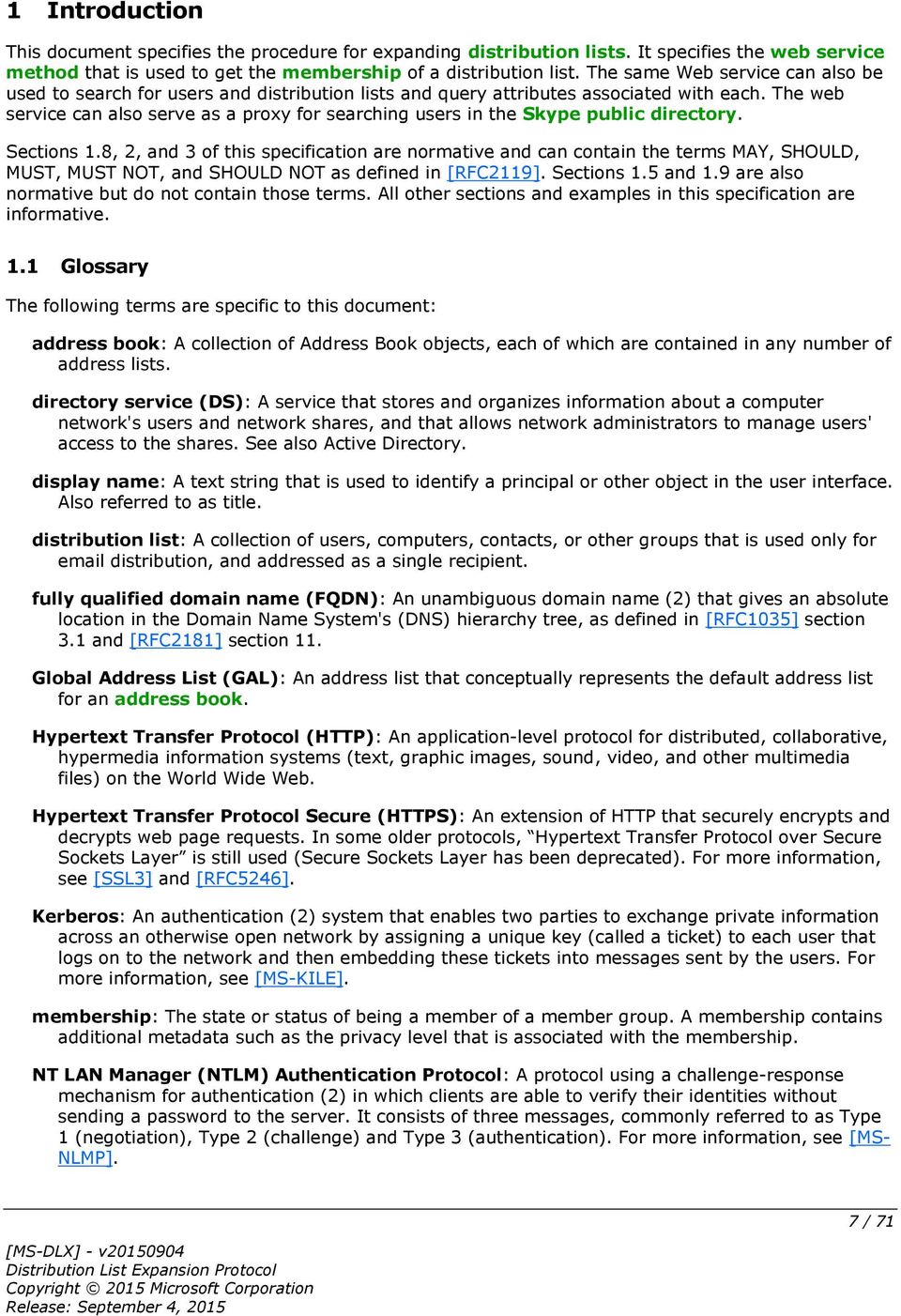
7 1 Introduction This document specifies the procedure for expanding distribution lists. It specifies the web service method that is used to get the membership of a distribution list. The same Web service can also be used to search for users and distribution lists and query attributes associated with each. The web service can also serve as a proxy for searching users in the Skype public directory. Sections 1.8, 2, and 3 of this specification are normative and can contain the terms MAY, SHOULD, MUST, MUST NOT, and SHOULD NOT as defined in [RFC2119]. Sections 1.5 and 1.9 are also normative but do not contain those terms. All other sections and examples in this specification are informative. 1.1 Glossary The following terms are specific to this document: address book: A collection of Address Book objects, each of which are contained in any number of address lists. directory service (DS): A service that stores and organizes information about a computer network's users and network shares, and that allows network administrators to manage users' access to the shares. See also Active Directory. display name: A text string that is used to identify a principal or other object in the user interface. Also referred to as title. distribution list: A collection of users, computers, contacts, or other groups that is used only for distribution, and addressed as a single recipient. fully qualified domain name (FQDN): An unambiguous domain name (2) that gives an absolute location in the Domain Name System's (DNS) hierarchy tree, as defined in [RFC1035] section 3.1 and [RFC2181] section 11. Global Address List (GAL): An address list that conceptually represents the default address list for an address book. Hypertext Transfer Protocol (HTTP): An application-level protocol for distributed, collaborative, hypermedia information systems (text, graphic images, sound, video, and other multimedia files) on the World Wide Web. Hypertext Transfer Protocol Secure (HTTPS): An extension of HTTP that securely encrypts and decrypts web page requests. In some older protocols, Hypertext Transfer Protocol over Secure Sockets Layer is still used (Secure Sockets Layer has been deprecated). For more information, see [SSL3] and [RFC5246]. Kerberos: An authentication (2) system that enables two parties to exchange private information across an otherwise open network by assigning a unique key (called a ticket) to each user that logs on to the network and then embedding these tickets into messages sent by the users. For more information, see [MS-KILE]. membership: The state or status of being a member of a member group. A membership contains additional metadata such as the privacy level that is associated with the membership. NT LAN Manager (NTLM) Authentication Protocol: A protocol using a challenge-response mechanism for authentication (2) in which clients are able to verify their identities without sending a password to the server. It consists of three messages, commonly referred to as Type 1 (negotiation), Type 2 (challenge) and Type 3 (authentication). For more information, see [MS- NLMP]. 7 / 71
8 Secure Sockets Layer (SSL): A security protocol that supports confidentiality and integrity of messages in client and server applications that communicate over open networks. SSL uses two keys to encrypt data-a public key known to everyone and a private or secret key known only to the recipient of the message. SSL supports server and, optionally, client authentication (2) using X.509 certificates (2). For more information, see [X509]. The SSL protocol is precursor to Transport Layer Security (TLS). The TLS version 1.0 specification is based on SSL version 3.0 [SSL3]. Session Initiation Protocol (SIP): An application-layer control (signaling) protocol for creating, modifying, and terminating sessions with one or more participants. SIP is defined in [RFC3261]. Skype public directory: A directory containing a list of all Skype consumer users. SOAP: A lightweight protocol for exchanging structured information in a decentralized, distributed environment. SOAP uses XML technologies to define an extensible messaging framework, which provides a message construct that can be exchanged over a variety of underlying protocols. The framework has been designed to be independent of any particular programming model and other implementation-specific semantics. SOAP 1.2 supersedes SOAP 1.1. See [SOAP1.2-1/2003]. SOAP body: A container for the payload data being delivered by a SOAP message to its recipient. See [SOAP1.2-1/2007] section 5.3 for more information. SOAP envelope: A container for SOAP message information and the root element of a SOAP document. See [SOAP1.2-1/2007] section 5.1 for more information. SOAP message: An XML document consisting of a mandatory SOAP envelope, an optional SOAP header, and a mandatory SOAP body. See [SOAP1.2-1/2007] section 5 for more information. Transmission Control Protocol (TCP): A protocol used with the Internet Protocol (IP) to send data in the form of message units between computers over the Internet. TCP handles keeping track of the individual units of data (called packets) that a message is divided into for efficient routing through the Internet. Transport Layer Security (TLS): A security protocol that supports confidentiality and integrity of messages in client and server applications communicating over open networks. TLS supports server and, optionally, client authentication by using X.509 certificates (as specified in [X509]). TLS is standardized in the IETF TLS working group. See [RFC4346]. Uniform Resource Identifier (URI): A string that identifies a resource. The URI is an addressing mechanism defined in Internet Engineering Task Force (IETF) Uniform Resource Identifier (URI): Generic Syntax [RFC3986]. Uniform Resource Locator (URL): A string of characters in a standardized format that identifies a document or resource on the World Wide Web. The format is as specified in [RFC1738]. web service method: A procedure that is exposed to web service clients as an operation that can be called on the web service. Also referred to as web method. Web Services Description Language (WSDL): An XML format for describing network services as a set of endpoints that operate on messages that contain either document-oriented or procedure-oriented information. The operations and messages are described abstractly and are bound to a concrete network protocol and message format in order to define an endpoint. Related concrete endpoints are combined into abstract endpoints, which describe a network service. WSDL is extensible, which allows the description of endpoints and their messages regardless of the message formats or network protocols that are used. XML namespace: A collection of names that is used to identify elements, types, and attributes in XML documents identified in a URI reference [RFC3986]. A combination of XML namespace and 8 / 71
![SSL supports server and, optionally, client authentication (2) using X.509 certificates (2). For more information, see [X509]. The SSL protocol is precursor to Transport Layer Security (TLS).](/docs-images/42/10293052/images/page_8.jpg "The TLS version 1.0 specification is based on SSL version 3.0 [SSL3].")
9 local name allows XML documents to use elements, types, and attributes that have the same names but come from different sources. For more information, see [XMLNS-2ED]. XML namespace prefix: An abbreviated form of an XML namespace, as described in [XML]. XML schema: A description of a type of XML document that is typically expressed in terms of constraints on the structure and content of documents of that type, in addition to the basic syntax constraints that are imposed by XML itself. An XML schema provides a view of a document type at a relatively high level of abstraction. MAY, SHOULD, MUST, SHOULD NOT, MUST NOT: These terms (in all caps) are used as defined in [RFC2119]. All statements of optional behavior use either MAY, SHOULD, or SHOULD NOT. 1.2 References Links to a document in the Microsoft Open Specifications library point to the correct section in the most recently published version of the referenced document. However, because individual documents in the library are not updated at the same time, the section numbers in the documents may not match. You can confirm the correct section numbering by checking the Errata Normative References We conduct frequent surveys of the normative references to assure their continued availability. If you have any issue with finding a normative reference, please contact [email protected]. We will assist you in finding the relevant information. [MS-ABS] Microsoft Corporation, "Address Book File Structure". [RFC2119] Bradner, S., "Key words for use in RFCs to Indicate Requirement Levels", BCP 14, RFC 2119, March 1997, [RFC2616] Fielding, R., Gettys, J., Mogul, J., et al., "Hypertext Transfer Protocol -- HTTP/1.1", RFC 2616, June 1999, [RFC2818] Rescorla, E., "HTTP Over TLS", RFC 2818, May 2000, [RFC3261] Rosenberg, J., Schulzrinne, H., Camarillo, G., Johnston, A., Peterson, J., Sparks, R., Handley, M., and Schooler, E., "SIP: Session Initiation Protocol", RFC 3261, June 2002, [SOAP1.1] Box, D., Ehnebuske, D., Kakivaya, G., et al., "Simple Object Access Protocol (SOAP) 1.1", May 2000, [SOAP1.2/1] Gudgin, M., Hadley, M., Mendelsohn, N., Moreau, J., and Nielsen, H.F., "SOAP Version 1.2 Part 1: Messaging Framework", W3C Recommendation, June 2003, [SOAP1.2/2] Gudgin, M., Hadley, M., Mendelsohn, N., Moreau, J., and Nielsen, H.F., "SOAP Version 1.2 Part 2: Adjuncts", W3C Recommendation, June 2003, part [WSDL] Christensen, E., Curbera, F., Meredith, G., and Weerawarana, S., "Web Services Description Language (WSDL) 1.1", W3C Note, March 2001, [XMLNS] Bray, T., Hollander, D., Layman, A., et al., Eds., "Namespaces in XML 1.0 (Third Edition)", W3C Recommendation, December 2009, 9 / 71

![[XMLSCHEMA1] Thompson, H., Beech, D., Maloney, M., and Mendelsohn, N., Eds., "XML Schema Part 1: Structures", W3C Recommendation, May 2001, http://www.w3.](/docs-images/27/10293052/images/10-0.png "org/tr/2001/rec-xmlschema-1-20010502/ [XMLSCHEMA2] Biron, P.V., Ed. and Malhotra, A., Ed., \"XML Schema Part 2: Datatypes\", W3C Recommendation, May 2001, http://www.w3.")
10 [XMLSCHEMA1] Thompson, H., Beech, D., Maloney, M., and Mendelsohn, N., Eds., "XML Schema Part 1: Structures", W3C Recommendation, May 2001, [XMLSCHEMA2] Biron, P.V., Ed. and Malhotra, A., Ed., "XML Schema Part 2: Datatypes", W3C Recommendation, May 2001, Informative References [MS-NLMP] Microsoft Corporation, "NT LAN Manager (NTLM) Authentication Protocol". [RFC4559] Jaganathan, K., Zhu, L., and Brezak, J., "SPNEGO-based Kerberos and NTLM HTTP Authentication in Microsoft Windows", RFC 4559, June 2006, Overview This protocol is used to expand distribution lists or to search for users and distribution lists and query attributes associated with each one. Using this protocol, a user can provide the address of a distribution list and obtain information about its membership. The user can also provide a search string, a set of attributes to search against, and a set of attributes to return for each match. The search can return one or more users or distribution lists or both and get attributes about each one found. The protocol can also be used for searching users in the Skype public directory, and provide feedback on the corresponding search results. The protocol consists of one request and one response. The request contains either a distribution list expansion request, a search request, or search feedback data. The request contains the information needed to describe the request. The response contains the response status and, if the response is successful, the data requested. This protocol is conceptually three Web services methods. This documentation specifies the structure of the schema used to construct the body in the request and response messages. The protocol uses Simple Object Access Protocol (SOAP) and Web Services Description Language (WSDL) to describe the structure of the message body. The full WSDL is included in section Relationship to Other Protocols This protocol uses SOAP over Hypertext Transfer Protocol over Secure Sockets Layer (HTTPS), as described in [RFC2818], as shown in the following layering diagram: Figure 1: This protocol in relation to other protocols 10 / 71
![org/tr/2001/rec-xmlschema-2-20010502/ 1.2.2 Informative References [MS-NLMP] Microsoft Corporation, "NT LAN Manager (NTLM) Authentication Protocol". [RFC4559] Jaganathan, K., Zhu, L., and Brezak, J.](/docs-images/42/10293052/images/page_10.jpg ", \"SPNEGO-based Kerberos and NTLM HTTP Authentication in Microsoft Windows\", RFC 4559, June 2006, http://www.rfc-editor.org/rfc/rfc4559.txt 1.")
11 1.5 Prerequisites/Preconditions For a client that uses this protocol with a server, it is assumed that the server has an operational SOAP1.2/HTTP1.1/TCP/IP stack, as described in [RFC2616]. It is also assumed that the client has the fully qualified domain name (FQDN) of the server to which the client will connect. The client can obtain the FQDN of the server via a different channel, for example, in the Session Initiation Protocol (SIP) signaling channel, as described in [RFC3261]. The server also requires that the client be able to negotiate Hypertext Transfer Protocol (HTTP) over Transport Layer Security (TLS) to establish the connection. 1.6 Applicability Statement This protocol is applicable for Expanding distribution lists Searching for users and distribution lists and querying attributes associated with each one. Searching for users in the Skype public directory, and provide feedback on the search results. 1.7 Versioning and Capability Negotiation None. 1.8 Vendor-Extensible Fields None. 1.9 Standards Assignments None. 11 / 71
![The client can obtain the FQDN of the server via a different channel, for example, in the Session Initiation Protocol (SIP) signaling channel, as described in [RFC3261].](/docs-images/42/10293052/images/page_11.jpg "The server also requires that the client be able to negotiate Hypertext Transfer Protocol (HTTP) over Transport Layer Security (TLS) to establish the connection. 1.")
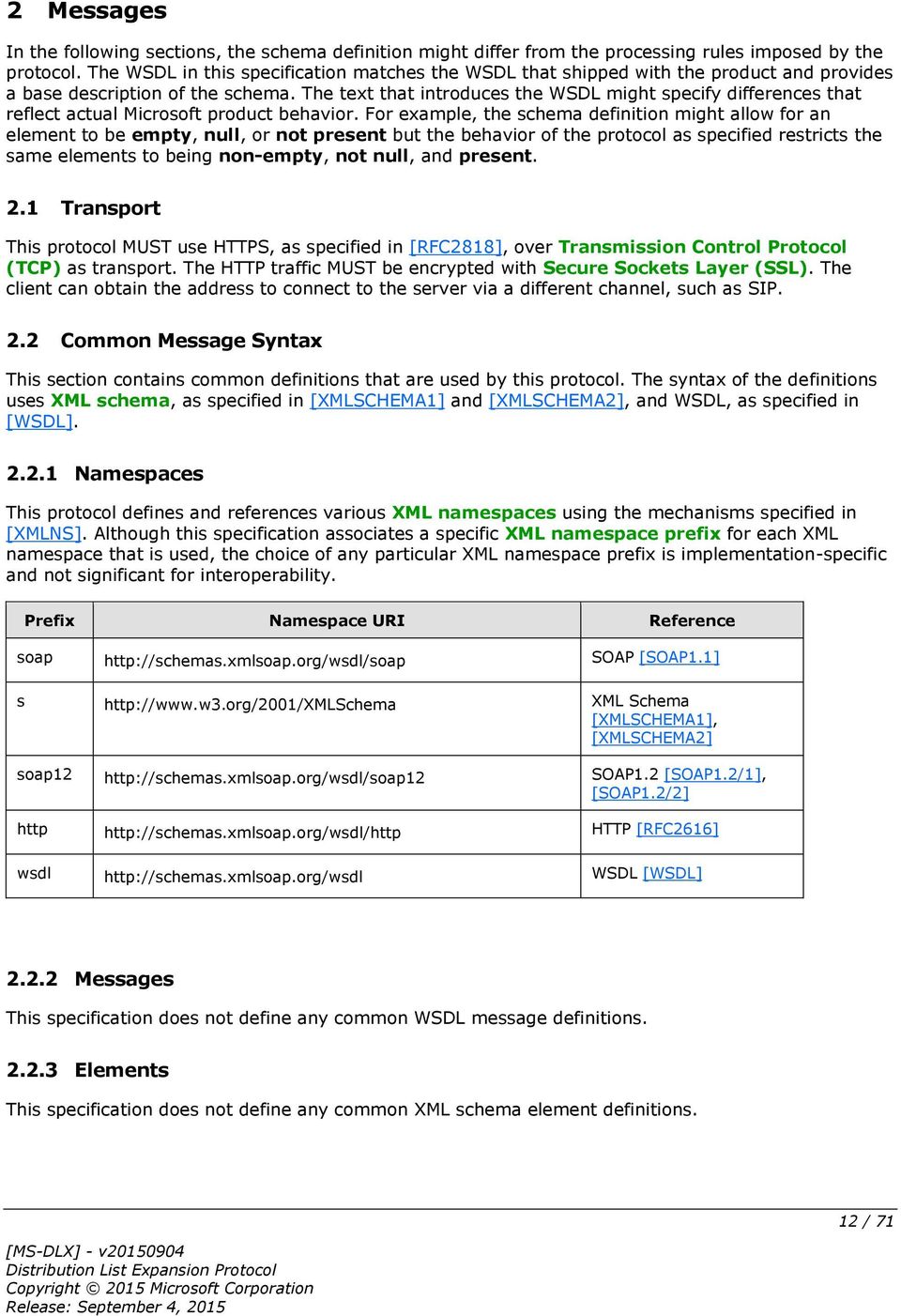
12 2 Messages In the following sections, the schema definition might differ from the processing rules imposed by the protocol. The WSDL in this specification matches the WSDL that shipped with the product and provides a base description of the schema. The text that introduces the WSDL might specify differences that reflect actual Microsoft product behavior. For example, the schema definition might allow for an element to be empty, null, or not present but the behavior of the protocol as specified restricts the same elements to being non-empty, not null, and present. 2.1 Transport This protocol MUST use HTTPS, as specified in [RFC2818], over Transmission Control Protocol (TCP) as transport. The HTTP traffic MUST be encrypted with Secure Sockets Layer (SSL). The client can obtain the address to connect to the server via a different channel, such as SIP. 2.2 Common Message Syntax This section contains common definitions that are used by this protocol. The syntax of the definitions uses XML schema, as specified in [XMLSCHEMA1] and [XMLSCHEMA2], and WSDL, as specified in [WSDL] Namespaces This protocol defines and references various XML namespaces using the mechanisms specified in [XMLNS]. Although this specification associates a specific XML namespace prefix for each XML namespace that is used, the choice of any particular XML namespace prefix is implementation-specific and not significant for interoperability. Prefix Namespace URI Reference soap SOAP [SOAP1.1] s XML Schema [XMLSCHEMA1], [XMLSCHEMA2] soap12 SOAP1.2 [SOAP1.2/1], [SOAP1.2/2] http HTTP [RFC2616] wsdl WSDL [WSDL] Messages This specification does not define any common WSDL message definitions Elements This specification does not define any common XML schema element definitions. 12 / 71
13 2.2.4 Complex Types This specification does not define any common XML schema complex type definitions Simple Types This specification does not define any common XML schema simple type definitions Attributes This specification does not define any common XML schema attribute definitions Groups This specification does not define any common XML schema group definitions Attribute Groups This specification does not define any common XML schema attribute group definitions Common Data Structures This specification does not define any common XML schema data structures. 13 / 71

14 3 Protocol Details In the following sections, the schema definition might differ from the processing rules imposed by the protocol. The WSDL in this specification matches the WSDL that shipped with the product and provides a base description of the schema. The text that introduces the WSDL might specify differences that reflect actual Microsoft product behavior. For example, the schema definition might allow for an element to be empty, null, or not present but the behavior of the protocol as specified restricts the same elements to being non-empty, not null, and present. The client side of this protocol is simply a pass-through. That is, no additional timers or other state is required on the client side of this protocol. Calls made by the higher-layer protocol or application are passed directly to the transport, and the results returned by the transport are passed directly back to the higher-layer protocol or application. 3.1 Server Details Abstract Data Model This section describes a conceptual model of possible data organization that an implementation maintains to participate in this protocol. The described organization is provided to facilitate the explanation of how the protocol behaves. This document does not mandate that implementations adhere to this model as long as their external behavior is consistent with that described in this document. A directory service (DS)<1> is assumed on the server side. Users and distribution lists are usually stored as objects in the directory service. The protocol enables a client to query attributes about both types of objects. In the sections that follow, reference is made to attribute names. The attribute names in the following table MUST be implemented by the server. 14 / 71

15 Attribute Name EntryId AbEntryHash PhotoRelPath PhotoSize PhotoHash OrgHash Description Unique string that identifies a particular user or distribution list. This value MUST not change even when a user or distribution list is renamed or moved. It changes if a user or distribution list is deleted and recreated. Unique string that identifies the current state of an entry. If one of its attributes changes value or an attribute is added or deleted, the user or distribution list s AbEntryHash value MUST change. Relative path to the photo file. The path MUST be relative to the file system folder described in [MS-ABS] section 1.3. Size of the photo file in bytes. Unique string that identifies the current state of an entry s photo. If the photo changes, the PhotoHash value MUST change. Unique string that identifies the current state of an entry s organizational structure. If the structure changes, the OrgHash value MUST change. Additional attribute(s) may be requested, and the name of the attribute will be the same name of the corresponding attribute stored in Active Directory Timers The only timers of concern are the timers for HTTP Initialization As part of initialization, the server MUST start listening for incoming requests on an HTTP Uniform Resource Locator (URL). The client MUST have access to this HTTP URL and can obtain the URL by a channel that is separate from the HTTP channel used for expanding distribution lists, for example, through SIP Message Processing Events and Sequencing Rules The following table summarizes the list of WSDL operations as defined by this specification: Operation Description ExpandDistributionList ProvideSkypeSearchFeedback SearchAbEntry SearchSkypeDirectory This operation expands a distribution list. This operation provides feedback on the Skype public directory search results.<2> This operation searches for a user or distribution list. This operation searches for a user in the 15 / 71

16 Operation Description Skype public directory <3> ExpandDistributionList The following excerpt from this protocol's WSDL specifies the messages that constitute this operation. <wsdl:operation name="expanddistributionlist"> <wsdl:input message="tns:expanddistributionlistsoapin" /> <wsdl:output message="tns:expanddistributionlistsoapout" /> </wsdl:operation> When user action triggers a request to expand a distribution list, a TCP connection MUST be made to the server and SSL MUST be negotiated. The address of the server that makes the TCP connection MUST be obtained through a different channel, such as SIP. After successful SSL negotiation, a SOAP HTTP request, ExpandDistributionListSoapIn message, MUST be constructed with a SOAP body containing the ExpandDistributionList element. On receiving an ExpandDistributionList request, the server SHOULD query the repository of distribution lists to get all of the members of the distribution list specified in the request. After obtaining the membership, the server MUST construct the ExpandDistributionListSoapOut message, containing the ExpandDistributionListResponse element, and it MUST send the message in the SOAP HTTP response, which is a 2xx response to a SOAP HTTP request, as described in [RFC2616]. In the case of errors, the response message MUST specify the error and the type of error that was encountered by the server Messages The following table summarizes the set of WSDL message definitions that are specific to this operation. Message ExpandDistributionListSoapIn ExpandDistributionListSoapOut Description Request from client to expand a distribution list. Response from server after it executes a request to expand a distribution list ExpandDistributionListSoapIn The ExpandDistributionListSoapIn SOAP message is a request that is sent from the client, typically as a result of a user action to expand a distribution list. The request information MUST be captured in the ExpandDistributionList element in the SOAP body of the message. The ExpandDistributionList element is specified in section ExpandDistributionListSoapOut The ExpandDistributionListSoapOut SOAP message is a response that is sent by the server after it executes a request to expand a distribution list. This message contains the result of the expansion on the server. The result is represented in the ExpandDistributionListResponse element, which MUST be in the SOAP body of the SOAP message. The ExpandDistributionListResponse element is specified in section If the server is able to successfully acquire the membership of the 16 / 71

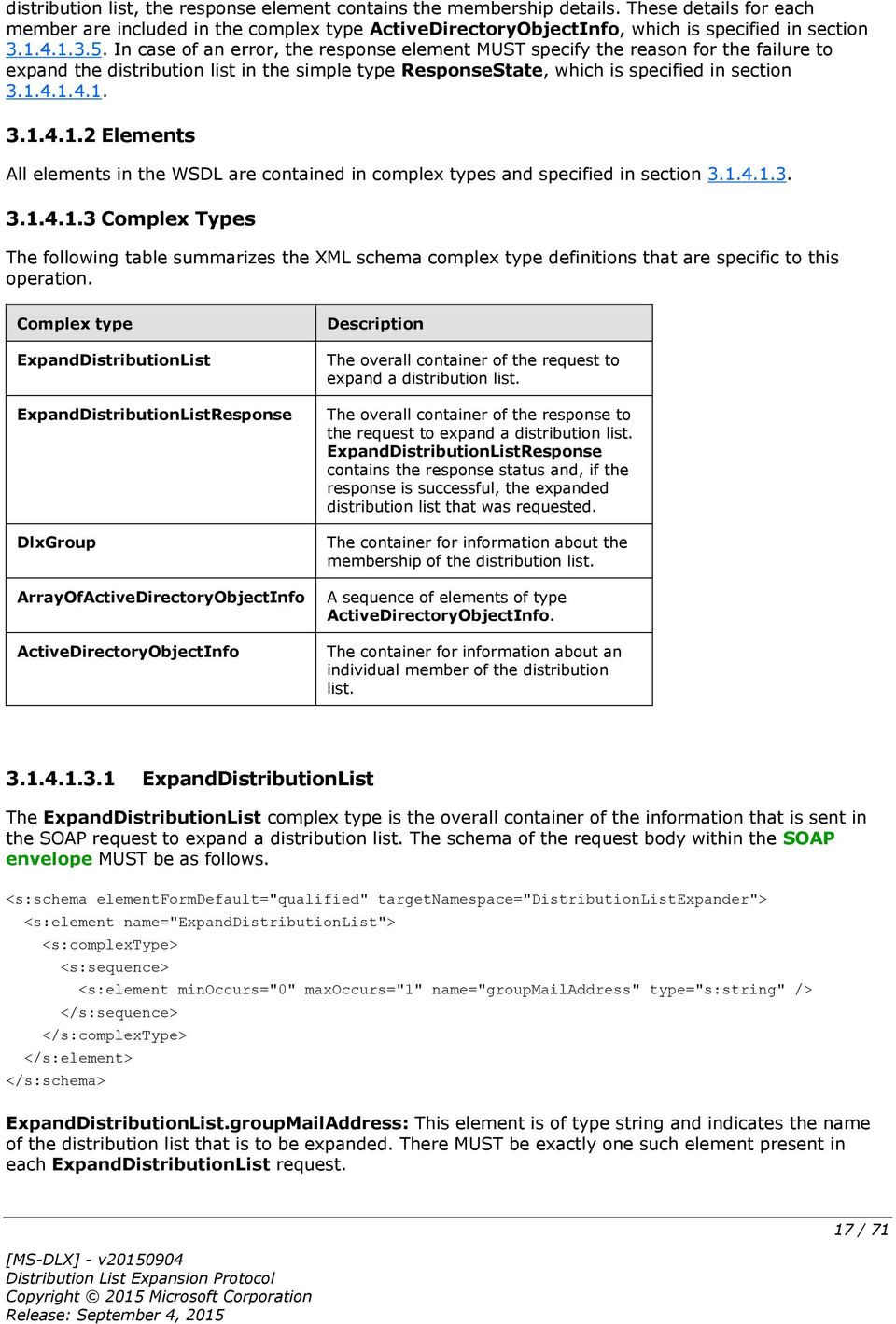
17 distribution list, the response element contains the membership details. These details for each member are included in the complex type ActiveDirectoryObjectInfo, which is specified in section In case of an error, the response element MUST specify the reason for the failure to expand the distribution list in the simple type ResponseState, which is specified in section Elements All elements in the WSDL are contained in complex types and specified in section Complex Types The following table summarizes the XML schema complex type definitions that are specific to this operation. Complex type ExpandDistributionList ExpandDistributionListResponse DlxGroup ArrayOfActiveDirectoryObjectInfo ActiveDirectoryObjectInfo Description The overall container of the request to expand a distribution list. The overall container of the response to the request to expand a distribution list. ExpandDistributionListResponse contains the response status and, if the response is successful, the expanded distribution list that was requested. The container for information about the membership of the distribution list. A sequence of elements of type ActiveDirectoryObjectInfo. The container for information about an individual member of the distribution list ExpandDistributionList The ExpandDistributionList complex type is the overall container of the information that is sent in the SOAP request to expand a distribution list. The schema of the request body within the SOAP envelope MUST be as follows. <s:schema elementformdefault="qualified" targetnamespace="distributionlistexpander"> <s:element name="expanddistributionlist"> <s:complextype> <s:sequence> <s:element minoccurs="0" maxoccurs="1" name="groupmailaddress" type="s:string" /> </s:sequence> </s:complextype> </s:element> </s:schema> ExpandDistributionList.groupMailAddress: This element is of type string and indicates the name of the distribution list that is to be expanded. There MUST be exactly one such element present in each ExpandDistributionList request. 17 / 71
18 ExpandDistributionListResponse The ExpandDistributionListResponse complex type is the overall container in the response to the ExpandDistributionList request. ExpandDistributionListResponse encapsulates the results of the operation to expand a distribution list. It contains one ExpandDistributionListResult element of type DlxGroup. The schema for this complex type within the SOAP envelope is as follows: <s:element name="expanddistributionlistresponse"> <s:complextype> <s:sequence> <s:element minoccurs="0" maxoccurs="1" name="expanddistributionlistresult" type="tns:dlxgroup" /> </s:sequence> </s:complextype> </s:element> The following element MUST be contained in the ExpandDistributionListResponse complex type: ExpandDistributionListResponse.ExpandDistributionListResult: This element is of type DlxGroup and contains information about the results of the operation to expand a distribution list DlxGroup The DlxGroup complex type is the container for information about the membership of the distribution list. It contains a sequence of elements where each element MUST be one of ResponseStatus, Users or NestedGroups. The schema for this complex type is as follows: <s:complextype name="dlxgroup"> <s:sequence> <s:element minoccurs="1" maxoccurs="1" name="responsestatus" type="tns:responsestate" /> <s:element minoccurs="0" maxoccurs="1" name="users" type="tns:arrayofactivedirectoryobjectinfo" /> <s:element minoccurs="0" maxoccurs="1" name="nestedgroups" type="tns:arrayofactivedirectoryobjectinfo" /> </s:sequence> </s:complextype> The following elements are contained within this complex type: DlxGroup.ResponseStatus: ResponseStatus indicates the result of the ExpandDistributionList request and MUST be present. There MUST be exactly one ResponseStatus element contained in the ExpandDistributionListResult element. The ResponseStatus element is of the simple type ResponseState. The ResponseState type is described in section DlxGroup.Users: A Users element contains information about each of the members of the distribution list. The number of Users elements contained in an ExpandDistributionListResult element MUST NOT exceed one. The type of the Users element is the complex type ArrayOfActiveDirectoryObjectInfo. DlxGroup.NestedGroups: A NestedGroups element contains information about any distribution lists that are members of the distribution list that was expanded. The number of NestedGroups elements MUST NOT exceed one. The type of the NestedGroups element is the complex type ArrayOfActiveDirectoryObjectInfo ArrayOfActiveDirectoryObjectInfo 18 / 71

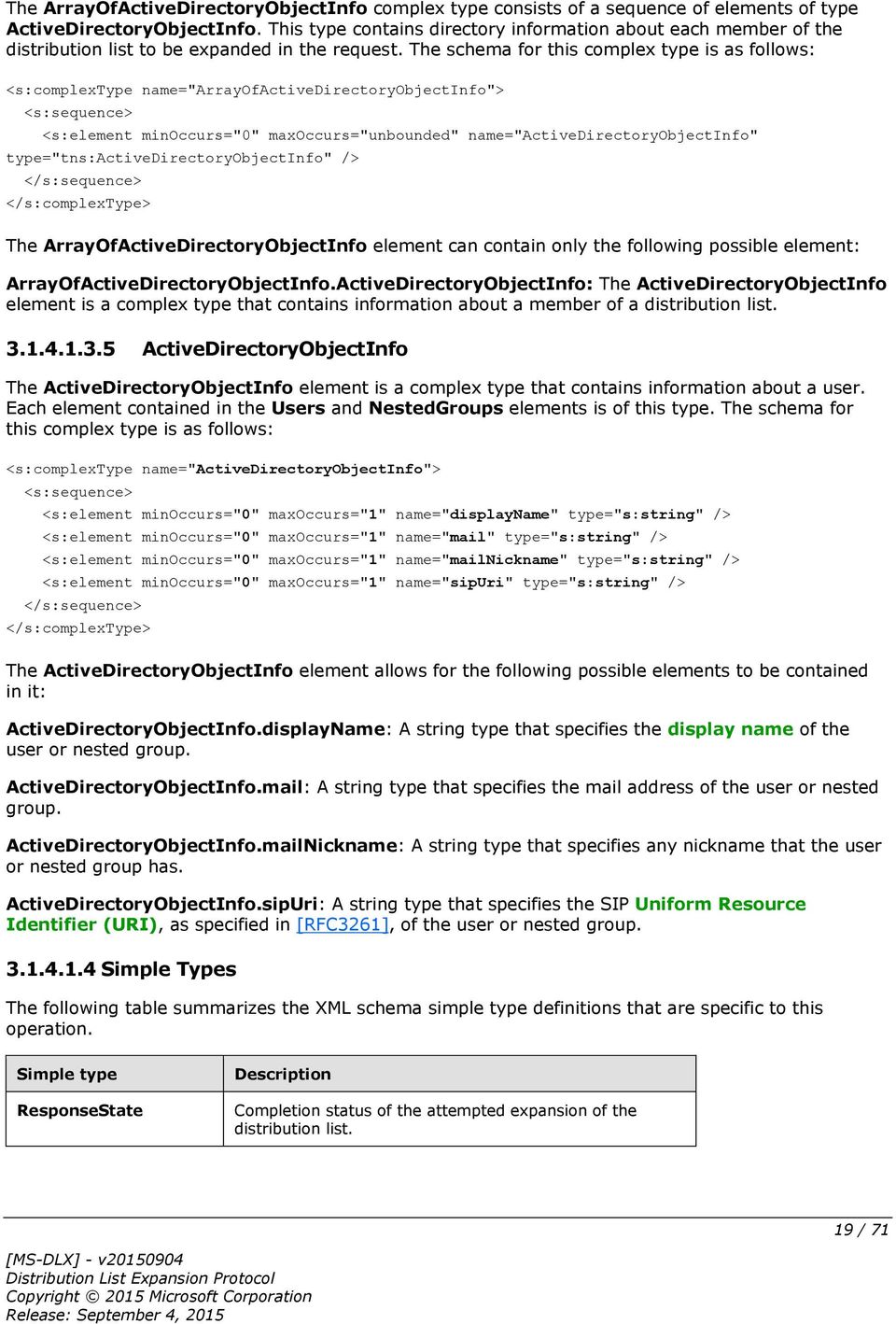
19 The ArrayOfActiveDirectoryObjectInfo complex type consists of a sequence of elements of type ActiveDirectoryObjectInfo. This type contains directory information about each member of the distribution list to be expanded in the request. The schema for this complex type is as follows: <s:complextype name="arrayofactivedirectoryobjectinfo"> <s:sequence> <s:element minoccurs="0" maxoccurs="unbounded" name="activedirectoryobjectinfo" type="tns:activedirectoryobjectinfo" /> </s:sequence> </s:complextype> The ArrayOfActiveDirectoryObjectInfo element can contain only the following possible element: ArrayOfActiveDirectoryObjectInfo.ActiveDirectoryObjectInfo: The ActiveDirectoryObjectInfo element is a complex type that contains information about a member of a distribution list ActiveDirectoryObjectInfo The ActiveDirectoryObjectInfo element is a complex type that contains information about a user. Each element contained in the Users and NestedGroups elements is of this type. The schema for this complex type is as follows: <s:complextype name="activedirectoryobjectinfo"> <s:sequence> <s:element minoccurs="0" maxoccurs="1" name="displayname" type="s:string" /> <s:element minoccurs="0" maxoccurs="1" name="mail" type="s:string" /> <s:element minoccurs="0" maxoccurs="1" name="mailnickname" type="s:string" /> <s:element minoccurs="0" maxoccurs="1" name="sipuri" type="s:string" /> </s:sequence> </s:complextype> The ActiveDirectoryObjectInfo element allows for the following possible elements to be contained in it: ActiveDirectoryObjectInfo.displayName: A string type that specifies the display name of the user or nested group. ActiveDirectoryObjectInfo.mail: A string type that specifies the mail address of the user or nested group. ActiveDirectoryObjectInfo.mailNickname: A string type that specifies any nickname that the user or nested group has. ActiveDirectoryObjectInfo.sipUri: A string type that specifies the SIP Uniform Resource Identifier (URI), as specified in [RFC3261], of the user or nested group Simple Types The following table summarizes the XML schema simple type definitions that are specific to this operation. Simple type ResponseState Description Completion status of the attempted expansion of the distribution list. 19 / 71
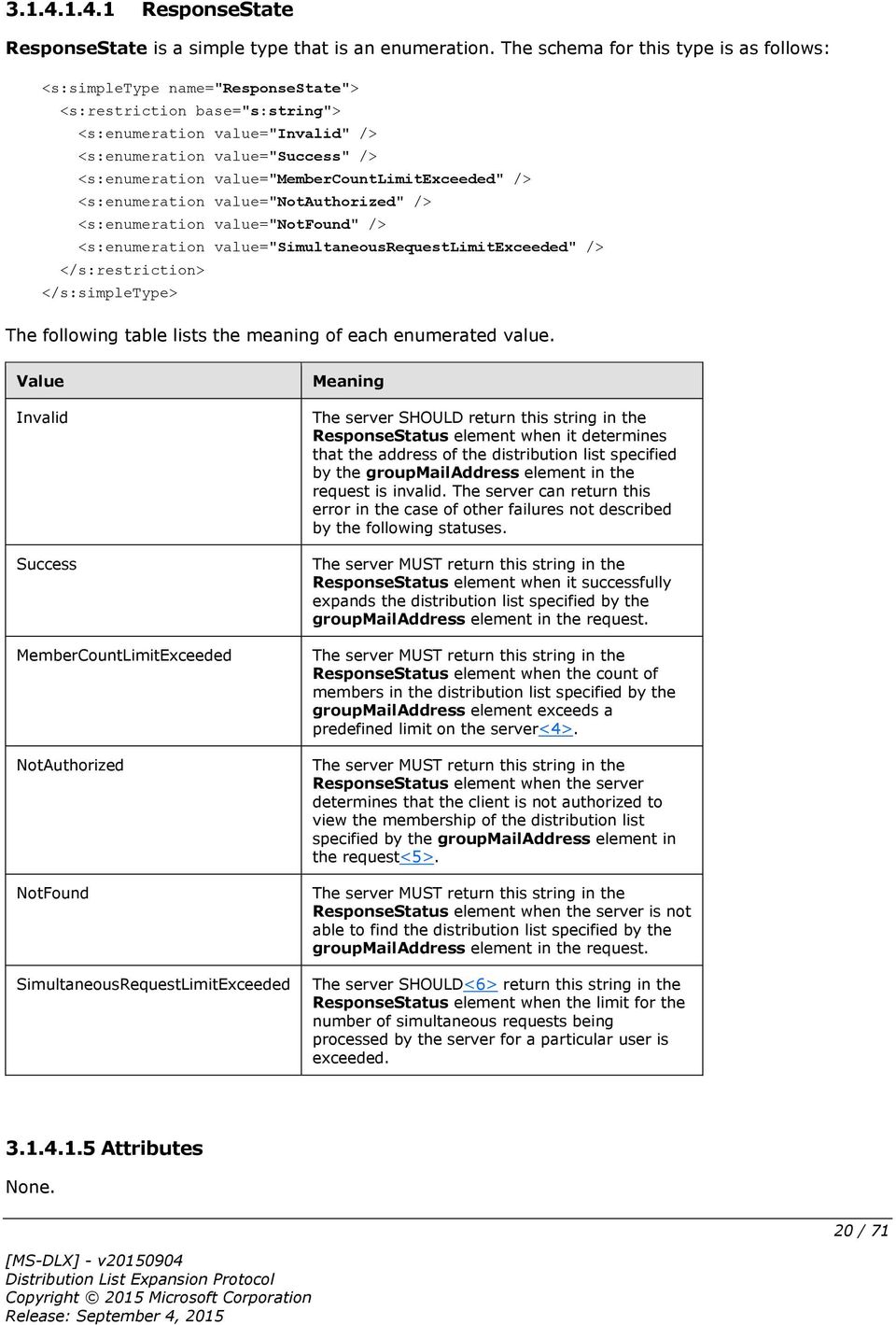
20 ResponseState ResponseState is a simple type that is an enumeration. The schema for this type is as follows: <s:simpletype name="responsestate"> <s:restriction base="s:string"> <s:enumeration value="invalid" /> <s:enumeration value="success" /> <s:enumeration value="membercountlimitexceeded" /> <s:enumeration value="notauthorized" /> <s:enumeration value="notfound" /> <s:enumeration value="simultaneousrequestlimitexceeded" /> </s:restriction> </s:simpletype> The following table lists the meaning of each enumerated value. Value Invalid Success MemberCountLimitExceeded NotAuthorized NotFound SimultaneousRequestLimitExceeded Meaning The server SHOULD return this string in the ResponseStatus element when it determines that the address of the distribution list specified by the groupmailaddress element in the request is invalid. The server can return this error in the case of other failures not described by the following statuses. The server MUST return this string in the ResponseStatus element when it successfully expands the distribution list specified by the groupmailaddress element in the request. The server MUST return this string in the ResponseStatus element when the count of members in the distribution list specified by the groupmailaddress element exceeds a predefined limit on the server<4>. The server MUST return this string in the ResponseStatus element when the server determines that the client is not authorized to view the membership of the distribution list specified by the groupmailaddress element in the request<5>. The server MUST return this string in the ResponseStatus element when the server is not able to find the distribution list specified by the groupmailaddress element in the request. The server SHOULD<6> return this string in the ResponseStatus element when the limit for the number of simultaneous requests being processed by the server for a particular user is exceeded Attributes None. 20 / 71
21 Groups None Attribute Groups None SearchAbEntry The following excerpt from this protocol s WSDL specifies the messages that constitute this operation: <wsdl:operation name="searchabentry"> <wsdl:input message="tns:searchabentrysoapin" /> <wsdl:output message="tns:searchabentrysoapout" /> </wsdl:operation> When user action triggers a request to search the address book, a TCP connection MUST be made to the server and SSL MUST be negotiated. The address of the server that makes the TCP connection MUST be obtained through a separate channel, such as SIP. After successful SSL negotiation, a SOAP HTTP request containing a SearchAbEntrySoapIn message MUST be constructed with a SOAP body containing the SearchAbEntry element. On receiving a SearchAbEntry request, the server SHOULD query the repository of users and distribution lists to search for the information specified in the request<7>. After conducting the requested search, the server MUST construct the SearchAbEntrySoapOut message, containing the SearchAbEntryResponse element, and it MUST send the message in the SOAP HTTP response, which is a 2xx response to a SOAP HTTP request. In case of errors, the response message MUST specify the error and the type of error that was encountered by the server Messages The following table summarizes the set of WSDL message definitions that are specific to this operation. Message SearchAbEntrySoapIn SearchAbEntrySoapOut Description Request from the client to search the address book. Response from the server after it executes a request to search the address book SearchAbEntrySoapIn The SearchAbEntrySoapIn SOAP message is a request that is sent from the client. For example, a SearchAbEntrySoapIn message is created as a result of a user action to search for a user or distribution list. The request information MUST be captured in the SearchAbEntry element in the SOAP body of the message. The SearchAbEntry element is specified in section SearchAbEntrySoapOut This SOAP message is a response that is sent by the server after it executes a request to search the address book. This message contains the result of the search on the server. The result is represented in the SearchAbEntryResponse element, which MUST be in the SOAP body of the SOAP message. The SearchAbEntryResponse element is specified in section / 71
22 Elements All elements in the WSDL are contained in complex types and specified in section Complex Types The following table summarizes the XML schema complex type definitions that are specific to this operation. Complex type SearchAbEntry AbEntryRequest AbEntryRequest.BasicSearchQuery ArrayOfAbEntryRequest.ChangeSearchQuery AbEntryRequest.ChangeSearchQuery AbEntryRequest.SearchMetadata AbEntryRequest.OrgSearchQuery SearchAbEntryResponse AbEntryResponse ArrayOfAbEntry AbEntry ArrayOfAttribute Attribute ArrayOfstring AbEntryResponse.ResponseMetadata Description The overall container of the request to search the address book. Search request container that MUST contain one of AbEntryRequest.BasicSearchQuery, ArrayOfAbEntryRequest.ChangeSearchQuery or AbEntryRequest.OrgSearchQuery and one of AbEntryRequest.SearchMetadata. Basic search request. A sequence of elements of type AbEntryRequest.ChangeSearchQuery. Container for a single change search request. Search metadata that applies to the search. Organizational search request. The overall container of the response to the search request. SearchAbEntryResponse contains the response status and, if the response is successful, the users and distribution lists that match the request. Container for the results of the search. Sequence of elements of type AbEntry that match the search request. Container for one user or distribution list that match the search request. Sequence of elements of type Attribute that are the set of requested attributes for the matched entry. Container for the name and value of one attribute. Sequence of elements of type string. Contains the response status and optional message text associated with the response status SearchAbEntry 22 / 71
23 The SearchAbEntry complex type is the overall container of the information that is sent in the SOAP request to search the address book. The schema of the request body within the SOAP envelope is as follows: <s:element name="searchabentry"> <s:complextype> <s:sequence> <s:element minoccurs="0" maxoccurs="1" name="abentryrequest" type="tns:abentryrequest" /> </s:sequence> </s:complextype> </s:element> SearchAbEntry.AbEntryRequest: This element is of type AbEntryRequest and contains the actual request. There MUST be exactly one such element present in each SearchAbEntry request AbEntryRequest The AbEntryRequest complex type is the container for the information that describes the type of search being requested and the parameters to the search. It MUST contain one and only one of BasicSearch, ChangeSearch, or OrgSearch elements. It MUST contain one and only one Metadata element. The schema for this complex type is as follows: <s:complextype name="abentryrequest"> <s:sequence> <s:element minoccurs="0" name="basicsearch" type="tns:abentryrequest.basicsearchquery" /> <s:element minoccurs="0" name="changesearch" type="tns:arrayofabentryrequest.changesearchquery" /> <s:element minoccurs="0" name="metadata" type="tns:abentryrequest.searchmetadata" /> <s:element minoccurs="0" name="orgsearch" type="tns:abentryrequest.orgsearchquery" /> </s:sequence> </s:complextype> The following elements are contained within this complex type: AbEntryRequest.BasicSearch: The BasicSearch element describes a basic search request, either an exact match or a prefix match, of a value against one or more attribute values associated with users and distribution lists in the Global Address List (GAL). The type of the BasicSearch element is AbEntryRequest.BasicSearchQuery. AbEntryRequest.ChangeSearch: The ChangeSearch element describes a search for changes. The type of the ChangeSearch element is ArrayOfAbEntryRequest.ChangeSearchQuery. AbEntryRequest.Metadata: The Metadata element contains information that modifies how a search is performed. The type of the Metadata element is AbEntryRequest.SearchMetadata. AbEntryRequest.OrgSearch: The OrgSearch element describes a search to retrieve the organizational structure for a given user or distribution list. The type of the OrgSearch element is AbEntryRequest.OrgSearchQuery AbEntryRequest.BasicSearchQuery The AbEntryRequest.BasicSearchQuery complex type is the container for the information that describes a basic search request. The schema for this complex type is as follows: <s:complextype name="abentryrequest.basicsearchquery"> <s:sequence> <s:element minoccurs="0" name="searchlist" type="s:string" /> <s:element minoccurs="0" name="value" type="s:string" /> 23 / 71
24 <s:element name="verb" type="tns:searchverb" /> </s:sequence> </s:complextype> The following elements are contained within this complex type: AbEntryRequest.BasicSearchQuery.SearchList: A string type that contains a comma-separated list of attribute names whose values are to be searched against. Invalid or empty names are ignored. If the entire element is missing, empty, or specifies only invalid attribute names, all attributes are searched. For a description of attribute names, see section AbEntryRequest.BasicSearchQuery.Value: A string type that contains the value to search for. This value is compared against each of the values associated with the attributes named by the SearchList element. The comparison is case and accent insensitive. AbEntryRequest.BasicSearchQuery.Verb: The type of search, either exact match or prefix match. There MUST be exactly one Verb element contained in the BasicSearch element. The Verb element is of simple type SearchVerb. The SearchVerb type is described in section ArrayOfAbEntryRequest.ChangeSearchQuery The ArrayOfAbEntryRequest.ChangeSearchQuery complex type consists of a sequence of elements of type AbEntryRequest.ChangeSearchQuery. This type contains information about each user being searched for. The schema for this complex type is as follows: <s:complextype name="arrayofabentryrequest.changesearchquery"> <s:sequence> <s:element minoccurs="0" maxoccurs="100" name="abentryrequest.changesearchquery" type="tns:abentryrequest.changesearchquery" /> </s:sequence> </s:complextype> The following element is contained within this complex type: ArrayOfAbEntryRequest.ChangeSearchQuery.AbEntryRequest.ChangeSearchQuery: Contains information about each change search query. This element is of type AbEntryRequest.ChangeSearchQuery. This element can occur from zero to 100 times in the ArrayOfAbEntryRequest.ChangeSearchQuery element AbEntryRequest.ChangeSearchQuery The AbEntryRequest.ChangeSearchQuery complex type contains information about each user being searched for. The schema for this complex type is as follows: <s:complextype name="abentryrequest.changesearchquery"> <s:sequence> <s:element minoccurs="0" name="abentryhash" type="s:string" /> <s:element minoccurs="0" name="photohash" type="s:string" /> <s:element minoccurs="0" name="searchon" type="s:string" /> <s:element minoccurs="0" name="value" type="s:string" /> </s:sequence> </s:complextype> The following elements are contained within this complex type: AbEntryRequest.ChangeSearchQuery.AbEntryHash: Identifies the client s view of a particular contact. If the search request matches a user or distribution list and the hash of the matching entry 24 / 71
25 matches this field, the server MUST NOT return any attribute values for this entry. If the hash values do not match, the server MUST return all attribute values requested for the matched entry. AbEntryRequest.ChangeSearchQuery.PhotoHash: Identifies the client s view of a particular contact s photo. If the search request matches a user or distribution list and the hash of the matching entry s photo matches this field, the server MUST NOT return any photo attribute data for this entry. If the hash values do not match, the server MUST return all requested photo attributes for the matched entry. AbEntryRequest.ChangeSearchQuery.SearchOn: A string type that contains a comma-separated list of attribute names whose values are to be searched against. Invalid or empty names are ignored. If the entire element is missing, empty, or specifies only invalid attribute names, all attributes MUST be searched. For a description of attribute names, see section AbEntryRequest.ChangeSearchQuery.Value: A string type that contains the value to search for. This value is compared against each of the values associated with the attributes named by the ReturnList element as specified in section The search is an exact match for all characters and is case and accent insensitive AbEntryRequest.SearchMetadata The AbEntryRequest.SearchMetadata complex type contains information that modifies how a search is performed. The schema for this complex type is as follows: <s:complextype name="abentryrequest.searchmetadata"> <s:sequence> <s:element name="fromdialpad" type="s:boolean" /> <s:element name="maxresultnum" type="s:unsignedint" /> <s:element minoccurs="0" name="returnlist" type="s:string" /> </s:sequence> </s:complextype> The following elements are contained within this complex type: AbEntryRequest.SearchMetadata.FromDialPad: A Boolean type which, if "true", tells the server it MUST treat all search strings in this request as numeric strings from a dial pad and match against the possible letters and digits on each dial key. For example, "12" matches "1a", "1ả", "1b", "1c", or "12", ignoring case. The server MUST map directory data as follows when creating the dial pad indexes to search against: If a character is one of "*.?!,@ -_:;()&"~¹º % $ + /\[]=<> ", map it to an asterisk ("*"). If a character is a letter (a through z) ignoring case, map to the correct number (abc maps to "2", def maps to "3", and so forth). If a character is a number (0 through 9), map it as is. Otherwise drop the character from the index. AbEntryRequest.SearchMetadata.MaxResultNum: An integer type that specifies the maximum number of results to return for this search query. The default value is "20". The server MUST NOT return more entries than the number specified by this field. AbEntryRequest.SearchMetadata.ReturnList: A string type that contains a comma-separated list of attribute names whose values are to be returned for each matching entry. Invalid or empty names MUST be ignored. If the entire element is empty or specifies only invalid attribute names, all attributes MUST be returned for each matching entry. If the element is not specified, the server SHOULD return "InvalidArgumentError". For a description of attribute names, see section / 71
26 AbEntryRequest.OrgSearchQuery The AbEntryRequest.OrgSearchQuery complex type contains information that describes an organizational search request. The schema for this complex type is as follows: <s:complextype name="abentryrequest.orgsearchquery"> <s:sequence> <s:element minoccurs="0" name="entryid" type="s:string" /> <s:element minoccurs="0" name="orghash" type="s:string" /> </s:sequence> </s:complextype> The following elements are contained within this complex type: AbEntryRequest.OrgSearchQuery.EntryId: A string type that uniquely identifies the user or distribution list whose organizational structure is being queried. AbEntryRequest.OrgSearchQuery.OrgHash: A string that represents the client s view of the entry s organizational structure. If the server hash value matched, the server MUST NOT return any information for this search. If the server hash value does not match, the server MUST return all the entries in the matching entries organizational structure SearchAbEntryResponse The SearchAbEntryResponse complex type is the overall container in the response to the SearchAbEntry request. SearchAbEntryResponse encapsulates the results of the operation to search the Global Address List (GAL). It contains one SearchAbEntryResult element of type AbEntryResponse. The schema for this complex type within the SOAP envelope is as follows: <s:element name="searchabentryresponse"> <s:complextype> <s:sequence> <s:element minoccurs="0" name="searchabentryresult" type="tns:abentryresponse" /> </s:sequence> </s:complextype> </s:element> The following element MUST be contained in the SearchAbEntryResponse complex type: SearchAbEntryResponse.SearchAbEntryResult: This element is of type AbEntryResponse and contains information about the results of the search operation against the Global Address List (GAL) AbEntryResponse The AbEntryResponse complex type is the container for the results of the search request. It contains one Items element of type ArrayOfAbEntry. The schema for this complex type is as follows: <s:complextype name="abentryresponse"> <s:sequence> <s:element minoccurs="0" name="items" type="tns:arrayofabentry" /> <s:element minoccurs="0" name="metadata" type="tns:abentryresponse.responsemetadata" /> </s:sequence> </s:complextype> The following elements are contained within this complex type: 26 / 71
27 AbEntryResponse.Items: Information about each of the address book entries that match the SearchAbEntry request. There MUST be exactly one Items element in the AbEntryResponse element. The type of the Items element is complex type ArrayOfAbEntry. AbEntryResponse.Metadata: Information about the overall success or failure of the search request. There MUST be exactly one Metadata element in the SearchAbEntryResult element. The type of the Metadata element is complex type AbEntryResponse.ResponseMetadata as specified in section ArrayOfAbEntry The ArrayOfAbEntry complex type consists of a sequence of elements of type AbEntry. This type contains Global Address List (GAL) information about each user or distribution list that matched the search request. The schema for this complex type is as follows: <s:complextype name="arrayofabentry"> <s:sequence> <s:element minoccurs="0" maxoccurs="unbounded" name="abentry" type="tns:abentry" /> </s:sequence> </s:complextype> The following element is contained within this complex type: ArrayOfAbEntry.AbEntry: Information about one Global Address List (GAL)user or distribution list. The type of the AbEntry element is complex type AbEntry AbEntry The AbEntry complex type is the container for information about one user or distribution list from the Global Address List (GAL). The schema for this complex type is as follows: <s:complextype name="abentry"> <s:sequence> <s:element minoccurs="0" name="attributes" type="tns:arrayofattribute" /> <s:element minoccurs="0" name="entryid" type="s:string" /> <s:element minoccurs="0" name="position" type="s:int" /> <s:element minoccurs="0" name="sourcenetwork" type="s:string" /> </s:sequence> </s:complextype> The following elements are contained within this complex type: AbEntry.Attributes: The attributes from the Global Address List (GAL)for each user or distribution list that matched the search request. There MUST be exactly one Attributes element in the AbEntry element. The type of the Attributes element is complex type ArrayOfAttribute. AbEntry.EntryId: A string type that uniquely identifies the user or distribution list in the Global Address List (GAL). AbEntry.Position: An integer type that contains a value that identifies the position of the user or distribution list in the organization hierarchy. For organizational search requests, the server MUST set this element to an integer that gives the relative position of this entry to the entry requested in the organizational search. A value of zero ("0") MUST be returned for the entry requested and the peers of that entry. A value of "-1" MUST be returned for the direct reports of the entry requested. A value of "1" MUST be returned for the manager of the entry requested. A value of "2" MUST be returned for the manager s manager. For distribution lists, the server MUST return only one or two entries for an organizational search: 27 / 71
28 The distribution list entry, where the Position element MUST be zero ("0"). If present, the owner of the distribution list, where the Position element MUST be "1". AbEntry.SourceNetwork<8>: A string type that indicates the source directory from where this user entry was extracted. It is set to "SameEnterprise" for all AbEntry objects returned by this API ArrayOfAttribute The ArrayofAttribute complex type consists of a sequence of elements of type Attribute. This type contains attribute information about a single user or distribution list. The schema for this complex type is as follows: <s:complextype name="arrayofattribute"> <s:sequence> <s:element minoccurs="0" maxoccurs="unbounded" name="attribute" type="tns:attribute" /> </s:sequence> </s:complextype> The following element is contained within this complex type: ArrayOfAttribute.Attribute: The Attribute element contains information about one attribute for one user or distribution list in the Global Address List (GAL). The type of the Attribute element is the complex type Attribute Attribute The Attribute complex type is the container for information about one attribute. The schema for this complex type is as follows: <s:complextype name="attribute"> <s:sequence> <s:element minoccurs="0" name="name" type="s:string" /> <s:element minoccurs="0" name="value" type="s:string" /> <s:element minoccurs="0" name="values" type="tns:arrayofstring" /> </s:sequence> </s:complextype> The container MUST contain one Attribute.Value element or one Attribute.Values element. The container MUST NOT contain both Attribute.Value and Attribute.Values elements. Attribute.Name (String): The name of the attribute. Attribute.Value (String): The value of the attribute. The server MUST use this element when an attribute has a single value. Attribute.Values: The values for a multi-value attribute. The server MUST use this element when an attribute has more than one value. The type of the Values element is complex type ArrayOfstring ArrayOfstring The ArrayOfstring complex type consists of a sequence of elements of type string. The schema for this complex type is as follows: <s:complextype name="arrayofstring"> <s:sequence> <s:element minoccurs="0" maxoccurs="unbounded" name="string" nillable="true" type="s:string" /> </s:sequence> 28 / 71
29 </s:complextype> The following element is contained within this complex type: ArrayOfString.string: A string type that contains an attribute value AbEntryResponse.ResponseMetadata The AbEntryResponse.ResponseMetadata complex type is the container for metadata about the response to a search request. The schema for this complex type is as follows: <s:complextype name="abentryresponse.responsemetadata"> <s:sequence> <s:element minoccurs="0" name="messagetext" type="s:string" /> <s:element minoccurs="0" name="responsecode" type="tns:searchresponsestate" /> </s:sequence> </s:complextype> The following elements are contained within this complex type: AbEntryResponse.ResponseMetadata.MessageText (String): Unlocalized text associated with the ResponseCode that gives further information. AbEntryResponse.ResponseMetadata.ResponseCode: The result of the SearchAbEntry request and MUST be present. There MUST be exactly one of these elements in the ResponseMetadata element. This element is of simple type SearchResponseState. The SearchResponseState type is described in section Simple Types The following table summarizes the XML schema simple type definitions that are specific to this operation. Simple type SearchVerb SearchResponseState Description Describes the type of BasicSearch to perform, either an exact match or a prefix match. Completion status of the attempted SearchAbEntry request SearchVerb SearchVerb is a simple type that is an enumeration. The schema for this type is as follows: <s:simpletype name="searchverb"> <s:restriction base="s:string"> <s:enumeration value="equals" /> <s:enumeration value="beginswith" /> </s:restriction> </s:simpletype> The following table lists the meaning of each enumerated value. 29 / 71
30 Value Equals BeginsWith Meaning The entire search string matches one of the attributes being searched against. The search string partially matches the beginning of one of the attributes being searched against SearchResponseState SearchResponseState is a simple type that is an enumeration. The schema for this type is as follows: <s:simpletype name="searchresponsestate"> <s:restriction base="s:string"> <s:enumeration value="succeeded" /> <s:enumeration value="noentryfound" /> <s:enumeration value="internalerror" /> <s:enumeration value="invalidargumenterror" /> <s:enumeration value="databaseerror" /> <s:enumeration value="corruptionentryerror" /> </s:restriction> </s:simpletype> The following table lists the meaning of each enumerated value: Value Succeeded NoEntryFound InternalError InvalidArgumentError DatabaseError CorruptionEntryError Meaning The server MUST return this string in the ResponseCode element when a search request has successfully matched one or more entries in the Global Address List (GAL). The server MUST return this string in the ResponseCode element when a search request failed to match any entries in the Global Address List (GAL). The server SHOULD return this string in the ResponseCode element when it is unable to complete a request because of an unexpected internal error. The server MUST return this string in the ResponseCode element when one or more arguments are invalid. The server SHOULD return this string in the ResponseCode element when it encounters an error when attempting to access the Global Address List (GAL). The server SHOULD return this string in the ResponseCode element when it matches an entry in the Global Address List (GAL)but the entry is corrupted Attributes 30 / 71
31 None Groups None Attribute Groups None SearchSkypeDirectory The following excerpt from this protocol s WSDL specifies the messages that constitute this operation<9>: <wsdl:operation name="searchskypedirectory"> <wsdl:input message="tns:searchskypedirectorysoapin" /> <wsdl:output message="tns:searchskypedirectorysoapout" /> </wsdl:operation> When user action triggers a request to search the Skype public directory, a TCP connection MUST be made to the server and SSL MUST be negotiated. The address of the server that makes the TCP connection MUST be obtained through a separate channel, such as SIP. After successful SSL negotiation, a SOAP HTTP request containing a SearchSkypeDirectorySoapIn message MUST be constructed with a SOAP body containing the SearchSkypeDirectory element. On receiving a SearchSkypeDirectory request, the server SHOULD query the Skype graph search service to search for the information specified in the request. After conducting the requested search, the server MUST construct the SearchSkypeDirectorySoapOut message, containing the SearchSkypeDirectoryResponse element, and it MUST send the message in the SOAP HTTP response, which is a 2xx response to a SOAP HTTP request. In case of errors, the response message MUST specify the error and the type of error that was encountered by the server Messages The following table summarizes the set of WSDL message definitions that are specific to this operation. Message SearchSkypeDirectorySoapIn SearchSkypeDirectorySoapOut Description Request from the client to search the Skype public directory. Response from the server after it executes a request to search the Skype public directory SearchSkypeDirectorySoapIn The SearchSkypeDirectorySoapIn SOAP message is a request that is sent from the client. For example, a SearchSkypeDirectorySoapIn message is created as a result of a user action to search for a user in the Skype public directory. The request information MUST be captured in the SearchSkypeDirectory element in the SOAP body of the message. The SearchSkypeDirectory element is specified in section / 71
32 SearchSkypeDirectorySoapOut This SOAP message is a response that is sent by the server after it executes a request to search the Skype public directory. This message contains the result of the search on the server. The result is represented in the SearchSkypeDirectoryResponse element, which MUST be in the SOAP body of the SOAP message. The SearchSkypeDirectoryResponse element is specified in section Elements All elements in the WSDL are contained in complex types and specified in section Complex Types The following table summarizes the XML schema complex type definitions that are specific to this operation. Complex type SearchSkypeDirectory SkypeDirectorySearchRequest SearchSkypeDirectoryResponse AbEntryResponse ArrayOfAbEntry AbEntry ArrayOfAttribute Attribute ArrayOfstring AbEntryResponse.ResponseMetadata Description The overall container of the request to search the Skype public directory. Search request container that MUST contain SearchQuery, RequestId, and MaxResultNum fields. The overall container of the response to the Skype public directory search request. SearchSkypeDirectoryResponse contains the response status and, if the response is successful, the users that match the request. Container for the results of the search. Sequence of elements of type AbEntry that match the search request. Container for one user that match the search request. Sequence of elements of type Attribute that are the set of available attributes for the matched entry. Container for the name and value of one attribute. Sequence of elements of type string. Contains the response status and optional message text associated with the response status SearchSkypeDirectory The SearchSkypeDirectory complex type is the overall container of the information that is sent in the SOAP request to search the Skype public directory. The schema of the request body within the SOAP envelope is as follows: <s:element name="searchskypedirectory"> <s:complextype> <s:sequence> <s:element minoccurs="0" maxoccurs="1" name="skypedirectorysearchrequest" type="tns:skypedirectorysearchrequest" /> </s:sequence> 32 / 71
33 </s:complextype> </s:element> SearchSkypeDirectory.skypeDirectorySearchRequest: This element is of type SkypeDirectorySearchRequest and contains the actual request. There MUST be exactly one such element present in each SearchSkypeDirectory request SkypeDirectorySearchRequest The SkypeDirectorySearchRequest complex type is the container for the information that describes the type of search being requested and the parameters to the search. The schema for this complex type is as follows: <s:complextype name="skypedirectorysearchrequest"> <s:sequence> <s:element minoccurs="1" maxoccurs="1" name="maxresultnum" type="xs:unsignedint" /> <s:element minoccurs="1" maxoccurs="1" name="requestid" type="xs:string" /> <s:element minoccurs="1" maxoccurs="1" name="searchquery" type="xs:string" /> <s:element minoccurs="1" maxoccurs="1" name="executeanonymously" type="xs:boolean" /> </s:sequence> </s:complextype> The following elements are contained within this complex type: SkypeDirectorySearchRequest.MaxResultNum: The MaxResultNum field MUST contain a positive integer value that indicates maximum number of search results to be returned. SkypeDirectorySearchRequest.RequestId: The RequestId field MUST contain a string value that uniquely identifies the current search request. SkypeDirectorySearchRequest.SearchQuery: The SearchQuery field MUST contain a string value that will be used as a search query while searching for users in the Skype public directory. SkypeDirectorySearchRequest.ExecuteAnonymously: This is a Boolean flag. When it is set to true, user s encrypted identity is not sent to Skype public directory search service SearchSkypeDirectoryResponse The SearchSkypeDirectoryResponse complex type is the overall container in the response to the SearchSkypeDirectory request. SearchSkypeDirectoryResponse encapsulates the results of the operation to search the Skype public directory. It contains one SearchSkypeDirectoryResult element of type AbEntryResponse. The schema for this complex type within the SOAP envelope is as follows: <s:element name="searchskypedirectoryresponse"> <s:complextype> <s:sequence> <s:element minoccurs="0" name="searchskypedirectoryresult" type="tns:abentryresponse" /> </s:sequence> </s:complextype> </s:element> The following element MUST be contained in the SearchSkypeDirectoryResponse complex type: SearchSkypeDirectoryResponse.SearchSkypeDirectoryResult: This element is of type AbEntryResponse and contains information about the results of the search operation against the Skype public directory. 33 / 71
34 AbEntryResponse The AbEntryResponse complex type is the container for the results of the Skype public directory search request. It contains one Items element of type ArrayOfAbEntry. The schema for this complex type is as follows: <s:complextype name="abentryresponse"> <s:sequence> <s:element minoccurs="0" name="items" type="tns:arrayofabentry" /> <s:element minoccurs="0" name="metadata" type="tns:abentryresponse.responsemetadata" /> </s:sequence> </s:complextype> The following elements are contained within this complex type: AbEntryResponse.Items: Information about each of the users in Skype public directory that match the SearchSkypeDirectory request. There MUST be exactly one Items element in the AbEntryResponse element. The type of the Items element is complex type ArrayOfAbEntry. AbEntryResponse.Metadata: Information about the overall success or failure of the search request. There MUST be exactly one Metadata element in the SearchSkypeDirectoryResult element. The type of the Metadata element is complex type AbEntryResponse.ResponseMetadata as specified in section ArrayOfAbEntry The ArrayOfAbEntry complex type consists of a sequence of elements of type AbEntry. This type contains information about each user in the Skype public directory that matched the search request. The schema for this complex type is as follows: <s:complextype name="arrayofabentry"> <s:sequence> <s:element minoccurs="0" maxoccurs="unbounded" name="abentry" type="tns:abentry" /> </s:sequence> </s:complextype> The following element is contained within this complex type: ArrayOfAbEntry.AbEntry: Information about one user in Skype public directory. The type of the AbEntry element is complex type AbEntry AbEntry The AbEntry complex type is the container for information about one user from the Skype public directory. The schema for this complex type is as follows: <s:complextype name="abentry"> <s:sequence> <s:element minoccurs="0" name="attributes" type="tns:arrayofattribute" /> <s:element minoccurs="0" name="entryid" type="s:string" /> <s:element minoccurs="0" name="position" type="s:int" /> <s:element minoccurs="0" name="sourcenetwork" type="s:string" /> </s:sequence> </s:complextype> The following elements are contained within this complex type: 34 / 71
35 AbEntry.Attributes: The attributes from the Skype public directory for each user or distribution list that matched the search request. There MUST be exactly one Attributes element in the AbEntry element. The type of the Attributes element is complex type ArrayOfAttribute. AbEntry.EntryId: This field is not being used at present. AbEntry.Position: This field is not being used at present. AbEntry.SourceNetwork: A string type that indicates the source directory from where this user entry was extracted. It is set to "SkypePublic" for all AbEntry objects returned by this API ArrayOfAttribute The ArrayofAttribute complex type consists of a sequence of elements of type Attribute. This type contains attribute information about a single user. The schema for this complex type is as follows: <s:complextype name="arrayofattribute"> <s:sequence> <s:element minoccurs="0" maxoccurs="unbounded" name="attribute" type="tns:attribute" /> </s:sequence> </s:complextype> The following element is contained within this complex type: ArrayOfAttribute.Attribute: The Attribute element contains information about one attribute for one user in the Skype public directory. The type of the Attribute element is the complex type Attribute Attribute The Attribute complex type is the container for information about one attribute. The schema for this complex type is as follows: <s:complextype name="attribute"> <s:sequence> <s:element minoccurs="0" name="name" type="s:string" /> <s:element minoccurs="0" name="value" type="s:string" /> <s:element minoccurs="0" name="values" type="tns:arrayofstring" /> </s:sequence> </s:complextype> The container MUST contain one Attribute.Value element or one Attribute.Values element. The container MUST NOT contain both Attribute.Value and Attribute.Values elements. Attribute.Name (String): The name of the attribute. Attribute.Value (String): The value of the attribute. The server MUST use this element when an attribute has a single value. Attribute.Values: The values for a multi-value attribute. The server MUST use this element when an attribute has more than one value. The type of the Values element is complex type ArrayOfstring ArrayOfstring The ArrayOfstring complex type consists of a sequence of elements of type string. The schema for this complex type is as follows: <s:complextype name="arrayofstring"> <s:sequence> 35 / 71
36 <s:element minoccurs="0" maxoccurs="unbounded" name="string" nillable="true" type="s:string" /> </s:sequence> </s:complextype> The following element is contained within this complex type: ArrayOfString.string: A string type that contains an attribute value AbEntryResponse.ResponseMetadata The AbEntryResponse.ResponseMetadata complex type is the container for metadata about the response to a search request. The schema for this complex type is as follows: <s:complextype name="abentryresponse.responsemetadata"> <s:sequence> <s:element minoccurs="0" name="messagetext" type="s:string" /> <s:element minoccurs="0" name="responsecode" type="tns:searchresponsestate" /> </s:sequence> </s:complextype> The following elements are contained within this complex type: AbEntryResponse.ResponseMetadata.MessageText (String): Unlocalized text associated with the ResponseCode that gives further information. AbEntryResponse.ResponseMetadata.ResponseCode: The result of the SearchSkypeDirectory request and MUST be present. There MUST be exactly one of these elements in the ResponseMetadata element. This element is of simple type SearchResponseState. The SearchResponseState type is described in section Simple Types The following table summarizes the XML schema simple type definitions that are specific to this operation. Simple type SearchResponseState Description Completion status of the attempted SearchAbEntry request SearchResponseState SearchResponseState is a simple type that is an enumeration. The schema for this type is as follows: <s:simpletype name="searchresponsestate"> <s:restriction base="s:string"> <s:enumeration value="succeeded" /> <s:enumeration value="noentryfound" /> <s:enumeration value="internalerror" /> <s:enumeration value="invalidargumenterror" /> <s:enumeration value="databaseerror" /> <s:enumeration value="corruptionentryerror" /> </s:restriction> </s:simpletype> 36 / 71
37 The following table lists the meaning of each enumerated value: Value Succeeded NoEntryFound InternalError InvalidArgumentError DatabaseError CorruptionEntryError Meaning The server MUST return this string in the ResponseCode element when a search request has successfully matched one or more entries in the Skype public directory. The server MUST return this string in the ResponseCode element when a search request failed to match any entries in the Skype public directory. The server SHOULD return this string in the ResponseCode element when it is unable to complete a request because of an unexpected internal error. The server MUST return this string in the ResponseCode element when one or more arguments are invalid. This value is not used at present. This value is not used at present Attributes None Groups None Attribute Groups None ProvideSkypeSearchFeedback The following excerpt from this protocol s WSDL specifies the messages that constitute this operation<10>: <wsdl:operation name="provideskypesearchfeedback"> <wsdl:input message="tns:provideskypesearchfeedbacksoapin" /> <wsdl:output message="tns:provideskypesearchfeedbacksoapout" /> </wsdl:operation> When a user interacts with one or more results from Skype public directory search operation, it could trigger a request to provide feedback on the Skype public directory search operation. When user action triggers this operation, a TCP connection MUST be made to the server and SSL MUST be negotiated. The address of the server that makes the TCP connection MUST be obtained through a separate channel, such as SIP. After successful SSL negotiation, a SOAP HTTP request containing a ProvideSkypeSearchFeedbackSoapIn message MUST be constructed with a SOAP body containing the ProvideSkypeSearchFeedback element. On receiving a ProvideSkypeSearchFeedback request, the server SHOULD forward the feedback information specified in the request to Skype public directory search service. After submitting the specified feedback data, the server MUST construct the ProvideSkypeSearchFeedbackSoapOut message, containing the ProvideSkypeSearchFeedbackResponse element, and it MUST send the message in the SOAP HTTP response, which is a 2xx response to a SOAP HTTP request. In case of 37 / 71
38 errors, the response message MUST specify the error and the type of error that was encountered by the server Messages The following table summarizes the set of WSDL message definitions that are specific to this operation. Message ProvideSkypeSearchFeedbackSoapIn ProvideSkypeSearchFeedbackSoapOut Description Request from the client to submit feedback on Skype public directory search results. Response from the server after it submits the feedback data to Skype public directory search service ProvideSkypeSearchFeedbackSoapIn The ProvideSkypeSearchFeedbackSoapIn SOAP message is a request that is sent from the client. For example, a ProvideSkypeSearchFeedbackSoapIn message is created as a result of a user action to provide feedback on Skype public directory search results. The request information MUST be captured in the ProvideSkypeSearchFeedback element in the SOAP body of the message. The ProvideSkypeSearchFeedback element is specified in section ProvideSkypeSearchFeedbackSoapOut This SOAP message is a response that is sent by the server after it executes a request to provide feedback on Skype public directory search results. This message contains the result of the request to provide feedback to Skype public directory search service. The result is represented in the ProvideSkypeSearchFeedbackResponse element, which MUST be in the SOAP body of the SOAP message. The ProvideSkypeSearchFeedbackResponse element is specified in section Elements All elements in the WSDL are contained in complex types are specified in section Complex Types The following table summarizes the XML schema complex type definitions that are specific to this operation. Complex type PovideSkypeSearchFeedback SkypeSearchFeedbackRequest PovideSkypeSearchFeedbackResponse SkypeSearchFeedbackResponse ArrayOfstring Description The overall container of the request that provides feedback on Skype public directory search results. Skype search feedback request container. The overall container of the response to the request that provides feedback data. SkypeSearchFeedbackResponse contains the response status and, if the response is successful. Sequence of elements of type string. 38 / 71
39 ProvideSkypeSearchFeedback The ProvideSkypeSearchFeedback complex type is the overall container of the information that is sent in the SOAP request to submit feedback data on Skype public directory search results. The schema of the request body within the SOAP envelope is as follows: <s:element name="provideskypesearchfeedback"> <s:complextype> <s:sequence> <s:element minoccurs="0" maxoccurs="1" name="skypesearchfeedbackrequest" type="tns: SkypeSearchFeedbackRequest" /> </s:sequence> </s:complextype> </s:element> ProvideSkypeSearchFeedback.skypeSearchFeedbackRequest: This element is of type SkypeSearchFeedbackRequest and contains the actual request. There MUST be exactly one such element present in each ProvideSkypeSearchFeedback request SkypeSearchFeedbackRequest The SkypeSearchFeedbackRequest complex type is the container for the information that provides feedback on the results of Skype public directory search operation. The schema for this complex type is as follows: <s:complextype name="skypesearchfeedbackrequest"> <s:sequence> <s:element minoccurs="1" maxoccurs="1" name="requestid" type="s:string" /> <s:element minoccurs="1" maxoccurs="1" name="skypeids" type="tns:arrayofstring " /> <s:element minoccurs="1" maxoccurs="1" name="executeanonymously" type="xs:boolean" /> </s:sequence> </s:complextype> The following elements are contained within this complex type: SkypeSearchFeedbackRequest.RequestId: The RequestId element MUST be specified and it should match the request Id of the original Skype public directory search operation for which feedback is being sent. SkypeSearchFeedbackRequest.SkypeIds: The SkypeIds element is an array of strings that contains list of one or more Skype Ids from within the list of search results that were selected by the user as good results. SkypeSearchFeedbackRequest.ExecuteAnonymously: This is a Boolean flag. When it is set to true, user s encrypted identity is not sent to Skype public directory search service ProvideSkypeSearchFeedbackResponse The ProvideSkypeSearchFeedbackResponse complex type is the overall container in the response to the ProvideSkypeSearchFeedback request. ProvideSkypeSearchFeedbackResponse encapsulates the results of the operation to submit feedback on Skype public directory search results. It contains one ProvideSkypeSearchFeedbackResults element of type SkypeSearchFeedbackResponse. The schema for this complex type within the SOAP envelope is as follows: <s:element name="provideskypesearchfeedbackresponse"> <s:complextype> <s:sequence> 39 / 71
40 <s:element minoccurs="0" name="provideskypesearchfeedbackresult" type="tns:abentryresponse" /> </s:sequence> </s:complextype> </s:element> The following element MUST be contained in the ProvideSkypeSearchFeedbackResponse complex type: ProvideSkypeSearchFeedbackResponse.ProvideSkypeSearchFeedbackResult: This element is of type SkypeSearchFeedbackResponse and contains information about the results of the operation to submit feedback about Skype public directory search results SkypeSearchFeedbackResponse The SkypeSearchFeedbackResponse complex type is the container for the results of the operation to submit feedback on Skype public directory search results. The schema for this complex type is as follows: <s:complextype name="skypesearchfeedbackresponse"> <s:sequence> <s:element minoccurs="0" name="messagetext" type="tns:string" /> <s:element minoccurs="0" name="responsecode" type="tns:skypesearchfeedbackresponsecode" /> </s:sequence> </s:complextype> The following elements are contained within this complex type: SkypeSearchFeedbackResponse.MessageText: Un-localized text associated with the ResponseCode that gives further information. SkypeSearchFeedbackResponse.ResponseCode: The result of the ProvideSkypeSearchFeedback request and MUST be present. This element is of simple type SkypeSearchFeedbackResponseCode. The SkypeSearchFeedbackResponseCode type is described in section ArrayOfString The ArrayOfstring complex type consists of a sequence of elements of type string. The schema for this complex type is as follows: <s:complextype name="arrayofstring"> <s:sequence> <s:element minoccurs="0" maxoccurs="unbounded" name="string" nillable="true" type="s:string" /> </s:sequence> </s:complextype> The following element is contained within this complex type: ArrayOfString.string: A string type that contains an attribute value Simple Types The following table summarizes the XML schema simple type definitions that are specific to this operation. 40 / 71
41 Simple type SkypeSearchFeedbackResponseCode Description Completion status of the attempted ProvideSkypeSearchFeedback request SkypeSearchFeedbackResponseCode SkypeSearchFeedbackResponseCode is a simple type that is an enumeration. The schema for this type is as follows: <s:simpletype name="skypesearchfeedbackresponsecode"> <s:restriction base="s:string"> <s:enumeration value="succeeded" /> <s:enumeration value="internalerror" /> <s:enumeration value="invalidargumenterror" /> </s:restriction> </s:simpletype> The following table lists the meaning of each enumerated value: Value Succeeded InternalError InvalidArgumentError Meaning The server MUST return this string in the ResponseCode element when the feedback information is successfully submitted to Skype public directory search service. The server SHOULD return this string in the ResponseCode element when it is unable to complete a request because of an unexpected internal error. The server MUST return this string in the ResponseCode element when one or more arguments are invalid Attributes None Groups None Attribute Groups None Timer Events None Other Local Events None. 41 / 71
42 4 Protocol Examples 4.1 Successful Distribution List Expansion Request and Response The following example is an ExpandDistributionList Request. This request is sent from a client to the server as a SOAP HTTP request. <soap:body> <ExpandDistributionList xmlns="distributionlistexpander"> <groupmailaddress>[email protected]</groupmailaddress> </ExpandDistributionList> </soap:body> This request results in the following successful SOAP HTTP response. <soap:body> <ExpandDistributionListResponse xmlns="distributionlistexpander"> <ExpandDistributionListResult> <ResponseStatus>Success</ResponseStatus> <Users> <ActiveDirectoryObjectInfo> <displayname>don Hall</displayName> <mail>[email protected]</mail> <mailnickname>don</mailnickname> <sipuri>sip:[email protected]</sipuri> </ActiveDirectoryObjectInfo> <ActiveDirectoryObjectInfo> <displayname>eran Harel</displayName> <mail>[email protected]</mail> <mailnickname>eran</mailnickname> <sipuri>sip:[email protected]</sipuri> </ActiveDirectoryObjectInfo> </Users> <NestedGroups /> </ExpandDistributionListResult> </ExpandDistributionListResponse> </soap:body> 4.2 Successful Distribution List Expansion Request and Response with Nested Groups The following is an example of a distribution list expansion in a SOAP HTTP request. Note that this request is identical to the request shown in the example in section 4.1. <soap:body> <ExpandDistributionList xmlns="distributionlistexpander"> <groupmailaddress>[email protected]</groupmailaddress> </ExpandDistributionList> </soap:body> 42 / 71
43 This request results in the following successful SOAP HTTP response with nested groups. Note that some of the members of the distribution list are themselves distribution lists that are listed under the NestedGroups element. <soap:body> <ExpandDistributionListResponse xmlns="distributionlistexpander"> <ExpandDistributionListResult> <ResponseStatus>Success</ResponseStatus> <Users> <ActiveDirectoryObjectInfo> <displayname>don Hall</displayName> <mailnickname>don</mailnickname> </ActiveDirectoryObjectInfo> <ActiveDirectoryObjectInfo> <displayname>eran Harel</displayName> <mailnickname>eran</mailnickname> </ActiveDirectoryObjectInfo> <ActiveDirectoryObjectInfo> <displayname>joe Healy</displayName> <mailnickname>joe</mailnickname> </ActiveDirectoryObjectInfo> </Users> <NestedGroups> <ActiveDirectoryObjectInfo> <displayname>marketing</displayname> <mailnickname>marketing</mailnickname> </ActiveDirectoryObjectInfo> <ActiveDirectoryObjectInfo> <displayname>accounting</displayname> <mailnickname>accounting</mailnickname> </ActiveDirectoryObjectInfo> </NestedGroups> </ExpandDistributionListResult> </ExpandDistributionListResponse> </soap:body> 4.3 Unsuccessful Distribution List Expansion Request and Response The following is an example of a distribution list expansion SOAP HTTP request. Note that this request is identical to the requests in the examples in section 4.1 and section 4.2. <soap:body> <ExpandDistributionList xmlns="distributionlistexpander"> <groupmailaddress>[email protected]</groupmailaddress> 43 / 71
44 </ExpandDistributionList> </soap:body> This request results in the following unsuccessful SOAP HTTP response. Note that the ResponseStatus is not "success" in this case but is set to the reason that the request failed. In this particular case, the request failed because the count of the number of members in the distribution list exceeded a configured limit. <soap:body> <ExpandDistributionListResponse xmlns="distributionlistexpander"> <ExpandDistributionListResult> <ResponseStatus>MemberCountLimitExceeded</ResponseStatus> <Users /> <NestedGroups /> </ExpandDistributionListResult> </ExpandDistributionListResponse> </soap:body> 4.4 Successful Basic Search Request and Response using exact match This request is an example of a search using an exact match against the displayname attribute value. <soap:body> <AbEntryRequest xmlns="distributionlistexpander"> <BasicSearch> <SearchList>displayName</SearchList> <Value>TZ_tester</Value> <Verb>Equals</Verb> </BasicSearch> <Metadata> <ReturnList>displayName</ReturnList> </Metadata> </AbEntryRequest> </soap:body> This request results in the following successful SOAP HTTP response with the matching entry and the requested attributes. <soap:body> <AbEntryResponse xmlns="distributionlistexpander"> <Items> <AbEntry> <Attributes> <Name>displayname</Name> <Value>TZ_tester</Value> </Attributes> <EntryId>79d7099e-a85d-499d-a2c6-32b002937cf4</EntryId> <Position>0</Position> </AbEntry> </Items> <Metadata> <ResponseCode>Succeeded</ResponseCode> </Metadata> </AbEntryResponse> </soap:body> 44 / 71
45 4.5 Successful Basic Search Request and Response using prefix match This request is an example of a search prefix match against the displayname attribute value. <soap:body> <AbEntryRequest xmlns="distributionlistexpander"> <BasicSearch> <SearchList>displayName</SearchList> <Value>TZ_</Value> <Verb>BeginsWith</Verb> </BasicSearch> <Metadata> <ReturnList>displayName</ReturnList> </Metadata> </AbEntryRequest> </soap:body> This request results in the following successful SOAP HTTP response with the matching entry and the requested attributes. <soap:body> <AbEntryResponse xmlns="distributionlistexpander"> <Items> <AbEntry> <Attributes> <Name>displayname</Name> <Value>TZ_tester</Value> </Attributes> <EntryId>79d7099e-a85d-499d-a2c6-32b002937cf4</EntryId> <Position>0</Position> </AbEntry> <AbEntry> <Attributes> <Name>displayname</Name> <Value>TZ_Grp_manager1</Value> </Attributes> <EntryId>fb0b875d-c25f-4d3d-bfdb-718f4d398dcc</EntryId> <Position>0</Position> </AbEntry> </Items> <Metadata> <ResponseCode>Succeeded</ResponseCode> </Metadata> </AbEntryResponse> </soap:body> 4.6 Unsuccessful Basic Search Request and Response This request is an example of a search using an exact match against the displayname attribute value that fails to find a match. <soap:body> <AbEntryRequest xmlns="distributionlistexpander"> <BasicSearch> <SearchList>displayName</SearchList> <Value>NotSuchName</Value> <Verb>Equals</Verb> </BasicSearch> <Metadata> 45 / 71
46 <ReturnList>displayName</ReturnList> </Metadata> </AbEntryRequest> </soap:body> This request results in the following unsuccessful SOAP HTTP response. <soap:body> <AbEntryResponse xmlns="distributionlistexpander"> <Items /> <Metadata> <ResponseCode>NoEntryFound</ResponseCode> </Metadata> </AbEntryResponse> </soap:body> 4.7 Successful Change Search Request and Response This request is an example of a change search for two users. <soap:body> <AbEntryRequest xmlns="distributionlistexpander"> <ChangeSearch> <AbEntryRequest.ChangeSearchQuery> <SearchOn>displayName</SearchOn> <Value>vt1_user0</Value> </AbEntryRequest.ChangeSearchQuery> <AbEntryRequest.ChangeSearchQuery> <SearchOn>displayName</SearchOn> <Value>vt1_user1</Value> </AbEntryRequest.ChangeSearchQuery> </ChangeSearch> <Metadata> <ReturnList>displayName,AbEntryHash</ReturnList> </Metadata> </AbEntryRequest> </soap:body> This request results in the following successful SOAP HTTP response with the matched entries and the requested attributes. <soap:body> <AbEntryResponse xmlns="distributionlistexpander"> <Items> <AbEntry> <Attributes> <Name>displayname</Name> <Value>vt1_user0</Value> <Name>AbEntryHash</Name> <Value>865038ec-92ed-7db2-a52a-4591a92a4829</Value> </Attributes> <EntryId>dc f-4fef-8c80-1e2615bfde61</EntryId> <Position>0</Position> </AbEntry> <AbEntry> <Attributes> <Name>displayname</Name> 46 / 71
47 <Value>vt1_user1</Value> <Name>AbEntryHash</Name> <Value>038ec-92ed-7db2-a52a-4591a92a4829</Value> </Attributes> <EntryId>e92d ee-3d34c5d24e76</EntryId> <Position>0</Position> </AbEntry> </Items> <Metadata> <ResponseCode>Succeeded</ResponseCode> </Metadata> </AbEntryResponse> </soap:body> 4.8 Successful Change Search Request and Response using entry hash This request is an example of a change search for two users with an AbEntryHash specified for each. <soap:body> <AbEntryRequest xmlns="distributionlistexpander"> <ChangeSearch> <AbEntryRequest.ChangeSearchQuery> <SearchOn>displayName</SearchOn> <Value>vt1_user0</Value> <AbEntryHash>865038ec-92ed-7db2-a52a-4591a92a4829</AbEntryHash> </AbEntryRequest.ChangeSearchQuery> <AbEntryRequest.ChangeSearchQuery> <SearchOn>displayName</SearchOn> <Value>vt1_user1</Value> <AbEntryHash>038ec-92ed-7db2-a52a-4591a92a4829</AbEntryHash> </AbEntryRequest.ChangeSearchQuery> </ChangeSearch> <Metadata> <ReturnList>displayName,title,AbEntryHash</ReturnList> </Metadata> </AbEntryRequest> </soap:body> This request results in the following successful SOAP HTTP response with the matched entries. Note that only the second matched entry contains attribute values as it is the only one whose AbEntryHash value has changed. <soap:body> <AbEntryResponse xmlns="distributionlistexpander"> <Items> <AbEntry> <Attributes /> <EntryId>dc f-4fef-8c80-1e2615bfde61</EntryId> <Position>0</Position> </AbEntry> <AbEntry> <Attributes> <Name>displayname</Name> <Value>vt1_user1</Value> <Name>title</Name> <Value>New Title</Value> 47 / 71
48 <Name>AbEntryHash</Name> <Value>b724c2ef a-83d8-c2869eeadf08</Value> </Attributes> <EntryId>e92d ee-3d34c5d24e76</EntryId> <Position>0</Position> </AbEntry> </Items> <Metadata> <ResponseCode>Succeeded</ResponseCode> </Metadata> </AbEntryResponse> </soap:body> 4.9 Successful Change Search Request and Response using entry and photo hash This request is an example of a change search for two users with an AbEntryHash specified for each. <soap:body> <AbEntryRequest xmlns="distributionlistexpander"> <ChangeSearch> <AbEntryRequest.ChangeSearchQuery> <SearchOn>displayName</SearchOn> <Value>vt1_user0</Value> <PhotoHash>ee3979ae-fde bf2b-c2171b17e928</PhotoHash> </AbEntryRequest.ChangeSearchQuery> <AbEntryRequest.ChangeSearchQuery> <SearchOn>displayName</SearchOn> <Value>vt1_user1</Value> <PhotoHash>4aa71c2f-64ab-4cc0-b969-78d7c90a32b3</PhotoHash> </AbEntryRequest.ChangeSearchQuery> </ChangeSearch> <Metadata> <ReturnList>displayName,PhotoRelPath,PhotoHash</ReturnList> </Metadata> </AbEntryRequest> </soap:body> This request results in the following successful SOAP HTTP response with the matched entries. Note that only the second matched entry contains attribute values because it is the only one whose PhotoHash value has changed. <soap:body> <AbEntryResponse xmlns="distributionlistexpander"> <Items> <AbEntry> <Attributes /> <EntryId>dc f-4fef-8c80-1e2615bfde61</EntryId> <Position>0</Position> </AbEntry> <AbEntry> <Attributes> <Name>displayname</Name> <Value>vt1_user1</Value> <Name>PhotoRelPath</Name> <Value> e92d ee-3d34c5d24e76.86b20bbc-648a-44af-97ba- 505e9cf7427d.photo</Value> 48 / 71
49 <Name>PhotoHash</Name> <Value>86b20bbc-648a-44af-97ba-505e9cf7427d</Value> </Attributes> <EntryId>e92d ee-3d34c5d24e76</EntryId> <Position>0</Position> </AbEntry> </Items> <Metadata> <ResponseCode>Succeeded</ResponseCode> </Metadata> </AbEntryResponse> </soap:body> 4.10 Successful Change Search Request and Response with not found entries This request is an example of a change search for two users. <soap:body> <AbEntryRequest xmlns="distributionlistexpander"> <ChangeSearch> <AbEntryRequest.ChangeSearchQuery> <SearchOn>displayName</SearchOn> <Value>vt1_user0</Value> </AbEntryRequest.ChangeSearchQuery> <AbEntryRequest.ChangeSearchQuery> <SearchOn>displayName</SearchOn> <Value>vt1_user1</Value> </AbEntryRequest.ChangeSearchQuery> </ChangeSearch> <Metadata> <ReturnList>displayName,AbEntryHash</ReturnList> </Metadata> </AbEntryRequest> </soap:body> This request results in the following successful SOAP HTTP response with one matched entry and the requested attributes. The second entry was not found, so it is not returned. The response status is "succeeded", however, even if one or more entries are not found. <soap:body> <AbEntryResponse xmlns="distributionlistexpander"> <Items> <AbEntry> <Attributes> <Name>displayname</Name> <Value>vt1_user0</Value> <Name>AbEntryHash</Name> <Value>865038ec-92ed-7db2-a52a-4591a92a4829</Value> </Attributes> <EntryId>dc f-4fef-8c80-1e2615bfde61</EntryId> <Position>0</Position> </AbEntry> </Items> <Metadata> <ResponseCode>Succeeded</ResponseCode> </Metadata> </AbEntryResponse> </soap:body> 49 / 71
50 4.11 Successful Organization Search Request and Response This is an example of a search for the organizational structure for a user. <soap:body> <AbEntryRequest xmlns="distributionlistexpander"> <Metadata> <ReturnList>displayName,OrgHash</ReturnList> </Metadata> <OrgSearch> <EntryId>44961af4-de8e-4d85-9c0b-d2e0a88da584</EntryId> </OrgSearch> </AbEntryRequest> </soap:body> This request results in the following successful SOAP HTTP response with nine entries that represent two direct reports, in the position -1, three peers, in the position 0, and four managers in the management chain, in the positions of 1, 2, 3 and 4. Note that the OrgHash attribute value is only returned for the entry whose EntryId was passed in the request. <soap:body> <AbEntryResponse xmlns="distributionlistexpander"> <Items> <AbEntry> <Attributes> <Name>displayname</Name> <Value>TZ_orgSearchU13</Value> </Attributes> <EntryId>28a6e7b3-9c cc-0c4805bdb68d</EntryId> <Position>-1</Position> </AbEntry> <AbEntry> <Attributes> <Name>displayname</Name> <Value>TZ_orgSearchU14</Value> </Attributes> <EntryId>969e1ded-7af5-491e-8040-ea4f4a9192c6</EntryId> <Position>-1</Position> </AbEntry> <AbEntry> <Attributes> <Name>displayname</Name> <Value>TZ_orgSearchU12</Value> </Attributes> <EntryId>a d8a6-4a1e-bae7-332b9580ccc2</EntryId> <Position>0</Position> </AbEntry> <AbEntry> <Attributes> <Name>displayname</Name> <Value>TZ_orgSearchU11</Value> </Attributes> <EntryId> b8b8-4f a1</EntryId> <Position>0</Position> </AbEntry> <AbEntry> <Attributes> 50 / 71
51 <Name>displayname</Name> <Value>TZ_orgSearchU10</Value> <Name>OrgHash</Name> <Value>1b320d c97-8c61-055b2e77ce8d</Value> </Attributes> <EntryId>44961af4-de8e-4d85-9c0b-d2e0a88da584</EntryId> <Position>0</Position> </AbEntry> <AbEntry> <Attributes> <Name>displayname</Name> <Value>TZ_orgSearchU6</Value> </Attributes> <EntryId>9d5d05e5-70a b6a2b433770e</EntryId> <Position>1</Position> </AbEntry> <AbEntry> <Attributes> <Name>displayname</Name> <Value>TZ_orgSearchU7</Value> </Attributes> <EntryId>8f73e70b c5-a fb35d755a</EntryId> <Position>2</Position> </AbEntry> <AbEntry> <Attributes> <Name>displayname</Name> <Value>TZ_orgSearchU8</Value> </Attributes> <EntryId>42a c1-a264-cb64f05f980e</EntryId> <Position>3</Position> </AbEntry> <AbEntry> <Attributes> <Name>displayname</Name> <Value>TZ_orgSearchU9</Value> </Attributes> <EntryId>2b6b4bf8-84d bb99-876e32088e1e</EntryId> <Position>4</Position> </AbEntry> </Items> <Metadata> <ResponseCode>Succeeded</ResponseCode> </Metadata> </AbEntryResponse> </soap:body> 4.12 Successful Organization Search Request and Response using organization hash This is an example of a successful organization search using an OrgHash value returned by a previous search. <soap:body> <AbEntryRequest xmlns="distributionlistexpander"> <Metadata> 51 / 71
52 <ReturnList>displayName,OrgHash</ReturnList> </Metadata> <OrgSearch> <EntryId>44961af4-de8e-4d85-9c0b-d2e0a88da584</EntryId> <OrgHash>1b320d c97-8c61-055b2e77ce8d</OrgHash> </OrgSearch> </AbEntryRequest> </soap:body> This request results in a successful SOAP HTTP response with no entries because the OrgHash value has not changed for the requested entry. <soap:body> <AbEntryResponse xmlns="distributionlistexpander"> <Items /> <Metadata> <ResponseCode>Succeeded</ResponseCode> </Metadata> </AbEntryResponse> </soap:body> 4.13 Unsuccessful Organization Search Request and Response This is an example of an unsuccessful organization search using an unknown EntryId value. <soap:body> <AbEntryRequest xmlns="distributionlistexpander"> <Metadata> <ReturnList>displayName,OrgHash</ReturnList> </Metadata> <OrgSearch> <EntryId>fba32d62-5b6c-4f54-a853-e5d8968ee601</EntryId> <OrgHash>1b320d c97-8c61-055b2e77ce8d</OrgHash> </OrgSearch> </AbEntryRequest> </soap:body> This request results in an unsuccessful SOAP HTTP response with no entries because the EntryId is not known. The OrgHash value is ignored if EntryId is not found. <soap:body> <AbEntryResponse xmlns="distributionlistexpander"> <Items />. <Metadata> <ResponseCode>NoEntryFound</ResponseCode> </Metadata> </AbEntryResponse> </soap:body> 4.14 Successful Skype Directory Search Request and Response This is an example of a successful Skype directory search request and response. <s:envelope xmlns:s=" <s:body xmlns:xsi=" xmlns:xsd=" <SearchSkypeDirectory xmlns="distributionlistexpander"> <skypedirectorysearchrequest> 52 / 71
53 <MaxResultNum>50</MaxResultNum> <RequestId>9ea968b5-f692-4eb3-86fc-eb16fb7c24a0</RequestId> <SearchQuery>test</SearchQuery> </skypedirectorysearchrequest> </SearchSkypeDirectory> </s:body> </s:envelope> This request results in the following successful SOAP HTTP response with two user entries. <s:envelope xmlns:s=" <s:body> <SearchSkypeDirectoryResponse xmlns="distributionlistexpander"> <SearchSkypeDirectoryResult xmlns:i=" <Items> <AbEntry> <Attributes> <Name>skypeId</Name> <Value>test.user1</Value> <Values i:nil="true" xmlns:a=" <Name>name</Name> <Value>test user1</value> <Values i:nil="true" xmlns:a=" <Name>avatarUrl</Name> <Value> <Values i:nil="true" xmlns:a=" <Name>city</Name> <Value>Redmond</Value> <Values i:nil="true" xmlns:a=" <Name>state</Name> <Value>Washington</Value> <Values i:nil="true" xmlns:a=" <Name>country</Name> <Value>USA</Value> <Values i:nil="true" xmlns:a=" </Attributes> <EntryId i:nil="true"/> <Position>0</Position> <SourceNetwork>SkypePublic</SourceNetwork> </AbEntry> <AbEntry> <Attributes> <Name>skypeId</Name> <Value>test.user2</Value> <Values i:nil="true" xmlns:a=" 53 / 71
54 <Name>name</Name> <Value>test user2</value> <Values i:nil="true" xmlns:a=" <Name>avatarUrl</Name> <Value> <Values i:nil="true" xmlns:a=" <Name>city</Name> <Value>Redmond</Value> <Values i:nil="true" xmlns:a=" <Name>state</Name> <Value>WA</Value> <Values i:nil="true" xmlns:a=" <Name>country</Name> <Value>USA</Value> <Values i:nil="true" xmlns:a=" </Attributes> <EntryId i:nil="true"/> <Position>0</Position> <SourceNetwork>SkypePublic</SourceNetwork> </AbEntry> </Items> <Metadata> <MessageText i:nil="true"/> <ResponseCode>Succeeded</ResponseCode> </Metadata> </SearchSkypeDirectoryResult> </SearchSkypeDirectoryResponse> </s:body> </s:envelope> 4.15 Unsuccessful Skype Directory Search Request and Response This is an example of an unsuccessful Skype Directory Search request. <s:envelope xmlns:s=" <s:body xmlns:xsi=" xmlns:xsd=" <SearchSkypeDirectory xmlns="distributionlistexpander"> <skypedirectorysearchrequest> <MaxResultNum>50</MaxResultNum> <RequestId xsi:nil="true"/> <SearchQuery>a</SearchQuery> </skypedirectorysearchrequest> </SearchSkypeDirectory> </s:body> </s:envelope> In this request, one of the required fields (RequestId) is not specified. As a result, server responds back with an error (InvalueArgumentError). 54 / 71
55 <s:envelope xmlns:s=" <s:body> <SearchSkypeDirectoryResponse xmlns="distributionlistexpander"> <SearchSkypeDirectoryResult xmlns:i=" <Items i:nil="true"/> <Metadata> <MessageText> Some of the required fields are missing in the request. </MessageText> <ResponseCode>InvalidArgumentError</ResponseCode> </Metadata> </SearchSkypeDirectoryResult> </SearchSkypeDirectoryResponse> </s:body> </s:envelope> 4.16 Successful Provide Skype Search Feedback Request and Response This is an example of a successful Provide Skype Search Feedback request and response. <s:envelope xmlns:s=" <s:body xmlns:xsi=" xmlns:xsd=" <ProvideSkypeSearchFeedback xmlns="distributionlistexpander"> <skypesearchfeedbackrequest> <RequestId>9ea968b5-f692-4eb3-86fc-eb16fb7c24a0</RequestId> <SkypeIds> <string xmlns=" </SkypeIds> </skypesearchfeedbackrequest> </ProvideSkypeSearchFeedback> </s:body> </s:envelope> This request results in the following successful SOAP HTTP response with two user entries. <s:envelope xmlns:s=" <s:body> <ProvideSkypeSearchFeedbackResponse xmlns="distributionlistexpander"> <ProvideSkypeSearchFeedbackResult xmlns:i=" <MessageText i:nil="true"/> <ResponseCode>Succeeded</ResponseCode> </ProvideSkypeSearchFeedbackResult> </ProvideSkypeSearchFeedbackResponse> </s:body> </s:envelope> 4.17 Unsuccessful Provide Skype Search Feedback Request and Response This is an example of an unsuccessful request to Provide Skype search feedback. <s:envelope xmlns:s=" 55 / 71
56 <s:body xmlns:xsi=" xmlns:xsd=" <ProvideSkypeSearchFeedback xmlns="distributionlistexpander"> <skypesearchfeedbackrequest> <RequestId xsi:nil="true"/> <SkypeIds> <string xmlns=" </SkypeIds> </skypesearchfeedbackrequest> </ProvideSkypeSearchFeedback> </s:body> </s:envelope> Since one of the required fields (RequestId) is not specified, server responds back with an error (InvalueArgumentError) <s:envelope xmlns:s=" <s:body> <ProvideSkypeSearchFeedbackResponse xmlns="distributionlistexpander"> <ProvideSkypeSearchFeedbackResult xmlns:i=" <MessageText> Some of the required fields are missing in the request. </MessageText> <ResponseCode>InvalidArgumentError</ResponseCode> </ProvideSkypeSearchFeedbackResult> </ProvideSkypeSearchFeedbackResponse> </s:body> </s:envelope> 56 / 71
57 5 Security 5.1 Security Considerations for Implementers The distribution list protocol allows HTTP connections only over SSL. Users are authenticated using Kerberos v5 and NT LAN Manager (NTLM) Authentication Protocol authentication methods, as described in [MS-NLMP]. Clients can also be authenticated using Kerberos and NTLM HTTP authentication, as described in [RFC4559]. 5.2 Index of Security Parameters None. 57 / 71
58 6 Appendix A: Full WSDL For ease of implementation, the full WSDL and schema are provided in this appendix. <wsdl:definitions name="service" targetnamespace="distributionlistexpander" xmlns:wsdl=" xmlns:wsam=" xmlns:wsx=" xmlns:wsap=" xmlns:msc=" xmlns:wsp=" xmlns:xsd=" xmlns:soap=" xmlns:wsu=" xmlns:soap12=" xmlns:soapenc=" xmlns:tns="distributionlistexpander" xmlns:wsa10=" xmlns:wsaw=" xmlns:wsa=" <wsdl:types> <xs:schema attributeformdefault="qualified" elementformdefault="qualified" targetnamespace=" xmlns:xs=" xmlns:tns=" <xs:element name="anytype" nillable="true" type="xs:anytype"/> <xs:element name="anyuri" nillable="true" type="xs:anyuri"/> <xs:element name="base64binary" nillable="true" type="xs:base64binary"/> <xs:element name="boolean" nillable="true" type="xs:boolean"/> <xs:element name="byte" nillable="true" type="xs:byte"/> <xs:element name="datetime" nillable="true" type="xs:datetime"/> <xs:element name="decimal" nillable="true" type="xs:decimal"/> <xs:element name="double" nillable="true" type="xs:double"/> <xs:element name="float" nillable="true" type="xs:float"/> <xs:element name="int" nillable="true" type="xs:int"/> <xs:element name="long" nillable="true" type="xs:long"/> <xs:element name="qname" nillable="true" type="xs:qname"/> <xs:element name="short" nillable="true" type="xs:short"/> <xs:element name="string" nillable="true" type="xs:string"/> <xs:element name="unsignedbyte" nillable="true" type="xs:unsignedbyte"/> <xs:element name="unsignedint" nillable="true" type="xs:unsignedint"/> <xs:element name="unsignedlong" nillable="true" type="xs:unsignedlong"/> <xs:element name="unsignedshort" nillable="true" type="xs:unsignedshort"/> <xs:element name="char" nillable="true" type="tns:char"/> <xs:simpletype name="char"> <xs:restriction base="xs:int"/> </xs:simpletype> <xs:element name="duration" nillable="true" type="tns:duration"/> <xs:simpletype name="duration"> <xs:restriction base="xs:duration"> <xs:pattern value="\-?p(\d*d)?(t(\d*h)?(\d*m)?(\d*(\.\d*)?s)?)?"/> <xs:mininclusive value="-p dt2h48m s"/> <xs:maxinclusive value="p dt2h48m s"/> </xs:restriction> </xs:simpletype> <xs:element name="guid" nillable="true" type="tns:guid"/> <xs:simpletype name="guid"> <xs:restriction base="xs:string"> <xs:pattern value="[\da-fa-f]{8}-[\da-fa-f]{4}-[\da-fa-f]{4}-[\da-fa-f]{4}-[\da-fa- F]{12}"/> 58 / 71
59 </xs:restriction> </xs:simpletype> <xs:attribute name="factorytype" type="xs:qname"/> <xs:attribute name="id" type="xs:id"/> <xs:attribute name="ref" type="xs:idref"/> </xs:schema> <xs:schema elementformdefault="qualified" targetnamespace="distributionlistexpander" xmlns:xs=" <xs:import namespace=" <xs:import namespace=" <xs:simpletype name="searchverb"> <xs:restriction base="xs:string"> <xs:enumeration value="equals"/> <xs:enumeration value="beginswith"/> </xs:restriction> </xs:simpletype> <xs:element name="searchverb" nillable="true" type="tns:searchverb"/> <xs:simpletype name="searchresponsestate"> <xs:restriction base="xs:string"> <xs:enumeration value="succeeded"/> <xs:enumeration value="noentryfound"/> <xs:enumeration value="internalerror"/> <xs:enumeration value="invalidargumenterror"/> <xs:enumeration value="databaseerror"/> <xs:enumeration value="corruptionentryerror"/> </xs:restriction> </xs:simpletype> <xs:element name="searchresponsestate" nillable="true" type="tns:searchresponsestate"/> <xs:element name="searchabentry"> <xs:complextype> <xs:sequence> <xs:element minoccurs="0" name="abentryrequest" nillable="true" type="tns:abentryrequest"/> </xs:sequence> </xs:complextype> </xs:element> <xs:complextype name="abentryrequest"> <xs:sequence> <xs:element minoccurs="0" name="basicsearch" nillable="true" type="tns:abentryrequest.basicsearchquery"/> <xs:element minoccurs="0" name="changesearch" nillable="true" type="tns:arrayofabentryrequest.changesearchquery"/> <xs:element minoccurs="0" name="metadata" nillable="true" type="tns:abentryrequest.searchmetadata"/> <xs:element minoccurs="0" name="orgsearch" nillable="true" type="tns:abentryrequest.orgsearchquery"/> </xs:sequence> </xs:complextype> <xs:element name="abentryrequest" nillable="true" type="tns:abentryrequest"/> <xs:complextype name="abentryrequest.basicsearchquery"> <xs:sequence> <xs:element minoccurs="0" name="searchlist" nillable="true" type="xs:string"/> <xs:element minoccurs="0" name="value" nillable="true" type="xs:string"/> <xs:element name="verb" type="tns:searchverb"/> </xs:sequence> </xs:complextype> <xs:element name="abentryrequest.basicsearchquery" nillable="true" type="tns:abentryrequest.basicsearchquery"/> 59 / 71
60 <xs:complextype name="arrayofabentryrequest.changesearchquery"> <xs:sequence> <xs:element minoccurs="0" maxoccurs="unbounded" name="abentryrequest.changesearchquery" nillable="true" type="tns:abentryrequest.changesearchquery"/> </xs:sequence> </xs:complextype> <xs:element name="arrayofabentryrequest.changesearchquery" nillable="true" type="tns:arrayofabentryrequest.changesearchquery"/> <xs:complextype name="abentryrequest.changesearchquery"> <xs:sequence> <xs:element minoccurs="0" name="abentryhash" nillable="true" type="xs:string"/> <xs:element minoccurs="0" name="photohash" nillable="true" type="xs:string"/> <xs:element minoccurs="0" name="searchon" nillable="true" type="xs:string"/> <xs:element minoccurs="0" name="value" nillable="true" type="xs:string"/> </xs:sequence> </xs:complextype> <xs:element name="abentryrequest.changesearchquery" nillable="true" type="tns:abentryrequest.changesearchquery"/> <xs:complextype name="abentryrequest.searchmetadata"> <xs:sequence> <xs:element name="fromdialpad" nillable="true" type="xs:boolean"/> <xs:element name="maxresultnum" nillable="true" type="xs:unsignedint"/> <xs:element minoccurs="0" name="returnlist" nillable="true" type="xs:string"/> </xs:sequence> </xs:complextype> <xs:element name="abentryrequest.searchmetadata" nillable="true" type="tns:abentryrequest.searchmetadata"/> <xs:complextype name="abentryrequest.orgsearchquery"> <xs:sequence> <xs:element minoccurs="0" name="entryid" nillable="true" type="xs:string"/> <xs:element minoccurs="0" name="orghash" nillable="true" type="xs:string"/> </xs:sequence> </xs:complextype> <xs:element name="abentryrequest.orgsearchquery" nillable="true" type="tns:abentryrequest.orgsearchquery"/> <xs:element name="searchabentryresponse"> <xs:complextype> <xs:sequence> <xs:element minoccurs="0" name="searchabentryresult" nillable="true" type="tns:abentryresponse"/> </xs:sequence> </xs:complextype> </xs:element> <xs:complextype name="abentryresponse"> <xs:sequence> <xs:element minoccurs="0" name="items" nillable="true" type="tns:arrayofabentry"/> <xs:element minoccurs="0" name="metadata" nillable="true" type="tns:abentryresponse.responsemetadata"/> </xs:sequence> </xs:complextype> <xs:element name="abentryresponse" nillable="true" type="tns:abentryresponse"/> <xs:complextype name="arrayofabentry"> <xs:sequence> <xs:element minoccurs="0" maxoccurs="unbounded" name="abentry" nillable="true" type="tns:abentry"/> </xs:sequence> </xs:complextype> 60 / 71
61 <xs:element name="arrayofabentry" nillable="true" type="tns:arrayofabentry"/> <xs:complextype name="abentry"> <xs:sequence> <xs:element minoccurs="0" name="attributes" nillable="true" type="tns:arrayofattribute"/> <xs:element minoccurs="0" name="entryid" nillable="true" type="xs:string"/> <xs:element minoccurs="0" name="position" type="xs:int"/> <xs:element minoccurs="0" name="sourcenetwork" nillable="true" type="xs:string"/> </xs:sequence> </xs:complextype> <xs:element name="abentry" nillable="true" type="tns:abentry"/> <xs:complextype name="arrayofattribute"> <xs:sequence> <xs:element minoccurs="0" maxoccurs="unbounded" name="attribute" nillable="true" type="tns:attribute"/> </xs:sequence> </xs:complextype> <xs:element name="arrayofattribute" nillable="true" type="tns:arrayofattribute"/> <xs:complextype name="attribute"> <xs:sequence> <xs:element minoccurs="0" name="name" nillable="true" type="xs:string"/> <xs:element minoccurs="0" name="value" nillable="true" type="xs:string"/> <xs:element minoccurs="0" name="values" nillable="true" type="q1:arrayofstring" xmlns:q1=" </xs:sequence> </xs:complextype> <xs:element name="attribute" nillable="true" type="tns:attribute"/> <xs:complextype name="abentryresponse.responsemetadata"> <xs:sequence> <xs:element minoccurs="0" name="messagetext" nillable="true" type="xs:string"/> <xs:element minoccurs="0" name="responsecode" type="tns:searchresponsestate"/> </xs:sequence> </xs:complextype> <xs:element name="abentryresponse.responsemetadata" nillable="true" type="tns:abentryresponse.responsemetadata"/> <xs:element name="expanddistributionlist"> <xs:complextype> <xs:sequence> <xs:element minoccurs="0" maxoccurs="1" name="groupmailaddress" type="xs:string"/> </xs:sequence> </xs:complextype> </xs:element> <xs:element name="expanddistributionlistresponse"> <xs:complextype> <xs:sequence> <xs:element minoccurs="0" maxoccurs="1" name="expanddistributionlistresult" type="tns:dlxgroup"/> </xs:sequence> </xs:complextype> </xs:element> <xs:complextype name="dlxgroup"> <xs:sequence> <xs:element minoccurs="1" maxoccurs="1" name="responsestatus" type="tns:responsestate"/> <xs:element minoccurs="0" maxoccurs="1" name="users" type="tns:arrayofactivedirectoryobjectinfo"/> <xs:element minoccurs="0" maxoccurs="1" name="nestedgroups" type="tns:arrayofactivedirectoryobjectinfo"/> </xs:sequence> 61 / 71
62 </xs:complextype> <xs:simpletype name="responsestate"> <xs:restriction base="xs:string"> <xs:enumeration value="invalid"/> <xs:enumeration value="success"/> <xs:enumeration value="membercountlimitexceeded"/> <xs:enumeration value="notauthorized"/> <xs:enumeration value="notfound"/> <xs:enumeration value="simultaneousrequestlimitexceeded"/> </xs:restriction> </xs:simpletype> <xs:complextype name="arrayofactivedirectoryobjectinfo"> <xs:sequence> <xs:element minoccurs="0" maxoccurs="unbounded" name="activedirectoryobjectinfo" type="tns:activedirectoryobjectinfo"/> </xs:sequence> </xs:complextype> <xs:complextype name="activedirectoryobjectinfo"> <xs:sequence> <xs:element minoccurs="0" maxoccurs="1" name="displayname" type="xs:string"/> <xs:element minoccurs="0" maxoccurs="1" name="mail" type="xs:string"/> <xs:element minoccurs="0" maxoccurs="1" name="mailnickname" type="xs:string"/> <xs:element minoccurs="0" maxoccurs="1" name="sipuri" type="xs:string"/> </xs:sequence> </xs:complextype> <xs:element name="searchskypedirectory"> <xs:complextype> <xs:sequence> <xs:element minoccurs="0" name="skypedirectorysearchrequest" nillable="true" type="tns:skypedirectorysearchrequest"/> </xs:sequence> </xs:complextype> </xs:element> <xs:complextype name="skypedirectorysearchrequest"> <xs:sequence> <xs:element name="executeanonymously" type="xs:boolean"/> <xs:element name="maxresultnum" nillable="true" type="xs:unsignedint"/> <xs:element name="requestid" nillable="true" type="xs:string"/> <xs:element name="searchquery" nillable="true" type="xs:string"/> </xs:sequence> </xs:complextype> <xs:element name="skypedirectorysearchrequest" nillable="true" type="tns:skypedirectorysearchrequest"/> <xs:element name="searchskypedirectoryresponse"> <xs:complextype> <xs:sequence> <xs:element minoccurs="0" name="searchskypedirectoryresult" nillable="true" type="tns:abentryresponse"/> </xs:sequence> </xs:complextype> </xs:element> <xs:element name="provideskypesearchfeedback"> <xs:complextype> <xs:sequence> <xs:element minoccurs="0" name="skypesearchfeedbackrequest" nillable="true" type="tns:skypesearchfeedbackrequest"/> </xs:sequence> </xs:complextype> 62 / 71
63 </xs:element> <xs:complextype name="skypesearchfeedbackrequest"> <xs:sequence> <xs:element name="executeanonymously" type="xs:boolean"/> <xs:element name="requestid" nillable="true" type="xs:string"/> <xs:element name="skypeids" nillable="true" type="q3:arrayofstring" xmlns:q3=" </xs:sequence> </xs:complextype> <xs:element name="skypesearchfeedbackrequest" nillable="true" type="tns:skypesearchfeedbackrequest"/> <xs:element name="provideskypesearchfeedbackresponse"> <xs:complextype> <xs:sequence> <xs:element minoccurs="0" name="provideskypesearchfeedbackresult" nillable="true" type="tns:skypesearchfeedbackresponse"/> </xs:sequence> </xs:complextype> </xs:element> <xs:complextype name="skypesearchfeedbackresponse"> <xs:sequence> <xs:element name="messagetext" nillable="true" type="xs:string"/> <xs:element name="responsecode" type="tns:skypesearchfeedbackresponsecode"/> </xs:sequence> </xs:complextype> <xs:element name="skypesearchfeedbackresponse" nillable="true" type="tns:skypesearchfeedbackresponse"/> <xs:simpletype name="skypesearchfeedbackresponsecode"> <xs:restriction base="xs:string"> <xs:enumeration value="succeeded"/> <xs:enumeration value="internalerror"/> <xs:enumeration value="invalidargumenterror"/> </xs:restriction> </xs:simpletype> <xs:element name="skypesearchfeedbackresponsecode" nillable="true" type="tns:skypesearchfeedbackresponsecode"/> </xs:schema> <xs:schema elementformdefault="qualified" targetnamespace=" xmlns:xs=" xmlns:tns=" <xs:complextype name="arrayofstring"> <xs:sequence> <xs:element minoccurs="0" maxoccurs="unbounded" name="string" nillable="true" type="xs:string"/> </xs:sequence> </xs:complextype> <xs:element name="arrayofstring" nillable="true" type="tns:arrayofstring"/> </xs:schema> <xs:schema elementformdefault="qualified" targetnamespace=" xmlns:xs=" xmlns:tns=" <xs:simpletype name="guid"> <xs:restriction base="xs:string"> <xs:pattern value="[0-9a-fa-f]{8}-[0-9a-fa-f]{4}-[0-9a-fa-f]{4}-[0-9a-fa-f]{4}-[0-9a-fa- F]{12}"/> </xs:restriction> </xs:simpletype> 63 / 71
64 </xs:schema> </wsdl:types> <wsdl:message name="searchabentrysoapin"> <wsdl:part name="parameters" element="tns:searchabentry"/> </wsdl:message> <wsdl:message name="searchabentrysoapout"> <wsdl:part name="parameters" element="tns:searchabentryresponse"/> </wsdl:message> <wsdl:message name="expanddistributionlistsoapin"> <wsdl:part name="parameters" element="tns:expanddistributionlist"/> </wsdl:message> <wsdl:message name="expanddistributionlistsoapout"> <wsdl:part name="parameters" element="tns:expanddistributionlistresponse"/> </wsdl:message> <wsdl:message name="searchskypedirectorysoapin"> <wsdl:part name="parameters" element="tns:searchskypedirectory"/> </wsdl:message> <wsdl:message name="searchskypedirectorysoapout"> <wsdl:part name="parameters" element="tns:searchskypedirectoryresponse"/> </wsdl:message> <wsdl:message name="provideskypesearchfeedbacksoapin"> <wsdl:part name="parameters" element="tns:provideskypesearchfeedback"/> </wsdl:message> <wsdl:message name="provideskypesearchfeedbacksoapout"> <wsdl:part name="parameters" element="tns:provideskypesearchfeedbackresponse"/> </wsdl:message> <wsdl:porttype name="iaddressbook"> <wsdl:operation name="searchabentry"> <wsdl:input wsaw:action="distributionlistexpander/iaddressbook/searchabentry" message="tns:searchabentrysoapin"/> <wsdl:output wsaw:action="distributionlistexpander/iaddressbook/searchabentryresponse" message="tns:searchabentrysoapout"/> </wsdl:operation> <wsdl:operation name="expanddistributionlist"> <wsdl:input wsaw:action="distributionlistexpander/expanddistributionlist" message="tns:expanddistributionlistsoapin"/> <wsdl:output wsaw:action="distributionlistexpander/iaddressbook/expanddistributionlistresponse" message="tns:expanddistributionlistsoapout"/> </wsdl:operation> <wsdl:operation name="searchskypedirectory"> <wsdl:input wsaw:action="distributionlistexpander/iaddressbook/searchskypedirectory" message="tns:searchskypedirectorysoapin"/> <wsdl:output wsaw:action="distributionlistexpander/iaddressbook/searchskypedirectoryresponse" message="tns:searchskypedirectorysoapout"/> </wsdl:operation> <wsdl:operation name="provideskypesearchfeedback"> <wsdl:input wsaw:action="distributionlistexpander/iaddressbook/provideskypesearchfeedback" message="tns:provideskypesearchfeedbacksoapin"/> <wsdl:output wsaw:action="distributionlistexpander/iaddressbook/provideskypesearchfeedbackresponse" message="tns:provideskypesearchfeedbacksoapout"/> </wsdl:operation> </wsdl:porttype> <wsdl:binding name="addressbookwebticketbearer" type="tns:iaddressbook"> <wsp:policyreference URI="#AddressBookWebTicketBearer_policy"/> <soap:binding transport=" 64 / 71
65 <wsdl:operation name="searchabentry"> <soap:operation soapaction="distributionlistexpander/iaddressbook/searchabentry" style="document"/> <wsdl:input> <soap:body use="literal"/> </wsdl:input> <wsdl:output> <soap:body use="literal"/> </wsdl:output> </wsdl:operation> <wsdl:operation name="expanddistributionlist"> <soap:operation soapaction="distributionlistexpander/expanddistributionlist" style="document"/> <wsdl:input> <soap:body use="literal"/> </wsdl:input> <wsdl:output> <soap:body use="literal"/> </wsdl:output> </wsdl:operation> <wsdl:operation name="searchskypedirectory"> <soap:operation soapaction="distributionlistexpander/iaddressbook/searchskypedirectory" style="document"/> <wsdl:input> <soap:body use="literal"/> </wsdl:input> <wsdl:output> <soap:body use="literal"/> </wsdl:output> </wsdl:operation> <wsdl:operation name="provideskypesearchfeedback"> <soap:operation soapaction="distributionlistexpander/iaddressbook/provideskypesearchfeedback" style="document"/> <wsdl:input> <soap:body use="literal"/> </wsdl:input> <wsdl:output> <soap:body use="literal"/> </wsdl:output> </wsdl:operation> </wsdl:binding> <wsdl:binding name="addressbookwinnegotiate" type="tns:iaddressbook"> <wsp:policyreference URI="#AddressBookWinNegotiate_policy"/> <soap:binding transport=" <wsdl:operation name="searchabentry"> <soap:operation soapaction="distributionlistexpander/iaddressbook/searchabentry" style="document"/> <wsdl:input> <soap:body use="literal"/> </wsdl:input> <wsdl:output> <soap:body use="literal"/> </wsdl:output> </wsdl:operation> <wsdl:operation name="expanddistributionlist"> <soap:operation soapaction="distributionlistexpander/expanddistributionlist" style="document"/> 65 / 71
66 <wsdl:input> <soap:body use="literal"/> </wsdl:input> <wsdl:output> <soap:body use="literal"/> </wsdl:output> </wsdl:operation> <wsdl:operation name="searchskypedirectory"> <soap:operation soapaction="distributionlistexpander/iaddressbook/searchskypedirectory" style="document"/> <wsdl:input> <soap:body use="literal"/> </wsdl:input> <wsdl:output> <soap:body use="literal"/> </wsdl:output> </wsdl:operation> <wsdl:operation name="provideskypesearchfeedback"> <soap:operation soapaction="distributionlistexpander/iaddressbook/provideskypesearchfeedback" style="document"/> <wsdl:input> <soap:body use="literal"/> </wsdl:input> <wsdl:output> <soap:body use="literal"/> </wsdl:output> </wsdl:operation> </wsdl:binding> </wsdl:definitions> 66 / 71
67 7 Appendix B: Product Behavior The information in this specification is applicable to the following Microsoft products or supplemental software. References to product versions include released service packs. Microsoft Office Communications Server 2007 Microsoft Office Communications Server 2007 R2 Microsoft Office Communicator 2007 Microsoft Office Communicator 2007 R2 Microsoft Lync Server 2010 Microsoft Lync 2010 Microsoft Lync Server 2013 Microsoft Lync Client 2013/Skype for Business Microsoft Skype for Business 2016 Microsoft Skype for Business Server 2015 Exceptions, if any, are noted below. If a service pack or Quick Fix Engineering (QFE) number appears with the product version, behavior changed in that service pack or QFE. The new behavior also applies to subsequent service packs of the product unless otherwise specified. If a product edition appears with the product version, behavior is different in that product edition. Unless otherwise specified, any statement of optional behavior in this specification that is prescribed using the terms SHOULD or SHOULD NOT implies product behavior in accordance with the SHOULD or SHOULD NOT prescription. Unless otherwise specified, the term MAY implies that the product does not follow the prescription. <1> Section 3.1.1: The directory service (DS) that is used by Microsoft is Active Directory Domain Services (AD DS). <2> Section 3.1.4: Office Communications Server 2007, Office Communications Server 2007 R2, Lync Server 2010, Lync Server 2013: ProvideSkypeSearchFeedback operation is not supported. <3> Section 3.1.4: Office Communications Server 2007, Office Communications Server 2007 R2, Lync Server 2010, Lync Server 2013: SearchSkypeDirectory operation is not supported. <4> Section : By default, the server returns a MemberCountLimitExceeded error when the number of members in a distribution list exceeds 100. The server can provide a way for administrators to configure this limit. <5> Section : Lync 2010, Lync Server 2010: This response code is not supported. <6> Section : By default, the address book server returns a SimultaneousRequestLimitExceeded error when the number of simultaneous requests from an external user exceeds 50 or 100 for an internal user. This limit is configurable on the server and can be overridden via the API exposed by the server. <7> Section : Office Communicator 2007, Office Communications Server 2007, Office Communicator 2007 R2, Office Communications Server 2007 R2: The SearchAbEntry operation is not supported. 67 / 71
68 <8> Section : Office Communications Server 2007, Office Communications Server 2007 R2, Lync Server 2010, Lync Server 2013:SourceNetwork property is not available in the AbEntry object. <9> Section : Office Communications Server 2007, Office Communications Server 2007 R2, Lync Server 2010, Lync Server 2013: SearchSkypeDirectory operation is not supported. <10> Section : Office Communications Server 2007, Office Communications Server 2007 R2, Lync Server 2010, Lync Server 2013: ProvideSkypeSearchFeedback operation is not supported. 68 / 71
69 8 Change Tracking No table of changes is available. The document is either new or has had no changes since its last release. 69 / 71
70 9 Index A Abstract data model server 14 Applicability 11 Attribute groups 13 Attributes 13 C Capability negotiation 11 Change tracking 69 Common data structures 13 Complex types 13 D Data model - abstract server 14 E Events local - server 41 timer - server 41 Examples successful basic search request with exact match 44 successful basic search request with prefix match 45 successful change search request 46 successful change search request with entry and photo hash 48 successful change search request with entry hash 47 successful change search request with not found entries 49 successful distribution list expansion request 42 successful distribution list expansion request with nested groups 42 successful organization search request 50 successful organization search request with organization hash 51 unsuccessful basic search request 45 unsuccessful distribution list expansion request 43 unsuccessful organization search request 52 F Fields - vendor-extensible 11 Full WSDL 58 G Glossary 7 Groups 13 I Implementer - security considerations 57 Index of security parameters 57 Informative references 10 Initialization server 15 Introduction 7 L Local events server 41 M Message processing server 15 Messages attribute groups 13 attributes 13 common data structures 13 complex types 13 elements 12 enumerated 12 groups 13 namespaces 12 simple types 13 syntax 12 transport 12 N Namespaces 12 Normative references 9 O Operations ExpandDistributionList 16 ProvideSkypeSearchFeedback 37 SearchAbEntry 21 SearchSkypeDirectory 31 Overview (synopsis) 10 P Parameters - security index 57 Preconditions 11 Prerequisites 11 Product behavior 67 Protocol Details overview 14 R References 9 informative 10 normative 9 Relationship to other protocols 10 S Security implementer considerations 57 parameter index 57 Sequencing rules 70 / 71
71 server 15 Server abstract data model 14 ExpandDistributionList operation 16 initialization 15 local events 41 message processing 15 ProvideSkypeSearchFeedback operation 37 SearchAbEntry operation 21 SearchSkypeDirectory operation 31 sequencing rules 15 timer events 41 timers 15 Simple types 13 Standards assignments 11 Successful basic search request with exact match example 44 Successful basic search request with prefix match example 45 Successful change search request example 46 Successful change search request with entry and photo hash example 48 Successful change search request with entry hash example 47 Successful change search request with not found entries example 49 Successful distribution list expansion request example 42 Successful distribution list expansion request with nested groups example 42 Successful organization search request example 50 Successful organization search request with organization hash example 51 Syntax messages - overview 12 Versioning 11 W WSDL 58 T Timer events server 41 Timers server 15 Tracking changes 69 Transport 12 Types complex 13 simple 13 U Unsuccessful basic search request example 45 Unsuccessful distribution list expansion request example 43 Unsuccessful organization search request 52 V Vendor-extensible fields / 71
[MS-SPEMAWS]: SharePoint Email Web Service Protocol. Intellectual Property Rights Notice for Open Specifications Documentation
![[MS-SPEMAWS]: SharePoint Email Web Service Protocol. Intellectual Property Rights Notice for Open Specifications Documentation](/thumbs/31/15175757.jpg "[MS-SPEMAWS]: SharePoint Email Web Service Protocol. Intellectual Property Rights Notice for Open Specifications Documentation") [MS-SPEMAWS]: Intellectual Property Rights Notice for Open Specifications Documentation Technical Documentation. Microsoft publishes Open Specifications documentation for protocols, file formats, languages,
[MS-SPEMAWS]: Intellectual Property Rights Notice for Open Specifications Documentation Technical Documentation. Microsoft publishes Open Specifications documentation for protocols, file formats, languages,
[MS-SPASA]: SharePoint Analytics Service Application Protocol. Intellectual Property Rights Notice for Open Specifications Documentation
![[MS-SPASA]: SharePoint Analytics Service Application Protocol. Intellectual Property Rights Notice for Open Specifications Documentation](/thumbs/29/13734554.jpg "[MS-SPASA]: SharePoint Analytics Service Application Protocol. Intellectual Property Rights Notice for Open Specifications Documentation") [MS-SPASA]: Intellectual Property Rights Notice for Open Specifications Documentation Technical Documentation. Microsoft publishes Open Specifications documentation for protocols, file formats, languages,
[MS-SPASA]: Intellectual Property Rights Notice for Open Specifications Documentation Technical Documentation. Microsoft publishes Open Specifications documentation for protocols, file formats, languages,
[MS-DVRD]: Device Registration Discovery Protocol. Intellectual Property Rights Notice for Open Specifications Documentation
![[MS-DVRD]: Device Registration Discovery Protocol. Intellectual Property Rights Notice for Open Specifications Documentation](/thumbs/27/12044814.jpg "[MS-DVRD]: Device Registration Discovery Protocol. Intellectual Property Rights Notice for Open Specifications Documentation") [MS-DVRD]: Intellectual Property Rights Notice for Open Specifications Documentation Technical Documentation. Microsoft publishes Open Specifications documentation for protocols, file formats, languages,
[MS-DVRD]: Intellectual Property Rights Notice for Open Specifications Documentation Technical Documentation. Microsoft publishes Open Specifications documentation for protocols, file formats, languages,
[MS-BDSRR]: Business Document Scanning: Scan Repository Capabilities and Status Retrieval Protocol
![[MS-BDSRR]: Business Document Scanning: Scan Repository Capabilities and Status Retrieval Protocol](/thumbs/33/13114852.jpg "[MS-BDSRR]: Business Document Scanning: Scan Repository Capabilities and Status Retrieval Protocol") [MS-BDSRR]: Business Document Scanning: Scan Repository Capabilities and Status Retrieval Protocol Intellectual Property Rights Notice for Open Specifications Documentation Technical Documentation. Microsoft
[MS-BDSRR]: Business Document Scanning: Scan Repository Capabilities and Status Retrieval Protocol Intellectual Property Rights Notice for Open Specifications Documentation Technical Documentation. Microsoft
[MS-CCEIP]: Corporate Customer Experience Improvement Program Client-to-Server Protocol
![[MS-CCEIP]: Corporate Customer Experience Improvement Program Client-to-Server Protocol](/thumbs/23/1993991.jpg "[MS-CCEIP]: Corporate Customer Experience Improvement Program Client-to-Server Protocol") [MS-CCEIP]: Corporate Customer Experience Improvement Program Client-to-Server Protocol Intellectual Property Rights Notice for Open Specifications Documentation Technical Documentation. Microsoft publishes
[MS-CCEIP]: Corporate Customer Experience Improvement Program Client-to-Server Protocol Intellectual Property Rights Notice for Open Specifications Documentation Technical Documentation. Microsoft publishes
[MS-SAMLPR]: Security Assertion Markup Language (SAML) Proxy Request Signing Protocol
![[MS-SAMLPR]: Security Assertion Markup Language (SAML) Proxy Request Signing Protocol](/thumbs/38/17878197.jpg "[MS-SAMLPR]: Security Assertion Markup Language (SAML) Proxy Request Signing Protocol") [MS-SAMLPR]: Security Assertion Markup Language (SAML) Proxy Request Signing Protocol Intellectual Property Rights Notice for Open Specifications Documentation Technical Documentation. Microsoft publishes
[MS-SAMLPR]: Security Assertion Markup Language (SAML) Proxy Request Signing Protocol Intellectual Property Rights Notice for Open Specifications Documentation Technical Documentation. Microsoft publishes
[MS-ASMS]: Exchange ActiveSync: Short Message Service (SMS) Protocol
![[MS-ASMS]: Exchange ActiveSync: Short Message Service (SMS) Protocol](/thumbs/39/18194064.jpg "[MS-ASMS]: Exchange ActiveSync: Short Message Service (SMS) Protocol") [MS-ASMS]: Exchange ActiveSync: Short Message Service (SMS) Protocol Intellectual Property Rights Notice for Open Specifications Documentation Technical Documentation. Microsoft publishes Open Specifications
[MS-ASMS]: Exchange ActiveSync: Short Message Service (SMS) Protocol Intellectual Property Rights Notice for Open Specifications Documentation Technical Documentation. Microsoft publishes Open Specifications
[MS-FSDAP]: Forms Services Design and Activation Web Service Protocol
![[MS-FSDAP]: Forms Services Design and Activation Web Service Protocol](/thumbs/26/7786145.jpg "[MS-FSDAP]: Forms Services Design and Activation Web Service Protocol") [MS-FSDAP]: Forms Services Design and Activation Web Service Protocol Intellectual Property Rights Notice for Open Specifications Documentation Technical Documentation. Microsoft publishes Open Specifications
[MS-FSDAP]: Forms Services Design and Activation Web Service Protocol Intellectual Property Rights Notice for Open Specifications Documentation Technical Documentation. Microsoft publishes Open Specifications
[MS-SPACSOM]: Intellectual Property Rights Notice for Open Specifications Documentation
![[MS-SPACSOM]: Intellectual Property Rights Notice for Open Specifications Documentation](/thumbs/27/9549259.jpg "[MS-SPACSOM]: Intellectual Property Rights Notice for Open Specifications Documentation") [MS-SPACSOM]: Intellectual Property Rights Notice for Open Specifications Documentation Technical Documentation. Microsoft publishes Open Specifications documentation for protocols, file formats, languages,
[MS-SPACSOM]: Intellectual Property Rights Notice for Open Specifications Documentation Technical Documentation. Microsoft publishes Open Specifications documentation for protocols, file formats, languages,
No Trade Secrets. Microsoft does not claim any trade secret rights in this documentation.
 [MS-EDCSOM]: Intellectual Property Rights Notice for Open Specifications Documentation Technical Documentation. Microsoft publishes Open Specifications documentation for protocols, file formats, languages,
[MS-MDE]: Mobile Device Enrollment Protocol. Intellectual Property Rights Notice for Open Specifications Documentation
![[MS-MDE]: Mobile Device Enrollment Protocol. Intellectual Property Rights Notice for Open Specifications Documentation](/thumbs/27/11103434.jpg "[MS-MDE]: Mobile Device Enrollment Protocol. Intellectual Property Rights Notice for Open Specifications Documentation") [MS-MDE]: Intellectual Property Rights Notice for Open Specifications Documentation Technical Documentation. Microsoft publishes Open Specifications documentation for protocols, file formats, languages,
[MS-MDE]: Intellectual Property Rights Notice for Open Specifications Documentation Technical Documentation. Microsoft publishes Open Specifications documentation for protocols, file formats, languages,
[MS-MDM]: Mobile Device Management Protocol. Intellectual Property Rights Notice for Open Specifications Documentation
![[MS-MDM]: Mobile Device Management Protocol. Intellectual Property Rights Notice for Open Specifications Documentation](/thumbs/24/3221981.jpg "[MS-MDM]: Mobile Device Management Protocol. Intellectual Property Rights Notice for Open Specifications Documentation") [MS-MDM]: Intellectual Property Rights Notice for Open Specifications Documentation Technical Documentation. Microsoft publishes Open Specifications documentation for protocols, file formats, languages,
[MS-MDM]: Intellectual Property Rights Notice for Open Specifications Documentation Technical Documentation. Microsoft publishes Open Specifications documentation for protocols, file formats, languages,
[MS-OXDSCLI]: Autodiscover Publishing and Lookup Protocol. Intellectual Property Rights Notice for Open Specifications Documentation
![[MS-OXDSCLI]: Autodiscover Publishing and Lookup Protocol. Intellectual Property Rights Notice for Open Specifications Documentation](/thumbs/28/13038151.jpg "[MS-OXDSCLI]: Autodiscover Publishing and Lookup Protocol. Intellectual Property Rights Notice for Open Specifications Documentation") [MS-OXDSCLI]: Intellectual Property Rights Notice for Open Specifications Documentation Technical Documentation. Microsoft publishes Open Specifications documentation for protocols, file formats, languages,
[MS-OXDSCLI]: Intellectual Property Rights Notice for Open Specifications Documentation Technical Documentation. Microsoft publishes Open Specifications documentation for protocols, file formats, languages,
No Trade Secrets. Microsoft does not claim any trade secret rights in this documentation.
 [MS-SPWFCSOM]: Intellectual Property Rights Notice for Open Specifications Documentation Technical Documentation. Microsoft publishes Open Specifications documentation for protocols, file formats, languages,
[MS-FSADSA]: Active Directory Search Authorization Protocol Specification
![[MS-FSADSA]: Active Directory Search Authorization Protocol Specification](/thumbs/32/15702347.jpg "[MS-FSADSA]: Active Directory Search Authorization Protocol Specification") [MS-FSADSA]: Active Directory Search Authorization Protocol Specification Intellectual Property Rights Notice for Open Specifications Documentation Technical Documentation. Microsoft publishes Open Specifications
[MS-FSADSA]: Active Directory Search Authorization Protocol Specification Intellectual Property Rights Notice for Open Specifications Documentation Technical Documentation. Microsoft publishes Open Specifications
[MS-SAMLPR]: Security Assertion Markup Language (SAML) Proxy Request Signing Protocol Specification
![[MS-SAMLPR]: Security Assertion Markup Language (SAML) Proxy Request Signing Protocol Specification](/thumbs/27/11622204.jpg "[MS-SAMLPR]: Security Assertion Markup Language (SAML) Proxy Request Signing Protocol Specification") [MS-SAMLPR]: Security Assertion Markup Language (SAML) Proxy Request Signing Protocol Specification Intellectual Property Rights Notice for Open Specifications Documentation Technical Documentation. Microsoft
[MS-SAMLPR]: Security Assertion Markup Language (SAML) Proxy Request Signing Protocol Specification Intellectual Property Rights Notice for Open Specifications Documentation Technical Documentation. Microsoft
[MS-ACCDT]: Access Template File Format. Intellectual Property Rights Notice for Open Specifications Documentation
![[MS-ACCDT]: Access Template File Format. Intellectual Property Rights Notice for Open Specifications Documentation](/thumbs/39/18715078.jpg "[MS-ACCDT]: Access Template File Format. Intellectual Property Rights Notice for Open Specifications Documentation") [MS-ACCDT]: Intellectual Property Rights Notice for Open Specifications Documentation Technical Documentation. Microsoft publishes Open Specifications documentation for protocols, file formats, languages,
[MS-ACCDT]: Intellectual Property Rights Notice for Open Specifications Documentation Technical Documentation. Microsoft publishes Open Specifications documentation for protocols, file formats, languages,
[MS-WSSDM]: Windows SharePoint Services: Content Database Data Migration Communications Protocol Specification
![[MS-WSSDM]: Windows SharePoint Services: Content Database Data Migration Communications Protocol Specification](/thumbs/27/10207412.jpg "[MS-WSSDM]: Windows SharePoint Services: Content Database Data Migration Communications Protocol Specification") [MS-WSSDM]: Windows SharePoint Services: Content Database Data Migration Communications Protocol Specification Intellectual Property Rights Notice for Open Specifications Documentation Technical Documentation.
[MS-WSSDM]: Windows SharePoint Services: Content Database Data Migration Communications Protocol Specification Intellectual Property Rights Notice for Open Specifications Documentation Technical Documentation.
[MS-SSTP]: Secure Socket Tunneling Protocol (SSTP) Intellectual Property Rights Notice for Open Specifications Documentation
![[MS-SSTP]: Secure Socket Tunneling Protocol (SSTP) Intellectual Property Rights Notice for Open Specifications Documentation](/thumbs/39/19128691.jpg "[MS-SSTP]: Secure Socket Tunneling Protocol (SSTP) Intellectual Property Rights Notice for Open Specifications Documentation") [MS-SSTP]: Intellectual Property Rights Notice for Open Specifications Documentation Technical Documentation. Microsoft publishes Open Specifications documentation for protocols, file formats, languages,
[MS-SSTP]: Intellectual Property Rights Notice for Open Specifications Documentation Technical Documentation. Microsoft publishes Open Specifications documentation for protocols, file formats, languages,
[MS-WSSDLIM2]: Windows SharePoint Services: Content Database Document and List Item Management Communications Version 2 Protocol Specification
![[MS-WSSDLIM2]: Windows SharePoint Services: Content Database Document and List Item Management Communications Version 2 Protocol Specification](/thumbs/30/14055005.jpg "[MS-WSSDLIM2]: Windows SharePoint Services: Content Database Document and List Item Management Communications Version 2 Protocol Specification") [MS-WSSDLIM2]: Windows SharePoint Services: Content Database Document and List Item Management Communications Version Intellectual Property Rights Notice for Open Specifications Documentation Technical
[MS-WSSDLIM2]: Windows SharePoint Services: Content Database Document and List Item Management Communications Version Intellectual Property Rights Notice for Open Specifications Documentation Technical
Session Initiation Protocol (SIP) Registration Extensions
 [MS-SIPREGE]: Intellectual Property Rights Notice for Open Specifications Documentation Technical Documentation. Microsoft publishes Open Specifications documentation for protocols, file formats, languages,
IBM SPSS Collaboration and Deployment Services Version 6 Release 0. Single Sign-On Services Developer's Guide
 IBM SPSS Collaboration and Deployment Services Version 6 Release 0 Single Sign-On Services Developer's Guide Note Before using this information and the product it supports, read the information in Notices
[MS-GPAC]: Group Policy: Audit Configuration Extension
![[MS-GPAC]: Group Policy: Audit Configuration Extension](/thumbs/24/4079745.jpg "[MS-GPAC]: Group Policy: Audit Configuration Extension") [MS-GPAC]: Group Policy: Audit Configuration Extension Intellectual Property Rights Notice for Open Specifications Documentation Technical Documentation. Microsoft publishes Open Specifications documentation
[MS-GPAC]: Group Policy: Audit Configuration Extension Intellectual Property Rights Notice for Open Specifications Documentation Technical Documentation. Microsoft publishes Open Specifications documentation
[MS-RPCH]: Remote Procedure Call over HTTP Protocol. Intellectual Property Rights Notice for Open Specifications Documentation
![[MS-RPCH]: Remote Procedure Call over HTTP Protocol. Intellectual Property Rights Notice for Open Specifications Documentation](/thumbs/26/9233152.jpg "[MS-RPCH]: Remote Procedure Call over HTTP Protocol. Intellectual Property Rights Notice for Open Specifications Documentation") [MS-RPCH]: Intellectual Property Rights Notice for Open Specifications Documentation Technical Documentation. Microsoft publishes Open Specifications documentation for protocols, file formats, languages,
[MS-RPCH]: Intellectual Property Rights Notice for Open Specifications Documentation Technical Documentation. Microsoft publishes Open Specifications documentation for protocols, file formats, languages,
Emergency Services Interconnection Forum (ESIF) Emergency Services Messaging Interface Task Force ( Task Force 34 )
 Emergency Services Interconnection Forum (ESIF) Emergency Services Messaging Interface Task Force ( Task Force 34 ) Contribution Title: Implementing ESMI with SIP and ESTP Contribution Number: Submission
No Trade Secrets. Microsoft does not claim any trade secret rights in this documentation.
 [MC-CSDL]: Intellectual Property Rights Notice for Open Specifications Documentation Technical Documentation. Microsoft publishes Open Specifications documentation for protocols, file formats, languages,
Digital Signature Web Service Interface
 1 2 Digital Signature Web Service Interface 3 4 5 6 7 8 9 10 11 12 13 14 15 16 17 18 19 20 21 22 23 24 25 26 27 28 29 30 31 32 1 Introduction This document describes an RPC interface for a centralized
[MS-GPAC]: Group Policy: Audit Configuration Extension
![[MS-GPAC]: Group Policy: Audit Configuration Extension](/thumbs/34/13148891.jpg "[MS-GPAC]: Group Policy: Audit Configuration Extension") [MS-GPAC]: Group Policy: Audit Configuration Extension Intellectual Property Rights Notice for Open Specifications Documentation Technical Documentation. Microsoft publishes Open Specifications documentation
[MS-GPAC]: Group Policy: Audit Configuration Extension Intellectual Property Rights Notice for Open Specifications Documentation Technical Documentation. Microsoft publishes Open Specifications documentation
[MS-OCSPROT]: Lync and Lync Server Protocols Overview
![[MS-OCSPROT]: Lync and Lync Server Protocols Overview](/thumbs/33/16630091.jpg "[MS-OCSPROT]: Lync and Lync Server Protocols Overview") [MS-OCSPROT]: This document provides a system overview for the protocols in the Communications Server system. It is intended for use in conjunction with the Microsoft protocol technical specifications,
[MS-OCSPROT]: This document provides a system overview for the protocols in the Communications Server system. It is intended for use in conjunction with the Microsoft protocol technical specifications,
[MC-IISA]: Internet Information Services (IIS) Application Host COM Protocol
![[MC-IISA]: Internet Information Services (IIS) Application Host COM Protocol](/thumbs/27/10118964.jpg "[MC-IISA]: Internet Information Services (IIS) Application Host COM Protocol") [MC-IISA]: Internet Information Services (IIS) Application Host COM Protocol Intellectual Property Rights Notice for Open Specifications Documentation Technical Documentation. Microsoft publishes Open
[MC-IISA]: Internet Information Services (IIS) Application Host COM Protocol Intellectual Property Rights Notice for Open Specifications Documentation Technical Documentation. Microsoft publishes Open
[MS-GPEF]: Group Policy: Encrypting File System Extension. Intellectual Property Rights Notice for Open Specifications Documentation
![[MS-GPEF]: Group Policy: Encrypting File System Extension. Intellectual Property Rights Notice for Open Specifications Documentation](/thumbs/30/14482686.jpg "[MS-GPEF]: Group Policy: Encrypting File System Extension. Intellectual Property Rights Notice for Open Specifications Documentation") [MS-GPEF]: Intellectual Property Rights Notice for Open Specifications Documentation Technical Documentation. Microsoft publishes Open Specifications documentation for protocols, file formats, languages,
[MS-GPEF]: Intellectual Property Rights Notice for Open Specifications Documentation Technical Documentation. Microsoft publishes Open Specifications documentation for protocols, file formats, languages,
http://alice.teaparty.wonderland.com:23054/dormouse/bio.htm
 Client/Server paradigm As we know, the World Wide Web is accessed thru the use of a Web Browser, more technically known as a Web Client. 1 A Web Client makes requests of a Web Server 2, which is software
Common definitions and specifications for OMA REST interfaces
 Common definitions and specifications for OMA REST interfaces Candidate Version 1.0 11 Jan 2011 Open Mobile Alliance OMA-TS-REST_Common-V1_0-20110111-C OMA-TS-REST_Common-V1_0-20110111-C Page 2 (20) Use
[MS-FAX]: Fax Server and Client Remote Protocol. Intellectual Property Rights Notice for Open Specifications Documentation
![[MS-FAX]: Fax Server and Client Remote Protocol. Intellectual Property Rights Notice for Open Specifications Documentation](/thumbs/28/12841440.jpg "[MS-FAX]: Fax Server and Client Remote Protocol. Intellectual Property Rights Notice for Open Specifications Documentation") [MS-FAX]: Intellectual Property Rights Notice for Open Specifications Documentation Technical Documentation. Microsoft publishes Open Specifications documentation for protocols, file formats, languages,
[MS-FAX]: Intellectual Property Rights Notice for Open Specifications Documentation Technical Documentation. Microsoft publishes Open Specifications documentation for protocols, file formats, languages,
[MS-RDPESC]: Remote Desktop Protocol: Smart Card Virtual Channel Extension
![[MS-RDPESC]: Remote Desktop Protocol: Smart Card Virtual Channel Extension](/thumbs/39/18744123.jpg "[MS-RDPESC]: Remote Desktop Protocol: Smart Card Virtual Channel Extension") [MS-RDPESC]: Remote Desktop Protocol: Smart Card Virtual Channel Extension Intellectual Property Rights Notice for Open Specifications Documentation Technical Documentation. Microsoft publishes Open Specifications
[MS-RDPESC]: Remote Desktop Protocol: Smart Card Virtual Channel Extension Intellectual Property Rights Notice for Open Specifications Documentation Technical Documentation. Microsoft publishes Open Specifications
[MS-GPSB]: Group Policy: Security Protocol Extension. Intellectual Property Rights Notice for Open Specifications Documentation
![[MS-GPSB]: Group Policy: Security Protocol Extension. Intellectual Property Rights Notice for Open Specifications Documentation](/thumbs/27/9668874.jpg "[MS-GPSB]: Group Policy: Security Protocol Extension. Intellectual Property Rights Notice for Open Specifications Documentation") [MS-GPSB]: Intellectual Property Rights Notice for Open Specifications Documentation Technical Documentation. Microsoft publishes Open Specifications documentation for protocols, file formats, languages,
[MS-GPSB]: Intellectual Property Rights Notice for Open Specifications Documentation Technical Documentation. Microsoft publishes Open Specifications documentation for protocols, file formats, languages,
Integration of Hotel Property Management Systems (HPMS) with Global Internet Reservation Systems
 Integration of Hotel Property Management Systems (HPMS) with Global Internet Reservation Systems If company want to be competitive on global market nowadays, it have to be persistent on Internet. If we
Microsoft Lync Server 2010
 Microsoft Lync Server 2010 Scale to a Load Balanced Enterprise Edition Pool with WebMux Walkthrough Published: March. 2012 For the most up to date version of the Scale to a Load Balanced Enterprise Edition
Setup Guide Access Manager 3.2 SP3
 Setup Guide Access Manager 3.2 SP3 August 2014 www.netiq.com/documentation Legal Notice THIS DOCUMENT AND THE SOFTWARE DESCRIBED IN THIS DOCUMENT ARE FURNISHED UNDER AND ARE SUBJECT TO THE TERMS OF A LICENSE
[MS-FSRM]: File Server Resource Manager Protocol. Intellectual Property Rights Notice for Open Specifications Documentation
![[MS-FSRM]: File Server Resource Manager Protocol. Intellectual Property Rights Notice for Open Specifications Documentation](/thumbs/33/15820832.jpg "[MS-FSRM]: File Server Resource Manager Protocol. Intellectual Property Rights Notice for Open Specifications Documentation") [MS-FSRM]: Intellectual Property Rights Notice for Open Specifications Documentation Technical Documentation. Microsoft publishes Open Specifications documentation for protocols, file formats, languages,
[MS-FSRM]: Intellectual Property Rights Notice for Open Specifications Documentation Technical Documentation. Microsoft publishes Open Specifications documentation for protocols, file formats, languages,
SIP : Session Initiation Protocol
 : Session Initiation Protocol EFORT http://www.efort.com (Session Initiation Protocol) as defined in IETF RFC 3261 is a multimedia signaling protocol used for multimedia session establishment, modification
ATSC Standard: ATSC Security and Service Protection Standard
 ATSC Standard: ATSC Security and Service Protection Standard Doc. A/106 28 September 2015 Advanced Television Systems Committee 1776 K Street, N.W. Washington, D.C. 20006 202-872-9160 1 The Advanced Television
XML Document Management Architecture
 XML Document Management Architecture Candidate Version 2.0 02 Dec 2010 Open Mobile Alliance OMA-AD-XDM-V2_0-20101202-C OMA-AD-XDM-V2_0-20101202-C Page 2 (30) Use of this document is subject to all of the
Architecture and Data Flow Overview. BlackBerry Enterprise Service 10 721-08877-123 Version: 10.2. Quick Reference
 Architecture and Data Flow Overview BlackBerry Enterprise Service 10 721-08877-123 Version: Quick Reference Published: 2013-11-28 SWD-20131128130321045 Contents Key components of BlackBerry Enterprise
www.novell.com/documentation Policy Guide Access Manager 3.1 SP5 January 2013
 www.novell.com/documentation Policy Guide Access Manager 3.1 SP5 January 2013 Legal Notices Novell, Inc., makes no representations or warranties with respect to the contents or use of this documentation,
Customer Tips. Xerox Network Scanning HTTP/HTTPS Configuration using Microsoft IIS. for the user. Purpose. Background
 Xerox Multifunction Devices Customer Tips June 5, 2007 This document applies to these Xerox products: X WC Pro 232/238/245/ 255/265/275 for the user Xerox Network Scanning HTTP/HTTPS Configuration using
Model User Guide for Implementing Online Insurance Verification
 Model User Guide for Implementing Online Insurance Verification Using Web services to verify auto insurance coverage Version 3.0 May 8, 2008 Executive Summary IICMVA s Model User Guide for Implementing
Chapter 17. Transport-Level Security
 Chapter 17 Transport-Level Security Web Security Considerations The World Wide Web is fundamentally a client/server application running over the Internet and TCP/IP intranets The following characteristics
Security IIS Service Lesson 6
 Security IIS Service Lesson 6 Skills Matrix Technology Skill Objective Domain Objective # Configuring Certificates Configure SSL security 3.6 Assigning Standard and Special NTFS Permissions Enabling and
This presentation discusses the new support for the session initiation protocol in WebSphere Application Server V6.1.
 This presentation discusses the new support for the session initiation protocol in WebSphere Application Server V6.1. WASv61_SIP_overview.ppt Page 1 of 27 This presentation will provide an overview of
DEPLOYMENT GUIDE Version 2.1. Deploying F5 with Microsoft SharePoint 2010
 DEPLOYMENT GUIDE Version 2.1 Deploying F5 with Microsoft SharePoint 2010 Table of Contents Table of Contents Introducing the F5 Deployment Guide for Microsoft SharePoint 2010 Prerequisites and configuration
This Working Paper provides an introduction to the web services security standards.
 International Civil Aviation Organization ATNICG WG/8-WP/12 AERONAUTICAL TELECOMMUNICATION NETWORK IMPLEMENTATION COORDINATION GROUP EIGHTH WORKING GROUP MEETING (ATNICG WG/8) Christchurch New Zealand
[MS-RDPEMT]: Remote Desktop Protocol: Multitransport Extension. Intellectual Property Rights Notice for Open Specifications Documentation
![[MS-RDPEMT]: Remote Desktop Protocol: Multitransport Extension. Intellectual Property Rights Notice for Open Specifications Documentation](/thumbs/40/21372087.jpg "[MS-RDPEMT]: Remote Desktop Protocol: Multitransport Extension. Intellectual Property Rights Notice for Open Specifications Documentation") [MS-RDPEMT]: Intellectual Property Rights Notice for Open Specifications Documentation Technical Documentation. Microsoft publishes Open Specifications documentation ( this documentation ) for protocols,
[MS-RDPEMT]: Intellectual Property Rights Notice for Open Specifications Documentation Technical Documentation. Microsoft publishes Open Specifications documentation ( this documentation ) for protocols,
Installation and configuration guide
 Installation and Configuration Guide Installation and configuration guide Adding X-Username support to Forward and Reverse Proxy TMG Servers Published: December 2010 Applies to: Winfrasoft X-Username for
Installation and configuration guide
 Installation and Configuration Guide Installation and configuration guide Adding X-Forwarded-For support to Forward and Reverse Proxy TMG Servers Published: May 2010 Applies to: Winfrasoft X-Forwarded-For
[MS-GPAC]: Group Policy: Audit Configuration Extension. Intellectual Property Rights Notice for Open Specifications Documentation
![[MS-GPAC]: Group Policy: Audit Configuration Extension. Intellectual Property Rights Notice for Open Specifications Documentation](/thumbs/24/4079155.jpg "[MS-GPAC]: Group Policy: Audit Configuration Extension. Intellectual Property Rights Notice for Open Specifications Documentation") [MS-GPAC]: Intellectual Property Rights Notice for Open Specifications Documentation Technical Documentation. Microsoft publishes Open Specifications documentation for protocols, file formats, languages,
[MS-GPAC]: Intellectual Property Rights Notice for Open Specifications Documentation Technical Documentation. Microsoft publishes Open Specifications documentation for protocols, file formats, languages,
Deploying the BIG-IP LTM with. Citrix XenApp. Deployment Guide Version 1.2. What s inside: 2 Prerequisites and configuration notes
 Deployment Guide Version 1.2 Deploying the BIG-IP LTM with What s inside: 2 Prerequisites and configuration notes 3 Configuration Worksheet 4 Using the BIG-IP LTM Application Template for 8 Modifying the
Setting Up SSL on IIS6 for MEGA Advisor
 Setting Up SSL on IIS6 for MEGA Advisor Revised: July 5, 2012 Created: February 1, 2008 Author: Melinda BODROGI CONTENTS Contents... 2 Principle... 3 Requirements... 4 Install the certification authority
SonicOS Enhanced 3.2 LDAP Integration with Microsoft Active Directory and Novell edirectory Support
 SonicOS Enhanced 3.2 LDAP Integration with Microsoft Active Directory and Novell edirectory Support Document Scope This document describes the integration of SonicOS Enhanced 3.2 with Lightweight Directory
Sophos UTM. Remote Access via PPTP. Configuring UTM and Client
 Sophos UTM Remote Access via PPTP Configuring UTM and Client Product version: 9.000 Document date: Friday, January 11, 2013 The specifications and information in this document are subject to change without
How to Secure a Groove Manager Web Site
 How to Secure a Groove Manager Web Site Information in this document, including URL and other Internet Web site references, is subject to change without notice. Unless otherwise noted, the companies, organizations,
User authentication in SIP
 User authentication in SIP Pauli Vesterinen Helsinki University of Technology [email protected] Abstract Today Voice over Internet Protocol (VoIP) is used in large scale to deliver voice and multimedia
Cisco TelePresence Authenticating Cisco VCS Accounts Using LDAP
 Cisco TelePresence Authenticating Cisco VCS Accounts Using LDAP Deployment Guide Cisco VCS X8.1 D14465.06 December 2013 Contents Introduction 3 Process summary 3 LDAP accessible authentication server configuration
How to Install Microsoft Mobile Information Server 2002 Server ActiveSync. Joey Masterson
 How to Install Microsoft Mobile Information Server 2002 Server ActiveSync Joey Masterson How to Install Microsoft Mobile Information Server 2002 Server ActiveSync Joey Masterson Copyright Information
Message Containers and API Framework
 Message Containers and API Framework Notices Copyright 2009-2010 Motion Picture Laboratories, Inc. This work is licensed under the Creative Commons Attribution-No Derivative Works 3.0 United States License.
Bridgit Conferencing Software: Security, Firewalls, Bandwidth and Scalability
 Bridgit Conferencing Software: Security, Firewalls, Bandwidth and Scalability Overview... 3 Installing Bridgit Software... 4 Installing Bridgit Software Services... 4 Creating a Server Cluster... 4 Using
Coveo Platform 7.0. Microsoft Dynamics CRM Connector Guide
 Coveo Platform 7.0 Microsoft Dynamics CRM Connector Guide Notice The content in this document represents the current view of Coveo as of the date of publication. Because Coveo continually responds to changing
Internet Privacy Options
 2 Privacy Internet Privacy Sirindhorn International Institute of Technology Thammasat University Prepared by Steven Gordon on 19 June 2014 Common/Reports/internet-privacy-options.tex, r892 1 Privacy Acronyms
User Identification (User-ID) Tips and Best Practices
 User Identification (User-ID) Tips and Best Practices Nick Piagentini Palo Alto Networks www.paloaltonetworks.com Table of Contents PAN-OS 4.0 User ID Functions... 3 User / Group Enumeration... 3 Using
DocuSign Connect Guide
 Information Guide 1 DocuSign Connect Guide 2 Copyright 2003-2014 DocuSign, Inc. All rights reserved. For information about DocuSign trademarks, copyrights and patents refer to the DocuSign Intellectual
Director and Certificate Authority Issuance
 VMware vcloud Director and Certificate Authority Issuance Leveraging QuoVadis Certificate Authority with VMware vcloud Director TECHNICAL WHITE PAPER OCTOBER 2012 Table of Contents Introduction.... 3 Process
Securing Web Services With SAML
 Carl A. Foster CS-5260 Research Project Securing Web Services With SAML Contents 1.0 Introduction... 2 2.0 What is SAML?... 2 3.0 History of SAML... 3 4.0 The Anatomy of SAML 2.0... 3 4.0.1- Assertion
Oracle Discoverer 4i Plus Firewall and SSL Tips. An Oracle White Paper February 2002
 Oracle Discoverer 4i Plus Firewall and SSL Tips An Oracle White Paper February 00 Introduction...1 Background...1 Scenarios... Basics of Starting Discoverer...3 Firewalls...4 Discoverer Problems Due to
DEPLOYMENT GUIDE Version 1.1. Deploying the BIG-IP LTM v10 with Citrix Presentation Server 4.5
 DEPLOYMENT GUIDE Version 1.1 Deploying the BIG-IP LTM v10 with Citrix Presentation Server 4.5 Table of Contents Table of Contents Deploying the BIG-IP system v10 with Citrix Presentation Server Prerequisites
IVOA Single-Sign-On Profile: Authentication Mechanisms Version 2.0
 International Virtual Observatory Alliance IVOA Single-Sign-On Profile: Authentication Mechanisms Version 2.0 IVOA Proposed Recommendation 20151029 Working group http://www.ivoa.net/twiki/bin/view/ivoa/ivoagridandwebservices
SIP: Ringing Timer Support for INVITE Client Transaction
 SIP: Ringing Timer Support for INVITE Client Transaction Poojan Tanna ([email protected]) Motorola India Private Limited Outer Ring Road, Bangalore, India 560 037 Abstract-The time for which the Phone
Setup Guide Access Manager Appliance 3.2 SP3
 Setup Guide Access Manager Appliance 3.2 SP3 August 2014 www.netiq.com/documentation Legal Notice THIS DOCUMENT AND THE SOFTWARE DESCRIBED IN THIS DOCUMENT ARE FURNISHED UNDER AND ARE SUBJECT TO THE TERMS
Module 1: Reviewing the Suite of TCP/IP Protocols
 Module 1: Reviewing the Suite of TCP/IP Protocols Contents Overview 1 Lesson: Overview of the OSI Model 2 Lesson: Overview of the TCP/IP Protocol Suite 7 Lesson: Viewing Frames Using Network Monitor 14
TLS and SRTP for Skype Connect. Technical Datasheet
 TLS and SRTP for Skype Connect Technical Datasheet Copyright Skype Limited 2011 Introducing TLS and SRTP Protocols help protect enterprise communications Skype Connect now provides Transport Layer Security
User-ID Best Practices
 User-ID Best Practices PAN-OS 5.0, 5.1, 6.0 Revision A 2011, Palo Alto Networks, Inc. www.paloaltonetworks.com Table of Contents PAN-OS User-ID Functions... 3 User / Group Enumeration... 3 Using LDAP Servers
Embedded Web Server Security
 Embedded Web Server Security Administrator's Guide September 2014 www.lexmark.com Model(s): C54x, C73x, C746, C748, C792, C925, C950, E260, E360, E46x, T65x, W850, X264, X36x, X46x, X543, X544, X546, X548,
3GPP TS 24.623 V8.1.0 (2008-09)
 TS 24.623 V8.1.0 (2008-09) Technical Specification 3rd Generation Partnership Project; Technical Specification Group Core Network and Terminals; Extensible Markup Language (XML) Configuration Access Protocol
[MS-EVEN]: EventLog Remoting Protocol. Intellectual Property Rights Notice for Open Specifications Documentation
![[MS-EVEN]: EventLog Remoting Protocol. Intellectual Property Rights Notice for Open Specifications Documentation](/thumbs/26/9433661.jpg "[MS-EVEN]: EventLog Remoting Protocol. Intellectual Property Rights Notice for Open Specifications Documentation") [MS-EVEN]: Intellectual Property Rights Notice for Open Specifications Documentation Technical Documentation. Microsoft publishes Open Specifications documentation for protocols, file formats, languages,
[MS-EVEN]: Intellectual Property Rights Notice for Open Specifications Documentation Technical Documentation. Microsoft publishes Open Specifications documentation for protocols, file formats, languages,
Authoring for System Center 2012 Operations Manager
 Authoring for System Center 2012 Operations Manager Microsoft Corporation Published: November 1, 2013 Authors Byron Ricks Applies To System Center 2012 Operations Manager System Center 2012 Service Pack
SOA Software: Troubleshooting Guide for Agents
 SOA Software: Troubleshooting Guide for Agents SOA Software Troubleshooting Guide for Agents 1.1 October, 2013 Copyright Copyright 2013 SOA Software, Inc. All rights reserved. Trademarks SOA Software,
Sage CRM Connector Tool White Paper
 White Paper Document Number: PD521-01-1_0-WP Orbis Software Limited 2010 Table of Contents ABOUT THE SAGE CRM CONNECTOR TOOL... 1 INTRODUCTION... 2 System Requirements... 2 Hardware... 2 Software... 2
SharePoint Integration Framework Developers Cookbook
 Sitecore CMS 6.3 to 6.6 and SIP 3.2 SharePoint Integration Framework Developers Cookbook Rev: 2013-11-28 Sitecore CMS 6.3 to 6.6 and SIP 3.2 SharePoint Integration Framework Developers Cookbook A Guide
DIGIPASS Authentication for Microsoft ISA 2006 Single Sign-On for Outlook Web Access
 DIGIPASS Authentication for Microsoft ISA 2006 Single Sign-On for Outlook Web Access With IDENTIKEY Server / Axsguard IDENTIFIER Integration Guidelines Disclaimer Disclaimer of Warranties and Limitations
Web Services for Management Perl Library VMware ESX Server 3.5, VMware ESX Server 3i version 3.5, and VMware VirtualCenter 2.5
 Technical Note Web Services for Management Perl Library VMware ESX Server 3.5, VMware ESX Server 3i version 3.5, and VMware VirtualCenter 2.5 In the VMware Infrastructure (VI) Perl Toolkit 1.5, VMware
Job Reference Guide. SLAMD Distributed Load Generation Engine. Version 1.8.2
 Job Reference Guide SLAMD Distributed Load Generation Engine Version 1.8.2 June 2004 Contents 1. Introduction...3 2. The Utility Jobs...4 3. The LDAP Search Jobs...11 4. The LDAP Authentication Jobs...22
Single Sign-On Implementation Guide
 Salesforce.com: Salesforce Winter '09 Single Sign-On Implementation Guide Copyright 2000-2008 salesforce.com, inc. All rights reserved. Salesforce.com and the no software logo are registered trademarks,
Introduction. Connection security
 SECURITY AND AUDITABILITY WITH SAGE ERP X3 Introduction An ERP contains usually a huge set of data concerning all the activities of a company or a group a company. As some of them are sensitive information
Spirent Abacus. SIP over TLS Test 编 号 版 本 修 改 时 间 说 明
 Spirent Abacus SIP over TLS Test 编 号 版 本 修 改 时 间 说 明 1 1. TLS Interview (Transport Layer Security Protocol) (1) TLS Feature Introduction: 1. TLS is a successor of Secure Sockets Layer (SSL), a cryptographic
HTTP Reverse Proxy Scenarios
 Sterling Secure Proxy HTTP Reverse Proxy Scenarios Version 3.4 Sterling Secure Proxy HTTP Reverse Proxy Scenarios Version 3.4 Note Before using this information and the product it supports, read the information