
CALL FOR PROPOSALS EACEA 41/2015
|
|
|
- Willis Black
- 10 years ago
- Views:
Transcription
1 CALL FOR PROPOSALS EACEA 41/2015 Erasmus+ Programme KA3 Support for Policy Reform Support for small and medium sized enterprises engaging in apprenticeships APPLICANTS' GUIDELINES 1
2 Table of Contents PART 1 - STRUCTURE OF THE CALL INTRODUCTION OBJECTIVE THEME Objective Theme Background Types of activities TIMETABLE BUDGET AVAILABLE ADMISSIBILITY REQUIREMENTS ELIGIBILITY CRITERIA Eligible Applicants Eligible participating organisations (partners) Eligible Countries Eligible Activities Eligibility Period EXCLUSION CRITERIA Exclusion from participation Exclusion from award Supporting documents SELECTION CRITERIA Financial capacity Operational capacity AWARD CRITERIA ASSESSMENT GRIDS AND SCORING LEGAL COMMITMENTS FINANCIAL PROVISIONS General principles Non-cumulative award Non-retroactivity Co-financing

3 Balanced budget Implementation contracts/subcontracting Funding Forms Payment arrangements Pre-financing guarantee PUBLICITY By the Agency and/or the Commission DATA PROTECTION PUBLICATION APPLICABLE RULES CONTACT PART INSTRUCTIONS TO COMPLETE THE ONLINE GRANT APPLICATION FORM (EFORM) REGISTRATION General provisions Registration of the organisation Creating and Filling in the Eform Application eform Cover Page List of Partner Organisations Part A - Identification of the applicant organisation Part B - Organisation and activities Part C Dates and budget eform attachments PART SUBMISSION OF THE ONLINE GRANT APPLICATION FORM (EFORM) AND ADDITIONAL REQUIRED ANNEXES
4 PART 1 - STRUCTURE OF THE CALL 1 INTRODUCTION This call for proposals is based on the Regulation (EU) 1288 /2013 establishing Erasmus+, the Union programme for education, training, youth and sport for the period 2014 to On the basis of the Regulation, and in particular action 3 "Support for policy reform" (as referred to in Article 6 (2) (c) and further set forth in Article 9 (1) (a)), the European Commission ( the Commission ) in cooperation with the Education, Audiovisual and Culture Executive Agency (the Agency ) is inviting the submission of proposals concerning the establishment or development of partnerships or networks that assist small and medium sized enterprises 1 in engaging in apprenticeships. The Agency has been entrusted by the Commission with the management of this call Objective 2 OBJECTIVE THEME The objective of the Call is to invite the submission of proposals providing support for small and medium sized enterprises (SMEs) offering apprenticeships, either newly engaging or substantially increasing their current supply of apprenticeships 3. It should be noted that this call does not provide financial support to SMEs directly. Against the background of high youth unemployment and skills mismatch, high-quality apprenticeships are needed to ensure that knowledge, skills and competences acquired during the period of training are relevant to labour market needs. The success of policy initiatives for apprenticeships also depends largely on more small and medium-sized enterprises (SMEs) including micro-companies being involved in providing placements. Evidence suggests that large enterprises are more likely to offer apprenticeships than their smaller counterparts 4. SMEs play a key role in job creation and therefore could also play a stronger role in the provision of apprenticeships, thus enhancing the employability of young people. 1 Small and Medium-sized Enterprises (SMEs) are defined as those with fewer than 250 employees, whose annual turnover may not exceed 50 million, or whose annual balance sheet may not exceed 43 million. For statistical purposes, SMEs are divided into three categories according to their size: micro-enterprises fewer than 10 employees; small enterprises employees; medium-sized enterprises employees. Source: European Commission, The 2016 Annual Work Programme for the implementation of Erasmus+ : the Union Programme for Education, Training, Youth and Sport 3 Apprenticeships are formal education and training programmes combining company based training (periods of practical work experience at a workplace) with school-based education (periods of theoretical/ practical education in a school or training centre) leading to a nationally recognised qualification. Most often there is a contractual relationship between the employer and the apprentice, with the apprentice being paid for his/her work. 4 Good for Youth, Good for Business, European Commission, Brochure 2015, p

5 This Call intends to increase the supply of apprenticeships which is one of the five European priorities on VET for and one of the main objectives under the European Alliance for Apprenticeships. 2.2 Theme Background Vocational education and training (VET) has the potential to contribute to reducing Europe s high level of youth unemployment, boosting growth by providing relevant skills for the labour market, promoting a culture of lifelong learning, countering social exclusion and promoting active citizenship. The contribution of work-based learning to supporting youth employment and economic competitiveness is widely recognised. Countries with strong and attractive VET systems, and notably those with well-established apprenticeship systems, tend to perform better in terms of youth employment. The Council Recommendation on Establishing a Youth Guarantee 5, adopted in April 2012, includes a high-quality offer of apprenticeships as one of the options for delivering a Youth Guarantee. The European Alliance for Apprenticeships 6 was launched in Leipzig on 2 July 2013 with a Joint Declaration by the European Social Partners, the European Commission and the Lithuanian Presidency of the Council of the EU, and with a number of pledges by businesses, industry, chambers of commerce, industry and crafts, VET providers and youth representatives. On 15 October 2013, the Council of the European Union adopted the Declaration on the European Alliance for Apprenticeships 7. As one of the key elements the Council agreed on: (f) Involving both employers and public authorities sufficiently in the funding of apprenticeship schemes, whilst ensuring adequate remuneration and social protection of apprentices, and providing appropriate incentives for all actors to participate, especially small and medium sized enterprises, and for an adequate supply of apprenticeship places to be made available. The 'Riga Conclusions' adopted at the Meeting of Ministers in charge of Vocational Education and Training, the European Social Partners and the European Commission on 22 June 2015 in Riga define the promotion of work-based learning in all its forms with special attention to apprenticeships as the first of the five medium-term deliverables to be focused on in the period

6 The meeting was also used to give a new boost to the development of the European Alliance for Apprenticeships and to announce the new platform called Drop'pin 8 established for companies and organisations to connect with young people to offer them opportunities to improve their skills and boost their employability. The Commission still sees an untapped potential to further involve companies, in particular small and medium-sized enterprises (SMEs) with the aim of increasing the supply of apprenticeships at EU level. The ET2020 Working Group on VET has developed a guidance framework on support for companies, in particular SMEs, offering apprenticeships 9. A Cedefop conference will be organised in November 2015 with focus on the support for SMEs. It will bring together policy makers, VET providers, chambers, a selected group of large as well as small companies, to foster partnerships and discuss how SMEs can be engaged in apprenticeships Types of activities The aim of this call is to support European projects that assist SMEs to engage in apprenticeships. Proposals should be submitted under one of the following two Lots: 1. Partnerships on building capacities for intermediary bodies or partnerships established by large companies to support SMEs (Lot 1) Projects supported under this Lot should build partnerships between businesses, VET providers and intermediary organisations together, as appropriate, with public authorities and social partners, with the aim of getting more SMEs involved in apprenticeships. They should therefore aim at Either building capacities of intermediary bodies (such as chambers of commerce, industry and crafts, other professional organisations) supporting apprenticeships in SMEs; or establishing partnerships by bigger companies using their supply chain to assist SMEs in increasing the supply of apprenticeships. These partnerships should include cooperation at transnational, cross border and inter-regional level and/or cooperation at sectoral level in at least two eligible countries (one of which should be an Erasmus+ programme country). The beneficiaries should undertake the following activity: Building up capacities for intermediary bodies (such as chambers of commerce, industry and crafts, other professional organisations) or using the supply chain of Guidance Framework Support for companies, in particular SMEs, offering apprenticeships: Seven guiding principles, See under related documents: 6
7 bigger companies to develop and set-up support structures for SMEs, particularly for those with no previous experience of apprenticeships; In addition, beneficiaries should undertake one of the following activities: Identifying solutions to specific SMEs' policy challenges for setting-up or strengthening apprenticeships, for example examining and developing governance, curricula, or quality assurance of apprenticeships systems; Developing financial and non-financial support (for example supporting accreditation as a training company, training and instruction of in-company trainers, administrative procedures, assessment and certification of apprentices) structures for SMEs and costsharing models that motivate SMEs, VET providers as well as learners; Supporting measures to help SMEs to raise the quality of apprenticeships in view of promoting excellence; that includes to raise the quality of in-company trainers and to improve the cooperation with VET providers; Supporting measures for SMEs to integrate disadvantaged learners into apprenticeship; Developing strategies for setting up joint training centres or collaborative training that could be used by a pool of SMEs that would work together to host apprentices; Production and dissemination of teaching and information material or other practical tools focusing on SMEs; Undertaking apprenticeship attractiveness campaigns to secure the engagement of SMEs; Identifying and developing strategies and structures to promote cross-border mobility of apprentices in SMEs (but not covering the mobility of apprentices themselves). 2. European level networks and organisations supporting SMEs through their national members or affiliates (Lot 2) The call also supports a limited number of projects presented by existing networks and organisations in order to support strategic activities between their umbrella organisation at European level and their national members or affiliates on strengthening the supply of apprenticeships in SMEs. The beneficiaries should undertake the following activity: Targeted cooperation between the umbrella organisation of existing European networks and organisations and their national members or affiliates for developing and setting up support structures for SMEs, particularly for those with no previous experience with apprentices; In addition, beneficiaries should undertake one of the following activities: 7
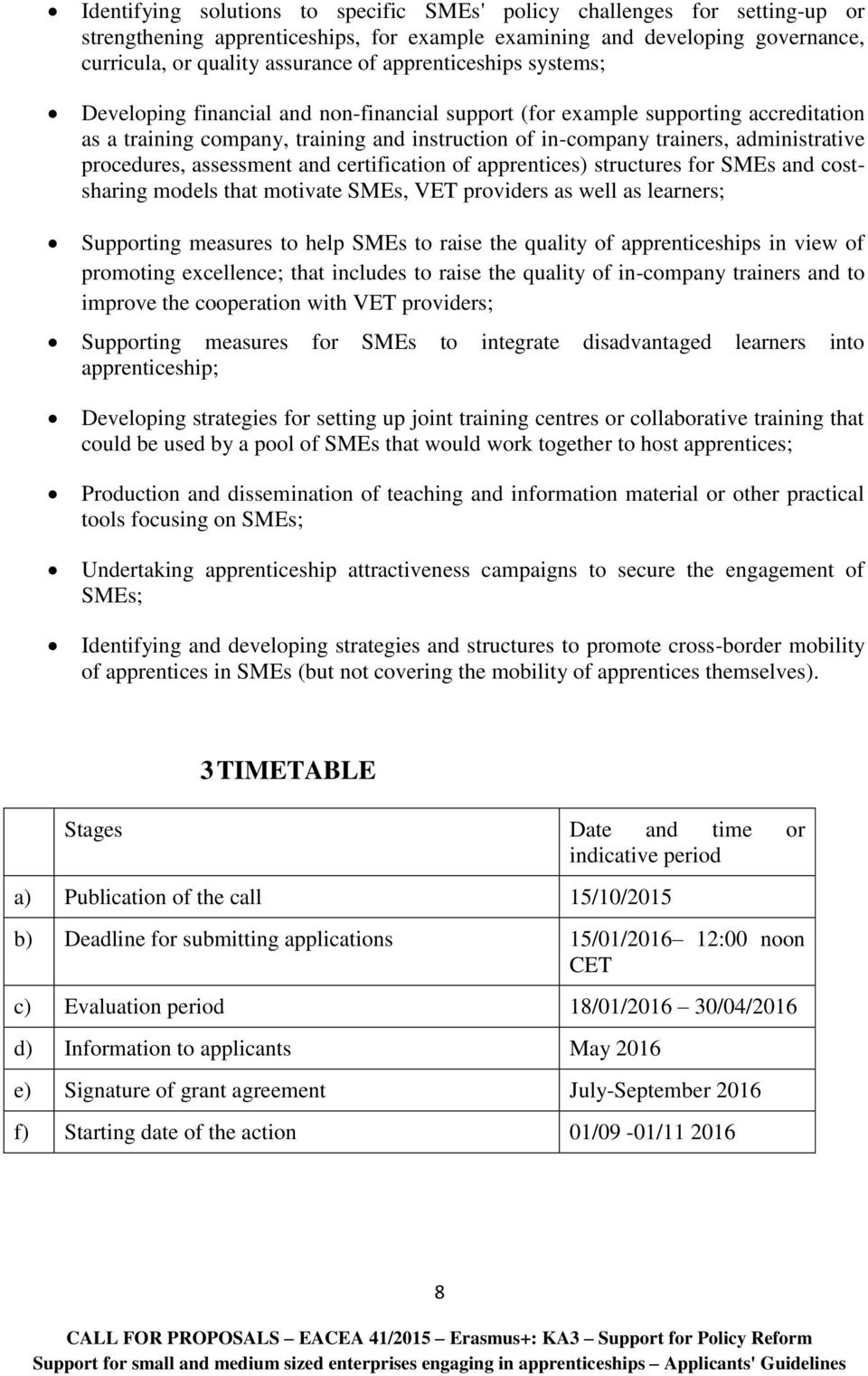
8 Identifying solutions to specific SMEs' policy challenges for setting-up or strengthening apprenticeships, for example examining and developing governance, curricula, or quality assurance of apprenticeships systems; Developing financial and non-financial support (for example supporting accreditation as a training company, training and instruction of in-company trainers, administrative procedures, assessment and certification of apprentices) structures for SMEs and costsharing models that motivate SMEs, VET providers as well as learners; Supporting measures to help SMEs to raise the quality of apprenticeships in view of promoting excellence; that includes to raise the quality of in-company trainers and to improve the cooperation with VET providers; Supporting measures for SMEs to integrate disadvantaged learners into apprenticeship; Developing strategies for setting up joint training centres or collaborative training that could be used by a pool of SMEs that would work together to host apprentices; Production and dissemination of teaching and information material or other practical tools focusing on SMEs; Undertaking apprenticeship attractiveness campaigns to secure the engagement of SMEs; Identifying and developing strategies and structures to promote cross-border mobility of apprentices in SMEs (but not covering the mobility of apprentices themselves). 3 TIMETABLE Stages Date and time or indicative period a) Publication of the call 15/10/2015 b) Deadline for submitting applications 15/01/ :00 noon CET c) Evaluation period 18/01/ /04/2016 d) Information to applicants May 2016 e) Signature of grant agreement July-September 2016 f) Starting date of the action 01/09-01/
9 4 BUDGET AVAILABLE The total budget earmarked for the co-financing of projects is estimated at maximum 8.7 million euros (5.2 million euros for Lot 1 and 3.5 million euros for Lot 2). Each grant will amount to between and euros for Lot 1 and between and euros for Lot 2. The Agency expects to fund around 15 proposals (up to 10 projects under Lot 1 and up to 5 projects under Lot 2). The Agency reserves the right not to distribute all the funds available. 5 ADMISSIBILITY REQUIREMENTS Applications shall comply with the following requirements: - they must be submitted online no later than the deadline for submitting applications referred to in section 3 of the present call for proposals; - they must be submitted exclusively using the correct official online application form (see Part 2 of the present call for proposals); - they must be drafted in any official EU language. Please note that only applications submitted online using the e-form will be considered. Failure to comply with those requirements will lead to the rejection of the application. In order to submit an application, applicants and partners must provide their Participant Identification Code (PIC) in the application form. The PIC can be obtained by registering the organisation in the Unique Registration Facility (URF) hosted in the Education, Audiovisual, Culture, Citizenship and Volunteering Participant Portal. The Unique Registration Facility is a tool shared by other services of the European Commission. If an applicant (or partner) already has a PIC that has been used for other programmes (for example the Research programmes), the same PIC is valid for the present call for proposals. The Participant Portal allows applicants (and partners), to upload or update the information related to their legal status and attach the requested legal and financial documents. See Part 2 for more information. 6 ELIGIBILITY CRITERIA Applications which comply with the following criteria will be subject of an in-depth evaluation. 9
10 6.1 Eligible Applicants Lot 1: The applicant (project co-ordinator) must be one of the following organisations: - chambers of industry, trade and crafts, or similarly relevant sectoral/professional organisations; - public or private enterprises; - VET providers. - other organisations with a role in supporting SMEs in increasing their offer on apprenticeships The partnership must be composed of at least two eligible countries (one of which must be an Erasmus+ programme country). Lot 2: The applicant (project co-ordinator) must be a network or organisation having members or affiliates in at least 12 Erasmus+ programme countries, of which at least 6 take part in the project as partners. 6.2 Eligible participating organisations (partners) For Lot 1 and Lot 2: - ministries; - social partners (employers' and workers' organisations); - public or private companies; - chambers of industry, trade and crafts, or similarly relevant sectoral/professional organisations (e.g. crafts organisations); - public employment services; - public regional and local authorities; - VET providers; - VET agencies/centres; - schools or other educational institutions; - higher education institutions; - research centres; - international organisations; - non-profit organisations (NGOs); - youth organisations; 10

11 - parents associations; - other relevant bodies. Natural persons and sole traders are not eligible. Applicants must submit letters from partner organisations confirming their participation (original signatures required). 6.3 Eligible Countries For Lot 1 and Lot 2: The Erasmus+ programme countries: the 28 Member States of the European Union, the EFTA/EEA countries: Iceland, Liechtenstein and Norway, EU candidate countries: Albania, the former Yugoslav Republic of Macedonia, Montenegro, Serbia and Turkey. Proposals from applicants in EFTA/EEA countries or from candidate or associated countries may be selected provided that, on the date of the award, agreements have been signed setting out the arrangements for the participation of those countries in the programme. The following Erasmus+ partner countries: EU potential candidate countries: Bosnia and Herzegovina, and Kosovo. 6.4 Eligible Activities Please see eligible activities described in chapter Eligibility Period Activities must start between 1 September 2016 and 1 November The duration of the projects is 24 months. Applications for projects scheduled to run for a shorter or longer period than that specified in this call for proposals will not be accepted. No extensions to the eligibility period beyond the maximum duration will be granted. However, if after the signing of the agreement and the start of the project it becomes impossible for the beneficiary, for fully justified reasons beyond his control, to complete the project within the scheduled period, an extension to the eligibility period may be granted. A maximum extension of 6 (six) additional months will be granted, if requested before the deadline specified in the agreement. The total grant awarded will not change. The maximum duration will then be 30 months. Only applications that fulfil the eligibility criteria will be considered for a grant. If an application is deemed ineligible, a letter indicating the reasons will be sent to the applicant. 11

12 7 EXCLUSION CRITERIA 7.1 Exclusion from participation Applicants will be excluded from participating in the call for proposals procedure if they are in any of the following situations: (a) they are bankrupt or being wound up, are having their affairs administered by the courts, have entered into an arrangement with creditors, have suspended business activities, are the subject of proceedings concerning those matters, or are in any analogous situation arising from a similar procedure provided for in national legislation or regulations; (b) they or persons having powers of representation, decision making or control over them have been convicted of an offence concerning their professional conduct by a judgment of a competent authority of a Member State which has the force of res judicata; (c) they have been guilty of grave professional misconduct proven by any means which the responsible authorising officer can justify including by decisions of the EIB and international organisations; (d) they are not in compliance with their obligations relating to the payment of social security contributions or the payment of taxes in accordance with the legal provisions of the country in which they are established or with those of the country of the responsible authorising officer or those of the country where the grant agreement is to be performed; (e) they or persons having powers of representation, decision making or control over them have been the subject of a judgment which has the force of res judicata for fraud, corruption, involvement in a criminal organisation, money laundering or any other illegal activity, where such illegal activity is detrimental to the Union' financial interests; (f) they are currently subject to an administrative penalty referred to in Article 109(1) of the Financial Regulation. 7.2 Exclusion from award Applicants will not be granted financial assistance if, in the course of the grant award procedure, they: (a) are subject to a conflict of interests; (b) are guilty of misrepresentation in supplying the information required by the Agency as a condition of participation in the grant award procedure, or fail to supply this information; (c) find themselves in one of the situations of exclusion referred to in the above section
13 Administrative and financial penalties may be imposed on applicants, who are guilty of misrepresentation or are found to have seriously failed to meet their contractual obligations under a previous grant award procedure Supporting documents Applicants for a grant exceeding EUR 60,000 must sign a declaration on their honour certifying that they are not in one of the situations referred to in the above sections 7.1. and 7.2, filling in the relevant form attached to the application form accompanying the call for proposals. 8 SELECTION CRITERIA Applicants must submit a declaration on their honour, completed and signed, attesting to their status as their financial and operational capacity to complete the proposed activities Financial capacity Applicants must have stable and sufficient sources of funding to maintain their activity throughout the period during which the action is being carried out or the year for which the grant is awarded and to participate in its funding. The applicants' financial capacity will be assessed on the basis of several supporting documents specified below. a) Grants EUR : A declaration on their honour (to be submitted with the application). A Financial Capacity Form, provided for in the application form, filled in with the relevant statutory accounting figures, in order to calculate the ratios as detailed in the form, The financial statements (including the applicant s profit and loss account and the balance sheet) for the last two financial years for which accounts were closed. b) Grants for an action > EUR , in addition to the above: An audit report produced by an approved external auditor certifying the accounts for the last financial year available. Applicants must upload the above mentioned documents in the Participants Portal either at the time of their registration in the Portal or, at the latest, before applying for an Erasmus+ grant. On the basis of the documents submitted, if the Authorising Officer considers that the financial capacity is not satisfactory, he may: - request further information; - propose a grant agreement without pre-financing; 13
14 - propose a grant agreement with a pre-financing paid in instalments; - propose a grant agreement with a pre-financing covered by a bank guarantee (see section 11.4 below); - where applicable, require the joint and several financial liability of all the cobeneficiaries; - reject the application. 8.2 Operational capacity Applicants must have the professional competencies as well as appropriate qualifications necessary to complete the proposed action. In this respect, applicants have to submit a declaration on their honour, and provide the following information in the Detailed Description of the Project (word document) which forms part of the application package: description of skills and qualifications of the people primarily responsible for managing and implementing the operation (accompanied where appropriate, like in the field of research and education, by a list of relevant publications) within each partner institution; an exhaustive lists of previous projects and activities performed and connected to the policy field of a given call or to the actions to be carried out. 9 AWARD CRITERIA ASSESSMENT GRIDS AND SCORING The quality of eligible applications for both Lots will be assessed on the basis of the following criteria: Criteria 14 Score 1 Relevance of the project (threshold minimum 20 points) /40 points the objectives of the proposal are clearly defined, realistic and address issues relevant for SMEs engaging in apprenticeships and are coherent with the objectives of the call for proposals; the envisaged achievements and results are indicated and coherent with the objectives of the call for proposals; the activities are based on needs analysis for introducing and developing apprenticeships. 2 Quality of the project design and implementation (threshold minimum 10 points) the clarity, completeness and quality of the work programme, including appropriate phases for preparation, implementation, monitoring, evaluation and dissemination; the consistency between project objectives and activities proposed;./20 points

15 the existence and relevance of quality control measures to ensure that the project implementation is of high quality, completed in time and on budget; the budget shows cost effectiveness and value for money. 3 Quality of the project consortium and cooperation arrangements (threshold minimum 10 points) the project involves an effective mix of participating organisations with the necessary profile, experience and expertise to successfully deliver all aspects of the project. The distribution of responsibilities and tasks demonstrates the commitment and active contribution of all participating organisations; the existence of effective mechanisms for coordination and communication between the participating organisations, as well as with any other relevant stakeholders beyond the partnership. /20 points 4 Impact and dissemination (threshold minimum 10 points) /20 points Total Total % the potential impact of the project on the supply for apprenticeships in SMEs, in particular SMEs with no previous experience, the quality of measures for evaluation the outcomes of the project the appropriateness and quality of measures aimed at sharing the outcomes of the project within and outside the participating organisations, the quality of the plans for ensuring the sustainability of the project: its capacity to continue to have an impact and produce results after the EU grant has been used. /100 points % The threshold for proposals to be put forward to the evaluation committee shall be minimum 60 points (out of 100 points in total), also taking into account the necessary minimum threshold for each of four award criteria. 10 LEGAL COMMITMENTS In the event of a grant awarded by the Agency, a grant agreement drawn up in euro and detailing the conditions and level of funding, will be sent to the beneficiary, as well as the procedure in view to formalise the obligations of the parties. Agreement: the 2 copies of the original agreement must be signed first by the beneficiary on behalf of the consortium (where applicable) and returned to the Agency immediately. The Agency will sign them last. Please note that the award of a grant does not establish an entitlement for subsequent years. 15

16 11.1 General principles 11 FINANCIAL PROVISIONS A European Union grant is an incentive to carry out activities that would not be possible without the Agency s financial support. It is based on the following principles: Non-cumulative award Action grants: An action may only receive one grant from the EU budget. In no circumstances shall the same costs be financed twice by the Union budget. To ensure this, applicants shall indicate in the application form the sources and amounts of Union funding received or applied for the same action or part of the action or for its functioning during the same financial year as well as any other funding received or applied for the same action Non-retroactivity No grant may be awarded retroactively for actions already completed. Action grants: A grant may be awarded for an action which has already begun only where the applicant can demonstrate the need to start the action before the grant agreement is signed. In such cases, costs eligible for financing may not have been incurred prior to the date of submission of the grant application Co-financing Co-financing means that the resources which are necessary to carry out the action may not be entirely provided by the EU grant. Co-financing of the action may take the form of: the beneficiary's own resources, income generated by the action, financial contributions from third parties Balanced budget 16

17 The estimated budget of the action is to be attached to the application form. It must have revenue and expenditure in balance. The budget must be drawn up in euros. Applicants which foresee that costs will not be incurred in euros shall use the exchange rate published on the Infor-euro website available at on the date of the publication of this call for proposals Implementation contracts/subcontracting Where the implementation of the action requires the award of procurement contracts (implementation contracts), the beneficiary must award the contract to the bid offering best value for money or the lowest price (as appropriate), avoiding conflicts of interests and retain the documentation for the event of an audit. In the event of procurement exceeding 60,000, the beneficiary must abide by special rules as referred in the grant agreement. Moreover the beneficiary is expected to clearly document the tendering procedure and retain the documentation for the event of an audit. Entities acting in their capacity of contracting authorities in the meaning of Directive 2004/18/EC or contracting entities in the meaning of Directive 2004/17/EC shall abide by the applicable national public procurement rules. Sub-contracting, i.e. the externalisation of specific tasks or activities which form part of the action as described in the proposal and which cannot be performed by the beneficiary itself must satisfy the conditions applicable to any implementation contract (as specified above) and in addition to them the following conditions: - it may only cover the implementation of a limited part of the action; - it must be justified having regard to the nature of the action and what is necessary for its implementation; - it must be clearly stated in the proposal or prior written authorisation from the Agency must be obtained. The applications may not envisage provision of financial support to third parties. In order to maintain the concept of the project partnership, the management and the general administration of the project may not be subcontracted Funding Forms Reimbursement of eligible costs in combination with flat rate covering overheads The grants financed through reimbursement of eligible costs in combination with flat rate covering overheads are calculated on the basis of a detailed estimated budget, indicating clearly the costs that are eligible for EU funding. 17
18 Maximum amount requested The EU grant is limited to a maximum co-financing rate of 80% of eligible costs (taking into account the maximum grant amount referred to in section 4). Consequently, part of the total eligible expenses entered in the estimated budget must be financed from sources other than the Union grant. The grant amount may neither exceed the eligible costs nor the amount requested. Amounts are indicated in euros. Acceptance of an application by the Executive Agency does not constitute an undertaking to award a grant equal to the amount requested by the beneficiary. Eligible costs Eligible costs are costs actually incurred by the beneficiary of a grant which meet the following criteria: - they are incurred during the duration of the action as specified in the grant agreement, with the exception of costs relating to final reports and certificates. The period of eligibility of costs will start as specified in the grant agreement. If a beneficiary can demonstrate the need to start the action before the agreement is signed, expenditure may be authorised before the grant is awarded. Under no circumstances can the eligibility period start before the date of submission of the grant application (see section ). - they are indicated in the estimated overall budget of the action; - they are incurred in connexion with the action which is the subject of the grant and are necessary for its implementation of the action; - they are identifiable and verifiable, in particular being recorded in the accounting records of the beneficiary and determined according to the applicable accounting standards of the country where the beneficiary is established and according to the usual cost-accounting practices of the beneficiary; - they comply with the requirements of applicable tax and social legislation; - they are reasonable, justified, and comply with the requirements of sound financial management, in particular regarding economy and efficiency. The beneficiary's internal accounting and auditing procedures must permit direct reconciliation of the costs and revenue declared in respect of the action with the corresponding accounting statements and supporting documents. Eligible direct costs: 18

19 The eligible direct costs for the action are those costs which, with due regard for the conditions of eligibility set out above, are identifiable as specific costs directly linked to the performance of the action and which can therefore be booked to it directly, such as: - the cost of personnel working under an employment contract with the applicant or equivalent appointing act and assigned to the action/project, comprising actual salaries plus social security contributions and other statutory costs included in their remuneration, provided that these costs are in line with the applicant's usual policy on remuneration policy of the beneficiary or, where applicable, its partners. NB: this cost must be actual cost incurred by the beneficiary, the co-beneficiary, and staff cost of other organisations is eligible only if it is paid directly or reimbursed by the beneficiary. These costs may include additional remuneration, including payments on the basis of supplementary contracts regardless of their nature, provided that it is paid in a consistent manner whenever the same kind of work or expertise is required and independently from the source of funding used; The corresponding salary costs of personnel of national administrations are eligible to the extent that they relate to the cost of activities which the relevant public authority would not carry out if the project concerned was not undertaken; - subsistence allowances (for meetings, including kick-off meetings where applicable, European conferences, etc.) provided that these costs are in line with the beneficiary's usual practices; - costs of travel (for meetings, including kick-off meetings where applicable, European conferences, etc.), provided that they are in line with the beneficiary's usual practices on travel; - depreciation cost of equipment (new or second-hand), only the portion of the equipment's depreciation corresponding to the duration of the action and the rate of actual use for the purposes of the action may be taken into account by the Agency, except where the nature and/or the context of its use justifies different treatment by the Agency; - costs of consumables and supplies, provided that they are identifiable and assigned to the action/project; - costs entailed by other contracts awarded by the beneficiary or its partners for the purposes of carrying out the action, provided that the conditions laid down in grant agreement are met; - all other direct costs arising directly from requirements linked to the performance of the action/project (Conferences, trainings, dissemination of information, specific evaluation of the action/project, translations, reproduction, etc.). - costs relating to a pre-financing guarantee lodged by the beneficiary of the grant, where required; - costs relating to external audits where required in support of the requests for payments; - non-deductible value added tax ("VAT") for all activities which are not activities of the public authorities in the Member States. 19

20 Eligible indirect costs (overheads) - a flat-rate amount, up to 7% of the eligible direct costs of the action, is eligible under indirect costs, representing the beneficiary's general administrative costs which can be regarded as chargeable to the action. Indirect costs may not include costs entered under another budget heading. Applicants s attention is drawn to the fact that in the case of organisations receiving an operating grant, indirect costs are no longer eligible under specific actions. Ineligible costs The following costs shall not be considered eligible: - return on capital; - debt and debt service charges; - provisions for losses or debts; - interest owed; - doubtful debts; - exchange losses; - costs of transfer from the Agency charged by the bank of the beneficiary; - costs declared by the beneficiary and covered by another action receiving a European Union grant. In particular, indirect costs shall not be eligible under a grant for an action awarded to the beneficiary who already receives an operating grant financed from the Union budget during the period in question; - contributions in kind; - excessive or reckless expenditure; - others (in accordance with the relevant legal base); - cost of replacing persons involved in the project; - expenses for travel to or from countries other than those participating in the project/programme, unless explicit prior authorisation is granted by the Agency; - Gift and entertainment expenses; - Dividends and profit sharing. Calculation of the final grant amount Supporting documents The final amount of the grant to be awarded to the beneficiary is established after completion of the action, upon approval of the request for payment containing the following documents: - a final report providing details of the implementation and results of the action; - the final financial statement of costs actually incurred. In case of: 1. Grants for an action of more than EUR , but less than EUR

21 The beneficiary is required to submit, in support of the final payment, a Report of Factual Findings on the Final Financial Report - Type I produced by an approved auditor or in case of public bodies, by a competent and independent public officer. The procedure and the format to be followed by an approved auditor or in case of public bodies, by a competent and independent public officer, are detailed in the following Guidance Notes : The use of the report format set by the Guidance Notes is compulsory. 2. Grants for an action of EUR or more, when the cumulative amounts of request for payment is at least EUR The beneficiary is required to submit, in support of the final payment, a Report of Factual Findings on the Final Financial Report - Type II produced by an approved auditor or in case of public bodies, by a competent and independent public officer. The certificate shall certify, in accordance with a methodology approved by the Agency, that the costs declared by the beneficiary in the financial statements on which the request for payment is based are real, accurately recorded and eligible in accordance with the grant agreement or grant decision. The procedure and the format to be followed by an approved auditor or in case of public bodies, by a competent and independent public officer, are detailed in the following Guidance Notes : The use of the report format set by the Guidance Notes is compulsory. If the eligible costs actually incurred by the beneficiary are lower than anticipated, the Agency will apply the rate of co-financing stated in the grant agreement to the expenditure actually incurred. In the event of non-execution or clearly inadequate execution of an activity planned in the application attached to the funding agreement, the final grant will be reduced accordingly. Non-profit rule EU grants may not have the purpose or effect of producing a profit within the framework of the action of the beneficiary. Profit shall be defined as a surplus of receipts over the eligible costs incurred by the beneficiary, when the request is made for payment of the balance. In this respect, where a profit is made, the Agency shall be entitled to recover a percentage of the profit corresponding to the Union contribution to the eligible costs actually incurred by the beneficiary to carry out the action. 21
22 11.3. Payment arrangements A first pre-financing payment corresponding to 40% of the grant amount will be transferred to the beneficiary within 30 days of the date when the last of the two parties signs the agreement, provided all requested guarantees have been received. A second pre-financing payment of 40% of the grant amount will be made within 60 days of receipt by the Agency of the progress report on the action s implementation. This second prefinancing payment may not be made until at least 70% of the previous pre-financing payment has been used up. Where the consumption of the previous pre-financing is less than 70%, the amount of the new pre-financing payment shall be reduced by the unused amounts of the previous pre-financing The Agency will establish the amount of the final payment to be made to the beneficiary on the basis of the calculation of the final grant amount (see section 11.2 above). If the total of earlier payments is higher than the final grant amount, the beneficiary will be required to reimburse the amount paid in excess by the Commission through a recovery order Pre-financing guarantee In the event that the applicant's financial capacity is not satisfactory, a pre-financing guarantee for up to the same amount as the pre-financing may be requested in order to limit the financial risks linked to the pre-financing payment. The financial guarantee, in euro, shall be provided by an approved bank or financial institution established in one of the Member State of the European Union. When the beneficiary is established in a third country, the authorising officer responsible may agree that a bank or financial institution established in that third country may provide the guarantee if he considers that the bank or financial institution offers equivalent security and characteristics as those offered by a bank or financial institution established in a Member State. Amounts blocked in bank accounts shall not be accepted as financial guarantees. The guarantee may be replaced by a joint and several guarantees by a third party or by a joint guarantee of the beneficiaries of an action who are parties to the same grant agreement The guarantee shall be released as the pre-financing is gradually cleared against interim payments or payments of balances to the beneficiary, in accordance with the conditions laid down in the grant agreement. This requirement does not apply to: public bodies and international organisations under public law established by intergovernmental agreements, specialised agencies created by such organisations, the International Committee of the Red Cross (ICRC) or the International Federation of Red Cross and Red Crescent Societies. 22
23 12.1. By the beneficiaries 12 PUBLICITY Beneficiaries must clearly acknowledge the European Union s contribution in all publications or in conjunction with activities for which the grant is used. In this respect, beneficiaries are required to give prominence to the name and emblem of the European Commission on all their publications, posters, programmes and other products realised under the co-financed project. To do this they must use the text, the emblem and the disclaimer available at which will be provided by the Agency. If this requirement is not fully complied with, the beneficiary s grant may be reduced in accordance with the provisions of the grant agreement By the Agency and/or the Commission With the exception of scholarships paid to natural persons and other direct support paid to natural persons in most need, all information relating to grants awarded in the course of a financial year shall be published on the Internet site of the European Union institutions no later than the 30 June of the year following the financial year in which the grants were awarded. The Agency and/or the Commission will publish the following information: name of the beneficiary, locality of the beneficiary: address of the beneficiary when the latter is a legal person, as defined on NUTS 2 level if he/she is domiciled within the EU or equivalent if domiciled outside EU, the amount awarded, nature and purpose of the grant. Upon a reasoned and duly substantiated request by the beneficiary, the publication shall be waived if such disclosure risks threatening the rights and freedoms of individuals concerned as protected by the Charter of Fundamental Rights of the European Union or harm the commercial interests of the beneficiaries. 13 DATA PROTECTION All personal data (such as names, addresses, CVs, etc.) will be processed in accordance with Regulation (EC) No 45/2001 of the European Parliament and of the Council of 18 December 2000 on the protection of individuals with regard to the processing of personal 23
24 data by the European Community institutions and bodies and on the free movement of such data. Unless marked as optional, the Applicant's replies to the questions in the application form are necessary to evaluate and further process the grant application in accordance with the specifications of the Call for proposals. Personal data will be processed solely for that purpose by the department or Unit responsible for the Union grant Programme concerned (entity acting as data controller). Personal data may be transferred on a need to know basis to third parties involved in the evaluation of applications or in the grant management procedure, without prejudice of transfer to the bodies in charge of monitoring and inspection tasks in accordance with European Union law. In particular, for the purposes of safeguarding the financial interests of the Union, personal data may be transferred to internal audit services, to the European Court of Auditors, to the Financial Irregularities Panel or to the European Anti- Fraud Office and between authorising officers of the Commission and the executive agencies. The applicant has the right of access to, and to rectify, the data concerning him or her. For any question relating to these data, please contact the Controller. Applicants have the right of recourse to the European Data Protection Supervisor at any time. A detailed Privacy statement, including contact information, is available on EACEA's website: ent.pdf Applicants and, if they are legal entities, persons who have powers of representation, decision-making or control over them, are informed that, should they be in one of the situations mentioned in: the Commission Decision of on the Early Warning System (EWS) for the use of authorising officers of the Commission and the executive agencies (OJ, L 344, , p. 125), or the Commission Regulation of on the Central Exclusion Database CED (OJ L 344, , p. 12), their personal details (name, given name if natural person, address, legal form and name and given name of the persons with powers of representation, decision-making or control, if legal person) may be registered in the EWS only or both in the EWS and CED, and communicated to the persons and entities listed in the above-mentioned Decision and Regulation, in relation to the award or the execution of a procurement contract or a grant agreement or decision. 14 PUBLICATION The Call is being published in the Official Journal of the European Union and on the website of the Agency at the following address: 24
25 15 APPLICABLE RULES Regulation (EU, Euratom) No 966/2012 of the European Parliament and of the Council of 25 October 2012 on the financial rules applicable to the general budget of the Union (OJ L 298, , p.1). Commission Delegated Regulation (EU) No 1268/2012 of 29 October 2012 on the rules of application of Regulation (EU, Euratom) No 966/2012 of the European Parliament and of the Council of 25 October 2012 on the financial rules applicable to the general budget of the Union (OJ L 362, , p.1) Legal basis of the programme: 16 CONTACT For any additional information, please contact: Functional Mailbox: [email protected] 25
26 PART 2 INSTRUCTIONS TO COMPLETE THE ONLINE GRANT APPLICATION FORM (EFORM) PRESENTATION AND ORGANISATION OF THESE INSTRUCTIONS For the Call EACEA 41/2015, applicants must use an online grant application form (eform) and its attachments. The purpose of this part of the Applicants' Guidelines is to offer guidance on the content of the eform and the application procedure. Please note that it does not replace the specific "eform User Guide" that is aimed at providing guidance on the technical aspects of completing and submitting the eform available at: General provisions 1 REGISTRATION The eform is an interactive PDF form that requires Adobe Reader software and applicants should ensure that they can install Adobe version 9 or higher on the computer they will be using to complete the application eform. The eform is downloaded onto a local computer and completed remotely. Once the text is ready and the attachments are linked to the application, it has to be submitted using an internet connection. The eform is settled to ensure that applicants have the greatest chance to submit an eligible application. Therefore you will find that submission will be impossible unless all mandatory fields are completed. The Applicant will be able to fill in this eform by either: clicking inside a text field to enter data; clicking to select options from e.g. dropdown lists, checkboxes, pop-up calendars and radio buttons; pressing Tab to move forward one field or Shift+Tab to move backward one field; pointing and clicking with the mouse to select a specific field. 1.2 Registration of the organisation In order to submit an application, all participating organisations (applicants and partners) will have to register their organisation in the Education, Audiovisual, Culture, Citizenship and 26
27 Volunteering Participant Portal and receive a Participant Identification Code (PIC). The PIC will be requested to generate the application form. Without this PIC code, no application will be possible. The Participant Portal is the tool through which all legal and financial information related to organisations will be managed. Information on how to register can be found in the portal under the following address: The tool also allows applicants to upload different documents related to their organisation. These documents have to be uploaded once and will not be requested again for subsequent applications by the same organisation. Details on the supporting documents that need to be uploaded in the portal can be found on the following link: in the section 'Annexes'. 1.3 Creating and Filling in the Eform Once carried out the registration procedure, you can proceed to the creation of the eform. You will have to input the following information: Programme: Erasmus+ Funding opportunity: Please choose the specific line "Support for small and medium sized enterprises engaging in apprenticeships"; Language: English version of the eform can be selected by using the dropdown menu; Participating organisation: please provide the registration code of all organisations participating in your proposal. Only after these steps you will be able to confirm your selection and create the application form. At this stage, it is strongly recommended to save the eform to your local computer or network drive, as it will not be possible to use the browser to fill this online application form. By not following this recommendation, you would encounter the risk to lose all the information entered so far (PICs etc.) and you would have to start the process again. Please note that the applicant organisation has to complete all sections for all partner organisations Application eform Cover Page Most of the information contained in this page is protected and not modifiable (grey lines). Please verify carefully all the information mentioned. In case some of this information is not correct, you will have the opportunity to modify it by entering on the Participant Portal 27
28 clicking on the icons enter Participant Portal and Revise list of participating organisations and update application eform. The only information to be filled in on this page relates to the title of the project and the project acronym. Please note that the project title must be "Support for small and medium sized enterprises engaging in apprenticeships". The eform can be completed in any official EU language. Please note that it must be a language that is understood by all the members of your consortium. Please note that the application form must be completed in one language only List of Partner Organisations This list will provide the name of all organisations registered in the eform. It will also provide a number of validation messages. To be able to use the eform, please be sure that all the items contained in the table are marked as valid. One or more of these items marked as invalid means that all the eligibility rules were not properly respected and will make impossible for you to validate or submit the eform. In that case a new application eform must be created and you must be sure that this time all the eligibility rules will be followed Part A - Identification of the applicant organisation Part A.1 Organisation Most fields in part A1 are completed automatically, based on the information you provided while registering your organisation in the EAC/EACEA Participant Portal. The only field to be filled in on this page is the Region of the registered address, by using the dropdown list. Please note that fields related to Accreditation Type and to Accreditation number are not applicable for the Call. Part A.2 and Part A.3 - Contact Person and Legal Representative In Part A.2, complete the title, family name, first name, role in the organisation and address of the contact person. As part of the eform submission process, an message acknowledging receipt of your eform will be automatically sent to the address entered for the contact person. If the contact person has a different address from the registered address of the organisation, click on the related box and provide the address and telephone number. The contact person is the person responsible for the daily management and monitoring of the project activities, as well as for the submission of reports on activities and outcomes to the Agency. This person might be different from the Legal Representative. The Legal Representative will be authorised by the Applicant to represent the organisation in legally binding agreements (only his/her signature will be accepted by the Agency on all documents related to the grant (e.g. grant, declaration on honour, any request for amendment, 28
29 final report). You will have to fill in Part A.3 of the eform in case the contact person is different from the Legal Representative of the project Part B - Organisation and activities This section should be completed for each organisation. Part B.1 Structure On this page, please indicate the type of organisation by using the dropdown menu. Part B.2 - Aims and activities of the organisation The organisation, its aims and objectives, key activities, etc. should be described in relation to the domain covered by the work programme. This section should also provide information on the organisation's role in the project. Part B.3 - Other EU grants envisaged for activities for the financial year in question Please inform the Agency of any request for funding submitted or approved after submission of this application. Please also indicate whether your organisation submitted - or intend to submit any other grant applications to the Agency or to the European Commission for activities planned for the financial year If so, for each grant please indicate the activity, the Directorate-General and the Programme concerned, as well as the total amount requested Part C Dates and budget Part C.1 Dates and Duration Please indicate the starting date and duration of the project. Refer to Part 1 section 3 and 6.4. Part C.2 Summary Budget Under this section, please provide a summary of the budget for the proposed action. Please refer to Part 1 Sections 11 to complete this section. You are advised to complete the eform budgetary annex (Excel attachment) before completing this section. Please ensure full consistency between the eform and excel file data: the amounts in the Excel tables and in this section must be identical. All budgetary information must be provided in Euro/. Expenses and Income should lead to a balanced budget eform attachments Once Parts A and B and C have been completed applicants must upload to the eform the following compulsory attachments: 29
30 Detailed Description of the Project Please note: this form must be completed in ONE language only (the same language as used in the eform part). The language used to complete the project description must be an official EU language and must be a language that is understood by all the members of your consortium. This is also in line with the Declaration of Honour stating that all the partners should have agreed to the content of the application and should have confirmed their intention to carry out the tasks described. In addition, it is important that the application is compiled in one language only, as the experts assessing the application should be able to understand the language in which it is written. All text fields in all sections are obligatory. For adding information in new columns/rows of the tables, please use the copy-paste function of your computer. The maximum number of characters is indicated under each section (spaces do not count). You have to respect it in order to avoid potential problems during the submission of your application. If the maximum number of characters is exceeded, the assessment of your proposal will only take into account the information provided up to this maximum. The information exceeding the word limit will therefore not be assessed. As this is a word document, it is possible to insert pictures and diagrams into the text boxes in addition to the character limit. However, the maximum number of characters as indicated under each section should be respected in order to avoid any potential problem during the submission of the application. The maximum capacity of the application package (eform + three annexes) is 5 MB. The Word attachment titled Detailed Description of the Project is divided into two compulsory parts. Please find below an explanation on how to complete them. Part I: General Information 1. Title The title of the project proposal must be: Support for small and medium sized enterprises engaging in apprenticeships: xxx. 2. Project Summary Please provide a comprehensive summary of the main features, components and aspects of the project (reasons, aims and objectives, outputs, results and products, scope and impact). Given the limited number of 3000 character it has to be short, clear and pertinent. 3. Financial Support from the European Union If part of the activities in this application are supported under the Erasmus+ Programme or some other European Union programmes please list them in the box provided. Quote the full 30
31 reference number of the project (e.g. the EU grant agreement number), dates of implementation, the title of the Programme and types of activities. In addition, please specify whether the applicant organisation benefits from an operating grant. Part II: Detailed description of the project In this Part, you are requested to describe the relevance of your proposal and why and how it is in line with the respective award criteria (please refer to Part I of the present document for further guidance on the award criteria). This description will help external experts to assess the relevance of the issues in the context of the objectives of the action. This part is divided into several sections (II.1 to II.8) where you should explain in depth the relevance of your project. Please provide a comprehensive summary of the main components and aspects of the project along the lines provided below: II.1 Rationale & needs/ problems/ challenges II.2 Aims and objectives II.3 Target groups II.4 Expected impact II.5 Profile and composition of the team implementing the project quality of the project teams and cooperation arrangements II.6 Methodology quality of the project design and implementation II.7 Dissemination and exploitation activities II.8 Description of the work programme and deliverables Given the limited number of characters, descriptions have to be short, clear and pertinent. Should your application foresee the participation of associated partners, please list them in the corresponding tables provided at the end of the document "Detailed Description of the Project". List of associated partners: In case the application involves associated partners, these have to be listed at the end of the detailed project description. The role of associated partners and their involvement in the project is limited: these organisations may provide the consortium with facilities or assistance 31
32 that enhances the quality of work, but they must not be responsible for core activities of the project (like coordination, work package leadership, etc). Associated partners cannot receive direct funding from the project's EU grant. They do not feature in the application budget of eligible costs as they neither contribute to the eligible costs nor manage a portion of the grant funds, they participate on the basis of their own contributions. Aspects of their participation may be covered within the eligible budget if they are eligible in general terms and if those costs pass through the accounts of one of the members of the consortium (e.g. participation in meetings). Associated partners may be organisations based in one of the Programme Countries or in Partner Countries. They cannot appear as subcontractors. The Declaration on Honour A Declaration of Honour (in format PDF, TIFF, JPEG) should be attached and signed by beneficiaries applying for a European grant. The Declaration of Honour certifies that all information contained in the application, including the project description, is correct, to the best knowledge of the person identified as legal representative of the applicant organisation, who is familiar with the contents of the application form and annexes. The Declaration confirms that the applicant organisation has the financial and operational capacity to complete the proposed project. The legal representative of the applicant organisation takes note that, under the provisions of the Financial Regulations applicable to the general budget of the European Union, grants may not be awarded to applicants who are in any of the situations defined in the exclusion criteria. Please note that the total grant amount indicated in the Declaration must correspond with the one indicated in the eform (Part C.2) and in the budget tables in annex. The Declaration of Honour should be printed, signed by the legal representative, scanned and attached to the application. A template of the model of Declaration on Honour and designation letter can be downloaded on the following link: 32
33 Detailed budget This budget 10 must be duly completed by using the Excel table which can be found in the following link: The budget should cover the entire period of the grant relating to the basic amount. The budget should be coherent with the Activity Plan as described in the Detailed Word Description of the Project. All amounts should be provided in euro. Please adhere strictly to the format provided in the tables and check the figures provided carefully. Beneficiaries should report staff costs based on real daily staff cost rates, corresponding to the beneficiary's usual policy on remuneration, comprising actual salaries plus social security charges and other statutory costs included in the remuneration. The forecasted budget must clearly state all the eligible costs (costs that could be subsidised by the Union Budget). Applicants not established in the «Euro zone» must use the exchange rate published in the Official Journal of the European Union on date of publication of the Call. For this purpose the following web site shall be consulted: Invitation to an event organised by the Commission and/or the Agency Two meetings per year may be organised by the Commission or the Agency for two project representatives e.g. a kick-off meeting or a cluster meeting. The participation in these meetings is mandatory. The coordinator and/or other project representatives may also be invited by the Commission or the Agency to participate in other meetings and to present the project. Consequently, the expenses related to the participation in such meetings are considered as eligible costs and must be covered by the project s budget. Appropriate budget lines have been introduced in the subheading "Travel and Subsistence Costs" of the budget tables. An error message will appear in the eform if you do not upload all of these attachments. 33
34 PART 3 SUBMISSION OF THE ONLINE GRANT APPLICATION FORM (EFORM) AND ADDITIONAL REQUIRED ANNEXES Applications must be made using an online grant application form (eform). The eform is available in English at the following Internet address: and must be duly completed in one of the official languages of the EU. The eform (including its attachments) duly completed must be submitted online by (noon, Brussels time) on 15/01/2016. A complete application package comprises: The eform and its attachments Only applications submitted on the correct form, duly completed, dated and including all the compulsory attachments will be accepted. No modifications to the application are allowed once the deadline for submission has elapsed. However, if there is a need to clarify certain aspects or for the correction of clerical mistakes, the Agency may contact the Applicant for this purpose during the evaluation process. Once the eform and annexes have been submitted, a reference number is automatically generated on the eform. In addition, a notification message will be sent by to the contact person of the applicant organisation to the address indicated in the eform. Please ensure the following: The application should be completed electronically by computer and submitted online (no paper, no handwritten submissions, or submissions completed using a typewriter will be accepted); The application package must be complete as defined in Part 2 of the present document; No information or documents other than the Application Package can be sent. Any further documents will not be taken into consideration in the evaluation of the application. 34
35 No changes to the application can be made after the deadline has expired. However, if there is a need to clarify certain administrative aspects (e.g. contact details) the applicant may be contacted for this purpose. Please note the date and time of the online submission. Applicants are STRONGLY advised to submit their application well in advance of the deadline and to keep proof of the safe arrival of the application in the system. If you experience any technical problems during the submission, please contact the eform Helpdesk immediately [email protected] If you have questions on the content of the eform and the Annexes, please contact the functional mailbox: [email protected] All applicants will be informed in writing about the results of the selection process. 35
EUROPEAN COMMISSION EUROSTAT. Directorate C: National Accounts, Prices and Key Indicators. Call for proposals 21040/2014/003
 EUROPEAN COMMISSION EUROSTAT Directorate C: National Accounts, Prices and Key Indicators Call for proposals 21040/2014/003 PREPARATORY WORK FOR THE MODERNISATION OF PUBLIC SECTOR ACCOUNTING SYSTEMS ON
How To Make A Proposal For A Project In European Media
 EUROPEAN COMMISSION Directorate-General for Education and Culture Culture and Creativity Creative Europe programme MEDIA CALL FOR PROPOSALS EAC/S16/2014 Fostering European integration through culture by
EUROPEAN COMMISSION CONSUMERS, HEALTH, AGRICULTURE AND FOOD EXECUTIVE AGENCY 2015 CALL FOR PROPOSALS FOR PROJECTS
 Ref. Ares(2015)2346168-04/06/2015 EUROPEAN COMMISSION CONSUMERS, HEALTH, AGRICULTURE AND FOOD EXECUTIVE AGENCY Health Unit Luxembourg, Chafea LB/JR/at Ares (2015) 2015 CALL FOR PROPOSALS FOR PROJECTS THIRD
EUROPEAN COMMISSION DIRECTORATE-GENERAL HOME AFFAIRS. Directorate B - Migration, Asylum. Preparatory Action HOME/2013/CFP/PARS
 EUROPEAN COMMISSION DIRECTORATE-GENERAL HOME AFFAIRS Directorate B - Migration, Asylum Preparatory Action Network of contacts and discussion between targeted municipalities and local authorities on experiences
CALL FOR PROPOSALS MOVE/C4-2014/298
 EUROPEAN COMMISSION DIRECTORATE-GENERAL FOR MOBILITY AND TRANSPORT Directorate C - Innovative & sustainable mobility The Director CALL FOR PROPOSALS MOVE/C4-2014/298 Call for proposals to support European
Call for proposals Nº: MARKT/2013/133/H
 EUROPEAN COMMISSION Directorate General Internal Market and Services RESOURCES AND COMMUNICATION Financial Resources and Internal Control Call for proposals Nº: MARKT/2013/133/H Preparatory action Capacity
Action grants to support national and transnational projects projects aiming to promote Union citizenship
 EUROPEAN COMMISSION DIRECTORATE-GENERAL JUSTICE CALL FOR PROPOSALS Action grants to support national and transnational projects projects aiming to promote Union citizenship RIGHTS, EQUALITY AND CITIZENSHIP
HOME/2014/AMIF/AG/ASYL
 EUROPEAN COMMISSION DIRECTORATE-GENERAL MIGRATION AND HOME AFFAIRS ASYLUM, MIGRATION AND INTEGRATION FUND (AMIF) 2014-2020 HOME/2014/AMIF/AG/ASYL Call for proposals for Asylum Action Grants (ASYL CFP)
EUROPEAN COMMISSION Directorate-General for Internal Market, Industry, Entrepreneurship and SMEs. Innovation and Advanced Manufacturing Director
 EUROPEAN COMMISSION Directorate-General for Internal Market, Industry, Entrepreneurship and SMEs Innovation and Advanced Manufacturing Director CALL FOR PROPOSALS Business transfers to employees creating
CALL FOR PROPOSALS MARE/2014/04. Support measures for small-scale fishing
 Ref. Ares(2015)3122272-24/07/2015 EUROPEAN COMMISSION Budget Central Financial Service Procurements, contracts, and grants CALL FOR PROPOSALS MARE/2014/04 Support measures for small-scale fishing Contents
EUROPEAN COMMISSION DIRECTORATE-GENERAL JUSTICE
 EUROPEAN COMMISSION DIRECTORATE-GENERAL JUSTICE CALL FOR PROPOSALS Action grants to support projects on non-discrimination and Roma integration RIGHTS, EQUALITY AND CITIZENSHIP PROGRAMME (2014-2020) TABLE
EUROPEAN COMMISSION Executive Agency for Small and Medium-sized Enterprises (EASME)
 EUROPEAN COMMISSION Executive Agency for Small and Medium-sized Enterprises (EASME) Call for expression of interest for the establishment of a list of experts to assist the Executive Agency for Small and
EUROPEAN COMMISSION DIRECTORATE-GENERAL JUSTICE and CONSUMERS CALL FOR PROPOSALS JUST/2014/RDAP/AG/HARM
 EUROPEAN COMMISSION DIRECTORATE-GENERAL JUSTICE and CONSUMERS Call for proposals for action grants CALL FOR PROPOSALS Action grants to support transnational projects aiming to prevent, inform about and
BUDGET HEADING 04.03.03.03 INFORMATION, CONSULTATION AND PARTICIPATION OF REPRESENTATIVES OF UNDERTAKINGS CALL FOR PROPOSALS
 EUROPEAN COMMISSION Employment, Social Affairs and Inclusion DG Employment and Social Legislation, Social Dialogue Labour Law BUDGET HEADING 04.03.03.03 INFORMATION, CONSULTATION AND PARTICIPATION OF REPRESENTATIVES
CREATIVE EUROPE. MEDIA Sub-programme SUPPORT FOR THE DISTRIBUTION THE "SALES AGENTS SCHEME" GUIDELINES OF NON-NATIONAL EUROPEAN FILMS
 MEDIA Sales Agents Call for Proposals EACEA/07/2015 CREATIVE EUROPE MEDIA Sub-programme SUPPORT FOR THE DISTRIBUTION OF NON-NATIONAL EUROPEAN FILMS THE "SALES AGENTS SCHEME" GUIDELINES TABLE OF CONTENTS
SUBJECT. public and. projects. financing. 2014-2020. European of 25.4.2013, OJ L 349 of. 2, a call for. W910 Chaussée (0)2 29 73727
 Innovation and Networks Executive Agency CALL FOR PROPOSALS CONCERNING PROJECTS OF COMMON INTEREST UNDER THE CONNECTINGC EUROPE FACILITY IN THE FIELD OF TRANS-EUROPEAN ENERGY INFRASTRUCTURE E CEF ENERGY
CREATIVE EUROPE. MEDIA Sub-programme SUPPORT FOR TRAINING GUIDELINES -1-
 CREATIVE EUROPE MEDIA Sub-programme SUPPORT FOR TRAINING GUIDELINES -1- TABLE OF CONTENTS 1. INTRODUCTION 2. OBJECTIVES - PRIORITIES 2.1. Objectives and Priorities 2.2. Targeted Projects 3. TIMETABLE 4.
Application Form Call: 2015. KA1 - Learning Mobility of Individuals. VET learner and staff mobility
 General Information This application form consists of the following main sections: - Context: this section asks for general information about the type of project proposal you want to submit and about the
TOPIC: Action grants to support judicial cooperation in criminal matters
 EUROPEAN COMMISSION DIRECTORATE-GENERAL FOR JUSTICE and CONSUMERS CALL FOR PROPOSALS JUST/2015/JCOO/AG TOPIC: Action grants to support judicial cooperation in criminal matters JUSTICE PROGRAMME (2014-2020)
Erasmus+ General Information. Application Form Call: 2015. KA2 Cooperation and Innovation for Good Practices
 General Information This application form consists of the following main sections: - Context: this section asks for general information about the type of project proposal you want to submit; - Participating
CALL FOR PROPOSALS European Destinations of Excellence Promotion of EDEN destinations and awareness raising
 Ref. Ares(2015)1766460-27/04/2015 EUROPEAN COMMISSION Executive Agency for Small and Medium-sized Enterprises (EASME) CALL FOR PROPOSALS European Destinations of Excellence Promotion of EDEN destinations
EUROPEAN COMMISSION DIRECTORATE-GENERAL JUSTICE CALL FOR PROPOSALS JUST/2013/DAP/SAG/CAAM FOR CHILD ABDUCTION ALERT MECHANISMS SPECIFIC ACTION GRANTS
 EUROPEAN COMMISSION DIRECTORATE-GENERAL JUSTICE Directorate A: Civil justice Unit A.4: Programme management SPECIFIC PROGRAMME "DAPHNE III (2007 2013) CALL FOR PROPOSALS JUST/2013/DAP/SAG/CAAM FOR CHILD
How to prepare and submit a proposal
 ERASMUS + PROSPECTIVE INITIATIVES Call for proposals EACEA 10/2014 How to prepare and submit a proposal 7 April 2014 Outline General information & timetable Selection process (pre-proposals, full proposals)
EUROPEAN COMMISSION. CALL - EAC/A05/2014 Erasmus+ Vocational Education and Training Mobility Charter 2015-2020
 EUROPEAN COMMISSION CALL - EAC/A05/2014 Erasmus+ Vocational Education and Training Mobility Charter 2015-2020 1. Introduction This specific Call is based on Regulation (EU) No 1288/2013 of the European
PREVENTION OF AND FIGHT AGAINST CRIME 2007-2013 ACTION GRANTS 2012 TARGETED CALL FOR PROPOSALS
 PREVENTION OF AND FIGHT AGAINST CRIME 2007-2013 ACTION GRANTS 2012 TARGETED CALL FOR PROPOSALS Law enforcement cooperation through measures to set up Passenger Information Units in Member States for the
EUROPEAN COMMISSION DIRECTORATE-GENERAL JUSTICE
 EUROPEAN COMMISSION DIRECTORATE-GENERAL JUSTICE CALL FOR PROPOSALS Action grant(s) to create a web-based knowledge platform for professionals dealing with female genital mutilation 2014 Pilot Project 1.
EUROPEAN COMMISSION DIRECTORATE-GENERAL FOR JUSTICE AND CONSUMERS
 EUROPEAN COMMISSION DIRECTORATE-GENERAL FOR JUSTICE AND CONSUMERS CALL FOR PROPOSALS JUST/2015/JCOO/AG TOPIC: Action grants to support judicial cooperation in criminal matters relating to the criminal
SUBCONTRACTING FOR EXTERNAL EXPERTISE
 SUBCONTRACTING FOR EXTERNAL EXPERTISE Tender specifications for recruiting the service of a National Expert for the development of the sustainable strategic plan for the tourism sector of the City of Ungheni
[email protected]
 JLS Programmes in the area of criminal justice: Martine PARMANTIER Programme Manager for Criminal Justice Acronym JPEN Tel: +32.2.298 93 06 E-mail address: 1 [email protected] 2 Total of
PREVENTION OF AND FIGHT AGAINST CRIME 2007-2013 TARGETED CALL FOR PROPOSALS ACTION GRANTS 2011
 EUROPEAN COMMISSION DIRECTORATE-GENERAL HOME AFFAIRS Directorate A : Internal Security PREVENTION OF AND FIGHT AGAINST CRIME 2007-2013 TARGETED CALL FOR PROPOSALS ACTION GRANTS 2011 ILLEGAL USE OF INTERNET-INT
INTERNAL SECURITY FUND POLICE (2014-2020) CALL FOR PROPOSALS HOME/2014/ISFP/AG/CYBR FIGHTING CYBERCRIME AND CHILD SEXUAL ABUSE
 EUROPEAN COMMISSION DIRECTORATE-GENERAL HOME AFFAIRS INTERNAL SECURITY FUND POLICE (2014-2020) CALL FOR PROPOSALS HOME/2014/ISFP/AG/CYBR FIGHTING CYBERCRIME AND CHILD SEXUAL ABUSE 1. INTRODUCTION BACKGROUND
Establishing a network on quality and costeffectiveness in long-term care and dependency prevention
 Ref. Ares(2014)4103988-08/12/2014 EUROPEAN COMMISSION Employment, Social Affairs and Inclusion DG Europe 2020: Social Policies Social Protection CALL FOR PROPOSALS Budget line: 04 03 01 04 VP/2014/ 10
SPECIFIC PROGRAMME "CRIMINAL JUSTICE" (2007-2013) CALL FOR PROPOSALS JUST/2012/JPEN/AG/EJT Action grants
 EUROPEAN COMMISSION DIRECTORATE-GENERAL JUSTICE SPECIFIC PROGRAMME "CRIMINAL JUSTICE" (2007-2013) CALL FOR PROPOSALS JUST/2012/JPEN/AG/EJT Action grants 1. INTRODUCTION On 12 February 2007, the Council
PREVENTION OF AND FIGHT AGAINST CRIME 2007-2013 ACTION GRANTS 2012 TARGETED CALL FOR PROPOSALS
 PREVENTION OF AND FIGHT AGAINST CRIME 2007-2013 ACTION GRANTS 2012 TARGETED CALL FOR PROPOSALS Trafficking in Human Beings - THB Deadline: 28.8.2012 (14:00 CET) 1. BACKGROUND AND MAIN OBJECTIVES Under
BUDGET HEADING 04.03.01.06 INFORMATION, CONSULTATION AND PARTICIPATION OF REPRESENTATIVES OF UNDERTAKINGS CALL FOR PROPOSALS
 EUROPEAN COMMISSION Employment, Social Affairs and Inclusion DG Employment and Social Legislation, Social Dialogue Labour Law BUDGET HEADING 04.03.01.06 INFORMATION, CONSULTATION AND PARTICIPATION OF REPRESENTATIVES
28 September 2007 LIFELONG LEARNING PROGRAMME GUIDE FOR APPLICANTS: ADMINISTRATIVE AND FINANCIAL RULES
 28 September 2007 LIFELONG LEARNING PROGRAMME GUIDE FOR APPLICANTS: ADMINISTRATIVE AND FINANCIAL RULES 1 Table of Content 2 1. GENERAL PROVISIONS This document contains supplementary information to the
CREATIVE EUROPE. MEDIA Sub-programme SUPPORT FOR THE TRANSNATIONAL THE "SELECTIVE SCHEME" GUIDELINES DISTRIBUTION OF EUROPEAN FILMS
 MEDIA Selective Call for Proposals EACEA/23/2014 CREATIVE EUROPE MEDIA Sub-programme SUPPORT FOR THE TRANSNATIONAL DISTRIBUTION OF EUROPEAN FILMS THE "SELECTIVE SCHEME" GUIDELINES TABLE OF CONTENTS 1.
CALL FOR PROPOSALS VP/2014/014
 EUROPEAN COMMISSION Employment, Social Affairs and Inclusion DG Europe 2020: Social Policies Social Protection and Activation Systems CALL FOR PROPOSALS VP/2014/014 Promoting the contribution of private
EXPRESSION OF INTEREST
 To: European Investment Fund COSME Guarantee 37B, avenue J.F. Kennedy L - 2968 Luxembourg EXPRESSION OF INTEREST For the (Counter-)Guarantee for debt financing / Guarantee for securitised portfolio in
EUROPEAN RETURN FUND 2008-2013 1. Deadline for application
 EUROPEAN COMMISSION DIRECTORATE-GENERAL HOME AFFAIRS Directorate C: Schengen EUROPEAN RETURN FUND 2008-2013 1 COMMUNITY ACTIONS CALL FOR PROPOSALS 2013 Deadline for application The completed application
INTERNAL SECURITY FUND POLICE (2014-2020) 2015 CALL FOR PROPOSALS HOME/2015/ISFP/AG/THBX ACTIONS ADDRESSING TRAFFICKING IN HUMAN BEINGS
 EUROPEAN COMMISSION DIRECTORATE-GENERAL MIGRATION AND HOME AFFAIRS INTERNAL SECURITY FUND POLICE (2014-2020) 2015 CALL FOR PROPOSALS HOME/2015/ISFP/AG/THBX ACTIONS ADDRESSING TRAFFICKING IN HUMAN BEINGS
ANNEX IV Procurement by grant Beneficiaries in the context of European Union external actions 1
 ANNEX IV Procurement by grant Beneficiaries in the context of European Union external actions 1 1. GENERAL PRINCIPLES If the implementation of an Action requires procurement by the Beneficiary, the contract
Guide for Applicants. Call for Proposal:
 Guide for Applicants Call for Proposal: COSME Work Programme 2014 TABLE OF CONTENTS I. Introduction... 3 II. Preparation of the proposal... 3 II.1. Relevant documents... 3 II.2. Participants... 4 II.2.1.
EUROPEAN COMMISSION Employment, Social Affairs and Inclusion DG. Employment and Social Legislation, Social Dialogue Labour Law
 EUROPEAN COMMISSION Employment, Social Affairs and Inclusion DG Employment and Social Legislation, Social Dialogue Labour Law BUDGET HEADING 04.03.01.06 INFORMATION, CONSULTATION AND PARTICIPATION OF REPRESENTATIVES
Official Journal of the European Union
 L 132/32 COMMISSION IMPLEMTING REGULATION (EU) No 447/2014 of 2 May 2014 on the specific rules for implementing Regulation (EU) No 231/2014 of the European Parliament and of the Council establishing an
Action grants to support National Roma platforms RIGHTS, EQUALITY AND CITIZENSHIP PROGRAMME (2014-2020)
 EUROPEAN COMMISSION DIRECTORATE-GENERAL FOR JUSTICE AND CONSUMERS RESTRICTED CALL FOR PROPOSALS JUST/2015/RDIS/AG/NRP2 Action grants to support National Roma platforms RIGHTS, EQUALITY AND CITIZENSHIP
EUROPEAN COMMISSION Internal Market, Industry, Entrepreneurship and SMEs. Towards EU Regional Economic Convergence (TREC)
 EUROPEAN COMMISSION Internal Market, Industry, Entrepreneurship and SMEs CALL FOR PROPOSALS Towards EU Regional Economic Convergence (TREC) Pilot Projects to reinforce collaboration among clusters and
Annex I to the Open Call for Expression of Interest to select Financial Intermediaries under EaSI Guarantee Financial Instrument
 To: European Investment Fund EaSI 37B, avenue J.F. Kennedy L - 2968 Luxembourg EXPRESSION OF INTEREST For the (Counter-)Guarantee in the context of the EaSI Applicant submitting the Expression of Interest:,
PREVENTION, PREPAREDENESS AND CONSEQUENCE MANAGEMENT OF TERRORISM AND OTHER SECURITY- RELATED RISKS (CIPS)
 PREVENTION, PREPAREDENESS AND CONSEQUENCE MANAGEMENT OF TERRORISM AND OTHER SECURITY- RELATED RISKS (CIPS) Call for Proposals CIPS Action Grants 2012 Deadline: 17 July 2012 14:00 CET 1. BACKGROUND AND
HERCULE III PROGRAMME 2014-2020 CALL FOR PROPOSALS - 2015 LEGAL TRAINING AND STUDIES E PROGRA MME 2014-0. Deadline Tuesday, 22 September 2015
 HERCULE III PROGRAMME 2014-2020 UL CALL FOR PROPOSALS - 2015 LEGAL TRAINING AND STUDIES E PROGRA MME 2014-0 Deadline Tuesday, 22 September 2015 The English version of the Call is the original The English
RULES FOR PARTICIPATION IN THE IMI JU COLLABORATIVE PROJECTS
 Innovative Medicines Initiative IMI-GB-DEC-2012-12 RULES FOR PARTICIPATION IN THE IMI JU COLLABORATIVE PROJECTS OUTLINE 1. Definitions 2. Participation in an IMI JU collaborative project 2.1 General provisions
Annex 2: Rules and Procedures for the Swiss-Polish Cooperation Programme
 Annex 2: Rules and Procedures for the Swiss-Polish Cooperation Programme Annex 2 is an integral part of the Framework Agreement between the Swiss Federal Council and the Government of the Republic of Poland
CALL FOR PROPOSALS EACEA No 25/2007
 CALL FOR PROPOSALS EACEA No 25/2007 CULTURE PROGRAMME (2007-2013) SUPPORT FOR CULTURAL ACTIONS: LITERARY TRANSLATION (STRAND 1.2.2) 'SPECIFICATIONS' TABLE OF CONTENTS 1. INTRODUCTION 2. OBJECTIVES AND
Frequently asked questions. FP7 Financial Guide
 Frequently asked questions FP7 Financial Guide Budgetary matters Eligible costs of a project What are the criteria for determining whether the costs of a project are eligible? First of all, costs must
FINANCIAL GUIDELINES FOR APPLICANTS VP/2012/007
 Last update: February 2012 FINANCIAL GUIDELINES FOR APPLICANTS VP/2012/007 CONTENTS 1 GENERAL PRINCIPLES... 4 2 RULES RELATED TO THE GRANT REQUESTED... 4 3 THE ESTIMATED BUDGET OF THE ACTION... 5 3.1 The
BUDGET HEADING 04 03 01 05 CALL FOR PROPOSALS VP/2014/002
 EUROPEAN COMMISSION Employment, Social Affairs and Inclusion DG Employment and Social Legislation, Social Dialogue Social dialogue, Industrial Relations BUDGET HEADING 04 03 01 05 Information and training
Directorate-General for Interpretation and Conferences. Call for proposals. Financial support for training in conference interpreting
 Directorate-General for Interpretation and Conferences Call for proposals Financial support for training in conference interpreting Table of Contents 1. Objectives... 3 2. Types of projects sought and
Guide for Applicants 2015
 Third EU Health Programme (2014-2020) Project Grants (HP-PJ-2015) Guide for Applicants 2015 11 June 2015 Disclaimer This document is aimed at informing potential applicants for 3 rd EU Health Programme
The Terms of Reference should be completed by the Beneficiary and be agreed with the Auditor
 ANNEX V-A FORM - TERMS OF REFERENCE FOR THE CERTIFICATE OF FINANCIAL STATEMENTS TABLE OF CONTENTS TERMS OF REFERENCE FOR AN INDEPENDENT REPORT OF FACTUAL FINDINGS ON COSTS CLAIMED UNDER A ERC GRANT AGREEMENT
The European Community of Women Business Angels for Women Entrepreneurs 226/G/GRO/PPA/16/9234
 EUROPEAN COMMISSION CALL FOR PROPOSALS The European Community of Women Business Angels for Women Entrepreneurs 226/G/GRO/PPA/16/9234 GRANT PROGRAMME 2016 The present call for proposals is composed of a
How To Write A Proposal For A Competition Law Law Project In European Law
 EUROPEAN COMMISSION Directorate-General for Competition Policy and Strategy Directorate A Call for proposals 2015 TRAINING OF NATIONAL JUDGES IN EU COMPETITION LAW AND JUDICIAL COOPERATION BETWEEN NATIONAL
H2020 Model Grant Agreement for Lump sum grants (H2020 MGA Lump sum Multi)
 H2020 Model Grant Agreement for Lump sum grants (H2020 MGA Lump sum Multi) Version 1.0 9 June 2015 HISTORY OF CHANGES Version Publication date Changes 1.0 09.06.2015 Initial version 1 EUROPEAN COMMISSION
BUDGET HEADING 04 03 01 05 CALL FOR PROPOSALS VP/2015/002
 EUROPEAN COMMISSION Employment, Social Affairs and Inclusion DG Employment and Social Legislation, Social Dialogue Social dialogue, Industrial Relations BUDGET HEADING 04 03 01 05 Information and training
Call ID : 127-G-ENT-PPA-14-7722. Transnational cultural tourism products and Tourism and accessibility for all
 Ref. Ares(2014)2617191-07/08/2014 EUROPEAN COMMISSION Enterprise and Industry CALL FOR PROPOSALS Call ID : 127-G-ENT-PPA-14-7722 Transnational cultural tourism products and Tourism and accessibility for
BUDGET HEADING 04.03.02.01. Posting of workers: enhancing administrative cooperation and access to information
 EUROPEAN COMMISSION Employment, Social Affairs and Inclusion DG Employment and Social Legislation, Social Dialogue Labour Law BUDGET HEADING 04.03.02.01 Posting of workers: enhancing administrative cooperation
BUDGET HEADING 04.03.01.08 CALL FOR PROPOSALS. Improving expertise in the field of industrial relations VP/2015/004
 EUROPEAN COMMISSION Employment, Social Affairs and Inclusion DG Employment and Social Legislation, Social Dialogue Social dialogue, Industrial Relations BUDGET HEADING 04.03.01.08 Industrial relations
CERTIFICATES ISSUED BY EXTERNAL AUDITORS GUIDANCE NOTES FOR BENEFICIARIES AND AUDITORS
 CERTIFICATES ISSUED BY EXTERNAL AUDITORS GUIDANCE NOTES FOR BENEFICIARIES AND AUDITORS MATERIALS PREPARED BY THE WORKING GROUP ON CERTIFICATE ON THE METHODOLOGY UNDER FP7: DG RESEARCH AND INNOVATION DG
EUROPEAN COMMISSION INFORMATION SOCIETY AND MEDIA DIRECTORATE-GENERAL. [title of the project] Grant Agreement No ICT PSP GRANT AGREEMENT
![EUROPEAN COMMISSION INFORMATION SOCIETY AND MEDIA DIRECTORATE-GENERAL. [title of the project] Grant Agreement No ICT PSP GRANT AGREEMENT](/thumbs/25/5738369.jpg "EUROPEAN COMMISSION INFORMATION SOCIETY AND MEDIA DIRECTORATE-GENERAL. [title of the project] Grant Agreement No ICT PSP GRANT AGREEMENT") EUROPEAN COMMISSION INFORMATION SOCIETY AND MEDIA DIRECTORATE-GENERAL [title of the project] Grant Agreement No ICT PSP GRANT AGREEMENT Version 3, 20/01/2012 GRANT AGREEMENT NO The European Union ( the
EUROPEAN COMMISSION INFORMATION SOCIETY AND MEDIA DIRECTORATE-GENERAL [title of the project] Grant Agreement No ICT PSP GRANT AGREEMENT Version 3, 20/01/2012 GRANT AGREEMENT NO The European Union ( the
EUROPEAN COMMISSION DIRECTORATE-GENERAL FOR MOBILITY AND TRANSPORT
 EUROPEAN COMMISSION DIRECTORATE-GENERAL FOR MOBILITY AND TRANSPORT Directorate C - Innovative & sustainable mobility The Director CALL FOR PROPOSALS MOVE/C3-2015 CALL FOR PROPOSALS CONCERNING PROGRAMME
EUROPEAN COMMISSION RESEARCH EXECUTIVE AGENCY (REA) H2020 1 MODEL GRANT AGREEMENT FOR MARIE SKŁODOWSKA-CURIE INDIVIDUAL FELLOWSHIPS 2 (MSC-IF MONO)
 EUROPEAN COMMISSION RESEARCH EXECUTIVE AGENCY (REA) Director H2020 1 MODEL GRANT AGREEMENT FOR MARIE SKŁODOWSKA-CURIE INDIVIDUAL FELLOWSHIPS 2 (MSC-IF MONO) Introductory remark MSC-IF Mono deviates from
Support for social protection reforms
 EUROPEAN COMMISSION Employment, Social Affairs and Inclusion DG Europe 2020: Social Policies Active Ageing, Pensions, Healthcare, Social Services CALL FOR PROPOSALS Budget line: 04 03 02 01 VP/2014/006
BUDGET HEADING 04.03.01.08 CALL FOR PROPOSALS. Support for social dialogue VP/2015/001
 EUROPEAN COMMISSION Employment, Social Affairs and Inclusion DG Employment and Social Legislation, Social Dialogue Social dialogue, Industrial Relations BUDGET HEADING 04.03.01.08 Industrial relations
BUDGET HEADING 04.03.01.08 CALL FOR PROPOSALS. Support for social dialogue VP/2014/001
 EUROPEAN COMMISSION Employment, Social Affairs and Inclusion DG Employment and Social Legislation, Social Dialogue Social dialogue, Industrial Relations BUDGET HEADING 04.03.01.08 Industrial relations
Guide for Applicants
 Third EU Health Programme (2014-2020) Project Grants (HP-PJ) Guide for Applicants Version 1.0 06 June 2014 Disclaimer This document is aimed at informing potential applicants for 3 rd EU Health Programme
The primary responsibility for the data processing lies within the Administration Department, which the FINCOP Unit is part of.
 Opinion on a Notification for Prior Checking received from the Data Protection Officer of the European Training Foundation Regarding the Processing Operations to Manage Calls for Tenders Brussels, 22 April
Submission and selection procedures
 Submission and selection procedures Luciano Di Fonzo Education, Audiovisual and Culture Executive Agency 1 Purpose of the presentation Maximise your chances of submitting a high quality application by:
TENDER SPECIFICATIONS
 EUROPEAN COMMISSION DIRECTORATE-GENERAL FOR EDUCATION AND CULTURE Youth and sport; Erasmus+ Traineeships Office INTERINSTITUTIONAL CALL FOR TENDERS OPEN PROCEDURE N EAC/05/2014 COLLECTIVE HEALTH INSURANCE
BUDGET HEADING 04.03.02.01. Posting of workers: enhancing administrative cooperation and access to information
 EUROPEAN COMMISSION Employment, Social Affairs and Inclusion DG Employment and Social Legislation, Social Dialogue Labour Law BUDGET HEADING 04.03.02.01 Posting of workers: enhancing administrative cooperation