
Managing Contractor Health and Safety Risks Guidelines for Local Government
|
|
|
- Justina Meredith Richard
- 10 years ago
- Views:
Transcription
1 Managing Contractor Health and Safety Risks Guidelines for Local Government
2 Acknowledgements This manual has been prepared by Noel Arnold & Associates Pty Ltd, occupational health and safety consultants in conjunction with Purves Clarke Richards, solicitors. The project was funded by the Victorian WorkCover Authority. The contributions of the following are gratefully acknowledged: Focus Group Michelle Holian Peter Alsop Bobby Caspersz Ann Lord Tom Kite Frank Mistretta Cathie Wareham Victorian WorkCover Authority City of Manningham Consultant representing City of Greater Geelong City of Maribyrnong City of Hobson s Bay City of Darebin City of Boroondara Project Team Noel Arnold & Associates Purves Clarke Richards Andrew Meerman Cameron Hunter Tony D Abbs Barry Sherriff Contributing Councils and Organisations City of Darebin Esso Australia City of Manningham Thiess Contractors City of Hobson s Bay Transfield Tunnelling Greater City of Bendigo Streamline Australia City of Greater Geelong Vic Roads Civil and Civic ICI Australia The focus group also wishes to acknowledge the valuable contributions of CCT Managers and other local government representatives who participated in reviewing draft material and provided feedback.
3 Disclaimer The materials contained in this manual have been developed to provide guidance to Councils to manage health and safety risks associated with the engagement of Contractors. The material has been developed taking into account the circumstances of local government and requirements under the Victorian Occupational Health and Safety Act Any legal advice or comment in this manual is given in this general context and should not be relied upon as a substitute for legal or other professional advice. While every effort has been made to ensure the accuracy of the information provided in this manual, no responsibility or liability attaches to Noel Arnold & Associates Pty Ltd or Purves Clarke Richards or Victorian WorkCover Authority and its agents for any loss or damage caused and whether occasioned by negligence, negligent mis-statement or otherwise, arising out of any errors, omissions or inaccuracies in the manual. Managing Contractor Health and Safety Risks Page 2
4 Table of Contents 1. INTRODUCTION 4 2. LEGAL OBLIGATIONS 5 3. ELEMENTS OF CONTRACTOR OHS MANAGEMENT SYSTEM Contract Specifications Tender Evaluation Contract Management 8 4. CLASSIFICATION OF CONTRACT WORKS Guidelines for Classification of Major Contracts Guidelines for Minor Contracts CONTRACT SPECIFICATION: HEALTH AND SAFETY REQUIREMENTS Specification Elements Determining OHS Requirements for Contract Specifications Major Contracts Minor Contracts Selecting OHS Specification Clauses Process Flow Chart TENDER EVALUATION Evaluation and Verification of Tenderer s OHS System Review of Risk Assessment Review of Health and Safety Plan Tender Evaluation - Process Flow Chart: Major Contracts Tender Evaluation - Process Flow Chart: Minor Contracts CONTRACT MANAGEMENT Monitoring and Supervision Workplace Inspections Contract Inspection Checklist General Health and Safety Inspection Checklist Who Should Carry Out Inspections Frequency of Inspections Contract Records Contract Management Process Flow Chart 27 APPENDICES 1. SUMMARY OF COUNCIL OCCUPATIONAL HEALTH AND SAFETY OBLIGATIONS TO CONTRACTORS 2. SOURCE DOCUMENTS CONTRACT SPECIFICATIONS 3. SOURCE DOCUMENTS TENDER EVALUATION 4. SOURCE DOCUMENTS CONTRACT MANAGEMENT 5. REFERENCE MATERIAL Managing Contractor Health and Safety Risks Page 3

5 1. Introduction It is widely recognised that there are obligations placed on employers to do all that is reasonable and practicable to protect the health and safety of employees. However, the health and safety obligations of employers in relation to Contractors is unfortunately not as widely understood or recognised. The Occupational Health and Safety Act 1985 specifically provides that the duties owed by an employer to employees are also owed to independent Contractors and their employees. The development and implementation of effective health and safety management systems in relation to Contractors is an important initiative for employers. The trend towards outsourcing non-core business functions in the 1990 s has considerably increased the use of Contractors in industry and the need for effective management systems. This manual has been specifically developed for the Local Government Sector. The main objective of the manual is to provide relevant and practical guidance to enable Council officers to effectively integrate health and safety requirements into contract management activities and to fulfil their health and safety obligations in relation to Contractors. The manual provides practical guidelines to assist Councils establish a systematic approach to managing Contractor health and safety risks. Requirements are outlined with regard to three important stages in the contracting process: (i) (ii) Contract specification: ensuring that appropriate health and safety requirements are incorporated into specification documents. Tender evaluation: establishing a systematic approach to evaluating tenderers health and safety capabilities and resources. (iii) Contract management: ensuring that Contractor health and safety performance is adequately monitored and supervised for the duration of the contract. Specific requirements and procedures associated with each element are presented in the manual. These are supported by checklists and proformas to facilitate the practical implementation of the system. Councils may choose to modify the various guideline documents and checklists to suit their own particular requirements. The manual is also provided in electronic diskette form to facilitate the integration of material into Council documentation where considered appropriate. Managing Contractor Health and Safety Risks Page 4

6 2. Legal Obligations The law requires a Council to take steps to see that no person is exposed to a risk to their health and safety from the way in which the business is operated. A breach of this duty may result in a criminal prosecution or claims for damages. The duty is owed to any person who may be affected by what the Council does; and will be higher where the place at which the business is operated is under the control or management of the Council. In addition quite specific obligations are owed to employees and Contractors of the Council. The involvement of Contractors and subcontractors will not remove the duty, but will make compliance more difficult. You should note: Imposing by contract responsibilities on a Contractor will not remove your duty of care. More than one party at a time may have a responsibility for health and safety. It is not an excuse to say that other parties have compromised your ability to adequately address health and safety. It is not enough simply to rely on someone else to cater for health and safety. What you must do is to exercise such care and take such steps as you are practicably able to do in the circumstances to avoid a foreseeable risk of injury. This will depend on the facts in each case, with reference to: The severity of the hazard or risk; The state of knowledge about that hazard or risk and ways of removing or mitigating it; The availability and suitability of ways to remove or mitigate that hazard or risk; The cost of removing or mitigating that hazard or risk. The law, including the Occupational Health and Safety Act 1985, requires a Council to ensure that its employees and Contractors (and employees of the Contractors) carry out their work in safe premises, using proper and safe plant and substances, employing systems of work that are safe, and in which there has been adequate instruction, training and supervision. This obligation applies to each and every aspect of work to be carried out by an employee or Contractor. Outsourcing work to Contractors will not remove Council s obligation to see that those that actually perform the work are protected from risks to their health and safety. A Council also has a legal obligation to ensure that no person is exposed to risk from the way in which their business is operated, even those with which there is no direct or formal relationship eg. members of the public. A Council engaging a Contractor to provide services to the community will have a duty to ensure so far as is practicable in all of the circumstances that no one suffers a risk to their health and safety from the carrying out of work or the provision of the facilities by the Contractor. You must accordingly monitor and regulate the conduct of the Contractor. Managing Contractor Health and Safety Risks Page 5
7 A Council having the management or control of a workplace has a duty to see that the workplace and means of access and egress are safe and without risks to health. That duty is owed to anyone entering the workplace. A Council may be considered to have management or control of the workplace even though a Contractor has the practical day to day control of it. Employees and officers of the Council may be liable for prosecution for a failure to manage health and safety at work, where their actions or omissions result in a risk of injury to others. It is important that a Council be able to show the exercise of due diligence in attempting to meet health and safety obligations when engaging Contractors. This may be achieved by taking steps that are reasonable in the circumstances to see that a competent Contractor with relevant experience is engaged; and that the Contractor and its employees carry out the work in safe premises, using proper and safe plant and substances, employing systems of work that are safe, and in which there has been adequate instruction, training and supervision. A failure to comply with health and safety obligations may result in a Council receiving fines of up to $40,000 for a first offence, or up to $250,000 for a second or subsequent offences. Employees or officers may be fined up to $10,000; or up to $50,000 or five years imprisonment for a second or subsequent offence. Managing Contractor Health and Safety Risks Page 6

8 3. Elements of Contractor OHS Management System An effective Contractor OHS management system must clearly identify the health and safety requirements of the Contractor and the Council as the principal. All parties must understand their obligations with respect to legal, contractual and technical aspects of the work to be undertaken. This must be supported by appropriate policies, procedures and work practices which are integrated with Council s health and safety management system and the day to day business operations. The engagement of a Contractor establishes an important partnership with an objective to achieve specific performance outcomes relating to: Eliminating and controlling health and safety risks to Contractor employees, Council employees and the general public. Maintaining and exceeding required standards in the provision of the specified works and services. Cost effectiveness in the provision of the required works and services. There are three important stages of the contracting process in which health and safety issues must be considered when engaging Contractors: Contract Specification Determining OHS tender & contract requirements Tender Evaluation Evaluating tenderer OHS capabilities & systems Contract Management Monitoring & supervising Contractor OHS performance 3.1 Contract Specifications The contract specification documents represent an important first stage in which Council can specify health and safety requirements to Contractors tendering for works. By ensuring that health and safety requirements are clearly identified in specification documents, several key messages are conveyed: Council considers OHS as an important priority in the way it conducts its business, including Contractors engaged by Council. Council understands and recognises its OHS legal obligations with regard to Contractors and associated systems are developed to manage the process. Contractors are required to demonstrate that they have an appropriate OHS management system and can verify its implementation in practice. Contractors are required to comply with contract specific OHS requirements. Managing Contractor Health and Safety Risks Page 7
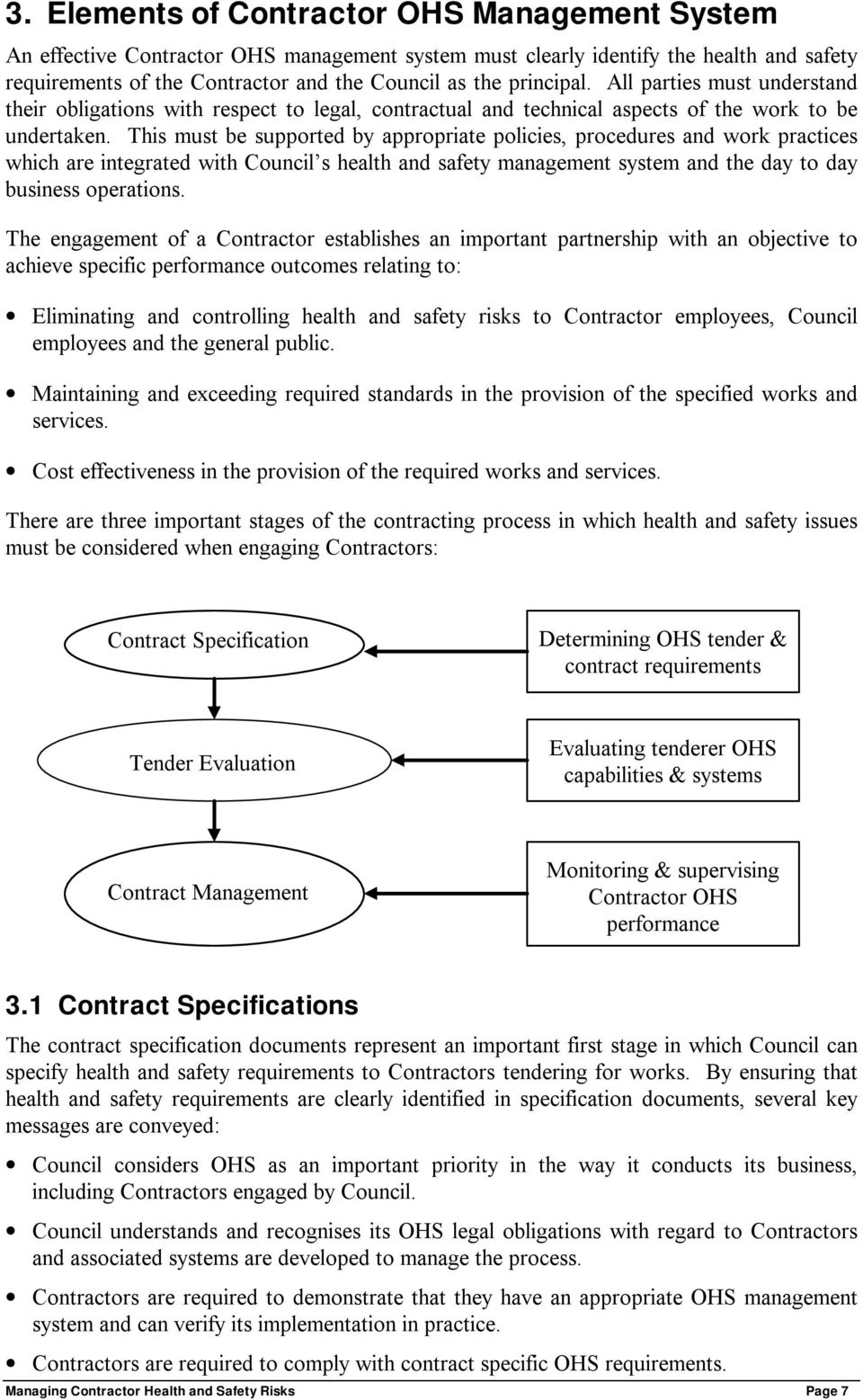
9 The specification is an important document from a legal perspective and provides Councils with the opportunity to ensure OHS issues are considered in the early stages of letting a contract. 3.2 Tender Evaluation The tender evaluation stage allows Council to verify tenderer compliance with specification requirements, including health and safety aspects. This process is critical. It ensures that Council establishes that tenderers have adequate OHS management systems and have considered health and safety issues in relation to the contract works. The tender evaluation process typically involves the following tasks: Examination of tenderer s OHS management system documentation (including policies, procedures, work methods, training/competency records). Verification of the operation of the OHS management system. This may include review of tenderers records pertaining to audits, hazard inspections, plant records, safety meetings, accidents. Evaluation of reports on the tenderer s health and safety performance (records of accidents and incidents, infringements, prosecutions). Undertaking interviews or discussions with tenderers to confirm their understanding of contract OHS requirements, specific OHS issues related to the contract and their ability to respond accordingly. The capacity and performance of tenderers with regard to OHS should be an important criteria in the overall tender evaluation process. Tenderers who cannot demonstrate that they can adequately meet the health and safety requirements of the specification should not be considered in the selection process. However, some flexibility will be required in this approach in relation to smaller Contractors who are less likely to have formalised OHS management systems. 3.3 Contract Management While in no way reducing Contractors responsibility or liability as an employer for the health and safety of their employees, Councils must ensure that they meet their employer duty of care obligations to all employees working on their behalf. To meet these obligations Council must undertake adequate monitoring and supervision of Contractors, even at locations not controlled by Council. The level of monitoring and supervision will depend on such factors as: Complexity of the tasks The level of risk The control Council has over the workplace Interaction with other parties (ie: Council employees, other Contractors, public) Managing Contractor Health and Safety Risks Page 8

10 It is important that a systematic approach is adopted when monitoring and supervising Contractors. Requirements of the Contractor and principal should be clearly identified in the contract documentation. Appropriate records of activities related to monitoring and supervision of Contractor operations clearly demonstrate Council s commitment to meeting its OHS legal obligations. These records are important legal documents and can be relied upon when a non-compliance or serious health and safety incident occurs. Monitoring and supervision of Contractor activities is most efficiently undertaken when combined with other contract management activities. Integration of health and safety procedures into the day to day aspects of the contract management process is a key element for success. Managing Contractor Health and Safety Risks Page 9

11 4. Classification of Contract Works Councils are involved in tendering and managing a very broad range of contracts. These can include long term service contracts through to quite small contracts for minor maintenance, repair or construction activity. While the health and safety obligations on Contractors and Council remain the same irrespective of the size and duration of the contract works, it is important to acknowledge practical issues associated with the engagement of small Contractors. Small Contractors typically have less formalised OHS management systems, when compared with larger contracting organisations. Consequently, it is important that Council s OHS Contractor management system be sufficiently flexible to accommodate the different levels of OHS system development. To ensure practical measures are taken when engaging large or small Contractors a different approach should be considered for each category. For major contracts Contractors are expected to demonstrate a higher level of development of their OHS management system. For minor contracts Contractors are required to demonstrate appropriate health and safety competencies associated with performing the contract tasks. The approach adopted for minor contracts should focus largely on undertaking a risk assessment of the work involved in the contract, ensuring that risks are suitably identified and controlled. Contract managers at each Council will be generally responsible for classifying the contract as either major or minor. The decision to classify a particular contract as major or minor will depend on a range of factors including: Level of risk associated with the contract Duration of the contract Complexity of the contract Value of the contract The following guidelines are provided to assist with the classification of contracts in the most appropriate manner. 4.1 Guidelines for Classification of Major Contracts When classifying contracts the following issues should be considered: (i) Value of contract Although major contracts cannot be classified on cost alone, a value of $50,000 and above per annum may be considered as a guide. It is recognised that depending on other considerations contracts up to $50,000 will usually be considered as minor and contracts over $50,000 considered as a major contract. Managing Contractor Health and Safety Risks Page 10
12 (ii) Level of Risk Contracts involving high risk activities should be classified as major. Council has an obligation to insist on more sophisticated management systems when engaging Contractors to perform hazardous work. Such work may involve: Working in confined spaces Working at heights Demolition work Working with asbestos Work involving significant hazards to the public Contractors who undertake this type of work on a regular basis should be expected to be familiar with concepts such as Health and Safety Plans, risk assessments and other requirements for major contracts. (iii) Level of Complexity If a contract may involve the use of subcontractors, Council should be aware that suitable systems of selection and supervision will apply to the subcontractors. Where the contract manager believes the use of subcontracted labour is likely, the contract should be classified as major. (iv) Duration of Contract Contracts which extend beyond 3 years are considered sufficiently large to expect that Contractors have formalised OHS management systems which reflect the type of work they are performing. Longer term contracts should be classified as major. Although this timeframe is provided as a guide to Councils, it may be appropriate to negotiate short and medium term health and safety performance objectives such as SafetyMAP certification of the Contractors health and safety management system. If, after considering the above criteria, the contract is classified as a major contract, reference should be made to Section of this manual which outlines OHS specification requirements for major contracts. In summary, these include: General requirements for tenderer OHS management systems Requirement for the successful Contractor to undertake contract specific risk assessments Requirement for the successful Contractor to develop a contract specific health and safety plan. Contractor shall provide regular reports to Council on OHS performance. Guidelines for minor contracts are presented in Section 4.2. Managing Contractor Health and Safety Risks Page 11
13 4.2 Guidelines for Minor Contracts Contractors providing services in this classification must demonstrate specific understanding of the health and safety requirements of the work to be performed. Furthermore, the minor contract health and safety requirements will require that Contractors plan their work, identify the hazards and have in place suitable control measures as part of a Risk Assessment procedure. The OHS contractual requirements for minor contracts focus on the following: Contractor has a good understanding of the hazards and risks associated with their activities. Contractor has established systems and procedures for managing the OHS risks, although these may not be formalised. Contractor is licensed for the relevant activities and employees have appropriate competencies and licences required for the contract works. Plant and equipment is appropriately licensed or registered and maintained/inspected on a regular basis. Contractor will undertake a contract specific risk assessment to ensure risks are identified and controlled for the contract services. Reference should be made to Section of this manual which outlines OHS specification requirements for minor contracts. The minor contract requirements however, should not diminish the legal obligations of the Contractor and Council to ensure that the contract works are conducted in a safe manner. It is recognised that some minor contracts are undertaken without involving a formal tender process. In these circumstances a risk assessment conducted by the Contractor will be an important requirement to ensure health and safety risks are addressed prior to the contract commencing. Managing Contractor Health and Safety Risks Page 12

14 5. Contract Specification: Health and Safety Requirements Incorporation of health and safety requirements into contract documentation should be considered as early as possible in the specification development stage. Consultation with Council health and safety personnel, contract managers and other relevant personnel should be undertaken to ensure that relevant health and safety issues are identified and considered when preparing specification documentation. 5.1 Specification Elements In general terms, the contract specification should incorporate the following contract health and safety requirements. (i) Comply with health and safety legislative requirements As a minimum requirement, tenderers must comply with all applicable legislation relating to health and safety. The Occupational Health and Safety Act 1985 is the principle legislation. There are, however, other Acts, regulations, Codes of Practice and Australian Standards which impose specific health and safety requirements that may be relevant to the contract works. (ii) Demonstrate evidence of OHS management system The tenderer s OHS management system must demonstrate compliance with the employer duties section of the Occupational Health and Safety Act (1985) including those relating to the public. In general terms these duties entail that the tenderer and its employees are able to carry out their work in safe premises, using proper and safe plant and substances employing systems of work that are safe and providing adequate instruction, training and supervision. Requirements for tenderers to demonstrate or achieve within a prescribed time frame certification of their OHS management system (ie SafetyMAP Initial Level Achievement or equivalent) can also be considered as a contract requirement. This requirement may be more relevant for long term service or works contracts. (iii) Complete Tenderer OHS Management System Questionnaire Tenderers are required to complete a questionnaire which evaluates the status of their OHS management system. Tenderers are required to demonstrate how the relevant system elements operate within their company and can support their statements with documentary evidence. The questionnaire can also be used as a pre-qualification requirement for Contractors who are engaged by Council on a regular basis. Under these circumstances, Contractors would be required to complete the questionnaire on an annual basis. Managing Contractor Health and Safety Risks Page 13
15 (iv) Undertake a Risk Assessment The successful tenderer must prepare and submit a Risk Assessment prior to commencing the contract. The Risk Assessment requires the tenderer to identify the hazards associated with the contract, assess the risks and develop appropriate control measures. The risk assessment should be undertaken using a standard format for review by Council. (v) Develop Health and Safety Plan For major contracts the successful tenderer must prepare and submit a Health and Safety Plan prior to commencing the contract. The Health and Safety Plan outlines the structure and means by which health and safety will be managed by the Contractor for the term of the contract. The Health and Safety Plan will consider the specific OHS issues relevant to the contract works and will document the systems and methods implemented to effectively manage OHS risks. (vi) OHS Performance Reporting The successful tenderer is required to provide Council with regular reports on health and safety performance relating to the contract works or services. (vii) OHS Incident Notification Contractors engaged by Council are required to notify Council of any accident, injury, property or environmental damage associated with the provision of contract works or services. (viii) Non-Compliance Council has the right to suspend or terminate the contract works if in the opinion of Council, the Contractor fails to remedy breaches of health and safety. 5.2 Determining OHS Requirements for Contract Specifications Different approaches should be considered in relation to OHS requirements for major and minor contracts. These are outlined below: Major Contracts (i) Model OHS Requirements Reference should be made to the following model OHS clauses presented in Appendix 2, Document 1, for incorporation into major contract OHS requirements: General OHS Requirements: Subclause 1 Legislative Compliance: Subclause 2 Tenderer OHS Management Systems: Subclause 3 Tenderer OHS Management System Questionnaire: Subclause 4 Risk Assessment: Subclause 5 Health and Safety Plan: Subclause 6 Managing Contractor Health and Safety Risks Page 14

16 OHS Performance Reporting: Subclause 7 Incident Notification: Subclause 8 Non-Compliance: Subclause 9 (ii) Tenderer OHS Management System Questionnaire The questionnaire is presented in Appendix 2, Document 2 and should be incorporated with specification documents for completion by tenderers and submitted as part of their tender to enable Council to evaluate their health and safety competency. Completed questionnaires should be reviewed by Council and where appropriate responses verified (refer Section 6.0). (iii) Risk Assessment The Risk Assessment form is presented in Appendix 2, Document 3. The form should be incorporated with specification documents to enable tenderers to consider their requirements in completing the risk assessment if awarded the contract. Completed Risk Assessments should be reviewed by Council prior to commencement of the contract. (iv) Health and Safety Plan Guidelines for preparing a Health and Safety Plan are summarised in Appendix 2, Document 4. The guidelines should be incorporated with specification documents to enable tenderers to consider their requirements in preparing the Health and Safety Plan if awarded the contract. Completed Health and Safety Plans should be reviewed by Council prior to commencement of the contract Minor Contracts (i) Model OHS Requirements Reference should be made to the following model OHS clauses presented in Appendix 2, Document 1 for incorporation into minor contract OHS requirements: General OHS requirements: Subclause 1 Legislative Compliance: Subclause 2 Tenderer OHS Management systems: Subclause 3 Tenderer OHS Management System Questionnaire: Subclause 4 Risk Assessment: Subclause 5 Incident notification: Subclause 8 Non-compliance: Subclause 9 Managing Contractor Health and Safety Risks Page 15
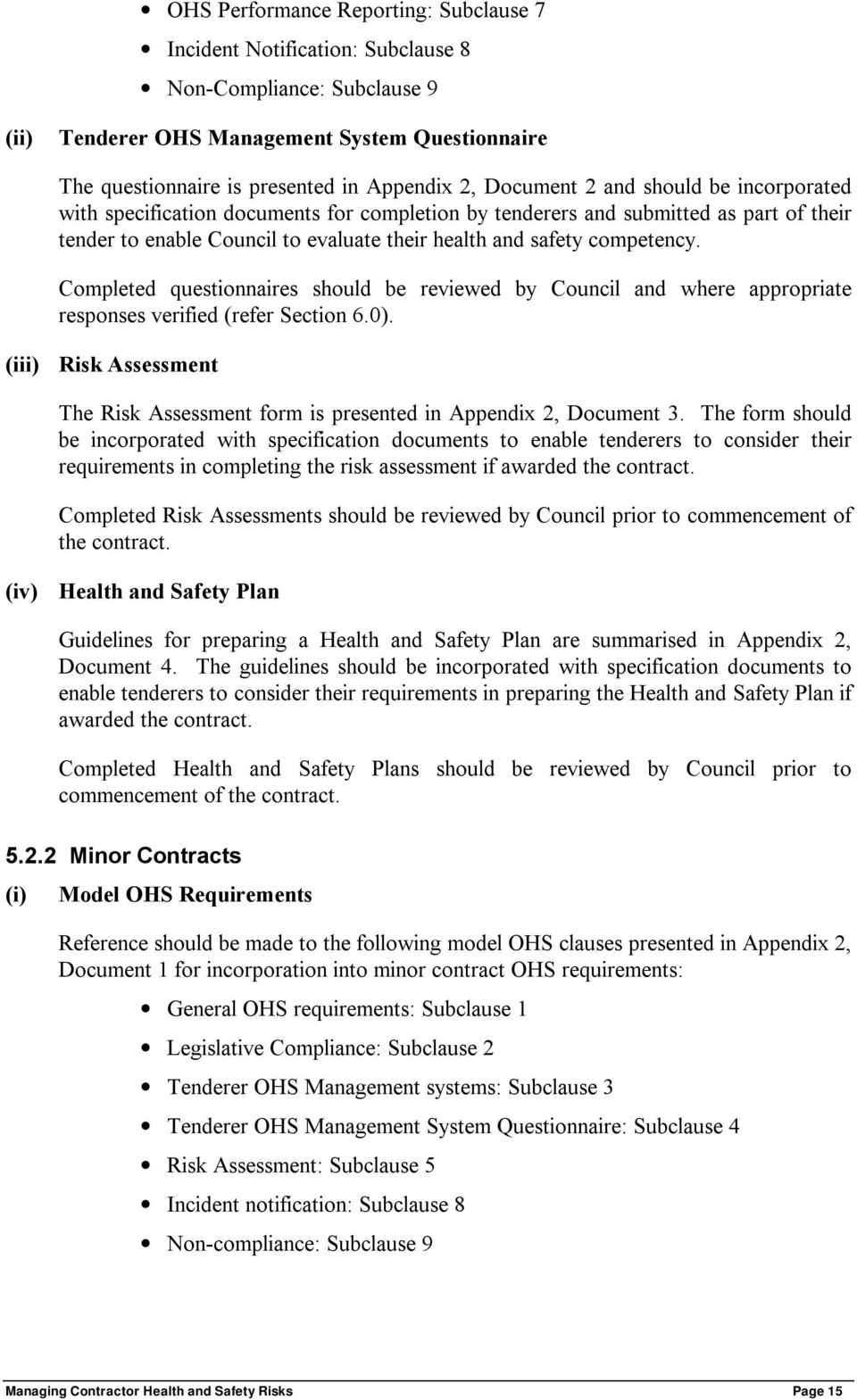
17 (ii) Tenderer OHS Management System Questionnaire The questionnaire is presented in Appendix 2, Document 2 and should be incorporated with specification documents for completion by tenderers and submitted as part of their tender. Completed questionnaires should be reviewed by Council and where appropriate responses verified (refer Section 6.0). (iii) Risk Assessment The Risk Assessment form is presented in Appendix 2, Document 3. The form should be incorporated with specification documents to enable tenderers to consider their requirements in completing the risk assessment if awarded the contract. Completed Risk Assessments should be reviewed by Council prior to commencement of the contract. Managing Contractor Health and Safety Risks Page 16

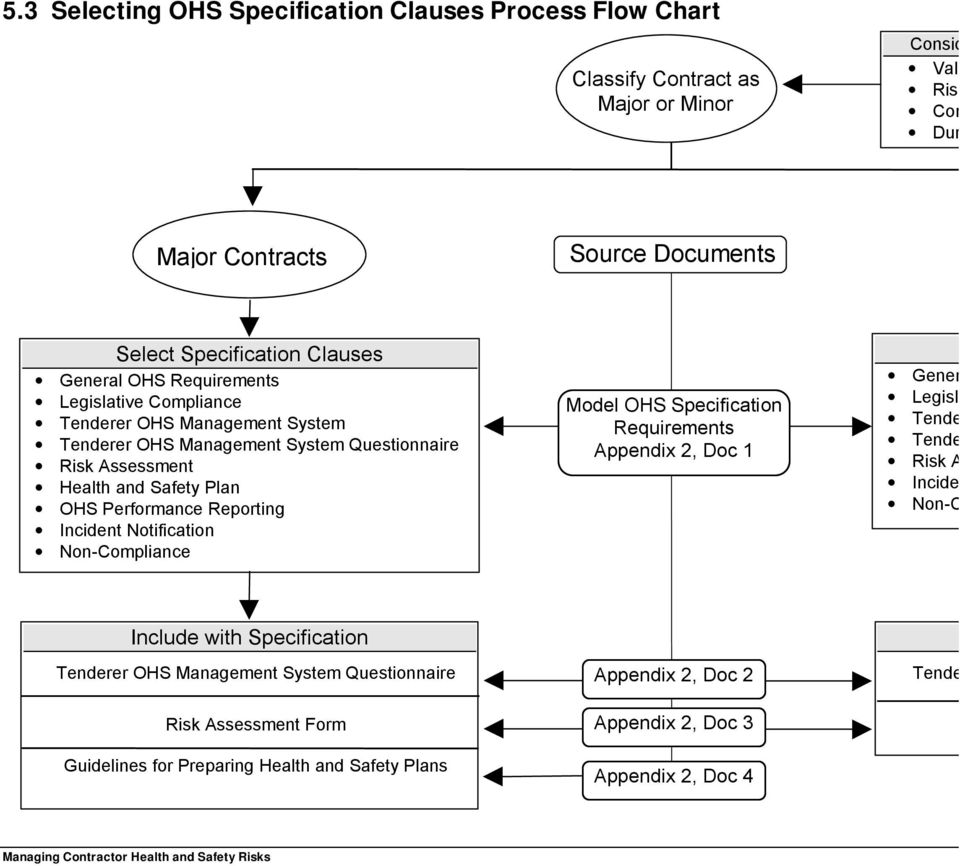
18 5.3 Selecting OHS Specification Clauses Process Flow Chart Classify Contract as Major or Minor Consider C Value Risks Comple Duration Major Contracts Source Documents Select Specification Clauses General OHS Requirements Legislative Compliance Tenderer OHS Management System Tenderer OHS Management System Questionnaire Risk Assessment Health and Safety Plan OHS Performance Reporting Incident Notification Non-Compliance Model OHS Specification Requirements Appendix 2, Doc 1 General O Legislative Tenderer O Tenderer O Risk Asse Incident N Non-Comp Include with Specification Tenderer OHS Management System Questionnaire Risk Assessment Form Guidelines for Preparing Health and Safety Plans Appendix 2, Doc 2 Appendix 2, Doc 3 Appendix 2, Doc 4 Tenderer O Managing Contractor Health and Safety Risks
19 6. Tender Evaluation The evaluation of tenderers health and safety capabilities and systems is an important consideration in the selection process. This stage provides Council with the opportunity to: Evaluate and verify the tenderer s OHS management system and performance Determine the tenderer s understanding of the OHS requirements of the specification. Review how the tenderer will manage OHS issues associated with the contract works and services (ie: with particular regard to the Risk Assessment and Health and Safety Plan). The tender evaluation process is often undertaken by a team of Council personnel. It may be useful for the review team to seek advice from a health and safety specialist during this process. This may involve the Council Health and Safety Manager or an external OHS consultant. The tender evaluation process involves several stages as outlined below. 6.1 Evaluation and Verification of Tenderer s OHS System This is a critical task which should be undertaken in a systematic way. Steps in this process include: Review of completed tenderer OHS System Questionnaires. Examination of tenderer s OHS management system documentation, (manuals, procedures, work methods, training/competency records). Verification of the operation of the tenderer s OHS management system. Undertaking interviews with tenderers to clarify particular issues and areas where more information is required. An important outcome of this process is that the tenderer is able to demonstrate the active implementation and operation of their OHS management system. Council officers should seek verification of this by examining various tenderer records. These include: Health and safety audits: copies of completed audit reports, details of audits undertaken. Hazard inspection records: copies of completed hazard inspection reports showing corrective actions to be undertaken. Plant maintenance and inspection records: evidence of completed maintenance logs, prestart daily safety inspections, risk assessment reports. Safety meetings: evidence of minutes of meetings, meeting schedules, personnel involved. Accident investigation: evidence of completed accident investigation reports. Training: records of health and safety training, competency certificates. Guidelines for the Review of Tenderers OHS Management System Questionnaires are presented in Appendix 3 and can be used by Councils to systematically undertake the evaluation process. Confirmation of the evaluation process can be noted on the Contract OHS System Approval and Acceptance Form (refer Appendix 3, Document 5). Managing Contractor Health and Safety Risks Page 18
20 6.2 Review of Risk Assessment Important issues to be considered when reviewing the risk assessment relate to the following: Relevant hazards associated with the contract have been identified Risks have been appropriately assessed in terms of potential for injury and damage Proposed control measures are adequate and can be supported by relevant documentation The Risk Assessment completed by the successful tenderer should be reviewed and approved by Council prior to commencement of the contract. Reference should be made to the Guidelines for the Review of Risk Assessment presented in Appendix 3, Document 2 to undertake this process. Assistance and input on health and safety issues from the Council Health and Safety Manager or external specialist consultant should be considered. Where appropriate, the Contractor should be provided with relevant Council health and safety procedures. A completed sample Risk Assessment is presented in Appendix 3, Document 3 demonstrating how the risk assessment form can be completed. Approval of the Risk Assessment by Council should be confirmed on the Contract OHS System Approval and Acceptance Form (Appendix 3, Document 5). Where the Risk Assessment is not considered to be acceptable, the Contractor should be notified and appropriate modifications made to the risk assessment. When dealing with small Contractors for minor contracts, it is likely that Council officers will need to provide guidance and assistance to Contractors in completing the risk assessment. Where a formal tender process is not conducted for minor contracts, Council should ensure that the risk assessments is undertaken prior to commencement of the contract. 6.3 Review of Health and Safety Plan Contractors appointed by Council for major contracts should develop a Health and Safety Plan using the Guidelines for Preparing Health and Safety Plans presented in Appendix 2, Document 4. This document sets out general requirements for Health and Safety Plans which can be modified for each contract. To assist Council with adopting a systematic approach when reviewing Health and Safety Plans prepared by Contractors, Guidelines for Review of Health and Safety Plans are presented in Appendix 3, Document 4. Relevant requirements of the plan should be reviewed and approved by Council prior to work commencing on the contract. The successful Contractor should provide all documentation referenced in the plan at the time of assessment. Approval of the Health and Safety Plan should be confirmed on the Contract OHS System Approval and Acceptance Form (Appendix 3, Document 5). Where the Health and Safety Plan does not meet Council requirements, the Contractor should be notified and appropriate modifications made to the plan by the Contractor. Managing Contractor Health and Safety Risks Page 19

21 6.4 Tender Evaluation - Process Flow Chart: Major Contracts Major Contracts Source Documents Assessment of Tenderers OHS Management System Review OHS Management System Questionnaire Examine Documents Verify Systems Interview Tenderer Guidelines for the Review of Tenderers OHS Management System Appendix 3, Doc 1 Select Contractor Contractor to develop: Risk Assessment Health and Safety Plan Risk Assessment Form Appendix 2, Doc 3 Health and Safety Plans Appendix 2, Doc 4 Contractor to modify Risk Assessment/ Health and Safety Plan Review Contractor s Risk Assessment Review Contractor s Health and Safety Plan Guidelines for the Review of Risk Assessment Appendix 3, Doc 2 Guidelines for the Review of Health and Safety Plans Appendix 3, Doc 4 No Are Documents acceptable to Council? Yes Approve Risk Assessment & Health and Safety Plan Contract OHS System Approval & Acceptance Form Appendix 3, Doc 5 Contractor approved to commence contract Managing Contractor Health and Safety Risks Page 20
22 6.5 Tender Evaluation - Process Flow Chart: Minor Contracts Minor Contracts Source Documents Assessment of Tenderers OHS Management System Review OHS Management System Questionnaire Examine Documents Verify Systems Interview Tenderer Guidelines for the Review of Tenderers OHS Management System Appendix 3, Doc 1 Select Contractor Contractor to develop: Risk Assessment Risk Assessment Form Appendix 2, Doc 3 Contractor to modify Risk Assessment Review Contractor s Risk Assessment Guidelines for the Review of Risk Assessment Appendix 3, Doc 2 No Are Documents acceptable to Council? Yes Approve Risk Assessment Contract OHS System Approval & Acceptance Form Appendix 3, Doc 5 Contractor can commence contract Managing Contractor Health and Safety Risks Page 21
23 7. Contract Management Council has important legal obligations to monitor and supervise the activities of Contractors with regard to health and safety aspects of their work, irrespective of whether contracts are major or minor. Independent monitoring and supervision by the contract principal ensures that the Contractor s operations are conducted in accordance with: Health and safety legislation, standards and Codes of Practice Health and safety requirements outlined in contract documents Contract specific health and safety requirements as detailed in the Risk Assessment and Health and Safety Plan prepared by the Contractor In order to perform this function, Contract managers or supervisors should have: Access to the contract documents and specification Good understanding of the health and safety requirements set out in the contract documents Access to other documents referred to in the contract, eg: Risk Assessment and Health and Safety Plan Adequate contract supervision training, and suitable health and safety knowledge and skills relevant to the contract Councils should consider providing Contract managers with appropriate training in this area, outlining legal obligations and procedures to be adopted when supervising Contractors. 7.1 Monitoring and Supervision The extent to which Council should monitor and supervise Contractors will be influenced by several factors, including: The level of risk associated with Contractor s activities Complexity of the tasks performed by the Contractor The control Council has over the workplace Interaction with other parties (ie: Council employees, other Contractors, public) Duration of contract Managing Contractor Health and Safety Risks Page 22
24 A higher level of supervision by Council officers may be required in special circumstances. Supervision may need to be targeted to specific key elements of a contract, for example: Contract start-up: ensuring that suitable systems and procedures are in place and the workplace is appropriately established High risk or complex activities: monitoring conformance with safe work procedures and risk assessment control measures High level of interaction with other parties: review of co-ordination and notification systems operating at the workplace Introduction of new plant, equipment or systems of work: may require separate risk assessment and monitoring of control procedures Monitoring and supervision of Contractor activities include: (i) Regular review of Contractor health and safety documentation. This may involve review of: induction records plant maintenance/inspection records health and safety inspection reports risk assessment documents employee training/competency records safety meeting minutes (ii) Undertaking regular site inspections to monitor compliance with health and safety procedures, considering: legislative requirements conformance with Risk Assessment control measures conformance with Health and Safety Plan conformance with Council health and safety policy and procedures (iii) Providing Contractors with advice on unusual or unexpected risks and feedback on areas of non compliance. This may arise from: inspections undertaken by Council inspections or reports from other parties Council experience from similar contracts (iv) Reviewing Contractor health and safety performance. This may include review of: accident/incident reports third party reports or complaints review of monthly OHS performance reports Managing Contractor Health and Safety Risks Page 23
25 (v) Ensuring that corrective action is taken where non conformance is identified by: issuing of non-conformance report reviewing and confirming that corrective action implemented issuing formal notice (ie: site instruction) when action not taken within reasonable timeframe (vi) Incorporating health and safety issues as part of regular contract review meetings. This may include: health and safety as an agenda item safety inspections undertaken after/before site meetings health and safety issues considered as high priority in relation to overall contract performance 7.2 Workplace Inspections Council demonstrates its obligations as the contract principal in relation to the supervision of Contractors by conducting workplace health and safety inspections and monitoring the outcomes of inspections. Inspection programs undertaken by Contractors and also by Council officers are a key element in monitoring the health and safety standards of the Contractor s operations. Regular workplace inspections play a significant prevention role in identifying health and safety issues before they result in injury or damage at the workplace Contract Inspection Checklist To determine which aspects are priority areas for inspection, reference should be made to the Risk Assessment completed by the Contractor. The risk assessment identifies the hazards associated with the contract and the particular control measures to be implemented by the Contractor. The control measures can be extracted from the Risk Assessment Form, transferred onto a Contract Inspection Checklist (refer Appendix 4, Document 1) and used as a basis for workplace inspections to be conducted by the Contractor on a regular basis and by Council as part of its supervision program. The Contract Inspection Checklist allows the systematic review of health and safety issues relevant to the contract activities. The inspection checklist can be modified as a result of other health and safety issues identified during the contract General Health and Safety Inspection Checklist A general health and safety inspection checklist is presented in Appendix 4, Document 2. This checklist can be used by Council officers when undertaking health and safety inspections of Contractor operations. The checklist is designed to consider a broad range of general health and safety issues in the workplace. Where appropriate the checklist can be modified based on specific safety aspects associated with the contract. Managing Contractor Health and Safety Risks Page 24
26 7.2.3 Who Should Carry Out Inspections The Contractor as an employer has a duty of care to provide and maintain a safe workplace and consequently has an important responsibility to conduct workplace inspections on a regular basis. The inspections should generally be undertaken by a team comprising management and employee representatives. The Contractor should make available copies of health and safety inspection reports for review when requested by Council. Council also has a responsibility to monitor health and safety aspects of Contractor operations. Although Contract managers are not required to be expert in all matters, they should check that the Contractor has adequately fulfilled its health and safety obligations, as far as they can reasonably establish. Through inspection and monitoring of Contractor operations, the Contract manager should raise with the Contractor any health and safety issues that come to their attention. Inspections should be conducted in conjunction with a representative of the Contractor to enable discussion and resolution of issues as they are identified. The Contract manager may seek input from specialist health and safety staff to be available during and after the inspection to give advice on health and safety issues Frequency of Inspections How often routine inspections are conducted will depend on the nature and circumstances of each contract. Issues such as the level of risk and extent of control Council has over the workplace (refer Section 7.1) will influence the frequency of inspections. The Contract manager should establish an inspection schedule prior to commencement of the contract. For short duration contracts from several days up to several weeks it may be appropriate that the Contractor undertake daily health and safety inspections. For longer term contracts weekly or monthly health and safety inspections are likely to be more practicable. However, daily pre-start safety inspections may be required for particular high risk plant, equipment and processes. 7.3 Contract Records Effective contract management involves adoption of a systematic approach to record keeping during the period of the contract. Relevant health and safety records retained by Council provide documentary evidence of Council s due diligence in relation to the health and safety of Contractors. These records will be particularly important in situations where the Contractor is in breach of health and safety requirements or a significant incident or accident occurs from activities performed by the Contractor. Where Council officers identify a breach of health and safety, this should be promptly notified to the Contractor. Relevant details should be recorded on an inspection checklist or as a file/diary note. Significant breaches which are considered to contribute to a Class 1 or Class 2 risk should be notified using a non-conformance report (refer Appendix 4, Document 4) and a copy retained by Council. Managing Contractor Health and Safety Risks Page 25
27 Other relevant health and safety records that should be retained by Council include: Risk Assessment Health and Safety Plan Contract documents Health and safety inspection reports Minutes of safety meetings and site meetings Incident investigation reports Monthly OHS performance reports Non-conformance reports Photographs and test results Site instructions and diary notes For the duration of each contract, relevant health and safety documents should be consolidated and retained in the contract file. These are important documents that may be required even some time after the contract has been completed. Managing Contractor Health and Safety Risks Page 26
28 7.4 Contract Management Process Flow Chart Consider Criteria Risk level Complexity Control of workplace Degree of interaction Duration of contract Establish monitoring and supervision requirements Source Documents Contractor develops Contract Inspection Checklist Contract Inspection Checklist Appendix 4, Doc 1 Undertake inspections as required Contract Inspection Checklist, General Health & Safety Checklist Appendix 4, Docs 1 & 2 Notify Contractor of identified Class 1 and Class 2 Risks Non-conformance Report Appendix 4, Doc 3 Review Contractor OHS Performance Contractor OHS Performance Report Appendix 4, Doc 4 Retain relevant health and safety records Managing Contractor Health and Safety Risks Page 27
29 Appendix 1 Summary of Council Occupational Health and Safety Obligations to Contractors Managing Contractor Health and Safety Risks Appendix 1: Page 1
30 Introduction The law requires anyone running a business to take steps to see that no person is exposed to a risk to their health and safety from the way in which the business is operated. This is not an absolute duty, being subject to the question of what is reasonable and practicable in the circumstances. A breach of the duty may result in a criminal prosecution, or claims for damages. Councils are involved in businesses providing community welfare services, waste collection and disposal, library and educational facilities, parks and recreation facilities, the provision of roads, footpaths and drainage, and numerous other activities which would depend very much on the size and geographical location of the Council. This duty is owed to any person who may be affected by what the Council does in running its business. The duty is higher where the place at which the business is operated is under the control or management of the Council. Quite specific obligations are owed to employees and Contractors of the Council. There is a common belief that an employer rids itself of health and safety obligations by engaging a Contractor, and by passing specific safety obligations to that Contractor by terms of the contract. This belief is held most strongly where a number of Contractors and subcontractors are involved. These circumstances do not remove the duty; they only make compliance more difficult. When running a business you should be aware of the following: The imposition by contract of responsibilities on another party such as a Contractor does not remove your obligations for ensuring health and safety of persons affected by the particular undertaking. More than one party at a time may have a responsibility and therefore liability for occupational health and safety. It is not an excuse to say what other parties have done has compromised your ability to adequately address health and safety. Mere reliance on another party does not represent compliance with occupational health and safety obligations. You need to not only focus on health and safety of your direct employees, but also take into account how others may affect and be affected by what you do. The law is made up of a combination of judge-made law (common law) developed over centuries, and parliament-made law (statute). The common law imposes a duty of care to others affected by what you do. Common Law Duty of Care All persons must take reasonable care to see that others are not put at a foreseeable risk of injury, loss or damage by the way in which they conduct themselves. This duty of care is owed to all persons who you may reasonably foresee may be affected by what you do. It requires reasonable steps for the avoidance of reasonably foreseeable injury loss or damage. What is reasonable will be a question of fact in each case. Managing Contractor Health and Safety Risks Appendix 1: Page 2
31 An employer owes a higher duty of care, which is unable to be delegated, for the health and safety of its employees. The employer must ensure the provision of a safe place of work, safe systems of work and safe plant and equipment. The safe systems of work must include the provision of necessary information, instruction training and supervision. An employer will at common law owe a duty of care to Contractors, and employees of Contractors. The standard of care will depend upon the circumstances, including the nature of the activities (whether or not they could be known by a reasonable person in that position to be hazardous) the nature and circumstances of the relationship, and any information held exclusively by the employer. In some circumstances, the standard of care owed to a Contractor may be almost as high as that owed to an employee. An employer will continue to owe a duty of care to members of the public, even though a Contractor has been engaged. The High Court of Australia has recently stated that a person will not fulfil its duty of care merely by the engagement of an ostensibly qualified and experienced Contractor. A duty remains to provide necessary information to the Contractor, and take reasonable steps to see that the Contractor carries out the work in a safe manner. Occupational Health and Safety Act 1985 ("The Act") The Act sets out to achieve its objectives of securing the health safety and welfare of persons at work and eliminating risks to health safety and welfare of persons at work, by regulating the conduct of those who may compromise health and safety at work. The Act regulates the conduct of not only employers and employees, but also of manufacturers and installers of plant, those with the management and control of workplaces, and others who may affect health and safety. The Act imposes specific obligations on various parties, and "encourages" compliance through a consultative approach and by the potential for criminal prosecutions resulting in heavy fines or imprisonment. The duties imposed by the Act are not absolute, but are subject to a requirement that the desired result be ensured "so far as is practicable" or that people conduct themselves in a particular manner "so far as is practicable". This element of practicability means that the person with the obligations must do that which is feasible and which can be reasonably be done in all of the circumstances, taking into account : (a) (b) (c) (d) The severity of the hazard or risk; The state of knowledge about the hazard or risk and ways of removing or mitigating it; The availability and suitability of ways to remove or mitigate that hazard or risk; and The cost of removing or mitigating that hazard or risk. What was practicable in all of the circumstances will be looked at objectively. Ignorance will not be an excuse. Managing Contractor Health and Safety Risks Appendix 1: Page 3
32 Duties of an employer The Act in Section 21, imposes on an employer a duty to provide a working environment for employees that is safe and without risk to health. This duty requires an employer to see that employees carry out their work in safe premises, using proper and safe plant and equipment, employing systems of work that are safe and in which there has been adequate instruction, training and supervision. The duty is not merely a general duty, but applies to each and every aspect of work to be carried out by an employee. As part of this overall duty, an employer must: (a) (b) (c) (d) (e) (f) Monitor the health of employees; Keep information and records about the health and safety of employees; Employ or engage (eg. by contract) suitable health and safety experts to provide advice; Nominate a person to represent the employer in health and safety disputes; Monitor conditions at the workplace; Provide information to employees in appropriate languages (that is, those languages which will collectively ensure that all employees understand what is being said) and that information must include the names of persons to whom an employee may make an inquiry or complaint in relation to health and safety. Duties owed to Contractors Outsourcing work to Contractors will not remove an employer's occupational health and safety obligations. The fact that the Contractor will most likely be an employer, and owe these obligations to its employees, will not remove the obligations of the Council for the health and safety of those who carry out the work. Sub-Section 21 (3) of the Act specifically provides that the duties owed by an employer to an employee are also owed to an independent Contractor and its employees. This means, that the Council must so far as is practicable ensure that a Contractor and its employees carry out their work in safe premises, using proper and safe plant and equipment, employing systems of work that are safe and in which there has been adequate instruction training and supervision. The only limitation on the obligation owed by a Council to the Contractor and its employees, is that the duty is owed in relation to matters over which the Council has control, or over which the Council would have had control but for an agreement to the contrary. This means quite simply that an employer cannot contract out of its health and safety obligations to those who actually perform the work. The Act does not provide any guidance as to what is meant by control. Many cases in various jurisdictions dealing with the questions of control of property show that the control need not be absolute; and that you need to look at both the degree of control exercised, and that which is able to be exercised. Managing Contractor Health and Safety Risks Appendix 1: Page 4
33 Duties to the public As noted in the introduction to this Appendix, anyone running a business must also ensure so far as is practicable that no person is exposed to risk from the way in which their business is operated. This is provided by Section 22 of the Act, and is an obligation owed to any person who may be affected by the running of the business, even a person having no direct or formal relationship with the business eg: a member of the public. A Council engaging a Contractor to provide services to the community will accordingly have a duty to ensure so far as is practicable, that no one suffers a risk to his or her health and safety from the carrying out of the work or the provision of the facilities by the Contractor. This clearly imposes on the Council an obligation to monitor and regulate the conduct of the Contractor. Duties as an occupier Section 23 of the Act imposes an obligation on an occupier of a workplace to ensure so far as is practicable that the workplace and means of access and egress are safe and without risks to health. This is a duty owed to any person entering the workplace. A workplace is any place where work is carried out, and that need not be within a building. It may be in the playground of a day-care centre; it may be by the side of the highway; or it may be at a swimming pool operated by the Council. An occupier of a workplace is someone with the control or management of that workplace. This will be a question of fact in each case. There have been a number of cases in which the Courts have found that there are a number of people or bodies with the management or control of a workplace at the same time. The mere fact that a Contractor has the practical day to day control of the workplace need not mean that the Council does not also have management or control, particularly if the contract provides for a degree of management or control. Again, it is a matter of looking at what actually happens, and the ability of the Council to manage or control the workplace. Personal liability It is important to note that employees (under to Section 25 of the Act) and officers of the Council (under Section 52 of the Act) may be liable to prosecution for a failure to see to health and safety at work. All employees must take reasonable care to see that no person, whether it be themselves or any other employee, Contractor or member of the public, are put to a risk of injury or death because of what they do at work. Employees must co-operate with the employer to see that health and safety is safeguarded at the workplace. If a Council commits an offence which is attributable to the consent, connivance or wilful neglect of an officer, then that officer is guilty of the same offence as the body corporate. An officer is not only a director, secretary or executive officer; but may also be a person who is not a director or secretary in accordance with whose directions or instructions directors of the company are accustomed to act; or may be a person who may not be a director or secretary but who is "concerned in the management" of the company. Managing Contractor Health and Safety Risks Appendix 1: Page 5
34 The real test of whether a person is an officer by being concerned in the management of the company, is whether that person is involved in the decision making process of the Council, rather than merely the hands. Does the person have relevant authority or responsibility; does the person make decisions; is their advice relied on by those who ultimately make the decisions; or is the person just a functionary who does what he is told? Penalties The maximum penalties which may be imposed upon a Council for a first offence against the Act is $40,000. Second or subsequent offences may carry an additional penalty up to $250,000. An individual (employee or officer) guilty of a first offence under the Act may be subject to fines up to $10,000. The individual may receive an additional fine of up to $50,000 or up to 5 years imprisonment, for a second or subsequent offence. It is becoming more common for companies and individuals to be charged with offences under the Crimes Act for workplace accidents, which carry potentially heavy fines and imprisonment. These offences range from manslaughter at one extreme (up to 15 years imprisonment) down to negligently causing serious injury at the other extreme (up to 3 years imprisonment). Examples of Prosecutions The following are very brief summaries of prosecutions of organisations for offences associated with the contracting of works. Wall Collapse A curtain wall was constructed by Contractors to the City of Dandenong in an indoor swimming centre operated by the City. Subsequently, seating was affixed by the supplier to the curtain wall. During a swimming carnival, the wall collapsed causing injury to a number of students, one being rendered a paraplegic. The City of Dandenong was convicted of a breach of Section 22 of the Act and fined $7,500 plus costs. The judge directed that the City Engineer be acquitted of all charges under the Act. Building Demolition A company, Bestaburgh Pty Ltd, engaged a Contractor to perform works in the demolition of a building. During the works the Contractor sustained fatal injuries when he fell 20 metres onto a concrete floor from the roof. Bestaburgh failed to provide the Contractor with necessary information, instruction, training and supervision, and failed to provide a safe system of work. Bestaburgh also failed to comply with a Prohibition Notice requiring fall protection for workers. The company was fined for offences under Section 21 of the Act for failing in its obligations to its Contractor; and for failing to comply with a Prohibition Notice. The company was fined a total of $26,000 plus costs. Pursuant to Section 52, a director of the company, Ian Nadenbousch was convicted of the same offences as the company and fined a total of $1,150. Managing Contractor Health and Safety Risks Appendix 1: Page 6
35 Fall from Height An employee of World Services and Construction Pty Ltd, a Contractor to Shell Refining (Aust) Pty Ltd suffered extensive internal injuries resulting in death when he fell through an unsecured grid mesh on a structure at the Shell Refinery. World Services was found guilty of offences as an employer and was fined $15,000 plus costs. Shell was convicted of offences as the "deemed employer" of the Contractor and its employee and fined $3,000 plus costs. Crush Injury from Roller Conveyor An employee of World Services and Construction Pty Ltd was crushed against a roller conveyer by a sensor activated pusher, when he walked between the roller conveyor and the pusher. This accident occurred at the Point Henry plant of Alcoa Australia Limited, which had engaged World Services to undertake maintenance works. World Services was convicted of an offence as employer and fined $8,000 plus costs. Alcoa was convicted of offences of failing to provide adequate systems of work and failing to provide instruction and supervision of the employees of its Contractor, and was fined $8,000 plus costs. Construction of Milk Processing Plant A milk processing plant was being constructed for Bonlac Foods Limited (owner-builder) by a Contractor and a series of subcontractors. An independent project manager was engaged to undertake the project management of the job. One tonne of sheet metal was being raised upon a hoist when the sheet metal broke free and fell striking an employee of a subcontractor, causing serious injuries. The hoist being used was at the time the subject of a prohibition notice. The project manager was convicted of a breach of Section 22 of the Act and fined $3,000 with $15,000 costs; and also convicted under Section 23 as occupier of the workplace and fined $3,000 under Section 52. An officer of the project manager was convicted of two offences and fined $2,000 for each of those offences. Bonlac, the principal to the contract, was convicted of offences under Section 21 of the Act in relation to the injuries suffered by an employee of a Contractor, and was fined $7,500 with $16,500 costs. An officer of Bonlac was convicted of the same offence and fined $1,500. A subcontractor Niro Atomisers Pty Ltd was also convicted of offences under Section 21 and fined $3,000 with $16,500 costs; and also convicted of an offence under Section 22 and fined a further $2,000. Fall from Height An employee of a Contractor engaged by Concrete Constructions Pty Ltd fell to his death when replacing broken glass on top of a 15 metre high base frame canopy roof. No platforms, scaffolding or fall protection were provided. Concrete Constructions was convicted of breaches of Section 21 in failing to provide for the health and safety of a Contractor and its employees, and was fined an aggregate of $10,000 plus costs. The Answer - Due Diligence A key to a Council avoiding or at least minimising potential liabilities when engaging Contractors, is to be able to show the exercise of due diligence in endeavouring to meet health and safety obligations. Managing Contractor Health and Safety Risks Appendix 1: Page 7
36 The Act does not require the Council as a contract principal to provide the plant, systems of work and training for a Contractor and its employees. What the Act requires is that the Council as principal ensures so far as is practicable, that the Contractor and its employees carry out their work in safe premises, using proper and safe plant and equipment, employing systems of work that are safe and in which there has been adequate instruction, training and supervision. The actual provision of each of these elements necessary to see to the health and safety of those carry out the work, can be made by the Contractor. What the Council as principal must do is to ensure that this occurs. Compliance with the systems and procedures provided in this Contractor management manual will assist a Council in showing that it has taken such steps as are practicable to ensure the health and safety of those carrying out work for it or as part of its business, that is, showing due diligence. Managing Contractor Health and Safety Risks Appendix 1: Page 8
37 Appendix 2 Source Documents Contract Specification Document 1: Document 2: Document 3: Document 4: Model OHS Specification and Tender Document Requirements Tenderer OHS Management System Questionnaire Risk Assessment Form Guidelines for Preparing Health and Safety Plans Managing Contractor Health and Safety Risks Appendix 2: Page 1
38 Document 1 Model OHS Specification and Tender Document Requirements The following section outlines model clauses relating to OHS requirements of tenderers to be incorporated into specification and tender documents. The requirements should then be specifically incorporated into the contract. This can be easily achieved by a suitable clause in the contract which references the OHS specification requirements. Subclause 1 General Occupational Health & Safety Requirements Council is obligated to provide and maintain, so far as is practicable, a working environment for its employees and members of the public, that is safe and without risk to health. As a condition of this contract, Council requires that any Contractors or subcontractors that may be engaged to perform a service on its behalf will at all times identify and exercise all necessary precautions for the health and safety of all persons including Contractor employees, Council employees and members of the public who may be affected by the services. The Contractor will inform itself of all occupational health and safety policies, procedures or measures implemented or adopted by the Council and/or the occupiers of any premises at or within which the Contractor will perform works under this contract. The Contractor will comply with all such policies, procedures or measures; and in the event of any inconsistency, will comply with such procedures or measures as they produce the highest level of health and safety. The Contractor will forthwith comply with any and all directions by the Council relating to occupational health and safety. Subclause 2 Legislative Compliance The Contractor must comply with and ensure that its employees, subcontractors and agents comply with any Acts, regulations, local laws and by-laws, Codes of Practice, Australian Standards and Council OHS policy and procedures which are in any way applicable to this contract or the performance of the services under this contract. Subclause 3 Contractor OHS Management Systems The OHS management system of the Contractor must as a minimum requirement demonstrate compliance with all duties of an employer specified in the Occupational Health and Safety Act The Contractor must when requested by Council, submit a complete copy of their company OHS management system documentation which must include as a minimum requirement: (a) (b) (c) (d) OHS policy and objectives Organisation structure & responsibilities Safe work practices and procedures OHS training and induction Managing Contractor Health and Safety Risks Appendix 2: Page 2 (e) (f) (g) OHS auditing & inspection procedures OHS consultation procedures OHS performance monitoring
39 Optional Requirement The Contractor must provide evidence of certification of their OHS management system. The minimum level of certification is SafetyMAP Initial Level Achievement or equivalent established by independent audit by the Victorian WorkCover Authority or other recognised certifying body. Certification must be achieved within 12 months of the commencement of the contract. If the Contractor does not maintain certification of their OHS management system as required in this contract the Council may terminate the contract. Subclause 4 Tenderer OHS Management System Questionnaire [May be incorporated in Conditions of Tender] Tenderers shall complete the Tenderer OHS Management System Questionnaire and incorporate the completed document with their tender submission. Tenderers who do not complete the questionnaire shall be ineligible for selection. Tenderers will be required to verify their responses noted in the questionnaire by providing evidence of their ability and capacity in relevant matters. By submission of the tender and questionnaire the Tenderer acknowledges and confirms as accurate all details contained in the questionnaire and any verifying documents. Subclause 5 Risk Assessment The Contractor shall prepare and submit a Risk Assessment prior to commencing the works under the contract. The Risk Assessment Form shall be used to record the risk assessment and risk control methods to be employed by the Contractor. The completed Risk Assessment shall be submitted to Council for review and approval prior to commencement of works under the contract. Subclause 6 Health and Safety Plan Prior to commencing the works under the contract the Contractor shall submit to Council a Health and Safety Plan specific to the contract and works. The Contractor shall complete the Health and Safety Plan in conformance with requirements set out in Council Guidelines for Preparing Health and Safety Plans. The Health and Safety Plan shall consider and respond to the specific OHS hazards and issues relevant to the contract works and shall document the systems and methods to be implemented for the term of the contract. The Health and Safety Plan shall be reviewed by Council and formal approval to commence the contract shall be provided subject to acceptance of the Health and Safety Plan. Subclause 7 OHS Performance Reporting The Contractor must when requested by the Council provide evidence of ongoing performance of the Contractor s OHS management system. Without limiting the requirements of this obligation, the Contractor shall provide the following information on a monthly basis in the form of a Contractor OHS Performance Report: Number of lost time injuries Working days lost due to injury Current status of any injured personnel, damaged property or environmental damage or pollution Managing Contractor Health and Safety Risks Appendix 2: Page 3
40 Status of the implementation and outcomes of corrective actions undertaken as a result of OHS inspections and risk assessments Status of OHS management system audits undertaken The OHS Performance Report shall be submitted by the Contactor using the Contractor Monthly OHS Performance Report Form. The Contractor shall when requested by Council provide reports on OHS inspections, audits or assessments undertaken during the course of the contract. Subclause 8 Incident Notification If the Contractor is required by the Occupational Health and Safety (General Safety) Regulations 1986 or by any other regulations to give any notice of an accident occurring during the performance by the Contractor of works under the contract, the Contractor shall at the same time or as soon thereafter as possible in the circumstances give a copy of the notice to the Council. The Contractor must promptly notify the Council of any accident, injury, property or environmental damage which occurs during the carrying out of the contract works. All lost time incidents shall be immediately notified to Council. The Contractor must and within 3 days of any such incident provide a report giving complete details of the incident, including results of investigations into its cause, and any recommendations or strategies for prevention in the future. Subclause 9 Non Compliance If during the performance of works under the contract the Council informs the Contractor that it is the opinion of Council that the Contractor is: not conducting the work in compliance with the Contractor s Health and Safety Plan, health and safety management procedures, relevant legislation or health and safety procedures provided by Council from time to time, or conducting the work in such a way as to endanger the health and safety of Contractors employees or Council s or its Contractors and subcontractors employees, plant, equipment or materials, the Contractor shall promptly remedy that breach of health and safety. Council may direct the Contractor to suspend the work until such time as the Contractor satisfies Council that the work will be resumed in conformity with applicable health and safety provisions. During periods of suspension referred to above, Council shall not be required to make any payment whatsoever to the Contractor. If the Contractor fails to rectify any breach of health and safety for which the work has been suspended, or if the Contractors performance has involved recurring breaches of health and safety, the Council may as its option terminate the work forthwith, without further obligation to the Contractor. In this event, Council s liability shall be limited to payment for the work performed and costs incurred by the Contractor up to the time of termination or an earlier suspension of works. Managing Contractor Health and Safety Risks Appendix 2: Page 4
41 Document 2 Tenderer OHS Management System Questionnaire This questionnaire forms part of Councils tender evaluation process and is to be completed by tenderers and submitted with their tender offer. The objective of the questionnaire is to provide an overview of the status of the tenderers OHS management system. Tenderers will be required to verify their responses noted in their questionnaire by providing evidence of their ability and capacity in relevant matters. Certification The information provided in this questionnaire is an accurate summary of the company s occupational health and safety management system. Company Name:... Signed:... Position:... Name:... Date:... Contract Details Contract Name... Contract Number:... Managing Contractor Health and Safety Risks Appendix 2: Page 5
42 Tenderer OHS Management System Questionnaire Yes No 1 OHS Policy and Management 1.1 Is there a written company health and safety policy? If yes provide a copy of policy. Comments Does the company have an OHS Management System certified by a recognised independent authority (eg: SafetyMAP)? If Yes provide details Is there a company OHS Management System manual or plan? If yes provide a copy of contents page(s). Comments Are health and safety responsibilities clearly identified for all levels of staff? If Yes provide details: Safe Work Practices and Procedures 2.1 Has the company prepared safe operating procedures or specific safety instructions relevant to its operations? If yes, provide a summary listing of procedures or instructions. Comments Does the company have any permit to work systems? If Yes, provide a summary listing or permits: Is there a documented incident investigation procedure? If Yes provide a copy of a standard incident report form. 2.4 Are there procedures for maintaining, inspecting and assessing the hazards of plant operated/owned by the company? If Yes, provide details Are there procedures for storing and handling hazardous substances? If Yes, provide details Are there procedures for identifying, assessing and controlling risks Managing Contractor Health and Safety Risks Appendix 2: Page 6
43 Yes No associated with manual handling? If Yes, provide details OHS Training 3.1 Describe how health and safety training is conducted in your company Is a record maintained of all training and induction programs undertaken for employees in your company? If Yes, provide examples of safety training records Health and Safety Workplace Inspection 4.1 Are regular health and safety inspections at worksites undertaken? If Yes, provide details: Are standard workplace inspection checklists used to conduct health and safety inspections? If Yes, provide details or examples: Is there a procedure by which employees can report hazards at workplaces? If Yes, provide details Health and Safety Consultation 5.1 Is there a workplace health and safety committee? 5.2 Are employees involved in decision making over OHS matters? If Yes, please provide details Are there employee elected health and safety representatives? Comments OHS Performance Monitoring 6.1 Is there a system for recording and analysing health and safety performance statistics? If Yes provide details: Managing Contractor Health and Safety Risks Appendix 2: Page 7
44 Yes No 6.2 Are employees regularly provided with information on company health and safety performance? If Yes, provide details Has the company ever been convicted of an occupational health and safety offence? If Yes, provide details Company References 7.1 Please provide the following information for the three (3) most recent contracts completed by the company: Contract Description Client Contract 1 Contract 2 Contract 3 Contact Phone No Number of lost time injuries Number of person days on contract Total days lost due to injuries Managing Contractor Health and Safety Risks Appendix 2: Page 8
45 Document 3 Risk Assessment Form The attached Risk Assessment Form shall be completed by the successful tenderer in relation to the contract works and submitted to Council for approval prior to commencement. The primary objectives of the Risk Assessment are to: identify hazards associated with contract tasks and activities determine the level of risk establish appropriate risk control measures Each major or significant task or activity associated with the contract shall be assessed in terms of the associated hazards. When all hazards have been identified the most likely outcome as a result of an incident shall be determined. Risks shall be classified according to the following schedule: Class 1: Class 2: Class 3: potential to cause death or permanent injury to one or more people. potential to cause one or more lost time injuries. potential to cause an injury treatable with first aid. A primary goal shall be to eliminate Class 1 and 2 risks associated with the contract and should be a major focus of the Risk Assessment. Contractors should detail risk control measures which adequately address all identified Class 1 and 2 risks. When determining risk control strategies, the hierarchy of controls summarised below should be considered: Eliminate the Hazard eg: Off site cutting of panelwork Substitute the Hazard eg: Replace ladder with scissor lift, substitute solvent based paint with water based paint Engineering Controls eg: Reverse alarms/lights fitted to plant, Exhaust ventilation to remove fumes Administrative Controls eg: Job rotation, Work instructions, Safety inspections Personal Protective Equipment eg: Hearing protective devices, Respirators, Hard hats Managing Contractor Health and Safety Risks Appendix 2: Page 9
46 Where safe work procedures or instructions are developed they must clearly spell out the work sequence, highlighting the procedures required to adequately control each Class 1 and Class 2 risk identified in the risk assessment. All employees involved in the activity shall receive appropriate training in the safe work procedure. The risk assessment shall be completed on the Risk Assessment Form evaluating the full scope of work associated with the contract. Additional risk assessments may be undertaken during the course of the contract as required (ie work undertaken by subcontractors). The Risk Assessment Form requires the Contractor to complete the following. (i) (ii) (iii) (iv) Specific Task/Activity The Contractor should document each major task associated with the contract. This should consider the sequential aspects of the work to be performed from contract commencement to finalisation of the contract. Potential Hazards The Contractor should identify the particular hazards associated with each activity or task to be carried out. Class of Risk Each hazard should be evaluated as a level of risk, described as Risk Class 1, 2 or 3 defined above. Classification in this way provides an indication of priority in terms of determining risk control measures. Control Measure The Contractor should identify and document what actions are necessary to eliminate or minimise the hazards that could lead to accident, injury or occupational illness. Managing Contractor Health and Safety Risks Appendix 2: Page 10
47 RISK ASSESSMENT FORM (To be su Contractor: Contract Manager: Contract: Contract No: Contractor s Representative: Telephone: Telephone: Fax: Signature: Date: Signature: Specific Task/Activity Potential Hazards/Consequences Class of Risk Managing Contractor Health and Safety Risks
48 RISK ASSESSMENT FORM (To be su Specific Task/Activity Potential Hazards/Consequences Class of Risk Managing Contractor Health and Safety Risks
49 Document 4 Guidelines for Preparing Health and Safety Plans 1 Introduction Prior to the commencement of the contract the successful tenderer is required to submit a Health and Safety Plan detailing the health and safety systems and procedures which will apply during the term of the contract. The Health and Safety Plan will be reviewed by Council prior to commencement of the contract and will be subject to approval by Council. The Health and Safety Plan shall be reviewed at regular intervals throughout the contract to ensure that it is maintained in an up to date condition. The Contractor s Health and Safety Plan will also form the basis by which its management systems will be audited by Council. This document outlines the general requirements and elements of Health and Safety Plans to provide guidance to Contractors when preparing the plan. 2 Health and Safety Plan Elements 2.1 Contract Description A brief description of the scope of work associated with the contract should be documented. The description should be sufficiently detailed to provide persons unfamiliar with the contract an overview of the type of work being carried out and under what conditions. The scope of work should include as a minimum requirement the following details: Summary of major activities and types of work to be performed. List of tasks or specialist procedures that may require detailed health and safety work procedures and training. List areas of contract requiring special consideration from a health and safety perspective eg: presence of public traffic management work restrictions (worktimes, confined spaces) exposure to hazards (noise, dust, elevated heights) 2.2 Contract OHS Structure and System The Contractor s Health and Safety Plan should be established around existing OHS management systems and associated procedures and controls. Reference should be made to existing procedures and documentation in the Health and Safety Plan. This will also assist in minimising the size of the document. Managing Contractor Health and Safety Risks Appendix 2: Page 13
50 The Contractor should outline the management structure, responsibilities, standards and control systems applicable to the contract to ensure OHS requirements are adequately addressed. The following information should be included: Company health and safety policy, to be displayed at worksites. An outline of the contract health and safety organisation and structure. ie. names and/or positions of those with specific health and safety responsibilities. Summary of OHS roles and responsibilities of Contractor staff involved in the contract. Position and/or name of senior person who will liaise with Council on health and safety matters. 2.3 Contract Induction and Safety Training OHS legislation requires all employers to ensure that their employees have the skills and training required to carry out their work in a safe manner. Council requires that Contractors document their safety training program ensuring that they have appropriately skilled employees, suitable training programs and adequate supervision for the contract works. The following information should be provided: An outline of contract induction procedures for employees and subcontractors. Details of induction course content. Register of personnel who have satisfactorily completed the contract induction. Details of employee health and safety training which has or will be provided relevant to the contract requirements. Provide a register of names and/or positions of contract employees with authorisations, permits, competency certificates, licences etc who may be required to supervise or undertake specialist work activity. 2.4 Safe Work Practices and Procedures Relevant safe work practices and procedures should where appropriate be developed for the contract. Where possible, existing health and safety company procedures should be used. However, contract specific safe work procedures may need to be developed on the basis of particular contract hazards. These may be identified when undertaking the Risk Assessment. The following information should be provided: Provide a list and copies of company safe work procedures or instructions relevant to the contract. Provide a list and copies of contract specific safe work procedures or instructions. Detail site operations which will be subject to permit to work systems. Provide details of employees and/or subcontractors issued with copies of safe work procedures and instructions. Safe work procedures and instructions should be recorded on Safe Work Procedure/Instruction Register. Managing Contractor Health and Safety Risks Appendix 2: Page 14
51 2.5 Risk Assessment The Risk Assessment is an integral part of the Health and Safety Plan and considers the following: identifies hazards associated with contract tasks and activities determines the level of risk establishes appropriate risk control measures Each major or significant task or activity associated with the contract shall be assessed in terms of the associated hazards. When all hazards have been identified the most likely outcome as a result of an incident shall be determined. Risks shall be classified according to the following schedule: Class 1: Class 2: Class 3: potential to cause death or permanent injury to one or more people. potential to cause one or more lost time injuries. potential to cause an injury treatable with first aid. A primary goal shall be to eliminate Class 1 and 2 risks associated with the contract and should be a major focus of the Risk Assessment. Contractors should detail risk control measures which adequately address all identified Class 1 and 2 risks. When determining risk control strategies, the hierarchy of controls summarised below should be considered: Eliminate the Hazard eg: Off site cutting of panelwork Substitute the Hazard eg: Replace ladder with scissor lift, substitute solvent based paint with water based paint Engineering Controls eg: Reverse alarms/lights fitted to plant, Exhaust ventilation to remove fumes Administrative Controls eg: Job rotation, Work instructions, Safety inspections Personal Protective Equipment eg: Hearing protective devices, Respirators, Hard hats Where safe work procedures or instructions are developed they must clearly spell out the work sequence, highlighting the procedures required to adequately control each Class 1 and Class 2 risk identified in the risk assessment. All employees involved in the activity shall receive appropriate training in the safe work procedure. Managing Contractor Health and Safety Risks Appendix 2: Page 15
52 The Risk Assessment shall be completed on the Risk Assessment Form evaluating the full scope of work associated with the contract. Additional risk assessments may be undertaken during the course of the contract as required (ie work undertaken by subcontractors). 2.6 Workplace Health and Safety Inspections Health and safety inspections play an important role in the identification of hazards at the workplace and in the development of control measures. The Health and Safety Plan should outline the procedures and methods by which contract workplaces will be inspected on a regular basis. The following information should be provided: Details of how workplace health and safety inspections will be undertaken during the contract, considering: checklists to be used frequency of inspections team members actioning of inspection findings Details of hazard reporting procedures for the contract, including hazard report forms. Details of specific activities or areas targeted for inspection ie plant, hazardous materials, electrical safety. 2.7 Health and Safety Consultation Consultation with employees provides an important mechanism whereby health and safety issues can be dealt with in a manner that promotes ownership and prompt resolution. The following information should be documented: List of current employer and employee health and safety representatives Details of the membership and operation of the Safety Committee Reference to company issue resolution procedures 2.8 Emergency Procedures There is the potential for a range of emergency situations to occur both on-site and off-site in relation to contract works. These situations need to be identified and specific emergency procedures developed and made known. The following information should be documented: Overall emergency plan and structure for the contract. Register of emergency equipment and locations ie first aid equipment, fire extinguishers. Register of current qualified First Aiders. Arrangements/co-ordination with other worksite occupants in the event of an emergency. Managing Contractor Health and Safety Risks Appendix 2: Page 16
53 2.9 Incident Recording & Investigation All incidents associated with the contract involving personal injury, medical treatment or property damage should be recorded and investigated. The following should be documented: Details of incident reporting and investigation system and procedures Details of how Class 1 and Class 2 incidents shall be notified to Council Details of how incident statistics are to be compiled and distributed 2.10 Health and Safety Performance Monitoring The following should be documented: Details of how health and safety performance statistics associated with the contract are reviewed Details of how monthly health and safety performance reports will be compiled for review by Council Nature of health and safety performance information presented to employees on a regular basis Outline of auditing program to evaluate Health and Safety Plan effectiveness Managing Contractor Health and Safety Risks Appendix 2: Page 17
54 Appendix 3 Source Documents Tender Evaluation Document 1: Document 2: Document 3: Document 4: Document 5: Guidelines for Review of Tenderer OHS Management System Questionnaire Guidelines for Review of Risk Assessments Completed Sample Risk Assessments Guidelines for Review of Health and Safety Plans Contract OHS System Approval and Acceptance Form Managing Contractor Health and Safety Risks Appendix 3: Page 1
55 Document 1 Guidelines for Review of Tenderer OHS Management System Questionnaire As part of the tender evaluation process, Council should review completed questionnaires submitted by tenderers in relation to the status of their OHS management systems. The objective of the review is to establish the level of competency of the tenderer with regard to health and safety in general and in particular with regard to tender requirements. The following guidelines provide information to assist Council in reviewing responses indicated in the questionnaires and supporting information provided by tenderers. The guidelines present relevant criteria by which responses can be evaluated and verified where necessary. Depending on the classification of the contract as major or minor and particular health and safety issues relevant to the contract, different emphasis can be given to evaluating the tenderer s OHS management system. This will be particularly important for small companies where informal management systems are more common. Managing Contractor Health and Safety Risks Appendix 3: Page 2
56 Review of Tenderer OHS Management System Questionnaire Contract Name:... Contract Description:... Contract Manager:... Date... Contractor:... Indicate in the following manner: Acceptable Not Acceptable N/A Not Applicable 1. OHS Policy and Management Company Health and Safety Policy The policy provided by the tenderer should: be signed by the CEO or equivalent outline clear statement of objectives show commitment to improve performance be relevant to company operations be reviewed on a regular basis Certified OHS Management System Certification demonstrates that the tenderer meets minimum standards, verified by an independent party. These may include: SafetyMAP (three levels of certification) NSCA 5 Star System ISR System Certificates should be available for perusal. OHS Management System or Plan The company OHS Manual or Plan should include as a minimum: Occupational health and safety policy Management OH&S responsibilities General occupational health and safety procedures Safe work procedures relevant to the company operations Public safety procedures Induction and training procedures Issue resolution and OHS consultation mechanisms Health and Safety Responsibilities Health and safety responsibilities in the company should be documented and may comprise: OHS responsibility statements part of employee s job description part of formal and informal performance appraisal Line managers and supervisors should be formally held accountable for health and safety performance of their employees. Managing Contractor Health and Safety Risks Appendix 3: Page 3
57 2. Safe Work Practices and Procedures Safe Work Procedures The tenderer should be able to demonstrate safe work procedures which: are relevant to company operations contain a description of the tasks and associated hazards outline control measures and methods to minimise health and safety risks make reference to any relevant Legislation, Codes of Practice or Australian Standards Safe Work Permits Where relevant, the tenderer should be able to demonstrate safe work permits for the following types of work: Work in Confined Spaces (Confined Space Entry Permits) Hot Work (Hot Work Permit) Lockout permits (plant, electrical systems, steam) Incident Reporting and Investigation Tenderers should be able to provide evidence of the following: incident report and investigation form incident investigation procedure evidence of completed investigation forms Plant Safety The tenderer should have mechanisms in place for the identification of hazards, assessment of risks and the implementation of control measures associated with plant. This may include: documented risk assessments for relevant plant or risk assessment procedure copy of plant operator licences, permits register of plant requiring registration list of persons responsible for undertaking plant risk assessments plant maintenance and inspection forms pre-start daily safety inspection forms for plant plant fault reporting system and forms Hazardous Substances Tenderer should provide evidence demonstrating safe handling and storage of hazardous substances: manifest or register of chemicals used by the company Material Safety Data Sheets for chemicals used safe handling procedures, including personal protective equipment relevant training documentation Manual Handling The tenderer should be able to demonstrate evidence of: documented risk assessments for manual handling hazards systems used to control manual handling risks (eg: lifting aids, work procedures) Managing Contractor Health and Safety Risks Appendix 3: Page 4
58 3. Health and Safety Training Tenderer should be able to demonstrate evidence of: records of training and competencies of employees (licences, permits, certificates) records of on the job training tool box meetings conducted induction training program 4. Health and Safety Workplace Inspection Regular Inspections Tenderer should provide evidence of: workplace inspection schedules completed inspection reports types of inspections undertaken Standard Inspection Checklists Copies of the types of inspection checklists used by the tenderer. Hazard Reporting from tenderer Evidence may include: documented hazard reporting procedure and forms completed hazard reports 5. Health and Safety Consultation Health and Safety Committee Evidence may include records which show: structure of committee meeting schedule minutes of meetings Employee Consultation Tenderer should provide evidence of: list of employee health and safety representatives documented procedures for consultation and dissemination of information employee involvement in inspections, accident investigations 6. OHS Performance Monitoring Safety Performance Statistics Evidence may include: reports on company health and safety injury trend data performance targets established (eg: lost time injuries, person days lost) Health and Safety Performance Information Evidence of information provided to employees: records of who receives reports types of reports produced Conviction of Health and Safety Offence If conviction reported, determine: nature and circumstances of incident corrective actions undertaken Managing Contractor Health and Safety Risks Appendix 3: Page 5
59 Comments Managing Contractor Health and Safety Risks Appendix 3: Page 6
60 Document 2 Guidelines for Review of Risk Assessments Introduction Council is responsible for reviewing Risk Assessments to ensure that: the contract has been separated into specific Contractor activities the Contractor has identified hazards associated with the activities the Contractor has indicated control measures which have considered the degree of risk associated with the task control measures can be practically implemented during the project These guidelines provide practical information to assist Council in the review of completed Risk Assessments. The Risk Assessment is designed to be completed by the Contractor as part of the planning of the works. However, it may be useful for Council to assist Contractors to undertake this task at the time of implementing this system or as part of the Contractor induction process. Risk Assessment Identification of Tasks The contract works or services should be separated into significant tasks or activities. These tasks may be identified by the fundamental hazards associated with each task. Hazards may arise as a result of: the nature and type of services performed the location of the work materials, chemicals or equipment used the time of the work proximity to the public or other Contractors the work environment Identification of hazards Contractors should identify the range of hazards associated with each task. A hazard can be defined as the potential to cause injury or illness to one or more people. When determining hazards associated with the task the hazard types below should be considered: Physical Hazards, eg. noise, plant related hazards, working at height, manual handling, ergonomic, traffic hazards, collapse, falling objects etc Chemical Hazards, eg. inhalation, skin contact with chemicals, ingestion of chemicals Electrical Hazards, eg. direct electrocution, contact with overhead or underground cables Biological Hazards, eg infection, needle stick injury, handling of wastes Managing Contractor Health and Safety Risks Appendix 3: Page 7
61 Radiation Hazards, eg. UV light, lasers Psychological, eg. Workplace conditions leading to stress The attached Hazard Identification and Control Table lists a variety of hazards and the control measures which may be considered. This hazard list is not exhaustive and other controls may be considered for the hazards listed. Assessment of Risk Risk is defined as the probability of a hazard causing injury or illness. Risk is a combination of the length and time of exposure to the hazard and the likelihood of the hazard being realised. The hazards should be assigned as follows: Class 1: Class 2: Class 3: potential to cause death or permanent injury to one or more people. potential to cause one or more lost time injuries. potential to cause an injury treatable with first aid. A primary goal shall be to eliminate Class 1 and 2 risks associated with the contract and should be a major focus of the Risk Assessment. Contractors should detail risk control measures which adequately address all identified Class 1 and 2 risks. When determining risk control strategies, the hierarchy of controls summarised below should be considered. Eliminate the Hazard eg: Off site cutting of panelwork Substitute the Hazard eg: Replace ladder with scissor lift, substitute solvent based paint with water based paint Engineering Controls eg: Reverse alarms/lights fitted to plant, Exhaust ventilation to remove fumes Administrative Controls eg: Job rotation, Work instructions, Safety inspections Personal Protective Equipment eg: Hearing protective devices, Respirators, Hard hats Managing Contractor Health and Safety Risks Appendix 3: Page 8
62 The assignment of risk rating may take into consideration: Past accident/incident reports Industry experience and data WorkCover claims data Personal experience and professional judgement Control Measures Council must ensure that the Contractor has identified suitable control measures for each hazard. In most cases the Contractor will have a greater understanding of the technical requirements of the works and in these cases Council would not be expected to make a judgement as to whether the control strategy chosen by the Contractor is the best available safe system of work. Where the specific task does not involve specialty technical expertise, Council should provide feedback to the Contractor if they feel the identified control measure is in any way inadequate. Further guidance regarding the selection of the most suitable control methods is provided in Appendix 2, Document 3 Risk Assessment Form. In summary the selection of suitable control measures should take into consideration: Level of risk Hierarchy of controls Practicability of implementation Hazard Identification and Control Table The following table provides examples of control measures for a range of generic hazards. These examples are provided as a guide only and important site specific factors must also be considered. Note also that this table of examples does not include all possible hazards. Hazard Possible Cause Control Measure 1.1 Trucks entering, exiting a work site 1. Traffic Hazards 2. Manual Handling 1.2 Working in close proximity to roads 2.1 Handling of aged or disabled people Use of traffic signalmen Installation of temporary traffic signals Use of Safety Signs Speed restriction signs displayed and enforced Use of witches hats or temporary barriers to cordon off sections of road Closure of road Use of Safety Signs Speed restriction signs displayed and enforced Use of wheel chairs Use of lifting aids Imposed restrictions on certain activities Requirements for two person lifts Training of employees 2.2 Use of heavy hand held tools Use of support harness eg grass slasher Limits on duration of use 2.3 Handling of heavy objects Provide mechanical aids Redesign object or task Managing Contractor Health and Safety Risks Appendix 3: Page 9
63 Hazard Possible Cause Control Measure 3. Contact with 3.1 Hot Materials Provide appropriate protective clothing and training Heat 3.2 Fire in the Workplace Keep workplace clear of waste materials Issue of hot work permit Remove flammable materials or store correctly Provide adequate fire fighting equipment Employee fire fighting training Eliminate ignition sources from flammable atmospheres 3.3 Exposure to sun Provide protective clothing and sunscreen Reduce exposure time 4. Contact with 4.1 Faulty electric leads and tools Tools and leads inspected and tagged Electricity 4.2 No earth leakage detectors Residual current devices in all circuits Residual current devices tested regularly 4.3 Electric leads on ground Electrical leads kept elevated and clear of work areas 4.4 Electrical leads in damp areas All electric leads kept dry 4.5 Electric leads tied to metal All electric leads are kept insulated rails 4.6 Plant not isolated Ensure permit to worksystem followed 5. Exposure to Noise 6. Contact with High Pressure 7. Contact with Chemicals 8. Contact with Radiation 9. Struck Against 4.7 Contact with underground or overhead cables Lock-out and equipment tag procedure Location of services to be established Overhead cables to be protected Services to be isolated when working in proximity Establish safe clearance distances 5.1 Plant and equipment not Fit noise suppression to noisy plant and equipment silenced 5.2 Not wearing appropriate All personnel to wear appropriate PPE (hearing protection protectors) 5.3 Excessive exposure time to Regulate employee exposure to noise noisy areas 6.1 Burst air lines Air hoses in good condition and regularly inspected 6.2 Hoses becoming uncoupled All hose couplings fitted with pins or chains 6.3 Using compressed air to clean Prohibit and instruct employees on dangers clothing 6.4 Improper handling of gas Cylinders stored upright and secured cylinders 6.5 Defective pressure gauges All pressure gauges inspected regularly for defects 7.1 Incorrect handling procedures All employees trained in MSDS requirements 7.2 Lack of information Review Material Safety Data Sheet and assess risks 7.3 Not wearing appropriate PPE All personnel provided with appropriate PPE 7.4 Incorrect storage Hazardous substances stored and labelled correctly 7.5 Elevated exposure levels Provide mechanical ventilation All personnel provided with appropriate PPE 8.1 Exposure to arc welding Welding operations shielded 8.2 Not wearing appropriate PPE All personnel wear appropriate PPE 8.3 Exposure during radiography Correct procedures developed and followed operations 8.4 Exposure to lasers Regular equipment check Follow documented safe work procedure for laser 8.5 Exposure to sun Provide protective clothing and sunscreen 9.4 Protruding objects in access Protruding objects are removed or marked routes Provide appropriate PPE (hard hat, safety boots) 9.5 Not wearing appropriate PPE Provide appropriate PPE & training 9.6 Personnel running in the Personnel exercise restraint and walk workplace Managing Contractor Health and Safety Risks Appendix 3: Page 10
64 Hazard Possible Cause Control Measure 10.1 Objects falling from work platforms 10. Struck By Object All work platforms fitted with toe-boards Fence off areas below to prevent access Materials stacked securely All personnel wear appropriate PPE (hard hats) Secure loose objects to structure 10.2 Debris from grinding operations Personnel wear appropriate PPE Shield grinding operations 10.3 Wind blown particles All personnel wear appropriate PPE 10.4 Loads slung from cranes Loads not slung over personnel Taglines are used to prevent loads swinging Loads slung correctly 11. Fall from 11.1 No handrails All work platforms have secure handrails Height 11.2 Working outside handrails Persons wear full fall arrest type harness 11.3 Floor penetrations not All floor penetrations covered or barricaded covered 11.4 Ladders not secured All ladders secured to prevent movement Ladders to extend at least 1m above landings 11.5 Unsafe area Tag and fence to prevent access 12. Slips and 12.1 Access routes obstructed by All access routes kept clear of materials and debris Falls materials 12.2 Leads and hoses across access All leads kept clear of ground or covered routes 12.3 Slippery surfaces All surfaces used for access kept dry and in good condition 12.4 Safety footwear not Personnel wear appropriate safety footwear appropriate 12.5 Poor visibility Provide adequate lighting 13. Caught Between 13.1 Operating plant Guarding of rotating plant and hand tools Safe work procedures to be followed Provide roll over cage protection Pre-start daily safety inspection 13.2 Moving plant Personnel kept clear when operating plant Fit reverse alarms to plant and check operation 13.3 Moving loads All personnel kept clear during crane operations 13.4 Loads tipping or swinging Load slings properly secured 13.5 Materials being positioned Safe Work Procedures for moving heavy loads 14. Overstress 14.1 SWL exceeded during lifting operations Compliance with SWL and radius charts on cranes All lifting gear checked regularly 14.2 Sprains and strains All personnel trained in manual handling techniques 15. Ergonomic Hazards 15.1 Poor work posture Workstation to conform with ergonomic standards Seating to conform with ergonomic standards Training of employees Provide adequate task lighting 15.2 Use of excessive force Provide mechanical aids Modify workplace design 15.3 Repetitive movements Modify task requirements Job rotation 16. Asbestos Hazards 17. Biological Hazards 16.1 Accidental disturbance or contact Asbestos materials identified and labelled Asbestos materials removed from workplace Safe work procedures developed 17.1 Needlestick injury Provide appropriate waste disposal containers Provide employees with PPE Develop safe work procedures and train staff 17.2 Potential exposure to HIV, Develop safe work procedures and train staff hepatitis 17.3 Potential exposure to legionella bacteria Immunisation program Provide employees with PPE Implement microbial control procedures Managing Contractor Health and Safety Risks Appendix 3: Page 11
65 Hazard Possible Cause Control Measure 18. Excavation/ Trenching 18.1 Collapse of earth Shoring to be provided in accordance with Code of Practice Shoring to be inspected regularly 18.2 Fall into excavation Provide barricades around excavation 18.3 Asphyxiation Provide exhaust ventilation and test atmosphere 18.4 Inadequate access to excavation Provide safe access by steps or ladders 19. Plant Overturn 19.1 Crane overturn Cranes to be set up on solid ground and away from edge of excavation 19.2 Mobile plant overturn Plant to be fitted with roll over cage protection Safe work procedures developed Managing Contractor Health and Safety Risks Appendix 3: Page 12
66 Document 3: Completed Sample Risk Assessments RISK ASSESSMENT FORM (To be submit Contractor: ACME Road Repair Pty Ltd Contract Manager: Fred Contract: Repair of Pot Holes in Road - North Hwy b/w Johns Road and Smith Street turn off Contract No: Contractor s Representative: John Smith Telephone: Telephone: Fax: Signature: Date: 30 November 1996 Signature: Specific Task/Activity Occupation of work site Set up, during works, and final inspections Operation of plant - compactor ( whacker ) Operation of plant - compactor/ jackhammer Potential Hazards/Consequences Public vehicles hitting workers or equipment Class of Risk 1 Safety signage and traffic co regulations and codes of pr inconvenience to traffic. Th Road Works Ahead) at leas off one lane. Plan work so men at either end of work a held radios so that one way bright reflective safety jacke procedure SWP06: Traffic M crushing of feet 2 Wearing of safety footwear. manual handling resulting in strain/back injury 2 Provide training in safe use Two-man lifts to lift and lowe noise exposure 2 Employees to wear hearing Operation of compressor contact with high pressure 2 Hose couplings fitted with p Hoses, couplings inspected Managing Contractor Health and Safety Risks
67 Document 3: Completed Sample Risk Assessments RISK ASSESSMENT FORM (To be submit Specific Task/Activity Handling and decanting fuels for compressor Transport of equipment Potential Hazards/Consequences Class of Risk noise exposure 3 Noise control equipment fitt fire, eye splashes 2 No smoking, handling of fue hand, wearing of eye protec equipment falling from truck causing traffic accidents 1 Proper use of ropes, chain a vehicle. Handling of hot tar heat and chemical exposure 3 Use of protective clothing (g washing before lunch and a Outside work - exposure to weather sunburn 3 Wearing of suitable clothing Daily safety inspection to be General General Employees will be supplied by foreman. Managing Contractor Health and Safety Risks
68 Document 3: Completed Sample Risk Assessments RISK ASSESSMENT FORM (To be submit Contractor: ABC Services Pty Ltd Contract Manager: Fred Joh Contract: Aged & Disability Services Contract No: LC Contractor s Representative: Joanne Smith Telephone: Telephone: Fax: Signature: Date: 30 November 1996 Signature: Specific Task/Activity Transfer of aged and disabled persons (from vehicles, baths, beds etc) Operation of electrical appliances Use of cleaning chemicals Vacuuming, sweeping and mopping Potential Hazards/Consequences manual handling causing injury to client manual handling resulting in strain/back injury contact with electricity - faulty leads/appliances exposure to fumes and skin contact manual handling resulting in strain/back injury Class of Risk 1 to 2 2 Employees to use appro (transfer belts, swivel se Training provided on saf 1 Pre-inspection assessme appliances. Provision and use of por Training on safe work m (refer company safe wor 2 Employees provided with Employees to wear pers (rubber gloves, plastic ap 2 Training provided on saf Techniques focus on min slips/falls 2 Ensure that appropriate Managing Contractor Health and Safety Risks
69 Document 3: Completed Sample Risk Assessments RISK ASSESSMENT FORM (To be submit Specific Task/Activity Bathing activities Potential Hazards/Consequences manual handling resulting in strain/back injury Class of Risk 2 Training provided on saf Laundry operations manual handling resulting in overuse injury, strain injury 2 Provide laundry trolley w Training provided on saf General conditions of client household broad range of potential hazards 1 to 3 Assessment undertaken undertaken where neces Personal care Client aggression (e.g.biting, scratching) resulting in bodily harm. Standard safety inspectio Employees advised of an methods to control risks. 1 to 3 Employees provided with Appropriate service plan Managing Contractor Health and Safety Risks
70 Document 4 Guidelines for Review of Health & Safety Plans This form can be used by Council when reviewing the elements of the Health and Safety Plan prepared by the Contractor. Relevant requirements should be reviewed and approved prior to work commencing on the contract. The Contractor should provide documentation referenced in the Health and Safety Plan at the time of assessment. Not all elements of the Health and Safety Plan may be required for a contract and this would need to be determined by Council in conjunction with the Contractor. Upon the successful assessment of the Health and Safety Plan, Council should confirm approval on the Contract OHS System Approval and Acceptance Form (refer Appendix 3, Document 5). Where the Project Health and Safety Plan does not satisfy the requirements of Council the Contractor shall be notified and the appropriate modifications should be made to the Plan. Health and Safety Plan Review Contract Name:... Contract Description:... Contract Manager:... Contractor:... Health and Safety Plan Elements Requirement Fulfilled Yes No 1 Contract Description 1.1 Brief description of the scope of work or services 1.2 Summary of major activities and types of work 1.3 Specialist tasks or procedures are documented and reference to safe work procedures and training documented 1.4 Areas of contract requiring special consideration are documented and procedural requirements referenced, eg. presence of public, traffic management, work restrictions. Managing Contractor Health and Safety Risks Appendix 3: Page 17
71 2 Contract OHS Structure and System 2.1 Company health and safety policy included 2.2 Names and positions of personnel with specific health and safety responsibilities are documented and the organisation structure is clear 2.3 Contractor employee responsibilities are documented 2.4 Position and name of senior person who will liaise with council on OHS issues is documented 3 Contract Induction and Safety Training 3.1 Outline of the contract induction procedures for employees and subcontractors 3.2 Details of induction modules or induction course content 3.3 Register of personnel completing the induction program 3.4 Details of employee OHS training relevant to the contract 3.5 Register of employees holding authorisations, permits, competency certificates, licences required for the contract 4 Safe Work Practices and Procedures 4.1 List of company safe work procedures relevant to the contract 4.2 Copies of safe work procedures or instructions 4.3 Details of contract operations subject to work permits 4.4 Work permit procedure documented 4.5 Distribution list of employees and/or subcontractors issued with safe work procedures 4.6 Contract safe work procedures (all Contractors) are documented in a safe work procedure register. 5 Risk Assessment 5.1 Hazardous operations/significant tasks to be undertaken by Contractor identified and documented on the Risk Assessment Form 5.2 Each hazard classified by Class as per the Risk Assessment Procedure, ie: Class 1, 2 or 3 Managing Contractor Health and Safety Risks Appendix 3: Page 18
72 5.3 The hierarchy of controls has been considered in the risk assessment and Class 1 and 2 risks have been eliminated where practicable 5.4 Control measures are documented with clear procedures on how to achieve the control 5.5 Evidence of employee training on control measures is included 6 Workplace Health & Safety Inspections 6.1 Inspection team documented 6.2 Frequency and type of inspection defined 6.3 Checklists to be used in inspections are included 6.4 Procedure for actioning inspection findings included 6.5 Hazard reporting procedures documented and forms included 6.6 Specific areas targetted for inspection documented 7.0 Health and Safety Consultation 7.1 List of current employer and employee health and safety representatives 7.2 Details of the membership and operation of the Safety Committee 7.3 Reference to company issue resolution procedures 8 Emergency Procedures 8.1 Overall emergency plan and structure for the contract 8.2 Register of emergency equipment and locations 8.3 Register of current qualified First Aiders 8.4 Arrangements/co-ordination with other worksite occupants in the event of an emergency 9 Incident Recording & Investigation 9.1 Details of incident reporting and investigation system and procedures 9.2 Details of how Class 1 and 2 incidents shall be notified to Council 9.3 Details of how incident statistics are to be compiled and distributed Managing Contractor Health and Safety Risks Appendix 3: Page 19
73 9.4 Accident investigation procedure or details of how accidents will be investigated. 10 Health & Safety Performance Monitoring 10.1 Details of how health and safety performance statistics associated with the contract are reviewed 10.2 Details of how monthly health and safety performance reports will be compiled for review by the Council 10.3 Nature of health and safety performance information presented to employees on a regular basis 10.4 Outline of auditing program to evaluate Health and Safety Plan effectiveness Managing Contractor Health and Safety Risks Appendix 3: Page 20
74 Document 5 Contract OHS System Approval and Acceptance Form This document when completed is to be kept with the current version of the Contractor s Health and Safety Plan and Risk Assessment and forms part of the contract documentation. Contract Name:... Contract Description:... Contract Manager:... Contractor:... Element Contractor OHS Management System Questionnaire Health and Safety Plan Risk Assessment Date Received Satisfactory/ Unsatisfactory Comments: Authorisation Signature Date Contract Manager Contractor Representative Managing Contractor Health and Safety Risks Appendix 3: Page 21
75 Appendix 4 Source Documents Contract Management Document 1: Document 2: Document 3: Document 4: Contract Inspection Checklist General Health and Safety Checklist Non-conformance Report Form Contractor OHS Performance Report Managing Contractor Health and Safety Risks Appendix 4: Page 1
76 Document 1 Contract Inspection Checklist An important element of the contract management process is undertaking inspections of the work and documenting the status of OHS performance. As outlined in the manual (Section 7.2.1), the frequency of inspections will depend on a range of criteria which will be determined by Council. The following Contract Inspection Checklist has been designed to be simple and relevant to the specific contract. The checklist will provide a simple record for use by the Contractor as the basis of its supervision program and by Council as part of their supervision and monitoring role. The Checklist is developed from the Risk Assessment and requires necessary control measures which were identified by the Contractor to be listed. The checklist simply involves a review of the relevant control measures developed by the Contractor. If remedial action is required this should be noted against the particular item and notes can be made as to what action is necessary. Example: Contract Inspection Checklist One of the control measures identified in the risk assessment was to ensure there were reverse lights and alarms on all mobile plant to minimise the risk of collisions with site personnel. The control measure shall be recorded on the site inspection checklist as follows: Contract Inspection Checklist Item No. Control Measure Compliance (Y/N) Action Required (Y/N) A1 All mobile plant has reverse alarms and lights fitted and are operational Yes No Managing Contractor Health and Safety Risks Appendix 4: Page 2
77 Contract Inspection Checklist Contract Name:... Contract Number:... Contractor:... Item No. Control Measure Site Location:... Prepared by:... Date:... Compliance (Y/N) Action Required (Y/N) Comments on items Requiring Action: Managing Contractor Health and Safety Risks Appendix 4: Page 3
78 Document 2 This checklist is included as a guide only and may be modified to suit specific contract requirements. General Health and Safety Checklist Contract Name:... Contract Description:... Contractor:... Worksite Location:... Date:... Persons completing inspection:... Indicate in the following manner: Acceptable Not Acceptable N/A Not Applicable 1. Health and Safety Systems 1.1 OH&S policy displayed 1.2 Accident report book 1.3 Induction records 1.4 Rehabilitation policy available 1.5 Workplace inspection records 1.6 Emergency procedures 1.7 Training records 1.8 Documented safe work procedures 1.9 Protective clothing & equipment records 1.10 MSDS available 1.11 Health & safety systems manual 1.12 H&S representatives appointed 1.13 Management safety representative appointed 1.14 Contract risk assessment available 1.15 Contract health & safety plan available 2. Housekeeping 2.1 Work areas free from rubbish & obstructions 2.2 Surfaces safe and suitable 2.3 Free from slip/trip hazards 2.4 Floor openings covered 2.5 Stock/material stored safely AISLES 2.6 Unobstructed and clearly defined 2.7 Adequate lighting 2.8 Vision at corners 2.9 Wide enough 3. Electrical 3.1 No broken plugs, sockets, switches 3.2 No frayed or defective leads 3.3 Power tools in good condition 3.4 No work near exposed live electrical equipment Managing Contractor Health and Safety Risks Appendix 4: Page 4
79 3.5 Tools and leads inspected and tagged 3.6 No strained leads 3.7 No cable-trip hazards 3.8 Switches/circuits identified 3.9 Lock-out procedures/danger tags in place 3.10 Earth leakage systems used 3.11 Start/stop switches clearly identified 3.12 Switchboards secured 3.13 Appropriate fire fighting equipment 4. Mobile Plant and Equipment 4.1 Plant and equipment in good condition 4.2 Daily safety inspection procedures/checklists 4.3 Fault reporting/rectification system used 4.4 Operators trained and licensed 4.5 Warning and instructions displayed 4.6 Warning lights operational 4.7 Reversing alarm operational 4.8 Satisfactory operating practices 4.9 Fire extinguisher 4.10 Tyres satisfactory 4.11 SWL of lifting or carrying equipment displayed 5. Machinery and Workbenches 5.1 Adequate work space 5.2 Clean and tidy 5.3 Free from excess oil and grease 5.4 Adequately guarded 5.5 Warnings or instructions displayed 5.6 Emergency stops appropriately placed and clearly identifiable 5.7 Operated safely and correctly WORKBENCHES 5.8 Clear of rubbish 5.9 Tools in proper place 5.10 Duckboards or floor mats provided 6. Hazardous Substances 6.1 Stored appropriately 6.2 Containers labelled correctly 6.3 Adequate ventilation/exhaust systems 6.4 Protective clothing/equipment available/used 6.5 Personal hygiene - dermatitis control 6.6 Waste disposal procedures 6.7 Material safety data sheets available 6.8 Chemical handling procedures followed 6.9 Chemical register developed 6.10 Appropriate emergency/first aid equipment - shower, eye bath, extinguishers 6.11 Hazchem signing displayed 7. Welding 7.1 Gas bottles securely fixed to trolley 7.2 Welding fumes well ventilated 7.3 Fire extinguisher near work area 7.4 Only flint guns used to light torch 7.5 Flash back spark arresters fitted 7.6 Vision screens used for electric welding 7.7 LPG bottles within 10 year stamp 7.8 PPE provided and worn 7.9 Hot Work permit system used Managing Contractor Health and Safety Risks Appendix 4: Page 5
80 8. Excavations 8.1 Shoring in place and in sound condition 8.2 Excavation well secured 8.3 Signage displayed 8.4 Banks battered correctly and spoil away from edge 8.5 Clear and safe access around excavation 8.6 Separate access and egress points from excavation 8.7 Safe work procedure in place 9. Prevention of Falls 9.1 All work platforms have secure handrails, guarding or fence panels 9.2 Harness and lanyard or belts provided 9.3 All floor penetrations covered or barricaded 9.4 Unsafe areas signposted and fenced 9.5 Safe work procedure in place 10. Stairs, steps and landings 10.1 No worn or broken steps 10.2 Handrails in good repair 10.3 Clear of obstructions 10.4 Adequate lighting 10.5 Emergency lighting 10.6 Non-slip treatments/treads in good condition 10.7 Kick plates where required 10.8 Clear of debris and spills 10.9 Used correctly 11. Ladders 11.1 Ladders in good condition 11.2 Ladders not used to support planks for working platforms 11.3 Correct angle to structure 1: Extended 1.0 metre above top landing 11.5 Straight or extension ladders securely fixed at top 11.6 Metal ladders not used near live exposed electrical equipment 12. Personal Protection 12.1 Employees provided with PPE 12.2 PPE being worn by employees 12.3 Suncream and sunglasses provided 12.4 Correct signage at access points 13. Manual Handling 13.1 Mechanical aids provided and used 13.2 Safe work procedures in place 13.3 Manual handling risk assessment performed 13.4 Manual handling controls implemented 14. Workplace Ergonomics 14.1 Workstation and seating design acceptable 14.2 Ergonomic factors considered in work layout and task design 14.3 Use of excessive force and repetitive movements minimised 14.4 Appropriate training provided 15. Material Storage 15.1 Stacks stable 15.2 Heights correct 15.3 Sufficient space for moving stock 15.4 Material stored in racks/bins 15.5 Shelves free of rubbish 15.6 Floors around stacks and racks clear Managing Contractor Health and Safety Risks Appendix 4: Page 6
81 15.7 Drums checked 15.8 Pallets in good repair 15.9 Heavier items stored low No danger of falling objects No sharp edges Safe means of accessing high shelves 15.3 Racks clear of lights/sprinklers 16. Confined Spaces 16.1 Risk assessment undertaken 16.2 Communication and rescue plan in place 16.3 Safety equipment in good working condition 16.4 Suitable training provided to employees 16.5 Confined Space permit used 17. Lasers 17.1 Operator has laser operator licence 17.2 Signage displayed 17.3 Laser not used in a manner to endanger other persons 18. Demolition 18.1 Risk assessment undertaken in advance 18.2 Access prevented to demolition area 18.3 Overhead protection in place 18.4 Protection of general public 18.5 Safe work procedure in place 19. Public Protection 19.1 Appropriate barricades, fencing, hoarding, gantry secure and in place 19.2 Signage in place 19.3 Suitable lighting for public access 19.4 Footpaths clean and free from debris 19.5 Dust and noise controls in place 19.6 Site access controlled 19.7 Traffic control procedures in place 19.8 Public complaints actioned 20. Amenities 20.1 Washrooms clean 20.2 Toilets clean 20.3 Lockers clean 20.4 Meal rooms clean and tidy 20.5 Rubbish bins available - covered 21. First Aid 21.1 Cabinets and contents clean and orderly 21.2 Stocks meet requirements 21.3 First aiders names displayed 21.4 First aiders location and phone numbers 21.5 Qualified first aider(s) 21.6 Record of treatment and of supplies dispensed 22. Lighting 22.1 Adequate and free from glare 22.2 Lighting clean and efficient 22.3 Windows clean 22.4 No flickering or inoperable lights 22.5 Emergency lighting system Managing Contractor Health and Safety Risks Appendix 4: Page 7
82 23. Fire Control 23.1 Extinguishers in place 23.2 Fire fighting equipment serviced/tagged 23.3 Appropriate signing of extinguishers 23.4 Extinguishers appropriate to hazard 23.5 Emergency exit signage 23.6 Exit doors easily opened from inside 23.7 Exit path ways clear of obstruction 23.8 Alarm/communication system - adequate 23.9 Smoking/naked flame restrictions observed Minimum quantities of flammables at workstation Flammable storage procedures Emergency personnel identified and trained Emergency procedures documented - issued Emergency telephone numbers displayed Alarms tested Trial evacuations conducted Personnel trained in use of fire fighting equipment Managing Contractor Health and Safety Risks Appendix 4: Page 8
83 Document 3 Non Conformance Report Form The attached Non Conformance Report shall be completed by Council officers where areas of non-conformance are identified or specific Class 1 or Class 2 risks noted as a result of inspections of Contractor operations undertaken by Council. The report should be issued following consultation with the Contractor Representative and an agreed time frame should be documented on this report for the rectification of issues. The report should be signed by the Council officer and Contractor Representative and actioned within the agreed timeframe. Where the Contractor does not rectify the issue within the agreed timeframe a second Non-Conformance report may be issued or Council may consider suspension or termination of the contract if the issue is of sufficient significance. The following information should be recorded on the Non Conformance Report. 1. Details of Non Conformance Specific details of non conformance which may include: any plant or equipment involved any chemicals or hazardous substances involved work procedures not followed any other physical aspects the nature of the risk the Class of risk (1, 2 or 3) 2. Actions Required Actions that have been agreed to, following consultation, by all parties that should adequately address the identified non conformance. This may take the form of specific control measures and should take into account the hierarchy of controls. 3. Completion Date The agreed timeframe by which the Contractor should have implemented the actions documented in the Non Conformance Report. 4. Verification of Completion Council should verify that the agreed actions have taken place on or soon after the agreed Completion Date. Where the actions are complete the Council Representative and Contractor should sign the Non Conformance Form and file with Contract documentation. Managing Contractor Health and Safety Risks Appendix 4: Page 9
84 NON CONFORMANCE REPORT Contractor: Council Representative: Contract Name: Contract No: Contractor s Representative: Telephone: Telephone: Fax: Signature: Date: Signature: Details of Non Conformance Action Required Managing Contractor Health and Safety Risks
85 NON CONFORMANCE REPORT Details of Non Conformance Action Required Comments: Managing Contractor Health and Safety Risks
86 Document 4 Contractor OHS Performance Report Contract Name:... Contract Number:... Contractor:... Report for the month of:... Prepared by:... Date:... Number of lost time injuries Working days lost due to injury Performance Indicators Indicator Current Month Mthly Average Total Number of hazard inspections conducted Status of Injured Personnel and Property Damage Date of Days Lost Return to Work Name/Item Injury/Damage Incident Current Total Forecast Actual Month OHS Corrective Actions Status Nature of Corrective Action Risk Class Open Closed Comments Outcomes of OHS audits/inspections Comments/Outcomes: Comments on OHS Performance Contract Manager: Contractor Representative:... Managing Contractor Health and Safety Risks Appendix 4: Page 12
87 Managing Contractor Health and Safety Risks Appendix 4: Page 13
88 Appendix 5 Reference Material Summary of Victorian Occupational Health and Safety Legislation Definitions/Glossary Managing Contractor Health and Safety Risks Appendix 5: Page 1
89 5.1 Summary of Victorian Occupational Health and Safety Legislation Legislation Occupational Health and Safety Act 1985 Occupational Health and Safety (Issue Resolution) Regulations 1989 Occupational Health and Safety (General Safety) Regulations 1986 Occupational Health and Safety (Lead Control) Regulations 1988 Occupational Health and Safety (Manual Handling) Regulations 1988 Occupational Health and Safety (Noise) Regulations 1992 Occupational Health and Safety (Asbestos) Regulations 1992 Occupational Health and Safety (Certification of Plant Users and Operators) Regulations 1994 Occupational Health and Safety (Plant) Regulations 1995 Equipment (Public Safety) Act 1994 Equipment (Public Safety) Regulations 1995 Dangerous Goods Act 1985 Dangerous Goods (Storage & Handling) Regulations 1989 Dangerous Goods (Transport) Regulations 1987 Dangerous Goods (Explosives) Regulations 1988 Dangerous Goods (Liquefied Gases Transfer) Regulations 1987 Codes of Practice Building and Construction Workplaces Demolition First Aid in the Workplace Foundries Lead Control Manual Handling Manual Handling in the Furniture Removal Industry Manual Handling (Occupational Over-use Syndrome) Noise Plant Provision of Occupational Health and Safety Information in Languages Other than English Safe Use of Cranes in the Building and Construction Industry Safe Work on Roofs (excluding villa constructions) Managing Contractor Health and Safety Risks Appendix 5: Page 2
90 Safety in Forest Operations Safety Precautions in Trenching Operations Temporary Electrical Installations on Buildings and Construction Sites Tilt Up Constructions Workplaces 5.2 Definitions/Glossary Contracts: A contract executed under seal by a Council with external parties to provide works, goods or services. Contract Manager: The Council employee (client side) with the responsibility of overseeing the contract on the Council s behalf. Contractor: The organisation or person contracted by the Council to provide works, goods or services to Council following a competitive tendering process. Incident: An event or series of events which contribute to injury, disease, property damage or environmental harm. Risk assessment: Process of identification of hazards associated with contract works or services, assessment of associated risks and development of risk control measures. Risk classification: Occupational health and safety risks are classified under the following categories: Class 1: Class 2: Class 3: potential to cause death or permanent injury to one or more people potential to cause one or more lost time injuries potential to cause an injury treatable with first aid SafetyMAP: A safety management system audit tool developed by the Victorian Workcover Authority enabling organisations to benchmark OHS performance. Organisations can request WorkCover to audit their performance at each of the three levels of SafetyMAP - Initial, Transition and Advanced. Achievement of these levels is acknowledged by WorkCover with SafetyMAP certification. Managing Contractor Health and Safety Risks Appendix 5: Page 3
91 Tender: A written proposal to provide works, goods or services based on a written specification. Tender documents: A complete set of documents (including a specification) which sets out the tendering process, conditions of tender, describes the works, goods or services required and provides any other information. Tender Specification: A detailed written description of the specific works, goods or services required to be performed under a contract for which tenders are being invited. Managing Contractor Health and Safety Risks Appendix 5: Page 4
Procedure: OHS CONTRACTOR MANAGEMENT
 Procedure: OHS CONTRACTOR MANAGEMENT. Purpose This procedure outlines the occupational health and safety (OHS) requirements for the management of contractors engaged to perform tasks or services for Greater
Rockhampton Office Brisbane Office Tarong Site. Barron Gorge Hydro PS Kareeya Hydro PS Mica Creek PS
 Business Procedure HS Contract Management Document Number OHS-PROC-136 This document applies to the following site(s): Rockhampton Office Brisbane Office Tarong Site Barron Gorge Hydro PS Kareeya Hydro
Procedure. Work Health and Safety Contractor Management. Document number: PRO-00808. Rev no. Description Process Owner Approved for issue
 Procedure Work Health and Safety Contractor Management Document number: PRO-00808 This document is the property of Seqwater. It must not be copied or reproduced in any way whatsoever without the authority
WHS CONTRACTOR MANAGEMENT PROCEDURE
 1. Overview The Port Augusta City Council as part of its commitment under its WHS Contractor Management policy, recognises its obligation to: Ensure, so far as is reasonably practicable, the health and
WHS Contractor Management Procedure
 Wudinna District Council 1. Overview Wudinna District Council as part of its commitment under its Policy recognises its obligation to: Ensure, so far as is reasonably practicable, the health and safety
Contractor Safety Management
 1.0 Introduction Memorial University will ensure that a diligent contractor management process is established. This procedure establishes requirements for contract administration and oversight of contractor
Health and Safety Management Standards
 Health and Safety Management Standards Health and Safety Curtin University APR 2012 PAGE LEFT INTENTIONALLY BLANK Page 2 of 15 CONTENTS 1. Introduction... 4 1.1 Hierarchy of Health and Safety Documents...
Health and safety in construction procurement
 A handbook for the public sector Health and safety in construction procurement Edition No. 1 October 2010 Contents Introduction 2 Phase 1: Planning 5 Phase 2: Design 7 Phase 3: Tender 9 Phase 4: Contract
FATIGUE MANAGEMENT MODULE STANDARDS
 FATIGUE MANAGEMENT MODULE STANDARDS January 2010 Main Roads Western Australia makes this material available on the understanding that users exercise their own skill and care with respect to its use. Before
SafetyMAP Initial Level User Guide
 SafetyMAP Initial Level User Guide Initial Level User Guide 4th Edition Introduction This User Guide has been produced to support SafetyMAP: Auditing Health and Safety Management Systems, 4 th Edition
CONTRACTOR SAFETY MANAGEMENT PROCEDURE
 CONTRACTOR SAFETY MANAGEMENT PROCEDURE Version 1.0 TRIM file number Short description Relevant to Authority Responsible officer Responsible office Date introduced July 20, 2015 Date(s) modified June 11,
OH&S MANAGEMENT SYSTEM CHECKLIST - AS 4801:2001 (STATUS A = Acceptable; N = Not Acceptable; N/A = Not Applicable)
 OH&S MANAGEMENT SYSTEM CHECKLIST - AS 4801:2001 (STATUS A = Acceptable; N = Not Acceptable; N/A = Not Applicable) 4.1 General Requirements 4.2 OHS policy Has the organisation an established and maintained
OHS Contractor Management Procedure
 The Wudinna District Council will through this procedure seek to ensure that Contractors they engage have an adequate understanding and a commitment to Occupational Health, Safety and Welfare as well as
AS/NZS 4801:2001. Safety Management Systems (SMS) Self-Assessment Checklist. Revision 1 (January 2014)
 AS/NZS 4801:2001 Safety Management Systems (SMS) Self-Assessment Checklist This document restates the requirements of AS/NZS 4801:2001 for Safety Management Systems (SMS) and has been developed to assist
HEALTH AND SAFETY POLICY AND PROCEDURES
 HEALTH AND SAFETY POLICY AND PROCEDURES 1 Introduction 1. The Health and Safety at Work etc. Act 1974 places a legal duty on the University to prepare and revise as often as may be appropriate, a written
Corporate Standard. Contractor Management
 Corporate Standard Contents Purpose... 2 Scope... 2 Definitions... 2 Background... 3 Specific Requirements... 4 Responsibilities... 11 Review Date... 11 References... 11 Date Issued July 2010 Management
Six steps to Occupational Health and Safety
 Six steps to Occupational Health and Safety This booklet gives basic guidelines for workplace health and safety systems to help industry in NSW comply with the "duty of care" principle outlined in the
1. GENERAL STATEMENT OF COMPANY HEALTH, SAFETY AND ENVIRONMENTAL POLICY
 1. GENERAL STATEMENT OF COMPANY HEALTH, SAFETY AND ENVIRONMENTAL POLICY Dumfries Timber Co. Ltd. is committed to comply with our legal duties in order to provide a safe and healthy working environment
SCOTLAND S COMMISSIONER FOR CHILDREN AND YOUNG PEOPLE STANDARD CONDITIONS OF CONTRACT FOR SERVICES
 SCOTLAND S COMMISSIONER FOR CHILDREN AND YOUNG PEOPLE STANDARD CONDITIONS OF CONTRACT FOR SERVICES 1 1 Definitions In these conditions:- We means Scotland s Commissioner for Children and Young People,
CODE OF PRACTICE. Safety Management. Occupational Safety and Health Branch Labour Department CODE OF PRACTICE ON SAFETY MANAGEMENT 1
 CODE OF PRACTICE On Safety Management Occupational Safety and Health Branch Labour Department CODE OF PRACTICE ON SAFETY MANAGEMENT 1 This Code of Practice is prepared by the Occupational Safety and Health
Benchmark OHS Consulting Pty Ltd Self Assessment WHS Audit Tool
 Benchmark OHS Consulting Pty Ltd Self Assessment WHS Audit Tool This WHS Auditing System Tool is to be used as a self-assessment of YOUR COMPANY compliance with AS 4801 and the Work Health and Safety Act
SAFETY and HEALTH MANAGEMENT STANDARDS
 SAFETY and HEALTH STANDARDS The Verve Energy Occupational Safety and Health Management Standards have been designed to: Meet the Recognised Industry Practices & Standards and AS/NZS 4801 Table of Contents
Contractor Performance Report Scoring Guide
 Report Main Roads Western Australia Table of Contents CONTRACTOR PERFORMANCE REPORT SCORING GUIDE... 3 1. APPLICATION... 3 2. REPORTING... 3 2.1 Objectives... 3 2.2 Frequency... 3 2.3 Responsibility...
Contract Relationship Management DRAFT
 Contract Relationship Management Index Introduction 3 Who is a principal? Who is a contractor? 3 For gain or reward 3 What is the duty? 3 Contractor or Employee? 4 Indications of being an employee 4 Indications
INTRODUCTION TO THE WORK HEALTH AND SAFETY ACT
 INTRODUCTION TO THE WORK HEALTH AND SAFETY ACT Harmonisation Topics Agenda Person Conducting a Business or Undertaking (PCBU s) Directors & Officers inc due diligence Workers Consultation Health & Safety
OH&S Management Systems Audit Checklist (NAT, E3)
 3.1.2 3.1.1 Introduction OH&S Management Systems Audit Checklist (NAT, E3) This audit checklist is based on Element 3 (Implementation) of the National Self-Insurers OHS Audit Tool. For a full copy of the
Community Use of School Facilities Agreement Form
 Community Use of School Facilities Agreement Form between on behalf of the Minister for Education and Child Development and 1 Agreement Form For Community Use of School Facilities Form version 7, July
Accident/Incident Investigation & Reporting Procedure
 Accident/Incident Investigation & 1. Overview The recognises its obligation to ensure that all accidents and incidents are reported, recorded and investigated. We are committed to identifying corrective
Guidelines for Employers. Return-to-Work. April 2003. WorkCover. Watching out for you.
 Guidelines for Employers Return-to-Work Programs April 2003 WorkCover. Watching out for you. Published by WorkCover NSW First published November 1987 Revised November 1993, December 1994, May 1997, March
Communication of Health and Safety Policy and Information
 Modules 1 4 1. Communication of Health and Safety Policy and Information 2. Allocation of Responsibility/Accountability for Health and Safety 3. Purchasing Controls 4. Contractors Communication of Health
Work Health & Safety Policy Document Number: WH&S 023 003 Ver 1
 Work Health & Safety Policy Document Number: WH&S 023 003 Ver 1 Approved by: Senior Leadership Team Page 1 of 7 POLICY OWNER: Human Resources PURPOSE: To ensure, so far as is reasonably practicable, that
WORK HEALTH AND SAFETY
 WORK HEALTH AND SAFETY SCOPE POLICY Work Health and Safety System Work Health and Safety Objectives Roles and Responsibilities Executive Responsibilities Manager Responsibilities Worker Responsibilities
Health and safety policy
 1. General statement of intent The Company recognises and accepts its responsibilities as an employer to ensure, so far as is reasonably practicable, the health, safety and welfare of its employees and
Auditing Health and Safety Management Systems. 4th Edition
 Auditing Health and Safety Management Systems 4th Edition SafetyMAP: AUDITING HEALTH AND SAFETY MANAGEMENT SYSTEMS 4th Edition Published by the Victorian WorkCover Authority Victorian WorkCover Authority
Recommended Good Practice for. contractor SAFETY CSI. World Business Council for Sustainable Development
 Recommended Good Practice for contractor SAFETY CSI World Business Council for Sustainable Development Contents Introduction... 1 Part A: General Safety Considerations for Contractor Management... 3 Part
A Short Guide to The Safety, Health and Welfare at Work Act, 2005
 A Short Guide to The Safety, Health and Welfare at Work Act, 2005 3 A Short Guide to the Safety, Health and Welfare at Work Act, 2005 Published in August 2005 by the Health and Safety Authority, 10 Hogan
FINAL DOCUMENT. Guidelines for Regulatory Auditing of Quality Management Systems of Medical Device Manufacturers Part 1: General Requirements
 GHTF/SG4/N28R4:2008 FINAL DOCUMENT Title: Guidelines for Regulatory Auditing of Quality Management Systems of Medical Device Manufacturers Authoring Group: GHTF Study Group 4 Endorsed by: The Global Harmonization
SMS0045 Construction Health and Safety Policy and Procedures
 SMS0045 Construction Health and Safety Policy and Procedures March 2015 Version 8 Please note that for projects utilising a CDM Co-ordinator under the transitional arrangements of CDM 2015 (between 6 April
Construction and Civil Work Management
 STANDARD LME-12:001901 Uen Rev A Contents 1 Introduction... 3 2 Definitions... 3 3 Requirements... 4 3.1 General... 4 3.2 Responsibilities... 4 3.3 OHS Safety Plan... 5 3.4 Start of Construction Phase...
Guide Document for Development of WHS Management Plans
 DISCLAIMER: THIS DOCUMENT IS PROVIDED AS GUIDANCE TO ASSIST CONTRACTORS IN MEETING THEIR OBLIGATIONS UNDER THE WHS LAW AND NTG CONTRACTS. NTG DOES NOT ACCEPT ANY RESPONSIBILITY FOR THE CONTENTS OF CONTRACTORS
Terms and Conditions of Offer and Contract (Works & Services) Conditions of Offer
 Conditions of Offer A1 The offer documents comprise the offer form, letter of invitation to offer (if any), these Conditions of Offer and Conditions of Contract (Works & Services), the Working with Queensland
Construction (Design and Management) Regulations 2007
 MEETING Finance, Procurement and Property Committee AGENDA ITEM 14 MEETING DATE 9 th July 2007 DOCUMENT NUMBER FEP 1052 SUBJECT REPORT Construction (Design and Management) Regulations 2007 (12/06/07) by
COMPLIANT CONTRACTOR GUIDELINES
 COMPLIANT CONTRACTOR GUIDELINES DOCUMENT INFORMATION DOCUMENT TYPE: DOCUMENT STATUS: POLICY OWNER POSITION: INTERNAL COMMITTEE ENDORSEMENT: APPROVED BY: Guidelines Approved Director Corporate Services
Management of Contractors and Suppliers Procedure
 Management of Contractors and HSE P1101 Table of Content 1 DOCUMENT CONTROL... 2 2 PURPOSE... 3 3 SCOPE... 3 4 DEFINITIONS... 3 5 ROLES AND RESPONSIBILITIES... 5 6 PROCESS DETAILS... 9 6.1 Confirm Need
Hazard Identification, Risk Assessment and Control Management
 The Paraplegic and Quadriplegic Association of SA Inc Hazard Identification, Risk Assessment and Control Management STATEMENT The Paraplegic and Quadriplegic Association of South Australia Incorporated
Management of Health and Safety for Work and Services Contractors Policy June 2010
 June 2010 Contents 1. Introduction 3 2. Policy Statement 4 3. Policy Objectives 5 4. Application 6 5. Organisational Responsibilities 7 6. Glossary of Terms 11 7. Authorised Directors Appendix 1 2 www.surrey.ac.uk
Abu Dhabi EHSMS Regulatory Framework (AD EHSMS RF)
 Abu Dhabi EHSMS Regulatory Framework (AD EHSMS RF) Technical Guideline Audit and Inspection Version 2.0 February 2012 Table of Contents 1. Introduction... 3 2. Definitions... 3 3. Internal Audit... 3 3.1
WORK HEALTH AND SAFETY CONSULTATION, CO-OPERATION AND CO-ORDINATION
 WORK HEALTH AND SAFETY CONSULTATION, CO-OPERATION AND CO-ORDINATION Code of Practice DECEMBER 2011 Safe Work Australia is an Australian Government statutory agency established in 2009. Safe Work Australia
City of Belmont Contractor Induction Program
 City of Belmont Contractor Induction Program Page 1 of 17 14 March 2011 Source: OSH Date: 13/12/2013 City of Belmont Contractor Induction Program Table of Contents TABLE OF CONTENTS... 1 INTRODUCTION...
GUIDANCE NOTE 1.1.1 Building Control (Amendment) Regulations 2014 Procurement Implications for Contracting Authorities
 GUIDANCE NOTE 1.1.1 Building Control (Amendment) Regulations 2014 Procurement Implications for Contracting Authorities Office of Government Procurement Building Control (Amendment) Regulations 2014 Procurement
Preparation of a Rail Safety Management System Guideline
 Preparation of a Rail Safety Management System Guideline Page 1 of 99 Version History Version No. Approved by Date approved Review date 1 By 20 January 2014 Guideline for Preparation of a Safety Management
Compliance Management Systems
 Certification Scheme Y03 Compliance Management Systems ISO 19600 ONR 192050 Issue V2.1:2015-01-08 Austrian Standards plus GmbH Dr. Peter Jonas Heinestraße 38 A-1020 Vienna, Austria E-Mail: [email protected]
The following paragraphs, identified to coincide with the OHSAS 18001:2007 numbering system, provide a clause-by-clause summary of the standard.
 Summary of OHSAS 18001:2007 Requirements With this article, the 18000 store provides a brief and clear summary of the OHSAS 18001:2007 requirements. First of all, OHSAS 18001 is an international standard
HEALTH SAFETY & ENVIRONMENT MANAGEMENT SYSTEM
 HEALTH SAFETY & ENVIRONMENT MANAGEMENT SYSTEM September 2011 OUR HEALTH, SAFETY AND ENVIRONMENT POLICY OUR PRINCIPLE OF DUE CARE We care about the wellbeing of our people and our impact on the environment.
Managing Asbestos Policy
 Managing Asbestos Policy Liverpool Mutual Homes Page 1 of 16 Table of Contents 1. MANAGEMENT INFORMATION 2. POLICY STATEMENT 3. POLICY AIMS AND KEY OBJECTIVES 4. INTRODUCTION 5. DETAIL 6. LINKS TO LMH
WORKPLACE HEALTH AND SAFETY AUDITING GUIDELINES
 WHS UNIT WORKPLACE HEALTH AND SAFETY AUDITING GUIDELINES Contents 1 Purpose... 1 2 Scope... 1 3 Definitions... 1 4 Responsibilities... 1 4.1 WHS Unit... 1 4.2 Auditor(s)... 1 4.3 Managers of Faculties
ROYAL HOLLOWAY, UNIVERSITY OF LONDON
 ROYAL HOLLOWAY, UNIVERSITY OF LONDON ASBESTOS MANAGEMENT POLICY (Version 2) This Policy defines the College s arrangements for the management of asbestos and the measures to be taken for the protection
Vendor Management Program
 The Corporation of the City of Kawartha Lakes is committed to the provision of a safe and healthy work environment for its employees, contractors and visitors. To promote this type of environment, the
GUIDANCE MATERIAL GUIDANCE ON THE USE OF POSITIVE PERFORMANCE INDICATORS TO IMPROVE WORKPLACE HEALTH AND SAFETY
 GUIDANCE MATERIAL GUIDANCE ON THE USE OF POSITIVE PERFORMANCE INDICATORS TO IMPROVE WORKPLACE HEALTH AND SAFETY Office of the Australian Safety and Compensation Council NOVEMBER 2005 IMPORTANT NOTICE The
This AGREEMENT made the... day of... between the HUNTER WATER CORPORATION (hereinafter called the Corporation ) and ...
 MINOR WORKS NO.... This AGREEMENT made the... day of... between the HUNTER WATER CORPORATION (hereinafter called the Corporation ) and of... Hereinafter called the Developer ) It is agreed that the Developer
HAVEBURY HOUSING PARTNERSHIP
 HS028 HAVEBURY HOUSING PARTNERSHIP POLICY ASBESTOS MANAGEMENT Controlling Authority Director of Resources Policy No. HS028 Issue No. 3 Status Final Date November 2013 Review Date: November 2016 Equality
23. The quality management system
 23. The quality management system Version 2.0 On this page: Mandatory requirements: Extracts from the HFE Act Extracts from licence conditions HFEA guidance: Definition of the quality management system
CCF Systems Gap Analysis Checklist. Civil Contractors Federation. Civil Construction Management Code
 CCF Systems Gap Analysis Checklist Civil Contractors Federation Civil Construction Management Code Please Note: This Gap Analysis Checklist is designed to enable Contractors to undertake an initial self
OHSMS Implementation Guide
 OHSMS Implementation Guide Developed by the Employee Health Unit, Department of Education and Early Childhood Development and Marsh Pty Ltd. Published by the Employee Health Unit, Department of Education
Measuring your capabilities in Workplace Safety Management
 Working with business Measuring your capabilities in Workplace Safety Management ACC Workplace Safety Management Practices Audit Standards Contents Section 1 Audit standards for ACC s Workplace Safety
GUIDELINE NO. 22 REGULATORY AUDITS OF ENERGY BUSINESSES
 Level 37, 2 Lonsdale Street Melbourne 3000, Australia Telephone.+61 3 9302 1300 +61 1300 664 969 Facsimile +61 3 9302 1303 GUIDELINE NO. 22 REGULATORY AUDITS OF ENERGY BUSINESSES ENERGY INDUSTRIES JANUARY
Clients in Construction Best Practice Guidance
 Clients in Construction Best Practice Guidance Published in 2009 by the, Metropolitan Building, James Joyce Street, Dublin 1. Copyright The January 2009 Clients in Construction: Best Practice Guidance
Corporate Health and Safety Policy
 Corporate Health and Safety Policy November 2013 Ref: HSP/V01/13 EALING COUNCIL Table of Contents PART 1: POLICY STATEMENT... 3 PART 2: ORGANISATION... 4 2.1 THE COUNCIL:... 4 2.2 ALLOCATION OF RESPONSIBILITY...
INTRODUCTION... 3. 1.0 Purpose... 4. 2.0 Policy... 4. Exception for Short-Term Workplace Visits... 4. Relevant Legislation and Regulations...
 March 2006 INTRODUCTION... 3 1.0 Purpose... 4 2.0 Policy... 4 Exception for Short-Term Workplace Visits... 4 Relevant Legislation and Regulations... 5 Definitions... 5 Contractor Safety Coordination Overview...
A guide for Victorian workplaces. Consultation. October 2012
 A guide for Victorian workplaces Consultation October 2012 Contents Definitions 1 Introduction 2 The benefits of consulting about health and safety 3 When is consultation required? 4 Who must be consulted
Contractor Safety Program Office of Environmental Health and Safety University of Toronto
 Office of Environmental Health and Safety Table of Contents Overview... 3 Program Objectives... 3 University Health and Safety Policy... 4 Environmental, Health and Safety Mission Statement... 4 Roles
Health and Safety Pre-Qualification Application Self-employed/Small businesses and Consultants
 Health and Safety Pre-Qualification Application Self-employed/Small businesses and Consultants (less than five employees) 1. Business Information Company name: Address: Phone: Mobile: Email address: Number
4.05e WHS Guidelines for Incident Investigation Procedures Page 1 of 7
 Page 1 of 7 1 Purpose It is a legal requirement under the NSW Work Health and Safety Act 2011 and NSW Work Health and Safety Regulation 2011 to identify hazards, assess the risk of those hazards, implement
AFTRS Health and Safety Risk Management Policy
 AFTRS Health and Safety Risk Management Policy Responsible Officer Contact Officer Authorisation Director, Corporate and Student Services Head of Human Resources Chief Executive Officer Effective Date
To affirm the Institute s commitment to provide and maintain, as far as is reasonably practicable, a safe and healthy work and learning environment.
 Policy Merge Transition Statement In November 2014, the (BKI) Board approved this policy as a BKI policy going forward. The content of this policy originated from either Bendigo TAFE, Kangan Institute
PSPSOHS602A Develop OHS information and data analysis and reporting and recording processes
 PSPSOHS602A Develop OHS information and data analysis and reporting and recording processes Release: 3 PSPSOHS602A Develop OHS information and data analysis and reporting and recording processes Modification
AUDITING GUIDELINES FOR CERTIFICATION BODIES FOR PSA 28:2013
 AUDITING GUIDELINES FOR CERTIFICATION BODIES FOR PSA 28:2013 June 2014 www.psa.gov.ie 1. AUDITING GUIDELINES...4 2. GENERAL...5 2.1 PSA Licensing Requirements...5 2.2 Audits...5 2.3 Audit Compliance...7
ANGUS COUNCIL SUPPLEMENTARY CONDITIONS OF CONTRACT. SC 01 - Contract Performance Guarantee Insurance
 SC 01 - Contract Performance Guarantee Insurance For contracts equal to or exceeding 750,000 in value the Contractor shall, within 28 days of the date of the award of the Contract, obtain and provide to
STRATEGIC ASSET MANAGER POSITION & PERSON DESCRIPTION February 2015
 GENERAL Position & Person Descriptions form an important part of an integrated planning process to ensure that individual performance, and the required outputs and outcomes, align with the strategic and
Revision: 3. Author: J McGuire Department: Company. Category: Contract Management. Appr. Signature: CONTENTS 1.0 PURPOSE... 1 2.0 SCOPE...
 POLICY Title: QAL Contract Management Policy Policy No: P801.001 Issue: 2 Revision: 3 Operative Date: 10/11/2009 Author: J McGuire Department: Company Sect./Classification: Company Category: Contract Management
Health & Safety Management System Manual
 Health & Safety Management System Manual Document Information Document Number Description HSMSM This manual describes the Health & Safety Management System elements of the Integrated Management System
Health, Safety and Environment Management System
 Health, Safety and Environment Management System For Bridgeport Energy Ltd Level 7, 111 Pacific Highway North Sydney 2011 June, 2010 DOCUMENT CONTROL Title: Document Number: Health, Safety and Environmental
Information Note. for Owners of new dwellings and extensions. who opt out of Statutory Certification. for building control purposes
 Information Note for Owners of new dwellings and extensions who opt out of Statutory Certification for building control purposes 1 Table of Contents Contents Page 1 Introduction 3 2 Overview of Building
D. MCLAUGHLIN & SONS LTD QUALITY MANUAL
 D. MCLAUGHLIN & SONS LTD QUALITY MANUAL Originated By: Anne Wall (Quality Consultant) Date: Approved By: Date: Issue AMENDMENT DATE Draft 1 Quality Manual QM1 CONTENTS 1 QUALITY ASSURANCE POLICY 1.1 Quality
Understanding Principles and Concepts of Quality, Safety and Environmental Management System Graham Caddies
 Understanding Principles and Concepts of Quality, Safety and Environmental Management System Graham Caddies Owner / Principal Advance Profitplan Understanding Principles & Concepts Page 1 of 10 Revision
HS307 Hazard & Incident Reporting Procedure
 Policy Hierarchy link Responsible Officer Contact Officer HS307 Hazard & Incident Reporting Procedure Work Health and Safety Act 2011 Work Health and Safety Regulation 2011 Work Health and Safety Policy
WORKPLACE SAFETY KIT A STEP BY STEP GUIDE TO SAFETY FOR BUSINESS GUIDE 2001. WorkCover NSW Health and Safety Guide. WorkCover. Watching out for you.
 WORKPLACE SAFETY KIT A STEP BY STEP GUIDE TO SAFETY FOR BUSINESS GUIDE 2001 WorkCover NSW Health and Safety Guide WorkCover. Watching out for you. Table of Contents Table of Content: How to Use the Workplace
Fatigue Management Accreditation Guide
 National Heavy Vehicle Regulator Fatigue Management Accreditation Guide Issued: January 2013 Contents 3 The purpose of this guide 4 Fatigue Management Accreditation 5 Fatigue Management Standards and how
Work Health and Safety Management Plan
 Work Health and Safety Management Plan Controlled COPY No. 1 Issue No. 1.0 Date: 01 Jan 2013 This is a controlled document. Only registered holders of controlled copies will receive updates Wo Document
HEALTH & SAFETY POLICY
 HEALTH & SAFETY POLICY 1. STATEMENT OF INTENT & POLICY OBJECTIVES The Council, as the governing body of the School, recognises and accepts the responsibilities placed on it as 'Employer' by the Health
Guide for applicants for asbestos removal and asbestos assessor licences and notifications
 Guide for applicants for asbestos removal and asbestos assessor licences and notifications of asbestos removal work, asbestos fibres and emergency demolition of structures containing asbestos March 2013
QUALITY MANAGEMENT SYSTEM (QMS) MANUAL
 Printed QMS Documentation is Uncontrolled Page 1 of 19 QUALITY MANAGEMENT SYSTEM (QMS) MANUAL ISSUE/ REVISION DATE DESCRIPTION ISSUE HISTORY PREPARED/ APPROVED BY 09/04/2014 Initial issue G.Rees 11/04/2014
DIT HEALTH AND SAFETY OFFICE
 DIT HEALTH AND SAFETY OFFICE PROCEDURE TITLE Risk Assessment Procedure REVISION NO.: 5 NUMBER OF PAGES: 8 REFERENCE: Parent Health and Safety Statement Risk Assessment Template (DITRAT) Safety Inspection
Building Code 2013 Supporting Guidelines for Commonwealth Funding Entities
 Building Code 2013 Supporting Guidelines for Commonwealth Funding Entities 1 February 2013 Supporting Guidelines for Commonwealth Funding Entities, issued 1 February 2013 With the exception of the Commonwealth
Measuring your capabilities in Fleet Safety Management ACC Fleet Saver
 Measuring your capabilities in Fleet Safety Management ACC Fleet Saver Audit Standard 29 May 2014 Table of Contents Page 2 1. Getting Started...3 2. Critical element 1: Registered Owner Commitment to Safety
Mandatory Provident Fund Schemes Authority COMPLIANCE STANDARDS FOR MPF APPROVED TRUSTEES. First Edition July 2005. Hong Kong
 Mandatory Provident Fund Schemes Authority COMPLIANCE STANDARDS FOR MPF APPROVED TRUSTEES First Edition July 2005 Hong Kong Contents Glossary...2 Introduction to Standards...4 Interpretation Section...6
Defects liability period an introduction
 Investing in Infrastructure International Best Legal Practice in Project and Construction Agreements January 2016 Damian McNair Partner, Legal M: +61 421 899 231 E: [email protected] Defects liability