
Higher One Disbursement Services. Multiple Financial Aid Disbursements to Increase Student Success and Reduce Fraud
|
|
|
- May Lindsey
- 10 years ago
- Views:
Transcription
1 Higher One Disbursement Services Multiple Financial Aid Disbursements to Increase Student Success and Reduce Fraud White Paper March 2014

2 Summary Several institutions are testing the idea of disbursing financial aid in more than one installment instead of in a single lump sum, and preliminary reports are promising. Mt. San Antonio College in California, for example, is participating in the Aid Like a Paycheck pilot launched by the MDRC and Institute for College Access and Success. In part based on this experience, the college has implemented a new, three-installment disbursement schedule for all of its financial aid recipients. Charter Oak State College in Connecticut, a mainly online college, and Harrisburg Area Community College in Pennsylvania also instituted a multiple disbursement schedule as a means to avoid potential financial aid fraud and reduce bad debt. While implementation of a multiple disbursement strategy has been relatively straightforward, the colleges identified a few administrative challenges to overcome, including: Modifying existing administrative processes and systems; rolling out on a larger scale would require more automated solutions to reduce manual processing Developing policies and more automated systems to track and demonstrate student enrollment and engagement Ensuring changes are effectively communicated to students, faculty and staff Understanding data and data collection requirements at the outset to be able to answer research questions and/or evaluate program success later on Another option worth exploring is whether the same goals could be accomplished after refunds are disbursed to student accounts, although this may require regulatory changes as current rules have strict timelines on when students must receive their financial aid refund money. Providing an option to allow students to automatically budget their funds availability could help students manage their refunds more effectively. Providers of higher education management and financial payment systems may be looked to for assistance in: Developing software solutions to gauge and report active engagement Offering integrated money management, financial literacy tools, and mobile solutions to make it easier for students to manage their money and increase their prospects of success Enhancing data analytic capabilities to allow colleges and universities to easily assess the outcomes of the program Sponsoring opportunities for sharing best practices and dialogue on improving financial aid delivery and outcomes 2

3 Report Using financial aid as a lever to improve student success is gaining momentum. One concept being put to the test is the idea of multiple disbursements of financial aid, sometimes referred to as incremental aid. Under this strategy, Pell grants and/or other financial aid funds are disbursed gradually over a semester or term instead of in a lump sum. Financial concerns are increasingly becoming a major factor in student persistence and retention. As a 2009 Public Agenda survey Multiple disbursements of aid may found, the number one reason students reported for leaving school mitigate some of this stress by without completing their degree or program was financial. They providing students with a reliable had to make more money to cover the costs of their education, and source of financial aid over the the stress of trying to balance both school and work had become course of the semester or term. too overwhelming. 1 Multiple disbursements of aid may mitigate Disbursing aid gradually also some of this stress by providing students with a reliable source of may provide further incentive for financial aid over the course of the semester or term. Disbursing students to stay enrolled in order to aid gradually also may provide further incentive for students to receive their full financial aid award. stay enrolled in order to receive their full financial aid award. In addition, if student loan funds are received more gradually, students might realize later in the semester that they do not require all the loan money they originally accepted and could return some of those funds. This holds the potential of decreasing overall loan debt down the road. The most widely known project testing this concept is Aid Like a Paycheck which was launched in 2009 by the MDRC and The Institute for College Access and Success. The project was piloted at Mt. San Antonio College (Mt. SAC) in California and Triton College in Illinois; two community colleges with relatively low tuition and at which lower-income students typically receive large financial aid refunds. In this experiment, a small group of students received their residual aid every two weeks as a way to help them better manage their money and progress academically. Mt. SAC, for example, saw this project has an opportunity to test a new, innovative approach that would be beneficial to their students by helping them to learn to budget and manage their funds throughout the semester. In its recently released policy brief, the MDRC expressed optimism that the project holds promise for helping students maintain enrollment as an incentive for receiving their full aid package. This, in turn, may reduce the likelihood that students leave college before completing the term and having to pay all or part of this money back. One of the primary questions the pilot sought to answer is whether such a system could be implemented successfully at a college. It appears that the pilot has verified that this is the case; at least on the small scale level. Administrative reaction also has been positive and students who participated in the pilot indicated that the program helped them spend their money more effectively and allowed them to focus more on their studies. 3

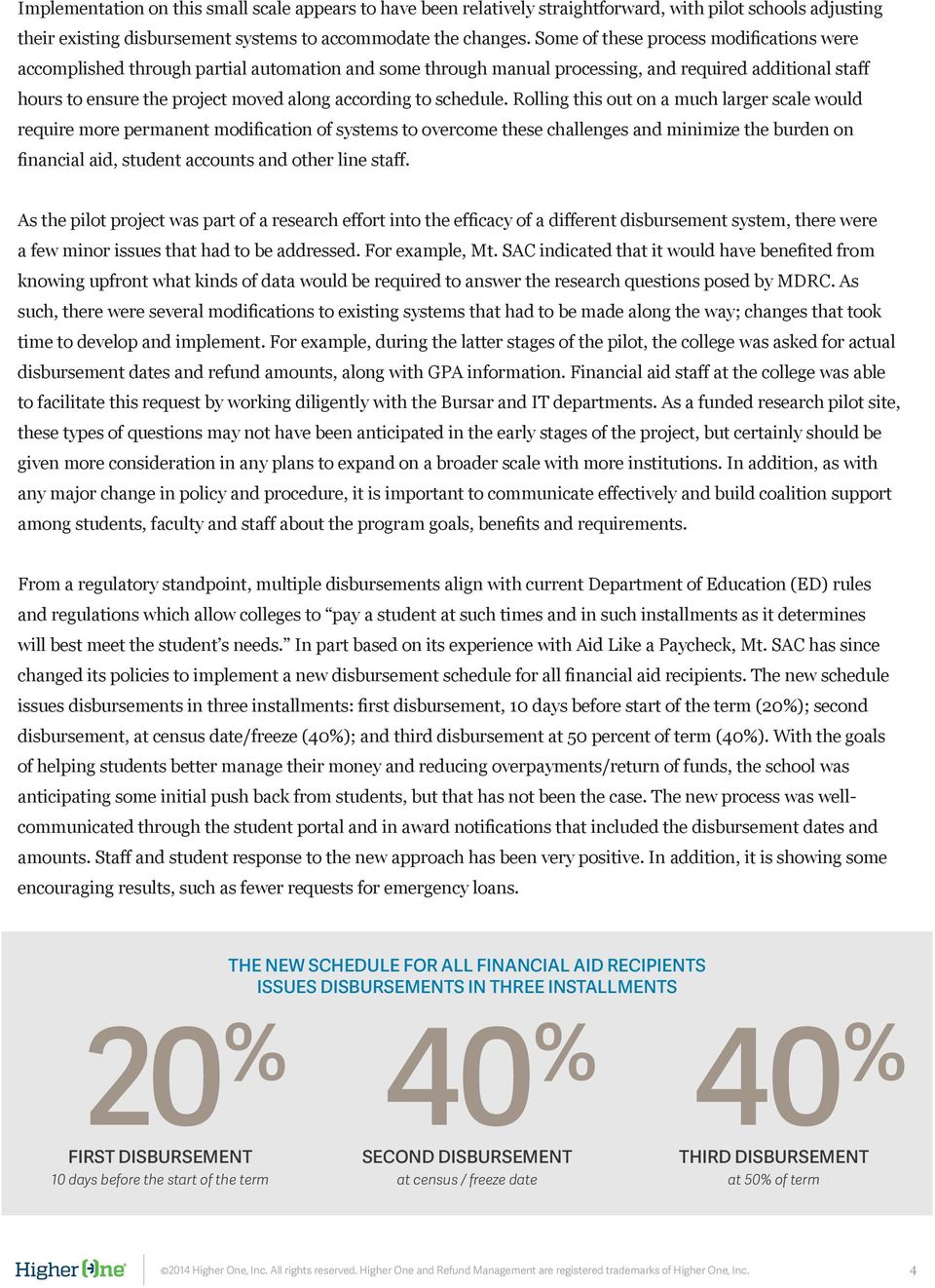
4 Implementation on this small scale appears to have been relatively straightforward, with pilot schools adjusting their existing disbursement systems to accommodate the changes. Some of these process modifications were accomplished through partial automation and some through manual processing, and required additional staff hours to ensure the project moved along according to schedule. Rolling this out on a much larger scale would require more permanent modification of systems to overcome these challenges and minimize the burden on financial aid, student accounts and other line staff. As the pilot project was part of a research effort into the efficacy of a different disbursement system, there were a few minor issues that had to be addressed. For example, Mt. SAC indicated that it would have benefited from knowing upfront what kinds of data would be required to answer the research questions posed by MDRC. As such, there were several modifications to existing systems that had to be made along the way; changes that took time to develop and implement. For example, during the latter stages of the pilot, the college was asked for actual disbursement dates and refund amounts, along with GPA information. Financial aid staff at the college was able to facilitate this request by working diligently with the Bursar and IT departments. As a funded research pilot site, these types of questions may not have been anticipated in the early stages of the project, but certainly should be given more consideration in any plans to expand on a broader scale with more institutions. In addition, as with any major change in policy and procedure, it is important to communicate effectively and build coalition support among students, faculty and staff about the program goals, benefits and requirements. From a regulatory standpoint, multiple disbursements align with current Department of Education (ED) rules and regulations which allow colleges to pay a student at such times and in such installments as it determines will best meet the student s needs. In part based on its experience with Aid Like a Paycheck, Mt. SAC has since changed its policies to implement a new disbursement schedule for all financial aid recipients. The new schedule issues disbursements in three installments: first disbursement, 10 days before start of the term (20%); second disbursement, at census date/freeze (40%); and third disbursement at 50 percent of term (40%). With the goals of helping students better manage their money and reducing overpayments/return of funds, the school was anticipating some initial push back from students, but that has not been the case. The new process was wellcommunicated through the student portal and in award notifications that included the disbursement dates and amounts. Staff and student response to the new approach has been very positive. In addition, it is showing some encouraging results, such as fewer requests for emergency loans. The new schedule for all financial aid recipients issues disbursements in three installments 20 % 40 % 40 % FIRST DISBURSEMENT SECOND DISBURSEMENT THIRD DISBURSEMENT 10 days before the start of the term at census / freeze date at 50% of term 4
5 Multiple disbursements also have been heralded as a means to increase efficiency, prevent fraud and reduce waste in the federal financial aid system. In 2011, the ED issued a Dear Colleague letter concerning fraud prevention in distance education programs (DCL Gen-11-17). The letter included recommendations to modify disbursement rules for students participating exclusively in distance learning courses and programs, including making more frequent disbursements of Title IV funds so that not all of the payment period s award is disbursed at the beginning of the period. Acting on this guidance, Charter Oak State College in Connecticut modified its disbursement policies effective in the spring Although its experience with fraud was low, the online college wanted to proactively adopt some of these recommendations. Many students were spending their refund dollars upfront, leaving no funds for later on to add a module or another course, and counseling of students to hold on to their refunds had not always been effective. At Charter Oak State College, many students were spending their refund dollars upfront, leaving no funds for later on to add a module or another course, and counseling of students to hold on to their refunds had not always been effective. The college developed a new policy, inclusive of full semester and modules courses, and implemented two disbursements instead of one for the payment period. The first disbursement is credited against all tuition and fee charges first, so the amount of the first refund (if any) for most students tends to be small. While there was some initial concern that this may present a hardship for students, the college reports that the results have been positive. The school has seen a decrease in the number of accounts sent to collections and a decrease in outstanding receivables as result of these changes. One of the other issues for this online college was developing policies and systems so that students in essence earn their financial aid awards, as ED rules specify that simple tracking of student logins alone is not enough. These policies spell out what students have to do to effectively demonstrate that they are enrolled/actively engaged. This may include things such as submitting an assignment, completing a computer-assisted module, and participation in threaded discussions. Such tracking has created some administrative pain points, particularly since it has been largely a manual process (e.g. using a large spreadsheet), and must involve faculty as well as financial aid staff to implement properly. The college indicated a desire for a software solution that would allow faculty to easily document last time of attendance for return of Title IV funds (R2T4) calculation purposes, and that would integrate that information with its student information system. This also would be beneficial in identifying at-risk students and other retention efforts. At Harrisburg Area Community College in Pennsylvania, the major impetus for moving to a multiple disbursement policy was the rise of bad debt levels. This was a result of trying to get money back from students who stopped attending before completing the required 60 percent of the term. Disbursements at the college are now made two times per term. Some students may not receive any refund in first disbursement after tuition and required fees are deducted, but they are permitted to charge against their remaining balance in the bookstore to obtain required books and educational materials at the start of the semester. Administrator comments were similar to those heard at Charter Oak State: having to determine engagement and actual enrollment status during the term has presented some administrative challenges. 5

6 Disbursing financial aid in more than one installment is indeed showing some initial promise, but another idea worth exploring is whether the same money management goals could be accomplished after financial aid is disbursed to the student s account. Although current ED regulations have strict timelines on when students must receive their refund money once credited to their accounts, a school is to permitted to hold credit balances if it obtains voluntary authorization from the student (or parent, in the case of PLUS loans) upfront. 2 Perhaps students could voluntarily agree to have their refunds disbursed on a regular schedule throughout the semester. This would avoid multiple drawdowns and perhaps other administrative steps for the school, but would necessitate additional accounting and cash management requirements if not already in place. A variation on this theme for schools that may utilize third-party refund disbursements services would be to explore the feasibility of adding a voluntary opt-in feature that would allow students to choose to have their funds made available on a regular schedule throughout the semester instead of all at once. This certainly would help ease the administrative burden for the school, and might empower students to take a more proactive role in managing their money. In either case, providing an option to allow students to automatically budget their credit balance availability could help students learn to budget their refunds more effectively to last the full term. It also might help ensure that students have sufficient funds available to return to the school in the unfortunate event that they not complete the required 60 percent of the term. In summary, incremental disbursements is an idea that would benefit from testing on a broader scale. Providers of higher education management and financial payment systems may be looked to for assistance by developing software and other solutions that minimize administrative burdens for financial aid, student accounts and other line staff. This assistance may also include: Developing solutions, particularly for schools with large online course offerings, to appropriately gauge and report active student engagement Offering integrated money management, financial literacy tools, and mobile solutions to make it easier for students to manage their money and increase their prospects of success Enhancing data analytic capabilities to allow colleges and universities to easily assess the outcomes of the program Sponsoring opportunities for sharing best practices and dialogue on improving financial aid delivery and outcomes 1. Public Agenda. With Their Whole Lives Ahead of Them U.S. Department of Education Federal Student Aid Handbook: Volume 4 Processing Aid and Managing FSA Funds. Washington, D.C: U.S. Department of Education. 6

7 Initial Reactions from the Financial Aid Community A draft of this white paper was presented at the Southern Association of Financial Aid Administrators at their annual conference in February Session attendees participated in a focus group-like discussion about the merits and potential drawbacks for implementing a multiple disbursements policy on a broader and/or institutional scale. All of the participants agreed that the concept of providing multiple disbursements was good idea and worth testing further. Among the advantages for students, 90 percent of the participants thought it would help them budget their money more effectively, and 80 percent saw merit in the concept of students having to earn their financial aid. Somewhat surprisingly, 70 percent did not agree that it would reduce stress for students or decrease the request for emergency loans. This may be explained by the number one disadvantage perceived for students the potential for no refund in the first disbursement. Participants felt that this could potentially increase stress for students and may lead to an increase in the need for emergency loans at the beginning of the term. One participant suggested that perhaps tuition and fees could be billed in two installments to ensure that students received at least some refunds in the first disbursement. The other drawback was the concern that the changes would be very confusing for students. Ensuring a good communication plan is in place before and during implementation was seen as very important. From an institutional perspective, a large majority of the participants (80%) thought this change would have a positive impact on student success and retention, and 80 percent felt it would help reduce fraud. The group was split, however, on whether this would result in a reduction in accounts receivable (funds due back to the institution when a student withdraws). Almost all of the participants indicated that administrative/it changes and more staff hours would be required to implement on a large scale. However, only a few indicated that the actual process of drawing down funds multiple times would be too costly a deterrent, as they already do multiple disbursements for a variety of reasons and programs. In terms of resources required, the highest priority item was a robust communication plan and media strategy, followed by technical support and additional staff. About 70 percent of the participants agree that there was merit in considering the option of holding credit balances and having vendors providing opportunities for students to choose to have their refunds distributed in multiple stages. Lastly, when asked about how to evaluate whether changing to a multiple disbursements policy is making a difference, participants suggested tracking the change in the number of withdrawals, retention and graduation rates, changes in amount of bad debt, and the amount of funds returned at end of the term or semester. 7

Financial Aid. Scholarships Expenses. Financial Aid
 Financial Aid # Financial Aid Formula # Eligible Applicants # Application Requirements and Suggested Filing Dates # Programs for Which You May Qualify # Verification of Financial Aid Data # Academic Progress
Return of Title IV (Federal Financial Aid) Policy
 Return of Title IV (Federal Financial Aid) Policy Introduction The law specifies how SAGU must determine the amount of Title IV program assistance that you earn if you withdraw from school. The Title IV
fyi Federal loans: The smart way to borrow
 Federal loans: The smart way to borrow If you don t receive enough free money to pay for college and you aren t able to cover your costs with savings or other resources, consider federal student loans.
The Changing Face of Employer Sponsored Retirement Plans
 The Changing Face of Employer Sponsored Retirement Plans Mike Dulaney, FSA, EA, MAAA Senior Consulting Actuary, Retirement Actuarial Services Principal Financial Group Subject: Actuarial Science Article
Six Strategies of Communication to Increase Tuition Payment and Student Retention
 Six Strategies of Communication to Increase Tuition Payment and Student Retention Introductions Joseph Shroyer Associate Director, USFSCO Andrea Pellegrini Assistant Director, USFSCO 2 Session Overview
9 Keys to Construction Loan Funding Success
 9 Keys to Construction Loan Funding Success By Barbara Leuin, Ph.D. Commercial Lending Expert www.sofiacapitalventures.com Key Steps to Construction Loan Funding Success Most people think construction
To improve college affordability in meaningful ways, any new resources and reforms should:
 November 5, 2008 Dear President-Elect Obama, Congratulations on your victory. Throughout your campaign, you called welcome attention to the critical importance of higher education to our economy and our
INFORMATION ADDS UP. PeopleSoft Enterprise Student Financials
 INFORMATION ADDS UP PeopleSoft Enterprise Student Financials Manage student finances and financial aid online. Effectively monitor payments, bills, and student accounts. Enable flexible application, need
PENTEGRA RETIREMENT SERVICES QUALIFIED PLAN 401(k) PLAN DESIG GN N Building successful outcomes begins with effective plan design
 PENTEGRA RETIREMENT SERVICES QUALIFIED PLAN 401(k) PLA AN DESIGN Building successful outcomes begins with effective plan design BUILDING A SUCCESSFUL 401(k) GETTING IT RIGHT How do you measure the success
Financial Aid Award Information 2016 17
 Financial Aid Award Information 2016 17 We are pleased to provide this brochure, along with your financial aid Award for the 2016 17 academic year. This booklet contains important information about your
How To Find Out If Distance Education Is A Good Thing For A Hispanic Student
 Spring 2010 Students Perceptions and Opinions of Online Courses: A Qualitative Inquiry A Report by South Texas College s Office of Research & Analytical Services South Texas College Spring 2010 Inquiries
Your Financial Aid Award
 Your Financial Aid Award The Financial Aid Office of California Institute of the Arts is pleased to enclose your Financial Aid Award Letter. After carefully reviewing your application, we have offered
Financial Services Authority. FSA CP13/7: High-level proposals for an FCA regime for consumer credit. A Response by Credit Action
 Financial Services Authority FSA CP13/7: High-level proposals for an FCA regime for consumer credit A Response by Credit Action Background Credit Action is a national financial capability charity (registered
U.S FEDERAL STUDENT AID RETURN OF TITLE IV FUNDS POLICY 2014
 U.S FEDERAL STUDENT AID RETURN OF TITLE IV FUNDS POLICY 2014 The Vice-Chancellor and Principal, as delegate of the Senate of the University of Sydney, adopts the following policy. Dated: 26 May 2014 Signature:
Practical Cost Savings Strategies
 Practical Cost Savings Strategies Eileen G. McLoughlin, Assistant Vice President of Finance and Budgeting Kelli Perry, Assistant Vice President for Finance and Controller Ron Moraski, Director of Procurement
What Every Vice President or Dean Needs to Know about Financial Aid
 Default Management Program Review What Every Vice President or Dean Needs to Know about Financial Aid NCCCSDAA meeting June 26, 2014 Draft FY 2011 3-year Default Rate GTCC s FY 2011 3-year default rate:
FAQs for Federal Direct Loan
 FAQs for Federal Direct Loan 1) Why did IIT choose to move to the Federal Direct Loan Program? The Federal Direct Loan Program provides a stable source of student loan funding because the U.S. Department
U.S. Department of Education. 2012 Fall Webinar Training Series. Return of Title IV Funds: Clock Hour Programs
 U.S. Department of Education 2012 Fall Webinar Training Series Return of Title IV Funds: Clock Hour Programs Topics Concepts and Definitions Attendance R2T4 Calculation Post-Calculation Actions Case Study
Financial Aid Terms and Conditions
 Financial Aid Terms and Conditions Introduction Barstow Community College's Financial Aid programs stem from a belief that student aid services should facilitate and foster the successful academic participation
Hope International University Online Undergraduate and Graduate Programs
 Hope International University Online Undergraduate and Graduate Programs Financial Options Guide Welcome to Hope International University. We are pleased you have chosen to complete your education at HIU.
2016-2017 FINANCIAL AID GUIDE For Graduate Students (As of 05/04/2016)
 2016-2017 FINANCIAL AID GUIDE For Graduate Students (As of 05/04/2016) HOW TO USE THIS GUIDE The purpose of this guide is to assist you with understanding important information about the financial aid
STUDENT PERSPECTIVES ON A REAL WORLD PROJECT
 STUDENT PERSPECTIVES ON A REAL WORLD PROJECT Sofya Poger, Frances Bailie Computer Science Department Iona College New Rochelle, NY 10801 914 633 2298 [email protected], [email protected] ABSTRACT This paper
Gabriela Ramirez, Financial Aid Assistant Catherine Acosta, Assistant Director Maryville Tuzon, Associate Director Robin Thompson, Director
 Financial Aid Award Information 2015-2016 We are pleased to provide this brochure, along with your Financial Aid Award for the 2015-2016 academic year. This booklet contains important information about
Financial Aid Satisfactory Academic Progress Policy for Financial Aid Recipients (Effective July 1, 2011)
 Financial Aid Satisfactory Academic Progress Policy for Financial Aid Recipients (Effective July 1, 2011) Colleges and universities are required to establish minimum standards of Satisfactory Academic
WESTERN MICHIGAN UNIVERSITY REPAYMENT POLICY (RETURN OF TITLE IV AID)
 WESTERN MICHIGAN UNIVERSITY REPAYMENT POLICY (RETURN OF TITLE IV AID) The federal government mandates that students withdrawing from all classes may keep only the financial aid (federal "Title IV" grant
2015-2016 DIRECT LOAN APPLICATION PACKET
 21193 Malta Rd, Malta IL 60150-9699 815-825-2086, ext. 2240 TTY: 815-825-9106 Fax: [email protected] 2015-2016 DIRECT LOAN APPLICATION PACKET The purpose of the Direct Loan Application
TREASURY INSPECTOR GENERAL FOR TAX ADMINISTRATION
 TREASURY INSPECTOR GENERAL FOR TAX ADMINISTRATION The External Leads Program Results in the Recovery of Erroneously Issued Tax Refunds; However, Improvements Are Needed to Ensure That Leads Are Timely
Terms and Conditions must be accepted through your UNA Portal. Terms & Conditions Governing Financial Aid Awards
 Terms & Conditions Terms and Conditions must be accepted through your UNA Portal. To accept your terms and conditions, access your UNA Portal account and select the Self- Service tab. In Self-Service,
Sandhills Community College Financial Aid Office Financial Aid Award Information Sheet
 Sandhills Community College Financial Aid Office Financial Aid Award Information Sheet Attached is your Financial Aid Award Notification Letter based on the results from your Free Application for Federal
Student Financial Aid Newsletter
 Student Financial Aid Newsletter Summer 2015 Edition CONTENTS 1) Important Updates/Events Information 2) Federal Updates: Federal Student Aid Identification Process 3) Account Balance Holds 4) Benefits
Heartland Community College 2014-2015. Terms and Conditions of Financial Aid Awards
 Heartland Community College 2014-2015 Terms and Conditions of Financial Aid Awards Heartland Community College Office of Financial Aid 1500 W. Raab Road Normal, IL 61761 Phone (309)268-8020 Fax (309)268-7962
Preventing Abuse in Federal Student Aid: Community College Practices
 Preventing Abuse in Federal Student Aid: Community College Practices David S. Baime and Christopher M. Mullin April 2012 American Association of Community Colleges Washington, DC In recent months, some
Financial Aid Terms and Conditions
 Financial Aid Terms and Conditions Introduction Barstow Community College's Financial Aid programs stem from a belief that student aid services should facilitate and foster the successful academic participation
APPLYING FOR FINANCIAL AID
 APPLYING FOR FINANCIAL AID Application Steps 1. Gather documents to complete FAFSA. a. Student, Spouse, and Parent (if dependent) Federal Tax Forms b. W-2 Forms c. Records of untaxed income d. Current
Most discussions of student loans focus on the
 January 2003 The Role of Student Loans in College Access Sandy Baum, Ph.D., Professor of Economics, Skidmore College Most discussions of student loans focus on the difficulties they generate for students.
Repayment Resource Guide. Planning for Student Success
 Repayment Resource Guide Planning for Student Success 2013 Table of Contents Table of Contents... 1 Introduction... 3 Purpose of Document... 3 Role of Post Secondary Institutions... 3 Consequences of Student
A Guide to Financing Your Education. How We Calculate Your Financial Need
 Pomona College Office of Financial Aid 333 College Way Claremont, CA 91711 (909) 621-8205 (909) 607-7941 fax [email protected] A Guide to Financing Your Education Pomona College welcomes you to
UNITED STATES DEPARTMENT OF EDUCATION OFFICE OF POSTSECONDARY EDUCATION JUL 1 3 2012
 UNITED STATES DEPARTMENT OF EDUCATION OFFICE OF POSTSECONDARY EDUCATION GEN-12-10 JUL 1 3 2012 THE ASSISTANT SECRETARY Subject: Implementation ofe.o. 13607 - Establishing Principles of Excellence for Educational
What Is Direct Loan Entrance Counseling?
 What Is Direct Loan Entrance Counseling? Federal regulations require that you, as a first-time student loan borrower, complete an Entrance Counseling session. You can complete the entire session online
Financial Aid Award Guide
 Johns Hopkins University School of Medicine Financial Aid Award Guide Graduate Students 2015 2016 Financial Aid Award Guide The Financial Aid Award Guide will serve as a resource for all students to help
Managing College Costs
 Managing College Costs Managing College Costs Online Information Student Financial Aid/Bursar s Websites Trending Topics & FAQ s Tutorials & Quick Links Tuition Estimator Tuition Fees Insurance Books Room
Keep the IRS from Taking Your Paycheck: Guide to Wage Garnishment and How to Stop It 1.866.866.1555. www.toptaxdefenders.com
 Keep the IRS from Taking Your Paycheck: Guide to Wage Garnishment and How to Stop It 1.866.866.1555 www.toptaxdefenders.com What You Need to Know about IRS Wage Garnishment When you fall behind on your
April 28, 2015. Dear Chairman Alexander:
 Senator Lamar Alexander Chairman Committee on Health, Education, Labor and Pensions United States Senate 428 Senate Dirksen Office Building Washington, DC 20510 Dear Chairman Alexander: On behalf of the
STATE ASSISTANCE FOR ENERGY EFFICIENCY FINANCING IN THE RESIDENTIAL SECTOR GREEN CALIFORNIA SUMMIT SACRAMENTO, CA FRIDAY, APRIL 27
 STATE ASSISTANCE FOR ENERGY EFFICIENCY FINANCING IN THE RESIDENTIAL SECTOR GREEN CALIFORNIA SUMMIT SACRAMENTO, CA FRIDAY, APRIL 27 2 Outline Outline Introductions Energy Efficiency Market in California
Retirement Plan Leakage Cause For Concern And Action
 Retirement Plan Leakage Cause For Concern And Action Prepared by Consulting Retirement Presentation to ERIC State of Retirement: Many Employees are on a Rocky Road Full-Career Contributors at age 65 15.9
Financial Aid Handbook
 2014-15 Financial Aid Handbook February 26, 2014 Dear Financial Aid Applicant: The purpose of this manual is to provide you with general guidelines governing financial aid when attending Paul D. Camp Community
The Texas B-On-Time Loan Program. What do I need to know?
 The Texas B-On-Time Loan Program What do I need to know? TABLE OF CONTENTS What is the Texas B-On-Time (BOT) Loan Program?...1 I m not sure I ll meet the requirements for loan forgiveness. Should I still
Taking Strategic Partnerships to the Next Level: An Alternative Approach to Licensing Your Development Asset
 Taking Strategic Partnerships to the Next Level: An Alternative Approach to Licensing Your Development Asset Introduction In this era of strategic development deals, inventiv Health has significantly broadened
CONSUMER INFORMATION
 CONSUMER INFORMATION To help students meet the financial obligations of college attendance, Mohave Community College administers a varied and comprehensive financial aid program. Financial aid is designed
Financial Aid Consumer Information
 Has there ever been a time in your life where you had an educational goal that you wanted to reach but felt that those goals were unattainable due to personal financial reasons? Time and time again, students
THE FHA REVERSE MORTGAGE PROGRAM:
 THE FHA REVERSE MORTGAGE PROGRAM: HELPING TEXAS SENIORS FINANCE RETIREMENT WITH THEIR OWN RESOURCES By: W. Scott Norman NMLS #543236 Sente Reverse Mortgage 901 S. MoPac, Building 4, Suite 125 Austin, Texas
Registered Nursing (Fast-Track) Service Cancelable Loan Program REGULATIONS. 2007-2008 Award Year
 Registered Nursing (Fast-Track) Service Cancelable Loan Program REGULATIONS 2007-2008 Award Year July 1, 2007 Georgia Student Finance Commission 2082 East Exchange Place, Suite 200 Tucker, Georgia 30084
Student Account and Billing Information
 CURRY COLLEGE Student Account and Billing Information 2015-2016 CURRY COLLEGE Office of Student Financial Services We are providing you with this brochure to assist you in remaining in good financial
Contact Us Telephone: (800) 222-7183 Email: [email protected] Fax: 973-275- 2040 Web site: Office of Financial Aid web page
 Your Guide to Seton Hall University s Financial Aid Congratulations on your acceptance to Seton Hall University! While this is an exciting time, we understand that it may be a confusing one as well. The
saved from url=http://swtjc.edu/tinybrowser/files/registrar/2014-2016catalog57swtjc.pdf#page=77
 Example: SWTJC Associate s Degree = 62 Hours X 150% = 93 hours. 93 hours is the maximum that can be attempted for this program and receive financial aid. TRANSFER STUDENTS Transfer students entering SWTJC
Administrative Computer Services Service Area Review/Planning Document March 23, 2008. Section I. Mission and Goals
 Administrative Computer Services Service Area Review/Planning Document March 23, 2008 Section I. Mission and Goals The Mission of OTC Ozarks Technical Community College's primary mission is to provide
The choice is clear. FINANCIAL AID: LOWER THE COST OF HIGHER EDUCATION
 The choice is clear. FINANCIAL AID: LOWER THE COST OF HIGHER EDUCATION HOW TO APPLY FOR FINANCIAL AID The Free Application for Federal Student Aid (FAFSA) serves as the application for all federal, state
Retirement on the. Brain. Your Retirement Plan: Don t pass up the perks
 Retirement on the Brain Your Retirement Plan: Don t pass up the perks Retirement on the Brain Your Retirement Plan Understanding the advantages of your retirement plan is crucial in making wise savings
University of Minnesota Start-up Guide
 University of Minnesota Start-up Guide Office for Technology Commercialization (OTC) - Venture Center A guide for faculty, staff, and entrepreneurs interested in starting a new business based on University
TOP 10 THINGS ALL FACULTY NEED TO KNOW ABOUT FINANCIAL AID. Presented by Joanne T. Ceres Director of Enrollment Management & Registrar
 TOP 10 THINGS ALL FACULTY NEED TO KNOW ABOUT FINANCIAL AID Presented by Joanne T. Ceres Director of Enrollment Management & Registrar # 1 Applying for Financial Aid Students must submit a FAFSA (Free Application
CUSTOMER EXPERIENCE SURVEY SM
 CUSTOMER EXPERIENCE SURVEY SM CASELODE FINANCIAL MANAGEMENT Morningstar Technology Post Office Box 622 Simpsonville, SC 29681 LEGALRELAY.COM 3122 FORRESTER ROAD PEARLAND, TX 77000 INTRODUCTION LEGALRELAY.COM
Optimizing Enrollment Management with Predictive Modeling
 Optimizing Enrollment Management with Predictive Modeling Tips and Strategies for Getting Started with Predictive Analytics in Higher Education an ebook presented by Optimizing Enrollment with Predictive
AMERICAN UNIVERSITY OF ANTIGUA COLLEGE OF MEDICINE APPROVED TO PARTICIPATE IN WILLIAM D FORD DIRECT LOAN PROGRAM APPROVAL DATE : 10/15/15
 AMERICAN UNIVERSITY OF ANTIGUA COLLEGE OF MEDICINE APPROVED TO PARTICIPATE IN WILLIAM D FORD DIRECT LOAN PROGRAM APPROVAL DATE : 10/15/15 Disclaimer 2 This presentation highlights the basics of Title IV
Understanding Your Financial Aid Award
 Important information related to your financial aid award from the University of Richmond is contained in this document, including the terms and conditions of your award package. Please review this information
2014 STAR Best Practices
 2014 STAR Best Practices 1 2014 STAR Best Practices General Servicing Best Practices... 3 Investor Reporting and Accounting... 3 Optimize personnel... 3 Quality and management oversight is key... 3 Reporting,
William D. Ford Federal Direct Loan Program Direct Subsidized Loan and Direct Unsubsidized Loan Borrower s Rights and Responsibilities Statement
 Important Notice: This Borrower s Rights and Responsibilities Statement provides additional information about the terms and conditions of the loans you receive under the accompanying Master Promissory
Financial Aid at Sarah Lawrence
 Financial Aid at Sarah Lawrence From the Director of Financial Aid Dear Students and Parents: Perhaps the best advice any college can give to a prospective student is: Make your educational choice first,