
Travelers Coastal Wind Zone Plan THE TRAVELERS INSTITUTE
|
|
|
- Horatio Baker
- 10 years ago
- Views:
Transcription
1 THE TRAVELERS INSTITUTE Travelers Coastal Wind Zone Plan A Comprehensive Plan to Improve Availability and Affordability of Named Storm Wind Insurance for Coastal Homeowners

2 Number of Hurricanes per Year, Today s active hurricane era began in Katrina, Rita & Wilma $61B* total insured loss 20 Andrew $23B* total insured loss Charley, Frances, Ivan & Jeanne $25B* total insured loss Ike & Gustav $10B* total insured loss Source: Insurance Information Institute Three of the four most expensive hurricane seasons have occurred in the past five years, as indicated by the red bars. *All dollar amounts have been adjusted for inflation to Named storms Hurricanes consistently develop in the Atlantic, Caribbean and Gulf of Mexico during the months of May through October. Some develop the label of catastrophes, meaning they cause $25 million or more in insurance property damage. The naming of storms was initiated to respond to the need for clear communications with ships and aircraft, particularly as traffic increased and more storms were tracked. The practice of systematically naming tropical storms and hurricanes was initiated in 1953 by the United States National Hurricane Center. Naming is now maintained by the World Meteorological Organization (WMO). 2

3 Travelers Coastal Wind Zone Plan: A Comprehensive Plan to Improve Availability and Affordability of Named Storm Wind Insurance for Coastal Homeowners The United States faces a coastal insurance crisis Hurricanes, tropical storms and coastal property insurance are subjects that unfortunately only generate public discussion and search for answers at times of crisis. In 2005, these topics were at the forefront, following a record $57 billion in insured losses and 3.3 million claims resulting from Hurricanes Katrina, Rita, Wilma and Dennis.* The 2006 and 2007 hurricane seasons produced no catastrophic landfalls in the United States, and issues of insurance availability and affordability for coastal homeowners intensified. In 2008, when Hurricane Gustav slammed into Louisiana and Ike into Texas, they brought renewed discussion but little improvement in the coastal insurance marketplace. This crisis of availability and affordability of named storm coastal wind insurance warrants public attention now, particularly given that experts are warning that we have entered into a period of warming ocean temperatures, which may result in an increase in the frequency and severity of catastrophic storms for years to come. Trends in Atlantic hurricane seasons generally span multiple decades, and today s active hurricane era began in 1995, so we could face increased activity for some time. To the extent that named storm activity increases, finding insurance for wind coverage at affordable prices, if at all, from properly capitalized insurance carriers, will become increasingly difficult for coastal homeowners. As a result of availability and affordability issues, significantly more coastal homeowners now purchase insurance through state-created residual market pools, so-called insurers of last resort. (See chart on page 7.) Many of these pools are heavily subsidized by state governments which, in effect, result in subsidies for those living on the coast by those living inland. In addition, many state pools rely on post-event borrowing to pay claims. Given today s historic financial turmoil, one would question the ability of even the most creditworthy state programs to secure adequate financing following a major catastrophic event. Clearly, many consumers, public officials and insurers face a major challenge in finding and funding coastal property wind storm insurance, and there is a need for a responsible, comprehensive solution to this insurance problem. Travelers Coastal Wind Zone Plan offers a solution Travelers recognizes that this crisis is not going to be solved singlehandedly by one company, one industry or one state. Effective and sustainable solutions can only come from the coordinated efforts of all the stakeholders, and we believe that the insurance industry has a special place in the solution as individuals historically have looked to our industry to protect their greatest asset and largest economic obligations, their homes. At Travelers, we sought input from members of Congress, other federal, state and local officials, consumer groups, insurance agents and brokers and other insurance industry leaders as we developed the comprehensive set of principles that make up our Coastal Wind Zone Plan. This plan proposes a private, market-based system, without federal subsidies for insurers, to address the problems of homeowners insurance availability that coastal consumers face today. The comprehensive plan would provide the needed framework to assist America s coastal families in preparing to rebuild, repair and recover from the aftermath of named storm catastrophes. * Insurance Information Institute 3
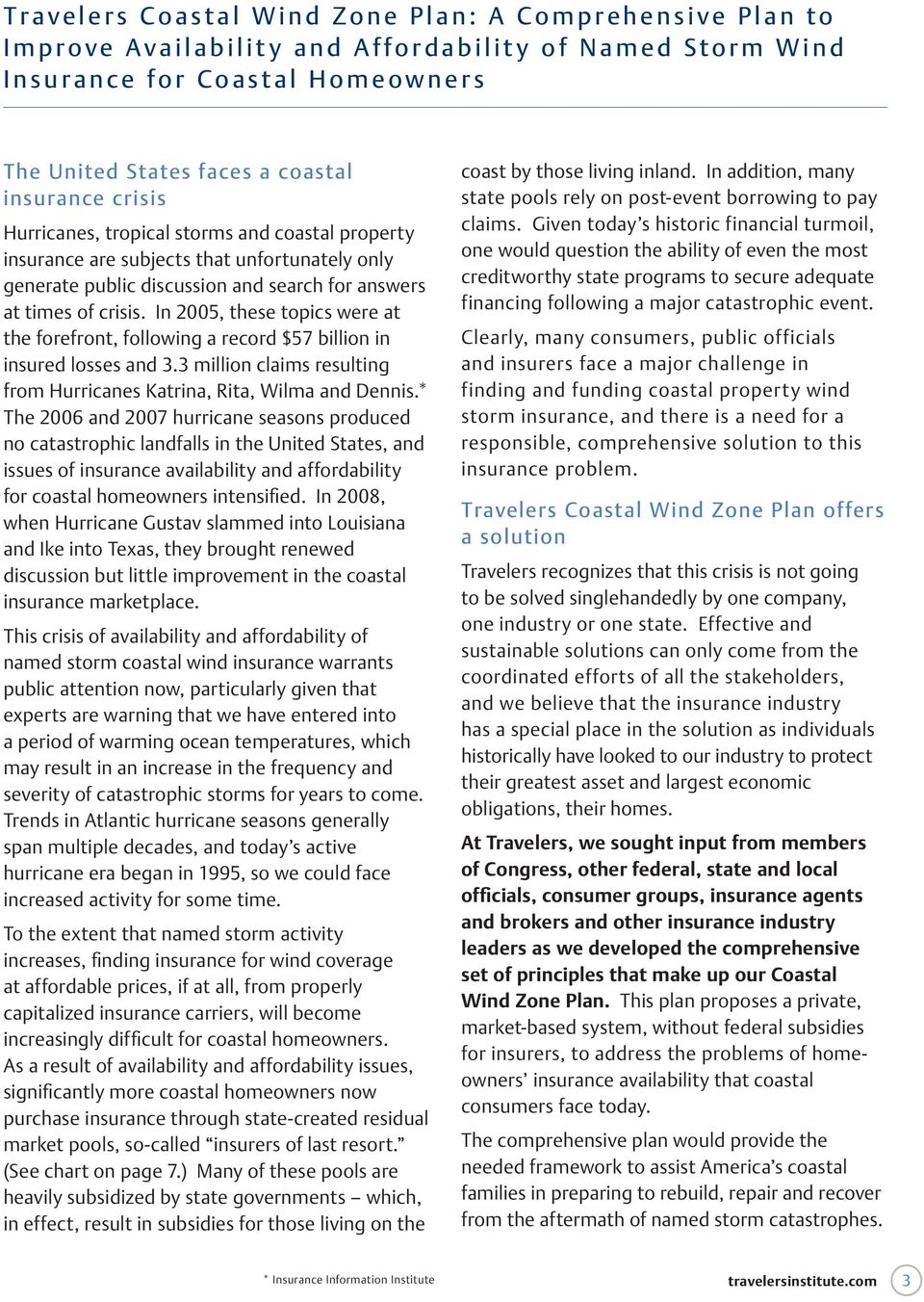
4 Coastal living and coastal properties on the increase More Americans appear to want to live along the coasts. According to the U.S. Department of Commerce and the National Oceanic & Atmospheric Administration (NOAA), 53 percent of the nation s population lived in coastal counties in 2003, and their populations are expected to grow by more than 7 million in The trend is unmistakable. And the properties in which they live are escalating in exposure value as modest beach bungalows give way to sprawling homes and skyscraper condominiums. The collective value of all coastal properties from Texas to Maine is estimated by the Insurance Information Institute (III) to be nearing $9 trillion, with $2 trillion of that coastal property concentrated in Florida. A significant portion of those estimates are residential properties. It s costing more to repair homes, too. A report released in March 2009, said that the cost to rebuild a damaged home increased almost 4 percent nationwide in 2008, even as real estate prices were declining. In addition, coastal property perhaps should no longer be defined as properties with ocean views, but rather viewed as properties that are vulnerable to hurricanes as far inland as 150 miles. 4
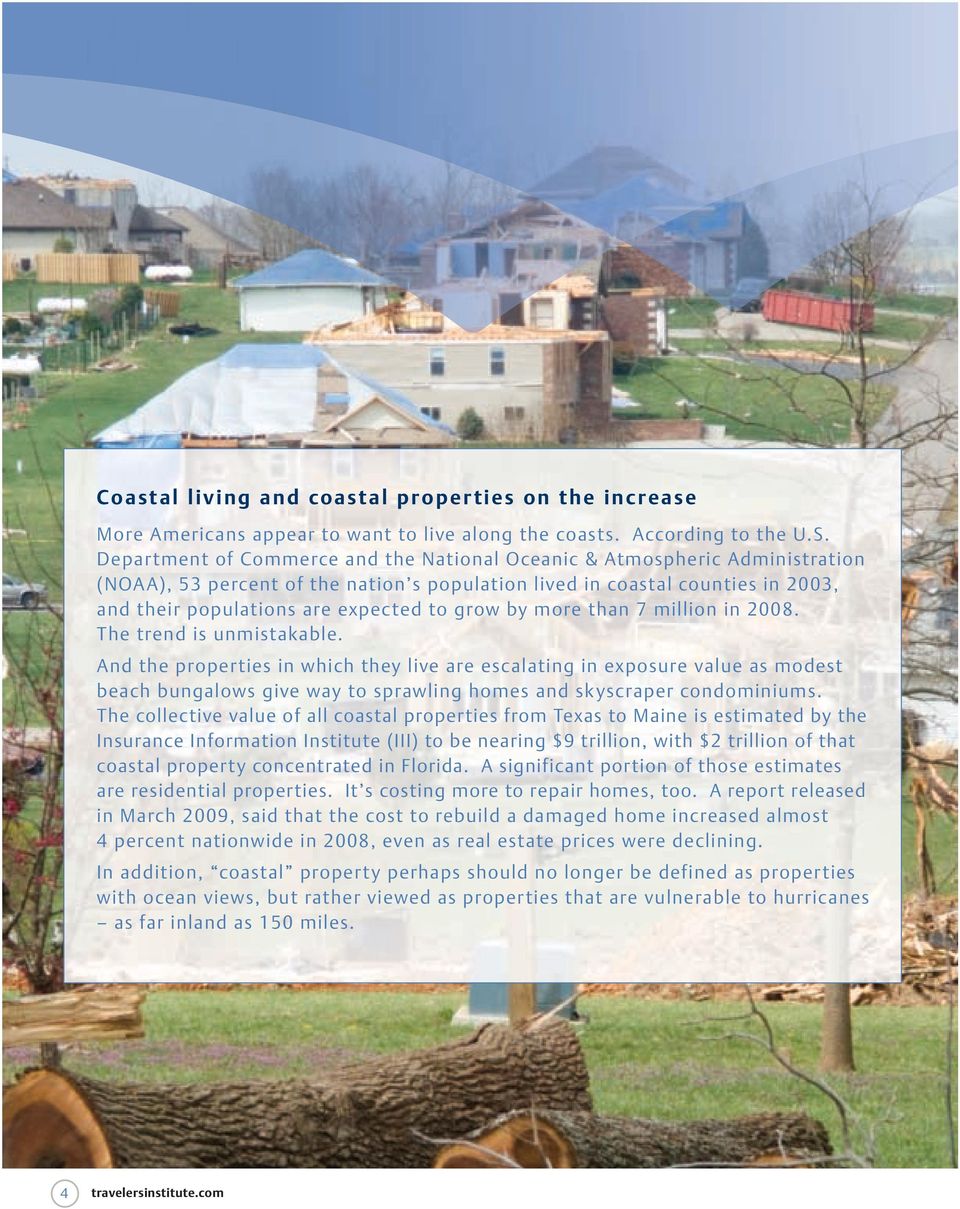
5 Travelers Coastal Wind Zone Plan - Four Principles For Travelers Coastal Wind Zone Plan to succeed, all four of its key elements have to be put into place, as opposed to selecting only those aspects that have the most popular appeal. 1. A stable and consistent regulatory environment. The impact of constantly changing rules on the willingness of insurers to commit capital in high-risk coastal markets is underestimated and underappreciated. If an insurer does not have confidence in the predictability and stability of the regulatory environment, it cannot have confidence in the underwriting decisions it is making, and under those circumstances, it cannot be expected to make substantial commitments of capital. In fact, the lack of predictability and stability of the regulatory environment has been an issue in states along the Gulf and Atlantic Coasts. A predictable and stable set of rules is a necessary condition to insurers making long-term commitments of capital. We propose that an independent federal commission establish standards and rules for coastal named wind storm rating and underwriting. This commission would oversee this narrow portion of the homeowners insurance market in the 18 coastal states. The remainder of the homeowners insurance market would remain subject to state regulation as it currently is today. 2. Transparency in calculation of premium. In the coastal wind zone states, under this concept, insurance companies would individually and competitively set risk-based and actuarially sound rates using approved standards and certified windstorm risk models approved by the federal commission. The proposed federal commission would certify models after reviewing and validating underlying model assumptions such as frequency, severity, vulnerability and mitigation factors. This would ensure that rates are set in a transparent manner. In addition, we endorse creating a rating calculation mechanism to generate premium credits for customers if models and actual experience become misaligned over time such that actual losses are less than predicted. This would eliminate the perception of insurers winning and customers losing. 3. Cost-based federal reinsurance mechanism with savings passed on to consumers. To improve affordability and availability of insurance, we envision the creation of a federal cost-based reinsurance mechanism for extreme events, such as an event with losses that are multiples of those arising out of Hurricane Katrina. In order to provide financial protection for the unlikely, yet possible, occurrence of multiple events within one year, reinsurance coverage should be applied on a seasonal aggregate basis. The reinsurance would be made available to insurers at cost by the federal government so there would be no subsidy, and insurers would be obligated to pass the savings directly to their customers. 4. Mitigation against losses. In the coastal wind zone states, mitigation must be a centerpiece of any effective catastrophe insurance proposal, and there should be federal guidelines for strong building codes, federal incentives for state and local adoption and enforcement of those codes, enhanced construction technology and land use planning requirements. In addition, there should be meaningful premium credits for mitigation and consideration of state and local property tax incentives for retrofitting houses. Four Coastal Zones in Travelers Coastal Wind Zone Plan The plan envisions four coastal zones from Texas to Maine: Gulf, Florida, Southeast and Northeast. SOUTHEAST NORTHEAST GULF FLORIDA 5
6 Features of Travelers Coastal Wind Zone Plan: The Coastal Wind Zone Plan is fair to all homeowners across the United States. This plan is based on the basic tenet of insurance, which is to spread the risk among as many people as possible who are subject to that same risk. Under the Travelers Coastal Wind Zone Plan, only those with named windstorm exposure would pay the premiums for the coverage, and there should be no direct subsidy or other financial support from policyholders with limited or no exposure to such storms. Also, individuals within the coastal zones will be charged a premium commensurate with their risks, so people living in higher risk areas would pay more than those living in lower risk areas, and those living in lower risk areas would not be subsidizing those in higher risk areas. As a result, some homeowners will be faced with increased premiums, and significantly so. However, the impact of the proposed federal reinsurance mechanism and non-insurance subsidies such as tax credits or direct government payments, means that those who can least afford risk-based pricing should receive some relief. Several additional features of the Coastal Wind Zone Plan make the coastal property insurance system fairer to homeowners, including the transparency in ratemaking with the unique rating calculation mechanism to realign premiums over time when the wind does not blow, consumer protections and assistance in protecting homes. The Coastal Wind Zone Plan leaves the business of insurance to those who know it best and that s important when it comes to disaster recovery. Unlike other plans that put federal and state governments in the catastrophic insurance business, the Travelers Coastal Wind Zone Plan leaves the business of providing insurance coverage and responding to catastrophic losses to the private market. At Travelers, for example, we have a national Catastrophe Management Center that provides operational and logistical support to our catastrophe response efforts. Travelers state-of-the-art Claim Training Facility gives Travelers claim professionals the in-depth training and expertise needed to provide knowledgeable, accurate and efficient claim service. A key component of our response strategy is the deployment of highly trained claim professionals drawn from our dedicated Catastrophe Response Team and across our entire claim enterprise. Our field catastrophe response efforts are supported by a fleet of five Mobile Claim Headquarters vehicles and six claim customer service centers staffed around the clock to ensure customers can report claims 24 hours a day, 7 days a week. The public market is not similarly equipped and cannot be expected to provide the same level of speed, efficiency and customer service at a time when homeowners are at their most vulnerable. The Coastal Wind Zone Plan creates a stable market for both insurers and customers. Historically, at times, insurers have been faced with a situation in which the rules put in place before a storm in other words, the rules under which those insurers based underwriting decisions and committed capital to support the policies written were not the same as the rules adopted following a storm. Constantly changing rules adversely impacted the willingness of insurers to do business in high-risk coastal markets. That has caused disruption for customers in the form of non-renewals and fewer insurance availability options. Moving responsibility for named storm wind coverage to an independent federal commission would provide for a more stable and consistent regulatory climate across the Gulf and Atlantic Coasts. That would enable insurers to provide catastrophic wind insurance, and consumers to obtain and keep it, with greater certainty. A stable set of rules would encourage insurers to make long-term business and capital commitments to those zones for named storm wind risks, increasing the availability of that insurance over time. Insurers writing named storm wind coverage in the zones would be subject to federal oversight, and the remainder of the homeowners coverage would continue to be regulated by the states. By recognizing that hurricanes don t recognize state borders, the zone-based approach provides a more consistent and fair market throughout the Gulf and Atlantic coastal states. In doing so, the plan responds to the challenges of state policymakers about how to smooth discrepancies that exist state to state. For consumers, as they move from state to state within a zone, their named storm wind insurance would be subject to the same set of rules, and they would have additional peace of mind since insurers would be able to offer them coverage on a more consistent basis. 6

7 U.S. Residual Market Exposure to Loss (Billions of Dollars) $700 $600 $500 In the period between 1990 and 2006, total exposure to loss in the residual market (FAIR & Beach/Windstorm) Plans has surged from $54.7 billion in 1990 to $656.7 billion in Florida Hurricanes Katrina, Rita & Wilma $656.7 $430.5 $419.5 $400 $372.3 $300 $200 Hurricane Andrew (1992) $150.0 $281.8 $221.3 $244.2 $292.0 $100 $ Insurers of last resort Source: Insurance Information Institute Today, in coastal states, more than 15 percent of personal insurance property policies are placed within the residual markets. North Carolina and Florida have the highest percentage of homeowners property insurance carried within the residual market pools. It is also interesting to note that A.M. Best s 2007 market share report lists Florida s residual market, Citizens Property Insurance Corporation, as the ninth largest insurer among U.S. personal insurance providers right along with other large insurance companies. 7

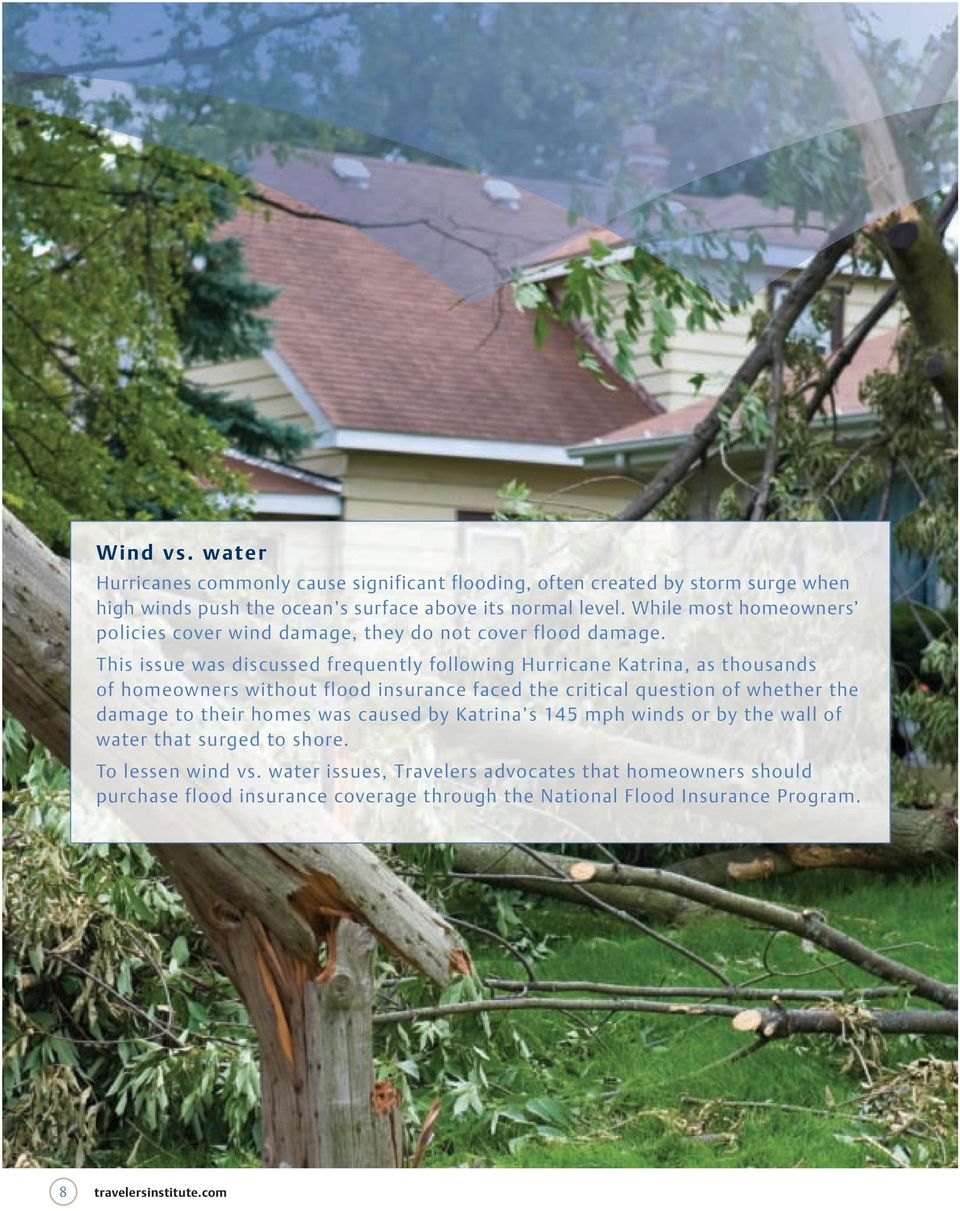
8 Wind vs. water Hurricanes commonly cause significant flooding, often created by storm surge when high winds push the ocean s surface above its normal level. While most homeowners policies cover wind damage, they do not cover flood damage. This issue was discussed frequently following Hurricane Katrina, as thousands of homeowners without flood insurance faced the critical question of whether the damage to their homes was caused by Katrina s 145 mph winds or by the wall of water that surged to shore. To lessen wind vs. water issues, Travelers advocates that homeowners should purchase flood insurance coverage through the National Flood Insurance Program. 8
9 The Coastal Wind Zone Plan provides federal reinsurance to improve affordability in highrisk areas. To improve affordability and availability of named storm wind insurance, the plan calls for the creation of a federal reinsurance mechanism for extreme events, such as an event with losses that would be multiples of those arising out of Hurricane Katrina. The federal reinsurance would be made available to insurers at cost so there would be no taxpayer subsidy, and insurers would be obligated to pass the savings directly to their customers. The independent federal commission would determine the premiums charged insurers, oversee the operation of the reinsurance mechanism - including payment of its claims - and ensure that savings are identified and passed on to customers in the premiums they pay. The intent is not to replace the private reinsurance market, but rather to complement private reinsurance in the case of the biggest of the big events. In order to provide financial protection for the unlikely, yet possible, occurrence of multiple events within one year, reinsurance coverage should be applied on a seasonal aggregate basis. The federal commission would be given the authority to adjust the loss level to which the mechanism responds if market stabilization requires such action. The Coastal Wind Zone Plan makes wind insurance ratemaking more transparent. This plan, through its transparent process of setting rates, will take much of the mystery out of named storm wind insurance ratemaking for consumers and policy makers. As a result of this plan, a new independent federal commission of five members appointed by the President of the United States and confirmed by the U.S. Senate would be created to establish rating and underwriting standards and oversee insurers writing this coverage. Insurers would be required to file rates with the federal board, which would be reviewed for compliance with approved standards. Beginning with Hurricane Andrew in 1992, insurers realized the need for better information to measure and understand their coastal exposure, and they began to use catastrophe models more extensively. The models factored in many considerations, including storm track, intensity and size of past land-fall events, as well as estimates of what their losses would be today if those same events occurred. Because of variable factors such as climate and demographics, the models are not precise predictors, causing some to question heavy reliance on them. Coastal states have differing views on the acceptability and the use of models. The plan does not envision the federal commission developing its own model, but rather evaluating and certifying wind risk catastrophe models developed by firms and insurers. This improves past practices of leaving consumers to wonder about the models reliability. The Coastal Wind Zone Plan takes into account the unpredictability of weather. Weather losses are predictable only over the long term. While everyone agrees that rates for property wind insurance should be fair and equitable, often those rates can appear to be misaligned with experience in any given year or even multiple years. Also, significant losses one year can erase premiums and profits from several years or more. Hurricane Andrew wiped out all of the premiums collected by the insurance industry on property policies in the state of Florida for all of the years leading up to it. To address the unpredictability of weather, the Coastal Wind Zone Plan, through its unique Rating Calculation Mechanism, assures that premium credits will be generated if actual experience and wind risk models become misaligned over time. Essentially, the process, which would be transparent to regulators and consumers, involves using certified exposure-based models to set predetermined loss levels, then measuring experience against those predetermined levels. Annual accounting reports would be filed by each insurer with the independent federal commission to ensure disclosure of losses paid against predetermined loss levels. Over time, if actual experience is less than the predetermined loss level, then a prospective premium credit would be issued. The Coastal Wind Zone Plan focuses on prevention and incentive measures for stronger homes. One of the four principles of the Coastal Wind Zone Plan advocates federal building code guidelines for windresistant homes and incentives for state and local governments to adopt and enforce those codes. Experience from recent hurricanes in Florida shows the impact of well-designed and enforced building codes on reducing losses from wind storms. The Institute for Business and Home Safety reported in 2002 that if all of south Florida s homes met strong building code requirements, residential losses from a storm similar to that of Hurricane Andrew would be cut in half resulting in lower insurance premiums. As we all know, premium charges consider actual loss experience, so the smaller the losses, the lower the cost of insurance. 9
10 There should also be incentives to assist homeowners in retrofitting their current homes so that their residences are better able to withstand destructive catastrophic wind storms. We advocate that federally funded incentive programs should be adopted. State programs such as My Florida Safe Home and South Carolina s Safe Home Loss Mitigation Program have been very effective but need to be expanded with more grant funds being made available. In addition, other coastal states should adopt similar retrofitting assistance programs. A key issue in the mitigation of damage to existing homes and in new construction is the cost-effectiveness of suggested improvements since homeowners are reluctant to enact expensive measures. In response to those concerns, a team of researchers at Florida International University tested 8-d ring shank nails for two years, finding that the rings along the nail s shaft double the resistance of a roof to high winds when the nails were used to attach sheathing to roof rafters. The nails have been required in Miami-Dade and Broward Counties since 2004 and only add about $10 to the cost of building a home. Also, it s important that homeowners heed warnings from local authorities to prepare their homes appropriately when a hurricane is approaching. Important just-in-time steps include shuttering or boarding up windows, anchoring or securing all outside equipment, and shutting off all power supplies. 10

11 To learn more about Travelers Coastal Wind Zone Plan: If you are interested in Travelers Coastal Wind Zone Plan, please visit THE TRAVELERS INSTITUTE Travelers established The Travelers Institute as a means of participating in pubic policy dialogue on matters of interest to the property casualty insurance sector, as well as the financial services industry more broadly. The Institute draws upon the industry expertise of Travelers senior management and the technical expertise of its risk professionals and other experts to provide information, analysis and recommendations to public policy makers and regulators. Based in Washington, D.C., The Travelers Institute is led by Joan Woodward, Executive Vice President of Public Policy. 11

12 THE TRAVELERS INSTITUTE The Travelers Institute th Street NW Suite 950 Washington, D.C The Travelers Companies, Inc. All rights reserved. New 7-09

Homeowners Insurance in the States
 Testimony to the Senate Business and Commerce Committee Senator John J. Carona, Chair Texas Legislature Tuesday, July 10, 2012 Heather Morton National Conference of State Legislatures Denver, Colorado
Testimony of Kevin M. McCarty Florida Insurance Commissioner
 Testimony of Kevin M. McCarty Florida Insurance Commissioner Before the Subcommittee on Oversight and Investigations Of the House Committee on Financial Services Regarding: The Homeowners Insurance Crisis
As of July 31, 2011, Citizens reported it had a total of 1,408,584 policies in-force throughout the state.
 Committee on Banking and Insurance Statement of the Issue The Florida Senate Issue Brief 2012-226 September 2011 CITIZENS PROPERTY INSURANCE Citizens Property Insurance Corporation (Citizens or the Corporation)
Catastrophe risk and the cost of real estate insurance
 Catastrophe risk and the cost of real estate insurance Catastrophe risk and the cost of real estate insurance Any real estate company that owns property in states exposed to hurricanes or earthquakes is
August 20, 2012. Docket number: 2012-15685. Dear Director McRaith,
 Director, Federal Insurance Office Department of the Treasury Federal Insurance Office 1500 Pennsylvania Avenue NW Washington, D.C. 20220 Re: Input to FIO s study on the breadth and scope of the global
How To Get A Home Insurance Policy On The Gulf Coast
 INSURANCE IN MISSISSIPPI 10 YEARS AFTER KATRINA Mike Chaney, Commissioner A publication of the Mississippi Insurance Department August 2015 Message from Commissioner of Insurance Mike Chaney One of the
Residual Markets. Residual Markets in which insurers participate to make coverage available to those unable to obtain coverage in Standard Market
 Residual Markets David C. Marlett, PhD, CPCU Chair, Department of Finance, Banking and Insurance Appalachian State University [email protected] 828.262.2849 http://insurance.appstate.edu/ Residual
Report of Regulatory Subcommittee. Affordable Homeowners Insurance Commission. Governor Robert Bentley
 Report of Regulatory Subcommittee Affordable Homeowners Insurance Commission Governor Robert Bentley Summary: The Regulatory Subcommittee met on two occasions by telephone (May 18 th and May 31 st ) to
At War with the Weather Managing Large-Scale Risks in a New Era of Catastrophes
 At War with the Weather Managing Large-Scale Risks in a New Era of Catastrophes Howard C. Kunreuther and Erwann O. Michel-Kerjan with Neil A. Doherty, Martin F. Grace, Robert W. Klein, and Mark V. Pauly
U.S. Homeowners Market
 U.S. Homeowners Market Casualty Actuarial Society Spring Meeting Kelleen Arquette, FCAS, MAAA May 2013 2013 Towers Watson. All rights reserved. AGENDA Agenda Market Overview Market Definition Direct Written
RESIDUAL MARKET PROPERTY PLANS
 RESIDUAL MARKET PROPERTY PLANS From Markets of Last Resort to Markets of First Choice September 2009 Robert P. Hartwig, Ph.D., CPCU President Tel: (212) 346-5520 [email protected] Claire Wilkinson Vice President
Building Code Effectiveness Grading: In Brief. What? Why? When? And What Do I Do?
 Building Code Effectiveness Grading: In Brief The Building Code Effectiveness Grading Schedule (BCEGS) assesses the building codes in effect in a particular community and how the community enforces its
Approach to Managing Climate Risk
 Approach to Managing Climate Risk I. Introduction As an insurer, employer, investor, property owner, and responsible corporate citizen, Allstate is committed to dedicating resources to help mitigate and
Climate Change and Insurance. Challenges and Opportunities
 Climate Change and Insurance Challenges and Opportunities Why do we care? Insurance key to our economy keeps risk within reasonable limits so businesses can invest and grow and so individuals can recover
Storm tide is the water level rise during a storm due to the combination of storm surge and the astronomical tide.
 INTRODUCTION TO STORM SURGE Introduction to Storm Surge BOLIVAR PENINSULA IN TEXAS AFTER HURRICANE IKE (2008) What is Storm Surge? Inland Extent Storm surge can penetrate well inland from the coastline.
The National Flood Insurance Program (NFIP)
 The National Flood Insurance Program (NFIP) Insurance Information Institute 110 William Street New York, NY 10038 (212) 346-5500 www.iii.org October 2005 Robert P. Hartwig, Ph.D., CPCU Senior Vice President
CAS Seminar on Ratemaking
 CAS Seminar on Ratemaking Is There A Need for State or National Catastrophe Funds for Homeowners Insurance? Presented by: David R. Chernick Consulting Actuary Milliman, Inc. March 17, 2008 Boston, Massachusetts
Storm tide is the water level rise during a storm due to the combination of storm surge and the astronomical tide.
 INTRODUCTION TO STORM SURGE Introduction to Storm Surge National Hurricane Center Storm Surge Unit BOLIVAR PENINSULA IN TEXAS AFTER HURRICANE IKE (2008) What is Storm Surge? Inland Extent Storm surge can
Hurricane risk pricing, catastrophe models, and data quality: Why it matters and what should be done about it?
 Hurricane risk pricing, catastrophe models, and data quality: Why it matters and what should be done about it? Edouard von Herberstein Master s Thesis University of Colorado at Boulder April 2004 Introduction:
Easing The Homeowners Insurance Crisis on the Atlantic and Gulf Coasts. Robert E. Litan 1 Frank Nutter 2 Marc Racicot 3.
 Easing The Homeowners Insurance Crisis on the Atlantic and Gulf Coasts Robert E. Litan 1 Frank Nutter 2 Marc Racicot 3 October, 2007 The record hurricane seasons of 2004-05, which visited extensive damage
Understanding the Electric Power Industry s Response and Restoration Process
 Understanding the Electric Power Industry s Response and Restoration Process Electricity is a crucial product many of us take for granted. We scarcely think about it, unless we don t have it. Because electricity
The Florida Building Code
 The Florida Building Code Florida s Response to Hurricane Risk Rick Dixon Florida Building Commission Florida Building Commission Architect Structural Engineer Mechanical Engineer Fire Protection Engineer
Chris Carter. As we enter hurricane season in South Florida, let's discuss hazard insurance from a lending perspective
 As we enter hurricane season in South Florida, let's discuss hazard insurance from a lending perspective Hazard insurance is an important part of owning and financing real estate - Lenders require buyers/borrowers
Tropical Storm Allison 2001
 Texas State Senate Subcommittee on Flooding and Evacuations Testimony of Robert Eckels 18 October 2010 The challenges of Hurricanes and Flooding can best be illustrated in the Tale of Two Storms. Tropical
Tuesday, March 27, 2007. Thank you Chairwoman Waters and Ranking Member Biggert for holding
 THE HONORABLE TIM MAHONEY TESTIMONY BEFORE THE U.S. HOUSE FINANCIAL SERVICES SUBCOMMITTEE ON HOUSING AND COMMUNITY OPPORTUNITY REGARDING PERSPECTIVES ON NATURAL DISASTER INSURANCE Tuesday, March 27, 2007
Insuring Against A Hurricane
 Insuring Against A Hurricane Protecting Your Home or Business Against Hurricane-related Financial Losses About A trusted choice for more than 20 years, of Ponte Vedra offers inspired solutions to a broad
11/15/06 12:20pm PROPERTY & CASUALTY INSURANCE REFORM COMMITTEE FINAL RECOMMENDATIONS (11/15/06)
 PROPERTY & CASUALTY INSURANCE REFORM COMMITTEE FINAL RECOMMENDATIONS (11/15/06) Residential Insurance Market/Consumer Issues 1. Transparency for consumers (residential and commercial). Require the premium
Home Buyers Insurance Checklist
 Home Buyers Insurance Checklist Shopping for your dream house? There are many considerations when looking at real estate, such as property taxes, school district, available recreational opportunities in
STATEMENT BEFORE THE COMMITTEE ON SMALL BUSINESS AND ENTREPRENEURSHIP U.S. SENATE WASHINGTON, D.C.
 STATEMENT OF ROY WRIGHT DEPUTY ASSOCIATE ADMINISTRATOR FEDERAL INSURANCE AND MITIGATION ADMINISTRATION FEDERAL EMERGENCY MANAGEMENT AGENCY U.S. DEPARTMENT OF HOMELAND SECURITY BEFORE THE COMMITTEE ON SMALL
Securitizing Property Catastrophe Risk Sara Borden and Asani Sarkar
 August 1996 Volume 2 Number 9 Securitizing Property Catastrophe Risk Sara Borden and Asani Sarkar The trading of property catastrophe risk using standard financial instruments such as options and bonds
Insurance Company Solvency Regulation
 Insurance Company Solvency Regulation An Overview for the Financial Services Commission Presented by Insurance Commissioner Kevin M. McCarty January 13, 2009 1 Overview Evolution of the Florida property
HURRICANE DEDUCTIBLE
 HURRICANE DEDUCTIBLE What You Need to Know NJM Insurance Group SAVE THIS BOOKLET This booklet contains only general information and is not a legal document. TABLE OF CONTENTS About Hurricane Deductibles...
limate Change, SIDS and Insurance ick Silver NFCC Expert Meeting on Adaptation for SIDS arotonga, Cook Islands 26-28 February 2007
 limate Change, SIDS and Insurance ick Silver NFCC Expert Meeting on Adaptation for SIDS arotonga, Cook Islands 26-28 February 2007 Issues for further consideration (c) Is insurance the most suitable mechanism
Hurricane Damage. How Wind Forces Affect Homes
 Hurricanes are among the most destructive and costliest of all natural disasters. Since 1995, the United States has entered a cycle of more intense hurricane activity. Between 2003 and 2007 Florida was
The Florida Property Insurance Debate: Governor Rick Scott and Charlie Crist Campaign Review
 The Florida Property Insurance Debate: Governor Rick Scott and Charlie Crist Campaign Review KEY PLAYERS Jeb Bush Florida Governor 1999-2006 Charlie Crist Florida Governor 2007-2010 Rick Scott Florida
PART 4: INSURANCE IMPLICATIONS
 PART 4: INSURANCE IMPLICATIONS Code enforcement can have a major influence on the economic well-being of a municipality and the safety of its citizens. Municipalities that adopt up-to-date, unamended codes
GAO FLOOD INSURANCE. Information on Financial Aspects of the National Flood Insurance Program
 GAO United States General Accounting Office Testimony Before the Subcommittee on Housing and Community Opportunity, Committee on Banking and Financial Services, House of Representatives For Release on
FLORIDA S VALUED POLICY LAW: DOES A HOMEOWNERS POLICY COVER EXCLUDED PERILS? Travis Miller, Esq. (850) 425-6654
 FLORIDA S VALUED POLICY LAW: DOES A HOMEOWNERS POLICY COVER EXCLUDED PERILS? Travis Miller, Esq. (850) 425-6654 One of the enjoyable aspects of an insurance regulatory practice is the complexity of the
UnFAIR plan: Why we need reform WHAT IS THE FAIR PLAN? HERE IS THE PROBLEM
 UnFAIR plan: Why we need reform March 12, 2012 2:21 AM This is the first of a three-part series examining homeowners insurance in Massachusetts in the wake of 2004 legislative changes. The series was written
SPECIAL COMMISSION TO REVIEW THE CURRENT STATE OF THE HOMEOWNERS INSURANCE MARKET IN THE COMMONWEALTH. Dissent
 SPECIAL COMMISSION TO REVIEW THE CURRENT STATE OF THE HOMEOWNERS INSURANCE MARKET IN THE COMMONWEALTH Dissent While we concur with many of the recommendations of the Commission, we believe that while the
Mathematical Concepts in the Insurance Industry. Felix Rosenbaum, Risk Management, SCIPP Seminar April 2011
 Mathematical Concepts in the Insurance Industry Felix Rosenbaum, Risk Management, SCIPP Seminar April 2011 Table of Contents / Agenda n Introduction to Swiss Re n Insurance Math n Nat Cat Modelling n Natural
Texas Universities Recover from Hurricane Ike University of Texas Medical Branch Galveston and Texas A&M University Galveston
 Texas Universities Recover from Hurricane Ike University of Texas Medical Branch Galveston and Texas A&M University Galveston Business Continuity and Disaster Recovery State of Texas Executive Summary
Wind vs. Water and Unique Monroe County Mitigating Factors for Wind Damage
 Wind vs. Water and Unique Monroe County Mitigating Factors for Wind Damage A Presentation to the Florida Commission on Hurricane Loss Projection Methodologies Prepared by the Grassroots Organization FIRM
Economic Impact of Insurance Costs on Mississippi Gulf Coast Development
 Economic Impact of Insurance Costs on Mississippi Gulf Coast Development Prepared for Gulf Coast Business Council by The John C. Stennis Institute of Government at Mississippi State University Dr. W. Martin