
This paper sets out the challenges faced to maintain efficient markets, and the actions that the WFE and its member exchanges support.
|
|
|
- Augusta Daniels
- 10 years ago
- Views:
Transcription
1 Understanding High Frequency Trading (HFT) Executive Summary This paper is designed to cover the definitions of HFT set by regulators, the impact HFT has made on markets, the actions taken by exchange operators to maintain market integrity, and the regulatory response that are enacted or are being considered. Among the key findings of this paper, is that HFT is not a strategy but a technology that financial firms are embracing around the world. Measuring the extent of HFT is recognized as complex, but trends are evident that HFT activity has plateaued on many of the markets where it was first introduced, and HFT continues to expand globally in new markets. Exchanges have enacted many safeguards to ensure orderly markets. Regulators are reacting to concerns about HFT with new measures. The WFE sees the need to put the management of HFT issues as a central concern for markets, and to coordinate information and principles between market operators. Introduction All around the world and across all markets, economic pressures and competition are pushing businesses to find the most effective ways to invest and hedge risks. Today strategies using algorithmic trading and HFT play a central role on financial exchanges, alternative markets, and banks internalized (over-the-counter) dealings. Exchanges have adapted to the speed and automation of today s markets by deploying sophisticated risk mitigation and surveillance technology, and are continuing to innovate in these areas to further enhance the safety, stability and integrity of the markets. This paper sets out the challenges faced to maintain efficient markets, and the actions that the WFE and its member exchanges support. 1. Understanding HFT Although a number of different definitions of HFT have been proffered, there is general agreement that HFT can be broadly characterized by fully automated trading that utilizes very low latency infrastructure and involves sustained high messaging frequency. For many, proprietary trading is also a characteristic. As there are continuums of latency and messaging frequency across participants, venues and asset classes, precise definitional metrics have proved challenging to apply universally. 1
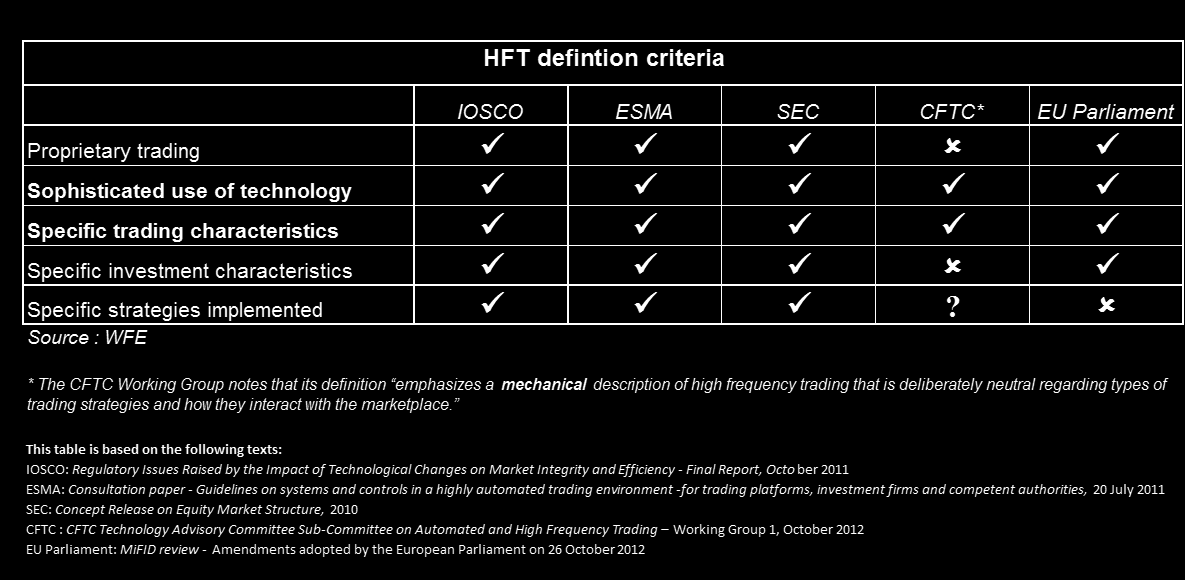
2 High frequency traders employ a diversity of strategies that primarily involve variations of market-making and statistical arbitrage strategies and which therefore tend to support liquidity provision and pricing efficiency. The definition of HFT is more than an intellectual exercise, and has two significant features. First, as seen in the table below, regulators have made considerable progress in defining high frequency trading. Yet despite moves to standardisation of definitions there are still different approaches to regulation across markets and regions. Second, given the ambiguity of the definitional metrics, as well as the difficulty of obtaining verifiable data from dark execution venues, estimates of the penetration of HFT in financial markets vary and are different for different asset classes as well as for products within an asset class. However, it is clear that trade execution has broadly become more automated, and in markets where automated trading and highly advanced technology infrastructures have been prevalent for some time, HFT, while still forming a large part of market activity, appears to have largely plateaued. HFT was estimated in 2012 by consultancy Tabb Group 1 to make up 51% of equity trades in the US and 39% of traded value in the European cash markets. While different analysts may prefer different methodologies, these figures do clearly indicate that HFT is a major component of regulated markets. Furthermore, looking at comparable figures over recent years, it is evident that the trend is flat to down among the earliest markets to adopt HFT. HFT activity on the Tokyo Stock Exchange has grown quickly over the past three years to similar levels. 1 TABB Group uses a combination of proprietary and public information to derive its estimate. For more details, please contact [email protected] 2
3 70% 60% 50% 40% HFT market share in the US (# of shares traded) 61% 56% 55% 52% 35% 51% 30% 20% 10% 21% 26% 0% Source: TABB Group estimate 45% 40% 35% 30% 25% 20% 15% 10% 5% 0% HFT market share in the Europe (value traded) 29% 39% 41% 40% 39% Source: TABB Group estimate In developing markets, HFT still appears to be growing relatively rapidly, albeit from a smaller base, in correspondence with advances in the technology environment. Today s exchange markets are unquestionably faster, more transparent and more efficient than the market structures that preceded them. HFT, however defined, like automated trading more generally, represents the rational evolution of electronic markets as participants adapted to new market structures and leveraged advancements in technology and telecommunications to optimize the quality, speed and operational efficiency of trade execution. Exchanges have likewise adapted to the dynamic changes in financial markets by significantly investing in technology, not only to support more highly efficient and scalable markets, but also to enhance the reliability, stability and integrity of the markets in this high technology environment. 3
4 2. HFT: Research on the impact There is now a considerable library of academic literature on HFT, and it will probably remain a topic of interest for researchers in the near future. To date, the substantial majority of the empirical research has concluded that HFT has had measurable beneficial impacts on a variety of core market quality metrics 2, including tighter spreads, increased liquidity, more efficient price formation, reduced transaction costs for market users and lower market volatility in most circumstances. To the extent that these outcomes are positive, HFT is seemed to improve market conditions for retail clients as was institutional. Nevertheless, critics have focused on qualitative issues concerning fairness and systemic risk. While the rules concerning HFT are clearly defined on transparent or lit markets such as exchanges, it is difficult to find rules or statistics about the ways that HFT is used in some dark pools, over-the-counter markets, and by brokers who internalize their order flow. These questions, though harder to measure, have pushed both exchanges and regulators to ever greater vigilance. 3. Exchanges leadership in promoting fair and stable markets Although there have always been occasional trading errors and episodic volatility spikes in markets, the speed, automation and interconnectedness of today s markets create a different scale of risk. These risks demand that exchanges and market participants employ effective quality management systems and sophisticated risk mitigation controls adapted to these new dynamics in order to protect against potential threats to market stability arising from technology malfunctions or episodic illiquidity. Exchanges are committed to protecting market stability and promoting orderly markets, and understand that a robust and resilient risk control framework adapted to today s high speed markets, is a cornerstone of enhancing investor confidence. WFE exchanges have developed an array of sophisticated systems, tools and capabilities to prevent or mitigate risks to market stability, and also provide capabilities to market participants to facilitate effective risk management. These capabilities continue to evolve with changes in the dynamics of markets, innovations in technology and lessons learned from risk incidents. Exchange initiatives include circuit breakers, enhanced surveillance tools, credit controls, volatility controls, messaging controls, kill switches, and other risk management tools. Exchanges are committed to ensuring a level playing field for all market participants. Electronic exchange markets have enhanced transparency of markets and broadened market access, and ensure that bids and offers are available to all participants and matched pursuant to transparent matching algorithms. Some market participants may choose to 2 December Joel Hasbrouck and Gideon Saar Low-Latency Trading July 2012 Jonathan Brogaard, Terrence Hendershott and Ryan Riordan High Frequency Trading and Price Discovery February Terrence Hendershott, Charles Jones, and Albert Menkveld Does Algorithmic Trading Improve Liquidity? 4
5 employ more sophisticated technology to support their specific trading strategies and investment or risk management needs, but this has always been the case and should not be construed as undermining the fairness of markets. Lit markets allow for comprehensive, highly granular, real-time audit trails that have substantially advanced the transparency, as well as advancing real-time risk management capabilities. Growth in volumes and messaging, in part attributable to HFT, have required advances in exchanges surveillance technology infrastructure and capabilities, and substantial advances have been and continue to be made to adapt surveillance techniques to evolving market dynamics. Exchanges and regulators have a common interest in working together to ensure strong oversight to protect market integrity and accountability for misconduct that undermines confidence. 4. Regulatory Responses to HFT Regulators are now considering various measures intended to help further promote market stability and integrity. There are certainly opportunities to enhance the regulatory framework to improve market safety and for regulators to improve surveillance capabilities to advance market integrity. Exchanges are strongly supportive of these goals, but it is important that regulators base any new regulation of automated trading on sound empirical analysis, and appropriately consider the impact of any new regulation on market quality and market efficiency. WFE encourages regulators to continue to work with the industry to identify the critical risks and effective, balanced solutions that will enhance the safety of markets without compromising the quality of markets. Markets around the world are at different stages of development with respect to HFT. International cooperation among market operators is important to accelerating shared learning and promoting high standards for enhancing the safety and integrity of markets. WFE and its member exchanges will continue to work with IOSCO and other regulators to ensure that policies are not imposed which would damage market liquidity or limit other market quality benefits provided by automated trading and HFT. WFE recognizes the growing importance of automated trading and HFT to markets around the world. WFE will work with its members to share information and develop appropriate principles and guidelines on exchange oversight and risk mitigation in ways that preserve the benefits of HFT and elevate the safety of markets. 5
ELECTRONIC TRADING GLOSSARY
 ELECTRONIC TRADING GLOSSARY Algorithms: A series of specific steps used to complete a task. Many firms use them to execute trades with computers. Algorithmic Trading: The practice of using computer software
G100 VIEWS HIGH FREQUENCY TRADING. Group of 100
 G100 VIEWS ON HIGH FREQUENCY TRADING DECEMBER 2012 -1- Over the last few years there has been a marked increase in media and regulatory scrutiny of high frequency trading ("HFT") in Australia. HFT, a subset
High frequency trading
 High frequency trading Bruno Biais (Toulouse School of Economics) Presentation prepared for the European Institute of Financial Regulation Paris, Sept 2011 Outline 1) Description 2) Motivation for HFT
Chinese University of Hong Kong Conference on HKEx and the Market Structure Revolution
 Chinese University of Hong Kong Conference on HKEx and the Market Structure Revolution The Impact of Market Structure Changes on Securities Exchanges Regulation 31 March 2012 Keith Lui Executive Director,
High Frequency Trading Volumes Continue to Increase Throughout the World
 High Frequency Trading Volumes Continue to Increase Throughout the World High Frequency Trading (HFT) can be defined as any automated trading strategy where investment decisions are driven by quantitative
- JPX Working Paper - Analysis of High-Frequency Trading at Tokyo Stock Exchange. March 2014, Go Hosaka, Tokyo Stock Exchange, Inc
 - JPX Working Paper - Analysis of High-Frequency Trading at Tokyo Stock Exchange March 2014, Go Hosaka, Tokyo Stock Exchange, Inc 1. Background 2. Earlier Studies 3. Data Sources and Estimates 4. Empirical
From Traditional Floor Trading to Electronic High Frequency Trading (HFT) Market Implications and Regulatory Aspects Prof. Dr. Hans Peter Burghof
 From Traditional Floor Trading to Electronic High Frequency Trading (HFT) Market Implications and Regulatory Aspects Prof. Dr. Hans Peter Burghof Universität Hohenheim Institut für Financial Management
Algorithmic trading Equilibrium, efficiency & stability
 Algorithmic trading Equilibrium, efficiency & stability Presentation prepared for the conference Market Microstructure: Confronting many viewpoints Institut Louis Bachelier Décembre 2010 Bruno Biais Toulouse
TRADING STRATEGIES 2011. Urs Rutschmann, COO Tbricks
 TRADING STRATEGIES 2011 Urs Rutschmann, COO Tbricks SEMANTIC CHALLENGE High Frequency Trading Low latency trading Algorithmic trading Strategy trading Systematic trading Speed Arbitrage Statistical Arbitrage
The Growth of High-Frequency Trading: Implications for Financial Stability
 The Growth of High-Frequency Trading: Implications for Financial Stability William Barker and Anna Pomeranets Introduction High-frequency trading (HFT), which relies on computers to execute trades at high
ELECTRONIC TRADING AND FINANCIAL MARKETS
 November 29, 2010 Bank of Japan ELECTRONIC TRADING AND FINANCIAL MARKETS Speech at the Paris EUROPLACE International Financial Forum in Tokyo Kiyohiko G. Nishimura Deputy Governor of the Bank of Japan
COMMISSION STAFF WORKING PAPER EXECUTIVE SUMMARY OF THE IMPACT ASSESSMENT. Accompanying the document. Proposal for a
 EUROPEAN COMMISSION Brussels, XXX SEC(2011) 1227 COMMISSION STAFF WORKING PAPER EXECUTIVE SUMMARY OF THE IMPACT ASSESSMENT Accompanying the document Proposal for a DIRECTIVE OF THE EUROPEAN PARLIAMENT
High-frequency trading: towards capital market efficiency, or a step too far?
 Agenda Advancing economics in business High-frequency trading High-frequency trading: towards capital market efficiency, or a step too far? The growth in high-frequency trading has been a significant development
Valdi. Equity Trading
 Valdi Equity Trading Valdi EDA Orders VALDI SOLUTIONS FOR EQUITY TRADING Traders on electronic markets face enormous challenges in maintaining and growing their profitability. The drive for greater efficiency
High-frequency trading
 Economics & politics Research Briefing February 7, 2011 High-frequency trading Better than its reputation? Over the past years, high-frequency trading has progressively gained a foothold in financial markets,
a. CME Has Conducted an Initial Review of Detailed Trading Records
 TESTIMONY OF TERRENCE A. DUFFY EXECUTIVE CHAIRMAN CME GROUP INC. BEFORE THE Subcommittee on Capital Markets, Insurance and Government Sponsored Enterprises of the HOUSE COMMITTEE ON FINANCIAL SERVICES
Valdi for Equity Trading High performance trading solutions for global markets
 Valdi for Equity Trading High performance trading solutions for global markets EDA Orders SunGard s VALDI: SOLUTIONS FOR Equity Trading Traders on electronic markets face enormous challenges in maintaining
FINANCIER. An apparent paradox may have emerged in market making: bid-ask spreads. Equity market microstructure and the challenges of regulating HFT
 REPRINT FINANCIER WORLDWIDE JANUARY 2015 FINANCIER BANKING & FINANCE Equity market microstructure and the challenges of regulating HFT PAUL HINTON AND MICHAEL I. CRAGG THE BRATTLE GROUP An apparent paradox
BT Low Latency Management for Financial Markets
 Bringing it all together BT Low Latency Management for Financial Markets Increased reliance on electronic and algorithmic trading, combined with regulatory and structural changes, has accelerated the pace
High Frequency Trading in FX
 High Frequency Trading in FX While regulatory scrutiny continues to Figure 2: Electronic Trading Adoption in FX build in the U.S. equity market driven by populist-led political pressures, High Frequency
ASX Equity Trading Strategy
 ASX Equity Trading Strategy Richard Murphy, ASX SAA May 2011 Agenda 1. Global Trends Playing out in Australia 2. Regulatory Reform 3. ASX Equity Trading Strategy 4. Access & Connectivity Strategy 5. 2012
Analysis of High-frequency Trading at Tokyo Stock Exchange
 This article was translated by the author and reprinted from the June 2014 issue of the Securities Analysts Journal with the permission of the Securities Analysts Association of Japan (SAAJ). Analysis
Regulatory Issues Raised by the Impact of Technological Changes on Market Integrity and Efficiency. Final Report
 Regulatory Issues Raised by the Impact of Technological Changes on Market Integrity and Efficiency Final Report TECHNICAL COMMITTEE OF THE INTERNATIONAL ORGANIZATION OF SECURITIES COMMISSIONS FR09/11 OCTOBER
Algorithmic Trading and Market Access Arrangements
 Algorithmic Trading and Market Access Arrangements ASX Review Broker Trades Message Specification 8 February 2010 TABLE OF CONTENTS Executive Summary... 3 Summary of the ASX Review Findings - Backward-Looking...
High-frequency trading, flash crashes & regulation Prof. Philip Treleaven
 High-frequency trading, flash crashes & regulation Prof. Philip Treleaven Director, UCL Centre for Financial Computing UCL Professor of Computing www.financialcomputing.org [email protected] Normal
Market Making and Liquidity Provision in Modern Markets
 Canada STA 2015 Market Making and Liquidity Provision in Modern Markets Phil Mackintosh 2 What am I going to talk about? Why are Modern Markets Important? Trading is now physics at the speed of light Jan
Do retail traders suffer from high frequency traders?
 Do retail traders suffer from high frequency traders? Katya Malinova, Andreas Park, Ryan Riordan November 15, 2013 Millions in Milliseconds Monday, June 03, 2013: a minor clock synchronization issue causes
Algorithmic Trading, High-Frequency Trading and Colocation: What does it mean to Emerging Market?
 Algorithmic Trading, High-Frequency Trading and Colocation: What does it mean to Emerging Market? Ashok Jhunjhunwala, IIT Madras [email protected] HFTs are being pushed out of the more established markets,
High Frequency Trading Background and Current Regulatory Discussion
 2. DVFA Banken Forum Frankfurt 20. Juni 2012 High Frequency Trading Background and Current Regulatory Discussion Prof. Dr. Peter Gomber Chair of Business Administration, especially e-finance E-Finance
Re: Concept Release on Risk Controls and System Safeguards for Automated Trading
 December 11, 2013 Melissa D. Jurgens Secretary of the Commission Commodity Futures Trading Commission Three Lafayette Centre 1155 21st Street N.W. Washington, DC 20581 Re: Concept Release on Risk Controls
ORDER EXECUTION POLICY
 ORDER EXECUTION POLICY Saxo Capital Markets UK Limited is authorised and regulated by the Financial Conduct Authority, Firm Reference Number 551422. Registered address: 26th Floor, 40 Bank Street, Canary
Janet M. Angstadt Partner +1.312.902.5494 [email protected] 525 West Monroe Street Chicago, IL 60661-3693 Practices Industries Education
 Janet M. Angstadt Partner +1.312.902.5494 [email protected] 525 West Monroe Street Chicago, IL 60661-3693 Practices FOCUS: Financial Services Broker-Dealer Regulation Financial Services Regulatory
Transparency in the Canadian Fixed- Income Market: Opportunities and Constraints
 Transparency in the Canadian Fixed- Income Market: Opportunities and Constraints Tran-Minh Vu M arket quality is important to policymakers because it directly affects the level of confidence and the willingness
High-frequency trading and execution costs
 High-frequency trading and execution costs Amy Kwan Richard Philip* Current version: January 13 2015 Abstract We examine whether high-frequency traders (HFT) increase the transaction costs of slower institutional
Algorithmic Trading Briefing Note. April 2015
 COMPTROLLER OF THE CURRENCY Senior Supervisors Group Algorithmic Trading Briefing Note April 2015 1863 TABLE OF CONTENTS I. Introduction and Market Evolution... 1 II. Key Risks...2 III. Key Control Principles
Setting the Scene. FIX the Enabler & Electronic Trading
 Setting the Scene FIX the Enabler & Electronic Trading Topics Overview of FIX and connectivity Direct Market Access Algorithmic Trading Dark Pools and Smart Order Routing 2 10,000+ firms use FIX globally
WORKING WORKING PAPER PAPER
 Japan Exchange Group, Inc. Visual Identity Design System Manual Japan Exchange Group, Inc. Japan Exchange Group, Inc. Visual Identity Design System Manual Visual Identity Design System Manual JPX JPX 17
ESMA MiFID II / MiFIR Consultation and Discussion Papers General Comments on Market Structure Issues
 1 August 2014 ESMA MiFID II / MiFIR Consultation and Discussion Papers General Comments on Market Structure Issues Financial markets have changed and technology has evolved meaningfully since 2007 when
High Frequency Trading + Stochastic Latency and Regulation 2.0. Andrei Kirilenko MIT Sloan
 High Frequency Trading + Stochastic Latency and Regulation 2.0 Andrei Kirilenko MIT Sloan High Frequency Trading: Good or Evil? Good Bryan Durkin, Chief Operating Officer, CME Group: "There is considerable
Fast Trading and Prop Trading
 Fast Trading and Prop Trading B. Biais, F. Declerck, S. Moinas (Toulouse School of Economics) December 11, 2014 Market Microstructure Confronting many viewpoints #3 New market organization, new financial
FI report. Investigation into high frequency and algorithmic trading
 FI report Investigation into high frequency and algorithmic trading FEBRUARY 2012 February 2012 Ref. 11-10857 Contents FI's conclusions from its investigation into high frequency trading in Sweden 3 Background
High Frequency Trading and Its Impact on the Performance of Other Investors
 Arhus University Business and Social Sciences High Frequency Trading and Its Impact on the Performance of Other Investors Evidence from the Copenhagen Stock Exchange Master Thesis Authors: Karolis Liaudinskas
Dark trading and price discovery
 Dark trading and price discovery Carole Comerton-Forde University of Melbourne and Tālis Putniņš University of Technology, Sydney Market Microstructure Confronting Many Viewpoints 11 December 2014 What
CFTC Proposes New Rules Governing Automated Derivatives Trading
 CFTC Proposes New Rules Governing Automated Derivatives Trading On November 24, 2015, the Commodity Futures Trading Commission ( CFTC ) approved a number of proposed rules intended to regulate automated
Question 1. Should the execution of a Single Price Session Order be exempt from the best price obligations under Rule 5.2?
 November 13, 2006 James E. Twiss, Chief Policy Counsel, Market Policy and General Counsel s Office, Market Regulation Services Inc., Suite 900, 145 King Street West, Toronto, Ontario. M5H 1J8 & Cindy Petlock
Bene ts and Costs of Organised Trading for Non Equity Products
 Bene ts and Costs of Organised Trading for Non Equity Products Thierry Foucault, HEC, Paris I Background I Market Transparency I Electronic Trading I Conclusions Introduction Background I "We rea rm our
High Frequency Trading An Asset Manager s Perspective
 NBIM Discussion NOTE #1-2013 High Frequency Trading An Asset Manager s Perspective In this note we review the rapidly expanding literature in the area of market microstructure, high frequency and computer-based
Institutional Trading & Market Making
 Institutional Trading & Market Making Professional Order and Post-Trade Management Partners for Innovation Innovative ideas require experienced partners XCOM AG The banking market is changing due to regulatory
The Future of Algorithmic Trading
 The Future of Algorithmic Trading Apama Track Dan Hubscher, Principal Product Marketing Manager, Progress Apama Progress Exchange Brasil 2009 Progress Exchange Brasil 2009 21 de Outubro São Paulo Brasil
Message and Execution Throttles. Volatility Awareness Alert
 Skadden Skadden, Arps, Slate, Meagher & Flom LLP & Affiliates If you have any questions regarding the matters discussed in this memorandum, please contact the following attorneys or call your regular Skadden
FX Trading: The Next Generation FX Trading and Technology Trends in 2010
 FX Trading: The Next Generation FX Trading and Technology Trends in 2010 Emily Fraser Voigt, Freelance Journalist Table of Contents 3 FX Trading and Technology Trends in 2010 Survey 5 Broker Systems 7
Enterprise Risk Management
 Enterprise Risk Management Enterprise Risk Management Understand and manage your enterprise risk to strike the optimal dynamic balance between minimizing exposures and maximizing opportunities. Today s
Machine Learning and Algorithmic Trading
 Machine Learning and Algorithmic Trading In Fixed Income Markets Algorithmic Trading, computerized trading controlled by algorithms, is natural evolution of security markets. This area has evolved both
Financial Markets and Institutions Abridged 10 th Edition
 Financial Markets and Institutions Abridged 10 th Edition by Jeff Madura 1 12 Market Microstructure and Strategies Chapter Objectives describe the common types of stock transactions explain how stock transactions
Title VII: Derivatives (Wall Street Transparency and Accountability Act of 2010)
 Title VII: Derivatives (Wall Street Transparency and Accountability Act of 2010) Summary: Regulates the previously unregulated, over-the-counter (OTC) derivatives market Requires registration of swap dealers,
Nine Questions Every ETF Investor Should Ask Before Investing
 Nine Questions Every ETF Investor Should Ask Before Investing UnderstandETFs.org Copyright 2012 by the Investment Company Institute. All rights reserved. ICI permits use of this publication in any way,
Preventing market abuse: Can market surveillance really improve amidst fragmentation and low-cost competition?
 Preventing market abuse: Can market surveillance really improve amidst fragmentation and low-cost competition? Stock exchanges perform a vital function in society by enabling the listing and trading of
Simply Sophisticated. Information Security and Compliance
 Simply Sophisticated Information Security and Compliance Simple Sophistication Welcome to Your New Strategic Advantage As technology evolves at an accelerating rate, risk-based information security concerns
Regulatory Compliance for Energy and Commodity Companies
 TRIPLE POINT SOLUTION BRIEF Regulatory Compliance for Energy and Commodity Companies COMMODITY XL MEET REQUIREMENTS FOR DODD-FRANK AND EUROPEAN UNION LEGISLATION TRIPLE POINT TECHNOLOGY TPT.COM MARKET
FIA AND FIA EUROPE SPECIAL REPORT SERIES: ALGORITHMIC AND HIGH FREQUENCY TRADING
 FIA AND FIA EUROPE SPECIAL REPORT SERIES: ALGORITHMIC AND HIGH FREQUENCY TRADING 18 February 2015 This Special Report is the fourth in the FIA and FIA Europe s series covering specific areas of the European
Towards an Automated Trading Ecosystem
 Towards an Automated Trading Ecosystem Charles-Albert LEHALLE May 16, 2014 Outline 1 The need for Automated Trading Suppliers Users More technically... 2 Implied Changes New practices New (infrastructure)
The Impact of Co-Location of Securities Exchanges and Traders Computer Servers on Market Liquidity
 The Impact of Co-Location of Securities Exchanges and Traders Computer Servers on Market Liquidity Alessandro Frino European Capital Markets CRC Vito Mollica Macquarie Graduate School of Management Robert
Index. FIA EPTA Principles. 5. Risk Controls. 1. Introduction
 Index 1. Introduction 2. General Description 3. Prevention of Market Manipulation 3.1 Hiring of Employees 3.2 Training of Employees a. Internal Training b. External Training 3.3 Software Development and
Robert Bartlett UC Berkeley School of Law. Justin McCrary UC Berkeley School of Law. for internal use only
 Shall We Haggle in Pennies at the Speed of Light or in Nickels in the Dark? How Minimum Price Variation Regulates High Frequency Trading and Dark Liquidity Robert Bartlett UC Berkeley School of Law Justin
HEDGE FUND PORTFOLIO MANAGEMENT FRONT ARENA
 HEDGE FUND PORTFOLIO MANAGEMENT FRONT ARENA FRONT ARENA FOR HEDGE FUNDS REAL TIME PORTFOLIO AND RISK MANAGEMENT The pressure has never been higher to find software solutions able to adapt to the changing
Client Update CFTC Proposes Rules Regulating Automated Trading
 1 Client Update CFTC Proposes Rules Regulating Automated Trading NEW YORK Byungkwon Lim [email protected] Aaron J. Levy [email protected] On November 24, 2015, the Commodity Futures Trading Commission
What is High Frequency Trading?
 What is High Frequency Trading? Released December 29, 2014 The impact of high frequency trading or HFT on U.S. equity markets has generated significant attention in recent years and increasingly in the
Automated Trading in Treasury Markets White Paper
 Automated Trading in Treasury Markets White Paper In recent years, electronic trading has taken on an increasingly prominent role in the U.S. Treasury market, beyond the Treasury futures market, where
High Frequency Quoting, Trading and the Efficiency of Prices. Jennifer Conrad, UNC Sunil Wahal, ASU Jin Xiang, Integrated Financial Engineering
 High Frequency Quoting, Trading and the Efficiency of Prices Jennifer Conrad, UNC Sunil Wahal, ASU Jin Xiang, Integrated Financial Engineering 1 What is High Frequency Quoting/Trading? How fast is fast?