
Insure? Not sure? Upon request, PHIAC will produce a copy of this brochure in a language other than English.
|
|
|
- Tobias Kelley
- 10 years ago
- Views:
Transcription
1 Insure? Not sure? Australia s health system offers a comprehensive range of public and privately funded health services. You can choose whether to have Medicare cover only or a combination of Medicare and private health insurance. This booklet explains the Australian health system to you in simple terms. It will help you make decisions about how best to meet your health insurance needs. Insure? Not sure? has been prepared by the Private Health Insurance Administration Council (PHIAC), an independent, Australian Government body within the health system. A list of contact details for registered private health insurers can be obtained from the PHIAC website at Upon request, PHIAC will produce a copy of this brochure in a language other than English.
2 ISBN Online ISBN Online Copyright Commonwealth of Australia 2008 This work is copyright. You may download, display, print and reproduce this material in unaltered form only (retaining notice) for your personal, non-commercial use or use within your organisation. Apart from any use as permitted under the Copyright Act 1968, all other rights are reserved. Requests and inquiries concerning reproduction and rights should be addressed to Commonwealth Copyright Administration, Attorney General s Department, Robert Garran Offices, National Circuit, Canberra ACT 2600 or posted at Print Copyright Commonwealth of Australia 2008 This work is copyright. Apart from any use as permitted under the Copyright Act 1968, no part may be reproduced by any process without prior written permission from the Commonwealth. All other rights are reserved. Requests and inquiries concerning reproduction and rights should be addressed to Commonwealth Copyright Administration, Attorney General s Department, Robert Garran Offices, National Circuit, Canberra ACT 2600 or posted at

3 Contents General information 1 What Medicare provides 1 Hospital 1 Medical 2 Pharmaceutical 2 Ambulance Cover 2 When you are a private patient in a hospital 3 What private health insurance covers 3 Your options as a privately insured patient 4 Health insurer arrangements to cover the gap 5 Surcharges and incentives 7 Lifetime Health Cover 7 Private Health Insurance Rebate 8 30% Rebate 8 Higher Rebates for Older Australians 9 How to claim the Rebate 9 For more information 9 Medicare Levy Surcharge (MLS) 10 Who must pay the Medicare Levy Surcharge? 10 Your dependents in relation to the Medicare Levy Surcharge 10 You do not have to pay the surcharge if 11 Notes about the surcharge 11 Low front end deductible or excess 11 For more information 11

4 About private health insurance 13 Insured groups 13 Standard waiting periods for pre-existing ailment/s or illness 15 What is the exact definition of a pre-existing condition? 15 Waiting periods 16 Waiting periods applying to new-borns 17 Transferring between insurers 17 No waiting period for DVA ex-gold Card holders 17 Suspending your membership 18 Standard information statements 18 Notifying members of changes to insurer rules 18 Paying your contributions 18 Paying in advance 18 Discounts on premiums 19 Unpaid contributions 19 Cancelling your membership 19 Benefits you will receive 19 Ineligible claims 20 Your benefit options as a privately insured patient 19 Prostheses 21 Private Patients Hospital Charter 22 Private Health Insurance Ombudsman 22 Types of private health insurance cover 23 Packaged products 24 Questions to ask a private health insurance insurer 25 Common terms used by private health insurers 27

5 General information Health care can be expensive. As the basis of Australia s health care system, Medicare covers many health care costs. Private health insurance provides additional cover for some services not covered by Medicare. What Medicare provides Australia s Medicare system is available to all permanent residents. Norfolk Island does not participate in the Medicare program; however Australian citizens who have been living in Australia and move to Norfolk Island from the mainland will be eligible for Medicare on return visits for up to a period of five years. The Medicare system has three parts: hospital, medical and pharmaceutical. Hospital Hospital treatment includes treatment provided in a hospital setting as well as treatment outside of hospital premises, such as in an aged care facility or in a patient s residence, as long as these services are co-ordinated and provided by a hospital. Hospital costs relate to a range of services including hospital accommodation, theatre fees and intensive care. If you choose to be a Medicare (public) patient, you can be treated, at no charge, in a public hospital by a doctor appointed by the hospital. You cannot choose your own doctor. When you are a private patient in either a public or private hospital, you will be charged for the hospital accommodation and other hospital services you receive. These charges are likely to be lower if you are treated by a hospital outside the hospital s premises. Private health insurance may cover some or all of these charges. General Information 1
6 General Information Medical As a public patient being treated by a public hospital, your medical costs will be covered under Medicare. If you are a private patient receiving treatment from a hospital, Medicare will cover you for 75% of the MBS (Medical Benefits Schedule) fee. Private health insurers have arrangements in place which may cover some or all of the doctors fees for your hospital treatment. Unless your private health insurer has a gap cover arrangement in place with your doctor which will cover all of your doctor s charge, you may have to contribute towards the doctor s bill out of your own pocket. Pharmaceutical Under the Pharmaceutical Benefits Scheme (PBS) you pay only part of the cost of most prescription medicines purchased at pharmacies. The rest of the cost is covered by the PBS. If the pharmaceutical is not supplied on the PBS then private health insurers can choose whether to pay a benefit. Ambulance Cover Medicare does not cover the cost of emergency or other ambulance services. Ambulance cover arrangements differ between States. You should check what arrangements apply where you live. In States that do not offer universal ambulance cover for residents, you can arrange ambulance cover through the ambulance authority in your State and/or your health insurer. Private health insurers may pay or reimburse you for all or part of your annual subscription to your State ambulance authority, or the costs associated with transportation. If you take out a hospital insurance policy in New South Wales or the Australian Capital Territory, you will find your private health insurance premium includes this cover. If you are a pensioner or a low income earner in these two States, your premium may be reduced because you are entitled to free ambulance cover. 2
7 When you are a private patient in a hospital As a private patient whether you are insured or not you have the right to choose your own doctor, and decide whether you will go to a public or a private hospital that your doctor attends. You may also have more choice as to when you are admitted to hospital. What private health insurance covers If you have private health insurance, you are covered against some or all of the costs of being a private patient in either a public or private hospital. Alternatively, you are free to choose to be treated as a public patient in a public hospital, at no charge. General Information As a private patient, in either a public or private hospital, you may need to pay some or all of the costs for a range of services such as: hospital accommodation theatre fees intensive care medications, dressings and other consumables prostheses (surgically implanted) diagnostic tests doctors services. Treatment as a private patient in a private hospital can be very expensive. Private health insurance will cover some or all of these costs. There are many private health insurance policies to choose from. These policies will cover either some or all of the cost of your hospital care and allow you to choose your own doctor or specialist. With private health insurance, you may insure against some or all of the costs of health services not covered by Medicare, such as: hospital expenses (theatre fees or accommodation) in either a public or private hospital some or all of the medical costs Medicare does not cover dental treatment ambulance chiropractic treatment home nursing podiatry 3
8 General Information physiotherapy, occupational, speech and eye therapy glasses and contact lenses prostheses and other general treatment services (previously known as ancillary or extras). You can purchase insurance for general treatment benefits on its own or together with hospital insurance. Ask any private health insurer for details of their policies. Your options as a privately insured patient Private Patient s Choice Medicare Patient in a Public Hospital Doctor appointed by hospital Private Patient in a Public Hospital Choice of doctor Private Patient in a Private Hospital Choice of doctor Choice of Hospital 4

9 Health insurer arrangements to cover the gap The medical gap is the difference between the doctor s fee for services provided in hospital and the combined Medicare benefit and health insurance benefit. Unless your health insurer has a gap cover arrangement in place with your doctor to cover all of your doctor s charge, you will have to contribute towards the cost of the treatment out of your own pocket. Health insurers are able to negotiate agreements with hospitals to fully or partially cover other charges related to hospital treatment, such as accommodation. It is important that you contact your health insurer before you receive hospital treatment to check whether the insurer has an agreement with your hospital and whether your doctor is participating in the insurer s gap cover arrangements. You should also ask your doctor(s) and hospital for an estimate of their costs and how much will not be covered by your health insurer. Your health insurer should also be able to assist with calculating likely out-of-pocket costs. Hospitals that have agreements with health insurers submit to the insurer a single account for hospital services provided. Doctors participating in gap cover arrangements with health insurers also usually forward all accounts to the insurer. If you have a policy that requires you to pay part of the hospital or medical costs, the hospital or doctor will bill you directly. Hospitals that have agreements with your health insurer and doctors participating in your insurer s gap cover arrangements should, whenever possible, inform you before providing a medical service in hospital, of any amount you will have to pay. You should be aware that if you have a health insurance product that has an excess or co-payment provision you will have to pay some of the cost of hospital treatment out of your own pocket even if your hospital has an agreement with your insurer and your doctor is participating in the insurer s gap cover arrangements. Further information on excesses and co-payments is provided in the section Types of health insurance cover. General Information 5

10 General Information If you have any problems or complaints that cannot be resolved satisfactorily with your health insurer, you can have the problem fully examined by the Private Health Insurance Ombudsman. You should always try to resolve the problem with your insurer before going to the Ombudsman. 6

11 Surcharges and incentives Lifetime Health Cover Lifetime Health Cover was introduced in July 2000 and involves a financial loading in addition to standard hospital cover premiums for people who delay taking out hospital cover. People who take out hospital cover earlier in life and maintain their hospital cover, will pay lower premiums throughout their life compared to someone who joins when they re older. To lock in the lowest premiums for life under Lifetime Health Cover, a person needs to take out hospital cover with a private health insurer by 1 July following their 31st birthday. If a person does not have hospital cover on 1 July following their 31st birthday and decides to take out hospital cover later in life, they will pay a 2% loading on top of their premium for every year they are aged over 30. For example, someone who first takes out hospital cover at age 40 will pay 20% more than someone who first took out hospital cover at age 30 or earlier. Surcharges and incentives Any Lifetime Health Cover loading that a person is required to pay will cease if the person has had hospital cover for a continuous period of 10 years. Under Lifetime Health Cover, private health insurer members are able to drop their private health insurance cover for a cumulative period of 1,094 days in their lifetime without affecting their loading. For every 365 days without cover after that, the person s loading will increase by 2%. 7
12 Surcharges and incentives You can also apply to your health insurer to suspend your cover and this period of suspension counts as periods with private health insurance. People who were born on or before 1 July 1934 are exempt from Lifetime Health Cover and are able to join a health insurer at any time in the future and pay the same premium as someone who takes out cover at age 30. There are provisions and grace periods in place for Australians who were overseas on their 31st birthday or at the time Lifetime Health Cover was introduced, which may be applicable to you. New arrivals to Australia may also receive a grace period before the Lifetime Health Cover loading comes into effect. For Lifetime Health Cover purposes, time spent on Norfolk Island is classified as time spent overseas and this can have different effects depending on the actual dates you were resident on Norfolk Island. If you were a member of the Australian Defence Forces (ADF) on 1 July 2000, under Lifetime Health Cover you were granted a certified age at entry of 30. After discharge from the ADF, you will have access to your 1,094 days under the period of absence rules, to join a health insurer and still pay the base rate premium. An amendment to the National Health Act 1953 that was current prior to the new Private Health Insurance Act 2007 extended protection from the application of Lifetime Health Cover to persons issued with a Department of Veterans Affairs (DVA) Gold Card from 1 July If you held a Gold Card at any time since 1 July 1999, and the card was subsequently withdrawn by the DVA, you may claim the period you held the card as a period with private health insurance. If you held a Gold card on 1 July 2000, you will generally have a Lifetime Health Cover certified age of entry of 30. For more information about Lifetime Health Cover, check with your health insurer or visit the Lifetime Health Cover calculator at Private Health Insurance Rebate 30% Rebate There is a 30% rebate for appropriate private health insurance cover. All Australians are eligible to claim the 30% Rebate if they are eligible for Medicare and have a complying health insurance policy that provides hospital treatment, general treatment (previously called ancillary or extras) cover, or both. 8
13 The rebate is 30% of the actual cost of premiums paid, so the rebate will increase if there is any increase in the premium. Higher Rebates for Older Australians There are higher private health insurance rebates for older Australians. For people aged years the Rebate is 35%, and for people aged 70 years and over the rebate is 40%. The higher rebates help with the cost of private health insurance for older Australians. How to claim the Rebate In order to claim the Rebate, your health insurance policy must be with a private health insurer registered under the Private Health Insurance Act claim it back on your tax return, using a statement your health insurer will provide at the end of the financial year. If your employer has paid your premium on your behalf, you are entitled to claim the Rebate. For more information Consumers can seek further information on the Federal Government Rebate on private health insurance by visiting the Commonwealth Department of Health and Ageing web site at Surcharges and incentives In addition, all of the people covered by the policy must be eligible, or treated as eligible, to claim benefits under Medicare. There are three ways to claim the Rebate: ask your private health insurer to provide the Rebate as a premium reduction receive a direct payment from the Australian Government through your local Medicare office 9

14 Surcharges and incentives Medicare Levy Surcharge (MLS) The Medicare Levy Surcharge has been in place since 1 July 1997 with the aim of encouraging people to take out private hospital cover, and where possible, use the private system to reduce the demand on the public system. The Medicare Levy Surcharge is an additional 1% surcharge of taxable income imposed on those earning above a certain income, who are eligible for Medicare but who do not have an appropriate level of hospital insurance with a registered health insurer. The Medicare Levy Surcharge is in addition to the normal 1.5% Medicare Levy. These thresholds will be indexed in future to keep pace with changes to average wages. You can check the PHIAC website at gov.au for the current thresholds. There is a transitional provision in operation until 1 January This allows people to join or rejoin an insurer and not be subject to the Medicare Levy Surcharge if they keep their insurance for the rest of the financial year. A low front end deductible or excess is defined as: n equal to or less than $500 per annum for single policies or n $1,000 per annum for families/couples. Who must pay the Medicare Levy Surcharge? You have to pay the surcharge if you earn above the income threshold and you do not have a private hospital insurance policy with a low front-end deductible or excess. In the thresholds are: n a single person with an annual taxable income greater than $70,000; or n a family or couple with a combined taxable income greater than $140,000. The family income threshold increases by $1,500 for each dependent child after the first. You must also pay the Medicare Levy Surcharge if you are a prescribed person* with a taxable income over the threshold, and have any dependents who are not prescribed persons and who are not covered by a low front-end deductible hospital insurance policy with a registered health insurer. * Generally, you will know if you are a prescribed person. If you need more information on prescribed persons, call the Australian Taxation Office (ATO) Helpline on

15 Your dependents in relation to the Medicare Levy Surcharge Providing you contribute to their maintenance (including child support payments), your dependents are: n your spouse n any of your children who are under 16 years of age, or n any of your student children who are under 25 years of age. You do not have to pay the surcharge if: n your taxable income is below the income threshold n your taxable income is over the income threshold and you have hospital insurance for you and all of your dependents with a low front-end deductible with a registered health insurer n you are normally exempt from the Medicare Levy because you are a prescribed person and you do not have any dependents. Your taxable income is not considered in this case n you are a high income earner who had already purchased a hospital insurance product with a front-end deductible or excess greater than $500 for singles or $1,000 for families/couples, on or before 24 May In this case you will continue to be exempt from the surcharge while you maintain continuous membership to the same hospital table. Notes about the surcharge To be exempt from the surcharge, your hospital cover must be held with a private health insurer that covers some or all of the fees and charges for a stay in hospital. Information about whether your health insurer is registered can be obtained from the Private Health Insurance Administration Council (PHIAC) by phoning their office on or visiting their website at General treatment (previously known as ancillary or extras) cover does not constitute private patient hospital cover for the purposes of the surcharge. Low front end deductible or excess Your front end deductible or excess must be equal to or less than $500 per annum for single policies or $1,000 per annum for families/couples to be considered a low front end deductible or excess. Surcharges and incentives 11

16 Surcharges and incentives For more information For more information about the Medicare Levy Surcharge, contact the Australian Taxation Office (ATO) by: n calling the ATO Helpline n visiting the ATO Internet Home Page 12

17 About private health insurance Private health insurance is provided through private health insurers registered under the Private Health Insurance Act The financial performance of registered private health insurers is monitored by PHIAC, an independent Australian Government body, to ensure solvency and capital adequacy requirements are met. A health insurer is registered either as: an open membership organisation (anyone can apply to join), or a restricted membership organisation (available only through specific employment groups, professional associations or unions). Health insurers follow a principle known as community rating. Under this principle, the premiums charged by the insurers do not vary according to your age (other than age at entry for Lifetime Health Cover), gender, state of health, or the size of your family. For example, a single, healthy 20 year-old and a single, unwell 60 year-old will both pay the same premium for the same cover. However, the cost of premiums for similar cover may vary between insurers. Private health insurance is different from trauma and disability insurance. These insurances are risk-rated rather than community-rated and generally offer lump-sum payments in the event of specific illness or loss. They are not a substitute for private health insurance. Insured groups The insured groups provided for under the Private Health Insurance Act 2007 are: (a) for policies other than a non-student policy or a policy referred to in paragraph (c), the insured groups are: I. only one person II. 2 adults (and no-one else) III. 2 or more people, none of whom is an adult IV. 2 or more people, only one of whom is an adult V. 3 or more people, only 2 of whom are adults VI. 3 or more people, at least 3 of whom are adults (b) for policies that are a dependent child/ non-student policy, the insured groups are: I. 2 or more people, only one of whom is an adult II. 3 or more people, only 2 of whom are adults About private health insurance 13

18 About private health insurance (c) for policies that before 31 December 2008 cover a dependent child non-student which have as conditions of the policy that the non-student is not covered for general treatment, other than hospital-substitute treatment, and must have his or her own policy with the same insurer covering general treatment (other than hospital-substitute treatment), the insured groups are: I. 2 or more people, only one of whom is an adult II. 3 or more people, only 2 of whom are adults. Dependent child is defined in the Private Health Insurance Act 2007 as a person: (a) who is: I. aged under 18 or II. a dependent child under the rules of the private health insurer that insures the person; and (b) who is not aged over 25 or over; and (c) who does not have a partner. Dependent child non-student means a person who: (a) is aged between 18 and 24 (inclusive) and was born before 1991; and (b) is a dependent child under the rules of the private health insurer that insures the person as referred to in subparagraph (a) (ii) of the definition of dependent child in the Private Health Insurance Act 2007, whether or not the person is wholly or substantially dependent on an adult insured under the same health insurance policy; and (c) does not have a partner; and (d) is not receiving full-time education at a school, college or university. Note: A dependent child non-student is therefore a dependent child as defined in the Private Health Insurance Act Health insurers are not required to offer all types of cover to all categories of insured groups. 14

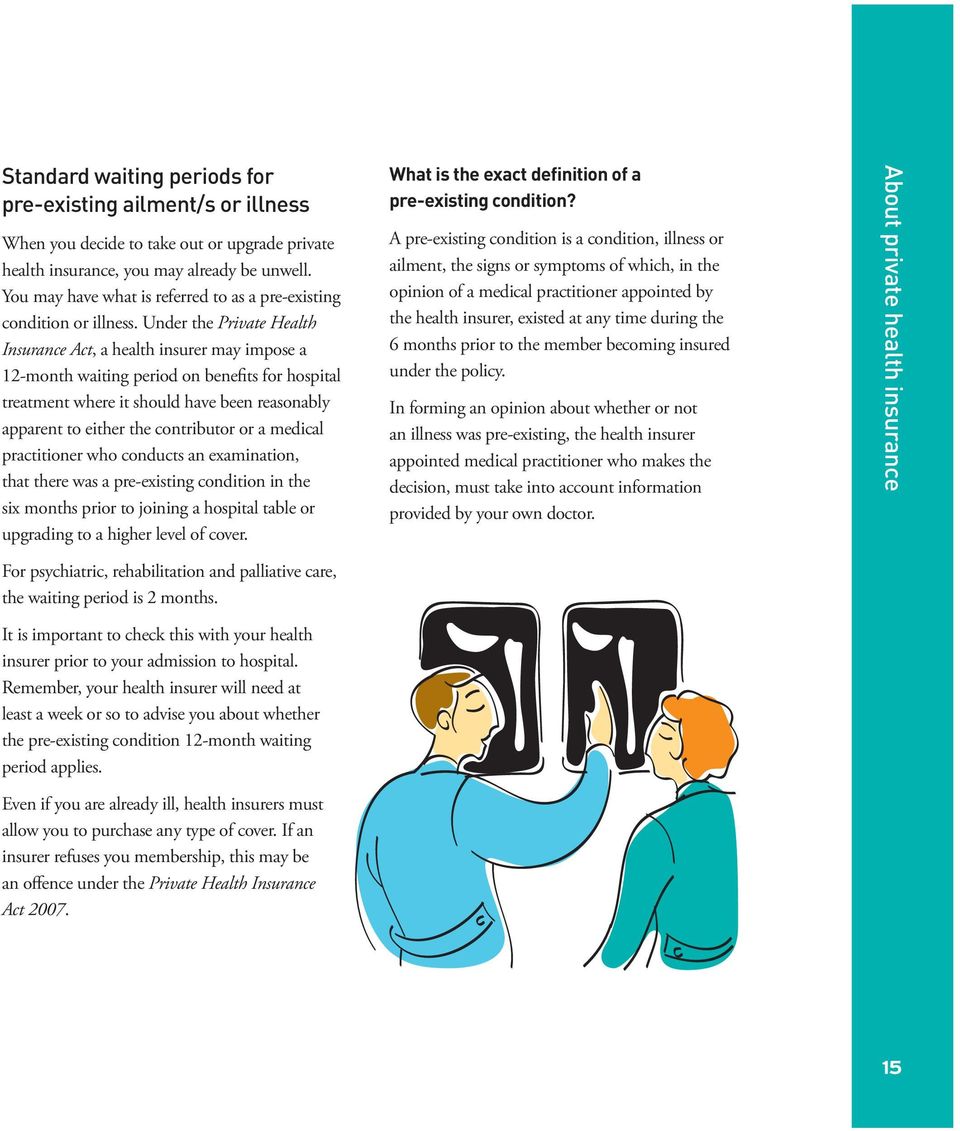
19 Standard waiting periods for pre-existing ailment/s or illness When you decide to take out or upgrade private health insurance, you may already be unwell. You may have what is referred to as a pre-existing condition or illness. Under the Private Health Insurance Act, a health insurer may impose a 12-month waiting period on benefits for hospital treatment where it should have been reasonably apparent to either the contributor or a medical practitioner who conducts an examination, that there was a pre-existing condition in the six months prior to joining a hospital table or upgrading to a higher level of cover. What is the exact definition of a pre-existing condition? A pre-existing condition is a condition, illness or ailment, the signs or symptoms of which, in the opinion of a medical practitioner appointed by the health insurer, existed at any time during the 6 months prior to the member becoming insured under the policy. In forming an opinion about whether or not an illness was pre-existing, the health insurer appointed medical practitioner who makes the decision, must take into account information provided by your own doctor. About private health insurance For psychiatric, rehabilitation and palliative care, the waiting period is 2 months. It is important to check this with your health insurer prior to your admission to hospital. Remember, your health insurer will need at least a week or so to advise you about whether the pre-existing condition 12-month waiting period applies. Even if you are already ill, health insurers must allow you to purchase any type of cover. If an insurer refuses you membership, this may be an offence under the Private Health Insurance Act
20 About private health insurance If you require hospital treatment, but you have less than 12 months membership on your current hospital table, a 12-month waiting period could apply if your condition was determined to be pre-existing (for psychiatric, rehabilitation and palliative care, the waiting period is 2 months). Waiting periods When you join a health insurer or increase your level of cover, you may have to wait some time before your insurance becomes effective. This protects you and others with your insurer, by ensuring no contributor makes a large claim shortly after joining an insurer, and then drops their membership. This hit and run behaviour would result in increased premiums for everyone. 12 months for obstetric cases; and 2 months for psychiatric, rehabilitation and palliative care whether or not there is a pre-existing condition 2 months in all other circumstances. The Government does not regulate waiting periods for benefits payable under general treatment (previously known as ancillary or extras) cover. These waiting periods are set by individual health insurers and you should make sure you are aware of general treatment benefit waiting periods that apply to your insurer. You should note that for benefit limitation periods you can remove the benefit limitation period if you transfer to another policy without a benefit limitation. There is usually no waiting period if you need hospital or medical treatment because of an accident that happens after you join the insurer. The Government sets the maximum time that health insurers are able to make members wait until they can claim benefits for hospital treatment. These maximums are: 12 months for pre-existing conditions 16

21 Waiting periods applying to new-borns If you have a single membership and are expecting a child, you may need to transfer to a family membership or a single parent family membership. If you want your child to be insured from the time of birth, you may have to transfer to the new policy two months before your child is born. Ask your insurer to explain its policy on new-borns. Transferring between insurers You can transfer from one health insurer to another, for the same or a lower level of benefits, without serving additional waiting periods. The insurer to which you transfer may impose waiting periods before you are eligible for any new or higher benefits on your new policy. The insurer to which you transfer must give you credit for the waiting periods you have already served. Benefits paid by the previous insurer may be taken into account by your new insurer when it determines your annual benefit limits. Transferring between insurers will not affect your Lifetime Health Cover entitlements provided that you transfer from hospital cover with your existing health insurer to hospital cover with the new health insurer. The transfer rules also apply when transferring to a different product of the same insurer. No waiting period for DVA ex-gold Card holders If you held a DVA Gold card, or were entitled to treatment under a Gold Card before applying for private health insurance, no waiting period will apply for any hospital or general treatment covered by the policy. You must apply for the insurance no longer than 2 months after you ceased to hold, or be entitled under the Gold Card. About private health insurance 17
22 About private health insurance Suspending your membership Most insurers will let you waive, defer or suspend your membership if you are away from Australia for a certain period of time specified by your insurer. Suspension may also be permitted under other conditions, such as periods of unemployment. Ask your insurer what conditions apply. You will not be paid benefits for services used or treatment provided while your membership is suspended. Similarly, the time for which your membership is suspended cannot count towards any waiting or qualifying periods. Suspending your membership with the agreement of your health insurer will not affect your Lifetime Health Cover entitlements. When you start paying contributions again, your benefit entitlements will continue on the same basis as before your membership was suspended. statement for your policy at least once every 12 months. Notifying members of changes to insurer rules Health insurers change rules and premium prices from time to time. Where the proposed change is or might be detrimental to your interest, the insurer must inform you of the proposed change within a reasonable time before the change takes effect. In addition, the insurer must provide you with an updated standard information statement as soon as practicable after the statement is updated. Paying your contributions Paying in advance Generally, you must pay contributions at least one month in advance unless payments are made under a payroll deduction scheme or by direct debit. Standard information statements When you first purchase a private health insurance policy, the insurer is required to give you an up-to-date copy of the standard information statement (SIS) which contains details of what the policy covers and how benefits provided under it are worked out. Your private health insurer must issue you with an up-to-date standard information The maximum period for which you may pay in advance is usually 12 months. Some insurers offer a rate protection policy under which, if you have paid in advance, you will not have to pay extra if rates are increased during the period for which you have paid. For example, if you pay your premium in advance for 12 months, and there is a rate increase after four months, with rate protection, you will not have to pay the increased rate until your 12 months of cover ends. 18
23 When no rate protection policy applies, the insurer will ask you to pay the balance owing on the new rates, or reduce the length of time your payment covers. When you are advised of rate increases, check whether the increase will affect the length of time your advance payment covers. Discounts on premiums Generally, you may get discounts for contributions paid in advance on a half-yearly or yearly basis. You may also receive a discount if your contributions are automatically deducted from your salary, wages or bank or credit card. About private health insurance Unpaid contributions Your private insurance will lapse meaning you are not insured if you are more than two months behind in paying your contributions. Some insurers may not accept payment of arrears in excess of two months. In such cases they may impose further waiting periods when you resume contributions. Cancelling your membership If you decide to cancel your membership, your insurer should pay back any contributions you have paid in advance. The insurer may deduct a small administration charge. 19
24 About private health insurance Benefits you will receive The amount of benefits you receive for hospital or medical treatment will depend on the type of cover you purchase, and whether you have chosen to contribute to the costs of your hospital treatment in exchange for paying a lower premium. The amount of benefits you will receive also depend on the hospital and doctor you choose, and whether the hospital has an agreement with your insurer and the doctor is participating in the insurer s gap cover arrangements. When your health insurer has an agreement with your hospital and your doctor is participating in the insurer s gap cover arrangements, you are less likely to have out-of-pocket costs. If you choose to go to a hospital that does not have an agreement with your insurer, you may have significant out-of-pocket costs. Well in advance of receiving treatment you should check with your health insurer on whether there is an agreement in place with your hospital and whether your doctor is participating in the insurer s gap cover arrangements. You should also ask your doctor(s) and hospital for an estimate of their costs and how much will not be covered by your health insurer. Your health insurer should also be able to assist with calculating likely out-of-pocket costs. Your benefit options as a privately insured patient Private Patient s Choice Medicare Patient in a Public Hospital Doctor appointed by hospital No fee charged Private Patient in a Public Hospital Choice of doctor Covered for some or all services and some or all doctors fees Private Patient in a Private Hospital Choice of doctor Covered for some or all services and some or all doctors fees 20
25 You can ask any health insurer about the hospitals that have agreements with that insurer and doctors who are participating in the insurer s gap cover arrangements. If you have general treatment cover (previously known as ancillary or extras) you need to be aware that the benefits health insurers will pay for general services may be capped, and some services might not be covered at all. Ineligible claims Benefits will generally not be paid: if you will be paid compensation by a third party for certain general treatment (previously known as ancillary or extras) services provided by someone not recognised by your insurer or if you are not covered for general benefits if you put false or inaccurate information on your claim form if you are more than two months behind with your contributions if you claimed benefits for services provided while your membership with the insurer was suspended if the service provider is directly related to you that is, if he or she is your spouse, parent, child or sibling, or if your claim is made two or more years after the date of service. Prostheses Surgically implanted prostheses, such as a lens for a cataract surgery, a stent for cardiac surgery or an artificial hip or knee component during a hip/knee replacement, are sometimes required during a medical procedure. For every medical procedure covered by the Medicare Benefits Schedule (MBS) requiring a surgically implanted prostheses, clinicians have determined at least one clinically suitable prostheses that must be covered by health insurers at no additional cost to you (called a no-gap prostheses). There may be some prostheses available which cost more than the no-gap ones. If you choose to use one of these prostheses, you will have to pay the difference between the no-gap amount and the total amount charged by the supplier for the prostheses. For each procedure, you should ask your health insurer how much it will pay for a particular prostheses, and whether you will have any gap to pay. Don t forget that if your private health insurance policy has exclusions where you can t claim for some services, for example joint replacements then you won t be able to claim for any prostheses provided as part of these services either. About private health insurance 21
26 About private health insurance Private Patients Hospital Charter To help you understand what you can expect from your health insurer, doctor and hospital, a Private Patients Hospital Charter is available. It will assist you with some of the important questions you may need to ask those involved with your health care. Copies of the Charter are available from health insurers, the Department of Health and Ageing and the Private Health Insurance Administration Council (PHIAC). Private Health Insurance Ombudsman If you have a problem with your health insurance arrangements, you should first discuss it directly with your health insurer. If you are unable to reach a satisfactory agreement with your insurer, contact the Private Health Insurance Ombudsman on the toll free number:
27 Types of private health insurance cover There are two types of private health insurance cover available: hospital cover, and general treatment (previously known as ancillary or extras) cover Hospital cover helps with the cost of medical treatment such as hospital accommodation and doctors charges for hospital treatment services. This applies when you are receiving treatment from a public or private hospital. Depending on your hospital cover, it may also cover the payment of benefits for treatments in other settings agreed with your insurer, when they are coordinated by a hospital. There are various types of private health insurance hospital cover that you can purchase. Some health insurance policies will give you full cover against the costs of hospital accommodation and in-hospital medical charges. Others, for which you will pay lower premiums, will require you to meet part of the costs. You can elect to pay a lower premium in return for agreeing not to be covered for some conditions, or to only receive limited benefits for a certain condition, or to pay a set amount towards the cost of your hospital treatment. You could elect to pay a lower premium and take out a hospital cover policy with one or more of the following features: an exclusion for a particular condition or conditions If your policy features an exclusion for a particular condition, you are not covered for treatment as a private patient in a public or private hospital for that condition. For example, if you purchase a private health insurance policy that excludes maternity, hip replacements and knee replacements, and you go into hospital as a private patient for one of these conditions, your health insurer will not pay any benefits towards your hospital and medical costs. If you are unsure which conditions are excluded on your policy you should ask your health insurer. a front-end deductible (also known as an excess) An excess is an amount of money you agree to pay for a hospital stay before health insurance benefits are payable. For example, if your policy has an excess of $200, you will be required to pay the first $200 of your hospital costs should you go to hospital as a private patient. An excess could apply every time that you go to hospital in a year, or it may be capped at a total amount that you will have to pay in a year. If you are unsure how the excess on your policy works you should ask your health insurer. Types of private health insurance cover 23
28 Types of private health insurance cover 24 a co-payment With a co-payment, you agree to pay an agreed amount each time a service is provided. For example, a policy may have a co-payment clause that requires you to pay the first $50 for each day s hospital accommodation. If your policy has such a co-payment and you were in hospital for 5 days, you would have to pay $250 ($50 x 5). The total amount of co-payment you can pay in a year is often limited to a set maximum amount. restricted benefits If your policy has restricted benefits for some conditions you will be covered for treatment as a private patient in a public hospital for these conditions, but will face considerable out-of-pocket costs if you were to be treated in a private hospital for these conditions. If you are unsure about whether restricted benefits apply to your policy you should ask your health insurer. a benefit limitation period A benefit limitation period is where you are only entitled to limited benefits for a particular condition or treatment for a set period of time. After that period of time has elapsed you would normally be entitled to full benefits for the condition or treatment. Some benefit limitation periods may commence after standard waiting periods have been served. If you are unsure about whether a benefit limitation period applies to your policy you should ask your health insurer. public hospital table Some health insurers offer policies that have restricted benefits for all conditions. This policy is sometimes called a public hospital table. Under this policy you will be covered for treatment as a private patient in a public hospital, but will face considerable out-of-pocket costs if you were to be treated in a private hospital. hospital-substitute treatment Hospital-substitute treatment is a form of general treatment that substitutes for hospital treatment and is conducted by an organisation other than a hospital. It may include nursing, medical, surgical, therapeutic, diagnostic or other services intended to manage a disease, injury or condition. You should discuss with your doctor if this type of treatment is an option for you. Health insurers can cover chronic disease management programs and other types of services outside of the hospital setting. General treatment cover (also known as ancillary or extras) can assist with the cost of treatments such as physiotherapy, optical treatment and dental treatment as well as costs associated with disease management and prevention programs, depending on your insurer s policy. Packaged products You are able to take out either hospital or general treatment cover on their own, and most health insurers offer packaged products that provide cover for both hospital and general treatment services. Note: You should regularly review your health insurance needs in case you change your mind about whether you want to be covered for particular conditions, or your circumstances change, and you therefore need to upgrade your cover.
29 Questions to ask a private health insurer You should know as much as possible about the private health insurer you have already joined or are thinking of joining. The following questions address some of the topics that may be of interest to you. Which hospitals have agreements with this insurer? Which doctors participate in this insurer s gap cover arrangements? When will my insurance cover begin? When will I be able to claim benefits? How long do I have to wait to be covered? What will this give me that Medicare doesn t? Can I choose my own doctor? What level of hospital benefits are paid under this cover? How do I qualify for benefits? Under what circumstances will I not be eligible to receive benefits? What out-of-pocket expenses will I have to pay? Does the insurer offer protection against increases in rates? What happens if there are increases in rates that I cannot afford? If I have paid my premiums in advance and there are increases in rates, will I have to pay these increases? Will I have to satisfy any waiting periods? Do special limits apply to my general cover? Can I take out, say, dental cover only for my children and not for my spouse and myself? Questions to ask a private health insurance fund What level of medical benefits are paid under this cover? Do you provide extended hospital cover for treatments such as dialysis and chemotherapy undertaken at home? Will my hospital cover provide benefits for all procedures or types of treatment? Which hospital treatments will not be covered by this policy? 25
30 Questions to ask a private health insurance fund Is ambulance cover included with my hospital cover? Which operations are considered elective? What other options should I consider? When did this insurer last increase its rates? What benefits are paid for prostheses under this cover? If I have to pay a gap on the prostheses I choose in consultation with my doctor, how do I find out how much the gap will be? 26
31 Common terms used by private health insurers Accommodation Accommodation covers meals and a bed in hospital, and includes all hospital-provided services including nursing care. It does not include treatment by doctors or other health professionals. Ancillary See General treatment services. Benefit limitation period Limited benefits are paid for certain conditions for a specified period of time. This is not the same as a waiting period during which no benefits are paid for a period of time after you purchase a policy. Broader Health Cover Health insurers may now offer cover under their hospital policies, for treatment in settings other than hospitals for example in your own home as well as programs to manage chronic disease. Co-payment A co-payment is where you agree to pay an agreed amount each time a service is provided. For example, a private health insurance policy may have a co-payment clause that requires you to pay the first $50 for each day s hospital accommodation. Dependent child Dependent child is defined as a person: (a) who is: I. aged under 18 or II. a dependent child under the rules of the private health insurer that insures the person; and (b) who is not aged over 25 or over; and (c) who does not have a partner. Dependent child non-student means a person who: (a) is aged between 18 and 24 (inclusive) and was born before 1991; and (b) is a dependent child under the rules of the private health insurer that insures the person as referred to in subparagraph (a) (ii) of the definition of dependent child in the Private Health Insurance Act 2007,whether or not the person is wholly or substantially dependent on an adult insured under the same health insurance policy; and (c) does not have a partner; and (d) is not receiving full-time education at a school, college or university. Note: A dependent child non-student is therefore a dependent child as defined in the Private Health Insurance Act Common terms used by private health insurance funds 27
32 Common terms used by private health insurance funds Diagnostic tests Diagnostic tests can include such things as x-rays and blood tests. Drugs, dressings and other consumables Drugs, dressings and other consumables are additional services to support hospital treatment. They include medications, bandages and crutches, prostheses (surgically implanted items such as hip replacements, artificial lenses and heart valves). Elective surgery Elective surgery is treatment of a condition your doctor considers does not require immediate attention. Excess An excess is an amount that you agree to pay towards the cost of hospital treatment in exchange for lower premium costs. You may be required to pay an excess every time you go to hospital, or only the first time, depending on the private health insurance policy you take out. An excess is also known as a front-end deductible. Extras Front-end deductible See Excess. Gap The term gap generally means the difference in the amount that your doctor charges and the amount that is covered by Medicare and your health insurer, i.e. the amount that you must pay for your medical services received in hospital. It can also refer to the difference between what your hospital charges and the amount that is covered by your health insurer. General treatment services (previously known as ancillary or extras) General treatment services are services, such as physiotherapy, speech pathology and podiatry, which are provided by health professionals. Intensive care Intensive care is treatment for actual or potential life-threatening illnesses, injuries or complications. See General treatment services. Federal Government Rebate For every dollar that you contribute to your private health insurance premium, the Australian Government will give you back 30 cents. For health insurance members aged between 65 and 69 years, this amount increases to 35 cents, and for members aged over 70 years it is 40 cents. Labour ward fees Labour ward fees include costs for delivery of babies in a birthing suite. 28
33 Lifetime Health Cover Lifetime Health Cover was introduced on 1 July Under Lifetime Health Cover, health insurers are required to charge members different premiums based on the age they are when they first take out hospital cover. If a person does not have hospital cover on 1 July following their 31st birthday and decides to take out hospital cover later in life, they will pay a 2% loading on top of their premium for every year they are aged over 30. The loading will cease if the person has had hospital cover for a continuous period of 10 years. Low front end deductible Your front end deductible (also known as excess) must be equal to or less than $500 per annum for single policies or $1,000 per annum for families/couples to be considered a low front end deductible. MBS fee (Medicare Benefits Schedule fee) The Government sets a schedule of medical fees called the Medicare Benefits Schedule. You can claim a rebate for medical fees whether you are a member of a health insurer or not. The rebate is currently 75% of the MBS fee for in-hospital medical fees and 85% of the MBS fee for medical fees incurred out of hospital. Medical expenses/charges Medical expenses are charges for medical procedures performed during a hospital stay. This covers items such as surgeons fees, obstetricians fees, radiology, pathology and anaesthetists. Medicare pays 75% of the MBS fee for these services. Medicare Levy Surcharge (MLS) Higher income individuals and families who do not have private hospital insurance cover will pay an extra 1% of their taxable income for the Medicare Levy Surcharge. This is in addition to the normal 1.5% Medicare Levy. Palliative care Palliative care is provided when a patient s condition is terminal. Such care provides relief of suffering and any enhancement to quality of life that can be achieved. Pre-existing condition A pre-existing condition is an ailment, illness or condition, the signs or symptoms of which, in the opinion of a medical practitioner appointed by the health insurer, existed at any time during the 6 months prior to the member becoming insured under the policy. Private patient in a public hospital You are a private patient in a public hospital if you choose to be treated in a public hospital but retain the right to choose your own doctor. If you do so, you will be charged for hospital accommodation costs and doctors fees. Medicare will cover 75% of the MBS fee for your doctors charges. If you have private health insurance, your health insurer will pay at least the remaining 25% of the MBS fee for your doctor s charges and can pay more if your doctor is participating in your health insurer s gap cover arrangements. Your health insurer will also cover some or all of your hospital accommodation costs. Common terms used by private health insurance funds 29
34 Common terms used by private health insurance funds Private patient in a private hospital You must be a private patient to be treated in a private hospital. As a private patient in a private hospital you have the right to choose your own doctor, and you are responsible for all hospital and doctors services. Medicare will cover 75% of the MBS fee for these doctors charges. If you have private health insurance, your health insurer will pay at least the remaining 25% of the MBS fee for your doctor s charges and can pay more if your doctor is participating in the health insurer s gap cover arrangements. Your health insurer will also cover some or all of your hospital accommodation costs. Prostheses (surgically implanted) Prostheses include such things as hip replacements, artificial lenses and heart valves. Psychiatric care You are under psychiatric care if you have a disability and you are taking part in a program designed to improve your functions, retrain you in lost skills or help you to re-establish your place in society. Public patient You are a public patient if you choose to be treated in a public hospital under Medicare by a doctor appointed by the hospital. Rehabilitation care You are under rehabilitation care if you have a disability and you are taking part in a program designed to improve your physical functions, retrain you in lost skills or help you to re-establish your place in society. Restricted benefits Cost for treatment as a private patient in a public hospital will be covered but there will be out of pocket expenses for treatment in a private hospital. Same-day patient You are a same-day patient if you are admitted, treated and discharged on the same day. Standard information statements (SIS) A standard information statement is issued by your health insurer when you first take out a policy and at least once every 12 months. It contains details of what the policy covers and how benefits provided under it are worked out. Theatre fees Theatre fees are costs for procedures performed in an operating room including those performed in day surgery facilities. 30
35 Common terms used by private health insurance funds 31
36 Common terms used by private health insurance funds 32
Health fund arrangements to cover the gap
 Australia s health system offers a comprehensive range of public and privately funded health services. You can choose whether to have Medicare cover only or a combination of Medicare and private health
rights&responsibilities as a private patient in hospital
 rights&responsibilities as a private patient in hospital ISBN 1 74186 272 8 Online ISBN: 1 74186 273 6 Publications Approval Number: P3-1969 Print Copyright Commonwealth of Australia 2007 This work is
Key Features Guide. What you should know before purchasing private health insurance
 Key Features Guide What you should know before purchasing private health insurance Table of Contents USING THIS GUIDE.......................................................... 2 KEY FEATURES OF HEALTH
Know your rights and responsibilities as a private patient in hospital. Private Patients Hospital Charter
 Know your rights and responsibilities as a private patient in hospital Private Patients Hospital Charter Commonwealth of Australia 2004 ISBN 0 642 82235 2 This work is copyright. Apart from any use as
Hospital Guide. Teachers Federation Health Ltd. ABN 86 097 030 414 trading as Teachers Health Fund. A Registered Private Health Insurer.
 Hospital Guide Teachers Federation Health Ltd. ABN 86 097 030 414 trading as Teachers Health Fund. A Registered Private Health Insurer. Contents Page 3 Things you should know before you go to hospital
Overseas Visitors Cover
 straightforward health insurance Overseas Visitors Cover Australia welcomes you 2 3 Who are GMF Health? GMF Health is a not-for-profit Australian private health insurer, that s been providing affordable
Private Plus Hospital - $250/$500 Excess & Basic Extras Effective 1 September 2014
 Mail: Locked Bag 25, Wollongong NSW 2500 - Phone: 1800 148 626 - Fax: 1300 673 406 Email: [email protected] - Web: www.onemedifund.com.au Private Plus Hospital - $250/$500 Excess & Basic Extras Effective
TABLE 120 - SCHEDULE OF COVER and POLICY DOCUMENT
 TABLE 120 - SCHEDULE OF COVER and POLICY DOCUMENT Sections 1,2, 3, 7 and 8 only Contents: Section 1 Section 2 Section 3 Section 7 Section 8 In-Hospital (In-Patient) Expenses for Sickness and Injury, including
This document is a summary of the Bupa Australia Pty Ltd Fund Rules. You can access the full version of the Fund Rules (which includes product
 This document is a summary of the Bupa Australia Pty Ltd Fund Rules. You can access the full version of the Fund Rules (which includes product information) here. You can also access information about your
Membership Guide simply better benefits
 April 2015 Membership Guide simply better benefits A Contents About the Reserve Bank Health Society 1 Why join the RBHS? 2 Private health insurance coverage 3 New to private health insurance? 4 Benefits
DID YOU KNOW? IMPORTANT INFORMATION
 i DID YOU KNOW? IMPORTANT INFORMATION Why Medibank? Medibank is more than just about insuring your health. We have the people, services and resources to be your personal health partner, helping you to
HEALTH INSURANCE HCF FAQs
 HEALTH INSURANCE HCF FAQs What benefit is available through Member Advantage? Members receive a 5% discount off all current HCF hospital and extras products. What is the relationship between Member Advantage
Table 190 - SCHEDULE OF COVER and POLICY DOCUMENT
 Table 190 - SCHEDULE OF COVER and POLICY DOCUMENT Sections 1,3, 7 and 8 only Contents: Section 1 Section 3 Section 7 Section 8 In-Hospital (In-Patient) Expenses for Sickness and Injury, including rehabilitation
Important information booklet for Australian Residents
 .... About your membership Important information booklet for Australian Residents Contents 2 How do I make a claim? Making hospital claims Your hospital benefits from Medicare Making claims for medical
Overview Australian Public Health System Medicare
 Overview Australian Public Health System Medicare May 2014 CONTENTS INTRODUCTION 1 The Public Healthcare System in Australia 1 MEDICARE 1 Medicare Benefits Schedule (MBS) 1 Medicare Services 1 What is
Healthy Hospital 200 500
 Hospital cover Healthy Hospital 200 500 Prefer to pay lower premiums? Healthy Hospital 200 & 500 offers the same comprehensive benefits as our Premium Hospital cover, with the addition of an excess. By
Membership guide. Overseas Student Health Cover
 Membership guide Overseas Student Health Cover Effective 1 April 2014 This guide applies to Medibank Overseas Student Health cover # You should read this guide in conjunction with the Cover summary that
CORPORATE HEALTH COVER DISCOVER THE BENEFITS OF CORPORATE COVER BUPA. FIND A HEALTHIER YOU
 CORPORATE HEALTH COVER DISCOVER THE BENEFITS OF CORPORATE COVER BUPA. FIND A HEALTHIER YOU At Bupa, it s our purpose that makes us different helping our members to live longer, healthier, happier lives.
GOING TO HOSPITAL WHAT YOU NEED TO KNOW
 GOING TO HOSPITAL WHAT YOU NEED TO KNOW Going to hospital We understand that going to hospital can be a stressful time. If you re feeling nervous or don t quite know what to expect don t worry, this is
A INTRODUCTION 5 A1 Rules Arrangement... 5 A2 Health Benefits Fund... 5 A3 Obligations to Insurer... 5 A4 Governing Principles...
 Health Fund Rules 1 A INTRODUCTION 5 A1 Rules Arrangement... 5 A2 Health Benefits Fund... 5 A3 Obligations to Insurer... 5 A4 Governing Principles... 5 A5 Use of Funds... 6 A6 No Improper Discrimination...
ANZ Health Insurance. anz.com A2719/0410 BUPA 04409-03-10S
 A2719/0410 BUPA 04409-03-10S Issued by: Bupa Australia Health Pty Ltd ABN 50 003 098 655 Agent for the Insurer: Australia and New Zealand Banking Group Limited ABN 11 005 357 522 (ANZ) Effective date 1
MEDICARE & CONNECTIVITY TO AUSTRALIA
 MEDICARE & CONNECTIVITY TO AUSTRALIA Medicare is the publicly funded Australian health system and is subsidised by a 1.5% Medicare levy, payable by all taxpayers, integrated in the pay-as-you-go payroll
What you need to know about Lifetime Health Cover
 What you need to know about Lifetime Health Cover What is Lifetime Health Cover? Lifetime Health Cover involves a financial loading (LHC loading) on your private health insurance hospital cover (hospital
Health insurance 1 April 2012
 Health insurance 1 April 2012 Contents About CUA Health 3 Why you need CUA Health insurance 4 Federal Government 30% - 40% 5 rebate on private health insurance Avoid extra Medicare levies 6 (Medicare Levy
Health insurance 1 January 2013
 Health insurance 1 January 2013 Contents About CUA Health 3 Why you need CUA Health insurance 4 Australian Government Rebate on private 5-6 health insurance, Medicare Levy Surcharge Save by acting early
Subclass 457: Health Insurance Standard Template Letter
 Subclass 457: Health Insurance Standard Template Letter On behalf of , I certify that the following person(s)
VISITORS HEALTH INSURANCE PEACE OF MIND FOR BETTER HEALTH. Membership guide 1
 VISITORS HEALTH INSURANCE PEACE OF MIND FOR BETTER HEALTH Membership guide 1 Australia is an exciting place to holiday, visit family and friends or work Australia is one of the most culturally diverse
We recommend that these Fund Rules be read together with the brochures relevant to your cover.
 HBF Fund Rules All registered health funds are required to have Fund Rules under the Private Health Insurance Act of 2007. These Fund Rules set out the general principles and rules of membership under
Private Hospital Cover - $250 excess
 Private Hospital Cover - $250 excess Effective 1 July 2010 You want a comprehensive private hospital cover that provides for the health needs of yourself and everyone in your family. You don t mind paying
Ultimate Health Cover
 Ultimate Health Cover 1 April 2013 Your level of cover is a packaged hospital and extras cover. HOSPITAL COVER Your hospital cover provides comprehensive cover that helps pay for hospital and in-patient
nib health funds limited ABN 83 000 124 381 Fund Rules
 nib health funds limited ABN 83 000 124 381 Fund Rules General Conditions Table of Contents A Introduction 1 A1 Rules Arrangement 1 A2 Health Benefits Fund 1 A3 Obligations to Insurer 1 A4 Governing Principles
Overseas Visitors Health Cover. Policy document and members guide
 Overseas Visitors Health Cover Policy document and members guide Policy document and members guide effective 9 December 2014 Contents The one thing that matters the most is knowing your health care won't
www.nextstepaustralia.com Healthcare in Australia
 www.nextstepaustralia.com Healthcare in Australia Healthcare in Australia Australia has a complex healthcare system including both public & private provision. Medicare the state-run healthcare scheme is
Waiting periods for private health insurance
 Waiting periods for private health insurance A guide for consumers about how and why waiting periods operate, including the rules on pre-existing conditions. This brochure provides consumers with information
nib OSHC Premium Need help? Call us on 1800 783 685 Mon to Fri: 8am 8.30pm Sat: 8am 1pm (AEST) Go to nib.com.au/kuwaitihealth
 Need help? Call us on 1800 783 685 Mon to Fri: 8am 8.30pm Sat: 8am 1pm (AEST) Go to nib.com.au/kuwaitihealth nib health funds limited abn 83 000 124 381 Head Office 22 Honeysuckle Drive Newcastle NSW 2300
MEDIBANK OVERSEAS STUDENT HEALTH COVER
 MEDIBANK OVERSEAS STUDENT HEALTH COVER Studying in a foreign country is an exciting experience Keeping healthy will help you get the most out of your studies and ensure you enjoy your time in Australia.
active choice TUH it s my health fund! comprehensive, efficient and friendly service right from the word go TUH offers
 Effective 2 April 2014 Queensland s health fund of choice active choice TUH offers comprehensive, efficient and friendly service right from the word go TUH it s my health fund! Far West Outback PLEASE
COVER SUMMARY ULTRA HEALTH COVER
 COVER SUMMARY ULTRA HEALTH COVER This provides an important summary of your cover and we recommend that you read and retain it. You can find out more about your membership by referring to the Member Guide,
Policy Booklet. Important information about nib s health covers
 Policy Booklet Important information about nib s health covers General terms and conditions Hospital cover Extras cover Ambulance cover Government initiatives nib policies Read with your product information.
PrivateHealth.gov.au Australia s leading independent source of information about private health insurance
 PrivateHealth.gov.au Australia s leading independent source of information about private health insurance There are many things to consider when looking into private health insurance how does it all work?
Ambulance and Cash Back Cover Only available to residents of NSW & ACT
 Ambulance and Cash Back Cover Only available to residents of NSW & ACT Valid until 2014-15 Reg. No. 5037 Health Insurance Australia 2009-2014 April 2015 Why you need Ambulance and Cash Back Cover The cover
Only the best of care, since 1977
 Only the best of care, since 1977 Effective date: 1 July 2014 CONTENTS Welcome to Doctors Health Fund Things you need to know Who can be a member of Doctors Health Fund? It s so easy to join Continuity
Only the best of care, since 1977
 Only the best of care, since 1977 Effective date: 1 April 2015 CONTENTS Welcome to Doctors Health Fund Things you need to know Who can be a member of Doctors Health Fund? It s so easy to join Continuity
Private health insurance policy details
 Private health insurance policy details PRIVATE HEALTH INSURANCE YOU NEED TO KNOW The information on this page will help you complete Private health insurance policy details on page 4 of your tax return.
Going into hospital?
 Going into hospital? Going into hospital? Being admitted into hospital can be an anxious time for you and your family. Having hospital cover can give you peace of mind, but may also raise many questions
PLEASE DO NOT STAPLE.
 YOUR APPLICATION 1. Please complete this form USING BLACK INK and write within the boxes in CAPITAL LETTERS. Mark appropriate answer boxes with a CROSS. Start at the left of each answer space and leave
Simply Smarter Health Insurance
 Simply Smarter Health Insurance Member Guide Contents Introduction to Budget Direct Health Insurance...2 Application for membership with Budget Direct Health Insurance...2 Membership card...3 Communications
CORPORATE VOLUNTARY DIRECT DEBIT APPLICATION
 CORPORATE VOLUNTARY DIRECT DEBIT APPLICATION 1. Please complete this form USING BLACK INK and write within the boxes in CAPITAL LETTERS. Mark appropriate answer boxes with a CROSS. Start at the left of
This brochure has been written to. help you make the right choice of personal. health cover. To help you, we d like to
 Hospital Cover Why HBF?... 4 What about the public hospital system?... 6 Why private health insurance?... 8 Choices to suit every body... 10 1. Top Hospital... 10 2. Intermediate Hospital... 10 3. Healthy
Products and Benefits Guide
 Products and Benefits Guide April 2014 This booklet contains... a A list of our different covers a Explanation of benefits & services a Application forms + more! Because We Care ACA Health Products and
Our Product Disclosure Statement (PDS)
 Our Product Disclosure Statement (PDS) Your HIF Hospital and Extras health cover in detail. Visit online to get a quote and join (or switch). Call 1300 13 40 60 hif.com.au Australia s first certified Carbon
An easy guide to buying private health insurance.
 An easy guide to buying private health insurance. Getting private health insurance for tax a very simple check list 1 To save on tax you need appropriate hospital cover Most hospital covers will qualify
Member Guide Important information about your Health Insurance
 Member Guide Important information about your Health Insurance February 2015 2 Member Guide What s inside How to use our Member Guide...3 Joiner Declaration...3 I ve joined. What now?...4 Member card...4
Fund Rules. Overseas Visitors Health Cover. Effective 8 September 2015. nib health funds limited ABN 83 000 124 381
 Fund Rules Overseas Visitors Health Cover. Effective 8 September 2015. nib health funds limited ABN 83 000 124 381 Table of Contents LV1 Table Name or Group of Table Names 1 LV2 General Conditions 1 LV3
Important Information Guide
 Effective 1 April 2015 Important Information Guide Please carefully read and retain this information. Refer to your relevant product brochure for specific information about your cover. This publication
Overseas Visitors Health Cover. Policy document and members guide
 Overseas Visitors Health Cover Policy document and members guide Policy document and members guide effective 7 August 2015 Contents The one thing that matters the most is knowing your health care won't
hospital cover with/without excess TUH it s my health fund!
 Effective 2 April 2014 Your Queensland health fund hospital cover with/without excess We are not just numbers in TUH, but individuals who have been listened to and treated with compassion TUH it s my health
What can we expect? call 132 331. medibank.com.au. A guide to private health insurance for parents-to-be. For more information
 For more information medibank.com.au call 132 331 visit a Medibank store email [email protected] What can we expect? A guide to private health insurance for parents-to-be Effective 1 January 2011
OSHC. Overseas Student Health Cover Fact Sheet. nib343001_0415
 Need help? Call us on 1800 775 204 Mon to Fri: 8am 8.30pm Sat: 8am 1pm (AEST) Go to nib.com.au/overseas-students nib health funds limited abn 83 000 124 381 Head Office 22 Honeysuckle Drive Newcastle NSW
OSHC. Overseas Student Health Cover Fact Sheet. nib343001_0415
 Need help? Call us on 1800 775 204 Mon to Fri: 8am 8.30pm Sat: 8am 1pm (AEST) Go to nib.com.au/overseas-students nib health funds limited abn 83 000 124 381 Head Office 22 Honeysuckle Drive Newcastle NSW
Make sure you have health cover for your family. Allianz Global Assistance OSHC offers three types of policies:
 Overseas Student Health Cover Pregnancy Fact Sheet This fact sheet aims to help you understand the Australian healthcare system when having a baby. During your pregnancy Make sure you have health cover
BUDGET 2014 ADSO S IMPACT ANALYSIS
 BUDGET 2014 ADSO S IMPACT ANALYSIS This summary has been compiled from the Budget Papers, DVA s Budget Presentation, and analyses from industry, commercial and community organisations reports with the
receive the full amount of any of the qualifying benefits and allowances for the full year, and have no other taxable income.
 Page 1 of 9 Guide to tax offsets Overview Tax offsets (sometimes also referred to as rebates) directly reduce the amount of tax you must pay. They are not the same as tax deductions. Deductions only reduce
HOSPITAL TREATMENT OVERVIEW
 Hospital overseas Policy summary HOSPITAL TREATMENT 1 OVERVIEW Effective 1st May 2015 From 14th September 2009, under Visa Condition 8501, all new Subclass 457 Visa holders are responsible for all health
Overseas Visitors Health Cover. Policy document and members guide
 Overseas Visitors Health Cover Policy document and members guide Policy document and members guide effective 2 September 2013 Contents The one thing that matters the most is knowing your health care won't
your guide to health cover
 your guide to health cover Singles Couples Families Effective from July 2013 we care for our own Contents Why have private health cover? 1 Choosing your health cover 2 Extras Cover 3 Hospital Cover 8 Waiting
YOUR HEALTH POLICY Effective 1 December 2013
 YOUR HEALTH POLICY Effective 1 December 2013 CONTENTS Why you need health cover in Australia... 4 What you need to know... 6 What you re covered for... 10 What you re not covered for... 14 Waiting periods...
Save on your health cover with Deakin University
 Save on your health cover with Deakin University Welcome to the Deakin University Health Plan a special health insurance arrangement introduced by Deakin University in conjunction with Health Link Consultants
Medicare provides benefits for a range of out-of-hospital and in-hospital services.
 What is? is a program run by Australia that makes sure all Australians have access to free or low-cost medical, optometrical and hospital care, while also being free to choose private health services.
Make sure you have health cover for your family. Allianz Global Assistance OVHC offers three types of policies:
 Overseas Visitors Health Cover Pregnancy Fact Sheet This fact sheet aims to help you understand the Australian healthcare system when having a baby. During your pregnancy Make sure you have health cover
Our Product Disclosure Statement (PDS)
 Our Product Disclosure Statement (PDS) Your HIF hospital and ancillary health cover in detail. The smart choice for health cover. Visit hif.com.au or call 1300 13 40 60 to get a quote and join (or switch)
Make sure you have health cover for your family. Allianz Global Assistance OSHC offers three types of policies:
 Overseas Student Health Cover Pregnancy Fact Sheet This fact sheet aims to help you understand the Australian healthcare system when having a baby. During your pregnancy Make sure you have health cover
YOUR HEALTH POLICY Effective March 2014
 YOUR HEALTH POLICY Effective March 2014 CONTENTS Why you need health cover in Australia... 4 What you need to know... 6 What you re covered for... 10 What you re not covered for... 14 Waiting periods...
Will the pre-existing ailment waiting period affect you? information for consumers
 Will the pre-existing ailment waiting period affect you? information for consumers Commonwealth of Australia 2001 This work is copyright. Apart from any use as permitted under the Copyright Act 1968, no
Australia. Old Age, Disability, and Survivors. Australia. Exchange rate: US$1.00 equals 1.32 Australian dollars (A$). Qualifying Conditions
 Australia Exchange rate: US$1.00 equals 1.32 Australian dollars (A$). Old Age, Disability, and Survivors First laws: 1908 (old-age and disability) and 1942 (widows). Current laws: 1991 (social security),
Working Visitor Health Cover
 Need help? Call us on 1800 22 11 33 from overseas +61 2 4914 1131 Mon to Fri: 8.30am 6.00pm (AEST) Or visit aushealth.com IMAN Australian Health Plans Pty Ltd ABN 34 144 907 746 a subsidiary of nib holdings
Private Health Insurance Australia
 Private Health Insurance Australia Quarterly Statistics March 2015 Contents Snapshot of the industry......3 Membership and coverage.... 4 Benefits paid..... 6 Service utilisation... 9 Out-of-pocket payments..
The Australian Health Care System: An Outline - September 2000
 The Australian Health Care System: An Outline - September 2000 Financing and Analysis Branch Commonwealth Department of Health and Aged Care CONTENTS Introduction Australia in general System of government
Overseas Student Health Cover
 Overseas Student Health Cover Standard Policy document and members guide Standard policy document and members guide effective 6 December 2012 Contents 2 Allianz Global Assistance welcomes you to Australia!
Fund Rules. Bupa Australia Pty Limited. Effective from 5 June 2015. BUPALEGAL338441\0.3 Page 1 of 462
 Fund Rules Bupa Australia Pty Limited Effective from 5 June 2015 BUPALEGAL338441\0.3 Page 1 of 462 CONTENTS SECTION NUMBER PAGE A INTRODUCTION 3 B INTERPRETATION AND DEFINITIONS 6 C MEMBERSHIP 12 D CONTRIBUTIONS