
Effective Education to Promote Conservation Practice Adoption
|
|
|
- Silvester Horton
- 10 years ago
- Views:
Transcription
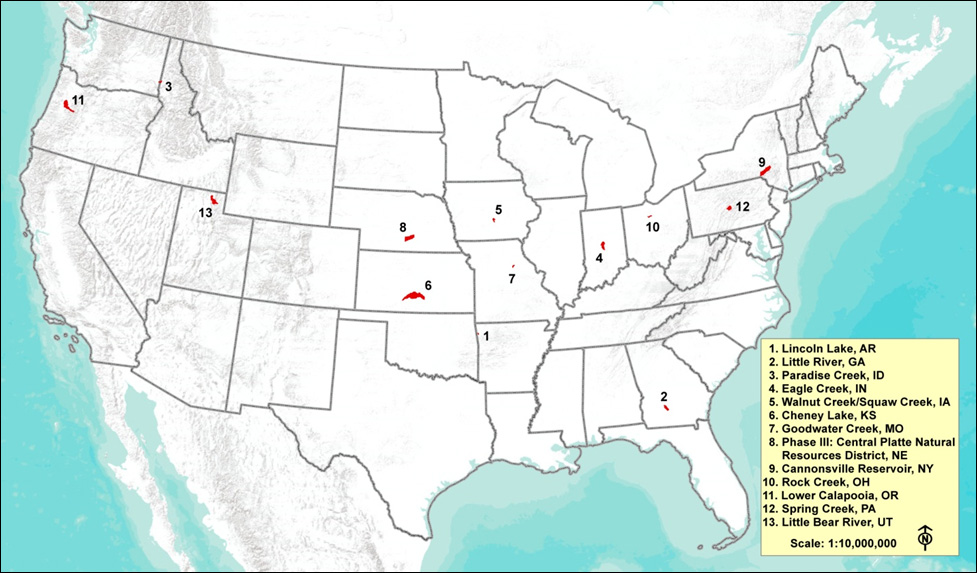
1 NIFA Conservation Effects Assessment Project (CEAP) Watershed Assessment Studies Effective Education to Promote Conservation Practice Adoption Thirteen agricultural watershed projects were funded jointly by the USDA National Institute of Food and Agriculture (NIFA) and Natural Resources Conservation Service (NRCS) to evaluate the effects of cropland and pastureland conservation practices on spatial and temporal trends in water quality at the watershed scale. In some projects, participants also investigated how social and economic factors influence implementation and maintenance of practices. The 13 projects were conducted from 2004 to 2011 as part of the overall Conservation Effects Assessment Project (CEAP). The NIFA-CEAP projects were mainly retrospective; most conservation practices and water quality monitoring efforts were implemented through programs that occurred before the NIFA-CEAP projects began. By synthesizing the results of all these NIFA-CEAP projects, we explore lessons learned about the outreach techniques that were most effective for communicating information to different audiences, achieving adoption of practices, and improving management and/or maintenance of practices in different geographic settings. NIFA-CEAP watershed locations.

2 Funding and Design The NIFA-CEAP projects were designed to be retrospective and focused on the effects of previously implemented conservation practices on water quality. Outreach activities occurring before project inception often continued during the NIFA-CEAP project; outreach may or may not have been integrated with NIFA-CEAP outreach education activities. One NIFA-CEAP project (Lincoln Lake Watershed, AR) funded education directly through Cooperative Extension. Outreach in the other watersheds was provided by multiple sources: land-grant university extension services, grant programs such as the U.S. Environmental Protection Agency (EPA) Section 319 programs, Soil and Water Conservation Districts (SWCDs), farmer organizations, and various nonprofit groups. In the Kansas and New York projects, farmer-led organizations provided education and promoted conservation practices in association with state and county agencies. Page 2 Much of the outreach education programming in the NIFA-CEAP projects was based on providing traditional programs without well-defined, independent goals and objectives for achieving conservation practice adoption. Watershed projects in Lincoln Lake (AR), Cheney Lake (KS), and Cannonsville Reservoir (NY) had good cooperation and impact because there was an outreach plan that included goals, objectives, strategic activities, evaluations, and feedback. Extension programming was integrated with other ongoing efforts, which increased farmer involvement. Lesson: Conservation outreach programs with clearly stated goals and objectives achieve greater success. In the Cannonsville Reservoir watershed (NY), many educational tools were used to support implementation of nutrient management plans, and educational efforts were coordinated with financial incentives, such as support to refurbish manure spreaders. Outreach education efforts included manure management calendars, calibration field days, and regular training updates with emphasis on voluntary compliance to avoid regulation. The manure management calendars made it easy for farmers to know when and where to spread manure and how much to spread. Financial support allowed them to maintain spreaders, increasing manure spreading efficiency. Lesson: Outreach education to promote conservation practice adoption is most effective when focused on the most meaningful issues for farmers: profit, flexibility, and convenience. Outreach programs must be carefully tailored to the target audience(s); clearly communicate the issues, needs and opportunities; be consistent; and reach the audience. Various combinations of the following outreach education activities were used by the NIFA-CEAP project teams to encourage conservation practice adoption: one-on-one farm visits group meetings and presentations on-farm demonstrations field days newsletters fact sheets training and certification community networks watershed maps electronic presentations Lesson: Multiple outreach education techniques should be used to reach target audiences.


3 Trust and Cooperation In Lincoln Lake (AR), a full-time Extension educator funded through the NIFA-CEAP project worked with farmers specifically on nutrient management plans. This person gained the trust of clients through ongoing personal contacts and familiarity with local farming practices. In Indiana, a retired NRCS conservationist was hired using EPA Section 319 funds to promote farm conservation practices for effective nutrient management. Sometimes the best messenger to use is a peer farmer. In Oregon, the local Extension agent used early adopters and their farms as models so neighbors could observe conservation practices on the ground. This approach also was used in Indiana and Arkansas to provide opportunities for farmer-tofarmer informal education. In Pennsylvania, the original project leader, a university scientist, worked with farmers one-on-one to help them understand the importance of fencing and stream buffers to maintaining healthy trout streams on their properties. Meeting one-onone with farmers on their properties was very effective in changing behaviors and promoting adoption. Lesson: Outreach education activities are most effective in promoting conservation practice adoption when conducted one-on-one and coordinated by a trusted, local point-ofcontact who is experienced with local farming practices and respected by the agricultural community. There were several examples of farmer-led programs, including the Cannonsville Reservoir (NY), and Cheney Lake Educational and promotional signage, Lincoln Lake (AR) watershed. (KS) NIFA-CEAP projects. In New York, an agricultural council forged links among farmers, environmental groups, Extension, NRCS, SWCDs, and other organizations. The council trains 25% of the farmers in its watershed each year, and the outreach includes support for technology, education, and funding. Funds for this effort come from New York City. A farmer-led conservation committee in the Cheney Lake (KS) project is funded by the City of Wichita. The committee provides education to farmers (via a farmer-to-farmer program) and determines what conservation practices will be funded and where practices will be placed. Coordination is done through the local SWCD and a paid project manager. These programs effectively rallied Extension, NRCS, and other organizations into a coordinated program. Most areas, however, would have difficulty accomplishing this level of cooperation without additional funds to form a catalyst. Lesson: Outreach education activities were very effective in promoting conservation practice adoption when organized by the farmers themselves. However, the farmers had support from state and city agencies, and this support required outside financial resources. Effectiveness was enhanced by interaction with networks of local stakeholders representing target audiences. In Indiana, New York, and Ohio, local watershed stakeholder groups helped guide outreach education activities. These groups included farmers, environmental interest groups, and resource agency professionals with a thorough understanding of the people, farming practices, and water quality issues in the local watersheds. Outreach education programs were tailored to meet local needs based on feedback from these networks. Strong networks provided opportunities for limited-budget outreach education programs to extend their influence. Networking also provided an opportunity to package what each group had to offer in one place. For example, Extension can provide educational assistance, with technical advice being provided by the NRCS or the SWCD and funding for cost-sharing provided by the Farm Service Agency (FSA) or other special funding programs. Finally, coalitions reduce the likelihood of conflicting messages. In one watershed, contradictory claims about water quality problems associated with atrazine were made by university personnel and an advocacy group. Consequently, farmers lost confidence in the outreach message, and participation in the project by farmers decreased. Page 3

4 Lesson: Coalitions working together improve impacts. Some NIFA-CEAP project teams operated their outreach education programs through nonprofit organizations, such as the South Georgia Regional Development Center, the Eagle Creek Watershed Association, Friends of the Prairie Learning Center Neal Smith National Wildlife Refuge, and the Sandusky River Watershed Coalition. Lesson: Nonprofit organizations can provide information, but do not have the structure or resources to change behavior. Limitations In the Little Bear River Watershed (UT), 61% of the management practices and 35% of the structural practices were not maintained after the Hydrologic Unit Area (HUA) project was completed. Although various factors affected the abandonment of practices, a key informant survey indicated that lack of follow-up by project staff due to agency policies and resource or personnel limitations played a role. Lesson: Post-installation outreach, follow-up, and support are important to ensure that practices are implemented, and also to assist farmers with adaptive management to promote long-term sustainability. Extension and NRCS were active in many of the NIFA- CEAP watersheds. It was clear, however, that when resources are scarce, outreach networks are likely to be weak. The most frequent sources of information for producers were other farmers or personal research. Some farmers identified Extension as an information source, but others noted that Extension programs have been diluted due to shrinking budgets, working in multiple counties, and tackling too many topics. In only two locations did farmers rank Extension as extremely important in increasing conservation practice adoption: New York and Arkansas. And in both these watersheds, additional funding was provided expressly to Extension. Farmers noted some of the same problems with NRCS; technical assistance was in decline. Lesson: Traditional agricultural support agencies are losing credibility with farmers. In an era of diminishing public resources, Extension, NRCS, and state conservation agencies must reassess and determine how to work together more effectively to package, market, and deliver critical education and technical assistance to agricultural producers. In the Little Bear River watershed (UT), a prior HUA program conducted an extensive outreach effort from 1992 through 1997 targeting six audiences: landowners, the general public, public schools, civic groups, Utah State Extension personnel, and others. Extension personnel made more than 100 visits per year in the watershed. Extension used newsletters, field trips, workshops, seminars, and landowner visits to reach watershed residents. The NIFA-CEAP project team evaluated the impact of the HUA program on farmers. Farmers did understand that a water quality problem existed and that the program was trying to improve water quality. Three primary reasons, however, that farmers participated in the project were cost sharing, interest for the HUA, and desire to improve farm operations; thus, NRCS had the greatest effect on farmer participation. A few projects, however, clearly demonstrated behavior change (conservation practice adoption) through NIFA-CEAP project activities (e.g., Arkansas). Many other projects demonstrated changes in conservation implementation, but these changes occurred over a long period (up to 30 years) and involved multiple agencies, changes in production technologies, and other factors. Lesson: Education and behavior change should not be confused. Education alone was rarely sufficient to promote behavior change (conservation practice adoption), and regulation was used in some cases. Related Resources Devlin, D. and L. French Cheney Lake Watershed: Local Leadership: Goals and Actions. Publication MF3034. Manhattan, KS: Kansas State Agricultural Experiment Station and Cooperative Extension Service. Gale, J. A., D. E. Line, D. L. Osmond, S. W. Coffey, J. Spooner, J. A. Arnold, T. J. Hoban, and R. C. Wimberley The Role of Information and Education in Agricultural Nonpoint Source Pollution Control Projects: The Rural Clean Water Program Experience. Raleigh: NC State Water Quality Group. Online: watershedss/info/brochures/ seven.html Page 4
5 Osmond, D., D. Meals, D. Hoag, and M. Arabi (eds) How to Build Better Agricultural Conservation Programs to Protect Water Quality: The National Institute of Food and Agriculture Conservation Effects Assessment Project Experience. Ankeny, IA: Soil and Water Conservation Society. Information For more information about the NIFA-CEAP Synthesis, contact Deanna Osmond, NC State ncsu.edu) Lessons Learned from the NIFA- CEAP ( edu/publications/nifaceap/) NIFA-CEAP watershed information ( watershedstudies) CEAP Homepage: nrcs/main/national/technical/ nra/ceap CEAP NIFA Watershed webpage: portal/nrcs/detail/national/ technical/nra/ceap/?&cid=nrcs143_ Acknowledgments The authors are grateful for the funding supplied by the USDA National Institute of Food and Agriculture (NIFA) and Natural Resources Conservation Service (NRCS) (Agreement No ). We want to thank all NIFA-CEAP project personnel for their help with this publication, our site visits, and our information-gathering efforts. In addition, we greatly appreciate all the time spent by key informants during our interviews with them. We also wish to thank the USDA CEAP Steering Committee and USDA NIFA Committee for Shared Leadership for Water Quality for their comments, questions, and advice during this synthesis project, as well as a special thanks to Lisa Duriancik of NRCS. This material is based upon work supported in part by the National Institute of Food and Agriculture and the Natural Resources Conservation Service, U.S. Department of Agriculture, under Agreement No Any opinions, findings, conclusions, or recommendations expressed in this publication are those of the author(s) and do not necessarily reflect the view of the U.S. Department of Agriculture. USDA is an equal opportunity provider and employer. Prepared by Greg D. Jennings, NC State Dana LK. Hoag, Colorado State Mark L. McFarland, Texas A&M Deanna L. Osmond, NC State Citation Jennings, G. D., D. Hoag, M. L. McFarland, and D. L. Osmond Lessons Learned from the NIFA-CEAP: Effective Education to Promote Conservation Practice Adoption. NC State, Raleigh, NC. Page 5

Chapter 9. Selected Watershed Initiatives in the Great Basin Region
 Chapter 9 Selected Watershed Initiatives in the Great Basin Region The Great Basin contains vast areas of sparsely populated desert lands. Lacking an ocean drainage, the Great Basin is a hydrologic sink
Water Quality and Water Usage Surveys
 Appendix 1 Water Quality and Water Usage Surveys This appendix contains copies of the Water Quality Survey and the Lake Usage Survey that we used to complete the watershedbased community assessments. We
LOW INTEREST LOANS FOR AGRICULTURAL CONSERVATION
 LOW INTEREST LOANS FOR AGRICULTURAL CONSERVATION LILAC MANUAL LOW INTEREST LOANS FOR AGRICULTURAL CONSERVATION TABLE OF CONTENTS Introduction... 3 General Eligibility... 4 Specific Eligibility Criteria
USDA CROSS TRAINING PROGRAM ONLINE AGLEARN TRAINING
 U SDA s mission is to provide leadership on food, agriculture, natural resources, and related issues based on sound public policy and the best available science and efficient management. Accomplishing
Water Quality Management
 Water Quality Management Sustainable agriculture practices detailed in other sections of this publication are important ways to maintain or improve water quality on the farm and downstream from the farm.
ANTHONY P. CARNEVALE NICOLE SMITH JEFF STROHL
 State-Level Analysis HELP WANTED PROJECTIONS of JOBS and EDUCATION REQUIREMENTS Through 2018 JUNE 2010 ANTHONY P. CARNEVALE NICOLE SMITH JEFF STROHL Contents 1 Introduction 3 U.S. Maps: Educational concentrations
Restoring Anadromous Fish Habitat in Big Canyon Creek Watershed. Summary Report 2002
 Restoring Anadromous Fish Habitat in Big Canyon Creek Watershed Summary Report 2002 DOE/BP-00005268-5 November 2002 This Document should be cited as follows: "Restoring Anadromous Fish Habitat in Big Canyon
LIVING LANDS Helping Land Trusts Conserve Biodiversity
 LIVING LANDS Helping Land Trusts Conserve Biodiversity Land Trust Biodiversity Survey, Winter 2006 Purpose of Survey To better understand local land trusts current activities and interest in biodiversity
Lower Crooked Creek Watershed Conservation Plan EXECUTIVE SUMMARY
 EXECUTIVE SUMMARY Project Background Located in southwestern Pennsylvania, Crooked Creek is a major tributary of the Allegheny River, entering near Ford City in Armstrong County. It is rich in natural
EPA Grants Supported Restoring the Chesapeake Bay
 OFFICE OF INSPECTOR GENERAL Audit Report Catalyst for Improving the Environment EPA Grants Supported Restoring the Chesapeake Bay Report No. 2006-P-00032 September 6, 2006 Report Contributors: Randy Holthaus
Cash Rents Methodology and Quality Measures
 ISSN: 2167-129X Cash Rents Methodology and Quality Measures Released August 1, 2014, by the National Agricultural Statistics Service (NASS), Agricultural Statistics Board, United States Department of Agriculture
Colorado Natural Heritage Program
 CNHP s mission is to preserve the natural diversity of life by contributing the essential scientific foundation that leads to lasting conservation of Colorado's biological wealth. Colorado Natural Heritage
Position Description for Conservation Specialist
 Position Description for Conservation Specialist Position Summary This Conservation Specialist position is focused primarily on helping to conserve natural resources associated with small farms. Wildlife
Forestry Reading Room
 University of Arkansas School of Law Division of Agriculture www.nationalaglawcenter.com Forestry Reading Room Compilation of State Forestry Organizations Rusty W. Rumley Staff Attorney and Nastasya Knyazhishcheva
Upper Roanoke River (Roanoke and Botetourt Counties, Cities of Roanoke and Salem, Town of Vinton) TMDL Implementation (Cleanup) Plan Development
 Upper Roanoke River (Roanoke and Botetourt Counties, Cities of Roanoke and Salem, Town of Vinton) TMDL Implementation (Cleanup) Plan Development Residential and Agricultural Working Group Meeting 1 Thursday
Business Plan and Extension Program Strategy
 Business Plan and Extension Program Strategy Cornell Cooperative Extension of Ontario County Agriculture Economic Development Program 2010-2013 Cornell Cooperative Extension of Ontario County 480 North
The Conservation Reserve Program: 45th Signup Results
 Farm Service Agency The Conservation Reserve Program: 45th Signup Results U.S Department of Agriculture Farm Service Agency Conservation and Environmental Program Division 1400 Independence Ave., SW, Room
Moving Forward: Agricultural Water Conservation, Productivity, and Water Transfers Workgroup
 Moving Forward: Agricultural Water Conservation, Productivity, and Water Transfers Workgroup 2015 Colorado River District Water Seminar September 10, 2015 Grand Junction, Colorado Colorado River Basin
- POLICY - Disaster Recovery Assistance Program
 August 29, 2013 - POLICY - Disaster Recovery Assistance Program Overview Disasters and emergency legislative funding occur frequently and usually unpredictably. These characteristics require a standard
DISTRICT VALUES STATEMENTS, GOALS, ACTION ITEMS, AND ONGOING TASKS FOR 2015 Adopted by the Board of Directors December 10, 2014. Values Statements.
 DISTRICT VALUES STATEMENTS, GOALS, ACTION ITEMS, AND ONGOING TASKS FOR 2015 Adopted by the Board of Directors December 10, 2014 Values Statements. The Board opposes any new transfers of water from the
Hypoxia Task Force and LGU SERA-46 Priorities for Collaborative Work Working Document May 2015
 Hypoxia Task Force and LGU SERA-46 Priorities for Collaborative Work Working Document May 2015 This document outlines emergent opportunities for potential short- and long-term collaborative work between
As stewards of the land, farmers must protect the quality of our environment and conserve the natural resources that sustain it by implementing
 N A T U R A L R E S O U R C E C O N S E R V A T I O N As stewards of the land, farmers must protect the quality of our environment and conserve the natural resources that sustain it by implementing conservation
Resources, Publications, Tools, Input from AWCC
 A comprehensive review of Farm Bill contributions to wildlife conservation A comprehensive review was made of scientific literature to determine wildlife responses to conservation programs undertake as
Florida Division of Forestry
 Florida Division of Forestry Cooperative Forestry Assistance CHARLES H. BRONSON Commissioner of Agriculture James R. Karels Director, Division of Forestry Landowner Assistance Programs of the Florida Division
Hail-related claims under comprehensive coverage
 Bulletin Vol. 29, No. 3 : April 2012 Hail-related claims under comprehensive coverage Claims for hail damage more than doubled in 2011 compared with the previous three years. Hail claims are primarily
STANDARD OPERATING PROCEDURES
 STANDARD OPERATING PROCEDURES Written by Terry Messmer, Todd Black, and Sarah Lupis Community-Based Conservation Extension Specialists Utah State University Extension Services 5230 Old Main Hill Logan,
Status of State PACE Programs
 F A R M L A N D I N F O R M A T I O N C E N T E R Status of PACE Programs As of May 2013, 27 states have state-level purchase of agricultural conservation easement (PACE) programs. Four states Arizona,
Resources for Wisconsin Farmers
 Resources for Wisconsin Farmers The following web-based resource links can get you started in identifying sources of information for your farm. This is a short list focused on Wisconsin sustainable agriculture.
Report for 2003PA14B: Spruce Creek Watershed Keystone Project
 Report for 2003PA14B: Spruce Creek Watershed Keystone Project There are no reported publications resulting from this project. Report Follows Abstract: This proposal seeks support for a graduate assistant
Table 2: State Agency Recommendations Agency of Agriculture, Food and Markets
 SUPPORTING INFORMATION ASSOCIATED WITH THE ALLOCATION PRIORITIES FOR CLEAN WATER FUND BOARD Table 2: State Agency Recommendations Agency of Agriculture, Food and Markets 1 Agriculture AAFM On-Farm Implementation
Case Study: The History of the San Juan Headwaters Forest Health Partnership
 Case Study: The History of the San Juan Headwaters Forest Health Partnership Introduction: Wildfire is a part of life in Southwest Colorado. It plays an integral role in ecosystem health and management.
Ginger Paige and Nancy Mesner University of Wyoming Utah State University
 Effective Water Quality BMP Monitoring Tools Ginger Paige and Nancy Mesner University of Wyoming Utah State University Overview BMP Monitoring Guidance Document for Stream Systems Lessons learned CEAP
Wetlands in MN: Resource, Regulation, Restoration
 in MN: Resource, Regulation, Restoration Ben Meyer, Wetland Specialist Hennepin County Natural Resources Partnership January 27, 2015 What is a wetland? Definition (Federal Register): Those areas inundated
North Branch Chicago River Watershed-Based Plan
 North Branch Chicago River Watershed-Based Plan EXECUTIVE SUMMARY In Lake County, the Lake County Stormwater Management Commission (SMC) is responsible for managing Lake County s water resources. The North
Appendix A. Lists of Accomplishments and Project Costs. UMRWD 10 Year Plan Update. Appendix A UPPER MINNESOTA RIVER WATERSHED DISTRICT
 UPPER MINNESOTA RIVER WATERSHED DISTRICT Lists of Accomplishments and Project Costs 10 Year Plan Update UMRWD 10 Year Plan Update Page A 1 UMRWD LIST OF ACCOMPLISHMENTS Since its inception in 1967, the
Benefits of USDA Programs
 Benefits of USDA Programs Mr. Dwight Guy, Mr. Phil Estes, Mr. Robert Dukes, Ms. Sally Vielma USDA - 122 - Fact Sheet September 2006 Natural Resources Conservation Service Helping People Help the Land Conservation
REQUEST FOR PROPOSALS
 REQUEST FOR PROPOSALS LOWER GREAT MIAMI RIVER NUTRIENT MANAGEMENT PROJECT INTRODUCTION On behalf of a partnership of Water Resource Recovery Facilities (WRRFs) WRRFs and other stakeholders with permitted
USDA Farm Program Agencies
 USDA Farm Program Agencies NRCS-Natural Resource Conservation Service Administers engineering and conservation plans Administers conservation programs FSA- Farm Service Agency Administers Commodity Programs
Agriculture and Energy Efficiency
 Agriculture and Energy Efficiency Vern Rice, Energy Specialist Supervisor, Central Electric Cooperative Merlin Berg, Wy East Coordinator, Wy East Resource Conservation & Development Terry Johnson, Energy
Cultivating Organic Farmers
 Cultivating Organic Farmers BACKGROUND Organic Farming Research Foundation (OFRF) is the only national, non-profit organization to track and report organic programs and activity in the U.S. land grant
Clear Water Projects in Cooksville Creek Watershed
 Clear Water Projects in Cooksville Creek Watershed Armstrong Manufacturing Inc. What is a Watershed? No matter where you are, you are in a watershed. A watershed is the area of land that catches rain and
Exploring the Possibilities of Small Hydropower Development Utilizing NRCS-Assisted Flood Control Dams
 Exploring the Possibilities of Small Hydropower Development Utilizing NRCS-Assisted Flood Control Dams A report prepared by the National Watershed Coalition December 2011 1 Exploring the Possibilities
EMPLOYEE CHECKLIST PREPARING CAREER/TRAINING PLAN WORKSHEET
 Identification of Personal Goals EMPLOYEE CHECKLIST PREPARING CAREER/TRAINING PLAN WORKSHEET Goal: A goal is something pertinent to your work and career aspirations, such as mastering a skill in your current
Project Lead Location Amount Project Description. American Lung Association in Minnesota
 Project Lead Location Amount Project Description American Lung Association in Minnesota St. Paul, MN $248,788 The Accelerating Alternatives for Minnesota Drivers project will provide safety and technical
Public Opinions, Attitudes and Awareness Regarding Water in Colorado
 Public Opinions, Attitudes and Awareness Regarding Water in Colorado Colorado Water Conservation Board FINAL REPORT Final Report July 22, 2013 Public Opinions, Attitudes and Awareness Regarding Water in
Small Farmer Agricultural Leadership Institute
 Small Farmer Agricultural Leadership Institute Dawn Mellion - Patin, Ph.D., MBA Extension Specialist Agriculture Project Director Accomplishments Appointments to Regional Advisory Boards: Southern Region
Cancellation of Debt (COD) R. Bruce McCommons Harford County, MD TrC 12/4/2013 [email protected]
 Cancellation of Debt (COD) R. Bruce McCommons Harford County, MD TrC 12/4/2013 [email protected] 1 Cancellation of debt (COD)... Generally, if a debt for which the taxpayer was personally responsible
recovery: Projections of Jobs and Education Requirements Through 2020 June 2013
 recovery: Projections of Jobs and Requirements Through June 2013 Projections of Jobs and Requirements Through This report projects education requirements linked to forecasted job growth by state and the
City population estimate 2013 431,746 1 Campus Setting. Suburb: Large Fall 2013 Student Enrollment 19,160 Part-time 69%
 39 Case Study 3 Ohio Pennsylvania P h i l a d e l Wake p h i a New Jersey B a l t i m o r e SunTrust Foundation ^_ Center For The Community College of Baltimore County West Virginia WMaryland a s h i n
Pennsylvania's Clean and Green Program
 Pennsylvania's Clean and Green Program The Penn State Dickinson Agricultural Law Resource and Reference Center * The purpose of this publication is to help you learn about and understand this important
Patrick Brown, Professor. Department of Plant Sciences University of California. Davis, CA 95616. 530-752-0929 [email protected]
 Project Title: Nitrogen Management Training for Certified Crop Advisors Project Leaders: Doug Parker, Director UC California Institute for Water Resources University of California 1111 Franklin Street
MASSACHUSETTS COASTAL NONPOINT PROGRAM NOAA/EPA DECISIONS ON CONDITIONS OF APPROVAL
 MASSACHUSETTS COASTAL NONPOINT PROGRAM NOAA/EPA DECISIONS ON CONDITIONS OF APPROVAL FOREWORD This document contains the basis for NOAA and EPA s decision to fully approve Massachusetts Coastal Nonpoint
Restoring and protecting natural floodplains reduces flood losses and benefits the environment. Photo: USDA NRCS.
 The Multiple Benefits of Floodplain Easements: An Assessment of American Recovery and Reinvestment Act-Funded Emergency Watershed Protection Program Floodplain Easements in the Upper Mississippi River
Radiologic Sciences Staffing and Workplace Survey 2015
 Radiologic Sciences Staffing and Workplace Survey 2015 Reproduction in any form is forbidden without written permission from publisher. 1 Table of Contents Executive Summary... 3 Staffing Levels... 3 Longitudinal
2015 Monarch Butterfly Conservation Fund Grant Slate
 2015 Monarch Butterfly Conservation Fund Grant Slate NFWF CONTACT Teal Edelen, Manager Central Regional Office [email protected] or 202-857-0166 Monarch caterpillar on milkweed ABOUT NFWF The National