
Darty plc Annual report 2014/15
|
|
|
- Tyler Hodges
- 10 years ago
- Views:
Transcription
1 Darty plc Annual report /15

2 Contents Overview 01 Welcome 02 Highlights 03 Chairman s statement Strategic report 05 Our markets 06 Our business model 07 Strategy 09 Chief Executive s review 17 Operating review 18 Financial review 21 Principal risks 23 Corporate responsibility Directors report 28 Board of Directors 30 Directors report Corporate governance 34 Corporate governance 40 Report on Directors remuneration and related matters 52 Statement of Directors responsibilities Financial statements and notes (IFRS) 53 Independent auditors report to the members of Darty plc 58 Group income statement 59 Group statement of comprehensive income 60 Group statement of changes in equity 61 Group balance sheet 62 Group cash flow statement 63 Notes to the financial statements Successful franchise operation Online growth Strong kitchens offer 26 Reducing environmental impact Darty brand development Improved customer offer Expansion in the Netherlands Darty plc (UK GAAP) 110 Independent auditors report to the members of Darty plc 112 Company balance sheet 113 Notes to the Company financial statements Other information 119 Shareholder information 120 Group five-year summary Certain statements made in this report are forward looking statements. Such statements are based on current expectations and are subject to a number of risks and uncertainties that could cause actual results to differ materially from any expected future results in forward looking statements. Unless otherwise required by applicable laws, regulations or accounting standards, Darty plc does not undertake any obligation to update or revise any forward looking statements, whether as a result of new information, future developments or otherwise.

3 Overview Welcome The Darty Group is a multi-channel electrical retailer trading from over 400 stores and websites. We sell a full range of electrical products from major home and small domestic appliances to all the latest vision and multimedia products. This is supported by our leading customer service offer in-store, online, for home delivery and after-sales. We operate as Darty and Mistergooddeal.com in France, Vanden Borre in Belgium and BCC in the Netherlands. France * Revenue () Revenue growth Retail profit ( m) Number of stores** Selling space sqm (000s) 2, % Web sales (% of total sales) Belgium and the Netherlands Revenue ( m) Revenue growth Retail profit ( m) Number of stores Selling space sqm (000s) % Web sales (% of total sales) * Including Mistergooddeal.com ** Including 43 franchise stores Darty plc Annual report /15 01

4 Overview Highlights Delivering our strategic plan Nouvelle Confiance Investment in our growth initiatives: 39 franchise stores opened in the year delivering strong sales uplifts; Over 22 per cent increase in web generated sales in France following the acquisition of Mistergooddeal.com, bringing web penetration to over 17 per cent of product sales; Expanded the kitchen offer into 16 further stores to a total of 71 stores; and Built on an improved performance at BCC with the acquisition of 18 profitable stores to become the leading multi-channel retailer in the Netherlands. Market outperformance in both France and the Netherlands. Completed the elimination of losses in our non-core markets with the sale of our shareholding in Datart in the Czech Republic and Slovakia. The Board is recommending a final dividend of cents per share (: cents) bringing the total dividend for the year to 3.5 cents per share (: 3.5 cents). Financial summary for the 12 months ended 30 April Group / /14 restated 1 Revenue 3,512.1m 3,404.4m LfL sales (1.6)% 1.9% Retail profit m 85.5m Operating profit 60.3m 53.4m Adjusted PBT m 72.1m Profit/(loss) for the year 13.8m (6.6)m Adjusted EPS cents 6.5 cents Basic EPS 2.7 cents (0.6) cents Net debt 223.8m 185.2m Total dividend 3.5 cents 3.5 cents 1 Restated following the sale of Datart, now classified as discontinued operations, the CVAE reclassification from operating profit to taxation and the legacy UK retirement benefit scheme expenses from finance costs to operating profit. 2 Retail profit represents total operating profit before the share of joint venture and associates interest and taxation, the movement in options and related charges over non-controlling interests, gain on disposal of available-for-sale investments, legacy UK retirement benefit scheme expenses, exceptional items and amortisation and impairment of acquisition related intangible assets. 3 Excludes the share of joint venture and associates interest and taxation, the movement in options and related charges over non-controlling interests, gain on disposal of available-for-sale investments, legacy UK retirement benefit scheme expenses, exceptional items, net interest on pension schemes and amortisation and impairment of acquisition related intangible assets. 02 Darty plc Annual report /15

5 Overview Chairman s statement We have delivered on our Nouvelle Confiance plan and have a strong platform for the future. We launched Nouvelle Confiance, our three stage strategic plan to restore shareholder value, nearly three years ago and we have successfully executed all the key components on schedule. The first stage was to identify and eliminate the losses at our non core businesses in Italy, Spain, Turkey and the Czech Republic and Slovakia to refocus on our core markets in France, Belgium and the Netherlands. This process was completed in July with the disposal of Datart in the Czech Republic and Slovakia. Having refocused the Group, we set out to create value from our market leadership position, drive greater efficiency and reduce costs and we devised a four point action plan (the 4Ds ) to: Drive trading by delivering on promise to customers; Digitalise Darty by further enhancing our multi-channel offer and leading websites; Develop our brand by improving our product and market leading service offerings as well as expanding our customer base; and Deliver cost efficiencies. I am pleased with the continued success we have had and a full account of our activities and achievements can be found in the Chief Executive s review. The third component of the plan was to identify future growth opportunities. We announced last year our initiatives to expand the Darty portfolio through a franchise operation, extend our low price offer through the acquisition of Mistergooddeal.com and a progamme to increase the number of stores in France with the kitchen offer. We have been busy implementing all three programmes and I am pleased that during the last year we opened 39 franchise stores, integrated the Mistergooddeal.com business into Darty France helping us increase web generated sales by over 22 per cent and expanded the kitchen offer by a further 16 stores to 71 stores. We still have more to do to ensure growth in shareholder value but we have a strong platform for the future. Given the progress we have made, the Board is recommending a final dividend of cents per share, bringing the total dividend for the year to 3.5 cents per share, reflecting our confidence in our ability to deliver improved results in the medium term. Dominic Platt, our Finance Director for over five years, will be leaving the Group on 30 June and I would like to thank him for his valuable contribution to the business and wish him every success for the future. His successor Albin Jacquemont joined the Group in March and joins the Board as Finance Director on 18 June. He is already making a positive impact and I look forward to working with him over the coming years. Finally I must thank all our colleagues across the Group for their hard work and loyalty, particularly in these difficult trading times. Alan Parker CBE Chairman Darty plc Annual report /15 03
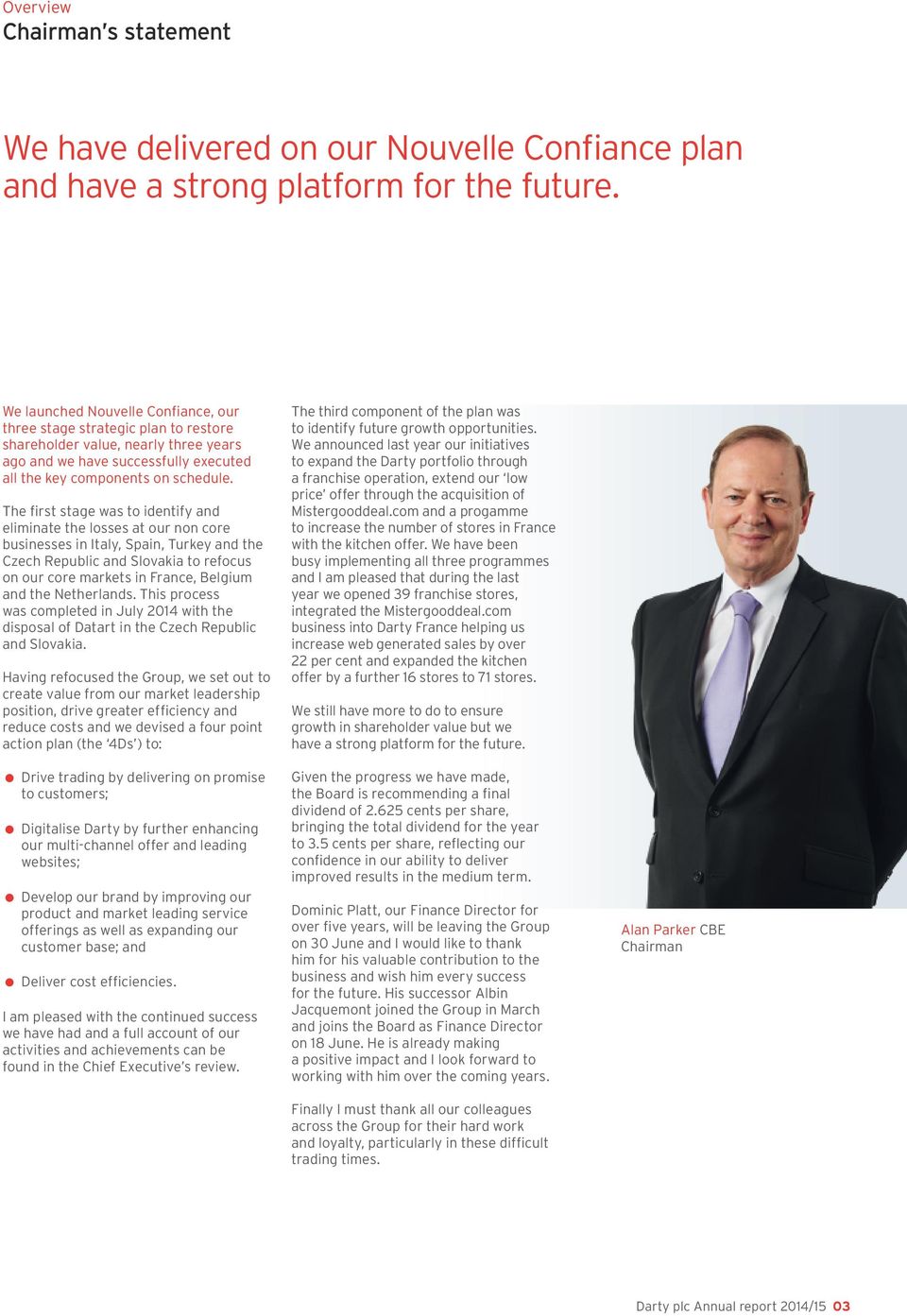
6 Typically my sales are up by per cent every month so I am very pleased to have joined the Darty store network. Successful franchise operation Our franchise programme is proving extremely successful and popular with both the franchisees and their customers. The store owners are enjoying the benefit of the Darty brand with wider ranges, access to the full Darty service offer and Darty.com. We now have over 40 stores in operation and are on track for 100 by 2016/ Darty plc Annual report /15

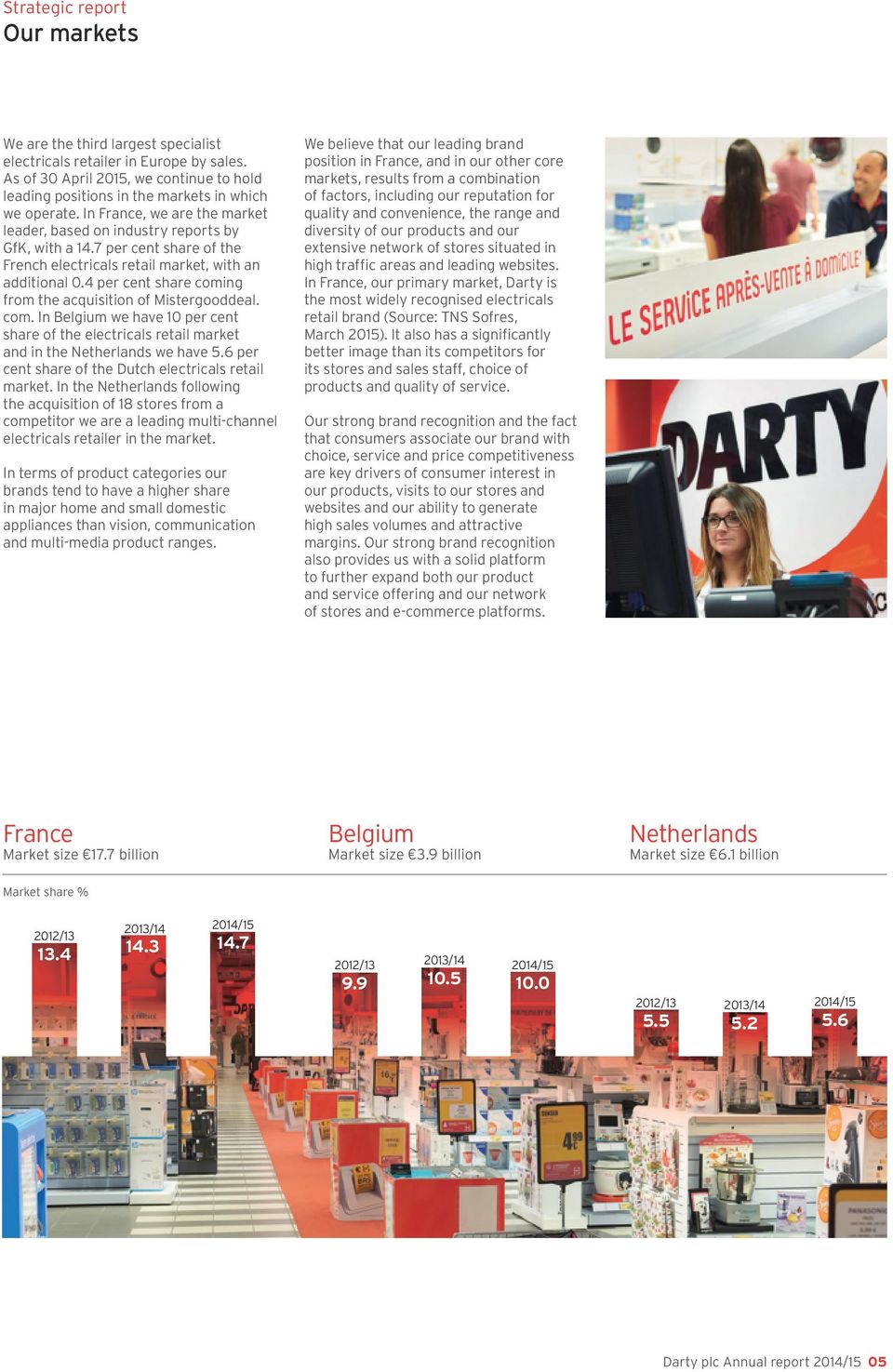
7 Strategic report Our markets We are the third largest specialist electricals retailer in Europe by sales. As of 30 April, we continue to hold leading positions in the markets in which we operate. In France, we are the market leader, based on industry reports by GfK, with a 14.7 per cent share of the French electricals retail market, with an additional 0.4 per cent share coming from the acquisition of Mistergooddeal. com. In Belgium we have 10 per cent share of the electricals retail market and in the Netherlands we have 5.6 per cent share of the Dutch electricals retail market. In the Netherlands following the acquisition of 18 stores from a competitor we are a leading multi-channel electricals retailer in the market. In terms of product categories our brands tend to have a higher share in major home and small domestic appliances than vision, communication and multi-media product ranges. We believe that our leading brand position in France, and in our other core markets, results from a combination of factors, including our reputation for quality and convenience, the range and diversity of our products and our extensive network of stores situated in high traffic areas and leading websites. In France, our primary market, Darty is the most widely recognised electricals retail brand (Source: TNS Sofres, March ). It also has a significantly better image than its competitors for its stores and sales staff, choice of products and quality of service. Our strong brand recognition and the fact that consumers associate our brand with choice, service and price competitiveness are key drivers of consumer interest in our products, visits to our stores and websites and our ability to generate high sales volumes and attractive margins. Our strong brand recognition also provides us with a solid platform to further expand both our product and service offering and our network of stores and e-commerce platforms. France Belgium Netherlands Market size 17.7 billion Market size 3.9 billion Market size 6.1 billion Market share % 2012/ /14 / / /14 / / /14 / Darty plc Annual report /15 05
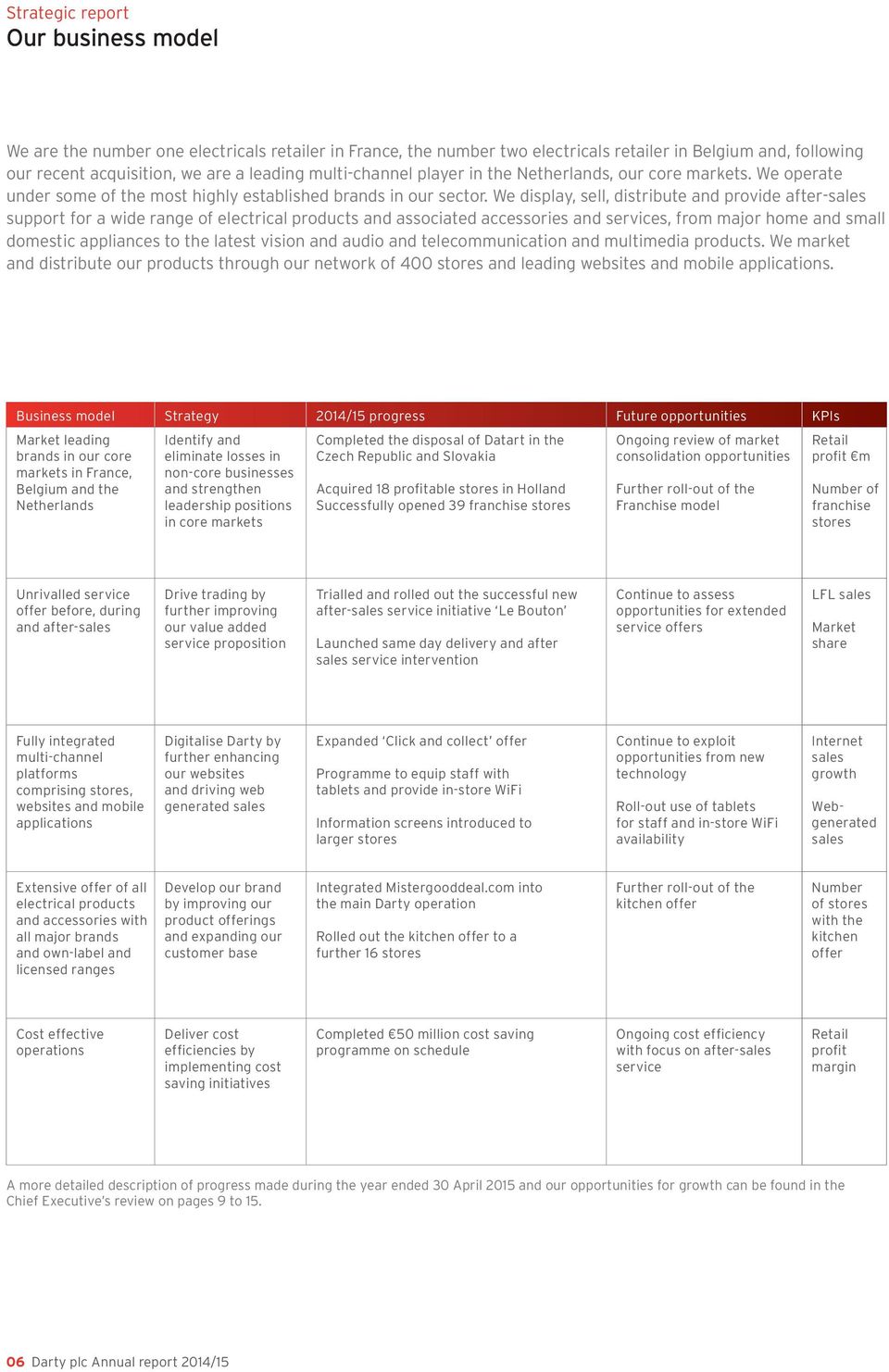
8 Strategic report Our business model We are the number one electricals retailer in France, the number two electricals retailer in Belgium and, following our recent acquisition, we are a leading multi-channel player in the Netherlands, our core markets. We operate under some of the most highly established brands in our sector. We display, sell, distribute and provide after-sales support for a wide range of electrical products and associated accessories and services, from major home and small domestic appliances to the latest vision and audio and telecommunication and multimedia products. We market and distribute our products through our network of 400 stores and leading websites and mobile applications. Business model Strategy /15 progress Future opportunities KPIs Market leading brands in our core markets in France, Belgium and the Netherlands Identify and eliminate losses in non-core businesses and strengthen leadership positions in core markets Completed the disposal of Datart in the Czech Republic and Slovakia Acquired 18 profitable stores in Holland Successfully opened 39 franchise stores Ongoing review of market consolidation opportunities Further roll-out of the Franchise model Retail profit m Number of franchise stores Unrivalled service offer before, during and after-sales Drive trading by further improving our value added service proposition Trialled and rolled out the successful new after-sales service initiative Le Bouton Launched same day delivery and after sales service intervention Continue to assess opportunities for extended service offers LFL sales Market share Fully integrated multi-channel platforms comprising stores, websites and mobile applications Digitalise Darty by further enhancing our websites and driving web generated sales Expanded Click and collect offer Programme to equip staff with tablets and provide in-store WiFi Information screens introduced to larger stores Continue to exploit opportunities from new technology Roll-out use of tablets for staff and in-store WiFi availability Internet sales growth Webgenerated sales Extensive offer of all electrical products and accessories with all major brands and own-label and licensed ranges Develop our brand by improving our product offerings and expanding our customer base Integrated Mistergooddeal.com into the main Darty operation Rolled out the kitchen offer to a further 16 stores Further roll-out of the kitchen offer Number of stores with the kitchen offer Cost effective operations Deliver cost efficiencies by implementing cost saving initiatives Completed 50 million cost saving programme on schedule Ongoing cost efficiency with focus on after-sales service Retail profit margin A more detailed description of progress made during the year ended 30 April and our opportunities for growth can be found in the Chief Executive s review on pages 9 to Darty plc Annual report /15
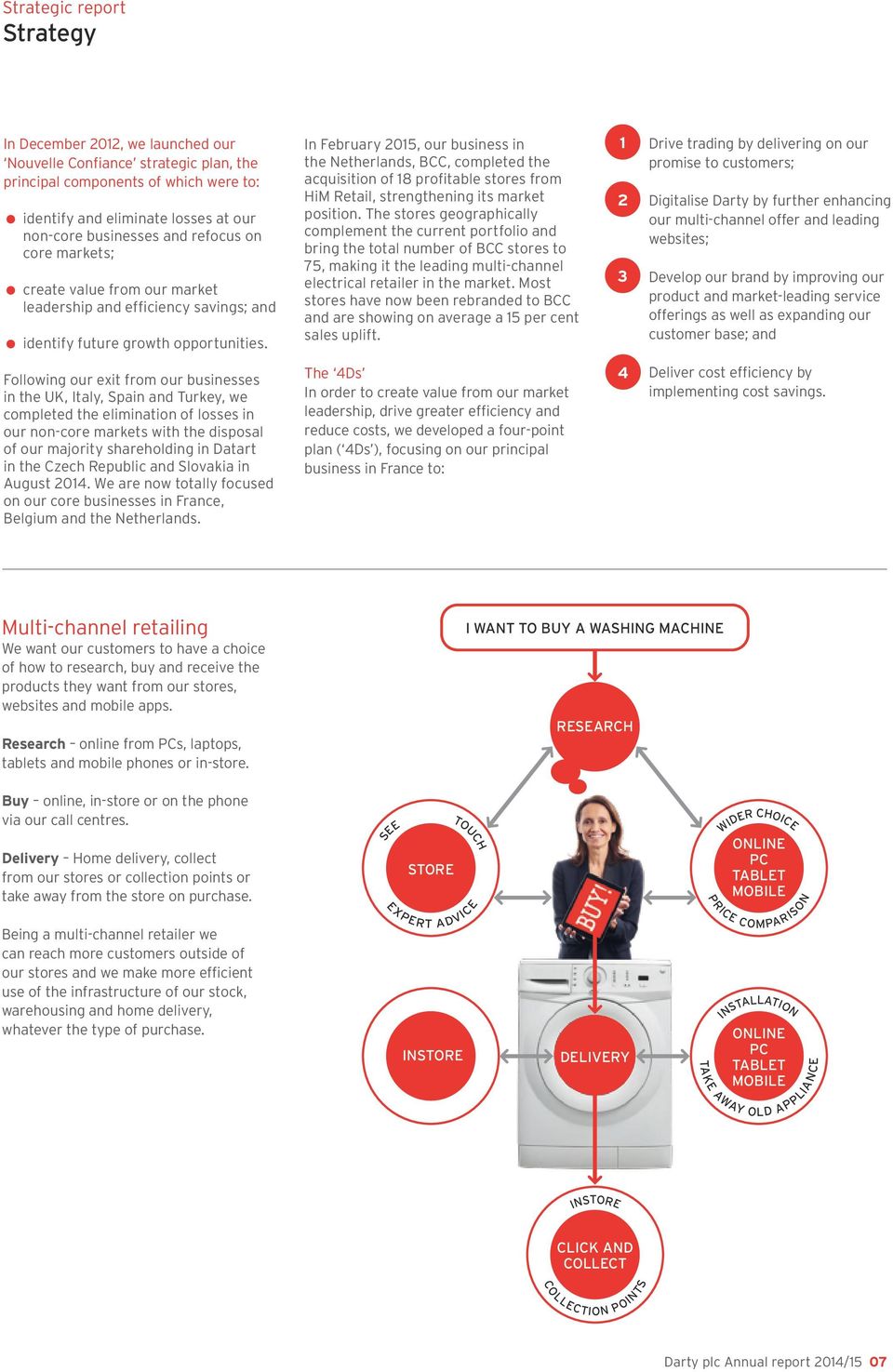
9 Strategic report Strategy In December 2012, we launched our Nouvelle Confiance strategic plan, the principal components of which were to: identify and eliminate losses at our non-core businesses and refocus on core markets; create value from our market leadership and efficiency savings; and identify future growth opportunities. Following our exit from our businesses in the UK, Italy, Spain and Turkey, we completed the elimination of losses in our non-core markets with the disposal of our majority shareholding in Datart in the Czech Republic and Slovakia in August. We are now totally focused on our core businesses in France, Belgium and the Netherlands. In February, our business in the Netherlands, BCC, completed the acquisition of 18 profitable stores from HiM Retail, strengthening its market position. The stores geographically complement the current portfolio and bring the total number of BCC stores to 75, making it the leading multi-channel electrical retailer in the market. Most stores have now been rebranded to BCC and are showing on average a 15 per cent sales uplift. The 4Ds In order to create value from our market leadership, drive greater efficiency and reduce costs, we developed a four-point plan ( 4Ds ), focusing on our principal business in France to: Drive trading by delivering on our promise to customers; Digitalise Darty by further enhancing our multi-channel offer and leading websites; Develop our brand by improving our product and market-leading service offerings as well as expanding our customer base; and Deliver cost efficiency by implementing cost savings. Multi-channel retailing We want our customers to have a choice of how to research, buy and receive the products they want from our stores, websites and mobile apps. Research online from PCs, laptops, tablets and mobile phones or in-store. I WANT TO BUY A WASHING MACHINE RESEARCH Buy online, in-store or on the phone via our call centres. Delivery Home delivery, collect from our stores or collection points or take away from the store on purchase. SEE STORE TOUCH EXPERT ADVICE WIDER CHOICE ONLINE PC TABLET MOBILE PRICE COMPARISON Being a multi-channel retailer we can reach more customers outside of our stores and we make more efficient use of the infrastructure of our stock, warehousing and home delivery, whatever the type of purchase. INSTORE DELIVERY INSTALLATION ONLINE PC TABLET MOBILE TAKE AWAY OLD APPLIANCE INSTORE CLICK AND COLLECT COLLECTION POINTS Darty plc Annual report /15 07
10 A new after-sales service initiative Le Bouton was launched in October offering customers immediate support at the touch of a button. Darty brand development This year we celebrated 40 years of the famous Contrat de Confiance, Darty s price, choice and service promise to its customers. We took the opportunity to evolve this long heritage for service and modernised the brand s image in keeping with the changing expectations of our customers and to raise our awareness even further. We have introduced a number of initiatives including instore Wifi availability, a very contemporary and widespread marketing campaign, a series of instore events and Le Bouton. 08 Darty plc Annual report /15

11 Strategic report Chief Executive s review Across the Group we delivered on new initiatives to improve our multi-channel proposition which led to market share gains in France and the Netherlands. The 4Ds 1 Drive trading In a market that saw a small decline in France over the year we delivered further market share gains, kept footfall stable and improved our store conversion rate. During the period Darty held a number of events to drive trading. A successful World Cup campaign helped deliver strong vision sales during May and June and the July Sale received a positive response from customers. The Back to school campaign run from late August through September, delivered sales below expectation due to limited stock and the January Sale was impacted by events in Paris at the beginning of the month. We supported these campaigns by weekly monitoring of our instore and online prices to confirm our competitiveness. On a service included basis we continue to compare very favourably against all store based retailers and all web pure players and we have recovered our number one position in the TNS Sofres survey. In addition, during the year we celebrated 40 years of Contrat du Confiance, our price, choice and service promise to our customers, and we took the opportunity to simplify and modernise the Contrat providing us with a unique marketing platform. As part of the Darty service offer, delivery, installation and after-sales service have historically been included for free with the majority of product purchases. A premium paid for delivery is now available for specific two hour time slots from 7am to 9am, and 5pm to 9pm and Chronopost next day delivery if ordered by 1pm for non-bulky items. In March we enhanced the service offer with paid for same day delivery for large appliances in the Paris and Lyon regions, if ordered before 4pm and delivered by 9pm, and in Paris same day after-sales service intervention if contacted by 4pm. As a result we have regained the leading position in home delivery and extended our lead against all our competitors for after-sales service (source: TNS survey). After the end of the financial year we launched a new Store card, Carte de credit connectée, with the objective of providing customers with greater value beyond purely a financing solution. For a 15 annual fee, which is subsequently refunded in Darty vouchers, customers receive a Visa debit/credit card which is also a loyalty card. Every time a customer uses the card to complete three transactions worth over 50 each at Darty they will be given a 10 gift card. Additional benefits include free subscription to Le Bouton, our new 24/7 after-sales service initiative launched last year, special offers on products, VIP shopping evenings and access to flexible financing offers and free credit. 2 Digitalise Darty As a successful multi-channel retailer, we continue to develop a seamless approach between our websites and stores. During the period we continued the programme of digitalising the store network which includes free WiFi, equipping sales staff with tablets to demonstrate products and provide price and availability and large display screens. By the end of the financial year we had digitalised 64 stores including two franchises, with over 1200 tablets being utilised by staff, and we had over 340 screens across 30 stores. Throughout the year we saw an improvement in the level of sales made utilising a tablet to 14 per cent of store sales, with the best stores approaching 40 per cent. We plan to digitalise a further 60 stores during /16. Visits to Darty.com grew over 22 per cent for the year to over 160 million and towards the end of the period the website was refreshed to improve its look, feel and content, making it more modern, clear and user friendly. Régis Schultz Chief Executive Darty plc Annual report /15 09
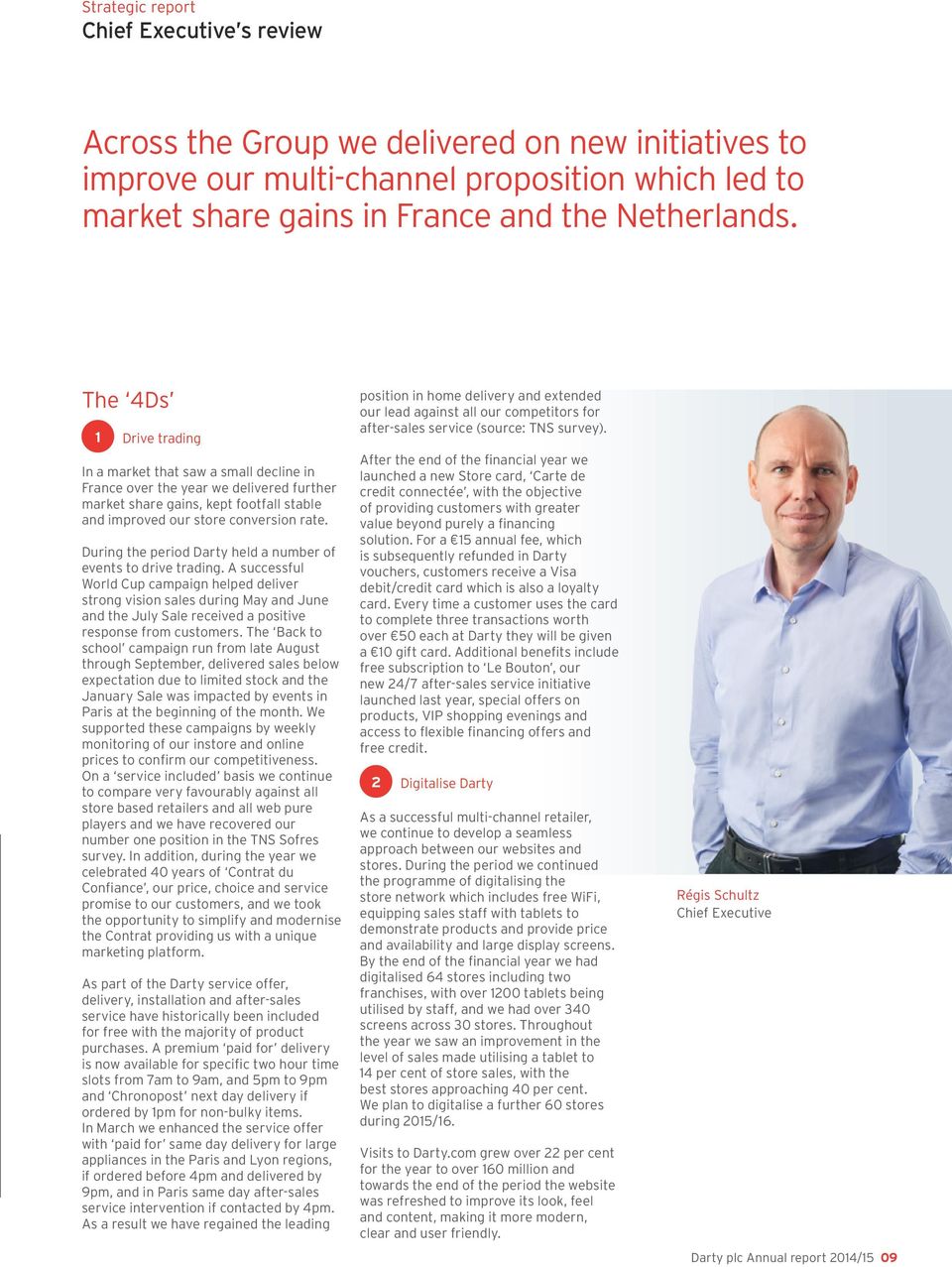
12 This year in France we achieved a 22 per cent uplift in web generated sales bringing web penetration to over 17 per cent of total products sales. Online growth We have successfully grown our online business with a 22 per cent increase in web generated sales. The acquisition last year of Mistergooddeal.com is enabling us to offer a wider choice of price-entry products, attracting a more diverse customer base. We have integrated the business into Darty, utilising our infrastructure and creating greater cost efficiencies. 10 Darty plc Annual report /15

13 Strategic report Chief Executive s review 20 PER CENT penetration of Click and collect increased to 20 per cent of total web sales. During the year we saw significant increases in penetration of our Click and collect service, where customers can reserve online and collect an hour later from their chosen store, or from a Click and collect locker in certain high traffic stores. Penetration of Click and collect increased by 540 basis points to 20 per cent of web sales, with penetration reaching 30 per cent in the peak trading month of December compared to just over 20 per cent the prior year. 3 Develop our brand Building on Darty s long heritage for service and its famous Contrat de Confiance, a new initiative, Le Bouton, was launched nationwide in October. By pushing a dedicated wireless button or via a mobile app, customers can make direct contact with Darty s market leading after-sales service support, 24 hours a day, seven days a week. We aim for a service assistant to call the customer back within two minutes to assess and solve the problem either over the phone or by a subsequent home visit. The service is available for all electrical products but for those not originally bought from Darty or out of warranty there is a charge for any repairs required. The service is available for a small monthly subscription of 3/month, or 8/month including multimedia products, plus 25 for the wireless button. Over 35,000 buttons had been issued by the end of the year, including six, 12 or 24 month subscription bundled with an extended warranty purchase. Our intention is to fully integrate the button into the extended warranty offer. As market leader in France we continue to receive support from leading manufacturers in gaining access to exclusive products, with particular emphasis on being first to market for new products. During the period this was evidenced by significant sales of large screen OLED and Ultra HD/4K televisions, particularly ahead of the football World Cup in May and June. Increasingly connected products and dedicated areas in-store and online are being introduced into the offer for both the home and health, such as connected security, lighting, thermostats and fitness trackers. As recognition for the recent progress we have made with the brand, our net promoter score increased over the second half of the year. We also won a number of awards during the year including one from LSA for our Click & Collect service, the Nuit des Rois digital marketing award for Le Bouton and the IREF Satisfactions Clients award for the electricals sector. In addition, we have seen improving colleague engagement through our annual staff opinion survey. Darty plc Annual report /15 11

14 Over the last year in France we have recorded 73 million visits to our stores and over 165 million visits to our websites. Customer information is gathered to provide a database for more specific and tailored marketing purposes. Improved customer offer We continually improve our offer to build customer loyalty and increase web and store traffic to keep one step ahead of the competition with a seamless approach between our websites and stores. We are a true multi-channel retailer. Our customers can research for a product online or in our stores; buy online, in-store or by phone; and then obtain their product via either home delivery, collect from our stores or collection points or takeaway from our stores on purchase. 12 Darty plc Annual report /15

15 Strategic report Chief Executive s review We are focused on building on our achievements to date by investing in our customer proposition, reducing the cost base and delivering improved profitability through our growth initiatives. 4 Deliver cost efficiency Throughout the Group, we had targeted annual gross cost savings over three years of 50 million per annum by /16, from delivering a more efficient operating model, continuing to adapt our cost structure and leveraging synergies between our operating companies. To accelerate the achievement of the savings by /15, a social plan was implemented in France last year and proceeded as planned. 30 million of benefits were achieved over the prior two years with the final benefit of 20 million achieved in full this financial year. Total Group underlying costs (excluding the Mistergooddeal.com acquisition) were down over 2 per cent ( 27 million) despite incremental costs related to our increased store activity. While this major programme has now been completed, we continue to work on all opportunities to improve cost efficiency in the business, with a particular focus in France in /16 on the after-sales service infrastructure and increasing Click and collect penetration to further reduce home delivery costs. We also continue to manage our freehold property to ensure maximum value to the Group. Following over 45 million of total proceeds in the prior two years, 13.9 million was delivered this financial year, with a similar amount expected in /16. Growth initiatives In 2013 we identified and introduced initiatives to help secure our future growth, including: expanding the Darty portfolio into smaller catchment areas with the opening of franchise stores; extending our low price/pay-as-you-go services offer through the Mistergooddeal.com channel; and a programme to increase the number of stores in France with the kitchen offer. Franchise stores Darty is the market leader in France with 70 per cent of consumers within a 30-minute drive time of a store. The remaining 30 per cent of consumers represent an opportunity to further exploit the existing infrastructure of our multi-channel offer. Typically these consumers will reside in smaller catchment areas, usually below 100,000 inhabitants where it is uneconomic to open a typical Darty store. To address these smaller catchment areas we established a franchise operation last financial year. The independent owner invests to refurbish their own store to a Darty store, consistent in terms of both branding and offer with the rest of the store portfolio. We charge the franchisee for the supply of product ranges and provision of home delivery and after-sales services. A franchise fee is also charged for use of the brand and marketing support. At the end of the financial year we had opened 43 stores including four overseas. Performance has been encouraging with significant sales uplifts and a net promoter score above the Darty average. We expect to open around 25 additional stores in /16, bringing the total to around 70 stores. 70 PER CENT of consumers are within a 30-minute drive time of a Darty store. Darty plc Annual report /15 13
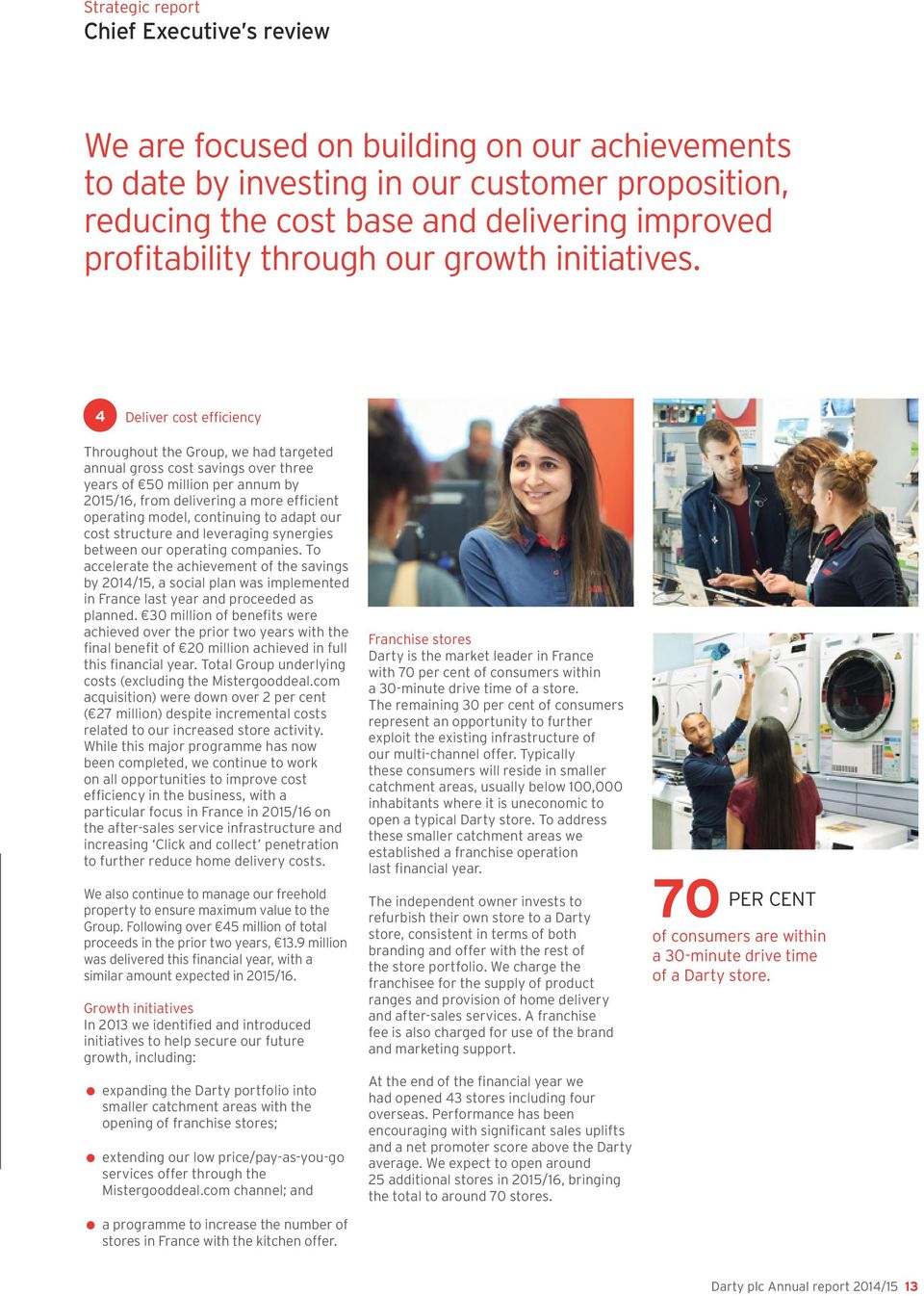
16 The service and quality of Darty Kitchens is excellent. The price is good and the after-sales service and installation is very efficient and smooth. Strong kitchens offer Thanks to improving the density of our merchandising in all other product categories, we now offer our bespoke kitchen range and service in over 70 stores, making sure we are capitalising on this fast growing area of the market. Our medium term aim for the offer to be in 120 stores, in all catchments of over 200,000 inhabitants, is well on track. 14 Darty plc Annual report /15

17 Strategic report Chief Executive s review Mistergooddeal.com To increase Darty s share of the fast growing market for an entry price offer, we acquired Mistergooddeal.com towards the end of the last financial year. Mistergooddeal.com is a leading French electricals website, predominantly in white goods at the price entry end of the market, with no service included. We have retained the brand name and are extending the product offer with the introduction of our own label brands. Darty s existing service infrastructure is now being used to offer Mistergooddeal. com customers additional services on a pay-as-you-go basis, with home delivery being offered from October and all suitable Darty stores can now be used as customer collection points. Initial trading was weaker than expected due to very competitive activity in the entry price end of the market. With a new management team in place from October we deepened and accelerated the integration of the business into the main Darty operation to help speed up and deliver further cost savings. The head office was integrated in January followed by the IT and warehousing in April. A new look website was launched at the end of the year, on Darty s IT platform. We also made changes to the product offer, exiting non-core categories such as furniture and extending small domestic appliance and vision ranges. The retail loss for /15 was 7.7 million but with the actions being taken commercially and particularly on the cost base, we expect to approach breakeven for /16. Kitchens Our kitchens business in France is an example of our ability to continually develop the Darty brand further, and move into a new, related product area, build a relevant market position and drive profitability. The kitchen market has solid fundamentals with the fitted kitchen equipment rate in France being only 62 per cent compared to a European average of around 80 per cent and a growing electricals built-in market. At the same time, competitors are consolidating and, as Darty builds scale, consumer recognition of our kitchens offer is consistently improving year-on-year. As a result of increasing the density of merchandising in other product categories, we are now able to install the kitchen offer in smaller stores in the portfolio. We now have 71 stores with the offer generating over 80 million of revenue. Commercial initiatives during the year included interest free credit offers as well as a partnership with house builder, Bouygues Immobilier for customers to select a Darty kitchen to be installed in their new property. Given the acceleration of openings in the year, the time to reach maturity and pre-opening costs incurred ahead of the initial customer orders, a loss was made in /15 of 4 million. At the end of the period a new catalogue was launched in print and online, featuring 32 different kitchen models, supported by a TV campaign from early May. With a further 13 stores planned to have the offer in /16, together with changes to the management team, infrastructure and planned productivity improvements, we expect to move to profitability in the current financial year. Outlook Whilst we have started to see signs of improvement in consumer confidence, the product cycle will continue to have an impact on our markets which are expected to remain challenging. We are focused on building on what we have achieved through Nouvelle Confiance by investing in our customer proposition in all our businesses, reducing the cost base and delivering improved profitability. Régis Schultz Chief Executive 16 FURTHER STORES expanded the kitchen offer into 16 further stores increasing the total to 71 stores. Darty plc Annual report /15 15
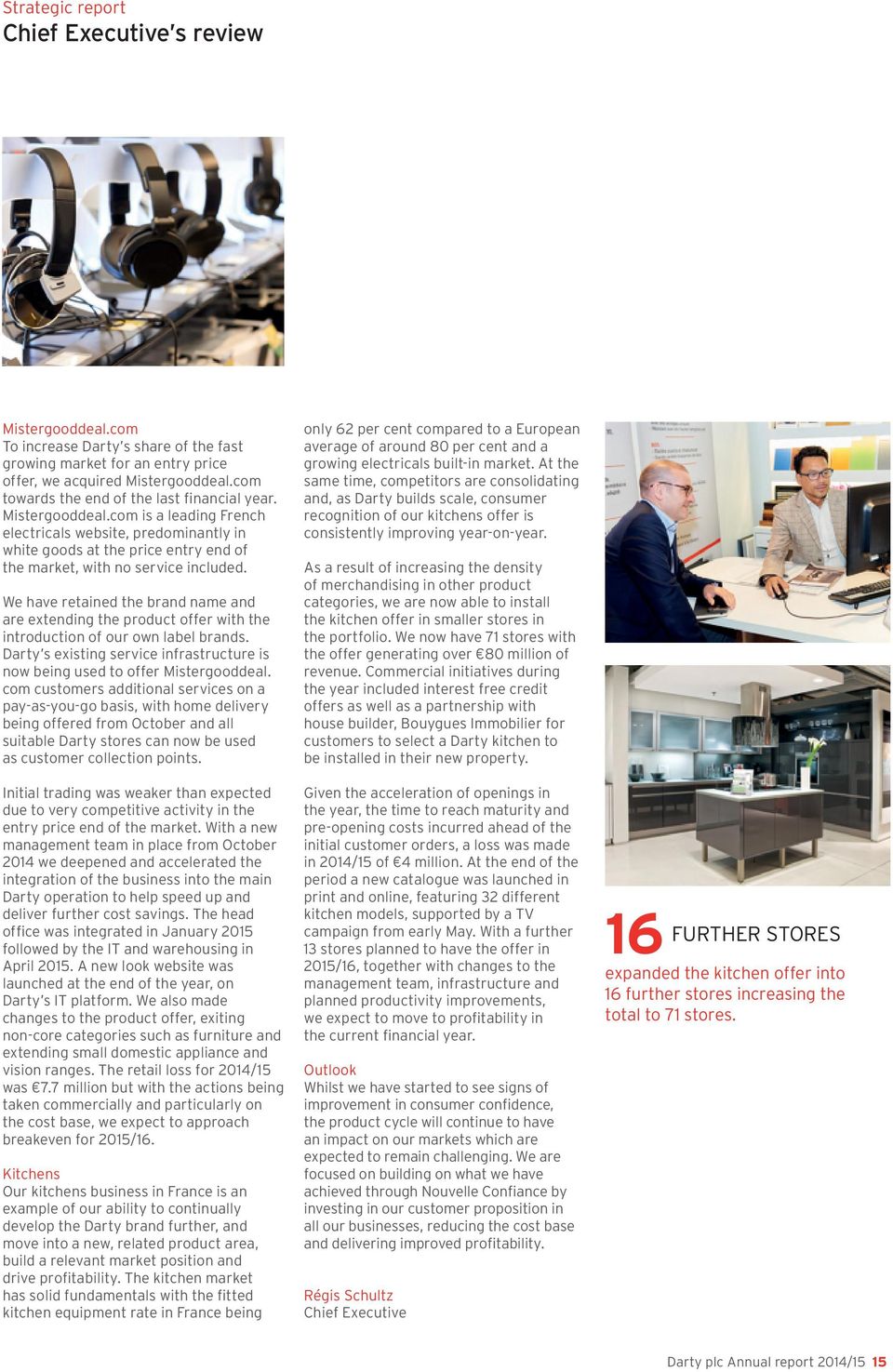
18 We now have 75 stores in the BCC chain and have become a leading multi-channel electrical retailer in the market. Expansion in the Netherlands Our business in the Netherlands, BCC, has seen much better results recently and we have driven this further forward with the acquisition of 18 profitable stores from a competitor. All these stores geographically complement the existing portfolio. They have already been refitted and branded as BCC and are leveraging the existing store and after-sales service support infrastructure in the Netherlands. 16 Darty plc Annual report /15

19 Strategic report Operating review 18 NEW STORES We acquired 18 profitable stores in the Netherlands making us the leading multi-channel retailer in that market. France Total revenue was up 3.5 per cent including Mistergooddeal.com and the franchise business and the Darty brand again outperformed the market for the period. Like-for-like sales fell 2.0 per cent with trading up against strong comparatives from the prior year (like-for-like sales up 2.8 per cent), particularly in the second half. We saw continued strong growth in communications and white goods were also positive. The rate of decline in vision slowed significantly, with growth in May and June reflecting a successful football World Cup campaign with strong sales of new technologies (OLED and Ultra HD) and large screen sizes. We saw a fall in multimedia due to declining volumes and average selling prices for tablets and a poor digital camera market. Overall web-generated sales continued to grow, albeit in a slower market, to over 15 per cent of total product sales, and to over 17 per cent including Mistergooddeal.com. Click and collect at Darty.com was increasingly popular with customers, rising over 40 per cent to 20 per cent of web sales. Underlying gross margin was down around 90 basis points reflecting competitive French market conditions not fully offset by an improving product mix. Overall gross margin for France was down around 180 basis points after taking account of the lower margin franchise and Mistergooddeal.com operations which had an impact on gross margin of 70 and 20 basis points, respectively. Underlying total costs (excluding Mistergooddeal.com) reduced by 25 million, 3 per cent, reflecting the benefit of the cost programme implemented last year. Total costs were broadly flat. Retail profit was 70.0 million compared to 87.2 million in the prior year. This included 7.7 million (: 0.9 million) retail loss for Mistergooddeal.com, a loss of around 4 million for the kitchen business, and a break-even performance from the franchise operation. During the period five stores were opened, six closed, five relocated, three extended and three rightsized or refurbished. We also opened 39 franchise stores and added the kitchen offer to 16 additional stores. Plans for /16 are for six relocations, five refurbishments and four rightsizings. We expect to open around 25 more franchise stores and introduce the kitchen offer to a further 13 stores. Belgium and the Netherlands At Vanden Borre in Belgium and BCC in the Netherlands overall revenue was up 1.7 per cent, and down 0.3 per cent on a like-for-like basis. Web-generated sales continued to grow strongly, up over 20 per cent, to over 13 per cent of total product sales, with Click and collect sales up 10 per cent to over 27 per cent of web sales. With a new local management team in place, BCC saw a continued improvement in performance, first seen at the end of last year. We saw positive like-for-like sales in store and particularly on the web, market share gains in all major product categories and an improved gross margin. The acquisition of 18 profitable stores from a competitor completed in February, with the majority of stores converted to BCC by the year end. The acquired stores accounted for 8.0 million revenue in /15 and are expected to contribute around 45 million revenue in /16. Earlier in the period Vanden Borre focused trading on margin in a more promotional market with, inevitably, some impact on revenue against a strong performance last year. The like-for-like sales trend improved in the second half of the year and web sales saw strong growth following the introduction of next and same day delivery. Overall gross margin saw a small improvement of 20 basis points, with total costs flat. Retail profit improved to 14.8 million compared to 9.3 million in the prior year with a strong reduction in losses at BCC, even after incurring some acquired stores integration costs, and a further growth in profits at Vanden Borre. Excluding the acquired stores there was one store closure at BCC and one new store opening at Vanden Borre. For /16 we plan to close one store at BCC and open one at Vanden Borre. Darty plc Annual report /15 17
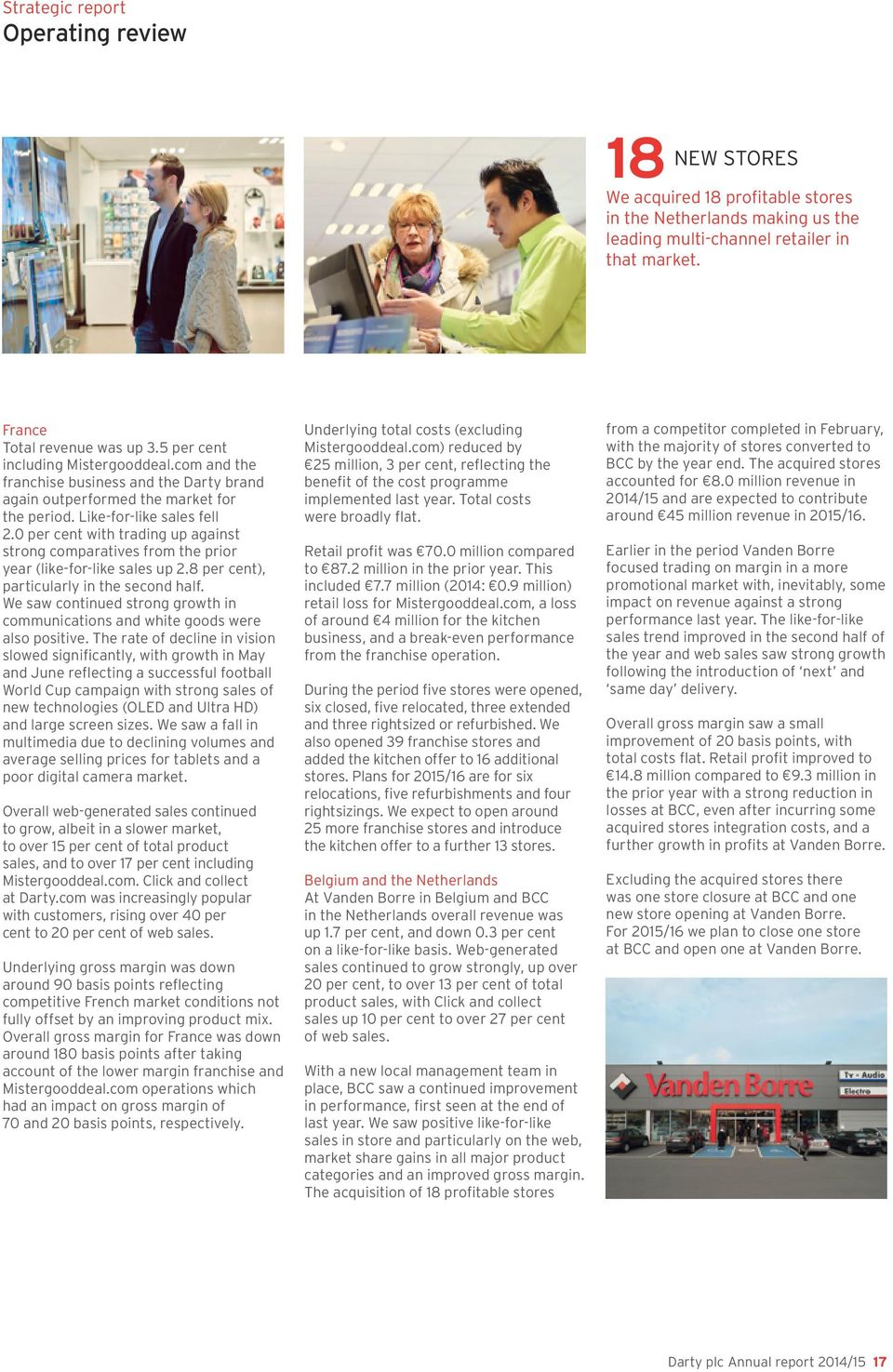
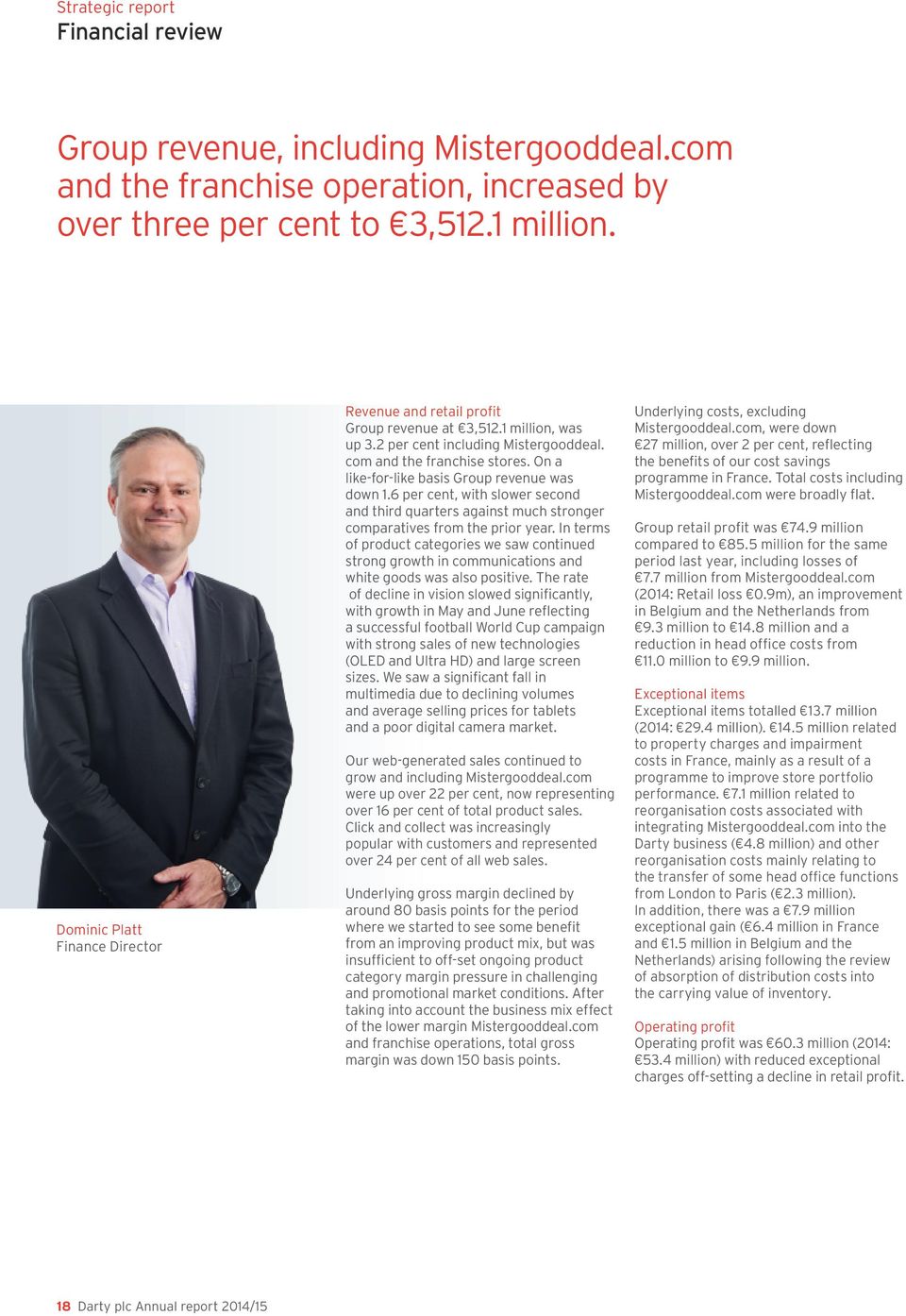
20 Strategic report Financial review Group revenue, including Mistergooddeal.com and the franchise operation, increased by over three per cent to 3,512.1 million. Dominic Platt Finance Director Revenue and retail profit Group revenue at 3,512.1 million, was up 3.2 per cent including Mistergooddeal. com and the franchise stores. On a like-for-like basis Group revenue was down 1.6 per cent, with slower second and third quarters against much stronger comparatives from the prior year. In terms of product categories we saw continued strong growth in communications and white goods was also positive. The rate of decline in vision slowed significantly, with growth in May and June reflecting a successful football World Cup campaign with strong sales of new technologies (OLED and Ultra HD) and large screen sizes. We saw a significant fall in multimedia due to declining volumes and average selling prices for tablets and a poor digital camera market. Our web-generated sales continued to grow and including Mistergooddeal.com were up over 22 per cent, now representing over 16 per cent of total product sales. Click and collect was increasingly popular with customers and represented over 24 per cent of all web sales. Underlying gross margin declined by around 80 basis points for the period where we started to see some benefit from an improving product mix, but was insufficient to off-set ongoing product category margin pressure in challenging and promotional market conditions. After taking into account the business mix effect of the lower margin Mistergooddeal.com and franchise operations, total gross margin was down 150 basis points. Underlying costs, excluding Mistergooddeal.com, were down 27 million, over 2 per cent, reflecting the benefits of our cost savings programme in France. Total costs including Mistergooddeal.com were broadly flat. Group retail profit was 74.9 million compared to 85.5 million for the same period last year, including losses of 7.7 million from Mistergooddeal.com (: Retail loss 0.9m), an improvement in Belgium and the Netherlands from 9.3 million to 14.8 million and a reduction in head office costs from 11.0 million to 9.9 million. Exceptional items Exceptional items totalled 13.7 million (: 29.4 million) million related to property charges and impairment costs in France, mainly as a result of a programme to improve store portfolio performance. 7.1 million related to reorganisation costs associated with integrating Mistergooddeal.com into the Darty business ( 4.8 million) and other reorganisation costs mainly relating to the transfer of some head office functions from London to Paris ( 2.3 million). In addition, there was a 7.9 million exceptional gain ( 6.4 million in France and 1.5 million in Belgium and the Netherlands) arising following the review of absorption of distribution costs into the carrying value of inventory. Operating profit Operating profit was 60.3 million (: 53.4 million) with reduced exceptional charges off-setting a decline in retail profit. 18 Darty plc Annual report /15
21 Net finance costs The net finance costs were 23.6 million (: 13.4 million) excluding IAS 19 pension interest of 3.8 million (: 2.6 million). The net finance cost increase reflects the full year impact of the refinancing of the Group in February. Adjusted profit before tax The adjusted profit before tax was 51.3 million (: 72.1 million). Taxation The effective tax rate for the Continuing Group on adjusted profit before exceptional items, including the share of joint venture and associates tax was 23.2 per cent (: 44.4 per cent) and including the CVAE reclassification of 10.7 million (: 11.1 million) from operating profit to taxation was 39.3 per cent (: 52.6 per cent). The decrease in tax rate from is due primarily to lower French group profits which being taxed at a higher rate than the group tax rate has a beneficial impact on the group tax rate. This impact is partially offset by an improved performance in the Netherlands where tax credits are not currently recognised on losses. The Company has received a demand from the French Tax Authority, claiming up to 15.3 million in unpaid taxes and penalties relating to the Group s holding company structure. Extensive professional advice has been obtained and the Company believes it has a very strong defence and much of the claim is without merit. A provision has been made based on our best estimate of the expected outcome. Based on a total charge of 18.7 million (: 27.4 million) the total tax rate is 55.3 per cent (: 71.7 per cent) on unadjusted profits, reflecting that tax relief is not recognised on all exceptional and other non-retail profit items. The effective tax rate for the continuing Group on adjusted profit before exceptional items, including the share of joint venture and associates tax is expected to be mid 30s per cent in /16 including the CVAE charge of around 11 million. Profit for the period The profit for the period from continuing operations increased to 15.1 million (: 10.8 million). Loss for the period from discontinued operations reduced to 1.3 million (: loss 17.4 million). Total profit for the period increased to 13.8 million (: loss 6.6 million). Earnings per share Adjusted earnings per share, excluding the IAS 19 net interest on pension schemes, was 5.8 cents (: 6.5 cents). Continuing basic and diluted earnings per share was 2.9 cents (: 2.1 cents). Cash flow Cash generated from operations was 60.7 million (: 18.4 million) principally as a result of a reduction in cash outflows related to discontinued operations. Net capital expenditure was 36.8 million (: 32.2 million), reflecting lower proceeds from property disposals of 13.9 million (: 29.7 million). Proceeds from the sale of operations relating to the sale of Darty Turkey and Datart was 10.1 million. Cash costs of acquisitions mainly for stores at BCC in the Netherlands was 9.8 million. Interest paid was 22.9 million (: 21.4 million) and tax paid was 21.2 million (: 9.9 million) reflecting phasing of payments in France. The dividend payment remained unchanged at 3.5 cents per share, but the strengthening of sterling against the euro for shareholders electing a sterling dividend payment increased the cash payment to 18.4 million (: 18.0 million). Net cash outflow from continuing operations was 30.9 million (: net cash inflow 18.0 million). Net cash outflow from the discontinued operations was 5.6 million (: 57.5 million). Total net cash outflow was 36.5 million (: 39.5 million). Net debt Closing net debt was million compared to million on 30 April. As at 30 April, 57 million was drawn under the Group s committed facilities (30 April : 20 million) in addition to the Group s 250 million High Yield Bond. Retirement benefit obligations The IAS 19 net pension liability was million (: million), split 38.2 million (: 60.1 million) in the UK and 65.2 million (: 44.5 million) in France. The movement in the UK net liability benefitted from the performance of the assets outstripping liabilities. The deficit of the UK scheme in sterling was 27.9 million. The increase in the net liability in the French schemes mainly reflects a fall in corporate bond yields. The cash cost of the UK scheme was 12.9 million and the French scheme was 0.9 million. Balance sheet Following the disposal and closure of discontinued operations from 2012 onwards including Comet, Darty Italy, Darty Spain and Darty Turkey and exceptional items from recent restructuring, we have reported net liabilities. At 30 April net liabilities totalled million (: million). Under our accounting policies, freehold property is carried at cost. Our freehold property portfolio in France, representing in the main around one third of the store portfolio, has a carrying value of 102 million, compared with a market valuation of approximately 350 million. In addition we carry no internally generated goodwill for our market leading brands. Dividends The Board is recommending an unchanged final dividend of cents per share. The ex-dividend date will be 22 October, the record date will be 23 October and the payment date will be 13 November. Financial presentation Datart has been reclassified as a discontinued operation following the signature of a sale and purchase agreement with SEW-1001 a.s. to sell the Group s 60 per cent shareholding on 22 July. The prior year comparatives have been restated accordingly. Two accounting treatments are possible for the business tax, CVAE (Cotisation sur la Valeur Ajoutée des Entreprises) either as an operating expense or as income tax. In line with the treatment adopted by French retail listed peers the decision has been taken to reclassify from an operational expense in the retail profit of the France reported segment, to income tax. CVAE was 10.7 million for the year ended 30 April (: 11.1 million). In addition, having reviewed possible treatments under IAS19 Revised, retirement benefit scheme expenses of 1.3 million (: 1.4 million) relating to the legacy UK pension scheme have been reclassified from finance costs to operating profit in line with most common practice. These costs have been reclassified as an operating cost, outside of retail profit, as they relate to Comet, a discontinued business. Darty plc Annual report /15 19
22 Strategic report Financial review Key performance indicators Definition/source Sales: Total revenue growth Like-for-like sales growth Like-for-like sales are calculated based on stores that have been open for a full year and the first full four weeks of trading have passed. Stores where retail space has been added or where a complete format redesign (including addition of a mezzanine floor) has taken place, which involves material capital expenditure are excluded from like-for-like sales calculations. Sales through internet sites are included. Internet sales growth Percentage increase in web-generated sales. Multi-channel sales Web-generated sales as a percentage of total product sales. Performance : 3.2% : (1.6)% : 22.2% : 16.1% : 0.8% 1 : 1.9% 1 : 12.2% 1 : 14.3% 1 Profitability: Retail profit Retail profit represents continuing Group total operating profit before the share of joint venture and associates interest and taxation, movement in options and related charges over non- controlling interests, impairment of available-for-sale financial assets, exceptional costs and amortisation and impairment of acquisition related intangible assets. Retail profit margin Retail profit as a percentage of total revenue. Adjusted earnings per share Excludes the effects of movement in options and related charges over non-controlling interests, realised losses on available-for-sale financial assets, exceptional costs, exceptional finance costs, tax effects of exceptional items, discontinued operations and amortisation of acquisition related intangible assets. Cash flow: Free retail cash flow Free cash flow is defined as cash generated from operations and net sale of business operations and subsidiary less net capital expenditure and investments. : 74.9m : 85.5m 1 : 2.1% : 2.5% 1 : 5.8 cents : 6.5 cents 1 : 25.6m : ( 1.2)m Non-financial: Market share Share of the total electricals market in each country (source: GfK). Franchise stores Number of Darty franchise stores. Kitchens Number of Darty stores with a kitchen offer. France : 14.3% : 14.7% : 4 : 43 : 55 : 71 Belgium : 10.5% : 10.0% Netherlands : 5.2% : 5.6% 1 Restated following the sale of Datart, now classified as discontinued operations, the CVAE reclassification from operating profit to taxation and the legacy UK retirement benefit scheme expenses from finance costs to operating profit. The Group manages its performance using these key performance indicators in place at a Group and business level. Prior year KPIs have been restated for the new continuing Group to ensure like-for-like comparison. The Group also has a set of non-financial KPIs; details of these are set out in the Corporate responsibility report on pages 23 to 27. Dominic Platt Finance Director 20 Darty plc Annual report /15
23 Strategic report Principal risks The taking of risk is an inherent part of doing business and the skill in business is to manage risk effectively. The Board and senior management have invested time to identify and assess the key risks facing the business and actively manages those risks. Risk management is performed from both a top-down and a bottom-up perspective, ensuring that strategic and operational risks are appropriately addressed. The principal risks and uncertainties to delivering our strategy are set out below together with an illustration of what actions are being taken to mitigate the effect of those risks on the business and its customers. Risk Actions taken Actions to be taken Legislative and regulatory risks The Group s operations are subject to extensive regulatory requirements, particularly in relation to its buying and selling products and after-sales services, its advertising, marketing and sales practices, its employment and pensions policies and planning and environmental issues. Changes in laws and regulations and their enforcement may adversely impact the Group s operations in terms of costs, changes to business practices, and restrictions on activities. The Group s businesses may also be adversely affected by changes in tax laws and increasing reviews by tax authorities of corporate tax plans. Potential changes to legislation and regulatory requirements are monitored with the help of external advisers, and the business model and processes have been adapted to seek to minimise the impact of these changes. Have sought to ensure governmental and regulatory bodies understand the impact of current and proposed legislation on both the business and its customers. Implemented packages for our customers, providing them with a wider range of services, not only repair services but also assistance in usage such as our Pack Serenity multimedia assistance service and Le Bouton. Briefing sessions for key executives on the likely impact of legislative and regulatory change so there is sufficient time to develop action plans to mitigate any adverse effects. Continue to ensure legislators and regulators are aware of the potential impact of their policies. Further development of additional service packages for our customers. Economic environment The economic environment can influence the level of consumer expenditure on electrical goods in a number of ways. It can also affect the level of promotional activity in the market, which impacts prices and margins. Other economic factors that may adversely affect sales include interest rates, government economic policy and levels of personal debt. Deteriorating market conditions could adversely impact profitability and cash generation, and delay the delivery of growth in our core businesses. Organisational and business change There are a large number of initiatives across the Group following implementation of the strategic review that could disrupt the business. The implementation of all of the initiatives may be delayed or hindered by a complex regulatory environment, social unrest and project management issues. The implementation of the 4Ds strategy has improved store footfall. Launched initiatives such as Darty Days, Les Immediats and digital stores to improve trading. Offset some of the adverse effects by trading across a number of categories, as well as by further introducing new channels such as franchising. Acquired Mistergooddeal.com to help address the increased demand for lower quartile products. By taking corporate action, the losses incurred in Italy, Spain, Turkey and the Czech Republic and Slovakia have been eliminated. Losses in the Netherlands have been reduced. Completed a refinancing of the Group s debt facilities to secure long-term funding to support our future growth plans. Continued to explore ways to improve our cash generation. Implemented improved change and project management processes. Ongoing dialogue with employees and unions. Continued roll-out of the 4Ds strategy. Review of the store portfolio with a view to relocating poorly located stores. Continued roll-out of the franchising initiative. Further integration of Mistergooddeal. com into Darty France. Seek solutions to ensure all businesses are more profitable. Improve prioritising of initiatives. Improved internal communications. Darty plc Annual report /15 21
24 Strategic report Principal risks Risk Actions taken Actions to be taken Information technology A number of IT projects are planned to replace large legacy applications built for individual operating companies. If not properly planned and implemented, there could be significant interruption to the business and additional costs could arise. IT Project Committee established. Plan put in place to prioritise removal of old applications. Tested recovery plans across our business. Enhance change management to prepare staff and processes for organisation and systems changes. Plans to improve emergency and disaster recovery plans. The reliance on IT systems means the business can be severely adversely impacted if they fail. The increased use of online payments and credit card payments has increased the risk of the loss of personal data. Profit and cash The level of profit margin in electrical retailing is significantly less than that of many other retailers and is largely determined by the market, consumer demand, manufacturer supply, competition and government regulations. Industry practice has heightened the focus on supplier relationships and potential impact on financial reporting. Reputational risks The Group s success is dependent, in part, upon the strength of the Group s brands and their reputation. The Group operates in an industry where integrity, customer trust and confidence are important and any adverse publicity concerning corporate behaviour, policies and strategies could damage that customer trust and damage the Group s reputation and brands. Pension scheme liabilities Following the sale of Comet, the UK defined benefit scheme for Comet employees was retained by the Group. There is a smaller defined benefit scheme in France for senior Darty employees. Both schemes are currently in deficit. These deficits are volatile as a result of changes in the assumptions regarding life expectancy, discount rates (based on gilt yields and company covenant), inflation and future salary increases, risks regarding the value of investments and the returns derived from such investments. Adverse movements in these assumptions could increase the deficit, increasing the funding requirement to the schemes from the Group. Reviewed robustness of current protections for customer personal data. Protected margins, as far as possible, through buying arrangements and by maintaining an efficient sourcing operation. Reviews have been made regarding revenue recognition and collectability of supplier rebates. Cost structures have been actively managed in order to mitigate the impact of product margin erosion and increased improvement in working capital management. A number of internal controls and processes have been put in place to try to limit the number and harmful effect of such incidents. A number of deficit mitigation measures have been undertaken, and will be taken in the future, to reduce both the size of the deficit and its volatility. Triennial valuation agreed in the UK. Continued monitoring and where necessary, altering systems and protections to meet changing threats. Continued development of additional OEM, exclusive and licensed products. Take legal action to protect our position where necessary. Cost mitigation plans will continue to be implemented and focus on working capital management. Regular reviews of the likely threats to reputation, together with monitoring of the media, including social media. Continue to examine strategies and additional opportunities to mitigate the deficit in both the UK and France. 22 Darty plc Annual report /15
25 Strategic report Corporate responsibility As a specialist electrical retailer Darty is well placed to manage an effective approach to corporate responsibility (CR) that is compatible with profitable growth and enhances brand equity. It has long been our belief that good CR practice makes sound financial sense. However, a one size fits all approach is not appropriate because of the different sizes of our businesses. Therefore the majority of our activities are locally driven, reflecting customer demands and market sensitivities. However, there is a CR team comprising senior managers from each of the businesses. Chaired by the Company Secretary, the team meets to share best practices and develop practical performance measures that can be adopted across the Group. Our initiatives fall into four key areas: Environment Improving the Group s use of energy, the impact of our transport fleet and our use of bulk materials such as paper and packaging, by minimising waste, increasing energy efficiency and reducing our consumption of materials. Supply chain Improving labour, environmental and social practices in the Group s supply chain as well as ensuring that our suppliers and business partners are made aware of our requirements and take all reasonable steps to ensure they are met. People Providing a working environment that is conducive to the recruitment and retention of the widest possible range of talented staff; and offering them a safe and healthy place of work we aim to be recognised as a good employer seeking to reward people fairly and to provide equality of opportunity, personal development and training. Communities Working for our customers and local communities, contributing to community activities in the areas we serve; and supporting and encouraging staff fundraising for appropriate charitable organisations. Environment As an electrical retailer we have a relatively low direct environmental impact, but we still seek to minimise the environmental impact of all our operations throughout the Group. We also want to ensure that neither our products nor our operations adversely affect the health of our customers, our employees or the community at large. As one of Europe s market leaders in large white goods, we specialise in offering our customers specific advice on the energy efficiency of our ranges. This enables them to make informed buying decisions in terms of power and water consumption. We also offer practical advice in-store and on the web on how to use the products in the most efficient way and we help dispose of them at the end of their lives. This programme is tailored to each of our markets and is currently in its most advanced stages of implementation at Darty in France and has been, in part, adopted across all the Group. We were one of the first retailers to test the energy efficiency of all televisions, DVD players and computers that we sell and then promote the better performing products. Darty France has a dedicated section on its website, Darty.com, on environmental matters. Since September 2012, practical advice is given to customers to help them calculate their energy and water consumption on over 1,000 products including refrigerators, washing machines, dishwashers and TVs. This was extended to tumble dryers and wine coolers during This financial year, Darty France launched a simulator for energy savings accessible on the Darty.com site to allow customers to estimate the energy consumption of their devices and evaluate the savings if they opt for their replacement. A major Group strength, with our significant home delivery network, is our ability to facilitate the recycling of large white goods, helped by our efficient reverse logistics capability. The ongoing rapid development of new technology creates increasing high levels of hazardous electronic and electrical waste, which is the background for the WEEE Directive. Its aim is to minimise the impact of electrical and electronic equipment on the environment when those products eventually become waste. In order to sell products within the EU manufacturers must demonstrate compliance with the regulations. This means that electrical retailers must offer take back facilities to cover all categories including smaller appliances such as kettles and microwaves. The newer A++ brands use up to 44 per cent less energy than products sold 10 years ago. While hand washing the dishes can use up to 50 litres of water, a modern dishwasher uses just 13 litres, and some models use just six litres. Darty France offers to take away two items for recycling free of charge if it makes a home delivery for large white goods. The collected items are sorted in 72 collection sites where they are dismantled. In the 12 months to December, Darty France collected 40,675 tonnes of product for recycling, the equivalent of over 1.19 million appliances. These were recycled into 21,182 tonnes of scrap metal, 6,130 tonnes of plastic and 3,100 tonnes of glass and similar items and saved 26,405 tonnes of CO 2 emissions, and achieved a similar performance in Darty plc Annual report /15 23
26 Strategic report Corporate responsibility All the stores in Darty France have dedicated recycling bins with separate compartments for mobile phones, small appliances, batteries, and ink cartridges. Darty France also collected 18 tonnes of batteries, and 6 tonnes of ink cartridges. With the 1 for 0 scheme, Darty France collects all materials, with or without purchase from its stores or website. Vanden Borre in Belgium recycles 55 per cent of the products it collects when making a home delivery. BCC received an eco-certificate for its sustainability performance in the field of waste management, reducing the impact of its waste on the environment by 46 per cent by reducing and separating waste. We believe that together this makes us one of the leading recyclers of MDA products in Europe; it sets us apart from many pure web players in particular. We also aim to reduce the amount of packaging we use and ensure that it can be recycled. We collect all waste packaging when delivering a household appliance unless the customer requests otherwise. At Darty France, Vanden Borre and BCC we have specialised equipment that compresses all polystyrene packaging collected from customers homes for recycling or reuse as garden furniture. At most of our operating companies, packaging waste is also collected from the warehouses and after-sales service centres; annually we recycle over 40,000 tonnes of packaging waste. We report our emissions data using an operational control approach to define our organisational boundary, which meets the definitional requirements of the regulations in respect of those emissions for which we are responsible. We have reported on all material emission sources that we deem ourselves to be responsible for. These sources align with our operational control and financial control boundaries. We do not have responsibility for any emission sources that are beyond the boundary of our operational control. For example, business travel, other than by car (including commercial flights), are not within our operational control and therefore are not considered our responsibility. Supply chain Our customers expect us to have procedures in place to ensure that the products we sell have been ethically produced and handled from the beginning right through to the end of the supply chain. Many of our electrical products are sourced through major international brands who have their own strong ethical and environmental policies in place. We do not have significant operations or retail outlets in countries that present a material risk from bribery or corruption, poor labour standards or restrict civil or political rights. However, some of our suppliers do. There has been continued external attention and debate on the role of business and human rights. We welcome this focus as respect, fairness and integrity are an important part of the responsible way we run our business. We are committed to doing things the right way and this is reflected in our values and our Code of Conduct, which is available on our website. A respect for human rights is implicit in our employment practices and are within the high standards we expect from our suppliers. We continue to be guided by the International Labour Organization (ILO) core conventions and the recommendation of Professor John Ruggie, the UN Special Representative for human rights. In some areas, such as the elimination of child labour, our direct influence can be limited and in these situations our focus on partnerships is of critical importance. We also work with our suppliers to help them reduce their impact on the environment and to manage the challenges of sustainable growth. The Group sources its own-label products principally from factories based in China that are committed to improving workers welfare and reducing environmental impact. Our audit procedures are benchmarked against leading international test houses, and are designed to ensure proper environmental standards are adhered to by our own-label suppliers in our factories and additionally to monitor the quality of our products. We have an experienced quality team based in China with expertise in quality assurance to support our own branded products. In, we carried out new qualification audits as well as two yearly surveillance audits on the 195 factories we use in South-East Asia. This is to ensure that our suppliers meet the strict social, environmental and supply chain standards we require. In, a total of 100 audits were undertaken. In addition, the team carried out over 4,000 Final Random inspections. Before shipment of any OEM product is allowed, the quality assurance team evaluates the product with comprehensive CE certification from approved European Notified Bodies. Any supplier who fails to meet our quality standards is delisted. In, a new programme was launched, to provide regular checking on the soon-to-be effective safety standards for our product range. This programme allows Darty to be at the leading edge in managing the impact in advance of any new changes related to compliance and testing concerns. In addition, as a further environmental measure we are consciously trying to minimise the emissions from our transport operations. We continue to modify our logistics operation to achieve a more efficient use of the transport fleet and make use of satellite navigation systems to improve their delivery schedules. This not only reduces the distance the vans and lorries travel but also provides our customers with more predictable arrival times. The Group is constantly exploring new initiatives that make good CR sense while benefiting the businesses. At Darty France we have a programme of enhanced driver training, with the aim of reducing fuel consumption and CO 2 emissions by some 15 per cent. Further savings have come from the introduction of new delivery vehicles with Euro 5 engines and Stop and Start technology. Increased use of call centres and development of a database on repairs that provides first level resolution has led to less vehicle journeys to customers homes, not only improving our customer service, but also reducing our CO 2 emissions. 24 Darty plc Annual report /15
27 Table 1. Global GHG emissions data for Reporting Year 1st January 31 December Emissions from: Tonnes of CO 2 e Combustion of fuel & operation of facilities (Scope 1) 19,526 Electricity, heat, steam and cooling purchased for own use (Scope 2) 18,079 T&D losses from electricity (Scope 3) 1,130 Total 38,735 Intensity metric: tonnes CO 2 e / Million EUR revenue () Table 2. Year on Year Comparison Methodology We have reported on all of the emission sources required under the Companies Act 2006 (Strategic Report and Directors Reports) Regulations These sources fall within our consolidated financial statement. We do not have responsibility for any emission sources that are not included in our consolidated statement. The method we have used to calculate GHG emissions is the GHG Protocol Corporate Accounting and Reporting Standard (revised edition), together with the latest emission factors from recognised public sources including, but not limited to, Defra, the International Energy Agency, the US Energy Information Administration, the US Environmental Protection Agency and the Intergovernmental panel on Climate Change. Tonnes ofco 2 e Percentage Emissions from: 2013* change (%) Scope 1 21,535 19,526-9% Scope 2 20,775 18,079-13% Scope 3 1,156 1, % Total 43,466 38,735-11% Intensity metric: tonnes CO 2 e / Million EUR revenue () % * 2013 emissions have been re-stated in light of more accurate consumption data. People As a specialist retailer committed to the best customer service, one of our key differentiators and strengths is our people. We have over 12,600 employees across Europe and Asia and we want them all to have satisfying and rewarding careers within the Group. By respecting and valuing our employees we engage their talents and abilities to the fullest extent. We also realise that a well-trained workforce is a key differentiator and we therefore put great emphasis on our training programmes to improve store staff product knowledge. Darty France has online modules for staff training and is looking to expand them further to cover home delivery and after-sales service. A programme to refurbish staff break rooms and ensure there is access to a PC for training and personal use has been completed in France. We now have platforms across the whole Group for our employees opinions to be heard and we value their input on how the business is being run. The first ever employee survey for all the companies in the Group was undertaken in 2012 and all our employees now regularly participate in an employee survey. Our communication channels include regular workers councils where issues are discussed with representatives from across the organisation. We also have many other forums for discussion that allow management to take a wide range of viewpoints into account. We promote the health, safety and welfare of both colleagues and customers across all our sites and we monitor and report to our Director of Risk Management and Audit on these issues. We have established a written set of Operating Principles and a Code of Conduct that outlines the ethical Male Female Company directors* 8 2 Other senior managers** 4 1 All employees*** 6,988 3,475 standards we expect from all employees of companies within the Group. This includes both permanent and contract staff and any external consultants or suppliers we retain. Diversity The table below provides a breakdown of the gender of Directors and employees as at 30 April. Our people are instrumental to our success; we respect and value the individuality and diversity that every employee brings to the business. We base our relationship with our employees on respect for the dignity of the individual and seek to create a positive, open working environment wherever we operate. As at 30 April, 67 per cent of our workforce were male and 33 per cent female. In terms of the Group s Board of Directors, there were 10 Directors, eight of whom were male and two were female (see page 29 to view biographies of the members of the Board). * Company directors consists of the Company s Board, as detailed on pages 28 and 29. ** Other senior managers is as defined in The Companies Act 2006 (Strategic Report and Directors Report) Regulations 2013, and includes: i) persons responsible in France for planning, directing or controlling the activities of the Company, or a strategically significant part of the Company, other than Company directors; and ii) any other Directors of under- takings included in the consolidated accounts. *** In France. Darty plc Annual report /15 25
28 As an electrical retailer, we have a relatively low direct environmental impact but we still seek to minimise the environmental impact of all our operations throughout the Group. Reducing environmental impact At Darty France, Vanden Borre and BCC we have specialised equipment that compresses all polystyrene packaging collected from customers homes for recycling or re-use as garden furniture. Waste is also collected from the warehouses and after-sales service centres; annually we recycle over 40,000 tonnes of packaging waste. 26 Darty plc Annual report /15
29 Strategic report Corporate responsibility 6,000 TRAINED Through the ENVIE programme over 6,000 previously long-term unemployed have been trained in the repair of electrical products. A B C D E F G Continuing Group 12 months to 30 April 12 months to 30 April 12 months to 30 April 2013 Staff training days 25,035 24,420 27,892 Accidents/injuries 1, ,167 A-rated products sold 98.4% 98.2% 96.2% Package waste recycled (tonnes) 43,908 42,932 42,913 Communities As a Group, we are committed to working with the many communities we are represented in. We work in partnership with outside organisations to address a number of long-standing social issues and we support a range of different charities on a regional basis. Darty France has a long-standing reputation for helping the disadvantaged. Through the ENVIE programme (Enterprise Nouvelle Versl Insertion par L Economie) over 6,000 previously long-term unemployed have been trained in the repair of electrical products. During a two-year programme, trainees practise on end-of-life products collected from customers. Once repaired, these are then sold from ENVIE stores at heavily discounted prices. Darty France annually donates 60,000 to Telemaque, which promotes access to jobs for less advantaged youths, and encourages Darty employers to become tutors. Vanden Borre and Darty France raise funds for charities through the sale of toy models of their after-sales service vans. Performance criteria 1 The number of days spent on staff training As a specialist electrical retailer, it is important that we create a working environment that is conducive to the recruitment and retention of talented staff who have excellent customer service skills and product knowledge. 2 The number of accidents or injuries to staff The provision of a safe and healthy place of work for our staff is a primary concern and key responsibility. 3 The percentage of energy efficient A-rated products sold Energy label ratings on fridge freezers help our customers choose more efficient models. A-rated products use the least amount of energy thereby benefiting both our customers and the environment. 4 The number of tonnes of packaging waste collected and recycled Through our distribution channels and warehouses we can efficiently collect our own and customers waste for recycling. By order of the Board Simon Enoch Secretary 17 June Registered office: Ely Place London EC1N 6TE Darty plc Annual report /15 27
30 Directors report Board of Directors Simon Enoch Secretary Auditors PricewaterhouseCoopers LLP Stockbrokers UBS Solicitors Slaughter and May Registered office Ely Place London EC1N 6TE Registrars and transfer office Computershare Investor Services PLC The Pavilions Bridgwater Road Bristol BS99 6ZZ Audit Committee Alison Reed (Chairman) Antoine Metzger Agnès Touraine Remuneration Committee Michel Léonard (Chairman) Alan Parker CBE Pascal Bazin Nomination Committee Alan Parker CBE (Chairman) Michel Léonard Régis Schultz Dominic Platt Alison Reed Pascal Bazin Carlo D Asaro Biondo Antoine Metzger Agnès Touraine 28 Darty plc Annual report /15
31 1. Alan Parker CBE (68) Chairman Alan Parker was appointed Non-Executive Chairman of Darty plc on 9 August 2012, having served on the Board of Kesa Electricals plc since 1 October Alan is also Non-Executive Chairman of Mothercare plc, Chairman of Park Resorts, Non Executive Director of Restaurant Brands International, President of the British Hospitality Association and Board member/investor of Winnow Solutions. Alan was Chief Executive Officer of Whitbread plc from 2004 and retired in November During his tenure as CEO he led a substantial increase in shareholder value and created the UK s largest hospitality company expanding Premier Inn in the UK and developing the global Costa coffee brand. Prior to joining Whitbread in 1992, Alan was based in Brussels and Frankfurt as Holiday Inn EMEA Managing Director. Alan has also served on the Boards of Jumeirah Group LLC, VisitBritain, and was on the Board of Burger King Worldwide prior to its merger with Tim Horton s in December forming Restaurant Brands International. 2. Régis Schultz (46) Chief Executive Régis Schultz was appointed as Chief Executive on 23 April He joined from BUT, the French furniture and electrical retailer, where he had been Chief Executive since During his time at BUT Régis led a major renewal of the product offer and store formats, delivering both market share and profit improvement in a difficult trading environment. Prior to BUT he held a number of senior positions at Kingfisher plc, including Chief Operating Officer for B&Q. He holds an MSc in Management, from the Dauphine University, Paris. 3. Albin Jacquemont (50) Finance Director (from 18 June ) Albin Jacquemont joined the Group from Carrefour in March and will be appointed as Finance Director on 18 June. He joined Carrefour in 1998 and was appointed as Chief Financial Officer for Carrefour France in November Prior to this he held a number of senior roles in Carrefour including Group Controller and Consolidation Director and Chief Financial Officer of Carrefour Poland. Prior to Carrefour he held a number of finance positions at Lyonnaise des Eaux, where he joined from auditors Arthur Andersen. 4. Dominic Platt (45) (Finance Director and Managing Director International until 18 June ) Dominic Platt was appointed Finance Director of Kesa Electricals on 4 January Between 4 January 2013 and 23 April 2013 he was acting Chief Executive. He will leave the Board on 18 June. Dominic joined Cable and Wireless in 1991 and held increasingly senior roles including Manager of Corporate Finance, CFO Japan and Asia, Group Director of Internal Audit and from 2005 Group Financial Controller. He is a Fellow of the Chartered Institute of Management Accountants and has an MA in Classics from Cambridge University. 5. Pascal Bazin (58) Non-Executive Director Pascal Bazin was appointed as a Non-Executive Director on 15 October He is a Non-Executive Director of three private companies and was most recently Chief Executive of Avis plc where he oversaw a very successful turnaround of the business. He left at the end of 2011 following the sale of the business to Avis Budget Group Inc. Previously President of Avis France, he managed the recovery of the French business, regaining its marketleading position. Prior to this he spent some 16 years at Yves Rocher in a variety of international and technology roles, and was at PPR for five years. Pascal is a Graduate of the Ecole Polytechnique, Paris. 6. Carlo D Asaro Biondo (50) Non-Executive Director Carlo D Asaro Biondo was appointed as a Non-Executive Director on 30 October He is also President Southern and Eastern Europe, Middle East and Africa Operations for Google and has previously served as Chief Executive of AOL Europe and International Managing Director of the media group, Lagardère. He is also a Non- Executive Director of Mantuan International SA. He has a Doctorate in Economics from the Universita La Sapienza in Rome. 7. Michel Léonard (64) Senior Independent Director Michel Léonard was appointed Senior Independent Director on 8 August 2012, having been a Non-Executive Director since 8 February He is also Chairman of the Remuneration Committee. Michel joined the Bongrain Group in 1985 as General Manager. He then moved on to become Chairman of the Management Board of Bongrain Europe until 2000 and then lastly in 2000 became Chairman of the Management Board of Bongrain Group until From 2003 to 2009 he was Chairman of the Lactalis Group Management Board. Michel is a graduate of HEC School of Management, Paris. 8. Antoine Metzger (61) Non-Executive Director Antoine Metzger was appointed as a Non-Executive Director on 15 October He is also a director of a non-listed company in France. He retired as Deputy Chief Executive at Vivarte, the French fashion retailer in March 2013, having previously served as Secretary General since joining in Prior to this he had various finance, planning and legal roles at Rank Xerox, and was CFO at La Redoute and Redcats. Antoine is a graduate of the HEC School of Management, Paris. 9. Alison Reed (58) Non-Executive Director Alison Reed was appointed as a Non-Executive Director on 8 February 2012 and is Chairman of the Audit Committee. Alison is a Non-Executive Director and Deputy Chairman of British Airways Plc, she is also a Non-Executive Director and Chairman of the Audit Committee at DRS Data and Research plc. Her previous experience includes 21 years with Marks & Spencer plc, ultimately as Chief Financial Officer; Chief Financial Officer of Standard Life plc with responsibility for the flotation and a Non- Executive Director of HSBC Bank plc. 10. Agnès Touraine (60) Non-Executive Director Agnès Touraine was appointed as a Non-Executive Director on 30 October She is also the President of Act III Consultants, having previously served as Chief Executive of Vivendi Universal Publishing and Games, Hachette Consumer Group after having started her career at McKinsey. She is also a Non-Executive Director of Neopost SA and Belgacom SA and is President of the Institut Français des Administrateurs. She has held Non-Executive Director positions at ITV plc, Cable and Wireless plc and Lastminute.com. Agnès Touraine has an MBA from Columbia University, a law degree from la Sorbonne University and graduated from Science Po Paris. Darty plc Annual report /15 29
32 Directors report Directors report The Directors present their Annual report together with the Group audited financial statements for the year ended 30 April. Principal activities The Group is a multi-channel electrical retailer that operates through the following operating segments: France (Darty and Mistergooddeal.com) and Belgium (Vanden Borre) and the Netherlands (BCC). The majority shareholding in the operations of Datart in Czech Republic and Slovakia was sold on 7 August and it is now treated as a discontinued operation. Business model Our business model revolves around our strategy outlined in the Strategic report on pages 5 to 7, focussing on restoring profitability and establishing the foundations for long-term success and rebuilding shareholder value for Darty, Vanden Borre and BCC. Strategic report In accordance with the new requirements introduced by The Companies Act 2006 (Strategic Report and Directors Report) Regulations 2013, which became effective on 1 October 2013, the Directors have included certain information required for disclosure in other sections of the Annual report. These sections include the Chairman s statement, Chief Executive s review, Operating review, Financial review, Corporate responsibility report, Corporate governance, Directors remuneration report and the Group financial statements and should be read in conjunction with this report and this information is, accordingly, incorporated into this report by reference. A review of the development and performance of the Group during the year, its position at the year end, and the outlook and its strategy are given in the Chairman s statement on page 3, the Chief Executive s review on pages 9 to 15, the Financial review on pages 18 to 20 and the Operating review on page 17. The Company has chosen, in accordance with the Companies Act 2006 section 414C(11), to include the disclosure of likely future developments in the Strategic report on pages 5 to 27. Information on environmental matters and disclosures relating to diversity, gender and human rights are contained in the Corporate responsibility report on pages 23 to 27. The key performance indicators ( KPIs ) and the Principal risks and uncertainties contained therein, are incorporated into this report by reference. Definitions of the KPIs and the Group s performance against them are given on page 20. The Principal risks and uncertainties are set out on pages 21 and 22. Details of the Company s policy on addressing such risks, along with information on the Darty Risk Management Framework can be found in the Corporate governance report on pages 34 to 39. Profit and dividends Group revenue was 3,512.1 million (: 3,404.4 million), with Group retail profit of 74.9 million (: 85.5 million). The profit before tax was 32.9 million (: 37.4 million). An interim dividend of cents per share was paid to the ordinary shareholders of the Company on 1 April and, on 18 June, the Directors recommended the payment of a final dividend of cents (: cents), giving a total dividend for the year of 3.5 cents (: 3.5 cents). The final dividend, once approved, will be paid to those persons on the Register of Members at the close of business on 22 October, and the payment date will be 13 November. Directors The names and biographical details of the Directors holding office at the date of this report are shown on pages 28 and 29. Particulars of Directors emoluments and their interests in the shares of the Group and its subsidiaries are shown in the Report on Directors remuneration and related matters on pages 40 to 51. There were no changes in the Directors interests in shares between the end of the financial year and 17 June. At the forthcoming Annual General Meeting and in accordance with Principle B7.1 of the UK Governance Code all of the Directors will be retiring and the following, being eligible, are offering themselves for re-election: Alan Parker Régis Schultz Pascal Bazin Carlo D Asaro Biondo Michel Léonard Antoine Metzger Alison Reed Agnès Touraine Details of the terms of appointment of all the Directors can be found in the Report on Directors remuneration and related matters on pages 40 to 51. The Board strongly supports their re-election and recommends that shareholders vote in favour of the resolutions proposing their re-election. Details of all the Executive Directors service contracts are set out in the Report on Directors remuneration and related matters on pages 40 to 51. None of the Non-Executive Directors has a service contract. 30 Darty plc Annual report /15
33 Throughout the financial year, the Group has maintained liability insurance for its Directors and Officers against the costs of defending themselves in civil proceedings taken against them in that capacity and in respect of damages resulting from the unsuccessful defence of any proceedings. To the extent permitted by UK law, the Group has also provided an indemnity for its Directors and Officers. Neither the insurance nor the indemnity provides any cover where the Director has acted fraudulently or dishonestly. Share capital and control At 30 April there were 529,553,216 ordinary shares of 30 cents each in issue together with rights under the Group s Long Term Incentive Plans for 7,650,326 ordinary shares of 30 cents. It is intended to satisfy these rights through market purchase, rather than issuing new shares. Further details of the share capital are given in note 27 to the financial statements. Holders of ordinary shares are entitled to attend and speak at general meetings of the Company, to appoint one or more proxies and, if they are corporations, corporate representatives to attend general meetings and to exercise voting rights. Holders of ordinary shares may receive a dividend and on liquidation may share in the assets of the Company. Holders of ordinary shares are entitled to receive the Company s Annual report and accounts. Subject to meeting certain thresholds, holders of ordinary shares may requisition a general meeting of the Company or the proposal of resolutions at Annual General Meetings. Voting rights On a show of hands at a general meeting of the Company, every holder of ordinary shares present in person or by proxy and entitled to vote has one vote and on a poll every member present in person or by proxy and entitled to vote has one vote for every ordinary share held. None of the ordinary shares carries any special rights with regard to control of the Company. Electronic and paper proxy appointments and voting instructions must be received by the Group s registrars not later than (i) 48 hours before a meeting or adjourned meeting, or (ii) 24 hours before a poll is taken, if the poll is not taken on the same day as the meeting or adjourned meeting. Restrictions on transfer of shares There are some restrictions on the transfer of shares in the Company, which may from time to time be imposed by laws and regulations (for example insider trading laws). Pursuant to the Group s Code of Conduct, the Directors and senior executives of the Group require approval to deal in the Company s shares. Furthermore, where a person with at least a 0.25 per cent interest in a class of shares has been served with a disclosure notice and has failed to provide the Company with information concerning interests in those shares, the Articles of Association ( the Articles ) provide that the Company may refuse to register a transfer of those shares. The Group is not aware of any agreements between shareholders that may result in restrictions on the transfer of shares or on voting rights. The Company s Articles of Association give the Board the power to appoint Directors, but also require Directors to retire and submit themselves for election at the first Annual General Meeting following their appointment. A Director who retires in this way is eligible for election but is not taken into account when deciding how many Directors should retire by rotation at the Annual General Meeting. The Articles themselves may be amended by special resolution of the shareholders. Pursuant to the Articles, at every Annual General Meeting any Director who (i) has been appointed by the Board since the last Annual General Meeting, (ii) who held office at the time of the two preceding Annual General Meetings and who did not retire at either of them, or (iii) who has held office with the Company, other than employment or executive office, for a continuous period of nine years or more at the date of the Meeting, shall retire from office and may offer himself for reappointment by the members. From time to time a Director may retire and offer himself for reappointment by the shareholders to ensure orderly succession. Notwithstanding the Articles, in accordance with Principle B7.1 of the UK Corporate Governance Code, all Directors offer themselves for reelection at the Annual General Meeting. The Board of Directors is responsible for the management of the business of the Group and may exercise all the powers of the Group subject to the provisions of the Company s Memorandum of Association and the Articles. The Articles contain specific provisions and restrictions regarding the Group s power to borrow money. Powers relating to the issuing and buying back of shares are also included in the Articles and shareholders are asked to renew such authorities each year at the Annual General Meeting. A copy of the Articles is available on request from the Company Secretary. There are a number of agreements that take effect, alter or terminate upon a change of control of the Group following a takeover, such as commercial contracts, the Group bank agreements, the High Yield Bond and employees share plans. None of these are deemed to be significant in terms of their potential impact on the business of the Group as a whole. Darty plc Annual report /15 31
34 Directors report Directors report Significant contracts There are no parties with whom the Group has contractual or other arrangements that are essential to the business of the Group. Purchase of own shares At the Annual General Meeting of the Company held on 11 September, authority was given for the Company to purchase, in the market, up to 52,955,321 ordinary shares of 30 cents each. The Company did not use this authority to make any purchases of its own shares during the period. At the Annual General Meeting to be held on 10 September, shareholders will be asked to give a similar authority. Substantial shareholding As at 17 June, the following interests of more than 3 per cent in the issued share capital of the Company had been notified under Rule 5 of the Financial Services Authorities Disclosure and Transparency Rules: Percentage Name Number of ordinary shares of issued share capital Knight Vinke 75,974, % Schroders plc 75,133, % Teacher Retirement System of Texas 56,630, % UBS Global Asset Management 52,038, % Standard Life Investments Limited 42,366, % Tameside MBC 25,208, % DNCA Finance 16,050, % Annual General Meeting The 12th Annual General Meeting of the Company will be held at am on Thursday, 10 September at the Crowne Plaza, 19 New Bridge Street, London EC4V 6DB. Corporate responsibility and diversity The Group has an Operating Principles handbook which contains a Code of Conduct that sets out the standards of behaviour expected in the Group and of all who work for the Group, in their relationships with employees, customers, suppliers, business partners, the community (including the environment), government and all other stakeholders in the business. Employment policies At 30 April, the number of employees working for the Group in Europe and Asia was 12,618. The Group consists of a number of businesses operating in different countries. While employment practices may vary between these businesses, the Group is, nevertheless, committed to ensuring that: all employees receive fair and equal treatment irrespective of gender, ethnic origin, age, nationality, marital status, religion, sexuality or disability; the working environment is conducive to achievement and free from harassment and intimidation; disabled persons, whether registered or not, have equal opportunities when applying for vacancies, with due regard to their aptitudes and abilities. In addition to complying with legislative requirements, procedures ensure that disabled employees are fairly treated and that their training and career development needs are carefully managed; and the assessment of training needs and the provision of appropriate training is delivered to its employees. Health and safety Group companies have a responsibility to ensure that all reasonable precautions are taken to provide and maintain working conditions, for employees and visitors alike, which are safe, healthy and in compliance with statutory requirements and appropriate codes of practice. The Group s companies pursue the objective of minimising the instances of occupational accidents and illnesses. Examples of this are to be seen in the employment of health and safety advisers and in the establishment of detailed policies and statements of intent and training programmes for employees. The Company Secretary has the responsibility to ensure that the Board is presented with a review detailing how the Group overall complies with the statutory requirements and appropriate codes of practice. Employee involvement Group companies actively consult their staff on matters of concern to them in the context of their employment. In Europe, where the largest number of employees are, there is a formal consultation process through workers councils. Consultation also takes place through joint consultation committees. Information on matters of concern to employees including the financial and economic factors affecting the performance of the Group is also disseminated through conferences, meetings, publications and electronic media. More information on corporate responsibility including greenhouse gas emissions is set out on page 25. Corporate governance The Group s statement on corporate governance can be found in the Corporate governance section on pages 34 to 39. The Corporate governance section forms part of this Directors report and is incorporated into it by way of cross reference. 32 Darty plc Annual report /15
35 Directors disclosure of information to auditors The Directors believe that there is no relevant audit information of which the auditors are unaware and each Director has taken all steps that they ought to have taken as a Director to make themself aware of any relevant audit information and to establish that the auditors are aware of that information. Going concern The Directors have performed a review of revenue and profit forecasts, expected cash flows, available borrowing facilities and expected compliance with related covenants. This has provided reasonable expectation that the Darty Group has adequate resources to continue in operational existence for the next financial year and the foreseeable future. Following this review and a discussion of a number of sensitivities that were applied, the Audit Committee confirmed it continues to be appropriate to follow the Going Concern basis of accounting in the financial statements. Accordingly, the Directors continue to adopt the going concern basis in preparing the financial statements. Fair, balanced and understandable The Board received an early draft of the Annual report and accounts as a whole and discussed the tone, balance and language of the document, taking into account the recent changes in the UK Corporate Governance Code and the need for consistency between the narrative sections and the financial statements. The Board received the work undertaken by the Audit Committee including the auditors review. The Board s statement on the report is outlined on page 36. Auditors Resolutions concerning the reappointment of the auditors and authorising the Directors to set their remuneration will be proposed at the Annual General Meeting. PricewaterhouseCoopers LLP have been the Company s auditors since it listed on the London Stock Exchange in July Following its annual review, the Audit Committee considers that the relationship with the auditors is working well and remains satisfied with their effectiveness. Accordingly, it has not considered it necessary to date to require the firm to tender for the audit work. The external auditors are required to rotate the audit partners responsible for the Group and subsidiary audits every five years and the current lead audit partner has been in place since September There are no contractual obligations restricting the Company s choice of external auditors. By Order of the Board Simon Enoch Secretary 17 June Registered Office: Ely Place London EC1N 6TE Darty plc Annual report /15 33
36 Corporate governance Corporate governance The Financial Conduct Authority ( FCA ) requires listed companies to disclose, in relation to the UK Corporate Governance Code ( the Code ), how they have applied its principles and whether they have complied with its provisions throughout the accounting year. The Board of Darty plc supports the principles of corporate governance advocated by the Code and the Board believes that it complies in full with the terms of the Code. Directors The Board consists of a Chairman, a Chief Executive plus one further Executive Director and six Non- Executive Directors. There is a clear division of responsibilities between the Chairman and Chief Executive. All the Non-Executive Directors are independent in character and judgement and there are no relationships or circumstances which could affect, or appear to affect, a Director s judgement. Michel Léonard is the Senior Independent Director. Alison Reed, an independent Non-Executive Director and Chairman of the Audit Committee, is a qualified accountant. She is considered to have recent and relevant financial experience. The Board is aware of the other commitments of its Directors and is satisfied that these do not conflict with their duties as Non-Executive Directors of the Company. The Executive Directors do not hold any Non-Executive Directorships in other companies. The Non-Executive Directors are appointed for specified terms and the details of their respective appointments are set out in the Report on Directors remuneration and related matters on page 44. Copies of their respective letters of appointment or contracts are available for inspection at the Company s registered office and will also be available for inspection at the forthcoming Annual General Meeting. All Directors are subject to re-election by shareholders at the first opportunity after their appointment and thereafter in accordance with Article 82 of the Company s Articles of Association. The Directors are following the best practice requirements of Principle B7.1 of the Code and all will be retiring at the forthcoming Annual General Meeting, and are offering themselves for re-election. The Chairman and Non-Executive Directors meet as a group without the Executive Directors present. The Non-Executive Directors meet in the absence of the Chairman if there are any concerns, which the Chairman has failed to resolve, or to consider his performance or terms of appointment. The role of the Chairman is to ensure that the Board has full and timely access to all relevant information. The Chairman leads the Board and represents the Board to the Chief Executive as necessary between Board meetings. The duties of the Board and its committees are set out clearly in formal terms of reference, copies of which are available from These are reviewed regularly, stating the items specifically reserved for decisions by the Board. The Board establishes overall Group strategy, including new activities and withdrawal from existing activities. It approves the Group s commercial strategy and the operating budget and monitors divisional performance through the receipt of monthly reports and management accounts. The process for the approval of acquisitions/divestments for the most part is a matter reserved for the Board save that it delegates to the Chief Executive the responsibility for such activities up to a specified level of authority. Similarly, there are authority levels covering capital expenditure, which can be exercised by the Chief Executive. Beyond these levels of authority, projects are referred to the Board for approval. Other matters reserved to the Board include: remuneration: overview of financial control, audit and risk management; the Group s framework of executive remuneration and its cost in the light of recommendations made by the Remuneration Committee; the remuneration of the Non-Executive Directors; senior management succession plans and the overall direction of management development; pension schemes; corporate responsibility; and the appointment or removal of the Company Secretary. The Board is supplied in a timely manner with information in a form and of a quality appropriate to enable it to discharge its duties. This includes monthly management accounts irrespective of whether or not a Board meeting is scheduled. There is also a procedure under which Directors, in furtherance of their duties, are able to take independent professional advice, if necessary, at the Company s expense. The Company Secretary is responsible for ensuring that Board procedures are followed and all Directors have access to his advice and services. The Directors receive training as part of their induction from the Company s legal advisers on the duties and responsibilities of being Directors of a publicly limited company. The training needs of the Directors are periodically discussed at Board meetings and briefings are given by the Company Secretary on various elements of corporate governance, regulatory compliance and best practice. 34 Darty plc Annual report /15
37 In previous years the Board has conducted its own evaluation exercise. In September 2013 it engaged an independent professional organisation to undertake an evaluation process. A further exercise was undertaken in February which covered the Board, as well as its principal committees and the results have been considered by the Board and the respective committees. The Senior Independent Director, Michel Léonard also met with the Non- Executive Directors in the absence of the Chairman, to assess the Chairman s effectiveness. Details of the Chairman s professional commitments are included in his biography on page 29. During the year ended 30 April the Board met 8 times. This is felt adequate to enable effective running of the Company. The attendance record of individual Directors at Board and Committee meetings is detailed above. The Board has established a number of committees, including Audit, Remuneration, Nomination and Disclosure Committees: (a) Audit Committee The Audit Committee consists of three Non-Executive Directors, considered by the Board to be independent. They are Alison Reed (Chairman), Antoine Metzger and Agnès Touraine. The Committee has at least one member, Alison Reed, who possesses recent and relevant financial experience. It can be seen from the Directors biographical details, appearing on page 29, that the members of the Committee bring to it a wide range of experience from positions at the highest level, both in the UK and France. The Committee met five times in /15. Both the external auditors and the Director of Risk Management and Audit were present at the meetings and, in addition, the Committee met the external auditors without management present. The external auditors are not present when their performance and/or remuneration is discussed. The Director of Risk Management and Audit has the right to request a meeting without other management present, and he regularly meets the Chairman of the Audit Committee without management being present. The Chief Executive and the Finance Director attend meetings as appropriate. The Chairman of the Audit Committee reports the outcome of meetings to the Board and the Board receives the minutes of all Audit Committee meetings. The main role and responsibilities are set out in written terms of reference which encompass those recommended by the Combined Code, i.e.: to monitor the integrity of the financial statements of the Company, reviewing significant financial reporting issues and judgements contained therein; to review the financial reports for publication and to ensure compliance with all accounting policies and standards; to review the Company s compliance with legal and regulatory requirements; to review the Company s internal financial control and risk management systems and to review risk exposures and steps taken to monitor and control them; to monitor and review the effectiveness of the Company s internal audit function; Board meetings (8) Audit meetings (5) to make recommendations to the Board in relation to the appointment of the external auditors and to approve the remuneration and terms of engagement of the external auditors; Remuneration meetings (4) to monitor and review the external auditors independence, objectivity and effectiveness, taking into account UK professional and regulatory requirements; to monitor the operation of formal complaints procedures, including whistleblowing; to satisfy itself that the Company s code of conduct is being enforced; and the removal and appointment of the Group Director of Risk Management and Internal Audit. The Committee has an annual work plan. This includes standing items that are considered regularly, in addition to any specific matters that need the Committee s attention and topical items on which the Committee chooses to focus. This year: Nomination meetings (1) Alan Parker 8 N/A Régis Schultz 8 N/A N/A 1 4 Dominic Platt 8 N/A N/A 1 4 Pascal Bazin 8 N/A 4 1 N/A Carlo D Asaro Biondo 8 N/A N/A 1 N/A Michel Léonard 8 N/A 4 1 N/A Antoine Metzger 8 5 N/A 1 N/A Alison Reed 8 5 N/A 1 N/A Agnès Touraine 8 5 N/A 1 N/A Disclosure Committee meetings (4) at its meetings in May, June September and November the focus was the review of the published financial results, the Annual report and other published financial information. The Committee considered the appropriateness of the Group s accounting policies, critical accounting estimates and key judgements; Darty plc Annual report /15 35
38 Corporate governance Corporate governance a report from the Director of Audit and Risk Management was presented and discussed at each of the five meetings, which highlighted any significant risk and control issues; The Committee monitored management s responsiveness to the Internal Audit findings and recommendations and ensured that management took appropriate action on the issues arising; In addition, at the May meeting, the Director of Audit and Risk Management submitted the internal audit plans for the coming year which were discussed and approved. Key areas of focus across the Internal Audit Plan included privacy and protection, including cyber security, financial management and controls, revenue assurance and the London finance team transfer to France; the external auditors presented their Group audit plan, which was considered and approved by the Committee. The key areas of focus set out in the Auditors report on pages 53 to 57 were discussed. These areas of focus were again reviewed with the external auditor at the time of their review of the half year results and also at the time of the consideration of the financial statements for the year. There was a detailed review of the external auditors effectiveness at the September meeting, which took into account feedback from the Committee and various stakeholders across the business. The external auditors work was rated as meeting or exceeding expectations; presentations were made to the Committee on the subject of risk, its identification, management and control. Darty s risk management processes have been in place throughout the period under review. The risks that are considered material are regularly reviewed by the Executive Committee and by the Board. These included the risks set out in Principal Risks on pages 21 and 22. The Committee also received and discussed specific risk presentations on key business areas. The Committee also considers any whistleblowing reports regarding accounting, internal accounting controls or auditing matters; as a matter of routine, the Committee was presented with information on material litigation involving Group companies; The significant issues the Committee considered in relation to the financial statements for the year ended 30 April and that were closely considered with the external auditors were: Group accounting policies, critical accounting estimates and key judgements The Committee reviewed the accounting policies and the disclosures in note 1 to the consolidated financial statements that relate to critical accounting estimates and key judgements and re-confirmed they remain appropriate. Carrying value of leasehold properties in France The Audit Committee considered the carrying value of leasehold properties in France in light of their size and the trading performance of the business in recent years. The Committee reviewed the store by store impairment analysis prepared by management and the trading forecasts supporting the assessment and concluded that these net assets were held at an appropriate value. Revenue and rebate recognition The Audit Committee is aware of the heightened concern regarding revenue recognition and rebates. It has reviewed the controls over revenue and rebates with senior management to ensure the appropriateness of the revenue recognition and its collectability. Going concern The Directors have performed a review of revenue and profit forecasts, expected cash flows, available borrowing facilities and expected compliance with related covenants. This has provided reasonable expectation that the Darty Group has adequate resources to continue in operational existence for the next financial year and the foreseeable future. Following this review and a discussion of a number of sensitivities that were applied, the Committee confirmed it continues to be appropriate to follow the Going concern basis of accounting in the financial statements. Accordingly, the Directors continue to adopt the going concern basis in preparing the financial statements. Retirement benefits The Committee reviewed the assumptions underlying the IAS19 accounting valuation of the pension liabilities in the financial statements and considered the financial assumptions including the discount rate, price inflation and the rate of increase in pensions and salaries as disclosed in note 32 of the financial statements. Tax Following a number of tax audits in France, extensive professional advice has been taken and reviewed by the Committee which concluded that the Group has a very strong defence and many of the claims are without merit. Provisions have been made based on the best estimate of the expected outcome. As noted above, one of the duties of the Audit Committee is to make recommendations to the Board in relation to the appointment of the external auditors. The Committee, in assessing whether to recommend the auditors for reappointment, takes a number of factors into account. These include: audit scope, planning and the quality of reports provided to the Audit Committee and the Board and the quality of advice given; the level of understanding demonstrated of the Group s business and industry; the objectivity of the auditors views on the controls around the Group and their ability to coordinate a global audit working to tight deadlines; and monitoring of non-audit services. The Committee has put in place safeguards to ensure that the independence of the audit is not compromised and the auditors are restricted in their ability to perform any non-audit activities. Arrangements are in place for the auditors to report to the Committee on actions they take to comply with the professional and regulatory requirements and best practice designed to ensure their independence from the Company. The Committee reviews its performance annually through questionnaires, the results of which show the Committee continues to work effectively. 36 Darty plc Annual report /15
39 (b) Remuneration Committee The Remuneration Committee consists exclusively of Non-Executive Directors considered by the Board to be independent: Michel Léonard (Chairman) Alan Parker and Pascal Bazin. The Committee s responsibilities include setting remuneration policy, ensuring that the remuneration and terms of service of the Executive Directors are appropriate and that Directors are fairly rewarded for their individual contribution to the Company s overall performance. It also ensures that the allocation of shares under the Group s share schemes are on a fair and equitable basis and in accordance with agreed performance criteria. The application of corporate governance principles in relation to Directors remuneration is described in the Report on Directors remuneration and related matters on pages 40 to 51. (c) Nomination Committee The members of the Nomination Committee are Alan Parker (Chairman), Pascal Bazin, Carlo D Asaro Biondo, Antoine Metzger, Michel Léonard, Dominic Platt, Alison Reed, Régis Schultz and Agnès Touraine. The Committee is chaired by the Senior Independent Director on any matter concerning the Chairmanship of the Company. The Nomination Committee has written terms of reference covering the authority delegated to it by the Board. These include the following duties: to review regularly the Board performance, including structure, size, composition and diversity and make recommendations to the Board with regard to any adjustments that are deemed necessary; Board appointments and removals are matters reserved for the Board. It is the responsibility of the Nomination Committee to identify and nominate candidates for the approval of the Board, to fill Board vacancies as and when they arise and to review succession plans for both Board and senior executive positions; and setting policy for granting of service agreements (including mitigation policy). (d) Disclosure Committee The members of the Disclosure Committee are Dominic Platt (Chairman), Régis Schultz and Alan Parker. The Committee s responsibilities include the establishment and maintenance of disclosures controls and processes for the appropriateness of disclosures made by the Group and for compliance with the Group s share trading rules. Share capital and control The disclosures required under DTR are to be found on page 32 of the Directors report. Relations with shareholders The Company recognises the importance of communicating with its shareholders and does this through its Annual and Interim reports and at the Annual General Meeting. Although it does not have precise rules covering meetings with institutional shareholders, it is always ready to enter into a dialogue with investors, and meetings take place frequently. The Board believes that good communication with shareholders is important. The Chairman has had a number of meetings with the Company s institutional Investors, and there are programmes for the Chief Executive and Finance Director to meet the Company s institutional investors in the UK and Europe and presentations are made on the operating and financial performance of the Group and its longer-term strategy. Roadshows are held in the UK and Europe immediately after the presentation of the full-year and interim results. If it is not possible to arrange face-to-face meetings, meetings are held by telephone conference. The presentations made to representatives of the investment community following the announcement of the full-year and interim results are available online at as is a web cast of the result s presentations. The Non-Executive Directors are given regular updates as to the views of institutional shareholders and the Senior Independent Director, Michel Léonard, is available to meet institutional shareholders should there be unresolved matters that shareholders believe should be brought to his attention. The principal communication with private investors is through the Annual report, the half-year management statements and the Annual General Meeting. A presentation is made at the Annual General Meeting to facilitate greater awareness of the Group s activities. Shareholders are given the opportunity to ask questions of the Board and the Chairman of each Board committee at the meeting and meet the Directors informally after the meeting. Separate resolutions are proposed for each item of business and the for, against and abstention proxy votes cast in respect of each resolution proposed at the meeting are counted and announced after the shareholders present have voted on each resolution. Notice of the Annual General Meeting is posted to shareholders with the Annual report at least 20 working days before the date of the Annual General Meeting. Financial and other information including the terms of reference for the Board and Board committees are available from the Company s registered office and are also available on the Company s website Accountability, risk management and internal control It is a requirement of the Code that the Board should present a balanced and understandable assessment of the Company s position and prospects. In this context, reference should be made to the Statement of Directors responsibilities on page 52, which includes a statement of compliance with the Code regarding the Group s status as a going concern, and to the Auditors report on page 53, which includes a statement by the auditors about their reporting responsibilities. The Board recognises that its responsibility to present a balanced and understandable assessment extends to interim and other pricesensitive public reports and reports to regulators as well as information required to be presented by law. Darty plc Annual report /15 37
40 Corporate governance Corporate governance The Group has a thorough assurance process in place in respect of the preparation, verification and approval of periodic financial reports. This process includes: Qualified, professional employees The involvement of qualified, professional employees with an appropriate level of experience (both in Group finance and throughout the business). Comprehensive review Comprehensive review and, where appropriate, challenge by key internal Group functions. Transparent process A transparent process to ensure full disclosure of information to the external auditors. Engagement of a professional and experienced firm of external auditors. Oversight Oversight by the Group s Audit Committee, involving (among other duties): a detailed review of key financial reporting judgements which have been discussed by management; review and, where appropriate, challenge on matters including: the consistency of, and any changes to, significant accounting policies and practices during the year; significant adjustments resulting from an external audit; the going concern assumption; and the Company s statement on internal control systems, prior to endorsement by the Board. In addition to the above process, and the review by the Audit Committee as to the preparation, internal verification and approval process for the Annual report and accounts, the Committee has the opportunity to direct questions to the Chief Executive on the overall messages and tone of his review and the Annual report. The Committee has also considered other information regarding the Group s performance presented to the Board during the period. After debate and consideration of all the relevant information the Committee felt able to provide comfort to the Board that the Annual report and accounts, taken as a whole, is fair, balanced and understandable and provides the information necessary for shareholders to assess the Company s performance, business model and strategy. Internal control The Board has overall responsibility for the Group s system of internal control and for reviewing its effectiveness and confirms that such reviews have taken place regularly throughout the year ended 30 April and up to the date of this report, as set out on pages 38 and 39. Such a system is designed to manage rather than eliminate the risk of failure to achieve business objectives and can provide reasonable, but not absolute, assurance against material misstatement or loss. The Board has reviewed the effectiveness of the key procedures that have been established to provide internal control. In line with publication of guidance for Directors on internal control in the Combined Code, the Board confirms that there is an ongoing process for identifying, evaluating and managing the significant risks faced by the Group. These include those relating to social, environmental and ethical matters. The process is reviewed by the Audit Committee, which reports its findings for consideration by the Board, and is in accordance with the Code and the Turnbull Committee guidance. The four key procedures operated throughout the year: 1 Risk assessment: the Group sets out its objectives clearly as part of its medium-term planning process. These objectives are then incorporated as part of the budgeting and planning cycle and are supported by the use of both financial and non-financial key performance indicators; the operating companies make presentations on risk whose reports are incorporated in the Risk assessment reviewed by the Group Audit Committee, which reports to the Group Board on the risks and any weaknesses facing the businesses; the detailed assessment of strategic risks is delegated to the Chief Executive. This review is carried out as part of the annual budgeting and the monthly reporting and reforecasting cycles; and the Audit Committee has delegated responsibility for considering operational, financial and compliance risks on a regular basis and receives reports on the controls over these risks. This includes risks arising from social, environmental and ethical matters. 2 Control environment and control activities: the Group consists of a number of operating companies, each with its own management and control structures; the Group has established procedures for delegated authority, which ensure that decisions that are significant, either because of the value or the impact on other parts of the Group, are taken at an appropriate level; 38 Darty plc Annual report /15
41 the Group has implemented appropriate strategies to deal with each significant risk that has been identified. These strategies include not only internal controls but also other approaches such as insurance, joint ventures and treasury activities; and the operating companies work within a framework of policies and procedures laid down in organisation and authority manuals, and personnel are required to comply with these procedures. Policies and procedures cover key issues such as authorisation levels, segregation of duties, compliance with legislation and physical and data security. The Group has also established a whistleblowing policy. 3 Information and communication: the Group has a comprehensive system of budgetary control including monthly performance reviews for each major business and division. These reviews are at a detailed level within the operating companies and at a higher level for the Group Board; on a monthly basis, the achievement of business objectives, both financial and non-financial, is assessed using a range of key performance indicators. These indicators are reviewed to ensure that they remain relevant and reliable; and there are clear procedures in the major operating companies for employees to report suspected improprieties. 4 Monitoring: The effective application of internal control within the Group is monitored by the Audit Committee, Chief Executive (and business heads of the other operating companies as appropriate), and internal audit and risk management. The Audit Committee, which in respect of the Group: monitors the integrity of the financial statements and any formal announcements relating to the financial performance; reviews internal financial controls and systems, and other internal control and risk management systems through reports from the internal and external auditors on any material control weaknesses; reviews risk management processes; and monitors and reviews the effectiveness of the internal audit function and the function s work plans. The Chief Executive and, where appropriate, the business heads of the other operating companies, who: maintain systems that continually identify and evaluate significant risks resulting from their strategies and that apply to their areas of the business; review and monitor the effectiveness of internal control systems through an operating Company Audit Committee and reports from internal and external audit functions; have responsibility for identification and evaluation of significant risks to their business area, together with the design of mitigating controls; report on any control weaknesses or breakdowns that could be material to the Group; and certify with the Finance Director for the operating company that all necessary information has been provided to the auditors. The internal audit and risk management function, which: works with the operating companies to develop, improve and embed risk management tools and processes into their business operations; oversees the operation of the individual operating business Audit Committee; ensures that business risks are identified, managed and regularly reviewed at all levels of the Group and that Directors are periodically appraised of the key risks in accordance with the Turnbull guidance; provides the Board and the Group Audit Committee with assurance on the control environment across the Group; ensures that the operating companies have appropriate organisation and processes to carry out regular reviews of their internal controls; and monitors adherence to the Group s key policies and principles. While management at each operating business has responsibility for the identification and evaluation of significant risks applicable to their business and any mitigating actions to be taken, Group executive management reviews, identifies and evaluates the risks that are significant at Group level as well as the mitigating actions against those risks. These are then considered by the Board. The type of risks identified include strategic risk, external factors (such as the competitive environment and regulations) change management programmes, health and safety, retention of key management and macro market risks. The internal audit plans are designed to address the controls and actions in relation to each business s significant identified risks. Where appropriate the risk management process will include the use of insurance. The Directors can confirm that they review the effectiveness of this system of internal control, and that it accords with the guidance of the Turnbull Committee on internal control. The Board s review of the system of internal controls has not identified any significant failings or weaknesses, and therefore no remedial actions are required. Darty plc Annual report /15 39
42 Corporate governance Report on Directors remuneration and related matters Dear shareholder Introduction On behalf of the Board, I am pleased to present the Directors remuneration report for the year ended 30 April. You will see that, following this introductory statement, we have set out in full the policy report which was approved by a binding shareholder vote at the AGM and to which no changes have been made, followed by our annual report on remuneration which is subject to an advisory vote at our AGM. I hope that you find the layout of the remuneration report clear and transparent and that we can rely on your continued support for our remuneration policy and its implementation during the year. Context for executive remuneration This year has primarily been focused on implementing and monitoring the effectiveness of the changes made last year and our remuneration principles remain unchanged. The intention of the principles, which were used to guide the content of the policy report, is to ensure that remuneration arrangements are aligned to and support the delivery of the Group s business strategy to turn the business around and return to growth in order to create value for shareholders. Darty s aim is to attract and retain a high calibre of person as appropriate to the specific role. This central aim remains the same whether we are talking about senior executives or colleagues wherever they work in our business. Major decisions on and changes to Directors remuneration during the year As stated above, this year has primarily been a year of implementing the changes agreed last year. The CEO s salary was not increased for the coming year. The operation of the bonus remains unchanged, with 50 per cent of any bonus earned now being deferred for a period of three years. The changes we made last year to simplify the performance period and introduce an additional holding period for the LTIP were implemented during the year. Awards were made subject to EPS and free cash flow targets as these are considered to remain the most appropriate measures of long-term performance aligned to shareholder value creation. Performance is measured over a threeyear period, and awards are subject to an additional two-year holding period and will vest five years after the initial award is made as opposed to vesting 50 per cent after three years and 50 per cent after four years. This change was phased in with half of the awards made in being subject to a one-year additional holding period and the other half the full two-year holding period. The awards made in the coming financial year will have the full two-year holding period. /15 Remuneration outcomes /15 was a challenging year for the business and this has been reflected through the remuneration received by the Executive Directors. Under the annual bonus scheme the profit targets were not met but strong performance in respect of some of our strategic objectives led to a small proportion of the bonus being paid. The CEO received a bonus of 35 per cent of salary and the CFO a bonus of per cent of salary. Half of which will be deferred into Darty shares for a period of three years. The LTIP awards made in June 2012 did not meet the performance targets set and so awards lapsed in full. Director departures Dominic Platt will leave the Board on 18 June and Albin Jacquemont will replace him as Group Finance Director from this date. The termination arrangements for Dominic Platt are in line with the terms of his contract, our Remuneration Policy and mitigation principles have been applied. Further details of all Directors departures are provided in the annual report on remuneration. We look forward to receiving your support at our forthcoming AGM. Michel Léonard Chairman, Remuneration Committee 17 June The report complies with the provisions of the Companies Act 2006 and Schedule 8 of the Large and Medium-Sized Companies and Groups (Accounts and Reports) (Amendment) Regulations The report has been prepared in line with the recommendations of the UK Corporate Governance Code and the requirements of the UKLA Listing Rules. 40 Darty plc Annual report /15
43 Remuneration policy report This section of the report sets out the remuneration policy for Executive Directors and Non-Executive Directors, which shareholders approved at the AGM on 11 September, and is effective for three years from then. The table below summarises the main components of the remuneration policy. Element Base salary and fees Purpose and link to strategy To provide an appropriate level of fixed cash income to attract and retain executives who can deliver the Company s strategy Operation (including maximum levels) Salaries and fees are normally reviewed annually, with changes effective from 1 May Salary and fee levels are set taking into account a number of relevant factors which include: the scale and responsibility of the role the skills and experience of the individual salary increases awarded across the Group as a whole competitive practice in companies of a similar size and complexity To avoid setting expectations of Executive Directors and other employees, no maximum salary or fee is set under the remuneration policy. However, any increase will normally be broadly in line with increases awarded across the Group as a whole Framework used to assess performance and provision for the recovery of sums paid Not applicable, although performance in role will be taken into account in determining any salary increases Higher increases may be made in certain circumstances, which may include: or responsibilities an increase in the size or scope of the role an increase in the size or complexity of the Group an increase to reflect the individual s development and performance in role Benefits To provide a competitive fixed remuneration package to attract and retain executives who can deliver the Company s strategy Executive Directors may receive benefits including but not limited to: a company car (or cash equivalent), travel allowance, private medical and dental insurance, travel accident policy, life assurance and long-term disability benefit dependent upon the locations in which the executives are employed and provide services Not applicable No other benefits are currently provided. However, where appropriate other benefits may be provided to take account of individual circumstances, such as but not limited to: international allowances, relocation expense, housing allowance and education support Provision for retirement To provide executives with a competitive fixed remuneration package to attract and retain executives who can deliver the Company s strategy The Company may make a payment into a defined contribution pension plan and/or make a cash allowance payment set as a percentage of salary which will not exceed 20 per cent of salary Not applicable Annual Bonus Plan To reward the delivery of the business strategy on an annual basis Rewards annual performance against key financial and individual objectives which are directly linked to the Group s strategic plan Maximum bonus opportunity of 150 per cent of annual salary plus fee. Current opportunities are 125 per cent of salary and fees for the Chief Executive and 100 per cent of salary for the Finance Director Performance is measured over a single financial year with payout levels determined by the Committee following the year end Half of any bonus earned will be paid in cash The remaining half will be compulsorily deferred for three years and the value received after three years will reflect the change in the value of Darty plc shares over that period The Committee may adjust the bonus payout, either up or down, should the formulaic outcome be considered not to reflect underlying business performance Bonuses are based on a combination of stretching annual financial performance measures and role specific strategic objectives, with the majority of the bonus assessed against the financial performance metrics For target performance up to 65 per cent of the maximum bonus may be paid Deferred bonuses are subject to malus and may be reduced at the discretion of the Committee in the event of material misstatement of financial results, reputational damage to the Group, or gross misconduct of the individual Darty plc Annual report /15 41
44 Corporate governance Report on Directors remuneration and related matters Element LTIP Purpose and link to strategy To reward the delivery of the Company s strategy over the longer term Rewards strong business performance and sustained increase in shareholder value Supports retention and promotes share ownership Operation (including maximum levels) The current maximum face value of annual awards is 100 per cent of annual salary plus fee. The plan rules provide for awards of up to 150 per cent of annual salary plus fee to be made in exceptional circumstances Awards are made on an annual basis either in the form of nil-cost options or conditional shares with performance assessed over a period of at least three years. Following the end of the performance period awards will be required to be held for up to an additional two-year period before they are released to executives For awards made in and onwards, 50 per cent of the award will be released one year after the end of the performance period and 50 per cent two years after the end of the performance period For awards made in 2013 and prior years before the adoption of this policy, awards will vest 50 per cent after three years and 50 per cent after four years The Committee has discretion to adjust the formulaic LTIP outcomes to improve the alignment of pay with value creation for shareholders to ensure the outcome is a fair reflection of the performance of the Company Framework used to assess performance and provision for the recovery of sums paid Vesting of the LTIP is subject to continued employment and the achievement of stretching earnings per share (EPS) and free cash flow growth targets at the end of a three-year performance period None of the award will vest if the minimum performance threshold is not reached For threshold performance up to 25 per cent of the award will vest. The vesting level will increase on a sliding scale from this threshold to 100 per cent vesting for stretch levels of performance Further details, including the performance targets attached to the LTIP award made each year, will be disclosed in the annual report on remuneration LTIP awards are subject to malus and may be reduced at the discretion of the Committee in the event of material misstatement of financial results, reputational damage to the Group, or gross misconduct of the individual Shareholding requirement To provide alignment between Executive Directors and shareholders The Chief Executive must build up and hold a minimum shareholding of 150 per cent of salary and the Finance Director 100 per cent of base salary. Executives have up to five years from the date of their appointment to the Board to build up their shareholding Not applicable Legacy plans Upon his appointment, the CEO was granted a one-off share award to compensate him for remuneration foregone at his previous employer. Details of this award are provided below: Element One-off share award Purpose and link to strategy To compensate for remuneration foregone at previous employer Operation (including maximum levels) One-off award of shares with a face value of 100 per cent of salary which will vest on 19 June 2016 subject to the achievement of performance conditions Framework used to assess performance and provision for the recovery of sums paid The award is subject to the following absolute share price performance targets to be achieved based on the average of the 28 day trading price immediate prior to 19 June 2016: 70p = 30 per cent of award vesting 150p = 100 per cent of award vesting Notes to the policy table Performance measure selection and approach to target setting The performance metrics that are used to assess performance under the annual bonus are selected by the Remuneration Committee each year to incentivise the delivery of financial performance and key role specific strategic objectives. Profit is typically used as the measure of financial performance as this key underlying measure of financial success for the business on an annual basis. The Committee regularly reviews the LTIP performance measures to ensure they are aligned with the Company s long-term strategy and shareholders interests. The current measures of EPS growth and FCF have been selected as EPS growth focuses executives on real profit growth, which is strongly aligned with value creation and FCF focuses on ensuring the Company has the cash available to pursue opportunities that enhance shareholder value. Targets for both the annual bonus and LTIP are reviewed annually against a number of internal and external reference points. They are set on a sliding scale at levels the Committee considers to be appropriately stretching for the level of award delivered. 42 Darty plc Annual report /15
45 Remuneration policy for employees The remuneration policy for Executive Directors in general is more heavily weighted towards variable pay than for other employees as not all employees participate in an annual bonus plan and LTIP awards are only made to the most senior individuals in the Group. However, the process or reviewing salaries and Directors fees is applied on a consistent basis across the Group and the key principles of providing remuneration that is appropriate to attract, retain, motivate and reward employees to deliver the Group s strategic plan without paying more than is necessary applies to all employees as well as Executive Directors. Remuneration scenarios for Executive Directors The charts below show how the composition of Executive Directors remuneration packages as set out in the policy table may vary based on the following three performance scenarios: Performance scenario Minimum performance (below threshold) Target performance Maximum performance (all performance conditions met) Basis of valuation Fixed pay only base salary, Directors fee, benefits and pension Fixed pay, plus bonus at target performance and 25 per cent vesting under the LTIP Fixed pay, plus maximum bonus and full vesting under the LTIP 2,500,000 2,000,000 29% LTIs Annual bonus Fixed 1,500,000 1,000, , % 37% 31% 37% 12% 28% 30% 100% 52% 34% 100% 60% 39% Minimum Target Chief Executive Officer Maximum Minimum Target Chief Finance Officer Maximum Notes: 1 Fixed remuneration comprises of base salary, benefits and pension contributions. 2 At target performance it is assumed that 80 per cent of salary is earned for the Chief Executive and 60 per cent of salary for the Finance Director. 3 At target performance it is assumed that 25 per cent of the maximum LTIP award vests. 4 Excludes the benefit of the one-off phantom share award with a face value of 500,000. Remuneration policy for Non-Executive Directors The Chairman and Non-Executive Directors do not have service contracts and their appointment may be terminated at any time without compensation. Non-Executive Directors are appointed for specified terms of three years and their appointments are reviewed at the end of each three-year term. Darty plc Annual report /15 43
46 Corporate governance Report on Directors remuneration and related matters Details of the policy on fees paid to our Non-Executive Directors are set out in the table below: Component and objective Fees To attract and retain Non-Executive Directors of the highest calibre with broad commercial experience relevant to the Company Approach The Board determines the fees paid to Non-Executive Directors under a policy that seeks to recognise the time commitment, responsibility and technical skills required to make a valuable contribution to an effective Board The fees paid are reviewed on an annual basis and set at a level to attract individuals with the necessary experience and ability to make a significant contribution to the Group s activities, while also reflecting the time commitment and responsibility of the role. Each Non-Executive Director is also entitled to reimbursement of necessary travel and other expenses Non-Executive Directors do not participate in any share scheme or annual bonus scheme and are not eligible to join the Group s pension schemes The current fee levels for the Non-Executive Directors is as follows: Chairman = 200,000 per annum Non-Executive Director base fee = 40,500 per annum Additional fee for Audit Committee Chairman = 6,250 per annum Additional fee for Remuneration Committee Chairman = 6,250 per annum In exceptional circumstances where Non-Executive Directors are required to commit a significant amount of time above their normal duties additional fees may be paid Recruitment policy When determining the remuneration package for a new Executive Director, the Committee will take into account all relevant factors based on the circumstances at that time. This may include factors such as the calibre of the individual, market practice in the candidate s current location or locations and scope of the role to which they are being appointed. Typically, the package will be aligned with the Company s remuneration policy set out above. However, should there be a commercial rationale for doing so the Remuneration Committee has the discretion to include any other remuneration elements that are not included in the ongoing remuneration policy, subject to the overall limit on variable remuneration set out below. The Committee does not intend to use this discretion to make non-performancerelated incentive payments and is always mindful of the need to pay no more than is necessary. To help facilitate the appointment of an individual the Remuneration Committee may need to make awards to buyout an external candidate s remuneration arrangements, which are forfeited as a result of leaving their previous employer or appointment. In doing so, the Committee will take into account all relevant factors, which may include: the form and time horizon of awards, any performance conditions attaching to the awards and the likelihood of awards vesting. The Committee will typically seek to buyout awards on a comparable basis to those which have been forfeited with the intention that the value awarded would be no higher than the expected value of the forfeited arrangements. The maximum level of variable remuneration that may be granted to a new Executive Director on appointment (excluding any buyout of forfeited awards discussed above) will be 300 per cent of salary as set out in the policy table for current Executive Directors. Where an individual is promoted to an Executive Director position from within the Company, remuneration commitments made prior to the appointment as Director will continue on their original terms, provided such commitment was not made in contemplation of such individual being appointed as an Executive Director. The remuneration package for a newly appointed Non-Executive Director would be in line with the structure set out in the policy table for Non-Executive Directors. Service contracts and exit payment policy The current CEO has a service contract and a letter of appointment under which employment can be terminated either by the CEO or the Company giving 12 months notice. The current CFO has a service contract under which employment can be terminated by the Company giving 12 months notice or the CFO six months notice. For any new Executive Directors the Board s policy is for service contracts to have a 12-month notice period for both the Company and the executive. The Company may elect to terminate Executive Directors service contracts by making payments in lieu of notice that will not exceed 12 months salary and benefits, which can also include, but not limited to, pension, outplacement, settlement agreement, non-complete agreements and legal fees. The Company may at its discretion reduce the payment to take into account the receipt of a lump sum and mitigation. Unless an executive is terminated for cause, a payment may be made in respect of their bonus opportunity on a pro-rated basis, taking into account employment law in non-uk jurisdictions where relevant to the individual, the proportion of the financial year for which they were employed and subject to the performance achieved. 44 Darty plc Annual report /15
47 The table below provides a summary of how awards under the LTIP are typically treated in specific circumstances, with the final treatment remaining subject to the Committee s discretion as provided under the rules of the plan: Reason for cessation of employment Termination for cause Good leaver which includes: death, ill-health, injury, disability or any other reason as determined by the Committee Default treatment Awards lapse upon cessation of employment If an individual leaves during the performance period awards the level of award to be received will be determined at the end of the performance period subject to the achievement of the performance conditions and pro-rated for time served. Awards will then be released at the normal release date If an individual leaves after the end of the performance period but before the release date the level of award determined at the end of the performance period will be released at the normal release date In the case of death, the Committee may deem the performance period to end at an earlier date and awards released immediately Change of control Awards will vest upon the change of control subject to performance at that time and pro-rated for time served unless the Committee determines otherwise Statement of consideration of shareholder views The Remuneration Committee considers shareholder feedback received in relation to the Annual General Meeting each year and guidance from shareholder representative bodies more generally. This feedback, plus any additional feedback received from time to time, is then considered as part of the Company s annual review of remuneration. Consideration of conditions elsewhere in the Company The Committee does not consult with employees specifically on executive remuneration policy. However, when reviewing or amending remuneration arrangements the Committee considers pay practices across the Company, including the salary increases applying across the rest of the business in the relevant market. The Committee also takes into account the impact on the behaviour of employees more widely and the views of all relevant stakeholders. Payments in relation to existing remuneration arrangements The Remuneration Committee reserves the right to make any remuneration payments and payments for loss of office (including exercising any discretions available to it in connection with such payments) notwithstanding that they are not in line with the policy set out above where the terms of the payment were agreed: before the policy came into effect or at a time when the relevant individual was not a Director of the Company and, in the opinion of the Committee, the payment was not in consideration for the individual becoming a Director of the Company. For these purposes payments includes the Committee satisfying awards of variable remuneration and, in relation to an award over shares, the terms of the payment are agreed at the time the award is granted. Annual report on remuneration Role and operation of the Remuneration Committee The Remuneration Committee decides both the structure and level of Executive Directors pay and the remuneration of the Chairman. The remuneration of Non-Executive Directors is a matter reserved for the Chairman and the Executive Directors and no Director is involved in setting their own remuneration. The full terms of reference can be found on the Company s website The following Directors were members of the Committee during the year: Alan Parker Michel Léonard (Chairman) Pascal Bazin Remuneration decisions are made on the advice of or proposals prepared by the Remuneration Committee and the Company. The Chief Executive is invited to attend meetings of the Committee when appropriate. Darty plc Annual report /15 45
48 Corporate governance Report on Directors remuneration and related matters The Company Secretary is the Secretary to the Committee. In addition, in making its decisions, the Committee has had access to the relevant external advisers appointed by the Remuneration Committee and the Company. Deloitte LLP was formally appointed by the Remuneration Committee as its independent external adviser in September The total fees paid to Deloitte in respect of services to the Committee were 44,500. Deloitte LLP has not provided any other services to the Company in financial year. Deloitte are a founding member of the Remuneration Consultants Group and are signatories to the Code of Conduct in relation to Executive Remuneration Consulting in the UK. The Remuneration Committee, following its annual review, is satisfied that Deloitte LLP has been independent and objective when providing their advice during the year. Total remuneration (audited) The table below sets out a single figure for the total remuneration earned by each Executive Director during the year to 30 April and for the prior year: Salary and fees ( ) Taxable benefis ( ) Bonus ( )** Executive Régis Schultz 653, ,248 26,187 29, , , ,057 59,425 1,004,236 1,377,749 Dominic Platt 556,685* 519,095* 29,847 27, , , , ,614 LTIP ( ) Pension contributions ( ) Total ( ) * These amounts includes a salary supplement in of 92,781 (: 90,643) in lieu of a pension contribution. ** 50 per cent of this amount was deferred in shares for a three year period. Base salary and Directors fee As Chief Executive Régis Schultz received a base salary and fees totalling 507,500 ( 653,069), for the year. Dominic Platt received a base salary of 360,500 and had no increase from last year. The euro increase reflects the change in / exchange rate. Régis Schultz did not receive an increase in salary from 1 May. Taxable benefits The Executive Directors received taxable benefits during the period, including a car allowance, private medical insurance and life insurance. Provision for retirement The Company made payments of 20 per cent of salary (capped at 60,000 for the CEO) to the executives during the year. Payments are made into a defined contribution plan up to 50,000 with any additional amount paid as a cash supplement. As Dominic Platt has reached his lifetime allowance, he received a cash supplement of 20 per cent of salary. Annual bonus in respect of / performance The bonus for financial year was based on profit before tax, and role-specific strategic objectives that are closely aligned to the achievement of the corporate plan as set out in the table below. Bonuses are also subject to an underpin related to return on capital employed and free cash flow which were met. Summary of bonus earned Régis Schultz Performance measure % base salary Min performance Target performance Max performance Payout (% salary) Adjusted PBT 85% 0% Mistergooddeal.com integration 5% 0% Franchise/Kitchen Corner rollout 5% 5% Improve BCC profitability 5% 5% Improve Customer satisfaction score 12.5% 12.5% Improve Employee satisfaction score 12.5% 12.5% Total 125.0% 35.0% 46 Darty plc Annual report /15
49 Dominic Platt Performance measure % base salary Min performance Target performance Max performance Payout (% salary) Adjusted PBT 40% 0% BCC profitability 10% 10% Vanden Borre profitability 10% 6.5% Improve average DSO/DPO 20% 10% London transition 10% 0% Improve Employee satisfaction score 10% 6.66% Total 100% 33.16% Deferral of bonus 50 per cent of bonuses from and are deferred into shares. Executive Régis Schultz 123, ,010 Dominic Platt 85, ,203 LTIP The LTIP awards made in June 2012 did not vest as the performance targets were not met. Single total figure of remuneration for Non-Executive Directors The table below sets out in a single figure the total remuneration for the Non-Executive Directors for the financial year: Director 12 months to 30 April 12 months to 30 April Alan Parker 257, ,699 Pascal Bazin 52,117 48,134 Carlo D Asaro Biondo 52,117 48,134 Eric Knight* 20,133 48,134 Michel Léonard 60,160 55,562 Antoine Metzger 52,117 48,134 Alison Reed 60,160 55,562 Agnès Touraine 52,117 48,134 * Mr Knight resigned as a Director on 18 September The Directors received no increase in their fees. The change reflects the movement in the / exchange rate. LTIP awards made in financial year (audited) LTIP awards were made in September to both Executive Directors. Awards were made in the form of conditional shares, subject to performance over three consecutive financial years. Awards will vest 50 per cent three years following the date of grant and 50 per cent four years following the date of grant. Director Award date Face value (% salary) Number of shares Performance period ends Régis Schultz % 648, Dominic Platt % 373, Vesting date 50% on % on % on % on The awards are subject to the following performance measures and targets: Measure Weighting Year 3 targets EPS 70% Min = 8.52 cents Max = cents Free cash flow 30% Min = 84.6m Max = 139.7m Darty plc Annual report /15 47
50 Corporate governance Report on Directors remuneration and related matters For achieving the minimum target 0 per cent of the awards will vest, with straight-line vesting between the minimum and maximum performance targets. Payments to past Directors (audited) There were no payments made to past Directors during the year. Payments for loss of office (audited) On his departure from the Group on 30 June and in line with his contract of employment it has been agreed that Dominic Platt will receive a lump sum, including Statutory Redundancy Pay of 113, Between the date of his departure and his commencing full time employment, until April 2016 he will receive a monthly gross sum of 37, He will be considered as a good leaver under the Long Term Incentive Plan and Group Bonus arrangements. Statement of Directors shareholding and share interests (audited) Outstanding interests under share schemes The table below provides details of Directors interests in outstanding share awards: Granted during the year Vested during the year Lapsed during the year At start At end of Name Date of grant of year the year Vesting date Lapse date Dominic Platt 24/06/ , ,034 24/06/ 21/12/ 17/09/ , ,333 50% 16/09/ % 16/09/ /09/ , ,769 50% 15/09/ % 15/09/ % 16/03/ % 16/03/ % 16/03/ % 16/03/2019 Régis Schultz 19/06/ ,193* ,193 19/06/ /12/2016 * One-off share award. 17/09/ , ,666 50% 16/09/ % 16/09/ /09/ , ,004 50% 15/09/ % 15/09/ % 16/03/ % 16/03/ % 16/03/ % 16/03/2019 As part of the terms of his appointment, the Chief Executive received a one-off phantom share award equivalent to 100 per cent of his total salary and fees (i.e. a face value of 500,000) in recognition of remuneration foregone as a result of leaving his previous employer. This award vests after a period of three years, subject to the achievement of the following share price targets and continued employment: % Share price target of award vesting 70p 30% 150p 100% The award will vest on a straight-line basis between 70p and 150p. Notes Awards made in June 2012 First year award Target Actual Conditional vesting EPS 7.4 cents per share 2.5 cents per share 0% FCF 85.9m 39.4m 0% Second year award Target Actual Conditional vesting EPS 12.2 cents per share 6.4 cents per share 0% FCF 114.0m 85.4m 0% Third year award Target Actual Conditional vesting EPS 15.8 cents per share 5.8 cents per share 0% FCF 120.0m 70.0m 0% 48 Darty plc Annual report /15
51 Awards made in September 2013 First year award Minimum Target Actual Conditional vesting EPS 4.8 cents per share 6.4 cents per share Yes FCF 69.3m 85.4m Yes Second year award Target Actual Conditional vesting EPS 5.3 cents per share 5.8 cents per share 38.85% FCF 77.25m 70.0m 0% Award made in September Measure Weighting Year 3 targets EPS 70% Free cash flow 30% Min = 8.52cents Max = cents Min = 84.6m Max = 139.7m To be measured on the 2016/17 results To be measured on the 2016/17 results Shareholding guidelines Shareholding guidelines are in place that encourage Executive Directors to build up a holding in Darty plc shares based on a percentage of base salary over a period of five years. The table below provides details of these guidelines and executives current holdings in respect of the guidelines, taking into account LTIP and deferred shares. Director Guideline % of salary held at 30 April Régis Schultz 150% of salary 50.0% Dominic Platt 100% of salary 6.2% Directors interests The beneficial interests of the Directors, which include holdings by their spouses or other related parties, together with non-beneficial interests in the ordinary shares of the Company, are shown in the table below. Director 30 April 30 April Régis Schultz 339, ,000 Dominic Platt 30,000 30,000 Alan Parker 459, ,000 Pascal Bazin 25,000 25,000 Carlo D Asaro Biondo 25,000 25,000 Michel Léonard 30,000 30,000 Antoine Metzger 25,000 25,000 Alison Reed 20,000 20,000 Agnès Touraine 40,000 40,000 Darty plc Annual report /15 49
52 Corporate governance Report on Directors remuneration and related matters Review of past performance Historical TSR performance The following performance graph shows the Total Shareholder Return ( TSR ) for Darty versus the FTSE 350 General Retailer Index for the period 30 April 2009 to 30 April. The Committee believes that the FTSE 350 General Retailer Index is an objective comparator group for measuring the Company s TSR and provides a transparent and accessible method of gauging performance. TSR (rebased to 100) FTSE 350 General Retailers Darty Apr 09 Apr 10 Apr 11 Apr 12 Apr 13 Apr 14 Apr 15 CEO single figure of remuneration The table below shows the total remuneration figure for the CEO over the same six-year period. The total remuneration figure includes the annual bonus and LTIP awards that vested based on performance in those years. The annual bonus and LTIP percentages show the payout for each year as a percentage of the maximum Thierry Falque- Pierrotin Thierry Falque- Pierrotin Thierry Falque- Pierrotin Thierry Falque- Pierrotin Dominic Platt * Régis Schultz ** Régis Schultz Régis Schultz Single total figure 2,381,978 1,468,774 1,936, , ,627 13,898 1,377,749 1,004,236 Annual bonus (%) 95% 15% 0% 0% 57% 0% 91% 35% LTIP vesting (%) 100% 0% 0% 0% 0% 0% * Single figure represents payments made in respect of the four-month period in which Dominic Platt was acting CEO. It is based on salary paid during this period and the total value of benefits, pension and bonus paid in respect of the year on a pro-rated basis. ** Single figure represents payments made while CEO during the year from 23 April 2013 to 30 April Percentage change in remuneration for the CEO in comparison to other employees The table below shows the percentage change in salary, benefits and bonus earned between 30 April and 30 April for the CEO compared to the average percentage change of all French employees as this population represents the majority of the workforce. Salary Benefits Bonus CEO 1.5% (17.6)% (67.7)% All employee average 1.5% 0% (4)% Relative importance of spend on pay The table below shows the total pay for all employees compared to other key financial indicators. m m % Change Total employee expenditure (0.1) Shareholder distributions (dividends and share buy backs) The increase in dividends is caused by the / exchange rate. 50 Darty plc Annual report /15
53 Shareholder voting At the AGM in September, the Directors remuneration report received the following votes from shareholders: Number of votes for cast % of votes votes cast Votes for 311,056, % Votes against 23,715, % Total votes cast (excluding withheld votes) 334,772, % Votes withheld 87,202,839 Remuneration policy for financial year /16 The following provides details of how the remuneration policy will be implemented in financial year /16. Base salary and fees Executive Directors base salaries and fees with effect from 1 May are as follows: Current % change Régis Schultz 507, ,500 0 Dominic Platt 360, ,500 0 Taxable benefits, pension and bonus These will be paid in line with the remuneration policy. LTIP awards Awards will be made in line with the remuneration policy for the LTIP. The performance measures and targets for awards to be made in September are detailed below: Measure Weighting Threshold vesting (25% of the award) Maximum vesting (100% of the award) EPS 70% 10% growth p.a. 30% growth p.a. Free cash flow 30% 10% growth p.a. 30% growth p.a. Performance will be assessed over three financial years but awards will not be released to participants until 50 per cent four years following the date of grant and 50 per cent five years following the date of grant. It should be noted that the stretch of these targets has been set in the context of the Company being in a turnaround phase and their appropriateness will be reviewed again next year. Non-Executive Directors fees For these will be as set out in the policy report. Annual Bonus /16 Awards will be made in line with the remuneration policy for the annual bonus. Régis Schultz has a maximum opportunity of 125 per cent of salary and Albin Jacquemont will normally have a maximum opportunity of 100 per cent of salary. Albin s opportunity for /16 has been increased on a pro-rated basis to reflect the fact he joined the Company 2 months prior to the start of the financial year and did not receive any bonus for this period. As a result his maximum annual bonus opportunity for /16 will be 117 per cent of base salary. The proportion of the bonus that will be subject to PBT performance will remain the same as in /15 (75 per cent of the maximum opportunity). The remainder of the bonus will be subject to a range of individual and strategic objectives. By Order of the Board Simon Enoch Secretary 17 June Registered Office: Ely Place London EC1N 6TE Darty plc Annual report /15 51
54 Corporate governance Statement of Directors responsibilities Directors responsibilities The Directors are responsible for preparing the Annual report, the Directors remuneration report and the financial statements in accordance with applicable law and regulations. Company law requires the Directors to prepare financial statements for each financial year. Under that law the Directors have prepared the Group financial statements in accordance with International Financial Reporting Standards (IFRSs) as adopted by the European Union, and the parent Company financial statements in accordance with United Kingdom Generally Accepted Accounting Practice (United Kingdom Accounting Standards and applicable law). In preparing the Group financial statements, the Directors have also elected to comply with IFRSs, issued by the International Accounting Standards Board (IASB). Under company law the Directors must not approve the financial statements unless they are satisfied that they give a true and fair view of the state of affairs of the Group and the Company and of the profit of the Group for that period. In preparing these financial statements, the Directors are required to: select suitable accounting policies and then apply them consistently; make judgements and accounting estimates that are reasonable and prudent; state whether IFRSs as adopted by the European Union and IFRSs issued by IASB and applicable UK Accounting Standards have been followed, subject to any material departures disclosed and explained in the Group and Parent Company financial statements respectively; and prepare the financial statements on the going concern basis unless it is inappropriate to presume that the Company will continue in business. The Directors are responsible for keeping adequate accounting records that are sufficient to show and explain the Company s transactions and disclose with reasonable accuracy at any time the financial position of the Company and the Group and enable them to ensure that the financial statements and the Directors remuneration report comply with the Companies Act 2006 and, as regards the Group financial statements, Article 4 of the IAS Regulation. They are also responsible for safeguarding the assets of the Company and the Group and hence for taking reasonable steps for the prevention and detection of fraud and other irregularities. The Directors are responsible for the maintenance and integrity of the Company s website. Legislation in the United Kingdom governing the preparation and dissemination of financial statements may differ from legislation in other jurisdictions. Each of the Directors, whose names and functions are listed in the Directors and advisers section, pages 28 and 29 confirm that, to the best of their knowledge: the Group financial statements, which have been prepared in accordance with IFRSs as adopted by the EU, give a true and fair view of the assets, liabilities, financial position and profit of the Group, and the Directors report contained on pages 30 to 33 includes a fair review of the development and performance of the business and the position of the Group, together with a description of the principal risks and uncertainties that it faces. In accordance with Section 418, Directors reports shall include a statement, in the case of each Director in office at the date the Directors report is approved, that: (a) so far as the Director is aware, there is no relevant audit information of which the Company s auditors are unaware; and (b) they have taken all the steps that they ought to have taken as a Director in order to make themself aware of any relevant audit information and to establish that the Company s auditors are aware of that information. The Directors consider that the Annual report and accounts, taken as a whole, is fair, balanced and understandable and provides the information necessary for shareholders to assess the Company s performance, business model and strategy. 52 Darty plc Annual report /15
55 Independent auditors report to the members of Darty plc Report on the group financial statements Our opinion In our opinion, Darty plc s group financial statements (the financial statements ): What we have audited Darty plc s financial statements comprise: the Group balance sheet as at 30 April ; the Group cash flow statement for the year then ended; the Group statement of changes in equity for the year then ended; and give a true and fair view of the state of the group s affairs as at 30 April and of its profit and cash flows for the year then ended; have been properly prepared in accordance with International Financial Reporting Standards ( IFRSs ) as adopted by the European Union; and have been prepared in accordance with the requirements of the Companies Act 2006 and Article 4 of the IAS Regulation. the Group income statement and statement of comprehensive income for the year then ended; the notes to the financial statements, which include a summary of significant accounting policies and other explanatory information. Certain required disclosures have been presented elsewhere in the Annual report, rather than in the notes to the financial statements. These are cross-referenced from the financial statements and are identified as audited. The financial reporting framework that has been applied in the preparation of the financial statements is applicable law and IFRSs as adopted by the European Union. Our audit approach Overview Materiality Audit scope Area of focus Overall group materiality: 3.7 million which represents 5% of Group retail profit. Carrying value of leasehold properties in France Going concern compliance with debt covenants Inventory valuation Accounting for supplier rebate arrangements Estimation of tax provisions Defined benefit pension plan liabilities We conducted audit procedures in France, Belgium, the Netherlands and at the UK head office. The locations where we performed audit work accounted for 100% (: 100%) of group revenues and 100% (: 100%) of group retail profit. The scope of our audit and our areas of focus We conducted our audit in accordance with International Standards on Auditing (UK and Ireland) ( ISAs (UK & Ireland) ). We designed our audit by determining materiality and assessing the risks of material misstatement in the financial statements. In particular, we looked at where the directors made subjective judgements, for example in respect of significant accounting estimates that involved making assumptions and considering future events that are inherently uncertain. As in all of our audits, we also addressed the risk of management override of internal controls, including evaluating whether there was evidence of bias by the directors that represented a risk of material misstatement due to fraud. The risks of material misstatement that had the greatest effect on our audit, including the allocation of our resources and effort, are identified as areas of focus in the table below. We have also set out how we tailored our audit to address these specific areas in order to provide an opinion on the financial statements as a whole, and any comments we make on the results of our procedures should be read in this context. This is not a complete list of all risks identified by our audit. Darty plc Annual report /15 53
56 Independent auditors report to the members of Darty plc continued Area of focus Carrying value of leasehold properties in France Refer to page 36 for the Audit Committee Report and Note 1 (Accounting policies), Note 11 (Exceptional items) and Note 13 (Property, plant and equipment) to the financial statements. We included the carrying values of assets related to leasehold property in France as a significant risk principally due to the magnitude of the balance ( million as at 30 April ) and the continued economic uncertainty in France. The socioeconomic conditions are changing consumption patterns in the electricals market, as well as increasing pressure on margins, resulting in the risk that the value of the assets may be impaired. Management has impaired the carrying value of these assets by 11.2 million in the year and there is a risk that this impairment charge could be over or understated. How our audit addressed the area of focus We assessed the exercise carried out by management to determine whether impairment reviews were required at the individual store level, including confirmation of the appropriateness of management s defined cashgenerating units (CGUs). From this assessment and comparison to other retailers, we confirmed that it is appropriate to carry out the reviews at the individual store level. We assessed the impairment models prepared by management and challenged the data used in the models and assumptions, including forecasts and projections, remaining sceptical of explanations and obtaining evidence for key assumptions. The inputs into the model are consistent with the Group s Board approved budget and forecasts and we have obtained corroborating evidence for the key assumptions used. We concluded, based on our understanding of the Group, that the models used are appropriate and we verified the accuracy of the calculations within them. We reviewed management s sensitivity analysis and considered further realistic sensitivity to key assumptions and underlying cash flows. We were satisfied no further impairments were required. Going concern compliance with debt covenants Refer to page 36 for the Audit Committee Report and Note 1 (Accounting policies) and Note 2 (Financial risk management) to the financial statements. We focused on the Directors conclusion that it is appropriate to adopt the going concern basis in preparing the financial statements because the performance of the business has been lower than budgeted, resulting in a reduction in the headroom against the debt covenants. The Group has 242 million of revolving credit facilities. The Group s debt covenants relate to maintaining a certain level of net debt and interest cover compared to earnings before interest, tax, depreciation and amortisation and maintaining a ratio of earnings before depreciation and rent to rent and interest. Compliance with these covenants is thus driven largely by business performance. We evaluated management s going concern assessment including the latest profit forecast, projected future cash flows and projected bank covenants for the period of 24 months from April. We tested the assumptions used in the forecasts and the covenant calculations, including challenging and performing sensitivity analyses on the key assumptions used in the profit and cash forecasts. We also considered the likelihood of a covenant breach taking into account the effect of a change in the assumptions, available mitigating factors and results of sensitivity analyses. We discussed with the Directors the actions that they considered they could take to alter the timing and/or amount of future cash flows and used our knowledge of the business to consider the feasibility and likely impact of the Directors intentions. Our conclusion on going concern is set out below. Inventory valuation Refer to page 36 for the Audit Committee Report and Note 1 (Accounting policies) and Note 16 (Inventories) to the financial statements. Inventory is the largest asset on the group s balance sheet ( 457 million as at 30 April ). The ongoing economic situation within the electricals market continues to create competition due to the pressures on pricing. This could result in an increased level of inventory identified for markdown within the Group. As such there is a risk that the realisable value of inventory will be lower than its recorded cost. We tested the valuation of inventory through a combination of testing the systems and cost inputs that drive the valuation and then assessing the judgements that have been made by management to adjust that valuation, such as inventory provisions. We evaluated the relevant IT systems and tested the controls over the inventory valuation process including the ageing of inventory. We concluded that we could place reliance on the inventory controls for the purposes of our audit. We compared the purchase price for a sample of inventory items within cost of sales to a sample of supplier invoices and also compared this to the latest sales price of the inventory to ensure that the inventory is recorded at the lower of cost and net realisable value. All items could be agreed to underlying supporting documentation and were appropriately valued at the lower of cost and net realisable value. We compared a sample of the other cost adjustments, for example the inclusion of warehouse costs, included within the inventory valuation back to supporting documentation and verified these costs were allowable under accounting standards. From the testing performed no exceptions were noted. We also assessed the reasonableness of the judgements involved in the yearend mark down provisions applied to the year-end inventory valuation. This was achieved through comparing the provisions against the prior year and assessing the provision against the ageing of inventory by category, as well as our knowledge of the business. We deemed the judgements involved appropriate. 54 Darty plc Annual report /15
57 Area of focus Accounting for supplier rebate arrangements Refer to page 36 for the Audit Committee Report and Note 1 (Accounting policies) to the financial statements. The Group receives rebates from its suppliers and this remains an area of focus due to the quantum of income recorded under these arrangements and its significance in relation to the result for the period. It is also an area of heightened focus in light of recent market announcements. The amount to be recognised in the income statement for elements of rebate income requires management to apply judgement based on the contractual terms in place with suppliers and estimates of amounts the Group is entitled to where transactions span the financial year end. The Group negotiates and agrees the contracts with suppliers, and then has to determine income to be recorded based on interim payments received during the year and estimates provided by suppliers for amounts due at the year end. The key judgement that we therefore focus on in the calculation of the Group s rebates from suppliers is the amount to be accrued at the year end, based on volume estimates. Estimation of tax provisions Refer to page 36 for the Audit Committee Report and Note 1 (Accounting policies), Note 7 (Continuing Group Income tax expense) and Note 24 (Provisions) to the financial statements. As a result of ongoing tax audits in France, there has been an increase in potential tax exposure and therefore judgement involved in determining the level of provisions required. Defined benefit pension plan liabilities Refer to page 36 for the Audit Committee Report and Note 1 (Accounting policies) and Note 32 (Retirement benefits) to the financial statements. We focused on this area because of the impact of the defined benefit pension plan liability to the overall balance sheet and judgements inherent in the actual assumptions involved in the valuation. The net pension liability at 30 April was million (: million). The Group s pension liabilities continue to be sensitive to changes in actuarial assumptions, which require significant judgement and technical expertise. How our audit addressed the area of focus We read a sample of contractual agreements with the suppliers to understand the rebate mechanisms in place and assessed whether rebates received, and receivable, by the Group have been accounted for in the correct financial period and in accordance with the specific terms of these agreements. From inspection of a sample of these agreements we determined that the terms and conditions had been appropriately considered in the calculations of rebates receivable. For a sample, we vouched the actual cash rebates received during the year and compared against the prior year estimate to assess the accuracy of the estimation process. We determined that the level of current period receipts supported the assumptions around collectability of prior period rebates receivable. We tested the year-end supplier rebate calculations and compared these against the contractual agreements as well as against the prior year to understand the movement year on year. We did not identify any significant differences between the re-calculations we performed and the amounts recognised. We performed detailed testing of the Group tax charge and provision calculations. We tested the rates applied to calculation provisions by comparing to publicly available information. We reviewed external evidence, where possible, to support management s position regarding certain exposures. We utilised local tax experts in France and challenged the level of provisions against the total potential exposures. We found that the judgements made by management were consistent with our views and the audit evidence we had obtained. We reviewed the pension assumptions, including discount rates, salary increases, inflation, and mortality, utilising our specialist knowledge of pensions. We considered and challenged the reasonableness of the actuarial assumptions comparing the discount and inflation rates used to our internally developed benchmark ranges, finding them to be within an acceptable range. We confirmed that the valuation methods had been consistently applied against the prior year. We obtained confirmations of plan assets from third parties and found them to be in agreement with the underlying records. How we tailored the audit scope We tailored the scope of our audit to ensure that we performed enough work to be able to give an opinion on the financial statements as a whole, taking into account the geographic structure of the group, the accounting processes and controls, and the industry in which the group operates. The group is structured across two geographic segments, being: France; and Belgium (New Vanden Borre) and the Netherlands (BCC). The group financial statements are a consolidation of reporting units that make up these two segments. The group s accounting process is structured around a local finance function in each of the territories in which the group operates. At a group level, a separate finance team consolidates the reporting packs of France, Belgium, the Netherlands, the central functions and discontinued operations. In our view, due to their significance and/or risk characteristics, the businesses in France and Belgium required an audit of their complete financial information. We used component auditors from PwC and non-pwc firms who are familiar with the local laws and regulations in each of the identified territories to perform this work. Specific audit procedures were also performed in the Netherlands based on the areas of risk identified at this location. Where the work was performed by component auditors, we determined the level of involvement we needed to have to be able to conclude whether sufficient appropriate audit evidence had been obtained as a basis for our opinion on the group financial statements as a whole. The group engagement team visited France and New Vanden Borre head offices given the significance of these locations to the group and attended clearance meetings between local management and the component auditors, either in person or by call. The group consolidation, financial statement disclosures and a number of complex items were audited by the group engagement team at the UK head office. These included pensions, tax and share-based payments. Taken together, the territories and functions where we performed our audit work accounted for 100 per cent of group revenues and 100 per cent of group retail profit. Darty plc Annual report /15 55
58 Independent auditors report to the members of Darty plc continued Materiality The scope of our audit was influenced by our application of materiality. We set certain quantitative thresholds for materiality. These, together with qualitative considerations, helped us to determine the scope of our audit and the nature, timing and extent of our audit procedures and to evaluate the effect of misstatements, both individually and on the financial statements as a whole. Based on our professional judgement, we determined materiality for the financial statements as a whole as follows: Overall group materiality How we determined it Rationale for benchmark applied 3.7 million (: 4.1 million). 5% of Group retail profit. Retail profit is defined as total operating profit before the share of joint venture and associates interest and taxation, movement in options and related charges over non-controlling interests, gain on disposal of available-for-sale investments, legacy UK retirement benefit scheme expenses, exceptional items and amortisation and impairment of acquisition related intangible assets. We believe that retail profit is a key indicator for the Group as it excludes exceptional items and therefore relates solely to the trading performance of the ongoing business and is a measure used by the shareholders. We agreed with the Audit Committee that we would report to them misstatements identified during our audit above 200,000 (: 200,000) as well as misstatements below that amount that, in our view, warranted reporting for qualitative reasons. Going concern Under the Listing Rules we are required to review the directors statement, set out on page 36, in relation to going concern. We have nothing to report having performed our review. As noted in the directors statement, the directors have concluded that it is appropriate to prepare the financial statements using the going concern basis of accounting. The going concern basis presumes that the group has adequate resources to remain in operation, and that the directors intend it to do so, for at least one year from the date the financial statements were signed. As part of our audit we have concluded that the directors use of the going concern basis is appropriate. However, because not all future events or conditions can be predicted, these statements are not a guarantee as to the group s ability to continue as a going concern. Other required reporting Consistency of other information Companies Act 2006 opinion In our opinion, the information given in the Strategic Report and the Directors report for the financial year for which the financial statements are prepared is consistent with the financial statements. ISAs (UK & Ireland) reporting Under ISAs (UK & Ireland) we are required to report to you if, in our opinion: information in the Annual Report is: materially inconsistent with the information in the audited financial statements; or apparently materially incorrect based on, or materially inconsistent with, our knowledge of the group acquired in the course of performing our audit; or otherwise misleading. the statement given by the directors on page 52, in accordance with provision C.1.1 of the UK Corporate Governance Code ( the Code ), that they consider the Annual Report taken as a whole to be fair, balanced and understandable and provides the information necessary for members to assess the group s performance, business model and strategy is materially inconsistent with our knowledge of the group acquired in the course of performing our audit. the section of the Annual Report on pages 35 and 36, as required by provision C.3.8 of the Code, describing the work of the Audit Committee does not appropriately address matters communicated by us to the Audit Committee. We have no exceptions to report arising from this responsibility. We have no exceptions to report arising from this responsibility. We have no exceptions to report arising from this responsibility. Adequacy of information and explanations received Under the Companies Act 2006 we are required to report to you if, in our opinion, we have not received all the information and explanations we require for our audit. We have no exceptions to report arising from this responsibility. Directors remuneration Under the Companies Act 2006 we are required to report to you if, in our opinion, certain disclosures of directors remuneration specified by law are not made. We have no exceptions to report arising from this responsibility. Corporate governance statement Under the Listing Rules we are required to review the part of the Corporate Governance Statement relating to the company s compliance with nine provisions of the UK Corporate Governance Code. We have nothing to report having performed our review. 56 Darty plc Annual report /15
59 Responsibilities for the financial statements and the audit Our responsibilities and those of the directors As explained more fully in the Statement of Directors responsibilities set out on page 52, the directors are responsible for the preparation of the financial statements and for being satisfied that they give a true and fair view. Our responsibility is to audit and express an opinion on the financial statements in accordance with applicable law and ISAs (UK & Ireland). Those standards require us to comply with the Auditing Practices Board s Ethical Standards for Auditors. This report, including the opinions, has been prepared for and only for the company s members as a body in accordance with Chapter 3 of Part 16 of the Companies Act 2006 and for no other purpose. We do not, in giving these opinions, accept or assume responsibility for any other purpose or to any other person to whom this report is shown or into whose hands it may come save where expressly agreed by our prior consent in writing. What an audit of financial statements involves An audit involves obtaining evidence about the amounts and disclosures in the financial statements sufficient to give reasonable assurance that the financial statements are free from material misstatement, whether caused by fraud or error. This includes an assessment of: whether the accounting policies are appropriate to the group s circumstances and have been consistently applied and adequately disclosed; the reasonableness of significant accounting estimates made by the directors; and the overall presentation of the financial statements. We primarily focus our work in these areas by assessing the directors judgements against available evidence, forming our own judgements, and evaluating the disclosures in the financial statements. We test and examine information, using sampling and other auditing techniques, to the extent we consider necessary to provide a reasonable basis for us to draw conclusions. We obtain audit evidence through testing the effectiveness of controls, substantive procedures or a combination of both. In addition, we read all the financial and non-financial information in the Annual Report to identify material inconsistencies with the audited financial statements and to identify any information that is apparently materially incorrect based on, or materially inconsistent with, the knowledge acquired by us in the course of performing the audit. If we become aware of any apparent material misstatements or inconsistencies we consider the implications for our report. Other matter We have reported separately on the company financial statements of Darty plc for the year ended 30 April and on the information in the Directors Remuneration Report that is described as having been audited. John Ellis (Senior Statutory Auditor) for and on behalf of PricewaterhouseCoopers LLP Chartered Accountants and Statutory Auditors London 17 June Darty plc Annual report /15 57
60 Group income statement for the year ended 30 April Note restated (b) Revenue 3 3, ,404.4 Group operating profit Share of post tax profit in joint venture and associates Total operating profit Analysed as: Retail profit a) Share of joint venture and associates interest and taxation 14 (0.9) (0.8) Movement in options and related charges over non-controlling interests 2 (3.2) Gain on disposal of available-for-sale investments Legacy UK retirement benefit scheme expenses (1.3) (1.4) Exceptional items 11 (13.7) (29.4) Amortisation and impairment of acquisition related intangible assets (0.1) Total operating profit Finance costs 5 (27.4) (16.0) Profit before income tax Taxation 7 (17.8) (26.6) Profit for the year from continuing operations Loss for the year from discontinued operations 10 (1.3) (17.4) Profit/(loss) for the year 13.8 (6.6) Profit/(loss) attributable to: Owners of the parent 14.2 (3.4) Non-controlling interests (0.4) (3.2) 13.8 (6.6) Earnings/(losses) per share basic and diluted (cents) Continuing operations Discontinued operations (0.2) (2.7) Total earnings/(losses) per share (0.6) Notes a) Retail profit represents total operating profit before the share of joint venture and associates interest and taxation, movement in options and related charges over non-controlling interests, gain on disposal of available-for-sale investments, legacy UK retirement benefit scheme expenses, exceptional items and amortisation and impairment of acquisition related intangible assets. b) Restated following the sale of Datart, now classified as discontinued operations, the CVAE reclassification from operating profit to taxation (note 7) and the legacy UK retirement benefit scheme expenses reclassification from finance costs to operating costs (note 5). c) The notes on pages 63 to 109 form part of these financial statements. 58 Darty plc Annual report /15
61 Group statement of comprehensive income for the year ended 30 April Note restated (a) Profit for the financial year continuing operations Loss for the financial year discontinued operations (1.3) (17.4) Other comprehensive income/(expense) Items that will not be reclassified to profit or loss: Remeasurements of post employment benefit obligations 32 (0.2) (25.3) Tax on other comprehensive income/(expense) 6.7 (1.1) 6.5 (26.4) Items that may be reclassified subsequently to profit or loss: Exchange differences (6.4) (2.3) Fair value gains/(losses) on cash flow hedges 0.3 (0.3) Tax on other comprehensive income/(expense) (0.1) 0.1 (6.2) (2.5) Other comprehensive income/(expense) for the year 0.3 (28.9) Total comprehensive income/(expense) for the year 14.1 (35.5) Attributable to: Owners of the parent 14.8 (34.5) Non-controlling interests (0.7) (1.0) Total comprehensive income/(expense) for the year 14.1 (35.5) Notes a) Restated following the sale of Datart, now classified as discontinued operations, and the CVAE reclassification from operating profit to taxation (note 7). b) The notes on pages 63 to 109 form part of these financial statements. Darty plc Annual report /15 59
62 Group statement of changes in equity for the year ended 30 April Share capital Demerger and other reserves Translation reserve Accumulated losses Total shareholders deficit Non-controlling interests Total deficit At 1 May (1,452.0) (307.3) (9.6) (316.9) Profit for the period from continuing operations Loss for the period from discontinued operations (0.8) (0.8) (0.5) (1.3) Other comprehensive income/(expense): Items that will not be reclassified to profit or loss: Remeasurements of post employment benefit obligations (note 32) (0.2) (0.2) (0.2) Tax on other comprehensive income/(expense) Items that may be reclassified subsequently to profit or loss: Exchange differences (6.1) (6.1) (0.3) (6.4) Fair value gains/(losses) on cash flow hedges Tax on other comprehensive income/(expense) (0.1) (0.1) (0.1) 0.2 (6.1) (5.9) (0.3) (6.2) Total comprehensive income/(expense) for the period 0.2 (6.1) (0.7) 14.1 Transactions with owners: Dividends (note 8) (18.4) (18.4) (0.6) (19.0) Employee share schemes Sale of Company with non-controlling interest (2.8) (2.8) 0.3 (2.5) Re-purchase of non-controlling interest (9.6) (9.6) 9.6 At 30 April (1,461.7) (322.9) (1.0) (323.9) Share capital Demerger and other reserves Translation reserve Accumulated losses restated (a) Total shareholders deficit restated (a) Non-controlling interests Total deficit restated (a) At 1 May (1,401.3) (251.9) (10.9) (262.8) Prior year adjustment in respect of CVAE reclassification (note 7) (1.0) (1.0) (1.0) At 1 May 2013 restated (1,402.3) (252.9) (10.9) (263.8) Profit for the period from continuing operations Loss for the period from discontinued operations (14.2) (14.2) (3.2) (17.4) Other comprehensive income/(expense): Items that will not be reclassified to profit or loss: Remeasurements of post employment benefit obligations (note 32) (25.3) (25.3) (25.3) Tax on other comprehensive income/(expense) (1.1) (1.1) (1.1) (26.4) (26.4) (26.4) Items that may be reclassified subsequently to profit or loss: Exchange differences (4.5) (4.5) 2.2 (2.3) Fair value losses on cash flow hedges (0.3) (0.3) (0.3) Tax on other comprehensive income/(expense) (0.2) (4.5) (4.7) 2.2 (2.5) Total comprehensive income/(expense) for the period (0.2) (4.5) (29.8) (34.5) (1.0) (35.5) Transactions with owners: Dividends (note 8) (18.0) (18.0) (18.0) Employee share schemes Re-purchase of non-controlling interest (2.3) (2.3) 2.3 At 30 April (1,452.0) (307.3) (9.6) (316.9) Notes a) Restated following the sale of Datart, now classified as discontinued operations, and the CVAE reclassification from operating profit to taxation (note 7). The demerger reserve represents a reserve created on demerger and is non-distributable. Other reserves comprise a reserve arising from the first time adoption of IAS 39 in February 2006, a redenomination reserve created upon the redenomination of ordinary shares in September 2010 and the hedging reserve comprising the fair value movements on forward foreign exchange contracts. 60 Darty plc Annual report /15
63 Group balance sheet As at 30 April Note restated (a) 2013 restated (a) Assets Non-current assets Intangible assets Property, plant and equipment Investments Available-for-sale financial assets Other receivables Deferred income tax assets Total non-current assets Current assets Inventories Trade and other receivables Income tax receivable Cash and cash equivalents Total current assets Total assets 1, , ,230.9 Liabilities Current liabilities Borrowings 21 (11.1) (1.5) (0.3) Income tax liabilities 25 (15.9) (11.4) (7.5) Trade and other payables 20 (837.0) (887.4) (884.0) Derivative financial instruments 23 (0.3) Provisions 24 (1.8) (3.7) (14.6) Total current liabilities (865.8) (904.3) (906.4) Non-current liabilities Borrowings 21 (297.7) (259.2) (218.3) Other payables 22 (223.0) (227.1) (241.8) Deferred income tax liabilities 26 (20.4) (30.7) (42.8) Retirement benefits 32 (103.4) (104.6) (84.8) Provisions 24 (0.8) (1.4) (0.6) Total non-current liabilities (645.3) (623.0) (588.3) Total liabilities (1,511.1) (1,527.3) (1,494.7) Net liabilities (323.9) (316.9) (263.8) Equity attributable to owners of the parent Share capital Other reserves Accumulated losses (1,461.7) (1,452.0) (1,402.3) Total shareholders deficit (322.9) (307.3) (252.9) Non-controlling interests (1.0) (9.6) (10.9) Total equity (323.9) (316.9) (263.8) Notes a) Restated following the CVAE reclassification from operating profit to taxation (note 7). b) The notes on pages 63 to 109 form part of these financial statements. The financial statements on pages 58 to 109 were authorised for issue and approved by the Board of Directors on 17 June and signed on its behalf by Régis Schultz Director Dominic Platt Director Company registration number: Darty plc Annual report /15 61
64 Group cash flow statement for the year ended 30 April Note restated (a) Cash flows from operating activities Cash generated from operations Interest paid (22.9) (21.4) Tax paid (21.2) (9.9) Net cash from/(used in) operating activities 16.6 (12.9) Cash flows from investing activities Acquisition of subsidiaries, net of cash acquired 35 (9.8) 5.4 Sale of discontinued operations, including cash and overdrafts disposed Sale of business operation, including cash and overdrafts disposed 1.9 Sale of available-for-sale investments Purchase of property, plant and equipment 13 (40.2) (48.5) Proceeds from sale of property, plant and equipment Purchase of intangible assets 12 (10.5) (13.4) Dividends received from associates/joint ventures Net cash used in investing activities (34.1) (8.6) Cash flows from financing activities Proceeds from borrowings Repayments of borrowings 29 (340.0) Dividends paid to shareholders 8 (18.4) (18.0) Dividends paid to non-controlling interests (0.6) Net cash from financing activities Net increase in cash, cash equivalents and bank overdrafts Cash, cash equivalents and bank overdrafts at start of year Effects of exchange rate changes 29 (0.6) (4.2) Cash, cash equivalents and bank overdrafts at end of year Notes a) Restated following the CVAE reclassification from operating profit to taxation (note 7) and the legacy UK retirement benefit scheme expenses reclassification from finance costs to operating profit (note 5). b) The notes on pages 63 to 109 form part of these financial statements. 62 Darty plc Annual report /15
65 Notes to the financial statements for the year ended 30 April 1 Accounting policies The principal accounting policies applied in the preparation of these consolidated financial statements are set out below. These policies have been consistently applied in the years presented, unless otherwise stated. The principal entities included in the consolidated financial statement are shown in note 37. The financial information set out on pages 58 to 109 comprises the consolidated financial statements of Darty plc for the year ended 30 April prepared in accordance with the accounting policies set out below. Darty plc (the Company) is incorporated in Great Britain and registered in England and Wales. Its registered office is Ely Place, London, EC1N 6TE. Basis of preparation These consolidated financial statements have been prepared in accordance with EU endorsed International Financial Reporting Standards (IFRS) and interpretations issued by the IFRS Interpretations Committee ( IFRS IC ) and with those parts of the Companies Act 2006 applicable to companies reporting under IFRS. The consolidated financial statements have been prepared under the historical cost convention as modified by the revaluation of foreign currency swaps, forward foreign currency contracts, available-for-sale financial assets, financial assets and financial liabilities (including derivative instruments) at fair value through profit or loss and also on a going concern basis. The preparation of financial statements in conformity with IFRSs requires the use of certain critical accounting estimates. It also requires management to exercise its judgement in the process of applying the Company s accounting policies. The areas involving a higher degree of judgement or complexity, or areas where assumptions and estimates are significant to the financial statements, are disclosed in this note. Basis of consolidation The consolidated financial statements incorporate the financial statements of the Company, its subsidiary undertakings, joint ventures and associated undertakings. All significant consolidated subsidiary companies have a 30 April accounting year end. Consolidation (a) Subsidiaries Subsidiaries are all entities (including structured entities) over which the Group has control. The Group controls an entity when the Group is exposed to, or has rights to, variable returns from its involvement with the entity and has the ability to affect those returns through its power over the entity. Subsidiaries are fully consolidated from the date on which control is transferred to the Group. They are deconsolidated from the date that control ceases. The Group uses the acquisition method of accounting to account for business combinations. The cost of an acquisition is measured as the fair value of the settlement including assets, equity instruments and liabilities incurred or assumed at the date of exchange. Acquisition-related costs are expensed as incurred. Identifiable assets and liabilities acquired and contingent liabilities assumed in a business combination are measured initially at their fair values at the acquisition date, irrespective of the extent of any noncontrolling interest. The excess of the cost of acquisition over the fair value of the Group s share of the identifiable net assets acquired is recorded as goodwill. If the cost of acquisition is less than the fair value of the net assets of the subsidiary acquired, the difference is recognised directly in the income statement. The Group recognises any non-controlling interest in the acquiree on an acquisition-by-acquistion basis, either at fair value or at the non-controlling interest s proportionate share of the recognised amounts of acquiree s identifiable net assets. The Group treats transactions with non-controlling interests as transactions with equity owners of the Group. For purchases from non-controlling interests, the difference between any consideration paid and the relevant share acquired of the carrying value of net assets of the subsidiary is recorded in equity. Gains or losses on disposals to non-controlling interests are also recorded in equity. Inter-company transactions including income, expenses, balances and unrealised gains on transactions between Group companies are eliminated on consolidation. Unrealised losses are also eliminated but considered an impairment indicator of the asset transferred. (b) Associates and joint ventures Associates are all operations over which the Group has the ability to exercise significant influence but not control, generally accompanying a shareholding of between 20 per cent and 50 per cent of the voting rights. Joint ventures are all operations over which the Group exercises joint control with partners. Investments in associates and joint ventures are accounted for by the equity method. Under the equity method, the investment is initially recognised at cost, and the carrying amount is increased or decreased to recognise the investor s share of the profit or loss of the investee after the date of acquisition. The Group s investment in associates and joint ventures includes goodwill (net of any accumulated impairment loss) identified on acquisition. The Group s share of its associate s and joint venture s post-acquisition profits or losses are recognised in the income statement, its share of post-acquisition valuation movements are adjusted against the carrying amount of the investment and its share of post-acquisition movements in reserves are recognised in reserves. When the Group s share of losses in an associate or a joint venture equals or exceeds its interest in the associate or joint venture, including any other unsecured receivables, the Group does not recognise further losses, unless it has incurred obligations or made payments on behalf of the associate or joint venture. Darty plc Annual report /15 63
66 Notes to the financial statements continued for the year ended 30 April 1 Accounting policies continued Unrealised gains on transactions between the Group and its associates and joint ventures are eliminated to the extent of the Group s interest in the associates and joint ventures. Unrealised losses are also eliminated unless the transaction provides evidence of an impairment of the asset transferred. Foreign currency translation (a) Functional and presentation currency Items included in the financial statements of each of the Group s undertakings are measured using the currency of the primary economic environment in which the undertaking operates ( the functional currency ). The consolidated financial statements are presented in Euros, which is the majority of the subsidiaries functional currency and the Group s presentational currency. (b) Transactions and balances Foreign currency transactions are translated into the functional currency using the exchange rates prevailing at the dates of the transactions. Foreign exchange gains and losses that relate to borrowings and cash and cash equivalents are presented in the income statement within finance income or costs. All other foreign exchange gains and losses are presented in the income statement within operating profit, except when deferred in equity as qualifying cash flow hedges and qualifying net investment hedges. Changes in the fair value of monetary securities denominated in foreign currency classified as available-for-sale are analysed between translation differences resulting from changes in the amortised cost of the security, and other changes in the carrying amount of the security. Translation differences are recognised in profit or loss, and other changes in carrying amount are recognised in other comprehensive income. Translation differences on non-monetary financial assets and liabilities such as equities held at fair value through profit or loss are recognised in profit or loss as part of the fair value gain or loss. Translation differences on non-monetary financial assets such as equities classified as available-for-sale are included in the fair value reserve in other comprehensive income. (c) Group companies The results and financial position of all the Group operations that have a functional currency different from the presentation currency are translated into the presentation currency as follows: (i) Assets and liabilities for each balance sheet presented are translated at the closing rate at the date of that balance sheet; (ii) Income and expenses for each income statement are translated at average exchange rates; and (iii) Resulting exchange differences are recognised as a separate component of equity. On consolidation, exchange differences arising from the translation of the net investment in foreign operations and of borrowings and other currency instruments designated as hedges of such investments are taken to equity. Goodwill and fair value adjustments arising on the acquisition of a foreign operation are treated as assets and liabilities of the foreign operation and translated at the closing rate. When a foreign operation is sold, exchange differences are recycled to the income statement as part of the gain or loss on sale. Use of adjusted measures Darty plc believes that retail profit, adjusted profit before tax, EBITDA and adjusted earnings per share provide additional useful information on underlying trends and business performance to shareholders. Each is defined below: Retail profit represents total operating profit before the share of joint venture and associate s interest and taxation, movement in options and related charges over non-controlling interests, gain on disposal of available-for-sale investments, legacy UK retirement benefit scheme expenses, exceptional items and amortisation and impairment of acquisition related intangible assets. EBITDA is defined as retail profit before depreciation and amortisation and profit/(loss) on disposal of property, plant and equipment and intangible assets including write-offs. Adjusted profit before tax represents retail profit less finance costs excluding net interest on pension schemes. Adjusted earnings per share exclude the effects of discontinued operations, movement in options and related charges over non-controlling interests, gain on disposal of available-for-sale investments, legacy UK retirement benefit scheme expenses, exceptional items, amortisation and impairment of acquisition related intangible assets, net interest on pension schemes and tax effects of exceptional and other non-retail profit items. A reconciliation of adjusted earnings per share to basic earnings per share is provided in note 9, Earnings per share. A reconciliation from retail profit to GAAP measurement of profit is provided in the Group Income Statement. A reconciliation from EBITDA to GAAP measurement of profit is provided in note 4, Segmental analysis. 64 Darty plc Annual report /15
67 1 Accounting policies continued These measures are used by the Group for internal performance analysis and incentive compensation arrangements for employees. These terms are not defined by IFRS and may therefore not be comparable with similarly titled profit measures reported by other companies. They are not intended to be a substitute for, or superior to, GAAP measurements of profit. Exceptional items The Group defines exceptional items as those non-recurring items which by their nature or size would distort the comparability of the Group s result from year to year. Exceptional items mainly relate to costs associated with a material restructuring (i.e. termination payments, onerous lease charges, asset impairments and other write offs) or a material change to accounting estimates which would distort the underlying result. Segmental information The Group bases its internal reporting systems on certain reportable segments. These segments are used by the chief operating decision maker, identified as the Group Chief Executive, for assessing performance and allocating resources. The reportable segments are as follows: France (Darty and Mistergooddeal.com) Belgium and the Netherlands (Vanden Borre and BCC) Sales between segments are carried out at arm s length. Intangible assets (a) Goodwill Goodwill represents the excess of the fair value of consideration over the fair value of the Group s share of the net identifiable assets, liabilities, contingent liabilities and fair value of non-controlling interests of the acquired subsidiary or associate at the date of acquisition. Goodwill on acquisitions of subsidiaries is included in intangible assets. Goodwill on acquisitions of associates is included in the carrying value of investments in associates and is tested for impairment as part of the overall balance. Separately recognised goodwill is tested at least annually for impairment or more frequently if events or changes in circumstances indicate a potential impairment and carried at cost less impairment losses. Impairment losses on goodwill are not reversed. Gains and losses on the disposal of an operation include the carrying amount of any goodwill relating to the operation sold. Goodwill is allocated to cash-generating units ( CGUs ) for the purpose of impairment testing. Each of those CGUs represents a separate autonomous unit within the Group, where the management of the unit has independent control and responsibility for managing the cash flow of that unit. In practice these are deemed to be each retail chain of stores acquired. (b) Other intangible assets Intangible assets are stated at cost less accumulated amortisation and impairment. (i) Software Software costs are costs that are directly associated with the development of identifiable and unique software products controlled by the Group. Where it is probable that they will generate economic benefits exceeding costs beyond one year, they are recognised as intangible assets. Costs that do not meet the recognition criteria are expensed as incurred. Development costs that are directly attributable to the design and testing of identifiable and unique software products controlled by the group are recognised as intangible assets when the following criteria are met: it is technically feasible to complete the software product so that it will be available for use; management intends to complete the software product and use or sell it; there is an ability to use or sell the software product; it can be demonstrated how the software product will generate probable future economic benefits; adequate technical, financial and other resources to complete the development and to use or sell the software product are available; and the expenditure attributable to the software product during its development can be reliably measured. Direct costs include the software development, employee costs and an appropriate portion of relevant overheads. Acquired computer software licences are capitalised on the basis of the costs incurred to acquire and bring into use the specific software. These costs are amortised on a straight-line basis over their estimated useful lives (two to five years). Darty plc Annual report /15 65
68 Notes to the financial statements continued for the year ended 30 April 1 Accounting policies continued (ii) Leasehold rights Amounts paid in order to gain access to certain leasehold premises or a right to trade from a site are recognised as intangible assets. The value in use of these items is calculated using growth rates and discount factors considered appropriate for the relevant CGUs. These costs are amortised to their residual value (value in use) over their estimated useful lives (15 to 20 years) on a straight line basis. If the value in use calculated is greater than carrying value no amortisation charge is recognised. Property, plant and equipment Land and buildings comprise mainly retail outlets, warehouses and offices. Fixtures, fittings and equipment comprise tenants fixtures and improvements, computers and electronic equipment and motor cars and commercial vehicles. All property, plant and equipment is stated at historic cost less accumulated depreciation and impairment. Historical cost includes expenditure that is directly attributable to the acquisition of the items. Assets in the course of construction represent the cost of purchasing, constructing and installing property, plant and equipment ahead of their productive use. They are not depreciated until they are brought into use and transferred to an appropriate and permanent category of property, plant and equipment on completion of construction, unless there are circumstances indicating an impairment of the asset, where provision is made immediately. Subsequent costs are included in an asset s carrying amount or recognised as a separate asset, as appropriate. These costs are included in the carrying amounts only when it is probable that future economic benefits associated with an asset will flow to the Group, the cost of the asset can be measured reliably, the asset s useful life exceeds one full accounting period and costs exceed 1,000 (or equivalent). All other repairs and maintenance costs are charged to the income statement during the financial period in which they are incurred. Land is not depreciated. Depreciation on other assets is calculated using the straight-line method to allocate their cost less estimated residual value over their estimated useful lives. The depreciation periods of the principal categories are as follows: Land and buildings Freehold buildings Long leasehold buildings Short leasehold buildings Tenants fixtures and improvements Fixtures, fittings and equipment Computers and electronic equipment Motor cars and commercial vehicles 20 years to residual value 20 years or remaining lease term if shorter over the remaining period of the lease between five and 20 years between two and four years between two and five years The assets residual values and useful lives are reviewed and adjusted, if appropriate, at each balance sheet date. An asset s carrying amount is written down immediately to its recoverable amount if the asset s carrying amount is greater than its estimated recoverable amount. When properties are sold the difference between the sale proceeds and net book value is recognised in the income statement. Impairment of assets Assets that have an indefinite useful life, for example goodwill, are not subject to amortisation and are tested annually for impairment. Assets that are subject to amortisation or depreciation are reviewed for impairment whenever events or changes in circumstances indicate that the carrying amount may not be recoverable, or that the asset s use may not generate an economic benefit greater than their carrying value. An impairment loss is recognised for the amount by which the asset s carrying amount exceeds its recoverable amount. The recoverable amount is the higher of an asset s fair value less costs to sell and value in use. For the purposes of assessing impairment, assets are grouped at the lowest levels for which there are separately identifiable cash flows (as CGUs). For property, plant and equipment and intangible assets, other than goodwill, the CGU is deemed to be each trading store. The discount rate applied is based upon the Group s weighted average cost of capital with appropriate adjustments for the risks associated with the relevant business. Any impairment charge is recognised in the income statement in the year in which it occurs. Non-financial assets other than goodwill that have suffered an impairment are reviewed for possible reversal of the impairment at each reporting date. Where an impairment loss, other than an impairment loss on goodwill, subsequently reverses due to a change in the original estimate, the carrying amount of the asset is increased to the revised estimate of its recoverable amount. 66 Darty plc Annual report /15
69 1 Accounting policies continued Financial instruments Financial assets The Group classifies its financial assets in the following categories: at fair value through profit or loss, loans and receivables, and available-for-sale. The classification depends on the purpose for which the financial assets were acquired. Management determines the classification of its financial assets at initial recognition. (a) Financial assets at fair value through profit or loss Financial assets at fair value through profit or loss held for trading: A financial asset is classified in this category if acquired principally for the purpose of selling in the short-term. Derivatives are categorised as held for trading unless they are designated as hedges and the hedge is effective for accounting purposes. Assets in this category are classified as current assets. Financial instruments designated at fair value through profit or loss upon initial recognition: these include financial assets that are not held for trading purposes, which may be sold, managed and their performance evaluated on a fair value basis in accordance with the Company s investment and risk strategy. Realised and unrealised gains and losses arising from changes in the fair value of financial assets through the income statement are included in finance costs/income in the income statement in the period in which they arise. (b) Loans and receivables Loans and receivables are non-derivative financial assets with fixed or determinable payments that are not quoted in an active market. They are included in current assets, except for maturities greater than 12 months after the balance sheet date, where they are classified as non-current assets. The Group s loans and receivables comprise trade and other receivables and cash and cash equivalents in the balance sheet. They are initially recognised at fair value and subsequently carried at amortised cost. (c) Available-for-sale financial assets Available-for-sale financial assets are non-derivatives that are either designated in this category or not classified in any of the other categories. They are included in non-current assets unless management intends to dispose of the investment within 12 months of the balance sheet date. The Group assesses at each balance sheet date whether there is objective evidence that a financial asset or a group of financial assets is impaired. Financial liabilities (a) Financial liabilities at fair value through profit and loss Financial liabilities at fair value through profit or loss held for trading: A financial liability is classified in this category if acquired principally for the purpose of selling in the short-term. Derivatives are also categorised as held for trading unless they are designated as hedges, and the hedge is effective for accounting purposes. Liabilities in this category are classified as current liabilities. Financial instruments designated at fair value through profit or loss upon initial recognition: these include financial liabilities that are not held for trading purposes, which may be sold, are managed and their performance evaluated on a fair basis in accordance with the Company s investment and risk strategy. (b) Financial liabilities at amortised cost Interest-bearing bank loans and overdrafts are initially recorded at fair value, net of attributable transaction costs. Subsequent to initial recognition, interest-bearing borrowings are stated at amortised cost with any difference between cost and redemption value being recognised in the income statement over the period of the borrowings on an effective interest basis. Trade payables are non-interest bearing and are stated at amortised cost. Derivative financial instruments All derivatives are initially recognised at fair value on the date a derivative contract is entered into and are subsequently remeasured at their fair value at each balance sheet date. All derivatives are categorised as investments held for trading (a sub-category of financial assets at fair value through the income statement) unless they are designated as cash flow hedges. As such they are valued at each balance sheet date and variances in value are charged in full to the income statement. Derivatives designated as cash flow hedges are tested for their hedge effectiveness on a periodic basis. Should these derivatives fail the requirements of this test they are immediately reclassified as investments held for trading and treated accordingly. To the extent that these derivatives are demonstrated to be an effective hedge, movements in value are accumulated in equity reserves (net of deferred tax) and are recycled against the benefit or charge made to the income statement when the hedged transaction is settled. To the extent that these derivatives are ineffective as a hedge, any variance in value is charged directly to the income statement. Darty plc Annual report /15 67
70 Notes to the financial statements continued for the year ended 30 April 1 Accounting policies continued The Group documents at the inception of the transaction outline the relationship between hedging instruments and hedged items, as well as its risk management objective and strategy for undertaking various hedge transactions. The Group also documents its assessment, both at hedge inception and on an on-going basis, of whether the derivatives that are used in hedging transactions are highly effective in offsetting changes in fair values or cash flows of hedged items. The fair value of financial instruments traded in active markets (such as publicly traded derivatives and available-for-sale securities) is based on quoted market prices at the balance sheet date. The quoted market price used for financial assets held by the Group is the current bid price; the appropriate quoted market price for financial liabilities is the current offer price. The fair value of financial instruments that are not traded in an active market (for example over the counter derivatives) is determined using valuation techniques. The Group uses a variety of methods and makes assumptions that are based on market conditions existing at each balance sheet date. Inventories Inventories are stated at the lower of cost and net realisable value. Cost is determined using the weighted average method. The value of inventory includes the purchase price, costs associated with bringing the inventory to its present location and condition, being the supply chain costs (including transport costs to warehouses, logistics costs within the warehouses and transportation costs to retail stores) and applicable trade discounts, rebates and other subsidies. Net realisable value represents the estimated selling price in the ordinary course of business, less costs estimated to realise the sale of relevant inventory. Provisions have been made, if necessary, for slow moving, obsolete and defective inventories. Trade receivables Trade receivables are recognised initially at fair value and subsequently measured at amortised cost using the effective interest method, less provision for impairment. A provision for impairment of trade receivables is established when there is objective evidence that the Group will not be able to collect all amounts due according to the original terms of the receivables. When a trade receivable is uncollectible it is written off to the income statement. Subsequent recoveries of amounts previously written off are credited against selling expenses in the income statement. Cash and cash equivalents Cash and cash equivalents include cash in hand, deposits held at call with banks, other short-term highly liquid investments with original maturities of three months or less, and bank overdrafts for which a right of set off exists. Bank overdrafts are shown within borrowings in current liabilities on the balance sheet, but included within cash and cash equivalents for the purpose of the cash flow statement. Share capital The Group only has one class of shares, ordinary shares, which are classified as equity. Incremental costs directly attributable to the issue of new shares are shown in equity as a deduction, net of tax, from the proceeds. Incremental costs directly attributable to the issue of new shares or options, or for the acquisition of a business, are included in the cost of acquisition as part of the purchase consideration. Trade payables Trade payables are recognised initially at fair value and subsequently measured at amortised cost using the effective interest method where appropriate. Trade payables are obligations to pay for goods or services that have been acquired in the ordinary course of business from suppliers. They are classified as current liabilities if payment is due within 12 months of the balance sheet date. Borrowings Borrowings are recognised initially at fair value, net of transaction costs incurred. Borrowings are subsequently stated at amortised cost; any difference between the proceeds (net of transaction costs) and the redemption value is recognised in the income statement over the period of the borrowings using the effective interest method. For liabilities at amortised cost, the carrying value approximates to fair value as the impact of discounting using market interest rates at the end of the reporting period is insignificant. Borrowings are classified as current liabilities unless the Group has an unconditional right to defer settlement of the liability for at least 12 months after the balance sheet date. Current and deferred income tax Current income tax is the expected income tax payable on the taxable income for the year. The current income tax charge is calculated on the basis of the tax laws enacted or substantively enacted at the balance sheet date in the countries where the Company and its subsidiaries operate and generate taxable income. Management periodically evaluates positions taken in tax returns with respect to situations in which applicable tax regulation is subject to interpretation. It establishes provisions where appropriate on the basis of amounts expected to be paid to the tax authorities. 68 Darty plc Annual report /15
71 1 Accounting policies continued Deferred income tax is provided in full using the liability method on temporary differences arising between the tax bases of assets and liabilities and their carrying amounts in the consolidated financial statements. Deferred income tax is provided on temporary differences arising on investments in subsidiaries and associates, except for deferred income tax liability where the timing of the reversal of the temporary difference is controlled by the Group and it is probable that the temporary difference will not reverse in the foreseeable future. Deferred tax is not accounted for if it arises from initial recognition of an asset or liability in a transaction other than a business combination that at the time of the transaction affects neither accounting nor taxable profit or loss. Deferred income tax is determined using tax rates (and laws) that have been enacted or substantively enacted by the balance sheet date and are expected to apply when the related deferred income tax asset is realised or the deferred income tax liability is settled. Recognition of deferred income tax assets takes into account IAS12 recognition criteria using the Group s judgement on the probability of future taxable profits being available against which the temporary differences can be utilised. Deferred income tax assets and liabilities are offset when there is a legally enforceable right to offset current tax assets against current tax liabilities and when the deferred income taxes assets and liabilities relate to income taxes levied by the same taxation authority on either the same taxable entity or different taxable entities where there is an intention to settle the balances on a net basis. Tax is recognised in the income statement, except to the extent that it relates to items recognised in other comprehensive income or directly in equity. In this case the tax is also recognised in other comprehensive income or directly in equity, respectively. Employee benefits (a) Retirement benefits The Group operates retirement benefit arrangements most notably in the UK and France, which are supplemental to contributions paid to mandatory state funded schemes. Company sponsored schemes are generally funded through payments to insurance companies or trustee administered funds, as determined by periodic actuarial calculations or local legislation. The Group has both defined benefit and defined contribution plans. A defined contribution plan is a retirement benefit under which the Group pays fixed contributions into a separate entity. The Group has no legal or constructive obligations to pay further contributions if the fund does not hold sufficient assets to pay all employees the benefits relating to employee service in the current and prior periods. A defined benefit plan is a retirement benefit that is not a defined contribution plan. Typically defined benefit plans define an amount of pension benefit that an employee will receive on retirement, usually dependent on one or more factors such as age, years of service and salary. For defined benefit plans the liability recognised in the balance sheet is the present value of the defined benefit obligation at the balance sheet date less the fair value of plan assets. The defined benefit obligation is calculated annually by independent actuaries using the projected unit credit method. The present value of the defined benefit obligation is determined by discounting the estimated future cash outflows using interest rates of high-quality corporate bonds that are denominated in the currency in which the benefits will be paid, and that have terms to maturity approximating to the terms of the related retirement benefit liability. Remeasurements arising from experience adjustments and changes in actuarial assumptions are recognised immediately in the statement of comprehensive income. Past-service costs are recognised immediately in the income statement. Scheme expenses relating to the legacy UK pension scheme have been charged to the income statement as part of operating costs. For defined contribution plans, the Group pays contributions to publicly or privately administered pension insurance plans on a mandatory, contractual or voluntary basis. The Group has no further payment obligations once the contributions have been paid. The contributions are recognised as employee benefit expense when they are due. Prepaid contributions are recognised as an asset to the extent that a cash refund or a reduction in the future payments is available. (b) Share-based compensation The Group operates equity settled, share-based compensation plans. The fair value of the employee services received in exchange for the grant of the options is recognised as an expense. The total amount to be expensed over the vesting period is determined by reference to the fair value of the options granted, excluding the impact of any non-market vesting conditions (for example, profitability and sales growth targets). Non-market vesting conditions are included in assumptions about the number of options that are expected to vest. At each balance sheet date, the Group revises its estimates of the number of options that are expected to vest. It recognises the impact of the revision to original estimates, if any, in the income statement, with a corresponding adjustment to equity. (c) Termination benefits Termination benefits are payable if employment is terminated before the normal retirement date, or whenever an employee accepts voluntary redundancy in exchange for these benefits. The Group recognises termination benefits when it is demonstrably committed either to terminating the employment of current employees according to a detailed formal plan, without possibility of withdrawal, or providing termination benefits as a result of an offer made to encourage voluntary redundancy. Benefits falling due more than 12 months after the balance sheet date are discounted to present value. Darty plc Annual report /15 69
72 Notes to the financial statements continued for the year ended 30 April 1 Accounting policies continued Provisions Provisions are recognised when the Group has a present legal or constructive obligation as a result of past events, it is more likely than not that an outflow of resources will be required to settle the obligation. Provisions are measured at the present value of the expenditures expected to be required to settle the obligation using a pre-tax rate that reflects current market assessments of the time value of money and the risks specific to the obligation. The increase in the provision due to passage of time is recognised as interest expense. Provisions are discounted where the time value of money is considered material. If the Group has a contract that is onerous the present obligation under the contract is recognised and measured as a provision. The provision is the lower of the cost of exiting the contract and the cost of fulfilling the obligation. A warranty provision estimates the future costs of warranty repairs that will be carried out on products already sold. This provision looks forward to periods over which the warranties will expire, and is calculated on a consistent basis year on year. Restructuring provisions, comprising lease termination penalties and employee termination payments, are only recognised when plans are sufficiently detailed and well advanced, and where appropriate communication to those affected has been undertaken on or before the balance sheet date. Provisions are not recognised for future operating losses. A provision is recognised when there is a present constructive obligation to meet the costs of restructure. This arises when there is a detailed formal plan for the restructuring, identifying at least the business or part of the business concerned, principal locations affected and the location, function and approximate number of employees to be compensated for terminating their services. Revenue recognition Revenue comprises the fair value of the consideration received or receivable for the sale of goods and services, net of value-added tax, rebates and discounts and after eliminating sales within the Group. The Group recognises revenue when the amount of revenue can be reliably measured, it is probable that future economic benefits will flow to the entity and when specific criteria have been met for each of the Group s activities as described below. The amount of revenue is not considered to be reliably measurable until all contingencies relating to the sale have been resolved. The Group bases its estimates on historical results, taking into consideration the type of customer, the type of transaction and the specifics of each arrangement. Revenues from sales of goods are recognised at the point of sale of a product to the customer or upon delivery to the customer, whichever is later. Retail sales are usually settled in cash or by credit or payment card. Certain companies within the Group sell products with a right of return. Accumulated experience is used to estimate and provide for the value of such returns at the time of sale. Darty has the right to charge the franchisee an up-front fee to establish the necessary links (which are mainly IT related) to the Darty infrastructure. These fees are accounted for when the store opens. On an ongoing basis, the franchisee will pay a licence fee for the use of the brand which is accrued as the rights are used. In addition the franchisee will purchase inventories and compensate Darty for related logistics costs and after-sales service cover for each product sale. Inventory sales are recognised when the title passes net of the anticipated cost of services for each product sold. Revenues from services are recognised in the accounting period in which the services are rendered, by reference to completion of the specific transaction assessed on the basis of the actual service provided as a proportion of the total services to be provided. Royalty and franchise revenue is recognised on an accruals basis in accordance with the substance of the relevant agreements. The Group sells extended warranty and service contracts. Where the Group has responsibility for fulfilling obligations under these contracts, the Group recognises the corresponding revenue over the period for which cover is provided, excluding any free period of manufacturer s warranty. Direct costs associated with the sale of the warranty are also deferred and charged over the period for which the cover is provided. Where the Group sells an extended warranty or service contract and a third party insurance company has responsibility for contractual obligations, commission revenue for the insured warranty contract is recognised at the time of sale. Where part of the obligation under these contracts is re-insured by the Group, the revenue relating to the re-insurance is recognised over the period of risk, excluding any period of manufacturer s warranty. If an extended warranty is sold by a franchisee, Darty will provide all after-sales support and so bear the risk and reward relating to that warranty. As with other extended warranty sales, the corresponding revenue and the direct extended warranty selling cost (i.e. the franchisee commission) is spread over the period of risk. Finance income and costs Finance income and costs are recognised on a time-proportion basis using the effective interest method. 70 Darty plc Annual report /15
73 1 Accounting policies continued Leases Leases in which a significant portion of the risks and rewards of ownership are retained by the lessor are classified as operating leases. Payments made under operating leases (net of any financial incentives received from the lessor) are charged to the income statement on a straight-line basis over the full period of the lease. Benefits received and receivable as an incentive to enter into a lease are deferred and spread on a straight-line basis over the life of the lease unless another systematic basis is representative of the time pattern of the lessee s benefit from the use of the leased asset. Lease premiums payable are recorded as a prepayment in the balance sheet and amortised on a straight-line basis over the life of the lease unless another systematic basis is representative of the time pattern of the lessee s benefit from the use of the leased asset. Charges made in respect of operating lease of property are adjusted from time to time to reflect the impact of market rent reviews. In particular, in France, Belgium and the Netherlands, there is an annual indexation linked to local price inflation. This is agreed annually and costs are adjusted when agreed and accrued from that date. Dividends Dividend income is recognised when the right to receive payment is certain. Dividend distribution to the Company s shareholders is recognised as a liability in the Group s financial statements in the period in which the dividends are approved by the Company s shareholders. Interim dividends are recognised in the period they are paid. Assets held for sale and discontinued operations Assets and businesses are classified as held for sale, and stated at the lower of carrying amount and fair value less costs to sell, if their carrying amount will be recovered or settled principally through a sale transaction rather than through continuing use. A discontinued operation is a component of the Group s business that represents a separate major line of business that has been disposed of, has been abandoned or meets the criteria to be classified as held for sale. Effect of new standards The accounting policies adopted are consistent with those of the previous financial year. The following standards, amendments and interpretations were adopted for the year ended 30 April and have not had a material impact on the consolidated financial statements of the Group. IFRS 10, Consolidated Financial Statements IFRS 11, Joint arrangements IFRS 12, Disclosures of Interests in Other Entities IAS 27 (revised 2011), Separate Financial Statements IAS 28 (revised 2011), Investments in Associates and Joint Ventures Amendment to IAS 32, Offsetting Financial Assets and Financial Liabilities Amendment to IAS 36, Recoverable Amount Disclosures for Non-Financial Assets Amendment to IAS 39, Novation of Derivatives and Continuation of Hedge Accounting New standards and interpretations not yet adopted The Group is currently assessing the impact of the following standards and interpretations: IFRIC 21, Levies IFRS 9, Financial Instruments IFRS 15, Revenue from Contracts with Customers (applicable for the year ending 30 April 2019) Amendment to IAS 19, Employee benefits Critical accounting estimates and judgements The preparation of financial statements in conformity with generally accepted accounting principles requires the use of certain critical estimates and assumptions that affect the reported amounts of assets and liabilities at the date of the financial statements and the reported amounts of revenues and expenses during the reporting period. Although these estimates are based on management s best knowledge of the amount, event or actions, actual results may ultimately differ from those estimates. a) Estimated impairment of assets The Group tests annually whether goodwill has suffered any impairment, in accordance with the accounting policy stated in this note. In addition, other asset impairment reviews are carried out whenever performance or changes in circumstances indicate that an impairment may be required. The recoverable amounts of Cash-Generating Units ( CGU ) have been determined based on value-in-use calculations. These calculations require the use of estimates which include cash flow forecasts for each CGU and discount rates based on the Group s weighted average cost of capital with appropriate adjustments for the risks associated with the relevant business. Please refer to the intangible assets note and the property, plant and equipment note for details of the key assumptions used in these impairment reviews. Darty plc Annual report /15 71
74 Notes to the financial statements continued for the year ended 30 April 1 Accounting policies continued b) Retirement benefits The Group operates retirement benefit arrangements most notably in the UK and France. Any net deficit or surplus arising on defined benefit plans is shown on the balance sheet. The amount recorded is the difference between plan assets and liabilities at the balance sheet date. Plan assets are based on market value at that date. Plan liabilities are based on actuarial estimates of the present value of future pension or other benefits that will be payable to members. The most sensitive assumptions involved in calculating the expected liabilities are mortality rates, price inflation and the discount rate used to calculate the present value of the liabilities. The main financial assumption is the real discount rate, being the excess of the discount rate over the rate of inflation. c) Taxation Significant judgement is required in determining the provision for income taxes. There are a number of complex tax transactions which result in tax exposures across the Group. The Group recognises liabilities for anticipated tax issues based on estimates of whether additional taxes will be due. Where the final tax outcome of these matters is different from the amounts that were initially recorded, such differences will impact the income tax and deferred tax provisions in the period in which such determination is made. d) Inventories Inventories are valued at the lower of average cost and net realisable value. Cost comprises direct purchase cost and those overheads that have been incurred in bringing the inventories to their present location and condition, both types of cost being measured using a weighted average cost formula (see note 11). Net realisable value represents the estimated selling price in the ordinary course of business, less costs estimated to realise the sale of relevant stock. Net realisable value includes, where necessary, provisions for slow moving and damaged inventory. The provision represents the difference between the cost of stock and its estimated net realisable value, based on ageing. Calculation of these provisions requires judgements to be made which include forecast consumer demand, the promotional, competitive and economic environment and inventory loss trends. e) Supplier income The contributions due from suppliers is material and the accounting involves an element of judgement in determining the amount and timing of income to be recognised. The major proportion of supplier contributions comes from annual agreements with suppliers for volume rebates, sometimes conditional on agreed targets. Buyers negotiate the contracted agreements, these will vary in period length by supplier with reconciliations by supplier performed in order to ensure that all rebates booked have been phased appropriately and are recoverable. All rebates are included within cost of sales. Where supplier contributions are provided based on specific activities or services performed they are recognised over the period that those services are provided. Funding for a specific marketing campaign is netted from marketing costs over the period of the campaign. Principal rates of exchange GBP Czech Kr Turkish Lira Average rate year ended 30 April Closing rate 30 April Average rate year ended 30 April Closing rate 30 April Average rate year ended 30 April Closing rate 30 April Financial risk management Treasury policy Financial risk management is an integral part of the way the Group is managed. The Board establishes the Group s financial policies and the Chief Executive Officer establishes objectives in line with these policies. The Treasury Committee, under the supervision of the Finance Director, is then responsible for setting financial strategies, which are executed by the Central and Operating Company Treasury teams. Approved Treasury policy defines and classifies risks and also determines, by category of transaction, specific approval, limit and monitoring procedures. In the course of its business the Group is exposed to financial market risks, credit risk and liquidity risk. Foreign exchange risk arises from a proportion of commercial transactions undertaken in currencies other than the functional currency, from financial assets and liabilities denominated in currencies other than the local functional currency and on the Group s investments in foreign operations. Group Treasury policy requires Group companies to manage their foreign exchange risk against their functional currency. To manage their foreign exchange risk arising from future commercial transactions and recognised assets and liabilities, entities in the Group use forward and foreign exchange swap contracts, transacted through Group treasury. Foreign exchange risk arises when future commercial transactions or recognised assets or liabilities are denominated in a currency that is not the entity s functional currency. Foreign currency swaps are held for trading. Underlying assets or liabilities are held for all currency swaps that the Group entered into. 72 Darty plc Annual report /15
75 2 Financial risk management continued Financial market risks are essentially caused by exposures to foreign currencies and interest rates. Foreign exchange risk arises because affiliated companies sometimes undertake transactions in foreign currencies such as the purchase of products. Translation exposure arises from the consolidation of the Group financial statements into euros. Cash flow and fair value interest rate risk comprises the fair value interest rate risk that results from borrowing at fixed rates and the cash flow interest rate risk that results from borrowing at variable rates. Credit risk arises because a counterparty may fail to perform its obligations. The Group is exposed to credit risks on financial instruments such as liquid assets, derivative assets and its trade receivable portfolios. Credit risk is managed by investing in liquid assets and acquiring derivatives with high credit quality financial institutions in accordance with the Group s Treasury policy. The Group is not exposed to concentrations of credit risk on its liquid assets as these are spread over several financial institutions. The Group does not expect any refinancing issues as current loan agreements expire. Concentrations of credit risk with respect to trade receivables are limited due to the Group s customer base being large and unrelated. Due to this, the Directors believe there is no further credit risk provision required in excess of the provision for impairment of receivables. Subsidiary companies lend their excess cash at bank to Group finance companies to be invested centrally. The Treasury Committee reviews and decides the currency and interest rate framework of the Group s intragroup loans portfolio on a regular basis. Group treasury manages liquidity and exposure to funding, interest rate and foreign exchange rate risks. It uses a combination of derivative and conventional financial instruments to manage these underlying financial risks. Treasury operations are conducted within a framework of Board-approved policies and guidelines which are recommended and monitored by the Treasury Committee. These guidelines include bank exposure limits and hedge cover levels for each of the key areas of treasury risk. The Board and Treasury Committee receive regular reports of the activities of Group treasury. Capital management The Group s objectives when managing capital are to safeguard the Group s ability to continue as a going concern in order to provide returns for shareholders and benefits for other stakeholders and to maintain an optimal capital structure to reduce the cost of capital. The principal sources of capital to fund the Group s operations are equity (note 27), a non-convertible bond (note 21), bank borrowings (note 21) and operating leases on properties (note 33). Group policy is to borrow centrally to meet funding requirements; funds are then lent or contributed as equity to certain subsidiaries. In order to maintain or adjust the capital structure, the Group may adjust the amount of dividends paid to shareholders, return capital to shareholders, issue new shares or sell assets to reduce debt. In considering the balance of sources of finance, the Group seeks to maintain financing from equity, debt and property leases relative to earnings and cash flows at levels consistent, over time, with similar companies in the industry. Market Risk (1) Foreign exchange risk The Group publishes its financial statements in euros and conducts business in several foreign currencies. It is therefore subject to foreign currency exchange risk due to exchange movements affecting the Group s transaction costs and the translation of results and underlying net assets of its foreign subsidiaries. The Group hedges a substantial proportion of its exposure to fluctuations on the translation into euros of its foreign currency net assets by minimising the net assets held in non-euro currencies. Exchange differences arising on the retranslation of net assets held in currencies other than the functional currency of the entity are recognised in other comprehensive income. The Group adopts a centralised approach to foreign exchange risk management. Permission of Group treasury is required before a foreign exchange transaction may be undertaken. Any foreign exchange transaction must be demonstrably linked to an underlying exposure and the hedge is monitored through the life of the transaction to ensure it remains effective and appropriate. Treasury policy requires that all transactional foreign exchange risk relating to committed transactions must be hedged. The gain or loss on the hedge is recognised at the same time as the underlying transaction. (2) Cash flow and fair value interest rate risk If interest rates on euro-denominated borrowings had been 10 basis points higher during the year with all other variables held constant, finance costs to 30 April would have been 0.1m (30 April : 0.3m) higher. If interest rates on eurodenominated borrowings had been 100 basis points higher during the year with all other variables held constant, finance costs to 30 April would have been 1.2m (30 April : 2.9m) higher. Darty plc Annual report /15 73
76 Notes to the financial statements continued for the year ended 30 April 2 Financial risk management continued Credit risk Interest rate swap, foreign exchange and deposit transactions are only entered into with counterparties with a short-term credit rating of A1 or better. Group treasury monitors the credit exposure of the Group to its counterparties and the credit ratings of those counterparties on a monthly basis. There are no significant concentrations of credit risk within the Group. Exposures are managed through Group treasury policy which limits the value that can be placed with each approved counterparty to minimise the risk of loss. The maximum credit risk exposure relating to financial assets is represented by their carrying value as at the balance sheet date. Liquidity risk Prudent liquidity risk management implies maintaining sufficient cash and marketable securities, the availability of funding through an adequate amount of committed credit facilities and the ability to close out market positions. The Group maintains committed bank facilities of sufficient maturity to ensure that it has sufficient available funds for operations and planned expenditure. Maturity profile of financial liabilities The table below analyses the Group s financial liabilities and net settled derivative financial liabilities into relevant maturity groupings based on the remaining period at the balance sheet date to the contractual maturity date. The amounts disclosed in the table are the contractual principal repayments. Balances equal their carrying balances as the impact of discounting is not significant. Within one year Between one and two years Between two and five years Over five years Finance lease liability Trade and other payables Borrowings (restated) Within one year Between one and two years Between two and five years Over five years Trade and other payables Borrowings Restated following the CVAE reclassification from operating profit to taxation (note 7). The table below analyses the Group s derivative financial instruments which will be settled on a gross basis into relevant maturity groupings based on the remaining period at the balance sheet to the contractual maturity date. The amounts disclosed in the table are the contractual undiscounted cash flows. Balances due within 12 months equal their carrying balances as the impact of discounting is not significant. Within one year Between one and two years Between two and five years Over five years Forward foreign exchange contracts cash flow hedges Outflow (49.1) Inflow 49.1 Foreign currency swap held for trading Outflow Inflow Within one year Between one and two years Between two and five years Over five years Forward foreign exchange contracts cash flow hedges Outflow (26.7) Inflow 26.5 Foreign currency swap held for trading Outflow (2.7) Inflow Darty plc Annual report /15
77 2 Financial risk management continued Interest on financial instruments classified as floating rate is repriced at intervals of less than one year. Interest on financial instruments classified as fixed rate is fixed until the maturity of the instrument. The Group has given certain covenants to lenders in connection with its bank loans. The covenants are of a financial nature and relate mainly to maintaining a certain level of net debt and interest cover compared to earnings before interest, tax, depreciation and amortisation and maintaining a ratio of earnings before depreciation and rent to rent and interest. During the year ending 30 April, the Group is in compliance with its covenants. The revolving credit facility agreement includes financial covenants requiring: (i) that the ratio of adjusted consolidated net debt to consolidated EBITDA (each as defined in the revolving credit facility agreement) does not exceed the ratio of 2.50:1.00; and (ii) that the ratio of consolidated EBITDAR to consolidated net interest payable plus rents (each as defined in the revolving credit facility agreement) is not less than the ratio of 1.50:1.00. These financial covenants are tested at the end of each financial year and each financial half-year of the Company. Fair value estimation Financial instruments are measured in the balance sheet at fair value. This requires disclosure of fair value measurements by level of the following fair value measurement hierarchy: Quoted prices (unadjusted) in active markets for identical assets or liabilities (level 1). Inputs other than quoted prices included within level 1 that are observable for the asset or liability, either directly (that is, as prices) or indirectly (that is, derived from prices) (level 2). Inputs for the asset or liability that are not based on observable market data (that is, unobservable inputs) (level 3). The fair value of financial instruments traded in active markets is based on quoted market prices at the balance sheet date. A market is regarded as active if quoted prices are readily and regularly available from an exchange, dealer, broker, industry group, pricing service, or regulatory agency, and those prices represent actual and regularly occurring market transactions on an arm s length basis. The quoted market price used for financial assets held by the Group is the current bid price. These instruments are included in level 1. The fair value of financial instruments that are not traded in an active market (for example, over the counter derivatives) is determined by using valuation techniques. These valuation techniques maximise the use of observable market data where it is available and rely as little as possible on entity specific estimates. If all significant inputs required to fair value an instrument are observable, the instrument is included in level 2. As announced on 7 August, during the year the Group completed an agreement to sell its 60 per cent shareholding in Datart International in a deal valued at 5 million. Of the total consideration, 1m was given as shares in SEW-1001 a.s., a company based in the Czech Republic. These have been classified as level 2 financial instruments because the Group holds a put option over these shares valuing them at 1m. The carrying value approximates the fair value. If one or more of the significant inputs is not based on observable market data, the instrument is included in level 3. Specific valuation techniques used to value financial instruments include: Quoted market prices or dealer quotes for similar instruments (level 1), The fair value of interest rate swaps is calculated as the present value of the estimated future cash flows based on observable yield curves (level 2), The fair value of forward foreign exchange contracts is determined using forward exchange rates at the balance sheet date, with the resulting value discounted back to present value (level 2), and Other techniques, such as discounted cash flow analysis, are used to determine fair value for the remaining financial instruments (level 3). Options over shares in Group undertakings A put and call option that was held by Darty plc over the non-controlling share capital of Kesa Turkey Limited was recognised at fair value through profit and loss, in accordance with IAS 39. The option was entered into in September 2009 and contained a minimum price for the non-controlling shareholding and accordingly this minimum price had been spread evenly up to the contracted exercise date in December. As a result of the disposal of Darty Turkey, the liability has crystallised and was fully accrued at 30 April and settled in full during the current year. Darty plc Annual report /15 75
78 Notes to the financial statements continued for the year ended 30 April 2 Financial risk management continued The net income statement benefit relating to options over non-controlling interests is shown in the table below: Gains in options over non-controlling interests Put and call option long term incentive charge recognised in the income statement (3.2) Movement in options and related charges over non-controlling interests (3.2) The following table presents the Group s assets and liabilities that are measured at fair value at 30 April : Available-for-sale financial assets Total assets Level 1 Level 2 Level 3 Total Forward foreign currency contracts cash flow hedges (0.3) (0.3) Total liabilities (0.3) (0.3) Level 1 Level 2 Level 3 Total All derivative financial assets are held with counterparties with AA credit ratings. Offsetting financial assets and financial liabilities The following financial assets are subject to offsetting, enforceable master netting arrangements and similar agreements, Gross amounts of recognised financial assets Related amounts of financial liabilities not set off in the balance sheet Net amount Cash at bank and in hand Trade receivables 36.3 (36.3) 36.3 (36.3) (restated) Gross amounts of recognised financial assets Related amounts of financial liabilities not set off in the balance sheet Net amount Cash at bank and in hand 0.3 (0.3) Trade receivables 40.4 (40.4) 40.7 (40.7) The prior year comparative figures have been restated to ensure comparability with the basis of preparation of the current year numbers. The trade receivables amount disclosed in the prior year accounts has been changed from 43.9m to 40.4m and the amount eligible for offset has been changed from 42.4m to 40.4m. The cash at bank and in hand figure has been changed from 4.3m to 0.3m and the amount eligible for offset has been changed from 4.3m to 0.3m. The following financial liabilities are subject to offsetting, enforceable master netting arrangements and similar agreements, Gross amounts of recognised financial liabilities Related amounts of financial assets not set off in the balance sheet Net amount Bank overdrafts Trade payables (36.3) (36.3) Darty plc Annual report /15
79 2 Financial risk management continued (restated) Gross amounts of recognised financial liabilities Related amounts of financial assets not set off in the balance sheet Net amount Bank overdrafts 7.5 (0.3) 7.2 Trade payables (40.4) (40.7) The prior year comparative figures have been restated to ensure comparability with the basis of preparation of the current year numbers. The trade payables amount disclosed in the prior year accounts has been changed from 225.0m to 190.5m and the amount eligible for offset has been changed from 42.4m to 40.4m. The bank overdrafts figure has been changed from 4.3m to 7.5m and the amount eligible for offset has been changed from 4.3m to 0.3m. Credit quality of financial assets The credit quality of financial assets that are neither past due nor impaired can be assessed by reference to external credit ratings (if available) or to historical information about counterparty default rates: Group Trade receivables Counterparties with external credit rating: A BB 0.5 BBB Counterparties without external credit rating: Group Group Group Total trade receivables before impairment Cash at bank and short-term bank deposits AA A BBB BB Cash in Store 0.4 (2.7) Cash in Transit Group 1 new customers/related parties (less than six months). Group 2 existing customers/related parties (more than six months) with no defaults in the past. Group 3 existing customers/related parties (more than six months) with some defaults in the past. All defaults were fully recovered. Darty plc Annual report /15 77
80 Notes to the financial statements continued for the year ended 30 April 3 Continuing Group operating profit restated Analysis by function: Revenue 3, ,404.4 Cost of sales (2,397.2) (2,275.0) Distribution costs (179.9) (162.4) Selling expenses (731.7) (738.0) Administrative expenses (133.8) (151.2) Other income Movement in options and related charges over non-controlling interests (3.2) Gain on disposal of available-for-sale investments Legacy UK retirement benefit scheme expenses (1.3) (1.4) Exceptional items (13.7) (29.4) Amortisation and impairment of acquisition related intangible assets (0.1) Group operating profit Share of post tax profit in joint venture and associates Total operating profit Group total revenue includes revenue from services in the year ended 30 April of 244.9m (: 237.6m). Such revenues predominantly comprise those relating to customer support agreements, delivery and installation, product repairs and product support. This figure also includes royalties received totalling 6.0m (: 9.7m). The gain on disposal of available-for-sale investments arose from the sale of Go Sport S.A. 1.4m (: 2.7m) was received during the current year, when the purchaser of these Go Sport shares completed a takeover of the rest of the company for a higher price, which triggered additional proceeds of 1.4m for the Group under the share sale contract. Other income is from the sub-leasing of property. Restated following the sale of Datart, now classified as discontinued operations, the CVAE reclassification from operating profit to taxation (note 7) and the legacy UK retirement benefit scheme expenses reclassification from finance costs to operating costs (note 5). 4 Segmental analysis The Group bases its internal reporting systems on certain reportable segments. These segments are used by the chief operating decision-maker, identified as the Chief Executive, for assessing performance and allocating resources. The reportable segments, all of which derive their revenue primarily from the retail of electrical goods, are as follows: France (Darty and Mistergooddeal.com) Belgium & the Netherlands (Vanden Borre and BCC) Datart was classified as a discontinued operation on 22 July, following the signature of a sale and purchase agreement with SEW-1001 a.s., a company based in the Czech Republic. Its results have been excluded from the Continuing Group. Darty Spain was classified as a discontinued operation on 30 June 2013, following the closure of its stores, and its results have been excluded from the Continuing Group. Darty Turkey was classified as a discontinued operation on 22 January, following the signature of a sale and purchase agreement with Bimeks A.S., an electrical retailer in Turkey. Its results have been excluded from the Continuing Group. 78 Darty plc Annual report /15
81 4 Segmental analysis continued Sales between segments are carried out at arm s length. There is no material difference between revenue by origin and destination. France Belgium & the Netherlands Unallocated Continuing Group Revenue 2, ,512.1 EBITDA* (9.8) Depreciation and amortisation (44.5) (6.1) (0.1) (50.7) Profit on disposal of property, plant and equipment and intangible assets including write-offs Retail profit/(loss) (9.9) 74.9 Share of joint venture and associates interest and taxation (0.9) (0.9) Gain on disposal of available-for-sale investments Legacy UK retirement benefit scheme expenses (1.3) (1.3) Exceptional items (13.7) 1.5 (1.5) (13.7) Amortisation and impairment of acquisition related intangible assets (0.1) (0.1) Operating profit/(loss) (12.7) 60.3 Finance costs (27.4) Finance costs net (27.4) Profit before income tax 32.9 Income tax expense (17.8) Profit for the year 15.1 * EBITDA is defined as retail profit before depreciation and amortisation and profit/(loss) on disposal of property, plant and equipment and intangible assets including write-offs. The share of operating profits of the joint venture and associates included within the retail profit for France is 2.3m. The share of post tax profits of the joint venture and associates included within the operating profit of France is 0.9m. EBITDA includes reversals of impairment totalling 0.4m all of which are in the France segment. France Belgium & the Netherlands Unallocated Continuing Group Segmental total assets ,201.3 Segmental liabilities (975.2) (136.4) (413.1) (1,524.7) Segmental capital expenditure Segmental property lease rental costs Investments in equity accounted joint venture and associates of 15.1m are included within the segment assets of France. Segment assets include available-for-sale and equity accounted investments, property, plant and equipment, goodwill, intangible assets, inventories, receivables, other current assets and cash that is not held centrally. Unallocated assets include centrally held cash and other liquid assets and financial assets, as well as interest and tax related prepaid expenses and accrued income. Segment liabilities include operating liabilities such as accounts payable, overdrafts that are not held centrally, prepaid income, accrued expenses and provisions, excluding those relating to interest and taxes that are held centrally. Unallocated liabilities include loan and finance lease liabilities as well as interest and tax related prepaid income, accrued expenses and provisions. Darty plc Annual report /15 79
82 Notes to the financial statements continued for the year ended 30 April 4 Segmental analysis continued restated (a) France Belgium & the Netherlands Unallocated Continuing Group Revenue 2, ,404.4 EBITDA* (9.4) Depreciation and amortisation (44.8) (5.3) (1.4) (51.5) Profit on disposal of property, plant and equipment and intangible assets including write-offs (0.2) 8.2 Retail profit/(loss) (11.0) 85.5 Share of joint venture and associates interest and taxation (0.8) (0.8) Movement in options and related charges over non-controlling interests (3.2) (3.2) Gain on disposal of available-for-sale investments Legacy UK retirement benefit scheme expenses (1.4) (1.4) Exceptional loss on disposal of property, plant and equipment including write-offs (3.6) (3.6) Exceptional items (22.4) (3.1) (0.3) (25.8) Operating profit/(loss) (15.9) 53.4 Finance costs (16.0) Finance costs net (16.0) Profit before income tax 37.4 Income tax expense (26.6) Profit for the year 10.8 a) Restated following the sale of Datart, now classified as discontinued operations, the CVAE reclassification from operating profit to taxation (note 7) and the legacy UK retirement benefit scheme expenses reclassification from finance costs to operating costs (note 5). * EBITDA is defined as retail profit before depreciation and amortisation and profit/(loss) on disposal of property, plant and equipment and intangible assets including write-offs. The share of operating profits of the joint venture and associates included within the retail profit for France is 3.2m. The share of post tax profits of the joint venture and associates included within the operating profit of France is 2.4m. EBITDA is net of impairment charges (including reversals) totalling 3.3m all of which are in the France segment. France Belgium & the Netherlands Unallocated Continuing Group Segmental total assets ,174.3 Segmental liabilities (956.0) (122.5) (420.5) (1,499.0) Segmental capital expenditure Segmental property lease rental costs Investments in equity accounted joint venture and associates of 15.3m are included within the segment assets of France. Segment assets include available-for-sale and equity accounted investments, property, plant and equipment, goodwill, intangible assets, inventories, receivables, other current assets and cash that is not held centrally. Unallocated assets include centrally held cash and other liquid assets and financial assets, as well as interest and tax related prepaid expenses and accrued income. Segment liabilities include operating liabilities such as accounts payable, overdrafts that are not held centrally, prepaid income, accrued expenses and provisions, excluding those relating to interest and taxes that are held centrally. Unallocated liabilities include loan and finance lease liabilities as well as interest and tax related prepaid income, accrued expenses and provisions. 5 Continuing Group finance costs restated Interest payable on borrowings Loan commitment fees and the amortisation of loan and bond arrangement fees Net interest on pension schemes Foreign exchange (gains)/losses (0.9) 0.3 Finance costs Foreign exchange gains and losses arise on the retranslation of short term deposits and loans denominated in a currency other than the operation s functional currency. Following the implementation of IAS19 Revised, the Group has reclassifed the administration costs associated with the legacy UK pension scheme as an operating cost. This is to bring the Group into line with how others are reporting such costs and is being treated as a prior year adjustment. As a result, finance costs in have reduced by 1.4m. These costs have been reclassified as an operating cost outside of retail profit as they relate to Comet, a discontinued business. 80 Darty plc Annual report /15
83 6 Continuing Group profit before income tax Note restated Analysis of costs by nature Profit before income tax for continuing group is stated after the following charges/(credits): Staff costs Depreciation of property, plant and equipment Amortisation of intangibles Impairment of property, plant and equipment (included within selling expenses and exceptional items) Reversal of impairment on property, plant and equipment (included within selling expenses and exceptional items) (0.4) Impairment of intangible assets (included within selling expenses and exceptional items) 0.4 Profit on disposal of property, plant and equipment and intangible assets including write-offs (6.8) (8.2) Operating lease rentals payable Income from the sub-lease of property (3.1) (4.5) Cost of inventories written off Reversal of written off inventory (previously accrued provisions now utilised) (13.2) (11.1) Impairment of trade receivables (included within selling expenses) Cost of inventories recognised as expense and included in cost of sales 2, ,291.0 Foreign exchange gains (0.2) (0.5) Services provided by the Company s auditors and its associates During the year the Group (including its overseas subsidiaries) obtained the following services from the Company s auditors as detailed below: Fees payable to the Company s auditors for the audit of Parent Company and consolidated financial statements Fees payable to the Company s auditor and its associates for other services: The audit of Company s subsidiaries pursuant to legislation Tax advisory services Other non-audit services Total auditors remuneration The other non-audit services relate mainly to the transaction services work supporting the acquisition of HIM stores in the Netherlands. Restated following the sale of Datart, now classified as discontinued operations, the CVAE reclassification from operating profit to taxation (note 7) and the legacy UK retirement benefit scheme expenses reclassification from finance costs to operating costs (note 5). 7 Continuing Group Income tax expense Analysis of charge in year restated UK corporation tax Adjustment in respect of prior years Foreign tax Current tax on profits for the year CVAE Adjustment in respect of prior years 2.4 (0.2) Deferred tax (Note 26) Origination and reversal of temporary differences (3.8) (8.6) Change in tax rate (0.2) Adjustment in respect of prior years (3.2) (8.1) Total income tax expense Tax on items charged to equity: Deferred income tax charge/(credit) on cash flow hedges in reserves 0.1 (0.1) Deferred income tax (credit)/charge on actuarial gains/(losses) on retirement benefit obligations (6.7) 1.1 Total tax on items (credited)/charged to equity (6.6) 1.0 Darty plc Annual report /15 81
84 Notes to the financial statements continued for the year ended 30 April 7 Continuing Group Income tax expense continued Factors affecting tax charge for the year The tax for the year is higher (: higher) than the standard rate of corporation tax. The differences are explained below: restated Profit on ordinary activities before income tax Profit on ordinary activities multiplied by rate of corporation tax in the UK of 21% (: 23%) Effects of: Adjustments in respect of foreign tax rates Adjustments in respect of joint venture and associates (0.7) (0.6) Expenses not taxable (6.9) (0.2) CVAE Other permanent differences (2.4) (5.8) Exceptional items not deductible/(taxable) (0.5) (0.2) Losses not recognised as deferred tax asset (unrelieved tax losses) Change in corporation tax rates (0.2) Adjustments to tax in respect of prior years Total income tax expense Losses not recognised as a deferred tax asset for the current year principally include tax losses arising in BCC, France and UK Head office companies (: BCC and UK Head office companies). Profit before tax per Group income statement Share of joint venture and associates taxation Adjusted profit before tax Non-retail profit items Adjusted profit before tax on continuing operations Income tax expense per Group income statement Share of joint venture and associates taxation Adjusted income tax expense Tax relating to exceptional items and non-retail profit items Adjusted income tax expense on continuing operations Adjusted effective tax rate 39.3% 52.6% Non-retail profit items represents the sum of total operating profit less retail profit excluding share of joint venture and associates taxation plus net interest on pensions. The standard rate of corporation tax in the UK changed from 21 per cent to 20 per cent with effect from 1 April. Although the effective tax rate is per cent the Company s profits for this accounting period are taxed at 21 per cent as the difference between rates is not considered material, at less than 0.1m difference to adjustments in respect of foreign tax rates. The effect of the changes announced in the Finance Act 2013 will have no impact on the Group s deferred tax liability in the current year or in future years. This is due to management s expectation that future UK taxable profits are unlikely, with a consequence that there are no deferred tax assets/liabilities recognised in the UK tax group at the balance sheet date. Management have assessed the potential tax risks, which takes into account ongoing tax audits underway around the Group, and have made provision accordingly. The Company has received a demand from the French Tax Authority, claiming up to 15.3m in unpaid taxes and penalties relating to the Group s holding company structure. Extensive professional advice has been obtained and the Company believes it has a very strong defence and much of the claim is without merit. A provision has been made based on our best estimate of the expected outcome. In order to be consistent with other French retailers, the Group has reclassified the French business tax la cotisation sur la valeur ajoutee des enterprises ( CVAE ) as an income tax rather than as previously classified as an operating cost. This change has resulted in a prior year adjustment resulting in a 1.0m increase in opening net liabilities at 1 May 2013 due to an increase in non current deferred tax liabilities. The impacts on the income statement and net liabilities since the change are summarised in the table below: 82 Darty plc Annual report /15
85 7 Continuing Group Income tax expense continued Impact of the change in CVAE charge accounting policy Impact on operating profit Impact on taxation (10.6) (10.8) Impact on profit for the year from continuing operations Impact on trade and other payables Impact on income tax liabilities (3.6) (3.1) Impact on deferred income tax liabilities (0.6) (0.7) 8 Dividends Final paid : cents (2013: cents) per share Interim paid : cents (: cents) per share An interim dividend of cents was paid to the ordinary shareholders of the Company on 1 April. In addition the Board will also recommend, at the forthcoming Annual General Meeting, the payment of a final dividend of cents, payable on 13 November in relation to the year ending 30 April. The final dividend, once approved, will be paid to those persons on the Register of Members at the close of business on 22 October. 9 Earnings/(losses) per share Basic earnings/(losses) per share is calculated by dividing the profits/(losses) attributable to shareholders by 527.5m shares (30 April, 527.5m), being the weighted average number of ordinary shares in issue. There is no difference between diluted and basic losses per share because all incentive schemes are share awards and there are no dilutive share options. Supplementary adjusted earnings per share figures are presented. These exclude the effects of discontinued operations, movement in options and related charges over non-controlling interests, gain on disposal of available-for-sale investments, legacy UK retirement benefit scheme expenses, exceptional items, amortisation and impairment of acquisition related intangible assets, net interest on pension schemes, tax effects of exceptional items and other non-retail profit items. (Losses)/ earnings restated Per share amount cents (Losses)/ earnings Per share amount cents Basic earnings/(losses) per share Earnings/(losses) attributable to owners of the Parent (3.4) (0.6) Discontinued operations attributable to owners of the Parent Continuing operations attributable to owners of the parent Adjustments Movement in options and related charges over non-controlling interests Gain on disposal of available-for-sale investments (1.4) (0.3) (2.7) (0.5) Legacy UK retirement benefit scheme expenses Exceptional items Amortisation and impairment of acquisition related intangible assets 0.1 Net interest on pension schemes Tax relating to exceptional and other non-retail profit items (1.4) (0.3) (10.5) (2.0) Adjusted earnings per share Restated following the sale of Datart, now classified as discontinued operations, the CVAE reclassification from operating profit to taxation (note 7) and the legacy UK retirement benefit scheme expenses reclassification from finance costs to operating costs (note 5). Darty plc Annual report /15 83
86 Notes to the financial statements continued for the year ended 30 April 10 Discontinued operations Datart was classified as a discontinued operation on 22 July, following the signature of a sale and purchase agreement with SEW-1001 a.s., a company based in the Czech Republic. Its results have been excluded from the Continuing Group. For the year ended 30 April Total consideration 5.0 Less: Net assets disposed (3.8) Profit on disposal 1.2 Cash flows from Datart For the year ended 30 April For the year ended 30 April Operating activities Investing activities (0.4) (1.5) Cash flows relating to performance of business Net cash consideration during the period, including cash and overdrafts disposed 1.0 Total cash flow Operations classified as discontinued in prior years Darty Italy was classified as a discontinued operation on 1 March 2013, following the sale of the Group s Italian operations, and its results have been excluded from the Continuing Group. Darty Spain was classified as a discontinued operation on 30 June 2013, following the closure of its stores, and its results have been excluded from the Continuing Group. Darty Turkey was classified as a discontinued operation on 22 January, following the signature of a sale and purchase agreement with Bimeks A.S., an electrical retailer in Turkey. Its results have been excluded from the Continuing Group. The results from Datart, Darty Italy, Darty Spain and Darty Turkey, classified as discontinued operations in the consolidated income statement, are stated below. For the year ended 30 April For the year ended 30 April restated Revenue Cost of sales (27.0) (215.8) Distribution costs (1.3) (8.4) Selling expenses (8.6) (55.5) Administrative expenses (2.6) (12.6) Exceptional items 0.2 (4.6) Finance costs (0.8) Finance income Loss before income tax (2.5) (21.0) Taxation relating to performance of business Loss after taxation relating to performance of business (2.5) (21.0) Net profit on disposal Total loss for the period from discontinued operations (1.3) (17.4) 84 Darty plc Annual report /15
87 10 Discontinued operations continued Exceptional items relate to the remeasurement of assets of discontinued operations. Cash flows from Datart, Darty Italy, Darty Spain and Darty Turkey For the year ended 30 April For the year ended 30 April restated Operating activities (15.3) (56.9) Investing activities (0.4) (3.2) Cash flows relating to performance of business (15.7) (60.1) Net cash consideration during the period, including cash and overdrafts disposed Total cash flow (5.6) (57.5) 11 Exceptional items France Impairment of intangible assets (0.4) Impairment of property, plant and equipment (11.2) Restructuring costs (8.5) (26.0) Exceptional gain from revised estimate of inventory carrying value 6.4 (13.7) (26.0) Belgium and the Netherlands Restructuring costs (3.1) Exceptional gain from revised estimate of inventory carrying value (3.1) Unallocated Restructuring costs (1.5) (0.3) (1.5) (0.3) Exceptional items in operating loss (13.7) (29.4) Tax relating to exceptional and other non-retail profit items Exceptional loss for the period (12.3) (18.9) Exceptional items total 13.7m (pre tax) which arise due to the following: 14.5m of property related charges and impairment costs in France, mainly as a result of a programme to improve store portfolio performance comprising 0.2m of intangible asset impairment, 11.2m of property, plant and equipment impairment and 3.1m of property related charges included within restructuring costs; 4.6m of reorganisation costs in France associated with integrating Mistergooddeal.com into the Darty business along with 0.2m of acquisition related goodwill being written-off; 2.1m of restructuring costs ( 1.9m in the unallocated segment and 0.2m in France) relating to the transfer of some head office functions from London to Paris; 0.2m of HR related cost adjustments to prior period reorganisation costs ( 0.6m in France less 0.4m unallocated credit); and A 7.9m exceptional gain ( 6.4m in France and 1.5m in Belgium and the Netherlands) arising on the revised IAS2 estimation of distribution costs in the carrying value of inventory to take into account non-storage warehouse and logistics costs. The revised inventory carrying value estimate is of a costs of sales nature and all other exceptional items are of an administrative expenses nature. There is a tax credit relating to exceptional and other non-retail profit items of 1.4m. The cash outflow on exceptional items for the Continuing Group during the year was 12.7m (: 23.4m). Darty plc Annual report /15 85
88 Notes to the financial statements continued for the year ended 30 April 12 Intangible assets Goodwill Software Other intangibles Cost At 1 May Adjustment to fair value of Mistergooddeal.com assets acquired 0.2 (0.1) 0.1 Reclassifications Additions separately acquired Additions internally generated Acquisition of subsidiary (note 35) Disposals (8.9) (0.1) (9.0) As at 30 April Accumulated amortisation and impairment At 1 May Adjustment to fair value of Mistergooddeal.com assets acquired Charge for year Disposals (7.7) (0.1) (7.8) Impairment Effect of foreign exchange rate changes 0.1 (0.1) As at 30 April Net book value internally generated other As at 30 April Total Amortisation charges in the year were included in the income statement as follows: cost of sales nil, selling expenses 0.5m and administrative expenses 11.2m. Goodwill Software Other intangibles Cost At 1 May Reclassifications 0.1 (0.1) Additions separately acquired Additions internally generated Acquisition of subsidiary (note 35) Disposals (5.0) (7.5) (1.9) (14.4) Effect of foreign exchange rate changes (0.3) (0.4) (0.7) As at 30 April Accumulated amortisation and impairment At 1 May Charge for year Disposals (3.8) (5.2) (2.1) (11.1) Effects of foreign exchange rate changes (0.4) (0.3) (0.7) As at 30 April Net book value internally generated other As at 30 April internally generated other As at 30 April Total Amortisation charges in the prior year were included in the income statement as follows: cost of sales nil, selling expenses 0.8m, administrative expenses 8.5m. Impairment charges in the year of 0.4m were included as exceptional items in the income statement (see note 11). 86 Darty plc Annual report /15
89 12 Intangible assets continued Goodwill Goodwill is allocated to cash-generating units and tested annually for impairment based on value in use. Goodwill is tested more frequently if there are indications that it might be impaired. Cash-generating units are independent sources of income and represent the lowest level within the Group at which the associated goodwill is monitored for management purposes. During the year BCC acquired a chain of retail stores in the Netherlands. The goodwill on acquisition is included in the Belgium and the Netherlands business segment. The carrying amount of goodwill by business segments is as follows: France Belgium & the Netherlands As at 30 April As at 30 April Group Goodwill impairment review The key assumptions used for the value in use calculations are the discount rates, growth rates and expected changes to selling prices and costs. Management have estimated the discount rate with regard to the specific risks inherent within the Group s retail businesses. Discount rates used are on a pre-tax basis. Changes in selling prices and direct costs are based on past experience and have been adjusted for expected changes in future conditions. The calculations are based on future operating cash flows, over a five-year period, derived using Management s latest medium-term forecasts. Cash flows are extrapolated using estimated long term growth rates. The key assumptions used in the value in use calculations for France and Belgium and the Netherlands are as follows: Long-term growth rate of 2.0 per cent (: 2.0 per cent). Pre-tax discount rates of between 11.0 per cent and 13.9 per cent (: between 13.8 per cent and 14.4 per cent), being the Group s weighted average cost of capital with appropriate adjustments for the risks associated with the relevant business. Other intangibles Other intangibles comprise amounts paid in order to gain access to certain leasehold premises, intangible assets acquired in business combinations and favourable lease contracts. The carrying amount of the other intangibles is analysed by business segment as follows: France Belgium & the Netherlands As at 30 April As at 30 April Group Other Intangibles are valued at fair value less costs to sell. Darty plc Annual report /15 87
90 Notes to the financial statements continued for the year ended 30 April 13 Property, plant and equipment Land and buildings Fixtures, fittings and equipment Assets in the course of construction Cost At 1 May Reclassifications (6.8) (0.3) Acquisition of subsidiary (note 35) Additions Disposals (13.3) (62.4) (75.7) Effect of foreign exchange rate changes (0.2) (0.2) As at 30 April Accumulated depreciation and impairment At 1 May Adjustment to fair value of Mistergooddeal.com assets acquired Impairment Reversal of impairment (0.4) (0.4) Charge for year Disposals (8.6) (55.7) (64.3) Effect of foreign exchange rate changes As at 30 April Net book value As at 30 April Total Land and buildings Fixtures, fittings and equipment Assets in the course of construction Cost At 1 May Reclassifications (7.0) Acquisition of subsidiary (note 35) Additions Disposals (29.4) (86.0) (115.4) Effect of foreign exchange rate changes (4.7) (0.1) (4.8) At 30 April Accumulated depreciation and impairment At 1 May Impairment Reversal of impairment (0.2) (0.2) Charge for year Disposals (9.5) (80.3) (89.8) Effect of foreign exchange rate changes (4.2) (4.2) As at 30 April Net book value As at 30 April Net book value As at 30 April Total The cost of fixtures, fittings and equipment includes 2.1m (: nil) in respect of assets held under finance leases. The related accumulated depreciation at the end of the year was 0.1m (: nil). The net book value of fixtures, fittings and equipment held under finance leases was 2.0m (: nil). 88 Darty plc Annual report /15
91 13 Property, plant and equipment continued Impairments Asset impairment reviews are carried out annually or whenever performance or changes in circumstances indicate that an impairment may be required. For the purposes of impairment testing, each individual store is considered by management to be a cash-generating unit. Impairment testing is based on value in use calculations incorporating discount rates derived from the Group s weighted average cost of capital with appropriate adjustments for the risks associated with the relevant business. Impairment of 11.2m (: 3.5m) was charged to the income statement during the year and 0.4m (: 0.2m) of previously held provisions were reversed. The key assumptions used in the impairment review are based upon the achievement of the Group s medium-term plan with a long-term growth rate of between zero and 2.0 per cent (: 2.0 per cent) and pre-tax discount rate of between 11.0 per cent and 13.9 per cent (: between 13.8 per cent and 14.4 per cent). In France, where impairments were incurred, the long-term growth rate was between zero and 2.0 per cent (: 2.0 per cent) and the pre-tax discount rate was 13.9 per cent (: 14.4 per cent). 14 Investments Joint venture Associates At 1 May Share of retained profits in year Dividends received (1.0) (1.0) Disposals (0.6) (0.6) As at 30 April Total Joint venture Associates At 1 May Share of retained profits in year Dividends received (0.9) (10.1) (11.0) As at 30 April Total In relation to the Group s interest in its joint venture and associates, the income and expenses were as follows: Joint venture Associates Income Expense (2.0) (4.7) (30.6) (30.9) Profit before interest and tax Tax (0.9) (0.8) Share of profits after tax In relation to the Group s interest in the joint venture and associates, the assets and liabilities are shown below: Joint venture Associates Current assets Current liabilities (4.2) (222.6) (237.6) Net assets During the year the Group disposed of its investment in the joint venture, Darty Orange S.A. This was a company incorporated in France in which the Group had joint control. Darty Orange S.A. has no significant contingent liabilities to which the Group is exposed. There are no significant capital commitments within Darty Orange S.A. Tax paid on the profits of Darty Orange S.A. is included in the tax charge of France. The Group owned 5,000 part social shares, this made up 50 per cent of the total shareholding. The Group s investment in associated undertakings relate to the Group s holding in Menafinance S.A., a company incorporated in France that provides consumer credit services. The Group owns 370,716 ordinary shares of each. Menafinance S.A. has a balance sheet date of 31 December. Darty plc Annual report /15 89
92 Notes to the financial statements continued for the year ended 30 April 14 Investments continued On 1 March 2013, as part of the disposal of the Italian operations, the Group acquired a 15 per cent investment in DPS Group s.r.l ( DPS ) through contributing all 20 stores and employees along with a cash contribution of 3.0m. Given the uncertainty over future returns, it was decided in 2013 to fully impair this investment. As part of the disposal agreement to sell Comet Group plc, its subsidiaries and Triptych Insurance N.V., the Group made an investment of 50.0m in Hailey 2 LP. The investment entitled the Group to participate in the equity proceeds of any subsequent sale (or other exit) of Comet and/or Triptych by Hailey 2 LP. No return will be received by the Group unless the net exit proceeds received by Hailey 2 LP exceed 70 million. In the event that the net exit proceeds received by Hailey 2 LP exceed 70 million, the Group will receive a return of 10 per cent of the amount by which the net exit proceeds exceed 70 million, and a further return of 20 per cent of any amount above 105 million. No fixed coupon will be payable on the Group s investment and it has no maturity date. Outside of this, the Group has no other control rights relating to this investment. Given the uncertainty over future returns, the investment was fully impaired in a prior year. 15 Available-for-sale financial assets As at 1 May Purchase of shares in SEW-100.a.s 1.0 As at 30 April 1.0 Unlisted securities: Level 3 financial instruments Equity securities SEW-100.a.s. 1.0 Total securities as at 30 April 1.0 As part of the consideration for the sale of Datart to SEW-1001 a.s. ( SEW ), a company based in the Czech Republic, the Group holds 603,000 shares in SEW representing 30 per cent of the issued share capital of SEW. The Group has a put option exercisable 18 months after the disposal (from 23 January 2016) on the purchasers of Datart to acquire these shares for a guaranteed price of 1.0m. 16 Inventories Finished goods for resale m (: 169.0m) of inventories were not paid for as at 30 April. The Group s estimate of the costs included within inventory has been refined during the year as described in note Trade and other receivables Amounts falling due within one year: Trade receivables Less: Provision for impairment of receivables (6.7) (6.9) (4.6) Trade receivables net Amounts receivable from joint venture and associates Other receivables Prepayments and accrued income Total trade and other receivables The book value of the Group s trade and other receivables approximates to fair value due to the short-term nature of these receivables. At 30 April, trade receivables of 33.8m (: 18.9m, 2013: 19.4m) are past due but not impaired. These relate to a number of independent customers and franchisees for whom there is no recent history of default. The ageing analysis of these trade receivables is as follows: Up to three months Three to six months Over six months Total Darty plc Annual report /15
93 17 Trade and other receivables continued At 30 April, trade receivables of 6.7m (: 6.9m, 2013: 4.6m) were provided for. The individually impaired receivables mainly relate to franchisees and wholesalers, which are in unexpectedly difficult economic situations. It was assessed that a portion of the receivables is expected to be recovered. The ageing of these receivables is as follows: Up to three months Three to six months Over six months Total The carrying amounts of the Group s trade and other receivables are denominated in the following currencies: Pounds sterling Euros Czech krown Other Total trade and other receivables The Group s trade receivables are stated after provision for impairment based on management s assessment of the creditworthiness of the customers. An analysis of the movement in the provision is set out below: At 1 May (6.9) (4.6) Provision from subsidiary acquired (2.0) Provisions for receivables impairment (3.1) (4.6) Trade debtors written off in year Unused amounts reversed Disposal Provision with Datart 0.2 As at 30 April (6.7) (6.9) Concentrations of credit risk with respect to trade receivables are limited due to the Group s customer base being large and unrelated. The credit ratings of the Group s debtors are disclosed in note 2. The other classes within trade and other receivables do not contain impaired assets. 18 Other receivables Non-current Other receivables Total other receivables The book value of the Group s other receivables approximates to their fair value. Other receivables consist mainly of rental deposits. The carrying amounts of the Group s other receivables are denominated in the following currencies: Euros Czech krown Other Total other receivables The other receivables do not contain impaired assets. Darty plc Annual report /15 91
94 Notes to the financial statements continued for the year ended 30 April 19 Cash and cash equivalents Cash at bank and in hand Short-term bank deposit 17.8 Total For the purpose of the consolidated cash flow statement, cash, cash equivalents and bank overdrafts comprise the following: Cash at bank and in hand Bank overdrafts (0.2) (1.5) (0.3) Short-term bank deposit 17.8 Total cash, cash equivalents and bank overdrafts Treasury policy includes counterparty limits of up to 30 million in aggregate per core bank or permitted bank (minimum short term rating A1/P1). 20 Trade and other payables restated 2013 restated Trade payables Tax and social security payable Other payables Accruals Deferred income Total trade and other payables Following the change in accounting policy to reclassify CVAE as taxation rather than operating expense, the Group has reclassified the associated creditor from trade and other payables to income tax liabilities (: 3.1m, 2013: 3.5m). 21 Borrowings Current Bank loans and overdrafts Total current Non-current Bank loans, overdrafts and bonds repayable within one year repayable between one and five years repayable after five years Less amount due for settlement within one year shown under current liabilities (11.1) (1.5) (0.3) Total non-current Bank loans and overdrafts are denominated in euros and have floating interest rates based upon EURIBOR. The effective interest rate on the revolving credit facility at the balance sheet date was 3.0 per cent (30 April : 3.5 per cent). In February the Group signed a new committed 225m five-year revolving credit facility, which expires in February This replaced the Group s existing 455m facility which was due to expire in December. In addition, in March the Group signed a new committed 17m three-year revolving credit facility, which expires in March In February the Group issued 250m Senior Notes with a coupon of per cent which mature on February This is a non-convertible bond. The book value of the Group s borrowings approximates to their fair value. Borrowings are denominated in euros. 92 Darty plc Annual report /15
95 21 Borrowings continued Borrowing facilities The Group had the following undrawn committed borrowing facilities available at 30 April, in respect of which all conditions precedent had been met. Expiring after more than one year but not more than five years Borrowings by class Current 2013 Non-current Current Non-current Current Non-current Bank overdrafts (0.2) (1.5) (0.3) Bank loans (10.9) (53.2) (15.6) (218.3) Issued bonds (including transaction costs) (244.5) (243.6) (11.1) (297.7) (1.5) (259.2) (0.3) (218.3) The difference between the carrying value of the issued bond and its 250m nominal value is the amount of prepaid fees which remain unamortised. The difference between the carrying value of the bank loans and the drawn down revolving credit facility is the amount of prepaid fees which remain unamortised. Obligations under finance leases The minimum lease payments under finance leases fall due as follows Less than one year (0.5) Later than one year but not more than five (1.4) More than five years (1.9) Future finance charges on finance leases Present value of finance lease liabilities (1.9) Other payables Accruals Deferred income Other payables Total other payables Deferred income mainly relates to the deferred revenue recognition relating to extended warranties and service contracts. 23 Derivative financial instruments Assets 2013 Liabilities Assets Liabilities Assets Liabilities Current portion Foreign currency swap held for trading Forward foreign currency contracts cash flow hedges (0.3) Derivative financial instruments current (0.3) Total derivative financial instruments (0.3) Trading derivatives are classified as a current asset or liability. The full fair value of a hedging derivative is classified as a non-current asset or liability if the remaining maturity of the hedged item is more than 12 months and as a current asset or liability if the maturity of the hedged item is less than 12 months. Darty plc Annual report /15 93
96 Notes to the financial statements continued for the year ended 30 April 23 Derivative financial instruments continued Hedges Forward foreign currency contracts cash flow hedges The Group uses forward foreign currency contracts to hedge expected future purchases in US dollars. The contracts typically cover periods from one to nine months. Where cash flow hedges on forward foreign currency contracts are assessed to be effective, the movement in the fair value is taken to the hedging reserve within equity. The fair value of forward foreign currency contracts is calculated by marking the contracts to market using prevailing forward exchange rates. At 30 April a net unrealised loss of nil (30 April : 0.3m) with a related deferred tax asset was included within equity in respect of these contracts. At 30 April the value of future US dollar purchases hedged was $54.3m (: $31.8m). There was no ineffectiveness recognised in profit or loss arising from cash flow hedges. 24 Provisions At 1 May 5.1 Additional amounts provided in the year 1.5 Amounts used or transferred during the year (3.1) Unused amounts reversed during the year (0.9) At 30 April 2.6 Analysed as: Current Non-current Total Provisions relate to onerous property contracts. The Group has provided against future liabilities for all properties sublet at a shortfall and long-term idle properties. The provision is based on the value of future cash outflows relating to rent, rates and service charges. Non-current provisions are all due to be utilised within two years, with the exception of 0.1m, which is due to be utilised between two and three years. 25 Income tax liabilities Income tax CVAE Total tax liabilities Following the change in accounting policy to reclassify CVAE as taxation rather than operating expense, the Group has reclassified the associated creditor from trade and other payables to Income tax liabilities (: 3.1m, 2013: 3.5m). 26 Deferred tax Deferred income tax is calculated in full on temporary differences under the liability method using tax rates applicable to the country in which they originate. Deferred income tax assets have been recognised in respect of tax losses and other temporary differences giving rise to deferred income tax assets, to the extent that it is probable that future taxable profit will be available against which the temporary differences can be utilised. Following a change in UK tax legislation applicable from 1 July 2009, dividends received in the UK are no longer subject to UK taxation, provided certain conditions are met. Consequently no deferred income tax is recognised on the unremitted earnings of overseas subsidiaries and associated undertakings. 94 Darty plc Annual report /15
97 26 Deferred tax continued The movements in deferred income tax assets and liabilities (prior to the offsetting of balances within the same jurisdiction as permitted by IAS 12) during the year are shown below. Deferred income tax assets and liabilities are only offset where there is a legally enforceable right of offset and there is an intention to settle the balances net. Deferred income tax liabilities Accelerated capital allowances At 1 May (43.8) (5.8) (49.6) Income statement credit/(charge) 5.0 (6.0) (1.0) Charged to equity (0.1) (0.1) Reclassification (1.5) 0.7 (0.8) As at 30 April (40.3) (11.2) (51.5) Other Total Deferred income tax assets Accelerated capital allowances Tax losses Pensions At 1 May Income statement credit/(charge) (2.9) 4.2 Business combinations Reclassification 1.5 (0.2) (0.5) 0.8 Credited to equity As at 30 April Other Total Deferred income tax liabilities Accelerated capital allowances At 1 May 2013 (53.4) (6.7) (60.1) Adjustment in respect of CVAE reclassification (1.8) (1.8) At 1 May 2013 restated (55.2) (6.7) (61.9) Income statement credit/(charge) Business combinations Credited to equity As at 30 April (43.8) (5.8) (49.6) Other Total Deferred income tax assets Tax losses Pensions At 1 May Adjustment in respect of CVAE reclassification At 1 May 2013 restated Income statement credit/(charge) (3.1) 1.1 (0.7) (2.7) Business combinations Tax (charged) to equity (1.1) (1.1) As at 30 April Other Total Darty plc Annual report /15 95
98 Notes to the financial statements continued for the year ended 30 April 26 Deferred tax continued Other deferred tax liabilities mainly relate to merger goodwill (Belgium) and IT costs (France). The deferred income tax assets are not fully available for offset against the deferred income tax liabilities, and this gives rise to the following amounts disclosed in the balance sheet: (restated) 2013 (restated) Deferred income tax assets as above Offset against deferred income tax liabilities (31.1) (18.9) (19.1) Deferred income tax assets Deferred income tax liabilities as above (51.5) (49.6) (61.9) Reduced by deferred income tax assets Deferred income tax liabilities (20.4) (30.7) (42.8) The deferred income tax asset recoverable after more than one year is 28.0m (: 19.2m) and the deferred income tax liability due after more than one year is 51.5m (: 49.6m). Deferred income tax assets are recognised for tax losses carried forward to the extent that the realisation of the related tax benefit through the future taxable profits is probable. As at 30 April, the Group had foreign tax losses amounting to approximately 67m (: 43m) and UK losses of approximately 173m (: 204m) on which a deferred income tax asset of 5.9m (: nil) has been recognised. The Group did not recognise deferred income tax assets of approximately 48m (: 54m) in respect of losses amounting to approximately 225m (: 247m) that can be carried forward against future taxable income. The tax deductibility of losses expire as follows: Within 5 years Within 15 years Not expiring As referred to in Note 7 the prior years have been restated due to the reclassification of CVAE from operating profit to income tax and from trade payables to income tax liability. 27 Share capital Number m Number m Authorised, Issued and fully paid Ordinary shares of 30 cents each Kesa Employee Share Trust The Group operates an employee share trust, the Kesa Employee Share Trust ( the Trust ), that owns 2,093,938 (: 2,093,938) ordinary shares of 30 cents in Darty plc at 30 April. These were acquired at an average cost of 1.94 (: 1.94) and included in the balance sheet within retained earnings at a cost of 4.1m (: 4.1m). The shares are used to satisfy share awards and the purchases are funded by cash contributions from participating companies. Dividends receivable on these shares during the year have been waived. The administration expenses of the Trust are borne by the Trust. Shares will be allocated by the Trust when relevant options under the scheme are exercised. The market value of the shares at 30 April was 2.1m (: 2.6m). 96 Darty plc Annual report /15
99 28 Cash flow from operating activities Notes (restated) Profit before income tax from continuing operations Adjustments for: Finance costs Share of post tax profit in joint venture and associates (1.4) (2.4) Continuing Group operating profit Discontinued operations operating loss (2.6) (21.0) Depreciation and amortisation Net impairment of intangibles and property, plant and equipment Profit on disposal of property, plant and equipment and intangible assets including write-offs (6.9) (3.6) Gain on disposal of available-for-sale investments (1.4) (2.7) Increase in inventories (6.4) (1.9) Increase in trade and other receivables (8.4) (15.6) Decrease in payables (35.1) (45.8) Net cash inflow from operating activities Net cash flow from operating activities can be summarised as follows: Continuing operations Discontinued operations 10 (15.3) (56.9) Net cash inflow from operating activities Restated following the sale of Datart, now classified as discontinued operations, the CVAE reclassification from operating profit to taxation (note 7) and the legacy UK retirement benefit scheme expenses reclassification from finance costs to operating costs (note 5). Net cash inflow from operating activities as reported at 30 April 8.3 Impact of the change in CVAE charge accounting policy 11.5 Impact of the legacy UK retirement benefit scheme expenses reclassification from finance costs to operating costs (1.4) Net cash inflow from operating activities restated Reconciliation of net cash flow to movement in net debt Cash flow Exchange and other movements Cash at bank and in hand (0.6) 75.5 Overdrafts (0.2) 1.3 (1.5) (0.6) 74.0 Borrowings falling due within one year (10.9) (10.9) Borrowings falling due after one year (297.7) (37.0) (1.5) (259.2) Finance leases (1.9) (1.9) (310.5) (49.8) (1.5) (259.2) Total (223.8) (36.5) (2.1) (185.2) Darty plc Annual report /15 97
100 Notes to the financial statements continued for the year ended 30 April 29 Reconciliation of net cash flow to movement in net debt continued Cash flow Exchange and other movements Cash at bank and in hand (3.5) 50.2 Overdrafts (1.5) (1.2) (0.3) Short-term deposits and investments (17.1) (0.7) (4.2) 67.7 Borrowings falling due within one year Borrowings falling due after one year (259.2) (50.0) 9.1 (218.3) (259.2) (50.0) 9.1 (218.3) Total (185.2) (39.5) 4.9 (150.6) 30 Employees and directors restated Staff costs (including Executive Directors) Wages and salaries Social security costs Other pension costs Total staff costs Included within wages and salaries is 0.4m (: 0.4m) in respect of equity-settled share-based payment transactions. The prior year comparative figures have been restated to ensure comparability with the basis of preparation of the current year numbers. The wages and salaries amount disclosed in the prior year accounts has been changed from 431.8m (excluding Datart) to 420.8m. The social security costs figure has been changed from 151.1m (excluding Datart) to 162.1m. Monthly average number of people employed including Executive Directors restated Stores 6,890 7,040 Distribution 4,658 4,760 Administration 1,278 1,432 Total 12,826 13,232 Restated following the sale of Datart, now classified as discontinued operations. Directors Salaries, fees and taxable benefits Compensation for loss of office Bonuses Aggregate emoluments total Company contributions to money purchase pension schemes Aggregate gains arising from the exercise of share options Aggregate amounts receivable under long-term incentive schemes Total Darty plc Annual report /15
101 30 Employees and directors continued Highest paid Director Salaries, fees and taxable benefits Compensation for loss of office Bonuses Company contributions to money purchase pension schemes Aggregate gains arising from the exercise of share options Aggregate amounts receivable under long-term incentive schemes Total The number of Directors who exercised share options during the year can be seen on page 48 of the Directors Remuneration report. A breakdown of payments to Directors can be seen on page 46 of the Directors remuneration report. Key management compensation Salaries and other short-term employee benefits Compensation for loss of office Post employment benefits Share-based payments Total Key management includes the Board of Directors and members of the Darty Executive Committee. 31 Share-based payments Share-based payments During the year covered by these financial statements, the Group has operated the following share award plan: Long Term Incentive Plan Details of the significant share award plans are shown below. (a) June 2011 grant of nil cost share awards June 2011 LTIP grant Executive Directors received annual awards of 3-year vesting shares up to 100 per cent of salary (up to 150 per cent in exceptional circumstances). Other executives participated with award sizes ranging from 15 per cent to 65 per cent of salary. The awards are based on annual earnings per share, retail profit and free cash flow targets, with one third of the award available in each year. The fair value of awards within the LTIP were estimated using a Black-Scholes model. The fair value of awards granted and the assumptions used in the calculation were as follows: Grant date 24 June 2011 Share price at grant date 1.34 Exercise price nil Number of employees 111 Number of shares in scheme 4,127,600 Vesting period 3 years Expected volatility 49% Option life N/A Expected life 3 years Risk free rate 3.57% Expected dividends expressed as a dividend yield 4.80% Fair value of awards 1.16 The expected volatility was based on historical volatility over the past three years. The expected life was the average expected period to exercise. The risk free rate of return was the yield on zero-coupon UK and France government bonds of a term consistent with the assumed option life. Darty plc Annual report /15 99
102 Notes to the financial statements continued for the year ended 30 April 31 Share-based payments continued A reconciliation of movements over the year to 30 April in respect of the LTIP awards is shown below: Outstanding at 1 May 437,059 Expired during the year (437,059) Outstanding at 30 April Exercisable at 30 April Number (b) June 2012 grant of nil cost share awards June 2012 LTIP grant Executive Directors received annual awards of 3-year vesting shares up to 100 per cent of salary (up to 150 per cent in exceptional circumstances). Other executives participated with award sizes ranging from 15 per cent to 65 per cent of salary. The awards are based on annual earnings per share, retail profit and free cash flow targets, with one third of the award available in each year. The fair value of awards within the LTIP were estimated using a Black-Scholes model. The fair value of awards granted and the assumptions used in the calculation were as follows: Grant date 24 June 2012 Share price at grant date 0.49 Exercise price nil Number of employees 95 Number of shares in scheme 9,011,400 Vesting period 3 years Expected volatility 46% Option life N/A Expected life 3 years Risk free rate 1.94% Expected dividends expressed as a dividend yield 5.00% Fair value of awards 0.42 The expected volatility was based on historical volatility over the past three years. The expected life was the average expected period to exercise. The risk free rate of return was the yield on zero-coupon UK and France government bonds of a term consistent with the assumed option life. A reconciliation of movements over the year to 30 April in respect of the LTIP awards is shown below: Number Outstanding at 1 May 2,412,699 Outstanding at 30 April 2,412,699 Exercisable at 30 April (c) June 2013 grant of nil cost share awards June 2013 LTIP grant Executive Directors received annual awards of 3-year vesting shares up to 100 per cent of salary (up to 150 per cent in exceptional circumstances). Other executives participated with award sizes ranging from 15 per cent to 65 per cent of salary. The awards are based on annual earnings per share, retail profit and free cash flow targets, with one third of the award available in each year. The fair value of awards within the LTIP were estimated using a Black-Scholes model. The fair value of awards granted and the assumptions used in the calculation were as follows: Grant date 24 June 2013 Share price at grant date 0.74 Exercise price nil Number of employees 21 Number of shares in scheme 3,547,168 Vesting period 3 years Expected volatility 54% Option life N/A Expected life 3 years Risk free rate 2.51% Expected dividends expressed as a dividend yield 5.00% Fair value of awards Darty plc Annual report /15
103 31 Share-based payments continued The expected volatility was based on historical volatility over the past three years. The expected life was the average expected period to exercise. The risk free rate of return was the yield on zero-coupon UK and France government bonds of a term consistent with the assumed option life. A reconciliation of movements over the year to 30 April in respect of the LTIP awards is shown below: Number Outstanding at 1 May 3,547,168 Outstanding at 30 April 3,547,168 Exercisable at 30 April (d) September grant of nil cost share awards September LTIP grant 3 year award Executive Directors received annual awards of 3-year vesting shares up to 100 per cent of salary (up to 150 per cent in exceptional circumstances). Other executives participated with award sizes ranging from 15 per cent to 65 per cent of salary. The awards are based on annual earnings per share, retail profit and free cash flow targets, with one third of the awards available in each year. The fair value of awards within the LTIP were estimated using a Black-Scholes model. The fair value of awards granted and the assumptions used in the calculation were as follows: Grant date 15 September Share price at grant date 0.80 Exercise price nil Number of employees 67 Number of shares in scheme 2,538,416 Vesting period 3 years Expected volatility 54% Option life N/A Expected life 3 years Risk free rate 1.92% Expected dividends expressed as a dividend yield 3.51% Fair value of awards 0.72 The expected volatility was based on historical volatility over the past three years. The expected life was the average expected period to exercise. The risk free rate of return was the yield on zero-coupon UK and France government bonds of a term consistent with the assumed option life. A reconciliation of movements over the year to 30 April in respect of the LTIP awards is shown below: Number Outstanding at 1 May Granted during year 2,538,416 Outstanding at 30 April 2,538,416 Exercisable at 30 April September LTIP grant 4 year award Executive Directors received annual awards of 4-year vesting shares up to 100 per cent of salary (up to 150 per cent in exceptional circumstances). Other executives participated with award sizes ranging from 15 per cent to 65 per cent of salary. The awards are based on annual earnings per share, retail profit and free cash flow targets, with one third of the awards available in each year. The fair value of awards within the LTIP were estimated using a Black-Scholes model. The fair value of awards granted and the assumptions used in the calculation were as follows: Grant date 15 September Share price at grant date 0.80 Exercise price nil Number of employees 67 Number of shares in scheme 2,538,416 Vesting period 4 years Expected volatility 50% Option life N/A Expected life 4 years Risk free rate 1.92% Expected dividends expressed as a dividend yield 3.51% Fair value of awards 0.70 Darty plc Annual report /15 101
104 Notes to the financial statements continued for the year ended 30 April 31 Share-based payments continued The expected volatility was based on historical volatility over the past four years. The expected life was the average expected period to exercise. The risk free rate of return was the yield on zero-coupon UK and France government bonds of a term consistent with the assumed option life. A reconciliation of movements over the year to 30 April in respect of the LTIP awards is shown below: Number Outstanding at 1 May Granted during year 2,538,416 Outstanding at 30 April 2,538,416 Exercisable at 30 April 32 Retirement benefits Summary of Group retirement benefits and funding arrangements The Group operates retirement benefit arrangements most notably in the UK and France. In the UK, the Group operates a defined benefit pension scheme ( the Comet Pension Scheme ) with assets held in a separate trustee administered fund. The Scheme was closed to new entrants on 1 April 2004 and future service accrual was ceased on 30 September Following the disposal of Comet on 3 February 2012, Darty plc became sponsoring employer and accordingly assumed all the liabilities associated with the Comet Pension Scheme. All member benefits, including any link to future salary increases, ceased from that date. In the UK, the trustees must agree a funding plan with the sponsoring company such that any funding shortfall is expected to be met by additional contributions and investment performance. In order to assess the level of contributions required, triennial valuations are carried out with plan s obligations measured using prudent assumptions (relative to those used to measure accounting liabilities).the March 2013 triennial valuation was agreed with the trustees in March resulting in fixed annual payments of 10.0m per annum aiming to make good the 73m deficit by May Company contributions to be paid in /16 total 10.0 million (/15: 10.0 million). The next triennial valuation is in March The UK scheme provides benefits for members in the form of a guaranteed level of pension payable for life. The level of benefits provided depends on the members length of service and salary at 3 February The trustees are required to act on behalf of the Scheme s stakeholders in accordance with UK legislation and play a role in the long-term investment and funding strategy. In the UK scheme, pensions in payment are generally increased in line with inflation. The Group works closely with the trustees to manage the plan. There is a risk to the Company that adverse experience (asset volatility, longevity or inflation) could lead to a requirement for the Company to make additional contributions to cover any deficit increase that arises. A description of Pension scheme liabilities risks and mitigation measures is set out in the Principal Risks section of the Annual report. In France, post-retirement benefits are primarily provided by the state system though the Group has supplementary funded pension plans in place for certain senior executives. At 30 April, these pension plans had a deficit of 7.3m. The Group has no further mortality risk post retirement. This scheme is no longer open to new entrants with existing liabilities being paid as they fall due. At 30 April, there were 6 members remaining in the scheme with liabilities estimated at 7.3m. In addition, the Group is required to pay lump sum retirement indemnities to employees when they retire from service. The entitlement on retirement is secured through the purchase of an annuity from an insurance company under terms prescribed by legislation. No pre-funding is legally required, though at 30 April 16.9m of funding has been set aside for retirement indemnity plans set against estimated IAS19 liabilities of 74.8m, leading to a net deficit of 57.9m. In /15, liabilities in both UK and France have increased significantly as a result of falling bond yields and there is also a material exchange rate impact on UK liabilities. Outside of the UK and France defined benefit obligations, the operating companies generally operate defined contribution pension schemes. Annual contributions to these schemes are summarised below: UK France Defined contribution schemes Other Group UK France Other Group Defined benefit Schemes IAS19 Accounting Valuations The Group s defined benefit schemes in the UK and France have been valued by a qualified and independent actuary at 30 April based on IAS19 (Revised). No significant new legislation has impacted the IAS valuation for the year ended 30 April. As announced in 2011, an increased retirement age has been implemented under French legislation and is being phased in to Darty plc Annual report /15
105 32 Retirement benefits continued The principal assumptions made by the actuaries were: Discount rate Rate of increase in pensionable salaries N/A 2.25 N/A 2.5 Rate of pension increases 3.1 N/A 3.3 N/A Price inflation RPI CPI UK % France % UK % France % Discount rate In the UK, the discount rate is based on the yield on high quality AA and Corporate rated bonds, as classified by Merrill Lynch. A yield curve is fitted to the data using least squares optimisation techniques. The yield curve is extrapolated beyond 30 years in line with a gilt yield curve. In France, the Discount rate is based on high quality (AA) Corporate bonds in the Eurozone. Price inflation For the UK scheme, the assumption for future RPI price inflation is taken from published Bank of England estimates for future price inflation, as implied by the index-linked and fixed interest gilt markets, as at the accounting date and reflects the duration of the pension liabilities. In the long term, inflation measured by the Consumer Prices index is expected to be lower than the RPI because of differences in how the indices are calculated. The CPI assumption takes the assumption for Retail Prices Index inflation and deducts 1.0 per cent (: 1.0 per cent), reflecting long term structural differences between the inflation measures. For the France schemes, the inflation rate of 1.75 per cent (: 2.0 per cent) in the Eurozone is based on the long term forecasts as set out by the European Central Bank in its Harmonised Index of Consumer Prices (HICP) and the published forecasts from Consensus Economics. For the UK scheme, the group has used S1PA tables, weighted by 97 per cent for males and 95 per cent for females, with improvements in line with the CMI_2013 projections and a long term rate of 1.25 per cent pa for males and females. For the France schemes, the mortality tables used by the Group are TGHF 2005 for pensioners and INSEE 2009/11 H/F for non-pensioners. The main mortality outcomes for the UK scheme are summarised below: Life expectancy at age 60 for a male currently aged Life expectancy at age 60 for a female currently aged Life expectancy at age 60 for a male currently aged Life expectancy at age 60 for a female currently aged Years Years Duration of the schemes The weighted average duration of the expected benefit payments from the Comet Pension Scheme is approximately 21 years. In France, the main scheme is the Darty Retirement Indemnity Plan, which had 9,811 active members at the year-end (: 10,004). This Plan has an expected duration of 16 years. The weighted average of the five France schemes, based on the values of their defined benefit obligations is 16 years. Expected Company contributions Company contributions to the Comet Scheme will be 10.0 million in the year to 30 April In France, Company contributions are expected to total nil next year. Membership data At 31 March, the Comet Pension Scheme had 3,535 deferred pensioners with an average age of 47 and a deferred pension of 11,912,000 per annum. A total of 1,652 pensioner members had an average age of 65 and an annual pension of 6,657,000. Approximately one third of the Scheme s liabilities are in respect of current pensions in payment, with the other two thirds in respect of non-pensioners. At 30 April, in France, active members of the main Darty Retirement Indemnity Plan totalled 9,811, with an average age of 39. There were 44 members in other France schemes with an average age of 39. Darty plc Annual report /15 103
106 Notes to the financial statements continued for the year ended 30 April 32 Retirement benefits continued Net liability The amounts recognised in the balance sheet are determined as follows: UK Present value of defined benefit obligations Fair value of plan assets (586.8) (16.9) (603.7) (418.1) (18.0) (436.1) Net liability recognised in the balance sheet France Group UK France Group Asset holdings In the UK, 0.6m (: 0.9m) of the assets held were quoted assets. In France, nil (: nil) of the assets held were quoted assets. Quoted assets are assets which have a quoted market price in an active market. The fair value of plan assets at the end of the year for the defined benefit plans are as follows: UK Equities and equity derivatives Gilts Bonds Cash Dynamic asset allocation Real estate Swaps Alternatives Other Total France UK France Asset liability matching strategy For the UK scheme, the hedging strategy is reviewed and re-balanced regularly. The current policy is to hedge 85 per cent of interest rate risk and 85 per cent of inflation risk. There are no swaps in the assets of the France schemes. Self investment The Plan assets of the UK and France schemes do not contain any direct investments in Ordinary Shares or Bonds issued by Darty plc. The amounts recognised in the income statement are as follows: UK Current service cost Interest cost Curtailment gains (1.5) (1.5) (2.3) (2.3) Total included in the income statement France Group UK France Group Of the total charge, including defined contribution schemes, nil (: nil), 4.3m (: 4.2m), 1.8m (: 1.7m) and 0.3m (: 0.3m) were included in cost of sales, administrative expenses, selling expenses and distribution costs respectively. 104 Darty plc Annual report /15
107 32 Retirement benefits continued Analysis of the movement in the defined benefit obligation during the year. UK Defined benefit obligation at start of year Current service cost Interest cost Benefits paid (12.9) (2.6) (15.5) (10.2) (1.5) (11.7) Remeasurements recognised in the statement of comprehensive income (2.9) 2.7 Integration of Mistergooddeal.com scheme Curtailment gains (1.5) (1.5) (2.3) (2.3) Currency translation movement Defined benefit obligation at end of year France Group UK France Group UK France Group UK France Group Remeasurements recognised in the statement of comprehensive income impacting the defined benefit obligation arose from: Experience (gains)/ losses on benefit obligation (6.7) (2.1) (8.8) 10.6 (3.1) 7.5 Actuarial (gains)/losses due to changes in financial assumptions (10.5) 0.1 (10.4) Actuarial (gains)/losses due to changes in demographic assumptions (2.9) 2.7 Analysis of the movement in plan assets during the year. UK Fair value of plan assets at start of year Interest credit Contributions by employer Contributions by employees Benefits paid (12.9) (1.7) (14.6) (10.2) (3.4) (13.6) The return on plan assets, excluding amounts included in interest income (22.8) 0.2 (22.6) Currency translation movement Fair value of plan assets at end of year France Group UK France Group Analysis of the movement in the balance sheet liability during the year. UK Liability at start of year Total expense as above Contributions paid (12.9) (12.9) (11.9) (11.9) Benefits paid (0.9) (0.9) Remeasurements recognised in the statement of comprehensive income (17.9) (3.1) 25.3 Integration of Mistergooddeal.com scheme Curtailment gains Currency translation movement Liability at end of year France Group UK France Group Cumulative remeasurements recognised in equity. UK At beginning of year Remeasurements recognised in the year (17.9) (3.1) 25.3 Currency translation movement At end of year France Group UK France Group Darty plc Annual report /15 105
108 Notes to the financial statements continued for the year ended 30 April 32 Retirement benefits continued The actual returns on plan assets were: UK Actual returns on plan assets (5.5) (5.5) France Group UK France Group History of experience gains and losses Continuing Group UK 2013 (restated) Experience gains/(losses) arising on plan assets: Amount (22.8) 0.1 (22.7) 45.8 Experience (gains)/losses arising on defined benefit obligation: Amount (17.9) (2.1) 8.5 (2.1) Present value of plan liabilities Fair value of plan assets Unrecognised past service costs Deficit (38.2) (65.2) (103.4) (60.1) (44.5) (104.6) (84.8) France Total UK France Total Total Sensitivity of defined benefit obligation and income statement charge to key assumptions. Sensitivity Impact on defined benefit obligation Impact on income statement A decrease of 0.5 per cent in the discount rate (2.1) (1.7) An increase of 0.5 per cent in price inflation (2.3) (1.9) An increase of one year in longevity (0.6) (0.6) The sensitivity analyses above have been prepared based on reasonable assumptions occurring at the end of the reporting year and may not be representative of the actual change. It is based on a change in the key assumption while holding all other assumptions constant. When calculating the sensitivity to the assumption, the same method used to calculate the liability recognised in the balance sheet has been applied. The methods and types of assumptions used in preparing the sensitivity analysis did not change compared with the previous year. 33 Operating lease commitments The Group has operating lease commitments for certain of its retail, distribution and office properties and other assets such as motor vehicles. The leases have various terms, escalation clauses and renewal rights. restated Future aggregate minimum lease payments* under non-cancellable operating leases are as follows: Within one year Later than one year and less than five years After five years Total The Group sub-lets some unutilised stores and warehouses under non-cancellable operating lease agreements. The leases have various terms, escalation clauses and renewal rights. Future aggregate minimum lease payments receivable under non-cancellable operating leases * Excluding annual indexation increases Restated following the sale of Datart, now classified as discontinued operations. 106 Darty plc Annual report /15
109 34 Capital commitments and contingent liabilities Capital commitments Contracts placed for future capital expenditure not provided for: property, plant and equipment intangible assets Total Contingent liabilities In the ordinary course of business, the Group is involved in litigation proceedings, regulatory claims, investigations and reviews ( Litigation ). The facts and circumstances relating to particular cases are evaluated to determine whether it is more likely than not that there will be a future outflow of funds and, once established, whether a provision relating to a specific case is necessary or sufficient. The outcome of any Litigation is difficult to predict, and significant management judgement is exercised when determining the value and risk of a contingent liability. The Group does not expect the ultimate resolution of the Litigation to which it is a party to have a significant adverse impact on the financial position of the Group. The Company, in line with standard practice, has given some guarantees and indemnities most notably in relation to disposals of subsidiary undertakings and legacy tax matters. The liabilities are, in the main, capped based on agreed terms and valuations and unwind over time. There are a number of ongoing indirect and corporation tax audits and competition authority reviews underway around the Group and in respect of previously disposed businesses where we have provided guarantees and indemnities. Other than those already disclosed there are investigations which give rise to possible risks though the overall impact to the Group is not deemed material. 35 Business combinations On 2 February, the Group through it s subsidiary BCC Holding Amstelveen B.V. (The Netherlands) acquired the trade and assets of 18 separate store (BV) entities from HiM Retail BV, an electrical retailer trading across the central and southern Netherlands. As a result of the acquisition the Group is expected to increase its presence in these markets and also expects to reduce costs through economies of scale. The following table summarises the consideration paid for HiM Retail BV, the fair value of assets acquired and liabilities assumed at the acquisition date. Aggregate consideration to 30 April Cash 7.9 Working capital adjustments arising at acquisition date 2.8 Total aggregate consideration to 30 April 10.7 Recognised amounts of identifiable assets acquired and liabilities assumed Total fair value acquired as reported at 2 February Fair value adjustments for the year Total fair value acquired as at 30 April Property, plant and equipment (note 13) Other intangible assets (note 12) Inventories 2.8 (0.2) 2.6 Total identifiable net assets 4.4 (0.2) 4.2 Goodwill Total The goodwill of 6.5m arising from the acquisition is attributable to the acquired customer base and economies of scale expected from continuing the operations of the Group and HiM Retail B.V. The goodwill amortisation, which will be booked locally in the Netherlands, is expected to be deductible for income tax purposes. The revenue included in the consolidated statement of comprehensive income since 1 March contributed by the acquired stores was 8.0m, the acquired stores also contributed a loss of 0.3m over the same period. Had the acquired stores been consolidated from 1 May, the consolidated statement of income would show pro-forma revenue of 3,544.1m and retail profit of 77.7m. Darty plc Annual report /15 107
110 Notes to the financial statements continued for the year ended 30 April 35 Business combinations continued Acquisition related costs of 1.0m have been charged to administrative expenses in the consolidated income statement for the year ended 30 April. Business combinations in the prior year On 31 March, the Group through its subsidiary Etablissemants Darty et Fils (France) acquired 100 per cent of the share capital of Mistergooddeal.com, one of France s leading online electrical retailers. In accordance with IFRS 3 Revised Business Combinations, goodwill on the acquisition of Mistergooddeal.com, provisionally determined in the 30 April Annual report, has been adjusted. The adjustments were made to account for amendments to the fair values of assets and liabilities acquired in March. The following table summarises the consideration paid for Mistergooddeal.com, the fair value of assets acquired and liabilities assumed at the acquisition date. Aggregate consideration to 30 April Cash 2.0 Working capital adjustments arising at acquisition date (0.1) Total aggregate consideration to 30 April 1.9 Recognised amounts of identifiable assets acquired and liabilities assumed Total fair value acquired as reported at 30 April Fair value adjustments for the year Total fair value acquired restated as at 30 April Cash and cash equivalents Property, plant and equipment (note 13) 1.3 (1.3) Software (included in intangibles) (note 12) 0.7 (0.7) Inventories Trade and other receivables Deferred tax Trade and other payables (24.7) 1.5 (23.2) Total identifiable net assets 2.0 (0.3) 1.7 Goodwill Total 2.0 (0.1) 1.9 The carrying value of Mistergooddeal.com s goodwill is impaired and an exceptional pre-tax charge of 0.2m has been recognised. 108 Darty plc Annual report /15
111 36 Related party transactions Transactions carried out with related parties in the normal course of business are summarised below. Joint ventures and associates Dividends received Value of products sold by the Group where an associate has provided credit facilities Commission received from joint ventures Amounts recoverable from joint ventures Amounts recoverable from associates 1.5 Amounts payable to joint ventures Amounts payable to associates The associated undertakings provide credit facilities to customers on product sales. Other related parties Rent payments Other payments for services Outstanding balances at year end All transactions are at arm s length and balances are unsecured. 37 Principal subsidiaries Company Country of incorporation Percentage owned and voting rights Description of share classes owned Main activity Etablissements Darty et Fils S.A.S. France 99.7% Ordinary shares Retailing New Vanden Borre S.A. Belgium 100.0% Ordinary shares Retailing BCC Holding Amstelveen B.V. The Netherlands 100.0% Ordinary shares Retailing Mistergooddeal.com France 100.0% Ordinary shares Retailing The Directors consider that to give full particulars of all subsidiary undertakings would lead to a statement of excessive length. A full list of subsidiary undertakings, associates and joint ventures has been annexed to the Company s latest annual return. All subsidiary undertakings are included in the consolidation. Darty plc Annual report /15 109
112 Independent auditors report to the members of Darty plc Report on the Company financial statements Our opinion In our opinion, Darty plc s Company financial statements (the financial statements ): give a true and fair view of the state of the Company s affairs as at 30 April ; have been properly prepared in accordance with United Kingdom Generally Accepted Accounting Practice; and have been prepared in accordance with the requirements of the Companies Act What we have audited Darty plc s financial statements comprise: the Company balance sheet as at 30 April ; the Company statement of total recognised gains and losses for the year then ended; and the notes to the financial statements, which include a summary of significant accounting policies and other explanatory information. Certain required disclosures have been presented elsewhere in the Annual report, rather than in the notes to the financial statements. These are cross-referenced from the financial statements and are identified as audited. The financial reporting framework that has been applied in the preparation of the financial statements is applicable law and United Kingdom Accounting Standards (United Kingdom Generally Accepted Accounting Practice). Other required reporting Consistency of other information Companies Act 2006 opinion In our opinion, the information given in the Strategic report and the Directors report for the financial year for which the financial statements are prepared is consistent with the financial statements. ISAs (UK & Ireland) reporting Under International Standards on Auditing (UK and Ireland) ( ISAs (UK & Ireland) ) we are required to report to you if, in our opinion, information in the Annual report is: materially inconsistent with the information in the audited financial statements; or apparently materially incorrect based on, or materially inconsistent with, our knowledge of the Company acquired in the course of performing our audit; or otherwise misleading. We have no exceptions to report arising from this responsibility. Adequacy of accounting records and information and explanations received Under the Companies Act 2006 we are required to report to you if, in our opinion: we have not received all the information and explanations we require for our audit; or adequate accounting records have not been kept by the company, or returns adequate for our audit have not been received from branches not visited by us; or the financial statements and the part of the Directors Remuneration Report to be audited are not in agreement with the accounting records and returns. We have no exceptions to report arising from this responsibility. Directors remuneration Directors remuneration report Companies Act 2006 opinion In our opinion, the part of the Directors Remuneration Report to be audited has been properly prepared in accordance with the Companies Act Other Companies Act 2006 reporting Under the Companies Act 2006 we are required to report to you if, in our opinion, certain disclosures of directors remuneration specified by law are not made. We have no exceptions to report arising from this responsibility. Responsibilities for the financial statements and the audit Our responsibilities and those of the directors As explained more fully in the Statement of Directors responsibilities set out on page 52, the directors are responsible for the preparation of the financial statements and for being satisfied that they give a true and fair view. Our responsibility is to audit and express an opinion on the financial statements in accordance with applicable law and ISAs (UK & Ireland). Those standards require us to comply with the Auditing Practices Board s Ethical Standards for Auditors. This report, including the opinions, has been prepared for and only for the Company s members as a body in accordance with Chapter 3 of Part 16 of the Companies Act 2006 and for no other purpose. We do not, in giving these opinions, accept or assume responsibility for any other purpose or to any other person to whom this report is shown or into whose hands it may come save where expressly agreed by our prior consent in writing. 110 Darty plc Annual report /15
113 What an audit of financial statements involves We conducted our audit in accordance with ISAs (UK & Ireland). An audit involves obtaining evidence about the amounts and disclosures in the financial statements sufficient to give reasonable assurance that the financial statements are free from material misstatement, whether caused by fraud or error. This includes an assessment of: whether the accounting policies are appropriate to the Company s circumstances and have been consistently applied and adequately disclosed; the reasonableness of significant accounting estimates made by the directors; and the overall presentation of the financial statements. We primarily focus our work in these areas by assessing the directors judgements against available evidence, forming our own judgements, and evaluating the disclosures in the financial statements. We test and examine information, using sampling and other auditing techniques, to the extent we consider necessary to provide a reasonable basis for us to draw conclusions. We obtain audit evidence through testing the effectiveness of controls, substantive procedures or a combination of both. In addition, we read all the financial and non-financial information in the Annual report to identify material inconsistencies with the audited financial statements and to identify any information that is apparently materially incorrect based on, or materially inconsistent with, the knowledge acquired by us in the course of performing the audit. If we become aware of any apparent material misstatements or inconsistencies we consider the implications for our report. Other matter We have reported separately on the Group financial statements of Darty plc for the year ended 30 April. John Ellis (Senior Statutory Auditor) for and on behalf of PricewaterhouseCoopers LLP Chartered Accountants and Statutory Auditors London 17 June Darty plc Annual report /15 111
114 Company balance sheet as at 30 April Fixed assets Tangible fixed assets 2 Investments Total fixed assets Current assets Debtors due within one year Creditors: amounts falling due within one year 5 (4.5) (4.8) Net current assets Total assets less current liabilities Net assets excluding retirement benefit liabilities Creditors: amounts falling due after more than one year Retirement benefits 6 (38.2) (60.1) Net assets including retirement benefit liabilities Capital and reserves Called up share capital Other reserves Profit and loss account Total shareholders funds Note Darty plc has not presented its own profit and loss account as permitted by Section 408 of the Companies Act 2006 Loss attributable to the Parent Company is 4.0m (: profit of 67.2m). The notes on pages 113 to 118 form part of these financial statements The financial statements on pages 112 to 118 were approved by the Board of Directors on 17 June and signed on its behalf by Régis Schultz Director Dominic Platt Director Company registration number: Company statement of total recognised gains and losses for the year ended 30 April (Loss)/profit for the financial year 8 (4.0) 67.2 Effect of foreign exchange rate changes Actuarial gains/(losses) on pension scheme (30.9) Total recognised gains relating to the year Note 112 Darty plc Annual report /15
115 Notes to the Company financial statements for the year ended 30 April 1 Accounting policies Basis of preparation The financial information set out on pages 112 to 118 comprises the financial statements of Darty plc for the year ended 30 April prepared in accordance with the accounting policies set out below. The financial statements of the Company are prepared on a going concern basis under United Kingdom Generally Accepted Accounting Principles (UK GAAP) using the historical cost convention and are prepared in accordance with the Companies Act 2006 and applicable accounting standards in the United Kingdom. Principal accounting policies have been applied consistently throughout the year. Cash flow statement and related party disclosures Under Financial Reporting Standard 1 (revised 1996) the Company is exempt from the requirement to prepare a cash flow statement as the Company is a wholly owned subsidiary of Darty plc and is included in the consolidated Financial Statements of Darty plc, which are publicly available. The Company is also exempt under the terms of FRS 8 from disclosing related party transactions with entities that are part of the Darty plc Group. Investments In the Company balance sheet, investments in subsidiary undertakings are shown at cost adjusted for capital contributions relating to share-based payments. Tangible fixed assets Tangible fixed assets are included in the balance sheet at cost, less accumulated depreciation and any provisions for impairment. Depreciation of tangible fixed assets is charged to reflect a reduction from book value to estimated residual value over the estimated useful life of the asset to the Company. Tangible fixed assets comprise fixtures, fittings and equipment. These are depreciated over their estimated useful economic life of five years on a straight-line basis. Employee share schemes The cost of awards to employees that take the form of shares or rights to shares are recognised over the period of the employee s related performance. Where there are no performance criteria, the cost is recognised when the employee becomes unconditionally entitled to the shares. The cost of awards is measured as the fair value of the award at grant date less employee contributions. Dividends Dividend income is recognised when the right to receive payment is established. Dividend distribution to the Company s shareholders is recognised as a liability in the financial statements in the period in which the dividends are approved by the Company s shareholders. Interim dividends are recognised in the period they are paid. Retirement benefits A defined contribution plan is a retirement benefit under which the Company pays fixed contributions into a separate entity. The Company has no legal or constructive obligations to pay further contributions if the fund does not hold sufficient assets to pay all employees the benefits relating to employee service in the current and prior periods. A defined benefit plan is a retirement benefit that is not a defined contribution plan. Typically defined benefit plans define an amount of pension benefit that an employee will receive on retirement, usually dependent on one or more factors such as age, years of service and salary. In accordance with FRS17, for defined benefit plans the liability recognised in the balance sheet is the present value of the defined benefit obligation at the balance sheet date less the fair value of plan assets, together with adjustments for past service costs which have not yet vested. The defined benefit obligation is calculated annually by independent actuaries using the projected unit credit method. The present value of the defined benefit obligation is determined by discounting the estimated future cash outflows using interest rates of high-quality corporate bonds that are denominated in the currency in which the benefits will be paid, and that have terms to maturity approximating to the terms of the related retirement benefit liability. Actuarial gains and losses arising from experience adjustments and changes in actuarial assumptions are recognised immediately in the profit and loss reserve. For defined contribution plans, the Company pays contributions to publicly or privately administered pension insurance plans on a mandatory, contractual or voluntary basis. The Company has no further payment obligations once the contributions have been paid. The contributions are recognised as employee benefit expense when they are due. Taxation Current tax represents the expected tax payable (or recoverable) on the taxable income for the year using tax rates enacted or substantively enacted at the balance sheet date and taking into account any adjustments arising from prior years. Darty plc Annual report /15 113
116 Notes to the Company financial statements continued for the year ended 30 April 1 Accounting policies continued Provision is made for deferred taxation in so far as a liability or asset has arisen as a result of transactions that had occurred by the balance sheet date and have given rise to an obligation to pay more tax in the future, or the right to pay less tax in the future. An asset has not been recognised to the extent that the transfer of economic benefits in the future is uncertain. Deferred tax assets and liabilities recognised have not been discounted. Provision is made for UK or foreign taxation arising on the distribution to the UK of retained profits of overseas subsidiary undertakings where dividends have been recognised as receivable. Auditors remuneration During the period the Company obtained the following services from the Company s auditors at costs as detailed below: Audit fees: Fees payable to the auditor for the audit of the Company s financial statements Fees for other services: Other non-audit services Tangible fixed assets Fixtures, fittings and equipment Cost At 1 May 0.3 Additions At 30 April 0.3 Accumulated depreciation At 1 May 0.3 Charge for period At 30 April 0.3 Net book value At 30 April At 30 April 3 Investments Shares in subsidiary undertakings Cost and net book value At 30 April At 30 April The investment comprises per cent of the shares in Kesa Holdings Limited. The Directors believe the carrying value of the investments is supported by their underlying net assets. 4 Debtors due within one year Owed by subsidiary undertakings Prepayments Total debtors due within one year Creditors: amounts falling due within one year Other creditors Accruals Total creditors due within one year Darty plc Annual report /15
117 6 Retirement benefits Retirement benefits liability The Company operates a funded defined benefit pension scheme ( The Comet Pension Scheme ) with assets held in a separate trustee administered fund. The scheme was closed to new entrants on 1 April 2004 and future service accrual was ceased on 30 September 2007, with affected employees eligible to become members of the Group defined contribution scheme.. Following the disposal of Comet, the Company assumed the liabilities associated with the UK Scheme.Comet ceased to be the participating employer from the date of completion, 3 February 2012, with all member benefits, including any link to future salary increases, ceasing from that date. The UK scheme is valued by a qualified actuary every three years and a deficit recovery plan confirmed with the Trustees based on an agreed schedule of contributions.the 31 March 2013 triennial valuation was agreed with the Trustees in March resulting in fixed annual payments of 10.0m aiming to make good the 73m deficit by May 2019.Company contributions to be paid in /16 total 10.0m (/15: 10.0m). The next triennial valuation is due as at 31 March The UK scheme provides benefits for members in the form of a guaranteed level of pension payable for life. The level of benefits provided depends on members length of pensionable service and salary up to 3 February The trustees are required to act on behalf of the Scheme s stakeholders in accordance with UK legislation and are responsible for the long-term investment and funding strategy. In the UK scheme, pensions in payment are generally increased in line with inflation. There is a risk to the Company that adverse experience (e.g. asset volatility, longevity experience) could lead to a requirement for the Company to make additional contributions to recover any deficit that arises. The expected rate of return on assets for the financial year ending 30 April was 5.9 per cent pa (year ending 30 April : 4.8 per cent pa). This rate is derived by taking the weighted average of the long-term expected rate of return on each of the asset classes that the plan was invested in at 30 April, less investment expenses. The Scheme s investment strategy hedges 85 per cent of interest rate risk and 85 per cent of inflation risk using both UK government bonds and a portfolio of swaps. This hedging strategy is reviewed and rebalanced regularly in light of any new actuarial information that is available. A qualified independent actuary has updated the actuarial valuations of the Comet Pension Scheme as at 30 April under FRS17. The principal assumptions made by the actuaries were: Discount rate Rate of increase in pensionable salaries N/A N/A Rate of pension increase (5 per cent LPI) Price inflation RPI CPI Expected return on assets % % The expected return on assets for /16 are set out below: % pa % pa Gilts Corporate bonds Dynamic asset allocation Equity Option Cash Swaps Alternatives The amounts recognised in the balance sheet are determined as follows: Present value of defined benefit obligation Fair value of plan assets (586.8) (418.1) Net liability recognised in the balance sheet Darty plc Annual report /15 115
118 Notes to the Company financial statements continued for the year ended 30 April 6 Retirement benefits continued The major categories of plan assets as a percentage of total plan assets are as follows: Equities 4 0 Gilts Corporate Bonds 8 10 Equity derivatives Cash 1 1 Dynamic asset allocation Swaps 3 6 Alternatives 6 6 % % The scheme does not invest in property or in the Company s own securities. The amounts recognised in operating profit are as follows: Employer s part of current service cost Total operating charge The following amounts are included in finance income: Expected return on scheme assets (27.8) (19.9) Interest cost Total charge/(credit) to finance income (4.4) (1.1) Reconciliation of present value of scheme liabilities Opening present value of scheme liabilities Employer s part of current service cost Interest cost Contributions by employees Benefits paid (12.9) (10.2) Actuarial loss recognised in the STRGL Comprising: Experience on benefit obligation (6.7) 10.6 Changes in financial assumptions 81.9 (10.5) Changes in demographic assumptions 5.5 Currency translation movement Closing present value of scheme liabilities Reconciliation of fair value of scheme assets Opening fair value of scheme assets Expected return on scheme assets Contributions by employer Contributions by employees Benefits paid (12.9) (10.2) Actuarial gain/(loss) recognised in the STRGL 86.2 (25.3) Currency translation movement Fair value of plan assets at end of period The actual return on the scheme s assets over the year was ( 1.7m). 116 Darty plc Annual report /15
119 6 Retirement benefits continued Movements in the deficit during the year Opening FRS 17 (surplus)/deficit Employer s part of current service cost Other finance costs (4.1) (1.1) Contributions by the employer (12.9) (11.9) Actuarial (gain)/loss recognised in the STRGL (11.0) 30.9 Currency translation movement Closing FRS 17 (surplus)/deficit The amount recognised outside profit and loss in the statement of total recognised gains and losses ( STRGL ) for /15 is a gain of 11.0m (2013/14: loss of 30.9m). Amounts to be shown for the previous four periods Present value of funded obligations Fair value of plan assets (Surplus)/deficit Experience gains/(losses) arising on scheme assets: Amount 86.2 (25.3) 42.8 (23.8) 13.9 Percentage of scheme assets 15% (6%) 10% (7%) 5% Experience adjustments arising on scheme liabilities: Amount 6.7 (10.6) (10.5) Percentage of the present value of scheme liabilities 1% (2%) (3%) 7 Share capital Number m Number m Authorised Ordinary shares of 30 cents each 1, , Issued and fully paid Ordinary shares of 30 cents each Kesa Employee Share Trust The Group operates an employee share trust, the Kesa Employee Share Trust ( the Trust ), that owns 2,093,938 (: 2,093,938) ordinary shares of 30 cents in Darty plc at 30 April. These were acquired at an average cost of 1.94 (: 1.94) and included in the balance sheet within retained earnings at a cost of 4.1m (: 4.1m). The shares are used to satisfy share option exercises and the purchases are funded by cash contributions from participating companies. Dividends receivable on these shares during the year have been waived. The administration expenses of the Trust are borne by the Trust. Shares will be allocated by the Trust when relevant options under the scheme are exercised. The market value of the shares at 30 April was 2.1m (: 2.6m). Darty plc Annual report /15 117
120 Notes to the Company financial statements continued for the year ended 30 April 8 Reserves Profit and loss account At 1 May 81.7 Loss for the year (4.0) Dividends (18.4) Investments in ESOP shares 0.2 Effect of foreign exchange rate changes 7.8 Actuarial gain on pension scheme recognised in the statement of total recognised gains and losses 11.0 At 30 April 78.3 All retained profits are distributable. Profit and loss account At 1 May Profit for the year 67.2 Dividends (18.0) Investments in ESOP shares 0.1 Effect of foreign exchange rate changes 0.6 Actuarial loss on pension scheme recognised in the statement of total recognised gains and losses (30.9) At 30 April Statement of changes in shareholders funds (Loss)/profit attributable to shareholders (4.0) 67.2 Dividends (18.4) (18.0) Investments in ESOP shares Effect of foreign exchange rate changes Actuarial profit/(loss) on pension scheme recognised in the statement of recognised gains and losses 11.0 (30.9) Opening shareholders funds Closing shareholders funds Employees Staff costs for the year Wages and salaries Social security costs Other pension costs Total staff costs Average monthly number of administration staff employed during the period, including Directors, was 20 (: 21). For details of remuneration of Directors employed by the Company, refer to the Report on Directors remuneration and related matters on pages 40 to Dividends Final paid : cents (2013: cents) per share Interim paid : cents (: cents) per share An interim dividend of cents was paid to the ordinary shareholders of the Company on 1 April. In addition the Board will also recommend, at the forthcoming Annual General Meeting, the payment of a final dividend of cents, payable on 13 November in relation to the year ending 30 April. The final dividend, once approved, will be paid to those persons on the Register of Members at the close of business on 23 October. 118 Darty plc Annual report /15
121 Shareholder information Registrar and transfer office All enquiries relating to shareholdings should be addressed to the Company s Registrar, as follows: By Mail: Computershare Investor Services PLC, The Pavilions, Bridgwater Road, Bristol BS99 6ZZ By phone: +44 (0) By [email protected] Please indicate that you are a shareholder of Darty plc. Investor Centre Investor Centre is a free, secure share management website provided by our Registrars. This service allows you to view your share portfolio and see the latest market prices of your shares, check your dividend payment and tax information, change your address, update payment instructions and receive your shareholder communications online. To take advantage of this service, please log in at and enter your Shareholder Reference Number and Company Code. The information can be found on your last dividend voucher or share certificate. Dividend mandates If you wish dividends to be paid directly into your bank account through the BACSTEL-IP (Bankers Automated Clearing Services) system, you should contact our Registrars for a Dividend Mandate Form or apply online at Electronic shareholder communications We have entered into an arrangement with our Registrars whereby shareholders are able to elect to receive shareholder communications from the Company electronically, rather than in paper format via the postal system. We actively encourage shareholders to register now for our electronic communications service through etree campaign run by our Registrars in conjunction with The Woodland Trust. When you register for electronic communications, a tree will be planted on your behalf with the Woodland Trust s Tree For All scheme in a UK area selected for reforestation. The service enables you to save paper, contributing to a greener countryside and reducing harmful carbon dioxide emissions which impact climate change. Share dealing service We offer an internet and telephone share dealing service for shareholders (in certain jurisdictions) in conjunction with Computershare, our registrars. Internet dealing: The fee for this service will be 1 per cent of the value of each sale or purchase, subject to a minimum charge of Stamp duty at 0.5 per cent is payable on purchases. Up to 90-day limit orders available on shares. Service is available to place orders out of market hours. Log onto Telephone dealing: The fee for this service will be 1 per cent of the value of the transaction plus 35. Stamp duty at 0.5 per cent is payable on purchases. The share price at which you deal will be confirmed to you whilst you are still on the telephone. Service is available from 8.00am to 4.30pm Monday to Friday excluding bank holidays. Call +44 (0) No forms will need to be completed in advance and the settlement period is ten business days after your trade has been dealt in the market, for both internet and telephone share dealing. Further information and copies of the terms and conditions of both these services can be obtained by calling +44 (0) Gifting shares to your family or to charity To transfer shares to another member of your family as a gift, please ask the Registrars for a Gift Transfer Form. If you only have a small number of shares whose value makes it uneconomic to sell them, you may wish to consider donating them to ShareGift, the share donation charity (registered charity number ). The relevant share transfer form may be obtained from the Registrars. Further information about the scheme is available from the ShareGift Internet Site In order to receive shareholder communications such as notices of shareholder meetings and annual report and accounts electronically rather than by post, you should register your details via the Investor Centre/Shareholder information and services page of Darty plc website You can also register for electronic communications via Darty plc Annual report /15 119
122 Group five-year summary Continuing operations Revenue 3, , , , ,547.9 Retail profit Adjusted profit before tax Profit before tax Taxation (17.8) (26.6) (15.0) (22.4) (34.2) Profit from continuing operations Discontinued operations (1.3) (17.4) (111.8) (373.4) (54.5) Profit/(loss) for the year 13.8 (6.6) (107.9) (313.9) 30.7 Adjusted EPS (cents) Basic EPS (cents) 2.7 (0.6) (19.8) (59.2) 6.0 Dividend (cents) Summary balance sheet Intangible assets and property, plant and equipment Defined benefit pension liability (103.4) (104.6) (84.8) (69.6) (71.9) Net (debt)/funds (223.8) (185.2) (150.6) (126.5) Other net liabilities (386.5) (435.3) (460.2) (429.9) (523.4) Net (liabilities)/assets (323.9) (316.9) (263.8) (117.0) Notes The results of prior years have been restated following the sale or disposal of Comet, Datart and the Turkish, Spanish and Italian operations, now classified as discontinued operations. 120 Darty plc Annual report /15
123
124 Darty plc Registered address Ely Place London EC1N 6TE +44 (0) Registered in England Company number: For information visit
125 Darty plc Annual report /15
Statement of Results for the six months ended 31 October 2014
 Thursday 11 December 2014 Statement of Results for the six months ended 31 October 2014 Revenue growth of 3.5 per cent as we accelerate our strategic plans Significant progress on our Strategic Plan -
Darty plc Q1 Trading Statement. Continued market outperformance in France and improving cash position
 Thursday 10 September 2015 Darty plc Q1 Trading Statement Continued market outperformance in France and improving cash position Darty plc today announces first quarter trading for the period 1 May 2015
Statement of Results for the twelve months ended 30 April 2014 - A Year of Delivery -
 Thursday 19 June 2014 Statement of Results for the twelve months ended 30 April 2014 - A Year of Delivery - Financial summary for the 12 months ended 30 April 2014 1 Group revenue of 3,579.4 million (2013:
N Brown Group plc Interim Report 2013
 N Brown Group plc Interim Report 2013 2013 4CUSTOMER CENTRIC SEGMENTS FINANCIAL SUMMARY Financial Highlights 2013 2012 Revenue 409.6m 379.3m Operating profit 48.4m 45.7m Adjusted profit before taxation*
Key Performance Indicators
 Vodafone Performance Key Performance Indicators The Board and the Executive Committee monitor Group and regional performance against budgets and forecasts using financial and non-financial metrics. In
2016 Interim Results Presentation 24 November 2015
 2016 Interim Results Presentation 24 November 2015 Disclaimer This presentation includes statements that are, or may be deemed to be, forward-looking statements. These forward-looking statements can be
NN Group N.V. 30 June 2015 Condensed consolidated interim financial information
 Interim financial information 5 August NN Group N.V. Condensed consolidated interim financial information Condensed consolidated interim financial information contents Condensed consolidated interim
Sustainable delivery. Q4 & FY 2014 Results Update 2015. 23 February 2015. 23 February 2015
 Sustainable delivery 23 February 2015 Q4 & FY 2014 Results Update 2015 23 February 2015 Market leadership shown in continuous innovation Foodbox Next generation sorting machine Sunday delivery City logistics
Interim Statement 2009/10
 Interim Statement 2009/10 Contents 2 Highlights 4 Chief Executive s Review 14 Consolidated Income Statement 16 Consolidated Statement of Comprehensive Income and Expense 17 Consolidated Balance Sheet 18
INTERIM RESULTS ANNOUNCEMENT SIX MONTHS ENDED 28 AUGUST 2010
 12 October 2010 N Brown Group plc INTERIM RESULTS ANNOUNCEMENT SIX MONTHS ENDED 28 AUGUST 2010 N Brown Group plc, the internet and catalogue home shopping company, today announces its interim results for
Kingfisher plc, Europe and Asia s leading home improvement retail group, today announces its Q3 trading update for the 13 weeks ended 1 November 2008
 Thursday 27 November 2008 Kingfisher plc, Europe and Asia s leading home improvement retail group, today announces its Q3 trading update for the 13 weeks ended 1 November 2008 Group Financial Summary (Continuing
10 th March 2015 Embargoed until 7.00 a.m. InterQuest Group plc ( InterQuest or Group )
 10 th March 2015 Embargoed until 7.00 a.m. InterQuest Group plc ( InterQuest or Group ) The InterQuest Group is a specialist recruitment business operating in high growth areas in the new digital economy
Financial results for the six months ended 30 June 2007
 13 August 2007 Fleet Place House 2 Fleet Place, Holborn Viaduct London EC4M 7RF Tel: +44 (0)20 7710 5000 Fax: +44 (0)20 7710 5001 www.mcgplc.com Financial results for the six months 2007 Management Consulting
ST IVES PLC HALF YEAR REPORT 2014
 ST IVES PLC HALF YEAR REPORT 2014 ST IVES PLC HALF YEAR REPORT 2014 CONTENTS Overview 01 Highlights 02 Group at a Glance 04 Chief Executive s Statement 02 04 Group at a glance Our business operates in
Halma has a very long record of growing its dividend, increasing it by 5% or more for every one of the last 35 years.
 Financial Review Long-term model delivering widespread growth This is another set of record results with widespread growth in all sectors and all regions. High returns were maintained and good cash generation
Reed Elsevier Results 2013 Erik Engstrom, CEO Duncan Palmer, CFO
 Reed Elsevier Results Erik Engstrom, CEO Duncan Palmer, CFO FORWARD-LOOKING STATEMENTS This presentation contains forward-looking statements within the meaning of Section 27A of the US Securities Act of
Significant reduction in net loss
 press release 12 May 2015 Royal Imtech publishes first quarter 2015 results Significant reduction in net loss Order intake in Q1 at a satisfactorily level of 912 million Revenue 3% down excluding Germany
Poste Italiane: growth in revenue and operating profit. Board of Directors approves Half Year results
 Poste Italiane: growth in revenue and operating profit Board of Directors approves Half Year results Approves filing of regulatory files for a listing and the adoption of a new governance code Total revenues:
METRO GROUP increases sales 2012 in a challenging consumer environment
 METRO GROUP increases sales in a challenging consumer environment Sales rose by 1.2% to 66.7 billion (adjusted for portfolio measures: +2.3%); EBIT before special items reached around 2.0 billion Operating
Earnings Conference Call Q1 2016 Update Wednesday, May 25 th 2016
 Earnings Conference Call Q1 2016 Update Wednesday, May 25 th 2016 These materials may not be used or relied upon for any purpose other than as specifically contemplated by a written agreement with Credit
FURTHER PROFIT GROWTH IN FIRST-HALF 2015
 FURTHER PROFIT GROWTH IN FIRST-HALF 2015 Net sales of 37.7bn, up +5.2% (+2.9% on an organic basis) Growth in Recurring Operating Income: 726m, +2.6% at constant rates Strong growth in adjusted net income,
Interim Report 2002/3
 Interim Report 2002/3 Highlights Financial results Turnover increased by 42% to 111.7m (2001: 78.6m) Profit before tax, goodwill and exceptional item increased by 2% to 15.3m (2001: 15.1m) Earnings per
K3 Business Technology Group plc. Unaudited Half Yearly Report for the six months to 31 December 2014
 K3 Business Technology Group plc Unaudited Half Yearly Report for the six months to 31 December 2014 World World Class Class Software. Software. World World Class Class Service. Service. K3 Business Technology
Results PostNL Q1 2015
 Results PostNL Q1 2015 On track to achieve full year 2015 outlook Financial highlights Q1 2015 Revenue at 1,058 million (Q1 2014: 1,033 million) Underlying cash operating income at 68 million (Q1 2014:
MOTHERCARE PLC Interim Results
 MOTHERCARE PLC Interim Results Mothercare plc, the global retailer for parents and young children, today announces Interim results for the 28-week period to 11 October 2014. Highlights for H1 FY2014/15
The consolidated financial statements of
 Our 2014 financial statements The consolidated financial statements of plc and its subsidiaries (the Group) for the year ended 31 December 2014 have been prepared in accordance with International Financial
Results PostNL Q3 2014
 Results PostNL Q3 2014 The Hague, 3 November 2014 PostNL reports solid Q3 2014 results Financial highlights Q3 2014 Revenue increased to 988 million (Q3 2013: 969 million) Underlying cash operating income
Successful transformation and resultant financial stability enables dividend increase. Interim results for six months ending 30 September 2010
 Successful transformation and resultant financial stability enables dividend increase Interim results for six months ending 30 September 2010 Highlights Transformation activity complete financial stability
Interim Statement For the half year to 30 September 2005 HIGHLIGHTS
 Interim Statement For the half year to 30 September 2005 HIGHLIGHTS STRONG GROUP PROFIT PERFORMANCE Profit before Tax +28% Basic Earnings Per Share +30% Underlying Profit before Tax +8% Underlying Earnings
Opening doors to new ideas. Interim Report 2007/08
 Opening doors to new ideas Interim Report 2007/08 SPG Media Group Plc Interim Report 2007/08 Contents 2 Chairman s Statement 4 Consolidated Interim Income Statement 5 Consolidated Interim Balance Sheet
Organic Growth and Strategic Acquisitions. Delivered record 66 million of validated cost savings to our customers
 2014 Preliminary Results For the year ended 31 December 2014 Organic Growth and Strategic Acquisitions Delivered record 66 million of validated cost savings to our customers Agenda Overview Financial highlights
FOR IMMEDIATE RELEASE
 FOR IMMEDIATE RELEASE O-I REPORTS FULL YEAR AND FOURTH QUARTER 2014 RESULTS O-I generates second highest free cash flow in the Company s history PERRYSBURG, Ohio (February 2, 2015) Owens-Illinois, Inc.
WE ARE. SHOWROOMPRIVE.com FY2015 RESULTS February, 16 th 2016
 WE ARE SHOWROOMPRIVE.com FY2015 RESULTS February, 16 th 2016 I BUSINESS UPDATE AND 2015 RESULTS HIGHLIGHTS 2015: A YEAR FULL OF ACHIEVEMENTS A STRONG AND PROFITABLE GROWTH 443m net sales and 24m EBITDA
Midas Capital announces preliminary results for the year to 31 December 2009
 News Release 31 March 2010 Midas Capital announces preliminary results for the year to 31 December 2009 Midas Capital plc, the AIM quoted company Fund Management company, announces its preliminary results
Storage Wireless Wireline telecom
 Storage Wireless Wireline telecom CML Microsystems Plc designs, manufactures and markets a range of semiconductors for global industrial and professional applications within the storage, wireless and wireline
Financial Information
 Financial Information Solid results with in all key financial metrics of 23.6 bn, up 0.4% like-for like Adjusted EBITA margin up 0.3 pt on organic basis Net profit up +4% to 1.9 bn Record Free Cash Flow
FOR IMMEDIATE RELEASE 17 September 2013 BOND INTERNATIONAL SOFTWARE PLC UNAUDITED INTERIM RESULTS
 FOR IMMEDIATE RELEASE 17 September 2013 BOND INTERNATIONAL SOFTWARE PLC UNAUDITED INTERIM RESULTS Bond International Software Plc ( the Group ), the specialist provider of software for the international
Sportingbet Plc. Sportingbet Plc, a leading online sports betting and gaming group, announces its results for the half year ended 31 January 2012.
 Unaudited results for the half year ended 31 January 2012 Sportingbet Plc, a leading online sports betting and gaming group, announces its results for the half year ended 31 January 2012. Group Financial
CLINICAL COMPUTING PLC 2009 PRELIMINARY RESULTS
 CLINICAL COMPUTING PLC 2009 PRELIMINARY RESULTS Clinical Computing Plc (the Company or the Group ), the international developer of clinical information systems and project and resource management software,
ARCONTECH GROUP PLC (formerly Knowledge Technology Solutions plc) INTERIM REPORT FOR THE SIX MONTHS ENDED 31 DECEMBER 2008
 20 March 2009 ARCONTECH GROUP PLC (formerly Knowledge Technology Solutions plc) INTERIM REPORT FOR THE SIX MONTHS ENDED 31 DECEMBER 2008 Arcontech Group PLC (AIM: ARC)( Arcontech or the Company ), providers
Paris Orléans. Full year 2013/2014 results presentation
 Paris Orléans Full year 2013/2014 results presentation 25 June 2014 Contents Sections 1 Highlights of 2013/2014 2 2 Business review 4 3 Financial review 9 Appendices 23 1 1. Highlights of 2013/2014 1.
Volex Group plc. Transition to International Financial Reporting Standards Supporting document for 2 October 2005 Interim Statement. 1.
 Volex Group plc Transition to International Financial Reporting Standards Supporting document for 2 October 2005 Interim Statement 1. Introduction The consolidated financial statements of Volex Group plc
PSG Solutions PLC 14 November 2006. PSG Solutions plc Interim Results for the six months ended 30 September 2006. Highlights
 PSG Solutions PLC 14 November 2006 PSG Solutions plc Interim Results for the six months ended 30 September 2006 Highlights Turnover increased by 28% to over 7 million (2005: 5.5 million) Profit before
Sportingbet Plc. Unaudited results for the first quarter ended 31 October 2010
 Unaudited results for the first quarter ended 31 October 2010 Sportingbet Plc, a leading online sports betting and gaming group, announces its results for the quarter ended 31 October 2010. Key Highlights
K3 BUSINESS TECHNOLOGY GROUP PLC ( K3 or the Group ) Announces. Unaudited Half Yearly Report For the six months to 30 June 2009.
 KBT 2 September K3 BUSINESS TECHNOLOGY GROUP PLC ( K3 or the Group ) Announces Half Yearly Report For the six months Key Points Encouraging results in more difficult trading environment demonstrate resilience
Electronic Data Processing PLC (EDP) Half-year results 6 months to 31 March 2016
 2 June 2016 Electronic Data Processing PLC (EDP) Half-year results 6 months to 31 March 2016 EDP is an IT solution provider to the UK wholesale distribution industry and a supplier of Sales Intelligence
RTL Group reports strong digital growth and a record fourth quarter EBITA in 2014
 RTL Group reports strong digital growth and a record fourth quarter EBITA in 2014 Q4/2014: EBITA up 7.1 per cent to 466 million, driven by Mediengruppe RTL Deutschland and Groupe M6 Full-year revenue and
Q3 2015: TRADING IN LINE WITH OUR EXPECTATIONS STRATEGY IMPLEMENTATION UNDERWAY
 LADBROKES PLC ( Ladbrokes or the Group ) 22 October 2015 Q3 2015: TRADING IN LINE WITH OUR EXPECTATIONS STRATEGY IMPLEMENTATION UNDERWAY Ladbrokes plc (LSE:LAD) announces its trading update for the three
TomTom reports first quarter 2012 results
 De Ruyterkade 154 1011 AC Amsterdam, The Netherlands corporate.tomtom.com [email protected] 25 April 2012 TomTom reports first quarter 2012 results Financial headlines - Group revenue of 233 million - Content
HIGHLIGHTS FIRST QUARTER 2016
 Q1-16 EUROPRIS ASA 2 CONTENTS / HIGHLIGHTS FIRST QUARTER 2016 HIGHLIGHTS FIRST QUARTER 2016 (Figures for the corresponding period of last year in brackets. The figures are unaudited.) Group revenues increased
Charteris plc Interim Report 2007
 Charteris plc Interim Report 2007 Charteris plc, the business and IT consultancy, announces its interim results for the six months to 31 January 2007. HIGHLIGHTS Trading for the first half in line with
Mediwatch plc. Interim Results for the six months to 30 April 2013
 3 June 2013 Mediwatch plc Interim Results for the six months to 30 April 2013 Mediwatch plc ("Mediwatch", "the Company" or "the Group", AIM: MDW), the innovative urological diagnostic company, is pleased
W.W. Grainger, Inc. First Quarter 2015 Results Page 1 of 9
 W.W. Grainger, Inc. First Quarter 2015 Results Page 1 of 9 News Release GRAINGER REPORTS RESULTS FOR THE 2015 FIRST QUARTER Revises 2015 Guidance Quarterly Summary Sales of $2.4 billion, up 2 percent Operating
Personal and Commercial Client Group Canada
 Management s Discussion and Analysis Personal and Commercial Client Group Canada Robert W. Pearce President and Chief Executive Officer, Personal and Commercial Client Group Canada Group Description Personal
news release Interim management statement for the quarter ended 31 December 2014 5 February 2015
 news release Interim management statement for the quarter ended 31 December 2014 5 February 2015 Highlights Q3 Group organic service revenue declined 0.4%*; Europe -2.7%*, AMAP 5.9%* Steady recovery in
Secure Trust Bank PLC. 2014 YEAR END RESULTS 19th March 2015
 Secure Trust Bank PLC 2014 YEAR END RESULTS 19th March 2015 Introduction PAUL LYNAM Chief Executive Officer Strategy Continues to Deliver Maximise shareholder value by: To maximise shareholder value through
Lonmin Plc Adoption of International Financial Reporting Standards. Unaudited Restatement of Accounts
 Lonmin Plc Adoption of International Financial Reporting Standards Unaudited Restatement of Accounts Financial highlights Relatively limited impacts on profitability for the year to 30 September 2005 under
Europe: Growth of +7.8% in Recurring Operating Income France: New half of improved profitability
 2014 FIRST HALF RESULTS: CONTINUED GROWTH Organic sales growth of 4.3% Increase in Recurring Operating Income of +13.8% Strong increase in adjusted net income, Group share of +16.7% Strong profit growth
Abbey plc ( Abbey or the Company ) Interim Statement for the six months ended 31 October 2007
 Abbey plc ( Abbey or the Company ) Interim Statement for the six months ended 31 October 2007 The Board of Abbey plc reports a profit before taxation of 18.20m which compares with a profit of 22.57m for
SUB: STANDARD CHARTERED PLC (THE "COMPANY") STOCK EXCHANGE ANNOUNCEMENT
 April 26, 2016 To, Ms. D'souza AVP, Listing Department National Stock Exchange of India Exchange Plaza Bandra Complex Bandra (East) 400 001 Limited SUB: STANDARD CHARTERED PLC (THE "COMPANY") STOCK EXCHANGE
Guide to Financial Reporting In Irish Life & Permanent plc European Embedded Value and IFRS
 Guide to Financial Reporting In Irish Life & Permanent plc European Embedded Value and IFRS This guide to financial reporting is designed to help investors and other users of our financial statements to
Crimson Tide plc. Preliminary Announcement of Results to 31 December 2010
 12 May 2011 Crimson Tide plc Preliminary Announcement of Results to 2010 Crimson Tide plc ( Crimson Tide or the Company ), a leading service provider of mobile data and software solutions for business,
FY 2014-2015 press release
 FY 2014-2015 press release (Results for the year ended 31 March 2015) Press release May 29, 2015 Huizingen, Belgium Under embargo until May 29, 2015 1,8 year-over-year turnover growth resulting from 9,6
Fairpoint Group plc. Interim Results for the six months ended 30 June 2011
 Fairpoint Group plc Interim Results for the six months ended 30 June 2011 13 September 2011 Fairpoint Group plc ( Fairpoint or the Group ) today announces its interim results for the six months ended 30
INTERIM RESULTS. For the six months ended 31 December 2014
 INTERIM RESULTS For the six months ended 31 December 1 CONTENTS Page Six Month Key Highlights 3 Overview 4-6 Consolidated Income Statement 7 Consolidated Statement of Comprehensive Income 8 Consolidated
Preliminary results for the year ended 31 March 2015
 Preliminary results for the year ended 31 March 2015 Highlights Second phase of our transformational journey Performance in line with expectations; progress across all key focus areas Pre-exceptional operating
PRELIMINARY UNAUDITED RESULTS FOR THE YEAR ENDED 31 DECEMBER 2014
 DENSITRON TECHNOLOGIES PLC PRELIMINARY UNAUDITED RESULTS FOR THE YEAR ENDED 31 DECEMBER 2014 Densitron Technologies plc ( Densitron or the Company or the Group ), the designer, developer and distributor
Travis Perkins plc. Financial Results 6 months ended 30 June 2006
 Travis Perkins plc Financial Results 6 months ended 30 June 2006 1 Geoff Cooper Chief Executive 2 Highlights Overall market performing in line with expectations Strategy of driving the like for like estate
Financial results Q1 2015 Numericable-SFR returns to growth, EBITDA up by 21%
 Press release Saint-Denis, May 12 th 2015 Financial results Q1 2015 Numericable-SFR returns to growth, EBITDA up by 21% Clear market leader in Fiber with investment plan to accelerate the Fiber and 4G
Diageo reports strong sales momentum
 Diageo reports strong sales momentum 29 June 2006 Diageo plc Diageo will announce preliminary results for the year ending 30 June 2006 on 31 August 2006 and has today issued the following statement. Summary
GrandVision reports Revenue growth of 13.8% and EPS growth of 31.7%
 GrandVision reports Revenue of 13.8% and EPS of 31.7% Schiphol, the Netherlands 16 March 2015. GrandVision NV (EURONEXT: GVNV) publishes Full Year and Fourth Quarter 2015 results. 2015 Highlights Revenue
Management Presentation Q2/2012 Results. 8 August 2012
 Management Presentation Q2/2012 Results 8 August 2012 Cautionary statement This presentation contains forward-looking statements which involve risks and uncertainties. The actual performance, results and
I know it s a busy day as HSBC are also reporting. and we re doing the same again today. with the equivalent period in 2008
 Barclays Interim Management Statement 10 November 2009 Chris Lucas Good morning and thanks for joining us I know it s a busy day as HSBC are also reporting so I m going to talk for about fifteen minutes
Capcon Holdings plc. Interim Report 2011. Unaudited interim results for the six months ended 31 March 2011
 Capcon Holdings plc Interim Report 2011 Unaudited interim results for the six months ended 31 March 2011 Capcon Holdings plc ("Capcon" or the "Group"), the AIM listed investigations and risk management
International Accounting Standard 12 Income Taxes
 EC staff consolidated version as of 21 June 2012, EN IAS 12 FOR INFORMATION PURPOSES ONLY International Accounting Standard 12 Income Taxes Objective The objective of this Standard is to prescribe the
Results for the 3 months to 31 March 2015
 Results for the Key highlights Recommended offer from Banco de Sabadell (Sabadell) TSB received a 340p per share cash offer for the entire business, which has been recommended by the Board to the Group
PRESS RELEASE Paris, 20 February 2014
 DIRECTION DE LA COMMUNICATION SERVICE DE PRESSE PRESS RELEASE Paris, 20 February 2014 LE GROUPE LA POSTE 2013 2 ANNUAL RESULTS Consolidated revenue: 22,084 million up 2 % (+1 % at constant structure and
30 January 1998 FOR IMMEDIATE RELEASE
 Proposed acquisition of LGT Asset Management Division and Preliminary Results for the year ended ember 1997 30 January 1998 FOR IMMEDIATE RELEASE The Board of AMVESCAP PLC has entered into an agreement
CONSOLIDATED PROFIT AND LOSS ACCOUNT For the six months ended June 30, 2002
 CONSOLIDATED PROFIT AND LOSS ACCOUNT For the six months ended June 30, 2002 Unaudited Unaudited Note Turnover 2 5,576 5,803 Other net losses (1) (39) 5,575 5,764 Direct costs and operating expenses (1,910)
22 nd February 2010. FY 2009: Full Year Results 1 Jan 09 31 Dec 09 Ned Montarello: Executive Chairman & CEO Neil Barker: Group COO
 22 nd February 2010 FY 2009: Full Year Results 1 Jan 09 31 Dec 09 Ned Montarello: Executive Chairman & CEO Neil Barker: Group COO Agenda 1. Key Points & Results Highlights 2. ThinkSmart: A Focused, Global
EASYJET TRADING STATEMENT FOR THE QUARTER ENDED 31 DECEMBER 2014
 27 January 2015 easyjet Trading Statement Page 1 of 7 A. HIGHLIGHTS: EASYJET TRADING STATEMENT FOR THE QUARTER ENDED 31 DECEMBER 2014 Drive demand, conversion and yields across Europe Seats flown grew
FORMATION GROUP PLC. ('Formation' or 'the Group') Preliminary Results for the year ended 31 August 2015
 29 January 2016 FORMATION GROUP PLC ('Formation' or 'the Group') Preliminary Results for the year ended 31 August 2015 Formation Group (AIM: FRM), the property development and project management company,
Making Sainsbury s Great Again. 19 October 2004
 Making Sainsbury s Great Again 19 October 2004 Philip Hampton Chairman Justin King Chief Executive Making Sainsbury s great again What we have found New and experienced management team Restoring universal
Annual Report & Accounts 2012
 Allergy Therapeutics plc Annual Report & Accounts 2012 Interim Report for the six months ended 31 December 2012 www.allergytherapeutics.com www.pollinex.com Highlights At a Glance Revenue 25.7m (H1 2012:
Net attributable income totaled 64.7million in first-half 2015 compared with 69.0 million in firsthalf
 HALF-YEAR RESULTS 2015 H1 2015: FURTHER STRONG GROWTH FOR COMMUNICATION AND SHIPPING SOLUTIONS Sales up 10.4%, or -1.1% organically 1 CSS activities: organic growth of 16.0% Current operating margin 2
UNIVERSAL OUTDOOR MEDIA GROUP PLC SEMI- ANNUAL ACCOUNTS STATEMENT AND MANAGEMENT REPORT (Unaudited) 31 DECEMBER 2014
 UNIVERSAL OUTDOOR MEDIA GROUP PLC SEMI- ANNUAL ACCOUNTS STATEMENT AND MANAGEMENT REPORT (Unaudited) INTERIM MANAGEMENT REPORT Chairman Statement Your Board announces the Group s unaudited interim results
Financial information for the 9 days to 30 June 2007 and proforma financial information for the 6 months to 30 June 2007
 Financial information for the 9 days to 30 June 2007 and proforma financial information for the 6 months to 30 June 2007 Highlights Moneysupermarket.com Group PLC ( Moneysupermarket.com ), the UK s leading
2015 Results and Prospects
 PRESS RELEASE Paris, 23 March 2016 2015 Results and Prospects Revenues: 2,579.3 million, up 3.2% EBITDA: 342.0 million, an operating margin of 13.3% 2016 Objectives: revenues close to 3 billion and an
G8 Education Limited ABN: 95 123 828 553. Accounting Policies
 G8 Education Limited ABN: 95 123 828 553 Accounting Policies Table of Contents Note 1: Summary of significant accounting policies... 3 (a) Basis of preparation... 3 (b) Principles of consolidation... 3
NEWS CORPORATION REPORTS SECOND QUARTER RESULTS FOR FISCAL 2016
 NEWS CORPORATION REPORTS SECOND QUARTER RESULTS FOR FISCAL 2016 FISCAL 2016 SECOND QUARTER KEY FINANCIAL HIGHLIGHTS Revenues of $2.16 billion compared to $2.26 billion in the prior year; Excluding the
Vehicles on hire growth of 2,600 (8.1%) in Spain (2013 reduction of 1,900);
 25 June 2014 NORTHGATE PLC PRELIMINARY RESULTS FOR THE YEAR ENDED 30 APRIL 2014 Results in line with Board s expectations, return to growth in both countries, significant increase in dividend Northgate
THE WALT DISNEY COMPANY REPORTS RECORD QUARTERLY EARNINGS FOR THE FIRST QUARTER OF FISCAL 2016
 FOR IMMEDIATE RELEASE February 9, THE WALT DISNEY COMPANY REPORTS RECORD QUARTERLY EARNINGS FOR THE FIRST QUARTER OF FISCAL Global success of Star Wars: The Force Awakens drove record quarterly operating
Our brands and our businesses outside the UK continue to perform well and we are determined to create a stronger foundation for profitable growth.
 3 August 2011 Thomas Cook Group plc Interim Management Statement Underlying operating profit was 20.1m for the three months to 30 June 2011 (2010: 25.8m). Group results impacted by weak performance in
Pascal Quiry July 2010
 Please send any questions on this case study to the author via the mail box on the web site www.vernimmen.net Pascal Quiry July 2010 This document may not be used, reproduced or sold without the authorisation
*See note 4 to our Summary Financial Information table below concerning our current operational and reporting structure
 INTERIM REPORT 1(39) Nokia Corporation Interim Report for Q1 2014 FINANCIAL AND OPERATING HIGHLIGHTS First quarter 2014 highlights for continuing operations*: Nokia s non-ifrs diluted EPS in Q1 2014 of