
Analytical Laboratories, Inc.
|
|
|
- Ilene Walker
- 10 years ago
- Views:
Transcription
1 Quality Manual Director: Michael Moore Quality Manager: Brian McGovern Deputy Quality Manager: James Hibbs Date of Issue: November 15, 213 Uncontrolled Copy: 184 North 33 rd St. Boise, ID Ph: (28) Fax: (28) Website:

2 This Quality Manual meets the requirements of ISO 1725 and ISO 91. This Quality Manual is confidential and assigned as outlined below. Issued to: Controlled Copy Uncontrolled Copy Copyright 25 SHOQ Quality Assurance Manuals Inc. All rights reserved. The use and copying of this product is subject to a license agreement. Any other use is prohibited. No part of this book may be reproduced in any form or by any means, electronic, mechanical, photocopying, stored in a retrieval system, recording or otherwise, without the prior written permission of SHOQ Quality Assurance Manuals Inc. No part of this book may be translated into any other language without the prior written permission of SHOQ Quality Assurance Manuals Inc. Information in this manual is subject to change without notice and does not represent a commitment on the part of the vendor.
3 29/11/24 1 Section - Cover Page / Table of Contents / Introduction 3 of 4 Table of Contents. Introduction 1. Scope and Employee List 2. Normative References Reference List Cross-references 3. Terms and Definitions 4. Management Requirements 4.1 Organization 4.2 Management System 4.3 Document Control 4.4 Review of Requests, Tenders, and Contracts 4.5 Sub-contracting of Tests and Calibrations 4.6 Purchasing Services and Supplies 4.7 Service to the Customer 4.8 Complaints 4.9 Control of Nonconforming Testing and Calibration work 4.1 Improvement 4.11 Corrective Action 4.12 Preventive Action 4.13 Control of Records 4.14 Internal Audits 4.15 Management Reviews 5. Technical Requirements 5.1 General 5.2 Personnel 5.3 Accommodation and Environmental Conditions 5.4 Test and Calibration Methods and Method Validation 5.5 Equipment 5.6 Measurement Traceability 5.7 Sampling 5.8 Handling of Test and Calibration Items 5.9 Assuring the Quality of Test and Calibration Results 5.1 Reporting the Results

4 29/11/24 1 Section - Cover Page / Table of Contents / Introduction 4 of 4 Introduction Purpose This Quality Manual contains all the requirements that our laboratory uses to demonstrate our quality management system, technical competence, and valid results. Section 4 specifies how we demonstrate sound management and maintain client satisfaction. Section 5 specifies how we demonstrate technical competence in our laboratory. In addition, this Quality Manual outlines how we meet: ISO 1725 ISO 91 All personnel are to take an active role in establishing, implementing, and maintaining our quality management program. We do not separate quality from our daily business. Quality cannot be something that we do just to pass audits. Quality is integrated into every facet of the decision-making process in the management of our laboratory and the science that we practice. Distribution List The Quality Manager maintains a distribution list for this Quality Manual. Revision History Revision 1 - The Table of Contents was updated to reflect the addition of an Employee List in Section

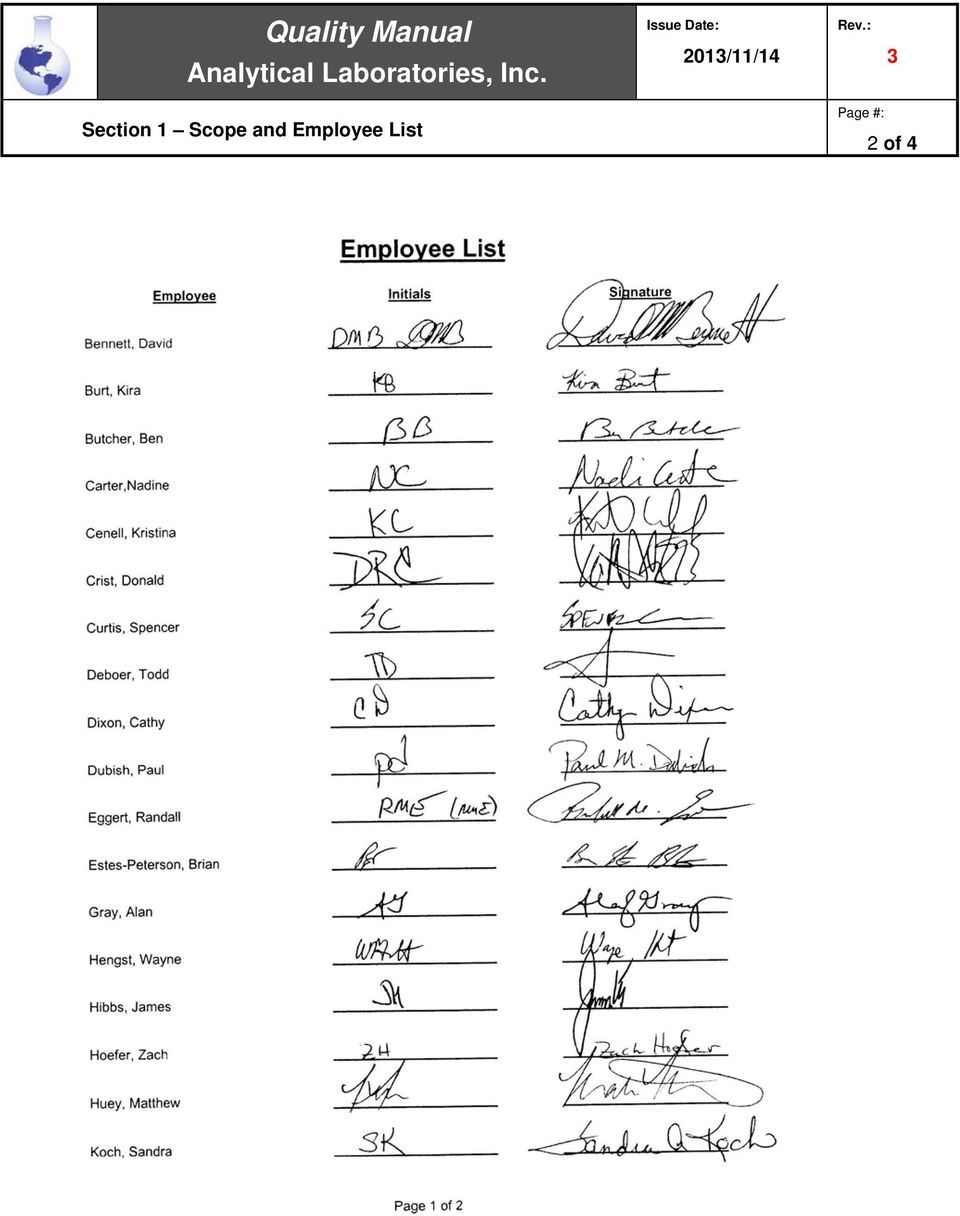
5 213/11/14 3 Section 1 Scope and Employee List 1 of 4 1. Scope This Quality Manual facilitates: recognition of technical competence for standardized methods, non-routine methods, and laboratory-developed methods we perform inspection and product certification capabilities and/or services we provide total quality for our administrative and technical systems audits by clients, regulatory authorities and accreditation bodies meeting the requirements of ISO 1725 and ISO 91 client satisfaction

6 213/11/14 3 Section 1 Scope and Employee List 2 of 4
7 213/11/14 3 Section 1 Scope and Employee List 3 of 4

8 213/11/14 3 Section 1 Scope and Employee List 4 of 4 Revision History Revision 1 - Revision 2 - Revision 3 - This section was updated to reflect the addition of an Employee List This section was updated to reflect the current Employee List This section was updated to reflect the current Employee List

9 Section 2 - Normative References 1 of 1 2. Normative References Reference List ISO/IEC 17, Conformity assessment Vocabulary and general principles VIM, International vocabulary of basic and general terms in metrology, issued by BIPM, IEC, IFCC, ISO, IUPAC, IUPAP and OIML. ISO 91:2 Quality Management Systems Fundamentals and vocabulary. ISO 1725:25 General Requirements for the Competence of Testing and Calibration Laboratories. Cross-references This manual is numerically aligned with the international standard ISO It is expected that this will prove useful during accreditation audits and expedite the process. Furthermore, each section cross-references the ISO 91 standard to assist the laboratory during the ISO 91 registration process (if applicable). For ease of use, each section starts with a brief summation of what the section addresses and a listing of the quality terminology and key words.

10 Section 3 - Terms and Definitions 1 of 1 3. Terms and Definitions For the purposes of this manual, the following documents and their corresponding definitions apply: ISO/IEC 17; ISO/IEC Guide 3; ISO Council Committee on Conformity Assessment (CASCO); ISO 9; ISO ; ISO 1725; AOAC; and International Vocabulary of Basic and General Terms in Metrology (VIM). Accreditation formal recognition of a laboratory by an independent science-based organization that the laboratory is competent to perform specific tests (CASCO).
11 214/3/2 4 Section Organization 1 of Organization The Ten Second Tutorial This section tells you our laboratory has: 1. Appointed a Quality Manager 2. Organized the workforce to achieve quality 3. Provided adequate resources to ensure quality Key Words Quality Manager Organizational Chart Authority Resources Confidential Information Proprietary Rights Responsibilities Undue Pressure Cross-references ISO 1725:25 Section 4.1 ISO 91:2 Section 4.1, 5.1, 5.3, 5.4.1, 5.5.1, 5.5.2, 5.5.3, 6.1, 6.2.1, 6.2.2, 6.3.1, 7.1, 7.5.4

12 214/3/2 4 Section Organization 2 of Legal Identification / Registration 184 N. 33 rd St., Boise, ID Phone: (28) Fax: (28) Website: Laboratory Requirements The departments of have been organized to satisfy the needs of the customer and regulatory authorities and to meet the international standards ISO 1725 and ISO 91. is composed of the following departments: Bacteria (Microbiology) Biomonitoring (WETT) Environmental Chemistry Food Chemistry Fuels Metals Nutrients Organics Services Scope of Management System The management system covers activities in the laboratory s permanent facility. The fields of activities include: Agricultural & Food Drinking Water Environmental Fuels & Lube Oils Soils Solids / Sludge / Waste Wastewater The laboratory s scope of tests is listed in the Laboratory Information Management System (LIMS) Potential Conflicts of Interest

13 214/3/2 4 Section Organization 3 of 9 Not applicable - the laboratory is not part of a larger organization Organization A) Management and Technical Personnel The laboratory managerial and technical personnel, irrespective of other responsibilities, have the necessary authority and resources needed to meet the mandates assigned to their areas. Responsibilities are detailed in (F). Departures from the organizational and management policies in this manual can only be approved by the Board of Directors. Departures from quality management system procedures can only be approved by the Director and Quality Manager. Departures from test methods or technical standard operating procedures (SOPs) can only be approved by the Director, Quality Manager, and area Supervisors. See also section 5.2. B) Undue Pressure Management and personnel are to be free from any undue internal and external commercial, financial and other pressures that may adversely affect the quality of their work. The integrity of test results is the responsibility of all personnel. Management ensures that employees are never instructed or forced to alter or falsify data. The following list provides some guidelines on how employees avoid conflict of interest situations. Employees shall not: falsify records, prepare fraudulent reports, or make false claims seek or use privileged or confidential company information, or data from any customer, for any purpose beyond the scope of employment
14 214/3/2 4 Section Organization 4 of 9 conduct non-laboratory business on laboratory time, or use company facilities or equipment to conduct outside interests in business, unless prior approval has been obtained solicit business on their own behalf (rather than the laboratory) from a customer be employed by, or affiliated with, organizations whose products or services compete with laboratory products or services have employment that negatively affects or interferes with their performance of laboratory duties compete with the laboratory in the purchase, sale, or leasing of property or goods allow association, family, or friends to influence business decisions to their benefit - decisions must be made on a strictly business basis, always in the best interest of the laboratory make any decision that provides gains or benefits to the employee and/or others have personal financial dealings with an individual or company that does business with the laboratory which might influence decisions made on the laboratory s behalf Firm adherence to this code of values forms the foundation of our credibility. Personnel involved in dishonest activities are subject to a range of disciplinary action including dismissal. C) Customer Confidentiality It is the policy of our laboratory to protect the confidential information and proprietary rights of our customer including the electronic storage and transmission of results. Details and Procedures: All employees sign an Employee Confidentiality Agreement. The signed agreement is maintained by the Quality Manager. All employees are required to utilize a username and password to access the Laboratory Information Management System (LIMS) which contains the proprietary and confidential information for all of Analytical Laboratories clients. Test results are only released to the customer. Release to someone other than the customer requires the express permission of the customer, except when the situation contravenes Idaho or Federal Legislation and the results must be provided to the appropriate agency. The release of test results to anyone other than the customer requires the permission of management. Laboratory reports are reviewed for accuracy prior to release.
15 214/3/2 4 Section Organization 5 of 9 D) Operational Integrity The laboratory will avoid involvement in any activities that would diminish confidence in its competence, impartiality, judgment, or operational integrity. Details and Procedures: To ensure confidence in laboratory operations a formal quality assurance program is implemented. Technical competence is ensured through check sample programs. Impartiality is assessed through audits and approvals. Judgment is ensured through the hiring of qualified personnel and by continuously refining, upgrading, and improving his or her skills. Operational integrity is reviewed by management on a regular basis at management review meetings to ensure continued suitability and effectiveness of laboratory policies and procedures. Any problems are acted on immediately through corrective action procedures. E) Organizational Structure The organization and management structure of the laboratory and the relationships between management, technical operations, support services, and the quality management system is defined through the aid of an organizational chart. Senior management keeps the most current organizational chart on file. An organizational chart is available with this manual (upon request) as a reference record and is considered the official record on the date it is marked. F) Responsibility and Authority Director develops primary goals, operating plans, policies, and short and long range objectives for the laboratory; implements these following Board of Directors approval directs and coordinates activities to achieve profit and return on capital establishes organizational structure and delegates authority to subordinates leads the laboratory towards objectives, meets with and advises other executives, and reviews results of business operations ensures laboratory adherence and compliance with ISO/IEC 1725 determines action plans to meet the needs of stakeholders
16 214/3/2 4 Section Organization 6 of 9 represents organization to major customers, government agencies, shareholders, and the public Quality Manager ensures that the Quality Management System is established, implemented and maintained in accordance with the ISO 91 and ISO 1725 standards manages the internal audit program coordinates laboratory accreditation activities handles the maintenance and distribution of the Quality Manual and associated documents maintains a master list of current versions of quality documentation trains personnel on Quality Management System activities monitors the Quality Management System reports on the performance of the Quality Management System to senior management for review and as a basis for improvement of the Quality Management System supervises the laboratory s inter-laboratory proficiency testing program maintains current job descriptions Supervisors is/are knowledgeable of the scope of all processes under their supervision provides the necessary resources (personnel, equipment, supplies) for the quality assurance program, in order to ensure confidence in the laboratory s results ensures equipment is maintained and calibrated, reporting all deficiencies (e.g., equipment malfunctions) in the appropriate manner ensures personnel are trained for the duties they perform - includes substitutes when regular personnel are absent maintains records and manages all aspects of testing activities ensures laboratory adherence and compliance with ISO/IEC 1725 responds to customer inquiries and provides professional advice hires personnel orientates new personnel determines technical training needs of personnel conducts employee performance reviews schedules vacation and coverage ensures that all health and safety regulations are followed ensures that all Human Rights Legislation are complied with oversees quality, standard pricing, customized quotations, and invoicing for tests performed prioritizes workload facilitates operational concerns in their area

17 214/3/2 4 Section Organization 7 of 9 ensures accurate and consistent testing procedures through the validation of all current procedures and by developing, validating and implementing new procedures coordinates purchasing requests ensures that the operational needs are within budget and advising management of any discrepancies Analyst maintains records of all quality activities as documented in SOPs and test methods handles samples and performing analyses according to SOPs and test methods writes SOPs and test methods signs reports when designated with signing authority maintains and calibrates equipment reports deficiencies or malfunction to the supervisor identifies and records nonconformities on Corrective Action Requests identifies and recording potential nonconformities on Preventive Action Requests corrects nonconformities and potential nonconformities improves laboratory and/or quality activities on a continuous basis Customer Representatives and Administrative Personnel performs work functions and keeps records as per approved SOPs and/or laboratory policies writes SOPs identifies and records nonconformities on Corrective Action Requests identifies and records potential nonconformities on Preventive Action Requests corrects nonconformities and potential nonconformities improves laboratory and/or quality activities on a continuous basis G) Laboratory Supervision / Technical Managers Adequate supervision is provided in each area of the laboratory for all testing and calibration personnel, including trainees, by persons familiar with the methods and procedures. They have overall responsibility for the technical operations and the provision of resources needed to ensure the required quality of laboratory operations. Adequate supervision is ensured through designated supervisors as well as through documentation such as this Quality Manual, test methods and SOPs. A thorough orientation and training program is adhered to for all new employees. Ongoing training

18 214/3/2 4 Section Organization 8 of 9 for regular personnel is required. While the technical manager may at times delegate duties to other personnel, the technical manager is accountable for any nonconforming activities. H) Quality Manager The Quality Manager is appointed by the highest level of management. The Quality Manager, who, irrespective of other duties and responsibilities, has defined responsibility and authority for ensuring that the management system related to quality is implemented and followed. The Quality Manager has direct access to the highest level of management where decisions are taken on laboratory policy or resources. This statement notifies all laboratory personnel that Brian McGovern is the Quality Manager and James Hibbs is the Deputy Quality Manager as authorized below by the Director. Any change in this position requires the reissue of this section to all holders of controlled copies of the Quality Manual. The following signature also serves as approval for this Quality Manual and affirms senior management s commitment to the policies and procedures set forth in this manual. Michael D. Moore Laboratory Director I) Managerial Substitutions Deputies for key personnel are appointed to fulfill the key personnel s duties in their absence. In the absence of the Quality Manager, the Deputy Quality Manager will assume his/her responsibilities. In the absence of the Area Supervisor (Technical Manager), the senior analyst for that department will assume his/her responsibilities.

19 214/3/2 4 Section Organization 9 of 9 Management is responsible for ensuring that current and/or increased workload requirements are met. This includes making adjustments as a result of employee absence. Only fully trained employees are utilized to fulfill the duties of personnel who are absent. If sufficient human resources are not available, management will identify the best possible solution to meet operational requirements. J) Awareness Management ensures that its personnel are aware of the relevance and importance of their activities and how they contribute to the achievement of the objectives of the management system. Supervisors review the details of each employee s job description with the appropriate employee and how the overall Quality Policy Statement (Section 4.2.2) relates to their activities to achieve the objectives of the management system Communication Processes Policy and Top management ensures that appropriate communication processes are established within the laboratory and that communication takes place regarding the effectiveness of the management system. Revision History Revision 1 - Procedures were added to section c. to reflect the policies in place to protect confidential and proprietary client information. James Hibbs was named as the Deputy Quality Manager. Revision 2 - Revision 3 - Revision 4 - Managerial Substitutions have been clarified. Customer Confidentiality section was updated. Organizational Structure section was updated. Responsibility and Authority section was updated.

20 Section 4.2 Management System 1 of Management System The Ten Second Tutorial This section tells you that our Management System (or Quality Management System) is based on: 1. A well-defined quality policy statement 2. Say what you do through documentation 3. Do what you say following your documentation 4. Record what you did Key Words Establish, Implement, and Maintain Policies, Systems, Processes, Programs, Procedures, Instructions Communicate, Understand Quality Policy Statement Quality Manual SOP Test Method Cross-references ISO 1725:25 Section 4.2 ISO 91:2 Section 4.1, 4.2.1, 4.2.2, 5.1, 5.3, 5.4.1, 5.4.2, 5.5.1, 5.5.2, 6.2.1, 7.1

21 Section 4.2 Management System 2 of Policies and Procedures The Quality Management System is established, implemented, and maintained by management. It is applicable to all the fields of testing and activities in which the laboratory is involved and undertakes. All policies, systems, programs, procedures and instructions are documented to the extent necessary to enable the laboratory to assure the quality of results generated. These documents are communicated to, understood by, available to, and implemented by the appropriate personnel. The purpose of our Quality Management System is to ensure that all services and products satisfy the customer s requirements and have been designed, manufactured, and delivered under controlled conditions. The effectiveness of the Quality Management System is assessed in several ways: by a program of planned internal audits, covering all aspects of the operation of the quality management system by regular management reviews of the suitability and effectiveness of the quality management system by analysis of potential and actual problems as shown by customer complaints and supplier and subcontractor assessments by other methods approved from time to time by the Quality Manager and Director This Quality Manual and associated documents (including procedures) and records serves as the quality plan for the laboratory. Other documents and records include: standard operating procedures quality control plans in test methods organizational charts proposals project management schemes Quality Policy Statement The policies and objectives for laboratory operations are documented in this Quality Manual. The overall objectives are set out in the Quality Policy Statement and reviewed during management review. The Quality Policy Statement is issued under the authority of the Director on the effective date.
22 Section 4.2 Management System 3 of 6 Quality Policy Statement: To ensure accurate and timely analytical services, and to continuously meet or exceed the stated, or implied, expectations of our customers through day-to-day interactions. is committed to providing the very best in laboratory testing services to our clients to help them meet their regulatory needs. ALI will adhere to published procedures required by regulatory agencies while utilizing documented standard operating procedures (S.O.P.) created internally. The principles and practices of this policy apply to each employee with ALI. Effective Date: July 18, 27 a) Management commitment to good professional practice and quality of services provided to the customer: tests and calibrations are always carried out in accordance with stated standardized methods and customers requirements. Requests to perform tests that may jeopardize an objective result or have a low validity are rejected. b) Standards of service include: Customer Satisfaction Precision & Accuracy Accountability & Traceability Excellence in the workplace is promoted by providing all employees with the knowledge, training, and tools necessary to allow for the completion of accurate and timely work. c) Purpose of management system related to quality: to manage our business by meeting the needs of our customers. d) Personnel: familiarize themselves with quality documentation and implement the policies and procedures in their work. e) Management is committed to complying with ISO 1725 and ISO 91 international standards and to continually improve the effectiveness of the management system: the objective of this Quality Manual is to document the compliant policies and associated procedures that are integrated into our daily activities. Continual improvements are established, implemented, and locked into the management system. Additional objectives include: to establish the level of the laboratory s performance to make test method changes to improve performance to participate in proficiency testing or quality evaluation programs with peer laboratories
23 Section 4.2 Management System 4 of 6 to ensure that all personnel are trained to a level of familiarity with the quality management system appropriate to the individual s degree of responsibility to improve and validate laboratory methodologies by participation in method validation collaborative tests to establish and report on quality savings Commitment to the Management System Top management is committed to the development and implementation of the management system and continually improving its effectiveness. The results of the management system are regularly reviewed during management review (see Section 4.15) and continual improvements are made as outlined in Section 4.1 Improvements Communication of Requirements Top management communicates to the organization the importance of meeting customer requirements as well as statutory and regulatory requirements. In general, the underlying message in all oral and written management communications involves meeting the aforementioned requirements. Meeting customer requirements ensures that ongoing business relationships secure the contracts that keep everyone employed. Meeting statutory and regulatory requirements ensures that laboratory operations will not be disrupted and the organization can continue to meet customer needs Quality Manual This Quality Manual outlines the structure of the documentation used in the quality management system. This Quality Manual makes reference to supporting procedures including technical procedures and is maintained up to date.
24 Section 4.2 Management System 5 of 6 This quality management system is structured in three tiers of documentation. The tiers are as follows: I. Quality Manual II. Standard Operating Procedures and Test Methods III. Records For most customers, this Quality Manual and the associated documents form a general Quality Plan. If necessary, specific Quality Plans will be prepared on a per-customer basis. These Quality Plans will modify the general requirements stated in the Manual and associated documents. All of the above documents are controlled documents. The following records and directive documents are referenced in the Quality Manual, but maintained separately: organizational chart (section E) copies of the Quality Policy Statement posted in the laboratory (section 4.2.2) identification of resources and management review (section ) job descriptions (section 5.2.4) statistical techniques (section 5.9) test reports (section and 5.1) identification of the laboratory s approved signatures (section 5.1.2) laboratory s scope of tests (section 4.1.3) equipment inventory and records (sections and 5.5.5) calibration status indicators (section 5.5.8) reference standards inventory (section 5.6.3) verification records (section 5.9) quality control plan / criteria for workmanship (section 5.4.1) corrective action records (section 4.11) preventive action records (section 4.12) customer complaint records (section 4.8.1) audit schedule and records (section ) procurement and subcontracting records (sections 4.6 and 4.5.4) training records (section 5.2.5) master list of documentation (section 4.3.2) confidentiality agreements (section C) contract review (section 4.4.2) validation of test methods (section 5.4.5) facility floor plan (section 5.3.1) Technical Management and the Quality Manager
25 Section 4.2 Management System 6 of 6 The roles and responsibilities for technical management and the Quality Manager are outlined in section (F) of this manual. Technical management ensures that section 5 of this manual is implemented and maintained. The Quality Manager ensures that section 4 of this manual is implemented and maintained Maintenance Policy and Top management ensures that the integrity of the management system is maintained when changes to the management system are planned and implemented. Revision History Revision
26 28/3/5 1 Section 4.3 Document Control 1 of Document Control The Ten Second Tutorial This section tells you that Document Control involves: 1. Writing good procedures 2. Getting them to the users 3. Keeping procedures good Key Words Controlled Document Master List Unique Identification Revise Revision Number Effective Date Review and Approval Obsolete Archive Hand-written changes Cross-references ISO 1725:25 Section 4.3 ISO 91:2 Section 4.2.1, 4.2.3, 4.2.4
27 28/3/5 1 Section 4.3 Document Control 2 of Policies and Procedures The SOP# QSP is used to control all quality management system documents (internally generated and from external sources). These include documents of external origin, such as regulations, standards, other normative documents, test and/or calibration methods, as well as drawings, specifications, instructions, and manuals. Document means any information or instructions including policy statements, procedures, specifications, calibration tables, charts, text books, posters, notices, memoranda, software, drawings, and plans. These may be in various media, whether hard copy or electronic and they may be digital, analog, photographic or written. The documents to be controlled include: Quality Manual Standard Operating Procedures and test methods Forms Standards The control of data related to testing and calibration is covered in section The control of records is covered in section Document Approval and Issue Review / Approval / Master List Policy and All documents issued to personnel in the laboratory as part of the quality management system are reviewed and approved for use by authorized personnel prior to issue (i.e., reviewed by personnel knowledgeable in the documented activity and then approved by management). A master list identifying the current revision status and distribution of documents in the quality management system is readily available in order to preclude the use of invalid and/or obsolete documents (see SOP# QSP 4-3-1). A revision history of documents is also maintained. Documents are formally reviewed on a biennial basis to ensure their continuing suitability Availability and Obsolete Documents Policy and
28 28/3/5 1 Section 4.3 Document Control 3 of 4 The master list shows the current status of all controlled documents. The master list document is organized with the following information: Title Revision # / date of last revision Date of issue / last review Status (current, obsolete, dormant, or assigned) Distribution list (copy number) Controlled documents are approved before issue. The SOP# QSP for document control ensures that: authorized editions of appropriate documents are available at all locations where operations essential to the effective functioning of the laboratory are performed documents are periodically reviewed and where necessary revised to ensure continuing suitability and compliance with applicable requirements invalid or obsolete documents are promptly removed from all points of issue or use to assure against unintended use obsolete documents retained for either legal or knowledge preservation purposes are suitably marked (i.e., stamped "OBSOLETE" and dated) Identification Policy and All quality management system documentation is identified by: date of issue and/or revision number page numbering total number of pages (e.g., page 5 of 5) issuing authority (i.e., approval signature) Document Changes Review / Approval Changes to documents are reviewed and approved by the same function (i.e., personnel or position) that performed the original review unless specifically designated otherwise. The designated personnel have access to pertinent background information upon which to base their review and approval.
29 28/3/5 1 Section 4.3 Document Control 4 of 4 Developments in policies and procedures require documents to be changed from time to time. Changes to documents receive the same level of review and approval as the originals. The Quality Manual is reviewed annually by the Quality Manager. Records are kept of this review. Test methods and SOPs are reviewed on a biennial basis. Procedures for this are outlined in SOP# QSP Obsolete documents are withdrawn, but are retained for archive purposes and clearly labeled as obsolete Identification of Changes The nature of document changes is identified in the document. As outlined in SOP# QSP Revision history is recorded at the end of the document Amendments by Hand Policy and Hand-written amendments to documents are not permitted Computerized Documents Policy and The SOP# QSP details how changes in documents maintained in computerized systems are made and controlled. Revision History Revision Section updated to reflect current policies.
30 Section 4.4 Review of Requests, Tenders, and Contracts 1 of Review of Requests, Tenders, and Contracts The Ten Second Tutorial This section tells you that you must: 1. Clearly understand customer requirements Key Words Requirements Subcontractor Request Tender Contract Review Cross-references ISO 1725:25 Section 4.4 ISO 91:2 Section 5.2, 6.1, 7.2.1, 7.2.2, 7.2.3
31 Section 4.4 Review of Requests, Tenders, and Contracts 2 of Policies and Procedures The SOP# QSP is used to review requests, tenders, or contracts. This procedure ensures that: a) the customer requirements including the methods to be used are adequately defined, documented and understood (see section 5.4.2) b) the laboratory has the capability and resources to meet the requirements c) the appropriate test method is selected and capable of meeting the customer s requirements (see section 5.4.2) Any differences between the request or tender and the contract are resolved before any work commences. Each contract must be acceptable by both the laboratory and the customer. The request, tender and contract review is conducted in a practical and efficient manner, and the effect of financial, legal, and time schedule aspects are taken into account. The review of capability establishes that the laboratory possesses the necessary physical, personnel, and information resources, and that the laboratory s personnel have the skills and expertise necessary for the performance of the tests in question. The review may also encompass results of earlier participation in inter-laboratory comparisons or proficiency testing and/or the running of trial test using samples or items of known value in order to determine uncertainties of measurement, limits of detection, and confidence limits. The contract review ensures that each customer s requirements are adequately defined and documented before the service or product is ordered or dispatched. This should ensure that any order, once accepted, can be completed without delay, and that the customer s requirements including delivery date, technical specification, and cost can be met. If the contract review highlights any ambiguities or uncertainties then the customer will be contacted and the problem resolved before the order is accepted. The SOP# QSP also describes the activities that take place should there be a subsequent amendment to a customer s order. Typical types of contracts include: approved service quotations confidentiality agreements
32 Section 4.4 Review of Requests, Tenders, and Contracts 3 of 4 non-disclosure agreements sample submission requests memorandum of agreement memorandum of understanding research proposals and contracts verbal orders (oral agreements) activity plans Records of Review Records of request, tender and contract review, including significant changes, are maintained. Records of pertinent discussions with a customer relating to the customer s requirements or the work during the period of execution of the contract are also maintained. For review of routine and other simple tasks, the date and the identification (e.g., initials) of the person in the laboratory responsible for carrying out the contracted work are considered adequate. For repetitive routine tasks, the review need be made only at the initial inquiry stage or on grant of the contract for on-going routine work performed under a general agreement with the customer, provided that the customer s requirements remain unchanged. For new, complex or advanced testing tasks, a more comprehensive record is maintained Review of Subcontracted Work Request, tender, and contract review also includes work that is subcontracted by the laboratory. Subcontractor laboratories are reviewed as described in section Notification of Customer Policy and Customers are informed of deviations from the contract. This is typically communicated to the customer prior to the performing the deviation.
33 Section 4.4 Review of Requests, Tenders, and Contracts 4 of Contract Amendment Policy and If a contract needs to be amended after the work has commenced, the same contract review process is repeated and any amendments are communicated to all affected personnel. Revision History Revision
34 Section 4.5 Subcontracting of Tests and Calibrations 1 of Subcontracting of Tests and Calibrations The Ten Second Tutorial This section tells you that we must: 1. Know what tests and calibrations need to be done by another laboratory 2. Check out the other laboratories Key Words Competence Register of Subcontractors Assessment Cross-references ISO 1725:25 Section 4.5 ISO 91:2 Section 7.2.3, 7.4.1, 7.4.3, 8.2.4
35 Section 4.5 Subcontracting of Tests and Calibrations 2 of Subcontractor Competence Work that must be subcontracted due to: unforeseen circumstances workload large contracts contracts requiring some extra technical expertise testing not currently being done by A.L.I. is subcontracted to a technically competent laboratory. The subcontracted laboratory demonstrates technical competence by possession or receipt of one or more of the following: recognized technical accreditation registration under the ISO 91 standard satisfactory performance of appropriate quality control check samples, certified reference material, in-house reference material or replicate analysis audit of the subcontractor s quality management system by our auditors It is the responsibility of the Quality Manager to assess and approve the competence level of subcontractor laboratories Customer Approval Customers are advised of work (or any portion thereof) that is being subcontracted to another laboratory and their approval is obtained (preferably in writing). Customers are advised of subcontracted work through fee schedules or any type of contract listed in section Assurance of Subcontractor Competence The laboratory is responsible to the customer for the subcontractor s work. Technical competence of subcontractor laboratories is demonstrated through various records.
36 Section 4.5 Subcontracting of Tests and Calibrations 3 of 3 Note there may be circumstances where the customer specifies which subcontractor is to be used. In such cases we may not be able to demonstrate the competence of the subcontractor and therefore are not responsible for the results. Records of subcontractor competence include, but are not limited to, the following: accreditation certificates or documentation registration certificates check sample results audit results approval by the Quality Manager Subcontractor Register A register of all subcontractors performing tests and calibrations is maintained. The approved register of subcontractors and all assessment records are maintained by the Quality Manager. Revision History Revision
37 Section 4.6 Purchasing Services and Supplies 1 of Purchasing Services and Supplies The Ten Second Tutorial This section tells you that we must: 1. Know what we want 2. Check out our suppliers Key Words Selection Verify Specifications History Cross-references ISO 1725:25 Section 4.6 ISO 91:2 Section 6.3.1, 7.4, 7.5.5, 8.2.4
38 Section 4.6 Purchasing Services and Supplies 2 of Policies and Procedures The SOP# QSP is used to select and purchase services and supplies. The SOP# QSP is used for procurement, reception, and storage of supplies. Consumable materials are stored according to the appropriate test method, SOP, or work instruction Specifications Only services and supplies of the required quality are used. These quality requirements are detailed in laboratory SOPs under the Equipment and Supplies and Reagents and Standards sections and will identify the appropriate minimum specifications when necessary. Packing slips are checked against package content labels and matched with the Purchase Order or invoice if accepted. Once accepted, the invoice is dated and initialed as evidence of compliance. Certificates of analysis (COA) are maintained on file after the COA is checked to ensure the received item meets minimum specifications. Chemicals are purchased with manufacturer s certificates where possible. Uncertified chemicals are purchased from ISO 9 registered companies. Whatever the source, the laboratory verifies the quality of the standards by comparing the new batch of standards to the old. Due regard is paid to the manufacturer s recommendations on storage and shelf life. Reagents are generally purchased from manufacturers who have a quality management system based on ISO 9. The grade of any reagent used (including water) is stated in the method together with guidance on any particular precautions to be observed in its preparation or use. Where no independent assurance of the quality of procured goods or services is available or the supplier s evidence is insufficient the laboratory ensures that purchased goods and services comply with specified requirements. Where possible and practical the laboratory ensures that goods are inspected, calibrated, or are otherwise in compliance with any standard specification relevant to the calibrations or tests concerned.
39 Section 4.6 Purchasing Services and Supplies 3 of Purchasing Documents Purchasing requests are recorded on a Supply Request form and contain data describing the product ordered. The Supply Request form is reviewed and approved for technical content prior to release. The description may include type, class, grade, precise identification, specifications, drawings, inspection instructions, other technical data including approval of test results, quality required and quality management system standard under which they were produced. The completion of the Supply Request form is the responsibility of the area supervisor Approved Suppliers Suppliers of critical services are evaluated and approved before use. An approved supplier list is maintained. Audits or tender evaluation is conducted to qualify suppliers of critical services prior to use. The criteria for evaluation may include, but is not limited to the following: references accreditation formal recognition The records are maintained by the Area Supervisor. Revision History Revision
40 Section 4.7 Service to the Customer 1 of Service to the Customer The Ten Second Tutorial This section tells you that we must: 1. Facilitate clarification of the customer s request 2. Give customer access to relevant testing area 3. Maintain customer contact 4. Inform customer of delays or deviations 5. Utilize customer surveys Key Words Clarification Deviations Delays Customer Satisfaction Survey Cross-references ISO 1725:25 Section 4.7 ISO 91:2 Section 6.1, 7.2.1, 7.2.3, 7.4.3, 7.5.1
41 Section 4.7 Service to the Customer 2 of Service Customer requests are clarified for the customers or their representatives. Furthermore the customer or their representative will be afforded the right to monitor the performance of the laboratory in relation to the work performed, provided that the laboratory ensures confidentiality to other customers. Details and Procedures: Service to the customer includes: Affording the customer or the customer s representative reasonable access to relevant areas of the laboratory for the witnessing of work performed for the customer; it is understood that such access should not conflict with rules of confidentiality of work for other customers or with safety. Preparing, packaging, and dispatching of test items needed by the customer for verification purposes. Maintaining of open contacts. The customer values advice and guidance in technical matters, and opinions and interpretations based on results. Contact with the customer, especially in large assignments, should be maintained throughout the work. The laboratory should inform the customer of any delays or major deviations in the performance of the tests Feedback Policy and The laboratory seeks feedback from the customer. Positive and negative feedback can be obtained passively through ongoing communications with the customer (e.g., review of test reports with customers) or actively through customer satisfaction surveys. The feedback is used to improve the quality management system, testing activities, and customer service. Revision History Revision
42 Section 4.8 Complaints 1 of Complaints The Ten Second Tutorial This section tells you that you must: 1. Maintain records of Complaints 2. Maintain records of Corrective Action Key Words Resolving Investigation Corrective Action Follow-up Verification Cross-references ISO 1725:25 Section 4.8 ISO 91:2 Section 7.2.3
43 Section 4.8 Complaints 2 of Policies and Procedures The SOP# QSP is used for resolving complaints received from customers or other parties. Records are maintained of all complaints and follow-up. Records of complaints include the following information: details of the complaint investigation corrective action follow-up verification See also section All personnel are responsible for recording and responding to complaints. Revision History Revision
44 Section 4.9 Control of Nonconforming Work 1 of Control of Nonconforming Testing and Calibration Work The Ten Second Tutorial This section tells you that you must: 1. Stop testing when nonconforming work is identified 2. Determine what is causing nonconforming work Key Words Nonconforming Root Cause Cross-references ISO 1725:25 Section 4.9 ISO 91:2 Section 5.5.1, 7.4.3, 7.5.1, 8.2.4, 8.3, 8.5.3
45 Section 4.9 Control of Nonconforming Work 2 of Procedures to Control Nonconforming Work The SOP# QSP is used to control any aspect of testing and/or calibration work, or the results of this work, when they do not conform with the test methods or the agreed requirements of the customer. The procedure ensures that: Responsibilities and authorities for the management of nonconforming work are designated and actions (including halting of work and withholding of test reports as necessary) are defined and taken into consideration when nonconforming work is identified an evaluation of the significance of the nonconforming work is made correction is taken immediately, together with any decision about the acceptability of the nonconforming work where necessary, the customer is notified and the work is recalled the responsibility for authorizing the resumption of work is defined Identification of nonconforming work or problems with the quality management system or with testing activities can occur at various locations within the quality management system and technical operations such as: customer complaints quality control instrument calibration checking of consumable materials staff observations or supervision test report checking management reviews internal or external audits Root Cause Analysis Where evaluation indicates that nonconforming work could recur or that there is doubt about the compliance of the laboratory s operations with its own policies and procedures, the corrective action procedures given in 4.11 are followed to identify the root cause(s) of the problem and to eliminate this (these) cause(s).
46 Section 4.9 Control of Nonconforming Work 3 of 3 The SOP# QSP outlines the recording of the root cause analysis for investigating nonconforming work. Situations warranting corrective action investigation include: failure to comply with test method including all applicable procedures necessary to ensure the integrity and representative nature of the sample presentation of uncertain knowledge as to compliance with test methods including all applicable procedures necessary to ensure the integrity and representative nature of the sample failure or suspected failure in method performance as demonstrated by results provided by quality control samples lack of relevant evidence provided by quality audit, proficiency testing, or customer feedback lack of relevant evidence provided by data validation neglect to check the inherent property of the sample that compromises the testing Revision History Revision
47 Section 4.1 Improvements 1 of Improvements The Ten Second Tutorial This section tells you that you must: 1. Review procedures for improvements 2. Continually implement improvements Key Words Continually Effectiveness Analysis of data Cross-references ISO 1725:25 Section 4.1 ISO 91:2 Section 6.1, 8.1, 8.2.1, 8.4, 8.5.1
48 Section 4.1 Improvements 2 of Policies and Procedures The laboratory continually improves the effectiveness of its management system through the use of the quality policy, quality objectives, audit results, analysis of data, corrective actions, and management review. The laboratory has implemented a continual improvement philosophy within the management system. Every employee in the laboratory is encouraged to suggest new ideas for improving services, processes, systems, productivity, and the working environment. Opportunities for improvement of operations and processes are identified by managers on a continual basis from ongoing feedback on operations and through management reviews. Opportunities for improvement of services are identified by anyone within the organization. Inputs for improvement opportunities are obtained from the following sources: customer satisfaction surveys and any other customer feedback market research and analysis employees, suppliers, and other interested parties internal and external audits of the management system records of service nonconformities data from process and service characteristics and their trends Opportunities for improvement may also be identified on a special project basis. The following are listed only as examples: improving usefulness of bench space reducing excessive inspection/testing reducing excessive handling and storage reducing test/calibration failures Opportunities for improvement from daily feedback on operational performance (i.e., internal audits, customer feedback, and test/calibration failures) are evaluated by the Supervisors (Technical Managers) or Quality Manager. Typically, they are implemented through the corrective and preventive action system. Opportunities for improvement from analysis of longer-term data and trends are evaluated and implemented through the management review process. They are prioritized with respect to their relevance for achieving quality objectives. When opportunities for improvement are no longer supported by the current policy and objectives, management
49 Section 4.1 Improvements 3 of 3 will establish new quality objectives, and possibly change the policy. The process for this evaluation is described in Section Longer-term improvement projects are initiated through the management review process, as well as the corrective and preventive action system. Service improvement opportunities are evaluated by management. They are implemented through the supervisor of the laboratory who ensures that the improvements are validated as outlined in Section 5.4 of this manual and appropriate level of quality control is performed on an ongoing basis. Revision History Revision
50 Section 4.11 Corrective Action 1 of Corrective Action The Ten Second Tutorial This section tells you that you must: 1. Identify problems 2. Determine why the problem occurred 3. Fix the cause of the problem 4. Verify that your changes worked Key Words CAR Root Cause Monitor Audit Nonconforming work Cross-references ISO 1725:25 Section 4.11 ISO 91:2 Section 5.5.1, 5.5.2, 8.1, 8.2.2, 8.2.3, 8.4, 8.5.2,
51 Section 4.11 Corrective Action 2 of General The SOP# QSP is utilized for implementing corrective action when nonconforming work or departures from policies and procedures in the quality management system or technical operations have been identified. The procedure requires that appropriate authority be designated for the implementation of corrective actions. The procedure includes cause analysis, selection and implementation of corrective action, and monitoring of actions. Problems with the quality management system or technical operations of the laboratory may be identified through a variety of activities, such as control of nonconforming work, internal or external audits, management reviews, feed-back from customers, or staff observations. Corrective action investigations are documented and required changes to operational procedures are implemented. The corrective action request (CAR), investigation and resolution are recorded on a CAR form Cause Analysis Corrective action always begins with an investigation to determine root cause(s) of the problem (see SOP# QSP ). Potential causes of the problem could include customer requirements, the samples, sample specifications, methods and procedures, personnel skills and training, consumable materials, or equipment and its calibration Selection and Implementation of Corrective Actions Policy and After determining the cause(s) of the problem, potential corrective actions are identified. The most likely action(s) (this includes practical and/or reasonable) are selected and implemented to eliminate the problem and to prevent recurrence. It should be noted that any corrective actions taken to eliminate the cause(s) of nonconformities or other departures are to a degree appropriate to address the magnitude of the problem and commensurate with the risks encountered (Note in plain language, this means
52 Section 4.11 Corrective Action 3 of 3 determine whether the benefit outweighs the cost). Controls are applied to prevent recurrence. The laboratory documents and implements the required changes resulting from corrective action investigations Monitoring of Corrective Action After implementing the corrective action(s), the laboratory monitors the results to ensure that the actions taken have been effective in overcoming the problems originally identified. Monitoring is assigned to an appropriate individual such as the originator of the CAR or the originator s manager. Changes resulting from corrective action are documented Additional Audits Where the identification of nonconformities or departures casts doubts on compliance of policies, procedures, regulations, international quality standards, the appropriate areas of activity are promptly audited in accordance with section Special audits follow the implementation of corrective actions to confirm their effectiveness. A special audit is only necessary when a serious issue or risk to the business is identified. Special audits are carried out (whenever resources permit) by trained and qualified personnel who are independent of the activity to be audited. See section 4.14 for more details. Revision History Revision
53 Section 4.12 Preventive Action 1 of Preventive Action The Ten Second Tutorial This section tells you that you must: 1. Identify potential problems 2. Determine why the problem could occur 3. Fix the cause of the potential problem 4. Verify that your changes worked Key Words PAR Potential Nonconformity Action Plan Cross-references ISO 1725:25 Section 4.12 ISO 91:2 Section 4.2.4, 6.3.1, 8.4, 8.5.1, 8.5.2, 8.5.3
54 Section 4.12 Preventive Action 2 of Preventive Action Identification Opportunities for needed improvement and potential sources of nonconformities, either technical or with the quality management system shall be identified. If action is required, action plans are developed, implemented and monitored, to reduce the likelihood of occurrence of such nonconformities and to take advantage of the improvement opportunities. Records of preventive action include the following information: details of potential nonconformities investigation preventive action follow-up verification These records are maintained in the Corrective Action Request / Preventive Action Request (PAR) form/binder Preventive Action Plans The preventive action procedure includes the initiation of such actions and application of controls to ensure that they are effective. Preventive action may result from the review of operational procedures and analysis of data. Analysis of data includes trend analysis, analysis of proficiency testing results, and risk analysis. The SOP# QSP is utilized to implement opportunities for needed improvement and prevent potential sources of nonconformities. Revision History Revision
55 211/1/1 1 Section 4.13 Control of Records 1 of Control of Records The Ten Second Tutorial This section tells you that you must: 1. Identify the records to be kept 2. Keep identified records in a useful state 3. Destroy records when they are no longer needed Key Words Collection Indexing Access Storage Maintenance Disposition Legible Traceable Retrievable Secure Cross-references ISO 1725:25 Section 4.13 ISO 91:2 Section 4.2.4, 6.3, 6.4, 7.1, 7.5.1, 7.5.2, 7.5.3, 8.1, 8.2.2, 8.2.3, 8.2.4
56 211/1/1 1 Section 4.13 Control of Records 2 of General Procedures The SOP# QSP is used to identify, collect, index, access, file, store, maintain, protect, backup, and dispose of quality and technical records. Quality records include reports from internal audits and management reviews as well as corrective and preventive action records. Records are available to demonstrate conformance to requirements and effective operation of the Quality Management System. Quality records from suppliers are also controlled. All records, including test reports, are safely stored and held secure in locked areas, and in confidence to the customer. Records are maintained in the designated archival area for 1 years. The master list of records is organized with the following information: Record No. / Form No. Record Name Filing Method (loose forms filed monthly, quarterly, semi-annual, annual or electronic) Active Files (files referred to within the work area) / Retention Period / Location Inactive Files (files referred to but not often and kept in storage) / Retention Period / Location Persons / Positions Responsible / Users The dating format for records is [YY/MM/DD] Record Integrity All records are to be legible and shall be retained in such a way that they are readily retrievable in facilities that provide a suitable environment to prevent damage or deterioration and to prevent loss. The retention times for records are generally set at 1 years. Records may be in the form of any type of media, such as hard copy or electronic media. Exceptions to this are
57 211/1/1 1 Section 4.13 Control of Records 3 of 5 retention times for work area-specific records are determined by the laboratory and stated in their quality management system documents. An example of work area-specific retention times, for compliance samples that are tested under the jurisdiction of DEQ and the EPA, is as follows: Chemistry Chemical Analyses 1 years retention time Lead & Copper Analyses 12 years retention time Microbiology Microbiological Analyses 5 years retention time Radiochemistry Radionuclide Analyses 1 years retention time Record Security All records are held secure and in confidence. Access to records is secured through locked rooms and filing cabinets Record Backup The SOP# QSP is followed to protect and backup data/records held on computers at all times and to prevent unauthorized access to or amendment of data/records on computers. Data is password protected. Backups ensure integrity and availability of data / information in the event of a system / power failure Technical Records Record Information Original observations, calculations, derived data and sufficient information to establish an audit trail, calibration records, personnel records and a copy of each test report issued are retained for 1 years.
58 211/1/1 1 Section 4.13 Control of Records 4 of 5 The records for each test or calibration shall contain sufficient information to facilitate, if possible, identification of factors affecting the test uncertainty and to enable the test or calibration to be repeated under conditions as close as possible to the original. The records include the identity of personnel responsible for sampling, performing of each test and/or calibration and checking of results. Technical records are accumulations of data (see 5.4.7) and information that result from carrying out tests and/or calibrations and which indicate whether specified quality or process parameters are achieved. They may include forms, contracts, work sheets, work books, note books, instrument printouts, magnetic media, check sheets, work notes, control graphs, test reports, calibration certificates, customer s notes, papers and feedback, and test reports to customers. The records for each test contain sufficient information to permit its repetition. Records include: date and time of sampling date and time of sample receipt sample handling, storage, and disposal identification of personnel analyst proficiency equipment identification and performance calibration records media performance, where appropriate test organism batch # or lot #, where appropriate results reports (mailed, faxed) review Note the above records may be stored in separate locations. They are cross-referenced for easy retrieval Recording Observations, data, and calculations are clearly and permanently recorded and identifiable to the specific job at the time they are made. Handwritten records must be legible and made with indelible ink immediately after an observation, after data is collected and/or after calculations are made.
59 211/1/1 1 Section 4.13 Control of Records 5 of Corrections to Records Changes to test data are made so as not to obscure or delete the previous data entry. Mistakes are crossed out and the correct value entered alongside. Mistakes are not erased, made illegible, or deleted. All alterations to records are signed or initialed by the person making the correction. In the case of computer-collected data, similar measures are taken to avoid loss or change of original data. Revision History Revision 1 - Details were changed to reflect the length of time that records are retained from 7 to 1 years. Details were added to section to reflect retention times specific to compliance samples tested under the jurisdiction of DEQ and the EPA.
60 Section 4.14 Internal Audits 1 of Internal Audits The Ten Second Tutorial This section tells you that: 1. Trained internal auditors examine your internal operations for quality 2. Auditors report the results to those in charge 3. You must correct any areas that need fixing Key Words Schedule Elements Independent Nonconformity CAR Cross-references ISO 1725:25 Section 4.14 ISO 91:2 Section 8.1, 8.2.2, 8.2.3
61 Section 4.14 Internal Audits 2 of Internal Audit Program The internal audit program involves periodic audits conducted according to a predetermined schedule for each year. This program is defined on an annual basis and conducted as outlined in this section with further details found in SOP# QSP All elements of this Quality Manual will be audited each year and all relevant laboratory records are available to personnel conducting the audit. These audits are performed to verify operations continue to comply with the requirements of this Quality Manual and are effective. The Quality Manual, test procedures, and laboratory results are verified for compliance. It is the responsibility of the Quality Manager to plan and organize audits as required by the schedule and requested by management. Audits are carried out by trained and qualified personnel who are (wherever resources permit) independent of the activity to be audited. Personnel are not to audit their own activities except when it can be demonstrated that an effective audit will be carried out (see also ). Audits are performed through the aid of a checklist prepared in advance to minimize the possibility of overlooking any details during the audit. Generally, the types of audits include: quality management system processes and procedures products, services, and reports Corrective Action When audit findings cast doubt on the effectiveness of the operations or on the correctness or validity of test or calibration results, timely corrective action is taken and customers are notified if investigations show that laboratory results may have been affected. Nonconformities that can be resolved easily are to be corrected immediately, ideally during the audit. Records are made on the audit checklist. Nonconformities that require a more involved resolution are recorded on a CAR and resolved as described in section 4.11.
62 Section 4.14 Internal Audits 3 of 4 Corrective actions and customer modifications must be kept on record for each audit deviation that casts doubt as described in this section Records and Management Records are made of the activity being audited, the audit findings, and corrective actions that arise. Management ensures that corrective actions are discharged within an appropriate and agreed timeline. A report is prepared by the auditors and distributed to those audited and/or the area manager/supervisor within an appropriate and agreed timeline. The audit report may include the following sections, as appropriate: audit objective and scope area or section audited personnel involved auditors and auditees date of audit reference documents observations including nonconformities and commendations opening and closing meetings recommendations audit report distribution The appropriate manager is responsible for ensuring that corrective actions are sufficiently recorded. Follow-up is performed by the auditor and recorded when corrective action is complete and deemed effective. The audit records are kept in the laboratory Follow-up Audits Follow-up audits are performed to verify and record the implementation and effectiveness of the corrective action taken. The follow-up audit is performed at a mutually acceptable time between the area implementing corrective action and the auditor. This time is determined when the CAR is issued.
63 Section 4.14 Internal Audits 4 of 4 Revision History Revision
64 Section 4.15 Management Reviews 1 of Management Reviews The Ten Second Tutorial This section tells you that management must: 1. Periodically review technical competence and customer satisfaction 2. Keep records of reviews 3. Ensure follow-up is executed 4. Measure progress Key Words Supervisor Reports Audit Reports CAR / PAR Proficiency Results Customer Satisfaction Survey Resources Cross-references ISO 1725:25 Section 4.15 ISO 91:2 Section 5.1, 5.4.2, 5.6, 6.2.1, 7.1, 8.5.1
65 Section 4.15 Management Reviews 2 of Review of Quality Management System and Testing Top management periodically (at least annually) and in accordance with a predetermined schedule and SOP# QSP , conduct a review of the laboratory s quality management system and testing and/or calibration activities to ensure their continuing suitability and effectiveness and to introduce any necessary changes or improvements. The review takes account of: suitability of policies and procedures reports from managerial and supervisory personnel the outcome of recent internal audits corrective and preventive actions assessments by external bodies results of inter-laboratory comparisons or proficiency tests changes in the volume and type of work undertaken feedback from customers, including complaints and customer satisfaction surveys recommendations for improvement other relevant factors, such as quality control activities, resources and personnel training A minimum period for conducting a management review is once a year. Results of the review feed into the laboratory planning system and include goals, objectives and action plans for the coming year. A management review can be supplemented by consideration of related subjects at regular management meetings Findings, Actions, and Records Policy and Findings from management reviews and the actions that arise are recorded in the minutes of the meeting. Management will ensure that the actions are discharged within an appropriate and agreed upon timeline. Revision History Revision
66 Section General 1 of General The Ten Second Tutorial This section informs you that: 1. Many factors contribute to the correctness and reliability of tests and/or calibrations 2. The laboratory must account for these factors Key Words Correctness Reliability Uncertainty Cross-references ISO 1725:25 Section 5.1 ISO 91:2 Section 7.1, 7.5.1
67 Section General 2 of Correctness and Reliability Policy and Correctness and reliability of the tests and/or calibrations performed have many contributing factors including: human factors (see section 5.2) accommodation and environmental conditions (see section 5.3) test and calibration methods and method validation (see section 5.4) equipment (see section 5.5) measurement traceability (see section 5.6) sampling (see section 5.7) handling of test and calibration items (see section 5.8) Measurement Uncertainty When developing test and calibration methods and procedures, total measurement uncertainty must be accounted for in the training and qualification of personnel, and in the selection and calibration of equipment. The extent to which the factors contribute to total measurement uncertainty differs between (types of) tests and between (types of) calibrations. See section for more details. Revision History Revision
68 21/6/1 1 Section Personnel 1 of Personnel The Ten Second Tutorial This section tells you that management: 1. Analyzes training needs 2. Provides training to employees for them to do their jobs 3. Qualifies people performing specific tasks Key Words Competence Qualification Authorize Training Needs Job Description Registry of Skills Cross-references ISO 1725:25 Section 5.2 ISO 91:2 Section 5.5.1, 6.2.1, 6.2.2, 7.5.1, 7.5.2
69 21/6/1 1 Section Personnel 2 of Competence and Qualification Management ensures the competency of all specific equipment operators, those performing tests and/or calibrations, those evaluating results and signing test reports. Appropriate supervision is provided for employees undergoing training. Personnel performing specific tasks are qualified on the basis of appropriate education, training, experience and/or demonstrated skills, as required. In addition, personnel responsible for the opinions and interpretations included in test reports also have: relevant knowledge of the technology used for the manufacturing of the items, materials, products tested, or the way they are used or intended to be used and of the defects or degradation that may occur during or in service knowledge of the general requirements expressed in the legislation and standards an understanding of the significance of deviations found with regard to the normal use of the items, materials, or products concerned Management defines the minimum levels of qualification and experience necessary for all posts within the laboratory. In some technical areas it may be required that the personnel performing certain tasks be certified. The laboratory is responsible for fulfilling specified certification requirements of personnel. The requirements for personnel certification might be regulatory, might be included in the standards for the specific technical field, or required by the customer. Continued competence is monitored and where this is not achieved, the need to retrain personnel is considered. Where a method or technique is not in regular use, verification of personnel performance before they undertake tests, may be necessary Training Policies and Procedures Management will formulate the goals with respect to the education and the skills of the laboratory personnel. The training program is relevant to the present and anticipated tasks of the laboratory. SOP# QSP is utilized to identify training needs and providing the necessary training for personnel. The effectiveness of the training actions taken are evaluated.
70 21/6/1 1 Section Personnel 3 of 4 The skills and knowledge are defined in the job description for each job function as described in section Management compares the job description to the skills and knowledge of the new incumbent to determine the training needs. Training in the laboratory must include all methods or parts of methods and techniques that personnel are asked to perform. Minimally, the analyst must demonstrate competency through observation by management and verification using replicate and/or check samples. For technicians who perform only parts of the method, confirmation of competency may be verified by observation only. Re-verification of all personnel must be performed annually on all methods or techniques pertinent to their job description. In some cases it may be appropriate to define competence related to a particular technique or instrument rather then methods. If so, it will be necessary to define for each method, the necessary technique-based competence required together with any additional requirements Employees Competent permanent or contractual employees are employed in the laboratory. The Laboratory Director ensures that contractual, additional technical employees, and key support personnel are supervised and work in accordance to the policies and procedures of this Quality Manual. Testing must be either performed or supervised by an experienced person qualified to degree level Job Descriptions Current job descriptions for managerial, technical and key support personnel involved in tests and/or calibrations are maintained centrally in the administration area of the laboratory. Minimum contents of job descriptions include: the duty of performing tests and/or calibrations the act of planning tests and/or calibrations and evaluation of results the responsibility of developing and validating new methods as / when requested
71 21/6/1 1 Section Personnel 4 of 4 expertise and experience qualifications and training programs managerial duties Authorized Personnel Management authorizes specific personnel to perform particular types of sampling, test and/or calibration, to issue test reports, to give opinions and interpretations and to operate particular types of equipment. Records of the relevant competence, educational and professional qualifications, training, skills and experience of all technical personnel and contracted personnel are maintained. This information is readily available and includes the date on which authorization and/or competence was confirmed and the criteria on which the authorization is based and the confirming authority. The purpose of these records is to provide evidence that personnel have been adequately trained and their competence to perform particular tests has been assessed. In some cases it may be pertinent to state any particular limitations to competence. The records are maintained in a registry of skills and include: academic and professional qualifications external and internal courses attended relevant on-the-job training and retraining as necessary (i.e., demonstration of competence) skills and experience (i.e., resume) relevant authorizations Records are held centrally in the administration area. Revision History Revision 1 - Job Description (details section) was updated to reflect current policies.
72 Section 5.3 Accommodation and Environmental Conditions 1 of Accommodation and Environmental Conditions The Ten Second Tutorial This section tells you: 1. That laboratory facilities are suitable for attaining correct performance of tests and calibrations 2. Critical environmental conditions are monitored, controlled and recorded 3. Incompatible activities are separated 4. Access to laboratories is controlled 5. Good housekeeping is practiced Key Words Incompatible activities Prevent cross-contamination Controlled access Cross-references ISO 1725:25 Section 5.3 ISO 91:2 Section 6.3, 6.4, 7.1, 7.5.1, 7.5.2, 7.6, 8.2.3
73 Section 5.3 Accommodation and Environmental Conditions 2 of Facility Laboratory facilities are appropriate to attain correct performance of tests and/or calibrations. This may include, but not limited to, energy sources, lighting, heating, ventilation and any other environmental conditions. Appropriate care is taken to ensure that the environment does not invalidate the results or adversely affect the required quality of any measurement. Particular care is taken when sampling, tests and/or calibrations are undertaken at sites other than a permanent laboratory facility. The technical requirements for accommodation and environmental conditions that can affect the results of tests and calibrations are documented. This section deals with the test areas in the laboratory and premises for support such as sample receipt and storage. Central laboratory supplies and services, such as water purification systems, air supply, vacuum source, and sample storage, are appropriate to facilitate proper performance of tests Monitoring Critical environmental conditions are monitored, controlled and recorded as required by the relevant specifications, methods, and procedures or where they may influence the quality of the results. Due attention is paid, for example, to biological sterility, dust, air quality, humidity, electrical supply, temperature, and sound and vibration levels, as appropriate to the technical activities concerned. Tests and calibrations are stopped when the environmental conditions jeopardize the results of the tests and/or calibrations. Laboratories are ventilated to reduce the levels of contamination, lower humidity, and control temperature. Laboratories test areas are air-conditioned or heated where appropriate to maintain acceptable humidity and temperature conditions, relative to the type of testing in each respective area of the laboratory. Bench tops and floors are made of impervious, smooth easily cleaned materials. There is at least two linear meters workspace per analyst while working. Walls and ceilings are made of materials that are smooth and easily cleaned. In the Microbiology area, critical work surfaces are monitored for pathogens where pertinent to the scope of the laboratory Separation of Incompatible Activities
74 Section 5.3 Accommodation and Environmental Conditions 3 of 4 Effective separation between neighboring areas is made when the activities are incompatible. Measures are taken to prevent cross-contamination. Reference materials and certified reference materials must be kept separated from samples (log-in and storage). Sample log-in and storage must be segregated, ideally in a separate area from the testing laboratory, and include proper sanitation to exclude the possibility of cross-contamination. Segregation of activities is achieved through time and space allocations. An example of space segregation would be for a trace analysis. Physical separation of the trace analysis from high-level analysis is achieved through the use of separate rooms. An example of time segregation would be the coordination of activities at different times. It may be appropriate to perform work on cleaner samples first before starting dirtier type samples Controlled Access Access to and use of areas affecting quality of the tests and/or calibrations is defined and controlled. Access to the laboratory is restricted to authorized personnel. The authorized personnel are made aware of the following items: the intended use of the area the restrictions imposed on working within such areas the reasons for imposing the restrictions Good Housekeeping Measures are taken to ensure good housekeeping in the laboratory. Special procedures are prepared when necessary.
75 Section 5.3 Accommodation and Environmental Conditions 4 of 4 Controlled use of cleaning and pest control materials is exercised. The laboratory complies with the local health and safety requirements. Revision History Revision
76 Section 5.4 Test and Calibration Methods and Method Validation 1 of Tests and Calibration Methods and Method Validation The Ten Second Tutorial This section tells you: 1. Preference is given to the use of a standard method when selecting procedures 2. All methods must be validated before use 3. Measurement uncertainty is estimated 4. Data is controlled Key Words Standard Methods Laboratory-Developed Methods Non-standardized Methods Validation Uncertainty of Measurement Data Checks Cross-references ISO 1725:25 Section 5.4 ISO 91:2 Section 4.2.1, 4.2.3, 6.1, 6.3, 6.4, 7.1, 7.2.1, 7.2.2, 7.3, 7.4.3, 7.5.1, 7.5.2, 7.6, 8.1, 8.2.3, 8.2.4
77 Section 5.4 Test and Calibration Methods and Method Validation 2 of General Methods and procedures used for all tests and/or calibrations are appropriate as per: sampling, handling, transport, storage, and preparation of items to be tested and/or calibrated an estimation of the measurement of uncertainty as well as statistical techniques for analysis of test and/or calibration data where appropriate Instructions on the use and operation of all relevant equipment and on the handling and preparation of items for testing and/or calibration are available. All instructions, standards, manuals and reference data relevant to the work of the laboratory are maintained current and readily available to personnel. Deviation from test and calibration methods must be documented, technically justified, authorized, and accepted by the customer. There are SOPs for sampling, sample handling, transport, storage, preparation of test items, QA/QC procedures (media QC, incubation times and temperatures, equipment calibration and maintenance, process control QC), and standards for approving / rejecting results. These may be combined with or separate from the method. The content of a test method includes: scope description of test items holding times quantities to be tested materials and equipment required physical environmental conditions required (incubation times and temperatures, ph requirements) description of procedures sample identification method of recording observations and results safety measures documentation method for data analysis and presentation sensitivity of method quality control plan International, national, or regional standards or other recognized specifications that contain sufficient and concise information on how to perform the tests and/or calibrations are not necessarily supplemented or rewritten as an internal procedure when they are
78 Section 5.4 Test and Calibration Methods and Method Validation 3 of 11 written in a way that can be used as published by laboratory staff. Consideration may need to be given to providing additional documentation for optional steps in the method Selection of Methods Test and/or calibration methods, including methods for sampling, meet the needs of the customer and are appropriate for the tests and/or calibrations it undertakes. Preference is given to reference methods published as international, national, or regional standards. The laboratory ensures that the latest edition of a standard is used unless it is not appropriate or possible to do so. When necessary, the standard is supplemented with additional details to ensure consistent application. Methods that have been published either in international, national, or regional standards, or by reputable technical organizations, or in relevant scientific texts or journals, or as specified by the manufacturer are selected when the customer does not specify the method to be used. These methods may be adopted from the AOAC, FDA BAM, USDA FSIS & AMS, APHA SMEDP, APHA Compendium of Methods for the Microbiological Examination of Foods, ISO, ICMSF, National Food Processors, American Association of Cereal Chemists, Association of Dressing and Sauces, Health Canada, Environmental Protection Agency, OIE, ASTM, etc. The ability of the laboratory to achieve satisfactory performance against documented performance characteristics is verified before samples are analyzed. Laboratory-developed methods or methods adopted by the laboratory may also be used if they are appropriate for the intended use and if they are validated. The customer is informed as to the method chosen. The laboratory confirms that it can properly operate standardized methods before introducing the tests or calibrations. If the standardized method changes, the confirmation is repeated. The customer is informed when the method proposed by the customer is considered to be inappropriate or out of date Laboratory-Developed Methods Introduction of test and calibration methods developed internally is a planned activity and is assigned to qualified personnel equipped with adequate resources. Plans are updated as
79 Section 5.4 Test and Calibration Methods and Method Validation 4 of 11 development proceeds and ensures effective communication amongst all personnel involved. Methods developed in-house are validated and authorized before use. Where available, Certified Reference Materials (CRMs) are used to determine any systemic bias, or where possible results are compared with other techniques, preferably based on different principles of analysis. Determination of uncertainty must be part of this validation process and is essential for ongoing quality control Non-Standard Methods Utilization of non-standard methods is subject to agreement with the customer and includes a clear specification of the customer s requirements and the purpose of the test. The developed method is validated appropriately before use. Discussion and agreement for the use of non-standard methods is recorded as part of contract review procedures (see section 4.4). All non-standard and new tests are validated for their intended purpose. Qualitative test methods must be validated to demonstrate estimated sensitivity and specificity, relative accuracy to official methods (if appropriate), positive and negative deviation, limit of detection, matrix effect, repeatability, and reproducibility. Quantitative test methods are validated to demonstrate specificity, sensitivity, relative accuracy, positive and negative deviation, repeatability, reproducibility, and limit of determination. For new methods where procedures are developing rapidly, especially for emergency situations, it may be necessary to circumvent normal validation procedures. Minimally, this must be a demonstrated recovery in replicate. New test and/or calibration methods are documented prior to providing test and/or calibration results to customers and contain at least the following information: appropriate identification scope description of the type of item to be tested or calibrated parameters or quantities to be determined apparatus and equipment, including technical performance requirements
80 Section 5.4 Test and Calibration Methods and Method Validation 5 of 11 reference standards and reference materials required environmental conditions required and any stabilization period needed description of the procedure, including: affixing identification marks, handling, transporting, storing and preparing of items ensuring checks are made before the work is started checking that the equipment is working properly and, where required, calibrating and adjusting the equipment before each use listing method of recording the observations and results indicating any safety measures to be observed criteria and/or requirements for approval/rejection (quality control plan) data to be recorded and method of analysis and presentation uncertainty or procedure for estimating uncertainty Validation of Methods Performance Characteristics Validation of a method establishes, by systematic laboratory studies, that the performance characteristics of the method meet the specifications related to the intended use of the test results. The performance characteristics of a validation plan includes, as applicable: selectivity and specificity range linearity sensitivity limit of detection limit of quantitation accuracy precision reporting limit repeatability reproducibility recovery confirmation techniques criteria for the number of samples tested to validate method as per defined scope of method action levels where defined by regulation
81 Section 5.4 Test and Calibration Methods and Method Validation 6 of 11 quality control incorporating statistics as applicable interpretation of population results as applicable Performance characteristics that are selected take into account the intended use of the method, whether for screening, confirmatory analysis, or quantitation. The design, verification of the method and documentation procedures for validation are planned and conducted by qualified personnel, equipped with adequate resources. This section lists a few acceptable validation procedures. The choice of the procedure depends on the extent of the deviation from the published method. Validation of methodology is a value judgment in which the performance parameters of the method are compared with the requirements for the test data. A prerequisite for a valid method is that data produced by the method must attain a state of statistical control. Such a state is obtained when the mean value of a large number of individual values tends to approach a limiting value called the limiting mean. Methods may be validated by one or more alternative procedures. Some of these procedures are described below. Apparent differences can be analyzed statistically to confirm their significance. In all cases, the reasons for choosing one or more alternatives must be documented. analysis of standard reference materials (SRM) that are identical or almost identical to the test samples in the absence of suitable SRMs, analysis of reference materials that are similar in all respect to the test samples; the use and validity of this reference material must be documented using an alternative method to measure the same parameter provides a very high level of confidence if results are confirmed recovery studies by the addition of a known concentration of the parameter of interest to some of the replicates being measured The parameters to be determined include: the scope of the method and any known interference detection limit the range of concentration where the method is valid precision and bias intra-laboratory variations inter-laboratory variations Judgment is required to determine if some or all of the above is required. Requirements will depend largely on the extent of deviation from the original method.
82 Section 5.4 Test and Calibration Methods and Method Validation 7 of 11 Developments in methodology and techniques require methods to be changed from time to time. The difference in performance between revised and obsolete methods is established so that it is possible to compare old and new data. Where a change in method involves only minor adjustments, such as sample size, or different reagents, the amended method is validated and the changes brought to the attention of the accreditation body at the next accreditation audit. Where the proposed change involves technology or methodology, the laboratory seeks the approval of the accreditation body. Records are kept on all validation activities. The records include any of the performance characteristics chosen, reference procedures or guidance documents followed to validate the method or custom validation procedure, and a final confirmation (memo to file) that the method validation results are acceptable for continued use of the method. An example statement would be This memo serves as record that the validation of the XYZ Test Method has been approved for use by [name and title of approver] Fit for Use The laboratory validates non-standardized methods, laboratory-designed/developed methods, standardized methods used outside their intended range, and amplifications of standard methods to confirm that the methods are fit for the intended use. The validation is as extensive as is necessary to meet the needs in the given application or field of application (may include procedures for sampling, handling, and transportation). The laboratory records the results obtained, the procedure used for the validation, and a statement as to whether the method is fit for the intended use. Details and Procedure: Validation records are kept as in section Included in these records is the validation procedure. The procedure used for the validation is likely to vary between different methods. Therefore, the procedures included in the laboratory records are not as detailed as a typical SOP, but are sufficient enough to re-create how the method was validated. The techniques used for the determination of the performance of a method, are one of, or a combination of, the following: calibration using reference standards or reference materials comparison of results achieved with other methods inter-laboratory comparisons systematic assessment of the factors influencing the result
83 Section 5.4 Test and Calibration Methods and Method Validation 8 of 11 assessment of the uncertainty of the results based on scientific understanding of the theoretical principles of the method and practical experience. When changes are made in the validated non-standard method, the influence of such changes carried out is documented and if appropriate a new validation is performed Customer s Needs The range and accuracy of the values obtainable from validated methods (e.g., the uncertainty of the results, detection limit, selectivity of the method, linearity, limit of repeatability and/or reproducibility, robustness against external influences and/or crosssensitivity against interference from the matrix of the sample/test object) as assessed for the intended use is relevant to the customer s needs. Validation includes the specification of the requirements, determination of the characteristics of the methods, the comparison of the requirements with the values of the characteristics of the method, and a statement on the validity. As method development proceeds, regular review is required to verify that the needs of the customer are still being fulfilled. Changing requirements requiring modifications to the development plan are approved and authorized. Validation is always a balance between costs, risks, and technical possibilities Uncertainty of Measurement Calibration Physical, chemical, and biological standards are calibrated or characterized by qualified subcontractors. Details and Procedures: Repeatability and reproducibility data are components of measurement uncertainty and are determined as a first step towards producing estimates of this parameter. The uncertainty of measurement is available on the certificate of analysis or calibration certificate from a subcontractor.
84 Section 5.4 Test and Calibration Methods and Method Validation 9 of 11 Note in-house calibrations include procedures for uncertainty of measurement estimates where this is common practice Testing The SOP# QSP is utilized to estimate uncertainties of measurement in testing, except when the test methods preclude such rigorous calculations. In certain cases it is not possible to undertake metrologically and statistically valid estimations of uncertainty of measurement. In these cases the laboratory attempts to identify all the components of uncertainty and make the best possible estimation, and ensure that the form of reporting does not give an exaggerated impression of accuracy. Reasonable estimation is based on knowledge of the performance of the method and on the measurement scope and makes use of previous experience and validation data. The degree of rigor needed in an estimation of uncertainty of measurement depends on factors such as: requirement of the test method requirement by the customer if there are narrow limits on which decisions on conformity to a specification are based In cases where a well-recognized test method specifies limits to the values of the major sources of uncertainty of measurement and specifies the form of presentation of calculated results, the laboratory is considered to have satisfied the estimation uncertainty of measurement by following the reporting instructions (see section 5.1) Uncertainty Components When estimating the uncertainty of measurement, all uncertainty components that are of importance in the given situation are taken into account using accepted methods of analysis. Sources contributing to the uncertainty include, but are not necessarily limited to, the reference standards and reference materials used, methods and equipment used, the environmental conditions, the item being tested or calibrated and the operator.
85 Section 5.4 Test and Calibration Methods and Method Validation 1 of 11 The predicted long-term behavior of the tested and/or calibrated item is normally not taken into account when estimating the measurement uncertainty. For further information, see ISO 5725 and the Guide to Expression of Uncertainty in Measurement Control of Data Calculations and Data Transfers Calculations and data transfers are subject to appropriate checks in a systematic manner. Test data are validated through the following arrangements by the: Area Supervisor checks to determine accuracy of calculations, conversions, and data transfers checks for transcription errors, omissions, and mistakes checks to determine consistency with normal or expected values For those analyses where manual data reduction is required, it is performed according to the instructions provided in the test method or SOP Computers and Automated Equipment When computers or automated equipment are used for the acquisition, processing, manipulation, recording, reporting, storage or retrieval of test or calibration data, the laboratory ensures that: computer software developed by the user is documented in sufficient detail and suitably validated or otherwise checked as being adequate for use procedures are established and implemented for protecting the integrity of data; such procedures include, but are not be limited to, integrity and confidentiality of data entry or collection, data storage, data transmission, and data processing (see section ) computers and automated equipment are maintained to ensure proper functioning and are provided with the environmental and operating conditions necessary to maintain the integrity of test and calibration data data is securely maintained by preventing unauthorized access to, and unauthorized amendment of, computer records
86 Section 5.4 Test and Calibration Methods and Method Validation 11 of 11 Details and Procedures: Data generated using computer software programs that are interfaced directly to instruments incorporates all dilutions and calculations, thereby eliminating the need for manual data reduction. Commercially developed software in general use within its designed application range may be considered sufficiently validated. Laboratory software configuration / modifications are validated as outlined in SOP# QSP Electronic records, electronic signatures, and handwritten signatures executed to electronic records must be equivalent to proper records and handwritten signatures to paper and are validated by procedures in 21 CFR. Part II (Docket No. 92NO251) RIN91-AA29; Federal Register: March 2, 1997, Volume 62, Number 54), Rules and Regulations, pages For further details see: Revision History Revision
87 Section 5.5 Equipment 5.5 Equipment The Ten Second Tutorial This section tells you to: 1 of 7 1. Identify information needs for accept / reject decisions 2. Install equipment capable of providing that information 3. Use the equipment in the proper environment 4. Periodically check the equipment calibration Key Words Required Equipment and Accuracy Authorized Personnel Unique Identification Inventory Maintenance Procedures Out of Service Calibration Status Re-verification Checks Correction Factors Safeguards against Adjustment Cross-references ISO 1725:25 Section 5.5 ISO 91:2 Section 4.2.1, 4.2.3, 5.1, 6.2.2, 6.3.1, 7.1, 7.4, 7.5.1, 7.5.2, 7.5.3, 7.6, 8.1, 8.2.3, 8.2.4
88 Section 5.5 Equipment Required Equipment 2 of 7 The laboratory is furnished with all items for sampling, measurement and test equipment required for the correct performance of the tests and/or calibrations (including sampling, preparation of test and/or calibration items, processing and analysis of test and/or calibration data). When equipment is used outside the laboratory s permanent control, it ensures that the requirements of this Quality Manual are met. Equipment is used in an environment appropriate to its proper performance. All equipment required by a test is described in each method, including the equipment s tolerances Required Accuracy Equipment and software used for testing, calibration and sampling are capable of achieving the accuracy required and comply with specifications relevant to the tests and/or calibrations concerned. Calibration programs are established for key quantities or values of the instruments where these properties have a significant affect on the results. When received, equipment, including that used for sampling, is checked to establish that it meets the laboratory s specification requirements, complies with the relevant standard specifications, and is checked and/or calibrated in accordance with section 5.6 before use. The procedures for checking newly received equipment are as determined by manufacturers specification and/or those determined by the laboratory during procurement Authorized Personnel Equipment is operated by authorized personnel. Up-to-date instructions on the use and maintenance of equipment (including any relevant manuals provided by the manufacturer of the equipment) are readily available for use by the appropriate laboratory personnel. Access to laboratory equipment is controlled to ensure that only authorized personnel use equipment.
89 Section 5.5 Equipment 3 of Unique Identification Each item of equipment used for testing and calibration is uniquely identified as appropriate. Measuring and testing equipment is uniquely identified through asset identification. Measuring and testing equipment includes any instrument that could affect the quality of test results. Components that can be interchanged between various instruments are tracked in equipment logbooks but are not assigned individual asset identifications Inventory and Maintenance Records Records are maintained for each item of equipment significant to the tests and/or calibrations performed. The records include the following: identity of the item of equipment (and its software) manufacturer s name, type identification, and serial number and/or other unique identification checks that equipment complies with the specification (see section 5.5.2) current location, where appropriate the manufacturer s instructions, if available, or reference to their location dates, results and copies of reports and certificates of all calibrations, adjustments, acceptance criteria, and due date of next calibration maintenance carried out to date and the maintenance plan (includes calibration) damage, malfunction, modification or repair to the equipment A database is used to capture the above inventory information. The above information related to service and maintenance is kept in individual equipment files and/or binders. Other information kept in these files and/or binders may include: date received and date placed in service condition when received (e.g., new, used, refurbished) dates and results of calibration and/or verification and date of next calibration and/or verification performance history, where appropriate (e.g., response time, drift, noise level)
90 Section 5.5 Equipment Equipment Procedures 4 of 7 The SOP# QSP is utilized as an established plan for safe handling, transport, storage, use and maintenance (including calibration) of measuring equipment, and appropriate use of correction factors to ensure proper functioning and in order to prevent contamination or deterioration. Note additional procedures may be necessary when measuring equipment is used outside the permanent laboratory for tests, calibrations, or sampling (currently not applicable at our laboratory). Details and Procedures: The procedures for each piece of measuring equipment are located in the appropriate room where the equipment is located (or in a centralized library). These procedures detail any information for safe handling, transport, storage, use, and maintenance of measuring equipment Out of Service Equipment Equipment that has either been subjected to overloading or mishandling, or gives suspect results, or has been shown to be defective or outside specified limits, is taken out of service, clearly marked, and appropriately stored until it has been repaired and shown by calibration or test to perform correctly. Routine testing work is completely discontinued on equipment that even shows minor nonconformances. Not only do we do this for ethical reasons in support of our customer, but minor nonconformances are often indicative of major breakdowns in expensive equipment. These breakdowns need to be avoided wherever possible. Out of service equipment is clearly marked as outlined in section The laboratory examines the effect of the defect or departure from specified limits on previous test and/or calibrations and institutes the Control of Nonconforming Work procedure as outlined in section Calibration Status
91 Section 5.5 Equipment 5 of 7 Equipment requiring calibration is labeled to indicate the calibration status and/or operational status and the date when re-calibration is due when appropriate. Calibration labels have a write-on surface and a pressure sensitive adhesive. The areas that are filled out include the person who performed the calibration, the date it was performed, the date it is due for re-calibration, and the equipment s identification number. BY DUE CALIBRATION DATE ID# Measuring equipment that has failed calibration or is deemed out of service is labeled with one of the following labels: CALIBRATION VOID DO NOT USE OUT OF SERVICE DO NOT USE A piece of equipment that is not calibrated or checked is labeled with the following label: FOR REFERENCE ONLY Return to Service When equipment goes outside the direct control of the laboratory for a period, the laboratory ensures that the function and calibration status of the equipment are checked and validated and shown to be satisfactory before the equipment is returned to service. Details and Procedures: The procedures used to check and ensure that the function and calibration status of the equipment are satisfactory before the equipment is returned to service are outlined in the
92 Section 5.5 Equipment 6 of 7 manufacturer s equipment manual. Any additional quality control checks are outlined in the Quality Control Plan section of the appropriate test method Periodic Checks When intermediate checks are needed to maintain confidence in the calibration status of equipment, these checks are carried out periodically according to defined procedure. Details and Procedures: As stated in section 5.5.6, the procedures for each piece of measuring equipment are located in the appropriate room where the equipment is located (or in a centralized library). SOP# QSP outlines a general maintenance plan for equipment and includes various checks. Internal quality control checks are specified in individual test methods that are located in the appropriate laboratory areas thereby providing procedures for intermediate checks Correction Factors Policy Calibrations that give rise to a set of correction factors are updated along with all copies of this data (e.g., in computer software). Details and Procedures: The updating of correction factors, including all copies, is assured by following the appropriate test method or SOP. It is the responsibility of the Area Supervisor to ensure that all copies are updated Safeguards against Adjustments Test and calibration equipment, including hardware and software, are safeguarded from adjustments that invalidate test and/or calibration results/status. Safeguards against adjustment for laboratory equipment include: detailed SOPs and manufacturer s manuals on the operation of the equipment policies permitting only fully trained and competent personnel to operate equipment access to the laboratory is restricted to authorized personnel
93 Section 5.5 Equipment 7 of 7 Safeguards against adjustment for software includes: password protection for important files and packages access to the laboratory is restricted to authorized personnel Revision History Revision
94 Section 5.6 Measurement Traceability 5.6 Measurement Traceability The Ten Second Tutorial This section tells you: 1 of 6 1. Measurements are traceable to SI units (when applicable) 2. Reference Standards and Reference Materials are used Key Words Systèm International Reference Standard Reference Material Traceability Cross-references ISO 1725:25 Section 5.6 ISO 91:2 Section 6.3.1, 7.1, 7.5.1, 7.6
95 Section 5.6 Measurement Traceability General 2 of 6 Test and/or calibration equipment for subsidiary measurements (e.g., for environmental conditions) having a significant effect on the accuracy or validity of the result of the test, calibration, or sampling are calibrated before being put into service. All measurement and test equipment having an effect on the accuracy or validity of tests is calibrated and/or verified before being put into service. As mentioned in section 5.5, the SOP# QSP outlines an established program for the maintenance of equipment and includes calibration. The program includes a system for selecting, using, calibrating, checking, controlling, and maintaining: measurement standards reference standards used as measurement standards measuring and test equipment used to perform tests and calibrations Procedures are documented where appropriate. All measurements that play a defining role in testing accuracy are based directly or indirectly on reference standards, reference materials, certified reference materials, or other standards or materials having appropriate traceability. Records are maintained for each standard. These records include, as applicable: supplier, grade, batch# dates of preparation or verification measurement of weights, volumes, time intervals, temperatures, and pressures and related calculations relevant processes (e.g., ph adjustment, sterilization) verification results identification of personnel involved Records are maintained for each lot of test organisms. These records include, as applicable: species and ATCC# maintenance history Disposal of test organisms is carried out humanely and conforms to applicable legal requirements. Reagents prepared in the laboratory are labelled to identify substance, strength, solvent (where not water), any special precautions or hazards, restrictions of use, and date of preparation and/or expiry. The person responsible for the preparation of the reagent is identified either from the label or from records.
96 Section 5.6 Measurement Traceability 3 of Specific Requirements Calibration The program for calibration equipment is designed and operated to ensure that calibration measurements are traceable to the Système International (SI) units of measurement. Traceability of measurement is assured by the use of calibration services from laboratories that can demonstrate competence, measurement capability and traceability. The calibration certificates issued by these laboratories show that there is a link to a primary standard or to a natural constant realizing the SI unit by an unbroken chain of calibrations. The calibration certificates contain the measurement results including the measurement uncertainty and/or a statement of compliance with an identified metrological specification (see also section ). Calibration laboratories accredited to ISO 1725 are considered competent to provide the appropriate calibration services. Traceability to SI units of measurement may be achieved by reference to an appropriate primary standard or by reference to a natural constant the value of which, in terms of the relevant SI unit, is known. The term identified metrological specification means that it must be clear from the calibration certificate against which specification the measurements have been compared with, by including the specification or by giving an unambiguous reference to the specification. When the terms international standard or national standard are used in connection with traceability, it is assumed that these standards fulfill the properties of primary standards for the realization of SI units. Maintain certificates of all reference standards, measuring equipment, or certified reference material used in ensuring traceability. Where traceability to national standards of measurement is not applicable, the laboratory provides satisfactory evidence of correlation of results, for example by participation in a suitable program of inter-laboratory comparisons or proficiency testing.
97 Section 5.6 Measurement Traceability 4 of 6 Reference standards, such as thermometers and weights, are traceable to a national or international standard (e.g., NIST) Testing The requirements given in section apply to measuring and test equipment with measuring functions used, unless it has been established that the associated calibration uncertainty contributes little to the total uncertainty of the test result. When this situation arises, the laboratory ensures that equipment used can provide the accuracy of measurement needed. The extent to which the requirements in section are followed depends on the relative contribution of calibration uncertainty to the total uncertainty. If calibration is the dominant factor, the requirements are strictly followed. If, however, calibration is not one of the major contributors to the total uncertainty, other ways for providing confidence may be used, as given in section Where traceability to SI units of measurement is not possible and/or not relevant, other means for providing confidence in the results are applied such as: the use of suitable reference materials certified to give a reliable characterization of the material mutual-consent standards or methods which are clearly specified and agreed upon by all parties concerned participation in a suitable program of inter-laboratory comparisons or proficiency testing Reliable characterization involves an estimate of recovery. The laboratory participates in proficiency testing and/or check sample programs. The list of programs is maintained by the Quality Manager Reference Standards and Reference Materials
98 Section 5.6 Measurement Traceability 5 of Reference Standards The SOP# QSP outlines the program for the calibration of reference standards. Reference standards are obtained or calibrated by a body that can provide traceability as described in section Such reference standards of measurement held by the laboratory are used for calibration only and for no other purpose, unless it can be shown that their performance as reference standards would not be invalidated. Reference standards are obtained from the National Institute of Standards and Technology (NIST) if applicable Reference Materials Where possible, reference materials are traceable to SI units of measurement, or to certified reference materials. Internal reference materials are checked as far as is technically and economically practicable. Reference materials, including calibration standards, used in chemical measurement are prepared so that the point of measurement is similar or equivalent to that of the samples. The matrix, prior to the addition of the analyte does not have a detectable concentration of the analyte. Reagents used in the preparation of reference materials, including calibration standards are of certified purity. Certified reference cultures are traceable to a national or internationally recognized type culture collection. Reference cultures from laboratory sources must be identified to standard reference sources. These reference cultures must be handled to maintain their biochemical reaction and physiological characteristic integrity. All Reference Cultures and Certified Reference Cultures are not transferred more than five times from a type culture collection. Alternatively, re-identify the culture for key biochemical and physiological characteristics using national or internationally recognized reference sources. Another alternative is to grow the type culture, then freeze it (or freeze-dry it), and use periodically. Thus, extending the length of time required before repurchase or re-identification. These may also be commercially available and purchased for use. Companies selling Certified Reference Cultures must comply with the requirements of ISO 1725 for a calibration laboratory Intermediate Checks
99 Section 5.6 Measurement Traceability 6 of 6 Checks needed to maintain confidence in the calibration status of reference, primary, transfer or working standards and reference materials are carried out according to defined procedures and schedules. Details and Procedures: The control check standards used to verify the accuracy of all the other standards are prepared independently from all the other standards used to establish the original calibration. These control check standards are preferably prepared from a separate lot # or source. It is the responsibility of the Area Supervisor to establish and maintain the individual schedule for each SOP and/or test method Transport and Storage The SOP# QSP outlines safe handling, transport, storage and use of reference standards and reference materials in order to prevent contamination or deterioration and in order to protect their integrity. Additional procedures may be necessary when reference standards and reference materials are used outside the permanent laboratory for tests, calibrations, or sampling. Proper conditions are established for housing, handling, and care of reference standards, reference materials, and test organisms. Test organisms are acclimatized to the test environment for an adequate period before a test is initiated. All information needed to properly identify references appears on their housing or containers. Revision History Revision
100 Section 5.7 Sampling 5.7 Sampling The Ten Second Tutorial This section tells you: 1 of 3 1. There must be a sampling plan and procedure 2. Appropriate records of sampling are kept 3. Deviations, additions, and exclusions from the plan or procedure are recorded Key Words Sampling Plan and Procedure Deviation, Addition, or Exclusion Cross-references ISO 1725:25 Section 5.7 ISO 91:2 Section 4.2.4, 7.5.1
101 Section 5.7 Sampling Sampling Plan and Procedures 2 of 3 The SOP# QSP outlines the sampling plan and procedures for sampling for any laboratory sampling of substances, matrices, materials or products for subsequent testing or calibration. The sampling plan and procedures are available at the location where sampling is performed. Sampling plans are based on appropriate statistical methods whenever reasonable. The sampling process addresses the factors to be controlled to ensure validity of the test and calibration results. Sampling is a defined procedure whereby a part of a substance, matrix, material or product is taken to provide for testing or calibration as a representative sample of the whole. Sampling can also be required by the appropriate specification for which the substance, matrix, material or product is to be tested or calibrated. In certain cases (e.g., forensic analysis), the sample may not be representative, but determined by availability. The sampling plan describes the allocation, withdrawal and preparation of a sample or samples from a substance, matrix, material or product to yield the required information. All samples are collected and placed in sealed containers Deviations, Additions or Exclusions Where the customer requires deviations, additions or exclusions from the sampling procedure, these are recorded in detail with the appropriate sampling data and included in all documents containing test and/or calibration results, and communicated to the appropriate personnel. The physical appearance and temperature of all test items is observed and recorded upon receipt. Any deviations from specifications or observations are discussed with the customer as to the suitability of the sample. Cross-contamination is the most critical issue from broken, leaking samples for both qualitative and quantitative tests Records The SOP# QSP outlines the procedures for recording relevant data and operations relating to sampling that forms part of the testing or calibration that is undertaken. These
102 Section 5.7 Sampling 3 of 3 records include the sampling procedure used, the identification of the sampler, environmental conditions (if relevant) and any diagrams or other equivalent means to identify the sampling location as necessary, and, if appropriate, the statistics upon which the sampling procedures are based. Adequate sample identification upon receipt in the laboratory includes: unique and unambiguous sample identification, usually a number or alphanumeric identification, retained throughout the testing life of the test item name of person(s) the report will be sent to sample source, date, and time (if available) identification number or description from (customer) if any product description tests desired and/or methods requested date and time of receipt delivery carrier sample condition, including temperature (and number of containers) chain of custody seals intact (where applicable) Revision History Revision
103 Section 5.8 Handling of Test and Calibration Items 1 of Handling of Test and Calibration Items The Ten Second Tutorial This section tells you to: 1. Keep samples in good condition. Key Words Identification Receipt Protection Cross-references ISO 1725:25 Section 5.8 ISO 91:2 Section 6.3, 6.4, 7.1, 7.4.3, 7.5, 8.2.4
104 Section 5.8 Handling of Test and Calibration Items 2 of Procedures The SOP# QSP outlines the procedures for the transportation, receipt, handling, protection, storage, retention and/or disposal of test and/or calibration items, including all provisions necessary to protect the integrity of the test or calibration item, and the interests of the laboratory and the customer. Samples, reagents, and standards are stored so as to ensure their integrity by preventing against deterioration, contamination, and loss of identity. It is recognized that this is a general statement, but details are elaborated upon in SOP# QSP Identification of Test and/or Calibration Items Test and/or calibration items are systematically identified as they arrive at the laboratory. The identification is retained throughout the life of the item in the laboratory. The system is designed and operated so as to ensure that items cannot be confused physically, or when referred to in records or other documents. The system accommodates a sub-division of groups of items and the transfer of items within and from the laboratory when appropriate. Sample labelling indicates the unique identification and conforms to applicable legal requirements. Where conformity of possession of a test sample must be maintained for forensic or other purposes, the laboratory establishes and documents a system for appropriate chain-of-custody (forensic samples may be used in a court of law for evidentiary purposes) Receipt Upon receipt of the test or calibration item, any abnormalities or departures from normal or specified conditions, as described in the relevant test or calibration method, are recorded. When there is any doubt as to the suitability of an item for test or calibration, or when an item does not conform to the description provided, or the test or calibration required is not specified in sufficient detail, the laboratory consults the customer for further instructions before proceeding and keeps a record of the discussion.
105 Section 5.8 Handling of Test and Calibration Items 3 of 3 Conform to applicable regulations or contractual arrangements. The condition of sample may include or relate to damage, quantity, preparation, packaging, or temperature. Preparation may include addition of chemical preservative, removal of moisture, isolation of portion of sample to be tested, homogenization, or subsampling. Arrangements are in place to ensure that elapsed time between sampling and testing does not exceed test method specifications (holding time) Protection The SOP# QSP outlines the procedures and appropriate facilities for avoiding deterioration, loss or damage to the test or calibration item during storage, handling and preparation and testing; instructions provided with the item are followed. When items have to be stored or conditioned under specified environmental conditions, these conditions are maintained, monitored, and recorded. Where a test item is to be held secure (e.g., for reasons of record, safety or value, or to enable complementary test and/or calibrations to be performed later), the laboratory has arrangements for storage and security that protect the condition and integrity of the secured item concerned. A sampling procedure and information on storage and transport of samples, including all information that may influence the test or calibration result, is provided to those responsible for taking and transporting the samples. The laboratory establishes whether the sample has received all necessary preparation or whether the customer requires preparation to be undertaken or arranged by the laboratory. Proper requirements for packaging, environmental conditions, and separation from incompatible materials are observed. Where samples have to be stored or conditioned under specific conditions, these conditions are maintained, monitored, and recorded, where necessary. Where a sample, or portion of a sample, is to be held secure (e.g., for reasons of record, safety, or value, or to enable check tests to be performed later), the laboratory has storage and security arrangements that protect the condition and integrity of the sample. Revision History Revision
106 Section 5.9 Assuring the Quality of Test and Calibration Results 1 of Assuring the Quality of Test and Calibration Results The Ten Second Tutorial This section tells you: 1. That results are monitored 2. There is a plan for monitoring Key Words Internal Quality Control Statistical Techniques Inter-laboratory Comparisons Proficiency Testing Certified Reference Materials Secondary Reference Material Replicates Re-testing Correlation Cross-references ISO 1725:25 Section 5.9 ISO 91:2 Section 6.3, 6.4, 7.1, 7.2.1, 7.2.2, 7.3, 7.4.3, 7.5.1, 7.5.2, 7.5.3, 7.5.5, 8.1, 8.2.3, 8.2.4, 8.4
107 Section 5.9 Assuring the Quality of Test and Calibration Results 2 of Quality Control / Quality Assurance Quality control procedures are utilized to monitor the validity of test and/or calibration results. These procedures are for each test method utilized in the laboratory. The resulting data are recorded so that trends are detectable (and where practicable, statistical techniques are applied to the reviewing of the results). This monitoring is planned and reviewed and may include, but not limited to, the following: regular use of certified reference materials and/or internal quality control using secondary reference materials participation in inter-laboratory comparisons or proficiency testing programs replicate tests or calibrations using the same or different methods re-testing or re-calibration of retained items correlation of results for different characteristics of an item The methods utilized from the above list will be appropriate for the type and volume of the work undertaken. Records are maintained of assurance activities and any actions taken. As a guide, for routine analyses the level of internal quality control is typically 5% of the sample throughput. For more complex procedures, 2% is not unusual and on occasions even 5% may be required. For analyses performed infrequently, a full system validation is performed on each occasion. This may typically involve the use of a reference material containing a certified or known concentration of analyte, followed by replicate analyses of the sample and spiked sample. For analyses undertaken more frequently, systematic quality control procedures incorporating the use of control charts and check samples are implemented. These procedures are documented in the "Quality Control Plan" of each test method. Internal quality control schemes using statistics include: design of experimental/factorial analysis variation/regression analysis safety evaluation/risk analysis tests of significance quality control charts statistical sampling inspection Proficiency testing helps to highlight not only repeatability and reproducibility performance between laboratories, but also systematic errors such as bias. It is important to monitor proficiency testing results as a means of checking quality assurance and take action as necessary.
108 Section 5.9 Assuring the Quality of Test and Calibration Results 3 of 3 The Quality Manager maintains a list of all the current proficiency testing programs the laboratory participates in, monitors the results, and notifies the appropriate personnel of both problematic and successful results. Technical personnel use certified reference materials (where applicable) to evaluate test performance on a daily basis and include daily process control checks. These data are used to evaluate the validity of the test results. Replicate tests may be used if suitable reference material is available. These materials and proficiency test materials are available for improving repeatability. Re-testing of test items is performed occasionally at the discretion of the supervisor or when test results seem anomalous Correction and Prevention Policy and Quality control data are analyzed and, where they are found to be outside pre-defined criteria, planned action is taken to correct and to prevent incorrect results from being reported. Revision History Revision
109 Section 5.1 Reporting of Results 1 of Reporting of Results The Ten Second Tutorial This section tells you: 1. What needs to be on a report 2. How to handle amendments to reports Key Words Specific Information Required Information Interpretation Opinion Subcontractor Electronic Transmission of Results Format Amendments Cross-references ISO 1725:25 Section 5.1 ISO 91:2 Section 6.1, 6.3.1, 7.1, 7.2.1, 7.2.2, 7.4.3, 7.5.1, 7.5.4, 7.5.5, 8.2.4
110 Section 5.1 Reporting of Results 2 of General The results of each test, calibration, or series of tests or calibrations are reported accurately, clearly, unambiguously and objectively, and in accordance with any specific instructions in the test or calibration methods. The results are reported, normally in a test report, and include all the information requested by the customer and necessary for the interpretation of the test results and all information required by the method used. This information may include what is outlined in section 5.1.2, and In the case of tests or calibrations performed for internal customers, and in the case of a written agreement with the customer, the results may be reported in a simplified way. The information listed in section to 5.1.4, and not reported, is kept readily available. Test reports are issued as hard copy and electronic data transfer (upon request) Test reports and calibration certificates Test reports include the following information, as appropriate: a title (e.g., Certificate of Analysis ) name and address of laboratory, and location where tests were carried out if different from the address of the laboratory unique identification of the test report (laboratory sample number), and on each page an identification in order to ensure that the page is recognized as a part of the test report, and a clear identification of the end of the test report name and address of the customer identification of the method used description, condition, and unambiguous identification of the item(s) tested date and time of receipt of test items (where this is critical to the validity and application of the results) and date(s) of performance of the analysis reference to sampling procedures used by the laboratory or other bodies where these are relevant to the validity or application of the results test results with, where appropriate, units of measurement the name(s), function(s) and signature(s) or equivalent of person(s) authorizing the test report where relevant, a statement to the effect that the results relate only to the items tested
111 Section 5.1 Reporting of Results 3 of 6 Signing authority for test reports is the responsibility of the Client Manager. Records for individuals with signing authority for test reports are approved by the Laboratory Director and maintained by the Quality Manager. Hard copies of test reports include the page number and total number of pages. Data reported to the customer contains the appropriate significant digits for each test method. Low level data are identified as being below specified limits Test Reports Policy and In addition to the requirements listed in section 5.1.2, test reports include the following, where necessary for the interpretation of results: date and time of sampling deviations from, additions to, or exclusions from the test method, and information on specific test conditions, such as environmental conditions where relevant, a statement of compliance/non-compliance with requirements and/or specifications where applicable, a statement on the estimated uncertainty of measurement of the test result; information on uncertainty is needed in test reports when it is relevant to the validity or application of the test results, when a customer s instruction so requires, or when uncertainty affects compliance to a specification limit where appropriate and needed opinions and interpretations (see section 5.1.5) additional information required by specific methods, customers, or groups of customers Policy and In addition to the requirements listed in sections and , test reports containing the results of sampling include the following, where necessary for the interpretation of test results: date of sampling unambiguous identification of substance, matrix, material or product sampled (including name of manufacturer, model or type of designation and serial numbers as appropriate) location of sampling, including any diagrams, sketches or photographs reference to sampling plan and procedures used
112 Section 5.1 Reporting of Results 4 of 6 details of any environmental condition during sampling that may affect the interpretation of the test results any standard or other specification for the sampling method or procedure, and deviations, additions to or exclusions from the specification concerned Calibration Certificates The testing laboratory does not issue calibration certificates. However, the laboratory often receives calibration services from a calibration laboratory and needs to be familiar with the information on a calibration certificate. In addition to the requirements listed in 5.1.2, the calibration certificate could include the following, where necessary for the interpretation of calibration results: the conditions (e.g., environmental) under which the calibrations were made that have an influence on the measurement results the uncertainty of measurement and/or a statement of compliance with an identified metrological specification or clauses thereof evidence that the measurements are traceable (see ) This section is not applicable to a testing laboratory This section is not applicable to a testing laboratory
113 Section 5.1 Reporting of Results 5 of 6 A calibration certificate (or calibration label) shall not contain any recommendation on the calibration interval except where this has been agreed with the customer or it is to be used by the laboratory itself Opinions and Interpretations When opinions and interpretations are included in the test report, the basis upon which the opinions and interpretations have been made is documented. Opinions and interpretations are clearly marked as such in the test report. Note - Opinions and interpretations should not be mixed-up with inspections and product certifications as intended in ISO/IEC 172 and ISO/IEC Guide 65. Opinions and interpretations included in a test report may comprise, but not be limited to the following: opinion on conformity of the results with requirements fulfilment of contractual requirements recommendations on how to use the results guidance to be used for improvements In many cases it is appropriate to communicate the opinions and interpretations by direct dialogue with the customer. This dialogue is written down Testing and Calibration Results Obtained from Subcontractors Policy and Test reports containing the results of tests performed by subcontractors are clearly identified for the subcontracted results. The subcontractor reports the results either in writing or electronically to our laboratory Electronic Transmission of Results
114 Section 5.1 Reporting of Results 6 of 6 In the case of transmission of test results by telephone, telex, facsimile or other electronic or electromagnetic means, the requirements of the policies and procedures of this Quality Manual continue to apply (see also 5.4.7) Format of Reports The format of reports is designed to accommodate each type of test carried out and to minimize the possibility of misunderstanding or misuse. The layout of the test report is such that the presentation of the test data facilitates ease of assimilation by the reader. The headings are standardized as far as possible Amendments to Reports Material amendments to a test report after issue are made only in the form of a further document, or data transfer, which includes the statement Supplement to Test Report, serial number...[or as otherwise identified], or an equivalent form of wording. Such amendments meet all the requirements in this Quality Manual. When it is necessary to issue a complete new test report, it is uniquely identified and contains a reference to the original that it replaces. Revision History Revision
NIST HANDBOOK 150 CHECKLIST
 NIST HANDBOOK 150 CHECKLIST Instructions to the Assessor: This checklist addresses the general accreditation criteria prescribed in NIST Handbook 150, NVLAP Procedures and General Requirements (2006 edition).
Luminus Devices, Inc Luminus Testing Laboratory Quality Management Systems Manual
 Luminus Devices, Inc Luminus Testing Laboratory Quality Management Systems Manual ISO/IEC 17025 NVLAP, NIST HANDBOOKS 150,150-1 This document belongs to Luminus Devices, Inc. It cannot be reproduced without
NABL NATIONAL ACCREDITATION
 NABL 160 NABL NATIONAL ACCREDITATION BOARD FOR TESTING AND CALIBRATION LABORATORIES GUIDE for PREPARING A QUALITY MANUAL ISSUE NO. : 05 AMENDMENT NO : 00 ISSUE DATE: 27.06.2012 AMENDMENT DATE: -- Amendment
ISO/IEC 17025 QUALITY MANUAL
 1800 NW 169 th Pl, Beaverton, OR 97006 Revision F Date: 9/18/06 PAGE 1 OF 18 TABLE OF CONTENTS Quality Manual Section Applicable ISO/IEC 17025:2005 clause(s) Page Quality Policy 4.2.2 3 Introduction 4
Quality Management System Policy Manual
 Quality Management System Burns Engineering, Inc. 10201 Bren Road East Minnetonka, MN 55343 4. 4.1 General Requirements The Quality Manual consists of the quality system policy documents and the quality
OD-2017-Ed.1.5 CHECK LIST FOR TESTING AND CALIBRATION LABORATORIES
 IECEE OD-2017-Ed.1.5 OPERATIONAL & RULING DOCUMENTS CHECK LIST FOR TESTING AND CALIBRATION LABORATORIES Rev 2006-09-22 OD-2017-Ed.1.5 IEC - IECEE 2007 - Copyright all rights reserved Except for IECEE members
TITLE: Quality System Manual DOCUMENT NUMBER: QMS
 1 of 19 BUSINESS PROCESS (BP) QUALITY MANAGEMENT SYS NAME SIGNATURE DATE PREPARED BY BILL ATKINSON SIGNATURE ON FILE 12/3/2014 APPROVALS DEPARTMENT NAME SIGNATURE DATE PRESIDENT DANNY ANGEL SIGNATURE ON
Surgi Manufacturing Quality Manual
 Surgi Manufacturing Page 1 of 18 Approvals: QA: Eng. Mgt. : A Date: 18Aug98 1. Introduction... 4 1.1 Scope... 4 1.2 Purpose... 4 1.3 Authority... 4 1.4 Issue of the Manual... 4 1.5 Amendments... 4 1.6
Quality Management System Manual
 Quality Management System Manual This manual has been reviewed and approved for use by: Jack Zazulak President, Aurora Machine Limited March 07, 2011 Date - Copyright Notice - This document is the exclusive
Company Quality Manual Document No. QM Rev 0. 0 John Rickey Initial Release. Controlled Copy Stamp. authorized signature
 Far West Technology, Inc. ISO 9001 Quality Manual Document No.: QM Revision: 0 Issue Date: 27 August 1997 Approval Signatures President/CEO Executive Vice President Vice President/CFO Change Record Rev
CORPORATE QUALITY MANUAL
 Corporate Quality Manual Preface The following Corporate Quality Manual is written within the framework of ISO 9001:2008 Quality System by the employees of CyberOptics. CyberOptics recognizes the importance
ED FAGAN INC. QUALITY SYSTEM MANUAL
 ED FAGAN INC. QUALITY SYSTEM MANUAL APPROVED BY: Ed Fagan President ED FAGAN INC. January 13, 2010 TABLE OF CONTENTS 1. PURPOSE AND SCOPE 2 2. PRODUCTS, SERVICES AND CAPABILITIES 2 3. REVISION HISTORY
CHECKLIST ISO/IEC 17021:2011 Conformity Assessment Requirements for Bodies Providing Audit and Certification of Management Systems
 Date(s) of Evaluation: CHECKLIST ISO/IEC 17021:2011 Conformity Assessment Requirements for Bodies Providing Audit and Certification of Management Systems Assessor(s) & Observer(s): Organization: Area/Field
QUALITY ASSURANCE MANUAL JPM OF MISSISSIPPI, INC.
 QUALITY ASSURANCE MANUAL JPM OF MISSISSIPPI, INC. Hattiesburg, MS Revision E 01/19/11 Revised to ISO 9001:2008 on July 9, 2009 JPM OF MISSISSIPPI, INC. MANAGEMENT QUALITY POLICY It is the goal of JPM of
Quality Management System Manual
 Effective Date: 03/08/2011 Page: 1 of 17 Quality Management System Manual Thomas C. West Eric Weagle Stephen Oliver President ISO Management General Manager Representative Effective Date: 03/08/2011 Page:
Non-Controlled Copy. Quality Manual Revision Log. Rev # Date Description
 Quality Manual Revision Log Rev # Date Description 1 Oct 1984 Original Document. 2 Aug 1986 Document Hillsboro Move. Complete Revision. 3 May 1988 Incorporate/Beaverton Move. Reformat to Word Perfect 4.0.
Eagle Machining, Inc. Quality Management System
 Eagle Machining, Inc. Quality Management System 1 of 10310 Antoine Drive Bldg D, Houston, Texas 77086 BUSINESS OPERATING MANUAL (QUALITY MANUAL) Revision Date: 08/01/2014 Approved By: Joseph Vu Date: 08/01/2014
DEC STD 017-2 - ISO 9002 - Quality Systems - Model for Quality Assurance in Production and Installation
 Digital Internal Use Only DEC STD 017-2 - ISO 9002 - Quality Systems - Model for Quality Assurance in Production and Installation DOCUMENT IDENTIFIER: A-DS-EL00017-02-0000 Rev A, ABSTRACT: This standard
State Meat and Poultry Inspection (MPI) Program Laboratory Quality Management System Checklist
 This checklist is intended to help laboratories improve the quality of their testing programs with regard to meat and poultry testing samples, in order to ensure those laboratories are at least equal to
QUALITY MANUAL GREAT LAKES INSTITUTE FOR ENVIRONMENTAL RESEARCH ANALYTICAL LABORATORIES. October 2008 Revision 08
 QUALITY MANUAL GREAT LAKES INSTITUTE FOR ENVIRONMENTAL RESEARCH ANALYTICAL LABORATORIES October 2008 Revision 08 Great Lakes Institute for Environmental Research University of Windsor Windsor, Ontario
OMCL Network of the Council of Europe QUALITY MANAGEMENT DOCUMENT
 OMCL Network of the Council of Europe QUALITY MANAGEMENT DOCUMENT PA/PH/OMCL (06) 72 2R (FORM/158-Rev.02) STANDARD AIDE-MEMOIRE FOR THE MJA/MJV OF OMCLs Full document title and reference Document type
FMC Technologies Measurement Solutions Inc.
 Table of Contents 1 Revision History... 4 2 Company... 5 2.1 Introduction... 5 2.2 Quality Policy... 6 2.3 Quality Organization... 6 2.4 Company Processes... 7 3 Scope and Exclusions... 8 3.1 Scope...
Testing Facility Laboratory Manual
 Quality Synthetic Rubber's Testing Facility Laboratory Manual Quality Synthetic Rubber, Inc. 1700 Highland Road P.O. Box 1030 Twinsburg, Ohio 44087-9030 Phone: 330-425-8472 Duns Code: 01-753-2458 Z-Code:
Checklist. Standard for Medical Laboratory
 Checklist Standard for Medical Laboratory Name of hospital..name of Laboratory..... Name. Position / Title...... DD/MM/YY.Revision... 1. Organization and Management 1. Laboratory shall have the organizational
ISO 9001:2008 STANDARD OPERATING PROCEDURES MANUAL
 8200 Brownleigh Drive Raleigh, NC 27617-7423 Phone: (919) 510-9696 Fax: (919) 510-9668 ISO 9001:2008 STANDARD OPERATING PROCEDURES MANUAL ALLIANCE OF PROFESSIONALS & CONSULTANTS, INC. - 1 - Table of Contents
ISO 9001 Quality Systems Manual
 ISO 9001 Quality Systems Manual Revision: D Issue Date: March 10, 2004 Introduction Micro Memory Bank, Inc. developed and implemented a Quality Management System in order to document the company s best
EPA NATIONAL LEAD LABORATORY ACCREDITATION PROGRAM. LABORATORY QUALITY SYSTEM REQUIREMENTS (LQSR) REVISION 3.0 (November 05, 2007)
 EPA NATIONAL LEAD LABORATORY ACCREDITATION PROGRAM LABORATORY QUALITY SYSTEM REQUIREMENTS (LQSR) REVISION 3.0 (November 05, 2007) The requirements in this document apply to all lead testing laboratories
QUALITY MANUAL ISO 9001. Quality Management System
 Page 1 of 20 QUALITY MANUAL ISO 9001 Quality Management System Printed copies are not controlled unless marked "CONTROLLED". Upon receipt of this document, discard all previous copies. Page 2 of 20 Approval
Quality Manual ALABAMA RESEARCH & DEVELOPMENT. This Quality Manual complies with the Requirements of ISO 9001:2008.
 ALABAMA RESEARCH & DEVELOPMENT This complies with the Requirements of ISO 9001:2008. Prepared By: Phyllis Olsen Release Date: 03/19/09 Quality Policy & Objectives s quality policy is to achieve sustained,
CP14 ISSUE 5 DATED 1 st OCTOBER 2015 BINDT Audit Procedure Conformity Assessment and Certification/Verification of Management Systems
 Certification Services Division Newton Building, St George s Avenue Northampton, NN2 6JB United Kingdom Tel: +44(0)1604-893-811. Fax: +44(0)1604-893-868. E-mail: [email protected] CP14 ISSUE 5 DATED 1 st OCTOBER
Micro Plastics, Inc. Quality Manual
 ISO 9001:2008 11 Industry Lane Flippin, Arkansas 72634 QM-001-2008-F Page 2 of 39 Introduction Micro Plastics, Inc. developed and implemented a Quality Management System in order to document the company
Gap Analysis of ISO 15189:2012 and ISO 15189:2007 in the field of Medical Testing
 Gap Analysis May 2013 Issued: May 2013 Gap Analysis of and in the field of Medical Testing Copyright National Association of Testing Authorities, Australia 2013 This publication is protected by copyright
EA IAF/ILAC Guidance. on the Application of ISO/IEC 17020:1998
 Publication Reference EA IAF/ILAC-A4: 2004 EA IAF/ILAC Guidance on the Application of ISO/IEC 17020:1998 PURPOSE This guidance document is for ISO/IEC 17020: General Criteria for the operation of various
SUPPLIER QUALITY MANAGEMENT SYSTEM QUESTIONNAIRE
 Company Name Street Address City, State, Zip code Phone Number Fax Company Website Email Address ORGANIZATION NAME PHONE NUMBER EMAIL ADDRESS President/CEO General Manager Engineering Manager Production
BASE CONSTRUCTION INC
 BASE CONSTRUCTION INC 14252 CULVER DRIVE A-630 IRVINE,CA 92604-0326 OFFICE:949 387-3471 Shop 714 994 9563 CELL:949 735-5292 FAX:949 786-8753 QUALITY ASSURANCE and QUALITY CONTROL MANUAL 1 TABLE OF CONTENTS
ISO 9001:2000 AUDIT CHECKLIST
 ISO 9001:2000 AUDIT CHECKLIST No. Question Proc. Ref. Comments 4 Quality Management System 4.1 General Requirements 1 Has the organization established, documented, implemented and maintained a quality
Quality Management System Manual
 Quality Management System Manual Assurance ISO / AS Manual Quality Management System EXCEEDING ALL EXPECTATIONS Since our inception in 1965, Swiss-Tech has supplied the medical, aerospace, hydraulic, electronic
Quality Manual. This Quality Manual complies with the Requirements of ISO 9001:2008 and ISO/IEC 80079-34, Explosive Atmospheres - Edition 1.
 This complies with the Requirements of ISO 9001:2008 and ISO/IEC 80079-34, Explosive Atmospheres - Edition 1.0 2011-04 Prepared By: Phyllis Olsen Release Date: 10/28/15 Certificate No: CERT-08776-2006-AQ-HOU-RvA
Revision Date Author Description of change. 10 07Jun13 Mark Benton Removed Admin. Manager from approval
 Page 2 of 15 Document Revision History Revision Date Author Description of change 10 07Jun13 Mark Benton Removed Admin. Manager from approval 12Feb13 Mark Benton 08 01Oct12 Mark Benton 07 8/30/2012 Refer
North Carolina State Crime Laboratory Quality Manual
 North Carolina State Crime Laboratory Quality Manual TABLE OF CONTENTS Topic Page 1.0 Introduction 3 2.0 Controlled Distribution of the Quality Manual 3 3.0 Quality Policy Statement 4 4.0 Management Requirements
ISO 9001: 2008 Construction Quality Management System Sample - Selected pages (not a complete plan)
 ISO 9001: 2008 Construction Quality Management System Sample - Selected pages (not a complete plan) Part 1: Project-Specific Quality Plan Part 2: Company Quality Manual Part 3: Submittal Forms Part 4:
NC SBI QUALITY ASSURANCE PROGRAM
 NC SBI QUALITY ASSURANCE PROGRAM for the SBI Reviewed by: Deputy Assistant Director Bill Weis Date: Approved by: Assistant Director Jerry Richardson Date: Originating Unit: SBI Effective Date: July 25,
ONTIC UK SUPPLIER QUALITY SURVEY
 MAIL-IN / ONSITE This report is intended to furnish data relative to the Suppliers capability to control the quality of supplies and services furnished to Ontic UK. Please complete this Survey and return
Quality Manual. UK Wide Security Solutions Ltd. 1 QM-001 Quality Manual Issue 1. January 1, 2011
 Quality Manual 1 QM-001 Quality Manual Issue 1 January 1, 2011 This document is uncontrolled when printed. Please verify with Quality Management Representative 16 Dukes Close, West Way, Walworth Industrial
CENTRIS CONSULTING. Quality Control Manual
 CENTRIS CONSULTING Quality Control Manual ISO 9001:2008 Introduction Centris Consulting developed and implemented a Quality Management System in order to document the company s best business practices,
Example of a food company quality
 Appendix A manual Example of a food company quality Contents Date: 13/03/95 RME-QLMN-OO Page 1 of 3 Section Title ISO 9001 reference 01 In trod uction 02 Purpose 03 Scope 04 Definitions 05 Management responsibility
Copyright, Language, and Version Notice The official language of this [Certification Protocol] is English. The current version of the [Certification
![Copyright, Language, and Version Notice The official language of this [Certification Protocol] is English. The current version of the [Certification](/thumbs/28/12972204.jpg "Copyright, Language, and Version Notice The official language of this [Certification Protocol] is English. The current version of the [Certification") Copyright, Language, and Version Notice The official language of this [Certification Protocol] is English. The current version of the [Certification Protocol] is maintained on the Bonsucro website: www.bonsucro.com.
Copyright, Language, and Version Notice The official language of this [Certification Protocol] is English. The current version of the [Certification Protocol] is maintained on the Bonsucro website: www.bonsucro.com.
MEAT GRADING AND CERTIFICATION BRANCH QUALITY MANUAL
 United States Department of Agriculture Marketing and Regulatory Programs Agricultural Marketing Service Livestock and Seed Program Meat Grading & Certification Branch MGC Instruction 800 May 9, 2005 Page
ENVIRONMENTAL LABORATORY SECTOR VOLUME 1 MANAGEMENT AND TECHNICAL REQUIREMENTS FOR LABORATORIES PERFORMING ENVIRONMENTAL ANALYSIS
 EL-VM-ISO-00 Formatted ENVIRONMENTAL LABORATORY SECTOR VOLUME MANAGEMENT AND TECHNICAL REQUIREMENTS FOR LABORATORIES PERFORMING ENVIRONMENTAL ANALYSIS Module : Quality Systems General Requirements Working
QUALITY MANAGEMENT SYSTEM MANUAL
 The online version of this document is controlled. Therefore, all printed versions of this document are unofficial copies. QUALITY MANAGEMENT SYSTEM MANUAL 6901 Charles Street Towson, Maryland 21204 Manual
Quality Management Plan Procedure
 Quality Management Plan Procedure Check the Capital Project Delivery website to ensure this is the current version. Table of Contents Quality Management Plan Overview... 1 Introduction... 1 Objectives...
FINAL DOCUMENT. Guidelines for Regulatory Auditing of Quality Management Systems of Medical Device Manufacturers Part 1: General Requirements
 GHTF/SG4/N28R4:2008 FINAL DOCUMENT Title: Guidelines for Regulatory Auditing of Quality Management Systems of Medical Device Manufacturers Authoring Group: GHTF Study Group 4 Endorsed by: The Global Harmonization
This Business Management System Manual is based on ISO 9001:2008 requirements
 Page 1 of 19 (Formerly: Quality Management System Manual) When the ISO 9001:2008 standard is identifying the Quality Manual or Quality Management System, Turbonetics is representing this requirement with
ALL PRODUCTS MFG & SUPPLY
 ALL PRODUCTS MFG & SUPPLY 618 ANDERSON DRIVE ROMEOVILLE, IL 60446 PHONE: 877-255-8700 FAX: 877-255-8701 WWW. APGASKET.COM QUALITY MANAGEMENT SYSTEM MANUAL DATE: 11/20/12 REVISION 9.1 UNCONTROLLED COPY
Owner-User Pressure Equipment Integrity Management Requirements
 the pressure equipment safety authority Owner-User Pressure Equipment Integrity Management Requirements AB-512 Edition 2, Revision 0 Issued 2015-06-25 Owner-user Pressure Equipment Integrity Management
FINE LOGISTICS. Quality Manual. Document No.: 20008. Revision: A
 FINE LOGISTICS Quality Manual Document No.: 20008 Revision: A 20008 Rev. A FINE LOGISTICS, Quality Manual Page 1 of 24 Quality Manual: Table of contents Number Section Page 1. GENERAL 3 1.1 Index and revision
QUALITY MANUAL 3 KENDRICK ROAD WAREHAM, MA 02571 508-295-9591 FAX 508-295-6752
 QUALITY MANUAL 3 KENDRICK ROAD WAREHAM, MA 02571 508-295-9591 FAX 508-295-6752 Section 1. REVISION STATUS Revision 01 Initial Issue 02/13/95 Revision 02 ECO No.Q-0032 05/07/96 Revision 03 ECO No.97171
ISO 9001:2008 QUALITY MANUAL. Revision B
 ISO 9001:2008 QUALITY MANUAL Revision B Because we want you to achieve the highest levels of performance, we connect care Because with leading we want science you to achieve continuously the highest improve,
Control No: QQM-02 Title: Quality Management Systems Manual Revision 10 07/08/2010 ISO 9001:2008 Page: 1 of 22
 ISO 9001:2008 Page: 1 of 22 Central Technologies has developed a Quality Management System, and the associated procedures and work instructions, to be compliant to ISO 9001:2008. Utilizing this Quality
Specialties Manufacturing. Talladega Castings & Machine Co., Inc. ISO 9001:2008. Quality Manual
 Specialties Manufacturing Talladega Castings & Machine Co., Inc. ISO 9001:2008 This document is the property of TMS and may not be reproduced, wholly, or in part, without the express consent of TMS. Rev.
Network Certification Body
 Network Certification Body Scheme rules for assessment of railway projects to requirements of the Railways Interoperability Regulations as a Notified and Designated Body 1 NCB_MS_56 Contents 1 Normative
ISO 9001:2008 Audit Checklist
 g GE Power & Water ISO 9001:2008 Audit Checklist Organization Auditor Date Page 1 Std. 4.1 General s a. Are processes identified b. Sequence & interaction of processes determined? c. Criteria for operation
Quality Procedures and Work Instructions Manual
 Quality Procedures and Work Instructions Manual Revision Number: (1) ISSUED TO: MANUAL NO: REVISION NO: ISSUE DATE: President Date 1 ii. Table of Contents 1 of 4 0 Section Number Name Revision Date i.
Uncontrolled Document
 SOUTHWEST RESEARCH INSTITUTE QUALITY SYSTEM MANUAL July 2015 Revision 5 Quality System Manual Page iii TABLE OF CONTENTS 1.0 PURPOSE... 1 2.0 SCOPE... 1 3.0 TERMS AND DEFINITIONS... 2 4.0 QUALITY MANAGEMENT
Office for Nuclear Regulation
 ONR GUIDE LC17 Management Systems Document Type: ONR Nuclear Safety Technical Inspection Guide Unique Document ID and Revision No: NS-INSP-GD-017 Revision 2 Date Issued: November 2012 Review Date: November
Voluntary Certification Scheme for Traditional Health Practitioner
 ANNEX-3 Voluntary Certification Scheme for Traditional Health Practitioner 0. Introduction 0.1 This document defines the criteria to be followed by the bodies certifying persons against specific requirements,
Rev: Issue 4 Rev 4 Quality Manual AOP0101 Date: 10/07/13. Quality Manual. CBT Technology, Inc. 358 North Street Randolph, MA 02368
 Quality Manual CBT Technology, Inc. 358 North Street Randolph, MA 02368 Issue 4 Revision 4 Note: updates are in italics Page 1 of 18 1.0 Scope and Exclusions Scope This Quality Manual contains policies
Quality Assurance Manual January 2008 Revision I Revision date of 01/17/13. Pi Tape Corporation. 344 North Vinewood St. Escondido CA 92029-1337 USA
 Quality Assurance Manual January 2008 Revision I Revision date of 01/17/13 Pi Tape Corporation 344 North Vinewood St. Escondido CA 92029-1337 USA Phone # 760 746-9830 Fax # 760 746-9196 In conformance
AS9100 Quality Manual
 Origination Date: August 14, 2009 Document Identifier: Quality Manual Revision Date: 8/5/2015 Revision Level: Q AS 9100 UNCONTROLLED IF PRINTED Page 1 of 17 1 Scope Advanced Companies (Advanced) has established
American Association for Laboratory Accreditation
 Page 1 of 15 R104 GENERAL REQUIREMENTS: ACCREDITATION OF FIELD TESTING AND FIELD CALIBRATION LABORATORIES July 2015 2015 by A2LA All rights reserved. No part of this document may be reproduced in any form
Quality Assurance (QA) & Quality Control (QC)
 Quality Assurance (QA) & Quality Control (QC) In the laboratory Georges Ruta Water Quality Scientist City West Water 1 City West Water Water Supply & Sewerage Authority Melbourne Pop. >800,000 Area 580
QUALITY MANAGEMENT SYSTEM REQUIREMENTS General Requirements. Documentation Requirements. General. Quality Manual. Control of Documents
 Chapter j 38 Self Assessment 729 QUALITY MANAGEMENT SYSTEM REQUIREMENTS General Requirements 1. Establishing and implementing a documented quality management system 2. Implementing a documented quality
Quality Manual. DuraTech Industries, Inc. 3216 Commerce Street La Crosse, WI 54603 MANUAL SERIAL NUMBER 1
 Quality Manual Approval Page Document: QA1000 Issue Date: 5/29/1997 Page 1 of 17 Revision Date: 5/20/2013 DuraTech Industries, Inc. 3216 Commerce Street La Crosse, WI 54603 MANUAL SERIAL NUMBER 1 This
ISO 9001 : 2008 QUALITY MANAGEMENT SYSTEM AUDIT CHECK LIST INTRODUCTION
 INTRODUCTION What auditors should look for: the items listed in these headings that the ISO requirement is met that the requirement is met in the manner described in the organization's documentation Page
Quality, Environmental, Health and Safety Manual Toshiba International Corporation
 Quality, Environmental, Health and Safety Manual Toshiba International Corporation Doc. No. QEHS 001 Rev. 19 (12/12) Title: Prepared By: Revision No.: Table of Contents and Cross Reference Ken Mori/Homer
0. 0 TABLE OF CONTENTS
 QUALITY MANUAL Conforming to ISO 9001:2000 0. 0 TABLE OF CONTENTS Section Description ISO 9001 Clause Page 0 TABLE OF CONTENTS n/a 2 1 PIMA VALVE, INC. DESCRIPTION n/a 3 2 QUALITY MANUAL DESCRIPTION 4.2.2
TRANSPORT CANADA MARINE SAFETY PLEASURE CRAFT OPERATOR COMPETENCY PROGRAM QUALITY MANAGEMENT SYSTEM FOR ACCREDITATION
 TRANSPORT CANADA MARINE SAFETY PLEASURE CRAFT OPERATOR COMPETENCY PROGRAM FOR ACCREDITATION OF COURSE PROVIDERS PROJECT TRANSITION AND IMPLEMENTATION PLEASURE CRAFT OPERATOR COMPETENCY PROGRAM QUALITY
DRAFT GUIDANCE. This guidance document is being distributed for comment purposes only. Document issued on: July 2015
 Third-Party Auditor/Certification Body Accreditation for Food Safety Audits: Model Accreditation Standards Draft Guidance for Industry and Food and Drug Administration Staff DRAFT GUIDANCE This guidance
Qualified Persons in the Pharmaceutical Industry Code of Practice 2009, updated August 2015
 Qualified Persons in the Pharmaceutical Industry Code of Practice 2009, updated August 2015 *QP Code of Practice 2008 updated Aug15 Page 1 of 13 Code of Practice for Qualified Persons 1. INTRODUCTION 2.
Technical Manufacturing Corporation (TMC) Quality Manual
 Technical Manufacturing Corporation (TMC) Quality Manual 15 Centennial Drive Peabody MA 01960 Revision: 19 Pages: 2 of 15 Date Issued: 03/13/2013 1. Table of Contents 1. TABLE OF CONTENTS... 2 2. ABOUT
The Prophotonix (UK) Ltd Quality manual
 The Prophotonix (UK) Ltd Quality manual Date: March 2014 Revision: D Sparrow lane, Hatfield Broad Oak, Herts, UK, CM22 7BA Tel: +44 (0)1279 717170 Fax: +44 (0)1279 717171 e-mail: [email protected] Page
The President of Inductors Inc. is the senior executive responsible for operations.
 Title: Quality Management System Manual Page: 1 of 20 INTRODUCTION Inductors Inc., founded in 1991, specializes in the distribution of inductive components, including but not limited to standard and custom
ISO 9001:2000 Gap Analysis Checklist
 ISO 9001:2000 Gap Analysis Checklist Type: Assessor: ISO 9001 REQUIREMENTS STATUS ACTION/COMMENTS 4 Quality Management System 4.1 General Requirements Processes needed for the quality management system
ISO 9001 (2000) QUALITY MANAGEMENT SYSTEM ASSESSMENT REPORT SUPPLIER/ SUBCONTRACTOR
 Page 1 of 20 ISO 9001 (2000) QUALITY MANAGEMENT SYSTEM ASSESSMENT REPORT SUPPLIER/ SUBCONTRACTOR SUPPLIER/ SUBCONTRACTOR NAME: ADDRESS: CITY AND STATE: ZIP CODE: SUPPLIER/MANUFACTURER NO PHONE: DIVISION:
TOTAL QUALITY MANAGEMENT II QUALITY AUDIT
 TOTAL QUALITY MANAGEMENT II Chapter 13: QUALITY AUDIT Dr. Shyamal Gomes Introduction: The term audit was defined in the 16th Century as the official examination of the accounts with verification by reference
Quality Management System MANUAL. SDIX, LLC Headquarters: 111 Pencader Drive Newark, Delaware 19702
 Quality Management System MANUAL SDIX, LLC Headquarters: 111 Pencader Drive Newark, Delaware 19702 Doc. No. G5500 Rev. 9.2 Status : APPROVED Effective: 9/25/2015 Page 2 of 23 Quality Manual Table of Contents
a) To achieve an effective Quality Assurance System complying with International Standard ISO9001 (Quality Systems).
 FAT MEDIA QUALITY ASSURANCE STATEMENT NOTE 1: This is a CONTROLLED Document as are all quality system files on this server. Any documents appearing in paper form are not controlled and should be checked
Standard Practice for Quality Control Systems for Nondestructive Testing Agencies 1
 Designation: E 1212 99 AMERICAN SOCIETY FOR TESTING AND MATERIALS 100 Barr Harbor Dr., West Conshohocken, PA 19428 Reprinted from the Annual Book of ASTM Standards. Copyright ASTM Standard Practice for
Quality Management Systems Manual
 Washington Division Quality Management Systems Manual ISO 13485:2003 DOCUMENT NUMBER 01-QM-MED REVISION LEVEL 01 PAGE 1 of 40 This manual describes the quality management systems structure at GM Nameplate
AEROSPACE STANDARD. Quality Management Systems - Requirements for Aviation, Space and Defense Organizations RATIONALE
 AEROSPACE STANDARD AS9100C Issued 1999-11 Revised 2009-01 Superseding AS9100B Quality Management Systems - Requirements for Aviation, Space and Defense Organizations RATIONALE This standard has been revised
Self-Audit Checklist
 Page 1 Company Name: Date of audit: Date of last audit performed: Name of person performing self-audit: Signature: Name of person responsible for quality system: Signature: Number of non-compliances: Page
ISO 9001:2008 Quality Management System Requirements (Third Revision)
 ISO 9001:2008 Quality Management System Requirements (Third Revision) Contents Page 1 Scope 1 1.1 General. 1 1.2 Application.. 1 2 Normative references.. 1 3 Terms and definitions. 1 4 Quality management
THE KOCOUR COMPANY 4800 S. St. Louis Avenue, Chicago, IL 60632
 THE KOCOUR COMPANY 4800 S. St. Louis Avenue, Chicago, IL 60632 Metal Finishing Instrumentation, Equipment and Supplies ISO 9001: 2008 QUALITY MANAGEMENT MANUAL ISSUED: 03/01/02(REV. 0) REVISION NO: 4 DATE:
QUALITY MANUAL REVISION RECORD
 Page 2 of 31 REVISION RECORD Date Rev Description Jun 18, 2007 N/C Original Issue Sep 16, 2009 A Update to ISO 9001:2008 Standard. Feb 04, 2010 B Revised exclusions, removed (Except 7.3.7 from the exclusion
Compliance Management Systems
 Certification Scheme Y03 Compliance Management Systems ISO 19600 ONR 192050 Issue V2.1:2015-01-08 Austrian Standards plus GmbH Dr. Peter Jonas Heinestraße 38 A-1020 Vienna, Austria E-Mail: [email protected]
MP Plumbing & Heating Ltd Quality Policy Manual THE QUALITY POLICY STATEMENT OF:
 THE QUALITY POLICY STATEMENT OF: MP Plumbing & Heating Ltd Unit 8,The Metro Centre, Bridge Road, Orpington BR5 2BE Telephone: 01689 822188 Fax: 01689 897 733 E-Mail: [email protected] Web page:
Table of Contents 1. SCOPE... 3 2. APPLICABLE DOCUMENTS... 4 3. TERMS AND DEFINITIONS... 4 4. QUALITY MANAGEMENT SYSTEM...4-8
 Table of Contents 1. SCOPE... 3 2. APPLICABLE DOCUMENTS... 4 3. TERMS AND DEFINITIONS... 4 4. QUALITY MANAGEMENT SYSTEM...4-8 5. MANAGEMENT RESPONSIBILITY...8-9 6. RESOURCE MANAGEMENT... 10 7. PRODUCT