
Health Sector Strategic Plan III
|
|
|
- Joshua Morris
- 10 years ago
- Views:
Transcription
1 The United Republic of Tanzania Ministry of Health and Social Welfare Health Sector Strategic Plan III July 2009 June 2015 Partnership for Delivering the MDGs i

2 i

3 Foreword Focus of the third Health Sector Strategic Plan (HSSP III), will be on Partnership for delivering the Millennium Development Goals. Year 2015 is the target year for the achievement of the Millennium Development Goals (MDGs) and the end year for the HSSP III. This strategic plan therefore, contributes to Tanzania s efforts to reduce child and maternal mortality and to control important infectious diseases, as well as, in its efforts to improve the environment and access to clean water. We believe that, the health sector can make an important contribution to the reduction of poverty and hunger in Tanzania. The Government of Tanzania is fully committed to achieving the MDGs, which are part of the National Strategy for Growth and Reduction of Poverty (in Kiswahili: MKUKUTA). Although in recent years, progress has been made in the reduction of child and infant mortality, the maternal and neonatal mortality remain, persistently high. There is still some work to be done, before Tanzania can claim that, it has achieved its MDGs. In the coming years, the health sector will embark on two major programmes, the Primary Health Services Development Programme (in Kiswahili: MMAM) and the Human Resources for Health Strategic Plan. These programmes will improve accessibility and quality of health services and contribute to achieving the MDGs. The programmes are important in improving the health of the population. Thus, the focus of the HSSP III is on Partnership. The Decentralisation by Devolution (D-by-D) policy of the Government, has put the Local Government Authorities (LGAs), in charge of delivering social services and has given the Prime Minister s Office - Regional Administration and Local Government (PMO-RALG), the task to monitor/supervise and coordinate their activities, in line with the policies and guidelines of the Sectoral Ministries. In the area of Health, other Ministries, Departments and Agencies, are also supposed to support the Ministry of Health and Social Welfare, in improving the health of its people, i.e. through education, agriculture or water supply. The health sector has to work in partnership with all government institutions that are responsible for services that have impact on health. Partnership with the private sector is also necessary, to increase accessibility and quality of health services. The private sector consists of all non-state actors, i.e. Faith Based Organisations, Non-Government Organisations, Community Based Organisations and all other Private Health Providers. The Service Agreements between Government and Private Service Providers, offer opportunities for a regulated collaboration. We believe that, by joining hands, with all who can provide services to improve the health of the people, is beneficial for the Development of the Country. Our Development Partners provide the health sector with the needed financial, technical and moral support. In 2008, a new Memorandum of Understanding for the Health Basket Fund was signed, which is an important i
4 signal of the mutual trust, between the Government and Development Partners. The well-established Sector Wide Approach in Tanzania offers all partners an opportunity, to contribute to better health in Tanzania. Important partners, who are also beneficiaries of the health services, are the communities and families, that have to take ownership of their own health, such as, healthy lifestyles, early treatment and adequate care at home, that can save many lives. All efforts in the health sector should be focused on mobilizing them to collaborate for better health, starting from the level of the household. Last but not least, our health and social welfare workers, especially those who on a day-to-day basis, are in contact with patients and clients, are our partners and representatives. They paint a good face to the health sector, create trust in the communities and deliver quality care, often at odd hours or in remote places. The Ministry will, therefore ensure that, good performance is achieved and better rewarded, and that, our health workers are motivated to achieve the MDGs. This HSSP III will be the guiding reference document, for the preparation of the five-year Regional Strategic Plans, as well as, hospital and Council Health Strategic Plans. It will also guide the formulation of specific plans and programmes, including annual plans, at all levels. I therefore, invite you all to join the Health Sector, in its efforts to achieve the MDGs. ii
5 Acknowledgement The strategic plan is an important document in achieving the Millennium Development Goals (MDGs). The Ministry of Health and Social Welfare through its ongoing health sector reforms, has developed this strategic plan, through extensive consultations with all stakeholders, to guide on priority setting and deployment of resources, in the health sector. In the process of developing this plan, adequate analysis of the current situation has been made and future needs of the health and social welfare services have been identified. This third Health Sector Strategic Plan, builds on the experiences of the second Health Sector Strategic Plan, and provides continuity. Most of the strategies of the previous plan are updated in this plan, and new strategies are added, where appropriate (i.e. on emergency preparedness and social welfare). Together, the strategies provide a comprehensive overview of the intentions, for the improvement of the health sector. The topics on cross cutting issues, use the same strategic intentions approach, but from a different angle, and provides the readers, information on how the Government will tackle issues of equity, gender, quality and governance. This document explains, the governance arrangements of the health sector, and the monitoring and evaluation of this strategic Plan. It also provides information on, planned income and expenditure in the health sector. For the sake of overview, this plan restricts itself to the main issues, leaving details to specific strategic plans of institutions and programmes. Annual work plans will provide operational information. Preparation of this strategic plan was done in a participatory manner, involving experts from the Ministry of Health and Social Welfare, PMO-RALG and other Ministries, as well as, Local Government Authorities, the Private Sector and Development Partners. Technical Planning Groups convened several times, in meetings and retreats, to perform a situation analysis and to formulate strategic priorities for this plan. More than 200 people contributed to the preparation of the plan. The Health Sector Reform Secretariat coordinated the production of this strategic plan and edited the final version of the document. The plan was approved at the Joint Annual Health Sector Review, of October I would like to express my profound gratitude to all who contributed to the completion of this plan. The success of this plan relies on the continued commitment of all stakeholders, within the government, non-governmental organisations, partners and users of the services we provide. The Ministry of Health and Social Welfare is committed, to the implementation of this plan, and shall utilise it as a reference document for planning, monitoring and evaluation. iii

6 Table of Contents Foreword... i Acknowledgement... iii Table of Contents... 1 Acronyms... 3 Executive summary and key messages Introduction Introduction to the HSSP III Background Information Geography and Population Poverty situation Health situation and link with poverty Health System in Tanzania Government policies Policy and Aid Framework General Policy Framework Local Government Policy and Aid Framework Health Sector Policies, Strategies and Programmes Health Sector Strategic Framework Introduction Dimensions of HSSP III Strategies Strategy 1: District Health Services Strategy 2: Referral Hospital Services Strategy 3: Central Level Support Strategy 4: Human Resources for Health Strategy 5: Health Care Financing Strategy 6: Public Private Partnerships Strategy 7: Maternal, Newborn and Child Health Strategy 8: Prevention and Control of Communicable and Non-Communicable Diseases Strategy 9: Emergency preparedness and response Strategy 10: Social Welfare and Social Protection Strategy 11: Monitoring, Evaluation and Research Other important issues: Capital investments Medicines and supplies ICT in health Crosscutting issues and levels in the health sector Quality Equity Gender sensitivity Community ownership Coherence in health services planning and implementation Complementarity in Governance

7 6 HSSP III Implementation District Health Services Referral Hospital Services Central level support Human Resources Health Care Financing Public Private Partnership Maternal Newborn and Child Health Disease control Emergency preparedness Social Welfare M&E Other important issues HSSP Implementation Arrangements for the health sector Introduction Sector management and administration MOHSW Head Quarters Institutions and agencies under MOHSW The Role of the Other Actors in Implementing this Strategy PMO-RALG and LGAs Other ministries Private Sector Partners Co-ordination and management of the SWAp processes including sector DPs SWAP committee and sub-committees Health Basket Fund Committee Assumptions for implementation of HSSP III Financing the HSSP Introduction Resources for the HSSP Financing requirement for health interventions Physical quantities of major cost drivers reflected in cost estimates Monitoring and Evaluation Introduction Monitoring HSSP implementation progress Indicators Data Collection Systems Time planning
8 Acronyms ADDO AIDS APHFTA BAKWATA BFC CBO CCHP CFR CHF CHMT CHSB CMO CSO CSSC D-by-D DHS DP EmOC EPI FBO GBS GDP GNP GOT HBF HEPRU HIR HIU HMIS HMT HRD HRH HRIS HSSP HSR IEC IMCI IPPM IMR JAST JRF LGA LGCDG MCH MDA MDG MKUKUTA MMAM MMM MOFEA MOHSW MTEF Accredited Drug Distribution Outlet Acquired Immuno Deficiency Syndrome Association of Private Health Facilities in Tanzania Baraza Kuu La Waislam Tanzania (The National Muslim Council of Tanzania) Basket Fund Committee Community Based Organisation Comprehensive Council Health Plans Case Fatality Rate Community Health Fund Council Health Management Teams Council Health Services Board Chief Medical Officer Civil Society Organization Christian Social Services Commission Decentralisation by Devolution Demographic and Health Surveys Development Partner Emergency Obstetric Care Expanded Programme on Immunization Faith Based Organisation General Budget Support Gross Domestic Product Gross National Product Government of Tanzania Health Basket Fund Health Emergency Preparedness Unit Health Information and Research Health Information Unit Health Management Information System Hospital Management team Human Resources Development Human Resource for Health Human resources Information System Health Sector Strategic Plan Health Sector Reforms Information, Education and Communication Integrated Management of Childhood Illnesses Institutional Private Practice Management Infant Mortality Rates Joint Assistance Strategy Tanzania Joint Rehabilitation Fund Local Government Authority Local Government Capital Development Grant Maternal and Child Health Ministries, Departments, Agencies Millennium Development Goals Mkakati wa Kukuza Uchumi na Kupunguza Umaskini Tanzania (in English: NSGRP) Mpango wa Maendeleo wa Afya ya Msingi (in English: Primary Health Services Development Programme) MKUKUTA Monitoring Master Plan Ministry of Finance and Economic Affairs Ministry of Health and Social Welfare Medium Term Expenditure Framework 3

9 MSD NCD NGO NSGRP NTDs PER PHC PHDR PHSDP PMO-RALG PPP PSRP QA RHMT RS SOP SWAp TA TC TG TFNC TFDA TIKA TPEHI TQIF WDC WHO ZRC Medical Stores Department Non Communicable diseases Non Government Organization National Programme for Economic Growth and Poverty Reduction (in Kiswahili: MKUKUTA) Neglected Tropical Diseases Public Expenditure Review Primary Health Care Poverty and Human Development Report Primary Health Services Development Programme (in Kiswahili: MMAM) Prime Minister s Office, Regional Administration and Local Government Public Private Partnership Public Service Reforms Programme Quality Assurance Regional Health Management Teams Regional Secretariat Standard Operating Procedures Sector Wide Approach Technical Assistance Technical Committee SWAp Treatment Guidelines Tanzania Food and Nutrition Centre Tanzania Food and Drugs Authority Tiba Kwa Kadi (CHF in urban areas) Tanzania Package of Essential Health Interventions Tanzania Quality Improvement Framework Ward Development Committee World Health Organisation Zonal Resources Centre 4
10 Executive summary and key messages Introduction This third Health Sector Strategic Plan reflects the strategic intentions of the health sector for the period It does not go into detail of operational activities, which are provided in specific strategic plans and work plans of institutions and programmes. This document is a guide for strategic planning at sub-national levels and for annual planning. Health and Poverty Situation Tanzania is classified by the UN as one of the least developed countries. About 25 % of Tanzanians were living below the poverty line in Over the past ten years Under Five Mortality Rate and Infant Mortality have reduced. However Maternal Mortality and Neonatal Mortality remain persistently high. The health system is gradually expanding, but not enough to cover the unmet needs of the population. There is an acute shortage of staff: only 35% of the required personnel is in place to provide health services. Government policies The health sector is guided by national policies, such as Government Reforms. The National Strategy for Growth and Poverty Reduction (MKUKUTA) provides the global direction for achievement of the Millennium Development Goals (MDGs). The Health Policy was updated in 2007, providing the Government s vision on long-term developments in the health sector. The Health Sector Reform programme continues with further strengthening of Local Government Authorities and hospitals to improve performance. The Primary Health Service Development Programme (MMAM) aims at improving accessibility and quality of the health services. The Human Resources for Health plan targets at solving the human resources crisis in the sector. HSSP III Framework HSSP III consists of four dimensions: Eleven strategies focus on specific topics in the health service delivery related to diseases and management. The crosscutting issues elaborate on the approach towards quality, equity, gender and governance. The document explains which types of services are provided in the health sector, and also explains the roles and responsibilities of each level in the health system. HSSP III Strategies 1. Accessibility to District Health Services will be improved, amongst others through implementation of the Primary Health Care Strengthening Programme (MMAM in Kiswahili). All facilities will provide a complete package of essential health interventions in accordance with the guidelines for their level. Community involvement will be strengthened, to improve health. The referral system in the district (horizontal and vertical) will be strengthened to ensure appropriate treatment for patients. The Tanzania Quality Improvement Framework (TQIF) provides guidance for introduction of quality assurance systems, including accreditation. Supervision by Regional Health Management Teams (RHMTs) and Regional Hospital staff will contribute to quality improvement. With regard to management of District Health Services, further decentralisation to health facilities will improve results-based planning and implementation. Further integration of MOHSW and LGA management systems will streamline operations. Performance-based systems like Pay-for-Performance (P4P) will enhance motivation and productivity of health workers 2. Referral Hospital Services will be more accessible to patients who need advanced care through an adequate referral system, and measures to prevent bypass will be established. The quality of care will improve by implementation of the TQIF; hospitals will have a Quality Assurance unit to promote quality. The hospital reform programme will improve financial management and human resource management. Hospitals will develop strategic plans and capital investment plans. Hospital boards will ensure community participation in management. 3. The central level support by headquarters departments and agencies will be streamlined. More functions will be delegated to operational levels. Further integration of programmes 5
11 will lead to more coherence in the provision of health services. Headquarters will introduce an effective system for annual action planning. Strengthening of RHMTs will be an important tool for technical supervision on behalf of the MOHSW. Zonal Resources Centres will provide training and technical support to training institutions. 4. Increasing numbers and improvement of the quality of human resources for health (HRH) are essential for improving accessibility and quality of health services. HRH planning and information system will be strengthened. Recruitment and retention of staff will be institutionalised in close collaboration with LGAs. The introduction of performance-based systems will improve motivation and productivity of health staff. Continuing Professional Development (CPD) is necessary to keep health workers updated. Training institutions will increase their production by higher numbers of graduates and will improve training quality through update of curricula. 5. Health Care Financing is fundamental for realising the ambitions of the MOHSW. The Ministry aims at increasing the health budget to 15% of the Government budget. Increasing the funding through the Health Basket Fund is an advantageous way of resource mobilisation. The Ministry will develop strategies to increase complementary financing through the Community Health Fund and National Health Insurance Fund. The management of these funds will be strengthened and a regulatory body for health insurances will be created. Increased collaboration with the private sector will provide opportunities for investments in health. 6. Public Private Partnerships will be important for achieving the goals of the health sector. PPP forums will be installed at national, regional and district level. The Service Agreements will be used in all LGAs to contract private providers for service delivery. The private training institutions will be increasingly involved in production of HRH, based on their specific competencies. 7. The One Plan for Maternal Newborn and Child Health (MNCH) will be implemented, addressing priority Reproductive and MNC Health interventions including key maternal and child health interventions with focus on youth, family planning and nutritional services. MNCH will also improve through general measures like increasing the number of primary health facilities, increasing the number of competent staff and improving equipment and supplies in health facilities. An improved referral system will increase access to emergency obstetric care. Communities will be more involved in MNCH in order to improve reproductive health practices. 8. Disease control programmes will similarly benefit from general improvements in health facilities. The diagnostic capacity in laboratories and provision of equipment and supplies will improve. The TQIF will stimulate further introduction of treatment guidelines and clinical standards. The HIV/AIDS programme will continue increasing access to ARV treatment to PMTCT and Post Exposure Prophylaxis. Prevention and Voluntary Counselling and Testing will be stimulated, as well as treatment of sexually transmitted diseases. All hospitals will guarantee safe blood transfusions. In the malaria programme universal access to evidence-based malaria interventions will be scaled up, including effective diagnosis and treatment, Long-Lasting Insecticidetreated Nets (LLINs) and Indoor Residual Spraying (IRS). The tuberculosis programme will continue the Stop TB strategy, while vigilance for Multi Drug Resistant TB will be high. The leprosy eradication strategy and disability prevention programme will be implemented in all districts. There will be more targeted attention on neglected diseases, even when such diseases are limited to have regional importance. This will be achieved through training of staff and provision of medicines to reduce unnecessary suffering and death. Non-Communicable Diseases become more and more important with the shifting demographic situation and modern lifestyles. More attention for healthier lifestyles and better treatment will be stimulated. With regard to environmental health, the focus will be on implementing the new Public Health Bill, and on introducing adequate measures for adherence to legislation. 9. Emergency Preparedness and Response is a new theme in the strategic plan, but increasingly important due to globalisation of health threats that may come up unexpectedly. Capacity building at all levels is planned to prevent or deal with emergencies. Quick mobilisation of resources will be realised, when needed. 6
12 10. Social Welfare is a new and challenging theme in the HSSP. The capacity to provide social welfare and protection services must be built in all districts. The regulatory framework will be developed and community-based programmes will be initiated or strengthened, shifting from a charity approach to a rights-based approach. 11. Monitoring & Evaluation help to improve evidence-based decision-making and to enhance public accountability. The Ministry will develop a comprehensive M&E and Research policy and strategy, to ensure integration and harmonisationof these activities. Integration of the MOHSW monitoring systems with the PMO-RALG and MKUKUTA systems will be pursued. The Health Management Information System will be revisited. At national level there will be data warehouses, where information from several sources is merged and used for further analysis. Health systems research and other research will be stimulated. 12. Other issues Capital investments are required to expand the health service network. Standards for infrastructure, maintenance, equipments, and means of transport will be developed or revised to increase efficiency and quality. The MOHSW and zonal workshops will provide support to districts and hospitals. Medicines and medical supplies should never be missing in health facilities. The zonal warehousing and distribution of medicines will be improved. Management of medicines and supplies at district and health facility level will be improved, together with more rational prescription of medicines. Crosscutting issues Quality improvement is a major aim of the Ministry: in service delivery, in human resources and in management. Equity needs to be emphasised: geographic equity for underserved populations and equity for vulnerable groups who cannot fend for themselves. Gender in health needs attention due to the specific health needs of women and men. Health services should be increasingly alert to respond to such needs, especially of women who are more vulnerable to health problems. The involvement of men in family programmes will be stimulated. Communities own their health: healthier lifestyles will reduce suffering. Ownership of health should also extend to participation in management of health facilities, in order to make those facilities more responsive to specific local health needs. Coherence between health reforms and health programmes, MKUKUTA and MDGs activities, government reforms and LGA reforms will enhance efficiency and effectiveness. The health sector will benefit from complementarity: more delegation and more partnerships, cutting back duplication and unhealthy competition. Managing the health sector All stakeholders have to play their role. The MOHSW headquarters will concentrate more on its stewardship role, and delegate more operational tasks to LGAs, PMO-RALG and departments and agencies. Coordination with other Ministries, partnerships with the Private Sector and with Development Partners will enhance the implementation of the strategic plan. Mechanisms are in place for joint planning, monitoring and evaluation through the SWAp. Financing the health sector There has been a gradual increase in Government funding to health over the last years. It may be expected that this increase will continue. Also the funding through the Health Basket Fund will increase. However, due to planned large investments, there will still be an estimated funding gap of 24% during the implementation period of the strategic plan. Innovative ways of raising funds, from Government, from Development Partners and from the Private Sector will be used to fill this gap. Monitoring and Evaluation A coherent system of quarterly, annual and periodic monitoring is planned, using selected indicators. Coherence between MOHSW and LGA monitoring and discipline in reporting will ensure timely and reliable provision of information on progress and constraints in implementation of the strategic plan. 7
13 1 Introduction 1.1 Introduction to the HSSP III This Health Sector Strategic Plan III (HSSP III) is the crosscutting strategic plan for the health sector of Tanzania for the period July 2009 June It provides an overview of the priority strategic directions across the sector which are guided by the National Health Policy, Vision2025, the National Programme for Economic Growth and Poverty Reduction (MKUKUTA in Kiswahili) and the Millennium Development Goals. Detailed policies, strategies and work plans are in place for health related issues and for disease control (see table 6). HSSP III does not reiterate those, but summarises their strategic directions. It serves as the guiding document for development of Council and hospital strategic plans and for annual work plans. The Second Health Sector Strategic Plan (HSSP II) was extended until June 2009, in order to incorporate the findings and recommendations of the Joint External Evaluation of the Health Sector, which was conducted in 2007, in the formulation of Third Health Sector Strategic Plan (HSSP III). The formulation process of the HSSP III was lead by the Health Sector Reform Secretariat under the Division of Policy and Planning, Ministry of Health and Social Welfare (MOHSW), involving key stakeholders from Ministries, Departments and Agencies (MDAs), including the Prime Minister s Office for Regional and Local Government (PMO-RALG). The private sector and Development Partners participated in the preparation. The HSSP III was adopted at the Joint Annual Health Sector Review 2008 for the implementation period July 2009 to June After this six-year period health plans will be synchronised with the Government planning cycle starting in The HSSP III consolidates existing Health Sector Reforms. It retains the key strategic priorities of the HSSP II, adding some new priorities identified namely Social Welfare, Emergency Preparedness and Response and Maternal, Newborn and Child Health. The structure of the document is as follows. This first chapter provides general background information on the health situation and health services structure in the country. The second chapter summarises the most important Tanzanian development and health policies and strategies. Chapter 3 provides the strategic framework of the HSSP III. In chapter 4 the eleven strategies are presented and explained, while in chapter 5 the crosscutting themes are elaborated. Chapter 6 summarises the strategies in tables for quick overview of major strategic objectives and targets. Chapter 7 explains how the management of the health sector is planned. Chapter 8 provides information on the financing of the sector and chapter 9 explains on the monitoring of the implementation of HSSP III. 1.2 Background Information Geography and Population The United Republic of Tanzania is a union between Tanganyika and Zanzibar, which was formed in April It is the largest country in East Africa, occupying an area of about 945,087 sq. km, and has common boarder with 8 neighbouring countries. Table 1: Key population facts and figures Estimated Population July ,990,563 Population density 38 pr km2 Population composition Males 48.9% Female 51.1% Population growth per year 2.9 Total Fertility Rate 5.7 pr woman Life expectancy Male 53 yrs Female 56 yrs 8
14 Figure 1. Map of Tanzania Poverty situation Tanzania is classified by the UN as one of the least developed countries. The average national income (GNI) per person was US$350 in About 25 % of Tanzanians were living below the poverty line in The incidence of poverty in rural areas was 39 per cent; in Dar es Salaam it was 18 percent. In the period , real GDP growth was 6%. Also GDP in agriculture has increased in recent years. The GDP growth has not reduced poverty in an equitable manner. Productivity has remained low, especially among smallholder farmers who constitute the majority of agricultural producers in Tanzania. A combination of low production, low productivity and low quality of agricultural produce has significant limiting effects on rural growth and therefore on poverty reduction. The enrolment in primary schools is close to universal. However, attendance rates are lower than enrolment, with little gender differential, though boys tend to be in school at an older age than girls. Children with disabilities are much less likely to be in school than other children. The number of teachers lags behind the increasing enrolment. Overall, the 2004/05 Tanzania Demographic and Health Survey reports that 10 % of children under the age of 18 have lost their mother, or their father, or both. In 10 districts more than 15% of children have been orphaned. 9

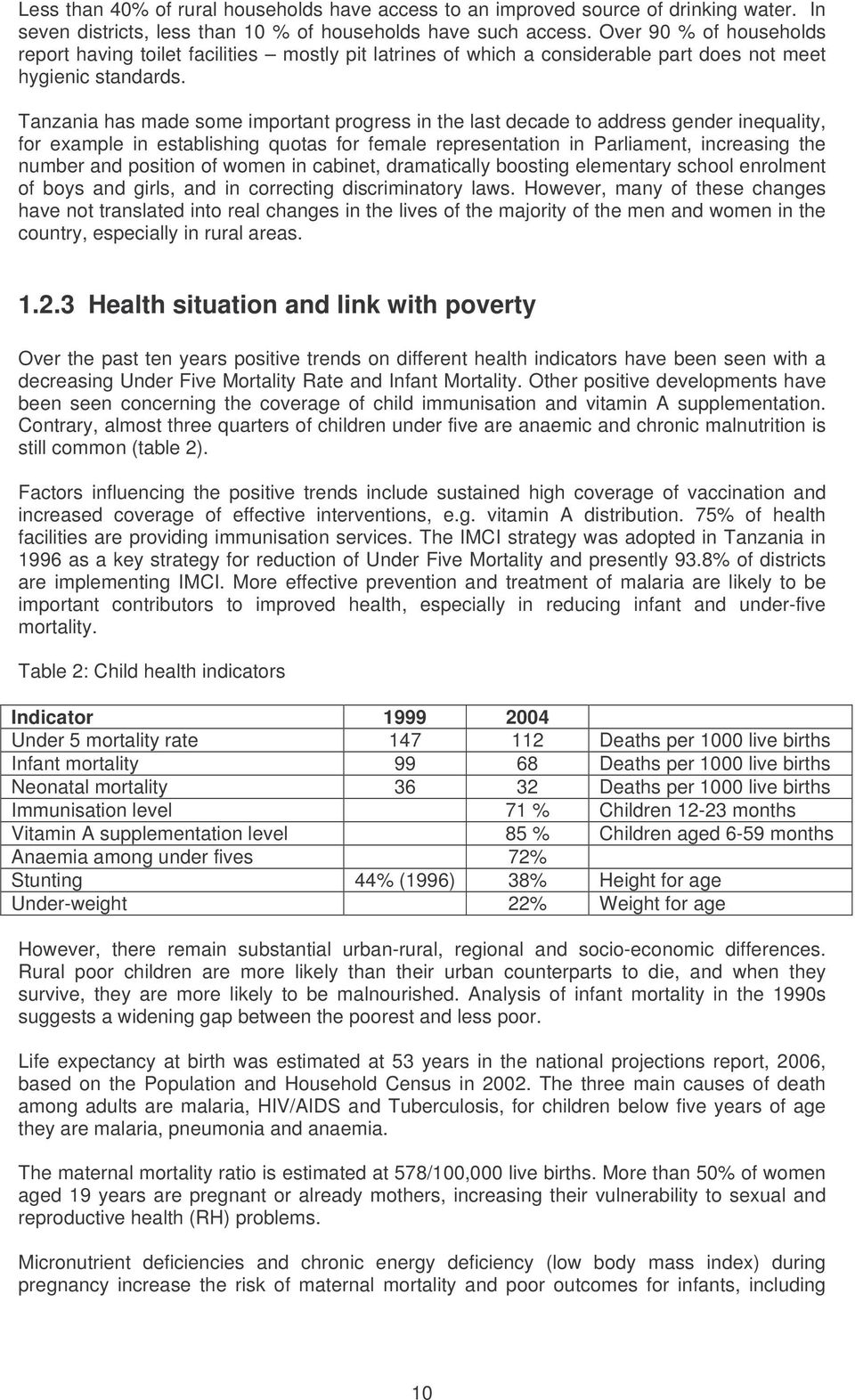
15 Less than 40% of rural households have access to an improved source of drinking water. In seven districts, less than 10 % of households have such access. Over 90 % of households report having toilet facilities mostly pit latrines of which a considerable part does not meet hygienic standards. Tanzania has made some important progress in the last decade to address gender inequality, for example in establishing quotas for female representation in Parliament, increasing the number and position of women in cabinet, dramatically boosting elementary school enrolment of boys and girls, and in correcting discriminatory laws. However, many of these changes have not translated into real changes in the lives of the majority of the men and women in the country, especially in rural areas Health situation and link with poverty Over the past ten years positive trends on different health indicators have been seen with a decreasing Under Five Mortality Rate and Infant Mortality. Other positive developments have been seen concerning the coverage of child immunisation and vitamin A supplementation. Contrary, almost three quarters of children under five are anaemic and chronic malnutrition is still common (table 2). Factors influencing the positive trends include sustained high coverage of vaccination and increased coverage of effective interventions, e.g. vitamin A distribution. 75% of health facilities are providing immunisation services. The IMCI strategy was adopted in Tanzania in 1996 as a key strategy for reduction of Under Five Mortality and presently 93.8% of districts are implementing IMCI. More effective prevention and treatment of malaria are likely to be important contributors to improved health, especially in reducing infant and under-five mortality. Table 2: Child health indicators Indicator Under 5 mortality rate Deaths per 1000 live births Infant mortality Deaths per 1000 live births Neonatal mortality Deaths per 1000 live births Immunisation level 71 % Children months Vitamin A supplementation level 85 % Children aged 6-59 months Anaemia among under fives 72% Stunting 44% (1996) 38% Height for age Under-weight 22% Weight for age However, there remain substantial urban-rural, regional and socio-economic differences. Rural poor children are more likely than their urban counterparts to die, and when they survive, they are more likely to be malnourished. Analysis of infant mortality in the 1990s suggests a widening gap between the poorest and less poor. Life expectancy at birth was estimated at 53 years in the national projections report, 2006, based on the Population and Household Census in The three main causes of death among adults are malaria, HIV/AIDS and Tuberculosis, for children below five years of age they are malaria, pneumonia and anaemia. The maternal mortality ratio is estimated at 578/100,000 live births. More than 50% of women aged 19 years are pregnant or already mothers, increasing their vulnerability to sexual and reproductive health (RH) problems. Micronutrient deficiencies and chronic energy deficiency (low body mass index) during pregnancy increase the risk of maternal mortality and poor outcomes for infants, including 10
16 preterm delivery, foetal growth retardation, low birth weight, increased risk of dying, impaired cognitive development and increased risk of Non Communicable Diseases (NCD) later in life. Table 3: Maternal Health Indicators Maternal Mortality Ratio 578/100,000 Pregnancy related deaths per 100,000 live births Fertility rate 5.7 Births per woman Average age first birth 19.4 Years One Antenatal visit 94% Four or more antenatal visits 62% Births in health facilities 47% Births assisted by skilled personal 46% Proportion of health centres with 5.5% emergency obstetric equipment available Post natal care attendance 13% Knowledge of contraception 90% Of adult population Married women using contraception 20% Unmet need for family planning 22% Table 4: Disease related indicators HIV/AIDS Prevalence 7% Tanzania HIV/AIDS Indicator Survey 2003/2004 Tuberculosis treatment success rate (2005) 82,6% Poverty and Human Development Report 2007 Cholera cases ,297 PHDR 2007 There are some geographic concentrations of districts, which have a more general pattern of relatively poor indicators. Districts in the Southeast have the worst adult literacy rates, under five mortality rates and access to improved water. There is more and more evidence of an increasing rural urban divide, with pockets of poverty and ill-health in remote rural areas, where services are poor, people s capacities to improve their own health are minimal, and thus disease statistics are worse Health System in Tanzania Mainland Tanzania is divided into 21 administrative regions and 113 districts with 133 Councils. There are a total of about 10,342 villages. Primary Health Care services form the basis of the pyramidal structure of health care services. Both public and private providers are working in dispensaries, health centres and at least one hospital at the district level. Currently there are 4,679 dispensaries and 481 health centres throughout the country. About 90% of population lives within five kilometres of a primary health facility. There are 55 district hospitals owned by Government and 13 Designated District Hospitals, owned by Faith Based Organisations (FBO). Furthermore, there are 86 other hospitals at first referral level (owned by Government, parastatals and private sector). There are 18 Regional Hospitals, functioning as referral hospital for district hospitals and 8 consultancy and specialised hospitals in the country. Government staffing norms for health facilities exist. When comparing these to existing level of staffing only 35% of positions are filled with qualified health workers, leaving Tanzania with a severe human resource crisis. 11

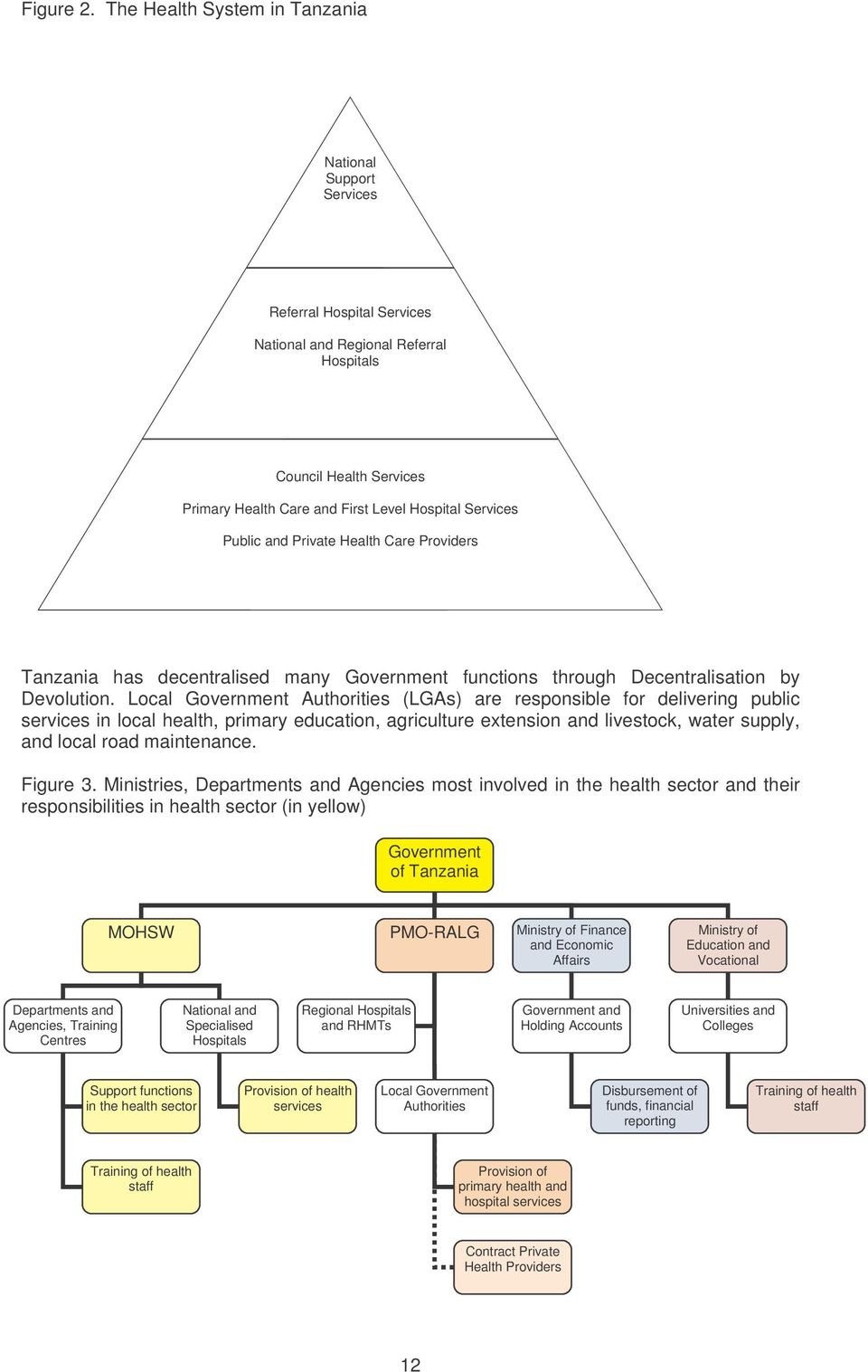
17 Figure 2. The Health System in Tanzania National Support Services Referral Hospital Services National and Regional Referral Hospitals Council Health Services Primary Health Care and First Level Hospital Services Public and Private Health Care Providers Tanzania has decentralised many Government functions through Decentralisation by Devolution. Local Government Authorities (LGAs) are responsible for delivering public services in local health, primary education, agriculture extension and livestock, water supply, and local road maintenance. Figure 3. Ministries, Departments and Agencies most involved in the health sector and their responsibilities in health sector (in yellow) Government of Tanzania MOHSW PMO-RALG Ministry of Finance and Economic Affairs Ministry of Education and Vocational Training Departments and Agencies, Training Centres National and Specialised Hospitals Regional Hospitals and RHMTs Government and Holding Accounts Universities and Colleges Support functions in the health sector Provision of health services Local Government Authorities Disbursement of funds, financial reporting Training of health staff Training of health staff Provision of primary health and hospital services Contract Private Health Providers 12
18 In medical, paramedical, or technical areas, Tanzania has 116 training institutions of which government owns 72 and 44 are owned by the private sector and faith based organisations. There are also seven medical universities, of which six are privately owned. The total annual intake in the pre-service training institutions has been increasing over the past 4 year with enrolment of 3,500 students in The total output from health training institutions in the past nine years was 23,536, which is not sufficient to cover the needs. The MOHSW and PMORALG in collaboration with Public Service Management Office are responsible for recruitment and distribution of health staff throughout the country. Shortage of health staff in remote areas is a reason for concern and emergency plans for tackling this situation have been developed. 13

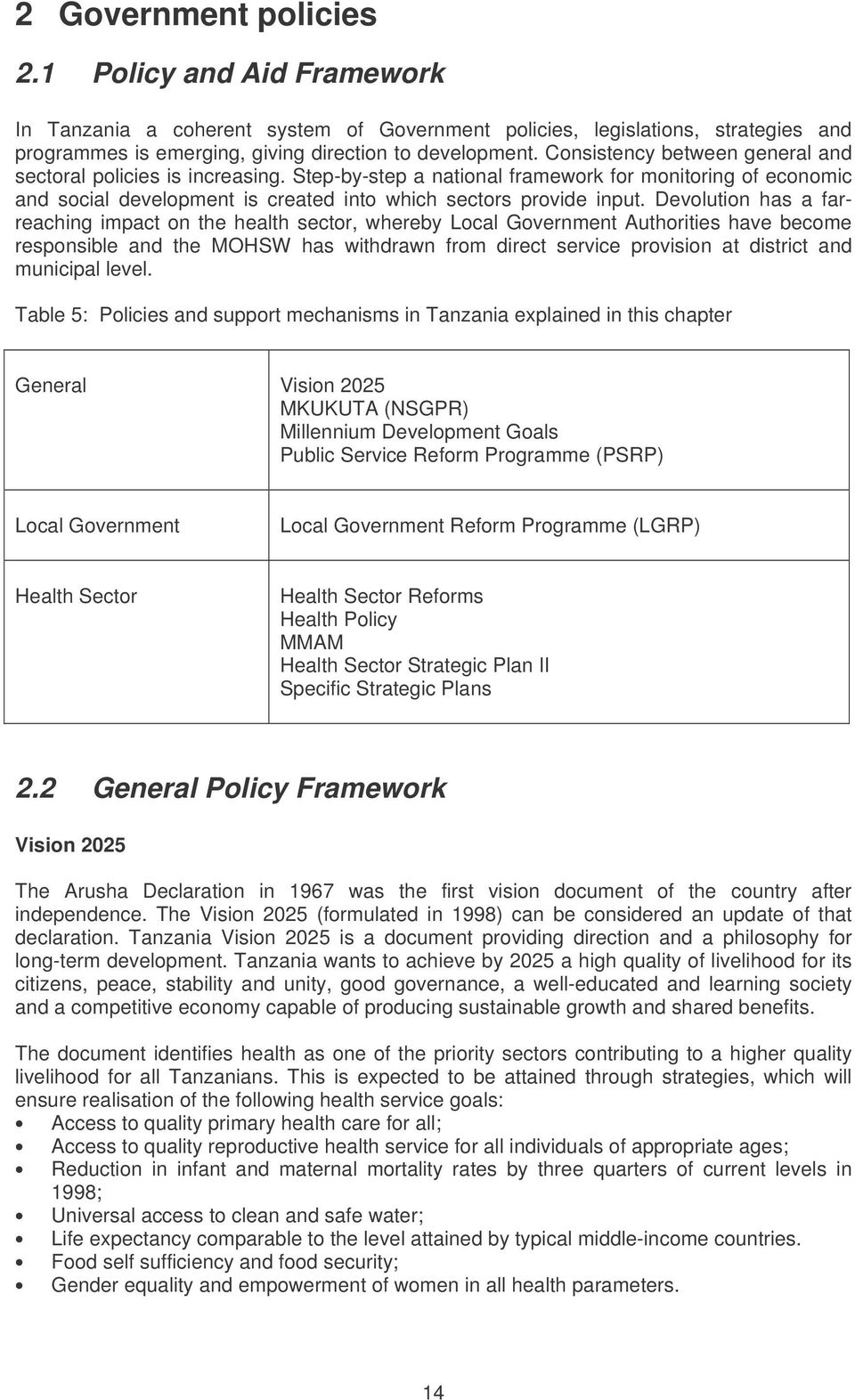
19 2 Government policies 2.1 Policy and Aid Framework In Tanzania a coherent system of Government policies, legislations, strategies and programmes is emerging, giving direction to development. Consistency between general and sectoral policies is increasing. Step-by-step a national framework for monitoring of economic and social development is created into which sectors provide input. Devolution has a farreaching impact on the health sector, whereby Local Government Authorities have become responsible and the MOHSW has withdrawn from direct service provision at district and municipal level. Table 5: Policies and support mechanisms in Tanzania explained in this chapter General Vision 2025 MKUKUTA (NSGPR) Millennium Development Goals Public Service Reform Programme (PSRP) Local Government Local Government Reform Programme (LGRP) Health Sector Health Sector Reforms Health Policy MMAM Health Sector Strategic Plan II Specific Strategic Plans 2.2 General Policy Framework Vision 2025 The Arusha Declaration in 1967 was the first vision document of the country after independence. The Vision 2025 (formulated in 1998) can be considered an update of that declaration. Tanzania Vision 2025 is a document providing direction and a philosophy for long-term development. Tanzania wants to achieve by 2025 a high quality of livelihood for its citizens, peace, stability and unity, good governance, a well-educated and learning society and a competitive economy capable of producing sustainable growth and shared benefits. The document identifies health as one of the priority sectors contributing to a higher quality livelihood for all Tanzanians. This is expected to be attained through strategies, which will ensure realisation of the following health service goals: Access to quality primary health care for all; Access to quality reproductive health service for all individuals of appropriate ages; Reduction in infant and maternal mortality rates by three quarters of current levels in 1998; Universal access to clean and safe water; Life expectancy comparable to the level attained by typical middle-income countries. Food self sufficiency and food security; Gender equality and empowerment of women in all health parameters. 14
20 MKUKUTA The National Strategy for Growth and Reduction of Poverty (NSGRP), known in Kiswahili as the MKUKUTA (Mkakati wa Kukuza Uchumi na Kupunguza Umaskini Tanzania) was approved by Cabinet in February 2005 for implementation over five years and is the successor to the Poverty Reduction Strategy Paper. The MKUKUTA is informed by Vision 2025 and committed to the achievement of the Millennium Development Goals (MDGs). It focuses on growth and governance, and is a framework for all government development efforts and for mobilising resources. The MKUKUTA aims to foster greater collaboration among all sectors and stakeholders. It has mainstreamed cross-cutting issues (gender, environment, HIV/AIDS, disability, children, youth, elderly, employment and settlements). All sectors are involved in a collaborative effort rather than segmented activities. Therefore this document is of crucial importance for the MOHSW strategies. The MKUKUTA seeks to deepen ownership and inclusion in policy making, paying attention to address laws and customs that retard development and negatively affect vulnerable groups. The strategy identifies three clusters of broad outcomes: (i) Growth and reduction of income poverty; (ii) Improvement of quality of life and social well -being, and (iii) Good governance. Health is part of the second cluster, improvement of quality of life and social wellbeing. The MKUKUTA Monitoring Master Plan (MMM) of 2006 outlines the guiding principles of national development monitoring, which also has a bearing on sector monitoring activities. The MKUKUTA monitoring framework offers the basis for progress monitoring of national and sectoral activities, contributing to poverty reduction. The framework defines the frequency and type of reporting, both on achievements and on finances. Health sector reporting is incorporated in the MKUKUTA reporting. The MKUKUTA Monitoring System routinely prepares national reports on the national indicators (including health). It produces a Poverty and Human Development Report (PHDR) every two years. In the year when the PHDR is not produced, a Status Report on the indicators is prepared. Like the PHDR, this report analyses the current data against baselines and targets. Various Development Partners (DPs) use the information provided in the PHDR to assess progress. They base their budget support decisions on this information, instead of performing parallel evaluations. 2.3 Local Government Policy and Aid Framework Local Government Reform and Decentralization by Devolution (D-by-D) Since 1994 Tanzania has embarked on a Local Government Reforms Programme (LGRP). The aim of the reforms is to establish decentralisation by devolution (D-by-D). This implies that Local Government Authorities (LGAs) take full responsibility for planning, budgeting and management of government services, including health, education, and water supply. In the country there are 133 Councils, in districts, municipalities and towns. There are 21 Regions. At national level the councils are overseen by the Prime Minister s Office for Regional Administration and Local Government (PMO-RALG). At the national level laws, systems and guidelines are developed, helping Local Government Authorities to perform their tasks. In 1996 the Government decided to restructure the regional administration, giving more room for development of the Councils. Regions became facilitators, rather than implementers. In the devolution process the Regional Health Management Teams became part of the Regional Administration, instead of being part of the MOHSW. 15

21 A new LGRP phase for the period July 2008 June 2013 has started, which aims to eliminate the institutional, legal, organisational and operational bottlenecks to realisation of D-by-D policy at all levels of government, and improve collaboration with line ministries. There will be further fiscal decentralisation, and further decentralisation of human resources management. Line ministries will delegate more operational tasks to LGAs. The LGRP will build the capacity of LGAs to be efficient and effective organisations in the planning and implementation for delivery of basic social services, socio-economic development and poverty reduction interventions. The LGRP will empower citizens to demand accountability and integrity as well as efficient and effective use of public resources. The Government of Tanzania (GOT), through PMO-RALG, implements the Local Government Capital Development Grant (LGCDG). This system provides discretionary development funds for rehabilitation and expansion of infrastructure to local authorities. Over time the LGCDG is intended to become the mechanism through which all development funds will be transferred to Local Government Authorities (LGAs), in accordance with GOT s commitment to Decentralization by Devolution. A separate window for health for rehabilitation of health facilities has been established in Health Sector Policies, Strategies and Programmes Health Sector Reform Health Sector Reforms (HSR) started in 1994 and aims at improvement of access, quality and efficiency health service delivery. Primary health care was adopted as the most cost-effective strategy to improve health of the people. The major focus of the HSR is therefore on strengthening the District Health Services, as well as strengthening and reorientation of secondary and tertiary service delivery in hospitals in support of primary health care. The programme also aims at strengthening of support services at the central level, in the MOHSW, it agencies and training institutions. The HSR introduced a programmatic approach, replacing the project approach, in order to create coherence between activities and continuity. Initially a Plan of Work was developed defining the priorities of the reforms, which in 2003 was replaced by the HSSP II. The Health Sector Reforms are in the following dimensions: decentralisation of health services; financial reforms, such as enhancement of user-charges in government hospitals, introduction of health insurance and community health funds and public/private partnership reforms such as encouragement of private sector to complement public health services. They also include organisational reforms such as integration of vertical health programmes into the general health services; and propagation of demand oriented researches in the health sector. In a later stage hospital reforms were added as element of the reforms, because the quality of hospital services was not improving in line with the sector reforms. The HSR got a new dimension when local government and public service reforms programme gained momentum and devolution was introduced in 2001: District Health Services became part of the Local Government Authority. New relations with other government players in the health sector were established in the context of these reforms. The need for systematic planning, budgeting and monitoring and evaluation became more urgent, now the MOHSW was separated from most of the operational functions in district health care. The Comprehensive Council Health Plan was introduced as management instrument, offering stakeholders full insight into the Councils health activities. Following the introduction of a new budgetary instrument, by the MOF in 2001, the Medium Term Expenditure Framework (MTEF) was developed to incorporate the necessary planning and financing of the three year programme of work for the Ministry of Health, for both recurrent and development activities into one document. 16
22 Important in the HSR was building up the Sector Wide Approach (SWAp) as mechanism for sustainable relations with other service providers in health and with Development Partners (DPs). An important achievement under the HSR was the introduction of the Health Basket Fund in From 2002 onwards the Councils started to receive funds from the HBF. Under the SWAp the mechanism for collaboration between the health sector and the DPs has been regulated. Health Policy The MOHSW has revised the 1990 National Health Policy and the revised Health Policy 2007 has been approved. Ongoing socio-economic changes, new government directives, emerging and re-emerging diseases and changes in science and technology necessitated to update the policy. The policy outlines achievements and challenges facing the health sector. The resource constraints (especially human resources) constitute the major problem for not being able to cope adequately with health problems. The vision of the Government is to have a healthy society, with improved social wellbeing that will contribute effectively to personal and national development. The mission is to provide basic health services in accordance to geographical conditions, which are of acceptable standards, affordable and sustainable. The health services will focus on those most at risk and will satisfy the needs of the citizens in order to increase the lifespan of all Tanzanians. Specifically the Government aims to: (i) Reduce morbidity and mortality in order to increase the lifespan of all Tanzanians by providing quality health care; (ii) Ensure that basic health services are available and accessible; (iii) Prevent and control communicable and non- communicable diseases; (iv) Sensitise the citizens about the preventable diseases; (v) Create awareness to individual citizen on his/her responsibility on his/her health and health of the family; (vi) Improve partnership between public sector, private sector, religious institutions, civil society and community in provision of health services (vii) Plan, train, and increase the number of competent health staff; (viii) Identify and maintain the infrastructures and medical equipment; and (ix) Review and evaluate health policy, guidelines, laws and standards for provision of health services. The document formulates health policies and statements in the following areas: Preventive services: control disease incidences and disability Epidemics: control communicable diseases, especially diseases from outside Non-communicable diseases: promote healthier lifestyles and treat adequately Maternal and child health: reduce maternal and child mortality in line with MDGs Reproductive health: make services available especially for youth and men Primary Health Care: make PHC accessible for all citizens Health education and advocacy: Convey that every individual can improve his or her health status Environmental Health: promote a sustainable healthy environment for the whole community Occupational health: protect and improve workers health status Curative care: deliver safe health care services to the community Medicines and supplies: ensure quality and availability of sufficient medicines and supplies Safe Blood Transfusion: make safe blood available throughout the country Mental health: promote mental health in the community and prevent illnesses 17
23 Traditional medicine and traditional midwives: increase coordination and partnerships Cells and genome: develop proper use of technology of genetic engineering Control of Food, Medicines, etc: ensure foods are safe and meet defined standards Diagnosis of diseases: provide accurate diagnosis and forensic investigations Quality improvement and standards: attain at least agreed minimum standards Coordination in health sector: participatory, transparent and sustainable system for all stakeholders Human resources development: provide sufficient staff with required skills mix MMAM In 2007 the MOHSW developed the Primary Health Care Service Development Programme (PHCSDP). This programme is better known by the Kiswahili name of Mpango wa Maendeleo ya Afya ya Msingi (MMAM). The objective of the MMAM programme is to accelerate the provision of primary health care services for all by 2012, while the remaining five years of the programme will focus on consolidation of achievements. The main areas will be strengthening the health systems, rehabilitation, human resource development, the referral system, increase health sector financing and improve the provision of medicines, equipment and supplies. This programme will be implemented by the Ministry of Health and Social Welfare in collaboration with other sectors by the existing Government administrative set-up including PMO-RALG, RSs, LGAs and Village Committees. The first element is increasing the workforce in health by increasing the throughput in the existing training institutions by 100%, upgrading 4 schools for enrolled nurses, production of health tutors and upgrading the skills of existing staff by provision IT skills and acquiring new medical technology. The rehabilitation of existing health facilities and construction of new ones, as to have a dispensary in each village and a health centre in each ward, is planned as well as improving the outreach services. This includes 8,107 primary health facilities, 62 district hospitals, and 128 training institutions by year The Referral System will be strengthened by improving information communication system and transport. The Programme will address the revised Health Policy and the health related Millennium Development Goals in the areas of maternal health, child health and priority diseases. The programme costs are estimated to be around 11.8 trillion TSH, which is beyond the presently available budget range. Innovative modalities of financing are therefore required. HSSP II The Health Sector Strategic Plan II (HSSP II) articulated a process of health sector reform aimed at addressing the recognizable deficiencies in the sector and achieving specific goals and targets in health as set out in the Millennium Development Goals (MDGs) and the National Strategy for Growth and Reduction of Poverty (MKUKUTA). According to the sector evaluation in 2007 the HSSP II established the guiding framework for the implementation of Government policy and sector reforms as well as DPs assistance. The strategic planning document has been coherent with national policies and the priorities it identified can be directly linked to constraints identified during the evaluation at the central, regional and council levels. The strategies included: strengthening District Health Services, Hospital Reforms, role of the Central Ministry and Central Support Systems for health, Human Resources for Health, Health sector Financing, Public Private Partnership, sector coordination and HIV/AIDS programming. (In Chapter 5 achievements and constraints in these areas are summarised.) HSSP III to a large extent follows the structure of the HSSP II document, which has proved its value in the past years. 18
24 Joint External Evaluation of the Health Sector in Tanzania Main Evaluation Conclusions 1. The Sector Wide Approach has resulted in greater sector coherence and consistency. 2. The Health Basket Fund has been a particularly effective mechanism. 3. Global Health Initiatives and disease specific programmes have remained largely outside the planning and priority setting structures in place at national and local level. 4. The programmes, projects and activities implemented have contributed to improvements in health outcomes and to some improvements in the service quality. 5. There has not been significant progress towards achieving goals and targets relating to maternal mortality and maternal health (and to neonatal mortality). 6. The devolution of responsibilities for health facilities to Local Government Authorities has made a difference. 7. Further progress towards achieving the MDGs and MKUKUTA is required. In particular, more effective management of human resources is an urgent requirement. 8. There has been the relative lack of progress in hospital reform and in the implementation of an effective public private partnership. 9. The sector has not responded effectively to address some causes of unequal access. 10. Problems related to recruiting, posting and retaining staff at geographically isolated hospitals, health centres and dispensaries have not been effectively addressed. Major Recommendations 1. The Government of Tanzania and Development Partners should maintain the SWAP programming format to structure their cooperation in the health sector. 2. The Government of Tanzania and Development Partners should make every effort to provide increased funding. 3. MOHSW and the Prime Minister s Office-Regional and Local Government should agree on a target for budget to be allocated to Local Government Authorities. 4. The Health Basket Fund should remain a feature of the sector during HSSP3. The Health Basket Fund may be merged with the Health Block Grant. 5. HSSP3 should be used to consolidate the achievements of HSSP2 and to address identified constraints related to already agreed reforms. 6. HSSP3 should retain the strategic priorities of HSSP2, but should also include concrete steps to accelerate progress in both hospital reform and public private partnership. 7. Effective action to reduce maternal mortality and improve delivery services, including emergency obstetric care, should be a stated strategic priority of HSSP3. 8. Improving equity of access should be a crosscutting theme of HSSP3. 9. HSSP3 should include specific strategies to improve efficiency of service delivery both in Primary Health Facilities and hospitals, by increasing the productivity of health sector personnel and better matching staffing levels to work loads. 10. A health inspectorate (for which legislation has been prepared) should be established. 11. HSSP3 should include the development and implementation of an overall monitoring and evaluation framework for the health sector, which encompasses both regular performance monitoring and periodic effectiveness evaluation. Specific Policies, Strategies, Work Plans and Programmes Within the health sector specific work documents have been produced, guiding the implementation of activities in those areas. These are listed in the following table. Table 6. Specific Policies, Strategies, Work Plans and Programmes Name Period Area General Ministry of Health and Social Welfare (Headquarter office) Medium Term Role of MOHSW in delivery of health and social welfare services Strategic Plan Human Resource for Health Strategic Plan Human Resource planning, development, retention and financing 2000 Outline of cost-effective, priority services to be delivered at health facilities National Package of Essential Health Interventions in Tanzania Health Education Section Strategic Plan Health Education and Promotion to community level 19
25 Tanzania National Health Research Priorities Health Issues National Health Research Priorities Client Service Charter 2005 Patients rights National HIV/AIDS policy 2001 HIV/AIDS National Multi-Sectoral Strategic Framework on HIV AIDS Multi-sectoral approach for prevention and control of HIV/AIDS Health Sector HIV and AIDS strategy II Prevention, treatment and health systems strengthening for HIV/AIDS Strategic Plan National Tuberculosis & 2004/5-2008/9 Tuberculosis and Leprosy Leprosy Programme National Malaria Medium Term Strategic Plan (NMMTSP) Malaria control in context of global focus on eradication National Adolescent Health and Development Strategy Adolescent reproductive health, mental health, social development National Eye Care Strategic Plan Eye diseases prevention and control The National Trachoma Control Trachoma prevention and control Programme Strategic Plan Tanzania Food and Nutrition Centre Strategic Plan National Road Map Strategic Plan to Accelerate Reduction of Maternal and Newborn and Child Deaths (one plan) Expanded programme on Immunization Comprehensive multiyear plan (EPI) The National Environmental Health, Hygiene and Sanitation Strategy 2005/ /10 Policy and planning, community nutrition, food science and technology, education and institutional development Accelerated improvement of Maternal, Newborn and Child Health Cold Chain, Immunization Strategy for enforcement of new Public Health Law National Cancer Control Strategy 2008 Cancer prevention, control and treatment Government Chemist Laboratory Agency Strategic Plan Quality laboratory analysis, regulation of chemicals, forensic services, research National Strategy for Non Communicable Diseases (draft) 2008 Cancer, Chronic Respiratory & Cardiovascular diseases, Diabetes, Injuries and RTA, Renal disease, Sickle cell disease, Mental Health and Substance Abuse Integrated Disease Surveillance Policy 2001 Monitoring infectious diseases Social Welfare Strategic Plan Social Welfare and social protection Medicines and medical supplies National Drug Policy and the Pharmaceutical Master Plan Tanzania Medical Stores Department, Medium Term Strategic Plan Tanzania Food and Drug Authority Strategic Plan Health Legislation Medicines Government policies may require legislation to enforce adherence. The existing health sector legislation is mainly divided into: Main direction and activities planned for MSD Regulatory instruments for control of quality of food and drugs Public Health legislation which is for the control of epidemics, infectious diseases and environmental health protection, Health professional legislation which governs the practice and conduct of health professionals such as doctors, dental practitioners, pharmacists, nurses etc, Legislation, which establishes autonomous health institutions for a particular need, such as institutions for medical research, national and special hospitals etc. Health financing legislation, which is aiming at providing alternative health financing mechanism with the aim of complementing government efforts to finance health services in the country. These laws need to be effectively implemented in order to accomplish the intended objectives of their enactment. Furthermore, due to a number of socio economic changes, policy changes, and political changes, enactment and review of the existing health legislation is apparent. 20
26 3 Health Sector Strategic Framework 3.1 Introduction The MOHSW has developed a framework to reform the health sector in order to improve the impact of health services at all levels in the country. The emphasis of the strategic health plan is on Council Health Services, where most of the essential health services are provided close to the communities, and on hospital services to save lives of people who cannot be treated in first line health facilities. The thrust is to improve significantly the quality of essential health services, make CHMTs, Council Health Providers and Hospital Management Boards more accountable to the community. Delegation of authority means that the dispensaries, health centres and hospitals should be the key actors in the planning process. It also means that they will be held responsible for implementing what they have planned. The services to improve health status of the people should be directed towards the following types of services. Types of services The following services provide a continuum of care for patients and clients: Health Promotion activities to enhance behaviour change and to ensure that life styles of individuals are conducive to personal development and environmental safety. Community participation and ownership is key to success of the primary health service delivery programme; Preventive health services to prevent diseases by promoting optimal nutrition and control of infectious diseases transmission, curtail epidemics and improvement of working environment to maintain highest standards of occupational health; Care and treatment (curative services) This is to treat correctly diseases or conditions to reduce the likelihood of complications or death by improving quality and quantity of care to patients and ensuring availability of basic services and supplies; Rehabilitation services to patients such as physical rehabilitation, mental rehabilitation and psychological support to vulnerable groups; Provision of services to the chronically ill and the elderly; this includes catering for life long treatment like hypertension, diabetes, AIDS patients on ARVs, renal conditions, Cancer and any other chronic conditions. The health sector consists of components or levels in the health sector: Council health services (in district or municipality), consisting of: o Household and community health o Dispensaries and Health Centres (public and private) o District Hospital and other hospitals (public and private) Regional health services, consisting of o Regional Referral Hospitals o Regional Health Management Teams National level services, consisting of o Specialised Hospitals and Special Hospitals (public and private) o Training Institutions, Zonal Resources Centres o Ministries, Departments and Agencies The MOHSW has identified eleven strategies, which the health sector should achieve during the period of implementation: Strategy 1: District Health Services Strategy 2: Referral Hospital Services Strategy 3: Central Support 21
27 Strategy 4: Human Resources for Health Strategy 5: Health Care Financing Strategy 6: Public Private Partnerships Strategy 7: Maternal, Newborn and Child Health Strategy 8: Disease Prevention and Control Strategy 9: Emergency Preparedness and Response Strategy 10: Social Welfare and Social Protection Strategy 11: Monitoring & Evaluation and Research In this strategic plan, crosscutting issues which affect all programmes and activities are highlighted: quality, equity, gender sensitivity, community ownership, coherence, and complementary in governance. Table 7. Strategies and levels of care Strategies: Components/levels: 1 - District Health Services 2 - Referral hospital services 3 - Central level support 4 - Human Resource for Health 5 Health Care Financing 6 - Public Private Partnership 7 - Maternal, Newborn & Child Health 8- Disease specific programmes 9 - Emergency Preparedness and Response 10 - Social Welfare/Social Protection 11 - Monitoring, Evaluation & Research District Health Services 1a: Household & Community X X X X X X 1b: Dispensaries and X X X X X X X X X X Health Centres 1c: District Hospital X X X X X X X X Regional Health Services National Level 1 d: Council Health Management Team (DHMTs & CHMTs) 2a: Regional Referral Hospitals 2b: Regional Health Management Team 3a: Super-specialised & Special Hospitals 3b: Zonal Resources Centres X X X X X X X X X X X (X) X X X X X X X X X X X X X X X X X X X X (X) (X) X X X X X X (X) X X (X) X X 3c: Ministries (X) X X X X X X X X X 22
28 3.2 Dimensions of HSSP III The HSSP III has four dimensions, i.e. types of services, levels in the health sector, strategies and crosscutting issues, which each serve as entry point for addressing key strategic choices, and which together result in one consistent strategic plan. Figure 3: Dimensions of the strategic plan 5 Types of Services 3 Levels In the Sector HSSP III 11 Strategies 6 Cross Cutting Issues The next chapter provides a situation analysis and way forward for each of the eleven strategies. In the paragraphs the types of services are explained, where applicable. Chapter 5 elaborates the crosscutting issues and their impact on the levels of the health sector. In chapter 6 the strategies are summarised in tabular form. In the tables types of services and cross-cutting issues are included. The strategic plan serves as reference document for developing specific hospitals and Council strategic plans, and for annual work plans. The four dimensions offer reference information that can be used in further more specific planning. 23
29 4 Strategies This chapter outlines the detailed narrative strategies and important focus areas for the HSSP III. The implementation plan including strategic objectives and expected results can be found in chapter Strategy 1: District Health Services Situation Analysis In recent years the Councils (Local Government Authorities) established and improved the decentralised health systems. At the Council level a separate health sector account is maintained (account number 6), where earmarked funding for health is kept. The Comprehensive Council Health Plan (CCHP) is a well-established tool for planning and monitoring health activities. The management structure, consisting of Council Health Management Team (CHMT) and Hospital Management Team (HMT), facilitates the implementation of health services at district level, together with a functional community health structure (Council Health Services Board and Health Facility Committees). The financing of District Health Services improved, with increase in Government funding and Health Basket funding. Complimentary financing options of the National Health Insurance Fund (NHIF), Community Health Fund (CHF) and user fees have been introduced to provide sustainable sources of funds to bridge gaps in the budget for health services provision. However, bureaucratic procedures, along with the lack of bank accounts at health centre and dispensaries have hampered the potential use of these funds. Councils hardly use their own discretionary funds to support health services. District Health Services still face problems with low geographical coverage of health services in remote areas and a non-functional referral system. The infrastructure of some health facilities does not meet the official standards. Also policies, standards and guidelines are not fully used at implementation level. They may not be known or understood by health workers with little time or access to information about developments in the health sector. Occasionally, health workers in peripheral institutions do not function well: cases have been found of unacceptable attitude of health staff and corruption in the health sector. The comprehensive National Package of Essential Health Interventions therefore cannot be fully provided. Other challenges include inadequate managerial skills of staff in various areas. CHMT Supervision of district health facilities needs improvement and supervision from the RHMT to backstop CHMTs is not optimal. As a result health programmes are not always implemented as designed. The integration and coordination of health programmes in general is poor. Programmes sometimes seem to compete for attention from health facility staff. But, most importantly, there is inadequate human resource for health service delivery at the primary level, both in numbers and in skill mix. Council Management Teams (the district administration) are often not fully informed on health policies, programmes, or specific activities, and may therefore not appreciate their importance. Furthermore, the Decentralisation by Devolution has not reached the grass roots level, leaving health workers and communities disempowered. Decision making is too a large extent concentrated in the district centres. Motivation of staff to perform needs to increase to ensure good performance. Way forward in district health service provision District Health Services Strategies 1. Increase accessibility to health services based on equity and gender balanced needs 2. Improve quality of health services 24
30 In the strategies of the health sector priority will be given to equitable access to quality health services for all. The Tanzania Package of Essential Health Interventions will be updated, to serve as reference guide for service delivery. The MMAM is the major strategy for improving access and expansion of health services in underserved areas with one dispensary per village and one health centre per ward. Its implementation is part of this strategic plan and will involve the health sector as a whole. Public Private Partnership (PPP) will be enhanced through joint planning, implementation, monitoring and supervision. Interaction between community and health services to promote healthier lifestyles will be intensified. Community based strategies in health promotion, nutrition, disease control and reproductive health will be used to create more ownership of health in the community. Health activities will be gender sensitive, taking care of the special needs of women, and incorporating men in family-centred advocacy. The integration of health and social welfare services will create synergies, which benefit the poorest, most vulnerable, handicapped and chronically ill. The Tanzania Quality Improvement Framework (TQIF) will be operationalised, with the introduction of an accreditation system, to guarantee defined standards of quality in the health sector. Standards and protocols in service delivery will be promoted and updated where necessary. Adherence to the Client Service Charter will be further promoted. Improvement of diagnostic services (including laboratories), curative care, and rehabilitation services will be achieved through capacity building and provision of necessary resources to health facilities based on the Essential Health Package. More coherence of service delivery can be achieved through integration of health programmes at service delivery level. Enhanced collaboration with other sectors will be required to improve nutrition, water, health education, etc. The district hospital together with other hospitals in the district will provide first level referral care, and be fully integrated in the districts health services. A functional referral system will guarantee that patients, in need of advanced care, will indeed receive it. All facilities will function according to their mandated roles, and measures to reduce by-pass of facilities will enhance efficient use of resources. Way forward in management of District Health Services Management of District Health Services Strategies 3. Strengthen and decentralise management of District Health Services and harmonise MOHSW and PMO-RALG management procedures District Health Services are the focus of nearly all the policies and strategies in the health sector. Therefore, it is crucial that the capacities for implementation are available at district and facility level. Improvement of the management capacity of District Health Services and availability of human resources for health in the periphery are priorities in the HSSP III. The Councils will develop health strategic plans for the period , following the HSSP III. The Councils will produce annual Comprehensive Council Health Plans (CCHP), based on the inputs from health facilities, which will plan for interventions based on the prioritised essential health and nutrition issues, as well as burden of disease taking into account the available financial means. Further decentralisation within the District Health Services will take place. Health facilities will produce their own annual plans and will increasingly manage their own funds, in collaboration with the Health Facility Committees, representing the community. The management capacity of peripheral health staff for planning, coordination and monitoring will be strengthened. Collaboration with the private sector will be strengthened through service agreements. The Council Health Services Boards (CHSB) and Health Facility Committees will be stimulated to fulfil their responsibilities in planning and monitoring of the health services including facilitating the introduction of sound financial and accounting management systems. 25
31 In collaboration with PMO-RALG simplified management procedures will be developed for District Health Services, reducing district bureaucracy. CHMT supervision of health facilities will focus on coaching based on guidelines and standards, and evidence based medicine. The RHMTs will be given more responsibilities in supporting the District Health Services. M&E of the District Health Services will be strengthened, using LGA and PMO-RALG procedures and systems within the context of monitoring and evaluation of achievements towards MKUKUTA and MDG targets. Also the capacity for information analysis, dissemination and utilisation will be strengthened with the aim to enhance health managers evidence based planning and decision making. Motivation is a cornerstone for sound management in the human resource intensive health sector. A combination of supportive supervision and performance based incentive systems will be rolled out in the coming years. Pay for performance (P4P) and Results Based Bonuses (RBB) will be introduced. 4.2 Strategy 2: Referral Hospital Services Situation Analysis The Tanzanian health sector has a pyramid structure with provision of referral services from primary hospital to secondary (regional) hospital and final to tertiary (central) hospital or specialised hospital. The referral health care is not working as planned due to a number of challenges. There are no referral guidelines and therefore patients at their own discretion can enter at a higher level of care than necessary. Regional hospitals are operating as district hospitals instead of performing their role as further specialised referral hospitals in support of district hospitals 1. The zonal structure for referrals is not operational and the number of highly specialised hospitals is insufficient. The resources are inadequate, such as skilled staff (e.g. medical specialists in regional hospitals), funds, medicines and supplies, equipment and infrastructure. With regard to management of hospitals the roles and responsibilities of MOHSW and PMO- RALG have not yet been harmonised. The Hospital Boards are not yet in place and collaboration between ministries is insufficient. There is too much bureaucracy to access cost sharing and other health funds, which negatively affect motivation of staff to collect these funds. Way forward in hospital service provision Referral Hospital Services Strategies 1. Increase access for patients in need of advanced medical care 2. Improve quality of clinical services in hospitals Regional hospitals will be reformed in order to competently perform their referral role of handling cases requiring specialised care, rather than providing primary health care. The Hospital Reforms Programme will be taken forward. The Tanzania Quality Improvement Framework programme will be reinforced, with a Quality Assurance Unit in each referral hospital. Health workers will be sensitised to follow available standard treatment guidelines. A hospital accreditation system will be put in place. The referral structures throughout the sector (horizontal and vertical) will be strengthened, with clear guidelines and protocols. Specialist outreach programmes from tertiary to regional referral hospitals will be institutionalised, contributing to technical supervision of those 1 To operate as regional hospital a minimum of five specialists is needed (Internal Medicine, Paediatrics, Surgery, Orthopaedic Surgery and Obstetrics and Gynaecology). 26
32 hospitals. The zonal referral structure will be endorsed and made operational. Regional hospitals will be involved in supervision of district hospitals. Social welfare services in hospitals will be expanded, to ensure that vulnerable groups get the care they need. Emergency preparedness and response in hospitals will improve based on a national programme. Way forward in hospital management Referral Hospital Care Objectives, 3. Improve management of the hospitals through implementation of Hospital Reform Programme 4. Strengthen hospital governance Hospital management capacity building will continue in the coming period. The hospital reforms programme will be fully implemented. National and regional Hospital Boards will be created based on a sound legal framework. Community representatives will take part in the Boards. Inter-ministerial consultations between MOHSW and PMO-RALG will clarify the division of roles and responsibilities particularly between the technical and the administrative functions of all stakeholders in hospital management (including the role of community representatives). Referral hospitals will be encouraged to introduce and maintain financial and accounting management software systems. Hospitals will generate additional income from services and will engage in relations with health insurance schemes. The hospitals will develop strategic plans for the period , following the HSSP III and will produce annual plans and budgets. Hospital capital investments and maintenance will be planned to bring the infrastructure up to standard. 4.3 Strategy 3: Central Level Support Situation analysis central level Central level support to health service providers is given by the MOHSW headquarters, its departments and by several agencies and institutions operating under direct responsibility of headquarters. Medical Stores Department (MSD), Tanzania Food and Drug Authority (TFDA), Tanzania Food and Nutrition Centre, National Institute for Medical Research, Government Chemical Laboratory Agency and Health Regulatory Authorities provide indispensable services to the health facilities and health professions. The health sector in Tanzania is extensive both in scope and geographic coverage. The performance of central level support plays a key role in the effective delivery of health care services by Councils and programmes. Quite often the quality of service delivery is compromised by delayed delivery of resources e.g. funds, medicines and supplies, equipment, shortage of skilled staff or means of transport. Bureaucratic red tape, over-centralised or delayed decision making can be the cause of delays. The use of outdated rules and regulations can be a contributing factor. Developed policies and plans are sometimes not implemented, and the enforcement of existing regulations is not always taking place. This results in a gap between theory and practice. Collaboration between key players and stakeholders in the health sector is not optimal. Interaction between the MOHSW, PMO-RALG and the Private sector concerning programmes is insufficient. The decentralisation is not yet fully internalised by the system. Supervision or quality control is not systematically done. Central level managers too often are involved in running basic operations instead of strategic decision-making. 27
33 In recent years, new health legislation has been enacted, but there is still limited understanding of the holistic nature of health legislation. This has affected the implementation by other stakeholders. Similarly, laws are not self executing instruments; hence they require implementation support to ensure effective enforcement. Furthermore, there are a number of health related international conventions/agreements initiated by other sectors and partners, which need to be adopted and implemented. Way forward headquarters Central Support Objectives, Head quarters 1. Enhance decentralisation of MoHSW headquarters 2. Strengthen governance in the MoHSW 3. Strengthen the operational planning process of MoHSW headquarters 4. Institutionalise traditional and alternative health practice in the established health sector During the strategic plan period the health sector will attain the required institutional capacity and organisation structure necessary in the decentralisation framework. Operational decisions will be left to PMO-RALG, the LGAs, and where possible to the health facilities. This will enable headquarters to concentrate on stewardship functions, rather than operational issues. These strengthened stewardship functions will include strengthening multi-sector coordination and collaboration on health related issues. MOHSW will promote harmonisation and alignment of sector financing, policy and planning. Where necessary, the MOHSW will develop new policies, legislation and operational guidelines, and revisit old ones. The MOHSW will improve its performance as custodian of health related legislation. The MOHSW will formulate a Health Legislation Implementation Support Plan, which will outline different activities to be carried out, including dissemination, enforcement, monitoring and evaluation of legislation. MOHSW will work towards further institutionalization of Traditional and Alternative Health Practice as stipulated in the National Health Policy. PMO-RALG will be main partner in this, as supervisor of LGAs. Coherence between policies, legislation and plans will be high on the agenda. A gender sensitive and human rights-based governance system that ensures accountability, transparency and adherence to leadership ethics is another output expected during the HSSP III period. Improvement of the planning process in the Ministry will take place, leading to integrated operational plans for support services to programmes, departments, regions and districts. The MTEF planning will be comprehensive, more than annotated budgets. Workable plans for MDAs will be formulated to enhance the support system. Improved coordination will be achieved by integrating support services provided by programmes, department and units. Uncoordinated and unplanned activities, disrupting the implementation of CCHPs will be halted. The agencies and institutions operating under direct responsibility of MOHSW will implement their specific strategic plans according to delegation by MOHSW, contributing to reaching the health sector goals. The ministry will support specialised hospitals, regional hospitals, Zonal Resources Centres and other training institutions, as well as Councils to develop strategic plans for the period , following the HSSP III. The Comprehensive Council Health Plan (CCHP) guidelines will be updated from time to time. Improvement of monitoring and evaluation is discussed below (strategy 11). Situation analysis Regional Level The regional level takes up an intermediate position as arms of the central ministries in the organisational structure of the health care system in Tanzania. The Local Authorities Act and the decentralisation framework have exhaustively defined the roles and functions at the local 28
34 authorities level, but have inadequately defined the roles and functions at the Regional Secretariat. The regional level performs merely administrative supervision of District Health Services as part of PMO-RALG, rather than technical supervision on behalf of the MOHSW. The role of the RHMT in quality improvement of district plans and reports is limited. Only administrative verification takes place after submission of plans and reports. The Regional Health Management Teams (RHMT), including the regional hospitals, are not only understaffed, but also lack the finances and equipment to discharge their functions. Way forward regional level Central Support Services Objectives, Regional Level 5. Strengthen the Regional Health Management Team (RHMT) in supervision and support of the health service delivery The Regional Secretariat is strategically positioned to assist the centre in its supervisory and technical support role. The main focus is to have a regional health structure that has the capacity to provide both managerial and technical support. First the RHMTs will be internally strengthened. The competency of RHMT members will be created to interpret policies, regulations and conduct supportive supervision. Funding, equipment and means of transport will be made available to the teams. The MOHSW HQ will provide technical support to the RHMTs. The recognition of RHMTs as regional officials, with a well-defined relation has now been formally done. The RHMTs will function more as coaches and advisers of CHMTs, to boost the capacities of District Health Services in meeting defined quality standards. Social welfare will be incorporated into the RHMT functions. Coordination with other regional departments, e.g. water, agriculture, education, will be improved in the context of the MKUKUTA monitoring activities. 4.4 Strategy 4: Human Resources for Health Situation Analysis Health care is and always will be a labour-intensive sector. Certainly in a country like Tanzania, with a wide-spread population, delivering services to the population requires many health workers in health facilities, from dispensary level to tertiary hospital level. The health sector is understaffed. The total of staffing in the health sector stands at 35% of the actual need according to defined staffing norms. The available number of professional health workers in the public sector is 35,202 and deficit is 90,722. Shortages in the private sector, especially in FBO institutions are also immense. There is an enormous shortage of human resources for health across all cadres: clinicians, nurses, pharmaceutical technicians, laboratory technicians, radiographers, physiotherapists, health officers and health administration cadres. The shortage is more severe in rural districts. The high attrition rate is a threat and is compounded by HIV/AIDS epidemic. The policies and regulations with regard to human resources for health depend to a large extent on other ministries (e.g. PMO-RALG, POPSM), especially for civil servants. In the past the MOHSW was not always able to sufficiently advocate for increase of personnel or even to halt reductions. Partly this was due to insufficient planning capacity to make predictions of staff needs. But financial constraints in Government were a major contributing factor to the shortages. The decentralisation to LGAs affected the employment of health workers and the Ministry was not able to respond to these changes. 29
35 The collaboration between the public sector and private sector was not always optimal; at times there was competition for the few staff available. Inappropriate planning of new facilities and services sometimes resulted in under-utilisation of infrastructure and staff. The capacity of health training institutions is limited. Consequently there is a low output of trained health personnel. Training institutions have several setbacks (understaffing, neglected infrastructure) to match the existing demand. Staff currently in the field requires reliable and accessible Continuing Professional Development to meet training needs, but capacity building of staff is often fragmented, linked to vertical programmes, not targeting the right cadres. There is little follow-up to ensure that health workers indeed use the acquired skills. The impact of such capacity building is limited. The Zonal Resources Centres (ZRCs) still lack the capacity to effectively support the training institutions. Way forward HRH Strategies 1. Develop policies and regulations on human resources for health & social welfare, coherent with government policies 2. Strengthen HRH planning 3. Maximise effective utilisation of HRH 4. Increase production and improve quality of training (pre-service, in-service and continuous education) with support of ZRCs 5. Improve use of Human Resource for Health applied research for planning and advocacy. The Human Resource for Health Strategic (HRH) Plan has been formulated and agreed upon. Improvement of the human resources situation is priority number one for the health sector in Tanzania. It must be a well-concerted joint effort of the Public Service Management, Ministry of Finance, PMO-RALG the MOHSW and other stakeholders. The MOHSW will achieve more coherence in policies on Human Resource for Health & Social Welfare by entering into dialogue with other Ministries, Departments and Agencies, and by increasing the lobby for better remuneration, conditions of service and career development opportunities. The leadership in the Ministry will be strengthened to implement those tasks. The planning and management capacity for human resources will be improved at all levels, based on an effective and a comprehensive human resource information system. Collaboration between public and private sectors will be improved, to come to joint planning of staffing needs, and to improve rational use of available resources. Sufficient financing is crucial for the improvement of staffing. Besides the regular government funding innovative financing methods will be introduced, e.g. basket financing, project funding, external sponsoring. In collaboration with LGAs the human resources management in management teams in the districts and health facilities will improve, with better trained HR managers, who can improve working conditions and productivity of the workforce. Incentive structures for health workers will be implemented to improve performance and motivation of existing health workers. A performance based management system (P4P) will be introduced to that effect. This also will enhance the retention of staff. LGAs will play a bigger role in selection of students and provision of scholarships. They will be able to make bonding contracts with the graduates. The production of new staff through training will increase further to meet the demands. Key human resource production targets have been set and will be captured through the strengthened HRIS, for both clinical and non-clinical personnel in the health sector. At the same time the quality of training (pre-service, in-service and continuing professional development) will improve at all levels for both public and private sector. Curricula will be regularly updated, linked to developments in science and technology. The existing system of accreditation of training institutions through the National Accreditation Council for Technical Education (NACTE) will be strengthened including a development and succession 30
36 programme for teaching staff. It is important to create a system of recruitment of staff, immediately after graduation, without bureaucratic delays in employment and payment of salaries. Zonal Resources Centres will be strengthened to support training institutions in setting up quality assurance in education, and to assist regions and districts in continuing education. Vertical programmes will improve collaboration, and will incorporate their training activities in CCHPs and MTEF plans. They will work through ZRCs in activities of continuing professional development. Follow-up and coaching will become integrated part of on-the-job training. Opportunities in the private health sector will be used where possible. HRH training can be boosted by utilising the already existing private facilities for training, as well as encouraging investment in the area by the private sector. Research into human resources issues will be used better to direct plans and actions for improvement of HRH. Professional Councils, associations and organisations, as well as other non-state actors, will be supported to play their role in the improvement of the HRH situation in the country. 4.5 Strategy 5: Health Care Financing Situation analysis During the implementation of the Health Sector Strategic Plan II ( ) emphasis was on targeting resources to the priority interventions. Moreover, implementation of cost sharing in Government health facilities, through the Community Health Funds (CHF) and National Health Insurance Fund (NHIF), was implemented. An exemption and waiver system was also put in place to cater for the poor and vulnerable groups. During this period the health sector has registered an increase of public health per capita spending from US$ 5.8 in 2004 to US$ 9.0 in However, on-budget actual health sector expenditure as a proportion of GDP has remained stagnant (at less than 3%). The increase in the financial resources to the health sector in absolute terms during the period of HSSP II was largely due to additional donor support. Often this donor support had little flexibility, making it impossible to fund priorities, defined in HSSP II. The financial picture is also marked by large amount of funds from Global Health Initiatives, which are off-budget. The government has little discretion power over these types of funding. The gap between approved estimates and actual expenditures in general has gone down, leading to better budget performance, although there is a noticeable gap between approved estimates and expenditure in the area of HIV/AIDS. All Councils have adopted the District Health Accounts tools developed by the National Package of Essential Health Interventions in Tanzania, which outlines the cost effective interventions, and the PlanRep for LGA planning and reporting. The allocation to the hospitals compared to the primary health facilities is disproportionate, indicating that people in urban areas have more than their share of the health expenditures. However, since the introduction of the new Resource Allocation Formula for the health basket and block grants, a more equitable distribution of funds has been realised. There are increasing health needs and demands that result from increasing disease burden (communicable and non-communicable diseases) as well as emerging and re-emerging diseases. Furthermore, the costs for health interventions are going up, for example, the cost of anti-malaria, antiretroviral and newly introduced vaccines. 31
37 Way forward Health Financing Strategies 1. Reduce the budget gap in the health sector by mobilising adequate and sustainable financial resources 2. Enhance complementary financing for provision of health services, increasing the share in the total health budget to 10% by Improve equity of access to health services 4. Improve management of complementary funds raised at local level 5. Increase efficiency and effectiveness in use of financial resources The MOHSW is committed to advocate for increased funding for the health sector, meeting the Abuja targets (15% of Government budget), in order to ensure access to health services, equity, and increase in coverage of health promotion, prevention and care. The Ministry in partnership with Development Partners maintains the Health Basket Fund, and aims at increasing the number of partners and amounts pledged in this fund. The MOHSW will also advocate for more budget flexibility in donor support. A comprehensive Health Sector Financing Strategy will be developed early in the HSSP III period to guide further development of the health financing framework, followed by concerted efforts to implement such a strategy. Further, the issue of health care financing and the closely related issue of health system organisation and governance will occupy a prominent position in both the overall health reform discussion during HSSP III. An overall policy framework will be developed and used in the assessment of health financing options, covering both revenue generation and expenditure issues and including but not limited to: (i) the role of user fees, as well as exemptions and waivers, and other sources of out-of-pocket payments in the overall health financing system; (ii) the appropriate role of input versus output-based financing approaches, including the most appropriate sources of health financing and payment methods for different types of health services; (iii) the role of non-mohsw providers in the provision and reimbursement for services covered by the government essential health package: (iv) the degree of decentralization to be pursued with respect to MOH health care providers, and any changes in organizational forms that may result; and (v) policy considerations and priorities to guide the development of options to address the financing gap. The implementation of cost sharing and prepayment schemes has demonstrated a great potential for raising additional revenues to the health sector. It provides flexible funding to health facilities. The MOHSW prefers improvement of health insurance schemes rather than increase of out-of-pocket expenditure by patients. It will also initiate activities towards increasing coverage of the social health insurance eventually reaching universal coverage. Regulatory and financing mechanisms will be put in place to enrol the poorest in prepayment schemes. There is still room for improvements in the management and performance of cost sharing: Increase revenue (e.g. in hospitals) and reduce administration costs Community involvement in decision making on spending of generated funds in health facilities will guarantee transparency and accountability. The MOHSW will create a regulatory body to guide and supervise health insurance schemes. The MOHSW in collaboration with all partners will increase efficiency and effectiveness in the use of financial resources by exploring further criteria for resource allocation and targeting resources to cost effective interventions. To enable this the MOHSW will undertake costing studies including costing of essential health package, National Health Accounts and Updates of Public Expenditures Reviews. Budgeting, accounting and auditing processes will be strengthened, in coordination with PMO-RALG and MOFEA, leading to transparency in health care financing. 32
38 4.6 Strategy 6: Public Private Partnerships Situation Analysis Public Private Partnerships (PPP) 2 are in existence in Tanzania since independence. About 40% of the health facilities are owned by private sector, which include Faith Based Organisations (FBO), CSOs and Private-for-Profit providers. In all districts traditional and alternative health services are present. And in nearly all districts national or international NGOs are present, working in the health sector. A National Public Private Partnership (PPP) Steering Committee has been established, and zonal and regional PPP forums are present in a number of zones and regions. At district level CHSBs, CHPTs and FGCs are in place and they facilitate PPP collaboration. However, the Ministry has no guiding policy how to put the PPP concept in practice. At the end of 2007, the MOHSW, the PMO-RALG, BAKWATA, CSSC and APHFTA finalised the national template for the Service Agreement between the government and service providers in the country and introduction in the districts has started. In practice, there is general inadequate conceptual recognition and understanding of PPP at all levels. The private sector is regarded as a separate system co-existing with the public in provision of health services, instead of one system with equal actors providing complementary services. The capacity of private providers is not exhaustively used, and often national health programmes are not implemented in private facilities. Therefore clients do not always have access to life saving medicines or supplies. The capacity of the MOHSW, the regional level, the district and the private stakeholders in managing negotiations and contractual arrangements in the policy and Service Agreement template is inadequate. There is inadequate mainstreaming of PPP at all levels. Way forward PPP strategies 1. Ensure conducive policy and legal environment for operationalisation of the PPP 2. Ensure effective operationalisation of PPP 3. Enhance PPP in the provision of health and nutrition services The health policy (June 2007) acknowledges the contribution of the private sector in health service provision. One of the objectives is increased participation of the private sector in achieving access to health services at all levels. The PPP steering committee will propose a policy, which will regulate the involvement and cooperation of all health care as well as commodity providers, which will ensure that capacities in private institutions and industry are used to improve the health of the people. Issues of collaboration with the traditional and alternative health service providers will be strengthened. It is crucial that LGAs, non-state health providers and civil society organisations and other relevant sectors improve collaboration, working in a complementary way. Distinctive competencies of service providers across the sector have to be recognised and incorporated in CCHPs and other relevant plans (e.g. opportunities for horizontal referral of patients). There is no need to initiate government services, where private sector is already providing 2 Public Private Partnerships in the health sector can take a variety of forms with differing degrees of public and private sector responsibility and risk. They are characterised by the sharing of common objectives, as well as risks and rewards, as might be defined in a contract or manifested through a different arrangement, so as to effectively deliver a service or facility to the public. The private sector consists of non-state actors, e.g. Non-Governmental Organisations, Faith Based Organisations, Community Based Organisations and the private for profit providers. 33
39 adequate services, which are incorporated in the CCHP. Service agreements will provide mutual benefit for Councils and private providers ensuring government programs are also delivered by private providers who are sufficiently remunerated. Private providers will be granted access to government funding on the basis of these Service Agreements. Private providers will be stimulated to step up service provision to vulnerable groups and in remote areas. They will be incorporated in insurance schemes, when they meet the standards for accreditation. Private facilities will benefit from supportive supervision by RHMTs. Provision of essential medicines through the private sector will be stimulated in a regulatory way (e.g. ADDOs). Private initiatives in training of health workers will continue to be promoted. Partnership with private service sector and industry related to health will be explored and strengthened. 4.7 Strategy 7: Maternal, Newborn and Child Health Situation analysis Progress has been realised in reduction of under-five mortality, improvement of the nutritional status of children, and increased coverage of effective interventions (Vitamin A supplementation, exclusive breast feeding, immunization, IMCI, improved malaria management). Adolescent and newborn interventions have been initiated and the Hepatitis B vaccine has been introduced in the immunisation programme. But 72% of under-fives are anaemic, 38% are stunted and 22% are under-weight. The Maternal Mortality Ratio (MMR) estimated at 578/100,000 live births remains persistently high. Although 95% of the pregnant mothers attend ANC services at least once, less than 50% of them deliver in a health facility. Insufficient numbers of health facilities are equipped and staffed according to standards to provide emergency obstetric care. There is no functional referral system in many districts, leading to delays in provision of comprehensive emergency obstetric care. Despite contraceptive prevalence rate has gradually increased to 20% the total fertility rate remain high at 5.7 with an unmet need for family planning at 22% (DHS 2004). The neonatal mortality rate is 32 per 1,000 live births. Neonatal deaths constitute approximately half the number of infants who die and this has not decreased in the last decade, leading to concerns of poor peri-natal care in the country. Despite the gains and various efforts to improve MNCH service delivery, the coverage of Maternal, Newborn, and Child Health (MNCH) interventions is still low. There are obvious urban rural disparities as well as significant differentials among the districts. In addition to low coverage, there is inadequate resource allocation for MNCH services, poor quality of service, limited access, insufficient community participation, and weak linkages between MNCH and related programmes. Way forward MNCH Strategies 1. Increase access to Maternal, Newborn and Child Health (MNCH) services 2. Strengthening the health systems to provide quality MNCH and nutrition services The One Plan for Maternal Newborn and Child Health is the core strategy for improvement of MNCH, accepted by all stakeholders. The plan will focus on strengthening MNCH advocacy and communication in the community, using all possible means to reach men, women youth and children. The communities will play a more important role in promotion of positive behaviours and practices for better child and reproductive health. 34
40 Increasing access to MNCH interventions is part of the MMAM programme. Increased coverage of primary health care in remote areas will provide MNCH closer to the community. Focus will be on increasing proportion of skilled attended deliveries, providing Emergency Obstetric Care (EmOC) and Family Planning. The TPEHI provides guidance on which MNCH services should be delivered at each level, and increasing the number of health facilities that can provide the appropriate EPH will reduce maternal and neonatal mortality. Provision of youth-friendly reproductive health services will be promoted and availability of family planning methods and child health interventions will be increased. The health system will be strengthened to provide quality MNCH services. The MOHSW will review regulations, guidelines and standards, and will improve standardised supervision, at all levels of the health services. This will result in evidence-based interventions at facility level. Most important is improving the workforce in health facilities, not only in numbers but also in competencies to provide quality MNCH care. Improving quality of MNCH services is part of the Tanzania Quality Improvement Framework, and will be implemented in a comprehensive context across the sector. Linkages with other relevant programmes will be strengthened, so that health facilities will provide appropriately integrated MNCH services and other related services. The referral system will be strengthened and the response to obstetric and newborn emergencies will be improved through better provision of equipments and supplies, as well as means of communication and transport as appropriate. The MOHSW aims at increasing resources for MNCH through advocacy with policy makers and planners (also in LGAs), as maternal and child health is dependent on so many other factors, besides health care provision (e.g. nutrition, education, access to safe water). 4.8 Strategy 8: Prevention and Control of Communicable and Non-Communicable Diseases Situation analysis The burden of diseases in Tanzania is high, with communicable diseases still prevailing. But, increasingly, the country is confronted with the double burden of disease due to Non- Communicable Diseases (NCDs). HIV/AIDS, tuberculosis and malaria are among the most important infectious diseases in Tanzania, and are targeted worldwide for control, or even eradication in the case of malaria. For these diseases national strategies and work plans have been developed, which are under implementation. In the area of HIV/AIDS voluntary counselling and testing (VCT) and anti-retroviral treatment (ART) have been intensified in the past years. For malaria, new diagnostics tests and new medicines were introduced, the distribution of insecticide-treated nets (ITN) was stepped-up and indoor residual spraying (IRS) implemented in selected regions. For tuberculosis control, Stop TB Strategy is being implemented in the country with 100% DOTs coverage. This is in line with the new Global Stop TB Strategy. Funds for combating these diseases are available from several sources. However, the results of the programmes are sub-optimal due to constraints in human resources and weaknesses in health systems. Unfortunately, the focus on these priority diseases has reduced attention for diseases, which can be classified in Tanzania as neglected 3 : cholera, helminthiasis, diarrhoeal diseases, plague and rabies. Although prevalence of these diseases is not high, they pose a public health threat to the country. There are insufficient capacities to diagnose and handle these diseases and no funds for control programmes. Other diseases like trachoma, onchocerciasis, lymphatic filariasis, schistosomiasis, rift valley fever, avian influenza, ebola, 3 The WHO classifies as neglected: Buruli ulcer, Chagas disease (American trypanosomiasis), dengue/dengue haemorrhagic fever, dracunculiasis (guinea-worm disease), fascioliasis, human African trypanosomiasis, leishmaniasis, leprosy, lymphatic filariasis, neglected zoonoses, onchocerciasis, schistosomiasis, soil transmitted helminthiasis, trachoma and yaws. 35
41 typhoid, trypanosomiasis and relapsing fever are important in certain regions, but insufficiently tackled. Many of these vector-borne or food- and waterborne diseases could be controlled by adequate environmental health activities. The Public Health Bill is going to be presented before the National Assembly in the October- November 2008 Parliamentary Session. The Environmental Management Act is not yet fully enforced, as regulations are still being formulated. These acts require adaptations in the work in environmental health. Threats from an unhealthy environment, often caused by inappropriate human behaviour, are not always handled in the correct way. In the health sector, the health care waste management plan of 2003 was not fully implemented. Capacities of health workers and employees in other sectors are limited. Health threats at the workplace continue to be unacceptably high. With increasing life expectancy non-communicable diseases (NCD) and conditions are becoming more prominent in the population: cancer, cardio-vascular diseases, nutritional disorders, diabetes mellitus, chronic respiratory diseases, renal disease, and congenital abnormalities. The number of injuries or trauma due to accidents and other causes is alarmingly high. Dental problems and blindness due to cataract also increase with an aging population. All these conditions are predominantly physical, requiring medical and psychosocial interventions. Mental disorders and substance abuse contribute significantly to the morbidity burden. They contribute significantly to NCD risk factors, such as alcohol and tobacco dependency and to causation, maintenance and lack of recovery from most physical illnesses. Mental disorders and substance abuse predominantly require behavioural interventions. The MOHSW has recently developed a National Strategy for Non communicable disease. Way forward in service delivery in disease control General strategies for disease prevention and control 1. Improve disease surveillance of communicable and non-communicable diseases 2. Enhance community participation in health promotion and disease prevention 3. Improve disease case management in health facilities through integrated disease control activities at health facility level 4. Improve home-based treatment and care The implementation of disease specific strategies and programmes will continue, as defined in the approved strategic plans. (See list of plans in table 6). Improvement of District Health Services and hospital services will create better conditions for achieving targets mentioned in specific programmes. Guidelines and diagnostic capacity, drugs and supplies must be available at health facilities. It is the strategy of the Ministry to address service improvement issues in an integrated way. Community involvement and home based care programmes for chronically ill will be strengthened. HIV/AIDS strategies 1. Maximise the health sector contribution to HIV prevention 2. Accelerate the access and utilisation of HIV/AIDS care and treatment services 3. Scale up integrated TB and HIV services 4. Scale up STI control The MOHSW is fully committed to implement that Tanzania National Multi-Sectoral HIV/AIDS Framework Programmes for prevention of mother to child transmission (PMTCT), for VTC and ART and blood safety will continue and be intensified where needed. Care and treatment for people living with HIV/AIDS will be improved. HIV/AIDS work place policies will be introduced in all health facilities. Improvement of STI services, e.g. in youthfriendly clinics and condom distribution will take place. Malaria strategies 36
42 1. Implement universal access to malaria interventions, through effective and sustainable collaborative efforts. The National Malaria Medium Term Strategic Plan ( ) aims to rapidly scale up the level of coverage in the main intervention areas, by adapting cost-effective sustainable channels. This plan provides a comprehensive array of activities in diagnosis, treatment and vector control. Tuberculosis and Leprosy strategies 1. Expand and mainstream DOTs strategy to the general health system and involve FBOs and NGOs in DOTs 2. Introduce and implement MDR/XDR TB management 3. Leprosy elimination prevention of disabilities and social economic rehabilitation of people affected by leprosy. Implementation of Stop TB Strategy will continue, while more attention will be given to scaleup of quality collaborative TB/HIV services. Management of Multi-Drug Resistant TB (MDRTB) will be improved. In leprosy control, efforts will be concerted on targeted leprosy elimination in districts that have not attained global leprosy elimination targets, maintaining quality leprosy services and prevention of disabilities. Health promotion, disease prevention and control, care and rehabilitation will be integrated further. Neglected tropical diseases strategies 1. Strengthen surveillance, prevention, diagnosis and treatment of neglected tropical diseases and other epidemic-prone diseases Non-communicable diseases strategies 1. Reduce the burden of NCDs, mental disorders and substance abuse through health promotion, prevention and treatment of diseases 2. Develop NCD MH & SA advocacy and sensitisation programmes Environmental health strategies 1. Operationalise the Public Health Act (PHA) 2008, and health elements of the Environment Management Act (2008) The Ministry will develop policies, guidelines and protocols for infectious diseases and NCDs. More capacities will be mobilised to handle NCDs. Health staff will be (re)trained in these areas; supplies and equipment for diagnosis and therapy will be procured. The emphasis will be on promotion of healthier lifestyles including nutrition and physical exercise, prevention and protection especially for mental disorders and for the chronic NCDs that share common risk factors and therefore can be cost-effectively targeted. In collaboration with social welfare programmes the care for the chronically ill and handicapped will improve. Community participation in disease prevention and control will be important. The ministry will advocate for effective road safety measures. The Public Health Bill and Environment Management Law provide guidance in future developments. The ministry will develop regulations based on these acts. The inspectorate will ensure enforcement where possible. The ministry will speed up implementation of the health care waste management plan. The reinforcement of the tobacco products act (2003) will be enhanced, as well as the industrial and consumer chemicals act (2003). Multi-sector- Partnerships to promote environmental health and implement relevant programmes will be strengthened. Sanitation and hygiene measures will be promoted. Compliance will be stimulated through advocacy and where possible legal action. More research will be carried out into the actual burden of diseases in Tanzania and into proper intervention strategies. Way forward in management of disease control programmes The Draft National Environmental Health, Hygiene and Sanitation Strategy, will be finalised and operationalised. Integration of service delivery and disease surveillance at the 37
43 implementation level is important, offering comprehensive services to the population. Programme managers at district, regional and central level should focus on coherence in their planning and support. All activities will become part of CCHPs, and no longer run in parallel. Training will be linked to comprehensive human resources development plans, abandoning isolated activities. Comprehensive IEC and advocacy programmes will be implemented in the communities. The MOHSW will take the lead at central level in intersectoral collaboration on hygiene and protection from health hazards. This collaboration will be further developed under the lead of PMO-RALG at council level. The private sector will be more involved in the disease control programmes and environmental health activities. The ministry will strongly advocate for improvement of occupational health in the country. 4.9 Strategy 9: Emergency preparedness and response Situation analysis The health sector can be confronted with general disasters (natural or human-made), which have medical aspects (e.g. road accidents, chemical waste), or can be confronted with typical health threats. Due to intensive cross-border contacts and globalisation those threats may quickly come to Tanzania, for example Avian Flue, SARS or new threats due to climate change. The Health Emergency and Disaster Preparedness and Response Unit (HEPRU) in the MOHSW is responsible for preparing for and responding to Emergencies and Disaster at all levels (Central Government and Local Government). The MOHSW HEPRU collaborates with the Disaster Management Department under the Prime Minister s Office and with other stakeholders. Since the inception of the unit, it has managed to develop an emergency operational plan and emergency guidelines. Response teams are established at the national, regional and district level, which have come into action on several occasions. Health emergency preparedness and response operations have been facing challenges mostly due to inadequate funds for operational activities and delay in release of funds for responding to emergencies. The regional and district level do not have a budget line for emergency preparedness and response. For the same reasons it has been difficult to train adequate staff at all levels. At this moment, they are not able to handle any substantial disaster autonomously. The information management system for emergency preparedness and response is not functional and communication is not well coordinated. Way forward Emergency Health strategies 1. Establish systems at al levels for immediate emergency response to health disasters and disasters leading to health problems Capacity building will take place in emergency preparedness and response at all levels (awareness, training, guideline finalisation and dissemination, protocols for response, communications, etc.). An effective surveillance and information system for emergency preparedness and response (risk assessment and early warning system) will be created in coordination with other information systems in the sector (e.g. epidemiology) and in coordination with other sectors (e.g. meteorology). Resources will be mobilised for immediate response, and when necessary funds will be made available bypassing bureaucratic procedures. The district and regional level will manage the response to disasters with only local impact. National and international networks will be developed, which monitor potential threat, provide timely warnings and which evaluate disasters and responses, in order to learn lessons for the future. 38
44 4.10 Strategy 10: Social Welfare and Social Protection Situation analysis Social welfare concentrates on vulnerable groups in the society. The actual needs in the country are not yet fully mapped. Presently social welfare is fragmented and mostly institution-based. Social welfare is weak at LGA level; only 56 among 133 councils provide social welfare services. In Councils and village governments the concepts of social welfare and social protection are often not fully understood. Vulnerable groups are not sufficiently recognised and risks not identified. In rural areas where most people are active in the informal sector, support to vulnerable groups is left to traditional systems, which are not always functioning well in catastrophic situations. There is a shortage of skilled human resources and funds. Currently the department only has 210 welfare officers, compared to the 3,892 needed. Not all districts and regions have social welfare officers in place. There is not much collaboration between health and social welfare officers yet, both at district and at regional level. The private sector (NGOs and FBOs) provides social welfare for vulnerable groups, either in institutions or in communities. Orphans, vulnerable children, people living with HIV/AIDS are targeted for such support. The M&E of social welfare is weak. The draft Social Welfare Strategy has been developed recently, but operational guidelines have not yet been formulated. Way forward Social Welfare and Protection Objectives 1. To operationalise the Social Welfare strategic plan (2008) 2. To integrate social welfare and health offices at Regional and Council level 3. To ensure gender sensitive socio-economic wellbeing and to establish an efficient system for delivery of social welfare services 4. To improve social protection in the community Once the Social Welfare Strategy has been approved, implementation can start. A paradigm shift must be promoted from institution-based social welfare to community-based social protection. A rights-based approach will be stimulated through employing strategic techniques where policies and programmes are designed to reduce poverty and vulnerability by promoting efficient labour market, diminishing people s exposure to risks, enhancing their capacity to protect themselves against hazards. Gender-sensitivity and equity are important concepts, which will be promoted. Laws and regulations will be updated; guidelines will be formulated and disseminated. Synergies will be created in prevention and care for vulnerable groups (e.g. chronically ill, HIV/AIDS, disabled people, nutrition). Equally collaboration between health and social welfare officers will result in better use of the community based insurance system, CHF, rather than depending on exemption regulations for vulnerable groups. An accreditation system in social welfare will be developed and enforced, to ensure that quality care is provided by all social welfare services, public or private. Increased number of social welfare officers must be trained and employed to ensure services are delivered in all districts. With regard to management, the incorporation of social welfare officers in CHMTs and RHMTs will create more collaboration. Community activities can be planned jointly, and health facilities can play a bigger role in protection of vulnerable groups. Also integration of Social Welfare into the Health Monitoring and Evaluation system will be advantageous for both sides. Intersectoral collaboration will be strengthened and strategic alliances at all levels will be made, with e.g. private sector and NGOs for protection of vulnerable groups. Close collaboration with charity organisations will result in better coverage of services. 39
45 4.11 Strategy 11: Monitoring, Evaluation and Research Situation analysis The M&E system in health in Tanzania consists of routine systems (HMIS, demographic and disease surveillance) and non-routine systems (household surveys, research). The MOHSW is in charge of HMIS and disease surveillance, while non-routine information systems are often done by other government or research entities. Tanzania can provide overall information of reasonable quality on the health status of the population, on diseases and on health services provision. The information is not only relevant for the health sector, but also for Government as part of the MKUKUTA and MDG monitoring. Development Partners and other stakeholders have great interest as part of the accountability for funds. In the collection of data in routine systems (HMIS), there are weaknesses: data from health facilities are not always complete or not reliable. Often data collection is delayed. Feedback to collecting facilities, particularly from the district level is practically nonexistent. FBOs in general comply with national information systems, but private-for-profit facilities often do not provide any information. Disease surveillance is improving steadily, but still meeting reporting delays. The registration of vital events (births, deaths) does not have a good coverage, while this information is required for planning health services. The reporting system through LGAs, PMO-RALG and MOFEA (in the context of MKUKUTA) operates parallel to information systems within the sector. The quarterly technical and financial progress reports do not have any function in the monitoring by the MOHSW. The Councils are supposed to report on the 20 CCHP indicators annually. However, most Councils cannot provide the information partly because the indicators are not well-elaborated. Operational research is under-funded, while the census has gaps in terms of detailed information, and research findings most often only shared in international journals without any feedback to policymaking level. More problematic is that data are not analysed, organised or presented in a user-friendly way. Interpretation is difficult and therefore there is limited use of data for local planning, starting from the collecting facilities to the CHMTs. As a result, resources are not always allocated to where they would be needed most. MOHSW programmes have de-linked from the HMIS and set up their own information system. These systems operate in parallel and do not share information and expertise. There is an over-reliance on programme-driven surveys and surveillance systems, and information from those surveys is not sufficiently shared. Existing administrative data on finances or human resources are not used within MOHSW, while separate databases are being created. Human resources are inadequately skilled in all steps of the information cycle (data collection, processing, analysis, epidemiology, research etc.) and do not know how to use routine information in planning and performance appraisal. Peripheral staff are not really aware of what they could do, or should be doing, with data. MOHSW has problems keeping skilled ICT staffs who are attracted to the greener pastures in the private sector. Funding for M&E is insufficient to meet the demands from different stakeholders. The way forward Monitoring and Evaluation strategies 1. To develop a comprehensive M&E and Research Strategy for the health and social welfare sector 2. Strengthen integrated systems for disease surveillance 3. Strengthen integrated routine HMIS 4. Introduce data aggregation and sharing systems based on ICT 5. Enhance surveys and operational research M&E needs to be strengthened in order to achieve evidence-based planning, and to establish transparent accountability. The MOHSW will develop an M&E policy and strategic plan that 40
46 spells out roles and responsibilities of all actors at all levels. Besides the health facilities, CHMTs, RHMTs and MOHSW, also LGAs, PMO-RALG, and MOFEA have an interest in M&E in health, as reporting on health services is incorporated in local government monitoring and in MKUKUTA monitoring. Collaboration in this field is therefore mandatory. A first priority for strengthening M&E in health is the formulation of a Health Sector Monitoring Framework, satisfying the information needs of all stakeholders, with a harmonised set of indicators, data elements and data sources (routine and non-routine). The HMIS will be reviewed and strengthened to improve the data flow and analysis, and to integrate related systems (performance appraisal, programme monitoring, etc.). Participation in HMIS will become part of accreditation of health facilities. The volume of routine data collected at facility level needs to be streamlined and data collection simplified. Existing tools will be refined at all levels. Where possible, automation of data aggregation and analysis will be introduced. A National Information and Communication Strategy will guide operations in the health sector. Health facilities and CHMTs will be the prime users of data in routine operational planning and in formulation of annual CCHPs. The Council indicators will be brought in line with the HSSP III indicators, and the MOHSW in conjunction with PMO-RALG will ensure that the annual technical progress reports by LGAs are fully harmonised with the HMIS and thus get a place in the overall monitoring system. The HIR unit needs to be strengthened to include capabilities in epidemiological analyses; M&E structures and systems will be given prominence in the Ministry. At the national level, the existing fragmented databases need to be replaced by a flexible data warehouse. A system of organising data on morbidity and mortality to link up with available data on resources (financial, human, material and others) will be developed to ensure use of such data as a comprehensive package for decision making and planning. This will ensure that all data is available and well managed, to provide a balance between accessibility and security. Existing and new data from vertical programmes (HIV/AIDS, Malaria, TB, etc), as well as from laboratories and administrative databases (HR, Finance), population based surveys and operational research etc. will also be incorporated into the data warehouse. New technologies will enable data communication and exchange between stakeholders, where and when needed. Appropriate training programmes on data collection and use will be introduced (in-service and pre-service) to strengthen the health workers capacity. Regular supportive supervision linked to information use will be key to in-service capacity development. The M&E system will learn from well performing programmes (TB, EPI, HIV/AIDS) and adapt tools and models for better performance of the overall system. Disease and demographic surveillance will continue. More collaboration between programmes will be created to come to one joint research programme Other important issues: Capital investments Situation analysis The infrastructure network of the health sector is enormous, with more than 6,000 existing buildings to be maintained. Most of the buildings are owned by LGAs or the private sector. Investments in infrastructure and equipment have been insufficient, despite special funding through rehabilitation programmes. At the same time new elements of service provision require more space (e.g. emergency obstetric care, VCT). New standards for buildings have been developed, but most health facilities do not meet those standards. With new programmes new equipment is required, e.g. laboratory or operation theatre equipment. Huge investments in infrastructure and equipment are needed to cover unmet needs of the population. In the MMAM an investment programme has been developed, but implementation 41
47 will take time due to financial and human resource constraints. The programme is dependent on collaboration of LGAs and private sector to renovate and create infrastructure. There are also community initiatives to create infrastructure. Therefore, duplication of efforts should be avoided, and priorities must be formulated jointly. Besides construction for health facilities, construction of training institutions, offices and staff houses is needed. The transport system is the nerve of the system in the health sector. This includes the ambulances for patients and the supervision vehicles for the provision of medicines, supplies and managerial purposes. The transport maintenance system is poor and inadequate for vehicles and medical equipment. Way forward Capital investment objectives 1. To maintain and improve the existing health infrastructure, equipment and means of transport to meet the demands for service delivery 2. Expand the health infrastructure network based on the MMAM Expansion of infrastructure is planned, with priority for underserved rural areas. A strategy for maintenance and replacement of vehicles will be developed. Innovative approaches will be developed to increase the private sector and community contribution to service delivery within the context of the MMAM. A new health infrastructure window under the Local Government Capital Development Grant has been created to ensure earmarking of funds for rehabilitation of health facilities. The Ministry will develop guidelines and the CHMTs will engage in programmes of preventive maintenance, and will ensure that through better care for equipment and means of transport their lifespan is extended. The MOHSW head quarters will continue to update quality standards and will build the capacity of owners of infrastructure (government and private) to build in compliance with those standards. The Ministry (through the RHMTs and zonal maintenance workshops) will also improve technical assistance in procurement and maintenance of equipment to LGAs. Repair of equipment will be offered in zonal workshops. Capacity building of CHMTs will take place to introduce a system of preventive maintenance. More supervision will take place to enhance adherence to maintenance protocols Medicines and supplies Situation analysis Overall, there has been an improvement in the supply of pharmaceuticals and medical supplies in public health facilities. But still too often these facilities face shortages. The disbursement of funds for medicines and supplies has been irregular and less than pledged in budget allocation. Capacity to forecast and quantify needs in public health facilities at all levels is low. Storage conditions in some health facilities are poor. Shortage of qualified pharmaceutical staff is critical in both the public and private sectors. Irrational use of pharmaceuticals and medical supplies remains a challenge. The inadequate transport system at district level is affecting peripheral distribution of pharmaceuticals and medicines supplies as well as supervision. The National Drug Policy of 1991 has been revised, but not yet implemented. The MOHSW has drafted essential lists of medical supplies, according to health service packages delivered by different levels of health facilities, and treatment guidelines have been produced. Health facility staff have not yet received the new information. 42
48 The Medical Stores Department faces shortages of human resources and is overloaded with logistics for parallel programmes. It faces warehouse and storage management problems, especially in the zonal stores. Its fleet for distribution of medicines to districts is aging. The Logistics Management Information System is weak. Substandard and counterfeit pharmaceuticals, cosmetics, medical supplies, traditional and alternative medicines circulating in the market bring health threats to the population. In rural areas there are few or no private sources of pharmaceuticals and medical supplies, which meet quality standards. Affordability of pharmaceuticals and medical supplies especially to the poor and vulnerable groups is a challenge. Roll out of the Accredited Drug Dispensing Outlets (ADDOs) across the country in all the regions has been slow due to the huge costs involved. The capacity of the local pharmaceutical industry is low and accounts for only 30% of the national requirements. Way forward Pharmaceuticals strategies 1. To ensure accessibility at all levels of safe, efficacious pharmaceuticals, medical supplies and equipment 2. Strengthen control of quality, safety and efficacy of pharmaceuticals, medical supplies, medical equipment 3. Ensure gender sensitive, equitable availability and rational use of quality pharmaceuticals, medical supplies and equipment in health facilities 4. Enhance harmonisation and coordination and information management of procurement, stocking and distribution of medicines and supplies for specific health programmes The MOHSW will prioritise the adequate and timely disbursement of financial resources for provision of essential medicines, medical supplies, equipment and vaccines at all levels according to the drug allocation formula in place. It will ensure constant and adequate availability of pharmaceuticals, medical supplies and equipment of acceptable quality in the supply chain system for public health facilities and accredited private facilities. The national medicine policy will be finalized, implemented and monitored on a regular basis. As part of the HRH strategy more pharmaceutical personnel will be trained and recruited. The pharmacy council will ensure the provision of quality and efficient pharmaceutical services in the public and private sectors. Rational drug prescription and dispensing will be promoted through introduction of up-to-date standard treatment guidelines and dispensing guidelines. In hospitals Drugs and Therapeutic Committees will be introduced as part of quality improvement. The essential drugs list will be regularly reviewed and adapted to new treatment insights as well as distributed to health workers on time. Donors will be stimulated to comply with the Tanzanian procurement and donation systems, rather than providing nonrequested drugs in kind. The roll out of the ADDO scheme towards improving medicine quality and access to medicine supply, particularly in rural areas will continue. MSD will decentralise part of its functions to the zonal stores, which will be able to respond quicker to client needs. It will automate more of its stores management, making on-line information available for clients. Monitoring, evaluation and operational research in medicines supply and utilization will improve, using good management practices which should, where practical, include the use of ICT solutions Hospitals and District Health Services will be able to use generated funds more flexible and procure approved medicines and supplies where available. The government, through TFDA, will step up control of quality, safety and efficacy of pharmaceuticals, medical supplies, medical equipment, traditional and alternative medicines in both public and private sectors. Domestic production of pharmaceuticals and establishment of private outlets in rural areas will be promoted. 43
49 ICT in health Situation analysis The use of information and communication technology is quickly spreading. Also in the health sector in Tanzania computers are common. Presently the main use is for information aggregation and analysis, and for data processing. In LGAs automated planning and accounting systems are applied, also for District Health Services. Gradually access to internet is created for CHMTs and hospitals. However, the systems are weakened by poor maintenance of computers and network infrastructures, as well as invasion of viruses. There is no good storage and back-up policy leading to loss of critical information. Opportunities for web-based communication and collaboration are insufficiently used. Way forward ICT Objectives 1. Produce ICT strategy to make use of technology 2. Expand country wide information network at national, regional and district level The MOHSW realises clearly that ICTs have a positive impact on health care if applied effectively. Therefore the Ministry will formulate an ICT strategic framework and implementation plan (as part of the M&E strategy). It will outline the way forward in automation and integration of information systems and also develop a data warehousing tool for data mining, in use of web-based communications in the health sector and information for the general public (websites). Furthermore, telemedicine to improve diagnosis and enhance patient care will be initiated. In the Continuing Professional Development of health workers e- learning will be introduced gradually. Experiences from other ministries (e.g. PMO-RALG) and the private sector will be used to jump-start the development and to enhance exchange and sharing of information. The MOHSW will provide clear directions for data collection, storage and security. Capacity building in ICT will take place, as part of introduction of programmes. 44
50 5 Crosscutting issues and levels in the health sector For each of the crosscutting issues, the concepts, approach, implementation mechanisms and activities per level in the health sector are listed. 5.1 Quality Concept of quality Quality in health services means working according to specific standards, which aim at improving the health status of individuals and communities, reducing suffering due to diseases and illnesses, and increasing clients satisfaction. At the same time effectiveness and efficiency is increased. In all activities in the health sector the focus on quality will be enhanced and centred on evidence-based medicine and public health and rational decision making. Approach to quality improvement Quality improvement is an iterative process that never stops. Even in a resource-constrained environment, quality should be a priority. Over the last decade, mechanisms have been developed worldwide, which translate general quality concepts into tangible tools and interventions in the area of clinical medicine, public health and management. The MOHSW has developed policies, strategies, work plans and manuals for quality improvement, both general as well as disease specific. Standard Operational Procedures (SOP), Treatment Guidelines (TG) and standards are available or under development. During the implementation of HSSP III, the emphasis will be on putting developed quality improvement systems in place and introduce a quality culture in the health sector, which makes health workers proud and self-confident. A. Quality of services The development of an accreditation system for all service providers (government and private) and the implementation of the Quality Improvement Framework Programme will make the quality improvement process concrete and transparent. It will provide guidance where health managers should target specific improvement measures. All health workers and trainees in health will become conversant with the adherence to treatment guidelines based on evidence based medicine. District: Accreditation of facilities and programmes for health and social welfare will be introduced gradually, and implementation of Quality Improvement Framework Programme will take place. Region: Accreditation of referral hospitals will start, and Quality Assurance Units will be initiated. The Quality Improvement Framework Programme will be implemented. The RHMT will take up a coaching role in the Quality Improvement Framework Programme Central level: Accreditation of national hospitals will start, and Quality Assurance Units will be initiated. The Quality Improvement Framework Programme will be implemented. Training institutions are accredited by NACTE, and the curriculum will include quality assurance concepts. In the Ministry a regulatory body for accreditation will be initiated and programmes will continue to provide guidance and support for quality improvement. 45
51 B. Quality of infrastructure, equipment, medicines and supplies Quality will be enhanced through standards and protocols for design of buildings and their maintenance. The same applies for equipment. SOPs for procurement of medicines and medical supplies, for distribution and storage, as well as prescription will ensure best use of resources. District, Region: As part of registration and accreditation all health facilities will meet minimum standards of design. Capacity building will take place for (preventive) maintenance of infrastructure, equipment, and means of transport. Qualified cadres will effectively manage medicines and supplies. Central level The Ministries, Departments and Agencies have the task to provide updated and accurate standards, and provide resources and support for adherence to the standards. C. Quality of human resources Improvement of the quality of human resources will be one of the priorities for the sector through improvement of the pre-service and in-service training, through continuing professional development and supervision/coaching of health workers, combined with performance based management. Focus will also be on maintaining health worker discipline and ethical standards. District, Region Continuing Professional Development and performance assessment will be part of human resources management. Incentives for good performance of health staff will be introduced, accompanied by institutionalised coaching, supervision and monitoring mechanisms. The RHMTs and regional hospital staff will take up a role in coaching. Central: Accreditation and quality improvement of training institutions will take place. Curricula will be updated, and a system of regular revision, linked to developments in the health sector, will be introduced. D. Quality of management The expansion and decentralisation of health services requires almost every health worker to take up managerial functions. Through improvement of human capacities, introduction of standardised operational procedures health workers will be capable of managing their institution. The information system will focus on data-for-decision-making approach, automation and countrywide on-line communication. District Capacity building of health facility staff in planning, budgeting and management will enable further decentralisation of the health services. The annual Health Facility Planning will serve as the basis for Comprehensive Council Health Plan. The revision of the Health Management Information System will link it closer to decision making. Council Health Services Boards will be capacitated, to assume their role of community representation in management of services. Region Hospital Boards will be created and capacity building of regional hospitals in management will take place. RHMTs will be strengthening to take up their crucial role of supervision and support to health service providers. Central level National hospitals will become Autonomous Hospital Boards under the MOHSW. Pre- and in-service institutions will train more staff for management functions and include management in the standard curriculum. Development of standard operating procedures and other standards is the responsibility of head quarters in collaboration with other ministries, as well as monitoring and evaluation of the health sector performance. 46
52 5.2 Equity Concept of equity Equity in health means a fair distribution of services, whereby all citizens enjoy similar rights of access, independent of income, gender, religion, geographic location, etc. In health and social welfare equitable service provision will have priority, giving preference to those in the society who are most vulnerable and who have the least possibilities to fend for themselves. Approach to equity Despite efforts by the Government of Tanzania since independence to create an equitable society, more and more evidence is generated that inequity is increasing. In recent years mechanisms have been developed, to identify poor and vulnerable people through social welfare offices. Targeted interventions have taken place. Resource allocation mechanisms have been developed favouring remote and poor districts. Further strengthening of tools and practices will get priority. Special attention will be given to creating synergies between social welfare and health activities in the country. A. Geographic equity Remote rural areas with pockets of poverty and ill-health will receive special attention as outlined in the MMAM (PHSDP), health financing strategies and social welfare strategies. District: Health funding mechanisms favouring remote districts will be strengthened. In the programme of expansion of health facilities priority will be given to the most remote and underserved areas. Improvement of staffing level in primary health care facilities in remote rural areas has priority. Incentives for health staff working in disadvantaged areas will be put in place and implementation accelerated. B. Vulnerable groups (economic) equity Access to health services and social welfare for vulnerable groups in the society is the commitment of the government at all times. District, Region: Health service interventions in communities will concentrate more on tackling the social determinants underlying existing health problems (e.g. low education, poverty, exclusion, and stigmatisation). Advocacy for social inclusion is an important role for integrated health and social welfare services. Exemption mechanisms for fee payment will be fully operational for the poorest and most vulnerable in society at the time of need. Inclusion of the poor and vulnerable in insurance systems, such as the Community Health Fund through subsidies and sponsoring will be enhanced. Targeted actions will take place to provide social welfare services and social protection to vulnerable groups Central level Integration of the work of the Social Welfare Department and the work of health programmes (e.g. HIV/AIDS, TB, Malaria, Environmental Health, MNCH) will improve the development of targeted action plans, assisting the poorest and most vulnerable. 5.3 Gender sensitivity Concept of gender sensitivity Gender sensitivity starts from the principle of equality of women and men, addressing specific service needs of each of the groups. Under the existing socio-economic situation in Tanzania, women are more vulnerable to health threats than men. Women have defined needs in reproductive health: contraception, care during pregnancy, delivery and post-delivery. They also need more care for sexually transmitted diseases, especially HIV/AIDS, prevention of 47
53 harmful practices including female genital mutilation and rape. Often, women have special needs because of their disadvantaged position, not being empowered to exercise their rights and being exposed to domestic violence. They often have a lower level of education and carry heavy responsibilities for the care for family and home. The women in general are responsible for the care of children and elderly. Approach to gender sensitivity In policies and strategies gender issues are addressed. Translation into practical measures has to take place. Health workers are trained in recognising and addressing specific health problems of women and men. More security and privacy will be offered to clients attending the health services and confidentiality will be improved. HIV/AIDS and reproductive health will be priority areas of intervention. Men should be made aware of the special health needs of women and should take their responsibility in family health affairs. Gender sensitivity should also be a part of management: to ensure that women are offered opportunities for higher management positions, and ensure that women are participating in decision making bodies, like health facility boards and committees. Gender and health The health sector addresses specific gender related health problems. It addresses the girlchild s health, women s health problems and stimulates the involvement of men in family health issues (MDG 4, 5, and 6). District: Collaboration between social welfare officers and health staff will enhance the gender focus. Exemption mechanisms for fee paying for pregnant and delivering women are in place and will be adhered to. The focus on reproductive health rights in service delivery will be increased, and there will be special attention on vulnerability of women in HIV/AIDS and STI and female genital mutilation. Privacy and confidentiality for clients will be guaranteed. In community health the involvement of men in Behaviour Change Communication (BCC) for family health will be targeted. The gender balance in management and village committees will be improved. Region: The technical assistance by the RHMT will be focusing on gender issues, with the contribution of the social welfare department. Gender balance in the team will be addressed Central level: The MOHSW will ensure a gender focus in all policy development, guidelines and protocols. It will prioritise funding of gender sensitive activities, stimulating equality of men and women. The Ministry will increase the gender balance in management and committees 5.4 Community ownership Concept Individuals and families hold the key to maintaining and improving their own health. Healthy lifestyles reduce the risk of diseases and illnesses. Proper care at home enhances recovery and reduces risk of complications. Communities and health services have a shared interest in these matters. Approach Individuals, families and communities are empowered to be more pro-active in health promotion, prevention and care. Awareness raising is important, combined with information and education. Programmes will incorporate community elements. At the same time, communities should feel more ownership of health services in their neighbourhood and take responsibility in the management of the health facilities, in committees or boards. 48
54 A. Healthy lifestyles The change of unhealthy life styles to a large extent reduces individual susceptibility to diseases. Individuals must be empowered to adopt lifestyles favourable to health. District: The health sector promotes empowerment of individuals, families and communities to improve their life styles and reduce harms from the environment, through Behaviour Change Communication in communicable and non-communicable diseases. Collaboration with other governmental and non-governmental stakeholders is crucial in this regard. Health facilities will perform outreach to the communities to take promotion and prevention close to the family. Region and Central level Technical support will be provided and programmes will include elements for community empowerment in their activities. B. Care in the family The care for the sick and treatment of small ailments is the responsibility of the family. In serious cases professional assistance is required or in cases where continuity of care is necessary. District Collaboration between social welfare officers and health facility staff will improve assistance to families, looking after patients at home. In partnership with CBOs and NGOs they will empower the families to engage in adequate home-based care. Innovative approaches towards social protection will be introduced. C. Community health services interface Interactions between communities and health service providers are to be strengthened for mutual trust building and support. District: The Health Facility Committees will be strengthen and will execute their decision-making powers in health facilities, especially in decision making on the use of generated funds. Health workers and Village Health Committee members will work with Ward Development Committees to ensure that health issues are included in Ward development Plans. The Council Health Services Boards will be strengthened and their roles and responsibilities as community representatives in decision making will be clarified. 5.5 Coherence in health services planning and implementation Concept of coherence The final beneficiaries of all health and social welfare services are the individuals and families. They are best served through a holistic approach, when a coherent package of services is offered, which is linked to improvement of quality of life. Primary health facilities are small entities, with few staff responsible for comprehensive care. They can function better if they are trained and if they can work in an integrated way. Approach to coherence Creation of coherence between disease programmes is required, as well as linkages with educational, nutritional, and water sector activities. Fragmentation will be reduced: Comprehensive Council Health Plans offer opportunities for collaboration and integration. With improvement of the quality of the plans, there will be less and less room for unscheduled activities outside the CCHP. 49
55 The support from central level will concentrate more on coherence, rather than stimulating fragmentation. The joint planning and implementation at Regional and Central level will be stimulated. Further integration in training programmes of health workers is necessary, ensuring that peripheral health workers are capable of addressing the health needs of the communities. A. Coherence with MKUKUTA and MDGs Improvement of health is put in the context of improvement of the quality of life, and thus contributing to growth and poverty reduction. The GOT has delegated this responsibility to LGAs as the adequate level for management of delivery of social services. District: Intersectoral collaboration for better nutrition, healthier environment, improved education and social wellbeing will get more emphasis. Region: RHMTs will provide technical support to LGAs in collaboration with other sectors in relevant areas (e.g. water, education, and environment). Central level: The Ministry will ensure the integration of health in MKUKUTA planning, monitoring and evaluation and will actively contribute the planning and implementation of the new phase of MKUKUTA. B. Coherence of programmes Coherence of disease control programmes, health programmes and social welfare activities will create synergies for better results and will enhance efficiency. District: The service delivery at facility level will be comprehensive, and provided by the health facility team. There will be some level of specialisation, but all qualified staff must be capable of providing essential services. All health and health related activities will be incorporated into the CCHP and ad-hoc unplanned programme activities will be reduced. Region: The RHMTs will provide integrated technical support and capacity building. Central: Structured and comprehensive annual planning of all activities will take place using the MTEF methodology, cutting back ad-hoc activities in districts, not incorporated in CCHP. Monitoring and evaluation of health services will be integrated, moving away from parallel systems. The SWAp mechanisms will be maintained for improvement of coherence in support by Development Partners. C. Coherence of capacity building Integration of training and capacity building activities will lead to improved performance of all workers in all institutions, and improved career development. Pre-service training: Curricula will be improved, covering relevant technical and managerial areas, to prepare future peripheral health workers on the full range of tasks. In-service and on-the-job training: Training will be institutionalised and part of Continuing Professional Development programme Central level: Coordination of all training will take place to avoid duplication and insufficient time management. Zonal Resources Centres will make a contribution to integration and quality improvement of capacity building. 50
56 5.6 Complementarity in Governance Concept of complementarity Stakeholders in health have distinct competencies, which have to be used optimally, avoiding overlaps, gaps and unnecessary competition. In the health sector the subsidiarity principle will be guiding ( don t do centrally what can be done in the periphery ). Decision making should take place as close as possible to the place of service delivery. Approach to complementarity Decentralisation and partnerships contribute to decongestion of central government, and result in more effective and efficient service delivery. Trust is the main requirement for this. The institutions, which were traditionally in charge, have to trust that local authorities or private partners can perform as well that they would do. Capacity building and support are necessary to empower peripheral institutions to take charge. Transparent standard operating procedures, management protocols, performance assessment tools, auditing tools, etc. will be improved to guide decentralised governance. A. Complementarity in management Government s policy of devolution makes LGAs responsible for implementation of health services, and regions responsible for supervision. The central level provides leadership and stewardship in the health sector. District: Council institutions will take full responsibility for executive tasks in health and social welfare, applying LGA and PMO-RALG administrative procedures, with technical support from the MOHSW. Human resources in facilities will be prepared for management functions, to facilitate further decentralisation. Region: RHMTs concentrate on technical support to improve quality of the Council health services, without taking over operational responsibilities. Central level: MOHSW head quarters will create an enabling environment for the health services, leaving executive functions to the appropriate stakeholders (in MDAs, LGAs and private sector). The Ministry will decentralise more executive functions to agencies and institutions under MOHSW B. Complementarity in Public Private Partnership Public Private Partnership creates a level playing field for all health service providers, based on added value of stakeholders and (where appropriate) competition on quality. Making better use of the distinct competencies of private (non-state) partners will contribute to improvement of health of the population. District: Service agreements between Councils and private (non-state) providers in health and social welfare will ensure availability of quality services to the population. Private providers with a service agreement will be given access to public resources, to funding through health programmes and access to purchase medicines from MSD when value for money can be achieved. Private investments in health services will be stimulated. Collaboration between public and private providers will be stimulated to make optimal use of human resources, e.g. in training and supervision, or for applying (para)medical skills. Region: The RHMT will provide technical support to all public and private health service providers Central level: The MOHSW will stimulate coordination mechanisms that attract new public and private partners willing to contribute to the improvement of the nation s health status. It will lead PPP forum for joint planning and action. 51
57 6 HSSP III Implementation The strategies (including cross-cutting issues) are presented in tabular format below. The strategic objectives (in the first column) are the same as the ones in the way-forward boxes of each strategy. The purpose of the tabular presentation is threefold: The tables provide a summary of the text in chapter 4. The expected results in the tables provide information on what the health sector wants to achieve in the HSSP III period, and thus helps the Councils, Regions and MDAs in the operational planning The indicators in the tables can be used in evaluations of programmes and in strategic reviews. The indicators will also be used in the operational planning of monitoring. The tables present global strategic priorities, which the MOHSW plans to implement during the HSSP III period. In order to keep the overview short, elements of programmes have been summarised. In the documents of specific strategies and work plans (see table 6) more details can be found. Furthermore, for each health or disease control programmes a coherent set of interventions can be listed: formulation, roll-out, training, resource mobilisation, supervision, monitoring and evaluation. In this general strategic document, those details are not reflected under every strategy separately, but summarised under general headings. For verification of some of the indicators listed below, information from the routine system can be used, while for others data collection has to be carried out during the evaluation. Often information is available at local level, but not forwarded to the Ministry. In a number of cases on the spot assessments have to be made to verify the indicator. The indicators below also provide guidance of strengthening of the M&E system, planned in the coming time. 6.1 District Health Services Strategic Objectives Expected Results HSSP III Indicator Means of Verification 1. To increase accessibility to health services, based on equity and gender-balanced needs The number of health facilities providing comprehensive health services based on the (reformulated) TPEHI is increased, including diagnostic capacity (with laboratory), treatment and follow-up. The referral system for emergency obstetric care within the district is effective, applying guidelines, using communication and ambulance services The coverage of health services in remote areas is increased through implementation of the MMAM Proportion of health facilities providing service as defined in EHP Proportion of HF attaining Payment for Performance targets Proportion of patients treated in higher level facilities, referred from lower level facilities Proportion of villages with functional health facilities HMIS Annual Report HMIS Quarterly Report Review LGA reports 52
58 Strategic Objectives Expected Results HSSP III Indicator Means of Verification 2. To improve quality of health services 4 3. To strengthen management of District Health Services Community participation is increased in health promotion, prevention and home based care for communicable and non-communicable diseases, Maternal Newborn and Child health and nutrition. Adherence to standards, technical tools, guidelines and protocols is improved through implementation of the Tanzania Quality Improvement Framework (TQIF) The accreditation system for health facilities is in place Councils have strategic health plans, based on HSSP III Decentralisation of management (planning budgeting, implementation and monitoring) from district level to health facility and community level in place Inter-sectoral collaboration in Ward Development Committees and Council Health Services Boards is in place to advocate health issues Technical support and supervision of public and private health facilities is provided by regional hospitals staff Performance based management systems (P4P and Result-Based Bonuses) are in place to increase productivity All health programmes activities incorporated in Comprehensive Council Health Plan, and services in health facilities provided in an integrated way Number of functioning Village Health Committees Proportion of health staff (in sampled health facilities) working according to TQIF standards Proportion of district health facilities accredited Proportion of LGAs with strategic health plan Proportion of health facilities with annual plans of operation Meetings of WDCs and CHSBs Number of supervision visits Number of out-patient consultations per health worker in health facility (work load) Bed occupancy rate CCHPs covering all health activities in district All services provided according to defined schedule (during working hours) in sampled health facilities CCHP annual report Review of supervision reports Inspectorate report CCHP Review LGA reports Review CHMT report HMIS quarterly report Review CCHP Survey 4 See also under strategies Reproductive and Child Health, Diseases Control, Medicines and Supplies 53
59 6.2 Referral Hospital Services Strategic Objectives Expected results HSSP III Indicator Means of Verification 1. To increase access for patients in need of advanced medical care The referral system is functional both horizontally (based on capacities of public and private facilities) and vertically from district to Proportion of patients treated in health facilities referred from other facilities (horizontal or vertical referral) Survey 2. To improve quality of clinical services in hospital 3. To improve management of the hospitals through implementation of the Hospital Reforms Programme 4. To strengthen hospital governance regional and from regional to zonal level. 5 TQIF programme is in place, with Hospital QA units, clinical guidelines, staff development, supplies and maintenance programs The accreditation programme for hospitals is in place Specialist out-reach programmes from tertiary to secondary levels are carried out; clinical attachments by specialists are implemented Presence of medical doctors during working hours is guaranteed in zonal, regional and other hospitals as result of Intramural Private Practice Management (IPPM) Planning, budgeting financial and general management systems and capacities in hospitals are in place Hospitals have budgets in place including component of health insurance funding Boards for National, Zonal and Regional Hospitals are functional Collaboration mechanisms between PMO- RALG and MOHSW for management of Regional Hospitals are established Community participation and feed-back mechanisms (Board representation, surveys, complaints) are functional Proportion of hospitals with QA unit Proportion of health facilities accredited Number of Hospitals covered by out-reaches services and supervision visits Number of staff performing clinical attachments Number of specialists doing IPPM Presence of medical doctors during point in time check Proportion of hospitals with annual plan, and annual report and with capital investment plan Proportion of hospitals with annual budget and annual financial report Proportion of Hospitals with functional Boards Number of meetings between RAS and Regional Hospital Management held annually Proportion of hospitals with community representative on the Board Review MOHSW supervision report Inspectorate report Survey Survey Review hospital annual plans, investment plans Review hospital financial reports Review hospital annual reports Review minutes meeting Review minutes meeting 5 The referral system includes: guidelines, communication, transport, staffing, equipment, supplies for treatment at the appropriate level 54
60 6.3 Central level support Strategic Objectives Expected results HSSP III Indicator Means of Verification 1. To enhance decentralisation of MOHSW head quarters Decentralisation of operational management of district health care to PMO-RALG and LGAs strengthened, and of management of Regional Proportion of approved Comprehensive Council Health Plans Proportion of approved hospital annual plans Review of CCHPs and Hospital plans 2. To strengthen governance in the MOHSW 3. To strengthen operational planning process of MOHSW head quarters 4. Institutionalise traditional and alternative health practice in the established health sector 5. To strengthen the Regional Health Management Team (RHMT) in supervision and support of the health service delivery and Tertiary Hospitals to Boards in place Delegation of operational responsibilities to agencies under MOHSW in place Gender sensitive governance system in place, ensuring accountability, transparency and adherence to leadership ethics Health sector policies, strategies and plans are updated regularly, in order to harmonise with government policies and maintain coherence in the sector Continuous multi-sector coordination between MOHSW and relevant stakeholders in health A Health Legislation Implementation Support Plan will be formulated Integrated annual planning by MOHSW HQ in place, operationalising health sector strategic plan and specific strategic plans Database of all relevant MOHSW documentation, publicly accessible Traditional and alternative health care providers, facilities and products registered. Traditional and alternative health care facility and supervision guidelines developed and distributed. Coordination mechanisms with established health system in operation. RHMT legal mandated as part of the government system, including funding Management system of annual planning, budgeting, financial management and annual reporting by RHMTs is in place RHMTs perform regular supportive supervision of District Health Services Proportion of agencies with approved annual plans and reports JAHSR milestone indicators approved Availability of updated policies, strategies and plans Multi-sector coordination framework developed and implemented by June 2010 Health Legislation Implementation Support (HLISP) final and approved by June 2010 Availability of comprehensive MOHSW annual plan MOHSW intranet and website in place Registration database in operation by 2015 Number of practitioners supervised Budget in PMO-RALG Proportion of RMHTs with annual technical and financial progress report Number of standardised district supervision visits performed Review agencies annual plans and reports JAHSR reports MOHSW document review Review of framework, coordination meeting minutes HLISP document review Review MOHSW HQ MTEF annual plan Review intranet and website Review database Supervision reports Review PMO-RALG MTEF Review of RHMTs annual reports Review RHMTs supervision reports 55
61 6.4 Human Resources Strategic Objectives Expected results HSSP III Indicator Means of Verification 1. Develop policies and regulations on human resources for health & social welfare coherent with government policies Human Resources for Health (HRH) policies are updated in line Civil Service Reforms and Local Government Reforms through multisectoral National Coordinating Committee Availability of updated regulations, approved by taskforce Review National Coordinating Committee minutes 2. Strengthen HRH planning 3. To maximise effective utilisation of HRH 4. Increase production and improve quality of training (pre-service, in-service and continuous education)with support of ZRCs HRH planning and Human Resources Information System (HRIS) is in place incorporating at all levels Strong leadership, coordination and partnership is implemented at all levels (government inter-sectoral and private sector) in order to remove bottlenecks and reduce bureaucracy in HRH management HR tasks of recruitment, management and retention are implemented at the appropriate level by appropriate Ministries, Departments or Agencies (MDA) Recruitment and retention of health staff in LGAs, hospitals and training institutions is improved, reducing the HRH shortage Productivity and effectiveness of health staff is improved through improvement of attitude and performance based systems Production of required health workforce increased, in order to match with demands in health sector (both in numbers as in competencies of graduates) The private sector is increasingly engaged in HRH development and utilisation All regions and districts have adopted standardised Work Based Training of workforce (Continuing Professional Development, CPD) Availability of HRH plans in districts and hospitals Availability of accurate HRIS information Memorandum of Understanding and National Coordinating Committee in place Availability of comprehensive HRH plans and reports in districts and hospitals, actively supported by LGAs and PMO-RALG Number of health workers in the country Staff work load Number of graduates by cadre Number of private training institutions in health accredited Number of districts with Work Based Training in place Review of CCHPs and hospital plans HRIS Review minutes National Coordinating Committee HRIS Review CCHPs and hospital plans HRIS annual report HMIS annual report HRIS annual report HRIS annual report Review NACTE accreditation reports Review RHMT supervision report 56
62 Strategic Objectives Expected results HSSP III Indicator Means of Verification All training institutions have up-to-date Proportion of training institutions with full Review NACTE reports curricula and are fully accredited accreditation Zonal Resources Centres (ZRCs) function autonomously, providing capacity building services to regions and districts ZHRC annual plans and annual reports in place Review ZHRC reports 5. Improve use of HRH applied research for planning and advocacy Relevant HRH studies are implemented, contributing to improvement of planning and management of HRH Number of HRH studies performed commissioned by MOHSW and relevant conclusions implemented Review study reports 6.5 Health Care Financing Strategic Objectives Expected results HSSP III Indicator Means of Verification 1. Reduce the budget gap in the health sector by Government budget levels to reach 15% of the total Government budget by Percentage of government budget for health Annual government budget mobilising adequate and sustainable financial resources Comprehensive Health Sector Financing Strategy developed and implemented Sources of annual budget for health to Financing strategy priorities Health Sector Financing Strategy document Annual budget of Health Basket Fund (HBF) Annual funding of HBF Annual BFC report 2. Enhance complementary financing for provision of health services, increasing the share in the total health budget to 10% by 2015 increased Coverage of prepayment schemes, with Community Health Fund (CHF) and TIKA and the National Health Insurance Fund (NHIF) increased. Community participation in management of CHF generated funds at facility and district level Regulatory body for prepayment and health insurance schemes is in place (NHIS, NSSF, etc.) Maximise NHIF and CHF/TIKA financing options in public and private health facilities Social Health Insurance development undertaken for introduction in next strategic period Enrolment in CHF/TIKA and NHIF Percentage of health facilities with functioning Health Facility Committee Functional regulatory body Rate of reimbursement State of development of Social Health Insurance Review annual CHF/TIKA reports and annual NHIF reports CCHP annual report Review annual report regulatory body Annual NHIF report Review end of period 57
63 Strategic Objectives Expected results HSSP III Indicator Means of Verification Private sector investments in infrastructure in Number of new health facilities opened by Review end of period health increased private providers and contracted for 3. Improve equity of access to health services 4. Improve management of complementary funds raised at local level 5. Increase efficiency and effectiveness in use of financial resources Effective subsidies and waiver mechanisms in place for the poor and vulnerable, using prepayment schemes and other options Efficient and transparent collection of patient fees and CHF/TIKA premiums at public and private health facilities in place, applying Standard Operational Procedures (SOP) Corruption in the health sector is prevented through adequate control and fair performance management systems Government budgeting, accounting and auditing processes are implemented in a transparent way services Proportion of identified poor and vulnerable enrolled in insurance scheme Percentage of health facilities using fund management SOP Percentage of health facilities using fund management SOP Percentage of MDAs and LGAs with clean auditing report Review CHF/TIKA reports Review RHMT supervision reports Review RHMT supervision report Review NAO reports 6.6 Public Private Partnership 6 Strategic Objectives Expected results HSSP III Indicator Means of Verification 1. Ensure conducive policy and legal environment for operationalisation of the PPP National PPP policy and legal frameworks are in place, which enable public private partnerships (PPP) at national, zonal, regional and district level. Availability of policy and legal frameworks Review PPP steering committee minutes 2. Ensure effective Operationalisation of PPP 3. Enhance PPP in the provision of health and nutrition services PPP forums at National, Regional and District level are functional for joint planning, implementation and M&E of health services Participation of the private sector in the formulation of the CCHP takes place in all districts Functional forums at all levels Percentage of CCHPs with private sector participation National PPP committee minutes Review CCHPs 6 The private sector includes Faith Based Organisations, national and international non-governmental organisations, community based organisations and private-for-profit organisations operating in the health and social welfare sector 58
64 Strategic Objectives Expected results HSSP III Indicator Means of Verification Rational allocation of health funds is made to public and private health providers, based on competencies and performance, using service contract mechanisms Disbursements by districts for payments of service contracts Review LGA financial reports Private facilities are involved to the maximum extent possible in health programmes, disease control programmes using service agreements Mechanisms are in place for optimal mutual utilisation of human resources for health in public and private health facilities Private sector motivated and supported to increase the availability of fortified foods Percentage of private health facilities with service agreement with the Government (Council, Region, MOHSW) Percentage of health facilities with memorandum of understanding on HRH sharing Percentage of wheat, sugar and vegetable oil fortified with micronutrients Review CHMT annual reports Review CHMT annual reports Sample survey 6.7 Maternal Newborn and Child Health Strategic Objectives Expected results HSSP III Indicator Means of Verification 1. Increase access to The number of health facilities that can Number of health facilities with MNCH HMIS annual report Maternal, Newborn and Child Health (MNCH) services provide quality MNCH services as regulated in the Essential Health Package is increased The referral system at all levels is in place, to services according to EHP Number of emergency MNCH cases HMIS annual report 2. Strengthening the health systems to provide quality MNCH and nutrition services guarantee adequate services in emergencies Community participation in MNCH (including nutrition) is increased through Information Education and Communication (IEC) and strengthened advocacy Policies and guidelines, capacity development, and supervision in MNCH and nutrition reach all health facilities Availability of essential equipment and supplies is guaranteed, integrated in one logistics management system Linkage with other health programmes is improved to deliver services in an integrated way referred Community involvement in MNCH programmes Proportion of primary care facilities conducting deliveries Availability of policies and guidelines in MNCH in health facilities and numbers of health workers trained in using those guidelines Availability of tracer medicines, contraceptives and supplies MNCH activities incorporated in CCHP Qualitative Surveys TSPA Review RHMT supervision reports HMIS annual report Review CCHPs 59
65 Strategic Objectives Expected results HSSP III Indicator Means of Verification Service delivery to women, newborns and children is improved Maternal Mortality Ratio, Contraceptive prevalence rate, Neonatal Mortality Rate and Child Mortality Rate Proportion of Health Facilities staffed appropriately by level for the provision of DHS Public Service records Nutrition interventions have improved reducing nutritional disorders in vulnerable groups EmOC Anaemia among pregnant women and under five children Survey 6.8 Disease control General 7 Strategic Objectives Expected results HSSP III Indicator Means of Verification 1. Improve disease surveillance of communicable and noncommunicable diseases 2. Enhance community participation in health promotion and disease prevention 3. Improve disease case management in health facilities through integrated disease control activities at health facility level 4. Improve home-based treatment and care Integrated disease surveillance systems is functional providing timely and accurate information for prevention and control measures (early warning systems, EWS) IEC and advocacy programmes in the community are implemented Guidelines are available in health facilities; diagnostic capacity is in place; medicines and equipment are provided; supervision and capacity building of health workers is implemented as well as monitoring and evaluation of diseases through an integrated approach, resulting in increasing utilisation rates and lower case fatality rates Home-based treatment of simple ailments and care for chronically ill and disabled is provided Number of notifiable diseases reported Number of epidemic control interventions based on EWS Community involvement in disease control programmes Per capita utilisation of health services Number of laboratory investigations performed Number of specific disease diagnosed an treated Availability of tracer medicines and supplies Disease specific case fatality rates in health facilities Number of clients served through homebased care activities Disease surveillance reports, HEPRU reports Qualitative survey HMIS annual report Review CHMT reports 7 All specific disease control programmes (infectious diseases, HIV/AIDS, TB, malaria, non-communicable diseases) have similar elements which are summarised under general disease control to avoid repetition. 60
66 Malaria Strategic Objectives Expected results HSSP III Indicator Means of Verification 1. Implement universal access to malaria ITN use, Indoor Residual Spraying (IRS), larviciding and environmental management Proportion of pregnant women and children under five sleeping under ITN Annual Malaria Indicator Survey interventions, through effective and sustainable collaborative efforts. methods in malaria vector control are increased. The disease burden caused by malaria will decrease Proportion of structures sprayed by IRS Proportion of under-5s with parasitaemia Malaria specific case fatality rate (CFR) DHS HIV/AIDS Strategic Objectives Expected results HSSP III Indicator Means of Verification 1. Maximize the health sector contribution to HIV prevention Prevention Mother to Child Transmission (PMTCT), Voluntary Testing and Counselling (VCT), Control of Sexually Transmitted Infections (STI) are provided in all health Number of PMTCT clients tested and treated (if necessary) Number of VCT clients HMIS/ National AIDS Control Programme (NACP) annual report 2. Accelerate the access and utilisation of HIV/AIDS care and treatment services 3. Scale up integrated TB and HIV services 4. Strengthen STI services and disease control facilities as per EHP Blood Safety is in place and needle hygiene in health facilities observed and Post Exposure Prophylaxis (PEP) provided in all health facilities Percentage of people infected with HIV is reduced Number of eligible adults and children with HIV infection receiving antiretroviral therapy (ART) is increased Percentage of eligible adults, children and infants receiving co-trimoxazole prophylaxis is increased Number of people with HIV and TB receiving treatment for TB and HIV All health facilities offer youth-friendly STI services Percentage of health facilities with 100% blood safety Number of needle stick incidents followed by PEP treatments HIV prevalence rate Number of patients enrolled in ART Number of eligible ART patients (adults and children) actually receiving ART Percentage of eligible clients receiving cotrimoxazole prophylaxis Percentage of eligible TB patients receiving ART Number of STI diagnosed and treated Percentage of STIs in treatment record Review RHMT supervision report NACP surveys HMIS/ NACP annual reports HMIS/ NACP annual reports HMIS/ NACP annual reports HMIS Tuberculosis and Leprosy Strategic Objectives Expected results HSSP III Indicator Means of Verification 61
67 Strategic Objectives Expected results HSSP III Indicator Means of Verification 1. Expand and mainstream Number of public and private health facilities Percentage of health facilities providing NTLP reports DOTs strategy to the general health system and involve CBOs and NGOs in DOTs which provide Direct Observed Treatment (DOT) increased, as well as Community Based Organisations (CBOs) and Non- Governmental Organisations (NGOs) DOT Number of CBOs and NGOs involved in providing DOTs Number of successfully treated TB patients is Treatment success rate NTLP reports 2. Introduce and implement MDR/XDR TB management 3. Leprosy elimination, prevention of disabilities and social economic rehabilitation of people affected by leprosy increased All general referral hospitals (including Kibongoto hospital) provide treatment for Multi-Drug Resistant (MDR) tuberculosis All districts achieve global leprosy elimination targets and all people affected by leprosy (PAL) receive prevention of disability services (POD) Proportion of general referral hospitals providing MDR/XDR TB treatment Percentage of districts achieving leprosy elimination targets Percentage of PAL receiving POD NLTP reports NLTP reports Neglected Tropical Diseases 8 and Epidemic-prone Diseases Strategic Objectives Expected results HSSP III Indicator Means of Verification 1. Strengthen surveillance, prevention, diagnosis and treatment of neglected tropical diseases and other epidemic-prone diseases Surveillance system is functional and intersectoral disease prevention activities of neglected tropical and epidemic-prone infectious diseases improved Number of notifications of relevant tropical and epidemic diseases HMIS annual reports HMIS annual reports Capacity of health facilities to adequately diagnose and treat specific tropical and epidemic-prone infectious diseases increased and necessary means resulting in better treatment of patients provided Case fatality rates of relevant tropical and epidemic diseases Non Communicable Diseases Strategic Objectives Expected results HSSP III Indicator Means of Verification 1. To reduce the burden of Non Communicable Diseases, mental disorders and substance abuse Promotive, preventive and curative services for Non-communicable Diseases (NCD), Mental Health and Substance Abuse (MH&SA) are integrated into the existing health services at all levels, through capacity Number of cases of relevant noncommunicable diseases treated HMIS annual reports 8 Neglected diseases in Tanzania are: cholera, rift valley fever, avian influenza, ebola, plague and rabies. Other diseases like trachoma, onchocerciasis, lymphatic filariasis, schistosomiasis, helmintiasis, diarrhoeal diseases, typhoid, trypanosomiasis and relapsing fever are important in certain regions. 62
68 2. Develop NCD MH&SA advocacy and sensitisation programmes building and provision of necessary resources. All districts and regions have effective systems in place for treatment and referral of injuries and road traffic accidents Partnerships at all levels including community put in place to stimulate healthier lifestyles and early treatment of ill-health conditions Number of injury treatments in health facilities Number of function partnerships in place HMIS annual reports Review RHMT supervision reports Environmental Health Strategic Objectives Expected results HSSP III Indicator Means of Verification 1. To operationalise the Public Health Act (PHA) Regulations and law updated based on PHA and enforcement mechanisms put in place Number of regulations formulated Review MOHSW reports (2008) and health elements of the Environment Management based on new acts Partnerships to promote environmental health and implement relevant regulations Number of functional partnerships Review MOHSW reports Act (2008) Environmental health promotion provided in Environmental health activities implemented Review CHMT reports the community in collaboration with other sectors Morbidity and mortality of diseases preventable through environmental protection reduced Number of cholera cases HMIS annual reports 6.9 Emergency preparedness Injuries and deaths due to work-related causes are reduced Number of occupational accidents and fatalities Occupational Health Service reports Strategic Objectives Expected results HSSP III Indicator Means of Verification 1. Establish systems at all Taskforces in place in health facilities, districts Percentage of districts and regions with HEPRU reports levels for immediate emergency response to health disasters and regions for preparing emergency responses and overseeing implementation of activities functioning taskforces for Emergency Preparedness and Response Surveillance system functional and Timely availability of information on HEPRU reports international exchange of information Inter-sectoral collaboration for surveillance and response to emergencies in place emergencies and disasters Memoranda of Understanding with relevant authorities available HEPRU reports 63
69 Necessary resources (human, financial, material) available for immediate response to (threatening) emergencies Percentage of identified emergencies with adequate response from the health sector HEPRU reports 6.10 Social Welfare Strategic Objectives Expected results HSSP III Indicator Means of Verification 1. To operationalise Social Welfare strategy (2008) Regulatory framework and guidelines based on the new SW strategy in place, involving partners from other sectors and private Regulations and guidelines produced Review MOHSW report 2. To integrate social welfare and health offices at Regional and Council level 3. To ensure gender sensitive socio-economic wellbeing and to establish an efficient system for delivery of social welfare services 4. To improve social protection in the community providers Social welfare officers incorporated into CHMT and RHMTs Joint planning implementation and monitoring of health and social welfare activities is in place in order to create synergies in programmes for vulnerable groups and poorest in the society Partnership agreements are in place at all levels Accreditation system for all service providers is in place Client liaison and referral system is functional for effective social welfare services delivery and protection at Council level. Collaboration between social welfare officers, CHF and health facilities is in place to improve equitable health service delivery, using prepayment, exemption and waiver systems The traditional and modern system structure of social protection is strengthened. Social insurance schemes in formal and informal organisations are established. Social assistance programmes are implemented Percentage of RHMTs and CHMTs with social welfare officers CCHP expanded with social welfare chapter Number of partnership contracts in districts Number accredited institutions and organisations Number of referred cases in SW Number of identified poor and vulnerable enrolled in prepayment schemes Prevalence of traditional system in social protection. Number of social insurance schemes in the country. Number of social assistance programmes. Number of effective micro and area-based schemes Review HRIS reports Review CCHPs Review MOHSW report Review CHMT reports Review CHF reports Qualitative Survey 64
70 6.11 M&E Strategic Objectives Expected results HSSP III Indicator Means of Verification 1. To develop a comprehensive M&E and Research Strategy for the health and social welfare sector Comprehensive plan in place, taking stock of information needs in the whole sector, and of all programmes, outlining strategy for comprehensive and integrated monitoring and evaluation and research, formulation of a Availability of M&E and Research Strategic Plan HIS reports 2. Strengthen integrated systems for disease surveillance 3. Strengthen integrated routine HMIS 4. Introduce data aggregation and sharing systems based on ICT 5. Enhance surveys and operational research Health Sector Monitoring Framework Disease surveillance systems are re-aligned and implemented for integrated approach Strengthening of capacity for data collection, analysis and use across the sector Information systems are integrated into one HMIS, covering sector-wide information needs, as implemented by all stakeholders MKUKUTA, PMO-RALG and MOHSW reporting requirements are harmonised, sharing information at all levels Data warehouses established at district, regional and national level, sharing information from LGA (PlanRep), HMIS, disease programmes and other sources Annual action plan for operational research implemented to provide necessary additional information for health planning Surveys and research information shared in data warehouse Demographic and Health Surveys conducted, providing information in the context of MKUKUTA and MDG monitoring Availability of surveillance data provided by HIS Timely reporting by 90% of health facilities Availability of re-designed HMIS information Availability of integrated technical and financial progress reports from LGAs Functional data warehouse at national level Annual research implementation plan Research data availability in data warehouse Relevant community based information available for monitoring HIS reports HIS reports HIS reports PMO-RALG reporting HIS reports Review HIS reports Review HIS reports District Health Services reports 65
71 6.12 Other important issues Capital Investments Strategic Objectives Expected results HSSP III Indicator Means of Verification 1. To maintain and improve the existing health infrastructure, equipment and means of transport to meet the demands for service delivery Guidelines and standard operating procedures for infrastructure maintenance (including waste disposal and water supply) and rehabilitation, for maintenance of equipment as well as for means of transport available in CHMTs and hospitals. Guidelines and SOPs available Review RHMT supervision reports 2. Expand the health infrastructure network based on the MMAM Councils, hospitals, regions, training institutions MDAs implement 9 maintenance and replacement programme, using available financing options Zonal workshops provide on-demand services to CHMTs and health facilities in maintenance of equipment Extension of health infrastructure done in close coordination with PMO-RALG, LGAs and other stakeholders based on standard designs of health facilities and master plan for implementation Number of health facilities rehabilitated Number of running vehicles per Council Number of repairs in zonal workshops Number of new health facilities constructed Review annual district reports Review Zonal workshop reports Review annual district reports Pharmaceuticals Strategic Objectives Expected results HSSP III Indicator Means of Verification 1. To ensure accessibility National medicine policy developed, Availability of policy MOHSW report at all levels of safe, efficacious implemented and monitored Necessary (human, financial and material) Disbursement of funds for medicines and MSD annual reports pharmaceuticals, medical supplies and equipment resources for procurement and distribution of medicines and supplies available medical supplies Domestic production of quality and affordable Certificates of Registration of TFDA report pharmaceuticals in place pharmaceutical producers Number of Accredited Drugs Dispensing Number of ADDOs TFDA report 2. Strengthen control of quality, safety and efficacy Outlets (ADDOs) in Tanzania increased Perform systematic pre-procurement and post-marketing sampling and testing as well Number of quality tests performed TFDA report 9 This includes a comprehensive programme of recruitment of staff, capacity building, provision of resources, supervision, monitoring and evaluation 66
72 Strategic Objectives Expected results HSSP III Indicator Means of Verification of pharmaceuticals, medical supplies, medical equipment as pharmaco-vigilance in both public and private sectors 3. Ensure gender sensitive, equitable availability and rational use of quality pharmaceuticals, medical supplies and equipment 4. Enhance harmonisation and coordination and information management of procurement, stocking and distribution of medicines and supplies for specific health programmes Health facility and district level competent in forecasting, procurement, stocking and rational prescription of medicines Adequate MSD warehousing, communication and distribution capacities at zonal level in place Standard Operating Procedures in place for Development Partners and other stakeholders for procurement of medicines and supplies to be utilised in the Tanzanian health system Standard Operating Procedures in place for stocking and distribution of donated medicines and medical supplies Logistics management information system introduces and used in all facilities Availability of tracer medicines in health facilities Lead time between district order and delivery of medicines and supplies to district Percentage of partners following SOP for procurement Percentage of partners following SOP for stocking and distribution MSD awareness of actual stock-outs in sentinel health facilities HMIS MSD report MSD report MSD report ICT Strategic Objectives Expected results HSSP III Indicator Means of Verification 1. Produce ICT strategy to make use of technology for information sharing ICT strategy and work plan made as part of review of HMIS ICT strategy and work plan available HIS report 2. Expand country wide information network at national, regional and district level Computer network, with countrywide access to critical information for health staff in all areas Functional ICT network in place Survey MOHSW report 67
73 7 HSSP Implementation Arrangements for the health sector 7.1 Introduction The organisation responsible for implementing the health sector strategic plan is complex and includes several public institutions, as well as non-government stakeholders as central, regional and district levels. The challenge for this composite sector governance system is to achieve high productivity through effective management. This requires the transfer of information for evidence-based management decisions, and subsequently efficient performance of implementation. The system must be structured adequately to ensure that the right information is channelled to the appropriate management level, and appropriate management entity, where efficient management decisions can be taken. Management of the health sector requires competent staff, motivated to deliver high quality of work. The management arrangements must be geared towards efficiency, effectiveness and motivation of staff. 7.2 Sector management and administration MOHSW Head Quarters The Ministry of Health headquarters on behalf of the Government is responsible for the overall stewardship of the health sector. The Ministry is responsible for policy development, strategic planning, resource mobilisation and monitoring and evaluation in the health sector. Government provides the overall political and policy guidance to the Ministry, whereby the MKUKUTA programme provides the overall guidance to development programmes in Tanzania. Further integration and harmonisation of MOHSW activities with the MKUKUTA management and monitoring is expected in the coming period. As result of the Decentralisation by Devolution the Ministry does not have direct responsibilities for operational service delivery at the LGA level. However, the Ministry provides guidance to service providers and monitors the quality of the service delivery. The Tanzania Quality Assurance Framework, with an accreditation system, will be an important new tool for the Ministry in guiding the health sector. The technical guidance by the ministry to the service providers is mainly given through the health programmes, which are based in head quarters. These programmes provide treatment guidelines, standard operational procedures and contribute to capacity building of service providers. In future this support will be more integrated and coordinated, in order to improve efficiency. For resource mobilisation the Ministry relates to Government, and produces budgets in collaboration with the MOFEA. Government budgets are approved by Parliament. The Ministry also closely collaborates with Development Partners who are part of the Sector Wide Approach, and other DPs in health. The basket funding is an important source of funding. The Ministry mobilises resources from the Global Health Initiatives and multi-lateral agencies. Monitoring and evaluation is important in the Ministry, for reasons of accountability and for planning. In this the Ministry works closely with other state agencies for statistics and research. The routine information system is managed in the ministry, while non-routine information (surveys, research) is provided by others. The information generated by the Ministry is important for Government for determining budget allocations, for reporting performance to Parliament, as well as international organisations. It is necessary to attract development assistance. Strengthening the monitoring and evaluation is an important part of the strategies under HSSP III. The Ministry has its annual planning cycle in the context of the Medium Term Expenditure Framework (MTEF), which is applied in all institutions of government. The planning concerns only 68
74 those activities, which are directly under head quarter s responsibility. The planning will be strengthened, concentrating more on contents and priorities, in addition to financial planning Institutions and agencies under MOHSW Under the Ministry there are semi-autonomous agencies and regulatory bodies, which are assigned specific tasks: Registrar of Private Hospitals, National Food Control Commission, Optical Council of Tanzania, Medical Council of Tanganyika, Pharmacy Board, Nurses and Midwives Council, Private Health Laboratories Board, Health Laboratory Technologists Council, Chief Government Chemist. Also national hospitals are directly under the MOHSW. The Medical Stores Department (MSD) is responsible for the procurement, storage and distribution of medicines and medical supplies on behalf of the government. To serve customers better improvement of the procurement and further decentralisation of service is planned for the coming period (see ). The Tanzania Food and Drugs Authority is responsible for the control of quality of food medicines and other consumables. Further improvement of quality control is necessary to guarantee quality for the population, especially when more medicines and medical supplies are produced locally. The Tanzania Food and Nutrition Centre (TFNC) is responsible for planning and coordinating implementation of food and nutrition programmes, as well as nutrition training and research. The National Institute for Medical Research (NIMR) is responsible for carrying out, controlling, coordinating, registration, monitoring, evaluation and promoting of health research in Tanzania. It will be involved in developing the information and R&D strategy in the country. Specialised and special hospitals function under responsibility of the Ministry. Improvement of their performance, becoming stronger as referral hospital will be aimed for in the coming time. (See 4.2.) Training institutions for pre-service training of paramedical staff are also directly under the Ministry. There are 116 training institutions in the country (including private sector institutions.) Eight Zonal Resources Centres under the Ministry provide Continuing Professional Development and support to training institutions. Further decentralisation of operational responsibilities is planned. The training institutions will be strengthened to that effect. (See 4.4.) 7.3 The Role of the Other Actors in Implementing this Strategy PMO-RALG and LGAs Local Government Authorities are responsible for delivering three types of public services in Tanzania Mainland: (1) concurrent functions; (2) exclusive local functions; and (3) delegated functions. Concurrent functions are public services which are funded and regulated by the central government, but for which the provision is devolved by the sector ministries to the local government level. Health services belong to these concurrent services. All Councils produce annually a Comprehensive Council Health Plan (CCHP), which incorporates all activities of the District Health Services, and all sources of funding at the council level (government funds, locally generated funds, local donor funds, etc.). The CCHP is produced by the CHMT, with inputs from the health facilities, the non-state actors and other co-opted members. It is approved by the Council Health Services Board (CHSB), which consists of community representatives, officers from other departments, and representatives from the private sector. The final plan is approved by the Full Council Meeting. The Regional Secretariat (Regional Health Management Team) approves the CCHP and forwards it to national level. The PMO-RALG together with the MOHSW assesses the CCHPs and gives final approval, before funds can be disbursed to the LGAs. In the future, further decentralisation will give more responsibilities to the health facilities to plan and manage health activities in collaboration with communities and village governments. The LGAs provide quarterly technical and financial progress reports (including the health component) to the respective Regional Administrations, as part of the local government monitoring system. The Regional Administrations approve the health part of the reports, which are forwarded to 69
75 national level and aggregated by PMO-RALG. In the future improvement of the quality of the technical progress reporting of these reports and better utilisation by the MOHSW for monitoring is planned. The funds for health services are managed by the Council and kept on a separate account (called account no. 6). Funds for health are released by the MOFEA, including funds from the Health Basket Fund, kept in a holding account at that ministry. Funds generated through insurance schemes and cost-sharing are kept in separate accounts under supervision of the CHSB. The Health Facility Committees with community representatives decide on utilisation of those funds in their respective health facilities, within guidance provided by the CHSB. The Regional Administration is part of PMO-RALG and directly supervises the work of the LGAs. The Regional Medical Officer is an officer of the Regional Administration. The RHMT is located in the Regional Hospital and performs its duties of supervision and support to the District Health Services. The functions had been reduced as part of the local government reforms, but now agreement has been reached that stronger technical support by the RHMTs on behalf of the MOHSW is mandatory to improve the quality of the health services. During the implementation of the HSSP III these intentions will be concretised Other ministries The Prime Minister s Office (PMO) is the central office for government coordination, and also manages the Regional Administration and Local Government as explained above. It also has the central office for emergency preparedness, with which the HEPRU in MOHSW works closely. The Tanzania Commission for AIDS (TACAIDS) operates as an agency under the PMO, and provides leadership for a National Multi-sectoral Response to HIV and AIDS. It is also mandated to coordinate and strengthen efforts of all stakeholders involved in the fight against HIV and AIDS. The NACP works in close collaboration with TACAIDS. The Ministry of Finance and Economic Affairs has an important role in disbursement of funds for health and in accounting for the expenditure. The Ministry provides the annual budget indications, which are crucial in the planning process. Therefore there is close collaboration with this ministry. MOFEA transfers funds for health to MOHSW and earmarked funds for health directly to the LGAs, on request of the MOHSW. Better communication should reduce delays in disbursement of funds. The National Auditing Office is responsible for annual auditing of accounts of all government entities, including MDAs and LGAs. On-budget donor funding is also subject to auditing by this office. Its collaboration is crucial for timely auditing, avoiding delays in disbursement of this funding. The Poverty Eradication Division, in the Ministry of Planning, Economy and Empowerment (MPEE) manages the MKUKUTA Secretariat and coordinates the MKUKUTA Monitoring System. The Ministry of Education is responsible for all education up to university level. The health cadres with university education qualifications are produced under responsibility of this ministry. Increasing higher qualified health staff needs collaboration from this ministry. The National Council for Technical Education (NACTE) is responsible for registration and accreditation of training institutions under health. NACTE will play a role in the expansion and quality improvement of training in health. Other ministries are important for elements of the health programmes, e.g. Agriculture and Food with respect to nutrition, Water and Energy with respect to sanitation and water borne diseases, Industries and Trade with respect to international trade agreements, Gender Women and Children with respect to gender issues and maternal and child health, Justice and Constitutional Affairs with respect to health legislation. The Ministry is dependent on all these ministries to achieve the strategic objectives of HSSP III. The senior management in the Ministry maintains working relations and promotes attention for health related issues. Divisions collaborate in programme implementation. 70
76 7.3.3 Private Sector Partners Private sector partners are coordinated by several major umbrella organisations. The Christian Social Service Commission (CSSC) represents a large number of Faith Based Organisations, from Catholic and Protestant background. These organisations have health institutions and health programmes all over the country. The Association of Private Health Facilities in Tanzania (APHFTA) represents a smaller number of private hospitals and clinics, mainly based in urban areas. The National Muslim Council of Tanzania (BAKWATA) coordinates the Islamic health institutions. Some of the NGOs, working in the health sector, are member of the Policy Forum or the Tanzania Association of NGOs (TANGO). There are also NGO coordination mechanisms for specific topics, e.g. reproductive health, malaria or HIV/AIDS. The level of interaction between the MOHSW and these umbrella organisations varies. The Ministry chairs a PPP steering committee, in which representatives from the private sector participate. Private sector partners also participate in other forums in the context of the Sector Wide Approach. Increasingly the PPP at Council level will determine the collaboration between government and private sector. The service agreements will regulate collaboration between service providers and LGAs. Further strengthening of the PPP forums at district level will be realised in the coming period. 7.4 Co-ordination and management of the SWAp processes including sector DPs SWAP committee and sub-committees The Sector Wide Approach (SWAp), initiated in 1999 in the health sector in Tanzania, provides the framework of collaboration among the stakeholders, MOHSW, PMO-RALG, MOFEA, civil society, private sector and DPs including UN agencies active in Health. It coordinates financing, planning, and monitoring mechanisms and therefore aims at creating synergies, while reducing transaction costs. Central in the SWAp is the implementation of MOHSW policies and the HSSP. The stakeholders in the SWAp agreed on a Code of Conduct in the health sector Tanzania. It aims at increasing transparency, improved predictability and allocation of financing, reduced transaction costs and reduced administrative demands placed upon government. The SWAp Committee is the agreed overall body for dialogue among all stakeholders in health. There is one annual planning meeting and one Joint Annual Health Sector Review (JAHSR). Topics discussed are the MTEF, the progress of implementation of the HSSP, the Public Expenditure Review and jointly agreed topics. The SWAp technical committee serves as a joint monitoring body of the goals and activities of the health sector. There are several sub-committees of the Technical Committee which ideally comprise a range of stakeholders, including the PPP technical sub-committee, the Monitoring and Evaluation Technical Working Group, the Health Financing Committee, the Maternal, Newborn & Child Health Partnership, the NATNETS Steering Committee within the malaria programme, the HIV/AIDS Committee, the Human resources for Health Task Force. The Development Partners Group for Health (DPG Health) is a collection of 20+ bi-lateral and multilateral agencies supporting the health sector in Tanzania. The DPG Health group has organised itself in accordance with the JAST, with a three person lead arrangement (troika) and the WHO providing secretariat functions Health Basket Fund Committee The Health Basket Fund (HBF), a joint funding mechanism, was created in June 1999 and is part of the SWAP approach. The basket consists of two elements: 71
77 - The central basket, funding the Ministry of Health head quarters and other central organisations with central support functions. - The district basket, funding running costs for District and Municipal Council health services based on the CCHPs. The district basket aims at providing a stable and predictable resource base for local councils, complementing the District Health Block Grant from the Government of Tanzania. It also provides funds for PMO-RALG and RHMTs to oversee implementation of the district health services. The Basket Financing Committee (BFC), comprising representatives of the MOHSW, PMO-RALG, MOF and basket-donors, is responsible for overseeing operation of the joint funding mechanism. Tasks of the BFC are: Approve the release of resources against the HSSP, MTEF and CCHPs; and Ensure that the use of basket resources follow set financial, administrative and management procedures. 7.5 Assumptions for implementation of HSSP III In the previous chapter many assumptions with regard to the health sector were mentioned, which will not be repeated here. Three important external conditions should be in place for achievement of the objectives of HSSP III: Political stability and economic growth: Tanzania has known decades of political and social stability. The assumption that it will continue like this is fair. On the contrary, the economic situation in Tanzania has known periods of major instability and decline. Tanzania is to a large extent dependent on developments in the global economy. A major global economic crisis may have its impact on Tanzania s economic development. Availability of human resources: The health sector depends on mainly on the availability of human resources. It competes with other sectors to get the best people to join the workforce. Salaries, working conditions and career perspectives must be attractive to get those people. There are also forces that pull health workers away from the sector, within the country and abroad. Brain drain may constitute a serious threat to the sector. Commitment of the population to health: More and more in Tanzania, there is an appeal to the population to take responsibility for health matters, in terms of financing for health interventions, in terms of organising preventive health activities, and in terms of participating in management of health facilities. This approach towards population commitment to health is relatively new and requires time to mature. Lack of community involvement may jeopardise the implementation of the HSSP III. The process of annual planning at all levels will take into account the uncertainties and changes in the context of the health sector. 8 Financing the HSSP 8.1 Introduction Financing of the HSSP III takes note of the critical shortage of resources facing developing countries like Tanzania. It also recognises the existence of non-discretionary resources, which are mostly found outside the Government budget frame. The strategy is therefore planning service provision based on the package of essential health interventions that are cost-effective, with the view that the off-budget resources are gradually captured in the Government budget and will provide flexibility for funding Government priorities. 72
78 8.2 Resources for the HSSP The HSSP III will be financed from various domestic and foreign sources as summarised in Table 7. Table 7. Sources of funds to finance HSSPIII Source On-budget Off-budget Domestic Central Government Funds National Health Insurance Fund Health Services Fund (User fees) Community Health Fund/ TIKA Drug Revolving Fund Foreign General Budget Support Health Sector Basket Fund Foreign Funded Projects and Programmes Council Own-Sources Foreign Funded Projects and Programs It may be expected that funding from domestic resources will gradually increase in the coming period, since health sector is and continues to be one of the priority areas. It may also be expected that funding from foreign resources will increase, as Development Partners have already signed a new Memorandum of Understanding for continuation of the basket funding in July 2008, and other partners not participating in the basket have signed agreements with the government of Tanzania for financial assistance. Other sources of funds come from insurance and cost sharing schemes (CHF, NHIF, GRF, etc), from the private sector and from out-of pocket expenditure. Since 2000, nominal public per capita health expenditure has been growing at approximately 21% 10. Using this growth rate (linear extrapolation), the projected per capita health expenditure for the next five years is as shown in the next table. Table 8. Projected per capita expenditure (PCE) on health in Tanzania in USD Fiscal Year PCE (in US$ 2009/ / / / / / Although the growth of the budget is impressive, the budget available for health will still fall short of 2001 WHO Commission on Macroeconomics and Health estimates of US$ 34 per capita per year. Given the projected/targeted inflation rate of single digit and assuming a stable value of Tanzanian Shilling against the US$, 21% nominal increase translates to double digit real growth in health expenditure, surpassing the growth rate of GDP. Linear projection of the on-budget expenditure estimates base on the last five years are: Fiscal Year Recurrent 11 Development On-budget FY 09/ FY 10/ FY 11/ , FY 12/ , FY 13/ , FY 14/ , Amounts in USD (x 1 million) 10 Update of health Public Expenditure Review reports of Expenditures can be divided into recurrent expenditures (expenditures that recur continually or very frequently, such as salary expenditures or other recurring operational costs) and development expenditures (non-recurrent expenditures, such as spending on capital infrastructure). Recurrent public expenditures in Tanzania are commonly broken down further into wages and wage-related expenditures (Personal Emoluments, or PE) and non-wage expenditure (Other Charges, or OC). 73
79 For these projections the following assumptions were made: - The historical nominal annual growth rate of the recurrent budget is around 21% - The historical nominal annual growth rate of the development budget is around 31% - The historical nominal annual growth rate of total on-budget estimates is around 24% Note that nominal growth rate of GDP is around 14%, with an inflation rate of 5-7%. Therefore the real GDP growth is 7%. All this suggests plateau in the future of the growth of health expenditure and its share in both GDP and total government expenditure. 8.3 Financing requirement for health interventions In order to determine the financing requirement of the HSSP III, triangulation of various and methods was used, depending on the availability of information. The basic approach was to analyse the recurrent costs of the suggested interventions and project their future costs. In this way most of the recurrent costs such as salaries, drugs, and general management are already included in the costed interventions. The cost analysis also took care of scaling up of these interventions and new investments in the sector. Suggested interventions outlined in this HSSP III document were matched with those outlined in MKUKUTA cost analysis of planned health interventions: these covered the intervention of Maternal, Newborn and Child Health as well as disease specific programmes. Other cost analysis were taken from the recently developed documents such as the Primary Health Care Development Program (MMAM) and Human Resources for Health Strategy. These include planned expenditure on human resources for health development and management, strengthening District Health Services and future infrastructural development. For those components for which estimates of future expenditure were not available the unit costing was based on estimates that were done in previous Ministry of Health Medium Term Expenditure Reviews and historical records of expenditures found in the updates of the health sector Public Expenditure Reviews. The total costs were derived by summing up the costs calculated of each intervention and health services or activity specific costs. Activities are designated specific unit costs and quantities. In case of treatment or prevention, cost per case or person was considered. Quantities are cases. The projected estimates for the health sector expenditure in the next five year are presented in table 9 below. Detailed cost analysis matrices are available in the Department of policy and Planning on request. 8.4 Physical quantities of major cost drivers reflected in cost estimates Table 10 highlights some of the key volumes of services or other quantities inherent in the costing. For example, the cost for HRH in 2009/10 reflects the recruitment and retention of 3,025 doctors and 26,043 nurses and the in-service training of 8,599 staff. Further, the costing provides for antenatal care for 1,055,698 pregnant women, delivery care for 892,229 babies and immunization for 6.5 million children. This table also shows why the costs for District Health System and Health Infrastructure go down so dramatically in 2011/12 as major construction projects for primary health care are completed. It goes up again in the following years due the fact that strengthening of existing health centres and equipping is done from 2011/12 to 2014/15. It is important to note, therefore, that if the available financing does not meet expectations, or the financing gap is not addressed, the achievement of these output targets could be compromised. The exact nature of the impact would need to be determined by the MOH, bearing in mind the priorities reflected in this strategy. 74
80 Table 9. The estimated costs of HSSP III (All amount in US$) COMPONENTS FY9/10 FY10/11 FY11/12 FY12/13 FY13/14 FY14/15 TOTAL Human Resource for health 68,991,999 79,399,937 80,129,572 75,231,618 76,652,360 76,652, ,057,846 Referral Health Care 48,774, ,459, ,682, ,287, ,773, ,506,118 1,430,484,339 Maternal, newborn and child health 194,083, ,083, ,477, ,477, ,291, ,291,667 1,277,704,166 Disease Specific Programmes - MALARIA 70,708,333 70,708,333 81,500,000 81,500, ,083, ,083, ,583,332 HIV/AIDS 51,354,930 51,515,789 51,691,093 51,871,135 52,056,046 52,245, ,734,950 TB/LEPROSY 6,741,667 6,741,667 6,591,667 6,591,667 7,366,667 7,366,667 41,400,002 NON-COMMUNICABLE DISEASES 268, ,250 15,543,750 14,497,500 14,452,500 2,022,500 47,671,250 NEGLECTED DISEASES 256, , , , , ,560 1,915,584 District health system and Health Infrastructures ,488, ,488, ,723, ,723,671 1,068,174,233 1,068,174,233 4,872,773,058 Health care financing 594, , ,568 1,001,423 1,307,485 1,207,485 5,601,090 Emergency preparedness and response 1,091,411 1,091,411 1,091,411 1,091,411 1,091,411 1,091,411 6,548,464 Social Welfare and protection 2,504,042 2,451,250 1,925,000 2,973,958 1,033,333 1,033,333 11,920,916 Monitoring, Evaluation and Research 1,133,690 1,138,297 1,163,962 1,200,034 1,244,041 1,297,730 7,177,755 TOTAL RESOURCES REQUIRED 1,247,992,701 1,362,947,580 1,181,601,577 1,236,787,620 1,929,887,919 2,018,355,354 8,977,572,752 AVAILABLE RESOURCES 861,460, ,940,000 1,082,420,000 1,192,900,000 1,303,380,000 1,413,860,000 6,825,960,000 RESOURCE GAP 386,532, ,007,580 99,181,577 43,887, ,507, ,495,4354 2,151,612,752 NOTE: Exchange rate is assumed to be 1$=Tshs During the initial years of implementing the District health system and infrastructures, there is high investment in rehabilitation, furnishing and construction of dispensaries. 75
81 Table 10: Physical Quantities Reflected in Cost Estimates Component/Activity 2009/ / / / / /15 Human Resource for Health Hiring and retention of doctors, Clinical officers, Nurses, AMOs, 10,846 10,846 10,939 10,939 10,939 10,939 Midwives and Lab Tech. Rehabilitate Health Institutions Construction of Multipurpose training centres Expanding training Intakes in the existing institutions 10% 10% 15% 15% 25% 25% Train and acquire tutors Hiring and Retention of support staff 22,655 22,655 25,614 25,614 25,614 25,614 In-service Training of staff 8,599 8,599 10,273 10,273 10,273 10,273 Maternal and Child Health Training service providers in Maternal and Child Health 1,000 1,000 1,100 1, Antenatal Care (ANC) 1,055,698 1,142,308 1,229,304 1,316,449 1,403,397 1,489,764 Malaria Prevention within ANC 1,523,813 1,535,361 1,545,906 1,555,351 1,563,499 1,570,156 Delivery Care 892, ,866 1,094,207 1,195,991 1,297,853 1,399,383 PMTCT 77,951 86,681 95, , , ,719 Immunization 6,558,598 6,735,807 6,925,166 7,119,848 7,320,004 7,525,786 Malaria Outpatient malaria testing/treatment 19,567,963 19,980,847 20,458,389 20,947,344 21,447,986 21,960,593 Inpatient malaria treatment 1,956,796 1,998,085 2,045,839 2,094,734 2,144,799 2,196,059 Distribution of ITN 1,530 1,530 1,530 1,530 1,530 Prevention of malaria in pregnancy 551, , , , , ,326 HIV/AIDS Voluntary Counselling and Testing Provide HIV test kits 1,750,000 1,750,000 1,800,000 1,800,000 1,850,000 1,850,000 Procure CD4 reagent Kits 1,500 1,500 2,500 2,500 4,000 4,000 Procure test of Haematology 100, , , , , ,000 Procure test of chemistry 100, , , , , ,000 Provide ARV drugs to AIDS patients 88,200 88, , , , ,000 Distribute condoms through public sector 30,000,000 30,000,000 40,000,000 40,000,000 50,000,000 50,000,000 76
82 Component/Activity 2009/ / / / / /15 Tuberculosis Train in-service health worker in TB and Leprosy control Strengthen laboratory capacity to detect drug resistant TB Procure anti-tb and drug for patients 65,000 65,000 65,000 65,000 65,000 65,000 Procure ant-leprosy drug for patients 5,000 5,000 5,000 5,000 5,000 5,000 Expand screening of co-infected with TB in Districts Noncommunicable Diseases Systems development Health Promotion and Prevention Treatment and Care ,016 17, , Rehabilitation District Health System Infrastructure Rehabilitation, construction and upgrading of primary health centers 1,216 1, Rehabilitation and construction district hospitals Rehabilitation, construction and upgrading of Training institutions Strengthening health centre by reconstructing theatres Equipping of health facilities Rehabilitation/equipping of dispensary Upgrading of health centre to district hospital Rehabilitation of regional hospitals Rehabilitation of referral hospitals Strengthen outreach services Providing ambulances Providing supervision vehicles Mobile clinics Motorcycles District Health System Operations and Maintenance Dispensaries 4,682 4,682 4,680 4,680 4,680 4,680 Health Centers District Hospitals Regional Hospitals Referral Hospitals
83 Comparing the expected resource envelop and the estimated costs of implementing the plan, it must be concluded that HSSP III is left with a financing gap of about 24% of the total requirements for the next six years. However, the gap varies annually: it is larger in first two years (2009/10 and 2010/11) and then begins to decline in the next two years in the final year (2014/15) it rises again beyond the previous levels. Two major investment plans (the MMAM and HRH plan) especially the rehabilitation, furnishing and construction of health facilities and multipurpose zonal training centers require large initial investments, and were developed independently, not against the background of a total resource envelop. As a result the total health sector requirements are not evenly spread over the coming years. The needs are reflected in the plans, but the MTEF planning process will result in more evenly spread of investments and thus to less extreme differences over the years. To address this imbalance, it is necessary either to improve the resource envelop or to scale down some of the interventions or a combination of both if priorities are shifted. The likeliness of scaling down the interventions is small since the package that is being proposed is already at a very minimum. The strategy will therefore focus on seeking additional resources. The MOHSW will undertake strong advocacy for contributions from LGAs, private sector providers, FBOs and NGOs, which operate at local level, as well as the communities. Achievement of the MDGs in Tanzania is only possible through major investments, beyond the capabilities of the MOHSW. Partnerships for achieving the MDGs should extent to partnerships in investments in health services. At the same time it will be beneficial to bring the off-budget resources into the budget frame, in order to reduce the gap. Moreover, resource allocation and utilisation will have to concentrate on increasing efficiency and effectiveness. 9 Monitoring and Evaluation 9.1 Introduction Integration Monitoring and evaluation is essential for evidence-based decision-making and for accountability. According to the health sector evaluation in 2007 the M&E for accountability purposes is acceptable in Tanzania, as essential information can be provided to government and the international community. However, there is room for improvement. The M&E for decision-making is much weaker, not least because available information is not used appropriately. For monitoring the developments in the health sector three elements come together: The MKUKUTA monitoring, which is the comprehensive monitoring of development and poverty alleviation in Tanzania, and which incorporates the monitoring progress towards achieving targets of the Millennium Development Goals (MDGs). The MKUKUTA and MDG indicators for health activities are incorporated in the monitoring of the strategic plan. The health services routine and non-routine monitoring systems (Disease Surveillance, Health Management Information System, Health Programmes Reporting Systems, Demographic Health Surveys, Health Systems Survey, and other health surveys and research) collect information on health services on regular basis (quarterly, annually or four-yearly) in addition to ad hoc. The Local Government monitoring system, which feeds information to the PMO-RALG and sectoral ministries. The CCHP indicators are reported annually as part of the LGA technical and financial progress monitoring. The monitoring of the HSSP III makes use of the three systems, and combines information coming from different sources. Indicators produced for existing systems are integrated into the HSSP III monitoring. Strategic and annual planning The strategic planning concentrates on expected results. In the logical framework methodology expected results encompass impacts, outcomes and outputs. The six years period of HSSP III does not allow realistic formulation of quantified targets. However, the MTEF planning and annual update of that planning is the right moment for targeting and formulation of specific outputs. The translation process from strategic to annual planning, therefore, is crucial. At all levels serious annual planning has to be implemented, and the eleven strategies have to be the guiding topics in that planning. 78
84 9.2 Monitoring HSSP implementation progress Indicators For the purpose of monitoring the health sector and progress of the HSSP III, a series of indicators has been developed, divided into health status indicators, health services indicators and health systems indicators. (Please, see the table at the end of this chapter.) The indicators can also be categorised in input, process, output, outcome and impact. Some of the indicators can only be measured every four years, when a demographic health survey is undertaken, others can be measured annually or even quarterly, when using the routine information system. Few indicators can only be measured through special surveys, as the information is not collected in the existing system. The indicators were selected covering most critical issues of HSSP III implementation. However, a number of indicators also have operational importance for quarterly planning of activities at various levels. In addition, in programme specific strategic plans, other indicators are mentioned. The information on those indicators will be collected as planned, and will be used for monitoring and evaluation of those specific programmes. As mentioned above, the strategic indicators are to be translated into quantified annual targets and outputs in the MTEF planning process Data Collection Systems The health sector performance assessment will be based on six data collection systems: Demographic Health Surveys and other national level surveys In Tanzania every four years a Demographic Health Survey (DHS) is undertaken, which collects essential information on health status and health services utilisation of the population. It is the most reliable source of comprehensive community-based health information in Tanzania. It provides the major source of information for measuring health status information, or health services impact indicators. In addition, there are other periodic, nationally representative surveys (e.g., HIV/AIDS Indicator Survey and Malaria Indicator Survey) and research projects, which can provide important health status information. The regular National Health Accounts and the Public Expenditure Reviews provide information on the way the health sector is financed. Routine health information systems In Tanzania the HMIS (or MTUHA) provides information on health services outputs, diseases diagnoses and other health systems information on quarterly and annual basis. In addition, many programmes have their parallel information system, providing information on their service delivery. Integration of those information systems is targeted during the coming HSSP III period. Adaptation to information requirements is planned. The routine systems provide information, which can be aggregated and analysed annually in the Health Statistics Abstract and the Health Sector Performance Profile. LGA quarterly technical progress reporting The annual LGA reporting is supposed to make use of 20 CCHP indicators. In practice, the technical progress reporting is insufficiently used, not least because not all existing indicators are geared towards decision-making at the CHMT level. During the HSSP III period, harmonisation of HMIS and CCHP progress reporting will be achieved. The indicators formulated for the HSSP III will be incorporated into the LGA progress reporting system, to harmonize the present CCHP indicators. With the improved system, the CHMT will provide quarterly information on locally analysed key indicators. Mid-Term Review and End-Review During the implementation of HSSP III two reviews are foreseen: the mid-term and end-of-period review. These reviews will provide in-depth analysis of the eleven strategies. Internal and extern experts will present a joint analysis and give recommendations on further implementation of the HSSP III. For this reviews, the teams will make an analysis of the indicators, which are provided in chapter 6. 79
85 Baseline and End Survey The MOHSW in collaboration with PMO-RALG and LGAs will perform two surveys: at the beginning and at the end of the HSSP III period. These surveys will concentrate on important information, which is not collected routine wise, but is needed to make an assessment of status of the infrastructure, PPP, work procedures, etc. The information will enable a profound end-of-period analysis, necessary for defining priorities for the next HSSP period. Milestones The milestones are agreed annually between stakeholders in the Joint Annual Health Sector Review (JAHSR) and often concentrate on processes of HSSP implementation. 9.3 Time planning The time planning of the information collection is based on quarterly, annual, periodic and five-years data collection and analysis. Some surveys are planned outside the health sector and the time planning may not coincide with the HSSP III planning period. The systems together provide a comprehensive information system that can be used for planning activities, for reviewing progress and for end-evaluation of HSSP III. The annual reporting to the JAHSR will include progress reporting on the key HSSP III indicators, integrated in the Health Sector Performance Profile. Figure 5: Relation between four reporting systems, feeding into comprehensive monitoring of the health sector Quarterly Progress Annual Reporting to JAHSR Periodic Surveys Interval related to HSSP implementation Routine data programmes Annual Programme reports Routine data MTHUHA Annual Health Statistical Abstract Mid Term Review CCHP technical progress reports Annual Health Sector Performance Profile End of Period Review JAHSR milestones Demographic Health Survey Other Surveys National Health Accounts, PER 80
86 Table 10: HSSP III indicators Indicator Numerator Denominator 2008 Baseline Health Status Neonatal mortality rate (per 1,000 live births) Infant mortality rate (per 1,000 live births) Under-five mortality rate (per 1,000 live births) Proportion of under-fives severely underweight (weight for age) Proportion of under-fives severely stunted (height for age) Maternal Mortality Ratio (per 100,000 live births) MMR Total fertility rate of women years HIV Prevalence Among pregnant women aged15-24 HIV Prevalence Among year old population male/female Proportion of children orphaned by AIDS Number of children who die within a first month of life Number of children who die before reaching one year of age Number of children who die before reaching five years of age Number of children under five years who were severely underweight Number of children under five years who were severely stunted Number of maternal deaths Total of fertility at a given point in time Number of pregnant women aged years who were tested to be HIV positive Number of people aged years who were tested to be HIV positive Number of orphans due to AIDS Number of live births in a year Number of live births in a year Number of live births within five years Number of children born in five years preceding the survey Number of children born in five years preceding the survey Number of 100,000 live births in a year Total number of women in the reproductive age group years Total number of pregnant women in the age group years during the survey period Total population in the age group years during the survey period 32 per 1000 live births (2007/08 (THIMI) 58 per 1000 live births (2007/08 THIMS) 94 per 1000 live births (2007/08 THIMS) 2015 Target 19 per 1000 live births Data Source TDHS, THIMS 50 per 1000 TDHS, THIMS, Population Census 79/1000 in 2010 & 48/1000 in 2015 TDHS, THIMS, Population census 3.7% 2.0% TDHS 2004/05 38% 20% TDHS 2004/ Maternal death per 100,000 live births 265 Maternal death per 100,000 live births TDHS 2004/ trend TDHS 2004/05 6.7% 5% THIS 2004 Blood donors Type Impact Impact Impact Impact Impact Impact Impact Impact Frequency TTDHS and THIMS intervals TDHS interval TDHS interval TDHS interval TDHS interval TDHS interval TDHS interval TDHS interval 6.1 % (2004) 5 % TDHS Impact TDHS interval Total orphans 10% by 2005 trend TDHS Impact TDHS interval 81
87 Indicator Numerator Denominator 2008 Baseline Service delivery General Outpatient attendance per capita Vaccinations 13 V1 Proportion of children under one vaccinated against measles V2 Proportion of children under one vaccinated 3 times against DPT Hb3 V3 Proportion of children under 5 receiving vitamin A twice per year V4 Proportion of women receiving at least 2 nd doses of TT vaccination Reproductive Health Proportion of pregnant women start ANC before 16 weeks of gestation age Proportion of pregnant women attending ANC al least 4 times during pregnancy Proportion of births attended by trained personnel in health facility Contraceptive prevalence rate Percentage of 1) health centres and 2) dispensaries that can provide EmOC as defined in EHP Total number of OPD attendance in a year Total number of children under one year vaccinated against measles Total number of children under one year vaccinated 3 times against DPT - Hb Number of children under 5 years who received vitamin A twice Number of pregnant women who has received at least 2 doses of TT vaccination during pregnancy Number of pregnant women who start ANC before 16 weeks of gestation age Number of pregnant women attending ANC al least 4 times during pregnancy Number of deliveries conducted in health facilities Number of contraceptive active users Number of 1) health centres and 2) dispensaries that can provide EmOC as defined in EHP 2015 Target Data Source Type Frequency Total population in a year HMIS Output Annual Total number of children under one year in a year Total number of children under one year in a year Total number of children under 5 years in a year Total number of pregnant women Total number pregnant women Total number of pregnant women Projected number of births 92% 85% HMIS TDHS 91% 85% HMIS - EPI report % 80% HMIS TDHS 85 % 85 % HMIS TDHS 14% trend HMIS TDHS 64% (2004/05) 80% HMIS TDHS 51% 80% HMIS TDHS Number of women of child bearing age 20 % (2004/05) 30% Total number of 1) health centres and 2) dispensaries providing Reproductive and Child Health services. 5% (2004/5) Total average of 1) + 2) 40% (1) 40% (2) HMIS TDHS Outcome Annual TDHS interval Outcome Annual TDHS interval Outcome Annual TDHS interval Outcome Annual TDHS interval Process Annual TDHS interval Outcome Annual TDHS interval Outcome Annual TDHS interval Outcome Annual TDHS interval Survey Input Survey 13 Baselines for Indicator V1-V3 reflect 2008 Immunization Day achievements. V1-V3 Targets will be generated from routine immunization (agreed GBS-PAF 2009 targets). 82
88 Indicator Numerator Denominator 2008 Baseline 2015 Target HIV/AIDS Percentage of HIV positive women Number of HIV positive Number of HIV positive receiving ARVs to prevent MTCT women receiving ARVs for women 34% by (2007) 80 % Number of persons with advanced HIV infection receiving ARV combination treatment (disaggregated under 15 and over 15 and sex) Malaria Proportion of mothers who received two doses of preventive intermittent treatment for malaria during last pregnancy Proportion of vulnerable groups (pregnant women yrs of age, children under 5) sleeping under an ITN the previous night PMTCT Number of persons with advanced HIV infection receiving ARV combination treatment (disaggregated under 5 and over 5 and sex) # of mothers receiving 2 doses SP during last pregnancy within past 2 yrs # children <5 or pregnant women yrs sleeping under ITN night before survey Projected number of persons with advanced HIV infection # of mothers surveyed who delivered live birth in past 2 years # children <5 or pregnant women yrs who reside in surveyed households (by end of 2007) 11,176 (<15) 124,470 (>15) 135,696 (total) 57% (2008 MIS) <5 yrs: 26% PW: 27% (2008 MIS) Data Source Type Frequency NACP Output Annual t.b.d. NACP Output Annual 80% MIS and other household surveys 60% MIS and other household surveys Output Output Annual Annual Proportion of laboratory confirmed malaria cases among all OPD visits (disaggregated under 5 and over 5) Prevalence of Malaria parasitaemia (under 5 years) Tuberculosis and Leprosy TB Notification rate per 100,000 population # positive by microscopy or RDT # children positive by microscopy Number of tuberculosis cases diagnosed # OPD visits Pending 2008 data under analysis # children tested by microscopy Total population 18% (2008 MIS) 163/100,000 pending HMIS/Senti nel surveillance 5% MIS and other household surveys Outcome Annual Impact Biannual NTLCP Output Annual Percent of Treatment success/completion Proportion of Leprosy cases diagnosed and successfully completed treatment Number of tuberculosis cases diagnosed Number of Leprosy cases diagnosed and successfully treated Number of patients who successfully completed treatment Number of notified leprosy cases 84.7% 82% PB 97% MB 91.7% To be determined NTLCP 2006 and 2005 report output Annual 83
89 Indicator Numerator Denominator 2008 Baseline 2015 Target Infectious and noncommunicable diseases Incidence of cholera # of cholera cases in a year 3,284 (2005) Reduced by 25% Proportion of treated cases of # of treated cases of cholera Total # of treated cholera cholera who died Proportion of adult with high blood pressure Health Systems Financial Total GoT and donor (budget and off-budget) allocation to health per capita Proportion of population enrolled in CHF Human Resources Medical Officers and Assistant Medical Officers per 10,000 population (by region) Nurse-Midwives per 10,000 population (by region) Pharmacists and pharmacytechnicians per 10,000 population (by region) Health Officers per 10,000 population (by region) Laboratory staff per 10,000 population (by region) Number of training institutions with full NACTE accreditation Availability of Medicines Percentage of public health facilities with any stock outs of 5 tracer drugs and 1 vaccine and medical devices and supplies (representing laboratory, theatre, ward and clinic) who died # of adults (24-65 years) with BP > 140/90 Total GoT and donor (budget and off-budget) allocation to health cases Adult (24-65) population in survey area. 37% (2007) Reduced by 25% Total population Tsh. 13,193 Tsh. 52,800 (MKUKUTA) Data Source HMIS Type Frequency Outcome Annual t.b.d. HMIS Output Annual Special survey PER 2007/08 Impact Input End survey Annual # enrolled in CHF Total population 9% 30% PER Process Annual # MOs and AMOs available Total population 0.4 MOs/10,000 t.b.d. HMIS Input Annual 0.7 MOs+AMOs per 10,000 # Nurse-Midwives available Total population 2.6 per 10,000 t.b.d. HMIS Input Annual # Pharmacists and Pharmacy technicians available Total population 0.15 per 10,000 t.b.d. HMIS Input Annual # Health Officers available Total population 0.23 per 10,000 t.b.d. HMIS Input Annual (2005) # Laboratory staff available Total population 0.27 per 10,000 t.b.d. HMIS Input Annual # training institutions with full NACTE accreditation Number of public health facilities with any stock outs of 5 tracer drugs and 1 vaccine and medical devices and supplies (laboratory, theatre, ward and clinic) Total number of public health facilities (2005) 1 by Baseline & End Survey Process Twice in HSSP III t.b.d. Survey Input Annual 84
cambodia Maternal, Newborn AND Child Health and Nutrition
 cambodia Maternal, Newborn AND Child Health and Nutrition situation Between 2000 and 2010, Cambodia has made significant progress in improving the health of its children. The infant mortality rate has
Scaling Up Nutrition (SUN) Movement Strategy [2012-2015]
![Scaling Up Nutrition (SUN) Movement Strategy [2012-2015]](/thumbs/27/12344538.jpg "Scaling Up Nutrition (SUN) Movement Strategy [2012-2015]") Scaling Up Nutrition (SUN) Movement Strategy [2012-2015] September 2012 Table of Contents Synopsis... 3 A: SUN Movement Vision and Goals... 4 B: Strategic Approaches and Objectives... 4 C: Principles of
Scaling Up Nutrition (SUN) Movement Strategy [2012-2015] September 2012 Table of Contents Synopsis... 3 A: SUN Movement Vision and Goals... 4 B: Strategic Approaches and Objectives... 4 C: Principles of
PUBLIC HEALTH AND NUTRITION SECTOR OVERVIEW AND STRATEGIC APPROACH
 PUBLIC HEALTH AND NUTRITION SECTOR OVERVIEW AND STRATEGIC APPROACH Niger Cassandra Nelson/Mercy Corps An Overview The current state of global health presents a unique challenge. While there are many advances
NATIONAL HEALTH POLICY
 THE UNITED REPUBLIC OF TANZANIA MINISTRY OF HEALTH NATIONAL HEALTH POLICY MINISTRY OF HEALTH OCTOBER, 2003 LIST OF CONTENTS PAGE. Foreword. iii Acknowledgement. iv 1.0 INTRODUCTION 1 1.1. Health Sector
FOCUSING RESOURCES ON EFFECTIVE SCHOOL HEALTH:
 FOCUSING RESOURCES ON EFFECTIVE SCHOOL HEALTH: a FRESH Start to Enhancing the Quality and Equity of Education. World Education Forum 2000, Final Report To achieve our goal of Education For All, we the
Preventable mortality and morbidity of children under 5 years of age as a human rights concern
 Preventable mortality and morbidity of children under 5 years of age as a human rights concern 1. Has your government developed a national policy/strategy/action plan aimed at reducing mortality and morbidity
Appeal to the Member States of the United Nations Early Childhood Development: The Foundation of Sustainable Human Development for 2015 and Beyond
 UNICEF/NYHQ2006-0450/Pirozzi Appeal to the Member States of the United Nations Early Childhood Development: The Foundation of Sustainable Human Development for 2015 and Beyond We, the undersigned, submit
7. ASSESSING EXISTING INFORMATION SYSTEMS AND INFORMATION NEEDS: INFORMATION GAP ANALYSIS
 7. ASSESSING EXISTING INFORMATION 6. COMMUNITY SYSTEMS AND LEVEL INFORMATION MONITORING NEEDS: OF THE INFORMATION RIGHT TO ADEQUATE GAP ANALYSIS FOOD 7. ASSESSING EXISTING INFORMATION SYSTEMS AND INFORMATION
HEALTH TRANSITION AND ECONOMIC GROWTH IN SRI LANKA LESSONS OF THE PAST AND EMERGING ISSUES
 HEALTH TRANSITION AND ECONOMIC GROWTH IN SRI LANKA LESSONS OF THE PAST AND EMERGING ISSUES Dr. Godfrey Gunatilleke, Sri Lanka How the Presentation is Organized An Overview of the Health Transition in Sri
Trinidad and Tobago Strategic Actions for Children and GOTT-UNICEF Work Plan 2013-2014 1
 Trinidad and Tobago Strategic Actions for Children and GOTT-UNICEF Work Plan 2013-2014 1 The Trinidad and Tobago Strategic Actions for Children and the Government of Trinidad and Tobago-UNICEF Work Plan
Statement by Dr. Sugiri Syarief, MPA
 Check against delivery_ Commission on Population and Development 45th Session Economic and Social Council Statement by Dr. Sugiri Syarief, MPA Chairperson of the National Population and Family Planning
Water, Sanitation and Hygiene
 Water, Sanitation and Hygiene UNICEF/Giacomo Pirozzi for children unite for children UNICEF/Julie Pudlowski Fast facts Tanzanians that lack access to improved drinking water sources 46% Tanzanians with
August 2012. Action for Global Health call for International Development Select Committee Inquiry into health systems strengthening
 August 2012 Action for Global Health call for International Development Select Committee Inquiry into health systems strengthening Introduction In recent years DFID has prioritised health and nutrition
First Global Ministerial Conference on Healthy Lifestyles and Noncommunicable Disease Control Moscow, 28-29 April 2011 MOSCOW DECLARATION PREAMBLE
 First Global Ministerial Conference on Healthy Lifestyles and Noncommunicable Disease Control Moscow, 28-29 April 2011 MOSCOW DECLARATION PREAMBLE We, the participants in the First Global Ministerial Conference
Pioneering Social Health Insurance in Tanzania: The case of the National Health Insurance Fund. (NHIF)
 IMPROVING ACCESS THROUGH EFFECTIVE HEALTH FINANCING Pioneering Social Health Insurance in Tanzania: The case of the National Health Insurance Fund. (NHIF) Presented by the Director General of NHIF Mr.
2014-2017. UNICEF/NYHQ2012-1868/Noorani
 UNICEF STRATEGIC PLAN 2014-2017 UNICEF/NYHQ2012-1868/Noorani UNICEF s Strategic Plan 2014-2017 is a road map for the realization of the rights of every child. The equity strategy, emphasizing the most
Zambia 2007 2010. I. Progress on key indicators
 Zambia 2007 2010 I. Progress on key indicators Indicator Value Year Value Year Child population (millions, under 18 years) 6.1 2004 6.7 2008 U5MR (per 1,000 live births) 182 2004 148 2008 Underweight (%,
The EU role in global health
 The EU role in global health Contribution of Dominique Kerouedan, MD, MPH, PHD Independent Expert International Health QUESTIONNAIRE: Question 1: In your opinion, does the proposed concept global health
Goal 1: Eradicate extreme poverty and hunger. 1. Proportion of population below $1 (PPP) per day a
 Annex II Revised Millennium Development Goal monitoring framework, including new targets and indicators, as recommended by the Inter-Agency and Expert Group on Millennium Development Goal Indicators At
The Healthy Asia Pacific 2020 Roadmap INTRODUCTION: THE HEALTHY ASIA PACIFIC 2020 INITIATIVE
 The Healthy Asia Pacific 2020 Roadmap INTRODUCTION: THE HEALTHY ASIA PACIFIC 2020 INITIATIVE In the 2014 APEC Leader s Declaration and Joint Ministerial Statement, it is recognized that the prospect of
Islamic Republic of Afghanistan Ministry of Public Health. Contents. Health Financing Policy 2012 2020
 Islamic Republic of Afghanistan Ministry of Public Health Contents Health Financing Policy 2012 2020 Table of Content 1. Introduction 1 1.1 Brief County Profile 1 1.2 Health Status Data 1 1.3 Sources
Social Policy Analysis and Development
 Social Policy Analysis and Development UNICEF/Julie Pudlowski for children unite for children UNICEF/Giacomo Pirozzi Fast facts Children 0 14 years living below the basic needs poverty line Children 0
THE UNITED REPUBLIC OF TANZANIA MINISTRY OF HEALTH AND SOCIAL WELFARE HUMAN RESOURCE FOR HEALTH STRATEGIC PLAN 2008 2013
 THE UNITED REPUBLIC OF TANZANIA MINISTRY OF HEALTH AND SOCIAL WELFARE HUMAN RESOURCE FOR HEALTH STRATEGIC PLAN 2008 2013 Ministry of Health and Social Welfare P.o. Box 9083 Dar es Salaam January, 2008
GENDER AND DEVELOPMENT. Uganda Case Study: Increasing Access to Maternal and Child Health Services. Transforming relationships to empower communities
 GENDER AND DEVELOPMENT Uganda Case Study: Increasing Access to Maternal and Child Health Services The Context World Vision has been active in working with local communities to increase access to health
Monitoring and Evaluation Framework and Strategy. GAVI Alliance 2011-2015
 Monitoring and Evaluation Framework and Strategy GAVI Alliance 2011-2015 NOTE TO READERS The 2011-2015 Monitoring and Evaluation Framework and Strategy will continue to be used through the end of 2016.
Health in the 2030 Agenda for Sustainable Development
 EXECUTIVE BOARD EB138/CONF./8 138th session 27 January 2016 Agenda item 7.2 Health in the 2030 Agenda for Sustainable Development Draft resolution proposed by Japan, Panama, South Africa, Thailand, United
Draft Sri Lanka National Health Promotion Policy
 Draft Sri Lanka National Health Promotion Policy Table of contents Executive summary...1 Forewords...2 Preamble...3 The Concept for Health Promotion development...4 Guiding Principles...4 Current Sri Lanka
Country Case Study E T H I O P I A S H U M A N R E S O U R C E S F O R H E A L T H P R O G R A M M E
 Country Case Study E T H I O P I A S H U M A N R E S O U R C E S F O R H E A L T H P R O G R A M M E GHWA Task Force on Scaling Up Education and Training for Health Workers S U M M A R Y Ethiopia suffers
Integrated Healthcare Technology Package: Introduction. Peter Heimann World Health Organization, Genève
 Integrated Healthcare Technology Package: Introduction Peter Heimann World Health Organization, Genève Why ihtp MILLENNIUM DEVELOPMENT GOALS T0 BE ACHIEVED BY 2015 1. Halve extreme poverty and hunger 2.
HAVING REGARD to Article 5 b) of the Convention on the Organisation for Economic Cooperation and Development of 14 December 1960;
 THE COUNCIL, HAVING REGARD to Article 5 b) of the Convention on the Organisation for Economic Cooperation and Development of 14 December 1960; HAVING REGARD to the 1976 Recommendation of the Council on
Joint External Evaluation. the health sector. in tanzania, 1999-2006
 Joint External Evaluation the health sector in tanzania, 1999-2006 Joint External Evaluation of the Health Sector in Tanzania, 1999-2006 October, 2007 Ministry of Foreign Affairs of Denmark October 2007
UNICEF in South Africa
 UNICEF in South Africa A message from the Representative 47,900,000 people live in South Africa 20,200,000 are children 294,000 children are HIV-positive 1 in 17 children die before their fifth birthday
Assessment findings of the functionality of Community Health Funds in Misenyi, Musoma Rural, and Sengerema districts
 DISSEMINATION WORKSHOP REPORT Assessment findings of the functionality of Community Health Funds in Misenyi, Musoma Rural, and Sengerema districts SEPTEMBER 2014 This technical report was prepared by University
Maternal and Neonatal Health in Bangladesh
 Maternal and Neonatal Health in Bangladesh KEY STATISTICS Basic data Maternal mortality ratio (deaths per 100,000 births) 320* Neonatal mortality rate (deaths per 1,000 births) 37 Births for women aged
Rio Political Declaration on Social Determinants of Health
 Rio Political Declaration on Social Determinants of Health Rio de Janeiro, Brazil, 21 October 2011 1. Invited by the World Health Organization, we, Heads of Government, Ministers and government representatives
Guideline for Data utilization of Human Resource for Health Information System (HRHIS) and Training Institution Information System (TIIS)
 The United Republic of Tanzania Ministry of Health and Social Welfare Directorate of Human Resource Development Guideline for Data utilization of Human Resource for Health Information System (HRHIS) For
Economic and Social Council
 United Nations E/ICEF/2013/P/L.16 Economic and Social Council Distr.: Limited 1 July 2013 Original: English For action United Nations Children s Fund Executive Board Second regular session 2013 3-6 September
PROPOSAL. Proposal Name: Open Source software for improving Mother and Child Health Services in Pakistan". WHO- Pakistan, Health Information Cell.
 PROPOSAL Proposal Name: Open Source software for improving Mother and Child Health Services in Pakistan". Submitted by: WHO- Pakistan, Health Information Cell. Please provide a description of the proposal
National Health Research Policy
 National Health Research Policy The establishment of a Department of Health Research (DHR) in the Ministry of Health is recognition by the GOI of the key role that health research should play in the nation.
HUMAN RESOURCE FOR HEALTH AND SOCIAL WELFARE STRATEGIC PLAN 2014-2019
 THE UNITED REPUBLIC OF TANZANIA MINISTRY OF HEALTH AND SOCIAL WELFARE HUMAN RESOURCE FOR HEALTH AND SOCIAL WELFARE STRATEGIC PLAN 2014-2019 Ministry of Health and Social Welfare 6 Samora, Machel Avenue
Skills for Youth Employment
 Skills for Youth Employment Published on UNESCO (https://en.unesco.org) Home > Call for Proposals - 8th UNESCO Youth Forum > Webform results > Submission #43245 I. INFORMATION ON THE IMPLEMENTING ORGANIZATION
SECTOR ASSESSMENT (SUMMARY): EDUCATION 1
 Country Partnership Strategy: Bangladesh, 2011 2015 SECTOR ASSESSMENT (SUMMARY): EDUCATION 1 Sector Road Map 1. Sector Performance, Problems, and Opportunities 1. Bangladesh has made considerable progress
Population, Health, and Human Well-Being-- Benin
 Population, Health, and Human Well-Being-- Benin Demographic and Health Indicators Benin Sub- Saharan Africa World Total Population (in thousands of people) 1950 2,046 176,775 2,519,495 2002 6,629 683,782
The INEE Minimum Standards Linkages to the Sphere Minimum Standards
 The INEE Minimum Standards Linkages to the Sphere Minimum Standards Coordination and collaboration between education and other humanitarian sectors is essential to ensure an effective response that addresses
Post-2015 Negotiation Briefs #8: Youth Friendly Services in Universal Health Coverage
 Post-2015 Negotiation Briefs #8: Youth Friendly Services in Universal Health Coverage Introduction Universal Health Coverage (UHC) is seen a key contributor to ensuring a healthy population and, in turn,
Conference Conclusions and Recommendations
 Lisbona, 27-28 settembre 2007 Conference Conclusions and Recommendations Introduction After these two days of intense and very productive work culminating more than one year of preparations, the Portuguese
UGANDA HEALTH CARE SYSTEM
 UGANDA HEALTH CARE SYSTEM Community and Home based Rehabilitation Course Julius Kamwesiga KI May 2011 Objectives 1. Define a Health System 2. Describe how Ugandan Health care System is organized 3. Outline
THE XVI GLOBAL CHILD NUTRITION FORUM ON SCHOOL FEEDING COMMUNIQUÉ
 THE XVI GLOBAL CHILD NUTRITION FORUM ON SCHOOL FEEDING COMMUNIQUÉ Post 2015 Agenda: Role of Nutrition in Sustainable School Feeding Programmes linked to Local Agriculture South Africa from 29 September
International Service Program 2010-2012
 International Service Program 2010-2012 Prevention of Mother-to-Child Transmission of HIV and Gender-Based Violence in Rwanda UNICEF USA$500,000 Project Description THE GOAL To prevent mother-to-child
POPULATION 38,610,097 MILLION
 OVERVIEW OF Kenya Overview of Kenya YEAR OF 1963 INDEPENDENCE POPULATION 38,610,097 MILLION Languages English, Kiswahili and 42 ethnic languages Under-five Mortality Rate: 85 per 1,000 live births. Kenya
Maternal and child health in nepal: scaling up priority health care services * A. Morgan,
 Maternal and child health in nepal: scaling up priority health care services * A. Morgan, Y. Prasai, E. Jimenez-Soto, Z. Dettrick, S. Firth, A. Byrne Aims: * The research that forms the basis of this report
CORRELATIONAL ANALYSIS BETWEEN TEENAGE PREGNANCY AND MATERNAL MORTALITY IN MALAWI
 CORRELATIONAL ANALYSIS BETWEEN TEENAGE PREGNANCY AND MATERNAL MORTALITY IN MALAWI Abiba Longwe-Ngwira and Nissily Mushani African Institute for Development Policy (AFIDEP) P.O. Box 31024, Lilongwe 3 Malawi
Central African Republic Country brief and funding request February 2015
 PEOPLE AFFECTED 2 700 000 affected with 2,000,000 target by Humanitarian response 1 472 000 of those in need, targeted for health service support by WHO 430 000 internally displaced 426 000 refugees HEALTH
WHO Consultation on the Zero Draft Global Mental Health Action Plan 2013-2020 International Diabetes Federation (IDF) Submission
 WHO Consultation on the Zero Draft Global Mental Health Action Plan 2013-2020 International Diabetes Federation (IDF) Submission The International Diabetes Federation (IDF), an umbrella organisation of
WFP!""# World Food Programme Rome, Italy
 WFP!""# World Food Programme Rome, Italy 2 Having considered the document on the Global Framework for Action to End Child Hunger and Undernutrition, the Board: a) welcomes the Ending Child Hunger and Undernutrition
COUNTRY REPORT: CAMBODIA Sophal Oum, MD, MTH, DrPH, Deputy Director-General for Health
 COUNTRY REPORT: CAMBODIA Sophal Oum, MD, MTH, DrPH, Deputy Director-General for Health I. ESTABLISHED PROFESSIONAL QUALIFICATIONS IN HEALTH, 2003 Sector Medical Service, Nursing, First Aid Medical Service
GLOBAL HEALTH ESSENTIAL CORE COMPETENCIES
 GLOBAL HEALTH ESSENTIAL CORE COMPETENCIES All medical graduates should understand the major factors that influence the health of individuals and populations worldwide. They should have a basic understanding
THE UNITED REPUBLIC OF TANZANIA MINISTRY OF HEALTH AND SOCIAL WELFARE
 THE UNITED REPUBLIC OF TANZANIA MINISTRY OF HEALTH AND SOCIAL WELFARE Tanzania National ehealth Strategy June, 2013 July, 2018 Section Foreword Acknowledgement Abreviations v vi vi ExecutiveSumary x Table
SIERRA LEONE UPDATES FROM THE INSTANBUL PRIORITY AREAS OF ACTION
 SIERRA LEONE UPDATES FROM THE INSTANBUL PRIORITY AREAS OF ACTION 1 OUTLINE OF PRESENTATION Recent Developments Istanbul Priority Areas of Action Poverty Levels Agenda for Prosperity Challenges Conclusion
Second International Conference on Nutrition. Rome, 19-21 November 2014. Conference Outcome Document: Rome Declaration on Nutrition
 October 2014 ICN2 2014/2 Second International Conference on Nutrition Rome, 19-21 November 2014 Conference Outcome Document: Rome Declaration on Nutrition Welcoming the participation of Heads of State
Health in the post-2015 Development Framework: How to meet the needs of the most marginalized and excluded
 Policy briefing Health in the post-2015 Development Framework: How to meet the needs of the most marginalized and excluded Introduction For the past two years, UN Member States, UN agencies, civil society
Promoting Family Planning
 Promoting Family Planning INTRODUCTION Voluntary family planning has been widely adopted throughout the world. More than half of all couples in the developing world now use a modern method of contraception
IFMSA Policy Statement Human Resources for Health
 IFMSA Policy Statement Human Resources for Health Location: Taipei, Taiwan. Date of Adoption: August 9 th 2014. Date of Expiry: August 9 th 2017. Summary We, the International Federation of Medical Students
HIV/AIDS policy. Introduction
 HIV/AIDS policy Introduction The International Federation of Red Cross and Red Crescent Societies (International Federation) has a long tradition of working in the area of health and care. National Red
COMMITTEE ON THE RIGHTS OF THE CHILD. Twenty- Second Session CONSIDERATION OF REPORTS SUBMITTED BY STATES PARTIES UNDER ARTICLE 44 OF THE CONVENTION
 UNITED NATIONS CRC Convention on the Rights of the Child Distr. GENERAL CRC/C/15/Add.111 10 November 1999 Original: ENGLISH COMMITTEE ON THE RIGHTS OF THE CHILD Twenty- Second Session CONSIDERATION OF
United Nations Programme on Youth. Interagency Expert Group Meeting on. Goals and Targets for Monitoring the Progress of Youth in the Global Economy
 BACKGROUND PAPER United Nations Programme on Youth Interagency Expert Group Meeting on Goals and Targets for Monitoring the Progress of Youth in the Global Economy New York, 30-31 May 2007 INTRODUCTION
MALARIA A MAJOR CAUSE OF CHILD DEATH AND POVERTY IN AFRICA
 MALARIA A MAJOR CAUSE OF CHILD DEATH AND POVERTY IN AFRICA CONTROLLING THE MALARIA BURDEN IN AFRICA KEY ACTIONS FOR UNICEF Strengthen UNICEF input to evidence-based antenatal services Forge partnership
By Prof. Peter Msolla Ministry of Higher Education, Science and Technology
 ISSUES OF HIGHER EDUCAITON IN TANZANIA By Prof. Peter Msolla Ministry of Higher Education, Science and Technology 1. INTRODUCTION: Having realised that human capital, more so one which is educated and
Post-Conflict Health System Assessment: The Case of Libya
 Post-Conflict Health System Assessment: The Case of Libya Department of Primary Care & Public Health School of Public Health, Faculty of Medicine Imperial College London, Charing Cross Campus 25 th September
The National Health Plan for Young Australians An action plan to protect and promote the health of children and young people
 The National Health Plan for Young Australians An action plan to protect and promote the health of children and young people Copyright 1997 ISBN 0 642 27200 X This work is copyright. It may be reproduced
Workers health: global plan of action
 Workers health: global plan of action Sixtieth World Health Assembly 2 SIXTIETH WORLD HEALTH ASSEMBLY SIXTIETH WORLD HEALTH ASSEMBLY WHA60.26 Agenda item 12.13 23 May 2007 Workers health: global plan of
Translating System Thinking for Health Systems Strengthening and Development. 1. The journey from real world practice to systems thinking
 Translating System Thinking for Health Systems Strengthening and Development 1. The journey from real world practice to systems thinking Marcel Tanner & Don de Savigny Swiss Tropical & Public Health Institute
Strengthening Integrated Education Programs for Blind and Visually Impaired Children in Bangladesh
 WA 092 Strengthening Integrated Education Programs for Blind and Visually Impaired Children in Bangladesh Manju Samaddar Principal Baptist Sangha School for Blind Girls 77, Senpara Parbata, Mirpur 10 Dhaka
No. prev. doc.: 8770/08 SAN 64 Subject: EMPLOYMENT, SOCIAL POLICY, HEALTH AND CONSUMER AFFAIRS COUNCIL MEETING ON 9 AND 10 JUNE 2008
 COUNCIL OF THE EUROPEAN UNION Brussels, 22 May 2008 9636/08 SAN 87 NOTE from: Committee of Permanent Representatives (Part 1) to: Council No. prev. doc.: 8770/08 SAN 64 Subject: EMPLOYMENT, SOCIAL POLICY,
Education 2030: Towards inclusive and equitable quality education and lifelong learning for all. ED/WEF2015/MD/3 Original: English
 Education 2030: Towards inclusive and equitable quality education and lifelong learning for all ED/WEF2015/MD/3 Original: English 1. We, Ministers, heads and members of delegations, heads of agencies and
The family physician system reform in small cities in I.R. Iran
 Evaluating Impact: Turning Promises into Evidence The family physician system reform in small cities in I.R. Iran Masoud Abolhallaj, Abbas Vosoogh, Arash Rashidian, Alireza Delavari Cairo, January 2008
Questions and Answers on Universal Health Coverage and the post-2015 Framework
 Questions and Answers on Universal Health Coverage and the post-2015 Framework How does universal health coverage contribute to sustainable development? Universal health coverage (UHC) has a direct impact
C-IMCI Program Guidance. Community-based Integrated Management of Childhood Illness
 C-IMCI Program Guidance Community-based Integrated Management of Childhood Illness January 2009 Summary This document provides an overview of the Community-based Integrated Management of Childhood Illnesses
Recognizing that women smallholder farmers constitute the majority of food producers, but remain vulnerable and require targeted support;
 DECLARATION OF THE HIGH-LEVEL MEETING Toward African Renaissance: Renewed Partnership for a Unified Approach to End Hunger in Africa by 2025 under the Framework the Comprehensive Africa Agriculture Development
Brief PROSPECTS FOR SUSTAINABLE HEALTH FINANCING IN TANZANIA. Overview. Levels and Sources of Financing for Health
 PROSPECTS FOR SUSTAINABLE HEALTH FINANCING IN TANZANIA Brief Katie West-Slevin and Arin Dutta Health Policy Project, Futures Group Overview While Tanzania has made significant progress on priority health
Child Protection. UNICEF/Julie Pudlowski. for children unite for children
 Child Protection UNICEF/Julie Pudlowski for children unite for children UNICEF/Hiroki Gomi UNICEF/Hiroki Gomi Fast facts Sexual violence experienced in childhood 28% girls 13% boys Physical violence experienced
AREAS OF FOCUS POLICY STATEMENTS
 ENGLISH (EN) AREAS OF FOCUS POLICY STATEMENTS With respect to the areas of focus policy statements, The Rotary Foundation notes that 1. The goals of the Foundation are to increase efficiency in grant processing
The Community Health Fund in Tanzania
 10 The Community Health Fund in Tanzania R. M. Shirima, Community Health Fund Consultant, Ministry of Health, Tanzania In collaboration with the World Bank and other donors, the government of Tanzania
Research Opportunities & Priorities: WHO/EMRO. Cost Effectiveness Workshop 14 th December, 2014
 Research Opportunities & Priorities: WHO/EMRO Cost Effectiveness Workshop 14 th December, 2014 RDI Units Research Promotion & Development (RPD), including Tropical Disease Research (TDR) Innovation & E-Health
South African Nursing Council (Under the provisions of the Nursing Act, 2005)
 South African Nursing Council (Under the provisions of the Nursing Act, 2005) e-mail: [email protected] web: www.sanc.co.za P O Box 1123, Pretoria, 0001 Republic of South Africa Tel: 012 420-1000 Fax:
Rapid Assessment of Sexual and Reproductive Health
 BURKINA FASO Rapid Assessment of Sexual and Reproductive Health and HIV Linkages This summary highlights the experiences, results and actions from the implementation of the Rapid Assessment Tool for Sexual
Strengthening Policies on the Harmful Use of Alcohol, Gender-Based Violence and Infectious Disease
 Strengthening Policies on the Harmful Use of Alcohol, Gender-Based Violence and Infectious Disease A joint UNDP, WHO, IOGT, & FORUT initiative Dudley Tarlton [email protected] SVRI Forum, September
Since achieving independence from Great Britain in 1963, Kenya has worked to improve its healthcare system.
 Medical Management Plan Kenya OVERVIEW Company Mission Our mission is to encourage young people to volunteer for worthwhile work in developing countries. We expect that doing this kind of voluntary work
SECTOR ASSESMENT (SUMMARY): EDUCATION 1
 Country Partnership Strategy: Viet Nam, 2012 2015 SECTOR ASSESMENT (SUMMARY): EDUCATION 1 Sector Road Map 1. Sector Performance, Problems, and Opportunities 1. Country context. In Viet Nam, education is
Health Promotion, Prevention, Medical care, Rehabilitation under the CBR Matrix heading of "Health
 Health Promotion, Prevention, Medical care, Rehabilitation under the CBR Matrix heading of "Health Dr Deepthi N Shanbhag Assistant Professor Department of Community Health St. John s Medical College Bangalore
Medical Management Plan Philippines
 Medical Management Plan Philippines OVERVIEW Company Mission Our mission is to encourage young people to volunteer for worthwhile work in developing countries. We expect that doing this kind of voluntary
Development of Social Statistics in Indonesia: a brief note
 Development of Social Statistics in Indonesia: a brief note Wynandin Imawan [email protected] BPS Statistics Indonesia 29 September 2011 1 Legal Setting Institutional: Statistics Law No 16 1997; BPS Statistics
Biennial Collaborative Agreement (BCA)
 Biennial Collaborative Agreement (BCA) between the Ministry of Health of the Slovak Republic and the Regional Office for Europe of the World Health Organization 2008/2009 Signed by: For the Ministry of
NATIONAL STRATEGY FOR FOOD SECURITY IN REMOTE INDIGENOUS COMMUNITIES
 NATIONAL STRATEGY FOR FOOD SECURITY IN REMOTE INDIGENOUS COMMUNITIES Council of Australian Governments A Strategy agreed between: the Commonwealth of Australia and the States and Territories, being: the
How To Help The Ghanian Hiv Recipe Cards
 UN AID S PROGRAM M E COORDIN AT ING BO ARD UNAIDS/PCB (32)/13.CRP 3 Issue date: 07 June 2013 THIRTY-SECOND MEETING Date: 25-27 June 2013 Venue: Executive Board Room, WHO, Geneva Agenda item 4 Joint United
SOS Children s Villages
 SOS Children s Villages Proposal of Targets for a Post-2015 Framework that Leaves No One Behind To build a better future, we must put children and young people first. A loving home for every child 2 Proposal