
Asian outsourcing: the next wave
|
|
|
- Claud Dorsey
- 10 years ago
- Views:
Transcription
1 ADVISORY Asian outsourcing: the next wave A report written in co-operation with the Economist Intelligence Unit. KPMG INTERNATIONAL

2 Contents Executive summary 1 Introduction 4 State of play 5 Managing the relationship 14 Problems in outsourcing 19 The next wave 25 Conclusion 29

3 Executive summary Conventional belief is that outsourcing is not yet pervasive in Asia, and that it appeals only to companies in developed but high-cost economies such as Australia and Japan because it helps them to save on labor and operating costs. The reality is, however, that even businesses in China and India, where there is little arbitrage in labor and operating costs, actually outsource some business functions. Not that cost-cutting is the only benefit from outsourcing. As the region's companies are beginning to realize, outsourcing has other subtler advantages: enhanced competitiveness because of access to global best practices, for example, and a greater ability to focus on core competencies. Asian outsourcing: the next wave is a survey-based briefing paper written by KPMG International in co-operation with the Economist Intelligence Unit. It aims to explore the cost and productivity benefits that companies believe outsourcing can bring them, and looks at the impact that outsourcing can have on global competitiveness. What are some of the problems that companies in Asia face when they outsource? What measures should they take to solve them? Going forwards, what is the likely next wave for Asian outsourcing? This briefing paper surveyed 305 companies across the Asia Pacific, including those in high-cost economies such as Australia, Hong Kong and Singapore, and lower-cost emerging markets such as China and India. Complementing the survey findings were interviews with companies that outsource and the service providers that work with them. The main findings of the report include: Outsourcing in Asia Pacific seems to be more pervasive than generally thought. Confounding conventional expectations, outsourcing is quite popular with companies in the region. Half of the surveyed executives (54 percent) say that they currently outsource information-technology (IT) solutions, while a third (35 percent) outsource accounting, debt collection and tax processing. Some companies also outsource data collection and report writing (26 percent), human-resources management (22 percent), and supply chain management (19 percent). Outsourcing as a business strategy looks set for growth in Asia about a third of respondents say they plan to outsource human resources management in three years; and a quarter each intend to outsource information technology solutions, and data collection/report writing. firms of the KPMG network are affiliated. Asian outsourcing: the next wave 1
4 It is not only companies in expensive economies that are outsourcing, but also those in China and India, where labor and operational costs are low. Traditionally companies outsource primarily to cut business costs, and so Asian outsourcing clients are expected to come mostly from labor-short and expensive places like Australia, Japan, Hong Kong and Singapore. Because they operate in the same country as the outsourcing providers, enterprises in lower-cost China and India are seen as not really interested in these services. However, 55 percent of surveyed companies in India and 46 percent in China say that they already outsource. Moreover 24 percent of respondents in India plan to outsource in three years, and 30 percent in China say the same. Companies in India seem to be far more open to outsourcing all kinds of business functions than are their peers in the rest of Asia. Fully 64 percent of respondents in India say they currently outsource or plan to outsource accounting, debt collection and/or tax processing. Only 50 percent of companies in the rest of Asia say the same. Six out of ten respondents from India (65 percent) already outsource or plan to outsource human resources management. Only about half (47 percent) say the same in the rest of Asia. The level of interest in outsourcing IT solutions is equally high in both places, however (India: 80 percent, rest of Asia: 78 percent). Language is an important criterion for companies when selecting service providers. In going offshore, one common thread for companies appears to be language. The majority of survey respondents (56 percent) say that language and country/organizational culture strongly or very strongly dictate their outsourcing requirements. However, although English may be the key language of the subsidiaries of multinational companies in the region, this is not always the case with local companies. Services providers should be aware, therefore, that there is a need to have staff fluent in Asian languages. Integrating outsourcing into business results is one strategy for success. Fully 54 percent of respondents believe this is among the best strategies to manage the outsourcing relationship; ensuring objectives are clear at the outset is also important, say 50 percent of those surveyed, and 40 percent point to the need to ensure a provider's fees are competitive. Availability and quality of service providers are the key hindrances to outsourcing in Asia. Respondents also believe that services such as strategic planning, sales and marketing, risk management, and research and development (R&D) are strategic to the company, and therefore should be done in-house. Asked what services they have no plans to outsource, survey respondents overwhelmingly singled out strategic planning (89 percent), sales and marketing (78 percent), risk management (75 percent), and research and development (72 percent). 2 Asian outsourcing: the next wave
5 The next wave of outsourcing looks set to be far bigger than it is now, and to see business process outsourcing (BPO) services catch up with IT. The growth of BPO services should happen as companies in Asia become more comfortable with the idea of entrusting some finance, accounting and human resources functions to outsiders. Six out of ten respondents say some services are strategic to their company, and so must be done in-house. About half are also worried about lack of controls and insufficient security in the systems of the service provider. Sometimes, cost considerations can win over the client's qualms, but the experiences of service providers suggests that a client base for next-wave outsourcing can really be built one customer at a time. An explosion in demand may result when critical mass is reached. Hold-out companies will be forced to outsource R&D, engineering, risk management and so on once they see rivals becoming more competitive because they are outsourcing these strategic services. Who took the survey? A total of 305 senior executives from companies in Asia Pacific participated in the study, with about 43 percent based in Singapore, Hong Kong, Malaysia, Japan, Australia and New Zealand. A little under half of respondents were based in India and China. The respondents were chief executives/presidents/managing directors (25 percent), senior vice-presidents/vice-presidents/directors (13 percent), heads of department (10 percent), heads of business units (7.6 percent), and board members (4 percent). The rest included other C-level executives and managers. Information technology and technology accounted for 19 percent of respondents, followed by professional services (13 percent), manufacturing (12 percent), healthcare, pharmaceuticals and biotechnology (9 percent), financial services (6 percent) and consumer goods (5 percent). Other industries include transportation, travel and tourism, chemicals, energy and natural resources, telecommunications, automotive, and construction and real estate. In terms of global annual revenue, 52 percent of respondents were from companies with US$500m or less, 11 percent were from firms with US$500m to US$1bn, 16 percent from firms with US$1bn to US$5bn, 7 percent from firms with US$5bn to US$10bn, and 13 percent from firms with US$10bn or more. Asian outsourcing: the next wave 3

6 Introduction Outsourcing is not new in Asia, or anywhere else. Most companies do not directly hire janitors and security guards, for example. They sign contracts with third parties that provide cleaning and security services. Enterprises typically engage advertising agencies to run their media campaigns and law firms for advice on legal matters. And external auditors, by definition, are independent experts who always come from outside the organization. Egidio Zarrella Global Partner in Charge Information Risk Management What is new is the expansion of the types of business services that can be outsourced and the physical location of the providers of those services. Advances in telecommunication technologies, the arrival of the internet, and the maturation of high-speed broadband services now allow offshore outsourcing. Companies are no longer limited by geography in their choice of providers. They literally have the world from which to pick and choose. Silicon Valley firms were the first on the train, outsourcing coding and other software development grunt work in the late 1980s to providers in India, whose institutes of technology were turning out highly regarded graduates. The main attraction was cost. Contracting Indian providers such as Infosys Technologies and Wipro Technologies to do information technology (IT) work typically saved U.S. companies substantial amounts because IT professionals in India were paid much lower than those in the U.S. Soon, IT services providers were springing up in other low-cost but talent-rich countries like the Philippines. The types of services offered expanded to call centers, help desks, and business process outsourcing, including humanresources management and financial and accounting functions. The clientele spread out from tech firms to Fortune 500 companies and even small and medium-sized businesses in the U.S. and Europe. The latest buzzwords are knowledge process outsourcing, which involves contracting out research and development functions and specialized projects such as DNA sequencing, and engineering services outsourcing. The explosion in the number of outsourcing providers, the types of services they offer, and the continued demand from customers attest to the cost and productivity benefits that outsourcing can bring. Are companies in Asia also taking advantage of the new possibilities of outsourcing? If they are not, what are the reasons behind it, and what are the implications on their global competitiveness? If they are outsourcing, which services are they contracting out and what countries are they tapping? These are some of the questions that Asian outsourcing: the next wave aims to answer. 4 Asian outsourcing: the next wave
7 State of play Confounding initial expectations, outsourcing in Asia Pacific appears to be more pervasive than generally thought. It is attractive not only to companies in rich but high-cost economies like Australia and Japan, which reap savings from labor arbitrage, but also to businesses in China and India, where there is little labor arbitrage. It depends on the need. In the Economist Intelligence Unit survey conducted for KPMG, half of the 305 respondents say that they currently outsource information technology (IT) solutions (54 percent), while a third outsource accounting, debt collection and tax processing (35 percent). Some companies also outsource data collection and report writing (26 percent), human resources management (22 percent), and supply chain management (19 percent). Exhibit 1: What services are currently outsourced? IT solutions 54% Accounting, debt collection, and/or tax processing 35% Data collection and/or report writing 26% Human resources management, including healthcare and benefits processing 22% Supply-chain management 19% Customer servicing, including after-sales service 14% Research & development 14% Risk management 10% Sales and/or marketing 9% Strategic planning 5% Outsourcing as a business strategy looks set for more growth in Asia. Three of ten companies surveyed (30 percent) say they plan to outsource human resources management in three years. A quarter each intend to outsource IT solutions (25 percent) and data collection/report writing (24 percent) by One fifth are planning to outsource supply chain management (22 percent) and accounting (20 percent). Exhibit 2: What services will be outsourced in three years? Human resources management, including health care and benefits processing 31% IT solutions 25% Customer servicing, including after-sales service 26% Data collection and/or report writing 24% Supply-chain management 23% Accounting, debt collection, and/or tax processing 20% Risk management 15% Research & development 14% Sales and/or marketing 13% Strategic planning 6 % Asian outsourcing: the next wave 5
8 Combining the currently outsource and will outsource responses, IT solutions emerges as far and away the most pervasive business function outsourced in Asia, at 79 percent. BPO services such as accounting (55 percent) and human resources management (53 percent) come second and third, respectively. This may be a case of familiarity breeding confidence. IT services started in the 1980s and are the most established outsourcing practice, and are offered by global providers such as IBM and Hewlett Packard, and established Indian companies like Infosys and Wipro. The same providers started developing BPO offerings in recent years, possibly lending instant legitimacy to these relatively new services because of their brand name and track record. While most incumbent service providers still focus on the West, and have yet to make a big push in Asia, their export services are well known across Asia. Smaller enterprises that are starting to offer the same services to companies in the region, some of them founded by former executives of the incumbents, thus find many customers already familiar with the concept and open to the idea of outsourcing. Who is outsourcing? The conventional wisdom is that companies outsource primarily to cut down on business costs, and so Asian outsourcing clients are expected to come mostly from labor-short and expensive places like Australia, Japan, Hong Kong and Singapore. Because they operate in the same country as the outsourcing providers, enterprises in lower cost China and India are seen as not really interested in outsourcing because they are not likely to enjoy significant labor arbitrage. But 55 percent of surveyed companies in India and 46 percent in China also say that they outsource. Furthermore, 24 percent of respondents in India plan to outsource in three years, while 30 percent of those in China say the same. In reference to IT solutions, half of respondents from Australia, and an even higher proportion of those in Hong Kong (59 percent) and in Singapore (61 percent) do say they outsource, as expected. (There are too few respondents from Japan to draw conclusions.) Exhibit 3: Who are outsourcing? Currently outsource Will outsource IT solutions IT solutions in three years Singapore 61% 21% Hong Kong 59% 18% India 55% 24% Australia 51% 22% China 46% 30% 6 Asian outsourcing: the next wave

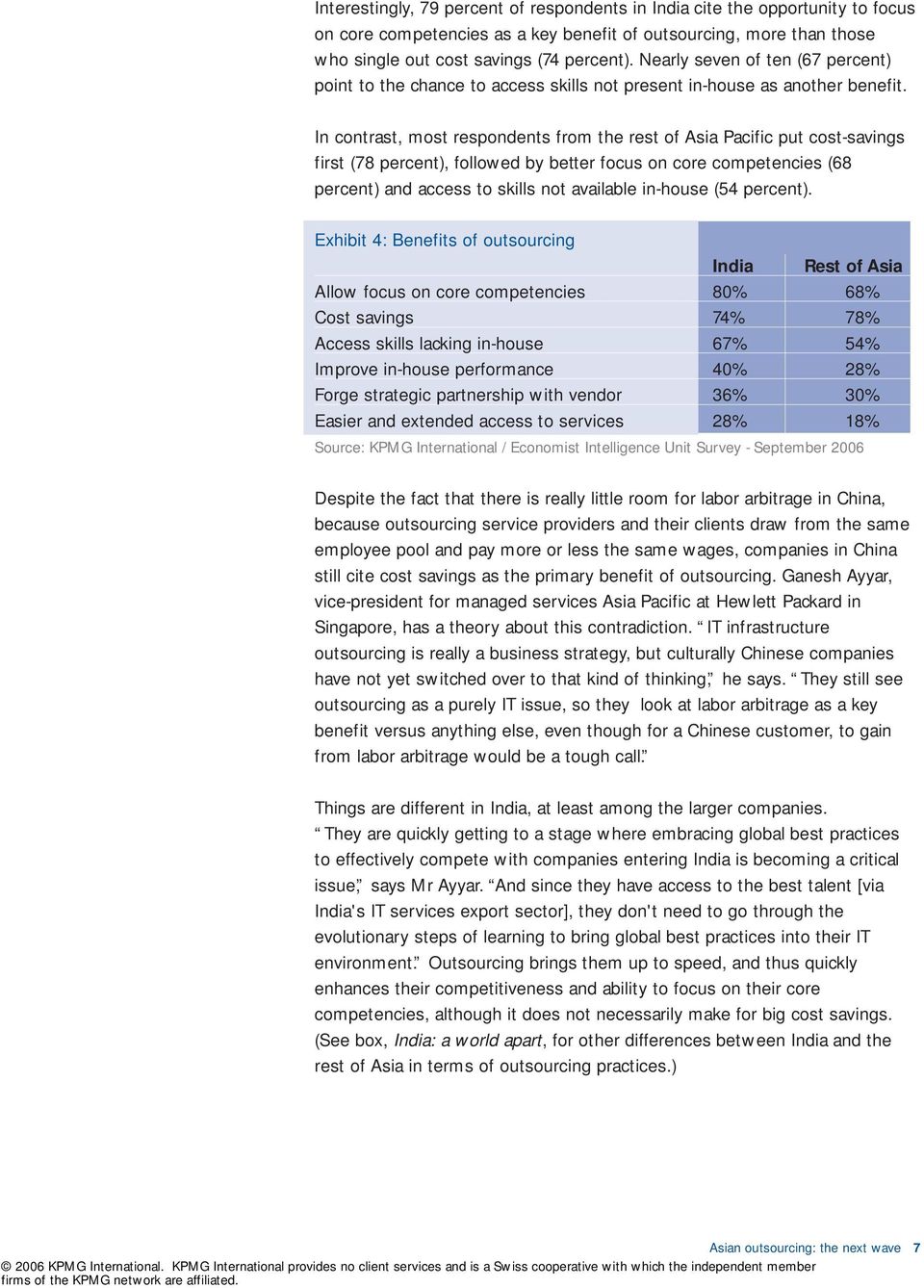
9 Interestingly, 79 percent of respondents in India cite the opportunity to focus on core competencies as a key benefit of outsourcing, more than those who single out cost savings (74 percent). Nearly seven of ten (67 percent) point to the chance to access skills not present in-house as another benefit. In contrast, most respondents from the rest of Asia Pacific put cost-savings first (78 percent), followed by better focus on core competencies (68 percent) and access to skills not available in-house (54 percent). Exhibit 4: Benefits of outsourcing India Rest of Asia Allow focus on core competencies 80% 68% Cost savings 74% 78% Access skills lacking in-house 67% 54% Improve in-house performance 40% 28% Forge strategic partnership with vendor 36% 30% Easier and extended access to services 28% 18% Despite the fact that there is really little room for labor arbitrage in China, because outsourcing service providers and their clients draw from the same employee pool and pay more or less the same wages, companies in China still cite cost savings as the primary benefit of outsourcing. Ganesh Ayyar, vice-president for managed services Asia Pacific at Hewlett Packard in Singapore, has a theory about this contradiction. IT infrastructure outsourcing is really a business strategy, but culturally Chinese companies have not yet switched over to that kind of thinking, he says. They still see outsourcing as a purely IT issue, so they look at labor arbitrage as a key benefit versus anything else, even though for a Chinese customer, to gain from labor arbitrage would be a tough call. Things are different in India, at least among the larger companies. They are quickly getting to a stage where embracing global best practices to effectively compete with companies entering India is becoming a critical issue, says Mr Ayyar. And since they have access to the best talent [via India's IT services export sector], they don't need to go through the evolutionary steps of learning to bring global best practices into their IT environment. Outsourcing brings them up to speed, and thus quickly enhances their competitiveness and ability to focus on their core competencies, although it does not necessarily make for big cost savings. (See box, India: a world apart, for other differences between India and the rest of Asia in terms of outsourcing practices.) Asian outsourcing: the next wave 7
10 India: a world apart India's gifts to the Western civilization, says American historian Will Durant, include grammar and logic, philosophy and fables, hypnotism, chess, numerals and the decimal system. Add this latest one: outsourcing. In modern times, India has served as the cradle of offshore outsourcing with its big pool of talented, and until recently affordably priced, information technology (IT) professionals, engineers and English-speaking customer service workers. Some of our survey's findings bolster the view of India as a world apart in outsourcing. For example, respondents in India cite allowing the company to focus on its core competencies as the number one benefit of outsourcing. The rest of Asia points to cost savings, which is particularly true of high cost economies like Australia, Hong Kong and Singapore. Most respondents in India outsource to service providers that are also in India, so they don't really reap savings from labor arbitrage. But they outsource anyway, in order to focus more on core competencies. Companies in India also appear to be far more open to outsourcing all kinds of business functions than are their peers in the rest of Asia. Fully 64 percent of respondents in India say they currently outsource or plan to outsource accounting, debt collection and/or tax processing. Only 50 percent of companies in the rest of Asia say the same. Six out of ten respondents from India (65 percent) already outsource or plan to outsource human resources management. Only about half (47 percent) say the same in the rest of the Asia. The level of interest in outsourcing IT solutions is equally high in both places, however (India: 80 percent, rest of Asia: 78 percent). What services do you outsource or plan to outsource? India Rest of Asia IT solutions 80% 78% Human resources management 65% 47% Accounting, debt collection, 64% 50% and/or tax processing Data collection and/or report writing 57% 48% Customer servicing 51% 34% Supply-chain management 46% 40% Risk management 38% 18% Research & development 29% 27% Sales and/or marketing 20% 21% Strategic planning 16% 8% 8 Asian outsourcing: the next wave

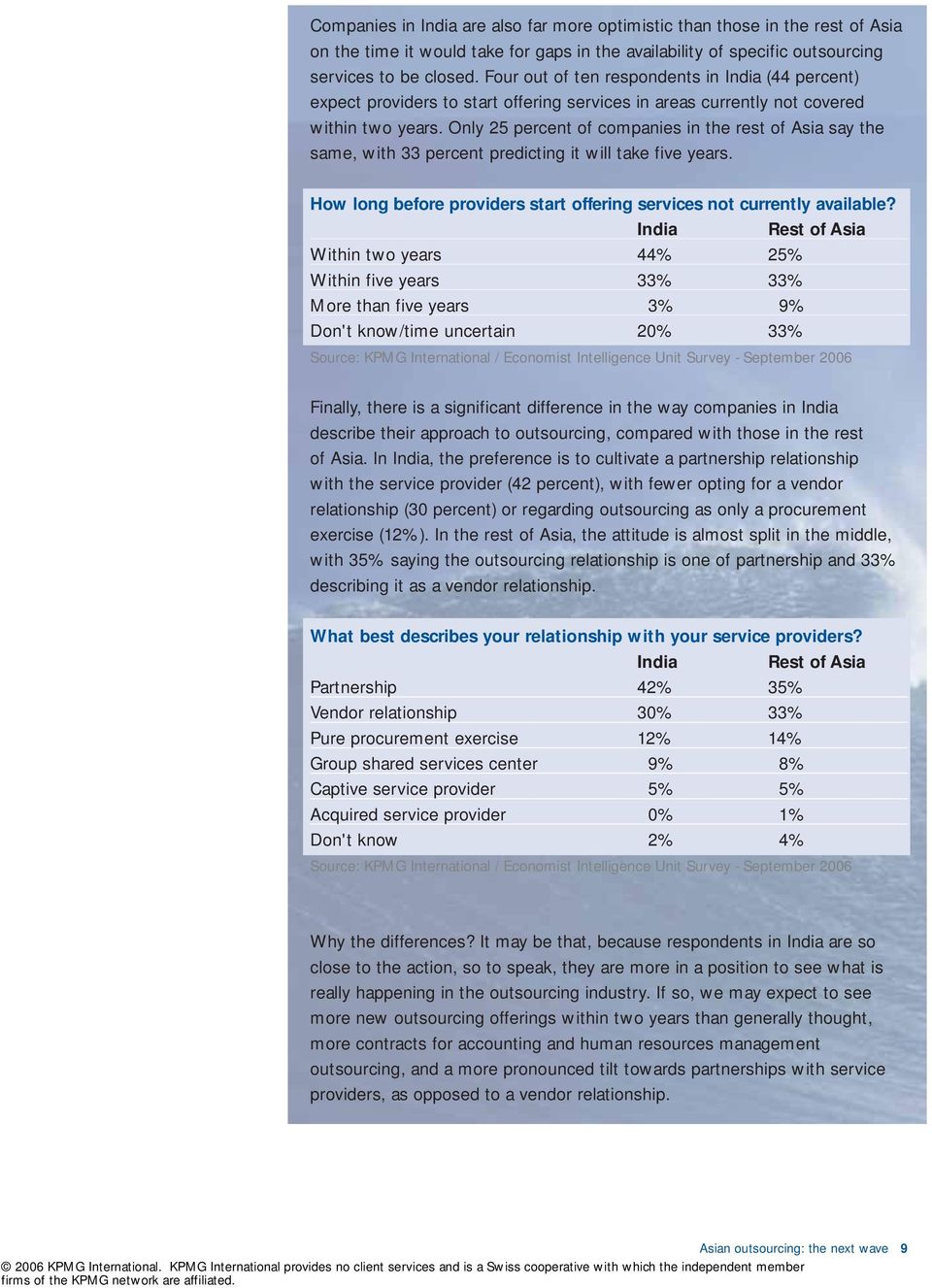
11 Companies in India are also far more optimistic than those in the rest of Asia on the time it would take for gaps in the availability of specific outsourcing services to be closed. Four out of ten respondents in India (44 percent) expect providers to start offering services in areas currently not covered within two years. Only 25 percent of companies in the rest of Asia say the same, with 33 percent predicting it will take five years. How long before providers start offering services not currently available? India Rest of Asia Within two years 44% 25% Within five years 33% 33% More than five years 3% 9% Don't know/time uncertain 20% 33% Finally, there is a significant difference in the way companies in India describe their approach to outsourcing, compared with those in the rest of Asia. In India, the preference is to cultivate a partnership relationship with the service provider (42 percent), with fewer opting for a vendor relationship (30 percent) or regarding outsourcing as only a procurement exercise (12%). In the rest of Asia, the attitude is almost split in the middle, with 35% saying the outsourcing relationship is one of partnership and 33% describing it as a vendor relationship. What best describes your relationship with your service providers? India Rest of Asia Partnership 42% 35% Vendor relationship 30% 33% Pure procurement exercise 12% 14% Group shared services center 9% 8% Captive service provider 5% 5% Acquired service provider 0% 1% Don't know 2% 4% Why the differences? It may be that, because respondents in India are so close to the action, so to speak, they are more in a position to see what is really happening in the outsourcing industry. If so, we may expect to see more new outsourcing offerings within two years than generally thought, more contracts for accounting and human resources management outsourcing, and a more pronounced tilt towards partnerships with service providers, as opposed to a vendor relationship. Asian outsourcing: the next wave 9
12 Where do they outsource? This analysis is consistent with our findings about outsourcing destinations. Nearly all respondents from India (97 percent) say their main service providers are located in India. Among companies in China, 95 percent say their key service providers are also in China. Interestingly, half of the surveyed companies in Australia (53 percent) outsource to India, while 38 percent outsource to China. Most Hong Kong firms outsource to others in Hong Kong (86 percent) and also to China (61 percent), with just 4 percent going to India. Companies in Singapore outsource to others in Singapore (57 percent), India (50 percent) and China (40 percent). In aggregate, the majority of companies in Asia outsource to India (55 percent), with China as the second most popular destination (36 percent). Singapore (20 percent) and Hong Kong (16 percent) come next, far ahead of the Philippines (7 percent) which has been touted as a lower cost alternative to India. Exhibit 5: Where are your main service providers located? India 55% China 36% Singapore 20% Hong Kong 16% Malaysia 9% Philippines 7% Vietnam 2% Japan 5% Taiwan 5% Indonesia 4% South Korea 4% Thailand 4% Other 15% How are we to read these findings? In going offshore, one common thread appears to be language. English speaking Australia outsources to English speaking India, while Cantonese Hong Kong outsources to China. Singapore, where English and Mandarin are official languages, outsources to both India and China. Raymond Lee, chief information officer at Hong Kong logistics company BALtrans Holdings, puts the issue in perspective (see case study, BALtrans: partial outsourcing). An Indian company approached us several weeks ago, but when I asked whether they speak or read Chinese, they said no, he recounts. So how can they help me resolve an IT problem in my Greater China operations? The language difference is one reason why I can't outsource a lot to India, although they are really strong in such areas as software coding. 10 Asian outsourcing: the next wave

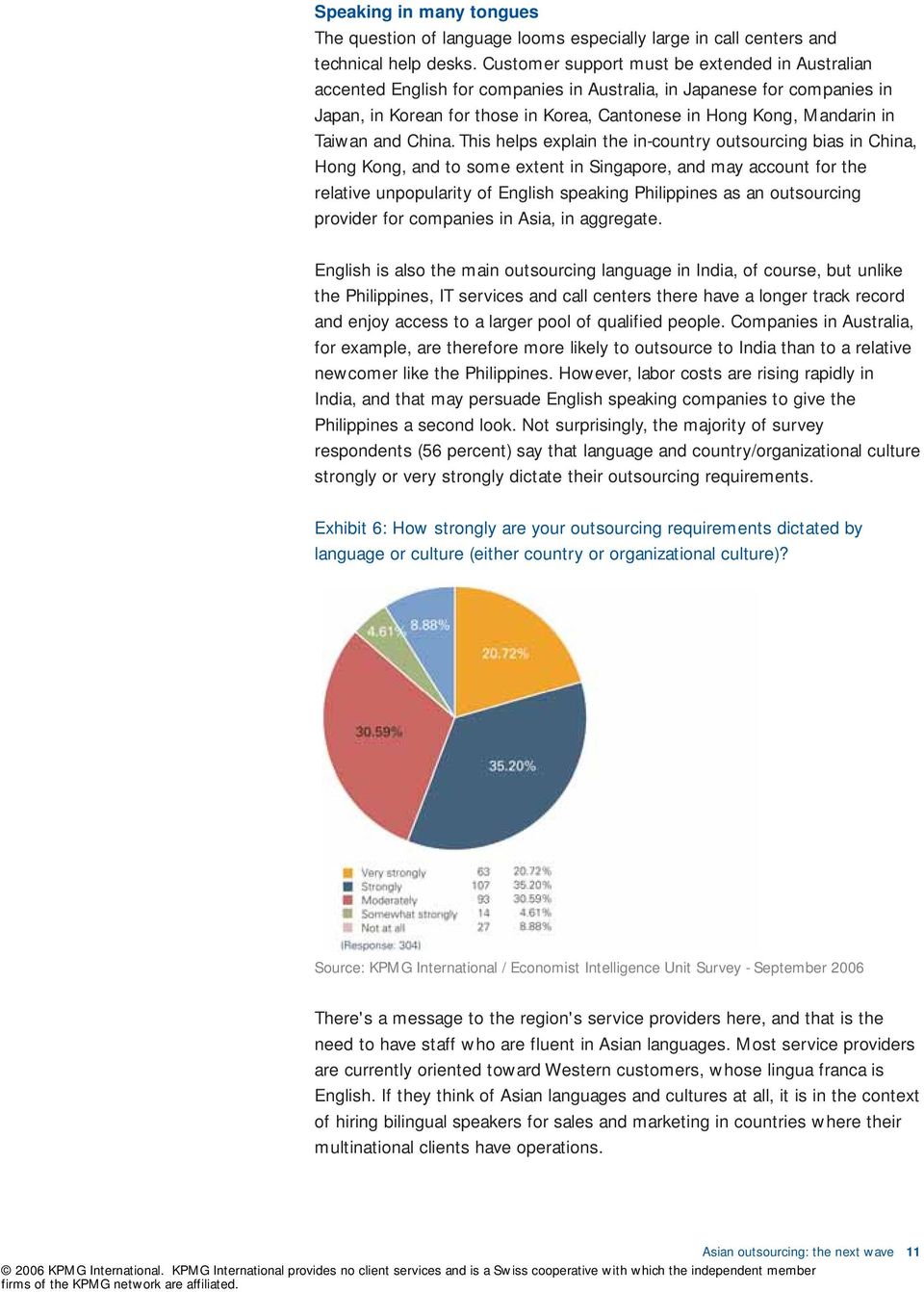
13 Speaking in many tongues The question of language looms especially large in call centers and technical help desks. Customer support must be extended in Australian accented English for companies in Australia, in Japanese for companies in Japan, in Korean for those in Korea, Cantonese in Hong Kong, Mandarin in Taiwan and China. This helps explain the in-country outsourcing bias in China, Hong Kong, and to some extent in Singapore, and may account for the relative unpopularity of English speaking Philippines as an outsourcing provider for companies in Asia, in aggregate. English is also the main outsourcing language in India, of course, but unlike the Philippines, IT services and call centers there have a longer track record and enjoy access to a larger pool of qualified people. Companies in Australia, for example, are therefore more likely to outsource to India than to a relative newcomer like the Philippines. However, labor costs are rising rapidly in India, and that may persuade English speaking companies to give the Philippines a second look. Not surprisingly, the majority of survey respondents (56 percent) say that language and country/organizational culture strongly or very strongly dictate their outsourcing requirements. Exhibit 6: How strongly are your outsourcing requirements dictated by language or culture (either country or organizational culture)? There's a message to the region's service providers here, and that is the need to have staff who are fluent in Asian languages. Most service providers are currently oriented toward Western customers, whose lingua franca is English. If they think of Asian languages and cultures at all, it is in the context of hiring bilingual speakers for sales and marketing in countries where their multinational clients have operations. Asian outsourcing: the next wave 11
14 Those who assume that English is the language of business and technology in Asia, and that catering to this market is only a matter of reorienting existing staff used to dealing with customers in the West, may be bound for disappointment. English may be the language of the subsidiaries of multinationals in the region, but this is not always the case with local companies and their mass-market customers. Language can be an important competitive advantage for newer service providers seeking to differentiate themselves from the incumbents. It is a main marketing plank at Malaysian contact center specialist Scicom, which was formed in We are the only multilingual, multichannel BPO service provider in Asia, claims chief executive Leo Ariyanayakam. Collectively, the company's 1,400 staff speak 13 Asian languages, among them Japanese, Korean, Mandarin and Bahasa Melayu, in addition to English. Scicom's client list already includes major Malaysian corporates like oil company Petronas and Malaysia Airlines, regional operators like Star Cruises, and multinationals such as Fuji Xerox, Citibank and insurance giant AIA. Aon: the art of outsourcing A Fortune 500 company, Aon is the world's largest reinsurance broker and second biggest insurance broker, with operations in more than 120 countries, including 15 markets in Asia. Outsourcing is widely practised across the group's various companies, from call centers to information technology (IT) services to human resources management to accounting and payroll. As the chief information officer of Aon Hong Kong, Suk Wah Kwok is involved in regional outsourcing activities because Aon's Asian headquarters is in Hong Kong. Outsourcing in Asia, says Ms Kwok, presents special challenges. For example, we have studied outsourcing our call centers for the whole region, but we met difficulties because of the language issue, she says. It's hard to find hotline support staff who can speak good Japanese, good Korean, good Cantonese, good Mandarin. The need for multiple language support in Asia is one reason why we don't outsource some IT services that our counterparts in other parts of Aon do. Despite the diversity of the locations they have to support, for example in the U.S. or UK, they all speak one language, English. Outsourcing IT services is easier because only internal employees are involved, and most speak English. Even so, not all IT services are outsourced. We outsourced desktop and laptop hardware maintenance for a number of years, but we eventually stopped, recalls Ms Kwok. We had to pay an annual maintenance fee for each machine, and once you outsource hardware maintenance, you can't be selective. You have to cover all 12 Asian outsourcing: the next wave
15 desktops. As the number of staff increased, so did the number of desktops and total annual maintenance became too expensive. These days, Aon buys computers bundled with a three-year warranty. If a machine breaks down after the warranty has expired, the company simply replaces it. This has turned out to be more cost-efficient, says Ms Kwok, because hardware is getting cheaper and cheaper, but labour costs remain high. The lesson here: companies should base their decisions of what to outsource on actual economics. Aon outsources maintenance of printers, for example, because these machines are more expensive than workstations and laptops printers are priced from HK$20,000 to HK$30,000 each (US$2,570 to US$3,860 each) and therefore cannot be replaced as easily after their warranties expire. Aon also outsources the maintenance of servers and the data centers where they are housed. An external vendor comes in at least once a month to do regular checks on all data-center equipment such as UPS and air-conditioners, says Ms Kwok. Aon has two such centers in Hong Kong one which serves Hong Kong users, and the other which serves regional users and customers, and doubles as Aon's disaster recovery site. In some instances, efficiency and employee satisfaction trump cost savings in deciding whether or not to outsource an IT service. When Aon did anti-spamming for its system in-house, for example, there was no additional cost involved since existing staff could be deployed for the task. But employee mailboxes were still getting spam from time to time because it was difficult to keep spam definitions up-to-date. In the end, the anti-spamming function was outsourced. Today, Aon pays a monthly fee for anti-spamming services, but employees are happier because few, if any, spam messages get through. How successful is Aon's IT services outsourcing? Ms Kwok points to an interesting statistic. The number of IT staff in her department has remained the same in the past five years, but the number of users the department supports has grown by 30 percent. The number of countries it services has also increased by 50 percent. There's your cost savings right there, she says. Asian outsourcing: the next wave 13
16 Managing the relationship Managing the outsourcing relationship in Asia can be complicated by the tendency of companies to multi-source, rather than have one service provider take care of related functions across the business. This is primarily for language reasons, as discussed earlier. It is also difficult to find one service provider that has units across Asia. Even the global providers don't have a presence in all Asian markets, although they may have marketing units there, observes Mr Lee of BALtrans. At BALtrans, six outsourcing companies handle IT services. It can get complicated, but that is an inherent problem if you multi-source, says Mr Lee. One of his strategies is to devolve the responsibility to monitor service-level agreements to regional IT managers, instead of headquarters or the individual subsidiaries being serviced. Companies in Asia typically let the department that is outsourcing its needs manage the relationship with the outsourcing provider (43 percent), but there are also those that give the responsibility to procurement (28 percent), finance (27 percent), and IT (23 percent). Exhibit 7: Which departments in your company are chiefly responsible for managing the relationship with outsourcing providers and measuring their performance? 14 Asian outsourcing: the next wave

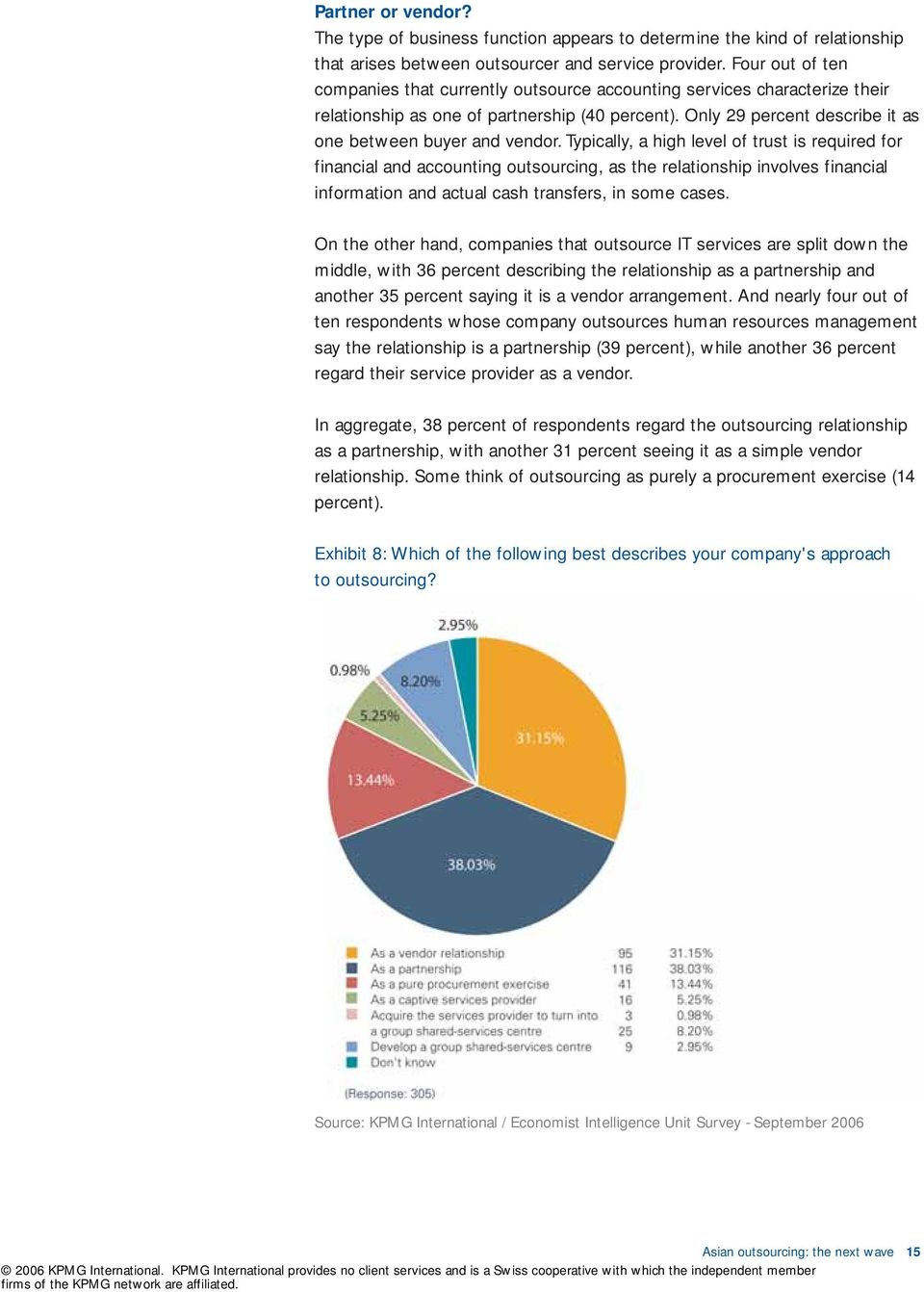
17 Partner or vendor? The type of business function appears to determine the kind of relationship that arises between outsourcer and service provider. Four out of ten companies that currently outsource accounting services characterize their relationship as one of partnership (40 percent). Only 29 percent describe it as one between buyer and vendor. Typically, a high level of trust is required for financial and accounting outsourcing, as the relationship involves financial information and actual cash transfers, in some cases. On the other hand, companies that outsource IT services are split down the middle, with 36 percent describing the relationship as a partnership and another 35 percent saying it is a vendor arrangement. And nearly four out of ten respondents whose company outsources human resources management say the relationship is a partnership (39 percent), while another 36 percent regard their service provider as a vendor. In aggregate, 38 percent of respondents regard the outsourcing relationship as a partnership, with another 31 percent seeing it as a simple vendor relationship. Some think of outsourcing as purely a procurement exercise (14 percent). Exhibit 8: Which of the following best describes your company's approach to outsourcing? Asian outsourcing: the next wave 15
18 It helps to remember here that there are many sub-types of accounting, HR and IT services. Some may involve only routine activities such as filtering spam messages, and therefore the client may not want to spend too much time and effort cultivating a partnership with the service provider. Others may involve mission-critical functions such as managed security services, in which the service provider guards against malicious software getting into a company's IT systems, among other things. Here, a close relationship is in order. The client will require daily reports on attempted intrusions into its systems, and will expect constant updates from the service provider on new threats and how it plans to combat them. Most of our interviewees stress the need to cultivate a partnership relationship with service providers. There are a lot of suppliers out there, says WC Lai, quality and manufacturing director at Solomon Systech, a leading global maker of integrated-circuit chips for mobile phone displays (see case study). But there are too few good ones, so you must do all you can to keep them. Solomon outsources its supply chain, including manufacturing and logistics, to providers in China and Taiwan, including giant silicon wafer foundry TSMC. We cultivate not only a business relationship with our suppliers, but also people relationships, says Mr Lai. If they trust you, they will support you in good times and bad times. As our findings show, however, not all outsourcing relationships need to be partnerships, with all the investment in time and effort that implies. For the region's service providers, this finding underscores the need to be sensitive to the circumstances and preferences of the customer. Sometimes, a vendor relationship is easier on everyone. BALtrans: partial outsourcing As a relative newcomer to the industry, the BALtrans group still has to catch up with more established freight-forwarding and logistics companies such as Airocean Group, Nippon Express and SEKO Worldwide. This is one reason why Hong Kong-listed BALtrans, which was founded only in 1982, outsources most of its information technology (IT) services needs. We outsource to get a speedy solution, says Raymond Lee, chief information officer (CIO) at BALtrans. By getting an almost ready IT solution instead of spending time and money to build from scratch, we can begin surpassing our competitors. But only up to a point. In our industry, continues Mr Lee, IT is a source of competitive edge, so if you outsource everything, you run the risk of being like everyone else. His approach is to keep a core IT matrix in-house, outsourcing only the basics, such as the network service and simple software applications. It also depends on the company set-up, Lee adds. We are always doing M&A, so if the acquired company has a well 16 Asian outsourcing: the next wave

19 developed IT system, we can outsource less, but if it is new or small, we will outsource more. The same philosophy applies to non-it services. Mr Lee says BALtrans is looking at business process outsourcing (BPO) for generic functions like accounting, but he doubts whether functions like strategic planning, sales and marketing will be outsourced. Perhaps things like research and development of a product or solution can be partly outsourced, he allows, but not completely. If outside expertise is needed, the company will hire consultants, whose recommendations in-house departments will execute. Cost and quality of service are also important considerations. Mr Lee says BALtrans knows it cannot match certain services by specialist providers, but if we can't do better than them maybe we can do it cheaper in-house. The company will have to weigh the pros and cons. Can employees live with occasional inconveniences like spam, for example? The company will have to decide whether the trade-off in quality is worth it. The same dynamics may apply in making a choice between an expensive global services provider and a smaller but cheaper local or regional provider. Will the lower cost make up for the lack of global scope? An incremental approach can help companies come to a decision, says Mr Lee. Instead of a Big Bang approach, he suggests, you can test an outsourcing solution incrementally, site by site, before you commit full-scale. So during the transition, you may have five sites outsourcing and five others doing it in-house. Once the decision is made, though, the company should do its best to make the relationship work. Mr Lee prefers a partnership relationship: When you find reliable and good partners, spend some effort to train them on the intricacies of your company and industry, and establish an on-going relationship. They can become your extended divisions. Strategies for success Asked to name the best strategies to manage the outsourcing relationship, half of respondents cite the importance of integrating outsourcing into business results (54 percent) and ensuring objectives are clear at the outset (50 percent). The financial issue comes third, with 40 percent pointing to the need to ensure the provider's fees are competitive and that it is actively committed to reducing costs. The preferred approach appears to be to make sure that broad guidelines for success are in place, and then to leave the provider alone to do its thing, rather than to micromanage the relationship. For example, just a third of Asian outsourcing: the next wave 17

20 respondents say it is important to actively measure the provider's performance on a regular basis (34 percent), and only a fifth advocate maintaining a close relationship with the provider throughout the negotiation and delivery processes (23 percent). Very few depend on performance bonuses (8 percent) or performance penalties (5 percent) to ensure success, which is consistent with the respondents' broad guidelines approach. Even if the service level agreement provides for financial compensation, says BALtrans' Mr Lee, what's the use of making a claim? At the end of the day, when there's a failure, you've missed serving your customers, you've missed business opportunities. It doesn't matter whatever money or free extension of the service you get. Exhibit 9: What do you think are the best ways to manage the outsourcing relationship for your company? 18 Asian outsourcing: the next wave

21 Problems in outsourcing What is hampering outsourcing in Asia? Respondents cite problems related to availability of service providers, the quality of the services currently available, and the belief that services such as strategic planning, sales and marketing, risk management, and research and development are strategic to the company, and therefore should be handled in-house. At the Second Annual CIO Forum Asia in Hong Kong in September, Anthony Lloyd, head of the technology and communications group in Asia for Minter Ellison Lawyers, identified two specific issues. There is the problem of language, he says, alluding to the diversity of languages and cultures in Asia discussed earlier in this paper. The other thing is there aren't a lot of vendors that have a presence in each of the different jurisdictions. You might want to give everything to one company, but then that company does not have offices in each country, and in fact subcontracts the work in those places. Availability Asked what services they have no plans to outsource, survey respondents overwhelmingly singled out strategic planning (89 percent), sales and marketing (78 percent), risk management (75 percent), and research and development (72 percent). Exhibit 10: What services do you not plan to outsource? Strategic planning 89% Sales and/or marketing 78% Risk management 75% Research & development 72% Customer servicing, including after-sales service 60% Supply-chain management 59% Data collection and/or report writing 49% Human resources management, including health care and benefits processing 47% Accounting, debt collection, and/or tax processing 45% IT solutions 21% But it seems that a few of these companies are actually interested in outsourcing these services, except that they cannot find providers that specifically offer them. Asked which services they would like to outsource but do not because no provider specifically offers them, a quarter of respondents cite risk management (27 percent), with at least a fifth each pointing to HR management (24 percent), research and development (23 percent), data collection and/report writing (22 percent), and customer servicing (22 percent). Asian outsourcing: the next wave 19
22 Exhibit 11: Which of the following services would you like to outsource but do not, as currently there are no outsourcing providers offering the specific service? Nearly seven of ten respondents, however, believe that these services will be provided within five years, with three out of ten believing this will happen within two years. However, as noted earlier, the majority of survey respondents say they have no plans to outsource these services, so it is not clear whether these providers will find enough clients in Asia. Exhibit 12: How long do you think it will take for providers to begin offering outsourcing services in the specific areas noted above? 20 Asian outsourcing: the next wave
23 In the meantime, while waiting for outsourcing providers to offer the specific services they want to outsource, the few companies in Asia that are willing to outsource these services are boosting in-house capabilities and setting up shared services centers. Presumably, those respondents who do not plan to outsource these strategic services even if they can find providers are also boosting in-house capabilities and setting up shared services centers, since these essential functions are crucial to competitiveness. Exhibit 13: Given these perceived gaps in services, what can companies do to meet their current services requirements? Quality Asked what problems they encounter in dealing with the region's outsourcing service providers, companies in Asia cite three weaknesses: insufficient knowledge of the client's business and industry (52 percent), non-responsiveness to client concerns (47 percent), and low performance standards (35 percent). Exhibit 14: Which of the following quality problems have you encountered with outsourcing services providers, either in evaluating them or in outsourcing with them? Asian outsourcing: the next wave 21
24 At a recent CIO forum, the chief information officer (CIO) of a medium sized Chinese bank in Hong Kong complained that his staff sometimes pay money and spend a lot of time teaching the outsourcing service provider all about the bank's business. Then armed with its new found knowledge of how mainland Chinese banks do things, the service provider then bids for a similar project with a competing bank, something that understandably irks the CIO. Complicating matters are new compliance requirements under the Sarbanes-Oxley Act from the U.S., which apply to U.S. subsidiaries in Asia and Asian companies issuing securities in the U.S. Similar regulations are being contemplated in Japan, South Korea, India and other places in Asia. You have to show that you still have control over the processes [you outsource] and those processes are sound, says Anthony Lloyd of Minter Ellison Lawyers. You have to do more due diligence before you get into a relationship. You have to go and see how the providers work, and stress test them. There's a bit more work that goes into a deal before [a service level agreement] is signed. There are also some specific actions that can be taken by outsourcing service providers and their customers in light of Sarbanes-Oxley and other regulatory requirements being introduced throughout the world. For example, one of the most effective ways for service providers and their clients to communicate information about the organization's internal controls is through a Statement of Auditing Standards (SAS) No. 70 report, a Service Auditor's Report. This report is designed to provide information about the service organization's controls that may be part of a user organization's information system as it relates to the user's financial statements. The message here is that service providers with substandard domain expertise, controls, responsiveness to client concerns, and performance standards are setting themselves up for failure. This is especially true if outsourcing services currently not offered will be offered in five years' time, as our respondents anticipate. Companies in Asia will then have more providers to choose from, possibly including globals and Indian incumbents making a big push in Asia. 22 Asian outsourcing: the next wave
25 Solomon Systech: fabless but fabulous Last year, Solomon Systech shipped 263 million proprietary integrated circuit (IC) products to Motorola, Sony, Creative Technology and other global customers without owning or operating a single fabrication factory. Hong Kong-listed Solomon Systech is a world leader in the design, development and sale of IC products that make it possible for mobile phones, handheld devices and liquid crystal display television sets to display high resolution still and moving images. Solomon is what industry people call a fabless semiconductor company, one that outsources its supply chain. We are big enough to build our own wafer fabrication factory, but we will need to spend not only money, but also invest time and expertise, says Humphrey Leung, president and managing director. Setting up a silicon wafer foundry, which requires not only a spacious, ultra-clean environment free of vibrations but also state-of-the-art precision equipment, requires more than US$1bn in upfront capital investment. That money is better spent on recruiting and grooming talented IC engineers and funding for research and development centers, which after all represent Solomon's core competency. Fortunately, the company has outsourcing experience and expertise that predate its formal founding six years ago. Before then, it used to be a division of U.S. electronics company Motorola, which spun off its IC design and other non-core units in Three employees who used to oversee Motorola's direct and outsourced manufacturing activities joined the newly established Solomon; the trio included 21-year Motorola veteran WC Lai, who is now quality and manufacturing director at Solomon. Today, Mr Lai and his 40-strong staff monitor the adherence to service level agreements (SLAs) of factories and testing facilities in China, Singapore, South Korea and Taiwan, laboratories in Hong Kong, logistics firms, and other providers of outsourced supply chain services. They make sure not only that products and services meet punishing production schedules, but also that each IC is manufactured according to design specifications and is delivered to the client on time. They also periodically audit the contracted factories and suppliers that they use to ensure best practice environmental standards, as required by the mobile phone, handheld and television manufacturers that use Solomon's IC products. What makes this complex web work, says Mr Lai, is a computerized management system that Solomon developed itself. The heart of the system is a digital Document Center that contains each and every SLA, outsourcing contract and purchase order that Solomon has ever signed. It also contains schematics of every IC product the company has designed and contracted out for manufacture. Everyone in the company can access the documents, except for the most sensitive papers, such as financial statements, that are available only to certain staff. Asian outsourcing: the next wave 23
26 Using the electronic system, Mr Lai's unit peruses progress reports submitted by factories, suppliers and other outsourcing providers, as well as the results of ocular inspections by Solomon engineers in China, Taiwan and other locations where providers are based. In this way, they can red-flag potential schedule and quality problems, and can troubleshoot at the earliest stage. The visibility made possible by the management system also helps supervisors to keep track of the inspectors, and their compliance with scheduled audits of the outsourcing providers. All this sounds like a round-the-clock, peer-over-the-shoulder outsourcing, and it is. Solomon cannot afford to miss deadlines or fail to meet quality standards because it, too, has SLAs with clients further up the value chain Solomon is an outsourcing provider itself to the Motorolas and Sonys of the business world, which contract their IC and other component needs with companies like Solomon for assembly by their own or outsourced factories. And just as Solomon seeks to cultivate long-term partnerships with those clients, it also nurtures partnerships down its own supply chain with outsourcing providers like wafer foundries TSMC and SMIC, both in Taiwan, and Chartered Semiconductors in Singapore. There is any number of suppliers out there, says Mr Lai, but few really good ones, so Solomon makes sure it does everything it can to secure their loyalty. In addition to cultivating what Mr Lai calls people relationships, Solomon may buy a small minority stake in the factory, purchase an expensive piece of equipment and park it in its premises, and share plans and technologies with them as much as possible. They like it very much if you develop a product that uses future technology, says Mr Lai. Of course, we need to keep the details a secret, but we tell them enough to help them plan ahead. He adds that unlike some companies, Solomon does not want its providers to over-invest in new equipment without guarantee the new capacity will be used. Eventually that will lead to a glut, and that will be bad for everyone in the industry, he believes. You must treat [the outsourcing provider] like your own factory, says Mr Lai. You don't want your provider to waste capital on unnecessary capacity. If it can save on costs, you save on costs too. That's our philosophy of managing the supply chain. Is it working? Solomon claims to account for 20 percent of the global mobile phone IC business. Last year, it earned US$76.3m, up 32 percent from 2004, on sales of US$394.1m. Not bad for a fabless semiconductor company with not a stick of manufacturing equipment to its name. 24 Asian outsourcing: the next wave
27 The next wave Asia's outsourcing industry looks set to be far bigger than it is now if the expectations of survey respondents do come to pass. We may see BPO services catch up with IT outsourcing as companies in Asia become more comfortable with the idea of entrusting some finance, accounting and HR functions to outsiders. The message to the region's established outsourcing service providers is clear: it is time to focus more attention on markets closer to home instead of concentrating exclusively on Western markets, which are already getting saturated and showing signs of a backlash against offshore outsourcing. Significantly, the incumbents have not yet moved in a big way, if at all, in nascent segments such as R&D outsourcing and engineering services outsourcing, which are currently offered mostly by young specialist organizations like India's MindTree Consulting (see case study). Will these new services catch on in Asia as well? Perhaps not, or at least, not as rapidly as IT services has done or BPO looks likely to do. The key reason may be the belief that these services represent competitive advantages, and therefore must be totally controlled by the company. Asked why they do not outsource, six of ten respondents say some services are strategic to their company, and so must be done in-house (61 percent). The majority (53 percent) are also worried about lack of controls and insufficient security in the systems of the service provider. Exhibit 15: What are the top reasons for not outsourcing any of these services? Asian outsourcing: the next wave 25
28 Still, we argue that this mindset can change going forward. For one, the second reason cited, lack of controls and insufficient security in place, imply some openness to the idea of outsourcing elements of these strategic functions if security can somehow be assured. On sales and marketing, Scicom's Mr Ariyanayakam concedes that companies in Asia traditionally keep this function within the organization. But the Malaysian company has succeeded in persuading some clients to let it do part of their customer relationship management (CRM). That's because, in the course of their work, Scicom's contact centers gain intimate knowledge of their clients' customers, and can thus serve as a sounding board on how a new product will be received, or the likely response to a marketing initiative. From there, the next logical step is to let it manage parts of the customer database and generate reports for planning, marketing, product development and other purposes. Similarly, MindTree Consulting acknowledges that outsourcing R&D and engineering functions to a third party is a sensitive issue for most companies. But it says it works hard to win and maintain the trust of clients, particularly in the areas of security, confidentiality and respect for the client's intellectual property rights. Typically, the relationship starts small, perhaps research on a minor feature of a client's new product. Then as trust is established, MindTree is given progressively larger roles. Sometimes, cost considerations win over the client's qualms. The medium-sized Chinese bank in Hong Kong mentioned earlier has decided to outsource to a provider in Singapore the generation of risk management reports in compliance with the risk-adequacy ratios and other requirements of the international Basel II agreement. The CIO estimates that at least US$3m would be needed to develop in-house systems. In contrast, the service provider charges less than US$128,375 a year. What the experiences of these service providers tell us is that a client base for next wave outsourcing can be built one customer at a time. An explosion in demand may result when critical mass is reached, since hold-out companies will be forced to outsource R&D, engineering, risk management and so on once they see rivals becoming more competitive because they are outsourcing these strategic services. According to a study by U.S. management consultant Booz Allen Hamilton, only US$10bn to US$15bn (out of a potential US$750bn) worth of engineering services outsourcing is currently being done globally. Most providers are located in Israel, Canada, Mexico, Eastern Europe and China, whose substantial manufacturing capabilities require engineering know-how. 26 Asian outsourcing: the next wave
29 Another consultancy, Evalueserve, estimates that knowledge process outsourcing (KPO) services were worth only US$1.2bn industry in But by 2010, it predicts, KPO may be worth US$17bn, representing an annual compound growth rate of 46 percent. It is a given that these services will be offered by providers in India, China, the Philippines and other talent-rich economies in Asia, since they are already leaders in IT services and BPO. In turn, this means companies in the region can easily gain access to these strategic services if they choose to outsource them. It may take a while, but next wave outsourcing KPO, ESO, CRM, risk management and strategic planning may yet rival IT services and BPO in size and value in the Asia Pacific region. MindTree: when an outsourcer outsources India's MindTree Consulting is an outsourcing services provider focusing on information technology (IT) services and, increasingly, research and development (R&D) and engineering services. It also outsources some of its own processes. All our payroll is outsourced, part of our recruitment, and some of our engineering activities, says Vinod Deshmukh, chief technology officer, R&D Services. We don't have our own facilities for PCB [printed circuit board] layer, PCB fabrication, and component assembly. We use a lot of outsourced partners. He adds: Whatever can be or should be outsourced, we will outsource. Accountability, of course, is never outsourced. In-house executives and staff take responsibility for setting policy, direction and strategy, and for seeing to it that these are executed correctly. But parts of the process may be outsourced. In strategic planning, for example, MindTree often invites academics to high level meetings. In customer relationship management, IT-related back office operations are outsourced, but anything that has a direct impact on the customer and on the company's relationship with the customer is done in-house. Being an outsourcing services provider itself, MindTree treats its service providers in the same way it wants to be treated by its clients. We understand the difficulties of the service provider, says Mr Deshmukh. Our objective, both as a provider and [a client of] an outsourcing partner, is to nurture a partnership. A one-off, short-term project may be treated as a vendor relationship or pure procurement, but in a relationship with a longer time span, says Mr Deshmukh, you get the best from a partnership. That is how we build our ecosystem. The provider gets a deeper understanding of the client's business and industry, requires fewer briefings and less oversight, and delivers higher quality service. Asian outsourcing: the next wave 27
30 At the moment, IT services account for three-fourths of MindTree's practice. But product realization services, including R&D and engineering, are coming up fast. Many of the contracts are with start-up Silicon Valley clients, such as a recently completed project involving the design, engineering and manufacture of a Bluetooth-enabled handheld device using the customer's proprietary software applications. But now we have quite a few from Europe, says Mr Deshmukh. The next growth area: India and the rest of Asia. Profit margins may not be as high, but MindTree is seeing Asian markets, particularly India, growing at phenomenal rates. When the region is ready for R&D and engineering outsourcing, it will be there waiting with a menu of services honed from its work with the West. KPO: the next big thing? With so many abbreviations used in outsourcing, the addition of another may not seem a big deal. But KPO, or knowledge process outsourcing, is generating excitement in the industry. This new service, which already accounts for 11 percent of India's export revenue from outsourcing, is projected to become a US$12bn money earner for India by 2010, with an additional US$5bn going to KPO providers elsewhere in the world. As the term suggests, knowledge process outsourcing involves knowledge intensive business processes that require significant domain expertise, analytic skills and judgment making capabilities. KPO providers typically offer high-end services not only to clients in the traditional banking and financial services industries, but also to those in pharmaceuticals, healthcare and life sciences, law, design, animation and even education. In India, for example, Molecular Connections undertakes both customised and syndicated research on gene pathway mapping. The Bangalore company's 100 or so PhDs use an internally developed National Language Query tool for the job, which includes the creation of a protein interaction database. Another Indian firm, MarketRx, combines technology, analytics and market research to provide services that enable the pharmaceuticals and life sciences industries to improve their sales and marketing initiatives. Other emerging players in India's KPO space include Evalueserve, Smart Analyst, Netscribes, ValueNotes, Ugam Solutions, Inductis, B2K, Scope eknowledge, Atlas Legal Research, Pangea 3, and Copal Partners. They operate across a wide range of industries, offering a mix of services that range from patent filing and search to econometrics and exhaustive data mining. About 25,000 Indian specialists are said to be in the KPO segment now. By 2010, says KPO player Evalueserve, 250,000 will be lending their brains to the world's companies. 28 Asian outsourcing: the next wave
31 Conclusion Our findings have implications for companies in Asia in general, and also for companies that provide outsourcing services. We summarize them below. For companies in Asia * Outsourcing is gaining steam in the region. Companies that have no plans to outsource at all may find themselves at a competitive disadvantage if their rivals that do outsource reap anticipated benefits in cost savings, efficiencies, ability to refocus energies on core competencies, and access to world-class best practices. * Outsourcing is being adopted not only by companies in high cost economies like Australia, Hong Kong and Singapore, but also by enterprises in lower cost China and India. Cost saving is evidently not the only benefit from outsourcing. If done right, it can also allow a company to focus on its core competencies and access skills that are lacking inhouse. * At present, there are few outsourcing services providers with a presence in all Asian countries and with capabilities not only in English but also various Asian languages. Companies that plan to outsource should be aware that they may need to go with five or six providers in different locations, and must be ready to deal with the resulting complexities. * Companies that currently outsource take a hands-off approach to the relationship, depending more on integrating outsourcing into business results and clarifying objectives at the outset, rather than micro-managing outsourcing activities and rewarding or punishing providers. This is a strategy that enterprises planning to outsource will do well to consider. * Regulations like the Sarbanes-Oxley Act of 2002 in the U.S. and similar legislation under consideration in Japan, South Korea, India and other Asian countries have implications for the outsourcing industry. Companies should be ready to be more thorough in vetting service providers to make sure their outsourced functions remain compliant with applicable laws. For providers of outsourcing services * Companies in Asia are particularly open to outsourcing IT solutions, and increasingly to business process outsourcing, such as financial and accounting functions and human resources management. It may be time for providers that focus exclusively on serving customers in the U.S. and Europe to start looking closer to home. * The main complaints of companies in Asia about outsourcing providers are insufficient knowledge by the provider of the client's business and industry, and non-responsiveness to client concerns. Providers will do well to focus on these areas. Asian outsourcing: the next wave 29
32 * Companies in Asia do not always want a partnership relationship with their outsourcing provider. Some are more comfortable treating their provider as a vendor. Providers should be sensitive to the client's preferences and make appropriate adjustments. * Companies in Asia are reluctant to outsource strategic planning, sales and marketing, risk management, R&D and customer servicing as they are considered to be strategic services. Outsourcing providers in these areas should be aware of this attitude, and must work to overcome it by emphasizing their commitment to security, confidentiality and intellectual property rights. They can also focus on offering only elements of these functions, not take over the whole function. For example, instead of doing all the engineering work on a new cell phone model, an outsourcing provider may offer to do only the Bluetooth wireless connection. This way, the client will be exposing only a minor portion of the project. Outsourcing providers may also consider bundling the service on a one-off, per-project basis, rather than a continuing, multi-year contract. * Companies in Asia take language and company specific and national culture into account when deciding which outsourcing provider to use. Providers will do well to hire local language speakers or develop multilingual capabilities among their staff, as well as promote cultural sensitivity. 30 Asian outsourcing: the next wave
33 Contact us For further information about the Risk Advisory Services offered by KPMG member firms in the Asia Pacific region, please contact the following: Egidio Zarrella JoAnne Stephenson Stephen Lee Global Partner in Charge Partner Partner Information Risk Management KPMG in Australia KPMG in China and Hong Kong SAR KPMG in Australia [email protected] [email protected] [email protected] Tohana Widjaja Mitsuru Asai Kyo Tae Kim Managing Partner Partner Partner KPMG in Indonesia KPMG in Japan KPMG in Korea [email protected] [email protected] [email protected] Chandran IG Matthew Prichard Jorge Sanagustin Partner Partner Partner KPMG in Malaysia KPMG in New Zealand KPMG in the Philippines ext:204 [email protected] [email protected] [email protected] Wah Yeow Tan Beryl Lin Srisucha Limtong Partner Partner Partner KPMG in Singapore KPMG in Taiwan KPMG in Thailand [email protected] [email protected] [email protected] John Ditty Pradip Kanakia Partner Executive Director KPMG in Vietnam KPMG in India [email protected] [email protected] The information contained herein is of a general nature and is not intended to address the circumstances of any particular individual or entity. Although we endeavor to provide accurate and timely information, there can be no guarantee that such information is accurate as of the date it is received or that it will continue to be accurate in the future. No one should act on such information without appropriate professional advice after a thorough examination of the particular situation KPMG International. KPMG International is a Swiss cooperative. Member firms of the KPMG network of independent firms are affiliated with KPMG International. KPMG International provides no client services. No member firm has any authority to obligate or bind KPMG International or any other member firm vis-à-vis third parties, nor does KPMG International have any such authority to obligate or bind any member firm. All rights reserved The Economist Intelligence Unit Ltd. All rights reserved. November 2006.QLD0492ICE
34 kpmg.com
2016 ASIA PACIFIC HIGH TECH TOTAL REMUNERATION DATABASE
 HEALTH WEALTH CAREER 2016 ASIA PACIFIC HIGH TECH TOTAL REMUNERATION DATABASE THE LEADING SOURCE OF COMPETITIVE PAY INFORMATION FOR THE HIGH TECH INDUSTRY WWW.IMERCER.COM/TRD 2 WANT TO UPGRADE YOUR COMPENSATION
India Offshore Delivery Center
 India Offshore Delivery Center White Paper Copyright : Experis IT Pvt Ltd, India WHITE PAPER: In today s global economy, the word outsourcing has become synonymous with offshoring. Having an offshore strategy
+20. Outsourcing feature STEPHEN MALLON/GETTY IMAGES
 +20 Outsourcing feature STEPHEN MALLON/GETTY IMAGES [ 20 ] A Plus + September 2007 Outsourcing to Asia Business outsourcing to Asia is a fast growing trend what does this mean for Hong Kong accountants?
On offshore outsourcing IT and why India is the best bet. 3. The advantages of offshore outsourcing IT
 On offshore outsourcing IT and why India is the best bet Contents 1. Introduction 2. Offshore Outsourcing IT 3. The advantages of offshore outsourcing IT 4. IT functions ideal for mid size companies to
ABX Logistics Cuts Support Costs, Boosts Customer Service with WebBased Warehouse Management
 SUCCESS STORIES ABX Logistics Cuts Support Costs, Boosts Customer Service with Web-Based Warehouse Management ABX Logistics Cuts Support Costs, Boosts Customer Service with WebBased Warehouse Management
English Telco Stability Support Services Agent Quality Cost Management Philippines 1 6 8 5 1 9 7 India 2 8 13 7 2 11 8
 Asian Call Centres: India versus The Philippines Last year, Asian Call Centers produced the first ever analysis comparing all the countries in Asia for their suitability for English-speaking offshore call
Outsourcing 100 Success Secrets
 Outsourcing 100 Success Secrets Outsourcing 100 Success Secrets - 100 Most Asked Questions: The Missing IT, Business Process, Call Center, HR- Outsourcing to India, China and more Guide Gerard Blokdijk
global ENTERPRISE SURVEY REPORT 2011 asia-pacific
 global ENTERPRISE SURVEY REPORT 2011 asia-pacific A UNIQUE AnnuAL insight into the competitiveness of ASIA-PAcific businesses And developments in GLOBALisAtion business with confidence icaew.com/smeresearch
Improving Small Business Profitability by Optimizing IT Management
 I D C E X E C U T I V E B R I E F Improving Small Business Profitability by Optimizing IT Management Global Headquarters: 5 Speen Street Framingham, MA 01701 USA P.508.872.8200 F.508.935.4015 www.idc.com
Asia-Pacific Datacenter Services Market 2010 New Contenders Emerging on the Horizon
 Asia-Pacific Datacenter Services Market 2010 New Contenders Emerging on the Horizon June 2012 Contents Section Slide Numbers Executive Summary 4 Market Overview 10 Australian Datacenter Services Market
Salary Survey Report. Accounting January 2005. Office and Administration April 2005. Banking and Finance October 2005
 2005 Salary Survey Report January 2005 Office and Administration April 2005 Sales and Marketing July 2005 Banking and Finance October 2005 Manpower Inc. is a world leader in the employment services industry,
P R E S S R E L E A S E
 Hong Kong, May 22, 2013 Survey reveals corporate overdue payment in Asia Pacific region deteriorated in 2012 - Companies are less optimistic about recovery of global economy in 2013 A survey of corporate
THE HUDSON REPORT HONG KONG EMPLOYMENT AND HR TRENDS OCTOBER - DECEMBER 2011 FROM GREAT PEOPLE TO GREAT PERFORMANCE
 THE HUDSON REPORT EMPLOYMENT AND HR TRENDS OCTOBER - DECEMBER 2011 HONG KONG FROM GREAT PEOPLE TO GREAT PERFORMANCE INTRODUCTION The Hudson Report is an established and highly respected publication, based
Time for change in facilities management. Interserve, Sheffield Hallam and i-fm facilities management research 2013
 Time for change in facilities management Interserve, Sheffield Hallam and i-fm facilities management research CONTENTS 01 02 03 04 About the facilities deal Outsourcing objectives The role of your brand
ROMANIA S COMPETITIVE ADVANTAGES ON THE GLOBAL OUTSOURCING MARKET
 Bulletin of the Transilvania University of Braşov Series V: Economic Sciences Vol. 7 (56) No. 1-2014 ROMANIA S COMPETITIVE ADVANTAGES ON THE GLOBAL OUTSOURCING MARKET D. BOŞCOR 1 C. BĂLTESCU 1 Abstract:
Best Practices in adopting a Shared Services Model August 2013 22011YYYY
 Best Practices in adopting a Shared Services Model August 2013 22011YYYY In their endeavors to become high performing organizations, businesses are pushing all innovation frontiers to do more with less
HONG KONG October December 2004. The Hudson Report EMPLOYMENT & HR TRENDS
 HONG KONG October December 2004 The Hudson Report EMPLOYMENT & HR TRENDS Introduction The Hudson Report has established a reputation as a key socioeconomic indicator in today s marketplace. It has been
COMPUTER SOFTWARE/SERVICES AND ITeS EXPORTS
 COMPUTER SOFTWARE/SERVICES AND ITeS EXPORTS OVERVIEW In recent times, Software development and information technology enabled services (ITeS) including business process outsourcing (BPO)/ knowledge process
Pacnet White Paper. IT Server Hosting: How it benefits SMEs
 Pacnet White Paper IT Server Hosting: How it benefits SMEs IT Server Hosting: How it benefits Enterprises Introduction There is a growing trend in the market -- especially among the small and medium businesses
The Asian media landscape is turning digital
 The Asian media landscape is turning digital How can marketers maximise their opportunities? Copyright 2012 The Nielsen Company. i The Asian media landscape is turning digital. How can marketers maximise
Shared Services. Approach Gains Ground in China
 Shared Services Approach Gains Ground in China by Nick Rossiter and Sridhar Vedala CEIBS alumni have been at the forefront of bringing advanced management approaches and technologies to China. Continuing
WHITE PAPER. IT Outsourcing Reasons for SMBs
 WHITE PAPER IT Outsourcing Reasons for SMBs INTRODUCTION Small businesses have always been confronted with addressing their IT necessities. The lack of resources be it staff, budgets, or managing resources
Topic 1 Wealth Management
 Topic 1 Wealth Management 1. Background Moderator: Hansjörg Germann, As Head of Strategy Development at Zurich, Mr. Germann is responsible for all aspects of the strategic asset allocation for the group
View Point. Oracle Applications and the economics of Cloud Computing. Abstract
 View Point Oracle Applications and the economics of Cloud Computing Mandar Bhale Abstract Cloud computing is making waves in the Enterprise package space as the latest trend in Information Technology.
GLOBAL TRENDS IN OFFSHORING AND OUTSOURCING
 International Journal of Business and Social Science Vol. 2 No. 16; September 11 ABSTRACT GLOBAL TRENDS IN OFFSHORING AND OUTSOURCING Nora Palugod, Ph. D. Assistant Professor of Business The Richard Stockton
Getting Your Head In The Cloud
 CRM Expert Advisor White Paper Getting Your Head In The Cloud Businesses today hold more data than ever before. As a result, one of the biggest decisions any company small or large has to face is where
Simplifying Human Resource Management
 Simplifying Human Resource Management The Drive For Less Complexity And More Cost Control Executive Summary Today, there are Oracle Human Capital Management (HCM) solutions available to optimize every
Procurement and Logistics Service. Overcoming the challenges and complexities of international business
 Procurement and Logistics Service Overcoming the challenges and complexities of international business There are massive benefits in expanding your organisation into new international territories. You
Sage Abra HRMS. Evaluating Payroll Options For Your Mid-Sized Business: In-house, Outsourced, or a Blend of Both?
 Sage Abra HRMS Evaluating Payroll Options For Your Mid-Sized Business: In-house, Outsourced, or a Blend of Both? August 2005 TABLE OF CONTENTS Introduction... 5 Options for Payroll Processing....5 Assessing
Capital Market Integration and Stock Exchange Consolidation in the Asia-Pacific
 Joint Statement Asian Shadow Financial Regulatory Committee and Australia-New Zealand Shadow Financial Regulatory Committee Queenstown, New Zealand 6 April, 2011 * Capital Market Integration and Stock
EASTSPRING INVESTMENTS ASIA INVESTOR BEHAVIOUR STUDY 2015 INDONESIA. October 2015. eastspring.co.id
 EASTSPRING INVESTMENTS ASIA INVESTOR BEHAVIOUR STUDY 2015 INDONESIA October 2015 eastspring.co.id 2 Asia Investor Behaviour Study 2015 - Indonesia Asia Investor Behaviour Study 2015 - Indonesia CONTENTS
Adoption, Approaches & Attitudes
 Adoption, Approaches & Attitudes The Future of Cloud Computing in the Public and Private Sectors A Global Cloud Computing Study Sponsored by JUNE 2011 TABLE OF CONTENTS Executive Summary... 1 Methodology
Hong Kong: The Gateway to China InvestHK; Strengthening Hong Kong s Leading Position in Asia Cambridge, Thursday May 3 rd 2012
 Welcome to Hong Kong Hong Kong: The Gateway to China InvestHK; Strengthening Hong Kong s Leading Position in Asia Cambridge, Thursday May 3 rd 2012 David Parker, Head of Investment Promotion About InvestHK
Business Process Outsourcing
 for Business Value Business Process NCS GROUP OFFICES Australia Bahrain China Hong Kong SAR India Korea Malaysia Philippines Singapore Sri Lanka Creating Value through Business Process You can entrust
An introduction to marketing for the small business
 An introduction to marketing for the small business Membership Services Moor Hall, Cookham Maidenhead Berkshire, SL6 9QH, UK Telephone: 01628 427500 www.cim.co.uk/marketingresources The Chartered Institute
For personal use only
 Attention ASX Company Announcements Platform Lodgement of Open Briefing ASX ANNOUNCEMENT: 8 February 2012 CEO and CFO on Half Year Results and Outlook Open Briefing with and CFO Martin Brooke Talent2 International
Sino Belgian Business Survey 2014. Results. Comparing Apples to Apples
 Sino Belgian Business Survey 2014 Results Comparing Apples to Apples www.moorestephens.be PRECISE. PROVEN. PERFORMANCE. Contents Page 1. Executive Summary 2 2. Survey Demographics 3 3. Growth and Margins
Business Attitudes Toward Cybersecurity 2014
 Business Attitudes Toward Cybersecurity 2014 Contents The Main Findings... 2 Current Status of Cybersecurity in Business... 2 Business Cybersecurity Trends... 2 Methodology... 3 Current Status of Cybersecurity
Cloud Computing Safe Harbor or Wild West?
 IT Best Practices Series Cloud Computing Safe Harbor or Wild West? With IT expenditures coming under increasing scrutiny, the cloud is being sold as an oasis of practical solutions. It s true that many
TWX-21 Business System Cloud for Global Corporations
 TWX-21 Business System Cloud for Global Corporations 8 TWX-21 Business System Cloud for Global Corporations Hidenori Kiuchi Yasuyuki Suzuki Sho Obayashi Manabu Naganuma Seiichiro Hayashi Taku Tozawa OVERVIEW:
WHITE PAPER. The Real Cost of Outsourcing
 WHITE PAPER The Real Cost of Outsourcing INTRODUCTION When it comes to the figures of investing in outsourcing, statistics can give you an overall cost of official bills. Actually, you would be surprised
Moving from BI to Big Data Analytics in Pharma: Build It or Buy It?
 Moving from BI to Big Data Analytics in Pharma: Build It or Buy It? Introduction Our world is undergoing a dramatic cross-industry revolution, yielding a digital universe that is doubling in size every
Indonesia. kpmg.com/id. Contact us. Siddharta & Widjaja Audit Services T: + 62 (0) 21 574 2333 / 574 2888 F: + 62 (0) 21 574 1777 / 574 2777
 Contact us Siddharta & Widjaja Audit Services T: + 62 (0) 21 574 2333 / 574 2888 F: + 62 (0) 21 574 1777 / 574 2777 KPMG Advisory Indonesia Tax Services T: + 62 (0) 21 570 4888 F: + 62 (0) 21 570 5888
Linux Adoption Trends: A Survey of Enterprise End Users A Report By The Linux Foundation in Partnership with Yeoman Technologies
 » Linux Foundation Report Linux Adoption Trends: A Survey of Enterprise End Users A Report By The Linux Foundation in Partnership with Yeoman Technologies... October 2010 The Linux Foundation http://www.linuxfoundation.org
Recent trends of dynamically growing and developing life insurance markets in Asia
 Recent trends of dynamically growing and developing life insurance markets in Asia Tomikazu HIRAGA, Ph.D. and LL.M. General Manager for Asia, NLI Research Institute Asia is a growth market where foreign
Harnessing Big Data: The Human Capital Management Journey to Achieving Business Growth
 Harnessing Big Data: The Human Capital Management Journey to Achieving Business Growth 2015 ADP Global Human Capital Management Decision Makers Survey CONTENTS Executive Summary... 3 Introduction The Changing
Processing invoices in the cloud or on premises pros and cons
 WHITE PAPER Purchase-to-pay by ReadSoft. Automated account payables processing software Author: Wille Dahl March 2012 Copyright ReadSoft - www.readsoft.com Processing invoices in the cloud or on premises
THE NEXT GENERATION OF HR SHARED SERVICES SUBHEADLINE RUNS HERE AND HERE AND HERE AND HERE
 THE NEXT GENERATION OF HR SHARED SERVICES SUBHEADLINE RUNS HERE AND HERE AND HERE AND HERE SAP Executive Insight It s no secret that implementing HR shared services can help organizations generate significant
What is the Role of an Application Service Provider (ASP)/Host?
 CHAPTER 9 What is the Role of an Application Service Provider (ASP)/Host? There are many areas you should consider when determining if application outsourcing is the best approach for your business. This
Six key trends in outsourcing Dominic J. Asta
 Six key trends in outsourcing Dominic J. Asta /02 Outsourcing has never been the same as offshoring, yet it seems the two concepts have become increasingly interchangeable over the past decade. Despite
PMR. IT outsourcing in Central and Eastern Europe FREE ARTICLE. www.ictrussia.com
 FREE ARTICLE www.ictrussia.com IT outsourcing in Central and Eastern Europe Source: IT outsourcing in Central and Eastern Europe 2009 Countries attractiveness and development forecasts January 2009 PMR
Payroll BPO 2015 NEAT EVALUATION FOR RAMCO: Introduction. Market Segments: Overall & Multi-Country Focus
 NEAT EVALUATION FOR RAMCO: Payroll BPO 2015 Market Segments: Overall & Multi-Country Focus This document presents Ramco with the NelsonHall NEAT vendor evaluation for Payroll BPO (Overall and Multi-Country
Outsourcing customer contact
 Outsourcing customer contact Complete service YOU NEED TO INVEST IN GOOD PEOPLE AND THE RIGHT TECHNOLOGIES AND INFRASTRUCTURE Outsourcing customer contact No-one in business today needs persuading of the
8TH ANNUAL EMPLOYEE HEALTH AND BENEFITS STUDY EMPLOYEE CHOICE IN BENEFITS - INSIGHTS FROM INDIA & ASIA
 8TH ANNUAL EMPLOYEE HEALTH AND BENEFITS STUDY EMPLOYEE CHOICE IN BENEFITS - INSIGHTS FROM INDIA & ASIA INTRODUCTION EMPLOYEE CHOICE IN BENEFITS - INSIGHTS FROM INDIA AND ASIA The IMF and the World Bank
EMERGING TRENDS IN HR AND RECRUITMENT SERVICES Martin Nicholls
 EMERGING TRENDS IN HR AND RECRUITMENT SERVICES Martin Nicholls WHO IS KELLY? Since 1946, Kelly has grown to be a global leader in delivering workforce solutions. Revenue exceeds US$5.6 b EMEA AMERICAS
How To Plan For Cloud Computing
 Minutes on Modern Finance Best Practice Series Tax Implications of Cloud Computing: What Every CFO Needs to Know Lost in the Cloud The Tax Implications of Cloud Computing If you re like most chief financial
4. Improvements in travel and expense management can bring considerable cost savings, while increasing policy compliance and reducing fraud.
 4. Improvements in travel and expense management can bring considerable cost savings, while increasing policy compliance and reducing fraud. T&E management is a major focus area for companies, especially
Trends in HR Marketing: HR Buyers Behavior 2007
 Trends in HR Marketing: HR Buyers Behavior 2007 Abstract This research report, conducted by HRmarketer.com, covers the latest trends and best practices for marketing to human resource (HR) and employee
Outsourcing and Offshoring Satisfaction Study
 Outsourcing and Offshoring Satisfaction Study Offshoring and the Impact on Customer Satisfaction While firms are increasingly offshoring front office functions such as customer service and back office
HRG. HRG Insight: Making Successful Sourcing Decisions. Harvard Research Group Experience - Expertise - Insight - Results
 HRG Harvard Research Group HRG Insight: Making Successful Sourcing Decisions Harvard Research Group recommends that organizations include sourcing decision-making as part of their ongoing strategic planning.
Software-as-a-service Delivery: The Build vs. Buy Decision
 white paper Software-as-a-service Delivery: The Build vs. Buy Decision Introduction In order to deliver software on-demand, companies must either build and manage an infrastructure capable of supporting
Modern Management. IT Outsourcing. [email protected]
 Modern Management IT Outsourcing [email protected] Evolution of Outsourcing Vendors Strategic Sourcing STRATEGIC PARTNERSHIP Programmatic Outsourcing BUSINESS PARTNER Project-based Outsourcing VENDOR
Survey Report. Business strategy and technology priorities in the wealth management industry. Examination of top US wealth management firms
 Survey Report Business strategy and technology priorities in the wealth management industry Examination of top US wealth management firms Balaji Yellavalli Infosys Ltd. Jaroslaw E. Knapik Datamonitor In
A Whole New World of Outsourcing. Norris Overton
 A Whole New World of Outsourcing Norris Overton Outsourcing IT Services it s no longer a Gordian Knot, on the other hand, there are still risks for the unwary. Fifteen years ago outsourcing corporate IT
Four steps to improving cloud security and compliance
 white paper Four steps to improving cloud security and compliance Despite the widespread proliferation of cloud computing, IT decision makers still express major concerns about security, compliance, and
Audit Director Roundtable Asia Emerging Risks Report
 Audit Director Roundtable Asia Emerging Risks Report Q3 2012 A FRAMEWORK FOR MEMBER CONVERSATIONS The mission of The Corporate Executive Board Company and its affiliates (CEB) is to unlock the potential
THE BENEFITS AND RISKS OF CLOUD PLATFORMS
 THE BENEFITS AND RISKS OF CLOUD PLATFORMS A GUIDE FOR BUSINESS LEADERS DAVID CHAPPELL JANUARY 2011 SPONSORED BY MICROSOFT CORPORATION Cloud platforms are a fundamental part of the move to cloud computing.
Outsourcing. What is it and what are the options? LODESTAR
 Outsourcing What is it and what are the options? LODESTAR Executive summary Since it first emerged as an option in the mid eighties, outsourcing has been one of the most hotly debated issues in IT. These
Global Trends in RPO & Talent Recruitment 2014. pam berklich
 Global Trends in RPO & Talent Recruitment 2014 pam berklich The Recruiting Challenge Map Far from simply filling existing gaps as quickly and economically as possible, recruiting has become a high-stakes
Rouse. The right mix of intellectual property specialists. www.rouse.com
 Rouse The right mix of intellectual property specialists www.rouse.com Welcome to Rouse A leading global intellectual property firm. Established in 1990, we now have a team of more than 600 (including
Cloud Call Centre. itouch Vision. This document gives an overview of the cloud call Centre and discusses the different features and functionality.
 itouch Vision Cloud Call Centre This document gives an overview of the cloud call Centre and discusses the different features and functionality. For further information, about implementation and pricing
Airline Outsourcing. When, Why And How To Outsource. By Saleema Khan I Ascend Contributor
 Airline Outsourcing When, Why And How To Outsource By Saleema Khan I Ascend Contributor Many airlines outsource parts of their business to any number of third-party vendors for numerous reasons. When building
Infrastructure Management Outsourcing
 Infrastructure Management Outsourcing The Emergence, Adoption, and Growth of Infrastructure Management Outsourcing By Ross Tisnovsky, Vice President Amiya Kagalwala, Senior Consultant, Everest Research
CSC CLOUD USAGE INDEX
 CSC CLOUD USAGE INDEX CSC CLOUD USAGE INDEX: EXECUTIVE SUMMARY Executive Summary TABLE OF CONTENTS Executive Summary... 1 Survey Method... 2 Key Findings: Full Survey... 3 Statistics by Country... 5 Australia...
Cloud Change Agents Drive Business Transformation
 A Forrester Consulting Thought Leadership Paper Commissioned By Microsoft The Status Of Cloud Computing As A Business Transformation Tool In The UK December 2012 Table Of Contents Executive Summary...
Recruitment and Selection
 Recruitment and Selection The recruitment and selection belongs to value added HR Processes. The recruitment is about: the ability of the organization to source new employees, to keep the organization
CHAPTER 11 INTERNATIONAL STRATEGY AND ORGANIZATION
 CHAPTER 11 INTERNATIONAL STRATEGY AND ORGANIZATION LEARNING OBJECTIVES: 1. Explain the stages of identification and analysis that precede strategy selection. 2. Identify the two international strategies
SEMICONDUCTOR INDUSTRY ASSOCIATION FACTBOOK
 SEMICONDUCTOR INDUSTRY ASSOCIATION FACTBOOK The data included in the 2014 SIA Factbook helps demonstrate the strength and promise of the U.S. semiconductor industry and why it is critical for policymakers
Tonse Telecom Knowledge Process Outsourcing
 Tonse Telecom Knowledge Process Outsourcing About Tonse Telecom Tonse Telecom is a focused knowledge processing and research group dealing with emerging technologies in the telecom industry across the
Backgrounder. Australian businesses as investors in research and development. December 2014. page 1
 Backgrounder Australian businesses as investors in research and development December 2014 page 1 Backgrounder Australian businesses as investors in research and development Executive summary Australia
Understanding Travel Performance Marketing in Asia
 Understanding Travel Performance Marketing in Asia March 6, 2013, ITB: Berlin Eric J. Gerritsen Vice President, Sales & Business Development, Neverblue Travel Affiliate Network http://www.travelaffiliatenetwork.com
ZS Executive Summary
 ZS Executive Summary Diamonds in the Rough: ZS Research on SMB Cloud Channel Preferences Three things tech vendors need to know of channel partners in defining cloud service programs for SMBs John DeSarbo
Offshore Models for Engineering Product Development
 Offshore Models for Engineering Product Development Captive Center Vs Vendor Partner Vijay Machigad, KNS Acharya In today s global economy, the word outsourcing has become synonymous with offshoring. Having