
A DRAFTER S GUIDE TO CABINET DOCUMENTS
|
|
|
- Reynard Townsend
- 10 years ago
- Views:
Transcription
1 A DRAFTER S GUIDE TO CABINET DOCUMENTS Privy Council Office 2013
2 A DRAFTER S GUIDE TO CABINET DOCUMENTS Table of Contents 1. Introduction When an Item Should Be Brought to Cabinet Regulations and Orders in Council Federal Appointments Machinery of Government Launching the Process Gathering Information Drafting Cabinet Documents Memorandum to Cabinet (MC) Ministerial Recommendations (MR)...4 Title...5 Issue...5 Recommendations...5 Rationale...6 Proposed Approach and Options...6 Considerations...8 Due Diligence Annexes...10 Implementation Plan Annex...10 Strategic Communications Plan Annex...11 Parliamentary Plan Annex Supplementary Information...12 Detailed Proposal Description Annex...13 Aide-mémoire Formatting Requirements Drafting Guidance for Particular Proposals Government Legislation Private Members Business Government Responses to Parliamentary Standing Committee Reports Presentations Format and Information Requirements Aide-mémoires Process for Developing Cabinet Documents Central Agency Consultations Interdepartmental Meetings Submitting Cabinet Documents Submission Deadlines Letters to the Chairperson Officials Attendance at Cabinet and Committee Meetings...19
3 5.7 Support During Meetings Committee Decisions Handling Cabinet Documents...20 Annex A: Memorandum to Cabinet Template...22 Annex B: Ministerial Recommendations Template...29 Annex C: Formatting Guidance for Memoranda to Cabinet (MCs)...35 Annex D: Key Resources...38 ii

4 1. Introduction Cabinet and its committees constitute the forum in which Ministers collectively make decisions on government policy and initiatives. The Cabinet decision-making system is the setting in which Ministers bring policy, political and strategic considerations to bear on ministerial proposals. It is the mechanism through which Ministers can reconcile different perspectives, participate in and influence deliberations, and collectively reach decisions. More information on the Cabinet decision-making system is available in Accountable Government: A Guide for Ministers and Ministers of State. A list of the current Cabinet committees and their memberships can be found on the Prime Minister s website. A Drafter s Guide to Cabinet Documents provides guidance to public servants on supporting Ministers for their participation in Cabinet and Cabinet committee meetings. This Guide addresses the development of Cabinet documents Memoranda to Cabinet (MCs), presentations and aide-mémoires for Cabinet consideration. This Guide provides drafters with information on the following topics: - drafting requirements for Memoranda to Cabinet, presentations and aide-mémoires; - guidance on drafting Cabinet documents on legislation, private members bills, and responses to parliamentary reports; - the processes and timelines for developing and submitting Cabinet documents for Ministers consideration; and - security requirements for the management of Cabinet documents. This Guide does not provide information on the development of submissions for the Treasury Board. Drafters should instead consult the Treasury Board of Canada Secretariat s (TBS) Guide to Preparing Treasury Board Submissions and speak with their TBS analyst. The information provided in this document is subject to change. Drafters are encouraged to work with their Cabinet liaison units and their Privy Council Office (PCO) analysts to ensure current procedures and requirements are being appropriately followed. 2. When an Item Should Be Brought to Cabinet Drafters should consider questions such as those listed below to determine whether to begin work on a Cabinet proposal: Is your Minister advancing a new policy? Does your Minister s proposal impact the fiscal framework? Does your Minister s initiative impact other Ministers responsibilities? Is your Minister implementing a Speech from the Throne or other Government commitment? Is your Minister introducing legislation? Is your Minister advancing Canada s position at an international meeting or otherwise representing Canada? Generally, Cabinet time focuses on decision items rather than on introductory or preliminary discussion of issues, except as requested by the Prime Minister. At Cabinet, Ministers seek their colleagues consideration of proposals in their area of responsibility when Ministers wish to: - advance a new policy or initiative; - implement priorities that were announced in the Speech from the Throne or Budget or were requested by the Prime Minister;

5 - propose a substantive change to an existing program or policy; - advance a proposal that implicates other Ministers responsibilities or other jurisdictions, or that may be controversial; and - submit legislative proposals to Parliament or respond to a parliamentary committee or to private members bills or motions. Where a Minister wishes to propose an initiative for which a pre-existing source of funds has not been identified, drafters should consult PCO at an early stage to ensure that any preliminary approval processes concerning unfunded items are met in a timely fashion. This process may include seeking permission from the Prime Minister before an item can be considered by a Cabinet committee. There are special approval processes in place for certain types of proposals, as described below. 2.1 Regulations and Orders in Council Some proposals, including those on regulations and Orders in Council (OICs), require Governor in Council approval as part of their implementation. The Governor in Council is the Governor General acting on the advice of Council, that is, the Queen s Privy Council for Canada as represented by the Cabinet or a designated committee. Cabinet discusses and decides upon the policy and legal frameworks of proposals, including any recommendations that regulations and OICs be used to achieve objectives. However, Cabinet does not review or approve the regulations or OICs in question, although proposed OIC language may be included in an MC for information. Instead, proposed regulations and most OICs requiring Governor in Council approval are submitted directly by responsible Ministers to the Treasury Board, the committee designated to act as Council. Regulations and OICs approved by the Treasury Board take legal effect only once they are approved by the Governor General. The Regulatory Affairs Sector of TBS is responsible for regulatory policy and assisting departments and agencies in developing regulatory submissions. The Orders in Council Division of PCO provides secretariat support to the Treasury Board, in its Governor in Council role, by receiving submissions from sponsoring Ministers, preparing OICs, and sending OICs approved by the Treasury Board to the Governor General for signature. Information on the regulatory approval process can be found in the TBS Guide to the Federal Regulatory Development Process. Additional information on the development of Cabinet proposals involving legislation and regulations can be found under Drafting Guidance for Particular Proposals below. 2.2 Federal Appointments The Governor in Council is also responsible for approving a number of federal appointments, including those of Deputy Ministers, Heads of Agencies, Crown corporation Chief Executive Officers and Directors, Ambassadors, and members of quasi-judicial review boards and tribunals. Statutes set out which appointments require Governor in Council approval. Unlike most OICs, Governor in Council appointments are not reviewed by the Treasury Board. Instead, submissions for these appointments are considered directly by Cabinet, with the prior approval of the Prime Minister. The appointments are not final until they receive the Governor General s approval. The Senior Personnel Secretariat of PCO can provide guidance on the appointments process. Information can also be found in the Governor in Council Appointment Procedures Guide and on the Appointments website. 2
6 2.3 Machinery of Government Changes to the machinery of government are determined by the Prime Minister. This includes proposals to modify Ministers powers, duties and functions, to create, modify or terminate government organizations, or to transfer responsibilities from one Minister or organization to another. If Ministers wish to propose machinery of government changes or to suggest such changes as part of a broader Cabinet proposal, they must write to the Prime Minister to seek his approval to proceed. Proposals that also include non-machinery elements for example, new policy or funding requests may then be brought forward to Cabinet. However, in such cases it must be noted in the proposal that machinery of government components have been reserved for the Prime Minister s approval. Drafters should consult the Machinery of Government Secretariat of PCO at an early stage on such proposals and to obtain additional information and guidance on machinery of government requirements and processes. 3. Launching the Process Once plans are in place in a department or agency to develop a Cabinet proposal, drafters should contact PCO to confirm that the item should be brought forward, to identify the requirements and timelines for completing and submitting the proposal, and to place the item on a Committee s forward agenda. This initial discussion should also confirm which type of Cabinet paper should be prepared: - A Memorandum to Cabinet (MC) is used when a Minister is seeking a Cabinet decision on a proposal. - A presentation (deck) is used in conjunction with an MC to guide discussion or, more rarely, as a separate document to support a strategic discussion of a policy area, a communications strategy or another specific issue. - An aide-mémoire is used as a discussion paper when a Minister is seeking policy development input on a complex issue or in support of a proposal set out in an MC. Information on how to prepare each of these documents is provided below. In special circumstances, a Minister may also update Cabinet on the progress of an existing initiative without providing supporting documents. However, PCO and the Prime Minister s Office (PMO) should be informed in advance if a Minister is planning to provide such an update. The deadlines for submitting Cabinet documents to PCO are firm and should be used to determine how far in advance the steps detailed below should be completed. 3.1 Gathering Information The analysis and information used to develop a policy or program proposal needs to be reflected in a Cabinet paper. Some of this material comes from internal sources the organization s socio-economic analysis, research, legal advice and consultations with other departments and agencies. In other cases, information is gained from discussions with external sources, including provinces, territories, international governments and through Minister-approved consultation and engagement with stakeholders and the public. Drafters may wish to consult with their communications and consultations unit or with PCO prior to initiating external discussions. 3
7 Ministers are responsible for consulting with their caucus advisory committees at an early opportunity on policy and expenditure proposals. Ministerial staff support the Minister in working with their caucus advisory committees. Factual briefings by public servants organized for one caucus are made available to other caucuses at those parties request and, accordingly, House Leaders or leaders of each party are kept informed of such briefings. 4. Drafting Cabinet Documents 4.1 Memorandum to Cabinet (MC) New MC templates were introduced in fall Key changes from the previous format include: Elimination of the Background/ Analysis section; Expansion of MR page limits; Introduction of an optional Detailed Program Description Annex; More detailed cost breakdowns and identification of any assumptions underpinning analysis and resource projections; and Reorganization of existing sections and requirements. MCs are submitted by Ministers when they are seeking a Cabinet decision on their proposals. The MC template to be used for most Cabinet proposals is in Annex A of this Guide. The abbreviated Ministerial Recommendations (MR) template that can be used for proposals relating to some Private Members Business and Government responses to parliamentary committee reports is in Annex B. Specific guidance on the information requirements and MC structure for particular cases such as legislative proposals is provided below. MCs should be written with the intended audience in mind the Ministers who will discuss, make recommendations on and decide on the proposals set out in the MC. MCs need to be comprehensive so that Ministers have all the information they require to consider the matter in question. However, MCs should also be concise and straightforward. There are general rules of thumb for drafting a good MC: - Use everyday language; - Avoid long complicated sentences and paragraphs; - Avoid technical terms, jargon or acronyms that would be unfamiliar to a broad audience; - Be concise and stick to the key points; - Build the narrative and arguments step by step; and - Rework every sentence until each word counts. Drafters must also meet the information requirements for MCs, prepare English and French versions, and follow the formatting guidelines, as set out in Annex C Ministerial Recommendations (MR) The MR is the key component of the MC. It sets out the issue to be discussed, the Minister s recommended course of action and any funding requirements, the rationale for proceeding, alternative options that could be pursued, and the considerations to be taken into account. The maximum length of an MR, without exception, is 10 pages in English and 11 pages in French. It is therefore important to focus on the information that is essential for Ministers understanding and discussion. 4
8 Title The title should be short and descriptive. It should reflect any previous references to the issue, for example, as set out in the Speech from the Throne, Budget, electoral platform, or as directed by the Prime Minister. Issue The MR should begin with a one-sentence explanation of the question to be discussed and resolved. This sentence is the link between the title and the MC s recommendations. The sentence should be carefully written so that it clearly refers to the nature of the decision before Ministers, and may need to be adjusted as the MC takes shape. Common ways of starting this issue statement include: - Whether to - How to - Whether and how to Recommendations The Recommendations box sets out the Minister s proposed course of action for which he or she is seeking Cabinet s approval. Accordingly, this section is the basis for the Committee Recommendations (CR) and Record of Decision (RD) issued by the responsible Cabinet committee and Cabinet respectively. The Recommendations box should be a self-explanatory statement of what direction the Minister is seeking from his or her colleagues. It must indicate which of the options presented in the MC is being recommended by the Minister. It should not present arguments as to why the recommendations should be adopted. The box begins with the phrase It is recommended that, followed by an itemized list of the approvals being sought. It sets out: - The specific policy or initiative being recommended; - The specific roles and authorities of implicated Ministers in implementing the proposal; - What policy instruments (e.g., legislation, grants and contributions) will be used; - How the proposal is being funded by existing resources, including through reallocation, or, alternatively, that there is no identified source of funds and new funding is being sought. In both cases, reference should be made to the funding profile on a cash and accrual basis as set out in a summary table (see Table 1 below); and - The approvals requested for the associated parliamentary, strategic communications and implementation plans, as needed. As previously noted, some proposals may require the Prime Minister s approval (e.g., machinery of government changes) in addition to that of Cabinet. In these cases, MCs must clearly identify matters that are being referred to the Prime Minister by noting that the decision in question is subject to the Prime Minister s approval. PCO analysts can assist in developing the wording to identify such ad referendum decisions. Certain recommendations are common features in MCs, particularly recommendations concerning the parliamentary, strategic communications, and implementation plans. The phrases set out in the box below are standard 5

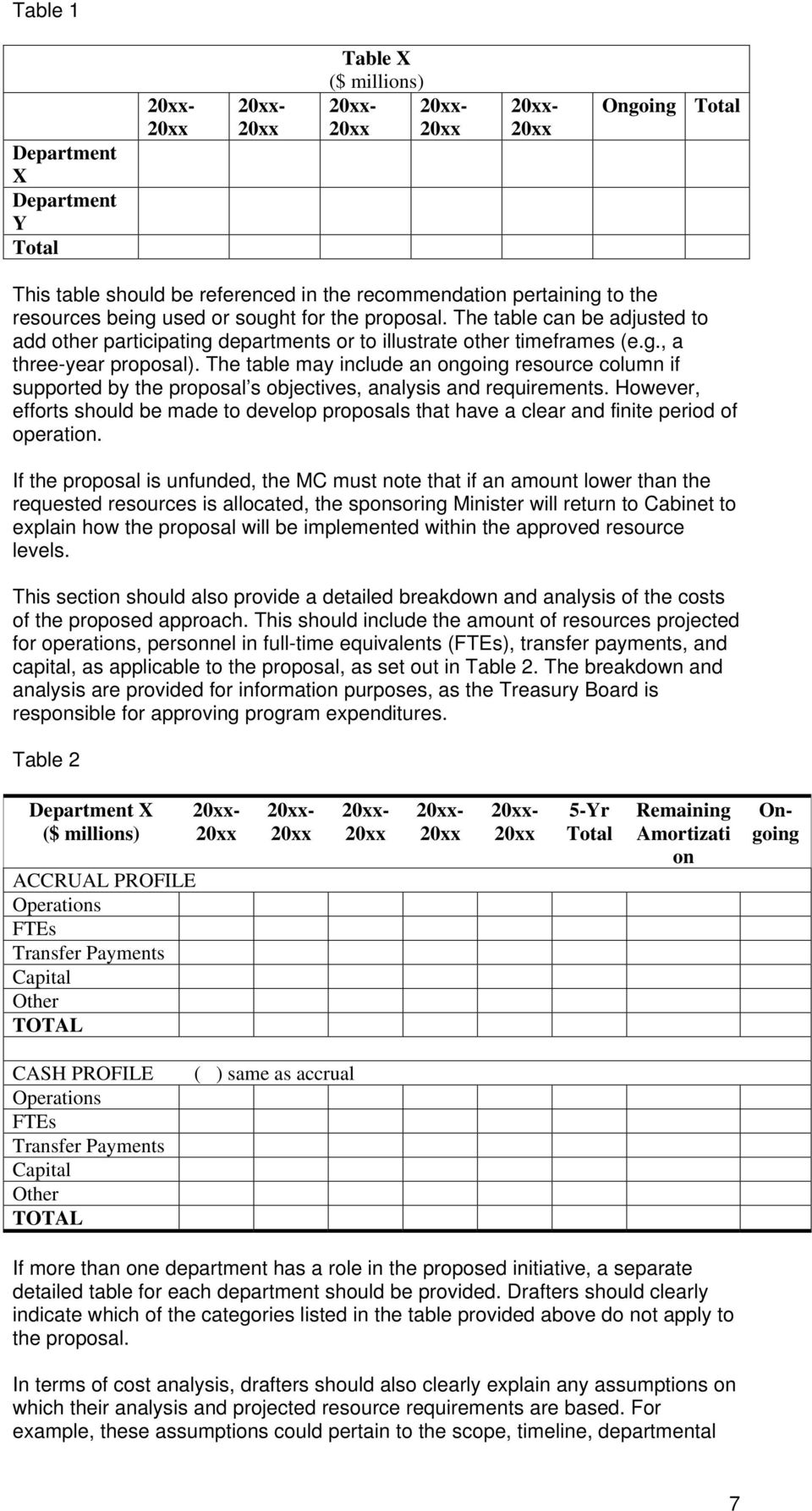
9 wording for these recommendations. Drafters may wish to consult with their PCO analyst on the wording of other recommendations. Examples of Standard Wording in the Recommendations Section The Implementation Plan, as set out in Annex [X] to the Ministerial Recommendations, be approved; The Strategic Communications Plan, as set out in Annex [X] to the Ministerial Recommendations, be approved; The Parliamentary Plan, as set out in Annex [X] to the Ministerial Recommendations, be approved, and that it be implemented in consultation with the Office of the Leader of the Government in the House of Commons, the Office of the Leader of the Government in the Senate, and the Prime Minister s Office. Should implementation of this Plan require further policy, legislative or program design changes, the Minister will return to Cabinet for approval. Rationale This section sets out the reason why action is desirable for the issue raised in the MC. This section should note the reasons why the issue has arisen or is emerging. It should also note connections with Government priorities, including those set out in the Speech from the Throne and the Budget. The Rationale section should also state whether the proposal fills a gap in the implicated department or agency s policies and programs or in the Government s horizontal activities. Drafters may wish to consult their organization s program activity architectures (PAA) to help describe any such gaps. Proposed Approach and Options This section outlines the proposed approach, that is, the sponsoring Minister s recommended option. The proposed approach should be supported by a robust business case that is objective and factual. The section should also provide credible alternative options for Ministers consideration. This section should begin by explaining the proposed approach. Drafters should clearly describe significant components of the policy, program or other activity being proposed. This information must include the timeline for the proposed approach s launch and operation. In the case of program proposals, this section should also clearly state how and when the program will be wound up. A high-level account of this timeline is sufficient, as additional detail can be provided in the Implementation Plan Annex. Financial information should be presented in the MC on both a cash and accrual basis. Drafters should also provide complete profiles, on a cash and accrual basis, to central agencies during the drafting and approval stages for their proposals. The following table format should be used to present the overall resource requirements being sought for the proposed approach. This table should show the annual profile over a five-year horizon, as well as the five-year total, broken down by departments and/or agencies (if more than one organization is involved): 6
![out in Annex [X] to the Ministerial Recommendations, be approved; The Parliamentary Plan, as set out in Annex [X] to the Ministerial Recommendations, be approved, and that it be implemented in](/docs-images/54/9711304/images/page_9.jpg "consultation with the Office of the Leader of the Government in the House of Commons, the Office of the Leader of the Government in the Senate, and the Prime Minister s Office.")
10 Table 1 Department X Department Y Total 20xx- 20xx 20xx- 20xx Table X ($ millions) 20xx- 20xx- 20xx 20xx 20xx- 20xx Ongoing Total This table should be referenced in the recommendation pertaining to the resources being used or sought for the proposal. The table can be adjusted to add other participating departments or to illustrate other timeframes (e.g., a three-year proposal). The table may include an ongoing resource column if supported by the proposal s objectives, analysis and requirements. However, efforts should be made to develop proposals that have a clear and finite period of operation. If the proposal is unfunded, the MC must note that if an amount lower than the requested resources is allocated, the sponsoring Minister will return to Cabinet to explain how the proposal will be implemented within the approved resource levels. This section should also provide a detailed breakdown and analysis of the costs of the proposed approach. This should include the amount of resources projected for operations, personnel in full-time equivalents (FTEs), transfer payments, and capital, as applicable to the proposal, as set out in Table 2. The breakdown and analysis are provided for information purposes, as the Treasury Board is responsible for approving program expenditures. Table 2 Department X ($ millions) ACCRUAL PROFILE Operations FTEs Transfer Payments Capital Other TOTAL 20xx- 20xx 20xx- 20xx 20xx- 20xx 20xx- 20xx 20xx- 20xx 5-Yr Total Remaining Amortizati on Ongoing CASH PROFILE Operations FTEs Transfer Payments Capital Other TOTAL ( ) same as accrual If more than one department has a role in the proposed initiative, a separate detailed table for each department should be provided. Drafters should clearly indicate which of the categories listed in the table provided above do not apply to the proposal. In terms of cost analysis, drafters should also clearly explain any assumptions on which their analysis and projected resource requirements are based. For example, these assumptions could pertain to the scope, timeline, departmental 7
11 capacity or program design of the proposal, as well as to assumptions regarding client eligibility and uptake, future market conditions, environmental context and other factors.. Drafters should refer to the Supplementary Information Section and seek the guidance of their PCO analyst if they believe they cannot fully set out detailed cost breakdowns and costing assumptions within the MC page limits. Drafters should set out the arguments for and evidence supporting the proposed approach, including the reasoning underpinning the instruments selected for the proposal. Information on providing citations for factual evidence can be found under Formatting Requirements. Drafters should also explain the positive and negative consequences of proceeding and not proceeding with the proposed approach, taking care not to duplicate information provided in other sections. The MC should also set out any trade-offs the Government would have to accept in adopting the recommended course of action, as well as any identified risks or limitations the approach may have for achieving its policy objectives. Drafters should indicate the strategies that would be adopted to mitigate these risks and challenges. This section should also set out the proposed option s expected results and how performance will be measured, including by identifying key indicators. The planned evaluation and audit plan should also be outlined. This section should also provide alternative means of addressing the issue raised by the MC. Two alternative options are typically adequate to support Ministers discussion on how best to address the issues raised in the MC. However, drafters should discuss with their PCO analyst whether it would be appropriate to offer a different number of options. Similar to the proposed approach, this section should describe what course of action could be pursued under the alternative options. These alternative options should present viable and credible means to achieve the intended results rather than options that simply encourage a favourable view of the proposed approach. Information on alternative options must include the possible instruments and the costs on a cash and accrual basis. Drafters can refer to rather than repeat background information that has already been provided in relation to the proposed approach. However, the alternative options must be presented as stand-alone initiatives rather than compared with the analysis and components of the proposed approach. Drafters should also objectively set out the strengths and weaknesses of the alternative options. This section should also indicate whether it is anticipated that stakeholders would support any of the alternative options over the proposed approach. Considerations This section highlights factors that Ministers should or may wish to take into consideration when discussing the proposal. The section is organized into two categories: considerations that must be referenced in the MR and other considerations that may be relevant to the particular MC s subject matter. For the first category, this section must state whether or not the following considerations apply to the proposal: - Privacy impacts; - Official Languages Act requirements; and - Gender-based analysis. 8

12 If any of the considerations outlined above are applicable to the issue being addressed in the MC, drafters should provide additional information on their relevance. Linkages should be made as necessary to information provided in other sections, particularly with regard to risks and strategies. For the second category, the section should set out any additional factors that would be relevant to Ministers discussion. Such considerations can be drawn from a variety of sources and touch on a number of issues and population groups. The following list provided in the MC template is not exhaustive or prescriptive but rather provides examples of the kinds of additional information that may be relevant: - Legal risk assessment, including Charter and trade law analysis (e.g., international agreement obligations); - Relevant reviews on the issue (e.g., Auditor General reports, spending reviews, internal audits and program evaluations); - Horizontal policy impacts (i.e., impacts for other federal policies, etc.); - The application of the Cabinet Directive on the Environmental Assessment of Policy, Plan and Program Proposals; - Provincial/territorial or regional considerations and strategies, including federal spending power considerations; - Private and voluntary sector implications; and - International and security perspectives. While it is not necessary to note when considerations in this category do not apply, they are often important factors in policy and program development and implementation that should be brought to Ministers attention. In instances where these and other considerations are pertinent, drafters should ensure that sufficient information is provided so that Ministers understand why the factors are relevant to the issue. As with the mandatory considerations, links should be made with information provided in the Rationale and Proposed Approach and Options sections. If drafters are including a legal risk assessment as a consideration, they should indicate the likelihood of a legal challenge being initiated, as well as the likelihood of the challenge being successful. If there is an appreciable likelihood of success, the MC should also note the likely remedy to be ordered. It is highly likely that information on provincial and territorial perspectives and on their potential involvement in the proposed initiative will be relevant for Ministers discussion of the proposals. Drafters should consult their departments intergovernmental units and their PCO counterpart, who may in turn, when appropriate, consult with the Federal-Provincial-Territorial Relations Branch of PCO, to determine what information should be included in the MC. Due Diligence This section notes that the Chief Financial Officer (CFO) of the sponsoring Minister s department has reviewed the MC. This section also reflects the CFO s attestation to the sufficiency for decision-making purposes of the information provided in the MC on the financial, asset and human resource implications of the proposed and alternative options.if existing departmental resources are being reallocated to fund the proposal, the approach for the reallocation should be provided in this section. The attestation should summarize the CFO s application of the six assertion statements set out in TBS Guideline on Chief Financial Officer Attestation for Cabinet Submissions. This section should also indicate any material 9
13 observations on which the attestation assertions are based or caveats that may qualify the CFO s position. Linkages should be made, as appropriate, to the analysis provided in the Proposed Approach and Options section. While the CFO s attestation letter cannot be appended to the MC, the content of the letter can be drawn upon for drafting this section. Drafters should consult the Supplementary Information Section if the CFO believes there is insufficient space in the MC to fully set out the conclusion based on the six assertions or to explain any underlying observations. More information on preparing attestations can be found in the Guideline on Chief Financial Officer Attestation for Cabinet Submissions. Drafters should engage their CFO at an early stage of MC drafting so that the CFO is aware of any financial assumptions, risks and other issues while undertaking a due diligence review and preparing the attestation to support the drafting of this section. This early engagement will ensure that attestations inform the development of the MC and preparation of subsequent Treasury Board submissions. CFOs may also wish to consult the Office of the Comptroller General of TBS on how best to provide their attestation Annexes There are three standard annexes to the MR: - The Implementation Plan; - The Strategic Communications Plan; and - The Parliamentary Plan. Most MCs will require all three annexes. However, as will be set out below, there are some exceptions to this requirement. Drafters may wish to consult with their PCO analyst at an early stage to determine whether any exceptions would apply to their MC. In addition, it may be necessary to include additional attachments to the MC as annexes, such as papers or reports that the Minister wishes to release, drafting instructions for proposed legislation, negotiating instructions for concluding treaties or other agreements, or an engagement plan related to the proposal. These attachments must be approved by PCO. Implementation Plan Annex The Implementation Plan annex links to the Proposed Approach and Options section of the MR as it provides additional detail on how the proposed option would be implemented, operated and terminated over its timeline. This information should include key milestones in the timeline and the expected results at key junctures (e.g., the end of the fiscal year or annual anniversary of the initiative s launch, as appropriate). The Implementation Plan should be consistent with the spending profile set out in the financial tables provided in the MR. In terms of the timeline, particular reference should be made to the point at which benefits should flow to the targeted population and other beneficiaries, when stated objectives would be achieved, and at which point the initiative would be wound up. A broad outline of the performance measurement strategy should also be provided. This could include the anticipated outputs and the means by which they will be measured. A more detailed performance measurement strategy continues to be a requirement for Treasury Board submissions. Drafters should work closely with their PCO and TBS analysts to ensure that this requirement is met for both the MC and TB submission. 10
14 The Implementation Plan annex has a maximum length of two pages. It is not required for responses to parliamentary standing committee reports, Private Members Bills, and government legislation and treaties that do not have associated program implementation requirements. Strategic Communications Plan Annex The Strategic Communications Plan annex sets out the strategy for announcing the proposed initiative. It has a maximum length of two pages and is required for all MCs. This annex should be developed jointly by the Minister s Office and the department or agency. The Minister s Office supplies political analysis and strategy while departmental officials develop public service advice (e.g., background analysis). This annex should identify the objectives and expected results for the communications strategy. Drafters should indicate how the proposed initiative fits into the Government s agenda. The annex should outline any significant considerations for the proposed strategy and set out how they would be managed. This annex should also provide an analysis of the environment in which the proposed announcement would be made, including reference to available public opinion research and analysis of the views and positions of stakeholders, provincial-territorial governments and media on the issue addressed in the MC. With regard to stakeholders, the analysis should specify which stakeholders were consulted in the development of the proposal, the method of consultation and their reactions during this process. Based on the environment analysis, the annex should describe the risks and opportunities of the communications strategy. Building on the public environment analysis, the annex should describe the anticipated reaction from various audiences, including stakeholders. Broad and generalized statements about the general public should be avoided in favour of describing the potential reaction of specific groups. The annex should also give a broad overview of the storyline and core messages for the announcement, including the links to Government priorities and the proposals benefits for Canadians. An explanation of the anticipated profile, scope and reach of the announcement (e.g., regional, national) should be provided. The annex should set out any outreach to media and stakeholders, and any events that are planned to take place in conjunction with the announcement. The annex should indicate any measures that would be taken to sustain the strategy s message over time, including the proposed initiative s benefits to Canadians. While the annex provides a broad overview of the communications approach, departments and agencies are expected to further develop detailed communications products, including the vehicles for announcing the initiative and the possible use of social media, well in advance of the proposal s launch. Drafters should work closely with PCO Communications on development of the strategy, as well as on any further required communications approvals. Parliamentary Plan Annex The Parliamentary Plan annex sets out the strategy for addressing any matters concerning the proposal that may be raised in Parliament. It has a maximum length of two pages and is required for all MCs. The Parliamentary Plan may provide details, for example, on how legislation will be advanced, the possible steps that follow the tabling of a response to a standing committee report, or how parliamentarians questions regarding the proposal will be answered. 11
15 In this annex, responsibilities should be assigned to Ministers Offices as well as to drafters. Each Minister s Office is asked to provide information on the Minister s consultations that are required with the Government caucus, including the consultations with caucus advisory committees, the results of the consultations and on approaches for addressing any outstanding issues. In cases where caucus consultations are not feasible, the Minister s Office should provide an explanation in the Annex, and drafters should ensure that their PCO counterpart is aware of this. Ministers Offices must also provide information on previous positions the Government has taken on the issue, including while in opposition and in election platforms. Drafters should work with their Ministers Offices to jointly prepare a parliamentary environment analysis. This analysis should describe the anticipated reaction of opposition parties, and indicate areas of agreement and disagreement between the Government and opposition positions and between opposition parties. Reference should be made as appropriate to opposition parties election platforms and commitments, and to previous parliamentary statements. If the introduction of legislation is proposed, drafters should work with their Ministers Offices to jointly develop a strategy for securing House and Senate passage of the legislation. The strategy should indicate the extent of expected opposition support for the legislation. If such support is not expected, the strategy should state how opposition concerns will be addressed, including pressures to amend the bill, the likely amendments and their consequences and costs, and the Minister s approach for dealing with such amendments. The strategy should also indicate the target date of introduction, whether the bill would be introduced in the House of Commons or Senate, whether the Minister would refer the bill to the appropriate standing committee after first or second reading, and whether there are any non-negotiable deadlines by which legislation must be successfully concluded (e.g., meeting international commitments). In preparing the Parliamentary Plan, department and agency drafters should work closely with their parliamentary affairs units. They may also wish to consult with the PCO Legislation and House Planning Secretariat Supplementary Information The goal of setting page limits for the English and French versions of the MR and its annexes is to provide clear, concise and pertinent information to Ministers. These limits cannot be exceeded. Drafters should take advantage of interdepartmental meetings to convey any additional detailed information that would assist other departments and agencies in providing their views on the proposal and in briefing their Ministers. There may be exceptional cases in which proposals cannot be adequately described and explained within the maximum page limit. Such cases could include proposals in which several departments and agencies will play an implementation role or that will be pursued through a large range of policy instruments. In addition, some proposals may have a wider than usual range of complex considerations to be weighed. To ensure that Ministers have sufficient information on which to base their decisions in these exceptional cases, drafters may also add an additional Detailed Proposal Description Annex to the MC or prepare an aide-mémoire to accompany their proposal. It should be noted that PCO and PMO approval for 12
16 the use of either of these supplementary products must be obtained before drafting begins on them. Detailed Proposal Description Annex This optional annex can be used, with prior PCO and PMO approval, to provide additional information on the design of the proposed program or policy. The annex could be used to provide additional context, evidence and analysis to ensure a full understanding of a complex proposal. This annex can also be used to provide additional information on the proposal s costing and on the analysis undertaken to prepare the CFO attestation as set out in the Due Diligence section above. Drafters should not duplicate information provided in other components of the MC, particularly the MR and Implementation Plan. The annex is designed for supplementary information and should not be used to provide advice in addition to that in the MR. The annex should focus solely on the Minister s recommended approach and not the alternative options. The maximum length of the annex is two pages, which can be extended to six pages following consultation with and approval by PCO and PMO. Aide-mémoire An aide-mémoire could be drafted as a companion document to the MC if the detailed proposal description annex is still insufficient to provide additional information. The development of an aide-mémoire should be reserved for the most complex of proposals. Drafters must obtain PCO and PMO approval for the inclusion of an aidemémoire before they begin drafting. More information on drafting aide-mémoires can be found under the Aide-mémoires section below Formatting Requirements The format and presentation of MCs must meet specific requirements. These guidelines can be found in Annex C of this Guide. The font style, font size and page margins cannot be changed to accommodate additional information. Improperly-formatted MCs will not be accepted by the PCO Cabinet Papers System Unit and will be returned to the submitting department or agency for editing. Drafters are required to provide references to the material from which evidence and factual information provided in the MC is drawn. Footnotes and endnotes are not permitted. Instead, drafters should note the author, title and year of the document in parentheses following the relevant text. Drafters should assist other departments and agencies in obtaining copies of these documents upon request. While the headings in the MC template may not be altered or removed, drafters are encouraged to add sub-headings if they improve the presentation and information flow of the document. 4.2 Drafting Guidance for Particular Proposals Government Legislation The content of the Government s legislative program which bills will be introduced and when during a parliamentary session is ultimately the responsibility of the Prime Minister, assisted by the Leaders of the Government in 13
17 the House of Commons and in the Senate. The main thrusts of the program are determined by Cabinet. The Leader of the Government in the House of Commons coordinates the process of translating Cabinet s policy decisions into bills to be placed before the House of Commons. Once a prospective bill is placed on the legislative program, the first stage in the legislative process is for the Minister to bring forward for Cabinet s approval a policy proposal to introduce a new statute or to amend existing statutes. Such MCs generally follow the information requirements set out above, with some adjustments. An MC on a legislative proposal should seek policy approval for the legislation s subject matter and approach, as well as authorization to draft the legislation. In other words, bills should generally not be drafted or included in MCs until Cabinet approval is secured, except in exceptional circumstances and with the Government House Leader s approval. Instead, the MC should attach and seek approval for drafting instructions that describe the content of the bill. The drafting instructions should be set out in clear and understandable language and be sufficiently detailed so that Ministers can make an informed decision and so that Department of Justice officials have a clear framework for drafting the bill. The drafting instructions should be reviewed by both policy and legal experts in the department to ensure these objectives are met. If the bill departs in any material way from the approved drafting instructions, the sponsoring Minister may need to seek approvals for the new approach. In cases of urgent legislation, departments and agencies can request legislative pre-drafting authority by having their Deputy Minister write to the Legislation and House Planning Secretariat of PCO. It should be noted the Prime Minister s prior approval should be sought for any legislative matter falling under his prerogative, including the machinery of government and the creation of new Governor in Council positions. The MR should propose that the Leader of the Government in the House of Commons be authorized to make arrangements for the bill s introduction and that the Parliamentary Plan be implemented in consultation with the Leaders of the Government in the House of Commons and in the Senate and PMO. The Leader of the Government in the House of Commons is supported in this regard by his or her own exempt staff and Parliamentary Secretary, PCO, the Deputy Leader of the Government in the House and the Chief Government Whip. After Cabinet has approved a Minister s proposal, a bill based on the drafting instructions is developed by the Department of Justice. Once the bill is prepared in both official languages and approved by the sponsoring Minister, the Government House Leader undertakes a final review of the bill with the responsible Minister to ensure its consistency with Cabinet s direction and its readiness with respect to the parliamentary strategy. The sponsoring department prepares material for the Government s use in explaining the bill in Parliament, including speeches for the House of Commons and the Senate and for parliamentary standing committee review. The funding implications, such the proposed legislation s costs to federal organizations, need to be clearly stated and a source of funds identified if one exists, as for any other MC. Drafters preparing legislative proposals for consideration may wish to review the Guide to Making Federal Acts and Regulations. Drafters should also consult the parliamentary affairs personnel of their department or agency or the Legislation 14

18 and House Planning Secretariat of PCO to ensure that they are following the appropriate process for legislative proposals. Information on the legislative process in Parliament can be found on the Parliament of Canada website Private Members Business Members of Parliament and Senators from any party may introduce legislation or motions for Parliament s consideration. The Government can choose to support a Private Member s bill (PMB) either in its proposed form or with amendments, or to oppose it. Similarly, the Government could support, oppose or seek to modify a motion tabled by a Member of Parliament or Senator. Once PMBs and motions are placed on the Order Paper in the House of Commons or are introduced in the Senate, a Minister is assigned to develop the Government position for each item and to seek Cabinet approval for the proposed approach. PMBs sponsored by either Government or opposition MPs that become law can have implications for government policies and programs. Accordingly, if a Minister proposes that the Government support a PMB either in full or with amendments, the standard MC template described above should be used to provide Cabinet with sufficient information on the merits of the proposed approach, the risks and trade-offs of so proceeding, and the considerations to bear in mind. If the Minister proposes to table amendments to the legislation, the MC must provide sufficient detail, including drafting instructions, so that the changes can be discussed by Ministers and so that legislative drafters have sufficient direction to proceed. The standard MC template should also be used if a Minister proposes to not support a PMB introduced by a Government MP. If a Minister proposes not to support an opposition MP s PMB, the Ministerial Recommendations (MR) template attached in Annex B should be used. The MR template is a streamlined version of the MC template that focuses on the essential information required by Cabinet to decide on the Minister s proposed approach for such PMBs. Similarly, the standard MC template should be used if a Minister proposes that the Government support a motion or oppose a motion introduced by a Government MP. The abbreviated template can be used if the Minister proposes to oppose a motion tabled by an Opposition MP. Drafters should verify which template to use with their PCO analyst. The abbreviated MR template should not be used for other Cabinet proposals except as indicated in this document and with PCO and PMO s prior approval Government Responses to Parliamentary Standing Committee Reports Standing committees in both the House of Commons and the Senate may issue reports on a policy matter and request that the Government provide a response to the report s recommendations. As with Private Members Business, Ministers are assigned to prepare the Government Response to standing committee reports related to their areas of responsibility. The abbreviated MR template attached in Annex B and described under the Private Member s Business section above should be used to set out the proposed approach for responding to the parliamentary standing committee report. The proposed Government Response should be attached to the MR for Ministers consideration. 15
19 As standing committees generally request that the Government provide a response within a specific number of days, drafters should factor in these timelines in addition to those of the Cabinet decision-making system in developing the MC and Government Response. 4.3 Presentations Presentations, or decks, may be used for a variety of purposes in Cabinet or committee meetings. Ministers may use presentations in conjunction with an MC to guide discussion on the MC s recommendations by highlighting key issues, program elements and the decisions being sought. Ministers may also use presentations to set out a communications strategy or other specific operational issues. However, Ministers can only bring forward stand-alone presentations to seek input from their colleagues on a policy area with the permission of the Prime Minister. Otherwise, every effort should be made to avoid using presentations for preliminary policy discussions for items that will later be addressed in MCs. The following guidelines can be used for the format, information requirements and development of presentations to Cabinet and PCO-supported committees on policy issues within the parameters noted above. Drafters should consult with their PCO analysts on the structure of non-policy presentations such as communications overviews. The purpose of these guidelines is to ensure that presentations fully support committees deliberations by providing Ministers with timely information and clear decision points on policy direction for Ministers discussion Format and Information Requirements Finalized presentations submitted to PCO should be accompanied by a cover memo with the signature of the presenting Minister in a signature block similar to that of an MC. Presentations must be made by one sponsoring Minister. However, supporting Ministers should be prepared with responsive speaking points as the chairperson may turn to them for comment during the discussion, if appropriate. Presentations have a maximum length of 12 slides, including the title slide. The maximum length is the same for each of the English and French versions. Any supplementary information (e.g., graphs, tables, past accomplishments, etc.) should be included in annex slides, which do not count towards the slide limit. However, annex slides are for reference only and should not be presented on screen during the Minister s presentation. Each slide of the presentation, including the title and annex slides, must be marked SECRET in the upper right corner. There should be a high contrast between the text and background in the presentation (e.g., black and white) in order to facilitate ease of reading on screen. All presentations must contain the following sections: - Title page (slide 1); - Key Outcomes / Recommendations (slide 2); - Context / Analysis (slides 3 11); and - Summary (slide 12) Where applied, no exceptions to these guidelines will be made without the agreement of the Assistant Secretary of the responsible PCO secretariat in consultation with PMO. 16

20 Title Page The first slide of the presentation must contain the title of the presentation. Drafters can decide whether or not to include the Minister s title (e.g., Minister of ) but they should not list the date of the meeting or reference the committee in question. Key Outcomes / Recommendations Similar to the MR section of an MC, this slide should summarize the objective of the presentation and clearly set out, in concise bullet form, the key outcomes / recommendations for which the Minister is seeking input from the committee. However, in contrast to a typical MC, these key outcomes / recommendations need not contain detailed program or costing recommendations, although that may be appropriate in some circumstances. Rather, the key outcomes / recommendations slide could focus on specific directions that the Minister wishes to further pursue, recommend one of several options under consideration, propose principles that would inform future work, or propose the dropping of certain proposals from consideration. The slide should clearly seek support for outcomes that will advance the policy or program development process. This section should not exceed one slide. Context / Analysis While there are no specific information requirements for the remainder of the presentation, this section should clearly and concisely provide information in support of the discussion. The following information could be included: - Limited background information, recent developments; - Analysis and key considerations; - Options for consideration; - Costing for all options; - Proposed implementation approach (timing, next steps); and - Communications (stakeholders views, key messages, strategies). Summary The final slide should summarize the objective of the presentation (i.e., key outcomes sought/recommendations). This slide would be kept on the screen following the presentation in order to guide Ministers during their deliberations. 4.4 Aide-mémoires Aide-mémoires provide factual information and analysis in support of Ministers exploratory discussions of non-decision items. As noted above, aide-mémoires can also be used in conjunction with an MC to provide additional in-depth information on complex policy issues. There are no formal information or format requirements for an aide-mémoire and they are not formally signed by the sponsoring Minister(s). In terms of content, drafters should ensure that the subject matter is clearly set out and that information, evidence and analysis are provided in a concise and neutral fashion. Drafters may also refer to the requirements for MCs and presentations for guidance in terms of considerations and content. Similar to presentations, 17
21 aide-mémoires supporting strategic or preliminary policy discussion should not be brought forward except at the request of the Prime Minister. The preparation and submission of aide-mémoires follow the same process as other Cabinet documents. Drafters should discuss the proposed aide-mémoire with their PCO analyst at the earliest opportunity and hold central agencies and interdepartmental meetings in advance of its submission to PCO. 5. Process for Developing Cabinet Documents 5.1 Central Agency Consultations Early drafts of MCs, presentations and aide-mémoires should be shared with the appropriate PCO, Department of Finance and TBS analysts. Consulting with central agencies at an early stage helps ensure that the proposal is aligned with the Government s overall agenda, and to identify any policy, fiscal and implementation issues that should be addressed before the document is submitted. Unless otherwise agreed with PCO, drafters must hold at least one meeting with central agency analysts well before documents are submitted for Cabinet consideration. This meeting should be scheduled in consultation with PCO. 5.2 Interdepartmental Meetings Drafters are responsible for ensuring that other affected departments and agencies are adequately consulted in advance about upcoming proposals and that coordination across portfolios is pursued. These consultations ensure that cross-cutting issues are recognized and properly addressed in proposals and that other Ministers are prepared for Cabinet discussion. To this end, drafters should also share an early version of the Cabinet paper with other departments and agencies. In addition, an interdepartmental meeting must be held after the central agencies meeting and central agency comments have been addressed. Central agency analysts should be invited to participate in the interdepartmental meeting. For presentations, interdepartmental meetings are required at least three weeks prior to the scheduled Cabinet committee meeting date. These interdepartmental consultations provide an opportunity for drafters to receive expert advice from their colleagues and for other departments and agencies to obtain additional information with which to brief their Ministers. Interdepartmental meetings are also a forum for addressing any concerns raised by other departments and agencies. When departments directly involved in a proposal differ on a matter, the dispute should not be referred to Cabinet or a Cabinet committee until all other means of resolving the issue have been exhausted. The Clerk s meetings with Deputy Ministers also provide an opportunity to review high-priority policy issues in advance of their submission for Cabinet consideration. 5.3 Submitting Cabinet Documents Once Cabinet documents have addressed, as appropriate, the input received through central agency and departmental consultations, and have been reviewed by senior departmental officials, they should be provided to the sponsoring Ministers for approval and, in the case of MCs, signature. These approvals must be completed prior to their submission. 18
22 Departments are required to submit all documents in both official languages and in the required format to the Cabinet Papers System Unit of PCO. Departments are required to provide one signed paper copy and one electronic copy in a secure format. The Cabinet Liaison Unit in each department and agency can make arrangements for the documents to be delivered to PCO. These submission procedures apply to presentations as well. The package to the Cabinet Papers System Unit must include the Minister-signed cover memo plus two hard copies of the presentation (both English and French). A CD or USB stick with electronic copies of the presentation must also be included. The CD or USB stick should be labelled and classified no lower than SECRET. The presenting Minister s speaking points (in a single language) should be provided to the responsible PCO secretariat. The responsive speaking points of supporting Ministers can be delivered directly to the PCO secretariat. 5.4 Submission Deadlines Departments are required to submit all Cabinet documents for Cabinet and committees chaired by the Prime Minister at least three business days in advance of a meeting and for all other Cabinet committees at least five business days in advance of the committee meeting. These deadlines should be strictly observed. Should documents not be received by the PCO Cabinet Papers System Unit by the above-noted deadlines, the related item will be removed from the agenda and rescheduled for discussion at a future meeting, except when PCO determines that there are extenuating circumstances. 5.5 Letters to the Chairperson Letters are accepted, via the chairperson, from Ministers who are unable to attend Cabinet or a Cabinet committee meeting and wish to convey their views. Letters should be addressed to the chairperson and submitted in both official languages at least one business day in advance of a meeting to the appropriate Assistant Secretary. 5.6 Officials Attendance at Cabinet and Committee Meetings One member of each sponsoring Minister s exempt staff may accompany the Minister into a meeting for each main agenda item. One official from each sponsoring Minister s department or agency may accompany the Minister into a meeting for each main agenda item, as a resource. For Cabinet and Cabinet committees chaired by the Prime Minister, this official will be the Minister s Deputy Head or Associate Deputy Head; for other committees, the official can be the Deputy Head, Associate Deputy Head, or a designated Assistant Deputy Minister-equivalent. One additional official may wait in the anteroom while the Minister is presenting an agenda item, as an additional resource. If the presenting Minister is using a PowerPoint presentation, the department or agency must provide a technician to run the presentation. In terms of other officials attending Cabinet policy committee meetings, one Assistant Deputy Minister-equivalent official from each of the Department of Finance and TBS may be present. An Assistant Deputy Minister-equivalent from the Department of Justice may attend if the agenda item has a significant legal dimension. Departments and agencies must submit the names of their Cabinet or Cabinet committee meeting attendees, both officials and exempt staff, to the responsible PCO secretariat at least one day in advance of a meeting so that they can be included on the security list. Departments and agencies must ensure beforehand that their attendees have a valid security clearance. 19
23 5.7 Support During Meetings Officials who enter the Cabinet room are only permitted to stay for their particular item and not for the duration of the meeting. Wireless mobile devices such as cellular phones, BlackBerry smartphones and tablets (e.g., ipads) are not permitted in the Cabinet room and should be locked in the secure cabinet provided. During the course of a discussion, senior officials may be asked to answer technical questions on behalf of a presenting Minister. Officials should only speak if invited by the chairperson or their Minister. Should this happen, officials should approach the podium provided in the Cabinet room to answer the question(s). 5.8 Committee Decisions Once a Cabinet committee has concluded its deliberations, it will issue a Committee Recommendation (CR). This forms the committee s recommendation as to what decisions should be taken by Cabinet or by a committee that has been delegated the ability to ratify or approve other committees recommendations. The CR is based on the recommendations put forward by the sponsoring Minister but can be altered by the committee. The CR is then submitted to Cabinet or ratifying committee for its consideration. A Record of Decision (RD) is then issued that either endorses the CR or amends it. CRs and RDs are prepared and circulated by PCO to all Ministers and Deputy Ministers. CRs and RDs are Cabinet confidences and are classified no lower than SECRET. Additional approvals may be required following a Cabinet decision. For example, it may be necessary to obtain a source of funds or to obtain Treasury Board approval prior to implementation. TBS can provide additional information on Treasury Board requirements. Similarly, PCO can provide advice on any Governor in Council approvals that may be needed. Initiatives should not be announced until all approvals are in place. Announcements should be coordinated with PMO and with PCO. 6. Handling Cabinet Documents Cabinet documents MCs, presentations, aide-mémoires, CRs, RDs, Treasury Board submissions and agendas are confidences of the Queen s Privy Council for Canada. Cabinet documents must be safeguarded in accordance with the security requirements established by PCO. Notably, authorized individuals (i.e., persons who have a valid security clearance and a need to know the information to perform their duties) are required to: - Use approved means, including information technology systems, to prepare, store, and transmit Cabinet documents; - Mark such documents no lower than SECRET on the upper right corner of every page; - Handle such information in restricted-access areas that are approved for its level of sensitivity; - Use security equipment and procedures approved for the level of sensitivity of the information to transport, transmit, store and dispose of Cabinet documents; 20
24 - Ensure that the information is not discussed with, viewed or overheard by unauthorized individuals; and - Avoid discussing such information on cellular telephones or other wireless devices (e.g., BlackBerry, ipad, Bluetooth headset), unless approved secure means are used. For additional security-related information, drafters may consult the Policy on the Security of Cabinet Confidences or contact PCO s Security Operations Division. 21
25 Annex A: Memorandum to Cabinet Template Memorandum to Cabinet Mémoire au Cabinet TITLE OF THE MEMORANDUM TO CABINET TITRE DU MÉMOIRE AU CABINET Date Minister of XXXXXX Date Ministre de/du/des/de la XXXXX [Les noms des ministres promoteurs doivent figurer par ordre de préséance.] [Ceci est un modèle. Sur la page titre, l ordre des langues officielles peut être inversé.] [Sponsoring Ministers should be listed in order of precedence.] [This is an example only. Either Official Language can appear on the left or right on the title page.] 22
26 Table of Contents Section Page Number Ministerial Recommendations Issue # Recommendations # Rationale # Proposed Approach and Options # Considerations # Due Diligence # Annex X to the MR: Implementation Plan # Annex Y to the MR: Strategic Communications Plan # Annex Z to the MR: Parliamentary Plan # 23
27 ISSUE MINISTERIAL RECOMMENDATIONS (Maximum ten pages in English plus cover page and table of contents) (Font: 14 points. Please alternate English and French pages) One sentence summary of question to be discussed and resolved. RECOMMENDATIONS 1. XXX It is recommended that: Proposed course of action, for which the sponsoring minister(s) is/are seeking Cabinet support. - specifies roles and authorities of respective ministers in implementing the decision; - indicates use of key policy instrument(s)(e.g., legislative/regulatory direction, etc); and, - indicates the reallocation plan, funding implications, source of funds, profile and funding required including implementation costs. Report cash and accrual. Serves as the basis for the Committee Recommendation (CR) and the Cabinet Record of Decision (RD). RATIONALE 2. Clearly outline why action is required, including origin of the issue, any gaps in existing departmental and/or horizontal programs and policies; and, 3. Link reasons for action to strategic agenda/sft/previous Cabinet direction provided under the current Ministry. PROPOSED APPROACH AND OPTIONS 4. Proposed Approach - clearly outline the proposed policy/program approach, including timeframe for implementation and for program wind-up, and provide detailed breakdown (e.g., proposed FTE, capital expenditures) and analysis of costs, including any assumptions on which the costing is based; - present the principal arguments and evidence in support of the recommended approach/option, including instrument choice analysis, possible adverse consequences of both proceeding and not proceeding, what trade-offs the proposed approach would require the 24
28 Government to accept, limitations of the approach in addressing the policy objectives, and strategies for addressing key risks/challenges; and, - articulate expected results and how they will be measured (i.e., identify key indicators such as social, economic, environmental, etc.), and outline the planned evaluation and audit plan. 5. Alternative Options - outline the alternative options that Ministers could consider (including the cost profile, including cash and accrual, and instrument choice analysis); and, - present the principal strengths and weaknesses of options (including whether principal stakeholders support any of the alternative options). CONSIDERATIONS 6. The MR must indicate whether or not the following considerations are applicable, and provide details as appropriate: - privacy impacts; - Official Languages Act requirements; and, - gender-based analysis. 7. The MR may also include other considerations, where appropriate. Examples of possible additional considerations include: - legal risk assessment including Charter and trade; - provide information on any relevant reviews (e.g., Auditor General reports, strategic reviews, internal audits and program evaluations); - horizontal policy impacts (e.g., impacts for other federal policies, etc.); - sustainable development aspects and results of Strategic Environmental Assessments (as per the 1999 Cabinet Directive on Environmental Assessment of Policy, Plan and Program Proposals); - provincial/territorial or regional considerations and strategies, including federal spending power considerations; - private and voluntary sector implications; and, - international perspectives. DUE DILIGENCE 8. Financial, Asset and HR Implications Departmental Comptroller sign-off. Include reallocation strategies and reference any assumptions or caveats on which the sign-off is based. Minister of XXXX and Other Minister(s), if required (in order of precedence) 25
29 ANNEX X TO THE MR IMPLEMENTATION PLAN (Maximum two pages) Provide information on the key milestones for the recommended option, including anticipated stage of delivery, expected results at the end of each fiscal year (or anniversary of initiating the proposed program), and links to the proposed spending profile. Reference should be made to the point in the timeline at which benefits will accrue to the targeted population and other beneficiaries, when objectives will be achieved and when the program will be wound up. Include an outline of the performance measurement strategy. 26
30 STRATEGIC COMMUNICATIONS PLAN (Two pages maximum) ANNEX Y TO THE MR The strategic communications plan should be provided for all Ministerial Recommendations (MRs). The Annex should be developed jointly by the Minister s Office and the Department. 1. COMMUNICATIONS OBJECTIVES AND CONSIDERATIONS Identify 2-3 objectives that will be achieved through the communications plan, outline expected results, and link this initiative to the Government s agenda. Outline significant communications considerations and how these would be managed. 2. ANALYSIS OF PUBLIC ENVIRONMENT Assess the public environment and identify risks/opportunities therein, including quantitative and qualitative data available through public opinion research data and analysis of previous stakeholder engagement and consultations, federal-provincial positions and media coverage. For stakeholders, identify who was consulted, the method of consultation, and their reactions. 3. ANTICIPATED REACTION Provide examples of likely positive and negative reactions from various audiences (reference should be made to specific groups rather than to broad audiences such as the general public), including stakeholders. 4. STORYLINE AND CORE GOVERNMENT MESSAGES In 5-6 bullets, outline the announcement storyline, relate it to Government priorities, and provide core messages. In plain language, describe the benefits and results for Canadians. 5. ANNOUNCEMENT STRATEGY Indicate the profile of the announcement as well as its scope (e.g., national/regional/ international). Include details on planned media and stakeholder outreach, as well as events to support the announcement. Describe measures to sustain the message and a focus on impacts and benefits for Canadians. 27
31 ANNEX Z TO THE MR PARLIAMENTARY PLAN (Maximum two pages) This annex should be provided for all Ministerial Recommendations (MRs). 1. REPORT OF CAUCUS CONSULTATION Provide details on consultations with caucus, including those undertaken with the Caucus Advisory Committee, on the proposal. Indicate whether caucus is supportive and outline the Minister s approach for addressing any outstanding issues that may have been raised during consultations. If consultations have not been undertaken, the rationale must be provided. (To be prepared by the Minister s Office) 2. PRIOR POLICY AND POLITICAL POSITIONS Indicate whether the Government has previously taken a position on the issue in question, either in a past or current election platform; during debate or votes while in opposition; or in any similar previous fashion, and indicating specifically what those positions were. (To be prepared by the Minister s Office) 3. PARLIAMENTARY ENVIRONMENT ANALYSIS Outline expected reaction of all parties in the House and Senate. Highlight any potential areas of agreement between each Party and the Government position, as well as differences. Identify any shared positions and differences among Opposition Parties. Refer to platform and campaign commitments where applicable, as well as past positions in Parliament. (To be prepared by the Minister s Office and the Department) 4. LEGISLATIVE PLAN (if applicable) Indicate proposed timelines, including date and location (House or Senate) for introduction and plan for referral to Parliamentary Committee (i.e., before or after Second Reading) and any fixed deadlines or obligations (e.g., international commitments). (To be prepared by the Minister s Office and the Department) 5. PARLIAMENTARY STRATEGY Provide Minister s strategy for securing majority support for legislative proposals, including preferred responses to potential pressures for changes, amendments that could be offered, their timing and associated costs. Also include, where appropriate, the engagement of House or Senate Committees, Take Note debates, or other Parliamentary mechanisms. (To be prepared by the Minister s Office and the Department) 28
32 Annex B: Ministerial Recommendations Template Ministerial Recommendations Recommandations ministérielles TITLE TITRE Date Minister of XXXXXX Date Ministre des XXXXX [Les noms des ministres promoteurs doivent figurer par ordre de préséance.] [Ceci est un modèle. Sur la page titre, l ordre des langues officielles peut être inversé.] [Sponsoring Ministers should be listed in order of precedence.] [This is an example only. Either Official Language can appear on the left or right on the title page.] 29
33 Table of Contents Section Page Number Ministerial Recommendations Issue # Recommendations # Proposed Approach # Considerations # Due Diligence # Annex Y to the MR: Strategic Communications Plan # Annex Z to the MR: Parliamentary Plan # 30
34 ISSUE MINISTERIAL RECOMMENDATIONS (Maximum five pages in English plus cover page and table of contents) (Font : 14 points. Please alternate English and French pages) One sentence summary of question to be discussed and resolved. RECOMMENDATIONS 1. XXX It is recommended that: Proposed course of action, for which the sponsoring minister(s) is/are seeking Cabinet support. - recommends whether the Private Member s bill should be opposed or supported; or - recommends that the response to a Parliamentary Standing Committee report be tabled. Serves as the basis for the Committee Recommendation (CR) and the Cabinet Record of Decision (RD). PROPOSED APPROACH 4. Clearly outline the proposed approach, including the principal arguments and evidence in support of the recommended approach/option, possible adverse consequences of both proceeding and not proceeding, what tradeoffs the proposed approach would require the Government to accept, limitations of the approach in addressing the policy objectives, and strategies for addressing key risks/challenges; and, 5. Link reasons for action to strategic agenda/sft/previous Cabinet direction provided under the current Ministry. CONSIDERATIONS 6. The MR must indicate whether or not the following considerations are applicable, and provide details as appropriate: - privacy impacts; - Official Languages Act requirements; and, - gender-based analysis. 7. The MR may include other considerations, where appropriate. Examples of possible additional considerations include: 31
35 - legal risk assessment including Charter and trade; - provide information on any relevant reviews (e.g., Auditor General reports, strategic reviews, internal audits and program evaluations); - horizontal policy impacts (e.g., impacts for other federal policies, etc.); - sustainable development aspects and results of Strategic Environmental Assessments (as per the 1999 Cabinet Directive on Environmental Assessment of Policy, Plan and Program Proposals); - provincial/territorial or regional considerations and strategies, including federal spending power considerations; - private and voluntary sector implications; and, - international perspectives. DUE DILIGENCE 6. Financial, Asset and HR Implications Departmental Comptroller sign-off. Include reallocation strategies and reference any assumptions or caveats on which the sign-off is based. Minister of XXXX and Other Minister(s), if required (in order of precedence) 32
36 STRATEGIC COMMUNICATIONS PLAN (Two pages maximum) ANNEX Y TO THE MR The strategic communications plan should be provided for all Ministerial Recommendations (MRs). The Annex should be developed jointly by the Minister s Office and the Department. 6. COMMUNICATIONS OBJECTIVES AND CONSIDERATIONS Identify 2-3 objectives that will be achieved through the communications plan, outline expected results, and link this initiative to the Government s agenda. Outline significant communications considerations and how these would be managed. 7. ANALYSIS OF PUBLIC ENVIRONMENT Assess the public environment and identify risks/opportunities therein, including quantitative and qualitative data available through public opinion research data and analysis of previous stakeholder engagement and consultations, federal-provincial positions and media coverage. For stakeholders, identify who was consulted, the method of consultation, and their reactions. 8. ANTICIPATED REACTION Provide examples of likely positive and negative reactions from various audiences (reference should be made to specific groups rather than to broad audiences such as the general public), including stakeholders. 9. STORYLINE AND CORE GOVERNMENT MESSAGES In 5-6 bullets, outline the announcement storyline, relate it to Government priorities, and provide core messages. In plain language, describe the benefits and results for Canadians. 10. ANNOUNCEMENT STRATEGY Indicate the profile of the announcement as well as its scope (e.g., national/regional/ international). Include details on planned media and stakeholder outreach, as well as events to support the announcement. Describe measures to sustain the message and a focus on impacts and benefits for Canadians. 33
37 ANNEX Z TO THE MR PARLIAMENTARY PLAN (Maximum two pages) This annex should be provided for all Ministerial Recommendations (MRs). 1. REPORT OF CAUCUS CONSULTATION Provide details on consultations with caucus, including those undertaken with the Caucus Advisory Committee, on the proposal. Indicate whether caucus is supportive and outline the Minister s approach for addressing any outstanding issues that may have been raised during consultations. If consultations have not been undertaken, the rationale must be provided. (To be prepared by the Minister s Office) 2. PRIOR POLICY AND POLITICAL POSITIONS Indicate whether the Government has previously taken a position on the issue in question, either in a past or current election platform; during debate or votes while in opposition; or in any similar previous fashion, and indicating specifically what those positions were. (To be prepared by the Minister s Office) 3. PARLIAMENTARY ENVIRONMENT ANALYSIS Outline expected reaction of all parties in the House and Senate. Highlight any potential areas of agreement between each Party and the Government position, as well as differences. Identify any shared positions and differences among Opposition Parties. Refer to platform and campaign commitments where applicable, as well as past positions in Parliament. (To be prepared by the Minister s Office and the Department) 4. LEGISLATIVE PLAN (if applicable) Indicate proposed timelines, including date and location (House or Senate) for introduction and plan for referral to Parliamentary Committee (i.e., before or after Second Reading) and any fixed deadlines or obligations (e.g., international commitments). (To be prepared by the Minister s Office and the Department) 5. PARLIAMENTARY STRATEGY Provide Minister s strategy for securing majority support for legislative proposals, including preferred responses to potential pressures for changes, amendments that could be offered, their timing and associated costs. Also include, where appropriate, the engagement of House or Senate Committees, Take Note debates, or other Parliamentary mechanisms. (To be prepared by the Minister s Office and the Department) 34
38 Annex C: Formatting Guidance for Memoranda to Cabinet (MCs) MAXIMUM NUMBER OF PAGES FONT SIZE SECTION English French SEE NOTES 14 Cover page 1 (bilingual) 14 Table of contents Mandatory sections Ministerial Recommendations (MR) } Annex X to the MR - Implementation Plan * Annex Y to the MR - Strategic Communications Plan Mandatory sections Annex Z to the MR - Parliamentary Plan } 2 2 } } A B Subtotal Total (Maximum number of pages for Required Components) 35 (bilingual) MARGINS: Top: 0.5" for page numbers (1" for text) Left / Right: 1" Bottom: 1" NOTES: A. No exception to page limit for these sections, for any type of MC. B. *The Implementation Plan can be exempted in certain situations where there is no implementation issues but will continue to be required for most MCs. OPTIONAL ANNEXES: If there is a need for additional annexes please consult your PCO analyst before drafting your MC. 35
39 NOMBRE MAXIMUM DE PAGES FORMAT - POLICES SECTION Anglais Français VOIR NOTES 14 Page couverture 1 (bilingue) 14 Table des matières Sections obligatoires Recommandations ministérielles (RM) } Annexe X aux RM - Plan de mise en œuvre* } Annexe Y aux RM - Plan stratégique de Sections obligatoires communication 2 2 } } A B 12 Annexe Z aux RM - Plan parlementaire 2 2 Sous-total Total (Nombre maximum de pages) 35 (bilingue) MARGES : Haut de la page : 0.5" pour les numéros de pages (1" pour le texte) Gauche / Droite : 1" Bas de la page : 1" NOTES : A. Aucune exception au nombre maximum de pages pour ces sections, peu importe le type de MC. B. Le Plan de mise en œuvre peut être exempté dans certaines situations ou il n y a pas de plan de mise en œuvre, mais continuera à être nécessaire pour la plupart des MC ANNEXES OPTIONNELLES : S il y a un besoin pour des annexes supplémentaires, s'il vous plaît consulter votre analyste du BCP avant de rédiger votre MC. 36
40 MISC. (DO S & DON TS): DIVERS (À FAIRE ET NE PAS FAIRE) : The Recommendations in the MR must be in a box. Les Recommandations dans les RM doivent être encadrés. The English version of the MC should be on odd pages, French version on even pages. If the last pages of the document are all French (i.e., French version tends to be longer), continue French on odd & even pages - i.e. no need to add blank pages. La version anglaise du MC doit se trouver sur des pages impaires et la version française sur des pages paires. Si les dernières pages du document sont toutes françaises (c.-à-d. que la version française est souvent plus longue), continuez en français sur pages paires et impaires - c.-à-d. pas besoin d ajouter de pages blanches. The Minister(s) sign(s) the last page of the MR (French or English - only one language is required to be signed by the Minister). If multiple Ministers are signing, collating signatures will be done by CPSU, no need for all Ministers to sign the same paper copy. Le(s) ministre(s) signe(nt) la dernière page des RM (français ou anglais - il est nécessaire de signer une seule des deux langues). Si plusieurs ministres signent, le regroupement des signatures se fera par le SSDC, il n est pas nécessaire que tous les ministres signent la même copie papier. The mandatory annexes (Implementation Plan, Strategic Communications Plan & Parliamentary Plan) are placed last, in this order, within the annexes section. Les annexes obligatoires (Plan de mise en œuvre, Plan stratégique de communications et Plan parlementaire) sont inclues à la fin de la section des annexes aux RM, dans cet ordre. The electronic version can be saved as two separate documents (English version & French version), do not collate electronically. La version électronique peut être sauvegardée en deux documents séparés (une version anglaise et une version française), ne pas colliger électroniquement. The CPSU should receive the signed original (collated), one copy (collated), and the electronic versions (English & French) 5 working days prior to the meeting at which the MC will be considered. Le SSDC devrait recevoir la version originale signée (assemblée), une copie (assemblée) et les versions électroniques (anglais et français) 5 jours ouvrables avant le comité au cours duquel le MC sera étudié. Do not change margins or font sizes to make text fit within page limits. Ne changez pas les marges ou le format des polices de caractère afin de faire entrer le texte à l intérieur des limites de pages. 37
41 Annex D: Key Resources Publications Accountable Government: A Guide for Ministers and Ministers of State ( Cabinet Committee Mandates and Membership List ( Guide to the Federal Regulatory Process ( Guide to Making Federal Acts and Regulations ( ub=publications) Guide to Preparing Treasury Board Submissions ( Governor in Council Appointments Procedures Guide ( Guideline on Chief Financial Officer Attestation for Cabinet Submissions ( Memoranda to Cabinet Templates ( -eng.htm) Policy on the Security of Cabinet Confidences ( Speech from the Throne ( Web Sites Appointments web site ( Budget website ( Finance Canada ( Parliament of Canada ( Privy Council Office ( 38
Auditor General of Canada to the House of Commons
 2010 Report of the Auditor General of Canada to the House of Commons FALL Chapter 1 Canada s Economic Action Plan Office of the Auditor General of Canada The Fall 2010 Report of the Auditor General of
Status Report of the Auditor General of Canada to the House of Commons
 2011 Status Report of the Auditor General of Canada to the House of Commons Chapter 1 Financial Management and Control and Risk Management Office of the Auditor General of Canada The 2011 Status Report
Guidance on the Governance and Management of Evaluations of Horizontal Initiatives
 Guidance on the Governance and Management of Evaluations of Horizontal Initiatives Centre of Excellence for Evaluation Expenditure Management Sector Treasury Board of Canada Secretariat Her Majesty the
Audit of Financial Management Governance. Audit Report
 Audit of Financial Management Governance Audit Report March 2015 TABLE OF CONTENTS Executive Summary... 2 What we examined... 2 Why it is important... 2 What we found... 2 Background... 4 Objective...
Aboriginal Affairs and Northern Development Canada. Internal Audit Report. Audit of Internal Controls Over Financial Reporting.
 Aboriginal Affairs and Northern Development Canada Internal Audit Report Audit of Internal Controls Over Financial Reporting Prepared by: Audit and Assurance Services Branch Project #: 14-05 November 2014
EXAMINING PUBLIC SPENDING. Estimates Review: A Guide for Parliamentarians
 EXAMINING PUBLIC SPENDING Estimates Review: A Guide for Parliamentarians Some information for this booklet was taken from the Treasury Board of Canada Secretariat s website. A description of the Expenditure
Aboriginal Affairs and Northern Development Canada. Internal Audit Report. Audit of Management of Negotiation Loans. Prepared by:
 Aboriginal Affairs and Northern Development Canada Internal Audit Report Audit of Management of Negotiation Loans Prepared by: Audit and Assurance Services Branch Project No. 12-11 February 2013 TABLE
Canadian Intergovernmental Conference Secretariat
 Canadian Intergovernmental Conference Secretariat 2011 12 Departmental Performance Report The Honourable Peter Penashue Minister of Intergovernmental Affairs President of the Queen s Privy Council for
IN CONFIDENCE. Regulatory Impact Analysis Requirements: New Guidance
 IN CONFIDENCE Cabinet Office CO (09) 8 Circular 10 November 2009 Intended for All Ministers All Chief Executives Chief Parliamentary Counsel Clerk of the House Senior Private Secretaries Private Secretaries
Phase II of Compliance to the Policy on Internal Control: Audit of Entity-Level Controls
 Phase II of Compliance to the Policy on Internal Control: Audit of Entity-Level Controls Office of the Chief Audit and Evaluation Executive Audit and Assurance Services Directorate November 2013 Cette
How To Write A Listing Policy For A Species At Risk Act
 Fisheries and Oceans Canada Species at Risk Act Listing Policy and Directive for Do Not List Advice DFO SARA Listing Policy Preamble The Fisheries and Oceans Canada (DFO) Species at Risk Act (SARA) Listing
ACADEMIC POLICY FRAMEWORK
 ACADEMIC POLICY FRAMEWORK Principles, Procedures and Guidance for the Development & Review of Academic Policies [V.1] Page 2 of 11 TABLE OF CONTENTS 1. FRAMEWORK OVERVIEW... 3 2. PRINCIPLES... 4 3. PROCESS...
BUILDING A CROWN CORPORATION DIRECTOR PROFILE
 BUILDING A CROWN CORPORATION DIRECTOR PROFILE Prepared by: Management Priorities and Senior Personnel Secretariat Privy Council Office In collaboration with: Renaud Foster Management Consultants June 2001
Accountable Government. A Guide for Ministers and Ministers of State
 Accountable Government A Guide for Ministers and Ministers of State 2011 Accountable Government A Guide for Ministers and Ministers of State 2011 Accountable Government: A Guide for Ministers and Ministers
FEDERAL EMERGENCY RESPONSE PLAN
 FEDERAL EMERGENCY RESPONSE PLAN JANUARY 2011 This plan has been developed by the Government of Canada in consultation with appropriate partners/stakeholders. In accordance with the Policy on Government
MEMORANDUM OF UNDERSTANDING BETWEEN. PROVINCE OF ONTARIO COUNCIL FOR THE ARTS (also known as the Ontario Arts Council) AND
 MEMORANDUM OF UNDERSTANDING BETWEEN PROVINCE OF ONTARIO COUNCIL FOR THE ARTS (also known as the Ontario Arts Council) AND THE MINISTER OF TOURISM AND CULTURE 1. DEFINITIONS In this Memorandum of Understanding,
RIAS Writer s Guide 2009
 RIAS Writer s Guide 2009 Her Majesty the Queen in Right of Canada, represented by the President of the Treasury Board, 2010 Catalogue No. BT53-16/2009E-PDF ISBN 978-1-100-15046-8 This document is available
Final Report. Audit of the Project Management Framework. December 2014
 Final Report Audit of the Project Management Framework December 2014 Audit of the Project Management Framework Table of Contents Executive summary... i A - Introduction... 1 1. Background... 1 2. Audit
Canada Information Office. 1999-2000 Estimates A Report on Plans and Priorities
 1999-2000 Estimates A Report on Plans and Priorities Table of Contents Section I: Messages A. Minister s Message 2 B. Management Representation Statement 3 Section II:Departmental Overview A. Mandate,
Province of Newfoundland and Labrador. Report on the Program Expenditures and Revenues of the Consolidated Revenue Fund
 Province of Newfoundland and Labrador Report on the Program Expenditures and Revenues of the Consolidated Revenue Fund FOR THE YEAR ENDED 31 MARCH 2013 Province of Newfoundland and Labrador Report on the
How To Maintain An Effective System Of Internal Control Over Financial Reporting
 Internal control over financial reporting Statement, assessment summary and action plan For the fiscal year ending March 31, 2012 Summary of the assessment of effectiveness of the system of internal control
AUDIT OF READINESS FOR THE IMPLEMENTATION OF THE POLICY ON INTERNAL CONTROL
 AUDIT OF READINESS FOR THE IMPLEMENTATION OF THE POLICY ON INTERNAL CONTROL AUDIT REPORT JUNE 2010 TABLE OF CONTENTS EXCUTIVE SUMMARY... 3 1 INTRODUCTION... 5 1.1 AUDIT OBJECTIVE. 5 1.2 SCOPE...5 1.3 SUMMARY
Part B1: Business case developing the business case
 Overview Part A: Strategic assessment Part B1: Business case developing the business case Part B2: Business case procurement options Part B3: Business case funding and financing options Part C: Project
CANADIAN NORTHERN ECONOMIC DEVELOPMENT AGENCY. Statement of Management Responsibility
 CANADIAN NORTHERN ECONOMIC DEVELOPMENT AGENCY Statement of Management Responsibility Responsibility for the integrity and objectivity of the accompanying financial statements for the initial period starting
Final Document. Title: IMDRF Standards Operating Procedures. Authoring Group: IMDRF Management Committee. Date: 17 December 2014
 IMDRF/MC/N2FINAL:2014 (Edition 2) Final Document Title: Authoring Group: IMDRF Standards Operating Procedures IMDRF Management Committee Date: 17 December 2014 Jeff Shuren, IMDRF Chair This document was
Overview of the Office of the Executive Council...1. Cabinet Secretariat...2. Communications and Consultation Branch...7
 CONTENTS Overview of the...1 Cabinet Secretariat...2 Communications and Consultation Branch...7 Intergovernmental Affairs Secretariat...10 Financial Statements...14 OVERVIEW OF THE OFFICE OF THE EXECUTIVE
Board Development. Writing a Grant Proposal. What Do I Do First? Where Do I Search for Funders?
 Board Development You are a staff person or board member tasked with writing a grant proposal. DON T PANIC! The information outlined in the following paragraphs should give you an understanding of what
Audit of Project Management Governance. Audit Report
 Audit of Project Management Governance Audit Report March 2015 TABLE OF CONTENTS Executive Summary... 3 What we examined... 3 Why it is important... 3 What we found... 3 Background... 5 Objective... 6
INTERNAL AUDIT FRAMEWORK
 INTERNAL AUDIT FRAMEWORK April 2007 Contents 1. Introduction... 3 2. Internal Audit Definition... 4 3. Structure... 5 3.1. Roles, Responsibilities and Accountabilities... 5 3.2. Authority... 11 3.3. Composition...
SUBMISSION TO THE SENATE COMMUNITY
 SUBMISSION TO THE SENATE COMMUNITY AFFAIRS LEGISLATION COMMITTEE INQUIRY INTO THE MEDICAL RESEARCH FUTURE FUND BILL (2015) AND THE MEDICAL RESEARCH FUTURE FUND (CONSEQUENTIAL AMENDMENTS) BILL 2015 FROM
VOTE Accident Insurance
 VOTE Accident Insurance B.7 Vol.I 1 Terms and Definitions Used ACC Accident Compensation Corporation Footnotes Note 1 Appropriation numbers in Part B are inclusive of GST (where applicable). Note 2 Expenses
Internal Audit Manual
 Internal Audit Manual Version 1.0 AUDIT AND EVALUATION SECTOR AUDIT AND ASSURANCE SERVICES BRANCH INDIAN AND NORTHERN AFFAIRS CANADA April 25, 2008 #933907 Acknowledgements The Institute of Internal Auditors
Next Generation Fighter Capability: Life Cycle Cost Framework. November 27, 2012
 Next Generation Fighter Capability: Life Cycle Cost Framework November 27, 2012 Table of contents 1 Introduction... 1 2 Context and Approach... 2 2.1 Purpose... 2 2.2 Context... 2 2.3 International Context...
INTERGOVERNMENTAL AGREEMENT FOR THE NATIONAL DISABILITY INSURANCE SCHEME (NDIS) LAUNCH
 INTERGOVERNMENTAL AGREEMENT FOR THE NATIONAL DISABILITY INSURANCE SCHEME (NDIS) LAUNCH Part 1 Preliminaries 1. The Commonwealth of Australia (the Commonwealth) and States and Territories (the States) are
Environmental Assessments and Major Projects Policy Considerations
 ASSEMBLY OF FIRST NATIONS Environmental Assessments and Major Projects Policy Considerations March 2011 Table of Contents 1. Introduction P.3 2. Major Projects Management Office P.4 3. First Nation Involvement
DRAFT Report on Office of the Superintendent of Financial Report on Institutions Office of the Superintendent of Financial
 DRAFT Report on Office of the Superintendent of Financial Report on Institutions Office of the Superintendent of Financial Institutions Regulation Sector Approvals & Precedents Group Office of the Chief
Quality Assurance and Enhancement Documentation. 1.0 Introduction. 2.0 Standard Format. 3.0 Programme Approval Form. 4.0 Validation Documentation
 Quality Assurance and Enhancement Documentation 1.0 Introduction 2.0 Standard Format 3.0 Programme Approval Form 4.0 Validation Documentation 5.0 Response to Conditions 6.0 Definitive Document 7.0 Programme
Aboriginal Affairs and Northern Development Canada. Internal Audit Report. Audit of Project Management of the Canadian High Arctic Research Station
 Aboriginal Affairs and Northern Development Canada Internal Audit Report Audit of Project Management of the Canadian High Arctic Research Station Prepared by: Audit and Assurance Services Branch Project
australian and new zealand architecture program accreditation procedure ANZ APAP
 australian and new zealand architecture program accreditation procedure ANZ APAP Published and jointly owned by the Architects Accreditation Council of Australia (AACA) and the Australian Institute of
Financial Statements of the. Office of the Secretary to the Governor General
 Financial Statements of the Office of the Secretary to the Governor General For the Year Ended March 31, 2014 Statement of Management Responsibility Including Internal Control Over Financial Reporting
Health Information Management Module. Annual Review. Internal Audit Branch 378-1-233. Approved by Audit Committee
 Health Information Management Module Annual Review Internal Audit Branch 378-1-233 Approved by Audit Committee September 25 th, 2007 Table of Contents Executive Summary... i 1.0 Background...1 2.0 Objective
Ninth Round PROJECT MONITORING, REPORTING, REVISION AND EXTENSION GUIDELINES
 Ninth Round PROJECT MONITORING, REPORTING, REVISION AND EXTENSION GUIDELINES For all reporting templates, please visit the UNDEF website: http://www.un.org/democracyfund/grantees/grantees_r7.html This
Audit of the Policy on Internal Control Implementation
 Audit of the Policy on Internal Control Implementation Natural Sciences and Engineering Research Council of Canada Social Sciences and Humanities Research Council of Canada February 18, 2013 1 TABLE OF
How To Manage A Province Of Philippines
 Department of Performance Monitoring And Evaluation ANNUAL PERFORMANCE PLAN 2013/2014 1 FOREWORD Minister Collins Chabane Deputy Minister Obed Bapela Guided by the departmental Strategic Plan which was
Guide for the Development of Results-based Management and Accountability Frameworks
 Guide for the Development of Results-based Management and Accountability Frameworks August, 2001 Treasury Board Secretariat TABLE OF CONTENTS Section 1. Introduction to the Results-based Management and
BRITISH MUSEUM MANAGEMENT STATEMENT AND FINANCIAL MEMORANDUM
 BRITISH MUSEUM MANAGEMENT STATEMENT AND FINANCIAL MEMORANDUM PART ONE: MANAGEMENT STATEMENT I. INTRODUCTION This document Paragraph(s) 1-7 Founding legislation; status 8 Classification 9-11 The functions,
august09 tpp 09-05 Internal Audit and Risk Management Policy for the NSW Public Sector OFFICE OF FINANCIAL MANAGEMENT Policy & Guidelines Paper
 august09 09-05 Internal Audit and Risk Management Policy for the NSW Public Sector OFFICE OF FINANCIAL MANAGEMENT Policy & Guidelines Paper Preface Corporate governance - which refers broadly to the processes
Code of Audit Practice
 Code of Audit Practice APRIL 2015 Code of Audit Practice Published pursuant to Schedule 6 Para 2 of the Local Audit and Accountability This document is available on our website at: www.nao.org.uk/ consultation-code-audit-practice
Public Sector Pension Investment Board
 Public Sector Pension Investment Board Office of the Auditor General of Canada Bureau du vérificateur général du Canada Ce document est également publié en français. Her Majesty the Queen in Right of Canada,
Causes of complex legislation and strategies to address these
 Causes of complex legislation and strategies to address these Context Complex legislation makes it difficult, expensive and time-consuming for people to understand their legal rights and obligations. This
PART 3.7 DEPARTMENT OF HEALTH AND COMMUNITY SERVICES NEWFOUNDLAND AND LABRADOR CENTRE FOR HEALTH INFORMATION
 PART 3.7 DEPARTMENT OF HEALTH AND COMMUNITY SERVICES NEWFOUNDLAND AND LABRADOR CENTRE FOR HEALTH INFORMATION Executive Summary The Newfoundland and Labrador Centre for Health Information (the Centre) is
Audit and risk assurance committee handbook
 Audit and risk assurance committee handbook March 2016 Audit and risk assurance committee handbook March 2016 Crown copyright 2016 This publication is licensed under the terms of the Open Government Licence
Canada School of Public Service 2012-13. Departmental Performance Report
 Canada School of Public Service Departmental Performance Report Original version signed by: The Honourable Tony Clement President of the Treasury Board and Minister for the Federal Economic Development
OFFICE OF THE PRIVACY COMMISSIONER OF CANADA. Audit of Human Resource Management
 OFFICE OF THE PRIVACY COMMISSIONER OF CANADA Audit of Human Resource Management May 13, 2010 Prepared by the Centre for Public Management Inc. TABLE OF CONTENTS 1.0 Executive Summary... 2 2.0 Background...
Major IT Projects: Continue Expanding Oversight and Strengthen Accountability
 Secretary of State Audit Report Jeanne P. Atkins, Secretary of State Gary Blackmer, Director, Audits Division Major IT Projects: Continue Expanding Oversight and Strengthen Accountability Summary Information
AUDITOR-GENERAL S AUDITING STANDARD 4 (REVISED) THE AUDIT OF SERVICE PERFORMANCE REPORTS. Contents
 AUDITOR-GENERAL S AUDITING STANDARD 4 (REVISED) THE AUDIT OF SERVICE PERFORMANCE REPORTS Contents Page Introduction 3-8301 Scope of this Statement 3-8301 Application 3-8303 Objectives 3-8304 Definitions
Request for feedback on the revised Code of Governance for NHS Foundation Trusts
 Request for feedback on the revised Code of Governance for NHS Foundation Trusts Introduction 8 November 2013 One of Monitor s key objectives is to make sure that public providers are well led. To this
Management Initiatives in Ontario School Boards: Supporting Student Achievement by Minimizing Distractors
 Management Initiatives in Ontario School Boards: Supporting Student Achievement by Minimizing Distractors Nancy Naylor Assistant Deputy Minister Business and Finance Division Ontario Ministry of Education
Project Charter Guide
 Project Charter Guide Feedback and Questions To help maintain the currency of this document, feedback and questions are welcomed. Please contact: IT Project Review and Oversight Chief Information Officer
The Provincial Auditor Act
 1 PROVINCIAL AUDITOR c. P-30.01 The Provincial Auditor Act being Chapter P-30.01 of the Statutes of Saskatchewan, 1983 (effective May 18, 1983) as amended by the Statutes of Saskatchewan, 1986-87-88, c.26;
Health Facilities Capital Program Manual. Version 1.0
 Health Facilities Capital Program Manual Version 1.0 TABLE OF CONTENTS TABLE OF CONTENTS... 2 1.0 INTRODUCTION... 9 1.1 Health Facilities Capital Program... 9 1.1.1 Major Capital Projects Total Project
Distinguished Budget Presentation Awards Program Government Finance Officers Association. Awards Criteria (and explanations of the Criteria)
 1 Distinguished Budget Presentation Awards Program Government Finance Officers Association Awards Criteria (and explanations of the Criteria) #C1. Mandatory: The document shall include a table of contents
States of Jersey Comptroller & Auditor General
 States of Jersey Comptroller & Auditor General Code of Audit Practice (Prepared under Article 18 of the Comptroller and Auditor General (Jersey) Law 2014) 28 November 2014 Foreword Independent external
Canada School of Public Service
 Canada School of Public Service 2010-2011 Departmental Performance Report Original signed by The Honourable Tony Clement President of the Treasury Board and Minister for the Federal Economic Development
Extractive Industries Transparency Initiative. Validation guide
 Extractive Industries Transparency Initiative Validation guide Extractive Industries Transparency Initiative Validation guide Report of the EITI International Advisory Group Annex A: Validation guide Contents
Guidelines for external reviews of quality assurance agencies in the European Higher Education Area
 Guidelines for external reviews of quality assurance agencies in the European Higher Education Area Guidelines for external reviews of quality assurance agencies in the European Higher Education Area 2
Grant Programme Guidelines Community Development Grants Programme
 Grant Programme Guidelines Community Development Grants Programme Community Development Grants Programme Guidelines Contents Process Flowchart... 3 1. Introduction... 4 1.1. Programme Background... 4 1.2.
PROJECT MANAGEMENT FRAMEWORK
 PROJECT MANAGEMENT FRAMEWORK DOCUMENT INFORMATION DOCUMENT TYPE: DOCUMENT STATUS: POLICY OWNER POSITION: INTERNAL COMMITTEE ENDORSEMENT: APPROVED BY: Strategic document Approved Executive Assistant to
Education and Early Childhood Development Legislation Reform
 Education and Early Childhood Development Legislation Reform Discussion Paper No 3 General Provisions for Education and Early Childhood Development Discussion Paper No 3 State of South Australia, 2008.
Office of the Attorney General. Statement of Strategy
 Office of the Attorney General Statement of Strategy 2011 2014 Contents Foreword by the Attorney General Introduction by the Director General Chapter 1: Roles and Functions Chapter 2: Analysis of the Working
Funds Management Governance Framework
 Funds Management Governance Framework DEPARTMENT OF FINANCE BANK OF CANADA October 2007 Table of Contents Purpose 2 CHAPTER 1 Funds Management Objectives 4 TABLE OF ANNEXES 32 - Financial Asset and Liability
Statement of Management Responsibility Including Internal Control Over Financial Reporting
 Statement of Management Responsibility Including Internal Control Over Financial Reporting Responsibility for the integrity and objectivity of the accompanying financial statements for the year ended March
Practice Note. 10 (Revised) October 2010 AUDIT OF FINANCIAL STATEMENTS OF PUBLIC SECTOR BODIES IN THE UNITED KINGDOM
 October 2010 Practice Note 10 (Revised) AUDIT OF FINANCIAL STATEMENTS OF PUBLIC SECTOR BODIES IN THE UNITED KINGDOM The Auditing Practices Board (APB) is one of the operating bodies of the Financial Reporting
ATLANTIC GATEWAY INTERNATIONAL MARKETING:
 ATLANTIC GATEWAY INTERNATIONAL MARKETING: A Component of the Gateways and Border Crossings Fund (GBCF) PROGRAM DESCRIPTION AND APPLICANT GUIDE TABLE OF CONTENTS PREFACE... 1 SECTION ONE... 2 1.0 OVERVIEW
BUDGET MANAGEMENT AND OVERSIGHT POLICY
 ANNEXURE 15 BUDGET MANAGEMENT AND OVERSIGHT POLICY Budgets FINANCE DEPARTMENT City of Cape Town 1 Table of Contents 1. DEFINITIONS AND ABBREVIATIONS 3 2. PROBLEM STATEMENT 4 3. DESIRED OUTCOME 4 4. STRATEGIC
Transport Canada s Departmental Sustainable Development Strategy 2012 2013 Reporting Update
 Transport Canada s Departmental Sustainable Development Strategy 2012 2013 Reporting Update 1 For more information, please visit Transport Canada s website at http://www.tc.gc.ca/eng/policy/acs-sd-dsds-2615.htm
State of Minnesota IT Governance Framework
 State of Minnesota IT Governance Framework June 2012 Table of Contents Table of Contents... 2 Introduction... 4 IT Governance Overview... 4 Process for Developing the New Framework... 4 Management of the
CODE: E.003 Financial Services BUDGET AND BUSINESS PLANNING POLICY. 1.2 The essential activities covered by this policy include:
 BUDGET AND BUSINESS PLANNING POLICY CONTENTS 1.1 Budget and business planning is undertaken to support strategic planning and decision-making and to serve accountability by enabling administration to plan
Part 2.13: Change and Baseline Management
 PUBLIC IMO_PRO_0039 Market Manual 2: Market Administration Part 2.13: Change and Baseline Management Issue 3.0 Public This document describes the Market Place Change Management and Market Design Baseline
Audit of Construction Contracts
 National Research Council Canada Audit of Construction Contracts Internal Audit, NRC January 2009 TABLE OF CONTENTS 1.0 Executive Summary... 1 2.0 Introduction... 6 2.1 Background and context... 6 2.2
Risk Profiling Toolkit DEVELOPING A CORPORATE RISK PROFILE FOR YOUR ORGANIZATION
 Risk Profiling Toolkit DEVELOPING A CORPORATE RISK PROFILE FOR YOUR ORGANIZATION I Background Under the TBS Risk Management Policy, departments and agencies must identify the potential perils, factors
Governance Document Management Framework
 Governance Document Management Framework Relevant Definitions: In the context of this document: AB means Academic Board Contact Officer means the position responsible for the day to day implementation