
University of Central Oklahoma
|
|
|
- Gordon Waters
- 10 years ago
- Views:
Transcription
1 About University of Central Oklahoma Graduate Catalog, University of Central Oklahoma Graduate Catalog 1

2 About University of Central Oklahoma Graduate Catalog, Copyright, 2008, University of Central Oklahoma, All Rights Reserved. All information contained in this catalog is subject to change before the next catalog is published. It is ultimately the responsibility of the student to keep abreast of current regulations and program status. Equal Opportunity Statement In compliance with Title VI and Title VII of the Civil Rights Act of 1964, Executive Order as amended, Title IX of The Education Amendments of 1972, Sections 503 and 504 of The Rehabilitation Act of 1973, the Americans With Disabilities Act of 1990, the Family and Medical Leave Act of 1993, the Civil Rights Act of 1991, and other Federal Laws and Regulations, the University of Central Oklahoma does not discriminate on the basis of race, color, national origin, sex, age, religion, handicap, disability, or status as a veteran in any of its policies, practices or procedures; this includes but is not limited to admissions, employment, financial aid, and educational services. 2
3 About University of Central Oklahoma Graduate Catalog, Welcome from the President Let me welcome you to one of the most exciting and life-affirming times in your life as you engage in this great adventure of learning and participation in campus life. There are tremendous challenges that come with our fast-paced, high-tech world, and UCO is ready to help you meet them. We are dedicated to providing you with first-rate academic programs, talented and committed faculty, and rich cultural and social experiences which will help you achieve your professional and personal goals. It is my wish that you experience graduate education to the fullest as a person of intellectual passions and discipline, a person who honors diversity, a person who connects with community. With guidance and help from UCO your aspirations for the future will transform into reality. The choices you make will determine the richness of your own life and will shape the world of the 21st century. Congratulations on your recognition of the critical role which graduate education plays in your life journey. See you on campus! W. Roger Webb President University of Central Oklahoma 3

4 About University of Central Oklahoma Graduate Catalog, Welcome from the Provost Welcome to the University of Central Oklahoma. We would be delighted to have you join the UCO learning community. We know that you are making serious choices about your future, and all of us at UCO are eager to assist you in meeting your educational objectives. UCO s distinguished faculty and committed staff work tirelessly to enhance the quality of life and the quality of education that you experience here. Our focus is helping you learn. Here at UCO, and now on the campus of Rose State College, you have the opportunity to explore your interests and to develop and refine your lifelong learning skills and habits, including critical thinking, writing, speaking, listening and the effectiveness of your technological communication skills. At UCO we recognize that learning occurs in many venues both within and outside of the classroom. We provide opportunities for transformative learning that will help you develop leadership and civic engagement skills, proficiency at undergraduate research, and global and cultural competency. These qualities prepare you to become a productive, creative, ethical and engaged citizen. UCO is a community of caring teachers and learners striving each day to be more effective in serving the needs and aspirations of the educational faculty, staff, and most importantly, our students. We sincerely hope that you will become a member of our dynamic educational institution as we purposefully shape its role in the coming century. At UCO, learning and service are our passions. We want them to be yours as well. Empowered and inspired by President Webb s creative leadership and his call for community, character and civility, the hundreds of dedicated faculty and staff, who are the life force of this university, openly and sincerely invite you to bring your dreams and aspirations for the future to UCO. We are eager to match your commitment, diligence and persistence to achieve your goals with our expertise, vision, and a clear sense of service. We are here for you. William J. Radke Provost and Vice President for Academic Affairs University of Central Oklahoma 4

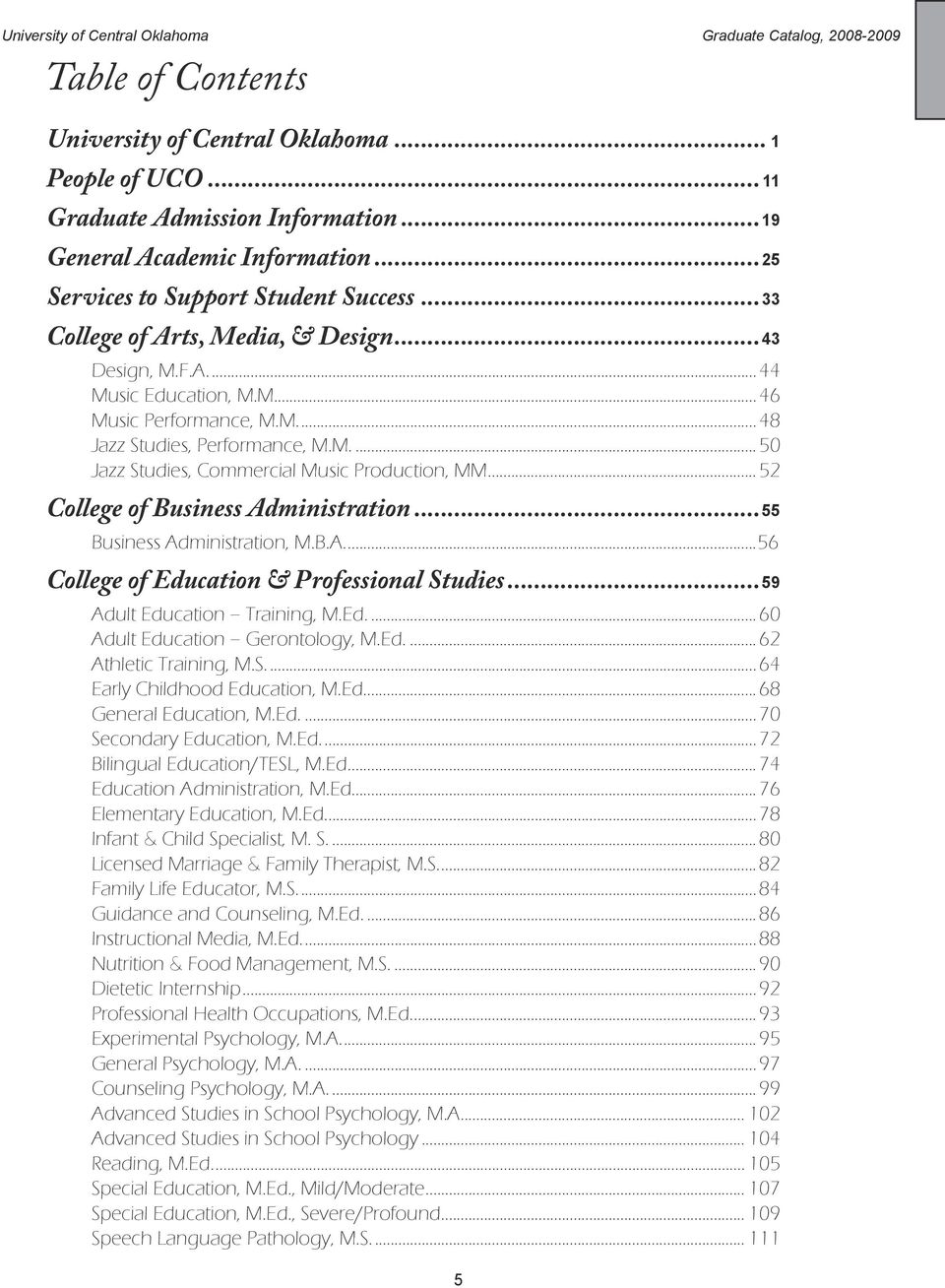
5 Table of Contents About University of Central Oklahoma Graduate Catalog, University of Central Oklahoma... 1 People of UCO Graduate Admission Information...19 General Academic Information...25 Services to Support Student Success...33 College of Arts, Media, & Design...43 Design, M.F.A...44 Music Education, M.M...46 Music Performance, M.M...48 Jazz Studies, Performance, M.M...50 Jazz Studies, Commercial Music Production, MM...52 College of Business Administration...55 Business Administration, M.B.A...56 College of Education & Professional Studies...59 Adult Education Training, M.Ed...60 Adult Education Gerontology, M.Ed...62 Athletic Training, M.S...64 Early Childhood Education, M.Ed...68 General Education, M.Ed...70 Secondary Education, M.Ed...72 Bilingual Education/TESL, M.Ed...74 Education Administration, M.Ed...76 Elementary Education, M.Ed...78 Infant & Child Specialist, M. S...80 Licensed Marriage & Family Therapist, M.S...82 Family Life Educator, M.S...84 Guidance and Counseling, M.Ed...86 Instructional Media, M.Ed...88 Nutrition & Food Management, M.S...90 Dietetic Internship...92 Professional Health Occupations, M.Ed...93 Experimental Psychology, M.A...95 General Psychology, M.A...97 Counseling Psychology, M.A...99 Advanced Studies in School Psychology, M.A Advanced Studies in School Psychology Reading, M.Ed Special Education, M.Ed., Mild/Moderate Special Education, M.Ed., Severe/Profound Speech Language Pathology, M.S
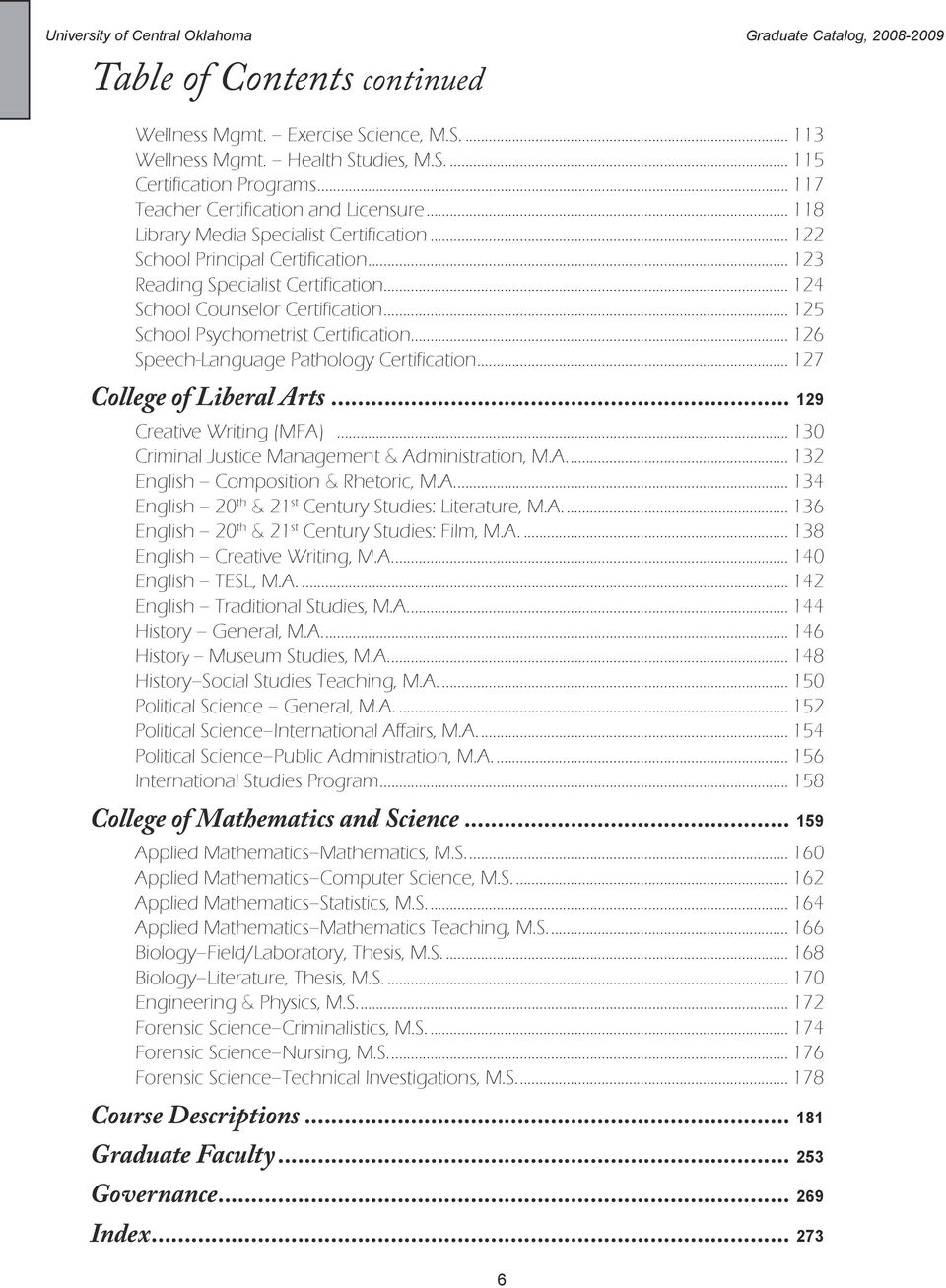
6 Table of Contents continued About University of Central Oklahoma Graduate Catalog, Wellness Mgmt. Exercise Science, M.S Wellness Mgmt. Health Studies, M.S Certification Programs Teacher Certification and Licensure Library Media Specialist Certification School Principal Certification Reading Specialist Certification School Counselor Certification School Psychometrist Certification Speech-Language Pathology Certification College of Liberal Arts Creative Writing (MFA) Criminal Justice Management & Administration, M.A English Composition & Rhetoric, M.A English 20 th & 21 st Century Studies: Literature, M.A English 20 th & 21 st Century Studies: Film, M.A English Creative Writing, M.A English TESL, M.A English Traditional Studies, M.A History General, M.A History Museum Studies, M.A History Social Studies Teaching, M.A Political Science General, M.A Political Science International Affairs, M.A Political Science Public Administration, M.A International Studies Program College of Mathematics and Science Applied Mathematics Mathematics, M.S Applied Mathematics Computer Science, M.S Applied Mathematics Statistics, M.S Applied Mathematics Mathematics Teaching, M.S Biology Field/Laboratory, Thesis, M.S Biology Literature, Thesis, M.S Engineering & Physics, M.S Forensic Science Criminalistics, M.S Forensic Science Nursing, M.S Forensic Science Technical Investigations, M.S Descriptions Graduate Faculty Governance Index
7 About University of Central Oklahoma Graduate Catalog, Mission Statement - Location About UCO Mission Statement The mission of the Dr. Joe C. Jackson College of Graduate Studies is to insure challenging learning opportunities at the graduate level and to promote scholarly research and creative activity at all academic levels. The JCGS is committed to transforming the lives of learners, scholars, and artists while connecting them to the global community. Beliefs and Values UCO s fundamental responsibility is the advancement of student learning, which involves instilling and fostering in students the joy of learning, an ability to think critically, and a desire to achieve their creative potential. Our other major responsibilities include the promotion of creative and scholarly activities, research, and service to students, to other individuals, and to the larger community. A UCO advanced degree represents an education which enables its recipients to become good citizens and responsible, independent adults who embrace learning as a lifelong endeavor. UCO requires and encourages a free flow of information, ideas and opinions in a community which fosters social justice and values diversity and which demands the highest standards of ethical conduct, mutual respect and civility. UCO as an institution, and all its constituents, are committed to continuous processes of self-examination and self-improvement to encourage innovation, receptiveness and adaptation to change. UCO maintains open and mutually beneficial relationships with its surrounding communities and views itself and its graduates as part of an increasingly interdependent global society. Statement of Administrative Policy The president and staff of the University of Central Oklahoma reaffirm the policy as set forth in the previous statements of Compliance with Title VI and Title VII of The Civil Rights Act of 1964, Executive Order as amended, Title IX of The Education Amendments of 1972, Sections 503 and 504 of The Rehabilitation Act of 1973, the Americans With Disabilities Act of 1990, the Family & Medical Leave Act of 1993, the Civil Rights Act of 1991, and other Federal Laws and Regulations, that no discrimination on the grounds of race, color, religion, sex, age, national origin, handicap, disability, or status as a veteran will exist in any area of the university. The policy statement further reaffirms commitment of continuing and expanding positive programs which will assure the strengthening of this policy not only to the legal requirements of compliance but also to further employment opportunities and promotions for all ages, minorities, veterans, handicapped individuals, and women. The president of the University of Central Oklahoma assures that this commitment will embrace the development and maintenance of our Affirmative Action Compliance Program which will involve necessary additional efforts with respect to the recruitment, selection, placement, termination, training, and promotions of all employees and with respect to personnel action such as compensation, benefits, transfers, layoffs, return from layoffs, education, tuition assistance, recreation programs, and other appropriate programs. No institutional policies are in effect at the University of Central Oklahoma that knowingly deviate, in wording or intent, from the above stated administrative policy. The University s Legal Counsel/Affirmative Action Officer is responsible for compliance. For further information, contact the department at (405) , or visit the office in the Lillard Administration Building, Room 114D. Accreditation The University of Central Oklahoma is accredited by the Higher Learning Commission, formerly the North Central Association of Colleges and Schools, and by the National Council for the Accreditation of Teacher Education for the preparation of elementary and secondary teachers and school service personnel as a bachelor s and master s degree granting institution. BBA and MBA degree programs are accredited by the Association of Collegiate Business Schools and Programs (ACBSP). Specialized accreditation has been granted by the National League for Nursing and the American Chemical Society. The Speech-Language Pathology program is accredited by the Council on Academic Accreditation of the American Speech-Language-Hearing Association. The School of Music is accredited by the National Association of Schools of Music. The M.A. in Psychology is accredited by the North American Association of Masters in Psychology (NAMP). UCO holds membership in the Council of Applied Master s Programs in Psychology (CAMPP). In addition, the University is affiliated with the American Association of Colleges for Teacher Education, the Association of Teacher Education Institutions, the American Association of University Women, the American Council on Education, the North Central Conference on Summer Schools and the Oklahoma State Board of Education. Credits received in courses taken in residence at the University of Central Oklahoma are normally transferable to other accredited colleges or universities. Degrees Offered Master of Arts Master of Business Administration Master of Education Master of Fine Arts Master of Music Master of Science Location The University of Central Oklahoma is located in Edmond, one of the state s most desirable places to live with its thriving historic downtown, excellent school system and fantastic 7
8 About University of Central Oklahoma Graduate Catalog, History of UCO - Campus Buildings cultural offerings. The community enjoys year-round music, art, theater, and sporting events. Known worldwide for its outstanding golf courses, Edmond hosts some of the most exciting PGA and celebrity events. Edmond tennis courts have a history of hosting USTA tournaments. Also available are competitive soccer fields, including one indoors, and competitive ice skating and roller skating facilities. The Lazy E Arena, the country s largest indoor arena, provides a full calendar of rodeo events. Just minutes east of the campus is Lake Arcadia, offering hiking trails, fishing and water skiing. Fifteen minutes south is downtown Oklahoma City with Bricktown and other attractions. Just as close is Oklahoma s state Capitol, the Oklahoma City Zoo, the Omniplex and a surrounding complex of museums. Then there s Edmond s July 4 LibertyFest celebration, selected as one of the top 10 holiday places in America by CNN and USA Today. History of the University The University of Central Oklahoma is the oldest institution of higher learning in Oklahoma, dating back to December 24, 1890, when it was established as the Territorial Normal School. Oklahoma County donated $5,000 in bonds, and Edmond gave 10 acres of land to create the new institution. Another 30 acres were divided into lots and sold to raise money. The city of Edmond also gave an additional $2,000 in bonds. The first class, a group of 23 students, met Nov. 9, 1891, in the Epworth League Room, located in the unfurnished First Methodist Church. In 1915 the Central Oklahoma Normal School Historical Society placed a marker of Oklahoma granite near that original site at Boulevard and Second Street. Work started in the summer of 1892 on Old North Tower, the first building on campus. Occupancy began Jan. 3, At first, the school offered two years of college work and a complete preparatory school. In 1897, the first graduating class two men and three women received their Normal School diplomas. In 1904, Territorial Normal became Central State Normal School. Statehood was still three years away. On December 29, 1919, the State Board of Education transformed Central into a four-year teachers college conferring bachelor s degrees and renamed it Central State Teachers College. Two years later, the Class of 1921 had nine members, the first graduates to receive the four-year degrees. In 1939, the state legislature again changed the name of the institution and authorized the new Central State College was authorized to grant degrees without teaching certificates. In 1954, the Oklahoma State Regents for Higher Education gave Central permission to offer the Master of Teaching Degree, which became the Master of Education in In 1971, the college added the Master of Arts in English and the Master of Business Administration degrees. On April 13, 1971, the state legislature officially changed the institution s name to Central State University. On May 18, 1990, during the institution s Centennial Year, the name became the University of Central Oklahoma. Today, UCO has grown from 23 frontier students seeking teaching certificates in a local church to a metropolitan, four-year university with an enrollment of about 16,000 on a 200-acre campus. Campus and Buildings The Lillard Administration Building, occupied in the spring of 1963, contains the main administrative offices of the University including those of the President, Provost/Vice President for Academic Affairs, the Executive Vice President for Administration, the Vice Presidents for Information Technology, Student Services, and Leadership. The Art and Design Building was originally constructed in 1952 as the Student Union. Following completion of the Nigh University Center in 1967, the Art Building was completely renovated to include classrooms, studios, and the Central Museum of Art. Hamilton Field House, first occupied in the spring semester of 1965, has a basketball court with a seating capacity of 4,000. The athletic complex and classroom building also contain a swimming pool, exercise rooms, and locker rooms for varsity athletes. The name was changed from Broncho Field House in The Business Building houses the offices and classrooms of the College of Business Administration and was first occupied in the fall of A second building was added in 1983 and the two were connected in The Central Cafeteria can serve a capacity of 1,200 students. Students housed in resident halls were served meals there for the first time in The Max Chambers Library opened its doors to students in January This four-story building is one of the most modern libraries in the Southwest. It includes convenient computer stations, seminar rooms, conference and study rooms, a document room, and offices. A major addition was completed in Following the completion of the new library in 1968, the former Max Chambers Library (constructed in 1956) was renovated to become the Communications Building. It supplies offices, classrooms, and labs for the departments of Mass Communication, KCSC Radio, KUCO Radio, the Vista, and the KCSU-TV television studios. The Education Building, with its post-modern architecture, was completed and occupied in It houses the College of Education and Professional Studies, the college s dean, classrooms, computer labs, and multimedia facilities. Evans Hall was completed and occupied in 1916 and housed the University library until It underwent a major renovation in 1989 and now provides offices for the UCO Foundation, and the dean of the College of Arts, Media, and Design. The Health and Physical Education Building, adjacent to Wantland Hall, was completed in the fall of It contains offices, classrooms, and a dance studio for the Kinesiology and Health Studies Department. The top floor houses the Broncho Corral, now used as a class and meeting room. 8

9 About University of Central Oklahoma Graduate Catalog, Campus Bldgs cont d - UCO Housing The Computing Science Building, completed in the spring of 1983, houses offices and classrooms of the following departments: Computing Science, Mathematics and Statistics, and the University Computer Center. The Coyner Health Sciences Building was first occupied in the spring of It houses the offices and classrooms of the departments of Nursing and Funeral Service. The building was dedicated in honor of the Coyner family on October 13, The Human Environmental Science Building was dedicated in the spring of It contains the offices and classrooms of the Human Environmental Sciences Department, a modern food laboratory, a living room for receptions, and a laboratory school for pre-school children. Howell Hall, first occupied in 1948, has been extensively modernized by a 1997 addition to the building that has more than doubled the floor space. Housed in the hall are offices, labs and classrooms for the Chemistry, Engineering and Physics, and Biology Departments. A three story laboratory wing was added in The UCO Jazz Lab, constructed with cooperative funding from Edmond Economic Development Authority, adds to the sense of community for both our campus population and citizens of Edmond by providing quality entertainment. The Jazz Lab is located at 5 th and Littler. It includes several offices, a recording studio, a performance club, and a restaurant. The Liberal Arts Building was completed during the summer of 1969 and houses most of the departments of the College of Liberal Arts. Complete with faculty offices and classrooms, it has two language laboratories and the Pegasus Theatre. Mitchell Hall Theatre was dedicated June 29, It has recently been remodeled and seating expanded for performing arts productions. The Music Building was first occupied in the fall of It houses vocal and instrumental music, together with a number of private practice studios and a recital hall. The building was enlarged in Old North, the first campus building, is built of native sandstone quarried near Edmond, and it is the center of the University of Central Oklahoma traditions. The University clock is located in its tower with faces in all four directions. Old North is listed in the National Historical Register. The President s House official residence, including a guest house, has over 7,000 square feet, is located on Boulevard within a mile of the campus. The house was donated by an Edmond businessman and is symbolic of the sense of partnership between UCO and the Edmond community. Thatcher Hall, a former residence hall named after the first president, Richard Thatcher, celebrated its re-grand opening in the fall of The building now houses a variety of offices, classrooms, the Edmond Language Institute, the Assessment Office, Academic Support Center, the Testing Center, Correspondence Studies, Planning and Analysis Office, the ROTC program, the University s 12-Live classroom, and a mini-museum. The Nigh University Center was dedicated in the fall of 2001 to honor former President George Nigh. Originally built in 1967, an addition in 1997 doubled the floor space. It is a center for campus and community activities and includes such student facilities as the University Bookstore, convenience store, beauty shop, post office, food court, restaurant, and recreation area. The building provides a centralized location for student admissions, registration, advisement, financial aid, international, and graduate services. Also included in the building are a large ballroom, meeting rooms, and offices for Campus Life, Student Senate, Counseling Services, Career Services, and the Dr. Joe C. Jackson College for Graduate Studies. Wantland Field and Stadium is home for the Bronchos football team. First used in 1965, Wantland Stadium underwent a $16 million renovation in 2005, which increased seating capacity to 10,000. Wantland Hall, officially dedicated February 7, 1928, serves the Kinesiology and Health Studies Department and includes a gymnasium, basketball court, locker rooms, and offices. The Wellness Center exists to provide students, faculty, staff, and community members with a premier facility that promotes health and wellness. The Wellness Center strives to link positive healthy lifestyles and intellectual growth, so that participants can reach their full potential. A multi-purpose recreational facility totaling 57,140 square feet, the Center includes two indoor basketball/volleyball courts; one outdoor basketball court; group fitness rooms; walking/running track; 65 pieces of cardiovascular equipment; strength training area including free weights and selectorized equipment; classrooms, and a vending area. The Y Chapel of Song construction began in 1941 and was completed in 1949 through the services and gifts of hundreds of students, faculty, alumni, friends, and through the efforts of the Y.M.C.A. and Y.W.C.A. The chapel was placed on the National Register of Historic Places in 2001 because of the significance of its design in art. It is used today for initiation ceremonies, weddings, meetings and meditation. University of Central Oklahoma Housing The University of Central Oklahoma offers unique living environments designed to meet the needs of UCO s diverse student body. Living on campus provides numerous opportunities to become involved in campus life. The Housing program consists of professional, paraprofessional, and student staff who strive to provide safe and secure housing which enhance the educational experiences of UCO students. The Housing Office is open 8:00 a.m. - 5:00 p.m. weekdays, (405) The UCO Housing website address is: To reach them via e- mail use the following address: [email protected] 9

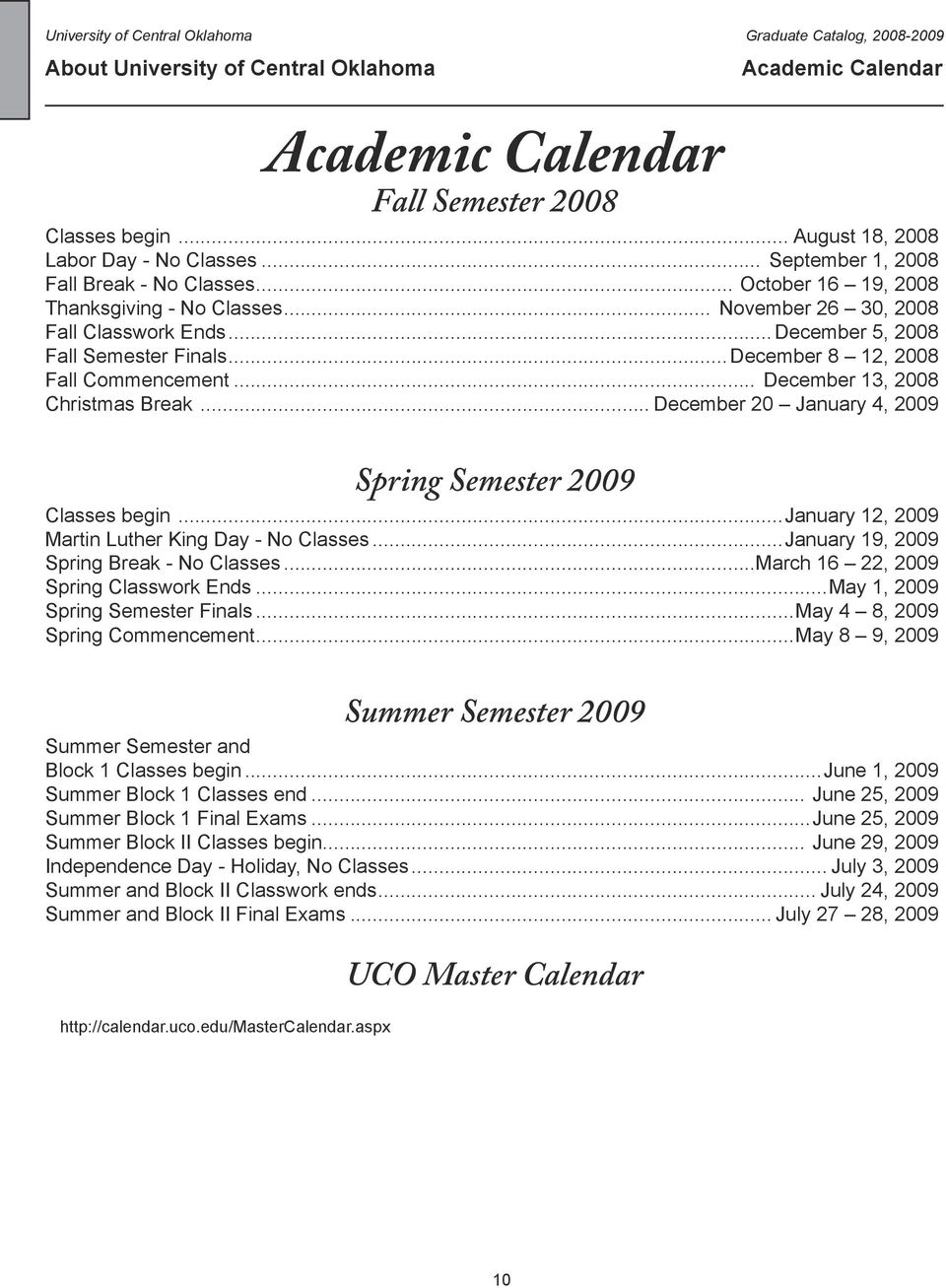
10 About University of Central Oklahoma Graduate Catalog, Academic Calendar Academic Calendar Fall Semester 2008 Classes begin... August 18, 2008 Labor Day - No Classes... September 1, 2008 Fall Break - No Classes... October 16 19, 2008 Thanksgiving - No Classes... November 26 30, 2008 Fall Classwork Ends...December 5, 2008 Fall Semester Finals...December 8 12, 2008 Fall Commencement... December 13, 2008 Christmas Break... December 20 January 4, 2009 Spring Semester 2009 Classes begin...january 12, 2009 Martin Luther King Day - No Classes...January 19, 2009 Spring Break - No Classes...March 16 22, 2009 Spring Classwork Ends...May 1, 2009 Spring Semester Finals...May 4 8, 2009 Spring Commencement...May 8 9, 2009 Summer Semester 2009 Summer Semester and Block 1 Classes begin...june 1, 2009 Summer Block 1 Classes end... June 25, 2009 Summer Block 1 Final Exams...June 25, 2009 Summer Block II Classes begin... June 29, 2009 Independence Day - Holiday, No Classes... July 3, 2009 Summer and Block II Classwork ends... July 24, 2009 Summer and Block II Final Exams... July 27 28, 2009 UCO Master Calendar 10
11 People of UCO Graduate Catalog, People of UCO Introduction to UCO 11

12 People of UCO Graduate Catalog, People of UCO Administration Oklahoma State Regents for Higher Education Bill Burgess, Jr...Lawton Julie Carson...Claremore James D. Harrel... Leedey Cheryl Hunter...Oklahoma City John Massey...Durant Joseph L. Parker... Tulsa William Price... Tulsa Carl R. Renfro... Ponca City Ronald H. White M.D...Oklahoma City Marlin Ike Glass... Newkirk Chancellor, Glen Johnson, J.D. Regional University System of Oklahoma Harold Jackson...Chickasha Belva Howard...Tulsa Joe Anna Hibler...Weatherford Jan Gordon...Broken Arrow Connie Reilly...Oklahoma City Richard Ryerson... Alva Ann Holloway...Ardmore Mark Stansberry... Edmond Dr. Sheridan McCaffree, Executive Director Sandy Garrett, State Superintendent of Public Instruction Presidents Richard Thatcher George W. Winans E.R. Williams E.D. Murdaugh F.H. Umholtz T.W. Butcher James A. McLaughlin Charles Evans Grant B. Grumbine J.W. Graves John G. Mitchell M.A. Beeson John O. Mosley Roscoe R. Robinson W. Max Chambers Garland Godfrey Bill J. Lillard George Nigh W. Roger Webb Executive Officers W. Roger Webb, J.D....President William J. Radke, Ph.D...Provost & Vice Pres., Academic Affairs Steve Kreidler, B.S... Executive Vice President, Administration Myron L. Pope, Ed.D... Vice President, Enrollment Mgmt Kathryn Gage, Ph.D....Vice President, Student Affairs Cynthia Rolfe, Ed.D.... Vice President, Information Technology Ann Holzberlein...President, UCO Foundation Cheryl Steele... Vice President, University Leadership Executive Committee W. Roger Webb, J.D...President William J. Radke, Ph.D... Provost & Vice Pres., Academic Affairs Steve Kreidler, B.S...Executive Vice President, Administration Myron L. Pope, Ed.D... Vice President, Enrollment Mgmt Kathryn Gage, Ph.D...Vice President, Student Affairs Cynthia Rolfe, Ed.D... Vice President, Information Technology G. Douglas Fox, J.D... Executive-in-Residence Charles Johnson...Director, University Relations Cheryl Steele, Ph.D...Vice President, University Leadership Anne Holzberlein...President, UCO Foundation Office of Academic Affairs Administration Dr. William J. Radke... Provost & Vice Pres., Academic Affairs Dr. Patricia A. LaGrow..V. Prov. & Assoc. V. Pres., Acad. Affairs Dr. Dan Donaldson...Assist. V. Pres., Distance & Exec. Educ. Academic Affairs Dr. Ed Cunliff... Assist. Vice Pres., Planning & Analysis Dr. Lori Beasley... Assist. V. Pres. Academic Affairs Dr. Evelyn Wilson-Martin...Assist. V. Pres, Academic Affairs Jackson College of Graduate Studies Dr. Richard M. Bernard...Dean 12
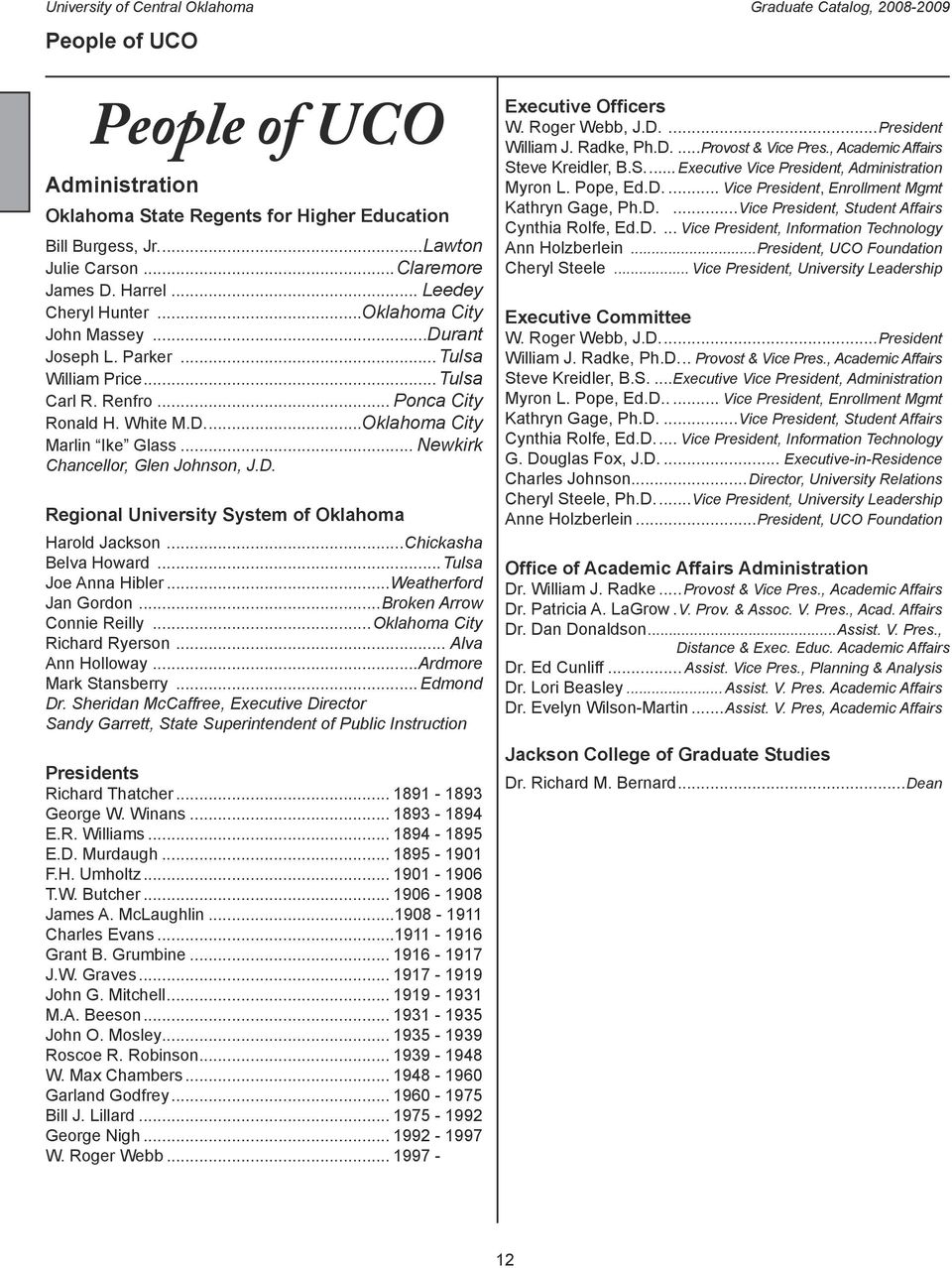
13 People of UCO Graduate Catalog, Academic Colleges - Departments College of Arts, Media, and Design Dr. John Clinton...Dean Dr. Gayle Kearns... Associate Dean Ms Charlene Weidell...Art Mr. Larry Hefner... Design Dr. Keith White... School of Music Dr. Robert McGill...Theatre, Dance, and Media Arts College of Business Administration Dr. Michael Shirley...Dean Dr. Timothy R. Bridges... Associate Dean Dr. John Camey... Assistant Dean Dr. Katherene Terrell...Accounting Dr. Zhen Zhu...Economics Dr. Randal Ice...Finance Dr. Lisa Miller... Info. Sys. & Oper. Mgmt. Dr. K.J. Tullis... Management Dr. Stacia Wert-Gray...Marketing LTC Lance Newbold... Military Science College of Education and Professional Studies Dr. James Machell...Dean Dr. Bill Pink... Associate Dean Dr. Donna Cobb... Assistant Dean Dr. Pat Couts...Advanced Professional Services Dr. Paulette Shreck... Curriculum and Instruction Dr. Kay Sears... Human Environmental Sciences Dr. Donna Cobb...Kinesiology and Health Studies Dr. Candy Sebert...Occupational & Technology Education Dr. Diane Jackson...Professional Teacher Education Dr. Michael Knight... Psychology Dr. Barbara Green...Special Services College of Liberal Arts Dr. Pamela Washington...Dean Dr. Gary Steward, Jr... Associate Dean Dr. David Macey...English Dr. Stanley Adamiak... History and Geography Dr. Theresa Vaughan...Humanities and Philosophy Dr. Terry Clark...Mass Communication Dr. Rudi Nollert...Mod. Lang., Lit., & Cult. Studies Dr. Louis Furmanski... Political Science Dr. David Ford... Sociol., Crim. Justice, & Subst. Abuse Studies College of Mathematics and Science Dr. John F. Barthell...Dean Dr. Charles Hughes... Associate Dean Dr. Wei Chen... Assistant Dean Dr. Jenna Hellack...Biology Dr. Cheryl Frech... Chemistry Dr. Hong Sung...Computer Science Dr. Gary Sokoll... Funeral Service Dr. Charlotte Simmons...Mathematics and Statistics Ms. Linda Rider... Nursing Dr. Baha Jassemnejad...Engineering and Physics 13
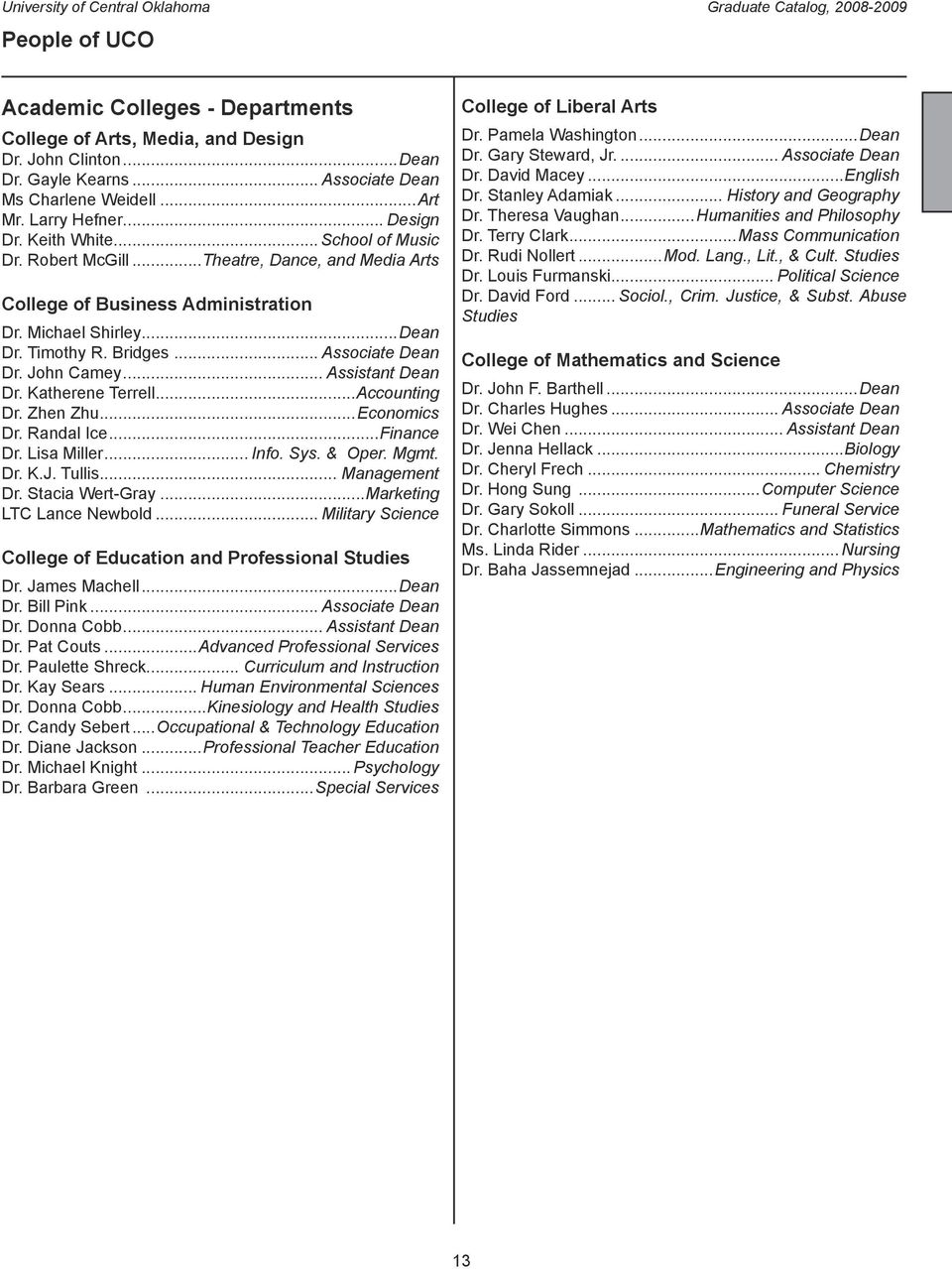
14 Graduate Catalog, People of UCO Central Contacts The University of Central Oklahoma is here to serve you! To reach any of the offices below, visit the building and room number listed, call by phone, or visit their web pages. The area code for all numbers is 405. Academic Advisement Center Nigh University Center 121, College of Liberal Arts Liberal Arts 104B, Academic Support Center Thatcher Hall 106, College of Mathematics and Science Howell Hall 210, Undergraduate Admissions/Records Processing Nigh University Center 124, College of Graduate Studies Nigh University Center 404, Athletics Hamilton Field House 101, Center for Professional and Distance Education NUC 341, Barnes & Noble Campus Bookstore Nigh University Center 210, Department of Public Safety or if an emergency Bursar s Office Nigh University Center , 2957, 3490, 3491 Campus Visits Nigh University Center 136, main.htm Disability Support Services Nigh Univeristy Center, NUC 305, Employment Services/Student Employment Lillard Administration Building 204, Frameset.jsp?time= Career Services Nigh University Center 338, International Student Services Office Nigh University Center 137, College of Arts, Media, and Design Evans Hall 13, College of Business Administration Business Building 100, College of Education and Professional Studies Education Building 213, Max Chambers Library Main number, Reference/Information Desk Parking Nigh University Center 309, Graduate & Undergraduate Enrollment Nigh University Center 124,
15 People of UCO Graduate Catalog, Graduate Online Applications & Admissions Nigh University Center 404, Office of Research & Grants Lilliard Administration Bldg., 216, Student Health Center Wellness Center (first floor), Student Life Nigh University Center 422, University of Central Oklahoma Weatherline (School Closings) Updated daily at 6 am, Student Counseling Center Nigh University Center 402, Student Financial Aid Office Nigh University Center 141, Testing Center Thatcher Hall 302, Transcript request Nigh University Center 124, , fax: Wellness Center [email protected] Administrative Office: Front Desk: Graduation Support Services Nigh University Center 121,

16 People of UCO College of Arts, Media & Design Master of Fine Arts (M.F.A.) Design Ms. Rukmini Ravikumar, MFA A&D 108, , Master of Music (M.M.) Music Dr. Sion Ted Honea MUS 009, , Jazz Studies Performance ; Commercial Production Brian Gorrell Jazz Lab, , x278, [email protected] CAMD non-degree Code College of Business Administration Master of Business Administration (M.B.A.) MBA program Dr. Robert Epstein, Director of Graduate Studies TTH 231, , [email protected] Ms. Brandy True Program Coordinator BUS 100F, , [email protected] CBA non-degree code College of Education & Professional Studies Director of Graduate Advisement Stephanie Beauchamp EDU 205, , [email protected] Program Coordinators Master of Education (M.Ed.) Adult Education Training Dr. Frank Nelson HES 200B, , [email protected] Gerontology Dr. Doug Reed HES 200A, , [email protected] Bilingual Education/TESL Dr. April Haulman LIB 144, , [email protected] Early Childhood Education-3630 (A-G) Dr. Paulette Shreck LIB 145, , [email protected] (H-O) Dr. Jan Wetsel LIB 154, , [email protected] (P-Z) Dr. Lola Davis LIB 142, , [email protected] Education Administration Dr. J. Kirk Webster LIB 124, , [email protected] Graduate Catalog, Graduate Programs and Advisors 6 Master s Degrees, 31 programs, 54 majors Education Guidance & Counseling Ms. Sherry Ward LIB 128, , [email protected] Elementary Education Dr. Shirlee Sullins LIB 152, , [email protected] General Education Mr. Len Bogner HES 202A, , [email protected] Instructional Media Applied Technology Library Information Dr. Judith Wakefield LIB 130, , [email protected] Professional Health Occupations Dr. Karen Barnes HES 200E, , [email protected] Reading Dr. Mary Monfort LIB 315, , [email protected] Secondary Education Dr. Bryan Duke LIB 315, , [email protected] Special Education Mild/Moderate : Severe/Profound (A-E) Dr. Ed Collins LIB 315, , [email protected] (F-J) Dr. Barbara Green LIB 315, , [email protected] (K-O) Dr. Donna Kearns LIB 315, , [email protected] (P-T) Dr. Charolette Myles-Nixon LIB 315, , [email protected] (U-Z) Dr. Terry Spigner LIB 315, , [email protected] Master of Arts (M.A.) Psychology Counseling Dr. Lorry Youll EDU 307G, , [email protected] General Dr. Chalon Anderson LIB 133, , [email protected] Experimental Dr. Mickie Vanhoy EDU 309, , [email protected] School Psychology Dr. Mary Sweet-Darter EDU 307P, , [email protected] 16
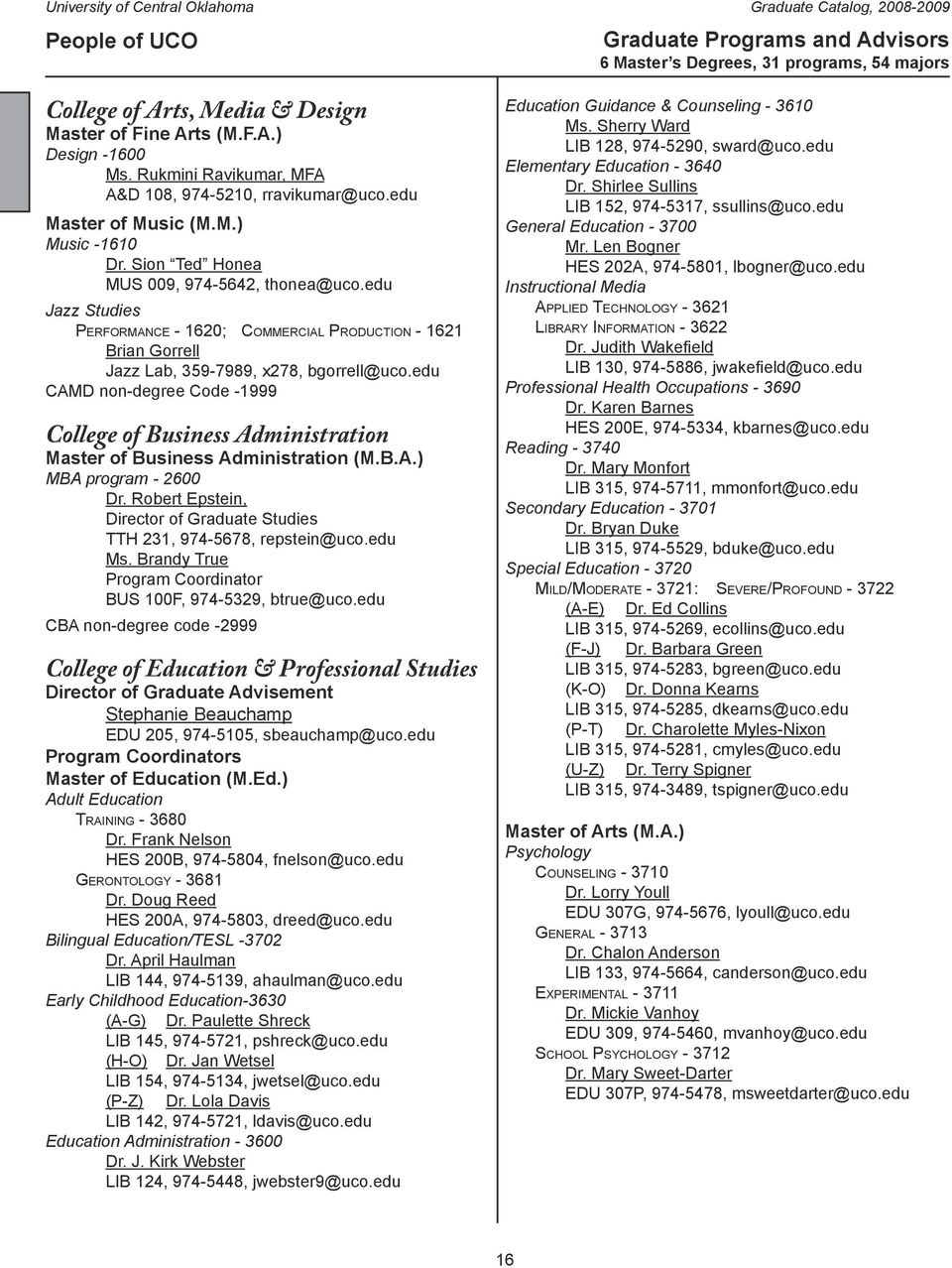
17 People of UCO Master of Science (M.S.) Athletic Training Jeff McKibbin WAH 04A, , [email protected] Family and Child Studies Infant & Child Specialist licensed Marriage & Family Therapist family Life Education Dr. Kaye Sears HES 100D, , [email protected] Nutrition & Food Management Dr. Marilyn Waters HES 100B, , [email protected] Speech/Language Pathology Dr. Scott McLaughlin LIB 315, , [email protected] Wellness Management Exercise Science Dr. Donna Cobb WH 102, , [email protected] Health Studies Dr. Diane Rudebock WAH 101B, , [email protected] Certification Teacher Certification Ms. Karen Davis EDU 207, , [email protected] Advanced Studies in School Psychology or School Psychometrist Dr. Mary Sweet-Darter EDU 307P, , [email protected] Education Non-Degree code College of Liberal Arts Master of Arts (M.A.) Criminal Justice Management & Administration 5630 Dr. Sid Brown LAR 201B, , [email protected] Dr. Elaine Bartgis LAR 201D, , [email protected] English Composition & Rhetoric t h /21 s t Ce n t u r y St u d i es 5605 Creative Writing 5602 Teaching English as a Second Language 5603 Traditional Studies 5604 Dr. Amy Carrell LAR 101A, , [email protected] History General 5610 Museum Studies 5611 Social Studies Teaching 5612 Dr. Kenny Brown LAR 202 D, , [email protected] Graduate Catalog, Graduate Programs and Advisors 6 Master s Degrees, 31 programs, 54 majors Political Science General 5620 International Affairs 5621 Public Administration 5622 Dr. Jan Hardt LAR 102B, , [email protected] Master of Fine Arts (M.F.A.) Creative Writing Dr. Constance Squires LAR 103B, , [email protected] Liberal Arts non-degree code-5999 College of Mathematics & Science Master of Science (M.S.) Applied Mathematical Science Computer Science 6620 Mathematics 6621 Statistics 6622 Mathethatics Teaching Dr. Jesse Byrne MCS 142, , [email protected] Biology-6600 Dr. Jenna Hellack HOH 200H, , [email protected] Dr. Clark I. Ovrebo HOH 301D, , [email protected] Engineering & Physics Dr. Weldon Wilson HOH 221H, , [email protected] Forensic Science Criminalistics Nursing Technical Investigations Dr. Dana Rundle HOH 320E, , [email protected] Math & Science non-degree code
18 People of UCO Graduate Catalog,

19 Admission & Enrollment Information Graduate Admission Information Admission to Graduate College 19

20 Admission & Enrollment Information Admissions Admission to Graduate Studies at UCO How to obtain an Application for Graduate Admission By Mail or in Person: Jackson College of Graduate Studies University of Central Oklahoma 100 N. University Drive, NUC 404, Box 117 Edmond, OK The JCGS Website: to download the application form in either PDF format or Word document format. (You must have Adobe Acrobat installed in your computer in order to view and print the pdf file format). To download Acrobat for free go to: The UCO Website: You may also apply online through the UCO website at: Link to Admissions on the Quick Link menu and follow the instructions listed. Phone: (405) Applicants should also contact specific academic departments in order to verify additional admission requirements for admission. Who Must Submit an Application? 1. Those who are new to UCO; 2. Those UCO students who are moving from undergraduate status to graduate status; 3. Those who have not been enrolled at UCO for over one year; 4. Those who were suspended and are applying to return to UCO, regardless of length of time away; 5. Returning but non-continuously enrolled students; 6. Non-Degree-Seeking Students 7. International Students Application Materials: Applicants must submit the following to the Jackson College of Graduate Studies, Room 404, Nigh University Center. 1. UCO application packet for Graduate Admission; 2. Two (2) letters of Recommendation (if required by the program); 3. Official copies of undergraduate and graduate transcripts from each institution attended with all degrees posted. The bachelor s degree must be from an accredited institution. 4. $50.00 non-refundable application fee; 5. Any other documents required by the program. 6. Admission Examinations A. Graduate Management Admission Test (GMAT) The GMAT is required for all students seeking an MBA degree at UCO. Test scores must be submitted before the student will be admitted to the program. The computer version of the GMAT is offered every day except Sunday, holidays and the first two days of the month at the Pearson Professional Center of Oklahoma, 5100 N. Brookline Ave., Ste. 282, Oklahoma City, OK Phone for appointment. For regularly updated information about the availability of test centers, call or UCO School code for testing purposes is Test bulletins for the GMAT are available in the University Testing Service, Room 302, Thatcher Hall. See the website at: for GMAT information, sample questions and testing sites. B. Graduate Record Exam (GRE) The GRE is required for students seeking several graduate degrees at UCO. Examination scores must be sent to the Jackson College of Graduate Studies. Examination schedules and expenses are the responsibility of the student. No scores more than five years old will be accepted. The computer version of the GRE is offered every day except Sundays and holidays at the Prometric Learning Center, 2224 NW 50 th, Suite 196, Oklahoma City, OK. For regularly updated information about the availability of test centers, call Prometric at or UCO school code for testing purposes is Test bulletins are available in the University Testing Service office, Room 302, Thatcher Hall. The degrees requiring the Graduate Record Exam and the means by which they use the results are as follows: 1) Biology (M.S.) Minimum combined score of 1000 on the verbal and quantitative. 2) Criminal Justice (M.A.) An index calculated by a combination of GRE and GPA as listed on the program page. 3) Family and Child Studies (M.S.), LMFT major, minimum combined score of 900 on the verbal and quantitative test. 4) Forensic Science (M.S.) Minimum combined score of 1000 on verbal and quantitative tests. The analytical conversion formula is shown in the Forensic Science program information. 5) Political Science (M.A.) An Index calculated by a combination of GRE and GPA as listed on the program page and 3.5 or higher on the written assessment. 20

21 Admission & Enrollment Information Types of Admission 6) Psychology (M.A.) Minimum combined score of 900 on the verbal and quantitative tests or 3.5 or higher on the written assessment. 7) Engineering & Physics (M.S.) GRE Test scores are required for admission determination. A total of 1150 (combined GRE verbal and quantitative scores) is recommended. Scores must be submitted before acceptance to the program. 8) Nutrition Food Management, Dietetic Internship - (M.S.) Minimum combined score of 900 on the verbal and quantitative tests or 4.0 or greater on the written assessment. 7. Undergraduate Transcripts The undergraduate GPA will be used to evaluate eligibility for regular graduate admission. If an applicant does not meet the GPA admission requirements, he/she has the following options: 1) Take additional undergraduate courses to raise his/her undergraduate grade point average and apply for admission to graduate studies when the minimum overall GPA for the program has been achieved; OR, 2) seek Conditional Admission, as described below. 8. Deferring Admission Students are admitted for the semester in which they apply. A student, who has been accepted, may defer admission for one semester by making a request in writing within 30 days after the semester starts. 9. One-Year Absence If a student has not been enrolled or re-enrolled during one full year, he/she must apply for readmission to the JCGS, and must meet the program requirements at the time of the later application. Types of Admission Regular Admission: All programs accept resident and non-resident students who meet the graduate program requirements and submit the required documentation as listed above. Conditional Admission: Selected Graduate Programs of Study allow conditional admission. The conditional nature of this admission relates to undergraduate grade point average (GPA) only. The rules for conditional admission are as follows: 1. Students must have an overall undergraduate GPA of at least 2.50 or at least 2.25 with five years having passed since the date of the first bachelor s degree. 2. Students must meet all other admission requirements, as defined by the Graduate College and the Program. 3. Students must have all applications for admission to this status approved in writing by the Department/School Program/Graduate Advisor. 4. Students may take as many as 12 graduate hours during the first three UCO semesters but at the end of those three semesters, they must have a cumulative 3.25 GPA for all graduate hours completed. Failure to do so results in dismissal. The Graduate Program Advisor will specify which required courses must be completed during this status. Students must complete these specified graduate credit courses within three consecutive semesters (including summer term), starting on the first day of graduate enrollment. Students must earn a GPA of 3.25 or better with no grade lower than B for the graduate hours attempted while on Conditional Admission status. 5. Conditionally-admitted students are not allowed to enroll for the subsequent semester until grades are posted and their advisors have approved their enrollments. 6. Students in Conditional Admission status must meet all other criteria for all students. 7. Students who fail to meet the required 3.25 overall graduate GPA while on conditional admission status will not be allowed to continue in their program or be considered for admission to any other graduate program at UCO. Non-Degree Seeking Students Non-Degree students are those who wish to take graduatelevel courses, and are not seeking admission to a graduate program at the University of Central Oklahoma. Non-degree students may enroll for a maximum of nine graduate hours per semester. Taking a course as a non-degree student does not constitute admission to a program or guarantee later applicability of these courses toward a program. Only nine hours taken as a non-degree candidate may be applied toward a master s degree. If non-degree students subsequently seek admission to a graduate degree program, courses taken in non-degree status will be evaluated by the graduate program advisor to determine their applicability to the degree. Graduate students will be allowed to change their status from non-degree to degree seeking or vice versa at the beginning of each semester. Exception: Programs which admit students only once a year. In those cases, student status changes are limited to the programs admission periods. Those seeking to become degree-seeking would still have to meet all regulations, including graduate program advisor approval. Non-degree seeking graduate students may apply for admissions and enroll online, in-writing, or in-person, subject to their meeting university and program GPA standards. Non-degree seeking students wishing to take restricted courses must gain written permission from the instructor or the department before they can enroll in the course. All students wishing to take classes under the new MBA program must be degree-seeking. Non-degree seeking students may enroll in courses offered under the old MBA curriculum but only with written permission. All students wishing to take classes under the new MFA- Creative Writing program must be degree-seeking. Non-degree seeking students may enroll in courses offered under the ongoing MA in English (Creative Writing major) without permission. 21
22 Admission & Enrollment Information Types of Admission cont d - Readmission International students are admitted only as degree-seeking students. International students are not eligible to enroll as non-degree students. International Graduate Students A. Deadlines Due to the amount of time needed to process an international admission application, the Graduate College has in place the following deadlines: Fall semester...july 1 Spring semester... November 1 Summer semester...april 1 Deadlines for applications to specific graduate programs vary. If the graduate program application deadline precedes the international application deadline, the program deadline will apply. If the international graduate student application deadline precedes the program deadline, the international graduate student application deadline will apply. B. Enrollment While studying at the University of Central Oklahoma, an international graduate student is required to maintain full time enrollment each semester to preserve his/her Department of Immigration and Naturalization Service status as an F-1 visa holder. International students must be admitted to a specific graduate program and course of study. International students are not eligible to enroll as non-degree students. C. Undergraduate Transcripts and Grades Admission to graduate study requires the completion of an undergraduate degree, usually of three to four years in length but sometimes longer and comparable to a bachelor s degree from an accredited U.S. institution. Certain grade levels are required. These vary by program. Transcripts are proof of those degrees and grades. Applicants must submit to UCO s Jackson College of Graduate Studies official transcripts, which are signed and embossed, from all universities, colleges, and professional schools attended. Students unwilling to part with their official copies may gain provisional admission by submitting photocopies of their original transcripts. These copies, however, must clearly show classes completed, degrees granted, signatures of university or college officials, embossed institutional seals, and, in the case of non-english language transcripts, certified English translations. Students provisionally-admitted using such copies must bring the official documents themselves to the JCGS Office for processing before they can enroll. Please note: Students who fail to provide original documents will not be allowed to enroll. For the purpose of calculating Grade Point Averages (GPAs), UCO converts grades listed on the transcripts of other institutions to UCO s 4.0 grading scale. Because UCO does not grant grades of plus or minus, a grade of B+ from another institution s, as an example, is recorded at UCO as a grade of B, and given the value of 3.0. D. English Language Proficiency All students for whom English is a second language must present evidence of proficiency in the English language as required by the Oklahoma State Regents for Higher Education (OSRHE). The following are acceptable ways for potential graduate students to present such evidence of English proficiency: 1. Test of English as a Foreign Language (TOEFL) a. score of 550 or higher on the paper exam b. score of 213 or higher on the computer exam c. score of 79 or higher on the internet exam d. score of 6.5 on IELTS 2. Oklahoma State Regents for Higher Education (OSRHE) Approved English Language School Students in limited categories may present evidence of completion of a minimum 12-week course of study at an OSRHE-approved English language school. The categories include those who score as follows on the TOEFL exam: a. score between on the paper exam b. score between on the computer exam c. score between on the internet exam d. score of 6.0 on International English Language Testing System (IELTS) 3. Earn a bachelor s degree from an accredited US college or university. 4. Attend an accredited US college or university for a minimum of three full-time semesters of graduate work. E. Contact Information International student inquiries and requests for application packets should be made to the International Student Services Office, Nigh University Center, Rm. 137, Box 163, UCO, 100 N. University Dr., Edmond, OK 73034, [email protected] Readmission Students who have not enrolled and completed a graduate course at UCO for a minimum period of one year must apply for readmission as graduate students to the Jackson College of Graduate Studies, must meet the requirements for the program at that time, and must pay a $50.00 non-refundable application fee at the Bursar s Office. 22
23 Admission & Enrollment Information Minimum GPA Requirements for Admission Program/Degree Overall GPA Last 60 hrs GPA Program/Degree Overall GPA Last 60 hrs GPA College of Arts, Media & Design M.F.A. Design 2.50 or 2.50 M.M. Music Performance 2.50 or 2.75 Education 2.50 or 2.75 M.M. Jazz Studies Performance 2.50 or 2.75 Commercial Production 2.50 or 2.75 College of Business Administration M.B.A. Business Administration 3.00 or 3.25 College of Education & Professional Studies M.Ed. Adult Education Training 2.75 or 2.75 Gerontology 2.75 or 2.75 Early Childhood 2.75 or 2.75 Education Bilingual Educ./TESL 2.75 or 2.75 General 2.75 or 2.75 Secondary 2.75 or 2.75 EducationAdministration 2.75 or 2.75 Educ. Guid. & Counseling 2.75 or 3.00 Elementary Education 2.75 or 2.75 Instructional Media Applied Technology 2.75 or 2.75 Library Information 2.75 or 2.75 Prof. Health Occupations 2.75 or 2.75 Reading 2.75 or 2.75 Special Education Mild/Moderate 2.75 or 2.75 Severe/Profound 2.75 or 2.75 M.A. Psychology Counseling 3.00 or 3.00 Experimental 2.75 or 2.75 General 2.75 or 2.75 School Psychology 3.00 or 3.00 M.S. Athletic Training 2.75 or 2.75 M.S. Human Environmental Sciences M.S. Family & Child Studies Family Life Educator 2.75 or 3.00 Infant/Child Specialist 2.75 or 3.00 Licensed Marriage & Fam. Ther or 3.00 M.S. Nutrition & Food Mgmt 2.75 or 2.75 M.S. Speech Lang. Path or 2.75 M.S. Wellness Management Exercise Science 2.75 or 2.75 Health Studies 2.75 or 2.75 College of Liberal Arts M.A. Criminal Justice 2.75 or 3.00 or Index score 5.00 (The index is determined by the following method: GRE score divided by GPA 5.00.) English 20 th /21 st Century Studies 2.50 or 2.50 Composition & Rhetoric 2.50 or 2.50 Creative Writing 2.50 or 2.50 TESL 2.50 or 2.50 Traditional Studies 2.50 or 2.50 History General 2.75 and 3.00 Museum Studies 2.75 and 3.00 Social Studies Teaching 2.75 and 3.00 Political Science General Index score 5.00 AND 3.5 on GRE writing exam. International Affairs Index score 5.00 AND 3.5 on GRE writing exam. Public Administration Index score 5.00 AND 3.5 on GRE writing exam. (The index is determined by the following method: GRE score divided by GPA 5.00.) M.F.A. Creative Writing 2.75 or 2.75 College of Mathematics & Science M.S. Applied Mathematical Science Computer Science 3.00 and 3.00 Mathematics 3.00 and 3.00 Math/Comp. Sci. Teach and 3.00 Statistics 3.00 and 3.00 Biology 2.50 and 3.00 and Index score 5.5 (The index is determined by the following method: GRE score divided by GPA 5.50.) Engineering Physics 3.00 overall OR 2.75 and 3.00 Forensic Science Criminalistics 2.75 overall GPA Nursing 2.75 overall GPA Technical Investigations 2.75 overall GPA Non-Degree-Seeking 2.50 or 2.75 College of Business College of Arts, Media & Design College of Education & Professional Services College of Liberal Arts College of Mathematics & Science 23
24 Admission & Enrollment Information 24
25 General Degree Information General Academic Information 25
26 General Degree Information Changes in Requirements - Types of Grad Credit Rules & Regulations Changes in Degree Requirements Graduate degree requirements in effect at the time of a graduate student s first enrollment will remain in effect for six years. In no case shall the University of Central Oklahoma be obligated to make such requirements applicable for more than six years. Individual plans of study, once approved, will remain in force regardless of succeeding changes in degree programs. Students who have not enrolled for one year will be required to meet the standards in force at the time of readmission. Types of Graduate s Traditional s A traditional course is a 16-week class conducted in a classroom setting where the instructor meets face-to-face with the students. The course may have lectures, discussions, activities, or demonstrations with or without web requirement. Intersession s An intersession course is one offered in the time period between the end of one term and the start of another. Students may take a maximum of 5 credit hours per intersession. Internet and Other Electronic s Internet and other electronic courses are those offered beyond the classroom setting. UCO accepts these classes for credit, whether the students take them from UCO or transfer them to UCO (subject to the same restrictions on other transfer courses). Students taking UCO electronic courses earn residential credit. Correspondence s With the approval of their program directors a student may obtain a maximum of six credit hours through traditional correspondence courses. This limitation does not apply to courses taken via the internet or other electronic transmission mechanisms. Types of Graduate Credit Graduate Credit from Graduate s A student admitted unconditionally to the Jackson College of Graduate Studies at the University of Central Oklahoma may enroll in any courses offered for graduate credit for which he/ she has the prerequisites. Graduate level courses will not count toward graduate degree requirements if the student enrolled in the course for undergraduate credit. Graduate Credit from Mixed Undergraduate/ Graduate s UCO seniors are eligible for mixed undergraduate and graduate enrollment in their final semester before undergraduate graduation, providing they meet the established criteria: 1. Their undergraduate advisors have certified that they are enrolled in their final semester for bachelor s degrees. 2. Their total enrollment (undergraduate and graduate) may not exceed 16 hours. 3. Their overall undergraduate grade point average (GPA), must be 3.00 or higher. 4. They take no more than eight (8) graduate hours before the undergraduate degree has been posted to the transcript. Students wishing to apply for concurrent enrollment must complete an application and the Mixed Enrollment form, both available in the Jackson College of Graduate Studies. Transfer Credit A maximum of 9 (nine) semester hours of transfer graduate credit from a U.S., accredited, degree-granting institution may be applied toward graduate degree program at the University of Central Oklahoma. These 9 hours may be applied only if they contribute to the program and are on a plan of study. s must be approved by the Graduate Advisor, the College Dean, and the Dean of the Jackson College of Graduate Studies. Some programs require that transfer students present letters to the program advisor, prior to enrollment, indicating that the students are in good academic standing with their former institutions. If the courses are used to satisfy degree requirements at other universities, they cannot count toward degrees at UCO. All graduate courses taken at other accredited institutions, regardless of applicability to current program, must be transferred to the University of Central Oklahoma and included on the student s academic record. Only those courses approved by Graduate Program Advisors for credit toward UCO degrees will count toward GPA calculations. Internships Internships may not exceed a maximum of 8 credit hours. In-Service Training In-service courses will be counted toward a degree only when offered through a fully-accredited institution of higher education and listed on a certified transcript from that institution. Workshop Credit No more than six hours may be earned by the participation in workshops except that for the years , no more than three hours may be earned by participation in the Oklahoma Scholar-Leadership Enrichment Program (OSLEP). Program Advisors must approve all hours earned through workshops. Auditing s On a space-availability basis, students may audit graduate courses if they obtain written permission from the instructors. The instructors of audited courses are not obligated to grade or evaluate the course work or performance of auditing stu- 26
27 General Degree Information Auditing s - Adds, Drops/Withdrawals dents. Students receive no credit for audited classes, which neither meet degree requirements nor count toward the GPA. Fees are the same for audited and credit courses. Students may not drop audited courses and subsequently pick them up for credit. Individual Study Graduate credit may be earned through individual study or directed reading. A student is limited to 12 hours of individual study/directed reading with no more than 6 hours in any one discipline. Graduate Enrollment Enrollment Periods Enrollment at the University of Central Oklahoma begins in April for the Summer and Fall Semester, and in November for the Spring Semester. Graduate students in good standing, academic and otherwise, may enroll on the first floor of the Nigh University Center or on the UCO website at Students should refer to the Class Schedule to determine dates and times of enrollment, payment and late fee dates, thesis deadline dates, application for graduation dates, and other enrollment information Enrollment Status (Full Time, Part Time) The Jackson College of Graduate Studies uses the following schedule when determining full-time, and part-time graduate student status. Rules may vary for teaching assistants. Please consult your graduate program director. Full Time: Spring & Fall semesters Summer semester Three-quarter Time: Spring & Fall semesters Summer semester One-half Time: Spring & Fall semesters Summer semester 9 graduate hours/12 mixed graduate and undergraduate hours 5 graduate hours/9 mixed graduate and undergraduate hours 6 to 8 graduate hours 3 to 4 graduate hours 5 graduate hours 2 graduate hours Advisement The Graduate Advisors for graduate degree programs advise students on enrollments. After admission, students meet with their graduate advisors to develop their Plan of Study. It is important that students work closely with their advisors to ensure that all program requirements are met. Graduate Advisors are not always on campus during semester breaks. Students should make appointments to ensure their availability. Load Limits Without advance written approval, graduate students may enroll in no more than 12 graduate hours during the fall or spring semester (16 weeks) and 9 hours during the (8 week) summer. With such approval from the Graduate Dean, students may enroll in 15 graduate credits during spring or fall semester. Overload permission forms are available in the Jackson College of Graduate Studies. All on-campus courses, workshops, intersessions, institutes, and course work taken electronically or at other institutions are included in this total. Up to five hours of intersession credit are allowed immediately following each semester. Graduate enrollments above maximums will not be applied toward a master s degree at the University of Central Oklahoma. Students may enroll in up to or including eighteen (18) hours of mixed-enrollment (graduate and undergraduate) credits in a regular semester including no more than 12 hours in graduate credit courses. The maximum number of mixed-enrollment in the summer is 12 hours with 8 of those hours in graduate courses. Graduate students on academic probation may only enroll for a maximum of 9 (nine) graduate hours in the fall and spring and 6 (six) graduate hours in the summer. Enrollment in New Graduate Programs In the case of enrollment in new programs, students may complete no more than one-half of the total required hours before the program is approved by the Oklahoma State Regents for Higher Education. Changing Programs Students who wish to change from one graduate program to another must meet all admission requirements for the new degree programs, meet with their Graduate Advisor to complete the Graduate Program Change Request form (available in the Jackson College of Graduate Studies office) and submit the request along with a formal Plan of Study for their new program, to the Jackson College of Graduate Studies. Students must meet all admission requirements for their new programs, including those involving the undergraduate GPAs. Adds, Drops and Withdrawals Adds Students may add classes anytime before the end of the first week of classes. Drops Pre-Semester Drops: Students may drop a class before the first day of the semester either at the Enrollment Management Office or online. No records of courses dropped before the start of the semester will appear on transcripts. There are no financial penalties for such drops. Early Semester Drops: As long as they do not withdraw from all classes, students may drop classes before the end of the third week of a semester by completing the appropriate forms either at the Enrollment Management Office or online. All early drops will show on transcripts with the word withdrew and the date. There are no financial penalties for such drops. Late Semester Drops with Permission: As long as the student does not withdraw from all classes, students may under unusual circumstances, as defined by the university, drop 27
28 General Degree Information Adds, Drops etc cont d - Grading System classes after the end of the third week of classes and before the final exam dates for the classes. Examples of unusual circumstances include emergencies, hospitalization, and moving to out-of-state jobs. Poor academic performance or lack of deadline compliance does not merit approval. Requests to drop in this manner require documentation, instructor confirmation of relevant information, and permission of the Director of Admissions and Records. All such requests must be initiated within one year of the end of the semester. All approved drops show on transcripts as either withdraw if the student is passing the course or F if not passing. No student may drop a course on the day of its final exam or later. Students who abandon their studies without formally dropping their courses wil receive grades of F. Note: A late drop can have a significant negative impact on financial aid. Withdrawals from All s Pre-Semester Withdrawals: Students may withdraw from all of their classes before the first day of the semester at the Enrollment Management Office. No records of courses withdrawn before the start of the semester will appear on transcripts. There are no financial penalties for such withdrawals. Early Semester Withdrawals. Students may withdraw from all classes before the end of the third week of classes by completing the appropriate forms at the Enrollment Management Office. All early withdrawals will show on transcripts with the word withdrew and the date. There are no financial penalties for such withdrawals. Withdraws are not official until processed by Enrollment Services. Late Withdrawals with Permission: Under unusual circumstances, as defined by the university, students may withdraw from all classes after the end of the third week of classes and before the final exam dates for the classes. Examples of unusual circumstances include emergencies, hospitalization, and moving to out-of-state jobs. Poor academic performance or lack of deadline compliance does not merit approval. Requests to withdraw in this manner require documentation, instructor confirmation of good standing, and permission of the Director of Admissions and Records. All such requests must be initiated within one year of the end of the semester. All approved withdrawals show on transcripts as either Withdraw if the student is passing the course or F s if not passing. No student may withdraw on or after the first day of final exams. Withdrawals are not official until processed by Enrollment Services. Students who abandon their studies without formally withdrawing will receive grades of F. Note: A late drop can have a significant negative impact on financial aid. Administrative Withdrawals from s for Non- Attendance: The university may withdraw students for failure to attend between the end of the third week and the end of the eleventh week of class. The university charges students who withdraw in this manner an amount equal to 25 percent of the courses original costs for tuition and fees. Withdraws are not official until processed by Enrollment Services. Grading System The following system of grading is used at the University of Central Oklahoma. Grades Used in Calculating Grade Point Average Grade Note Points/ Hour Grades Not Used in Calculating Grade Point Average Grade Note A EXCELLENT 4 S SATISFACTORY B GOOD 3 U UNSATISFACTORY C AVERAGE 2 P PASS D BELOW AVERAGE 1 *F FAILURE 0 *Failure - given when students fail to meet minimum standards for passing. Also given when students discontinue class attendance and do not formally drop or withdraw. An F grade is also assigned by the instructor when a student is failing the course but is allowed to drop or withdraw after the established deadlines. SYMBOLS USED TO INDICATE COURSE STATUS Symbol Note Symbol Note AW I INCOMPLETE W WITHDRAWAL ADMINISTRATIVE WITHDRAWAL N GRADE NOT REPORTED AUD AUDIT X THESIS IN PROGRESS P Passing - given for workshops, student teaching, physical education activity courses, and extrainstitutional credits. S Satisfactory - given for 0-level (non-collegiate/developmental) courses. U Unsatisfactory - given for 0-level (non-collegiate/developmental) and physical education activity courses and indicates the student s level of understanding is not sufficient to take the next level of course work. I Incomplete - given at the instructor s discretion to indicate that additional work is necessary to complete a course. It is not a substitute for an F grade and no student may be failing a course at the time an I grade is awarded. To receive an I grade, the student should have satisfactorily completed a substantial portion of the required course work for the semester. Students have one year to resolve incomplete grades. In extenuating circumstances, exceptions may be requested. I grades not changed by the instructor to a letter grade, within one year, will remain as a permanent I and not contribute to the student s GPA. F grades cannot be changed to I grades. W Withdrawal - given when a student initiates a withdrawal by the established procedures and deadlines. N Not Reported - given when an instructor fails to submit grades by the established deadline. *AUDIT given when students formally audit classes. 28
29 General Degree Information Grade Appeals - Exceptions & Waivers X *AUD-U given when a student enrolled for audit but did not meet the instructor s attendance and/or participation requirements for auditors. *All audited courses require permission from the class instructor. Students receive no credit for audit of classes. Fees are the same for audit as for credit. Students may not drop courses for audit and pick them up for credit after the end of enrollment for that term. The only admission material needed for audit is a completed admission form. Audited hours are not included in any calculation for verification of enrollment for financial aid, student loans, veterans benefits, or athletic eligibility. Thesis in Progress Grade Appeals In cases where graduate students wish to appeal a final grade, they must follow the Academic Appeal Policy located online under the UCO Academic Affairs website at: Click on Academic Appeals. Prerequisites or Corequisites A prerequisite is a course, skill, or knowledge required to be completed PRIOR to taking another course. Prerequisites are established for courses requiring a specific background knowledge or skill level for successful completion. Most courses have more than one prerequisite. Corequisites are complementary courses which require concurrent enrollment and which together comprise a body of knowledge or skills for the student. Prerequisites and corequisites are established for the BEN- EFIT of STUDENTS. Insufficient background knowledge is an obstacle to success and often results in frustration, lower grades, and withdrawal. More study time and effort is generally needed if the prerequisite(s) have not been met. Meeting prerequisites and corequisites is the RESPONSI- BILITY of STUDENTS. (Exceptions must be cleared by the appropriate department or instructor.) Prerequisites and corequisites are listed in the catalog and on the web class listings. Some prerequisites may be take concurrently, and are listed as such in the course descriptions. Students who pre-enroll in a course which requires a prerequisite or corequisite in which the student is currently enrolled may be dropped from that course by the university if they subsequently fail or drop the prerequisite/corequisite course. Repeating s If a graduate course is repeated to enhance the grade, both grades will be used in calculating the graduate grade point average. No course may be counted toward more than one degree. Academic Probation and Suspension Graduate students must maintain an overall graduate grade point average of 3.00 or higher to remain in good academic standing with the University and the Jackson College of Graduate Studies. 29 A. Academic Probation 1. A student, regardless of admission status, may be placed on academic probation if: a. The student has completed nine graduate hours; and b. The student s cumulative graduate grade point average (GPA) falls below While a student is on academic probation, the student may not enroll in more than nine (9) graduate credit hours in regular semesters and six (6) graduate credit hours in Summer semester. B. Academic Suspension 1. A student will be placed on academic suspension if: a. the student fails to achieve a minimum graduate GPA of 3.00 in any semester while on probation or b. the student s cumulative graduate GPA falls below 2.00 in any semester. 2. A suspended student may not take graduate courses for at least 16 weeks while awaiting adjudication from the Graduate Council. 3. Readmission After Suspension a. Students who wish to be considered for readmission must submit a written appeal and a recommendation for readmission from their program graduate advisor to the Dean of the Jackson College of Graduate Studies within 30 days of issuance of the notification of their academic status. This is the only opportunity for the students to provide information relating to the substance of their appeals, thus, students must include all information which they want to have considered. The Admissions and Retention Committee of the Graduate Council will review their appeals and recommend readmission or dismissal to the Graduate Council. b. If the Graduate Council votes to deny readmission, the Graduate Dean will then notify the students of the Council s decision and of their suspension. c. Within 30 days of issuance of the notification, students may appeal these decisions in writing to the Graduate Dean but only on a claim that a university official had failed to follow proper procedures or laws. The dean will not reevaluate the facts of the students cases, but if he or she finds that procedural errors may have occurred, the dean will resubmit the students appleals to the Admissions and Retention Committee which will recommend readmission or dismissal to the Graduate Council. The Council s decidions would then be final. d. If the Graduate Council approves readmission, the student must fill out a new application to graduate school, pay the $50.00 non-refundable application fee at the Bursar s Office, First Floor, Nigh University Center, and will continue on academic
30 General Degree Information Student Respnsibilities - Residence Status probation. The student must maintain a graduate GPA of 3.00 each semester. e. Failure to achieve a graduate GPA of 3.00 or above during any semester after readmission will result in immediate dismissal from graduate studies at UCO with no reprieve for further graduate work. Exceptions and Waivers Exceptions or waivers to any graduate studies requirement must be formally requested in writing and approved by the Graduate Advisor, the Chair of the Department, Dean of the College, and the Graduate Dean. Student Responsibilities Accuracy of the student s enrollment, class changes, and withdrawals are the student s responsibility. Other Information Diplomas Students who complete degree requirements will receive diplomas by mail approximately six weeks following the last day of the semester in which they graduated. I.D. Cards All entering students must have an identification (I.D.) card issued the first semester of enrollment and used while the student is enrolled in classes at UCO. Students must show the I.D. card when conducting business on campus. The card also entitles the bearer to discounts at area movie theaters and other community businesses. Students are charged the $10.00 I.D. fee at first enrollment, to be paid at the Bursar s counter. ID Cards may be obtained in the Nigh University Center, Room 128. Parking Student cars parked on campus must display parking permits. Current license plate numbers are required to purchase parking permits. Students may purchase permits annually from the Transportation and Parking Services Office, located in the Nigh University Center, Room 309. Transcripts (Official) Free of Charge Transcripts reflecting degrees earned will be available approximately three weeks after the last day of the semester in which the student graduated. Official transcripts can be obtained in Room 124, 1st floor in the Nigh University Center. Written requests should be submitted to the: University of Central Oklahoma Academic Records 100 N University Drive, Box 151 Edmond, OK Fax: (405) The written or faxed request must include 1) Full name or any other name used when attending here 2) Student ID# or Social Security number 3) Date of Birth 4) Dates attended at UCO 5) Address 6) Copy of photo ID with birthday. Kiosks are available outside room 128 in Nigh University Center for students to print their own official transcripts. Honors and Awards Graduation with Honors The University of Central Oklahoma grants degrees with honors to students who complete the master s degree with grade-point averages of 4.00 for all graduate work attempted. President s Honor Roll Graduate students who earn all A s in a semester in which they complete nine hours of residence graduate work (five in the summer), are listed on the President s Honor Roll. The E.C. Hall Graduate Scholar Award The E.C. Hall Award, named in honor of the first Graduate Dean, goes each year to the graduate student with the highest academic record. In the case of a tie, the award goes to the student who completed the most total graduate credit hours and after that, to the student who completed the most UCO graduate credit hours. If two or more students are still tied, each receives the award. Residence Status A uniform policy concerning resident status exists for all state-supported institutions of higher education in Oklahoma. An information sheet and a petition to determine residency are available in the Jackson College of Graduate Studies, NUC 404, and the Office of Admissions and Records, first floor, Nigh University Center. Graduation Requirements Graduate Degrees The University of Central Oklahoma offers the following graduate degrees: Master of Arts Master of Fine Arts Master of Business Administration Master of Music Master of Education Master of Science Total Hours to Degree All master s degrees at the University of Central Oklahoma require a minimum of 32 graduate hours, but many graduate programs require more than 32 hours. Refer to the section 30
31 General Degree Information Time to Degree - Thesis of the Graduate Catalog which describes the degree requirements for each graduate program. If in the opinion of the advisor, the student is deficient in certain areas, additional course work may be mandated. A course taken for fewer hours than indicated in the degree requirements may satisfy the spedific program requirement but not the total hours requirement. Time to Degrees UCO awards full credit for graduate hours completed within six years of completion of students first graduate courses. s seven to ten years old are awarded one-half credit. Credit hours more than 10 years old at the time of graduation will not be applied toward the master s degree. Graduation Procedures Application for Graduation Degrees are conferred at the end of the Fall, Spring and Summer Semesters. Commencement exercises are held at the close of the Fall and Spring Semesters. In order to graduate, students must: 1. Pay the $35.00 graduation fee at the Bursar s Counter, Nigh University Center, Room Present the receipt from the Bursar when you apply for graduation in the JCGS, NUC, Room 404. The deadlines for application are listed below. Application for Graduation Deadlines September Fall Semester February Spring and Summer Semesters A $25.00 late fee will be applied for applications submitted after the deadline. Once these steps are complete, a final degree check will ascertain if all degree requirements have been met. The degree check will take one to four weeks. JCGS will notify students of the results by mail. Please contact the Graduate Program Specialist, , if you have questions. Students may change only Spring and Summer graduation semesters without additional fees. Commencement Information Approximately two weeks before graduation, applicants will receive information about caps and gowns, times, dates, and location of commencement ceremonies. Second Master s Degree To obtain a second Master s degree, a student must complete a minimum of 32 additional graduate hours and meet all requirements for the second degree. The second degree cannot be in the same specific area as the first degree. A course cannot be used to complete requirements for more than one degree. This applies even if the second degree is at another university. An official transcript from a U.S.-accredited institution with a master s degree posted is required for admission. Grade Point Average JCGS requires a cumulative grade-point average of 3.00 or B, or better in all graduate work. No grade below C is acceptable for graduate credit, and no more than six semester hours of C shall be applied toward the degree. Grades of S and X are neutral grades and do not affect the grade point average, but grades of C, D and F are included in the calculation of GPAs. Requirements for Certain Degrees Comprehensive Exams Comprehensive exams, required for certain master s degrees, must be scheduled no later than three weeks before the beginning of the final examination week for the Fall and Spring Semesters and no later than 10 days prior to the beginning of the final examination week for the Summer Semester. Continuous Enrollment Master s Thesis, Creative Writing Project, Applied Mathematics Project All programs involving a thesis or special project require continuous enrollment from the beginning of the first semester of enrollment in a 5990 (thesis) or a 5980 (project) course until the requirements for the degree are completed. Students failing to complete theses in time for instructors to meet deadlines for submitting grades must enroll in at least one additional hour of thesis credit for the following semester. This will delay graduation by one semester. Thesis Some graduate programs require a master s thesis. Students completing a thesis should follow the instructions of their thesis committees concerning the development and preparation of their projects. Additionally, thesis students must comply with the JCGS and the Chambers Library requirements. Thesis Committee Students should consult their graduate program advisor early in their master s programs for requirements or thesis committees and for thesis preparation. Once a student s thesis committee has been formed, the student must submit a signed copy of the Graduate Thesis Committee Form to the JCGS. The form is available on line at: thesis_form.doc. Thesis Hours The maximum number of thesis hours which may be applied toward any graduate program is six (6). Once enrolled in thesis hours, a student must remain continuously enrolled in thesis hours until full completion of all thesis requirements have been met. Thesis Grading Thesis hours completed during the development and preparation of a thesis but prior to its final completion will be assigned an X grade and will contribute to the Hours Attempted and Hours Earned sections of the student s transcript. The X grade will not, however, contribute the Graduate GPA. 31
32 General Degree Information Thesis cont d Once the thesis is completed, the thesis committee chair will assign a Passing or Failing grade ( P or F ). While a grade of P will not contribute to the graduate GPA, an F grade will contribute to the overall graduate GPA. Timing of Thesis Any student who has completed all course work must complete his/her thesis within the following two full academic semesters. The terminal MFA degree is the one standard exception to this thesis timing rule. Any other exception request to extend beyond two years must be made in writing to the Graduate Dean. Public Thesis Defense All graduate students who submit theses must publicly defend their theses with a representative from the Graduate Council present. Thesis Format Requirements The JCGS requires a title page, an original signature page and an abstract page for each thesis defended and submitted. Students must turn these documents into the JCGS after the defense. These documents must be on file to graduate. Candidates completing theses for their master s degree must submit the original title page, signature page and abstract page to the JCGS no later than the last day of classes in the same term they plan to graduate. Submission Requirements for Theses Following successful public defense of the thesis, students must submit the thesis in both paper and electronic formats. For additional information, contact Syretha Bragg Leverett, Graduate Program Specialist, [email protected]. 1. Paper Submission Process Students completing a thesis for the master s degree program must submit two (2) copies of their thesis for binding to the Archives & Special Collections in the Max Chambers Library located on the 2nd floor, room 215. The primary responsibility for content, form and style of the thesis rests with the student and the student s thesis committee members. The student is responsible for the complete and accurate collation of the thesis before submitting it to the library for binding. Both copies of the thesis must be presented with an original signature page signed by all members of the thesis committee, on white 25%-100% cotton or rag paper and not bound or punched. The Archives accepts theses Monday through Friday from 8:30am until 4:30pm. After the thesis returns from the bindery, one copy will be placed in the Archives Theses Collection for reference only, and the second copy will be forwarded to the academic department which supervised the work. A full text, electronic version of your thesis will be made available through the UCO Chambers Library online catalog. There is a charge of $7.45 per copy for binding the two theses to be retained by the University. If the student wants additional copies bound, a $7.45 fee is re quired for each copy. A money order made out to Heckmans Bindery in the exact amount for each additional copy requested must accompany the copies when submitted for binding. No personal checks or cash will be accepted. For an additional fee, the library will return personal copies by mail. The fee for mail ing is $3.00 per copy and must be paid, by check or cash, to Archives and Special Collections when the copies are submitted for binding. It takes approximately two months for the binding process to be completed. Students may pick-up their additional copies in the Archives & Special Collections Monday through Friday from 8:30am to 4:30pm. Thesis Costs Costs associated with library submission of theses are the responsibility of the submitting student. The associated costs are as follows: Required Costs $15.30 Cost for binding two hard copies of thesis $55.00 Indexing and abstracting (made with credit card payment on the ProQuest website). $70.30 Total Required Costs Optional Costs $7.65 Cost per copy for additional student-requested copies of Thesis $65.00 Costs to have thesis registered with US Copyright Office (Optional, made with credit card payment on the ProQuest website). $3.00 Mailing fee if you wish to have your copies mailed to you 2. Electronic Submission After a successful public defense of the thesis, students must submit one (1) electronic copy of the thesis to Instructions are available at: For questions regarding the electronic thesis submission process, please contact: Nicole Willard, Archivist Chambers Library [email protected] Syretha Bragg Leverett Graduate Program Specialist [email protected] For additional information contact the Library s Archives & Special Collections at or go to our website at: 32
33 Student Support Services Services to Support Student Success 33
34 Student Support Services Student Financial Aid - Financial Aid Services to Support Student Student Financial Aid Success UCO awards over $52 million in federal, state, and private aid to more than 9,600 students annually. Office of Student Financial Aid University of Central Oklahoma Nigh University Center, Room North University Drive Edmond, OK Phone: (405) FAX (405) Federal School Code: Web Address: Cost of Attendance For planning purposes, the following cost figures are offered as estimates of reasonable expected expenses for full-time students. The cost of attendance figures represent a full year s costs (i.e., fall and spring semesters), therefore these figures should be divided in half to reflect one semester s cost. The cost of attendance is used to determine the maximum amount of funding a student is eligible to receive. These costs may vary from program to program. Allowances for room and board will vary depending on living arrangements (Off-Campus, On- Campus, or with parents). The Tuition Allowance will be based upon enrollment status (full, three-quarter, or half-time). Oklahoma Resident - Graduate **Living Status W/Parents On Campus Off Campus Tuition & Fees $3604 $3604 $3604 Books & Supplies Transportation Personal Expense Room & Board Total $10,080 $12,886 $16,786 **Variables: Cost of education for non-resident students will add approximately $6,178. Changes in enrollment or living arrangements can significantly affect eligibility, and may require that funds be repaid. It is the student s responsibility to notify UCO of changes in living arrangements. 34 Financial Aid Types of Aid Programs UCO participates in the following Federal and State Programs for graduate students: Federal Family Education Loan (FFEL) and the Federal Work-Study (FWS). More detailed information concerning Applying for Aid, the UCO Awards Process and General Information may be obtained by going to the UCO s Financial Aid web site at: On the web site, students will find a number of required financial aid forms that may be downloaded. They can also view financial aid updates and announcements that will carry the latest information and important deadlines. Graduate Tuition Waiver Program The JCGS supports and encourages superior academic performance by Oklahoma graduate students through the Graduate Tuition Waiver Program. This Fall and Spring semester program awards up to three graduate-credit hour tuition waivers to qualified students. Those students must be Oklahoma residents who have been formally admitted to graduate study in a degree program, who have a 3.50 GPA, and who have enrolled in at least 9 graduate credit hours. Deadlines for submitting applications for the Fall and Spring semester programs will be posted on the JCGS website at: Department Scholarships Some academic departments at UCO offer scholarships to students who display exceptional scholastic ability or talent in a particular area. Please contact the individual departments for more information. Veterans Assistance Programs UCO maintains a full-time Veterans Affairs Office. It is located in Room 121B of the Nigh University Center. The phone number is (405) The staff can assist students in completing requirements to receive VA entitlements. Senior Citizens Programs Residents of Oklahoma, 65 years of age or older, may request a fee waiver to audit up to six semester hours of academic work per semester contingent upon available classroom and laboratory space. Permission to audit must be obtained from the instructor. Students auditing a class are expected to have the same prerequisites completed as students enrolled for credit. After enrollment, senior citizens requesting a fee waiver should take their processed class schedule printout and proof of age to the Office of Student Financial Aid, Nigh University Center, Room 141. Vocational Rehabilitation A Vocational Rehabilitation office is located at 1701 E. 2nd Street, Suite C, Edmond, OK, (405) All students seeking vocational rehabilitation assistance must be processed and cleared through that office each term. Please contact this office directly about eligibility requirements.
35 Student Support Services Financial aid cont d - Academic Support Svcs Applying for Aid Free Application for Federal Student Aid (FAFSA). Applications are available after January 1 of each year. These applications may be found in the following areas: Colleges or Universities Public Libraries High School Counselors Offices Internet: Students seeking financial aid for summer enrollment must complete a separate UCO summer application in addition to the current year FAFSA. Summer aid applications are available when summer enrollment begins. The Office of Student Financial Aid provides consumer information to assist applicants. This information can be found on the web site. Enrollment Changes and Financial Aid During the semester students sometimes drop courses. If federal funds have already been issued to the student or credited to the students account, students may be liable for repayment of these funds. Federal aid recipients who completely withdraw after school begins, but prior to completing at least 60% of the semester will have to repay some portion of the federal funds received. Student Research, Creative and Scholarly Activities (RCSA) Grants Research is an inquiry or investigation that makes an original, intellectual, or creative contribution to the discipline. At UCO we extend this definition to include significant faculty mentoring in research, creative, and scholarly activities (RCSA) that have the potential for peer-reviewed dissemination in the form of presentations, publications, creative projects, exhibitions, or performances. Engaging students in RCSA is one of the academic goals of UCO. RCSA opportunities contribute to the production of well-rounded, better-educated students who will have a greater probability of becoming productive, creative, ethical, and engaged citizens in a post-graduate environment. While UCO encourages and supports RCSA at all levels across the UCO campus, it is especially encouraging and supportive when students are involved. Students of all disciplines can engage in the benefits and excitement of student-focused RCSA. Some of the initiatives available to graduate students in research, creative and scholarly activities are the Student RCSA Presentation Grant Program, which supports up to $500 of air travel expenses for the presentation of student research, creative and scholarly activities. In addition, students can submit proposals to the Student RCSA Research Grant program. Students who are selected for the Student RCSA Research Grant program will receive an award of up to $500 per semester to support research, creative, or scholarly activities. Awards may be used to support travel to a library, museum, or field site to collect data, to purchase laboratory or project expendables, equipment, or support travel to a local, regional, or national professional conference to present the findings of the funded project. Students are eligible to receive funding, under the following conditions: Have a Graduate standing in any field and be enrolled full-time (9 credit hours) at UCO for the duration of the award, with the exception of those graduate students who are enrolled in their final semester before graduation (they must enroll in at least 3 credit hours); Have a minimum of 3.0 GPA; If two students wish to collaborate on the same project, they would be required to split the award (payable at a maximum of $250/student); Each student must have a faculty mentor who is a full-time, tenure-track, or tenured faculty member at UCO; and Each student is eligible for only a single award during a given semester, but is eligible to reapply for an award each semester as long as they meet all other conditions. For more information on these programs and other research opportunities available to graduate students, contact the Office of Research and Grants at The office is located in the Administration Building, Room 216. You may also access the OR&G website at: Teaching and Research Assistantships Assistantships at UCO are intended to be awarded only to the best students. The requirements to be granted assistantship status are intentionally rigorous and, as a result, the awarding of an assistantship is not always automatic. For information on Teaching Assistanships, contact the graduate advisor or deans office over your program. Nearly all teaching assistantships are in the college of Liberal Arts. For information on Research Assistantships, contact the Office of Research and Grants, ADM 216, or visit their website at: Student Support Services Academic Support Services Edmond English Language Institute As UCO continues to expand globally, the Edmond Language Institute, a privately-owned school located on campus, is reaching out to international students by providing English as a Second Language programs on nine levels of instruction in addition to special private courses. International students participate in twelve-week classes designed to give them English skills necessary to succeed and to exhibit requirements for admission into U.S. colleges and universities. For more information contact Jackie Buher, (405) Library Services The library has been designed to improve access for students with disabilities. There are ramps up to the walkway leading to the library, wide entrances and exits with an automatic 35
36 Student Support Services Academic Support Svcs cont d door opener on one door, elevators and 36 aisles between the ranges in open stack areas. The library has a collection of large print books and cassettes. A color, text magnification system provides enlargement of up to 60 power for maps, textbooks, and other reading materials. Staff members are available to assist students find materials and provide help in locating, retrieving, and photocopying materials. A student with a disability should contact any library staff member and request assistance when needed. Chambers Library s web page is: Library Hours: Mon-Fri (7:30-11:00pm) Sat-Sun (Noon-11:00pm) Computer Lab Hours: Mon-Fri (7:00-2:00 am) Sat (10:00-11:00pm) Sun (Noon-2:00 am) Library information can be found at the web site for hours, services, and access to many electronic full-text journals, e-books, and reference materials. The Periodical Title List provides information on journals (with dates) available electronically, paper or microfilm The Library Catalogs provide information on print, media and microfilm collections in the Library, Oklahoma, and nationally. The My Account feature allows patrons to renew library materials, review any fines and fees owed, or set research preferences. UCO students, faculty and staff can access these resources from home using their UCONNECT username and password. Librarians answer questions remotely via the web page as well as by telephone at or in person at the Reference Desk on the first floor. Chambers Library is very user friendly. Service desks are available on all four floors. Please ask if help is needed. InterLibrary Loan services (items borrowed from another library) can also be viewed using the MyAccount feature (click on renew ILL) to see what has been requested and the status of the request. If assistance is needed in setting up an ILL account, please call the Reference Desk at Once an ILL account is set up, there will be no need to key in personal data for future requests. The UCO Archives/Special Collections houses the permanent historical records of the University and the many Special Collections acquired by the University through donation and purchase. The materials in these rare and unique collections include manuscripts, photographs, scrapbooks, memorabilia, works of art, books, and periodicals related to the history, literature, and culture of Oklahoma and the Southwest. Special Collections materials must be used in the Library. Student Testing Services The University of Central Oklahoma s Testing Center is a national test center for Educational Testing Services (ETS), The College Board, and the American College Testing Program (ACT). Testing Services administers national college entrance exams such as the ACT, SAT, GRE Subject Exam, and the PPST; visit those web sites for schedule and registration information. Testing Services also offers residual ACT and institutional TOEFL exams to prospective UCO students on a weekly basis (results of residual and institutional exams cannot be transferred to other institutions). Moreover, Testing Services offers two types of challenge examinations designed to evaluate learning for the purpose of awarding college credit: 1) Nationally Standardized tests CLEP, Dantes, Advanced Placement (AP); and 2) Departmental tests based specifically on UCO curriculum which may be objective, essay, and/or performance based. For more information, visit Thatcher 301; call (405) ; or visit edu/testing_services. Technology Assistance For All Your Technology Needs Call Technology Support: 974-CALL (2255); or online: The Office of Information Technology is responsible for all technology related applications and systems which cross two or more departmental or functional areas. It offers students, faculty, and staff a wide range of technology services in support of their educational experience. OIT comprises Technology Resource Center, Support and Operations, Technology Applications, Enterprise Service Professionals, and Telecommunications departments. OIT has negotiated reduced pricing for software and hardware available through our UCO Techstore. For more information visit General purpose microcomputer labs are located in the Chambers Library Microcomputer Lab Room 107 and the Cyber Café located on the second floor of the Nigh University Center. The microcomputer labs provide students with access to microcomputers utilizing campus standard software, including Internet browsers, UCONNECT, WebCt, Microsoft Office, Adobe and SPSS. UCO is a completely wireless campus. The standard for the wireless network is IEEE a/b/g. For connection settings visit: The Technology Resource Center (TRC) provides computing applications training for students, faculty, and staff to learn how to use the campus system and campus standard software; e.g. Microsoft Office, WebCt, etc. TRC also provides technical support for distance learning and e-learning technologies. Technology Applications maintains systems for administrative use, academic teaching, research support, and web services. Support and Operations provides system administrative services for the campus wide mission critical systems. This group is responsible for advanced technology implementation, enterprise data backup and storage, and disaster recovery. Technology Support (Help Desk) is also part of this groups mission. The Technology Support Desk answers questions regarding personal computer and software usage and logs technology-related requests and problems. Individuals or departments may contact Technology Support for technical consulting, support, and for troubleshooting and repair of computing/networking equipment or services. Support and Operations is responsible for assisting in all technology related operational and support needs on the UCO campus. Enterprise Service Professionals provides network connec- 36
37 Student Support Services Disability & Rehab Support Svcs tivity for voice data and video applications. Responsibilities also include network security, systems administration, and advanced troubleshooting. Telecommunications maintains the phone system and the campus voice and data infrastructure. The Office of Information Technology maintains all campuswide technology licenses for university standard software and provides anti-virus software for students personal computers for the cost of the media. The Office of Information Technology offers assistance in writing specifications, implementation documents, and support contract review for any UCO organization. This office also provides student and access to the student s personal records through a web interface. Disability and Rehabilitative Support Services The Office of Disability Support Services (DSS) aims to assist students with qualifying disabilities achieve access to educational opportunities that are on par with those enjoyed by their peers without disabilities. Students with disabilities who require accommodations may contact the Disability Support Services Office where they will be given an opportunity to identify specific academic needs. Additionally, students will be asked to provide documentation regarding their disability and request for accommodation prior to receiving services. Reasonable accommodations are based on the individual need of the student. Services such as note takers, sign language interpreters, and alternative testing procedures are some examples of the kinds of accommodations that may be granted to qualifying students. The Disability Support Office can assist the student in removing architectural or attitudinal barriers on campus. A student who believes he/she has been treated inappropriately because of his/her disability is encouraged to report the incident to the Disability Support Services Office. For further information on services provided, visit the Disability Support Services Office, Room 309, Nigh University Center, call (405) or visit us on the web at: Sections 503 and 504 of the Rehabilitation Act of 1973 and the Americans with Disabilities Act of 1990 require the University to make reasonable accommodations in providing students with disabilities access to equal educational opportunity. Students needing special accommodations should contact the office below for their particular needs. 1. Reasonable Accommodations 2. Building Accessibility Buildings on campus are accessible to students with disabilities. Automatic door openers have been installed at numerous entrance doors throughout campus. Elevators and chair lifts are located in several buildings around campus. Additional designated parking, curb cuts and ramps have been installed throughout campus. The swimming pool in the Hamilton Field House is accessible by ramp. Restrooms have been remodeled to permit accessibility, water fountains lowered, and emergency alarm systems updated. a. Library b. Housing 3. Services Available 4. Students Identification of Their Needs Reading Evaluation Services Students who feel a need for improvement of reading and study efficiency and/or rate improvement may enroll in College Reading and Study Skills. This course is offered each fall, spring, and summer semester. College Reading and Study Skills is an individualized course designed to meet the reading and study skill needs of a diverse student population. The University Reading Clinic offers diagnostic and remedial services to elementary and middle school pupils on a fee basis. With the supervision of a professor, education students working on their Master of Education in Reading conduct diagnosis and provide instruction to students in the Reading Clinic to fulfill degree requirements. Those interested in obtaining these services should contact the Director of the Reading Clinic, University of Central Oklahoma, Edmond, OK 73034, or call (405) College Reading and Study Skills Students who feel a need for improvement of reading and study efficiency may enroll in College Reading and Study Skills. This course is offered each semester and is an individualized course designed to meet the needs of each student in reading comprehension, study skills, vocabulary, and rate (speed) of reading. Rehabilitative Driving Dan Lutz Rehabilitative Driving Program The Dan Lutz Rehabilitative Driving Program is established as a non-credit program of continuing education. The University of Central Oklahoma, with the support of the Department of Rehabilitative Services (DRS), provides driver education services to DRS clients with severe disabilities. The Dan Lutz Rehabilitative Driving Program has the expertise to design and initiate driver education and driving aptitude evaluation services for any individuals with physical/mental impaired conditions. For more information contact John McGivern at (405) or (405) Speech and Hearing Evaluation Services The Speech and Hearing Clinic at the University of Central Oklahoma offers clinical evaluations and treatment for speech, language, and hearing difficulties. Services are available for infants, toddlers, preschoolers, school-age persons, and adults. Services are available to the public on a fee basis. Fees are waived for UCO students, staff, faculty, and members of their immediate family who are in need of evaluation or treatment. Clinical services are provided through students in training under the supervision of licensed staff members. Those interested in receiving individual services are invited to contact the Clinical Coordinator, Speech and Hearing Clinic, University of Central Oklahoma, Edmond, OK 73034, or call The Speech and Hearing Clinic at the University offers 37
38 Student Support Services Communication, Events & Activities speech, language, and hearing evaluations and treatment services. UCO students and members of their immediate families who are in need of clinical services may receive individual services at the clinic under the supervision of staff members. Students are invited to come to the clinic by appointment and discuss speech, language, and/or hearing problems. For more information contact (405) Vocational Rehabilitation Services The Oklahoma Department of Rehabilitation Services works closely with the University and provides vocational rehabilitation services to students with impairments who qualify. Services are varied and individualized, according to each student s need. The main focus is to assist the student in preparing for employment. Additional information may be obtained directly from the Vocational Rehabilitation Office at Shepherd Mall, Oklahoma City or by phone at (800) Communication, Events and Activities Campus Events Hotline The UCO Campus Events Hotline is an activities information service provided for the UCO and metropolitan communities. By dialing (405) anytime, day or night, a student can find out what is happening on the UCO campus. The hotline has the latest information on activities such as, sports events, dances, theatrical productions, concerts, and student festivities. To keep informed, call (405) American Indian Heritage Week Indian Heritage Week is designed to promote, celebrate, and uplift the Native American culture on the University of Central Oklahoma campus. The week s program includes guest lecturers, arts and crafts displays, Indian taco and fry bread sale, teepee exhibit, and demonstrations of American Indian music, dance, and games. The week is climaxed with a traditional pow-wow celebration. Indian Heritage Week is jointly sponsored by Multicultural Student Services and the First American Student Association. Black Heritage Month The promotion, celebration, and uplifting of the African American culture is the primary focus of Black Heritage Month. Jointly sponsored by Campus Life and the Black Student Association, the celebration is highlighted by the Miss Black UCO Scholarship Pageant, Multicultural Career Fair, Black Film Series, Black Heritage Keynote Address, an annual trip to the Big Twelve Conference on Black Student Government, and other cultural activities. Intramurals The University of Central Oklahoma Intramural Program is organized to meet the recreational needs for all students within the framework of an educational endeavor. It is located within the structure of the Wellness Center. The intramural program is an important part of student life on campus. It is our goal to afford every student the opportunity to participate in the activities of their choice regardless of skill or ability level. This participation is not only in the athletic endeavors provided, but also in the planning, administration and execution of the total program. It is hoped that each student will avail him/herself to the many varied opportunities provided by the intramural program. The Intramural Sports office located in the Wellness Center, room 204. The office phone number is Registration, scheduling, and eligibility information may be obtained from the Wellness Center web site: Students are encouraged to register on-line. The intramural program and the University of Central Oklahoma are not responsible for medical expenses due to injuries received in participation of these programs. It is recommended that all participants enroll in a health insurance plan. Musical Events and Ensembles Students at the University of Central Oklahoma can participate in a wide variety of musical experiences. These include Choir, Orchestra, Band, Jazz Band at the new Jazz Lab, Brass Ensemble, String Ensemble, Woodwind Quintet, Chamber Music Ensembles, Composers Ensemble, and various small entertainment groups. Large-scale music theatre productions also encourage general university student participation. Interested persons should contact the School of Music or the faculty member who directs the organization. Theater Productions The University of Central Oklahoma Theatre Arts combines classroom study and practical application to present a season that includes a wide selection of classic and contemporary drama. Experience is available in all facets of production and any student, regardless of major, is welcome to participate in the program. Honored numerous times by the Kennedy Center/American College Festival, UCO Theatre Arts is an invaluable asset to the cultural life of the University and the Edmond community. Art Galleries The College of Arts, Media, and Design now encompasses the newly coordinated Office of Galleries and Collections. Consisting of the Melton Legacy Collection of European and American Art on display in The Melton Gallery, located in the Art & Design Building, the Chambers Library Gallery houses the African Collection, the Donna Nigh Gallery 3rd & 4th Floors, Nigh University Center, showcases professional artists along with graduate art work, the Evans Hall Interior Design Gallery, Evans Hall, and the Graphic Design Gallery, Art & Design Building, the new Office of Galleries and Collections provides a unique forum for visual arts presentations. Newspaper The VISTA, founded in 1902, is the oldest continuously published student newspaper in Oklahoma. It is published each Tuesday and Thursday during the fall and spring terms by the students in the Mass Communication Department as a newspaper and public forum. It also serves as a teaching tool for journalism students. It reports university news and provides a medium for student opinion. During the summer term, The Vista is published each Thursday. Oklahoma Journalism Hall of Fame Induction Ceremony 38
39 Student Support Services Residence Accommodations - Student Support Offfices Up to nine journalists are selected each year for the Oklahoma Journalism Hall of Fame administered by the UCO Journalism Department. The Hall is housed in the Communications Building at UCO. Duplicate certificates hang in the State Capital Publishing Museum in Guthrie. Academic Broadcasting Services (ABS) ABS houses a television production studio, radio station, cable television station, and a computerized electronic radio/ television newsroom. The functions of ABS are to: 1) provide laboratory support for the academic program in broadcasting, 2) provide cable television programming to the city of Edmond and 3) provide radio and High Definition radio programming to the city of Edmond and surrounding communities. KUCO-FM Oklahoma s only 24-hour fine arts broadcasting service is located at the University of Central Oklahoma. KCSC, 90.1 FM, operates with 100,000 watts. With 57,000 listeners, KCSC, on the air since 1966, has the largest listening audience of the five public radio stations in Oklahoma. KCSC plays over 100 hours of classical music each week and is a leader in fine arts programming. It also supplies the University with an avenue of community service and is one of the premier arts organizations in central Oklahoma. KCSC-FM UCO students are represented on KCSC by Music from Central, a monthly program of recordings made at the UCO Music Department recitals and concerts. KUCO -FM provides a laboratory in on-air performance and newscasting for students in the Broadcasting program. The station also provides 24-hour radio programming to the city of Edmond and surrounding communities. KUCO-TV KUCO -TV provides a laboratory in television news and television production for students in the Broadcasting program. The station also provides 24-hour news and entertainment programming to the Edmond community on cable channel 6. Residential Accommodations West Hall, Central Plaza, Suites and Commons each have rooms fully accessible for students with physical disabilities. These facilities have fully accessible bathrooms, including roll-in showers. Each resident hall has accessible recreation rooms. The Central Cafeteria is located east of West Hall, and the University Suites Food Court is located in the University Suites. Both cafeterias are accessible and provide a comfortable atmosphere for dining. The Central Café is located on the first floor of Central Plaza. All of the dining areas are accessible and provide a comfortable atmosphere for enjoying the variety of options provided for students meals. Should students with disabilities require assistance carrying trays, ordering food, or have special dietary needs, they should contact the managers of the cafeterias. Student Conduct The mission of the Student Conduct Office is to enlighten the campus citizenry regarding conduct regulations and responsibilities, and enforce the social guidelines necessary to maintain a comfortable atmosphere of living and learning in the University community. The Student Conduct Office determines responsibility in referred cases and decides how to develop and/or restore character, community and civility to those students who have made mistakes, as well as others who may have been impacted. The Student Conduct Office may develop and restore students and the affected community through a variety of appropriate developmental sanctions and/ or programming. The Student Conduct Office communicates expected standards of behavior through the publication of the Code of Student Conduct. The student Conduct Office serves as a channel of communication between instructors and those students unable to attend class because of an emergency, which may include death of a family member, extreme illness/hospitalization, jury duty, military leave, or victimization by a natural disaster. Authentic documentation is required. For more information about the services and publications of the Student Conduct Office, contact the Director of Student Conduct in Lillard Administration 213, (405) , or visit Student Support Offices Alumni Services The UCO Alumni Relations Office serves as the voice and link for all graduates and former students to the university. Its goal is to maintain a close relationship with alumni through specialized events and communication pieces. The office also helps alumni (graduates and former students) reconnect with former classmates and faculty. The UCO Alumni Relations Office also works in tandem with the non-profit UCO Alumni Association. Membership is open to any graduate, former student or friend of the university. For more information call, (405) , visit the alumni web-site at alumni or stop by the Alumni House on 320 East Hurd. Student Affairs The Division of Student Affairs provides a challenging and supportive community for students by fostering their understanding of self, appreciation of diversity, and commitment to service. These goals are achieved by providing progressive and inclusive programs and services that enhance student learning and well being. The departments within Student Affairs offer support for personal enrichment and development of leadership skills. All departments aim to assist students in achieving their personal and academic goals. The departments reporting to the Vice President for Student Affairs include: Career Services Disability Support Services Housing International Student Services New Student Orientation (Stampede Week) Plunkett Field and Stage 39
40 Student Support Services Student Support Ofcs cont d Student Conduct Office Student Counseling Center Student Health Center Student Life Campus Activities and Events Greek Life Multicultural Student Services Student Organizations Volunteer and Service Learning Center Testing Services Y-Chapel Career Support Services UCO Career Services assists students with academic/ course planning and career development. The staff and services are available to help students choose plans of study (i.e. majors), to find internships, and to ultimately find full-time employment upon graduation. The UCO Career Services counseling staff meets with students Mondays-Fridays through scheduled appointments and during specific non-appointment hours on certain days, which are considered walk-in counseling sessions. To learn current walk-in counseling hours, please call or visit online. Counselors advise current and former students on issues such as selecting majors, identifying careers related to majors, writing resumes, and internship and job searching strategies. Four assessments help students understand themselves better and assist them in choosing majors or careers to pursue, the most popular being ediscover (which is free to students). There is also a Seminar Series each semester to discuss topics such as resume writing, interviewing skills, job and internship searching, and handling a first post-college salary. The Career Resource Lab within Career Services also offers hundreds of degree and career resources, from Major Connections to employer literature to sample resumes to books and videos to internet access for specialized career software. Those seeking internship or full-time employment opportunities will find the online program especially helpful. It is a resume database, from which resumes are electronically referred upon employers requests. It also serves as the interview scheduling program when recruiters come to campus. UCO Career Services also hosts the Fall Career & Internship Fair, Summer Camp Job Fair, Spring Career & Internship Fair and Teacher Job Fair. See for the latest information, visit Nigh University Center, Room 338 (above the Express Food Court), or call (405) for more information. International Student Services The International Student Services Office, Nigh University Center, Room 137, is the international student s home away from home, and the first place an international student should go when arriving on campus. The International Office is responsible for all recruitment and admission procedures, both graduate and undergraduate. The office has Immigration and Customs Enforcement (ICE) advisors and activity coordinators who provide an array of both on-campus and off-campus activities. Admissions counselors are also available. Information on scholarship opportunities specifically designed for international students is also available. Additionally, the offices of the NCN (National Collegiate Network) advisors are located in the International Student Services Office. These advisors assist students from Japan who were admitted through this program. For more information on the International Student Services Office, call (405) , or visit the web site at: Multicultural Programs The Office of Multicultural Student Services is here to help you to succeed and accomplish all of your goals at the University of Central Oklahoma. The office offers several services and programs for minority students at UCO. The Multiculteral Student Services Office is located in Nigh University Center, Rm 211. The phone number is (405) The program design includes peer counseling, student skills workshops and cultural awareness programs. The office serves as a resource for the rest of the campus on issues surrounding minority students. Student staff helps their peers adjust socially and academically to university life, learn basic college survival skills and assist them in exploring the myriad opportunities the university community has to offer. Photographic Services Photographic support is provided by the UCO Photographic Services Department, which takes virtually all of the student photos used by the VISTA, Sports Publicity, and Public Information. Postal Service Postal services are available including post office box rental. The Broncho Stamp N Post is located in the Nigh University Center on the first floor. There are three mail deposit centers on campus. One is located in the Nigh University Center, one in the lobby of the University Suites, and one in the lobby of Central Plaza. Public Safety and Security The mission of the University of Central Oklahoma s Department of Public Safety (DPS) is to provide a safe and secure environment for the furtherance of educational activities within the confines of the campus, its buildings, facilities and service areas. To accomplish this mission, DPS delivers a variety of services through its Police Operations Division, Environmental Health and Safety Division, Access Control (Key Control) Division and Transportation & Parking Services Division. Police patrol services are provided by commissioned, armed and state-certified police officers. DPS police officers are responsible for building security, response to emergencies, investigation of crimes that occur on campus, crime prevention activities and a myriad of other activities that help support the educational mission of UCO. DPS also employs students through the Student Public Safety Officer program to perform general safety and security services. These include building security, Safe-Walk escorts and motorist assistance. Police officers and students are supported by full-time certi- 40
41 Student Support Services Student Support Ofcs cont d fied dispatch communications officers who operate DPS radio and telephone system as well as the Oklahoma Law Enforcement Teletype System. Using the National Crime Information System, UCO police have immediate computer access to nearly all law enforcement agencies in the United States. DPS coordinates and publishes an Annual Security Report to better inform members of the university community about safety and security issues on campus. This report is available to all faculty, staff, students and prospective students/ employees via the UCO web site at Paper copies of the report are also available at the Public Safety building and other locations on campus. The report conforms to and exceeds requirements imposed on all institutions of higher education by the Jeanne Clery Disclosure of Campus Security Policy and Crime Statistics Act. The report involves the work of many campus departments. The report is published by October 1st each year. The UCO DPS building is located immediately northwest of Old North, next to University Drive. They operate twenty-four hours a day, seven days a week year round. For non-emergency matters, call (405) Emergencies may be reported via from any campus telephone. The Environmental Health and Safety Division manages a number of programs and training initiatives including fire alarm system management and fire safety programs, asbestos abatement, mold remediation, occupational safety programming, chemical disposal programs and a number of other programs engineered to ensure that UCO remains a safe environment for everyone. They can be reached at (405) The Transportation and Parking Services unit manages the maintenance and care of university parking facilities, permit sales, violation enforcement and special event management. They can be reached at (405) The Access Control Division can be reached at (405) This unit maintains all entry door and locking/exit hardware as well as lock core changes and key issuance for all faculty and staff. For more information about the Department of Public Safety or campus security and safety initiatives, please visit the DPS web site at Risk Management UCO is insured through the Office of State Risk Management. The Risk and Insurance Management Program Coordinator in UCO s Office of Legal Counsel, coordinates all insurance activities for the University. Students desiring insurance coverage for their properties must provide their own. UCO is not responsible for stolen or lost property on the University campus. UCO is not liable for personal injuries sustained by students in classes or laboratory settings unless the State Risk Management, working with the State Attorney General Office, determines that the cause of the incident leading to the injury is due to negligence on the part of UCO. A student motor vehicle must have full insurance coverage, as the university does not indemnify against losses to vehicles operated or parked on university property. Student Counseling Center The University of Central Oklahoma s Student Counseling Center is a place where students can learn to deal more effectively with personal concerns or situations, such as coping with friendships, divorce or a break-up, anxiety, depression, academic difficulties, career change, and adjustment to college life. Services are available to currently enrolled students of UCO only. The Student Counseling Center is located in Nigh University Center, Room 402, and is open between the hours of 8 a.m. to 5 p.m., Monday through Friday, excluding university holidays. Call (405) or visit uco.edu/student_counseling for more information. Student Health Services Environmental Health and Safety Environmental Health & Safety (EHS) compliance at the University of Central Oklahoma is the responsibility of all faculty, staff and students. The EHS Division of the Department of Public Safety is responsible for coordinating health and safety efforts campus-wide. These efforts include life and fire safety code compliance. Students are expected to honor all university environmental and safety requirements and policies. Students should follow the guidance of faculty and staff working in their respective areas to ensure that the academic and residential environments are as safe as possible in terms of EHS issues. Safety questions should be addressed to (405) The EHS division has two full-time safety professionals to assist UCO departments in meeting their safety and environmental needs, including: Environmental & Safety Compliance Life Safety Monitoring Asbestos Management Hazardous Materials Management Assistance with Material Safety Data Sheets EHS Awareness Training Determination of training needs and requirements in EHS matters campus-wide Development of EHS systems for UCO Departments Emergency Preparedness and Management Other assistance as required or requested Students who have a safety question or concern related to class work should first address it to the faculty member of the specific class. If the faculty member cannot answer the question or concern, the issue should be brought to EHS. Some classes require a safety component within the class framework. If a student feels that the safety aspect of any class is not being properly addressed by the instructor, that student should contact EHS. Unsafe conditions or environmental problems can be reported on the UCO Safety Line, (405) , or simply 3000 from any campus telephone. Students who work at UCO are expected to follow all EHS compliance rules and regulations just as full-time employees are expected to do. Every fire alarm in a UCO residential unit or academic building should be treated as a real alarm and the unit evacuated. New students who reside in UCO Residence 41
42 Student Support Services Student Support Ofcs cont d Halls should request Fire Safety training from their Resident Life Assistant. When the University has construction projects underway, students should obey signs and directions and stay out of areas under construction. Emergency help is available from any campus telephone by dialing 911. Health Insurance Information on hospitalization and accident insurance is available in the brochure rack near the Center for Undergraduate Academic Advisement, Nigh University Center, Room 121. Information is also available through the Student Health Center, Wellness Center 105, (405) , or International students should contact the International Student Services Office, Nigh University Center 137, (405) Immunizations Beginning Fall semester, 2004, Oklahoma state law required that all new students who attend Oklahoma colleges and universities for the first time provide proof of immunization for certain diseases. Contact the Student Health Center for more information, either by phone at (405) or on the web at Student Health Center The University of Central Oklahoma Student Health Center and Pharmacy serve as a convenient and affordable source of health care for UCO faculty, staff, and enrolled students. Available services include immunizations and TB testing, women s health care, routine physicals, care of minor injuries and sudden illness, pharmaceuticals, nutritional counseling, allergy injections, health education and counseling, psychiatric services, and laboratory testing. The UCO Student Health Center is open according to the University calendar, Monday through Friday, 8:00 am to 5:00 pm. To schedule an appointment with the medical doctor or the nurse practitioners, please call (405) The UCO Student Health Center accepts most health insurance plans, as well as other forms of payment. Patients can also be seen without an appointment. Walkin patients are accommodated on a first-come, first-served basis. The Student Health Center is in the Wellness Center, Room 105 on the northwest corner of campus on University Drive. For more information about the Student Health Center, please visit Y Chapel of Song The Y Chapel of Song, initiated by the campus Y.W.C.A. in 1941, was designed, created and constructed by the students, faculty, staff and friends of then Central State College. It was completed in 1949, and has fourteen stained glass windows that illustrate songs commemorating scripture and its relationship to daily life. The Y Chapel was placed on the National Register of Historic Places in 2001 because of its unique stained glass windows and level of student involvement. The Y Chapel of Song is located north of Wantland Hall and west of the Music Building. The Y Chapel is open daily for students, faculty and staff to use for meditation and prayer. It is also available for student activities and ceremonies, as well as weddings. The Y Chapel seats 125; an organ and piano are available. For more information regarding reservations and fees, contact the Office of the Vice President for Student Affairs, 213 Lillard Administration 213, (405) , or visit 42
43 Graduate Catalog College: Arts, Media & Design College of College of Arts, Media & Design Arts, Media, & Design Academic Degree Programs 43
44 Major: Department College Design Master of Fine Arts (M.F.A.) Design Design Master of Fine Arts Design Arts, Media & Design Contact information: Graduate Advisor s Name: Rukmini Ravikumar, MFA Address: [email protected] Office Address: A&D 108 Phone Number: Webpage: Admission Requirements 1. a Submit paper or online application for admission to the Jackson College of Graduate Studies (NUC 404 OR Application Deadlines: Fall, Apr. 1 Spring, Oct. 1 Summer, Mar. 1 Semester admitted: Fall a Spring a Summer a 2. a Submit official copies of undergraduate and graduate transcripts from each institution attended with all degrees posted. The bachelor s degree must be from an accredited institution. 3. a Meet the program admission standard of 2.5 GPA overall, or 2.5 GPA in the last 60 hours attempted Graduate Catalog College: Arts, Media & Design Please Note: In the State of Oklahoma, Interior Design professionals need to register if they wish to be designated as Interior Designers. The Oklahoma Board of Architects, Landscape Architects and Interior Designers requires a degree from a program accredited by CIDA (formerly FIDER) for registration. At UCO the BFA in Interior Design is an accredited program. Design, M.F.A. Designers are innovative problem solvers who process information and user needs to improve communication and environments. The Department of Design at UCO offers coursework in Graphic Design and Interior Design. The MFA in Design is a terminal degree that provides opportunities for students who are interested in Design education, research and proficiency. Program and/or Graduation Requirements a Required s Hours Number Title DES 5033 Methods in Design Study DES 5293 Design Studio I DES 5393 Design Studio II DES 5493 Design Research Project PTE 5013 Foundations of Educ. Research PTE 5413 Educational Statistics 3 hrs of DES History 12 hrs of Thesis 4. a An essay that includes the following: a. Why you wish to pursue a Master of Fine Arts degree in Design at UCO. b. Your professional career plan and objectives. 5. a Submit 3 letter(s) of recommendation to the JCGS. At least one letter must be written by a design professional. Letters from UCO faculty are not acceptable. 6. a A design portfolio that includes examples of your design work with project titles, dates, descriptions and other relevant information. 7. a A current resume. 8. a Complete prerequisites (if any), as determined by the graduate advisor. 44
45 Design Master of Fine Arts (M.F.A.) a Guided Electives Hours Complete 21 Hours from the Following list: Number Title DES 5113 History of Graphic Design DES 5211 Summer Seminar DES 5233 Psychology of Design DES 5253 Design in Global Cultures DES 5273 Business of Design DES 5293 Design Studio I* DES 5313 Typography DES 5333 Print Design Studio* DES 5353 Package Design Studio* DES 5373 Advertising Design Studio* DES 5423 Computer Graphics Studio* DES 5443 Illustration Studio* DES 5463 New Media Design Studio* DES 5483 Clock Tower Studio* DES 5513 History of Interior Design I DES 5523 History of Interior Design II DES 5553 History of Interior Design III DES 5613 Lighting Design Studio* DES 5633 Computer Drafting Studio* DES 5653 Residential Design Studio* DES 5713 Commercial Design Studio* DES 5733 Furniture Design Studio* DES 5753 Environmental Design Studio* DES 5773 Charles Evans Studio* DES 5843 Teaching Design* DES 5900 Practicum in Design* DES 5910 Seminar / Special Topics* DES 5930 Individual Study in Design* DES 5950 Internship in Design* DES 5960 Institute in Design* DES 5970 Study Tour in Design* ADED 5313 Techniques of Teaching Adults ADED 5332 Motivating the Adult Learner ADED 5823 Nature & Characs. of Adult Learner Other Requirements Graduate Catalog College: Arts, Media & Design 1. a File a Plan of Study with the advisor and the Jackson College of Graduate Studies by the end of the first semester of graduate work. The plan must be signed and dated by the student and the graduate advisor before it can be considered official. 2. a Complete total required hours, meeting the following restrictions: (a) Overall GPA of 3.00 or higher; (b) no more than 6 hours of C and, (c) no more than 6 advisor-approved hours from traditional correspondence courses. 3. a Fulfill the Time-to-Degree Requirements 4. a Fulfill the Continuous Enrollment Requirement. 5. a Complete a successful public defense of an acceptable thesis. COMMITTEE: Chair: Member: Member: 6. a Submit two paper copies of the thesis to the library and one electronic copy to the library through Proquest. 7. a Submit the thesis original title page, signature page, and abstract page to the JCGS. 8. a Within advertised deadlines, apply for graduation through the JCGS and pay a graduation fee at the Bursar s Office. * May be repeated for credit, up to 9 hours. a General Electives Hours TOTAL HOURS REQUIRED...60 HOURS 45
46 Music Master of Music (M.M.) School of Music Graduate Catalog College: Arts, Media & Design Major: Department College: Music Music Education Master of Music School of Music Arts, Media & Design Contact information: Graduate Advisor s Name: Ted Honea Address: [email protected] Office Address: Music 207 Phone Number: 5642 Webpage URL: Admission Requirements 1. a Submit paper or online application for admission to the Jackson College of Graduate Studies (NUC 404 OR Semester admitted: Fall a Spring a Summer a 2. a Submit official copies of undergraduate and graduate transcripts from each institution attended with all degrees posted. The bachelor s degree must be from an accredited institution. 3. a Meet the program admission standard of 2.50 GPA overall, or 2.75 GPA in the last 60 hours attempted. 4. a Or, comply with the following JCGS Conditional Admission Standard (more details about conditional admission programs can be found on page 21 of this catalog). a. Demonstrate an overall undergraduate GPA of 2.25 and apply as a mature student five years or more after finishing the bachelor s degree. Mature students must meet all other admission requirements as defined by the JCGS and the program. 5. a Hold a music degree from an accredited institution. 6. a Perform a 10 minute Applied Audition on your primary performance medium. Consult the appropriate division head. Music Education, M.M. The Master of Music is a flexible program that allows the student to concentrate in his/her area of specialization in a program that develops performing, teaching, and creative skills while providing the student with a deeper and more comprehensive understanding of his/her area than can be obtained on the undergraduate level. Program and/or Graduation Requirements a Required s Hours Title MUS 5312 Introduction to Music Research MUED 5900 Practicum OR MUS 5900 Practicum OR MUS 5980 Graduate Project OR MUS 5990 Thesis OR MPER 5822 Graduate Recital a Guided Electives Hours Title MUS 5xx3 Music History (6 hours) MUS 5xx3 Music theory (6 hours) MUED 5xx3 12 hours OR MUS 5xx3 12 hours MUS 5xx3 OR MPER 5xx3 OR MUED 5xx3 OR TOTAL HOURS REQUIRED...32 HOURS Other Requirements 1. a Complete the written Entrance Advisory Examination in music history and music theory after admission to the graduate program and prior to attending classes. A passing grade of 70% is required. Students falling below 70% may make up any deficiency by enrolling in Music History Survey and/or Music Theory Survey and completing the course with a grade of B or better. 2. a File a Plan of Study with the advisor and the Jackson College of Graduate Studies by the end of the first semester of graduate work. The plan must be signed and dated by the student and the graduate advisor before it can be considered official. 3. a Select an Advisory Committee consisting of the Graduate Advisor as Chairperson and two other graduate faculty members. 46
47 Music Master of Music (M.M.) School of Music Graduate Catalog College: Arts, Media & Design 4. a Complete total required hours, meeting the following restrictions: (a) Overall GPA of 3.00 or higher; (b) no more than 6 hours of C and, (c) no more than 6 advisor-approved hours from traditional correspondence courses. 5. a Fulfill the Time-to-Degree Requirements 6. a Fulfill the Continuous Enrollment Requirement. 7. a Complete a successful project in the form of a thesis, practicum, composition, or recital. If thesis is the choice, complete a successful public defense of an acceptable thesis. COMMITTEE: Chair: Member: Member: 8. a Submit two paper copies of the thesis to the library and one electronic copy to the library through Proquest. 9. a Submit the thesis original title page, signature page, and abstract page to the JCGS. 10. a Within advertised deadlines, apply for graduation through the JCGS and pay a graduation fee at the Bursar s Office. 11. a At the end of study achieve a minimum score of pass on a Comprehensive Examination based on all courses taken and general knowledge appropriate to a School of Music graduate student. Students must apply to the Graduate Advisor no later than the fourth week of the semester in which graduation is projected. 12. a Within advertised deadlines, apply for graduation through the JCGS and pay a graduation fee at the Bursar s Office. 47
48 Music Master of Music (M.M.) School of Music Graduate Catalog College: Arts, Media & Design Major: Department College: Music Performance Master of Music School of Music Arts, Media & Design Contact information: Graduate Advisor s Name: Ted Honea Address: [email protected] Office Address: Music 207 Phone Number: Webpage URL: Admission Requirements 1. a Submit paper or online application for admission to the Jackson College of Graduate Studies (NUC 404 OR Semester admitted: Fall a Spring a Summer a 2. a Submit official copies of undergraduate and graduate transcripts from each institution attended with all degrees posted. The bachelor s degree must be from an accredited institution. 3. a Meet the program admission standard of 2.50 GPA overall, or 2.75 GPA in the last 60 hours attempted. 4. a Or, comply with the following JCGS Conditional Admission Standard (more details about conditional admission programs can be found on page 21 of this catalog). a. Demonstrate an overall undergraduate GPA of 2.25 and apply as a mature student five years or more after finishing the bachelor s degree. Mature students must meet all other admission requirements as defined by the JCGS and the program. 5. a Hold a music degree from an accredited institution. 6. a Perform a 20 minute Applied Audition on your primary performance medium. Consult the appropriate division head. Music Performance, M.M. The Master of Music is a flexible program that allows the student to concentrate in his/her area of specialization in a program that develops performing, teaching, and creative skills while providing the student with a deeper and more comprehensive understanding of his/her area than can be obtained on the undergraduate level. Program and/or Graduation Requirements a Required s Hours Title MUS 5312 Introduction to Music Research MPER 5010 Applied Lessons (9 hours minimum) MPER 5822 Graduate Recital (2 hours) MUS 5xx2 Pedagogy (2 hours) a Guided Electives Hours Title MUS 5xx3 Music History (6 hours) MUS 5xx3 Music theory (6 hours) MUS MPER 5xx3 5xx3 TOTAL HOURS REQUIRED...32 HOURS Other Requirements 1. a Complete the written Entrance Advisory Examination in music history and music theory after admission to the graduate program and prior to attending classes. A passing grade of 70% is required. Students falling below 70% may make up any deficiency by enrolling in Music History Survey and/or Music Theory Survey and completing the course with a grade of B or better. 2. a Vocal Candidates must demonstrate proficiency in Italian, French and German diction, either through a record of diction study at the undergraduate level or through examination. Candidates deemed deficient must take undergraduate diction concurrent with their graduate studies. 48
49 Music Master of Music (M.M.) School of Music Graduate Catalog College: Arts, Media & Design 3. a File a Plan of Study with the advisor and the Jackson College of Graduate Studies by the end of the first semester of graduate work. The plan must be signed and dated by the student and the graduate advisor before it can be considered official. 4. a Select an Advisory Committee consisting of the Graduate Advisor as Chairperson and two other graduate faculty members. 5. a Complete total required hours, meeting the following restrictions: (a) Overall GPA of 3.00 or higher; (b) no more than 6 hours of C and, (c) no more than 6 advisor-approved hours from traditional correspondence courses. 6. a Fulfill the Time-to-Degree Requirements 7. a Complete a successful public recital as prescribed by the student s major division. 8. a At the end of study achieve a minimum score of pass on a Comprehensive Examination based on all courses taken and general knowledge appropriate to a School of Music graduate student. Students must apply to the Graduate Advisor no later than the fourth week of the semester in which graduation is projected. 9. a Within advertised deadlines, apply for graduation through the JCGS and pay a graduation fee at the Bursar s Office. 49
50 Music Master of Music (M.M.) School of Music Graduate Catalog College: Arts, Media & Design Major: Department: College: Jazz Studies Performance Master of Music School of Music Arts, Media & Design Contact information: Graduate Advisor s Name: Brian Gorrell address: [email protected] Office Address: UCO Jazz Lab Upstairs Phone Number: (405) x 278 Webpage URL: Admission Requirements 1. a Submit paper or online application for admission to the Jackson College of Graduate Studies (NUC 404 OR Semester admitted: Fall a Spring a (Summer admission not available) 2. a Submit official copies of undergraduate and graduate transcripts from each institution attended with all degrees posted. The bachelor s degree must be from an accredited institution. 3. a Meet the program admission standard of 2.50 overall GPA, or 2.75 GPA in the last 60 hours attempted. 4. a Meet with Graduate Advisor to arrange an interview and audition on your primary performance medium (instrumental or vocal). After completion a Program Advisor Recommendation Form will be sent back to the JCGS. 5. a If accepted into the program, take the Entrance Advisory Examination in Jazz Studies the week prior to the beginning of the semester. The Graduate Advisor will provide date and time. 6. a Complete hours of undergraduate study in and other prerequisites (if any), as determined by the Graduate Advisor. Jazz Studies, Performance, M.M. The program (instrumental or vocal) is highly specialized and requires students to develop professional level performance abilities in jazz and commercial styles as demonstrated by numerous concerts and a graduate recital. Additionally, students will expand research and creative skill, pedagogy, arranging, jazz history, music technology, and career management at a more comprehensive level than can be obtained as an undergraduate. Program and/or Graduation Requirements a Required s Hours Title MPER 5910 Jazz Ensemble 4 hrs MPER 5xxx Additional Ensemble Participation 2 hrs MPER 5010 Applied Music 8 hrs (Primary instrument or voice) MPER 5010 Applied Jazz Improvisation 4 hrs MUS 5633 Jazz History MUS 5653 MUS 5443 Jazz & Commercial Music Arranging (Spring Semester only) Arts Management (Spring semester only) MUS 5372 Computer Music Technology (Fall semester only) MUS 5613 Jazz Pedagogy (Fall semester only) MPER 5822 Graduate Recital 3 hrs 3 hrs 3 hrs 2 hrs 3 hrs 2 hrs TOTAL MINIMUM HOURS REQUIRED...34 Other Requirements 1. a File a formal plan of study with the Graduate Advisor and the Jackson College of Graduate Studies by the end of the first semester of study. The plan must be signed and dated by the student and the Graduate Advisor before it is considered an official Plan of Study. 2. a Complete at least 24 hours of residency at UCO in the Degree program chosen. 3. a Complete total required hours, meeting the following restrictions: (a) overall GPA of 3.00 or higher; (b) no grades below C; (c) no more than 6 hours below B; and, (d) no more than 6 advisor-approved hours from traditional correspondence courses. 4. a Fulfill Time-to-Degree Requirements. 50
51 Music Master of Music (M.M.) School of Music Graduate Catalog College: Arts, Media & Design 5. a Select an advisory committee consisting of the Graduate Advisor, the candidate s major applied music instructor, and one additional faculty member. The advisory committee shall serve as jury for the graduate recital and will evaluate the final comprehensive examination. 6. a Apply for graduation through the JCGS by September 15 for the Fall Semester Graduation and February 15 for Spring Semester Graduation and pay a graduation fee at the Bursar s Office. 7. a Pass Final Comprehensive Exam administered by the Jazz Studies Division. 51
52 Music Master of Music (M.M.) School of Music Graduate Catalog College: Arts, Media & Design Major: Department: College: Jazz Studies Commercial Music Production Master of Music School of Music Arts, Media & Design Contact information: Graduate Advisor s Name: Brian Gorrell address: [email protected] Office Address: UCO Jazz Lab Upstairs Phone Number: (405) x 278 Webpage URL: Jazz Studies, Commercial Music Production, M.M. The program is highly specialized and requires students to develop professional level skills in music production ultimately demonstrated by a completed CD album. Additionally, students will expand performance proficiency, research and creative skill, arranging, jazz history, and career management at a more comprehensive level than can be obtained as an undergraduate. Program and/or Graduation Requirements a Required s Hours Admission Requirements 1. a Submit paper or online application for admission to the Jackson College of Graduate Studies (NUC 404 OR Semester admitted: Fall a Spring a (Summer admission not available) 2. a Submit official copies of undergraduate and graduate transcripts from each institution attended with all degrees posted. The bachelor s degree must be from an accredited institution. 3. Meet the program admission standard of 2.50 overall GPA, or 2.75 GPA in the last 60 hours attempted. 4. a Meet with Graduate Advisor to arrange an interview and audition on your primary performance medium (instrumental or vocal). After completion a Program Advisor Recommendation Form will be sent back to the JCGS. 5. a If accepted into the program, take the Entrance Advisory Examination in Jazz Studies the week prior to the beginning of the semester. The Graduate Advisor will provide date and time. 6. a Complete hours of undergraduate study in and other prerequisites (if any), as determined by the Graduate Advisor. Title MPER 5910 Jazz Ensemble 4 hrs MPER 5xxx Additional Ensemble Participation 2 hrs MPER 5010 Applied Music (Primary instrument or voice) 4 hrs MPER 5010 Applied Jazz Improvisation 4 hrs MUS 5633 Jazz History 3 hrs MUS 5653 MUS 5443 MUS 5372 MUS 5383 MUS 5662 MUS 5674 Jazz & Commercial Music Arranging (Spring Semester only) Arts Management (Spring semester only) Computer Music Technology (Fall semester only) Advanced Recording Technology (Spring semester only) CD Album Pre-Production (Fall semester only) CD Album Production (Spring semester only) 3 hrs 3 hrs 2 hrs 3 hrs 2 hrs 4 hrs TOTAL MINIMUM HOURS REQUIRED...34 Other Requirements 1. a File a formal plan of study with the Graduate Advisor and the Jackson College of Graduate Studies by the end of the first semester of study. The plan must be signed and dated by the student and the Graduate Advisor before it is considered an official Plan of Study. 2. a Complete at least 24 hours of residency at UCO in the Degree program chosen. 3. a Complete total required hours, meeting the following restrictions: (a) overall GPA of 3.00 or higher; (b) no grades below C; (c) no more than 6 hours below B; and, (d) no more than 6 advisor-approved hours from traditional correspondence courses. 52
53 Music Master of Music (M.M.) School of Music Graduate Catalog College: Arts, Media & Design 4. a Fulfill Time-to-Degree Requirements. 5. a Select an advisory committee consisting of the Graduate Advisor, the candidate s major applied music instructor, and one additional faculty member. The advisory committee shall serve as jury for the completed CD album and will evaluate the final comprehensive examination. 6. a Apply for graduation through the JCGS by September 15 for the Fall Semester Graduation and February 15 for Spring Semester Graduation and pay a graduation fee at the Bursar s Office. 7. a Pass Final Comprehensive Exam administered by the Jazz Studies Division. 53
54 Graduate Catalog College: Arts, Media & Design 54
55 College: Business Administration College of College of Business Administration Business Administration 55
56 Major: Dept: College Business Administration Master of Business Administration (M.B.A.) Master of Business Administration General Business Administration Master of Business Administration College of Business Administration Contact information: Graduate Advisor s Name: Dawna Terrell Address: [email protected] Office Address: Business Building, Room 100 Phone Number: Webpage URL: Business Administration, M.B.A. The mission of the MBA Program at the University of Central Oklahoma is to provide a unique learning experience that will give each graduate the managerial and leadership skills to be productive, creative, ethical, and engaged, excelling in everyday decision-making in varied business environments. The Master of Business Administration (MBA) degree at the University of Central Oklahoma (UCO) is designed for students who desire broad preparation for managerial and executive positions in business, industry, government, and education. s in the innovative, integrated curriculum focus on the knowledge and expertise that today s managers need to solve everyday problems. The MBA is intended to provide students with a 21 st -Century MBA education using integrated learning strategies for teaching integrated organizational functions. The UCO MBA student will learn to combine the theoretical and practical knowledge necessary to develop the leadership and management skills required in today s business world. The College of Business Administration is accredited by the Association of Collegiate Business Schools and Programs (ACBSP) as well as the Higher Learning Commission. Admission The College of Business Administration encourages applications from individuals who hold bachelors degrees in any field from accredited colleges or universities. Applicants are evaluated based on academic ability, as evidenced by a strong undergraduate record, performance on the Graduate Management Admission Test (GMAT), maturity, motivation, leadership, communication skills, and interest in professional management. The admission standards ensure that applicants admitted to the Jackson College of Graduate Studies are well qualified to study at the University of Central Oklahoma and have a reasonable expectation of successfully completing the Program. College: Business Administration Admission Requirements Applicants seeking an MBA must fulfill the following requirements before they will be considered for admission to the MBA A. Minimum 3.0 overall undergraduate GPA OR minimum 3.25 undergraduate GPA in last 60 hours B. Minimum 450 GMAT score C. Approval from the MBA Admissions Committee Applicants who do not meet the above requirements may be considered for admission to the MBA Program if they have a minimum 2.5 overall undergraduate GPA and if their combined undergraduate GPA and GMAT score meet the following standard. (Overall UG GPA x 200) + GMAT 1000 The GMAT is designed to measure general aptitude for graduate study in business administration; it does not test knowledge in specific business subjects. An admission decision will not be made without the GMAT results. Computerbased testing is available several times per month. Contact the Pearson Professional Center at (405) for fees, dates, and test times. In addition, the website at contains official GMAT information, sample test questions, and a list of testing sites and phone numbers. Admission Procedure The applicant must provide the required documents for admission to the Jackson College of Graduate Studies for the MBA Program. It is the obligation of the applicant to present satisfactory evidence to support the application. The University of Central Oklahoma is committed to a qualified and diverse student population. Admission decisions are recommended to the Jackson College of Graduate Studies by the MBA Admissions Committee upon review of the complete application. To ensure admission consideration for the semester indicated on the application: A. Submit all application documents to the Jackson College of Graduate Studies (University of Central Oklahoma, 100 N. University Drive, Box 117, Edmond, Oklahoma, 73034) no later than the following dates: Semester Fall Spring Application Deadline* July 15 th November 15 th *Applications completed after the deadline will be considered on a space-available basis. B. Submit all of the following required documents to the Jackson College of Graduate Studies to be considered for admission: 56
57 Business Administration Master of Business Administration (M.B.A.) a Submit paper or online application for admission to the Jackson College of Graduate Studies (NUC 404 OR a Non-refundable application fee a Official undergraduate and graduate transcripts from each institution attended. Proof of degree completion must be provided prior to formal admission. The transcript bearing the degree must be from an accredited institution. a TOEFL or IELTS score (if applicable) a Official GMAT results a Current Resume a Two Recommendation Forms/Letters from former instructors, employers, or other professionals who can evaluate the applicant s potential to complete graduate study. C. Upon notification of acceptance from the Jackson College of Graduate Studies, schedule an appointment with the Director of the MBA Program to complete the admission process. Preparing for the MBA Program The MBA program does not require any specific prerequisite coursework. However, students entering the program are expected to be proficient in: A. Common computer software applications for business B. College algebra C. Statistics and probability theory. Program Curriculum Requirements College: Business Administration Capstone...5 Hours Must be taken in residence at UCO during final semester. Title BADM 5305 Strategic Integration TOTAL HOURS REQUIRED...35 HOURS Graduation Requirements a Pass the Cornerstone with a grade of B or better. a Complete all MBA degree requirements in residence at the University of Central Oklahoma with an overall graduate GPA of 3.00 for all courses attempted. a Earn a minimum 3.0 overall graduate GPA for all graduate courses (MBA and non-mba) attempted in residence at the University of Central Oklahoma. a Do not exceed the maximum of two retakes (including audits and withdrawals) permitted per course. a Satisfy minimum course grade requirements and graduate GPA requirements. All graduate grades, whether repeated or not, will apply to the graduate GPA calculations. No grade of D or lower will apply to the degree requirements. a Apply for graduation upon enrolling in your final semester, pay your Graduation Fee at the Bursar (NUC 134), submit your receipt to the Jackson College of Graduate Studies (NUC 404), and complete the Application for Graduation by the deadline stated in the class schedule. Cornerstone...5 Hours Must be taken in residence at UCO and minimum grade of B required to proceed in program. BADM 5005 Title Leading in a Globally-Competitive Environment Core s...25 Hours Must be taken in residence at UCO. Title BADM 5115 Human Capital Management BADM 5125 BADM 5205 Interpretation and Integration: Accounting and Communication Managing Business Processes with Information Technology BADM 5215 Financial Modeling BADM 5135 Prices, Profits, and the Market Economy 57
58 Business Administration Master of Business Administration (M.B.A.) College: Business Administration 58
59 College: Education and Professional Studies College of Education & Professional College of Education and Professional Studies 59
60 Major: Department College Adult Education Master of Education (M.Ed.) Adult Education Training Master of Education Occupational & Technology Education Education & Professional Studies Contact information: Program Advisor s Name: Dr. Frank Nelson Address: [email protected] Office Address: Box 120, HES 200B Phone Number: (405) Graduate Advisor s Name: Stephanie Beauchamp Address: [email protected] Office Address: Box 106, EDU 207 Phone Number: (405) Admission Requirements 1. a Submit paper or online application for admission to the Jackson College of Graduate Studies (NUC 404 OR Semester admitted: Fall a Spring a Summer a 2. a Submit official copies of undergraduate and graduate transcripts from each institution attended with all degrees posted. The bachelor s degree must be from an accredited institution. 3. a Meet the program admission standard of 2.75 GPA overall or 2.75 GPA in the last 60 hours attempted. 4. a Or, comply with one of the following two JCGS Conditional Admission Standards (more details about these conditional admission programs are found on page 21 of this catalog). a. Demonstrate an overall undergraduate GPA of 2.5. Students must meet all other admission requirements as defined by the Graduate College and the program, or b. Demonstrate an overall undergraduate GPA of 2.25 and apply as a mature student five years or more after finishing the bachelor s degree. Mature students must meet all other admission requirements as defined by the Graduate College and the program. College: Education and Professional Studies Adult Education Training, M.Ed. This major provides the student with preparation to work in education, industry training, and service oriented environments. These may include public school adult programs, adult basic education, career technology education, corporate training, higher education and non-profit community services programs. The program is also geared to act as a springboard into similar doctoral programs at terminal degree granting institutions. Anticipated interest groups for Adult Education Training: Business and industry trainers Educational Consultants External trainers and consultants Career and technology students Administrators of adult education programs in business, industry, churches, municipalities, military services, etc. Adult education teachers and counselors Adult education doctoral programs Higher education faculty and staff Program and/or Graduation Requirements a Required s Hours Title PTE 5013 Foundations of Educational Research ADED 5823 Nature & Charac. of the Adult Learner ADED 5133 Phil. Foundations of Adult Education ADED 5313 Techniques of Teaching Adults ADED 5893* Capstone in Adult Education *Prerequisites: Permission of professor, PTE 5013, ADED 5133, 5313, 5823, overall GPA 3.0 or higher, no more than 2 courses or 6 hours of C, be enrolled in last 6 credit hours, B or higher in PTE Guided Electives Hours a Complete hours from the following list: Title ADED 5122 Foundations of Training & Development ADED 5453 Psychology of Adult Development ADED 5073 Management of Adult Education Programs ADED 5233 Curriculum Design in Training ADED 5442 Human Relations in T&D ADED 5342 Consulting Skills in T&D ADED 5423 Instructional Evaluation in T&D 60
61 Adult Education Master of Education (M.Ed.) College: Education and Professional Studies ADED 5332 Motivating the Adult Learner ADED 5883 Transform. Learning for the Adult Learner ADED 5552 Facilitation Techniques for Adult Learners ADED 5642 Proposal Writing ADED 5522 Creative Supervision Skills ADED 5531 Training/Needs Analysis a If needed complete no more than 3 Hours Title OCTE 5303 Overview of Occupational Education GERO 5443 Biology of Aging SFTY 5013 Alcohol and Drug Education OCTE 5213 History and Phil of Career Tech Education GERO 5363 Psychology of Aging ADED 5082 Career Tech Student Organization OCTE 5853 Methods of Teaching OCTE PTE 5413 Educational Statistics GERO 5023 Orientation to Gerontology TOTAL HOURS REQUIRED...32 HOURS Other Requirements 1. a File a Plan of Study with the advisor and the Jackson College of Graduate Studies by the end of the first semester of graduate work. The plan must be signed and dated by the student and the graduate advisor before it can be considered official. 2. a Meet with faculty Program Advisor in group or individual advisement session before enrolling in second semester. 3. a Complete writing assessment with passing score during first semester. 4. a Complete total required hours, meeting the following restrictions: (a) Overall GPA of 3.00 or higher; (b) no more than 6 hours of C and, (c) no more than 6 advisor-approved hours from traditional correspondence courses. 5. a Complete PTE 5013 with a grade of B or better 6. a Fulfill the Time-to-Degree Requirements 7. a Within advertised deadlines, apply for graduation through the JCGS and pay a graduation fee at the Bursar s Office. 61
62 Major: Department College Adult Education Master of Education (M.Ed.) Adult Education Gerontology Master of Education Occupational & Technology Education Education & Professional Studies Contact information: Program Advisor s Name: Dr. Doug Reed Address: [email protected] Office Address: Box 120, HES 200A Phone Number: (405) Graduate Advisor s Name: Stephanie Beauchamp Address: [email protected] Office Address: Box 106, EDU 207 Phone Number: (405) Admission Requirements 1. a Submit paper or online application for admission to the Jackson College of Graduate Studies (NUC 404 OR Semester admitted: Fall a Spring a Summer a 2. a Submit official copies of undergraduate and graduate transcripts from each institution attended with all degrees posted. The bachelor s degree must be from an accredited institution. 3. a Meet the program admission standard of 2.75 GPA overall or 2.75 GPA in the last 60 hours attempted. 4. a Or, comply with one of the following two JCGS Conditional Admission Standards (more details about these conditional admission programs are found on page 21 of this catalog). a. Demonstrate an overall undergraduate GPA of 2.5. Students must meet all other admission requirements as defined by the Graduate College and the program, or b. Demonstrate an overall undergraduate GPA of 2.25 and apply as a mature student five years or more after finishing the bachelor s degree. Mature students must meet all other admission requirements as defined by the Graduate College and the program. College: Education and Professional Studies Adult Education Gerontology, M.Ed. The Adult Education Gerontology major provides the student with a base of information and experiences, in and out of the classroom, for dealing with the many aspects of aging. Many of today s concerns with a more mature population are explored. The emphasis in the Gerontology major is on the humanistic approach, recognizing that aging is a developmental state. As higher education in the state attempts to deal with the changing demands of both an undereducated workforce and an older population, the University of Central Oklahoma s Adult Education Gerontology program is a leader among adult education programs in the State of Oklahoma. Anticipated interest groups for Gerontology major: Students interested in working with the elderly Nursing home personnel, including administrators, activity directors, and nurses People in health occupations Directors, outreach workers, etc., involved with senior citizen centers, retirement homes, mobile meals programs, agencies currently working with the elderly, e.g., Area Wide Agency on Aging Program and/or Graduation Requirements a Required s Hours Title PTE 5013 Foundations of Educational Research GERO 5023 Orientation to Gerontology GERO 5743 Gerontology Colloquium GERO 5900 Practicum in Gerontology OR GERO 5990 Thesis Guided Electives Hours a Complete hours from the following list: Title GERO 5363 Psychology of Aging GERO 5463 Bereavement Counseling ADED 5453 Psychology of Adult Development GERO 5443 Biology of Human Aging GERO 5213 Health & Social Services for Seniors GERO 5342 Politics of Aging ADED 5313 Techniques of Teaching Adults SOC 5053 Sociology of Aging GERO 5523 Qualitative Gerontology 62
63 Adult Education Master of Education (M.Ed.) College: Education and Professional Studies a Complete 4-5 hours of electives with Advisor approval Title TOTAL HOURS REQUIRED...32 HOURS Other Requirements 1. a File a Plan of Study with the advisor and the Jackson College of Graduate Studies by the end of the first semester of graduate work. The plan must be signed and dated by the student and the graduate advisor before it can be considered official. 2. a Complete writing assessment with passing score. 3. a Complete total required hours, meeting the following restrictions: (a) Overall GPA of 3.00 or higher; (b) no more than 6 hours of C and, (c) no more than 6 advisor-approved hours from traditional correspondence courses. 4. a Fulfill the Time-to-Degree Requirements 5. a Fulfill the Continuous Enrollment Requirement. 6. a Complete a successful public defense of an acceptable thesis. COMMITTEE: Chair: Member: Member: 7. a Submit two paper copies of the thesis to the library and one electronic copy to the library through Proquest. 8. a Submit the thesis original title page, signature page, and abstract page to the JCGS. 9. a Within advertised deadlines, apply for graduation through the JCGS and pay a graduation fee at the Bursar s Office. 63
64 Major: Department College Athletic Training Master of Science (M.S.) Athletic Training Education Program Athletic Training Master of Science Kinesiology & Health Studies Education & Professional Studies Contact information: Program Advisor s Name: Mr. Jeff McKibbin Address: [email protected] Office Address: Box 189, Wantland Hall, 015 Phone Number: Graduate Advisor s Name: Stephanie Beauchamp Address: [email protected] Office Address: Box 106, EDU 207 Phone Number: Webpage URL: Admission Requirements Applicants seeking admission to the GATEP must fulfill the following requirements to be considered for admission to the program: 1. b Submit paper or online application for admission to the Jackson College of Graduate Studies (NUC 404 OR b Submit official copies of undergraduate and graduate transcripts from each institution attended with all degrees posted. The bachelor s degree must be from an accredited institution. 3. b Meet the program admission standard of undergraduate GPA of 2.75 GPA overall or a 2.75 GPA in the last 60 hours attempted. 4. b Completed prerequisite courses or transferable equivalent. 5. b Submit a completed GATEP application to the program director by advertised date. 6. b Completed application reviewed by Selection Committee, meeting competitive admission requirements. 7. b Complete on-campus or phone interview if selected by committee. College: Education and Professional Studies Athletic Training, M.S. The Department of Kinesiology and Health Studies has developed a 45 semester hour Master of Science in Athletic Training degree. The program is an entry-level athletic training degree that will provide graduate students with the knowledge, skills and clinical education necessary to meet the Board of Certification Inc. (BOC), eligibility. This program is designed for students that have completed an undergraduate degree but are seeking entry into the athletic training profession through a graduate education program that meets the Commission on Accreditation of Athletic Training Education (CAATE) standards.* This program is not intended for students who already have an undergraduate athletic training degree from an CAATE accredited institution or is currently eligible for the BOC Certification Examination. According to the National Athletic Trainers Association, athletic trainers are health care professionals who collaborate with physicians to optimize physical activity and participation of patients and clients. Athletic training encompasses the prevention, diagnosis, and intervention of emergency, acute, and/or chronic medical conditions which may lead to impairment, functional limitations, and disabilities. To become a certified athletic trainer, a student must graduate with bachelors or master s degree from an accredited professional athletic training education program and pass a certification examination. More than 70 percent of certified athletic trainers hold at least a master s degree. Once certified, athletic trainers must meet ongoing continuing education requirements to remain certified. Although not yet a universal requirement, more and more athletic organizations and insurance companies are requiring the presence of certified trainers due to concerns about participant safety and organizational liability. An athletic trainer is not the same as a personal trainer, who is not usually considered a health care professional and whose vocation is exercise management. A personal trainer may or may not be certified. The mission of the Graduate Athletic Training Education Program (GATEP) is to provide transformative educational opportunities for students to achieve intellectual, professional, personal and creative growth within a nationally accredited curriculum in the field of athletic training to service the health care needs of Oklahoma. The goals of the GATEP are: 1. To provide students the opportunity to complete an accredited program of study that will provide them with the knowledge and clinical skills to become Certified Athletic Trainers. 2. To provide students the opportunity to learn, develop and apply critical thinking, decision-making skills necessary to become an allied-health care provider. 3. To provide students opportunity to learn, develop and demonstrate ethical leadership and professional behaviors as they relate to health care in a global society. 64
65 Detailed information about the program can be found on the GATEP webpage or in the application packet. Contact the program director regarding information and requirements. Because of Competitive Admission and specific acceptance requirements, students will NOT be admitted to the Jackson College of Graduate Studies until Admitted Complete by the GATEP. All accepted undergraduate candidates will be Admitted Incomplete until official transcripts are received by the GATEP demonstrating completion of undergraduate degree. All application materials must be submitted to the program director first, including Sealed official transcript(s) and not the Graduate College. Admission Deadlines: Early Admission - December 15 Regular Application March 1 Program Enrollment Requirement: Summer session - July Semester *Disclaimer: The GATEP is seeking full accreditation from CAATE. At this time the program is not accredited and there are no guarantees that the program will be accredited by the time of graduation. Support, resources and personnel are in place to submit the Self-Study in the fall 2009 for accreditation consideration in the spring of Without CAATE accreditation students graduating from the GATEP will not be eligible for the BOC Certification Examination. Admission Procedure 1. b Complete GATEP Application 2. b Submit three letters of recommendation a. One letter each from: professor/instructor, supervisor/employer, and athletic trainer, physician or alliedhealth provider 3. b Submit a Statement of Goals regarding your athletic training future or philosophy 4. b Submit Official Undergraduate transcript(s) in sealed envelope: a. Only students that have graduated from a U.S. accredited, degree granting 4-year institution will be accepted. (International students must first meet the University s International Admission Requirements before being considered for the GATEP acceptance.) 5. b Meet Kinesiology and Health Studies Departmental requirement of 2.75 GPA overall or a 2.75 GPA in the last 60 hours attempted. Documented on transcript 6. b List prerequisites courses on application chart. Must have completed hours from the following list of prerequisites or transferable equivalent: HLTH BIO Athletic Training Master of Science (M.S.) 3493 Treatment of Athletic Injury 2504 Human Anatomy & Lab College: Education and Professional Studies BIO 2604 Human Physiology & Lab PHED 3503 Physiology of Exercise PHED 3333 Mech Princ/Anal of Movement HLTH 3412 Nutrition for Sport & Fitness a. s must have been taken in the last 10 years and must have earned a grade of C or better for course to be accepted. b. A candidate with a deficient prerequisite course may be extended special consideration for conditional admittance if otherwise qualified. Probationary plan will be developed by the program director to correct deficiency within first year of program. 7. b Submit a signed Technical Standards document verifying that the student can meet or exceed the minimum mental, physical, emotional, communicative and intellectual abilities necessary for athletic training. 8. b Pass a physical examination signed by a licensed medical physician (or designee) accompanied with signed released form so the program director can keep medical information on file. a. Medical Exam must be on GATEP Physical Form. 9. b Provide Immunization records with HBV (or signed HBV Wavier form.) 10. b Submit Professional Rescuer CPR and First Aid cert. or equivalent (Submit copy of both sides of cards). 11. b Once all application materials are received and reviewed by the program director and the selection committee, applicant will be notified if an interview will be granted 12. b Must complete an on-campus or phone interview with Selection Committee. Only after being accepted and admitted to GATEP should candidate apply to Jackson College of Graduate Studies 13. b Review the Jackson College of Graduate Studies information and requirements. 14. b Submit paper or online application for admission to the Jackson College of Graduate Studies (NUC 404 or Semester admitted: Summer 65
66 Graduation Requirements 1. b Meet all University and Graduate College requirements 2. b Complete all GATEP academic course requirements 3. b Be in Good Standing with the University, Graduate College and GATEP 4. b Earn a B or better in each GATEP courses 5. b Have an overall average GPA of 3.0 or better 6. b Meet all clinical program requirements of GATEP* b Required s Hours Required Sequencing Sum Title KINS 5313 Athletic Training Principles 3 KINS 5623 Pathophysiology for Ath Tr 3 Fall KINS 5233 Assess. of Health & Exer Sciences 3 KINS 5343 Assess of Athletic Injuries 3 KINS 5413 Clinical Edu Assess Athletic Injury 3 Spring KINS 5433 Therapeutic Modalities 3 KINS 5443 Clinical Edu Therap Modalities 3 KINS 5513 Medical Aspects of Ath Training 3 Sum KINS 5713 Athletic Training Administration 3 KINS 5723 Psychosocial Aspects of Ath Tr 3 Fall Hrs KINS 5523 Rehab Tech for Athletic Injuries 3 KINS 5613 Clinical Education Rehab Tech 3 KINS 5733 Athletic Training Clinical Rotation I 3 Spring Athletic Training Master of Science (M.S.) KINS 5743 Athletic Training Clinical Rotation II 3 PHED 5393 Research in Kinesiology & Health 3 Pre-Professional Level Requirements Pre-professional level requirement completion is mandatory for participation in the professional level clinical program. Students will be required to participate in the July semester academic program as well as completing clinical requirements of the GATEP between the first summer and fall semester. Students that have been accepted, admitted and enrolled in the July semester but fails to complete the pre-professional requirements because of some unforeseeable circumstance, will be placed on probation for one semester or until the requirements are met! (See Probation Procedure) There are College: Education and Professional Studies costs involved to complete these requirements as well as the need for transportation to and from clinical sites. Requirements: 1. b Pass Kins 5313 and Kins 5613 with a B or better. 2. b Complete all psychomotor skill proficiencies. If all proficiencies are not completed, a grade of I Incomplete will be given and the students will not be allowed to enroll in the professional level courses. 3. b Advisement and graduation requirements reviewed with program director. 4. b Uniform and badge, $ b Bloodborne pathogen training, $5.00 card. 6. b TB Test, $ b Submit application for Apprentice Athletic Trainer License with the Oklahoma State Board of Medical License and Supervision, $ a. index&group=at&rmenu=1 8. b Criminal background check, $15.00 to b Complete Clinical Orientation and 80 Observation Hours. Orientation and Observation hours are a program requirement that must be met between the July semester and the start of the fall semester. Transportation and travel costs will be the responsibility of the student. 10. b Completion of Clinical Site Rotations. (See Clinical Coordinator for details.) 11. b Foundational Behaviors of Professional Practice evaluation from clinical site supervisors and clinical coordinator. Clinical Program Requirements It is the philosophy of the GATEP that each student must be continually and actively involved in every aspect of the clinical program to learn, apply and appreciate the art and science of athletic training. It is for this reason the GATEP has established rigorous standards for participation in the clinical program. Clinical participation will be required for practice and application of psychomotor and clinical proficiency skills each semester. Students must be in the clinical facilities to observe and demonstrate the NATA Education Council Foundational Behaviors of Professional Practice when interacting with patients, coaches, parents and medical personnel. It is required that each student be in attendance for all clinical field experience and rotations assignments. Attendance will be measured by hours, days, weeks and semesters completed as well as clinical site rotations, sports and events participation. Clinical participation information will be recorded on the program s forms which will be used for progression/retention 66
67 Athletic Training Master of Science (M.S.) College: Education and Professional Studies and graduation requirement documentation. The GATEP and each clinical site s dress code, behavior and facility protocols must be followed or removal from the clinical site may be necessary. Travel costs and transportation are the responsibility of the student and will be needed to complete clinical requirements. It is imperative that the student understands that only directly supervised clinical experiences by a ACI/CI will count towards the clinical education requirements. The student must be in both visual and auditory contact with the ACI/CI during all clinical courses/labs and field experiences. At no time should it be the responsibility of the student to cover teams or facilities, if unsupervised. Professional Level Progression/Retention Criteria 1. b Must be in Good Standing with the GATEP, Graduate College and University. 2. b Meet all GATEP clinical requirements. 3. b Must maintain a cumulative GPA of 3.0 in athletic training major courses. 4. b Must earn a B or better in major courses. 5. b Must take required courses in sequence to ensure Learning Over Time. 6. b Must be enrolled in 9 semester hours or be considered a full time student. 7. b Must demonstrate ability to continue to meet Technical Standards. Grievance Policies for Selection, Admission, Progression, Retention, Probation and Suspension Specific policies regarding the GATEP can be found on the program s webpage and manual. If a policy is not specifically stated in the GATEP documents, University and Graduate Colleges policies are in effect. Policies can be found in the University Student Handbook and Graduate Catalog. Other Requirements 1. b File a Plan of Study with the advisor and the Jackson College of Graduate Studies by the end of the first semester of graduate work. The plan must be signed and dated by the student and the graduate advisor before it can be considered official. 2. b Fulfill the Time-to-Degree Requirements 3. b Fulfill the Continuous Enrollment Requirement. 4. b Within advertised deadlines, apply for graduation through the JCGS and pay a fee at the Bursar s Office. 67
68 Major: Department College Early Childhood Education Master of Education (M.Ed.) Education Early Childhood Education Master of Education Curriculum & Instruction Education & Professional Studies Contact information: Please contact the Curriculum and Instruction Department and request to speak with a Program Advisor Program Advisor: Dr. Jan Wetsel Address: [email protected] Office Address: Box 127, LIB 145 Phone Number: (405) Graduate Advisor s Name: Stephanie Beauchamp Address: [email protected] Office Address: Box 106, EDU 207 Phone Number: (405) Admission Requirements 1. a Submit paper or online application for admission to the Jackson College of Graduate Studies (NUC 404 OR Semester admitted: Fall a Spring a Summer a 2. a Submit official copies of undergraduate and graduate transcripts from each institution attended with all degrees posted. The bachelor s degree must be from an accredited institution. 3. a Meet the program admission standard of 2.75 GPA overall or 2.75 GPA in the last 60 hours attempted. 4. a Or, comply with one of the following two JCGS Conditional Admission Standards (more details about these conditional admission programs are found on page 21 of this catalog). a. Demonstrate an overall undergraduate GPA of 2.5. Students must meet all other admission requirements as defined by the Graduate College and the program, or b. Demonstrate an overall undergraduate GPA of 2.25 and apply as a mature student five years or more after finishing the bachelor s degree. Mature students must meet all other admission requirements as defined by the Graduate College and the program. College: Education and Professional Studies Early Childhood Education, M.Ed. The Early Childhood Education program is designed to provide an advanced program of study focusing on the developmentally appropriate care and education of children from birth through age eight within various early childhood and elementary school settings. The student will be given the opportunity to demonstrate a basic knowledge of educational research including: research procedures and methods; sources and formats utilized for presenting education research; critical review of research reports; and the preparation and defense of a research proposal. The Early Childhood Education program emphasizes the whole child and exposes the student to the scientific knowledge bases regarding: 1) development of children, 2) learning theory, and 3) appropriate educational practices as well as the opportunity to develop competence in working with parents of young children. The scientific and theoretical foundation for the program is the study of the Constructivist Theory as it relates to cognitive and affective development and the implications for the care and education of young children. The curriculum is designed to provide an individualized program of study based on the student s experience and professional goals. Other areas addressed will include: assessment issues and techniques, multicultural aspects of child development, principles of play in child development, principles of guidance, professionalism and advocacy. Program and/or Graduation Requirements a Required s Hours Title PTE 5013 Foundations of Educational Research ECED 5223 Ed. Practices of Constructivist Teachers ECED 5153 Dev. Assess. Issues in Early Childhood ECED 5433 Theoretical Perspectives of Lrng. and Prac. ECED 5512* Prof. and Advocacy in Early Childhood ECED 5232* Affirming Diversity: Multicultural Ed ECED 5042* Ldrshp: Empowering Fam., Comm. & Schls ECED 5063* Dev., Lrng., Fam. Involvement: Birth 3 ECED 5103* Dev., Lrng., Fam. Involvement: 4-8 ECED 5903* Practicum ECED 5952 Internship * Required by all degree candidates 68
69 Early Childhood Education Master of Education (M.Ed.) College: Education and Professional Studies a Approved Electives... 7 Hours Title 7 hours of approved electives TOTAL HOURS REQUIRED...34 HOURS Other Requirements 1. a File a Plan of Study with the advisor and the Jackson College of Graduate Studies by the end of the first semester of graduate work. The plan must be signed and dated by the student and the graduate advisor before it can be considered official. 2. a Complete total required hours, meeting the following restrictions: (a) Overall GPA of 3.00 or higher; (b) no more than 6 hours of C and, (c) no more than 6 advisor-approved hours from traditional correspondence courses 3. a Fulfill the Time-to-Degree Requirements 4. a Within advertised deadlines, apply for graduation through the JCGS and pay a graduation fee at the Bursar s Office. Note: A master s degree in Early Childhood Education does not fulfill the requirements for initial certification/ licensure by the Oklahoma State Department of Education. Additional coursework will be included in the master s degree plan of study for those who desire to obtain certification through UCO s teacher preparation program or those who do not have a background in Early Childhood Education. 69
70 Major: Department College Education Master of Education (M.Ed.) Education General Master of Education Occupational & Technology Education Education & Professional Studies Contact information: Graduate Advisor s Name: Stephanie Beauchamp Address: [email protected] Office Address: Box 106, EDU 207 Phone Number: (405) Admission Requirements 1. a Submit paper or online application for admission to the Jackson College of Graduate Studies (NUC 404 OR Semester admitted: Fall a Spring a Summer a 2. a Submit official copies of undergraduate and graduate transcripts from each institution attended with all degrees posted. The bachelor s degree must be from an accredited institution. 3. a Meet the program admission standard of 2.75 GPA overall, or 2.75 GPA in the last 60 hours attempted. 4. a Or, comply with one of the following two JCGS Conditional Admission Standards (more details about these conditional admission programs are found on page 21 of this catalog). a. Demonstrate an overall undergraduate GPA of 2.5. Students must meet all other admission requirements as defined by the Graduate College and the program, or b. Demonstrate an overall undergraduate GPA of 2.25 and apply as a mature student five years or more after finishing the bachelor s degree. Mature students must meet all other admission requirements as defined by the Graduate College and the program. General Education, M.Ed. The General Education major is a 33-hour degree program designed to prepare qualified individuals to work in an educational environment relating to a specific discipline. The program encompasses (1) an orientation to education in the College: Education and Professional Studies filed of research and scholarly activities, (2) an introduction to an educational history and philosophy discipline, (3) an introduction to curriculum development and design, (4) evaluation strategies in education, and (5) teaching strategies in an education environment. The program also provides the opportunity for students to develop in-depth knowledge in their chosen discipline and endeavors to produce educatorscholars with research skills that are sufficient for a career in the discipline-specific area. Specific objectives include: 1. To produce educator-scholars who understand the foundations and applications of their discipline; 2. To produce educator-scholars with an in-depth knowledge in their specific discipline; 3. To produce educator-scholars who are able to integrate and disseminate knowledge effectively; 4. To produce educator-scholars who understand the nature and characteristics of curriculum content and development; 5. To produce educator-scholars who are able to communicate effectively in their discipline; 6. To produce educator-scholars with research skills sufficient for understanding and producing personal and work-related scholarships. Program and/or Graduation Requirements a Core Education Hours Title PTE 5013 Foundations of Educational Research OCTE 5213 History & Phil. of Vocational Ed. OR ADED 5133 Philosophical Found. of Adult Ed. OR PTE 5122 Modern Philosophies of Education OR SFTY 5203 Principles, History & Phil. of Safety OR TESL 5123 Found. of Bilingual/Multicultural Ed. OR PTE 5142 History of Education OR PTE 5172 Educational Sociology ADED 5233 Curriculum Design in Education PTE 5383 Principles of Tests & Measurements OR ADED 5423 Instructional Evaluation in T & D OR TESL 5313 Tests & Eval. in Bilingual/ESL Classrooms ADED 5313 Techniques of Teaching Adults OR OCTE 5853 Methods of Teaching Occ. & Tech Ed. OR TESL 5783 Teaching English as a Second Language Guided Electives Hours a Choose specialization courses with Advisor approval. 70
71 Education Master of Education (M.Ed.) College: Education and Professional Studies Title 6. a Within advertised deadlines, apply for graduation through the JCGS and pay a graduation fee at the Bursar s Office TOTAL MINIMUM HOURS REQUIRED...33 The student, the discipline advisor and graduate advisor will determine the specific courses to be taken. A discipline-specific area requires hours in that discipline. For example: If a student chooses Safety as their discipline area, the student must complete hours in the Safety discipline. If there is a complementary course in a different discipline, determination for allowing that class will be made by the Graduate Advisor or Discipline Advisor. The areas specific to this degree area: Health and Physical Education, Art, Industrial Safety, Occupational and Technology Education, and English. Any other discipline-specific area must be approved by the discipline specific advisor and the graduate program advisor. The discipline areas for this degree have approved curriculum that the student must adhere to in their selected degree program. Altering of course curriculum without prior approval could cause a delay in graduation form the program. Other Requirements 1. a File a Plan of Study with the advisor and the Jackson College of Graduate Studies by the end of the first semester of graduate work. The plan must be signed and dated by the student and the graduate advisor before it can be considered official. 2. a All students must complete the hours in the Core Education on the plan of study and must achieve a 3.0 in those core education courses to continue in the program. No other courses, except the hours in the Core Education area of the Plan of Study will be counted towards this master s degree program. 3. a Complete total required hours, meeting the following restrictions: (a) Overall GPA of 3.00 or higher; (b) no more than 6 hours of C and, (c) no more than 6 advisor-approved hours from traditional correspondence courses. 4. a Complete writing assessment with passing score. 5. a Fulfill the Time-to-Degree Requirements 71
72 Major: Department College Secondary Education Master of Education (M.Ed.) Education Secondary Education Master of Education Professional Teacher Education Education & Professional Studies Contact information: Program Advisor s Name: Dr. Bryan Duke Address: [email protected] Office Address: Box 176, LIB 315 Phone Number: (405) Graduate Advisor s Name: Stephanie Beauchamp Address: [email protected] Office Address: Box 106, EDU 207 Phone Number: (405) Admission Requirements 1. b Submit paper or online application for admission to the Jackson College of Graduate Studies (NUC 404 OR Semester admitted: Fall a Spring a Summer a 2. b Submit official copies of undergraduate and graduate transcripts from each institution attended with all degrees posted. The bachelor s degree must be from an accredited institution. 3. b Meet the program admission standard of 2.75 GPA overall, or 2.75 GPA in the last 60 hours attempted. 4. b Or, comply with one of the following two JCGS Conditional Admission Standards (more details about these conditional admission programs are found on page 21 of this catalog). a. Demonstrate an overall undergraduate GPA of 2.5. Students must meet all other admission requirements as defined by the Graduate College and the program, or b. Demonstrate an overall undergraduate GPA of 2.25 and apply as a mature student five years or more after finishing the bachelor s degree. Mature students must meet all other admission requirements as defined by the Graduate College and the program. College: Education and Professional Studies Secondary Education, M.Ed. The Secondary Education major is designed for professional educators who seek a broader cultural and professional learning experience than is possible to achieve on the undergraduate level. The curricular program of each student is designed to improve content area knowledge and specific pedagogical techniques and skills which will be required in profes sional work. Each student has an opportunity to study a specific curricular area and to explore the American educational sys tem. The student will be given the opportunity to demonstrate a basic knowledge of educational research including: research procedures and methods; sources and formats utilized for presenting education research; critical review of research reports; and the preparation and defense of a research proposal. Other areas covered include: Increasing understanding of the development of adolescence and social forces on adolescence and implications for the classroom; increasing the knowledge base of student learning and behavior both individually and in a classroom setting; and establishing and maintaining appropriate human relationships with students, parents, teachers, administrators, and other pertinent individuals. The program is aligned to the National Board of Professional Teaching Standards (NBPTS), and program assignments and artifacts simulate activities teachers complete while pursuing National Board Certification. Although many program students are traditionally certified to teach (completing an undergraduate education program), a specific path of guided electives supports the development of alternatively certified teachers, including specific courses in managing classrooms, designing instruction, meeting students needs, and assessing students performance. Program and/or Graduation Requirements b Required s Hours Title PTE 5013 Foundations of Educational Research PTE 5203 Advanced Educational Psychology PTE 5153 Advanced Developmental Psychology PTE 5112 Modern Philosophies of Education OR PTE 5142 History of Education OR PTE 5172 Educational Sociology PTE 5912 Capstone 72
73 Guided Electives... 3 Hours b Complete 2-3 Hours from the Following list: Title PTE 5383 Principles of Tests and Measurements PTE 5322 Problems of Teaching in the Sec. Schools PTE 5283 Fundamentals of Curriculum Development PTE 5413 Educational Statistics PTE 5112 Modern Philosophies of Education OR PTE 5142 History of Education OR PTE 5172 Educational Sociology b Teaching Specialty Hours Secondary Education Master of Education (M.Ed.) Title College: Education and Professional Studies 4. b Within advertised deadlines, apply for graduation through the JCGS and pay a graduation fee at the Bursar s Office. 5. b Submit artifact #1 6. b Submit artifact #2 7. b Submit artifact #3 8. b Submit artifact #4 9. b Submit artifact #5 10. b Submit artifact #6 11. b Submit artifact #7 b Approved Related Electives Hours Title TOTAL HOURS REQUIRED...32 HOURS Other Requirements 1. b File a Plan of Study with the advisor and the Jackson College of Graduate Studies by the end of the first semester of graduate work. The plan must be signed and dated by the student and the graduate advisor before it can be considered official. 2. b Complete total required hours, meeting the following restrictions: (a) Overall GPA of 3.00 or higher; (b) no more than 6 hours of C and, (c) no more than 6 advisor-approved hours from traditional correspondence courses 3. b Fulfill the Time-to-Degree Requirements 73
74 Major: Department College Bilingual Education/TESL Master of Education (M.Ed.) Education Bilingual / TESL Master of Education Curriculum & Instruction Education & Professional Studies Contact information: Program Advisor s Name: Dr. April Haulman Address: [email protected] Office Address: Box 127, LIB 124 Phone Number: (405) Graduate Advisor s Name: Stephanie Beauchamp Address: [email protected] Office Address: Box 106, EDU 207 Phone Number: (405) Admission Requirements 1. a Submit paper or online application for admission to the Jackson College of Graduate Studies (NUC 404 OR Semester admitted: Fall a Spring a Summer a 2. a Submit official copies of undergraduate and graduate transcripts from each institution attended with all degrees posted. The bachelor s degree must be from an accredited institution. 3. a Meet the program admission standard of 2.75 GPA overall, or 2.75 GPA in the last 60 hours attempted. 4. a Or, comply with one of the following two JCGS Conditional Admission Standards (more details about these conditional admission programs are found on page 21 of this catalog). a. Demonstrate an overall undergraduate GPA of 2.5. Students must meet all other admission requirements as defined by the Graduate College and the program, or b. Demonstrate an overall undergraduate GPA of 2.25 and apply as a mature student five years or more after finishing the bachelor s degree. Mature students must meet all other admission requirements as defined by the Graduate College and the program. College: Education and Professional Studies Bilingual Education/TESL, M.Ed. The Masters of Education degree in Bilingual Education/ Teaching English as a Second Language (TESL) major is designed to prepare teachers to work with the ever increasing number of non-and limited English proficient students in Oklahoma s schools. The program provides already certified teachers the training to better assist K-12 English language learners who are struggling to survive and succeed academically. The program provides students with the foundations of research, language acquisition theory, and history and philosophy, as well as current instructional and assessment practices, and grounding in English language structure and usage. The program allows students to complete the 24-hour course requirements of UCO s state-approved program for a teaching credential designation in Bilingual/Multicultural Education and/ or English as a Second Language (non-testing endorsements) and apply them toward the 33-hour degree requirements. Students not holding Oklahoma teaching certification, but otherwise eligible for admission, will be required to complete other prerequisites. Specific program objectives focus on developing the knowledge, skills and dispositions for professionals in the fields of Bilingual Education and/or Teaching English as a Second Language. They include the following: 1. Apply knowledge of the processes of language acquisition and bilingualism to the development of classroom instructional activities. 2. Incorporate a variety of developmentally appropriate methods, techniques, and educational technology, into oral and written language development and across the curriculum. 3. Infuse into the curriculum an appreciation for cultural diversity and awareness of the influences of cultural background and experience in the educational process. 4. Develop and implement strategies to promote effective parental and community involvement in the schooling process. 5. Identify limited English proficient students and monitor their language and academic needs by developing, administering, and/or interpreting appropriate assessment. 6. Diagnose and prescribe individualized instruction and mainstreaming techniques that reflect an understanding of diverse learning styles. 7. Demonstrate classroom management techniques for various types of program models in bilingual and multilingual settings 5. a Submit a copy of a current teaching certificate, OR 6. a Complete 6 hours undergraduate education course work and 6 hours undergraduate English course work above 2000 level. 74
75 Bilingual Education/TESL Master of Education (M.Ed.) College: Education and Professional Studies Program and/or Graduation Requirements a Required s Hours Title PTE 5013 Foundations of Educational Research IME 5042 Microcomputers in the Classroom OR IME 5013 Libr. Materials for Secondary Schools OR IME 5223 Library Materials for Elemen. Schools OR IME 5543 Instructional Design and Development TESL 5313 Testing & Evaluation in Bilingual/TESL TESL 5123 Foundations of Bilingual/Multicultural Ed Guided Electives Hours a Complete 22 Hours from the Following list: Title TESL 5143 Teaching Read to English Lang. Learners TESL 5163 ESL in Content Areas TESL 5212 Cultural Ling. Diversity in the Schools TESL 5783 Teaching Eng. as a Second Language TESL 5763 Second Language Acquisition ENG 5413 Teaching ESL Grammar TESL 5413 Language Structure for ESL Teachers TESL 5902 Practicum: TESL/TEFL TOTAL HOURS REQUIRED...33 HOURS Other Requirements 1. a File a Plan of Study with the advisor and the Jackson College of Graduate Studies by the end of the first semester of graduate work. The plan must be signed and dated by the student and the graduate advisor before it can be considered official. 2. a Complete total required hours, meeting the following restrictions: (a) Overall GPA of 3.00 or higher; (b) no more than 6 hours of C and, (c) no more than 6 advisor-approved hours from traditional correspondence courses 3. a Fulfill the Time-to-Degree Requirements 4. a Within advertised deadlines, apply for graduation through the JCGS and pay a graduation fee at the Bursar s Office. 75
76 Major: Department College Education Administration Master of Education (M.Ed.) Education Administration Education Administration Master of Education Advanced Professional Services Education & Professional Studies Contact information: Program Advisor s Name: Dr. J. Kirk Webster Address: [email protected] Office Address: Box 193, Lib 125 Phone Number: (405) Graduate Advisor s Name: Stephanie Beauchamp Address: [email protected] Office Address: Box 106, EDU 207 Phone Number: (405) Admission Requirements 1. a Submit paper or online application for admission to the Jackson College of Graduate Studies (NUC 404 OR Semester admitted: Fall a Spring a Summer a 2. a Submit official copies of undergraduate and graduate transcripts from each institution attended with all degrees posted. The bachelor s degree must be from an accredited institution. 3. a Meet the program admission standard of 2.75 GPA overall or 2.75 GPA in the last 60 hours attempted. 4. a Or, comply with the following JCGS Conditional Admission Standards (more details about these conditional admission programs are found on page 21 of this catalog). a. Demonstrate an overall undergraduate GPA of 2.5. Students must meet all other admission requirements as defined by the Graduate College and the program, College: Education and Professional Studies Education Administration, M.Ed. The Master of Education in Education Administration offers a degree in school administration K-12. The degree program is based on requirements for the Elementary or Secondary School Principal Standard Certificate as set forth by the Oklahoma State Department of Education. The Education Administration degree program prepares school leaders who demonstrate the knowledge and skills required of future administrators. The curricula are designed in an integrated problem-based mode to promote an understanding of the relationships between the various knowledge and skill areas in education leadership. Clinical internship tasks and field experiences provide the necessary transition from the study of content areas toward a more realistic workplace experience. Program Admission Requirements 1. a Submit a current Teaching Certificate to the Graduate Advisor. A copy of a current teaching certificate must be submitted before the completion of 12 hours of graduate credit. 2. a Submit a letter from a school administrator verifying at least two years of teaching experience 3. a Gain admission to the Education Administration program. 4. a Successfully complete the admission folder and interview requirement before completion of 9 graduate hours. 5. a Successfully complete the School Administration Portfolio requirements. Program and/or Graduation Requirements a Required s Hours Title EADM 5543 Fundamentals of Public School Admin PTE 5153 Adv. Dev. Psych. In an Education. Setting PTE 5013 Foundations of Educational Research EADM 5553 Legal Aspects of School Administration EADM 5683 Curriculum Leadership EADM 5353 Technology for School Administration EADM 5453 Interpersonal Relations/School Admin. EADM 5673 School Personnel Administration EADM 5623 Supervision and Evaluation of Instruction 76
77 Education Administration Master of Education (M.Ed.) College: Education and Professional Studies EADM 5583 Public School Finance EADM 5814 Principal/Internship TOTAL HOURS REQUIRED...34 HOURS Other Requirements 1. a File a Plan of Study with the advisor and the Jackson College of Graduate Studies by the end of the first semester of graduate work. The plan must be signed and dated by the student and the graduate advisor before it can be considered official. 2. a Complete total required hours, meeting the following restrictions: (a) Overall GPA of 3.00 or higher; (b) no more than 6 hours of C and, (c) no more than 6 advisor-approved hours from traditional correspondence courses. 3. a Fulfill the Time-to-Degree Requirements 4. a Within advertised deadlines, apply for graduation through the JCGS and pay a graduation fee at the Bursar s Office. 77
78 Major: Department College Elementary Education Master of Education (M.Ed.) Education Elementary Education Master of Education Curriculum & Instruction Education & Professional Studies Contact information: Program Advisor s Name: Dr. Lorrane Jimison Address: [email protected] Office Address: Box 127, LIB 134 Phone Number: (405) Graduate Advisor s Name: Stephanie Beauchamp Address: [email protected] Office Address: Box 106, EDU 207 Phone Number: (405) Admission Requirements 1. a Submit paper or online application for admission to the Jackson College of Graduate Studies (NUC 404 OR Semester admitted: Fall a Spring a Summer a 2. a Submit official copies of undergraduate and graduate transcripts from each institution attended with all degrees posted. The bachelor s degree must be from an accredited institution. 3. a Meet the program admission standard of 2.75 GPA overall or 2.75 GPA in the last 60 hours attempted. 4. a Or, comply with one of the following two JCGS Conditional Admission Standards (more details about these conditional admission programs are found on page 21 of this catalog). a. Demonstrate an overall undergraduate GPA of 2.5. Students must meet all other admission requirements as defined by the Graduate College and the program, or b. Demonstrate an overall undergraduate GPA of 2.25 and apply as a mature student five years or more after finishing the bachelor s degree. Mature students must meet all other admission requirements as defined by the Graduate College and the program. 5. a Submit a copy of a current teaching certificate. College: Education and Professional Studies Elementary Education, M.Ed. The Elementary Education program is designed to provide a more advanced program of study for teachers in El ementary School settings. The student will be required to demonstrate a basic knowledge of educational research including: research proce dures, and methods; sources and formats utilized for presenting education research; critical review of research reports; and the preparation and defense of a research proposal. The curriculum is designed to provide an individualized program of study based on the student s experience and professional goals. The student will be required to demonstrate their knowledge in the following areas: curriculum theory and development; theoretical basis of instructional practices; current practices, innovations, and trends in various subjects; current instructional materials; norm-referenced and criterion-referenced evaluation of pupils progress including development, use, interpretation, and reporting; social class and cultural background differences among students and their implications; methods of developing and implementing instructional programs for culturally different pupils; historical development of elementary education in America; the impact of society and social change on the educational process; and major philosophical views of education and their relation to educational theory and practice. Program and/or Graduation Requirements a Required s Hours Title PTE 5013 Foundations of Educational Research PTE 5822 Adv. Psychology of Childhood OR PTE 5153 Adv. Dev. Psych. in an Educational Setting ELED 5253 Inquiry Science for Elementary Teachers ELED 5733 Teaching for Mathematics Understanding ELED 5223 Literature Based Language Arts Instruction ELED 5753 Social Studies in a Global Environment READ 5913 Balanced Reading Program ELED 5913 Elementary Education Capstone a Curriculum Enhancement OR Hours a Elementary Education Certification Students who hold an undergraduate Elementary Education degree or certification will select elective courses to total 36 hours from any of the following areas: a. Seminars, workshops or institutes in elementary education 78
79 Elementary Education Master of Education (M.Ed.) College: Education and Professional Studies b. Content support courses in liberal arts, mathematics or the sciences c. s approved by an advisor Students who do not hold a certificate or degree in Elementary Education may apply up to 12 hours of their Master s degree if they are taken at the graduate level. (These doublelisted undergraduate/graduate {4000/5000} level courses will be specifically listed by course number on the Plan of Study.) It is possible that certification requirements and the student teaching experience will exceed the 12 hours, but will be necessary to apply for certification. This component must be completed prior to the Professional Education and Elementary Education core graduate courses. Students completing these 12 hours do not complete the hours in the curriculum enhancement area. Title TOTAL HOURS REQUIRED...36 HOURS Other Requirements 1. a File a Plan of Study with the advisor and the Jackson College of Graduate Studies by the end of the first semester of graduate work. The plan must be signed and dated by the student and the graduate advisor before it can be considered official. 2. a Complete total required hours, meeting the following restrictions: (a) Overall GPA of 3.00 or higher; (b) no more than 6 hours of C and, (c) no more than 6 advisor-approved hours from traditional correspondence courses 3. a Fulfill the Time-to-Degree Requirements 4. a Within advertised deadlines, apply for graduation through the JCGS and pay a graduation fee at the Bursar s Office. 79
80 Family and Child Studies Master of Science (M.S.) College: Education and Professional Studies Majors: Department College Family and Child Studies Infant/Child Specialist Master of Science Human Environment Sciences Education & Professional Studies Infant/Child Specialist, M. S. Admission Requirements 1. a Submit paper or online application for admission to the Jackson College of Graduate Studies (NUC 404 OR Contact information: Program Advisor s Name: Dr. Kaye Sears Address: [email protected] Office Address: Box 118, HES 100D Phone Number: (405) Graduate Advisor s Name: Stephanie Beauchamp Address: [email protected] Office Address: Box 106, EDU 207 Phone Number: (405) Family & Child Studies Program Overview, M.S. There are three majors offered in this program. They are: Family Life Educator, Licensed Marriage and Family Therapist, and Infant/Child Specialist. After completing the core courses in the formal plan of study, each student will have a specialization requirement and a choice among guided electives. The total number of credit hours will vary to facilitate the certification, licensure or specialization selected by the student. These degrees programs can lead to a certification in Family Life Education from the National Council on Family Relations. The Certified Child and Parenting Specialist credential is also available to those graduates who take the required examination and internships. The LMFT major prepares the student to apply for the Licensed Marriage and Family Therapist. A Child Study Center provides the practical opportunities for these programs with hands-on experience and research. Internship and Practicum requirements are a part of all three programs, as well as a required number of prerequisites. Required Prerequisites Hours Title FMCD 3723 Infancy/Early Childhood Development FMCD 3813 Developmental Assessment/Evaluation FMCD 4874 Play, Curriculum & Program Development 3 hours undergraduate statistics Semester admitted: Fall a Spring a Summer a 2. a Submit official copies of undergraduate and graduate transcripts from each institution attended with all degrees posted. The bachelor s degree must be from an accredited institution. 3. a Meet the program admission standard of 2.75 GPA overall or 3.0 GPA in the last 60 hours attempted. 4. a Or, comply with one of the following two JCGS Conditional Admission Standards (more details about these conditional admission programs are found on page 21 of this catalog). a. Demonstrate an overall undergraduate GPA of 2.5. Students must meet all other admission requirements as defined by the Graduate College and the program, or b. Demonstrate an overall undergraduate GPA of 2.25 and apply as a mature student five years or more after finishing the bachelor s degree. Mature students must meet all other admission requirements as defined by the Graduate College and the program. Program and/or Graduation Requirements for Infant/Child Specialist a Required s Hours Title PTE 5013 Foundations of Educational Research FMCD 5542 Leadership Principles and Advocacy FMCD 5023 Theories in Family & Child Studies FMCD 5373 Life Span Development in FMCD FMCD 5363 Ethics & Issues in Family and Child Studies FMCD 5423 Linking Family and Community FMCD 5043 Family Dynamics and Sexuality 80
81 Family and Child Studies Master of Science (M.S.) College: Education and Professional Studies a Guided Electives Hours Title FMCD 5523 Family Law and Public Policy OR CJ 5423 Child Abuse/Neglect Law ECED 5232 Affirming Diversity: Multicultural Education SLP 5232 Communication Disorder Infant/Toddler OR SPED 5102 Language Dev. in Special Education SPED 5543 Counseling Families w/disabilities SPED 5212 Legal Aspects in Special Education FMCD 5712 Parent Education OR ECED 5063 Develop, Learn, Fam Involv Birth Thru 3 SPED 5912 Autism and TBI SPED 5431 Attention Deficit Disorder SOC 5633 Social Welfare Theory SOC 5463 The Abused 5. a Complete a successful public defense of an acceptable thesis. THESIS COMMITTEE: Chair: Member: Member: 6. a Submit two paper copies of the thesis to the library and one electronic copy to the library through Proquest. 7. a Submit the thesis original title page, signature page, and abstract page to the JCGS. 8. a Within advertised deadlines, apply for graduation through the JCGS and pay a graduation fee at the Bursar s Office. a Internship or Thesis Hours Title PTE 5413 Educational Statistics (only if writing Thesis) FMCD 5994 Thesis OR FMCD 5950 Internship (400 hours) TOTAL HOURS REQUIRED HOURS Other Requirements 1. a File a Plan of Study with the advisor and the Jackson College of Graduate Studies & Research by the end of the first semester of graduate work. The plan must be signed and dated by the student and the graduate advisor before it can be considered official. 2. a Complete total required hours, meeting the following restrictions: (a) Overall GPA of 3.00 or higher; (b) no more than 6 hours of C and, (c) no more than 6 advisor-approved hours from traditional correspondence course 3. a Fulfill the Time-to-Degree Requirements 4. a Fulfill the Continuous Enrollment Requirement. 81
82 Family and Child Studies Master of Science (M.S.) College: Education and Professional Studies Majors: Department College Family and Child Studies Licensed Marriage & Family Therapist Master of Science Human Environment Sciences Education & Professional Studies Admission Requirements for Licensed Marriage and Family Therapist 1. a Submit paper or online application for admission to the Jackson College of Graduate Studies (NUC 404 OR Contact information: Program Advisor s Name: Dr. Kaye Sears Address: [email protected] Office Address: Box 118, HES 100D Phone Number: (405) Graduate Advisor s Name: Stephanie Beauchamp Address: [email protected] Office Address: Box 106, EDU 207 Phone Number: (405) Family & Child Studies Program Overview, M.S. There are three majors offered in this program. They are: Family Life Educator, Licensed Marriage and Family Therapist, and Infant/Child Specialist. After completing the core courses in the formal plan of study, each student will have a specialization requirement and a choice among guided electives. The total number of credit hours will vary to facilitate the certification, licensure or specialization selected by the student. These degrees programs can lead to a certification in Family Life Education from the National Council on Family Relations. The Certified Child and Parenting Specialist credential is also available to those graduates who take the required examination and internships. The LMFT major prepares the student to apply for the Licensed Marriage and Family Therapist. A Child Study Center provides the practical opportunities for these programs with hands-on experience and research. Internship and Practicum requirements are a part of all three programs, as well as a required number of prerequisites. Licensed Marriage and Family Therapist, M.S. Required Prerequisites (if any) Hours Title FMCD 2213 Child Development OR PTE 4133 Child Psychology FMCD 2223 Marriage FMCD 4413 Contemporary American Families FMCD 3133 Guidance of the Young Child 3 hours undergraduate statistics Semester admitted: Fall a Spring a Summer a 2. a Submit official copies of undergraduate and graduate transcripts from each institution attended with all degrees posted. The bachelor s degree must be from an accredited institution. 3. a Meet the program admission standard of 2.75 GPA overall or 3.0 GPA in the last 60 hours attempted. 4. a Or, comply with one of the following two JCGS Conditional Admission Standards (more details about these conditional admission programs are found on page 21 of this catalog). a. Demonstrate an overall undergraduate GPA of 2.5. Students must meet all other admission requirements as defined by the Graduate College and the program, or b. Demonstrate an overall undergraduate GPA of 2.25 and apply as a mature student five years or more after finishing the bachelor s degree. Mature students must meet all other admission requirements as defined by the Graduate College and the program. 5. a Obtain a minimum score of 900 combined Verbal and Quantitative (or 3.5 on the writing portion) on the GRE. 6. a Submit completed Licensed Marriage & Family Therapy application. Deadline for submitting application is March 1 for fall admission and November 1 for spring admission. The following documents must be submitted in a single large envelope to: Dr. K. Sears Department of Human Environmental Sciences ATTN: LMFT Program 100 N. University Drive, Box 118 Edmond, OK a. a Submit official copies of undergraduate and graduate transcripts from each institution attended with all degrees posted. b. a Submit three (3) letters of recommendation (individually sealed in separate envelopes with recommender s signature on back flap. c. a Current Resume/Curriculum Vita 82
83 Family and Child Studies Master of Science (M.S.) College: Education and Professional Studies d. a Interview and writing sample session will be scheduled one time per semester. Program and/or Graduation Requirements for Licensed Marriage and Family Therapist a Required s Hours Title PTE 5013 Foundations of Educational Research FMCD 5542 Leadership Principles and Advocacy FMCD 5023 Theories in Family & Child Studies FMCD 5373 Life Span Development in FMCD FMCD 5363 Ethics & Issues in Family and Child Studies FMCD 5043 Family Dynamics and Sexualtiy PSY 5483 Theories & Tech. of Group Counseling PSY 5533 Couples & Family Counseling PSY 5523 Child & Adolescent Counseling PSY 5033 Cultural and Gender Diversity PSY 5233 Psychopathology PSY 5473 Individual Counseling (required) 2. a Complete total required hours, meeting the following restrictions: (a) Overall GPA of 3.00 or higher; (b) no more than 6 hours of C and, (c) no more than 6 advisor-approved hours from traditional correspondence course 3. a Fulfill the Time-to-Degree Requirements 4. a Within advertised deadlines, apply for graduation through the JCGS and pay a graduation fee at the Bursar s Office. a Guided Electives... 6 Hours Title FMCD 5423 Linking Families and Communities SAS 5273 Substance Abuse and the Family GERO 5463 Bereavement Counseling SPED 5543 Counseling Families w/disabilities a Internship and Practicum... 6 Hours Title PSY 5903 Practicum (300 hours) FMCD 5953 Internship (1 semester, 300 hours) TOTAL HOURS REQUIRED...47 HOURS Other Requirements 1. a File a Plan of Study with the advisor and the Jackson College of Graduate Studies & Research by the end of the first semester of graduate work. The plan must be signed and dated by the student and the graduate advisor before it can be considered official. 83
84 Family and Child Studies Master of Science (M.S.) College: Education and Professional Studies Majors: Department College Family and Child Studies Family Life Educator Master of Science Human Environment Sciences Education & Professional Studies Admission Requirements for Family Life Educator 1. a Submit paper or online application for admission to the Jackson College of Graduate Studies (NUC 404 OR Semester admitted: Fall a Spring a Summer a Contact information: Program Advisor s Name: Dr. Kaye Sears Address: [email protected] Office Address: Box 118, HES 100D Phone Number: (405) Graduate Advisor s Name: Stephanie Beauchamp Address: [email protected] Office Address: Box 106, EDU 207 Phone Number: (405) Family and Child Studies Program Overview, MS. There are three majors offered in this program. They are: Family Life Educator, Licensed Marriage and Family Therapist, and Infant/Child Specialist. After completing the core courses in the formal plan of study, each student will have a specialization requirement and a choice among guided electives. The total number of credit hours will vary to facilitate the certification, licensure or specialization selected by the student. These degrees programs can lead to a certification in Family Life Education from the National Council on Family Relations. The Certified Child and Parenting Specialist credential is also available to those graduates who take the required examination and internships. The LMFT major prepares the student to apply for the Licensed Marriage and Family Therapist. A Child Study Center provides the practical opportunities for these programs with hands-on experience and research. Internship and Practicum requirements are a part of all three programs, as well as a required number of prerequisites. Family Life Educator, M.S. Required Prerequisites for Family Life Educator Hours Title FMCD 2213 Child Development OR PTE 3133 Child Psychology FMCD 2223 Marriage FMCD 4413 Contemporary American Families FMCD 3133 Guidance of the Young Child 3 hours undergraduate statistics 2. a Submit official copies of undergraduate and graduate transcripts from each institution attended with all degrees posted. The bachelor s degree must be from an accredited institution. 3. a Meet the program admission standard of 2.75 GPA overall or 3.0 GPA in the last 60 hours attempted. 4. a Or, comply with one of the following two JCGS Conditional Admission Standards (more details about these conditional admission programs are found on page 21 of this catalog). a. Demonstrate an overall undergraduate GPA of 2.5. Students must meet all other admission requirements as defined by the Graduate College and the program, or b. Demonstrate an overall undergraduate GPA of 2.25 and apply as a mature student five years or more after finishing the bachelor s degree. Mature students must meet all other admission requirements as defined by the Graduate College and the program. Program and/or Graduation Requirements for Family Life Educator a Required s Hours Title PTE 5013 Foundations of Educational Research FMCD 5542 Leadership Principles and Advocacy FMCD 5023 Theories in Family & Child Studies FMCD 5373 Life Span Development in FMCD FMCD 5363 Ethics & Issues in Family and Child Studies FMCD 5423 Linking Family and Community FMCD 5043 Family Dynamics and Sexuality 84
85 Family and Child Studies Master of Science (M.S.) College: Education and Professional Studies a Guided Electives... 9 Hours Title FMCD 5523 Family Law and Public Policy SAS 5273 Substance Abuse and the Family OR SAS 5913 Prevention/Education in Substance Abuse ECED 5433 Theoretical Perspectives of Learning/Prac. GERO 5463 Bereavement Counseling ADED 5342 Consulting Skills in Training & Development FMCD 5712 Parent Education ADED 5453 Psychology of Adult Development 6. a Submit the thesis original title page, signature page, and abstract page to the JCGS. 7. a Within advertised deadlines, apply for graduation through the JCGS and pay a graduation fee at the Bursar s Office. a Internship or Thesis Hours Title PTE 5413 Educational Statistics (only if writing Thesis) FMCD 5994 Thesis OR FMCD 5950 Internship (400 hours) TOTAL HOURS REQUIRED...35 HOURS Other Requirements 1. a File a Plan of Study with the advisor and the Jackson College of Graduate Studies by the end of the first semester of graduate work. The plan must be signed and dated by the student and the graduate advisor before it can be considered official. 2. a Complete total required hours, meeting the following restrictions: (a) Overall GPA of 3.00 or higher; (b) no more than 6 hours of C and, (c) no more than 6 advisor-approved hours from traditional correspondence course 3. a Fulfill the Time-to-Degree Requirements 4. a Fulfill the Continuous Enrollment Requirement. 5. a Complete a successful public defense of an acceptable thesis. COMMITTEE: Chair: Member: Member: 5. a Submit two paper copies of the thesis to the library and one electronic copy to the library through Proquest. 85
86 Major: Department College Guidance and Counseling Master of Education (M.Ed.) Guidance and Counseling Guidance and Counseling Master of Education Advanced Professional Services Education and Professional Studies Contact information: Program Advisor s Name: Dr. Sherry Ward Address: [email protected] Office Address: Box 193, Library 124 Phone Number: (405) Graduate Advisor s Name: Stephanie Beauchamp Address: [email protected] Office Address: Box 106, Education Bldg 205 Phone Number: (405) Admission Requirements 1. a Submit paper or online application for admission to the Jackson College of Graduate Studies (NUC 404 OR Semester admitted: Fall a Spring a Summer a 2. a Submit official copies of undergraduate and graduate transcripts from each institution attended with all degrees posted. The bachelor s degree must be from an accredited institution. 3. a Meet the program admission standard of 2.75 GPA overall, or 3.00 GPA in the last 60 hours attempted. 4. a Or, comply with the following JCGS Conditional Admission Standards (more details about these conditional admission programs are found on page 21 of this catalog). a. Demonstrate an overall undergraduate GPA of 2.5. Students must meet all other admission requirements as defined by the Graduate College and the program, Program Admission Requirements 1. a Submit a current Teaching Certificate to the Graduate Advisor. 2. a Complete and submit admission application to the Guidance and Counseling department by the 14 th week of the fall or spring semester. a. Submit 3 letters of recommendation to the Guidance and Counseling Department. College: Education and Professional Studies b. Must complete an interview with at least two members of the Guidance and Counseling Curriculum Committee with a favorable recommendation. Recommendations for admission are made through the Curriculum Committee for Guidance and Counseling. This committee serves as a policy-making body, and considers applications for admission to the program, the practicum and the internship. Any problems related to admission, retention, organization or administration of the program must be approved by this committee. The student has the right to appeal all decisions. Guidance and Counseling, M.Ed. The primary mission of the University of Central Oklahoma s Guidance and Counseling Program is to prepare pro fessional counselors who specialize in the school environment. To do this, we closely adhere to national standards set forth by professional organizations (American Counseling Association & American School Counselors Association), and standards set by the State Department of Education. These standards are linked to the criteria set forth by the National Board for Certified Counselors. This will enable our students to pursue the National Certified Counselor and the National Certified School Counselor designation if they wish. In order to promote professionalism, students are encouraged to obtain these certificates and to actively participate in professional organizations. The University of Central Oklahoma offers a Masters of Education in Guidance and Counseling degree leading to certification as a school counselor. There is also a certification program for those who already hold a master s degree. It is very important that all students who are interested in pursuing either the M.Ed. in Guidance and Counseling or the certificate option (for those who already have a master s and are teacher certified) read and follow the requirements for admission to the Graduate College and to the Guidance and Counseling Program. It is the responsibility of the student to monitor their progress through the requirements. The UCO Counselor Education faculty wants to help you meet your goals. One way we seek to do this is through graduate advisement. Please contact us as soon as possible. The primary advisor at this time is Dr. Sherry Ward (room 128, Chambers Library, phone: , [email protected]). It is important to remember that certification for school counselors is PK-12 even though you may have a primary interest in either elementary or secondary school counseling. Admissions to the Guidance and Counseling Program will occur twice a year. Twenty students will be admitted each semester (fall and spring) for a total of 40 per year. However, due to impending shortages we will admit more than 20 students per semester at this time. An application packet for the Guidance and Counseling Program can be obtained from the Guidance and Counseling Page on the College of Education and Professional Studies Web Page. 86
87 Guidance and Counseling Master of Education (M.Ed.) The application for formal admission to the Guidance and Counseling Program must be completed by Friday of the 14th week of either the fall or spring semester (check with the Guidance and Counseling Office for the specific dates). Interviews with prospective students will be scheduled through the end of final exam week. Students will be mailed/given notification of the results of their application as soon as possible. Those students who are accepted may begin their course of study the following semester (fall, spring or summer). To facilitate this process, students seeking to enroll in the M.Ed. or Certification Program (for those already possessing a master s degree and teacher certification) may begin course work while they complete the application process. They may enroll in GUID 5163 Theories/Techniques of Individual School Counseling, PTE 5153 Advanced Developmental Psychology and GUID 5013 Principles of Guidance and Counseling. In order to do this, prospective students must complete an interview with a member of the Guidance and Counseling faculty and obtain a Recommendation for Admission to the Graduate College. This will allow the student to enroll for one semester. This will give students the opportunity to determine if they indeed wish to pursue an M.Ed. or certification in Guidance and Counseling and to complete the formal admissions process. It is stressed that receiving a Recommendation for Admis sion to the Graduate College does not insure acceptance or continuation in the Guidance and Counseling Program. Program and/or Graduation Requirements a Required s Hours Title PTE 5013 Foundations of Educational Research PTE 5383 Principles of Tests and Measurements PTE 5153 Adv. Dev. Psych. in Educational Setting GUID 5013 Principles of Guidance and Counseling GUID 5163 Theories & Techniques of Inv. Schl. Cnsl. GUID 5133 Multicultural Counseling (preq. GUID 5163) GUID 5443 Career Guidance (preq. GUID 5013) GUID 5113 GUID 5153 GUID 5253 GUID 5953 Theories & Techniques of Grp Cnsl. (preq GUID 5163) Counseling Interv. Strat. (preq GUID 5163( Dev. Guidance (preq GUID 5013 & PTE 5153) Internship 200 hrs. (preq. GUID 5163, 5113, 5153)* College: Education and Professional Studies *This is the last course in the sequence and requires permission. Application is made during the fall semester for the following spring and the spring semester for the following fall. Other Requirements 1. a File a Plan of Study with the advisor and the Jackson College of Graduate Studies by the end of the first semester of graduate work. The plan must be signed and dated by the student and the graduate advisor before it can be considered official. 2. a Complete total required hours, meeting the following restrictions: (a) Overall GPA of 3.00 or higher; (b) no more than 6 hours of C and, (c) no more than 6 advisor-approved hours from traditional correspondence courses. 3. a Fulfill the Time-to-Degree Requirements 4. a Within advertised deadlines, apply for graduation through the JCGS and pay a graduation fee at the Bursar s Office. NOTE: GUID 5953 Internship - This course has two components: a 100 hour clinical experience and a 100 hour super vised in school experience. This class meets on Tuesday during the Fall and Spring Semester from 4:30 to 10:00 p.m. This class meets in the Brief Counseling Clinic in the Library Speech and Hearing Clinic. Clients are solicited from throughout the community and may range in age from young children to older adults. You will be observed and videotaped during all counseling sessions. An integral component of this experience is the case management and staffing that is conducted after each session. YOU MUST have malpractice insurance in order to participate in Internship. Low cost malpractice insurance specifically designed for counselors is available at student rates from the American Counseling Association and the Oklahoma Counseling Association. Applications are available from the faculty. You MUST make application for Internship by the following dates and the Guidance Curriculum Committee will not consider an application until the application and all requested information are submitted. The Candidate s Portfolio will be checked as part of the application process. For Fall Semester, the Internship application must be in by the sixth week of the previous Spring Semester: for Spring Semester by the sixth week of the Fall Semester. You must have completed all of your theory courses prior to starting Internship. (GUID 5163, 5113, 5153). A copy of the application is in the appendix of the Student Guide. TOTAL HOURS REQUIRED...33 HOURS 87
88 Major: Department College Instructional Media Master of Education (M.Ed.) Instructional Media Library Information Master of Education Advanced Professional Services Education & Professional Studies Contact information: Program Advisor s Name: Dr. Judith Wakefield Address: [email protected] Office Address: Box 193, Lib 130 Phone Number: (405) Graduate Advisor s Name: Stephanie Beauchamp Address: [email protected] Office Address: Box 106, Education Bldg 207 Phone Number: (405) Admission Requirements 1. a Submit paper or online application for admission to the Jackson College of Graduate Studies (NUC 404 OR Semester admitted: Fall a Spring a Summer a 2. a Submit official copies of undergraduate and graduate transcripts from each institution attended with all degrees posted. The bachelor s degree must be from an accredited institution. 3. a Meet the program admission standard of 2.75 GPA overall or 2.75 GPA in the last 60 hours attempted. 4. a Or, comply with one of the following two JCGS Conditional Admission Standards (more details about these conditional admission programs are found on page 21 of this catalog). a. Demonstrate an overall undergraduate GPA of 2.5. Students must meet all other admission requirements as defined by the Graduate College and the program, or b. Demonstrate an overall undergraduate GPA of 2.25 and apply as a mature student five years or more after finishing the bachelor s degree. Mature students must meet all other admission requirements as defined by the Graduate College and the program. 5. a Submit a current Teaching Certificate to the Graduate Advisor. College: Education and Professional Studies Instructional Media, M.Ed. The Master of Education in Instructional Media offers a Library Information major according to requirements set forth by the Oklahoma State Department of Education for standard certification as a School Library Media Specialist for grades PK through 12. Upon completion of this specialized program, students will have developed a theoretical, philosophical and practi cal knowledge base and prescribed competencies upon which to enter the common school, private school, and other institutional job markets in school librarianship. The major serves a twofold purpose: it enables students to earn an M.Ed. in Instructional Media that includes all the components for Oklahoma School Library Media Specialist Certification; and students already holding an M.Ed. may complete all or part of the required 24 hours of specialized course work for Library Media Specialist. Completion of these degree requirements alone will not satisfy certification requirements for the Standard Library Specialist Certificate a Program and/or Graduation Requirements for Library Information a Required s Hours Title IME 5013 Library Materials for Secondary Schools IME 5023 Materials Selection IME 5053 School Library & Internship IME 5133 Graphic and Video Production IME 5223 PR and Information IME 5233 Library Materials for Elementary Schools IME 5423 Reference and Bibliography IME 5453 Cataloging and Classification IME 5543 Instructional Design & Development I IME 5243 Effective Writing in Instructional Technology IME 5863 Elements of Web Design PTE 5013 Foundations of Educational Research TOTAL HOURS REQUIRED...36 HOURS 88
89 Instructional Media Master of Education (M.Ed.) College: Education and Professional Studies Other Requirements 1. a File a Plan of Study with the advisor and the Jackson College of Graduate Studies by the end of the first semester of graduate work. The plan must be signed and dated by the student and the graduate advisor before it can be considered official. 2. a Complete the initial entry interview with the program coordinator. 3. a Complete total required hours, meeting the following restrictions: (a) Overall GPA of 3.00 or higher; (b) no more than 6 hours of C and, (c) no more than 6 advisor-approved hours from traditional correspondence courses. 4. a Fulfill the Time-to-Degree Requirements 5. a Complete an eportfolio. 6. a Within advertised deadlines, apply for graduation through the JCGS and pay a graduation fee at the Bursar s Office. 89
90 Major: Department College Nutrition and Food Management Master of Science (M.S.) Nutrition & Food Management Nutrition & Food Management Master of Science Human Environmental Sciences Education & Professional Studies Contact information: Program Advisor s Name: Dr. Marilyn Waters Address: [email protected] Office Address: Box 118, HES 100B Phone Number: (405) Graduate Advisor s Name: Stephanie Beauchamp Address: [email protected] Office Address: Box 106, EDU 207 Phone Number: (405) Dietetic Intern Advisor s Name: Ms. Tiffany Schlinke Address: [email protected] Office Address: Box 118, HES 100 Phone Number: (405) Nutrition & Food Management, M.S. Admission Requirements 1. a Submit paper or online application for admission to the Jackson College of Graduate Studies (NUC 404 OR Semester admitted: Fall a Spring a Summer a College: Education and Professional Studies a MATH 1513 College Algebra a CHEM 1223 & 1232 Chemistry II a CHEM 3303 Organic Chemistry I a CHEM 3403 Biochemistry I a CHEM 4103 Biochemistry II a BIO 2604 &2604L Human Physiology a BIO 2314 & 2314L Microbiology a ACCT 2113 Accounting I a MNGT 3103 Fundamentals of Management a MRKT 3013 Fundamentals of Marketing a STAT 3013 Statistical Methods I a NTRN 1513 Introduction to Nutrition a NTRN 1613 & 1613L Princ. of Food Preparation a NTRN 2213 World Foods and Culture a NTRN 2411 Overview of Dietetics a NTRN 2423 Introduction to Clinical Nutrition a NTRN 3131 Food Safety and Sanitation a NTRN 3633 Life Span Nutrition a NTRN 3863 Community Nutrition a NTRN 4034 Medical Nutrition Therapy a NTRN 4053 Applications of Nutrition Care a NTRN 4123 & 4132L Food Science a NTRN 4394 Advanced Nutrition a NTRN 4674 & 4674L Quantity Foods a NTRN 4704 Institutional Food Management a FACS 4853 Methods of Teaching 2. a Submit official copies of undergraduate and graduate transcripts from each institution attended with all degrees posted. The bachelor s degree must be from an accredited institution. 3. a Meet the program admission standard of 2.75 GPA overall, or 2.75 GPA in the last 60 hours attempted. 4. a Or, comply with the following JCGS Conditional Admission Standards (more details about these conditional admission programs are found on page 21 of this catalog). a. Demonstrate an overall undergraduate GPA of 2.5. Students must meet all other admission requirements as defined by the Graduate College and the program, or Nutrition & Food Management, M.S. The program is structured to provide knowledge and skills in human nutrition, principles of management, food science, and practice in problem solving and decision making. The curriculum encourages critical and creative thought, development of skills in human relations and communications and the value of life-long learning. The academic program is sensitive to changes in dynamic society; it emphasizes personal and professional grown as well as research. There are diverse opportunities for the graduate in the areas of food service management or education, administration, and nutritional care and health promotion. Applicants must have either an undergraduate degree in the discipline or sufficient course work in the filed to provide the background required OR complete additional undergraduate or graduate prerequisites. 5. a Complete the following prerequisites with a C or better (must be completed prior to admission.) a CHEM 1102 &1112 Chemistry I a PSY 1103 General Psychology 90
91 Nutrition and Food Management Master of Science (M.S.) College: Education and Professional Studies Program and/or Graduation Requirements for MS in Nutrition and Food Management Required s Hours Title NTRN 5994 Thesis NTRN 5892 Advanced Clinical Nutrition NTRN 5910 Seminar in Nutrition & Food Management NTRN 5212 Management of Nutrition Services NTRN 5032 Nutrition Education NTRN 5322 Nutrition Assessment NTRN 5102 Newer Trends in Nutrition NTRN 5910 Medical Nutrition Therapy NTRN 5402 Nutritional Concerns of Women NTRN 5333 Computers in Nutrition & Food Management PTE 5013 Foundations of Educational Research additional electives to total 32 hours TOTAL HOURS REQUIRED...32 HOURS Other Requirements 1. a File a Plan of Study with the advisor and the Jackson College of Graduate Studies by the end of the first semester of graduate work. The plan must be signed and dated by the student and the graduate advisor before it can be considered official. 2. a Complete total required hours, meeting the following restrictions: (a) Overall GPA of 3.00 or higher; (b) no more than 6 hours of C and, (c) no more than 6 advisor-approved hours from traditional correspondence courses. 3. a Fulfill the Time-to-Degree Requirements 4. a Within advertised deadlines, apply for graduation through the JCGS and pay a graduation fee at the Bursar s Office. 91
92 Dietetic Internship Nutrition and Food Management Master of Science (M.S.) Admission Requirements for Dietetic Internship The following requirements are for the Dietetic Internship only 1. a Submit paper or online application for admission to the Jackson College of Graduate Studies (NUC 404 OR Semester admitted: Fall a Spring a Summer a 2. a Submit official copies of undergraduate and graduate transcripts from each institution attended with all degrees posted. The bachelor s degree must be from an accredited institution. 3. a Meet the program admission standard of 2.75 GPA overall, or 2.75 GPA in the last 60 hours attempted 4. a Completion of a Didactic Program in Dietetics with a GPA of 3.00 in the last 60 hours of course work and no D s or F s in required courses. 5. a Satisfactory completion of the Graduate Record Examination with a minimum total score of 900 on the verbal and quantitative portions and no score below 400 on either part. A minimum score of 4.0 is required on the analytical (essay) portion. Program Requirements College: Education and Professional Studies a Required s Hours Title PTE 5013 Foundations of Educational Research NTRN 5950 Internship (6-7 hours possible) NTRN 5910 Food Service Financial Management NTRN 5892 Advanced Clinical Nutrition PSY 5960 Intro to Health Psychology NURS 5103 Pathophysiology GERO 5443 Biology of Human Aging NTRN 5212 Management of Nutrition Services NTRN 5910 Sports Nutrition NTRN 5322 Nutrition Assessment NTRN 5910 Pediatric & Prenatal Nutrition NTRN 5960 Nutrition in Public Policy Add l electives to total 32 hours TOTAL HOURS REQUIRED...32 HOURS 6. a A personal or telephone interview with members of the admissions committee may be arranged at the committee s discretion. NOTE: Applicants will be ranked on a point system for acceptance into the program since only a limited number of applicants can be accepted each semester. The University of Central Oklahoma participates in the computer-matching program sponsored by the American Dietetic Association. 92
93 Professional Health Occupations Master of Education (M.Ed.) College: Education and Professional Studies Major: Department College Professional Health Occupations Professional Health Occupations Master of Education Occupational & Technology Education Education & Professional Studies Contact information: Program Advisor s Name: Dr. Karen Barnes Address: [email protected] Office Address: Box 120, HES 200E Phone Number: (405) Graduate Advisor s Name: Stephanie Beauchamp Address: [email protected] Office Address: Box 106, EDU 207 Phone Number: (405) Admission Requirements Admission Requirements 1. a Submit paper or online application for admission to the Jackson College of Graduate Studies (NUC 404 OR Semester admitted: Fall a Spring a Summer a 2. a Submit official copies of undergraduate and graduate transcripts from each institution attended with all degrees posted. The bachelor s degree must be from an accredited institution. 3. a Meet the program admission standard of 2.75 GPA overall or 2.75 GPA in the last 60 hours attempted. 4. a Or, comply with one of the following two JCGS Conditional Admission Standards (more details about these conditional admission programs are found on page 21 of this catalog). a. Demonstrate an overall undergraduate GPA of 2.5. Students must meet all other admission requirements as defined by the Graduate College and the program, or b. Demonstrate an overall undergraduate GPA of 2.25 and apply as a mature student five years or more after finishing the bachelor s degree. Mature students must meet all other admission requirements as defined by the Graduate College and the program. 5. a In addition, students in this program must have professional credentials from one of the U.S. recognized health professions ranging from medicine and dentistry at the doctoral level to allied health practitioners at the baccalaureate level. Credentials to satisfy this requirement must be presented to the Jackson College of Graduate Studies Professional Health Occupations, M.Ed. The Professional Health Occupations program is designed to assist the health occupations practitioner in the de velopment of skills in curriculum development, in-service education, program evaluation and methods of teaching. UCO offers a graduate program in the State of Oklahoma authorized to prepare and certify health careers teachers. Technological updates, new teacher orientation, and other special institutes and workshops are conducted in concert with state career technology department supervisory and curriculum personnel to familiarize students with current trends in the health careers education field. The Professional Health Occupations program at the University of Central Oklahoma will assist health practitioners in making the transition to effective educators. The PHO degree program is specifically designed for the following groups of health related educators: dentists, dental hygienists, health agency based practitioners, nurses, physicians, allied health specialists (clinical laboratory technicians, respiratory therapists, EMTs, etc.). Program and/or Graduation Requirements a Required s Hours Title OCTE 5213* History & Phil. Of Career Tech. Ed. OR PTE 5112 Modern Philosophies in Education PTE 5203 Advanced Educational Psychology ADED 5423 Instructional Evaluation in Training & Dev. ADED* 5233 Curriculum Design in Education OCTE* 5853 Methods of Teaching OCTE OCTE* 5172 Org. & Administration of Health Occ. Ed OCTE 5904 Practicum 93
94 Professional Health Occupations Master of Education (M.Ed.) College: Education and Professional Studies Guided Electives Hours a Complete 8-16 Hours from the Following list: Title ADED 5453 Psychology of Adult Development SPED 5123 Teaching Individuals with Disabilities PTE 5013 Foundations of Educational Research PTE 5153 Advanced Dev. Psych. in an Ed. Setting ADED 5073 Management of Adult Education Programs OCTE 5082 Career Tech Student Organizations ADED 5133 Philosophical Foundations of ADED ADED 5823 Nature & Characteristic of Adult Learner ADED 5342 Consulting Skills in T&D OCTE 5303* Overview of Occupational Education ADED 5332 Motivating the Adult Learner ADED 5552 Facilitation Techniques for Adult Learners ADED 5642 Proposal Writing ADED 5522 Creative Supervision Skills ADED 5531 Training/Needs Analysis ADED 5883 Transform. Learning for the Adult Learner ADED 5642 Legal/Professional Issues in OCTE SFTY 5013 Alcohol and Drug Education Other Requirements 1. a File a Plan of Study with the advisor and the Jackson College of Graduate Studies by the end of the first semester of graduate work. The plan must be signed and dated by the student and the graduate advisor before it can be considered official. 2. a Complete total required hours, meeting the following restrictions: (a) Overall GPA of 3.00 or higher; (b) no more than 6 hours of C and, (c) no more than 6 advisor-approved hours from traditional correspondence courses. 3. a Complete PTE 5013 with a grade of B or better 4. a Fulfill the Time-to-Degree Requirements 5. a Within advertised deadlines, apply for graduation through the JCGS and pay a graduation fee at the Bursar s Office. *Required for Standard Teaching Certificate in Career and Technology Health Careers Education (Basic 14). a Complete No more than 4 Hours Title OCTE 5002 Workshop: School Nursing OCTE 5962 Institute: School Nursing a Thesis option Hours Title Students may elect to write a thesis for no less than two graduate hours and no more than four graduate hours of credit TOTAL HOURS REQUIRED...32 HOURS NOTE: Students desiring to teach Health Careers Education in a public school setting must qualify for an Oklahoma Standard Certificate in Health Careers Education and may require a number of undergraduate and graduate hours in addition to the 32 graduate hours required for the master s degree. 94
95 Psychology Master of Arts (M.A.) College: Education and Professional Studies Majors: Department College Psychology Experimental Master of Arts Psychology Education & Professional Studies 3. a Meet the program admission standard of 2.75 GPA overall or 2.75 GPA in the last 60 hours attempted. 4. a Obtain a minimum score of 900 combined Verbal and Quantitative (or 3.5 on the writing portion) on the GRE. Contact information: Experimental Psychology Program Advisor s Name: Dr. Bill Frederickson Address: [email protected] Office Address: Box 85, EDU 307F Phone Number: (405) Graduate Advisor s Name: Stephanie Beauchamp Address: [email protected] Office Address: Box 106, EDU 207 Phone Number: (405) Psychology Program Overview The Master of Arts in Psychology has been designed as a flexible, multipurpose degree program with professional psychology as its foundation. Within this program, students may select from the following majors: Experimental Psychology; School Psychology; General Psychology; and Counseling Psychology. Degree programs are structured to provide the knowledge and skills necessary to qualify students for specialized employment opportunities and/or the preparation necessary to pursue the doctoral degree in psychology. Required Prerequisites for all majors Hours Title PSY 1103 General Psychology PSY 2753 Psychological Statistics PSY 3713 Advanced Statistics: SPSS PSY 3833 Experimental Psychology PSY 3903 Biological Psychology PSY 4753 Abnormal Psychology PSY 4763 Theories of Learning & Cognition Admission Requirements for Experimental Psychology 1. a Submit paper or online application for admission to the Jackson College of Graduate Studies (NUC 404 OR Semester admitted: Fall a Spring a Summer a 2. a Submit official copies of undergraduate and graduate transcripts from each institution attended with all degrees posted. The bachelor s degree must be from an accredited institution. Experimental Psychology, M.A. The Experimental Psychology major is a flexible, multipurpose degree program. One of its major strengths is in preparing students to pursue the doctoral degree in psychology. The program is also structured to provide the knowledge and skills necessary to qualify students for specialized employment opportunities. The Experimental major requires a minimum of 40 graduate credit hours. In addition to the core courses required for all M.A. students, students exercising the Experimental major must also enroll in PSY 5343 Psychology as Science; and PSY 5383 Multivariate Analysis in Psychology, and additional course work as required by the advisory committee. Students enrolled in this major must submit a thesis in partial fulfillment of their degree requirements. The student s advisory committee, with the addition of one faculty member from outside the department, will constitute the reading committee for the master s thesis. The member from outside the department, will, at the request of the student, be ap pointed by the graduate dean along with confirmation of the total committee as the thesis is begun. The master s thesis is a research project which has the potential for publication in a psychological journal. For clarification of what qualifies as research in the field of psychology and for matters of concern regarding the design and reporting of research, the student is referred to the publication manual of the American Psychological Association. Program and/or Graduation Requirements for Experimental Psychology a Required s Hours Title PSY 5013 BioSocial Psychology PSY 5033 Cultural and Gender Diversity PSY 5051 Professional Career Planning PSY 5143 Advanced Developmental Psychology PSY 5193 Experimental Design PSY 5563 Advanced Social Psychology PSY 5633 Modern Learning Theories PSY 5343 Psychology as Science PSY 5383 Multivariate Analysis in Psychology PSY 5753 Advanced SPSS 95
96 Psychology Master of Arts (M.A.) College: Education and Professional Studies Plus 9 hours additional Graduate Psychology courses PSY 5990 Thesis TOTAL HOURS REQUIRED...40 HOURS Other Requirements 1. a File a Plan of Study with the advisor and the Jackson College of Graduate Studies by the end of the first semester of graduate work. The plan must be signed and dated by the student and the graduate advisor before it can be considered official. 2. a Complete total required hours, meeting the following restrictions: (a) Overall GPA of 3.00 or higher; (b) no more than 6 hours of C and, (c) no more than 6 advisor-approved hours from traditional correspondence courses. 3. a Fulfill the Time-to-Degree Requirements 4. a Fulfill the Continuous Enrollment Requirement. 5. a Complete a successful public defense of an acceptable thesis. COMMITTEE: Chair: Member: Member: 6. a Submit two paper copies of the thesis to the library and one electronic copy to the library through Proquest. 7. a Submit the thesis original title page, signature page, and abstract page to the JCGS. 8. a Within advertised deadlines, apply for graduation through the JCGS and pay a graduation fee at the Bursar s Office. 96
97 Major: Department College Psychology Master of Arts (M.A.) Psychology General Master of Arts Psychology Education & Professional Studies Contact information: General Psychology Program Advisor s Name: Dr. Mark Hamlin Address: [email protected] Office Address: Box 85, EDU 307F Phone Number: (405) Graduate Advisor s Name: Stephanie Beauchamp Address: [email protected] Office Address: Box 106, EDU 207 Phone Number: (405) Psychology Program Overview The Master of Arts in Psychology has been designed as a flexible, multipurpose degree program with professional psychology as its foundation. Within this program, students may select from the following majors: Experimental Psychology; School Psychology; General Psychology; and Counseling Psychology. Degree programs are structured to provide the knowledge and skills necessary to qualify students for specialized employment opportunities and/or the preparation necessary to pursue the doctoral degree in psychology. Required Prerequisites for all majors Hours Title PSY 1103 General Psychology PSY 2753 Psychological Statistics PSY 3713 Advanced Statistics: SPSS PSY 3833 Experimental Psychology PSY 3903 Biological Psychology PSY 4753 Abnormal Psychology PSY 4763 Theories of Learning & Cognition College: Education and Professional Studies General Psychology, M.A. The Master of Arts in General Psychology is a 32-hour degree that is designed to meet the needs of a wide variety of students. This degree would be ideal for the student who desires a graduate degree for career advancement in the business world, or for the student who already has a master s degree but is returning to take additional hours for certifica tion or licensure in the mental health or school services fields. The 32-hour MA would also be appropriate for those who wish to obtain more advanced knowledge in psychology but do not necessarily want to become a counselor or complete a thesis. The General Psychology major requires the same core courses as the other options yet has more opportunity for elective coursework and course substitutions. Admission Requirements 1. a Submit paper or online application for admission to the Jackson College of Graduate Studies (NUC 404 OR Semester admitted: Fall a Spring a Summer a 2. a Submit official copies of undergraduate and graduate transcripts from each institution attended with all degrees posted. The bachelor s degree must be from an accredited institution. 3. a Meet the program admission standard of 2.75 GPA overall, or 2.75 GPA in the last 60 hours attempted. 4. a Obtain a minimum score of 900 combined Verbal and Quantitative (or 3.5 on the writing portion) on the GRE. Program and/or Graduation Requirements for General Psychology a Required s Hours Title PSY 5013 BioSocial Psychology PSY 5033 Cultural and Gender Diversity PSY 5051 Professional Career Planning PSY 5143 Advanced Developmental Psychology PSY 5193 Experimental Design PSY 5563 Advanced Social Psychology PSY 5633 Modern Learning Theories 97
98 Psychology Master of Arts (M.A.) College: Education and Professional Studies a General Electives Hours Title 13 hours of elective graduate Psychology courses TOTAL HOURS REQUIRED...32 HOURS Other Requirements 1. a File a Plan of Study with the advisor and the Jackson College of Graduate Studies by the end of the first semester of graduate work. The plan must be signed and dated by the student and the graduate advisor before it can be considered official. 2. a Complete total required hours, meeting the following restrictions: (a) Overall GPA of 3.00 or higher; (b) no more than 6 hours of C and, (c) no more than 6 advisor-approved hours from traditional correspondence courses. 3. a Fulfill the Time-to-Degree Requirements 4. a Within advertised deadlines, apply for graduation through the JCGS and pay a graduation fee at the Bursar s Office. 98
99 Major: Department College Psychology Counseling Master of Arts Psychology Education & Professional Studies Contact information: Counseling Psychology Program Advisor s Name: Dr. Lorry Youll Address: [email protected] Office Address: Box 85, EDU 307D Phone Number: (405) Graduate Advisor s Name: Stephanie Beauchamp Address: [email protected] Office Address: Box 106, EDU 207 Phone Number: (405) Psychology Program Overview The Master of Arts in Psychology has been designed as a flexible, multipurpose degree program with professional psychology as its foundation. Within this program, students may select from the following majors: Experimental Psychology; School Psychology; General Psychology; and Counseling Psychology. Degree programs are structured to provide the knowledge and skills necessary to qualify students for specialized employment opportunities and/or the preparation necessary to pursue the doctoral degree in psychology. Required Prerequisites for all majors Hours Psychology Master of Arts (M.A.) Title PSY 1103 General Psychology PSY 2753 Psychological Statistics PSY 3713 Advanced Statistics: SPSS PSY 3833 Experimental Psychology PSY 3903 Biological Psychology PSY 4753 Abnormal Psychology PSY 4763 Theories of Learning & Cognition Counseling Psychology, M.A. The Counseling Program Major prepares graduates to provide services in diverse settings including community mental health centers, youth and family service agencies, marriage and family counseling centers, child guidance clinics, university counseling centers, psychiatric hospitals, drug and alcohol treatment centers, shelters and centers for child abuse and domestic violence, and private practice. Some graduates complete additional training at the doctoral level. College: Education and Professional Studies Students in the program are expected to: Develop an understanding of the ethical and legal standards of behavior for counselors and consistently function in an ethical, professional manner; Develop and demonstrate skills in creating effective professional relationships that facilitate the counseling pro cess; Develop and demonstrate effectiveness in working with diverse models, theories, and techniques that contribute to positive outcomes in counseling including evidence based treatments; Develop and demonstrate skills in conducting effective assessment and treatment of children, couples and families while being sensitive to the special needs and considerations of these client populations. Develop an understanding of the importance of the science of psychology, applied research, and scientific inquiry and their contributions to the counseling process; Develop and demonstrate skills in working in gender and culturally diverse contexts and with individuals who are culturally diverse. Demonstrate an understanding of empirically validated group psychotherapy theory, techniques and process dynam ics. Demonstrate a pantheoretical understanding of the development, diagnosis and treatment of psychopathology. The Counseling major requires a minimum of 60 graduate hours. In addition to the core courses required for all M.A. students, the program also requires that students complete coursework in counseling (individual, group, and couples and families), psychological assessment (intelligence, educational, and personality), legal and ethical aspects of counseling, psychopathology, and other counseling-related courses. Training in the Counseling program culminates in a two consecutive semester practicum. During practicum, students provide supervised services to a diverse clientele in a faculty approved setting. Pre-practicum meetings are held prior to each semester s practicum placement to provide information to students about the applications that will be submitted to the Counseling Training Committee (CTC; the Counseling faculty). Students must submit an application, an official transcript, and a curriculum vita. In addition to submitting the required materials, students must have completed all of the specified counseling and assessment courses and have no more than nine hours of coursework (not including practicum) remaining. Students who apply for practicum experience but have not completed their coursework at UCO must submit to additional review by the CTC and may require further preparation as deemed necessary. Once applications have been submitted and minimum requirements have been met, the CTC will review applications and notify students of their status. Students performance during their course of study will be used to assess whether the student has acquired the minimum counseling and assessment skills necessary for practicum placement. Concerns about students readiness will 99
100 Psychology Master of Arts (M.A.) be addressed by the CTC and students will be notified concerning any remediation necessary. Due to the serious nature of providing counseling and assessment services, students in the Counseling Program will be reviewed periodically by the CTC regarding their personal and professional readiness to apply for practicum. Students in the counseling program are typically working towards Licensure as a Professional Counselor (LPC) or Behavioral Practioner (LBP). Each license requires that applicants complete a Master s degree with at least sixty (60) hours of counseling related coursework. Further information concerning licensure may be obtained from the Oklahoma State Department of Health. College: Education and Professional Studies Stephanie Beauchamp College of Education & Professional Studies ATTN: Counseling Psychology Program 100 N. University Drive, Box 106 Edmond, OK a. a Submit official copies of undergraduate and graduate transcripts from each institution attended with all degrees posted. b. a Submit three (3) letters of recommendation (individually sealed in separate envelopes with recommender s signature. c. a Copies of GRE scores Admission Requirements 1. a Submit paper or online application for admission to the Jackson College of Graduate Studies (NUC 404 OR Application Deadline: Fall - March 1 Spring - November 1 Semester admitted: Fall a Spring a Summer a 2. a Submit official copies of undergraduate and graduate transcripts from each institution attended with all degrees posted. The bachelor s degree must be from an accredited institution. 3. a Meet the program admission standard of 3.0 GPA overall or 3.0 GPA in the last 60 hours attempted. 4. a Obtain a minimum scores of combined Verbal and Quantitative (or 3.5 on the writing portion) on the GRE. Program Requirements for Counseling Psychology Acceptance into the Master s of Arts in Counseling Psychology major requires an additional application process. Therefore, the process is completed in three stages: 1. a Apply to the Jackson College of Graduate Studies as stated above 2. a Meet requirements for admission to the Master of Arts in Counseling Psychology Major as state above Program and/or Graduation Requirements Required Prerequisites (if any) Hours Title PSY 5013 BioSocial Psychology PSY 5033 Cultural and Gender Diversity PSY 5051 Professional Career Planning PSY 5143 Advanced Developmental Psychology PSY 5193 Experimental Design PSY 5563 Advanced Social Psychology PSY 5633 Modern Learning Theories PSY 5233 Psychopathology PSY 5253 Psychodiagnostic Survey PSY 5263 Legal & Ethical Aspects of Counseling PSY 5333 Psychopharmacology PSY 5473 Individual Counseling PSY 5483 Group Counseling PSY 5493 Competency Based Counseling PSY 5523 Child & Adolescent Counseling PSY 5533 Couples & Family Counseling PSY 5683 Advanced Counseling PSY 5803 Wechsler Intelligence Test PSY 5913 Diagnostic Testing Techniques 1 hour graduate Psychology Elective PSY 5900 Practicum Counseling Psychology I PSY 5900 Practicum Counseling Psychology II TOTAL HOURS REQUIRED...60 HOURS 3. a Submit completed Counseling Psychology application. The following documents must be submitted in a single large envelope to: 100
101 Psychology Master of Arts (M.A.) College: Education and Professional Studies Other Requirements 1. a File a Plan of Study with the advisor and the Jackson College of Graduate Studies & Research by the end of the first semester of graduate work. The plan must be signed and dated by the student and the graduate advisor before it can be considered official. 2. a Complete total required hours, meeting the following restrictions: (a) Overall GPA of 3.00 or higher; (b) no more than 6 hours of C and, (c) no more than 6 advisor-approved hours from traditional correspondence courses. 3. a Fulfill the Time-to-Degree Requirements. 4. a Within advertised deadlines, apply for graduation through the JCGS and pay a graduation fee at the Bursar s Office. 101
102 Major: Department College Psychology Advanced Studies in School Psychology Master of Arts Psychology Education & Professional Studies Contact information: School Psychology Program Advisor s Name: Dr. Mary Sweet-Darter Address: [email protected] Office Address: Box 85, EDU 307P Phone Number: (405) Graduate Advisor s Name: Stephanie Beauchamp Address: [email protected] Office Address: Box 106, EDU 207 Phone Number: (405) Psychology Program Overview The Master of Arts in Psychology has been designed as a flexible, multipurpose degree program with professional psychology as its foundation. Within this program, students may select from the following majors: Experimental Psychology; School Psychology; General Psychology; and Counseling Psychology. Degree programs are structured to provide the knowledge and skills necessary to qualify students for specialized employment opportunities and/or the preparation necessary to pursue the doctoral degree in psychology. Required Prerequisites for all majors Hours Psychology Master of Arts (M.A.) Title PSY 1103 General Psychology PSY 2753 Psychological Statistics PSY 3713 Advanced Statistics: SPSS PSY 3833 Experimental Psychology PSY 3903 Biological Psychology PSY 4753 Abnormal Psychology PSY 4763 Theories of Learning & Cognition School Psychology, M.A. The School Psychology Major at UCO is a NASP accredited program leading to state and national certification as a specialist-level school psychologist. There are two options. The MA in School Psychology option leads to a master s degree and culminates in a post-graduate 6 credit hour [1200 clock hour] internship and awarding of the College of Education Advanced Studies in School Psychology certificate and eligibility to sit for the national exam leading to credentialing as an NCSP. The Advanced Studies option is available to those currently holding an earned graduate degree in a related field who wish to pursue state and/or national certification in school College: Education and Professional Studies psychology. Both MA in School Psychology and Advanced Studies candidates complete the same 60 credit hour program and the culminating 6 credit hour internship. Advanced Studies candidates may apply to have courses from their previous graduate degree substitute for coursework in the 60 credit hour school psychology program if the course meets the equivalency and recency requirements set by the UCO school psychology board. s submitted for equivalency must be accompanied by a catalog description and a syllabus from the institution where the course was taken. The School Psychology Program at the University of Central Oklahoma is designed to prepare school psychologists who work at the specialist level with children, youth, and families to prevent and solve individual, school and family-related problems. At UCO, school psychology is viewed as a specialty within the area of psychology. Our philosophy is that all children and youth have a right to maximize their personal potential, gain social competencies, and accomplish meaningful goals. We believe that prevention is the best intervention; however, when problems arise, we believe that problem solving must occur in the full light of cultural, ethnic, and family diversity with particular attention given the culture of the school in which the problem exists. The program emphasizes utilizing the full range of psychological services in schools and school-related mental health settings. The school psychologist s role is viewed as one that includes the prevention, assessment, and remediation of child and adolescent learning and behavior problems through direct and indirect services. Training is broad and provided in the context of research and highest ethical standards and adheres to the conceptual framework of the College of Education. (Program objectives are based on the 11 NASP domains National Association of School Psychologists standards for training and practice.) Program Objectives 1. Use several models and methods of assessment in order to identify individual and group strengths and needs and use these models and methods as part of a systematic data collection system for evidence-based decision making. 2. Collaborate effectively with others in planning and making decisions at the individual, group, and system levels using consultation and collaboration models best suited to the situation at hand. 3. Work collaboratively with others in developing appropriate cognitive and academic goals for students with different abilities, disabilities, strengths, and needs and evaluate the effectiveness of selected interventions. 4. Use knowledge of human developmental processes to collaboratively assess and design services that will enhance the behavioral, affective, adaptive, and social skill development of students of varying abilities, disabilities, strengths, and needs as well as implement and evaluate those services. 102
103 Psychology Master of Arts (M.A.) 5. Demonstrate the sensitivity and skills needed to work within various school cultures and with individuals of diverse characteristics and implement strategies selected and/or adapted based on individual characteristics, strengths, and needs. 6. Integrate knowledge of schools, regular, and special education services as well as other service delivery systems to facilitate policies and practices that create and maintain safe, supportive, and effective learning environments for children and others. 7. Use knowledge of human development, psychopathology, and associated biological, cultural, and social influences on human behavior to provide or contribute to prevention and intervention programs that promote the mental health and physical well-being of all students. 8. Work effectively with families, educators, and others in the community to promote and provide comprehensive services to children and families by using knowledge of family systems and service delivery methods that combine home, school, and community resources. 9. Evaluate research across all the fields that impact school psychology and translate good research into practice, and be able to plan and conduct investigations and program evaluations needed to improve services. 10. Represent the profession of school psychology by understanding the history and foundations of the profession; knowing various service models and methods, continually upgrading professional knowledge, and maintaining a posture of practice that maintains the highest ethical, professional, and legal standards. 11. Know and use information sources and technology in responsible and relevant ways to enhance and safeguard the quality of school-based psychological services Admission Requirements 1. a Submit paper or online application for admission to the Jackson College of Graduate Studies (NUC 404 OR Application Deadline: Fall - March 1 Spring - November 1 College: Education and Professional Studies 4. a Obtain a minimum score of 900 or 3.5 on the writing portion) on the GRE Program Admission Requirements 1. a Submit completed School Psychology application 2. a Submit official copies of undergraduate and graduate transcripts from each institution attended with all degrees posted. 3. a Submit three (3) letters of recommendation (individually sealed in separate envelopes with recommender s signature. 4. a Official Copies of GRE scores 5. a For students seeking admission into the post-graduate Advanced Studies in School Psychology option, prior graduate course work must be reviewed by the School Psychology Review Board. The applicant must submit copies of syllabi or letters of equivalency documentation if course titles and catalog descriptions are not clear. Program Requirements for students seeking MA degree and national certification in School Psychology a Required s Hours Title PSY 5013 BioSocial Psychology PSY 5033 Cultural and Gender Diversity PSY 5051 Professional Career Planning PSY 5143 Advanced Developmental Psychology PSY 5193 Experimental Design PSY 5563 Advanced Social Psychology PSY 5633 Modern Learning Theories Semester admitted: Fall a Spring a Summer a 2. a Submit official copies of undergraduate and graduate transcripts from each institution attended with all degrees posted. The bachelor s degree must be from an accredited institution. 3. a Meet the program admission standard of 3.0 GPA overall, or 3.0 GPA in the last 60 hours attempted. 103
104 a Guided Electives Psychology Master of Arts (M.A.) Title PSY 5722 Intro to School Psych Services PSY 5233 Psychopathology PSY 5383 Multivariate Analysis w/spss Choose 2 from the following 3 courses PSY 5473 Individual Counseling PSY 5483 Group Counseling PSY 5523 Child & Adolescent Counseling PSY 5803 Individual Testing Techniques Wechsler PSY 5813 Diagnostic Testing Techniques PSY 5253 Psychodiagnostic Survey PSY 5893 Consultation in School Psychology PTE 5203 Advanced Educational Psychology SPED 5443 Behavioral Management SPED 5212 Legal Aspects in Special Education Graduate electives from PSY, PTE, or SPED to bring total to 60 credit hours PSY 5902 Practicum in Psychometry PSY 5902 Practicum in School Psychology 6 credit hours clock hour post-graduate internship is required for certification TOTAL HOURS REQUIRED...60 HOURS Other Requirements 1. a File a Plan of Study with the advisor and the Jackson College of Graduate Studies by the end of the first semester of graduate work. The plan must be signed and dated by the student and the graduate advisor before it can be considered official. 2. a Complete total required hours, meeting the following restrictions: (a) Overall GPA of 3.00 or higher; (b) no more than 6 hours of C and, (c) no more than 6 advisor-approved hours from traditional correspondence courses. 3. a Fulfill the Time-to-Degree Requirements 4. a Within advertised deadlines, apply for graduation through the JCGS and pay a graduation fee at the Bursar s Office. College: Education and Professional Studies Advanced Studies in School Psychology Program Requirements for Advanced Studies in School Psychology (those with earned graduate degrees seeking national certification in School Psychology) a Required s Hours Title PSY 5013 BioSocial Psychology PSY 5033 Cultural and Gender Diversity PSY 5143 Advanced Developmental Psychology PSY 5193 Experimental Design PSY 5563 Advanced Social Psychology PSY 5633 Modern Learning Theories PSY 5722 Intro to School Psych Services PSY 5233 Psychopathology PSY 5383 Multivariate Analysis w/spss Choose 2 from the following 3 courses PSY 5473 Individual Counseling PSY 5483 Group Counseling PSY 5523 Child & Adolescent Counseling PSY 5803 Individual Testing Techniques Wechsler PSY 5813 Diagnostic Testing Techniques PSY 5253 Psychodiagnostic Survey PSY 5893 Consultation in School Psychology PTE 5203 Advanced Educational Psychology SPED 5443 Behavioral Management SPED 5212 Legal Aspects in Special Education Graduate electives from PSY, PTE, or SPED to bring total to 60 credit hours PSY 5902 Practicum in Psychometry PSY 5902 Practicum in School Psychology TOTAL HOURS REQUIRED...60 HOURS NOTE: Certification in School Psychology also requires 6 hours (1200 clock hours) of post-graduate internship, submission of the certification portfolio and passing scores on all applicable state/national tests. 104
105 Major: Department College Reading Master of Education (M.Ed.) Reading Reading Master of Education Special Services Education & Professional Studies Contact information: Program Advisor s Name: Dr. Mary Monfort Address: [email protected] Office Address: Box 80, LIB 164 Phone Number: (405) Graduate Advisor s Name: Stephanie Beauchamp Address: [email protected] Office Address: Box 106, EDU 207 Phone Number: (405) Admission Requirements 1. a Submit paper or online application for admission to the Jackson College of Graduate Studies (NUC 404 OR Semester admitted: Fall a Spring a Summer a 2. a Submit official copies of undergraduate and graduate transcripts from each institution attended with all degrees posted. The bachelor s degree must be from an accredited institution. 3. Meet the program admission standard of 2.75 GPA overall or 2.75 GPA in the last 60 hours attempted. 4. Or, comply with one of the following two JCGS Conditional Admission Standards (more details about these conditional admission programs are found on page 21 of this catalog). a. Demonstrate an overall undergraduate GPA of 2.5. Students must meet all other admission requirements as defined by the Graduate College and the program, or b. Demonstrate an overall undergraduate GPA of 2.25 and apply as a mature student five years or more after finishing the bachelor s degree. Mature students must meet all other admission requirements as defined by the Graduate College and the program. 5. a Have completed one 3-hour course in Reading Methods 6. a Have completed one 3-hour course in Language Arts or Children s/adolescent Literature College: Education and Professional Studies Reading, M.Ed. The Master of Education in Reading is designed to meet requirements set forth by the Oklahoma State Department of Education for Standard Certification as a Reading Specialist for grades one through twelve. A graduate curriculum in Reading is designed to use numerous educational settings to prepare the student for positions as reading consultants, reading teachers in public and private education, remedial reading teachers, reading clinicians, directors of reading programs, reading supervisors, reading diagnosticians, reading coaches, reading interventionists, and reading coordinators. The program will provide the student the opportunity to develop competencies in human relations; leadership; program development, maintenance, and improvement; and diagnostic studies. The student will learn the proper methods to inform parents and teachers of the reading needs of their children, as well as a thorough knowledge of referral services. Program and/or Graduation Requirements Required s Hours Title READ 5623 Foundation & Survey of Reading READ 5663 Theoretical Basis of Reading READ 5843 Diag. & Correction of Reading Disabilities READ 5443 Assess. Of Dyslexia & Related Read. Dis. READ 5913 Balanced Reading READ 5901 Practicum: Classroom Field Experience READ 5854 Clinical Practices in Reading READ 5712 Org. & Supervision of Reading Programs Guided Electives Hours Complete Hours from the Following list: Title PTE 5013 Foundations of Educational Research ENG 5343 Linguistics OR ENG 5323 History of the English Language OR SPED 5102 Language Dev. in Special Education OR ELED 5223 Literature Based Language Arts PTE 5413 Educational Statistics OR PTE 5383 Principles of Tests & Measurements OR PSY 5803 Individual Testing Techniques Wechsler TESL 5692 Inst: Multicultural Education OR 105
106 Reading Master of Education (M.Ed.) College: Education and Professional Studies PTE 5203 Advanced Educational Psychology OR PTE 5822 Advanced Psychology of Childhood OR SPED 5443 Behavior Management TOTAL HOURS REQUIRED...32 HOURS Other Requirements 1. a File a Plan of Study with the advisor and the Jackson College of Graduate Studies by the end of the first semester of graduate work. The plan must be signed and dated by the student and the graduate advisor before it can be considered official. 2. a Complete total required hours, meeting the following restrictions: (a) Overall GPA of 3.00 or higher; (b) no more than 6 hours of C and, (c) no more than 6 advisor-approved hours from traditional correspondence courses 3. a Fulfill the Time-to-Degree Requirements 4. a Within advertised deadlines, apply for graduation through the JCGS and pay a graduation fee at the Bursar s Office. 106
107 Major: Department College Special Education Master of Education (M.Ed.) Special Education Mild-Moderate Master of Education Special Services Education & Professional Studies Contact information: Program Advisor s Name: Dr. Barbara Green Address: [email protected] Office Address: Box 176, LIB 315 Phone Number: (405) Graduate Advisor s Name: Stephanie Beauchamp Address: [email protected] Office Address: Box 106, EDU 207 Phone Number: (405) Admission Requirements 1. a Submit paper or online application for admission to the Jackson College of Graduate Studies (NUC 404 OR Semester admitted: Fall a Spring a Summer a 2. a Submit official copies of undergraduate and graduate transcripts from each institution attended with all degrees posted. The bachelor s degree must be from an accredited institution. 3. a Meet the program admission standard of 2.75 GPA overall, or 2.75 GPA in the last 60 hours attempted. 4. a Or, comply with one of the following two JCGS Conditional Admission Standards (more details about these conditional admission programs are found on page 21 of this catalog). a. Demonstrate an overall undergraduate GPA of 2.5. Students must meet all other admission requirements as defined by the Graduate College and the program, or b. Demonstrate an overall undergraduate GPA of 2.25 and apply as a mature student five years or more after finishing the bachelor s degree. Mature students must meet all other admission requirements as defined by the Graduate College and the program. 5. a Complete either SPED 4123 or SPED College: Education and Professional Studies Special Education, M.Ed., Mild/Moderate The specific goal of the Special Education Program is to provide specialized training in the areas of mild-moderate disabilities and severe-profound/multiple disabilities. This goal includes the following objectives: 1. The program will provide training that meets academic and practicum competencies required by the Oklahoma Commission on Teacher Preparation and the National Council for Exceptional Children. 2. The program will provide graduate students opportunities to become reflective, responsive, and resourceful in meet ing the academic, behavioral, emotional, and social needs of the specific area of specialization selected. 3. The program will provide experiences for graduate students to develop the ability to facilitate learning through implementation of various teaching strategies, manage classrooms and behavior, assess academic levels, plan individualized education programs, provide service to the community, and conduct relevant research. The graduate program in mild-moderate disabilities is designed to offer advanced study to those students interested in infants, early childhood, elementary, middle, secondary, and adult education of students with mild/moderate needs. The graduate program in severe-profound/multiple disabilities is designed to offer advanced study to those students interested in infants, early childhood, elementary, middle, secondary, and adult education of students with severe-profound/multiple needs. Each program provides practicum experiences with children with disabilities in various settings. To be recommended for a standard Oklahoma license to teach, students must also complete professional teacher education courses and pass the appropriate certification tests. NOTE: To receive a recommendation for certification from the University of Central Oklahoma, students seeking certification will need to complete the major support courses, professional education courses, pass the OGET, the OPTE, and the Oklahoma Subject Area Test in Severe-Profound/ Multiple Disabilities or Mild-Moderate Disabilities. Special Educator Requirements Special Education certificate AND appropriate certification in Early Childhood OR Elementary Education OR Middle or Secondary Education in Math OR Science OR Language Arts. PLUS in order to teach all other core academic subjects, these teachers will have two years from date of employment to become highly qualified in each core academic subject taught. To obtain highly qualified status, teachers may build a HOUSSE* in single core subject areas or pass appropriate test-specific subject area. The HOUSSE may be built through required annual district professional development activities, previously taken core college courses, service to content area, achievement of students taught, years of teaching experience, and national board certification. Special educators may choose 107
108 Special Education Master of Education (M.Ed.) to co-teach or teach non-core courses instead of obtaining highly qualified status. Program and/or Graduation Requirements College: Education and Professional Studies 3. a Fulfill the Time-to-Degree Requirements. 4. a Within advertised deadlines, apply for graduation through the JCGS and pay a graduation fee at the Bursar s Office. a Required s Hours Title PTE 5013 Foundations of Educational Research SPED 5012 Lang. Development in Special Education SPED 5212 Legal Aspects in Special Education SPED 5303 Assessing the Exceptional Individual SPED 5443 Behavior/Classroom Management SPED 5452 Curriculum Modification/Assistive Tech. SPED 5582 Secondary Special Education SPED 5912 Ed Strat. for Young Child. w/ Spec. Needs READ 5833 Diagnosis/Intervention in Reading Guided Electives Hours Title SPED 5242 Foundations of Mild-Moderate Disabilities SPED 5653 Procedures for Mild-Moderate LD SPED 5743 Procedures for Mild-Moderate E/B Disorder SPED 5763 Procedures for Mild-Moderate MR SPED 5842 Curriculum Dev. For Mild-Moderate Dis. SPED 5901 Practicum in SPED (Mild-Moderate) SPED 5901 Practicum in SPED (E/B Disabilities) TOTAL HOURS REQUIRED...37 HOURS Other Requirements 1. a File a Plan of Study with the advisor and the Jackson College of Graduate Studies by the end of the first semester of graduate work. The plan must be signed and dated by the student and the graduate advisor before it can be considered official. 2. a Complete total required hours, meeting the following restrictions: (a) Overall GPA of 3.00 or higher; (b) no more than 6 hours of C and, (c) no more than 6 advisor-approved hours from traditional correspondence courses 108
109 Major: Department College Special Education Master of Education (M.Ed.) Special Education Severe/Profound Master of Education Special Services Education & Professional Studies Contact information: Program Advisor s Name: Dr. Barbara Green Address: [email protected] Office Address: Box 176, LIB 315 Phone Number: (405) Graduate Advisor s Name: Stephanie Beauchamp Address: [email protected] Office Address: Box 106, EDU 207 Phone Number: (405) Admission Requirements 1. a Submit paper or online application for admission to the Jackson College of Graduate Studies (NUC 404 OR Semester admitted: Fall a Spring a Summer a 2. a Submit official copies of undergraduate and graduate transcripts from each institution attended with all degrees posted. The bachelor s degree must be from an accredited institution. 3. a Meet the program admission standard of 2.75 GPA overall, or 2.75 GPA in the last 60 hours attempted. 4. a Or, comply with one of the following two JCGS Conditional Admission Standards (more details about these conditional admission programs are found on page 21 of this catalog). a. Demonstrate an overall undergraduate GPA of 2.5. Students must meet all other admission requirements as defined by the Graduate College and the program, or b. Demonstrate an overall undergraduate GPA of 2.25 and apply as a mature student five years or more after finishing the bachelor s degree. Mature students must meet all other admission requirements as defined by the Graduate College and the program. 5. a Complete either SPED 4123 or SPED College: Education and Professional Studies Special Education, M.Ed., Severe/Profound The specific goal of the Special Education Program is to provide specialized training in the areas of mild-moderate disabilities and severe-profound/multiple disabilities. This goal includes the following objectives: 1. The program will provide training that meets academic and practicum competencies required by the Oklahoma Commission on Teacher Preparation and the National Council for Exceptional Children. 2. The program will provide graduate students opportunities to become reflective, responsive, and resourceful in meet ing the academic, behavioral, emotional, and social needs of the specific area of specialization selected. 3. The program will provide experiences for graduate students to develop the ability to facilitate learning through implementation of various teaching strategies, manage classrooms and behavior, assess academic levels, plan individualized education programs, provide service to the community, and conduct relevant research. The graduate program in severe-profound/multiple disabilities is designed to offer advanced study to those students interested in infants, early childhood, elementary, middle, secondary, and adult education of students with severe-profound/multiple needs. The graduate program in severe-profound/multiple disabilities is designed to offer advanced study to those students interested in infants, early childhood, elementary, middle, secondary, and adult education of students with severe-profound/multiple needs. Each program provides practicum experiences with children with disabilities in various settings. To be recommended for a standard Oklahoma license to teach, students must also complete professional teacher education courses and pass the appropriate certification tests. NOTE: To receive a recommendation for certification from the University of Central Oklahoma, students seeking certification will need to complete the major support courses, professional education courses, pass the OGET, the OPTE, and the Oklahoma Subject Area Test in Severe-Profound/ Multiple Disabilities or Mild-Moderate Disabilities. Special Educator Requirements Special Education certificate AND appropriate certification in Early Childhood OR Elementary Education OR Middle or Secondary Education in Math OR Science OR Language Arts. PLUS in order to teach all other core academic subjects, these teachers will have two years from date of employment to become highly qualified in each core academic subject taught. To obtain highly qualified status, teachers may build a HOUSSE* in single core subject areas or pass appropriate test-specific subject area. The HOUSSE may be built through required annual district professional development activities, previously taken core college courses, service to content area, achievement of students taught, years of teaching experience, 109
110 Special Education Master of Education (M.Ed.) and national board certification. Special educators may choose to co-teach or teach non-core courses instead of obtaining highly qualified status. Program and/or Graduation Requirements College: Education and Professional Studies 3. a Fulfill the Time-to-Degree Requirements 4. a Within advertised deadlines, apply for graduation through the JCGS and pay a graduation fee at the Bursar s Office. a Required s Hours Title PTE 5013 Foundations of Educational Research SPED 5012 Lang. Development in Special Education SPED 5212 Legal Aspects in Special Education SPED 5303 Assessing the Exceptional Individual SPED 5443 Behavior/Classroom Management SPED 5452 Curriculum Modification/Assistive Tech. SPED 5582 Secondary Special Education SPED 5912 Ed Strat. for Young Child. w/ Spec. Needs READ 5833 Diagnosis/Intervention in Reading a Guided Electives Hours Title SPED 5252 Foundations of S/P Disabilities SPED 5693 Procedures for S/P Physical/Multi. Disability SPED 5753 Procedures for S/P E/B Disorder SPED 5773 Procedures for S/P MR SPED 5852 Curriculum Dev. for S/P Dis. SPED 5901 Practicum in SPED (S/P Multi Dis.) SPED 5901 Practicum in SPED (E/B Disabilities) TOTAL HOURS REQUIRED...37 HOURS Other Requirements 1. a File a Plan of Study with the advisor and the Jackson College of Graduate Studies by the end of the first semester of graduate work. The plan must be signed and dated by the student and the graduate advisor before it can be considered official. 2. a Complete total required hours, meeting the following restrictions: (a) Overall GPA of 3.00 or higher; (b) no more than 6 hours of C and, (c) no more than 6 advisor-approved hours from traditional correspondence courses 110
111 Major: Department College Speech-Language Pathology Master of Science (M.S.) Speech-Language Pathology Speech-Language Pathology Master of Science Special Services Education and Professional Studies Contact information: Program Advisor s Name: Dr. Scott McLaughlin Address: [email protected] Office Address: Box 80, LIB 162 Phone Number: (405) Admission Requirements 1. a Submit paper or online application for admission to the Jackson College of Graduate Studies (NUC 404 OR Semester admitted: Summer 2. a Submit official copies of undergraduate and graduate transcripts from each institution attended with all degrees posted. The bachelor s degree must be from an accredited institution. 3. a Meet the program admission standard of 2.75 GPA overall, or 2.75 GPA in the last 60 hours attempted. 4. a Earn a minimum GPA of 3.00 in a minimum of 24 credit hours of prerequisite Speech-Language Pathology course work with no grade below a C. 5. a Submit the following documents to the Speech-Language Pathology department, postmarked by January 31 st a. Program application b. Official transcripts, c. Three (3) recommendations (must be completed on SLP program form) College: Education and Professional Studies Speech Language Pathology, M.S. Application Deadline: January 31, to be considered for the following summer semester. In order for an appli cation to be considered, ALL items must be received by or postmarked no later than January 31. This program begins in the summer semester. The Master s degree in Speech-Language Pathology is designed to complete the academic and practical preparation for individuals seeking the professional credentials for working with persons who exhibit disordered communication. The program is designed to prepare individuals to serve in a variety of professional settings and with a variety of populations. Completion of the program satisfies requirements for the Oklahoma State Department teaching certificate, the Oklahoma Board of Examiners license, and the American Speech-Language-Hearing Association Certificate of Clinical Competence in Speech-Language Pathology. This program is accredited by the Council on Academic Accreditation of the American Speech-Language-Hearing Association. Basic courses in normal and disordered human communication, completed either as part of the undergraduate major or as graduate prerequisites, must precede application for admission to the graduate program. Upon admission to the graduate program, students complete graduate level courses to further their understanding of normal and disordered human communication. Ultimately, students apply this knowledge in accumulating a minimum number of practicum clock hours representing experiences with a variety of disorders, settings and populations. Program and/or Graduation Requirements a Required s Hours Title SLP Diagnostic Methods in SLP SLP 5272 Neuroscience in SLP SLP 5252 Advanced Normal Lang. Development SLP 5363 Aphasia I SLP 5302 Augmentative Communication SLP 5292 Aphasia II SLP 5282 Advanced Articulation Disorders SLP 5332 Legal Aspects in SLP SLP 5343 Dysphagia SLP 5262 Advanced Language Disorders SLP 5232 Comm. Disorders in Infants & Toddlers SLP 5112 Speech Hearing Science SLP 5352 Cleft Palate PTE 5013 Foundations of Educational Research SLP 5900 Practicum (minimum 5 hours) 111
112 Speech-Language Pathology Master of Science (M.S.) College: Education and Professional Studies SLP 5903 Internship (Public School 3 hours) SLP 5952 Evaluating Clinical Effectiveness (2 hours) SLP 5904 Internship (Medical Setting (4 hours) TOTAL HOURS REQUIRED...46 HOURS Other Requirements 1. a File a Plan of Study with the advisor and the Jackson College of Graduate Studies by the end of the first semester of graduate work. The plan must be signed and dated by the student and the graduate advisor before it can be considered official. 2. a Complete total required hours, meeting the following restrictions: (a) Overall GPA of 3.00 or higher; (b) no more than 6 hours of C and, (c) no more than 6 advisor-approved hours from traditional correspondence courses. 3. a Fulfill the Time-to-Degree Requirements 4. a Within advertised deadlines, apply for graduation through the JCGS and pay a graduation fee at the Bursar s Office. 112
113 Wellness Management Master of Science (M.S.) College: Education and Professional Studies Major: Department College Wellness Management Exercise Science Master of Science Kinesiology & Health Studies Education & Professional Studies a KINS 4252 Legal Aspects of Leisure Services and Fitness Programs a 3 hours undergraduate research class a HLTH 4203 Assessment Intervention and Evaluation a 3 hours undergraduate technology class Contact information: Program Advisor s Name: Dr. Donna Cobb Address: [email protected] Office Address: Box 189, WAH 102 Phone Number: (405) Graduate Advisor s Name: Stephanie Beauchamp Address: [email protected] Office Address: Box 106, EDU 207 Phone Number: (405) Admission Requirements 1. a Submit paper or online application for admission to the Jackson College of Graduate Studies (NUC 404 OR Semester admitted: Fall a Spring a Summer a 2. a Submit official copies of undergraduate and graduate transcripts from each institution attended with all degrees posted. The bachelor s degree must be from an accredited institution. 3. a Meet the program admission standard of 2.75 GPA overall or 2.75 GPA in the last 60 hours attempted. 4. a Or, comply with one of the following two JCGS Conditional Admission Standards (more details about these conditional admission programs are found on page 23 of this catalog). a. Demonstrate an overall undergraduate GPA of 2.5. Students must meet all other admission requirements as defined by the Graduate College and the program, or b. Demonstrate an overall undergraduate GPA of 2.25 and apply as a mature student five years or more after finishing the bachelor s degree. Mature students must meet all other admission requirements as defined by the Graduate College and the program. 5. a Complete the following prerequisites (must be completed prior to admission.) Wellness Mgmt. Exercise Science, M.S. The Master of Science in Wellness Management with an emphasis in Exercise Science is designed to prepare the student to promote and manage positive lifestyles. It is designed to provide to the corporate, industrial, recreational, educational, and medical settings trained personnel who are capable of conducting adult physical fitness testing and developing personal fitness training programs that involve exercise and physical activity. The student will gain knowledge in the core foundation, exercise prescription for normal and special populations, wellness management, administrative tasks, professional development, and practical experience. Program and/or Graduation Requirements a Required s Hours Title KINS 5233 Assessment of Health & Exercise Science KINS 5113 Legal & Ethical Princ. of Wellness Mgmt. PHED 5393 Research in Health Education & PE PHED 5303 Physiological Basis of Human Performance KINS 5303 Diagnostic Tests & Exercise Prescription KINS 5333 Rehabilitative Exercise for Special Pop. HLTH 5313 Wellness Intervention Strategies & Skills KINS 5223 Technology & Media for Wellness Managers a Guided Electives... to Total 32 Hours Title GERO 5363 Psychology of Aging GERO 5443 Biology of Human Aging KINS 5423 Strength Development & Training Methods NTRN 5032 Nutrition Education KINS 5403 Biomechanical Analysis KINS 5213 Org. Beh. & Leadership in Wellness Prog. a KINS 3404 Principles of Leadership Development, or a HLTH 3452 Group Dynamics 113
114 Wellness Management Master of Science (M.S.) College: Education and Professional Studies a Internship or Thesis Hours Title KINS 5994 Thesis OR KINS 5950 Internship TOTAL HOURS REQUIRED...32 HOURS Other Requirements 1. a File a Plan of Study with the advisor and the Jackson College of Graduate Studies by the end of the first semester of graduate work. The plan must be signed and dated by the student and the graduate advisor before it can be considered official. 2. a Complete total required hours, meeting the following restrictions: (a) Overall GPA of 3.00 or higher; (b) no more than 6 hours of C and, (c) no more than 6 advisor-approved hours from traditional correspondence courses. 3. a Fulfill the Time-to-Degree Requirements 4. a Fulfill the Continuous Enrollment Requirement. 5. a Complete a successful public defense of an acceptable thesis. COMMITTEE: Chair: Member: Member: 6. a Submit two paper copies of the thesis to the library and one electronic copy to the library through Proquest. 7. a Submit the thesis original title page, signature page, and abstract page to the JCGS. 8. a Within advertised deadlines, apply for graduation through the JCGS and pay a graduation fee at the Bursar s Office. 114
115 Major: Department College Wellness Management Master of Science (M.S.) Wellness Management Health Studies Master of Science Kinesiology & Health Studies Education & Professional Studies Contact information: Program Advisor s Name: Dr. Diane Rudebock Address: [email protected] Office Address: Box 189, WAH 101B Phone Number: (405) Graduate Advisor s Name: Stephanie Beauchamp Address: [email protected] Office Address: Box 106, EDU 207 Phone Number: (405) Admission Requirements 1. a Submit paper or online application for admission to the Jackson College of Graduate Studies (NUC 404 OR Semester admitted: Fall a Spring a Summer a 2. a Submit official copies of undergraduate and graduate transcripts from each institution attended with all degrees posted. The bachelor s degree must be from an accredited institution. 3. a Meet the program admission standard of 2.75 GPA overall or 2.75 GPA in the last 60 hours attempted. 4. a Or, comply with one of the following two JCGS Conditional Admission Standards (more details about these conditional admission programs are found on page 23 of this catalog). a. Demonstrate an overall undergraduate GPA of 2.5. Students must meet all other admission requirements as defined by the Graduate College and the program, or b. Demonstrate an overall undergraduate GPA of 2.25 and apply as a mature student five years or more after finishing the bachelor s degree. Mature students must meet all other admission requirements as defined by the Graduate College and the program. 5. a Complete the following prerequisites (must be completed prior to admission). a KINS 3404 Principles of Leadership Development, or a HLTH 3452 Group Dynamics College: Education and Professional Studies a KINS 4252 Legal Aspects of Leisure Services and Fitness Programs a 3 hours undergraduate research class a HLTH 4203 Assessment Intervention and Evaluation a 3 hours undergraduate technology class Wellness Mgmt. Health Studies, M.S. The Master of Science in Wellness Management program provides the student with a working knowledge to address wellness issues within multiple populations. Students will gain skills in grant writing and interpretation of statistics as well as experience in research and leadership centered on issues of health and wellness. Aspects of legal and ethical principles within wellness programs will be addressed. The student will be able to optimize their learning through elective courses in Adult Education, Family and Child Development, Gerontology, and Substance Abuse Studies. These electives will provide students with an important knowledge base that is helpful in working with diverse populations without creating the appearance of expertise in these areas. Program and/or Graduation Requirements a Required s Hours Title KINS 5233 Assessment of Health & Exercise Science KINS 5113 Legal & Ethical Princ. of Wellness Mgmt. PHED 5393 Research in Health Education & PE KINS 5422 Grant Writing in Health & Wellness HLTH 5313 Wellness Intervention Strategies & Skills SOC 5233 Human Behavior & Social Environment HLTH 5223 Contemp. Issues in Health & Wellness KINS 5213 Org. Behavior & Leadership in Wellness a Guided Electives... 9 Hours Title ADED 5453 Psychology of Adult Development FMCD 5373 Life-Span Human Development in FMCD GERO 5023 Orientation to Gerontology GERO 5342 Politics of Aging GERO 5463 Bereavement Counseling GERO 5731 Drug Issues of Older Adults GERO 5443 Biology of Human Aging 115
116 Wellness Management Master of Science (M.S.) College: Education and Professional Studies SAS 5303 Substance Abuse & Special Populations SAS 5343 Prevention & Education in SAS SAS 5910 Special Topic GERO 5910 Special Topics a Internship or Thesis Hours Title HLTH Thesis OR HLTH Internship TOTAL HOURS REQUIRED...34 HOURS Other Requirements 1. a File a Plan of Study with the advisor and the Jackson College of Graduate Studies by the end of the first semester of graduate work. The plan must be signed and dated by the student and the graduate advisor before it can be considered official. 2. a Complete total required hours, meeting the following restrictions: (a) Overall GPA of 3.00 or higher; (b) no more than 6 hours of C and, (c) no more than 6 advisor-approved hours from traditional correspondence courses. 3. a Fulfill the Time-to-Degree Requirements 4. a Fulfill the Continuous Enrollment Requirement. 5. a Complete a successful public defense of an acceptable thesis. COMMITTEE: Chair: Member: Member: 6. a Submit two paper copies of the thesis to the library and one electronic copy to the library through Proquest. 7. a Submit the thesis original title page, signature page, and abstract page to the JCGS. 8. a Within advertised deadlines, apply for graduation through the JCGS and pay a graduation fee at the Bursar s Office. 116
117 College: Education and Professional Studies Certification Programs Certification Programs 117
118 Preparation for Teacher Certification and Licensure College: Education and Professional Studies Teacher Certification and Licensure Administration and Professional School Services School Principal Library Media Specialist School Counselor School Nurse School Psychologist School Psychometrist Reading Specialist Speech-Language Pathologist Elementary & Secondary Certification Programs Art Bilingual/Multicultural Education - Special Enrichment Area Business Education Driver s Education - Special Enrichment Area Early Childhood Elementary Education English Foreign Language French German Spanish Mathematics Advanced Intermediate Music Instrumental/General Vocal/General Physical Education/Health/Safety Science Biological Sciences Chemistry General Science Physical Science Physics Social Studies U.S. History/Oklahoma History/Govern./Economics World History/Geography Special Education Mild/Moderate Disabilities Severe-Profound/Multiple Disabilities Speech/Drama/Debate Career Technology Programs Marketing Education Family & Consumer Sciences Trade and Industrial Education Business Education - certification test plus specific courses Health Occupations Certification Requirements Special Note: Certification requirements established by the Oklahoma State Department of Education and the Oklahoma Commission for Teacher Preparation changed beginning September 1, Individuals who obtain certification after that date are subject to the new regulations. Compliance with certification requirements is the responsibility of the individual seeking certification. Advisors can assist in the process, but compliance with all rules and regulations pertaining to certification is the responsibility of the candidate. The individual seeking certification is responsible for following all guidelines presented in the University of Central Oklahoma undergraduate or graduate catalog, depending upon the academic level of the certificate sought. Graduate level certificates require graduate level course work and completion of a master s degree for standard certification. Bachelor level programs require the completion of a bachelor s degree for certification. Periodically the program guidelines, course work, and state regulations change. It is the responsibility of the individual seeking certification to meet the revised standards. An individual should therefore periodically review the most recent UCO catalog, certification course lists, and state regulations, particularly when an extended period of time has elapsed during the completion of a program. Program Procedures and Guidelines for Certification The UCO Teacher Education Services office is located in Education Building, room 207, telephone Applications and other information regarding certification may be obtained from that office. Applications for certification based on the completion of the University of Central Oklahoma approved programs are processed through the Teacher Education Services Office. To apply for certification, the individual should: A. Complete all courses identified for general education and the respective professional education and specialization areas. B. Contact the appropriate department chairperson regarding the course work for the respective program, particularly if it seems likely that some courses previously completed could substitute for required courses in the program. Official substitution forms should be completed where courses, based on their titles, do not seem to match. If course names and levels from different institutions are equivalent, substitutions are NOT necessary. C. Apply for admission to teacher education following the procedures and guidelines enumerated in Admission to Teacher Education. D. Apply to student teaching following the procedures and guidelines enumerated in the section entitled Admission to Student Teaching. Guidelines are in the Teacher Education Services (ED 207). E. Apply to take the appropriate state certification examinations according to UCO guidelines and suggested timeline. Application is made online with Certification Examination for Oklahoma Educators (CEOE) at com. F. For recommendation for the initial license or certificate, the applicant is required to meet all academic standards mandated for admission to student teaching and degree requirements. G. After completing certification requirements obtain an application for certification from Teacher Education Services office. 118
119 Preparation for Teacher Certification and Licensure College: Education and Professional Studies H. For certification at any level the applicant must hold a bachelor s degree. For certification in graduate programs, the applicant must hold a master s degree. I. After all applicable course work has been posted on the UCO transcript, including the degree, if appropriate, candidates submit a complete UCO official transcript along with the completed license or certificate application form to the UCO Teacher Education Services Office for review and recommendation. If courses needed for certification were completed at an institution other than UCO, official copies of those transcripts MUST be submitted with the application form for certification. UCO will not supply official copies of transcripts from other universities. Applications cannot be processed without official transcripts which reflect all required course work. J. Effective November 1, 2001, Oklahoma requires applicants for initial teacher licensure to have on file with the Oklahoma State Board of Education a current OSBI and FBI fingerprint-based criminal history record. Fingerprint cards for this purpose are available in the Education Building, Room 207. K. When the Teacher Certification Officer at UCO completes the review of course work with respect to the appropriate UCO approved program requirements and certifies that those requirements have been completed, and the Dean concurs, the application is then forwarded to the Teacher Certification Section of the State Department of Education. Residence Requirement In order for the University of Central Oklahoma to recommend candidates for certification, candidates must meet all requirements for teacher education. In addition, candidates must complete at least their last 24 semester hours in the area of specialization (the teaching field) and professional education at UCO. These 24 semester hours must include the following. PTE 4901 Practicum in Professional Teacher Education (if Educational Psychology taken elsewhere) PTE 4523 Instructional Designs PTE 4811 Contemporary Issues PTE 4828, 4838, or 4848 Directed Observation and Student Teaching Neither CLEP tests nor advanced standing tests, nor teaching experience may be used to meet the UCO residency requirements. Admission to Teacher Education Students at the University of Central Oklahoma who expect to become candidates for the Bachelor of Arts in Education, the Bachelor of Science in Education, Bachelor of Fine Arts in Education, or the Bachelor of Music Education degrees (or otherwise qualify to teach) are required to make formal application during their sophomore year (after completing 40 semester hours and meeting criteria below) to the Council on Teacher Education. Application must be made according to published dates. There are two rounds of applications in the fall and spring semesters. Candidates must be admitted to the teacher education program to enroll in restricted, professional courses. No late applications will be accepted. Periodically, admission guidelines and requirements change. It is the responsibility of the individual seeking admission to meet requirements that are in place at the time of application to teacher education. Therefore, individuals should review the most recent UCO catalog and teacher education handbook to determine the most current admission requirements. The conditions for admission to teacher education effective Fall 2000 are: A. Have already successfully completed 40 semester hours of college credit. B. Continue to meet the standard prerequisite for admission to teacher education; For those enrolled as entering Freshmen, transfer students, or those seeking certification beginning Fall 2000, 1. Achieve a minimum GPA of 2.75 in all subjects completed at UCO or other colleges or universities at the time of application. 2. Achieve a minimum GPA of 2.75 in degree certification major or common courses required for majors with no grade lower than C after August 15, Achieve a minimum GPA of 2.75 in Professional Teacher Education courses with no grade lower than C. Those enrolled prior to Fall 2000 and maintaining continuous enrollment should contact Teacher Education Services (EDU 207) for more information regarding admission standards. C. Demonstrate proficiency in written and oral English as indicated by having a grade of C or better in 6 hours of English composition. D. Pass the Oklahoma General Education test (OGET). E. Interview with a departmental advisor. F. Receive formal approval by the Council on Teacher Education. Students transferring to UCO from other institutions will be expected to meet the above conditions before beginning teacher education training. All students will be required to compile a Teacher Education Portfolio. The portfolio is checked periodically and will need to be up-to-date for Admission to Student Teaching. Students of Junior standing who come to UCO for a summer term only and plan to transfer back to the school from which they came may be permitted to enroll in teacher education courses provided they bring a letter from an appropriate official, i.e., advisor, registrar, or dean stating they would be permitted to enroll in such courses at their home college. Certification Examinations Individuals seeking licensure must satisfactorily complete the Certification Examinations for Oklahoma Educators before applying for licensure and before a license can be issued by the state. The state curriculum examinations are administered at least four times each year on a set schedule with advanced registration required. Three different exams are required: 119
120 Preparation for Teacher Certification and Licensure College: Education and Professional Studies 1. Oklahoma General Education Test (OGET) must be passed for admission to teacher education. 2. Oklahoma Subject Area Tests (OSAT) must be passed prior to the completion of the first week of the student teaching semester. 3. Oklahoma Professional Teaching Examination (OPTE) specific to the teaching level of the certificate sought. Applications for the state competency examinations are available online at Study guides can be obtained on line from National Evaluation Systems. College Credit Only work completed in state and regionally accredited colleges and universities, or transfer credit validated by accredited colleges, will be accepted as a basis for teacher certificates. In order for the applicant to be eligible for certification, the grade point average of the applicant on all work submitted in qualifying for teacher certification shall be equal to or greater than that required for admission to the teacher education program at the University of Central Oklahoma. Candidates transferring credit from out-of-state colleges or from Oklahoma colleges not having an approved program for a specific certificate area to an Oklahoma college or university having an approved program in that certificate area shall have their work evaluated by the receiving institution. Transferring candidates shall expect to satisfy all requirements imposed by the approved program of the receiving institution in qualifying for a standard certificate. The amount of college credit earned during one year, including correspondence and extension work, which can be used to meet certification requirements, will be controlled by the rules and regulations of the college or university. However, not more than one-fourth of the work completed to satisfy requirements in any area of preparation (general education, professional education, specialization) nor more than onefourth of the total academic work completed may be taken by correspondence and/or extension study. Work Completed in Community Colleges Only 64 semester hours of credit taken in an accredited community college may be counted toward satisfying the general education and specialized education requirements of an approved certificate program. Work taken in an accredited community college after achieving sixty-four (64) or more semester hours may count toward certification in the areas of general education and specialized education providing the following guidelines are met: A. The course work is lower division work as determined by the course level assigned to the course by the four year institution that will make recommendation for certification. If UCO designates a course as a junior or senior level course (3000 or 4000 level), then a comparable course completed at a junior college will NOT substitute for the course in the UCO approved teacher certification program. B. The course work is applicable in meeting the approved program of certification at the recommending institution. C. The course work CANNOT include any early childhood nor elementary specialization area courses (this refers to the 40 hours of specialization). D. The course work CANNOT include any teacher education courses (this refers to courses in the hours in teacher education). E. The course work is counted in lieu of an equal number of hours of the 64 already taken at a junior college so that no more than 64 semester hours, in total (including all general education), are being counted from junior colleges. F. The last nine semester hours of credit in the area of specialization were completed in an institution having an approved teacher certification program in the area of concern. Junior colleges do not have state approved teacher certification programs. Issuance of an Initial License The State Board of Education shall issue a license to teach to any person who completed his/her initial teacher education program after January 31, 1982, has not taught in a state accredited elementary or secondary school for a minimum of one year and completed the residency-year requirements, and who meets all of the following requirements: (If the individual completed his/her initial teacher education program prior to February 1, 1982, he/she should contact the State Department of Education regarding their certification requirements.) A. Has successfully completed all training and courses required by the State Board of Education based on the guidelines and program in effect at the time of application for certification. B. Has graduated from an accredited four year college or university and holds the standard baccalaureate degree. (Those seeking career-technical certificates should verify requirements with the Oklahoma Department of Career and Technology Education); C. Has made the necessary application for the certification exams and paid the certification examination fees. D. Has received a passing score on the certification examination. E. Has made application to the State Department of Education on the appropriate State of Oklahoma form and paid the appropriate application fee for each class of certificate sought. F. Has received recommendation from the preparing institution for the certificate desired if the teacher preparation work was completed in Oklahoma. The State of Oklahoma certificate application form must be signed by the Dean and Teacher Certification Officer. G. Has met all other requirements as may be established by The State Board of Education including meeting the residency requirement at the time of application for certification. The applicant should contact the State Department of Education regarding current residency requirements. Issuance of Standard Certificates The State Board of Education shall issue a certificate to any person who meets all of the following requirements: If the individual completed his/her initial teacher education program after January 31, 1982, he/she must have passed 120
121 Preparation for Teacher Certification and Licensure College: Education and Professional Studies the applicable state certification examination, completed one year of teaching in a state accredited elementary or secondary school, and for Oklahoma teachers, have successfully completed the residency-year program and received recommendation by the residency-year committee. The individual must then make application to the State Department of Education and pay the certification fee. (If the individual completed his/her initial teacher education program prior to February 1, 1982 he/she should contact the State Department of Education regarding their certification requirements). Issuance of a License or Certificate for Additional Certification Areas Individuals who currently hold a valid Oklahoma license or certificate at the standard certification level who desire UCO recommendation to obtain certification in another specialization area, must complete the following: A. Complete the specialization area courses based on the UCO state approved program. B. Complete a minimum of the last nine semester hours toward the new certification area through the University of Central Oklahoma. C. Satisfactorily complete the applicable state certification examination(s). D. Complete the appropriate developmental psychology course (e.g. child, adolescent, or developmental) for the level of the new certification area if the course was not completed previously (see the professional education work sheet for the new specialization area). E. Complete the course SPED 4123 Teaching Individuals with Disabilities if not previously completed. F. Make application for the new license/certificate through the Teacher Education Services Office (ED 207) following the required procedures. Teaching Certificate Definitions and Overview For certification to be received, an individual must hold a bachelor s degree and have completed the course requirements in professional education and in the area specialization, and have received a passing score on the applicable state certification examination(s). A. License - The class of certification for entry-level teachers is a license. Application for licensure is made through UCO. B. Certificate - The license will be changed to a standard certificate upon successful completion of the residency year program and application to the State Department of Education for a certificate. Application is made directly to the Oklahoma State Department of Education. C. Emergency Certificate - This certificate is issued only in emergency cases upon request and recommendation from a local school superintendent, who shall state the school s intention to employ the applicant if the certificate is granted. All emergency certificates are valid only within the school district upon whose request they are granted. For those individuals who obtain emergency teaching certificates, it is recommended that they contact the Director of Field Experiences in Teacher Education Services prior to the beginning of the school year during which their emergency certificate is valid and discuss the alternative plan for student teaching. Any person who obtains an emergency teaching certificate to teach in an Oklahoma accredited elementary or secondary school and has had no student teaching experience may complete the alternative plan for student teaching. The plan requires that the individual enroll in the four-semester hour in-service supervised teaching experience at the University of Central Oklahoma (permission and documentation of employment are required for enrollment). The in-service supervised teaching experience shall be completed during the first year that the teacher is employed in an accredited school. Permission from the school superintendent for participation in the in-service supervised teaching experience is required, and the individual must be supervised by UCO. To complete a teacher certification program at UCO and to be recommended for teacher certification by UCO, the individual must have been admitted to the University of Central Oklahoma Professional Teacher Education program. The individual completing the alternative plan for student teaching must follow the guidelines presented in the section Admission Requirements. The number of semester hours of professional education normally required for the certificate sought may be reduced by the number of student teaching semester hours that are required. This reduction may be made if the student successfully completes the four semester hours of in-service supervised teaching experience. Upon the completion of one year of teaching, the in-service supervised teaching experience, the residency year assistance program, successful completion of the appropriate certification examination(s), and other requirements appropriate to the certificate sought, the applicant may be recommended for a standard certificate. Individuals who hold teacher certification via a State Department of Education s Alternative Certification method will not be recommended for additional certifications by UCO. Those individuals may apply for additional certification directly to the Oklahoma State Department of Education through that agency s Alternative Certification program. 121
122 Preparation for Library Media Specialist Certification College: Education and Professional Studies Library Media Specialist Certification Completion of the required courses will enable the student to apply for official certification. This certificate authorizes the holder to supervise and/or administer Library Media services in grades K-12 in any accredited school in Oklahoma and to teach Library Media Skills in grades K-12. A list of required s may be obtained from the program advisor. Standard Library Media Specialist Certificate A master s degree is required for Standard certification. A. Standard certification program for applicants already holding a master s degree 1. The applicant shall satisfy all criteria related to specific requirements for other certified personnel certificate programs as stated on page 141 of Appendix H of the Teacher Education and Certification Guidelines and Procedures Handbook, and admission standards, general education and professional education requirements as stated on pages of the Teacher Education and Certification Guidelines and Procedures Handbook. 2. Applicants may qualify if they hold and maintain a valid certification credential in early childhood education, elementary education, elementary-secondary education, secondary education, or vocational-technical education. 3. If the applicant already holds a Master s Degree in one of the above areas, specialized course work to fulfill standard certification requires 24 semester hours in the area of specialization from areas (a-l), with areas (a-f) being required courses: a. Library Media Management IME 5053 School Library Admin & Internship b. Reference IME 5423 Reference and Bibliography c. Selection of Print and Non-print Materials IME 5023 Materials Selection d. Cataloging of Print and Nonprint Materials IME 5453 Cataloging and Classification e. Books and Materials for Children IME 5233 Library Materials for Elem. Schools f. Books and Materials for Young People IME 5013 Library Materials for Second. Schools g. Instructional Materials Production IME 5133 Graphic & Video Production IME 5863 Elements of Web Design h. Design and Develop. of Instructional Materials IME 5543 Instructional Design & Develop. I i. Public Relations for School Library Media Prog. IME 5223 Public Relations and Information Skills 4. The applicant shall pass the state teacher certification test for Library Media Specialist. 5. The applicant must have completed an undergraduate course in Psychology of Exceptional Children. B. Standard certification program for applicants who already hold a master s degree in library science. Alternative Certification is available with a Master s Degree in Library Science and 6-18 hours of teacher education courses, depending on work experience. 1. Student teaching will not be required if the applicant has at least two years of experience as a full time librarian in a non-school capacity. 2. The applicant shall pass the state teacher certification test for Library Media Specialist. General Guidelines 1. All courses applicable to the Master of Education in Instructional Media Degree must be taken at the graduate level. Applicable courses taken at the undergraduate level may apply toward certification, but will not apply toward the Master s Degree. 2. A minimum of at least the last nine semester hours of course work must be completed at the University of Central Oklahoma for certificate recommendation by UCO. 3. The applicant shall satisfactorily complete the state curriculum examination in the area of Library Media Specialist prior to being issued a standard license/certificate. 4. The applicant shall hold a Bachelor s Degree from an accredited institution. 5. The applicant shall satisfy all general regulations of eligibility including, for the standard certificate, completion of the course SPED 4123 Teaching Individuals with Disabilities or its equivalent. 6. Individuals who have not previously completed a teacher education program must apply for, and be admitted to teacher education and to student teaching at the University of Central Oklahoma and complete all program requirements before certification recommendation will be made. 7. The applicant must satisfy all criteria relating to specific requirements for elementary-secondary school certification programs, including admission to teacher education and admission to student teaching. Individuals who hold teacher certification via a State Department of Education s Alternative Certification method will not be recommended for additional certifications by UCO. Those individuals may apply for additional certification directly to the Oklahoma State Department of Education through that agency s Alternative Certification program. 122
123 Preparation for School Principal Certification College: Education and Professional Studies School Principal Certification General Guidelines 1. The applicant shall satisfy all general regulations of eligibility including, for the standard certificate, completion of the course SPED 4123 Teaching Individuals with Disabilities. 2. The applicant shall hold and maintain a valid Oklahoma standard certificate in one of the following areas: Early Childhood, Career-Technical, Library Media Specialist, Speech-Language Pathology, or an Elementary/Secondary teaching field. 3. The applicant is required to have had two years of teaching experience in an accredited elementary school, middle school, junior high school, or senior high school. 4. The applicant shall hold a Master s Degree granted by an institution accredited by a regional accrediting association. 5. The applicant must successfully complete the Elementary, Middle School, or Secondary School Principal State Curriculum Examinations prior to being issued a certificate. 6. All courses taken for administration certification must be completed at the graduate level. 7. A minimum of the last nine semester hours of course work must be completed at the University of Central Oklahoma for certificate recommendations by UCO. School Principal Required Work...34 hrs PTE 5013 Found. of Educational Research 3 hrs * EADM 5543 Fund. of Public School Admin 3 hrs PTE 5153 Adv Devel Psych in an Educ Setting 3 hrs EADM 5453 Interpers. Relation. in Schl Admin 3 hrs EADM 5673 School Personnel Administration 3 hrs EADM 5683 Curriculum Leadership 3 hrs EADM 5623 Supervision & Eval. of Instruction 3 hrs EADM 5553 Legal Aspects of School Admin. 3 hrs EADM 5353 Computer Applications and Technology for School Administration 3 hrs ** EADM 5814 Principalship/Internship 4 hrs EADM 5583 Public School Finance 3 hrs Total...34 hrs *Must be taken within the first nine hours of the program of study at UCO. **Must be taken the semester prior to graduation or in the Spring prior to a Summer graduation. Individuals who hold teacher certification via a State Department of Education s Alternative Certification method will not be recommended for additional certifications by UCO. Those individuals may apply for additional certification directly to the Oklahoma State Department of Education through that agency s Alternative Certification program. 123
124 Preparation for Reading Specialist Certification College: Education and Professional Studies Reading Specialist Certification Completion of the required courses will enable the student to apply for official certification. The certificate authorizes the holder to serve as a Reading Specialist in grades K-12 in any accredited school in Oklahoma. This is a graduate level program. A list of required courses may be obtained from the program advisor. Prerequisites 1. Completion of a Bachelor s Degree is a prerequisite for entrance into the Reading Specialist Program. 2. A minimum of six semester hours of course work is required in the following areas as a prerequisite to the program. These courses cannot be counted as part of the program, but are required for the certificate. These courses may be completed at the undergraduate or graduate level. a. One course in reading methods b. One course in language arts methods or literature (children s or adolescent). Children s Literature must be taken if the course is older than four years. 3. For standard certification, the applicant must have completed the course SPED 4123 Teaching Individuals with Disabilities (or an equivalent course). General Guidelines 1. For the standard certificate, the applicant must hold a Master s Degree granted by an institution accredited by a regional accrediting association. 2. The applicant must successfully complete the state curriculum examination in the area of Reading Specialist prior to being issued a certificate. 3. All courses taken for Reading Specialist Certification must be completed at the graduate level. 4. The program for Reading Specialist Certification includes 32 semester hours of graduate course work for the standard certificate. The specific courses are outlined below. 5. A minimum of the last nine semester hours of course work must be completed at the University of Central Oklahoma for certificate recommendation from UCO. 3. Clinical & Classroom Experience... 8 hrs minimum READ 5854 Clinical Practices in Reading - Summer READ 5913 Seminar: Balanced Reading Program- Phonics to Comprehension - Spring READ 5901 Practicum Classroom - Field Experience 4. Professional Development...2 hrs minimum READ 5712 Organization and Supervision of Reading Program *Note: These courses must be taken in sequential order according to the superscript numbers. B. Professional Education Area hrs Professional Education course work designed to fulfill master s degree requirements shall be completed in each of the following areas for certification. A maximum of one course in each area will be counted. 1. Research hrs PTE 5013 Foundations of Educational Research 2. Language and Literacy... 3 hrs SPED 5102 Language Dev in Special Educ. ELED 5223 Literature-Based Language Arts Instruc. 3. Measurement hrs GUID 5333 Individual Test Interpretation-Summer,Fall PTE 5413 Educational Statistics PTE 5383 Principles of Test and Measurements 4. Theories & Methods of Learning hrs TESL 5962 Inst-Multicultural Education-wkend sp. SPED 5443 Behavioral Classroom Management PTE 5203 Advanced Educational Psychology PTE 5822 Advanced Psychology of Childhood Total - Reading Specialist Certificate...32 hrs Individuals who hold teacher certification via a State Department of Education s Alternative Certification method will not be recommended for additional certifications by UCO. Those individuals may apply for additional certification directly to the Oklahoma State Department of Education through that agency s Alternative Certification program. Reading Specialist Certificate s...32 hrs A. Specialization Area...22 hrs minimum 1. Theoretical Foundation of Reading... 6 hrs minimum READ 5623 Foundations & Survey of Reading Fall READ 5663 Theoretical Basis of Reading Spring 2. Diagnosis of Correction...6 hrs minimum READ 5843-*1 Diagnosis and Correction of Reading Disabilities Fall READ 5443-*2 Assessment of Dislexia and Related Reading Disorders 124
125 Preparation for School Counselor Certification College: Education and Professional Studies School Counselor Certification Completion of the required courses will enable the student to apply for official certification. This certificate authorizes the holder to serve as a counselor in any accredited school in Oklahoma. General Guidelines 1. The applicant shall hold a valid classroom teaching certificate. 2. The applicant must satisfactorily complete the state curriculum examination for School Counselor prior to receiving a Standard School Counselor Certificate. 3. All course work must be at the graduate level. 4. The last nine semester hours of course work must be completed at the University of Central Oklahoma for recommendation by UCO. 5. For standard certification the applicant shall hold a master s degree granted by an institution accredited by a regional accrediting association. 6. Complete all requirements for admission to the program in Guidance and Counseling and be accepted into the program by the Guidance and Counseling curriculum committee. 7. For certificate recommendation, the applicant shall have completed the approved program for certification as a school counselor as outlined and successfully passed the appropriate state required exams. School Counselor Required Work...30 hrs PTE 5153 Adv. Develop. Psych. for Educ. Settings PTE 5383 Principles of Tests & Measurements GUID 5013 Prin. of Guidance & Counseling GUID 5163 Theo. & Tech. of Individ. School Cnslg GUID 5133 Multicultural Counseling Prerequisite: GUID 5163 GUID 5443 Career Guidance Prerequisite: GUID 5013 or concurrent enrollment GUID 5113 Theories & Tech. of Group Cnslg. Prerequisite: GUID 5163 GUID 5153 Counseling Intervention Strategies Prerequisite: GUID 5163 GUID 5253 Developmental Guidance Prerequisites: GUID 5013 & PTE 5153 * GUID 5953 Internship Prerequisites: GUID 5163, 5113, 5153 *200 Total Hours: 100 hours in Counselor Education Clinic, 100 hours in an accredited school site Total School Counselor Certificate...30 hrs Individuals who hold teacher certification via a State Department of Education s Alternative Certification method will not be recommended for additional certifications by UCO. Those individuals may apply for additional certification directly to the Oklahoma State Department of Education through that agency s Alternative Certification program. 125
126 Preparation for School Psychometrist Certification College: Education and Professional Studies School Psychometrist Certification Completion of the required courses will enable the student to apply for official certification. This certificate authorizes the holder to serve as a School Psychometrist/Educational Diagnostician in any accredited school in Oklahoma. Prerequisites 1. The applicant shall hold and maintain a valid standard certificate in one of the following areas: early childhood, elementary education, library media specialist, speechlanguage pathology, elementary-secondary, or secondary. If no teaching certificate is held, the applicant must have completed the following course work. ECED 4073 Language Development and Emergent Literacy OR *ELED 4063 Teaching Reading in the Primary Grades ELED 4333 Teaching Mathematics in Intermediate Grades OR *ELED 4323 Teaching Mathematics in Pre-School and Primary Grades PSY 5902 Educational Field Experience (120 clock hours in regular education and special education) 2. The following courses are prerequisites to approved standard certification programs in School Psychometry. PSY 1103 General Psychology SPED 4123 Teaching Individuals with Disabilities PTE 5142 History of Education OR *PTE 5172 Educational Sociology PTE 4533 Educational Psychology PTE 3133 Child Psychology OR *PTE 3153 Adolescent Psychology 3. Admission to the program through the University of Central Oklahoma School Psychology Review Board is a prerequisite to completion of the program. General Guidelines 1. The minimum requirements for the standard Psychometrist/Educational Diagnostician Certificate include a master s degree in one of the following areas: psychology, educational psychology, child psychology, special education, counseling, or a related field. 2. The applicant shall pass the School Psychometry State Curriculum Examination prior to being issued a certificate. 3. The applicant must complete a minimum of 25 semester hours of graduate course work as outlined below, beyond the prerequisites. 4. All course work must be completed at the graduate level. 5. A minimum of the last nine semester hours of course work must be completed at the University of Central Oklahoma for certificate recommendation by the University of Central Oklahoma. School Psychometrist/Educational Diagnostician Required s...25 hrs A. Core Area - A minimum of twelve semester hours is required with one course in each of the following four areas (1-4) 1. Special Education...3 hrs SPED 5913 Counseling Families of Exceptional Children OR SPED 5443 Behavioral Classroom Management 2. Psychology of School-age Children... 3 hrs PSY 5143 Advanced Developmental Psychology OR PTE 5822 Advanced Psychology of Childhood OR PTE 5832 Advanced Psych. of Adolescence 3. Special Psychology... 3 hrs PSY 5233 Psychopathology 4. Statistics...3 hrs PSY 5383 Multivariate Analysis OR... 3 hrs PTE 5413 Educational Statistics... 3 hrs B. Psychoeducational Diagnostic Procedures... 9 hrs PSY 5803 Ind. Test. Tech. - Wechsler... 3 hrs PSY 5813 Diagnostic Testing Techniques... 3 hrs PTE 5383 Prin. of Tests and Measure... 3 hrs C. Practicum in School Psychometry... 2 hrs PSY 5902 Practicum in Sch. Psychometry... 2 hrs (150 clock hours direct service) D. School Psychological Services... 2 hrs PSY 5722 Intro. to School Psych. Services... 2 hrs Total - Schl. Psychometrist/Educ. Diagnos...25 hrs Certificate: Standard Individuals who hold teacher certification via a State Department of Education s Alternative Certification method will not be recommended for additional certifications by UCO. Those individuals may apply for additional certification directly to the Oklahoma State Department of Education through that agency s Alternative Certification program. 126
127 Preparation for Speech-Language Pathology Certification College: Education and Professional Studies Speech-Language Pathology Certification Completion of the required courses will enable the student to apply for official certification. This certificate authorizes the holder to provide speech-language pathology services in any accredited school in Oklahoma. A list of required courses may be obtained from the program advisor. The speech-language pathologist is a professional concerned with clinical diagnosis, evaluation and remediation of communication handicaps which impair an individual s ability to appropriately access social and academic learning experiences. This program consists of an approved program at the undergraduate level and at the graduate level. General Guidelines for the Standard Speech-Language Pathology Certificate 1. The applicant must satisfy all criteria for elementary-secondary school certificate programs, including admission to teacher education standards. 2. Individuals who have not previously completed a teacher education program must apply for and be admitted to teacher education at the University of Central Oklahoma before certification will be recommended. 3. The applicant must hold the master s degree for the Standard Certificate. 4. The applicant shall pass the state curriculum examination in Speech-Language Pathology or the ETS Praxis Series Speech-Language Pathology test prior to being issued a standard certificate/license. 5. The applicant shall have completed at least nine semester hours within the five years immediately preceding the date of application in order to apply for certification. Evidence of speech-language pathology experience in a hospital, other agency, or private practice may be substituted at a rate of three semester hours for each year of experience. If employment is used in lieu of course completion, official verification of employment must accompany the application for certification. 6. A minimum of the last nine semester hours of course work must be completed at the University of Central Oklahoma for certificate recommendation by UCO. Standard Speech-Language Pathology Certificate (Additional Guidelines) 1. The applicant must satisfy all requirements related to formal admission to Graduate Studies in the UCO approved program for the Standard Speech-Language Pathology Certificate. 2. The applicant must complete an approved program for the Speech-Language Pathology Certificate which consists of a minimum of forty-six semester hours of graduate course work culminating in a Master s Degree. 3. The academic and practicum requirements of the ASHA C.C.C. must be met before an individual can receive a master s degree in speech-language pathology (SLP) and before standard certification can be recommended. If an individual holds a bachelor degree in an area other than speech-language pathology, a number of prerequisites will be required in the specialization area. The standard requirements for ASHA C.C.C. and the master s degree combined are greater than the 46 semester hours required for the Master s Degree alone. Again, the Master s Degree will not be conferred unless ALL academic and practicum requirements for national certification (ASHA -C.C.C.) have been met. The individual seeking a certificate/degree in speech-language pathology will need to contact an advisor in that area for specifics. 127
128 College: Education and Professional Studies 128
129 College: Liberal Arts College of Liberal Arts College of Liberal Arts 129
130 Major: Department College Creative Writing Master of Fine Arts (M.F.A.) English Creative Writing Master of Fine Arts English Liberal Arts Contact information: Graduate Advisor s Name: Dr. Constance Squires Address: [email protected] Office Address: LAR 103B Phone Number: Webpage URL: Admission Requirements 1. a Submit paper or online application for admission to the Jackson College of Graduate Studies (NUC 404 OR Semester admitted: Fall a Spring a Application deadlines: March 15, for fall semester August 1, for spring semester 2. a Submit official copies of undergraduate and graduate transcripts from each institution attended with all degrees posted. The bachelor s degree must be from an accredited institution. 3. a Submit to JCGS a letter of application explaining the reasons why you feel you are qualified to pursue the this degree program and discussing the ways in which pursuing the MFA in Creative Writing would facilitate your career plans. 4. a Submit to JCGS a 1- to 2-page statement describing your reading habits, naming a selection of significant texts that you have read recently, and explaining how those texts have influenced your understanding of literary art and your goals as a writer. 5. a Submit to JCGS a writing sample consisting of approximately 25 pages of a single project. 6. a Submit to JCGS 3 letters of recommendation that speak to your academic and creative potential and your ability to undertake graduate study in Creative Writing. 7. a Meet the program admission standard of 2.75 GPA overall, or 2.75 GPA in the last 60 hours attempted. College: Liberal Arts 8. a Complete 18 undergraduate hours in English at the 2000 level or higher with a 3.00 GPA and other prerequisites (if any), as determined by the graduate advisor. Creative Writing (MFA) Candidates for the MFA in Creative Writing pursue a program of study that includes sequential writing workshops addressing different phases of the writing process, as well as courses in literature and in editing and marketing. Candidates for the MFA in Creative Writing are required to complete a thesis consisting of a major original creative work. Program and/or Graduation Requirements a Required s... 6 Hours Title CSDY 5113 Pub Pro: Editing & Marketing CSDY 5900 Practicum in Creative Studies a Guided Electives Hours Select nine (9) hours from each of two separate course sequences below (total 18 hours). Title CSDY 5123 Short Story Writing I CSDY 5133 Short Story Writing II CSDY 5143 Short Story Writing III CSDY 5323 Novel Writing I CSDY 5333 Novel Writing II CSDY 5343 Novel Writing III CSDY 5453 Creative Nonfiction I CSDY 5463 Creative Nonfiction II CSDY 5473 Creative Nonfiction III CSDY 5543 Poetry Writing I CSDY 5553 Poetry Writing II CSDY 5563 Poetry Writing III CSDY 5613 Playwriting I CSDY 5623 Playwriting II CSDY 5633 Playwriting III CSDY 5643 Screenwriting I CSDY 5653 Screenwriting II CSDY 5663 Screenwriting III 130
131 a Select 15 hours with Advisor s approval. Title ENG 5xx3 Approved Literature ENG 5xx3 Approved Literature ENG 5xx3 Approved Literature ENG 5xx3 Approved Literature ENG 5xx3 Approved Literature a Approved Electives Creative Writing Master of Fine Arts (M.F.A.) College: Liberal Arts b. Submit the original title page, signature page, and abstract page to the JCGS. 4. a Complete total required hours, meeting the following restrictions: (a) Overall GPA of 3.00 or higher; (b) no more than 6 hours of C and, (c) no more than 6 advisor-approved hours from traditional correspondence courses. 5. a Fulfill the Time-to-Degree Requirements 6. a Apply for graduation through the JCGS, and pay a graduation fee at the Bursar s Office by the posted deadline. Select 9 hours with Advisor s approval... 9 Hours Title a Thesis hours Hours Title CSDY 5990 Thesis in Creative Studies TOTAL HOURS REQUIRED...60 HOURS Other Requirements 1. a File a Plan of Study with the advisor and the Jackson College of Graduate Studies by the end of the first semester of graduate work. 2. a Fulfill the Continuous Enrollment Requirement. 3. a Complete an acceptable thesis including an oral defense. COMMITTEE: Chair: Member: Member: To complete the thesis option, a. Submit two paper copies of the thesis to the library and one electronic copy to the library through Proquest. 131
132 Criminal Justice Management and Administration Master of Arts (M.A.) College: Liberal Arts Major: Department: College: Criminal Justice Mgmt. & Administration Criminal Justice Master of Arts (M.A.) Sociology, Criminal Justice, and Substance Abuse Studies Liberal Arts Contact information: Graduate Advisor s Name: Dr. Sid Brown Address: [email protected] Office Address: LAR 201B Phone Number: Webpage URL: d. a Comply with one of the following two JCGS Conditional Admission Standards (more details about these conditional admission programs are found on page 21 of this catalog). i. Demonstrate an overall undergraduate GPA of 2.5. Students must meet all other admission requirements as defined by the Graduate College and the program, or ii. Demonstrate an overall undergraduate GPA of 2.25 and apply as a mature student five years or more after finishing the bachelor s degree. Mature students must meet all other admission requirements as defined by the Graduate College and the program. Admission Requirements 1. a Submit paper or online application for admission to the Jackson College of Graduate Studies (NUC 404 OR Semester admitted: Fall a Spring a Summer a 2. a Submit official copies of undergraduate and graduate transcripts from each institution attended with all degrees posted. The bachelor s degree must be from an accredited institution. 3. a Submit a two page statement of purpose for obtaining this degree and a writing sample as directed by the graduate advisor. 4. a Enrollment in this program is limited and students will be considered according to the ranking in 5 (a) (b) (c) (d) below. 5. a A student may be admitted by one of the four following methods. a. a Obtain an index score of 5.00 or higher on the GMAT/GRE, based on the following formula: GRE Score Divided by *GPA of 2.75 = 5.00 (Ex: GRE/500 + GPA> 5.0) *(Student can use overall GPA or last 60 hours attempted in Index formula.) OR b. a Possess a master s degree from an accredited university/college with an overall GPA of 3.00 OR c. a Meet the program admission standard of 2.75 GPA overall or 3.00 GPA in the last 60 hours attempted. OR Criminal Justice Management & Administration, M.A. The Master of Arts in Criminal Justice Management and Administration degree program is designed to meet Oklahoma s needs for graduate education in the area of criminal justice management and administration. The curriculum has been developed to provide those individuals who have a bachelor s degree in criminal justice or a related field, are presently employed in a criminal justice environment, or want to work in the field of criminal justice an opportunity to advance their skills and knowledge, qualifying them for specialized job opportunities in the area of criminal justice. The curriculum also encourages the development of the student s critical, analytical, and creative abilities related to the subject area. This is accomplished by the development of research skills, class work, and out-of-class projects and practica. Prerequisites A student who does not have an undergraduate criminal justice degree must complete the following or equivalent courses prior to taking the core courses of the Master s Degree in CJ Management and Administration. Title SOC 3103 Juvenile Delinquency CJ 3643 Administration of Justice CJ 3653 Police Administration & Organization CJ 4703 Administration of Correctional Institutions SOC 3633 Criminology PHIL 4113 Ethics and Criminal Justice CJ 4113 Research Methods in Criminal Justice 132
133 Criminal Justice Management and Administration Master of Arts (M.A.) College: Liberal Arts Program and/or Graduation Requirements a Required s Hours Title CJ 5233 Writing and Evaluating Research CJ 5013 CJ 5053 Juvenile Justice Systems Management & Administration Principles of Management in Criminal Justice Organizations CJ 5153 Research and Planning CJ 5643 Advanced Crime Theory a Thesis Option Requirements Hours 1. Fifteen (15 hours) shall be taken from related areas: business, computer science, criminal justice, psychology, political science, sociology, substance abuse studies or other courses approved by advisor. 2. Six (6) hours will be awarded for the successful completion and defense of a thesis. A student who successfully completes and defends his/her thesis will not be required to take the comprehensive examination. a) a Complete a successful pubic defense of an acceptable thesis. COMMITTEE: Chair: Member: Member: b) a Submit two paper copies of the thesis to the library and one electronic copy to the library through Proquest. c) a Submit the thesis original title page, signature page, and abstract page to the JCGS. a Non-Thesis Option Requirements Hours 1. Twenty-one (21) hours shall be taken from the following related areas: business, computer science, criminal justice, psychology, political science, sociology, substance abuse studies or other courses approved by advisor. 2. Comprehensive Examination: Students in the nonthesis option must pass a comprehensive written examination written by the Department of Sociology, Criminal Justice and Substance Abuse Studies in the area of Criminal Justice Management and Administration. A minimum score of 160 points out of a total of 256 points is required on the comprehensive examination to satisfy the requirement for graduation. Failure to pass the comprehensive examination denies graduation until such time as the student is able to satisfactorily complete this degree requirement. The student may take the comprehensive exam two times without penalty. If the student fails the comprehensive exam the second time, additional course work may be recommended by the advisor before the student is allowed to take the comprehensive examination again. On completion of all other degree requirements, a student will have a maximum of two years to satisfactorily complete the comprehensive exam. Extension on this time will be considered on an individual basis. TOTAL HOURS REQUIRED...36 HOURS Note: No foreign language requirement is included in the Master of Arts in Criminal Justice Management and Administration degree. Other Requirements 1. a File a Plan of Study with the advisor and the Jackson College of Graduate Studies by the end of the first semester of graduate work. The plan must be signed and dated by the student and the graduate advisor before it can be considered official. 2. a Complete total required hours, meeting the following restrictions: (a) Overall GPA of 3.00 or higher; (b) no more than 6 hours of C and, (c) no more than 6 advisor-approved hours from traditional correspondence courses. 3. a Within advertised deadlines, apply for graduation through the JCGS and pay a graduation fee at the Bursar s Office. 4. a Fulfill the Continuous Enrollment Requirement. 5. a Within advertised deadlines, apply for graduation through the JCGS and pay a graduation fee at the Bursar s Office. 133
134 English Master of Arts (M.A.) College: Liberal Arts Major: Department College English Composition and Rhetoric Master of Arts English Liberal Arts English Composition & Rhetoric, M.A. Students seeking the MA in English with a Composition and Rhetoric major pursue a program of studies in the history of rhetoric, composition pedagogy, and rhetorical and composition theory. Contact information: Graduate Advisor s Name: Dr. Amy Carrell Address: [email protected] Office Address: LAR 101A Phone Number: Webpage URL: Admission Requirements 1. a Submit paper or online application for admission to the Jackson College of Graduate Studies (NUC 404 OR Semester admitted: Fall a Spring a Summer a 2. a Submit official copies of undergraduate and graduate transcripts from each institution attended with all degrees posted. The bachelor s degree must be from an accredited institution. 3. a Meet the program admission standard of 2.5 GPA overall, or 2.5 GPA in the last 60 hours attempted. 4. a Complete 24 undergraduate hours in English at the 2000 level or higher with a 2.75 GPA and other prerequisites (if any), as determined by the graduate advisor. 5. a Or comply with the following JCGS Conditional Admission Standard (more details about the conditional admission program are found on page 21 of this catalog). a. Demonstrate an overall undergraduate GPA of 2.25 and apply as a mature student five years or more after finishing the bachelor s degree. Mature students must meet all other admission requirements as defined by the Graduate College and the program. Program and/or Graduation Requirements a Required s Hours Title ENG 5783 Composition Theory and Research OR ENG 5013 Bibliography and Methods of Research ENG 5553 History of Rhetoric to 1700 ENG 5653 History of Rhetoric Since 1700 ENG 5723 Composition Pedagogies ENG 5xx3 Literature before 1900 ENG 5xx3 Literature after 1900 a Guided Electives... 9 Hours (Choose, with Advisor Approval, from the following list:) Title ENG 5023 Advanced Technical Writing ENG 5033 Issues in Technical Writing ENG 5283 English Grammar and Usage ENG 5323 History English Language ENG 5343 Linguistics ENG 5353 Issues in Linguistics ENG 5473 Advanced Composition ENG 5533 Teaching Methods for TA s ENG 5753 Issues in Rhetoric Students may not repeat any course other than those designated as Issues courses. a General Electives Hours (Choose with Advisor approval) Title 134
135 English Master of Arts (M.A.) College: Liberal Arts TOTAL HOURS REQUIRED...32 HOURS Other Requirements 1. a File a Plan of Study with the advisor and the Jackson College of Graduate Studies by the end of the first semester of graduate work. 2. a Demonstrate reading knowledge of one foreign language in one of the following ways: a. Make a passing grade on a foreign language reading examination to be administered by the Department of Modern Languages, Literatures, and Cultural Studies. b. Make a C or better in a minimum of six credit hours in a single foreign language at the University of Central Oklahoma. These hours will not count toward the MA degree. c. Produce evidence of having made a C or better in a minimum of six credit hours in a single foreign language at an approved college or university. These hours will not count toward the MA degree. 3. a Fulfill the Continuous Enrollment Requirement. 4. a Complete an acceptable thesis or comprehensive examination including an oral defense. COMMITTEE: Chair: Member: Member: To complete the thesis option, a. Submit two paper copies of the thesis to the library and one electronic copy to the library through Proquest. b. Submit the original title page, signature page, and abstract page to the JCGS. 5. a Complete total required hours, meeting the following restrictions: (a) Overall GPA of 3.00 or higher; (b) no more than 6 hours of C, and (c) no more than 6 advisor-approved hours from traditional correspondence courses. 6. a Fulfill the Time-to-Degree Requirements 7. a Apply for graduation through the JCGS, and pay a graduation fee at the Bursar s Office by the posted deadline. 135
136 Major: Department College English Master of Arts (M.A.) English 20th & 21st Century Studies: Literature Master of Arts English Liberal Arts Contact information: Graduate Advisor s Name: Dr. Amy Carrell Address: [email protected] Office Address: LAR 101A Phone Number: Webpage URL: Admission Requirements 1. a Submit paper or online application for admission to the Jackson College of Graduate Studies (NUC 404 OR Semester admitted: Fall a Spring a Summer a 2. a Submit official copies of undergraduate and graduate transcripts from each institution attended with all degrees posted. The bachelor s degree must be from an accredited institution. 3. a Meet the program admission standard of 2.5 GPA overall, or 2.5 GPA in the last 60 hours attempted. 4. a Complete 24 undergraduate hours in English at the 2000 level or higher with a 2.75 GPA and other prerequisites (if any), as determined by the graduate advisor. 5. a Or comply with the following JCGS Conditional Admission Standard (more details about the conditional admission program are found on page 21 of this catalog). a. Demonstrate an overall undergraduate GPA of 2.25 and apply as a mature student five years or more after finishing the bachelor s degree. Mature students must meet all other admission requirements as defined by the Graduate College and the program. College: Liberal Arts English 20 th & 21 st Century Studies: Literature, M.A. Students seeking the MA in English with a 20th- and 21st- Century Studies major pursue a program of studies that focuses on twentieth- and twenty-first-century literature, culture, and media. Students pursuing the 20th- and 21st-Century Studies major may choose to concentrate their studies in the areas of literature or film. Program and/or Graduation Requirements a Required s Hours Title ENG 5113 Studies in Literary Criticism ENG 5xx3 Literature to 1700 ENG ENG 5xx3 5xx3 Literature to 1900 (excl. single-author courses) Literature to 1900 (excl. single-author courses) ENG 5013 Bibliography and Methods of Research ENG 5xx3 British Lit of the 20th &/or 21st Century ENG ENG ENG ENG 5xx3 5xx3 5xx3 5xx3 American Lit of the 20th &/or 21st Century Approved 20th- & 21st-Century Literature Elective Approved 20th- & 21st-Century Literature Elective Approved 20th- & 21st-Century Literature Elective a General Electives Hours (Choose with Advisor approval) Title TOTAL HOURS REQUIRED...32 HOURS Other Requirements 1. a File a Plan of Study with the advisor and the Jackson College of Graduate Studies by the end of the first semester of graduate work. 2. a Demonstrate reading knowledge of one foreign language in one of the following ways: 136
137 English Master of Arts (M.A.) College: Liberal Arts a. Make a passing grade on a foreign language reading examination to be administered by the Department of Modern Languages, Literatures, and Cultural Studies. b. Make a C or better in a minimum of six credit hours in a single foreign language at the University of Central Oklahoma. These hours will not count toward the MA degree. c. Produce evidence of having made a C or better in a minimum of six credit hours in a single foreign language at an approved college or university. These hours will not count toward the MA degree. 3. a Fulfill the Continuous Enrollment Requirement. 4. a Complete an acceptable thesis or comprehensive examination including an oral defense. COMMITTEE: Chair: Member: Member: To complete the thesis option, a. Submit two paper copies of the thesis to the library and one electronic copy to the library through Proquest. b. Submit the original title page, signature page, and abstract page to the JCGS. 5. a Complete total required hours, meeting the following restrictions: (a) Overall GPA of 3.00 or higher; (b) no more than 6 hours of C, and (c) no more than 6 advisor-approved hours from traditional correspondence courses. 6. a Fulfill the Time-to-Degree Requirements 7. a Apply for graduation through the JCGS, and pay a graduation fee at the Bursar s Office by the posted deadline. 137
138 Major: Department College English Master of Arts (M.A.) English 20th & 21st Century Studies: Film Master of Arts English Liberal Arts Contact information: Graduate Advisor s Name: Dr. Amy Carrell Address: [email protected] Office Address: LAR 101A Phone Number: Webpage URL: Admission Requirements 1. a Submit paper or online application for admission to the Jackson College of Graduate Studies (NUC 404 OR Semester admitted: Fall a Spring a Summer a 2. a Submit official copies of undergraduate and graduate transcripts from each institution attended with all degrees posted. The bachelor s degree must be from an accredited institution. 3. a Meet the program admission standard of 2.5 GPA overall, or 2.5 GPA in the last 60 hours attempted. 4. a Complete 24 undergraduate hours in English at the 2000 level or higher with a 2.75 GPA and other prerequisites (if any), as determined by the graduate advisor. College: Liberal Arts English 20 th & 21 st Century Studies: Film, M.A. Students seeking the MA in English with a 20th- and 21st- Century Studies major pursue a program of studies that focuses on twentieth- and twenty-first-century literature, culture, and media. Students pursuing the 20th- and 21st-Century Studies major may choose to concentrate their studies in the areas of literature or film. Program and/or Graduation Requirements a Required s Hours Title ENG 5113 Studies in Literary Criticism ENG 5xx3 Literature to 1700 ENG 5xx3 Literature to 1900 (excl. single-author courses) ENG 5xx3 Literature to 1900 (excl. single-author courses) ENG 5373 Methods of Film Research HUM 5083 Advanced Film Criticism ENG 5363 Theories of Film History ENG 5433 Classical Hollywood Cinema Approved Film Studies Elective Approved Film Studies Elective a General Electives Hours (Choose with Advisor approval) Title 5. a Or comply with the following JCGS Conditional Admission Standard (more details about the conditional admission program are found on page 21 of this catalog). a. Demonstrate an overall undergraduate GPA of 2.25 and apply as a mature student five years or more after finishing the bachelor s degree. Mature students must meet all other admission requirements as defined by the Graduate College and the program. TOTAL HOURS REQUIRED...32 HOURS Other Requirements 1. a File a Plan of Study with the advisor and the Jackson College of Graduate Studies by the end of the first semester of graduate work. 2. a Demonstrate reading knowledge of one foreign language in one of the following ways: a. Make a passing grade on a foreign language reading examination to be administered by the Department of Modern Languages, Literatures, and Cultural Studies. 138
139 English Master of Arts (M.A.) College: Liberal Arts b. Make a C or better in a minimum of six credit hours in a single foreign language at the University of Central Oklahoma. These hours will not count toward the MA degree. c. Produce evidence of having made a C or better in a minimum of six credit hours in a single foreign language at an approved college or university. These hours will not count toward the MA degree. 3. a Fulfill the Continuous Enrollment Requirement. 4. a Complete an acceptable thesis or comprehensive examination including an oral defense. COMMITTEE: Chair: Member: Member: To complete the thesis option, a. Submit two paper copies of the thesis to the library and one electronic copy to the library through Proquest. b. Submit the original title page, signature page, and abstract page to the JCGS. 5. a Complete total required hours, meeting the following restrictions: (a) Overall GPA of 3.00 or higher; (b) no more than 6 hours of C, and (c) no more than 6 advisor-approved hours from traditional correspondence courses. 6. a Fulfill the Time-to-Degree Requirements. 7. a Apply for graduation through the JCGS, and pay a graduation fee at the Bursar s Office by the posted deadline. 139
140 English Master of Arts (M.A.) College: Liberal Arts Major: Department College English Creative Writing Master of Arts English Liberal Arts English Creative Writing, M.A. Students seeking the MA in English with a creative writing major pursue a program of study that includes both writing workshops and historically-focused literature seminars. Students in this major are required to complete a thesis consisting of an original, sustained creative work. Contact information: Graduate Advisor s Name: Dr. Amy Carrell Address: [email protected] Office Address: LAR 101A Phone Number: Webpage URL: Admission Requirements 1. a Submit paper or online application for admission to the Jackson College of Graduate Studies (NUC 404 OR Semester admitted: Fall a Spring a Summer a 2. a Submit official copies of undergraduate and graduate transcripts from each institution attended with all degrees posted. The bachelor s degree must be from an accredited institution. 3. a Meet the program admission standard of 2.5 GPA overall or 2.5 GPA in the last 60 hours attempted. 4. a Complete 24 undergraduate hours in English at the 2000 level or higher with a 2.75 GPA and other prerequisites, (if any), as determined by the graduate advisor. 5. a Or comply with the following JCGS Conditional Admission Standard (more details about the conditional admission program are found on page 21 of this catalog). a. Demonstrate an overall undergraduate GPA of 2.25 and apply as a mature student five years or more after finishing the bachelor s degree. Mature students must meet all other admission requirements as defined by the Graduate College and the program. Program and/or Graduation Requirements a Required... 3 Hours Title ENG 5113 Studies in Literary Criticism a Guided Electives Hours Complete one course in each of five areas from the following list: 5xx3 5xx3 5xx3 5xx3 5xx3 Title Pre-16th-Century Literature 16th-Century Literature 17th-Century Literature 18th-Century Literature 19th-Century Literature 5xx3 American Literature Prior to xx3 20th-Century Literature a Complete two applied writing courses CSDY CSDY 5xx3 5xx3 Title a General Electives Hours (Choose with Advisor approval) Title 140
141 English Master of Arts (M.A.) College: Liberal Arts a Thesis hours... 4 Hours Title CSDY 5990 Thesis in Creative Studies 6. a Fulfill the Time-to-Degree Requirements 7. a Apply for graduation through the JCGS, and pay a graduation fee at the Bursar s Office by the posted deadline. TOTAL HOURS REQUIRED...32 HOURS Other Requirements 1. a File a Plan of Study with the advisor and the Jackson College of Graduate Studies by the end of the first semester of graduate work. 2. a Demonstrate reading knowledge of one foreign language in one of the following ways: a. Complete six hours of literature in translation at the graduate level. b. Make a B or better in a minimum of six credit hours in a single foreign language. These hours will not count toward the MA degree. c. Produce evidence of having made a B or better in a minimum of six credit hours in a single foreign language at an approved college or university. These hours will not count toward the MA degree. 3. a Fulfill the Continuous Enrollment Requirement. 4. a Complete an acceptable thesis including an oral defense. COMMITTEE: Chair: Member: Member: To complete the thesis option, a. Submit two paper copies of the thesis to the library and one electronic copy to the library through Proquest. b. Submit the original title page, signature page, and abstract page to the JCGS. 5. a Complete total required hours, meeting the following restrictions: (a) Overall GPA of 3.00 or higher; (b) no more than 6 hours of C, and (c) no more than 6 advisor-approved hours from traditional correspondence courses. 141
142 English Master of Arts (M.A.) College: Liberal Arts Major: Department College English Teaching English as a Second Language Master of Arts English Liberal Arts English TESL, M.A. Students seeking the MA in English with a TESL major pursue an interdisciplinary program of studies in language acquisition, including courses in theory, methodology, and language structure. Contact information: Graduate Advisor s Name: Dr. Amy Carrell Address: [email protected] Office Address: LAR 101A Phone Number: Webpage URL: Admission Requirements 1. a Submit paper or online application for admission to the Jackson College of Graduate Studies (NUC 404 OR Semester admitted: Fall a Spring a Summer a 2. a Submit official copies of undergraduate and graduate transcripts from each institution attended with all degrees posted. The bachelor s degree must be from an accredited institution. Program and/or Graduation Requirements a Required s Hours Title ENG 5013 Bibliography & Methods of Research OR PTE 5013 Foundations of Educational Research ENG 5343 Linguistics ENG 5413 TESL Grammar TESL 5763 Second Language Acquisition TESL 5783 Teaching English as a Second Language TESL 5313 Testing and Evaluation ENG 5xx3 Literature Before 1900 ENG 5xx3 Literature After 1900 a General Electives Hours (Choose with Advisor approval) 3. a Meet the program admission standard of 2.5 GPA overall or 2.5 GPA in the last 60 hours attempted. Title 4. a Complete 15 undergraduate hours in English with a 2.75 GPA and other prerequisites, (if any), as determined by the graduate advisor. 5. a Or comply with the following JCGS Conditional Admission Standard (more details about the conditional admission program are found on page 21 of this catalog). a. Demonstrate an overall undergraduate GPA of 2.25 and apply as a mature student five years or more after finishing the bachelor s degree. Mature students must meet all other admission requirements as defined by the Graduate College and the program. a At least 20 of the 32 graduate hours are in graduate ENG courses. TOTAL HOURS REQUIRED...32 HOURS Other Requirements 1. a File a Plan of Study with the advisor and the Jackson College of Graduate Studies by the end of the first semester of graduate work. 2. a Demonstrate reading knowledge of one foreign language in one of the following ways: a. Make a passing grade on a foreign language reading examination to be administered by the Department of Modern Languages, Literatures, and Cultural Studies. b. Make a C or better in a minimum of six credit hours in a single foreign language at the University of Central 142
143 English Master of Arts (M.A.) College: Liberal Arts Oklahoma. These hours will not count toward the MA degree. c. Produce evidence of having made a C or better in a minimum of six credit hours in a single foreign language at an approved college or university. These hours will not count toward the MA degree. 3. a Fulfill the Continuous Enrollment Requirement. 4. a Complete an acceptable thesis or comprehensive examination including an oral defense. COMMITTEE: Chair: Member: Member: To complete the thesis option, a. Submit two paper copies of the thesis to the library and one electronic copy to the library through Proquest. b. Submit the original title page, signature page, and abstract page to the JCGS. 5. a Complete total required hours, meeting the following restrictions: (a) Overall GPA of 3.00 or higher; (b) no more than 6 hours of C, and (c) no more than 6 advisor-approved hours from traditional correspondence courses. 6. a Fulfill the Time-to-Degree Requirements 7. a Apply for graduation through the JCGS, and pay a graduation fee at the Bursar s Office by the posted deadline. 143
144 English Master of Arts (M.A.) College: Liberal Arts Major: Department College English Traditional Studies Master of Arts English Liberal Arts English Traditional Studies, M.A. Students seeking the MA in English with a Traditional Studies major pursue a program of studies in British and American literature focusing on an extensive range of authors, genres, and historical periods. Contact information: Graduate Advisor s Name: Dr. Amy Carrell Address: [email protected] Office Address: LAR 101A Phone Number: Webpage URL: Admission Requirements 1. a Submit paper or online application for admission to the Jackson College of Graduate Studies (NUC 404 OR Semester admitted: Fall a Spring a Summer a 2. a Submit official copies of undergraduate and graduate transcripts from each institution attended with all degrees posted. The bachelor s degree must be from an accredited institution. 3. a Meet the program admission standard of 2.5 GPA overall, or 2.5 GPA in the last 60 hours attempted. 4. a Complete 24 undergraduate hours in English at the 2000 level or higher with a 2.75 GPA and other prerequisites (if any), as determined by the graduate advisor. 5. a Or comply with the following JCGS Conditional Admission Standards (more details about the conditional admission program are found on page 21 of this catalog). a. Demonstrate an overall undergraduate GPA of 2.25 and apply as a mature student five years or more after finishing the bachelor s degree. Mature students must meet all other admission requirements as defined by the Graduate College and the program. Program and/or Graduation Requirements a Required s... 6 Hours Title ENG 5013 Bibliography & Methods of Research ENG 5113 Studies in Literary Criticism a Guided Electives Hours Complete one course in each of six areas from the following list: ENG 5xx3 Title British Literature of the Elizabethan Age or before ENG 5xx3 British Literature of the 17th century ENG 5xx3 British Literature of the 18th century ENG 5xx3 British Literature of the 19th century ENG 5xx3 American Literature to 1900 ENG 5xx3 20th or 21st Century British or American Literature ENG 5xx3 Composition and Rhetoric a General Electives Hours (Choose with Advisor approval) Title TOTAL HOURS REQUIRED...32 HOURS Other Requirements 1. a File a Plan of Study with the advisor and the Jackson College of Graduate Studies by the end of the first semester of graduate work. 2. a Demonstrate reading knowledge of one foreign language in one of the following ways: 144
145 English Master of Arts (M.A.) College: Liberal Arts a. Make a passing grade on a foreign language reading examination to be administered by the Department of Modern Languages, Literatures, and Cultural Studies. b. Make a C or better in a minimum of six credit hours in a single foreign language at the University of Central Oklahoma. These hours will not count toward the MA degree. c. Produce evidence of having made a C or better in a minimum of six credit hours in a single foreign language at an approved college or university. These hours will not count toward the MA degree. 3. a Fulfill the Continuous Enrollment Requirement. 4. a Complete an acceptable thesis or comprehensive examination including an oral defense. COMMITTEE: Chair: Member: Member: To complete the thesis option, a. Submit two paper copies of the thesis to the library and one electronic copy to the library through Proquest. b. Submit the original title page, signature page, and abstract page to the JCGS. 5. a Complete total required hours, meeting the following restrictions: (a) Overall GPA of 3.00 or higher; (b) no more than 6 hours of C and, (c) no more than 6 advisor-approved hours from traditional correspondence courses. 6. a Fulfill the Time-to-Degree Requirements 7. a Apply for graduation through the JCGS, and pay a graduation fee at the Bursar s Office by the posted deadline. 145
146 History Master of Arts (M.A.) College: Liberal Arts Major: Department College History General History Master of Arts History Liberal Arts History General, M.A. This option is designed for those who wish to further their knowledge of history and the historian s craft, prepare for doctoral programs, or pursue other professional goals. Contact information: Graduate Advisor s Name: Dr. Kenny L. Brown Address: [email protected] Office Address: Liberal Arts Building 204F Phone Number: Webpage URL: Admission Requirements 1. Submit paper or online application for admission to the Jackson College of Graduate Studies (NUC 404 OR Semester admitted: Fall Spring Summer 2. Submit official copies of undergraduate and graduate transcripts from each institution attended with all degrees posted. The bachelor s degree must be from an accredited institution. 3. Meet the History program admission standard of 2.75 GPA overall, and 3.00 GPA in the last 60 hours attempted. 4. Complete 18 undergraduate hours in History with a GPA of Complete HIST 3113 Historical Research or be able to demonstrate research ability as determined by the Director of Graduate Studies (Graduate Advisor) and the Chair of the Department of History and Geography. 6. Complete other prerequisites (if any), as determined by the graduate advisor. Program and/or Graduation Requirements Required s... 6 Hours Title HIST 5013 Historiography HIST 5910 Seminar in History NOTE: HIST 5910 above must be a research seminar and cannot be cross-listed with HIST 4910 Guided Electives... 9 Hours Complete a minimum of 3 Hours United States History: Title Complete a minimum of 3 Hours European History: Title Complete a minimum of 3 Hours Asian, Latin American, or Middle Eastern History: Title Principal History Category Hours Complete a minimum of 12 Hours in student s chosen Principal Category of History (e.g.: European, United States, or other). One of these courses may also count as one of the courses in the Guided Electives section above. Title 146
147 History Master of Arts (M.A.) Secondary History Category... 6 Hours Complete a minimum of 6 Hours in student s chosen Secondary Category of History (e.g.: European, United States, or other). One of these courses may also count as one of the courses in the Guided Electives section above. College: Liberal Arts One member of the Advisory Committee will serve as chairperson and will assume the major responsibility for advising the student. The department s Director of Graduate Studies will maintain all student records and will serve as an advisor in supervising the student s progress toward a degree. Title 3. Complete total required hours, meeting the following restrictions: (a) Overall GPA of 3.00 or higher; (b) no more than 6 hours of C and, (c) no more than 6 advisor-approved hours from traditional correspondence courses. Graduate-Only Classes... 6 Hours Complete a minimum of 6 Hours taught only at the 5000-level (not cross-listed with a 4000-Level ). One or both of the courses below may also count in the sections above headed Guided Electives, Principal History Category, and Secondary History Category. The courses from the Required Core s section (HIST 5013 and the HIIST 5910 Research Seminar) CANNOT be duplicated below. Title Unrestricted Electives... 6 Hours Complete any additional courses to bring total up to 33 hours for the degree. This section may include the required thesis hours for students taking the thesis option. Title 4. Fulfill the Time-to-Degree Requirements 5. Fulfill the Continuous Enrollment Requirement. 6. Achieve a minimum score of pass on a competency exam in THREE of the following subject areas: Score Achieved: Date: NOTE: With the approval of the graduate advisor, a student who fails one of these exams may once, but only once, retake that exam or take another subject area exam. 7. Complete a successful public defense of an acceptable thesis. COMMITTEE: Chair: Member: Member: TOTAL HOURS REQUIRED...33 HOURS Other Requirements 1. File a Plan of Study with the advisor and the Jackson College of Graduate Studies by the end of the first semester of graduate work. The plan must be signed and dated by the student and the graduate advisor before it can be considered official. 2. Create an Advisory Committee before the second semester of enrollment. An Advisory Committee of three faculty members will direct the program of each student. 8. Submit two paper copies of the thesis to the library and one electronic copy to the library through Proquest. 9. Submit the thesis original title page, signature page and abstract page to the JCGS. 10. Within advertised deadlines, apply for graduation through the JCGS and pay a graduation fee at the Bursar s Office. 147
148 History Master of Arts (M.A.) College: Liberal Arts Major: Department College History History-Museum Studies Master of Arts History Liberal Arts History Museum Studies, M.A. This option is designed for those who wish to pursue a career in museums, archives, or other public history areas. Vital to this pursuit is the expansion of the knowledge of history and the historian s craft. Contact information: Graduate Advisor s Name: Dr. Kenny L. Brown Address: [email protected] Office Address: Liberal Arts Building 204F Phone Number: Webpage URL: Admission Requirements 1. Submit paper or online application for admission to the Jackson College of Graduate Studies (NUC 404 OR Semester admitted: Fall Spring Summer 2. Submit official copies of undergraduate and graduate transcripts from each institution attended with all degrees posted. The bachelor s degree must be from an accredited institution. 3. Meet the History program admission standard of 2.75 GPA overall, and 3.00 GPA in the last 60 hours attempted. 4. Complete 18 undergraduate hours in History with a GPA of Complete HIST 3113 Historical Research or be able to demonstrate research ability as determined by the Director of Graduate Studies (Graduate Advisor) and the Chair of the Department of History and Geography. Program and/or Graduation Requirements Required s Hours Title HIST 5013 Historiography *HIST 5910 Seminar in History HIST 5523 Museum Management HIST 5623 Museum Theory & Practice *HIST 5950 Internship (6 hours) * HIST 5910 above must be a research seminar and cannot be cross-listed with HIST **HIST 5950Internship will be taken under the supervision of the Director of Museum Studies. The six hours may be taken in one semester or split over two semesters. Guided Electives Hours Complete 6 Hours of any Graduate History courses: Title Complete 9 Hours of any Graduate History or other Graduate courses: 6. Complete other prerequisites (if any), as determined by the graduate advisor. Title All History electives or other electives must be approved by the student s advisory committee and may include thesis hours. TOTAL HOURS REQUIRED...33 HOURS 148
149 History Master of Arts (M.A.) Other Requirements 1. File a Plan of Study with the advisor and the Jackson College of Graduate Studies by the end of the first semester of graduate work. The plan must be signed and dated by the student and the graduate advisor before it can be considered official. 2. Create an Advisory Committee before the second semester of enrollment. An Advisory Committee of three faculty members will direct the program of each student. One member of the Advisory Committee will serve as chairperson and will assume the major responsibility for advising the student. The department s Director of Graduate Studies will maintain all student records and will serve as an advisor in supervising the student s progress toward a degree. 3. Complete total required hours, meeting the following restrictions: (a) Overall GPA of 3.00 or higher; (b) no more than 6 hours of C and, (c) no more than 6 advisor-approved hours from traditional correspondence courses. College: Liberal Arts one electronic copy to the library through Proquest. 9. Submit the thesis original title page, signature page and abstract page to the JCGS. 10. Within advertised deadlines, apply for graduation through the JCGS and pay a graduation fee at the Bursar s Office. 4. Fulfill the Time-to-Degree Requirements 5. Fulfill the Continuous Enrollment Requirement. 6. Achieve a minimum score of pass on a competency exam in THREE of the following subject areas: Score Achieved: Date: NOTE: With the approval of the graduate advisor, a student who fails one of these exams may once, but only once, retake that exam or take another subject area exam. 7. Complete a successful public defense of an acceptable thesis. COMMITTEE: Chair: Member: Member: 8. Submit two paper copies of the thesis to the library and 149
150 History Master of Arts (M.A.) College: Liberal Arts Major: Department College History History-Social Studies Teaching Master of Arts History Liberal Arts History Social Studies Teaching, M.A. This major is designed for those who are professional teachers at the secondary-school level. The program will deepen and broaden the content knowledge in the social studies while also delving into pedagogical and educational theory. Contact information: Graduate Advisor s Name: Dr. Kenny L. Brown Address: [email protected] Office Address: Liberal Arts Building 204F Phone Number: Webpage URL: Admission Requirements 1. Submit paper or online application for admission to the Jackson College of Graduate Studies (NUC 404 OR Semester admitted: Fall Spring Summer 2. Submit official copies of undergraduate and graduate transcripts from each institution attended with all degrees posted. The bachelor s degree must be from an accredited institution. 3. Meet the History program admission standard of 2.75 GPA overall, and 3.00 GPA in the last 60 hours attempted. 4. Complete 18 undergraduate hours in History with a GPA of 3.0. Program and/or Graduation Requirements Professional Teacher Education (PTE) Hours Required PTE s Hours Title PTE 5013 Foundations of Educational Research PTE 5963 Materials & Methods in Middle Schl Teach. NOTE: PTE 5963 is required only if PTE 4963 has not already been taken for undergraduate credit Guided Elective PTE s... 2 Hours Complete one course from the following list: Title PTE 5112 Modern Philosophy of Education PTE 5142 History of Education PTE 5172 Educational Sociology Electives in United States History... 6 Hours 5. Complete HIST 3113 Historical Research or be able to demonstrate research ability as determined by the Director of Graduate Studies (Graduate Advisor) and the Chair of the Department of History and Geography. Title 6. Complete other prerequisites (if any), as determined by the graduate advisor. Electives in World History... 6 Hours 7. Submit documentation to the Jackson College of Graduate Studies showing possession of a current Oklahoma Standard Teaching Certificate of License. Title Electives in Geography... 6 Hours Title 150
151 History Master of Arts (M.A.) College: Liberal Arts Electives in Political Science... 3 Hours Title Electives in Pol. Sci., Econ., or Sociology... 3 Hours Title TOTAL HOURS REQUIRED...33 HOURS NOTE: If needed to total 33 hours, additional hours may be taken form any of the areas listed above. 5. Submit a Portfolio at the end of the course work. The Portfolio will include select samples of the student s work in both the content and education classes. A copy of the portfolio guidelines will be provided by the History Graduate Advisor when the student is admitted to the program. 6. Fulfill the Time-to-Degree Requirements 7. Achieve a minimum score of pass on an oral competency exam created and administered by the student s Advisory Committee. NOTE: With the approval of the graduate advisor, a student who fails the oral exam may once, but only once, retake that exam orally or win written form. 8. Within advertised deadlines, apply for graduation through the JCGS and pay a graduation fee at the Bursar s Office. Other Requirements 1. File a Plan of Study with the advisor and the Jackson College of Graduate Studies by the end of the first semester of graduate work. The plan must be signed and dated by the student and the graduate advisor before it can be considered official. 2. Create an Advisory Committee before the second semester of enrollment. An Advisory Committee of four faculty members will direct the program of each student. Three of the members will be from the content areas, and one member will be from the College of Education. One member of the Advisory Committee will serve as chairperson and will assume the major responsibility for advising the student. The department s Director of Graduate Studies will maintain all student records and will serve as an advisor in supervising the student s progress toward a degree. 3. Complete total required hours, meeting the following restrictions: (a) Overall GPA of 3.00 or higher; (b) no more than 6 hours of C and, (c) no more than 6 advisor-approved hours from traditional correspondence courses. 4. Complete a minimum of 6 hours of graduate-level seminars in the Social Studies s described in the program requirements. 151
152 Political Science Master of Arts (M.A.) College: Liberal Arts Major: Department College Political Science General Political Science Master of Arts Political Science Liberal Arts b. Demonstrate an overall undergraduate GPA of 2.25 and apply as a mature student five years or more after finishing the bachelor s degree. Mature students must meet all other admission requirements as defined by the Graduate College and the program. Contact information: Graduate Advisor s Name: Dr. Jan Hardt Address: [email protected] Office Address: LAB 102B Phone Number: Webpage URL: Political Science General, M.A. This option is designed to enable students to achieve competence in political science teaching, research, government-related work, and related activities through a program of study in which they acquire appropriate analytical skills, a general knowledge of the discipline, and more specific knowledge of selected subfields. Admission Requirements 1. Submit paper or online application for admission to the Jackson College of Graduate Studies (NUC 404 OR Semester admitted: Fall Spring Summer 2. Submit official copies of undergraduate and graduate transcripts from each institution attended with all degrees posted. The bachelor s degree must be from an accredited institution. 3. Complete 18 undergraduate hours in Political Science and other prerequisites (if any), as determined by the graduate advisor. 4. Obtain an index score of 5.00 or higher on the GRE, based on the following formula: GRE/500 + GPA> 5.0 GRE Scores: Verbal Quantitative Index Score: 5. Obtain a score of 3.5 on the Writing Assessment portion of the GRE. 6. Or, comply with one of the following two JCGS Conditional Admission Standards (more details about these conditional admission programs are found on page 21 of this catalog). Program and/or Graduation Requirements Required s Hours Title POL 5023 Scope of the Discipline POL 5033 Research Methods POL 5153 American Politics POL 5813 Political Philosophy POL 5996 Thesis (total of 6 hours) Guided Electives... 6 Hours Complete 6 Hours from the Following list: Title POL 5223 The Presidency POL 5253 The Congress POL 5263 Judicial Process POL 5603 Theories of International Relations POL 5703 Theories of Comparative Politics POL 5913 Seminar in Political Science a. Demonstrate an overall undergraduate GPA of 2.5. Students must meet all other admission requirements as defined by the Graduate College and the program. or 152
153 Political Science Master of Arts (M.A.) College: Liberal Arts General Electives Hours Title 6. Complete a successful public defense of an acceptable thesis. COMMITTEE: Chair: Member: Member: 7. Submit two paper copies of the thesis to the library and one electronic copy to the library through Proquest. TOTAL HOURS REQUIRED...36 HOURS Other Requirements 1. File a Plan of Study with the advisor and the Jackson College of Graduate Studies by the end of the first semester of graduate work. The plan must be signed and dated by the student and the graduate advisor before it can be considered official. 8. Submit the thesis original title page, signature page, and abstract page to the JCGS. 9. Within advertised deadlines, apply for graduation through the JCGS and pay a fee at the Bursar s Office. 2. Complete total required hours, meeting the following restrictions: (a) Overall GPA of 3.00 or higher; (b) no more than 6 hours of C and, (c) no more than 6 advisor-approved hours from traditional correspondence courses. 3. Fulfill the Time-to-Degree Requirements 4. Fulfill the Continuous Enrollment Requirement. 5. Achieve a minimum score of pass on a competency exam in ONE of the following subject areas: American Politics International Relations Comparative Politics Public Administration Public Law Score Achieved: Date: NOTE: With the approval of the graduate advisor, a student who fails one of these exams may once, but only once, retake that exam or take another subject area exam. 153
154 Major: Department College Political Science Master of Arts (M.A.) Political Science International Affairs Master of Arts Political Science Liberal Arts Contact information: Graduate Advisor s Name: Dr. Jan Hardt Address: [email protected] Office Address: LAB 102B Phone Number: Webpage URL: Admission Requirements 1. Submit paper or online application for admission to the Jackson College of Graduate Studies (NUC 404 OR Submit official copies of undergraduate and graduate transcripts from each institution attended with all degrees posted. The bachelor s degree must be from an accredited institution. 3. Complete 18 undergraduate hours in Political Science and other prerequisites (if any), as determined by the graduate advisor. College: Liberal Arts Political Science International Affairs, M.A. This option is designed to enable students to achieve competence in political science teaching, research, government-related work, and related activities through a program of study in which they acquire appropriate analytical skills, a general knowledge of the discipline, and more specific knowledge of selected subfields. Program and/or Graduation Requirements Required s Hours Title POL 5023 Scope of the Discipline POL 5033 Research Methods POL 5153 American Politics POL 5813 Political Philosophy POL 5996 Thesis (total of 6 hours) Guided Electives... 6 Hours Title POL 5603 Theories of International Relations POL 5703 Theories of Comparative Politics 4. Obtain an index score of 5.00 or higher on the GRE, based on the following formula: GRE/500 + GPA> 5.0 GRE Scores: Verbal Quantitative Index Score: General Electives Hours 5. Obtain a score of 3.5 on the Writing Assessment portion of the GRE. Title 6. Or, comply with one of the following two JCGS Conditional Admission Standards (more details about these conditional admission programs are found on page 21 of this catalog). a. Demonstrate an overall undergraduate GPA of 2.5. Students must meet all other admission requirements as defined by the Graduate College and the program. or b. Demonstrate an overall undergraduate GPA of 2.25 and apply as a mature student five years or more after finishing the bachelor s degree. Mature students must meet all other admission requirements as defined by the Graduate College and the program. TOTAL HOURS REQUIRED...36 HOURS Other Requirements 1. File a Plan of Study with the advisor and the Jackson College of Graduate Studies by the end of the first se- 154
155 Political Science Master of Arts (M.A.) College: Liberal Arts mester of graduate work. The plan must be signed and dated by the student and the graduate advisor before it can be considered official. 2. Complete total required hours, meeting the following restrictions: (a) Overall GPA of 3.00 or higher; (b) no more than 6 hours of C and, (c) no more than 6 advisor-approved hours from traditional correspondence courses. 3. Fulfill the Time-to-Degree Requirements 4. Fulfill the Continuous Enrollment Requirement. 5. Achieve a minimum score of pass on a competency exam in ONE of the following subject areas: American Politics International Relations Comparative Politics Public Administration Public Law Score Achieved: Date: NOTE: With the approval of the graduate advisor, a student who fails one of these exams may once, but only once, retake that exam or take another subject area exam. 6. Complete a successful public defense of an acceptable thesis. COMMITTEE: Chair: Member: Member: 7. Submit two paper copies of the thesis to the library and one electronic copy to the library through Proquest. 8. Submit the thesis original title page, signature page, and abstract page to the JCGS. 9. Within advertised deadlines, apply for graduation through the JCGS and pay a fee at the Bursar s Office. 155
156 Major: Department College Political Science Master of Arts (M.A.) Political Science Public Administration Master of Arts Political Science Liberal Arts Contact information: Graduate Advisor s Name: Dr. Jan Hardt Address: [email protected] Office Address: LAB 102B Phone Number: Webpage URL: Admission Requirements 1. Submit paper or online application for admission to the Jackson College of Graduate Studies (NUC 404 OR Submit official copies of undergraduate and graduate transcripts from each institution attended with all degrees posted. The bachelor s degree must be from an accredited institution. 3. Complete 18 undergraduate hours in Political Science and other prerequisites (if any), as determined by the graduate advisor. 4. Obtain an index score of 5.00 or higher on the GRE, based on the following formula: GRE/500 + GPA> 5.0 GRE Scores: Verbal Quantitative Index Score: College: Liberal Arts Political Science Public Administration, M.A. This option is designed to enable students to achieve competence in political science teaching, research, government-related work, and related activities through a program of study in which they acquire appropriate analytical skills, a general knowledge of the discipline, and more specific knowledge of selected subfields. Program and/or Graduation Requirements Required s Hours Title POL 5023 Scope of the Discipline POL 5033 Research Methods POL 5153 American Politics POL 5813 Political Philosophy POL 5996 Thesis (total of 6 hours) Guided Electives... 6 Hours Title POL 5193 Public Finance and Municipal Budget POL 5413 Public Policy Analysis General Electives Hours 5. Obtain a score of 3.5 on the Writing Assessment portion of the GRE. Title 6. Or, comply with one of the following two JCGS Conditional Admission Standards (more details about these conditional admission programs are found on page 21 of this catalog). a. Demonstrate an overall undergraduate GPA of 2.5. Students must meet all other admission requirements as defined by the Graduate College and the program. or b. Demonstrate an overall undergraduate GPA of 2.25 and apply as a mature student five years or more after finishing the bachelor s degree. Mature students must meet all other admission requirements as defined by the Graduate College and the program. TOTAL HOURS REQUIRED...36 HOURS Other Requirements 1. File a Plan of Study with the advisor and the Jackson College of Graduate Studies by the end of the first semester of graduate work. The plan must be signed and dated by the student and the graduate advisor before it can be considered official. 156
157 Political Science Master of Arts (M.A.) College: Liberal Arts 2. Complete total required hours, meeting the following restrictions: (a) Overall GPA of 3.00 or higher; (b) no more than 6 hours of C and, (c) no more than 6 advisor-approved hours from traditional correspondence courses. 3. Fulfill the Time-to-Degree Requirements 4. Fulfill the Continuous Enrollment Requirement. 5. Achieve a minimum score of pass on a competency exam in ONE of the following subject areas: American Politics International Relations Comparative Politics Public Administration Public Law Score Achieved: Date: NOTE: With the approval of the graduate advisor, a student who fails one of these exams may once, but only once, retake that exam or take another subject area exam. 6. Complete a successful public defense of an acceptable thesis. COMMITTEE: Chair: Member: Member: 7. Submit two paper copies of the thesis to the library and one electronic copy to the library through Proquest. 8. Submit the thesis original title page, signature page, and abstract page to the JCGS. 9. Within advertised deadlines, apply for graduation through the JCGS and pay a fee at the Bursar s Office. 157
158 Interdisciplinary International Studies College: Liberal Arts International Studies Program The International Studies Program is not a depart mental major which leads to a degree, but is an interdis ciplinary program intended to complement a major, and can be taken in conjunction with any degree program. It includes courses having international content which are offered by various departments, such as history, political science, geography, foreign languages, economics, hu manities, business, education, and others. The International Studies Program is designed for students who wish to learn about foreign countries and cultures, as well as relations among nations. The pro gram is helpful to students who wish to apply the skills learned in their master s program in a foreign setting, such as: 1. Business majors who want to work for companies having international operations. 2. Education majors who wish to teach abroad. 3. Journalism majors who want to report on happen ings in other countries. 4. Military science students who, as officers, may be given major assignments or become involved in de fense planning. 5. Other majors who wish to broaden their knowledge to include international affairs. The Graduate International Studies Program con sists of 12 hours of graduate courses with significant in ternational content including two one-hour Interna tional Studies Program workshops. The student must demonstrate a proficiency in two United Nations approved languages. Completion of the program is recognized on the student s transcript upon graduation by a statement indi cating the area of specialization. For further information, contact: Dr. Jeffrey Plaks, Program Director LAR Room 204A Department of History and Geography [email protected] 158
159 Program College: Mathematics & Science College of Mathematics and Science College of Mathematics Science 159
160 Major: Department College Applied Mathematical Science Master of Science (M.S.) Applied Mathematical Science Master of Science Mathematics Mathematics & Statistics Mathematics & Science Contact information: Graduate Advisor s Name: Dr. Jesse Byrne Address: [email protected] Office Address: MCS 142 Phone Number: Webpage URL: Admission Requirements 1. a Submit paper or online application for admission to the Jackson College of Graduate Studies (NUC 404 OR Semester admitted: Fall a Spring a Summer a 2. a Submit official copies of undergraduate and graduate transcripts from each institution attended with all degrees posted. The bachelor s degree must be from an accredited institution. 3. a Meet the program admission standard of 3.0 GPA overall, and 3.0 GPA in the last 60 hours attempted. College: Mathematics & Science Applied Math Mathematics, M.S. This major is designed to prepare students to meet the demands of industry, business, and government for individuals with expertise in the applications of the mathematical sciences. While ensuring sound mathematical training, the degree program concentrates on the development of widely applicable intellectual skills and provides experience with concrete problems. Program and Graduation Requirements Required s Hours Title MATH 5113 Operations Research I STAT 5123 Mathematical Statistics II MATH 5143 Advanced Calculus for Applications I MATH 5153 Advanced Calculus for Applications II MATH 5183 Numerical Analysis II MATH 5453 Mathematical Modeling MATH 5853 Introduction to Research Guided Electives Hours a Chosen from MATH or STAT s 4. a Complete undergraduate prerequisite hours from the following: Title a Matrix Algebra or Linear Algebra a Differential Equations a Numerical Analysis a Analysis I or Advanced Calculus I a Mathematical Statistics I 5. Or, comply with one of the following two JCGS Conditional Admission Standards (more details about these conditional admission programs are found on page 21 of this catalog). a. Demonstrate an overall undergraduate GPA of 2.5. Students must meet all other admission requirements as defined by the Graduate College and the program. or b. Demonstrate an overall undergraduate GPA of 2.25 and apply as a mature student five years or more after finishing the bachelor s degree. Mature students must meet all other admission requirements as defined by the Graduate College and the program. a Thesis, Project or Additional Work... 3 Hours Title MATH 5980 Graduate Thesis OR MATH 5980 Graduate Project OR MATH 5XXX Graduate MATH OR STAT 5XXX Graduate STAT TOTAL HOURS REQUIRED...36 HOURS 160
161 Program Applied Mathematical Science Master of Science (M.S.) College: Mathematics & Science Other Requirements 1. a File a Plan of Study with the advisor and the Jackson College of Graduate Studies by the end of the first semester of graduate work. The plan must be signed and dated by the student and the graduate advisor before it can be considered official. 2. a Complete total required hours, meeting the following restrictions: (a) Overall GPA of 3.00 or higher; (b) no more than 6 hours of C and, (c) no more than 6 advisor-approved hours from traditional correspondence courses. 3. a Fulfill the Time-to-Degree Requirements 4. a Fulfill the Continuous Enrollment Requirement if completing a Thesis. 5. a Achieve a minimum score of pass on competency exams. NOTE: Request for re-examination will not be granted more than one time. 6. Complete a successful public defense of an acceptable thesis. COMMITTEE: Chair: Member: Member: 7. Submit two paper copies of the thesis to the library and one electronic copy to the library through Proquest. 8. Submit the thesis original title page, signature page, and abstract page to the JCGS. 9. Within advertised deadlines, apply for graduation through the JCGS and pay a fee at the Bursar s Office. 161
162 Applied Mathematical Science Master of Science (M.S.) College: Mathematics & Science Major: Department College Applied Mathematical Science Master of Science Computer Science Mathematics & Statistics Mathematics & Science b. Demonstrate an overall undergraduate GPA of 2.25 and apply as a mature student five years or more after finishing the bachelor s degree. Mature students must meet all other admission requirements as defined by the Graduate College and the program. Contact information: Graduate Advisor s Name: Dr. Jesse Byrne Address: [email protected] Office Address: MCS 142 Phone Number: Webpage URL: Admission Requirements 1. a Submit paper or online application for admission to the Jackson College of Graduate Studies (NUC 404 OR Semester admitted: Fall a Spring a Summer a 2. a Submit official copies of undergraduate and graduate transcripts from each institution attended with all degrees posted. The bachelor s degree must be from an accredited institution. 3. a Meet the program admission standard of 3.0 GPA overall, and 3.0 GPA in the last 60 hours attempted. 4. a Complete undergraduate prerequisite hours from the following: a Matrix Algebra or Linear Algebra a Differential Equations a Numerical Analysis a Analysis I OR Advanced Calculus I a Mathematical Statistics I a Programming I a Programming II a Data Structures a Advanced Programming for Math Applications Applied Math Computer Science, M.S. This major is designed to prepare students to meet the demands of industry, business, and government for individuals with expertise in the applications of the mathematical sciences. While ensuring sound mathematical training, the degree program concentrates on the development of widely applicable intellectual skills and provides experience with concrete problems. Program and Graduation Requirements a Required s Hours Title MATH 5113 Operations Research I STAT 5123 Mathematical Statistics II MATH 5143 Advanced Calculus for Applications I CMSC 5043 Applied Database Management CMSC 5053 Operating Systems CMSC 5273 Theory of Computing MATH 5853 Introduction to Research Guided Electives a Chosen from MATH or STAT s... 6 Hours Title a Chosen from Computer Science s... 6 Hours 5. Or, comply with one of the following two JCGS Conditional Admission Standards (more details about these conditional admission programs are found on page 21 of this catalog). Title a. Demonstrate an overall undergraduate GPA of 2.5. Students must meet all other admission requirements as defined by the Graduate College and the program. or 162
163 Program Applied Mathematical Science Master of Science (M.S.) College: Mathematics & Science a Thesis, Project or Additional Work...3 hrs Title MATH 5980 Graduate Thesis OR MATH 5980 Graduate Project OR MATH 5XXX Graduate MATH OR STAT 5XXX Graduate STAT TOTAL HOURS REQUIRED...36 HOURS Other Requirements 1. a File a Plan of Study with the advisor and the Jackson College of Graduate Studies by the end of the first semester of graduate work. The plan must be signed and dated by the student and the graduate advisor before it can be considered official. 2. a Complete total required hours, meeting the following restrictions: (a) Overall GPA of 3.00 or higher; (b) no more than 6 hours of C and, (c) no more than 6 advisor-approved hours from traditional correspondence courses. 3. a Fulfill the Time-to-Degree Requirements 4. a Fulfill the Continuous Enrollment Requirement if completing a Thesis. 5. a Achieve a minimum score of pass on competency exams. NOTE: Request for re-examination will not be granted more than one time. 6. Complete a successful public defense of an acceptable thesis. COMMITTEE: Chair: Member: Member: 7. Submit two paper copies of the thesis to the library and one electronic copy to the library through Proquest. 8. Submit the thesis original title page, signature page, and abstract page to the JCGS. 9. Within advertised deadlines, apply for graduation through the JCGS and pay a fee at the Bursar s Office.. 163
164 Applied Mathematical Science Master of Science (M.S.) College: Mathematics & Science Major: Department College Applied Mathematical Science Master of Science Statistics Mathematics & Statistics Mathematics & Science b. Demonstrate an overall undergraduate GPA of 2.25 and apply as a mature student five years or more after finishing the bachelor s degree. Mature students must meet all other admission requirements as defined by the Graduate College and the program. Contact information: Graduate Advisor s Name: Dr. Jesse Byrne Address: [email protected] Office Address: MCS 142 Phone Number: Webpage URL: Admission Requirements 1. a Submit paper or online application for admission to the Jackson College of Graduate Studies (NUC 404 OR Semester admitted: Fall a Spring a Summer a 2. a Submit official copies of undergraduate and graduate transcripts from each institution attended with all degrees posted. The bachelor s degree must be from an accredited institution. 3. a Meet the program admission standard of 3.0 GPA overall, and 3.0 GPA in the last 60 hours attempted. 4. a Complete undergraduate prerequisite hours from the following: a Matrix Algebra or Linear Algebra a Differential Equations a Numerical Analysis a Analysis I OR Advanced Calculus I a Mathematical Statistics I a Statistical Methods Applied Math Statistics, M.S. This major is designed to prepare students to meet the demands of industry, business, and government for individuals with expertise in the applications of the mathematical sciences. While ensuring sound mathematical training, the degree program concentrates on the development of widely applicable intellectual skills and provides experience with concrete problems. Program and Graduation Requirements a Required s Hours Title MATH 5113 Operations Research I STAT 5123 Mathematical Statistics II MATH 5143 Advanced Calculus for Applications I STAT 5103 Statistical Methods II STAT 5213 Statistical Methods III STAT 5353 Probability Theory MATH 5853 Introduction to Research Guided Electives a Choose from MATH or STAT s Hours Title 5. Or, comply with one of the following two JCGS Conditional Admission Standards (more details about these conditional admission programs are found on page 21 of this catalog). a. Demonstrate an overall undergraduate GPA of 2.5. Students must meet all other admission requirements as defined by the Graduate College and the program. or 164
165 Program Applied Mathematical Science Master of Science (M.S.) College: Mathematics & Science Thesis, Project or Additional Work... 3 Hours Title MATH 5980 Graduate Thesis OR MATH 5980 Graduate Project OR MATH 5XXX Graduate MATH OR STAT 5XXX Graduate STAT TOTAL HOURS REQUIRED...36 HOURS Other Requirements 1. a File a Plan of Study with the advisor and the Jackson College of Graduate Studies by the end of the first semester of graduate work. The plan must be signed and dated by the student and the graduate advisor before it can be considered official. 2. a Complete total required hours, meeting the following restrictions: (a) Overall GPA of 3.00 or higher; (b) no more than 6 hours of C and, (c) no more than 6 advisor-approved hours from traditional correspondence courses. 3. a Fulfill the Time-to-Degree Requirements 4. a Fulfill the Continuous Enrollment Requirement if completing a Thesis. 5. a Achieve a minimum score of pass on competency exams. NOTE: Request for re-examination will not be granted more than one time. 6. Complete a successful public defense of an acceptable thesis. COMMITTEE: Chair: Member: Member: 7. Submit two paper copies of the thesis to the library and one electronic copy to the library through Proquest. 8. Submit the thesis original title page, signature page, and abstract page to the JCGS. 9. Within advertised deadlines, apply for graduation through the JCGS and pay a fee at the Bursar s Office.. 165
166 Major: Department College Applied Mathematical Science Master of Science (M.S.) Applied Mathematical Science Master of Science Mathematics Teaching Mathematics & Statistics Mathematics & Science Contact information: Graduate Advisor s Name: Dr. Jesse Byrne Address: [email protected] Office Address: MCS 142 Phone Number: Webpage URL: Admission Requirements 1. a Submit paper or online application for admission to the Jackson College of Graduate Studies (NUC 404 OR Semester admitted: Fall a Spring a Summer a 2. a Submit official copies of undergraduate and graduate transcripts from each institution attended with all degrees posted. The bachelor s degree must be from an accredited institution. 3. a Meet the program admission standard of 3.0 GPA overall, and 3.0 GPA in the last 60 hours attempted. College: Mathematics & Science Applied Mathematics Mathematics Teaching, M.S. This major is designed to prepare students to meet the demands of industry, business, and government for individuals with expertise in the applications of the mathematical sciences. While ensuring sound mathematical training, the degree program concentrates on the development of widely applicable intellectual skills and provides experience with concrete problems. Program and Graduation Requirements a Required s Hours Title MATH 5113 Operations Research I STAT 5123 Mathematical Statistics II MATH 5143 Advanced Calculus for Applications I MATH 5103 The Real Number System MATH 5203 Foundations of Mathematics MATH 5853 Introduction to Research MATH 5433 Theory of Functions OR MATH 5453 Mathematical Modeling Guided Electives Hours a Chosen from MATH or STAT s 4. a Complete undergraduate prerequisite hours from the following: Title a Matrix Algebra or Linear Algebra a Differential Equations a Numerical Analysis a Analysis I OR Advanced Calculus I a Mathematical Statistics I 5. Or, comply with one of the following two JCGS Conditional Admission Standards (more details about these conditional admission programs are found on page 21 of this catalog). a. Demonstrate an overall undergraduate GPA of 2.5. Students must meet all other admission requirements as defined by the Graduate College and the program. or b. Demonstrate an overall undergraduate GPA of 2.25 and apply as a mature student five years or more after finishing the bachelor s degree. Mature students must meet all other admission requirements as defined by the Graduate College and the program. a Thesis, Project or Additional Work... 3 Hours Title MATH 5980 Graduate Thesis OR MATH 5980 Graduate Project OR MATH 5XXX Graduate MATH OR STAT 5XXX Graduate STAT TOTAL HOURS REQUIRED...36 HOURS Other Requirements 1. a File a Plan of Study with the advisor and the Jackson College of Graduate Studies by the end of the first semester of graduate work. The plan must be signed and 166
167 Program Applied Mathematical Science Master of Science (M.S.) College: Mathematics & Science dated by the student and the graduate advisor before it can be considered official. 2. a Complete total required hours, meeting the following restrictions: (a) Overall GPA of 3.00 or higher; (b) no more than 6 hours of C and, (c) no more than 6 advisor-approved hours from traditional correspondence courses. 3. a Fulfill the Time-to-Degree Requirements 4. a Fulfill the Continuous Enrollment Requirement if completing a Thesis. 5. a Achieve a minimum score of pass on competency exams. NOTE: Request for re-examination will not be granted more than one time. 6. Complete a successful public defense of an acceptable thesis. COMMITTEE: Chair: Member: Member: 7. Submit two paper copies of the thesis to the library and one electronic copy to the library through Proquest. 8. Submit the thesis original title page, signature page, and abstract page to the JCGS. 9. Within advertised deadlines, apply for graduation through the JCGS and pay a fee at the Bursar s Office.. 167
168 Major: Department: College: Biology Master of Science (M.S.) Biology Biology Field/Laboratory Thesis Option Master of Science Biology Mathematics and Science Contact information: Graduate Advisor s Name: Dr. Clark L. Ovrebo Address: [email protected] Office Address: 301D Howell Hall Phone Number: Webpage URL: Admission Requirements 1 a Secure faculty member to be advisor. Faculty member must be member of Graduate Faculty. 2. a Submit paper or online application for admission to the Jackson College of Graduate Studies (NUC 404 OR Semester admitted: Fall a Spring a Summer a 3. a Submit official copies of undergraduate and graduate transcripts from each institution attended with all degrees posted. The bachelor s degree must be from an accredited institution. College: Mathematics & Science Biology Field/Laboratory, Thesis, M.S. The M.S. Degree in Biology is designed to give students a breadth and depth of training in biology beyond that provided by the baccalaureate degree. The educational breadth that our students achieve through the Biology M.S. degree originates in the requirement that students complete upper level/graduate courses in six core areas: Plant Biology, Animal Biology, Microbiology, Genetics, Ecology, and Cell Biology. Further educational depth of our graduate students is determined by specific courses selected for the student s personalized program of study and their research. The Field/laboratory Thesis Option provides graduate students with experience in the design, execution, and reporting of scientific research based upon the collection of original data. This option is pursued by students who have a strong interest in research and intend to use these skills in their career. Graduate students who plan to pursue a doctorate after the M.S. degree are strongly encouraged to enroll in the Field/Laboratory Thesis Option. Program and/or Graduation Requirements a Required s... 8 Hours Title BIO 4012/5012 Introduction to Biological Research BIO 5990 Thesis hours (6 total and spread among semesters) 4. a Meet the program admission standard of 2.5 GPA overall, and 3.00 GPA in the last 60 hours attempted. 5. a Submit 3 letter(s) of recommendation to the JCGS. 6. a Complete 18 undergraduate hours in Biology and other prerequisites (10 hrs chemistry including Organic Chemistry, one course in Physics, College Algebra, with minimum C grade). 7. a Obtain a minimum score of 1000 on the GRE (Quantitative + Verbal) or 8. a Obtain an index score of 5.5 or higher on the GRE based on the following formula: GRE/400 + GPA> 5.5. GPA can be last 60 hrs. GRE Scores: Verbal Quantitative 9. a Written acceptance by Biology Graduate Committee Chairperson. Guided Electives Hours a Complete up to 24 Hours from the Following list: Title s decided upon in consultation with Thesis advisory committee. TOTAL HOURS REQUIRED...32 HOURS Requirements after Admission 1. a Establish Thesis Advisory Committee with Major Advisor and two other departmental Graduate Faculty. COMMITTEE: Chair: Member: Member: 168
169 Program Biology Master of Science (M.S.) College: Mathematics & Science 2. a Take Advisory Exam that covers six areas: Animal Biology, Plant Biology, Cell Biology, Microbiology, Genetics, Ecology. 3. a File a Plan of Study with the advisor and the Jackson College of Graduate Studies by the end of the first semester of graduate work. The plan must be signed and dated by the student and the graduate advisor before it can be considered official. 13. a Submit two paper copies of the thesis to the library and one electronic copy to the library through Proquest. 14. a Submit the thesis original title page, signature page, and abstract page to the JCGS. 15. a Within advertised deadlines, apply for graduation through the JCGS and pay a graduation fee at the Bursar s Office. 4. a Begin research project. 5. a Hold meeting with advisory committee each semester. 6. a Complete total required hours, meeting the following restrictions: (a) Overall GPA of 3.00 or higher; (b) no more than 6 hours of C and, (c) no more than 6 advisor-approved hours from traditional correspondence courses. work must include one upper level course (3000, 4000, 5000) in these areas: Animal Biology, Plant Biology, Cell Biology, Microbiology, Genetics, Environmental Biology/Ecology. 7. a Fulfill the Time-to-Degree Requirements 8. a Fulfill the Continuous Enrollment Requirement. 9. a Write Thesis and circulate to committee members. 10. a Achieve a minimum score of pass on a comprehensive exam in ALL of the following subject areas: Animal Biology a Plant Biology a Cell Biology a Microbiology a Genetics a Ecology a Date: NOTE: With the approval of the graduate advisor, a student who fails one of these exams may once, but only once, retake that exam or take another subject area exam. 11. a Complete a public, advertised presentation of an acceptable thesis. 12. a Defend thesis before Advisory Committee. 169
170 Major: Department: College: Biology Master of Science (M.S.) Biology Biology Literature Thesis Option Master of Science Biology Mathematics and Science Contact information: Graduate Advisor s Name: Dr. Clark L. Ovrebo Address: [email protected] Office Address: 301D Howell Hall Phone Number: Webpage URL: Admission Requirements 1 a Secure faculty member to be advisor. Faculty member must be member of Graduate Faculty. 2. a Submit paper or online application for admission to the Jackson College of Graduate Studies (NUC 404 OR Semester admitted: Fall a Spring a Summer a 3. a Submit official copies of undergraduate and graduate transcripts from each institution attended with all degrees posted. The bachelor s degree must be from an accredited institution. 4. a Meet the program admission standard of 2.5 GPA overall, and 3.00 GPA in the last 60 hours attempted. 5. a Submit 3 letter(s) of recommendation to the JCGS. College: Mathematics & Science Biology Literature, Thesis, M.S. The M.S. Degree in Biology is designed to give students a breadth and depth of training in biology beyond that provided by the baccalaureate degree. The educational breadth that our students achieve through the Biology M.S. degree originates in the requirement that students complete upper level/graduate courses in six core areas: Plant Biology, Animal Biology, Microbiology, Genetics, Ecology, and Cell Biology. Further educational depth of our graduate students is determined by specific courses selected for the student s personalized program of study and their research. The Literature thesis option provides graduate students with additional graduate coursework compared to the Field/Laboratory Thesis option. Graduate students who want to reinforce their knowledge of biology for career as an educator at the secondary or junior college level may want to take advantage of this option. Program and/or Graduation Requirements a Required s... 4 Hours Title BIO 4012/5012 Introduction to Biological Research BIO 5990 Thesis hours (2 total and spread among semesters) Guided Electives Hours a Complete up to 28 Hours from the Following list: 6. a Complete 18 undergraduate hours in Biology and other prerequisites (10 hrs chemistry including Organic Chemistry, one course in Physics, College Algebra, with minimum C grade). Title s decided upon in consultation with Thesis advisory committee. 7. a Obtain a minimum score of 1000 on the GRE (Quantitative + Verbal) or 8. a Obtain an index score of 5.5 or higher on the GRE based on the following formula: GRE/400 + GPA> 5.5. GPA can be last 60 hrs. GRE Scores: Verbal Quantitative 9. a Written acceptance by Biology Graduate Committee Chairperson. TOTAL HOURS REQUIRED...32 HOURS Requirements after Admission 1. a Establish Thesis Advisory Committee with Major Advisor and two other departmental Graduate Faculty. COMMITTEE: Chair: Member: Member: 170
171 Program Biology Master of Science (M.S.) College: Mathematics & Science 2. a Take Advisory Exam that covers six areas: Animal Biology, Plant Biology, Cell Biology, Microbiology, Genetics, Ecology. 3. a File a Plan of Study with the advisor and the Jackson College of Graduate Studies by the end of the first semester of graduate work. The plan must be signed and dated by the student and the graduate advisor before it can be considered official. 13. a Submit two paper copies of the thesis to the library and one electronic copy to the library through Proquest. 14. a Submit the thesis original title page, signature page, and abstract page to the JCGS. 15. a Within advertised deadlines, apply for graduation through the JCGS and pay a graduation fee at the Bursar s Office. 4. a Begin research project. 5. a Hold meeting with advisory committee each semester. 6. a Complete total required hours, meeting the following restrictions: (a) Overall GPA of 3.00 or higher; (b) no more than 6 hours of C and, (c) no more than 6 advisor-approved hours from traditional correspondence courses. work must include one upper level course (3000, 4000, 5000) in these areas: Animal Biology, Plant Biology, Cell Biology, Microbiology, Genetics, Environmental Biology/Ecology. 7. a Fulfill the Time-to-Degree Requirements 8. a Fulfill the Continuous Enrollment Requirement. 9. a Write Thesis and circulate to committee members. 10. a Achieve a minimum score of pass on a comprehensive exam in ALL of the following subject areas: Animal Biology a Plant Biology a Cell Biology a Microbiology a Genetics a Ecology a Date: NOTE: With the approval of the graduate advisor, a student who fails one of these exams may once, but only once, retake that exam or take another subject area exam. 11. a Complete a public, advertised presentation of an acceptable thesis. 12. a Defend thesis before Advisory Committee. 171
172 Major: Department College Engineering & Physics Master of Science (M.S.) Engineering & Physics Engineering Physics Master of Science Engineering & Physics Mathematics & Science Contact information: Graduate Advisor s Name: Weldon Wilson Address: [email protected] Office Address: HOH 221H Phone Number: Webpage URL: Admission Requirements 1. a Submit paper or online application for admission to the Jackson College of Graduate Studies (NUC 404 OR Semester admitted: Fall a Spring a Summer a 2. a Submit official copies of undergraduate and graduate transcripts from each institution attended with all degrees posted. The bachelor s degree must be from an accredited institution. 3. a Meet the program admission standard of 3.00 GPA overall, or 2.75 GPA overall and 3.00 GPA in the last 60 hours attempted. 4. a Or, comply with one of the following two JCGS Conditional Admission Standards (more details about these conditional admission programs are found on page 21 of this catalog). a. Demonstrate an overall undergraduate GPA of 2.5. Students must meet all other admission requirements as defined by the Graduate College and the program, or b. Demonstrate an overall undergraduate GPA of 2.25 and apply as a mature student five years or more after finishing the bachelor s degree. Mature students must meet all other admission requirements as defined by the Graduate College and the program. 5. a Submit 2 letter(s) of recommendation to the JCGS. 6. a Complete at least 24 undergraduate hours in physics or the equivalent and mathematics through differential equations and other prerequisites (if any), as determined by the graduate advisor. Applicants who have course or prerequisite deficiencies may be considered for admission to the program. Students with course deficiencies College: Mathematics & Science will be required to complete 3000/4000 level courses in physics and engineering in addition to the program course requirements. 7. a GRE Test scores are required for admission determination. A total of 1150 (combined GRE verbal and quantitative scores) is recommended. Scores must be submitted before acceptance to the program. 8. a All applicants must receive approval for admission to the program from the Engineering and Physics Admissions Committee. Engineering & Physics, M.S. This program is designed so that its graduates can enter careers in diverse interdisciplinary fields in science and technology-related industries. The program also provides advanced study in physics and engineering for traditional students who intend to pursue the Ph.D. in Physics or Engineering. Program and/or Graduation Requirements The student may select either the non-thesis option or the thesis option. The thesis option requires the submission and public defense of an acceptable thesis based on independent research activities. a Required s... 6 Hours Title PHY 5013 Mathematical Physics II PHY 5443 Quantum Mechanics Guided Electives Hours a Complete at least 4 courses from the following list: Title ENGR 5023 Thermal Science ENGR 5083 Electromagnetic Fields II ENGR 5163 Engineering Optics ENGR 5613 Photonics ENGR 5990 Thesis PHY 5033 Nuclear Physics PHY 5043 Solid State Physics PHY 5063 Analytical Mechanics PHY 5103 Classical Mechanics with Applications PHY 5203 Applied Electrodynamics PHY 5990 Thesis 172
173 Program Engineering & Physics Master of Science (M.S.) College: Mathematics & Science ENGR 5990 and PHY 5990 may only be taken by students electing the thesis option and may comprise up to a maximum of six semester hours. a General Electives Hours All General electives must be approved by the student s advisement committee and selected from graduate-level courses in physics, engineering, mathematics, computer science, chemistry, business, management, or related fields as approved by the student s advisement committee. TOTAL HOURS REQUIRED...32 HOURS Other Requirements 1. a File a Plan of Study with the advisor and the Jackson College of Graduate Studies by the end of the first year of graduate work. The plan must be signed and dated by the student and the graduate advisor before it can be considered official. 2. a Complete total required hours, meeting the following restrictions: (a) Overall GPA of 3.00 or higher; (b) no more than 6 hours of C and, (c) no more than 6 advisor-approved hours from traditional correspondence courses. 3. a Fulfill the Time-to-Degree Requirements 4. a Fulfill the Continuous Enrollment Requirement. 5. a For the thesis option, complete a successful public defense of an acceptable thesis. COMMITTEE: Chair: Member: Member: 6. a For the thesis option, submit two paper copies of the thesis to the library and one electronic copy to the library through Proquest. 7. a For the thesis option, submit the thesis original title page, signature page, and abstract page to the JCGS. 8. a Within advertised deadlines, apply for graduation through the JCGS and pay a graduation fee at the Bursar s Office. 173
174 Forensic Science Master of Science (M.S.) College: Mathematics & Science Major: Department College Forensic Science Criminalistics Master of Science Chemistry Math and Science CHEM 2104 Quantitative Analysis CHEM 3403 Biochemistry I CHEM 3442 Experimental Biochemistry CHEM 3454 Fundamentals of Instrumental Analysis Contact information: Graduate Advisor s Name: Dr. Dana Rundle Address: [email protected] Office Address: HOH 320E Phone Number: (405) Webpage URL: Admission Requirements for Criminalistics 1. a Submit paper or online application for admission to the Jackson College of Graduate Studies (NUC 404 OR 2. a Application Deadlines: Fall: Jul. 1 Spring: Nov. 1 Summer: Apr. 1 Semester admitted: Fall a Spring a Summer a Entering the program in the Spring semester may impact enrollment if prerequisite courses are only offered in the Fall semester. 3. Submit official copies of undergraduate and graduate transcripts from each institution attended with all degrees posted. The bachelor s degree must be from an accredited institution. 4. Meet the program admission standard of 2.75 undergraduate GPA overall. 5. Complete undergraduate courses equivalent to those shown below and other prerequisites (if any), as determined by the graduate advisor. Prerequisites: Criminalistics Title CJ 3643 Administrations of Justice BIO 2203 Cell Biology BIO 3304 Genetics CHEM 3303 Organic Chemistry I CHEM 3312 Organic Chemistry Lab CHEM 3323 Organic Chemistry II 6. Obtain a converted score of 1000 or higher on the GMAT/GRE, based on the following formula: Attain a combined score of at least 1000 on any two of the three GRE subscales, either verbal reasoning and quantitative reasoning, verbal reasoning and analytical writing, or quantitative reasoning and analytical writing. These must be submitted prior to acceptance into the program. The score on the analytical writing section will be converted to a point scale by the following formula: (Reported Score X 100) = Converted Score Example: (3.5 X 100) = 550 Converted Score: Forensics Criminalistics, M.S. The Criminalistics major is geared toward students who have an undergraduate degree in areas such as chemistry or biology, although other degrees are accepted upon fulfillment of the prerequisite classes. Students will become versed in the methodology of testing for biological fluids, DNA isolation and analyses, toxicology, and trace evidence examination. Students must complete a minimum of 34 hours of graduate level work, including a core of 10 hours and a minimum of 24 hours in their major area. Program and/or Graduation Requirements a Required s Hours Title CJ 5313 Ethics & Testimony POL 5323 The Constitution & Criminal Procedure FRSC 5102 Physical Aspects of Forensic Science FRSC 5202 Biological Aspects of Forensic Science 174
175 Program Forensic Science Master of Science (M.S.) Guided Electives Hours Complete Hours from the Following list: Title FRSC 5212 Biological Aspects of Forensic Science FRSC 5112 Physical Aspects of Forensic Science FRSC 5323/L Forensic Toxicology & Lab FRSC 5333L Forensic Molecular Biology FRSC 5900 Practicum in Forensic Science OR FRSC 5990 Thesis in Forensic Science (2 to 4 Cr hrs) BIO 5743 Molecular and Population Genetics General Electives... To complete 34 Hours s may be selected from the following courses or others as approved by the Advisor. Title FRSC 5910 Seminar/Special Topics FRSC 5930 Individual Study FRSC 5950 Internship in Forensic Science CHEM 5253 Forensic Science Analysis w/ Lab CHEM 5103 Biochemistry II BIO 5723 Biometrics BIO 5443 Microtechniques w/ Lab BIO 5913 Electron Microscopy FRSC 5143 Crime Scene Investigation & Reconstruction FRSC 5313 Death Investigation College: Mathematics & Science CORE COURSES CRIMINALISTICS REQUIRED COURSES Score Achieved: Date: NOTE: With the approval of the graduate advisor, a student who fails one of these exams may once, but only once, retake that exam. 5. If enrolled in FRSC 5990, complete a successful public defense of an acceptable thesis. COMMITTEE: Chair: Member: Member: 6. Submit two paper copies of the thesis to the library and one electronic copy to the library through Proquest. 7. Submit the thesis original title page, signature page, and abstract page to the JCGS. 8. Within advertised deadlines, apply for graduation through the JCGS and pay a graduation fee at the Bursar s Office. TOTAL HOURS REQUIRED...34 HOURS Other Requirements 1. File a Plan of Study with the advisor and the Jackson College of Graduate Studies by the end of the first semester of graduate work. The plan must be signed and dated by the student and the graduate advisor before it can be considered official. 2. Complete total required hours, meeting the following restrictions: (a) Overall GPA of 3.00 or higher; (b) no more than 6 hours of C and, (c) no more than 6 advisor-approved hours from traditional correspondence courses. 3. Fulfill the Time-to-Degree Requirements 4. Achieve a minimum score of 72% on a competency exam in EACH of the following subject areas: 175
176 Major: Department College Forensic Science Master of Science (M.S.) Forensic Science Forensic Nursing Master of Science Chemistry Math and Science Contact information: Graduate Advisor s Name: Dr. Dana Rundle Address: [email protected] Office Address: HOH 320E Phone Number: (405) Webpage URL: Admission Requirements 1. a Submit paper or online application for admission to the Jackson College of Graduate Studies (NUC 404 OR 2. a Application Deadlines: Fall: July 1 Spring: November 1 Summer: April 1 Semester admitted: Fall a Spring a Summer a Entering the program in the Spring semester may impact enrollment if prerequisite courses are only offered in the Fall semester. 3. Submit official copies of undergraduate and graduate transcripts from each institution attended with all degrees posted. The bachelor s degree must be from an accredited institution. 4. Meet the program admission standard of 2.75 undergraduate GPA overall. 5. Complete undergraduate courses equivalent to those shown below and other prerequisites (if any), as determined by the graduate advisor. CJ 3643 Administration of Justice, or equivalent. A college course in Chemistry with Laboratory. A college course in Biology with Laboratory. It is highly recommended that students have taken more than one Biology and Chemistry course. College: Mathematics & Science 7. Obtain a converted score of 1000 or higher on the GMAT/GRE, based on the following formula: Attain a combined score of at least 1000 on any two of the three GRE subscales, either verbal reasoning and quantitative reasoning, verbal reasoning and analytical writing, or quantitative reasoning and analytical writing. These must be submitted prior to acceptance into the program. The score on the analytical writing section will be converted to a point scale by the following formula: (Reported Score X 100) = Converted Score Example: (3.5 X 100) = 550 Converted Score: Prerequisites: Forensic Nursing Title Undergrad in Chemistry with lab Undergrad in Biology with lab CJ 3643 Administration of Justice Forensic Nursing, M.S. The Forensic Nursing major is designed for registered nurses who hold a bachelor s degree in nursing or a related field and wish to pursue a forensics career. Students must complete a minimum of 37 hours of graduate level work, including a core of 10 hours and a minimum of 27 hours in their major area. Program and/or Graduation Requirements Required s Hours Title CJ 5313 Ethics & Testimony POL 5323 The Constitution & Criminal Procedure FRSC 5102 Physical Aspects of Forensic Science FRSC 5202 Biological Aspects of Forensic Science 6. Students must have a bachelor s degree in Nursing and must be licensed or eligible for licensure to practice nursing in the State of Oklahoma. 176
177 Program Forensic Science Master of Science (M.S.) College: Mathematics & Science Guided Electives Hours Complete Hours from the Following list: Title NURS 5513 Psychiatric Forensic Nursing NURS 5523 Sexual Assault Forensics NURS 5533 Child Abuse Forensics NURS 5543 Domestic Violence Forensics FRSC 5043 Practical Crime Scene Processing FRSC 5313 Death Investigation FRSC 5413 Bloodstain Pattern Analysis I FRSC 5903 Practicum in Clinical Forensics FRSC 5143 Crime Scene Investigation and Reconstruction TOTAL HOURS REQUIRED...37 HOURS Other Requirements 1. File a Plan of Study with the advisor and the Jackson College of Graduate Studies by the end of the first semester of graduate work. The plan must be signed and dated by the student and the graduate advisor before it can be considered official. 2. Students must have a bachelor s degree in Nursing and must be licensed or eligible for licensure to practice nursing in the State of Oklahoma. 3. Complete total required hours, meeting the following restrictions: (a) Overall GPA of 3.00 or higher; (b) no more than 6 hours of C and, (c) no more than 6 advisor-approved hours from traditional correspondence courses. 4. Fulfill the Time-to-Degree Requirements 5. Achieve a minimum score of 72% on a competency exam in EACH of the following subject areas: CORE COURSES FORENSIC NURSING REQUIRED COURSES Score Achieved: Date: NOTE: With the approval of the graduate advisor, a student who fails one of these exams may once, but only once, retake that exam. 6. Within advertised deadlines, apply for graduation through the JCGS and pay a graduation fee at the Bursar s Office. 177
178 Forensic Science Master of Science (M.S.) College: Mathematics & Science Major: Department College Forensic Science Technical Investigations Master of Science Chemistry Math and Science 6. a Obtain a converted score of 1000 or higher on the GMAT/GRE, based on the following formula: Attain a combined score of at least 1000 on any two of the three GRE subscales, either verbal reasoning and quantitative reasoning, verbal reasoning and analytical writing, or quantitative reasoning and analytical writing. These must be submitted prior to acceptance into the program. The score on the analytical writing section will be converted to a point scale by the following formula: Contact information: Graduate Advisor s Name: Dr. Dana Rundle Address: [email protected] Office Address: HOH 320E Phone Number: (405) Webpage URL: Admission Requirements 1. a Submit paper or online application for admission to the Jackson College of Graduate Studies (NUC 404 OR 2. a Application Deadlines: Fall: July 1 Spring: November 1 Summer: April 1 Semester admitted: Fall a Spring a Summer a Entering the program in the Spring semester may impact enrollment if prerequisite courses are only offered in the Fall semester. 3. a Submit official copies of undergraduate and graduate transcripts from each institution attended with all degrees posted. The bachelor s degree must be from an accredited institution. 4. a Meet the program admission standard of 2.75 undergraduate GPA overall. 5. a Complete undergraduate courses equivalent to those shown below and other prerequisites (if any), as determined by the graduate advisor. CJ 3643 Administration of Justice, or equivalent coursework. A college course in Chemistry with Laboratory. A college course in Biology with Laboratory. It is highly recommended that students have taken more than one course each in Biology and Chemistry. (Reported Score X 100) = Converted Score Example: (3.5 X 100) = 550 Converted Score: Prerequisites: Technical Investigations Title Undergrad in Chemistry with lab Undergrad in Biology with lab CJ 3643 Administration of Justice Forensics Technical Investigations, M.S. The Technical Investigation major is designed for students who have a background or an interest in some aspect of law enforcement which involves crime scene investigation. A number of the classes are taught by Adjunct Instructors who work in Technical Investigations, Arson Investigation, and Crime Scene Reconstruction. The classes are a mix of hands-on practical exercises in the lab or in the field and classroom lectures. Students must complete a minimum of 34 hours of graduate level work, including a core of 10 hours and a minimum of 24 hours in their major area. Program and/or Graduation Requirements Required s Hours Title CJ 5313 Ethics & Testimony POL 5323 The Constitution & Criminal Procedure FRSC 5102 Physical Aspects of Forensic Science FRSC 5202 Biological Aspects of Forensic Science 178
179 Program Guided Electives Hours Complete Hours from the Following list: Title FRSC 5043 Practical Crime Scene Processing MCOM 5533 Techniques of Forensic Photography FRSC 5313 Death Investigation FRSC 5413 Bloodstain Pattern Analysis I FRSC 5900 OR 5990 (2 TO 4 CR HRS) FRSC 5143 Practicum in Forensic Science Or Thesis Crime Scene Investigation and Reconstruction General Electives...to complete 34 Hours s may be selected from the following courses or others as approved by the Advisor. Forensic Science Master of Science (M.S.) Title FRSC 5910 Seminar/Special Topics FRSC 5930 Individual Study FRSC 5950 Internship in Forensic Science FRSC 5443 Forensic Arson FRSC 5423 Bloodstain Pattern Analysis II College: Mathematics & Science NOTE: With the approval of the graduate advisor, a student who fails one of these exams may once, but only once, retake that exam. 5. If enrolled in FRSC 5990, complete a successful public defense of an acceptable thesis. COMMITTEE: Chair: Member: Member: 6. Submit two paper copies of the thesis to the library and one electronic copy to the library through Proquest. 7. Submit the thesis original title page, signature page, and abstract page to the JCGS. 8. Within advertised deadlines, apply for graduation through the JCGS and pay a graduation fee at the Bursar s Office. TOTAL HOURS REQUIRED...34 HOURS Other Requirements 1. File a Plan of Study with the advisor and the Jackson College of Graduate Studies by the end of the first semester of graduate work. The plan must be signed and dated by the student and the graduate advisor before it can be considered official. 2. Complete total required hours, meeting the following restrictions: (a) Overall GPA of 3.00 or higher; (b) no more than 6 hours of C and, (c) no more than 6 advisor-approved hours from traditional correspondence courses. 3. Fulfill the Time-to-Degree Requirements 4. Achieve a minimum score of 72% on a competency exam in EACH of the following subject areas: CORE COURSES TECHNICAL INVESTIGATIONS REQUIRED COURSES Score Achieved: Date: 179
180 College: Mathematics & Science 180
181 Graduate Catalog, Graduate Descriptions Descriptions 181
182 Graduate Descriptions Key to es Colleges: CAMD-College of Arts, Media & Design BADM-College of Business Administration EDUC-College of Educationand Professional Studies CLA-College of Liberal Arts CM&S-College of Mathematics and Science Code Department, College ACCT Accounting, Accounting, BADM ADED Adult Education, Occupational and Technology Education, CEPS ART Arts, Art, CAMD BIO Biology, Biology, CM&S BADM Business Administration, General Business, BADM BCOM Business Communications, General Business, BADM CHEM Chemistry, Chemistry, CM&S CHIN Chinese, Modern Languages, Literatures, and Cultural Studies, CLA COMM Communications, Communications, CLA CMSC Computer Science, Computer Science, CM&S CSDY Creative Writing, English, CLA CJ Criminal Justice, Sociology, Criminal Justice and Substance Abuse Studies, CLA DANC Dance, Theatre, Dance and Media Arts, CAMD DES Design, Design, CAMD EDAM Educational Administration, Advanced Professional Services, CEPS ECED Early Childhood Education, Curriculum & Instruction, CEPS ECON Economics, Economics, BADM ELED Elementary Education, Curriculum and Instruction, CEPS ENGR Engineering, Physics and Engineering, CM&S ENG English, English, CLA FMCD Family and Child Development, Human Environmental Sciences, CEPS FACS Family and Consumer Science Education, Occupational and Technology Education, CEPS FMKT Fashion Marketing, Human Environmental Sciences, CEPS FIN Finance, Finance, BADM FRSC Forensic Science, Chemistry, CM&S FRCH French, Modern Languages, Literatures and Cultural Studies, CLA FNRL Funeral Service, Funeral Service, CM&S GENS General Science, Physics and Engineering, CM&S GEO GUID HLTH HES HUM ISOM Geography, History and Geography, CLA Guidance, Advanced Professional Services, CEPS Health, Kinesiology and Health Studies, CEPS Human Environmental Sciences, CEPS Humanities, Humanities and Philosophy, CLA Information Systems and Operations Management, Code Department, College Information Systems and Operations Management, BADM IME Instructional Media Education, Advanced Professional Services, CEPS JAPN Japanese, Modern Languages, Literatures and Cultural Studies, CLA JOUR Journalism, Journalism, CLA KINS Kinesiology, Kinesiology and Health Studies, CEPS LATN Latin, Modern Languages, Literatures and Cultural Studies, CLA LS Legal Studies, General Business, BADM MGMT Management, Management, BADM MRKT Marketing, Marketing, BADM MATH Mathematics, Mathematics & Statistics, CM&S MUS Music, Music, CAMD MUED Music Education, Music, CAMD MPER Music Performance, Music, CAMD NURS Nursing, Nursing, CM&S NTRN Nutrition, Human Environmental Sciences, CEPS OCTE Occupational and Technology Education, CEPS PHIL Philosophy, Humanities and Philosophy, CLA PHED Physical Education, Kinesiology and Health Studies, CEPS PHY Physics, Physics and Engineering, CM&S POL Political Science, Political Science, CLA PTE Professional Teacher Education, Professional Teacher Education, CEPS PSY Psychology, Psychology, CEPS READ Reading, Special Services, CEPS REC Recreation, Kinesiology and Health Studies, CEPS SFTY Safety, Occupational and Technology Education, CEPS SOST Social Studies, Sociology, Criminal Justice and Substance Abuse Studies, CLA SOC Sociology, Sociology, Criminal Justice and Substance Abuse Studies, CLA SPAN Spanish, Modern Languages, Literatures and Cultural Studies, CLA SLP Speech, Language Pathology, Special Services, CEPS SPED Special Education, Special Services, CEPS STAT Statistics, Mathematics and Statistics, CM&S SAS Substance Abuse Studies, Sociology, Criminal Justice and Substance Abuse Studies, CLA TESL Teaching English as a Second Language, Curriculum and Instruction, CEPS THRT Theatre, Theatre, Dance and Media Arts, CAMD 182
183 Graduate Catalog, Graduate Descriptions ACCOUNTING (ACCT) Department of Accounting ACCT Workshop In Accounting Credit will vary from 1 to 4 hours; subject matter will vary within the Normally involves lecture, films, guest speaker, etc. A grade of P or F is given. No more than 2 hours of workshop may be counted on a master s degree. ACCT Controllership & Decision Accounting Students examine the conceptual and technical issues involved in meeting the accounting information needs of managers. Primary emphasis is on managerial decision making, planning, controlling, and evaluating performance. Prerequisite(s): Completed all prerequisites for the MBA Program. ACCT Accounting Theory Provides a frame of reference in financial accounting theory, origin and development of accounting practices, and a critical study of current accounting theory. Prerequisite(s): Completed all prerequisites for the MBA Program and 18 credit hours in upper division accounting courses including ACCT 3213 and ACCT ACCT Current Topics In Accounting A course to provide the student with knowledge and insight to current problems and/or new areas of concern emerging in the field of accounting. Prerequisite(s): Completed all prerequisites for the MBA Program and 18 credit hours in upper division accounting courses including ACCT 3213 and ACCT ACCT Current Issues In Taxation Analysis of corporate partnerships; federal tax situations involving estate and trust, with emphasis on research and planning. Prerequisite(s): Completed all prerequisites for the MBA Program and 18 credit hours in upper division accounting courses including ACCT ACCT Current Issues In Auditing A graduate course designed to challenge the graduate student to consider philosophies and concepts of accounting and auditing; to understand the current developments, threats and attributes of the profession. Prerequisite(s): Completed all prerequisites for the MBA Program and 18 credit hours in upper division accounting courses including ACCT ACCT Practicum In Accounting ACCT Seminar / Special Topics ACCT Individual Study In Accounting ACCT Internship One to eight hours credit; subject matter will vary within the departments field of study. Supervised practical experience gained in a professional field by an advanced or graduate student. ACCT Institute In Accounting Credit will vary from 1 to 8 hours. Subject matter will vary within the ACCT Study Tour Credit will vary. Subject matter will vary within the department s field of study. ACCT Thesis Credit will vary from 1 to 6 hours. Subject matter will vary within the ADULT EDUCATION (ADED) Department of Occupational &Technology Education ADED Workshop In Adult Education Credit will vary from 1 to 4 hours; subject matter will vary within the Normally involves lecture, films, guest speaker, etc. A grade of P or F is given. No more than 2 hours of workshop may be counted on a master s degree. ADED Managing Adult Education/Community Service Organization and administration of adult programs with emphasis on assessing needs, planning staff development, fiscal operations, facilities, evaluation, and maintenance of effective community relations. ADED Foundations Of Training And Development Designed to provide an overview of the training and development field. The major emphasis is on the roles and responsibilities of training and development personnel, the structure of departments housing the training and development function, and how training and development personnel identify and provide for training needs. ADED Philosophical Foundations Of Adult Education This course is an overview of the philosophical and historical foundations influencing adult adult education including a disciplined philosophical analysis of major issues and problems in adult education. The development of individual teaching philosophies, study of significant philosophers in the field of adult education, and the impact of historical education events on today s education system are included. ADED Organizational Dynamics This course will examine various types of organizational structures and the impact communications has on the operations of the organization, especially when facing change. This will include efficient and effective written, verbal, and technology communications for employees and administrators. Attention is given to topics such as: multiple generational mix; attentive listening; careful negotiating; rapport building; problem solving; rumor handling; performance documenting; job designing; and employee recruiting and selecting. ADED Curriculum Design In Education This course will examine the techniques for the analysis of occupations and technical content pertaining to occupational, technology education, and training and development settings. Identification of specific tasks through a training analysis will be used as the basis for developing a complete program of instruction. The analysis process is followed by an examination of procedures for the selection and development of course content in occupational technology and training and development programs. Procedures of curriculum development and development of group and individualized instructional materials will also be examined. ADED Techniques Of Teaching Adults This course will improve an adult educator s skills in teaching/training adult learners in an education and/or business setting. Emphasis will be placed on the functions of planning, organizing, conducting, and evaluating the instructional process of adult education and training programs. ADED Motivating The Adult Learner This course provides the tools to help students develop or increase the skills necessary to help motivate adult learners. 183
184 Graduate Descriptions ADED Consulting Skills In Training Development Examines the internal and external consulting roles of the training and development professional. Topics include an overview of the consulting process, conducting contracting meetings, understanding anddealing with resistance, gathering data, and conducting feedback meetings. Responding to requests for proposals, writing proposals, developing budgets, and determining the cost benefits of training will also be examined. ADED Legal Issues in Employment This course will identify potential legal issues which affect employees in the workplace. Topics addressed include employment and dismissal issues and legal issues related to contract and agent law, personnel management and labor relations. ADED Instructional Evaluation Training & Development Examination of techniques for the evaluation of training and vocational-technical education with special emphasis on the development and administration of valid and reliable knowledge-based and performance- based tests. ADED Human Relations Training & Development This course will examine the role of human relations in organizations with particular emphasis on the training and development function. Topics addressed include communications, attitudes, positive selfconcept, communication styles, motivation, values, emotional control, positive reinforcement, team building, and conflict management. ADED Psychology Adult Development This course is designed to trace the development of the individual from early adulthood through aging. The developmental process to be considered will include young adulthood, marriage and the family, work leisure and retirement, aging and theories of aging. ADED Contemporary Issues in Supervision This course will cover ethical and moral issues in organizations. Attention is given to ethics in networking, offering customer service, and developing contracts and proposals for pricing. Other topics include stopping violence in the workplace and social responsibility in a diverse global environment. ADED Creative Supervision Skills This course addresses the characteristics of an effective supervisor, including motivation of employees, appraisal of employees, building relationships within the organization, and creating a positive work climate. ADED Needs Analysis This course represents a study focusing on the process of analyzing performance problem(s) at organizational, process, and worker levels to provide a composite picture of those requiring training and the nature and content of that training. Prerequisite(s): OCTE 4122, 4853 or ADED Facilitation Techniques This course addresses the theory, principles, concepts and practices of group facilitation skills. ADED Proposal Writing In Training & Development This course will address the techniques of effective proposal writing for business and industry. ADED Nature & Characteristics Of The Adult Learner This course will familiarize the student with adult learning theories and their implications for the education of adults. Emphasis in the course content is based on the application of the psychological, sociological and physiological characteristics of adult learners, the implementation and integration of the 4MAT system of instruction, the changing trends and demographics in society and the effects on adult learning, and the life- cycles and stages of adult learners as they relate to the learning environment. ADED Transformational Learning This course is designed to familarize the students with interactive/collaborative methods of teaching which focus on the theory and process of transformative learning and its relationship to current adult education learning methodologies. Prerequisite(s): Enrollment is open to Adult Education majors only. ADED Capstone: Adult Education/Training This course is designed to provide the culminating experience for candidates completing the M.Ed. in Adult Education/Training option. The candidate will complete a scholarly paper, training presentation, and poster presentation, integrating basic theory related to adult education in each scholarly activity. Prerequisite(s): PTE 5013, ADED 5133, 5313, Students must have a 3.0 or higher overall GPA, have no more than 6 hours of C, be enrolled in their last 6 credit hours, have a grade of B or higher in PTE 5013, and have permission of the instructor. ADED Practicum In Adult Education ADED Seminar / Special Topics ADED Individual Study Credit varies from 1 to 4 hours. Directed intensive study on definite problems or special subjects, based on approved outlines or plans; conferences, oral and written reports. Prerequisite(s): An undergraduate major in the subject matter area to be studied and permission of graduate advisor. ADED Internship In Adult Education Credit will vary from 1 to 8 hours; subject matter will vary within the Supervised practical experience gained in a professional field by an advanced or graduate student. ADED Institute In Adult Education Credit will vary from 1 to 8 hours. Subject matter will vary within the ADED Study Tour In Adult Education Credit will vary. Subject matter will vary within the department s field of study. ADED Project In Adult Education Credit will vary from 1 to 8 hours. Subject matter will vary within the ADED Thesis In Adult Education Credit will vary from 1 to 6 hours. Subject matter will vary within the ART (ART) Department of Art ART Workshop In Art And Design Normally involves lecture, films, guest speaker, etc. A grade of P or F is given. No more than 2 hours of workshop may be counted on a master s degree. 184
185 Graduate Catalog, Graduate Descriptions ART Enameling This course offers study of materials and techniques used in 2-D and 3-D enameled metal design. Prerequisite(s): Six hours of art or design. ART Furniture As Art This course integrates sculptural concepts with the design of functional furniture. Methods and materials used facilitate the harmonious balance between utility and art. Prerequisite(s): ART ART Photo Composition This course offers the study of photography as an art form. Students develop their visual perception using the camera, explore creative darkroom techniques, participate in an exhibition, and produce a portfolio of photographs. Prerequisite(s): JOUR 1123, three hours of art. ART Native American Art This course covers the evolution of Native American art from prehistory roots through contemporary expression. Prerequisite(s): Graduate standing. ART Mural Painting I This course offers graduate study in the design and painting of large murals. Students participate in on- site planning, equipment preparation and community involvement. Prerequisite(s): Graduate standing in Art and permission of instructor. ART Etching A study in the intaglio process exploring such basic techniques as etching, drypoint, aquatint, inkless intaglio, and mezzotint. Prerequisite(s): ART ART Lithography A course in the basic planographic printing techniques. rinting surfaces such as stone, metal, and paper will be explored. Prerequisite(s): ART ART Serigraphy The course explores advanced techniques in the screen printing (silk screen) process of printmaking. Prerequisite(s): ART ART Digital Printmaking This course is a study of the use of the computer and other related hardware in the creation of fine art multiples. Each student will create limited edition prints using the computer and various computer printers. Prerequisite(s): ART 1042 and ART Glass Design I This course offers graduate-level study of basic flat glass fabrication techniques. Students develop skill in the appropriate choice of materials, and apply art elements and principles to create original designs in glass. Prerequisite(s): Six hours of art. ART Watercolor This course offers graduate study in advanced watercolor techniques. Students will create original paintings in watercolor, acrylics, or any waterbased paint medium. Prerequisite(s): ART 1023, 1082 & ART Ceramics III This course is for the graduate student with advanced experience and skill level in ceramic medium. Students research and experiment with clay formulation, glazes, firing techniques and ceramic forms. Prerequisite(s): ART 2703, 2803,. ART Advanced Painting This course offers advanced graduate study in a wide range of painting techniques. Students will create original painting in oil, acrylic, and/or water based medium. Prerequisite(s): ART 3603 Painting II. ART Sculpture III The individual expressions and techniques in various three-dimensional materials such as wood, metal, stone, and other plastic materials. Prerequisite(s): ART ART West African Art This course explores the social, religious, and political influences on the creation of the arts of Africa. Arts from Western Nigeria to Guinea are discussed in relation to stylistic and functional similarities and differences. ART Central African Art This course explores the social, religious, and political influences on the creation of the arts of Africa. Arts from Central Africa from Eastern Nigeria to South Africa are discussed in relation to stylistic and functional similarities and differences. ART Glass Design II This course offers graduate-level study of advanced flat glass fabrication techniques. Students develop skill in the appropriate choice of materials, and apply art elements and principles to create original designs in glass. Prerequisite(s): ART 5143 plus six hours of art. ART Ceramics IV This course is for the graduate student with advanced experience and skill level in ceramic medium. Students research and experiment with clay formulation, glazes, firing techniques and ceramic forms. Prerequisite(s): ART 2703, 2803, ART Relief Printmaking This course offers in-depth graduate advanced study in relief printmaking techniques including woodcut, linoleum block, collagraph and monotype processes. Prerequisite(s): Graduate standing. ART History And Criticism Of Art This course provides an opportunity for extended study of past and contemporary art history with a critical analysis of art content and methods. Prerequisite(s): ART 1112, 3153, ART Survey Of Art History II Important movements and leaders in art since 1650 A.D.; their influence upon modern life; forces and trends in the contemporary field. Prerequisite(s): ART ART Multicultural Art This course offers a study of the cultural and historical significance of the art from various cultures. Symbols that are common to cultures throughout the world will be discussed in relation to their meanings and possible origins. ART The Business Of Art Students will develop business skills needed to successfully market artwork, i.e.: grant writing, record- keeping, developing a portfolio and resume, exhibiting, targeting art markets, and understanding tax requirements. Prerequisite(s): Three hours of art. ART Art by Women This course offers study in the visual art contributions of women. Historical, cultural, and political influences on women s art are examined. 185
186 Graduate Descriptions ART Introduction To Art Therapy This course will provide a general overview of the foundation and theories of art therapy and is a required course for art therapy registration and certification. Prerequisite(s): Three hours of art and three hours of psychology. ART Methods For Teaching Art History This course offers the graduate student methods of art history curriculum development. A variety of media is explored in research, documentation and presentation. Prerequisite(s): Graduate standing. ART Advanced Visual Arts-Elementary Schools Development of sequential skills and concepts in the visual arts for elementary schools; survey factors of discipline-based art education (production, criticism, aesthetics, and history.) Prerequisite(s): ART ART Advanced Jewelry Advanced study in jewelry using the casting processes. The development and production of jewelry with this method. Prerequisite(s): ART ART Fiber Arts This course offers Graduate level study of a wide range of fiberart techniques, such as papermaking, feltmaking, and book arts. Students create original, expressive 2-D and 3-D designs in fiber medium. Prerequisite(s): ART ART Weaving With instructor-direction, students will develop a plan for advanced research and saturation in weaving design. Options will be chosen according to student s interest, such as weaving for interior design, application to teaching multicultural design, or for personal expression. Prerequisite(s): ART 3403 Weaving. ART Photo: Special Projects This course offers graduate study in a wide range of photographic techniques. Students will create original photographs with both silver and non-silver processes. Prerequisite(s): Three hours photography including darkroom experience. ART Media In Art Therapy This course is designed to acquaint the student with the therapeutic qualities of media as used in clinical and art therapeutic applications. In addition, technical and safe uses of the media will be discussed. Strong emphasis will be placed on defining art therapy as process. Individual research in art therapy techniques and media is required. Prerequisite(s): 3 hours of art and 3 hours of psychology or sociology. ART Art Therapy Process/Product This course will provide an overview of the foundation and theories of art therapy and is a required course for art therapy registration and certification. The course concentrates on the therapeutic benefits of the creative process and product. Prerequisite(s): Three hours of art and three hours of psychology. ART Ceramic Techiques & Development An extended study of creative experiences in a variety of materials and methods used in the teaching of ceramics in art education. Prerequisite(s): ART ART Art Presentation And Display This class will explore a variety of basic art presentation and display techniques. Each student will learn about and experience various ways to present a variety of artwork. echniques in mounting, matting, shrink wrapping, laminating, and framing will be covered. Each student will actually use these and other techniques to protect, preserve and display works of art. Each student must supply a variety of artwork for presentation preparation. ART Photographing Art This course offers graduate study in photographing works of art. Topics include cameras, film, and lighting of 2D and 3D works of art. A variety of film types are used to ensure faithful color and exposure accuracy. Prerequisite(s): Graduate standing. ART Studio Art Credit varies from 1 to 4 hours. Prerequisite(s): Written permission. ART Advanced Form And Surface Design An in-depth study of specialized techniques used in three- dimensional form or surface design is offered by skilled guest artists. Integration of studio visual art specializations and design concepts is emphasized. ART Ceramics II Advanced techniques in hand-built and wheel-thrown forms. lay body preparation and formulation. Development of glaze and advanced techniques in its application. Supervision in firing techniques. Prerequisite(s): ART ART Art In America A progress study of the cultural arts in America by surveying architecture, sculpture, painting, minor arts, and artists from America s beginning history throughout the years of growing American art. Prerequisite(s): ART ART Exhibit Presentation The goal of this course is to integrate exhibit design and project management into a practical medium with which the creative artist, historian, interior designer, marketer, and media specialist can impact their chosen audience. Exhibit design and its related presentation forms thereby become a vital medium for audience delivery and offer a unified context for these interdisciplinary skills to be developed into collaborative end product. ART Elementary Art Educational Methods/Art Majors Students develop a sequential discipline-based Art Education curriculum for elementary schools. Prerequisite(s): Graduate standing. ART Secondary Art Educational Methods/Art Major Curriculum materials for secondary school art will be developed and sequentially organized. Presentation techniques are practiced. Prerequisite(s): Graduate standing. ART Practicum In Art And Design ART Seminar / Special Topics Credit varies from 1 to 4 hours. Directed intensive study on selected problems of special topics. Prerequisite(s): An undergraduate minor in the subject matter area and permission of graduate advisor. ART Individual Study Credit varies from 1 to 4 hours. Directed intensive study on definite problems or special subjects based on approved outlines of plan; conferences, oral and written reports. Prerequisite(s): An undergraduate major in the subject matter area to be studied, and permission of graduate advisor. 186
187 Graduate Catalog, Graduate Descriptions ART Internship In Art And Design Credit will vary from 1 to 8 hours. Subject matter will vary within the Supervised practical experience gained in a professional field by an advanced or graduate student. ART Institute In Art And Design Credit will vary from 1 to 8 hours. Subject matter will vary within the ART Study Tour In Art And Design Credit will vary. Subject matter will vary within the department s field of study. ART Thesis In Art And Design Credit will vary from 1 to 6 hours. Subject matter will vary within the BUSINESS ADMINISTRATION (BADM) Department of Business Administration BADM Workshop Credit will vary from 1 to 4 hours; subject matter will vary within the Normally involves lecture, films, guest speaker, etc. A grade of P or F is given. No more than 2 hours of workshop may be counted on a master s degree. BADM Leading Global Competitive Environments This course will help students develop effective communication and leadership skills and examines diversity and ethics in a variety of cultural contexts. Prerequisite(s): Enrollment open to MBA majors only. BADM Human Capital Management This course identifies current issues in human capital management with emphasis on behavioral and legal aspects of the overall organization. Prerequisite(s): BADM 5005 with a minimum grade of B. Enrollment open to MBA majors only. BADM Interpretation & Integration: Accounting & Communication This course introduces students to two key functions that both communication and accounting play in an organization. Emphasis is on how to interpret and communicate information of all kinds to management, co- workers, employees, customers, and other interested stakeholders. Prerequisite(s): BADM 5005 with a minimum grade of B. Enrollment open to MBA majors only. BADM Prices Profits & Market Economy This course examines the market economy from Economics and Marketing points of view. Special emphasis is placed on the economic constraints and opportunities marketing. Prerequisite(s): BADM Enrollment is open to MBA majors only. BADM Managing Business Processes W/Information Technology This course provides a systems view of an organization and enables students to apply appropriate operations models and information technology concepts and applications. Prerequisite(s): BADM 5005 with a minimum grade of B. Enrollment open to MBA majors only. BADM Financial Modeling This course covers applications of management science and statistical techniques in a financial context. Corporate financial theory is covered, including financial statement analysis, capital structure, and cash flow analysis. Prerequisite(s): BADM 5005 with a minimum grade of B and BADM 5125 with a minimum grade of C. Enrollment open to MBA majors only. BADM Strategic Integration This course is designed to enhance and assess the student s cognitive skills in solving business problems. Prerequisite(s): BADM 5005 with a minimum grade of B and BADM 5115, 5125, 5135, 5205 and 5215 with a minimum grade of C. Enrollment open to MBA majors only. BADM Practicum BADM Seminar / Special Topics Credit will vary from 1 to 4 hours. Directed intensive study on selected problems or special topics. BADM Individual Study Credit will vary from 1 to 4 hours. Directed intensive study on definite problems or special subjects based on approved outlines or plans, conferences, oral and written reports. BADM Institute Credit will vary from 1 to 8 hours. Subject matter will vary within the BADM Study Tour Credit will vary. Subject matter will vary within the department s field of study. BADM Thesis Credit will vary from 1 to 6 hours. Subject matter will vary within the BUSINESS COMMUNICATION (BCOM) Department of General Business BCOM Workshop Credit will vary from 1 to 4 hours; subject matter will vary within the Normally involves lecture, films, guest speaker, etc. A grade of P or F is given. No more than 2 hours of workshop may be counted on a master s degree. BCOM Business Research Methods Concepts and methods of the scientific research process: defining the problem; stating the hypothesis; designing the investigation; developing the proposal; collecting, organizing, presenting, analyzing, and interpreting the data; and reporting the results in both written and oral forms. Prerequisite(s): Completed all prerequisites for the MBA Program. BCOM Communication & Business Behavior Application of contemporary management and behavioral theories to interpersonal group communication within business organizations. Prerequisite(s): Completed all prerequisites for the MBA Program. BCOM Practicum BCOM Seminar / Special Topics Credit will vary from 1 to 4 hours. Directed intensive study on selected problems or special topics. BCOM Individual Study Credit will vary from 1 to 4 hours. Directed intensive study on definite problems or special subjects based on approved outlines or plans, conferences, oral and written reports. 187
188 Graduate Descriptions BCOM Internship Credit will vary from 1 to 8 hours; subject matter will vary within the Supervised practical experience gained in a professional field by an advanced or graduate student. BCOM Institute Credit will vary from 1 to 8 hours. Subject matter will vary within the BCOM Study Tour Credit will vary. Subject matter will vary within the department s field of study. BCOM Thesis Credit will vary from 1 to 6 hours. Subject matter will vary within the BIOLOGY (BIO) Department of Biology BIO Workshop In Biology Normally involves lecture, films, guest speaker, etc. A grade of P or F is given. No more than 2 hours of workshop may be counted on a master s degree. BIO Introduction To Biological Research This course guides students in designing a research project, writing a proposal, and conducting and reporting research. Additionally, students learn to search the biological literature and critically evaluate published research papers. Emphasis is also placed on the development of written and oral communication skills. An individual research project is required. Prerequisite(s): Minimum 18 hours of biological science. BIO Freshwater Biology This course studies freshwater life with special emphasis on community relationships, ecological factors indifferent habitats and their influence on the distributions, abundances, and adaptations of freshwater organisms. It consists of three hours of lecture and three hours of laboratory per week. Extensive field work is required. Prerequisite(s): 12 hours of Biology. BIO 5024L - Freshwater Biology Lab This is a three-hour per week laboratory to accompany BIO BIO History And Nature Of Science The course surveys the history of the natural sciences beginning with the natural philosophers of ancient Greece and continuing through the Middle Ages, the Renaissance and into the Modern Era. Taught as a series of historical episodes, the course will include discussion of original literature about the scientific process, including the social and philosophical implications of that process. Prerequisite(s): 12 hours of science including at least three hours at the upper division level. BIO Biogeography This course is a study of the distribution of organisms, both past and present. The course includes concepts from ecology, evolution, and geology. Prerequisite(s): 12 hours in Biology, including a course in Ecology and permission of instructor. BIO Herpetology The morphology, ecology, physiology, behavior and evolution will be studied in extent and extinct Amphibians and Reptiles. General principles and functional processes will be illustrated using recent empirical findings. Concurrent enrollment in BIO 5124L is required. Prerequisite(s): 15 hours of Biological Science and BIO BIO 5124L - Herpetology Lab This is a laboratory for BIO Prerequisite(s): 12 hours of Biology and BIO BIO Plant Ecology This course covers the principles of vegetation analysis and the interaction of plants with their environment. Characterization of important biomes (grass-land, deciduous forest, etc.) with investigations at the population, community and ecosystem levels. BIO 5204L, which includes field work, must be taken concurrently. Prerequisite(s): 12 hours of Biological Science, including BIO BIO 5204L - Plant Ecology Lab This is the lab for BIO BIO Animal Behavior The behavior of animals will be studied emphasizing the ecological and evolutionary significance of behavior patterns in nature. General principles and processes will be illustrated using recent empirical findings. BIO 5254L, which includes field work, must be taken concurrently. Prerequisite(s): 12 hours of Biological Science, including BIO BIO 5254L - Animal Behavior Lab This is a three-hour per week laboratory to accompany BIO Field work required. BIO Mammalogy This course is a survey of mammals; their taxonomy, anatomy, ecology, distribution, behavior and natural history. It consists of three hours lecture and three hours laboratory per week and participation on weekend field trips is recommended. Prerequisite(s): 12 hours of Biology including BIO BIO 5264L - Mammalogy Lab This is a three-hour per week laboratory to accompany BIO Participation on weekend field trips is recommended. BIO Plant Taxonomy This course is a study of the classification of the vascular plants with emphasis on distribution and identification of local flowering plants. BIO 5294L, which includes field work, must be taken concurrently. Prerequisite(s): 12 hours of Biology including BIO BIO 5294L - Plant Taxonomy Lab This is the laboratory for BIO BIO Physiological And Biochemical Adaptation This course is a comprehensive study of physiological and biochemical strategies which help organisms adapt to various environmental conditions. Prerequisite(s): One course in Organic Chemistry and 12 hours of Biological Science to include at least one advanced class in Cell Physiology, Cell Biology or Biochemistry. BIO Marine Biology And Laboratory This course studies marine life with special emphasis on community relationship, ecological factors in different habitats and their influence on the distributions, abundances, and adaptations of marine organisms. It consists of three hours of lecture and three hours of laboratory per week. Extensive field work, including a one-week trip to the Texas Gulf Coast is required. Prerequisite(s): Graduate standing, BIO 2263, and written permission of instructor BIO 5324L - Marine Biology Lab This is a three-hour per week laboratory to accompany BIO
189 Graduate Catalog, Graduate Descriptions BIO Environmental Microbiology & Lab This course is an advanced study in microbiology dealing with the use of microorganisms to mineralize, detoxify and degrade environmental contaminants. This course will study the mechanisms and processes by which microorganisms are involved in the treatment of sewage, identification of waterborne microbial diseases. The course will investigate the remediation of heavy metal contaminated soils. Laboratory exercises will enable students to become familiar with and to use standard tests for the analysis of water and wastewater and the biodegradation of environmental pollutants. Prerequisite(s): Graduate standing and BIO 1404, 1304, 2314, 2263, CHEM 1103, 1223, BIO Plant Anatomy This course includes a study of external and internal structures of vascular plants with attention to correlating structure with function. Students will be required to complete an individual research project as part of the course. It consists of three hours of lecture and three hours of laboratory per week. Prerequisite(s): BIO 1304, BIO 2203, and BIO BIO 5354L - Plant Anatomy Lab This is a three-hour per week laboratory to accompany BIO BIO Microtechnique The course is an introduction to manual techniques of tissue processing and staining procedures along with microphotography, phase microscopy, and fluorescence microscopy. Student presentations of special projects are required. It consists of one hour lecture and six hours laboratory per week. Prerequisite(s): Minimum 12 hours of biological science. BIO 5443L must be taken concurrently. BIO 5443L - Microtechnique Lab This is the laboratory to accompany BIO BIO Molecular Cell Phys And Lab This course emphasizes a study of the molecular and physiological aspects of cell life. Topics include cell dynamics, protein structure and function, nucleic acids, recombinant DNA technology, sub-cellular organization, photosynthesis, respiration, integrated metabolism, transport, and differentiation. It consists of lecture and laboratory integrated into six hours per week; length of laboratory sessions varies with weekly topics. Prerequisite(s): 12 hours of biology including BIO 2203 and CHEM 3303 and graduate standing. BIO 5454L - Cell Physiology Lab This is a three-hour per week laboratory to accompany BIO BIO Mycology This course is a general survey covering the morphology, physiology, reproduction, and economic importance of the saprophytic and parasitic fungi, including those of medical importance, with laboratory experience in their collection, cultivation, and identification. BIO 5504L must be taken concurrently. It consists of three hours lecture and three hours of laboratory per week. Prerequisite(s): 12 hours Biology including BIO 1304 and BIO BIO 5504L - Mycology Lab This is a three-hour laboratory to accompany BIO BIO Aquatic Entomology This course studies of the taxonomy, morphology, ecology, and evolution of aquatic insects occurring in North America. The course consists of three hours of lecture and three hours of laboratory per week. A collection is required and additional laboratory time is often necessary. Prerequisite(s): 15 hours of Biological Science including BIO BIO 5524L - Aquatic Entomology Lab This is a three-hour per week laboratory to accompany BIO BIO Advanced Mammalian Physiology I This course is a comprehensive study of human nervous, cardiovascular, and respiratory systems. Prerequisite(s): 12 hours of Animal Biology, including BIO 2604, CHEM 3303 or CHEM 3403; Physics strongly recommended. BIO Advanced Mammalian Physiology II This course is a comprehensive study of human digestive, excretory, reproductive, and endocrine systems. Prerequisite(s): 12 hours of Animal Biology including BIO 2604 and CHEM 3303 or CHEM BIO Scanning Electron Microscopy & Lab This course is a study of the theory and principles of Scanning Electron Microscopy. Topics include sample preparation, critical point drying, sputter coating, and operation of scanning electron microscope (SEM). Laboratory exercises will enable students to become proficient in the operation of the SEM and supporting instrumentation. Prerequisite(s): BIO 1304, 1404, 2314 and 12 hours of Biology electives and graduate standing. BIO Evolution This course is a study of the theory and processes of evolution with emphasis on the importance of evolution as a unifying concept to the field of biology. Both historical and the modern concepts are incorporated. Prerequisite(s): 12 hours of biology including BIO 2233, or BIO Ecological background recommended. BIO Biometrics This course will focus on univariate and selected multivariate statistical techniques used in Biology. Emphasis will be on data collection, presentation, hypothesis formation and testing. Computer data analysis will also be introduced. Prerequisite(s): 15 hours of Biology and MATH BIO Ornithology And Laboratory This course is a study of the birds of Oklahoma, their taxonomy, physiology, anatomy, ecology, distribution, behavior, and natural history. There is a three-hour per week laboratory. Field trips are required. Prerequisite(s): Graduate standing and 15 hours of biology, including BIO 3534 or BIO 3454 (or permission of the instructor). BIO Molecular And Population Genetics This course is an advanced study of modern genetics theory. Major topics in this course include behavior, development, immuno-genetics, quantitative and evolutionary genetics. The molecular techniques used to answer biological questions are emphasized. Prerequisite(s): BIO 2233 or 3304; CHEM BIO Biology Of Cancer This course is designed to develop students understanding of the structure, function and reproduction of normal cells and how cancer cells are different. Classification and naming of neoplasms (tumors and cancers) and spread of cancer (invasion and metastasis) will be discussed. hysical, chemical and biological agents responsible for transformation and mechanisms of oncogenesis will be examined. The clinical aspect so cancer will be characterized and methods of treatment will be included. Prerequisite(s): 15 hours of Biology including BIO
190 Graduate Descriptions BIO Virology This course is a detailed study of the nature and structure of viruses on host cells. Also included will be the viral genetics, molecular cloning, pathogenesis of viral diseases, mechanism of host resistance and a survey of tumor and cancer causing viruses. Concurrent enrollment in BIO 5843L is required. Prerequisite(s): 12 hours of Biology including BIO BIO 5843L - Virology Lab This is the laboratory to accompany BIO BIO General Methods Of Teaching Science This coures is a study of different methods/approaches of teaching science (life and physical, grades 6-12) and current issues in science education for secondary science education majors. Curriculum includes individual experience involving application of methods and approaches learned in the course. It consists of two lecture hours and three laboratory hours per week. Prerequisite(s): Admission to teacher education is required plus 24 hours of Science courses. BIO 5853L - General Methods Of Teaching Science Lab This is a three-hour laboratory to accompany BIO BIO Practicum In Biology BIO Seminar / Special Topics BIO Individual Study In Biology BIO Internship In Biology Credit will vary from 1 to 8 hours. Subject matter will vary within the Supervised practical experience gained in a professional field by an advanced or graduate student. BIO Institute In Biology Credit will vary from 1 to 8 hours. Subject matter will vary within the BIO Study Tour Credit will vary. Subject matter will vary within the department s field of study. BIO Thesis Credit will vary from 1 to 6 hours. Subject matter will vary within the CHEMISTRY (CHEM) Department of Chemistry CHEM Workshop In Chemistry Normally involves lecture, films, guest speaker, etc. A grade of P or F is given. No more than 2 hours of workshop may be counted on a master s degree. CHEM Biochemistry II Metabolic pathways and their regulation are studied, emphasizing enzyme reactions and regulation in mammalian systems. Topics include energy pathways, synthetic pathways, and the balancing of tissue needs via hormonal regulation. Each student will complete a paper on the use of enzymes or related proteins in forensic investigations. The instructor and the student will collaborate on the selection of the research topic; the approach may be historical, molecular biological, or biochemical, but the work must include a hypothesis originated and developed by the student. Prerequisite(s): CHEM 3403; CHEM 3323 and BIO 2203 are strongly recommended. CHEM Forensic Science Analysis & Lab This course provides an introduction to classical and modern forensic science laboratory techniques with emphasis on the theory of modern analytical instrumentation and application to solving forensic problems. Techniques covered include latent fingerprints, textile fibers, poisons and drugs, tool mark and firearm characterization, DNA analysis, and quantitative determination of alcohol and drugs in blood. Concurrent enrollment in CHEM 5253L is required. Prerequisite(s): CHEM 3403 Biochemistry I and CHEM 3454 Fundamentals of Instrumental Analysis and Laboratory. CHEM 5253L - Forensic Science Analysis Lab This laboratory course accompanies CHEM enrollment in CHEM 5253 is required. Concurrent CHEM Advanced Instrument Analysis & Lab This course is a detailed study of modern analytical instruments with emphasis on the theory, design, applications and interpretation of data obtained from these instruments. Instrumental methods used will include electroanalytical and thermal analysis, NMR, atomic absorption, emission, x-ray and Raman spectroscopy, radiochemistry and selected chromatographic methods. Prerequisite(s): CHEM 3454; CHEM 3602 or concurrent enrollment. CHEM 5454L - Advanced Instrument Analysis Lab This laboratory course accompanies CHEM Concurrent enrollment in CHEM 5454 is required. CHEM Advanced Organic Chemistry This course is a continuation of CHEM CHEM 3323 sequence, and is primarily intended to provide a graduate-level core course in organic chemistry. The emphasis in this course is on theoretical organic chemistry, especially mechanisms of organic reactions and the evidence that supports them, including molecular orbital theory, stereochemistry, kinetics, and thermodynamics. Prerequisite(s): CHEM 3323 and CHEM 3503 or concurrent enrollment. CHEM Practicum In Chemistry CHEM Seminar / Special Topics Prerequisite(s): CHEM CHEM Individual Study In Chemistry CHEM Internship In Chemistry Credit will vary from 1 to 8 hours. Subject matter will vary within the Supervised practical experience gained in a professional field by an advanced or graduate student. CHEM Institute In Chemistry Credit will vary from 1 to 8 hours. Subject matter will vary within the CHEM Study Tour Credit will vary. Subject matter will vary within the department s field of study. 190
191 Graduate Catalog, Graduate Descriptions CHEM Thesis Credit will vary from 1 to 6 hours. Subject matter will vary within the CHINESE (CHIN) Department of Modern Languages, Literature & Cultural Studies CHIN Workshop In Chinese Credit will vary from 1 to 8 hours. Subject matter will vary within the Normally involves lecture, films, guest speaker, etc. A grade of P or F is given. No more than 2 hours of workshop may be counted on a master s degree. CHIN Practicum In Chinese CHIN Seminar / Special Topics Credit will vary from 1 to 4 hours. Subject matter will vary from within the CHIN Individual Study In Chinese CHIN Internship In Chinese Credit will vary from 1 to 8 hours. Subject matter will vary within the CHIN Institute In Chinese Credit will vary from 1 to 8 hours. Subject matter will vary within the CHIN Study Tour Credit will vary. Subject matter will vary within the department s field of study. CHIN Thesis Credit will vary from 1 to 6 hours. Subject matter will vary within the CRIMINAL JUSTICE (CJ) Department of Sociology/Criminal Justice/Substance Abuse Studies CJ Workshop In Criminal Justice Normally involves lecture, films, guest speakers, etc. A grade of P or F is given. No more than 2 hours of workshop may be counted on a master s degree. CJ Juvenile Justice Systems Management And Administration The juvenile justice system in America will be explored in depth from juvenile intake into the system to final disposition. Juvenile and police relations, the juvenile court process, juvenile law, juvenile rights, and the organizations, management and administration of juvenile bureaus will be covered. Operating juvenile systems will be studied and compared both on a national and international basis. CJ Community Oriented Policing This course examines police and community collaboration to solve and prevent crime with a focus on police/community relations. CJ Critical Issues In Criminal Justice The object of this course is to present to the student major critical issues facing the criminal justice system in America. Major emphasis will be placed on the making of criminal law, police power in a democratic society, problems within the court and the correctional process in America. he course intends to develop an understanding in depth on the part of the student concerning major critical issues in the area of criminal justice. CJ Modern Criminal Investigations This course is designed to combine the practical and theoretical aspects of criminal investigations; develop an analytical and practical understanding of the investigative process and explore future predictions of crime solving technology and techniques from a law enforcement perspective. Prerequisite(s): POL CJ Principles Of Management In Criminal Justice Organizations The criminal justice process in America will be viewed in depth from a systems approach. Areas to be covered are: (1) criminal justice as a manageable system, (2) systems as an approach to management, (3) systems management modeling, (4) criminal justice organizational consideration, and (5) making the criminal justice model go systematically. CJ Innovation In Corrections And Penology This course will be designed to explain the needs for research and the interpretation of data in the criminal justice system. Emphasis will be placed on planning, interpretation, implementation, and evaluation of programs in corrections and penology. The remainder of the course will focus on new and innovative programs in corrections and penology. CJ Elements Of Criminal Offenses This course will examine the foundations of American jurisprudence and the enactments of criminal offense statutes. The elements of and defenses to inchoate offenses, offenses against persons, crimes against persons, crimes against morality, alcohol/drug offenses, white collar/organized crime, offenses against public health, offense against public order and offenses against justice and public order will be reviewed in detail as well as other miscellaneous crimes, statutes and important appellate court cases. Prerequisite(s): POL CJ Police Systems Management And Administration The police process in America will be viewed from a systems approach. Police activity represents only one aspect of the total criminal justice process. Areas to be covered: (1) police systems management and administration, (2) behavioral science application to police management, (3) police management and administration tasks, (4) systems analysis for police, (5) organizational development and managerial functions, and (6) police productivity. CJ Research Methods In Criminal Justice This course is primarily designed to acquaint students with quantitative and qualitative research methodologies, including an in-depth analysis of the following: conceptualization of research, types of sampling strategies, data collection methods, research design and proposal writing. Prerequisite(s): CJ 3643 and SOC 3633 with a minimum grade of C. 191
192 Graduate Descriptions CJ The Jury System This course is designed to provide an in-depth study of the processes and procedures of a jury trial in the American criminal justice system. The course will cover: the origin of juries, how jury panels are developed, how juries are selected, the criminal trial court procedures during trial, the legal right of an accused during a trial, a brief overview of the appellate court system for criminal cases. CJ Correctional Systems Management & Administration The correctional process will be viewed from a systems approach since it represents one element in the total criminal justice process. Attention will be given to the correctional process and its relationship to other institutional and organizational elements within the total Criminal Justice system. CJ Family Violence Investigations This course will cover law enforcement/social service agency investigations of family violence and provide an overview of the many facets, characteristics and theories of family violence, including but not limited to, child abuse/neglect, elder abuse/neglect, domestic violence (spousal &non-spousal), dating violence and date rape. CJ Research And Planning This course will examine the development of criminal justice policy and procedures using secondary data analysis, crime mapping, and open source data to establish the criterion for change and allocation of resources. CJ Dangerous/Violent Offenders This course presents the characteristics, behaviors, and attitudes of violent offenders with particular emphasis on sex offenders. The areas of domestic violence, pedophilia, sexual assault, and mass and serial murder comprise separate sections of the course. Prerequisite(s): CJ CJ Drug Dependency & Crime This course examines major categories of drugs that are sold and abused in America. The history of drug use, legislation and enforcement, sociology and psychology of drug abuse and drug prevention/ treatment will be included. CJ Writing & Evaluating Research This course examines advanced principles and procedures of scholarly research in the criminal justice field. CJ Ethics And Testimony This course provides a comprehensive review of ethics in the criminal justice system and specific ethical dilemmas that confront forensics specialists in the investigation, collection and preservation of evidence and presentation of testimony and physical evidence in a court of law. Topics include ethics, arrest, search and seizure, evidentiary standards, methods of evidence presentation and evidentiary standards and procedures for courtroom testimony. This course will conclude with an in-depth analysis of the ethical responsibilities of the forensics specialist as an expert witness in courts of law. Prerequisite(s): CJ 3643 and POL CJ Victimology This course is designed to provide a complete and integrated study of victimization, including a comprehensive review of the history and theories of victimology, the interaction of crime victims with others in the criminal justice system, an in-depth examination of diverse types of victimization, an examination of current as well as classical works in the field and a focus on victim services. Prerequisite(s): Graduate standing. CJ Delinquent Child Law This course is a comprehensive survey of the evolution of the laws, agencies, institutions, courts and treatment for juvenile delinquents in Oklahoma and the United States, including the terminology unique to juvenile legal system and the processes and legal procedures of juvenile courts in Oklahoma and the United States. Prerequisite(s): SOC 3103, CJ Child Abuse And Neglect Law This course is designed to give the student an overview of the development of unique terminology, laws, institutions, social service agencies, police units, procedures and courts to protect abused/neglected children in Oklahoma and the United States. CJ Oklahoma Juvenile Correctional System This course is a comprehensive survey of the Oklahoma juvenile correction system. Included will be a review of the statutes creating, regulating and dictating the agency, institutions, infrastructure, processes, treatment procedures and personnel of various institutions and agencies. Prerequisite(s): CJ 4413, 4423, SOC CJ International Juvenile Systems This course is designed to give the student an overview of various international juvenile systems and explore how those countries deal with juvenile delinquents and other juveniles in comparison to juvenile court procedures and laws in the United States. Prerequisite(s): CJ 4413, 4423, 4433, SOC CJ Cyber Crime This course provides an introduction to the investigation of computer crime and the forensic examination of digital evidence. CJ White Collar Crime This course emphasizes debates about white collar crime; different types of white collar crimes; theories and explanations of white collar crime; victimization and offender sentencing issues; and difficulties in the criminal justice system response to white collar crimes. Prerequisite(s): CJ 3643 with a minimum grade of C. CJ Terrorism & Homeland Security This course provides an overview of the historical and current context of international and domestic terrorism using a criminological and criminal justice framework. CJ Advanced Crime Theory This course examines a range of criminological theories pertaining to offending populations and the correlates of crime. Prerequisite(s): SOC CJ Community-Based Corrections This course is designed to give the student an in-depth overview of probation, parole, halfway houses, work furlough programs and other comprehensive aspects of community-based corrections in Oklahoma and the United States. Prerequisite(s): CJ CJ Critical Issues In Corrections This course is designed to give the student a comprehensive survey of the controversial issues in Oklahoma and American corrections, including but not limited to: rehabilitation v. punishment, shaming, electronic monitoring, boot camps, privatization, community supervision v. Incarceration, drug offender incarceration v. treatment, white collar offenders, death penalty for adults and juveniles, coed institutions, incarceration of pregnant women, and other issues in the field of corrections. Prerequisite(s): CJ
193 Graduate Catalog, Graduate Descriptions CJ Oklahoma Adult Correctional System This course is a comprehensive survey of the Oklahoma adult correction system. Included will be a review of the statutes creating, regulating and mandating the infrastructure, processes, procedures and personnel of various institutions and agencies within the Oklahoma adult correction system. Prerequisite(s): CJ 4063, 4703, CJ International Correction Systems This course is a survey of various correction systems in the world, including England, France, Sweden, Japan, Russia, China and will include a comparison to corrections in Oklahoma and the United States. The correction systems will be explored in the context of the political, historical, organizational and procedural context for the various countries. Prerequisite(s): CJ 4703, 4713, 4723, CJ Practicum In Criminal Justice Credit will vary from 1 to 4 hours. Subject matter will vary within the Supervised practical application of previously studied theory. Limited to four semester hours per enrollment. CJ Seminar / Special Topics CJ Individual Study Study completed on an individual basis covering material specified by the instructor. CJ Internship In Criminal Justice Credit will vary from 1 to 8 hours. Subject matter will vary within the Supervised practical experience gained in a professional field by an advanced or graduate student. CJ Institute In Criminal Justice Credit will vary from 1 to 8 hours. Subject matter will vary within the Assignments are given and students receive normal letter grades. CJ Study Tour In Criminal Justice Credit will vary. Subject matter will vary within the department s field of study. An enrollment associated with educational travel organized through university faculty. Such enrollment may be for credit or audit. CJ Thesis In Criminal Justice Credit will vary from 1 to 6 hours. Subject matter will vary within the COMPUTER SCIENCE (CMSC) Department of Computer Science CMSC Workshop In Computing Science Normally involves lecture, films, guest speaker, etc. A grade of P or F is given. No more than 2 hours of workshop may be counted on a master s degree. CMSC Programming Languages This course provides a study of the underlying concepts of programming languages such as automata, grammars, translation, bindings, scope, data types, control, subprogramming, concurrency, and exception handling. Languages representing contrasting paradigms are studied. Prerequisite(s): CMSC 3613; admission to the graduate program. CMSC Concepts Of Artificial Intelligence This course covers the basic concepts and techniques of artificial intelligence or intelligent systems. It includes an introduction to some of the software packages that are used to develop expert systems. Other issues of importance in this course are natural language, pattern recognition, search strategies, knowledge representation and logical inference. Prerequisite(s): CMSC CMSC Applications Of Database Management This course covers the integration of theory and practice in the use of current database systems and the access of those systems. The course covers the relational land E-R models for database organization. Topics included in the course are query languages (e.g. SQL), database integrity and security, file access methods, query processing, transaction processing, and backup/recovery. Prerequisite(s): CMSC 3613 and graduate standing. CMSC Operating Systems This course is a study of operating system concepts including concurrent processes, mutual exclusion techniques, deadlock, real and virtual memory management, job scheduling, auxiliary storage management, network operating systems and multiprocessing. Prerequisite(s): CMSC CMSC Networks This course is a study of local and wide area networks and their implementations. Included is the theory governing layered networking architectures, the ISO-OSI communications interface, the TCP/IP protocol, packet transmission, error-correction techniques, addressing and routing, and the use of communications software. Prerequisite(s): CMSC CMSC Translator Design Translator Design introduces students to the principles, tools and techniques used in designing a programming language compiler. Topics covered include lexical, syntax, and semantic analysis, finite automata, regualar expressions, LL and LR grammars, type systems and checkers, code generation, interpreters, optimization, and code improvement. Prerequisite(s): CMSC 3613 and (CMSC 4023 or CMSC 4273) and graduate standing. CMSC Structured Design This course covers the elements of a discipline of program and systems design. Emphasis will be placed on the architecture of programs and systems rather than programming. Prerequisite(s): CMSC CMSC Advanced Microcomputer Applications This course is a survey of the installation and programming of microcomputers using microcomputer based operating systems with emphasis on maintaining tree structured directories, programming batch files, controlling i/o redirection, working with serial and parallel ports, using internal operating system commands and utilities, and installing vendor provided software. CMSC Theory Of Data Base Systems This course covers the concepts, principles, implementation practices, and guidelines for the selection and installation of data base systems. Topics include choosing a dictionary, the relational approach, the hierarchical approach, and the network approach. There will be some discussion of security and integrity comparison. Prerequisite(s): CMSC 4003 or CMSC
194 Graduate Descriptions CMSC Artificial Intelligence This course is a study of the basic concepts and techniques of artificial intelligence or intelligent systems. Some of the topics covered are search techniques, heuristics, expert systems, systems of logical inference, methods of representing knowledge, and AI programming. Prerequisite(s): CMSC 4133 or CMSC Theory Of Computing Theory of Computing is a study of computation theory encompassing three broad categories: formal languages and automata theory, computability theory, and complexity theory. The topics covered include Turing machines, finite automata, nondeterminism, pushdown automata, decidability, and NP-completeness. Prerequisite(s): CMSC 3613 with a minimum grade of C. CMSC Software Engineering Software Engineering is the application of engineering and management disciplines to computer software projects. Topics discussed are project organization, management, the system software life cycle, software development and maintenance cost estimation, software development environments, requirements engineering, testing, verification and validation, configuration management, software quality assurance, and risk analysis. Prerequisite(s): CMSC CMSC Web Server Programming This course examines theory and practice of server-side programming for World Wide Web, including study on presentation logic, business logic, session control, and database management. The course also includes extensive practice in a specific server-side programming language. CMSC Practicum In Computing Science CMSC Seminar / Special Topics CMSC Individual Study rerequisite(s): Permission of instructor. CMSC Institute In Computing Science Credit will vary from 1 to 8 hours. Subject matter will vary within the rerequisite(s): Permission of instructor. CMSC Study Tour Credit will vary. Subject matter will vary within the department s field of study. CMSC Graduate Project A contemporary problem provided by business and industry and selected with consideration of the interests and abilities of the individual student. Prerequisite(s): Permission of instructor. CMSC Thesis Credit will vary from 1 to 6 hours. Subject matter will vary within the rerequisite(s): Permission of instructor. COMMUNICATION (COMM) Department of Mass Communication COMM Workshop In Communication Normally involves lecture, films, guest speaker, etc. A grade of P or F is given. No more than 2 hours of workshop may be counted on a master s degree. COMM Practicum In Communication COMM Seminar / Special Topics Credit will vary from 1 to 4 hours. Directed intensive study on selected problems or special topics. rerequisite(s): An undergraduate minor in the subject matter area and permission of graduate advisor. COMM Individual Study Credit will vary from 1 to 4 hours. Directed intensive study on definite problems or special subjects, based on approved outlines or plans; conferences, oral and written reports. Prerequisite(s): An undergraduate major in the subject matter area to be studied and permission of graduate advisor. COMM Internship In Communication Credit will vary from 1 to 8 hours. Subject matter will vary within the Supervised practical experience gained in a professional field by an advanced or graduate student. COMM Institute In Communication Credit will vary from 1 to 8 hours. Subject matter will vary within the COMM Study Tour Credit will vary. Subject matter will vary within the department s field of study. COMM Thesis Credit will vary from 1 to 6 hours. Subject matter will vary within the CREATIVE STUDIES (CSDY) Department of English CSDY Workshop In Creative Studies Normally involves lecture, films, guest speaker, etc. A grade of P or F is given. No more than 2 hours of workshop may be counted on a master s degree. CSDY The Detective Story This course will undertake to study detective stories seriously by placing them in three contexts: a historical context, in which the rise and decline of the detective story and its transformation into the novel of mystery or suspense will be considered; a morphological context, which will focus on the ludic structure common to all detective stories; and a critical context, in which several attempts to treat the detective story with self- conscious artistry will be analyzed and judged. The thrust of the course is designed to raise ever more persistent questions about what does and does not constitute seriousness in literary fiction by considering the detective story functionally, in terms of the human desires it satisfies. CSDY Pub Pro: Editing & Marketing The course provides the graduate student with practical knowledge of the publishing world, including editorial techniques and proofreading, marketing book-length fiction projects and obtaining representation, concurrent enrollment, or completion of novel writing course. 194
195 Graduate Catalog, Graduate Descriptions CSDY Short Story Writing I The first course in an integrated, three-course sequence, Short Story Writing I will help students learn to write, edit, and submit their short stories to literary journals, magazines, and contests. By reading published stories, books and articles on the craft of writing short fiction, and by critiquing their colleagues writing, students will explore the basic components of the short story: character, conflict, theme, opening, progression, climax, closure and style, while producing no fewer then forty pages of original prose. Prerequisite(s): Graduate standing. CSDY Short Story Writing II The second course in an integrated three-course sequence, Short Story Writing II provides practical workshop instruction for students who are continuing to train themselves as writers of the short story. Students will continue to improve their understanding of the basic components of the short story by studying examples of published stories, by critiquing their colleagues work, and by producing no fewer then sixty pages of original prose, in the form of at least three finished short stories in publishable form, which must be submitted to local or national publications. Students may not take Short Story Writing II until they have completed Short Story Writing I and earned a grade of B or higher in that class, unless they have received written permission from the office of the Director of Creative Writing. Prerequisite(s): CSDY 5123 with minimum grade of B and graduate standing. CSDY Short Story Writing III The third course in an integrated, three-course sequence, Short Story Writing III provides practical workshop instruction for students who are in the process of completing a collection of short stories. Students will have at least 100 pages written prior to beginning the class and will write an additional 60 pages over the course of the term. Students will be stepping into their literary identities as writers of short stories that they will submit simultaneously to at least five markets or contests per story. (The necessary expense of postage and photocopying must be considered when taking this class.) Students will also present ten-minute oral reports accompanied by written evaluations of self-help books dealing with writing and publishing the short story, and they will read at least two complete collections of stories authored by other members of the class and will write a detailed critique of each of these collections. Finally, each student will discover at least one short story writer of international reputation and report on this writer to the class. Students not familiar with the Russian, French, or German traditions of the short story will be encouraged to select a writer from one of these traditions as the subject for their reports. Students may not take Short Story Writing III until they have completed Short Story Writing I and Short Story Writing II and earned a grade of B or higher in both classes, unless they have received written permission from the office. CSDY th Century Russian Literature In Trans A three hour seminar for graduate students focusing on discussion and analysis of the 19th Century major Russian writers. This course fulfills either a period or translation requirement. No reading knowledge of Russian is required. Prerequisite(s): Permission of instructor. CSDY Literary Impressionism: Ford, Conrad, & James This is a study of the literary which takes its name from the impressionist (first exhibited in 1874) and which reaches an apogee in the 1890 s. Literary impressionism is outlined in part in the writing of Ford Maddox Ford and describes a variety of recurring literary themes and styles employed in the novels of all three writers. Some of the features of this approach are: a jumbled or nonlinear narrative chronology, an unreliable narrator, an interest in special visual detail, often a kaleidoscopic effect of visual images, a skeptical or ambivalent attitude towards the hero, and an interest in the possible conflict between ethics and art, resulting in a moral evasiveness. All three writers are major figures in the modernist movement and can be seen as ushering in the modern novel. CSDY Greek Drama In Translation A study of the major tragedies by Aeschylus, Sophocles, and Euripides as well as some of the works by Aristophanes and Menander. This course will give the student of literature as well as the writer in training a better grasp on the literary and cultural significance of these masterpieces. CSDY Fitzgerald, Hemingway & The Expatriates This course focuses on discussion and analysis of the jazz age and the expatriate writers. This course is designed for juniors, seniors, or graduate students and assumes a high level of competence in writing. The student will explore theme and technique common to writers of this period and assess the historical impact. CSDY Pre-Shakespearean Literature This course will analyze traditional English texts from the point of view of the creativity of character and their relation to narrative. This course will be an intensive study of different literary forms and their effects on the reader. CSDY Advanced Genre Studies-Creative Writing A conference course for the creative studies students and other special students who have chosen creative writing as their focus in a degree pattern. The student will continue work throughout the semester on a single fiction or nonfiction project begun in CSDY Another 100 polished pages output required. CSDY Character & Culture-18th Century To examine representative texts in eighteenth century English literature which show how human identity was conceived and presented through various literary structures, with special emphasis on the novel and the drama. The growth of the reading public and the rise of the middle class, the invention of biographical writing, the exploration of friendships between men and women, and the dialectic between the individual and his society are key issues to be covered in this course. CSDY Writing The Novel This is a continuation of CSDY 3593 and 4253, aiding the student in the final structuring and composition of his writing project. A third 100 pages of polished copy is required and student work is analyzed against exemplary materials for publication submissions. CSDY Writing Mystery/Adventure The student will read popular and classic Mystery/Adventure stories and write creative papers in both genres. The student will research and compare historical and contemporary works, and prepare a scholarly paper analyzing additional works of a contemporary author. Prerequisite(s): CSDY CSDY Novel Writing I The first course in an integrated, three-course sequence, Novel Writing I will help students to begin writing complete novels. Through reading published novels, books on writing fiction, and their colleagues drafts, students will explore the basic components of the novel including plot, setting, character, pacing, and dialogue as they begin to generate their own texts. Prerequisite(s): Graduate standing. 195
196 Graduate Descriptions CSDY Novel Writing II The second course in an integrated, three-course sequence, Novel Writing II provides practical workshop instruction for students who are continuing work on the original novel that they began writing in Novel Writing I. Students will continue to improve their understanding of the basic components of the novel by studying published novels, critiquing their colleagues drafts, and working on the middle section of their own drafts. Students may not take Novel Writing II until they have completed Novel Writing I and earned a grade of B or higher in that course, unless they have received written permission from the office of the Director of Creative Writing. Prerequisite(s): CSDY 5323 with a minimum grade of B and graduate standing. CSDY Novel Writing III The final course in an integrated, three-course sequence, Novel Writing III provides practical workshop instruction for students who are completing work on the original novel that they began writing in Novel Writing I and continued developing in Novel Writing II. Students will continue to improve their understanding of the components of the novel by studying published novels, critiquing their colleagues drafts, and working on the final section of their own drafts. Students may not take Novel Writing III until they have completed Novel Writing I and Novel Writing II and earned a grade of B or higher in both courses, unless they have received written permission from the office of the Director of Creative Writing. Prerequisite(s): CSDY 5323, 5333 with a minimum grade of B and graduate standing. CSDY Creating The Poem Students will learn to analyze poetry in terms of tone, persona, literal and figurative imagery, arrangement, symbolism, allusion, myth and archetype, sound and devices used to achieve the desired effect, poetic forms, and various styles. Students will write poetry in many different forms and styles. CSDY Writing For Children Writing for children allows students to try writing for various age groups from infants through young adults. The course looks at the history of writing for children and the psychology of learning to read. Award winning books and authors will be studied, and the habits of successful writing will be explored. CSDY th Century Spanish Literature In Translation Students will read 20th century works translated from Spanish into English by such writers as Unamuno, Lorca, Jimenez, Borges, Mistral, Neruda, Garcia Marques, Paz, Allende, Anaya, and others. The interchange of influences between old world and new will be explored. CSDY Writing The Contemporary Novel The student will read popular and bestselling novels and write the first chapter of a novel. The student will read and prepare a report analyzing a contemporary novel. The graduate student will read and prepare two reports analyzing two contemporary novels. Prerequisite(s): CSDY CSDY Creative Nonfiction I The first course in an integrated, three-course sequence, Creative Nonfiction I will introduce the student through practical exercises in a workshop setting to the broad range of creative nonfiction writing. Students will read a diversity of published works of creative nonfiction field and will complete writing assignments that will guide them on the path to competence in this important genre. The categories and forms of creative nonfiction to be studied will include: The memoir, the ideologically charged advocacy piece, such as ecological, political, and polemical writing; the travel piece; the sociological sketch; and satiric or comic response to cultural icons. Students will produce at least forty typed pages, which will include drafts in at least five of these genres. Students will attend three approved local events and will write reports on them, to be submitted to local publications. Prerequisite(s): Graduate standing. CSDY Creative Nonfiction II The second course in an integrated, three-course sequence, Creative Nonfiction II will assist students in consolidating their mastery of several genres and types of creative nonfiction and, in a workshop setting, will help students to master a particular genre of creative nonfiction such as the interview, the travel piece, the science piece, the sports piece, the performance review, the humorous piece, or the transformed autobiographical piece by requiring them to write an original work of creative nonfiction of at least 45 pages in length. Students will also present ten-minute oral reports to the class based on approved representative pieces of contemporary creative nonfiction. Students may not take Creative Nonfiction II until they have completed Creative Nonfiction I and earned a grade of B or higher in that course, unless they have received written permission from the office of the Director of Creative Writing. Prerequisite(s): CSDY 5453 with a minimum grade of B and graduate standing. CSDY Creative Nonfiction III The final course in an integrated, three-course sequence, Creative Nonfiction III will offer the student practical help in publishing his or her original creative nonfiction. Students will continue to produce professional-quality nonfiction for workshop discussion and eventual publication. Students will study current best-selling nonfiction works, such as books by Linda Ziff, George Plimpton, Annie Dillard, and Bailey White, and will write two-page analyses of two of these works. Students will complete a total of 65 pages of original, publishable nonfiction and will send out at least 30 of these pages for publication by the end of the semester. Students may not take Creative Nonfiction III until they have completed Creative Nonfiction I and Creative Nonfiction II and earned a grade of B or higher in both courses, unless they have received written permission from the office of the Director of Creative Writing. Prerequisite(s): CSDY 5453, 5463 with a minimum grade of B and graduate standing. CSDY Playwriting The student will read popular play scripts, view live play productions, and write creatively in the dramatic genre. The graduate student will view additional live play productions and produce 50% more creative manuscript pages. Prerequisite(s): CSDY CSDY Screenwriting The student will read contemporary screenplays, view popular movies, and write creatively in the screenplay genre. The graduate student will view and analyze additional movies and produce 50% more creative manuscript pages. Prerequisite(s): CSDY CSDY Writing For Television The student will read popular television scripts, view and analyze television shows, and write creatively in the television genre. The graduate student will view and analyze additional television shows, and produce 50% more creative manuscript pages. Prerequisite(s): CSDY
197 Graduate Catalog, Graduate Descriptions CSDY Poetry Writing I The first course in an integrated, three-course sequence, Poetry Writing I will help students learn to write, edit, and submit their poems for publication. Through reading published poems, books on the art of crafting poetry, and their colleagues drafts, students will explore the basic components of the poem, including voice, tone, progression, diction, transitions, and closing. Prerequisite(s): Graduate standing. CSDY Poetry Writing II The second course in an integrated, three course sequence, Poetry Writing II provides practical workshop instruction for students who are continuing the work that they began as poets in Poetry Writing I. Students will continue to improve their understanding of the basic components of the poem by studying both contemporary published poetry and the published work of previous generations of poets, by critiquing their colleagues drafts, and by working to refine and adjust their own poetic skills by writing new poems and revising their existing collections of poems. Students may not take Poetry Writing II until they have completed Poetry Writing I and earned a grade of B or higher in that class, unless they have received written permission from the office of the Director of Creative Writing. Prerequisite(s): CSDY 5543 with a minimum grade of B and graduate standing. CSDY Poetry Writing III The final course in an integrated, three-course sequence, Poetry Writing III provides practical workshop instruction for students who are continuing the work as poets that they began in Poetry Writing I and II. Students entering this class are expected to have a portfolio of about twenty-five poems, several of which, it is hoped, will already have been published. Students will continue to improve their understanding of the basic components of the poem by studying both contemporary published poetry and the published work of previous generations of poets, by critiquing their colleagues drafts, and by working to refine and adjust their own poetic skills by writing new poems and revising their collections of previously written poems. Students in this course will be expected to introduce the writing of a chosen poet of note to the class and to demonstrate their ability to edit someone else s work thoroughly and to suggest publications to which that work could be submitted. Students may not take Poetry Writing III until they have completed Poetry Writing I and Poetry Writing II and earned a grade of B or higher in both classes, unless they have received written permission from the office of the Director of Creative Writing. Prerequisite(s): CSDY 5543, 5553 with a minimum grade of B and graduate standing. CSDY Playwriting I The first course in an integrated, three-course sequence, Playwriting I will help students to begin learning the basic components of writing a one-act and a three-act play. This course will present basic elements of writing drama, including generating a plot, setting up conflict, elaborating a theme, using a subplot, creating the set speech and dramatic monologue, moving towards a climax, and shaping a resolution. By writing short scenes and by learning to workshop scenes and to critique the work of others, students will gain mastery of the basic elements of the playwright s craft. During the semester students will define a project writing either multiple one-act plays or one three- or five-act play to carry them through Playwriting II and Playwriting III. Some examples of plays from the tradition of drama will be studied in class; students will also be required to attend at least two locally produced dramatic performances and to write reviews of them. A minimum of 40 pages of original dramatic writing will be required. Prerequisite(s): Graduate standing. CSDY Playwriting II The second course in an integrated, three-course sequence, Playwriting II will help students to develop their mastery of the basic components of writing a play. Continuing to improve their playwriting skills in a workshop environment, students will work on the project begun in Playwriting I (either three one-act plays or a single three- or five-act play), bringing the total number of original pages produced to approximately 80. Evaluating the scripts of their peers, studying seminal theoretical texts, and producing their own plays for class reading and evaluation will allow students to review such basic elements of drama as generating a plot, setting up conflict, elaborating a theme, developing a subplot, creating the set speech and the dramatic monologue, moving towards a climax, and shaping a resolution. In addition to studying successful plays from a range of historic and cultural environments, students will attend at least three locally produced dramatic productions and write reviews of them. Students may not take Playwriting II until they have completed Playwriting I and earned a grade of B or higher in that course, unless they have received written permission from the office of the Director of Creative Writing. Prerequisite(s): CSDY 5613 with a minimum grade of B and graduate standing. CSDY Playwriting III The third course in an integrated, three-course sequence, Playwriting III provides practical workshop instruction as well as some theoretical perspectives for students who are completing projects begun and developed in Playwriting I and II and who are beginning to submit their dramatic work both to local theaters and to national contests. Working on either the one-act plays or the three- or five-act plays developed in Playwriting I and II, students will bring the number of original pages of manuscript they have produced to at least 120. Students may not take Playwriting III until they have completed Playwriting I and Playwriting II and earned a grade of B or higher in both courses, unless they have received written permission from the office of the Director of Creative Writing. Prerequisite(s): CSDY 5613, 5623 with a minimum grade of B and graduate standing. CSDY Screenwriting I The first course in an integrated, three-course sequence, Screenwriting I will help students to begin to master the components of writing a screenplay, including crafting the scene, writing dialogue, narrating through visual images, managing subplots, devising character, and setting up climax and closure. By studying published screenplays and viewing contemporary and traditional films, students will gain a sense of structure as well as an appreciation of the history and the art of film. Prerequisite(s): Graduate standing. CSDY Screenwriting II The second course in an integrated, three-course sequence, Screenwriting II provides practical workshop instruction for students who are continuing work on the original screenplay that they began writing in Screenwriting I. Students will continue to improve their understanding of the basic components of the screenplay by studying published screenplays, critiquing their colleagues drafts, and working on the drafts of their original, full-length scripts. Students may not take Screenwriting II until they have completed Screenwriting I and earned a grade of B or higher in that class, unless they have received written permission from the office of the Director of Creative Writing. Prerequisite(s): CSDY 5643 with a minimum grade of B and graduate standing. 197
198 Graduate Descriptions CSDY Screenwriting III The final course in an integrated, three-course sequence, Screenwriting III provides practical workshop instruction for students who are completing work on the original screenplay that they began writing in Screenwriting I and continued in Screenwriting II. Students will continue working to master the basics of the screenplay by studying published screenplays and critiquing their colleagues drafts. In addition, students will confront such practical considerations as finding an agent and a publisher for their work and submitting final, revised and corrected drafts of their screenplays to qualified agents chosen through a study of agent markets. Students may not take Screenwriting III until they have completed Screenwriting I and Screenwriting II and earned a grade of B or higher in both classes, unless they have received written permission from the office of the Director of Creative Writing. Prerequisite(s): CSDY 5643, 5653 with a minimum grade of B and graduate standing. CSDY Literary Criticism For Creative Writers Literary Criticism for Creative Writers is an advanced course in the historical and contemporary theories of criticism. The student will examine poetry, fiction, and drama and respond using both scholarly and creative methodologies. CSDY Practicum In Creative Studies CSDY Seminar / Special Topics Credit will vary from 1 to 4 hours. Directed intensive study on selected problems or special topics. CSDY Individual Study Credit will vary from 1 to 4 hours. Directed intensive study on definite problems or special subjects based on approved outlines or plans: conferences, oral and written reports. CSDY Internship In Creative Studies Credit will vary from 1 to 8 hours. Subject matter will vary within the Supervised practical experience gained in a professional field by an advanced or graduate student. CSDY Institute In Creative Studies Credit will vary from 1 to 8 hours. Subject matter will vary within the CSDY Study Tour Credit will vary. Subject matter will vary within the department s field of study. CSDY Thesis Credit will vary from 1 to 6 hours. Subject matter will vary within the DANCE (DANC) Department of Theatre, Dance and Media Arts DANC Seminar / Special Topics DANC Institute In Dance DESIGN (DES) Department of Design DES Workshop In Design Normally involves lecture, films, guest speaker, etc. A grade of P or F is given. No more than 2 hours of workshop may be counted on a master s degree. DES Methods In Design Studies This introductory course provides graduate students with a better understanding of the expectations and structure of the MFA degree. Students will explore advanced methods in solving design problems, research methodology and presentation. This course will be conducted with lectures, group discussions, and class exercises, and will equip students with a better understanding of the quality of work expected in the graduate program. Prerequisite(s): Permission of Graduate Advisor. DES History Of Graphic Design This lecture course is a survey of the development of visual communication, design movements, historical styles, and designers. The student will present a major project in historical research to the Design Graduate Committee for review, guidance, and evaluation. Prerequisite(s): Permission of instructor. DES Summer Seminar This course provides advanced study in a variety of special subjects in design. The course content will vary in each seminar. The student will present projects and solutions to the Design Graduate Committee for review, guidance, and evaluation. This course may be repeated two times for credit. Prerequisite(s): Permission of instructor. DES Psychology Of Design This course provides advanced study in the application of psychology, creativity thinking, and problem solving to develop effective design solutions. The student will present research, design projects, and presentations to the Design Graduate Committee for review, guidance, and evaluation. Prerequisite(s): Permission of instructor. DES Design In Global Cultures This course provides advanced study of design principles, philosophies, materials, and production methods in ethnic cultures. The student will present research and projects to the Design Graduate Committee for review, guidance, and evaluation. Prerequisite(s): Permission of instructor. DES Business Of Design This course provides advanced study in establishing a design office, including naming, contracts, registrations, soliciting clients, invoicing, and promotion. The student will present a business plan and samples of promotions to the Design Graduate Committee for review, guidance, and evaluation. Prerequisite(s): Permission of instructor. DES Design Studio I This course provides a study in the application of principles, philosophies, materials, and production of design. The student will present projects and solutions to the Design Graduate Committee for review, guidance, and evaluation. Prerequisite(s): Permission of graduate program advisor. Enrollment open to graduate design majors only. 198
199 Graduate Catalog, Graduate Descriptions DES Typography This course provides advanced study in the application of principles, philosophies, materials, and production of typographic design. The student will present projects and solutions to the Design Graduate Committee for review, guidance, and evaluation. This course may be repeated for credit. Prerequisite(s): Permission of Graduate Advisor. Enrollment is open to Graphic Design majors only. DES Print Design Studio This course provides advanced study in the application of principles, philosophies, materials, and production of print design. The student will present projects and solutions to the Design Graduate Committee for review, guidance, and evaluation. This course may be repeated two times for credit. Prerequisite(s): Permission of instructor. DES Package Design Studio This course provides advanced study in the application of principles, philosophies, materials, and production of package design. The student will present projects and solutions to the Design Graduate Committee for review, guidance, and evaluation. This course may be repeated two times for credit. Prerequisite(s): Permission of instructor. DES Advertising Design Studio This course provides advanced study in the application of principles, philosophies, materials, and production of advertising design. The student will present projects and solutions to the Design Graduate Committee for review, guidance, and evaluation. This course may be repeated two times for credit. Prerequisite(s): Permission of instructor. DES Design Studio II This course provides an advanced study in creative problem solving techniques, the application of principles, philosophies, materials, and production of design. The student will present projects and solutions to the Design Graduate Committee for review, guidance, and evaluation. Prerequisites(s): DES Enrollment open to graduate design majors only. DES Computer Graphics Studio This course provides advanced study in the application of principles, philosophies, materials, and production of computer graphics. The student will present projects and solutions to the Design Graduate Committee for review, guidance, and evaluation. This course may be repeated two times for credit. Prerequisite(s): Permission of instructor. DES Illustration Studio This course provides advanced study in the application, of principles, philosophies, materials, and production of illustration. The student will present projects and solutions to the Design Graduate Committee for review, guidance, and evaluation. This course may be repeated two times for credit. Prerequisite(s): Permission of instructor. DES New Media Design Studio This course provides advanced study in the application of principles, philosophies, materials, and production of new media design. The student will present projects and solutions to the Design Graduate Committee for review, guidance, and evaluation. This course may be repeated two times for credit. Prerequisite(s): Permission of instructor. DES ClockTower Studio This course is a working design studio managed and staffed by graphic design majors who work with campus and community clients, printers, and a team of designers. Students make formal presentations of concept proposals and solutions to the client for approval. This course may be repeated two times for credit. Prerequisite(s): Permission of instructor. 199 DES Design Research Project In this course students conduct academic research in the discipline of design and add to the body of existing literature. Prerequisite(s): PTE 5013 and Enrollment open to graduate design majors only. DES History Of Interior Design I This course is a survey of the development of the history of Interior Design from antiquity to the Renaissance including design movements, styles, furniture, and designers. The student will present a major project in historical research to the Design Graduate Committee for review, guidance, and evaluation. Prerequisite(s): Permission of instructor. DES History Of Interior Design II This course is a survey of the development of the history of Interior Design from the Renaissance to Art Deco including design movements, styles, furniture, and designers. The student will present a major project in historical research in the Design Graduate Committee for review, guidance, and evaluation. Prerequisite(s): Permission of instructor. DES History Of Interior Design III This course is a survey of the development of the history of Interior Design from the Bauhaus to the present including design movements, styles, furniture, and designers. The student will present a major project in historical research to the Design Graduate Committee for review, guidance, and evaluation. Prerequisite(s): Permission of instructor. DES Lighting Design Studio This course provides advanced study in the application of principles, philosophies, materials, and production of lighting design. The student will present projects and solutions to the Design Graduate Committee for review, guidance, and evaluation. This course may be repeated two times for a total of nine hours credit. Prerequisite(s): Permission of instructor. DES Computer Drafting Studio This course provides advanced study in the application of principles, philosophies, materials, and production of computer drafting. The student will present projects and solutions to the Design Graduate Committee for review, guidance, and evalution. This course may be repeated two times for credit. Prerequisite(s): Permission of instructor. DES Residential Design Studio This course provides advanced study in the application of principles, philosophies, materials, and production of residential interior design. The student will present projects and solutions to the Design Graduate Committee for review, guidance, and evaluation. This course may be repeated two times for credit. Prerequisite(s): Permission of instructor. DES Commercial Design Studio This course provides advanced study in the application of principles, philosophies, materials, and production of commercial interior design. The student will present projects and solutions to the Design Graduate Committee for review, guidance, and evaluation. This course may be repeated two times for credit. Prerequisite(s): Permission of instructor. DES Furniture Design Studio This course provides advanced study in the application of principles, philosophies, materials, and production of furniture design. The student will present projects and solutions to the Design Graduate Committee for review, guidance, and evaluation. This course may be repeated for credit. Prerequisite(s): Permission of instructor.
200 Graduate Descriptions DES Environmental Design Studio This course provides advanced study in the application of principles, philosophies, materials, and production of environmental design. The student will present projects and solutions to the Design Graduate Committee for review, guidance, and evaluation. This course may be repeated two times for credit. Prerequisite(s): Permission of instructor. DES Charles Evans Studio This course is a working design studio managed and staffed by interior design majors who work with campus and community clients, vendors, and a team of designers. Students make formal presentations of concept proposals and solutions to the client for approval. This course may be repeated two times for credit. Prerequisite(s): Permission of instructor. DES Teaching Design This course provides the MFA Design student with the information and skills in studio teaching methodology, vocabulary, student evaluation, development of design projects, and course administration procedures to effectively teach a studio course in design. This course may be repeated for credit. Prerequisite(s): Permission of Graduate Advisor. DES Practicum In Design DES Seminar / Special Topics Credit varies from 1 to 4 hours. Directed intensive study on selected problems of special topics. DES Individual Study In Design Credit varies from 1 to 4 hours. Directed intensive study on definite problems or special subjects based on approved outlines of plan; conferences, oral and written reports. DES Internship In Design Credit will vary from 1 to 8 hours. Subject matter will vary within the Supervised practical experience gained in a professional field by an advanced or graduate student. DES Institute In Design Credit will vary from 1 to 8 hours. Subject matter will vary within the DES Study Tour In Design Credit will vary. Subject matter will vary within the department s field of study. DES Thesis In Design Credit will vary from 1 to 6 hours. Subject matter will vary within the EDUCATION ADMINISTRATION (EADM) Department of Advanced Professional Services EADM Workshop Credit will vary from 1 to 4 hours; subject matter will vary within the Normally involves lecture, films, guest speaker, etc. A grade of P or F is given. No more than 2 hours of workshop may be counted on a master s degree. EADM Technology For School Admin This course is designed to provide an overview of software, hardware, and networking used in the management of schools with an emphasis on scheduling, record keeping and decision making. The course will include presentation software usage and technology issues such as planning, purchasing and leadership. 200 EADM School Building And Grounds This course is designed to give the prospective administrators the necessary abilities to administer the school plant services. Capital improvement, contracting, site selection, and school building construction will be a vital part of the course. Prerequisite(s): EADM EADM Interpersonal Relations In School Administration The purpose of this course will be to help prospective administrators in the development of their human relations skills which broadly includes development in interpersonal relationships and group process skills. Prerequisite(s): Admission to Education Administration and EADM EADM Fundamentals Of Public School Administration Basic principles and practices in modern school administration. EADM Legal Aspects School Administration This course is designed to give the student some knowledge of the general principles of school law. Consideration will be given to an understanding of the legal implications of the operation and administration of a public school system. chool law as it relates to the state of Oklahoma, the state board of education, and the attorney general will be considered. Prerequisite(s): EADM EADM Public School Finance Sources of school finance, control of expenditures, general principles of financial administration. Prerequisite(s): Admission to Education Administration and EADM EADM Supervision/Evaluation Of Instruction The course will prepare school leaders to supervise and evaluate instructional programs, personnel, and curricular programs in public schools. Additionally, this course will examine the better practices in classroom supervision, the perspectives for supervision, and the foundations of supervisory leadership. Prerequisite(s): EADM 5543 AND EADM School Personnel Administration A study of current personnel policies and practices that affect both certified and non-certified staff members. Prerequisite(s): EADM 5543 and admission to Education Administration. EADM Curriculum Leadership This course will emphasize the supervision and evaluation of curriculum in public school systems. Additionally, it will include a study of current and instructional programs programs which require a principal s support, guidance, and leadership as school personnel work to improve and enhance the delivery of the school s curriculum. Prerequisite(s): EADM 5543, 5013, and admission to the School Administration program. EADM Principalship/Internship A course designed to develop in school administrators the skills and competencies needed to provide leadership and direction necessary to carry out a school system s purposes, programs, policies, procedures, regulations, and agreements as they relate to the operation of the school. (K-12) Prerequisite(s): All courses contained in the required Master s Program. EADM Practicum In Education EADM Seminar / Special Topics Prerequisite(s): EADM 5543, and admission to the School Administration program.
201 Graduate Catalog, Graduate Descriptions EADM Individual Study EADM Internship Credit will vary from 1 to 8 hours; subject matter will vary within the Supervised practical experience gained in a professional field by an advanced or graduate student. EADM Institute Credit will vary from 1 to 8 hours. Subject matter will vary within the EADM Study Tour Credit will vary from 1 to 2 hours; subject matter will vary within the EADM Thesis Credit will vary from 1 to 6 hours. Subject matter will vary within the EARLY CHILDHOOD EDUCATION (ECED) Department of Curriculum and Instruction ECED Workshop Credit will vary from 1 to 4 hours; subject matter will vary within the Normally involves lecture, films, guest speaker, etc. A grade of P or F is given. No more than 2 hours of workshop may be counted on a master s degree. ECED Empowerment Of Families/Communities This course focuses on the critical impact of the family- school-community partnership on the educational progress of children. Theoretical perspectives on family and socio- cultural dynamics, research-based rationales for school and family engagement, and parent education will be emphasized. In addition, students will analyze effective leadership traits and assess their own unique leadership potential to empower families and communities. Prerequisite(s): Graduate standing or permission of instructor. ECED Development & Learning & Family Involvement Thru 3 This course addresses: developmental characteristics of the child from prenatal life through age three; developmentally appropriate environments and experiences that promote learning for this age child; and the utilization of this knowledge to educate and involve all families in their children s development and learning. Research on brain development, the impact of the early years on development and learning, guidance, and educational strategies are emphasized. A field component is included. Prerequisite(s): Graduate standing or permission of instructor. ECED Language Development & Emerging Literature A study of the theory, materials, methods and instructional techniques applicable to language development and emergent literacy experiences during the early childhood years - birth through age eight. This course examines developmentally appropriate, integrated and interdisciplinary language arts approaches to literacy development encompassing writing, reading, and oral language of young children in the home and school environment. ECED Parent Education III (Cognitive and moral development, age five through age eight) An in-depth study of the cognitive and moral development of the child from age five to age eight. It is designed for teachers and others in the helping professions that deal with children and their parents. The course includes examination of appropriate home learning-play activities that will promote and reinforce beginning reading, math, and the development of logical thought. ECED Development & Learning & Family Involvement 4 To 8 This course is an in depth study of the development and learning of the young child from four to eight years of age. It includes analyses of the multiple influences on developoment and learning as well as developmentally appropriate environments and experiences that promote learning for children in this age range. The utilization of this knowledge to create healthy, respectful, supportive, and challenging learning environments and to educate and involve all families in their children s development and learning is emphasized. Prerequisite(s): Graduate standing or permission of instructor. ECED Science & Social Studies In Early Childhood This course focuses on the application of cognitive development and the constructivist theory in the selection of appropriate methods, materials, and learning experiences for preschool and primary-age children in science and social studies. ECED Developing Assessment Issue Graduate students will study assessment issues currently impacting young children and their families birth to age eight. There is an emphasis on creating an authentic assessment system to use with a classroom of young children. A research component is included in the course. ECED Educational Practices/Constructivist Techniques This course will provide an in-depth study of the constructivist psychology of learning. Emphasis will be on materials, classroom management, and curricular application commensurate with the theory of constructivism. ECED Affirming Diversity: Multicultural Education A study of the needs of culturally diverse children, the factors of influence that characterize their environment, and an intensive examination of realistic approaches by parents, school and community to aid them in reaching their maximal potential in America s highly urbanized, technological society. The focus of the course content will be to affirm and respect culturally and linguistically diverse children, support home language preservation, and promote anti-bias approaches through the creation of appropriate learning environments and experiences. ECED Creativity In Early Childhood This course provides an introduction to the diverse range and variability of creative development including creative thinking, creative processes, creative abilities, the aesthetic and performing arts, music, and movement for children and teachers of young children. ECED Parent Community Relations This course is designed to acquaint the student with educational resources available to educators in the community and to enhance their effectiveness in relations with both parents and the community. Prerequisite(s): Admission to Teacher Education. ECED Theoretical Perspective Learning & Practice This course focuses on the critical analysis of current research and theory from multiple disciplines in regard to learning and development and the implications for practice in early childhood settings. Play as a learning medium is emphasized. Students will engage in self-reflection and self-assessment as a means to examine professional practice and promote growth and development. 201
202 Graduate Descriptions ECED Professionalism & Advocacy This course examines the professional landscape of the early childhood educator, including the knowledge and use of ethical guidelines and other professional standards related to early childhood practice. Special emphasis is placed on the various ways they can serve as advocates for young children and their families. Communication skills, as well as skills in identifying and using professional resources are included. It is recommended that this course be taken at the beginning of the ECED Master s Program. ECED Practicum Credit may vary from 1 to 4 hours. Subject matter will vary within the ECED Seminar / Special Topics Credit will vary from 1 to 4 hours. Directed intensive study on selected problems or special topics. ECED Individual Study Credit will vary from 1 to 4 hours. Directed intensive study on definite problems or special subjects based on approved outlines or plans, conferences, oral and written reports. ECED Internship Credit will vary from 1 to 8 hours; subject matter will vary within the Supervised practical experience gained in a professional field by an advanced or graduate student. ECED Institute Credit will vary from 1 to 8 hours. Subject matter will vary within the ECED Study Tour Credit will vary. Subject matter will vary within the department s field of study. ECED Thesis Credit will vary from 1 to 6 hours. Subject matter will vary within the ECONOMICS (ECON) Department of Economics ECON Workshop In Economics Credit will vary from 1 to 4 hours; subject matter will vary within the Normally involves lecture, films, guest speaker, etc. A grade of P or F is given. No more than 2 hours of workshop may be counted on a master s degree. ECON Microeconomic Analysis Use of economic theory and analysis in the solution of business and public policy problems using demand and cost estimation and analysis, economic forecasting, and cost/benefit analysis. Investigation of various forms of competitive and noncompetitive behavior. Prerequisite(s): Completed all prerequisites for the MBA Program. ECON Economic Growth & Development A comprehensive study of the economic growth and development process in developing countries, including development strategies, industrialization, technical change, income distribution, migration, savings mobilization and investment and trade policies. Prerequisite(s): Completed all prerequisites for the MBA Program. ECON Quantitative Economics The use of mathematical techniques in the development and verification of economic theory and economic models, including static (equilibrium) analysis, linear models, comparative static analysis, optimization techniques, and dynamic analysis. Prerequisite(s): Completed all prerequisites for the MBA Program with a minimum grade: C. ECON Policy Analysis A comprehensive exposure to analytical tools used in evaluating investments, projects, and policies, with specific applications to federal, state, and local government policies and projects. Prerequisite(s): Completed all prerequisites for the MBA Program. ECON Urban Economics A comprehensive study of the history, origin and evolution of cities, including an analysis of urban land use, public finance, transportation, pollution, crime, poverty, housing, and economic development issues. Prerequisite(s): Completed all prerequisites for the MBA Program. ECON Economic Analysis Of Law An advanced investigation of the underlying economic basis of common law including the economics of property, contract, tort, criminal and family law. Prerequisite(s): Completed all prerequisites for the MBA Program. ECON Economics Of Education An advanced study of issues surrounding the production and delivery of education, the impact of education on individual earnings, and the role of education in economic development. Prerequisite(s): Completed all prerequisites for the MBA Program. ECON Market Structure/Regulation/Antitrust Use of theory, case studies and legal precedents to investigate alternative forms of industrial organization, with emphasis placed on underlying structure, market performance/conduct, social welfare implications, and policy alternatives such as regulation and antitrust. Prerequisite(s): Completed all prerequisites for the MBA Program. ECON Health Care Economics A comprehensive examination of health care markets through analysis of market incentives and behavior of demanders and providers. Characteristics that prevent market forces from generating socially desirable outcomes are analyzed, including imperfect information, uncertainty, and externalities, as well as the inherent conflict arising from the desire to assure equal access for all individuals despite divergent incomes. Government interventions are examined and critiqued using economic theory. Prerequisite(s): Completed all prerequisites for the MBA Program. ECON International Economics A comprehensive study of the theory of international trade, commercial policy, preferential trading arrangements, and topics on the balance of payments and the international adjustment mechanism. Prerequisite(s): Completed all prerequisites for the MBA Program. ECON Advanced Business Statistics General linear models for estimating and testing, problem analysis, and interpretations of various statistical models. he topics treated include general linear and nonlinear regression models in matrix terms, inferences in regression analysis, multivariate analysis, analysis of covariance, discriminate analysis, analysis of categorical data, the Box-Jenkins approach to forecasting, and some topics in sampling techniques. Prerequisite(s): Completed all prerequisites for the MBA Program. 202
203 Graduate Catalog, Graduate Descriptions ECON Microeconomic Theory Advanced analysis of the theories of demand, supply production, cost, the firm, and market organizations. Prerequisite(s): Completed all prerequisites for the MBA Program. ECON Macroeconomics Analysis A theoretical and applied analysis of national income, employment, interest rates, economic growth, exchange rates, fiscal and monetary policy, supply shock, and related topics, with emphasis on the impact of macroeconomic forces on the business community. Prerequisite(s): Completed all prerequisites for the MBA Program. ECON Policy Issues In Labor Economics Applies labor economic theory and economic tools to the analysis of contemporary public policy issues in labor economics. Prerequisite(s): Completed all prerequisites for the MBA Program. ECON Comparative Economic Systems A comprehensive study and comparison of major economic systems, including capitalism, socialism and mixed economic systems; an analysis of their relative efficiency; and a survey of the main problems faced by economies in transition. Prerequisite(s): Completed all prerequisites for the MBA Program. ECON Applied Research & Analysis Tools Provides the applied knowledge, advanced technical and library skills, and hands-on experience necessary for performing economic research and analysis. Prerequisite(s): Completed all prerequisites for the MBA Program. ECON Practicum In Economics ECON Seminar / Special Topics ECON Individual Study In Economics ECON Internship In Economics Credit will vary from 1 to 8 hours. Subject matter will vary within the Supervised practical experience gained in a professional field by an advanced or graduate student. ECON Institute In Economics Credit will vary from 1 to 8 hours. Subject matter will vary within the ECON Study Tour Credit will vary. Subject matter will vary within the department s field of study. ECON Thesis Credit will vary from 1 to 6 hours. Subject matter will vary within the ELEMENTARY EDUCATION (ELED) Department of Curriculum and Instruction ELED Workshop Credit will vary from 1 to 4 hours; subject matter will vary within the Normally involves lecture, films, guest speaker, etc. A grade of P or F is given. No more than 2 hours of workshop may be counted on a master s degree. ELED Literature-Based Language Arts Instruction Through the use of quality children s literature, focus of this course seeks to enable teachers and other school personnel to enhance elementary and middle school students performance in language arts, particularly listening, speaking, and writing. Prerequisite(s): ELED Teaching Language Arts in Elementary/Middle School Grades. ELED Inquiry Science For Elementary Teachers A study of inquiry methods for teaching children life, earth-space and physical science concepts. Emphasis is placed on national science and certification standards. Prerequisite(s): Valid elementary certificate or admitted to candidacy. ELED Teaching Mathematics In Preschool/Primary The selection and organization of subject matter is designed to facilitate the teacher s ability to meet the needs of preschool and primary children. Child development and mathematics curriculum will be studied including mathematics readiness, diagnosis, and placement. Activities for developing concepts in topics such as prenumber, number, geometry, measurement, and the collection and organization of data will be explored. Prerequisite(s): Admission to Teacher Education. ELED Teaching Mathematics In Intermediate Grades This course is designed to facilitate the prospective teacher s ability to meet the needs of intermediate grade students in the study of mathematics. It includes the study of current trends in mathematics curriculum; instructional techniques and materials; assessment of student performance; and curriculum programs. Specific topics covered are patterns and relationships; organizing, analyzing and synthesizing data; communicating mathematically; strategies for problem solving; mathematical concepts and skills of whole numbers, rational numbers, geometry, and measurement; and the use of technology. Prerequisite(s): ELED 5323 and Admission to Teacher Education. ELED Social Studiesin The Elementary School This course will address the function of social studies in elementary education, and facilitate the development of procedures and techniques for teaching social studies in the elementary grades. Prerequisite(s): Admission to Teacher Education. ELED Children s Literature Prospective teachers will be exposed to a wide variety of literature appropriate for the preschool through the adolescent years. Literacy elements and skill will be examined as well as the shift from a basal series/skills approach of teaching reading and literature to a more language/literature based method framework. Application and modeling of instructional strategies will represent an integral part of the course. Prerequisite(s): Admission to Teacher Education. ELED Teaching Mathematics For Understanding Selection and organization of content; teaching techniques and materials; evaluation of student achievement; refresher study on content supplementing normal course work. Prerequisite: ELED ELED Social Studies In Global Environment This course will focus on the nature and scope of the elementary social studies program. Emphasis will be on the selection and organization of instructional materials and improvement of teaching techniques. 203
204 Graduate Descriptions ELED Improving Instruction In Literature Elemementary Schools Based upon children s interests, needs, and learning ability, students will consider the evaluation, selection and use of all genre of literature currently being used in elementary and middle schools. Improving teaching techiques using literature will be interwoven throughout the course. ELED Practicum ELED Seminar / Special Topics ELED Individual Study ELED Internship Credit will vary from 1 to 8 hours; subject matter will vary within the Supervised practical experience gained in a professional field by an advanced or graduate student. ELED Institute Credit will vary from 1 to 8 hours. Subject matter will vary within the ELED Study Tour Credit will vary. Subject matter will vary within the department s field of study. ELED Thesis Credit will vary from 1 to 6 hours. Subject matter will vary within the ENGLISH (ENG) Department of English ENG Workshop In English Normally involves lecture, films, guest speaker, etc. A grade of P or F is given. No more than 2 hours of workshop may be counted on a master s degree. ENG Bibliography & Methods Of Research This course exposes students to both the theory and the practice of advanced scholarly research in literary studies. ENG Advanced Technical Writing This course will provide comprehensive guidance to skills in clear, direct and effective writing in each specific professional area. Students will become familiar with reports, proposals, partition or mechanism descriptions, process descriptions, instructions, specifications, resumes, letters, memorandums and other technical communication formats. ENG Issues In Technical Writing This course offers an intensive study of a specific topic within the discipline of technical writing. Content will vary within the limits of the discipline. ENG Colonial American Literature The course examines the colonial, regional, and revolutionary literature of America to identify the history, ideologies, myths, poetry, essays, and drama which shaped and continue to influence American culture. ENG Vietnam War Film & Literature This course examines the cinematic and literary perspectives of the Vietnam War from gender, ethnic and nationalistic perspectives. Students will discuss the historical, social and political aspects of the war in comparison to films and literary works from other American wars. Prerequisite(s): Graduate standing. ENG Women In Science/Technical Writing This class will cover the history of scientific and technical writing of women writers from Renaissance through the twentieth century. ENG th Century British Women Writers This course examines the works of major British women writers of the nineteenth century, focusing on the female literary tradition inherent in their novels and poetry. ENG Early American Gothic Fiction This course examines the Gothic tradition in works of American fiction written during the 18th and 19th centuries, focusing on the way in which this tradition responds to American ideology and events in American history. ENG th Century American Womens Autobiography This course examines autobiographies written by women during the twentieth century. The course will concentrate on providing a theoretical background and strategies for analyzing women s life writing. ENG Modern Drama This one-semester course in world drama, covering about twenty-four plays, starts with Ibsen, the late nineteenth-century father of modern drama, and proceeds to several contemporary plays, focusing on major world dramatists and dramatic movements. ENG Studies In Literary Criticism This course features advanced studies in literary theory with emphasis on twentieth century criticism and practice in the various modes of literary analysis. ENG th Century British Novel This course will provide an intensive examination of novels by British fiction writers during the 19th Century. With an emphasis on context and an attempt to understand the intellectual, political, and artistic preoccupations of Britain s 19th Century, the course will direct attention to themes and social commentary in an artistic literary approach to 19th Century British fiction.. ENG Victorian Literature This course on the major British literary figures during of the Victorian period ( ) is designed to introduce students to the use of Victorian periodicals and to the terminology and aims of modern schools of criticism. ENG Romantic Literature A study of the major writers of the British Romantic period from the 1780 s to the 1820 s, this course is designed to introduce students to the major literary criticism on the Romantic period as to increase their understanding of the British Romantic writers ideals and artistic themes. ENG Restoration/18th Century British Literature This course offers a comprehensive study of the major authors, genres, and thematic concerns of Restoration and early 18th-century British literature. ENG British Novel This course on the work of the major British novelists from approximately 1900 to 1940 focuses on the Modernist movement in British literature. 204
205 Graduate Catalog, Graduate Descriptions ENG The Age Of Johnson Taking the writing of Samuel Johnson as a point of departure, this course examines the major authors, genres, and thematic concerns of British literature during the period ENG th Century British Novel This course on the work of the major British novelists of the eighteenth century focuses on the rise of the British novel and deals with the major antecedent of the novel as a genre. ENG Southern Women Writers This course offers a survey of twentieth-century American women writers including Eudora Welty, Flannery O Connor, Kate Chopin, Carson McCullers, Alice Walker, Zora Neale Hurston and such contemporary writers as Shirley Ann Grace and Elizabeth Spencer. ENG American Novel I The course will cover the development of the American novel from its beginnings in the late 18th Century through the romantic, realist, and naturalist periods. ENG Chaucer This one-semester course on the Canterbury Tales and Troilus and Criseyde presents Chaucer s text in Middle English, but students are allowed to use a translation as an aid to understanding his language. ENG American Novel II This one-semester course on the evolution of the American novel from 1900 to World War II examines a range of literary styles and analyzes the characteristics of realism, naturalism, and modernism in a representative sampling of important texts. ENG American Fiction Since WW II This one-semester course in the development of postmodern American fiction begins with two prewar novels and contrasts later, radical texts with more conservative ones, charting the major characteristics of postwar fiction and seting it within the historical and aesthetic context of American literature. ENG English Grammar And Usage This one semester course provides a detailed scholarly analysis of contemporary English. Although the approach is descriptive rather than prescriptive, a distinction is made between formal and informal usage. Textbook analysis are supplemented by workbook exercises and readings in scholarly journals. ENG Cinema Of The Seventies This course examines the development of American cinema during the 1970s, including unique themes of the environment and major directors of the period. ENG History English Language The course examines the origins and historical development of the English language, including vocabulary, phonology, syntax, orthography, and morphology throughout the three main periods of development - Old English, Middle English, and Modern English. Students in this class will consider the time periods, explore the major influences on and characteristics of the language in each period, and study how the language influenced, was influenced by, and is reflected in the literature of each period. ENG Teaching Shakespeare This is a course in the methods of teaching Shakespeare. In-depth study of four plays, including the study of literary criticism pertinent to each play, is combined with pedagogical theory and practice. The performance method of teaching Shakespeare, defined by Michael Tolaydo and the Folger Teaching Shakespeare Institute, is given special consideration. ENG Linguistics The course is a comprehensive study of the English language from sounds (phonetics and phonology) to words (morphology) to structure (syntax) to meaning (semantics). The course also examines some social aspects of language (especially dialectology) as well as some applications of linguistic theory to other fields. ENG Issues In Linguistics This course offers an intensive study of a specific topic within the discipline of linguistics. Content will vary within the limits of discipline. ENG Theories Of Film History This course examines various philosophies of history and current theoretical approaches to historical and cultural study as well as exploring questions of aesthetics, economics, social practice, and cultural history. In addition, the work of several generations of film historians is surveyed. ENG Methods Of Film Research This course will introduce students to the fundamentals of advanced scholarly research in film studies, providing the professional skills essential for researching the critical and cultural history of the cinema. ENG Modern American Poetry This one-semester course surveys the major figures in Modernist American Poetry, including Frost, Pound, Stevens, and Williams. The seminar examines the prose criticism of these writers as well as their poetry, and assesses their contributions to the development of twentieth-century literary theory. ENG TESL Grammar The course will allow graduate students to study the practical application of grammatical theories in English as a Second Language (ESL) instruction through both primary and secondary research. ENG A Literary Study Of The Bible This course offers a study of the Bible as literature and provides an overview of current historical, anthropological, archetypal, and linguistic approaches to the study of the Bible. Students in this course study the forms of the biblical texts, as well as the development of these forms in a historical context. Contemporary literary criticism of the Bible is an integral part of the study of the biblical texts. ENG Classical Hollywood Cinema This course offers students an advanced understanding of the aesthetic and industrial practices that have defined the classical Hollywood cinema. ENG American Indian Literature This course will provide a broad cultural background study of Native Americans and their literature in the United States from pre-contact times to the present, with critical study of works by American Indian authors, of Native American mythology and folklore, and of the integration of related music, visual art, and tribal histories. This course will include traditional, transitional, and modern works. ENG Advanced Composition This course presents the principles of effective writing and affords students the opportunity to apply these principles through extensive writing practice. 205
206 Graduate Descriptions ENG Milton: Poetry And Prose This course examines the major poems and selected minor poetry and prose of John Milton, the great Seventeenth Century poet, puritan and revolutionary. Through close critical readings of Milton s work, the class will examine such Miltonic themes as loss, guilt, patience, choice, trial, free will, the relationship between men and women and their relationship with God. The class will study the literary genres which Milton adopts and adapts (epic, tragedy, pastoral, masque, etc.), and the poetics, aesthetics, and ethics which inform his work. The course will analyze Milton in his various roles of farsighted politician, profound theologian, and visionary poet. ENG th Century British Literature The course provides a survey of sixteenth century British prose, poetry, and drama. It will provide an extensive examination of writers and literary forms arising during Britain s 16th Century, each of which demonstrates continuing literary and historical importance to literature in English. ENG Literary Works Of C.S. Lewis This course will provide comprehensive coverage of the literary works of C. S. Lewis and a brief look at related criticism. The course will include literary interpretation, genres, motifs, literary devices, and themes of the works. ENG Major Figures & Movements This course offers an intensive study of specific authors literary movements. Special attention will be paid to the literary, historical, and critical contexts of the authors or movements selected for study. Content will vary within the ENG Teaching Methods For Teaching Assistants This course provides teaching assistants with the training necessary to teach first year composition. Students will focus on the pedagogical concerns involved in teaching the writing process and will come to understand the effects that professional attitude, grading procedures, conferring with students, and the use of technology have on the objectives of the class as a whole. Prerequisite(s): Students must be accepted into the Teaching Assistant program. Written permission required. ENG History Rhetoric To 1700 This course surveys the history of rhetoric in western Europe from the fifth century B.C. through the seventeenth century. The first half of the course covers the major theories and pedagogics of classical rhetoric, from Homer through Quintilian, and the second half covers rhetoric in the Middle Ages and the Renaissance. ENG Modern British Poetry This one-semester course examining the works of the major British poets from before World War I to the contemporary era. ENG British Novel Since WW II This course examines the major British novelists and their work from approximately 1940 to 1990, focusing on post-modernism as a major literary movement in England following World War II. ENG th Century British Literature This course surveys British literature of the seventeenth century, focusing on, among others, the prose writers Browne, Burton, Donne, and Walton, novelists Defoe and Behn, and the poets Donne, Herbert, Marvell, Vaughan, and Traherne. Prerequisite(s): 6 hours grammar and composition. ENG th Century Poetry: Pope To Cowper This course offers an in-depth survey of the works of the major poets of 18th -Century Britain, including Alexander Pope, Thomas Gray, Anna Laetitia Barbauld, and William Cowper. This course also provides an overview of the major genres and thematic concerns of the 18th-Century British Poetry and traces the development of British cultural attitudes and esthetic sensibilities from the Augustan age to the beginning of the Romantic Period. ENG Shakespeare Tragedies This one-semester course offers an in-depth study of a selection of Shakespeare s tragedies. ENG Old English Literature This course offers an in-depth survey of the major works of Old English literature, including heroic and religious poetry, homilectic prose, riddles, elegies, and saints lives. This course also provides an overview of Anglo-Saxon history and culture and an introduction to Old English grammar, syntax, and vocabulary. ENG Classic Young Adult Literature This course will explore literature written specifically for or taught to an adolescent audience and will focus on texts written before ENG History Rhetoric Since 1700 This course surveys the history of rhetoric in western Europe from 1700 to the Present. The first half of the course covers the rhetorics of The Enlightenment, 1700 to 1900, and the second half covers the rhetorics of the twentieth century. ENG The Beat Movement This course examines the works of many of the most significant writers of the Beat Movement in American literature of the 1950s and 1960s, including Allen Ginsberg, Jace Kerouac, and William Burroughs. ENG Contemporary Young Adult Literature This course explores literature written specifically for or taught to an adolescent audience and will focus on texts written after ENG Films Of Akira Kurosawa This course explores the works of Akira Kurosawa by examining his life, his films, and the impact of his greatest works on the world cinema. Prerequisite(s): Graduate standing. ENG Kung Fu Films & Literature This course examines Asian martial arts films, focusing primarily on Hong Kong films, by exploring such film icons as Bruce Lee and Jackie Chan; by analyzing the works of directors such as Ang lee and Chang Cheh; and by evaluating the Chinese philosophies of Taoism, Buddhism and Confucianism in such films. ENG th Century American Women Writers This course provides an introduction to the major American female writers of the nineteenth century. This course focuses on novels, but includes short stories and poetry. ENG Composition Pedagogies This class examines practical strategies for helping students improve their composition skills by exploring established and emerging pedagogies. ENG TESL Pedagogy Future teachers of English as a second language (TESL) examine how creativity and research canhelp develop effective games and simulations forpedagogical purposes. First, students investigate methodologies for creating language games and simulations for the classroom. Second, they develop that knowledge into computer assisted language exercises. Finally, students will present their research and scholarly projects in a class symposium. Prerequisite(s): Graduate standing. 206
207 Graduate Catalog, Graduate Descriptions ENG Issues In Rhetoric This course offers an intensive study of a specific topic within the canon of rhetoric. Content will vary within the limits of the discipline. ENG American Literature This course is a comprehensive study of the flowering of American literature from the beginning of the 19th century to the close of the Civil War. Special consideration is given to many important forms other than novel, such as poetry, short fiction, and nonfiction prose. ENG American Literature This course is a comprehensive study of American literature from the close of the Civil War to the beginning of the 20th century. Special consideration is given to many important forms other than the novel, particularly the short fiction of the writers of regionalism, realism and naturalism. ENG Composition Theory & Research This course provides an in-depth study of the scope of composition theory, the methods of composition research, and the work of individual theorists. ENG Ethnic American Literature This one-semester course focuses on the literature of African-Americans, Asian-Americans, Hispanic Americans, American Indians, and European Americans. ENG Cyberpunk Film And Literature In this course, students will explore the visual and literary sub-genre of cyberpunk science fiction. Students will define the genre according to the themes of the invasion of the mind, the ontology of cyborgs, and the paranoia of oppressive politics. Students will also assess the value this genre has in postmodern world fiction. Prerequisite(s): Graduate standing. ENG Teaching Secondary English This course is methodology course which links educational philosophy or theory to the formulation of units, behavioral objectives, and daily lesson planning relative to teaching grammar, composition, literature in the secondary schools. Prerequisite(s): Bachelor in Education or admitted to a certification program with graduate standing. ENG Shakespeare Comedies This one-semester course offers an in-depth study of six of Shakespeare s comedies. In addition to studying the secondary criticism, students will correlate films and stage productions with their reading of the primary texts. ENG Shakespeare s History Plays This course provides extensive research into the plays and background of the early Kings of England through literary analysis. ENG Asian American Literature In this course, students will analyze and evaluate the contributions that Asian Americans made to American literature. Students will discuss the perceptions Euro- Americans have towards individual Asian cultures due to historical events and how that affected the way Asian Americans were treated and how they recorded this treatment in the literature. Prerequisite(s): Graduate standing. ENG Comprehensive Examination This course, taken during the student s last semester in the program, will prepare the student for and will assist the student in successfully completing the Comprehensive Examination. ENG Practicum In English ENG Seminar / Special Topics Credit will vary from 1 to 4 hours. Directed intensive study on selected problems or special topics. ENG Individual Study In English Credit will vary from 1 to 4 hours. Directed intensive study on definite problems or special subjects based on approved outlines or plans; conferences, oral and written reports. ENG Internship In English Credit will vary from 1 to 8 hours. Subject matter will vary within the Supervised practical experience gained in a professional field by an advanced or graduate student. ENG Institute In English Credit will vary from 1 to 8 hours. Subject matter will vary within the ENG Study Tour Credit will vary. Subject matter will vary within the department s field of study. ENG Thesis In English Credit will vary from 1 to 6 hours. Subject matter will vary within the ENGINEERING (ENGR) Department of Engineering and Physics ENGR Thermal Science This course introduces basic thermal-energy transport processes, conduction, convection, radiation, and the mathematical analysis of systems involving these processes in both steady and time-dependent cases. Prerequisite(s): ENGR 3203, 3443, MATH ENGR Electromagnetic Fields II This course presents the application of Maxwell s equations to timevarying electromagnetic fields, electromagnetic waves, radiation, diffraction, the electromagnetic theory of light, and antenna design. Prerequisite(s): ENGR ENGR Engineering Optics The principles of geometrical and physical optics are applied to the analysis and design of optical systems including uniaxial and biaxial crystals, Gaussian-beam propagation, optical resonators, lasers, q-switching and mode locking, line broadening and electro-optic modulations. Prerequisite(s): Graduate standing and permission of instructor. ENGR Fluid Dynamics The fundamental equations and solution methods of fluid dynamics are presented with particular attention to solving the Navier-Stokes equation. Topics covered will include mass conservation, momentum and energy equations for continua, potential flow, incompressible and compressible flows, viscous flow, similarity and dimensional analysis, boundary-layer theory, vorticity, and turbulent flow. Prerequisite(s): ENGR 3203, 3443, MATH ENGR Applied Problems The methods used to assess and solve applied problems commonly encountered in modern industry and technology are presented. Prerequisite(s): Graduate standing and permission of instructor. 207
208 Graduate Descriptions ENGR Photonics The ray, wave, and photon-formulations of optics are developed and applied to engineering waveguides, fiber optics, and ultra-fast laser systems. Applications to nonlinear optics, laser holography, nanostructures, quantum statistics of photons, three- and four-wave mixing, near- field microscopy, advanced spectroscopy methods, and light- scattering are covered. Prerequisite(s): ENGR 5163; or graduate standing and permission of instructor. ENGR Solid State Devices The physical principles of operation of the p-n junction, metal semiconductor contact, bipolar junction transistor, MOS capacitor, MOS and junction field-effect transistors, and related electro-optical devices are presented. First-order device models reflecting the underlying physical principles are developed. Prerequisite(s): PHY 3103 and ENGR 3183 or permission of instructor. ENGR Seminar/Special Topics Credit will vary from 1 to 3 hours. Subject matter will vary within the ENGR Individual Study In Engineerin ENGR Thesis In Engineering Credit will vary from 1 to 3 hours. Subject matter will vary within the FAMILY AND CONSUMER SCIENCE EDUCATION (FACS) Department of Occupational & Technology Education FACS Workshop Normally involves lecture, films, guest speaker, etc. A grade of P or F is given. No more than 2 hours of workshop may be counted on a master s degree. FACS Home Management The study of effective management concerning values and goals as reflected in decision-making about personal and family resources. FACS Professional Issues This course is planned to assist the student in identifying professional and personal competencies needed in emerging home economic areas. Opportunities for exploring and assessing self interests and abilities as well as the identification of competencies needed for professional level employment in a specialized area will be encouraged and required. FACS Methods Of Teaching Problems and methods of teaching home economics. Prerequisite(s): Admission to teacher education. FACS Program Development This class is designed to provide home economics education majors with knowledge and skills needed for developing a vocational and general home economics program. FACS Career Education This course is designed to provide the student with understanding of themselves relative to careers with special emphasis on the breadth of the field. FACS Practicum FACS Seminar / Special Topics Credit will vary from 1 to 4 hours. Directed intensive study of selected problems or special topics. rerequisite(s): An undergraduate minor in the subject matter area and permission of graduate advisor. FACS Individual Study Credit will vary from 1 to 4 hours. Directed intensive study on definite problems or special subjects based on approved outlines or plans, conferences, oral and written reports. Prerequisite(s): An undergraduate major in the subject matter area and permission of graduate advisor. FACS Internship Credit will vary from 1 to 8 hours; subject matter will vary within the Supervised practical experience gained in a professional field by an advanced or graduate student. FACS Institute Credit will vary from 1 to 8 hours. Subject matter will vary within the FACS Study Tour Credit will vary. Subject matter will vary within the department s field of study. FACS Thesis Credit will vary from 1 to 6 hours. Subject matter will vary within the FINANCE (FIN) Department of Finance FIN Workshop In Finance Credit will vary from 1 to 4 hours; subject matter will vary within the Normally involves lecture, films, guest speaker, etc. A grade of P or F is given. No more than 2 hours of workshop may be counted on a master s degree. FIN Contemporary Problems In Finance A readings and case course designed to increase the practical realism of the problems faced by financial managers in the modern business world. The course provides an environment that enhances the student s understanding of textbook issues and current business problems by requiring article reviews, case analyses, report writing, oral presentations, and participatory discussions of contemporary issues in business, economics and finance. Prerequisite(s): Completed all prerequisites for the MBA Program. FIN International Finance A study of the financial problems of the multinational business firm. The course includes lectures, case discussions, and contemporary readings to extend both modern and traditional theories of financial management to the area of international business operations. Prerequisite(s): FIN FIN Investment Analysis A study of the various approaches to the selection and timing of investment opportunities for the individual and for the business firm. The course includes a review of traditional and modern theories of investment strategy and portfolio analysis. Case discussions, problem solving and contemporary readings are utilized. Prerequisite(s): FIN
209 Graduate Catalog, Graduate Descriptions FIN Money And Capital Markets A study of the money and capital market segments of the U.S. Financial System. Emphasis is placed on the importance and role of various interest rates for lending and investment in the economy, their determination, and their measurement. The course also includes discussion of current readings, case analysis, and problem solving relating to the management of financial institutions. Prerequisite(s): Completed all prerequisites for the MBA Program. FIN Capital Budgeting A theory and tools course that emphasizes the economic analysis of the firm s long-term investment opportunities. pecific emphasis is placed on determining the optimal capital budgeting techniques and processes. Extensive attention is given to the problem of explicitly incorporating risk into the analysis and to the problem of modifying decision rules when there are constraints on budget size. Prerequisite(s): FIN FIN Fin Adm & Control Methods and problems involved in the financial administration of the business firm. Special attention to planning for, obtaining, controlling, and allocation of funds. Prerequisite(s): Completed all prerequisites for the MBA Program. FIN Derivative Securities A study of various derivative securities traded in current financial markets. The course introduces the characteristics and pricing of various derivatives (e.g., put options, call options, forward contracts, futures contracts, and swaps) and demonstrates their use in investing and portfolio management. The course includes lectures, case discussions, computer analysis, and contemporary readings. Prerequisite(s): FIN FIN Financial Analysis w/ Computer The use of computers and information technology is examined in relation to financial topics. Topics include, but are not limited to, financial statements, cash budgets, corporate performance evaluation, financial forecasting, breakeven and leverage analysis, asset valuation, rates of return, the cost of capital, capital budgeting, investment applications, logical and financial functions, and graphs. Prerequisite(s): Completed all prerequisites for the MBA Program. FIN Employee Benefit Planning This course examines the approaches to protecting employees financial security from the perspective of businesses by studying the basic concepts and managerial considerations underlying the group insurance mechanism for providing life, health, disability and retirement plans. Topics covered include the theory and practice regarding employee benefits plan design, administration, cost, funding regulation and tax considerations. Prerequisite(s): Completed all prerequisites for the MBA Program with a minimum grade: C. FIN Practicum In Finance FIN Seminar / Special Topics Credit will vary from 1 to 4 hours. Directed intensive study on selected problems or special topics. FIN Individual Study In Finance Credit will vary from 1 to 4 hours. Directed intensive study on definite problems or special subjects based on approved outlines or plans, conferences, oral and written reports. FIN Internship In Finance Credit will vary from 1 to 8 hours. Subject matter will vary within the Supervised practical experience gained in a professional field by an advanced or graduate student. FIN Institute In Finance Credit will vary from 1 to 8 hours. Subject matter will vary within the FIN Study Tour Credit will vary. Subject matter will vary within the department s field of study. FIN Thesis Credit will vary from 1 to 6 hours. Subject matter will vary within the FOREIGN LANGUAGE (FLGN) Department of Modern Languages, Literature & Cultural Studies FLGN Workshop In Foreign Language Credit will vary from 1 to 8 hours. Subject matter will vary within the Normally involves lecture, films, guest speaker, etc. A grade of P or F is given. No more than 2 hours of workshop may be counted on a master s degree. FLGN Literature Of French/Hispanic Caribbean This course provides an introduction to French and Hispanic Caribbean literary movements. Texts are available in original French and/or Spanish, and also in English translation. Concepts introduced include colonial independence and patriotism, negritude, social injustice, the spirituality of santeria and voodoo, among others. Prerequisite(s): 17 hours in major (French, Spanish or others) and permission of the instructor. FLGN Practicum In Foreign Language FLGN Seminar / Special Topics Credit will vary from 1 to 4 hours. Subject matter will vary from within the FLGN Directed Reading FLGN Individual Study FLGN Internship In Foreign Language Credit will vary from 1 to 8 hours. Subject matter will vary within the FLGN Institute In Foreign Language Credit will vary from 1 to 8 hours. Subject matter will vary within the FLGN Study Tour Credit will vary. Subject matter will vary within the department s field of study. FLGN Thesis Credit will vary from 1 to 6 hours. Subject matter will vary within the 209
210 Graduate Descriptions FAMILY AND CHILD DEVELOPMENT (FMCD) Department of Human Environmental Science FMCD Workshop Normally involves lecture, films, guest speaker, etc. A grade of P or F is given. No more than 2 hours of workshop may be counted on a master s degree. FMCD Professional Development In Family/Child Development This course will explain professional opportunities, professional organizations, certifications, and job opportunities in Family and Child Studies. The graduate internship and portfolio assessment will also be addressed. Prerequisite(s): Majors only. FMCD Theories In Family & Child Studies This graduate course is an organized study of major theoretical approaches to the study of family and child development. Prerequisite(s): 9 hours behavioral science course work. Enrollment open to Family and Child Studies majors only. FMCD Family Dynamics And Sexuality This course is an in-depth study of the family systems theory and circumplex model as applied to interpersonal relations. Areas to be examined include communication, conflict resolution, diversity and strengths in families, and living in a global world. The course will also examine the historical, theoretical, and research perspectives of human sexuality through the life span. Prerequisite(s): Six hours of marriage, family, or related courses (psychology, sociology). FMCD Family & Child Studies Methods This course will detail the principles of family life education in conjunction with the ability to plan, implement and evaluate programs. Additional areas of study will be professional organizations, certifications, career development and an overview of the Family and Child Studies graduate program. FMCD Ethics/Issues In Family/Child Study The study includes current issues that influence, effect and change families. The topic of ethics will permeate all issues and be discussed separately. To be taken concurrently with the last semester of the graduate program. FMCD Lifespan Human Development Child/Family Studies This course is a study of theory and research in life-span developmental processes from birth to death, with appropriate applications in relevant occupational fields such as: infant programs, parent, school age, adolescence, special needs, middle age and aging. Prerequisite(s): Written instructor permission. FMCD Linking Families & Community This course is a study of programs in the community that offer support, education, assistance, assessment and intervention to families. Students will research program s mission and goals and effective means of program development, delivery and evaluation. Program methodology and evaluation will also be examined. Prerequisite(s): Enrollment open to Family and Child Studies majors only. FMCD Professional Development In Family/Child Development This course will explain professional opportunities, professional organizations, certifications, and job opportunities in family and child studies. The graduate internship and portfolio assessment will also be addressed. Prerequisite(s): majors only. FMCD Family Law And Public Policy This course is a general survey of government programs and policies that impact on the family. Topics to be covered include child care, aging, legal aspects of family life, mental health, generational equity, family violence, income maintenance, and family impact analysis. Students will be encouraged to critique past and current policies as well as develop a research policy agenda for the future. FMCD Leadership Principles & Advocacy Leadership Principles and Advocacy will explore the theories and principles of leadership when working with family agencies. Areas of study will include leadership skills, characteristics and techniques, and current issues of advocacy and legislation. FMCD Parent Education The course is an in-depth study of programs that facilitate parent education. The history of parent education programs, group dynamics, and home-based parent education will be discussed. FMCD Practicum FMCD Seminar / Special Topics Credit will vary from 1 to 4 hours. Directed intensive study of selected problems or special topics. Prerequisite(s): An undergraduate minor in the subject matter area and permission of graduate advisor. FMCD Individual Study Credit will vary from 1 to 4 hours. Directed intensive study on definite problems or special subjects based on approved outlines or plans, conferences, oral and written reports. Prerequisite(s): An undergraduate major in the subject matter area and permission of graduate advisor. FMCD Internship Credit will vary from 1 to 8 hours; subject matter will vary within the Supervised practical experience gained in a professional field by an advanced or graduate student. FMCD Institute Credit will vary from 1 to 8 hours. Subject matter will vary within the FMCD Study Tour Credit will vary. Subject matter will vary within the department s field of study. FMCD Thesis Credit will vary from 1 to 6 hours. Subject matter will vary within the FASHION MARKETING (FMKT) Department of Human Environmental Science FMKT Workshop In Fashion Marketing Credit will vary from 1 to 4 hours; subject matter will vary within the Normally involves lecture, films, guest speaker, etc. A grade of P or F is given. No more than 2 hours of workshop may be counted on a master s degree. FMKT Fashion Accessories Analysis of the accessory needs of specialized market segments and the products produced to meet those needs with emphasis on product design, marketing, and merchandising. rerequisite(s): FMKT 1303 or FMKT
211 Graduate Catalog, Graduate Descriptions FMKT Heritage Of Dress II An in-depth study of the development of costume and fashion from the Ancient Egyptians to present day with an emphasis on interpreting and analyzing current fashion trends from a historical perspective. Prerequisite(s): Six credits in history/humanities or permission of the instructor. FMKT No-Textiles Accessories Analysis of the non-textile accessory needs of specialized market segments and the products produced to meet those needs with emphasis on product design, marketing and merchandising. Prerequisite(s): FMKT FMKT Dress For The Professional This course is designed to relate one s dress to career demands and successes and to discover an affordable, accomplished, versatile, and professional approach to clothing selection and wardrobe coordination. Designed for both male and female students. FMKT Seminar / Special Topics Credit will vary from 1 to 4 hours. Directed intensive study of selected problems or special topics. Prerequisite(s): An undergraduate minor in the subject matter area and written permission of graduate advisor. FMKT Individual Study Credit will vary from 1 to 4 hours. Directed intensive study on definite problems or special subjects based on approved outlines or plans, conferences, oral and written reports. Prerequisite(s): An undergraduate major in the subject matter area and permission of graduate advisor. FMKT Institute In Fashion Marketing Credit will vary from 1 to 8 hours. Subject matter will vary within the FMKT Study Tour Credit will vary. Subject matter will vary within the department s field of study. FUNERAL SERVICE (FNRL) Department of Funeral Service FNRL Workshop In Funeral Service Normally involves lecture, films, guest speaker, etc. A grade of P or F is given. No more than 2 hours of workshop may be counted on a master s degree. FNRL Practicum In Funeral Service FNRL Seminar / Special Topics FNRL Individual Study FNRL Intermship In Funeral Service Credit will vary from 1 to 8 hours. Subject matter will vary within the Supervised practical experience gained in a professional field by an advanced or graduate student. FNRL Institute In Funeral Service Credit will vary from 1 to 8 hours. Subject matter will vary within the 211 FNRL Study Tour Credit will vary. Subject matter will vary within the department s field of study. FNRL Thesis Credit will vary from 1 to 6 hours. Subject matter will vary within the FRENCH (FRCH) Department of Modern Languages, Literature & Cultural Studies FRCH Workshop In French Normally involves lecture, films, guest speaker, etc. A grade of P or F is given. No more than 2 hours of workshop may be counted on a master s degree. FRCH French Culture & Civilization Prerequisite(s): 18 hours of French. FRCH Advanced French Grammar Prerequisite(s): Eighteen hours of French. FRCH Francophone Literatures This course focuses on the historical and aesthetic evolution of one or more of the literatures of Quebec, the Maghreb, Francophone West Africa, and/or the Caribbean. Prerequisite(s): 17 hours of French. FRCH Practicum In French FRCH Seminar / Special Topics rerequisite(s): 18 hours of French and permission of instructor. May be repeated for credit up to four hours with change in content. FRCH Individual Study Credit will vary from 1 to 4 hours. Subject matter will vary within the May be repeated for credit up to four hours with change in content. FRCH Internship In French Credit will vary from 1 to 8 hours. Subject matter will vary within the Supervised practical experience gained in a professional field by an advanced or graduate student. FRCH Institute In French Credit will vary from 1 to 8 hours. Subject matter will vary within the FRCH Study Tour Credit will vary. Subject matter will vary within the department s field of study. FRCH Thesis Credit will vary from 1 to 6 hours. Subject matter will vary within the FORENSIC SCIENCES (FRSC) Department of Chemistry FRSC Workshop In Forensic Science Normally involves lecture, films, guest speaker, etc. A grade of P or F is given. No more than 2 hours of workshop may be counted on a master s degree.
212 Graduate Descriptions FRSC Practice Of Crime Scene Processing This course will incorporate the history, theory, and practice of crime scene technical investigations. Topics will include scene assessment, evidence collection and preservation, and proper documentation via notes, sketches, photos, and computer software programs. Lectures will be accompanied by practical exercises and evaluation of mock crime scenes. Prerequisites(s): One biology course with lab, 1 chemistry course with lab, and permission of Program Director. FRSC Physical Aspects Forensic Science This course provides a survey of the physical aspects of forensic science. Topics include the operation and function of a forensic science laboratory, fingerprint identification, firearms and tool marks identification, document examination, trace evidence examination, and crime scene investigation. Prerequisite(s): One semester of college chemistry with laboratory. FRSC Physical Aspects Forensic Science Lab This is a laboratory course that utilizes advanced microscopic, chemical, and instrumental methods applied to crime scene samples. This course includes principles and methods of analysis of microscopic and macroscopic evidence such as glass, soil, paper, inks, and dyes, paints and other coating materials, explosives, fibers, drugs, and other materials classifiable as trace evidence. Prerequisite(s): CHEM 3454, or concurrent enrollment; and FRSC 5102 or concurrent enrollment. FRSC Crime Scene Investigation/Reconstruction This course covers techniques used in crime scene processing and the integration of all forensic disciplines used in an investigation. A formal process which reconstructs crime scenes and which will withstand courtroom challenges will be developed. Topics include crime scene processing, integration of forensic disciplines, investigation of a mock crime scene, event analysis, and event flow charting. Prerequisite(s): FRSC 5043, FRSC 5313, and FRSC 5413; or permission of Program Director. FRSC Biological Aspects Forensic Science This course introduces principles of forensic serology, pathology, and toxicology and provides basic knowledge of the application of techniques in these areas to forensic investigations, including identification of human remains, partial individualization of biological materials, and detection of drugs in biological matrices. Prerequisite(s): One semester of college biology with lab, one semester of college chemistry with lab, and graduate standing. FRSC Biological Aspects Forensic Science Lab This course presents laboratory applications of forensic serology, pathology, and toxicology. Techniques of comparison and individualization of biological evidence will be utilized. The theory and practice of microscopic, biological, immunological, and chemical analysis will be applied to the examination of blood, seminal fluid, saliva, hair, tissues, botanical samples, and other materials of forensic interest. Prerequisite(s): BIO 3304, CHEM 3442, FRSC 5202, or concurrent enrollment in FRSC 5202 is required. FRSC Death Investigation This course is a comprehensive study of the multidisciplinary scientific principles and techniques which comprise the modern basis of human death investigation. Emphasis is placed on forensic pathology and the pathophysiology of natural and unnatural death. Complementary techniques from physical anthropology, radiology and odontology are integrated through didactic presentations and case studies. Prerequisite(s): FRSC FRSC Forensic Toxicology & Lab This course is a comprehensive study of the scientific principles and techniques which comprise modern forensic toxicology. Emphasis is placed on modern instrumental techniques used in the toxicological analysis of biological samples. Prerequisite(s): CHEM 3454, FRSC Concurrent enrollment in FRSC 5323L is required. FRSC 5323L - Forensic Toxicology Laboratory This laboratory course accompanies FRSC Prerequisite(s): CHEM 3454, FRSC Concurrent enrollment in FRSC 5323 is required. FRSC Forensic Molecular Biology & Lab This lecture and laboratory course presents principles of molecular biology with forensic laboratory applications. This course includes the theory and practice of techniques used to identify and individualize biological samples of forensic interest. Prerequisite(s): FRSC 5212 or permission of instructor. Concurrent enrollment in FRSC 5333L is required. FRSC 5333L - Forensic Molecular Biology Lab This course is a laboratory course designed to accompany FRSC Prerequisite(s): FRSC Concurrent enrollment in FRSC 5333 is required. FRSC Bloodstain Pattern Analysis I This comprehensive course investigates the significance of bloodstain patterns found at violent crime scenes. Using bloodstain pattern analysis the student will learn to identify the occurrences that took place during and after a violent attach. Topics include the physical laws of fluids and the application physics and trigonometry to bloodstain pattern analysis. Several practical exercises are used to assess the skill and knowledge of the student. Prerequisite(s): FRSC FRSC Bloodstain Pattern Analysis II This is the second course in the study of bloodstain pattern analysis. The course provides a comprehensive review of this highly specialized crime scene reconstruction tool. Students will utilize current literature, case studies, laboratory experiments and computer simulation to gain experience in using bloodstain patterns in reconstructing crime scenes. Emphasis is given to the mathematical formulas and calculations involving trigonometry and physics. Emphasis is also given to preparing students to become qualified as expert witnesses for court testimony. Prerequisite(s): FRSC FRSC Forensic Arson Investigation This is a comprehensive course on fire investigation emphasizing the use of specialized forensic techniques for the identification of causes of fires. Major topics included in this course are the chemistry of fire, how to diagram the fire scene, common types of building construction and the effects of construction on how structures burn. Proper collection of physical evidence, documentation, analysis and preservation as related to fire investigations will be emphasized. Prerequisite(s): FRSC FRSC Practicum In Forensic Science FRSC Seminar / Special Topics FRSC Individual Study Prerequisite(s): Permission of instructor. 212
213 Graduate Catalog, Graduate Descriptions FRSC Internship In Forensic Science Credit will vary from 1 to 8 hours. Subject matter will vary within the Supervised practical experience gained in a professional field by an advanced or graduate student. FRSC Institute In Forensic Science Credit will vary from 1 to 8 hours. Subject matter will vary within the Prerequisite(s): Permission of instructor. FRSC Study Tour Credit will vary. Subject matter will vary within the department s field of study. FRSC Thesis Prerequisite(s): Permission of instructor. GENERAL SCIENCE (GENS) Department of Engineering and Physics GENS Workshop In General Science Normally involves lecture, films, guest speaker, etc. A grade of P or F is given. No more than 2 hours of workshop may be counted on a master s degree. GENS Practicum In General Science GENS Seminar / Special Topics GENS Individual Study GENS Institute In General Science Credit will vary from 1 to 8 hours. Subject matter will vary within the GENS Study Tour Credit will vary. Subject matter will vary within the department s field of study. GENS Thesis Credit will vary from 1 to 6 hours. Subject matter will vary within the GEOGRAPHY (GEO) Department of History & Geography GEO Workshop In Geogrpahy Normally involves lecture, films, guest speakers, etc. A grade of P or F will be given. No more than 2 hours of workshop may be counted on a master s degree. GEO Historical Geography Of The U.S. Geographical environment as it has modified and influenced the historical growth of the United States. GEO Geography Of South America An intensive study of the geography of South America. GEO Geographical Information Systems For K-12 Educator This course introduces geographic information systems as tools for illustrating geographic concepts in K-12 education. The primary focus is on theoretical and practical knowledge of GIS software, as well as on applying that knowledge to standards-based education models. GEO Practicum In Geography GEO Seminar / Special Topics GEO Individual Study In Geography GEO Internship In Geography Credit will vary from 1 to 8 hours. Subject matter will vary within the Supervised practical experience gained in a professional field by an advanced or graduate student. GEO Institute In Geography Credit will vary from 1 to 8 hours. Subject matter will vary within the GEO Study Tour Credit will vary. Subject matter will vary within the department s field of study. GEO Thesis Credit will vary from 1 to 6 hours. Subject matter will vary within the GERMAN (GERM) Department of Modern Languages, Literature & Cultural Studies GERM Workshop In German Normally involves lecture, films, guest speaker, etc. A grade of P or F is given. No more than 2 hours of workshop may be counted on a master s degree. GERM German Culture & Civilization Prerequisite(s): Eighteen hours of German. GERM Advanced German Grammar Prerequisite(s): Eighteen hours of German. GERM Joh W Von Goethe Goethe ( ) shaped the German language and the German cultural landscape like no other author. Students will read several of Goethe s works and analyze them in the context of seminar discussions, exams and a paper. An essential component of this course is the interrogation of the concept authorship in light of the many different Goethean artifacts that are not merely literary. Prerequisite(s): 17 hours of German course work. GERM Practicum In German 213
214 Graduate Descriptions GERM Seminar / Special Topics Credit will vary from 1 to 4 hours. Subject matter will vary within the May be repeated for credit up to four hours. Prerequisite(s): Eighteen hours of German, and permission of instructor. GERM Individual Study In German Credit will vary from 1 to 4 hours. Subject matter will vary within the May be repeated for credit up to four hours. Prerequisite(s): Eighteen hours of German, and permission of instructor. GERM Internship In German Credit will vary from 1 to 8 hours. Subject matter will vary within the Supervised practical experience gained in a professional field by an advanced or graduate student. GERM Institute In German Credit will vary from 1 to 8 hours. Subject matter will vary within the GERM Study Tour Credit will vary. Subject matter will vary within the department s field of study. GERM Thesis Credit will vary from 1 to 6 hours. Subject matter will vary within the GERONTOLOGY (GERO) Department of Occupational & Technology Education GERO Workshop Credit will vary from 1 to 2 hours. Subject matter will vary within the Normally involves lecture, films, guest speaker, etc. A grade of P or F is given. No more than 2 hours of workshop may be counted on a master s degree. GERO Orientation To Gerontology The purpose of this course is to present a broad overview of the major concepts and issues relevant to gerontology. These will include theories of aging, health and physiological aspects of aging, environmental design and retirement housing, leisure and recreation. GERO Health & Social Services For Seniors This course focuses on health and social services available to seniors in the United States providing in- depth understanding of Medicare, Medicaid, Aging Network Services, housing, and private sector services. GERO Politics Of Aging This course focuses on a range of political and policy issues that affect the well-being of seniors and the political realities of developing solutions to these needs and concerns. GERO Psychology Of Aging This course examines the psychological aspects of human aging. Focus areas include, psychological theories of aging, psychological research methods in aging field, dementias/psychopathologies of aging, and sensory, motor, and cognitive changes with aging. GERO Biology Of Human Aging The course examines the biological changes associated with human aging. Emphasis is given to theories of biological aging, maintenance of homeostatis, age changes in each body system, interactions among these systems, and diseases that commonly affect older adults. GERO Bereavement Counseling This course will discuss death and dying, the stages of grief, hospice, the living will and techniques to be used in counseling the bereaved of all ages. GERO Qualitative Gerontology This course is an indepth study of qualitative research in Gerontology. Topics covered include methodological techniques, application of findings, and ethical considerations. GERO Drug Issues For Older Adults This course will examine drug issues concerning older adults including prescription and over-the-counter drugs, problems encountered by the older adult taking multiple medications, substance abuse, health and safety guidelines, marketing effects, and economic concerns. GERO Colloquium In Gerontology This course is designed to be the culminating experience for all gerontology majors. It will summarize all the work covered in the gerontology proram and look at directions for the future in the field of aging. Prerequisite(s): should be taken during students last spring semester prior to graduation. GERO Practicum GERO Seminar / Special Topics GERO Directed Reading GERO Individual Study GERO Internship Credit will vary from 1 to 8 hours. Subject matter will vary within the Supervised practical experience gained in a professional field by an advanced or graduate student. GERO Institute Credit will vary from 1 to 8 hours. Subject matter will vary within the GERO Study Tour Credit will vary from 1 to 2 hours. Subject matter will vary within the GERO Thesis Credit will vary from 1 to 6 hours. Subject matter will vary within the GUIDANCE (GUID) Department of Advanced Professional Services GUID Workshop In Guidance Credit will vary from 1 to 4 hours; subject matter will vary within the Normally involves lecture, films, guest speaker, etc. A grade of P or F is given. No more than 2 hours of workshop may be counted on a master s degree. 214
215 Graduate Catalog, Graduate Descriptions GUID Principles Of Guidance And Counseling Principles, functions and practices basic to guidance on both elementary and secondary levels, professional, ethical and legal responsibilities; historical development and current trends and issues. This course includes the characteristics of successful counselors and the development of basic helping skills. GUID Theories/Techniques Group School School Counseling Introduction to the dynamics of groups by utilizing counseling theories and group techniques. Emphasis is placed on group process in the school setting; evaluation of group dynamics, observation, participation and conducting group counseling activities. Prerequisite(s): GUID GUID Multicultural Counseling A study of the use of counseling theories and techniques in pluralistic school settings. Emphasis will be placed on changes in human roles, discrimination on the basis of human characteristics, and concerns of subgroups. Skills such as conflict resolution and helping skills will be applied. Prerequisite(s): GUID GUID Counseling Intervention Strategies A study of the theoretical and practical aspects of helping children and adolescents cope with major life stressors common to this age group in contemporary society. Specific needs to be covered include divorce, drugs and alcohol, depression, stress, abuse, and others. Issues related to counseling minorities will be covered. Prerequisite(s): GUID GUID Theories/Techniques Individual/School Counseling Introduction to individual counseling theory and school counseling techniques. Emphasis is placed on major counseling theories, their underlying philosophy, assumptions and techniques. Their strengths and weaknesses with an application in the school setting. Prerequisite(s): GUID 5141 or concurrent enrollment. GUID Capstone Experience School Counseling An integration of the components included in the knowledge base under-girding school guidance and counseling with emphasis on preparation for professional examinations for national and state certification and licensure. Prerequisite(s): GUID GUID Abnormal Psychology Sch Person A survey of the normal/abnormal continuum of behaviors with emphasis on behaviors that can and cannot be accommodated within institutional teaching/counseling programs. This includes a broad study of the major classifications of psychopathology as well as the etiology, progress and treatment of the disorder, as viewed from the major paradigms. GUID The Counselor As Consultant Theory and practice as a consultant in school, family, and community settings. GUID Developmental Guidance Study of the design and management of a comprehensive developmental guidance program. Emphasis on the planning and implementation of a guidance curriculum appropriate for needs of all students. Prerequisite(s): GUID 5012 and PTE GUID Individual Test Interpretation A survey of individual tests, utilizing case studies and other appropriate techniques. Designed to enable school counselors and other service personnel to interpret and utilize the results of individual tests. Prerequisite(s): PTE GUID Counseling Children/Adolescent This course covers the process and interventions in counseling children and adolescents. Different models of play and activity therapy will be examined. Specific developmental issues will be examined along with how these issues can be addressed via the media of play and through therapeutic games and activities. This course includes clinical observation and discussion of the observed cases. Prerequisite(s): GUID 5153, 5163 or concurrent enrollment. GUID Career Guidance An introduction to the theories of career development, use and interpretation of career inventory data and identification and use of community resources and materials appropriate for use in a guidance program. Prerequisite(s): GUID 5013 or concurrent enrollment. GUID Developing Guidance Elementary School A study of the typical needs common to the age groups found in elementary schools. There will be demonstrations of small and large group activities to provide for the optimal development of all elementary students. Topics will include coping skills, problem solving, social skills training, stress management, family relationships and others. GUID Practicum In Guidance GUID Seminar / Special Topics GUID Individual Study In Guidance GUID Internship Credit will vary from 1 to 8 hours. Subject matter will vary within the Supervised practical experience gained in a professional field by an advanced or graduate student. During the internship the required Professional Portfolio will be completed and checked. CACREP guidelines require a 600 hour internship. GUID Institute In Guidance Credit will vary from 1 to 8 hours. Subject matter will vary within the GUID Study Tour Credit will vary. Subject matter will vary within the department s field of study. GUID Thesis Credit will vary from 1 to 6 hours. Subject matter will vary within the HUMAN ENVIRONMENTAL SCIENCE (HES) Department of Human Environmental Science HES Professional Issues This course is planned to assist the student in identifying professional and personal competencies needed in emerging Human Environmental Sciences areas. Opportunities for exploring and assessing self interests and abilities as well as the identification of competencies needed for professional level employment in a specialized area will be encouraged and required. 215
216 Graduate Descriptions HES Research Methods This course develops the basic techniques and methodology in academic and scientific research. Current research studies are reviewed and interpreted to show how the evaluation process applies to the professional areas encompassed by Human Environmental Sciences. HES Creative Leadership This course explores strategies for marketing oneself effectively. Areas covered include 1) creativity and productivity, 2) leadership styles, 3) power and delegation, and 4) promotional techniques. The general information will be applied to studies of individuals as well as to student self-evaluation. HES Seminar / Special Topics Credit may vary from 1 to 4 hours. Subject matter will vary within the / HISTORY (HIST) Department of History & Geography HIST Workshop In History Normally involves lecture, films, guest speaker, etc. A grade of P or F is given. No more than 2 hours of workshop may be counted on a master s degree. HIST Historiography Structured as a seminar, historiography covers the main currents in historical research, the writing of history, and the influence of the great historians from Herodotus to the present. HIST Europe, 1919 To 1945 This course describes the history of Europe from the Treaty of Versailles through the end of World War II. In this class emphasis is placed upon the totalitarian regimes of Italy, Germany, and Russia. HIST American Diplomatic History 20th Century A history of American foreign policy from the end of the Spanish- American war to the present. Key topics of the course include: U.S. intervention in Latin America, World War I, World War II, the Cold War, Korea and Vietnam. HIST History Of Latin America This course examines selected problems in Latin American history from the fifteenth century to the present. Prerequisite(s): Graduate standing. HIST American Diplomatic History To 1900 A history of American Foreign Policy from Independence through the Spanish-American war. Key themes of the course are American Expansion and America s rise to power. HIST Introduction To Historic Preservation An introduction to the basic components of the field of historic preservation/conservation, including a brief history of American architecture and the preservation/conservation movement; preservation law; historic research and restoration of historic structures. HIST The American Southwest A history of the Southwest with emphasis upon the economic, cultural, and political forces which have produced its regionalism; its homogenous character, and its diversities. articular emphasis is given to the various ethnic groups that have produced much of the essence of the region. Prerequisite(s): Six hours of American history and permission of instructor. HIST Weimar And Nazi Germany An in-depth study of the rise of national socialism during the Weimar republic, the consolidation of power by Hitler, and Germany during WWII. HIST U.S. Military History To 1917 This course provides an overview of the military s role in American development from English colonization through the emergence of the United States as a world power. More than just a survey of battles and leaders, this course will examine the interrelationship between the armed forces and society in both peace and war, as well as the impact of intellectual and technological change. HIST U.S. Military Hist Since 1900 American development from the aftermath of the Spanish through the present. More than just a survey of battles and leaders. This course will examine the interrelationship between the armed forces and society in both peace and war, as well as the impact of intellectual and technological change. HIST Russian History To 1917 Students in Russian history to 1917 study Russian history from 882 to the Bolshevik revolution of 1917, paying particular attention to ancient Kiev, medieval Muscovy, westernization in the 18th century, and the emergence of revolutionary movements in the 19th century. HIST Russian History Since 1917 Students in Russian history since 1917 study Russian history from 1917 to the present, paying particular attention to the Bolshevik revolution, the Nep era, Stalin s Revolution from Above, the Gorbachev era, and post-soviet problems of transition to western political and economic models. HIST Women s History: International This course requires students to discuss, analyze and write about continuities and changes, from the nineteenth century onwards, in the social organization of gender differences particularly as this framework applies to women in five possible geo-political regions: Southwest Asia, Asia, South Asia, Africa, and Latin America. HIST Indians Of The Southwest A study of the social, cultural and intellectual history of the Indians of the American Southwest from prehistoric times to the present. HIST American Indian Women This course examines the varied historical experiences of American Indian women. It provides a chronological framework through which to examine more than four centuries of encounter, resistance, accommodation and change. Themes include: origins and cultural development; the imact of European contact; assimilation, acculturation, adaptation; U.S. federal Indian policies; boarding school experiences; American Indian arts and crafts; the Southwest tourism industry; Native women s resistance and activism. Prerequisite(s): HIST 1483 or HIST Women In The American West This course examines women in the American West from the early 1800s to the 1980s. Through the study of individual women s lives and texts as well as historians interpretations of women s experiences, this course traces regional identity, mobility and cultural representations in an effort to understand how women shaped the American West. Prerequisite(s): HIST 1483 or HIST American Colonial Period, From the discovery of America to the Treaty of Paris in
217 Graduate Catalog, Graduate Descriptions HIST American Revolution & Early Nationalism, This course covers American History from the end of the French and Indian War in 1763 until This course and HIST 5553 replaces HIST HIST Critical & Analytical Study Of History A study of the discipline of history; its evolution, interpretation, and major historians. HIST History Of Mexico The history of Mexico from the Aztec civilization until modern times. Emphasis is placed on the Aztecs, the conquest by Cortez, society under Spanish independence, the Mexican Revolution, and post revolutionary Mexico. HIST Museum Management This course provides a comprehensive introduction to museum organization, law, ethics; contemporary museum issues; collections management procedures and policies; collections preservation. HIST Black Experience In American West An examination of the black experience in the Trans-Mississippi from the sixteenth century to the late 20th century. Special attention is devoted to the contributions of black people to the development of American culture as cowboys, farmers, laborers, and soldiers. HIST Jacksonian America, This course covers American History from 1815 until 1848, with emphasis on Jacksonian democracy, sectionalism, and manifest destiny. This course and Hist 5443 replaces HIST Civil War And Reconstruction The history of the United States from the beginning of the Civil War in 1860 to the end of Reconstruction in HIST Gilded Age/Progressive Era, A detailed study of American history from the Hayes-Tilden election to intervention into World War I. HIST Americans In World War II Emphasis is placed on the diplomatic background, the major battles in both the European and Pacific theaters, the home fronts, and the defeat of Germany and Japan. HIST Museum Theory And Practice This course focuses on the interpretation of material culture, including research and exhibit planning and evaluation; contemporary issues in museum interpretation; museum education and the public dimension of museums. HIST History Of U.S., This course is a detailed study of American history from World War I to end of World War II. HIST Anth: Societies/Global Perspective This course offers a global perspective for the anthropological and historical study of social and cultural organization, social change, and the development of the modern world system. HIST French Revolution And Napoleon The origin of the French Revolution, the turbulent revolutionary years between 1789 and 1795, the rise of Napoleon, and Europe during the Napoleonic Era. HIST The Old West The American frontier from the founding of the North American colonies to the Louisiana Purchase with emphasis on the social and political problems of the early westward movement. HIST Victorian Great Britain The scope of this course embraces the long and eventful reign of Queen Victoria ( ) and includes but is not limited to such topics as institutions, politics, religion, the working-class movement, and the extensive expansion of the British Empire, and with bibliographical emphasis on the same. HIST Modern Middle East Peoples and geography; rise and features of Islam; classic Islamic civilizations; Arab and Turkish empires; Palestinian question; Nasserism, 20th century states. HIST The Trans-Mississippi West The American frontier from the Louisiana Purchase to the beginning of the twentieth century with emphasis on the economic, political and social adjustments and society in an arid region. HIST Modern China And Japan History of these major Asian powers since 1600 with emphasis on their cultures, the impact of the West, the industrialization of Japan and the revolutionary process in China. HIST African American Experience To 1900 In this course students will study in some detail the African and Latin American/Caribbean roots of the African- American heritage, then proceed to analyzing the first 280 years of the African-American experience in English North America. Considerable time will then be devoted to examining the historical record of this experience through, slavery, emancipation/abolition and the early years of freedom to the nadir of the pre- Progressive Era struggles for equality. Prerequisite(s): Graduate level standing. Admission to a Graduate Program. HIST African American Experience since 1900 In this course students will study in some detail the African American Experience from the nadir of the dreams of liberation as the Victorian Era came to an end and the so- called Progressive Era began down to current liberationist struggles and debates. Considerable time will then be devoted to examining the historical record of this experience through the lynching and Ku Klux Klan craze of the Jim Crow era, through the African American sacrifices made during World War I, the Great Depression, World War II, the Civil Rights and Black Power movements, into the continuing debates about the meaning of Black liberation and how to achieve it. Prerequisite(s): Graduate level standing. Admission to a Graduate Program. HIST Modern German History The unification struggle arising out of the French Revolution, the development of the German state and society, the Weimar Republic, and the Nazi dictatorship. HIST The History Of Greece And Rome A study of the two primary civilizations of ancient times with emphasis on their cultural and intellectual achievements as the foundation of western culture. HIST Sociological/Cultural History Of U.S. To 1865 A study of the social, cultural and intellectual life of the United States from colonial times to the Civil War. HIST Sociological/Cultural History Of U.S. Since 1865 A study of the social and cultural history of the United States from the Civil War to the present. HIST Major Interpretations Of American History A study of new and old interpretations of major events in American history from the colonial period to the present. specially designed for students working toward teacher education certification in American history. 217
218 Graduate Descriptions HIST History Of Modern Southeast Asia Traditional cultures and religions; impact of western colonialism; nationalist movements and formation of nations; development of representative governments; and contemporary roles in international relations. HIST History Of U.S., 1945 To Present This course is an advanced study of the political, economic, social and cultural evolution of the United States from the end of World War II to the present. Special emphasis is given to the expanded role of the United States in world affairs. HIST The Reformation, A detailed study of the religious upheaval of the sixteenth century, including its background and causes, an examination of the spread of Protestantism in northern Europe, the religious wars in France, the Catholic Reformation, and the Thirty Year War. HIST Europe, Grandeur and features of late nineteenth century Europe; development of capitalism and growth of the working-class movement; origins and course of World War I; the Versailles peace settlements. HIST Practicum In History HIST Seminar / Special Topics Credit will vary from 1 to 4 hours. Directed intensive study on selected problems or special topics. HIST Directed Reading In History HIST Individual Study In History Credit will vary from 1 to 4 hours. Directed intensive study on definite problems or special subjects based on approved outlines or plans, conferences, oral and written reports. HIST Internship In History Credit will vary from 1 to 8 hours. Subject matter will vary within the Supervised practical experience gained in a professional field by an advanced or graduate student. HIST Intermship In Museum Studies Supervised practical experience gained in a professional field. HIST Institute In History Credit will vary from 1 to 8 hours. Subject matter will vary within the HIST Study Tour Credit will vary. Subject matter will vary within the department s field of study. HIST Thesis Credit will vary from 1 to 6 hours. Subject matter will vary within the HEALTH (HLTH) Department of Kinesiology and Health Studies HLTH Workshop In Health Normally involves lecture, films, guest speaker, etc. A grade of P or F is given. No more than 2 hours of workshop may be counted on a master s degree. HLTH Organization & Administration Of Community Health A study of the organization and administration of community health programs with emphasis on organization and presentation of materials, concept formations, relationships to public education and educational law, implementation and coordination with other agencies. HLTH Contemporary Issues In Health & Wellness This course involves investigation of selected contemporary controversial problems, or issues, related to the fields of Health and Kinesiology. Contemporary issues related to these fields are dynamic and change over time. Specific issues (i.e. bioterrorism) addressed in the course will largely be determined by the historical appropriateness and current attention placed on the topics. While attention is given to increasing awareness of contemporary issues, course emphasis will focus on rational development and evaluation of viewpoints on these issues. HLTH Wellness Intervention Strategies & Skills This course will provide students with an understanding of the process involved in planning health interventions in health education and health promotion environments. Practical applications of the needs assessment process, program development and implementation will be executed including the skills, theory and practice involved in assisting clients to develop health related life skills. Prerequisite(s): Graduate standing. HLTH Grant Writing In Health And Wellness This course provides knowledge and application of the grant writing process with specific focus on the health and wellness fields. This will include the development of skills required for Request for Proposals, writing, budgeting and submission of grants. The course will provide examples of sources to obtain grants and the differences that exist among different granting agencies. HLTH Practicum In Health HLTH Seminar / Special Topics HLTH Individual Study In Health HLTH Internship Credit will vary from 1 to 8 hours; subject matter will vary within the Supervised practical experience gained in a professional field by an advanced or graduate student. HLTH Institute In Health Credit will vary from 1 to 8 hours. Subject matter will vary within the HLTH Study Tour Credit will vary. Subject matter will vary within the department s field of study. HLTH Thesis Credit will vary from 1 to 6 hours. Subject matter will vary within the 218
219 Graduate Catalog, Graduate Descriptions HUMANITIES (HUM) Department of Humanities & Philosophy HUM Workshop In Humanities Normally involves lecture, films, guest speaker, etc. A grade of P or F is given. No more than 2 hours of workshop may be counted on a master s degree. HUM Advanced Film Criticism This course covers the advanced theory and practice of scholarly film criticism, as distinct from film journalism. HUM Practicum HUM Seminar / Special Topics HUM Individual Study HUM Internship In Humanities Credit will vary from 1 to 8 hours. Subject matter will vary within the Supervised practical experience gained in a professional field by an advanced or graduate student. HUM Institute In Humanities Credit will vary from 1 to 8 hours. Subject matter will vary within the HUM Study Tour Credit will vary. Subject matter will vary within the department s field of study. HUM Thesis Credit will vary from 1 to 6 hours. Subject matter will vary within the INSTRUCTIONAL MEDIA (IME) Department of Advanced Professional Services IME Workshop Credit will vary from 1 to 2 hours; subject matter will vary within the Normally involves lecture, films, guest speaker, etc. A grade of P or F is given. No more than 2 hours of workshop may be counted on a master s degree. IME Library Materials For Secondary Schools This course examines qualitative historical and contemporary resources for young adult media center collections and presents meia specialist and teach techniques for creating meaningful literature experiences and methods of fostering lifelong reading habits. Evaluation, examination, and application of intellectual freedom, genres, themes, literary aspects, assessment criteria, authors and curriculum integration are studied. IME Materials Selection Principles of resource selection, including policy statements, selection tools, selection criterial for all formats, community factors, collection needs and acquisitions, the publishing industry, and legal issues will be examined. Emphasis is on school media centers. Students will receive extensive practice in evaluation of materials through use of a variety of recognized professional reviewing journals. This course replaces LME 5023 which replaced LME IME Microcomputers In Classrooms/Media Centers A study of the appropriate utilization of microcomputers in classrooms and media center. Major emphasis is placed upon selection and evaluation of instructional software, making use of available bibliographic resources. IME School Library Administration & Internship This course examines national, regional, and state guidelines and standards; administrative philosophies; leadership approaches; management theories; and policy development for organizing, administering, and integrating school library media center facilities, staff, resources, and budgets into the total school program. The internship portion of the class includes field experience in all major areas of library operations and services. IME Graphic And Video Production This course is designed to explore concepts, software and equipment required for multimedia production. It focuses on technology integration, preparation of textual and visual materials for multimedia and video production. This course replaces LME 5133 which replaced LME Prerequisite(s): IME 3312 with a minimum grade of C. IME Instructional Technology Foundations The course covers the field of instructional technology, situating the field within the context of its historical perspective, current practices, and future directions. This is a core course in the applied technology option. It provides an introduction to the field and profession of instructional technology. Given that most entering technology students come from fields other than it, LME 5143 gives newcomers a sense of history and an explanation of how the components of the field fit together. There is a particular emphasis on the evolution of the big ideas of the field. IME Public Relations And Information Skills The focus of this course is the teaching of information literacy skills and creation of lessons/units to teach those skills. In addition, there will be emphasis on aspects of public relations essential to the success of school media centers. Practice in communicating services to both internal and external audiences will be provided, as well as both electronic and print practice in planning and producing public relations campaigns, integrated units of information/ curriculum skills, and communications tools. IME Library Materials For Elementary Schools This course is designed for the prospective teacher or librarian who requires competence in building print and non- print collections supportive of the elementary school curriculum. It surveys qualitative historical and contemporary resources for children s media center collections and presents media specialist and teacher techniques for creating meaningful literature experiences and methods of fostering lifelong reading habits. Evaluation, examination, and application of intellectual freedom, genres, themes, literary aspects, assessment criteria, authors, illustrators, and curriculum integration are studied. IME Effective Writing Instructional Techniques This course emphasizes reader-centered writing in the creation of instructional materials by extracting, evaluating, and synthesizing information. Students develop skills in business documents, grant proposals, technical reports, and presentations. Styles of writing and audiences are examined. 219
220 Graduate Descriptions IME Collabrative Design/Multimedia Materials This course focuses on the design of educational multimedia multimedia materials. It is an applications- and research- based experience for students who have completed introductory level instructional technology courses and want to learn more about the design and development of multimedia instructional packages. The main objective of the course is to enable students to experience working as part of a multimedia team to design an instructional package for a client. IME Issues In Distance Education The course examines the technologies and issues related to the development and delivery of distance learning. Topics include types, concepts, theories, history, components, design, and policy-making of distance learning programs. Emphasis is on the design and implementation of effective instructional strategies and delivery in distance learning environments. Interaction between the student, teacher, and administrator are stressed. IME Managing Computer/Information Centers This course exposes students to many of the issues encountered in developing and directing computer and electronic information centers. During the course, students explore such issues as hardware and software decision making, local and wide area network operation, software support, vendor relations, electronic security, facility design, staff development, and user training. IME Reference And Bibliography This course introduces students to reference materials and services inlibraries. It includes a history of the reference function in school, public, and special libraries; principles and uses of bibliography; correlation of reference to other library functions; rationale and techniques of reference service; evaluations and use of selected reference tools. IME Cataloging And Classification This course is a study of descriptive cataloging rules, creation of marc records, bibliographic networks, electronic and printed catalogs, formulation of assimilation and dissemination policies and procedures, and Dewey Decimal and Library of Congress classification systems. content stresses instruction and applied practice in descriptive cataloging and assignment of subject headings for school library media centers. This course replaces LME 5453 which replaced LME IME Instructional Design & Development I This course is a study in cooperative designing of instruction. Areas covered include determining instructional objectives, planning motivational strategies, and designing multimedia learning activities. IME Instructional Design & Development II This course addresses an instructional design or performance problem throug performance analysis (to determine if the problem requires an instructional or non- instructional solution); needs assessment (to determine of the nature and importance of problem); and needs analysis (to identify the causes of the problem and to identify solutions). The course focuses on theories, principles, and practices of analysis and assessment of needs from the perspective instructional development including task analysis and instructional media. Attention is given to deficiencies and discrepancies in human performance and the root causes. Prerequisite(s): LME or IME IME Evaluating Change In The Instructional Development Process This advanced laboratory in instructional system design is an indepth study of the final stages of the instructional design process. The focus is on measurement assessment, formative and summative evaluation, the educational change process as it relates to diffusing and implementing an innovative instructional project and project management. The course requires actual field experience at an existing academic or corporate site. Prerequisite(s): LME 5543, IME Elements Of Web Design This course correlates with national technology standards to provide students with knowledge to produce technology to communicate and collaborate with peers, parents, and the larger community. Students will be provided practice in both introductory and advanced elements of web design, utilizing a variety of applications. Emphasis is on planning, design, and development of instructional and informational products. IME Practicum IME Seminar / Special Topics Credit wil vary from 1 to 4 hours. Directed intensive study on selected problems or special topics. IME Individual Study Credit will vary from 1 to 4 hours. Directed intensive study on definite problems of special subjects based on approved outlines or plans, conferences, oral and written reports. IME Internship Credit will vary from 1 to 8 hours; subject matter will vary within the Supervised practical experience gained in a professional field by an advanced or graduate student. IME Institute Credit will vary from 1 to 8 hours. Subject matter will vary within the IME Study Tour Credit will vary. Subject matter will vary within the department s field of study. IME Thesis Credit will vary from 1 to 6 hours. Subject matter will vary within the INFORMATION SYSTEMS AND OPERATIONS MANAGEMENT (ISOM) Department of Information Systems and Operations Mangement ISOM Workshop Normally involves lecture, films, guest speaker, etc. A grade of P or F is given. No more than 2 hours of workshop may be counted on a master s degree. ISOM Computing Systems For Mgmt This course provides students with practical knowledge, skills, and hands-on experience necessary to develop and use end user information systems. Particular emphasis is given to the appropriate use of computer applications to enhance management problem solving and communication. Prerequisite(s): Completed all prerequisites for the MBA Program. 220
221 Graduate Catalog, Graduate Descriptions ISOM Database Design/Implementation This course examines the fundamental concepts necessary for planning, designing, using, and implementing database systems. This course will stress database modeling and design, the languages and facilities provided by database management systems, and system implementation techniques. Through case studies, students will be asked to apply concepts learned to solve actual database management systems problems in business organizations. Prerequisite(s): Completed all prerequisites for the MBA Program and ISOM ISOM Decision Support Systems The design and development of end-user microcomputer applications that support semi-structured decision making in all levels of business organizations. Conceptual topics will include the decision making process, organizational data access and integration, building decision models, and design of graphical user interfaces. Students will use microcomputer client applications to gather data from multiple data sources and apply decision models from management science, accounting, finance, marketing or other business areas to provide support for business decisions. tudents will be expected to design and demonstrate prototype decision support projects in the context of a real business problem. Prerequisite(s): Completed all prerequisites for the MBA Program and ISOM ISOM Management Science This course is designed to lead students through the fields of management science/operations research and their applications in the business world, with an emphasis on modeling. The topics covered in this course include decision theory, utility theory, forecasting, linear programming modeling, the simplex method, sensitivity analysis, the transportation and assignment models, and project management. Students are introduced to the use of computer software packages which are designed for the analysis of a wide variety of business problems. Prerequisite(s): Completed all prerequisites for the MBA Program. ISOM Operations Management & Analysis A study of operations management and its role in contributing to an organization s competitive strengths along the dimensions of quality, cost, flexibility, and time. The relationship of product and service quality to productivity and costs. Conceptual issues and quantitative methods of decision making by operation management at the strategic, tactical, and operational levels. Prerequisite(s): Completed all prerequisites for the MBA Program and ISOM ISOM Advanced Management Science This course is a continuation of the management science (ISOM 5533) course. The main objectives of this course are to introduce students to more advanced theory and techniques in the fields of management science/operations research and their application in the business world. Covered topics include decision theory, queuing, simulation, goal programming, integer programming, and the implementation of management science in organizations. Prerequisite(s): Completed all prerequisites for the MBA Program and ISOM ISOM Practicum ISOM Seminar / Special Topics ISOM Individual Study ISOM Internship Credit may vary from 1 to 8 hours. ISOM Institute ISOM Study Tour Credit will vary. Subject matter will vary within the department s field of study. ISOM Thesis Credit will vary from 1 to 6 hours. Subject matter will vary within the JAPANESE (JAPN) Department of Modern Languages, Literature & Cultural Studies JAPN Workshop In Japanese Credit will vary from 1 to 8 hours. Subject matter will vary within the Normally involves lecture, films, guest speaker, etc. A grade of P or F is given. No more than 2 hours of workshop may be counted on a master s degree. JAPN Practicum In Japanese JAPN Seminar / Special Topics Credit will vary from 1 to 4 hours. Subject matter will vary from within the JAPN Individual Study In Japanese JAPN Internship In Japanese Credit will vary from 1 to 8 hours. Subject matter will vary within the JAPN Institute In Japanese Credit will vary from 1 to 8 hours. Subject matter will vary within the JAPN Study Tour Credit will vary. Subject matter will vary within the department s field of study. JAPN Thesis Credit will vary from 1 to 6 hours. Subject matter will vary within the KINESIOLOGY (KINS) Department of Kinesiology and Health Studies KINS Workshop Normally involves lecture, films, guest speaker, etc. A grade of P or F is given. No more than 2 hours of workshop may be counted on a master s degree. KINS Legal/Ethical Principles Of Wellness Management This course provides students with the opportunity to gain insight and understanding about the law and its implications on professionals in the fields of health, wellness, sport, education, leisure, and fitness. Prerequisite(s): Graduate standing. 221
222 Graduate Descriptions KINS Oranizational Behavior & Leadership In Wellness Programs This course is designed to generage competence for prospective directors, managers, and administrators in wellness settings. Technical and conceptual skills of organizational behavior and leadership will be discussed and applied to wellness program scenarios and settings in agencies, industries, and hospitals; the focus will be on improving the health and well-being of persons in these settings. Prerequisite(s): Graduate standing. KINS Technology & Media For Wellness Managers This course provides wellness professionals with the skills to initiate, maintain, and expand technology and media into daily business. It also emphasizes obtaining resources, information, skills, and strategies through practical application. Prerequisite(s): Graduate standing. KINS Assessment Of Health & Exercise Sciences Assessment of Health and Exercise Sciences is designed to provide instruction in three common statistical tasks: 1) collecting data, 2) summarizing and exploring data, and 3) drawing conclusions and making decisions based on data. KINS Diagostic Testing & Exercise Prescription This course is designed to enhance the student s knowledge and application of exercise testing and exercise prescription for apparently healthy populations. Prerequisite(s): Graduate standing and PHED 5303 and KINS KINS Athletic Training Principles This course is a study of advanced theories, techniques, and applications of skills relative to athletic injury care and rehabilitation. Prerequisite(s): Enrollment open to Athletic Training majors only. KINS Rehabilitation Exercise For Special Populations This course is designed to increase the student s working knowledge about special populations in the areas of physical assessment and exercise prescription. Prerequisite(s): Graduate standing and PHED KINS Assessment Athletic Injuries This course provides the student with information and basic skills used to evaluate athletic injuries and special problems including palpation methods, manual muscle tests, neurological tests, and special tests. Prerequisite(s): Enrollment is open to Athletic Training majors only. KINS Biomechanical Analysis The principles of classical mechanics are applied to the study of human motion to provide students with an understanding of the internal and external forces acting on the body during human movement. The role of muscle in generating force and controlling movement is emphasized. Prerequisite(s): PHED 3333 and HLTH KINS Clinical Education Assessment Of Athletic Injuries This course will provide the clinical experience to conduct comprehensive injury examinations, determine a list of different diagnoses and make clincal judgments. Prerequisite(s): Concurrent enrollment in KINS 5343 is required. Enrollment open to Athletic Training majors only. KINS Strength Development & Training Methods This course is designed to address strength development and training inthe context of exercise science, sports medicine, preventive medicine, health psychology and behavioral medicine, epidemiology, nutrition, and rehabilitative medicine. The focus will be the blending of theory driven research with the practical applications of exercise prescription to specific training paradigms and that relationship to exercise adherence, maintenance, and relapse. Prerequisite(s): Graduate standing. KINS Therapeutic Modalities This course will provide the athletic training student with the knowledge, theory, and techniques for the use and application of therapeutic modalities. Prerequisite(s): Enrollment open to Athletic Training majors only. KINS Clinical Education Therapeutic Modalities This course provides clinical education sessions and supervised field experiences to develop clinical skills in therapeutic modalities. Prerequisite(s): Enrollment is open to Athletic Training majors only. KINS Medical Aspects Of Athletic Training This course will provide the knowledge and skills necessary to recognize, manage, and refer the athletes to appropriate medical specialists. Prerequisite(s): Enrollment is open to Athletic Training majors only. KINS Rehabilitation Techniques For Athletic Injury This course will provide a comprehensive look at post-injury and post-operative rehabilitation techniques. Students will study the therapeutic exercise and modality techniques involved in returning athletes from injury to full participation. Prerequisite(s): KINS Enrollment is open to Athletic Training majors only. KINS Clinical Education For Rehabilitation Techniques The course will provide the opportunity to practice rehabilitation skills instructed in the clinical setting under the supervision of an accredited clinical instructor. Instruction in the clinical setting will include supervised practice and assessment of the individual rehabilitation skill and supervised application of the skill with injury treatment and rehabilitation. Prerequisite(s): Enrollment open to Athletic Training majors only. KINS Pathophysiology For Athletic Trainers This course is a study of acute and chronic illnesses and musculosketal disorders including the pharmacologic response during physical activity. Prerequisite(s): Enrollment is open to Athletic Training majors only. KINS Athletic Training Administration This course will examine the organization and administration of an Athletic Training Program with an emphasis on the formulation of policies and procedures and other administrative tasks using NATA competencies. Prerequisite(s): Enrollment open to Athletic Taining majors only. KINS Psychosocial Aspects Of Athletic Training This course will focus on sociological and psychological aspects of physical activities on athletes, and the effects of physical activity as related to differences based on cultural, ethnic, gender, and handicapping conditions. Prerequisite(s): Enrollment open to Athletic Training majors only. KINS Athletic Training Clincial I The course will provide the student with a supervised clinical experience in order to develop foundational behaviors of professional practice through the evaluation of athletic injuries to include but not limited to: differential diagnosis, clinical judgement, skills related to psychomotor competencies, use of modalities, and acute care in equipment intensive experiences. Clinical proficiencies are required to complete the course. Students will need to provide transportation to clinical sites. Prerequisite(s): KINS Enrollment open to athletic training majors only. Concurrent enrollment in KINS 5523 and 5613 is required. 222
223 Graduate Catalog, Graduate Descriptions KINS Athletic Training Clinical II This course will expand upon the students supervised clinical experience to develop foundational behaviors of professional practice through the evaluation of athletic injuries by demonstrating a level of proficiency related to knowledge and psychomotor skills associated with the athletic training content areas of diagnosis of axial spine-trunk injuries, general medical conditions of chest/abdomen, therapeutic rehabilitation, pharmacology, nutrition, administration and professional development. Clinical proficiencies are required to complete the course. Student will need to provide transportation to clinical sites. Prerequisite(s): KINS Enrollment open to athletic training majors only. Concurrent enrollment in PHED 5393 is required. KINS Practicum KINS Seminar / Special Topics Credit will vary from 1 to 4 hours. Directed intensive study of selected problems or special topics. Prerequisite(s): An undergraduate minor in the subject matter area and permission of the graduate advisor. KINS Individual Study Credit will vary from 1 to 4 hours. Directed intensive study on definite problems or special subjects based on approved outlines or plans, conferences, oral and written reports. Prerequisite(s): An undergraduate major in the subject matter area and permission of graduate advisor. KINS Internship Credit will vary from 1 to 8 hours; subject matter will vary within the Supervised practical experience gained in a professional field by an advanced or graduate student. KINS Institute Credit will vary from 1 to 8 hours. Subject matter will vary within the KINS Study Tour Credit will vary. Subject matter will vary within the department s field of study. KINS Thesis Credit will vary from 1 to 6 hours. Subject matter will vary within the LATIN (LATN) Department of Modern Languages, Literature & Cultural Studies LATN Workshop In Latin Credit will vary from 1 to 8 hours. Subject matter will vary within the Normally involves lecture, films, guest speaker, etc. A grade of P or F is given. No more than 2 hours of workshop may be counted on the master s degree. LATN Practicum In Latin LATN Seminar / Special Topics LATN Individual Study In Latin LATN Internship In Latin Credit will vary from 1 to 8 hours. Subject matter will vary within the Supervised practical experience gained in a professional field by an advanced or graduate student. LATN Institute In Latin Credit will vary from 1 to 8 hours. Subject matter will vary within the LATN Study Tour Credit will vary. Subject matter will vary within the department s field of study. LATN Thesis Credit will vary from 1 to 6 hours. Subject matter will vary within the LEGAL STUDIES (LS) Department of General Business LS Seminar / Special Topics Credit will vary from 1 to 4 hours. Directed intensive study on selected problems or special topics. LS Individual Study Credit will vary from 1 to 4 hours. Directed intensive study on definite problems or special subjects based on approved outlines or plans, conferences, oral and written reports. LS Internship In Legal Studies Credit will vary from 1 to 8 hours; subject matter would vary within the Supervised practical experience gained in a professional field by an advanced or graduate student. LS Thesis Credit will vary from 1 to 6 hours. Subject matter will vary within the MEDIA ARTS (MART) Department of Theatre, Dance and Media Arts MART Workshop In Media Arts Normally involves lecture, films, guest speaker, etc. A grade of P or F is given. No more than 2 hours of workshop may be counted on a master s degree. MART Practicum In Media Arts MART Seminar In Media Arts Credit will vary from 1 to 4 hours. Directed intensive study on selected problems of special topics. MART Directed Reading In Media Arts MART Individual Study In Media Arts Credit will vary from 1 to 4 hours. Directed intensive study on definite problems or special subjects based on approved outlines of plan; conferences, oral and written reports. MART Internship In Media Arts Credit will vary from 1 to 8 hours. Subject matter will vary within the Supervised practical experience gained in a professional field by an advanced or graduate student. 223
224 Graduate Descriptions MART Institute In Media Arts Credit will vary from 1 to 8 hours. Subject matter will vary within the MART Study Tour In Media Arts Credit will vary. Subject matter will vary within the department s field of study. MART Thesis In Media Arts Credit will vary from 1 to 6 hours. Subject matter will vary within the MATHEMATICS (MATH) Department of Mathematics and Statistics MATH Workshop In Mathematics Credit will vary form 1 to 4 hours. Subject matter will vary within the Normally involves lecture, films, guest speaker, etc. A grade of P or F is given. No more than 2 hours of workshop may be counted on a master s degree. MATH The Real Number System Properties of the real number system will be developed in this course. Recommended for all graduate students in mathematics. MATH Operations Research I Topics for this course include linear programming formulation, the simplex method, duality, and Linear sensitivity analysis. Applications will include the transportation model and its variants, integer linear programming, goal programming, network models, CPM and PERT. Prerequisite(s): MATH 3143, STAT 3103 or MATH Operations Research II Topics in this course include deterministic dynamic programming, deterministic inventory modes, forecasting models, decision analysis and games, probabilistic dynamic programming, probabilistic inventory models, queuing systems and simulation modeling. Prerequisite(s): MATH 4113 or MATH Calculus For Secondary Teachers This course is a survey of calculus in view of modern concepts and is intended for students preparing to teach advanced secondary mathematics. MATH Advanced Calculus For Applications 1 This is the first course in a two-course sequence of differential and integral calculus. Its topics include sequences and limits of sequences, limits of single variable functions, and differentiation and integration of single variable functions. Students will be required to apply the ideas learned to individual investigations. Prerequisite(s): Math MATH Advanced Calculus For Applications 2 This is the second course ina two-course sequence of differential and integral calculus. Its topics include infinite series of numbers, sequences and series of functions, Fourier series, vector calculus, and limits, differentiation, and multiple integration of functions of several variables. Prerequisite(s): MATH MATH Calculus For Secondary Teachers This course is a continuation of MATH Prerequisite(s): MATH MATH Numerical Analysis II This course is a continuation of MATH Topics include the study of quadrature formulae, the numerical solution of ordinary differential equations, an introduction to linear programming, and error analysis. Prerequisite(s): MATH MATH Foundations Of Mathematics This course is a study of the fundamental concepts of mathematics. Topics include axiomatic methods in algebra and geometry, the theory of sets and other cultural aspects of mathematics. MATH Vector Analysis Topics in this course include vector algebra, vector functions of one variable, differential invariants, integral theorems, and vector spaces. Prerequisite(s): MATH MATH Non-Linear Programming Topics in this course include the N.L.P. problem, Kuhn-Tucker conditions, quadratic, separable, and integer programming, and the method of Griffith and Stewart. Prerequisite(s): MATH 4113 or MATH Introduction To Actuarial Science Topics in this course include single-life mortality functions, annuities, life insurance, premiums, and reserve multiple-life functions. Prerequisite(s): STAT 4113 or 5113 or 4353 or MATH Differential Equations Topics in this course include partial differential equations, elliptic, hyperbolic, and parabolic equations, separation of variables, special functions, eigen function expressions, and the existence and uniqueness of solutions. Prerequisite(s): MATH MATH Theory Of Functions This course is an introduction to the theory of functions of real and complex variables. MATH Introduction To Complex Variables This course is an introduction to the theory of functions of a complex variable. Topics include analytic functions, complex integrals, Taylor and Laurent series, and conformal mappings. Prerequisite(s): MATH MATH Mathematical Modeling This course is a case study approach to mathematical modeling. Problems from a variety of problem areas and demonstrating various mathematical methodology will be discussed. Prerequisite(s): Permission of the instructor. MATH Symbolic Logic Topics in this course include the logic of syntax, an analysis of truth-functional compound statements, truth tables, formal and indirect proofs, propositional functions and the use of quantifiers, the logic of relations, and a study of the nature of deductive systems. Prerequisite(s): MATH 2323 and 6 hours of mathematics. MATH Applied Group Theory Applications of group theory to finite state machines, switching functions, and error detecting codes will be examined in this course. Other topics include sets, partially ordered sets, functions, and boolean algebras. Prerequisite(s): MATH MATH Introduction To Graph Theory Topics in this course include the structure of graphs, trees, connectivity, planarity, colorability of graphs, digraphs, matrices associated with a graph, and the automorphism group of a graph. Graph theoretic modeling and applications to engineering, computer science, and data structures will be emphasized. Prerequisite(s): MATH 3183 or MATH Methods Of Teaching Mathematics And Computer Science This course examines general aspects of the teaching of mathematics and computer science at the secondary and junior college levels. Prerequisite(s): CMSC 1613 and MATH
225 Graduate Catalog, Graduate Descriptions MATH Introduction To Graduate Research Students in this course will learn how to conduct scholarly research, read professional journals, structure a comprehensive paper, and communicate mathematical concepts. Each student will submit a comprehensive report in a format appropriate to the nature of the investigated problem. Prerequisite(s): Enrollment open to math majors only. MATH Practicum In Mathematics MATH Seminar / Special Topics Credit will vary from 1 to 4 hours. Directed intensive study on selected problems or special topics. Prerequisite(s): Undergraduate minor in the subject matter area and permission of graduate advisor. MATH Individual Study Credit will vary from 1 to 4 hours. Directed intensive study on definite or special subject, based on approved outlines or plans; conference, oral and written reports. Prerequisite(s): Permission of instructor. MATH Internship In Mathematics Credit would vary from 1 to 8 hours. Subject matter would vary within the Supervised practical experience gained in a professional field by an advanced or graduate student. MATH Institute In Mathematics Credit will vary from 1 to 8 hours. Subject matter will vary within the MATH Study Tour Credit will vary. Subject matter will vary within the department s field of study. MATH Graduate Project A contemporary problem provided by business and industry and selected with consideration of the interests and abilities of the individual student. Prerequisite(s): Written permission of instructor and MATH Enrollment open to Math majors only. MATH Thesis Credit will vary from 1 to 6 hours. Subject matter will vary within the Prerequisite(s): Permission of instructor and MATH Enrollment open to math majors only. MASS COMMUNICATION (MCOM) Department of Mass Communication MCOM Workshop In Mass Communication Normally involves lecture, films, guest speaker, etc. A grade of P or F is given. No more than 2 hours of workshop may be counted on a master s degree. MCOM Techniques Of Forensic Photography This course explores the techniques used in obtaining and producing photographs used in investigation, evidence gathering and general photography used by law enforcement agencies. This course is designed for students planning to pursue a career in the forensic sciences. Prerequisite(s): MCOM MCOM Gays & Lesbians In Film/Media This course examines representations of gays and lesbians from the development of an alternative gay and lesbian cinema movement to the mainstreaming of gay and lesbian people in television and in film. MCOM Practicum In Mass Communication MCOM Seminar / Special Topics Credit wil vary from 1 to 4 hours. Subject matter will vary within the MCOM Independent Study MCOM Internship In Mass Communication Credit will vary from 1 to 8 hours. Subject matter will vary within the MCOM Institute In Mass Com Credit will vary from 1 to 8 hours. Subject matter will vary within the MCOM Study Tour In Mass Communication Credit will vary. Subject matter will vary within the department s field of study. MCOM Thesis Credit will vary from 1 to 6 hours. Subject matter will vary within the MANAGEMENT (MGMT) Department of Management MGMT Workshop In Management Credit will vary from 1 to 4 hours; subject matter will vary within the Normally involves lecture, films, guest speaker, etc. A grade of P or F is given. No more than 2 hours of workshop may be counted on a master s degree. MGMT Business Policy Business policy is a course designed to assess the student s cognitive skills in solving business problems. e/she is required to make broad-based business decisions through in-depth case analysis. These cases are actual studies of American firms. The student must possess some knowledge of accounting, marketing, finance, and report writing in order to be competitive in this course. Prerequisite(s): Completed all prerequisites for MBA Program and ACCT 5103 and FIN 5333 and MRKT 5123 and ECON 5103 or ECON MGMT Organizational Theory & Design This course is designed to impart to the student an integrated and pragmatic approach in the application of organizational theory. An in-depth examination is undertaken to ascertain the relationship between technology, the external and internal environments and their impact upon the development of modern theory. The student will be exposed to the various classics in the field as they formulate their theories and consequences of their use. A study will be made in the evolution of those theories compared to the writings of today s management scholars. Prerequisite(s): Completed all prerequisites for the MBA Program. MGMT International Management This course aims at developing student s knowledge and awareness of international management operations, practices, and environment. Students will learn the he process of planning, organizing, directing, and controlling international business activities and operations. The course objectives are met through lectures, classroom discussions, library assignments, and research work. Prerequisite(s): Completed all prerequisites for the MBA Program. 225
226 Graduate Descriptions MGMT Integrated Functions Of The Firm A total firm concept which involves many different kinds of business problems which are conceptual in nature. Problems studied are based on the student s career objectives, business background, and academic preparation. Prerequisite(s): Completed all prerequisites for the MBA Program and MGMT MGMT Corporate Social Responsibility & Business A course designed to enable the student to develop a philosophy of the social responsibility of business, and a philosophy of personal responsibility as a leader within the field of business. Moral and ethical responsibilities of business and its administrators are considered. Prerequisite(s): Completed all prerequisites for the MBA Program. MGMT Practicum In Management MGMT Seminar / Special Topics MGMT Individual Study MGMT Internship In Management Credit will vary from 1 to 8 hours; subject matter will vary within the Supervised practical experience gained in a professional field by an advanced or graduate student. MGMT Institute In Management Credit will vary from 1 to 8 hours. Subject matter will vary within the MGMT Study Tour Credit will vary. Subject matter will vary within the department s field of study. MGMT Thesis Credit will vary from 1 to 6 hours. Subject matter will vary within the MUSIC PERFORMANCE (MPER) School of Music MPER Workshop In Music Performance Normally involves lecture, films, guest speaker, etc. A grade of P or F is given. No more than 2 hours of workhsop may be counted on a master s degree. MPER Applied Music (graduate) Credit will vary from 1 to 4 hours. Applied brass, organ, piano, voice, strings, percussion, woodwinds and jazz improvisation. MPER Concert Chorale Concert choir provides an opportunity for musically talented UCO students to develop their vocal talents rehearsing and performing a wide variety of choral music. The group will perform a minimum of two on- campus performances during the semester. Prerequisite(s): Permission of instructor. MPER Cantilena Cantilena is a vocal ensemble for the Soprano/Alto singer. It is open to all students, regardless of major, by audition and permission of instructor. Prerequisite(s): Permission of instructor. MPER UCO Chamber Orchestra The UCO Chamber Orchestra offers advanced students the opportunity to perform orchestral works of the 17th and 18th Centuries in a chamber setting working without a conductor. Prerequisite(s): A successful audition, and permission of the instructor. MPER UCO Symphony Orchestra The UCO Symphony offers a well-rounded orchestral experience through performing four to eight concerts each school year, embodying compositions in a variety of styles from various musical periods. Prerequisite(s): A successfu audition. MPER Chamber Choir The Chamber Choir performs advanced choral literature which is intended for smaller ensembles. Prerequisite(s): Permission of instructor required. MPER Band A band is a large ensemble performing group. The university band program is open to all university students who have performance skills on band instruments. During the fall semester the marching band performs at football games, and spring semester is devoted to wind ensemble and concert band performance. Prerequisite(s): Written permission of instructor. MPER Wind Symphony The wind symphony is the premier performing ensemble in the Winds & Percussion Division of the UCO School of Music. The ensemble prepares and performs music for concerts on and off campus, tour, and other activities throughout the fall and spring semesters. MPER Advanced Piano Ensemble The advanced piano class is designed for piano majors or students with equivalent proficiency. The course of study will provide solo performers an opportunity for ensemble playing experience. Areas of concentration are piano duet literature, two-piano and fourpiano literature, piano accompanying, and multiple score reading. Prerequisite(s): Written permission of instructor. MPER Graduate Recital This course is a public performance for the graduate performance major. Prerequisite(s): Two semesters of graduate instruction in the applied area and written permission of major applied instructor and graduate advisor. MPER Practicum In Music Performance Permission of department chairperson required. MPER Seminar / Special Topics MPER Individual Study In Music Performance Credit will vary from 1 to 4 hours. Directed intensive study on definite problems or special subjects, based on approved outlines or plans; conferences, oral and written reports. MPER Internship In Music Performance Credit will vary from 1 to 8 hours. Subject matter will vary within the Supervised practical experience gained in a professional field by an advanced or graduate student. MPER Institute In Music Performance Crdit will vary from 1 to 8 hours. Subject matter will vary within the 226
227 Graduate Catalog, Graduate Descriptions MPER Study Tour In Music Performance Credit will vary. Subject matter will vary within the department s field of study. MPER Graduate Project Credit will vary from 1 to 6 hours. Subject matter will vary within the MPER Thesis Credit will vary from 1 to 6 hours. Subject matter will vary within the MARKETING (MRKT) Department of Marketing MRKT Workshop In Marketing Credit will vary from 1 to 4 hours; subject matter will vary within the Normally involves lecture, films, guest speaker, etc. A grade of P or F is given. No more than 2 hours of workshop may be counted on a master s degree. MRKT Marketing Management Marketing management is the study of the analysis, planning, implementation, and control of programs designed to create, build, and maintain mutually beneficial exchanges and relationships with target markets for the purpose of achieving organizational objectives. It relies on a disciplined analysis of the needs, wants, perceptions and preferences of target and intermediary markets as the basis for effective product design, pricing, communication, and distribution. Prerequisite(s): Completed all prerequisites for the MBA Program. MRKT Non-profit Marketing A study of application of marketing concepts in noncommercial ventures such as governmental bureaus and Departments, religious or charitable activities, various causes of current concern, and any group endeavor in which profit is not the motivating force. Specific topics and emphasis will vary with different student groups. Prerequisite(s): Completed all prerequisites for the MBA Program and MRKT MRKT Current Issues In Marketing Study of and attention to current and timely topics, issues, and problems in the area of marketing. Extensive utilization of current literature in the area of marketing. Major objective of the course will be to acquaint the student with the major developments of the immediate and long-range trends in the area of marketing. Prerequisite(s): Completed all prerequisites for the MBA Program and MRKT MRKT International Marketing International environmental forces and their impact on international marketing decision making. Stresses marketing problem solving in the international setting. Prerequisite(s): Completed all prerequisites for the MBA Program. MRKT Practicum In Marketing MRKT Seminar / Special Topics MRKT Individual Study In Marketing MRKT Internship In Marketing Credit will vary from 1 to 8 hours; subject matter will vary within the Supervised practical experience gained in a professional field by an advanced or graduate student. MRKT Institute In Marketing Credit will vary from 1 to 8 hours. Subject matter will vary within the MRKT Study Tour Credit will vary. Subject matter will vary within the departments s field of study. MRKT Thesis Credit will vary from 1 to 6 hours. Subject matter will vary within the MUSIC EDUCATION (MUED) School of Music MUED Workshop In Music Education Normally involves lecture, films, guest speaker, etc. A grade of P or F is given. No more than 2 hours of workshop may be counted on a master s degree. MUED Instructional Methods For Secondary Teacher Study of the basic content and general principles of instrumental music appropriate to the secondary school program; organization of materials, procedures and techniques of instruction. MUED Trends In Marching Band This course covers marching band fundamentals, various types of precision marching, pageantry, charting and show planning. Each student will be required to write an original seven minute halftime show. MUED Vocal Methods For Secondary Teacher Study of the basic content and general principles of vocal music appropriate to the secondary school program; organization of materials, procedures and techniques of instruction. MUED Instructional Methods & Materials This course is designed to help the graduate student identify new approaches or refine current approaches to instructional, organizational, or philosophical issues that affect instrumental music education programs. MUED Elementary Music Methods - Instrumental Problems and methods of teaching instrumental music in the grades. For music majors only. Prerequisite(s): Admission to Teacher Education. MUED Elementary Music Methods - Vocal Problems and methods of teaching vocal music in the grades. For music majors only. Prerequisite(s): Admission to Teacher Education. MUED Vocal Music Methods - Secondary For music majors/minors only. MUED Practicum In Music Education Permission of department chairperson required. MUED Seminar / Special Topics 227
228 Graduate Descriptions MUED Individual Study In Music Education Credit will vary from 1 to 4 hours. Directed intensive study on definite problems or special subjects, based on approved outlines or plans; conferences, oral and written reports. MUED Internship In Music Education Credit will vary from 1 to 8 hours. Subject matter will vary within the Supervised practical experience gained in a professional field by an advanced or graduate student. MUED Institute In Music Education Credit will vary from 1 to 8 hours. Subject matter will vary within the MUED Study Tour In Music Education Credit will vary. Subject matter will vary within the department s field of study MUED Graduate Project Credit will vary from 1 to 6 hours. Subject matter will vary within the MUED Thesis Credit will vary from 1 to 6 hours. Subject matter will vary within the MUSIC (MUS) School of Music MUS Workshop In Music Normally involves lecture, films, guest speaker, etc. A grade of P or F is given. No more than 2 hours of workshop may be counted on a master s degree. MUS Music For Small Vocal Ensemble Repertoire and performance practices of music for small vocal ensemble ranging from 16th century madrigal to contemporary literature. MUS Music In America The course possesses a socio-historical orientation and covers a broad spectrum of the musical life of the United States since its colonization. The content includes sacred and secular, popular and classical, as well as some of the folk traditions that have made important contributions to American musical life. MUS Form And Analysis The analysis of the construction of works in the various musical forms, affording an intelligent basis for musical interpretation. Prerequisite(s): MUSIC MUS Advanced Choral Conducting The study of conducting techniques as related to the unique styles of each musical period. Prerequisite(s): Permission of instructor. MUS Baroque Music This course presents an intensive exploration of baroque music ( ) with special emphasis on its historical and social context and their influence on the music of the time. Students will participate actively through research and presentation of special topics areas, developing expertise in the historical and theoretical analysis of the repertoire and its primary sources. Prerequisite(s): Enrollment open to graduate music majors only. MUS Wind Instrument Literature For Ensemble This course presents a study of the development of wind instrument literature from 1600 to the present. MUS Instrumentation A survey of the four choirs of instruments and beginning orchestration. Prerequisite(s): 8 hours of harmony. MUS Classical Era Music This course presents an intensive exploration of the music of the high classical era with special emphasis on its historical and social context and their influence on the music of the time. Students will participate actively through research and presentation of special topic areas, developing expertise in the historical and theoretical analysis of the repertoire and its primary sources. Prerequisite(s): Enrollment open to graduate music majors only. MUS Advanced Voice Pedagogy A survey of methods of teaching singing with emphasis on vocal problems as illustrated through demonstration lessons with advanced students. MUS Music Theatre Directing I The historical emergence of the director, production techniques, working with staff, artistic staff and performers, and coordination of all elements of pre-production, production, and post production. rerequisite(s): MUSIC 2473, 3423, and written permission of instructor. MUS Music Theatre Directing II The student will choose scenes from music theatre repertoire, cast them, and select the crew and staff. The student will take scenes through production and performance. rerequisite(s): MUSIC 2331, 3622, 4213, and written permission of instructor. MUS Music For Elementary Teachers A practical, activity-oriented approach to elementary music methods for persons holding a Bachelor of Music or Bachelor of Music Education degree. Prerequisite(s): Bachelor of Music or Music Education degree. This course replaces MUS 5033 & MUS 5032 Music for Elementary Teachers. MUS Instrumental Ensemble Pedagogy This course is designed to help conductors and teachers of instrumental ensembles understand and implement various instructional strategies and teaching techniques in instrumental ensemble rehearsals. Prerequisite(s): Bachelors Degree in some field of music. MUS Introduction To Music Research This course introduces students to resources and research methods, appropriate to a variety of information needs met in a professional career in music. Students also gain experience in presenting the results of research in both oral and written form, as appropriate to different audiences and purposes. MUS Piano Literature I This course is a study of piano literature from the Baroque, Classical, and the early Romantic periods. It involves performance practices of these styles and periods through performing, listening, and analysis of the literature. Prerequisite(s): Four (4) semester hours of applied piano (MPER 3020, 4000). MUS Piano Literature II This course is a study of the piano literature and performance practice from the Romantic period to the present day. It involves performance practices of these styles and periods through performing, listening, and analysis of the literature. Prerequisite(s): Four (4) semester hours of applied piano (MPER 3020, 4000) 228
229 Graduate Catalog, Graduate Descriptions MUS Advanced Music Composition Advanced music composition explores the creative process of writing acoustic and electroacoustic music. The computer is used to create music notation and multitrack compositions. The course may be taken more than once and can count for 2 hours of theory credit and up to 6 hours of elective credits in the master of music degree. Prerequisite(s): Eight hours of undergraduate harmony. MUS Computer Music Technology Computer Music Technology presents an in-depth study of Digital Performer, an industry standard audio production software application. Other topics include the Macintosh Operating System, Finale Notation Software, Auido-Interface Concepts, M.I.D.I. Sequencing, Virtual Signal Routing, Software Plug-Ins, Microphone Selection, and Mixing Concepts. MUS Advanced Recording Technology Advanced Recording Technology is an in-depth study of the complete schematics of the UCO Jazz Lab Recording Studio. Topics will include Microphone Selection and Placement, Signal Routing and Cabling, Analog and Digital Mixer Applications, Audio Interface Applications, Analog and Digital Recording Techniques, Digital Performer Plug- Ins, Audio Latency Management, Mixing Techniques, and Mastering Techniques. Prerequisite(s): MUS MUS Arts Management Arts Management will cover the following important career topics: resumes, media kits, web page development, branding, taxes and record keeping, legalities incuding contracts and copyright issues, networking, personal presentation (i.e. interviews and auditions), researching and recognizing career enhancing opportunities, and developing a career strategy. Graduate students will be required to complete additional research and present a minimum of three classroom presentations on assigned topics. MUS Music Theory Survey This course covers the essentials of diatonic and chromatic harmony and voice-leading, through part- writing, analysis, and aural training. Building on undergraduate coursework, students will obtain a deeper understanding of musical concepts and lay a solid foundation for successful graduate study in music. MUS Studies In Music Theory This title embraces a continually changing variety of specific courses in the broad field of music theory, each designed around the particular expertise or research interest of the individual instructor. The subject areas include but are not limited to specific analytical techniques, the analysis of specific repertoires, issues in the history of theory, and contemporary issues in theoretical analysis. In each case an emphasis is placed on the state of current research in the field and the involvement of students in independent research. MUS Advanced Conducting-Score Read This course presents a thorough study of choral, band, and orchestral scores and their interpretation, with particular emphasis on developing more advanced techniques and experiences in conducting. MUS Brass Pedagogy This course will address methodological approaches to technical and musical aspects of brass teaching in the context of exercises, studies, and repertoire. Prerequisite(s): Concurrent enrollment in Applied Brass and 6 hours of Applied Brass at the graduate or undergraduate level. MUS Woodwind Pedagogy This course will address methodological approaches to technical and musical aspects of woodwind teaching in the context of exercises, studies, and repertoire. Prerequisite(s): Concurrent enrollment in Applied Woodwinds and 6 hours of Applied Woodwinds at the graduate or undergraduate level. MUS String Pedagogy This course will address methodological approaches to technical and musical aspects of string teaching in the context of exercises, studies, and repertoire. Prerequisite(s): Concurrent enrollment in Applied String and 6 hours of Applied String at the graduate or undergraduate level. MUS Percussion Pedagogy This course will address methodological approaches to technical and musical aspects of percussion teaching in the context of exercises, studies, and repertoire. Prerequisite(s): Concurrent enrollment in Applied Percussion and 6 hours of Applied Percussion at the graduate or undergraduate level. MUS Woodwind Materials & Tech A critical examination of significant publications for woodwinds with emphasis upon instructional aids and the organization of graded literature for each of the woodwind instruments. MUS Jazz Pedagogy The course is designed to teach techniques of instruction in the area of jazz education and performance and large jazz ensembles at the college level. Prerequisite(s): MUSIC 3211, 3221 and MUS Strings, Materials & Techniques no description at this time. MUS Jazz History This course will examine the historical development of jazz music as well as the important elements which comprise the individual styles of jazz. The class will focus on important musicians and literature of each era. Attention will also be brought to social aspects of American history as it directly relates to the development of jazz music. Graduate students will complete additional research projects and give a minimum of three class presentations on assigned topics. MUS German Singing Diction German singing diction is designed to address the unique challenges presented to the American career singer, the choral conductor, the teacher of singing, and the coach/accompanist who is expected to perform, teach or conduct vocal literature in a professional setting. Prerequisite(s): Written permission of the instructor. MUS Jazz & Commercial Music Arranging Jazz & Commercial Music Arranging instructs the student in the art of wind, string, vocal, and rhythm section arranging as relates to jazz and commercial music styles. Students will be expected to arrange for jazz ensemble, studio rhythm section, various combinations of horns/strings, and vocals. MUS CD Album Pre-Production This course is intended to give students laboratory studio time with instructor supervision to complete pre- production of the graduate CD album. This includes composition, arranging and orchestration, and scratch reference tracks. Prerequisite(s): MUS 5372, 5383, and (5653 or concurrent enrollment). 229
230 Graduate Descriptions MUS CD Album Production CD Album Production is to be taken during the final spring semester of the Master of Music in Jazz Studies Commercial Music Production Degree. During this semester project, the student will complete all recording, editing, mixing, and mastering of the final CD Album project. Prerequisite(s): MUS 5372, 5383, and MUS Analytical Techniques This course introduces students to the advanced application of techniques of harmonic and formal analysis as applied to the repertoires of western music from the eighteenth through the early twentieth century. MUS History Of Performance This course will survey the development of western music from medieval to modern times from the perspective of musical performance and its literature. Practical application of this knowledge will include a performance following historical performance practice. Prerequisite(s): MUS 2623, 2663, and 3273 with a minimum grade of C. MUS History Of Theory This course traces the impact of music theory on the development of western music from ancient to modern times. The interaction between academic and practical traditions, as revealed in the separate literatures of academic speculative theory and practical theory of composition and performance practice, will be covered. Prerequisite(s): MUS 2623, 2663 and 3273 with a minimum grade of C. MUS Music History Survey This course is an advanced diachronic survey of music history, ancient through contemporary, emphasizing the historical development of musical styles with reference to selected works from the literature. Prerequisite(s): MUS 2623, 2663, 3273 with a minimum grade of C. MUS Studies In Music History This title embraces a continually changing variety of specific courses in the broad field of music history, each designed around the particular expertise or research interest of the individual instructor. The subject areas include but are not limited to genre studies, individual composers, limited period studies and contemporary issues. In each case an emphasis is placed on the state of current research in the field and the involvement of students in independent research. MUS Practicum In Musical Interpretations This course is designed to help conductors and teachers of ensembles develop analytical and artistic methods to find depth and meaning in the music that they teach and perform. Emphasis will be placed on stylistic analysis and on the understanding that conductors are the composer s advocate. MUS Choral Directors Institute The choral directors institute is a three-day lecture series for choral directors. Nationally recognized clinicians will offer sessions on all areas of choral music. MUS Piano Pedagogy This course is a study of the materials and techniques of teaching piano, from the elementary to advanced level, in private and group instruction. Supervised teaching and observation is included as well as research of current trends in piano teaching. Prerequisite(s): Four (4) semester hours of applied piano (MPER 3020, 4000). MUS Practicum In Music Credit will vary from 1 to 4 hours. Subject matter will vary within the Permission of department chair required. MUS Seminar / Special Topics Credit will vary from 1 to 4 hours. Directed intensive study on selected problems or special topics. rerequisite(s): An undergraduate minor in the subject matter area and permission of the Department head and the director of graduate studies. MUS Individual Study In Music Credit will vary from 1 to 4 hours. Directed intensive study on definite problems or special subjects, based on approved outlines or plans; conferences, oral and written reports. MUS Internship In Music Credit will vary from 1 to 8 hours. Subject matter will vary within the Supervised practical experience gained in a professional field by an advanced or graduate student. MUS Institute In Music Credit will vary from 1 to 8 hours. Subject matter will vary within the MUS Study Tour Credit will vary. Subject matter will vary within the department s field of study. MUS Graduate Project Credit will vary from 1 to 6 hours. Subject matter will vary within the MUS Thesis Credit will vary from 1 to 6 hours. Subject matter will vary within the NUTRITION (NTRN) Department of Human Environmental Science NTRN Workshop In Nutrition Normally involves lecture, films, guest speaker, etc. A grade of P or F is given. No more than 2 hours of workshop may be counted on a master s degree. NTRN Nutrition Education This course provides the application of learning theory and media in the design, development and delivery of nutrition education and counseling programs. NTRN Newer Trends In Nutrition This course includes a thorough study of the newer trends and recent research in nutrition. Prerequisite(s): Permission of instructor. NTRN Advanced Nutrition The advanced study of nutrition including digestion, absorption, and metabolism of all nutrients with an emphasis on the latest nutrition research. Prerequisite(s): NTRN 4034, CHEM 3403, CHEM 4103 or concurrent enrollment, and BIO NTRN Food Science This course includes an investigation of the scientific techniques that must be utilized by food scientists and technologists to bring commercially viable products to the marketplace. Prerequisite(s): NTRN 1613 and CHEM NTRN Management Of Nutrition Services This course includes the study of concepts, processes, and theories of managing clinical nutrition services. The course will emphasize the delivery of high quality, cost-effective service that can be justified to hospital administrators, health care team members and patients. Prerequisite(s): Enrollment open to Nutrition and Food Management majors only. 230
231 Graduate Catalog, Graduate Descriptions NTRN Institutional Food Management This course includes all organization and administration of food service systems. Emphasis is on physical facilities, financial control, menus and purchasing. Prerequisite(s): NTRN 4673 and 4673L. NTRN Research Methods In Nutrition This couse includes the basic techniques and methodology in nutrition research; reviewing current research studies and interpreting findings in order to evaluate research in the nutrition areas of specialization. NTRN Nutrition Assessment This course includes the process used to assess nutritional needs of individuals or groups, and to plan a measurable nutrition intervention program appropriate for clients in various special health care settings. Prerequisite(s): Accepted into the Dietetic Internship and permission required by instructor. Enrollment is open to Nutrition and Food Management majors only. NTRN Computers In Nutrition The course offers the opportunity to use state of the art software developed for food management operations and nutrition services. Prerequisite(s): Computer literacy and graduate standing in nutrition and food management. NTRN Nutritional Concerns Of Women The course includes a study of scientific nutrition research on issues pertinent to women s health in all age groups. NTRN Sports Nutrition for Professionals This course is an advanced study of nutrition and the application of the principles of nutrient metabolism as they relate to physical activity, sport and health. This course will emphasize the development of skills required by the professional to assess and provide dietary advice for the active individual. A study of current research and trends will be incorporated. Prerequisite(s): NTRN 4394 or (HLTH 3412 and PHYED 3503) or permission of instructor. Enrollment open to Nutrition and Food Management, Nutrition, Dietetic, and Wellness Management majors only. NTRN Advanced Clinical Nutrition This course includes the development of skills required of the professional nutrition care specialist. It additionally provides an opportunity to integrate nutrition knowledge with its application in clinical care in a variety of health care practice settings. Prerequisite(s): NTRN 4394, NTRN 4034, CHEM 3403, CHEM 3442, and BIO Permission required. NTRN Practicum NTRN Seminar / Special Topics Credit will vary from 1 to 4 hours. Directed intensive study of selected problems or special topics. rerequisite(s): An undergraduate minor in the subject matter area and written permission of graduate advisor. NTRN Individual Study Credit will vary from 1 to 4 hours. Directed intensive study on definite problems or special subjects based on approved outlines or plans, conferences, oral and written reports. Prerequisite(s): An undergraduate major in the subject matter area and permission of graduate advisor. NTRN Internship Credit will vary from 1 to 8 hours; subject matter will vary within the Supervised practical experience gained in a professional field by an advanced or graduate student. NTRN Institute Credit will vary from 1 to 8 hours. Subject matter will vary within the NTRN Study Tour In Nutrition Credit will vary. Subject matter will vary within the department s field of study. NTRN Thesis Credit will vary from 1 to 6 hours. Subject matter will vary within the NURSING (NURS) Department of Nursing NURS Workshop In Nursing Normally involves lecture, films, guest speaker, etc. A grade of P or F is given. No more than 2 hours of workshop may be counted on a master s degree. NURS Theoretical Foundations Of Nursing Practice Students are provided with the opportunity to relate a philosophical and theoretical base to concepts and operations inherent in nursing administration. Current nursing conceptual models and theories will be analyzed. elected theories from the behavioral, natural, and applied sciences will be studied for their application to nursing and synthesis with nursing theories. Prerequisite(s): B.S. egree in Nursing and accepted for graduate study. NURS Advanced Pathophysiology This course is the study of physiological mechanisms altered by disease in the human organism, and explores the rationale for diagnosis and therapeutic interventions in disease conditions. Prerequisite(s): BIO NURS Psychiatric Forensic Nursing This course overviews psychiatric concepts important to forensic nursing. The focus will be on psychiatric conditions associated with criminal behavior including the psychosocial factors that motivate same. These psychiatric issues are then related to forensic concepts for the purpose of facilitating valid and reliable investigative procedures. Prerequisite(s): Graduate standing. NURS Sexual Assault Forensics The purpose of this course is to provide an overview of the types of sexual assaults to which adults fall victim, perpetrator profiles and sequelae of these assaults on victims. Prerequisite(s): Graduate standing. NURS Child Abuse Forensics The course is a comprehensive examination of all forms of child maltreatment and neglect, etiological factors, perpetrator profiles, short-term and long-term sequelae of abusive experiences, and treatment modalities. Prerequisite(s): Graduate standing. NURS Domestic Violence Forensics This course is a comprehensive examination of all forms of domestic violence, characteristics of perpetrators, stalking, spouse abuse, elder abuse, homicide and the short-term and long-term sequelae of the assaults on victims. Law enforcement policies and treatment modalities will also be covered. Prerequisite(s): Graduate standing. NURS Practicum In Nursing 231
232 Graduate Descriptions NURS Seminar / Special Topics NURS Individual Study In Nursing NURS Institute In Nursing Credit will vary from 1 to 8 hours. Subject matter will vary within the NURS Study Tour In Nursing Credit will vary. Subject matter will vary within the department s field of study. NURS Thesis Credit will vary from 1 to 6 hours. Subject matter will vary within the OCCUPATIONAL AND TECHNOLOGY EDUCATION (OCTE) Department of Occupational and Technology Education OCTE Workshop Normally involves lecture, films, guest speaker, etc. A grade of P or F is given. No more than 2 hours of workshop may be counted on a master s degree. OCTE Career & Technology Student Organizations This course will focus on the development of a career and technology student organization (CTSO) to serve the needs of the students enrolled in career, occupational, and technology education programs by infusing employability skills, leadership skills, and peer relationship building. OCTE Instructional Strategies In Marketing Education This course is designed to develop instructional strategies needed to teach business subjects, including lesson plans, unit plans, and evaluation techniques. Prerequisite(s): Permission required. OCTE Organization & Administration Of Health Occupations Basic principles, philosophy, and rationale underlying the organization and administration of health occupation education programs, with special attention directed toward the total planning, development, execution, and evaluation competencies involved. OCTE Organization & Administration Of Marketing Education Intensive study related to organizing local marketing education programs. Special emphasis will be given to administrative techniques of organization and operation. rerequisite(s): Permission required. OCTE History & Philosophy Of Career Technology Education This course includes basic principles and philosophy underly the organization and development of programs in career-tech education with special attention directed toward federally- aided programs in these areas. OCTE Safety/Management Of Occupational Technology A study focusing on the principles of instructional facility planning and evaluation of laboratory organization including: OSHA, HAZCOM, ADA and other industry safety requirements; student safety mandates; equipment placement; tool and material storage, preventative maintenance, and inventory control. Areas including student disciplining and assignment to personnel systems, management of student records and maintaining documentation, management of individualized and competency based instruction, instructor responsibilities and liabilities within instructional environments are also stressed. OCTE Overview Of Occupational Education This course focuses on the successful operations of programs in occupational and technology education. OCTE Methods For Teaching Health Occupations Education This course will focus on the methods and techniques employed in delivering instruction in health occupations education. OCTE Consulting Skills In Training Development Examines the internal and external consulting roles of the training and development professional. Topics include an overview of the consulting process, conducting contracting meetings, understanding and dealing with resistance, gathering data, and conducting feedback meetings. Responding to requests for proposals, writing proposals, developing budgets, and determining the cost benefits of training will also be examined. OCTE Accomodating Special Needs Students This course will provide the participant with an explanation of the occupational instructor s roles and responsibilities in special education students Individualized Education Programs (IEP). In addition, a discussion of the how-to for accommodating instruction, media, materials, equipment, work stations and facilities will be provided. Finally, securing work-site learning opportunities and job placement strategies will be discussed. Prerequisite(s): 4253 Safety Concerns and Management of Trade and Industrial Programs. OCTE Integration Of Technology This course gives prospective business instructors practical, integrated learning experiences necessary for success in state-of-theart vocational business classrooms. The organization and delivery of instruction in this course adheres to a model developed by the Oklahoma Department of Career and Technology Education. The course content will focus on high performance business skills and effective applications of current technology tools. Prerequisite(s): An applications class covering computer theory, computer applications and computer hardware. OCTE Occupational Training Analysis This course focuses on the process of analyzing workplace requirements and identifying the knowledge, skills, and attitudes necessary for new and existing duties within occupations. OCTE Managing a BITE Program This course is designed to assist students with the management techniques to successfully facilitate a project-based Business and Information Technology Education (BITE) program. OCTE Intgr & Trans Opport This course is designed to assist occupational and technical educators to integrate academics and to implement education-to-employment activities into their programs. It explains legislation, outlines employers entry-level worker goals, reviews education-to-employment experiences at various grade levels, and offers strategies for integrating more academics into vocational programs. Prerequisite(s): Introduction to Trade and Industrial Education. 232
233 Graduate Catalog, Graduate Descriptions OCTE Legal/Professional Issues In Occupational Education This course provides and examination of legal and professional issues facing contemporary occupational educators. In particular, the course will consist of pertinent information relating to four major areas: teaching contracts and teacher responsibilities, teacher and student rights, classroom management issues, and teacher professionalism. OCTE Troubleshooting & Maintaining A Local Network A graduate-level course in personal computer (PC), printer, fax, modem, and other peripheral, systems basic troubleshooting: simple repair procedures and testing, printed circuit board (PCB) removal and upgrading, functional circuit board component removal and replacement (disk drives). Sequential and Substitutional Troubleshooting Techniques, electronic resource management methods, diagnostic software packages, and DOS commands to access and alter CON- FIG.SYS and AUTOEXEC.BAT will be applied. elecommunications techniques and media, Local Area Networks, Wide Area Networks, and network protocols are presented and applied. Prerequisite(s): OCTE OCTE Methods For Teaching Occupational Technology Examination of the selection and implementation of instructional strategies for occupational and technology education. Delivery of instruction through instructional strategy selection, introducing and summarizing topics, conducting illustrated lectures, giving demonstrations, operating media equipment, and analyzing instructional techniques will be covered. OCTE Practicum OCTE Seminar / Special Topics OCTE Individual Study OCTE Internship Credit will vary from 1 to 8 hours; subject matter will vary within the Supervised practical experience gained in a professional field by an advanced or graduate student. OCTE Institute Credit will vary from 1 to 8 hours. Subject matter will vary within the PHYSICAL EDUCATION (PHED) Department of Kinesiology and Health Studies PHED Workshop In Physical Education Normally involves lecture, films, guest speaker, etc. A grade of P or F is given. No more than 2 hours of workshop may be counted on a master s degree. PHED Problems Of Health And Physical Education Individual investigation of research methods and special problems in health and physical education. PHED Program Design & Development In Health And Physical Education An analytical study of aims, objectives, program activities methods and outcomes in the programs in health and physical education, within and outside the school setting. PHED Curriculum Construction Health & Physical Education An analytical study of aims, objectives, program activities methods and outcomes in the teaching of health and physical education. PHED Physical Education Facilities/Equipment A course emphasizing the functional planning of physical education facilities and equipment for outdoor and indoor areas, stadium, gymnasium, swimming pool and other. PHED Health & Physicial Education For The Elementary Teacher Study of the basic content and general principles of health and physical education appropriate to the elementary school program; organization of materials, procedures and techniques of instruction. Prerequisite(s): PHED 3302 or its equivalent. PHED Health & Physicial Education For The Secondary Teacher Study of the basic content and general principles of health and physical education appropriate to the secondary school program; organization of materials, procedures and techniques of instruction. Prerequisite(s): PHED PHED Physical Education In Higher Education A study of the function of physical education in the general education and professional preparation curricula of higher education institutions. Also an intensive study of the physical education faculty member s role as a member of the higher education community. PHED Contemporary Issues In Physical Education And Sport This course involves an analysis of selected contemporary issues in the areas of physical education and sport with emphasis on rational development and evaluation of viewpoints. PHED Legal Aspects Physical Education, Recreation And Athletics A study of the legal responsibilities of persons functioning in the fields of physical education, recreation, and athletics including the application and interpretation of the law. PHED Motor & Body Image A diagnostic-prescriptive approach in the determination and remediation of problems in motor development. Discusses the gross and fine-motor development and body-image development as relates to problems in learning and adjustment. The student experiences theoretical and practical activities: (1) administering motor-based tests common in schools, (2) developing a prescriptive program for remediation of deficits determined through testing, and (3) writing assessment results and recommending activities for alleviation. PHED Physical Based Human Performance A study of the physiological effects of physical exercise. Prerequisite(s): PHED PHED Applied Sports Psychology This course is a study of psychological theories and techniques that could be used to enhance the performance and personal growth of sports and exercise participants from youth to elite levels. 233
234 Graduate Descriptions PHED Psychological Basis Of Human Performance A study of the principles of learning as applied in the teaching of physical education. PHED Research In Kinesiology & Health This course is an overview of concepts and procedures necessary for designing, conducting, and analyzing research in Kinesiology and Health Studies from multiple research paradigms. The course will focus on the steps involved in the administraiton of a research project, including literature review, design, data collection, and analysis. Prerequisite(s): KINS PHED Physical Education & Recreation For The Exceptional Child Understanding motor characteristics and assessing motor development of the exceptional child; development and adaptation of physical education and recreation programs; and field and/or laboratory experiences. PHED History & Philosophy Of Health & Physicial Education A study of the historical and philosophical bases of health and physical education. PHED Public Relations In Health And Physical Education Principles and practices involved in the presentation of health and physical education to the public. PHED Practicum PHED Seminar / Special Topics Credit varies from 1 to 4 hours. Directed intensive study on selected problems or special topics. PHED Individual Study Credit varies from 1 to 4 hours. Directed intensive study on definite problems or special subjects, based on approved outlines or plans; conferences, oral and written reports. Prerequisite(s): An undergraduate major in the subject matter area to be studied and permission of graduate advisor. PHED Internship Credit will vary from 1 to 8 hours. Subject matter will vary within the Supervised practical experience gained in a professional field by an advanced or graduate student. PHED Institute Credit will vary from 1 to 8 hours. Subject matter will vary within the PHED Study Tour Credit will vary. Subject matter will vary within the department s field of study. PHED Thesis Credit will vary from 1 to 6 hours. Subject matter will vary within the PHILOSOPHY (PHIL) Department of Humanities & Philosophy PHIL Workshop In Philosophy Normally involves lecture, films, guest speaker, etc. A grade of P or F is given. No more than 2 hours of workshop may be counted on a master s degree. PHIL Philosophy Of Science Pursues the philosophical implications of various principles and ideas in the sciences, and raises critical questions regarding assumption, hypothesis, and scientific method. Prerequisite(s): 6 hours of philosophy. PHIL Philosophical Issues In Social Science An in-depth discussion of specific philosophical issues in some area of the social sciences such as the nature of psychological explanation or the covering law model of historical explanations. Specific topics may be changed, but the course will always spend the first half of the semester on the question of the science in social science. rerequisite(s): 6 hours of philosophy; 6 hours of social science; and written permission of instructor. PHIL Symbolic Logic The course will begin with the logic of syntax, followed by an analysis of truth-functional compound statements and truth tables. A variety of proof procedures applicable to deductive arguments will be investigated and used, including formal and indirect proofs. Propositional functions and the use of quantifiers, the logic of relations, and finally, a study of the nature of deductive systems will complete the course. PHIL Practicum In Philosophy PHIL Seminar / Special Topics PHIL Individual Study In Philosophy PHIL Internship In Philosophy Credit will vary from 1 to 8 hours. Subject matter will vary within the Supervised practical experience gained in a professional field by an advanced or graduate student. PHIL Institute In Philosophy Credit will vary from 1 to 8 hours. Subject matter will vary within the PHIL Study Tour Credit will vary. Subject matter will vary within the department s field of study. PHIL Thesis Credit will vary from 1 to 6 hours. Subject matter will vary within the PHYSICS (PHY) Department of Engineering and Physics PHY Workshop In Physics Normally involves lecture, films, guest speaker, etc. A grade of P or F is given. No more than 2 hours of workshop may be counted on a master s degree. PHY Mathematical Physics II This course discusses the mathematical solutions to boundary value problems found in electrostatics, mechanics, heat transfer, quantum mechanics, and acoustics. The mathematical topics may include curvilinear coordinates, Fourier analysis, Fourier transformers, partial differential equations, Green s functions, tensor analysis and group theory. Prerequisite(s): PHY
235 Graduate Catalog, Graduate Descriptions PHY Nuclear Physics An introduction to the physics of the nucleus and elementary particles is presented. Basic models of nuclear structure, nuclear interactions, and nuclear reactions will be emphasized. The quark model along with the families of elementary particles and their interactions will be introduced. Prerequisite(s): PHY 3103 and PHY PHY Solid State Physics The purpose of this course is to acquaint the students with the fundamental physics of solids. The emphasis will be on crystal lattices, elastic scattering of waves, bonding, atomic vibrations, electron states, dielectric and optical properties, and semiconductors. Prerequisite(s): PHY 3103 and 9 additional hours upper division level physics. PHY Analytical Mechanics A vector analytical approach to particle and rigid-body dynamics is presented, including a brief introduction to the Lagrangian and Hamiltonian formulations of mechanics, and special relativity. Prerequisite(s): ENGR PHY Nuclear Radiation Laboratory This laboratory course provides a thorough introduction to equipment and techniques of nuclear radiation detection and measurement. The experimental properties of the types of nuclear radiation, their origin, characteristics, detection and interaction with matter are emphasized. Prerequisite(s): PHY 3103 or concurrent enrollment. PHY Classical Mechanics Lagrangian and Hamiltonian methods will be introduced and applied, as appropriate, to a variety of mechanical systems. Topics will include vibration theory, elasticity, fluid mechanics, and acoustics. Prerequisite(s): PHY PHY Statistical Mechanics The kinetic theory of gases, including transport phenomena, and an introduction to classical and quantum statistical mechanics are presented. Prerequisite(s): ENGR 5023 and PHY PHY Applied Electrodynamics Electromagnetic theory is applied to the description of static and time-dependent electric and magnetic fields, electromagnetic radiation, wave guides, transmission lines, and related problems. Prerequisite(s): ENGR 5083 and PHY PHY Quantum Mechanics An introduction to the theory of quantum mechanics and its applications is presented. Topics covered will include the historical development of quantum mechanics, the Schroedinger equation and its applications, the theory of operators, the theory of angular momentum, the hydrogen atom, and perturbation theory. Prerequisite(s): PHY 3103, MATH PHY Directed Study This course is a directed study of a specialized aspect of industrial or applied physics. PHY Practicum In Physics PHY Seminar / Special Topics PHY Individual Study In Physics PHY Internship In Physics Credit will vary from 1 to 8 hours. Subject matter will vary within the Supervised practical experience gained in a professional field by an advanced or graduate student. PHY Institute In Physics Credit will vary from 1 to 8 hours. Subject matter will vary within the PHY Study Tour Credit will vary. Subject matter will vary within the department s field of study. PHY Thesis Credit will vary from 1 to 6 hours. Subject matter will vary within the POLITICAL SCIENCE (POL) Department of Political Science POL Workshop In Political Science Credit will vary from 1 to 4 hours. Subject matter will vary within Normally involves lecture, films, guest speaker, etc. A grade of P or F is given. No more than 2 hours of workshop may be counted on a master s degree. POL Urban History Of Institutions & Environment The study of contemporary political, social, and economical institutions and environment of urban areas, placed in a historical context. POL Scope Of The Discipline An analysis of the various fields of political science, as well as an assessment of the contributions of other disciplines and scientific approaches to the study of politics. POL Research Methods This course provides an analysis of statistical techniques and research methodology commonly used in studying political phenomena. Included are probability theory, bivariate, and multivariate techniques through regression. POL Advanced Contemporary Problems The study of current happenings in the student s area of graduate specialization with emphasis on assessing the relevance of theoretical principles to actual events. POL Problems-The Budgetary Process The study of the process by which financial resources of governmental institutions are allocated, emphasizing this process in local government. POL Problems-State & Urban Government A study of the problems existing in relationships between state and local governmental units. POL Problems-International Affairs Case studies in the resolution of geographic and functional problems in international affairs, tailored to students specific international interests. POL American Politics A survey of selected literature from the field of American politics. Subjects covered will come from among the following: Presidency, Congress, judiciary, political parties, interest groups, electoral behavior, media in politics, and public opinion. 235
236 Graduate Descriptions POL Intergovernmental Relations An exploration of the relationships among the federal, state, metropolitan, and local units of government. Current trends, issues, administrative structures and procedures are emphasized. POL Land Use Planning A comprehensive survey of American law of land use planning and controls, with emphasis on the law of nuisance; restrictive covenants, planning, zoning and subdivision controls; and recent innovations in land use controls. POL Public Finance & Municipal Budgeting An analysis of municipal revenue sources and expenditures, including the planning, approval, and implementation of municipal budgets. POL Political Sociology An examination of extremism and political deviancy, emphasizing the causes and sociological implications of extremism. Prerequisite(s): POL 1113 and SOC POL The Presidency The presidency in law and practice; its relationship to Congress, the public, the party structure and the administrative establishment; and its responsibilities in foreign and military affairs. Prerequisite(s): POL POL Political Parties/Behavior Structure and function of the American political party system with emphasis upon the role of parties in American politics, noting the political behavior patterns of American voters. Evaluation of recent political behavior research. rerequisite(s): POL POL Media And Politics Discussion of the role of the media in politics, including how the media covers American institutions, and the impact of the media on campaigns. Our campaign coverage will examine the role of television advertising, campaign coverage, and public opinion polls. This course also examines the political and social messages of several entertainment media, such as television and films, as well as the dynamics behind these messages.. POL The Congress This course is designed to introduce the student to the first branch of government. It will evaluate Congress, its functions, relationships, members, and organization in order to determine whether it achieves the purpose for which it was created. Prerequisite(s): POL POL Judicial Process This course examines the organization, jurisdiction, and functions of both federal and state courts, as well as, explores theories of judicial behavior and judicial policy-making. POL International Politics Risk Analysis An analysis of techniques useful in forecasting regime changes, nationalization, controls on profit reparation, and other political risks faced by companies operating in foreign countries. POL Public Opinion A study of public opinion and the techniques of mass media and propaganda in a democratic society, including its measurement and evaluation with particular reference to the role of interest groups. Prerequisite(s): POL POL Religion And The Law This course examines the relationship between law and religion in the United States by focusing on the Supreme Court s interpretation of the First Amendment s Establishment and Free Exercise Clauses. POL Constitution & Criminal Procedure This course covers the constitutional boundaries, established by the Supreme Court, for gathering evidence at a crime scene, questioning witnesses/suspects, arresting suspects, and seizing evidence as well as the constitutional rights of the accused at trial. POL Constitution & Civil Liberties This course is an analysis of the U.S. Constitution as interpreted by federal courts, emphasizing constitutional limitations on governmental actions, particularly with respect to civil liberties. POL Women And Politics This course will focus on the political status of women from a comparative perspective. The specific aim of the course is to examine the changing roles of women in recent history, the political and cultural impetuses behind these changes, and how these changes (or absence of change) have affected the lives of women in different political and cultural settings. POL Public Policy Analysis Public Policy Analysis is designed to equip students to become independently capable policy analysts. The methods and procedures of policy analysis are learned and practice, and examples of analysis of policies on the local, state, and national levels are studied. POL Urban Minority Politics An examination of the intricacies of diversity and the decomposition of the American urban areas, focusing on the role of city government, urban political processes, and representation techniques. POL Environment Politics This course will examine the politics of the environment by looking at the actions or inactions of the government in the areas of resource scarcity, environmental health and safety, natural esthetics, and economic groups. This class will also look at environmental politics as just one of many social movements in the United States. As such, this class will examine how interest groups supporting the environmental movement have developed in recent decades and how they seek to protect their interests. POL Urban Housing Policy A study of the various factors which affect national and local housing issues, with discussion of housing problems in the urban environment. POL Development Dispute Resolution Contemporary methods of resolving development dispute through negotiation, bargaining, and mediation. Techniques and skills applicable to solving controversies over planning and implementation of public and private development projects. POL State Administration A study of the administrative institutions, policy making processes, and political environment of state government, emphasizing both theory and practice. Prerequisite(s): POL 1203, POL Theories-International Relations An examination of the major theories of international relations, focusing on their contributions to framing the analysis of international interactions. The works of seminal authors will be studied for their insights into such central concepts of international political analysis as: sovereignty, balance of power, and national interest. 236
237 Graduate Catalog, Graduate Descriptions POL World Politics An analysis of the political interactions among nation-states, multinational corporations, and international organizations; and the pattern of relationships that result. ocuses particularly on war-peace issues and the politics of international economic and social relations. rerequisite(s): POL POL American Foreign Policy A study of the major themes and issues which have, in recent years, informed the practice of American foreign policy. Among the topics covered are: the inter-branch struggle in foreign policy making, trade and national security policy, and challenges confronting American foreign policy in specific geographic and functional areas. POL International Law A study of the legal aspects of international relations, and of the generative role of international law in informing actors of the nature and limits of authoritative practices within the international community. POL International Security Studies A study of analytical frameworks which seek to explain the nature of international conflict. Consideration will also be given to such practical threats to global peace and stability as weapons proliferation, regional military balances, strategic competition and threat psychology. POL International Organization A study of the development and evolution of international organizations, and their role in international politics. pecific attention will be given to the United Nations system of international organizations, and other international entities such as the European Community, the Organization of American States, the World Bank, and NATO. POL Politics And The World Economy An analysis of the political dimension of economic relationships among international actors (including nation-states, multinational corporation, and international organizations). Emphasizes the politics of foreign investment, trade, and international finance from the differing perspectives of industrialized and developing countries. POL Economic Statecraft A study of the economic instruments and tactics available to nation-states to pursue their national interests. pecific attention will be given to examining the nature of foreign economic policy making with the U.S. and also the debate surrounding the underlying philosophy of trade between such schools of thought as: Free Trade, Trading Blocks, Managed Trade and Protectionism. POL Contemporary International Issues An in-depth analysis of selected issues confronting the international political, security, and economic environment. overage of issues will vary depending on the interests of the instructor and on recent international developments. May be repeated for credit with permission of the student s advisor. POL Theories-Comparative Politics An overview of the major theories and approaches to the cross-national study of politics. The common and dissimilar characteristics of democracies will be the main focus of study, though other important issues such as nationalism, ethnicity, and economic development will also receive attention. POL African Political Systems A survey of the dynamics of Sub-Saharan African political systems. Among the topics covered will be: the legacies of colonial influences, ethnicity, African political thought, political parties and liberation movements, comparisons of various democratic, semi-democratic and authoritarian systems, and the influence of outside powers today. POL Political Systems Of Asia This course examines the political systems of such north East Asian states as the People s Republic of China, Japan, and the two Koreas. Important themes include the origins of their political systems, their operations, their political cultures, and the political-social-economic interactions which inform our understandings of these political systems. POL Latin American Politics This course will study the political systems of such major Latin American countries as Mexico, Brazil, Argentina, Chile, and Columbia. It will also examine such important Latin American political themes as: dependent economic development, political stability and change, and bureaucratic authoritarianism. POL European Politics A study of the nature of European political processes, and of issues confronting European politics. Among the topics covered are: the European definition of democracy, the major actors and influences within European politics, and the challenges of European integration. POL Politics Of Mexico The course will examine Mexico s unique political environment and political traditions, and how these manifest themselves in Mexico s contemporary government, party politics, constitutional debate, and processes of political/social/economic change. POL Politics Of Japan This course will examine the politics and government of Japan, incorporating a historical and cultural perspective. he main objective is to communicate a clean understanding of the Japanese political system and its decision-making processes. POL Politics Of Revolution This course will examine the theoretical parameters of violent political change by studying the basic characteristics of major world revolutions. Specific focus will be given to recent revolutions in Latin America. The impact and duration of revolutionary change, and the methods of measuring related structural changes will also be studied. POL Political Philosophy A focused examination of one of the major themes of political philosophy such as freedom, justice, democracy, or political economy, which applies a number of analytical methods to the selected them. POL Religion And Politics This course examines the relationship between religion and politics in the United States, and in selected other countries, by focusing on the participation of religious organizations in the political process and the influence of religion upon leaders of governments and political movements. POL Survey Of American Political Thought A survey of main currents in American political thought from puritanism to the present. Prerequisite(s): POL POL Ancient & Medieval Political Thought The development of political theories from Plato to Rousseau. Prerequisite(s): POL POL Modern Political Thought An analysis of the development of political philosophy form John Locke to the present, including fascism, communism, and other systems of political thought. Prerequisite(s): POL POL Practicum In Political Science 237
238 Graduate Descriptions POL Seminar / Special Topics POL Individual Study In Government POL Internship Credit will vary from 1 to 8 hours. Subject matter will vary within the Supervised practical experience gained in a professional field by an advanced or graduate student. POL Institute In Political Science Credit will vary from 1 to 8 hours. Subject matter will vary within the POL Study Tour Credit will vary. Subject matter will vary within the department s field of study. POL Capstone Paper This course meets the writing requirement that is part of the department s Master s program. The topic of the Capstone Paper is chosen in consultation with a faculty advisor and should reflect an important issue within the discipline. POL Thesis Credit will vary from 1 to 6 hours. Subject matter will vary within the PSYCHOLOGY (PSY) Department of Psychology PSY Workshop In Psychology Normally involves lecture, films, guest speakers, etc. A grade of P or F is given. No more than 2 hours of workshop may be counted on a master s degree. PSY Biosocial Psychology Contemporary readings in cognitive social psychology, neuropsychology, evolutionary theory, and anthropology are used to examine the hypothesis that humans are unique in processing a mental life made possible by the evolution of a narrative brain designed to function in a social environment. Prerequisite(s): Written permission required. PSY Cultural And Gender Diversity This course will address gender and cultural diversity issues as they relate to counseling clients from various cultural and ethnic groups. This course will be approached from a psychological perspective with emphasis placed on the psychosocial variables of various cultures. Prerequisite(s): Written permission required. PSY Professional Career Planning The purpose of this course is to: (1) provide advisement regarding matriculation through the Master of Arts in psychology program, (2) assist students with the delineation of career goals by providing information concerning specialized job opportunities, and (3) prepare students for beginning work on the master thesis. Prerequisite(s): must be taken the first semester of graduate enrollment and written permission of instructor. PSY Advanced Developmental Psychology This course provides an in-depth examination of human development from infancy through later adulthood with primary emphasis on psychological research, theory, and its application. Prerequisite(s): PSY 2833 and written permission required. PSY Experimental Design This is a foundation course which stresses the complimentary relationship between research design and statistical analysis. The course emphasizes computer applications in the areas of experimentation, psychometrics, and data analysis. Prerequisite(s): Written permission required. PSY Psychopathology The purpose of the course is the study of current diagnostic criteria for psychopathology and examination of theory regarding psychopathology and personality including biological, intrapsychic, phenomenological, behavioral, sociocultural and integrative perspectives. Prerequisite(s): PSY 4753 and written permission required. PSY Psychodiagnostic Survey This is a survey course that includes an examination of current methodologies for the assessment of personality functioning, ranging from structured interview to objective and projective techniques. Prerequisite(s): PSY 5793 or 5803, and written permission required. PSY Legal & Ethical Aspects Of Counseling This course provides a study of the essential legal and ethical aspects of the counseling profession as presented in professional organization codes and current state and federal laws. Prerequisite(s): Written permission required. PSY Psychopharmacology This course is designed to provide knowledge about the physiological basis of drug effects on behavior. Emphasis will be given to drug treatments for psychological problems, drugs of abuse, and the psychophysiology of addiction. Prerequisite(s): Written permission. PSY Psychology As Science This course provides a foundation for the general experimental psychology student and examines science as a formalized epistemological system. The course also emphasizes the importance of understanding scientific reasoning for: (1) psychology as a science, and (2) the professional psychologist as a critical consumer of information. Prerequisite(s): Written permission from psychology chair required. PSY Multivariate Analysis w/spss Multiple regression, multivariate analysis of variance and covariance, discriminant analysis, factor analysis, log linear analysis, cluster analysis (including quick cluster), and multidimensional scaling are seven multivariate analysis procedures that are examined in this course. A focus on when and why each technique is used, familiarization of SPSS computer output for each technique and the examination of published research articles containing the application of these techniques will be covered. Prerequisite(s): PSY 3713 or concurrent enrollment and written permission of instructor. PSY Individual Counseling This course provides an overview of the theories, therapeutic approaches, and empirically supported treatments specific to working with individuals. Students will become familiar with the legal, ethical, and diversity issues applicable to the diagnosis and treatment of individuals. The course will employ instruction, role play and classroom demonstration. Prerequisite(s): Admitted to the program and written permission of instructor. 238
239 Graduate Catalog, Graduate Descriptions PSY Group Counseling This course provides an overview of the theories, therapeutic approaches, and empirically supported treatments specific to working with groups. Students will become familiar with the legal, ethical, and diversity issues applicable to the diagnosis and treatment of groups. The course will employ instruction, role play and classroom demonstration. Prerequisite(s): PSY 5473 and written permission of instructor. PSY Competency Based Counseling This course provides experience which will prepare counseling students for their first semester of practicum placement. The student will perform activities consistent with the demands of an off-campus practicum experience under the direct supervision of the UCO counseling faculty. Students will be provided with training experiences that require the integration of their counseling and assessment abilities with sensitivity to diversity, legal, and ethical issues. Emphasis will be placed on empirically supported treatments and therapeutic variables. This course should be taken immediately prior to practicum. Prerequisite(s): PSY 5473 with a minimum grade of B and written permission required. PSY Child & Adolescent Counseling This course provides an overview of the theories, therapeutic approaches, and empirically supported treatments specific to working with children and adolescents. Students will become proficient in the legal, ethical, and diversity issues applicable to the diagnosis and treatment of children and adolescents through didactic instruction, role play and classroom demonstration. Prerequisite(s): PSY 5473 with a minimum grade of B and written permission. PSY Couples And Family Counseling This course provides an overview of the theories, therapeutic approaches, and empirically supported treatments specific to working with couples and families. Students will become familiar with the legal, ethical, and diversity issues applicable to the diagnosis and treatment of couples and families. The course will employ didactic instruction, role play and classroom demonstration. Prerequisite(s): Written permission. PSY Career Counseling The course provides an introduction to the major career development and trait theories, career assessment techniques, and empirically based career counseling techniques. The course emphasizes the integration of theories, techniques, and counseling applications. In addition to the classroom, the on site counseling laboratory provides the opportunity for applied practice. Prerequisite(s): PSY 5473 with a minimum grade of B. PSY Advanced Social Psychology This course provides an in-depth study of the interaction of humans with their social environment with special emphasis on classic and current themes and methods of social research. Prerequisite(s): Written permission of instructor. PSY Modern Learning Theories This course provides a comprehensive study of theories of learning and memory including a historical review and a survey of contemporary cognitive psychology. Prerequisite(s): PSY 4763 and written permission from psychology chair required. PSY Empirical Basis Of Therapy This course is designed to prepare the student for clinical work in counseling. The course will promote knowledge and understanding of those counseling variables and counseling techniques that are supported by empirical research. Prerequisite(s): PSY 5473 and written permission. PSY Advanced Counseling This course provides an in-depth view of the theories, therapeutic approaches, and empirically supported treatments specific to working with various individual client populations. Students will become familiar with the legal, ethical, and diversity issues applicable to the diagnosis and treatment of various types of individual clients and diagnoses. The course will employ didactic instruction, role play and classroom demonstration. Prerequisite(s): PSY 5473 with a minimum grade of B and written permission of instructor. PSY Introduction To School Psychological Services This is a course designed to aid school psychometrist and school psychologists in exploring their role and functions. Ethics for their discipline, legal implications, current research on assessment of children and adults, school placement, classroom management, referral sources, therapeutic intervention strategies, consultation, and professional affiliation will also be covered. Prerequisite(s): Written permission from psychology chair required. PSY Advanced SPSS This course emphasizes coding data for data files, writing SPSS control files to read the data file, and completing SPSS procedures. Procedures covered range from basic data transformations to complex multivariate procedures. Prerequisite(s): PSY 3813; PSY 4383 preferred and written permission from psychology chair required. PSY Individual Testing Techniques-Wechler This course is a study of the rationale and administration of the Wechsler tests. Emphasis is placed on the administration and diagnostic uses of both adult and children scales. Prerequisite(s): Admission to the program and written permission of instructor. PSY Diagnostic Testing Techniques This course is a survey of diagnostic techniques which deal with sensory motor skills, language development, and social and emotional development. Emphasis is placed on the rationale and functions of such instruments which would help specialists in reading, counseling, and psychometry to evaluate those aspects of behavior not currently assessed by traditional testing procedures. Prerequisite(s): PSY 5793 or 5803 and written permission of instructor. PSY Consultation in School Psychology The course focuses on developing appropriate cognitive and academic goals for students with different abilities, disabilities, individual needs. An emphasis is placed on implementing interventions through consultation and collaboration across a range of systems including school, home, and community. Prerequisite(s): 19 hours of School Psychology. Enrollment open to School Psychology majors only. PSY Practicum In Psychology Prerequisite(s): PSY 5483 or 5813 and written permission of instructor. PSY Seminar / Special Topics Credit will vary from 1 to 4 hours. Subject matter will vary within the Prerequisite(s): Written permission of instructor. PSY Individual Study In Psychology PSY Internship In Psychology Credit will vary from 1 to 8 hours. Subject matter will vary within the Supervised practical experience gained in a professional field by an advanced or graduate student. 239
240 Graduate Descriptions PSY Institute In Psychology Credit will vary from 1 to 8 hours. Subject matter will vary within the PSY Study Tour Credit will vary. Subject matter will vary within the department s field of study. PSY Thesis Credit will vary from 1 to 6 hours. Subject matter will vary within the PROFESSIONAL TEACHER EDUCATION (PTE) Department of Professional Teacher Education PTE Workshop Normally involves lecture, films, guest speaker, etc. A grade of P or F is given. No more than 2 hours of workshop may be counted on a master s degree. PTE Foundations Of Educational Research This course provides an interdisciplinary approach to developing criteria for utilization of research methodologies relevant to the varied professionals working in educational settings. Included in this course will be practical experience in conducting and/or writing research proposals appropriate to the programs reflective of these educational settings and a computer simulation of the handling of statistical data. PTE Modern Philosophies Of Education This course is a study of current educational philosophies with a special emphasis on those of the United States. It provides for an understanding and application of philosophical theories within the educational setting. PTE History Of Education This course examines the historical perspective and impact of the political economy, prevailing ideology, educational practices, educational problems, and major contributions by educational leaders and theorists in American schools. This course also analyzes key educational issues dealing with how diversity has impacted American schools. PTE Advanced Developmental Psychology In Educational Setting This course provides an advanced level review of human development across the life span and of developmental changes from the prenatal phase to late adulthood. Special emphasis is provided for examination and application of developmental theories and research relevant to professionals working in educational settings. PTE Educational Sociology This course examines the school s functions in a democratic society and its relationship to the total culture particularly to social problems. PTE Advanced Educational Psychology This course is a study of the principles of learning and factors that affect learning motivation. Various theoretical perspectives and research findings regarding human development, learning, and motivation are examined as these influence educational decisions and practices. PTE Contemporary Class Issues This course has four major components. Classroom management, urban education, wellness, and legal and professional practices will be addressed. The course also examines the historical and philosophical foundations of classroom management and legal issues and their impact on secondary education. It is required of all students in the FAST TRACK Teacher Preparation Program. Prerequisite(s): Eligibility for the FAST TRACK Teacher Preparation Program. Enrollment open to General Education majors only. PTE Fundamentals Of Curriculum Development - Secondary School This course provides an in-depth study of the design and delivery of a school system s curriculum and instruction components. Students will study the basic constructs of curriculum, teaching and testing, enabling them to recognize amd implement quality curriculum standards at the middle school and high school levels. This course will focus on the process of curriculum development, evaluation, improvement and leadership with emphasis on the relationship between the written, taught, and tested curriculum. PTE Problems Of Teaching In Secondary Schools This course provides a critical study of the major problems of instruction common to secondary schools. PTE Meeting Secondary Students Needs This course focuses on understanding adolescents physical, cognitive, and psychosocial development and the impact of family, community, and culture. Understanding these influences, as well as the needs of special learners, will foster the choice of appropriate strategies to meet the developmental and instructional needs of secondary students. Field Applications in secondary schools allow students to apply course concepts in actual classrooms. Prerequisite(s): Enrollment open to Secondary Education majors only. PTE Principles Of Tests & Measurements This course examines test and measurement principles (psychometric statistics, reliability and validity). Major emphasis is placed on different types of educational and psychological assessment, including group and individual approaches to intelligence, aptitude, achievement, interest and personality. PTE Educational Statistics This course provides an introduction to the basic principles of organization and treatment of statistical data as utilized by educational professionals in various educational settings. PTE Technology For Secondary Teachers This course focuses on the utilization of current technology for classroom instruction, student assessment, and professional development. The course also examines the social, ethical, legal, human and equity issues surrounding the use of technology in the secondary classroom. The course is required in the FAST TRACK Teacher Education Program. Prerequisite(s): Eligibility for the FAST TRACK Teacher Preparation Program. Enrollment open to General Education majors only. PTE Designing Instr Sec Students This course prepares students to design and teach effective lessons to facilitate student learning in secondary schools based on appropriate theoretical frameworks. Multiple strategies for enhancing student learning will be explored, including, but not limited to, lecture, demonstration, simulation, projects, experiments, dramatization, and group processes. Additionally, methods for differentiating instruction and integrating curriculum will be explored. Students will learn to utilize the Oklahoma Priority Academic Student Skills in lesson planning and delivery. Prerequisite(s): Enrollment open to Secondary Education majors only. 240
241 Graduate Catalog, Graduate Descriptions PTE Managing Secondary Classrooms This course prepares students to utilize current theory and best practices related to behavior, motivation, and communication to create learning environments that encourage positive social interaction, self-motivation, and active engagement in learning. Additionally, students will create and rehearse approaches to developing professional relationships with students parents and/or guardians. Field Applications in secondary schools allow students to apply course concepts in actual classrooms. Prerequisite(s): Enrollment is open to Secondary Education majors only. PTE Secondary Class Assessment This course focuses on the design, delivery, analysis, and utilzation of results of classroom assessments to enhance student learning in the secondary classroom. Students will also learn to utilize data from standardized tests and make appropriate instructional decisions. Additionally, the course will examine the standardized testing process, as well as legal, ethical, and diversity issues in assessment. Prerequisite(s): Enrollment open to Secondary Education majors only. PTE Curriculum Development For Elementary Schools This course is a study of the principles of curriculum organization in the elementary school setting. A major emphasis will be placed on curriculum development, modification, and the selection and evaluation of instructional materials. PTE Advanced Psychology Of Childhood This course provides a study of the major theories of childhood. The relationship among child development, growth and educational/ instructional practices and techniques is included with an emphasis upon the child in various educational settings including methods of child study. PTE Advanced Psychology Of Adolescence This course is a study of the major theories of adolescence including an overview of the problems and characteristics of the period of adolescence. Emphasis is upon the various aspects of adolescent growth, development, and current research as these relate to educational settings, decisions, and practices. PTE Capstone Research Experience This course requires students to demonstrate their cumulative knowledge in Professional Education and in their teaching specialization area to complete and present a research project. Prerequisite(s): PTE 5013 and complete a minimum of 19 hours of graduate coursework. PTE Practicum In Teacher Education PTE Seminar / Special Topics PTE Individual Study PTE Internship Credit will vary from 1 to 8 hours. Subject matter will vary within the Supervised practical experience gained in a professional field by an advanced or graduate student. PTE Institute Credit will vary from 1 to 8 hours. Subject matter will vary within the PTE Study Tour Credit will vary. Subject matter will vary within the department s field of study. PTE Thesis Credit will vary from 1 to 6 hours. Subject matter will vary within the READING (READ) Department of Special Services READ Workshop In Reading Credit will vary from 1 to 4 hours. Subject matter will vary within the Normally involves lecture, film, guest speaker, etc. A grade of P or F is given. No more than 2 hours of workshop may be counted on a master s degree. READ Developmental/Correction Classroom Reading Experience This course provides classroom experience for teachers meeting the needs of readers in developmental/corrective groups. Special attention will be given to the task of identifying, within the classroom, reading levels/problems. READ Assessment/Dyslexia & Reading Disorders An in-depth study of various instruments which assess language processing/development, modality adequacy, and reading skills with suggested materials/techniques appropriate for work in those areas. Additional study will be directed to interpreting WISC-R profiles and relating them to the reading process. Prerequisite(s): READ 5843 with a minimum grade of B. READ Secondary/Adult Disabled Reader This course is designed for the teacher desiring experience in testing and teaching the disabled secondary/adult learner. The course will be conducted for two hours, plus an hour arranged. The first two hours will be devoted to the clinical aspects of the course. Each clinical student will be assigned a disabled reader in a practicum for the purpose of remedial assistance. One hour will be devoted to consultations between the supervising professor and the class members. The main focus of concern is threefold: 1) explanation of diagnostic administration and interpretation 2) outlining measures of implementation for a prescriptive program and 3) understanding the psychological, social and intellectual needs of the secondary/adult disabled reader. READ Foundations & Survey Reading An introductory course giving an overview of current practices in teaching reading, remedial and developmental reading techniques and a review of recent research in reading. READ Theoretical Basis Of Reading The theoretical basis of reading includes the cognitive impact on how one learns to read using the psychological, physiological and cognitive model. READ Organization & Supervision Of Reading Programs Policies and techniques of planning, implementing and supervising of reading centers and programs in schools and school systems. 241
242 Graduate Descriptions READ Diagnosis Intervention Reading Candidates learn to identify children with reading difficulties and develop strategies for remediation. Methods of teaching reading and implementation are the primary focus of this class. The children, who are instrumental in this practicum experience, exhibit exceptionalities, individual differences, and cultural and linguistic diversity. A tutorial component requires that each candidate apply the knowledge and skills attained through assigned readings and class instruction in an authentic teaching/learning situation. Graduate candidates will work closely with faculty to analyze and synthesize course components. Prerequisite(s): SPED 4102 or READ Diagnosis & Correction Of Reading Disability An overview of the principles and procedures for diagnosing and correcting reading disabilities. Under the supervision of a reading clinician, students will work with reading disability cases in the reading clinic. READ 5853L - Clinical Practice In Reading Lab Lab for READ Summer sessions only. READ Clinical Practices In Reading A practicum in the reading clinic with enrollees working with disabled readers. READ Practicum In Reading READ Seminar / Special Topics READ Individual Study In Reading READ Internship In Reading Credit will vary from 1 to 8 hours. Subject matter will vary within the Supervised practical experience gained in a professional field by an advanced or graduate student. READ Institute In Reading Credit will vary from 1 to 8 hours. Subject matter will vary within the READ Study Tour Credit will vary. Subject matter will vary within the department s field of study. READ Thesis Credit will vary from 1 to 6 hours. Subject matter will vary within the RECREATION (REC) Department of Kinesiology and Health Studies REC Therapeutic Recreation History and principles of therapeutic recreation in the United States. The organization and management of programs serving the various exceptionalities and age groups. Current opportunities for employment and required training. REC Community Recreation Investigation into the structure of community recreation systems and programs. Study of needs, leadership, facilities and personnel involved. REC Seminar / Special Topics REC Individual Study In Recreation REC Internship In Recreation Credit will vary from 1 to 8 hours. Subject matter will vary within the Supervised practical experience gained in a professional field by an advanced or graduate student. SUBSTANCE ABUSE STUDIES (SAS) Department of Sociology/Criminal Justice/ Substance Abuse Studies SAS Workshop Normally involves lecture, films, guest speaker, etc. A grade of P or F is given. No more than 2 hours of workshop may be counted on a master s degree. SAS Substance Abuse And The Family This course is designed to provide the student with an overview of the dynamics of functional family systems. The course provides insight into the effects of chemical dependency on the family. The student is guided in exploring and identifying many of the characteristics of healthy and unhealthy family systems, including physical, emotional, and sexual abuse issues. In addition, family structure, rules, roles, boundary systems, and cultural differences are addressed. Also included in this course are the basic techniques for prevention, intervention, family treatment, and recovery of the dependent person(s) and other family members. An in-depth research paper on an appropriate subject is prepared by each student. Prerequisite(s): 12 undergraduate semester hours in sociology and/or psychology. SAS Substance Abuse In Special Populations This course addresses various SOCcultural factors influencing use and abuse of alcohol and other drugs in selected subgroups of American society and the effect of these influences on the treatment and recovery processes for chemical dependency. Special populations included are women, adolescents, elderly, racial/ethnic groups, gays and lesbians, high-risk professional groups, criminals, the mentally ill. SAS Advanced Counseling Skills/Substance Abuse This course examines the helping relationship, including skills relevant to working with persons affected by chemical dependency. The course will include examination of qualities of a functional helping relationship and social-psychological issues involved in working with the chemically dependent person such as denial, treatment goals, and when/how to intervene in the dysfunctional personal/social world of this person. The course will include demonstration and role-playing of techniques of a functional helping relationship. Prerequisite(s): SOC SAS Prevention And Education In Substance Abuse This course will examine contemporary prevention theories and the basic strategies of comprehensive prevention programming. The course will explore historical and current prevention programs. The course will examine the process of implementing prevention programs in communities through community mobilization and action planning. The course will explore prevention as a method of thinking about problems and issues. 242
243 Graduate Catalog, Graduate Descriptions SAS Practicum SAS Seminar / Special Topics Credit will vary from 1 to 4 hours. Subject matter will vary from within the SAS Individual Study Credit will vary from 1 to 4 hours. Subject matter will vary within the May be repeated for credit up to four hours. SAS Internship Credit will vary from 1 to 8 hours. Subject matter will vary within the Supervised practical experience gained in the professional field of an advanced or graduate student. SAS Institute Credit will vary from 1 to 8 hours. Subject matter will vary within the SAS Study Tour Credit will vary. Subject matter will vary within the department s field of study. SAS Thesis Credit will vary from 1 to 6 hours. Subject matter will vary within the SAFETY (SFTY) Department of Occupational and Technology Education SFTY Workshop In Safety Education Normally involves lecture, films, guest speaker, etc. A grade of P or F is given. No more than 2 hours of workshop may be counted on a master s degree. SFTY Alcohol And Drug Education This course is designed to explore the magnitude of the use of alcohol and drugs in our society. The individual is encouraged to explore the areas before making a decision concerning the use or nonuse of these substances. SFTY Industrial Safety II This course provides an overview of the engineering and technological aspects of current industrial safety practice. SFTY Industrial Hygiene This course is a study of environmental factors that occur in industry that contributes to worker illness and injury. oxic materials, radiation, heat and noise stresses, and other concerns of the industrial hygiene discipline will be considered. SFTY Industrial Hygiene II A continuation of Industrial Hygiene I, with particular emphasis on the field application of industrial hygiene instrumentation to assist the practitioner in the elimination or minimization of worker exposure to health hazards in the industrial environment. Prerequisite(s): SFTY 2503 or MATH 1513; and SFTY 4123 or SFTY SFTY Respiratory Protection A study of the anatomy and physiology of the respiratory system. Data will be presented as they relate to specific regulatory standards and management of a respiratory program. Prerequisite(s): SFTY 5152 SFTY Personal Protective Equipment A study of the selection, use, care and maintenance of various types of personal protective equipment commonly used in industry, and an overview of the anatomy and physiology of the body organs that each type of equipment is designed to protect. SFTY Environmental Safety A study of the characteristics of regulated hazardous wastes, the principles of hazardous waste management, and the OSHA regulations pertaining to the protection of workers in hazardous waste operations. Prerequisite(s): SFTY SFTY Fire Prevention & Protection This course is designed to prepare the safety professional/other safety personnel for industry. Among the areas included are: factors contributing to industrial fires, the chemistry of fires, the classification of fires, special systems and agents, identification of hazardous materials, and fire prevention activities. SFTY Principles, History, & Philosophy Of Safety Education This course reviews the philosophy of industrial safety in light of its historical context. In addition, system safety and quantitative risk management models will be studied. SFTY Chemical/Toxic Hazardous Material/Waste A study of the major categories of hazardous chemicals, their chemical and physical properties, and their toxicological effects on the human body. Prerequisite(s): SFTY SFTY Industrial Fire Systems This course is designed to prepare the safety professional and other safety personnel for industry. Areas include fire detection systems, extinguishing systems and fire safety systems. Prerequisite(s): SFTY SFTY Life Safety Code Life safety codes are critically examined within the scope of pertinent standards and codes to assure safety from fire and its effects. All classifications of occupancies will be defined in the course. SFTY Industrial Noise Control This course will provide an overview of the fundamentals of sound and sound measurements, audiogram interpretation, noise effects, noise legislation, effective hearing conservation, noise control management, and design for abatement. Attention is given to the prevention of hearing loss through engineering control and hearing conservation programs. Students will have the opportunity to analyze their own audiograms courtesy of a local safety consultant firm. SFTY Electrical Safety This course consists of a study of the basic concepts of direct and alternating current, including the generation, transmission, safe use, and protective methods employed in industry. Prerequisite(s): Graduate standing. SFTY Driver & Traffic Safety II Special attention is given to administrative policies and practices, and selection, organization, and program evaluation. A study on qualification and certification standards for teachers of high school driver education, community resources, instruction strategy, evaluation of instructional materials and equipment. Laboratory practices will include experience in programming, Prerequisite(s): SFTY
244 Graduate Descriptions SFTY Underground Storage Tank Management This course will present information about the safety concerns associated with, and environmental hazards common to aboveground and underground petroleum storage tanks. The course will consist of lectures, guest speakers from regulatory and consulting arenas, and field trips. Particular attention will be paid to regulator requirements, environmental impacts, and remediation technologies for cleanup of spills emanating from leaking tanks. SFTY Storm Water Management This course addresses the applicable laws, rules, and regulations that pertain to the control, management, identification, and analysis of storm water and its associated environmental problems. Included is a review of the Clean Water Act, EPA s proposed and final rules, the Federal Register and the Code of Federal Regulations. SFTY Supervision Of Transportation A study of transportation as it relates to industrial concerns, including hazardous materials, driver selection, accidents, and other safety areas. SFTY Hazard Communication Upon completion of this course, the student will be familiar with the principles of hazard and risk communication, the principles of design and delivery of hazard training programs, and the elements of an acceptable hazard communication program. SFTY Applied Ergonomics This course explores methodologies and considerations involved with establishing an applied ergonomics program within industry included are methods for assessing ergonomic problems and needs, record keeping, work task analysis, investigation techniques, and corrective actions for reducing and/or eliminating ergonomic risk factors. rerequisite(s): SFTY SFTY Occupational Risk Management This course will prepare the prospective safety manager to plan, coordinate and control activities in the work place. oth physical risk and legal risk will be studied. Prerequisite(s): SFTY SFTY Asbestos And Lead Management This is a course in methods and practices used to determine the extent of hazards posed by the presence of asbestos- containing materials and lead paint in the workplace, the environment, and in the home. The course will familiarize the student with federal, state, and local laws and regulations governing these hazards, and the methodologies used to either remove asbestos and lead paint, or to maintain them in situ while keeping personal and environmental risks within acceptable levels. SFTY Hazard Waste Operation & Emergency Response Hazardous Waste Operations and Emergency Response (HAZ- WOPER) fulfills the initial classroom training requirements of the United States Occupational Health and Safety Administration s regulation 29CFR , Hazardous Waste Operation and Emergency Response. SFTY Industrial Ventilation This course is a study of methods and techniques of industrial ventilation systems, including local exhaust systems as engineering controls for reduction of air-borne contaminants, as well as the basic concepts of heating, ventilation, and air-conditioning (HVAC) systems. Prerequisite(s): SFTY 2503 and graduate standing. SFTY Traffic Engineering This course is designed to orient the driver and safety educator to the basic characteristics and operations of the traffic engineering Department; devices and techniques, signals, parking restrictions, coordination of traffic lights, channelization, redesign of intersections, utilization of reversible lanes or unbalanced flow, pedestrian controls and the use of signs and pavement markings. SFTY Industrial Process Safety An examination of industrial processes, detailing health and safety consideration. Included are processes involving industrial coating, welding, robotics, lasers, conveyors, machine tooling, injection molding, forging and stamping. rerequisite(s): SFTY SFTY Practicum In Safety Education SFTY Seminar / Special Topics SFTY Individual Study SFTY Internship In Safety Education Credit will vary from 1 to 8 hours. Subject matter will vary within the Supervised practical experience gained in a professional field by an advanced or graduate student. SFTY Institute In Safety Credit will vary from 1 to 8 hours. Subject matter will vary within the SFTY Study Tour Credit will vary. Subject matter will vary within the department s field of study. SFTY Thesis Credit will vary from 1 to 6 hours. Subject matter will vary within the SPEECH/LANGUAGE PATHOLOGY (SLP) Department of Special Services SLP Workshop Normally involves lecture, films, guest speaker, etc. A grade of P or F is given. No more than 2 hours of workshop may be counted on a master s degree. SLP Foundations Of Speech-Language Pathology This course presents a survey of the principles, concepts and terminology fundamental to the professions of speech-language pathology and audiology. SLP Fluency Disorders This course includes a detailed examination of the nature and definition of fluency disorders (stuttering and cluttering). Theories regarding etiology and their implications for evaluation and treatment of fluency disorders are studied. Precedures for the evaluation of speech fluency, diagnosis, and treatment for different age groups are examined. Prerequisite(s): SLP
245 Graduate Catalog, Graduate Descriptions SLP Speech And Hearing Science This course presents an advanced study of physical and physiological aspects of speech production and reception. Topics include analysis of acoustic signals and speech synthesis. Prerequisite(s): Permission required. SLP Communication Disorders Infant/Toddler This course presents an in-depth examination of high-risk infant/toddler development and implications for speech-language development. Topics includes information relative to defining the at-risk population incidence of high-risk infants, medical terminology specific to the population, infant communication development, assessment data, and materials. Models for parent/professional facilitation of communication skills are discussed. Prerequisite(s): Permission required. SLP Diagnostic Methods Speech-Language Pathology This course presents a detailed examination of the principles and procedures in diagnosis and evaluation of communication disorders. Special reference will be made to imterpretation of medical/developmental history, application of standardized tests, informal methods of evaluation, and principles of caseload selection. SLP Advanced Normal Language Development This course provides a detailed description of linguistic, behavioral, cognitive and social factors in language development. Specific emphasis is placed on analysis and coding of morphologic, syntactic, semantic and pragmatic features in the language of children and adolescents. Prerequisite(s): Permission required. SLP Advanced Language Disorders This course provides an in-depth examination of the theoretical foundations, formal standardized tests, language sampling and analysis techniques for assessment of language disorders in children and adolescents. Topics include detailed study of various procedures for language treatment. Prerequisite(s): Written permission required. SLP Advanced Articulation Disorders This course provides an in-depth study of the principles and procedures for assessment and treatment of articulation and phonological disorders. Evaluation and treatment of oral-motor disorders, including apraxia and dysarthria, are also examined. Prerequisite(s): Permission required. SLP Aphasia II This course provides a detailed study of the procedures for evaluation and treatment of neurogenic communication disorders in adults including the aphasias, dementias, traumatic brain injury, and right- hemisphere syndrom. Prerequisite(s): SLP 5363, permission required. SLP Augmentative Communication This course examines the selection, development, and use of augmentative alternative systems of communication with severely communicatively handicapped individuals. Prerequisite(s): Written permission required. SLP Language Disorders This course presents a detailed study of the nature of language disorders in children and adolescents, including etiologies, classification, assessment and treatment. Specific emphasis includes principles and procedures for application of standardized test instruments, language sampling and analysis, informal assessment and developing treatment strategies. Prerequisite(s): Permission required. SLP Voice Disorders This course presents an in depth study of anatomy and neurophysiology of the vocal mechanism and various voice disorders. The course includes evaluation and treatment techniques for hyper- and hypofunctional disorders, neurogenic disorders and clients with laryngectome. Prerequisite(s): Permission required. SLP Legal Aspects Speech-Language Pathology This course presents a lecture series concerning the legal aspects related to the practice of Speech- Language Pathology. Topics include ethical bases of the profession and federal, state and common law requirements for both the private and public practitioner. Prerequisite(s): Permission required. SLP Dysphagia This course represents a study of the etiologies, assessment, and treatment of disturbances in oral-motor functioning for speech and swallowing in children and adults. This course replaces SLP Prerequisite(s): Written permission required. SLP Cleft Palate This course presents an in-depth examination of the anatomy, embryology, and etiology and classification related to clefts of the lip and palate. Topics include the evaluation of the effects of cleft palate on speech and the evaluation and treatment of cleft palate speech. Prerequisite(s): Permission required. SLP Aphasia I This courses presents a detailed study of the neurological and physiological bases of neurogenic communication disorders Topics include evaluating the motor, cognitive, and communication features associated with the aphasias, dysarthrias, and apraxia. Prerequisite(s): Permission required. SLP Neuroscience In Speech Language Pathology This course is designed to examine the human nervous system at an advanced level with special emphasis on human communication. Terminology and conceptual tools for studying neurological structure and function of the somotosensory, visual, auditory, and motor systems are included in the examination of neuroscience. These concepts will be related to disorders of speech and language encountered by speech-language pathologists in their clinical work. Prerequisite(s): Permission required. SLP Clinical Methods Speech-Language Pathology This course examines the clinical foundations of speech-language pathology. Principles and procedures for the evaluation and treatment of communication disorders are studied. Methods for obtaining and analyzing behavioral data for clinical and research applications are examined in detail. Prerequisite(s): SLP 4054, SLP Practicum SLP Seminar / Special Topics SLP Individual Study SLP Internship Credit will vary from 1 to 8 hours. Subject matter will vary within the Supervised practical experience gained in a professional field by an advanced or graduate student. 245
246 Graduate Descriptions SLP Institute Credit will vary from 1 to 8 hours. Subject matter will vary within the SLP Study Tour Credit will vary. Subject matter will vary within the department s field of study. SLP Thesis Credit will vary from 1 to 6 hours. Subject matter will vary within the SOCIOLOGY (SOC) Department of Sociology/Criminal Justice/ Substance Abuse Studies SOC Workshop In Sociology Normally involves lecture, films, guest speaker, etc. A grade of P or F is given. No more than 2 hours of workshop may be counted on a master s degree. SOC Sociological Statistics Statistical applications in sociological research are emphasized in this course. Students learn to use traditional statistical treatments to describe sociological data. They learn to use decision-making statistics to make inferences about the relations between variables. They also learn to employ computer applications of statistical procedures in the analysis of sociological data. This course replaces SOC Prerequisite(s): Undergraduate degree in sociology or related area. SOC Sociology Of Aging This course is designed to acquaint students with the magnitude of the aging situation in America and to become informed about the social, psychological, economic, and political problems associated with the increasing number of people reaching retirement age in America. Prerequisite(s): 3 hours of sociology. SOC Urban And Rural Communities Principles of community organization, the general attributes of communities, the special features of folk and modern city societies developed in contrast. rerequisite(s): 9 hours of sociology. SOC Human Behavior/Social Environment In this course, various social systems are analyzed in regard to their impact upon the quality of human life. Human development theories and research are than studied chronologically, as they relate with environmental factors to determine the human condition. For each age group, sociological, psychological, and biophysical variables are examined, as well as the impact of diversity upon human behavior and social life. SOC Social Deviance This course defines social deviance, analyzes theories of deviance, examines social reactions to and social control of deviance, and looks at the effects of deviant identity. The above information then is applied to an understanding of several specific types of deviance, e.g., child abuse, alcoholism, suicide. Prerequisite(s): SOC 2103 and 6 hours of sociology. SOC Social Ecology And Demography An analysis of population movements and their effects on ecological and demographic factors in the society. SOC Social Stratification Theories of class and caste; wealth, status, and power; the American class system. Prerequisite(s): 9 hours of sociology. SOC The Abused This course is designed to equip students preparing for work in the helping professions to identify symptoms of abuse, and other forms of trauma, and to design and carry out treatment plans specifically developed to ameliorate resultant maladaptive behavior patterns. Matters of etiology, symptomology, and treatment techniques are examined with particular emphasis on research and theory. rerequisite(s): Graduate standing in a program in the social and behavioral sciences, or in professional helping areas, and an introductory course in chemical dependency studies. SOC Contemporary Social Movements A critical consideration of social problems, causes of social maladjustments, a consideration of means for the amelioration of social ills. SOC Sociology Of Childhood/Adolescence A study of the group phases of childhood, child welfare, and the sociological analysis of child and adolescence. SOC Social Welfare Theory Theory, structure and techniques of private, municipal, state, and federal welfare agencies. SOC Sociological Theory A study of both classical and contemporary sociological theorists. Emphasis is on understanding the biographical, social, and philosophical context of theory. An understanding of how to apply various sociological perspectives is also presented. Prerequisite(s): SOC 3103 or 3633 or SOC Sociological Research This course teaches students a variety of research designs used in social research, e.g., experiments, quasi- experiments, and correlational designs. The merits and shortcomings of each technique are reviewed, as well as related issues such as reliability and validity, correlation vs. causation, generalizability, the relationship between theory and research, and ethical considerations. Students also learn to design and implement several research projects. The major emphasis in this course is quantitative research design, with some attention given to qualitative research procedures. Prerequisite(s): Undergraduate degree in sociology or related areas. SOC Practicum In Sociology SOC Seminar / Special Topics SOC Individual Study In Sociology SOC Internship In Sociology Credit will vary from 1 to 8 hours. Subject matter will vary within the Supervised practical experience gained in a professional field by an advanced or graduate student. SOC Institute In Sociology Credit will vary from 1 to 8 hours. Subject matter will vary within the SOC Study Tour In Sociology Credit will vary. Subject matter will vary within the department s field of study. 246
247 Graduate Catalog, Graduate Descriptions SOC Thesis In Sociology Credit will vary from 1 to 6 hours. Subject matter will vary within the SOCIAL STUDIES (SOST) Department of History & Geography SOST Seminar / Special Topics SPANISH (SPAN) Department of Modern Languages, Literature & Cultural Studies SPAN Workshop In Spanish Normally involves lecture, films, guest speaker, etc. A grade of P or F is given. No more than 2 hours of workshop may be counted on a master s degree. SPAN Readings In Spanish Culture And Civilization Prerequisite(s): Eighteen hours of Spanish. SPAN Advanced Spanish Grammar Prerequisite(s): Eighteen hours of Spanish. SPAN Women Writing In Spanish America This course provides a comprehensive overview of Spanish American literature by women writers from diverse periods and geographic regions of Central and South America, Mexico, and the Caribbean. Concepts introduced include issues influencing women s roles in Spanish America, such as silencing, otherness, and mythical images of women leading to the formation of false identities. These notions and others are considered in relation to influential political and religious institutions often regarded as instruments of oppression. Prerequisite(s): 17 hours in Spanish and permission of the instructor. SPAN Contemporary Spanish American Drama This course introduces students to Spanish American dramatic works dating from approximately 1950 to the present. Among the topics to be explored are the concepts of socially-committed theater, political oppression, dehumanization, lack of communication, and the isolation of the individual from self and society. Prerequisite(s): 17 hours of Spanish and permission of the instructor. SPAN Practicum In Spanish SPAN Seminar / Special Topics Credit will vary from 1 to 4 hours. Subject matter will vary from within the May be repeated for credit up to four hours. Prerequisite(s): Eighteen hours of Spanish. SPAN Individual Study In Spanish Credit will vary from 1 to 4 hours. Subject matter will vary within the May be repeated for credit up to 4 hours. SPAN Internship In Spanish Credit will vary from 1 to 8 hours. Subject matter will vary within the Supervised practical experience gained in a professional field by an advanced or graduate student. SPAN Institute In Spanish Credit will vary from 1 to 8 hours. Subject matter will vary within the SPAN Study Tour Credit will vary. Subject matter will vary within the department s field of study. SPAN Thesis Credit will vary from 1 to 6 hours. Subject matter will vary within the SPECIAL EDUCATION (SPED) Department of Special Services SPED Workshop In Special Education Normally involves lecture, films, guest speaker, etc. A grade of P or F is given. No more than 2 hours of workshop may be counted on a master s degree. SPED Language Development In Special Education This course will explore language acquisition, language development and components, communication progression, and recognition of non-symbolic communication. Language assessment, formal and informal language teaching strategies, remediation activities, and language service delivery models will be examined. Prerequisite(s): SPED SPED Teaching Individuals w/disabilities This course addresses special education categories of disabilities, related legal mandates, parent rights, and the role of general and special educators in meeting the needs of students with disabilities. Special emphasis is placed on instructional and cognitive strategies to assist these students to succeed. SPED Legal Aspects In Special Education This course seeks to explore issues relating to the needs and concerns of parents of exceptional individuals. A survey of current legal issues affecting the rights and responsibilities of individuals with exceptionalities, their parents and teachers will be discussed. Prerequisite(s): SPED SPED Educational Strategies Young Child Disability Educational Strategies for Young Children with Disabilities is a study of the growth and development of typical and atypical young children. Included will be an identification of specific disabilities with selection of developmentally and functionally appropriate materials, equipment, environments, and teaching strategies. Prerequisite(s): SPED 4123 or SPED Foundations Of Mild/Moderate Disability The Foundations of Mild/Moderate Disabilities course is designed to teach characteristics and etiology of disabiities including learning disabilities, mental retardation, emotional disturbance, other health impairment, autism, physical disabilities, etc. and to apply this knowledge to the mild/moderate needs of students with disabilities in educational settings. In addition, case studies and a variety of interventions will be explored to analyze and determine services needed. A research component will be required. Prerequisite(s): SPED
248 Graduate Descriptions SPED Foundations Of Severe/Profount Disability The course is designed to assist students in developing proficiency in recognizing and understanding the historical, legal, and ethical history of children, preschool to secondary level, defined as needing extensive and ongoing supports. The content of this courses includes characteristics, roles, and interactions effects of and to friends, society and the family. Motortic, emotional, cognitive, social, behavioral, physical, and health causes will also be explored. Prerequisite(s): SPED SPED Assessment/Exceptional Individual This lecture and application course is an in-depth examination of educational evaluation instruments and their purpose. Emphasis is on a unified team approach of differential diagnosis and treatment. State and federal Special Education assessment mandates for grades K-12 will be covered. SPED Trends & Issues In Special Education This course will address medical trends, litigation, legislation, controversial issues, curricular development and best practices in special education. It is designed to provide a means of investigation into thereview of relevant research, societal changes and the impact on people included in this population. Prerequisite(s): SPED 4123 with a minimum grade of C or SPED 5123 with a minimum grade of B. SPED Program Development & Administration In Special Education This course involves the examination of the social and psychological factors involved in program organization and management in special education. Focus will be on the factors affecting the establishment and operation of services for the exceptional student. Prerequisite(s): SPED SPED Att Deficit Hyper Disorders This course is designed to provide information regarding etiology and intervention techniques appropriate to assist individuals with attention deficit hyperactivity disorders. Techniques for assessment, effective research-based intervention, parent and counselor intervention will also be addressed. In addition, students will be exposed to information regarding medications and a variety of alternative treatments that have proven effective for some individuals with ADHD. Prerequisite(s): SPED 4123 with a minimum grade of C or SPED 5123 with a minimum grade of B. SPED Behavioral/Classroom Management This course is designed to provide behavioral and classroom management techniques for teacher candidates, parents, and therapists. The course emphasizes applied behavioral analysis, cognitive behavioral techniques, informal behavioral assessment, functional behavioral assessment, behavioral intervention plans, and a variety of interventions to change behaviors. Prerequisite(s): SPED 4123/5123 with a minimum grade of B. SPED Curriculum Modification/Assistive Technology In Special Education This course will provide an overview of state and national requirements related to the instructional, assistive, and rehabilitation technology designed and adapted for students with disabilities. The emphasis of this course is on practical applications of technology and curriculum modification in helping students with disabilities gain independence in learning, communicating, and integrating into society together with the documentation required by the State of Oklahoma. Prerequisite(s): SPED 4123 with a minimum grade of C. SPED Counseling Families Of Individuals with Disabilities This course develops expertise in assisting families of individuals with disabilities and is designed for students pursuing professions in education, psychology, counseling, social work, and others. It will focus on the ethical issues and legal foundations needed for consultation and collaboration with parents and other professionals who provide services to individuals with disabilities. Prerequisite(s): Permission of graduate advisor. SPED Secondary Special Education This course will include instruction in class organization, curriculum development and adjustment, and an introduction to methods and techniques of teaching middle and senior high school students with disabilities. Transition needs of students at this level will be emphasized along with the need for cooperation among agency and post-secondary service providers. Students may also be required to participate in a secondary field experience or service learning project. Prerequisite(s): SPED SPED Procedures For Mild/Moderate Learning Disabilities This course examines the characteristics, identification, evaluation, program options, and learning needs of students who possess normal intelligence but experience difficulties in the ability to think, read, write, listen, speak, spell, and complete mathematical calculations. Prerequisite(s): SPED SPED Procedures For Severe/Profound Physical Health Disabilities This course will study the academic, behavioral, emotional, and social procedures available to teach the student with severe to profound physical disabilities. Curriculum modifications will be researched pertaining to the wide range of physical and health problems of students with severe-profound physical and health disabilities. Specialized physical equipment and medical adaptations for this population will be explored in depth. Prerequisite(s): SPED 4123 or SPED Procedures For MildModerate Emotional Behavior A study of characteristics, problems of identification and educational programs for students with emotional disturbance and social maladjustment in public schools, day care centers, hospitals, and residential schools. Mental health principles for understanding, managing, and teaching emotionally disturbed children are included. Emphasis is placed upon the administrative provisions, theories of remediation, curriculum and materials utilized in prescriptive teaching. Prerequisite(s): SPED SPED Procedures For Severe/Profound Emotional/Behavior This course is a study of teaching students with emotional/behavioral disorders in public schools, day care centers, hospitals, day treatment centers, and residential schools. Mental health principles for understanding, managing, and teaching individuals with emotional/behavior disorders are included. Emphasis is placed upon the academic, behavioral, emotional, and social needs of this severe-profound disabilities population. Prerequisite(s): SPED 4123 or SPED Procedures For Mild/Moderate Mental Retardation This course will introduce and investigate the learning needs of children diagnosed with mild educational needs. It will include a study of the history, diagnosis, characteristics classification, ideology, legal regulations, and classroom procedures that are implemented to improve the lives of students classified as mildly mentally retarded. Prerequisite(s): SPED
249 Graduate Catalog, Graduate Descriptions SPED Procedures For Severe/Profound Mental Retardation This course will study the application of classification, assessment, ideology, and characteristics of students with sever-profound/mental retardation, Biochemical, psychological, and socio-educational aspects are considered. mphasis is placed upon classroom organization, curriculum adjustments and methods and techniques of teaching students with mental retardation at severe-profound levels. rerequisite(s): SPED 4123 or SPED Curriculum Development Mild/Moderate Disability The course is designed to teach skills necessary to design a program for students functioning at mild/moderate levels of Emotional/ Behavioral Disorder, Learning Disabled, and Mental Retardation, and Early Childhood Development Delays. he Great Expectations Teaching Model and Priority Academic Student Skills Core Curriculum, counseling techniques, transition programs, and parent involvement training/behavior management programs will be explored to meet specific needs of Oklahoma School Districts. ollaboration and communication strategies will also be explored. Prerequisite(s): SPED 4123 or SPED Curriculum Development Severe/Profound Disability This course will cover in detail integrated instructional settings, family interactions IEP, IFSP development, collaborative planning, effective behavioral supports, related services, functional independent living skills acquisition, cultural issues for children preschool to adulthood, who are taught in the public schools. A curriculum will be developed that is functional, relevant, and implemental. Prerequisite(s): SPED 4123 or SPED Practicum In Special Education SPED Seminar / Special Topics SPED Individual Study SPED Internship Credit will vary from 1 to 8 hours. Subject matter will vary within the Supervised practical experience gained in a professional field by an advanced or graduate student. SPED Institute In Special Education Credit will vary from 1 to 8 hours. Subject matter will vary within the SPED Study Tour Credit will vary. Subject matter will vary within the department s field of study. SPED Thesis Credit will vary from 1 to 6 hours. Subject matter will vary within the STATISTICS (STAT) Department of Mathematics and Statistics STAT Workshop In Statistics Normally involves lecture, films, guest speaker, etc. A grade of P or F is given. No more than 2 hours of workshop may be counted on a master s degree. STAT Statistical Methods II This course will introduce basic concepts of experiments and experimental error, analysis of variance of one-, two-, and three-way classification, and nonparametic statistics. Prerequisite(s): STAT STAT Mathematical Statistics II This course will introduce and investigate the central limit theorem, distribution about the mean, Student s-t, chi-squared, and Snedecor s F-distributions, point and interval estimation, hypothesis testing, regression and correlation analysis, and analysis of variance. Prerequisite(s): STAT STAT Statistical Methods III Topics for this course will include multiple regression, logistic regression, log linear models, survival analysis, and time series analysis. Data will be analyzed using SAS. Prerequisite(s): STAT STAT Quality Control Topics in this course include random samples, frequency distributions of sample data, sampling distributions, sampling acceptance plans, rectifying inspection, and the general theory of control charts. Prerequisite(s): STAT 4113 or 5113 and STAT Non-Parametric Statistics Topics in this course include distribution-free statistics, techniques of hypothesis testing with data drawn from a population that is not distributed in a particular manner, the binomial test, the sign test, the median test, the Cochran Q test. Prerequisite(s): STAT 3103 or 4113 or STAT Probability Theory This course provides the student with a thorough treatment of the mathematical structure and application of probability. Topics include principles of combinatorics, the fundamentals of probability, conditional probability and independence, random variables, mathematical expectation, the Weak and Strong Laws of Large Numbers, and the Central Limit Theorem. Emphasis will be placed upon building a strong foundation for the more advanced study of probability and statistics. Prerequisite(s): STAT STAT Data Fitting Topics in this course include fitting data to a linear equation, a polynomial, an orthogonal polynomial, and an exponential growth curve. Piecewise polygonal fitting will also be discussed. Prerequisite(s): CMSC 1613 and STAT STAT Practicum In Statistics STAT Seminar / Special Topics STAT Individual Study In Statistics STAT Internship In Statistics Credit will vary from 1 to 8 hours. Subject matter will vary within the Supervised practical experience gained in a professional field by an advanced or graduate student. 249
250 Graduate Descriptions STAT Institute In Statistics Credit will vary from 1 to 8 hours. Subject matter will vary within the STAT Study Tour Credit will vary. Subject matter will vary within the department s field of study. STAT Graduate Project A contemporary problem provided by business and industry and selected with consideration of the interests and abilities of the individual student. Prerequisite(s): Written permission of instructor required. STAT Thesis Credit will vary from 1 to 6 hours. Subject matter will vary within the TEACHING ENGLISH AS A SECOND LANGUAGE (TESL) Department of Curriculum and Instruction TESL Workshop Normally involves lecture, films, guest speaker, etc. A grade of P or F is given. No more than 2 hours of workshop may be counted on a master s degree. TESL Foundations Of Bilingual/Multicultural Education This course provides an overview of the history, philosophy and theoretical framework of bilingual/multicultural education, including the legal aspects of federal and state involvement. The purpose, instructional models, and populations served by bilingual education will be examined. pon completion students will be able to discuss the issues concerning the development, the effectiveness, current trends, and future projections for bilingual/multicultural education programs in the U.S. Students will also develop a personal educational philosophy regarding cultural and linguistic diversity. TESL Methods & Materials Bilingual Instruction This course is designed to provide knowledge of current trends, methods, strategies and resources related to instructional issues and practices in bilingual settings. pon completion, students will demonstrate proficiency in designing and adapting curriculum materials for bilingual classrooms, and planning and implementing bilingual instruction. Prerequisite(s): permission required. TESL Teaching Reading To English Language Learners This course will examine the basic considerations for teaching reading to limited English speakers. Topics will include: the role and importance of literacy, assessment, readiness, language comprehension/skills development, and instructional materials, strategies and resources. TESL ESL In Content Areas This course will provide a rationale for cultural and linguistic considerations in content area instruction for students who are limited English proficient. Different approaches and specific techniques for teaching English as a second language in content areas will be examined, specifically in social studies, science, and math. Upon completion, students will demonstrate an ability to design curriculum which integrate content area processes and ESL methodology. TESL Cultural/Linguistic Diversity In Schools This course will examine the influence of culture and language on individual learning styles, behavior patterns and understanding of academic content. Theoretical and practical considerations for synthesizing multicultural curriculum design with language and concept development will be explored. Upon completion students will be able to utilize techniques and strategies that promote cross-cultural awareness and understanding and academic achievement for all students in multilingual, multicultural classrooms. TESL Testing/Evaluation In The Bilingual/ESL Classroom This course will examine the issues and concerns of language and achievement assessment in bilingual education and English as a second language programs. Various standardized test will be reviewed and analyzed. Principles and techniques of teacher-made test construction will be studied and applied in the development of an original assessment instrument. Upon completion students will prepare a professional quality assessment profile of an English language learner. Prerequisite(s): TESL 5783 or TESL 5143 or TESL TESL Language Structure For ESL Teachers This course provides practical as well as theoretical information related to the fundamentals of the structure of language as it pertains to the teaching and learning of English language learners in the school setting. Students will be able to apply their understanding of the underlying processes of the ability to produce and interpret oral and written language by developing and analyzing teaching strategies and materials for second language learners. TESL Second Language Acquisition This course will provide an extensive review of research and literature in the field of second language acquisition. tudents will examine the developmental nature of second language proficiency and the various factors that influence the process. TESL Teaching English as Second Language This course provides the theoretical and practical foundations for teaching English as a second language. Upon completion, students will demonstrate a proficiency in utilizing ESL methodology, managing an ESL classroom and in developing and adapting supplementary materials for ESL instruction. TESL Practicum TESL Seminar / Special Topics TESL Individual Study TESL Internship Credit will vary from 1 to 8 hours. Subject matter will vary within the Supervised practical experience gained in a professional field by an advanced or graduate student. TESL Institute Credit will vary from 1 to 8 hours. Subject matter will vary within the TESL Study Tour Credit will vary. Subject matter will vary within the department s field of study. TESL Thesis Credit will vary from 1 to 6 hours. Subject matter will vary within the 250
251 Graduate Catalog, Graduate Descriptions THEATRE ARTS (THRT) Department of Theatre, Dance and Media Arts THRT Workshop In Theatre Arts Credit will vary from 1 to 8 hours. Subject matter will vary within the Normally involves lecture, films, guest speaker, etc. A grade of P or F is given. No more than 2 hours of workshop may be counted on a master s degree. THRT Shakespeare on Film This course will guide students in exploring how Shakespeare s plays have been adapted for film using both early cinematic techniques and modern technology. Reading a number of Shakespeare s play and viewing movie interpretations will serve as a base for analysis, lectures, discussion and an in-depth research project and oral presentation. Prerequisite(s): Graduate standing. THRT Global Theatre This course surveys the theatrical traditions of global theatre in a variety of forms including realistic and not-realistic performances. The theatrical arts of various countries will be studied not only for their intrinsic value, but as key to understanding the cultural components which compose our global world. Prerequisite(s): Graduate standing. THRT History Of Theatre Beginning This course provides the student with a comprehensive survey of the development, important issure, prominent artists, and pivotal events in the history of the theatre from its beginning to Students will conduct independent exploration into selected aspects of theatrical development. Prerequisite(s): Graduate standing. THRT History Of Theatre 1660-Present This course provides the student with a comprehensive survey of the development, important issues, prominent artists, and pivotal events in the history of the Theatre from 1660 until present. Students will conduct independent exploration into selected aspects of theatrical development. Prerequisite(s): Graduate standing. THRT Play Production This course is a study of the techniques and philosophies of directing plays in the contemporary theatre and emphasizes actual practice through the preparation and presentation of scenes from modern and classic plays, producing and directing a short play and preparing in-depth studies of modern professional theatre directors. Prerequisite(s): Graduate standing. THRT Practicum In Theatre Arts THRT Seminar / Special Topics Credit will vary from 1 to 4 hours. Subject matter will vary from within the THRT Individual Study THRT Internship In Theatre Arts Credit will vary from 1 to 8 hours. Subject matter will vary within the THRT Institute In Theatre Arts Credit will vary from 1 to 8 hours. Subject matter will vary within the THRT Study Tour Credit will vary. Subject matter will vary within the department s field of study. THRT Thesis Credit will vary from 1 to 6 hours. Subject matter will vary within the UNIVERSITY COURSES (UNIV) University s UNIV Workshop Normally involves lecture, films, guest speaker, etc. A grade of P or F is given. No more than 2 hours of workshop may be counted on a master s degree. UNIV Practicum UNIV Seminar / Special Topics UNIV Individual Study UNIV Internship Credit will vary from 1 to 8 hours; subject matter will vary within the Supervised practical experience gained in a professional field by an advanced or graduate student. UNIV Institute Credit will vary from 1 to 8 hours. Subject matter will vary within the UNIV Study Tour Credit will vary. Subject matter will vary within the department s field of study. UNIV Thesis Credit will vary from 1 to 6 hours. Subject matter will vary within the 251
252 Graduate Descriptions 252
253 Graduate Faculty Graduate Faculty 253
254 Graduate Faculty Name, College Degree, Institution, Date of Degree *Associate Graduate Faculty (three-year term) #Application in process of approval by Graduate Council A *Abernathy, Clayton F., Education and Professional Studies, AS, Oklahoma State University, 1967; BS, University of Central Oklahoma, 1991; M.Ed., University of Central Oklahoma, 2004 Adamiak, Stanley J., Liberal Arts, BA, University of Vermont, 1988; MA, University of Nebraska, 1990; PhD, University of Nebraska, 1994 *Adams, James Michael, Education and Professional Studies, BS, University of Central Oklahoma, 1995; ME.d, University of Central Oklahoma, 2006 *Adamson, Shayla, Education and Professional Studies, BS, University of Oklahoma Health Sciences Center, 2000; MS, University of Oklahoma Health Sciences Center, 2002 *Adkison, Danny M., Liberal Arts, BA, Oklahoma State University, 1972; MA, Oklahoma State University, 1975; Ed.D., Oklahoma State University, 1983 *Aguirre-Y-Luker, Grant C., Liberal Arts, BA, University of Central Oklahoma, 1997; MA, University of Central Oklahoma, 1999, JD, Oklahoma City University, 2004(?) Ahmad, Riaz, Mathematics and Science, BS, University of Panjob, Pakistan, 1962; MS, West Pakistan Agricultural University, 1967; MS, North Dakota State University, 1971; Ph.D, University of Oklahoma, 1976 Albahadily, Fakhrildeen N., Mathematics and Science, BS, Basrah University, Iraq, 1976; MS, Texas A&M University, 1984; PhD, Oklahoma State University, 1988 Allan, Elizabeth, Mathematics and Science, BS, University of Oklahoma, 1983; MA, University of California, Riverside, 1990; PhD, University of California, Riverside, 1997 *Allen, Steve, Education and Professional Studies, BSEd, University of Oklahoma, 1963; MS, University of Oklahoma, 1973 Allison, Jerry D., Business Administration, BS, University of Texas at Arlington, 1968; M.Engr., Texas A&M University, 1970; PhD, Oklahoma State University, 1986 *Alvarez, Esperanza, Education and Professional Studies, BS, University of Central Oklahoma, 1974; MAR, Oklahoma City University, 1978 Anderson, Chalon, Education and Professional Studies, BS, University of Central Oklahoma, 1984; M.Ed., University of Central Oklahoma, 1986; PhD, Oklahoma State University, 1989 *Anderson, Joyce M., Education and Professional Studies, BS, University of Central Oklahoma, 1988; MS, University of Central Oklahoma, 1992 Atkins, LaDonna, Education and Professional Studies, BS, University of Central Oklahoma, 1991; M.Ed, University of Central Oklahoma, 1994; EdD, Oklahoma State University, 2002 *Aud, Brandi, Education and Professional Studies, BS, University of Central Oklahoma, 2000; MS, University of Central Oklahoma, 2002 B Bahouth, Saba, Business Administration, BS, American University of Beirut, 1975; MS, Vanderbilt University, 1981; PhD, University of Oklahoma, 1991 Baird, Troy A., Mathematics and Science, BS, San Diego Stat University, 1978; MS, San Diego State University, 1980; PhD, University of British Columbia, 1989 Baker, James., Liberal Arts, BA, University of Houston, 1965; MA, Tulane University of Louisiana, 1967; PhD, Tulane University, 1971 Barnes, Karen L., Education and Professional Studies, BSN, University of Oklahoma Health Science Center, 1970; MS, University of Oklahoma Health Science Center, 1989; PhD, University of Oklahoma, 1998 Bartgis, E. Elaine, Liberal Arts, BA, University of Central Oklahoma, 1986, MA, University of Central Oklahoma, 1988, Ph.D., University of Oklahoma, 1994 Barthell, John F., Mathematics and Science, BS, University of California at Berkeley, 1985; PhD, University of California at Berkeley, 1992 Bass, T. David, Mathematics and Science, BS, Lamar University, 1978; MS, Lamar University, 1980; PhD, Texas A&M University, 1985 Baughman, T. H., Liberal Arts, BA, Stetson University, 1968; MA, Ohio State University, 1969; PhD, Florida State University, 1990 Beasley, Lori A., Education and Professional Studies, BS, Oklahoma State University, 1978; M.Ed., University of Central Oklahoma, 1981; Ed.D., Oklahoma State University, 1996 *Beasley, Stewart R., Education and Professional Studies, BS, University of Central Oklahoma, 1966; M.Ed, University of Central Oklahoma, 1969; PhD, University of Colorado, 1971 *Beliele, Laressa, Education and Professional Studies, B.Ed, University of Central Oklahoma, 1980; M.Ed, University of Central Oklahoma, 1982; MA, University of Central Oklahoma, 1998 Beliveau, Laura Bolf, Liberal Arts, AA, Elgin Community College, 1986; BS, Illinois State University, 1988; M.Ed., University of Illinois, 1993; ABD, University of Oklahoma, 2007 *Bendick, Debbie, Education and Professional Studies, BA, University of Central Oklahoma, 1973; M.Ed., Louisiana State University, 1980; Ed.D, Oklahoma State University, 2003 *Benoit, Darla, Education and Professional Studies, BS, University of Central Oklahoma, 1996; MS, University of Central Oklahoma, 1998 *Benson, Juana, Education and Professional Studies, BS, Oklahoma State University, 1986; MS, Oklahoma State University, 1990 Bertram, Anita G., Education and Professional Studies, BS, Oklahoma State University, 1978; MS, University of Central Oklahoma, 1983; PhD, Okahoma State University,
255 Graduate Faculty *Bevel, Tom, Mathematics and Science, BA, University of Central Oklahoma, 1977; MA, University of Central Oklahoma, 1985 Bidlack, James E., Mathematics and Science, BS, Purdue University, 1984; MS, University of Arkansas, 1986; PhD, Iowa State University, 1990 Bingabr, Mohamed, Mathematics and Science, BS, Syracuse University, 1989; MS, Syracuse University, 1993; PhD, Syracuse University, 2002 Bird, Rosa J., Liberal Arts, BA, University of Puerto Rico, Rio Piedras, 1987; MA, University of Illinois at Urbana- Champaign, 1988; PhD, University of Illinois at Urbana- Champaign, 1991 *Birdsong, Sheryle, Education and Professional Studies, BS, University of Central Oklahoma, 1994; M.Ed., University of Central Oklahoma, 1996 *Black, Judith, Education and Professional Studies, BS, Phillips University, 1972; MS, University of Oklahoma Health Sciences Center, 1974; PhD, University of Oklahoma Health Sciences Center, 1989 Black, Stephen, Business Administration, BS, Texas A&M University, 1982; MBA, Oklahoma City University, 1985; PhD, Oklahoma State University, 1995 *Blauser, Bonnie, Education and Professional Studies, BS, Ohio University, 1967; MS, University of Central Oklahoma, 1997 *Bolf Beliveau, Laura, Liberal Arts, AA, Elgin Community College, 1986; BS, Illinois State University, 1988; M.Ed., University of Illinois, 1993; ABD, University of Oklahoma, in progress Boliver, David E., Mathematics and Science, BA, Texas Tech University, 1962; MA, Rutgers University, 1966; EdD, Rutgers University, 1971 Bost, Robert O., Mathematics and Science, BS, University of Texas at Austin, 1965; MA, University of Texas at Austin, 1967; PhD, University of Houston, 1970 Bowen, John, Mathematics and Science, BS, University of Central Oklahoma, 1975; PhD, Oklahoma State University, 1982 *Bray, Christopher K., Education and Professional Studies, BA, Brigham Young University, 1994; MBA, Oklahoma Christian University, 2003; ABD, University of Oklahoma, in progress *Breazeale, Carl E., Education and Professional Studies, BS, University of Central Oklahoma, 1972; MS, Central Missouri State University, 1978 Bridge, David S., Mathematics and Science, BS, Loyola College, 1983; MS, Carnegie-Mellon University, 1984; PhD, Carnegie-Mellon University, 1991 Bridges, Timothy R., Business Administration, BS, Ohio State University, 1969; MS, Air Force Institute of Technology, 1978; PhD, University of Oklahoma, 2000 Bristow, Daisy, Arts, Media & Design, BFA, Eastern New Mexico University, 1990; MFA, Louisiana State University, 1993 Bristow, Donald G., Arts, Media & Design, BFA, University of Oklahoma, 1962; MFA, University of Oklahoma, 1964; PhD, Texas Tech University, 1984 *Broadwell, Barbara, Arts, Media & Design, BFA, Sonoma State University, 1998; MFA, SanDiego State University, 2002 Brodnax, Mary M., Liberal Arts, BA, Vanderbilt University, 1978; MA, The Johns Hopkins University, 1987 *Brooks, Laci, Arts, Media & Design, BS, University of Central Oklahoma, 1992; MS, University of Central Oklahoma, 1996 Brown, Deborah J., Liberal Arts, BA, Southern Nazarene University, 1974; MAT, Rollins College, 1979; PhD, University of Oklahoma, 1994 Brown, Elizabeth, Arts, Media & Design, BFA, Rhode Island School of Design, 1995; MFA, Arizona State University, 1999 Brown, Kathy A., Education and Professional Studies, BS, University of Central Oklahoma, 1981; M.Ed., University of Central Oklahoma, 1986; PhD, Oklahoma State University, 1994 Brown, Kenny L., Liberal Arts, BA, Oklahoma State University, 1972; MA, Oklahoma State University, 1975; PhD, Oklahoma State University, 1985 *Brown, Margo M., Liberal Arts, BA, Oklahoma Baptist University, 1977, JD, University of Oklahoma, 1986 *Brown, Mark, Liberal Arts, BA, University of Central Oklahoma, 1975; JD, Oklahoma City University, 1981 Brown, Sidney D., Liberal Arts, BAEd., University of Central Oklahoma, 1971; M.Ed., University of Central Oklahoma, 1975; JD, Oklahoma City University, 1979 Buchanan, Merry, Liberal Arts, BA, University of Central Oklahoma, 1982, MA, University of Central Oklahoma, 1989, Ph.D., University of Oklahoma, 2001 Buchanan, F. Robert, Business Administration, BS, California State University, 1994; MBA, California State University, 1995; PhD, University of Texas, 2006 *Burnett, George F., Liberal Arts, BS, Oklahoma State University, 1981; JD, Oklahoma City University, 1987 Butler, Christopher, Mathematics and Science, BS, Cornell University, 2000; PhD, University of Oxford, 2004 Byrne, Jesse W., Mathematics and Science, BA, University of Texas at Austin, 1991; MS, University of North Texas, 1993; PhD, University of North Texas, 1998 C Caddell, Gloria M., Mathematics and Science, BA, University of Alabama, 1974; MA, University of Alabama, 1979; PhD, University of North Caroline at Chapel Hill, 1989 *Caine, Ann, Education and Professional Studies, BAEd, Kansas State University, 1979; M.Ed, Kansas State University, 1981; M.Ed, Oklahoma State University, 1998 Caire, William, Mathematics and Science, BS, Texas Tech University, 1969; MS, University of North Texas, 1972; PhD, University of New Mexico,
256 Graduate Faculty Camey, John, Business Administration, BS, University of Maryland, 1980; MBA, Oklahoma City University, 1986: PhD, University of Oklahoma, 1997 Campbell, Tim K., Education and Professional Studies, BSEd, University of Central Oklahoma, 1978; MAEd, Southern Nazarene University, 1985; EdD, Oklahoma State University, 1990 *Canfield, Dennis, Mathematics and Science, BS, Lynchburg College, 1971; MS, City University of New York, 1976; PhD, Northeastern University at Boston, 1988 Carlon, Donna, Business Administration, BS, Iowa State University, 1974; MA, University of Denver, 1977; PhD, University of Denver, 2001 Carrell, Amy, Liberal Arts, BA, Purdue University, 1983; MA, Purdue University, 1985; PhD, Purdue University, 1993 Carter, Karen, Arts, Media & Design, BMEd, Oklahoma State University, 1971; MS, Oklahoma State University, 1976; PhD, University of Oklahoma, 1986 Cassel, Darlinda, Education and Professional Studies, BS, Centernary College, 1981; MA, Louisiana Tech University, 1983; PhD, University of Oklahoma, 2002 *Chance, Linda, Education and Professional Studies, BSEd, University of Central Oklahoma, 1981; MA, University of Central Oklahoma, 1985; Ed.D, Oklahoma State University, 2000 *Chappell, Brenda A., Liberal Arts, BA, University of Central Oklahoma, 2000; MA, University of Central Oklahoma, 2002 Charoenwongse, Chindarat, Arts, Media & Design, BFA, Chulalongkorn University, 1989; MMEd, Eastman School of Music, 1993; DMA, University of Oklahoma 1998 Chen, Wei, Mathematics and Science, BS, Shandong University, China, 1982; MS, University of Oregon, Eugene, 1984; PhD., University of Oregon, Eugene, 1988 *Chen, Yichao, Mathematics and Science, BS, Shandong University, 1998; MS, Shanghai Institute of Optics, 1991; PhD, Texas A&M University, 2002 *Chew, Gary Rick, Liberal Arts, BA, University of Oklahoma, 1965; JD, University of Oklahoma, 1969; PhD, University of Oklahoma, 1999 *Christie, Art L., Liberal Arts, BA, University of Missouri, 1964; MA, University of North Dakota, 1976 Clark, Terry M., Liberal Arts BA, University of Central Oklahoma, 1966; MA, University of Iowa, 1969; EdD, Oklahoma State University, 1991 Cleary, Shawna F., Liberal Arts, BA, Central State University, 1985; MA, University of Central Oklahoma, 1992; MA, University of Central Oklahoma, 1993; PhD, University of Oklahoma, 2002 *Cleveland, Harold, Mathematics and Science, BS, Northwestern University, 1962; MS, University of Illinois, 1965; PhD, University of Oklahoma, 1974 Clinton, M. Suzanne, Business Administration, BS, Louisiana Tech University, 1990; MBA, Louisiana Tech University, 1991; DBA, Mississippi State University, 1996 Cobb, Donna S., Education and Professional Studies, BS, East Central Oklahoma State University, 1976; M.Ed, East Central Oklahoma State University, 1977; Ed.D, Oklahoma State University, 1991 *Cody, Jenny L., Education and Professional Studies, BSED, University of Central Oklahoma, 1975; M.Ed, University of Central Oklahoma, 1977 *Coldren, Melanie, Education and Professional Studies, BA, Oklahoma Baptist University, 1971; MS, University of Oklahoma, 1973 Collins, Edward C., Education and Professional Studies, BA, Gonzaga University, 1966; MT, East Central Oklahoma State University, 1967; PhD, University of Oklahoma, 1976 Cone, Charles (Trey), Education and Professional Studies, BA, Ouachita Baptist University, 1997; MS, Texas A&M University Comerce, 1998; EdD, Texas A&M Commerce, 2001 *Cook, Debra, Education and Professional Studies, BS, Oklahoma State University, 1980; MS, Oklahoma State University, 1984; EdD, Oklahoma State University, 2000 Cooper, Charles, Mathematics and Science, BS, University of Oklahoma, 1976; MS, University of Oklahoma, 1982; PhD, University of Oklahoma, 1990 *Corum, William R., Business Administration, BS, Millikin University, 1966; JD, Oklahoma City University, 1976 Couts, Patsy M., Education and Professional Studies, BS, Southwestern Oklahoma State University, 1966; MLS, University of Oklahoma, 1984; EdD, Oklahoma State University, 1995 *Cowan, Jerel, Education and Professional Studies, BS, University of Central Oklahoma, 2000; MS, Oklahoma State University, 2004; PhD, Oklahoma State University, in progress *Cox, Farah, Education and Professional Studies, BS, University of Central Oklahoma, 1999; MS, University of Central Oklahoma, 2001 Craig, Dana S., Education and Professional Studies, BS, Southwestern Oklahoma State University, 1975; MA, University of Alabama-Birmingham, 1989; EdD, Oklahoma State University, 1999 Curl, Kenneth L., Mathematics and Science, BS, University of Central Oklahoma, 1969; MS, Oklahoma State University, 1978; PhD, Oklahoma State University, 1984 Curley, Robert D., Business Administration, BA, State University of New York, 1966; MA, University of Oklahoma, 1970, PhD, University of Oklahoma, 1980 D Dadlez, Eva, Liberal Arts, BA, Syracuse University, 1978; MLS, Syracuse University, 1982; MA, Syracuse University, 1986; PhD, Syracuse University, 1991 Daun, Joe, Arts, Media & Design, BFA, Florida State University, 1990; MFA, University of Texas at San Antonio, *Daves, Marsha, Education and Professional Studies, BS, Oklahoma State University, 1974; M.Ed, University of Central Oklahoma,
257 Graduate Faculty Davis, Lola, Education and Professional Studies, BS, University of Central Oklahoma, 1977; M.Ed, University of Central Oklahoma, 1986; Ed.D, Oklahoma State University, 1993 *Davis, Rebecca, Education and Professional Studies, BA, Oklahoma City Universtiy, 1964; M.Ed, University of Central Oklahoma, 1990; PhD, Oklahoma State University, 1993 De Bolt, Darian C., Liberal Arts, BA, University of Oklahoma, 1968; FBINA, University of Virginia, 1984; MA, University of Oklahoma, 1985; PhD, University of Oklahoma, 1993 Dechter, James, Mathematics & Science, BS, Carnegie- Mellon University, 1970; PhD, University of California, 1975 *Decoteau, Ginger, Education and Professional Studies, BBA, Southern Nazarene University, 1994; M.Ed, University of Central Oklahoma, 1999 *Deering, Pam, Education and Professional Studies, BSEd, East Central State College, 1973; ME.d, Texas Woman s University, 1976; PhD, University of Oklahoma, 1997 Dehnert, Lon, Arts, Media & Design, BMEd, University of Kansas, 1977; MM, University of Missouri-Kansas City, 1982; DMA, University of Kansas, 1987 de los Santos, Tomas, Business Administration, BA, Universidad utonoma de Nuevo Leon, 1972; MA, Boston University, 1976; PhD, Clark University, 1988 *Dennis, Judy, Education and Professional Studies, BS, Colorado State University, 1965; MS, Colorado State University, 1966 *Dent, Susan, Education and Professional Studies, B.Ed, Utah State University, 1986; M.Ed., University of Central Oklahoma, 2003 Devenport, Jill A., Education and Professional Studies, BA, State University of New York College at Buffalo, 1976; MS, Southern Oregon State College, 1978; PhD, University of Oklahoma, 1986 *Devries, Beverly, Education and Professional Studies, BS, Northwestern College, 1968; MA, Western Michigan University, 1980; EdD, Oklahoma State University, 1992 Dickson, Donna, Arts, Media & Design, BFA, University of Oklahoma, 1977; MFA, University of Oklahoma, 1982 Dickson, Warren, Business Administration, BFA, University of Oklahoma,1976; PhD, University of Oklahoma, 1994 Domanski, Chris, Arts, Media & Design, BFA, Wayne State University, 1998; MFA, Ohio University, 2003 Donaldson, Daniel, Liberal Arts, BA, California State University, Fullerton, 1992; MA, California State University, Fullerton, 1994; PhD, Kent State University, 1999 *Donovan, April, Arts, Media & Design, BFA, Louisiana Tech University, 1996; PGDipFA, University of Auckland, 1999; MFA, University of Texas at San Antonio, 2002 *Douglass, Jane, Education and Professional Studies, BA, University of Oklahoma, 1985; MS, University of Central Oklahoma, 1987 Duke, Bryan L., Education and Professional Studies, BAEd, University of Central Oklahoma, 1991; M.Ed, University of Central Oklahoma, 1995; PhD, University of Oklahoma, 2003 *Dunlap, Katie, Education and Professional Studies, BA, College of Wooster, 1966; MAT, Oklahoma City University, 1980; PhD, University of Oklahoma, 1990 E Eakins, Keith, Liberal Arts, BA, Ohio State University, 1985; JD, Ohio State University, 1989; PhD, Ohio State University, 1999 *Eaton, David K., Education and Professional Studies, BA, University of Central Oklahoma, 1994; M.Ed, University of Central Oklahoma, 1998 *Echols, David W., Education and Professional Studies, BS, University of Oklahoma, 1972; JD, Oklahoma City University, 1978 Eckard, Kevin, Arts, Media & Design, BA, College of Charleston, 1993; MM, Indiana University, 1997; DMA, University of South Carolina, 2002 *Elliott, Ray C., Liberal Arts, BS, Southwestern Oklahoma State University, 1975; M.Ed, Southwestern Oklahoma State University, 1975; JD, Oklahoma City University, 1980 *Elliot, Sky J., Liberal Arts, BA, Southern Nazarene University, 1999; MA, University of Central Oklahoma, 2001 Ellis, R. Barry, Business Administration, BBA, Baylor University, 1974; MBA, Texas A&M University-Commerce, 1980; PhD, University of North Texas, 2000 Endicott, Jennifer, Education and Professional Studies, BA, University of Oklahoma, 1969; M.Ed, University of Oklahoma, 1975; PhD, University of Oklahoma, 1987 Endres, Daniel J., Mathematics & Science, BS, University of New Mexico, 1983; MS, University of New Mexico, 1986; PhD., University of New Mexico, 1992 Epplin, Maryellen P., Business Administration, BA, Montclair State College, 1975; MS, Iowa State University, 1977; PhD, Oklahoma State University, 1992 Epstein, Robert H., Business Administration, BS, Cornell University, 1973, MA, University of Denver, 1974; MA, University of Southern California, 1976; PhD, University of Southern California, 1978 Evans, Cheryl Lynn, Education and Professional Studies, BSEd, Oklahoma State University, 1988; MS, Oklahoma State University, 1998; EdD, Oklahoma State University, 2004 Ewing, Anne L., Mathematics and Science, BS, Iowa State University, 1976, MS, UC Berkeley, 1978, PhD, UC Berkeley, 1981 F Farnell, Greg, Education and Professional Studies, BS, Ohio University, 1999; MEd., Cleveland State University, 2000; PhD, Kent State University, 2007 Fent, Darla, Education and Professional Studies, BS, Oklahoma City University, 1982; MS, Baylor University, 1983; Ed.D, Oklahoma State University, 1997 Ferguson, John M., Mathematics & Science, BS, University of Kansas, 1987; PhD, Iowa State University,
258 Graduate Faculty Fields, Melanie, Education and Professional Studies, BS, University of Central Oklahoma, 1991; MS, Oklahoma State University, 1994; Cert. School Counseling, Northeastern State University, 1996; PhD, Oklahoma State University, 2003 *Font, Raul, Education and Professional Studies, BA, University of Puerto Rico, 1974; M.Ed., University of Central Oklahoma, 1984; D.Ed., University of Oklahoma, 2001 Forbat, David, Arts, Media & Design, BM, University of Southern California, 1983; MM, University of Cincinnati, CCM, 1985; DMA, Peabody Institute of John Hopkins University, 1996 Ford, Darrell, Business Administration, BS, Oklahoma State University, 1982; JD, MBA, University of Texas, 1986 Ford, David A., Liberal Arts, BA, Oral Roberts University, 1973; MS, Oklahoma State University, 1975 PhD, Oklahoma State University, 1988 *Fortney, Clarence, Education and Professional Studies, BSEd, University of Central Oklahoma, 1992; M.Ed., University of Oklahoma, 1998 Frech, Cheryl Baldwin, Mathematics & Science, BS, Oklahoma State University, 1981; MS, University of Oklahoma, 1984; PhD, University of Oklahoma, 1987 Frederickson, W. A., Education and Professional Studies, BA, Willamette University, 1956; MA, Baylor University, 1957; EdD, University of Oklahoma, 1967 Furmanski, Louis S., Liberal Arts, BA, Union College-New York, 1972; MA, Purdue University, 1980; PhD, Purdue University, 1990 G *Garcia, Lea Ann, Education and Professional Studies, BA, University of Central Oklahoma, 1988; M.Ed, University of Central Oklahoma, 2003 Garic, John, Business Administration, BA, University of New Orleans, 1976; JD, Loyola University School of Law, 1979; M.Ed, University of New Orleans, 1994 Garrison, Stephen, Liberal Arts, B A, Baylor University, 1974; MA, Baylor University, 1977; PhD, University of South Carolina, 1981 *Gaston, Roberta, Education and Professional Studies, BS, Oklahoma State University, 1972; M.Ed., University of Central Oklahoma, 1987 Gatch, Loren, Liberal Arts, BA, University of Chicago, 1981; MA, Columbia University, 1986; PhD, Cornell University, 1998 *Gelona, Zina, Arts, Media & Design, BFA, University of Central Oklahoma, 2001; M.Ed, University of Central Oklahoma, 2004 *Gilbert, Helen Rebecca, Education and Professional Studies, BS, University of Central Oklahoma, 1981, M.Ed., University of Central Oklahoma, 2000 Givan, Christopher F., Liberal Arts, BA, Yale University, 1966; MA, Stanford University, 1968; PhD, Stanford University, 1970 *Goetsch, Douglas, Liberal Arts, BA, Wesleyan University, 1985; MA, New York University, 1987 *Gofton, Jeffrey, Mathematics and Science, BS, University of Western Ontario, 1992; MD, St. George s University School of Medicine, Grenada, 1996 *Gorrell, Brian, Arts, Media & Design, BMEd, University of Central Oklahoma, 1995; MM, Oklahoma City University, 1998 Goudge, Darrell, Business Administration, BS, Iowa State University, 1976; MBA, National University, 1981; MS, University of Colorado, 1989; PhD, New Mexico State University, 1994 *Gourley, Michael D., Mathematics and Science, BBA, University of Oklahoma, 1974; MS, University of Oklahoma, 1975 Govich, Marilyn, Arts, Media & Design, BM, University of Oklahoma, 1971; BMEd, University of Oklahoma, 1971; MM, University of Oklahoma, 1973; DMA, University of Oklahoma, 2002 *Gravel, Craig, Mathematics & Science, BS, Oklahoma City University, 1988; MS, Oklahoma City University, 1992 *Graves, Thomas E., Liberal Arts, BA, University of Kansas, 1981; MA, SUNY-University at Buffalo, 2002; PhD, SUNY- University at Buffalo, 2007 Gray, Michelle, Education and Professional Studies, BS, University of Tennessee-Chattanooga, 2000; MS, Ball State University, 2003; PhD, University of Arkansas, 2007 Green, Barbara, Education and Professional Studies, BS, Cameron University, 1980; MS, Southwestern State University, 1986; PhD, Oklahoma State University, 1992 Green, Malinda Hendricks, Education and Professional Studies, BA, Northwestern Oklahoma State University, 1971; MA, Northwestern Oklahoma State University, 1976; PhD, University of Oklahoma, 1989 *Green, Pamela, Arts, Media & Design, BM, Oklahoma City University, 1970; MM, Oklahoma City University, 1973 Grellner, Janelle, Education and Professional Studies, BS, University of Central Oklahoma, 1981; MA, University of Central Oklahoma, 1991; PhD, University of Oklahoma, 2001 *Guzik, Bernie, Arts, Media & Design, BM, Julliard School of Music, 1968 H Hamlin, Mark E., Education and Professional Studies, BS, Oklahoma Christian University, 1991; MA, University of Central Oklahoma, 1994; PhD, Oklahoma State University, 2001 *Hanan, David, Arts, Media & Design, BSE, Missouri Western State College, 1995; MM, University of Missouri-Kansas City, 1997 Hanson, Olivia, Mathematics & Science, BS, University of Oklahoma, 1972; PhD, University of Oklahoma, 1982 *Hardman, David J., Arts, Media & Design, BM, Ball State University, 1981; MM, University of Cincinnati, 1983 Hardt, Jan C., Liberal Arts, BA, Union College-New York, 1986; MA, University of California-Davis, 1988; PhD, University of Maryland-College Park, 1993 *Hardy, Amber, Education and Professional Studies, BS, University of Central Oklahoma, 1997; MS, University of Central Oklahoma,
259 Graduate Faculty Hartmann, David, Business Administration, BS, United States Air Force Academy, 1969; MS, Air Force Institute of Technology, 1976; MBA, College of William and Mary, 1987; PhD, Oklahoma State University, 2004 Haskin, Daniel, Business Administration, BS, West Texas State University, 1968; BBA, Texas Tech University, 1974; MSAcc., Texas Tech University, 1976; PhD, Texas Tech University, 1982 *Hassell, Harden, Education and Professional Studies, BS, Oklahoma State University, 1972; MS, Oklahoma State University, 1973 Haulman, April L., Education and Professional Studies, BA, Colorado State University, 1972; M.Ed, University of Alabama, 1978; PhD, University of Oklahoma, 1987 Hawkins, Lyman Kent, Education and Professional Studies, BA, University of Oklahoma, 1987; MS, University of Oklahoma Health Sciences Center, 1990; PhD, University of Oklahoma Health Sciences Center, 1998 Hayes, Kevin J., Liberal Arts, BA, University of Toledo, 1981; M.Ed, University of Toledo, 1983; MA, University of Delaware, 1989; PhD, University of Delaware, 1991 Haynie, Michelle, Mathematics & Science, BS, Oklahoma State University, 1998; MS, Oklahoma State University, 2000; PhD, Texas Tech University, 2006 *Hefley, Earl, Arts, Media & Design, BS, Oklahoma City University, 1964; M.Ed, University of Central Oklahoma, 1973 Hefner, Larry, Arts, Media & Design, BFA, University of Oklahoma, 1971; MFA, University of Oklahoma, 1973 Heit, Seigfried E., Liberal Arts, BS, University of Wisconsin, 1963; ;MA, University of North Dakota, Eberhard-karls University (Tuebingen,FRG), 1969; PhD, Florida State University, 1975 Hellack, Jenna J., Mathematics & Science, BS, East Central Oklahoma State University, 1968; MS, Oklahoma State University, 1969; PhD, University of Oklahoma, 1975 Hellwege, Dale M., Mathematics and Science, BA, Oklahoma State University, 1962; PhD, Oklahoma State University, 1966 *Helvey, Terri, Education and Professional Studies, BS, University of Science and Arts of Oklahoma, 1996; M.Ed., University of Central Oklahoma, 2004 Henderson, Melinda, Mathematics and Science, BSN, University of Central Oklahoma, 1975; M.Ed, University of Arkansas, 1981; EdD, University of Arkansas, 1989 Hepner, Mickey A., Business Administration, BBA, University of Oklahoma, 1992; MA, University of Oklahoma, 1994; PhD, University of Oklahoma, 2001 Hickman, William H., Liberal Arts, BA, Oklahoma Baptist University, 1971; MA, Texas Christian University, 1976; JD, Oklahoma City University, 1985 *Hicks, Lawrence E., Liberal Arts, BS, Emporia State University, 1969; MA, MS, Emporia State University, 1973 *Hill, Charles E., Liberal Arts, BA, University of Central Oklahoma, 1981; MA, University of Central Oklahoma, 1999 Hochenauer, Kurt, Liberal Arts, BA, University of Missouri, 1981; MA, University of Central Oklahoma, 1985; PhD, Oklahoma State University, Hollrah, Matthew W., Liberal Arts, BA, Oklahoma State University, 1995; MFA, Western Michigan University, 2000; PhD, Kansas University, 2005 Hommel, William L., Arts, Media & Design, BA, Oakland University, 1963; MA, Indiana University, 1977; PhD, Indiana University, 1981 Honea, (Ted) Sion M., Arts, Media & Design, BM, University of Central Oklahoma, 1974; MA, Eastman School of Music, 1980; PhD, SUNY Buffalo, 1991 *Hong, Yuanjia, Mathematics and Science, BS, ChangChun Institute of Optics & Fine Mechanics, 1974; MS, ChangChun Institute of Optic and Fince Mechanics, 2000; PhD, University of New Orleans, 2007 Hora, Bambi, Business Administration, BS, Oklahoma State University, 1981; MAcctS, Northern Illinois University, 1983; JD, University of Oklahoma, 1998 Howell, Ron, Arts, Media & Design, BM, Oklahoma City University, 1963; MMEd, University of Oklahoma, 1968; DMEd, University of Oklahoma, 1976 Hughes, Charles A., Mathematics and Science, BS, Michigan Technological University, 1981; MS, University of Georgia, 1985; PhD, University of Georgia, 1988 I Ice, Randal D., Business Administration, BBA, University of Oklahoma, 1980; MBA, University of Michigan, 1982; EdD, Oklahoma State University, 1997 *Ingram, Alan, Education and Professional Studies, BS, University of Maryland, 1991; MA, Webster University, 1993; Ed.D, University of Oklahoma, 2005 Israel, Deborah, Liberal Arts, BA, SUNY at Stony Brook, 1970; MA, University of Central Oklahoma, 1975; PhD, Oklahoma State University, 2000 Ivanov, Bobi, Business Administration, BBA, University of Central Oklahoma, 1997; MBA, University of Central Oklahoma, 1999; PhD, University of Oklahoma, 2006 J Jackson, Diane H., Education and Professional Studies, BS, University of South Alabama, 1976; MLS, University of Alabama, 1981; PhD, University of Oklahoma, 1997 *Jacobson, Jamie, Arts, Media & Design, BS, Brigham Young University, 1977; MA, Brigham Young University, 1980 *Jacobson-Peters, Amy, Arts, Media & Design, BA, William Woods College, 1989; MS, University of Central Oklahoma, 1995 *Jagosh, Steve J., Liberal Arts, BA, University of Central Oklahoma, 1994; MA, University of Central Oklahoma, 1996 Jassemnejad, Bahaeddin, Mathematics and Science, BS, University of Central Oklahoma, 1981; MS, University of Central Oklahoma, 1983; PhD, Oklahoma State University, 1987 Jezercak, Michael W., Mathematics and Science, BS, University of Central Oklahoma, 1983; PhD, Oklahoma State University, 1989
260 Graduate Faculty Jiang, Yuhao, Mathematics and Science, BS, Nanjing University of Aeronautics & Astrophysics, 1993; MS, Shanghai Jiaotong University, 2000; PhD, Case Western Reserve University, 2006 Jimison, Lorraine, Education and Professional Studies, BA, London University, 1970; MS, Oklahoma State University, 1984; EdD, Oklahoma State University, 1990 *Johnson, Amy, Arts, Media & Design, BFA, Iowa State University, 1994; MFA, Art Institute of Chicago, 1999 Johnson, Jennifer Barger, Business Administration, BBA, Cameron University, 1993; JD, University of Arkansas, 1997 Johnson, Joseph T., Business Administration, BA, University of Michigan, 1968; MTS, Harvard University, 1971; MS, Michigan State University, 1973; PhD, University of Chicago, 1980 *Johnson, Scott, Arts, Media & Design, BA, Oklahoma City University, 1990; MM, Oklahoma City University, 1998 Johnson, William A., Liberal Arts, BA, Northeastern Oklahoma State University, 1967; MS, Pittsburg State University, 1968; PhD, Oklahoma State University, 1971 Jones, Freeta, Education and Professional Studies, BS, University of Oklahoma, 1976; M.Ed, University of Central Oklahoma, 1983; EdD, Oklahoma State University, 1997 Jones, Randall J., Liberal Arts, BA, Oklahoma State University, 1962; MA, Oklahoma State University, 1966; PhD, University of Texas at Austin, 1974 Jones, Russell W., Business Administration, BS, Oklahoma State University, 1955; MSBA, Boston University, 1977; PhD, Oklahoma State University, 1992 Jung, Minje, Business Administration, BS, Seoul National University, Korea, 1975; MBA, Seoul National University, Korea, 1983; PhD, Florida State University, 1989 K *Kambour, Tina, Arts, Media & Design, BA, Florida International University, 1978; CMA, Laban/Bartenieff Institute of Movement Studies, NY, NY, 1988; M.A., Columbia University, 1989 Karber, Kristin, Mathematics and Science, BS, Missouri Southern State University, 1999; PhD, University of Arkansas, 2005 Kearns, Donna, Education and Professional Studies, B.Ed, University of Hawaii, 1977; M.Ed, University of Hawaii, 1979; PhD, University of Missouri, 1992 Kearns, Gayle, Arts, Media & Design, BS, University of Oklahoma, 1973; MS, University of Oklahoma, 1975; EdD, Oklahoma State University, 1988 Kerr, Peggy Alexander, Education and Professional Studies, BA, University of Central Oklahoma, 1962; M.Ed, University of Central Oklahoma, 1976; PhD, Oklahoma State University, 1989 Khetmalas, Madhukar, Mathematics and Science, BS, Mahatma Phule Agricultureal University, India, 1982; MS, Mahatma Phule Agricultural University, India, 1996 Kickham, Kenneth P., Liberal Arts, BS, Oklahoma State University, 1992; MPA, University of Oklahoma, 1994; PhD, University of Oklahoma, 2000 Kidwell, James Kent, Arts, Media & Design, BMEd, University of Oklahoma, 1961; MM, University of Oklahoma 1969; DMA, University of Oklahoma, 1976 *Kidwell, Jeffrey Kent, Arts, Media & Design, BME, University of Central Oklahoma, 1986; MM, University of Central Oklahoma, 1993 *King, Danny, Education and Professional Studies, BS, University of Central Oklahoma, 1989; M.Ed, University of Central Oklahoma, 1993 *King, Deann, Education and Professional Studies, BAEd, University of Central Oklahoma, 1992; M.Ed, University of Central Oklahoma, 2002 *Kingsley, Rhonda, Education and Professional Studies, BS, University of Central Oklahoma, 1992; MS, University of Central Oklahoma, 1993 Klages, James L., Arts, Media & Design, BM, (Magna cum Laude), SUNY Fredonia, 1978; MM, Indiana University, 1982; DMA, Indiana University, 2003 Kleeman, J. Kole, Liberal Arts, BS, Southern Illinois University at Carbondale, 1980; MS, Southern Illinois University at Carbondale, 1983; PhD, Ohio University at Athens, 1995 Kness, Darlene M., Education and Professional Studies, BS, Carnegie-Mellon University, 1970; MS, Pennsylvania State University, 1971; PhD, Pennsylvania State University, 1973 Knight, John Michael, Education and Professional Studies, BA, University of Central Oklahoma, 1968; MA, Stephen F. Austin State University, 1970; PhD, University of Oklahoma, 1974 *Koss, Cindy, Education and Professional Studies, BMEd, Butler University, 1972; ME.d, Oklahoma City University, 1988; EdD, Oklahoma State University, 2003 Krishnan, V. Sivarama, Business Administration, BS, University of Kerala, 1968; AICWAI, Institute of Cost & Works Accounting of India, 1982; PhD, Texas Tech, 1988 Kuzminski, Pam, Education and Professional Studies, BS, University of Oklahoma, 1973; M.Ed, North Texas State University, 1980; PhD, North Texas State University, 1984 L *Lacy, Robin H., Jr., Education and Professional Studies, BS, Oklahoma State University, 1985; MS, Oklahoma State University, 1998 LaGrow, Patricia, Mathematics and Science, BS, University of Central Oklahoma, 1976; University of Oklahoma, 1979; PhD, Texas Woman s University, 1993 *Lakin, Paul L., Liberal Arts, BA, University of Oklahoma, 1987; JD, Oklahoma City University, 1990 Lalor, Brendan J., Liberal Arts, BA, College of Saint Rose, Albany, 1992; MA, University at Albany, SUNY, 1996; PhD, University at Albany, SUNY, 1998 Lamb, Brian, Arts, Media & Design, BMEd, Baylor University, 1986; MM, University of Notre Dame, 1988; DMA, University of North Texas, 2001 Law, Stephen, C., Liberal Arts, BA, Florida State University, 1978; MA, Florida State University, 1980; PhD, Florida State University,
261 Graduate Faculty *Lawson, Debi, Education and Professional Studies, BBA, University of Central Oklahoma, 1984; MS, University of Central Oklahoma, 1987 *Lee, Melvin, Arts, Media & Design, BMEd, Oklahoma City University, 1949; MMEd, University of Michigan, 1955; DMEd, University of Oklahoma, 1969 Lemley, Evan C., Mathematics and Science, BA, Hendrix College, 1989; MS, University of Arkansas, 1991; PhD, University of Arkansas, 1996 *Leonard, Sandra R., Mathematics & Science, BS, University of Oklahoma, 1964; MS, University of Oklahoma, 1967 Lewis, Gladys S., Liberal Arts, RN, St Anthony s, 1953; BA, Texas Christian University, 1956; MA, University of Central Oklahoma, 1985; PhD, Oklahoma State University, 1991 Li, Xiao-Bing, Liberal Arts, BA, Nankai University, China, 1982; MA, Carnegie-Mellon University, 1984; PhD, Carnegie-Mellon University, Limke, Alicia, Education and Professional Studies, BS, Southern Nazarene University, 2000; MS, University of Oklahoma, 2002; PhD, University of Oklahoma, 2005 *Lopez, Regina, Education and Professional Studies, BA, University of Central Oklahoma, 1986; M.Ed, University of Central Oklahoma, 1996 Lord, Wayne, Mathematics & Science, BS, Eastern University, Pennsylvania, 1976; MS, University of Delaware, 1978; PhD, University of New Hampshire, 1982 Loughlin, Patricia E., Liberal Arts, BA, Pepperdine University, 1993; MA, Pepperdine University, 1996; PhD, Oklahoma State University, 2000 *Lovett, Cheryl, Education and Professional Studies, BS, University of Central Oklahoma, 1980; MS, Oklahoma State University, 1990; ABD, University of Oklahoma, in progress *Lovett, Dena, Education and Professional Studies, BS, University of Central Oklahoma, 1978; MS, University of Central Oklahoma, 1996 Lucas, Carol A., Mathematics and Science, BS, Southwest Missouri State University, 1977; MA, Southwest Missouri State University, 1979; PhD, University of Kansas at Lawrence, 1999 Lucas, Larry A., Mathematics & Science, BS, Southwest Missouri State University, 1975; MA, Southwest Missouri State University, 1979; PhD, University of Missouri, 1987 Luxenburg, Joan, Liberal Arts, BA, Queens College, 1969; MA, New York University, 1971; MA, Columbia University, 1975; EdD, Columbia University Teachers College, 1978; MSW, University of Oklahoma, 1986 M MacDonald, Stuart T., Business Administration, BA, University of Texas at Dallas, 1987; JD, Oklahoma City University, 1990; MS, University of Texas at Dallas, 1999; PhD, University of Texas at Dallas, 2000; LLM, George Mason University, 2007 Macey, J. David, Jr., Liberal Arts, AB, Yale University, 1988; AM, Brown University, 1994; MA, Vanderbilt University, 1995; PhD, Vanderbilt University, 1998 Machell, James, Education and Professional Studies, BA, Oklahoma City University, 1974; ME.d, University of Central Oklahoma, 1984; PhD, University of Oklahoma, 1991 Maddox, Eleanor J., Education and Professional Studies, BS, Kansas State College, 1959; M.Ed., University of Missouri, 1963; PhD, Arizona State University, 1977 Magrill, Samuel M., Arts, Media & Design, BM, Oberlin College, 1975; MM, University of Illinois, 1976; DMA, University of Illinois, 1983 *Mangus, Thomas, Arts, Media & Design, BME, University of Central Oklahoma, 1975; MME, University of Central Oklahoma, 1979 *March, Erin, Education and Professional Studies, BS, University of Central Oklahoma, 1998; MS, University of Central Oklahoma, 2000 Marks, Angela, Arts, Media & Design, BFA, West Virginia University, 1994; MFA, University of Georgia, 1998 Mather, Robert D., Education and Professional Studies, BA, Westminster College, 1998; MA, University of Central Oklahoma, 2000; PhD, Texas Tech University, 2006 Martin, David L., Mathematics & Science, BS, Cameron University, 1973; PhD, Oklahoma State University, 1979 Massey, Sherri, Liberal Arts, BA, University of Arkansas, 1986, MA, University of Oklahoma, 1989; EdD, Oklahoma State University, 1993 Maxwell, Don, Business Administration, BA, University of Texas at Arlington, 1973; MS, Baylor University, 1975; PhD, Oklahoma State University, 1982 Mayfield, Sandra, Liberal Arts, BA, Oklahoma Baptist University, 1964; MA, University of Oklahoma, 1970; PhD, University of Oklahoma, 1980 *McAdoo, Scot, Education and Professional Studies, BS, Northeastern State University, 1991`; MEd., University of Oklahoma, 2004 *McClain, Joni, Mathematics & Science, BS, University of Central Oklahoma, 1979; MD, University of Oklahoma, 1983 McClendon, Michael S., Mathematics & Science, BS, State University of New York-Brockport, 1993; MS, Syracuse University, 1995; PhD, University of Louisiana, 2000 McCoy, Mark R., Liberal Arts, BS, Western Michigan University, 1980; MS, National University, 1984; EdD, Oklahoma State University, 2000 McCullough, Thomas, Arts, Media & Design, BM, University of Central Oklahoma, 1999; MM, University of Central Oklahoma, 2000; MM, Florida State University, 2002; DM, Florida State University, 2004 McDaniel, John W., Mathematics & Science, BS, East Central Oklahoma State University, 1972; MS, Oklahoma State University, 1975; PhD, Kansas State University, 1985 *McDonald, Linda L., Liberal Arts, BA, Oklahoma City University, 1965; MA, University of Kansas, 1967; MA, University of Central Oklahoma, 1991 McGill, Robert E., Arts, Media & Design, BA, University of Detroit, 1963; MA, Northwestern University, 1965; PhD, University of Michigan,
262 Graduate Faculty *McKee, Candice DeLane, Liberal Arts, BA, University of Central Oklahoma, 1995; MA, University of Central Oklahoma, 2000; ABD, Oklahoma State University (in progress) *McKenzie, S. Kay, Education and Professional Studies, BSED, University of Central Oklahoma, 1977; M.Ed, University of Central Oklahoma, 1997 *McKibben, Jeff, Education and Professional Studies, BS, University of Central Oklahoma, 1976; M.Ed., University of Central Oklahoma, 1978 McLaughlin, Scott F., Education and Professional Studies, BS, Winona State University, 1976; MS, University of Oklahoma, 1978; PhD, University of Oklahoma, 1983 *Meyers, Karen, Education and Professional Studies, BS, University of Central Oklahoma, 1995; MS, University of Central Oklahoma, 1998 *Middleton, Katherine M., Liberal Arts, BA, Texas Tech University, 1971; MHR, University of Oklahoma, 1988; MSW, University of Oklahoma, 1998 Miller, Mary Lisa, Business Administration, BS, Southeastern Oklahoma State University, 1984; MS, Oklahoma State University, 1986; EdD, Oklahoma State University, 1988 Miller, Ronald C., Mathematics and Science, BS, Trinity University, 1970; MS, University of Missouri-Rolla, 1972; PhD, University of Missouri-Rolla, 1976 Milligan, Thomas, Mathematics and Science, BS, Brigham Young University, 1997; MS, Brigham Young University, 1999; PhD, College of William and Mary, 2004 Mock, James W., Liberal Arts, BA, LeMoyne College, 1968; MA, Syracuse University, 1977; MLS, Syracuse University, 1979; MPh, Syracuse University, 1984; PhD, Syracuse University, 1988 Mohamad, Husam A., Liberal Arts, BA, BirZeit University, 1985; MA, University of Cincinnati, 1989; PhD, University of Cincinnati, 1994 Monfort, Mary, Education and Professional Studies, BA, Southwestern College, 1967; MSEd, University of Central Oklahoma, 1972; PhD, University of Oklahoma, 1982 *Montgomery, Sarah, Education and Professional Studies, BS, University of Missouri, 1969; MS, Central Missouri State University, 1974 Montes, Luis, Mathematics and Science, BA, New Mexico State University, 1990; BS, New Mexico State University, 1990; PhD, university of Texas at Austin, 1996 *Morelli, Brad J., Liberal Arts, BA, University of Central Oklahoma, 1977; JD, Oklahoma City University, 1980 Morris, Ralph E., Arts Media & Design, BM, Texas Christian University, 1974; MM, Arizona State University, 1987; DMA, Arizona State University, 1991 Morris, Tracy, Mathematics and Science, BS, Oklahoma State University, 1994; MS, University of Central Oklahoma, 2001; PhD, Oklahoma State University, 2007 Moyers, Kelly, Business Administration, BBA, Linestone College, 1997, MBA, University of Central Oklahoma, 1999, Ph.D., Oklahoma State University, 2004 Murray, Cynthia K., Mathematics and Science, BS, University of Central Oklahoma, 1974; BS, University of Central Oklahoma, 1977; MPH, University of Oklahoma, 1984; PhD, University of Oklahoma, 1993 Musgrove, Margaret, Liberal Arts, BA, University of Texas at Austin, 1984; MA, University of North Carolina-Chapel Hill, 1987; PhD, University of North Carolina-Chapel Hill, 1991 Myles-Nixon, Charolette, Education and Professional Studies, BS, University of Central Oklahoma, 1976; M.Ed, University of Central Oklahoma, 1979; PhD, Oklahoma State University, 1993 Myster, Randall, Mathematics and Science, BS, Institute of Technology, 1997; MS, Rutgers University, 1987; PhD, Rutgers University, 1990 N Necco, Joanne, Education and Professional Studies, BS, University of Central Oklahoma, 1979; M.Ed, University of Central Oklahoma, 1985; PhD, Oklahoma State University, 1993 Nelson, Frank W., Education and Professional Studies, BS, Oklahoma State University, 1976; MS, Oklahoma State University, 1973; EdD, Oklahoma State University, 1980 Nelson, Karl, Arts, Media & Design, BS, University of Illinois at Urbana-Champaign, 1996; MM, Louisiana State University, 2001; DMA, Louisiana State University, 2005 Nelson, R. Mike, Education and Professional Studies, BS, Colorado State University, 1982; PhD, University of Oklahoma, 2003 New, Dallas G., Mathematics and Science, BS, Baker University, 1988; MA, Washington University, 1990; PhD, Washington University, 1994 Nica, Mihai, Business Administration, BS, IPTVT Timisoara, 1986; MA, Jackson State University, 1995; PhD, Jackson State University, 2007 Noel, David E., Business Administration, BS, Southern Illinois University, 1972; MBA, Western Illinois University, 1974p MS, Texas Tech University, 1984; PhD, Arizona State University, 1992 Nollert, Hans Rudolf, Liberal Arts, BA, University of Virginia, 1980; Johann Wolfgang Goethe University; MA, The Johns Hopkins University, 1985; PhD, The Johns Hopkins University, 1991 O Olivier, Gwendolyn M., Liberal Arts, BA, University of New Orleans, 1970; MA, University of New Orleans, 1970; PhD, Louisiana State University, 1987 Ovrebo, Clark L., Mathematics and Science, Valley City State College, 1971; MS, University of Idaho, 1973; PhD, University of Toronto, 1981 Owens, Dana V., Education and Professional Studies, BS, Northeastern State University, 1979; MS, University of Central Oklahoma, 1995; EdD, Oklahoma State University,
263 Graduate Faculty P *Pace, Gilda D., Liberal Arts, BA, University of Central Oklahoma, 1979; M.Ed, University of Central Oklahoma, 1980 Palmer, Robert E., Arts, Media & Design, BFA, University of Oklahoma, 1973; MFA, East Tennessee State University, 1978; EdD, Oklahoma State University, 1996 *Park, Sherry, Education and Professional Studies, BAEd., Southwestern Oklahoma State University, 1971; LIS, University of Oklahoma, 1985 *Parker, Doug, Mathematics and Science, BS, Southern Nazarene University, 1997; MA, University of Central Oklahoma, 2001 Parker, Kimberly A., Business Administration, BA, University of Central Oklahoma, 1994; MA, University of Central Oklahoma, 1998; PhD, University of Oklahoma, 2004 Parrish, Barbara, Business Administration, BA, Friends, University, 1962; MS, Wichita State University, 1981; PhD, University of Arkansas, 1994 Parrish, Ralph W., Business Administration, BBA, Wichita State University, 1977; MBA, Wichita State University, 1982; PhD, University of Arkansas, 1994 *Payne, Terry K., Education and Professional Studies, BAEd, Utah State University, 1980; M.Ed, Brigham Young University, 1981; M.Ed, University of Central Oklahoma, 1986 *Peters, Richard, Liberal Arts, BA, University of Wichita, 1955; MA, University of Oklahoma, 1961; PhD, University of Oklahoma, 1971 *Petete, Timothy Aleck, Liberal Arts, BA, University of Oklahoma, 1999; MA, University of California, Los Angeles, 2002; PhD, University of Oklahoma, in progress *Pickens, Tom, Education and Professional Studies, BA, University of Central Oklahoma, 1979; M.Ed, Southern Nazarene University, 1998 Plaks, Jeffrey, Liberal Arts, BA, University of Connecticut, 1989; MA, University of Connecticut, 1992; PhD, Northern Illinois University, 1998 Pool, Carolyn G., Liberal Arts, BS, University of Oklahoma, 1963; MA, University of Oklahoma, 1976; PhD, University of Oklahoma, 1987 *Pope, Myron, Education and Professional Studies, BA, University of Alabama, 1993; MA, University of Alabama, 1994; EdD, University of Alabama, 1997 Pourbabaee, Hassan, Business Administration, BS, Advanced Statistical Institute, 1974; MA, Eastern New Mexico University, 1976; MS, Southwestern University of Louisiana, 1979; MA, University of Missouri-Columbia, 1981; PhD, University of Nebraska-Lincoln, 1987 Powers, Melissa, Education and Professional Studies, BSEd, University of Arkansas, 1998; MS, University of Arkansas, 2001; PhD, University of Arkansas, 2007 Pratt, Steven, Liberal Arts, BA, University of New Mexico, 1973; MA, University of Oklahoma, 1982; PhD, University of Oklahoma, 1987 *Pryor, Mary, Education and Professional Studies, BSEd, University of Nebraska, 1969; M.Ed., University of Central Oklahoma, 1978; Scriptwriting and Video Production Certification, Dept. of Vocational Technical Education, 1987; work in Curriculum and Instruction, University of Central Oklahoma, Q Qian, Gang, Mathematics and Science, BS, Shanghai Jiao Tong University, 1995; MS, Shanghai Jiao Tong University, 2000; PhD, Michigan State University, 2004 Quigley, Kim, Education and Professional Studies, BS, University of Central Oklahoma, 1988; MS, University of Central Oklahoma, 1990; PhD, Oklahoma State University, 2005 R *Rabb, Margaret Y., Liberal Arts, BA, North Carolina Chapel Hill, 1974; MFA, Washington University Seattle, 2007; JD, North Carolina Chapel Hill, 1983 Radke, William J., Mathematics & Science, BS, Mankato State University, 1970; MA, Mankato State University, 1972; PhD, University of Arizona, 1975 Rambo, Alma G., Mathematics and Science, BS, University of Central Oklahoma, 1982; MS, University of Central Oklahoma, 1986; PhD, University of Oklahoma, 1997 Rassouli-Currier, Susanne, Business Administration, BS, University of National Iranian Oil Company, 1980, MBA, University of Central Oklahoma, 1990, PhD, Oklahoma State University, 2002 Ravikumar, Rukmini, Arts, Media & Design, BA, University of Madras, India, 1999; MFA, Iowa State University, Redus, Brady, Education and Professional Studies, BS, University of Central Oklahoma, 1998; MS, University of Oklahoma, 2001; PhD, Oklahoma State University, 2004 Reed, Douglas P., Education and Professional Studies, BA, East Carolina University, 1980; MA, East Carolina University, 1986; PhD, Oklahoma State University, 1992 *Reichert, Deborah, Education and Professional Studies, BS, Oklahoma State University, 1989; M.Ed, University of Central Oklahoma, 1992 *Reiman, Sue Ellen, Arts, Media & Design, BFA, University of Oklahoma, 1976; MA, University of Oklahoma, 1988 Remy-Schumacher, Tess, Arts, Media & Design, BM, Kuntlerische Reifeprufung, Musikhochschule Cologne, 1987; MM, University of Southern California, Los Angeles, 1989; DMA, University of Southern California, Los Angeles, 1998 *Reynolds, Anita, Education and Professional Studies, BS, Southwestern Oklahoma State University, 1976; MS, Oklahoma State University, 1977; Ed.D, Oklahoma State University, 1988 *Reynolds, Rebecca, Education and Professional Studies, BS, University of Tulsa, 1978; MS, University of Oklahoma Health Science Center, 1983 Rice, Allen C., Liberal Arts, BA, University of Oklahoma, 1980; MA, University of Oklahoma, 1983; PhD, University of Indiana,
264 Graduate Faculty *Richman, Pamela, Arts, Media & Design, BM, Roosevelt University, 1978; MM, University of Illinois, 1981 *Ridenour-Hughes, Katherine, Education and Professional Studies, BSEd, University of Science & Arts of Oklahoma, 1995; M.Ed., University of Central Oklahoma, 1997; PhD, University of Oklahoma, 2008 Roberson, Jere W., Liberal Arts, BS, Tennessee Technological University, 1962; MA, Auburn University, 1963; PhD, University of Georgia, 1966 Rooker, Jill, Education and Professional Studies, BS, Oklahoma State University, 1976; BS, Oklahoma State University, 1978; MS, Oklahoma State University, 1984; PhD, Indiana University, 1995 Rooney, Martin, Mathematics and Science, BS, University of Texas at Austin, 1968; MS, Brown University, 1971; PhD, University of Texas at Austin, 1977 *Rucker, Lee, Arts, Media & Design, BMEd, University of Central Oklahoma, 1980; MMEd, University of Central Oklahoma, 1981 *Rose, Tracey A., Education and Professional Studies, BA, Arkansas State University, 1986; M.Ed., Southern Nazarene University, 1991; EdD, University of Oklahoma, (pending, May, 06) Rudebock, C. Diane, Education and Professional Studies, BS, University of Oklahoma, 1971; MS, Oklahoma State University, 1997; EdD, Oklahoma State University, 2001 Rundle, Dana R., Mathematics and Science, BS, University of Central Oklahoma, 1992, Ph.D., University of Oklahoma Health Sciences Center, 2000 *Runge, Janet, Education and Professional Studies, BA, University of Central Oklahoma, 1994; MA, University of Central Oklahoma, 2001 Rupp, Gabriel V., Education and Professional Studies, BA, Pittsburg State University, 1983; MA, Pittsburg State University & University of Central Oklahoma, 1994; PhD, University of Oklahoma, 2005 S Sanchez, Mauricio, Mathematics and Science, BS, Western Autonomous University of Corporation, Cali, Colombia, South America, 1995; MS, University of Oklahoma, 1997; PhD, University of Oklahoma, 2002 Sasser, Sue Lynn, Business Administration, BA, University of Central Oklahoma, 1976; MS, University of Central Oklahoma, 1980; PhD, Texas Woman University, 1983 *Schlinke, Tiffany, Education and Professional Studies, BS, University of Oklahoma Health Sciences Center, 1992; MS, University of Oklahoma Health Sciences Center, 1997 *Scoggan, Bill, Education and Professional Studies, BA, Newberry College (SC), 1967; MA, University of Akron (OH), 1974 Scott, Gregory M., Liberal Arts, BA, Ohio Wesleyan University, 1970; MA, University of Virginia, 1973; MDiv, Oral Roberts University, 1987; PhD, University of Virginia, 1989 Scott, Susan, Education and Professional Studies, BS, University of Central Oklahoma, 1977; M.Ed, University of Central Oklahoma, 1980; EdD, Oklahoma State University, 1998 Sears, D. Kaye, Education and Professional Studies, BS, University of Oklahoma, 1961; M.Ed, University of Central Oklahoma, 1969; EdD, Oklahoma State University, 1978 Sebert, Candy A., Education and Professional Studies, BS, Oklahoma State University, 1972; M.Ed., Northeastern University, 1974; EdD, Oklahoma State University, 1983 Seong, Jaehoon, Mathematics and Science, BS, Hongik University, 1998; MS, State University of N.Y. at Buffalo, 2001; PhD, University of Miami, 2005 *Settles, Valerie Lynne, Arts, Media & Design, BS, University of Central Florida, 1986, MS, University of Oklahoma, 1992, MS, University of Central Oklahoma, 1995 Shaaf, Mohammad, Business Administration, BS, Pahlavi University, Shiraz, Iran, 1972; MBA, University of Texas of the Permian Basin, 1976; PhD, Texas Tech University, 1982 Sharp, Brett S., Liberal Arts, BS, Oklahoma State University, 1988; MPA, University of Oklahoma, 1991, PhD, University of Oklahoma, 1998 Sheets, Mary Flanagan, Business Administration, BS, Oklahoma City University, 1980; MS, Oklahoma State University, 1988; PhD, University of Oklahoma, 1995 Sheetz-Nguyen, Jessica, Liberal Arts, BA, Cabrini College, 1973; MA, Millersville University of Pennsylvania, 1988; PhD, Marquette University, 1999 Shin, Young-Tae, Liberal Arts, BA, University of Washington, 1983; MA, University of Washington, 1986; PhD, University of Washington, 1992 Shirley, Michael, Business Administration, BA, Oklahoma State University, 1978; JD, University of Oklahoma, 1981 Shreck, R. Paulette, Education and Professional Studies, BSEd, Oklahoma Christian University, 1975; M.Ed, University of Central Oklahoma, 1980; MS, Oklahoma State University, 1988; PhD, University of Oklahoma, 1994 Shukla, Rashi K., Liberal Arts, BA, University of Central Oklahoma, 1994, MA, Rutgers University, 1996, Ph.D., Rutgers University, 2003 Silcox, Mark, Liberal Arts, BA, University of Toronto, 1992; MA, University of Toronto, 1993; PhD, Ohio State University, 2002 Simmons, Charlotte K., Mathematics and Science, BA, East Texas State University, 1988; MA, University of North Texas, 1990; PhD, University of Oklahoma, 1998 *Simpson, Martha C., Liberal Arts, BA, University of Central Oklahoma, 1999; ASI & ASAM Certified, 2000; MHR, University of Oklahoma, 2001; Certified & Licensed Drug & Alcohol Couselor, 2007 Singer-Farber, Gayle S., Arts, Media & Design, BAEd, University of Central Oklahoma, 1981; M.Ed, Southwestern Oklahoma State University, 1982; BFA, Kansas City Art Institute, 1987; MFA, Alfred University at New York State College,
265 Graduate Faculty *Smith, Grace A., Arts, Media & Design, BMEd, University of Central Oklahoma, 1971; MMEd, University of Central Oklahoma, 1983 *Smith, Robert T., Arts, Media & Design, BA, Bethany College, 1979; MFA, University of Oklahoma, 1988 *Sneary, Karen, Education and Professional Studies, BS, Oklahoma State University, 1990; M.Ed, Northwestern Oklahoma State University, 1994; PhD, University of Oklahoma, in process *Snider, Gayle, Education and Professional Studies, BA, University of Colorado, 1972; MPH, University of North Carolina, Chapel Hill, 1978; MS, with Honors, University of Oklahoma, 1989; CPS, 2007 Southerland, Stacy, Liberal Arts, BA, Stephen F. Austin State University, 1987; MA, Indiana University, 1990; PhD, Indiana University, Bloomington, 1994 Spelman, Mary D., Liberal Arts, BA, University of Central Oklahoma, 1971; M.Ed, University of Central Oklahoma, 1976; PhD, Oklahoma State University, 1996 Spencer, Susan, Liberal Arts, BA, California Polytechnic State University, San Luis Obispo, 1983; MA, California Polytechnic State University, San Luis Obispo, 1986; PhD, University of California, Santa Barbara, 1992 Spigner, Terry E., Education and Professional Studies, BA, University of Oklahoma, 1977; MS, University of Oklahoma Health Sciences Center, 1980; MS, University of Central Oklahoma, 1986; PhD, Howard University, 1992 Springer, John P., Liberal Arts, BA, University of Oklahoma, 1979; MA, University of Oklahoma, 1986; PhD, University of Iowa, 1994 *Springer, Michael, Liberal Arts, BA, University of Oregon, 1991; MA, Portland State University, 2000; PhD, University of St. Andrews, 2005 Sprung, Douglas C., Education and Professional Studies, BA, Western Michigan University, 1964; MA, Western Michigan University, 1965; MS, Central Michigan University, 1970; PhD, University of Michigan, 1973 Squires, Constance, Liberal Arts, BA, University of Oklahoma, 1993; MA, University of Central Oklahoma, 1999; PhD, Oklahoma State University, 2005 Stabler, Linda Brooke, Mathematics and Science, AS, Brevard Community College, 1984; BS, St Joseph College, 1989; BS Arizona State University, 1997; PhD, Arizona State University, 2003 Stapleton, David P., Mathematics and Science, BS, University of California at Santa Barbara, 1979; MA, University of California at San Diego, 1981; PhD, University of Arizona, 1990 Steele, Linda L., Liberal Arts, BA, University of Central Oklahoma, 1988; MA, University of Central Oklahoma, 1990; PhD, University of Southwestern Louisiana, 1996 Stein, Wayne P., Liberal Arts, BA, University of Central Oklahoma, 1988; BA, University of Central Oklahoma, 1992; MA, University of Central Oklahoma, 1991; PhD, Oklahoma State University, 1997 Steward, Gary A. Jr., Liberal Arts, BA, University of Central Oklahoma, 1991; MA, University of Central Oklahoma, 1992; PhD, Oklahoma State University, 1999 *Stinnett, Tessa, Education and Professional Studies, BS, Oklahoma State University, 1993; MA, Oklahoma State University, 1997; PhD, University of Oklahoma Health Sciences Center, 2006(?) Stockwell, William, Mathematics and Science, BS, University of Central Oklahoma, 1973; MA, University of Oklahoma, 1975; PhD, University of Oklahoma, 2002 Stone, Paul A., Mathematics and Science, BS, University of Florida, 1987; MS, Auburn University, 1990; PhD, University of New Mexico, 1995 *Stowe, Pat, Education and Professional Studies, BAEd, University of Central Oklahoma, 1968; M.Ed, University of Central Oklahoma, 1998 *Streets, Barbara S., Arts, Media & Design, BMEd, University of Oklahoma, 1982; MM, university of Oklahoma, 1986; PhD, University of Oklahoma, 2002 *Stuart, Roger H., Liberal Arts, BA, University of Oklahoma, 1973; JD, University of Oklahoma, 1978 Stufflebean, Tana, Education and Professional Studies, BS, Oklahoma State University, 1964; MS, University of Central Oklahoma, 1977; PhD, Oklahoma State University, 1982 Sullins, Shirlee K. Larson, Education and Professional Studies, BS, Oklahoma State University, 1965; MS, Drake University, 1973; EdD, Oklahoma State University, 1990 *Sunderland, Ed, Education and Professional Studies, BS, Penn State University, 1978; MS, University of Arizona, 1979 Sung, Hong, Mathematics and Science, BS, Seoul National University, 1984; MS, University of Louisiana, 1990; PhD, University of Arizona, 1994 Sweet-Darter, Mary, Education and Professional Studies, BAEd, Oklahoma State University, 1964; M.Ed., Southwestern Oklahoma State, 1967; EdD, University of Oklahoma, 1993 Swezey, Keith, Liberal Arts, BA, University of Central Oklahoma, 1974; MS, Oklahoma State University, 1989; EdD, Oklahoma State University, 1997 T *Tabor, Susan E., Education and Professional Studies, BS, University of Nebraska, 1979; M.Ed, University of Central Oklahoma, 1982; PhD, University of Oklahoma, 2001 *Taylor, Elizabeth, Education and Professional Studies, BS, University of Central Oklahoma, 1999; MS, University of Central Oklahoma, 2001 *Teague, Rebecca S., Education and Professional Studies, BS, University of Central Oklahoma, 1975; MEd., University of Central Oklahoma, 1992 Teal, Mary D., Business Administration, BS, University of Central Oklahoma, 1994; MBA, University of Central Oklahoma, 2002; JD, Oklahoma City University,
266 Graduate Faculty Terrell, Katherene P., Business Administration, BBA, University of Oklahoma, 1969; MBA, University of Central Oklahoma, 1990; EdD, Oklahoma State Oklahoma, 1994 Terrell, Robert L., Business Administration, BBA, University of Oklahoma, 1969; MBA, University of Oklahoma, 1971; EdD, Oklahoma State University, 1992 Thibodeaux, Jeremy, Mathematics and Science, BS, University of Louisiana-Lafayette, 2002; MS, Universtiy of Louisiana-Lafayette, 2004; PhD, University of Louisiana-Lafayette, 2007 *Thompson, Sandra D., Arts, Media & Design, BM, Oklahoma City University, 1975; MMEd, University of Central Oklahoma, 1984 *Thompson, Susan, Education and Professional Studies, BS, Southwestern Oklahoma State University, 1981; MBA, Northeastern State University, 1983; MS, University of Oklahoma Health Sciences Center, 1994 Thornton, Phyllis, Mathematics and Science, BA, San Diego State University, 1970; EdD, Oklahoma State University, 1988 *Tice, Deborah, Education and Professional Studies, BS, University of Central Oklahoma, 1991; M.Ed, University of Central Oklahoma, 1992; PhD, Oklahoma State University, 2002 Traywick, Debra, Education and Professional Studies, BSE, Southern Nazarene University, 1982; M.Ed, University of Central Oklahoma, 1984; Ed.D, St Louis University, 2003 Tullis, Kim J., Business Administration, BS, Southern Nazarene University, 1977; MBA, University of Houston, 1988; PhD, University of Arkansas, 1996 Turner, Thomas R., Mathematics and Science, BS, University of Washington, 1975; MS, Iowa State University, 1981; PhD, Iowa State University, 1987 Tyner, Lee J., Mathematics and Science, BBA, University of Oklahoma, 1992; MS, Southern Nazarene University, 1995; EdD, Oklahoma State University, 2006 V *VanCook, Jeri, Liberal Arts, BA, Northwestern Oklahoma State, 1977; MA, University of Central Oklahoma, 1991 Vanhoy, Mickie, Education and Professional Studies, BA, University of Central Oklahoma, 1988; MA, University of Central Oklahoma, 1990; PhD, Arizona State University, 1997; Postdoctoral Fellowship, University of Connecticut, *Vaughan, Danny, Arts, Media & Design, BA, Oklahoma Christian University of Science and Arts, 1996; MM, University of Central Oklahoma, 1997 Vaughan, Melville, Mathematics and Science, BS, University of Oklahoma, 1987, PhD, University of Oklahoma Health Science Center, 1998 Vaughan, Theresa, Liberal Arts, BA, University of Michigan, 1990; MA, Indiana University, 1995; PhD, Indiana University, 1999 *Vedala, Acharyulu Srinivas, Liberal Arts, MA, Andhra University, 1981; MA, Andhra University, Waltair India, 1982; MA, Andhra University, Waltair, India, 1983; PhD, Andhra University, Waltair, India, 2000 Villani, Shari, Education and Professional Studies, BSEd, Northwestern Oklahoma State University, 1972; M.Ed, University of Central Oklahoma, 1993; EdD, Oklahoma State University, 1999 Vincent, Dan, Education and Professional Studies, BSE, Oklahoma Baptist University, 1999; M.Ed., University of Oklahoma, 2001; PhD, University of Oklahoma, 2006 von Minden, David L., Mathematics & Science, BS, Texas Tech University, 1966; PhD, University of Nebraska, 1970 Voth, Bonnie L., Education and Professional Studies, BS, Central Missouri State University, 1972; MS, Northeastern Oklahoma State University, 1991; EdD, Oklahoma State University, 2002 *Vu, Nicole Thi, Mathematics and Science, BS, University of the Ozarks, 1980; BS, Arkansas State University, 1981; BS, University of Oklahoma, 1991; PhD, University of Oklahoma, 1998 W Wakefield, Judith E., Education and Professional Studies, BSEd, Emporia State University, 1969; MS, Emporia State University, 1971; PhD, University of Oklahoma, 1986 *Walderbach, Becky, Education and Professional Studies, BAEd, Oklahoma Christian University of Science and Arts, 1987; M.Ed, University of Central Oklahoma, 1995 *Walker, Anita, Education and Professional Studies, BAEd, University of Central Oklahoma, 1966; MA, University of Central Oklahoma, 1978 Wallo, William M., Arts, Media & Design, BFA, School of the Art Institute of Chicago, 1965; MFA, Indiana University, 1968 *Walts, Richard, Mathematics and Science, BS, Mid-America Christian University, 2001; MS, Faulkner University, 2004 *Ward, Sherry, Education and Professional Studies, BS, Oklahoma State University, 1992; MS, Oklahoma State University, 1995 Wardrope, William J., Business Administration, BA University of Central Oklahoma, 1986; MA, Oklahoma State University, 1988; PhD, University of Nebraska, 1995 Warning, Renee, Business Administration, BBA, University of Central Oklahoma, 1986; MBA, University of Central Oklahoma, 1989; EdD, Oklahoma State University, 1992 Washington, Pamela, Liberal Arts, BA, Oklahoma State University, 1982; MA, Oklahoma State University, 1985; PhD, University of Southwestern Louisiana, 1993 Waters, Marilyn B., Education and Professional Studies, BS, Oklahoma State University, 1981; MS, Oklahoma State University, 1985; PhD, Oklahoma State University, 1992 Watson, James R., Arts, Media & Design, BS, University of Texas at Austin, 1979; M.Ed, University of North Texas, 1982; PhD, University of North Texas,
267 Graduate Faculty *Watson, Kris, Education and Professional Studies, BS, Oklahoma State University, 1987; MA, University of Colorado, 1981 Webb, David D., Liberal Arts, BA, Pepperdine University, 1962; MA, University of Oklahoma, 1962; PhD, University of Oklahoma, 1978 Webb, Keith R., Arts, Media & Design, BFA, University of Oklahoma, 1987; MA, University of Central Oklahoma, 1996; MFA, University of Central Oklahoma, 2007 *Webster, Jesse A., Arts, Media & Design, BA, University of Central Oklahoma, 1961; MTM, University of Central Oklahoma, 1967; DMA, University of Oklahoma, 1978 Webster, Joseph K., Education and Professional Studies, BA, Oklahoma State University, 1977; MS, Oklahoma State University, 1979; Ed.D, Oklahoma State University, 1990 *Webster, Rebecca, Education and Professional Studies, BSEd, University of Central Oklahoma, 1993; M.Ed., University of Central Oklahoma, 2002 *Weides, Eileen R., Liberal Arts, BAEd, University of Nebraska, 1973; MHR, University of Oklahoma, 1989 *Weigel-Hicks, Renee, Education and Professional Studies, BAED, University of Central Oklahoma, 1984; M.Ed, University of Central Oklahoma, 1991 Wendling, Brent L., Education and Professional Studies, BA, Syracuse University, 1966; M.Ed, Bowling Green State University, Ohio, 1973; PhD, Bowling Green State University, Ohio, 1986 *Wentroth, Don, Education and Professional Studies, BS, Oklahoma State University, 1976; M.Ed, University of Central Oklahoma, 1980; Ed.D, Oklahoma State University, 1993 *West, Rita, Education and Professional Studies, BA, University of Central Oklahoma, 1992; MS, University of Central Oklahoma, 1994 Westerman, John E., Education and Professional Studies, BA, Southeastern College of the Assemblies of God, 1968; MS, Northern Illinois University, 1972; EdD, Northern Illinois University, 1974; M.Ed, University of Central Oklahoma, 1994 Wert-Gray, Stacia, Business Administration, BS, University of Arizona, 1981; MBA, University of Arizona, 1985; PhD, University of Oklahoma, 1993 Wetsel, Jan, Education and Professional Studies, BSEd, Oklahoma Christian University, 1978; M.Ed, University of Central Oklahoma, 1983; PhD, University of Oklahoma, 2005 *White, Greg, Arts, Media & Design, BM, University of Central Oklahoma, 1992; MA, University of Central Oklahoma, 1994 White, Janet J., Education and Professional Studies, BS, University of Arkansas, 1974; M.Ed, University of Arkansas, 1975; Ph.D., University of Oklahoma, 1996 *Wilhelm, Laura Hines, Education and Professional Studies, BS, University of Central Oklahoma, 1988, M.Ed., University of Central Oklahoma, 1992, Ed.D, Oklahoma State University, 1999 *Williams, Connie M., Education and Professional Studies, BA, Oklahoma State University, 1980; M.Ed, University of Central Oklahoma, 1988 Williams, Janice K., Business Administration, BS, Oklahoma State University, 1969; MBA, University of Central Oklahoma, 1981; EdD, Oklahoma State University, 1993 *Williams, Kathryn, Liberal Arts, BA, University of Oklahoma, 1975; MCJA, Oklahoma City University, 1980 *Williams, Vickie, Education and Professional Studies, BS, Oklahoma City University, 1975; M.Ed, University of Central Oklahoma, 1999; Ed.D, Oklahoma State University, (in progress) Willis, P. Geoffrey, Business Administration, BS, Vanderbilt University, 1984; MS, Texas Tech University, 1992; PhD, Texas Tech University, 1994 *Wilson, Don, Education and Professional Studies, BA, Oklahoma State University, 1988; MLIS, University of Oklahoma, 1992; PhD, University of Oklahoma, 2007 Wilson, Gregory M., Mathematics and Science, BS, Central University of Iowa, 1991; MS, For Hays State University, 1994; PhD, Oklahoma State University, 2001 *Wilson, Janet, Mathematics and Science, BS, Hartwick College, 1966; MA, New York University, 1972; PhD, University of Oklahoma, 1999 Wilson, Weldon J., Mathematics and Science, BS, Oklahoma State University, 1973; PhD, Oklahoma State University, 1980 Wooden, Lori, Arts, Media & Design, BS, St. Cloud State University, 1980; MM, University of Minnesota, 1986; DMA, University of Wisconsin, Madison, 1996 Y Youll, Lorraine K., Education and Professional Studies, BA, Missouri Southern State College, 1984; MA, University of Central Oklahoma, 1988; PhD, University of Oklahoma, 1994 *Young, William C., Education and Professional Studies, BS, University of Central Oklahoma, 1972; M.Ed, University of Central Oklahoma, 1977 Z *Zabel, Randel L., Liberal Arts, BA, Oklahoma State University, 1989; MA, University of Central Oklahoma, 1992; PhD, University of Texas at Austin, 2001 Zhu, Hong, Arts, Media & Design, BA, Central Conservatory of Music, Beijing, 1982; MM, Michigan State University, 1990; DMA, Michigan State University, 1994 Zhu, Zhen, Business Administration, BS, People s University of China, 1985; M, Bowling Green State University, 1987; PhD, University of Michigan, 1994 *Zimmerman, Mark, Arts, Media & Design, BA, University of Central Oklahoma, 1993; M.Ed, University of Central Oklahoma, 1999 *Zuback, Amy, Arts, Media & Design, BM, Oklahoma City University, 1981; MM, University of New Mexico, 1984; DMA, University of Oklahoma,
268 Graduate Faculty 268
269 Governance of the Graduate College Governance of the Graduate College Governance of the Jackson College of Graduate Studies 269
270 Governance of the Graduate College Role of College - Graduate Faculty Governance of the JCGS Role of the College The Jackson College of Graduate Studies (the JCGS ) at the University of Central Oklahoma is dedicated to providing leadership and support in the development of high quality graduate and research programs to serve the needs of students, faculty and the university community as they compete in a global society. In its graduate studies function, the JCGS collaborates with the five UCO instructional colleges in offering six Master s degrees covering 31 Graduate Degree Programs with 54 different major areas of study serving approximately 1,300 students. In 2004, UCO celebrated its 50th year of offering graduate programs. The JCGS supports the concept of shared governance and is teamed in that regard with the Graduate Faculty and the Graduate Council. The Graduate Faculty The Graduate Faculty is a select group of UCO faculty members who serve in a consultative role to the JCGS and the Graduate Council. There are two membership levels in the Graduate Faculty: Full Members and Associate Members. The Graduate Council must approve new memberships in the Graduate Faculty before the final printing of the semester schedule in which new members wish to teach. The JCGS allows emergency associate memberships of one-semester duration. Full Members of the Graduate Faculty The Graduate Council grants full membership to the Graduate Faculty to full time faculty possessing earned doctorates who are active in scholarship, creative endeavors, pure and applied research and who are dedicated to the professional enhancement of their students, their disciplines, their colleges, the University and the community. The doctoral requirement does not apply to faculty in the Performing Arts who are eligible for Full Graduate Faculty membership if they possess an MFA degree and 60 graduate hours in the discipline. Deans and chairpersons will determine equivalence to terminal degrees. In addition, all graduate faculty must demonstrate the following: 1. Superior teaching ability and teaching innovation supported by student evaluations (when available), and chairperson evaluation. 2. Active participation in research leading to publications and/or other appropriate scholarly/ artistic activities 3. Activities, performances, or exhibits commended by professionals in the candidate s field of study. 4. Willingness and ability to supervise theses and mentor students. Associate Members of the Graduate Faculty These faculty may teach graduate classes and serve on advisory committees and thesis committees, but their assignments shall be subject to periodic review. Under no circumstance will faculty who are not members or associate members of the Graduate Faculty teach graduate courses. Associate Graduate Faculty Membership Categories are defined as follows: 1. Full-time faculty employed for more than one academic semester, or 2. Full-time faculty employed just prior to the first academic semester, or 3. Part-time faculty employed for more than one academic semester, or 4. Part-time faculty employed just before beginning their first academic semester. The department chair or graduate program director initiates the faculty member s application for three-year associate membership on the Graduate Faculty by sending the Graduate Faculty Three-year Associate Membership Application form to the JCGS Dean. With it should go a current curriculum vitae, a letter of application, transcripts, and other appropriate information if requested. The Graduate Dean will review the application and forward it to the Membership Committee of the Graduate Council for review and recommendation. A list of approved applications for Graduate Faculty Membership will be forwarded to the Graduate Council for discussion and vote, which will be reported to the JCGS Dean, the Vice President for Academic Affairs, the other Deans, and the Department Chairs. Duties of the Graduate Faculty Specific duties of the Graduate Faculty, in addition to other responsibilities of all university faculty members, include the following: 1. Teach courses open to graduate students. 2. Seek undergraduate students of outstanding ability and encourage them to pursue graduate study. 3. Conduct graduate classes and seminars which stimulate creativity and contribute to the growth and development of independent scholarly attitudes and performance. 4. Participate in research or creative activity which has intrinsic scholarly or artistic value and which will motivate the students to similar endeavors. 270
271 Governance of the Graduate College Graduate Council 5. Supervise research/artistic projects of graduate students when requested. 6. Encourage informal activities among students leading to scholarly or artistic production. 7. Maintain standards of student performance to prepare graduates for the professional and scholarly responsibilities of an educated person in a free society. 8. Review the reports of the Graduate Council and the various committees of the JCGS and determine the general direction of the college. The Graduate Faculty shall meet at least once each year, generally during the month of April. A quorum for transacting business shall be the number present at the meeting. Special meetings may be called by the Dean of the JCGS, whenever the action of the Graduate Faculty is needed. A special meeting must be called if ten percent of the Graduate Faculty so petition. The Graduate Council The Graduate Council is a group of full members of the Graduate Faculty and administrators concerned with policy recommendations as they relate to all graduate programs at the University of Central Oklahoma. The Council is composed of 19 members: 15 are elected from faculty 3 from each of the 5 academic colleges and 3 are appointed by the Dean of the JCGS, who is also the 19th member. Appointees from the Office of Academic Affairs, the Library, and Faculty Senate and AAUP serve as liaisons to the Graduate Council. The Graduate Council consists of four standing committees: The Membership Committee, the Executive Committee, the Curriculum Committee, and the Admissions and Retentions Committee. Duties of the Graduate Council 1. Hear reports and take action on recommendations of the standing committees. 2. Advise the committees in carrying out their duties. 3. Appoint ad hoc committees when necessary. 4. Make recommendations concerning Graduate Faculty policies and procedures. 5. Receive communications on any and all matters relating to the Jackson College of Graduate Studies. 6. Advise and make recommendations to the Graduate Dean. 7. Review matters which are to be taken to the Graduate Faculty. 8. Cooperate with the Undergraduate Faculty or its representatives and to appoint joint committees when needed. 9. Meet a minimum of once each semester. Election Procedures of the Graduate Council Election of Graduate Council members shall be conducted during the Spring semester by the deans of each of the undergraduate colleges in the following manner. College deans will notify all eligible candidates of openings on the Graduate Council and call for applications to positions on a specific Graduate Council committee as a representative of the college for which the position is open. Terms of office are for three years. An election will be conducted by ballots mailed from the college dean s office. Each Full Member of the Graduate Faculty from the college shall vote for no more than one person for each committee position open. Ballots will be tabulated in the office of the college dean. At the end of the election process, the dean of each college will provide the Graduate Dean with the name(s) of the newly elected Graduate Council member(s) from his/her college. Committee members appointed by the Graduate Dean shall be announced following the annual election. In this way it will be possible for the Graduate Dean to improve the diversity of the Council, and attain the widest representation possible. Appointments are for three-year terms. The elected members will serve from the Fall semester to the end of the appropriate Summer semester. Appointed members usually serve for one year with reappointment possible. The Graduate Executive Committee The Graduate Executive Committee will: 1. Work with the Graduate Dean to prepare agendas for the council and faculty meetings. 2. Consult with the Graduate Dean whenever consultation seems necessary. 3. Take specific actions as directed by the Graduate Council or the faculty. 4. Advise the Graduate Dean in selecting the appointed members of each standing committee. 5. Assign business of the Jackson College of Graduate Studies and Research to a standing committee or recommend an ad hoc committee to be appointed as necessary. 6. Recommend items for the consideration of the Graduate Council. The Membership Committee The Membership Committee will: 1. Receive nominations and make recommendation for Full Membership and Associate Membership to the Graduate Faculty. 2. Make periodic reviews and recommendations for membership of individual Graduate Faculty Members. 3. Make periodic reviews of policies relating to Graduate Faculty Membership. 4. Undertake other assignments made by the Graduate Dean or Executive Committee. The Curriculum Committee 271
272 Governance of the Graduate College Research Advisory Committee The Curriculum Committee will: 1. Review, hold hearings, and recommend acceptance or rejection of proposed changes, deletions, and new graduate courses and degree programs. 2. Periodically review the graduate curricula and make suggestions for improvement. 3. Articulate its work with that of the departmental curriculum committees with regard to such matters as courses and programs which affect the Jackson College of Graduate Studies and Research. 4. Complete other assignments made by the Graduate Dean or Executive Committee. The Admissions and Retention Committee The Admissions and Retentions Committee will: 1. Review and make recommendations concerning admission procedures, to assure that policies are consistent with the admission philosophy of the Jackson College of Graduate Studies and Research. 2. Study registration procedures and policies as they affect the Jackson College of Graduate Studies and Research. 3. Review the list of graduate students on retention each semester and modify their status as appropriate. 4. Complete other assignments made by the Graduate Dean or Graduate Council. 272
273 Graduate Catalog, Index Index 273
274 Index Graduate Catalog,
275 Index A About UCO 7 Academic Affairs 12 Academic Calendar 10 Academic Probation and Suspension 29 Academic Support Services 35 Edmond English Language Institute 35 Library Services 35 Student Testing Services 36 Technology Assistance 36 Accommodations Residential 39 Accreditation 7 Activities Intramurals 38 Adds, Drops and Withdrawals 27 Administrative Policy 7 Admission Examinations 20 Admission to Graduate Studies 20 Adult Education, M.Ed. Gerontology 62 Training 60 Advisement 27 American Indian Heritage Week 38 Application for Graduate Admission 20 Application Materials 20 Applied Mathematics, (M.S.) Computer Science 162 Mathematics 160 Mathematics Teaching 166 Statistics 164 Art and Design Building 8 Arts, Media, and Design 13 Assistantships Teaching / Research 35 Athletic Training, (M.S.) 64 Auditing s 27 B Beliefs and Values 7 Biology, (M.S.) Field/Laboratory Thesis 168 Literature Thesis Option 170 Business Administration 13 Business Administration, (M.B.A.) 56 Business Building 8 C Campus and Buildings 8 Central Cafeteria 8 Graduate Catalog, Central Contacts 14 Changing Programs 27 Commencement Info 31 Communication, Events & Activities 38 Communications Art Galleries 38 Newspaper 38 Radio KUCO-FM, KCSC-FM 39 Television KUCO-TV 39 Comprehensive Exams 31 Computing Science Building 9 Contact Info. for Internat l Students 22 Continuous Enrollment 31 Cost of Attendance 34. See also Tuition and Fees Descriptions (see also) Graduate Descriptions) 182 Load Limits 27 Creative Writing, M.F.A. 130 Criminal Justice Mgmt. & Admin., M.A. 132 D Deadlines 22 Degree Requirements Changes in Requirements 26 Degrees Offered 7 Department Scholarships 34 Design, M.F.A. 44 Diplomas 30 Disability & Rehabilitative Services 37 Building Accessibility 37 E Early Childhood, M.Ed. 68 Education & Professional Studies 13 Education, M.Ed. Bilingual Education/TESL 74 General 70 Secondary Education 72 Education Administration, M.Ed. 76 Education Building 8 Elementary Education, M.Ed. 78 for Graduate Studies 20 Engineering and Physics, M.S. 172 English, M.A. 20th & 21st Century Studies: Film th & 21st Century Studies: Lit. 136 Composition & Rhetoric 134 Creative Writing 140 TESL 142 Traditional Studies 144 English Language Proficiency 22 English Proficiency 22 Index 275
276 Index Enrollment 22 Status 27 Equal Opportunity Statement 4 Evans Hall 8 Events American Indian Heritage Week 38 Black Heritage Month 38 Events Hotline 38 Musical Events 38 Theater Productions 38 Exceptions and Waivers 29 Executive Committee 12 Executive Officers 12 F Family & Child Studies, M.S. Family Life Educator 84 Infant/Child Specialist 80 Licensed Marriage & Family Therapist 82 Financial Aid 34 Enrollment Changes 35 Forensic Science, M.S. Criminalistics 174 Forensic Nursing 176 Technical Investigations 178 G General Academic Information 25 Governance of JCGS 270 Grade Appeals 29 Grade Point Average 31 Grading System 28 Graduate Council 271 Admissions and Retention Committee 272 Curriculum Committee 271 Duties 271 Election 271 Graduate Executive Committee 271 Membership Committee 271 Graduate Descriptions 182 Accounting 183 Art 184 Biology 188 Business Administration 187 Business Communications 187 Chemistry 190 Communication 194 Computer Science 193 es 182 Creative Studies 194 Dance 198 Design 198 Early Childhood 201 Economics 202 Education Administration 200 Elementary Education 203 Engineering 207 English 204 Fam. & Child Development 210 Fam. & Consumer Science 208 Fashion Mktg. 210 Finance 208 Foreign Language 209 General Science 213 Geography 213 German 213 Gerontology 214 Guidance 214 Health 218 History 216 Human Environ. Sciences 215 Humanities 219 Info. Sys. & Op. Mgmt. 220 Instructional Media 219 Japanese 221 Kinesiology 221 Latin 223 Legal Studies 223 Management 225 Marketing 227 Mass Communications 225 Mathematics 224 Media Arts 223 Music 228 Music Education 227 Music Performance 226 Nursing 231 Nutrition 230 Occup. & Tech. Ed. 232 Philosophy 234 Physical Education 233 Physics 234 Politial Science 235 Prof. Teacher Education 240 Psychology 238 Reading 241 Recreation 242 Safety 243 Social Studies 247 Sociology 246 Spanish 247 Special Education 247 Speech Lang. Path. 244 Statistics 249 Substance Abuse 242 TESL 250 Theatre Arts 251 University 251 Graduate s, types 26 Graduate Credit, types 26 Graduate Degrees 30 Graduate Catalog,
277 Graduate Enrollment 27 Graduate Faculty 253, 270 Associate Members 270 Duties 270 Full Members 270 Graduate Programs and Advisors 16 Graduate Studies 12 Graduate Tuition Waiver Program 34 Graduation Procedures 31 GraduationRequirements 30 GRE / GMAT Admission Examinations 20 Guidance and Counseling, M.Ed. 86 H Hamilton Field House 8 Health and Physical Education Building 8 History, M.A. General History 146 History-Museum Studies 148 Social Studies Teaching 150 History of UCO 8 Honors and Awards 30 Graduation with Honors 30 President s Honor Roll 30 E.C. Hall Award 30 Howell Hall 9 Human Environmental Science Building 9 I I.D. Cards 30 In-Service Training 26 Individual Study 27 Instructional Media, M.Ed. Library Information 88 International Studies 158 Internships 26 J JCGS Website 20 L Liberal Arts 13 Liberal Arts Building 9 Library Media Specialist Certification 122 Lillard Administration Building 8 Location 7 M Master Calendar 10 Master of Business Administration (M.B.A.) 56 Master of Music (M.M.) Jazz Commercial Production 52 Jazz Performance 50, 51 Music Education 46 Music Performance 48 Mathematics & Science 13 Max Chambers Library 8 Min GPA Requirements 23 Mission Statement 7 Mitchell Hall Theatre 9 Mixed enrollment 26 Music Building 9 N New Graduate Programs 27 Nigh University Center 9 Non-Degree Seeking Students 21 Nutrition & Food Mgmt, M.S. 90 Dietetic Internship 92 O Old North 9 P Parking 30 People of UCO 12 Political Science, M.A. General Political Sci. 152 International Affairs 154 Public Affairs 156 Prerequisites or Corequisites 29 President s House 9 Presidents of UCO 12 Prof. Health Occupations, M.Ed. 93 Psychology, M.A. Counseling 99 Experimental 95 General 97 School Psychology 102 R Reading, M.Ed. 105 Reading and Study Skills 37 Reading Evaluation Services 37 Reading Specialist Certification 124 Readmission 22 Regional University System 12 Rehabilitative Driving Dan Lutz Rehab Driving Prog 37 Repeating s 29 Residence Status 30 Role of the Graduate College 270 Rules & Regulations 26 Graduate Catalog, Index 277
278 Index S School Counselor Certification 125 School Principal Certification 123 School Psychometrist Certification 126 Second Master s Degree 31 Special Education, M.Ed. Mild/Moderate 107 Severe/Profound 109 Speech-Language Pathology Certification 127 Speech-Language Pathology, M.S. 111 Speech and Hearing Evaluation 37 State Regents (OSRHE) 12 Student (RCSA) Grants 35 Student Conduct 39 Student Responsibilities 30 Student Support Offices 39 Alumni Services 39 Career Support Services 40 Health Insurance 42 Immunizations 42 International Student Services 40 Multicultural Programs 40 Photographic Services 40 Postal Service 40 Public Safety 40 Risk Management 41 Student Affairs 39 Student Counseling 41 Student Health 41 Student Health Center 42 Y Chapel of Song 42 T Teacher Certification 118 Thatcher Hall 9 Thesis 31 Hours, Grading, Public Defense 31 Time to Degrees 31 Total Hours to Degree 30 Transcripts 30 Transfer Credit 26 Tuition and Fees Cost 34 Tuition costs 34 Types of Admission 21 U UCO Jazz Lab 9 UCO Website 20 Undergrads in Grad courses 26. See also Mixed Enrollment Undergrad Transcripts / Grades 22 University Center, Nigh 9 University of Central Oklahoma Housing 9 V Veterans Assistance 34 Vocational Rehabilitation 34, 38 W Wantland Field and Stadium 9 Wantland Hall 9 Welcome from the President 5 Welcome from the Provost 6 Wellness Center 9 Wellness Management, M.S. Exercise Science 113 Health Studies 115 Workshop Credit 26 Y Y Chapel of Song 9 Graduate Catalog,
279 Graduate Catalog, Index 279
280 Index Graduate Catalog,
University of Central Oklahoma
 About UCO Graduate Catalog, 2013-2014 University of Central Oklahoma 2013 2014 Graduate Catalog Jackson College of Graduate Studies 100 N. University Dr., NUC Room 404, Box 117 University of Central Oklahoma
University of Central Oklahoma
 University of Central Oklahoma 2014 2015 Graduate Catalog Jackson College of Graduate Studies 100 N. University Drive, NUC Room 404, Box 117 University of Central Oklahoma Edmond, OK 73034 405.974.3341
University of Central Oklahoma
 About UCO University of Central Oklahoma 2012 2013 Graduate Catalog Jackson College of Graduate Studies 100 N. University Dr., NUC Room 404, Box 117 University of Central Oklahoma Edmond, OK 73034 405.974.3341
BALL STATE UNIVERSITY GRADUATE CATALOG
 BALL STATE UNIVERSITY GRADUATE CATALOG 2005 2007 BALL STATE UNIVERSITY BULLETIN (USPS 040-660) Volume LXXX, Number 2 Spring 2005 Ball State University Bulletin published four times a year by Ball State
A p p l i c a t i o n f o r A d m i s s i o n
 Miami UniveRsity Graduate School A p p l i c a t i o n f o r A d m i s s i o n You ll find links to all of our graduate programs at: www.muohio.edu/graduate-studies For more information, please contact:
Graduate School. Admission to Graduate School Doctoral Program. Arriving at the Admission Score. Steps for Admission
 Dr. Angela Spaulding, interim dean Killgore Research Center, Room 102 WTAMU Box 60215 (806)651-2730 Fax (806)651-2733 www.wtamu.edu/graduateschool [email protected] Admission to Graduate School
Graduate Admission Application
 For applicants seeking Master s / Specialist Degree, or Post-Baccalaureate / Post-Master s Certificate Graduate Admission Application Office of Admissions, Box 1047, Edwardsville, Illinois 62026-1047,
SCHOOL OF JOURNALISM AND BROADCASTING
 ADMISSIONS PACKET SCHOOL OF JOURNALISM AND BROADCASTING Master of Science in Mass Communications with an Emphasis in Media Management Admission Packet Contents: Application Checklist Overview of Program
University of Minnesota 2011 13 Catalog. Degree Completion
 University of Minnesota 2011 13 Catalog Degree Completion Bachelor of Arts Degree... 60 Degree Requirements... 60 Specific Provisions... 61 General Education Requirements... 61 Major or Area of Concentration...
University of New Haven
 www.newhaven.edu About the University of New Haven Key Facts. UNH is a private university established in 1920.. UNH is ranked in the top tier of universities in the northeast USA, and the Tagliagela College
Jackson State University
 Jackson State University the gateway to excellence in graduate studies Graduate Application Application Guidelines and Information Admission is granted jointly by the Division of Graduate Studies and the
Coastal Carolina University Catalog 2004/2005 ADMISSIONS
 ADMISSIONS 25 ADMISSION INFORMATION The Office of Admissions is committed to marketing the University and attracting students who seek to attend a comprehensive liberal arts institution. As a team, we
Graduate Admission Application
 Graduate Admission Application Office of Graduate Admissions and Enrollment Services William Paterson University Wayne, New Jersey www.wpunj.edu APPLICATION INFORMATION AND INSTRUCTIONS DEADLINES: Some
Study in the United States Admissions
 Study in the United States Admissions Big Rapids, Michigan Office of International Education We are here to help you learn more about our campus and our academic programs. Contact us for more information
International Students, 68 admission of, 75 tuition rate schedule for 47 Intramural and Recreational Activities, 66
 Academic Records, release of, 92 Standing, 85 Accommodations, Living, for students, 66 Accounting and Information Systems Division of, 122 Accounting, course descriptions, 123 Master of Professional Accounting
GENERAL INFORMATION ACCREDITATION
 GENERAL INFORMATION Thank you for your interest in Eastern Oklahoma State College (EOSC). Founded in 1908, Eastern is a two-year public college in the Oklahoma State system. Eastern is a friendly college,
ACADEMIC REGULATIONS FOR MASTER'S DEGREE PROGRAMS
 Additional Requirements 1. At least six hours of electives must be completed to present a minimum total of 120 semester hours. 2. A cumulative grade point average of 2.0, including a minimum of 2.0 in
Undergraduate Admission
 Undergraduate Admission ADMISSION PHILOSOPHY The Office of Undergraduate Admission and University Registrar supports the mission of the University of Kentucky. Consistent with the University s mission
2015-2016 Articulation Manual
 2015-2016 Articulation Manual Ringling College of Art and Design For more information please visit: www.ringling.edu Mission Ringling College of Art and Design recognizes that artists and designers play
Read all instructions carefully before completing the application form. Please PRINT the information requested in English.
 Undergraduate & Graduate International Application for Admission Instructions Read all instructions carefully before completing the application form. Please PRINT the information requested in English.
College of Graduate Studies
 College of Graduate Studies 365 College of Graduate Studies Oney Fitzpatrick, Ph.D., Interim Dean of Graduate Studies The Graduate College 219 Wimberly Bldg. Phone 880-8229 The Dean of the College of Graduate
Frequently Asked Questions: Masters and Certification Programs in Early Childhood Special Education (ECSE) Preschool Special Education Endorsement
 Frequently Asked Questions: Masters and Certification Programs in Early Childhood Special Education (ECSE) Preschool Special Education Endorsement Department of Educational Psychology, Special Education,
Application Guidelines and Information
 Application Guidelines and Information Admission is granted jointly by the Graduate School and the program in which the student plans to study. Each program has its own procedures for evaluating applications.
POLICY FOR APPLICANTS FOR UNDERGRADUATE ADMISSION: Degree and Non-Degree 11/16/2015. Policy Statement
 OFFICIAL POLICY 12.1.6 POLICY FOR APPLICANTS FOR UNDERGRADUATE ADMISSION: Degree and Non-Degree 11/16/2015 Policy Statement Undergraduate Admissions Policy Statement: In support of the statement of institutional
CCAC/IUP COLLABORATIVE PROGRAM Bachelor of Science Degrees in Business
 Community College of Allegheny County CCAC/IUP COLLABORATIVE PROGRAM Bachelor of Science Degrees in Business Eberly College of Business and Information Technology Indiana University of Pennsylvania COMMUNITY
f the top after the booklet is made. f this side and a half inch of The InTernaTIonal Trim 1-1/2 inches of STudenT experience
 The International Student Experience Chatham University welcomes International Students! Students from all over the world find their home at Chatham University. Cultural diversity is welcomed and celebrated
Instructions for Completing Online Application DOCTOR OF PHYSICAL THERAPY CLASS ENTERING MAY 2015
 1 Instructions for Completing Online Application DOCTOR OF PHYSICAL THERAPY CLASS ENTERING MAY 2015 These instructions are posted on the Physical Therapy website at http://www.umc.edu/shrp/. Click on Physical
COPPIN STATE COLLEGE REHABILITATION COUNSELING PROGRAM STUDENT HANDBOOK
 COPPIN STATE COLLEGE REHABILITATION COUNSELING PROGRAM STUDENT HANDBOOK Available in Alternative Formats 2500 West North Avenue, Baltimore, Maryland 21216-9978 (410) 951-3510 (Voice/TTY) * (410) 951-3511
Admissions. Campus Visits and Admission Application
 Admissions Campus Visits and Admission Application Several opportunities are available for prospective students to gain a personal view of life on the Hannibal-LaGrange University campus. Tours, entertainment,
DEAN OF THE COLLEGE OF APPLIED SCIENCES AND ARTS
 DEAN OF THE COLLEGE OF APPLIED SCIENCES AND ARTS EXECUTIVE SEARCH PROFILE S an José State University invites nominations and applications for an outstanding and innovative academic leader for Dean of the
College of. Arts & Sciences
 College of Arts & Sciences Welcome to the College of Arts & Sciences We are excited you're considering Chicago State University (CSU), where we ve built an educational environment especially for you, your
Admission to the College
 Admission to the College OFFICE OF ADMISSIONS Director: Ms. Alba N. Cancetty Assistant Director: Mr. Thomas Bracken Loew Hall, Room 224 Phone: (718) 289-5895 GENERAL ADMISSIONS INFORMATION Bronx Community
International Students. For more information, Visit: ulm.edu/enrollment/international
 Recruitment & Admissions 700 University Avenue Monroe, LA 71209-2500 A member of the University of Louisiana System AA/EOE Ahmed Foudah Saudi Arabia Pharmaceutical Sciences For more information, Visit:
UNDERGRADUATE APPLICATION AND REQUIREMENTS
 www.nku.edu E-Mail: [email protected] Office of Admissions, Lucas Administrative Center 400 Nunn Drive, Highland Heights, KY 41099 UNDERGRADUATE APPLICATION AND REQUIREMENTS Northern Kentucky University
Admissions. Office of Admissions. Admission. When to Apply. How to Apply. Undergraduate Admission Directly from High School
 Iowa State University 2015-2016 1 Admissions Office of Admissions Director Katharine Johnson Suski Admission When to Apply Applicants for the fall semester are encouraged to apply during the fall of the
How To Get A Masters Degree In The United States
 The University of Texas Rio Grande Valley: Admissions criteria for graduate programs 13.0301.00 Doctor of Education in Curriculum and Instruction 1. Earned master s degree from a regionally accredited
Please refer to www.ubalt.edu/gradadmission for the current address to which all application supporting materials should be mailed.
 ADMISSION Office of Graduate Admission Academic Center, Room 117 Tel: 410.837.6565, 1.877.ApplyUB (toll free) Fax: 410.837.4793 Email: [email protected] Web: www.ubalt.edu/gradadmission Office of
Doctor of Architecture and Master of Architecture
 Michael Speaks, Ph.D., is Dean of the. David Biagi, M.Arch., is Director of the School of Architecture. Ann Whiteside-Dickson, M.S., is Director of the. The strives to be a leading force in the world of
GRADUATE SCHOOL OF EDUCATION AND HUMAN DEVELOPMENT
 GRADUATE SCHOOL OF EDUCATION AND HUMAN DEVELOPMENT Dean M.J. Feuer Senior Associate Dean C.A. Kochhar-Bryant Associate Dean for Research and External Relations M.B. Freund Administrative Dean and Chief
ADMISSION POLICIES ENROLLMENT MANAGEMENT
 ADMISSION POLICIES ENROLLMENT MANAGEMENT The Division of Enrollment Management exists to identify, enroll, and retain motivated and qualified students who are committed to leadership, the liberal arts,
P.C. Rossin College of Engineering and Applied Science Graduate Programs
 11-03-2011 P.C. Rossin College of Engineering and Applied Science Graduate Programs Listed below are the degree programs offered through the P.C. Rossin College of Engineering and Applied Science at Lehigh
College of Arts and Sciences http://www.slu.edu/x12557.xml
 College of Arts and Sciences http://www.slu.edu/x12557.xml Michael D. Barber, S.J. Interim Dean Reinhard G. Andress, Ph.D. Associate Dean for Graduate Education Stephen J. Dina, Ph.D. Associate Dean for
{2} to prepare students to render service initially as paraprofessionals or behavioral scientists and eventually as professional psychologists;
 INTRODUCTION Welcome to the Department of Psychology at Norfolk State University. The information in this booklet is designed to assist you as you pursue your Bachelor of Arts Degree in Psychology. The
COUNSELING, M.A. GRADUATE PROGRAM SCHOOL COUNSELING, M.A. GRADUATE PROGRAM. Achieve More. Together.
 SCHOOL COUNSELING, M.A. GRADUATE PROGRAM Achieve More. Together. SCHOOL COUNSELING, M.A. GRADUATE PROGRAM Licensed Teachers Licensed Teachers Earning M.A. in School Counseling with LPC Option Non-Licensed
IMPORTANT CONTACT INFORMATION. Office: 803-536-7064 Fax: 803-536-8812
 SOUTH CAROLINA STATE UNIVERSITY COLLEGE OF GRADUATE & Professional STUDIES POST OFFICE BOX 7098 300 COLLEGE STREET, NORTHEAST ORANGEBURG, SOUTH CAROLINA 29117-0001 IMPORTANT CONTACT INFORMATION Office:
UNDERGRADUATE PROGRAM UNDERGRADUATE PROGRAM. Undergraduate Admission Traditional Programs
 UNDERGRADUATE PROGRAM Undergraduate Admission Traditional Programs 800.422.4101 Institutional Codes 574.807.7600 ACT 1178 574.807.7650 (fax) SAT 1079 [email protected] TOEFL 1079 Bethel College
Higher Education in Cumberland County
 Higher Education in Cumberland County Cumberland County is home to a wide range of educational, vocational and business training schools. Our county can proudly say that it offers unique educational opportunities
Admission to the College of Graduate Studies
 30 Admission to the College of Graduate Studies Admission to the College of Graduate Studies The University welcomes applications from individuals qualified for graduate study. Admission to graduate studies
CALIFORNIA STATE UNIVERSITY, EAST BAY
 CALIFORNIA STATE UNIVERSITY, EAST BAY WELCOME TO THE SAN FRANCISCO BAY AREA! INTERNATIONAL PROGRAMS Welcome to San Francisco Bay Area California State University, East Bay is located in the beautiful and
Admission Information and Requirements
 Admission Information and Requirements Admission Contacting the Office of Admission Office of Admission Butler University 4600 Sunset Ave. Indianapolis, IN 46208-3485 Local: (317) 940-8100 Fax: (317) 940-8150
ADMISSION POLICY. Documents required to start the admission process are:
 ADMISSION POLICY The UAA welcomes applications from students who choose to combine intellectual integrity with spiritual goals in their efforts to obtain a profession. The Admission Committee reviews applications
GRADUATE STUDY APPLICATION FORM
 GRADUATE STUDY APPLICATION FORM MAIN CAMPUS ZOUK MOSBEH NORTH LEBANON CAMPUS BARSA - KOURA SHOUF CAMPUS DEIR EL KAMAR Dear Applicant, Notre Dame University is delighted to welcome you to one of its three
Undergraduate Admissions Policy
 Undergraduate Admissions Policy STATEMENT OF POLICY: Winston-Salem State University (WSSU) is committed to equality of educational opportunity. Admission to the university is based on merit and there is
Requirements for Programs of Study and Degrees Offered Spring 2016 and Fall 2016
 Requirements for Programs of Study and Degrees Offered Spring 2016 and Fall 2016 All programs require an official transcript from all colleges and universities attended (except if you attended West Chester
Chapter 3 Admissions. Application Deadlines. Admission Standards. Standards for Freshmen. Table 3.1 Idaho College Admission Core
 The Admissions Office responds to prospective and newly admitted students. The primary functions are: To provide information about Boise State To host campus tours and other on-campus events To conduct
August 2014. Doctor of Philosophy Counselor Education and Supervision
 August 2014 Doctor of Philosophy Counselor Education and Supervision Doctor of Philosophy in Counselor Education and Supervision Kansas State University College of Education The official title of this
Department of Computer Science Academic Policies
 Department of Computer Science Academic Policies January 2012 This manual describes the academic policies for the Master of Science Degree in Computer Science, Master of Science Degree in Computer Information
Master of Education in Educational Psychology With Elementary Licensure through the Urban Institute for Teacher Education 2015-2016
 University of Utah, College of Education Master of Education in Educational Psychology With Elementary Licensure through the Urban Institute for Teacher Education 2015-2016 Program Information is subject
August 2014. Master of Science School Counseling
 August 2014 Master of Science School Counseling Master of Science in School Counseling Kansas State University College of Education The official title of this degree that was approved by the Kansas Board
Department of Computer Science Academic Policies
 Department of Computer Science Academic Policies Version 4 August 2008 This manual describes the academic policies for the Master of Science Degree in Computer Science, Master of Science Degree in Computer
A Guide to Bridgewater College. For International Students
 A Guide to Bridgewater College For International Students The Town The 1.2 km 2 campus is located in Bridgewater, Virginia. The town (approximate population of 5,300) is about a two-hour drive from Washington,
COLLEGE OF HEALTH & HUMAN SERVICES
 COLLEGE OF HEALTH AND HUMAN SERVICES 159 COLLEGE OF HEALTH & HUMAN SERVICES Degree Program Dothan Campus Montgomery Campus The College of Health and Human Services provides quality education for professional
STUDENT HANDBOOK. Master of Arts Degree in Education Special Education Emphasis
 Master of Arts Degree in Education Special Education Emphasis STUDENT HANDBOOK Cal Poly Pomona College of Education & Integrative Studies (CEIS) Department of Education 1 THE UNIVERSITY MISSION STATEMENT
New Student Orientation 2016. Welcome. Parents and Guests. Basic Academic Services
 New Student Orientation 2016 Welcome Parents and Guests The University is pleased to invite you to join your student during orientation. We are excited to know that by joining the University of Arkansas
Graduate Application Form
 Graduate Application Form Apply [email protected]/grad Applicant Name Former Name Social Security Number Graduate Admissions Office Central Connecticut State University 1615 Stanley Street P.O. Box 4010
UNIVERSITY OF NORTH DAKOTA COLLEGE OF NURSING INFORMATION AND APPLICATION TO THE COLLEGE OF NURSING DISTANCE DELIVERY RN TO BSN PROGRAM
 UNIVERSITY OF NORTH DAKOTA COLLEGE OF NURSING INFORMATION AND APPLICATION TO THE COLLEGE OF NURSING DISTANCE DELIVERY RN TO BSN PROGRAM INTRODUCTION The RN/BSN Option is an upper division completion program
Will apply content knowledge, decision-making skills and sound judgments inherent in the learning and teaching process.
 TEACHER INTERN PROGRAM DESIGN The Teacher Intern Program focuses on a way of thinking about teaching that includes planning and preparation, classroom management, instruction and professional responsibilities.
Community Counseling Master of Science Degree Program
 0 [Information Packet & Application Materials] Community Counseling Master of Science Degree Program For more information please contact: Southwestern Oklahoma State University Department of Psychology
COLLEGE OF EDUCATION CURRICULUM AND INSTRUCTION
 COLLEGE OF EDUCATION CURRICULUM AND INSTRUCTION MASTER OF EDUCATION DEGREE IN CURRICULUM AND INSTRUCTION The Department of Curriculum and Instruction offers the Master of Education in Curriculum and Instruction.
Senior Vice President for Academic and Student Affairs and Provost
 Announcing an Executive Search for the Senior Vice President for Academic and Student Affairs and Provost Georgia Gwinnett College invites applications and nominations for the position of Senior Vice President
Benedict College Columbia, SC
 C O L L E G E P R O F I L E - O V E R V I E W Benedict College Columbia, SC Benedict, founded in 1870, is a private, liberal arts college. Its 100-acre campus is located in Columbia. Web Site www.benedict.edu/
Laralee Davenport. Students who do not meet one or more of the above requirements may be admitted as non-degree seeking.
 Dixie State University 1 Admissions Assistant Director: Office: Laralee Davenport Phone: (435) 652-7777 FAX: (435) 879-4060 Email: Website: Hours: Level 1, Holland Centennial Commons [email protected]
MA/MS in Education: Educational Leadership & Policy PACE. Postsecondary, Adult & Continuing Education
 MA/MS in Education: Educational Leadership & Policy PACE Postsecondary, Adult & Continuing Education A specialty for those interested in the facilitation of adult learning in college and workplace settings.
Engage in careful, logical thinking and critical analysis.
 A. Semester System The Ohio State University operates on the Semester System. The academic year is divided into semesters. Autumn and Spring semesters typically have 14 weeks of classes followed by a week
Graduate Programs Handbook
 Graduate Programs Handbook University of Arkansas at Monticello School of Education 106 University Place Monticello, AR 71655 Office: (870) 460-1062 Fax: (870) 460-1563 Donna R. Hunnicutt, Coordinator
Name: Office of Graduate Admission Loyola University Maryland 2034 Greenspring Drive Timonium, MD 21093
 Application Procedures and Inventory Listing Education Name: Application Deadline: Fall Semester June 15 Spring Semester November 1 Summer Session March 15 Kodály Music Education Summer Session only May
Judith Herb College of Education
 Judith Herb College of Education 2014-2015 Catalog Graduate Programs The Judith Herb College of Education (JHCOE) offers flexible programs leading to a range of master s, educational specialist, and doctoral
Dean of the School of Adult Learning North Park University Chicago, IL
 Dean of the School of Adult Learning North Park University Chicago, IL Click Here To Apply Dean of the School of Adult Learning North Park University POSITION PROFILE and ANNOUNCEMENT North Park University
Department of Teaching & Learning
 Department of Teaching & Learning 757-68-28, 757 68-284 KaaVonia Hinton-Johnson, Chair The Department of Teaching and Learning offers programs leading to the Master of Science in Education Degree with
Master s in Educational Administration K-12 / Tier I Credential Application Checklist
 Master s in Educational Administration K-12 / Tier I Credential Application Checklist Students applying for admission to the dual Master of Arts Degree/Preliminary Administrative Credential Program need
Master of Business Administration
 College of Business & Public Affairs 213D Bert Combs Building Phone: 606-783-2183 Fax: 606-783-5025 [email protected] www.moreheadstate.edu/mba MSU is an affirmative action, equal opportunity,
Doctorate: An Excellent Foundation for a Physical Therapy Career
 Doctorate: An Excellent Foundation for a Physical Therapy Career Physical Therapists have rewarding careers working directly with people in a variety of settings. They are respected members of the health
Official School Records Literal English translations
 Version One 12 3 04 I NT ER N AT I O N A L ADM IS SI O N I NF O R M AT I O N Thank you for applying to Dallas Baptist University! Dallas Baptist University is the perfect choice for students wanting an
GIRNE AMERICAN UNIVERSITY TEACHING AND EXAMINATION BY LAW FOR ASSOCIATE AND BACHELOR S DEGREES
 GIRNE AMERICAN UNIVERSITY TEACHING AND EXAMINATION BY LAW FOR ASSOCIATE AND BACHELOR S DEGREES Name 1. This by law is referred to as the Girne American University Teaching and Examination By law for Associate
Empowering You For Success! You Can Get There From Here. Transfer Students Continuing Adults
 Empowering You For Success! You Can Get There From Here. Transfer Students Continuing Adults Your Journey Completing a degree as a transfer student or returning adult is an incredible journey that can
1. Indicate which outreach programs are developed for community. Please select all that apply.
 1. Indicate which outreach programs are developed for community. Please select all that apply. Learning Centers: The University of Central Oklahoma s Selman Living Laboratory, located in northwestern Oklahoma,
DOCTORAL DEGREES ADMISSION REQUIREMENTS
 DOCTORAL DEGREES Ball State University offers programs leading to the doctor of philosophy degree (PhD), the doctor of education degree (EdD), the doctor of arts degree (DA), and the doctor of audiology
GRADUATE and DOCTORAL PROGRAM ADMISSION
 A P P L I C A T I O N GRADUATE and DOCTORAL PROGRAM ADMISSION University of the Incarnate Word Office of Admissions 4301 Broadway San Antonio, Texas 78209 210-829-6005 1-800-749-9673 Fax: 210-829-3921
OKLAHOMA STATE UNIVERSITY. School of Applied Health and Educational Psychology
 OKLAHOMA STATE UNIVERSITY School of Applied Health and Educational Psychology Doctorate in Educational Psychology Option: Counseling Psychology Overview The Counseling Psychology Program leading to the
Psychology. Program: Major: Psychology - Counseling. College: Education and Professional Studies
 Psychology Psychology - Counseling Major Code: 3710 Degree: Master of Arts (M.A.) Department Psychology College Education & Professional Studies Program Coordinator/Advisor: Dr. Lorry Youll [email protected]
DEPARTMENT OF NURSING C.W.POST CAMPUS LONG ISLAND UNIVERSITY UNDERGRADUATE STUDENT HANDBOOK
 DEPARTMENT OF NURSING C.W.POST CAMPUS LONG ISLAND UNIVERSITY UNDERGRADUATE STUDENT HANDBOOK C.W. POST CAMPUS DEPARTMENT OF NURSING UNDERGRADUATE STUDENT HANDBOOK TABLE OF CONTENTS MISSION STATEMENT FOR
Judith Herb College of Education
 Judith Herb College of Education Graduate Programs The Judith Herb College of Education (JHCOE) offers flexible programs leading to a range of master s, educational specialist, and doctoral degrees in
INTERNATIONAL STUDENTS. A historic campus. More than 35. A top-ranked college town. Stephanie Okoli 15, Nigeria
 INTERNATIONAL STUDENTS A historic campus. More than 3 prestigious majors. A top-ranked college town. Stephanie Okoli 1, Nigeria Important admission information. Admissions requirements: To be admitted
Chapter 13 Obtaining a Degree at SUU
 Chapter 13 Obtaining a Degree at SUU Table 13.1 lists the types of degrees and certificates offered at Southern Utah University. Chapter 15, Summary of Programs and Courses, lists the degrees, majors,