
ATO. Quarterly Tax Update
|
|
|
- Claribel Whitehead
- 10 years ago
- Views:
Transcription
1 ATO Quarterly Tax Update

2

3 Taxation Update TaxBanter Update Materials 16 January 2014 to 09 April 2014

4 This report has been prepared for the purposes of general training and information only. It should not be used for specific advice purposes, or for formulating decisions under any circumstances. TaxBanter Pty Ltd and any of its employees exclude all liability relating to relying on the information and ideas contained within. p:\materials\updates\2014\client updates\cpa australia - ato\may\ato tax update - 16 january april 2014v1.docx

5 Table of Contents PENDING LEGISLATION... 1 INCOME TAX Announcements Announcements Discussion paper - Enhanced third party reporting, pre-filling and data matching Inspector-General of Taxation releases reports on ATO compliance approach to individuals Exposure draft - Re-instating and centralising the special conditions for tax concession entities Exposure draft - Protection for discontinued announced measures Exposure draft - Calculating defined benefit contributions Exposure draft - Preventing dividend washing Media Release - Working to remove barriers to help small businesses ATO Media Release - Taxpayers urged to declare offshore income Legislation Tax and Superannuation Laws Amendment (2014 Measures No. 1) Bill Bill receives Royal Assent Tax Laws Amendment (2014 Measures No. 1) Bill Introduced into Parliament Income Ordinary Income Blank v FCT - Amount received on termination of employment was deferred compensation TR 2014/1 - Derivation of income by commercial software developers from right to use proprietary software Exempt Income Macoun and FCT - Payments received by taxpayer were emoluments Assessable Recoupments Batchelor v FCT - Court settlement was not an assessable recoupment Capital Gains Tax General FCT v Resource Capital Fund III LP - Taxpayer taxable on capital gain Core Capital Gains Tax Issues January 2014 to 09 April 2014 i

6 Taras Nominees Pty Ltd ATF the Burnley Street Trust v FCT - Appeal lodged to the Full Federal Court Small Business CGT Concessions Gutteridge and FCT - Decision impact statement Deductions General Deductions Executor for the late Joan E Osborne and FCT - Taxpayer s losses from share transactions were not deductible Yerro and FCT - Taxpayer not entitled to claim deductions and education tax refund SPI PowerNet Pty Ltd v FCT - Impost was not deductible Capital Allowances SPI PowerNet Pty Ltd v FCT - Copyright had separate value to purchase price of business assets Work-related Expenses The Taxpayer and FCT - Taxpayer denied work-related deductions Tax Offsets Research and Development Tax Offset Tier Toys Limited and FCT - Taxpayer not entitled to R&D tax offset Company and Shareholder Issues Division 7A Discussion paper - Post implementation review of Div 7A Trust Issues General ATO ID 2014/3 - Deceased individual cannot be specified in family trust election Partnership Issues General Palermo v Palermo - Brothers were not in partnership Special Classes of Taxpayers Primary Producers Nelson v FCT - Tribunal was correct to conclude that taxpayer was not carrying on primary production business Exempt Organisations and Funds Prescribed Ancillary Funds PS LA 2014/1 - Administration of penalties for non-compliance with Ancillary Fund guidelines International Issues ii 16 January 2014 to 09 April 2014

7 Withholding Tax Task Technology Pty Ltd v FCT - Annual payments to Canadian entity were royalties AVOIDANCE AND TAX PLANNING Tax Schemes General TD 2014/1 - Private company dividend access share arrangement is a dividend stripping scheme GOODS AND SERVICES TAX Goods and Services Tax Issues General GSTD 2014/1 - Objections to private rulings relating to overpaid GST GST-free Supplies ATS Pacific Pty Ltd v FCT - Supplies to non-resident travel agents not GST-free Creditable Acquisitions and Input Tax Credits Margin Scheme GSTD 2014/2 - Call option fee does not form part of consideration for real property Residential Premises Living Choice Australia Limited and FCT - Acquisitions related to the supply of residential premises SUPERANNUATION Superannuation - Legislation Social Services and Other Legislation Amendment Bill Bill receives Royal Assent Superannuation Issues General SCCASP Holdings Pty Ltd ATF the H&R Super Fund v FCT - High Court refuses special leave ATO publication - Key superannuation rates and thresholds for the income year ATO publication on SuperStream Standards for contributions to SMSFs TD 2014/7 - When a bank account of a complying superannuation fund is a segregated pension asset January 2014 to 09 April 2014 iii

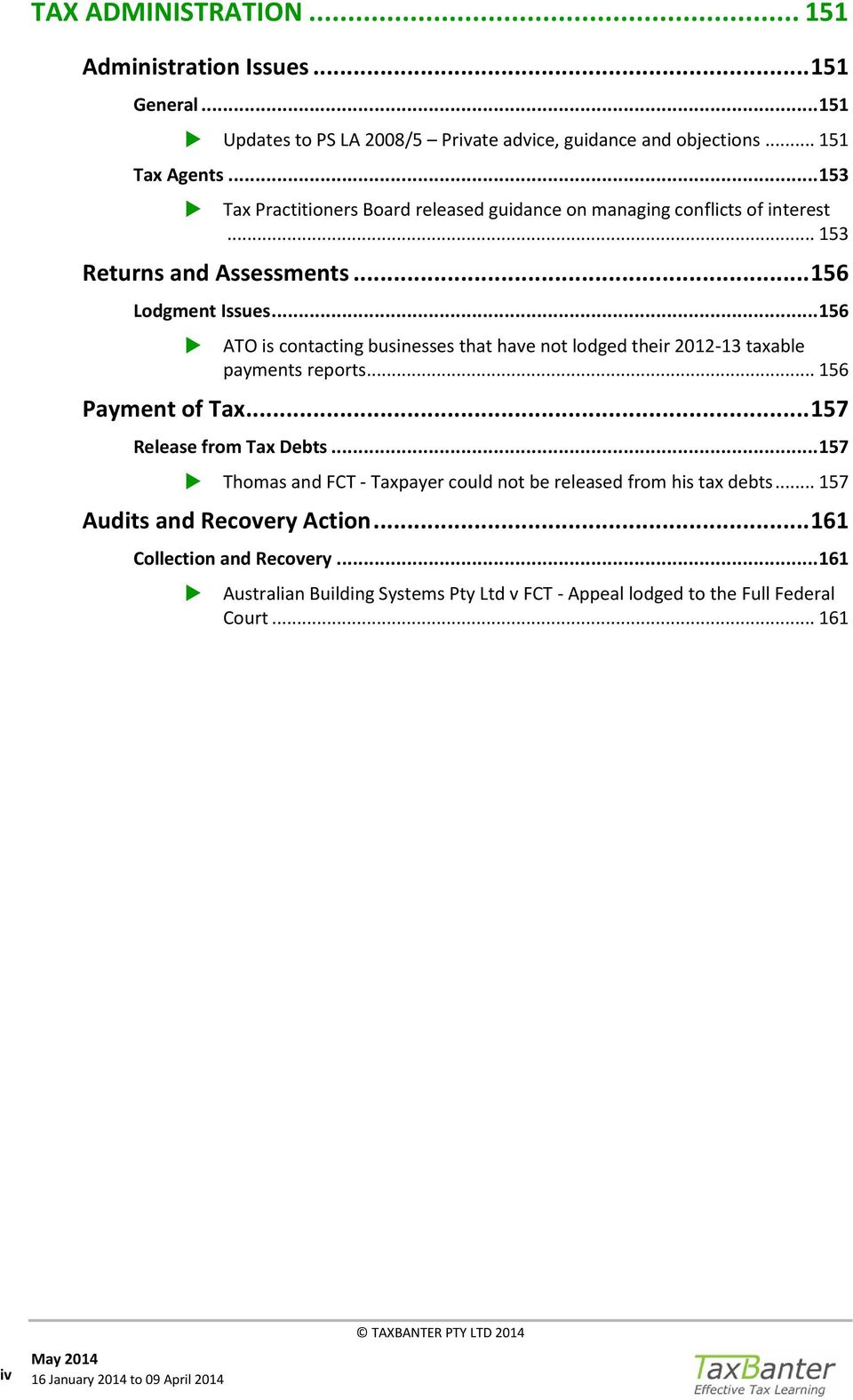
8 TAX ADMINISTRATION Administration Issues General Updates to PS LA 2008/5 Private advice, guidance and objections Tax Agents Tax Practitioners Board released guidance on managing conflicts of interest Returns and Assessments Lodgment Issues ATO is contacting businesses that have not lodged their taxable payments reports Payment of Tax Release from Tax Debts Thomas and FCT - Taxpayer could not be released from his tax debts Audits and Recovery Action Collection and Recovery Australian Building Systems Pty Ltd v FCT - Appeal lodged to the Full Federal Court iv 16 January 2014 to 09 April 2014
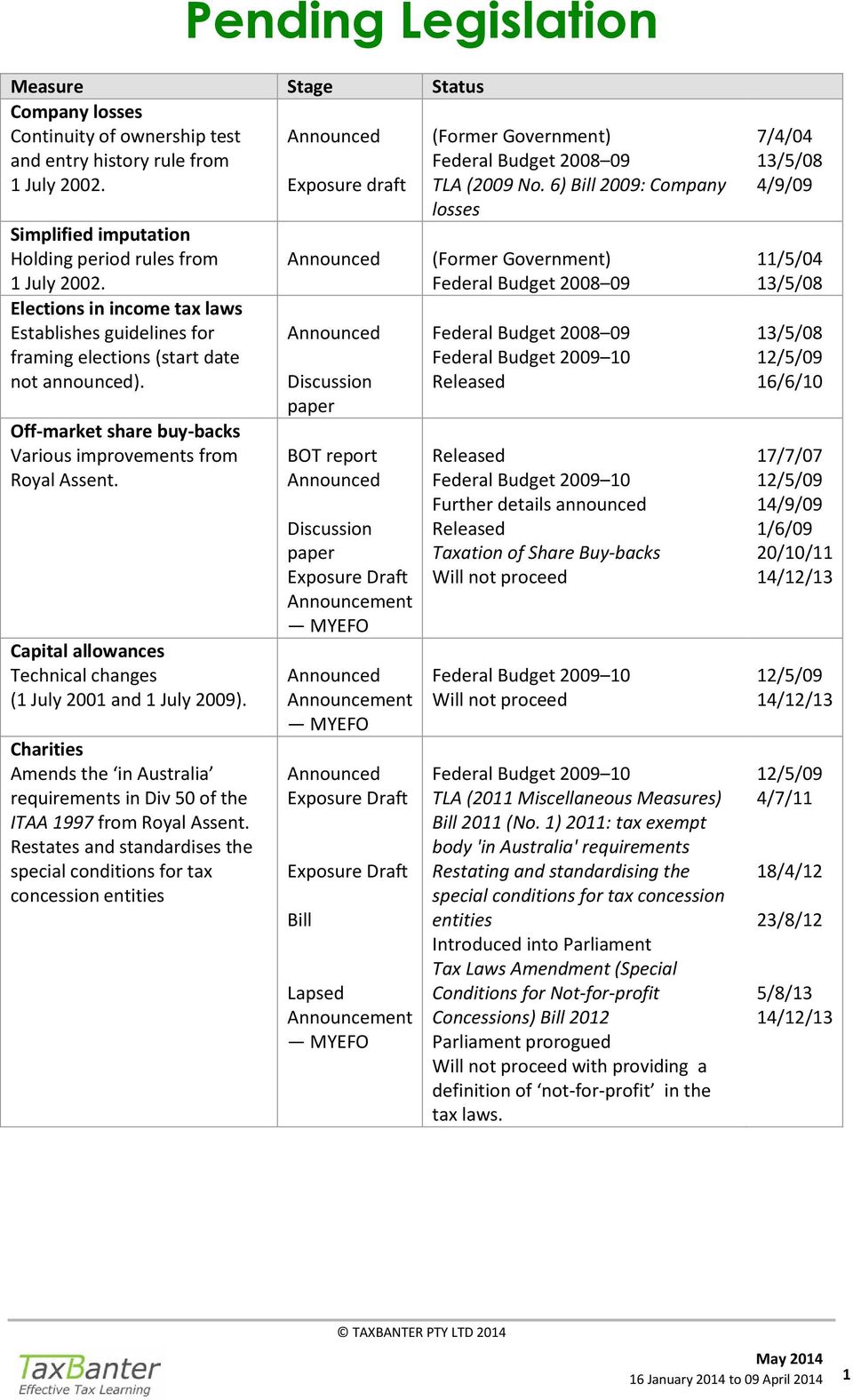
9 Pending Legislation Measure Stage Status Company losses Continuity of ownership test and entry history rule from 1 July Announced Exposure draft Simplified imputation Holding period rules from 1 July Elections in income tax laws Establishes guidelines for framing elections (start date not announced). Off-market share buy-backs Various improvements from Royal Assent. Capital allowances Technical changes (1 July 2001 and 1 July 2009). Charities Amends the in Australia requirements in Div 50 of the ITAA 1997 from Royal Assent. Restates and standardises the special conditions for tax concession entities Announced Announced Discussion paper BOT report Announced Discussion paper Exposure Draft Announcement MYEFO Announced Announcement MYEFO Announced Exposure Draft Exposure Draft Bill Lapsed Announcement MYEFO (Former Government) Federal Budget TLA (2009 No. 6) Bill 2009: Company losses (Former Government) Federal Budget Federal Budget Federal Budget Released Released Federal Budget Further details announced Released Taxation of Share Buy-backs Will not proceed Federal Budget Will not proceed Federal Budget TLA (2011 Miscellaneous Measures) Bill 2011 (No. 1) 2011: tax exempt body 'in Australia' requirements Restating and standardising the special conditions for tax concession entities Introduced into Parliament Tax Laws Amendment (Special Conditions for Not-for-profit Concessions) Bill 2012 Parliament prorogued Will not proceed with providing a definition of not-for-profit in the tax laws. 7/4/04 13/5/08 4/9/09 11/5/04 13/5/08 13/5/08 12/5/09 16/6/10 17/7/07 12/5/09 14/9/09 1/6/09 20/10/11 14/12/13 12/5/09 14/12/13 12/5/09 4/7/11 18/4/12 23/8/12 5/8/13 14/12/13 16 January 2014 to 09 April
10 Measure Stage Status Foreign source income deferral CFC rules Foreign source income attribution rewrite and modernisation of the CFC rules. Foreign source income deferral FAF rules Foreign source income attribution new FAF rules to replace the former FIF rules. GST: margin scheme Restructuring the margin scheme provisions. Instalment warrants and limited recourse borrowings Tax relief for investors in instalment warrants and receipts over listed and unlisted securities and for fund trustees who enter into permitted limited recourse borrowing arrangements from 1 July Earnout arrangements Treats all payments under a qualifying R arrangement as relating to the underlying business asset from Royal Assent. Announced Exposure draft Announcement Announcement MYEFO Announced Exposure draft Announcement Review Announced Discussion paper Announcement MYEFO Exposure Draft Announced Discussion paper Announced Announced Discussion paper Federal Budget TLA (Foreign Source Income Deferral) Bill 2011: Main provisions Federal Budget : Deferred until after the OECD has analysed the CFC rules in its work on base erosion and profit shifting Will not proceed Federal Budget TLA (Foreign Source Income Deferral) Bill 2011: Foreign accumulation funds Federal Budget : Deferred until after the OECD has analysed the CFC rules in its work on base erosion and profit shifting Discussion paper Treasury review released Federal Budget Released The Government will not proceed with the restructure of the margin scheme Tax Laws Amendment (2012 Measures 2 No. 5) Bill 2012: GST margin scheme and subdivided land Announcement Federal Budget Released Extension announced Federal Budget Released 12/5/09 17/2/11 14/5/13 14/12/13 12/5/09 17/2/11 14/5/13 12/5/09 11/5/10 11/5/10 10/12/10 22/10/12 15/8/12 10/3/10 10/5/11 10/3/10 17/1/11 11/5/10 12/5/ January 2014 to 09 April 2014

11 Measure Stage Status GST and cross-border transactions How to apply GST to crossborder transactions. Consolidation Alleviate tax consequences that arise when a consolidated group or MEC group restructures by undertaking a demerger from 9 November CGT minor amendments Minor CGT changes to scripfor-scrip roll over; trust to company asset roll over; exempt gain or loss from life insurance policy; and CGT exclusion for testamentary trust asset distributions. Company loss recoupment rules Removes requirement to trace ownership through superannuation entities; and technical amendments for widely held entities from 1 July Functional currency rules Extends foreign currency taxable income calculation rule to certain trusts and partnerships from 1 July Business conducted by charity Tax exemption for not-for-profit (NFP) entities will only apply to profits generated by unrelated business activities that are directed back to the NFP entity to carry out its altruistic work from 1 July Announced Discussion paper Announced Consultation Paper Announced Discussion paper Announcement MYEFO Federal Budget Released Federal Budget GST treatment of cross border transport Mid-Year Economic and Fiscal Outlook Released Will not proceed 11/5/10 15/2/11 8/5/12 9/10/12 9/11/10 7/12/10 14/12/13 Announced Federal Budget /5/11 Announced Consultation Paper Federal Budget Released 10/5/11 14/7/11 Announced Federal Budget /5/11 Announced Consultation Paper Announced Announced Federal Budget Released Federal Budget Announcement delaying start date to 1 July /5/11 27/5/11 8/5/12 31/1/13 16 January 2014 to 09 April

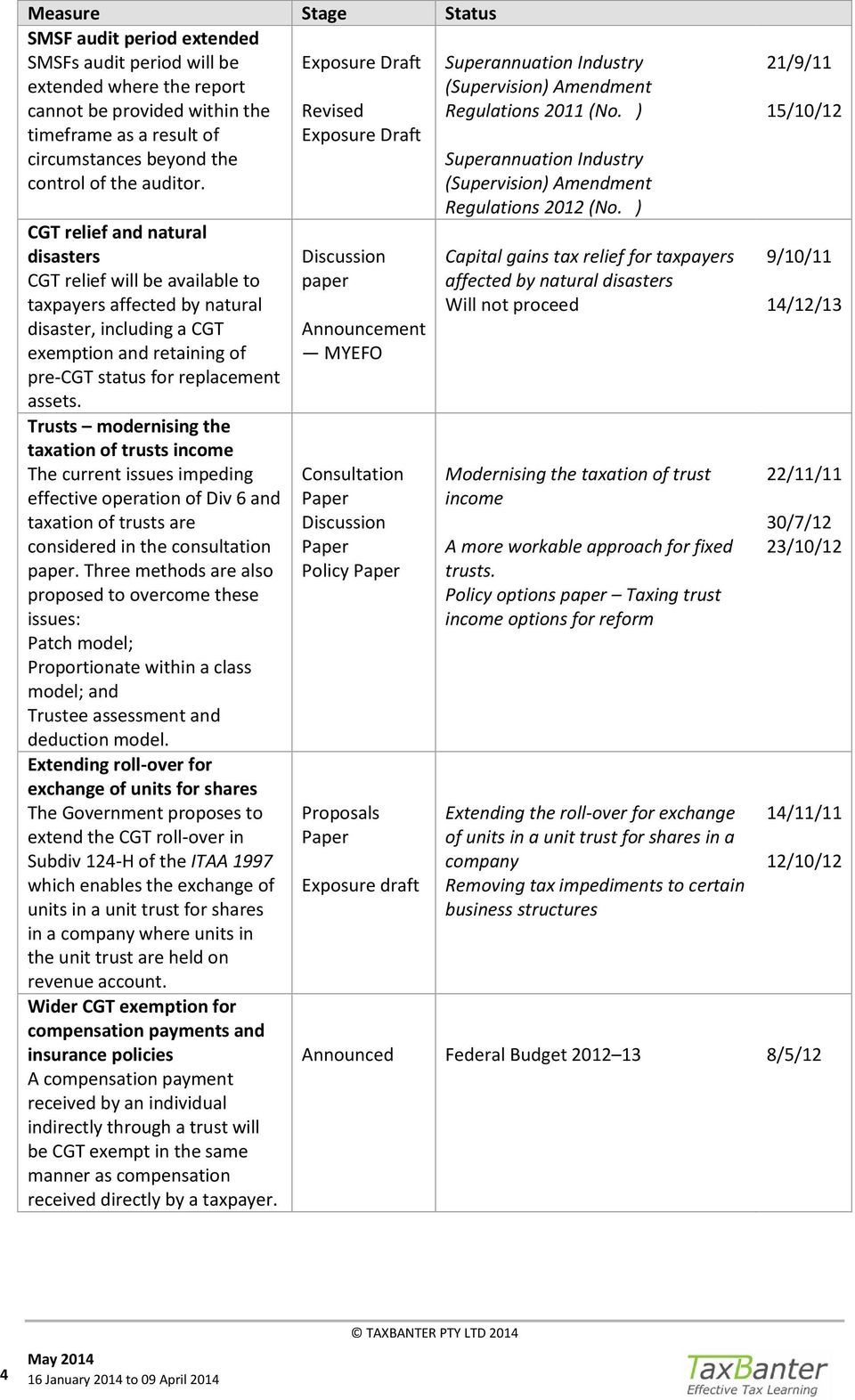
12 Measure Stage Status SMSF audit period extended SMSFs audit period will be extended where the report cannot be provided within the timeframe as a result of circumstances beyond the control of the auditor. Exposure Draft Revised Exposure Draft CGT relief and natural disasters CGT relief will be available to taxpayers affected by natural disaster, including a CGT exemption and retaining of pre-cgt status for replacement assets. Trusts modernising the taxation of trusts income The current issues impeding effective operation of Div 6 and taxation of trusts are considered in the consultation paper. Three methods are also proposed to overcome these issues: Patch model; Proportionate within a class model; and Trustee assessment and deduction model. Extending roll-over for exchange of units for shares The Government proposes to extend the CGT roll-over in Subdiv 124-H of the ITAA 1997 which enables the exchange of units in a unit trust for shares in a company where units in the unit trust are held on revenue account. Wider CGT exemption for compensation payments and insurance policies A compensation payment received by an individual indirectly through a trust will be CGT exempt in the same manner as compensation received directly by a taxpayer. Discussion paper Announcement MYEFO Consultation Paper Discussion Paper Policy Paper Proposals Paper Exposure draft Superannuation Industry (Supervision) Amendment Regulations 2011 (No. ) Superannuation Industry (Supervision) Amendment Regulations 2012 (No. ) Capital gains tax relief for taxpayers affected by natural disasters Will not proceed Modernising the taxation of trust income A more workable approach for fixed trusts. Policy options paper Taxing trust income options for reform Extending the roll-over for exchange of units in a unit trust for shares in a company Removing tax impediments to certain business structures 21/9/11 15/10/12 9/10/11 14/12/13 22/11/11 30/7/12 23/10/12 14/11/11 12/10/12 Announced Federal Budget /5/ January 2014 to 09 April 2014
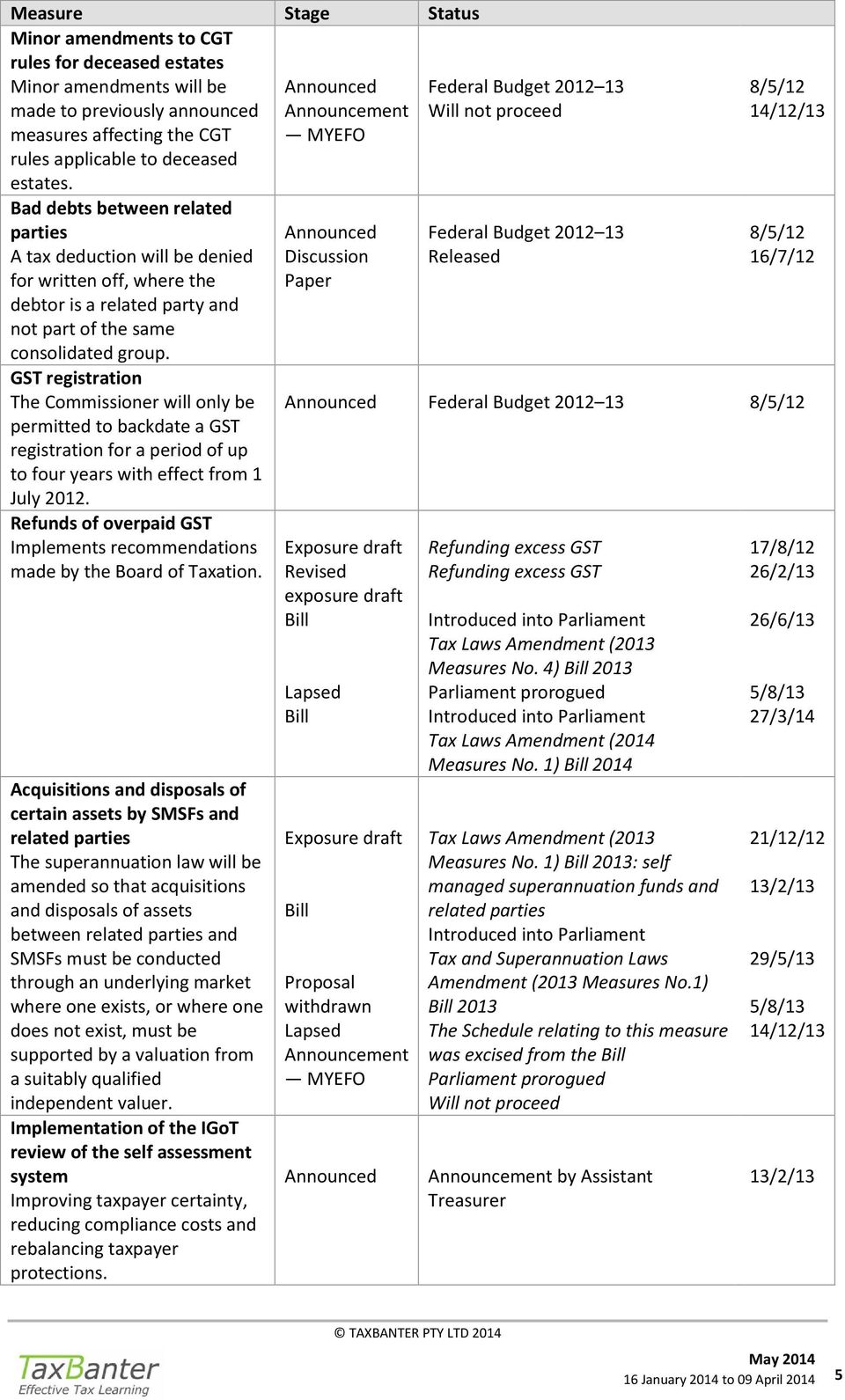
13 Measure Stage Status Minor amendments to CGT rules for deceased estates Minor amendments will be made to previously announced measures affecting the CGT rules applicable to deceased estates. Bad debts between related parties A tax deduction will be denied for written off, where the debtor is a related party and not part of the same consolidated group. GST registration The Commissioner will only be permitted to backdate a GST registration for a period of up to four years with effect from 1 July Refunds of overpaid GST Implements recommendations made by the Board of Taxation. Acquisitions and disposals of certain assets by SMSFs and related parties The superannuation law will be amended so that acquisitions and disposals of assets between related parties and SMSFs must be conducted through an underlying market where one exists, or where one does not exist, must be supported by a valuation from a suitably qualified independent valuer. Implementation of the IGoT review of the self assessment system Improving taxpayer certainty, reducing compliance costs and rebalancing taxpayer protections. Announced Announcement MYEFO Announced Discussion Paper Federal Budget Will not proceed Federal Budget Released 8/5/12 14/12/13 8/5/12 16/7/12 Announced Federal Budget /5/12 Exposure draft Revised exposure draft Bill Lapsed Bill Exposure draft Bill Proposal withdrawn Lapsed Announcement MYEFO Announced Refunding excess GST Refunding excess GST Introduced into Parliament Tax Laws Amendment (2013 Measures No. 4) Bill 2013 Parliament prorogued Introduced into Parliament Tax Laws Amendment (2014 Measures No. 1) Bill 2014 Tax Laws Amendment (2013 Measures No. 1) Bill 2013: self managed superannuation funds and related parties Introduced into Parliament Tax and Superannuation Laws Amendment (2013 Measures No.1) Bill 2013 The Schedule relating to this measure was excised from the Bill Parliament prorogued Will not proceed Announcement by Assistant Treasurer 17/8/12 26/2/13 26/6/13 5/8/13 27/3/14 21/12/12 13/2/13 29/5/13 5/8/13 14/12/13 13/2/13 16 January 2014 to 09 April
14 Measure Stage Status MIT withholding tax changes Ensuring foreign pension funds can access the MIT withholding tax regime. Announced Announcement by Assistant Treasurer Removing R&D tax offset for very large businesses Businesses with annual turnover of $20 billion or more will no longer be eligible for the R&D tax incentive Examination of native title payments The Government will establish a Treasury-led working group to examine the tax treatment of native title payments and how they can better benefit Indigenous communities now and into the future. Investment manager regime Element three of the regime to expand the exemption available for qualifying investment income of certain widely held foreign managed funds. Exempt current pension income Earnings on superannuation assets supporting income streams > $100,000 will be taxed at 15% from 1 July Deferred lifetime annuities will be provided with the same concessional tax treatment that superannuation assets supporting income streams receive. Announcement Exposure Draft Bill Lapsed Bill Announced Announcement by the Treasurer and Minister for Industry and Innovation Tax Laws Amendment (2013 Measures No. 2) Bill 2013: Targeting R&D tax incentive to small and medium businesses Introduced into Parliament Tax Laws Amendment (2013 Measures No.4) Bill 2013 Parliament prorogued Introduced into Parliament Tax Laws Amendment (Research and Development) Bill 2013 Passed by the House of Representatives Introduced into the Senate Joint announcement by the Attorney- General, Minister for Families community Services and Indigenous Affairs and the Assistant Treasurer Exposure draft Tax Laws Amendment (2013 Measures No.2) Bill 2013: Investment Manger Regime Announced Announcement MYEFO Announcement by the Treasurer and Minister for Financial Services and Superannuation Will not proceed 13/2/13 17/02/13 7/5/13 26/6/13 5/8/13 14/11/13 9/12/13 10/12/13 18/3/13 4/4/13 5/4/13 14/12/ January 2014 to 09 April 2014

15 Measure Stage Status R&D quarterly credits Eligible companies will be able to claim the R&D refundable tax offset on a quarterly basis Exposure draft Bill Cap on self-education expense deductions Deductions for self-education expenses will be capped at $2,000 per annum per person from 1 July Changes to Farm Management Deposits Increase in the non-primary production income threshold from $65,000 to $100,000 Deferral of increase in tax-free threshold Deferral of the increase in the tax-free threshold from $18,200 to $19,400 which was to apply from 1 July 2015 Changes to Venture Capital Limited Partnership (VCLP) and Early Stage Venture Capital Limited Partnership (ESVCLP) regimes Deeming certain gains or losses to be on capital account, lowering the minimum investment capital and phasing out Pooled Development Funds Improving the foreign resident CGT regime New withholding tax of 10% on disposal of certain taxable Australian property and amendments to the principal asset test Lapsed Announcement MYEFO Announced Discussion paper Deferred until 1 July 2015 Announced Exposure draft Bill Announced Tax Laws Amendment (2013 Measures No.2) Bill 2013: quarterly R&D credits Introduced into Parliament Tax Laws Amendment (2013 Measures No.4) Bill 2013 Parliament prorogued Will not proceed Announcement by the Treasurer Reform to deductions for education expenses Economic Statement (August 2013) Announcement by the Treasurer and Minister for Agriculture, Fisheries and Forestry Tax and Superannuation Laws Amendment (2014 Measures No. 2) Bill 2014: farm management deposits Introduced into Parliament Tax Laws Amendment (2014 Measures No. 1) Bill 2014 Transcript of a speech by the Minister for Climate Change, Industry and Innovation and Federal Budget /4/13 26/6/13 5/8/13 14/12/13 13/4/13 31/5/13 2/8/13 27/4/13 12/2/14 27/3/14 8/5/13 Announced Federal Budget /5/13 Announced Federal Budget /5/13 16 January 2014 to 09 April
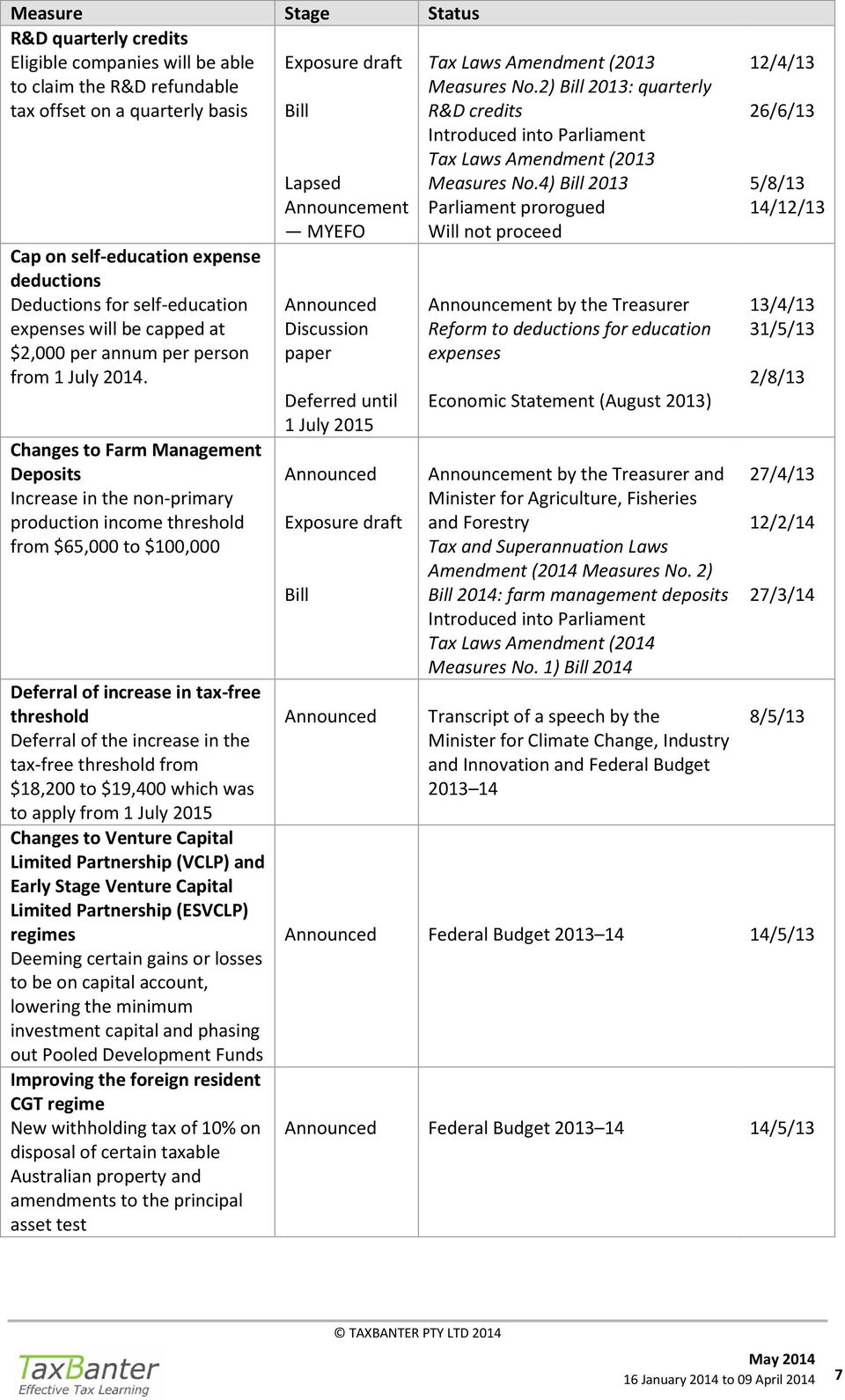
16 Measure Stage Status Offshore Banking Units (OBU) Improving the integrity of the OBU regime Better targeting exploration deductions Removing the immediate deduction for mining rights and information Closing loopholes in the consolidation regime Amendments as a result of the Board of Taxation s reviews; inconsistencies between MECs and ordinary consolidated groups; and interaction of consolidation and TOFA Changes to the thin capitalisation rules Tightening all safe harbour limits, increasing the de minimis threshold to $2 million of debt deductions; and amending the worldwide gearing test. Review of the arm s length debt test Non-portfolio dividend exemption Ensuring s. 23AJ operates as intended and expanding it to investments in trusts and partnerships Exempt foreign income interest deduction Repeal s which allows a tax deduction for interest incurred in deriving certain exempt foreign income Preventing dividend washing Close a loophole that enables investors to engage in dividend washing from 1 July 2013 FBT statutory rate for cars to be abolished The statutory formula method for car fringe benefits will be removed for new contracts entered into after 16 July 2013 with effect from 1 April Announced Discussion paper Federal Budget Improving the Offshore Banking Unit Regime 14/5/13 28/6/13 Announced Federal Budget /5/13 Announced Federal Budget /5/13 Announced Announcement Federal Budget Discussion paper 14/5/13 16/12/13 Announced Federal Budget /5/13 Announced Federal Budget /5/13 Announced Discussion paper Announcement Announced Confirmed Federal Budget Preventing dividend washing Announcement by the Assistant Treasurer Announcement by the Treasurer Economic Statement (August 2013) 14/5/13 3/6/13 28/6/13 16/7/13 2/8/ January 2014 to 09 April 2014
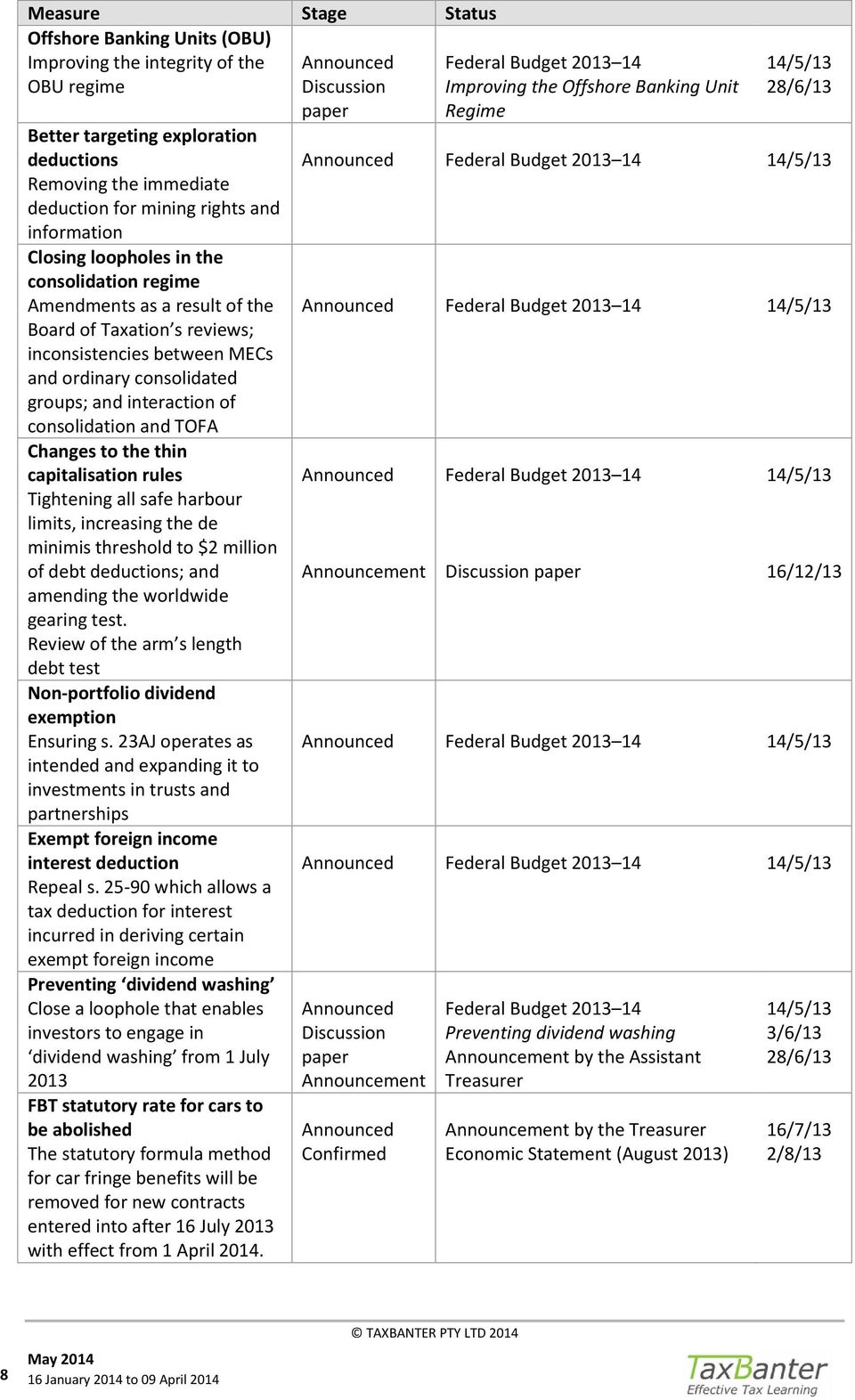
17 Measure Stage Status Emissions trading scheme Introduction of Emissions Trading Scheme brought forward to 1/7/2014 Exposure Draft legislation Clean Energy Legislation Amendment (Emissions Trading Scheme) Bill 2013 Carbon tax to be repealed The carbon tax will be repealed from 1 July Minerals Rent Resource Tax (MRRT) to be repealed The MRRT will be repealed from 1 July Tax Bonus The Tax Bonus Act will be repealed to ensure that the Commissioner does not make any further tax bonus payments. Exposure Draft Legislation Bill Exposure Draft Legislation Bill Bill Clean Energy Legislation (Carbon Tax Repeal) Bill 2013 Clean Energy (Income Tax Rates and Other Amendments) Amendment Bill 2013 Introduced into Parliament Clean Energy Legislation (Carbon Tax Repeal) Bill 2013 Passed by the House of Representatives Introduced into the Senate Clean Energy (Income Tax Rates and Other Amendments) Amendment Bill 2013 Passed by the House of Representatives Introduced into the Senate Minerals Resource Rent Tax Repeal and Other Measures Bill 2013 Introduced into Parliament Minerals Resource Rent Tax Repeal and Other Measures Bill 2013 Passed by the House Representatives Introduced into the Senate Introduced into Parliament Tax Bonus for Working Australians Repeal Bill 2013 Passed by the House of Representatives Introduced into the Senate 29/7/13 15/10/13 13/11/13 21/11/13 2/12/13 21/11/13 2/12/13 24/10/13 13/11/13 20/11/13 2/12/13 12/12/13 24/2/14 3/3/14 16 January 2014 to 09 April
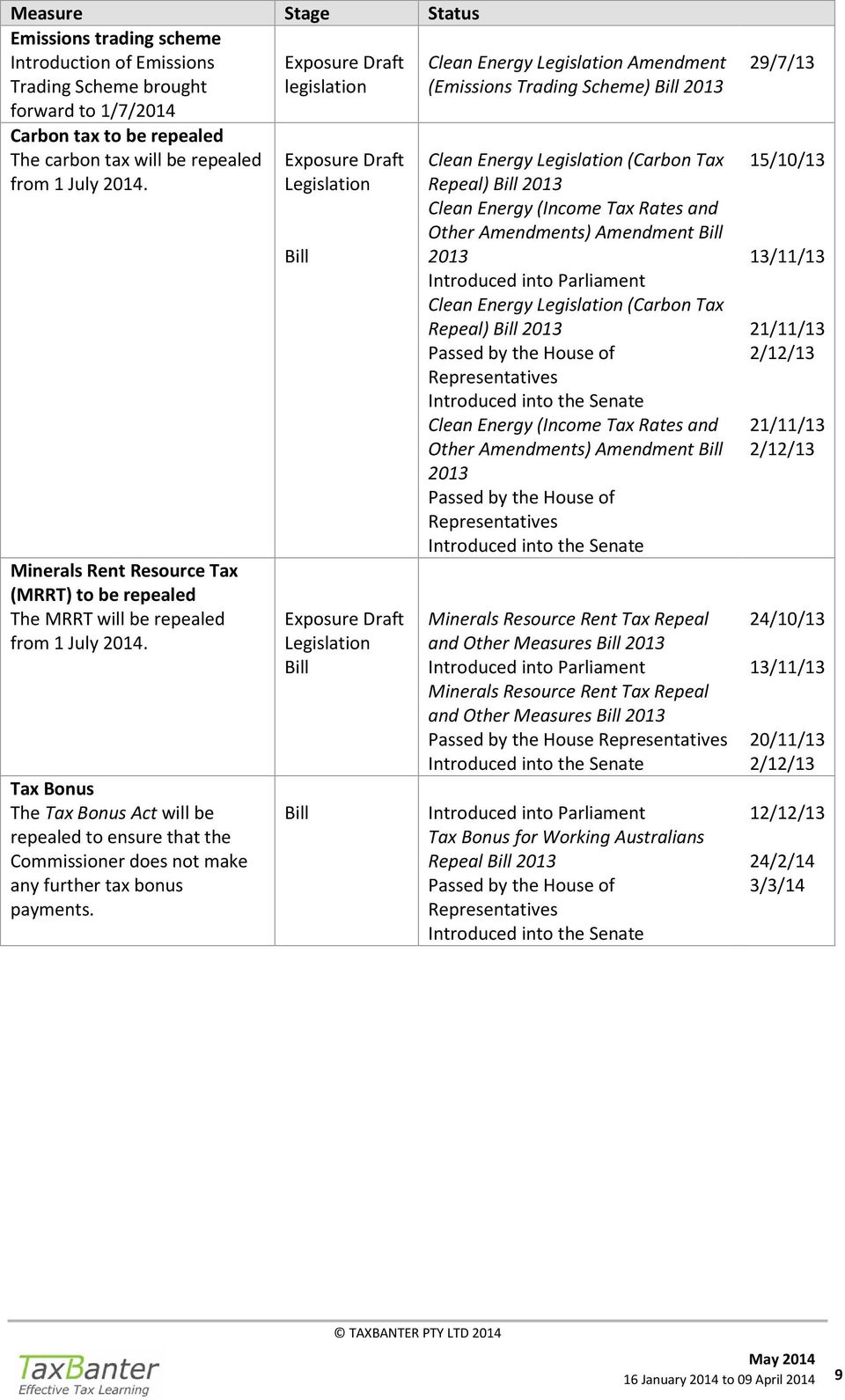
18 Measure Stage Status Enhanced third party reporting, pre-filling and data matching A framework is proposed to be introduced to create a new third party reporting regime encompassing: sales of real property; sales of shares and units in unit trusts; sales through merchant debit and credit services; and taxable government grants and other payments. Protection for discontinued announced measures A protection provision by way of a statutory bar on the Commissioner amending an income tax assessment will be introduced Preventing dividend washing From 1 July 2013, a taxpayer who receives a franked distribution due to distribution washing will: not be entitled to a tax offset; and not be required to include the franking credits in their assessable income. Discussion paper Exposure draft Exposure draft Improving tax compliance enhanced third party reporting, prefilling and data matching Tax and Superannuation Laws Amendment (2014 Measures No. 2) Bill 2014: Protection for discontinued announced measures Tax and Superannuation Laws Amendment (2014 Measures No. 2) Bill 2014: Preventing distribution washing 7/2/14 25/3/14 24/3/ January 2014 to 09 April 2014
19 Income Tax Announcements 2014 Announcements Discussion paper - Enhanced third party reporting, pre-filling and data matching KEY POINTS On 7 February 2014, the Government released for comment a discussion paper titled Improving tax compliance enhanced third party reporting, pre-filling and data matching. The discussion paper proposes a framework to create a new third party reporting regime encompassing: sales of real property; sales of shares and units in unit trust; sales through merchant debit and credit services; and taxable government grants and other payments. These measures give effect to an announcement in the Federal Budget. The measures are proposed to commence from 1 July On 7 February 2014, the Government released for comment a discussion paper titled Improving tax compliance enhanced third party reporting, pre-filling and data matching, which gives effect to an announcement in the Federal Budget. START DATE 1 July 2014 Background On 6 November 2013, the Government announced that it would proceed with the Federal Budget measure Tax Compliance Improving compliance through third party reporting and data matching, which should enhance the information reported to the ATO by third parties, thereby improving taxpayer compliance. The measures are proposed to commence from 1 July Proposed measures The discussion paper proposes a framework to create a new third party reporting regime encompassing: 1. sales of real property; 2. sales of shares and units in unit trust; 16 January 2014 to 09 April
20 3. sales through merchant debit and credit services; and 4. taxable government grants and other payments. The ATO already receives information from third parties, which enables pre-filling for simple income tax returns. However, the ATO seeks to make greater use of the pre-filling function by introducing a new online substantially pre-prepared tax return for the income year targeted towards taxpayers with relatively straightforward tax affairs. For pre-filling to be effective, the information must be received in a timely manner. Given the current lodgement timeframes for taxpayers commence on 1 July, the relevant information should be reported to the ATO either throughout the income year or as soon as possible after 30 June. However, this timeframe presents difficulties because some of the information cannot be finalised until after the end of the income year. Moreover, entities have competing priorities (i.e. their own accounts) at the end of the income year. The table below summarises the proposed measures. Proposed measures Sales of real property Information required The ATO would require the following information in relation to each property transaction: vendor and purchaser name; vendor and purchaser address; vendor and purchaser date of birth (for individuals); vendor and purchaser ABN or ACN (for entities); property details, including ID and address; property type (for example residential, commercial, new residence or vacant land); contract date; settlement date; and consideration and any other costs and charge Potential third party responsible for information The parties that would readily have access to the relevant information associated with a sale of real property are the purchaser or the relevant State or Territory government agency. The government agency gives legal effect to the property transfer. The compliance burden on the purchaser to report to the ATO is likely to be greater in comparison to the government agency January 2014 to 09 April 2014
21 Proposed measures Sales of shares and units Information required The ATO would initially require the following information in relation to each share or unit transaction respectively: shareholder s name, address and date of birth (if applicable); shareholder s TFN, ABN or ACN (if applicable) TFN withholding tax code; non-resident indicator in respect of the shareholder; company name and ASX code, and the CHESS and internal registry reason codes; shareholder s account holding number (Share Reference Number (SRN)/Holder Identification Number (HIN)) (if applicable); acquisition and disposal dates, prices and quantities; incidental costs (such as broker s fees); and any capital returns or payments and the associated dates unit holder s name, address and date of birth (if applicable); unit holder s TFN, ABN or ACN (if applicable); non-resident indicator in respect of the unit holder; TFN withholding tax code; name, ABN and/or TFN of the trustee and the trust and any other information required to specifically identify the unit(s) subscribed/redeemed; subscription (purchase) and redemption (sale) dates; quantity of units purchased/disposed of; incidental costs (such as broker s fees or initial entry fees); and any non-assessable payments paid by the trust to the unit holder in respect of the units Potential third party responsible for information The parties that have access to the relevant information, and therefore may be able to report the information to the ATO, include: 1. the market participant; 2. the clearing house provider; and 3. the share registry 16 January 2014 to 09 April
22 Proposed measures Sales through merchant credit and debit services Information required The ATO would require the following information: 1. merchant name, address and ABN or date of birth; 2. all monthly purchase/sale amounts from credit card and debit card transactions; and 3. all monthly cash out amounts Potential third party responsible for information The third party with access to this information is generally the entity providing the merchant payment facilities for the debit and credit payments, which is usually the financial institution. Government and payments grants Only grants and payments that are taxable to the recipient are included in the proposed regime. Information required The ATO would require the following information for each grant or payment: ABN (for grants and payments made to businesses); TFN or date of birth (for grants made to non business individuals); full name; address gross amount paid; total GST (if applicable); BSB and account number; and other contact details such as phone number or address Potential third party responsible for information The government entities (federal, state, territory and local) making the grants and payments will have the necessary information and therefore should be able to report these amounts to the ATO. When and how the information should be reported The ATO would seek the information in an electronic format, initially commencing with annual reporting and would then seek quarterly, monthly or real time reporting. In relation to the government grants and payments, the potential reporting due date could be 21 July, which would align with the existing taxable payments annual reporting that applies to the building and construction industry. Law design It may be appropriate to create a new legislative framework within Schedule 1 to the TAA to deal with these proposed rules. However, the approved form provisions contained in s of Schedule 1 to the TAA may provide an existing framework for entities to provide information to the ATO. It is proposed that entities not complying with the reporting obligations could be subject to the existing administrative penalty regime contained in Divs 284 and 286 of Schedule 1 to the TAA January 2014 to 09 April 2014
23 Website The discussion paper is available here: %20compliance/Downloads/PDF/Improving_Tax_Compliance_DP.ashx Inspector-General of Taxation releases reports on ATO compliance approach to individuals KEY POINTS On 21 February 2014, the Assistant Treasurer, Arthur Sinodinos AO, released three reports by the Inspector-General of Taxation (IGT). The reports released and the ATO s responses are summarised below: Review into the ATO s compliance approach to individual taxpayers use of data matching; The ATO agreed with all the IGT s recommendations with one qualification regarding recommendation 2.2 (refer table below); Review into the ATO s compliance approach to individual taxpayers income tax refund integrity program; The ATO agreed with 12 out of the 13 recommendations the IGT made; Review into aspects of the ATO s use of compliance risk assessment tools; and The ATO agreed with all the recommendations made by the IGT. On 21 February 2014, the Assistant Treasurer, Arthur Sinodinos AO, released the following reports by the Inspector-General of Taxation (IGT): Review into the ATO s compliance approach to individual taxpayers use of data matching; Review into the ATO s compliance approach to individual taxpayers income tax refund integrity program; and Review into aspects of the ATO s use of compliance risk assessment tools. The IGT s recommendations and the ATO s responses to them are summarised in the table below. Review into the ATO s compliance approach to individual taxpayers use of data matching The IGT found that the ATO s data matching program was generally effective in detecting instances of omitted income. The IGT s 13 recommendations are aimed at improving the timeliness and effectiveness of the data matching projects. The ATO has agreed with all the IGT s recommendations, listed below, with one qualification regarding recommendation January 2014 to 09 April
24 The IGT recommended that the ATO: 2.1 minimise the time between data being received and when it may be compared to taxpayer information by regularly reviewing and improving its data validation and identity matching processes update PS LA 2006/8 to reflect that, consistent with other active compliance activities, delay in commencement of data matching activities is a relevant factor when considering remission of SIC; and 2. clarify its internal SIC remission guidelines to require ATO officers to consider any delay in the commencement of data matching activities and whether remission is warranted on such grounds. ATO s qualification Given the high volume of transactions undertaken through an automated process, consideration of the remission of the Shortfall Interest Charge (SIC) will occur as requested by the taxpayer post issue of the amended assessment formalise and improve its current processes for determining the reasons for compliance action being only undertaken in a very small number of cases where potential discrepancies have been identified between third party information and those contained in corresponding tax returns; 2. following the above investigation, seek to improve the effectiveness of the relevant data matching projects through, for example, improving the quality and utility of third party data; and 3. where (b) is not possible, consider abandoning the relevant data matching projects and redirecting those resources to other data matching projects that are likely to yield better results. 1. formalise a strategic enterprise approach to the collection and application of third party data used in its data matching activities. Such an approach should include: (a) (b) undertaking pilots and/or manual reviews for audit selection where new data sources are being used or new risks sought to be treated; and consulting with third party data providers regarding their natural business systems and any necessary changes to these systems or processes to accommodate ATO needs and undertaking a cost-benefit analysis to determine whether the ATO can reimburse or subsidise any of their associated costs. 2. consolidate its evaluations of data matching projects to capture observations made during those projects to determine: (a) (b) (c) any material changes in the effectiveness of the project to accurately identify taxpayers who had omitted or underreported their income; the underlying causes for the variation in the data matching project s effectiveness; and use this information to enhance similar data matching projects for future years, or to redeploy staff to focus on other data matching projects representing higher risks January 2014 to 09 April 2014
25 widely communicate a streamlined process through which taxpayers and tax agents may clarify or correct pre-filled data which is incomplete or inaccurate; and 2. periodically reinforce instructions and escalation processes for ATO staff to manage these enquiries and, where appropriate, assist taxpayers to resolve them in a timely manner. 3.1 publicly release information on the processes involved in its data matching activities, particularly those relating to refining and validating of third party data before comparing them to taxpayer-provided information improve the effectiveness of data matching correspondence to generate the intended behavioural response by, for example, conveying more details regarding any research that it has undertaken to resolve the discrepancies before contacting the taxpayer; and 2. use randomised controlled trials to evaluate the effectiveness of such correspondence. 1. reinforce that ATO officers should ensure taxpayers understand the information being sought and how that information is relevant to the investigation; 2. identify potential sources of data held by other government agencies (such as DIAC ) which may assist the ATO in its data matching audit activities; and 3. outline the circumstances in which it would be appropriate to make information requests from other government agencies and the procedures that should be followed in making such requests. 3.4 update its current data matching procedures to emphasise that ATO officers may make information requests in writing where: 1. specifically requested to do so by taxpayers or their agents; or 2. the information is lengthy or complex. 3.5 widely communicate to the public through such channels as its website, the initial discrepancy letter to taxpayers and tax agents and its consultative forums that taxpayers may request a full written explanation regarding any adverse adjustments made to taxpayers liabilities at the conclusion of data matching activities. 3.6 identify the causes of amended assessments issuing prematurely and to prevent the occurrence of such events by, for example: 1. clearly communicating the channels through which taxpayers should direct their responses to ATO enquiries; 2. where prior communication has been established, instructing staff to contact taxpayers to verify whether the taxpayer has sent or is sending the required information before cases are finalised; and 3. developing systems-based rules to ensure that taxpayer correspondence records are checked before amended assessments are issued. 16 January 2014 to 09 April
26 actively raise awareness of the administrative reversals process in data matching cases, including how taxpayers can initiate this process, for example through tax agent seminars and communiqués; 2. improve ATO call centre scripting to prompt ATO officers to identify cases of data matching and to escalate these to the DMCS team appropriately; and 3. periodically reinforce guidance and instruction to staff in relation to escalating cases for reversal consideration when requested by taxpayers, or where the ATO officer otherwise identifies that it would be appropriate to do so. Review into the ATO s compliance approach to individual taxpayers income tax refund integrity program The implementation of the IGT s 13 recommendations should result in: more expedient processing under the Income Tax Refund Integrity Program; improved communication between tax agents and the ATO; and clearer lines of escalation in the tax dispute process. The ATO agreed in full with 12, and in principle with one, of the IGT s recommendations. 2.1 The ATO: The IGT recommended that 1. ensures that the MEI 1, CAS 2 and SNC 3 business lines collaborate to develop a comprehensive record keeping system to identify and report on: (a) (b) (c) the number of cases referred from the ITRIP 4 to the SNC business line for fraud investigation and the number of these cases where actual fraud was established; the number of cases in which identity crime was observed and those in which the ATO suspects that false tax returns were lodged by perpetrators of crime; and the actions taken by the ATO to address the fraud and the outcomes of such action; 2. distils common factors in cases where fraud activity has been identified and use such findings in its annual review process of the ITRIP models to improve their ability to detect potential fraud. 3.1 The ATO should, whilst maintaining robust governance processes with respect to initiatives such as the ITRIP, consider more streamlined governance arrangements, particularly in the early stages of the initiative, to facilitate a timely resolution of issues that might arise and to minimise uncertainties, duplications and inefficiencies Micro Enterprises and Individuals. Client Account Services. Serious Non-Compliance. The ATO s income tax refund integrity program January 2014 to 09 April 2014
27 The IGT recommended that the ATO continuously improve the time period between a return being stopped and initiating inquiries with the taxpayer or their agent by increasing staff conducting ITRIP reviews during Tax Time and commencing audits sooner; 2. the ATO continue to implement strategies to obtain data in a timely manner which may be applied to verify tax returns held by the ITRIP; and 3. where any new risk or label rules are proposed to be incorporated into the ITRIP, or where any existing rules are proposed to be updated, the ATO build into the model available third party data that could be used for compliance verification. 4.2 The ATO, in addition to undertaking specific campaign visits to assist tax agents: 1. undertake site visits at the request of tax agents with larger numbers of delayed income tax returns held under the ITRIP to review and finalise these in an efficient and cost effective manner; and 2. provide a direct contact point within the ATO and clear lines of escalation to assist tax agents to raise and address areas of concern in relation to the ITRIP. 4.3 The ATO develop and adopt a differentiated approach in reviewing and processing income tax returns held under the ITRIP by: 1. the MEI and CAS business lines enhancing the management reporting of ITRIP serious hardship cases and using such findings to continually improve the management of these cases; and 2. augmenting its pre-issue compliance procedures to: (a) (b) provide clear instruction and guidance to ATO staff to holistically consider taxpayers or tax agents circumstances and respond to these in a flexible manner; and provide clear lines of escalation where taxpayers and their agents are unable to resolve any disputes which may arise directly with the ATO audit officer. 5.1 The ATO, having regard to the applied research emerging from the UK s Behavioural Insights Team: assess the effectiveness of the ITRIP letters to generate the intended behavioural response from individual taxpayers through the use of randomised controlled trials in correspondence design; and ensure that it acknowledges and deals with any information received by taxpayers or their agents in response to the ATO s ITRIP letters, including in cases where the ATO has not specifically requested information be provided. 16 January 2014 to 09 April
28 The IGT recommended that 5.2 As part of its ITRIP work to improve communication of reasons for delays in processing of income tax returns, including through the use of reason codes, the ATO: 1. better distinguish between potential fraud and overstated claims cases; 2. provide greater specificity as to why certain tax returns have been held for review, such as what label or what claims the ATO is seeking to address; and 3. implement a mechanism for taxpayers and their agents to easily obtain more information where specific reasons cannot be provided in correspondence. In principle agreement Changes to IT systems and business processes will be required to implement the requirements of this recommendation around updated reason codes. In some cases these requirements are quite complex. This work will be subject to prioritisation on the Enterprise Solutions and Technology Forward Program of Work. 5.3 The ATO augment its ITRIP information gathering procedures, including relevant written guidance or scripting, to: 1. ensure that taxpayers understand the nature of the ATO s inquiry and information which may assist to address the ATO s concerns, including how the requested information is likely to impact any potential adjustments; and 2. authorise ATO officers to grant extensions of time for the provision of additional information in appropriate circumstances, such as where the relevant taxpayers are unavailable or the information is difficult to obtain. 5.4 The ATO: 1. consult with external stakeholders on strategies to improve the specificity of communicated reasons for adjustments; and 2. provide specific reasons for ITRIP adjustment decisions including how the ATO has considered information provided by taxpayers in making adjustment decisions. 5.5 The ATO consult with the tax profession to identify and implement strategies to: 1. ensure that specific ITRIP audit correspondence and enquiries are directed to the person designated by the taxpayer; and 2. inform tax agents of ITRIP correspondence which the ATO proposes to use during Tax Time and on which their clients may seek advice and assistance. 6.1 The ATO make use of the in-house facilitators pilot program or other informal dispute resolution process to address and resolve disputes arising out of the ITRIP January 2014 to 09 April 2014
29 The IGT recommended that 6.2 The ATO: 1. update its finalisation letters to invite taxpayers to contact the ATO before disputing any adjustments to enable ATO officers to understand the dispute and provide advice as to the most appropriate channel for resolving the dispute; and 2. implement a communications strategy to ensure that taxpayers and tax agents are aware of administrative reversal as a cost effective dispute resolution mechanism and how taxpayers and tax agents may seek such reversals in appropriate cases. 6.3 The ATO: 1. undertake an analysis of the patterns and features of cases where default assessments have had to be reversed and accordingly use the findings to limit the instances of default assessment being issued; and 2. refine default assessment finalisation letters to encourage taxpayers with genuine claims to engage with the ATO by, for example, clearly communicating the availability of administrative reversal process and to distinguish this process from the statutory rights to object. Review into aspects of the ATO s use of compliance risk assessment tools The IGT made 16 recommendations concerning the adoption of a set of guidelines for the design of more effective risk assessment tool and to improve the existing risk assessment tools with which taxpayers have raised most concern. The ATO agreed with all 16 recommendations. The IGT recommended that 3.1 Discrete transactions or business activities of a taxpayer that cause concern for the ATO should not be determinative of the taxpayer s overall risk rating unless they are substantial compared to the taxpayer s tax base or are indicative of poor internal governance or fraud. 3.2 The ATO revise its internal and public documentation to: 1. acknowledge that, for the purpose of the risk differential framework (RDF), the presence of a number of contestable tax positions does not of itself render a taxpayer as non-compliant; and 2. replace references to controversial or contentious tax positions with contestable tax positions. 16 January 2014 to 09 April
30 The IGT recommended that The ATO consider willing participation or transparency in terms of information confidence and cost and use them alongside, but separate from, the RDF in determining the ATO compliance approach to taxpayers. 2. The tool for assessing information confidence and cost should consist of objective and specific criteria such as: (a) (b) (c) (d) (e) (f) (g) (h) (i) (j) The ATO should: Does the taxpayer voluntarily disclose information to the ATO? Does the taxpayer respond to informal ATO information requests? If no, what were the reasons for this? Have you used formal information gathering powers with respect to this taxpayer? If so, what were the reasons for this? Did the taxpayer outline a specific concern that gave rise to a need for you to exercise such powers? How did the taxpayer respond to our formal information gathering requests? Did the taxpayer exercise their right to legal professional privilege correctly? If not, what was the issue of concern? How was it resolved? Did the taxpayer avail themselves of the accountants or board papers concessions correctly? If not, what was the issue of concern? How was it resolved? 3. update its internal guidance to ATO officers to reflect its stated position in the large business and tax compliance (LBTC) booklet in relation to taxpayer requests for exercise of the Commissioner s formal information gathering powers; and 4. state, in an appropriate publicly available document such as the LBTC booklet, its position with respect to the exercise of such taxpayer legal rights as LPP and FOI as well as use of Accountants Concession when determining the taxpayer s risk categorisation. 3.4 The ATO share with taxpayers greater detail about how the ATO assesses particular risks, including details about how the effective tax rate is calculated. 3.5 The ATO update its internal and public documentation to make it clear that use of particular tax advisors is not a factor in determining a taxpayer s risk categorisation. 3.6 The ATO: 1. ensure that its Large Business and International (LB&I) compliance staff are appropriately skilled to examine and assess the adequacy of a taxpayer s corporate governance and tax risk management arrangements and that such assessments are the subject of an appropriate internal assurance process; and 2. remove tax manager personal tax obligations as a consideration when assessing the taxpayer s tax risk management and corporate governance January 2014 to 09 April 2014
31 The IGT recommended that 3.7 The ATO update its LB&I RDF categorisation template along with internal and external communications to be consistent with the following principles: 1. higher consequence taxpayers will always be subject to a form of direct ATO engagement regardless of likelihood factors and the nature, extent and timing of this engagement is influenced by likelihood factors; 2. likelihood factors consist of inherent and behavioural factors and should be addressed separately; 3. inherent factors require the testing of particular hypotheses; 4. behavioural factors require the testing of the taxpayer s tax risk management and governance processes; and 5. the intensity and formality of the review depends on the taxpayer s approach to provision of information as well as inherent and behavioural factors. 3.8 The ATO continue to improve the LB&I risk identification process including: 1. better identification of potential risk hypotheses through closer working relationships between risk managers and operations teams on an ongoing basis; 2. capturing better input data through the income tax return and its associated schedules; and 3. refining or removing inappropriate risk filters. 3.9 The ATO improve the RDF notification letter process for higher consequence taxpayers by: 1. providing tax managers with a draft risk report; 2. having a dialogue with tax managers to address any factual errors and discuss the ATO s concerns; 3. having the risk report subject to a moderation process after this dialogue; 4. preparing the RDF notification letter by: (a) (b) (c) (d) taking into account previous dialogue with the tax manager; reflecting any recent ATO compliance activity, such as current or concluded PCRs or ACA 5 s; aligning it with any protocols or frameworks generated as part of implementing the Taxpayer Assurance Plan (TAP); and including a roadmap for expected or likely ATO compliance requirements regarding specific concerns; and 5. upon finalising, sending the RDF notification letter to the CEO. 5 Annual Compliance Arrangement. 16 January 2014 to 09 April
32 The IGT recommended that 3.10 The ATO: 1. make the pre-lodgment compliance review (PCR) framework guide publicly available as a part of either the large business compliance manual or large business and tax compliance booklet; 2. disclose the risk categories more fully, including any sub-categorisations of the key taxpayer segment, in RDF notification letters and in the LBTC booklet; 3. ensure that the compliance burden of PCRs are graduated according to differing levels and mixes of inherent risk, behavioural risk and information confidence and cost factors; and 4. update the LBTC booklet to indicate that audits may still be applicable to manage legacy issues even where the taxpayer is a key taxpayer. 4.1 The ATO incorporate compliance officer experiences and case work results into the risk rule review processes. 4.2 The ATO: 1. ensure all ATO risk guides contain: (a) (b) (c) an explanation of the ATO s risk hypothesis; explanations of any applicable false positives; and an indication of the types information that the compliance officer should be seeking from the taxpayer to determine the presence of a risk. 2. publish additional information on the risk factors currently listed in the publication Tax compliance for small-to-medium enterprises and wealthy individuals such as the risk hypothesis and the indicators used to determine the presence of risk. 4.3 The ATO, in consultation with stakeholders, test the distinction between inherent factors, behavioural factors and information confidence and cost for this market segment. 5.1 The ATO research and develop strategies to improve aggregated taxpayer risk analysis in the ATO micro business segment January 2014 to 09 April 2014
33 The IGT recommended that 7.1 The ATO, in consultation with tax practitioners, develop and publish a complete guide on the operation of RDF for tax practitioners. Matters to be covered by the guide include: 1. the risk hypothesis being tested; 2. the inputs used; 3. tax practitioners opportunity for review to initial risk rating (consistent with the principles of natural justice); 4. communications between the ATO and practitioners; 5. confidentiality of the risk rating as between the ATO and the practitioner; 6. referral to the ATO s Aggressive Tax Planning Unit where the promoter penalty regime may apply; and 7. referral to the Tax Practitioners Board where the Code of Professional Conduct contained in the Tax Agent Services Act 2009 may have been breached the checklist in Appendix 12 of the report should be incorporated into the ATO s compliance risk assessment tool design processes; and 2. the ATO s Enterprise Risk Management Framework consider risk premium compliance costs as a type of taxpayer compliance cost. Website The reports are available here: January 2014 to 09 April
34 Exposure draft - Re-instating and centralising the special conditions for tax concession entities KEY POINTS On 12 March 2014, the Government released for comment exposure draft legislation titled: Tax and Superannuation Laws Amendment (2014 Measures No. 3) Bill 2014: in Australia special conditions; and Tax Laws Amendment (2014 Measures No. 2) Regulation, and accompanying explanatory material. These proposed measures will amend the tax law to re-state and centralise the special conditions for tax concession entities. The amendments: re-state the in Australia special conditions for income tax exempt entities, ensuring that, in general, they must be operated: principally in Australia; and for the broad benefit of the Australian community (with some exceptions); centralise in one place and simplify the other special conditions that entities must satisfy to be income tax exempt; and codify the in Australia special conditions for deductible gift recipients (DGRs) ensuring that they must generally: operate solely in Australia; and pursue their purposes solely in Australia (with some exceptions, such as overseas aid funds, some environmental organisations, some touring arts organisations and medical research institutes). The proposed measures will commence from Royal Assent. On 12 March 2014, the Government released for comment exposure draft legislation titled: Tax and Superannuation Laws Amendment (2014 Measures No. 3) Bill 2014: in Australia special conditions; and Tax Laws Amendment (2014 Measures No. 2) Regulation, and accompanying explanatory material. These proposed measures will amend the tax law to restate and centralise the special conditions for tax concession entities. The amendments: 1. re-state the in Australia special conditions for income tax exempt entities, ensuring that, in general, they must be operated: (a) (b) principally in Australia; and START DATE Royal Assent for the broad benefit of the Australian community (with some exceptions); 2. centralise in one place and simplify the other special conditions that entities must satisfy to be income tax exempt; and January 2014 to 09 April 2014
35 3. codify the in Australia special conditions for deductible gift recipients (DGRs) ensuring that they must generally: (a) (b) operate solely in Australia, and pursue their purposes solely in Australia (with some exceptions, such as overseas aid funds, some environmental organisations, some touring arts organisations and medical research institutes). Background Under the current law, entities cannot be income tax exempt unless they are: operated principally in Australia; prescribed as income tax exempt entities (exempt entities) under Div 50 of the ITAA 1997 and the ITAA Regs; or deductible gift recipients (DGRs) under Div 30 of the ITAA While both exempt entities and DGRs are subject to the in Australia special conditions, they are subject to different thresholds (with the in Australia conditions for DGRs applying a stricter test). Recent court decisions have raised doubts about the proper application of both of these tests. For example, the High Court in FCT v Word Investments Limited [2008] HCA 55 found that a charity is considered to be pursuing its objects principally in Australia if it operates in Australia by making payments in Australia to another charity that conducts its activities and expends those funds overseas. The previous Government announced, as part of the Federal Budget, that it would amend the in Australia special conditions in Div 50 of the ITAA 1997 to ensure that Parliament could fully scrutinise those organisations seeking to pass money to overseas charities and other entities. On 14 December 2013, the current Government announced that it would proceed with this measure. Proposed new law Income tax exempt entities In order to become income tax exempt, an entity must: operate principally in Australia; pursue its purposes principally in Australia; comply with all the substantive requirements in its governing rules; apply income and assets solely to pursue the purposes for which it was established; and be a non-profit entity. Proposed ss (1) to (3) Important Under the current law, the test for an entity to be tax exempt under Div 50 is determined by reference to its location in Australia, and the extent to which it incurs its expenditure, and pursues its objectives, principally in Australia. The new law refers to operates and pursues its purposes in Australia (proposed s ). 16 January 2014 to 09 April
36 Principally in Australia The replacing of the current expenditure based test with an operates and pursues its purposes based test widens the range of circumstances that can be considered in Australia. There is no one factor that is conclusive in determining whether an entity is operating in Australia and pursing its purposes principally in Australia and so, the Commissioner is expected to consider all surrounding circumstances including: where the entity: incurs its expenditure; undertakes its activities; has its property located; is managed from; is resident or located; has its employees or volunteers; and who is directly and indirectly benefiting from its activities. Definition Principally Principally means mainly or chiefly. Less than 50 per cent is not considered to be principally. An entity will be considered to be operating in Australia if it is an Australian resident or has a sufficient connection with and presence in Australia. An organisation will not have a sufficient connection with Australia if it is present in Australia only through an agent or it only owns an investment property in Australia. Certain distributions may be made overseas and disregarded when considering whether an entity meets the in Australia conditions. These are distributions that are received by way of government grants, and distributions received as a gift (money or other property) where the provider is not an income tax exempt entity and is not entitled to a deduction for the contribution. In order for such gifts to be disregarded, the tax exempt entity must ensure that they meet any requirements set out in the regulations (if any). These requirements are expected to include such things as the entity must: 1. demonstrate that any activities undertaken outside Australia and the use of any money or property outside Australia is effective in achieving the entity s purpose; 2. demonstrate that it effectively interacts and coordinates activities with the other persons outside of Australia; 3. must not commit a serious infringement of Australian laws; and 4. show that it has in place current and appropriate governance arrangements for the proper monitoring of any overseas activities undertaken by both it and any in-country partners to ensure that any money and property is being used in a proper and effective manner. Proposed s (5) January 2014 to 09 April 2014
37 Example 1.3 of the draft EM Operating principally in Australia A literary society is set up in Australia to promote indigenous writing, both in Australia and abroad. The entity operates out of and is managed from Melbourne. Most of its expenditure is directed towards donating books to local schools and libraries. Occasionally it incurs expenditure purchasing books from other indigenous culture organisations overseas. The society will meet the in Australia conditions. The occasional overseas expenditure will not prevent this criteria being met. While no one factor is determinative, the society is overall principally pursuing its purposes in Australia and is principally operating in Australia because it is managed in Australia, most of the expenditure is benefiting Australians and any assets and employees are in Australia. Proposed s (4) provides that if an entity provides money, property or other benefits to another entity that is not an income tax exempt entity, the use of the money, property or other benefits by the recipient (or any other entity) must be taken into account when determining whether the entity satisfies the in Australia special conditions. However, the entity is only required to take steps to reasonably confirm or trace the use of money, property or benefits by the other entity (proposed s (4A)). This means that the providing entity can rely on the reasonable and genuine steps taken to demonstrate compliance with the special conditions if it later becomes apparent that the funds were spent in a manner that would result in the loss of the providing entity s income tax exempt status. Example 1.9 of the draft EM Taking account of money provided to other entities Myra Charity receives donations and income of $10,000 in an income tax year. They are not a deductible gift recipient. Myra provides $8,000 to West Charity. West Charity is located in Australia and is not income tax exempt. West Charity passes the money to its local partner in Africa to build a school. Myra Charity would not meet the in Australia special conditions, as it is not operating principally in Australia, and incurring its expenditure principally in Australia. Although Myra provides the $8,000 to an entity in Australia, Myra must consider the use of this money offshore when considering whether it is meeting the in Australia special conditions. These proposed measures address the problem that arose in FCT v Word Investments Limited 6, that entities are considered to be pursuing their objectives principally in Australia if they merely operate to pass funds within Australia to another charity that conducts its activities overseas, and ensures that tax exempt entities cannot avoid the special conditions by having other entities use its funds on activities that it itself cannot undertake. Deductible gift recipients (DGRs) DGRs (or entities endorsed as DGRs for the operation of a fund, authority or institution, to the extent that they operate that fund, authority or institution) are exempt from the in Australia special conditions for tax exempt entities in Div 50. DGR entities are subject to a separate test. Proposed s (2)(a) and (b) The proposed law codifies the in Australia special conditions for DGRs so that the core principle for tax exempt entities is applied similarly to DGRs but with a differing (stricter) threshold test. 6 [2008] HCA 55. In that case, the High Court found that charities are considered to be pursuing their objectives principally in Australia if they merely operate to pass funds within Australia to another charity that conducts its activities overseas. 16 January 2014 to 09 April
38 Proposed ss (2), and 31-10(2)(a) DGRs must: be established in Australia; operate solely in Australia; and pursue their purposes solely in Australia. Proposed s (1) Definition Solely in Australia Solely in Australia is to be interpreted as requiring DGRs to be established and operated only in Australia (including control, activities and assets) and must have their purpose and beneficiaries only in Australia. 7 Example 1.16 Minor and incidental activities A large public museum operating in Australia has a large permanent collection of artwork in Australia, as well as collections which tour around Australia. The museum has made an arrangement to send temporarily, a collection of artwork overseas, along with an individual who is an expert in the collection era, in return for receiving a temporary exhibition of artwork from overseas. This would be considered to be incidental when considered with reference to the museum s operations and pursuit of purposes in Australia. Note Special consideration is given to entities that are DGRs under the category of international affairs. DGRs such as overseas aid funds, developed country relief funds and similar DGRs (where their activities are clearly intended to be undertaken overseas) are not subject to the in Australia rule (s (5)). In addition, entities on the Register of Environmental Organisations, which the Secretary to the Environment Department authorises as being exempt from the in Australia special conditions, may also undertake overseas activities. However, in order to ensure the integrity of the DGR regime, an exemption from the in Australia conditions will be limited to certain entities listed on the register (ss (7) and (1)). If a DGR provides money to another entity to further its purposes, the DGR must look through the entity to which it has given money and consider the final use of this money, property or benefits when considering whether it meets the in Australia special conditions. Proposed s (3) However the fund, authority or institution is only required to take all steps that are reasonable to have knowledge of, or obtain knowledge of, the use of the money, property or benefits by the entity outside Australia. Proposed s (4) 7 However, the majority membership of an Australian subsidiary by an overseas entity will not, of itself, contravene the in Australia requirement January 2014 to 09 April 2014
39 Tax Laws Amendment (2014 Measures No. 2) Regulation The regulation: sets out the integrity rules that: START DATE The day after it is registered DGRs listed on the Register of Environmental Organisations must meet for the Environment Minister to authorise them as being exempt from the in Australia special conditions; DGRs that are touring arts organisations listed on the Register of Cultural Organisations must meet in order for the Arts Minister to authorise them as being exempt from the in Australia special conditions; entities must satisfy to disregard distributions received by way of government grant and distributions received as gifts that are not tax deductible when considering the in Australia requirement; and re-makes existing regulations under the new centralised special conditions. Website The Exposure Draft is available here: %20tax%20concession%20entities/Downloads/PDF/ED_TSLA_2014_Measures_Bill_V2.ashx The Explanatory Material is available here: %20tax%20concession%20entities/Downloads/PDF/EM_TSLA_2014_Measures_Bill_V2.ashx The Regulation is available here: %20tax%20concession%20entities/Downloads/PDF/ED_TLA_2014_Measures_Regulation.ashx The Explanatory Statement is available here: %20tax%20concession%20entities/Downloads/PDF/ES_TLA_2014_Measures_Regulation.ashx 16 January 2014 to 09 April
40 Exposure draft - Protection for discontinued announced measures KEY POINTS On 25 March 2014, the Government released for comment exposure draft legislation titled Tax and Superannuation Laws Amendment (2014 Measures No. 2) Bill 2014: Protection for discontinued announced measures, and accompanying explanatory material. The proposed measures will introduce a protection provision by way of a statutory bar on the Commissioner amending an income tax assessment if: the taxpayer has made a statement in their return that is consistent with anticipated amendments having been made to a taxation law; and the statement: has been made in good faith; and is in a return that was lodged in the period that the announcement was on foot and was not required to be lodged before the start of that period; or the events happened or the circumstances existed while the announcement was on foot that enabled the taxpayer to anticipate the announced proposal. The proposed protection will extend only to the discontinued announcements that are listed in the table in proposed s. 170B(9) of the ITAA On 25 March 2014, the Government released for comment START DATE exposure draft legislation titled Tax and Superannuation Laws Amendment (2014 Measures No. 2) Bill 2014: Protection for Royal Assent discontinued announced measures, and accompanying explanatory material. The proposed measures will introduce a protection provision which ensures that the Commissioner cannot amend an income tax assessment if: the taxpayer has lodged a return that reasonably and in good faith anticipated the impact of certain proposed changes to the tax law with retrospective effect that were announced by the previous Government; and the current Government has decided that the proposed amendment will not proceed. Background On 14 December 2013, the Assistant Treasurer, Arthur Sinodinos AO, announced that the Government, following industry consultation, had decided not to proceed with 48 of the 64 measures that had been announced but not legislated by the previous Government. The Commissioner s administrative approach to taxpayers who have lodged a return that reflects announced but unenacted retrospective changes to the tax law is set out in PS LA 2007/11. Proposed law Proposed s. 170B(5) of the ITAA 1936 will prevent the Commissioner from amending an assessment if: 1. a statement in the taxpayer s return is consistent with anticipated amendments to the tax law, that, if they had been made, reasonably reflect the announced change; and 2. the statement is made in good faith; and January 2014 to 09 April 2014
41 3. the statement: (a) (b) (c) is in a return that was lodged in the period that the announcement was on foot and was not required to be lodged before the start of the period; or relates to the application of the tax law to events that happened or circumstances that existed while the announcement was on foot; and amending the assessment would produce a less favourable result for the taxpayer. It is not necessary for the taxpayer to be aware of the announcement to satisfy the condition in s. 170B(1)(a). 8 Note The protection provision is not intended to allow taxpayers who previously did not anticipate the announcements in their returns to now seek an amendment or adjustment of their position. An announcement is on foot during the period: starting on the date of the discontinued announcement which is listed in the table in proposed s. 170B(9) of the ITAA 1936; and ending on 14 December Important The protection provision will override any other provision in the taxation law (proposed s. 170B(5) of the ITAA 1936). Less favourable result The expression less favourable result is intended to mirror the concept of the more favourable result that is used in the existing tax rulings provisions in s (1) of Schedule 1 to the TAA. 9 In an income tax context, a less favourable result would generally be an amendment to an assessment that: creates an income tax liability; or increases taxable income but does not increase the tax payable e.g. as a result of the tax-free threshold or tax offsets because such an increase in taxable income may result in a greater tax liability in the future. A less favourable result could also arise where the announced proposal to change the tax law is initially reflected in an assessment in an income year where a tax loss arises. However, under the law, an assessment can only be amended if the amount of taxable income or income tax payable changes. Therefore, there would not be an assessment to reverse an anticipated position where its impact is less than the tax law. However, the protection provision may apply in a later income year where: further adjustments are made to the assessment in accordance with the time limits in s. 170(1) of the ITAA 1936 which, together with the anticipated position, would result in an amended assessment; or the tax loss is sought to be deducted in a subsequent income year. 8 9 Explanatory Material at para Explanatory Material at para January 2014 to 09 April
42 Testing whether the anticipated amendment reasonably reflects the announcement Announcements of proposed measures are frequently lacking in detail. It is therefore necessary to assess whether the taxpayer s self-assessed position is consistent with how the proposed amendment might reasonably have been given effect by way of amendment to the tax law. Determining whether the taxpayer s anticipated amendments reasonably reflect the announcement Proposed s. 170B(2) Statements made in good faith The following factors should be considered when applying the reasonableness test in proposed s. 170B(1)(a): 1. the terms of the announcement; 2. any related documents published after the announcement on behalf of the Commonwealth Government, Treasury or the Commissioner (i.e. discussion papers or exposure drafts) 3. specific schemes or practices to which the announcement was proposed to apply; 4. existing provisions of the tax law that give effect to the same or similar result as the proposed announcement; 5. any other relevant matter. The good faith test considers the behaviour of the taxpayer or its agent in completing the tax return. That is, if the taxpayer or the tax agent knows that the announcement would not apply in the taxpayer s circumstances then the statement would not be in good faith. Warning The protection provision will not apply to discontinued announcements that are not listed in the table in proposed s. 170B(9) of the ITAA Lodgment or events while the announcement was on foot To attract the protection provision, a taxpayer must meet one or both of the two timing conditions in proposed s. 170B(1)(c), namely: Lodgment-based eligibility Proposed s. 170B(1)(c)(i) Event-based eligibility Proposed s. 170B(1)(c)(ii) The taxpayer lodged its income tax return during the period that the announcement was on foot provided that the return: was not required to be lodged before the original announcement was made; and is for an income year to which the proposed change would have applied. Transactions may have been entered into, or events or circumstances occurred during the period that the announcement was on foot that would allow for the anticipation of the announced proposal even if the return is lodged after the announced measure was discontinued on 14 December January 2014 to 09 April 2014
43 Exceptions to the protection provision The protection provision will not apply in the following three sets of circumstances: Exception 1 Taxpayer chooses not to have an eligible assessment protected 2 Amendments to give effect to decision on review or appeal Explanation Where a taxpayer chooses not to have the assessment protected, the Commissioner is not prevented from amending the assessment. Proposed s. 170B(6) The operation of the protection provision may be the subject of a review or appeal under Part IVC of the TAA. This means the Commissioner has the power at any time to amend the assessment in accordance with the decision of the Tribunal and the Courts. Proposed s. 170B(7) 3 Later inconsistent statements Since a taxpayer s anticipated self-assessed position may have a deferred or ongoing impact, the protection will not be available for taxpayers who, in a later income year, adopt a position in the later income year that is inconsistent with the anticipated amendments. Proposed s. 170B(8) Website The Exposure Draft is available here: asure%20for%20announced%20but%20un- Enacted%20Tax%20Amendments/Key%20Documents/PDF/Protection%20for%20discontinued%20announced%20m easures%20draft%20law.ashx The Explanatory Material is available here: asure%20for%20announced%20but%20un- Enacted%20Tax%20Amendments/Key%20Documents/PDF/Explanatory_Material.ashx 16 January 2014 to 09 April
44 Exposure draft - Calculating defined benefit contributions KEY POINTS On 25 March 2014, the Government released for comment exposure draft legislation titled Tax and Superannuation Laws Amendment (2014 Measures No. 2) Regulation 2014: Calculating defined benefit contributions final arrangements from 1 July 2013, and accompanying explanatory material. The proposed amendments to the Income Tax Assessment Regulations 1997 (ITA Regs): provide the meaning of defined benefit contributions; and prescribe the methodology for determining an individual s defined benefit contributions for the and later income years, for Div 293 purposes (about reducing the concessional tax treatment of superannuation contributions for very high income earners). The proposed amendments: define the meaning of defined benefit contributions for: non-accruing members; accruing members with funded benefit interests; and accruing members with other interests; set out in Schedule 1AA a methodology for working out the amount of the defined benefit contribution. On 25 March 2014, the Government released for comment START DATE exposure draft legislation titled Tax and Superannuation Laws 1 July 2013 Amendment (2014 Measures No. 2) Regulation 2014: Calculating defined benefit contributions final arrangements from 1 July 2013, and accompanying explanatory material, which prescribes the methodology for determining defined benefit contributions for Div 293 purposes. Background Division 293 of the ITAA 1997, which was introduced by the Tax and Superannuation Laws Amendment (Increased Concessional Contributions Cap and Other Measures) Act , applies to high income earners (i.e. those whose income and concessionally taxed superannuation contributions exceed $300,000 in an income year). These individuals are required to pay tax at 15 per cent on certain superannuation contributions that exceed the $300,000 threshold. An individual s concessionally taxed superannuation contributions include defined benefit contributions. However, given that the actual value of the benefits received by an individual from a defined benefit interest can only be known when the benefit is paid, it is necessary to estimate the value of the employer-financed benefits that accrue in a financial year for the interest (notional employer contributions) in order to assess liability to Div 293 tax. 10 The Tax and Superannuation Laws Amendment (Increased Concessional Contributions Cap and Other Measures) Act 2013 received Royal Assent on 28 June January 2014 to 09 April 2014
45 In a defined benefit fund, employer contributions are generally made in aggregate to the fund, based on actuarial advice to ensure there are sufficient funds to pay benefits to members as and when the benefits become due. Section (1) of the ITAA 1997 provides that the defined benefit contributions for an individual for an income year has the meaning given by the regulation. Subdivision 293-DA of the ITA Regs provides the methodology for determining the amount of the defined benefit contributions for an individual who is an accruing member with a defined benefit interest. Proposed amendments The proposed amendments to the ITAR set out the defined benefit contributions for the purposes of s of the ITAA 1997 (about defined benefit contributions) for the and later income years for: non-accruing members; accruing members with funded benefit interests; and accruing members with other interests. Schedule 1AA about working out defined benefit contributions will also be inserted into the ITA Regs. Website The Exposure Draft is available here: %20SCC/Downloads/PDF/ED_SSCC.ashx The Explanatory Statement is available here: %20SCC/Downloads/PDF/ES_SSCC_ January 2014 to 09 April
46 Exposure draft - Preventing dividend washing KEY POINTS On 24 March 2014, the Government released for comment exposure draft legislation titled Tax and Superannuation Laws Amendment (2014 Measures No. 2) Bill 2014: Preventing distribution washing and accompanying explanatory material. Dividend washing (or distribution washing) allows shareholders to obtain multiple franking credits on one economic interest by: selling an interest after the franking credit entitlement has accrued i.e. ex-dividend; and buying an equivalent interest with a further entitlement to a franking credit i.e. cumdividend. It is proposed that, from 1 July 2013, a taxpayer who receives a franked distribution due to distribution washing will: not be entitled to a tax offset; and not be required to include the franking credits in their assessable income. The distribution washing rules will apply if: the taxpayer acquires a washed interest after they, or their connected entity, disposed of a substantially identical membership interest; and the taxpayer or their connected entity receives a corresponding distribution in respect of the substantially identical interest. An interest is substantially identical to the washed interest if it is fungible with, or economically equivalent to, the washed interest. It is proposed that there will be a small holder exception for individuals entitled to tax offsets on franked distributions of $5,000 or less for the income year. On 24 March 2014, the Government released for comment exposure draft legislation titled Tax and Superannuation Laws START DATE 1 July 2013 Amendment (2014 Measures No. 2) Bill 2014: Preventing distribution washing and accompanying explanatory material. The proposed measures will introduce an integrity rule to limit the ability of taxpayers to obtain a tax benefit from dividend washing also referred to as distribution washing. Background The previous Government announced on 14 May 2013, as part of the Federal Budget, that it would close a loophole that enables investors to engage in dividend washing. Dividend washing allows shareholders who place a relatively low value on franking credits to effectively sell their franking credits to shareholders who place a relatively high value on franking credits (high value shareholders), enabling the high value shareholders to obtain two franked dividends January 2014 to 09 April 2014
47 On 6 November 2013, the Assistant Treasurer, Arthur Sinodinos AO, announced that the Government would proceed with the previous Government s proposal to insert a specific integrity rule into the law to prevent dividend washing. 11 Note On 15 January 2014, the ATO issued TD 2014/D1 which provides that s. 177EA of the ITAA 1936 will generally apply to a dividend washing scheme of a type described in the draft determination. 12 Proposed law It is proposed to amend the franking credit streaming rules in ss and of the ITAA 1997 to extent their scope to also apply to a franked distribution that is received as a result of distribution washing as defined in proposed s of the ITAA Note Where the franking credit streaming rules in ss or of the ITAA 1997 apply, the taxpayer that receives the franked distribution directly or indirectly: does not include the franking credit on the distribution in their assessable income; and is not entitled under Subdiv 207-F of the ITAA 1997 to a tax offset because of the distribution. 14 A franked distribution will be within proposed s (1) if it is received by a member of a CTE on a membership interest (the washed interest) if: 1. the washed interest was acquired after the member, or a connected entity 15 of the member, disposed of a substantially identical membership interest; and 2. a corresponding franked distribution is made to the member, or the connected entity, on the substantially identical interest. Proposed s (1) of the ITAA On 3 June 2013, the previous Government released for comment a discussion paper titled Preventing dividend washing. On 28 June 2013, the then Assistant Treasurer, David Bradbury, announced that, having considered the industry submissions on the proposal to prevent dividend washing, a specific integrity rule would be inserted into the tax law. The ATO view expressed in the determination will apply both before and after the date of the final determination. See proposed ss (1)(da) and (1)(ea). See s (e) to (f) and s A connected entity of an entity means an associate of the entity or another member of the same wholly owned group if the entity is a company and is a member of such a group: s (1) of the ITAA January 2014 to 09 April
48 Example 1.4 of the draft EM Rose and Tom are a married couple. Rose, but not Tom, is a beneficiary of Flower Trust. The trustee of Flower Trust is Bloom Ltd. Bloom Ltd, acting in its capacity as trustee of Flower trust, disposes of 300 shares in Sunshine Co shortly after the shares go ex-dividend. It remains entitled to the fully franked dividend on the shares. Both Rose and Tom are associates of Bloom Ltd in its capacity as trustee, Rose as a beneficiary of the trust, and Tom as an associate of Rose. If either Rose or Tom purchase a substantially identical interest (which could be an interest of the same type in Sunshine Co, but could also be some other type of economically equivalent interest) and receive a corresponding dividend, they will be subject to the distribution washing rules. Definition substantially identical interest Without limiting the meaning of substantially identical 16, proposed s (2) of the ITAA 1997 states that a membership interest is substantially identical to the washed interest if it is any one or more of the following: (a) (b) (c) (d) (e) fungible with, or economically equivalent to, the washed interest; a membership interest in the same CTE as the washed interest and of a class that is the same as, or not materially different from, the washed interest; a membership interest in the same CTE as the washed interest and of a class that is exchangeable at a fixed rate for an interest of the same class as the washed interest; a membership interest in another CTE that holds predominantly membership interests that are covered by any of the preceding paragraphs; or a membership interest in another CTE that is exchangeable at a fixed rate for interests that are covered by any one or more of paras. (a) to (c) above. Important It is possible that only some of the taxpayer s interests may be substantially identical to the washed interest. 16 The concept of substantially identical is drawn from existing law under the holding period rules see former s. 160APHF of the ITAA 1936 and is intentionally flexible to accommodate the existing and new financial instruments. See para of the draft Explanatory Statement January 2014 to 09 April 2014
49 Example 1.2 of the draft EM Sophie (an Australian resident taxpayer) holds 10 Class A shares in NAFR Ltd. On 20 March 2015, NAFR Ltd declares a $5 fully franked dividend on all of its Class A shares and a $1 fully franked dividend on all of its Class B shares (with the ratio between the dividends being a matter of established practice). Shortly after her shares commence trading ex-dividend, Sophie sells all 10 shares, retaining the $50 fully franked dividend entitlement. Sophie then purchases 65 Class B shares in NAFR Ltd in a special cum dividend market. She becomes entitled to fully franked dividends in respect of those shares totalling $65. Sophie has disposed of shares she held and acquired new shares and she is entitled to corresponding dividends in respect of each set of interests. To the extent the shares are substantially identical, Sophie is not entitled to the benefits of franking credits attached to the dividend in respect of the Class B shares. The Class B shares are not interchangeable with the Class A shares. However, in the circumstances they are in part economically equivalent 10 Class B shares will provide the same immediate returns and similar expected returns as one Class A share. As a result, 50 of the Class B shares are substantially identical to the 10 Class A shares Sophie sold. Sophie is entitled to the benefit of the franking credits she receives in respect of her original 10 Class A shares and 15 of her new Class B shares (assuming no other integrity rules have been engaged). She is not entitled to receive the benefit of the franking credits she receives in respect of the remaining 50 of the Class B shares she has acquired. Exception for individual small shareholders The franking credit streaming rules in s and of the ITAA 1997 will not apply to a franked distribution made to an individual in an income year if the sum of the tax offsets to which the individual would be entitled is $5,000 or less. Proposed s (3) of the ITAA 1997 When working out the sum of the tax offsets to which the individual would be entitled, the individual is required to: disregard Subdiv 207-F 17 of the ITAA 1997 for distributions received directly; and apply Subdiv 207-F of the ITAA 1997 for distributions received indirectly through another entity. Proposed s (4) of the ITAA 1997 Website The Exposure Draft Legislation is available here: dend%20washing/key%20documents/pdf/ed_preventing_dividend_washing.ashx The accompanying draft Explanatory Statement is available here: dend%20washing/key%20documents/pdf/em_preventing_dividend_washing.ashx 17 About no gross-up of tax offset where the imputation system has been manipulated. 16 January 2014 to 09 April
50 Media Release - Working to remove barriers to help small businesses KEY POINTS On 28 March 2014, the Acting Assistant Treasurer, Mathias Cormann, together with the Minister for Small Business, Bruce Billson, and the Parliamentary Secretary to the Treasurer, Steven Ciobo, announced that the Government has asked the Board of Taxation (BoT) to conduct a fast-track review to identify features in the tax system that unreasonably or unnecessarily hinder or prevent small businesses from reaching their commercial goals. The BoT is required to report to the Government before 31 August On 28 March 2014, the Acting Assistant Treasurer, Mathias Cormann, together with the Minister for Small Business, Bruce Billson, and the Parliamentary Secretary to the Treasurer, Steven Ciobo, announced that the Government has asked the Board of Taxation (BoT) to conduct a fast-track review to identify features in the tax system that unreasonably or unnecessarily hinder or prevent small businesses from pursuing and reaching their commercial goals. The Government has requested that the BoT undertake its review by drawing on its extensive links with tax professionals as well as conducting consultation with key business groups. The terms of reference require the BoT to: provide business and broader community perspectives on issues in the tax system that are of most concern to small businesses; identify the short- and medium-term priorities for small business tax reform in Australia; and identify high priority options for simplification and deregulation. The BoT is required to report to the Government before 31 August Website The Media Release is available here: The Board s terms of reference are available here: /default.htm&pageid= January 2014 to 09 April 2014
51 ATO Media Release - Taxpayers urged to declare offshore income KEY POINTS On 27 March 2014, the ATO issued a Media Release urging taxpayers with any offshore assets to declare their interests, ahead of a global crackdown on international tax havens. The ATO s offshore voluntary disclosure initiative Project DO IT: disclose offshore income today provides a last opportunity to taxpayers to declare their overseas assets and income before 19 December 2014, and avoid steep penalties and the risk of criminal prosecution for tax avoidance. On 27 March 2014, the ATO issued a Media Release urging taxpayers with any offshore assets to declare their interests ahead of a global crackdown on international tax havens by the ATO. The ATO s offshore voluntary disclosure initiative Project DO IT: disclose offshore income today provides taxpayers with a final opportunity to declare overseas assets and income before December 2014 to avoid steep penalties and the risk of prosecution for tax avoidance. The key benefits for those who are accepted for Project DO IT include the following: the ATO is seeking information only to assess tax for the income years where the time limit for amending an assessment has not yet expired (generally four income years for taxpayers with offshore financial affairs); taxpayers will be liable to a tax shortfall penalty of 10 per cent on the tax found to be owing (it could otherwise be as high as 90 per cent) and will not have to pay any shortfall penalty in an income year if their additional income is no more than $20,000 in that year (interest charges will still need to be paid at normal rates on the tax owed); the ATO will not investigate taxpayers disclosure for the purposes of prosecuting them for a criminal offence, nor will the ATO refer them for criminal investigation by another law enforcement agency. Note These benefits are available only to eligible taxpayers who come forward before 19 December This initiative does not change the ATO s ongoing compliance action. The Commissioner stated that international co-operation through information exchange sharing (such as the sharing of banking data) has assisted in closing the net on global tax evaders. Further, countries such as Switzerland and the Cayman Islands that were previously thought of as tax havens are also working to increase transparency. Website The ATO s media release is available here: The ATO s fact sheet Project DO IT: Disclose offshore income today is available here: 16 January 2014 to 09 April
52 Legislation Tax and Superannuation Laws Amendment (2014 Measures No. 1) Bill 2014 Bill receives Royal Assent KEY POINTS On 18 March 2014, the Tax and Superannuation Laws Amendment (2014 Measures No. 1) Bill 2014 received Royal Assent as Act No. 11 of Schedule 1 to the Act amends the SIS Act to introduce penalties to deter and penalise persons who promote illegal early release schemes from Royal Assent. Schedule 2 to the Act amends the SIS Act to introduce administrative directions (relating to rectification and education) and penalties for contraventions relating to SMSFs, which will assist the Regulator to respond to SMSF non-compliance from 1 July Schedule 3 to the Act amends the ITAA 1936 to phase-out the net medical expenses tax offset (NMETO) by the end of the income year, with transitional arrangements applying in relation to the to income years from 1 July Schedule 4 to the Act amends the ITAA 1997 to update the list of deductible gift recipients. On 18 March 2014, the Tax and Superannuation Laws Amendment (2014 Measures No. 1) Bill 2014 received Royal Assent as Act No. 11 of Schedule 1 Unlawful payments from regulated superannuation funds Schedule 1 to the Act amends the SIS Act to introduce penalties to deter and penalise persons who promote illegal early release schemes. START DATE Royal Assent Background The superannuation legislation restricts when which is usually when a person reaches preservation age and in what form, an individual can access their superannuation benefits. Illegal early release schemes are generally promoted to individuals as a means of accessing their superannuation benefits before they are eligible to do so. These schemes commonly involve requesting a fund regulated by APRA to pay a member s superannuation benefit to the bank account of a purported SMSF established purely to receive such transfers, and subsequently transferring the benefits to the scheme participants. These schemes undermine the Government s retirement income policy. New law Schedule 1 to the Act inserts new s. 68B into the SIS Act. The section provides that a person must not promote a scheme that has resulted, or is likely to result, in a payment being made from a regulated superannuation fund which is not in accordance with the payments standards prescribed in Part 6 of the SIS Regs January 2014 to 09 April 2014
53 Definitions Person, promote and scheme A person is not defined in the SIS Act, and so takes its meaning from s. 2C of the Acts Interpretation Act 1901 to mean an individual and a body corporate. Promote, in relation to a scheme, includes the following: (a) (b) (c) (d) enter into the scheme; induce another person to enter into the scheme; carry out the scheme; facilitate entry into, or the carrying out of, the scheme. A scheme means: (a) (b) any agreement, arrangement, understanding, promise or undertaking: (i) (ii) whether express or implied; or whether or not enforceable, or intended to be enforceable by legal proceedings; or any scheme, plan, proposal, action, course of action or course of conduct, whether unilateral or otherwise. s. 68B(3) of the SIS Act Whether a person promotes a scheme will depend on the particular facts. However, a person may be taken to have promoted a scheme if they: market or encourage interest in the scheme by distributing marketing material, advising persons to enter the scheme or employing persons to market the scheme; devise or design the scheme; facilitate the means for the participants to take part in the scheme; provide information to the individuals in relation to participating in the scheme; and undertake the relevant activities with the intention that they will result in a payment being made by the regulated superannuation fund otherwise than in accordance with the payment standards. Although the receipt of consideration may indicate that a person has promoted a scheme, it is not a necessary element for the purposes of establishing that the person has promoted the scheme. The promotion of such schemes may result in a civil penalty being imposed. The amendments apply to actions that occur after Royal Assent, i.e. 18 March Schedule 2 Administrative directions and penalties for contraventions relating to SMSFs Schedule 2 to the Act introduces administrative directions (relating to rectification and education) and penalties for contraventions relating to SMSFs, which will assist the Regulator to respond to SMSF non-compliance. START DATE Contraventions that occur on or after 1 July January 2014 to 09 April
54 Before this amendment, the only avenues that were available to the Regulator (i.e. the ATO) to deter and address non-compliance by SMSFs included: 1. making the SMSF non-complying for tax purposes; 2. applying to a court for the imposition of civil or criminal penalties; 3. accepting an enforceable undertaking in respect of the contravention; and 4. disqualifying the trustee of the SMSF. New law Schedule 2 to the Act provides the Regulator with the following powers in new Part 20 of the SIS Act: New power Regulator may Section Rectification direction Education direction Administrative penalties require a trustee or a director of a corporate trustee to undertake a specified action to: rectify the contravention within a specified time frame; and provide evidence of the compliance with the direction; revoke or vary a rectification direction. require a trustee or a director of a corporate trustee to: undertake a specified course of education within a specified time frame; and provide evidence of compliance with the direction; revoke or vary an education direction. The costs of the education course cannot be paid or reimbursed from the assets of the fund. impose an administrative penalty on a trustee or a director of a corporate trustee as provided in the table under s. 166 of the SIS Act; Note: Directors of a corporate trustee are jointly and severally liable to the administrative penalty. If the corporate trustee is liable to an administrative penalty, its directors are jointly and severally liable to pay the amount. This is consistent with s of Schedule 1 to the TAA. commence proceedings for contravention of a civil penalty provision, in which case the administrative penalty is withdrawn. The penalty must not be reimbursed from the assets of the fund. s. 159 s. 160 s. 162 s. 166 s. 167 s January 2014 to 09 April 2014
55 The contraventions which will be subject to administrative penalties are as follows: Provision of the SIS Act Penalty units Provision of the SIS Act Penalty units s. 34(1) prescribed operating standards 20 s. 104A(2) declaration relating to trustee duties 10 s. 35B accounts and statements 10 s. 105(1) member reports 10 s. 65(1) lending prohibition 60 s. 106(1) notification of significant adverse events s. 67(1) borrowing prohibition 60 s. 106A(1) notification of change in status of an entity s. 84(1) in-house asset rules 60 s. 124 appointment of investment manager s. 103(1) duty to keep minutes two or more trustees s. 103(2) duty to keep minutes one trustee s. 103(2A) retention of election relating to geared investments 10 new s. 160(4) compliance with an education direction 10 s. 254(1) provide information to regulator 10 s. 347A(5) participation in statistics program s. 104(1) record keeping 10 Note The value of one penalty unit is currently $170: s. 4AA of the Crimes Act 1914 (Cth). Accordingly, the above administrative penalties per breach will range from $850 to $10,200. Schedule 3 Phase-out of the net medical expenses tax offset (NMETO) Schedule 3 to the Act amends the ITAA 1936 to phase-out the NMETO by the end of the income year. Transitional arrangements apply for the to income years. Background START DATE Transitional arrangements will apply from 1 July 2013 The tax offset will cease on 1 July 2019 The NMETO provides taxpayers with a non-refundable tax offset for eligible out-of-pocket medical expenses that exceed the NMETO claim threshold. Out-of-pocket medical expenses are medical expenses less any reimbursements from Medicare, the Pharmaceutical Benefits Scheme, the Repatriation Pharmaceutical Benefits Scheme, Government aged care subsidies and private health insurance. 16 January 2014 to 09 April
56 Definition Eligible medical expenses Eligible medical expenses are defined in s. 159P(4) of the ITAA 1936 to include expenses relating to an illness or operation which have been paid to a legally qualified doctor, nurse, chemist or hospital. Expenses relating to cosmetic operations are ineligible for the NMETO. The tax offset, which has been means tested since 1 July 2012, is limited to the taxpayer s income tax liability. For the income year, the NMETO was as follows: Adjusted taxable income NMETO (% of eligible expenditure above ) Singles Couples or families income year Up to $84,000 Up to $168,000 20% of expenses > $2,120 > $84,000 > $168,000 10% of expenses > $5,000 The NMETO is being phased out because of the following shortcomings: it does not provide financial assistance at the time the medical expenses are incurred because it is claimed through the tax return at the end of the income year; and only taxpayers that have a tax liability benefit from it and so, taxpayers who have high out-ofpocket medical expenses and minimal or no tax liability do not benefit from the NMETO as it is not refundable. This measure was first announced by the previous Government as part of the Federal Budget. New law Schedule 3 to the Act phases out the NMETO between the and income years, and ultimately repeals it on 1 July The following two transitional rules will apply during the period from the to the income years: Transitional arrangements Category A Details The NMETO will be available for out-of-pocket medical expenses (as currently defined in s. 159P of the ITAA 1936) from the income year until the end of the income year only for medical expenses relating to the following: disability aids i.e. an instrument, apparatus, assistance device or any other item of property that is manufactured, distributed and generally recognised to be an aid to the function or capacity of a person with a disability; attendant care i.e. services rendered by a person as an attendant of a person with a disability; or aged care i.e. care provided by an approved provider (under the Aged Care Act 1997) of a person who is a care recipient or continuing care recipient January 2014 to 09 April 2014
57 Transitional arrangements Category B Details Taxpayers who received an amount of NMETO during the income year will be eligible to claim the NMETO for the income year. The NMETO is not limited to medical expenses relating to disability aids, attendant care or aged care. Taxpayers who received an amount of NMETO during both the and income years will also be eligible to claim the NMETO for the income year. The NMETO is not limited to medical expenses relating to disability aids, attendant care or aged care. Note Where a trustee has received an amount of NMETO on behalf of a beneficiary during the income year (or both the and income years), the Category B transitional arrangements will extend to the trustee in respect of the particular beneficiary. s. 159P(1D) of the ITAA 1936 Consequential amendments to the FBTA Act The definitions of medical expense and ineligible medical expenses have been rewritten directly into s. 58L(2) of the FBTA Act (about exemption for certain travel to obtain medical treatment). Schedule 4 Deductible gift recipients Schedule 4 to the Act amends the ITAA 1997 to update the list of deductible gift recipients by: including: The National Arboretum Canberra Fund; and The Prince s Charities Australia Limited; extending the existing listing of the Bali Peace Park Association; and START DATES The National Arboretum Canberra Fund 1 July 2013 The Bali Peace Park Association 16 December 2014 The Prince s Charities Australia Limited 1 January 2014 changing the name of the Sir William Tyree Foundation of The Australian Industry Group to the Sir William Tyree Foundation. Website The Bill as passed is available here: plication%2fpdf The Explanatory Memorandum is available here: 58abb7638cdc/upload_pdf/ pdf;fileType=application%2Fpdf 16 January 2014 to 09 April
58 Tax Laws Amendment (2014 Measures No. 1) Bill 2014 Introduced into Parliament KEY POINTS On 27 March 2014, the Tax Laws Amendment (2014 Measures No. 1) Bill 2014 was introduced into Parliament. The Bill contains the following measures: Schedule 1 Improvements to the Farm Management Deposits (FMD) scheme: allowing individuals to consolidate multiple Farm Management Deposits (FMDs) into a single FMD without being subject to adverse tax consequences; raising the non-primary production income threshold to $100,000; and ensuring that the unclaimed moneys rules do not apply to FMDs. Schedule 2 Refunding excess GST: ensuring that overpaid GST is refundable only in certain circumstances. On 27 March 2014, the Tax Laws Amendment (2014 Measures No. 1) Bill 2014 was introduced into Parliament. The amendments will: improve the Farm Management Deposits (FMD) scheme by: allowing individuals to consolidate multiple FMDs into a single FMD without being subject to adverse tax consequences; increasing the non-primary production income threshold for exclusion from the FMD concessions from $65,000 to $100,000; and preventing FMDs from becoming unclaimed money. ensure that where a taxpayer s assessed net amount for a tax period takes into account an amount of GST exceeding that which is payable, the excess GST is only refundable in certain circumstances. Schedule 1 Improvements to the FMD scheme Background FMDs are a risk management tool to help farmers deal with START DATE uneven income over different income years. Division 393 of the 1 July 2014 ITAA 1997 allows primary producers to claim a tax deduction for deposits that they make in an income year and to treat the deposits as assessable in the year they are repaid. Section of the ITAA 1997 provides that an owner of an FMD is entitled to a deduction if they satisfy the following conditions: 1. the FMD is not withdrawn within 12 months; January 2014 to 09 April 2014
59 2. the owner of the FMD has taxable non-primary production income for the year of not more than $65,000; 3. the individual does not die or become bankrupt during the income year; and 4. the amount of the deposit does not cause the individual to exceed the $400,000 cap on total FMDs. The owner of the FMD must include any withdrawals from the FMD in their assessable income in the income year in which they are repaid. The withdrawals are taxed at the owner s marginal tax rate. From 1 July 2012, FMD owners have been able to hold FMDs with more than one FMD provider. There are special rules in Div 393 of the ITAA 1997 which apply to prevent tax consequences arising where an FMD is extended or reinvested with the same provider or transferred to a new provider. New law Consolidation of FMDs New s of the ITAA 1997 provides that consolidation of multiple FMDs into a single FMD will not be subject to any income tax consequences. This means that if an owner withdraws an FMD, but immediately reinvests the amount in a new FMD, the amount will not be included in the owner s assessable income. Similarly, the deposit into the new consolidated FMD will not result in a deduction to the owner. Further, a consolidated FMD will not give rise to a deduction when the FMD is created. Critical Point Only those amounts that were part of the FMD immediately prior to consolidation can be included in the new consolidated FMD. If the owner includes a new amount in the consolidated FMD, the normal tax rules for withdrawing and depositing FMDs will apply. New s (1) New ss (1)(a) and (c) will provide that the following amounts may not be included in the consolidated FMD: amounts from FMDs that are less than 12 months old; and amounts that did not give rise to an FMD deduction when deposited, despite being included in the FMD. The consolidated FMD is treated as having the same age as the youngest of the FMDs from which the amounts were consolidated. This ensures that the consolidated FMDs are not subject to special rules that treat amounts withdrawn in the first 12 months after the new FMD is established as never having been part of an FMD. New s (4) The unrecouped FMD deduction, which is the key mechanism by which FMDs achieve tax deferral, is calculated differently for a consolidated FMD. Generally, the unrecouped FMD deduction is the amount of the deduction under s when the deposit is made until such time as the amount is withdrawn from the FMD. Once the amount is the withdrawn, the amount of the unrecouped deduction is: The amount of the unrecouped FMD deduction immediately prior to withdrawal LESS Any amount included in the owner s assessable income because of the withdrawal However, a consolidated FMD does not give rise to a deduction when it is created. The unrecouped FMD deduction of a consolidated FMD is equal to the sum of the unrecouped FMD deduction of the accounts that have been consolidated immediately prior to consolidation, until it is withdrawn. 16 January 2014 to 09 April
60 Given that an FMD can only be consolidated where the amount of the FMD is equal to the unrecouped FMD, the value of the unrecouped FMD of the consolidated account is the same as the value of the consolidated FMD. Accordingly, this means that all of the amounts which the taxpayer withdraws from the FMD will have to be included in assessable income. New s (3) Increase in the non-primary production income threshold New s (1)(d) will amend the ITAA 1997 to increase the amount of taxable non-primary production income that an individual can earn before being excluded from accessing the FMD concessions from $65,000 to $100,000. Unclaimed moneys The new law will also amend the Banking Act to exclude an FMD from being unclaimed moneys under the Banking Act. Schedule 2 Refunding excess GST Background The basic premise of the GST Act is that the GST is remitted by suppliers who pass on the GST in their prices to private consumers. Suppliers obtain an input tax credit (ITC) on their acquisitions for their enterprise. A supplier who obtains a refund of GST which it has passed on to a private consumer will have a windfall gain unless it reimburses the recipient of the supply for the GST paid. The amendments will: restrict refunds of excess GST to prevent windfall gains; and provide an incentive for the supplier to reimburse their customer. A taxpayer can overpay GST if they: 1. incorrectly treat a supply (or arrangement) as a taxable supply, when the supply (or arrangement) is not a taxable supply; 2. incorrectly treat something which is not a supply as a taxable supply; 3. miscalculate the GST; or 4. incorrectly report an amount of GST on a GST return. Restricting GST refunds current rules Section of Schedule 1 to the TAA operates to ensure that taxpayers do not obtain a windfall gain by restricting the circumstances when the Commissioner can refund an amount of overpaid GST. In particular, the Commissioner is not required to refund an amount of overpaid GST that would otherwise be refundable where: the taxpayer (supplier) does not reimburse a corresponding amount to the recipient of the supply; or the recipient of the supply is registered or required to be registered. A number of deficiencies have been identified in the operation of s , namely: 1. The use of the word need not in s has caused uncertainty about whether the discretion is a discretion to refund or a discretion not to refund. The Commissioner has interpreted it as being a discretion not to refund January 2014 to 09 April 2014
61 2. The Federal Court in International All Sports v FCT 18 (Sportsbet) decided that the restriction in s on refunds did not apply where the supply was correctly treated but a miscalculation of the GST amount resulted in an overpayment. The Commissioner has accepted that this decision also applies where there has been a miscalculation of the GST under the margin scheme. The Sportsbet decision means that taxpayers may, contrary to policy intent, obtain a windfall gain in circumstances where the GST is overpaid as a result of a miscalculation. 3. In Naidoo and FCT 19 (Naidoo), the Tribunal found that it did not have jurisdiction to conduct a merits review of the Commissioner s decision under s because it did not alter the determination of the taxpayer s net amount under the GST Act. The Tribunal considered that the net amount did not include amounts of overpaid GST because the net amount was determined as the difference between the sum of all the GST for which the taxpayer was liable and input tax credits (ITCs). The Naidoo decision meant that taxpayers who applied for a GST refund were not able seek a merits review of the Commissioner s decision refusing to exercise the discretion under s to pay the refund. Restrictions on GST refunds Current s of Schedule 1 to the TAA 1. The Commissioner need not give you a refund of an amount to which this section applies, or apply (under Divs 3 or 3A of Part IIB) an amount to which this section applies, if: (a) (b) (c) you overpaid the amount, or the amount was not refunded to you, because a supply was treated as a taxable supply, or an arrangement was treated as giving rise to a taxable supply, to any extent; and the supply is not a taxable supply, or the arrangement does not give rise to a taxable supply, to that extent (for example, because it is GST-free); and one of the following applies: (i) (ii) the Commissioner is not satisfied that you have reimbursed a corresponding amount to the recipient of the supply or (in the case of an arrangement treated as giving rise to a taxable supply) to an entity treated as the recipient; the recipient of the supply, or (in the case of an arrangement treated as giving rise to a taxable supply) the entity treated as the recipient, is registered or required to be registered. New law The table below summarises the circumstances when a taxpayer will be entitled to a refund for the excess GST: START DATE Royal Assent Treatment of the excess GST Excess GST has not been passed on Excess GST has been passed on BUT other entity has NOT been reimbursed for the excess GST Availability of a refund for excess GST Refund available the taxpayer can self assess their entitlement to a refund of the excess GST. No refund available excess GST is taken to have always been payable and always on a taxable supply [2011] FCA 824. [2013] AATA January 2014 to 09 April
62 Treatment of the excess GST Excess GST has been passed on AND other entity has been reimbursed for the excess GST Availability of a refund for excess GST Refund available the taxpayer can self assess their entitlement to a refund of the excess GST. Repeal of s The amendments, which will replace existing s with a new division in the GST Act, ensure that where a taxpayer s assessed net amount for a tax period takes into account the amount of GST exceeding that which is payable, the excess GST is only refundable in certain circumstances. New s Although s will be repealed from 1 July 2018, it will continue to apply in relation to amounts for the tax periods commencing on or prior to Royal Assent of the Bill. Restrictions on refunds and excess GST Under new s , the taxpayer will be entitled to a refund of excess GST provided that: 1. the excess GST has not been passed on; or 2. if the excess GST has been passed on, the other entity has been reimbursed for the overpayment. Definition excess GST Excess GST is an amount of GST that has been taken into account in an assessed net amount, but in fact is not payable. However, excess GST excludes an amount of GST that is: correctly payable and attributable to the tax period, but which later becomes the subject of a decreasing adjustment; or payable, but is correctly attributable to a different tax period. New ss (1) and (2) of the GST Act New s will provide that so much of the excess GST that has been passed on to another entity is taken to have always been payable on a taxable supply, until the taxpayer reimburses the recipient. If the excess GST that has been passed on is later reimbursed, the excess stops being treated as payable on a taxable supply and the reimbursement is an adjustment event because it has the effect of changing the consideration for the supply or it is no longer treated as a taxable supply. An amount of GST that is correctly payable but has been attributed to an incorrect tax period will not give rise to excess GST in that incorrect tax period. New s (2)(b) GST always payable The excess GST, which is an amount of GST that has been taken into account in an assessed net amount but is not payable, is treated as being always payable. This is because an amount that is considered to have been always payable is not refundable as the GST is taken to have been correctly paid. If an amount of excess GST that has been passed on to the recipient is reimbursed, the excess stops being treated as payable on a taxable supply January 2014 to 09 April 2014
63 Definition Passed on Whether GST has been passed on is a question of fact. Generally, a tax invoice issued to or by another entity, containing the relevant information would evidence that the excess GST has been passed on. However, the excess GST may have been passed on even where a tax invoice has not been issued or it is not a valid tax invoice. In deciding whether the GST has been passed on, the determinative factor is whether the recipient has actually paid the supplier for the supply. New s (2)(c) In the case of GST calculated under the margin scheme, an assertion that GST was not a factor in setting the price will not, of itself, be sufficient to establish that the excess GST has not been passed on. Whether or not the GST has been passed on in margin scheme cases will depend on the particular facts having regard to factors such as the market in which the taxpayer operates, the contracts under which the sales are made, the seller s pricing policy, practice and actual conduct in setting prices. 20 A taxpayer may have a decreasing adjustment where a refund arises because it has reimbursed the passed-on GST, and the other entity may have an increasing adjustment (Note 1 in new s ). Example 2.5 of the EM Excess GST not passed-on Melissa leases an office tower to Bank Ezy. The lease requires $120,000 rent including GST to be paid monthly. Bank Ezy pays the correct amount but Melissa incorrectly records the transaction as $220,000 in her records and pays GST of $20,000. Six months later Melissa realises her accounting error. As the excess GST (on the additional $100,000) has not been passed on, Melissa may request that the Commissioner amend her assessment for the period in which she included the excess GST. Example 2.7 of the EM Excess GST reimbursed John buys a set of spectacles from Joe s Optics and pays GST on the total price of the spectacles. Joe s Optics had passed on the GST to John. The proprietor of Joe s Optics is advised by the Commissioner following an audit that the lenses are GST-free and that Joe s Optics had overpaid GST. The excess GST is taken to have always been payable under the amendments until Joe s Optics reimburses John for the passed on GST. When John returned for his annual sight check up he was advised of the error and was reimbursed for the excess GST. As John has been reimbursed for the passed on GST, the excess GST is no longer taken to be payable. Joe s Optics would account for the reimbursement to John as a decreasing adjustment, attributable in accordance with s Joe s Optics would not be entitled to amend the assessments for the original tax period to remove the excess GST from its net amount. This is because these amendments treat the excess GST as payable until the time it is reimbursed. 20 Paras of the Explanatory Memorandum to the Bill. 16 January 2014 to 09 April
64 Example 2.3 of the EM Decreasing adjustment, not excess GST In June 2015, GCorp pays $330,000 to JCorp for services provided in that quarter. On 28 July 2015, JCorp lodges its quarterly GST return for the tax period ending 30 June JCorp s assessed net amount for that tax period takes into account the $30,000 GST payable on the services supplied to GCorp. In August 2015, GCorp complains to JCorp about the cost of the services and gets a refund of $44,000 from JCorp. The change in consideration for the supply is an adjustment event. JCorp has a decreasing adjustment of $4,000 (that is, 1 / 11 th of $44,000). JCorp issues an adjustment note to reflect the change to the consideration for the supply. The excess GST for the June 2015 tax period is zero (the $4,000 which is subject to a decreasing adjustment is disregarded when working out whether there is any excess GST). JCorp instead attributes the decreasing adjustment of $4,000 to the September 2015 quarterly tax period. Example 2.4 of the EM Amount attributable to another tax period Pete Enterprises is registered for GST. On 1 April 2015, Pete Enterprises makes a taxable supply to Alan for $66,000 and issues him with a tax invoice that includes an amount of GST of $6,000. On 21 April 2015, Pete Enterprises lodges its monthly GST return for the tax period ending 31 March 2015, which incorrectly includes the GST of $6,000 relating to the taxable supply made to Alan. On 3 September 2015 the Commissioner conducts an audit and determines that Pete Enterprises has incorrectly attributed the GST of $6,000 to the March tax period instead of the April tax period. The Commissioner amends the assessments for the monthly tax periods ending March 2015 and April The overpaid GST in the March tax period does not give rise to an amount of excess GST as it is correctly attributable to a different tax period (that is, April). GST and cancelled supplies New s will provide that if a supply is cancelled, resulting in a decreasing adjustment for the supplier, the adjustment is reduced to the extent that GST had been passed on to the recipient, but not reimbursed. Example 2.14 of the EM Decreasing adjustment and cancelled supply In September 2015, Bams Co makes a taxable supply of goods to FT Co for $55,000 and issues a tax invoice, which includes GST of $5,000. On 21 October 2015, Bams Co lodges its monthly GST return for the September 2015 tax period. Its assessed net amount takes into account the GST payable of $5,000 for the supply made to FT Co. In November 2015, FT Co returns all of the goods because they are defective and seeks a refund. Bams Co refunds $55,000. The return of goods and associated refund cancels the supply. This is an adjustment event. Bams Co has a decreasing adjustment of $5,000 attributable to the November 2015 tax period as a result of cancelling the supply, while FT Co has an increasing adjustment of $5,000. Since Bams Co has reimbursed all of the passed on GST of $5,000, its decreasing adjustment is not reduced to any extent. Similarly, FT Co s increasing adjustment is not reduced by any extent January 2014 to 09 April 2014
65 Commissioner s discretion New s (1) will provide that the Commissioner has the discretion to allow a refund of excess GST where the excess GST has been passed on to the recipient without the taxpayer reimbursing the recipient. However, the Commissioner will only exercise the discretion where the refund of the excess GST would not provide an entity with a windfall gain. New s (2) will require the Commissioner to notify the taxpayer in writing of the decision to refund in full or in part, or deny a refund of excess GST. Review rights A taxpayer can challenge a decision by the Commissioner not to refund excess GST by objecting to the relevant assessment. If the taxpayer is dissatisfied with the Commissioner s objection decision, it may apply for a review or appeal in the Tribunal or Federal Court. Merits review of Commissioner s decision The amendments will enable taxpayers to seek a merits review of the Commissioner s decision under s New s (4) of Schedule 1 to the TAA An objection to the Commissioner s decision made under s must be lodged within 60 days after the taxpayer is notified of the decision, or four years after the end of the tax period to which the decision relates. Important The time limit to object will be repealed from 1 July 2018, which is in accordance with the repeal of s Note The amendments will ensure that taxpayers who: lodged objections to a decision of the Commissioner under s before the Naidoo decision on 28 June 2013 will have their objections validated and the time within which they can apply the legislative framework for reviews and appeals of the taxation decisions does not expire until 60 days from Royal Assent of the Bill; did not lodge, and were not out of time to lodge, an objection to the Commissioner s decision under s on 28 June 2013 (the date of the Naidoo decision), can object to the Commissioner s decision under s until the later of: 60 days after receiving notice of the Commissioner s decision under s ; four years after the end of the tax period to which the Commissioner s decision under s relates; or 60 days after the Bill receives Royal Assent. Website The Bill is available here: 16 January 2014 to 09 April
66 The Explanatory Memorandum is available here: Income Ordinary Income Blank v FCT - Amount received on termination of employment was deferred compensation Blank v FCT [2014] FCA February 2014 Edmonds J Decision: In favour of the Commissioner Representation for the Taxpayer: Counsel Representation for the Commissioner: Counsel KEY POINTS On 21 February 2014, the Federal Court decided this case in favour of the Commissioner. The taxpayer was entitled to a payment of USD $160,033, (payable in 20 instalments) following his resignation from his employer, the Glencore Group one of the world s largest international commodity trading businesses. The payment related to the taxpayer s right to participate in his employer s profit participation plans. The taxpayer included the amount as a capital gain (with a nil cost base and reduced by the 50 per cent discount) in his income tax return. The Commissioner contended that the amounts issued to the taxpayer were assessable under one of the following four heads: (a) (b) (c) (d) assessable dividends or non-share dividends; ordinary income; eligible or employment termination payments; or capital gains. Edmonds J held that the amounts received by the taxpayer were ordinary income on the basis that the amounts were deferred compensation for the services he rendered January 2014 to 09 April 2014
67 Issue Whether the amounts received by the taxpayer under the employee profit participation plans were assessable as: 1. dividends or non-share dividends; 2. ordinary income; 3. eligible or employment termination payments (ETP); or 4. capital gains. Facts The taxpayer became an Australian resident when he arrived in Australia in early 2002 to commence employment with Glencore Australia (GA), a wholly owned subsidiary of Glencore International AG (GI), a company incorporated in Switzerland. Prior to his arrival, the taxpayer was employed with GI or one of its wholly owned subsidiaries. GI was a majority owned subsidiary of Glencore Holdings AG (GH). The Glencore Group operated one of the world s largest international commodity trading businesses. Between 1993 and 2010, GI operated various employee profit participation plans (EPPPs), whereby employees who met various criteria (i.e. performance, seniority and future potential), were selected to participate in the plan and became entitled to receive financial benefits. The taxpayer participated in the ordinary profit participation plan (OPPP) from 1994 until ceasing employment with the Glencore Group. The terms of the OPPP were set out in a Profit Participation Agreement (PPA) with GI and a Shareholders Agreement (SA) with GH. The PPA was replaced in 1999 (PPA 1999). Under the PPA 1999 the taxpayer was granted the right to participate in the profits of GI in the form of: Genussscheine 21 (GS) to be issued by GI to the taxpayer; and a contractual claim against GI. In 1994, the taxpayer entered into an Equity Participation Agreement with GI, which entitled the taxpayer to receive various payments. Under the PPA 1999, GI issued the taxpayer with GS, and GH issued the taxpayer with an equal number of shares in GH. In 2003, the taxpayer executed the Incentive Profit Participation Agreement (IPPA 2003) with GI and Glencore AG (AG), company incorporated in Switzerland and a wholly owned subsidiary of GI. Under the IPPA 2003, the taxpayer was allocated phantom units 22 in GI. The IPPA 2003 was later replaced by the IPPA 2005, which entitled the taxpayer to deferred compensation called the Incentive Profit Participation (IPP). The amounts under the IPP were calculated in the same way as under the IPP 1999, but with reference to profit participation units rather than GS and phantom units. On 31 December 2006, the taxpayer resigned from his employment with GA, which resulted in his ceasing to be an employee of the Glencore group. On 15 March 2007, the taxpayer executed certain documents pursuant to the EPPP which entitled him to receive US$160,033, payable in 20 instalments over five years for relinquishing his claim to payments in relation to profits entitlements which were allocated to him together with all preferential and ancillary rights. In his income tax return, the taxpayer treated the transaction on 15 March 2007 as giving rise to a capital gain of AU$100,802,046 (calculated as proceeds equal to the AUD equivalent of US$160,333, less a cost base of nil, reduced by the CGT discount) A Genussschein (plural Genussscheine) is a profit sharing certificate that is issued by a company under its articles of association pursuant to Article 657 of the Swiss Code of Obligations. The phantom units were a mechanism for calculating the taxpayer s entitlement to the profit participation. 16 January 2014 to 09 April
68 The Commissioner assessed the taxpayer on the quarterly receipts on the basis that they were eligible termination payments for the income year and employment termination payments for the to income years. The Commissioner subsequently sought to assess the payments in the to income years as being assessable as dividends or non-share dividends under s. 44(1) of the ITAA The Commissioner s contentions The Commissioner submitted that the amounts received by the taxpayer were assessable as: 1. ordinary income on one or more of the following grounds: (a) (b) (c) as deferred compensation as reward for services as an employee; the GS were contractual rights which were revenue assets and their realisation was ordinary income under the Myer Emporium principle 23 ; as income from property analogous to the taxpayer s holding of shares in FCT v McNeil [2007] HCA 5; 2. dividends or non-share dividends on the basis that the GS which GI issued to the taxpayer were non-share equity interests in GI under s (1); or 3. eligible or employment termination payments. Decision Edmonds J held that amounts received by the taxpayer were ordinary income in consideration for the services rendered by the taxpayer. Whether the amounts were assessable as dividends or non-share dividends Edmonds J was not satisfied that the equity test in s was met because the aggregate scheme referred to by the Commissioner was not a financing arrangement for GH or GI. That is, the GS which GI issued to the taxpayer did not constitute equity interests and therefore were not non-share equity interests, which meant that the amounts paid to the taxpayer could not be dividends or non-share dividends. Edmonds J rejected the Commissioner s submissions that: the relevant scheme was the PPA and the SA, because there was no evidence to suggest it was undertaken as a financing arrangement. The Commissioner s submission had no substance because there was nothing in the SA to suggest that its purpose was to raise finance for GH. Rather, the capital raised by issuing shares by GH to the participants of the EPPPs was for the purpose of the ongoing internal management of both GH and GI being maintained in the hands of those participants; the employee s provision of services constituted the provision of finance to the employer for the purposes of s of the ITAA 1997 because s (3)(b) cast doubt on the correctness of that submission. In any case, the scheme was not entered into to raise finance. However, if the amounts were dividends, they would be dividends only by virtue of s. 159GZZZP(1) 24 of the ITAA FCT v Myer Emporium Ltd [1987] HCA 18. Section 159GZZZP(1) of the ITAA 1936 applies in relation to share buy backs January 2014 to 09 April 2014
69 Whether the amounts were ordinary income Edmonds J accepted the Commissioner s submission that the amounts that the taxpayer received were ordinary income on the basis that they were deferred compensation as a reward for the taxpayer s services as an employee. Edmonds J rejected the Commissioner s alternative grounds for the amounts being ordinary income because: the taxpayer was not carrying on a business and therefore the principles in FCT v Myer Emporium Ltd 25 could not apply; and the taxpayer did not hold any shares in GH, because the relevant company was GI and, in any case, the taxpayer did not hold any interest in GI upon execution of the documents on 15 March Edmonds J found that it was the amount received by the taxpayer not the contractual right to the amount which was the reward for his services and that it was derived by the taxpayer on a receipts basis as and when it was paid to him. Whether the amount was an ETP Edmonds J held that, given that the payments to the taxpayer were deferred compensation as a reward for his services rendered, the payments were not made in consequence of his termination of employment and therefore was not an ETP. Whether the amount was a capital gain For completeness, Edmonds J also considered the valuation methods to determine the market value of the contractual rights under the EPPPs at the time the taxpayer became a resident of Australia on 2 January Edmonds J found the valuation of the contractual rights as at the time the taxpayer became a resident would be closer to $77 million, rather than $103 million as submitted by the taxpayer s valuation expert. Website The decision of the Federal Court is available here: 25 [1987] HCA January 2014 to 09 April
70 TR 2014/1 - Derivation of income by commercial software developers from right to use proprietary software KEY POINTS On 12 March 2014, the Commissioner issued TR 2014/1 which considers when commercial software developers derive income for the purposes of s. 6-5 of the ITAA 1997 from: (a) (b) (c) licence agreements for proprietary software; hosted or cloud arrangements for use of proprietary software; and other additional services e.g. updates, upgrades and maintenance which may or may not be bundled with 1. or 2., (collectively referred to as the Services ). The Commissioner considers that an amount is derived by a commercial software developer from the Services which are: subject to a contingency of repayment when the obligation is fully performed or the contingency of repayment otherwise lapses; or not subject to a contingency of repayment when a recoverable debt arises in respect of the contractual fee. The Ruling also considers a proper basis for apportioning a fee for bundled Services. On 12 March 2014, the Commissioner issued TR 2014/1 which considers when commercial software developers derive income for the purposes of s. 6-5 of the ITAA 1997 from: START DATE Before and after the date of the final ruling 1. licence agreements for proprietary software; 2. hosted or cloud arrangements for use of proprietary software; and 3. other additional services e.g. software updates, upgrades, maintenance, user support and training which may or may not be bundled with 1. or 2., (collectively referred to as the Services ). Note TR 2014/1 was previously issued as TR 2013/D2. No material amendments were made in finalising TR 2014/1. Ruling The Commissioner considers that an amount of income is derived by a commercial software developer from the Services which are: 1. subject to a contingency of repayment when the obligation is fully performed or the contingency of repayment otherwise lapses; or 2. not subject to a contingency of repayment when a recoverable debt arises in respect of the contractual fee January 2014 to 09 April 2014
71 Definition of contingency of repayment For the purposes of TR 2014/1, a contingency of repayment in the event of non-performance refers to there being either: (a) (b) (c) a contractual obligation to make a refund; a demonstrated commercial practice to make a refund; or contractual exposure for damages in respect of non-performance. The Commissioner s view is that the potential exposure to damages pursuant to consumer protection law, or in tort, does not result in there being a contingency of repayment. If additional services are bundled with the fee for the licence or hosted arrangement, or more than one additional service is bundled together, the proper apportionment of the contractual fee between the Services should be undertaken on a fair and reasonable basis and be evidence-based. Records must be maintained to support and explain the apportionment methods used. When contingency of repayment exists Richard Coy is an Australian software development company. It employs the accruals method of recognising income. On 1 July 2012, Richard Coy enters into an agreement with XYZ Coy which provides for: 1. the right to use a proprietary software product for a period of three years in consideration for the payment of a licence fee of $15,000; and 2. the provision of technical support for a period of 18 months in consideration for the payment of $5,000. Once the proprietary software is delivered to XYZ Coy, Richard Coy has fulfilled its full contractual obligations in respect of that part of the agreement. The contract does not contemplate any refund to be made in any circumstances and neither does Richard Coy have a commercial practice of making such refunds. No contractual obligation exists for Richard Coy to make a refund in the event of non-use of the additional services or for any other reason, and Richard Coy has no commercial practice of giving a refund in any circumstances. However, Richard Coy may have contractual exposure to damages in the event the technical support services are not provided upon request. In circumstances such as these, there is no contingency of repayment in relation to that part of the agreement which represents the licence fee and, therefore, the income from the agreement that relates to the licence fee is derived at the time a recoverable debt arises in respect of the contractual fee (that is, the income year). However, a contingency of repayment does exist in relation to the amount payable under the agreement that relates to the provision of technical support. Accordingly, the point of derivation for that amount will occur progressively as the contingency of repayment lapses. The quantum of exposure to contractual damages might be expected to diminish progressively on a straight line basis over the term of the agreement. Therefore, the consideration for those services should also be recognised as derived for income tax purposes on that same basis. Example 2 of TR 2014/1 16 January 2014 to 09 April
72 Website TR 2014/1 is available here: &Life= Exempt Income Macoun and FCT - Payments received by taxpayer were emoluments Macoun and FCT [2014] AATA March 2014 The Hon. Brian Tamberlin QC, Deputy President Decision: In favour of the Taxpayer: Representation for the Taxpayer: Counsel Representation for the Commissioner: Counsel KEY POINTS On 20 March 2014, the Tribunal decided this case in favour of the Taxpayer. The taxpayer, who was aged 66 years at the time of the hearing, was employed by the International Bank for Reconstruction and Development (IBRD) which was part of the World Bank Group. During his employment, his salary was exempt from Australian tax. As part of his employment, it was mandatory for him to participate in the staff retirement plan (SRP), whereby amounts were deducted from his salary and contributed to the SRP. The taxpayer retired from his employment with IBRD at age 60 and became entitled to receive a pension under the SRP which he contended was tax-free because it was in the nature of an emolument arising for an office or employment. Deputy President Tamberlin found that the early pension payments were emoluments because they could be described as a profit or gain arising from an office or employment or as compensation for services by way of remuneration and were therefore exempt from Australian income tax. Issue Whether the early pension amounts received by the taxpayer from the World Bank were emoluments 26 he received as an officer of the World Bank and therefore exempt from income tax under the Fourth Schedule of the International Organisation (Privileges and Immunities) Act 1963 (the Privileges Act). 26 An emolument is a salary, fee, or profit from employment or office January 2014 to 09 April 2014
73 Facts The taxpayer, who was aged 66 at the time of the hearing, had been employed by the International Bank for Reconstruction and Development (IBRD) which was part of the World Bank Group. Under his initial two-year appointment with the IBRD, he chose to participate in the World Bank Group s staff retirement plan (SRP) and made voluntary contributions out of his salary. On being appointed as a regular ongoing employee of IBRD, his participation in the SRP became mandatory and he was required to make contributions from his salary to the SRP. His salary was exempt from Australian tax under Part 1 of the Fourth Schedule to the Privileges Act. The SRP was a contributory defined benefit plan under which participants in regular employment were required to make contributions of seven per cent of their pensionable gross salaries. The taxpayer had contributed a total of US$200,842 to the SRP. The taxpayer retired from his employment with IBRD at age 60 and became entitled to receive a pension under the SRP. The taxpayer lodged income tax returns in relation to the and income years and declared the early pension payments as assessable foreign sourced income of $131,302 and $134,970 respectively but then objected to the assessments. In disallowing the taxpayer s objections, the Commissioner decided that these payments were not directly linked to the value of the taxpayer s contributions to the SRP and were not payments in the nature of deferred or delayed salary or emoluments arising from his employment, but instead were a post-employment defined benefit pension and therefore taxable. Decision Deputy President Tamberlin found that the early pension payments were emoluments and therefore were exempt from income tax. Deputy President Tamberlin s reasoning is summarised below. 1. The pension payments were in the nature of an emolument because they could be described as a profit or gain arising from an office or employment or as compensation for services by way of remuneration The benefits and payments that were made under the SRP comfortably came within the description of remuneration 28 because under the taxpayer s employment agreement with the IBRD, it was mandatory for him to participate in the SRP. 3. The taxpayer s pension payments were remuneration the entitlement to which arose during his employment with the IBRD. It did not matter that the amounts were received after the taxpayer retired from his employment. That is, there is nothing in the Act which expressly requires that an emolument or salary be received during the period of employment. 29 In any case, it is common ground that for example, salary earned before but paid or received after termination would continue to be exempt as retaining that characterisation after termination At para. 32. At para. 33. At para January 2014 to 09 April
74 4. The Commissioner s submission that the right and entitlement to the pension arose only after his employment terminated should be rejected because the payment was a vested entitlement prior to the termination of the employment. 30 The taxpayer s employment was the factor which gave him the right to the payment. That characterisation of the payment did not change merely because the amount was paid after the employment ceased. 5. The Commissioner s submission that Part II of the Fourth Schedule to the Privileges Act indicates that there is a difference between entitlements of an officer and those of a former officer in relation to remuneration could not be accepted. There was no such dichotomy or inference that could be inferred from the Privileges Act, nor did the language draw any such distinction that a person had to hold office in order to attract the exemption from tax. Website The decision of the Tribunal is available here: 30 At para January 2014 to 09 April 2014
75 Assessable Recoupments Batchelor v FCT - Court settlement was not an assessable recoupment Batchelor v FCT [2014] FCAFC 41 3 April 2014 Edmonds, Pagone and Wigney JJ Decision: In favour of the Taxpayer Representation for the Taxpayer: Counsel Representation for the Commissioner: Counsel KEY POINTS On 3 April 2014, the Full Federal Court decided this case in favour of the Taxpayer and ordered that the proceedings be remitted to the Tribunal for redetermination. The taxpayer held an interest in the business and assets of the Cresthaven Village Partnership (the Partnership), through PTC Retirement Nominees (No 2). The Partnership paid a deposit of $6.5 million under a contract for the purchase of a property and its development as a retirement village; the taxpayer s share of the deposit was $55,000. The taxpayer claimed a deduction of $284,674 for her share of the partnership loss which included the deposit of $55,000. The project did not proceed and, following settlement of Supreme Court proceedings, the taxpayer received $47,927 which the Commissioner assessed as income under ordinary concepts. The Tribunal, before Professor Deutsch, found that the sum in question was an assessable recoupment for the purposes of s (about assessable recoupments) and, accordingly, was included in the taxpayer s assessable income under s (1) of the ITAA The Full Federal Court, before Edmond, Pagone and Wigney JJ, unanimously held that the Tribunal: ought not to have included the sum in question in the taxpayer s assessable income under s (2); and erred by purporting to vary a decision under review without varying the decision i.e. the original decision that the amount was assessable was unchanged although on a different basis. Issue Whether the Tribunal erred in concluding that the amount of $47,927 that the taxpayer received as a result of a court settlement and payable under a court order relating to a return of a deposit on the purchase of a property was an assessable recoupment under s of the ITAA Facts The taxpayer held an interest in the business and assets of the Cresthaven Village Partnership (the Partnership) through PTC Retirement Nominees (No 2) (TPC No 2). The Partnership business included the acquisition, development and management of retirement village facilities. 16 January 2014 to 09 April

76 The Partnership, through its nominee, entered into a contract (the Purchase Contract) for the purchase of a property and its development as a retirement village (the Cresthaven Retirement Village) and paid a deposit of $6.5 million. The taxpayer s share of the deposit was $55,000. The taxpayer claimed a deduction for $284,674 which was her share of the partnership loss and which included the deposit of $55,000. The project did not proceed because ASIC took action in the Federal Court maintaining that Cresthaven operated an unregistered managed investment scheme, and Cresthaven took action in the Supreme Court against PrimeLife claiming that it had repudiated the Purchase Contract. The Supreme Court proceedings were settled and, pursuant to the deed of settlement, Primelife was required to return the deposit of $6.5 million and pay interest of $700,000. The taxpayer, as a member of the Partnership, received $47,927 but did not return this amount in her assessable income. Batchelor and FCT The facts Prime Life (Mt Evelyn) Paid deposit of $6.5 million for purchase and development of Cresthaven Retirement Village Later repudiated contract because MIS was unregistered Refunded $6.5 million plus interest of $700,000 Cresthaven Bare nominee GDK Manager Cresthaven Village Partnership TPC No 1 Partner TPC No 2 Partner Taxpayer Cresthaven Partner Cresthaven Partner Received $47,927 from settlement but did not return as assessable income Taxpayer Share of deposit $55,000 Claimed deduction of $284,674 but based on Malouf, Commissioner allowed only $55,000 Insurance or indemnity Section 20-20(2) of the ITAA 1997 An amount you have received as recoupment of a loss or outgoing is an assessable recoupment if: 1. you received the amount by way of insurance or indemnity; and 2. you can deduct an amount for the loss or outgoing for the current year, or you have deducted or can deduct an amount for it for an earlier income year, under any provision of this Act January 2014 to 09 April 2014
77 Decision The Full Federal Court unanimously held that the Tribunal erred in including an amount in the taxpayer s assessable income under s (2) of the ITAA Edmonds and Pagone JJ in their joint judgment observed that: 1. An amount will not satisfy the conditions of s (2) by merely being a recoupment. Instead, the amount must also have been received by way of insurance or indemnity. Generally, an amount will not be regarded as an indemnity unless the entitlement to its receipt precedes the event in respect of which it is paid. 31 That is, an ex gratia payment or a refund could not be described as an indemnification of a loss or outgoing, notwithstanding that the payments would be to compensate the recipient for the loss suffered or an outgoing incurred. 2. Section 20-20(2)(b), which requires that the loss or outgoing can be deducted or has been deducted, would not have been engaged if the Commissioner had disallowed the deduction. On the materials before the Court, it was not possible or desirable to deal with the issue of whether s (2)(b) would be engaged if an amount is deducted which ought not to have been deducted. The Commissioner s view that the section was engaged if the taxpayer claimed and was allowed a deduction even though the taxpayer ought not to have been allowed the deduction was unlikely to be correct The character of the receipt must be considered in determining whether the taxpayer received an amount that has the characteristics of an insurance or indemnity. In the taxpayer s case, the payment did not represent an amount: from a person who was obliged to make good a loss occasioned by another. What the taxpayer received was a return of the deposit from the person to whom it had been paid by her through the partnership. 33 That is, the taxpayer received a return of her deposit, plus interest, as a result of her entitlement under the contract. The interest is clearly assessable income, but the entitlement cannot be described as received by way of insurance or indemnity because it was not paid to compensate a loss, but was rather received as a return on her contribution. 4. The Tribunal has the power, under s. 43 of the Administrative Appeals Tribunal Act 1977, to affirm, vary or set aside the decision under review. In this case, the decision under review was the Commissioner s decision to include an amount in the taxpayer s assessable income. However, the Tribunal varied the objection decision by including the same amount in the taxpayer s assessable income albeit on a different basis, namely under s of the ITAA It was clear that the Tribunal was affirming the Commissioner s decision, however it purported to vary a decision under review without the decision under review being varied. 34 Accordingly, it was appropriate to remit the matter to the Tribunal for redetermination At para. 13. At para. 16. At para. 15. At para January 2014 to 09 April
78 Wigney J agreed with the conclusion reached by Edmonds and Pagone JJ but made the following observations. 1. The Tribunal did not err in law in reaching the conclusion that, for the purposes of s (2), the meaning of indemnity was not limited to an obligation to make good or compensate for a loss which may happen in the future. The word indemnity should not be interpreted narrowly. That is, the word indemnity could be construed as capable of encompassing compensation for loss or damage, including compensation for loss incurred in the past The Tribunal erred in law in failing to inquire into, and make findings concerning, the correct characterisation of the taxpayer s receipt, rather than merely relying on and accepting the taxpayer s concession that it was a receipt of damages and therefore received by way of indemnity. In any case, even if it could be concluded, based on the inadequate facts and documents before the Tribunal, that the payment by Primelife to Cresthaven could be characterised as damages, it did not mean that the amount received by the taxpayer represented her share of the damages. Instead, these payments reflected a refund or repayment to the partners following the winding up of the business. Accordingly, the Tribunal erred in finding that the receipt by the taxpayer was a receipt of damages and therefore a recoupment by way of indemnity. 3. The requirement of s (2)(b) that the amount has been deducted or can be deducted does not require that the deduction, as a matter of law, be properly allowable as contended by the taxpayer. Rather, the text which uses the words have deducted requires no more than that the taxpayer has claimed and been allowed the deduction. Moreover, there was no requirement to demonstrate that the deduction was properly made or allowed. 36 However, if the deduction had not yet been claimed, the words can deduct would suggest that the deduction must be allowable. 4. The Tribunal s decision that, in the alternative, the amount would be an assessable capital gain must be set aside and remitted to the Tribunal to be heard and decided again because it was based on the amount being characterised as damages (which was in turn based on the taxpayer s concession). Website The decision of the Full Federal Court is available here: At para. 80. At para January 2014 to 09 April 2014
79 Capital Gains Tax General FCT v Resource Capital Fund III LP - Taxpayer taxable on capital gain FCT v Resource Capital Fund III LP [2014] FCAFC 37 3 April 2014 Middleton, Robertson and Davies JJ Decision: In favour of the Commissioner Representation for the Taxpayer: Counsel Representation for the Taxpayer: Counsel KEY POINTS On 3 April 2014, the Full Federal Court decided this case in favour of the Commissioner. The taxpayer was a limited partnership formed in the Cayman Islands. For Australian tax purposes, the taxpayer was a corporate limited partnership and treated as a separate taxable entity. The entity was treated as fiscally transparent in the USA and therefore the liability for tax in the USA fell on the partners. On 26 July 2007 and 29 January 2008, the taxpayer sold its shares in St Barbara Mines Limited (SBM) and realised a capital gain. The primary judge, Edmonds J held that: the United States double tax agreement with Australia (US DTA) prevented the Commissioner from issuing an assessment to the taxpayer in relation to the capital gain on the sale of the shares the US DTA authorised the Commissioner to tax the limited partners if the relevant conditions were satisfied; and even if it were possible for the Commissioner to issue the assessment, the capital gain was disregarded under Div 855 of the ITAA 1997 because the market value of SBM s taxable Australian real property (TARP) assets calculated on an asset-by-asset basis did not exceed the market value of its non-tarp assets. In a joint judgment, the Full Federal Court unanimously overturned the primary judge s decision and held that: the inconsistency between the US tax law and the Australian tax law with respect to the tax treatment of the taxpayer meant that the provisions of the US DTA applied differently in the two countries; it did not preclude the Commissioner issuing assessments; and where the underlying value resides in SBM s bundle of assets the market value of the individual assets making up that bundle are to be ascertained as if they were offered for sale as a bundle, not as if they were offered for sale on a stand-alone basis. 16 January 2014 to 09 April
80 Issue Whether the primary judged was correct in deciding that the taxpayer was not taxable on a capital gain it made on the sale of shares it held in an Australian mining company. Facts The taxpayer was a limited partnership formed in the Cayman Islands with: a general partner a limited partnership formed in the Cayman Islands; and 61 or 62 limited partners these were substantially all US residents which were principally funds and institutions. As a result of the taxpayer being a limited partnership, it was treated: 1. for Australian tax law purposes as a company 37 that was not a resident of Australia; and 2. for US tax law purposes as a fiscally transparent or flow-through entity which was not a taxpayer under US tax law. On 26 July 2007 and 29 January 2008, the taxpayer sold its shares in St Barbara Mines Limited (SBM) and realised a gain of $58,250,000 less transaction costs of $612,109. SBM conducted a mining operation in Australia. The Commissioner issued a default assessment under s. 167 of the ITAA 1936 to the taxpayer assessing it on a net capital gain of $58,250,000 and imposing a penalty of 75 per cent (i.e. $13,106,250) Division 5A of Part III of the ITAA 1936 treats certain limited partnerships as companies for the purposes of the ITAA 1936 and the ITAA It was not in dispute that this assessment was excessive to the extent it did not take into account the transaction costs January 2014 to 09 April 2014

81 Resource Capital Fund III LP v FCT Parties involved in the sale of shares Limited Partners (61 or 62 limited partners which are substantially all resident in the US and are principally funds and institutions) RCF Management LLC (Delaware incorporated manager of the taxpayer) United States Resource Capital Fund III LP (Taxpayer) Resource Capital Associates III LP (General Partner) Cayman Islands Sold for $58.25 million (assessed by Commissioner under a default assessment) Australia St Barbara Mines Limited (ASX listed) Mining tenements (TARP) Other assets (non-tarp) 16 January 2014 to 09 April
82 Summary of the relevant legislative provision A person that is not a US corporation is a resident of the US under Article 4 of the US DTA if it is resident in the US for the purposes of its tax. Article 13 of the US DTA provides that income or gains derived by a resident of one of the Contracting States from the alienation or disposition of real property situated in the other Contracting State may be taxed in that other State. Real property includes shares in a company, the assets of which consist wholly or principally of real property situated in Australia. Article 13(7) provides that, except as provided in the preceding paragraphs of Article 13, each Contracting State may tax capital gains in accordance with the provisions of its domestic law. Division 855 of the ITAA 1997 provides that a foreign resident can disregard a capital gain or loss unless the relevant CGT asset is a direct or indirect Australian real property interest. Shares are an indirect Australian real property interest if the shares pass: the non-portfolio interest test in s of the ITAA 1997; and the principal asset test in s of the ITAA The shares will pass the principal asset test if the sum of the market value of the entity s assets that are TARP exceeds the sum of the market value of its assets that are not TARP. Decision of the Federal Court The primary judge, Edmonds J, decided that: 1. the US DTA prevented the Commissioner from issuing an assessment to the taxpayer in relation to the capital gain on the sale of the shares the US DTA authorised the Commissioner to tax the limited partners and not the taxpayer if the relevant conditions were satisfied; and 2. even if it were possible for the Commissioner to issue the assessment to the taxpayer, the capital gain was disregarded under Div 855 of the ITAA 1997 because the shares were not an indirect Australian real property interest. Decision of the Full Federal Court In a joint judgment, Middleton, Robertson and Davies JJ, held that the primary judge had erred in deciding that: 1. the Commissioner was precluded from issuing assessments to the taxpayer because the US DTA treated the gain as not derived by the taxpayer but rather as derived by the partners of the taxpayer; and 2. the taxpayer s interest in the shares did not pass the principal interest test in s of the ITAA 1997 because the market value of SBM s non-tarp assets exceeded the market values of its TARP assets and therefore the taxpayer s shares in SBM were not taxable Australian property. Accordingly, their Honours gave the parties 14 days to serve minutes of orders in relation to the proper disposition of the second of the above-mentioned issues and to indicate to the Court whether any issues remained for determination January 2014 to 09 April 2014
83 The first issue Application of the DTA Their Honours reasoning was as follows: 1. The primary judge, Edmonds J, made an error in concluding that since the OECD commentary on Article 1 of the OECD Model required Australia to take into account, as part of the factual context in which the DTA was to be applied, the way in which the income in question is treated in the jurisdiction of the person claiming the benefit of the DTA, it followed that Australia was authorised to tax, under Article 13(1), the limited partners rather than the limited partnership The primary judge erred in his conclusion that: (a) (b) there was an inconsistency between the application of the DTA and the application of the Assessment Acts as to the entity or entities to be taxed on the gains on sale of the SBM shares; and in accordance with Article 4(2), the inconsistency had to be resolved in favour of the application of the DTA to the limited partners in RCF against the application of the Australian tax law to the limited partnership, RCF. 40 The inconsistency was between the US tax law and Australian tax law with respect to the tax treatment of RCF i.e. the inconsistency relates to the imposition of the liability for the tax on the gain, with the consequence that the provisions of the DTA apply differently between Australia as the source country and the US as the place of residence of many of RCF s partners. 41 Australian tax law treats the taxpayer as a separate taxable entity taxed as a company and taxes the taxpayer, whereas, the US treats the taxpayer as a transparent entity for tax purposes and taxes the partners. That is, US law attributes the taxation liability to the partners, whereas Australia attributes the taxation liability to the entity (i.e. the taxpayer). The provisions of the DTA do not require the liability to tax on the gain to be allocated differently to the Assessment Act, therefore the assessment was not precluded by s. 4(2) of the International Agreements Act The Commissioner was not bound by TD 2011/25 which considered that the business profits article (Article 7) of Australia s tax treaties applied to Australian sourced business profits of a foreign LP where the LP is treated as fiscally transparent in a country with which Australia has entered into a tax treaty and the partners in the LP are residents of that tax treaty country. 42 The taxpayer did not satisfy s (1)(b) of the TAA (which sets out when rulings are binding on the Commissioner) by merely raising the fact of the ruling in the course of challenging the assessment in Part IVC proceedings. Intoll Management Pty Ltd v FCT 43 was not, as contended by the taxpayer, an authority for the application of s (1)(b) of the TAA. In any case, TD 2011/25 could not bind the Commissioner in relation to the application of Article 13 to the taxation of the capital gain because it did not deal with the taxing rights in relation to an item dealt with under another article of the DTA At para. 25. [2013] FCA 363, at para. 77. At para. 29. The Commissioner stated in this ruling that Article 7 would apply and Australia would not impose tax on business profits derived by a limited partnership to the extent that the profits are treated as profits of the limited partners in the treaty country. [2012] FCAFC January 2014 to 09 April
84 The second issue The application of Div 855 As a foreign resident of Australia, the taxpayer was assessable on a capital gain on the sale of the SBM shares only if the shares were taxable Australian property (TAP) as defined under s The SBM shares were TAP if the taxpayer s interest in the shares was an indirect Australian real property interest. RCF s shares in SBM would be an indirect Australian real property interest if RCF s membership interest passed: the non-portfolio interest test in s broadly, if the taxpayer and its associates have a direct participation interest in the test entity of 10 per cent or more; and the principal asset test under s this test is passed if the sum of the entity s assets that are taxable Australian real property (TARP) exceed the sum of its non-tarp assets. The primary judge had held that the principal asset test required a separate determination of the market value of each of the entity s assets rather than the determination of the market value of all of its TARP assets as a class and a determination of all its non-tarp assets as a class. This meant that that mining information was treated as part of the value of chattels (non-tarp assets) that contained the information rather than the mining tenements (TARP assets) to which the information related. Their Honours, Middleton, Robertson and Davies JJ, held that: to determine where the underlying value resides in SBM s bundle of assets, the market values of the individual assets making up that bundle are to be ascertained as if they were offered for sale as a bundle, not as if they were offered for sale on a stand-alone basis. Moreover, the reference to the sum of the market values in s did not require the ascertainment of the market value of each relevant asset separately. Rather, s (2) could still be applied by considering the matter on the basis that SBM s assets were simultaneously sold to the same hypothetical purchaser. SBM s assets should be valued on the basis of an assumed sale of SBM s assets to the same hypothetical purchasers, but not as stand-alone separate sales. Accordingly, the primary judge erred in concluding that the valuation should be determined on the basis of the market value of the individual assets as if they were sold separately from other assets. Website The decision of the Full Federal Court is available here: January 2014 to 09 April 2014
85 Core Capital Gains Tax Issues Taras Nominees Pty Ltd ATF the Burnley Street Trust v FCT - Appeal lodged to the Full Federal Court KEY POINTS On 14 March 2014, the taxpayer appealed to the Full Federal Court against the decision of Kenny J in Taras Nominees Pty Ltd ATF for the Burnley Street Trust v FCT [2014] FCA 1. Kenny J held that: CGT event E1 happened when the taxpayer transferred its land to the Land Trustee the trust was completed when all of the parties to the JVA transferred their land to the Land Trustee; the capital proceeds for the purposes of CGT event E1 were equal to the market value of the land at the time of the transfer, namely $16,626,115 which was its market value at that time having regard to the highest and best use of the land; and the taxpayer was liable for the administrative penalty of 25 per cent in relation to the shortfall in its income tax returns for the and income years because it had treated an income tax law as applying in a way that was not reasonably arguable within the meaning of s. 222C of the ITAA 1936 and Item 4 of s of Schedule 1 to the TAA. On 14 March 2014, the taxpayer appealed to the Full Federal Court against the decision of Kenny J in Taras Nominees Pty Ltd ATF the Burnley Street Trust v FCT [2014] FCA 1. Summary of the decision The taxpayer owned land (Taras land) which it transferred to a land trustee (the Land Trustee) pursuant to a joint venture agreement (JVA) (as shown in the diagram below) with two parties that owned adjoining land. The joint venture was to develop the land transferred to the Land Trustee by the taxpayer and the other two parties for commercial and residential purposes. 16 January 2014 to 09 April

86 The joint venture arrangement Industry superannuation fund The taxpayer Taras Nominees Pty Ltd ATF the Burnley Street Trust Staged Developments Pty Ltd ATF the SDA Unit Trust Pty Ltd Issue to be decided whether a CGT event happened when Taras made the land available to the JV for development The joint venturers Victoria Gardens Property Trust VGD ATF the Marpine Trust Taras land The Joint Venture to develop the properties SDA land Marpine land Each party transferred their land to VGD as a land holding trustee The taxpayer contended that a CGT event did not arise on the transfer of the Taras land to the Land Trustee because its beneficial ownership did not change. Kenny J held that: The taxpayer made a taxable capital gain in the income year because CGT event E1 happened in relation to the land transfers that took place in August CGT event A1 also happened, however in accordance with s of the ITAA 1997 CGT event E1 was more specific to the taxpayer s situation. The market value of the Taras land at the time of the transfer was $16,626,115 plus an amount allowed for the relevant proportion of the development costs. This was the amount stated by the valuer to be the market value of the land in 1998 and also the amount on which the Land Trustee had paid stamp duty in The taxpayer was liable for the administrative penalty at 25 per cent of the shortfall for the and income years because it failed to take reasonable care to comply with the relevant provisions of the tax law. The taxpayer had failed to obtain independent taxation advice after the Victorian Court of Appeal delivered its judgment concerning the stamp duty consequences of the transfer of the land to the Land Trustee January 2014 to 09 April 2014
87 Small Business CGT Concessions Gutteridge and FCT - Decision impact statement KEY POINTS On 19 March 2014, the ATO issued a decision impact statement (DIS) on Gutteridge and FCT [2013] AATA 947 (Gutteridge). The taxpayers, Mr and Mrs Gutteridge, were beneficiaries of a discretionary trust (the Trust) whose business involved acquiring long-term leases of properties which it fitted out as childcare facilities and made them available to corporate clients as a package. The sole director and shareholder of the trustee of the Trust was the Gutteridge s daughter Sarah MacKenzie, who also controlled the company which operated the childcare facilities. Senior Member F D O Loughlin made the following findings of fact: although Sarah MacKenzie was the public face of the Trust s business, the Trust was not accustomed to act in accordance with her wishes independently of her father s wishes; the appointor, who could remove the trustee of the Trust at will, regarded himself as bound by the wishes and directions of Mr Gutteridge; there was evidence which would support a finding that Sarah MacKenzie was a puppet director and her father, Mr Gutteridge, was a shadow or de facto director; and Mr Gutteridge alone controlled the Trust within the meaning of s (3) of the ITAA The Commissioner accepts that, based on the facts, it was open to the Tribunal to decide that Mr Gutteridge alone was the person who controlled the Trust within the meaning of s (3) of the ITAA However, although the Tribunal found that a person could reasonably be expected to act in a certain way because they were accustomed to act in that way, the Commissioner does not accept that the reasonable expectation test in s (3) of the ITAA 1997 can be substituted with an accustomed to act test in all cases. On 19 March 2014, the ATO issued a decision impact statement (DIS) on Gutteridge and FCT [2013] AATA 947 (Gutteridge). Summary of decision The issue to be decided was whether the taxpayers daughter, Ms Sarah McKenzie, was an entity who controlled the Trust within the meaning of s (3) of the ITAA 1997 for the purposes of determining whether the taxpayers were entitled to the small business CGT concessions in Div 152 of the ITAA The taxpayers, Mr and Mrs Gutteridge, were beneficiaries of a discretionary trust (the Trust) whose business involved acquiring long-term leases of properties which it fitted out as childcare facilities and made them available to corporate clients as a package. The sole director and shareholder of the trustee of the Trust was Sarah MacKenzie. The taxpayers adviser was the appointor of the Trust. 16 January 2014 to 09 April
88 The operation of the childcare facilities was conducted by a company (Jigsaw) that was controlled by Sarah McKenzie. If Sarah McKenzie were found to be a controller of the trust, the trust would be connected with her company, Jigsaw, and as a result would not be eligible for any of the Div 152 small business CGT relief. Senior Member F D O Loughlin made the following findings of fact: although Sarah MacKenzie was the public face of the Trust s business, the Trust was not accustomed to act in accordance with her wishes independently of her father s wishes; the appointor, who could remove the trustee of the Trust at will, regarded himself as bound by the wishes and directions of Mr Gutteridge; there was evidence which would support a finding that Sarah MacKenzie was a puppet director and her father, Mr Gutteridge, was a shadow or de facto director; and Mr Gutteridge alone controlled the Trust within the meaning of s (3). Section (3) of the ITAA 1997 Direct control of a discretionary trust An entity (the first entity) controls a discretionary trust if a trustee of the trust acts, or could reasonably be expected to act, in accordance with the directions or wishes of the first entity, its affiliates, or the first entity together with its affiliates. ATO s view of the decision The Commissioner accepts that, based on the facts, it was open to the Tribunal to decide that Mr Gutteridge alone was the person who controlled the Trust within the meaning of s (3). Accordingly, Sarah McKenzie did not control the Trust, and Jigsaw and the Trust were therefore not connected entities for the purposes of Div 328. However, although the circumstances in this case allowed the Tribunal to find that a person could reasonably be expected to act in a certain way because they were accustomed to act in that way, the Commissioner does not accept that the reasonable expectation test in s (3) can be substituted with an accustomed to act test in all cases. Instead, all the facts and circumstances of the case must be considered. 44 For example, if there is no history at all of a trustee having acted on the directions of another, there may nonetheless be a reasonable expectation that they would act on the directions of a particular person, were such directions to be given. Website The DIS is available here: 44 At para. 21 of Gutteridge and FCT [2013] AATA January 2014 to 09 April 2014
89 Deductions General Deductions Executor for the late Joan E Osborne and FCT - Taxpayer s losses from share transactions were not deductible Executor for the late Joan E Osborne and FCT [2014] AATA March 2014 Professor R Deutsch, Deputy President Decision: In favour of the Commissioner Representation for the Taxpayer: Counsel Representation for the Commissioner: Counsel KEY POINTS On 10 March 2014, the Tribunal decided this case in favour of the Commissioner. The taxpayer who was aged 82 years, suffering dementia and residing in a nursing home appointed her niece and nephew under a power attorney to conduct her affairs, which included a share portfolio, on her behalf. In the years before the income year, the taxpayer s returns recorded gains and losses from the sale of shares as capital gains and losses. For the income year, the taxpayer s return included a non-primary production business loss of $792,168; the taxpayer was described as conducting a business of financial asset investing. Deputy President Deutsch, after considering the established indicia of a business, found that the taxpayer was not conducting a business of share trading during the income year, and so was not entitled to deduct the loss incurred from the share transactions under s. 8-1 of the ITAA The factors which weighed against the operations being conducted as a business included: the relevant taxpayer was not the nephew, Mr Prentice, but rather the taxpayer residing in the nursing home; it was implicit in the arrangement under which the taxpayer granted a power of attorney that her intention was never to conduct a business either personally or through her agent; Mr Prentice, the taxpayer s nephew and agent, was a full-time employee of a company providing financial advice and as such his ability to be in the business of share trading would be constrained by his full-time employment obligations; the taxpayer had not conducted the share transactions as a business in the past, nor was there any evidence to suggest that she wanted Mr Prentice to conduct it as business; and the share transactions undertaken by Mr Prentice lacked the sophistication and complexity for it to be considered a share trading business. 16 January 2014 to 09 April
90 Issues The Tribunal member considered the following issues: 1. Whether the taxpayer was carrying on a business of share trading. 2. If so, whether the taxpayer was entitled to a deduction under s. 8-1 of the ITAA 1997 for losses resulting from share transactions undertaken during the income year. Facts On 19 September 2000, the taxpayer, Mrs Osborne who was aged 82 years, suffering dementia and residing in a nursing home appointed her nephew and niece under a power of attorney to conduct her affairs which included a share portfolio valued at $1.3 million. The taxpayer s nephew, Mr Prentice, assumed the management of the share portfolio. In July 2007, Mr Prentice incorporated Crembrook Pty Ltd (Crembrook), which took over the management of the share portfolio. Crembrook received fees of $45,931 and $19,750 during the and income years respectively in respect of the services provided to the taxpayer. In September 2009, Mr Prentice applied for an ABN and also registered the taxpayer for GST purposes. The value of the share portfolio as at 30 June 2008 exceeded $4 million, but decreased considerably during the income year. When the taxpayer passed away on 16 July 2010, the share portfolio was valued at $1.76 million. The taxpayer s income tax returns during the to income years recorded gains and losses from the buying and selling of the shares as capital gains or losses, with the CGT discount also being applied. The taxpayer s recorded a non-primary production business loss of $721,168 and described the taxpayer as conducting a business of financial asset investing. The Commissioner treated the loss as a capital loss and assessed the taxpayer to tax of $34, and imposed a penalty of $16, being 25 per cent of the shortfall. The penalty was the subject of a separate objection decision and not dealt with in the review by the Tribunal. Decision Deputy President Professor Deutsch found that the taxpayer was not conducting a business of share trading during the income year and so was not entitled to deduct the loss incurred from the share transactions under s. 8-1 of the ITAA Deputy President Professor Deutsch also made the following observations: Whether someone is engaged in a business is a question of fact and there is no single determinative factor. The following factors identified by Deputy President Todd in AAT Case 6297 (1990) 21 ATR 3747 and cited with approval by Senior Member Block (as he then was) in Shields and FCT 45 (Shields) are relevant to determining whether someone is carrying on a business: 1. the nature of the activities and whether they have the purpose of profit-making; 2. the complexity and magnitude of the undertaking; 3. an intention to engage in trade regularly, routinely or systematically; 4. operating in a business-like manner and the degree of sophistication involved; 45 [1999] AATA 4, at para January 2014 to 09 April 2014
91 5. whether any profit/loss is regarded as arising from a discernible pattern of trading; 6. the volume of the taxpayer s operations and the amount of capital employed by him; and more particularly in respect of share traders: 1. repetition and regularity in the buying and selling of shares; 2. turnover; 3. whether the taxpayer is operating to a plan, setting budgets and targets, keeping records; 4. maintenance of an office; 5. accounting for the share transactions on a gross receipts basis; and 6. whether the taxpayer is engaged in another full-time profession. Having regard to the taxpayer s particular circumstances, the following factors as described in Shields did not support the existence of a business: Although Mr Prentice claimed that he intended to conduct the portfolio as a business by carrying out extensive research and maintaining documentation, his conduct suggested that he was merely acting like other share investors by buying shares when they might increase in value, and selling shares which had devalued if it was unlikely that the share price would recover. Accordingly, the lack of sophistication and complexity in which Mr Prentice undertook the share transactions suggests that he did not carry on a business. Mr Prentice was a full-time employee of a company which provided financial advice, which would constrain his capacity to act as a share trader. Having regard to the taxpayer s granting of a power of attorney, it was implicit in the arrangement between the taxpayer and Mr Prentice that she never intended to conduct a business either personally or through her agent. The relevant taxpayer in the present case was neither Mr Prentice nor his sister, but instead the late Joan E Osborne. Accordingly, it was her purpose in undertaking the share transactions that was relevant in determining whether she carried on a share trading business during the income year that was critical. Given that the taxpayer was in a nursing home suffering dementia, and had entrusted her affairs to her niece and nephew, it was necessary to determine whether the taxpayer was conducting a business through an agent. However, the taxpayer never carried on a business nor was there any evidence that she intended for her nephew to carry on a business as her agent, despite her providing the nephew with a wide authority. The interposition of Crembrook by Mr Prentice did not indicate that the taxpayer was carrying on a business because the taxpayer did not create Crembrook. Rather, Mr Prentice created Crembook possibly for his own purposes, and therefore it cannot be seen to change the nature of the share activities which are being conducted by Mr Prentice 46 on behalf of the taxpayer. 46 At para January 2014 to 09 April
92 The share transactions had previously (up to the income year) been treated as capital gains and losses. However, the following factual differences between the income year and the previous years did not provide any support that a business existed in the income year: Crembrook was introduced as an interposed entity from 1 July 2007; Mr Prentice applied for an ABN in Mrs Osborne s name in September 2009; and a margin loan facility was taken out and utilised in the early part of the year ended 30 June The ABN application was made after the income year and the margin loan was taken out well before the income year. The dividends derived in the income year were significantly lower than the previous years, which indicates that the share portfolio was at least partially constructed such that the dividend income would be an adequate income stream to cover the taxpayer s expenses (such as nursing fees). There was no evidence that indicated that the dividend income was part of an overall business strategy. Instead, it was more suggestive of a share investor than a share trader. Website The decision of the Tribunal is available here: January 2014 to 09 April 2014
93 Yerro and FCT - Taxpayer not entitled to claim deductions and education tax refund Yerro and FCT [2014] AATA April 2014 Mr R G Kenny, Senior Member Decision: In favour of the Commissioner Representation for the Taxpayer: Advocate Representation for the Commissioner: Counsel KEY POINTS On 4 April 2014, the Tribunal decided this case in favour of the Commissioner. The taxpayer arrived in Australia in 2008 with his family to provide services as a pastor to the Fraser Coast Baptist Church (FCBC) for five years. As a condition of his visa, he was required to return to the Philippines by 30 November The Commissioner disallowed work-related and other expenses amounting to $5, which the taxpayer had claimed in his income tax return and imposed a 25 per cent administrative penalty of $1,446. The taxpayer had also claimed the travel costs of returning to the Philippines and the education expenses tax offset in respect of his children s school fees. Senior Member Kenny found that the taxpayer was: not entitled to claim: the car and travel expenses because he did not incur these amounts in gaining or producing his assessable income; the travel expenses relating to the airfares to return to the Philippines because the taxpayer s dominant purpose for returning to the Philippines was to avoid deportation and to visit family and friends and therefore the costs were not incurred in gaining or producing his assessable income; the education expenses tax offset because he was not an Australian resident; and liable to the 25 per cent administrative penalty for failing to take reasonable care in compiling and verifying his tax return. Issues In relation to the income year, the Tribunal considered whether the taxpayer was entitled to: 1. deduct car and travel expenses he had incurred; 2. the education tax expenses offset; and 3. remission of the administrative penalty. 16 January 2014 to 09 April
94 Facts The taxpayer arrived in Australia under a Religious Worker Visa sub class 428, which prevented him from remaining in Australia beyond 30 November 2010 from the Philippines in 2008 with his wife and two children to provide services as a pastor to the Fraser Coast Baptist Church (FCBC) for five years. 4. The taxpayer s income for the income year amounted to $44,712 against which he claimed deductions for work-related travel expenses for his car, expenses for a computer, printer and ink as well as food for his bible classes. The taxpayer also claimed: the cost of his family s trip to the Philippines; an education expenses tax offset in relation to school fees he had paid for his children; and an exemption from the Medicare levy. 5. The taxpayer sought a review of the Commissioner s decision to: disallow: the deduction which the taxpayer claimed for motor vehicle expenses and the costs of the travel to the Philippines; the claim for the education expenses tax offset; and the exemption from the Medicare levy; and impose a 25 per cent administrative penalty. Decision Senior Member Kenny affirmed the Commissioner s objection decision, finding that the taxpayer was not entitled to: 1. a deduction for the car expenses because he did not maintain the required records to substantiate his claim and in any case he would have been entitled to a deduction only for the expenses which exceeded his allowance of $4,000; 2. a deduction for the travel expenses because the taxpayer s dominant purpose for returning to the Philippines was to avoid deportation and to visit family and friends and the costs were therefore not incurred in gaining or producing his assessable income; and 3. the education expenses tax offset because he was not an Australian resident. (a) Senior Member Kenny also found that that the 25 per cent administrative penalty for failure to take reasonable care in compiling and verifying his tax return was appropriate. Website The decision of the Tribunal is available here: January 2014 to 09 April 2014
95 SPI PowerNet Pty Ltd v FCT - Impost was not deductible SPI PowerNet Pty Ltd v FCT [2014] FCAFC 36 7 April 2014 Edmonds, McKerracher and Davies JJ Decision: Majority decision in favour of the Commissioner (Davies J dissenting) Representation for the Taxpayer: Counsel Representation for the Commissioner: Counsel KEY POINTS On 7 April 2014, the majority of the Full Federal Court (Davies J dissenting) held in favour of the Commissioner. The taxpayer derived its assessable income from providing access to the electricity transmission network in Victoria. It was required to hold a licence to transmit electricity and to pay certain licence fees. The licence fees represented charges (the s. 163AA impost) imposed by the Victorian State Government as part of the acquisition cost of the transmission business. The amount of the licence fees was ascertained as the difference between the revenue that the taxpayer would derive from the provision of prescribed services that was over and above all its operating and capital costs and after allowing an appropriate return to shareholders. The taxpayer claimed deductions totalling $177.5 million for licence fees paid during the to income years. Gordon J held that the imposts were: not a cost of deriving the taxpayer s income and hence did not satisfy either limb of s. 8-1 of the ITAA 1997; paid out of the taxpayer s profits after calculating its taxable income under s. 8-1(1); and an outgoing of capital or of a capital nature under s. 8-1(2). In separate judgments, Edmonds and McKerracher JJ dismissed the taxpayer s appeal on the basis that the imposts were outgoings of capital or capital in nature and therefore not deductible under s In her dissenting opinion, Davies J held that since the imposts flowed as a necessary consequence of holding the licence and the thing that produced the assessable income was the thing that exposed the taxpayer to the liability, the impost payments were an expense incurred in conducting the taxpayer s business operations and were on revenue account and therefore deductible under s. 8-1 of the ITAA Issue Whether the primary judge, Gordon J, was correct in holding that the taxpayer s payments of the imposts charged under s. 163AA (the s. 163AA imposts) of the Electricity Industry Act 1997 (the EIA) were not deductible under s. 8-1 of the ITAA 1997 because they were: 1. payments out of the taxpayer s profits after the calculation of its taxable income; or 2. outgoings of capital, or of a capital nature. 16 January 2014 to 09 April
96 Facts The taxpayer a subsidiary member of a tax consolidated group ultimately owned by a company incorporated in Singapore acquired ownership of its electricity transmission business from a State-owned corporation through a series of transactions following the privatisation of the electricity industry in Victoria. The taxpayer was required to hold a licence to enable it to transmit electricity. The sale agreement under which it acquired the business specified the amounts and the dates on which the licence fees totalling $177.5 million were to be paid to the State of Victoria. The taxpayer claimed a deduction for the licence fees of $177.5 million in its self-amended tax returns for its and income years and in its return for the income year which were all loss years. These losses were claimed in later years by the head company of the tax consolidated group of which the taxpayer was a subsidiary member. In 2008, the Commissioner audited the tax consolidated group and denied the deductions for the losses claimed, or carried forward losses used by, the taxpayer for the to income years. Decision of the Federal Court Gordon J held that the taxpayer was not entitled to a deduction under s. 8-1 of the ITAA 1997 for the imposts paid under s. 163AA of the EIA because the imposts were: 1. not a cost incurred by the taxpayer in deriving its income, but were payments out of the taxpayer s profits after the calculation of its taxable income; or 2. outgoings of capital or of a capital nature. Gordon J relied on Lockhart J s decision in United Energy Ltd v FCT 47 to reason that the taxpayer s payments of the imposts represented amounts that were a share of its profits. Decision of the Full Federal Court In separate judgments, Edmonds and McKerracher JJ dismissed the taxpayer s appeal on the basis that the imposts were not deductible under s. 8-1 of the ITAA 1997 because they were outgoings of capital or of a capital nature. Edmonds J His Honour agreed with Gordon J that the s. 163AA impost payments were outgoings of capital or of a capital nature because they were part of the cost (to SPI) of acquiring the assets of the business, specifically the Transmission Licence, unarguably a capital asset. 48 He disagreed with Her Honour s conclusion that the payments were in reality akin to a share of profits and therefore not a cost of SPI deriving its income [1997] FCA 836. In United Energy, Lockhart J was required to consider whether imposts (or franchise fees) paid by the taxpayer were deductible. Lockhart J concluded that the imposts were not deductible under former s. 51(1) of the ITAA 1936 because they were similar to the Victorian Government taking a share of the taxpayer s profits. That is, Lockhart J determined that the imposts were similar to a payment of a dividend or a residual distribution of the taxpayer s profits to the Victorian Government. [2014] FCFC 36, at para January 2014 to 09 April 2014
97 McKerracher J 1. Although the imposts were not part of the total purchase price, they were imposed on the taxpayer as part of the regulatory framework in which the transmission business was conducted and as part of the acquisition of the transmission business. It was a Condition Precedent to the Asset Sale Agreement that the liability for the imposts would be incurred. The payment of the imposts was guaranteed by the taxpayer s parent. It was also significant that the imposts were determined in advance and were a fixed amount. 2. If the imposts were not capital in nature they would have been deductible under s. 8-1 of the ITAA 1997 because they were incurred in carrying on its business for the purpose of gaining or producing its assessable income. That is, there was a sufficient nexus between the taxpayer incurring the impost and gaining or producing its assessable income, because the imposts were imposed by reason of the taxpayer holding a licence to transmit electricity from which it derived assessable income. Davies J (dissenting) In her dissenting opinion, Davies J held that the imposts were an expense incurred in conducting the taxpayer s business operations and were on revenue account and therefore were deductible under s. 8-1 of the ITAA Her Honour noted that if the imposts had actually been profits payable out of taxable income, they would not satisfy the criteria for deductibility under s However, the amounts were not payments out of the taxpayer s profits after determining its taxable income. The imposts were calculated as the forecast difference between the taxpayer s gross revenue that it would earn under the tariff and the adjusted maximum allowable revenue (MAR) that could be derived in the period before the tariff order lapsed. Importantly, the MAR did not comprise or correspond with taxable income nor was it based on an amount of taxable income. Further, the impost was a fixed sum, irrespective of the profits derived by the taxpayer and was not a share of profits as found by the primary judge. The licence was the means by which the taxpayer secured its enduring advantage. The imposts flowed as a necessary consequence of holding the licence, so that the thing that produced the assessable income was the thing that exposed SPI to the liability for the imposts. The imposts can therefore be seen as an expense in the business operations of SPI and on revenue account rather than as a cost of acquiring the right to conduct the transmission business. Website The decision of the Full Federal Court is available here: 16 January 2014 to 09 April
98 Capital Allowances SPI PowerNet Pty Ltd v FCT - Copyright had separate value to purchase price of business assets SPI PowerNet Pty Ltd v FCT [2014] FCA March 2014 Pagone J Decision: In favour of the Taxpayer Representation for the Taxpayer: Counsel Representation for the Commissioner: Counsel KEY POINTS On 25 March 2014, the Federal Court decided this case in favour of the Taxpayer. As part of acquiring the previously Victorian state-owned electricity transmission business, the taxpayer also acquired a copyright in a large number of drawings, plans and other works falling within the meaning of a unit of industrial property in former Div 10B of the ITAA 1936, which entitled a taxpayer to a tax deduction. The sale agreement did not specify what part of the total purchase price was paid for that asset. Therefore, the deduction to which the taxpayer was entitled under former Div 10B depended on the operation of former s. 124R(5) of the ITAA The Commissioner, although accepting that copyright subsisted in the drawings and other documents, contended that they had no separate value capable of being taken as part of the amount that the taxpayer paid as part of the total purchase price. Pagone J set aside the Commissioner s decision and remitted the matter to the Commissioner to re-determine the taxpayer s entitlement to a deduction in accordance with his Honour s reasons. His Honour also: accepted the taxpayer s figure of $162,711,808 as the allocable cost amount (ACA) allocated to the copyright for the purposes of resetting the tax cost of the copyright to the taxpayer s holding company on consolidation on 19 October 2005; and concluded that since the taxpayer was correct in its contention in respect of the income year i.e. that its claim was essentially a valuation issue it was unnecessary to consider whether its position was sufficiently identified for the purpose of deciding whether or not it had a reasonably arguable position January 2014 to 09 April 2014
99 Issues Whether: former s. 124R(5) 49 of Div 10B of the ITAA 1936 operated objectively or depended upon the exercise of the Commissioner s discretion; and the taxpayer s position that its copyright had a significant value was essentially a valuation issue. Note Division 10B of the ITAA 1936 was replaced with Subdiv 373-B of the ITAA 1997 (about deductions for capital expenditure on intellectual property) which, together with the applicable transitional provisions, applied in the to income years up to 30 June If the taxpayer s claim came within former Div 10B, the deductions continued under s of the ITAA 1997 which replaced Div 373 from 1 July The taxpayer became a member of a consolidated group the head company of which was SP Australia Networks (Transmission) Ltd which claimed deductions for the same underlying transaction for the to income years. Pagone J s decision dealt with proceedings brought by both SPI Powernet Pty Ltd and SP Australia Networks (Transmission) Ltd. The facts and evidence were the same for both proceedings although the valuations were different. The principles dealt with in the judgment apply equally to SP Australia Networks (Transmission) Ltd. Facts In November 1997, the taxpayer acquired the previously Victorian state-owned electricity transmission business. Among the assets acquired was copyright in a large number of drawings, plans and other works falling within the meaning of a unit of industrial property in former Div 10B of the ITAA 1936, which entitled the taxpayer to a deduction. However, the sale agreement did not specify what part of the total purchase price was paid for the copyright. Therefore, the deduction to which the taxpayer was entitled under former Div 10B in relation to the income year (and under Div 373 of the ITAA 1997 for the to income years and Div 40 of the ITAA 1997 for subsequent income years) depended on the operation of former s. 124R(5) 51 of the ITAA On 19 October 2005, the taxpayer became a member of a tax consolidated group of which SP Australia Networks (Transmission) Ltd (SPANT) was the head entity. Accordingly, SPANT claimed the relevant deductions during the to income years under Div 40 of the ITAA The amount of the deduction was based on the value and reset tax cost of the copyright as at 19 October In November 1998, the taxpayer engaged Sinclair Knight Merz (SKM) to value the copyright assets it acquired. SKM valued the copyright, using the replacement cost methodology, at $171 million as at 6 November Former s. 124R(5) provided as follows: Where, in the case of an owner referred to in paragraph 124L(1)(b), the unit of industrial property was purchased by the owner of the unit with other property and no separate price was allocated to the unit, the amount of the expenditure of a capital nature incurred by the owner on the purchase of the unit for the purposes of this Division shall be taken to be so much of the purchase price of the unit and the other property as the Commissioner determines. The taxpayer was an early balancing company with a substituted accosting period that ended on 31 December. Its claims were under Div 373 for the period to 1 July 2001 and under Div 40 for the period to 31 December Former s. 124R which dealt with the cost of a unit of industrial property was repealed by Act No. 164 of Former s. 124R(5) enabled the Commissioner to determine the amount that could be allocated to the unit of industrial property where there was no separate price allocated to it. 16 January 2014 to 09 April
100 Although the Commissioner accepted that a copyright subsisted in the drawings and other documents, he contended that a separate value could not be attributed to it. At the hearing, the Commissioner said that former s. 124R(5) depended on the exercise of a discretion and that the taxpayer had failed to show error in the exercise of the discretion. The taxpayer contended that: former s. 124R(5) did not make an assessment dependent on the Commissioner s discretion and that in Part IVC proceedings it was sufficient to establish that the assessment was excessive; and the copyright could be valued (as at the date of acquisition) at $171.8 million using the replacement cost methodology. The Commissioner took the view that the copyright had no separate value and rejected any valuation as the basis of the deduction under s. 1254R(5). In relation to the income year, the Commissioner applied an administrative penalty of 25 per cent on the basis that the taxpayer did not have a reasonably arguable position. Note The consolidated tax group of which the taxpayer was a member had not recognised the copyright as a separate asset in the balance sheet or other financial documents. His Honour, Pagone J, observed that [t]he fact of a failure by the taxpayer to include an amount as a separate asset in its financial accounts is not relevant to the exercise of any discretion if the amount was found as a separate asset. 52 Decision Pagone J set aside the Commissioner s decision and remitted the matter to the Commissioner to re-determine the taxpayer s entitlement to a deduction in accordance with his Honour s reasons. His Honour also accepted the taxpayer s calculation of $162,711,808 as the allocable cost amount (ACA) allocated to the copyright for the purposes of resetting its tax cost to SPANT on consolidation. The reasons for his Honour s decision are summarised below. 1. Former s. 124R(5) required the Commissioner to make a determination about the part of an actual un-dissected sum which was objectively referable to the acquisition of a unit of industrial property. The purpose of former s. 124R(5) was to enable the Commissioner to determine the actual cost of something where it was not separately agreed between the parties. The section presumes that it is possible to objectively determine the part of the total purchase price actually paid which the buyer must be taken to have paid for the unit of industrial property. The section does not make the Commissioner s determination depend upon discretionary considerations but only upon an inquiry of the amount properly attributable to the purchase price of the unit of industrial property. 53 The task may involve questions of judgment similar to those which go to determining the arm s length consideration in provisions like s. 136AD(4) (about determining the arm s length consideration under the former transfer pricing rues in Div 13 of the ITAA 1936), but it is a task directed to determining objectively that part of an un-dissected sum which was the cost for the purchase of a deductible asset At para. 15. At para January 2014 to 09 April 2014
101 The section is directed to allowing to the taxpayer a deduction for that part of a known larger amount which is to be taken to be the cost of the deductible item rather than allowing a deduction for the independent value of the item in question. 54 The individual market value of an item purchased with others for a composite amount may not be the appropriate portion of the total purchase price which is to be taken to have been paid for the item On the question of methodologies for valuing intellectual property, His Honour observed that: The application of any of the three generally accepted methodologies for valuing intellectual property namely an income approach, a market approach and a cost approach will be of assistance only to the extent that the methodology informs the inquiry required by the section, i.e. how much of the actual agreed total sum is to be taken to have been paid for the item in question. 56 It is not a sufficient answer to the requirements of s. 124R(5) that the unit of industrial property may not be capable of independent sale in a hypothetical market. In some cases where it is clear that no part of the purchase price was paid for the intellectual property, the value of the intellectual property acquired as part of a composite acquisition will not be relevant. However, the taxpayer s case was not such a case. The taxpayer s evidence that the value of its intellectual property at the relevant time was $171.8 million does not, however, of itself necessarily determine the amount of the deduction to be allowed under former s. 124R(5). The value of the unit of industrial property, i.e. the copyright acquired by the taxpayer, might not be the amount which is to be taken as that part of the total purchase price which is to be taken to be the cost for its acquisition. The replacement cost method 57 does not seek to determine the actual cost of the copyright sold by the vendor, and may produce an amount which differs from that which should be taken to be that part of the total price actually agreed between the parties. 58 When determining the market value of any asset within an enterprise, there may need to be an adjustment to ensure that its market value fairly reflects its proportion of the market value of the enterprise as a whole. 59 Penalty for failure to adopt a reasonably arguable position Although it was not necessary to consider the penalty issue since the taxpayer had succeeded on the substantive issue, His Honour made the following observations in relation to the 25 per cent administrative penalty for failure to adopt a reasonably arguable position imposed on the taxpayer in relation to the income year: In order to determine whether a taxpayer has a reasonably arguable position, it is necessary to: 1. identify what is argued for ; and 2. make a judgment about whether that is about as likely to be correct as incorrect, or is more likely to be correct than incorrect. The taxpayer had identified its claim to a reasonably arguable position as being, essentially, a valuation issue that the copyright has a significant value At para. 16. At para. 16. At para. 25. The replacement cost methodology was a subset of the cost method. At para. 32. At para January 2014 to 09 April
102 The Commissioner identified the taxpayer s position generally as being that the relevant income tax laws [were treated by SPI PowerNet] as applying in such a way that the Commissioner determined under [former] s. 124R(5) that the total cost of the items of copyright was $171.8million. These formulations of the taxpayer s position did not take into account that the taxpayer and the Commissioner had reversed their initial positions on the issue of whether former s. 124R(5) depended upon the exercise of a discretion or operated objectively. Although it was unnecessary to decide the issue, the taxpayer s description of the position it argued for was reasonably arguable because it was based on sound valuation principles and depended upon an arguable construction of the operation of former s. 124R(5). Website The decision of the Federal Court is available here: January 2014 to 09 April 2014
103 Work-related Expenses The Taxpayer and FCT - Taxpayer denied work-related deductions The Taxpayer and FCT [2014] AATA February 2014 Senior Member R W Dunne Decision: In favour of the Commissioner Representation for the Taxpayer: Self-represented Representation for the Commissioner: Counsel KEY POINTS On 28 February 2014, the Tribunal decided this case in favour of the Commissioner. The taxpayer, a computer programmer, was one of three directors of HR3D Pty Ltd (the company). In his income tax return, the taxpayer: overstated his income by over $100,000; claimed credits for PAYG instalments which he knew had not been withheld or remitted; and claimed deductions for amounts which he had paid on behalf of the company. Following an audit of the taxpayer s income tax return, the Commissioner disallowed the deductions for work-related expenses and the credit for tax withheld. Senior member Dunne found that the taxpayer: had overstated the income he declared in his income tax return by over $100,000; was not entitled to the work-related deductions under s. 8-1 of the ITAA 1997 because there was no evidence that he received income as a director; was liable to the administrative penalty of 25 per cent for lack of reasonable care to comply with the taxation law because he made statements in his income tax returns that were false and misleading and which resulted in a shortfall amount; and was not entitled to have the administrative penalty remitted. Issue In relation to the income year, the Tribunal member considered whether: 1. the amount of $136,000 included in the taxpayer s assessable income was correct; 2. the taxpayer was entitled to deductions under s. 8-1 of the ITAA 1997 relating to work-related car expenses, work-related travel expenses and other work-related expenses; 3. the taxpayer was liable to a 25 per cent administrative penalty for lack of reasonable care in complying with the taxation law; and 16 January 2014 to 09 April
104 4. the Commissioner should exercise his discretion to remit the administrative penalty in whole or in part. Facts The taxpayer, a computer programmer, was one of three directors of HR3D Pty Ltd (the company). On 3 October 2007, the taxpayer resigned from his position as a director of the company, however remained employed as a computer programmer. The matters in dispute arose out of his income tax return which was subsequently amended as a result of the decision on the taxpayer s objection. The amounts in question were as follows: Item Amount originally declared in the return Amount declared in the amended return Gross income $254,640 $136,000 Tax withheld $98,640 $0 Director s fee $0 $0 Dry cleaning $150 $0 Work-related car expenses $2,760 $2,615 Work-related travel expenses $2,650 $0 Other work-related expenses $47,702 $583 Following an audit, the Commissioner disallowed the taxpayer s work-related deductions and the credit for tax withheld. The taxpayer accepted that his income was $136,000 but argued that the assessment was excessive because the company had not remitted any PAYG instalments in relation to his employment income during the income year. The taxpayer also asserted that he incurred the work related expenses in gaining his income as a director of the company. The taxpayer continually referred to matters concerning the company that were not relevant to his own assessment and subsequent amended assessment. Decision Senior member Dunne found that the taxpayer: derived assessable income of $136,000 during the income year; was not entitled to the work-related deductions under s. 8-1 of the ITAA 1997; was liable for the 25 per cent administrative penalty; was not entitled to have the administrative penalty remitted. The Tribunal agreed with the Commissioner s submission that the taxpayer could not object to PAYG withholding amounts because the taxpayer s right of objection was against an assessment, and an assessment only extends to the ascertainment of taxable income and tax payable. Taxable income is made up of assessable income less deductions, and does not include PAYG withholding amounts. Accordingly, PAYG withholding amounts could not be subject of an objection under s. 175A of the ITAA 1936 nor could it be the subject of review by the Tribunal January 2014 to 09 April 2014
105 The taxpayer was not entitled to the deductions under s. 8-1 of the ITAA 1997 because there was no evidence that he received income as a director. The Tribunal rejected the taxpayer s submission that the High Court s decision in FCT v Anstis 60 applied to him and agreed with the Commissioner that the taxpayer was not entitled to claim the deductions because he: made a personal decision to fund the company to keep it solvent and viable; described the expenses as payments he made on behalf of the company; and sought to claim reimbursement (and was reimbursed some of the expenditure) from the company for the amounts he incurred. The taxpayer was liable to an administrative penalty for lack of reasonable care to comply with the taxation law because he made statements in his income tax returns that were false and misleading, which resulted in a shortfall amount. The taxpayer failed to take reasonable care to comply with the taxation law because he: 1. was aware that he was incurring a tax liability, and that PAYG was not being deducted from his wages, yet claimed PAYG tax instalments in his tax return; 2. overstated his income by over $100,000 by declaring income of $254,640 in his income tax return, when he knew that he had only derived the amount of $136,000; 3. claimed deductions which purportedly related to his duties as a director, but he had not derived any income as a director and a number of the deductions he claimed related to acquisitions made by others (including his wife or the company); and 4. had made claims for reimbursement of the expenditure, and in fact had been reimbursed by the company for some of the expenditure and he had taken steps to directly recover the expenses from the company. The Tribunal member decided not to exercise the discretion to remit any of the administrative penalty. Website The decision of the Tribunal is available here: 60 [2010] HCA January 2014 to 09 April
106 Tax Offsets Research and Development Tax Offset Tier Toys Limited and FCT - Taxpayer not entitled to R&D tax offset Tier Toys Limited and FCT [2014] AATA March 2014 Senior Member C R Walsh Decision: Mostly in favour of the Commissioner Representation for the Taxpayer: Counsel Representation for the Commissioner: Counsel KEY POINTS On 20 March 2014, the Tribunal decided this case mostly in favour of the Commissioner. The taxpayer claimed the R&D tax offset in relation to the income year. The taxpayer had registered with AusIndustry in relation to a R&D project titled Ark, which was a multi-dimensional toy designed to aid in childhood development. Following an audit, the Commissioner issued notices to the taxpayer under former s. 73IA of the ITAA 1936 (about objections) reducing: the R&D aggregate expenditure from $986,666 to $66,444.14; and the R&D tax offset entitlement from $369,999 to $24, Senior Member Walsh found that the taxpayer: had not discharged its onus of proving that the expenditure it incurred was directly in respect of its registered R&D activities and therefore the expenditure could not be taken into account in calculating the deduction available allowable under former s. 73B(14) of the ITAA 1936; and demonstrated a lack of reasonable care in claiming in its income tax return an R&D tax offset that was higher than it was entitled to and was therefore liable to a shortfall penalty of 25 per cent. Senior Member Walsh remitted the shortfall penalty which related to the disputed expenditure in relation to contract payments to an associated entity and mould making. Issue The Tribunal considered whether: 1. the expenditure incurred by the taxpayer was incurred directly in respect of eligible R&D activities; and 2. the taxpayer was entitled to the R&D tax offset January 2014 to 09 April 2014
107 Facts The taxpayer, an unlisted company limited by shares, claimed the R&D tax offset in relation to the income year. The taxpayer had registered with AusIndustry in relation to an R&D project titled Ark, which was a multi-dimensional toy designed to aid in childhood development. The taxpayer s tax agent lodged its income tax return: reporting interest income of $4,806; reporting R&D expenditure of $986,666; and claiming an R&D tax offset of $369, The aggregate R&D expenditure claimed included: contract payments of $77,184 paid to Viewdale Investments Pty Ltd, a company controlled by the taxpayer s managing director who provided the contracted services to the taxpayer for the purposes of developing the Ark toy; and $642,818 for mould making. The remaining costs related to prototype costs, consultancy fees, legal and patent attorney fees, domestic and international travel expenses and eligible apportionable expenses (i.e. advertising and promotion, computer expenses, printing and stationery and telephone expenses). Following an audit, the Commissioner issued notices to the taxpayer under former s.73ia of the ITAA 1936 (about objections) reducing: the aggregate R&D expenditure claimed by the taxpayer from $986,666 to $66,444.14; and the R&D tax offset claimed from $369,999 to $24, The Commissioner also applied a shortfall penalty amounting to $172, for recklessness. The taxpayer s managing director maintained a detailed diary and log book of hours and the work he performed on the Ark toy which were both lost in the course of a dispute with the company whose assets the taxpayer sought to acquire. Decision Senior Member Walsh found that the taxpayer had not: understood that just because it had been granted registration for an R&D project, it did not mean all of its business expenditure in that income year would automatically constitute R&D expenditure; discharged its onus of proving that the expenditure incurred was directly in respect of its registered R&D activities and therefore the expenditure could not be taken into account in calculating the deduction available allowable under former s. 73B(14) of the ITAA The lack of substantiation affected all items of the disputed expenditure. Accordingly, the disputed expenditure could not be taken into account in calculating the R&D tax offset available under s. 72I of the ITAA Senior Member Walsh also found that the taxpayer s claim for the R&D tax offset in the income tax return was false and misleading because the amount claimed was much higher than it was entitled to (as determined by the Commissioner). The taxpayer was liable to a shortfall penalty of 25 per cent for lack of reasonable care to comply with the tax law. However, based on evidence provided by third parties that the director of the taxpayer maintained a detailed diary and logbook, it was appropriate to remit part of the administrative penalty relating to the contract payments and mould making expenditure. 16 January 2014 to 09 April
108 Website The decision of the Tribunal is available here: Company and Shareholder Issues Division 7A Discussion paper - Post implementation review of Div 7A KEY POINTS On 25 March 2014, the Board of Taxation (the BoT) released for comment a discussion paper titled Post-Implementation Review of Division 7A of Part III of the ITAA The discussion paper contains the BoT s preliminary observations about: the current policy framework in which Div 7A operates; a policy framework for analysing models to reform Div 7A; and five proposed specific reforms to Div 7A. The five proposed specific reforms to Div 7A outlined in the discussion paper are: a unified set of rules based on the principle of transfers of value; a better targeted framework for calculating a company s profits with no asset revaluations required and company profits tested each year; a simpler, more flexible and better targeted system of complying loans with a 10-year loan period and flexible repayment options; greater flexibility for trusts that reinvest unpaid present entitlements (UPEs) as working capital with trading trusts being able to elect out of the application of Div 7A, but being denied the CGT discount; and a self-correcting mechanism. On 25 March 2014, the Board of Taxation (BoT) released for comment a second discussion paper titled Post-Implementation Review of Division 7A of Part III of the ITAA 1936 (Div 7A). The discussion paper contains the BoT s preliminary observations about: 1. the current policy framework in which Div 7A operates; 2. a policy framework for analysing models to reform Div 7A; and 3. five proposed specific reforms to Div 7A January 2014 to 09 April 2014
109 Background On 18 May 2012, the then Assistant Treasurer and Minister assisting for Deregulation, David Bradbury in the previous Government, announced that the BoT would undertake a post-implementation review of Div 7A. 61 The BoT was initially to report to the former Government by 30 June This was later extended to 31 October The first BoT discussion paper, released on 20 December 2012, canvassed three options for addressing the reform of Div 7A. On 8 November 2013, the Assistant Treasurer, Arthur Sinodinos AO, announced that the BoT would extend its review of Div 7A to include the broader tax framework in which private businesses operate, and further extended the due date of the final report to 31 October Five proposed reforms The BoT considers that the current provisions of Div 7A fail to provide a coherent policy framework for taxing the private use or enjoyment of corporate funds. Accordingly, the discussion paper outlines the following five proposed reforms called the Transfer of value model to improve the operation of Div 7A: 62 Proposed reforms 1 Current A complex, unpredictable system that lacks a coherent set of guiding principles and leads to inconsistent treatment of cash based transactions (loans, payments, debt forgiveness) and transactions involving the use of company assets. Proposed A unified set of rules based on the principle of transfers of value with a single set of common principles for dealing with loans, payments, debt forgiveness and use of company assets. 2 Current A system in which the rules for calculating company profits (distributable surplus) are complex and costly. These rules: require regular revaluations of assets, where informal valuations may lead to disputes about the values; and can lead to either double taxation or an inappropriate failure to tax certain transactions. Distributable surplus is based on the values of assets. Valuing assets formally can involve significant costs to small businesses while informal valuations provide less certainty. Proposed A better targeted framework for calculating a company s profits under which: asset revaluations will not be required and unrealised profits will not be taken to be distributed because company assets have been used; and company profits will be tested each year to appropriately tax all transactions Media release No. 033 is available here: 12&DocType=0 Note that, although the Transfer of value model is an alternative to three options for addressing the reform of Div 7A outlined in the BoT s first discussion paper, some aspects of the Adjustment model may still be utilised. 16 January 2014 to 09 April
110 3 Current A system that: Proposed reforms is inflexible because it requires the principal on the loan to be repaid in equal annual instalments over the life of the loan; and requires loan terms that are either: too restrictive i.e. 7-year terms for unsecured loans; or too generous i.e. 25-year terms for loans secured by real property. Proposed A simpler, more flexible and better targeted system of complying loans with a single 10-year loan period with more flexible requirements for the repayment of principal. 4 Current A system that imposes significant complexity where trusts retain as working capital funds distributed to companies, including adhering to ATO safe harbour arrangements. Proposed Greater flexibility for trusts that reinvest UPEs as working capital with: a tick-the-box regime that will provide trading trusts with a simple option to retain funds that have been taxed at the corporate rate, providing important working capital; and a system that removes the uncertainty concerning the treatment of UPEs more generally by clarifying that all UPEs are loans for Div 7A purposes. Note As a trade-off, trading trusts that make the tick the box election will be denied the CGT discount (like companies) except in relation to goodwill. 5 Current A complex area of the tax law system that imposes substantial compliance and administrative costs and where there is no ability for taxpayers to self-correct mistakes and omissions and which requires the exercise of the Commissioner s discretion in order to avoid a deemed dividend. Proposed A self-correcting mechanism which would enable taxpayers to put in place complying loan agreements, reduce compliance and administrative costs and substantially reduce the number of cases that would require a decision by the Commissioner. Note The BoT believes that the interaction with trusts must be factored into any approach to reforming Div 7A as the use of trusts as active trading entities is currently an embedded feature of the Australian small business landscape. Website The Discussion Paper is available here: aper_2.pdf January 2014 to 09 April 2014
111 Trust Issues General ATO ID 2014/3 - Deceased individual cannot be specified in family trust election KEY POINTS On 14 February 2014, the ATO issued ATO ID 2014/3 which considers whether a trustee can specify a deceased individual for the purposes of s (3) of Schedule 2F to the ITAA 1936 when making a family trust election (FTE). In accordance with the terms of s (3) of Schedule 2F and its surrounding context, the Commissioner is of the view that an individual refers to a living human being. The individual specified in the FTE must be alive at the time the trustee of the family trust makes the FTE for the purposes of satisfying s (3) of Schedule 2F. Issue Whether a trustee of a family trust can specify a deceased individual in a family trust election (FTE) for the purposes of satisfying s (3) of Schedule 2F to the ITAA Facts The trustee of the family trust proposed to make an FTE in relation to the income year, specifying a deceased individual as the individual whose family group would be taken into account in relation to the FTE. Section (3) of Schedule 2F to the ITAA 1936 Election to specify individual and certain information The election must also specify an individual as the individual whose family group is to be taken into account in relation to the election, and must contain such other information as the Commissioner requires. Decision The individual specified in the FTE must be alive at the time the trustee of the family trust makes the FTE for the purposes of satisfying s (3) of Schedule 2F to the ITAA The term individual is defined in s. 2B of the Acts Interpretation Act 1901 to mean a natural person. The ordinary meaning 63 of natural person is an individual human being as opposed to an artificial person. The Commissioner considers that the reference to individual in s (3) of Schedule 2F should be interpreted as having regard to its ordinary meaning in the context in which it is used. Accordingly, in accordance with the terms of s (3) of Schedule 2F and its surrounding context, the Commissioner is of the view that an individual refers to a living human being. 63 The Macquarie Dictionary (Online). 16 January 2014 to 09 April
112 Moreover, if a deceased individual is specified in the FTE for the purposes of s of Schedule 2F, the size of the family group 64 could increase exponentially such that the integrity measures (i.e. family trust distribution tax) could be avoided. Note However, the death of an individual specified in the FTE does not prevent another entity from making an interposed entity election (IEE) to be included in the family group because the IEE relates to the family trust, and the individual specified in the FTE is relevant for the IEE. Website ATO ID 2014/3 is available here: The definition of family in s of Schedule 2F to the ITAA 1936 includes as a family member any lineal descendant of a child, nephew or niece of the specified individual or the individual s spouse January 2014 to 09 April 2014
113 Partnership Issues General Palermo v Palermo - Brothers were not in partnership Palermo v Palermo [No. 2] [2014] WASC 6 15 January 2014 McKechnie J Decision: In favour of the Plaintiff Representation for the Plaintiff: Counsel Representation for the Defendant: Counsel KEY POINTS On 15 January 2014, the Supreme Court of Western Australia decided this case in favour of the Plaintiff. The issue which the Court had to decide was whether the plaintiff, John, and the defendant, the plaintiff s brother Tony, were in partnership since John sought a declaration of the legal status of the brothers business relationship. Tony asserted that there was an ongoing contractual relationship between the brothers from before 1976 in terms which amounted to a partnership. The brothers had been conducting various businesses together including an accounting practice, property development, farming, and consulting personally and then through companies and trusts. John conceded that a partnership existed until 1976 after which the businesses were conducted in various companies and trusts. McKechnie J found in favour of the plaintiff, John, and held that a partnership did not exist from 1976, because: the brothers deliberately chose to operate through companies and trusts; their intention to trade through such legal structures was antithetical (i.e. completely opposite) to any partnership; and there was no scope at law for the sort of contract which the defendant, Tony, asserted should be inferred. Issue Whether the plaintiff, John Palermo, and the defendant, Tony Palermo, had been in a partnership since January 2014 to 09 April
114 Facts The plaintiff, John Palermo, and the defendant, his brother, Tony Palermo, started to conduct various businesses together in In 1976, a number of companies and trusts were established through which they carried out property development activities. A secretarial services business was conducted through a company of which John was the sole shareholder and director. John, a qualified accountant, conducted the accounting practice as principal. The farming business which generated losses was also carried on in John s name and he deducted the tax losses against his other income. Tony acted as practice and farm manager. At various times after 1976, the businesses which were conducted using companies and trusts included property development, share dealing, corporate consulting and farming. The taxable income derived by the various group entities was generally distributed through various trusts to ensure that the most effective tax outcome was achieved for the group entities, John, Tony and their respective families. Tony asserted the existence of a partnership in respect of the businesses. He contended that he was prevented from being partner in the legal sense because the regulatory regime for accountants forbade him as an unqualified person to be recognised as a partner and John had the higher income and needed the farm tax losses more. He argued that the complex legal structures which had been set up to limit liability, minimise tax and overcome any regulatory burdens should be ignored and a partnership-like relationship inferred. John, who was terminally ill at the time of the proceedings with only months to live, sought a declaration that there was no partnership. He accepted that there may have been a partnership until 1976, but thereafter the activities were conducted through legal structures. John acquired his accounting practice in 1980 and practised as principal on his own account. Tony was the practice manager. Decision McKechnie J found in favour of the plaintiff (John) and held that: 1. Tony was never a partner in the accounting practice; and 2. once the decision was made to operate the business through corporate structures and the brothers became shareholders and directors, they owed a duty to the corporations rather than to each other. His Honour also made the following observations: 1. Tony wanted to ignore the complex legal structures established to limit their personal liability, minimise the tax burden and overcome any regulatory problems, which could not be done. 2. A partnership is a relationship between persons carrying on a business in common with a view to profit. In determining whether a partnership exists, the true contract and intention of the parties must be considered. However, a significant indication that a partnership exists is the existence of unlimited liability for the debts of the partnership and access to losses. There was no evidence to suggest that the brothers ever assumed joint liability for all the debts and obligations of the partnership after Rather, one of the main purposes of creating and conducting business through [the corporate entities] was to limit personal liability of the brothers. Further, there was no evidence that Tony had assumed personal liability for the debts of the accounting practice. The intention of the brothers was crucial. That is: January 2014 to 09 April 2014
115 Their intention to work together to create wealth for themselves and their families can be accepted. However, the vehicle by which the wealth was to be created and distributed is all important. From 1976 it was not by partnership. The methods used were the antithesis of a partnership. The brothers gave up partnership for directorship. Thereafter their arrangement was governed through the legal structures they had created, not through any overarching contract or relationship as asserted by Tony There were no records to substantiate Tony s contention that he paid $8,000 from his wife s savings for half share of the accounting practice. In any case, Tony s contention was inconsistent with his proposition that he and John had been in partnership prior to setting up the accounting practice. Tony was the practice manager of the accounting practice and responsible for the day-to-day management of staff, but John made all the material decisions, which Tony was required to comply with. 4. The corporate consulting business was run entirely by John. There was no evidence that the brothers were in partnership in relation to the corporate consulting business, particularly because Tony did not have the expertise to earn income on behalf of the entity conducting that business. 5. The tax planning motive for setting up and using the various legal structures was not relevant to the existence of a partnership: There is no place for a partnership, contract or relationship which gives rise to fiduciary obligations in circumstances where the parties have quite deliberately chosen to take advantage of tax and corporation laws to effectively manage their incomes by the use of companies and trusts. 66 Website The decision of the Supreme Court is available here: At para. 55. At para January 2014 to 09 April
116 Special Classes of Taxpayers Primary Producers Nelson v FCT - Tribunal was correct to conclude that taxpayer was not carrying on primary production business Nelson v FCT [2014] FCA February 2014 Collier J Decision: In favour of the Commissioner Representation for the Taxpayer: Counsel Representation for the Commissioner: Counsel KEY POINTS On 11 February 2014, the Federal Court decided this case in favour of the Commissioner. The taxpayer entered into a tenancy arrangement with his family trust which had acquired a 500-acre property. The taxpayer sought to claim deductions for rent, improvements he made to the property and other expenses he incurred, such as depreciation of assets. The Commissioner disallowed the deductions on the basis that the operations had not reached the point where they could be characterised as a primary production business. In reviewing the Commissioner s unfavourable objection decision, the Tribunal member found that the taxpayer was not conducting a primary production business because, despite some of the taxpayer s operations satisfying the criteria in TR 97/11, the taxpayer s activities had not advanced much beyond the planning stage. The Federal Court held that the Tribunal s decision: was not unreasonable and was open to it based on the material before it; and although making detailed references to the Commissioner s ruling TR 97/11, nonetheless correctly identified and applied the relevant principles of law relating to the definition of carrying on a business in determining that the taxpayer was not carrying on a business of primary production. Issue Whether the Tribunal had erred in its interpretation and application of principles relevant to carrying on a business when it found that the taxpayer was not carrying on a primary production business. The taxpayer s seven grounds of appeal raised questions about: 1. the reasonableness of the Tribunal s decision; 2. whether the Tribunal failed to consider the taxpayer s contention that he only carried on a single forestry business; and January 2014 to 09 April 2014
117 3. whether the Tribunal erred in its interpretation and application of the principles relevant to carrying on a business. Facts The taxpayer was the trustee of a family trust which acquired a 500-acre property in The taxpayer entered into a tenancy agreement with the family trust to rent the property, and claimed a deduction for the rent. The taxpayer claimed to have planned, commenced or conducted the following 14 different business activities on the property: aquaculture; cropping; a free-range piggery; growing timber for fencing; growing timber for milling; storing and breeding cattle; producing seedlings and plants for sale; growing an orchard; conducting a nursery and producing seedlings and plants for cultivation; a commercial poultry operation; building cabins for accommodation on the property; manufacturing relocatable cabins out of local timber; meat processing; producing stock feed. The taxpayer sought to claim a number of deductions in respect of improvements he made to the property and other expenses he incurred, including the depreciation of assets. The Commissioner disallowed the deductions on the basis that the operations had not reached the point where they could be characterised as a primary production business. The Tribunal s decision After considering TR 97/11 in detail, the Tribunal member found that the taxpayer s operation had not reached the point where it could properly be described as a business in the relevant sense during the relevant income years, because the taxpayer s activities had not advanced much beyond the planning stage. Federal Court decision Collier J held that the Tribunal had correctly identified and applied the relevant principles of law relating to the definition of carrying on a business in determining that the taxpayer was not carrying on a business of primary production. Collier J also found that the Tribunal s decision was not unreasonable and was open to it based on the material before it. 16 January 2014 to 09 April
118 Her Honour noted the following in coming to her decision: 1. Whether an entity is carrying on a business is a question of fact and degree. As the High Court observed in Spriggs v FCT 67 : The existence of a business is a matter of fact and degree. It will depend on a number of indicia, which must be considered in combination and as a whole. No one factor is necessarily determinative. Relevant factors include, but are not limited to, the existence of a profit-making purpose, the scale of activities, the commercial character of the transactions, and whether the activities are systematic and organised, often described as whether the activities are carried out in a business-like manner TR 97/11 contains many principles which have been endorsed by the courts to provide guidance on whether a taxpayer is carrying on a business. The Tribunal s extensive reference to, and consideration of, the principles set out in TR 97/11 in determining that the taxpayer was not carrying on a primary production business was a shorthand approach to discussing the relevant law. 3. There was no legal error in the approach adopted by the Tribunal because it: (a) (b) (c) (d) (e) was fully cognisant of the issue it was required to consider; recognised that TR 97/11 was premised on legal principles established by case law in relation to determining whether a taxpayer was carrying on a business; recognised that the case had to be determined on its facts and so the principles in TR 97/11 did not need to be strictly applied; carefully considered the facts and arguments presented by the taxpayer; and was open to the Tribunal to conclude, based on the facts, that the taxpayer s activities were preparatory to carrying on of a business, rather than incidental to the carrying on of a business. 69 Website The decision of the Federal Court is available here: [2009] HCA 22 at para. 59. At para. 14. At para January 2014 to 09 April 2014
119 Exempt Organisations and Funds Prescribed Ancillary Funds PS LA 2014/1 - Administration of penalties for non-compliance with Ancillary Fund guidelines KEY POINTS On 20 February 2014, the Commissioner issued PS LA 2014/1 which provides guidelines for ATO officers imposing and remitting administrative penalties relating to breaches of the Ancillary Fund Guidelines (AFG). The steps that ATO officers should follow in applying the administrative penalties are as follows: Step 1 Determine if a penalty is imposed by the law: establish whether there has been a breach of the AFG; establish the relevant penalty amount; and determine whether the liability for the penalty should be imposed on the trustee or director of the corporate trustee; Step 2 Determine whether the Commissioner should exercise the discretion to remit any or all of the penalty; and Step 3 Notify each trustee and/or director of the corporate trustee of their liability to the penalty. On 20 February 2014, the Commissioner issued PS LA 2014/1 which provides guidelines for ATO officers in imposing and remitting administrative penalties relating to breaches of the Ancillary Fund Guidelines (AF Guidelines). Statement The AF Guidelines set out the rules that an ancillary fund and its trustees must comply with to be endorsed and to remain endorsed as a deductible gift recipient (DGR). Definition Ancillary funds Private ancillary fund is defined in s (1) of Schedule 1 to the TAA and Guidelines 8 to 12 of the Private Ancillary Fund Guidelines Generally, this means that the fund must be established and operated in Australia as a not-for-profit entity and be philanthropic in character. Public ancillary fund is defined in s (1) of Schedule 1 to the TAA and Guidelines 8 to 12 of the Public Ancillary Fund Guidelines Generally, it must be philanthropic in character, a vehicle for philanthropy, and seek to comply with all relevant laws and obligations. It must also be established and operated only in Australia, and as a not-for-profit entity. 16 January 2014 to 09 April
120 Section of Schedule 1 to the TAA deals with administrative penalties for trustees of ancillary funds and directors of a constitutional corporation that is a trustee of an ancillary fund and provides that these individuals are jointly and severally liable to an administrative penalty if: a trustee of the ancillary fund declares that the fund is endorsed, entitled to be endorsed or entitled to remain endorsed as a DGR; and the fund is not endorsed or entitled to be endorsed. The trustee is liable to pay the administrative penalty. The steps that ATO officers should follow in applying the administrative penalties are as follows: Step Details 1 Determine if a penalty is imposed by the law: establish whether there has been a breach of the AF Guidelines; establish the relevant penalty amount; and determine whether the liability for the penalty should be imposed on the trustee or director of the corporate trustee. 2 Determine whether the Commissioner should exercise the discretion to remit any or all of the penalty. 3 Notify each trustee and/or director of the corporate trustee of their liability to the penalty. Defences available to directors The statutory defences available to directors who breach s (1)(a) of Schedule 1 to the TAA are: 1. the director was not aware of the breach, and it would not have been reasonable to expect them to have been aware of the breach, or 2. the director took all reasonable steps to ensure that the breach did not occur; or 3. there were no such steps that the director could have taken. Remission of penalties Section of Schedule 1 to the TAA provides that the Commissioner has the discretion to remit all or part of the penalties imposed under s In determining whether the penalty should be remitted, the ATO officers should consider whether the trustee has acted as would reasonably be expected of a competent trustee in the same circumstances. That is, the relevant test is whether, objectively, the trustee in the same position and circumstances would have acted in the same way as the trustee in question. Website PS LA 2014/1 is available here: &Life= January 2014 to 09 April 2014
121 International Issues Withholding Tax Task Technology Pty Ltd v FCT - Annual payments to Canadian entity were royalties Task Technology Pty Ltd v FCT [2014] FCA 38 6 February 2014 Davies J Decision: In favour of the Commissioner Representation for the Taxpayer: Counsel Representation for the Commissioner: Counsel KEY POINTS On 6 February 2014, this case was decided in favour of the Commissioner. The issue in this case was whether payments the taxpayer made to a Canadian resident entity were royalties for the purposes of the Double Tax Agreement (DTA) between Australia and Canada. The taxpayer marketed and distributed a computer program titled CaseWare Working Papers (CWI software), which was developed by CaseWare International Inc. (CWI), a Canadian resident entity. Under its licensing agreement with CWI, the taxpayer paid an annual fee to CWI, which also included a percentage of the license fees the taxpayer charged its customers. The Commissioner submitted that the payments were royalties within the meaning of the DTA, and so were subject to withholding tax under s of Schedule 1 to the TAA. Given the taxpayer had not withheld from the payments, the Commissioner further submitted that it was liable to a penalty under s of the TAA. Davies J held that: the payments were royalties within the meaning of former Article 12(3) of the DTA, and the taxpayer was liable to an administrative penalty under s of Schedule 1 to the TAA because it failed to withhold 10 per cent of each payment it made to CWI as required by ss and of Schedule 1 to the TAA. Issue Whether the payments made by the taxpayer to a Canadian resident entity were royalties for the purposes of the Australia-Canada Double Tax Agreement (the DTA) in relation to the to income years. 16 January 2014 to 09 April
122 Facts The taxpayer marketed and distributed a computer program titled CaseWare Working Papers (CWI software), which was developed by CaseWare International Inc. (CWI), a Canadian resident entity. The CWI software is a computer program which consists of a source code, enabling the production of financial and accounting reports. Under its licensing agreement with CWI, the taxpayer paid an annual fee to CWI, which also included a percentage of the license fees the taxpayer charged its customers. The Commissioner contended that the payments were royalties within the meaning of the DTA, and therefore were subject to withholding tax under s of Schedule 1 to the TAA. The Commissioner further submitted that because the taxpayer had failed to withhold tax from the royalty payments, it was liable to a penalty under s of the TAA. The taxpayer contended that the payments were excluded from being royalties under Article 12(7) of the DTA because it had the right to use and used the CWI software. Article 12 Royalties Article 12 of the Australia and Canada DTA The term "royalties" as used in this Article means payments or credits, whether periodical or not, and however described or computed, to the extent to which they are made as consideration for: (a) 4. the use of, or the right to use, any copyright, patent, design or model, plan, secret formula or process, trade mark or other like property or right; or 1. Without prejudice to whether or not such payments would be dealt with as royalties under this Article in the absence of this paragraph, the term royalties as used in this Article shall not include payments or credits made as consideration for the supply of, or the right to use, source code in a computer software program, provided that the right to use the source code is limited to such use as is necessary to enable effective operation of the program by the user. 70 Schedule 3 of the International Agreements Act 1953, which contained the DTA between Australia and Canada, was repealed on 27 June 2011 by Act No. 45 of The DTA s were removed from the IAA to streamline the structure of the IAA January 2014 to 09 April 2014
123 Diagram of entities and software licensing arrangement Issue Whether these payments are royalties Annual fees paid under licensing agreement CWI Developer of CWI software Canada Australia Taxpayer Task Technology Distributor of CWI software Provides licence for CWI software for distribution to customers Provides license for CWI software End User (Customer) Decision Davies J held that: the payments were royalties within the meaning of former Article 12(3) of the DTA, and the taxpayer was liable to an administrative penalty under s of Schedule 1 to the TAA because it failed to withhold 10 per cent of each payment it made to CWI as required by ss and of Schedule 1 to the TAA. Her Honour s reasons are summarised below. 1. The commentary on the equivalent article in the OECD Model Tax Convention on Income and on Capital (OECD commentary) was relevant to shed light on the object and purpose of former Article 12(7). Canada s position, also in accordance with the OECD commentary, treated all payments for the use of, or right to use, computer software as royalties. Accordingly, the purpose of former Article 12(7) of the DTA in relation to computer software was to remove from the definition of royalties, payments where the computer program was acquired for operation by the end user, and the rights acquired were no more than to enable the effective operation of the program by the end user. 2. The payments were not excluded by former Article 12(7) of the DTA because the nature of the rights the taxpayer acquired under the distribution agreement in relation to the use of the software were not limited to such as were necessary for the effective operation of the software, but rather for commercial exploitation of the software by sale to the end users. 16 January 2014 to 09 April
124 3. The Commissioner s submission that Article 12(7) did not apply because the taxpayer was supplied with and used executable code and not the source code of the CWI software could not be accepted because it was based on a narrow and literal reading of that article. Moreover, according to established principles, international instruments should be interpreted in a more liberal manner than would be adopted if the Court was required to construe exclusively domestic legislation. 71 In any case, these terms were not the cause for argument in the case. Website The decision of the Federal Court is available here: 71 At para January 2014 to 09 April 2014
125 Avoidance and Tax Planning Tax Schemes General TD 2014/1 - Private company dividend access share arrangement is a dividend stripping scheme KEY POINTS On 26 February 2014, the Commissioner issued TD 2014/1 which states that a dividend access share arrangement as described in the determination is a scheme by way of or in the nature of dividend stripping within the meaning of s. 177E of the ITAA TD 2014/1 was previously issued as TD 2013/D5. No material amendments were made to TD 2014/1. The arrangement described in the determination involved: a private company (the target company) with significant accumulated profits creating a new class of shares with no voting rights and a discretionary right to dividends; the issue of new shares for nominal consideration to either the company controlled by the original shareholder or to a company acting as trustee of a discretionary trust; the target company declaring and paying a fully franked dividend on the new class of shares of an amount approximately equal to the accumulated profits in the target company satisfied by way of a promissory note issued by the target company; and carrying out a series of transactions to effectively deliver the economic benefit of the target company s profits to the original shareholder and their associates in a tax-free or substantially tax-free form. On 26 February 2014, the Commissioner issued TD 2014/1 START DATE which considers whether the dividend access share Before and after the date of issue arrangement as described is a scheme by way of or in the nature of dividend stripping within the meaning of s. 177E of the ITAA Note TD 2014/1 was previously issued as TD 2013/D5. No material amendments were made to TD 2014/1. Legislative background Section 177E of the ITAA 1936 applies to cancel all or part of a tax benefit that has been obtained by a taxpayer in connection with a scheme which is by way of or in the nature of dividend stripping. 16 January 2014 to 09 April
126 The arrangement For the purposes of TD 2014/1, a dividend access share has the following features: 1. A private company (the target company) has accumulated significant profits which have been subject to income tax at the company tax rate. 2. The target company s ordinary shares are held by an individual (the original shareholder) who is also the director of the target company. 3. The target company s constitution is amended to allow for the creation of a new class of shares (the Z class shares) which have the following characteristics: (a) (b) (c) a right to receive a dividend distribution at the discretion of the target company s director(s); no voting rights or rights to participate in the surplus assets of the target company upon its winding up; and a right by the target company to redeem the Z class shares within four years of the shares issue date. Note The original shareholder may incorporate new companies and establish new discretionary trusts or employ existing companies and trusts to implement the remaining steps of the arrangement. 4. The target company issues Z class shares for nominal consideration to either a company controlled by the original shareholder or to a company acting as trustee of a discretionary trust. 5. The target company declares and pays a fully franked dividend on the Z class shares of an amount approximately equal to the accumulated profits in the target company. The dividend payment is satisfied by way of a promissory note issued by the target company. 6. A series of transactions are then carried out to effectively deliver the economic benefit of the target company s profits to the original shareholder and their associates in a tax-free or substantially tax-free form. Examples of this include where the Z class shares are issued to: (a) (b) a company which: (i) (ii) does not pay tax on the fully franked dividend as it gets enough franking credits to offset any tax liability; if the company is owned by a discretionary trust, it can direct any subsequent dividends to tax-preferred entities e.g. non-residents, associates with lower marginal tax rates or entities with carried forward tax losses; or the trustee of a discretionary trust where: (i) (ii) (iii) the trustee appoints the net income of the trust to a second trust without immediately paying out that entitlement i.e. creates an unpaid present entitlement (UPE); the second trust then appoints its net income to a private company beneficiary without immediately paying out that entitlement i.e. creates a UPE; and in many cases, the assets are lent by the trustee of the trust to the original shareholder or their family for their personal use January 2014 to 09 April 2014
127 D iv id e n d p a y m e n t w ith o u t d iv id e n d a c c e s s s h a r e a r r a n g e m e n t Dividend stripping arrangement S h a r e h o ld e r A $ 70 fu lly fr a n k e d d iv id e n d O r d in a r y s h a r e s T a r g e t C o m p a n y A c c u m u la t e d p r o fit s $ 140 F r a n k in g b a la n c e $ 60 S h a r e h o ld e r B $ 70 fu lly fr a n k e d d iv id e n d T o ta l ta x p a y a b le $ 93 C o m b in e d a fte r ta x in c o m e $ 107 N o te : A s s u m e o rig in a l s h a re h o ld e rs o n h ig h e s t m a rg in a l ta x ra te S h a r e h o ld e r A D iv id e n d p a y m e n t w ith d iv id e n d a c c e s s s h a r e a r r a n g e m e n t (u s in g U P E s ) S h a r e h o ld e r B O r d in a r y sh ares T a rg e t C o m p a n y A ccum ulated profits $140 F r a n k in g b a la n c e $ 60 N e w Z c la s s sh ares $ 140 F u lly fr a n k e d d iv id e n d N e w s h a r e h o ld e r (c o m p a n y a c tin g a s tru ste e o f a tru st ) D is t r ib u t e s $ 140 a n d $ 60 fr a n k in g c r e d it L o a n U P E F a m ily tru st U P E C o r p o r a t e b e n e fic ia r y T o s h a r e h o ld e r s o r a s s o c ia t e s o f S h a r e h o ld e r A a n d Shareholder B R esu lts in red u ctio n in tax o f $33 T o ta l ta x p a y a b le $ 60 C o m b in e d a fte r ta x in c o m e $ 140 Determination The Commissioner considers that a dividend access share arrangement of the type described in the determination is a scheme by way of or in the nature of dividend stripping within the meaning of s. 177E of the ITAA In determining the objective purpose, a simple assertion that a non-tax purpose exists will not of itself determine whether there is a scheme by way of dividend stripping or in the nature of dividend stripping. Such an assertion must: be supported by the other available evidence; and not be inconsistent with the objective facts of the case having regard to all the other relevant evidence. It should further be considered whether the alleged non-tax purpose could have been achieved in a simpler and/or commercial manner, such as simply declaring and paying a dividend on the ordinary shares held by the shareholder. 16 January 2014 to 09 April
128 The term dividend stripping is not defined, however, the common characteristics of a dividend stripping scheme are as follows 72 : 1. a target company with substantial undistributed profits creating a potential tax liability, either for the company or its shareholders; 2. the sale or allotment of shares in the target company to another party; 3. the payment of a dividend to the purchaser or allottee of the shares out of the target company s profits; 4. the purchaser or allottee escaping Australian income tax on the dividend so declared; 5. the vendor shareholders receiving a capital sum for the shares in an amount the same as or very close to the dividends paid to the purchasers and no CGT on the capital sum; and 6. the scheme being carefully planned for the predominant or sole purpose of the vendor shareholders avoiding tax on a distribution of dividends by the target company. The Commissioner considers that the arrangement satisfies the first four characteristics of a dividend stripping scheme described above. The Commissioner also considers that the fifth characteristic is satisfied as although the original shareholder is not a vendor shareholder and does not directly receive a capital sum on the allotment of the Z class shares: there is an increase in capital of the various entities as the UPE represents an asset of the private company beneficiary; the original shareholder and their family are the only entities beneficially entitled to the assets of the discretionary family trust; and this accretion to capital would constitute a capital sum being received by the original shareholder to compensate them for the target company s profits which were paid on the Z class shares to an associated entity. The critical point is that the substance of the scheme ensures that the target company s profits are directed away from the original shareholder to another party who compensates the original shareholder in substantially tax-free form. The Commissioner also considers that the sixth characteristic will generally be satisfied as: the original shareholder s reference to asset protection could arguably be achieved more conveniently, commercially and frugally without the creation of new companies and trusts, new shares and debts and the round robin circulation of promissory notes; and particular features of the arrangement appear to have been included to avoid specific provisions of the income tax legislation e.g. Z class shares must be redeemed within four years to avoid the direct value shifting provisions. Website TD 2014/1 is available here: &Life= See FCT v Consolidated Press Holdings & Or; CPH Property Pty Ltd v FCT [2001] HCA January 2014 to 09 April 2014
129 Goods and Services Tax Goods and Services Tax Issues General GSTD 2014/1 - Objections to private rulings relating to overpaid GST KEY POINTS On 22 January 2014, the Commissioner issued GSTD 2014/1, which considers whether a taxpayer can object to a private ruling that the Commissioner makes on the way in which s of Schedule 1 to the TAA applies. The Determination states that a taxpayer can object to a private ruling the Commissioner makes in relation to the application of s , but only if the Commissioner has not made an assessment of the net amount for the tax period in which the GST was overpaid. GSTD 2014/1 was previously issued as GSTD 2013/D3. On 22 January 2014, the Commissioner issued GSTD 2014/1 which considers whether a taxpayer can object to a private ruling that the Commissioner makes on the way in which s of Schedule 1 to the TAA applies. START DATE Before and after the date of issue. Note GSTD 2014/1 was previously issued as GSTD 2013/D4. There were no material changes made in GSTD 2014/1. Restriction on GST refunds Section (1): Relevant provisions in Schedule 1 to the TAA The Commissioner need not give you a refund of an amount to which this section applies, or apply (under Division 3 or 3A of Part IIB) an amount to which this section applies, if: 1. you overpaid the amount, or the amount was not refunded to you, because a supply was treated as a taxable supply, or an arrangement was treated as giving rise to a taxable supply, to any extent; and 2. the supply is not a taxable supply, or the arrangement does not give rise to a taxable supply, to that extent (for example, because it is GST-free); and 3. one of the following applies: (a) the Commissioner is not satisfied that you have reimbursed a corresponding amount to the recipient of the supply or (in the case of an arrangement treated as giving rise to a taxable supply) to an entity treated as the recipient; 16 January 2014 to 09 April
130 (b) Relevant provisions in Schedule 1 to the TAA the recipient of the supply, or (in the case of an arrangement treated as giving rise to a taxable supply) the entity treated as the recipient, is registered or required to be registered. Section The provisions that are relevant provisions for rulings Provisions of Acts and regulations of which the Commissioner has the general administration are relevant for rulings if the provisions are about any of the following: (fb) indirect tax; (g) the administration or collection of those taxes, levies and duties; Section Objections, reviews and appeals relating to private rulings 1. You may object against a private ruling that applies to you in the manner set out in Part IVC if you are dissatisfied with it However, you cannot object against a private ruling if: (a) there is an assessment for you for the income year or other accounting period to which the ruling relates; or Determination A taxpayer can object to a private ruling that the Commissioner makes in relation to the application of s of Schedule 1 to the TAA, but only if the Commissioner has not made an assessment of the net amount for the tax period in which the GST was overpaid. If the taxpayer makes an application, under s (1) of Schedule 1 to the TAA, the Commissioner may make a private ruling on the way in which a relevant provision applies or would apply in relation to a specific scheme. Sections (fb) and (g) of Schedule 1 to the TAA include indirect taxes and the administration and collection of GST as relevant provisions. Section (1) provides that a taxpayer can object to a private ruling in accordance with Part IVC of the TAA if they are dissatisfied with it. However, s (3)(b) provides that an objection cannot be lodged against a private ruling if the Commissioner has made an assessment for the period to which the private ruling relates. The table below summarises when the Commissioner is treated as having made an assessment of the net amount for GST purposes. Period On or after 1 July 2012 Before 1 July 2012 The Commissioner makes an assessment when the GST return is lodged. at any time. 73 The Commissioner s view on the application of s of Schedule 1 to the TAA is set out in MT 2010/ January 2014 to 09 April 2014
131 Accordingly, from 1 July 2012, a taxpayer cannot lodge an objection against a private ruling relating to s if it relates to a tax period for which the GST return has been lodged. An objection can be lodged for a private ruling relating to s if it relates to a future tax period. However, this is unlikely as s relates to overpayments of GST. Example Pre-1 July 2012 tax period and no assessment After lodging his GST returns for the quarterly tax periods 1 July 2010 to 30 June 2011, in which he treated certain supplies as taxable, Arya learns those supplies are, in fact, not supplies for consideration. Arya asks the Commissioner to make a private ruling on whether s applies to restrict his GST refund in relation to those tax periods. The Commissioner issues an unfavourable private ruling to Arya. If the Commissioner has not made assessments of Arya s net amount for any of those tax periods to which the private ruling relates, Arya may object to his private ruling. Example 1 of GSTD 2014/1 Example Post-1 July 2012 tax period Good For You Shoes Pty Ltd (Good For You Shoes) lodges its monthly GST returns from 1 July 2012 to 30 June 2013, during which it treats certain supplies as taxable. Later, Good For You Shoes becomes aware that these supplies should have been GST-free. Good For You Shoes asks the Commissioner to make a private ruling on whether the Commissioner would apply s to restrict its GST refund in relation to its monthly tax periods 1 July 2012 to 30 June The Commissioner issues an unfavourable private ruling to Good For You Shoes. As the Commissioner is treated as having made assessments of Good For You Shoes net amount when it lodged its GST returns, Good For You Shoes cannot object to its private ruling in relation to those tax periods. Good For You Shoes also cannot object to its assessments in relation to the Commissioner s decision not to give it a refund of its overpaid assessed net amount under s Example 3 of GSTD 2014/1 Website GSTD 2014/1 is available here: 58&Life= January 2014 to 09 April
132 GST-free Supplies ATS Pacific Pty Ltd v FCT - Supplies to non-resident travel agents not GSTfree ATS Pacific Pty Ltd v FCT [2014] FCAFC March 2014 Edmonds, Pagone and Davies JJ Decision: In favour of the Commissioner Representation for the Taxpayer: Counsel Representation for the Commissioner: Counsel KEY POINTS On 27 March 2014, the Full Federal Court decided this case in favour of the Commissioner. The taxpayer, an inbound tour operator, was carrying on an enterprise of contracting for and making supplies to non-resident travel agents (NR Travel Agents) in relation to Products, which were then provided by Australian Providers to non-resident tourists (NR Tourists). The taxpayer charged the NR Travel Agents an amount equal to the price of the Product plus a margin and, during the relevant tax periods, either: paid GST on the component of the supply relating to the price of the Product but not the margin; or paid GST on the total consideration. The Federal Court found that the relevant supplies made by the taxpayer consisted of two supplies, being the supply of: accommodation, goods and services or the rights to such supplies which were not GST-free supplies under Item 2 of the table in s (1) of the GST Act; and the taxpayer s arranging services which were GST-free supplies under Item 2 of the table in s (1) of the GST Act. The Full Federal Court (Edmonds, Pagone and Davies JJ): dismissed the taxpayer s appeal and allowed the Commissioner s cross-appeal; unanimously held that the supplies made by the taxpayer to the NR Travel Agents were not GST-free under s of the GST Act; and held that: the supply made by the taxpayer to the NR Travel Agents was the supply of a promise that the taxpayer would ensure that the Australian Providers would provide the Products to the NR Tourists when they came to Australia; the non-accommodation components were excluded by s (2) from being GST-free; it was not open to the primary judge to conclude that there were two supplies from the taxpayer to the NR Travel Agents January 2014 to 09 April 2014
133 Issues The Full Federal Court considered whether the Primary Judge erred in: 1. not characterising the supplies made by the taxpayer as a single GST-free supply of booking or arranging services in respect of which the consideration received by the taxpayer was wholly attributable; and 2. finding that the taxpayer made GST-free supplies of booking and arranging services for a separate consideration. Facts The taxpayer carried on an enterprise of contracting for and making supplies to non-resident travel agents (NR Travel Agents) in relation to Products, which were then provided by the Australian Providers to non-resident tourists (NR Tourists). The contract did not contain a promise or an express condition that ATS would ensure that the Products were provided to the NR Tourists. The relevant Products included: accommodation in hotels and serviced apartments; and transfers, car hire, tours, guides, meals and similar products and services. The usual arrangements for the supply of the relevant Products were as follows: ATS Pacific Pty Ltd v FCT Usual arrangements for the provision of Products 6 Pays for Products 4 Pays an amount equal to the price of the Products plus a margin Taxpayer 3 Books Products (as Principal providing the identity of each NR Tourist and the unique booking identification number) Australian Provider of Products 5 Provides Products (after NR Tourist provides unique booking identification number) Australia Overseas 2 Requests to arrange provision of Products NR Travel Agents 1 Becomes client (to arrange packaged tour to Australia) NR Tourists 16 January 2014 to 09 April
134 The taxpayer charged the NR Travel Agents an amount equal to the price of the Product plus a margin and, during the relevant tax periods, either: paid GST on the component of the supply relating to the price of the Product but not the margin; or paid GST on the total consideration. The taxpayer objected to their assessments for the relevant tax periods and sought a refund of the GST paid on the basis that the whole of the supply was the GST-free supply of booking/arranging services. Section of the GST Act Supplies of things, other than goods or real property, for consumption outside Australia 1. The third column of this table sets out supplies that are GST-free (except to the extent that they are supplies of goods or real property): Supplies of things, other than goods or real property, for consumption outside Australia Item Topic These supplies are GST-free (except to the extent that they are supplies of goods or real property)... 1 Supply connected with property outside Australia 2 Supply to nonresident outside Australia a supply that is directly connected with goods or real property situated outside Australia. a supply that is made to a non-resident who is not in Australia when the thing supplied is done, and: 1. the supply is neither a supply of work physically performed on goods situated in Australia when the work is done nor a supply directly connected with real property situated in Australia; or 2. the non-resident acquires the thing in carrying on the non-resident s enterprise, but is not registered or required to be registered. 3. However, a supply covered by any of items 1 to 5 in the table in subsection (1) is not GST-free if it is the supply of a right or option to acquire something the supply of which would be connected with Australia and would not be GST-free. 4. Without limiting subsection (2) or (2A), a supply covered by item 2 in that table is not GST-free if: (a) (b) it is a supply under an agreement entered into, whether directly or indirectly, with a non-resident; and the supply is provided, or the agreement requires it to be provided, to another entity in Australia. Federal Court s decision The Federal Court, before Bennett J, found that the relevant supplies made by the taxpayer were two separate supplies, being the supply of: 1. accommodation, goods and services or the rights to such supplies which were not GST-free supplies under Item 2 of the table in s (1) of the GST Act; and January 2014 to 09 April 2014
135 2. the taxpayer s arranging services which were GST-free supplies under Item 2 of the table in s (1). Full Federal Court s decision The Full Federal Court (Edmonds, Pagone and Davies JJ) unanimously dismissed the taxpayer s appeal and allowed the Commissioner s cross-appeal. In doing so, the Full Federal Court held that the supplies made by the taxpayer to the NR Travel Agents were not GST-free under s of the GST Act. Edmonds and Pagone JJ provided separate reasons for their decision, which are summarised below. Edmonds J s reasons His Honour held that: 1. Bennett J was entitled to characterise the supply as being the provision, or ensuring the provision, of the Products to the NR Tourists. Although her Honour took the view that it was an implied term of the contract that the taxpayer would provide or ensure the provision of the Products to the NR Tourists, the same conclusion could be reached without recourse to the question of whether the contract between ATS and the NR Travel Agents contained the express or implied term. 2. It is not desirable that the characterisation of a supply under an executory contract should depend on whether or not a term is implied in the contract, unless it is essential to give business efficacy to the contract. The Terms and Conditions did not represent all the terms and conditions between ATS and the NR Travel Agents. In determining the character of a supply what was really supplied? pursuant to performance of an executory contract, a court is not to be handcuffed by the terms embodied in the four corners of the contract, the more so if those terms and conditions do not represent all the terms and conditions of the contract; or where the contract is but one link in a chain of contracts, the performance of each being related to, if not dependent on, performance of the immediately preceding contract; or where, by reference to the factual matrix of the entirety of the arrangements, the commercial or practical reality points to the conferral or provision of a supply which goes beyond the conclusion that might otherwise be drawn from a confined analysis of the terms and conditions of one contract in that chain. 3. The result contended for by the taxpayer would have run counter to the policy objectives of taxing consumption in Australia. Acceptance of the taxpayer s position would have resulted in the taxpayer being entitled to recover GST charged by the Australian Providers without having a corresponding output tax liability The supply which the taxpayer made to the NR Travel Agents was the supply of a promise that it would ensure that the Australian Providers would provide the Products to the NR Tourists when they came to Australia. None of the promises supplied by ATS whether they related to accommodation, goods or services were GST-free under s (1) of the GST Act for the following reasons: (a) ATS s promise that the hotel proprietors would provide hotel accommodation to the NR Tourists was sufficient to constitute the promise of a supply in relation to land and therefore a supply of real property within the exception to s (1) even though the supply was made to NR Tourists. The supply was therefore not GST-free. 74 [2014] FCAFC at para January 2014 to 09 April
136 (b) In relation to the non-accommodation components, being the goods and services, the only item of the table in s (1) which would be applicable was Item 2(b), namely, a supply that is made to a non-resident who is not in Australia when the supply is made, and the non-resident acquires the thing in carrying on the non-resident s enterprise but is not registered or required to be registered. There are two exclusions which would deny GST-free status to the supply. (i) (ii) The exclusion in s (3) of the GST Act did not apply because it seemed to be confined to situations where the Australian Provider contracts directly with NR Travel Agents for the supply of Products to their NR Tourist clients in Australia. The exclusion in s (2) applied to the non-accommodation components because the supplies i.e. the hotel accommodation, the goods and the services of the Products by the Australian Providers to the NR Tourists and by the taxpayer to the NR Travel agents were: (A) (B) all connected with Australia; and not GST-free. 5. It was not open to the primary judge to conclude that there were two supplies from the taxpayer to the NR Travel Agents: the dichotomy of supply arrived at by the primary judge was neither sourced in the respective positions of the parties, nor in her Honour s finding on [t]he critical supply There was only one supply being the supply of the promise by the taxpayer to the NR Tourists and NR Travel Agents and if that embodies a supply of arranging services by [the taxpayer], it is part and parcel of the promised package for which there is a single indivisible consideration and the further supply is to be regarded as ancillary and incidental to [t]he critical supply. 76 The question which the primary judge should have asked and addressed was whether there was another non-ancillary, non-incidental supply by the taxpayer to the NR Travel Agents in addition to the critical supply. 77 If her Honour had asked that question, the answer would have been that the arranging or packaging of the tour was a component of the critical supply without which the supply would have been three separate supplies of accommodation, goods and services. 78 Pagone J s reasons His Honour agreed with Edmonds J s conclusions but made the following observations: In accordance with the High Court s decision in FCT v Qantas Airways Ltd 79 (Qantas), it was not relevant that the taxpayer might not itself have provided the products it may have arranged on behalf of the NR Tourist through the NR Travel Agent. Instead, the relevant and determinative factor was how the taxpayer arranged for the services to be provided. In Qantas, the High Court found that it was sufficient that there was at least a promise to use best endeavours to carry the passenger and baggage 80 which was something less than an unconditional promise to carry the passenger and the baggage on the flight At para. 61. At para. 64. The critical supply was the supply made by the taxpayer to the NR Travel Agent, which was a component of a package tour, which also included a contractual promise to the NR Travel Agent that it would ensure that the Products were supplied to the NR Tourists. At para. 63. [2012] HCA 41. At para. 71 and para. 33 of FCT v Qantas Airways Ltd 2012 [HCA] January 2014 to 09 April 2014
137 The taxpayer was effectively the wholesaler of a retail product because it contracted directly with the Australian Provider on the basis that the NR Tourist would enjoy the benefit of the contract between it and the provider of the service. The fee charged by the taxpayer to the NR Travel Agent was a composite sum undissected as between disbursement and profit margin. 81 Website The Full Federal Court s decision is available here: Creditable Acquisitions and Input Tax Credits Margin Scheme GSTD 2014/2 - Call option fee does not form part of consideration for real property KEY POINTS On 5 February 2014, the Commissioner issued GSTD 2014/2 which considers whether a call option fee forms part of the consideration for the acquisition of real property for the purposes of s (2) of the GST Act (about the margin scheme). A call option is an agreement under which an entity (the grantor) gives a right to another entity (the grantee), to compel the grantor to transfer specified property to the grantee at a set price within a specified period of time. The call option is usually granted for a fee (the call option fee). In relation to a call option over land, the call option fee paid by the grantee does not form part of the consideration for the property for the purposes of s of the GST Act. The supply of an option is a separate supply to the supply of the underlying property. The consideration for the supply or the acquisition of the underlying property is limited to the additional consideration, excluding the call option fee. On 5 February 2014, the Commissioner issued GSTD 2014/2 which considers whether a call option fee forms part of the consideration for the acquisition of real property for the purposes of s (2) of the GST Act. START DATE Before and after its date of issue Note GSTD 2014/2 was not previously issued in draft. 81 At para January 2014 to 09 April
138 Background Definition Call option A call option is an agreement under which an entity (the grantor) gives a right to another entity (the grantee) to compel the grantor to transfer specified property or thing to the grantee at an agreed price within a specified period of time. The grantee will usually pay a fee (the call option fee) to the grantor. Relevant provisions of the GST Act Section 9-17(1) Certain payments and other things not consideration If a right or option to acquire a thing is granted, then: 1. the consideration for the supply of the thing on the exercise of the right or option is limited to any additional consideration provided either for the supply or in connection with the exercise of the right or option; or 2. if there is no such additional consideration there is no consideration for the supply. Section The amount of GST on taxable supplies 1. If a taxable supply of real property is under the margin scheme, the amount of GST on the supply is 1 / 11 th of the margin for the supply. 2. Subject to subsection (3) and s , the margin for the supply is the amount by which the consideration for the supply exceeds the consideration for your acquisition of the interest, unit or lease in question. Ruling The call option fee paid by the grantee for a call option relating to real property does not form part of the consideration for the real property for the purposes of s of the GST Act (about the amount of GST on taxable supplies of real property under the margin scheme). This is the case even where the agreement between the parties specifies that the consideration includes the call option fee because s of the GST Act has the effect of varying the amount under contract law for the purposes of determining the consideration. Section 9-17(1) recognises that the supply of an option is a separate supply to the supply of the underlying property. This means that the consideration for the call option is the call option fee. The interaction of ss. 9-17(1) and 75-10(2) of the GST Act results in the consideration for the acquisition of the real property being limited to the additional consideration (i.e. excluding the call option fee) provided by the grantee on the exercise of the call option January 2014 to 09 April 2014
139 Example in GSTD 2014/2 Martin is registered for GST and for a fee of $22,000 he grants a call option to SlamRock Constructions (SlamRock) to purchase vacant land for $660,000 (exclusive of the call option fee). SlamRock exercises the call option and pays $660,000 for the purchase of the land. Martin and SlamRock agree in writing that the margin scheme is to apply to the supply of the vacant land. The supply of the call option and the supply of the vacant land are two separate taxable supplies and, as a consequence of s. 9-17(1), the consideration for the supply of the vacant land is limited to any consideration provided in addition to the call option fee. This means that the consideration for the supply of the call option is the fee of $22,000 and the consideration for the vacant land is $660,000. SlamRock constructs six strata titled residential units on the vacant land. Once the development is complete, SlamRock makes taxable supplies of the six new residential premises to various third party purchasers who agree that the amount of GST is to be worked out under the margin scheme. One of these units is purchased by Sandy for $550,000. In order to work out the amount of GST on the supply to Sandy, s states that the amount of GST on the supply is 1 / 11 th of the margin, which is the amount by which the consideration for the supply exceeds the consideration for the acquisition of the interest, unit or lease. Under s (2)(a), the consideration for the acquisition is the corresponding proportion of the consideration provided to Martin by SlamRock for the purchase of the vacant land that is applicable to the sale of the unit to Sandy. As there are six residential units, SlamRock decides that it is reasonable that the relevant proportion of the consideration for the acquisition will be $110,000. Therefore the calculation for the amount of GST on the supply to Sandy is as follows: $550,000 Less $110,000 $440,000 1 / 11 = $40,000 The total amount of GST payable on the supply to SlamRock is $40,000. Under s , SlamRock is not entitled to input tax credits relating to the acquisition of the land as it was acquired under the margin scheme. SlamRock is however entitled to an input tax credit of $2,000 relating to the acquisition of the call option. Website GSTD 2014/2 is available here: 58&Life= January 2014 to 09 April
140 Residential Premises Living Choice Australia Limited and FCT - Acquisitions related to the supply of residential premises Living Choice Australia Limited and FCT [2014] AATA March 2014 Senior Member R W Dunne Decision: In favour of the Commissioner Representation for the Taxpayer: Counsel Representation for the Commissioner: Counsel KEY POINTS On 28 March 2014, the Tribunal decided this case in favour of the Commissioner. The taxpayer a member of a GST registered group developed, operated and managed retirement villages which provided independent living units (ILUs) for its residents to occupy. The village residents were also charged a recurrent fee (including GST) for various resort-style facilities that were available for their use. The Commissioner s view was that the taxpayer s creditable purpose in relation to the acquisitions it made was 13 per cent in accordance with s of the GST Act, because the acquisitions predominantly related to the supply of residential premises (which were input taxed). Senior Member Dunne found that: the expression residential premises in relation to the taxpayer s circumstances included: the premises by way of a lease or licence (i.e. the ILU); the facilities or services that were integral, ancillary or incidental to the lease; and the Commissioner was correct to conclude that the taxpayer s creditable purpose of the acquisitions which it made based on the evidence was 13 per cent. Senior Member Dunne remitted the matter to the Commissioner for further consideration insofar as it was necessary to deal with all the expenses listed in the profit and loss statement provided by the taxpayer. Issue The Tribunal considered the extent to which the acquisitions made by the taxpayer in developing, constructing and operating retirement villages related to the making of input taxed supplies. In particular, the Tribunal considered whether the communal facilities and services were included in the supply of residential premises made by the taxpayer to the residents of the retirement villages January 2014 to 09 April 2014
141 Facts The taxpayer a member of a GST registered group developed, operated and managed retirement villages which provided independent living units (ILUs) for occupation by their residents. The taxpayer entered into a lease with the residents of the ILUs the terms of which included the following: the lease term was for 99 years; the rent comprised $1.00 per annum payable on demand; the resident must pay an ingoing contribution (comprising an interest-free loan); and the resident is required to pay ongoing monthly charges (such as rates, taxes, costs, outgoings, fees and expenses incurred for the management of the village). The taxpayer provided the ILU to the resident who was required to: provide a loan to the taxpayer which had to be repaid when the resident ceased to occupy the ILU; pay a lease premium; and enter into a service agreement with the taxpayer to provide additional services on a user-pays basis, which included various resort-style facilities on which GST was charged to the residents as part of a recurrent fee. The Commissioner s view was the taxpayer s creditable purpose was 13 per cent in accordance with s of the GST Act. Decision Senior Member Dunne found that the: expression residential premises in relation to the taxpayer s circumstances included the: premises by way of a lease or licence (i.e. the ILU); and facilities or services that were integral, ancillary or incidental to the lease; and Commissioner was correct to conclude that the taxpayer s creditable purpose of the acquisitions made by the taxpayer based on the evidence was 13 per cent. Senior Member Dunne remitted the matter to the Commissioner for further consideration insofar as it was necessary to deal with all the expenses listed in the profit and loss statement provided by the taxpayer. The Tribunal member s findings in relation to the five expenses were as follows: Expenses Motor vehicles (including the village bus, the ute and fuel) GST treatment The motor vehicle expenses could be apportioned to reflect the creditable purpose. However, the costs of the bus and ute would be direct input taxed where they were characterised separately because the costs were part of the total recurrent charges applied to residents. All motor vehicle expenses were apportionable. 16 January 2014 to 09 April
142 Expenses Emergency response monitoring system Indoor heated pool The lift Employment GST treatment The system and monitoring were part of the residential premises and therefore direct input taxed. The pool fees were charged as a recurrent fee to the residents. However, the pool was also available for hire by non-village residents. Accordingly, these expenses were apportionable. These expenses were apportionable because the centre was not used only for residential purposes, but also possibly for commercial purposes. The employment expenses should be apportioned to the extent that they included ground care and village management which were associated with the supply of residential premises, and the sales which were taxable supplies. The reasons provided by Senior Member Dunne for his decision are summarised below. 1. GSTR 2012/4 was as a matter of law, a reasonable expression of the provisions of the GST Act and its application is appropriate in the [taxpayer s] case Although the GST Act did not create a concept of retirement village of residential premises, the Commissioner s use of the term retirement village was a short-hand expression for the bundle of rights that a resident obtains, along with the corresponding obligations under the Lease that provide the resident with an ILU and other facilities and services. 83 That is, there was a composite supply of a bundle of rights to the resident, including the right to reside in the unit. 3. The taxpayer contended that the residential premises of the resident was limited to paths, driveways and immediate gardens and not communal facilities. However, the terms of the lease provided that the supply of various other facilities and services [was] part and parcel with the ILUs. 84 Further, the definition of residential premises in s of the GST Act clearly contemplated that communal facilities of a retirement village may be residential. This means that the GST Act starts from the assumption that residential premises was capable of including facilities beyond ILUs; and to ignore that assumption is to deny the intention of the GST Act. 85 However, the terms of the lease must be considered in determining the services and facilities that should be included as residential property. Website The Tribunal s decision is available here: At para. 54. At para. 58. At para. 61. At para January 2014 to 09 April 2014
143 Superannuation 2014 Superannuation - Legislation Social Services and Other Legislation Amendment Bill 2014 Bill receives Royal Assent KEY POINTS On 31 March 2014, the Social Services and Other Legislation Amendment Act 2014 received Royal Assent as Act No. 14 of The Act introduces a number of measures, but the main measure relates to the extension of the deeming rules to account-based income streams. From 1 January 2015, the new measures will align the treatment of account-based superannuation income streams and equivalent annuity products with the deemed income rules applying to other financial assets for the purposes of the income test. Account-based income streams held by income support recipients immediately before 1 January 2015 will continue to be assessed under the current rules unless recipients choose to change to a product that is assessed under the new rules. On 31 March 2014, the Social Services and Other Legislation Amendment Act 2014 received Royal Assent as Act No. 14 of The main measure of the Bill is summarised below. Note START DATE 1 January 2015 There were no amendments made to the Act during its progress through Parliament. Background Income and assets tests are used to target Australia s income support system to those in the community who need the funds the most. Asset test Income streams from superannuation funds are included for asset testing for Centrelink purposes as follows: Income streams for superannuation funds purchased prior to 20 September 2004 Exemption from Centrelink asset tests 100 per cent exempt 16 January 2014 to 09 April
144 Income streams for superannuation funds purchased between 20 September 2004 and 19 September 2007 from 20 September 2007 Exemption from Centrelink asset tests 50 per cent exempt, provided the lifetime and life expectancy products meet the requirements of ss. 9A or 9B of the Social Security Act 1991 respectively Not exempt and are fully assessed under the asset tests Income test There are currently some concessions from the income test, which are modified by the Act (refer below). Under the current income test rules for account-based income streams, income received by an individual is reduced by an amount reflecting the return of capital. The method used to calculate the deduction amount of an income stream depends on the type of income stream being received. However, for account-based income streams, the calculation generally involves dividing the purchase price (that is, the starting account balance) by the recipient s life expectancy at the commencement of the income stream. The deduction amount for the purposes of Age Pension eligibility is calculated on the full account balance when the income stream starts, and does not change unless a lump sum is withdrawn. Generally, given most people only withdraw the minimum annual amount, they have little or no income being assessed for these products and, accordingly, they are entitled to higher rates of income support and social security payments. Amendments The Act aligns the income test treatment of account-based superannuation income streams with the deemed income rules applying to other financial assets for products assessed from 1 January Under the deeming test, the deeming rates that are applied to financial investments (e.g. shares, term deposits etc.) generally bear no relation to the actual returns of the investment. For example, if the actual investment return is zero or negative, Centrelink and the Department of Veteran Affairs will still assess the investment (pension) as providing a 2.0 per cent or 3.5 per cent return, depending on the value of the investment. From 4 November 2013: a deeming rate of 2 per cent will apply to the first: $46,600 of a single income support recipient s total financial asset; $77,400 of pensioner couple s total financial assets; and $38,700 of total financial assets for each member of an allowee couple; and a deeming rate of 3.5 per cent will apply to financial assets above these amounts. Note The rates prior to 4 November 2013 were 2.5 per cent and 4.0 per cent respectively January 2014 to 09 April 2014
145 Removal of the deduction rules Under the new rules, the deeming rates apply to the combined value of the individual s financial assets, including the current account balance of any account-based income streams, when calculating the amount of deemed income that is to be assessed under the income test to determine the individual s pension entitlement. Important The new rules mean that, for means testing purposes, future new superannuation income streams received will no longer be reduced by a deduction amount. Grandfathering rules and account based pensions Account-based income streams held by income support recipients (pensioners, allowees or low income health care card holders) immediately before 1 January 2015 will continue to be assessed under the previous rules unless recipients choose to change to a product that is assessed under the new rules. In order to qualify for grandfathering, individuals would have to: be entitled to some form of income support; as well as hold a superannuation-based income stream prior to 1 January This extra requirement will mean that those individuals under pension age unless they are already in receipt of an allowance or disability support for example would not be able to voluntarily commence an income stream such as a transition to retirement pension prior to January 2015 to access the grandfathering rules. Grandfathering rules and reversionary pensions Under the grandfathering provisions, an individual holding a reversionary account-based pension for the benefit of a spouse, who generally has a longer life expectancy, will not be disadvantaged and the income stream will still be able to be reduced by a deductible amount. The Act states that, where all the following conditions apply, the above amendments do not apply in relation to the reversionary beneficiary and that asset-tested income stream (long term): The person who qualified under the grandfathering provisions dies and: 1. that asset-tested income stream (long term) reverts to a reversionary beneficiary on the primary beneficiary s death; 2. at the time of that reversion, the reversionary beneficiary is receiving an income support payment; and 3. since the time of that reversion: (a) (b) the reversionary beneficiary has been continuously receiving an income support payment; and that asset-tested income stream (long term) has been provided to the reversionary beneficiary. Website The Act as passed is available here: plication%2fpdf 16 January 2014 to 09 April
146 The Explanatory Memorandum is available here: Superannuation Issues General SCCASP Holdings Pty Ltd ATF the H&R Super Fund v FCT - High Court refuses special leave SCCASP Holdings Pty Ltd ATF the H&R Super Fund v FCT [2014] HCATrans February 2014 French CJ and Crennan J Decision: In favour of the Commissioner Representation for the Taxpayer: Counsel Representation for the Commissioner: Counsel KEY POINTS On 14 February 2014, the High Court refused the taxpayer s application for special leave. The taxpayer was the trustee of a complying superannuation fund (the Fund) and a beneficiary of a discretionary trust which distributed 100 per cent of its income to the Fund for the income year. The discretionary trust whose deed did not define income derived an assessable capital gain in the income year. By distributing 100 per cent of its income for that year to the Fund and by operation of ss. 95 and 97 of the ITAA 1936 and ss and of the ITAA 1997, the capital gain was assessable to the Fund. The taxpayer submitted that the capital gain was not special income of the Fund within former s. 273(6) of the ITAA 1936 because the Fund was not entitled to the capital gain and therefore had not derived it for the purposes of former s. 273(6) of the ITAA The Full Federal Court upheld the Federal Court s decision and found that former s. 273(6) of the ITAA 1936 did not require the trust to have actually received the income for it to be derived as special income of the Fund. The High Court refused the taxpayer s application for special leave on the basis that the Full Federal Court s judgment was unattended with sufficient doubt to warrant the grant of special leave. Issue Whether the capital gain, which it was accepted was statutory income of the taxpayer, was special income i.e. income derived by the taxpayer in its capacity as beneficiary of a trust estate within the meaning of former s. 273(6) of the ITAA January 2014 to 09 April 2014
147 Facts The taxpayer, SCCASP Holdings (SCCASP), was the trustee of the H&R Super Fund (the Fund), which was a complying superannuation fund during the income year. The taxpayer was a beneficiary of the Rowe Family Trust (RFT). The trustee of the RFT was (during all material times) SCA FT Pty Ltd (SCA). During the income year, SCA transferred its pre-cgt Super Cheap Auto business to Super Cheap Auto Pty Ltd (SCA Pty Ltd) in preparation for listing on the Stock Exchange. SCA relied on roll-over relief under Subdiv 122-A for the transfer of its business. SCA also acquired some post-cgt shares in SCA Pty Ltd. SCA then transferred 43,851,004 shares in SCA Pty Ltd to Super Cheap Auto Group Limited (the Company) relying on roll-over relief under Subdiv 124-G for this transfer. On 30 June 2004, SCA sold a number of its shares in the Company and derived a capital gain. Also on 30 June 2004, SCA resolved that 100 per cent of the income 86 of the RFT for the income year would be distributed to SCCASP as trustee for the Fund. The H& R Super Fund s 2004 income tax return recorded a net capital gain of $9,331,187 which was calculated in accordance with the rules in Subdiv 115-C about trusts with net capital gains in the standard component of the Fund s taxable income. Although the trust deed of the RFT did not define income, both the Commissioner and the taxpayer accepted that the net capital gain was part of the Fund s assessable income for the income year by operation of ss. 95 and 97 of the ITAA 1936 and ss and of the ITAA SCA did not actually resolve to distribute any part of the capital gain. The Commissioner assessed the net capital gain as special income of the Fund within former s. 273(6) of the ITAA 1936 and it was therefore subject to tax at the rate of 47 per cent. Summary of former s of the ITAA 1936 Former s. 273 of the ITAA 1936 applied to income derived by a complying superannuation fund, approved deposit fund or pooled superannuation trust. The purpose of former s. 273 was to prevent income from being unduly diverted into superannuation entities as a means of sheltering that income from the normal rates of tax applying to other entities, particularly the marginal rates applying to individual taxpayers. Former s. 273(6) deemed income derived by the entity in its capacity of beneficiary of a trust estate (other than by virtue of holding a fixed entitlement to the income) to be special income of the entity. Former s. 273(7) deemed income, derived by an entity in its capacity as the beneficiary of a trust estate holding a fixed entitlement to the income, to be special income of the entity if, inter alia: the acquisition of the fixed entitlement or derivation of the income was under an arrangement; and some or all of the parties to the arrangement were not dealing with each other at arm s length. The taxpayer contended that it had not derived the capital gain because it had never received the gain nor had the gain been applied or dealt with in any way by the taxpayer or on its behalf. Moreover, the fund did not have any entitlement to have it or to give any directions as to its disposition Income was not defined in the RFT trust deed. Former s. 273 of the ITAA 1936 was replaced by s of the ITAA 1997, effective from the income year when Part IX of the ITAA 1936 was rewritten into Div 295 of the ITAA 1997 by the Tax Laws Amendment (Simplified Superannuation) Act The rewritten provision uses the expression non-arm s length income rather than special income but does not change the law as it previously operated under Part IX of the ITAA 1936: para 3.1 of the Explanatory Memorandum. 16 January 2014 to 09 April
148 Previous decisions In the first instance, Logan J, held that the Fund had derived income in its capacity as a beneficiary of the RFT, with the effect that the income was special income under former s. 273(6) of the ITAA 1936, because he was bound by the Full Federal Court s decision in Allen v FCT. 88 In a joint judgment 89, the Full Federal Court found that former s. 273(6) of the ITAA 1936 did not require the Fund to have actually received the income for it to be derived as special income of the Fund because: 1. the section could have referred to income paid by the trust estate or income received by the entity instead of derived as the drafter used the expression dividend paid in former ss. 273(2) and 273(3) to distinguish that income from a dividend declared by a private company; 2. derived was used in former s. 273(6) to identify the source of the income that is special income and not the receipt the Fund will only derive income as a beneficiary of a trust estate if the Fund becomes entitled to the income in its capacity as a trustee for that beneficiary; and 3. the construction was consistent with the construction the Full Federal Court arrived at in Allen. High Court s decision The High Court refused the taxpayer s application for special leave from the Full Federal Court s decision on the basis that the Full Federal Court s judgment was unattended with sufficient doubt to warrant the grant of special leave. Crennan J noted that when applying former s. 273(6), it is already determined that s. 273 is concerned with income which has already passed the barrier of being considered. That is: there has been an attribution already at the time at which one comes to consider s. 273(6) which rather throws the semantics of the section the weight of it on to the fact that it is the capacity of the beneficiary of a trust estate which is being considered, that is to say, whether the income is derived in that capacity because it has already passed the barrier of being considered assessable income. 90 Website The transcript of the High Court is available here: [2012] FCA In Allen, the Full Federal Court held that a net capital gain derived by an SMSF from a fixed trust was special income because the reference in former s. 273(7) of the ITAA 1936 to income derived was in relation to both ordinary income and statutory income (including capital gains). [2013] FCAFC 45. At para January 2014 to 09 April 2014
149 ATO publication - Key superannuation rates and thresholds for the income year KEY POINTS On 21 February 2014, the ATO released a publication titled Key superannuation rates and thresholds, which provides the relevant rates and thresholds for the income year. Some key superannuation rates and thresholds for the income year are: the concessional contributions cap $30,000; and non-concessional contributions cap $180,000 The concessional contributions cap will be temporarily increased to $35,000 for individuals aged: 59 years or over on 30 June 2014, and 49 years or over on 30 June On 21 February 2014, the ATO released a publication titled Key superannuation rates and thresholds, which provides the relevant rates and thresholds for the income year. The relevant superannuation rates and thresholds for the and income years are summarised below. Relevant cap Income year Amount of cap Concessional contributions cap $30, $25,000 Important The concessional contributions cap will be temporarily increased to $35,000 for the: financial year for individuals aged 59 years or over on 30 June 2013; and financial year for individuals aged 49 years or over on 30 June Non-concessional contributions cap $180, $150,000 Note The bring-forward non-concessional cap of $450,000 over a three-year period continues to be available to individuals under 65 years of age. The bring-forward cap is three times the non-concessional contribution cap of the first year. CGT cap amount $1,355, January 2014 to 09 April
150 Relevant cap Income year Amount of cap $1,315,000 Low rate cap amount $185, $180,000 Untaxed plan cap amount ETP cap for life benefit termination payments ETP cap for death benefit termination payments $1,355, $1,315, $185, $180, $185, $180,000 Tax-free part of genuine redundancy and early retirement scheme payments Base limit $9,514 For each complete year of service $4,758 Base limit $9,246 For each complete year of service $4,624 Superannuation guarantee Maximum super contributions base per cent per cent $49,430 earnings per quarter $48,040 earnings per quarter Co-contribution income threshold Max. entitlement $500 Lower income threshold $34,488 Higher income threshold $49,488 Max. entitlement $500 Lower income threshold $33,516 Higher income threshold $48,516 Website The ATO publication is available here: January 2014 to 09 April 2014
151 ATO publication on SuperStream Standards for contributions to SMSFs KEY POINTS The ATO has released a publication titled SMSFs the SuperStream standard for contributions which outlines the obligations under the Superannuation Data and Payment Standards 2012 (the SuperStream Standards) of employers contributing to SMSFs and SMSF trustees receiving employer contributions. For an unrelated employer with 20 employees: from 1 July 2014 contribution data and payments must be sent electronically to SMSFs; and generally, by 31 the SMSF member should update their details with their employer. For an unrelated employer with < 20 employees: from 1 July 2015 contribution data and payments must be sent electronically to SMSFs; and generally, by 31 May 2015 the SMSF member should update their details with their employer. The relevant details that the SMSF member must to provide to their employer are the SMSF s ABN and bank account details, and an electronic service address for receipt of a contrition data message. The ATO has a register of SMSF messaging providers on its website which can assist a SMSF trustee to meet its obligations under the SuperStream Standards. The ATO has released a publication titled SMSFs the SuperStream standard for contributions which outlines the obligations under the Superannuation Data and Payment Standards 2012 (the SuperStream Standards) of: employers contributing to SMSFs; and SMSF trustees receiving employer contributions. Background The Superannuation Legislation Amendment (Stronger Super) Act 2012 amended the SIS Act to introduce a framework to support the implementation of superannuation data and payment regulations and standards that would apply to specified superannuation transactions undertaken by superannuation entities and employers. Further details to support the superannuation data and payment standards were contained in the Superannuation Industry (Supervision) Amendment Regulation 2012 (No. 5), which were registered on 11 December On 11 January 2013, the SuperStream Standards were registered 91 and included provisions specifying that: employers must make super contributions on behalf of their employees by submitting data and payments electronically; and 91 These SuperStream Standards were made under the Commissioner s power in s. 34K of the SIS Act to issue superannuation data and payment standards. 16 January 2014 to 09 April
152 all superannuation funds, including SMSFs, must receive contributions electronically. Important The SuperStream Standards and do not apply to trustees or employers where the contribution is from an employer that is a related party of a SMSF. 92 These contributions can be made using existing processes. Obligations of employers The ATO publication outlines that employers must start using the SuperStream Standards to send contribution data and payments electronically to SMSFs as follows: from 1 July 2014 from 1 July 2015 Commencement date 93 Type of employer unrelated employers with 20 employees unrelated employers with < 20 employees Note Employers with 19 or fewer employees can use the Small Business Superannuation Clearing House to pay their superannuation contributions. 94 Obligations of SMSF trustees The ATO publication outlines that, from 1 July 2014, all SMSF trustees must start using the SuperStream Standards to receive contribution data and payments electronically from employers. However, due to the commencement date for employers noted above, the ATO publication states that the SMSF member should generally update their details with their employer by: Relevant date Type of employer by 31 by 31 May 2015 unrelated employers with 20 employees unrelated employers with < 20 employees Important The ATO advises that SMSF members should check with their employer when they will start implementing the SuperStream Standards and confirm which date best aligns with their implementation plan. This may not be the relevant date specified above See reg 7.07F(2) of the SIS Regs. Employers have a year from the commencement date to implement this change. On 7 January 2014, the Government announced that it will transfer the Small Business Clearing House from the Department of Human Services to the ATO from April January 2014 to 09 April 2014
153 Note The above dates relate to employer contributions to SMSFs. Although no regulatory start date has been set for SMSF rollovers, it is expected that SMSF trustees will be required to use superannuation data and payment standards for the payment and receipt of rollovers from 1 January The SMSF member must provide their employer with: 1. the SMSF s ABN; 2. the SMSF s bank account details i.e. BSB and account number; and 3. an electronic service address for receipt of a contribution data message. Critical Point An electronic service address is not the same as an address and SMSF trustees may need to engage a commercial service provider to obtain such an address e.g. the electronic service address of Macquarie Bank is MACQUARIESMSF. The ATO has a register of SMSF messaging providers on its website. Note The ATO has been sending letters to SMSF trustees with links to employers with 20 or more employees outlining: the changes to how a SMSF receives employer contributions from 1 July 2014; and that each member of the SMSF will need to provide the relevant information specified above to their employer by 31, unless the employer has 19 or fewer employees. 96 Website The ATO publication is available here: The ATO register of SMSF messaging providers is available here: See, for example, the address by Alison Lendon, ATO Deputy Commissioner Superannuation, to the SPAA SMSF National Conference on 15 February As outlined above, these employers will have another year before they need this information. 16 January 2014 to 09 April
154 TD 2014/7 - When a bank account of a complying superannuation fund is a segregated pension asset KEY POINTS On 9 April 2014, the Commissioner issued TD 2014/7 which considers when a bank account of a complying superannuation fund is a segregated current pension asset under s of the ITAA The Commissioner s view is that a bank account (including a sub-account) is a segregated current pension asset of a complying superannuation fund where the whole of the account is: invested; held in reserve; or otherwise being dealt with, for the sole purpose of enabling the fund to discharge liabilities relating to a superannuation income stream benefit payable by the superannuation fund at that time. On 9 April 2014, the Commissioner issued TD 2014/7 which considers when a bank account of a complying superannuation fund is a segregated current pension asset under s of the ITAA START DATE Before and after date of issue Relevant provisions of the ITAA 1997 Section Income from assets set aside to meet current pension liabilities The ordinary income and statutory income of a complying superannuation fund for an income year is exempt from income tax to the extent that: 1. it would otherwise be assessable income; and 2. it is from segregated current pension assets. Section (3) Meaning of segregated current pension assets Assets of a complying superannuation fund are segregated current pension assets at a time if: 1. the assets are invested, held in reserve or otherwise dealt with at that time solely to enable the fund to discharge all or part of its liabilities (contingent or not) in respect of superannuation income stream benefits that are payable by the fund at that time; and 2. the trustee of the fund obtains an actuary s certificate before the date for lodgment of the fund s income tax return for the income year to the effect that the assets and the earnings that the actuary expects will be made from them would provide the amount required to discharge in full those liabilities, or that part of those liabilities, as they fall due January 2014 to 09 April 2014
155 Section (4) Relevant provisions of the ITAA 1997 Assets of a complying superannuation fund are also segregated current pension assets of the fund at a time if the assets are invested, held in reserve or otherwise being dealt with at that time for the sole purpose of enabling the fund to discharge all or part of its liabilities (contingent or not), as they become due, in respect of superannuation income stream benefits: 1. that are payable by the fund at that time; and 2. prescribed by the regulations for the purposes of this section. Section (5) Subsection (4) does not apply unless, at all times during the income year, the liabilities of the fund (contingent or not) to pay superannuation income stream benefits payable by the fund were liabilities in respect of superannuation income stream benefits that are prescribed by the regulations for the purposes of this section. Section (6) However, assets of a complying superannuation fund that are supporting a superannuation income stream benefit that is prescribed by the regulations for the purposes of this section are not segregated current pension assets to the extent that the market value of the assets exceeds the account balance supporting the benefit. Ruling A bank account (or an account offered by a similar financial institution) is an asset of a complying superannuation fund where the whole of the account is: invested; held in reserve; or otherwise being dealt with, for the sole purpose (also referred to as relevant sole purpose) of enabling the fund to discharge liabilities relating to a superannuation income stream benefit payable by the superannuation fund at that time. Further, a sub-account 97 held for the relevant sole purpose may be a segregated current pension asset for the purposes of s of the ITAA 1997 where the transactions and balances are recorded, maintained and reported on a sub-account basis. This reasoning applies to sub-accounts that are formally held by banks as well as informal or notional sub-accounts where proper accounting records are maintained (such as by a trustee of a superannuation fund). The Commissioner will require the superannuation fund to make a transfer or set-off between its segregated bank account and another bank account in a reasonable time where the receipts or outgoings that require apportionment are paid from a single account. The amount of the transfer or set-off will be equal to the income or outgoing that does not relate to meeting the liability for the superannuation income stream benefit payable. Interest income earned by segregated current pension asset Where the bank account (that is a segregated current pension asset) earns interest income, the interest income that is attributable to the amount required to be transferred or set-off is taken not to have been earned by the segregated current pension asset. 97 A sub-account is an account that is part of another account and operated and maintained as such. 16 January 2014 to 09 April
156 Superannuation contributions made in error into a bank account A superannuation contribution that is erroneously made into a bank account or recorded against the incorrect sub-account and the accounts are segregated current pension assets, must be transferred to the correct bank account or sub-account within a reasonable time. In these circumstances, any interest earned is taken not to be attributable to the segregated current pension account and is therefore not exempt income under s Incidental expenses paid by the bank account Where the superannuation fund uses the segregated bank account to pay for incidental expenses it will not prevent the account from being a segregated current pension asset held for the relevant purpose. The examples below illustrate the principles in the Ruling. Example 1 Segregated bank account and general bank account maintained A complying superannuation fund has a bank account with a balance of approximately $100,000 from time to time, and a one-year term deposit with a balance of $200,000. Both the term deposit and bank account hold monies and are invested solely to enable the fund to discharge liabilities in respect of the superannuation income stream benefits for two of its members. The fund holds another bank account with a balance of $250,000 in respect of the superannuation benefits of one other member who is yet to retire and is still in the accumulation phase. The fund also holds a real property rented as commercial premises, and shares in listed companies. The records of the trustee of the fund record the purpose for which each bank account, the term deposit, the real property, and the shares are held. The accounting records and financial statements of the fund also deal with them on the basis that they are held for different purposes. Each bank account and the term deposit can be treated as separate assets. As separate bank accounts are maintained to discharge liabilities in respect of superannuation income stream benefits payable by the fund at that time and for the other liabilities of the fund, the term deposit and bank account supporting the liabilities in respect of superannuation income stream benefits are segregated current pension assets for the purposes of s of the ITAA 1997 (subject to ss (5) and (6), and where the additional requirements of ss (3)(b) or (4)(b) are met) January 2014 to 09 April 2014
157 Example 2 Sub-accounts within pooled bank account A large complying superannuation fund operates a member directed platform investment service, allowing members to choose the investments that are allocated to their specific superannuation member account. As part of this service, the fund maintains a pooled bank account held by the superannuation fund trustee for the benefit of all members. Each member is assigned a sub-account with the balance in that sub-account representing their share of the pooled bank account balance. The superannuation fund s accounting software allows each sub-account to be segregated between each member, and differentiates between the sub-accounts of members in accumulation phase (accumulation members) and those who currently receive superannuation income stream benefits (pension members). The software attributes the dollar value of individual transactions to each member s sub-account and calculates interest income based on each member s sub-account daily balance. Each sub-account allocated to a pension member thereby supports the superannuation income stream benefits payable by the fund to the member at that time. As a result, the sub-account allocated to each pension member by the superannuation fund s accounting software will be a segregated current pension asset. Example 4 Dividend payment to segregated bank account, and transfer part of the amount general bank account within reasonable time A complying superannuation fund has two bank accounts. Bank Account 1 is a segregated current pension asset and as such is used to meet the liabilities in respect of superannuation income stream benefits payable by the fund at that time. Bank Account 2 is held in respect of all other liabilities. The fund holds 10,000 shares in QRS Ltd, of which 3,000 are segregated current pension assets. The shares are uncertificated and the fund is the registered shareholder on the stock exchange electronic sub-register maintained by QRS Ltd. The fund keeps appropriate records to identify and trace the 3,000 segregated shares and the other 7,000 shares. QRS Ltd pays a dividend of $1 per share, and makes a single payment of $10,000 to Bank Account 1 by electronic funds transfer in respect of the 10,000 shares held by the fund. The fund transfers $7,000 to Bank Account 2 as soon as practically possible after receiving the dividend. It also transfers an additional $7 representing interest which had accrued in respect of the $7,000. As $7,007 was transferred from Bank Account 1 to Bank Account 2 within a reasonable time in the circumstances, the Commissioner accepts that Bank Account 1 will continue to be a segregated current pension asset. As the Commissioner does not accept that the $7 interest was income properly attributable to a segregated current pension asset, that amount of interest would not form part of any exempt income under s of the ITAA January 2014 to 09 April
158 Example 6 Incidental payments from a segregated bank account A complying superannuation fund has two members, both of whom have retired and are receiving superannuation income stream benefits from the fund. Among other assets, the fund holds a single bank account, being a segregated current pension asset which is used to discharge the liabilities for superannuation income stream benefits payable by the fund at that time. The fund makes necessary incidental payments (such as for its annual supervisory levy) from that bank account. As such payments are both incidental and necessary, the bank account is still being maintained for the relevant sole purpose, and remains a segregated current pension asset. Website TD 2014/7 is available here: &Life= January 2014 to 09 April 2014
159 Tax Administration Administration Issues General Updates to PS LA 2008/5 Private advice, guidance and objections KEY POINTS On 13 March 2014, the ATO advised that it had updated PS LA 2008/5: Private advice, guidance and objections requests for further information, intended use of third party information and notification of the use of assumptions. The amendments to PS LA 2008/5: expand the concepts to oral rulings, administratively binding advice, objections and written guidance; and apply a principles based approach to content. On 13 March 2014, the ATO advised that it had updated PS LA 2008/5: Private advice, guidance and objections requests for further information, intended use of third party information and notification of the use of assumptions, which provides guidance to ATO officers about making decisions about private advice, guidance or objections relating to: 1. requesting further information from taxpayers; 2. what to do if requested information is not provided; and 3. the use of third party information or assumptions. The amendments to PS LA 2008/5: expand the concepts to oral rulings, administratively binding advice, objections and written guidance; and apply a principles based approach to content. The main amendments are summarised in the table below: 16 January 2014 to 09 April
160 Amendment to PS LA 2008/5 Scope The amendments make it clear that the Practice Statement outlines the policy for a request for further information relating to: Principles approach based 1. private rulings; 2. oral rulings; 3. administratively binding advice; 4. private written guidance requested by taxpayers; 5. objections; and 6. reviews. When following the Practice Statement, ATO officers are required to adhere to fundamental principles which underpin interaction with taxpayers being: relevant Taxpayers Charter principles; and dispute management principles. Timeframes for requesting further information Using information from third parties The timeframes for further information requests are as follows: 1. for non-complex cases the initial request should be made within 14 days of the ATO receiving the application; and 2. for complex cases where necessary, a time in which to request further information should be negotiated within 14 days of the ATO receiving the application. In relation to private written guidance: the taxpayer should generally be given 28 days to provide the relevant information; and in general, no further time should be granted. Information from third parties can be used as follows (except in the case of administratively binding advice and guidance in which case third party information cannot be used): 1. private and oral rulings in accordance with s of Schedule 1 to the TAA, the Commissioner can only take into account third party information where he: (a) (b) tells the applicant what the information is and that it is intended to be used; and gives the applicant a reasonable opportunity to respond before making the ruling; and 2. objections and reviews since there is no legislative direction, third party information may be used January 2014 to 09 April 2014
161 Amendment to PS LA 2008/5 Making assumptions The Commissioner can only make assumptions in relation to private and oral rulings where the Commissioner: expects that those assumptions will eventuate; and notifies the applicant of assumptions being made, giving a reasonable time to respond. Website The updated PS LA 2008/5 is available here: &Life= Tax Agents Tax Practitioners Board released guidance on managing conflicts of interest KEY POINTS On 24 January 2014, the Tax Practitioners Board (the Board) released an information sheet which provides guidance for registered tax agents in relation to managing conflicts of interest. A conflict of interest, which can be either actual or potential, is where a registered agent has a personal interest or has a duty to another person which is in conflict with the duty owed to the client. Tax agents can use the following mechanisms to manage conflicts of interest: avoid conflicts of interest; control conflicts of interest; and disclose conflicts of interest. If a registered tax agent fails to manage the conflict of interest, the Board may find that the tax agent has breached the Code and may impose one or more of the following sanctions: a written caution; an order requiring the registered tax agent to do something; suspension of the tax agent s registration; termination of the tax agent s registration. On 24 January 2014, the Tax Practitioners Board (the Board) released an information sheet which provides guidance for registered tax agents in relation to managing conflicts of interest. The information sheet provides the Board s position on the application of Item 5 in s of the Tax Agents Services Act 2009 (TASA). 16 January 2014 to 09 April
162 Background Registered tax agents are required to comply with the Code of Professional Conduct (the Code) in relation to the provision of tax agent and BAS services. Section of the TASA contains the Code. In particular, Item 5 of s of the TASA contains the independence requirements and also provides that tax agents must have adequate arrangements in place to manage conflicts of interest. Item 5 of s of the TASA You must have in place adequate arrangements for the management of conflicts of interest that may arise in relation to the activities that you undertake in the capacity of a registered tax agent or BAS agent. Definition Conflict of interest A conflict of interest, which can be either actual or potential, is where a registered tax agent has a personal interest or has a duty to another person which is in conflict with the duty owed to the client. An actual conflict arises where the registered tax agent has multiple interests and cannot objectively and impartially act in one of the interests. A potential conflict of interest arises where a registered tax agent has multiple interests and one interest could potentially impact the motivation to act for another interest. Code Tax agents can use the following mechanisms to manage conflicts of interest: Managing conflicts of interest Avoid conflicts of interest Control conflicts of interest Disclose conflicts of interest In cases where conflicts of interest are unmanageable, regardless of the arrangements put in place, the only way to adequately manage the conflict is to avoid it altogether. That is, the registered tax agent may be required to decline to act for the client. Controlling conflicts of interest requires the tax agent to: identify the conflicts of interest; assess and evaluate those conflicts; and decide upon and implement appropriate responses to those conflicts. Tax agents may be able to control the conflict of interest by physically and intellectually separating and isolating the individuals within the practice who are responsible for providing the advice, from those who are privy to material information which may influence the advice. The tax agent: may suggest that the client obtain independent advice; and should keep adequate records of the steps taken to control the conflict of interest. Tax agents should disclose the conflict of interest to their clients at the earliest possible opportunity January 2014 to 09 April 2014
163 Failing to manage a conflict of interest If a registered tax agent does not have adequate controls in place to manage conflicts of interest, the Board may find that the tax agent has breached the Code and impose one or more of the following sanctions: 1. a written caution; 2. an order requiring the registered tax agent to do something; 3. suspension of the tax agent s registration; and 4. termination of the tax agent s registration. Facts Example Conflict of interest Terrence and Sandra have recently divorced. They have used the same registered tax agent, Craig, for the past seven years. In preparing their respective income tax returns for the current financial year, it becomes apparent to Craig that the claiming of a rebate or offset by Terrence would prevent the claiming of the rebate or offset by Sandra. Conflict of interest Craig has a conflict of interest if he acts for both Terrence and Sandra because they have competing interests in relation to the claim for a rebate or offset. Additionally, a perceived conflict may arise in regard to one or both of the clients holding any belief that Craig may not be able to objectively provide appropriate and impartial services to each of the clients. Managing the conflict of interest Craig appropriately discloses his conflict of interest to Terrence and Sandra and receives a waiver from both parties in relation to the conflict. In applying his professional judgment, Craig determines that the rebate or offset is more properly claimable by Terrence. However, Craig also identifies that he is in a position wherein his duty to Sandra is in conflict with his duty to Terrence. In this case, Craig has satisfied his obligations under Code item 5 by appropriately disclosing his conflict of interest and obtaining a waiver from Terrence and Sandra prior to preparing their respective income tax returns. Alternative scenario If Craig were unable to obtain the relevant waiver from Terrence and Sandra, it is unlikely that he would be able to adequately manage the conflict of interest, regardless of other arrangements that could be put in place, and should consider declining to act for one or both of Terrence and Sandra. Example 1 of the information sheet Website The Board s information sheet is available here: _managing_conflicts_of_interest.aspx?templatetype=p 16 January 2014 to 09 April
164 The Board s Media Release is available here: nflicting_interest.aspx?templatetype=p Returns and Assessments Lodgment Issues ATO is contacting businesses that have not lodged their taxable payments reports KEY POINTS On 1 April 2014, the ATO announced that it will be contacting businesses in the building and construction industry that have not yet lodged their taxable payments annual reports by phone or letter. Businesses that have not yet lodged these reports should do so immediately because the ATO may apply non-lodgment penalties. On 1 April 2014, the ATO announced that it will be contacting businesses in the building and construction industry that have not yet lodged their taxable payments annual reports by phone or letter. Businesses that have not yet lodged these reports should do so immediately because the ATO may apply non-lodgment penalties. Businesses that are not required to lodge a taxable payment annual report should notify the ATO on [email protected] with the following information: ABN; business name; and the applicable reason for not lodging the annual report, i.e. either the business: is not in the building and construction industry; or did not pay contractors for providing building and construction services. Website The ATO s announcement is available here: January 2014 to 09 April 2014
165 Payment of Tax Release from Tax Debts Thomas and FCT - Taxpayer could not be released from his tax debts Thomas and FCT [2014] AATA February 2014 Deputy President S A Forgie Decision: In favour of the Commissioner Representation for the Commissioner: Self-represented Representation for the Taxpayer: Counsel KEY POINTS On 27 February 2014, the Tribunal decided this case in favour of the Commissioner. The Commissioner had refused to exercise his discretion under s (3) of Schedule 1 to the TAA (about release from particular liabilities in cases of serious hardship) to release the taxpayer from his tax liability. The taxpayer submitted that he should be released from the tax liability because the payment of the debt would have an impact on his health as he had suffered a disabling injury and was also suffering depression. Deputy President Forgie found that: she did not have the power under s (3) of the TAA to release the taxpayer from his tax liability because he would not suffer serious hardship by being required to satisfy the tax-related liability as he could still meet his day to day expenses; and even if the taxpayer did suffer serious hardship, she would not choose to exercise the power to release him from the debt. Issue The Tribunal member considered whether: 1. the taxpayer satisfied the condition in item 1 of the table in s (3) of Schedule 1 to the TAA for release from his tax liabilities; and 2. if the taxpayer satisfied the serious hardship requirement the discretion to release the taxpayer from the tax debt should be exercised. Facts The taxpayer earned income from his employment and also undertook voluntary work. The taxpayer had suffered a disabling injury and claimed that he was also suffering depression. 16 January 2014 to 09 April
166 The taxpayer requested that the Commissioner release him from payment of his tax liability, which was $64, as at 6 May 2012, for the following reasons: his ill health the taxpayer suffered a disabling injury and was also suffering depression and the impact it had on his ability to work; the effect the payment of the tax liability would have on his health; and by being released from the debt, the taxpayer would be able to stable himself and once again enjoy life s things. At the date of the hearing the tax-related liability had increased to $74, however, the Commissioner had power to release the taxpayer from only $40, of the debt. 99 Relevant legislation and policy Section of Schedule 1 to the TAA Section Release from particular liabilities in cases of serious hardship Applying for release 1. You may apply to the Commissioner to release you, in whole or in part, from a liability of yours if s applies to the liability The Commissioner may release you, in whole or in part, from the liability if you are an entity specified in the column headed Entity of the following table and the condition specified in the column headed Condition of the table is satisfied. Entity and condition Item Entity Condition 1 an individual you would suffer serious hardship if you were required to satisfy the liability 2 a trustee of the estate of a deceased individual the dependants of the deceased individual would suffer serious hardship if you were required to satisfy the liability Section Liabilities to which this section applies 1. This section applies to a liability if it is a liability of the following kind: (a) (b) (c) (d) (e) fringe benefits tax; an instalment of fringe benefits tax; Medicare levy; Medicare levy (fringe benefits) surcharge; PAYG instalment As at the date of the hearing, the taxpayer s total tax related liabilities were $74, This amount was made of income tax instalment debts, GIC, GST debts, GIC on GST, failure to lodge penalties (relating to Business Activity Statements). However, only debts of $40,368.22, relating to the income tax instalments, GIC on income tax instalments and the penalty for failing to lodge income tax returns, could be subject of the application for the release from payment January 2014 to 09 April 2014
167 PS LA 2011/17 PS LA 2011/17 deals with the Commissioner s practice in relation to debt relief. Paragraphs 37 and 38 of the Practice Statement relevantly provide that: the term serious hardship is not defined at law and must be given its ordinary meaning. The ATO determines whether serious hardship exists by applying several tests which are designed to ascertain whether payment of the tax would produce unduly burdensome consequences for the person such that they would be deprived of necessities according to normal community standards. Thus, serious hardship would be seen to exist where payment of a tax liability would result in the person being left without the means to achieve reasonable acquisitions of food, clothing, medical supplies, accommodation, education for children and other basic requirements. On the other hand, elements of hardship may be regarded as marginal or minor rather than serious if the consequences of payment of tax are seen, for example, as limitation of social activities or entertainment, or loss of access to goods or services of a more luxurious nature of standard. Paragraph 51 of PS LA 2011/17 provides the following examples of situations in which the ATO may decide against granting release: it appears that the person has, questionably or otherwise, disposed of funds or assets without making proper provision to meet tax liabilities; the granting of release would not result in reduction of hardship, such as where the person has other liabilities or creditors to such an extent that release from the tax debt will not relieve hardship; the person has used available funds to discharge debts due to other private creditors in preference to debts due to the ATO; the person has used available funds to discharge debts due to other business creditors where those payments are not considered reasonably necessary to maintain the viability of the business and could be considered as unfair preference payments to the detriment of the ATO; the person, for less than adequate reasons, has failed to pursue debts due to them, or to seek possible contributions from insurers, or persons with joint responsibilities for debts; serious hardship is associated with a single event or short term outcome, such as might be encountered in the more speculative or seasonal business undertakings, the effects of which can be expected to abate within a short term; the person has a poor compliance history; and the person is unable to demonstrate that they have made provision for future debts. Decision Deputy President Forgie found that: she did not have the power under s (3) of the TAA to release the taxpayer from his tax liability because he would not suffer serious hardship by being required to satisfy the tax-related liability; and even if the taxpayer did suffer serious hardship, she would not choose to exercise the power to release him from the debt. 16 January 2014 to 09 April
168 Deputy President Forgie s reasons are summarised below. 1. Given his income, the taxpayer could have explored the option of paying the tax debt to the ATO in instalments. However, had the taxpayer s income for the income year been lower than forecast, he would face serious hardship, but that serious hardship would not be caused because he was required to satisfy his tax related liability. Instead, his serious hardship was caused simply because his incoming money does not match or exceed his outgoing money In any case, the taxpayer was not facing serious hardship because: (a) his other creditors were not pressing him for payment, nor had they taken any steps such as to garnishee his bank account towards recovering the debts; (b) (c) he was able to meet his day to day expenses; and he could apply his savings and his income towards repaying his debts. The Deputy President found that even if the taxpayer had satisfied the criterion in item 1 of s (3) of Schedule 1 to the TAA, she would not exercise the power available to her in s for the following reasons: 1. The taxpayer demonstrated that he had the capacity to work. The taxpayer could have engaged in paid work and undertaken voluntary work in his spare time. 2. The decision by some of his creditors to waive debts owed by the taxpayer was presumably based on commercial grounds taking into account how much of the debt could be recovered and how much they would need to invest in recovering the taxpayer s debt. The Commissioner and the ATO are not in such a position of making commercial decisions and can only release a debt with the directive given by Parliament. 3. The taxpayer s argument that the ATO should not expect to be paid because they had been issuing him account statements each month, did not freeze his account whilst the matter was under review, did not communicate effectively with him and applied obscene [interest] rates were rejected as irrelevant. The ATO is required to act in accordance with the law, and the interest rates are prescribed. The ATO s monthly account statements were not heavy handed but kept the taxpayer abreast of his situation and would stop once the tax was paid. 4. The taxpayer not only failed to make any arrangements with the ATO to pay the tax debt in instalments but he also failed to lodge prior year returns. His situation would not have altered had he been released from the tax liability because his liabilities still exceeded his assets. In any case, any of his creditors could take steps to institute proceedings leading to his becoming bankrupt. If he were released from the tax liability, no part of the amount would be recovered during bankruptcy proceedings, which would be to the detriment of the Australian community. Website The decision of the Tribunal is available here: At para January 2014 to 09 April 2014
169 Audits and Recovery Action Collection and Recovery Australian Building Systems Pty Ltd v FCT - Appeal lodged to the Full Federal Court KEY POINTS On 13 March 2014, the Commissioner appealed to the Full Federal Court against the Federal Court decision of Logan J in Australian Building Systems Pty Ltd v FCT [2014] FCA 116. The matter concerned the Commissioner s private ruling issued to the liquidators that, as the representatives of the entity, they were obliged under s. 254 of the ITAA 1936 to account to the Commissioner, out of the proceeds of the sale, for the company s CGT liability on the sale of real property. Logan J held that, in the absence of any assessment, s. 254 of the ITAA 1936 did not have application to the liquidators and they were not subject to any retention or payment obligations under that provision. On 13 March 2014, the Commissioner appealed to the Full Federal Court against the Federal Court decision of Logan J in Australian Building Systems Pty Ltd v FCT [2014] FCA 116. Summary of the decision The taxpayer was placed into voluntary administration on 2 March 2011 and was wound up on 6 April The liquidators crystallised a capital gain on disposing of the taxpayer s real property during the winding up process. The Commissioner ruled in his response to the private ruling request lodged by the liquidators that the liquidators, as the representatives of the entity, were obliged under s. 254 of the ITAA 1936 to account to the Commissioner, out of the proceeds of the sale, for the company s CGT liability on the sale of the real property. Logan J held that, in the absence of any assessment, s. 254 of the ITAA 1936 did not have application to the liquidators and they were not subject to any retention or payment obligations under that provision. 16 January 2014 to 09 April
170
April 2014. Various issues affecting 2013 income tax returns IN THIS ISSUE. Do you still need to do your tax return for 2013?
 April 2014 IN THIS ISSUE Do you still need to do your tax return? Various issues affecting 2013 returns Ensure the IT5 and IT6 income tests labels are completed correctly Think about what you might need
represents 70 percent of the Federal Government
 GENERAL TAX ISSUES Income tax represents approximately 70 percent of the total tax revenue of the Australian Federal Government Income tax represents approximately 70 percent of the total tax revenue of
Year-end Tax Planning Guide - 30 June 2013 BUSINESSES
 Year-end Tax Planning Guide - 30 The end of the financial year is fast approaching. In the lead up to 30 June, this newsletter covers some of the year-end tax planning matters for your consideration. BUSINESSES
2015 YEAR END TAX & SUPERANNUATION PLANNING GUIDE
 2015 YEAR END TAX & SUPERANNUATION PLANNING GUIDE We are pleased to provide our year end tax planning guide for 2015. Tax Planning should be done on a regular basis throughout the year. However, these
This paper is a guide as to how the broad principles recommended by the Board of Taxation might operate.
 TREASURY DISCUSSION PAPER TAXATION TREATMENT OF OFF-MARKET SHARE BUYBACKS NOTE TO PARTICIPANTS This paper is a guide as to how the broad principles recommended by the Board of Taxation might operate. INTRODUCTION
Australia Tax Alert. Budget 2013-14 targets debt funding by multinationals. Thin capitalization rules. International Tax. 15 May 2013.
 International Tax Australia Tax Alert Contacts Peter Madden [email protected] Claudio Cimetta [email protected] Vik Khanna [email protected] Alyson Rodi [email protected] David Watkins
April 2015 IN THIS ISSUE
 April 2015 IN THIS ISSUE Medicare Levy Surcharge and Private Health Insurance Rebate Net Medical Expenses Tax Offset Superannuation guarantee rate Super contributions caps Changes to superannuation excess
Accountant s Tax Guide
 Accountant s Tax Guide For the year ended 30 June 2010 Macquarie Wrap Macquarie Adviser Services Tax policies and general assumptions The purpose of the Accountants Tax Guide (the Guide) is to provide
April update focusses on matters affecting individuals
 April update focusses on matters affecting individuals UPDATE SNAPSHOT Medicare Levy Surcharge and Private Health Insurance Rebate Net Medical Expenses Tax Offset Superannuation guarantee rate Super contributions
Year-end Tax Planning Guide - 30 June 2014 BUSINESSES
 Year-end Tax Planning Guide - 30 The end of the financial year is fast approaching. In the lead up to 30 June, this newsletter covers some of the year-end tax planning matters for your consideration. BUSINESSES
Non-final withholding tax on transactions involving taxable Australian property
 Non-final withholding tax on transactions involving taxable Australian property Discussion Paper October 2014 Commonwealth of Australia 2014 ISBN 978-1-925220-16-2 This publication is available for your
DOING BUSINESS IN AUSTRALIA. Presented by Sean Urquhart Tax Partner at Nexia Australia T: 61 2 9251 4600 E: [email protected].
 DOING BUSINESS IN AUSTRALIA Presented by Sean Urquhart Tax Partner at Nexia Australia T: 61 2 9251 4600 E: [email protected] DISCLAIMER The material contained in this publication is in the nature
Wrap Tax Guide Self Managed Super Fund Part 1
 Wrap Tax Guide Self Managed Super Fund Part 1 Wrap Tax Policy Guide For the year ended 30 June 2015 General Information Part 1 of the Wrap Tax Guide outlines the tax assumptions and policies Wrap Services
Year-end tax planning toolkit. Year-ending 30 June 2014
 Year-end tax planning toolkit Year-ending 30 June 2014 June 2014 The contents of this document are for general information only and do not consider your personal circumstances or situation. Furthermore,
You and your shares 2013
 Instructions for shareholders You and your shares 2013 For 1 July 2012 30 June 2013 Covers: n individuals who invest in shares or convertible notes n taxation of dividends from investments n allowable
Implications of change in Government
 Australia 92 outstanding tax and superannuation measures revisited by new Government Implications of change in Government Since the last update, Australia has had a change of Government. The centre-right
investment portfolio service
 investment portfolio service overview Cavendish is a specialist administrator of Self Managed Superannuation Funds (SMSFs). Our overriding business objective is to provide our clients the Trustees of the
Chapter BB Buy-backs of shares and non-share equity interests
 Chapter BB Buy-backs of shares and non-share equity interests Outline of chapter 1.1 Schedule BB to this Bill implements the recommendations of the Board of Taxation to improve the taxation arrangements
Budget 2014 26 February 2014
 1 Budget 2014 Budget 2014 26 February 2014 The Minister of Finance, Mr Pravin Gordhan, today announced a revised consolidated net tax revenue estimate for 2014/2015 of R997,7 billion and a slightly reduced
Company tax return instructions 2014
 Instructions for companies Company tax return instructions 2014 To help you complete the company tax return for 1 July 2013 30 June 2014 For more information visit ato.gov.au NAT 0669-06.2014 OUR COMMITMENT
tax corrs Editors: september 2012
 corrs tax Editors: Welcome to the September 2012 edition of the Corrs Tax newsletter. We bring you brief summaries of topical taxation issues, as well as their implications for your business. In this issue:
Company Income Tax and Other Taxes
 Company Income Tax and Other Taxes Company Taxation Arrangements The company tax rate (also known as the corporate) is 30%. The treatment of business expenditure for the mining and petroleum industries
The end of the financial year is coming! June 2013. Are there any bad debts to write off out of your receivables?
 GR GURNEY CA JJPECZKA CA G L LAPSLEY CA NK FARRELL CA CHARTEREDACCOUNTANTS June 2013 IN THIS ISSUE The end of the financial year is coming! Small business tax concessions and scrip for scrip roll-over
A Financial Planning Technical Guide
 Self Managed Superannuation Funds A Financial Planning Technical Guide Securitor Financial Group Limited ABN 48 009 189 495 AFSL 240687 Contents What is a self managed superannuation fund (SMSF)? 1 What
Self managed superannuation funds. A Financial Planning Technical Guide
 Self managed superannuation funds A Financial Planning Technical Guide 2 Self managed superannuation funds What is a self managed 4 superannuation fund (SMSF)? What are the benefits? 4 What are the risks?
n Print clearly, using a BLACK pen only. n Print X in ALL applicable boxes.
 Self-managed superannuation fund annual return 2011 Who should complete this annual return? Only self-managed superannuation funds (SMSFs) can complete this annual return All other funds must complete
ATO releases Compliance in Focus for 2013-14
 TaxTalk Alert ATO releases Compliance in Focus for 2013-14 16 July 2013 On 16 July 2013, the Australian Taxation Office (ATO) released its new look Compliance Program for 2013-14, Compliance in Focus.
Company tax return 2015
 Company tax return 2015 Day Month Year Day Month Year to Or specify period if part year or approved substitute period tes to help you prepare this tax return are in the Company tax return instructions
Company tax return instructions 2015
 Instructions for companies Company tax return instructions 2015 To help you complete the company tax return for 1 July 2014 30 June 2015 For more information visit ato.gov.au NAT 0669-06.2015 OUR COMMITMENT
Implementing a Diverted Profits Tax
 Implementing a Diverted Profits Tax May 2016 Commonwealth of Australia 2016 ISBN 978-1-925220-92-6 This publication is available for your use under a Creative Commons Attribution 3.0 Australia licence,
Private health insurance rebate and Medicare levy surcharge changes. June 2012
 June 2012 IN THIS ISSUE Private health insurance rebate and Medicare Levy surcharge changes 30 June is around the corner Tax Changes affecting Small businesses Changes to the timing of Trust resolutions
In a nutshell... From Issue 52, 2010-11 of Superannuation Quarterly, dated March 2011. ...the full article follows. Tax deductions for SMSFs
 From Issue 52, 2010-11 of Superannuation Quarterly, dated March 2011 In a nutshell... Tax deductions for SMSFs This article looks at various tax deductions that are available to a complying Self Managed
Personal deductible superannuation contributions
 Last updated: 1 January 2011 Personal deductible superannuation contributions People who are entirely self employed, such as those operating their business as a sole trader or through a partnership, are
Self managed superannuation. client guide
 Self managed superannuation client guide HOW TO USE THIS GUIDE This guide is to assist clients and advisers in understanding the common questions Cavendish staff may ask in the provision of SMSF administration
2016/17 Budget. 1. Effective Budget Night 7.30pm (AEST) 3 May 2016. 1.1 New lifetime cap for non-concessional superannuation contributions
 2016/17 Budget Superannuation reform changes 1. Effective Budget Night 7.30pm (AEST) 3 May 2016 1.1 New lifetime cap for non-concessional superannuation contributions The government will introduce a $500,000
Intrepid Mines Limited: ATO Ruling Re Off-Market Buy-Back
 30 March 2015 Intrepid Mines Limited: ATO Ruling Re Off-Market Buy-Back Intrepid Mines Limited ASX : IAU Enquiries regarding this report may be directed to: Ravi Underwood Chief Financial Officer, Sydney,
Our approach to information gathering
 Guide for taxpayers Our approach to information gathering This publication is current at November 2013. For the most current version, visit our website at ato.gov.au/infogathering OUR COMMITMENT TO YOU
Advanced guide to capital gains tax concessions for small business 2012 13
 Guide for small business operators Advanced guide to capital gains tax concessions for small business 2012 13 For more information visit ato.gov.au NAT 3359 06.2013 OUR COMMITMENT TO YOU We are committed
Taxation measures. Medicare low income thresholds. Changes to tax rates for non-residents. Changes to the net medical expenses tax offset
 2012-2013 Federal Budget Report May 2012 This year s Federal Budget was returned to surplus while ensuring families and small business share in the benefits of the resource boom. Cor sae por restiam adis
Tax Summary 2012 & 2013. Chapter 16: Investments. Your plain English guide to tax. This document is an edited extract from:
 2012 & 2013 Tax Summary Your plain English guide to tax This document is an edited extract from: Chapter 16: Investments This book is copyright. Apart from fair dealing for the purposes of private study,
SUPERANNUATION FUND RETURN PREPARATION CHECKLIST 2013
 SUPERANNUATION FUND RETURN PREPARATION CHECKLIST 2013 The following checklist for super funds, prepared by Moore Stephens on behalf of CPA Australia, should be completed in conjunction with the preparation
ASPECTS OF FINANCIAL PLANNING. Taxation implications of overseas residency. July 2012
 ASPECTS OF FINANCIAL PLANNING Taxation implications of More and more of our clients are being given the opportunity to live and work overseas. Before you make the move, it is worthwhile considering the
ATO CLASS RULING PUBLISHED
 10 December 2014 ATO CLASS RULING PUBLISHED Syrah Resources Limited (ASX: SYR) advises that the Australian Taxation Office ( ATO ) has today published a final Class Ruling () in relation to the Company
End of Year Superannuation Fund Circular To all Super Fund Trustees
 21 June 2013 End of Year Superannuation Fund Circular To all Super Fund Trustees Maximise year end opportunities and minimise risks The end of the financial year will be here before you know it. In this
How To Prepare A Tax Return For 2013
 G R GURNEY CA J J PECZKA CA G L LAPSLEY CA N K FARRELL CA CHARTERED ACCOUNTANTS September 2013 IN THIS ISSUE Election 2013 ATO Compliance Focus Low income earners may still need lodge a return Medicare
Personal investors guide to capital gains tax 2013
 Guide for investors Personal investors guide to capital gains tax 2013 To help you complete your tax return for 1 July 2012 30 June 2013 Covers: n sale of shares n sale of units in managed funds n distributions
RECENT INCOME TAX CHANGES
 RECENT INCOME TAX CHANGES Financial Institution Details Required From 1 July 2013, when preparing your income tax returns we will need to include your nominated Australian bank account details when a refund
TH6 Planning for and maximising the CGT small business concessions and audit implications
 TH6 Planning for and maximising the CGT small business concessions and audit implications James McPhedran Senior Tax and Superannuation Trainer Chartered Accountants Australia and New Zealand Sharlene
EXPLANATORY STATEMENT. STATUTORY RULES 2010 No.
 EXPLANATORY STATEMENT STATUTORY RULES 2010 No. Issued by authority of the Assistant Treasurer Tax Agent Services Act 2009 Tax Agent Services Amendment Regulations 2010 Section 70-55 of the Tax Agent Services
Maintaining the Momentum of Business TAX REFORM
 Maintaining the Momentum of Business TAX REFORM Senator The Hon Helen Coonan Minister For Revenue & the Assistant Treasurer 1 Maintaining the Momentum of Business Tax Reform The Minister for Revenue and
ANZ OneAnswer. Investment Portfolio. Incorporated Material
 ANZ OneAnswer Investment Portfolio Incorporated Material 5 May 2008 How do I read this Incorporated Material? This Incorporated Material provides further information and/or specific terms and conditions
NB: receipt of an allowance does not automatically entitle an employee to a deduction. Compare to ATO Portal report.
 INCOME (PLEASE OBTAIN EVIDENCE WHERE APPLICABLE) 1. Salary and wages NB: have you received all your payment summaries from all your employers? Obtain and attach PAYG summaries. Non cash benefits received
4.1 General 4.2 Draft taxation determination TD2004/D1
 4.1 General The following comments: are a general guide to the Australian taxation implications of selling your Shares in the Buy-back; may not apply to you if you buy and sell Shares in the ordinary course
Company tax return instructions 2013
 Instructions for companies Company tax return instructions 2013 To help you complete the company tax return for 1 July 2012 30 June 2013 For more information visit ato.gov.au NAT 0669-06.2013 OUR COMMITMENT
Product Disclosure Statement
 AMP Retirement Savings Account Product Disclosure Statement Contents 1. About AMP Retirement Savings Account 2. How super works 3. Benefits of investing with AMP Retirement Savings Account 4. Risks of
Structuring & Tax. Ensuring your plans for your super become a reality. By Ben Andreou Partner Head of Structuring & Tax
 Structuring & Tax Ensuring your plans for your super become a reality By Ben Andreou Partner Head of Structuring & Tax December 2015 Table of Contents Page Why should you read this paper?... 3 Background...
GST Legislative amendments
 GST & FBT update for the public sector - Overview Recent legislative amendments Update on ATO public rulings GST: - Update on Australian Business Register (ABR) - Notional GST - GST and Appropriations
TECHNICAL NOTE TRANSFERRING US 401K AND IRA ACCOUNTS TO AUSTRALIA
 NetActuary.com.au Retirement Solutions Actuaries TECHNICAL NOTE TRANSFERRING US 401K AND IRA ACCOUNTS TO AUSTRALIA ITEM 1. Introduction and Overview 2. US Fund Withdrawals 3. Types of US Retirement Funds
Estate planning: Taxation of deceased estates
 TB 20 Estate planning: Taxation of deceased estates Issued on 15 November 2010. Summary Under Australian law there are no duties, however, income and some capital transactions may be taxed as a consequence
Advanced guide to capital gains tax concessions for small business 2013 14
 Guide for small business operators Advanced guide to capital gains tax concessions for small business 2013 14 For more information visit ato.gov.au NAT 3359 06.2014 OUR COMMITMENT TO YOU We are committed
2008-2009 THE PARLIAMENT OF THE COMMONWEALTH OF AUSTRALIA HOUSE OF REPRESENTATIVES
 2008-2009 THE PARLIAMENT OF THE COMMONWEALTH OF AUSTRALIA HOUSE OF REPRESENTATIVES EXPOSURE DRAFT: TAX LAWS AMENDMENT (2009 BUDGET MEASURES No. 2) BILL 2009 EXPOSURE DRAFT: INCOME TAX (TFN WITHHOLDING
Individual Tax Interview Checklist - 2010 Income Tax Return
 Where reply is Yes, supply supporting information 2009/2010 refers to the period from 1 July 2009 to 30 June 2010 Unless otherwise stated, this checklist refers to events occurring in 2009/2010 Client
SMSF Contributions Getting Assets into your SMSF
 Getting Assets into your SMSF Agenda What is a contribution? When is a contribution made? In-Specie transfer of assets Contribution caps Contribution strategies How can we help? What is a Contribution?
Legal Update: Tax Administration Laws Amendment Act 39 of 2013
 No.12 of 2014 June 2014 Legal Update: Tax Administration Laws Amendment Act 39 of 2013 The Tax Administration Laws Amendment Act ( the Act ) was promulgated on 16 January 2014. The Act amends the Transfer
SMSF Trustee Companion
 If you are thinking about setting up a SMSF, there are a number of decisions you will need to make regarding the structure, operation and management of your fund. To help you understand the process and
Taxation Considerations in the Purchase and Sale of a Business. Greg Vale
 Taxation Considerations in the Purchase and Sale of a Business Presented by Level 12, 111 Elizabeth Street SYDNEY NSW 2000 T: +61 2 9993 3833 F: +61 2 9993 3830 W: www.bvtaxlaw.com.au E: [email protected]
ADDRESSING SPECIFIC ISSUES IN TAX
 Chapter 8 ADDRESSING SPECIFIC ISSUES IN TAX ADMINISTRATION Problems identified in previous chapters have often shown up as part of the operation of the tax administration. The pressure created on the operation
Taxation treatment of Exchangetraded Australian Government Bonds
 Taxation treatment of Exchangetraded Australian Government Bonds 27 March 2013 This document is provided as general information only and does not consider anyone s specific objectives, situation or needs.
INTRODUCTION TO CAPITAL GAINS TAX
 INTRODUCTION TO CAPITAL GAINS TAX Ross Fiddes Consultant Whitelaw McDonald OVERVIEW For capital gains tax to apply in Australia, a CGT Event must happen to a CGT assessable Asset. The most common event
Self Managed Super Funds
 a guide to Self Managed Super Funds a guide to Self Managed Super Funds 1 disclaimer This ebook has been prepared by EJM Financial Services in conjunction with AMP Financial Planning Pty Limited, ABN 89
GUIDANCE NOTE FOR ADVISING ON SMSFS
 GUIDANCE NOTE FOR ADVISING ON SMSFS GUIDANCE FOR CPA AUSTRALIA PUBLIC PRACTITIONERS FINANCIAL ADVISORY SERVICES Continuing growth in the number of self-managed superannuation funds (SMSFs) illustrate the
Macau SAR Tax Profile
 Macau SAR Tax Profile Produced in conjunction with the KPMG Asia Pacific Tax Centre Updated: June 2015 Contents 1 Corporate Income Tax 1 2 Income Tax Treaties for the Avoidance of Double Taxation 5 3 Indirect
Franking account tax return and instructions 2013
 Instructions for companies Franking account tax return and instructions 2013 To help you complete the franking account tax return for 1 July 2012 30 June 2013 For more information go a.gov.au NAT 1382-6.2013
Dover Individual Income Tax Return Checklist
 Dover Individual Income Tax Return Checklist For the year ending (insert income year) 1. Advisor/Accountant Details Company/Firm name: Contact name: Contact email: Contact phone: 2. Client Details Full
140 Greenhill Road, Unley South Australia 5061 // T: +61 8 8373 5588 // F: +61 8 8373 5933 // E: [email protected].
 140 Greenhill Road, Unley South Australia 5061 // T: +61 8 8373 5588 // F: +61 8 8373 5933 // E: [email protected] Spring 2014 PAYG Income Tax Instalments Dividend Washing Project Do It Rental Property
IDENTIFYING AND DEALING WITH TAXATION ISSUES 10
 IDENTIFYING AND DEALING WITH TAXATION ISSUES 10 SECTION 10(A): TAX AND FAMILY DEALINGS 10 This section looks at the taxation issues that typically arise in succession planning, how these issues can be
RECENT INCOME TAX CHANGES
 RECENT INCOME TAX CHANGES Increased Medicare Levy Low Income Thresholds The Medicare Levy low-income thresholds for families and dependent child-student component of the threshold have been changed to
SMSF Solutions for Advisers & Accountants.
 SMSF Solutions for Advisers & Accountants. 1 November 2015 www.multiport.com.au Multiport Pty Ltd ABN 76 097 695 988 AFS LICENCE NO: 291195 Contents Taking the hassle out of SMSF administration and compliance
SMSF Audit Self Managed Super Funds
 SMSF Audit Self Managed Super Funds Control Why set up a Self Managed Super Fund (SMSF)? SMSF assets are totally under the control of the Trustees. The Trustees are responsible for taking all decisions
ATO Imposes Changes to Deemed Dividend Rules for Trust Distributions TAXPAYER ALERT
 As the end of financial year quickly draws to a close, we have had one of our senior accountants, Tim Hase, put together a newsletter with the various tax planning tools available for businesses, self-employed
SMALL BUSINESS TAX INTERVIEW CHECKLIST 2012 INCOME TAX RETURN
 The interview checklist is a series of questions to assist clients and tax practitioners complete tax returns efficiently and consistently and to help identify relevant tax issues for special consideration.
Product Disclosure Statement
 25 July 2014 Investment Account Powerwrap Investment Account (referred to in this PDS as the Scheme ) a registered Managed Investment Scheme under the Corporations Act 2001 (Cth) (ARSN 137 053 073). Responsible
Small Business Tax Interview Checklist - 2011 Tax Return
 The interview checklist is a series of questions to assist clients and tax practitioners complete tax returns efficiently and consistently and to help identify relevant tax issues for special consideration.