
THE AXA Whiplash Report
|
|
|
- Duane Holt
- 10 years ago
- Views:
Transcription
1 THE AXA Whiplash Report 2013
2 Contents Foreword p.3 Introduction p4 1. Context and Overview 1.1 UK motor insurance p Defining and diagnosing whiplash p Claims management companies p The Advancement of Anti-Whiplash Technology p Lessons from overseas 2.1 Overview across Europe p France - Medical assessments p Sweden - De minimis threshold p Germany - Collision speed restrictions p Canada - Compensation cap p Spain - Fraud prevention p Italy - Direct indemnification p Switzerland - Medical classification p UK Policy Landscape 3.1 Policy actions p Recommendations p Summary p.36 2
3 Foreword Roads and cars in the UK have never been safer, yet the number of compensation claims for personal injuries, notably whiplash, continues to rise pushing up the cost of insurance for motorists. A contributory factor has been the growth in claims management companies and an underlying culture that encourages people to seek compensation whenever they can. It is not for insurance companies to decide whether it is right for individuals to receive compensation and at what level; that is a matter for government, regulators and policymakers alike. Someone who suffers real injury through the negligent act of another deserves to be put back into the position they were originally in through an appropriate mix of rehabilitation and compensation. But without more fundamental reform to our compensation system in the UK, compensation awards will continue to grow and will go on representing something akin to a minor lottery win for too many people, and our motor insurance premiums will remain the highest of all countries analysed in this report. Before policymakers consider solutions that might improve the situation for the UK s motorists, they would do well to review how other countries have tackled the situation. AXA s unique position as a significant European motor insurer leaves us well placed to offer solutions of our own. That some countries have been able to find answers should send a positive signal that it is possible to find a way forward that balances the needs of the wrongdoer and the wronged. I hope you enjoy reading this unique analysis of whiplash which includes some fascinating trends across a range of different countries. Chris Voller, AXA Claims Director, July

4 Introduction The roads of the UK, and much of the developed world, have never been safer. However, whilst accident rates are falling, the cost of motor insurance is rising. One of the major culprits is the increasing cost of claims for bodily injury, very often involving only minor whiplash injuries. Whiplash is one of the most common causes of neck injury, occurring when the head suddenly and unexpectedly moves forwards, backwards or sideways, damaging the neck s ligaments and tendons. That whiplash can cause a real injury we recognise, but the problem is that doctors find it difficult to effectively diagnose whiplash due to vague symptoms such as pain and stiffness, and diagnoses are often reliant on patient descriptions which can be inaccurate and easily falsified. There has also been evidence emerging in recent months about a small number of doctors who do not even see their patients (rather diagnosis is based on a telephone conversation). In addition, in one or two instances, doctors have been engaged in actively promoting spurious and exaggerated claims. On many fronts, the current system is clearly open to abuse. The first major cross-border study into whiplash was conducted by the CEA (the Comit Europeen des Assurances, a pan-european trade body, now Insurance Europe) in This report constructed a comparative analysis across European countries of differences between levels of claims for bodily injury, and in particular the costs of these claims. This study by the CEA is still cited today, and is long overdue for updating. However, the data collection requirements for such work are onerous, and difficult to collate across countries without direct contact and co-ordination with individual trade bodies, which collect data from their insurance company members. For this report we have used existing facts available from Insurance Europe and other sources such as industry trade associations and public organisations. As well as aiming to collate all available data in relation to whiplash, this report also seeks to analyse the factors causing differentials in these places, especially in the legal and medical system. Although legal systems are notoriously difficult to compare, some conclusions can be drawn from policy decisions in individual countries. Drawing upon this analysis, we have defined a series of policy recommendations for the UK which we believe will help bring the cost of whiplash claims down, and with them motor insurance premiums. 4
5 Key Facts In 2011 UK motor insurers made an underwriting loss of 425m. One self-insuring company looked at in this study now has personal injury claims which account for 40 per cent of all outstanding claims. This has increased by 13 per cent in recent years. Another claimed to have average bodily injury claim costs of around 2,000, which is dwarfed by the potential 15,000-20,000 in legal costs that might be incurred in defending the claim. Individual policies are getting more expensive. The cost of an annual comprehensive motor insurance policy rose by 102 per cent between 2004 and 2011, caused in no small part by the impact of whiplash claims, which now add approximately 90, or 20 per cent, to each policy. This trend has been particularly damaging for young people, with 96 per cent of young drivers believing they are being priced off the road. We can see in England and Wales how there has been a strong correlation between the number of Claims Management Companies (CMC) and the number of bodily injury claims by region, a key driver in pushing up insurance premiums. The UK CMC industry grew significantly in 2010, with turnover increasing by 50 per cent to 377m. In England and Wales the diagnosis of whiplash is often reliant upon patient descriptions which can be inaccurate and easily falsified. Whiplash now accounts for 78 per cent of all personal injury claims in the UK which contrasts with just three per cent in France where the diagnosis of whiplash requires objective proof based on more rigorous medical testing. No compensation can be awarded in France without an independent medical assessment by a professional who is an expert in dealing with bodily injuries. Evidence gathered from the French insurance market shows how this outcome benefits consumers with a comparatively low cost of motor insurance compared to the UK, approximately 40 per cent lower. 5
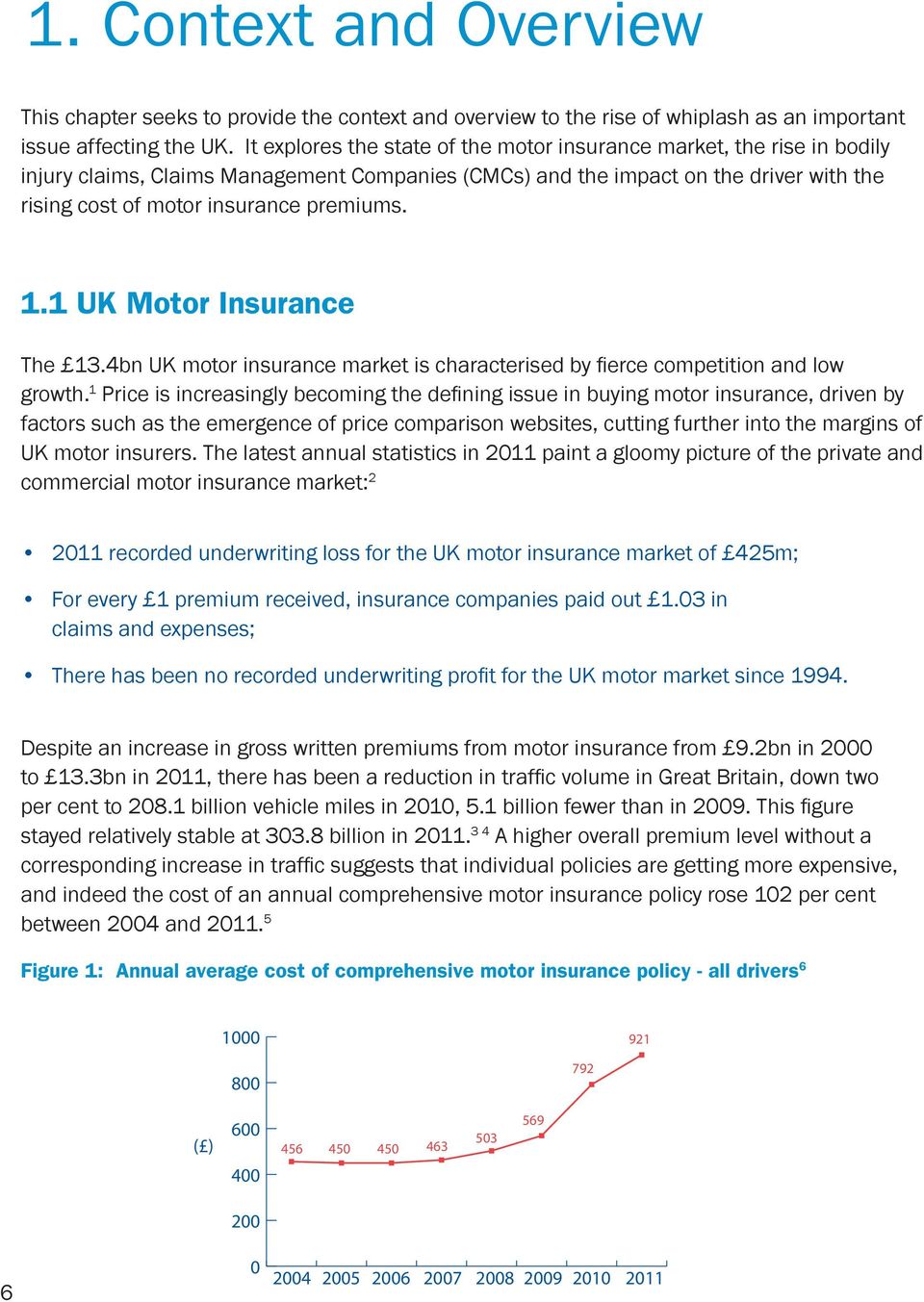
6 1. Context and Overview This chapter seeks to provide the context and overview to the rise of whiplash as an important issue affecting the UK. It explores the state of the motor insurance market, the rise in bodily injury claims, Claims Management Companies (CMCs) and the impact on the driver with the rising cost of motor insurance premiums. 1.1 UK Motor Insurance The 13.4bn UK motor insurance market is characterised by fierce competition and low growth. 1 Price is increasingly becoming the defining issue in buying motor insurance, driven by factors such as the emergence of price comparison websites, cutting further into the margins of UK motor insurers. The latest annual statistics in 2011 paint a gloomy picture of the private and commercial motor insurance market: recorded underwriting loss for the UK motor insurance market of 425m; For every 1 premium received, insurance companies paid out 1.03 in claims and expenses; There has been no recorded underwriting profit for the UK motor market since Despite an increase in gross written premiums from motor insurance from 9.2bn in 2000 to 13.3bn in 2011, there has been a reduction in traffic volume in Great Britain, down two per cent to billion vehicle miles in 2010, 5.1 billion fewer than in This figure stayed relatively stable at billion in A higher overall premium level without a corresponding increase in traffic suggests that individual policies are getting more expensive, and indeed the cost of an annual comprehensive motor insurance policy rose 102 per cent between 2004 and Figure 1: Annual average cost of comprehensive motor insurance policy - all drivers ( )
7 Concurrently, the number of personal injury claims arising from road traffic accidents has risen sharply, whilst the number of casualties from these accidents has fallen every year, from approximately 40,000 in 2002 to 25,000 in In addition to the rising number of claims, the payout of the average personal injury claim has risen to 3,565 in 2010, up from 2,556 in Figure 2: Increase in personal injury claims rising with the average cost of bodily injury claims (Personal injury claims, 000s) ( ) Average Cost of claims payment average Number of motor insurance injury claims notified to the Compensation recovery unit Cost of claims payment amount ( ) The Compensation Recovery Unit is a part of the Department for Work and Pensions which is informed when a claim for compensation is made According to the Financial Services Authority (FSA), insurers lost over 1.03 for every 1 premium sold in Figure 3 shows the impact of these trends on the motor insurance industry. The net claims incurred have outweighed the net written premiums since 1994, resulting in an underwriting loss. In response to this increase in the number of claims and cost of claims, insurers have been forced to increase insurance premiums for consumers. This is particularly damaging for young people, with 96 per cent of young drivers believing they are being priced off the road. 10 7

8 Clearly there is an impact on people s cost of living because motor insurance is a significant chunk out of a lot of family s budgets. Looking at this could benefit the majority of drivers Alison Seabeck MP Why do insurers accept these underwriting losses? Personal motor insurance is still the single largest class of insurance business, with UK insurers generating 18.6bn worldwide in Therefore, for any insurer with a desire to be a major player on the insurance landscape, with a large pool of funds to invest, motor insurance remains a crucial market to operate in. The scale of competition to access this revenue pool is high, leading to increasingly tight margins. The consistent loss on motor insurance underwriting has increased the reliance on a reducing stream of investment income, as well as sales of ancillary products and the provision of referral fees in order for firms to maximise revenue. Figure 3: Underwriting motor insurance is not profitable in the UK bn Net written premium Total Outgoings Underwriting result Costs of increasing whiplash claims have additional impacts on UK plc. We undertook interviews with two UK businesses that are directly exposed to the recent trend in whiplash claims. Given the nature of the market place, large fleet operators self-insure parts of the liability risks arising from road traffic accidents. Unlike motor insurance premiums which are relatively easy to track, the hidden costs faced by businesses and public authorities often go unnoticed but run into potentially hundreds of millions of pounds. Firms which operate large commercial fleets are heavy road-users and are at the sharp end in efforts to cap the growing claims culture driven by whiplash. Below we include two examples of UK firms which have felt the impact on their costs. 8

9 Case study: FirstGroup plc With its roots in Aberdeen, FirstGroup has grown rapidly to become the world s leading ground transport operator. As a major British success story, its 125,000 employees help to transport some 2.5 billion passengers a year, generating revenues of over 6 billion. 13 Within the UK, it is now the largest bus operator running more than one-in-five of all local bus services. The company has a fleet of some 8,000 buses, carrying 2.6 million passengers a day in more than 40 major towns and cities. 14 The company has based its growth on an absolute commitment to safety and a strong foundation of sound risk management. Detailed data analysis is carried out in order to assess where all the risks arise within the business risks can be assessed for individual drivers, vehicles and each route operated. In addition, the company s Injury Prevention scheme encourages a Safety First culture throughout the company. As a result of the company s efforts to improve the safety of its operations through thought leadership, commitment to best practice and employee training, it now has one of the best safety records of any major bus operator in the UK. Yet the company has still experienced a dramatic increase in personal injury claims, which now account for 40 per cent of all outstanding claims; up by 13 per cent in recent years. Since the introduction of the MoJ portal (30 April 2010), the impact of personal injury claims continues to grow and claim costs are now 31 per cent higher since the new reforms were initiated. During 2011 the company has experienced an 11 per cent increase in personal injury claim notifications and a 25 per cent increase in passenger injury claims. In contrast, vehicle damage claim notifications have reduced by 21 per cent during the same period. The company is having fewer collisions or accidents each year but seeing more injury claims made. Given that the company is effectively self-insured for the majority of these claims, most of which are for alleged whiplash or soft tissue injuries, additional costs are being incurred which the company has to fund. 9

10 Case study: Sheffield Insulations Group (SIG) As a major UK fleet operator SIG has 2,200 vehicles across the UK supporting its 1.2bn annual turnover of insulation, exterior and interior products distribution businesses. Ensuring all risks facing the business are properly assessed is critical. SIG has its own Accident Review Panel (ARP) which meets monthly to look at accident and incident data across all of its UK businesses. The ARP has access to data which enables it to assess risks on both individual drivers and vehicles. Risks are managed through appropriate training and where necessary, disciplinary action. Despite all of SIG s best efforts and whilst the UK s roads are themselves safer than ever, combined with the continued improvement in car safety design, the cost of personal injury (PI) claims continues to increase perpetuated by the current claims culture and fuelled by the advertising and prominence of claims management companies. SIG like many companies carries a significant level of self-insurance and the ever increasing cost of PI claims is a significant additional cost for commercial fleets, on top of fuel price increases. In the case of SIG nearly 50 per cent of third party claims by cost now come from PI claims. The increasing number of such claims the company receives, many of which based on the circumstances of the incidents appear to be at the least spurious and in some cases fraudulent, significantly add to fleet running costs. Unfortunately the current claims settlement system is stacked up against defendants, with claims companies making the most of what they regard as being easy pickings. Anecdotal evidence and reports from employees have confirmed the ease with which sympathetic supporting medical evidence can be obtained. As a result of this both commercial fleet operators and insurers alike are in many cases forced to settle spurious or fraudulent claims given the basic economics: typically the damages will be worth no more than 2,000-3,000, which is dwarfed by the potential 15,000-20,000 in legal costs which might be incurred in defending the claim. SIG have also experienced issues with what are perceived to be claimant-friendly courts in some parts of England, where judges no longer expect claimants to even attend disposal hearings reviewing their cases, combined with there being no penalties for bad practice among claimant lawyers in not following due legal process. Both of our case studies recognised that no one factor can be singled out in explaining the trends outlined above: for example, whiplash on its own is not the issue; nor can it be blamed on the medical profession. Rather, it is the wider environment in which all of the various legal, economic and social factors come together which is contributing to the fundamental problem of high legal costs and the impact of exaggerated or spurious claims. Whilst the introduction of the RTA portal has been a welcome initiative, the full potential impact has been limited due to the reduced burden of proof requirement (no proof of injury) at Stage 1 when the initial cost ( 200) is payable. 15 Additionally, some of the benefit from the payment of Stage 1 costs are now being moved to Stage 2. Weighting the staged payouts under the RTA portal towards the end of the process when the evidence has been gathered and the claim has been settled would be a helpful development. Fleet operators would also benefit if the Portal adopted a more tailored approach which reflect the unique challenges in gathering evidence and determining liability in those cases which involve multiple claimants. 10

11 If there is a test where people don t have to show something has happened that s not a test. A test has to potentially disprove something. You have got to have a test which shows something is disprovable. If not it is not science. Sir Peter Bottomley MP 1.2 Defining and diagnosing whiplash Whiplash is a non-medical term describing a range of injuries to the neck caused by or related to a sudden distortion of the neck associated with extension. 16 Cervical acceleration/deceleration (CAD) describes the mechanism of the injury and Minor Cervical Trauma (MCT) is the most common injury resulting from whiplash. 17 The Quebec Task Force Classification system for diagnosis of whiplash is classified into four grades in increasing order of severity. In the UK, over per cent of all whiplash cases are attributed to grades 1 and 2 whiplash associated disorder (WAD), which includes neck pain and possibly decreased range of motion in the neck. Only 5-8 per cent of WAD incidence is attributed to grades 3 and 4, which includes symptoms of neurologic damage and spinal cord injury. 18 The problem is that grades 1 and 2 are virtually impossible to diagnose because they cannot be visualised by MRI scans or X-rays and therefore no objective evidence can be produced. Between 2008 and 2011, the number of people claiming whiplash has jumped by 32 per cent to 570,000 a year, even though the number of accidents reported has fallen by 16 per cent to less than 210, There is no doubt that some of these claims are genuine, but it is apparent that many people visit a doctor or an Accident and Emergency Department for the sole purpose of obtaining a medical record to file a compensation claim, even when no injury has been sustained. There are in excess of 500,000 recorded incidents of whiplash annually in the UK; with any other health condition, this magnitude of incidence would be flagged as a major public health issue. Controversy arises regarding MCT because around 70 per cent of motor insurance personal injury claims are attributed to whiplash injuries, at a cost of 2bn per year. 20 This is estimated to add 90 to the average UK motor insurance premium. 21 The Road Traffic Act of 1988 states that the first non-hospital physician that provides emergency treatment to a road accident victim is entitled to charge a fee of and a mileage rate of 0.41 for anything over 2 miles directly to the patient. Sometimes treatment for whiplash is not sought immediately after the accident and the BMA s advice for the GP s surgery is to treat these cases as emergency treatment and therefore charge the fee under the Road Traffic Act. 22 Most physicians, however are either not aware of the fee or do not think it is fair to impose such a fee if it may deter genuine whiplash cases from being examined. Dr. Stephen Davies, a spokesperson for the Royal College of General Practitioners (RCGP), verifies that both the NHS and the RCPG support this fee, although the vast majority of surgeries still diagnose whiplash associated disorder with no charge

12 The Transport Select Committee s report of January 2012 recommended that the bar be raised on the proof required before whiplash injury can be compensated. The committee concluded: Where someone can demonstrate that they have suffered an injury, including whiplash, as a result of a road traffic accident for which they were not fully liable they should be able to claim and receive compensation. However, in relation to whiplash, we are not convinced that a diagnosis unsupported by any further evidence of injury or personal inconvenience arising from the injury should be sufficient for a claim to be settled. 24 Premex, a provider of independent medical reports for personal injury claimants, and its competitors in the UK, presently provide 50 per cent of all personal injury claims with medical reports through their panel of medical professionals. They provide specific training material to their medical panel on whiplash diagnosis, which is the first step to an independent objective medical diagnosis akin to the system in France. These organizations have set fees under the Medical Reporting Organisation Agreement of 200 for a medical report with no review and 250 with a review plus any other fees that are associated with obtaining medical notes. These types of agencies have decreased the time it takes to obtain medical reports and have increased the use of GPs rather than specialists for reporting whiplash. They are also the first step towards standardised reporting and examination similar to what is currently used in assessing the entitlement for various disability benefits. Standard reporting is beneficial in identifying the appropriate compensation for damages in a fair manner but a balance must be found between the cost effectiveness of the medico legal report and the robustness of the examination. The problem still remains, though, that the BMA needs to develop proper guidance to diagnose whiplash and Lord Hunt requested that either the medical profession must take action or Parliament needs to better define the evidence needed for whiplash diagnosis. 25 The question of how doctors can provide concrete evidence to the courts confirming the presence of whiplash remains to be answered. At present, England and Wales does not have a robust and scientific way of judging the location and severity of the pain, with doctors relying in many cases on the comments of the patient. Fixing this issue will involve some upfront costs for the NHS and insurers. However, as we have seen with efforts to promote welfare to work reforms, the Government has been prepared to fund upfront costs in the knowledge that it will generate greater benefits in the long-term. The potential costs and benefits of such reforms are considered below when we look at the It is enormously difficult [to judge] without putting a huge additional burden on criminal investigation teams and on the Health Service who would have to do potentially more detailed testing rather than sitting in your GP s surgery and doing some basic tests and the GP saying - Yes - I think you ve got a whiplash problem. Alison Seabeck MP 12

13 example of market practice in France which already has in place such a more comprehensive medical approach to assessing whiplash. In addition to diagnosis, the treatment of whiplash is a highly debated area that is supported by very little evidence for or against intensive care. A recent study published by the Lancet shows that intensive, specialised and longer treatment for mild to moderate whiplash provides no benefits for the victim s recovery. The study looked at the results of 2704 whiplash victims and assessed their Neck Disability Index (NDI) after receiving intensive care and standard care as well as physiotherapy treatment compared to general advice and worksheets on exercise. The results of this study showed that both receiving intensive care and lengthy physiotherapy did not offer a significant benefit to the whiplash victim. This indicates that an adjustment should be implemented by the NHS on the guidelines for the treatment that a person can receive for whiplash. If this data can be confirmed and reproduced, consequently decreasing the extent of whiplash treatment provides immense cost benefits immediately and in the long term.26 13

14 1.3 Claims management companies Figure 4: Heat map of claims management companies 27 Region North West England 42.8% North East England 40.3% Yorkshire 37.4% Central 30.5% London and South East England (excl. Kent and Essex) % of private motor insurance claims involving bodily injury 29.5% Great Britain average 29.4% Wales 28.3% East Anglia 25.8% West and South-West England 22.4% Kent and Essex 21.8% Scotland 20.4% North-East Scotland 13.0% Institute and Faculty of Actuaries Figure 4 shows the relationship between the number of Claims Management Companies (CMCs) and the proportion of private motor insurance claims that involve bodily injury to third parties. As whiplash in the UK makes up a significant proportion of personal injury claims we can say that there is a relationship between whiplash prevalence and CMC s geographic location. 14 The claims management companies can only ride on a system which works in their favour. If not they ll evaporate Sir Peter Bottomley MP A positive correlation exists between the number of CMCs in a region and the proportion of private motor insurance claims that involve injury to third parties. Generally, more CMCs mean more motor insurance claims involving bodily injury. Prices of motor insurance are also linked to location of claims management companies. The North West of England has the highest average annual comprehensive premiums, at 1,615, as well as a very high concentration of claims management companies.

15 It doesn t seem like a crime just getting some money back that should not have been paid in the first place [we have] good people doing bad things. David Ward MP CMCs are a growth industry, with national turnover increasing 50 per cent to 377m in The strongest growth in CMCs has been in North West England, North East England and West London, which are all areas with high levels of motor insurance claims involving bodily injury The Advancement of Anti-Whiplash Technology Several recent studies have identified the seat and headrest design to be the most important factors in whiplash safety. 29 The Volvo WHIPS system is the most well known and one of the most effective anti-whiplash technologies on the market. The WHIPS seat has improved spinal support and has been designed to keep the headrest closer to the drivers head. It also is constructed with a novel hinge mount and springs that move the seat back in the event of a rear collision in order to absorb some of the impact from the collision. This system of improved seat and headrest design helps to limit the impact of whiplash. The implementation of the WHIPS system in 1999 resulted in 49 per cent fewer injury claims in the Volvo vehicles. There are autonomous vehicle braking technologies emerging such as Volvo s City Safety. A recent paper uses the Volvo City Safety to generate predictions for the effect of this system on whiplash cases. Their predictions display that 263,250 crashes could be prevented, 87,750 could be better mitigated and 151,848 injuries could be avoided. This equates to 2 billion in auto repair costs and whiplash compensation in the UK. 30 In 2008, the European New Car Assessment Programme (Euro NCAP) implemented a whiplash test as part of its new car assessment to reduce the incidence of whiplash associated disorder, to encourage car manufacturers to produce best-in-practice seat designs and increase consumer awareness of whiplash safety. The Euro NCAP ranks new cars by the quality of their whiplash safety by a set of statistical and experimental safety data and publishes an annual report

16 2. Lessons from overseas In this section we examine some of the experiences from other countries which have dealt with whiplash claims in a number of ways. We have chosen to review European countries including France, Sweden, Germany, Italy and Switzerland since they represent territories with a similar economic disposition to the UK. To provide a global dimension we also analysed the compensation system in Canada - a country with an established road infrastructure but without the complexity of multiple states, each with its own rule book, like the USA. It is notable that, of all the examples we looked, at it is the French model in which the approach taken by the medical profession in dealing with the diagnosis of whiplash is markedly different to that in England and Wales where we potentially see the greatest learning points. Sweden too, has applied the use of a strict de minimis time limit imposed on new claims and both countries have seen very different trends emerge. 2.1 Overview - Whiplash across Europe To reinforce the points made in the previous chapter, we can see that the same story exists when looking across Europe. Although bodily injury claims are not linked to the number of fatalities on the road, they are a key cause of the rising cost of motor insurance. The data points on the chart below represent the European countries, with data taken from Insurance Europe s 2010 motor insurance report. As we know from the 2004 CEA report into whiplash, a significant proportion of personal injury claims are whiplash related. Therefore, as there is a relationship between personal injury claims and insurance premiums, we can infer that whiplash claims have a direct correlation to insurance premiums. Figure 5: The cost of motor insurance rises with levels of personal injury claims Hungry 16 Average total motor insurance premium ( ) Personal injury as % of total claims Czech Republic Greece Poland Portugal Germany Belgium Austria France Sweden Spain United Kingdom Italy

17 Figure 5 shows a strong correlation between the average motor insurance premium and personal injury claims as a percentage of total claims. The relationship is clear, with the number of personal injury claims being to some extent responsible for driving the level of motor insurance premiums. This implies that if countries are able to bring their levels of personal injury claims down then reductions in premiums should follow. Figure 6: There is no relationship between fatalities and levels of personal injury 16 Hungry Greece Poland Czech Republic Greece Poland Number of fatalities per 100,000 inhabitants Hungary Czech Republic Portugal Belgium Austria Spain France Italy Portugal Germany Belgium Austria 4 2 Germany Sweden United Kingdom France Sweden Spain United Kingdom Personal injury as % of totals claims Italy However, there is no relationship between the level of fatalities on the road and the number of personal injury claims. This implies that the number of personal injury claims is in fact unrelated to the number of road accidents. Therefore to explain the reasons behind the high levels of personal injury claims we need to look at wider social and legal trends in individual countries to evaluate what drives the level of claims. The heat map below shows the average total motor insurance premium (adjusted for PPP*) across Europe. Switzerland and the United Kingdom have by far the highest costs of motor insurance, while Greek and Polish motorists have the cheapest motor insurance out of the countries selected. 17
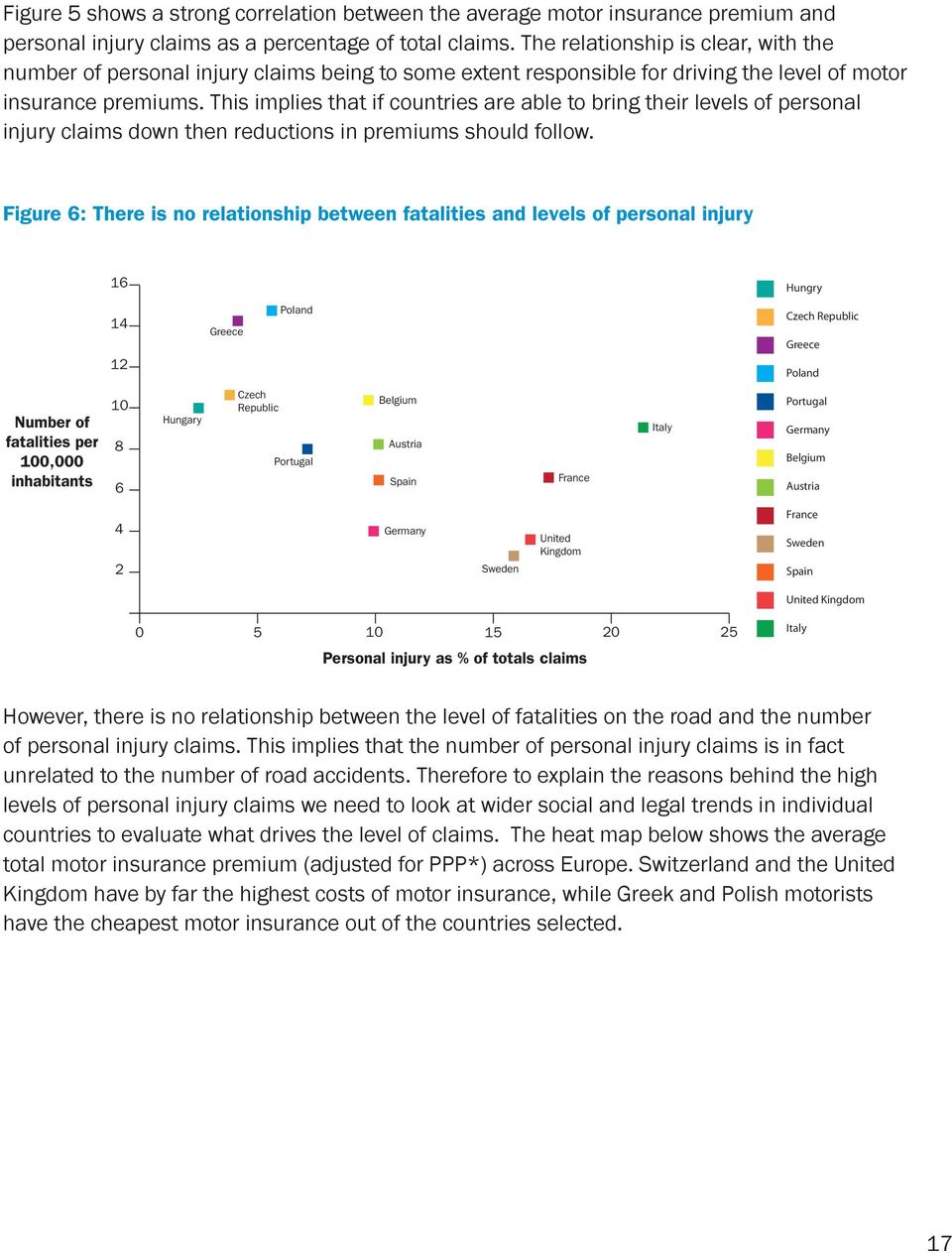
18 Figure 7: Average total motor insurance premiums across Europe Country Average Total Motor insurance premium ( PPP*) Greece 283 Poland 300 Hungary 358 Portugal 359 Germany 363 Sweden 369 France 410 Czech Republic 422 Norway 442 Belgium 448 Austria 462 Italy 485 Spain 486 Switzerland 614 United Kingdom 681 *PPP stands for Purchasing Power Parity, which is an economic theory and technique which compares the amount of money needed to buy the same goods or services in different countries The influence of the whiplash victim s cultural setting is examined by the CEA by looking at the German, French and Italian speaking parts of Switzerland. The German speaking regions exhibit much higher amounts of claims and costs compared to the French and Italian regions and the CEA suggests that this is related to the heavy amount of lobbying from whiplash victim associations and therefore public awareness of the availability of personal injury compensation
19 2.2 France Overview In the CEA s 2004 study, France had the lowest level of insurance claims linked to whiplash (0.5 per cent) out of all ten countries surveyed. It also had one of the lowest levels of cost per claim at Whiplash claims are estimated to be only three per cent of all bodily injury claims and the country is often used as a comparison point by other countries pointing out their own high costs. Due to whiplash being a minor issue in France minimal data has been published since the 2004 CEA report. As shown by figure 7, the French enjoy relatively low levels of car insurance, at just 410, and this is in part due to the low levels of bodily injury claims incurred. Medical framework In France, strict regulation and a strong medical element to personal injury claims seem to have played a role in keeping the cost of car insurance down in recent years. Diagnosing bodily injury To diagnose bodily injury in France there is a firm emphasis on objective proof. With regards to whiplash this means that injury is not recognised unless the medical professional is able to see evidence of injury, such as on an MRI scan or X-Ray. Medical qualifications There are strict rules in France around the qualifications needed to be able to diagnose bodily injury when an insurance claim is involved. Legislation specifies a certain level of training required in order to assess bodily injury, requiring a diploma in bodily injury assessment. No compensation can be awarded without this legal and independent assessment, and many argue that this is the key element to the containment of whiplash claims. There is an extensive process for diagnosing whiplash, including the requirement for a neurological examination and one of several diplomas are needed to assess Bodily Injury from a medical perspective. The CAPEDOC (see below) is one of these although other University qualifications can be used to award diplomas in Legal Medical Assessment. The assessment is performed by a doctor trained and who has graduated in legal medical assessment. 19
20 Two kinds of diplomas are relevant: Diploma from University in Legal medical assessment - Réparation du Préjudice Corporel (RJDC) Diploma named CAPEDOC delivered by the French Insurers association required by the insurance companies to assess direct settlement claims which are compensated via an agreement between Motor Insurance Companies The medical assessment given by professionals with these qualification aims to: Give a medical and independent opinion on the victim s physical and psychological state related to the accident; Estimate the current and future consequences of the accident; Allow the claims handler or the Court to estimate the extent of the damage and propose a fair compensation. Medical-Legal Assessment The medical assessment legal framework is based on two pillars; the type of damage such as disability or pain or suffering is defined by the law. This is in addition to a medical scale in which each damage is rated by the medical expert on a medical scale. Compensation of bodily injury claims is based on a legal medical scale and the assessment is performed by a doctor with knowledge of legal medical assessment. The type of calculation used to measure the scale of bodily injury in France is the calcul au point or the AIPP scale. The courts usually ask the experts to specify a percentage of incapacity, though only in an indicative way. Frequently, medical experts use unofficial scales, but usually rely on their professional experience. The most commonly used scale in the courts is the bareme fonctionnel indicative des incapacites en droit commun published in Le Concours medical in The Code of Civil Procedure from the French Assemblee Nationale mandates that the forensic medical expert, individual or corporation is prohibited in engaging in an activity that is incompatible with the independence necessary to carry out its mission in the statutory provisions in Articles 2 and 3. This means that the medical professional who is evaluating the whiplash claims must be independent of any external organisations that may influence their medical assessment. An example of the level of compensation based on age and disability is shown in the table below The principle behind this table is that the older the individual is, the less time they will have to live with this permanent or semi-permanent injury and therefore as age increases, the compensation decreases. AIPP, Age % 1,200 1,100 1, % 1,400 1,290 1,180 1,120 1, % 1,600 1,480 1,360 1,290 1,200 20

21 AIPP Scale Example Injuries: AIPP (%) Example of Injury 0-5% Loss/paralysis of toe or finger, loss of smell or voice 5-10% Loss of hearing in one ear, knee replacement 10-15% Loss of all toes or teeth, loss of teeth 15-20% Facial paralysis, loss of non-dominant thumb 20-25% Loss of dominant thumb, loss of vision in one eye 25-30% Loss of foot or leg (replaced by prosthetic) 30-40% Loss of non-dominant hand 40-50% Loss of dominant hand, loss of non-dominant arm 50-60% Loss of dominant arm, loss of leg, sight or hearing % Paraplegia, tetraplegia, cranial trauma Legal process If the claimant wishes to dispute the decision taken by the medical expert then they are able to go to court. Once taken to court, if the claim is unsuccessful, the cost of legal fees falls on the claimant. However, if the claimant is successful in front of a tribunal, then compensation for pain and suffering and reimbursement for legal fees will be awarded. There are no scales for compensation and no fixed amount but a guideline related to average cost per head of damages is used by courts to compensate personal injury claims. 2.3 Sweden Overview Between the 1990 s and early 2000 s, Sweden saw a rapid increase in the number of whiplash related injuries, resulting in increased cost to drivers. Whiplash injuries in Sweden were depicted as very common in the media. A Whiplash Commission was an initiative financed and undertaken in 2002 by the insurance industry with the former Prime Minister Ingvar Carlsson as chairman. Their work was finalised in 2006 in two reports, with some key implications outlined below. The Commission noted that in 2002, more than 30,000 people in road accidents reported neck problems to Swedish insurance companies, representing more than half of all injuries reported. At present, whiplash claims do still occur but have reduced significantly. Although there are no reliable statistics to show levels of whiplash claims at present, in 2011 the total number of personal injuries was 27,000. The view from Insurance Sweden is that the incidence of whiplash injury is now less than 50 per cent of personal injury, compared to approximately per cent in the 1990 s. 21
22 De minimis threshold In Sweden, a time limit system for the onset of symptoms is used, and cases where symptoms appear more than 72 hours after the incident are generally rejected by insurers. This is more a rule of thumb, as opposed to a strict rule, and is used as an approximation of close proximity to the accident in question. This de minimis threshold was reinforced by the Whiplash Commission s medical group in that symptoms must be discovered within 3-4 days after the accident otherwise it is not a whiplash injury. Other attempts to control whiplash The main report written by the commission was on how to prevent fraudulent whiplash claims while the second study was a medical report on assessment, treatment and rehabilitation. These were rolled out across all emergency hospitals in Sweden and to other stakeholders. During 2007 Insurance Sweden also produced a leaflet with consumer information on How to act when having a whiplash injury that was sent to all pharmacies and medical day care centers. The trade association also produced a small information guide for doctors when assessing a whiplash injury. The Commission s medical report was published in European Spine Journal in October 2008 (Volume 17 Supplement 3). Insurance Sweden had also been sponsoring through the Whiplash Commission the work of The Bone and Joint Decade task force on neck pain and its associated disorders, which was published in Spine on 15 February In 2009, there was a joint conference held by two medical groups in Stockholm on how to detect, treat and rehabilitate whiplash injuries. Doctors from the Nordic countries attended. Insurance Sweden says it is now able to see the positive effect of their work; Most motor manufacturers now make their cars with specific emphasis on protecting drivers and passengers from whiplash injuries. There is a more common understanding in Sweden of whiplash injuries including how to detect, treat and rehabilitate them, yet it is not easy to spread the information to all doctors in the country. Whiplash patients are not something they see every day, compared with people with high blood pressure etc. The courts have accepted how the injury works. (You cannot now claim that you have a neck pain from an accident eight years ago if you haven t had any pain the first four days.) There are fewer people seeking treatment at hospitals claiming that they have a whiplash injury. Earlier people involved in a car accident wanted to be x-rayed even if they didn t have any symptoms. 22
23 2.4 Germany Overview German insurers have faced similar problems in that they are seeing a decline in gross written premiums in parallel with an increase in the cost of claims. Despite this, Germans are able to enjoy relatively low premiums compared to those in other European countries, especially the UK which has average premiums roughly double that of Germany. In part this has been brought about by fixed claimant legal costs which average 300 in Germany compared with 500 in the UK (recently lowered from 1,200 in April 2013). Due to regulations imposed by the German government there is also a smaller incidence of whiplash claims reported. Collision speed limit on claims In Germany a system involving the consideration of biomechanical evidence was used pre- 2003, where claims involving a collision speed of less than 10km/hr were generally not considered by courts. This was, however, repealed; the BGH (Bundesgerichtshof, Federal Court of Justice of Germany) required that a case-by-case analysis of claims should be adopted as of The claimant is still required to provide full proof of the incident, and these requirements can be quite high. Further methods to control whiplash In Germany, there are three levels of whiplash related injury, measured as first, second and third degree in increasing levels of severity. Second and third degree injuries are diagnosable using clear, objective criteria; problems arise when attempting to demonstrate the existence of first degree injuries. Where these cases are disputed the evidence of a physician is often reinforced with that of an interdisciplinary expert opinion. This takes into account the type and speed of impact, and the degree to which injuries could be the result of pre-existing conditions. Lower speed collisions require higher levels of proof that the injury is genuine. Claimants in Germany will require two medical opinions to prove that they have suffered a whiplash injury and classification of injury severity is measured on the abbreviated injury scale. 23
24 Claiming for whiplash in Germany German legal costs relating to personal injury claims are amongst the lowest in the world, averaging 14.4 per cent of the claim value. With the legal costs averaging at 14.4 per cent and the average fixed claimant legal costs at 300, it is notable that the average total legal cost is significantly below that in the UK. It is a country considered by the UK as a good example of legal costs kept under control by efficient regulation. The Jackson report 38 commits a whole section to the German legal cost structure. The key points are outlined below; 39 The German rules of civil procedure contemplate cost shifting, albeit according to welldefined scales for recovery. The effect may be that a successful litigant is entitled to recover a smaller proportion of its actual fees than would be recoverable in England and Wales. 40 The German system permits the use of contingency fees only in limited circumstances, namely where a claimant does not have the means to retain lawyers for his case. Legal aid is available in certain civil cases. 41 In Germany, civil litigation is managed by the court so that it controls the proceedings and the evidence that is brought before it. One method by which the court does this is to appoint experts to assist the court on relevant factual issues, rather than leaving it to the parties to adduce their own expert evidence Canada Overview Motor insurance in Canada is regulated by province and legal systems and insurance premiums vary widely. Some provinces such as British Columbia have government-owned motor insurance corporations with a monopoly, aimed at keeping costs down. The average cost of motor insurance varies from a low of $CAD642 a year for the Quebecois to a high of $CAD1,282 for Ontarians. Comparative studies have shown that those states with a private but well regulated market for auto insurance, such as Alberta, generally have the most affordable premiums for motor insurance. 24
25 Compensation cap Figure 8: Average premium as a percentage of Disposable Income per person 43 Despite being privately run like Ontario auto insurance, Alberta s system is nearly twice as affordable - partly due to strict limits on specific medical costs. 4.0% 2.7% 2.5% British Columbia Alberta 4.5% Quebec Ontario Onttario has long been the most costly province for motor insurance, and fraud accounts for 15% of overall costs to insurers. Ottawa Legal Framework In Canada, there are prescribed compensation caps for whiplash associated personal injury claims, however these vary between provinces. In Nova Scotia the general damages cap for minor injuries (including whiplash-associated disorders is currently set at $CAD7,665 (approx. 5,500) and is linked to inflation. The province of Alberta also has a similar general damages cap, but at the lower value of $CAD 4,559 ( 3,270), also inflation adjusted. This latter price cap was disputed in 2008, however it was ruled as constitutional in As a side effect of this, Alberta s Automobile Insurance Rate Board (AIRB) required insurers to reduce their premiums by five per cent. Many states have a no-fault rule in place in order to try and limit personal injury claims, and it can be argued that this is one of the factors keeping premiums low in Quebec in particular. While in Ontario the cost of motor insurance increased significantly up to the 2010 reforms, yet in other states costs have been under control or have even fallen (as in Nova Scotia). The Fraser Institute, a think tank, believes that Ontario s legal framework is a direct contributor to its high insurance costs. They claim that regulatory severity has failed to prevent insurance fraud, and has instead encouraged it and led to runaway costs. Bringing whiplash under control: the Ontario study Ontario has a tightly regulated but extremely generous motor insurance sector, where the regulator controls premium levels but has approved consistently high increases in premiums. This has been driven by what Ontario s Auditor General believes are unnecessarily high payouts and a lack of measures in place to combat fraud. 44 Insurance Canada believes that the Minor Injury Guideline, introduced in Ontario in 2010, has had an important impact on levels of claims. It limits the payment for injuries such as sprains, strains and whiplash to $CAD3,500 45, in an attempt to combat runaway payouts to Ontarians which were averaging $CAD56,
26 Has it worked? More than 18 months since its introduction, there is not enough data to truly say that the reforms are working, according to RBC Insurance chief for property & casualty Anne-Marie Vanier. 47 In 2012, she told the third annual Canadian Insurance Financial Forum in Toronto: The best complete data we have for analysis is up to June But there are some signs that the reforms are at least partially doing the job intended. The cost of assessments is now 10 to 18 per cent less than pre-reform. Accident benefits claims are developing better than expected. Frequency on those is down 10 to 20 per cent and a lot of suspect medical clinics have closed. But there are still a large number of claims in mediation. On third party liability and bodily injury claims, frequency has increased 15 to 40 per cent depending on the insurer. 2.6 Spain Overview Spain has problems with a growing claims culture, though the UK and other countries may be able to learn from the aggressive fraud prevention policies pursued by both insurance companies and the government. In Spain, an injury under the personal claims system is known as a sequels. The most recent estimates suggest that 60 per cent of all sequels in Spain are whiplash related. This high prevalence is compounded by worries over the level of fraudulent claims. The claims procedure in Spain is similar to that of the UK, in that lawyers are involved throughout the process. Once a case makes it to court and liability has been established, a doctor s certificate is required to verify the claim. The actual level of damages is controlled by the Baremo personal injury system (which uses actuarially derived tables to calculate the payout a claimant would receive). The severity of an injury is measured on a range of 1 to 100; an injury level of 100 would typically be associated with cases such as total quadriplegia, whereas whiplash related injuries are typically limited to 3. This results in a typical payout of around 3,000, with lawyers fees taken as a percentage of this, usually around 10 per cent (or approximately 300) as a conditional fee (no win - no fee) arrangement. Measures to control whiplash In Spain, the main challenges for the future of whiplash claims concern fraud, and more specifically the prevalence of organised fraud. There is a growing claims culture of lawyers pursuing a large volume of cases, and there is an increasing worry over the potential involvement of health professionals in producing/enabling fraudulent and exaggerated claims. 26
27 The Baremo legal system for the assessment of personal damage caused by road accidents was introduced by Law 30 in The assessment system is a legal and rating system that seeks to value all types of damages, both pecuniary and non-pecuniary. The Spanish government intends to promote a reform of Baremo to adapt it to new social realities and to mitigate its main defects. At present, the full scope of this project is not known, but a comprehensive review is also being carried out internally by UNESPA, the insurance business association. Fraud prevention policies are very common in private insurance companies and in the government. The focus is on awards for the detection of fraud, and there are commissions that work on fraud prevention, such as the one at UNESPA, and a significant increase in police checks. There is also close collaboration between the security services, Zaragoza Centre and UNESPA, to stamp out illicit trade in vehicles and to improve the recovery of stolen cars. 2.7 Italy Overview Italy has the highest density of cars in Europe and the second highest motor insurance claim frequency. Motor insurers have experienced heavy losses on the increasing costs of motor insurance claims, with a combined claims ratio of 109 per cent in In 2012 Italy introduced legislation in an attempt to reduce the levels of unjustified bodily injury claims. One in five claims in Italy is a personal injury claim. The provinces of the south have a higher experience than the national average, for instance: 44 per cent of claims in Crotone are for personal injury; Brindisi, 41 per cent; Taranto, 40 per cent; Foggia, 37 per cent. Very mild injuries account for 13.3 per cent of claims and more than 70 per cent of non-severe injuries. Italian insurers indemnify these claims with about 1.7bn a year, or more than 11 per cent of total motor liability compensation. Direct indemnification The introduction of CARD (Convenzione tra Assicuratori per Risarcimento Diretto) Direct Indemnification system aims to decrease claims costs by reducing conflict between the injured party and insurers through reduction of legal involvement. 48 In addition, databases have been created by authorities to record injury data (e.g. Social Security records all injuries to workers; the Italian regulator created databases with all insurance industry claims data) to counter or limit potential fraud. 27
28 Other whiplash reducing initiatives Insurers have also tried to reduce the number of whiplash injuries by: Challenging medical results when there is not a clear medical opinion to prove symptoms; Investing in expert analysis of acceleration-deceleration forces according to vehicle deformation; Accepting only original medical documentation; Investigating any precedent to avoid having to pay the same damage twice (or more).the cost of these actions is sometimes higher than the damage itself but there is a consensus that it is worth proceeding in order to deter fraudulent behaviour. In Italy, personal injury claims are made using the Book of Quantum principles, where an injury is assigned a specific level of severity by a court, and damages are assigned based on this level. The level of severity for personal injury is based on a scale from 1 to 100 per cent of permanent disability, with whiplash claims typically receiving two to three per cent on this scale. This remains a point of contention for Italian insurers, who argue (through ANIA, the Italian trade organisation) that whiplash does not generally cause a permanent disability, and therefore should not be classified as such. Lawyers are also involved throughout the process, and fees vary from 10 to 20 per cent of the payout. Typical payouts are in the region of 3,000, and therefore fees range from 300 to 600. The claims culture itself is however markedly different to the UK, in that when individuals make a claim they usually go to the broker from which they purchased the policy (an estimated 90 per cent of policies are sold through brokers). This broker proceeds to nominate a lawyer to handle the case. While the broker is not meant to receive a fee for this, this is not believed to reflect reality. In recent years, Italian policymakers have been studying levels of compensation for personal injury. Conclusions were to fix medical criteria and the compensation value degree for permanent and temporary disability. On 26 March 2012, a new law entered into force which sets out new guidelines for accurate medical diagnosis. The insurance sector lobbied for the law because of the ease at which the court was able to award whiplash injuries without objective medical evidence certifying the disability. Although it is too soon to measure the impact of these efforts, future industry data should show its effect. 28
29 2.8 Switzerland Overview In Switzerland, the average cost of bodily injury motor insurance claims has been reported as significantly higher than in other countries. The 2004 CEA report into whiplash claimed the average cost at 35,000. The Insurance Europe 2010 report into motor insurance puts the average cost of a personal injury claim in Switzerland at 42,000. These levels of claims have been particularly high in Switzerland due to the legal system allowing claimants to claim for long periods off of work Court ruling A 2010 court case involving whiplash has had a profound impact on the Swiss motor insurance industry, and may well lead to lower levels of motor insurance premiums and personal injury payouts in the future. 49 The case concerned a woman who suffered two car accidents, one in 1997 and in She applied for payments under her disability insurance, but these were refused by her insurance company for lack of evidence that her injuries caused her inability to work. The lower court however ordered the insurance company to pay. The company then appealed to the Swiss Federal court (the Bundesgericht) which had previously ruled in 2004 that patients with pain disorders without a physically detectable cause were not covered by disability insurance. In the case at hand (a ruling from August 2010) the Court extended this practice to injuries related to whiplash. The Court held that whiplash injuries cannot be classified as a disability, as the symptoms manifested could have multiple causes and are not recognised as a diagnosis by any authoritative medical classification system. 29
30 3. UK Policy Landscape 3.1 Policy actions - what have UK policymakers been doing to address concerns around whiplash? In examining the background to our civil compensation system that underpins claims for whiplash and other personal injury claims, it is necessary to review the associated legal costs that form an integral part. The principle of proportionality of legal costs has long been a feature of European law. 50 In the UK, the principle became a key issue during the Woolf Inquiry into Access to Justice between 1994 and One of Woolf s key eight principles for the civil justice system was that procedures and cost should be proportionate to the nature of the issue involved. 51 However, the costs system, where costs are not fixed, as it currently operates assesses the charge for work on the basis of the market rates charged by professionals rather than attempting the no doubt difficult task of placing an objective value on the work. Lord Justice Jackson commented in his 2010 report that since Lord Justice Woolf reported, a decade earlier, nothing seems to have changed. 52 The impact of conditional fee arrangements ( no win, no fee ) has had a major impact on the cost of litigation which in turn is helping to push up the costs on insurers. In giving evidence to the Jackson Review in 2009, data from one insurer suggested that costs related to personal injury cases amounted to an average of 77 per cent of damages awarded. 53 The issue of whiplash rose up the Parliamentary agenda in the latter half of 2011, particularly in relation to the wider issue of the rising costs of insurance premiums. At governmental level, the Legal Aid, Sentencing and Punishment of Offenders (LASPO) Act of 2012 legislates for a ban on referral fees (effective from April 2013) and reform of no win, no fee arrangements by removing recoverability of success fees and ATE premiums, all of which the government believes to be key drivers of the large volume of whiplash claims in the UK. The UK government has also committed to extending the current Pre-Action Protocol for Low Value Personal Injury Claims by April The expansion will be vertically, to include claims up to 25,000 (previously 10,000) and horizontally, to incorporate Employers Liability (EL) and Public Liability (PL) claims. 54 The present RTA fixed cost will also be reduced from 1,200 to 500 for motor cases below 10,000, and new fixed costs for cases in the extended scheme. Banning referral fees and removing recoverability of success fees and After the Event Premiums form an important element in creating a more proportionate cost system for civil litigation and one where the claimant will have a personal interest in the level of legal costs incurred in their The wind has changed. The Transport Select Committee has got the bit between the teeth - they are determined not just to write a report and then leave it David Ward MP 30
31 name, but the reduction in costs was also a crutial element in reducing excess money that funded referral fees. According to evidence published by the Transport Select Committee of the House of Commons, some firms have found a way around the LASPO ban on referral fees. 55 This can be done through the provision of a package for insurers and brokers to receive payments for PI referrals by directing claims from the claimant to the law firm and then collecting a fee from the broker or insurer for directing the claimant to them. 56 The way the provider avoids the LAPSO ban is by suggesting solicitors to clients rather than directly sending their details on to a solicitor. If the client is suggested a solicitor by the software provider and then goes on to engage with them, then the provider is not doing anything unlawful. Many insurers have expressed concern over the exploitation of this loophole and have called for an amendment because it is clearly not in the spirit of the legislation and stands in the way of decreasing PI claims and motor premiums. 57 A recently published consultation on Reducing the Number and Cost of Whiplash Claims considers two vital factors for reducing large volume whiplash claims. The first is the introduction of independent medical panels to provide better medical evaluations for whiplash claims. The second establishes whether the small claims threshold for road accident claims that are attributed to road traffic accidents should be increased from 1,000 to 5,000. These proposals mimic the successful system of personal injury whiplash claim compensation seen in France where strict regulation and price control keep claims to a minimum. In Scotland, a consultation published in December 2012 set out to reform the damages of psychiatric injury by reducing the liability that may be incurred for these cases as well as decreasing the limit on the time period where an individual can take civil action for personal injury. These proposed changes seek to modernise and simplify the law and future claims that are incurred for personal injury, establishing standardised procedures for previously vague areas of the law. Although increasing the small claims track will benefit the speed at which claims can be processed, this should not be for whiplash cases alone. There is concern that other injuries such as Post-traumatic Stress Disorder (PTSD) and shoulder bruising will be used to argue that accompanying whiplash cases should not fall within an extended small claims track. It is therefore important to increase the threshold across all RTA rather than whiplash alone. There is no basis for differentiating between the nature of injury that should fall within the extended track. The claimant lobby, on the other hand, asserts that increasing the small claims track will hinder the access to justice of personal injury claimants who need to represent themselves. It is a likely case that an increase in the small claims track will cause there to be more unrepresented claimants, they will be more likely to receive enhanced compensation because there are no legal costs for them to pay. David Ward MP, interviewed for this report, says that the timeline for implementation of reform proposals should be now now, now, yesterday, the day before. Not surprisingly, UK Parliamentarians have been highly vocal in informing this debate. The Motor Insurance Regulation Bill was introduced by Jack Straw MP to reform the regulation and operation of 31
32 the market in motor insurance, with specific regard to banning referral fees, establishing new standards related to the evidence required in whiplash claims, reforming the Pre-Action Protocol for personal injury claims in road traffic accidents, and setting requirements in respect of risk pricing for personal injury claims. 58 The section of the Bill pertaining to whiplash contained the following provisions: The onus shall be on the claimant to satisfy the court that there is independent, objective evidence that the claimant has suffered harm, and for them to justify the extent of that harm 59 ; No damages shall be recoverable if the only evidence is the subjective description of symptoms by, or on behalf of, the claimant 60 ; There shall be a rebuttable presumption that no harm or injury to the claimant has been suffered where; The collision giving rise to the accident took place at a relative speed of 15mph or less; or, There are no musculoskeletal signs of any injury, including fracture and dislocation 61 ; In March 2011, the House of Commons Transport Select Committee reported that around 70 per cent of motor insurance personal injury claims arise from whiplash injuries. 62 Among the reasons highlighted for the rise were the earlier introduction of conditional fee arrangements ( no win, no fee ) and the practices of claims management firms in generating personal injury claims, for instance through aggressive marketing techniques. 63 There is clearly fraud going on in a number of different places. It is becoming an issue for general conversation. It is moving up everybody s agenda with friends, constituents do you know anyone who has claimed? Alison Seabeck MP The Transport Select Committee s additional report in January 2012 recommended that the bar be raised on the proof required for whiplash. 64 They felt that greater use of technology could help to provide a partial solution and that countries which revealed the lower incidences of whiplash also tend to undergo radiographic examinations of patients such as x-rays, NMR, EMG, MRI and CT scans. In the UK there is only a requirement for a simple clinical examination. The Committee suggested that if the number of whiplash claims does not fall significantly as a result, they believe there would be a strong case to consider enacting primary legislation to require objective evidence of a whiplash injury, or of the injury having a significant effect on the claimant s life, before compensation was paid
33 The Committee further recommended that the Government should take action to investigate the role played by legal and regulatory rules in generating the continuing increase in personal injury claims relating to motor accidents, and assisting the police and the insurance industry in tackling fraud more effectively. 66 While the report welcomed provisions to increase access to justice, it stated that this should not provide people with an opportunity to make fraudulent We are part of a dysfunctional system that is spiralling out of control. I could have an accident and a garage which without my knowledge or permission could pass on my details without me knowing David Ward MP claims for non-existent or pre-existing aches and pains. The Committee s report also recommended that the Department for Transport sponsor a research project on international experience in restraining the number of personal injury claims relating to motor insurance, with the aim of publishing a discussion paper on this issue during 2012 outlining possible options for change. 67 At a meeting of the All-Party Parliamentary Group on Insurance and Financial Services in February 2012, it was suggested that in one or two instances some doctors are diagnosing whiplash over the phone, without undertaking any face-toface clinical examination. For this reason, and to protect the good reputation of the vast majority of medics, it is vital to separate those who diagnose conditions from the Claims Management Companies. 68 During 2012 the Prime Minster has committed the government to take action to tackle the compensation culture, reduce legal costs and cut health and safety red tape. 69 The Government and industry also committed to work together to identify effective ways to reduce the number and cost of whiplash claims. Options include improved medical evidence, technological breakthroughs, the threshold for claims and the speed of accidents. 70 Furthermore, at a high-level summit hosted by the Prime Minister David Cameron at 10 Downing Street, he committed the Government to work with the insurance industry to identify effective ways to reduce the number and cost of whiplash claims. These actions illustrate that the government recognises that the very high number of whiplash claims in the United Kingdom is a significant concern, and one which needs to be addressed. 33
34 4. Recommendations Whiplash claims are open to fraud, fabrication and exaggeration by their nature; Andrew Wigmore, the Policy Director at the Claims Standards Council, conceded that 30 per cent of whiplash claimants exaggerated their injury, and that figure may be even higher. Whiplash represents the vast majority (around 75 per cent) of all personal injury claims made in the UK, a phenomenon not repeated elsewhere in Europe. The figure in France is thought to be as low as three per cent. Insurers have no issues with compensating genuine injured claimants. However, whiplash is open to exaggeration and fraud, including organised crime. The scale of the problem is such that it acts as a significant driver of costs which are ultimately borne by all policyholders. Below AXA sets out a number of recommendations to address the issue, the majority of which were included in our submission to the Ministry of Justice consultation Reducing the number and cost of whiplash claims, which was submitted in March 2013: 1. Proposals for a national accredited panel of experts who are independent of the claimant lawyer and any other stakeholders to the process are welcomed and should be further developed including shifting the burden of proof onto the claimant in a similar manner to the French system. Any such panel must have appropriate governance and be fully independent of all parties involved in the claims process. 2. Implement a minimum threshold system in the UK, similar to that used in Sweden, based on a time limit system for the onset of symptoms, after which no compensation claim is recoverable. 3. A more forensic and robust approach to medical reporting should be adopted. Medical reports should be standardised so as to include both claimant and defendant version of accident circumstances and supporting evidence such as that relating to the extent of vehicle damage. 4. Reports should comment on the accident mechanics and also include comment on the presence or absence of contra indicators. 5. Medical reports should not be permitted to support prognoses that inflate damages. Prognoses that we see now seem to fly in the face of received medical opinion. 6. The cost of medical reports should be fixed and fall within the range of fees laid out in the Civil Procedure Rules. 34
35 7. Medical reports should categorise whiplash in accordance with the Quebec Task Force scale. There should be a de minimus medical threshold below which compensation is not recoverable, e.g. medical reports could categorise Quebec grade I and II as below the threshold of compensation while grade III and IV injuries receive compensation. 8. Currently, if any part of an insurance claim made by a policy-holder is tainted by fraud, the whole claim fails. The same position should apply in respect of personal injury claims. 9. The proposed increase in the Small Claims Track limit to 5,000 in respect of personal injury-related motor claims is welcomed and should be implemented. However, such an increase will not serve to fully address the whiplash issue. 10. To ensure appropriate behaviour by insurers who become involved with Alternative Business Structures (ABSs) (particularly around referral of exaggerated whiplash claims to their own law firms), we propose a code of conduct to be developed. 11. Damages Based Agreements will also enable solicitors to be remunerated despite the Small Claims Track for non-pi being increased. There should be restrictions on the establishment of ABSs in this area and a ban on the use of DBAs in low value motor claims. 12. In tandem with any increase in the Small Claims Limit there must be support to enable claimants to bring claims directly, without legal representation. In our opinion the so called MoJ Portal could easily be developed to facilitate this as could other initiatives such as the ABI Code of Practice in respect of direct claimants. 13. The existing reforms have provided a good platform, but Government must be vigilant and amend legislation if avoidance behaviour exists. Schemes are already emerging to avoid the ban on referral fees it seems clear that LASPO is not, in its current form, sufficiently robust. Whilst the reduced costs also reduce the pot from which referral fees can be paid, unless LASPO is reviewed and amended, referral fees, a significant driver of adverse claims activity, will continue. Other initiatives could include: 14. Improved seat design so as to reduce the likelihood of whiplash type injury. 15. Effectiveness of use of Force Analysers in identifying loss of function following road traffic collision and whiplash. If effective, this would allow objective assessment of loss of function and could greatly assist medical experts. 16. Greater regulatory rigour giving the Ministry of Justice the power to intervene earlier to ensure Claims Management Companies are behaving appropriately and to ensure they are not misleading consumers, for example, via their advertising. 35
36 5. Summary The key challenge for policymakers is to be able to create a system in which injured persons are rehabilitated and compensated and, as far as possible, put back into the position they were in while at the same time providing little incentive for fraudulent or exaggerated claims to be submitted. Other countries have been more effective at balancing this than the UK. France has had a very low prevalence of whiplash claims; in 2004, just three per cent of total bodily injury claims were whiplash related, and the proportion has stayed low ever since. Evidence from our comparative analysis shows that countries that have stricter diagnosis procedures, for example requiring claimants to have an assessment undertaken by a medical professional with specific training in diagnosing neck injuries, are likely to have a lower frequency of expensive whiplash claims. Objective proof, in addition to extensive training for medical professionals, enables an accurate diagnosis to be made and for fraudulent claims to be rejected without fuss. Other countries have been following suit. Italy, Sweden and Switzerland have also been (or are currently) challenging medical claims they believe to be unjustified. We can see this in the case of Sweden in the work of the Whiplash Commission, which the Trade Association, Insurance Sweden, now claims is having a material impact on claims. In addition to the medical requirements, Sweden s de minimis threshold has also helped to keep the number of unjustified claims to a minimum, after concluding that injuries warranting compensation should be notified within 3-4 days of the incident. We can therefore see by looking at other jurisdictions that there are a number of tools that governments can use to reduce the prevalence of unjustified claims, bring costs to insurers under control and ultimately provide fair and affordable motor insurance premiums for customers. 36
37 Acknowledgements Parliamentarians Alison Seabeck MP is an English Labour Party politician for Plymouth Moor View. She is a member of the All Party Parliamentary Group on Insurance and Financial Services. David Ward MP is a British Liberal Democrat Member of Parliament for Bradford East. Since coming to Parliament in 2010 he has taken an active interest in insurance due to the high cost of motor insurance in his constituency. He has a survey and a petition on motor insurance on his website. Sir Peter Bottomley MP is a British Conservative Member of Parliament for Worthing West. He became the minister for roads and traffic in He is currently the co-chairman of PACTS the Parliamentary Advisory Council on Transport Safety. AXA UK The AXA Group is a worldwide leader in insurance and asset management, with more than 163,000 employees serving 102 million clients in 57 countries. In the UK AXA operates through a number of business units including: AXA Wealth, AXA Commercial Lines and Personal Intermediary, AXA Personal Direct and Partnerships, AXA PPP healthcare and an independent distribution business Bluefin. AXA employs over 12,000 staff in the UK. 37
38 References 1 UK Insurance Key Facts, ABI, September Files/Documents/Publications/Public/ Migrated/Facts%20and%20figures%20 data/uk%20insurance%20key%20 Facts% ashx 2 abi.org.uk/ (2012) ABI data. [online] 3 ibid 4 Dft.gov.uk (2010) Traffic - Statistics - Department for Transport. [online] Available at: statistics/series/traffic/ 5 Theaa.com (2011) Motoring Costs : British Insurance Premium Index - The AA. [online] Available at: insuranceandfinance/insuranceindex/ 6 Ibid 7 Dft.gov.uk (2011) Reported road casualties Great Britain: provisional estimates Q Statistics - Department for Transport. [online] Available at: statistics/releases/road-accidents-andsafety-quarterly-estimates-q3-2011/ 8 Dwp.gov.uk (2008) Performance Statistics - DWP. [online] Available at: performance-statistics/ 9 Fsa.gov.uk (2012) Research. [online] Available at: library/research 10 The House of Commons Transport Committee Cost of Motor Insurance: follow up report. Available at: claimscouncil.org/system/files/227/ original/transport%20committee%20 Cost%20of%20Motor%20Insurance%20 -%20follow%20up%20Jan% pdf? Unknown. (2012) [online] Available at: markets-work/private-motor-insurance/ Motor_Insurance.pdf. 12 abi.org.uk/ (2012) ABI data. [online] 13 Global Crossing Wins Contract to Supply UK WAN to FirstGroup.(Company overview), PR Newswire, Oct Issue 14 BT Signs IT Services Deal With FirstGroup., PR Newswire, March Issue Iihs.org (2012) IIHS-HLDI: Crash Testing & Highway Safety. [online] Available at: 17 Iihs.org (2012) IIHS-HLDI: Crash Testing & Highway Safety. [online] Available at: back-a-neck-pain/back-pain-causes/ whiplash/whiplash-related-neck-pain 38
39 19 Kollewe, J. (2012) UK insurers urge action to tackle whiplash epidemic Business guardian.co.uk. [online] Available at: business/2012/feb/14/uk-insurersaction-whiplash-epidemic 20 The House of Commons Transport Committee Cost of Motor Insurance: follow up report. Available at: claimscouncil.org/system/files/227/ original/transport%20committee%20 Cost%20of%20Motor%20Insurance%20 -%20follow%20up%20Jan% pdf? Fairweatherinsurance.co.uk (2012) Insurance News. [online] Available at: news.php news/ /nhs-centre-runby-private-firm-charges-patients-fortreatment-at-sheffield-broad-lane/ 24 Parliament.uk (2011) Young drivers give their views on the cost of motor insurance - News from Parliament - UK Parliament. [online] Available at: committees/committees-a-z/commons- select/transport-committee/news/cmi--- survey/ 25 digital_assets/4153/appg_-_note_of_ meeting Role_of_Medical_Experts_ in.pdf 26 journals/lancet/article/piis (12)61304-x/abstract 27 Actuaries.org.uk (2011) Motor Third Party Working Party Communications pack The Actuarial Profession. [online] Available at: insurance-insight/feature/ / europe-cracking-the-whip 29 S (09) /abstract 30 esv21/ pdf 31 Paper_ f6-80a9-4d6d-91b6-e1ca2656b132.pdf 32 Insuranceeurope.eu (2010) Insurance Europe - Statistical publications. [online] Available at: insuranceeurope.eu/facts-figures/ statistical-publications 33 pubmed/ Cannarsa, M, Compensation for Personal Injury in France, p15, 2002, review/2002/cannarsa.pdf 35 b724c3eb326a8defc b/6b9b33f5da2e9e42c12573a2005a0 bda/$file/risques_56_0009.htm 39
40 36 dsectionta=legiscta & cidtexte=legitext &dat etexte= whiplash-trauma-and-chiropractic.htm 38 Jackson, R (2009) Review of Civil Litigation Costs. [Online] Available at: NR/rdonlyres/8EB9F3F3-9C4A A93-56F09672EB6A/0/ jacksonfinalreport pdf 39 ibid 40 Jackson, R (2009) Review of Civil Litigation Costs. [Online] Available at: NR/rdonlyres/8EB9F3F3-9C4A A93-56F09672EB6A/0/ jacksonfinalreport pdf 41 Jackson, R (2009) Review of Civil Litigation Costs. [Online] Available at: NR/rdonlyres/8EB9F3F3-9C4A A93-56F09672EB6A/0/ jacksonfinalreport pdf 42 Jackson, R (2009) Review of Civil Litigation Costs. [Online] Available at: NR/rdonlyres/8EB9F3F3-9C4A A93-56F09672EB6A/0/ jacksonfinalreport pdf 43 The Personal Cost and Affordability of Auto Insurance in Canada, Fraser Institute, Ontario Auditor General Annual Report FCSO.gov.on.ca (2011) Minor Injury Guideline. [Online]. Available at: en/auto/autobulletins/2011/ Documents/a pdf 46 Auditor.on.ca (2011). Ontario Auditor General Annual Report www. auditor.on.ca/en/reports_en/ en11/2011ar_en.pdf 47 Thompson s Daily Insurance News Service, 25 May 2012, Some signs that Ontario auto reforms are at least partially working 48 Actuaries.org (2008) pressavelli_ GIRO2008_Sorrento_Sep2008 [online] Available at: general-insurance-market-italy-andactuarial 49 Tages Anzeiger (2010) Versicherungen berussen die neue IV-Prazis, Article 5 of The Treaty on European Union 51 Jackson, R (2009) Review of Civil Litigation Costs. p. 30 [Online] Available at: gov.uk/nr/rdonlyres/8eb9f3f3-9c4a a93-56f09672eb6a/0/ jacksonfinalreport pdf 52 Ibid, p Ibid, p
41 55 pa/cm201314/cmselect/cmtran/writev/ whiplash/whiplash.pdf 56 news/ /exploiting-referral-feeban-loophole-against-spirit-of-the-lawsay-insurers 57 news/ /exploiting-referral-feeban-loophole-against-spirit-of-the-lawsay-insurers 58 The House of Commons Transport Committee Cost of Motor Insurance: follow up report. Available at: claimscouncil.org/system/files/227/ original/transport%20committee%20 Cost%20of%20Motor%20Insurance%20 -%20follow%20up%20Jan% pdf? pa/bills/cbill/ /0229/ pdf 60 pa/bills/cbill/ /0229/ pdf 64 Parliament.uk (2012) Cost of motor insurance - UK Parliament. [online] Available at: business/committees/committees-a-z/ commons-select/transport-committee/ inquiries/cost-of-motor-insurance/ 65 Parliament.uk (2012) Cost of motor insurance - UK Parliament. [online] Available at: business/committees/committees-a-z/ commons-select/transport-committee/ inquiries/cost-of-motor-insurance/ 66 viewdetails.asp?id= uk/pa/cm201011/cmselect/ cmtran/591/591.pdf 68 Mail on Sunday, 10 June 2012, p insurance-summit/ 61 pa/bills/cbill/ /0229/ pdf 62 The House of Commons Transport Committee Cost of Motor Insurance: follow up report. Available at: claimscouncil.org/system/files/227/ original/transport%20committee%20 Cost%20of%20Motor%20Insurance%20 -%20follow%20up%20Jan% pdf? uk/pa/cm201011/cmselect/ cmtran/591/591.pdf 41
42 42
43 43
44 T27733 (07/13)
Consultation Document. Reducing the number and costs of whiplash claims. Response from:
 Consultation Document Reducing the number and costs of whiplash claims Response from: British Vehicle Rental and Leasing Association River Lodge Badminton Court Amersham BUCKS HP7 0DD Tel: +44 1494 434747
Road to Reform: Reducing Motor Premiums by Reforming the Personal Injury Claims Process
 Road to Reform: Reducing Motor Premiums by Reforming the Personal Injury Claims Process February 2013 Contents Executive Summary Introduction 3 What s wrong with the current personal injury claims process?
Whiplash: A political rather than a medical diagnosis?
 Whiplash: a political rather than a medical diagnosis?,, Temple The Government believes that there is a major problem with false whiplash claims and over the last two years has consulted upon and introduced
Whether the government is correct in describing the UK as the whiplash capital of the world
 Whiplash and the cost of motor insurance: what s behind the insurance industry claims Submission to the Transport Committee by Thompsons Solicitors April 2013 About Thompsons Thompsons is the UK s most
Response to the Auto Insurance Working Group s Report
 Response to the Auto Insurance Working Group s Report Department of Justice and Attorney General June 2012 Table of Contents Background... 3 Response to Auto Insurance Working Group s Recommendations:
The industry is delivering on its commitment to pass on savings to customers
 TRANSPORT SELECT COMMITTEE INQUIRY COST OF MOTOR INSURANCE: WHIPLASH Evidence from the Association of British Insurers The Association of British Insurers (ABI) is the voice of the insurance and investment
Personal Injury Compensation Guide. Winston Solicitors LLP
 Personal Injury Compensation Guide Winston Solicitors LLP Compensation guide Here we provide a simple, plain speaking guide to no win no fee compensation claims for personal injuries in the UK. If you
All Party Working Group on Motor Insurance Room 21, Parliament Buildings, 14 October 2014 at 2pm
 All Party Working Group on Motor Insurance Room 21, Parliament Buildings, 14 October 2014 at 2pm Present: Trevor Lunn, Chair Roy Beggs (for part) Cathal Boylan (for part) Alban Maginness (for part) Rob
Reducing the number and cost of whiplash claims
 mnn Reducing the number and cost of whiplash claims A consultation on arrangements concerning whiplash injuries in England and Wales Introduction: Weightmans is a major law firm with a large defendant
Briefing for the Legal Aid, Sentencing and Punishment of Offenders Bill Committee. An interlocking package of reforms
 Briefing for the Legal Aid, Sentencing and Punishment of Offenders Bill Committee An interlocking package of reforms March 2012 Briefing for Members of the Legal Aid, Sentencing and Punishment of Offenders
Concerning the Cap on Pain and Suffering Awards for Minor Injuries
 Discussion Paper Concerning the Cap on Pain and Suffering Awards for Minor Injuries Office of the Superintendent of Insurance January, 2010 Introduction The Province of Nova Scotia regulates automobile
Consultation Document. Extension of the RTA scheme to include employers and public liability claims up to the value of 25,000
 Consultation Document Extension of the RTA scheme to include employers and public liability claims up to the value of 25,000 Response from: British Vehicle Rental and Leasing Association River Lodge Badminton
Introduction of a ban on the payment of referral fees in personal injury cases Equality Impact Assessment
 Introduction of a ban on the payment of referral fees in personal injury cases Equality Impact Assessment Introduction This Equality Impact Assessment (EIA) relates to amendments to the Legal Aid, Sentencing
GIRO40 8 11 October, Edinburgh
 GIRO40 8 11 October, Edinburgh Bodily Injury Where next? Tim Jordan The MDU Cherry Chan Barnett Waddingham James Turner The MDU 14 October 2013 1 Questions Comments Expressions of individual views by members
Law & Practice : The UK Perspective. Vilnius, 22 nd October 2010
 Law & Practice : The UK Perspective Vilnius, 22 nd October 2010 Van Ameyde UK Richard Temp Operations Manager BACKGROUND SOME FACTS & FIGURES Established in England in 1973 VA UK comprises of two UK sites
Cost of Preferred (or more likely) Option Net cost to business per year (EANCB on 2009 prices) 0m N/A N/A No N/A
 Dismissal of personal injury claims involving fundamental dishonesty IA No: MoJ 021/2014 Lead department or agency: Ministry of Justice Other departments or agencies: Impact Assessment (IA) Date: 6 June
EWART PRICE SOLICITORS ROAD TRAFFIC ACCIDENTS - NOTES FOR CLAIMING FOR PERSONAL INJURY AND OTHER UNINSURED LOSSES
 E P EWART PRICE SOLICITORS ROAD TRAFFIC ACCIDENTS - NOTES FOR CLAIMING FOR PERSONAL INJURY AND OTHER UNINSURED LOSSES If you have been involved in a Road Traffic Accident as a driver or passenger we hope
The 2012 report on third party motor claims and periodic payment orders (PPOs) from the Institute and Faculty of Actuaries
 The 2012 report on third party motor claims and periodic payment orders (PPOs) from the Institute and Faculty of Actuaries This is the third annual report from the Institute and Faculty of Actuaries collating
Claims Reporting Procedure
 Claims Reporting Procedure This document includes:- An introduction to the claims reporting process Your Belmont contacts The life of your claim A review of the Ministry of Justice Reforms Introduction
Summary of the Personal Injury and Clinical Negligence Claims Market in England and Wales July 2015
 Summary of the Personal Injury and Clinical Negligence Claims Market in England and Wales July 2015 Abstract: In this annual summary of the state of the Personal Injury and Clinical Negligence Claims Market
The UK s Whiplash Epidemic
 The UK s Whiplash Epidemic The International Insurance Forum Motor Insurance: The Road Towards Profitability James Dalton, Director of General Insurance Policy Association of British Insurers 19 th April
RISK RESPONSIBILITY REALITY APPENDIX D AUTOMOBILE INSURANCE IN CANADA
 The appendix includes relevant clauses drawn from the Compulsory Minimum Insurance Coverage for Private Passenger Vehicles as prepared by the Insurance Bureau of Canada (FACTS 2005 p. 12-15) used with
English Civil Law and the Foreign Motorist. Justice or a Lawyer s Lunch?
 English Civil Law and the Foreign Motorist Justice or a Lawyer s Lunch? Agenda Basic Principles The Civil Procedure The Claim - Practice Basic principles English Law is based on precedent - what courts
Have you or someone you know suffered a personal injury? TIPS TO MAXIMIZE COMPENSATION
 Have you or someone you know suffered a personal injury? TIPS TO MAXIMIZE COMPENSATION If you have suffered a personal injury it is important to consider all potential sources of compensation. A personal
QBE European Operations. Portal extension. Guidance document June 2013. Ministry of Justice extension to the claims protocols Maximising Opportunities
 QBE European Operations Portal extension Guidance document June 2013 Ministry of Justice extension to the claims protocols Maximising Opportunities Portal extension Guidance document June 2013 Ministry
How to make a personal injury claim
 A publication by Cute Injury How to make a personal injury claim A CLEAR AND CONCISE GUIDE TO THE PERSONAL INJURY CLAIMS PROCESS We provide professional and impartial advice from the outset and throughout
T&Lbulletin CONSTRUCTION TECHNICAL & LEGAL BULLETIN FEBRUARY 2013
 T&Lbulletin CONSTRUCTION TECHNICAL & LEGAL BULLETIN FEBRUARY 2013 2013 JACKSON REFORM UPDATE From the beginning of April this year, Employers Liability (EL), Public Liability (PL) and Motor Injury Claims
the compensation myth
 the compensation myth The Compensation Myth It is common to hear stories of the Compensation Culture or claims that Britain is becoming Risk Averse as a result of people claiming compensation. The truth
Those who succeeded often received significant amounts in lump sum awards of damages.
 ACC Basic Overview BACKGROUND The present Accident Compensation Act is called the Injury Prevention Rehabilitation and Compensation Act 2001 Act is the fifth major Act in 28 years dealing with our No Fault
answers to some of the tough questions that insurers get asked in Ontario. We hope it helps you own the road this summer.
 Dear colleague, We ve prepared this Q&A backgrounder to arm you with answers to some of the tough questions that insurers get asked in Ontario. We hope it helps you own the road this summer. We ll follow
10.4 The ICF and accident compensation in Australia
 10.4 The ICF and accident compensation in Australia John Walsh, Actuarial, PricewaterhouseCoopers Address for correspondence: [email protected] Abstract This paper briefly describes the Australian
THE MAJOR IMPACT OF THE NEW MINOR INJURIES CATEGORY
 THE MAJOR IMPACT OF THE NEW MINOR INJURIES CATEGORY By Cary N. Schneider September, 2010 VOL. 4, ISSUE 4 Cary N. Schneider is a partner at Beard Winter LLP who specializes in accident benefit and tort
Your Guide to Pursuing a Personal Injury Claim
 Your Guide to Pursuing a Personal Injury Claim 2 Contents Introduction... 3 Important things that you must do... 3 In The Beginning... 4 Mitigating your loss... 4 Time limits... 4 Who can claim?... 4 Whose
MASS agrees with the introduction of mandatory fixed fees for initial medical reports undertaken by the experts proposed.
 Ministry of Justice Consultation: Whiplash Reform: Proposals on Fixed Costs For Medical Examinations / Reports and Related Issues Response from the Motor Accident Solicitors Society May 2014 Introduction
WE RE HERE FOR YOU Expert local personal injury advice.
 1 WE RE HERE FOR YOU Expert local personal injury advice. 2 A guide to help you We know that an injury can cause a wide range of problems, more than just coping with your pain and discomfort. We re here
LEGAL AID ADVISORY COMMITTEE REVIEW INTO ESTABLISHING A CONTINGENCY LEGAL AID FUND IN NORTHERN IRELAND
 LEGAL AID ADVISORY COMMITTEE REVIEW INTO ESTABLISHING A CONTINGENCY LEGAL AID FUND IN NORTHERN IRELAND WRITTEN SUBMISSIONS OF THE ASSOCIATION OF PERSONAL INJURY LAWYERS 1. The Association of Personal Injury
Document hosted at http://www.jdsupra.com/post/documentviewer.aspx?fid=2066f4aa-63a1-461f-a364-221d2e99642d
 How Much Is My ICBC Claim Worth? Each ICBC claim is unique. The value of any ICBC claim will depend on a number of factors including who is at fault, the type of injuries and the effect of the injuries
A different approach to whiplashclaims in the Netherlands
 A different approach to whiplashclaims in the Netherlands 4 th Annual Insurance Claims Management Conference, Berlin 22 nd & 23 rd January Author: Francie Peters When it comes to claims in the insurance
PERSONAL INJURY COMPENSATION CLAIM GUIDE
 PERSONAL INJURY COMPENSATION CLAIM GUIDE Welcome to our Personal Injury Service What is Personal Injury? The Dictionary definition is: An injury not to property, but to your body, mind or emotions Our
DEALING WITH INTERNATIONAL PERSONAL INJURY CLAIMS KATHERINE ALLEN IRWIN MITCHELL SOLICITORS
 DEALING WITH INTERNATIONAL PERSONAL INJURY CLAIMS KATHERINE ALLEN IRWIN MITCHELL SOLICITORS Acting for clients who have been injured in accidents abroad can be immensely challenging and complex. There
Civil Justice Council response to Insurance Task Force interim report. May 2015
 Civil Justice Council response to Insurance Task Force interim report May 2015 The CJC welcomes an initiative to combat insurance fraud, which is not always easy to detect, but is a crime, and does lead
THE CASE FOR COMPULSORY THIRD PARTY INSURANCE REFORM IN THE AUSTRALIAN CAPITAL TERRITORY
 240 CANBERRA LAW REVIEW [(2011) THE CASE FOR COMPULSORY THIRD PARTY INSURANCE REFORM IN THE AUSTRALIAN CAPITAL TERRITORY JON STANHOPE Sixty years ago, on 14 November 1947, Herbert Victor Johnson, Minister
PRE-ACTION PROTOCOL FOR LOW VALUE PERSONAL INJURY CLAIMS IN ROAD TRAFFIC ACCIDENTS FROM 31 JULY 2013
 PRE-ACTION PROTOCOL FOR LOW VALUE PERSONAL INJURY CLAIMS IN ROAD TRAFFIC ACCIDENTS FROM 31 JULY 2013 Title Number I INTRODUCTION Definitions Para 1.1 Preamble Para 2.1 Aims Para 3.1 Scope Para 4.1 II GENERAL
A guide to professional negligence claims for personal injury victims
 A guide to professional negligence claims for personal injury victims If you have been let down by a solicitor or claims management company in a personal injury case and have lost out financially as a
Frequently Asked Questions: Compulsory Third-Party Insurance in the ACT
 Frequently Asked Questions: Compulsory Third-Party Insurance in the ACT Who can claim? A CTP personal injury claim form may be lodged by: any person who has sustained personal injury as a result of a motor
Lord Justice Jackson s Review of Civil Litigation Costs
 Lord Justice Jackson s Review of Civil Litigation Costs The eagerly awaited report of Lord Justice Jackson has now been published with the objective to carry out an independent review of the rules and
The Motor Insurance Regulation Bill. A Briefing Paper from NewLaw Solicitors
 The Motor Insurance Regulation Bill A Briefing Paper from NewLaw Solicitors Produced by: Philip Dicken Strategic Partnerships Director NewLaw Solicitors Email: [email protected] Directline: 029
CAR ACCIDENT GUIDE TABLE OF CONTENTS
 CAR ACCIDENT GUIDE TABLE OF CONTENTS Page Introduction... 1 First Step... 1 Finding and Hiring a Lawyer... 1 Financial Arrangements... 2 Your Claim... 3 Documenting Your Claim... 5 Parties to the Claim...
March 2013. Lifting the bonnet on car insurance - what are the real costs?
 March 2013 Lifting the bonnet on car insurance - what are the real costs? Lifting the bonnet on car insurance what are the real costs? Most UK motorists have an opinion on the cost of car insurance. Many
PRIVATE MOTOR INSURANCE MARKET INVESTIGATION. Background to claims management process
 PRIVATE MOTOR INSURANCE MARKET INVESTIGATION Background to claims management process Introduction 1. This working paper provides an outline of the claims management process. 2. The claims management process
In order to prove negligence the Claimant must establish the following:
 Introduction A wealth of law exists to provide compensation to people who have suffered injuries, both physical and psychological, following an accident. This fact sheet provides a very brief guide to
Our Personal Injury Guidebook
 Our Personal Injury Guidebook Partnering with you on your road to recovery 2 Table of Contents Injured? You Must Take the Following Steps........... 3 Our Promise to Our Clients.................... 4 At
How To Get A Medical Insurance Plan For A Motorcycle Accident
 TR_Motorcycle_Kit_06-025 KitText.qxd 13-03-13 10:15 AM Page 1 InformatIon KIt for MOTORCYCLISTS Effective: November 1, 2012 What you need to know about your legal rights Personal Injury Litigators since
UK: Government Implementation of Jackson Reforms on the Costs and Funding of Litigation. Introduction of Contingency Fees and increased Mediation
 UK: Government Implementation of Jackson Reforms on the Costs and Funding of Litigation. Introduction of Contingency Fees and increased Mediation The UK government made a series of announcements on 30
Our Personal Injury Guidebook
 Our Personal Injury Guidebook Partnering with you on your road to recovery 2 Table of Contents Injured? You Must Take the Following Steps........... 3 Our Promise to Our Clients.................... 4 At
CIVIL JUSTICE COUNCIL (CJC) RESPONSE REDUCING THE NUMBER & COSTS OF WHIPLASH CLAIMS
 CIVIL JUSTICE COUNCIL (CJC) RESPONSE REDUCING THE NUMBER & COSTS OF WHIPLASH CLAIMS General The CJC welcomes the opportunity to respond to this consultation. It further welcomes the intention to improve
How To Help The Government With A Whiplash Injury
 Reducing the number and costs of whiplash claims Chartered Society of Physiotherapy Consultation response To: By email: Scott Tubbritt Ministry of Justice 102 Petty France London SW1H 9AJ [email protected]
Whiplash Reform: proposals on fixed costs for medical examinations/reports and related issues
 Whiplash Reform: proposals on fixed costs for medical examinations/reports and related issues Kennedys response to Lord Faulks QC, Minister of State for Justice 28 May 2014 1 Legal advice in black and
Motor Fleet Insurance
 Motor Fleet Insurance Summary of Cover A commercial motor insurance package available for Partnerships or Companies who require more than four vehicles to be insured under the one Policy. Why choose the
How To Settle A Claim For Damages From A Car Accident In The Uk
 Road Traffic Accident Claims A brief guide to the claims process Table on contents: Introduction... 2 If your claim falls out of the new regime... 2 Parties to a claim... 2 The claims process... 3 Time
L.E. LAW INFORMATION SHEET NO. 11 GUIDE TO PERSONAL INJURY CLAIMS
 LE Law Services Ltd 127 High Road Loughton Essex IG10 4LT Telephone: 020 8508 4961 Facsimile: 020 8508 6359 www.lelaw.co.uk L.E. LAW INFORMATION SHEET NO. 11 GUIDE TO PERSONAL INJURY CLAIMS 1. Introduction
LAWYERS New South Wales & Victoria. A transport accident is an incident directly caused by a motor car or motor vehicle, a railway train, or a tram.
 LAWYERS New South Wales & Victoria Transport Accident Commission (TAC) Claims FREQUENTLY ASKED QUESTIONS What is a transport accident? A transport accident is an incident directly caused by a motor car
Bar Council and the Personal Injuries Bar Association response to the Extension of the RTA Portal PA Scheme consultation paper
 Bar Council and the Personal Injuries Bar Association response to the Extension of the RTA Portal PA Scheme consultation paper 1. This is the response of the General Council of the Bar of England and Wales
1. Findings from the OFT Report on the UK market as a whole
 Briefing on Legal and Justice issues relating to the Cost of Car Insurance February 2012 1 Background The Consumer Council has continued its campaign to lower the cost of car insurance in Northern Ireland
PRE-ACTION PROTOCOL FOR LOW VALUE PERSONAL INJURY CLAIMS IN ROAD TRAFFIC ACCIDENTS
 PRE-ACTION PROTOCOL FOR LOW VALUE PERSONAL INJURY CLAIMS IN ROAD TRAFFIC ACCIDENTS Contents SECTION I - INTRODUCTION Definitions Paragraph 1.1 Preamble Paragraph 2.1 Aims Paragraph 3.1 Scope Paragraph
Reducing the number and costs of whiplash claims A consultation on arrangements concerning whiplash injuries in England and Wales.
 Reducing the number and costs of whiplash claims A consultation on arrangements concerning whiplash injuries in England and Wales December 2012 Consultation Paper CP17/2012 Consultation start date: 11
Pre action protocol for low value personal injury claims in road traffic accidents
 http://websvr/textimagecreator (Text image creator to change heading) Pre action protocol for low value personal injury claims in road traffic accidents Contents SECTION I - INTRODUCTION Definitions Paragraph
The Insurance and Whiplash Guide I Hope You ll Never Have To Use But If You Do You ll Be Glad You Read This First!
 The Insurance and Whiplash Guide I Hope You ll Never Have To Use But If You Do You ll Be Glad You Read This First! A special thanks goes to Dr. Steven Eggleston, DC, Esq. for his expertise and his years
Who will these reforms benefit? Anyone who has auto insurance in Nova Scotia and who has been involved in an automobile accident.
 Questions and Answers for Consumers Automobile Insurance Reform: Phase 2 General Questions about Phase 2 Reforms Why is the government so interested in reforming auto insurance? Auto insurance had not
Your Quick Reference for Florida Auto Accident Law
 Call Us Now (813) 269-7421 FREE Consultation Your Quick Reference for Florida Auto Accident Law At the Law Offices of Martin Schwartz, we are here to take care of your legal needs in the aftermath of an
AUTOMOBILE INSURANCE: THE MINNESOTA NO-FAULT AUTOMOBILE INSURANCE LAW
 This document is made available electronically by the Minnesota Legislative Reference Library as part of an ongoing digital archiving project. http://www.leg.state.mn.us/lrl/lrl.asp.~l' ''''d:.,j i.;'~\;
MOTOR LEGAL EXPENSES POLICY WORDING TERMS OF COVER
 Motor Legal Expenses provides:- 24/7 Legal Advice Insurance for legal costs for certain types of disputes HELPLINE SERVICES Legal Helpline MOTOR LEGAL EXPENSES Use the 24 hour advisory service for telephone
Your Guide to Recovery
 Your Guide to Recovery PERSONAL INJURY LAWYERS Committed to Your Future We will: Ensure all necessary notices are provided to maintain your claim and commence the action within the limitation period. Work
HER MAJESTY S COURTS SERVICE (HMCS) Part of the Ministry of Justice (MoJ) CIVIL COURT FEES A RESPONSE BY THE ASSOCIATION OF PERSONAL INJURY LAWYERS
 HER MAJESTY S COURTS SERVICE (HMCS) Part of the Ministry of Justice (MoJ) CIVIL COURT FEES A RESPONSE BY THE ASSOCIATION OF PERSONAL INJURY LAWYERS June 2007 The Association of Personal Injury Lawyers
Octagon Insurance Legal Expenses Policy
 Octagon Insurance Legal Expenses Policy 1 2 This Octagon insurance policy is underwritten by Inter Partner Assistance SA and administered on their behalf by Arc Legal Assistance Limited. The following
CHAPTER 2 THE RELATIONSHIP BETWEEN NO-FAULT INSURANCE AND DRIVER BEHAVIOR
 -5- CHAPTER 2 THE RELATIONSHIP BETWEEN NO-FAULT INSURANCE AND DRIVER BEHAVIOR Under a traditional tort system, at-fault drivers are liable for the economic and noneconomic damages they inflict on third
Proposals for Reform of Civil Litigation Funding and Costs in England and Wales
 Proposals for Reform of Civil Litigation Funding and Costs in England and Wales Consultation Paper Response of JUSTICE February 2011 Q 1 Do you agree that CFA success fees should no longer be recoverable
MedCo Framework Review Call for Evidence
 MedCo Framework Review Call for Evidence This Call for Evidence begins on Thursday 16 July 2015 This Call for Evidence ends on Friday 4 September 2015 MedCo Framework Review Call for Evidence A Call for
QBE European Operations. UK Casualty Claims. Policyholder guide March 2013. 2013 Jackson reforms and Ministry of Justice Claims Portal Extension
 QBE European Operations UK Casualty Claims Policyholder guide March 2013 2013 Jackson reforms and Ministry of Justice Claims Extension UK Casualty Claims Policyholder guide March 2013 2013 Jackson reforms