
Wider Europe Initiative - Finland's Size of Economic Development and Infrastructure
|
|
|
- Dustin Greer
- 5 years ago
- Views:
Transcription
1 Wider Europe Initiative Framework Programme for Finland s Development Policy Implementation Plan for MINISTRY FOR FOREIGN AFFAIRS June 2009
2 CONTENTS: Wider Europe Initiative 3 Priorities of the initiative 4 Flagship projects 6 Development prospects of partner countries 7 (Moldova, Ukraine, Belarus) 7 South Caucasus (Armenia, Azerbaijan and Georgia) 9 Central Asia (Kazakhstan, Kyrgyzstan, Tajikistan, Turkmenistan and Uzbekistan) 10 Wider Europe Initiative: implementation plan (june 2009) 13 Layout: Innocorp Oy Printing by: Erweko Painotuote Oy, 2009
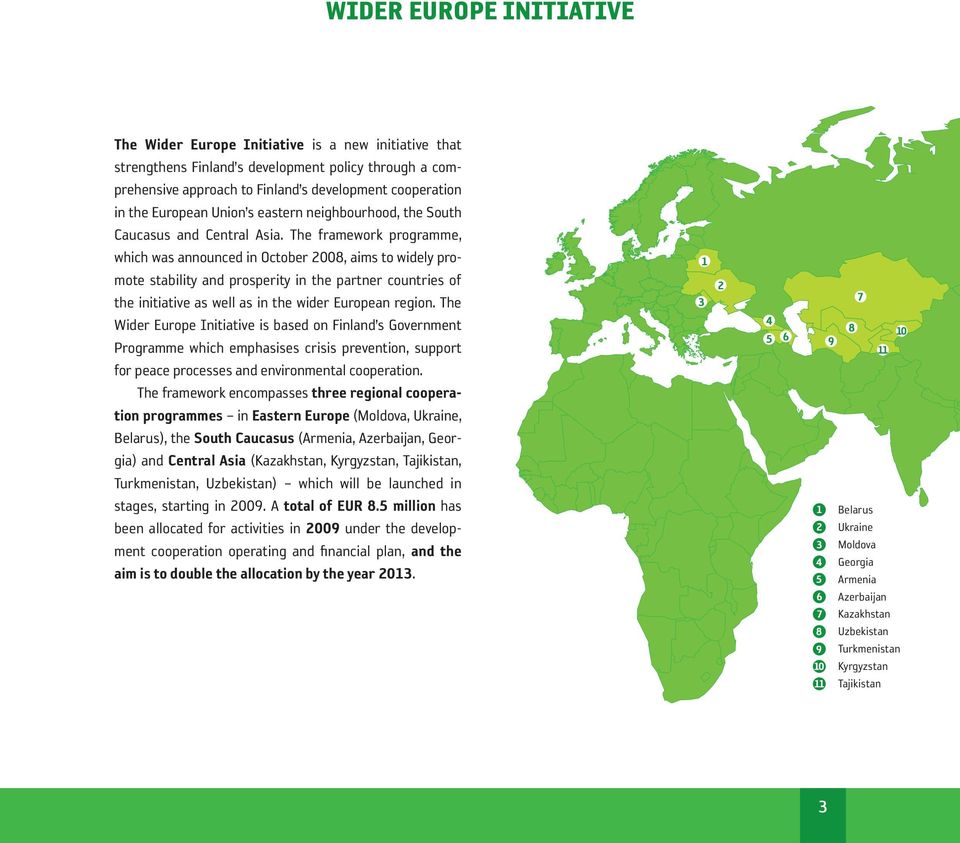
3 WIDER EUROPE INITIATIVE The Wider Europe Initiative is a new initiative that strengthens Finland s development policy through a comprehensive approach to Finland s development cooperation in the European Union s eastern neighbourhood, the South Caucasus and Central Asia. The framework programme, which was announced in October 2008, aims to widely promote stability and prosperity in the partner countries of the initiative as well as in the wider European region. The Wider Europe Initiative is based on Finland s Government Programme which emphasises crisis prevention, support for peace processes and environmental cooperation. The framework encompasses three regional cooperation programmes in (Moldova, Ukraine, Belarus), the South Caucasus (Armenia, Azerbaijan, Georgia) and Central Asia (Kazakhstan, Kyrgyzstan, Tajikistan, Turkmenistan, Uzbekistan) which will be launched in stages, starting in A total of EUR 8.5 million has been allocated for activities in 2009 under the development cooperation operating and financial plan, and the aim is to double the allocation by the year Belarus 2 Ukraine 3 Moldova 4 Georgia 5 Armenia 6 Azerbaijan 7 Kazakhstan 8 Uzbekistan 9 Turkmenistan 10 Kyrgyzstan 11 Tajikistan 3
4 PRIORITIES OF THE INITIATIVE The emphasis of the Wider Europe Initiative is on strengthening stability and security through a regional and thematic approach. The framework programme sets out five themes that will be implemented in each region according to its circumstances, needs and priorities. The themes are security, trade and development, information society development, energy and the environment, and social sustainability. Cooperation instruments include bilateral and multilateral cooperation, institutional cooperation and support for business partnerships, as well as cooperation with NGOs. The Wider Europe Initiative aims to meet development challenges in partner countries through the promotion of ecologically, economically and socially sustainable development. Particular problems to be addressed include the risk of social instability caused by underdeveloped civil societies and the uneven distribution of wealth; deficiencies in the development of the rule of law and democracy; weakly developed public administrations, as well as corruption. Countries in the region suffer from serious environmental problems and crumbling infrastructure. For a number of the countries, border control is challenged by drug traffic originating from Afghanistan, while the proximity to the Middle East causes concerns related to the spread of fundamentalist Islam. Political and geopolitical tensions with implications for the wider European region are increased by the potential for conflicts related to energy and natural resources, as well as by the existing, protracted conflicts in the area. Pan-European cooperation under the Wider Europe Initiative aims to prevent and end conflicts and to promote cooperation and mutual understanding between the countries in the region, as well as with the EU and Russia. Finland s relations with the partner countries of the Wider Europe Initiative are developing dynamically and Finland has the potential to make a positive contribution to the region s development. The use of Finnish expertise will both strengthen Finland s relations with actors in the partner countries and ensure Finnish added value in promoting the region s development. The Wider Europe Initiative consists of cooperation programmes that cover the entire region and programmes that have been designed specifically for each of the three sub-regions. These will promote regional cooperation. The regional impact of the projects will also be taken into account in the national programmes. Finland s bilateral contribution to the region s development corresponds with the objectives and measures of European Union. The Wider Europe Initiative comple- 4
5 A group of children obtaining clean water in Kyrgyzstan. Photo: Ari Mäkelä ments the European Neighbourhood Policy and the strategic objectives of its Eastern Partnership, particularly in sectors in which Finland has special expertise and strengths. The themes of the framework programme are also consistent with the priorities of the EU s Central Asia Strategy. The EU s project activities in the region are funded through the European Neighbourhood Partnership Instrument (ENPI) and the Instrument for Development Co-operation (DCI), which are administered by the Commission. 5

6 FLAGSHIP PROJECTS At the heart of the programme are flagship projects that cover the Wider Europe Initiative s five themes and correspond with the priority areas. 1. Security: to promote and strengthen security, a cluster of research institutes in the field of foreign and security policy has been established. The aim is to set up a multiyear research programme in the target region of the initiative. Cooperation with the Organisation for Security and Co-operation in Europe (OSCE) will also be continued. 2. Trade and Development: Aid for Trade ( and the South Caucasus) and Trade for Development (Central Asia) programmes have been created in cooperation with the United Nations Development Programme UNDP and the Trade and Development Working Group of the Ministry for Foreign Affairs. The plan is based on Finland s Aid for Trade Action Plan. The global economic crisis and its effect on the economy and living conditions of partner countries underscore the importance of assistance and the rapid commencement of this project. 3. Information society development: A project to develop the region s telecommunication links and in particular the capacity of the telecommunication sector will be launched with the European Bank for Reconstruction and Development (EBRD). This project will cover the countries of the South Caucasus and. 4. Energy and the environment: A framework agreement will be concluded with the Finnish Environment Institute (SYKE) to contribute to strategically important initiatives in the water sector. One of these is the European Union s Water Initiative (EUWI) in the South Caucasus and Central Asia. Another flagship project will aim at significantly increased support for Environment and Security Initiative ENVSEC. This coalition of the United Nations Environment Programme UNEP, United Nations Economic Commission for Europe UNECE, UNDP, OSCE, REC (Regional Environmental Centre for Central and ) and NATO (observer) manages projects under the environment and security theme in the initiative s target region. 5. Social sustainability: The World Bank s support programme for the judicial sector is being planned as a flagship project. The programme aims to promote best practices in the target countries through cooperation and networking at the national as well as the regional level in order to enhance the transparency, capacity and accountability of the judicial sector. 6
7 DEVELOPMENT PROSPECTS OF PARTNER COUNTRIES Collecting fish samples in Ukraine. Photo: Ari Mäkelä (Moldova, Ukraine, Belarus) The situation in the an countries of Ukraine, Moldova and Belarus varies considerably. Ukraine and Moldova have existing country-specific European Neighbourhood Policy Action Plans dating back to Belarus has been offered the opportunity to become part of the Neighbourhood Policy once it makes sufficient progress on the issues of human rights and developing the rule of law and democracy. Moldova and Ukraine have set themselves a clear objective of convergence with the European Union. After a long period of isolation, Belarus has shown nascent interest in improving relations with the West, and as of spring 2009, it will be possible to support the country s development 7

8 through EU policies under the new Eastern Partnership of the European Neighbourhood Policy. Finland s activities in the region have focused on issues relating to security, trade and development, energy and environmental cooperation, and social sustainability. Problems typical of the an countries include the underdeveloped nature of the public sector and the slow pace of development in the rule of law and democracy, as well as challenges in developing good governance. The infrastructure, which dates back to Soviet times, is crumbling and the region has serious environmental, energy and natural resources problems. Ukraine (populaton 46,2 million) is the most developed of the countries in the region; its economic growth has been rapid and World Trade Organisation (WTO) membership improves the predictability and growth potential of the country s economy. The impact of the global economic crisis has, however, weakened economic development considerably, as has the weakness of the country s public sector, which is typical of transition economies. The country s political instability creates an air of unpredictability over its economic prospects. Ukraine s position as a transit country for Russian energy and disputes over energy payments have also impacted strongly on the EU s energy security. With respect to the an countries, Finland s bilateral relations and cooperation with Ukraine are the most advanced. Belarus (population 9,7 million) is cautiously opening up to the West after a long period of isolation. Finland aims to contribute to the development of democracy and the rule of law in Belarus and to support the dialogue, initiated in autumn 2008, between the EU and Belarus. Relations between the EU and Belarus are improving as Belarus is taking steps towards implementing democratic and human rights values, which are shared by the Community, although the country still has major shortcomings in ensuring fundamental rights. Belarus is highly dependent on Russian energy and is striving to diversify its energy production. There are considerable problems in the environmental sector, such as nutrient deposits from rivers into the Baltic Sea. Moldova (population 4,1 million) is Europe s poorest country and the development of its economy and the rule of law are still fragile. The country is following the path led by Ukraine in terms of the European Neighbourhood Policy and European integration, although it has progressed more slowly in its reforms. Moldova s status as a channel for human trafficking and the problems more broadly linked to migration management are felt in Finland and elsewhere in the EU area. In terms of security, the frozen conflict in Transnistria raises tensions throughout the entire area. The aim of the Wider Europe Initiative in Eastern Europe is to contribute to stability, security and socially sustainable development. Environmental, water and climate issues play a key role with respect to ecologically sustainable development. Finland is well qualified to participate in cooperation to develop energy efficiency and renewable energy in particular. Developing the private sector operating environment and improving infrastructure are also important for the aim of promoting economically sustainable development. 8
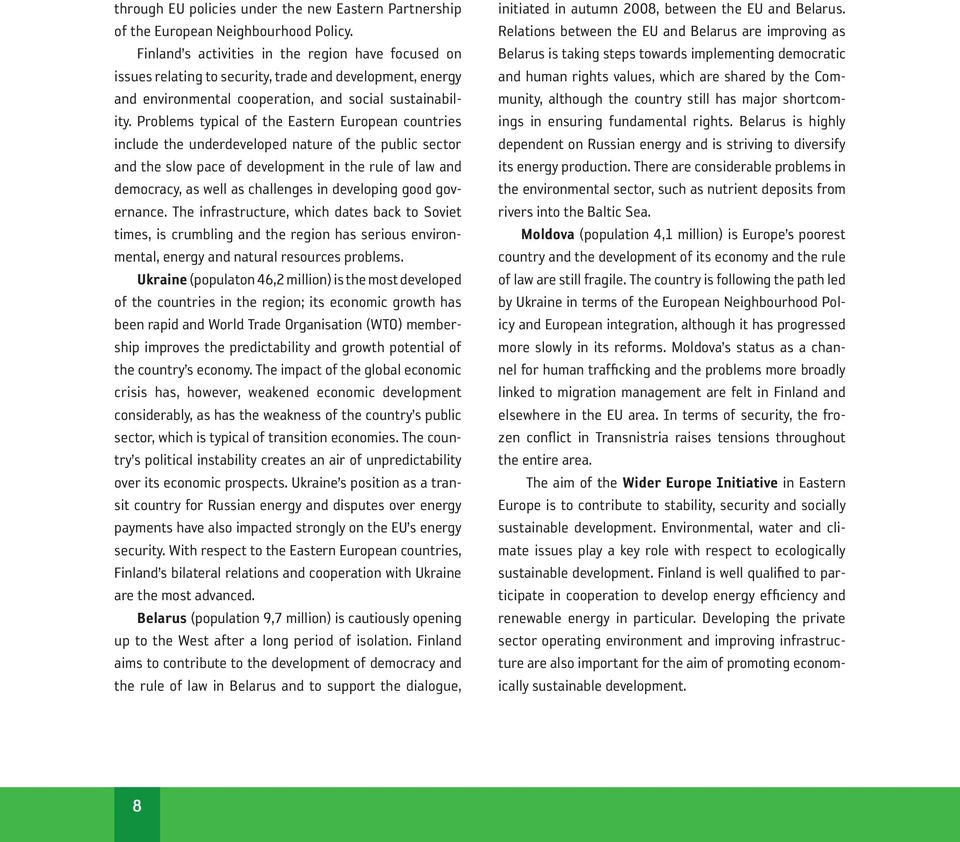
9 Partners countries financial growth and capacity to trade are promoted by supporting small-scale entrepreneurs. Photo: Karri Eloheimo South Caucasus (Armenia, Azerbaijan and Georgia) The importance of the South Caucasus to Europe is growing, as the latest European Union enlargement has brought the region and its challenges closer to Europe. European Neighbourhood Policy Action Plans were concluded with the countries of the South Caucasus in The region s importance is increased by the major energy transmission routes from the Caspian Sea to Europe which run through the South Caucasus. The countries of the South Caucasus have drawn closer to Europe at their own pace. The countries have focused their efforts on economic reforms. Rapid economic growth has slowed as a result of the global economic crisis, the effect of which has to date been the most serious in Armenia. The countries suffer from problems typical of transition economies, including poverty, regional inequality, an underdeveloped public sector, environmental problems, human rights problems and challenges to the development of democracy. Reforms required by the European Neighbourhood Policy include the strengthening of the operational scope of the media, NGOs and the opposition. There are protracted conflicts within the region of the South Caucasus: the Nagorno-Karabakh conflict causes tensions between Armenia and Azerbaijan. Georgia s development is hampered by long-standing conflicts in Abkhazia and South Ossetia, the latter of which erupted into a war between Georgia and Russia in August As a result of the conflicts, there are many internally displaced persons living in the region. The conflicts have also hampered the overall security, notably in the conflict areas and their close vicinity. 9
10 Development in Armenia (population 3,1 million) has been hindered by the lack of energy routes through the country due to the Nagorno-Karabakh conflict, and the closed border with Turkey. Investments in the construction sector and industry have boosted economic growth, but poverty is still extensive, especially in rural areas. Armenia has ambitious plans to develop its ICT sector and is in the process of modernising its energy production network. Armenia s economy has, in the past, received considerable assistance from the diaspora living in the West. This aid has now decreased as a result of the crisis in the world economy. Azerbaijan (population 8,7 million) is the most prosperous of the countries in the region because of its oil and gas reserves and its position as a transit country for energy in the Caspian Sea region. The internal political situation is stable, although political reforms have progressed slowly. Azerbaijan is actively developing its ICT sector, which is predicted to become, along with its energy sector, another economic pillar in the near future. Georgia (population 4,6 million) does not have its own oil and gas reserves but energy is transmitted through the country to Europe. Georgia has made good progress in its economic reforms, although social and economic inequality continues to be a problem. The repercussions of the conflicts in South Ossetia and Abkhazia will be felt for a long time. The challenges include not only the global economic crisis but also the maintenance of domestic political stability, the continuation of economic and social reforms, the post-war recovery and the settling of internally displaced persons. Through the Wider Europe Initiative, Finland aims to respond to the development needs in the South Caucasus region and to strengthen its bilateral relations with the countries in the region. The focus will be on security and sustainable development. The main regional themes for the South Caucasus are information society development, scientific and technological cooperation and trade and development. Since the regional conflicts pose a challenge for regional inter-governmental cooperation, international actors and NGOs will be approached as cooperation partners at the initial stage. Cooperation on research into security and development will be promoted. Central Asia (Kazakhstan, Kyrgyzstan, Tajikistan, Turkmenistan and Uzbekistan) Central Asia s significant reserves of energy and other raw materials and the region s strategic location have increased international interest in the region. As a result of the enlargement of the European Union, the Central Asian states, Kazakhstan, Kyrgyzstan, Tajikistan, Turkmenistan and Uzbekistan, have become closer to Europe. The geopolitical situation in Central Asia is challenging: drug routes run from Afghanistan through Central Asia to Russia and Europe, and the unpredictability of the situation in Afghanistan and the neighbouring states causes concern about a build-up of extremist Islamic movements in the region. Central Asia is becoming an increasingly important area in terms of border security and international cooperation between border officials. 10

11 Problems that are common to these Central Asian countries include an underdeveloped public sector and civil society, as well as inadequate development of the rule of law and democracy. The region also has ethnic tension, frontier disputes and serious environmental, energy and natural resources problems. The willingness of Central Asian countries to engage in mutual cooperation is often weakened by controversies between the countries. The management of cross-border water reserves, for example, causes disputes in the region. In some countries, women s status is weak and insecure. The global economic crisis particularly undermines the situation of the poorest countries. In Kazakhstan and Turkmenistan, the economy has benefited over recent years from the high world market prices for the countries supply of raw materials. Uzbekistan has also profited from supplying raw materials. The countries are now suffering from the collapse of world market caused by the international economic crisis. However, because of their oil and gas reserves, Kazakhstan, Turkmenistan and Uzbekistan will be able to recover from the recession more easily than their poorer neighbouring countries. Kyrgyzstan and Tajikistan are among the poorest Central Asian states, and remittances from migrant workers make up from 20% to 50% of the countries GDP. The loss of jobs as a result of the economic crisis has started to drive migrant workers back to their home countries, where the loss of revenues creates significant pressures on society. Kazakhstan (population 15,7 million) is the most prosperous and stable state in Central Asia and is the region s engine of economic development. Its aim is to be among the world s 50 most competitive countries. The steep fall Monitoring the condition of water in Kyrgyzstan. Photo: Ari Mäkelä in the price of oil as a result of the international economic crisis has, however, weakened the country s economy and financial market. In addition to the oil and gas sector, metallurgy and metal industry together with food industry and agriculture occupy a central role in the economy. The undiversified economy based on oil exports is a major challenge for Kazakhstan, and the goal of the country s industrial policy is to diversify production. The environmental problems in the Aral Sea region are very considerable. Kyrgyzstan (population 5,2 million) has made faster progress in democratic development than its neighbouring countries. However, the political situation is not stable and development is in danger of being reversed. Alongside Tajikistan, it is one of the poorest states in Central Asia. Kyrgyzstan is at present the only Central Asian country that is a member of the WTO, although it has not been able to fully capitalise on its membership. The economic and investment 11

12 climate is weak. Kyrgyzstan has water resources in addition to mineral reserves. Long standing disputes exist with respect to the use of water resources and energy needs. The difficult terrain of Tajikistan s (population 7,3 million) long border with Afghanistan makes it virtually impossible to control. Hence, the poor security situation of Afghanistan also makes itself felt in Tajikistan, and opens the way for extensive trafficking in drugs. The impact of the international financial crisis is affecting the economic situation of the entire country, as well as more than one million Tajikistan migrant workers who work in Russia and Kazakhstan. The position and livelihood of women and children is weak due to migration, especially in rural areas. Agriculture has concentrated on growing cotton. As a country upstream of the Amu Darya river, Tajikistan has the potential to exploit hydroelectric power. Current production of electricity is not sufficient to cover the energy requirement, but the use of water resources for crop production in neighbouring countries creates regional tensions, similar to those in Kyrgyzstan. Turkmenistan (population 5,2 million) has some of the world s largest natural gas reserves. The country s oil reserves are significant as well. In spite of generous subsidies for basic commodities, poverty is extensive, especially in rural areas. The investment climate is difficult because of the country s isolation, weak governance and legislation. Social development and reforms to the health and education sectors play a key role in the development of civil society. Turkmenistan, which has strongly protected its status as a neutral country, only started establishing contacts to the international community and strengthening its relationship with the EU and its member countries in Uzbekistan (population 27,2 million) has oil and gas as well as mineral reserves. The world s fourth largest gold deposits are to be found in Uzbekistan. The adherence to a policy of extensive cultivation of cotton and wheat means the country s economy has not been diversified. Challenges in the environmental sector include, in particular, the problems in the Aral Sea region and the insufficient water resources for crop irrigation. The centrally planned economy, strict economic regulation and outdated technology in industry restrain economic performance. The banking sector is underdeveloped. Isolation from the international community and its values hinders social development. However, the relationship between Uzbekistan and Europe is expected to gradually improve and some reforms promoting the rule of law have been implemented in the country, which point to a willingness to open up to the international community. Poverty is extensive, especially in the highly populated Fergana Valley region, and the atmosphere is permissive for the growth of extremist Islamic movements. The aim of the Wider Europe Initiative in Central Asia is to promote activities that support regional cooperation on energy and the environment, security and development. Projects supporting trade will be funded to achieve trade policies and cooperation solutions based on non-discrimination. Central Asia has major, and partially regional, environmental problems. The comprehensive management of water resources is one of the most important regional issues and efforts to find solutions will be supported through strategic cooperation in the water sector. Social development will be strengthened especially through projects supporting the development of the rule of law in the region. 12

13 WIDER EUROPE INITIATIVE: IMPLEMENTATION PLAN (JUNE 2009) Programme, project by theme Country/region Objective Time Budget, EUR Cooperation partner 1. Security Research on security and development Security and social sustainability projects Conflict prevention in the Crimea region 2. Trade and development Development cooperation supporting trade Private sector support programme Central Asia, South Caucasus, Central Asia, South Caucasus, Ukraine Central Asia, South Caucasus, Central Asia, South Caucasus Security and development research projects, cooperation and networking Promotion of security, stability and social sustainability Promotion of regional stability Developing trade procedures and promoting the capacity to trade Development of a favourable business environment, corporate management support, micro finance, etc. Improving food security Kyrgyzstan Increasing fish production, reducing poverty, improving living conditions and livelihoods ,500,000 Finnish and local research institutes ,000,000 Organization for Security and Co-operation in Europe (OSCE) ,200,000 Centre for European Policy Studies (CEPS), Finnish research institutes ,900,000 United Nations Development Programme, UNDP ,200,000 International Finance Corporation (IFC) ,760,000 United Nations Food and Agriculture Organization (FAO) 13

14 Programme, project by theme Country/region Objective Time Budget, EUR Cooperation partner 3. Information society development Capacity-building of communications links South Caucasus, Developing communication links within a legislative framework ,250,000 European Bank for Reconstruction and Development (EBRD) Developing a communications network in remote areas South Caucasus Improving the technical infrastructure of the telecommunications network ,000,000 EBRD 4. Energy and the environment The Environment and Security Initiative (ENVSEC) Central Asia, South Caucasus, Promoting the sustainable development of the environment and regional stability ,100,000 United Nations Environment Programme (UNEP) and the organisations of the Environment and Security Initiative (ENVSEC) Cooperation in the water sector Central Asia, South Caucasus Developing the comprehensive use and management of water resources ,000,000 Finnish Environment Institute (SYKE) Cooperation in the geological sector Central Asia Enhancing the capacity of the geological sector ,100,000 Geological Survey of Finland (GTK) Developing national power supply systems Georgia, Azerbaijan, Connecting power supply systems to the European main grid and jointly used system ,750,000 EBRD Cooperation in the meteorological sector (institutional cooperation) Central Asia Developing the observation and weather service operations of meteorological service agencies ,000 Finnish Meteorological Institute 14

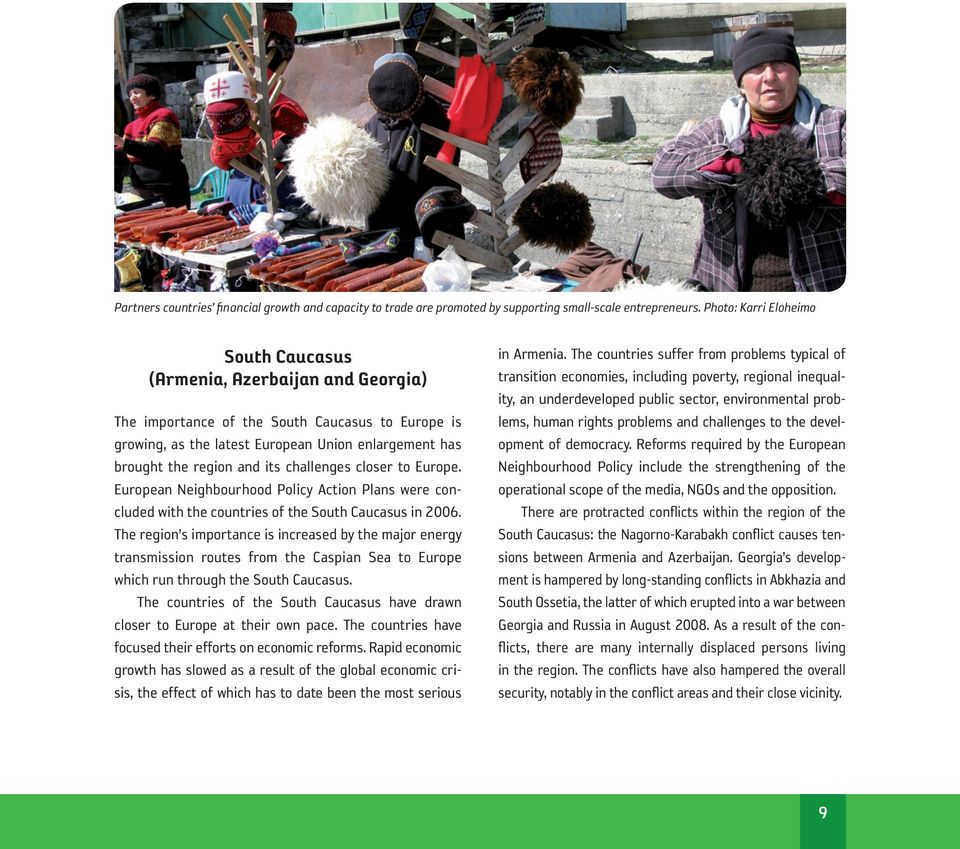
15 Programme, project by theme Country/region Objective Time Budget, EUR Cooperation partner 5. Social sustainability Judicial sector support programme Central Asia Developing the transparency and capacity of the judicial sector ,400,000 World Bank Statistics cooperation project (institutional cooperation) Kyrgyzstan Developing and enhancing the capacity of statistics systems ,000 Statistics Finland Projects funded with appropriations for local cooperation Central Asia, South Caucasus, Including the promotion of good governance, strengthening civil society ,000,000 Local NGOs and other actors Others Participating in multi-donor funds Central Asia, South Caucasus, The promotion of economically, socially and ecologically sustainable development ,700,000 E.g., EBRD, the Neighbourhood Investment Facility (NIF), the Nordic Dimension Environmental Partnership (NDEP), the Nordic Dimension Partnership in Public Health and Social Wellbeing (NDPHS) 15
16 Ministry for Foreign Affairs Department for Russia, and Central Asia Laivastokatu 22 Merikasarmi G Government, Finland [email protected]
U.S. POLICY IN THE BLACK SEA REGION
 U.S. POLICY IN THE BLACK SEA REGION From the U.S. point of view, NATO is and will remain the premier provider of security for the Euro-Atlantic region, which includes the Black Sea. Far from seeking to
The list of donors organizations, international agencies and groups presented in CIS countries and Mongolia
 The list of donors organizations, international agencies and groups presented in Donor Programme Target Countries Target Areas FAO - Food and Agriculture Organization http://www.fao.org UNDP - United Nations
The European Neighbourhood Policy (ENP) and health
 INFORMAL BACKGROUND DOCUMENT The European Neighbourhood Policy (ENP) and health General The European Neighbourhood Policy (ENP) was developed in 2004, with the objective of avoiding the emergence of new
The Future of the ENP
 Open Europe Programme Warsaw, June 2015 The Future of the ENP Some remarks and recommendations Grzegorz Gromadzki (Stefan Batory Foundation) Bastian Sendhardt (Friedrich-Ebert-Stiftung, Representation
Northern Dimension Policy Framework Document (effective as 1 January 2007)
 Northern Dimension Policy Framework Document (effective as 1 January 2007) 1. Introduction 1. The Northern Dimension covers a broad geographic area from the European Arctic and Sub- Arctic areas to the
Delegations will find attached the conclusions adopted by the European Council at the above meeting.
 European Council Brussels, 20 March 2015 (OR. en) EUCO 11/15 CO EUR 1 CONCL 1 COVER NOTE From: General Secretariat of the Council To: Delegations Subject: European Council meeting (19 and 20 March 2015)
Terms of Reference: Consultancy Firm. Selection #1019083
 Terms of Reference: Consultancy Firm Selection #1019083 Support for Broadband Competitiveness Program in Eastern Europe, South Caucasus and Central Asia (ECA) Trust Fund: TF071399 Creating Sustainable
Using More for More: Incentivising Peace in the EU s Neighbourhood Policy
 Using More for More: Incentivising Peace in the EU s Neighbourhood Policy Prevention of conflict is one of the key objectives of EU external action as set out in the Lisbon Treaty and as repeatedly stated
How To Help The World
 The World We Want A North-East Asian Youth Vision This Declaration was handed to His Excellency Kim Sung-hwan, Minister of Foreign Affairs and Trade of the Republic of Korea, in Seoul on 9 th of January
Home Security: Russia s Challenges
 Home Security: Russia s Challenges A Russian Perspective Andrei Fedorov * Home security: Russia s challenges Home security and the struggle against terrorism is one of the most crucial issues for the Russian
Export control system and Dual-Use Expertise in the Republic of Azerbaijan
 Export control system and Dual-Use Expertise in the Republic of Azerbaijan Deputy Director of the Institute of Radiation Problems of Azerbaijan National Academy of Sciences Dr. Ibrahim Gabulov Azerbaijan
Rwanda. Strategy for Sweden s development cooperation with 2015 2019 MFA
 MINISTRY FOR FOREIGN AFFAIRS, SWEDEN UTRIKESDEPARTEMENTET Strategy for Sweden s development cooperation with Rwanda 2015 2019 MFA 103 39 Stockholm Telephone: +46 8 405 10 00, Web site: www.ud.se Cover:
A EUROPE THAT WORKS EUROPEAN LIBERALS ARE THE FIRST TO ADOPT ELECTION MANIFESTO
 A EUROPE THAT WORKS EUROPEAN LIBERALS ARE THE FIRST TO ADOPT ELECTION MANIFESTO In 2014, we will have the opportunity to shape the future of Europe at a crucial time in the history of our continent. In
Declaration on the 20th Anniversary of the Barents Euro-Arctic Cooperation. (Kirkenes, Norway, 3 4 June 2013)
 1 Declaration on the 20th Anniversary of the Barents Euro-Arctic Cooperation (Kirkenes, Norway, 3 4 June 2013) Prime Ministers and other high-level representatives of the members of the Barents Euro- Arctic
F A C T S H E E T. EU-US Summit (Brussels, 26 March 2014) and EU-US relations
 Brussels, 24 March 2014 140324/01 F A C T S H E E T EU-US Summit (Brussels, 26 March 2014) and EU-US relations The Leaders of the European Union and the United States of America will meet on 26 March 2014
EXECUTIVE SUMMARY 30 FINDINGS, 10 IMMEDIATE ACTIONS AND 10 LONG-TERM BUILDING BLOCKS
 EXECUTIVE SUMMARY 30 FINDINGS, 10 IMMEDIATE ACTIONS AND 10 LONG-TERM BUILDING BLOCKS Extract from: Sami Andoura and Jean-Arnold Vinois, From the European Energy Community to the Energy Union. A policy
The Virtual Silk Highway Project
 The Virtual Silk Highway Project In today s high-technology world, the Internet has become a fundamental communication tool. Not only does it link people together across the globe, but it also provides
Tajikistan Business Enabling Environment- SME Policy Project Press Review - Issue #59
 This press-review is produced by IFC Business Enabling Environment - SME Policy Project in Tajikistan as a free compilation of articles issued in the mass media of the Republic of Tajikistan and in the
Kazakhstan : NEW OPPORTUNITIES FOR INVESTMENTS
 Kazakhstan : NEW OPPORTUNITIES FOR INVESTMENTS Agenda I. Why Kazakhstan is attractive for investors? II. Investing in Kazakhstan III. Contact details Why Kazakhstan is attractive for investors 1. Natural
Facilitating Remittances to Help Families and Small Businesses
 G8 ACTION PLAN: APPLYING THE POWER OF ENTREPRENEURSHIP TO THE ERADICATION OF POVERTY The UN Commission on the Private Sector and Development has stressed that poverty alleviation requires a strong private
Good morning. It is my pleasure to be here today as we begin. this workshop on improving regional responses to transnational
 REMARKS BY AMBASSADOR SCOTT DELISI Africa Center for Strategic Studies Sheraton Hotel Rwenzori Ballroom January 28, 2013, 11:30 a.m. [Protocol list of invitees] All protocols observed. Good morning. It
Business as Usual is Not an Option: Trade and Markets
 Issues in Brief Business as Usual is Not an Option: Trade and Markets Underinvestment in developing country agriculture including in local and regional market infrastructure, information and services has
Sub-Saharan Africa. Strategy for Sweden s regional development cooperation in 2016 2021 MFA
 MINISTRY FOR FOREIGN AFFAIRS, SWEDEN UTRIKESDEPARTEMENTET Strategy for Sweden s regional development cooperation in Sub-Saharan Africa 2016 2021 MFA 103 39 Stockholm Telephone: +46 8 405 10 00, Web: www.gov.se
Masters in Middle East, Caucasus and Central Asian Security Studies
 International Relations - MECCASS - MLitt & MPhil - 2015/6 - November 2015 Masters in Middle East, Caucasus and Central Asian Security Studies Also Postgraduate Diploma and MPhil Taught Element, and PG
GREECE S FOREIGN POLICY IN THE 21 ST CENTURY By George A. Papandreou 1
 GREECE S FOREIGN POLICY IN THE 21 ST CENTURY By George A. Papandreou 1 Abstract Greece is committed to embracing all those nations who strive for democracy within their frontiers, and peaceful cooperation
EU Strategies and Programmes in Central Asia to Support the Implementation of EU Central Asia Action Plan on Drugs
 EU Strategies and Programmes in Central Asia to Support the Implementation of EU Central Asia Action Plan on Drugs 08 April, 2013, Berlin Dobromir Hristov, Task Manager EU Delegation to the Kyrgyz Republic
UNHCR Georgia 2010 Operation
 UNHCR Georgia 2010 Operation UNHCR Tbilisi, November 2009 New Budget Structure in UNHCR Four Pillars UNHCR recently adopted a revised budget structure, in line with UNHCR s results framework, which uses
Concept Note and. Call for Papers
 Concept Note and Call for Papers AFRICAN ECONOMIC CONFERENCE 2015 ADDRESSING POVERTY AND INEQUALITY IN THE POST 2015 DEVELOPMENT AGENDA Kinshasa, Democratic Republic of Congo 2-4 November, 2015 1 1. Introduction
Forschung und Entwicklung im Spannungsfeld zwischen Innovation und Gesellschaft
 Forschung und Entwicklung im Spannungsfeld zwischen Innovation und Gesellschaft Directorate for Science, Economy and Society European Commission / Directorate General for Research 1 Übersicht wichtigsten
Insolvency Law Reform & some preliminary thoughts on Nigeria. Neil Cooper Consultant to World Bank Partner, Kroll Past President, INSOL International
 Insolvency Law Reform & some preliminary thoughts on Nigeria Neil Cooper Consultant to World Bank Partner, Kroll Past President, INSOL International Soviet Republic, Europe and Asia - Total Russia Estonia
BUILDING MIGRATION PARTNERSHIPS PRAGUE MINISTERIAL CONFERENCE JOINT DECLARATION
 BUILDING MIGRATION PARTNERSHIPS PRAGUE MINISTERIAL CONFERENCE JOINT DECLARATION We, the Ministers responsible for migration and other representatives from: Albania, Armenia, Austria, Azerbaijan, Belgium,
Globalization and International Trade
 12 Globalization and International Trade Globalization refers to the growing interdependence of countries resulting from the increasing integration of trade, finance, people, and ideas in one global marketplace.
of European Municipal Leaders at the Turn of the 21 st Century
 The Hannover Call of European Municipal Leaders at the Turn of the 21 st Century A. PREAMBLE We, 250 municipal leaders from 36 European countries and neighbouring regions, have convened at the Hannover
The EU as a global player: Financing EU s ambitions for 2014-2020
 Policy Recommendations EU Policy Perspectives seminar series Clingendael European Studies programme (CESP) The EU as a global player: Financing EU s ambitions for 2014-2020 By Arnout Mijs and Sarah Wolff
ENTREPRENEURIAL LEARNING AND SKILLS FOR ENTERPRISES IN THE SOUTHERN MEDITERRANEAN REG IO N MARIAVITTO RIA G ARLAPPI, SBA ASSESSESSMENT TEAM LEADER
 ENTREPRENEURIAL LEARNING AND SKILLS FOR ENTERPRISES IN THE SOUTHERN MEDITERRANEAN REG IO N MARIAVITTO RIA G ARLAPPI, SBA ASSESSESSMENT TEAM LEADER MILANO, 2 JUNE 2014 WHAT IS ETF AGENCY OF THE EUROPEAN
CURRICULUM VITAE. Language Speaking Reading Writing Ukrainian native native native Russian native native native English 5 5 5 Polish 3 3 1
 CURRICULUM VITAE 1. Family name: Amerova 2. First names: Elena 3. Nationality: Ukrainian 4. Education: Institution Kiev National Economic University Kiev State University Date: from/ to 2000-2002 1977-1982
Security Council. United Nations S/2008/434
 United Nations S/2008/434 Security Council Distr.: General 3 July 2008 Original: English Special report of the Secretary-General pursuant to Security Council resolution 1806 (2008) on the United Nations
Energy Security: Role of Regional Cooperation
 Energy Security: Role of Regional Cooperation Traian Chebeleu Today s Conference is dedicated to a topic that has deeply preoccupied the governments and the business communities in the Emerging Europe,
Kyrgyzstan: Power Generation & Transmission
 Kyrgyzstan: Power Generation & Transmission October, 2010 Author: Artyom Zozulinsky, Business & Commercial Assistant, US Embassy Bishkek Contents SUMMARY... 2 POWER SECTOR OVERVIEW... 2 Infrastructure...
External Grant Committee Meeting 8 April 2014 Agenda Item No.: 3
 MINISTRY OF FOREIGN AFFAIRS File No.: 46.H.5.NIRAS.2013-15. Department for Stabilization and Security Policy External Grant Committee Meeting 8 April 2014 Agenda Item No.: 3 1. Title: Peace and Stabilisation
Economic and Social Council
 UNITED NATIONS E Economic and Social Council Distr. GENERAL CEP/AC.10/2005/5 12 April 2005 ORIGINAL: ENGLISH ECONOMIC COMMISSION FOR EUROPE COMMITTEE ON ENVIRONMENTAL POLICY Working Group on Environmental
How To Understand Current Account Balance In Armenia
 CURRENT ACCOUNT: THE REGIONAL DEVELOPMENTS AND TRENDS Prepared by Armenuhi Burnazyan and Arevik Aleksanyan In our project we tried to analyze Current Account (CA) balance trends for Armenia, Georgia and
The Baltic Sea Region and its higher education sector Workshop for Multipliers
 The Baltic Sea Region and its higher education sector Workshop for Multipliers September 14 20, 2008, Berlin/Germany and Tallinn/Estonia Tobias Wolf DAAD, Unit 513 TEMPUS/EU-Third Country Cooperation Structure
Eastern Partnership Youth Policy Analytic Report. Report Summary
 Eastern Partnership Youth Policy Analytic Report Report Summary December 2015 Authors Behrooz Motamed-Afshari Maksymilian Fras In cooperation with Arsen Simonyan (Armenia) Pervana Mammadova (Azerbaijan)
NEGOTIATING FRAMEWORK FOR TURKEY. Principles governing the negotiations
 NEGOTIATING FRAMEWORK FOR TURKEY Principles governing the negotiations 1. The negotiations will be based on Turkey's own merits and the pace will depend on Turkey's progress in meeting the requirements
Tel. : 206 370 9722 E-mail: [email protected] To: REECAS Conference
 From: Emin ALIYEV Tel. : 206 370 9722 E-mail: [email protected] To: REECAS Conference Subject: Ongoing Research Proposal Thesis Dissertation: The pertinence of Knowledge Based Azerbaijan hypothesis:
Executive Summary. The core energy policy is as follows:
 Executive Summary Energy management must become more sustainable and less dependent on increasingly scarce fossil fuels. Energy is a fundamental element of the economy, and the Netherlands must do more
Council conclusions on strengthening the external dimension of the EU energy policy
 COUNCIL OF THE EUROPEAN UNION Council conclusions on strengthening the external dimension of the EU energy policy 3127th TRANSPORT, TELECOMMUNICATIONS and ERGY Council meeting (Energy items) Brussels,
Economic Overview. East Asia managed to weather the global recession by relying on export-oriented
 Economic Overview Economic growth remains strong in East Asia and retains healthy momentum thanks to strong commodity prices and increases in exports. leads the region in growth and its GDP is expected
NATIONAL INFORMATION AND COMMUNICATION TECHNOLOGIES STRATEGY FOR THE DEVELOPMENT OF THE REPUBLIC OF AZERBAIJAN (2003-2012)
 NATIONAL INFORMATION AND COMMUNICATION TECHNOLOGIES STRATEGY FOR THE DEVELOPMENT OF THE REPUBLIC OF AZERBAIJAN (2003-2012) Science and technologies are developing very fast. That s why we in Azerbaijan
OFID- UNDP CROSS- REGIONAL GRANTS COMPETITION
 OFIDUNDP CROSSREGIONAL GRANTS COMPETITION The OPEC Fund for International Development (OFID) and the United Nations Development Programme (UNDP) are launching the first joint CrossRegional Grants Competition.
VOLUNTARY GUIDELINES ON THE GOVERNANCE OF TENURE. At a glance
 VOLUNTARY GUIDELINES ON THE GOVERNANCE OF TENURE At a glance VOLUNTARY GUIDELINES ON THE GOVERNANCE OF TENURE At a glance FOOD AND AGRICULTURE ORGANIZATION OF THE UNITED NATIONS Rome, 2012 The designations
LEGAL AND ILLEGAL MONEY TRANSFERS AS RUSSIAN FOREIGN POLICY INSTRUMENTS
 LEGAL AND ILLEGAL MONEY TRANSFERS AS RUSSIAN FOREIGN POLICY INSTRUMENTS FATIH OZBAY SENIOR FELLOW, CENTER ON FOREIGN POLICY AND SECURITY, HASEN FATIH OZBAY 128 Migrants who are mostly coming from former
UNECE Energy Week Geneva. in Energy Security
 UNECE Energy Week Geneva Investing in Energy Security Committee on Sustainable Energy and related Meetings Wednesday 28 November 2007 Special Session: Investing in and Financing the Hydrocarbon Sector
Prosperity Fund Creating Conditions for Global Growth Turkey Programme Strategy (2015-16)
 Prosperity Fund Creating Conditions for Global Growth Turkey Programme Strategy (2015-16) Contents Introduction & Context Programme Objectives and Indicators General Guidance Notes Programme Structure
Explaining Russia s New Normal
 Explaining Russia s New Normal Chris Weafer of Macro-Advisory This Op- Ed appeared on BNE.eu on September 11 2015 One of the slogans now regularly deployed to describe Russia s current economic condition
TURKISH CONTRACTING IN THE INTERNATIONAL MARKET
 Brief overview TURKISH CONTRACTING IN THE INTERNATIONAL MARKET Construction plays a crucial role in Turkey s economic development, accounting for 5.9% of GDP and employing some 1.8 million people. When
Recommendation for a COUNCIL RECOMMENDATION. on Poland s 2014 national reform programme
 EUROPEAN COMMISSION Brussels, 2.6.2014 COM(2014) 422 final Recommendation for a COUNCIL RECOMMENDATION on Poland s 2014 national reform programme and delivering a Council opinion on Poland s 2014 convergence
International Workshop on Strategies for Development and Food Security in Mountainous Areas of Central Asia June 6-10, 2005 -- Dushanbe, Tajikistan
 International Workshop on Strategies for Development and Food Security in Mountainous Areas of Central Asia June 6-10, 2005 -- Dushanbe, Tajikistan This document contains a series of recommendations and
CHALLENGES AND PROSPECTS FOR NEPALESE CONSULTING BUSINESS: NEED OF CAPACITY BUILDING FOR SUSTAINABLE DEVELOPMENT
 CHALLENGES AND PROSPECTS FOR NEPALESE CONSULTING BUSINESS: NEED OF CAPACITY BUILDING FOR SUSTAINABLE DEVELOPMENT Mr. Hare Ram Shrestha Society of Consulting Architectural and Engineering Firms, Nepal Background
Conclusions 26/27 June 2014 EUROPEA COUCIL 26/27 JUE 2014
 UROPA COUCIL 26/27 JU 2014 STRATGIC AGDA FOR TH UIO I TIMS OF CHAG The May 2014 uropean elections open a new legislative cycle. This moment of political renewal comes precisely as our countries emerge
TRANSPORT SECTOR ROADMAP AND THE INVESTMENT PROGRAM I. Roadmap
 TRANSPORT SECTOR ROADMAP AND THE INVESTMENT PROGRAM I. Roadmap 1. Launched in 2008, the government s Afghanistan National Strategy (ANDS) is a Millennium Goals (MDGs) based action plan and road map for
The Foreign Policy of Ukraine
 The Foreign Policy of Ukraine One Year After the Orange Revolution PONARS Policy Memo No. 372 Volodymyr Dubovyk Odessa National University December 2005 It has been a year since the Orange Revolution in
Strategy for selective cooperation with. India. January 2009 December 2013
 Strategy for selective cooperation with India January 2009 December 2013 1 Ministry for Foreign Affairs 9 July 2009 Annex to UF2009/46329/ASO Strategy for selective cooperation with India for the period
A sustainable energy and climate policy for the environment, competitiveness and long-term stability
 2009-02-05 A sustainable energy and climate policy for the environment, competitiveness and long-term stability The party leaders of Alliance for Sweden entered into an agreement today on a long-term,
Caucasus and Central Asia: Oil Price Decline and Regional Spillovers Darken the Outlook
 Caucasus and Central Asia: Oil Price Decline and Regional Spillovers Darken the Outlook Economic activity in the Caucasus and Central Asia (CCA) will continue to decelerate in 215 mainly as a consequence
MINISTRY OF AGRICULTURE OF HUNGARY
 MINISTRY OF AGRICULTURE OF HUNGARY Introduction of the institutional framework of the Administration of the Hungarian Agriculture International Development Cooperation of the Ministry of Agriculture of
Evaluation of the MSc Programme in Land Management at the Royal Institute of Technology in Stockholm (KTH), 1996-2012
 KT00 Land Management at the Royal Institute of Technology in Stockholm (KTH), 1996-2012 Kristin Land and Tommy Österberg 16 January 2013 Table of contents 1 EXECUTIVE SUMMARY...4 1.1 GENERAL ON THE PROGRAMME
Food & Farming. Focus on Market Safety Nets. December 2015. Agriculture and Rural Development
 Food & Farming Focus on Market Safety Nets December 215 Agriculture and Rural Development 1 AGRICULTURAL MARKETS AS A DRIVER FOR EUROPEAN AGRICULTURE The agricultural markets and their prices have evolved
Budapest Process A Silk Routes Partnership for Migration
 Budapest Process A Silk Routes Partnership for Migration Fethi Etem, Turkish Ministry of Foreign Affairs 22 May 2013, Lima Presentation 1. What is the Budapest Process? 2. The Istanbul Ministerial Declaration
CSCAP MEMORANDUM No. 15 The Security Implications of Climate Change
 CSCAP MEMORANDUM No. 15 The Security Implications of Climate Change A Memorandum from the Council for Security Cooperation in the Asia Pacific (CSCAP) June 2010 CSCAP Memorandum No. 15 The Security Implications
Global water resources under increasing pressure from rapidly growing demands and climate change, according to new UN World Water Development Report
 WWDR4 Background Information Brief Global water resources under increasing pressure from rapidly growing demands and climate change, according to new UN World Water Development Report As demand for water
7. Spillovers from Russia to the CCA
 7. Spillovers from Russia to the CCA In the face of sharply lower oil prices and geopolitical tensions and sanctions, economic activity in Russia has rapidly decelerated, resulting in negative spillovers
A GLOBAL STRATEGY OF MIGRATION FOR DEVELOPMENT
 A GLOBAL STRATEGY OF MIGRATION FOR DEVELOPMENT BEYOND THE MIDA APPROACH TO MOBILIZING AND SHARING OF HUMAN AND FINANCIAL RESOURCES OF THE OVERSEAS AFRICAN COMMUNITY 2006-2010 Geneva, June 2006 FOREWORD
The relationship between carbon dioxide emissions and economic growth
 The relationship between carbon dioxide emissions and economic growth Oxbridge study on CO2-GDP relationships, Phase 1 results Michael Grubb, 1 Benito Müller, 2 and Lucy Butler 1 1 Department of Applied
CADGAT. Central Asia Data Gathering and Analysis Team. Intra-regional trade in Central Asia
 CADGAT Central Asia Data Gathering and Analysis Team Intra-regional trade in Central Asia 1 Central Asia Regional Data Review No. 9, July 2013 In 2009, the Norwegian Institute of International Affairs
Partnership in Environmental Governance. Swedish Environmental Protection Agency
 Partnership in Environmental Governance Swedish Environmental Protection Agency ISBN 978-91-620-8495-0. PRINT: CM Gruppen, Stockholm, 10-11. PRODUCTION: Swedish EPA. DESIGN: Peter Hönig. PHOTO: SXC if
Guidelines for Applicants: Advanced Training Course
 Emerging Security Challenges Division Guidelines for Applicants: Advanced Training Course Introduction The NATO (SPS) seeks to enhance cooperation and dialogue with all partners through civil science and
DECLARATION ON STRENGTHENING GOOD GOVERNANCE AND COMBATING CORRUPTION, MONEY-LAUNDERING AND THE FINANCING OF TERRORISM
 MC.DOC/2/12 Organization for Security and Co-operation in Europe Ministerial Council Dublin 2012 Original: ENGLISH Second day of the Nineteenth Meeting MC(19) Journal No. 2, Agenda item 7 DECLARATION ON
Implementing the United Nations Global Counter-Terrorism Strategy in Central Asia Concept Paper
 Implementing the United Nations Global Counter-Terrorism Strategy in Central Asia Concept Paper Background The UN Global Counter-Terrorism Strategy, unanimously adopted in September 2006 by the UN General
UNDP Technology for Citizen Engagement Challenge Guidelines for Applicants
 UNDP Technology for Citizen Engagement Challenge Guidelines for Applicants OVERVIEW UNDP helps build better lives. On the ground in more than 170 countries and territories, we partner with people at all
2. Place of renewable energy in the context of developing global energy at present stage
 Renewable Energy Strategy to promote an enhanced investment climate for renewable energy technologies for submission to national and regional authorities in participating CIS countries 1. Introduction
How To Teach In Latvian Higher Education
 HIGHER EDUCATION IN LATVIA Gunta Takere Academic Programme Agency Key Facts About Latvia One of the Baltic States, member of European Union, on the east coast of the Baltic Sea Capital Riga 2,3 million
Trade Union Vision 2020 for the Baltic Sea Region
 Trade Union Vision 2020 for the Baltic Sea Region April 12, 2011 in Riga 1 Trade Union Vision 2020 for the Baltic Sea Region The Baltic Sea Trade Union Network (BASTUN) is a network of trade union confederations
A TEMPUS STUDY. Human Resource Management in Public Higher Education in the Tempus Partner Countries DOI 10.2797/89070. Tempus
 A TEMPUS STUDY EN DOI 10.2797/89070 Human Resource Management in Public Higher Education in the Tempus Partner Countries Issue 10 June 2012 Tempus http://eacea.ec.europa.eu/tempus Human Resource Management